
Bundle adjustment gone public
|
|
|
- Brice Garrison
- 9 years ago
- Views:
Transcription
1 GoBack

2 Bundle adjustment gone public Manolis I.A. Lourakis Institute of Computer Science Foundation for Research and Technology - Hellas Vassilika Vouton, P.O. Box 1385, GR Heraklion, Crete, GREECE M. Lourakis PRCV Colloquium Prague Oct. 13th - slide #1
3 SaM SaM Bundle Adjustment What this talk is about Structure and Motion Estimation (SaM) is the problem of using 2D measurements arising from a set of images of the same scene in order to recover information related to the 3D geometry of the imaged scene as well as the locations and optical characteristics of the employed camera(s) It is an archetypal problem with a wide spectrum of applications: organizing community photo collections visual odometry augmented reality & virtual telepresence video post production video metrology image-based 3D graphics 3D motion capture object grasping & manipulation... M. Lourakis PRCV Colloquium Prague Oct. 13th - slide #2

4 Bundle Adjustment SaM Bundle Adjustment What this talk is about Bundle Adjustment (BA) is a key ingredient of SaM, almost always used as its last step It is an optimization problem over the 3D structure and viewing parameters (camera pose, intrinsic calibration, & radial distortion parameters), which are simultaneously refined for minimizing reprojection error BA is the ML estimator assuming zero-mean Gaussian image noise BA boils down to a very large nonlinear least squares problem, typically solved with the Levenberg-Marquardt (LM) Std LM involves the repetitive solution of linear systems, each with O(N 3 ) time and O(N 2 ) storage complexity, resp. Example: for 54 cameras and D points, N = This is prohibitively large for practical problems! M. Lourakis PRCV Colloquium Prague Oct. 13th - slide #3
5 What this talk is about Fortunately, there is a way out SaM Bundle Adjustment What this talk is about The linear systems that LM needs to solve for BA have a sparse block structure This is because the projection of a point on a certain camera does not depend on the parameters of any other point or camera Sparse BA is one of the driving forces behind the success of recent SaM systems This talk concerns a scheme for dealing with BA that exploits sparseness to yield significant computational savings an ANSI C software library (called ) that implements this scheme and which has been made publicly available under the GNU GPL M. Lourakis PRCV Colloquium Prague Oct. 13th - slide #4

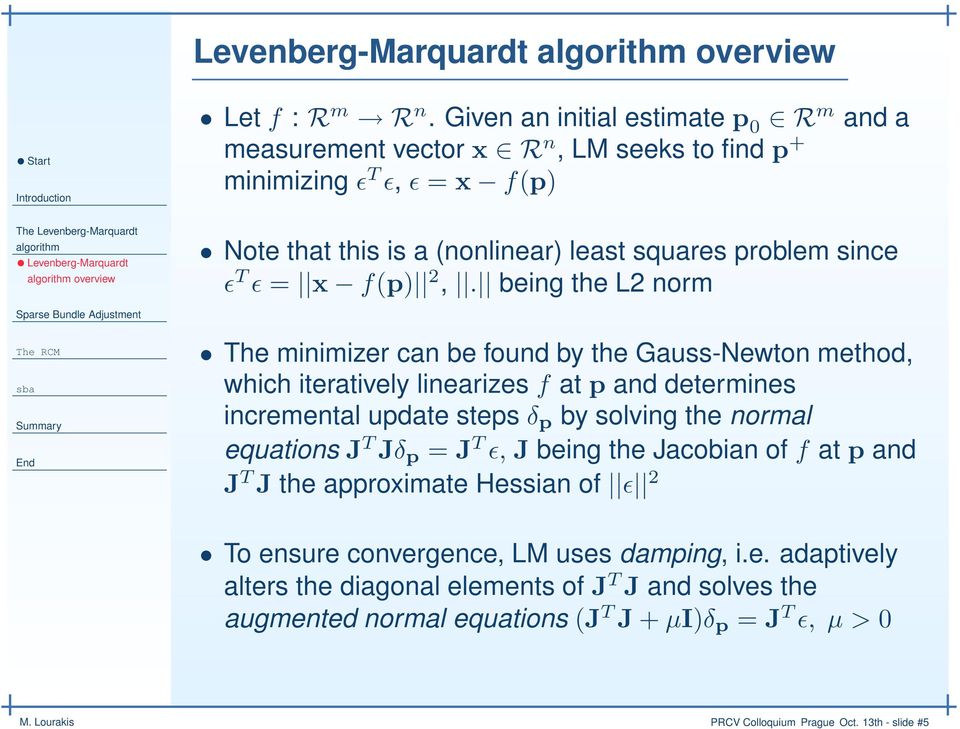
6 Levenberg-Marquardt overview Let f : R m R n. Given an initial estimate p 0 R m and a measurement vector x R n, LM seeks to find p + minimizing ǫ T ǫ, ǫ = x f(p) Levenberg-Marquardt overview Note that this is a (nonlinear) least squares problem since ǫ T ǫ = x f(p) 2,. being the L2 norm The minimizer can be found by the Gauss-Newton method, which iteratively linearizes f at p and determines incremental update steps δ p by solving the normal equations J T Jδ p = J T ǫ, J being the Jacobian of f at p and J T J the approximate Hessian of ǫ 2 To ensure convergence, LM uses damping, i.e. adaptively alters the diagonal elements of J T J and solves the augmented normal equations (J T J + µi)δ p = J T ǫ, µ > 0 M. Lourakis PRCV Colloquium Prague Oct. 13th - slide #5
7 Bundle Adjustment Bundle Adjustment BA as a nonlinear least squares problem Jacobian block structure J T J sparsity pattern for a real problem Solving the augmented normal equations Assume n 3D points are seen in m views. Illustration with n = 7, m = 3 Let x ij be the projection of the i-th point on image j, a j the vector of parameters for camera j and b i the vector of parameters for point i BA minimizes the reprojection error over all point and n m camera parameters: min aj,b i v ij d(q(a j,b i ), x ij ) 2, i=1 j=1 Q(a j,b i ) being the predicted projection of point i on image j, d(.,.) the Euclidean distance between image points and v ij = 1 iff point i is visible in image j This is a large problem: if κ, λ are the dimensions of the a j & b i, the total number of parameters involved in BA is mκ + nλ M. Lourakis PRCV Colloquium Prague Oct. 13th - slide #6

8 BA as a nonlinear least squares problem A parameter vector P is defined by partitioning parameters as P = (a 1 T,...,a m T,...,b 1 T,...,b n T ) T Bundle Adjustment BA as a nonlinear least squares problem Jacobian block structure J T J sparsity pattern for a real problem Solving the augmented normal equations A measurement vector X is defined as (x 11 T,...,x 1m T, x 21 T,...,x 2m T,..., x n1 T,...,x nm T ) T For each parameter vector, an estimated measurement ˆX is (ˆx 11 T,..., ˆx 1m T, ˆx 21 T,..., ˆx 2m T,..., ˆx n1 T,..., ˆx nm T ) T and the corresponding error (ǫ 11 T,...,ǫ 1m T, ǫ 21 T,...,ǫ 2m T,..., ǫ n1 T,...,ǫ nm T ) T, where ˆx ij Q(a j,b i ) and ǫ ij x ij ˆx ij i, j With the above definitions, BA corresponds to minimizing n m ǫ ij 2 = X ˆX 2 over P, which is a nonlinear i=1 j=1 least squares problem M. Lourakis PRCV Colloquium Prague Oct. 13th - slide #7

9 Jacobian block structure Bundle Adjustment BA as a nonlinear least squares problem Jacobian block structure J T J sparsity pattern for a real problem Solving the augmented normal equations The Jacobian J = ˆX P has a block structure [A B], where [ ] [ ] A = and B = ˆX a ˆX b The LM updating vector δ is partitioned as (δ a T, δ b T ) T The normal equations become [ ]( A T A A T B B T A B T B δ a δ b ) = ( A T ǫ B T ǫ The lhs matrix above is sparse due to A and B being sparse: ˆx ij a k = 0, j k and ˆx ij b k = 0, i k This is the so-called primary structure of BA ) M. Lourakis PRCV Colloquium Prague Oct. 13th - slide #8
 = ( A T ǫ B T ǫ The lhs matrix above is sparse due to A](/docs-images/46/21355250/images/page_9.jpg "and B being sparse: ˆx ij a k = 0, j k and ˆx ij b k = 0, i k This is the so-called primary structure of BA ) M. Lourakis PRCV Colloquium Prague Oct.")
10 A simple case with Assume all points are seen in all images The measurement vector X = (x 11 T, x 12 T, x 13 T, x 21 T, x 22 T, x 23 T, x 31 T, x 32 T, x 33 T, x 41 T, x 42 T, x 43 T ) T Bundle Adjustment BA as a nonlinear least squares problem Jacobian block structure J T J sparsity pattern for a real problem Solving the augmented normal equations The parameter vector P = (a 1 T, a 2 T, a 3 T, b 1 T, b 2 T, b 3 T, b 4 T ) T The LM updating vector δ = (δ a1 T, δ a2 T, δ a3 T, δ b1 T, δ b2 T, δ b3 T, δ b4 T ) T Let A ij = ˆx ij a j and B ij = ˆx ij b i M. Lourakis PRCV Colloquium Prague Oct. 13th - slide #9

11 A simple case with The Jacobian J in block form: Bundle Adjustment BA as a nonlinear least squares problem Jacobian block structure J T J sparsity pattern for a real problem Solving the augmented normal equations ˆX P = (1) b 2 T b 3 T b 4 T T T T T a 1 a 2 a 3 b 1 x 11 A B x 12 0 A 12 0 B x A 13 B x 21 A B x 22 0 A B x A 23 0 B x 31 A B 31 0 x 32 0 A B 32 0 x A B 33 0 x 41 A B 41 x 42 0 A B 42 x A B 43 M. Lourakis PRCV Colloquium Prague Oct. 13th - slide #10

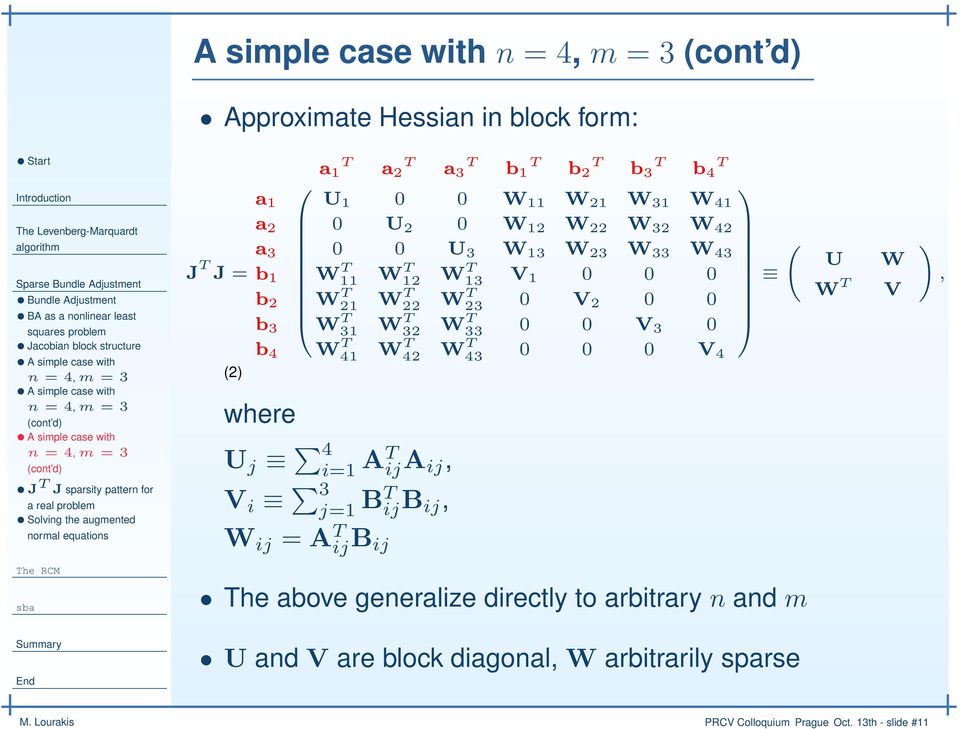
12 A simple case with Approximate Hessian in block form: Bundle Adjustment BA as a nonlinear least squares problem Jacobian block structure J T J sparsity pattern for a real problem Solving the augmented normal equations a 1 T a 2 T a 3 T b 1 T b 2 T b 3 T b 4 T 0 1 a 1 U W 11 W 21 W 31 W 41 a 2 0 U 2 0 W 12 W 22 W 32 W 42 a U 3 W 13 W 23 W 33 W 43 J T J = b 1 W T 11 W12 T W13 T V b 2 B W21 T W22 T W23 T 0 V C b W31 T W32 T W33 T 0 0 V 3 0 A b 4 W T 41 W T 42 W T V 4 (2) where U j 4 i=1 AT ij A ij, V i 3 j=1 BT ij B ij, W ij = A T ij B ij U W T W V!, The above generalize directly to arbitrary n and m U and V are block diagonal, W arbitrarily sparse M. Lourakis PRCV Colloquium Prague Oct. 13th - slide #11
13 J T J sparsity pattern for a real problem Oxford s basement sequence Note the arrowhead pattern Bundle Adjustment BA as a nonlinear least squares problem Jacobian block structure J T J sparsity pattern for a real problem Solving the augmented normal equations Matrix is , black pixels denote nonzero elements M. Lourakis PRCV Colloquium Prague Oct. 13th - slide #12

14 Solving the augmented normal equations Bundle Adjustment BA as a nonlinear least squares problem Jacobian block structure J T J sparsity pattern for a real problem Solving the augmented normal equations The augmented normal equations (J T J + µi)δ p = J T ǫ take the form ( )( ) ( ) U W δa ǫa (3) = W T V Performing block Gaussian elimination in the lhs matrix, δ a is determined with Cholesky from V s Schur complement: (4) This is not alternation! Note that V 1 = δ b ǫ b (U W V 1 W T ) δ a = ǫ a W V 1 ǫ b 0 V V2 1 Why solve for δ a first? Typically m << n. δ b can be computed by back substitution into C A (5) V δ b = ǫ b W T δ a M. Lourakis PRCV Colloquium Prague Oct. 13th - slide #13

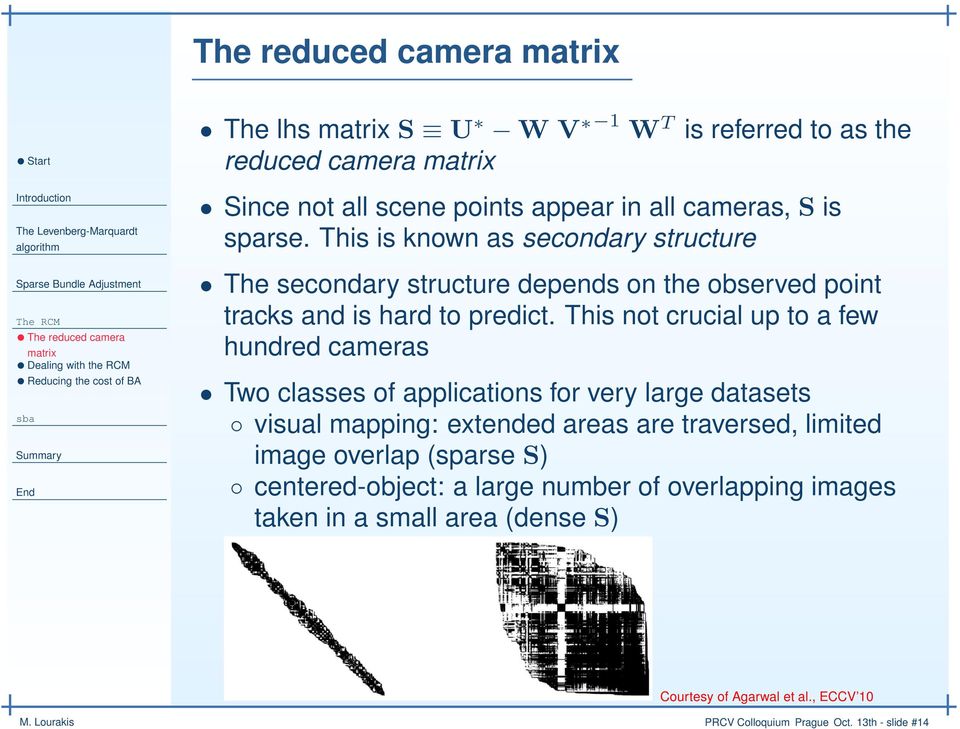
15 The reduced camera matrix The reduced camera matrix Dealing with the RCM Reducing the cost of BA The lhs matrix S U W V 1 W T is referred to as the reduced camera matrix Since not all scene points appear in all cameras, S is sparse. This is known as secondary structure The secondary structure depends on the observed point tracks and is hard to predict. This not crucial up to a few hundred cameras Two classes of applications for very large datasets visual mapping: extended areas are traversed, limited image overlap (sparse S) centered-object: a large number of overlapping images taken in a small area (dense S) Courtesy of Agarwal et al., ECCV 10 M. Lourakis PRCV Colloquium Prague Oct. 13th - slide #14
16 Dealing with the RCM The reduced camera matrix Dealing with the RCM Reducing the cost of BA Store as dense, decompose with ordinary linear algebra M. Lourakis, A. Argyros: SBA: A Software Package For Generic. ACM Trans. Math. Softw. 36(1): (2009) C. Engels, H. Stewenius, D. Nister: Bundle Adjustment Rules. Photogrammetric Computer Vision (PCV), Store as sparse, factorize with sparse direct solvers K. Konolige: Sparse. BMVC 2010: 1-11 Store as sparse, use conjugate gradient methods memory efficient, iterative, precoditioners necessary! S. Agarwal, N. Snavely, S.M. Seitz, R. Szeliski: Bundle Adjustment in the Large. ECCV (2) 2010: M. Byrod, K. Astrom: Conjugate Gradient Bundle Adjustment. ECCV (2) 2010: Avoid storing altogether C. Wu, S. Agarwal, B. Curless, S.M. Seitz: Multicore Bundle Adjustment. CVPR 2011: M. Lourakis: Sparse Non-linear Least Squares Optimization for Geometric Vision. ECCV (2) 2010: M. Lourakis PRCV Colloquium Prague Oct. 13th - slide #15

17 Reducing the cost of BA BA is not a cheap operation, thus for certain applications it may take unacceptably long to complete A large body of work is devoted to reducing BA s size or frequency of invocation The reduced camera matrix Dealing with the RCM Reducing the cost of BA Divide-and-conquer approaches K. Ni, D. Steedly, F. Dellaert: Out-of-Core Bundle Adjustment for Large-Scale 3D Reconstruction. ICCV 2007: 1-8 H.-Y. Shum, Z. Zhang, Q. Ke: Efficient Bundle Adjustment with Virtual Key Frames: A Hierarchical Approach to Multi-Frame Structure from Motion. CVPR 1999: BA in a sliding time window (local BA) E. Mouragnon, M. Lhuillier, M. Dhome, F. Dekeyser, P. Sayd: Real Time Localization and 3D Reconstruction. CVPR (1) 2006: Solve the RCM fewer times: Dog-leg in place of LM M. Lourakis, A. Argyros: Is Levenberg-Marquardt the Most Efficient Optimization Algorithm for Implementing Bundle Adjustment?. ICCV 2005: M. Lourakis PRCV Colloquium Prague Oct. 13th - slide #16

18 historical overview Every good work of software starts by scratching a developer s personal itch. Eric S. Raymond, open source proponent ed as an internal project in 2004, as a component for camera tracking historical overview features weaknesses usage User feedback Lessons learnt Further reading First public version released in September 2004; new versions once or twice a year The library implements the presented scheme in C, forming S as a dense matrix and relying on LAPACK for linear algebra Has spawned two side free source projects LM for dense least squares: LM for arbitrarily sparse least squares: M. Lourakis PRCV Colloquium Prague Oct. 13th - slide #17

19 features Supports generic BA by accepting user-defined projection functions; includes code for Euclidean BA as example historical overview features weaknesses usage User feedback Lessons learnt Further reading This lends it the versatility to support various BA flavors with the same optimization engine: e.g. BA including/excluding camera extrinsics and/or distortion parameters, projective BA, non-pinhole cameras, etc Provides efficient mechanisms for approximating the Jacobians via finite differences and checking the correctness of user supplied ones Provides support for intersectioning/resectioning problems (constant camera poses/scene structure, resp.) Usable in MATLAB though a MEX interface Supports robust cost functions and projection covariances Highly optimized yet portable Can take advantage of multicore architectures through the PLASMA library ( M. Lourakis PRCV Colloquium Prague Oct. 13th - slide #18

20 weaknesses historical overview features weaknesses usage User feedback Lessons learnt Further reading Storing the full RCM makes it inefficient for very large datasets, e.g. long, weakly connected image sequences (i.e., visual mapping). However, local BA is a viable alternative in some of these cases A few interesting practical situations violate its underlying assumption regarding the problem s sparsity pattern, rendering it inapplicable. E.g., fixed but unknown intrinsics shared by all cameras Example: Hessians corresponding to BA for motion and structure (left) and BA for motion, structure and shared intrinsics (right) M. Lourakis PRCV Colloquium Prague Oct. 13th - slide #19

21 usage is considered to be the standard BA implementation historical overview features weaknesses usage User feedback Lessons learnt Further reading Best suited to processing small to medium-sized datasets Has over 280 citations according to Google Scholar, well above 100K page loads for its webpage Was used as the optimization engine of Bundler, the SaM system used in the Photo Tourism system ( that was the predecessor of Microsoft s Photosynth Other sample applications include multiview reconstruction, camera & camera networks calibration, camera tracking, visual SLAM, catadioptric imaging, geocoding, face modeling, autonomous UAVs, remote sensing, and more Released under a dual licensing scheme: GPL + proprietary license, thereby creating an income from commercial applications M. Lourakis PRCV Colloquium Prague Oct. 13th - slide #20
22 User feedback Compilation problems are by far the most common topic of user inquiries Students often ask to have (part of) their homework done Most users send thank-you notes historical overview features weaknesses usage User feedback Lessons learnt Further reading Others do not want to spend time perusing the documentation but prefer to ask direct questions A few knowledgeable users report bugs or suggest extensions Even fewer contribute code snippets In a couple of cases, users have reported that has inspired them to do further research M. Lourakis PRCV Colloquium Prague Oct. 13th - slide #21
23 Lessons learnt The devil is indeed in the details! historical overview features weaknesses usage User feedback Lessons learnt Further reading An efficient implementation should be cache-oblivious so as to minimize data movement across a computer s memory hierarchy Releasing code in public motivates oneself to write & maintain better code. Seeing it being used by others can be very rewarding Good documentation is important Need to set up tools for easy communication and sharing of code, knowledge, experiences and problems among the user community (cf. SourceForge facility) The vision community is in need of wider adoption of the free/open source culture Should have been given a better name! M. Lourakis PRCV Colloquium Prague Oct. 13th - slide #22
24 Further reading historical overview features weaknesses usage User feedback Lessons learnt Further reading B. Triggs, P.F. McLauchlan, R.I. Hartley, A.W. Fitzgibbon: Bundle Adjustment - A Modern Synthesis. Workshop on Vision Algorithms 1999: Y. Jeong, D. Nister, D. Steedly, R. Szeliski, I.-S. Kweon: Pushing the Envelope of Modern Methods for Bundle Adjustment. CVPR 2010: M. Lourakis, A. Argyros: SBA: A Software Package For Generic Sparse Bundle Adjustment. ACM Trans. Math. Softw. 36(1): (2009) C. Engels, H. Stewenius, D. Nister: Bundle Adjustment Rules. Photogrammetric Computer Vision (PCV), 2006 K. Konolige: Sparse. BMVC 2010: 1-11 S. Agarwal, N. Snavely, S.M. Seitz, R. Szeliski: Bundle Adjustment in the Large. ECCV (2) 2010: M. Byrod, K. Astrom: Conjugate Gradient Bundle Adjustment. ECCV (2) 2010: C. Wu, S. Agarwal, B. Curless, S.M. Seitz: Multicore Bundle Adjustment. CVPR 2011: M. Lourakis: Sparse Non-linear Least Squares Optimization for Geometric Vision. ECCV (2) 2010: M. Lourakis PRCV Colloquium Prague Oct. 13th - slide #23
25 Conclusions Conclusions Presented the mathematical theory behind an LM-based sparse bundle adjustment Described, a freely available C/C++ software package for generic sparse BA can be obtained from More details on can be found in Lourakis & Argyros, SBA: A Software Package For Generic Sparse Bundle Adjustment. ACM Trans. Math. Softw., 36(1): 2009 and in the (slightly outdated) Lourakis & Argyros, The Design and Implementation of a Generic Software Package Based on the Levenberg-Marquardt Algorithm, Tech. Rep. FORTH-ICS TR , Aug Making your next project publicly available is worth considering! M. Lourakis PRCV Colloquium Prague Oct. 13th - slide #24
26 The end Any questions? The end M. Lourakis PRCV Colloquium Prague Oct. 13th - slide #25
Towards Linear-time Incremental Structure from Motion
 Towards Linear-time Incremental Structure from Motion Changchang Wu University of Washington Abstract The time complexity of incremental structure from motion (SfM) is often known as O(n 4 ) with respect
g 2 o: A General Framework for Graph Optimization
 g 2 o: A General Framework for Graph Optimization Rainer Kümmerle Giorgio Grisetti Hauke Strasdat Kurt Konolige Wolfram Burgard Abstract Many popular problems in robotics and computer vision including
Towards Using Sparse Bundle Adjustment for Robust Stereo Odometry in Outdoor Terrain
 Sünderhauf, N. & Protzel, P. (2006). Towards Using Sparse Bundle Adjustment for Robust Stereo Odometry in Outdoor Terrain. In Proc. of Towards Autonomous Robotic Systems TAROS06, Guildford, UK, pp. 206
Interactive Dense 3D Modeling of Indoor Environments
 Interactive Dense 3D Modeling of Indoor Environments Hao Du 1 Peter Henry 1 Xiaofeng Ren 2 Dieter Fox 1,2 Dan B Goldman 3 Steven M. Seitz 1 {duhao,peter,fox,seitz}@cs.washinton.edu [email protected]
Numerical Methods I Eigenvalue Problems
 Numerical Methods I Eigenvalue Problems Aleksandar Donev Courant Institute, NYU 1 [email protected] 1 Course G63.2010.001 / G22.2420-001, Fall 2010 September 30th, 2010 A. Donev (Courant Institute)
SOLVING LINEAR SYSTEMS
 SOLVING LINEAR SYSTEMS Linear systems Ax = b occur widely in applied mathematics They occur as direct formulations of real world problems; but more often, they occur as a part of the numerical analysis
Epipolar Geometry. Readings: See Sections 10.1 and 15.6 of Forsyth and Ponce. Right Image. Left Image. e(p ) Epipolar Lines. e(q ) q R.
 Epipolar Geometry We consider two perspective images of a scene as taken from a stereo pair of cameras (or equivalently, assume the scene is rigid and imaged with a single camera from two different locations).
Several Views of Support Vector Machines
 Several Views of Support Vector Machines Ryan M. Rifkin Honda Research Institute USA, Inc. Human Intention Understanding Group 2007 Tikhonov Regularization We are considering algorithms of the form min
Geometric Camera Parameters
 Geometric Camera Parameters What assumptions have we made so far? -All equations we have derived for far are written in the camera reference frames. -These equations are valid only when: () all distances
Numerical Methods I Solving Linear Systems: Sparse Matrices, Iterative Methods and Non-Square Systems
 Numerical Methods I Solving Linear Systems: Sparse Matrices, Iterative Methods and Non-Square Systems Aleksandar Donev Courant Institute, NYU 1 [email protected] 1 Course G63.2010.001 / G22.2420-001,
Fast Optimal Three View Triangulation
 Fast Optimal Three View Triangulation Martin Byröd, Klas Josephson and Kalle Åström {byrod, klasj, kalle}@maths.lth.se Center for Mathematical Sciences, Lund University, Lund, Sweden Abstract. We consider
A simplified implementation of the least squares solution for pairwise comparisons matrices
 A simplified implementation of the least squares solution for pairwise comparisons matrices Marcin Anholcer Poznań University of Economics Al. Niepodleg lości 10, 61-875 Poznań, Poland V. Babiy McMaster
Introduction Epipolar Geometry Calibration Methods Further Readings. Stereo Camera Calibration
 Stereo Camera Calibration Stereo Camera Calibration Stereo Camera Calibration Stereo Camera Calibration 12.10.2004 Overview Introduction Summary / Motivation Depth Perception Ambiguity of Correspondence
EXPERIMENTAL EVALUATION OF RELATIVE POSE ESTIMATION ALGORITHMS
 EXPERIMENTAL EVALUATION OF RELATIVE POSE ESTIMATION ALGORITHMS Marcel Brückner, Ferid Bajramovic, Joachim Denzler Chair for Computer Vision, Friedrich-Schiller-University Jena, Ernst-Abbe-Platz, 7743 Jena,
3D Scanner using Line Laser. 1. Introduction. 2. Theory
 . Introduction 3D Scanner using Line Laser Di Lu Electrical, Computer, and Systems Engineering Rensselaer Polytechnic Institute The goal of 3D reconstruction is to recover the 3D properties of a geometric
3D Model based Object Class Detection in An Arbitrary View
 3D Model based Object Class Detection in An Arbitrary View Pingkun Yan, Saad M. Khan, Mubarak Shah School of Electrical Engineering and Computer Science University of Central Florida http://www.eecs.ucf.edu/
(Quasi-)Newton methods
 (Quasi-)Newton methods 1 Introduction 1.1 Newton method Newton method is a method to find the zeros of a differentiable non-linear function g, x such that g(x) = 0, where g : R n R n. Given a starting
Limitations of Human Vision. What is computer vision? What is computer vision (cont d)?
 What is computer vision? Limitations of Human Vision Slide 1 Computer vision (image understanding) is a discipline that studies how to reconstruct, interpret and understand a 3D scene from its 2D images
Wii Remote Calibration Using the Sensor Bar
 Wii Remote Calibration Using the Sensor Bar Alparslan Yildiz Abdullah Akay Yusuf Sinan Akgul GIT Vision Lab - http://vision.gyte.edu.tr Gebze Institute of Technology Kocaeli, Turkey {yildiz, akay, akgul}@bilmuh.gyte.edu.tr
Overview of Violations of the Basic Assumptions in the Classical Normal Linear Regression Model
 Overview of Violations of the Basic Assumptions in the Classical Normal Linear Regression Model 1 September 004 A. Introduction and assumptions The classical normal linear regression model can be written
State of the Art and Challenges in Crowd Sourced Modeling
 Photogrammetric Week '11 Dieter Fritsch (Ed.) Wichmann/VDE Verlag, Belin & Offenbach, 2011 Frahm et al. 259 State of the Art and Challenges in Crowd Sourced Modeling JAN-MICHAEL FRAHM, PIERRE FITE-GEORGEL,
Object tracking & Motion detection in video sequences
 Introduction Object tracking & Motion detection in video sequences Recomended link: http://cmp.felk.cvut.cz/~hlavac/teachpresen/17compvision3d/41imagemotion.pdf 1 2 DYNAMIC SCENE ANALYSIS The input to
Linear Threshold Units
 Linear Threshold Units w x hx (... w n x n w We assume that each feature x j and each weight w j is a real number (we will relax this later) We will study three different algorithms for learning linear
The Visual Internet of Things System Based on Depth Camera
 The Visual Internet of Things System Based on Depth Camera Xucong Zhang 1, Xiaoyun Wang and Yingmin Jia Abstract The Visual Internet of Things is an important part of information technology. It is proposed
SYSTEMS OF EQUATIONS AND MATRICES WITH THE TI-89. by Joseph Collison
 SYSTEMS OF EQUATIONS AND MATRICES WITH THE TI-89 by Joseph Collison Copyright 2000 by Joseph Collison All rights reserved Reproduction or translation of any part of this work beyond that permitted by Sections
Computational Optical Imaging - Optique Numerique. -- Deconvolution --
 Computational Optical Imaging - Optique Numerique -- Deconvolution -- Winter 2014 Ivo Ihrke Deconvolution Ivo Ihrke Outline Deconvolution Theory example 1D deconvolution Fourier method Algebraic method
Numerical Methods for Solving Systems of Nonlinear Equations
 Numerical Methods for Solving Systems of Nonlinear Equations by Courtney Remani A project submitted to the Department of Mathematical Sciences in conformity with the requirements for Math 4301 Honour s
THE PERFORMANCE EVALUATION OF MULTI-IMAGE 3D RECONSTRUCTION SOFTWARE WITH DIFFERENT SENSORS
 International Conference on Sensors & Models in Remote Sensing & Photogrammetry, 23 25 v 2015, Kish Island, Iran THE PERFORMANCE EVALUATION OF MULTI-IMAGE 3D RECONSTRUCTION SOFTWARE WITH DIFFERENT SENSORS
1 Solving LPs: The Simplex Algorithm of George Dantzig
 Solving LPs: The Simplex Algorithm of George Dantzig. Simplex Pivoting: Dictionary Format We illustrate a general solution procedure, called the simplex algorithm, by implementing it on a very simple example.
Tracking in flussi video 3D. Ing. Samuele Salti
 Seminari XXIII ciclo Tracking in flussi video 3D Ing. Tutors: Prof. Tullio Salmon Cinotti Prof. Luigi Di Stefano The Tracking problem Detection Object model, Track initiation, Track termination, Tracking
6. Cholesky factorization
 6. Cholesky factorization EE103 (Fall 2011-12) triangular matrices forward and backward substitution the Cholesky factorization solving Ax = b with A positive definite inverse of a positive definite matrix
Colorado School of Mines Computer Vision Professor William Hoff
 Professor William Hoff Dept of Electrical Engineering &Computer Science http://inside.mines.edu/~whoff/ 1 Introduction to 2 What is? A process that produces from images of the external world a description
1 Review of Least Squares Solutions to Overdetermined Systems
 cs4: introduction to numerical analysis /9/0 Lecture 7: Rectangular Systems and Numerical Integration Instructor: Professor Amos Ron Scribes: Mark Cowlishaw, Nathanael Fillmore Review of Least Squares
Clarify Some Issues on the Sparse Bayesian Learning for Sparse Signal Recovery
 Clarify Some Issues on the Sparse Bayesian Learning for Sparse Signal Recovery Zhilin Zhang and Bhaskar D. Rao Technical Report University of California at San Diego September, Abstract Sparse Bayesian
Incremental Surface Extraction from Sparse Structure-from-Motion Point Clouds
 HOPPE, KLOPSCHITZ, DONOSER, BISCHOF: INCREMENTAL SURFACE EXTRACTION 1 Incremental Surface Extraction from Sparse Structure-from-Motion Point Clouds Christof Hoppe 1 [email protected] Manfred Klopschitz
Solving Systems of Linear Equations
 LECTURE 5 Solving Systems of Linear Equations Recall that we introduced the notion of matrices as a way of standardizing the expression of systems of linear equations In today s lecture I shall show how
Solving polynomial least squares problems via semidefinite programming relaxations
 Solving polynomial least squares problems via semidefinite programming relaxations Sunyoung Kim and Masakazu Kojima August 2007, revised in November, 2007 Abstract. A polynomial optimization problem whose
Bayesian probability theory
 Bayesian probability theory Bruno A. Olshausen arch 1, 2004 Abstract Bayesian probability theory provides a mathematical framework for peforming inference, or reasoning, using probability. The foundations
Lecture 1: Systems of Linear Equations
 MTH Elementary Matrix Algebra Professor Chao Huang Department of Mathematics and Statistics Wright State University Lecture 1 Systems of Linear Equations ² Systems of two linear equations with two variables
Digital Image Increase
 Exploiting redundancy for reliable aerial computer vision 1 Digital Image Increase 2 Images Worldwide 3 Terrestrial Image Acquisition 4 Aerial Photogrammetry 5 New Sensor Platforms Towards Fully Automatic
Feature Tracking and Optical Flow
 02/09/12 Feature Tracking and Optical Flow Computer Vision CS 543 / ECE 549 University of Illinois Derek Hoiem Many slides adapted from Lana Lazebnik, Silvio Saverse, who in turn adapted slides from Steve
Latest Results on High-Resolution Reconstruction from Video Sequences
 Latest Results on High-Resolution Reconstruction from Video Sequences S. Lertrattanapanich and N. K. Bose The Spatial and Temporal Signal Processing Center Department of Electrical Engineering The Pennsylvania
Similarity and Diagonalization. Similar Matrices
 MATH022 Linear Algebra Brief lecture notes 48 Similarity and Diagonalization Similar Matrices Let A and B be n n matrices. We say that A is similar to B if there is an invertible n n matrix P such that
Introduction to Matrix Algebra
 Psychology 7291: Multivariate Statistics (Carey) 8/27/98 Matrix Algebra - 1 Introduction to Matrix Algebra Definitions: A matrix is a collection of numbers ordered by rows and columns. It is customary
Inner product. Definition of inner product
 Math 20F Linear Algebra Lecture 25 1 Inner product Review: Definition of inner product. Slide 1 Norm and distance. Orthogonal vectors. Orthogonal complement. Orthogonal basis. Definition of inner product
General Framework for an Iterative Solution of Ax b. Jacobi s Method
 2.6 Iterative Solutions of Linear Systems 143 2.6 Iterative Solutions of Linear Systems Consistent linear systems in real life are solved in one of two ways: by direct calculation (using a matrix factorization,
Least-Squares Intersection of Lines
 Least-Squares Intersection of Lines Johannes Traa - UIUC 2013 This write-up derives the least-squares solution for the intersection of lines. In the general case, a set of lines will not intersect at a
Elasticity Theory Basics
 G22.3033-002: Topics in Computer Graphics: Lecture #7 Geometric Modeling New York University Elasticity Theory Basics Lecture #7: 20 October 2003 Lecturer: Denis Zorin Scribe: Adrian Secord, Yotam Gingold
Statistical Machine Learning
 Statistical Machine Learning UoC Stats 37700, Winter quarter Lecture 4: classical linear and quadratic discriminants. 1 / 25 Linear separation For two classes in R d : simple idea: separate the classes
Projective Geometry. Projective Geometry
 Euclidean versus Euclidean geometry describes sapes as tey are Properties of objects tat are uncanged by rigid motions» Lengts» Angles» Parallelism Projective geometry describes objects as tey appear Lengts,
Blind Deconvolution of Barcodes via Dictionary Analysis and Wiener Filter of Barcode Subsections
 Blind Deconvolution of Barcodes via Dictionary Analysis and Wiener Filter of Barcode Subsections Maximilian Hung, Bohyun B. Kim, Xiling Zhang August 17, 2013 Abstract While current systems already provide
Relating Vanishing Points to Catadioptric Camera Calibration
 Relating Vanishing Points to Catadioptric Camera Calibration Wenting Duan* a, Hui Zhang b, Nigel M. Allinson a a Laboratory of Vision Engineering, University of Lincoln, Brayford Pool, Lincoln, U.K. LN6
Flow Separation for Fast and Robust Stereo Odometry
 Flow Separation for Fast and Robust Stereo Odometry Michael Kaess, Kai Ni and Frank Dellaert Abstract Separating sparse flow provides fast and robust stereo visual odometry that deals with nearly degenerate
Accurate and robust image superresolution by neural processing of local image representations
 Accurate and robust image superresolution by neural processing of local image representations Carlos Miravet 1,2 and Francisco B. Rodríguez 1 1 Grupo de Neurocomputación Biológica (GNB), Escuela Politécnica
Graph Based Processing of Big Images
 Graph Based Processing of Big Images HUI HAN CHIN DSO NATIONAL LABORATORIES, SINGAPORE 31 OCT 2014 Introduction Member of Technical Staff at Signal Processing Laboratory, Sensors Division, DSO National
MATRIX ALGEBRA AND SYSTEMS OF EQUATIONS
 MATRIX ALGEBRA AND SYSTEMS OF EQUATIONS Systems of Equations and Matrices Representation of a linear system The general system of m equations in n unknowns can be written a x + a 2 x 2 + + a n x n b a
An Overview Of Software For Convex Optimization. Brian Borchers Department of Mathematics New Mexico Tech Socorro, NM 87801 borchers@nmt.
 An Overview Of Software For Convex Optimization Brian Borchers Department of Mathematics New Mexico Tech Socorro, NM 87801 [email protected] In fact, the great watershed in optimization isn t between linearity
Monocular Model-Based 3D Tracking of Rigid Objects: A Survey
 Foundations and Trends R in Computer Graphics and Vision Vol. 1, No 1 (2005) 1 89 c 2005 V. Lepetit and P. Fua Monocular Model-Based 3D Tracking of Rigid Objects: A Survey Vincent Lepetit 1 and Pascal
Linear Programming. March 14, 2014
 Linear Programming March 1, 01 Parts of this introduction to linear programming were adapted from Chapter 9 of Introduction to Algorithms, Second Edition, by Cormen, Leiserson, Rivest and Stein [1]. 1
Linear Algebra Notes for Marsden and Tromba Vector Calculus
 Linear Algebra Notes for Marsden and Tromba Vector Calculus n-dimensional Euclidean Space and Matrices Definition of n space As was learned in Math b, a point in Euclidean three space can be thought of
Introduction to Computer Graphics
 Introduction to Computer Graphics Torsten Möller TASC 8021 778-782-2215 [email protected] www.cs.sfu.ca/~torsten Today What is computer graphics? Contents of this course Syllabus Overview of course topics
a 11 x 1 + a 12 x 2 + + a 1n x n = b 1 a 21 x 1 + a 22 x 2 + + a 2n x n = b 2.
 Chapter 1 LINEAR EQUATIONS 1.1 Introduction to linear equations A linear equation in n unknowns x 1, x,, x n is an equation of the form a 1 x 1 + a x + + a n x n = b, where a 1, a,..., a n, b are given
Yousef Saad University of Minnesota Computer Science and Engineering. CRM Montreal - April 30, 2008
 A tutorial on: Iterative methods for Sparse Matrix Problems Yousef Saad University of Minnesota Computer Science and Engineering CRM Montreal - April 30, 2008 Outline Part 1 Sparse matrices and sparsity
Understanding and Applying Kalman Filtering
 Understanding and Applying Kalman Filtering Lindsay Kleeman Department of Electrical and Computer Systems Engineering Monash University, Clayton 1 Introduction Objectives: 1. Provide a basic understanding
A linear combination is a sum of scalars times quantities. Such expressions arise quite frequently and have the form
 Section 1.3 Matrix Products A linear combination is a sum of scalars times quantities. Such expressions arise quite frequently and have the form (scalar #1)(quantity #1) + (scalar #2)(quantity #2) +...
Nonlinear Algebraic Equations Example
 Nonlinear Algebraic Equations Example Continuous Stirred Tank Reactor (CSTR). Look for steady state concentrations & temperature. s r (in) p,i (in) i In: N spieces with concentrations c, heat capacities
Linear Equations ! 25 30 35$ & " 350 150% & " 11,750 12,750 13,750% MATHEMATICS LEARNING SERVICE Centre for Learning and Professional Development
 MathsTrack (NOTE Feb 2013: This is the old version of MathsTrack. New books will be created during 2013 and 2014) Topic 4 Module 9 Introduction Systems of to Matrices Linear Equations Income = Tickets!
How does the Kinect work? John MacCormick
 How does the Kinect work? John MacCormick Xbox demo Laptop demo The Kinect uses structured light and machine learning Inferring body position is a two-stage process: first compute a depth map (using structured
Simple and efficient online algorithms for real world applications
 Simple and efficient online algorithms for real world applications Università degli Studi di Milano Milano, Italy Talk @ Centro de Visión por Computador Something about me PhD in Robotics at LIRA-Lab,
Manifold Learning Examples PCA, LLE and ISOMAP
 Manifold Learning Examples PCA, LLE and ISOMAP Dan Ventura October 14, 28 Abstract We try to give a helpful concrete example that demonstrates how to use PCA, LLE and Isomap, attempts to provide some intuition
DYNAMIC RANGE IMPROVEMENT THROUGH MULTIPLE EXPOSURES. Mark A. Robertson, Sean Borman, and Robert L. Stevenson
 c 1999 IEEE. Personal use of this material is permitted. However, permission to reprint/republish this material for advertising or promotional purposes or for creating new collective works for resale or
Bachelor of Games and Virtual Worlds (Programming) Subject and Course Summaries
 First Semester Development 1A On completion of this subject students will be able to apply basic programming and problem solving skills in a 3 rd generation object-oriented programming language (such as
ACCURACY ASSESSMENT OF BUILDING POINT CLOUDS AUTOMATICALLY GENERATED FROM IPHONE IMAGES
 ACCURACY ASSESSMENT OF BUILDING POINT CLOUDS AUTOMATICALLY GENERATED FROM IPHONE IMAGES B. Sirmacek, R. Lindenbergh Delft University of Technology, Department of Geoscience and Remote Sensing, Stevinweg
Solving Linear Systems of Equations. Gerald Recktenwald Portland State University Mechanical Engineering Department [email protected].
 Solving Linear Systems of Equations Gerald Recktenwald Portland State University Mechanical Engineering Department [email protected] These slides are a supplement to the book Numerical Methods with Matlab:
Continued Fractions and the Euclidean Algorithm
 Continued Fractions and the Euclidean Algorithm Lecture notes prepared for MATH 326, Spring 997 Department of Mathematics and Statistics University at Albany William F Hammond Table of Contents Introduction
Multivariate Analysis (Slides 13)
 Multivariate Analysis (Slides 13) The final topic we consider is Factor Analysis. A Factor Analysis is a mathematical approach for attempting to explain the correlation between a large set of variables
Geometric Constraints
 Simulation in Computer Graphics Geometric Constraints Matthias Teschner Computer Science Department University of Freiburg Outline introduction penalty method Lagrange multipliers local constraints University
Moving Least Squares Approximation
 Chapter 7 Moving Least Squares Approimation An alternative to radial basis function interpolation and approimation is the so-called moving least squares method. As we will see below, in this method the
Announcements. Active stereo with structured light. Project structured light patterns onto the object
 Announcements Active stereo with structured light Project 3 extension: Wednesday at noon Final project proposal extension: Friday at noon > consult with Steve, Rick, and/or Ian now! Project 2 artifact
MATH10212 Linear Algebra. Systems of Linear Equations. Definition. An n-dimensional vector is a row or a column of n numbers (or letters): a 1.
 MATH10212 Linear Algebra Textbook: D. Poole, Linear Algebra: A Modern Introduction. Thompson, 2006. ISBN 0-534-40596-7. Systems of Linear Equations Definition. An n-dimensional vector is a row or a column
Chapter 4 One Dimensional Kinematics
 Chapter 4 One Dimensional Kinematics 41 Introduction 1 4 Position, Time Interval, Displacement 41 Position 4 Time Interval 43 Displacement 43 Velocity 3 431 Average Velocity 3 433 Instantaneous Velocity
JPEG compression of monochrome 2D-barcode images using DCT coefficient distributions
 Edith Cowan University Research Online ECU Publications Pre. JPEG compression of monochrome D-barcode images using DCT coefficient distributions Keng Teong Tan Hong Kong Baptist University Douglas Chai
Are we ready for Autonomous Driving? The KITTI Vision Benchmark Suite
 Are we ready for Autonomous Driving? The KITTI Vision Benchmark Suite Philip Lenz 1 Andreas Geiger 2 Christoph Stiller 1 Raquel Urtasun 3 1 KARLSRUHE INSTITUTE OF TECHNOLOGY 2 MAX-PLANCK-INSTITUTE IS 3
December 4, 2013 MATH 171 BASIC LINEAR ALGEBRA B. KITCHENS
 December 4, 2013 MATH 171 BASIC LINEAR ALGEBRA B KITCHENS The equation 1 Lines in two-dimensional space (1) 2x y = 3 describes a line in two-dimensional space The coefficients of x and y in the equation
LIBSVX and Video Segmentation Evaluation
 CVPR 14 Tutorial! 1! LIBSVX and Video Segmentation Evaluation Chenliang Xu and Jason J. Corso!! Computer Science and Engineering! SUNY at Buffalo!! Electrical Engineering and Computer Science! University
Projective Reconstruction from Line Correspondences
 Projective Reconstruction from Line Correspondences Richard I. Hartley G.E. CRD, Schenectady, NY, 12301. Abstract The paper gives a practical rapid algorithm for doing projective reconstruction of a scene