
PORTION SIZES FOR CHILDREN
|
|
|
- Harvey Wilkerson
- 9 years ago
- Views:
Transcription
1 For Healthcare Professional use Toddler Factsheet 1.3 PORTION SIZES FOR CHILDREN 1-4 YEARS LEARNING POINTS 1 Young children need a nutritious balanced diet to meet their nutritional needs for activity, growth and development 2 A balanced combination of foods from all five food groups makes up a healthy diet for young children 3 The amount of food that young children eat varies widely from day to day and meal to meal. Young children do not eat set portion sizes 4 This Factsheet recommends food portion size ranges designed to ensure that the energy and nutrient requirements of young children (except for vitamin D) are all met. Children under five years all need a supplement of vitamin D 5 These portion size ranges can be used to guide how much food to offer children aged 1-4 years 6 Young children should be encouraged to eat to their appetite from at least three of the five food groups but need to be limited in the amounts they consume of milk and milk products and of the foods high in fat and sugar listed in food group 5 7 Parents can be reassured that if young children are eating within the range of portion sizes of a particular food, then they are eating an adequate amount of that food.

2 Food, Nutrients and Portion Sizes Children aged 1-4 need a nutritious balanced diet to meet their nutritional needs for activity, growth and development. A nutritious diet in the early years is made up of a combination of foods from the five food groups: 1. Bread, rice, potatoes, pasta and other starchy foods, 2. Fruit and vegetables, 3. Milk, cheese and yogurt, 4. Meat, fish, eggs, nuts and pulses, and 5. Foods high in fat and sugar. Factsheet 1.2 describes how many portions from each of these five food groups toddlers need to thrive and grow. The tables in this Factsheet provide guidance on a suitable range of portion sizes for each of the foods within each food group for young children 1. Precise or fixed portion sizes are not useful for young children because the amount of food they eat varies considerably from meal to meal and from day to day. This Factsheet therefore suggests the range of portion sizes for a variety of foods that are suitable for 2-4 year olds. In general taller and more active children will eat larger portions of some foods than smaller, less active children. These portion size ranges have been developed by comparing them with reported average amounts eaten by healthy young children 2, 3, 4, 5,6. The energy and nutrient content of daily combinations of a variety of the foods from the tables in this Factsheet have been calculated using the midpoint of the portion size range. These daily combinations comply with healthy eating guidelines for toddlers (1-4 year olds) in Factsheets 1.1 & 1.2 and meet the UK estimated average energy requirements 7 and Reference Nutrient Intakes (RNIs) for all nutrients except vitamin D which is not expected to be met by food alone 8. See Factsheet 1.1i Toddlers months Portion sizes for very young toddlers aged months are those at the lower end of the ranges in the following tables. The energy requirements of these young toddlers are considerably lower than those for children two years and over. Hence we recommend that toddlers under two years of age are not offered sweet drinks, confectionery, chocolate or savoury snacks such as crisps as listed in Food Group 5 on page 9. Vitamin D Most of young child s vitamin D needs are met not by diet, but by synthesis in the skin. The National Institute of Clinical Excellence (NICE) and the Department of Health recommend a daily supplement of vitamin D (and vitamin A) for all children under five years in the UK in addition to eating a balanced diet 9. See Factsheet 1.2 Allow young children to eat to their appetite Young children should be allowed to eat to their appetite from the food groups 1, 2 and 4 and allowed to stop eating when they have had enough. They should not be urged to finish everything on their plate or to eat more than they wish to. Signals that young children have had enough are: shutting their mouths, turning their heads away, pushing the spoon or plate aside, refusing to swallow and holding food in their mouths, spitting food out, screaming or crying, gagging or vomiting. See Factsheet 2.2 Parents can be reassured that when young children eat a variety of foods in amounts within the range of portion sizes presented in this Factsheet, they are eating adequately. Knowing that the small portion sizes of some foods at the lower end of the ranges are adequate can reassure parents who worry that their young children are not eating enough of certain foods. Food Group 3: Milk, cheese and yogurt Some young children may drink too much milk and thus reduce their appetite for the iron-containing foods in the food groups 1, 2 and 4. Milk, cheese and yogurt should be limited to about three portions per day in the amounts specified in the MILK, CHEESE AND YOGURT table, on page 5, to reduce the risk of a low intake of iron. Discontinuing milk from a bottle at around 12 months reduces the risk of: bottles becoming a comfort an excess consumption of milk. Infants can begin drinking from a cup after about six months of age. Food Group 5: Foods high in fat and sugar Small portion sizes have been recommended for some of the foods in this food group because these low nutrient, energy-dense foods should be limited to prevent tooth decay, overweight and obesity. See Factsheet 3.3 & 4.5 Young children have an innate preference for these energy-dense, and often sweet, foods. They can be included in small amounts in a balanced diet but should not be given as rewards, bribes or for comfort. See Factsheet

3 The Portion Size Ranges The tables that follow cover each of the five food groups. See Factsheet 1.2 The foods are listed in the first column, with the portion sizes (lower and upper ends of ranges) in the second column. Standard measures have been used: 1 tablespoon is a 15ml spoon and 1 teaspoon is a 5ml spoon. Food Group 1: Bread, rice, potatoes, pasta and other starchy foods Offer a serving at each meal and some snacks BREADS Bagel Bread roll Bread slices fresh or toasted Bread sticks Bun (e.g. hot cross)* Chapatti Cream / wholemeal crackers 1 /4-1 /2 bagel 1 /4-3 /4 roll 1/2-1 medium slice 1-3 large breadsticks 1 /4-1 /2 bun 1 /2-1 chapatti 1-3 crackers 4 heaped of cornflakes. Crispbread Crumpet Maltloaf* Naan bread Oatcakes 1 /2-2 crispbreads 1/4-1 crumpet 1 /2-1 slice 1 /8-1 /3 naan 1-2 oatcakes Pitta bread 1 /2-1 mini or 1 /4-1 /2 pitta Rice cakes Scone Teabread* Tortilla BREAKFAST CEREALS Dry flaked cereals (e.g. cornflakes / Rice Krispies / Cheerios )* Muesli* Porridge / Ready Brek made up with milk / water Wheat biscuits (e.g. Weetabix )* 1-3 medium rice cakes 1 /2-1 small scone 1 /2-1 1 /2 slices 1/4-1 /2 large tortilla 3-6 heaped 5-8 1/2-1 1 /2 biscuits COUSCOUS, PASTA, POTATOES & RICE Cassava / plantain boiled or fried Couscous (cooked) Noodles (cooked) Pasta (cooked) Pasta in tomato sauce (e.g. spaghetti hoops in tomato sauce) Potatoes baked boiled chips croquettes mashed roast waffles wedges Rice boiled or fried heaped 1 /2-1 small cup /4-1 /2 medium potato 1 /2-1 1 /2 egg-sized potatoes 4-8 thick-cut chips 1-2 mini croquettes 1-4 1/2-1 small potato 1/2-1 waffle 2-4 medium wedges 2-5 Foods marked with an asterisk (*) should be limited to mealtimes and no more than one snack per day because of their sugar content. See Factsheet

4 Food Group 2: Fruit and vegetables Offer at least 1-2 servings at each meal and also offer them with some snacks These are low energy, high nutrient foods - allow young children to eat larger portions if they wish to. FRUITS Apple Avocado Banana Clementine / tangerine / mandarin Dried apricots / prunes* Dried fruit snack bar* Fruit salad Grapes and berries (e.g. blackberries / blueberries / raspberries / strawberries) Kiwifruit / plum / apricot Mango Melon Orange Peach / nectarine Pear Pineapple Raisins / sultanas* Stewed fruit / tinned fruit / fruit puree 1/3 medium banana. 1/4-1 /2 medium apple 1/2-2 1/4-1 medium banana 1 /2-1 fruit 1-4 whole fruits 1/2-1 (15g) bar 1 /2-1 small bowl 3-10 small grapes / berries 1 /2-1 fruit 1/4-1 /2 mango 1/4-1 thin slice 1/4-1 /2 orange 1 /4-1 whole fruit 1 /4-3 /4 whole fruit 1 /4-1 medium slice 1 /2-2 3 small florets of broccoli. VEGETABLES Bamboo shoots Beetroot Broccoli / cauliflower Brussels sprouts Cabbage 1 /2-2 1/ small florets or 1 /2-2 1 /2-3 sprouts 1-3 Carrot 1-3 / 2-6 carrot sticks Celery / cucumber / radishes / peppers / other salad vegetables Cherry tomatoes Courgettes / squash / okra / aubergine Green / French beans Leeks / onions / shallots Lettuce Mange tout Mixed vegetables Mushrooms Parsnip Peas Spring greens / spinach (cooked) Stir fried or roasted vegetables Swede / turnip Sweet corn Tomato Vegetable soup 2-8 small sticks / slices 1-4 cherry tomatoes 1 /2-2 1 /2-2 1 / small leaves 2-8 mange touts 1/ button mushrooms 1 /2-2 1/2-2 1 /2-2 1/2-2 1/2-2 1/2-2 1/4-1 small tomato 1 /2-1 small bowl (60-125ml) Foods marked with an asterisk (*) should be limited to mealtimes and no more than one snack per day because of their sugar content. See Factsheet

5 Food Group 3: MILK, CHEESE AND YOGURT Serve about 3 times each day An excess of these foods can reduce the appetite for iron-containing foods from the other food groups so limit serving sizes to those indicated. Milk should be given in a cup, mug or glass - not a bottle. See Factsheet 1.2 Semi skimmed milk can be used from two years of age and skimmed milk from five years of age for children who eat a wide variety of foods. 125ml pot of yogurt. MILK Breast milk Cow s milk as a drink Flavoured milk (e.g. chocolate / strawberry)* Formula milk, Growing Up milk or Calcium enriched soya milk* 5-10 minutes breastfeeding 1 cup of milk ( ml / 3-4oz) 1 cup of milk ( ml / 3-4oz) 1 cup of milk ( ml / 3-4oz) 120ml of milk. CHEESE Cheese sauce Cheddar / Edam / Parmesan / Brie / Camembert / Mozzarella Cottage / ricotta cheese Grated cheese 1-4 in a sandwich or as a pizza topping 1 /2-1 tablespoon in a sandwich as a pizza topping or in a sandwich Processed cheese 15-21g (1 slice / 1 triangle or string / 1 Mini Babybel ) Spreadable cheese thickly spread on a slice of bread YOGURTS AND MILK PUDDINGS Yogurt Fromage frais Calcium enriched soya dessert* Custard* Milk pudding* 1 average pot (125ml) 2 small pots (60g each) 1 average pot (125ml) Rice pudding* Mini Babybel (20g). Foods marked with an asterisk (*) should be limited to mealtimes and no more than one snack per day because of their sugar content. See Factsheet

6 Food Group 4: Meat, fish, eggs, nuts and pulses Serve 2-3 times per day twice for young children eating meat and fish and 3 times a day for vegetarians MEAT Bacon Beef Beef burger / lamb burger without bun Chicken Chicken drumsticks Chicken nuggets Chicken / turkey burger without bun Duck Frankfurter Ham Lamb Lamb s liver Liver pate Minced meat Pork Rabbit Salami Sausages Sausages cocktail Turkey 1 /4-1 rasher 1/2-1 slice 1/4-1 small burger 1-2 small slices 1/2-1 drumstick 2-4 small nuggets 1/4-1 small burger 1-2 slices of breast meat 1 /2-1 small frankfurter 1/2-1 1 /2 small slices 1 1 /2-4 wafer thin slices 1 /2-1 slice 1 /2-1 thin slice /2-2 small slices 1-2 slices 1-2 slices 1 /4-1 medium sausage 1-3 cocktail sausages 1-2 slices of breast or dark meat 1 tablespoon of tuna mayonnaise. FISH Fish: white / oily fresh fish Shell fish: prawns, mussels etc Taramasalata Tinned fish in a sandwich / salad (e.g. tuna / salmon / sardines) 1 /4-1 small fillet or / /2-1 1 /2 3 of cooked minced meat. 1 small slice of ham. 06

7 EGGS Omelette (1 egg) 1/2-1 omelette Poached / boiled / fried 1 /2-1 egg Scrambled egg NUTS Ground, chopped or crushed nuts 1-2 Peanut butter or other nut butters 1/2-1 tablespoon or thinly spread on bread PULSES 1/2 a boiled egg. Baked beans in tomato sauce SOUPS Bhajis or pakora made with chickpea flour 1/2-1 1 /2 bhajis or pakoras Homemade soups with meat / fish / pulses 1 small bowl (90-125ml) Chickpeas / hummus 1-2 Dhal / cooked lentils Falafels 1-3 mini falafels (25g each) Red kidney beans / bean salad / other starchy beans Tofu 1 small bowl of soup (90-125ml). 3 1 /2 of baked beans on toast. 07

8 Food Group 5: Foods high in fat and sugar Biscuits, cakes and puddings - include once a day These foods add enjoyment to meals and snacks but as they are high energy, low nutrient foods the maximum serving size should be limited to the upper end of the range. Cake or biscuit can be served with fruit to make a nutritious pudding. Sugary foods can cause tooth decay when given on more than four occasions per day. See Factsheet 4.5 BISCUITS, CAKES AND PUDDINGS Biscuit chocolate coated* digestive (plain)* fruit (e.g. garibaldi)* plain (e.g. rich tea / ginger nut)* sandwich (e.g. bourbon / custard cream)* Cake cake-style pudding with fruit (e.g. apple sponge cake)* cake-style pudding without fruit (e.g. sticky toffee pudding)* cup cake* fruit cake* madeira / swiss roll / sponge* Cereal bar* Chocolate mousse* Croissant (plain) Danish pastry / chocolate croissant* Fruit crumble (e.g. apple or rhubarb crumble)* Fruit pie or tart (e.g. apple pie / apricot tart)* Fruit sorbet / smoothie* Ice cream* Jelly* Muffin* Pancake* Trifle* 1 /2-1 biscuit 1 /2-1 biscuit 1-2 biscuits 1-2 biscuits 1 /2-1 biscuit 1 /2-1 (25g) cup cake 1 /2-1 slice 1 /4-1 /2 slice 1 /2-1 (20g) bar /2-1 (45g) pastry 1 /4-1 /2 medium pastry 1 /2-1 small slice heaped 1 /8-1 /4 of a large (125g) muffin 1 /2-1 small pancake 2 heaped of ice cream with fruit. Fats and oils Include 2 servings per day to enhance flavour of meals and provide essential fats. FATS AND OILS Butter / margarine thinly spread - 1 teaspoon Double cream 1 tablespoon Mayonnaise / salad cream 1-2 teaspoons / oil & vinegar dressing Oil for frying 1 teaspoon rapeseed oil is best Sauces and sweet and savoury spreads Include 1 serving per day to add flavour and enjoyment to a meal. SAUCES AND SWEET AND SAVOURY SPREADS Chocolate spread* thinly spread - 1 teaspoon Gravy 1-2 Honey / jam / marmalade / syrup* Tomato ketchup / brown or BBQ sauce thinly spread - 1 teaspoon 1-2 teaspoons Foods marked with an asterisk (*) should be limited to mealtimes and no more than one snack per day because of their sugar content. See Factsheet

9 High energy foods that can be offered occasionally in limited amounts Limit these foods to occasional meals no more than one item once a week. Do not use as a reward, treat or to comfort a child. CONFECTIONERY Bar of chocolate / chocolate-coated biscuit bar* Chocolate buttons* Ice lolly* Popcorn - sweet* Soft sweets (e.g. jelly tots / jelly beans)* SWEET DRINKS Diluted squashes* Fruit juices* 2-4 squares or a funsize chocolate bar 6-8 small buttons 1/4-1 /2 small ice lolly 1/2-1 small cup 2-4 sweets ml / 3-4oz ml / 3-4oz 3 jelly beans. For more information on sugary foods, See Factsheet 4.5 SAVOURY SNACKS Bombay mix Corn / Tortilla chips Crisps and packet snacks (e.g. Wotsits / Hula hoops ) French fries - thin (fast food) Fried flatbreads (e.g. puris / parathas) Popcorn - unsweetened Poppadoms Vegetable crisps 1-3 teaspoons 4-6 chips 4-6 crisps / Wotsits / Hula hoops 6-10 fries 1 /8-1 /4 small puris or parathas 1/2-1 small cup 1 /2-1 poppadom 4-6 crisps 3 squares of chocolate. 5 crisps. 1 small cup of popcorn. 09

10 PORTIONS WITH FOODS FROM MORE THAN ONE FOOD GROUP The food groups included in each portion are shown in the third column of each table. CASSEROLES, CURRIES, STEW OR STIR FRY Meat / chicken / fish / pulses with vegetable based sauce and potatoes Meat / chicken / fish / pulses with vegetable based sauce without potatoes FISH PRODUCTS Fish battered or in breadcrumbs Fish cakes Fish fingers Range of portion sizes Range of portion sizes 1-3 heaped 1/2-1 (90g) fish cake 1-2 fish fingers Fish and potato pie 2-6 PASTA DISHES Range of portion sizes Lasagne (meat) 2-5 Lasagne (vegetable) 2-5 Macaroni cheese 2-5 Ravioli (meat) 2-5 large pieces Ravioli (vegetable) 2-5 large pieces Spaghetti bolognese 3-5 PIZZAS Pizza (meat / vegetable / cheese toppings) Pizza (vegetarian toppings) Range of portion sizes 1-2 small slices / 1/4-1 mini (70g) pizza 1-2 small slices / 1/4-1 mini (70g) pizza Food groups 1, 2 and 4 2 and 4 Food groups 4 1 and and 4 Food groups 1 and 4 1 and 2 1 and 3 1 and 4 1 and 2 1 and 4 Food groups 1, 3 and 4 1 and 3 3 of macaroni cheese. PIES AND PASTRY Shepherds pie / cottage pie Range of portion sizes Food groups and 4 Meat pie in pastry 1, 4 Meat pasty 1 /4-1 /3 pasty 1, 4 Mini sausage rolls 1-3 mini sausage rolls 1, 4 Toad in the Hole 1 /2-1 small 1, 4 Quiche 1 /2-1 1 /2 small slices (30-90g) Samosas (meat) 1 /2-1 samosa or 1-2 small samosas Samosas (vegetable) Yorkshire pudding SOUPS Homemade vegetable soup with meat / fish / lentils / beans Homemade minestrone soup 1 /2-1 samosa or 1-2 small samosas 1/2-1 individual Yorkshire pudding Range of portion sizes 1 small bowl (90-125ml) 1 small bowl (90-125ml) 1, 3, 4 1, 4 1, 2 1 and 3 Food groups 2 and 4 1 and 4 10

11 Drinks Offer toddlers a drink with each meal and snack. 3-4oz or ml is about right. Water is the best choice. If used, fruit juices and sugar sweetened squashes should be well diluted with water and limited to once a week (page 9). Undiluted fruit juices and smoothies are very high sugar foods and could be included as a sweet pudding at a meal and limited as on page 8. STANDARD MEASURES The diameters of the plates and bowls photographed for this Factsheet are as follows: White plate: 9 / 23cm (approx) White bowl: 6 1 /2 / 16.5cm (approx) Glass bowl: 4 3 /4 / 12cm (approx) QUICK NUTRITIOUS PUDDINGS or only one snack per day Half plain digestive and strawberries. Household spoons vary in size: are about 15ml and teaspoons are about 5ml, but can be less. In calculating portions sizes for this Factsheet, measuring spoons were used. Crispbread, cheddar cheese cubes and 3 slices of apple. A set of measuring spoons, including a tablespoon (15ml) and a teaspoon (5ml). A tablespoon (15ml). Madeira cake and raspberries. References 1. More J.A. & Emmett P.M. Evidenced-based, practical food portion sizes for preschool children and how they fit into a well balanced, nutritionally adequate diet. J Hum Nutr Diet. 2014; doi: /jhn Wrieden WL, Longbottom PJ, Adamson AJ, Ogston SA, Payne A, Haleem MA, Barton KL. Estimation of typical food portion sizes for children of different ages in Great Britain. British Journal of Nutrition. 2008; 99: Cowin I, Emmett P. Diet in a group of 18-month-old children in South West England, and comparison with the results of a national survey. Journal of Human Nutrition and Dietetics. 2007; 20: Emmett P, Rogers I, Symes C, ALSPAC Study Team. Food and nutrient intakes of a population sample of 3-year-old children in the South West of England in Public Health Nutrition. 2002; 5: Fox MK, Reidy K, Karwe V, Ziegler P. Average Portions of Foods Commonly Eaten by Infants and Toddlers. The United States Journal of the American Dietetic Association. 2006; 106: Suppl1: S66-S76 6. Webb K, Rutishauser I, Knezevic N. Foods, nutrients and portions consumed by a sample of Australian children aged months. Nutrition & Dietetics. 2008; 65: Scientific Advisory Committee on Nutrition (2011) Dietary Reference Values for Energy. London: TSO 8. Department of Health (1991) Report on Health and Social Subjects No 41. Dietary Reference Values for Food Energy and Nutrients for the United Kingdom. London: The Stationery Office 9. National Institute for Health and Clinical Excellence. NICE public health guidance 11. Improving the nutrition of pregnant and breastfeeding mothers and children in low-income households. London: NICE, 2008 Additional copies of this Factsheet can be downloaded from The information contained within this Factsheet represents the independent views of the members of the Forum and copyright rests with the Forum members. 11

12 The portion sizes listed in these tables are designed as a handy guide for healthcare professionals to advise parents and carers of young children. They will not be appropriate for young children with certain medical conditions or faltering growth, who will require the omission and/or addition of specific foods. This Factsheet should be used alongside others on healthy eating for young children. See Factsheet PORTION SIZE RANGES FOR 1-4 years Chips Cucumber Onion bhaji Feeding young children: practical advice from experts Supported by an unrestricted educational grant from Danone Nutricia ITF193 - October 2011 Revised - March 2014

Carbohydrate counting a pocket guide
 counting a pocket guide www.bayerdiabetes.ca Contents Starches 3 Vegetables 4 Fruit/Fruit juices 5 Milk/Yoghurt 5 Fast foods 6 Proteins (meat/meat substitutes) 6 Drinks 6 Sweets/Sugary foods 7 Combination
Portion size guide One to three-year-olds
 Medway Early Years Portion size guide One to three-year-olds www.abettermedway.co.uk Brought to you by NHS Medway and Medway Council Getting a nutritious balance for toddlers In the UK, there is minimal
Committee on Medical Aspects of Food and Nutrition Policy
 Nutrient Intakes Last updated: December 2014 This paper describes how nutrient intakes are calculated from food purchases and how they are compared to nutrient recommendations and other dietary guidelines.
Planning Meals for Toddlers
 For Healthcare Professional use Toddler Factsheet 1.5 Planning Meals for Toddlers www.infantandtoddlerforum.org LEARNING POINTS 1 Menu planning can help to establish a pattern of nutritionally balanced
This week s seasonal menus
 This week s seasonal menus s and plums Chicken Tagine Spiced fish crunch Vegetable Tagine v Vegetable crunch v served with cous cous served with spring onion and herb potatoes and peas Moussaka Vegetable
Weaning learning to like new tastes and textures
 Complementary feeding or weaning is introducing solid foods in addition to your baby s milk feeds. Babies develop at different rates so begin when your baby is ready by six months, but not before four
Choose one item daily from the following list:
 Choose one item daily from the following list: ~ 3 Pieces fresh fruit ~ 2oz (50g) dried fruit e.g. apricots, raisins ~ 1 slice bread and thin spread of jam, marmalade, low fat cheese spread, paste or low
Paediatric Diabetes: Carbohydrate counting
 Department of Nutrition and Dietetics Paediatric Diabetes: Carbohydrate counting Everyone with diabetes need to be careful about the foods they eat to ensure that their blood glucose levels stay as close
2013-2014 Annual Menu
 WEEK 1 Toasty O's [WG] English Muffin, 2 oz French Toast Stick [WG], 0.87 oz Crispy Rice Bagel, 1-2 oz Vegetable/Fruit Bananas [C] Apricots [A] Applesauce [C] Oranges [C] Fruit Cocktail [A, C] Fruit Cocktail
Meal Planning for a Mushy Soft Diet After Nissen Fundoplication
 Meal Planning for a Mushy Soft Diet After Nissen Fundoplication Name: Date: Dietitian: Telephone: Questions? CALL YOUR DIETITIAN! Patient Food and Nutrition Services University of Michigan Hospital 1500
Eating well: first year of life Food photo cards
 Eating well: first year of life Food photo cards For information on how to use these food photo cards, see Eating Well First Year of Life Practical Guide. ISBN 978-1-89-782030-8 Eating Well: First Year
Oxford Bariatric Service Pre bariatric surgery diet Information for patients
 Oxford Bariatric Service Pre bariatric surgery diet Information for patients Why do I need to follow a pre-operative diet? Before obesity surgery, it is essential that you follow a strict calorie controlled
21-Day Sample Cycle Menu Child and Adult Care Food Program
 The abbreviation to the left of each menu item indicates the meal pattern component supplied. The following abbreviations are used: G/B = Grains/Breads; M/MA = Meat/Meat Alternate; F/V = Fruit/Vegetable;
Meal Planning for a Mushy Soft Diet After Laparoscopic Myotomy
 Meal Planning for a Mushy Soft Diet After Laparoscopic Myotomy Name: Date: Dietitian: Telephone: Why is it necessary to follow this diet? This diet is necessary for individuals who have had some types
What is a serving size? A Guide for Pre-schools
 What is a serving size? A Guide for Pre-schools www.safefood.eu A Guide for Pre-school Workers Foreword Establishing good lifestyle habits, including positive attitudes and behaviours around food is one
Appendix A Food Sources of Vitamins and Minerals
 Appendix A Food Sources of Vitamins and Minerals Appendix A 229 Appendix A Food Sources of Vitamins and Minerals Vitamin A (Retinol) Food Amount IU* Liver 3 oz 45,400 Crab 2 cup,680 Egg medium 590 Fats
Dietary advice for impaired glucose tolerance and impaired fasting glucose
 Dietary advice for impaired glucose tolerance and impaired fasting glucose Delivering the best in care UHB is a no smoking Trust To see all of our current patient information leaflets please visit www.uhb.nhs.uk/patient-information-leaflets.htm
Your liver shrinkage diet prior to surgery (Diet Option)
 Your liver shrinkage diet prior to surgery (Diet Option) Introduction All people who need obesity surgery have a large fatty liver, which causes difficultly for the laparoscopic surgery. Therefore, before
WELCOME TO IMPERIAL COLLEGE HEALTHCARE NHS TRUST
 Children s Ward Menu WELCOME TO IMPERIAL COLLEGE HEALTHCARE NHS TRUST Please find enclosed your full guide to meals, drinks & snacks. Your hostess will take your lunch and dinner orders at your bedside.
Healthy Eating and your Diabetes
 Healthy Eating and your Diabetes Patient Information Leaflet Why is Healthy Eating Important? Healthy eating is important to everyone but is even more important if you have diabetes. This is because some
Food Groups for Low Potassium and Low Phosphorus Diets
 Food Groups for Low Potassium and Low Phosphorus Diets When you have kidney disease, you may need to follow a diet low in sodium, potassium and phosphorus. This diet is sometimes called a renal diet. You
Your Guide to Diabetes & Food
 Your Guide to Diabetes & Food Now you have diabetes your diet is key in helping you control your blood sugar levels. With Diabetes you have an increased risk of heart disease, which needs to be considered
Carbohydrate counting reference booklet
 Patient information leaflet Royal Surrey County Hospital NHS Foundation Trust Carbohydrate counting reference booklet A supplement for use with Patient information leaflets: Carbohydrate counting for adults
MONDAY TUESDAY WEDNESDAY THURSDAY FRIDAY BREAKFAST
 CHILD DEVELOPMENT CENTER/FAMILY CHILD CARE WEEK 1 DATES: December 29 - January 2, 2015 Diced Peaches Grape Juice Banana Slices Orange Slices Pineapple Juice English Muffin Whole Wheat Waffles Rice Krispies
Breakfast Served until 11.30am
 Breakfast Served until 11.30am For full nutritional information on any of the meals please ask a colleague. Big breakfast Fried egg, 2 sausages, 2 rashers of bacon, hash brown, fresh tomato, baked beans
Eating well with diabetes
 Eating well with diabetes How will this booklet help me? The information in this booklet will help you to control your diabetes by giving you information on how to eat a healthy balanced diet. These changes
1. Deciding on the Food Budget and Which Foods to Spend Most Money on.
 Ideas Meal and planning tips for to fit eating your budget together Here is a plan to help you make the most of your food budget to promote health and well being for you and your family. Try working through
MEAL PLANNING FOR MECHANICAL SOFT DIET
 MEAL PLANNING FOR MECHANICAL SOFT DIET Definition of Terms Calories Protein Blenderized Pureed Units of energy. A nutrient used by your body for growth and repair. The best sources are milk, meats, fish,
Low Oxalate Diet. Cereals and Cereal Products. Milk and Milk Products
 Low Oxalate Diet Oxalate can be found in healthy plant foods. What can become confusing for some patients is that they have already been put on dietary restrictions because of some other medical conditions
Healthy Foods for my School
 yum, yum, yum, yum, yum, yum, yum, yum, yum, yum, yum, yum, yum, yum, yum, yum, yum, yum, yum, yum, yum, Healthy Foods for my School Nutrition Standards for Saskatchewan Schools Schools are an ideal place
10 Week Nutrition Plan
 10 Week Nutrition Plan Welcome and thank you for your interest in taking the next step to health! We hope you find this eating plan a starting point to making healthier food choices and a tool to reach
Low Residue Diet A low residue diet is easier for your gut to digest. It
 Low Residue Diet A low residue diet is easier for your gut to digest. It may be recommended to help improve your symptoms, to prepare you for an investigation or to reintroduce food after a period without
Healthy Eating for Diabetes
 Healthy Eating for Diabetes What is diabetes? Diabetes is when your blood sugar (glucose) levels are higher than normal. For some people, this is because the insulin in their body doesn t work as well
Understanding the Carbohydrate Portions in Gluten Free Foods 1 Portion/Exchange = 15g
 Understanding the Carbohydrate Portions in luten Free Foods 1 Portion/Exchange = 15g Know your Carbohydrate Foods Dairy Fruit Starchy vegetables Breads, cereals, rice, pasta/noodles, biscuits, flour(s)
Maintenance Sample Meal Plans
 Maintenance Sample Meal Plans In Maintenance, some people prefer to work with general guidelines for success while others prefer more structure and a specific meal pattern to follow. In this document,
Easier Swallowing. Texture C
 Easier Swallowing Texture C Consistencies You have been found to have difficulties with eating and drinking. It has been recommended that you follow a consistency modified diet and the one that has been
Nutrition Pointers: Fruits and Veggies
 Nutrition Pointers: Fruits and Veggies Eat as many as possible try filling half your plate with fruits and veggies. Fruits and veggies are good for you whether they are fresh or frozen. Go for a wide variety
My Diabetic Meal Plan during Pregnancy
 My Diabetic Meal Plan during Pregnancy When you have diabetes and are pregnant, you need to eat small meals and snacks throughout the day to help control your blood sugar. This also helps you get in enough
High Protein High Energy Diet
 High Protein High Energy Diet High protein and/or high energy diet is useful when: you are underweight you are losing weight without trying you are unable to eat enough due to poor appetite or nausea you
The Glycemic Index of Foods
 What is the Glycemic Index (GI)? It is a method used to classify carbohydrate containing foods, according to the effect that they may have on blood sugar levels. It is claimed that the higher the GI number,
Healthy eating for breastfeeding mothers
 Healthy eating for breastfeeding mothers Healthy eating is important when you are breastfeeding. Your body has a greater need for most nutrients. Some of the extra energy required for breastfeeding comes
Nutrition Guidelines for Diabetes
 Nutrition Guidelines for Diabetes Eating healthy foods and keeping a healthy body weight are very important parts of a diabetes treatment plan. A healthy diet and weight helps to keep your blood sugar
Adult portion size examples - approximately equivalent to 80g in weight
 FRUIT - Adult portion size = 80g Fruit (Always check labels for additives) Adult portion size examples - approximately equivalent to 80g in weight (As eaten, edible portion, drained if canned) Apple: fresh
Diet for Oral Surgery/Wired Jaw
 Diet for Oral Surgery/Wired Jaw After oral surgery no chewing is allowed for a period of 4-8 weeks. During this time you will need a blenderized or liquid diet. This pamphlet will help you to get adequate
Bariatric Surgery: Step III Diet
 Bariatric Surgery: Step III Diet This diet is blended foods with one new solid food added daily. The portions are very small to help prevent vomiting. Warning: This diet does not have enough calories,
1800 Calorie Meal Plan. Jessica Iannotta Department of Nutritional Sciences UMDNJ School of Health Related Professions
 1800 Calorie Meal Plan Meal Portion Food Calories DAY 1 Breakfast 1 cup Hot Oatmeal, cooked, unsweetened 150 1 banana 120 1 Amy s Bean & Rice Burrito 280 (in the frozen foods section of your grocery store
Registered Trade Mark
 2008 High Energy, High Protein, Low Fiber Guidelines Registered Trade Mark High Energy, High Protein, Low Fibre Guidelines Eating well, even though you may not feel hungry, is an important part of taking
Advice about soft and liquidised food
 Advice about soft and liquidised food A guide for patients and their families We care, we discover, we teach Contents A soft, nourishing diet... 1 If you have diabetes....1 Ideas for meals...1 Breakfast...1
MEN'S FITNESS FAT TO FIT CHALLENGE - 1800 CALORIE MEAL PLAN WEEK 2
 Day 1 1 egg + 3 egg whites scrambled 125 1.1 17.1 5.1 1/2 whole wheat english muffin, toasted 67 13.3 2.9 0.7 1 medium orange 61.6 15.4 1.2 0.2 TOTAL 253.6 29.8 21.2 6 2 Tbs dried cherries 48.8 12.8 0
Welcome to the Dog & Duck
 Welcome to the Dog & Duck Food Availability Mon 18.00 20.30 Tues Sat 12.00 14.30 18.00 20.30 (Fridays & Saturdays until 21.30) Sun 12.00 17.00 Light Snacks Baguettes 4.95 A freshly baked white or granary
Potassium Values of Food
 Potassium Values of Food Potassium is a mineral found in many foods. One of its main jobs is to send messages to your muscles so they will work properly. When potassium in the blood is too high it can
Low Fat Diet after Cardiac Surgery With or Without Chyle Leak
 Low Fat Diet after Cardiac Surgery With or Without Chyle Leak What is chyle? Chyle (sounds like kyle) is a milky white fluid that contains protein, fat, cholesterol, lymphocytes, and electrolytes. It is
Take Control Nutrition Tools for Diabetes. 50/50 plate Portions Servings
 Take Control Nutrition Tools for Diabetes 50/50 plate Portions Servings Eat more Vegetables Especially non starchy vegetables Choosing Foods to manage blood glucose Select a variety of colors and types
Ready, Set, Start Counting!
 Ready, Set, Start Counting! Carbohydrate Counting a Tool to Help Manage Your Blood Glucose When you have diabetes, keeping your blood glucose in a healthy range will help you feel your best today and in
Healthy Eating During Pregnancy
 Healthy Eating During Pregnancy Pregnancy is a time of great change. Your body is changing to allow your baby to grow and develop. Good nutrition will help you meet the extra demands of pregnancy while
When you have diabetes be careful about what you eat to help you control your blood sugar.
 PART 5 INTRO TO EATING WITH DIABETES When you have diabetes be careful about what you eat to help you control your blood sugar. Foods are in three main groups: Carbohydrates (Carbs) Higher Carbohydrates
MEN'S FITNESS FAT TO FIT CHALLENGE - 1800 CALORIE MEAL PLAN WEEK 1
 Day 1 Tomato & Basil Omelet* (see recipe) 1 large egg 73.5 0.4 6.3 5 2 large egg whites 34.3 0.5 7.2 0.1 1/4 cup chopped tomato 8.1 1.8 0.4 0.1 2 Tbs grated parmesan cheese 43.1 0.4 3.9 2.9 2 Tbs chopped
Nutritional Advice for Competitive Swimmers
 Nutritional Advice for Competitive Swimmers Motivation, training and the genes you get from your parents are considered by many athletes and coaches to be the most important factors for successful athletic
Fibe. Fiber and water work together in bowel regulation. Be sure to drink eight to ten (8 ounce) glasses of
 r Fibe An important part of a healthy diet is eating a variety of fiber-rich foods, including whole-grain breads and cereals, fruits and vegetables, beans and nuts. Fiber is an important part of your diet.
Carbohydrate Counting for Patients with Diabetes. Lauren Dorman, MS RD CDE Registered Dietitian & Certified Diabetes Educator
 Carbohydrate Counting for Patients with Diabetes Lauren Dorman, MS RD CDE Registered Dietitian & Certified Diabetes Educator Program Purpose To increase knowledge of carbohydrate counting skills for nurses
Healthy eating for young people with type 1 diabetes
 Introduction Eating healthy foods is an important part of managing your child s diabetes. It will help to control your child s blood sugar (glucose) levels and reduce their risk of developing other illnesses
Tips for Shopping Wisely at the Grocery Store
 Tips for Shopping Wisely at the Grocery Store For successful planning, be sure to keep in mind: u The maximum amount you can spend on food. u The five basic food groups. Plan Ahead Start With A Meal Plan
Useful Websites for more information. www.eatwell.gov.uk. www.lovefoodhatewaste.com. www.nutrition.org.uk. www.bda.uk.com
 Useful Websites for more information www.eatwell.gov.uk www.lovefoodhatewaste.com www.nutrition.org.uk www.bda.uk.com Community Development Dietitians 2010 This Leaflet has been awarded: Commendation from
(8 years or younger)
 What is iron? Iron deficiency in children (8 years or younger) Iron is a mineral found in food that your body needs. It is bound to hemoglobin, which is an important part of red blood cells. Iron helps
Resources for Carbohydrate Counting
 Resources for Carbohydrate Counting The Diabetes Carbohydrate and Fat Gram Guide By LeaAnn Holzmeister, RD, CDE American Diabetes Association See contact information below The Doctor s Pocket Calorie,
The Glycaemic Index (GI)
 The Glycaemic Index (GI) This booklet is designed to help you understand what the glycaemic index of food means and which foods have a high or low GI This booklet was given to you by: Name: Contact Tel
PROMOTING GOOD NUTRITION. Guidance and resources to support the use of MUST across all care settings
 PROMOTING GOOD NUTRITION Guidance and resources to support the use of MUST across all care settings Guidance for identifying those adults at risk of malnutrition or who are malnourished The Promoting Good
Three week. Supporting Healthy Lifestyles. Inspiring Futures
 Three week Supporting Healthy Lifestyles Inspiring Futures Food for Life Catering Mark Our menu, April to October 2015 offers freshly prepared meals with a salad selection and a choice of drinks plus a
Nutrition after chemotherapy and radiation for head and neck cancer
 Nutrition after chemotherapy and radiation for head and neck cancer Good nutrition is important while you are recovering from the side effects of your treatment for head and neck cancer. You may have:
Sutton and Merton Community Services. High fibre diet. Community Nutrition and Dietetics. Patient information
 Sutton and Merton Community Services High fibre diet Community Nutrition and Dietetics Patient information Contents Contents What is a high fibre diet? 1 Why do I need fibre in my diet? 1 Good sources
Fiber. What is fiber? Fiber is a part of plant food. There are two types of fiber:
 Fiber An important part of a healthy diet is eating fiber-rich foods. This handout will explain what fiber is, where it s found, and how to increase the amount of fiber in your diet. What is fiber? Fiber
Hospitality Catering Services. Catering Menus
 Hospitality Catering Services Catering Menus BUFFETS AND BOXES PLATTERS Go Fresh Finger Buffet» Assorted wraps with the following fillings: Duck in hoi sin sauce Chicken Caesar Tuna mayonnaise Falafel
THE FESTIVAL SUITE July 2013 BANQUETING MENUS STARTERS
 THE FESTIVAL SUITE July 2013 BANQUETING MENUS STARTERS 1. Smoked Salmon with Beetroot & Onion Salad 2. Chefs own chicken Liver Pate, laced with brandy and served with melba toast. 3. Freshly made Soup
BALANCE OF GOOD HEALTH MAT & CARDS
 SHEET 1 BALANCE OF GOOD HEALTH MAT & CARDS The Balance of Good Health Mat shows the types of food you need to eat, and the proportions in which you should eat them, if you re to enjoy a healthy balanced
Carbohydrate Counting for Pediatric Patients With Type 1 Diabetes. Review Date 4/08 K-0591
 Carbohydrate Counting for Pediatric Patients With Type 1 Diabetes Review Date 4/08 K-0591 Program Purpose To increase knowledge of carbohydrate counting and insulin management skills for those caring for
The Red House Inn Lilleshall
 The Red House Inn Lilleshall Tel: (01952) 603768 Welcome to The Red House Inn The Red House Inn is a traditional pub comprising of a large dining area offering home cooked meals, Traditional Ales, a cosy
HEALTHY EATING FOR TYPE 2 DIABETES
 HEALTHY EATING FOR TYPE 2 DIABETES Information Leaflet Your Health. Our Priority. Page 2 of 11 Introduction This leaflet provides general guidance about food choices if you have Type 2 diabetes. Making
Low salt diet. Tips to reduce salt: 1. Choose low salt foods As most sodium (75%) comes from processed foods, when shopping:
 Low salt diet How much salt do I need? Although our body must have some salt (or sodium), we often eat more than we need. Nutritious fresh foods such as cereals, vegetables, fruit, meat and dairy products
STAGE 1: THE RAPID START PLAN: 14 DAYS OF SAMPLE MENUS
 54 \ T HE U LTIMATE W EIGHT S OLUTION F OOD G UIDE STAGE 1: THE RAPID START PLAN: 14 DAYS OF SAMPLE MENUS The Rapid Start menus supply an average of 1,100 to 1,200 calories a day, with approximately 30
Gastrointestinal (GI) Modified Diet for Malabsorption
 Gastrointestinal (GI) Modified Diet for Malabsorption Malabsorption of the gastrointestinal (GI) tract may occur when sections of the small intestine have been removed due to disease, surgical problems
How To Eat Without Getting Sick
 Level 2 Dysphagia Mechanically Altered* This diet consists of foods that are moist, soft-textured and easily formed into a bolus. All foods on Level 1 are. Meats and other select foods may be ground or
Now that I have diabetes, do I have to give up my favorite foods?
 14 STAYIng HeALTHY with Diabetes: Simple Steps for HeALTHY Eating Eating healthy can keep your blood sugar in good control. Eating healthy also helps avoid weight gain. These simple steps will get you
The meaning of. When is it best to start?
 1 2 The meaning of When is it best to start? There comes a time when a baby needs more nourishment than breast milk or infant formula alone can provide. Government guidelines strongly encourage mothers
Healthy Eating for Diabetes
 Healthy Eating for Diabetes What is diabetes and why is it important to manage it? Diabetes occurs when there is too much glucose in the blood. Learning how to manage your diabetes will help you feel better
Try pancakes, waffles, french toast, bagels, cereal, English muffins, fruit or juice. These foods are all high in carbohydrates.
 Healthy Meals for Swimmers on the Go Notes on BREAKFAST - Start your day off right! Try pancakes, waffles, french toast, bagels, cereal, English muffins, fruit or juice. These foods are all high in carbohydrates.
Ready, Set, Start Counting!
 Ready, Set, Start Counting! Carbohydrate Counting a Tool to Help Manage Your Blood Glucose When you have diabetes, keeping your blood glucose in a healthy range can help you feel your best today and in
Super Green Tea Diet Insert
 Super Green Tea Diet Insert WELCOME TO A NEW YOU As the first choice among weight loss and fitness enthusiasts, Super Green Tea Diet is a popular alternative to many of the high-protein, low-carbohydrate
Gaining Weight for Athletes
 Gaining Weight for Athletes Prepared by Jenn Van Ness, ATC June 2008 Gain Weight the Healthy Way To gain one pound, you need to eat approximately 500 more calories a day. Approximately one pound of fat
17 Day Diet Cycle 1 Sample Menus
 17 Day Diet Cycle 1 Sample Menus Day 1 Hot Water with Lemon 1/2 Cup of Non-Fat Plain Yogurt 4-5 Strawberries cut up Sweetener Grilled Chicken Breast on bed of lettuce, carrots, cucumber, and cherry tomatoes
Eating after a Sleeve Gastrectomy
 Contact details Consultant Surgeon Mr. P Sufi 020 72885226 Mr. D Heath Nurse Practitioner Kirsten McDougall 07769926527 Specialist Dietitian Lucy Jones 02072885989 Other resources available in this series
Eat More, Weigh Less?
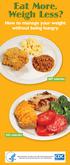 Eat More, Weigh Less? How to manage your weight without being hungry 607 calories 293 calories Department of Health and Human Services Centers for Disease Control and Prevention Can you weigh less without
5 Day Low-Fat Diet Menu
 5 Day Low-Fat Diet Menu Meals in the following menu have fewer than 25 percent of calories from fat. Choose one of each meal and two snacks every day. Breakfasts Food (s) Cal. Fat Fat Carbs Special Instructions
École Andre Malraux Lunch M enus Menus Autum 2015
 École Andre Malraux Lunch Menus Autum 2015 Week Commencing Tuesday 1 st September 2015 Welcome Back Roasted Tomato & Basil Soup Cheese Gougers Egg Mayonnaise on Gem Lettuce Focaccia Bread with Sundried
Guidelines for Offering Healthy Foods at Meetings, Seminars and Catered Events
 Guidelines for Offering Healthy Foods at Meetings, Seminars and Catered Events Guidelines for Offering Healthy Foods at Meetings, Seminars and Catered Events The School of Public Health at the University
starting to spoonfeed your baby
 www.healthpromotion.ie starting to spoonfeed your baby When to start solids? Breast milk provides all the nourishment your baby needs up until 6 months. It is recommended that breastfeeding should continue
The Royal Inn Menu. Where ever possible ingredients are locally sourced and G.M. free.
 The Royal Inn Menu Please be aware that our dishes are cooked fresh to order so at busy times there might be a slight delay. Where ever possible ingredients are locally sourced and G.M. free. If you have
Eating Strategies to Gain Weight
 Eating Strategies to Gain Weight It costs 3500 calories to gain one pound. That means, in order to gain one pound a week, you have to consume 500 extra calories every day. Here are some tips for getting