
GAME THEORY. Thomas S. Ferguson
|
|
|
- Stella Owen
- 9 years ago
- Views:
Transcription
1 GAME THEORY Thomas S. Ferguson Part IV. Games in Coalitional Form 1. Many-Person TU Games. 1.1 Coalitional Form. Characteristic Functions. 1.2 Relation to Strategic Form. 1.3 Constant-Sum Games. 1.4 Example. 1.5 Exercises. 2. Imputations and the Core. 2.1 Imputations. 2.2 Essential Games. 2.3 The Core. 2.4 Examples. 2.5 Exercises. 3. The Shapley Value. 3.1 Value Functions. The Shapley Axioms. 3.2 Computation of the Shapley Value. 3.3 An Alternative Form of the Shapley Value. 3.4 Simple Games. The Shapley-Shubik Power Index. 3.5 Exercises. 4. The Nucleolus. 4.1 Definition of the Nucleolus. 4.2 Properties of the Nucleolus. 4.3 Computation of the Nucleolus. 4.4 Exercises. IV 1

2 PART IV. Games in Coalitional Form 1. Many-Person TU Games We now consider many-person cooperative games. In such games there are no restrictions on the agreements that may be reached among the players. In addition, we assume that all payoffs are measured in the same units and that there is a transferrable utility which allows side payments to be made among the players. Side payments may be used as inducements for some players to use certain mutually beneficial strategies. Thus, there will be a tendency for players, whose objectives in the game are close, to form alliances or coalitions. The structure given to the game by coalition formation is conveniently studied by reducing the game to a form in which coalitions play a central role. After defining the coalitional form of a many-person TU game, we shall learn how to transform games from strategic form to coalitional form and vice versa. 1.1 Coalitional Form. Characteristic Functions. Let n 2 denote the number of players in the game, numbered from 1 to n, andletn denote the set of players, N = {1, 2,...,n}. A coalition, S, is defined to be a subset of N, S N, and the set of all coalitions is denoted by 2 N. By convention, we also speak of the empty set,, asa coalition, the empty coalition. ThesetN is also a coalition, called the grand coalition. If there are just two players, n = 2, then there are four coalition, {, {1}, {2},N}. If there are 3 players, there are 8 coalitions, {, {1}, {2}, {3}, {1, 2}, {1, 3}, {2, 3},N}. Forn players, the set of coalitions, 2 N,has2 n elements. Definition. The coalitional form of an n-person game is given by the pair (N,v), where N = {1, 2,...,n} is the set of players and v is a real-valued function, called the characteristic function of the game, defined on the set, 2 N, of all coalitions (subsets of N), and satisfying (i) v( ) =0, and (ii) (superadditivity) if S and T are disjoint coalitions (S T = ), then v(s)+v(t ) v(s T ). Compared to the strategic or extensive forms of n-person games, this is a very simple definition. Naturally, much detail is lost. The quantity v(s) is a real number for each coalition S N, which may be considered as the value, or worth, or power, of coalition S when its members act together as a unit. Condition (i) says that the empty set has value zero, and (ii) says that the value of two disjoint coalitions is at least as great when they work together as when they work apart. The assumption of superadditivity is not needed for some of the theory of coalitional games, but as it seems to be a natural condition, we include it in the definition. 1.2 Relation to Strategic Form. Recall that the strategic form of an n-person game is given by the 2n-tuple, (X 1,X 2,...,X n,u 1,u 2,...,u n ), where IV 2

3 (1) for i =1,...,n, X i is the set of pure strategies of Player i, and (2) for i =1,...,n, u i (x 1,...,x n ) is the payoff function to Player i, ifplayer 1usesx 1 X 1,Player2usesx 2 X 2,...,andPlayern uses x n X n. Transforming a game from strategic form to coalitional form entails specifying the value, v(s), for each coalition S 2 N. The usual way to assign a characteristic function to a strategic form game is to define v(s) foreachs 2 N as the value of the 2-person zero-sum game obtained when the coalition S acts as one player and the complementary coalition, S = N S, acts as the other player, and where the payoff to S is the sum of the payoffs to the players in S: i S u i(x 1,...,x n ). Thus, v(s) =Val ( u i (x 1,...,x n ) ) (1) i S where the players in S jointly choose the x i for i S, and the players in S choose the x i for i S. Thevalue,v(S), is the analogue of the safety level for coalition S. Itrepresents the total amount that coalition S can guarantee for itself, even if the members of S gang up against it, and have as their only object to keep the sum of the payoffs to members of S as small as possible. This is a lower bound to the payoff S should receive because it assumes that the members of S ignore what possible payoffs they might receive as a result of their actions. An example of the computations involved in a three person game is given below. To see that v of equation (1) is a characteristic function, note that Condition (i) holds, since the empty sum is zero. To see that (ii) holds, note that if s is a set of strategies for S that guarantees them v(s), and t is a set of strategies for T that guarantees them v(t ), then the set of strategies (s,t) guarantees S T at least v(s)+v(t ). Perhaps other joint strategies can guarantee even more, so certainly, v(s T ) v(s)+v(t ). Every finite n-person game in strategic form can be reduced to coalitional form in this way. Often, such a reduction to coalitional form loses important features in the game, such as threats. So for a given characteristic function v, there are usually many games in strategic form whose reduction by the above method has characteristic function v. See Exercise 3 for a two-person game that favors one of the players, yet the the reduction in coalitional form is symmetric in the players. One way of constructing a strategic form game whose reduction to coalitional form has a given characteristic function, v, is as follows. The strategy space X i for Player i is taken to be the set of all coalitions that contain i: X i = {S 2 N : i S}. Then the payoff to player i is the minimum amount, v({i}), unless all members of the coalition, S i, chosen by Player i, choose the same coalition as player i has, in which case the coalition S i is given its value v(s i ) which it then splits among its members. Thus the payoff function u i is { v(si )/ S u i (S 1,...,S n )= i if S j = S i for all j S i (2) v({i}) otherwise where S i represents the number of members of the coalition S i. Clearly, a coalition S can guarantee itself v(s) simplybyhavingeachmemberofs select S as his coalition of IV 3

4 choice. Moreover, since v is superadditive, the coalition S cannot guarantee more for itself by having its members form subcoalitions. 1.3 Constant-Sum Games. A game in strategic form is said to be zero-sum if i N u i(x 1,...,x n ) = 0 for all strategy choices x 1,...,x n of the players. In such a game, we have i S u i(x 1,...,x n )= i S u i(x 1,...,x n ) for any coalition S,whereS = N S is the complement of S. This implies that in the reduction of such a game to coalitional form, the value of the game coalition S plays against S is the negative of the value of the game S plays against S, sothatv(s)+v(s) = 0 for all coalitions S. We may take this as the definition of a zero-sum game in coalitional form. Similarly, a strategic form game is constant-sum if i N u i(z 1,...,z n )=c for some constant c. By a similar reasoning, the reduction of such a game leads to v(s)+v(s) =c = v(n) for all coalitions S in a constant sum game. This may be taken as the definition of a constant-sum game in coalitional form. Definition. A game in coalitional form is said to be constant-sum, ifv(s)+v(s) = v(n) for all coalitions S 2 N.Itissaidtobezero-sum if, in addition, v(n) = Example. Consider the three-person game with players I, II, and III with two pure strategies each and with payoff vectors: If I chooses 1: III: 1 2 II: 1 (0, 3, 1) (2, 1, 1) 2 (4, 2, 3) (1, 0, 0) If I chooses 2 III: 1 2 II: 1 (1, 0, 0) (1, 1, 1) 2 (0, 0, 1) (0, 1, 1) Let us find the associated game in coalitional form by finding the characteristic function, v. We automatically have v( ) = 0. It is easy to find v(n). It is the largest sum in the eight cells. This occurs for the cell (1, 2, 1) and gives total payoff v(n) = 9. To find v({1}), compute the payoff matrix for the winnings of I against (II,III): (II,III) 1, 1 1, 2 2, 1 2, 2 I: ( ) 0 1 The second and third columns are dominated, so v({1}) =Val =1/ To find v({2}) andv({3}), we make similar constructions of the matrices of II s winnings vs I and III, and III s winnings vs I and II and find the values of the resulting games. In the matrix of II s winnings, the choice 2 by II and (2,1) by (I,III) is a saddlepoint with value v({2}) = 0. In the matrix of III s winnings, the value is v({3}) =3/4. To find v({1, 3}) say, we first construct the matrix of the sum of the winnings of I and III playing against II. This is IV 4

5 II 1 2 1,1 1 7 (I,III): 1, , ,2 2 1 ( The lower ) two rows are dominated by the second row, so that the value is v({1, 3}) = 1 7 Val =5/2. Similarly, we may compute the matrix of I and II playing against III, 3 1 and the matrix of II and III playing against I. Both these matrices have saddle points. We find v({1, 2}) =3andv{2, 3}) = 2. This completes the specification of the characteristic function. 1.5 Exercises. 1. Find the characteristic function of the 3-person game with players I, II, and III with two pure strategies each and with the following payoff vectors. Note that this is a zero-sum game. Hence, v({1, 3}) = v({2}), etc. If I chooses 1: III: 1 2 II: 1 ( 2, 1, 1) (1, 4, 3) 2 (1, 3, 4) (10, 5, 5) If I chooses 2 III: 1 2 II: 1 ( 1, 2, 3) ( 4, 2, 2) 2 (12, 6, 6) ( 1, 3, 2) 2. Find the characteristic function of the 3-person game in strategic form when the payoff vectors are: If I chooses 1: III: 1 2 II: 1 (1, 2, 1) (3, 0, 1) 2 ( 1, 6, 3) (3, 2, 1) 3. Consider the two-person game with bimatrix ( (0, 2) ) (4, 1) (2, 4) (5, 4) If I chooses 2 III: 1 2 II: 1 ( 1, 2, 4) (1, 0, 3) 2 (7, 5, 4) (3, 2, 1) (a) Find the associated game in coalitional form. Note that in coalitional form the game is symmetric in the two players. (b) Argue that the above game is actually favorable to Player 2. (c) Find the TU-value as a game in strategic form. Note that this value gives more toplayer2thantoplayer1. (d) If the game in coalitional form found in (a) is transformed to strategic form by the method of Equation (2), what is the bimatrix that arises? IV 5

6 4. Consider the following 3-person game of perfect information. Let S denote the set {1, 2,...,10}. First Player 1 chooses i S. Then Player 2, knowing i, choosesj S, j i. Finally Player 3, knowing i and j, choosesk S, k i, k j. The payoff given these three choices is ( i j, j k, k i ). Find the coalitional form of the game. IV 6

7 2. Imputations and the Core In cooperative games, it is to the joint benefit of the players to form the grand coalition, N, since by superadditivity the amount received, v(n), is as large as the total amount received by any disjoint set of coalitions they could form. As in the study of 2-person TU games, it is reasonable to suppose that rational players will agree to form the grand coalition and receive v(n). The problem is then to agree on how this amount should be split among the players. In this section, we discuss one of the possible properties of an agreement on a fair division, that it be stable in the sense that no coalition should have the desire and power to upset the agreement. Such divisions of the total return are called points of the core, a central notion of game theory in economics. 2.1 Imputations. A payoff vector x =(x 1,x 2,...,x n ) of proposed amounts to be received by the players, with the understanding that player i is to receive x i, is sometimes called an imputation. The first desirable property of an imputation is that the total amount received by the players should be v(n). Definition. A payoff vector, x =(x 1,x 2,...,x n ),issaidtobegroup rational or efficient if n i=1 x i = v(n). No player could be expected to agree to receive less than that player could obtain acting alone. Therefore, a second natural condition to expect of an imputation, x = (x 1,x 2,...,x n ), is that x i v({i}) for all players, i. Definition. A payoff vector, x, issaidtobeindividually rational if x i v({i}) for all i =1,...,n. Imputations are defined to be those payoff vectors that satisfy both these conditions. Definition. An imputation is a payoff vector that is group rational and individually rational. The set of imputations may be written {x =(x 1,...,x n ): i N x i = v(n), andx i v({i}) for all i N}. (1) Thus, an imputation is an n-vector, x =(x 1,...,x n ), such that x i v({i}) for all i and n i=1 x i = v(n). The set of imputations is never empty, since from the superadditivity of v, wehave n i=1 v({i}) v(n). For example, one imputation is given by x =(x 1,x 2,...,x n ), where x i = v({i}) fori =1,...,n 1, and x n = v(n) n 1 1 v({i}). This is the imputation most preferred by player n. In fact the set of imputations is exactly the simplex consisting of the convex hull of the n points obtained by letting x i = v({i}) for all x i except one, which is then chosen to satisfy n 1 x i = v(n). In Example 1.4, v({1}) =1/2, v({2}) =0,v({3}) =3/4, and v(n) = 9. The set of imputations is {(x 1,x 2,x 3 ):x 1 + x 2 + x 3 =9, x 1 1/2, x 2 0, x 3 3/4}. IV 7

8 This is a triangle (in fact, an equilateral triangle) each of whose vertices satisfy two of the three inequalities with equality, namely, (8 1 4, 0, 3 4 ), ( 1 2, 7 3 4, 3 4 ), and ( 1 2, 0, ). These are the imputations most preferred by players 1, 2, and 3 respectively. 2.2 Essential Games. There is one trivial case in which the set of imputations consists of one point. Such a game is called inessential. Definition. A game in coalitional form is said to be inessential if n i=1 v({i}) = v(n), andessential if n i=1 v({i}) <v(n). If a game is inessential, then the unique imputation is x =(v({1}),...,v({n})), which may be considered the solution of the game. Every player can expect to receive his safety level. Two-person zero-sum games are all inessential. (Exercise 1.) From the game-theoretic viewpoint, inessential games are trivial. For every coalition S, v(s) is determined by v(s) = i S v({i}). There is no tendency for the players to form coalitions. In Example 1.4, v({1})+v({2})+v({3}) =1/2+0+3/4 < 9=v(N), so the game is essential, i.e, non-trivial. 2.3 The Core. Suppose some imputation, x, is being proposed as a division of v(n) among the players. If there exists a coalition, S, whose total return from x is less than what that coalition can achieve acting by itself, that is, if i S x i <v(s), then there will be a tendency for coalition S to form and upset the proposed x because such a coalition could guarantee each of its members more than they would receive from x. Such an imputation has an inherent instability. Definition. An imputation x is said to be unstable through a coalition S if v(s) > i S x i. We say x is unstable if there is a coalition S such that x is unstable through S, andwesayx is stable otherwise. Definition. The set, C, of stable imputations is called the core, C = {x =(x 1,...,x n ): i N x i = v(n) and i S x i v(s), for all S N}. (2) The core can consist of many points as in the examples below; but the core can also be empty. It may be impossible to satisfy all the coalitions at the same time. One may take the size of the core as a measure of stability, or of how likely it is that a negotiated agreement is prone to be upset. One class of games with empty cores are the essential constant-sum games: Theorem 1. The core of an essential constant-sum game is empty. Proof. Let x be an imputation. Since the game is essential, we have i N v({i}) <v(n). Then there must be a player, k, such that x k >v({k}), for otherwise v(n) = i N x i v({i}) <v(n). Since the game is constant-sum, we have v(n {k}) +v({k}) = i N IV 8

9 v(n). But then, x must be unstable through the coalition N {k}, because i k x i = i N x i x k <V(N) v({k}) =v(n {k}). by 2.4 Examples. Example 1. Consider the game with characteristic function v given v({1}) =1 v({1, 2}) =4 v( ) =0 v({2}) =0 v({1, 3}) =3 v({1, 2, 3}) =8 v({3}) =1 v({2, 3}) =5 The imputations are the points (x 1,x 2,x 3 ) such that x 1 + x 2 + x 3 =8andx 1 1, x 2 0, x 3 1. This set is the triangle with vertices (7, 0, 1), (1, 6, 1) and (1, 0, 7). It is useful to plot this triangle in barycentric coordinates. This is done by pretending that the plane of the plot is the plane x 1 + x 2 + x 3 = 8, and giving each point on the plane three coordinates which add to 8. Then it is easy to draw the lines x 1 =1or the line x 1 + x 3 = 3 (which is the same as the line x 2 = 5), etc. It then becomes apparent that the set of imputations is an equilateral triangle. On the plane x 1 + x 2 + x 3 =8: (7,0,1) (6,1,1) (6,0,2) (4,3,1) (5,2,1) Unstable through {2,3} (4,0,4) x 1 + x 2 = 4 x 1 + x 3 = 3 (3,4,1) (3,0,5) x 2 + x 3 = 5 (2,5,1) Uns {1,3} (1,6,1) (1,5,2) THE CORE (1,3,4) Unstable through {1,2} (1,0,7) Let us find which imputations are unstable. The coalition {2, 3} can guarantee itself v({2, 3}) = 5, so all points (x 1,x 2,x 3 )withx 2 + x 3 < 5 are unstable through {2, 3}. These are the points above the line x 2 + x 3 = 5 in the diagram. Since {1, 2} can guarantee itself v({1, 2}) = 4, all points below and to the right of the line x 1 +x 2 = 4 are unstable. Finally, since {1, 3} can guarantee itself v({1, 3}) = 3, all points below the line x 1 + x 3 =3are unstable. The core is the remaining set of points in the set of imputations given by the 5-sided figure in the diagram, including the boundary. Example 2. A certain objet d art is worth a i dollars to Player i for i =1, 2, 3. We assume 0 <a 1 <a 2 <a 3, so Player 3 values the object most. But Player 1 owns this object so v({1}) =a 1. Players 2 and 3 by themselves can do nothing, so v({2}) =0, IV 9

10 v({3}) = 0, and v({2, 3}) = 0. If Players 1 and 2 come together, the joint worth is a 2,so v({1, 2}) =a 2. Similarly, v({1, 3}) =a 3. If all three get together, the object is still only worth a 3,sov(N) =a 3. Let us find the core of this game. The core consists of all vectors (x 1,x 2,x 3 ) satisfying x 1 a 1 x 1 + x 2 a 2 x 2 0 x 1 + x 3 a 3 x 1 + x 2 + x 3 = a 3 x 3 0 x 2 + x 3 0 It follows from x 2 = a 3 x 1 x 3 0andx 2 0thatx 2 = 0 for all points of the core. Then we find that x 1 a 2 and x 3 = a 3 x 1. Hence the core is C = {(x, 0,a 3 x) : a 2 x a 3 }. This indicates that the object will be purchased by Player 3 at some purchase price x between a 2 and a 3. Player 1 ends up with x dollars and Player 3 ends up with the object minus x dollars. Player 2 plays no active role in this, but without her around Player 3 might hope to get the object for less than a Exercises. 1. Show that every 2-person constant-sum game is inessential. 2. Find the set of imputations and the core of the battle of the sexes with bimatrix: ( ) (4, 2) (1, 1). (0, 0) (2, 4) 3. Graph the core for the 3-person game with characteristic function: v( ) = 0, v({1}) =0,v({2}) = 1, v({3}) =1,v({1, 2}) =3,v({1, 3}) =2,v({2, 3}) = 4, and v(n) =5. 4. Definition. A game with characteristic function v is said to be symmetric if v(s) depends only on the number of elements of S, sayv(s) =f( S ) for some function f. (a) In a symmetric 3-player game with v({i}) =0,v({i, j}) =a and v({1, 2, 3}) =3, for what values of a is the core non-empty? (b) In a symmetric 4-player game with v({i}) =0,v({i, j}) =a, v({i, j, k}) =b, and v(n) = 4, for what values of a and b is the core non-empty? (c) Generalize. Find necessary and sufficient conditions on the values of f( S ) = v(s) for a symmetric game to have a non-empty core. 5. Let δ i = v(n) v(n {i}) fori =1,...,n. Show that the core is empty if n 1 δ i <v(n). 6. We say that Player i is a dummy in a game (N,v), if v({i} S) =v(s) for all coalitions, S. In particular, v({i}) = 0. Thus, a dummy cannot help (or harm) any coalition. Show that if Player 1 is a dummy and if (x 1,x 2,...,x n ) is in the core, then x 1 =0. IV 10

11 7. The Glove Market. Let N consistoftwotypesofplayers,n = P Q, where P Q =. Let the characteristic function be defined by v(s) =min{ S P, S Q }. The game (N,v) is called the glove market because of the following interpretation. Each player of P owns a right-hand glove and each player of Q owns a left-hand glove. If j members of P and k members of Q form a coalition, they have min{j, k} complete pairs of gloves, each being worth 1. Unmatched gloves are worth nothing. (a) Suppose P =2and Q =2. Findthecore. (b) Suppose P =2and Q = 3. Show the core consists of a single point. (c) Generalize to arbitrary P and Q. 8. There are two machine owners (players 1 and 2) and three workers (players 3, 4 and 5). Each machine owner owns two machines. Each worker can produce 1 unit on any machine. Thus for example, v({i, k}) =1fori =1, 2andk =3, 4, 5, v({i, j, k}) =2fori =1, 2andj, k =3, 4, 5. v({1, 2, 3, 4, 5}) =3. Find the core. IV 11

12 3. The Shapley Value We now treat another approach to n-person games in characteristic function form. The concept of the core is useful as a measure of stability. As a solution concept, it presents a set of imputations without distinguishing one point of the set as preferable to another. Indeed, the core may be empty. Here we deal with the concept of a value. In this approach, one tries to assign to each game in coalitional form a unique vector of payoffs, called the value. The ith entry of the value vector may be considered as a measure of the value or power of the ith player in the game. Alternatively, the value vector may be thought of as an arbitration outcome of the game decided upon by some fair and impartial arbiter. The central value concept in game theory is the one proposed by Shapley in We define the Shapley value in this section and discuss its application to measuring power in voting systems where it is called the Shapley-Shubik power index. In Section 4, we treat another value concept, the nucleolus. 3.1 Value Functions. The Shapley Axioms. As an example of the type of reasoning involved in arbitrating a game, consider Example 1 of Section 2.4. Certainly the arbiter should require the players to form the grand coalition to receive 8, but how should this be split among the players? Player 2 can get nothing by himself, yet he is more valuable than 1 or 3 in forming coalitions. Which is more important? We approach this problem by axiomatizing the concept of fairness. A value function, φ, is function that assigns to each possible characteristic function of an n-person game, v, ann-tuple, φ(v) =(φ 1 (v),φ 2 (v),...,φ n (v)) of real numbers. Here φ i (v) represents the worth or value of player i in the game with characteristic function v. The axioms of fairness are placed on the function, φ. The Shapley Axioms for φ(v): 1. Efficiency. i N φ i(v) =v(n). 2. Symmetry. If i and j are such that v(s {i}) =v(s {j}) for every coalition S not containing i and j, thenφ i (v) =φ j (v). 3. Dummy Axiom. If i is such that v(s) =v(s {i}) for every coalition S not containing i, thenφ i (v) =0. 4. Additivity. If u and v are characteristic functions, then φ(u + v) = φ(u) + φ(v). Axiom 1 is group rationality, that the total value of the players is the value of the grand coalition. The second axiom says that if the characteristic function is symmetric in players i and j, then the values assigned to i and j should be equal. The third axiom says that if player i is a dummy in the sense that he neither helps nor harms any coalition he may join, then his value should be zero. The strongest axiom is number 4. It reflects the feeling that the arbitrated value of two games played at the same time should be the sum of the arbitrated values of the games if they are played at different times. It should be noted that if u and v are characteristic functions, then so is u + v. IV 12

13 Theorem 1. There exists a unique function φ satisfying the Shapley axioms. Proof. For a given nonempty set S N, let w S represent the special characteristic function, defined for all T N to be { 1 if S T w S (T )= (1) 0 otherwise. From axiom 3, φ i (w S ) = 0 if i S. From axiom 2, if both i and j are in S, then φ i (w S )=φ j (w S ). From axiom 1, i N φ i(w S )=w S (N) = 1, so that φ i (w S )=1/ S for all i S. Applying similar analysis to the characteristic function cw S for an arbitrary number, c, we find { c/ S for i S φ i (cw S )= (2) 0 for i S. In the next paragraph, we show that any characteristic function, v, is representable uniquely as a weighted sum of characteristic functions of the form (1), v = S N c Sw S, for some appropriate, easily computable, constants c S. Then axiom 4 may be applied to show that if a value function exists, it must be φ i (v) = S N i S c S S. (3) where this sum is taken over all coalitions S containing i. This works even if some of the c S are negative, since axiom 4 also implies that φ(u v) =φ(u) φ(v), provided u, v, and u v are characteristic functions. (Just write u =(u v)+v.) To complete the proof, one must show existence, namely that (3) with the c S defined below, satisfies the Shapley axioms. This is not difficult but we defer the proof to Theorem 2, where we show existence by showing another value function satisfies the Shapley axioms (and therefore must be the same as (3)). Now let us show that any v may be written as v = S N c Sw S by finding the constants c S. Let c = 0, and define inductively on the number of elements in T, for all T N, c T = v(t ) c S. (4) S T S T Note that each c T is defined in terms of c S for all S T, S T. Then, c S w S (T )= c S = c T + c S = v(t ). (5) S N S T S T S T Hence, v = S N c Sw S as was to be shown. To show unicity, suppose there are two sets of constants, c S and c S, such that V (T )= S N c S w S (T )= S N c Sw S (T ) (7) IV 13

14 for all T N. We use induction to show that c S = c S for all S. First if T is the singleton set {i} in (7), then all w s (T )vanishexceptfors = {i}, and we have c {i} = c {i} for all i. Now let R be an arbitrary coalition, and suppose that c S = c S for all S R. Thenin(7) with T = R, all terms cancel except the term with S = R leaving C r = c R. It is interesting to note that the superadditivity of v is not needed in this proof. 3.2 Computation of the Shapley Value. The proof of Theorem 1 provides a method of computing the Shapley value: First find the numbers c S inductively using Equation (4). Then form the Shapley value using Equation (3). As an example of this method, consider the characteristic function of Example 1 of Section 2.4. v({1}) =1 v({1, 2}) =4 v( ) =0 v({2}) =0 v({1, 3}) =3 v({1, 2, 3}) =8 v({3}) =1 v({2, 3}) =5 We find inductively, c {1} = v({1}) =1,c {2} =0andc {3} = 1. Then, c {1,2} = v({1, 2}) c {1} c {2} =4 1 0=3,c {1,3} =3 1 1 = 1, and c {2,3} =5 0 1=4. Finally, c N = v(n) c {1,2} c {1,3} c {2,3} c {1} c {2} c {3} = = 2. Hence, we know we can write v as From this we find v = w {1} + w {3} +3w {1,2} + w {1,3} +4w {2,3} 2w {1,2,3} φ 1 (v) = =2+1 3 φ 2 (v) = =2+5 6 φ 3 (v) = =2+5 6 The Shapley value is φ =(14/6, 17/6, 17/6). This point is in the core (see the diagram in Section 2). The Shapley value is not always in the core. For one thing, it could happen that the core is empty. But even if the core is not empty, the Shapley value is not necessarily in the core. (See Exercise 1, for example.) 3.3 An Alternative Form of the Shapley Value. There is an alternate way of arriving at the Shapley value that gives additional insight into its properties. Suppose we form the grand coalition by entering the players into this coalition one at a time. As each player enters the coalition, he receives the amount by which his entry increases the value of the coalition he enters. The amount a player receives by this scheme depends on the order in which the players are entered. The Shapley value is just the average payoff to the players if the players are entered in completely random order. IV 14

15 Theorem 2. The Shapley value is given by φ =(φ 1,...,φ n ), where for i =1,...,n, φ i (v) = S N i S ( S 1)!(n S )! [v(s) v(s {i})]. (6) n! The summation in this formula is the summation over all coalitions S that contain i. Thequantity,v(S) v(s {i}), is the amount by which the value of coalition S {i} increases when player i joins it. Thus to find φ i (v), merely list all coalitions containing i, compute the value of player i s contribution to that coalition, multiply this by ( S 1)!(n S )!/n!, and take the sum. The interpretation of this formula is as follows. Suppose we choose a random order of the players with all n! orders (permutations) of the players equally likely. Then we enter the players according to this order. If, when player i is enters, he forms coalition S (that is, if he finds S {i} there already), he receives the amount [v(s) v(s {i})]. The probability that when i enters he will find coalition S {i} there already is ( S 1)!(n S )!/n!. The denominator is the total number of permutations of the n players. The numerator is number of these permutations in which the S 1 members of S {i} come first (( S 1)! ways), then player i, and then the remaining n S players ((n S )! ways). So this formula shows that φ i (v) is just the average amount player i contributes to the grand coalition if the players sequentially form this coalition in a random order. As an illustration of the use of this formula, let us compute φ 1 (v) again for Example 1 of Section 2.4. The probability that player 1 enters first is 2!0!/3! = 1/3, and then his payoff is v({1}) = 1. The probability that 1 enters second and finds 2 there is 1/6, and his payoff is v({1, 2}) v({2}) =4 0 = 4. The probability that 1 enters second and finds 3 there is 1/6, and the expected payoff is v({1, 3}) v({3}) =3 1 = 2. The probability that 1 enters last is 1/3, and then his payoff is v({1, 2, 3}) v({2, 3}) =8 5=3. Player 1 s average payoff is therefore φ 1 (v) = =14/6 as found earlier. The following table shows the computations for all three players simultaneously. The 6 different orders of the players are listed along with the payoffs to the players. In the first row, the players enter in the order 1, 2, 3. Player 1 receives v(1) = 1 upon entry; then Player 2 receives v(1, 2) v(1) = 4 1 = 3; finally Player 3 receives v(n) v(1, 2) = 8 4=4. Each of the six rows is equally likely, probability 1/6 each. The Shapley value is the average IV 15

16 of the six numbers in each column. Player Order of Entry Total Average 14/6 17/6 17/6 8 Proof of Theorem 2. To see that formula (6) gives the Shapley value, we have only to see that it satisfies axioms 1 through 4, since we have already shown that there is at most one such function, φ. Axioms 2, 3, and 4 are easy to check directly from the formula of Theorem 2. Axiom 1 follows from the above interpretation of the formula, since in each realization of forming the grand coalition, exactly v(n) is given to the players. Hence, the average amount given to the players is also v(n). 3.4 Simple Games. The Shapley-Shubik Power Index. The Shapley value has an important application in modeling the power of members of voting games. This application was developed by Shapley and Shubik in 1954 and the measure is now known as the Shapley-Shubik Power Index. Players are members of legislature or members of the board of directors of a corporation, etc. In such games, a proposed bill or decision is either passed or rejected. Those subsets of the players that can pass bills without outside help are called winning coalitions while those that cannot are called losing coalitions. In all such games, we may take the value of a winning coalition to be 1 and the value of a losing coalition to be 0. Such games are called simple games. Definition. A game (N,v) is simple if for every coalition S N, eitherv(s) =0or v(s) =1. In a simple game, a coalition S is said to be a winning coalition if v(s) =1and a losing coalition if v(s) = 0. So in a simple game every coalition is either winning or losing. It follows from superadditivity of v that in simple games every subset of a losing coalition is losing, and every superset of a winning coalition is winning. Typical examples of simple games are (1) the majority rule game where v(s) =1if S >n/2, and v(s) =0otherwise; (2) the unanimity game where v(s) =1ifS = N and v(s) =0otherwise;and (3) the dictator game where v(s) =1if1 S and v(s) =0otherwise. For simple games, formula (6) for the Shapley value simplifies because the difference [v(s) v(s {i})] is always zero or one. It is zero if v(s) andv(s {i}) are both zero or both one, and it is one otherwise. Therefore we may remove [v(s) v(s {i})] from IV 16

17 formula (6) provided we sum only over those coalitions S that are winning with i and losing without i. Formula (6) for the Shapley value (the Shapley-Shubik Index) becomes φ i (v) = S winning S {i} losing ( S 1)!(n S )!. (7) n! There is a large class of simple games called weighted voting games. These games are defined by a characteristic function of the form v(s) = { 1 if i S w i >q 0 if i S w i q, for some non-negative numbers w i, called the weights, and some positive number q, called the quota. Ifq =(1/2) i N w i, this is called a weighted majority game. Example. Consider the game with players 1, 2, 3, and 4, having 10, 20, 30, and 40 shares of stock respectively, in a corporation. Decisions require approval by a majority (more than 50%) of the shares. This is a weighted majority game with weights w 1 = 10, w 2 = 20, w 3 =30andw 4 =40andwithquotaq = 50. Let us find the Shapley value of this game. The winning coalitions are {2, 4}, {3, 4}, {1, 2, 3}, and all supersets (sets containing one of these). For i =1,v(S) v(s {1}) =0 unless S = {1, 2, 3}. So φ 1 (v) = 2!1! = 1 4! 12. For i =2,v(S) v(s {2}) = 0 unless S = {2, 4}, {1, 2, 3}, or{1, 2, 4}, sothat φ 2 (v) = 1!2! 4! +2 2!1! 4! = 1 4. Similarly, φ 3 (v) =1/4. For i =4,v(S) v(s {4}) = 0 unless S = {2, 4}, {3, 4}, {1, 2, 4}, {1, 3, 4} or {2, 3, 4}. So φ 4 (v) =2 1!2! 4! +3 2!1! 4! = The Shapley value is φ =(1/12, 3/12, 3/12, 5/12). Note that the value is the same for players 2 and 3 although player 3 has more shares. 3.5 Exercises. 1. (Market with one seller and two buyers) Player 1 owns an art object of no intrinsic worth to him. Therefore he wishes to sell it. The object is worth $30 to player 2 and $40 to player 3. Set this up as a game in characteristic function form. Find the Shapley value. Is the Shapley value in the core? (Refer to Example 2 of Section 2.4.) 2. Find the Shapley value of the game with characteristic function IV 17

18 v({1}) =1 v({1, 2}) =2 v( ) =0 v({2}) =0 v({1, 3}) = 1 v({1, 2, 3}) =6 v({3}) = 4 v({2, 3}) =3 3. (a) Using the superadditivity of v, show that the Shapley value is an imputation. (b) Let T be a fixed coalition in N. Show that φ x (v) is a strictly increasing function of v(t ) (with the other v(s), S T,heldfixed)ifx T, and a strictly decreasing function of V (T )ifx T. 4. Find the Shapley value of the n-person game, for n>2, with characteristicfunction, { { (a) v(s) = S if 1 S (b) v(s) = S if 1 S or 2 S 0 otherwise. 0 otherwise. { (c) v(s) = S if 1 S and 2 S. 0 otherwise. 5. Is every simple game a weighted voting game? Prove or give a counterexample. 6. Find the Shapley value of the weighted majority game with 4 players having 10, 30, 30, and 40 shares. 7. A Near Dictator. Find the Shapley value of the weighted majority game with n 3 players in which player 1 has 2n 3 shares and players 2 to n have 2 shares each. 8. Modify the example of Section 3.4 so that the chairman of the board may decide tie votes. (The chairman of the board is a fifth player who has no shares.) Find the Shapley value. 9. (a) (One large political party and three smaller ones.) Consider the weighted majority game with one large party consisting of 1/3 of the votes and three equal sized smaller parties with 2/9 of the vote each. Find the Shapley value. Is the power of the large party greater or less than its proportional size? (b) (Two large political parties and three smaller ones.) Consider the weighted majority game with two large parties with 1/3 of the votes each and three smaller parties with 1/9 of the votes each. Find the Shapley value. Is the combined power of the two larger parties greater or less than their proportional size? 10. (L. S. Shapley (1981) Measurement of Power in Political Systems in Game Theory and its Applications Proceedings in Applied Mathematics vol. 24, Amer. Math. Soc., Providence RI.) County governments in New York are headed by Boards of Supervisors. Typically each municipality in a county has one seat, though a larger city may have two or more. But the supervisorial districts are usually quite unequal in population, and an effort is made to equalize citizen representation throughout the county by giving individual supervisors different numbers of votes in council. Table 1 shows the situation in Nassau County in IV 18

19 Table 1 District Population % No. of votes % } { Hempstead 1 728, Hempstead Oyster Bay 285, North Hempstead 213, Long Beach 25, Glen Cove 22, Total 115 Under this system, a majority of 58 out of 115 votes is needed to pass a measure. But an inspection of the numerical possibilities reveals that the three weakest members of the board actually have no voting power at all. Indeed, their combined total of 25 votes is never enough to tip the scales. The assigned voting weights might just as well have been (31, 31, 28, 0, 0, 0) or (1, 1, 1, 0, 0, 0) for that matter. The Shapley value is obviously (1/3,1/3,1/3,0,0,0). This is just as obviously unsatisfactory. In 1971, the law was changed, setting the threshold required to pass legislation to 63 votes rather than 58. Find the Shapley value under the changed rules, and compare to the above table. 11. In the United Nations Security Council, there are 15 voting nations, including the big five. To pass a resolution, 9 out of the 15 votes are needed, but each of the big five has veto power. One way of viewing this situation is as a weighted voting game in which each of the big five gets 7 votes and each of the other 10 nations gets 1 vote, and 39 votes are required to pass a resolution. Find the Shapley value. 12. Cost Allocation. A scientist has been invited for consultation at three distant cities. In addition to her consultation fees, she expects travel compensation. But since these three cities are relatively close, travel expenses can be greatly reduced if she accommodates them all in one trip. The problem is to decide how the travel expenses should be split among her hosts in the three cities. The one-way travel expenses among these three cities, A, B, andc, and her home base, H, are given in the accompanying table (measured in some unspecified units). Between H and A, cost = 7. Between A and B, cost = 2. Between H and B, cost = 8. Between A and C, cost = 4. Between H and C, cost = 6. Between B and C, cost = 4. Assume that the value of the visit is the same for each of the hosts, say 20 units each. Set the problem up as a three-person game in coalitional form by specifying the characteristic function. Find the Shapley value. How much is the trip going to cost and how much should each host contribute to travel expenses? 13. A one-product balanced market. (Vorob ev) Consider a market with one completely divisible commodity where the set N of players is divided into two disjoint sets, the buyers B and the sellers C, N = B C. Each seller owns a certain amount of the commodity, say seller k C owns y k, and each buyer demands a certain amount, say IV 19

20 buyer j B demands x j. We assume that the market is balanced, that is that the supply is equal to demand, k C y k = j B x j. Wemaysetupsuchagameincharacteristic function form by letting v(s) =min x j, y k j S B k S C Thus, the value of a coalition is the total amount of trading that can be done among members of the coalition. Find the Shapley value of the game. (Hint: for each permutation of the players, consider also the reverse permutation in which the players enter the grand coalition in reverse order.) 14. (a) Consider the n-person game with players 1, 2,...,n, whose characteristic function satisfies v(s) =k if {1,...,k} S but k +1 S. For example, v({2, 3, 5}) =0,v({1, 3, 4, 6}) =1andv({1, 2, 3, 5, 6, 7}) =3. Shapley value. (Use the method of Theorem 1.) (b) Generalize to the case v(s) =a k if {1,...,k} S but k +1 S, Findthe where 0 a 1 a 2... a n. 15. The Airport Game. (Littlechild and Owen (1973).) Consider the following cost allocation problem. Building an airfield will benefit n players. Player j requires an airfield that costs c j to build, so to accommodate all the players, the field will be built at a cost of max 1 j n c j. How should this cost be split among the players? Suppose all the costs are distinct and let c 1 <c 2 < <c n. Take the characteristic function of the game to be v(s) = max j S c j. (a) Let R k = {k,k+1,...,n} for k =1, 2,...,n, and define the characteristic function v k through the equation { (ck c v k (S) = k 1 ) if S R k 0 if S R k =. Show that v = n k=1 v k. (b) Find the Shapley value. 16. A Market with 1 Seller and m Buyers. Player 0 owns an object of no intrinsic worth to himself. Buyer j values the object at a j dollars, j =1,...,m. Suppose a 1 >a 2 > >a m > 0. Set up the characteristic function and find the Shapley value. (Answer: For the seller, φ 0 (v) = m k=1 a k/(k(k + 1)), and for the buyers, φ j (v) = a j j(j +1) 2 m k=j+1 IV 20 a k (k 1)k(k +1).)

21 17. The Core of a Simple Game. In a simple game, (N,v), a player, i, issaidto be a veto player, if v(n {i}) =0. (a) Show that the core is empty if there are no veto players. (b) Show, conversely, that the core is not empty if there is at least one veto player. (c) Characterize the core. IV 21
22 4. The Nucleolus Another interesting value function for n-person cooperative games may be found in the nucleolus, a concept introduced by Schmeidler (SIAM J. Appl. Math, 1969). Instead of applying a general axiomatization of fairness to a value function defined on the set of all characteristic functions, we look at a fixed characteristic function, v, and try to find an imputation x =(x 1,...,x n ) that minimizes the worst inequity. That is, we ask each coalition S how dissatisfied it is with the proposed imputation x and we try to minimize the maximum dissatisfaction. 4.1 Definition of the Nucleolus. As a measure of the inequity of an imputation x for a coalition S is defined as the excess, e(x,s)=v(s) j S x j, which measures the amount (the size of the inequity) by which coalition S falls short of its potential v(s) in the allocation x. Since the core is defined as the set of imputations such that i S x i v(s) for all coalitions S, we immediately have that an imputation x is in the core if and only if all its excesses are negative or zero. On the principle that the one who yells loudest gets served first, we look first at those coalitions S whose excess, for a fixed allocation x, is the largest. Then we adjust x, if possible, to make this largest excess smaller. When the largest excess has been made as small as possible, we concentrate on the next largest excess, and adjust x to make it as small as possible, and so on. An example should clarify this procedure. Example 1. The Bankruptcy Game. (O Niell (1982)) A small company goes bankrupt owing money to three creditors. The company owes creditor A $10,000, creditor B $20,000, and creditor C $30,000. If the company has only $36,000 to cover these debts, how should the money be divided among the creditors? A pro rata split of the money would lead to the allocation of $6000 for A, $12,000 for B, and $18,000 for C, denoted by x =(6, 12, 18) in thousands of dollars. We shall compare this allocation with those suggested by the Shapley value and the nucleolus. First, we must decide on a characteristic function to represent this game. Of course we will have v( ) = 0 from the definition of characteristic function, and v(abc) =36 measured in thousands of dollars, By himself, A is not guaranteed to receive anything since the other two could receive the whole amount; thus we take v(a) = 0. Similarly, v(b) = 0. Creditor C is assured of receiving at least $6000, since even if A and B receive the total amount of their claim, namely $30,000, that will leave $36,000 - $30,000 = $6000 for C. Thuswetakev(C) = 6. Similarly, we find v(ab) =6,v(AC) = 16, and v(bc) = 26. To find the nucleolus of this game, let x =(x 1,x 2,x 3 ) be an efficient allocation (that is, let x 1 +x 2 +x 3 = 36), and look at the excesses as found in the table below. We may omit the empty set and the grand coalition from consideration since their excesses are always zero. IV 22
23 To get an idea of how to proceed, consider first an arbitrary point, say the pro rata point (6, 12, 18). As seen in the table, the vector of excesses is e =( 6, 12, 12, 12, 8, 4). The largest of these numbers is 4 corresponding to the coalition BC. This coalition will claim that every other coalition is doing better than it is. So we try to improve on things for this coalition by making x 2 +x 3 larger, or, equivalently, x 1 smaller (since x 1 =36 x 2 x 3 ). But as we decrease the excess for BC, the excess for A will increase at the same rate and so these excesses will meet at 5, when x 1 = 5. It is clear that no choice of x can make the maximum excess smaller than 5 since at least one of the coalitions A or BC will have excess at least 5. Hence, x 1 = 5 is the first component of the nucleolus. S v(s) e(x,s) (6, 12, 18) (5, 12, 19) (5, 10.5, 20.5) (6, 11, 19) A 0 x B 0 x C 6 6 x AB 6 6 x 1 x AC x 1 x BC x 2 x Though x 1 is fixed, we still have x 2 and x 3 to vary subject to x 2 + x 3 =36 5 = 31, and we choose them to make the next largest excess smaller. If we choose the point x =(5, 12, 19) as the next guess, we see that the next largest excess after the 5 sisthe 8 corresponding to coalition AC. To make this smaller, we must increase x 3 (decrease x 2 ). But as we do so, the excesses for coalitions B and AB increase at the same rate. Since the excess for coalition AB starts closer to 8 we find x 2 and x 3 so that e(x,ab)=e(x,ac). This occurs at x 2 =10.5 andx 3 =20.5. We denote the nucleolus by ν. The nucleolus is therefore ν =(5, 10.5, 20.5). It is of interest to compare this solution to the Shapley value. We may compute the Shapley value by any of the methods given in Section 3. Using the formula, we find φ A =(1/3)(0) + (1/6)(6) + (1/6)(10) + (1/3)(10) = 6 φ B =(1/3)(0) + (1/6)(6) + (1/6)(20) + (1/3)(20) = 11 φ C =(1/3)(6) + (1/6)(16) + (1/6)(26) + (1/3)(30) = 19 The last column in the table shows the excesses for the Shapley value. It is time to define more precisely the concept of the nucleolus of a game with characteristic function v. First we define an ordering on vectors that reflects the notion of smaller maximum excess as given in the above example. Define O(x) as the vector of excesses arranged in decreasing (nonincreasing) order. In the example, if x =(6, 12, 18) then O(x) =( 4, 6, 8, 12, 12, 12). On the vectors O(x) we use the lexographic order. We say a vector y =(y 1,...,y k ) is lexographically less than a vector z =(z 1,...,z k ), and write y < L z,ify 1 <z 1,orify 1 = z 1 and y 2 <z 2, or if y 1 = z 1, y 2 = z 2 and y 3 <z 3,or...,orify 1 = z 1,..., y k 1 = z k 1 and y k <z k. IV 23
24 That is, y < L z if in the first component in which y and z differ, that component of y is less than the corresponding component of z. Similarly, we write y L z if either y < L z or y = z. The nucleolus is an efficient allocation that minimizes O(x) in the lexographic ordering. Definition. Let X = {x : n j=1 x j = v(n)} be the set of efficient allocations. We say that a vector ν X is a nucleolus if for every x X we have O(ν) L O(x). 4.2 Properties of the Nucleolus. The main properties of the nucleous are stated without proof in the following theorem. Theorem 1. The nucleolus of a game in coalitional form exists and is unique. The nucleolus is group rational, individually rational, and satisfies the symmetry axiom and the dummy axiom. If the core is not empty, the nucleolus is in the core. The only difficult part to prove is the uniqueness of the nucleolus. See the book of Owen for a discussion. Since the nucleolus always exists and is unique, we may speak of the nucleolus of a game. Like the Shapley value, the nucleolus will satisfy individual rationality if the characteristic function is super-additive or, more generally, if it is monotone in the sense that for all players i and for all coalitions S not containing i, wehavev(s)+v({i}) v(s {i}). In contrast to the Shapley value, the nucleolus will be in the core provided the core is not empty. (Exercise 1.) Since the nucleolus satisfies the first three axioms of the Shapley value, it does not satisfy the linearity axiom. It is interesting to see how the nucleolus and the Shapley value change in the bankrupt company example as the total remaining assets of the company change from $0 to $60,000, that is, as v(n) changes from 0 to 60. Consider the nucleolus. If v(n) is between 0 and 15, the nucleolus divides this amount equally among the players. For v(n) between 15 and 25, the nucleolus splits the excess above 15 equally between B and C, while for v(n) between 25 and 35, all the excess above 25 goes to C. For v(n) between 35 and 45, the excess above 35 is split between B and C, andforv(n) between 45 and 60, the excess above 45 is divided equally among the three players. Nucleolus Amount of v(n) between 0 and 15 share equally 15 and 25 B and C share 25 and 35 C gets it all 35 and 45 B and C share 45 and 60 share equally Shapley Value Amount of v(n) between 0 and 10 share equally 10 and 20 B and C share 20 and 40 C gets 2/3rds and A and B get 1/6th 40 and 50 B and C share IV 24
25 50 and 60 share equally One notes that at v(n) = 30, the nucleolus and the Shapley value coincide with the pro rata point. Compared to the pro rata point, both the Shapley value and the nucleolus favor the weaker players if v(n) is small, and favor the stronger players if v(n) is large, more so for the Shapley value than the nucleolus. 4.3 Computation of the Nucleolus. The nucleolus is more difficult to compute than the Shapley value. In fact, the first step of finding the nucleolus is to find a vector x =(x 1,...,x n ) that minimizes the maximum of the excesses e(x,s)overalls subject to xj = v(n). This problem of minimizing the maximum of a collection of linear functions subject to a linear constraint is easily converted to a linear programming problem and can thus be solved by the simplex method, for example. After this is done, one may have to solve a second linear programming problem to minimize the next largest excess, and so on. For n = 3, these problems are not hard, but they may be more difficult than the example of the bankrupt company. It may be useful to work out another example. Suppose v({a}) = 1 v({ab}) =3 v( ) =0 v({b}) =0 v({ac}) =4 v({abc}) =5 v({c}) =1 v({bc}) =2 Alone, A is in the worst position, but in forming coalitions he is more valuable. The Shapley value is φ =(10/6, 7/6, 13/6). Let us find the nucleolus. As an initial guess, try (1, 1, 3). In the table below, we see that the maximum excess occurs at the coalition AB. To improve on this, we must decrease x 3. Since the next largest excess is for coalition AC, we keep x 2 fixed (increase x 1 )andchoosex 3 =2to make the excess for AB equal to the excess for AC. This leads to the point (2, 1, 2) whose largest excess is 0, occurring at coalitions AB and AC. To make this smaller, we must decrease both x 2 and x 3. This involves increasing x 1, and will increase the excess for BC. We can see that the best we can do will occur when the excesses for AB and AC and BC are all equal. Solving the three equations, x 3 2=x 2 1=x 1 3, and x 1 + x 2 + x 3 =5, we find x 3 = x 2 +1 and x 1 = x so that the solution is x =(8/3, 2/3, 5/3). This is the nucleolus. S v(s) e(x,s) (1, 1, 3) (2, 1, 2) (8/3, 2/3, 5/3) A 1 1 x /3 B 0 x /3 C 1 1 x /3 AB 3 3 x 1 x 2 = x /3 AC 4 4 x 1 x 3 = x /3 BC 2 2 x 2 x 3 = x /3 Compared to the Shapley value, the nucleolus is very generous to Player 1. The Shapley value gives Player 1 one-third of v(n), whereas the nucleolus gives Player 1 more than half v(n). IV 25
26 4.4 Exercises. 1. Show that if the core is not empty, then the nucleolus is in the core. 2. Show that for a constant-sum three-person game, the nucleolus is the same as the Shapley value. 3. TheCattleDrive.Rancher A has some cattle ready for market, and he foresees a profit of $1200 on the sale. But two other ranchers lie between his ranch and the market town. The owners of these ranches, B and C, can deny passage through their land or require payment of a suitable fee. The question is: What constitutes a suitable fee? The characteristic function may be taken to be: v(a) = v(b) = v(c) =v(bc) =0and v(ab) =v(ac) =v(abc) = (a) Find the core, and note that it consists of one point. This point must then be the nucleolus. (Why?) (b) Find the Shapley value. (c) Which do you think is more suitable for settling the question of a fee, the nucleolus or the Shapley value, and why? 4. Find the nucleolus for Exercise Compare to the Shapley value. How could you tell before computing it that the nucleolus was not the same as the Shapley value? 5. Find the nucleolus for Exercise Find the nucleolus for Exercise 3.5.4(a). You may assume that the nucleolus satisfies the symmetry axiom. 7. Find the nucleolus for Exercise You may assume that the nucleolus satisfies the dummy axiom. 8. Cost Allocation. Three farms are connected to each other and to the main highway by a series of rough trails as shown in the figure. Each farmer would benefit by having a paved road connecting his farm to the highway. The amounts of these benefits are indicated in square brackets [...]. The costs of paving each section of the trails are also indicated on the diagram. [10] [9] [8] A 8 B 3 C Highway It is clear that no single farmer would find it profitable to build his own road, but a cooperative project would obviously be worthwhile. (a) Determine the characteristic function. IV 26
27 (b) Find the Shapley value. (c) Find the nucleolus. 9. The Landowner and the Peasants. Here is a generalization of symmetric games allowing one special player. The game is played with one landowner and m peasants, n = m + 1 players. The peasants can produce nothing by themselves, but neither can the landowner. All peasants are interchangeable. If k peasants and the landowner cooperate, they can jointly receive the amount f(k), where 0 = f(0) <f(1) <f(2) < <f(m). We denote the landowner as player number 1 and the peasants as players 2 through n. Thus, { f( S 1) if 1 S v(s) = 0 if 1 S. (a) Suppose m =3andf(x) =x. Find the Shapley value. (b) Suppose m = 3 and f(x) = x. Find the nucleolus. (c) Find a simple formula for the Shapley value for general m and f(x). (d) Find a general formula for the nucleolus of this game. 10. An Assignment Game. Two house owners, A and B, are expecting to sell their houses to two potential buyers, C and D, each wanting to buy one house at most. Players A and B value their houses at 10 and 20 respectively, in some unspecified units. In the same units, Player C values A s house at 14 and B s house at 23, while Player D values A s house at 18 and B s house at 25. (a) Determine a characteristic function for the game. (b) Find the Shapley value. (c) Find the nucleolus. 11. Find the nucleolus for the n-person game of Exercise (a). (Answer: ν = (n/2, 1, 1/2,...,1/2).) 12. Find the nucleolus of the Near Dictator Game of Exercise IV 27
3. Mathematical Induction
 3. MATHEMATICAL INDUCTION 83 3. Mathematical Induction 3.1. First Principle of Mathematical Induction. Let P (n) be a predicate with domain of discourse (over) the natural numbers N = {0, 1,,...}. If (1)
MATRIX ALGEBRA AND SYSTEMS OF EQUATIONS
 MATRIX ALGEBRA AND SYSTEMS OF EQUATIONS Systems of Equations and Matrices Representation of a linear system The general system of m equations in n unknowns can be written a x + a 2 x 2 + + a n x n b a
GENERALIZED BANKRUPTCY PROBLEM
 Alexander Karpov, Semyon Yurkov GENERALIZED BANKRUPTCY PROBLEM BASIC RESEARCH PROGRAM WORKING PAPERS SERIES: FINANCIAL ECONOMICS WP BRP 08/FE/2012 This Working Paper is an output of a research project
6.3 Conditional Probability and Independence
 222 CHAPTER 6. PROBABILITY 6.3 Conditional Probability and Independence Conditional Probability Two cubical dice each have a triangle painted on one side, a circle painted on two sides and a square painted
6.207/14.15: Networks Lecture 15: Repeated Games and Cooperation
 6.207/14.15: Networks Lecture 15: Repeated Games and Cooperation Daron Acemoglu and Asu Ozdaglar MIT November 2, 2009 1 Introduction Outline The problem of cooperation Finitely-repeated prisoner s dilemma
Continued Fractions and the Euclidean Algorithm
 Continued Fractions and the Euclidean Algorithm Lecture notes prepared for MATH 326, Spring 997 Department of Mathematics and Statistics University at Albany William F Hammond Table of Contents Introduction
ECON 459 Game Theory. Lecture Notes Auctions. Luca Anderlini Spring 2015
 ECON 459 Game Theory Lecture Notes Auctions Luca Anderlini Spring 2015 These notes have been used before. If you can still spot any errors or have any suggestions for improvement, please let me know. 1
a 11 x 1 + a 12 x 2 + + a 1n x n = b 1 a 21 x 1 + a 22 x 2 + + a 2n x n = b 2.
 Chapter 1 LINEAR EQUATIONS 1.1 Introduction to linear equations A linear equation in n unknowns x 1, x,, x n is an equation of the form a 1 x 1 + a x + + a n x n = b, where a 1, a,..., a n, b are given
MATRIX ALGEBRA AND SYSTEMS OF EQUATIONS. + + x 2. x n. a 11 a 12 a 1n b 1 a 21 a 22 a 2n b 2 a 31 a 32 a 3n b 3. a m1 a m2 a mn b m
 MATRIX ALGEBRA AND SYSTEMS OF EQUATIONS 1. SYSTEMS OF EQUATIONS AND MATRICES 1.1. Representation of a linear system. The general system of m equations in n unknowns can be written a 11 x 1 + a 12 x 2 +
Notes on Determinant
 ENGG2012B Advanced Engineering Mathematics Notes on Determinant Lecturer: Kenneth Shum Lecture 9-18/02/2013 The determinant of a system of linear equations determines whether the solution is unique, without
MATH10212 Linear Algebra. Systems of Linear Equations. Definition. An n-dimensional vector is a row or a column of n numbers (or letters): a 1.
 MATH10212 Linear Algebra Textbook: D. Poole, Linear Algebra: A Modern Introduction. Thompson, 2006. ISBN 0-534-40596-7. Systems of Linear Equations Definition. An n-dimensional vector is a row or a column
Alok Gupta. Dmitry Zhdanov
 RESEARCH ARTICLE GROWTH AND SUSTAINABILITY OF MANAGED SECURITY SERVICES NETWORKS: AN ECONOMIC PERSPECTIVE Alok Gupta Department of Information and Decision Sciences, Carlson School of Management, University
Follow links for Class Use and other Permissions. For more information send email to: [email protected]
 COPYRIGHT NOTICE: Ariel Rubinstein: Lecture Notes in Microeconomic Theory is published by Princeton University Press and copyrighted, c 2006, by Princeton University Press. All rights reserved. No part
1. Prove that the empty set is a subset of every set.
 1. Prove that the empty set is a subset of every set. Basic Topology Written by Men-Gen Tsai email: [email protected] Proof: For any element x of the empty set, x is also an element of every set since
Pigeonhole Principle Solutions
 Pigeonhole Principle Solutions 1. Show that if we take n + 1 numbers from the set {1, 2,..., 2n}, then some pair of numbers will have no factors in common. Solution: Note that consecutive numbers (such
THE DIMENSION OF A VECTOR SPACE
 THE DIMENSION OF A VECTOR SPACE KEITH CONRAD This handout is a supplementary discussion leading up to the definition of dimension and some of its basic properties. Let V be a vector space over a field
Game Theory and Nash Equilibrium
 Game Theory and Nash Equilibrium by Jenny Duffy A project submitted to the Department of Mathematical Sciences in conformity with the requirements for Math 4301 (Honours Seminar) Lakehead University Thunder
Mathematics Course 111: Algebra I Part IV: Vector Spaces
 Mathematics Course 111: Algebra I Part IV: Vector Spaces D. R. Wilkins Academic Year 1996-7 9 Vector Spaces A vector space over some field K is an algebraic structure consisting of a set V on which are
ALMOST COMMON PRIORS 1. INTRODUCTION
 ALMOST COMMON PRIORS ZIV HELLMAN ABSTRACT. What happens when priors are not common? We introduce a measure for how far a type space is from having a common prior, which we term prior distance. If a type
Solution to Homework 2
 Solution to Homework 2 Olena Bormashenko September 23, 2011 Section 1.4: 1(a)(b)(i)(k), 4, 5, 14; Section 1.5: 1(a)(b)(c)(d)(e)(n), 2(a)(c), 13, 16, 17, 18, 27 Section 1.4 1. Compute the following, if
Math 4310 Handout - Quotient Vector Spaces
 Math 4310 Handout - Quotient Vector Spaces Dan Collins The textbook defines a subspace of a vector space in Chapter 4, but it avoids ever discussing the notion of a quotient space. This is understandable
INCIDENCE-BETWEENNESS GEOMETRY
 INCIDENCE-BETWEENNESS GEOMETRY MATH 410, CSUSM. SPRING 2008. PROFESSOR AITKEN This document covers the geometry that can be developed with just the axioms related to incidence and betweenness. The full
So let us begin our quest to find the holy grail of real analysis.
 1 Section 5.2 The Complete Ordered Field: Purpose of Section We present an axiomatic description of the real numbers as a complete ordered field. The axioms which describe the arithmetic of the real numbers
What is Linear Programming?
 Chapter 1 What is Linear Programming? An optimization problem usually has three essential ingredients: a variable vector x consisting of a set of unknowns to be determined, an objective function of x to
Chapter 3. Cartesian Products and Relations. 3.1 Cartesian Products
 Chapter 3 Cartesian Products and Relations The material in this chapter is the first real encounter with abstraction. Relations are very general thing they are a special type of subset. After introducing
Solutions for Practice problems on proofs
 Solutions for Practice problems on proofs Definition: (even) An integer n Z is even if and only if n = 2m for some number m Z. Definition: (odd) An integer n Z is odd if and only if n = 2m + 1 for some
SCORE SETS IN ORIENTED GRAPHS
 Applicable Analysis and Discrete Mathematics, 2 (2008), 107 113. Available electronically at http://pefmath.etf.bg.ac.yu SCORE SETS IN ORIENTED GRAPHS S. Pirzada, T. A. Naikoo The score of a vertex v in
AN ANALYSIS OF A WAR-LIKE CARD GAME. Introduction
 AN ANALYSIS OF A WAR-LIKE CARD GAME BORIS ALEXEEV AND JACOB TSIMERMAN Abstract. In his book Mathematical Mind-Benders, Peter Winkler poses the following open problem, originally due to the first author:
I. GROUPS: BASIC DEFINITIONS AND EXAMPLES
 I GROUPS: BASIC DEFINITIONS AND EXAMPLES Definition 1: An operation on a set G is a function : G G G Definition 2: A group is a set G which is equipped with an operation and a special element e G, called
Mathematical Induction
 Mathematical Induction (Handout March 8, 01) The Principle of Mathematical Induction provides a means to prove infinitely many statements all at once The principle is logical rather than strictly mathematical,
10 Evolutionarily Stable Strategies
 10 Evolutionarily Stable Strategies There is but a step between the sublime and the ridiculous. Leo Tolstoy In 1973 the biologist John Maynard Smith and the mathematician G. R. Price wrote an article in
1 Solving LPs: The Simplex Algorithm of George Dantzig
 Solving LPs: The Simplex Algorithm of George Dantzig. Simplex Pivoting: Dictionary Format We illustrate a general solution procedure, called the simplex algorithm, by implementing it on a very simple example.
Chapter 27: Taxation. 27.1: Introduction. 27.2: The Two Prices with a Tax. 27.2: The Pre-Tax Position
 Chapter 27: Taxation 27.1: Introduction We consider the effect of taxation on some good on the market for that good. We ask the questions: who pays the tax? what effect does it have on the equilibrium
Math 319 Problem Set #3 Solution 21 February 2002
 Math 319 Problem Set #3 Solution 21 February 2002 1. ( 2.1, problem 15) Find integers a 1, a 2, a 3, a 4, a 5 such that every integer x satisfies at least one of the congruences x a 1 (mod 2), x a 2 (mod
1 if 1 x 0 1 if 0 x 1
 Chapter 3 Continuity In this chapter we begin by defining the fundamental notion of continuity for real valued functions of a single real variable. When trying to decide whether a given function is or
8 Divisibility and prime numbers
 8 Divisibility and prime numbers 8.1 Divisibility In this short section we extend the concept of a multiple from the natural numbers to the integers. We also summarize several other terms that express
Linear Programming. March 14, 2014
 Linear Programming March 1, 01 Parts of this introduction to linear programming were adapted from Chapter 9 of Introduction to Algorithms, Second Edition, by Cormen, Leiserson, Rivest and Stein [1]. 1
6.254 : Game Theory with Engineering Applications Lecture 2: Strategic Form Games
 6.254 : Game Theory with Engineering Applications Lecture 2: Strategic Form Games Asu Ozdaglar MIT February 4, 2009 1 Introduction Outline Decisions, utility maximization Strategic form games Best responses
Math 312 Homework 1 Solutions
 Math 31 Homework 1 Solutions Last modified: July 15, 01 This homework is due on Thursday, July 1th, 01 at 1:10pm Please turn it in during class, or in my mailbox in the main math office (next to 4W1) Please
On Lexicographic (Dictionary) Preference
 MICROECONOMICS LECTURE SUPPLEMENTS Hajime Miyazaki File Name: lexico95.usc/lexico99.dok DEPARTMENT OF ECONOMICS OHIO STATE UNIVERSITY Fall 993/994/995 [email protected] On Lexicographic (Dictionary) Preference
Duality of linear conic problems
 Duality of linear conic problems Alexander Shapiro and Arkadi Nemirovski Abstract It is well known that the optimal values of a linear programming problem and its dual are equal to each other if at least
Practical Guide to the Simplex Method of Linear Programming
 Practical Guide to the Simplex Method of Linear Programming Marcel Oliver Revised: April, 0 The basic steps of the simplex algorithm Step : Write the linear programming problem in standard form Linear
3. Reaction Diffusion Equations Consider the following ODE model for population growth
 3. Reaction Diffusion Equations Consider the following ODE model for population growth u t a u t u t, u 0 u 0 where u t denotes the population size at time t, and a u plays the role of the population dependent
CS 103X: Discrete Structures Homework Assignment 3 Solutions
 CS 103X: Discrete Structures Homework Assignment 3 s Exercise 1 (20 points). On well-ordering and induction: (a) Prove the induction principle from the well-ordering principle. (b) Prove the well-ordering
ACTUARIAL NOTATION. i k 1 i k. , (ii) i k 1 d k
 ACTUARIAL NOTATION 1) v s, t discount function - this is a function that takes an amount payable at time t and re-expresses it in terms of its implied value at time s. Why would its implied value be different?
Lemma 5.2. Let S be a set. (1) Let f and g be two permutations of S. Then the composition of f and g is a permutation of S.
 Definition 51 Let S be a set bijection f : S S 5 Permutation groups A permutation of S is simply a Lemma 52 Let S be a set (1) Let f and g be two permutations of S Then the composition of f and g is a
Numerical Analysis Lecture Notes
 Numerical Analysis Lecture Notes Peter J. Olver 5. Inner Products and Norms The norm of a vector is a measure of its size. Besides the familiar Euclidean norm based on the dot product, there are a number
Matrix Representations of Linear Transformations and Changes of Coordinates
 Matrix Representations of Linear Transformations and Changes of Coordinates 01 Subspaces and Bases 011 Definitions A subspace V of R n is a subset of R n that contains the zero element and is closed under
Notes on Orthogonal and Symmetric Matrices MENU, Winter 2013
 Notes on Orthogonal and Symmetric Matrices MENU, Winter 201 These notes summarize the main properties and uses of orthogonal and symmetric matrices. We covered quite a bit of material regarding these topics,
Lecture 5 Principal Minors and the Hessian
 Lecture 5 Principal Minors and the Hessian Eivind Eriksen BI Norwegian School of Management Department of Economics October 01, 2010 Eivind Eriksen (BI Dept of Economics) Lecture 5 Principal Minors and
Duality in Linear Programming
 Duality in Linear Programming 4 In the preceding chapter on sensitivity analysis, we saw that the shadow-price interpretation of the optimal simplex multipliers is a very useful concept. First, these shadow
CONTENTS 1. Peter Kahn. Spring 2007
 CONTENTS 1 MATH 304: CONSTRUCTING THE REAL NUMBERS Peter Kahn Spring 2007 Contents 2 The Integers 1 2.1 The basic construction.......................... 1 2.2 Adding integers..............................
E3: PROBABILITY AND STATISTICS lecture notes
 E3: PROBABILITY AND STATISTICS lecture notes 2 Contents 1 PROBABILITY THEORY 7 1.1 Experiments and random events............................ 7 1.2 Certain event. Impossible event............................
DETERMINANTS IN THE KRONECKER PRODUCT OF MATRICES: THE INCIDENCE MATRIX OF A COMPLETE GRAPH
 DETERMINANTS IN THE KRONECKER PRODUCT OF MATRICES: THE INCIDENCE MATRIX OF A COMPLETE GRAPH CHRISTOPHER RH HANUSA AND THOMAS ZASLAVSKY Abstract We investigate the least common multiple of all subdeterminants,
4.5 Linear Dependence and Linear Independence
 4.5 Linear Dependence and Linear Independence 267 32. {v 1, v 2 }, where v 1, v 2 are collinear vectors in R 3. 33. Prove that if S and S are subsets of a vector space V such that S is a subset of S, then
Linear Programming Notes VII Sensitivity Analysis
 Linear Programming Notes VII Sensitivity Analysis 1 Introduction When you use a mathematical model to describe reality you must make approximations. The world is more complicated than the kinds of optimization
LEARNING OBJECTIVES FOR THIS CHAPTER
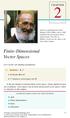 CHAPTER 2 American mathematician Paul Halmos (1916 2006), who in 1942 published the first modern linear algebra book. The title of Halmos s book was the same as the title of this chapter. Finite-Dimensional
Sensitivity Analysis 3.1 AN EXAMPLE FOR ANALYSIS
 Sensitivity Analysis 3 We have already been introduced to sensitivity analysis in Chapter via the geometry of a simple example. We saw that the values of the decision variables and those of the slack and
Mathematical finance and linear programming (optimization)
 Mathematical finance and linear programming (optimization) Geir Dahl September 15, 2009 1 Introduction The purpose of this short note is to explain how linear programming (LP) (=linear optimization) may
v w is orthogonal to both v and w. the three vectors v, w and v w form a right-handed set of vectors.
 3. Cross product Definition 3.1. Let v and w be two vectors in R 3. The cross product of v and w, denoted v w, is the vector defined as follows: the length of v w is the area of the parallelogram with
Inner Product Spaces
 Math 571 Inner Product Spaces 1. Preliminaries An inner product space is a vector space V along with a function, called an inner product which associates each pair of vectors u, v with a scalar u, v, and
Chapter 17. Orthogonal Matrices and Symmetries of Space
 Chapter 17. Orthogonal Matrices and Symmetries of Space Take a random matrix, say 1 3 A = 4 5 6, 7 8 9 and compare the lengths of e 1 and Ae 1. The vector e 1 has length 1, while Ae 1 = (1, 4, 7) has length
8 Square matrices continued: Determinants
 8 Square matrices continued: Determinants 8. Introduction Determinants give us important information about square matrices, and, as we ll soon see, are essential for the computation of eigenvalues. You
Formal Languages and Automata Theory - Regular Expressions and Finite Automata -
 Formal Languages and Automata Theory - Regular Expressions and Finite Automata - Samarjit Chakraborty Computer Engineering and Networks Laboratory Swiss Federal Institute of Technology (ETH) Zürich March
1. Write the number of the left-hand item next to the item on the right that corresponds to it.
 1. Write the number of the left-hand item next to the item on the right that corresponds to it. 1. Stanford prison experiment 2. Friendster 3. neuron 4. router 5. tipping 6. small worlds 7. job-hunting
ECO 199 B GAMES OF STRATEGY Spring Term 2004 PROBLEM SET 4 B DRAFT ANSWER KEY 100-3 90-99 21 80-89 14 70-79 4 0-69 11
 The distribution of grades was as follows. ECO 199 B GAMES OF STRATEGY Spring Term 2004 PROBLEM SET 4 B DRAFT ANSWER KEY Range Numbers 100-3 90-99 21 80-89 14 70-79 4 0-69 11 Question 1: 30 points Games
Mechanisms for Fair Attribution
 Mechanisms for Fair Attribution Eric Balkanski Yaron Singer Abstract We propose a new framework for optimization under fairness constraints. The problems we consider model procurement where the goal is
Week 7 - Game Theory and Industrial Organisation
 Week 7 - Game Theory and Industrial Organisation The Cournot and Bertrand models are the two basic templates for models of oligopoly; industry structures with a small number of firms. There are a number
Regular Languages and Finite Automata
 Regular Languages and Finite Automata 1 Introduction Hing Leung Department of Computer Science New Mexico State University Sep 16, 2010 In 1943, McCulloch and Pitts [4] published a pioneering work on a
How To Understand And Solve A Linear Programming Problem
 At the end of the lesson, you should be able to: Chapter 2: Systems of Linear Equations and Matrices: 2.1: Solutions of Linear Systems by the Echelon Method Define linear systems, unique solution, inconsistent,
S on n elements. A good way to think about permutations is the following. Consider the A = 1,2,3, 4 whose elements we permute with the P =
 Section 6. 1 Section 6. Groups of Permutations: : The Symmetric Group Purpose of Section: To introduce the idea of a permutation and show how the set of all permutations of a set of n elements, equipped
k, then n = p2α 1 1 pα k
 Powers of Integers An integer n is a perfect square if n = m for some integer m. Taking into account the prime factorization, if m = p α 1 1 pα k k, then n = pα 1 1 p α k k. That is, n is a perfect square
Mathematics and Social Choice Theory. Topic 1 Voting systems and power indexes. 1.1 Weighted voting systems and yes-no voting systems
 Mathematics and Social Choice Theory Topic 1 Voting systems and power indexes 1.1 Weighted voting systems and yes-no voting systems 1.2 Power indexes: Shapley-Shubik index and Banzhaf index 1.3 Case studies
8 Primes and Modular Arithmetic
 8 Primes and Modular Arithmetic 8.1 Primes and Factors Over two millennia ago already, people all over the world were considering the properties of numbers. One of the simplest concepts is prime numbers.
6.042/18.062J Mathematics for Computer Science. Expected Value I
 6.42/8.62J Mathematics for Computer Science Srini Devadas and Eric Lehman May 3, 25 Lecture otes Expected Value I The expectation or expected value of a random variable is a single number that tells you
Lecture L3 - Vectors, Matrices and Coordinate Transformations
 S. Widnall 16.07 Dynamics Fall 2009 Lecture notes based on J. Peraire Version 2.0 Lecture L3 - Vectors, Matrices and Coordinate Transformations By using vectors and defining appropriate operations between
Markov random fields and Gibbs measures
 Chapter Markov random fields and Gibbs measures 1. Conditional independence Suppose X i is a random element of (X i, B i ), for i = 1, 2, 3, with all X i defined on the same probability space (.F, P).
Linear Algebra Notes for Marsden and Tromba Vector Calculus
 Linear Algebra Notes for Marsden and Tromba Vector Calculus n-dimensional Euclidean Space and Matrices Definition of n space As was learned in Math b, a point in Euclidean three space can be thought of
Decision Making under Uncertainty
 6.825 Techniques in Artificial Intelligence Decision Making under Uncertainty How to make one decision in the face of uncertainty Lecture 19 1 In the next two lectures, we ll look at the question of how
OPRE 6201 : 2. Simplex Method
 OPRE 6201 : 2. Simplex Method 1 The Graphical Method: An Example Consider the following linear program: Max 4x 1 +3x 2 Subject to: 2x 1 +3x 2 6 (1) 3x 1 +2x 2 3 (2) 2x 2 5 (3) 2x 1 +x 2 4 (4) x 1, x 2
Lectures notes on orthogonal matrices (with exercises) 92.222 - Linear Algebra II - Spring 2004 by D. Klain
 Lectures notes on orthogonal matrices (with exercises) 92.222 - Linear Algebra II - Spring 2004 by D. Klain 1. Orthogonal matrices and orthonormal sets An n n real-valued matrix A is said to be an orthogonal
Unified Lecture # 4 Vectors
 Fall 2005 Unified Lecture # 4 Vectors These notes were written by J. Peraire as a review of vectors for Dynamics 16.07. They have been adapted for Unified Engineering by R. Radovitzky. References [1] Feynmann,
PYTHAGOREAN TRIPLES KEITH CONRAD
 PYTHAGOREAN TRIPLES KEITH CONRAD 1. Introduction A Pythagorean triple is a triple of positive integers (a, b, c) where a + b = c. Examples include (3, 4, 5), (5, 1, 13), and (8, 15, 17). Below is an ancient
A Second Course in Mathematics Concepts for Elementary Teachers: Theory, Problems, and Solutions
 A Second Course in Mathematics Concepts for Elementary Teachers: Theory, Problems, and Solutions Marcel B. Finan Arkansas Tech University c All Rights Reserved First Draft February 8, 2006 1 Contents 25
Chapter 3. Distribution Problems. 3.1 The idea of a distribution. 3.1.1 The twenty-fold way
 Chapter 3 Distribution Problems 3.1 The idea of a distribution Many of the problems we solved in Chapter 1 may be thought of as problems of distributing objects (such as pieces of fruit or ping-pong balls)
A Simple Model of Price Dispersion *
 Federal Reserve Bank of Dallas Globalization and Monetary Policy Institute Working Paper No. 112 http://www.dallasfed.org/assets/documents/institute/wpapers/2012/0112.pdf A Simple Model of Price Dispersion
A Little Set Theory (Never Hurt Anybody)
 A Little Set Theory (Never Hurt Anybody) Matthew Saltzman Department of Mathematical Sciences Clemson University Draft: August 21, 2013 1 Introduction The fundamental ideas of set theory and the algebra
Example 1. Consider the following two portfolios: 2. Buy one c(s(t), 20, τ, r) and sell one c(s(t), 10, τ, r).
 Chapter 4 Put-Call Parity 1 Bull and Bear Financial analysts use words such as bull and bear to describe the trend in stock markets. Generally speaking, a bull market is characterized by rising prices.
Vector and Matrix Norms
 Chapter 1 Vector and Matrix Norms 11 Vector Spaces Let F be a field (such as the real numbers, R, or complex numbers, C) with elements called scalars A Vector Space, V, over the field F is a non-empty
Linear Algebra I. Ronald van Luijk, 2012
 Linear Algebra I Ronald van Luijk, 2012 With many parts from Linear Algebra I by Michael Stoll, 2007 Contents 1. Vector spaces 3 1.1. Examples 3 1.2. Fields 4 1.3. The field of complex numbers. 6 1.4.
THE NUMBER OF GRAPHS AND A RANDOM GRAPH WITH A GIVEN DEGREE SEQUENCE. Alexander Barvinok
 THE NUMBER OF GRAPHS AND A RANDOM GRAPH WITH A GIVEN DEGREE SEQUENCE Alexer Barvinok Papers are available at http://www.math.lsa.umich.edu/ barvinok/papers.html This is a joint work with J.A. Hartigan
Computational Geometry Lab: FEM BASIS FUNCTIONS FOR A TETRAHEDRON
 Computational Geometry Lab: FEM BASIS FUNCTIONS FOR A TETRAHEDRON John Burkardt Information Technology Department Virginia Tech http://people.sc.fsu.edu/ jburkardt/presentations/cg lab fem basis tetrahedron.pdf
CHOOSING A COLLEGE. Teacher s Guide Getting Started. Nathan N. Alexander Charlotte, NC
 Teacher s Guide Getting Started Nathan N. Alexander Charlotte, NC Purpose In this two-day lesson, students determine their best-matched college. They use decision-making strategies based on their preferences
1 Introduction. Linear Programming. Questions. A general optimization problem is of the form: choose x to. max f(x) subject to x S. where.
 Introduction Linear Programming Neil Laws TT 00 A general optimization problem is of the form: choose x to maximise f(x) subject to x S where x = (x,..., x n ) T, f : R n R is the objective function, S
9.2 Summation Notation
 9. Summation Notation 66 9. Summation Notation In the previous section, we introduced sequences and now we shall present notation and theorems concerning the sum of terms of a sequence. We begin with a
Properties of Real Numbers
 16 Chapter P Prerequisites P.2 Properties of Real Numbers What you should learn: Identify and use the basic properties of real numbers Develop and use additional properties of real numbers Why you should