
APPLICATION NOTE UC3842/3/4/5 PROVIDES LOW-COST CURRENT-MODE CONTROL
|
|
|
- Imogene Weaver
- 9 years ago
- Views:
Transcription
1 APPLICATION NOTE UC3842/3/4/5 PROVIDES LOW-COST CURRENT-MODE CONTROL INTRODUCTION The fundamental challenge of power supply design is to simultaneously realize two conflicting objectives: good electrical performance and low cost. The UC3842/3/4/5 is an integrated pulse width modulator (PWM) designed with both these objectives in mind. This IC provides designers an inexpensive controller with which they can obtain all the performance advantages of current mode operation. In addition, the UC3842 series is optimized for efficient power sequencing of off-line converters, DC to DC regulators and for driving power MOSFETs or transistors. This application note provides a functional description of the UC3842 family and highlights the features of each individual member, the UC3842, UC3843, UC3844 and UC3845 Throughout the text, the UC3842 part number will be referenced, however the generalized circuits and performance characteristics apply to each member of the UC3842 series unless otherwise noted. A review of current mode control and its benefits is included and methods of avoiding common pitfalls are mentioned. The final section presents designs of power supplies utilizing UC3842 control. CURRENT-MODE CONTROL Figure 1 shows the two-loop current-mode control system in a typical buck regulator application. A clock signal initiates power pulses at a fixed frequency. The termination of each pulse occurs when an analog of the inductor current reaches a threshold established by the error signal. In this way the error signal actually controls peak inductor current. This contrasts with conventional schemes in which the error signal directly controls pulse width without regard to inductor current. Several performance advantages result from the use of current-mode control. First, an input voltage feed-forward characteristic is achieved; i.e., the control circuit instantaneously corrects for input voltage variations without using up any of the error amplifier s dynamic range. Therefore, line regulation is excellent and the error amplifier can be dedicated to correcting for load variations exclusively. For converters in which inductor current is continuous, controlling peak current is nearly equivalent to controlling average current. Therefore, when such converters employ current-mode control, the inductor can be treated as an clock verror vsense latch output Figure 1. Two-Loop Current-Mode Control System 3-53

2 error-voltage-controlled-current-source for the purposes of small-signal analysis. This is illustrated by Figure 2. The two-pole control-to-output frequency response of these converters is reduced to a single-pole (filter capacitor in parallel with load) response. One result is that the error amplifier compensation can be designed to yield a stable closed-loop converter response with greater gainbandwidth than would be possible with pulse-width control, giving the supply improved small-signal dynamic response to changing loads. A second result is that the error amplifier compensation circuit becomes simpler, as illustrated in Figure 3. Capacitor Ci and resistor Ri, in Figure 3a add a low frequency zero which cancels one of the two control-to-. output poles of non-current-mode converters. For largesignal load changes, in which converter response is limited by inductor slew rate, the error amplifier will saturate while the inductor is catching up with the load. During this time, Ci will charge to an abnormal level. When the inductor current reaches its required level, the voltage on Ci causes a corresponding error in supply output voltage. The recovery time is R&i, which may be quite long. However, the compensation network of Figure 3b can be used where current-mode control has eliminated the inductor pole. Large-signal dynamic response is then greatly improved due to the absence of Ci. Current limiting is greatly simplified with current-mode control. Pulse-by-pulse limiting is, of course, inherent in the control scheme. Furthermore, an upper limit on the peak current can be established by simply clamping the error voltage. Accurate current limiting allows optimization of magnetic and power semiconductor elements while ensuring reliable supply operation. Finally, current-mode controlled power stages can be operated in parallel with equal current sharing. This opens the possibility of a modular approach to power supply design. Figure 2. Inductor Looks Like a Current Source to Small Signals Vref A) Direct Duty Cycle Control B) Current Mode Control Figure 3. Required Error Amplifier Compensation for Continuous Inductor Current Designs 3-54

3 DESCRIPTION THE UC3842/3/4/5 SERIES OF CURRENT-MODE PWM IC S The UC1842/3/4/5 family of control ICs provides the necessary features to implement off-line or DC to DC fixed frequency current mode control schemes with a minimal external parts count. Internally implemented circuits include under-voltage lockout featuring start up current less than 1 ma, a precision reference trimmed for accuracy at the error amp input, logic to insure latched operation, a PWM comparator which also provides current limit control, and a totem pole output stage designed to source or sink high peak current. The output stage, suitable for driving either N Channel MOSFETs or bipolar transistor switches, is low in the off state. Differences between members of this family are the under-voltage lockout thresholds and maximum duty cycle ranges. The UC1842 and UC1844 have UVLO thresholds of 16V (on) and 10V (off), ideally suited to off-line applications. The corresponding thresholds for the UC1843 and UC1845 are 8.5V and 7.9V. The UC1842 and UC1843 can operate to duty cycles approaching 100%. A range of zero to <50% is obtained by the UC1844 and UC1845 by the addition of an internal toggle flip flip which blanks the output off every other clock cycle. IC SELECTION GUIDE FEATURES l Optimized for Off-Line and DC to DC Converters l Low Start Up Current (< 1 Automatic Feed Forward Compensation l Pulse-By-Pulse Current Limiting l Enhanced Load Response Characteristics l Under-Voltage Lockout with Hysteresis l Double Pulse Suppression l High Current Totem Pole Output l Internally Trimmed Bandgap Reference l 500 khz Operation l Low Ro Error Amp RECOMMENDED USAGE Note: 1. (A/B/ A= DIL-8 Pin Number. B = SO-16 Pin Number. 2. Toggle flip flop used only in 1844A and 1845A. Figure

4 UNDER-VOLTAGE LOCKOUT The UVLO circuit insures that VCC is adequate to make the UC3842/3/4/5 fully operational before enabling the output stage. Figure 5 shows that the UVLO turn-on and turn-off thresholds are fixed internally at 16V and 10V respectively. The 6V hysteresis prevents Vcc oscillations during power sequencing. Figure 6 shows supply current requirements. Start-up current is less than 1 ma for efficient bootstrapping from the rectified input of an off-line converter, as illustrated by Figure 6. During normal circuit operation, VCC is developed from auxiliary winding WAux with D1 and GIN. At start-up, however, GIN must be charged to 16V through RtN. With a start-up current of 1 ma, RtN can be as large as 100 kr and still charge GIN when VAc = 90V RMS (low line). Power dissipation in RIN would then be less than 350 mw even under high line (VAc = 130V RMS) conditions. During UVLO; the output driver is in a low state. While it doesn t exhibit the same saturation characteristics as normal operation, it can easily sink 1 milliamp, enough to insure the MOSFET is held off. Figure 5 Figure 6. During Under-Voltage Lockout, the output driver is biased to sink minor amounts of current. OSCILLATOR The UC3842 oscillator is programmed as shown in Figure 8. Timing capacitor CT is charged from VREF (5V) through the timing resistor RT, and discharged by an internal current source. The first step in selecting the oscillator components is to determine the required circuit deadtime. Once obtained, Figure 9 is used to pinpoint the nearest standard value of CT for a given deadtime. Next, the appropriate RT value is interpolated using the parameters for CT and oscillator frequency. Figure 10 illustrates the RT/CT combinations versus oscillator frequency. The timing resistor can be calculated from the following formula. Fosc (khz) = 1.72 / (RT (k) CT (pf)) The UC3844 and UC3845 have an internal divide-by-two flip-flop driven by the oscillator for a 50% maximum duty cycle. Therefore, their oscillators must be set to run at twice the desired power supply switching frequency. The UC3842 and UC3843 oscillator runs AT the switching frequency. Each oscillator of the UC3842/3/4/5 family can be used to a maximum of 500 khz. Figure 7. Providing Power to the UC3842/3/4/

5 MAXIMUM DUTY CYCLE The UC3842 and UC3843 have a maximum duty cycle of approximately 100%, whereas the UC3844 and UC3845 are clamped to 50% maximum by an internal toggle flip flop. This duty cycle clamp is advantageous in most flyback and forward converters. For optimum IC performance the deadtime should not exceed 15% of the oscillator clock period. During the discharge, or dead time, the internal clock signal blanks the output to the low state. This limits the maximum duty cycle DMAX to: DhnAx = 1 - ODEAD / ~PERI~D) UC3842/3 DMAX = 1 - (tdead / 2 X tper& UC3844/5 where TPERIOD = 1 / F oscillator CURRENT SENSING AND LIMITING The UC3842 current sense input is configured as shown in Figure 12. Current-to-voltage conversion is done externally with ground-referenced resistor Rs. Under normal operation the peak voltage across Rs is controlled by the E/A according to the following relation: where VC = control voltage = E/A output voltage. Rs can be connected to the power circuit directly or through a current transformer, as Figure 11 illustrates. While a direct connection is simpler, a transformer can reduce power dissipation in Rs, reduce errors caused by the base current, and provide level shifting to eliminate the restraint of ground-referenced sensing. The relation between VC and peak current in the power stage is given by: where: N = current sense transformer turns ratio = 1 when transformer not used. For purposes of small-signal analysis, the control-tosensed-current gain is: Figure 8 Deadtime vs CT (RT > 5k) Figure 9 Timing Resistance vs Frequency When sensing current in series with the power transistor, as shown in Figure 11, the current waveform will often have a large spike at its leading edge. This is due to rectifier recovery and/or inter-winding capacitance in the power transformer. If unattenuated, this transient can prematurely terminate the output pulse. As shown, a simple RC filter is usually adequate to suppress this spike. The RC time constant should be approximately equal to the current spike duration (usually a few hundred nanoseconds). The inverting input to the UC3842 current-sense comparator is internally clamped to 1V (Figure 12). Current limiting occurs if the voltage at pin 3 reaches this threshold value, i.e., the current limit is defined by: FREOUENCY - (Hz) Figure Figure 11. Transformer-Coupled Current Sensing 3-57

6 ERROR AMPLIFIER The error amplifier (E/A) configuration is shown in Figure 13. The non-inverting input is not brought out to a pin, but is internally biased to 2.5V ± 2%. The E/A output is available at pin 1 for external compensation, allowing the user to control the converter s closed-loop frequency response. Figure 14 shows an E/A compensation circuit suitable for stabilizing any current-mode controlled topology except for flyback and boost converters operating with inductor current. The feedback components add a pole to the loop transfer function at fp = 4/*7r RF,+ RF and CF are chosen so that this pole cancels the zero of the output filter capacitor ESR in the power circuit. RI and RF fix the lowfrequency gain. They are chosen to provide as much gain as possible while still allowing the pole formed by the output filter capacitor and load to roll off the loop gain to unity (0 db) at f =: fswttchtng/4. This technique insures converter stability while providing good dynamic response. Figure 12. Current Sensing Figure 14. Compensation The E/A output will source 0.5 ma amd sink 2 ma. A lower limit for RF is given by: Figure 13. E/A Configuration

7 E/A input bias curret (2 PA max) flows through RI, resulting in a DC error in output voltage (VO) given by: It is therefore desirable to keep the value of RI, as low as possible. Figure 15 shows the open-loop frequency response of the UC3842 E/A. The gain represents an upper limit on the gain of the compensated E/A. Phase lag increases rapidly as frequency exceeds 1 MHz due to second-order poles at ~ 10 MHz and above. Continuous-inductor-current boost and flyback converters each have a right-half-plane zero in their transfer function. An additional compensation pole is needed to roll off loop gain at a frequency less than that of the RHP zero. Rp and Cp in the circuit of Figure 16 provide this pole. TOTEM-POLE OUTPUT The UC3842 PWM has a single totem-pole output which can be operated to ± 1 amp peak for driving MOSFET gates, and a ma average current for bipolar power transistors. Cross conduction between the output transistors is minimal, the average added power with VIN = 30V is only 80 mw at 200 khz. Limiting the peak current through the IC is accomplished by placing a resistor between the totem-pole output and the gate of the MOSFET. The value is determined by dividing the totem-pole collector voltage VC by the peak current rating of the IC s totem-pole. Without this resistor, the peak current is limited only by the dv/dt rate of the totem-pole switching and the FET gate capacitance. The use of a Schottky diode from the PWM output to ground will prevent the output voltage from going excessively below ground, causing instabilities within the IC. To be effective, the diode selected should have a forward drop of less than 0.3V at 200 ma. Most l- to 3-amp Schottky diodes exhibit these traits above room temperature. Placing the diode as physically close to the PWM as possible will enhance circuit performance. Implementation of the complete drive scheme is shown in the following diagrams. Transformer driven circuits also require the use of the Schottky diodes to prevent a similar set of circum K 10K 100K 1M 10M FREQUENCY - (Hz) Figure 15. Error Amplifier Open-Loop Frequency Response Figure 16. E/A Compensation Circuit for Continuous Boost and Flyback Topologies 3-59

8 stances from occurring on the PWM output. The ringing below ground is greatly enhanced by the transformer leakage inductance and parasitic capacitance, in addition to the magnetizing inductance and FET gate capacitance. Circuit implementation is similar to the previous example. Figures 18, 19 and 20 show suggested circuits for driving MOSFETs and bipolar transistors with the UC3842 output. The simple circuit of Figure 18 can be used when the control IC is not electrically isolated from the MOSFET turn-on and turn-off to ± 1 amp. It also provides damping for a parasitic tank circuit formed by the FET input capacitance and series wiring inductance. Schottky diode D1 prevents the output of the IC from going far below ground during turn-off. Figure 19 shows an isolated MOSFET drive circuit which is appropriate when the drive signal must be level shifted or transmitted across an isolation boundary. Bipolar transistors can be driven efficiently with the circuit of Figure 20. Resistors R1 and R2 fix the on-state base current while capacitor Cl provides a negative base current pulse to remove stored charge at turn-off. Since the UC3842 series has only a single output, an interface circuit is needed to control push-pull half or full bridge topologies. The UC3706 dual output driver with internal toggle flip-flop performs this function. A circuit example at the end of this paper illustrates a typical application for these two ICs. Increased drive capability for driving numerous FETs in parallel, or other loads can be accomplished using one of the UC3705/6/7 driver ICs. 10 TO 20V OUTPUT CURRENT SOURCE OR SINK - (A) Figure 17. Output Saturation Characteristics Figure 18. Direct MOSFET Drive 20 TO 30V 12 TO 20V Figure 19. Isolated MOSFET Drive Figure 20. Bipolar Drive with Negative Turn-Off Bias 3-61

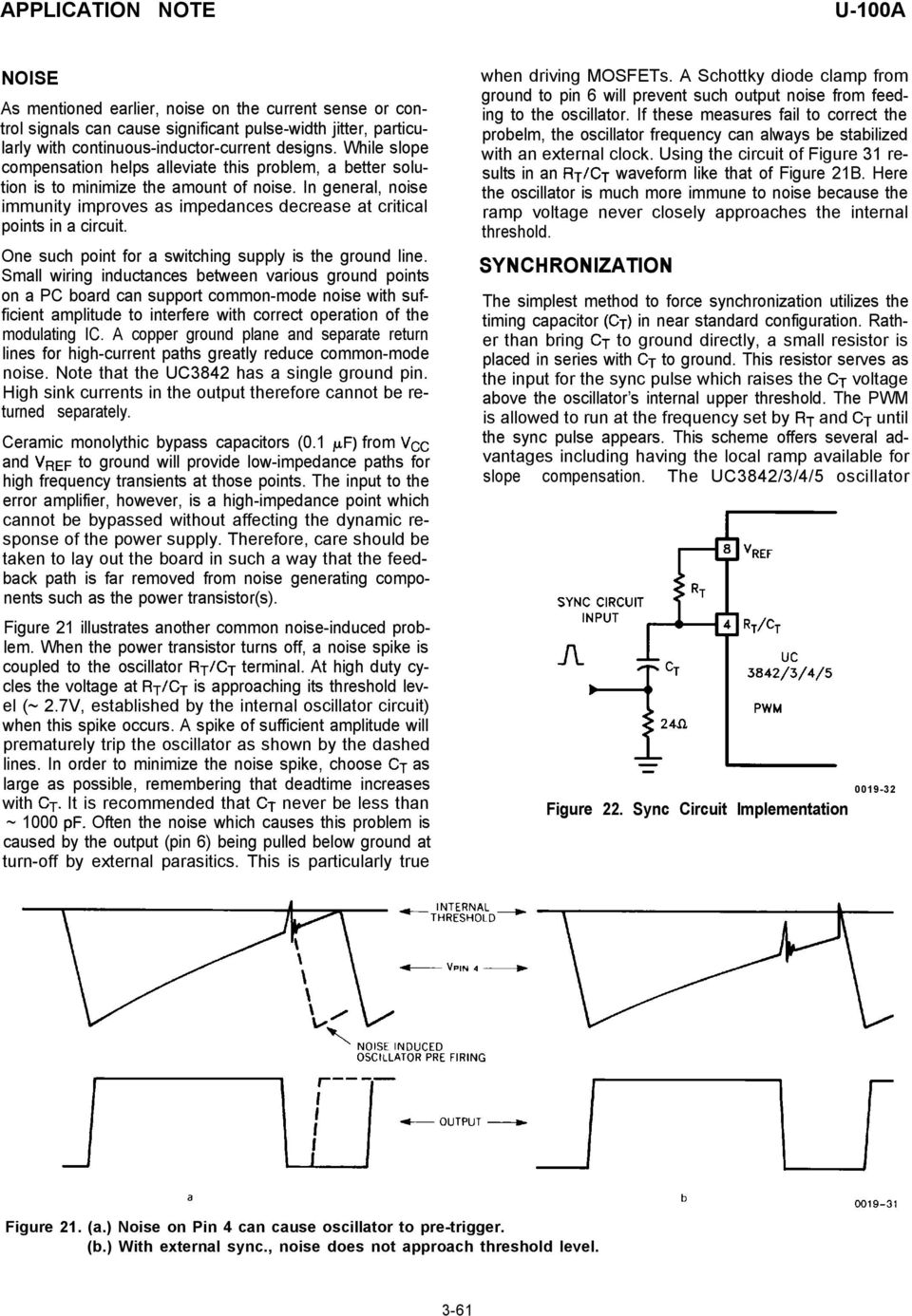
9 NOISE As mentioned earlier, noise on the current sense or control signals can cause significant pulse-width jitter, particularly with continuous-inductor-current designs. While slope compensation helps alleviate this problem, a better solution is to minimize the amount of noise. In general, noise immunity improves as impedances decrease at critical points in a circuit. One such point for a switching supply is the ground line. Small wiring inductances between various ground points on a PC board can support common-mode noise with sufficient amplitude to interfere with correct operation of the modulating IC. A copper ground plane and separate return lines for high-current paths greatly reduce common-mode noise. Note that the UC3842 has a single ground pin. High sink currents in the output therefore cannot be returned separately. Ceramic monolythic bypass capacitors (0.1 pf) from VCC and VREF to ground will provide low-impedance paths for high frequency transients at those points. The input to the error amplifier, however, is a high-impedance point which cannot be bypassed without affecting the dynamic response of the power supply. Therefore, care should be taken to lay out the board in such a way that the feedback path is far removed from noise generating components such as the power transistor(s). Figure 21 illustrates another common noise-induced problem. When the power transistor turns off, a noise spike is coupled to the oscillator FIT/CT terminal. At high duty cycles the voltage at RT/CT is approaching its threshold level (~ 2.7V, established by the internal oscillator circuit) when this spike occurs. A spike of sufficient amplitude will prematurely trip the oscillator as shown by the dashed lines. In order to minimize the noise spike, choose CT as large as possible, remembering that deadtime increases with CT. It is recommended that CT never be less than ~ 1000 pf. Often the noise which causes this problem is caused by the output (pin 6) being pulled below ground at turn-off by external parasitics. This is particularly true when driving MOSFETs. A Schottky diode clamp from ground to pin 6 will prevent such output noise from feeding to the oscillator. If these measures fail to correct the probelm, the oscillator frequency can always be stabilized with an external clock. Using the circuit of Figure 31 results in an FIT/CT waveform like that of Figure 21B. Here the oscillator is much more immune to noise because the ramp voltage never closely approaches the internal threshold. SYNCHRONIZATION The simplest method to force synchronization utilizes the timing capacitor (CT) in near standard configuration. Rather than bring CT to ground directly, a small resistor is placed in series with CT to ground. This resistor serves as the input for the sync pulse which raises the CT voltage above the oscillator s internal upper threshold. The PWM is allowed to run at the frequency set by RT and CT until the sync pulse appears. This scheme offers several advantages including having the local ramp available for slope compensation. The UC3842/3/4/5 oscillator Figure 22. Sync Circuit Implementation Figure 21. (a.) Noise on Pin 4 can cause oscillator to pre-trigger. (b.) With external sync., noise does not approach threshold level. 3-61
10 must be set to a lower frequency than the sync pulse stream, typically 20 percent with a 0.5V pulse applied across the resistor. Further information on synchronization can be found in Practical Considerations in Current Mode Power Supplies listed in the reference appendix. The UC3842 can also be synchronized to an external clock source through the FIT/CT terminal (Pin 4) as shown in Figure 23. In normal operation, the timing capacitor CT is charged between two thresholds, the upper and lower comparator limits. As CT begins its charge cycle, the output of the PWM is initiated and turns on. The timing capacitor continues to charge until it reaches the upper threshold of the internal comparator. Once intersected, the discharge circuitry activates and discharges CT until the lower threshold is reached. During this discharge time the PWM output is disabled, thus insuring a dead or off time for the output. A digital representation of the oscillator charge/discharge status can be utilized as an input to the FIT/CT terminal. In instances like this, where no synchronization port is easily available, the timing circuitry can be driven from a digital logic input rather than the conventional analog mode. The primary considerations of on-time, dead-time, duty cycle and frequency can be encompassed in the digital pulse train input. A LOW logic level input determines the PWM maximum ON time. Conversely, a HIGH input governs the OFF, or dead time. Critical constraints of frequency, duty cycle or dead time can be acurately controlled by anything from a 555 timer to an elaborate microprocessor controlled software routine Figure 23 Synchronization to an External Clock Figure

11 SYNC PULSE GENERATOR The UC3842/3/4/5 oscillator can be used to generate sync pulses with a minimum of external components. This simple circuit shown in Figure 25 triggers on the falling edge of the CT waveform, and generates the sync pulse required for the previously mentioned synchronization scheme. Triggered by the master s deadtime, this circuit is useable to several hundred kilohertz with a minimum of delays between the master and slave(s). The photos shown in Figures 26 and 27 depict the circuit waveforms of interest. Figure 25. Sync Pulse Generator Circuit Top Trace: Circuit Input Bottom Trace: Circuit Output Across 24 Ohms Vertical: O.5V/CM Both Horizontal: 0.5~SICM Top Trace: Slave CT Bottom Trace: Master CT Vertical: 0.5V/CM Both Horizontal: 0.5$XYvI Figure Operating Waveforms at 500 khz Figure 27. Master/Slave Sync Waveforms at CT 3-63

12 CHARGE PUMP CIRCUITS LOW POWER DC/DC CONVERSION Step Up Inverting Figure 28 Figure 29 Low Power Buck Regulator-Voltage Mode The basic buck regulator is described in the UNITRODE Applications Handbook. *Consult UNITRODE Power Supply Design Seminar Book for compensation details; see Closing The Feedback Loop, Buck Topology. Figure

13 CIRCUIT EXAMPLES 1. Off-Line Flyback Figure 31 shows a 25W multiple-output off-line flyback regulator controlled with the UC3844. This regulator is low in cost because it uses only two magnetic elements, a primary-side voltage sensing technique, and an inexpensive control circuit. Specifications are listed below. Also consult UNITRODE application note U-96 in the applications handbook. Figure Power Supply Specifications 1. Input Voltage: 95 VAC to 130 VAC (50 Hz/60 Hz) 2. Line Isolation: 3750V 3. Switching Frequency: 40 khz 4. Full Load: 70% 5. Output Voltage: A. + 5V, ± 5%: 1A to 4A load Ripple voltage: 50 mv P-P Max V, ±3% 0.1A to 0.3A load Ripple voltage: 100 mv P-P Max. C. -12V ±3%, 0.1A to 0.3A load Ripple voltage: 100 mv P-P Max. 3-65

14 Figure W Push-Pull DC-to-DC Converter 2. DC-to-DC Push-Pull Converter Figure 45 is a 500W push-pull DC-to-DC converter utilizing the UC3642, UC3706, and UC3901 ICs. It operates from a standard telecommunications bus to produce 5V at up to 100A. Operation of this circuit is detailed in Reference 6. SPECIFICATIONS: Input Voltage: -48V ± 8V Output Voltage: +5V Output Current: 25A to 100A Oscillator Frequency: 200 khz Line Regulation: 0.1% Load Regulation: 1% VIN = 48V lo = 25A: 75% lo = 50A: 80% Output Ripple Voltage: 200 mv P-P Also consult application note U-101 in the Unitrode Applications Handbook

15 IMPORTANT NOTICE Texas Instruments and its subsidiaries (TI) reserve the right to make changes to their products or to discontinue any product or service without notice, and advise customers to obtain the latest version of relevant information to verify, before placing orders, that information being relied on is current and complete. All products are sold subject to the terms and conditions of sale supplied at the time of order acknowledgement, including those pertaining to warranty, patent infringement, and limitation of liability. TI warrants performance of its semiconductor products to the specifications applicable at the time of sale in accordance with TI s standard warranty. Testing and other quality control techniques are utilized to the extent TI deems necessary to support this warranty. Specific testing of all parameters of each device is not necessarily performed, except those mandated by government requirements. CERTAIN APPLICATIONS USING SEMICONDUCTOR PRODUCTS MAY INVOLVE POTENTIAL RISKS OF DEATH, PERSONAL INJURY, OR SEVERE PROPERTY OR ENVIRONMENTAL DAMAGE ( CRITICAL APPLICATIONS ). TI SEMICONDUCTOR PRODUCTS ARE NOT DESIGNED, AUTHORIZED, OR WARRANTED TO BE SUITABLE FOR USE IN LIFE-SUPPORT DEVICES OR SYSTEMS OR OTHER CRITICAL APPLICATIONS. INCLUSION OF TI PRODUCTS IN SUCH APPLICATIONS IS UNDERSTOOD TO BE FULLY AT THE CUSTOMER S RISK. In order to minimize risks associated with the customer s applications, adequate design and operating safeguards must be provided by the customer to minimize inherent or procedural hazards. TI assumes no liability for applications assistance or customer product design. TI does not warrant or represent that any license, either express or implied, is granted under any patent right, copyright, mask work right, or other intellectual property right of TI covering or relating to any combination, machine, or process in which such semiconductor products or services might be or are used. TI s publication of information regarding any third party s products or services does not constitute TI s approval, warranty or endorsement thereof. Copyright 1999, Texas Instruments Incorporated

UC3842/UC3843/UC3844/UC3845
 SMPS Controller www.fairchildsemi.com Features Low Start up Current Maximum Duty Clamp UVLO With Hysteresis Operating Frequency up to 500KHz Description The UC3842/UC3843/UC3844/UC3845 are fixed frequencycurrent-mode
Theory of Operation. Figure 1 illustrates a fan motor circuit used in an automobile application. The TPIC2101. 27.4 kω AREF.
 In many applications, a key design goal is to minimize variations in power delivered to a load as the supply voltage varies. This application brief describes a simple DC brush motor control circuit using
SINGLE-SUPPLY OPERATION OF OPERATIONAL AMPLIFIERS
 SINGLE-SUPPLY OPERATION OF OPERATIONAL AMPLIFIERS One of the most common applications questions on operational amplifiers concerns operation from a single supply voltage. Can the model OPAxyz be operated
SG2525A SG3525A REGULATING PULSE WIDTH MODULATORS
 SG2525A SG3525A REGULATING PULSE WIDTH MODULATORS 8 TO 35 V OPERATION 5.1 V REFERENCE TRIMMED TO ± 1 % 100 Hz TO 500 KHz OSCILLATOR RANGE SEPARATE OSCILLATOR SYNC TERMINAL ADJUSTABLE DEADTIME CONTROL INTERNAL
Push-Pull FET Driver with Integrated Oscillator and Clock Output
 19-3662; Rev 1; 5/7 Push-Pull FET Driver with Integrated Oscillator General Description The is a +4.5V to +15V push-pull, current-fed topology driver subsystem with an integrated oscillator for use in
3-Phase Synchronous PWM Controller IC Provides an Integrated Solution for Intel VRM 9.0 Design Guidelines
 3-Phase Synchronous PWM Controller IC Provides an Integrated Solution for Intel VRM 9.0 Design Guidelines Odile Ronat International Rectifier The fundamental reason for the rapid change and growth in information
Wide Bandwidth, Fast Settling Difet OPERATIONAL AMPLIFIER
 Wide Bandwidth, Fast Settling Difet OPERATIONAL AMPLIFIER FEATURES HIGH GAIN-BANDWIDTH: 35MHz LOW INPUT NOISE: 1nV/ Hz HIGH SLEW RATE: V/µs FAST SETTLING: 24ns to.1% FET INPUT: I B = 5pA max HIGH OUTPUT
Simple PWM Boost Converter with I/O Disconnect Solves Malfunctions Caused when V OUT <V IN
 Simple PWM Boost Converter with I/O Disconnect Solves Malfunctions Caused when V OUT
Understanding the Terms and Definitions of LDO Voltage Regulators
 Application Report SLVA79 - October 1999 Understanding the Terms and Definitions of ltage Regulators Bang S. Lee Mixed Signal Products ABSTRACT This report provides an understanding of the terms and definitions
TOPOLOGIES FOR SWITCHED MODE POWER SUPPLIES
 TOPOLOGIES FOR SWITCHED MODE POWER SUPPLIES by L. Wuidart I INTRODUCTION This paper presents an overview of the most important DC-DC converter topologies. The main object is to guide the designer in selecting
LM5001 High Voltage Switch Mode Regulator
 High Voltage Switch Mode Regulator General Description The LM5001 high voltage switch mode regulator features all of the functions necessary to implement efficient high voltage Boost, Flyback, SEPIC and
APPLICATION BULLETIN
 APPLICATION BULLETIN Mailing Address: PO Box 11400, Tucson, AZ 85734 Street Address: 6730 S. Tucson Blvd., Tucson, AZ 85706 Tel: (520) 746-1111 Telex: 066-6491 FAX (520) 889-1510 Product Info: (800) 548-6132
Design A High Performance Buck or Boost Converter With Si9165
 Design A High Performance Buck or Boost Converter With Si9165 AN723 AN723 by Kin Shum INTRODUCTION The Si9165 is a controller IC designed for dc-to-dc conversion applications with 2.7- to 6- input voltage.
Supply voltage Supervisor TL77xx Series. Author: Eilhard Haseloff
 Supply voltage Supervisor TL77xx Series Author: Eilhard Haseloff Literature Number: SLVAE04 March 1997 i IMPORTANT NOTICE Texas Instruments (TI) reserves the right to make changes to its products or to
SN54HC191, SN74HC191 4-BIT SYNCHRONOUS UP/DOWN BINARY COUNTERS
 Single Down/Up Count-Control Line Look-Ahead Circuitry Enhances Speed of Cascaded Counters Fully Synchronous in Count Modes Asynchronously Presettable With Load Control Package Options Include Plastic
Design and Applications of HCPL-3020 and HCPL-0302 Gate Drive Optocouplers
 Design and Applications of HCPL-00 and HCPL-00 Gate Drive Optocouplers Application Note 00 Introduction The HCPL-00 (DIP-) and HCPL-00 (SO-) consist of GaAsP LED optically coupled to an integrated circuit
Audio Tone Control Using The TLC074 Operational Amplifier
 Application Report SLOA42 - JANUARY Audio Tone Control Using The TLC74 Operational Amplifier Dee Harris Mixed-Signal Products ABSTRACT This application report describes the design and function of a stereo
Signal Conditioning Piezoelectric Sensors
 Application Report SLOA033A - September 2000 Signal Conditioning Piezoelectric Sensors James Karki Mixed Signal Products ABSTRACT Piezoelectric elements are used to construct transducers for a vast number
Input and Output Capacitor Selection
 Application Report SLTA055 FEBRUARY 2006 Input and Output Capacitor Selection Jason Arrigo... PMP Plug-In Power ABSTRACT When designing with switching regulators, application requirements determine how
1ED Compact A new high performance, cost efficient, high voltage gate driver IC family
 1ED Compact A new high performance, cost efficient, high voltage gate driver IC family Heiko Rettinger, Infineon Technologies AG, Am Campeon 1-12, 85579 Neubiberg, Germany, [email protected]
SN54165, SN54LS165A, SN74165, SN74LS165A PARALLEL-LOAD 8-BIT SHIFT REGISTERS
 The SN54165 and SN74165 devices SN54165, SN54LS165A, SN74165, SN74LS165A PRODUCTION DATA information is current as of publication date. Products conform to specifications per the terms of Texas Instruments
DC/DC power modules basics
 DC/DC power modules basics Design Note 024 Ericsson Power Modules General Abstract This design note covers basic considerations for the use of on-board switch mode DC/DC power modules, also commonly known
A Low-Cost, Single Coupling Capacitor Configuration for Stereo Headphone Amplifiers
 Application Report SLOA043 - December 1999 A Low-Cost, Single Coupling Capacitor Configuration for Stereo Headphone Amplifiers Shawn Workman AAP Precision Analog ABSTRACT This application report compares
IrDA Transceiver with Encoder/Decoder
 PRELIMINARY IrDA Transceiver with Encoder/Decoder FEATURES Micropower in the Sleep Mode, (2µA) 3V to 5V Operation Wide Dynamic Receiver Range from 200nA to 50mA Typical Direct Interface to IrDA Compatible
AN ISOLATED GATE DRIVE FOR POWER MOSFETs AND IGBTs
 APPLICATION NOTE AN ISOLATED GATE DRIVE FOR POWER MOSFETs AND IGBTs by J.M. Bourgeois ABSTRACT Power MOSFET and IGBT gate drives often face isolation and high voltage constraints. The gate drive described
Designing With the SN54/74LS123. SDLA006A March 1997
 Designing With the SN54/74LS23 SDLA6A March 997 IMPORTANT NOTICE Texas Instruments (TI) reserves the right to make changes to its products or to discontinue any semiconductor product or service without
How To Close The Loop On A Fully Differential Op Amp
 Application Report SLOA099 - May 2002 Fully Differential Op Amps Made Easy Bruce Carter High Performance Linear ABSTRACT Fully differential op amps may be unfamiliar to some designers. This application
Application Note, Rev.1.0, September 2008 TLE8366. Application Information. Automotive Power
 Application Note, Rev.1.0, September 2008 TLE8366 Automotive Power Table of Contents 1 Abstract...3 2 Introduction...3 3 Dimensioning the Output and Input Filter...4 3.1 Theory...4 3.2 Output Filter Capacitor(s)
Introduction to Power Supplies
 Introduction to Power Supplies INTRODUCTION Virtually every piece of electronic equipment e g computers and their peripherals calculators TV and hi-fi equipment and instruments is powered from a DC power
MP2259 1A, 16V, 1.4MHz Step-Down Converter
 MP59 1A, 1V, 1.MHz Step-Down Converter TM The Future of Analog IC Technology DESCRIPTION The MP59 is a monolithic integrated stepdown switch mode converter with an internal power MOSFET. It achieves 1A
U-97 APPLICATION NOTE MODELLING, ANALYSIS AND COMPENSATION OF THE CURRENT-MODE CONVERTER 3-43. Abstract
 APPLICATION NOTE MODELLING, ANALYSIS AND COMPENSATION OF THE CURRENT-MODE CONVERTER U-97 Abstract As current-mode conversion increases in popularity, several peculiarities associated with fixed-frequency,
Use and Application of Output Limiting Amplifiers (HFA1115, HFA1130, HFA1135)
 Use and Application of Output Limiting Amplifiers (HFA111, HFA110, HFA11) Application Note November 1996 AN96 Introduction Amplifiers with internal voltage clamps, also known as limiting amplifiers, have
Chapter 4. LLC Resonant Converter
 Chapter 4 LLC Resonant Converter 4.1 Introduction In previous chapters, the trends and technical challenges for front end DC/DC converter were discussed. High power density, high efficiency and high power
Application Report SLVA051
 Application Report November 998 Mixed-Signal Products SLVA05 ltage Feedback Vs Current Feedback Op Amps Application Report James Karki Literature Number: SLVA05 November 998 Printed on Recycled Paper IMPORTANT
NTE2053 Integrated Circuit 8 Bit MPU Compatible A/D Converter
 NTE2053 Integrated Circuit 8 Bit MPU Compatible A/D Converter Description: The NTE2053 is a CMOS 8 bit successive approximation Analog to Digital converter in a 20 Lead DIP type package which uses a differential
TDA4605 CONTROL CIRCUIT FOR SWITCH MODE POWER SUPPLIES USING MOS TRANSISTORS
 CONTROL CIRCUIT FOR SWITCH MODE POWER SUPPLIES USING MOS TRANSISTORS Fold-Back Characteristic provides Overload Protection for External Diodes Burst Operation under Short-Circuit and no Load Conditions
KA7500C. SMPS Controller. Features. Description. Internal Block Diagram. www.fairchildsemi.com
 SMPS Controller www.fairchildsemi.com Features Internal Regulator Provides a Stable 5V Reference Supply Trimmed to ±1% Accuracy. Uncommitted Output TR for 200mA Sink or Source Current Output Control for
Op Amp Circuit Collection
 Op Amp Circuit Collection Note: National Semiconductor recommends replacing 2N2920 and 2N3728 matched pairs with LM394 in all application circuits. Section 1 Basic Circuits Inverting Amplifier Difference
How To Make A Two Series Cell Battery Pack Supervisor Module
 Features Complete and compact lithium-ion pack supervisor Provides overvoltage, undervoltage, and overcurrent protection for two series Li-Ion cells Combines bq2058t with charge/discharge control FETs
Transformerless UPS systems and the 9900 By: John Steele, EIT Engineering Manager
 Transformerless UPS systems and the 9900 By: John Steele, EIT Engineering Manager Introduction There is a growing trend in the UPS industry to create a highly efficient, more lightweight and smaller UPS
Designing Stable Compensation Networks for Single Phase Voltage Mode Buck Regulators
 Designing Stable Compensation Networks for Single Phase Voltage Mode Buck Regulators Technical Brief December 3 TB47. Author: Doug Mattingly Assumptions This Technical Brief makes the following assumptions:.
AND8480/D. CrM Buck LED Driver Evaluation Board APPLICATION NOTE
 CrM Buck LED Driver Evaluation Board Prepared by: Fabien Franc ON Semiconductor Introduction This document describes the CrM Buck LED driver evaluation board. This board provides a step down converter
High Performance ZVS Buck Regulator Removes Barriers To Increased Power Throughput In Wide Input Range Point-Of-Load Applications
 White paper High Performance ZVS Buck Regulator Removes Barriers To Increased Power Throughput In Wide Input Range Point-Of-Load Applications Written by: C. R. Swartz Principal Engineer, Picor Semiconductor
Design of a TL431-Based Controller for a Flyback Converter
 Design of a TL431-Based Controller for a Flyback Converter Dr. John Schönberger Plexim GmbH Technoparkstrasse 1 8005 Zürich 1 Introduction The TL431 is a reference voltage source that is commonly used
Power supply output voltages are dropping with each
 DESIGNER S SERIES Second-Stage LC Filter Design First Inductor by Dr. Ray Ridley First Capacitor Power supply output voltages are dropping with each new generation of Integrated Circuits (ICs). Anticipated
DDR SDRAM Memory Termination USING THE LX1672 AND LX1673 FOR DDR SDRAM MEMORY TERMINATION INTEGRATED PRODUCTS. Microsemi
 AN-17 USING THE LX1672 AND LX1673 FOR DDR SDRAM MEMORY TERMINATION LX1672 Protected by US Patents: 6,285,571 & 6,292,378 INTEGRATED PRODUCTS Page 1 TABLE OF CONTENTS 1.0 INTRODUCTION... 3 2.0 SDR vs DDR
Buffer Op Amp to ADC Circuit Collection
 Application Report SLOA098 March 2002 Buffer Op Amp to ADC Circuit Collection Bruce Carter High Performance Linear Products ABSTRACT This document describes various techniques that interface buffer op
Power supplies. EE328 Power Electronics Assoc. Prof. Dr. Mutlu BOZTEPE Ege University, Dept. of E&E
 Power supplies EE328 Power Electronics Assoc. Prof. Dr. Mutlu BOZTEPE Ege University, Dept. of E&E EE328 POWER ELECTRONICS Outline of lecture Introduction to power supplies Modelling a power transformer
ULRASONIC GENERATOR POWER CIRCUITRY. Will it fit on PC board
 ULRASONIC GENERATOR POWER CIRCUITRY Will it fit on PC board MAJOR COMPONENTS HIGH POWER FACTOR RECTIFIER RECTIFIES POWER LINE RAIL SUPPLY SETS VOLTAGE AMPLITUDE INVERTER INVERTS RAIL VOLTAGE FILTER FILTERS
GLOLAB Two Wire Stepper Motor Positioner
 Introduction A simple and inexpensive way to remotely rotate a display or object is with a positioner that uses a stepper motor to rotate it. The motor is driven by a circuit mounted near the motor and
Testing a power supply for line and load transients
 Testing a power supply for line and load transients Power-supply specifications for line and load transients describe the response of a power supply to abrupt changes in line voltage and load current.
August 2001 PMP Low Power SLVU051
 User s Guide August 2001 PMP Low Power SLVU051 IMPORTANT NOTICE Texas Instruments and its subsidiaries (TI) reserve the right to make changes to their products or to discontinue any product or service
Pressure Transducer to ADC Application
 Application Report SLOA05 October 2000 Pressure Transducer to ADC Application John Bishop ABSTRACT Advanced Analog Products/OpAmp Applications A range of bridgetype transducers can measure numerous process
Series AMLDL-Z Up to 1000mA LED Driver
 FEATURES: Click on Series name for product info on aimtec.com Series Up to ma LED Driver Models Single output Model Input Voltage (V) Step Down DC/DC LED driver Operating Temperature range 4ºC to 85ºC
LDS8720. 184 WLED Matrix Driver with Boost Converter FEATURES APPLICATION DESCRIPTION TYPICAL APPLICATION CIRCUIT
 184 WLED Matrix Driver with Boost Converter FEATURES High efficiency boost converter with the input voltage range from 2.7 to 5.5 V No external Schottky Required (Internal synchronous rectifier) 250 mv
High Speed, Low Cost, Triple Op Amp ADA4861-3
 High Speed, Low Cost, Triple Op Amp ADA486-3 FEATURES High speed 73 MHz, 3 db bandwidth 625 V/μs slew rate 3 ns settling time to.5% Wide supply range: 5 V to 2 V Low power: 6 ma/amplifier. db flatness:
Understanding Power Impedance Supply for Optimum Decoupling
 Introduction Noise in power supplies is not only caused by the power supply itself, but also the load s interaction with the power supply (i.e. dynamic loads, switching, etc.). To lower load induced noise,
AAT4280 Slew Rate Controlled Load Switch
 General Description Features SmartSwitch The AAT4280 SmartSwitch is a P-channel MOSFET power switch designed for high-side load switching applications. The P-channel MOSFET device has a typical R DS(ON)
APPLICATION BULLETIN
 APPLICATION BULLETIN Mailing Address: PO Box 11400 Tucson, AZ 85734 Street Address: 6730 S. Tucson Blvd. Tucson, AZ 85706 Tel: (602 746-1111 Twx: 910-952-111 Telex: 066-6491 FAX (602 889-1510 Immediate
Precision Diode Rectifiers
 by Kenneth A. Kuhn March 21, 2013 Precision half-wave rectifiers An operational amplifier can be used to linearize a non-linear function such as the transfer function of a semiconductor diode. The classic
LM2704 Micropower Step-up DC/DC Converter with 550mA Peak Current Limit
 Micropower Step-up DC/DC Converter with 550mA Peak Current Limit General Description The LM2704 is a micropower step-up DC/DC in a small 5-lead SOT-23 package. A current limited, fixed off-time control
AP1509. 150KHz, 2A PWM BUCK DC/DC CONVERTER. Description. Pin Assignments V IN. Applications. Features. (Top View) GND GND. Output AP1509 GND GND
 Description Pin Assignments The series are monolithic IC designed for a stepdown DC/DC converter, and own the ability of driving a 2A load without additional transistor. It saves board space. The external
Pulse Width Modulation Amplifiers EQUIVALENT CIRCUIT DIAGRAM. 200mV + - SMART CONTROLLER .01F OSC Q3. 2200pF
 Pulse Width Modulation Amplifiers MSA MSA FEATURES LOW COST HIGH VOLTAGE VOLTS HIGH OUTPUT CURRENT AMPS kw OUTPUT CAPABILITY VARIABLE SWITCHING FREQUEY APPLICATIONS BRUSH MOTOR CONTROL MRI MAGNETIC BEARINGS
Digital to Analog Converter. Raghu Tumati
 Digital to Analog Converter Raghu Tumati May 11, 2006 Contents 1) Introduction............................... 3 2) DAC types................................... 4 3) DAC Presented.............................
3-Phase DC Brushless Motor Pre-Drivers Technical Information NJM2625A
 3Phase DC Brushless Motor PreDrivers 1.FEATURE NJM2625 is a controller and predriver for speed control 3phase blushless DC motor. The device provides the proper sequencing of 3phase drive output with external
AC/DC Power Supply Reference Design. Advanced SMPS Applications using the dspic DSC SMPS Family
 AC/DC Power Supply Reference Design Advanced SMPS Applications using the dspic DSC SMPS Family dspic30f SMPS Family Excellent for Digital Power Conversion Internal hi-res PWM Internal high speed ADC Internal
Fundamentals of Power Electronics. Robert W. Erickson University of Colorado, Boulder
 Robert W. Erickson University of Colorado, Boulder 1 1.1. Introduction to power processing 1.2. Some applications of power electronics 1.3. Elements of power electronics Summary of the course 2 1.1 Introduction
Chapter 12: The Operational Amplifier
 Chapter 12: The Operational Amplifier 12.1: Introduction to Operational Amplifier (Op-Amp) Operational amplifiers (op-amps) are very high gain dc coupled amplifiers with differential inputs; they are used
AND8147/D. An Innovative Approach to Achieving Single Stage PFC and Step-Down Conversion for Distributive Systems APPLICATION NOTE
 An Innovative Approach to Achieving Single Stage PFC and Step-Down Conversion for Distributive Systems APPLICATION NOTE INTRODUCTION In most modern PFC circuits, to lower the input current harmonics and
Keywords: input noise, output noise, step down converters, buck converters, MAX1653EVKit
 Maxim > Design Support > Technical Documents > Tutorials > Power-Supply Circuits > APP 986 Keywords: input noise, output noise, step down converters, buck converters, MAX1653EVKit TUTORIAL 986 Input and
Programmable Single-/Dual-/Triple- Tone Gong SAE 800
 Programmable Single-/Dual-/Triple- Tone Gong Preliminary Data SAE 800 Bipolar IC Features Supply voltage range 2.8 V to 18 V Few external components (no electrolytic capacitor) 1 tone, 2 tones, 3 tones
Line Reactors and AC Drives
 Line Reactors and AC Drives Rockwell Automation Mequon Wisconsin Quite often, line and load reactors are installed on AC drives without a solid understanding of why or what the positive and negative consequences
TSL213 64 1 INTEGRATED OPTO SENSOR
 TSL 64 INTEGRATED OPTO SENSOR SOES009A D4059, NOVEMBER 99 REVISED AUGUST 99 Contains 64-Bit Static Shift Register Contains Analog Buffer With Sample and Hold for Analog Output Over Full Clock Period Single-Supply
Designers Series XII. Switching Power Magazine. Copyright 2005
 Designers Series XII n this issue, and previous issues of SPM, we cover the latest technologies in exotic high-density power. Most power supplies in the commercial world, however, are built with the bread-and-butter
Diode Applications. by Kenneth A. Kuhn Sept. 1, 2008. This note illustrates some common applications of diodes.
 by Kenneth A. Kuhn Sept. 1, 2008 This note illustrates some common applications of diodes. Power supply applications A common application for diodes is converting AC to DC. Although half-wave rectification
Inrush Current. Although the concepts stated are universal, this application note was written specifically for Interpoint products.
 INTERPOINT Although the concepts stated are universal, this application note was written specifically for Interpoint products. In today s applications, high surge currents coming from the dc bus are a
L4970A 10A SWITCHING REGULATOR
 10A SWITCHING REGULATOR 10A OUTPUT CURRENT 5.1 TO 40 OUTPUT OLTAGE RANGE 0 TO 90% DUTY CYCLE RANGE INTERNAL FEED-FORWARD LINE REGULA- TION INTERNAL CURRENT LIMITING PRECISE 5.1 ± 2% ON CHIP REFERENCE RESET
Evaluating AC Current Sensor Options for Power Delivery Systems
 Evaluating AC Current Sensor Options for Power Delivery Systems State-of-the-art isolated ac current sensors based on CMOS technology can increase efficiency, performance and reliability compared to legacy
TS321 Low Power Single Operational Amplifier
 SOT-25 Pin Definition: 1. Input + 2. Ground 3. Input - 4. Output 5. Vcc General Description The TS321 brings performance and economy to low power systems. With high unity gain frequency and a guaranteed
TS555. Low-power single CMOS timer. Description. Features. The TS555 is a single CMOS timer with very low consumption:
 Low-power single CMOS timer Description Datasheet - production data The TS555 is a single CMOS timer with very low consumption: Features SO8 (plastic micropackage) Pin connections (top view) (I cc(typ)
Chapter 2 Application Requirements
 Chapter 2 Application Requirements The material presented in this script covers low voltage applications extending from battery operated portable electronics, through POL-converters (Point of Load), internet
IR1168S DUAL SMART RECTIFIER DRIVER IC
 Datasheet No PD97382 September 26, 2011 IR1168S DUAL SMART RECTIFIER DRIVER IC Features Secondary-side high speed controller for synchronous rectification in resonant half bridge topologies 200V proprietary
LM101A LM201A LM301A Operational Amplifiers
 LM101A LM201A LM301A Operational Amplifiers General Description The LM101A series are general purpose operational amplifiers which feature improved performance over industry standards like the LM709 Advanced
TEA1024/ TEA1124. Zero Voltage Switch with Fixed Ramp. Description. Features. Block Diagram
 Zero Voltage Switch with Fixed Ramp TEA04/ TEA4 Description The monolithic integrated bipolar circuit, TEA04/ TEA4 is a zero voltage switch for triac control in domestic equipments. It offers not only
MIC4451/4452. General Description. Features. Applications. Functional Diagram V S. 12A-Peak Low-Side MOSFET Driver. Bipolar/CMOS/DMOS Process
 12A-Peak Low-Side MOSFET Driver Bipolar/CMOS/DMOS Process General Description MIC4451 and MIC4452 CMOS MOSFET drivers are robust, efficient, and easy to use. The MIC4451 is an inverting driver, while the
CMOS Power Consumption and C pd Calculation
 CMOS Power Consumption and C pd Calculation SCAA035B June 1997 1 IMPORTANT NOTICE Texas Instruments (TI) reserves the right to make changes to its products or to discontinue any semiconductor product or
ARRL Morse Code Oscillator, How It Works By: Mark Spencer, WA8SME
 The national association for AMATEUR RADIO ARRL Morse Code Oscillator, How It Works By: Mark Spencer, WA8SME This supplement is intended for use with the ARRL Morse Code Oscillator kit, sold separately.
SN54HC157, SN74HC157 QUADRUPLE 2-LINE TO 1-LINE DATA SELECTORS/MULTIPLEXERS
 SNHC, SNHC QUADRUPLE 2-LINE TO -LINE DATA SELECTORS/MULTIPLEXERS SCLSB DECEMBER 982 REVISED MAY 99 Package Options Include Plastic Small-Outline (D) and Ceramic Flat (W) Packages, Ceramic Chip Carriers
EB215E Printed Circuit Board Layout for Improved Electromagnetic Compatibility
 Printed Circuit Board Layout for Improved Author: Eilhard Haseloff Date: 10.07.96 Rev: * The electromagnetic compatibility (EMC) of electronic circuits and systems has recently become of increasing significance.
MP2456 0.5A, 50V, 1.2MHz Step-Down Converter in a TSOT23-6
 MP2456 0.5A, 50V, 1.2MHz Step-Down Converter in a TSOT23-6 DESCRIPTION The MP2456 is a monolithic, step-down, switchmode converter with a built-in power MOSFET. It achieves a 0.5A peak-output current over
Single-Stage High Power Factor Flyback for LED Lighting
 Application Note Stockton Wu AN012 May 2014 Single-Stage High Power Factor Flyback for LED Lighting Abstract The application note illustrates how the single-stage high power factor flyback converter uses
LM 358 Op Amp. If you have small signals and need a more useful reading we could amplify it using the op amp, this is commonly used in sensors.
 LM 358 Op Amp S k i l l L e v e l : I n t e r m e d i a t e OVERVIEW The LM 358 is a duel single supply operational amplifier. As it is a single supply it eliminates the need for a duel power supply, thus
DRIVE CIRCUITS FOR POWER MOSFETs AND IGBTs
 DRIVE CIRCUITS FOR POWER MOSFETs AND IGBTs by B. Maurice, L. Wuidart 1. INTRODUCTION Unlike the bipolar transistor, which is current driven, Power MOSFETs, with their insulated gates, are voltage driven.
Positive Feedback and Oscillators
 Physics 3330 Experiment #6 Fall 1999 Positive Feedback and Oscillators Purpose In this experiment we will study how spontaneous oscillations may be caused by positive feedback. You will construct an active
Harmonics and Noise in Photovoltaic (PV) Inverter and the Mitigation Strategies
 Soonwook Hong, Ph. D. Michael Zuercher Martinson Harmonics and Noise in Photovoltaic (PV) Inverter and the Mitigation Strategies 1. Introduction PV inverters use semiconductor devices to transform the
IEC 1000-4-2 ESD Immunity and Transient Current Capability for the SP72X Series Protection Arrays
 IEC 00-4-2 ESD Immunity and Transient Current Capability for the SP72X Series Protection Arrays Application Note July 1999 AN9612.2 Author: Wayne Austin The SP720, SP721, SP723, and SP724 are protection
RETRIEVING DATA FROM THE DDC112
 RETRIEVING DATA FROM THE by Jim Todsen This application bulletin explains how to retrieve data from the. It elaborates on the discussion given in the data sheet and provides additional information to allow
High Voltage Power Supplies for Analytical Instrumentation
 ABSTRACT High Voltage Power Supplies for Analytical Instrumentation by Cliff Scapellati Power supply requirements for Analytical Instrumentation are as varied as the applications themselves. Power supply
Smart Battery Module with LEDs and Pack Supervisor
 Features Complete smart battery management solution for Li-Ion battery packs Accurate measurement of available battery capacity Provides overvoltage, undervoltage, and overcurrent protection Designed for
AN1046/D. Two Chip Solution for Brushless Motor Controller Design APPLICATION NOTE
 Two Chip Solution for Brushless Motor Controller Design APPLICATION NOTE Motor control designers who wish to take advantage of the brushless DC motor s unique attributes are faced with a difficult task.