
IBM Tivoli Storage Manager for Linux Version Installation Guide IBM
|
|
|
- Ruby Aubrie Willis
- 9 years ago
- Views:
Transcription
1 IBM Tivoli Storage Manager for Linux Version Installation Guide IBM
2

3 IBM Tivoli Storage Manager for Linux Version Installation Guide IBM

4 Note: Before you use this information and the product it supports, read the information in Notices on page 161. Fifth edition (March 2016) This edition applies to version 7, release 1, modification 5 of IBM Tivoli Storage Manager (product numbers 5608-E01, 5608-E02, 5608-E03), and to all subsequent releases and modifications until otherwise indicated in new editions. Copyright IBM Corporation 1993, US Government Users Restricted Rights Use, duplication or disclosure restricted by GSA ADP Schedule Contract with IBM Corp.

5 Contents About this publication v Who should read this guide v Installable components v Publications vi What's new in Version vii Part 1. Installing and upgrading the server Chapter 1. Planning to install the server 3 What you should know first System requirements Linux X86_64 server requirements Linux on System z server requirements Linux on Power Systems server requirements.. 9 Compatibility of the Tivoli Storage Manager server with other DB2 products on the system IBM Installation Manager Worksheets for planning details for the server Capacity planning Estimating space requirements for the database 14 Recovery log space requirements Monitoring space utilization for the database and recovery logs Deleting installation rollback files Server naming best practices Installation directories Chapter 2. Installing the server components Obtaining the installation package Installing by using the installation wizard Installing Tivoli Storage Manager by using console mode Installing the server in silent mode Installing server language packages Server language locales Configuring a language package Updating a language package Chapter 3. Taking the first steps after you install Tivoli Storage Manager Tuning kernel parameters Updating kernel parameters Suggested values Creating the user ID and directories for the server instance Configuring Tivoli Storage Manager Configuring Tivoli Storage Manager by using the configuration wizard Configuring the server instance manually Configuring server options for server database maintenance Starting the server instance Verifying access rights and user limits Starting the server from the instance user ID.. 59 Automatically starting servers on Linux systems 60 Starting the server in maintenance mode Stopping the server Registering licenses Specifying a device class in preparation for database backups Running multiple server instances on a single system Monitoring the server Chapter 4. Installing a Tivoli Storage Manager server fix pack Chapter 5. Upgrading to V Upgrading from V6.2 or V6.3 to V Planning the upgrade Preparing the system Installing V7.1.5 and verifying the upgrade Upgrading from V6.1 to V Upgrading the server in a clustered environment.. 79 Upgrading Tivoli Storage Manager to V7.1.5 in a clustered environment Chapter 6. Reverting from Version 7.1 to the previous V6 server Steps for reverting to the previous server version.. 81 Additional recovery steps if you created new storage pools or enabled data deduplication Chapter 7. Reference: DB2 commands for Tivoli Storage Manager server databases Chapter 8. Uninstalling Tivoli Storage Manager Uninstalling Tivoli Storage Manager by using a graphical wizard Uninstalling Tivoli Storage Manager in console mode Uninstalling Tivoli Storage Manager in silent mode 90 Uninstalling and reinstalling Tivoli Storage Manager 91 Uninstalling IBM Installation Manager Part 2. Installing and upgrading the Operations Center Copyright IBM Corp. 1993, 2016 iii
6 Chapter 9. Planning to install the Operations Center System requirements for the Operations Center.. 95 Operations Center computer requirements Hub and spoke server requirements Operating system requirements Web browser requirements Language requirements Requirements and limitations for Tivoli Storage Manager client management services Administrator IDs that the Operations Center requires IBM Installation Manager Installation checklist Chapter 10. Installing the Operations Center Obtaining the Operations Center installation package Installing the Operations Center by using a graphical wizard Installing the Operations Center in console mode 110 Installing the Operations Center in silent mode Chapter 11. Upgrading the Operations Center Chapter 12. Getting started with the Operations Center Configuring the Operations Center Designating the hub server Adding a spoke server Sending alerts to administrators Adding customized text to the login screen Enabling REST services Configuring for SSL communication Configuring for SSL communication between the Operations Center and the hub server Configuring for SSL communication between the hub server and a spoke server Resetting the password for the Operations Center truststore file Starting and stopping the web server Opening the Operations Center Collecting diagnostic information with Tivoli Storage Manager client management services Installing the client management service by using a graphical wizard Installing the client management service in silent mode Verifying that the client management service is installed correctly Configuring the Operations Center to use the client management service Starting and stopping the client management service Uninstalling the client management service Configuring the client management service for custom client installations Chapter 13. Troubleshooting the Operations Center installation Chinese, Japanese, or Korean fonts are displayed incorrectly Chapter 14. Uninstalling the Operations Center Uninstalling the Operations Center by using a graphical wizard Uninstalling the Operations Center in console mode Uninstalling the Operations Center in silent mode 152 Chapter 15. Rolling back to a previous version of the Operations Center Part 3. Appendixes Appendix A. Installation log files Appendix B. Accessibility features for the Tivoli Storage Manager product family Notices Glossary Index iv IBM Tivoli Storage Manager for Linux: Installation Guide

7 About this publication Who should read this guide Installable components This publication contains installation and configuration instructions for the IBM Tivoli Storage Manager server, server languages, license, device driver, and storage agent. Instructions for installing the Operations Center are also included in this publication. This publication is intended for a system administrator installing and configuring a Version Tivoli Storage Manager server, the Operations Center, or upgrading from Tivoli Storage Manager V6. If you are upgrading V5.5.x Tivoli Storage Manager server to Tivoli Storage Manager V7.1.1 or later, see Upgrading the server from V5 to V7.1.1 (V7.1.1). If you are upgrading a Tivoli Storage Manager V6.1, V6.2, or V6.3 server to a newer version, see Chapter 5, Upgrading to V7.1.5, on page 71. If you are upgrading a Tivoli Storage Manager V7.1 server to a later level of V7.1, see Chapter 4, Installing a Tivoli Storage Manager server fix pack, on page 67. If you are installing or upgrading the Operations Center, see Part 2, Installing and upgrading the Operations Center, on page 93. The IBM Tivoli Storage Manager server and licenses are required components. Table 1 describes all the installable components. These components are in several different installation packages. Table 1. Tivoli Storage Manager installable components Tivoli Storage Manager component Server (required) Language package (optional) Description Includes the database, the Global Security Kit (GSKit), IBM Java Runtime Environment (JRE), and tools to help you configure and manage the server. Each language package (one for each language) contains language-specific information for the server. Additional information See Chapter 2, Installing the server components, on page 35. See Installing server language packages on page 39. Copyright IBM Corp. 1993, 2016 v

8 Table 1. Tivoli Storage Manager installable components (continued) Tivoli Storage Manager component Licenses (required) Devices (optional) Storage agent (optional) Operations Center (optional) Description Includes support for all licensed features. After you install this package, you must register the licenses you purchased. Extends media management capability. Installs the component that allows client systems to write data directly to, or read data directly from, storage devices that are attached to a storage area network (SAN). Remember: IBM Tivoli Storage Manager for Storage Area Networks is a separately licensed product. Installs the Operations Center, which is a web-based interface for managing your storage environment. Additional information Use the REGISTER LICENSE command. A list of devices that are supported by this driver is available from the Support Portal. For more information about storage agents, see Tivoli Storage Manager for Storage Area Networks (V7.1.1). See Part 2, Installing and upgrading the Operations Center, on page 93. Publications The Tivoli Storage Manager product family includes IBM Tivoli Storage FlashCopy Manager, IBM Tivoli Storage Manager for Space Management, IBM Tivoli Storage Manager for Databases, and several other storage management products from IBM. To view IBM product documentation, see IBM Knowledge Center. vi IBM Tivoli Storage Manager for Linux: Installation Guide

9 What's new in Version IBM Tivoli Storage Manager Version introduces new features and updates. For a list of new features and updates in this release and previous Version 7 releases, see What's new. New and changed information in this product documentation is indicated by a vertical bar ( ) to the left of the change. Copyright IBM Corp. 1993, 2016 vii
10 viii IBM Tivoli Storage Manager for Linux: Installation Guide

11 Part 1. Installing and upgrading the server Install and upgrade the Tivoli Storage Manager server. Copyright IBM Corp. 1993,

12 2 IBM Tivoli Storage Manager for Linux: Installation Guide

13 Chapter 1. Planning to install the server What you should know first System requirements Install the server software on the computer that manages storage devices and install the client software on every workstation that transfers data to Tivoli Storage Manager server-managed storage. Before installing IBM Tivoli Storage Manager, be familiar with your operating systems, storage devices, communication protocols, and system configurations. Server maintenance releases, client software, and publications are available from the Support Portal. Restriction: You can install and run the Version server on a system that already has DB2 installed on it, whether DB2 was installed independently or as part of some other application, with some restrictions. For details, see Compatibility of the Tivoli Storage Manager server with other DB2 products on the system on page 11. Experienced DB2 administrators can choose to perform advanced SQL queries and use DB2 tools to monitor the database. Do not, however, use DB2 tools to change DB2 configuration settings from those that are preset by Tivoli Storage Manager, or alter the DB2 environment for Tivoli Storage Manager in other ways, such as with other products. The V7.1.5 server has been built and tested extensively using the data definition language (DDL) and database configuration that the server deploys. Attention: Do not alter the DB2 software that is installed with Tivoli Storage Manager installation packages and fix packs. Do not install or upgrade to a different version, release, or fix pack of DB2 software because doing so can damage the database. To install the Tivoli Storage Manager server on a Linux system, it is necessary to have a minimum level of hardware and software, including a communication method and the most current device driver. These tables list the minimum hardware and software requirements for the installation of a Tivoli Storage Manager server. Use these requirements as a starting point. You can find the most current information about system requirements at Tivoli Storage Manager Supported Operating Systems. The Tivoli Storage Manager device driver package does not contain a device driver for this operating system because a SCSI generic device driver is used. Configure the device driver before using the Tivoli Storage Manager server with tape devices. The Tivoli Storage Manager driver package contains driver tools and ACSLS daemons. You can locate IBM driver packages at the Fix Central website. Requirements, supported devices, client installation packages, and fixes are available in the Support Portal. After you install Tivoli Storage Manager and before you customize it for your use, go to the website and download and apply any applicable fixes. Copyright IBM Corp. 1993,

14 Installing the Tivoli Storage Manager server Linux X86_64 server requirements The Tivoli Storage Manager server on Linux X86_64 has hardware and software requirements. Hardware requirements Table 2 describes the minimum hardware requirements that are needed for your Tivoli Storage Manager Linux X86_64 system. The installation fails if you do not have the minimum requirements. For more details about planning disk space, see Capacity planning on page 14. Table 2. Hardware requirements Type of hardware Hardware Disk space Hardware requirements An AMD64 or Intel EMT-64 processor The following minimum values for disk space: v The /var directory space requirements for new installations and version upgrades: 512 MB for new installations 2560 MB for version upgrades v 4 GB for the installation directory v 2 GB for the /tmp directory v 2 GB in the home directory Tip: Expect to use more space for problem determination. v 2 GB for the shared resources area Significant additional disk space is required for database and log files. The size of the database depends on the number of client files to be stored and the method by which the server manages them. The default active log space is 16 GB, the minimum that is needed for most workloads and configurations. When you create the active log, you need at least 64 GB in size to run replication. If replication and data deduplication are both being used, create an active log of 128 GB in size. Allocate at least three times the default active log space for the archive log (48 GB). Ensure that you have sufficient resources if you are using data deduplication or expect a heavy client workload. For optimal performance and to facilitate I/O, specify at least two equally sized containers or Logical Unit Numbers (LUNs) for the database. See IBM Tivoli Storage Manager Optimizing Performance (V7.1.1) for more information about the configuration of directories for the database. In addition, each active log and archive log should have its own container or LUN. Ensure that you see the capacity planning section for more details about disk space. 4 IBM Tivoli Storage Manager for Linux: Installation Guide

15 Installing the Tivoli Storage Manager server Table 2. Hardware requirements (continued) Type of hardware Memory Hardware requirements The following minimum values for memory: v 12 GB. v 16 GB if you are using data deduplication. v At least 32 GB for heavily used servers. Using 32 GB or more of memory enhances performance of the Tivoli Storage Manager server database inventory. v If you plan to run multiple instances, each instance requires the memory listed for one server. Multiply the memory for one server by the number of instances planned for the system. v If you plan to use node replication without data deduplication, the system requires 32 GB of memory. Node replication with data deduplication requires a minimum of 64 GB of memory. Software requirements Table 3 describes the minimum software requirements that are needed for your Tivoli Storage Manager Linux X86_64 system. Table 3. Software requirements Type of software Operating system Minimum software requirements The Tivoli Storage Manager server on Linux X86_64 requires one of the following operating systems: v Red Hat Enterprise Linux 6 v Red Hat Enterprise Linux 7 v SUSE Linux Enterprise Server 11, Service Pack 2 v SUSE Linux Enterprise Server 12 Chapter 1. Planning to install the IBM Tivoli Storage Manager server 5

16 Installing the Tivoli Storage Manager server Table 3. Software requirements (continued) Type of software Libraries Minimum software requirements GNU C libraries, Version or later that is installed on the Tivoli Storage Manager system. For SUSE Linux Enterprise Servers: v libaio v libstdc++.so.5 at version 3.3 or later (32 and 64 bit packages are required) v libstdc++.so.6 at version 4.3 or later (32 and 64 bit packages are required) For Red Hat Enterprise Linux Servers: v libaio v libstdc++.so.6 (32 and 64 bit packages are required) v numactl.x86_64 Communication protocol Processing Device drivers To determine if SELinux is installed and in enforcing mode, perform one of the following tasks: v Check the /etc/sysconfig/selinux file. v Run the sestatus operating system command. v Check the /var/log/messages file for SELinux notices. To disable SELinux, complete one of the following tasks: v Set permissive mode by issuing the setenforce 0 command as a superuser. v Modify the /etc/sysconfig/selinux file and reboot the machine. v TCP/IP Version 4 or Version 6, which is standard with Linux v Shared memory protocol (with Tivoli Storage Manager Version Linux X86_64 client) Asynchronous I/O must be enabled. On Linux kernels at 2.6 or later, install the libaio library to enable Asynchronous I/O. The Tivoli Storage Manager passthru device driver is used for non-ibm devices. It uses the SCSI passthru interface to communicate with tape devices and tape libraries. The Linux SCSI Generic (sg) device driver is required for tape drives and tape libraries. The Tivoli Storage Manager device driver package contains device driver tools and ACSLS daemons. For the IBM 3590, 3592, or the Ultrium tape library or drives, the IBM device drivers are required. Install the most current device drivers. You can locate IBM driver packages at Fix Central. Other software Configure the device drivers before you use the server with tape devices. Korn Shell (ksh) 6 IBM Tivoli Storage Manager for Linux: Installation Guide

17 Linux on System z server requirements The Tivoli Storage Manager server for Linux on System z has hardware and software requirements. Hardware requirements Table 4 describes the minimum hardware requirements that are needed for your Tivoli Storage Manager Linux on System z system. For more details about planning disk space, see Capacity planning on page 14. Table 4. Hardware requirements Type of hardware Hardware requirements Hardware An IBM zseries, IBM System z9, IBM System z10, or IBM zenterprise System (z114 and z196) 64-bit native logical partition (LPAR) or z/vm guest. Disk space The following minimum values for disk space: v The /var directory space requirements for new installations and version upgrades: 512 MB for new installations 2560 MB for version upgrades v 3 GB for the installation directory v 2 GB for the /tmp directory v 2 GB in the home directory Tip: Expect to use more space for problem determination. v 2 GB for the shared resources area Installing the Tivoli Storage Manager server Significant additional disk space is required for database and log files. The size of the database depends on the number of client files to be stored and the method by which the server manages them. The default active log space is 16 GB, the minimum that is needed for most workloads and configurations. When you create the active log, you need at least 64 GB in size to run replication. If replication and data deduplication are both being used, create an active log of 128 GB in size. Allocate at least three times the default active log space for the archive log (48 GB). Ensure that you have sufficient resources if you are using data deduplication or expect a heavy client workload. For optimal performance and to facilitate I/O, specify at least two equally sized containers or Logical Unit Numbers (LUNs) for the database. See IBM Tivoli Storage Manager Optimizing Performance (V7.1.1) for more information about the configuration of directories for the database. In addition, each active log and archive log should have its own container or LUN. Ensure that you see the capacity planning section for more details about disk space. Chapter 1. Planning to install the IBM Tivoli Storage Manager server 7

18 Installing the Tivoli Storage Manager server Table 4. Hardware requirements (continued) Type of hardware Memory Hardware requirements The following minimum values for memory: v 12 GB. v 16 GB if you are using data deduplication. v At least 32 GB for heavily used servers. Using 32 GB or more of memory enhances performance of the Tivoli Storage Manager server database inventory. v If you plan to run multiple instances, each instance requires the memory listed for one server. Multiply the memory for one server by the number of instances planned for the system. v If you plan to use node replication without data deduplication, the system requires 32 GB of memory. Node replication with data deduplication requires a minimum of 64 GB of memory. Software requirements Table 5 describes the minimum software requirements that are needed for your Tivoli Storage Manager Linux on System z system. Table 5. Software requirements Type of software Operating system Libraries Minimum software requirements The Tivoli Storage Manager server on Linux on System z (s390x 64-bit architecture) requires one of the following operating systems: v Red Hat Enterprise Linux 6 v Red Hat Enterprise Linux 7 v SUSE Linux Enterprise Server 11, Service Pack 2 v SUSE Linux Enterprise Server 12 GNU C library, Version is installed on the Tivoli Storage Manager system. Communication protocol Processing Other software For SUSE Linux Enterprise Servers: v libaio v libstdc++.so.5 at version 3.3 or later (32 and 64 bit packages are required) v libstdc++.so.6 at version 4.3 or later (32 and 64 bit packages are required) For Red Hat Enterprise Linux Servers: v libaio v libstdc++.so.6 (32 and 64 bit packages are required) v numactl.x86_64 v TCP/IP Version 4 or Version 6, which is standard with Linux v Shared memory protocol (with Tivoli Storage Manager Version Linux on System z client) Asynchronous I/O must be enabled. On Linux kernels at 2.6 or later, install the libaio library to enable Asynchronous I/O. Korn Shell (ksh) 8 IBM Tivoli Storage Manager for Linux: Installation Guide

19 Linux on Power Systems server requirements The Tivoli Storage Manager server on a Linux on Power Systems server requires a minimum amount of hardware, disk space, memory, and software. Hardware requirements Table 6 describes the minimum hardware requirements that are needed for your server. The installation fails if you do not have the minimum requirements. For more details about planning disk space, see Capacity planning on page 14. Table 6. Hardware requirements Type of hardware Hardware Hardware requirements Installing the Tivoli Storage Manager server A Linux on Power Systems server on an IBM system, such as one listed in the following website: Disk space The following minimum disk space: v The /var directory space requirements for new installations and version upgrades: 512 MB for new installations 2560 MB for version upgrades v 5 GB for the installation directory v 2 GB for the /tmp directory v 2 GB in the home directory Tip: Expect to use more space for problem determination. v 2 GB for the shared resources area Significant additional disk space is required for database and log files. The size of the database depends on the number of client files to be stored and the method by which the server manages them. The default active log space is 16 GB, the minimum that is needed for most workloads and configurations. When you create the active log, you need at least 64 GB in size to run replication. If replication and data deduplication are both being used, create an active log of 128 GB in size. Allocate at least three times the default active log space for the archive log (48 GB). Ensure that you have sufficient resources if you are using data deduplication or expect a heavy client workload. For optimal performance and to facilitate I/O, specify at least two equally sized containers or Logical Unit Numbers (LUNs) for the database. See IBM Tivoli Storage Manager Optimizing Performance (V7.1.1) for more information about the configuration of directories for the database. In addition, each active log and archive log should have its own container or LUN. Ensure that you see the capacity planning section for more details about disk space. Chapter 1. Planning to install the IBM Tivoli Storage Manager server 9

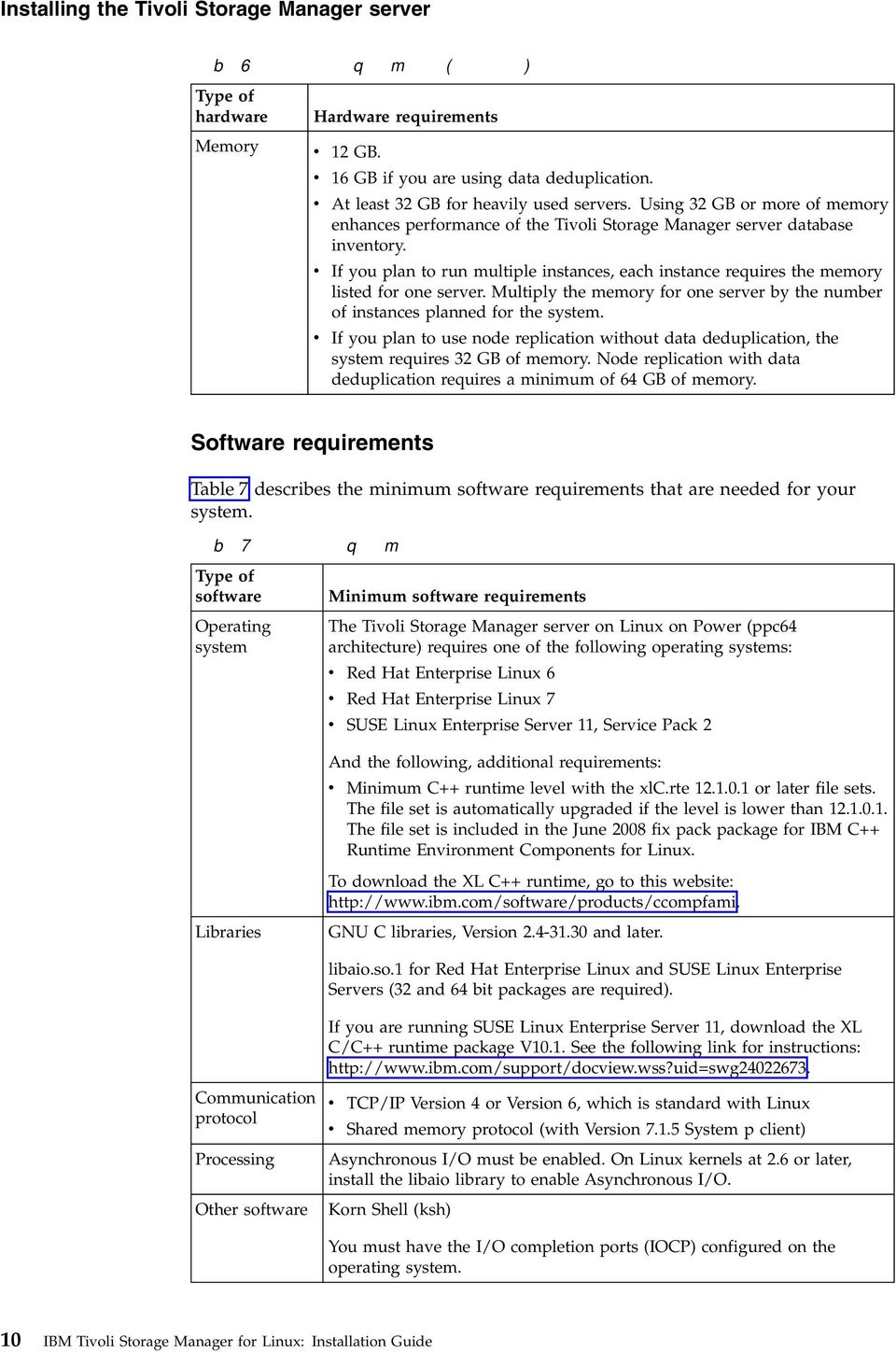
20 Installing the Tivoli Storage Manager server Table 6. Hardware requirements (continued) Type of hardware Memory Hardware requirements v 12 GB. v 16 GB if you are using data deduplication. v At least 32 GB for heavily used servers. Using 32 GB or more of memory enhances performance of the Tivoli Storage Manager server database inventory. v If you plan to run multiple instances, each instance requires the memory listed for one server. Multiply the memory for one server by the number of instances planned for the system. v If you plan to use node replication without data deduplication, the system requires 32 GB of memory. Node replication with data deduplication requires a minimum of 64 GB of memory. Software requirements Table 7 describes the minimum software requirements that are needed for your system. Table 7. Software requirements Type of software Operating system Minimum software requirements The Tivoli Storage Manager server on Linux on Power (ppc64 architecture) requires one of the following operating systems: v Red Hat Enterprise Linux 6 v Red Hat Enterprise Linux 7 v SUSE Linux Enterprise Server 11, Service Pack 2 Libraries And the following, additional requirements: v Minimum C++ runtime level with the xlc.rte or later file sets. The file set is automatically upgraded if the level is lower than The file set is included in the June 2008 fix pack package for IBM C++ Runtime Environment Components for Linux. To download the XL C++ runtime, go to this website: GNU C libraries, Version and later. libaio.so.1 for Red Hat Enterprise Linux and SUSE Linux Enterprise Servers (32 and 64 bit packages are required). Communication protocol Processing Other software If you are running SUSE Linux Enterprise Server 11, download the XL C/C++ runtime package V10.1. See the following link for instructions: v TCP/IP Version 4 or Version 6, which is standard with Linux v Shared memory protocol (with Version System p client) Asynchronous I/O must be enabled. On Linux kernels at 2.6 or later, install the libaio library to enable Asynchronous I/O. Korn Shell (ksh) You must have the I/O completion ports (IOCP) configured on the operating system. 10 IBM Tivoli Storage Manager for Linux: Installation Guide
21 Installing the Tivoli Storage Manager server Remember: Raw logical volumes are not supported. Compatibility of the Tivoli Storage Manager server with other DB2 products on the system You can install other products that deploy and use DB2 products on the same system as the Tivoli Storage Manager Version server, with some limitations. To install and use other products that use a DB2 product on the same system as the Tivoli Storage Manager server, ensure that the following criteria are met: Table 8. Compatibility of the Tivoli Storage Manager server with other DB2 products on the system Criterion Version level User IDs and directories Instructions The other products that use a DB2 product must use DB2 version 9 or later. DB2 products include product encapsulation and segregation support beginning with Version 9. Starting with this version, you can run multiple copies of DB2 products, at different code levels, on the same system. For details, see the information about multiple DB2 copies in the DB2 product information. Ensure that the user IDs, fence user IDs, installation location, other directories, and related information are not shared across DB2 installations. Your specifications must be different from the IDs and locations that you used for the Tivoli Storage Manager server installation and configuration. If you used the dsmicfgx wizard or dsmupgdx wizard to configure Version 7.1.5, or upgrade the server from Version 5.5, these are values that you entered when running the wizard. If you used the manual configuration for Version or upgrade from Version 5.5 procedures, review the procedures that you used if necessary to recall the values that were used for the server. Chapter 1. Planning to install the IBM Tivoli Storage Manager server 11
22 Installing the Tivoli Storage Manager server Table 8. Compatibility of the Tivoli Storage Manager server with other DB2 products on the system (continued) Criterion Resource allocation Instructions Consider the resources and capability of the system compared to the requirements for both the Tivoli Storage Manager server and the other applications that use the DB2 product. To provide sufficient resources for the other DB2 applications, you might have to change the Tivoli Storage Manager server settings so that the server uses less system memory and resources. Similarly, if the workloads for the other DB2 applications compete with the Tivoli Storage Manager server for processor or memory resources, the performance of the server in handling the expected client workload or other server operations might be adversely affected. To segregate resources and provide more capability for the tuning and allocation of processor, memory, and other system resources for multiple applications, consider using logical partition (LPAR), workload partition (WPAR), or other virtual workstation support. For example, run a DB2 application on its own virtualized system. IBM Installation Manager Tivoli Storage Manager uses IBM Installation Manager, which is an installation program that can use remote or local software repositories to install or update many IBM products. If the required version of IBM Installation Manager is not already installed, it is automatically installed or upgraded when you install Tivoli Storage Manager. It must remain installed on the system so that Tivoli Storage Manager can be updated or uninstalled later as needed. The following list contains explanations of some terms that are used in IBM Installation Manager: Offering An installable unit of a software product. The Tivoli Storage Manager offering contains all of the media that IBM Installation Manager requires to install Tivoli Storage Manager. Package The group of software components that are required to install an offering. The Tivoli Storage Manager package contains the following components: v IBM Installation Manager installation program v Tivoli Storage Manager offering Package group A set of packages that share a common parent directory. 12 IBM Tivoli Storage Manager for Linux: Installation Guide
23 Installing the Tivoli Storage Manager server The default package group for the Tivoli Storage Manager package is IBM Installation Manager. Repository A remote or local storage area for data and other application resources. The Tivoli Storage Manager package is stored in a repository on IBM Fix Central. Shared resources directory A directory that contains software files or plug-ins that are shared by packages. IBM Installation Manager stores installation-related files in the shared resources directory, including files that are used for rolling back to a previous version of Tivoli Storage Manager. Worksheets for planning details for the server You can use the worksheets to help you plan the amount and location of storage needed for the Tivoli Storage Manager server. You can also use them to keep track of names and user IDs. See IBM Tivoli Storage Manager Optimizing Performance (V7.1.1) for server configuration guidelines and best practices. Item Space required Number of directories Location of directories The database Active log Archive log Optional: Log mirror for the active log Optional: Secondary archive log (failover location for archive log) Item Names and user IDs Location The instance user ID for the server, which is the ID you use to start and run the Tivoli Storage Manager server The home directory for the server, which is the directory that contains the instance user ID The database instance name The instance directory for the server, which is a directory that contains files specifically for this server instance (the server options file and other server-specific files) The server name, use a unique name for each server Chapter 1. Planning to install the IBM Tivoli Storage Manager server 13
24 Installing the Tivoli Storage Manager server Capacity planning Capacity planning for Tivoli Storage Manager includes managing resources such as the database, the recovery log and the shared resource area. To maximize resources as part of capacity planning, you must estimate space requirements for the database and the recovery log. The shared resource area must have enough space available for each installation or upgrade. Estimating space requirements for the database To estimate space requirements for the database, you can use the maximum number of files that can be in server storage at one time or you can use storage pool capacity. About this task Consider using at least 25 GB for the initial database space. Provision file system space appropriately. A database size of 25 GB is adequate for a test environment or a library-manager-only environment. For a production server supporting client workloads, the database size is expected to be larger. If you use random-access disk (DISK) storage pools, more database and log storage space is needed than for sequential-access storage pools. The maximum size of the Tivoli Storage Manager database is 4 TB. For information about sizing the database in a production environment that is based on the number of files and on storage pool size, see the following topics. Estimating database space requirements based on the number of files If you can estimate the maximum number of files that might be in server storage at a time, you can use that number to estimate space requirements for the database. About this task To estimate space requirements that is based on the maximum number of files in server storage, use the following guidelines: v bytes for each stored version of a file, including image backups. Restriction: The guideline does not include space that is used during data deduplication. v bytes for each cached file, copy storage pool file, active-data pool file, and deduplicated file. v Additional space is required for database optimization to support varying data-access patterns and to support server back-end processing of the data. The amount of extra space is equal to 50% of the estimate for the total number of bytes for file objects. In the following example for a single client, the calculations are based on the maximum values in the preceding guidelines. The examples do not take into account that you might use file aggregation. In general, when you aggregate small files, it reduces the amount of required database space. File aggregation does not affect space-managed files. 14 IBM Tivoli Storage Manager for Linux: Installation Guide
25 Installing the Tivoli Storage Manager server Procedure 1. Calculate the number of file versions. Add each of the following values to obtain the number of file versions: a. Calculate the number of backed-up files. For example, as many as 500,000 client files might be backed up at a time. In this example, storage policies are set to keep up to three copies of backed up files: 500,000 files * 3 copies = 1,500,000 files b. Calculate the number of archive files. For example, as many as 100,000 client files might be archived copies. c. Calculate the number of space-managed files. For example, as many as 200,000 client files might be migrated from client workstations. Using 1000 bytes per file, the total amount of database space that is required for the files that belong to the client is 1.8 GB: (1,500, , ,000) * 1000 = 1.8 GB 2. Calculate the number of cached files, copy storage-pool files, active-data pool files, and deduplicated files: a. Calculate the number of cached copies. For example, caching is enabled in a 5 GB disk storage pool. The high migration threshold of the pool is 90% and the low migration threshold of the pool is 70%. Thus, 20% of the disk pool, or 1 GB, is occupied by cached files. If the average file size is about 10 KB, approximately 100,000 files are in cache at any one time: 100,000 files * 200 bytes = 19 MB b. Calculate the number of copy storage-pool files. All primary storage pools are backed up to the copy storage pool: (1,500, , ,000) * 200 bytes = 343 MB c. Calculate the number of active storage-pool files. All the active client-backup data in primary storage pools is copied to the active-data storage pool. Assume that 500,000 versions of the 1,500,000 backup files in the primary storage pool are active: 500,000 * 200 bytes = 95 MB d. Calculate the number of deduplicated files. Assume that a deduplicated storage pool contains 50,000 files: 50,000 * 200 bytes = 10 MB Based on the preceding calculations, about 0.5 GB of extra database space is required for the client s cached files, copy storage-pool files, active-data pool files, and deduplicated files. 3. Calculate the amount of extra space that is required for database optimization. To provide optimal data access and management by the server, extra database space is required. The amount of extra database space is equal to 50% of the total space requirements for file objects. ( ) * 50% = 1.2 GB 4. Calculate the total amount of database space that is required for the client. The total is approximately 3.5 GB: = 3.5 GB 5. Calculate the total amount of database space that is required for all clients. If the client that was used in the preceding calculations is typical and you have 500 clients, for example, you can use the following calculation to estimate the total amount of database space that is required for all clients: 500 * 3.5 = 1.7 TB Chapter 1. Planning to install the IBM Tivoli Storage Manager server 15
26 Installing the Tivoli Storage Manager server Results Tip: In the preceding examples, the results are estimates. The actual size of the database might differ from the estimate because of factors such as the number of directories and the length of the path and file names. Periodically monitor your database and adjust its size as necessary. What to do next During normal operations, the Tivoli Storage Manager server might require temporary database space. This space is needed for the following reasons: v To hold the results of sorting or ordering that are not already being kept and optimized in the database directly. The results are temporarily held in the database for processing. v To give administrative access to the database through one of the following methods: A DB2 open database connectivity (ODBC) client An Oracle Java database connectivity (JDBC) client Structured Query Language (SQL) to the server from an administrative-client command line Consider using an extra 50 GB of temporary space for every 500 GB of space for file objects and optimization. See the guidelines in the following table. In the example that is used in the preceding step, a total of 1.7 TB of database space is required for file objects and optimization for 500 clients. Based on that calculation, 200 GB is required for temporary space. The total amount of required database space is 1.9 TB. Database size < 500 GB 50 GB 500 GB and < 1 TB 1 TB and < 1.5 TB 1.5 and < 2 TB 2 and < 3 TB 3 and < 4 TB Minimum temporary-space requirement 100 GB 150 GB 200 GB GB GB Estimating database space requirements based on storage pool capacity To estimate database space requirements based on storage pool capacity, use a ratio of 1-5%. For example, if you require 200 TB of storage pool capacity, the size of your database is expected to be 2-10 TB. As a general rule, make your database as large as possible to prevent running out of space. If you run out of database space, server operations and client-store operations can fail. 16 IBM Tivoli Storage Manager for Linux: Installation Guide
27 Installing the Tivoli Storage Manager server The database manager and temporary space The Tivoli Storage Manager server database manager manages and allocates system memory and disk space for the database. The amount of database space you require depends on the amount of system memory available and the server workload. The database manager sorts data in a specific sequence, according to the SQL statement that you issue to request the data. Depending on the workload on the server, and if there is more data than the database manager can manage, the data (that is ordered in sequence) is allocated to temporary disk space. Data is allocated to temporary disk space when there is a large result set. The database manager dynamically manages the memory that is used when data is allocated to temporary disk space. For example, expiration processing can produce a large result set. If there is not enough system memory on the database to store the result set, some of the data is allocated to temporary disk space. During expiration processing, if a node or file space are selected that are too large to process, the database manager cannot sort the data in memory. The database manager must use temporary space to sort data. To run database operations, consider adding more database space for the following scenarios: v The database has a small amount of space and the server operation that requires temporary space uses the remaining free space. v The file spaces are large, or the file spaces have an assigned policy that creates many file versions. v The Tivoli Storage Manager server must run with limited memory. The database uses the Tivoli Storage Manager server main memory to run database operations. However, if there is insufficient memory available, the Tivoli Storage Manager server allocates temporary space on disk to the database. For example, if 10G of memory is available and database operations require 12G of memory, the database uses temporary space. v An out of database space error is displayed when you deploy a Tivoli Storage Manager server. Monitor the server activity log for messages that are related to database space. Important: Do not change the DB2 software that is installed with the Tivoli Storage Manager installation packages and fix packs. Do not install or upgrade to a different version, release, or fix pack, of DB2 software to avoid damage to the database. Recovery log space requirements In Tivoli Storage Manager, the term recovery log comprises the active log, the archive log, the active log mirror, and the archive failover log. The amount of space that you require for the recovery log depends on various factors, including, for example, the amount of client activity with the server. Chapter 1. Planning to install the IBM Tivoli Storage Manager server 17
28 Installing the Tivoli Storage Manager server Active and archive log space When you estimate space requirements for active and archive logs, include some extra space for contingencies such as occasional heavy workloads and failovers. In Tivoli Storage Manager servers V7.1 and later, the active log can be a maximum size of 512 GB. The archive log size is limited to the size of the file system that it is installed on. Use the following general guidelines when you estimate the size of the active log: v The suggested starting size for the active log is 16 GB. v Ensure that the active log is at least large enough for the amount of concurrent activity that the server typically handles. As a precaution, try to anticipate the largest amount of work that the server manages at one time. Provision the active log with extra space that can be used if needed. Consider using 20% of extra space. v Monitor used and available active log space. Adjust the size of the active log as needed, depending upon factors such as client activity and the level of server operations. v Ensure that the directory that holds the active log is as large as, or larger than, the size of the active log. A directory that is larger than the active log can accommodate failovers, if they occur. v Ensure that the file system that contains the active log directory has at least 8 GB of free space for temporary log movement requirements. The suggested starting size for the archive log is 48 GB. The archive log directory must be large enough to contain the log files that are generated since the previous full backup. For example, if you perform a full backup of the database every day, the archive log directory must be large enough to hold the log files for all the client activity that occurs during 24 hours. To recover space, the server deletes obsolete archive log files after a full backup of the database. If the archive log directory becomes full and a directory for archive failover logs does not exist, log files remain in the active log directory. This condition can cause the active log directory to fill up and stop the server. When the server restarts, some of the existing active-log space is released. After the server is installed, you can monitor archive log utilization and the space in the archive log directory. If the space in the archive log directory fills up, it can cause the following problems: v The server is unable to perform full database backups. Investigate and resolve this problem. v Other applications write to the archive log directory, exhausting the space that is required by the archive log. Do not share archive log space with other applications including other Tivoli Storage Manager servers. Ensure that each server has a separate storage location that is owned and managed by that specific server. 18 IBM Tivoli Storage Manager for Linux: Installation Guide
29 Installing the Tivoli Storage Manager server Table 9. Basic client-store operations Item Maximum number of client nodes that back up, archive, or migrate files concurrently at any time Example: Estimating active and archive log sizes for basic client-store operations: Basic client-store operations include backup, archive, and space management. Log space must be sufficient to handle all store transactions that are in progress at one time. To determine the sizes of the active and archive logs for basic client-store operations, use the following calculation: number of clients x files stored during each transaction x log space needed for each file This calculation is used in the example in the following table. Example values Description 300 The number of client nodes that back up, archive, or migrate files every night. Files stored during each transaction 4096 The default value of the server option TXNGROUPMAX is Log space that is required for each file 3053 bytes The value of 3053 bytes for each file in a transaction represents the log bytes that are needed when backing up files from a Windows client where the file names are bytes. This value is based on the results of tests performed under laboratory conditions. The tests consisted of backup-archive clients performing backup operations to a random-access disk (DISK) storage pool. DISK pools result in more log use than sequential-access storage pools. Consider a value larger than 3053 bytes if the data being stored has file names that are longer than bytes. Active log: Suggested size 19.5 GB 1 Use the following calculation to determine the size of the active log. One GB equals 1,073,741,824 bytes. (300 clients x 4096 files stored during each transaction x 3053 bytes for each file) 1,073,741,824 bytes = 3.5 GB Increase that amount by the suggested starting size of 16 GB: = 19.5 GB Archive log: Suggested size 58.5 GB 1 Because of the requirement to be able to store archive logs across three server database-backup cycles, multiply the estimate for the active log by 3 to estimate the total archive log requirement. 3.5 x 3 = 10.5 GB Increase that amount by the suggested starting size of 48 GB: = 58.5 GB Chapter 1. Planning to install the IBM Tivoli Storage Manager server 19
30 Installing the Tivoli Storage Manager server Table 9. Basic client-store operations (continued) Item Example values Description 1 The example values in this table are used only to illustrate how the sizes for active logs and archive logs are calculated. In a production environment that does not use deduplication, 16 GB is the suggested minimum size for an active log. The suggested minimum size for an archive log in a production environment that does not use deduplication is 48 GB. If you substitute values from your environment and the results are larger than 16 GB and 48 GB, use your results to size the active log and archive log. Monitor your logs and adjust their size if necessary. Table 10. Multiple client sessions Example: Estimating active and archive log sizes for clients that use multiple sessions: If the client option RESOURCEUTILIZATION is set to a value that is greater than the default, the concurrent workload for the server increases. To determine the sizes of the active and archive logs when clients use multiple sessions, use the following calculation: number of clients x sessions for each client x files stored during each transaction x log space needed for each file This calculation is used in the example in the following table. Item Example values Description Maximum number of client nodes that back up, archive, or migrate files concurrently at any time Possible sessions for each client Files stored during each transaction Log space that is required for each file The number of client nodes that back up, archive, or migrate files every night. 3 3 The setting of the client option RESOURCEUTILIZATION is larger than the default. Each client session runs a maximum of three sessions in parallel The default value of the server option TXNGROUPMAX is The value of 3053 bytes for each file in a transaction represents the log bytes needed when backing up files from a Windows client where the file names are bytes. This value is based on the results of tests performed under laboratory conditions. Tests consisted of clients performing backup operations to a random-access disk (DISK) storage pool. DISK pools result in more log use than sequential-access storage pools. Consider a value larger than 3053 bytes if the data being stored has file names that are longer than bytes. 20 IBM Tivoli Storage Manager for Linux: Installation Guide
31 Installing the Tivoli Storage Manager server Table 10. Multiple client sessions (continued) Item Example values Description Active log: Suggested size 26.5 GB 1 51 GB 1 The following calculation was used for 300 clients. One GB equals 1,073,741,824 bytes. (300 clients x 3 sessions for each client x 4096 files stored during each transaction x 3053 bytes for each file) 1,073,741,824 = 10.5 GB Increase that amount by the suggested starting size of 16 GB: = 26.5 GB The following calculation was used for 1000 clients. One GB equals 1,073,741,824 bytes. (1000 clients x 3 sessions for each client x 4096 files store during each transaction x 3053 bytes for each file) 1,073,741,824 = 35 GB Increase that amount by the suggested starting size of 16 GB: = 51 GB Archive log: Suggested size 79.5 GB GB 1 Because of the requirement to be able to store archive logs across three server-database backup cycles, the estimate for the active log is multiplied by 3: 10.5 x 3 = 31.5 GB 35 x 3 = 105 GB Increase those amounts by the suggested starting size of 48 GB: = 79.5 GB = 153 GB 1 The example values in this table are used only to illustrate how the sizes for active logs and archive logs are calculated. In a production environment that does not use deduplication, 16 GB is the suggested minimum size for an active log. The suggested minimum size for an archive log in a production environment that does not use deduplication is 48 GB. If you substitute values from your environment and the results are larger than 16 GB and 48 GB, use your results to size the active log and archive log. Monitor your active log and adjust its size if necessary. Example: Estimating active and archive log sizes for simultaneous write operations: If client backup operations use storage pools that are configured for simultaneous write, the amount of log space that is required for each file increases. The log space that is required for each file increases by about 200 bytes for each copy storage pool that is used for a simultaneous write operation. In the example in the following table, data is stored to two copy storage pools in addition to a primary storage pool. The estimated log size increases by 400 bytes for each file. If you use the suggested value of 3053 bytes of log space for each file, the total number of required bytes is Chapter 1. Planning to install the IBM Tivoli Storage Manager server 21
32 Installing the Tivoli Storage Manager server Table 11. Simultaneous write operations Item Maximum number of client nodes that back up, archive, or migrate files concurrently at any time This calculation is used in the example in the following table. Example values Description 300 The number of client nodes that back up, archive, or migrate files every night. Files stored during each transaction 4096 The default value of the server option TXNGROUPMAX is Log space that is required for each file 3453 bytes 3053 bytes plus 200 bytes for each copy storage pool. The value of 3053 bytes for each file in a transaction represents the log bytes that are needed when backing up files from a Windows client where the file names are bytes. This value is based on the results of tests performed under laboratory conditions. The tests consisted of backup-archive clients performing backup operations to a random-access disk (DISK) storage pool. DISK pools result in more log use than sequential-access storage pools. Consider a value larger than 3053 bytes if the data being stored has file names that are longer than bytes. Active log: Suggested size 20 GB 1 Use the following calculation to determine the size of the active log. One GB equals 1,073,741,824 bytes. (300 clients x 4096 files stored during each transaction x 3453 bytes for each file) 1,073,741,824 bytes = 4.0 GB Increase that amount by the suggested starting size of 16 GB: = 20 GB Archive log: Suggested size 60 GB 1 Because of the requirement to be able to store archive logs across three server database-backup cycles, multiply the estimate for the active log by 3 to estimate the archive log requirement: 4 GB x 3 = 12 GB Increase that amount by the suggested starting size of 48 GB: = 60 GB 1 The example values in this table are used only to illustrate how the sizes for active logs and archive logs are calculated. In a production environment that does not use deduplication, 16 GB is the suggested minimum size for an active log. The suggested minimum size for an archive log in a production environment that does not use deduplication is 48 GB. If you substitute values from your environment and the results are larger than 16 GB and 48 GB, use your results to size the active log and archive log. Monitor your logs and adjust their size if necessary. 22 IBM Tivoli Storage Manager for Linux: Installation Guide
33 Installing the Tivoli Storage Manager server Table 12. Full database backups Item Maximum number of client nodes that back up, archive, or migrate files concurrently at any time Example: Estimating active and archive log sizes for basic client store operations and server operations: Migration of data in server storage, identification processes for data deduplication, reclamation, and expiration might run concurrently with client store operations. Administrative tasks such as administrative commands or SQL queries from administrative clients can also run concurrently with client store operations. Server operations and administrative tasks that run concurrently can increase the active log space that is required. For example, migration of files from the random-access (DISK) storage pool to a sequential-access disk (FILE) storage pool uses approximately 110 bytes of log space for each file that is migrated. For example, suppose that you have 300 backup-archive clients and each one of them backs up 100,000 files every night. The files are initially stored on DISK and then migrated to a FILE storage pool. To estimate the amount of active log space that is required for the data migration, use the following calculation. The number of clients in the calculation represents the maximum number of client nodes that back up, archive, or migrate files concurrently at any time. 300 clients x 100,000 files for each client x 110 bytes = 3.1 GB Add this value to the estimate for the size of the active log that calculated for basic client store operations. Example: Estimating active and archive log sizes under conditions of extreme variation: Problems with running out of active log space can occur if you have many transactions that complete quickly and some transactions that take much longer to complete. A typical case occurs when many workstation or file-server backup sessions are active and a few very large database server-backup sessions are active. If this situation applies to your environment, you might need to increase the size of the active log so that the work completes successfully. Example: Estimating archive log sizes with full database backups: The Tivoli Storage Manager server deletes unnecessary files from the archive log only when a full database backup occurs. Consequently, when you estimate the space that is required for the archive log, you must also consider the frequency of full database backups. For example, if a full database backup occurs once a week, the archive log space must be able to contain the information in the archive log for a full week. The difference in archive log size for daily and full database backups is shown in the example in the following table. Example values Description 300 The number of client nodes that back up, archive, or migrate files every night. Files stored during each transaction 4096 The default value of the server option TXNGROUPMAX is Chapter 1. Planning to install the IBM Tivoli Storage Manager server 23
34 Installing the Tivoli Storage Manager server Table 12. Full database backups (continued) Item Log space that is required for each file Example values Description 3453 bytes 3053 bytes for each file plus 200 bytes for each copy storage pool. The value of 3053 bytes for each file in a transaction represents the log bytes needed when backing up files from a Windows client where the file names are bytes. This value is based on the results of tests performed under laboratory conditions. Tests consisted of clients performing backup operations to a random-access disk (DISK) storage pool. DISK pools result in more log use than sequential-access storage pools. Consider a value larger than 3053 bytes if the data being stored has file names that are longer than bytes. Active log: Suggested size 20 GB 1 Use the following calculation to determine the size of the active log. One GB equals 1,073,741,824 bytes. (300 clients x 4096 files per transaction x 3453 bytes per file) 1,073,741,824 bytes = 4.0 GB Increase that amount by the suggested starting size of 16 GB: Archive log: Suggested size with a full database backup every day = 20 GB 60 GB 1 Because of the requirement to be able to store archive logs across three backup cycles, multiply the estimate for the active log by 3 to estimate the total archive log requirement: 4 GB x 3 = 12 GB Increase that amount by the suggested starting size of 48 GB: Archive log: Suggested size with a full database every week = 60 GB 132 GB 1 Because of the requirement to be able to store archive logs across three server database-backup cycles, multiply the estimate for the active log by 3 to estimate the total archive log requirement. Multiply the result by the number of days between full database backups: (4 GB x 3 ) x 7 = 84 GB Increase that amount by the suggested starting size of 48 GB: = 132 GB 1 The example values in this table are used only to illustrate how the sizes for active logs and archive logs are calculated. In a production environment that does not use deduplication, 16 GB is the suggested minimum size for an active log. The suggested starting size for an archive log in a production environment that does not use deduplication is 48 GB. If you substitute values from your environment and the results are larger than 16 GB and 48 GB, use your results to size the active log and archive log. Monitor your logs and adjust their size if necessary. 24 IBM Tivoli Storage Manager for Linux: Installation Guide
35 Installing the Tivoli Storage Manager server Example: Estimating active and archive log sizes for data deduplication operations: If you deduplicate data, you must consider its effects on space requirements for active and archive logs. The following factors affect requirements for active and archive log space: The amount of deduplicated data The effect of data deduplication on the active log and archive log space depends on the percentage of data that is eligible for deduplication. If the percentage of data that can be deduplicated is relatively high, more log space is required. The size and number of extents Approximately 1,500 bytes of active log space are required for each extent that is identified by a duplicate-identification process. For example, if 250,000 extents are identified by a duplicate-identification process, the estimated size of the active log is 358 MB: 250,000 extents identified during each process x 1,500 bytes for each extent = 358 MB Consider the following scenario. Three hundred backup-archive clients back up 100,000 files each night. This activity creates a workload of 30,000,000 files. The average number of extents for each file is two. Therefore, the total number of extents is 60,000,000, and the space requirement for the archive log is 84 GB: 60,000,000 extents x 1,500 bytes for each extent = 84 GB A duplicate-identification process operates on aggregates of files. An aggregate consists of files that are stored in a given transaction, as specified by the TXNGROUPMAX server option. Suppose that the TXNGROUPMAX server option is set to the default of If the average number of extents for each file is two, the total number of extents in each aggregate is 8192, and the space required for the active log is 12 MB: 8192 extents in each aggregate x 1500 bytes for each extent = 12 MB The timing and number of the duplicate-identification processes The timing and number of duplicate-identification processes also affects the size of the active log. Using the 12 MB active-log size that was calculated in the preceding example, the concurrent load on the active log is 120 MB if 10 duplicate-identification processes are running in parallel: 12 MB for each process x 10 processes = 120 MB File size Large files that are processed for duplicate identification can also affect the size of the active log. For example, suppose that a backup-archive client backs up an 80 GB, file-system image. This object can have a high number of duplicate extents if, for example, the files included in the file system image were backed up incrementally. For example, assume that a file system image has 1.2 million duplicate extents. The 1.2 million extents in this large file represent a single transaction for a duplicate-identification process. The total space in the active log that is required for this single object is 1.7 GB: 1,200,000 extents x 1,500 bytes for each extent = 1.7 GB Chapter 1. Planning to install the IBM Tivoli Storage Manager server 25
36 Installing the Tivoli Storage Manager server Table 13. Average duplicate-extent size of 700 KB If other, smaller duplicate-identification processes occur at the same time as the duplicate-identification process for a single large object, the active log might not have enough space. For example, suppose that a storage pool is enabled for deduplication. The storage pool has a mixture of data, including many relatively small files that range from 10 KB to several hundred KB. The storage pool also has few large objects that have a high percentage of duplicate extents. To take into account not only space requirements but also the timing and duration of concurrent transactions, increase the estimated size of the active log by a factor of two. For example, suppose that your calculations for space requirements are 25 GB (23.3 GB GB for deduplication of a large object). If deduplication processes are running concurrently, the suggested size of the active log is 50 GB. The suggested size of the archive log is 150 GB. The examples in the following tables show calculations for active and archive logs. The example in the first table uses an average size of 700 KB for extents. The example in the second table uses an average size of 256 KB. As the examples show, the average deduplicate-extent size of 256 KB indicates a larger estimated size for the active log. To minimize or prevent operational problems for the server, use 256 KB to estimate the size of the active log in your production environment. Item Example values Description Size of largest single object to deduplicate Average size of extents Extents for a given file 800 GB 4 TB The granularity of processing for deduplication is at the file level. Therefore, the largest single file to deduplicate represents the largest transaction and a correspondingly large load on the active and archive logs. 700 KB 700 KB The deduplication algorithms use a variable block method. Not all deduplicated extents for a given file are the same size, so this calculation assumes an average size for extents. 1,198,372 bits 6,135,667 bits Using the average extent size (700 KB), these calculations represent the total number of extents for a given object. The following calculation was used for an 800 GB object: (800 GB 700 KB) = 1,198,372 bits Active log: Suggested size that is required for the deduplication of a single large object during a single duplicateidentification process The following calculation was used for a 4 TB object: (4 TB 700 KB) = 6,135,667 bits 1.7 GB 8.6 GB The estimated active log space that are needed for this transaction. 26 IBM Tivoli Storage Manager for Linux: Installation Guide
37 Installing the Tivoli Storage Manager server Table 13. Average duplicate-extent size of 700 KB (continued) Item Example values Description Active log: Suggested total size 66 GB GB 1 After considering other aspects of the workload on the server in addition to deduplication, multiply the existing estimate by a factor of two. In these examples, the active log space required to deduplicate a single large object is considered along with previous estimates for the required active log size. The following calculation was used for multiple transactions and an 800 GB object: (23.3 GB GB) x 2 = 50 GB Increase that amount by the suggested starting size of 16 GB: = 66 GB The following calculation was used for multiple transactions and a 4 TB object: (23.3 GB GB) x 2 = 63.8 GB Increase that amount by the suggested starting size of 16 GB: Archive log: Suggested size = 79.8 GB 198 GB GB 1 Multiply the estimated size of the active log by a factor of 3. The following calculation was used for multiple transactions and an 800 GB object: 50 GB x 3 = 150 GB Increase that amount by the suggested starting size of 48 GB: = 198 GB The following calculation was used for multiple transactions and a 4 TB object: 63.8 GB x 3 = GB Increase that amount by the suggested starting size of 48 GB: = GB 1 The example values in this table are used only to illustrate how the sizes for active logs and archive logs are calculated. In a production environment that uses deduplication, 32 GB is the suggested minimum size for an active log. The suggested minimum size for an archive log in a production environment that uses deduplication is 96 GB. If you substitute values from your environment and the results are larger than 32 GB and 96 GB, use your results to size the active log and archive log. Monitor your logs and adjust their size if necessary. Table 14. Average duplicate-extent size of 256 KB Item Example values Description Size of largest single object to deduplicate 800 GB 4 TB The granularity of processing for deduplication is at the file level. Therefore, the largest single file to deduplicate represents the largest transaction and a correspondingly large load on the active and archive logs. Chapter 1. Planning to install the IBM Tivoli Storage Manager server 27
38 Installing the Tivoli Storage Manager server Table 14. Average duplicate-extent size of 256 KB (continued) Item Example values Description Average size of extents Extents for a given file 256 KB 256 KB The deduplication algorithms use a variable block method. Not all deduplicated extents for a given file are the same size, so this calculation assumes an average extent size. 3,276,800 bits 16,777,216 bits Using the average extent size, these calculations represent the total number of extents for a given object. The following calculation was used for multiple transactions and an 800 GB object: (800 GB 256 KB) = 3,276,800 bits The following calculation was used for multiple transactions and a 4 TB object: Active log: Suggested size that is required for the deduplication of a single large object during a single duplicateidentification process Active log: Suggested total size (4 TB 256 KB) = 16,777,216 bits 4.5 GB 23.4 GB The estimated size of the active log space that is required for this transaction GB GB 1 After considering other aspects of the workload on the server in addition to deduplication, multiply the existing estimate by a factor of 2. In these examples, the active log space required to deduplicate a single large object is considered along with previous estimates for the required active log size. The following calculation was used for multiple transactions and an 800 GB object: (23.3 GB GB) x 2 = 55.6 GB Increase that amount by the suggested starting size of 16 GB: = 71.6 GB The following calculation was used for multiple transactions and a 4 TB object: (23.3 GB GB) x 2 = 93.4 GB Increase that amount by the suggested starting size of 16 GB: = GB 28 IBM Tivoli Storage Manager for Linux: Installation Guide
39 Installing the Tivoli Storage Manager server Table 14. Average duplicate-extent size of 256 KB (continued) Item Example values Description Archive log: Suggested size GB GB 1 The estimated size of the active log multiplied by a factor of 3. The following calculation was used for an 800 GB object: 55.6 GB x 3 = GB Increase that amount by the suggested starting size of 48 GB: = GB The following calculation was used for a 4 TB object: 93.4 GB x 3 = GB Increase that amount by the suggested starting size of 48 GB: = GB 1 The example values in this table are used only to illustrate how the sizes for active logs and archive logs are calculated. In a production environment that uses deduplication, 32 GB is the suggested minimum size for an active log. The suggested minimum size for an archive log in a production environment that uses deduplication is 96 GB. If you substitute values from your environment and the results are larger than 32 GB and 96 GB, use your results to size the active log and archive log. Monitor your logs and adjust their size if necessary. Active-log mirror space The active log can be mirrored so that the mirrored copy can be used if the active log files cannot be read. There can be only one active log mirror. Creating a log mirror is a suggested option. If you increase the size of the active log, the log mirror size is increased automatically. Mirroring the log can affect performance because of the doubled I/O activity that is required to maintain the mirror. The additional space that the log mirror requires is another factor to consider when deciding whether to create a log mirror. If the mirror log directory becomes full, the server issues error messages to the activity log and to the db2diag.log. Server activity continues. Archive-failover log space The archive failover log is used by the server if the archive log directory runs out of space. Specifying an archive failover log directory can prevent problems that occur if the archive log runs out of space. If both the archive log directory and the drive or file system where the archive failover log directory is located become full, the data remains in the active log directory. This condition can cause the active log to fill up, which causes the server to halt. Chapter 1. Planning to install the IBM Tivoli Storage Manager server 29
40 Installing the Tivoli Storage Manager server Monitoring space utilization for the database and recovery logs To determine the amount of used and available active log space, you issue the QUERY LOG command. To monitor space utilization in the database and recovery logs, you can also check the activity log for messages. Active log If the amount of available active log space is too low, the following messages are displayed in the activity log: ANR4531I: IC_AUTOBACKUP_LOG_USED_SINCE_LAST_BACKUP_TRIGGER This message is displayed when the active log space exceeds the maximum specified size. The Tivoli Storage Manager server starts a full database backup. To change the maximum log size, halt the server. Open the dsmserv.opt file, and specify a new value for the ACTIVELOGSIZE option. When you are finished, restart the server. ANR0297I: IC_BACKUP_NEEDED_LOG_USED_SINCE_LAST_BACKUP This message is displayed when the active log space exceeds the maximum specified size. You must back up the database manually. To change the maximum log size, halt the server. Open the dsmserv.opt file, and specify a new value for the ACTIVELOGSIZE option. When you are finished, restart the server. ANR4529I: IC_AUTOBACKUP_LOG_UTILIZATION_TRIGGER The ratio of used active-log space to available active-log space exceeds the log utilization threshold. If at least one full database backup has occurred, the Tivoli Storage Manager server starts an incremental database backup. Otherwise, the server starts a full database backup. ANR0295I: IC_BACKUP_NEEDED_LOG_UTILIZATION The ratio of used active-log space to available active-log space exceeds the log utilization threshold. You must back up the database manually. Archive log If the amount of available archive log space is too low, the following message is displayed in the activity log: ANR0299I: IC_BACKUP_NEEDED_ARCHLOG_USED The ratio of used archive-log space to available archive-log space exceeds the log utilization threshold. The Tivoli Storage Manager server starts a full automatic database backup. Database If the amount of space available for database activities is too low, the following messages are displayed in the activity log: ANR2992W: IC_LOG_FILE_SYSTEM_UTILIZATION_WARNING_2 The used database space exceeds the threshold for database space utilization. To increase the space for the database, use the EXTEND DBSPACE command, the EXTEND DBSPACE command, or the DSMSERV FORMAT utility with the DBDIR parameter. 30 IBM Tivoli Storage Manager for Linux: Installation Guide
41 Installing the Tivoli Storage Manager server ANR1546W: FILESYSTEM_DBPATH_LESS_1GB The available space in the directory where the server database files are located is less than 1 GB. When a Tivoli Storage Manager server is created with the DSMSERV FORMAT utility or with the configuration wizard, a server database and recovery log are also created. In addition, files are created to hold database information used by the database manager. The path specified in this message indicates the location of the database information used by the database manager. If space is unavailable in the path, the server can no longer function. You must add space to the file system or make space available on the file system or disk. Deleting installation rollback files You can delete certain installation files that were saved during the installation process to free space in the shared resource directory. For example, files that might have been required for a rollback operation are types of files that you can delete. About this task To delete the files that are no longer needed, use either the installation graphical wizard or the command line in console mode. Deleting installation rollback files by using a graphical wizard You can delete certain installation files that were saved during installation process by using the IBM Installation Manager user interface. Procedure 1. Open IBM Installation Manager. In the directory where IBM Installation Manager is installed, go to the eclipse subdirectory (for example, /opt/ibm/installationmanager/eclipse), and issue the following command to start IBM Installation Manager:./IBMIM 2. Click File > Preferences. 3. Select Files for Rollback. 4. Click Delete Saved Files and click OK. Deleting installation rollback files by using the command line You can delete certain installation files that were saved during the installation process by using the command line. Procedure 1. In the directory where IBM Installation Manager is installed, go to the following subdirectory: eclipse/tools For example: /opt/ibm/installationmanager/eclipse/tools 2. From the tools directory, issue the following command to start an IBM Installation Manager command line:./imcl -c 3. Enter P to select Preferences. Chapter 1. Planning to install the IBM Tivoli Storage Manager server 31
42 Installing the Tivoli Storage Manager server 4. Enter 3 to select Files for Rollback. 5. Enter D to Delete the Files for Rollback. 6. Enter A to Apply Changes and Return to Preferences Menu. 7. Enter C to leave the Preference Menu. 8. Enter X to Exit Installation Manager. Server naming best practices Use these descriptions as a reference when you install or upgrade a Tivoli Storage Manager server. Instance user ID The instance user ID is used as the basis for other names related to the server instance. The instance user ID is also called the instance owner. For example: tsminst1 The instance user ID is the user ID that must have ownership or read/write access authority to all directories that you create for the database and the recovery log. The standard way to run the server is under the instance user ID. That user ID must also have read/write access to the directories that are used for any FILE device classes. Home directory for the instance user ID The home directory can be created when creating the instance user ID, by using the option (-m) to create a home directory if it does not exist already. Depending on local settings, the home directory might have the form: /home/instance_user_id For example: /home/tsminst1 The home directory is primarily used to contain the profile for the user ID and for security settings. Database instance name The database instance name must be the same as the instance user ID under which you run the server instance. For example: tsminst1 Instance directory The instance directory is a directory that contains files specifically for a server instance (the server options file and other server-specific files). It can have any name that you want. For easier identification, use a name that ties the directory to the instance name. You can create the instance directory as a subdirectory of the home directory for the instance user ID. For example: /home/instance_user_id/ instance_user_id The following example places the instance directory in the home directory for user ID tsminst1: /home/tsminst1/tsminst1 You can also create the directory in another location, for example: /tsmserver/tsminst1 32 IBM Tivoli Storage Manager for Linux: Installation Guide
43 Installing the Tivoli Storage Manager server The instance directory stores the following files for the server instance: v The server options file, dsmserv.opt v The server key database file, cert.kdb, and the.arm files (used by clients and other servers to import the Secure Sockets Layer certificates of the server) v Device configuration file, if the DEVCONFIG server option does not specify a fully qualified name v Volume history file, if the VOLUMEHISTORY server option does not specify a fully qualified name v Volumes for DEVTYPE=FILE storage pools, if the directory for the device class is not fully specified, or not fully qualified v User exits v Trace output (if not fully qualified) Database name The database name is always TSMDB1, for every server instance. This name cannot be changed. Server name The server name is an internal name for Tivoli Storage Manager, and is used for operations that involve communication among multiple Tivoli Storage Manager servers. Examples include server-to-server communication and library sharing. The server name is also used when you add the server to the Operations Center so that it can be managed using that interface. Use a unique name for each server. For easy identification in the Operations Center (or from a QUERY SERVER command), use a name that reflects the location or purpose of the server. Do not change the name of a Tivoli Storage Manager server after it is configured as a hub or spoke server. If you use the wizard, the default name that is suggested is the host name of the system that you are using. You can use a different name that is meaningful in your environment. If you have more than one server on the system and you use the wizard, you can use the default name for only one of the servers. You must enter a unique name for each server. For example: PAYROLL SALES Directories for database space and recovery log The directories can be named according to local practices. For easier identification, consider using names that tie the directories to the server instance. For example, for the archive log: /tsminst1_archlog Chapter 1. Planning to install the IBM Tivoli Storage Manager server 33
44 Installing the Tivoli Storage Manager server Installation directories Installation directories for the Tivoli Storage Manager server include the server, DB2, device, language, and other directories. Each one contains several additional directories. The default directories and their subdirectories are listed here for the server, DB2, devices, and languages: v Server directory (/opt/tivoli/tsm/server/bin), which contains: Server code and licensing v Additional server directories: The command and message help are in the /opt/tivoli/tsm/server/bin directory. v DB2 directories The DB2 product that is installed as part of the installation of the Tivoli Storage Manager server has the directory structure as documented in DB2 information sources. Protect these directories and files as you do the server directories. /opt/tivoli/tsm/db2 v Device directories /opt/tivoli/tsm/devices/bin v Language directory Language-dependent portions of the program are located here: /opt/tivoli/tsm/server/bin You can use US English, German, French, Italian, Spanish, Brazilian Portuguese, Korean, Japanese, traditional Chinese, simplified Chinese, Chinese GBK, Chinese Big5, and Russian. 34 IBM Tivoli Storage Manager for Linux: Installation Guide
45 Chapter 2. Installing the server components To install the Version server components, you can use the installation wizard, the command line in console mode, or silent mode. About this task Using the Tivoli Storage Manager installation software, you can install the following components: v Server v v v Tip: The database (DB2), the Global Security Kit (GSKit) and IBM Java Runtime Environment (JRE) are automatically installed when you select the server component. Server languages License Devices v Tivoli Storage Manager for Storage Area Networks v Operations Center Allow approximately minutes to install a V7.1.5 server, using this guide. Obtaining the installation package You can obtain the Tivoli Storage Manager installation package from a DVD or an IBM download site such as Passport Advantage or IBM Fix Central. Before you begin If you plan to download the files, set the system user limit for maximum file size to unlimited to ensure that the files can be downloaded correctly: 1. To query the maximum file size value, issue the following command: ulimit -Hf 2. If the system user limit for maximum file size is not set to unlimited, change it to unlimited by following the instructions in the documentation for your operating system. Procedure 1. Download the appropriate package file from one of the following websites, or you can access the files from the product DVD: v v v For a first time installation or a new release go to Passport Advantage to download the license. For all components except the license, download the server package from Fix Central. For the latest information, updates, and maintenance fixes, go to the IBM Support Portal. 2. If you downloaded the package from an IBM download site, complete the following steps: Copyright IBM Corp. 1993,
46 Installing the Tivoli Storage Manager server a. Verify that you have enough space to store the installation files when they are extracted from the product package. See the download document for the space requirements: v Tivoli Storage Manager technote v Tivoli Storage Manager Extended Edition technote v System Storage Archive Manager technote b. Download the package file to the directory of your choice. The path must contain no more than 128 characters. Be sure to extract the installation files to an empty directory. Do not extract to a directory that contains previously extracted files, or any other files. c. Ensure that executable permission is set for the package. If necessary, change the file permissions by issuing the following command: chmod a+x package_name.bin d. Extract the package by issuing the following command:./package_name.bin where package_name is the name of the downloaded file, for example: 7.1.x.000-TIV-TSMSRV-LinuxX64.bin 7.1.x.000-TIV-TSMSRV-LinuxS390X.bin 3. Select one of the following methods of installing Tivoli Storage Manager: v Installing by using the installation wizard v Installing Tivoli Storage Manager by using console mode on page 37 v Installing the server in silent mode on page After you install Tivoli Storage Manager, and before you customize it for your use, go to the Support Portal. Click Support and downloads and apply any applicable fixes. Installing by using the installation wizard You can install the server by using the IBM Installation Manager graphical wizard. Before you begin Take the following actions before you start the installation: v Verify that the operating system is set to the language that you require. By default, the language of the operating system is the language of the installation wizard. Procedure Install Tivoli Storage Manager by using one of the following methods: Option Installing the software from a downloaded package: Description 1. Change to the directory where you downloaded the package. 2. Start the installation wizard by issuing the following command:./install.sh 36 IBM Tivoli Storage Manager for Linux: Installation Guide
47 Installing the Tivoli Storage Manager server Option Installing the software from a DVD: Description 1. Insert the DVD into the DVD drive. Tip: Ensure that the installation files are visible on the DVD drive. 2. Start the installation wizard by issuing the following command from a command line:./install.sh What to do next v If errors occur during the installation process, the errors are recorded in log files that are stored in the IBM Installation Manager logs directory. You can view installation log files by clicking File > View Log from the Installation Manager tool. To collect these log files, click Help > Export Data for Problem Analysis from the Installation Manager tool. v After you install the server and components, and before you customize it for your use, go to the Support Portal. Click Downloads (fixes and PTFs) and apply any applicable fixes. v After you install a new server, review Taking the first steps after you install Tivoli Storage Manager to learn about configuring your server. Installing Tivoli Storage Manager by using console mode You can install Tivoli Storage Manager by using the command line in console mode. Before you begin Take the following actions before you start the installation: v Verify that the operating system is set to the language that you require. By default, the language of the operating system is the language of the installation wizard. Procedure Install Tivoli Storage Manager by using one of the following methods: Option Installing the software from a downloaded package: Description 1. Change to the directory where you downloaded the package. 2. Start the installation wizard in console mode by issuing the following command:./install.sh -c Optional: Generate a response file as part of a console mode installation. Complete the console mode installation options, and in the Summary panel, specify G to generate the responses. Chapter 2. Installing the server components 37
48 Installing the Tivoli Storage Manager server Option Installing the software from a DVD: Description 1. Insert the DVD into the DVD drive. Tip: Ensure that the installation files are visible on the DVD drive. 2. Start the installation wizard in console mode by issuing the following command:./install.sh -c Optional: Generate a response file as part of a console mode installation. Complete the console mode installation options, and in the Summary panel, specify G to generate the responses. What to do next v If errors occur during the installation process, the errors are recorded in log files that are stored in the IBM Installation Manager logs directory, for example: /var/ibm/installationmanager/logs v After you install the server and components, and before you customize it for your use, go to the Support Portal. Click Downloads (fixes and PTFs) and apply any applicable fixes. v After you install a new server, review Taking the first steps after you install Tivoli Storage Manager to learn about configuring your server. Installing the server in silent mode You can install or upgrade the server in silent mode. In silent mode, the installation does not send messages to a console but instead stores messages and errors in log files. Before you begin To provide data input when you use the silent installation method, you can use a response file. The following sample response files are provided in the input directory where the installation package is extracted: install_response_sample.xml Use this file to install the Tivoli Storage Manager components. update_response_sample.xml Use this file to upgrade the Tivoli Storage Manager components. These files contain default values that can help you avoid any unnecessary warnings. To use these files, follow the instructions that are provided in the files. If you want to customize a response file, you can modify the options that are in the file. For information about response files, see Response files. Procedure 1. Create a response file. You can modify the sample response file or create your own file. 2. If you install the server and Operations Center in silent mode, create a password for the Operations Center truststore in the response file. 38 IBM Tivoli Storage Manager for Linux: Installation Guide
49 Installing the Tivoli Storage Manager server If you are using the install_response_sample.xml file, add the password in the following line of the file, where mypassword represents the password: <variable name= ssl.password value= mypassword /> For more information about this password, see Installation checklist Tip: To upgrade the Operations Center, the truststore password is not required if you are using the update_response_sample.xml file. 3. Start the silent installation by issuing the following command from the directory where the installation package is extracted. The value response_file represents the response file path and file name: v./install.sh -s -input response_file -acceptlicense What to do next v If errors occur during the installation process, the errors are recorded in log files that are stored in the IBM Installation Manager logs directory, for example: /var/ibm/installationmanager/logs v After you install the server and components, and before you customize it for your use, go to the Support Portal. Click Downloads (fixes and PTFs) and apply any applicable fixes. v After you install a new server, review Taking the first steps after you install Tivoli Storage Manager to learn about configuring your server. Installing server language packages Translations for the server allow the server to display messages and help in languages other than US English. The translations also allow for the use of locale conventions for date, time, and number formatting. Server language locales Use either the default language package option or select another language package to display server messages and help. This language package is automatically installed for the following default language option for Tivoli Storage Manager server messages and help: v LANGUAGE en_us For languages or locales other than the default, install the language package that your installation requires. You can use the languages that are shown: Table 15. Server languages for Linux LANGUAGE Chinese, Simplified Chinese, Traditional LANGUAGE option value zh_cn zh_cn.gb18030 zh_cn.utf8 Big5 / Zh_TW zh_tw zh_tw.utf8 Chapter 2. Installing the server components 39
50 Installing the Tivoli Storage Manager server Table 15. Server languages for Linux (continued) LANGUAGE English, United States French German Italian Japanese Korean Portuguese, Brazilian Russian Spanish LANGUAGE option value en_us en_us.utf8 fr_fr fr_fr.utf8 de_de de_de.utf8 it_it it_it.utf8 ja_jp ja_jp.utf8 ko_kr ko_kr.utf8 pt_br pt_br.utf8 ru_ru ru_ru.utf8 es_es es_es.utf8 Restriction: For Operations Center users, some characters might not be displayed properly if the web browser does not use the same language as the server. If this problem occurs, set the browser to use the same language as the server. Configuring a language package After you configure a language package, messages and help are shown on the server in languages other than US English. Installation packages are provided with Tivoli Storage Manager. About this task To set support for a certain locale, complete one of the following tasks: v Set the LANGUAGE option in the server options file to the name of the locale that you want to use. For example: To use the it_it locale, set the LANGUAGE option to it_it. See Server language locales on page 39. v If you are starting the server in the foreground, set the LC_ALL environment variable to match the value that is set in the server options file. For example, to set the environment variable for Italian, enter the following value: export LC_ALL=it_IT If the locale is successfully initialized, it formats the date, time, and number for the server. If the locale is not successfully initialized, the server uses the US English message files and the date, time, and number format. 40 IBM Tivoli Storage Manager for Linux: Installation Guide
51 Installing the Tivoli Storage Manager server Updating a language package You can modify or update a language package by using the IBM Installation Manager. About this task You can install another language package within the same Tivoli Storage Manager instance. v Use the Modify function of IBM Installation Manager to install another language package. v Use the Update function of IBM Installation Manager to update to newer versions of the language packages. Tip: In IBM Installation Manager, the term update means to discover and install updates and fixes to installed software packages. In this context, update and upgrade are synonymous. Chapter 2. Installing the server components 41
52 Installing the Tivoli Storage Manager server 42 IBM Tivoli Storage Manager for Linux: Installation Guide
53 Chapter 3. Taking the first steps after you install Tivoli Storage Manager After you install Version 7.1.5, prepare for the configuration. Using the configuration wizard is the preferred method of configuring the Tivoli Storage Manager instance. About this task Tuning kernel parameters 1. Update the kernel parameter values. See Tuning kernel parameters. 2. Create the directories and user ID for the server instance. See Creating the user ID and directories for the server instance on page Configure a server instance. Select one of the following options: v v Use the configuration wizard, the preferred method. See Configuring Tivoli Storage Manager by using the configuration wizard on page 47. Manually configure the new instance. See Configuring the server instance manually on page 47. Complete the following steps during a manual configuration. a. Set up your directories and create the Tivoli Storage Manager instance. See Creating the server instance on page 48. b. Create a new server options file by copying the sample file to set up communications between the server and clients. See Configuring server and client communications on page 49. c. Issue the DSMSERV FORMAT command to format the database. See Formatting the database and log on page 53. d. Configure your system for database backup. See Preparing the database manager for database backup on page Configure options to control when database reorganization runs. See Configuring server options for server database maintenance on page Start the server instance if it is not already started. See Starting the server instance on page Register your license. See Registering licenses on page Prepare your system for database backups. See Specifying a device class in preparation for database backups on page Monitor the server. See Monitoring the server on page 64. For IBM Tivoli Storage Manager and DB2 to install and operate correctly on Linux, you must update the kernel configuration parameters. About this task If you do not update these parameters, the installation of DB2 and Tivoli Storage Manager might fail. Even if installation is successful, operational problems might occur if you do not set parameter values. Copyright IBM Corp. 1993,
54 Installing the Tivoli Storage Manager server Updating kernel parameters DB2 automatically increases interprocess communication (IPC) kernel parameter values to the preferred settings. About this task To update the kernel parameters on Linux servers, complete the following steps: Procedure 1. Issue the ipcs -l command to list the parameter values. 2. Analyze the results to determine whether any changes are required for your system. If changes are required, you can set the parameter in the /etc/sysctl.conf file. The parameter value is applied when the system starts. What to do next For Red Hat Enterprise Linux 6 (RHEL6), you must set the kernel.shmmax parameter in the /etc/sysctl.conf file before automatically starting the Tivoli Storage Manager server on system startup. For details about the DB2 database for Linux, see the DB2 product information. Suggested values Ensure that the values for kernel parameters are sufficient to prevent operational problems from occurring when you run the Tivoli Storage Manager server. About this task The following table contains the suggested kernel parameter settings to run both Tivoli Storage Manager and DB2. Parameter Description Preferred value kernel.randomize_va_space vm.swappiness vm.overcommit_memory The kernel.randomize_va_space parameter configures the kernels use of memory ASLR. When you set the value to 0, kernel.randomize_va_space=0, it disables ASLR. DB2 data servers rely on fixed addresses for certain shared memory objects, and the ASLR can cause errors for some activities. To learn more details about the Linux ASLR and DB2, see the technote at: docview.wss?uid=swg The vm.swappiness parameter defines whether the kernel can swap application memory out of physical random access memory (RAM). For more information about kernel parameters, see the DB2 product information. The vm.overcommit_memory parameter influences how much virtual memory the kernel can permit be allocated. For more information about kernel parameters, see the DB2 product information IBM Tivoli Storage Manager for Linux: Installation Guide
55 Installing the Tivoli Storage Manager server Creating the user ID and directories for the server instance Create the user ID for the Tivoli Storage Manager server instance and create the directories that the server instance needs for database and recovery logs. Before you begin Review the information about planning space for the server before you complete this task. See Worksheets for planning details for the server on page 13. Procedure 1. Create the user ID that will own the server instance. You use this user ID when you create the server instance in a later step. Create a user ID and group that will be the owner of the server instance. a. The following commands can be run from an administrative user ID that will set up the user and group. Create the user ID and group in the home directory of the user. Restriction: In the user ID, only lowercase letters (a-z), numerals (0-9), and the underscore character ( _ ) can be used. The user ID and group name must comply with the following rules: v v v The length must be 8 characters or less. The user ID and group name cannot start with ibm, sql, sys, or a numeral. The user ID and group name cannot be user, admin, guest, public, local, or any SQL reserved word. For example, create user ID tsminst1 in group tsmsrvrs. The following examples show how to create this user ID and group using operating system commands. groupadd tsmsrvrs -g 1111 useradd -d /home/tsminst1 -u g s /bin/bash tsminst1 passwd tsminst1 Restriction: DB2 does not support direct operating system user authentication through LDAP. b. Log off, then log in to your system. Change to the user account that you just created. Use an interactive login program, such as telnet, so that you are prompted for the password and can change it if necessary. 2. Create directories that the server requires. Chapter 3. Taking the first steps after you install Version
56 Installing the Tivoli Storage Manager server Create empty directories for each item in the table and ensure that the directories are owned by the new user ID you just created. Mount the associated storage to each directory for the active log, archive log, and database directories. Item The instance directory for the server, which is a directory that will contain files specifically for this server instance (the server options file and other server-specific files) The database directories Active log directory Archive log directory Optional: Directory for the log mirror for the active log Optional: Secondary archive log directory (failover location for archive log) Example commands for creating the directories mkdir /tsminst1 mkdir /tsmdb001 mkdir /tsmdb002 mkdir /tsmdb003 mkdir /tsmdb004 mkdir /tsmlog mkdir /tsmarchlog mkdir /tsmlogmirror mkdir /tsmarchlogfailover Your directories When a server is initially created by using the DSMSERV FORMAT utility or the configuration wizard, a server database and recovery log are created. In addition, files are created to hold database information that is used by the database manager. 3. Log off the new user ID. Configuring Tivoli Storage Manager After you have installed Tivoli Storage Manager Version and prepared for the configuration, configure the Tivoli Storage Manager server instance. About this task Configure a Tivoli Storage Manager server instance by selecting one of the following options: v Use the Tivoli Storage Manager configuration wizard on your local system. See Configuring Tivoli Storage Manager by using the configuration wizard on page 47. v Manually configure the new Tivoli Storage Manager instance. See Configuring the server instance manually on page 47. Complete the following steps during a manual configuration. 1. Set up the directories and create the Tivoli Storage Manager instance. See Creating the server instance on page Create a new server options file by copying the sample file in order to set up communications between the Tivoli Storage Manager server and clients. See Configuring server and client communications on page IBM Tivoli Storage Manager for Linux: Installation Guide
57 Installing the Tivoli Storage Manager server 3. Issue the DSMSERV FORMAT command to format the database. See Formatting the database and log on page Configure your system for database backup. See Preparing the database manager for database backup on page 54. Configuring Tivoli Storage Manager by using the configuration wizard The wizard offers a guided approach to configuring a server. By using the graphical user interface (GUI), you can avoid some configuration steps that are complex when done manually. Start the wizard on the system where you installed the Tivoli Storage Manager server program. Before you begin Before you begin to use the configuration wizard, you must complete all preceding steps to prepare for the configuration. These steps include installing Tivoli Storage Manager, creating the database and log directories, and creating the directories and user ID for the server instance. Procedure 1. Ensure that the following requirements are met: v v v v The system where you installed Tivoli Storage Manager must have the X Window System client. You must also be running an X Window System server on your desktop. The system must have the Secure Shell (SSH) protocol enabled. Ensure that the port is set to the default value, 22, and that the port is not blocked by a firewall. You must enable password authentication in the sshd_config file in the /etc/ssh/ directory. Also, ensure that the SSH daemon service has access rights for connecting to the system by using the localhost value. You must be able to log in to Tivoli Storage Manager with the user ID that you created for the server instance, by using the SSH protocol. When you use the wizard, you must provide this user ID and password to access that system. Restart the server before you proceed with the Configuration wizard. 2. Start the local version of the wizard: Open the dsmicfgx program in the /opt/tivoli/tsm/server/bin directory. This wizard can be only run as a root user. Follow the instructions to complete the configuration. The wizard can be stopped and restarted, but the server is not operational until the entire configuration process is complete. Configuring the server instance manually After installing Tivoli Storage Manager Version 7.1.5, you can configure Tivoli Storage Manager manually instead of using the configuration wizard. Chapter 3. Taking the first steps after you install Version
58 Installing the Tivoli Storage Manager server Creating the server instance Create a Tivoli Storage Manager instance by issuing the db2icrt command. About this task You can have one or more server instances on one workstation. Important: Before you run the db2icrt command, verify the following items: v The home directory for the user (/home/tsminst1) exists. If there is no home directory, you must create it. The instance directory stores the following core files that are generated by the Tivoli Storage Manager server: The server options file, dsmserv.opt The server key database file, cert.kdb, and the.arm files (used by clients and other servers to import the Secure Sockets Layer certificates of the server) Device configuration file, if the DEVCONFIG server option does not specify a fully qualified name Volume history file, if the VOLUMEHISTORY server option does not specify a fully qualified name Volumes for DEVTYPE=FILE storage pools, if the directory for the device class is not fully specified, or not fully qualified User exits Trace output (if not fully qualified) v A shell configuration file (for example,.profile) exists in the home directory. The root user and instance-user ID must have write permission to this file. For more information, see the DB2 product information. Search for Linux and UNIX environment variable settings. 1. Log in using the root user ID and create a Tivoli Storage Manager instance. The name of the instance must be the same name as the user that owns the instance. Use the db2icrt command and enter the command on one line: /opt/tivoli/tsm/db2/instance/db2icrt -a server -u instance_name instance_name For example, if your user ID for this instance is tsminst1, use the following command to create the instance. Enter the command on one line. /opt/tivoli/tsm/db2/instance/db2icrt -a server -u tsminst1 tsminst1 Remember: From this point on, use this new user ID when you configure your Tivoli Storage Manager server. Log out of the root user ID and log in under the new instance-user ID. 2. Change the default directory for the database to be the same as the instance directory for the server. If you have multiple servers, log in under the instance ID for each server. Issue this command: db2 update dbm cfg using dftdbpath instance_directory For example, where instance_directory is the instance user ID: db2 update dbm cfg using dftdbpath /tsminst1 3. Modify the library path to use the version of the IBM Global Security Kit (GSKit) that is installed with the server. In the following examples, server_bin_directory is a subdirectory of the server installation directory. For example, /opt/tivoli/tsm/server/bin. 48 IBM Tivoli Storage Manager for Linux: Installation Guide
59 Installing the Tivoli Storage Manager server v v v v You must update the following files to set the library path when DB2 or the server are started: Bash or Korn shell example: instance_users_home_directory/sqllib/userprofile C shell example: instance_users_home_directory/sqllib/usercshrc Add the following entry to the instance_users_home_directory/sqllib/ userprofile (Bash or Korn shell) file. Each entry is on one line. LD_LIBRARY_PATH=server_bin_directory/dbbkapi: /usr/local/ibm/gsk8_64/lib64:$ld_library_path export LD_LIBRARY_PATH Add the following entry to the instance_users_home_directory/sqllib/ usercshrc (C shell) file, on one line: setenv LD_LIBRARY_PATH server_bin_directory/dbbkapi: /usr/local/gsk8_64/lib64:$ld_library_path Verify the library path settings and that the GSKit is version or later. Issue the following commands: echo $LD_LIBRARY_PATH gsk8capicmd_64 -version gsk8ver_64 If your GSKit version is not or later, you must reinstall the Tivoli Storage Manager server. The reinstallation ensures that the correct GSKit version is available. 4. Create a new server options file. See Configuring server and client communications. Configuring server and client communications A default sample server options file, dsmserv.opt.smp, is created during Tivoli Storage Manager installation in the /opt/tivoli/tsm/server/bin directory. You must set up communications between the server and clients by creating a new server options file. To do so, copy the sample file to the directory for the server instance. About this task Ensure that you have a server instance directory, for example /tsminst1, and copy the sample file to this directory. Name the new file dsmserv.opt and edit the options. Complete this set-up before you initialize the server database. Each sample or default entry in the sample options file is a comment, a line beginning with an asterisk (*). Options are not case-sensitive and one or more blank spaces are allowed between keywords and values. When editing the options file, follow these guidelines: v Remove the asterisk at the beginning of the line to activate an option. v Begin entering the options in any column. v Enter only one option per line, and the option must be on only one line. v If you make multiple entries for a keyword, the Tivoli Storage Manager server uses the last entry. If you change the server options file, you must restart the server for the changes to take effect. Chapter 3. Taking the first steps after you install Version
60 Installing the Tivoli Storage Manager server You can specify one or more of the following communication methods: v TCP/IP Version 4 or Version 6 v Shared memory v Simple network management protocol (SNMP) DPI v Secure Sockets Layer (SSL) Tip: You can authenticate passwords with the LDAP directory server, or authenticate passwords with the Tivoli Storage Manager server. Passwords that are authenticated with the LDAP directory server can provide enhanced system security. Setting TCP/IP options: Select from a range of TCP/IP options for the Tivoli Storage Manager server or retain the default. About this task The following is an example of a list of TCP/IP options you can use to set up your system. commmethod tcpip tcpport 1500 tcpwindowsize 0 tcpnodelay yes Tip: You can use TCP/IP Version 4, Version 6, or both. TCPPORT The server TCP/IP port address. The default value is TCPWINDOWSIZE Specifies the size of the TCP/IP buffer that is used when sending or receiving data. The window size that is used in a session is the smaller of the server and client window sizes. Larger window sizes use additional memory but can improve performance. You can specify an integer from 0 to To use the default window size for the operating system, specify 0. TCPNODELAY Specifies whether or not the server sends small messages or lets TCP/IP buffer the messages. Sending small messages can improve throughput but increases the number of packets sent over the network. Specify YES to send small messages or NO to let TCP/IP buffer them. The default is YES. TCPADMINPORT Specifies the port number on which the server TCP/IP communication driver is to wait for requests other than client sessions. The default value is SSLTCPPORT (SSL-only) Specifies the Secure Sockets Layer (SSL) port number on which the server TCP/IP communication driver waits for requests for SSL-enabled sessions for the command-line backup-archive client and the command-line administrative client. 50 IBM Tivoli Storage Manager for Linux: Installation Guide
61 Installing the Tivoli Storage Manager server SSLTCPADMINPORT Specifies the port address on which the server TCP/IP communication driver waits for requests for SSL-enabled sessions for the command-line administrative client. Setting shared memory options: You can use shared memory communications between clients and servers on the same system. To use shared memory, TCP/IP Version 4 must be installed on the system. About this task The following example shows a shared memory setting: commmethod sharedmem shmport 1510 In this example, SHMPORT specifies the TCP/IP port address of a server when using shared memory. Use the SHMPORT option to specify a different TCP/IP port. The default port address is COMMMETHOD can be used multiple times in the Tivoli Storage Manager server options file, with a different value each time. For example, the following example is possible: commmethod tcpip commmethod sharedmem You might receive the following message from the server when using shared memory: ANR9999D shmcomm.c(1598): ThreadId<39> Error from msgget (2), errno = 28 The message means that a message queue must be created but the system limit for the maximum number of message queues (MSGMNI) would be exceeded. To find out the maximum number of message queues (MSGMNI) on your system, issue the following command: cat /proc/sys/kernel/msgmni To increase the MSGMNI value on your system, issue the following command: sysctl -w kernel.msgmni=n where n is the maximum number of message queues that you want the system to allow. Chapter 3. Taking the first steps after you install Version
62 Installing the Tivoli Storage Manager server Setting SNMP DPI subagent options: Tivoli Storage Manager implements a simple network management protocol (SNMP) subagent. You can configure the SNMP subagent to send traps to an SNMP manager, such as NetView, and to provide support for a Management Information Base (MIB). About this task The subagent communicates with the SNMP daemon, which in turn communicates with a management application. The SNMP daemon must support the DPI protocol. Agents are available on AIX. The subagent process is separate from the Tivoli Storage Manager server process, but the subagent gets its information from a server options file. When the SNMP management application is enabled, it can get information and messages from servers. Use the following SNMP DPI options as an example of a SNMP setting. You must specify the COMMMETHOD option. commmethod snmp snmpheartbeatinterval 5 snmpmessagecategory severity Setting Secure Sockets Layer options: You can add more protection for your data and passwords by using Secure Sockets Layer (SSL). Before you begin SSL is the standard technology for creating encrypted sessions between servers and clients. SSL provides a secure channel for servers and clients to communicate over open communication paths. With SSL, the identity of the server is verified through the use of digital certificates. To ensure better system performance, use SSL only for sessions when it is needed. Consider adding additional processor resources on the Tivoli Storage Manager server to manage the increased requirements. 52 IBM Tivoli Storage Manager for Linux: Installation Guide
63 Installing the Tivoli Storage Manager server Formatting the database and log Use the DSMSERV FORMAT utility to initialize a server instance. No other server activity is allowed while you initialize the database and recovery log. After you set up server communications, you are ready to initialize the database. Ensure that you log in by using the instance user ID. Do not place the directories on file systems that might run out of space. If certain directories (for example, the archive log) become unavailable or full, the server stops. See Capacity planning for more details. For optimal performance and to facilitate I/O, specify at least two equally sized containers or Logical Unit Numbers (LUNs) for the database. See IBM Tivoli Storage Manager Optimizing Performance (V7.1.1) for more information about the configuration of directories for the database. In addition, each active log and archive log should have its own container or LUN. Setting the exit list handler Set the DB2NOEXITLIST registry variable to ON for each server instance. Log on to the system as the server instance owner and issue this command: db2set -i server_instance_name DB2NOEXITLIST=ON For example: db2set -i tsminst1 DB2NOEXITLIST=ON Initializing a server instance Use the DSMSERV FORMAT utility to initialize a server instance. For example, if the server instance directory is /tsminst1, issue the following commands: cd /tsminst1 dsmserv format dbdir=/tsmdb001 activelogsize=32768 activelogdirectory=/activelog archlogdirectory=/archlog archfailoverlogdirectory=/archfaillog mirrorlogdirectory=/mirrorlog Tip: If you specify multiple directories, ensure that the underlying file systems are of equal size to ensure a consistent degree of parallelism for database operations. If one or more directories for the database are smaller than the others, they reduce the potential for optimized parallel prefetching and distribution of the database. Tip: If DB2 does not start after you issue the DSMSERV FORMAT command, you might need to disable the file system mount option NOSUID. If this option is set on the file system that contains the DB2 instance owner directory, or on any file system that contains the DB2 database, active logs, archive logs, failover logs, or mirrored logs, the option must be disabled to start the system. After you disable the NOSUID option, remount the file system and then start DB2 by issuing the following command: db2start Related reference: DSMSERV FORMAT (Format the database and log) Chapter 3. Taking the first steps after you install Version
64 Installing the Tivoli Storage Manager server Preparing the database manager for database backup To back up the data in the database to Tivoli Storage Manager, you must enable the database manager and configure the Tivoli Storage Manager application programming interface (API). About this task Starting with Tivoli Storage Manager V7.1, it is no longer necessary to set the API password during a manual configuration of the server. If you set the API password during the manual configuration process, attempts to back up the database might fail. If you use the Tivoli Storage Manager configuration wizard to create a Tivoli Storage Manager server instance, you do not have to complete these steps. If you are configuring an instance manually, complete the following steps before you issue either the BACKUP DB or the RESTORE DB commands. Attention: If the database is unusable, the entire Tivoli Storage Manager server is unavailable. If a database is lost and cannot be recovered, it might be difficult or impossible to recover data that is managed by that server. Therefore, it is critically important to back up the database. In the following commands, replace the example values with your actual values. The examples use tsminst1 for the server instance user ID, /tsminst1 for the Tivoli Storage Manager server instance directory, and /home/tsminst1 as the server instance users home directory. 1. Set the Tivoli Storage Manager API environment-variable configuration for the database instance: a. Log in by using the tsminst1 user ID. b. When user tsminst1 is logged in, ensure that the DB2 environment is properly initialized. The DB2 environment is initialized by running the /home/tsminst1/sqllib/db2profile script, which normally runs automatically from the profile of the user ID. Ensure the.profile file exists in the instance users home directory, for example, /home/tsminst1/.profile. If.profile does not run the db2profile script, add the following lines: if [ -f /home/tsminst1/sqllib/db2profile ]; then. /home/tsminst1/sqllib/db2profile fi c. In the instance_directory/sqllib/userprofile file, add the following lines: DSMI_CONFIG=server_instance_directory/tsmdbmgr.opt DSMI_DIR=server_bin_directory/dbbkapi DSMI_LOG=server_instance_directory export DSMI_CONFIG DSMI_DIR DSMI_LOG where: v instance_directory is the home directory of the server instance user. v server_instance_directory is the server instance directory. v server_bin_directory is the server bin directory. The default location is /opt/tivoli/tsm/server/bin. In the instance_directory/sqllib/usercshrc file, add the following lines: setenv DSMI_CONFIG=server_instance_directory/tsmdbmgr.opt setenv DSMI_DIR=server_bin_directory/dbbkapi setenv DSMI_LOG=server_instance_directory 2. Log off and log in again as tsminst1, or issue this command: 54 IBM Tivoli Storage Manager for Linux: Installation Guide
65 Installing the Tivoli Storage Manager server. ~/.profile Tip: Ensure that you enter a space after the initial dot (.) character. 3. Create a file that is named tsmdbmgr.opt in the server_instance directory, which is in the /tsminst1 directory in this example, and add the following line: SERVERNAME TSMDBMGR_TSMINST1 Remember: The value for SERVERNAME must be consistent in the tsmdbmgr.opt and dsm.sys files. 4. As root user, add the following lines to the Tivoli Storage Manager API dsm.sys configuration file. By default, the dsm.sys configuration file is in the following default location: server_bin_directory/dbbkapi/dsm.sys servername TSMDBMGR_TSMINST1 commmethod tcpip tcpserveraddr localhost tcpport 1500 errorlogname /tsminst1/tsmdbmgr.log nodename $$_TSMDBMGR_$$ where v v v v v v servername matches the servername value in the tsmdbmgr.opt file. commethod specifies the client API that is used to contact the server for database backup. This value can be tcpip or sharedmem. For more information about shared memory, see step 5. tcpserveraddr specifies the server address that the client API uses to contact the server for database backup. To ensure that the database can be backed up, this value must be localhost. tcpport specifies the port number that the client API uses to contact the server for database backup. Ensure that you enter the same tcpport value that is specified in the dsmserv.opt server options file. errorlogname specifies the error log where the client API logs errors that are encountered during a database backup. This log is typically in the server instance directory. However, this log can be placed in any location where the instance user ID has write-permission. nodename specifies the node name that the client API uses to connect to the server during a database backup. To ensure that the database can be backed up, this value must be $$_TSMDBMGR_$$. Attention: Do not add the PASSWORDACCESS generate option to the dsm.sys configuration file. This option can cause the database backup to fail. 5. Optional: Configure the server to back up the database by using shared memory. In this way, you might be able to reduce the processor load and improve throughput. Complete the following steps: a. Review the dsmserv.opt file. If the following lines are not in the file, add them: commmethod sharedmem shmport port_number where port_number specifies the port to be used for shared memory. b. In the dsm.sys configuration file, locate the following lines: commmethod tcpip tcpserveraddr localhost tcpport port_number Chapter 3. Taking the first steps after you install Version
66 Installing the Tivoli Storage Manager server Replace the specified lines with the following lines: commmethod sharedmem shmport port_number where port_number specifies the port to be used for shared memory. Configuring server options for server database maintenance To help avoid problems with database growth and server performance, the server automatically monitors its database tables and reorganizes them when needed. Before starting the server for production use, set server options to control when reorganization runs. If you plan to use data deduplication, ensure that the option to run index reorganization is enabled. About this task Table and index reorganization requires significant processor resources, active log space, and archive log space. Because database backup takes precedence over reorganization, select the time and duration for reorganization to ensure that the processes do not overlap and reorganization can complete. You can optimize index and table reorganization for the server database. In this way, you can help to avoid unexpected database growth and performance issues. For instructions, see technote If you update these server options while the server is running, you must stop and restart the server before the updated values take effect. Procedure 1. Modify the server options. Edit the server options file, dsmserv.opt, in the server instance directory. Follow these guidelines when you edit the server options file: v v v v To enable an option, remove the asterisk at the beginning of the line. Enter an option on any line. Enter only one option per line. The entire option with its value must be on one line. If you have multiple entries for an option in the file, the server uses the last entry. To view available server options, see the sample file, dsmserv.opt.smp, in the /opt/tivoli/tsm/server/bin directory. 2. If you plan to use data deduplication, enable the ALLOWREORGINDEX server option. Add the following option and value to the server options file: allowreorgindex yes 3. Set the REORGBEGINTIME and REORGDURATION server options to control when reorganization starts and how long it runs. Select a time and duration so that reorganization runs when you expect that the server is least busy. These server options control both table and index reorganization processes. a. Set the time for reorganization to start by using the REORGBEGINTIME server option. Specify the time by using the 24-hour system. For example, to set the start time for reorganization as 8:30 p.m., specify the following option and value in the server options file: reorgbegintime 20:30 56 IBM Tivoli Storage Manager for Linux: Installation Guide
67 Installing the Tivoli Storage Manager server b. Set the interval during which the server can start reorganization. For example, to specify that the server can start reorganization for four hours after the time set by the REORGBEGINTIME server option, specify the following option and value in the server options file: reorgduration 4 4. If the server was running while you updated the server options file, stop and restart the server. Related reference: ALLOWREORGINDEX ALLOWREORGTABLE REORGBEGINTIME REORGDURATION Starting the server instance You can start the server by using the instance user ID, which is the preferred method, or the root user ID. Before you begin Ensure that you set access permissions and user limits correctly. For instructions, see Verifying access rights and user limits on page 58. About this task When you start the server by using the instance user ID, you simplify the setup process and avoid potential issues. However, in some cases, it might be necessary to start the server with the root user ID. For example, you might want to use the root user ID to ensure that the server can access specific devices. You can set up the server to start automatically by using either the instance user ID or the root user ID. If you must complete maintenance or reconfiguration tasks, start the server in maintenance mode. Procedure To start the server, take one of the following actions: v Start the server by using the instance user ID. For instructions, see Starting the server from the instance user ID on page 59. v Start the server by using the root user ID. For instructions about authorizing root user IDs to start the server, see Authorizing root user IDs to start the server (V7.1.1). For instructions about starting the server by using the root user ID, see Starting the server from the root user ID (V7.1.1). v Start the server automatically. For instructions, see Automatically starting servers on Linux systems on page 60. v Start the server in maintenance mode. For instructions, see Starting the server in maintenance mode on page 61. Chapter 3. Taking the first steps after you install Version
68 Installing the Tivoli Storage Manager server Verifying access rights and user limits Before you start the server, verify access rights and user limits. About this task If you do not verify user limits, also known as ulimits, you might experience server instability or a failure of the server to respond. You must also verify the system-wide limit for the maximum number of open files. The system-wide limit must be greater than or equal to the user limit. Procedure 1. Verify that the server instance user ID has permissions to start the server. 2. For the server instance that you plan to start, ensure that you have authority to read and write files in the server instance directory. Verify that the dsmserv.opt file exists in the server instance directory, and that the file includes parameters for the server instance. 3. If the server is attached to a tape drive, medium changer, or removable media device, and you plan to start the server by using the instance user ID, grant read/write access to the instance user ID for these devices. To set permissions, take one of the following actions: v v v If the system is dedicated to Tivoli Storage Manager and only the Tivoli Storage Manager administrator has access, make the device special file world-writable. On the operating system command line, issue the following command: chmod +w /dev/rmtx If the system has multiple users, you can restrict access by making the Tivoli Storage Manager instance user ID the owner of the special device files. On the operating system command line, issue the following command: chmod u+w /dev/rmtx If multiple user instances are running on the same system, change the group name, for example TAPEUSERS, and add each Tivoli Storage Manager instance user ID to that group. Then, change the ownership of the device special files to belong to the group TAPEUSERS, and make them group-writable. On the operating system command line, issue the following command: chmod g+w /dev/rmtx 4. If you are using the Tivoli Storage Manager device driver and the autoconf utility, use the -a option to grant read/write access to the instance user ID. 5. To prevent server failures during interaction with DB2, tune the kernel parameters. For instructions about tuning kernel parameters, see Tuning kernel parameters on page Verify the following user limits based on the guidelines in the table. Table 16. User limit (ulimit) values User limit type Preferred value Command to query value Maximum size of core files created Maximum size of a data segment for a process Unlimited Unlimited ulimit -Hc ulimit -Hd Maximum file size Unlimited ulimit -Hf 58 IBM Tivoli Storage Manager for Linux: Installation Guide
69 Installing the Tivoli Storage Manager server Table 16. User limit (ulimit) values (continued) User limit type Preferred value Command to query value Maximum number of open files ulimit -Hn Maximum amount of processor time in seconds Unlimited ulimit -Ht To modify user limits, follow the instructions in the documentation for your operating system. Tip: If you plan to start the server automatically by using a script, you can set the user limits in the script. 7. Ensure that the user limit of maximum user processes (the nproc setting) is set to the minimum suggested value of a. To verify the current user limit, issue the ulimit -Hu command by using the instance user ID. For example: [user@machine ~]$ ulimit -Hu b. If the limit of maximum user processes is not set to 16384, set the value to Add the following line to the /etc/security/limits.conf file: instance_user_id - nproc where instance_user_id specifies the server instance user ID. If the server is installed on the Red Hat Enterprise Linux 6 operating system, set the user limit by editing the /etc/security/limits.d/90- nproc.conf file in the /etc/security/limits.d directory. This file overrides the settings in the /etc/security/limits.conf file. Tip: The default value for the user limit of maximum user processes has changed on some distributions and versions of the Linux operating system. The default value is If you do not change the value to the minimum suggested value of 16384, the server might fail or hang. Starting the server from the instance user ID To start the server from the instance user ID, log in with the instance user ID and issue the appropriate command from the server instance directory. Before you begin Ensure that access rights and user limits are set correctly. For instructions, see Verifying access rights and user limits on page 58. Procedure 1. Log in to the system where Tivoli Storage Manager is installed by using the instance user ID for the server. 2. If you do not have a user profile that runs the db2profile script, issue the following command:. /home/tsminst1/sqllib/db2profile Tip: For instructions about updating the user ID login script to run the db2profile script automatically, see the DB2 documentation. Chapter 3. Taking the first steps after you install Version
70 Installing the Tivoli Storage Manager server 3. Start the server by issuing the following command on one line from the server instance directory: usr/bin/dsmserv Tip: The command runs in the foreground so that you can set an administrator ID and connect to the server instance. For example, if the name of the server instance is tsminst1 and the server instance directory is /tsminst1, you can start the instance by issuing the following commands: cd /tsminst1. ~/sqllib/db2profile /usr/bin/dsmserv Automatically starting servers on Linux systems To automatically start a server on a Linux operating system, use the dsmserv.rc script. Before you begin Ensure that kernel parameters are set correctly. For instructions, see Tuning kernel parameters on page 43. Ensure that the server instance runs under the instance owner user ID. Ensure that access rights and user limits are set correctly. For instructions, see Verifying access rights and user limits on page 58. About this task The dsmserv.rc script is in the server installation directory, for example, /opt/tivoli/tsm/server/bin. The dsmserv.rc script can be used either to start the server manually or to start the server automatically by adding entries to the /etc/rc.d/init.d directory. The script works with Linux utilities such as CHKCONFIG and SERVICE. Procedure For each server instance that you want to automatically start, complete the following steps: 1. Place a copy of the dsmserv.rc script in the /init.d directory, for example, /etc/rc.d/init.d. Ensure that you change only the copy of the script. Do not change the original script. 2. Rename the script copy so that it matches the name of the server instance owner, for example, tsminst1. The script was created under the assumption that the server instance directory is home_directory/tsminst1, for example: /home/tsminst1/tsminst1. 3. If the server instance directory is not home_directory/tsminst1, locate the following line in the script copy: instance_dir="${instance_home}/tsminst1" Change the line so that it points to your server instance directory, for example: instance_dir="/tsminst1" 60 IBM Tivoli Storage Manager for Linux: Installation Guide
71 Installing the Tivoli Storage Manager server 4. Use tools such as the CHKCONFIG utility to configure the run level in which the server automatically starts. Specify a value that corresponds to a multiuser mode, with networking turned on. Typically, the run level to use is 3 or 5, depending on the operating system and its configuration. For more information about multiuser mode and run levels, see the documentation for your operating system. 5. Optional: You can start or stop the server by issuing one of the following commands: v v Example To start the server: service tsminst1 start To stop the server: service tsminst1 stop This example uses the following values: v The instance owner is tsminst1. v The server instance directory is /home/tsminst1/tsminst1. v The dsmserv.rc script copy is named tsminst1. v The CHKCONFIG utility is used to configure the script to start at run levels 3, 4, and 5. cp /opt/tivoli/tsm/server/bin/dsmserv.rc /etc/rc.d/init.d/tsminst1 chkconfig --list tsminst1 service tsminst1 supports chkconfig, but is not referenced in any runlevel (run chkconfig --add tsminst1 ) chkconfig --add tsminst1 chkconfig --list tsminst1 tsminst1 0:off 1:off 2:off 3:off 4:off 5:off 6:off chkconfig --level 345 tsminst1 on chkconfig --list tsminst1 tsminst1 0:off 1:off 2:off 3:on 4:on 5:on 6:off Related reference: Server startup script: dsmserv.rc Starting the server in maintenance mode You can start the server in maintenance mode to avoid disruptions during maintenance and reconfiguration tasks. About this task Start the server in maintenance mode by running the DSMSERV utility with the MAINTENANCE parameter. The following operations are disabled in maintenance mode: v Administrative command schedules v Client schedules v Reclamation of storage space on the server v Inventory expiration v Migration of storage pools In addition, clients are prevented from starting sessions with the server. Tips: Chapter 3. Taking the first steps after you install Version
72 Installing the Tivoli Storage Manager server v You do not have to edit the server options file, dsmserv.opt, to start the server in maintenance mode. v While the server is running in maintenance mode, you can manually start the storage-space reclamation, inventory expiration, and storage-pool migration processes. Procedure To start the server in maintenance mode, issue the following command: dsmserv maintenance What to do next To resume server operations in production mode, complete the following steps: 1. Shut down the server by issuing the HALT command: halt Stopping the server 2. Start the server by using the method that you use in production mode. Operations that were disabled during maintenance mode are reenabled. You can stop the server when needed to return control to the operating system. To avoid losing administrative and client node connections, stop the server only after current sessions are completed or canceled. About this task To stop the server, issue the following command from the Tivoli Storage Manager command line: halt If you cannot connect to the server with an administrative client and you want to stop the server, you must cancel the process by using the kill command with the process ID number (pid). The pid is displayed at initialization. Important: Before you issue the kill command, ensure that you know the correct process ID for the Tivoli Storage Manager server. The dsmserv.v6lock file, in the directory from which the server is running, can be used to identify the process ID of the process to kill. To display the file, enter: cat /instance_dir/dsmserv.v6lock Issue the following command to stop the server: kill -23 dsmserv_pid where dsmserv_pid is the process ID number. 62 IBM Tivoli Storage Manager for Linux: Installation Guide
73 Installing the Tivoli Storage Manager server Registering licenses Immediately register any Tivoli Storage Manager licensed functions that you purchase so you do not lose any data after you start server operations, such as backing up your data. About this task Use the REGISTER LICENSE command for this task. Example: Register a license Register the base Tivoli Storage Manager license. register license file=tsmbasic.lic Specifying a device class in preparation for database backups To prepare the system for automatic and manual database backups, you must specify the device class to be used. Before you begin Ensure that you have defined a tape or file device class. About this task To set up your system for database backups, issue the SET DBRECOVERY command to specify a device class to be used for the backups. You can also change the device class to be used for database backups with the SET DBRECOVERY command. Complete the following steps to set up your system for database backups: Procedure 1. If you did not use the configuration wizard (dsmicfgx) to configure the server, ensure that you have completed the steps to manually configure the system for database backups. 2. Select the device class to be used for backups of the database. Issue the following command from a IBM Tivoli Storage Manager administrative command line. set dbrecovery device_class_name The device class that you specify is used by the database manager for database backups. If you do not specify a device class with the SET DBRECOVERY command, the backup fails. Example For example, to specify that the DBBACK device class is to be used, issue this command: set dbrecovery dbback Chapter 3. Taking the first steps after you install Version
74 Installing the Tivoli Storage Manager server Running multiple server instances on a single system You can create more than one server instance on your system. Each server instance has its own instance directory, and database and log directories. Multiply the memory and other system requirements for one server by the number of instances planned for the system. The set of files for one instance of the server is stored separately from the files used by another server instance on the same system. Use the steps in Creating the server instance on page 48 for each new instance, including creation of the new instance user. To manage the system memory that is used by each server, use the DBMEMPERCENT server option to limit the percentage of system memory. If all servers are equally important, use the same value for each server. If one server is a production server and other servers are test servers, set the value for the production server to a higher value than the test servers. When you upgrade from Tivoli Storage Manager V6.1, you must upgrade to V6.3 first, and then to V You can upgrade directly from either V6.2 or V6.3 to V7.1. See the upgrade section (Chapter 5, Upgrading to V7.1.5, on page 71) for more details. When you upgrade and have multiple servers on your system, you must run the installation wizard only once. The installation wizard collects the database and variables information for all of your original server instances. If you upgrade from Tivoli Storage Manager V6.2 or V6.3 to V7.1.5 and have multiple servers on your system, all instances that exist in DB2 V9.7 are dropped and recreated in DB2 V10.5. The wizard issues the db2 upgrade db dbname command for each database. The database environment variables for each instance on your system are also reconfigured during the upgrade process. Related tasks: Monitoring the server Running multiple server instances on a single system (V7.1.1) When you start to use the server in production, monitor the space that is used by the server to ensure that the amount of space is adequate. Adjust the space if needed. Procedure 1. Monitor the active log to ensure that the size is correct for the workload that is handled by the server instance. When the server workload reaches its typical expected level, the space that is used by the active log is 80% - 90% of the space that is available to the active log directory. At that point, you might need to increase the amount of space. Whether you must increase the space depends on the types of transactions in the server workload. Transaction characteristics affect how the active log space is used. The following transaction characteristics can affect the space usage in the active log: v The number and size of files in backup operations 64 IBM Tivoli Storage Manager for Linux: Installation Guide
75 Installing the Tivoli Storage Manager server v Clients such as file servers that back up large numbers of small files can cause large numbers of transactions that are completed quickly. The transactions might use a large amount of space in the active log, but for a short time. Clients such as a mail server or a database server that back up large amounts of data in few transactions can cause small numbers of transactions that take a long time to complete. The transactions might use a small amount of space in the active log, but for a long time. Network connection types Backup operations that occur over fast network connections cause transactions that complete more quickly. The transactions use space in the active log for a shorter time. Backup operations that occur over relatively slower connections cause transactions that take a longer time to complete. The transactions use space in the active log for a longer time. If the server is handling transactions with a wide variety of characteristics, the space that is used for the active log might increase and decrease significantly over time. For such a server, you might need to ensure that the active log typically has a smaller percentage of its space used. The extra space allows the active log to grow for transactions that take a long time to complete. 2. Monitor the archive log to ensure that space is always available. Remember: If the archive log becomes full, and the failover archive log becomes full, the active log can become full, and the server stops. The goal is to make enough space available to the archive log so that it never uses all its available space. You are likely to notice the following pattern: a. Initially, the archive log grows rapidly as typical client-backup operations occur. b. Database backups occur regularly, either as scheduled or done manually. c. After at least two full database backups occur, log pruning occurs automatically. The space that is used by the archive log decreases when the pruning occurs. d. Normal client operations continue, and the archive log grows again. e. Database backups occur regularly, and log pruning occurs as often as full database backups occur. With this pattern, the archive log grows initially, decreases, and then might grow again. Over time, as normal operations continue, the amount of space that is used by the archive log should reach a relatively constant level. If the archive log continues to grow, consider taking one or both of these actions: v v Add space to the archive log. You might need to move the archive log to a different file system. Increase the frequency of full database backups, so that log pruning occurs more frequently. 3. If you defined a directory for the failover archive log, determine whether any logs get stored in that directory during normal operations. If the failover log space is being used, consider increasing the size of the archive log. The goal is that the failover archive log is used only under unusual conditions, not in normal operation. Chapter 3. Taking the first steps after you install Version
76 66 IBM Tivoli Storage Manager for Linux: Installation Guide
77 Chapter 4. Installing a Tivoli Storage Manager server fix pack Tivoli Storage Manager maintenance updates, which are also referred to as fix packs, bring your server up to the current maintenance level. Before you begin To install a fix pack or interim fix to the server, install the server at the level on which you want to run it. You do not have to start the server installation at the base release level. For example, if you currently have Version installed, you can go directly to the latest fix pack for V7.1. You do not have to start with the V7.1.0 installation if a maintenance update is available. You must have the Tivoli Storage Manager license package installed. The license package is provided with the purchase of a base release. When you download a fix pack or interim fix from Fix Central, install the server license that is available on the Passport Advantage website. To display messages and help in a language other than US English, install the language package of your choice. If you upgrade the server to V7.1 or later, and then revert the server to a level that is earlier than V7.1, you must restore the database to a point in time before the upgrade. During the upgrade process, complete the required steps to ensure that the database can be restored: back up the database, the volume history file, the device configuration file, and the server options file. For more information, see Chapter 6, Reverting from Version 7.1 to the previous V6 server, on page 81. If you are using the client management service, ensure that you upgrade it to the same version as the Tivoli Storage Manager server. Ensure that you retain the installation media from the base release of the installed server. If you installed Tivoli Storage Manager from a DVD, ensure that the DVD is available. If you installed Tivoli Storage Manager from a downloaded package, ensure that the downloaded files are available. If the upgrade fails, and the server license module is uninstalled, the installation media from the server base release are required to reinstall the license. Visit the Support Portal for the following information: v A list of the latest maintenance and download fixes. Click Support and downloads and apply any applicable fixes. v Details about obtaining a base license package. Search for Warranties and licenses. v Supported platforms and system requirements. Search for Tivoli Storage Manager supported operating systems. About this task To install a fix pack or interim fix, complete the following steps. Attention: Do not alter the DB2 software that is installed with Tivoli Storage Manager installation packages and fix packs. Do not install or upgrade to a different version, release, or fix pack of DB2 software because doing so can damage the database. Copyright IBM Corp. 1993,
78 Installing a Tivoli Storage Manager fix pack Procedure 1. Log in as the root user. 2. Obtain the package file for the fix pack or interim fix that you want to install from the Support Portal or from Fix Central. 3. Change to the directory where you placed the executable file and complete the following steps. Tip: The files are extracted to the current directory. Ensure that the executable file is in the directory where you want the extracted files to be located. a. Change file permissions by entering the following command: chmod a+x 7.x.x.x-TIV-TSMALL-platform.bin where platform denotes the architecture that Tivoli Storage Manager is to be installed on. b. Issue the following command to extract the installation files:./7.x.x.x-tiv-tsmall-platform.bin 4. Back up the database. The preferred method is to use a snapshot backup. A snapshot backup is a full database backup that does not interrupt any scheduled database backups. For example, issue the following Tivoli Storage Manager administrative command: backup db type=dbsnapshot devclass=tapeclass 5. Back up the device configuration information. Issue the following Tivoli Storage Manager administrative command: backup devconfig filenames=file_name where file_name specifies the name of the file in which to store device configuration information. 6. Save the volume history file to another directory or rename the file. Issue the following Tivoli Storage Manager administrative command: backup volhistory filenames=file_name where file_name specifies the name of the file in which to store the volume history information. 7. Save a copy of the server options file, typically named dsmserv.opt. The file is in the server instance directory. 8. Halt the server before installing a fix pack or interim fix. Use the HALT command. 9. Ensure that extra space is available in the installation directory. The installation of this fix pack might require additional temporary disk space in the installation directory of the server. The amount of additional disk space can be as much as that required for installing a new database as part of a Tivoli Storage Manager installation. The Tivoli Storage Manager installation wizard displays the amount of space that is required for installing the fix pack and the available amount. If the required amount of space is greater than the available amount, the installation stops. If the installation stops, add the required disk space to the file system and restart the installation. 10. Select one of the following ways of installing Tivoli Storage Manager. Important: After a fix pack is installed, it is not necessary to go through the configuration again. You can stop after completing the installation, fix any errors, then restart your servers. 68 IBM Tivoli Storage Manager for Linux: Installation Guide
79 Installing a Tivoli Storage Manager fix pack Install the Tivoli Storage Manager software by using one of the following methods: Installation wizard Follow the instructions for your operating system: Installing by using the installation wizard on page 36 Tip: After you start the wizard, in the IBM Installation Manager window, click the Update icon; do not click the Install or Modify icon. Command line in console mode Follow the instructions for your operating system: Installing Tivoli Storage Manager by using console mode on page 37 Silent mode Follow the instructions for your operating system: Installing the server in silent mode on page 38 Tip: If you have multiple server instances on your system, run the installation wizard only once. The installation wizard upgrades all server instances. Results Correct any errors that are detected during the installation process. If you installed the server by using the installation wizard, you can view installation logs by using the IBM Installation Manager tool. Click File > View Log. To collect log files, from the IBM Installation Manager tool, click Help > Export Data for Problem Analysis. If you installed the server by using console mode or silent mode, you can view error logs in the IBM Installation Manager log directory, for example: /var/ibm/installationmanager/logs Chapter 4. Installing a Tivoli Storage Manager fix pack 69
80 Installing a Tivoli Storage Manager fix pack 70 IBM Tivoli Storage Manager for Linux: Installation Guide
81 Chapter 5. Upgrading to V7.1.5 You can upgrade a V5 or V6 server to V About this task To upgrade the server on the same operating system, see the upgrade instructions: Table 17. Upgrade information To upgrade from this version To this version See this information V7.1 V7.1 fix pack or interim fix Chapter 4, Installing a Tivoli Storage Manager server fix pack, on page 67 V6.2 or V6.3 V7.1.5 Upgrading from V6.2 or V6.3 to V7.1.5 on page 72 V6.1 V7.1.5 Upgrading from V6.1 to V7.1.5 on page 79 V5 V7.1.1 or later Upgrading from Tivoli Storage Manager V5 to V7.1 ( support/knowledgecenter/ SSGSG7_7.1.1/ com.ibm.itsm.srv.upgrd.doc/ t_srv_upgrd.html) An upgrade from V6.1.x, V6.2.x, or V6.3.x to V7.1.5 takes approximately minutes. Your environment might produce different results than that obtained in the labs. For information about upgrades in a clustered environment, see Upgrading the server in a clustered environment on page 79. To revert to an earlier version of the server after an upgrade or migration, you must have a full database backup and the installation software for the original server. You must also have key configuration files: v Volume history file v Device configuration file v Server options file v dsmserv.dsk file (for a server upgrade or migration from V5 to V7.1.5) Copyright IBM Corp. 1993,
82 Upgrading the Tivoli Storage Manager server Upgrading from V6.2 or V6.3 to V7.1.5 You can upgrade the server directly from Tivoli Storage Manager V6.2 or V6.3 to V You do not need to uninstall V6.2 or V6.3. Before you begin Ensure that you retain the installation media from the V6.2 or V6.3 server base release that you are upgrading. If you installed the server components from a DVD, ensure that the DVD is available. If you installed the server components from a downloaded package, ensure that the downloaded files are available. If the upgrade fails, and the server license module is uninstalled, the installation media from the server base release are required to reinstall the license. Procedure To upgrade the server to V7.1.5, complete the following tasks: 1. Planning the upgrade 2. Preparing the system on page Installing V7.1.5 and verifying the upgrade on page 76 Planning the upgrade Before you upgrade the server from V6.2 or V6.3 to V7.1.5, you must review the relevant planning information, such as system requirements and release notes. Then, select an appropriate day and time to upgrade the system so that you can minimize the impact on production operations. About this task In lab tests, the process of upgrading the server from V6.2 or V6.3 to V7.1 took minutes. The results that you achieve might differ, depending on your hardware and software environment, and the size of the server database. The following table shows the results that were obtained in lab tests. Table 18. V6 to V7 upgrade times in lab tests Version of source system Version of target system Operating system Size of server database Random access memory Upgrade time V6.3.4 V7.1 AIX 17 GB 64 GB 40 minutes V6.3.4 V7.1 AIX 487 GB 32 GB 45 minutes V6.3.4 V7.1 AIX 3.8 TB 64 GB 35 minutes V6.2.5 V7.1 Linux 6.16 GB 16 GB 15 minutes V6.3.4 V7.1 Linux 30 GB 16 GB 14 minutes V6.2.5 V7.1 Linux 70 GB 16 GB 24 minutes V6.3.4 V7.1 Linux 1.4 TB 64 GB 30 minutes V6.2.5 V7.1 Oracle Solaris 9.43 GB 32 GB 35 minutes V6.3.4 V7.1 Windows 2.35 TB 64 GB 45 minutes 72 IBM Tivoli Storage Manager for Linux: Installation Guide
83 Upgrading the Tivoli Storage Manager server Procedure 1. Review the hardware and software requirements: System requirements on page 3 For the latest updates related to system requirements, see the Tivoli Storage Manager support website at docview.wss?uid=swg For special instructions or specific information for your operating system, review the release notes ( SSGSG7_7.1.3/srv.common/r_relnotes_srv.html) and readme files ( for V7.1.5 server components. 3. Select an appropriate day and time to upgrade your system to minimize the impact on production operations. The amount of time that is required to update the system depends on the database size and many other factors. When you start the upgrade process, clients cannot connect to the server until the new software is installed and any required licenses are registered again. Preparing the system To prepare the system for the upgrade from V6.2 or V6.3 to V7.1.5, you must gather information about each DB2 instance. Then, back up the server database, save key configuration files, cancel sessions, and stop the server. Procedure 1. Log on to the computer where Tivoli Storage Manager is installed. Ensure that you are logged on with the instance user ID. 2. Obtain a list of DB2 instances. Issue the following system command: /opt/tivoli/tsm/db2/instance/db2ilist The output might be similar to the following example: tsminst1 Ensure that each instance corresponds to a server that is running on the system. 3. For each DB2 instance, note the default database path, actual database path, database name, database alias, and any DB2 variables that are configured for the instance. Keep the record for future reference. This information is required to restore the V6 database. a. Obtain the default database path of the DB2 instance by issuing the following system command:. ~/sqllib/db2profile; LC_ALL=C db2 get dbm cfg grep DFTDBPATH The output might be similar to the following example: Default database path (DFTDBPATH) = /tsminst1/tsminst1 Tip: If you are upgrading the server from V6.3, the default database path is /tsminst1/tsminst1. If you are upgrading the server from V6.2, the default database path is /home/tsminst1/tsminst1. b. Obtain information about the DB2 instance databases by issuing the following system command:. ~/sqllib/db2profile; LC_ALL=C db2 list database directory The output might be similar to the following example: Chapter 5. Upgrading the server 73
84 Upgrading the Tivoli Storage Manager server System Database Directory Number of entries in the directory = 2 Database 1 entry: Database alias = TSMAL001 Database name = TSMDB1 Node name = TSMNODE1 Database release level = d.00 Comment = TSM SERVER DATABASE VIA TCPIP Directory entry type = Remote Catalog database partition number = -1 Alternate server hostname = Alternate server port number = Database 2 entry: Database alias = TSMDB1 Database name = TSMDB1 Local database directory = /tsminst1/tsminst1 Database release level = d.00 Comment = TSM SERVER DATABASE Directory entry type = Indirect Catalog database partition number = 0 Alternate server hostname = Alternate server port number = c. Obtain the DB2 instance variables by issuing the following system command:. ~/sqllib/db2profile; LC_ALL=C db2set -all The output might be similar to the following example: [i] DB2_PMODEL_SETTINGS=MAX_BACKGROUND_SYSAPPS:500 [i] DB2_SKIPINSERTED=ON [i] DB2_KEEPTABLELOCK=OFF [i] DB2_EVALUNCOMMITTED=ON [i] DB2_SKIPDELETED=ON [i] DB2COMM=TCPIP [i] DB2CODEPAGE=819 [i] DB2_PARALLEL_IO=* [g] DB2FCMCOMM=TCPIP6 [g] DB2INSTDEF=tsminst1inst d. Obtain more DB2 instance information by saving the following files: v ~/sqllib/userprofile v ~/sqllib/usercshrc For example, issue the following system commands: cp ~/sqllib/userprofile copy_location cp ~/sqllib/usercshrc copy_location where copy_location is the location where the copied file is saved. The file content might be similar to the following example: setenv DSMI_CONFIG /tsminst1/tsminst1/tsmdbmgr.opt setenv DSMI_DIR /opt/tivoli/tsm/client/bin64 setenv DSMI_LOG /tsminst1/tsminst1 setenv LD_LIBRARY_PATH /usr/local/ibm/gsk8_64/lib64:$ld_library_path 4. Connect to the Tivoli Storage Manager server by using an administrative user ID. 5. Back up the Tivoli Storage Manager database by using the BACKUP DB command. The preferred method is to create a snapshot backup, which is a 74 IBM Tivoli Storage Manager for Linux: Installation Guide
85 Upgrading the Tivoli Storage Manager server full database backup that does not interrupt scheduled database backups. For example, you can create a snapshot backup by issuing the following command: backup db type=dbsnapshot devclass=tapeclass 6. Back up the device configuration information to another directory by issuing the following Tivoli Storage Manager administrative command: backup devconfig filenames=file_name where file_name specifies the name of the file in which to store device configuration information. Tip: If you decide to restore the V6 database, this file is required. 7. Back up the volume history file to another directory. Issue the following Tivoli Storage Manager administrative command: backup volhistory filenames=file_name where file_name specifies the name of the file in which to store the volume history information. Tip: If you decide to restore the V6 database, this file is required. 8. Save a copy of the server options file, which is typically named dsmserv.opt. The file is in the server instance directory. 9. Prevent activity on the server by disabling new sessions. Issue the following Tivoli Storage Manager administrative commands: disable sessions client disable sessions server 10. Verify whether any sessions exist, and notify the users that the server will be stopped. To check for existing sessions, issue the following Tivoli Storage Manager administrative command: query session 11. Cancel sessions by issuing the following Tivoli Storage Manager administrative command: cancel session all This command cancels all sessions except for your current session. 12. Stop the server by issuing the following Tivoli Storage Manager administrative command: halt 13. Verify that the server is shut down and no processes are running. Issue the following command: ps -ef grep dsmserv 14. In the server instance directory of your installation, locate the NODELOCK file and move it to another directory, where you are saving configuration files. The NODELOCK file contains the previous licensing information for your installation. This licensing information is replaced when the upgrade is complete. Chapter 5. Upgrading the server 75
86 Upgrading the Tivoli Storage Manager server Installing V7.1.5 and verifying the upgrade To complete the process of upgrading the server from V6.2 or V6.3 to V7.1.5, you must install the V7.1.5 server. Then, verify that the upgrade was successful by starting the server instance. Before you begin You must be logged on to the system by using the root user ID. You can obtain the installation package from the product DVD or from an IBM download site. If you plan to download the files, set the system user limit for maximum file size to unlimited to ensure that the files can be downloaded correctly. 1. To query the maximum file size value, issue the following command: ulimit -Hf 2. If the system user limit for maximum file size is not set to unlimited, change it to unlimited by following the instructions in the documentation for your operating system. About this task By using the Tivoli Storage Manager installation software, you can install the following components: v Server Tip: The database (DB2), the Global Security Kit (GSKit) and IBM Java Runtime Environment (JRE) are automatically installed when you select the server component. v Server languages v License v Devices v Tivoli Storage Manager for Storage Area Networks v Operations Center Procedure 1. If you are obtaining the package from an IBM download site, download the appropriate package file from one of the following websites: v v v For a new release, go to Passport Advantage to download a license. For all components except the license, download the server package from Fix Central. For a maintenance fix, go to the IBM Support Portal. 2. If you are downloading the package from one of the download sites, complete the following steps: 76 IBM Tivoli Storage Manager for Linux: Installation Guide a. Verify that you have enough space to store the installation files when they are extracted from the product package. For space requirements, see the download document for your product. v Tivoli Storage Manager technote v Tivoli Storage Manager Extended Edition technote v System Storage Archive Manager technote
87 Upgrading the Tivoli Storage Manager server b. Download the package file to the directory of your choice. The path must contain no more than 128 characters. Be sure to extract the installation files to an empty directory. Do not extract to a directory that contains previously extracted files, or any other files. Also, ensure that you have executable permission for the package file. c. If necessary, change the file permissions by issuing the following command: chmod a+x package_name.bin where package_name is like the following example: 7.1.x.000-TIV-TSMSRV-LinuxX64.bin 7.1.x.000-TIV-TSMSRV-LinuxS390X.bin In the examples, 7.1.x.000 represents the product release level. d. Extract the installation files by issuing the following command:./package_name.bin The package is large. Therefore, the extraction takes some time. 3. Install the Tivoli Storage Manager software by using one of the following methods. During the installation process, you must install the Tivoli Storage Manager license. Tip: If you have multiple server instances on your system, install the Tivoli Storage Manager software only once to upgrade all server instances. Installation wizard To install the server by using the graphical wizard of IBM Installation Manager, follow the instructions in Installing by using the installation wizard on page 36. Ensure that your system meets the prerequisites for using the installation wizard. Then, complete the installation procedure. In the IBM Installation Manager window, click the Install icon; do not click the Update or Modify icon. Command line in console mode Silent mode To install the server by using the command line in console mode, follow the instructions in Installing Tivoli Storage Manager by using console mode on page 37. Review the information about installing the server in console mode and then complete the installation procedure. To install the server by using silent mode, follow the instructions in Installing the server in silent mode on page 38. Review the information about installing the server in silent mode and then complete the installation procedure. After you install the software, you do not have to reconfigure the system. 4. Correct any errors that are detected during the installation process. If you installed the server by using the installation wizard, you can view installation logs by using the IBM Installation Manager tool. Click File > View Log. To collect log files, from the IBM Installation Manager tool, click Help > Export Data for Problem Analysis. Chapter 5. Upgrading the server 77
88 Upgrading the Tivoli Storage Manager server If you installed the server by using console mode or silent mode, you can view error logs in the IBM Installation Manager log directory, for example: /var/ibm/installationmanager/logs 5. Obtain any applicable fixes by going to the Support Portal. Click Downloads (fixes and PTFs) and apply any applicable fixes. 6. Verify that the upgrade was successful: a. Start the server instance. For instructions, see Starting the server instance on page 57. b. Monitor the messages that the server issues as it starts. Watch for error and warning messages, and resolve any issues. c. Verify that you can connect to the server by using the administrative client. To start an administrative client session, issue the following Tivoli Storage Manager administrative command: dsmadmc d. To obtain information about the upgraded system, run QUERY commands. For example, to obtain consolidated information about the system, issue the following Tivoli Storage Manager administrative command: query system To obtain information about the database, issue the following Tivoli Storage Manager administrative command: query db format=detailed 7. Register the licenses for the Tivoli Storage Manager server components that are installed on your system by issuing the REGISTER LICENSE command: register license file=installation_directory/server/bin/component_name.lic where installation_directory specifies the directory in which you installed the component, and component_name specifies the abbreviation for the component. For example, if you installed the server in the default directory, /opt/tivoli/tsm, register the license by issuing the following command: register license file=/opt/tivoli/tsm/server/bin/tsmbasic.lic For example, if you installed Tivoli Storage Manager Extended Edition in the /opt/tivoli/tsm directory, issue the following command: register license file=/opt/tivoli/tsm/server/bin/tsmee.lic For example, if you installed System Storage Archive Manager in the /opt/tivoli/tsm directory, issue the following command: register license file=/opt/tivoli/tsm/server/bin/dataret.lic Restriction: You cannot use the Tivoli Storage Manager server to register licenses for Tivoli Storage Manager for Mail, Tivoli Storage Manager for Databases, Tivoli Storage Manager for ERP, and Tivoli Storage Manager for Space Management. The REGISTER LICENSE command does not apply to these licenses. The licensing for these products is done by Tivoli Storage Manager clients. 8. Optional: To install an additional language package, use the modify function of the IBM Installation Manager. 9. Optional: To upgrade to a newer version of a language package, use the update function of the IBM Installation Manager. 78 IBM Tivoli Storage Manager for Linux: Installation Guide
89 Upgrading the Tivoli Storage Manager server What to do next You can authenticate passwords with the LDAP directory server, or authenticate passwords with the Tivoli Storage Manager server. Passwords that are authenticated with the LDAP directory server can provide enhanced system security. Upgrading from V6.1 to V7.1.5 You can upgrade the Tivoli Storage Manager server from V6.1 to V6.3, and then upgrade the server to V It is not possible to upgrade the server directly from V6.1 to V Before you begin Ensure that you retain the installation media from the base release of the V6.1 and V6.3 servers. If you obtained the Tivoli Storage Manager software from a DVD, ensure that the DVD is available. If you obtained the Tivoli Storage Manager software from a downloaded package, ensure that the downloaded files are available. If the upgrade fails, and the server license module is uninstalled, the installation media from the server base release are required to reinstall the license. Procedure 1. Upgrade the server from V6.1 to V6.3, as described in Upgrading from Tivoli Storage Manager Version 6.1 to 6.3 or later. 2. Upgrade the server from V6.3 to V7.1.5, as described in Upgrading from V6.2 or V6.3 to V7.1.5 on page 72. Upgrading the server in a clustered environment To upgrade a server to V7.1.5 in a clustered environment, you must complete preparation and installation tasks. The procedures vary, depending on the operating system and release. Procedure Follow the procedure for your operating system, source release, and target release: Table 19. Procedures for upgrading the server in a clustered environment on a Linux operating system Source release Target release Procedure V6 V7.1.5 Upgrading Tivoli Storage Manager to V7.1.5 in a clustered environment on page 80 Chapter 5. Upgrading the server 79
90 Upgrading the Tivoli Storage Manager server Upgrading Tivoli Storage Manager to V7.1.5 in a clustered environment To take advantage of new features in Tivoli Storage Manager, you can upgrade a Tivoli Storage Manager server that is installed on a Linux operating system in a clustered environment from V6 to V Procedure Follow the instructions in Upgrading the Tivoli Storage Manager server that is configured with Tivoli System Automation. 80 IBM Tivoli Storage Manager for Linux: Installation Guide
91 Chapter 6. Reverting from Version 7.1 to the previous V6 server If you must revert to the previous version of the server after an upgrade, you must have a full database backup from your original version. You must also have the server installation media for your original version and key configuration files. Carefully follow the preparation steps before you upgrade the server. By doing so, it might be possible to revert to the previous version of the Tivoli Storage Manager server with minimal loss of data. Before you begin You must have the following items from the earlier version of the server: v Server database backup v Volume history file v Device configuration file v Server options file About this task Use the same instructions whether you are reverting within releases or to an earlier release, for example, from to or from to The older version must match the version that you used before the upgrade to Attention: Specify the REUSEDELAY parameter to help prevent backup-archive client data loss when you revert the server to a previous version. Steps for reverting to the previous server version About this task Complete the following steps on the system that has the V7.1 server. Procedure 1. Halt the server to shut down all server operations by using the HALT command. 2. Remove the database from the database manager, then delete the database and recovery log directories. a. Manually remove the database. One way to remove it is by issuing this command: dsmserv removedb tsmdb1 b. If you must reuse the space that is occupied by the database and recovery log directories, you can now delete these directories. 3. Use the uninstallation program to uninstall the V7.1.5 server. Uninstallation removes the server and the database manager, with their directories. For details, see Chapter 8, Uninstalling Tivoli Storage Manager, on page Reinstall the version of the server program that you were using before the upgrade to V7.1. This version must match the version that your server was running when you created the database backup that you restore in a later step. For example, the server was at version before the upgrade, and Copyright IBM Corp. 1993,
92 Reverting to a previous Version 6 server version you intend to use the database backup that was in use on this server. You must install the fix pack to be able to restore the database backup. 5. Copy the following files to the instance directory. v Device configuration file v Volume history file v The server options file (typically dsmserv.opt) 6. Configure the new server database by using the configuration wizard. To start the wizard, issue the following command:. /dsmicfgx 7. Ensure that no servers are running in the background. 8. Restore the database to a point in time before the upgrade. 9. If you enabled data deduplication for any FILE-type storage pools that existed before the upgrade, or if you moved data that existed before the upgrade into new storage pools while using the V7.1 server, you must complete additional recovery steps. For more details, see Additional recovery steps if you created new storage pools or enabled data deduplication. 10. If the REUSEDELAY parameter setting on storage pools is less than the age of the database that you restored, restore volumes on any sequential-access storage pools that were reclaimed after that database backup. Use the RESTORE VOLUME command. If you do not have a backup of a storage pool, audit the reclaimed volumes by using the AUDIT VOLUME command, with the FIX=YES parameter to resolve inconsistencies. For example: audit volume volume_name fix=yes 11. If client backup or archive operations were completed using the V7.1 server, audit the storage pool volumes on which the data was stored. Additional recovery steps if you created new storage pools or enabled data deduplication If you created new storage pools, turned on data deduplication for any FILE-type storage pools, or did both while your server was running as a V7.1.5 server, you must complete more steps to return to the previous server version. Before you begin To complete this task, you must have a complete backup of the storage pool that was created before the upgrade to V About this task Use this information if you did either or both of the following actions while your server was running as a V7.1.5 server: v You enabled the data deduplication function for any storage pools that existed before the upgrade to V7.1.5 program. Data deduplication applies only to storage pools that use a FILE device type. v You created new primary storage pools after the upgrade and moved data that was stored in other storage pools into the new storage pools. Complete these steps after the server is again restored to V6. 82 IBM Tivoli Storage Manager for Linux: Installation Guide
93 Reverting to a previous Version 6 server version Procedure v For each storage pool for which you enabled the data deduplication function, restore the entire storage pool by using the RESTORE STGPOOL command. v For storage pools that you created after the upgrade, determine what action to take. Data that was moved from existing V6 storage pools into the new storage pools might be lost because the new storage pools no longer exist in your restored V6 server. Possible recovery depends on the type of storage pool: If data was moved from V6 DISK-type storage pools into a new storage pool, space that was occupied by the data that was moved was probably reused. Therefore, you must restore the original V6 storage pools by using the storage pool backups that were created before the upgrade to V7.1. If no data was moved from V6 DISK-type storage pools into a new storage pool, then audit the storage pool volumes in these DISK-type storage pools. If data was moved from V6 sequential-access storage pools into a new storage pool, that data might still exist and be usable in storage pool volumes on the restored V6 server. The data might be usable if the REUSEDELAY parameter for the storage pool was set to a value that prevented reclamation while the server was running as a V7.1.5 server. If any volumes were reclaimed while the server was running as a V7.1.5 server, restore those volumes from storage pool backups that were created before the upgrade to V Chapter 6. Reverting from Version 7.1 to the previous V6 server 83
94 Reverting to a previous Version 6 server version 84 IBM Tivoli Storage Manager for Linux: Installation Guide
95 Chapter 7. Reference: DB2 commands for Tivoli Storage Manager server databases Table 20. DB2 commands Use this list as reference when you are directed to issue DB2 commands by IBM support. Purpose After using the wizards to install and configure Tivoli Storage Manager, you seldom need to issue DB2 commands. A limited set of DB2 commands that you might use or be asked to issue are listed in Table 20. This list is supplemental material only and is not a comprehensive list. There is no implication that a Tivoli Storage Manager administrator will use it on a daily or ongoing basis. Samples of some commands are provided. Details of output are not listed. For a full explanation of the commands described here and of their syntax, see the DB2 product information. Command Description Example db2icrt Creates DB2 instances in the home directory of the instance owner. Tip: The Tivoli Storage Manager configuration wizard creates the instance used by the server and database. After a server is installed and configured through the configuration wizard, the db2icrt command is generally not used. This utility is in the DB2DIR/instance directory, where DB2DIR represents the installation location where the current version of the DB2 database system is installed. Manually create a Tivoli Storage Manager instance. Enter the command on one line: /opt/tivoli/tsm/db2/instance/ db2icrt -a server -u instance_name instance_name db2set Displays DB2 variables. List DB2 variables: CATALOG DATABASE CONNECT TO DATABASE Stores database location information in the system database directory. The database can be located either on the local workstation or on a remote database partition server. The server configuration wizard takes care of any catalog needed for using the server database. Run this command manually, after a server is configured and running, only if something in the environment changes or is damaged. Connects to a specified database for command-line interface (CLI) use. db2set Catalog the database: db2 catalog database tsmdb1 Connect to the Tivoli Storage Manager database from a DB2 CLI: db2 connect to tsmdb1 Copyright IBM Corp. 1993,
96 Reference: DB2 commands for Tivoli Storage Manager server databases Table 20. DB2 commands (continued) Command Description Example GET DATABASE CONFIGURATION GET DATABASE MANAGER CONFIGURATION GET HEALTH SNAPSHOT GRANT (Database Authorities) Returns the values of individual entries in a specific database configuration file. Important: This command and parameters are set and managed directly by DB2. They are listed here for informational purposes and a means to view the existing settings. Changing these settings might be advised by IBM support or through service bulletins such as APARs or Technical Guidance documents (technotes). Do not change these settings manually. Change them only at the direction of IBM and only through the use of Tivoli Storage Manager server commands or procedures. Returns the values of individual entries in a specific database configuration file. Important: This command and parameters are set and managed directly by DB2. They are listed here for informational purposes and a means to view the existing settings. Changing these settings might be advised by IBM support or through service bulletins such as APARs or Technical Guidance documents (technotes). Do not change these settings manually. Change them only at the direction of IBM and only through the use of Tivoli Storage Manager server commands or procedures. Retrieves the health status information for the database manager and its databases. The information returned represents a snapshot of the health state at the time the command was issued. Tivoli Storage Manager monitors the state of the database using the health snapshot and other mechanisms that are provided by DB2. There might be cases where the health snapshot or other DB2 documentation indicates that an item or database resource might be in an alert state. Such a case indicates that action must be considered to remedy the situation. Tivoli Storage Manager monitors the condition and responds appropriately. Not all declared alerts by the DB2 database are acted on. Grants authorities that apply to the entire database rather than privileges that apply to specific objects within the database. Show the configuration information for a database alias: db2 get db cfg for tsmdb1 Retrieve information in order to verify settings such as database configuration, log mode, and maintenance. db2 get db config for tsmdb1 show detail Retrieve configuration information for the database manager: db2 get dbm cfg Receive a report on DB2 health monitor indicators: db2 get health snapshot for database on tsmdb1 Grant access to the user ID itmuser: db2 GRANT CONNECT ON DATABASE TO USER itmuser db2 GRANT CREATETAB ON DATABASE TO USER itmuser 86 IBM Tivoli Storage Manager for Linux: Installation Guide
97 Reference: DB2 commands for Tivoli Storage Manager server databases Table 20. DB2 commands (continued) Command Description Example RUNSTATS Updates statistics about the characteristics of a table and associated indexes or statistical views. These characteristics include number of records, number of pages, and average record length. To see a table, issue this utility after updating or reorganizing the table. Update statistics on a single table. db2 runstats on table SCHEMA_NAME.TABLE_NAME with distribution and sampled detailed indexes all SET SCHEMA START DATABASE MANAGER STOP DATABASE MANAGER A view must be enabled for optimization before its statistics can be used to optimize a query. A view that is enabled for optimization is known as a statistical view. Use the DB2 ALTER VIEW statement to enable a view for optimization. Issue the RUNSTATS utility when changes to underlying tables substantially affect the rows returned by the view. Tip: The server configures DB2 to run the RUNSTATS command as needed. Changes the value of the CURRENT SCHEMA special register, in preparation for issuing SQL commands directly through the DB2 CLI. Tip: A special register is a storage area that is defined for an application process by the database manager. It is used to store information that can be referenced in SQL statements. Starts the current database manager instance background processes. The server starts and stops the instance and database whenever the server starts and halts. Important: Allow the server to manage the starting and stopping of the instance and database unless otherwise directed by IBM support. Stops the current database manager instance. Unless explicitly stopped, the database manager continues to be active. This command does not stop the database manager instance if any applications are connected to databases. If there are no database connections, but there are instance attachments, the command forces the instance attachments to stop first. Then, it stops the database manager. This command also deactivates any outstanding database activations before stopping the database manager. Set the schema for Tivoli Storage Manager: db2 set schema tsmdb1 Start the database manager: db2start Stop the database manager: db2 stop dbm This command is not valid on a client. The server starts and stops the instance and database whenever the server starts and halts. Important: Allow the server to manage the starting and stopping of the instance and database unless otherwise directed by IBM support. Chapter 7. Reference: DB2 commands for server databases 87
98 88 IBM Tivoli Storage Manager for Linux: Installation Guide
99 Chapter 8. Uninstalling Tivoli Storage Manager You can use the following procedures to uninstall Tivoli Storage Manager. Before you remove Tivoli Storage Manager, ensure that you do not lose your backup and archive data. Before you begin Complete the following steps before you uninstall Tivoli Storage Manager: v Complete a full database backup. v Save a copy of the volume history and device configuration files. v Store the output volumes in a safe location. About this task You can uninstall Tivoli Storage Manager by using any of the following methods: a graphical wizard, the command line in console mode, or silent mode. Uninstalling Tivoli Storage Manager by using a graphical wizard Uninstalling Tivoli Storage Manager in console mode on page 90 Uninstalling Tivoli Storage Manager in silent mode on page 90 What to do next See Chapter 2, Installing the server components, on page 35 for installation steps to reinstall the Tivoli Storage Manager components. Uninstalling Tivoli Storage Manager by using a graphical wizard You can uninstall Tivoli Storage Manager by using the IBM Installation Manager installation wizard. Procedure 1. Start the Installation Manager. In the directory where the Installation Manager is installed, go to the eclipse subdirectory (for example, /opt/ibm/installationmanager/eclipse), and issue the following command:./ibmim 2. Click Uninstall. 3. Select Tivoli Storage Manager server, and click Next. 4. Click Uninstall. 5. Click Finish. Copyright IBM Corp. 1993,
100 Uninstalling Tivoli Storage Manager Uninstalling Tivoli Storage Manager in console mode To uninstall Tivoli Storage Manager by using the command line, you must run the uninstallation program of IBM Installation Manager from the command line with the parameter for console mode. Procedure 1. In the directory where IBM Installation Manager is installed, go to the following subdirectory: eclipse/tools For example: /opt/ibm/installationmanager/eclipse/tools 2. From the tools directory, issue the following command:./imcl -c 3. To uninstall, enter Choose to uninstall from the IBM Tivoli Storage Manager package group. 5. Enter N for Next. 6. Choose to uninstall the IBM Tivoli Storage Manager server package. 7. Enter N for Next. 8. Enter U for Uninstall. 9. Enter F for Finish. Uninstalling Tivoli Storage Manager in silent mode To uninstall Tivoli Storage Manager in silent mode, you must run the uninstallation program of IBM Installation Manager from the command line with the parameters for silent mode. Before you begin You can use a response file to provide data input to silently uninstall the Tivoli Storage Manager server components. Tivoli Storage Manager includes a sample response file, uninstall_response_sample.xml, in the input directory where the installation package is extracted. This file contains default values to help you avoid any unnecessary warnings. If you want to uninstall all Tivoli Storage Manager components, leave modify="false" set for each component in the response file. If you do not want to uninstall a component, set the value to modify="true". If you want to customize the response file, you can modify the options that are in the file. For information about response files, see Response files. Procedure 1. In the directory where IBM Installation Manager is installed, go to the following subdirectory: eclipse/tools For example: /opt/ibm/installationmanager/eclipse/tools 2. From the tools directory, issue the following command, where response_file represents the response file path, including the file name: 90 IBM Tivoli Storage Manager for Linux: Installation Guide
101 Uninstalling Tivoli Storage Manager./imcl -input response_file -silent The following command is an example:./imcl -input /tmp/input/uninstall_response.xml -silent Uninstalling and reinstalling Tivoli Storage Manager If you plan to manually reinstall Tivoli Storage Manager instead of using the wizard, there are a number of steps to take to preserve your server instance names and database directories. During an uninstallation, any server instances previously set up are removed, but the database catalogs for those instances still exist. About this task If you are using the wizard to upgrade from Tivoli Storage Manager Version 6.2 or Version 6.3, it is not necessary to complete these steps. The wizard completes them automatically. To manually uninstall and reinstall Tivoli Storage Manager, complete the following steps: 1. Make a list of your current server instances before proceeding to the uninstallation. Run the following command: /opt/tivoli/tsm/db2/instance/db2ilist 2. Run the following commands for every server instance: db2 attach to instance_name db2 get dbm cfg show detail db2 detach Keep a record of the database path for each instance. 3. Uninstall Tivoli Storage Manager. See Chapter 8, Uninstalling Tivoli Storage Manager, on page When you uninstall any version of Tivoli Storage Manager 6.1 or later, including a fix pack, an instance file is created. The instance file is created to help reinstall Tivoli Storage Manager. Check this file and use the information when you are prompted for the instance credentials when reinstalling. In silent installation mode, you provide these credentials using the INSTANCE_CRED variable. You can find the instance file in the following location: /etc/tivoli/tsm/instancelist.obj 5. Reinstall Tivoli Storage Manager. See Chapter 2, Installing the server components, on page 35. If the instancelist.obj file does not exist, you need to recreate your server instances using the following steps: a. Recreate your server instances. See Creating the server instance on page 48. Tip: The installation wizard configures the server instances but you must verify that they exist. If they do not exist, you must manually configure them. b. Catalog the database. Log in to each server instance as the instance user, one at a time, and issue the following commands: db2 catalog database tsmdb1 db2 attach to instance_name db2 update dbm cfg using dftdbpath instance_directory db2 detach c. Verify that the server instance was created successfully. Issue this command: Chapter 8. Uninstalling Tivoli Storage Manager 91
102 Uninstalling Tivoli Storage Manager /opt/tivoli/tsm/db2/instance/db2ilist d. Verify that Tivoli Storage Manager recognizes the server instance by listing your directories. Your home directory appears if you did not change it. Your instance directory does appear if you used the configuration wizard. Issue this command: db2 list database directory If you see TSMDB1 listed, you can start the server. Uninstalling IBM Installation Manager You can uninstall IBM Installation Manager if you no longer have any products that were installed by IBM Installation Manager. Before you begin Before you uninstall IBM Installation Manager, you must ensure that all packages that were installed by IBM Installation Manager are uninstalled. Close IBM Installation Manager before you start the uninstall process. To view installed packages, issue the following command from a command line: cd /opt/ibm/installationmanager/eclipse/tools./imcl listinstalledpackages Procedure To uninstall IBM Installation Manager, complete the following steps: 1. Open a command line and change directories to /var/ibm/ InstallationManager/uninstall. 2. Issue the following command:./uninstall Restriction: You must be logged in to the system as the root user ID. 92 IBM Tivoli Storage Manager for Linux: Installation Guide
103 Part 2. Installing and upgrading the Operations Center The IBM Tivoli Storage Manager Operations Center is the web-based interface for managing your storage environment. Before you begin Before you install and configure the Operations Center, review the following information: v System requirements for the Operations Center on page 95 Operations Center computer requirements on page 96 Hub and spoke server requirements on page 96 Operating system requirements on page 99 Web browser requirements on page 100 Language requirements on page 100 Requirements and limitations for Tivoli Storage Manager client management services on page 101 v Administrator IDs that the Operations Center requires on page 103 v IBM Installation Manager on page 103 v Installation checklist on page 104 v Obtaining the Operations Center installation package on page 109 About this task Table 21 lists the methods for installing or uninstalling the Operations Center and indicates where to find the associated instructions. For information about upgrading the Operations Center, see Chapter 11, Upgrading the Operations Center, on page 113. Table 21. Methods for installing or uninstalling the Operations Center Method Graphical wizard Console mode Instructions v Installing the Operations Center by using a graphical wizard on page 110 v Uninstalling the Operations Center by using a graphical wizard on page 151 v Installing the Operations Center in console mode on page 110 v Uninstalling the Operations Center in console mode on page 151 Silent mode v Installing the Operations Center in silent mode on page 110 v Uninstalling the Operations Center in silent mode on page 152 Copyright IBM Corp. 1993,
104 94 IBM Tivoli Storage Manager for Linux: Installation Guide
105 Chapter 9. Planning to install the Operations Center Before you install the Operations Center, you must understand the system requirements, the administrator IDs that the Operations Center requires, and the information that you must provide to the installation program. About this task From the Operations Center, you can manage the following primary aspects of the storage environment: v Tivoli Storage Manager servers and clients v Services such as backup and restore, archive and retrieve, and migrate and recall v Storage pools and storage devices The Operations Center includes the following features: User interface for multiple servers You can use the Operations Center to manage one or more Tivoli Storage Manager servers. In an environment with multiple servers, you can designate one server as a hub server and the others as spoke servers. The hub server can receive alerts and status information from the spoke servers and present the information in a consolidated view in the Operations Center. Alert monitoring An alert is a notification of a relevant problem on the server and is triggered by a server message. You can define which server messages trigger alerts, and only those messages are reported as alerts in the Operations Center or in an . This alert monitoring can help you identify and track relevant problems on the server. Convenient command-line interface The Operations Center includes a command-line interface for advanced features and configuration. System requirements for the Operations Center Before you install the Operations Center, ensure that your system meets the minimum requirements. Use the Operations Center System Requirements Calculator to estimate the system requirements for running the Operations Center and the hub and spoke servers that are monitored by the Operations Center. Requirements that are verified during the installation Table 22 on page 96 lists the prerequisite requirements that are verified during the installation and indicates where to find more information about these requirements. Copyright IBM Corp. 1993,
106 Planning to install the Operations Center Table 22. Requirements that are verified during the installation Requirement Minimum memory requirement Operating system requirement Host name for the computer where the Operations Center will be installed Requirements for the Operations Center installation directory Details Operations Center computer requirements Operating system requirements on page 99 Installation checklist on page 104 Installation checklist on page 104 Operations Center computer requirements You can install the Operations Center on a computer that is also running Tivoli Storage Manager server or on a different computer. If you install the Operations Center on the same computer as a server, that computer must meet the system requirements for both the Operations Center and the server. Resource requirements The following resources are required to run the Operations Center: v One processor core v 4 GB of memory v 1 GB of disk space The hub and spoke servers that are monitored by the Operations Center require additional resources, as described in Hub and spoke server requirements. Hub and spoke server requirements When you open the Operations Center for the first time, you must associate the Operations Center with one Tivoli Storage Manager server that is designated as the hub server. In a multiple-server environment, you can connect the other servers, called spoke servers, to the hub server. The spoke servers send alerts and status information to the hub server. The Operations Center shows you a consolidated view of alerts and status information for the hub server and any spoke servers. If only one server is monitored by the Operations Center, that server is still called a hub server, even though no spoke servers are connected to it. Table 23 indicates the version of Tivoli Storage Manager server that must be installed on the hub server and on each spoke server that is managed by the Operations Center. Table 23. Tivoli Storage Manager server version requirements for hub and spoke servers Operations Center Version on the hub server Version on each spoke server V7.1.5 V7.1.5 or later V6.3.4 or later Restriction: Some Operations Center functions are not available for servers that use a version earlier than V IBM Tivoli Storage Manager for Linux: Installation Guide
107 Planning to install the Operations Center Number of spoke servers that a hub server can support The number of spoke servers that a hub server can support depends on the configuration and on the version of Tivoli Storage Manager on each spoke server. However, a general guideline is that a hub server can support V6.3.4 spoke servers but can support more V7.1 spoke servers. Tips for designing the hub and spoke server configuration In designing the hub and spoke configuration, especially consider the resource requirements for status monitoring. Also, consider how you want to group hub and spoke servers and whether you want to use multiple hub servers. Use the Operations Center System Requirements Calculator to estimate the system requirements for running the Operations Center and the hub and spoke servers that are monitored by the Operations Center. Primary factors that affect performance The following factors have the most significant impact on the performance of the Operations Center: v The processor and memory on the computer where the Operations Center is installed v The system resources of the hub and spoke servers, including the disk system that is in use for the hub server database v The number of client nodes and virtual machine file spaces that are managed by the hub and spoke servers v The frequency at which data is refreshed in the Operations Center How to group hub and spoke servers Consider grouping hub and spoke servers by geographic location. For example, managing the servers within the same data center can help prevent issues that are caused by firewalls or by inadequate network bandwidth between different locations. If necessary, you can further divide servers according to one or more of the following characteristics: v The administrator who manages the servers v The organizational entity that funds the servers v Server operating system v The language in which the servers run Tip: If the hub and spoke servers are not running in the same language, you might see corrupted text in the Operations Center. How to group hub and spoke servers in an enterprise configuration In an enterprise configuration, a network of Tivoli Storage Manager servers are managed as a group. Changes that are made on the configuration manager can be distributed automatically to one or more managed servers in the network. The Operations Center normally registers and maintains a dedicated administrator ID on the hub and spoke servers. This monitoring administrator must always have the same password on all the servers. Chapter 9. Planning to install the Operations Center 97
108 Planning to install the Operations Center If you use an enterprise configuration, you can improve the process by which the administrator credentials are synchronized on spoke servers. To improve the performance and efficiency of maintaining the monitoring administrator ID, complete the following steps: 1. Designate the configuration manager server as the Operations Center hub server. During the hub server configuration, a monitoring administrator ID named IBM-OC-hub_server_name is registered. 2. On the hub server, add the monitoring administrator ID to a new or existing enterprise configuration profile. Issue the NOTIFY SUBSCRIBERS command to distribute the profile to the managed servers. 3. Add one or more of the managed servers as Operations Center spoke servers. The Operations Center detects this configuration and allows the configuration manager to distribute and update the monitoring administrator ID on the spoke servers. When to use multiple hub servers If you have more than V6.3.4 spoke servers, or if resource limitations require the environment to be partitioned, you can configure multiple hub servers, and connect a subset of the spoke servers to each hub server. Restrictions: v A single server cannot be both a hub server and a spoke server. v Each spoke server can be assigned to only one hub server. v Each hub server requires a separate instance of the Operations Center, each of which has a separate web address. Tips for choosing a hub server For the hub server, you must choose a server that has adequate resources and is located for minimal roundtrip network latency. Attention: Centers. Do not use the same server as the hub server for multiple Operations Use the following guidelines in deciding which server to designate as the hub server: Choose a lightly loaded server Consider a server that has a light load for operations such as client backup and archive. A lightly loaded server is also a good choice as the host system for the Operations Center. Ensure that the server has the resources to handle both its typical server workload and the estimated workload for acting as the hub server. Locate the server for minimal roundtrip network latency Locate the hub server so that the network connection between the hub server and the spoke servers has a roundtrip latency that is no greater than 5 ms. This latency can typically be achieved when the servers are on the same local area network (LAN). 98 IBM Tivoli Storage Manager for Linux: Installation Guide Networks that are poorly tuned, are heavily used by other applications, or have roundtrip latency much higher than 5 ms can degrade communications between the hub and spoke servers. For example, roundtrip latencies of 50 ms or higher can result in communication timeouts that cause spoke servers to disconnect or reconnect to the
109 Planning to install the Operations Center Operations Center. Such high latencies might be experienced in long-distance, wide area network (WAN) communications. If spoke servers are a long distance from the hub server and experience frequent disconnects in the Operations Center, you can increase the value of the ADMINCOMMTIMEOUT option on each server to reduce the problem. Verify that the hub server meets the resource requirements for status monitoring Status monitoring requires extra resources on each server on which it is enabled. The resources that are required depend primarily on the number of clients that are managed by the hub and spoke servers. Fewer resources are used on a hub server with a V7.1 spoke server than on a hub server with a V6.3.4 spoke server. Verify that the hub server meets the resource requirements for processor usage, database space, archive log space, and I/O operations per second (IOPS) capacity. A hub server with high IOPS capacity can handle a larger amount of incoming status data from spoke servers. Use of the following storage devices for the hub server database can help meet this capacity: v An enterprise-level solid-state drive (SSD) v An external SAN disk storage device with multiple volumes or multiple spindles under each volume In an environment with fewer than 1000 clients, consider establishing a baseline capacity of 1000 IOPS for the hub server database if the hub server manages any spoke servers. Determine whether your environment requires multiple hub servers If more than 10,000-20,000 client nodes and virtual machine file spaces are managed by one set of hub and spoke servers, the resource requirements might exceed what the hub server has available, especially if the spoke servers are V6.3.4 servers. Consider designating a second server as a hub server and moving spoke servers to the new hub server to balance the load. Operating system requirements The Operations Center is available for AIX, Linux, and Windows systems. You can run the Operations Center on the following systems: v Linux on x86_64 systems, IBM System z systems, and Power Systems: Red Hat Enterprise Linux 6 Red Hat Enterprise Linux 7 SUSE Linux Enterprise Server 11, Service Pack 2 SUSE Linux Enterprise Server 12 You cannot run the Operations Center on HP-UX or Oracle Solaris systems. However, you can use the Operations Center to manage V6.3.4 or later servers that run on any supported server operating system. The operating systems on which the server can run are not limited to the operating systems on which the Operations Center can run. For the most up-to-date requirements information, see Software and Hardware Requirements. Chapter 9. Planning to install the Operations Center 99
110 Planning to install the Operations Center Web browser requirements The Operations Center can run in Apple, Google, Microsoft, and Mozilla web browsers. For optimal viewing of the Operations Center in the web browser, ensure that the screen resolution for the system is set to a minimum of 1024 X 768 pixels. For optimal performance, use a web browser that has good JavaScript performance, and enable browser caching. The Operations Center can run in the following web browsers: v Apple Safari on the ipad Restriction: If Apple Safari is running on ios 8.x or ios 9.x, you cannot use a self-signed certificate for secure communication with the Operations Center without extra configuration of the certificate. Use a certificate authority (CA) certificate, or configure the self-signed certificate as needed. For instructions, see Technote v Google Chrome 40 or later v Microsoft Internet Explorer 11 or later v Mozilla Firefox ESR 31 or later To run the Operations Center in compliance with the National Institute of Standards and Technology (NIST) Special Publications (SP) A recommendation, communication between the Operations Center and the web browser must be secured by using the Transport Layer Security (TLS) 1.2 protocol. During installation, you specify whether SP A compliance is required and the level of compliance. If strict SP A compliance is specified during installation, the web browser must support TLS 1.2, and TLS 1.2 must be enabled. The web browser displays an SSL error if strict SP A compliance is specified during installation, and the web browser does not meet the preceding requirements. Language requirements By default, the Operations Center uses the language that the web browser uses. However, the installation process uses the language that the operating system uses. Verify that the web browser and the operating system are set to the language that you require. Table 24. Operations Center language values that you can use on Linux systems Language Chinese, Simplified Chinese, Simplified (GBK) Chinese, Simplified (UTF-8) Chinese, Traditional (Big5) Chinese, Traditional (euc_tw) Chinese, Traditional (UTF-8) English, United States English (UTF-8) French Language option value zh_cn zh_cn.gb18030 zh_cn.utf8 Zh_TW zh_tw zh_tw.utf8 en_us en_us.utf8 fr_fr 100 IBM Tivoli Storage Manager for Linux: Installation Guide
111 Planning to install the Operations Center Table 24. Operations Center language values that you can use on Linux systems (continued) Language French (UTF-8) German German (UTF-8) Italian Italian (UTF-8) Japanese (EUC) Japanese (UTF-8) Korean Korean (UTF-8) Portuguese, Brazilian Portuguese, Brazilian (UTF-8) Russian Russian (UTF-8) Spanish Spanish (UTF-8) Language option value fr_fr.utf8 de_de de_de.utf8 it_it it_it.utf8 ja_jp ja_jp.utf8 ko_kr ko_kr.utf8 pt_br pt_br.utf8 ru_ru ru_ru.utf8 es_es es_es.utf8 Requirements and limitations for Tivoli Storage Manager client management services Tivoli Storage Manager client management services is a component that you install on backup-archive clients to collect diagnostic information such as client log files. Before you install the client management service on your system, you must understand the requirements and limitations. In the documentation for the client management service, client system is the system where the backup-archive client is installed. Diagnostic information can be collected only from Linux and Windows clients, but administrators can view the diagnostic information in the Operations Center on AIX, Linux, or Windows operating systems. Requirements for the client management service Verify the following requirements before you install the client management service: v To remotely access the client, the Operations Center administrator must have system authority or one of the following client authority levels: Policy authority Client owner authority Client node access authority v Ensure that the client system meets the following requirements: The client management service can be installed only on client systems that run on Linux or Windows operating systems: - Linux x86 64-bit operating systems that are supported for the backup-archive client Chapter 9. Planning to install the Operations Center 101
112 Planning to install the Operations Center - Windows 32-bit and 64-bit operating systems that are supported for the backup-archive client Transport Layer Security (TLS) 1.2 is required for transmission of data between the client management service and Operations Center. Basic authentication is provided and data and authentication information are encrypted through the SSL channel. TLS 1.2 is automatically installed along with the necessary SSL certificates when you install the client management service. v On Linux client systems, you must have root user authority to install the client management service. v For client systems that can have multiple client nodes, such as Linux client systems, ensure that each node name is unique on the client system. Tip: After you install the client management service, you do not have to install it again because the service can discover multiple client options files. Limitations of the client management service The client management service provides basic services for collecting diagnostic information from backup-archive clients. The following limitations exist for the client management service: v You can install the client management service only on systems with backup-archive clients, including backup-archive clients that are installed on data mover nodes for Tivoli Storage Manager for Virtual Environments: Data Protection for VMware. You cannot install the client management service on other Tivoli Storage Manager client components or products. v If the backup-archive clients are protected by a firewall, ensure that the Operations Center can connect to the backup-archive clients through the firewall by using the configured port for the client management service. The default port is 9028, but it can be changed. v The client management service scans all client log files to locate entries for the previous 72-hour period. v The Diagnosis page in the Operations Center provides basic troubleshooting information for backup-archive clients. However, for some backup issues, you might have to access the client system and obtain further diagnostic information. v If the combined size of the client error log files and schedule log files on a client system is more than 500 MB, delays can occur in sending log records to the Operations Center. You can control the size of the log files by enabling log file pruning or wrapping by specifying the errorlogretention or errorlogmax client option. v If you use the same client node name to connect to multiple Tivoli Storage Manager servers that are installed on the same server hardware, you can view log files for only one of the client nodes. For updates about the client management service, including requirements, limitations, and documentation updates, see technote Related tasks: Collecting diagnostic information with Tivoli Storage Manager client management services on page IBM Tivoli Storage Manager for Linux: Installation Guide
113 Planning to install the Operations Center Administrator IDs that the Operations Center requires IBM Installation Manager An administrator must have a valid ID and password on the hub server to log in to the Operations Center. An administrator ID is also assigned to the Operations Center so that the Operations Center can monitor servers. The Operations Center requires the following Tivoli Storage Manager administrator IDs: Administrator IDs that are registered on the hub server Any administrator ID that is registered on the hub server can be used to log in to the Operations Center. The authority level of the ID determines which tasks can be completed. You can create new administrator IDs by using the REGISTER ADMIN command. Restriction: To use an administrator ID in a multiple-server configuration, the ID must be registered on the hub and spoke servers with the same password and authority level. To manage authentication for these servers, consider using one of the following methods: v A Lightweight Directory Access Protocol (LDAP) server v The enterprise configuration functions to automatically distribute changes to the administrator definitions. Monitoring administrator ID When you initially configure the hub server, an administrator ID named IBM-OC-server_name is registered with system authority on the hub server and is associated with the initial password that you specify. This ID, which is sometimes called the monitoring administrator, is intended for use only by the Operations Center. Do not delete, lock, or modify this ID. The same administrator ID with the same password is registered on the spoke servers that you add. The password is automatically changed on the hub and spoke servers every 90 days. You do not need to use or manage this password. Restriction: The Operations Center maintains the monitoring administrator ID and password on spoke servers unless you use an enterprise configuration to manage these credentials. For more information about using an enterprise configuration to manage the credentials, see Tips for designing the hub and spoke server configuration on page 97. The Operations Center uses IBM Installation Manager, which is an installation program that can use remote or local software repositories to install or update many IBM products. If the required version of IBM Installation Manager is not already installed, it is automatically installed or upgraded when you install the Operations Center. It must remain installed on the system so that the Operations Center can be updated or uninstalled later as needed. The following list contains explanations of some terms that are used in IBM Installation Manager: Chapter 9. Planning to install the Operations Center 103
114 Planning to install the Operations Center Installation checklist Offering An installable unit of a software product. The Operations Center offering contains all of the media that IBM Installation Manager requires to install the Operations Center. Package The group of software components that are required to install an offering. The Operations Center package contains the following components: v IBM Installation Manager installation program v Operations Center offering Package group A set of packages that share a common parent directory. Repository A remote or local storage area for data and other application resources. The Operations Center package is stored in a repository on IBM Fix Central. Shared resources directory A directory that contains software files or plug-ins that are shared by packages. IBM Installation Manager stores installation-related files in the shared resources directory, including files that are used for rolling back to a previous version of the Operations Center. Before you install the Operations Center, you must verify certain information, such as the installation credentials, and you must determine the input to provide to IBM Installation Manager for the installation. The following checklist highlights the information that you must verify or determine before you install the Operations Center, and Table 25 on page 105 describes the details of this information: Verify the host name for the computer where the Operations Center will be installed. Verify the installation credentials. Determine the Operations Center installation directory, if you do not want to accept the default path. Determine the IBM Installation Manager installation directory, if you do not want to accept the default path. Determine the port number to be used by the Operations Center web server, if you do not want to accept the default port number. Determine the password for secure communications. Determine whether secure communications must comply with the National Institute of Standards and Technology (NIST) Special Publications (SP) A recommendation. 104 IBM Tivoli Storage Manager for Linux: Installation Guide
115 Planning to install the Operations Center Table 25. Information to verify or determine before you install the Operations Center Information Host name for the computer where the Operations Center will be installed Installation credentials Operations Center installation directory Details The host name must meet the following criteria: v It must not contain double-byte character set (DBCS) characters or the underscore character (_). v Although the host name can contain the hyphen character (-), it cannot have a hyphen as the last character in the name. To install the Operations Center, you must use the following user account: v root The Operations Center is installed in the ui subdirectory of the installation directory. The following path is the default path for the Operations Center installation directory: v /opt/tivoli/tsm For example, if you use this default path, the Operations Center is installed in the following directory: /opt/tivoli/tsm/ui The installation directory path must meet the following criteria: v The path must contain no more than 128 characters. v The path must include only ASCII characters. v The path cannot include non-displayable control characters. v The path cannot include any of the following characters: % < > " $ & ; * IBM Installation Manager installation directory Port number that is used by the Operations Center web server The following path is the default path for the IBM Installation Manager installation directory: v /opt/ibm/installationmanager The value for the secure (https) port number must meet the following criteria: v The number must be an integer in the range v The number cannot be in use or allocated to other programs. If you do not specify a port number, the default value is Tip: If you later do not remember the port number that you specified, refer to the following file, where installation_dir represents the directory where the Operations Center is installed: v installation_dir/ui/liberty/usr/servers/guiserver/bootstrap.properties The bootstrap.properties file contains the Tivoli Storage Manager server connection information. Chapter 9. Planning to install the Operations Center 105
116 Planning to install the Operations Center Table 25. Information to verify or determine before you install the Operations Center (continued) Information Password for secure communications Details The Operations Center uses Hypertext Transfer Protocol Secure (HTTPS) to communicate with web browsers. You can optionally use the Secure Sockets Layer (SSL) protocol to secure communications between the Operations Center and the hub server, and between Tivoli Storage Manager servers. The truststore file of the Operations Center contains the SSL certificate that the Operations Center uses for HTTPS communication with web browsers. During installation of the Operations Center, you create a password for the truststore file. Tip: If you later choose to set up SSL communication between the Operations Center and the hub server, you must use the same password to add the SSL certificate of the hub server to the truststore file. The password for the truststore file must meet the following criteria: v The password must contain a minimum of 6 characters and a maximum of 64 characters. v The password must contain at least the following characters: One uppercase letter (A Z) One lowercase letter (a z) One digit (0 9) Two of the following non-alphanumeric characters: # $ % ^ & * _ - + = ` ( ) { } [ ] : ; < >,.? / 106 IBM Tivoli Storage Manager for Linux: Installation Guide
117 Planning to install the Operations Center Table 25. Information to verify or determine before you install the Operations Center (continued) Information NIST SP A compliance mode Details When you install the Operations Center, you can specify whether NIST SP A compliance is required, and the level of compliance. Before you install the Operations Center, determine if you want strict SP A compliance, transitional SP A compliance, or if you do not need to comply with the recommendation. If you enable SP A compliance, stronger cryptographic keys and algorithms are used for HTTPS communication between the Operations Center and the web browsers. There are two compliance modes: transition and strict. Both modes enable the web server to secure HTTPS communication by using the Transport Layer Security (TLS) 1.2 protocol. In transition mode, however, TLS 1.0 or TLS 1.1 are allowed if the web browser is not enabled for TLS 1.2. In strict mode, full SP A compliance is enforced, and the web browser must have TLS 1.2 enabled to run the Operations Center. If you do not enable SP A compliance, HTTPS communication is secured by less-complex cryptography. However, processor usage and network latency might be reduced. Requirement: If you specify strict SP A compliance, the web browser must support TLS 1.2, and TLS 1.2 must be enabled. Restrictions: v You cannot change the SP A compliance mode after installation. To change this setting you must uninstall and reinstall the Operations Center. v This installation option is available only when you use the Install function of the IBM Installation Manager. This option is not available when you use the Update function. If you have an earlier version of the Operations Center installed and you want to enable SP A compliance, you must uninstall and reinstall the Operations Center. Remember: The SP A compliance option applies only to the Operations Center communication with web browsers. To fully enable SP A compliance, you must configure Tivoli Storage Manager components in your environment individually. To secure communications between the Operations Center and the hub server, you can add the SSL certificate of the hub server to the truststore file of the Operations Center. For SP A compliance, the cert256.arm certificate must be the default certificate on the hub server, you must copy this certificate to the truststore file of the Operations Center. Related tasks: Configuring for SSL communication on page 120 Resetting the password for the Operations Center truststore file on page 125 Chapter 9. Planning to install the Operations Center 107
118 Planning to install the Operations Center 108 IBM Tivoli Storage Manager for Linux: Installation Guide
119 Chapter 10. Installing the Operations Center You can install the Operations Center by using any of the following methods: a graphical wizard, the command line in console mode, or silent mode. Before you begin You cannot configure the Operations Center until you install, configure, and start the Tivoli Storage Manager server. Therefore, before you install the Operations Center, install the appropriate server package, according to the server version requirements in Hub and spoke server requirements on page 96. You can install the Operations Center on a computer with the Tivoli Storage Manager server or on a separate computer. Obtaining the Operations Center installation package You can obtain the installation package from the product DVD or from an IBM download site such as IBM Passport Advantage or IBM Fix Central. About this task If you obtain the package from the product DVD, ensure that the installation files are visible on the DVD drive. If you obtain the package from an IBM download site, you must extract the installation files. Procedure Complete the following steps to extract the Operations Center installation files. In the following steps, replace version_number with the version of Operations Center that you are installing. On Linux systems: 1. Download one of the following package files to the directory of your choice: v v version_number.000-tiv-tsmoc-linuxs390.bin version_number.000-tiv-tsmoc-linuxx64.bin 2. Ensure that you have executable permission for the package file. If necessary, change the file permissions by issuing the following command: chmod a+x package_name.bin 3. Issue the following command to extract the installation files:./package_name.bin The self-extracting package file is extracted to the directory. Copyright IBM Corp. 1993,
120 Installing the Operations Center Installing the Operations Center by using a graphical wizard You can install or update the Operations Center by using the graphical wizard of IBM Installation Manager. Procedure 1. From the directory where the Operations Center installation package file is extracted, issue the following command:./install.sh 2. Follow the wizard instructions to install the IBM Installation Manager and Operations Center packages. What to do next See Configuring the Operations Center on page 115. Installing the Operations Center in console mode You can install or update the Operations Center by using the command line in console mode. Procedure 1. From the directory where the installation package file is extracted, run the following program:./install.sh -c 2. Follow the console instructions to install the Installation Manager and Operations Center packages. What to do next See Configuring the Operations Center on page 115. Installing the Operations Center in silent mode You can install or upgrade the Operations Center in silent mode. In silent mode, the installation does not send messages to a console but instead stores messages and errors in log files. Before you begin To provide data input when you use the silent installation method, you can use a response file. The following sample response files are provided in the input directory where the installation package is extracted: install_response_sample.xml Use this file to install the Operations Center. update_response_sample.xml Use this file to upgrade the Operations Center. These files contain default values that can help you avoid any unnecessary warnings. To use these files, follow the instructions that are provided in the files. If you want to customize a response file, you can modify the options that are in the file. For information about response files, see Response files. 110 IBM Tivoli Storage Manager for Linux: Installation Guide
121 Installing the Operations Center Procedure 1. Create a response file. You can modify the sample response file or create your own file. Tip: To generate a response file as part of a console-mode installation, complete the selection of the console-mode installation options. Then, in the Summary panel, enter G to generate the response file according to the previously selected options. 2. Create a password for the Operations Center truststore in the response file. If you are using the install_response_sample.xml file, add the password in the following line of the file, where mypassword represents the password: <variable name= ssl.password value= mypassword /> For more information about this password, see Installation checklist on page 104. Tip: To upgrade the Operations Center, the truststore password is not required if you are using the update_response_sample.xml file. 3. Start the silent installation by issuing the following command from the directory where the installation package is extracted. The value response_file represents the response file path and file name: v./install.sh -s -input response_file -acceptlicense What to do next See Configuring the Operations Center on page 115. Chapter 10. Installing the Operations Center 111
122 112 IBM Tivoli Storage Manager for Linux: Installation Guide
123 Chapter 11. Upgrading the Operations Center You can upgrade the Operations Center by using any of the following methods: a graphical wizard, the command line in console mode, or silent mode. Before you begin Before you upgrade the Operations Center, review the system requirements and the installation checklist. The new version of the Operations Center might have more or different requirements and considerations than the version you are currently using. Restriction: During installation of the Operations Center, you can specify whether NIST SP A compliance is required. This installation option is not available during a regular upgrade. If you want to use the TLS 1.2 protocol to secure communication between the Operations Center and web browsers, you must uninstall and then reinstall the Operations Center. About this task The instructions for upgrading the Operations Center are the same as the instructions for installing the Operations Center, with the following exceptions: v You use the Update function of IBM Installation Manager rather than the Install function. Tip: In IBM Installation Manager, the term update means to discover and install updates and fixes to installed software packages. In this context, update and upgrade are synonymous. v If you are upgrading the Operations Center in silent mode, you can skip the step of creating a password for the truststore file. Copyright IBM Corp. 1993,
124 Upgrading the Operations Center 114 IBM Tivoli Storage Manager for Linux: Installation Guide
125 Chapter 12. Getting started with the Operations Center Before you can use the Operations Center to manage your storage environment, you must configure it. About this task After you install the Operations Center, complete the following basic configuration steps: 1. Designate the hub server. 2. Add any spoke servers. 3. Optionally, configure alerts on the hub and spoke servers. Figure 1 illustrates an Operations Center configuration. Spoke server Hub server Spoke server Operations Center (on hub server computer or separate computer) Spoke server Spoke server Figure 1. Example of an Operations Center configuration with the hub and spoke servers Configuring the Operations Center When you open the Operations Center for the first time, you must configure it to manage your storage environment. You must associate the Operations Center with the Tivoli Storage Manager server that is designated as the hub server. You can then connect additional Tivoli Storage Manager servers as spoke servers. Copyright IBM Corp. 1993,
126 Getting started with the Operations Center Designating the hub server When you connect to the Operations Center for the first time, you must designate which Tivoli Storage Manager server is the hub server. Procedure In a web browser, enter the following address, where hostname represents the name of the computer where the Operations Center is installed, and secure_port represents the port number that the Operations Center uses for HTTPS communication on that computer: Tips: v The URL is case-sensitive. For example, ensure that you type oc in lowercase as indicated. v For more information about the port number, see the Installation checklist. v If you are connecting to the Operations Center for the first time, you must provide the following information: Connection information for the server that you want to designate as a hub server Login credentials for an administrator ID that is defined for that server v If the event-record retention period of the server is less than 14 days, the period is automatically reset to 14 days if you configure the server as a hub server. What to do next If you have multiple Tivoli Storage Manager servers in your environment, add the other servers as spoke servers to the hub server. Attention: Do not change the name of a server after it is configured as a hub or spoke server. Related concepts: Hub and spoke server requirements on page 96 Administrator IDs that the Operations Center requires on page 103 Adding a spoke server After you configure the hub server for the Operations Center, you can add one or more spoke servers to the hub server. Procedure 1. In the Operations Center menu bar, click Servers. The Servers page opens. In the table on the Servers page, a server might have a status of Unmonitored. This status means that although an administrator defined this server to the hub server by using the DEFINE SERVER command, the server is not yet configured as a spoke server. 2. Complete one of the following steps: v v Click the server to highlight it, and in the table menu bar, click Monitor Spoke. If the server that you want to add is not shown in the table, click + Spoke in the table menu bar. 116 IBM Tivoli Storage Manager for Linux: Installation Guide
127 Getting started with the Operations Center 3. Provide the necessary information, and complete the steps in the spoke configuration wizard. Tip: If the event-record retention period of the server is less than 14 days, the period is automatically reset to 14 days if you configure the server as a spoke server. Sending alerts to administrators An alert is a notification of a relevant problem on the Tivoli Storage Manager server and is triggered by a server message. Alerts can be shown in the Operations Center and can be sent from the server to administrators by . Before you begin Before you configure notification for administrators about alerts, ensure that the following requirements are met: v An SMTP server is required to send and receive alerts by , and the server that sends the alerts by must have access to the SMTP server. Tip: If the Operations Center is installed on a separate computer, that computer does not need access to the SMTP server. v An administrator must have system privilege to configure notification. About this task An notification is sent only for the first occurrence of an alert. Also, if an alert is generated before you configure notification, no notification is sent for that alert. You can configure notification in the following ways: v Send notification for individual alerts v Send alert summaries An alert summary contains information about current alerts. The summary includes the total number of alerts, the total number of active and inactive alerts, the oldest alert, the newest alert, and the most frequently occurring alert. You can specify a maximum of three administrators to receive alert summaries by . Alert summaries are sent approximately every hour. Procedure To configure notification for administrators about alerts, complete the following steps on each hub and spoke server from which you want to receive alerts: 1. To verify that alert monitoring is turned on, issue the following command: QUERY MONITORSETTINGS 2. If the command output indicates that alert monitoring is turned off, issue the following command. Otherwise, proceed to the next step. SET ALERTMONITOR ON 3. To enable the sending of notification, issue the following command: SET ALERT ON Chapter 12. Getting started with the Operations Center 117
128 Getting started with the Operations Center 4. To define the SMTP server that is used to send notification, issue the following command: SET ALERT SMTPHOST host_name 5. To specify the port number for the SMTP server, issue the following command: SET ALERT SMTPPORT port_number The default port number is To specify the address of the sender of the alerts, issue the following command: SET ALERT FROMADDR _address 7. For each administrator ID that must receive notification, issue one of the following commands to activate notification and to specify the address: REGISTER ADMIN admin_name ALERT=YES ADDRESS= _address UPDATE ADMIN admin_name ALERT=YES ADDRESS= _address 8. Choose either, or both, of the following options, and specify the administrator IDs to receive notification: v v Send notification for individual alerts To specify or update the administrator IDs to receive notification for an individual alert, issue one of the following commands: DEFINE ALERTTRIGGER message_number ADmin=admin_name1,admin_name2 UPDATE ALERTTRIGGER message_number ADDadmin=admin_name3 DELadmin=admin_name1 Tip: From the Configure Alerts page of the Operations Center, you can select the administrators who will receive notification. Send alert summaries To specify or update the administrator IDs to receive alert summaries by , issue the following command: SET ALERTSUMMARYTOADMINS admin_name1,admin_name2,admin_name3 If you want to receive alert summaries but do not want to receive notification about individual alerts, complete the following steps: a. Suspend notification about individual alerts, as described in Suspending alerts temporarily on page 119. b. Ensure that the respective administrator ID is listed in the following command: SET ALERTSUMMARYTOADMINS admin_name1,admin_name2,admin_name3 Sending alerts to multiple administrators The following example illustrates the commands that cause any alerts for message ANR1075E to be sent in an to the administrators myadmin, djadmin, and csadmin: SET ALERTMONITOR ON SET ALERT ON SET ALERT SMTPHOST mymailserver.domain.com SET ALERT SMTPPORT 450 SET ALERT FROMADDR [email protected] UPDATE ADMIN myadmin ALERT=YES [email protected] UPDATE ADMIN djadmin ALERT=YES [email protected] UPDATE ADMIN csadmin ALERT=YES [email protected] DEFINE ALERTTRIGGER anr0175e ADMIN=myadmin,djadmin,csadmin 118 IBM Tivoli Storage Manager for Linux: Installation Guide
129 Getting started with the Operations Center Suspending alerts temporarily In certain situations, you might want to suspend alerts temporarily. For example, you might want to receive alert summaries but suspend notification about individual alerts, or you might want to suspend alerts when an administrator is on vacation. Before you begin Configure notification for administrators, as described in Sending alerts to administrators on page 117. Procedure Suspend notification for individual alerts or for alert summaries. v Suspend notification about individual alerts Use either of the following methods: UPDATE ADMIN command To turn off notification for the administrator, issue the following command: UPDATE ADMIN admin_name ALERT=NO To turn on notification again later, issue the following command: UPDATE ADMIN admin_name ALERT=YES UPDATE ALERTTRIGGER command To prevent a specific alert from being sent to an administrator, issue the following command: UPDATE ALERTTRIGGER message_number DELADMIN=admin_name To start sending that alert to the administrator again, issue the following command: UPDATE ALERTTRIGGER message_number ADDADMIN=admin_name v Suspend notification about alert summaries To prevent alert summaries from being sent to an administrator, remove the administrator ID from the list in the following command: SET ALERTSUMMARYTOADMINS admin_name1,admin_name2,admin_name3 If an administrator ID is listed in the preceding command, the administrator receives alert summaries by , even if notification about individual alerts is suspended for the respective administrator ID. Adding customized text to the login screen You can add customized text, such as your organization's Terms of Use of the software, to the login screen of the Operations Center so that users of the Operations Center see the text before they enter their user name and password. Procedure To add customized text to the login screen, complete the following steps: 1. On the computer where the Operations Center is installed, go to the following directory, where installation_dir represents the directory in which the Operations Center is installed: installation_dir/ui/liberty/usr/servers/guiserver Chapter 12. Getting started with the Operations Center 119
130 Getting started with the Operations Center 2. In the directory, create a file that is named logintext.html that contains the text that you want to add to the login screen. Any special, non-ascii text must be UTF-8 encoded. Tip: You can format the text by adding HTML tags. 3. Review the added text on the login screen of the Operations Center. To open the Operations Center, enter the following address in a web browser, where hostname represents the name of the computer where the Operations Center is installed, and secure_port represents the port number that the Operations Center uses for HTTPS communication on that computer: Enabling REST services Applications that use Representational State Transfer (REST) services can query and manage the storage environment by connecting to the Operations Center. About this task Enable this feature to allow REST services to interact with hub and spoke servers by sending calls to the following address: where oc_host_name is the network name or IP address of the Operations Center host system and port is the Operations Center port number. The default port number is For information about the REST services that are available for the Operations Center, see Technote docview.wss?uid=swg , or issue the following REST call: Procedure 1. On the Operations Center menu bar, hover over the globe icon, and select Settings. 2. On the General page, select the Enable administrative REST API check box. 3. Click Save. Configuring for SSL communication The Operations Center uses Hypertext Transfer Protocol Secure (HTTPS) to communicate with web browsers. You can optionally use the Secure Sockets Layer (SSL) protocol to secure communications between the Operations Center and the hub server, and between the hub server and associated spoke servers. 120 IBM Tivoli Storage Manager for Linux: Installation Guide
131 Getting started with the Operations Center Configuring for SSL communication between the Operations Center and the hub server To use the Secure Sockets Layer (SSL) protocol to secure communications between the Operations Center and the hub server, you must add the SSL certificate of the hub server to the truststore file of the Operations Center. Before you begin The truststore file of the Operations Center is a container for SSL certificates that the Operations Center can access. The truststore file contains the SSL certificate that the Operations Center uses for HTTPS communication with web browsers. During the installation of the Operations Center, you create a password for the truststore file. To set up SSL communication between the Operations Center and the hub server, you must use the same password to add the SSL certificate of the hub server to the truststore file. If you do not remember this password, you can reset it. See Resetting the password for the Operations Center truststore file on page 125. Procedure 1. To ensure that SSL ports are set on the hub server, complete the following steps: a. From the command line, issue the following command to the hub server: QUERY OPTION SSL* The results include four server options, as shown in the following example: Server Option Option Setting SSLTCPPort 3700 SSLTCPADMINPort 3800 SSLTLS12 Yes SSLFIPSMODE No b. Ensure that the SSLTCPPORT option has a value in the Option Setting column. Also, ensure that the SSLTLS12 option is set to YES so that the Transport Layer Security (TLS) protocol version 1.2 is used for communication. To update the values of these options, edit the dsmserv.opt file of the hub server, and restart the hub server. 2. Specify the cert256.arm certificate as the default certificate in the key database file of the hub server. The cert256.arm certificate must be used for SSL connections to the hub server if the SSLTLS12 option is set to YES. To specify cert256.arm as the default certificate, complete the following steps: a. Issue the following command from the hub server instance directory: gsk8capicmd_64 -cert -setdefault -db cert.kdb -stashed -label "TSM Server SelfSigned SHA Key" b. Restart the hub server so that it can receive the changes to the key database file. 3. To verify that the cert256.arm certificate is set as the default certificate in the key database file of the hub server, issue the following command: gsk8capicmd_64 -cert -list -db cert.kdb -stashed 4. Stop the Operations Center web server. 5. Go to the command line of the operating system on which the Operations Center is installed. Chapter 12. Getting started with the Operations Center 121
132 Getting started with the Operations Center 6. Add the SSL certificate to the truststore file of the Operations Center by using the ikeycmd command or the ikeyman command. The ikeyman command opens the IBM Key Management graphical user interface, and ikeycmd is a command line interface. To add the SSL certificate by using the command line interface, issue the ikeycmd command to add the cert256.arm certificate as the default certificate in the key database file of the hub server: ikeycmd -cert -add -db /installation_dir/liberty/usr/servers/guiserver/gui-truststore.jks -file /fvt/comfrey/srv/cert256.arm -label label description -pw password -type jks -format ascii -trust enable where: installation_dir The directory in which the Operations Center is installed. label description The description that you assign to the label. password The password that you created when you installed the Operations Center. To reset the password, uninstall the Operations Center, delete the.jks file, and reinstall the Operations Center. To add the SSL certificate by using the IBM Key Management window, complete the following steps: a. Go to the following directory, where installation_dir represents the directory in which the Operations Center is installed: v installation_dir/ui/jre/bin b. Open the IBM Key Management window by issuing the following command: ikeyman c. Click Key Database File > Open. d. In the Open window, click Browse, and go to the following directory, where installation_dir represents the directory in which the Operations Center is installed: v installation_dir/ui/liberty/usr/servers/guiserver e. In the guiserver directory, select the gui-truststore.jks file. f. Click Open, and click OK. g. Enter the password for the truststore file, and click OK. h. In the Key database content area of the IBM Key Management window, click the arrow, and select Signer Certificates from the list. i. Click Add. j. In the Open window, click Browse, and go to the hub server instance directory, as shown in the following example: v /opt/tivoli/tsm/server/bin The directory contains the following SSL certificates: v cert.arm v cert256.arm If you cannot access the hub server instance directory from the Open window, complete the following steps: 122 IBM Tivoli Storage Manager for Linux: Installation Guide
133 Getting started with the Operations Center 1) Use FTP or another file-transfer method to copy the cert256.arm files from the hub server to the following directory on the computer where the Operations Center is installed: v installation_dir/ui/liberty/usr/servers/guiserver 2) In the Open window, go to the guiserver directory. k. Because the SSLTLS12 server option is set to YES, select the cert256.arm certificate as the SSL certificate. Tip: The certificate that you choose must be set as the default certificate in the key database file of the hub server. For more information, see step 2 on page 121 and 3 on page 121. l. Click Open, and click OK. m. Enter a label for the certificate. For example, enter the name of the hub server. n. Click OK. The SSL certificate of the hub server is added to the truststore file, and the label is displayed in the Key database content area of the IBM Key Management window. o. Close the IBM Key Management window. 7. Start the Operations Center web server. 8. To configure the Operations Center, complete the following steps in the login window of the configuration wizard: a. In the Connect to field, enter the value of one of the following server options as the port number: v SSLTCPPORT v SSLTCPADMINPORT Tip: If the SSLTCPADMINPORT option has a value, use that value. Otherwise, use the value of the SSLTCPPORT option. b. Select the Use SSL option. If the Operations Center was previously configured, you can review the contents of the serverconnection.properties file to verify the connection information. The serverconnection.properties file is in the following directory on the computer where the Operations Center is installed: v installation_dir/ui/liberty/usr/servers/guiserver What to do next To set up SSL communication between the hub server and a spoke server, see Configuring for SSL communication between the hub server and a spoke server. Configuring for SSL communication between the hub server and a spoke server To secure communications between the hub server and a spoke server by using the Secure Sockets Layer (SSL) protocol, you must define the SSL certificate of the spoke server to the hub server. You must also configure the Operations Center to monitor the spoke server. Procedure 1. To ensure that SSL ports are correctly set on the hub server and each spoke server, complete the following steps: Chapter 12. Getting started with the Operations Center 123
134 Getting started with the Operations Center a. From the Tivoli Storage Manager command line, issue the following command to each server: QUERY OPTION SSL* The results include the server options that are shown in the following example: Server Option Option Setting SSLTCPPort 3700 SSLTCPADMINPort 3800 SSLTLS12 Yes SSLFIPSMODE No b. Ensure that the following option values are set: v The SSLTCPPORT and SSLTCPADMINPORT options have values in the Option Setting column. v The SSLTLS12 option is set to YES so that the Transport Layer Security (TLS) protocol version 1.2 is used for communication. To update the values of these options, edit the dsmserv.opt file of the respective server, and restart that server. 2. On the spoke server, change to the directory of the spoke server instance. 3. Specify the required cert256.arm certificate as the default certificate in the key database file of the spoke server. Issue the following command: gsk8capicmd_64 -cert -setdefault -db cert.kdb -stashed -label "TSM Server SelfSigned SHA Key" 4. Verify the certificates in the key database file of the spoke server. Issue the following command: gsk8capicmd_64 -cert -list -db cert.kdb -stashed The command generates output that is similar to the following example: Certificates found * default, - personal,! trusted! Entrust.net Secure Server Certification Authority! Entrust.net Certification Authority (2048)! Entrust.net Client Certification Authority! Entrust.net Global Client Certification Authority! Entrust.net Global Secure Server Certification Authority! VeriSign Class 1 Public Primary Certification Authority! VeriSign Class 2 Public Primary Certification Authority! VeriSign Class 3 Public Primary Certification Authority! VeriSign Class 1 Public Primary Certification Authority - G2! VeriSign Class 2 Public Primary Certification Authority - G2! VeriSign Class 3 Public Primary Certification Authority - G2! VeriSign Class 4 Public Primary Certification Authority - G2! VeriSign Class 1 Public Primary Certification Authority - G3! VeriSign Class 2 Public Primary Certification Authority - G3! VeriSign Class 3 Public Primary Certification Authority - G3! VeriSign Class 3 Public Primary Certification Authority - G5! VeriSign Class 4 Public Primary Certification Authority - G3! VeriSign Class 3 Secure Server CA! Thawte Primary Root CA! Thawte Primary Root CA - G2 ECC! Thawte Server CA! Thawte Premium Server CA! Thawte Personal Basic CA! Thawte Personal Fre CA! Thawte Personal Premium CA - TSM Server SelfSigned Key *- TSM Server SelfSigned SHA Key 5. Securely transfer the cert256.arm file of the spoke server to the hub server. 124 IBM Tivoli Storage Manager for Linux: Installation Guide
135 Getting started with the Operations Center 6. On the hub server, change to the directory of the hub server instance. 7. Define the spoke server SSL certificate to the hub server. Issue the following command from the hub server instance directory, where spoke_servername is the name of the spoke server, and spoke_cert256.arm is the file name of the spoke server SSL certificate: gsk8capicmd_64 -cert -add -db cert.kdb -stashed -format ascii -label spoke_servername -file spoke_cert256.arm The spoke server does not require the hub server SSL certificate for hub-to-spoke communication. However, other server configurations that require cross-defined servers do require the spoke server to have the hub server SSL certificate. Tip: From each server, you can view the certificates in the key database file by issuing the following command: gsk8capicmd_64 -cert -list -db cert.kdb -stashed 8. Restart the hub server and the spoke server. 9. For the hub server, issue the DEFINE SERVER command, according to the following example: DEFINE SERVER spoke_servername HLA=spoke_address LLA=spoke_SSLTCPADMINPort SERVERPA=spoke_serverpassword SSL=YES 10. On the Operations Center menu bar, click Servers. In the table on the Servers page, the spoke server that you defined in step 9 typically has a status of "Unmonitored." Depending on the setting for the status refresh interval, you might not see the spoke server immediately. 11. Click the spoke server to highlight the item, and in the table menu bar, click Monitor Spoke. Resetting the password for the Operations Center truststore file To set up SSL communication between the Operations Center and the hub server, you must know the password for the truststore file of the Operations Center. You create this password during the installation of the Operations Center. If you do not know the password, you can reset it. About this task To reset the password, you must create a new password, delete the truststore file of the Operations Center, and restart the Operations Center web server. Procedure 1. Stop the Operations Center web server. 2. Go to the following directory, where installation_dir represents the directory in which the Operations Center is installed: installation_dir/ui/liberty/usr/servers/guiserver 3. Open the bootstrap.properties file, which contains the password for the truststore file. If the password is unencrypted, you can use it to open the truststore file without having to reset it. The following examples indicate the difference between an encrypted and an unencrypted password: Encrypted password example Encrypted passwords begin with the text string {xor}. Chapter 12. Getting started with the Operations Center 125
136 Getting started with the Operations Center The following example shows the encrypted password as the value of the tsm.truststore.pswd parameter: tsm.truststore.pswd={xor}miyppiwskdatow== Unencrypted password example The following example shows the unencrypted password as the value of the tsm.truststore.pswd parameter: tsm.truststore.pswd=j8b%^b 4. Reset the password by replacing the password in the bootstrap.properties file with a new password. You can replace the password with an encrypted or unencrypted password. Remember the unencrypted password for future use. To create an encrypted password, complete the following steps: a. Create an unencrypted password. The password for the truststore file must meet the following criteria: v The password must contain a minimum of 6 characters and a maximum of 64 characters. v The password must contain at least the following characters: One uppercase letter (A Z) One lowercase letter (a z) One digit (0 9) Two of the following non-alphanumeric characters: # $ % ^ & * _ - + = ` ( ) { } [ ] : ; < >,.? / b. From the command line of the operating system, go to the following directory: installation_dir/ui/liberty/bin c. To encrypt the password, issue the following command, where mypassword represents the unencrypted password: securityutility encode mypassword 5. Close the bootstrap.properties file. 6. Go to the following directory: installation_dir/ui/liberty/usr/servers/guiserver 7. Delete the gui-truststore.jks file, which is the truststore file of the Operations Center. 8. Start the Operations Center web server. Results A new truststore file is automatically created for the Operations Center, and the SSL certificate of the Operations Center is automatically included in the truststore file. 126 IBM Tivoli Storage Manager for Linux: Installation Guide
137 Getting started with the Operations Center Starting and stopping the web server The web server of the Operations Center runs as a service and starts automatically. You might need to stop and start the web server, for example, to make configuration changes. Procedure Stop and start the web server. v Issue the following commands: To stop the server: service opscenter.rc stop To start the server: service opscenter.rc start To restart the server: service opscenter.rc restart To determine whether the server is running, issue the following command: service opscenter.rc status Opening the Operations Center The Overview page is the default initial view in the Operations Center. However, in your web browser, you can bookmark the page that you want to open when you log in to the Operations Center. Procedure 1. In a web browser, enter the following address, where hostname represents the name of the computer where the Operations Center is installed, and secure_port represents the port number that the Operations Center uses for HTTPS communication on that computer: Tips: v v The URL is case-sensitive. For example, ensure that you type oc in lowercase as indicated. The default port number for HTTPS communication is 11090, but a different port number can be specified during Operations Center installation. 2. Log in, using an administrator ID that is registered on the hub server. In the Overview page, you can view summary information for clients, services, servers, storage pools, and storage devices. You can view more details by clicking items or by using the Operations Center menu bar. Monitoring from a mobile device: To remotely monitor the storage environment, you can view the Overview page of the Operations Center in the web browser of a mobile device. The Operations Center supports the Apple Safari web browser on the ipad. Other mobile devices can also be used. Chapter 12. Getting started with the Operations Center 127
138 Getting started with the Operations Center Collecting diagnostic information with Tivoli Storage Manager client management services The client management service collects diagnostic information about backup-archive clients and makes the information available to the Operations Center for basic monitoring capability. About this task After you install the client management service, you can view the Diagnosis page in the Operations Center to obtain troubleshooting information for backup-archive clients. Diagnostic information can be collected only from Linux and Windows clients, but administrators can view the diagnostic information in the Operations Center on AIX, Linux, or Windows operating systems. You can also install the client management service on data mover nodes for Tivoli Storage Manager for Virtual Environments: Data Protection for VMware to collect diagnostic information about the data movers. Tip: In the documentation for the client management service, client system is the system where the backup-archive client is installed. Installing the client management service by using a graphical wizard To collect diagnostic information about backup-archive clients such as client log files, you must install the client management service on the client systems that you manage. Before you begin Review Requirements and limitations for Tivoli Storage Manager client management services on page 101. About this task You must install the client management service on the same computer as the backup-archive client. Procedure 1. Obtain the installation package for the client management service from the product DVD. Alternatively, you can download the installation package for the client management service from an IBM download site such as IBM Passport Advantage or IBM Fix Central. Look for a file name that is similar to <version>-tiv-tsmcms-<operating system>.bin. The following table shows the names of the installation packages. Client operating system Linux x86 64-bit Windows 32-bit Windows 64-bit Installation package name TIV-TSMCMS-Linuxx64.bin TIV-TSMCMS-Windows32.exe TIV-TSMCMS-Windows64.exe 128 IBM Tivoli Storage Manager for Linux: Installation Guide
139 Getting started with the Operations Center 2. Create a directory on the client system that you want to manage, and copy the installation package there. 3. Extract the contents of the installation package file. v v On Linux client systems, complete the following steps: a. Change the file to an executable file by issuing the following command: chmod +x TIV-TSMCMS-Linuxx64.bin b. Issue the following command:./ tiv-tsmcms-linuxx64.bin On Windows client systems, double-click the installation package name in Windows Explorer. Tip: If you previously installed and uninstalled the package, select All when prompted to replace the existing installation files. 4. Run the installation batch file from the directory where you extracted the installation files and associated files. This is the directory that you created in step 2. v v On Linux client systems, issue the following command:./install.sh On Windows client systems, double-click install.bat. 5. To install the client management service, follow the instructions in the IBM Installation Manager wizard. If IBM Installation Manager is not already installed on the client system, you must select both IBM Installation Manager and IBM Tivoli Storage Manager Client Management Services. Tip: You can accept the default locations for the shared resources directory and the installation directory for IBM Installation Manager. What to do next Follow the instructions in Verifying that the client management service is installed correctly on page 130. Installing the client management service in silent mode You can install the client management service in silent mode. When you use silent mode, you provide the installation values in a response file and then run an installation command. Before you begin Review Requirements and limitations for Tivoli Storage Manager client management services on page 101. Extract the installation package by following the instructions in Installing the client management service by using a graphical wizard on page 128. About this task You must install the client management service on the same computer as the backup-archive client. Chapter 12. Getting started with the Operations Center 129
140 Getting started with the Operations Center The input directory, which is in the directory where the installation package is extracted, contains the following sample response file: install_response_sample.xml You can use the sample file with the default values, or you can customize it. Tip: If you want to customize the sample file, create a copy of the sample file, rename it, and edit the copy. Procedure 1. Create a response file based on the sample file, or use the sample file, install_response_sample.xml. In either case, ensure that the response file specifies the port number for the client management service. The default port is For example: <variable name='port' value='9028'/> 2. Run the command to install the client management service and accept the license. From the directory where the installation package file is extracted, issue the following command, where response_file represents the response file path, including the file name: On a Linux client system:./install.sh -s -input response_file -acceptlicense For example:./install.sh -s -input /cms_install/input/install_response.xml -acceptlicense On a Windows client system: install.bat -s -input response_file -acceptlicense For example: install.bat -s -input c:\cms_install\input\install_response.xml -acceptlicense What to do next Follow the instructions in Verifying that the client management service is installed correctly. Verifying that the client management service is installed correctly Before you use the client management service to collect diagnostic information about a backup-archive client, you can verify that the client management service is correctly installed and configured. Procedure On the client system, at the command line, run the following commands to view the configuration of the client management service: v On Linux client systems, issue the following command: client_install_dir/cms/bin/cmsconfig.sh list where client_install_dir is the directory where the backup-archive client is installed. For example, with the default client installation, issue the following command: /opt/tivoli/tsm/cms/bin/cmsconfig.sh list 130 IBM Tivoli Storage Manager for Linux: Installation Guide
141 Getting started with the Operations Center The output is similar to the following text: Listing CMS configuration server1.example.com:1500 NO_SSL HOSTNAME Capabilities: [LOG_QUERY] Opt Path: /opt/tivoli/tsm/client/ba/bin/dsm.sys Log File: /opt/tivoli/tsm/client/ba/bin/dsmerror.log en_us MM/dd/yyyy HH:mm:ss Windows-1252 Log File: /opt/tivoli/tsm/client/ba/bin/dsmsched.log en_us MM/dd/yyyy HH:mm:ss Windows-1252 v On Windows client systems, issue the following command: client_install_dir\cms\bin\cmsconfig.bat list where client_install_dir is the directory where the backup-archive client is installed. For example, with the default client installation, issue the following command: C:\"Program Files"\Tivoli\TSM\cms\bin\CmsConfig.bat list The output is similar to the following text: Listing CMS configuration server1.example.com:1500 NO_SSL HOSTNAME Capabilities: [LOG_QUERY] Opt Path: C:\Program Files\Tivoli\TSM\baclient\dsm.opt Log File: C:\Program Files\Tivoli\TSM\baclient\dsmerror.log en_us MM/dd/yyyy HH:mm:ss Windows-1252 Log File: C:\Program Files\Tivoli\TSM\baclient\dsmsched.log en_us MM/dd/yyyy HH:mm:ss Windows-1252 If the client management service is correctly installed and configured, the output displays the location of the error log file. The output text is extracted from the following configuration file: v On Linux client systems: client_install_dir/cms/liberty/usr/servers/cmsserver/client-configuration.xml v On Windows client systems: client_install_dir\cms\liberty\usr\servers\cmsserver\client-configuration.xml If the output does not contain any entries, you must configure the client-configuration.xml file. For instructions about how to configure this file, see Configuring the client management service for custom client installations on page 134. You can use the CmsConfig verify command to verify that a node definition is correctly created in the client-configuration.xml file. Configuring the Operations Center to use the client management service If you did not use the default configuration for the client management service, you must configure the Operations Center to access the client management service. Before you begin Ensure that the client management service is installed and started on the client system. Chapter 12. Getting started with the Operations Center 131
142 Getting started with the Operations Center Verify whether the default configuration is used. The default configuration is not used if either of the following conditions is met: v The client management service does not use the default port number, v The backup-archive client is not accessed by the same IP address as the client system where the backup-archive client is installed. For example, a different IP address might be used in the following situations: The computer system has two network cards. The backup-archive client is configured to communicate on one network, while the client management service communicates on the other network. The client system is configured with the Dynamic Host Configuration Protocol (DHCP). As a result, the client system is dynamically assigned an IP address, which is saved on the Tivoli Storage Manager server during the previous backup-archive client operation. When the client system is restarted, the client system might be assigned a different IP address. To ensure that the Operations Center can always find the client system, you specify a fully qualified domain name. Procedure To configure the Operations Center to use the client management service, complete the following steps: 1. On the Clients page of the Operations Center, select the client. 2. Click Details. 3. Click the Properties tab. 4. In the Remote diagnostics URL field in the General section, specify the URL for the client management service on the client system. The address must start with https. The following table shows examples of the remote diagnostics URL. Type of URL With DNS host name and default port, 9028 With DNS host name and non-default port With IP address and non-default port Example Click Save. What to do next You can access client diagnostic information such as client log files from the Diagnosis tab in the Operations Center. Starting and stopping the client management service The client management service is automatically started after it is installed on the client system. You might need to stop and start the service in certain situations. Procedure v To stop, start, or restart the client management service on Linux client systems, issue the following commands: To stop the service: service cms.rc stop To start the service: 132 IBM Tivoli Storage Manager for Linux: Installation Guide
143 Getting started with the Operations Center service cms.rc start To restart the service: service cms.rc restart v On Windows client systems, open the Services window, and stop, start, or restart the Tivoli Storage Manager Client Management Services service. Uninstalling the client management service If you no longer have to collect client diagnostic information, you can uninstall the client management service from the client system. About this task You must use IBM Installation Manager to uninstall the client management service. If you no longer plan to use IBM Installation Manager, you can also uninstall it. Procedure 1. Uninstall the client management service from the client system: a. Open IBM Installation Manager: v On the Linux client system, in the directory where IBM Installation Manager is installed, go to the eclipse subdirectory (for example, /opt/ibm/installationmanager/eclipse), and issue the following command:./ibmim v On the Windows client system, open IBM Installation Manager from the Start menu. b. Click Uninstall. c. Select IBM Tivoli Storage Manager Client Management Services, and click Next. d. Click Uninstall, and then click Finish. e. Close the IBM Installation Manager window. 2. If you no longer require IBM Installation Manager, uninstall it from the client system: a. Open the IBM Installation Manager uninstall wizard: v On the Linux client system, change to the IBM Installation Manager uninstallation directory (for example, /var/ibm/installationmanager/ uninstall), and issue the following command:./uninstall v On the Windows client system, click Start > Control Panel. Then, click Uninstall a program > IBM Installation Manager > Uninstall. b. In the IBM Installation Manager window, select IBM Installation Manager if it is not already selected, and click Next. c. Click Uninstall, and click Finish. Chapter 12. Getting started with the Operations Center 133
144 Getting started with the Operations Center Configuring the client management service for custom client installations The client management service uses information in the client configuration file (client-configuration.xml) to discover diagnostic information. If the client management service is unable to discover the location of log files, you must run the CmsConfig utility to add the location of the log files to the clientconfiguration.xml file. CmsConfig utility If you are not using the default client configuration, you can run the CmsConfig utility on the client system to discover and add the location of the client log files to the client-configuration.xml file. After you complete the configuration, the client management service can access the client log files and make them available for basic diagnostic functions in the Operations Center. You can also use the CmsConfig utility to show the configuration of the client management service and to remove a node name from the clientconfiguration.xml file. The client-configuration.xml file is in the following directory: v On Linux client systems: client_install_dir/cms/liberty/usr/servers/cmsserver v On Windows client systems: client_install_dir\cms\liberty\usr\servers\cmsserver where client_install_dir is the directory where the backup-archive client is installed. The CmsConfig utility is available in the following locations. Client operating system Linux Windows Utility location and name client_install_dir/cms/bin/cmsconfig.sh client_install_dir\cms\bin\cmsconfig.bat To use the CmsConfig utility, issue any command that is included in the utility. Ensure that you enter each command on a single line. CmsConfig discover command: You can use the CmsConfig discover command to automatically discover options files and log files, and add them to the client configuration file, client-configuration.xml. In this way, you can help to ensure that the client management service can access the client log files and make them available for diagnosis in the Operations Center. Typically, the client management service installer runs the CmsConfig discover command automatically. However, you must run this command manually if you changed the backup-archive client, such as added a client, or changed the server configuration or location of log files. For the client management service to create a log definition in the client-configuration.xml file, the Tivoli Storage Manager server address, server port, and client node name must be obtained. If the node name is not defined in the client options file (typically, dsm.sys on Linux client systems and dsm.opt on Windows client systems), the host name of the client system is used. 134 IBM Tivoli Storage Manager for Linux: Installation Guide
145 Getting started with the Operations Center To update the client configuration file, the client management service must access one or more log files, such as dsmerror.log and dsmsched.log. For best results, run the CmsConfig discover command in the same directory and by using the same environment variables as you would for the backup-archive client command, dsmc. In this way, you can improve the chances of finding the correct log files. If the client options file is in a custom location or it does not have a typical options file name, you can also specify the path for the client options file to narrow the scope of the discovery. Syntax CmsConfig discover configpath Parameters configpath The path of the client options file (typically dsm.opt). Specify the configuration path when the client options file is not in a default location or it does not have the default name. The client management service loads the client options file and discovers the client nodes and logs from there. This parameter is optional. On a Linux client system, the client management service always loads the client user-options file (dsm.opt) first, and then looks for the client system-options file (typically dsm.sys). The value of the configpath parameter, however, is always the client user-options file. Examples for a Linux client system v Discover the client log files and automatically add the log definitions to the client-configuration.xml file. Issue the following command from the /opt/tivoli/tsm/cms/bin directory. Command:./CmsConfig.sh discover Output: Discovering client configuration and logs. server.example.com:1500 SUSAN /opt/tivoli/tsm/client/ba/bin/dsmerror.log Finished discovering client configuration and logs. v Discover the configuration files and log files that are specified in the /opt/tivoli/tsm/client/ba/bin/daily.opt file and automatically add the log definitions to the client-configuration.xml file. Issue the following command from the /opt/tivoli/tsm/cms/bin directory. Command:./CmsConfig.sh discover /opt/tivoli/tsm/client/ba/bin/daily.opt Output: Discovering client configuration and logs server.example.com:1500 NO_SSL SUSAN Capabilities: [LOG_QUERY] Opt Path: /opt/tivoli/tsm/client/ba/bin/dsm.sys Log File: /opt/tivoli/tsm/client/ba/bin/dsmerror.log Chapter 12. Getting started with the Operations Center 135
146 Getting started with the Operations Center en_us MM/dd/yyyy HH:mm:ss Windows-1252 Log File: /opt/tivoli/tsm/client/ba/bin/dsmsched.log en_us MM/dd/yyyy HH:mm:ss Windows-1252 Finished discovering client configuration and logs. Examples for a Windows client system v Discover the client log files and automatically add the log definitions to the client-configuration.xml file. Issue the following command from the C:\Program Files\Tivoli\TSM\cms\bin directory. Command: cmsconfig discover Output: Discovering client configuration and logs. server.example.com:1500 SUSAN C:\Program Files\Tivoli\TSM\baclient\dsmerror.log Finished discovering client configuration and logs. v Discover the configuration files and log files that are specified in the c:\program files\tivoli\tsm\baclient\daily.opt file and automatically add the log definitions to the client-configuration.xml file. Issue the following command from the C:\Program Files\Tivoli\TSM\cms\bin directory. Command: cmsconfig discover "c:\program files\tivoli\tsm\baclient\ daily.opt" Output: Discovering client configuration and logs server.example.com:1500 NO_SSL SUSAN Capabilities: [LOG_QUERY] Opt Path: C:\Program Files\Tivoli\TSM\baclient\dsm.opt Log File: C:\Program Files\Tivoli\TSM\baclient\dsmerror.log en_us MM/dd/yyyy HH:mm:ss Windows-1252 Log File: C:\Program Files\Tivoli\TSM\baclient\dsmsched.log en_us MM/dd/yyyy HH:mm:ss Windows-1252 Finished discovering client configuration and logs. CmsConfig addnode command: Use the CmsConfig addnode command to manually add a client node definition to the client-configuration.xml configuration file. The node definition contains information that is required by the client management service to communicate with the Tivoli Storage Manager server. Use this command only if the client options file or client log files are stored in a non-default location on the client system. 136 IBM Tivoli Storage Manager for Linux: Installation Guide
147 Getting started with the Operations Center Syntax CmsConfig addnode nodename serverip serverport serverprotocol optpath Parameters nodename The client node name that is associated with the log files. For most client systems, only one node name is registered to the Tivoli Storage Manager server. However, on systems with multiple users, such as Linux client systems, there can be more than one client node name. This parameter is required. serverip The TCP/IP address of the Tivoli Storage Manager server that the client management service authenticates to. This parameter is required. You can specify a 1-64 character TCP/IP address for the server. The server address can be a TCP/IP domain name or a numeric IP address. The numeric IP address can be either a TCP/IP v4 or TCP/IP v6 address. You can use IPv6 addresses only if the commmethod V6Tcpip option is specified for the client system. Examples: v server.example.com v v 2001:0DB8:0:0:0:0:0:0 serverport The TCP/IP port number that is used to communicate with the Tivoli Storage Manager server. You can specify a value in the range This parameter is required. Example: 1500 serverprotocol The protocol that is used for communication between the client management service and the Tivoli Storage Manager server. This parameter is required. You can specify one of the following values. Value NO_SSL SSL FIPS Meaning The SSL security protocol is not used. The SSL security protocol is used. The TLS 1.2 protocol is used in Federal Information Processing Standard (FIPS) mode. Tip: Alternatively, you can enter TLS_1.2 to specify that the TLS 1.2 protocol is used in FIPS mode. optpath The fully qualified path of the client options file. This parameter is required. Example (Linux client): /opt/backup_tools/tivoli/tsm/baclient/dsm.sys Example (Windows client): C:\backup tools\tivoli\tsm\baclient\dsm.opt Chapter 12. Getting started with the Operations Center 137
148 Getting started with the Operations Center Example for a Linux client system Add the node definition for client node SUSAN to the client-configuration.xml file. The Tivoli Storage Manager server that the node communicates with is server.example.com on server port The SSL security protocol is not used. The path for the client system options file is /opt/tivoli/tsm/client/ba/bin/ custom_opt.sys. Issue the following command from the /opt/tivoli/tsm/cms/bin directory. Command:./CmsConfig.sh addnode SUSAN server.example.com 1500 NO_SSL /opt/tivoli/tsm/client/ba/bin/custom_opt.sys Output: Adding node. Finished adding client configuration. Example for a Windows client system Add the node definition for client node SUSAN to the client-configuration.xml file. The Tivoli Storage Manager server that the node communicates with is server.example.com on server port The SSL security protocol is not used. The path for the client options file is c:\program files\tivoli\tsm\baclient\ custom.opt. Issue the following command. from the C:\Program Files\Tivoli\TSM\cms\bin directory. Command: cmsconfig addnode SUSAN server.example.com 1500 NO_SSL "c:\program files\tivoli\tsm\baclient\custom.opt" Output: Adding node. Finished adding client configuration. CmsConfig setopt command: Use the CmsConfig setopt command to set the path of the client options file (typically dsm.opt) to an existing node definition without first reading the contents of the client options file. This command can be helpful if the client options file does not have a typical name or is in a non-default location. Requirement: If the node definition does not exist, you must first issue the CmsConfig addnode command to create the node definition. Unlike the CmsConfig discover command, the CmsConfig setopt command does not create associated log definitions in the client-configuration.xml file. You must use the CmsComfog addlog command to create the log definitions. Syntax 138 IBM Tivoli Storage Manager for Linux: Installation Guide
149 Getting started with the Operations Center CmsConfig setopt nodename optpath Parameters nodename The client node name that is associated with the log files. For most client systems, only one node name is registered to the Tivoli Storage Manager server. However, on systems with multiple users, such as Linux client systems, there can be more than one client node name. This parameter is required. optpath The fully qualified path of the client options file. This parameter is required. Example (Linux client): /opt/backup_tools/tivoli/tsm/baclient/dsm.opt Example (Windows client): C:\backup tools\tivoli\tsm\baclient\dsm.opt Example for a Linux client system Set the client options file path for the node SUSAN. The path for the client options file is /opt/tivoli/tsm/client/ba/bin/dsm.opt. Issue the following command from the /opt/tivoli/tsm/cms/bin directory. Command:./CmsConfig.sh setopt SUSAN /opt/tivoli/tsm/client/ba/bin/dsm.opt Output: Adding node configuration file. Finished adding client configuration file. Example for a Windows client system Set the client options file path for the node SUSAN. The path for the client options file is c:\program files\tivoli\tsm\baclient\dsm.opt. Issue the following command from the C:\Program Files\Tivoli\TSM\cms\bin directory. Command: cmsconfig setopt SUSAN "c:\program files\tivoli\tsm\baclient\ dsm.opt" Output: Adding node configuration file. Finished adding client configuration file. Chapter 12. Getting started with the Operations Center 139
150 Getting started with the Operations Center CmsConfig setsys command: On a Linux client system, use the CmsConfig setsys command to set the path of the client system-options file (typically dsm.sys) to an existing node definition without first reading the contents of the client system-options file. This command can be helpful if the client system-options file does not have a typical name or is in a non-default location. Requirement: If the node definition does not exist, you must first issue the CmsConfig addnode command to create the node definition. Unlike the CmsConfig discover command, the CmsConfig setsys command does not create associated log definitions in the client-configuration.xml file. You must use the CmsComfog addlog command to create the log definitions. Syntax CmsConfig setsys nodename syspath Parameters nodename The client node name that is associated with the log files. For most client systems, only one node name is registered to the Tivoli Storage Manager server. However, on systems with multiple users, such as Linux client systems, there can be more than one client node name. This parameter is required. syspath The fully qualified path of the client system-options file. This parameter is required. Example: /opt/backup_tools/tivoli/tsm/baclient/dsm.sys Example Set the client system-options file path for the node SUSAN. The path for the client system-options file is /opt/tivoli/tsm/client/ba/bin/dsm.sys. Issue the following command, from the /opt/tivoli/tsm/cms/bin directory. Command:./CmsConfig.sh setopt SUSAN /opt/tivoli/tsm/client/ba/bin/dsm.sys Output: Adding node configuration file. Finished adding client configuration file. 140 IBM Tivoli Storage Manager for Linux: Installation Guide
151 Getting started with the Operations Center CmsConfig addlog command: Use the CmsConfig addlog command to manually add the location of client log files to an existing node definition in the client-configuration.xml configuration file. Use this command only if the client log files are stored in a non-default location on the client system. Requirement: If the node definition does not exist, you must first issue the CmsConfig addnode command to create the node definition. Syntax CmsConfig addlog nodename logpath language dateformat timeformat encoding Parameters nodename The client node name that is associated with the log files. For most client systems, only one node name is registered to the Tivoli Storage Manager server. However, on systems with multiple users, such as Linux client systems, there can be more than one client node name. This parameter is required. logpath The fully qualified path of the log files. This parameter is required. Example (Linux client): /opt/backup_tools/tivoli/tsm/baclient/dsmerror.log Example (Windows client): C:\backup tools\tivoli\tsm\baclient\ dsmerror.log language The language locale of the log file. This parameter is optional. However, if you specify this parameter, you must also specify the dateformat, timeformat, and encoding parameters. You must specify the locale for the following languages. Language Brazilian Portuguese Chinese, Simplified Chinese, Traditional Czech English French German Hungarian Italian Japanese Korean Polish Russian Spanish Locale pt_br zh_cn zh_tw cs_cz en_us fr_fr de_de hu_hu it_it ja_jp ko_kr pl_pl ru_ru es_es Chapter 12. Getting started with the Operations Center 141
152 Getting started with the Operations Center dateformat The date format of the time stamp entries in the client log file. This parameter is optional. However, if you specify this parameter, you must also specify the language, timeformat, and encoding parameters. The following table shows the date formats for the languages. Tip: Instead of using one of the date formats that are listed in the table, you can specify a date format by using the backup-archive client dateformat option. Language Chinese, Simplified Chinese, Traditional Czech English French German Hungarian Italian Japanese Korean Polish Portuguese, Brazilian Russian Spanish Date format yyyy-mm-dd yyyy/mm/dd dd.mm.yyyy MM/dd/yyyy dd/mm/yyyy dd.mm.yyyy yyyy.mm.dd dd/mm/yyyy yyyy-mm-dd yyyy/mm/dd yyyy-mm-dd dd/mm/yyyy dd.mm.yyyy dd.mm.yyyy timeformat The time format of the time stamp entries in the client log file. This parameter is optional. However, if you specify this parameter, you must also specify the language, dateformat, and encoding parameters. The following table shows examples of default time formats that you can specify and client operating systems. Tip: Instead of using one of the time formats that are listed in the table, you can specify a time format by using the backup-archive client timeformat option. Language Time format for Linux client systems Chinese, Simplified HH:mm:ss HH:mm:ss Chinese, Traditional HH:mm:ss ahh:mm:ss Czech HH:mm:ss HH:mm:ss English HH:mm:ss HH:mm:ss French HH:mm:ss HH:mm:ss German HH:mm:ss HH:mm:ss Hungarian HH.mm.ss HH:mm:ss Time format for Windows client systems 142 IBM Tivoli Storage Manager for Linux: Installation Guide
153 Getting started with the Operations Center Language Time format for Linux client systems Italian HH:mm:ss HH:mm:ss Japanese HH:mm:ss HH:mm:ss Korean HH:mm:ss HH:mm:ss Polish HH:mm:ss HH:mm:ss Portuguese, Brazilian HH:mm:ss HH:mm:ss Russian HH:mm:ss HH:mm:ss Spanish HH:mm:ss HH:mm:ss Time format for Windows client systems encoding The character encoding of the entries in the client log files. This parameter is optional. However, if you specify this parameter, you must also specify the language, dateformat, and timeformat parameters. For Linux client systems, the typical character encoding is UTF-8. For Windows client systems, the default encoding values are shown in the following table. If your client system is customized differently, use the encoding parameter to specify a value other than the default. Language Chinese, Simplified Chinese, Traditional Czech English French German Hungarian Italian Japanese Korean Polish Portuguese, Brazilian Russian Spanish Encoding CP936 CP950 Windows-1250 Windows-1252 Windows-1252 Windows-1252 Windows-1250 Windows-1252 CP932 CP949 Windows-1250 Windows-1252 Windows-1251 Windows-1252 Example for a Linux client system Add the client log file location to the existing definition for client node SUSAN in the client-configuration.xml file. The path for the client log file is /usr/work/logs/dsmerror.log. Add the language specification, time format, and date format for the French locale. Issue the following command from the /opt/tivoli/tsm/cms/bin directory. Command:./CmsConfig.sh addlog SUSAN /usr/work/logs/dsmerror.log fr_fr yyyy/mm/dd HH:MM:ss UTF-8 Chapter 12. Getting started with the Operations Center 143
154 Getting started with the Operations Center Output: Adding log. Finished adding log. Example for a Windows client system Add the client log file location to the existing definition for client node SUSAN in the client-configuration.xml. The path for the client log file is c:\work\logs\dsmerror.log. Add the language specification, time format, and date format for the French locale. Issue the following command from the C:\Program Files\Tivoli\TSM\cms\bin directory. Command: cmsconfig addlog SUSAN c:\work\logs\dsmerror.log fr_fr yyyy/mm/dd HH:MM:ss UTF-8 Output: Adding log. Finished adding log. CmsConfig remove command: Use the CmsConfig remove command to remove a client node definition from the client configuration file, client-configuration.xml. All log file entries that are associated with the client node name are also removed. Syntax CmsConfig remove nodename Parameters nodename The client node name that is associated with the log files. For most client systems, only one node name is registered to the Tivoli Storage Manager server. However, on systems with multiple users, such as Linux client systems, there can be more than one client node name. This parameter is required. Example for a Linux client system Remove the node definition for SUSAN from the client-configuration.xml file. Issue the following command from the /opt/tivoli/tsm/cms/bin directory. Command:./CmsConfig.sh remove SUSAN Output: Removing node. Finished removing node. 144 IBM Tivoli Storage Manager for Linux: Installation Guide
155 Getting started with the Operations Center Example for a Windows client system Remove the node definition for SUSAN from the client-configuration.xml file. Issue the following command from the C:\Program Files\Tivoli\TSM\cms\bin directory. Command: cmsconfig remove SUSAN Output: Removing node. Finished removing node. CmsConfig verify command: Use the CmsConfig verify command to verify that a node definition is correctly created in the client-configuration.xml file. If there are errors with the node definition or the node is not correctly defined, you must correct the node definition by using the appropriate CmsConfig commands. Syntax CmsConfig verify nodename cmsport Parameters nodename The client node name that is associated with the log files. For most client systems, only one node name is registered to the Tivoli Storage Manager server. However, on systems with multiple users, such as Linux client systems, there can be more than one client node name. This parameter is required. cmsport The TCP/IP port number that is used to communicate with the client management service. Specify the port number if you did not use the default port number when you installed the client management service. The default port number is This parameter is optional. Example for a Linux client system Verify that the node definition for the node SUSAN is created correctly in the client-configuration.xml file. Issue the following command from the /opt/tivoli/tsm/cms/bin directory. Command:./CmsConfig.sh verify SUSAN During the verification process, you are prompted to enter the client node name or administrative user ID and password. Output: Verifying node. Verifying the CMS service configuration for node SUSAN. Chapter 12. Getting started with the Operations Center 145
156 Getting started with the Operations Center The CMS configuration looks correct. Verifying the CMS service works correctly on port Enter your user id: admin Enter your password: Connecting to CMS service and verifying resources. The CMS service is working correctly. Finished verifying node. Example for a Windows client system Verify that the node definition for the node SUSAN is created correctly in the client-configuration.xml file. Issue the following command from the C:\Program Files\Tivoli\TSM\cms\bin directory. Commands: cmsconfig verify SUSAN During the verification process, you are prompted to enter the client node name or administrative user ID and password. Output: Verifying node. Verifying the CMS service configuration for node SUSAN. The CMS configuration looks correct. Verifying the CMS service works correctly on port Enter your user id: admin Enter your password: Connecting to CMS service and verifying resources. The CMS service is working correctly. Finished verifying node. CmsConfig list command: Use the CmsConfig list command to show the client management service configuration. Syntax CmsConfig list Example for a Linux client system Show the configuration of the client management service. Then, view the output to ensure that you entered the command correctly. Issue the following command from the /opt/tivoli/tsm/cms/bin directory. Command:./CmsConfig.sh list 146 IBM Tivoli Storage Manager for Linux: Installation Guide
157 Getting started with the Operations Center Output: Listing CMS configuration server.example.com:1500 NO_SSL SUSAN Capabilities: [LOG_QUERY] Opt Path: /opt/tivoli/tsm/client/ba/bin/dsm.sys Log File: /opt/tivoli/tsm/client/ba/bin/dsmerror.log en_us MM/dd/yyyy HH:mm:ss Windows-1252 Log File: /opt/tivoli/tsm/client/ba/bin/dsmsched.log en_us MM/dd/yyyy HH:mm:ss Windows-1252 Example for a Windows client system Show the configuration of the client management service. Then, view the output to ensure that you entered the command correctly. Issue the following command from the C:\Program Files\Tivoli\TSM\cms\bin directory. Command: cmsconfig list Output: Listing CMS configuration server.example.com:1500 NO_SSL SUSAN Capabilities: [LOG_QUERY] Opt Path: C:\Program Files\Tivoli\TSM\baclient\dsm.opt Log File: C:\Program Files\Tivoli\TSM\baclient\dsmerror.log en_us MM/dd/yyyy HH:mm:ss Windows-1252 Log File: C:\Program Files\Tivoli\TSM\baclient\dsmsched.log en_us MM/dd/yyyy HH:mm:ss Windows-1252 CmsConfig help command: Use the CmsConfig help command to show the syntax of CmsConfig utility commands. Syntax CmsConfig help Example for a Linux client system Issue the following command from the /opt/tivoli/tsm/cms/bin directory:./cmsconfig help Example for a Windows client system Issue the following command from the C:\Program Files\Tivoli\TSM\cms\bin directory: CmsConfig help Chapter 12. Getting started with the Operations Center 147
158 Getting started with the Operations Center Advanced client management service capabilities: By default, the Tivoli Storage Manager client management service collects information only from client log files. To initiate other client actions, you can access the Representational State Transfer (REST) API that is included with the client management service. API developers can create REST applications to initiate the following client actions: v Query and update client options files (for example, the dsm.sys file on Linux clients and the dsm.opt file on Linux and Windows clients). v Query the status of the Tivoli Storage Manager client acceptor and the scheduler. v Back up and restore files for a client node. v Extend the capabilities of the client management service with scripts. For detailed information about the client management service REST API, see the Client Management Services REST API Guide. 148 IBM Tivoli Storage Manager for Linux: Installation Guide
159 Chapter 13. Troubleshooting the Operations Center installation If a problem occurs with the Operations Center installation and you cannot solve it, you can consult the descriptions of known problems for a possible solution. Chinese, Japanese, or Korean fonts are displayed incorrectly Chinese, Japanese, or Korean fonts are displayed incorrectly in the Operations Center on Red Hat Enterprise Linux 5. Solution Install the following font packages, which are available from Red Hat: v fonts-chinese v fonts-japanese v fonts-korean Copyright IBM Corp. 1993,
160 Troubleshooting the Operations Center 150 IBM Tivoli Storage Manager for Linux: Installation Guide
161 Chapter 14. Uninstalling the Operations Center You can uninstall the Operations Center by using any of the following methods: a graphical wizard, the command line in console mode, or silent mode. Uninstalling the Operations Center by using a graphical wizard You can uninstall the Operations Center by using the graphical wizard of IBM Installation Manager. Procedure 1. Open IBM Installation Manager. In the directory where IBM Installation Manager is installed, go to the eclipse subdirectory (for example, /opt/ibm/installationmanager/eclipse), and issue the following command:./ibmim 2. Click Uninstall. 3. Select the option for the Operations Center, and click Next. 4. Click Uninstall. 5. Click Finish. Uninstalling the Operations Center in console mode To uninstall the Operations Center by using the command line, you must run the uninstallation program of IBM Installation Manager from the command line with the parameter for console mode. Procedure 1. In the directory where IBM Installation Manager is installed, go to the following subdirectory: eclipse/tools For example: /opt/ibm/installationmanager/eclipse/tools 2. From the tools directory, issue the following command:./imcl -c 3. To uninstall, enter Choose to uninstall from the Tivoli Storage Manager package group. 5. Enter N for Next. 6. Choose to uninstall the Operations Center package. 7. Enter N for Next. 8. Enter U for Uninstall. 9. Enter F for Finish. Copyright IBM Corp. 1993,
162 Uninstalling the Operations Center Uninstalling the Operations Center in silent mode To uninstall the Operations Center in silent mode, you must run the uninstallation program of IBM Installation Manager from the command line with the parameters for silent mode. Before you begin You can use a response file to provide data input to silently uninstall the Operations Center server. Tivoli Storage Manager includes a sample response file, uninstall_response_sample.xml, in the input directory where the installation package is extracted. This file contains default values to help you avoid any unnecessary warnings. To uninstall the Operations Center, leave modify="false" set for the Operations Center entry in the response file. If you want to customize the response file, you can modify the options that are in the file. For information about response files, see Response files. Procedure 1. In the directory where IBM Installation Manager is installed, go to the following subdirectory: eclipse/tools For example: /opt/ibm/installationmanager/eclipse/tools 2. From the tools directory, issue the following command, where response_file represents the response file path, including the file name:./imcl -input response_file -silent The following command is an example:./imcl -input /tmp/input/uninstall_response.xml -silent 152 IBM Tivoli Storage Manager for Linux: Installation Guide
163 Chapter 15. Rolling back to a previous version of the Operations Center By default, IBM Installation Manager saves earlier versions of a package to roll back to if you experience a problem with later versions of updates, fixes, or packages. Before you begin The rollback function is available only after the Operations Center is updated. About this task When IBM Installation Manager rolls back a package to a previous version, the current version of the package files is uninstalled, and an earlier version is reinstalled. To roll back to a previous version, IBM Installation Manager must access files for that version. By default, these files are saved during each successive installation. Because the number of saved files increases with each installed version, you might want to delete these files from your system on a regular schedule. However, if you delete the files, you cannot roll back to a previous version. To delete saved files or to update your preference for saving these files in future installations, complete the following steps: 1. In IBM Installation Manager, click File > Preferences. 2. On the Preferences page, click Files for Rollback, and specify your preference. Procedure To roll back to a previous version of the Operations Center, use the Roll Back function of IBM Installation Manager. Copyright IBM Corp. 1993,
164 154 IBM Tivoli Storage Manager for Linux: Installation Guide
165 Part 3. Appendixes Copyright IBM Corp. 1993,
166 156 IBM Tivoli Storage Manager for Linux: Installation Guide
167 Appendix A. Installation log files If you experience errors during installation, these errors are recorded in log files that are stored in the IBM Installation Manager logs directory. You can view installation log files by clicking File > View Log from the Installation Manager tool. To collect these log files, click Help > Export Data for Problem Analysis from the Installation Manager tool. Copyright IBM Corp. 1993,
168 158 IBM Tivoli Storage Manager for Linux: Installation Guide
169 Appendix B. Accessibility features for the Tivoli Storage Manager product family Accessibility features help users who have a disability, such as restricted mobility or limited vision to use information technology products successfully. Accessibility features The IBM Tivoli Storage Manager family of products includes the following accessibility features: v Keyboard-only operation using standard operating-system conventions v Interfaces that support assistive technology such as screen readers The command-line interfaces of all products in the product family are accessible. Tivoli Storage Manager Operations Center provides the following additional accessibility features when you use it with a Mozilla Firefox browser on a Microsoft Windows system: v Screen magnifiers and content zooming v High contrast mode The Operations Center and the Tivoli Storage Manager server can be installed in console mode, which is accessible. The Operations Center help system is enabled for accessibility. For more information, click the question mark icon on the help system menu bar. Vendor software The Tivoli Storage Manager product family includes certain vendor software that is not covered under the IBM license agreement. IBM makes no representation about the accessibility features of these products. Contact the vendor for the accessibility information about its products. IBM and accessibility See the IBM Human Ability and Accessibility Center ( for information about the commitment that IBM has to accessibility. Copyright IBM Corp. 1993,
170 160 IBM Tivoli Storage Manager for Linux: Installation Guide
171 Notices This information was developed for products and services offered in the U.S.A. IBM may not offer the products, services, or features discussed in this document in other countries. Consult your local IBM representative for information on the products and services currently available in your area. Any reference to an IBM product, program, or service is not intended to state or imply that only that IBM product, program, or service may be used. Any functionally equivalent product, program, or service that does not infringe any IBM intellectual property right may be used instead. However, it is the user's responsibility to evaluate and verify the operation of any non-ibm product, program, or service. IBM may have patents or pending patent applications covering subject matter described in this document. The furnishing of this document does not grant you any license to these patents. You can send license inquiries, in writing, to: IBM Director of Licensing IBM Corporation North Castle Drive, MD-NC119 Armonk, NY United States of America For license inquiries regarding double-byte character set (DBCS) information, contact the IBM Intellectual Property Department in your country or send inquiries, in writing, to: Intellectual Property Licensing Legal and Intellectual Property Law IBM Japan Ltd , Nihonbashi-Hakozakicho, Chuo-ku Tokyo , Japan The following paragraph does not apply to the United Kingdom or any other country where such provisions are inconsistent with local law: INTERNATIONAL BUSINESS MACHINES CORPORATION PROVIDES THIS PUBLICATION "AS IS" WITHOUT WARRANTY OF ANY KIND, EITHER EXPRESS OR IMPLIED, INCLUDING, BUT NOT LIMITED TO, THE IMPLIED WARRANTIES OF NON-INFRINGEMENT, MERCHANTABILITY OR FITNESS FOR A PARTICULAR PURPOSE. Some states do not allow disclaimer of express or implied warranties in certain transactions, therefore, this statement may not apply to you. This information could include technical inaccuracies or typographical errors. Changes are periodically made to the information herein; these changes will be incorporated in new editions of the publication. IBM may make improvements and/or changes in the product(s) and/or the program(s) described in this publication at any time without notice. Any references in this information to non-ibm websites are provided for convenience only and do not in any manner serve as an endorsement of those websites. The materials at those websites are not part of the materials for this IBM product and use of those websites is at your own risk. Copyright IBM Corp. 1993,
172 IBM may use or distribute any of the information you supply in any way it believes appropriate without incurring any obligation to you. Licensees of this program who want to have information about it for the purpose of enabling: (i) the exchange of information between independently created programs and other programs (including this one) and (ii) the mutual use of the information which has been exchanged, should contact: IBM Corporation 2Z4A/ Burnet Road Austin, TX US Such information may be available, subject to appropriate terms and conditions, including in some cases, payment of a fee. The licensed program described in this document and all licensed material available for it are provided by IBM under terms of the IBM Customer Agreement, IBM International Program License Agreement or any equivalent agreement between us. Any performance data contained herein was determined in a controlled environment. Therefore, the results obtained in other operating environments may vary significantly. Some measurements may have been made on development-level systems and there is no guarantee that these measurements will be the same on generally available systems. Furthermore, some measurements may have been estimated through extrapolation. Actual results may vary. Users of this document should verify the applicable data for their specific environment. Information concerning non-ibm products was obtained from the suppliers of those products, their published announcements or other publicly available sources. IBM has not tested those products and cannot confirm the accuracy of performance, compatibility or any other claims related to non-ibm products. Questions on the capabilities of non-ibm products should be addressed to the suppliers of those products. This information contains examples of data and reports used in daily business operations. To illustrate them as completely as possible, the examples include the names of individuals, companies, brands, and products. All of these names are fictitious and any similarity to the names and addresses used by an actual business enterprise is entirely coincidental. COPYRIGHT LICENSE: This information contains sample application programs in source language, which illustrate programming techniques on various operating platforms. You may copy, modify, and distribute these sample programs in any form without payment to IBM, for the purposes of developing, using, marketing or distributing application programs conforming to the application programming interface for the operating platform for which the sample programs are written. These examples have not been thoroughly tested under all conditions. IBM, therefore, cannot guarantee or imply reliability, serviceability, or function of these programs. The sample programs are provided "AS IS", without warranty of any kind. IBM shall not be liable for any damages arising out of your use of the sample programs. 162 IBM Tivoli Storage Manager for Linux: Installation Guide
173 Each copy or any portion of these sample programs or any derivative work, must include a copyright notice as follows: Portions of this code are derived from IBM Corp. Sample Programs. Copyright IBM Corp. _enter the year or years_. All rights reserved. Trademarks IBM, the IBM logo, and ibm.com are trademarks or registered trademarks of International Business Machines Corp., registered in many jurisdictions worldwide. Other product and service names might be trademarks of IBM or other companies. A current list of IBM trademarks is available on the Web at "Copyright and trademark information" at Adobe is a registered trademark of Adobe Systems Incorporated in the United States, and/or other countries. Linear Tape-Open, LTO, and Ultrium are trademarks of HP, IBM Corp. and Quantum in the U.S. and other countries. Intel and Itanium are trademarks or registered trademarks of Intel Corporation or its subsidiaries in the United States and other countries. Linux is a registered trademark of Linus Torvalds in the United States, other countries, or both. Microsoft, Windows, and Windows NT are trademarks of Microsoft Corporation in the United States, other countries, or both. Java and all Java-based trademarks and logos are trademarks or registered trademarks of Oracle and/or its affiliates. UNIX is a registered trademark of The Open Group in the United States and other countries. Terms and conditions for product documentation Permissions for the use of these publications are granted subject to the following terms and conditions. Applicability These terms and conditions are in addition to any terms of use for the IBM website. Personal use You may reproduce these publications for your personal, noncommercial use provided that all proprietary notices are preserved. You may not distribute, display or make derivative work of these publications, or any portion thereof, without the express consent of IBM. Commercial use You may reproduce, distribute and display these publications solely within your enterprise provided that all proprietary notices are preserved. You may not make derivative works of these publications, or reproduce, distribute or display these publications or any portion thereof outside your enterprise, without the express consent of IBM. Rights Except as expressly granted in this permission, no other permissions, Notices 163
174 licenses or rights are granted, either express or implied, to the publications or any information, data, software or other intellectual property contained therein. IBM reserves the right to withdraw the permissions granted herein whenever, in its discretion, the use of the publications is detrimental to its interest or, as determined by IBM, the above instructions are not being properly followed. You may not download, export or re-export this information except in full compliance with all applicable laws and regulations, including all United States export laws and regulations. IBM MAKES NO GUARANTEE ABOUT THE CONTENT OF THESE PUBLICATIONS. THE PUBLICATIONS ARE PROVIDED "AS-IS" AND WITHOUT WARRANTY OF ANY KIND, EITHER EXPRESSED OR IMPLIED, INCLUDING BUT NOT LIMITED TO IMPLIED WARRANTIES OF MERCHANTABILITY, NON-INFRINGEMENT, AND FITNESS FOR A PARTICULAR PURPOSE. Privacy policy considerations IBM Software products, including software as a service solutions, ( Software Offerings ) may use cookies or other technologies to collect product usage information, to help improve the end user experience, to tailor interactions with the end user, or for other purposes. In many cases no personally identifiable information is collected by the Software Offerings. Some of our Software Offerings can help enable you to collect personally identifiable information. If this Software Offering uses cookies to collect personally identifiable information, specific information about this offering s use of cookies is set forth below. This Software Offering does not use cookies or other technologies to collect personally identifiable information. If the configurations deployed for this Software Offering provide you as customer the ability to collect personally identifiable information from end users via cookies and other technologies, you should seek your own legal advice about any laws applicable to such data collection, including any requirements for notice and consent. For more information about the use of various technologies, including cookies, for these purposes, see IBM s Privacy Policy at and IBM s Online Privacy Statement at in the section entitled Cookies, Web Beacons and Other Technologies, and the IBM Software Products and Software-as-a-Service Privacy Statement at IBM Tivoli Storage Manager for Linux: Installation Guide
175 Glossary A glossary is available with terms and definitions for the IBM Tivoli Storage Manager family of products. See Tivoli Storage Manager glossary. To view glossaries for other IBM products, see IBM Terminology. Copyright IBM Corp. 1993,
176 166 IBM Tivoli Storage Manager for Linux: Installation Guide
177 Index A access rights setting before server startup 58 accessibility features 159 activating server 57 active log space requirements 18 administrative commands HALT 62 REGISTER LICENSE 63 administrator ID 103 administrator password 103 alerts sending by 117 API 54 API configuration 54 archive failover log space description 29 archive log space requirements 18 archive log directory 45 automatic starting, server 60 B BACKUP DB command 54 backups database 63 C capacity planning database space requirements estimates based on number of files 14 estimates based storage pool capacity 16 starting size 14 recovery log space requirements active and archive logs 18 active log mirror 29 client management service add log file location 141 add node definition 136 advanced capabilities 148 CmsConfig addlog 141 CmsConfig addnode 136 CmsConfig discover 134 CmsConfig help 147 CmsConfig list 146 CmsConfig remove 144, 145 CmsConfig setopt 138 CmsConfig setsys 140 CmsConfig utility 134 collecting diagnostic information 128 configuring for custom client installation 134 configuring the Operations Center 131 installing 128 in silent mode 129 client management service (continued) Operations Center view client log files 128 remove node name 144, 145 requirements and limitations 101 REST API 148 set client options file path 138 set client system-options file path 140 show configuration 146 starting and stopping 132 uninstalling 133 verifying installation 130 client nodes reverting to previous server version data affected 81 client options for shared memory communications 51 client-configuration.xml file 130, 134 clustered environment upgrading server on Linux V6 to V upgrading the server to V CmsConfig utility addlog 141 addnode 136 client management service 134 discover 134 help 147 list 146 remove 144, 145 setopt 138 setsys 140 commands administrative, SET DBRECOVERY 63 DSMSERV FORMAT 53 commands, administrative HALT 62 REGISTER LICENSE 63 communication methods Shared Memory 51 SNMP 52 TCP/IP 50 compatibility, server with other DB2 products 11 components installable v configuration Operations Center 96 configuring 43, 46, 47 hub server 116 Operations Center 115 spoke server 116 configuring the Operations Center for client management service 131 configuring, manually 46, 47 configuring, server instance 46 configuring, wizard 46, 47 Console language support 39 console mode 37 create server instance 43, 46 custom configuration client management service 134 Copyright IBM Corp. 1993,
178 D data deduplication effects when reverting to previous server version 81 database backups 63 installing 53 name 32 database directories 45 database manager 17, 54 DB2 commands 85 DB2 directories 34 DB2 products, compatibility with the server 11 db2icrt command 48 db2profile 59 default installation directories 34 device driver, Tivoli Storage Manager v directories DB2 34 default installation 34 devices 34 languages 34 naming for server 32 directories, instance 45 disability 159 disk space 4, 7, 9 DSMSERV FORMAT command 53 dsmserv.v6lock 62 E alerts 117 suspending temporarily 119 enabling communications 49 expiration server option 57 F files dsmserv.opt.smp 49 first steps 43 fix packs 67 fixes 35 G group 45 H HALT command 62 halting the server 62 hardware requirements Tivoli Storage Manager 4, 7, 9 home directory 48 HTTPS 120, 121, 123 password for truststore file 104, 125 hub server 96 configuring 116 I IBM Installation Manager 12, 103, 104 uninstalling 92 IBM Knowledge Center vi IBM Tivoli Storage Manager uninstalling 89 in silent mode 90 using a graphical installation wizard 89 using command line in console mode 90 installable components v installation directories Operations Center Installation Manager 104 installation log 36, 37 Installation Manager 12, 103, 104 logs directory 157 installation packages 35 Operations Center 109 installation wizard 36 installing client management service 128 database 53 device support 35 fix packs 67 graphical user interface using 36 minimum requirements for 4, 7, 9 Operations Center 109 recovery log 53 server 3, 35 using command line in console mode using 37 what to know before 3 installing the server silently 38 installing the Tivoli Storage Manager server 38 installingoperations Center 93 instance directories 45 instance user ID 32 interim fix 67 ipad monitoring the storage environment 127 K kernel parameters, tuning overview 43 suggested minimum values 44 updating 44 keyboard 159 KILL command 62 Knowledge Center vi L LANGUAGE option 39, 40 language package 41 language packages 39 language support 40 languages set 40 license, Tivoli Storage Manager 63 licenses installable package v limitations client management service 101 Linux on Power Systems system requirements IBM Tivoli Storage Manager for Linux: Installation Guide
179 Linux on System z system requirements 7 Linux X86_64 system requirements 4 log files installation 157 login screen text Operations Center 119 M maintenance mode 61 maintenance updates 67 memory requirements 4, 7, 9 mobile device monitoring the storage environment 127 monitoring logs 64 monitoring administrator 103 multiple DB2 copies 11 multiple servers upgrading multiple servers 64 N names, best practices database name 32 directories for server 32 instance user ID 32 server instance 32 server name 32 new features vii O offering 12, 103 operating system requirements Operations Center 99 Operations Center v administrator IDs 103 Chrome 100 computer requirements 96 configuring 115 credentials for installing 104 Firefox 100 hub server 96 IE 100 installation directory 104 installation packages 109 installing 93, 109 in silent mode 110 using a graphical wizard 110 using command line in console mode 110 Internet Explorer 100 language requirements 100 login screen text 119 opening 116, 127 operating system requirements 99 overview 95 password for secure communications 104, 125 port number 104, 127 prerequisite checks 95 rolling back to a previous version 153 Safari 100 spoke server 96, 116 Operations Center (continued) SSL 120, 121, 123 system requirements 95 troubleshooting the installation 149 uninstalling 151 in silent mode 152 using a graphical wizard 151 using command line in console mode 151 upgrading 93, 113 URL 127 web browser requirements 100 web server 127 options starting the server 57 options file editing 49 options, client SSLTCPADMINPORT 51 SSLTCPPORT 50 TCPADMINPORT 50 TCPPORT 50 TCPWINDOWSIZE 50 overview Operations Center 93, 95 P package 12, 103 package group 12, 103 Passport Advantage 35 password Operations Center truststore file 104, 125 password for secure communications 104 performance Operations Center 96 user limits, setting for optimal performance 57 planning, capacity database space requirements estimates based on number of files 14 estimates based storage pool capacity 16 starting size 14 recovery log space requirements active log mirror 29 recovery log space requirementsv 18 port number Operations Center 104, 127 prerequisite checks Operations Center 95 publications vi R recovery log archive failover log space 29 installing 53 reference, DB2 commands 85 REGISTER LICENSE command 63 repository 12, 103 requirements client management service 101 resource requirements Operations Center 96 reverting to previous server version 81 rollback 31 Operations Center 153 Index 169
180 S scripts dsmserv.rc 60 starting servers automatically 60 secure communications 120, 121, 123 Secure Sockets Layer 120, 121, 123 Secure Sockets Layer (SSL) 49 communication using 52 Transport Layer Security (TLS) 52 server after upgrade reverting to previous server version 81 before upgrade importance of preparation steps 81 compatibility DB2 products 11 naming best practices 32 starting automatic 60 maintenance mode 61 stand-alone mode 61 stopping 62 upgrading V6 to V6.1 to V V6.2 to V V6.3 to V server database reorganization options 56 server instance 46, 48 server instance, creating 48 server instances naming 32 naming best practices 32 server license 63 server options dsmserv.opt.smp 49 tailoring 49 server options file setting 49 server, activating 57 setting up 57 starting 57 server, Tivoli Storage Manager halting 62 options 49, 50 SET DBRECOVERY 63 shared memory client options 51 shared memory communications method 51 shared resources directory 12, 103 silent installation Tivoli Storage Manager 38 SNMP communication method 52 software requirements Tivoli Storage Manager 4, 7, 9 spoke server 96 adding 116 SSL 120, 121, 123 password for truststore file 104, 125 SSL (Secure Sockets Layer) communication using 52 Transport Layer Security 52 SSLTCPADMINPORT option 51 SSLTCPPORT option 50 stand-alone mode IBM Tivoli Storage Manager for Linux: Installation Guide starting client management service 132 server 57 starting server from user ID 59 starting servers automatically 60 startup server maintenance mode 61 stand-alone mode 61 status monitoring 96 stopping client management service 132 server 62 storage pools reverting to previous server version 81 summary of amendments Version vii system requirements 3 Operations Center 95, 96, 99, 100 T TCP/IP setting options 50 Version 4 49, 50 Version 6 49, 50 TCPNODELAY option 50 TCPPORT option 50 TCPWINDOWSIZE option 50 technical changes vii temporary disk space 17 temporary space 17 time server upgrade 72 Tivoli Monitoring for Tivoli Storage Manager uninstalling IBM Installation Manager 92 Tivoli Storage Manager installation 36, 37 installation packages 35 server changes Version vii uninstalling 89 in silent mode 90 using a graphical installation wizard 89 using command line in console mode 90 upgrading V6 to V6.1 to V V6.2 to V V6.3 to V Tivoli Storage Manager device driver, installable package Tivoli Storage Manager fix packs 67 Tivoli Storage Manager support site 35 Tivoli Storage Manager, setting up 57 TLS 121, 123 translation features 39 translations 39 Transport Layer Security (TLS) 52 Transport Layer Security protocol 121, 123 troubleshooting Operations Center installation 149 Chinese fonts on RHEL Japanese fonts on RHEL Korean fonts on RHEL truststore file 121, 123 Operations Center 104 v
181 truststore file (continued) resetting password 125 tuning Operations Center 96 U ulimits setting before server startup 58 Uninstall IBM Installation Manager 92 uninstalling 91 client management service 133 uninstalling and reinstalling 91 updating 41, 113 upgrade server estimated time 72 V6 to V6.1 to V V6.2 to V V6.3 to V upgrading Operations Center 93 URL Operations Center 127 US English 40 user ID 45 user limits 57 setting before server startup 58 V verifying installation client management service 130 W web server starting 127 stopping 127 wizard 43 worksheet server space planning 13 Index 171
182 172 IBM Tivoli Storage Manager for Linux: Installation Guide
183
184 IBM Product Number: 5608-E E E03 Printed in USA
IBM Tivoli Storage Manager for Linux Version 7.1.3. Installation Guide IBM
 IBM Tivoli Storage Manager for Linux Version 7.1.3 Installation Guide IBM IBM Tivoli Storage Manager for Linux Version 7.1.3 Installation Guide IBM Note: Before you use this information and the product
IBM Tivoli Storage Manager Version 7.1.4. Introduction to Data Protection Solutions IBM
 IBM Tivoli Storage Manager Version 7.1.4 Introduction to Data Protection Solutions IBM IBM Tivoli Storage Manager Version 7.1.4 Introduction to Data Protection Solutions IBM Note: Before you use this
IBM License Metric Tool Version 7.2.2. Installing with embedded WebSphere Application Server
 IBM License Metric Tool Version 7.2.2 Installing with embedded WebSphere Application Server IBM License Metric Tool Version 7.2.2 Installing with embedded WebSphere Application Server Installation Guide
Tivoli Endpoint Manager for Remote Control Version 8 Release 2. User s Guide
 Tivoli Endpoint Manager for Remote Control Version 8 Release 2 User s Guide Tivoli Endpoint Manager for Remote Control Version 8 Release 2 User s Guide Note Before using this information and the product
System i and System p. Customer service, support, and troubleshooting
 System i and System p Customer service, support, and troubleshooting System i and System p Customer service, support, and troubleshooting Note Before using this information and the product it supports,
IBM Tivoli Storage Manager for Virtual Environments Version 7.1.6. Data Protection for VMware User's Guide IBM
 IBM Tivoli Storage Manager for Virtual Environments Version 7.1.6 Data Protection for VMware User's Guide IBM IBM Tivoli Storage Manager for Virtual Environments Version 7.1.6 Data Protection for VMware
Tivoli Access Manager Agent for Windows Installation Guide
 IBM Tivoli Identity Manager Tivoli Access Manager Agent for Windows Installation Guide Version 4.5.0 SC32-1165-03 IBM Tivoli Identity Manager Tivoli Access Manager Agent for Windows Installation Guide
Installation and Configuration Guide
 IBM Security Key Lifecycle Manager Version 2.5 Installation and Configuration Guide SC27-5335-01 IBM Security Key Lifecycle Manager Version 2.5 Installation and Configuration Guide SC27-5335-01 Note Before
IBM Tivoli Storage Manager for Virtual Environments Version 7.1.3. Data Protection for Microsoft Hyper-V Installation and User's Guide IBM
 IBM Tivoli Storage Manager for Virtual Environments Version 7.1.3 Data Protection for Microsoft Hyper-V Installation and User's Guide IBM IBM Tivoli Storage Manager for Virtual Environments Version 7.1.3
Implementing Tivoli Storage Manager on Linux on System z
 IBM Software Group Implementing Tivoli Storage Manager on Linux on System z Laura Knapp [email protected] 2006 Tivoli Software 2006 IBM Corporation Agenda Why use Linux on System z for TSM TSM Some basics
Tivoli Storage Manager for Windows
 Tioli Storage Manager for Windows Version 6.1 Installation Guide GC23-9785-01 Tioli Storage Manager for Windows Version 6.1 Installation Guide GC23-9785-01 Note Before using this information and the product
IBM WebSphere Application Server Version 7.0
 IBM WebSphere Application Server Version 7.0 Centralized Installation Manager for IBM WebSphere Application Server Network Deployment Version 7.0 Note: Before using this information, be sure to read the
Installation Guide. SAP Control Center 3.3
 Installation Guide SAP Control Center 3.3 DOCUMENT ID: DC01002-01-0330-01 LAST REVISED: November 2013 Copyright 2013 by SAP AG or an SAP affiliate company. All rights reserved. No part of this publication
Chapter 3. Hardware and software requirements
 Chapter 3. Hardware and software requirements The following sections provide specific information about the memory, software, and hardware requirements for installing IBM Tivoli Monitoring. This section
Table of Contents Introduction and System Requirements 9 Installing VMware Server 35
 Table of Contents Introduction and System Requirements 9 VMware Server: Product Overview 10 Features in VMware Server 11 Support for 64-bit Guest Operating Systems 11 Two-Way Virtual SMP (Experimental
Release Notes. LiveVault. Contents. Version 7.65. Revision 0
 R E L E A S E N O T E S LiveVault Version 7.65 Release Notes Revision 0 This document describes new features and resolved issues for LiveVault 7.65. You can retrieve the latest available product documentation
IBM Tivoli Composite Application Manager for Microsoft Applications: Microsoft Hyper-V Server Agent Version 6.3.1 Fix Pack 2.
 IBM Tivoli Composite Application Manager for Microsoft Applications: Microsoft Hyper-V Server Agent Version 6.3.1 Fix Pack 2 Reference IBM Tivoli Composite Application Manager for Microsoft Applications:
Security Service tools user IDs and passwords
 System i Security Service tools user IDs and passwords Version 5 Release 4 System i Security Service tools user IDs and passwords Version 5 Release 4 Note Before using this information and the product
PATROL Console Server and RTserver Getting Started
 PATROL Console Server and RTserver Getting Started Supporting PATROL Console Server 7.5.00 RTserver 6.6.00 February 14, 2005 Contacting BMC Software You can access the BMC Software website at http://www.bmc.com.
Tivoli Common Reporting Version 3.1 Beta. User Guide
 Tivoli Common Reporting Version 3.1 Beta User Guide Tivoli Common Reporting Version 3.1 Beta User Guide Note Before using this information and the product it supports, read the information in Notices.
IBM Tivoli Storage Manager for Databases Version 7.1.4. Data Protection for Microsoft SQL Server Installation and User's Guide IBM
 IBM Tivoli Storage Manager for Databases Version 7.1.4 Data Protection for Microsoft SQL Server Installation and User's Guide IBM IBM Tivoli Storage Manager for Databases Version 7.1.4 Data Protection
IBM Sterling Control Center
 IBM Sterling Control Center System Administration Guide Version 5.3 This edition applies to the 5.3 Version of IBM Sterling Control Center and to all subsequent releases and modifications until otherwise
IBM Tivoli Storage Manager for Mail Version 7.1.4. Data Protection for Microsoft Exchange Server Installation and User's Guide IBM
 IBM Tivoli Storage Manager for Mail Version 7.1.4 Data Protection for Microsoft Exchange Server Installation and User's Guide IBM IBM Tivoli Storage Manager for Mail Version 7.1.4 Data Protection for
User's Guide - Beta 1 Draft
 IBM Tivoli Composite Application Manager for Microsoft Applications: Microsoft Hyper-V Server Agent vnext User's Guide - Beta 1 Draft SC27-2319-05 IBM Tivoli Composite Application Manager for Microsoft
Symantec NetBackup Getting Started Guide. Release 7.1
 Symantec NetBackup Getting Started Guide Release 7.1 21159722 Contents NetBackup Getting Started Guide... 5 About NetBackup... 5 How a NetBackup system works... 6 How to make a NetBackup system work for
User's Guide - Beta 1 Draft
 IBM Tivoli Composite Application Manager for Microsoft Applications: Microsoft Cluster Server Agent vnext User's Guide - Beta 1 Draft SC27-2316-05 IBM Tivoli Composite Application Manager for Microsoft
JP1/IT Desktop Management 2 - Agent (For UNIX Systems)
 JP1 Version 11 JP1/IT Desktop Management 2 - Agent (For UNIX Systems) 3021-3-B62(E) Notices Relevant program products JP1/IT Desktop Management 2 - Additional License for Linux P-8142-7GBL JP1/IT Desktop
IBM i Version 7.2. Security Service Tools
 IBM i Version 7.2 Security Service Tools IBM i Version 7.2 Security Service Tools Note Before using this information and the product it supports, read the information in Notices on page 37. This edition
Quick Beginnings for DB2 Servers
 IBM DB2 Universal Database Quick Beginnings for DB2 Servers Version 8 GC09-4836-00 IBM DB2 Universal Database Quick Beginnings for DB2 Servers Version 8 GC09-4836-00 Before using this information and
Siebel Installation Guide for UNIX. Siebel Innovation Pack 2013 Version 8.1/8.2, Rev. A April 2014
 Siebel Installation Guide for UNIX Siebel Innovation Pack 2013 Version 8.1/8.2, Rev. A April 2014 Copyright 2005, 2014 Oracle and/or its affiliates. All rights reserved. This software and related documentation
DocuShare Installation Guide
 DocuShare Installation Guide Publication date: May 2009 This document supports DocuShare Release 6.5/DocuShare CPX Release 6.5 Prepared by: Xerox Corporation DocuShare Business Unit 3400 Hillview Avenue
Symantec Protection for SharePoint Servers 6.0.4. Getting Started Guide
 Symantec Protection for SharePoint Servers 6.0.4 Getting Started Guide Symantec Protection for SharePoint Servers Getting Started Guide The software described in this book is furnished under a license
SIEMENS. Teamcenter 11.2. Windows Server Installation PLM00013 11.2
 SIEMENS Teamcenter 11.2 Windows Server Installation PLM00013 11.2 Contents Part I: Getting started with Teamcenter server installation Requirements and overview.............................................
Extreme Networks Security Upgrade Guide
 Extreme Networks Security Upgrade Guide 9034868 Published July 2015 Copyright 2012 2015 All rights reserved. Legal Notice Extreme Networks, Inc. reserves the right to make changes in specifications and
Siebel Installation Guide for Microsoft Windows. Siebel Innovation Pack 2013 Version 8.1/8.2, Rev. A April 2014
 Siebel Installation Guide for Microsoft Windows Siebel Innovation Pack 2013 Version 8.1/8.2, Rev. A April 2014 Copyright 2005, 2014 Oracle and/or its affiliates. All rights reserved. This software and
Total Protection for Enterprise-Advanced
 System Requirements Total Protection for Enterprise-Advanced One integrated solution, one console, proven comprehensive protection McAfee Alert Manager 4.7.1 Free disk space 1.5 MB (complete installation)
Installing and Administering VMware vsphere Update Manager
 Installing and Administering VMware vsphere Update Manager Update 1 vsphere Update Manager 5.1 This document supports the version of each product listed and supports all subsequent versions until the document
IBM Maximo Asset Management Version 7 Release 6. Installation Guide. (WebSphere Application Server, DB2, Tivoli Directory Server)
 IBM Maximo Asset Management Version 7 Release 6 Installation Guide (WebSphere Application Server, DB2, Tivoli Directory Server) Note Before using this information and the product it supports, read the
System Requirements - CommNet Server
 System Requirements - CommNet Page 1 of 11 System Requirements - CommNet The following requirements are for the CommNet : Operating System Processors Microsoft with Service Pack 4 Microsoft Advanced with
Installation Guide. McAfee VirusScan Enterprise for Linux 1.9.0 Software
 Installation Guide McAfee VirusScan Enterprise for Linux 1.9.0 Software COPYRIGHT Copyright 2013 McAfee, Inc. Do not copy without permission. TRADEMARK ATTRIBUTIONS McAfee, the McAfee logo, McAfee Active
Installation Guide. Yosemite Backup. Yosemite Technologies, Inc
 Installation Guide Yosemite Backup Yosemite Technologies, Inc ii Yosemite Backup Installation Guide Notice Copyright Information in this document is subject to change without notice. makes no representations
IBM Endpoint Manager Version 9.1. Patch Management for Red Hat Enterprise Linux User's Guide
 IBM Endpoint Manager Version 9.1 Patch Management for Red Hat Enterprise Linux User's Guide IBM Endpoint Manager Version 9.1 Patch Management for Red Hat Enterprise Linux User's Guide Note Before using
IBM Tivoli Monitoring for Virtual Environments: Dashboard, Reporting, and Capacity Planning Version 7.2 Fix Pack 2. User s Guide SC14-7493-03
 IBM Tivoli Monitoring for Virtual Environments: Dashboard, Reporting, and Capacity Planning Version 7.2 Fix Pack 2 User s Guide SC14-7493-03 IBM Tivoli Monitoring for Virtual Environments: Dashboard,
System Requirements - Table of Contents
 Page 1 of 12 System Requirements - Table of Contents CommNet Server CommNet Agent CommNet Browser CommNet Browser as a Stand-Alone Application CommNet Browser as a Remote Web-Based Application CommNet
ITG Software Engineering
 IBM WebSphere Administration 8.5 Course ID: Page 1 Last Updated 12/15/2014 WebSphere Administration 8.5 Course Overview: This 5 Day course will cover the administration and configuration of WebSphere 8.5.
TSM 7.1.1 Upgrade Information and version history from 6.1 onwards. ++++ September 2014 ++++++++++++++++++++++++++++++++
 MM IT Consulting GmbH A-3500 Krems / Donau, Marienhofstr 20 Mobil + 43 (0) 664 1415275 + 43 (0) 664 5107847 The Reporting, Monitoring and Storage Company. December 2014 - You have the choice V14 - English
NetIQ Identity Manager Setup Guide
 NetIQ Identity Manager Setup Guide July 2015 www.netiq.com/documentation Legal Notice THIS DOCUMENT AND THE SOFTWARE DESCRIBED IN THIS DOCUMENT ARE FURNISHED UNDER AND ARE SUBJECT TO THE TERMS OF A LICENSE
SAN Conceptual and Design Basics
 TECHNICAL NOTE VMware Infrastructure 3 SAN Conceptual and Design Basics VMware ESX Server can be used in conjunction with a SAN (storage area network), a specialized high speed network that connects computer
EXPRESSCLUSTER X for Windows Quick Start Guide for Microsoft SQL Server 2014. Version 1
 EXPRESSCLUSTER X for Windows Quick Start Guide for Microsoft SQL Server 2014 Version 1 NEC EXPRESSCLUSTER X 3.x for Windows SQL Server 2014 Quick Start Guide Document Number ECX-MSSQL2014-QSG, Version
Tivoli Monitoring for Databases: Microsoft SQL Server Agent
 Tivoli Monitoring for Databases: Microsoft SQL Server Agent Version 6.2.0 User s Guide SC32-9452-01 Tivoli Monitoring for Databases: Microsoft SQL Server Agent Version 6.2.0 User s Guide SC32-9452-01
Table of Contents. FleetSoft Installation Guide
 FleetSoft Installation Guide Table of Contents FleetSoft Installation Guide... 1 Minimum System Requirements... 2 Installation Notes... 3 Frequently Asked Questions... 4 Deployment Overview... 6 Automating
Change Manager 5.0 Installation Guide
 Change Manager 5.0 Installation Guide Copyright 1994-2008 Embarcadero Technologies, Inc. Embarcadero Technologies, Inc. 100 California Street, 12th Floor San Francisco, CA 94111 U.S.A. All rights reserved.
Backup Exec 2014 Software Compatibility List (SCL)
 Backup Exec 2014 Software Compatibility List (SCL) Updated on January 28, 2015 Copyright 2015 Symantec Corporation. All rights reserved. Symantec, the Symantec Logo, and Backup Exec are trademarks or registered
Backup Exec 15. Quick Installation Guide
 Backup Exec 15 Quick Installation Guide 21344987 Documentation version: 15 PN: 21344987 Legal Notice Copyright 2015 Symantec Corporation. All rights reserved. Symantec, the Symantec Logo, the Checkmark
Release Notes for McAfee(R) VirusScan(R) Enterprise for Linux Version 1.9.0 Copyright (C) 2014 McAfee, Inc. All Rights Reserved.
 Release Notes for McAfee(R) VirusScan(R) Enterprise for Linux Version 1.9.0 Copyright (C) 2014 McAfee, Inc. All Rights Reserved. Release date: August 28, 2014 This build was developed and tested on: -
IBM Tivoli Storage Manager for Databases Version 7.1.3. Data Protection for Microsoft SQL Server Messages IBM
 IBM Tivoli Storage Manager for Databases Version 7.1.3 Data Protection for Microsoft SQL Server Messages IBM IBM Tivoli Storage Manager for Databases Version 7.1.3 Data Protection for Microsoft SQL Server
Installation and Support Guide for Microsoft Windows Server, Linux, Novell NetWare, and VMware ESX Server
 System Storage DS3000 Storage Manager Version 10 Installation and Support Guide for Microsoft Windows Server, Linux, Novell NetWare, and VMware ESX Server System Storage DS3000 Storage Manager Version
How To Install And Service An Ipa Vmmses/E On Z/Vm And Linux On A Microsoft Vmme 2.5.2 (Vmms) On A Z/Mme 3.5 (Vms
 IBM Program Directory for IBM Infrastructure Suite for z/vm and Linux version 1 release 1.0 Program Number 5698-IS for Use with z/vm version 5 release 4 z/vm version 6 release z/vm version 6 release 3
IBM Tivoli Composite Application Manager for Microsoft Applications: Microsoft Exchange Server Agent Version 6.3.1 Fix Pack 2.
 IBM Tivoli Composite Application Manager for Microsoft Applications: Microsoft Exchange Server Agent Version 6.3.1 Fix Pack 2 Reference IBM Tivoli Composite Application Manager for Microsoft Applications:
Lesson Plans Microsoft s Managing and Maintaining a Microsoft Windows Server 2003 Environment
 Lesson Plans Microsoft s Managing and Maintaining a Microsoft Windows Server 2003 Environment (Exam 70-290) Table of Contents Table of Contents... 1 Course Overview... 2 Section 0-1: Introduction... 4
Ahsay Replication Server v5.5. Administrator s Guide. Ahsay TM Online Backup - Development Department
 Ahsay Replication Server v5.5 Administrator s Guide Ahsay TM Online Backup - Development Department October 9, 2009 Copyright Notice Ahsay Systems Corporation Limited 2008. All rights reserved. Author:
VMware vcenter Update Manager Administration Guide
 VMware vcenter Update Manager Administration Guide Update 1 vcenter Update Manager 4.0 This document supports the version of each product listed and supports all subsequent versions until the document
Vector Asset Management User Manual
 Vector Asset Management User Manual This manual describes how to set up Vector Asset Management 6.0. It describes how to use the: Vector AM Console Vector AM Client Hardware Inventory Software Inventory
Enterprise Manager. Version 6.2. Installation Guide
 Enterprise Manager Version 6.2 Installation Guide Enterprise Manager 6.2 Installation Guide Document Number 680-028-014 Revision Date Description A August 2012 Initial release to support version 6.2.1
Backup Exec 15 Software Compatibility List (SCL)
 Backup Exec 15 Software Compatibility List (SCL) Updated on September 03, 2015 Copyright 2015 Symantec Corporation. All rights reserved. Symantec, the Symantec Logo, and Backup Exec are trademarks or registered
VERITAS Backup Exec TM 10.0 for Windows Servers
 VERITAS Backup Exec TM 10.0 for Windows Servers Quick Installation Guide N134418 July 2004 Disclaimer The information contained in this publication is subject to change without notice. VERITAS Software
Quick Start - NetApp File Archiver
 Quick Start - NetApp File Archiver TABLE OF CONTENTS OVERVIEW SYSTEM REQUIREMENTS GETTING STARTED Upgrade Configuration Archive Recover Page 1 of 14 Overview - NetApp File Archiver Agent TABLE OF CONTENTS
Metalogix SharePoint Backup. Advanced Installation Guide. Publication Date: August 24, 2015
 Metalogix SharePoint Backup Publication Date: August 24, 2015 All Rights Reserved. This software is protected by copyright law and international treaties. Unauthorized reproduction or distribution of this
IBM Maximo Asset Management Version 7 Release 6. Installation Guide. (WebSphere Application Server, Microsoft SQL Server, Microsoft Active Directory)
 IBM Maximo Asset Management Version 7 Release 6 Installation Guide (WebSphere Application Server, Microsoft SQL Server, Microsoft Active Directory) Note Before using this information and the product it
Implementing IBM Tape in Linux and Windows
 Front cover Implementing IBM Tape in Linux and Windows How to set up tape drives and libraries New: Ultrium3 and WORM features Integration with popular backup products Charlotte Brooks Alv Jon Hovda Reena
IBM Lotus Enterprise Integrator (LEI) for Domino. Version 8.5.2. August 17, 2010
 IBM Lotus Enterprise Integrator (LEI) for Domino Version 8.5.2 August 17, 2010 A) What's new in LEI V8.5.2 B) System requirements C) Installation considerations D) Operational considerations E) What's
IBM Tivoli Storage Manager for Databases Version 7.1.3. Data Protection for Microsoft SQL Server Installation and User's Guide IBM
 IBM Tivoli Storage Manager for Databases Version 7.1.3 Data Protection for Microsoft SQL Server Installation and User's Guide IBM IBM Tivoli Storage Manager for Databases Version 7.1.3 Data Protection
Exam : IBM 000-851. : Iseries Linux Soluton Sales v5r3
 Exam : IBM 000-851 Title : Iseries Linux Soluton Sales v5r3 Version : R6.1 Prepking - King of Computer Certification Important Information, Please Read Carefully Other Prepking products A) Offline Testing
Configuring and Integrating Oracle
 Configuring and Integrating Oracle The Basics of Oracle 3 Configuring SAM to Monitor an Oracle Database Server 4 This document includes basic information about Oracle and its role with SolarWinds SAM Adding
VMware vsphere Data Protection 6.1
 VMware vsphere Data Protection 6.1 Technical Overview Revised August 10, 2015 Contents Introduction... 3 Architecture... 3 Deployment and Configuration... 5 Backup... 6 Application Backup... 6 Backup Data
Huawei OceanStor Backup Software Technical White Paper for NetBackup
 Huawei OceanStor Backup Software Technical White Paper for NetBackup Huawei Page 1 of 14 Copyright Huawei. 2014. All rights reserved. No part of this document may be reproduced or transmitted in any form
Citrix XenServer 6 Administration
 Citrix XenServer 6 Administration CTX-XS06 DESCRIZIONE: In this Citrix XenServer 6.0 training course, you will gain the foundational knowledge necessary to effectively install, configure, administer, and
SysPatrol - Server Security Monitor
 SysPatrol Server Security Monitor User Manual Version 2.2 Sep 2013 www.flexense.com www.syspatrol.com 1 Product Overview SysPatrol is a server security monitoring solution allowing one to monitor one or
Scheduler Job Scheduling Console
 Tivoli IBM Tivoli Workload Scheduler Job Scheduling Console Feature Level 1.3 (Revised December 2004) User s Guide SC32-1257-02 Tivoli IBM Tivoli Workload Scheduler Job Scheduling Console Feature Level
IBM Tivoli Storage Manager for Enterprise Resource Planning Version 6.4.1. Data Protection for SAP HANA Installation and User's Guide
 IBM Tivoli Storage Manager for Enterprise Resource Planning Version 6.4.1 Data Protection for SAP HANA Installation and User's Guide IBM Tivoli Storage Manager for Enterprise Resource Planning Version
IBM SmartCloud Workload Automation - Software as a Service. Agent Installation and Uninstallation Messages
 IBM SmartCloud Workload Automation - Software as a Service Agent Installation and Uninstallation Messages IBM SmartCloud Workload Automation - Software as a Service Agent Installation and Uninstallation
Installation Instruction STATISTICA Enterprise Server
 Installation Instruction STATISTICA Enterprise Server Notes: ❶ The installation of STATISTICA Enterprise Server entails two parts: a) a server installation, and b) workstation installations on each of
CA Identity Manager. Installation Guide (WebLogic) r12.5 SP8
 CA Identity Manager Installation Guide (WebLogic) r12.5 SP8 This documentation, which includes embedded help systems and electronically distributed materials, (hereinafter referred to as the Documentation
CXS-203-1 Citrix XenServer 6.0 Administration
 Page1 CXS-203-1 Citrix XenServer 6.0 Administration In the Citrix XenServer 6.0 classroom training course, students are provided with the foundation necessary to effectively install, configure, administer,
DocuShare Installation Guide
 DocuShare Installation Guide Publication date: February 2011 This document supports DocuShare Release 6.6.1 Prepared by: Xerox Corporation DocuShare Business Unit 3400 Hillview Avenue Palo Alto, California
NetSight Suite Installation
 NetSight Suite Installation This document provides instructions for installing and launching NetSight, and for launching NetSight applications on remote NetSight clients. It also includes information for
CMB 207 1I Citrix XenApp and XenDesktop Fast Track
 CMB 207 1I Citrix XenApp and XenDesktop Fast Track This fast paced course provides the foundation necessary for students to effectively centralize and manage desktops and applications in the datacenter
Integrated Virtualization Manager ESCALA REFERENCE 86 A1 82FA 01
 Integrated Virtualization Manager ESCALA REFERENCE 86 A1 82FA 01 ESCALA Integrated Virtualization Manager Hardware May 2009 BULL CEDOC 357 AVENUE PATTON B.P.20845 49008 ANGERS CEDEX 01 FRANCE REFERENCE
Priority Pro v17: Hardware and Supporting Systems
 Introduction Priority Pro v17: Hardware and Supporting Systems The following provides minimal system configuration requirements for Priority with respect to three types of installations: On-premise Priority
Tivoli Log File Agent Version 6.2.3 Fix Pack 2. User's Guide SC14-7484-03
 Tivoli Log File Agent Version 6.2.3 Fix Pack 2 User's Guide SC14-7484-03 Tivoli Log File Agent Version 6.2.3 Fix Pack 2 User's Guide SC14-7484-03 Note Before using this information and the product it
VEEAM ONE 8 RELEASE NOTES
 VEEAM ONE 8 RELEASE NOTES This Release Notes document provides last-minute information about Veeam ONE 8 Update 2, including system requirements, installation instructions as well as relevant information
User s Guide: Beta 1 Draft
 IBM Tivoli Composite Application Manager for Microsoft Applications: Microsoft Exchange Server Agent vnext User s Guide: Beta 1 Draft SC23-6593-06 IBM Tivoli Composite Application Manager for Microsoft
Administration Guide - Documentum idataagent (DB2)
 Page 1 of 65 Administration Guide - Documentum idataagent (DB2) TABLE OF CONTENTS OVERVIEW Introduction Key Features Supported Environments Full Range of Backup and Recovery Options Scheduling Efficient
DB2. Quick Beginnings for DB2 Clients. DB2 Version 9 GC10-4242-00
 DB2 DB2 Version 9 for Linux, UNIX, and Windows Quick Beginnings for DB2 Clients GC10-4242-00 DB2 DB2 Version 9 for Linux, UNIX, and Windows Quick Beginnings for DB2 Clients GC10-4242-00 Before using this
Symantec NetBackup OpenStorage Solutions Guide for Disk
 Symantec NetBackup OpenStorage Solutions Guide for Disk UNIX, Windows, Linux Release 7.6 Symantec NetBackup OpenStorage Solutions Guide for Disk The software described in this book is furnished under a
WhatsUp Gold v16.3 Installation and Configuration Guide
 WhatsUp Gold v16.3 Installation and Configuration Guide Contents Installing and Configuring WhatsUp Gold using WhatsUp Setup Installation Overview... 1 Overview... 1 Security considerations... 2 Standard
Active Directory Adapter with 64-bit Support Installation and Configuration Guide
 IBM Security Identity Manager Version 6.0 Active Directory Adapter with 64-bit Support Installation and Configuration Guide SC27-4384-02 IBM Security Identity Manager Version 6.0 Active Directory Adapter
JAMF Software Server Installation Guide for Linux. Version 8.6
 JAMF Software Server Installation Guide for Linux Version 8.6 JAMF Software, LLC 2012 JAMF Software, LLC. All rights reserved. JAMF Software has made all efforts to ensure that this guide is accurate.
IBM Endpoint Manager Version 9.2. Patch Management for SUSE Linux Enterprise User's Guide
 IBM Endpoint Manager Version 9.2 Patch Management for SUSE Linux Enterprise User's Guide IBM Endpoint Manager Version 9.2 Patch Management for SUSE Linux Enterprise User's Guide Note Before using this