
Symmetry in Chinese Arts
|
|
|
- Curtis Newman
- 9 years ago
- Views:
Transcription
1 Symmetry in Chinese Arts Done by: Group 3 Lim Li Yan Yip Lixia, Sabrina Lee Weitian, Ivan Zhong Shengmin Goh Yoon Keong 1

2 CONTENTS Introduction Symmetry in Chinese Literature Chinese Paper Cuttings Symmetry in Chinese buildings Chinese Music Conclusion Bibliography 2

3 Introduction The use of the geometric principles of symmetry for the description and understanding of decorated forms represents the union of two normally separate disciplines mathematics and design. (Washburn et al., 1988) Symmetry has been used in countless contexts, and with diverse shades of meaning. Coming from the Greek symmetros, for "measured together," this word is most familiar to us as a description of the similarity between the two halves of any form separated by a dividing line or plane. The concept is not limited to science, of course. It has been, for example, a mainstay of aesthetics from the beginning. Thus we speak of the symmetry of the human face, we can all understand what it is and how it looks. Its influence in the arts is pervasive. In music, we hear the symmetry of exposition and recapitulation in the so-called sonata form, where virtually the same music is played and played again. The creation of identities or equivalents is at the heart of the principle of symmetry in music, as in the other arts. It is an emblem of the human predilection for just proportion in all things, and the longing for rational comprehension of anything encountered. In the end, somewhat subconsciously, the idea of symmetry is placed in opposition to chaos, and thereby to ignorance as well. Many studies have been done in this field; these have been outlined extensively in the book, Symmetries of Culture by Washburn et al. (1988). The gist of it is that symmetry spans spatial and temporal dimensions. In many cultures, it is used as an important factor in cultural acceptance. Authors such as Hanson (1985) 1 have traced how the lack of symmetry in Maori society has resulted in instable social relationships. In the book itself, it was briefly mentioned that certain types of symmetry were adopted in certain periods such as the Snaketown Phase and the Colonial Period. 1 Taken from Washburn et al.,

4 Extensive as the book may be, it leaves out study of a very significant culture the Chinese culture. Through our project, we hope to outline the different permeations of symmetry in the different aspects of Chinese culture, namely in the Visual and Audio Arts. Symmetry in Chinese literature is hard to spot for non-speakers of the language. Through a systematic investigation of cultural order by using principles of linguistics as a model, it is hoped that we can decode the structural systematic of various graphic systems. This is done in the analysis of the structure of Chinese poems whereby words are replicated in such a unique manner that it makes profound sense. For paper cut, we will illustrate how they use different forms of symmetry-rotational and reflectional. In Chinese Architecture, we will show how bilateral symmetry plays an important role in the construction of structures. Lastly, symmetry is shown to be imperative in music through the tuning of instruments, the pentatonic scales and the structure of the music itself. 4

5 Symmetry in Chinese Literature Symmetry has an important role in Chinese literature. Maybe this is due to the preference for things to be in even numbers, nobody exactly knows why. Regardless of the reason Chinese literature, especially poems, has a strong tendency to include symmetrical elements. Example 1: 花 朵 几 枝 柔 倍 砌, 柳 丝 千 缕 细 摇 风 霞 明 半 岭 西 斜 日, 月 上 孤 村 一 树 松 REVERSE 松 树 一 村 孤 上 月, 日 斜 西 岭 半 明 霞 风 摇 细 缕 千 丝 柳, 砌 倍 柔 枝 几 朵 花 ( 唐 薛 涛 春 ) Example 2: 白 杨 长 映 孤 山 碧, 碧 山 孤 映 长 杨 白 春 暮 伤 别 人, 人 别 伤 暮 春 雁 归 迷 塞 远, 远 塞 迷 归 雁 楼 倚 独 深 愁, 愁 深 独 倚 楼 ( 明 王 元 美 菩 萨 蛮 暮 春 ) 5

6 Example 3: 难 离 别 情 万 千, 眠 孤 枕, 愁 人 伴 闲 庭 小 院 深, 关 河 传 信 远, 鱼 和 雁 天 南, 看 明 月, 中 肠 断 断 肠 中, 月 明 看 南 天 雁, 和 鱼 远 信 传 河 关 深, 院 小 庭 闲 伴 人 愁 枕 孤 眠, 千 万 情, 别 离 难 ( 明 王 元 美 卷 帘 雁 儿 落 ) 2 Note: Words in blue from Example 1-3 are the reverse portions. Example 1 is a poem by Xue Tao of Tang dynasty. Examples 2 and 3 are known as ci( 词 ),composed by Wang Yuan Mei during Ming dynasty. Ci ( 词 )is a major form of literature, second to poem. It is actually lyrics that can be sung. But Ci ( 词 )is much more complicated than lyrics of a song. Many composers used it to express profound ideas and it is so artistically expressed that ci( 词 )is labeled as a major form of Chinese literature. The poem in example 1 can be read in reverse order and becomes another poem. In example 2, every sentence is made up of 2 parts and the two parts are made up of same words. The only difference is that the words in the second half of the sentences are in reverse order compare to the first half of the sentences. Example 3 is made up of two parts. The words in second part are the words in the first part arranged in reverse order. All three examples have a mirror image structure. The three examples are instances where the Chinese literati tried to express symmetry in Chinese literature in an interesting and amusing way. The essence of symmetry in Chinese literature is actually in the sentence structure. Chinese poems best illustrate this symmetry in sentence structure. In Chinese poems, all sentences are required to have symmetry sentence structures. The sentence structure of the first part of the sentence is symmetrical to the second part. And in order for the poem to look symmetrical as well, there is a strict rule to the number of words in a sentence of a poem. There can only be even numbers of sentences and all sentences in a poem must have the same number of words. 2 Example 1-3 are extracted from lecture notes on Chinese Rhetoric, prepared by A/P Lee Cher Leng 6

7 The meaning of being symmetrical in sentence structure is as follow: For example we have a 5-word poem. (A 5-word poem is a poem whereby there is a pause after every five words. Two 5- word parts made up a sentence of the poem.) In the first part of a sentence, the first two words is an adjective, third and fourth word is a noun, and the last word is a verb. Then in the second part of the sentence, the first two words must be an adjective, third and fourth word must be a noun, and the last word must be a verb. If this structure is broken, for example in the second part of the sentence, the first word is a verb, the second and third word is an adjective and last two words is a noun. Even if the sentences rhyme, it will still not be considered as a poem. Example 4: 3 Example 4 is part of a poem by Wang Wei, a poet during the Tang dynasty. The sentences clearly illustrate the idea of symmetry in sentence structure. Besides poem, this symmetrical sentence structure is also seen in many other parts of Chinese literature. One of those which are most commonly seen is couplets. In the past, Chinese families would have two scrolls of words, pasted on either sides of door. Nowadays in Singapore, people lived in HDB flat and this is not practice. But at Chinese temples like Thian Hock Keng Temple, you will still get to see couplets pasted at either side of the door. And during Chinese New Year, some Chinese families will still paste couplets inside the house. 3 Example 4 is extracted from lecture notes on Chinese Rhetoric, prepared by A/P Lee Cher Leng 7

8 Example 5: 4 Example 5 is one of those most commonly paste couplet during Chinese New Year. The symmetry in sentence structure is clearly seen. Sentences with mirror image structure are also frequently used in essays and novels. But it is not totally mirror reflection of words, most of the time it is just mirror reflection of key words. In such cases, it is normally used to expressed ideas like A is B, and B is A. Example 6: 知 者 不 言, 言 者 不 知 知 者 不 博, 博 者 不 知 信 言 不 美, 美 言 不 信 ( 老 子 道 德 经 ) 5 Example 7: 不 是 东 风 压 倒 西 风, 就 是 东 风 压 倒 西 风 ( 曹 雪 芹 红 楼 梦 :82 回 ) 6 Example 8: 宇 宙 即 是 人 生, 人 生 即 是 宇 宙 ( 梁 启 超 为 学 与 做 人 ) 7 4 Example 5 is extracted from lecture notes on Chinese Rhetoric, prepared by A/P Lee Cher Leng 5 陈 国 庆, 张 爱 东 注 译, 道 德 经 : 第 八 十 一 章, 西 安 : 三 秦 出 版 社, 1995(Complied by Chen Guo Qing & Zhang Ai Dong, Dao De Jing :Chapter 81, Xi An: San Qin Publications, 1995) 6 曹 雪 芹, 红 楼 梦 : 第 八 十 二 回, 北 京 : 人 民 文 学 出 版 社, 1985 (Cao Xue Qin, Dream of the Red Chamber: Chapter 82, Beijing: Peoples Literature Publications, 1985) 8

9 Note: Words in blue from example 6-8 are the key words. Example 6 is from Dao De Jing( 道 德 经 ) of Lao Zi( 老 子 ), a philosopher during the pre- Qin dynasty, commonly known to be the founder of Taoism. Example 7 is from Dream of the Red Chamber( 红 楼 梦 ), Chapter 82, written by Cao Xue Qin ( 曹 雪 芹 )during the Qing dynasty. Example 8 is from 为 学 与 做 人 (Learning and Being a Person), written by Liang Qi Chao ( 梁 启 超 )during late Qing dynasty. Symmetry can be seen in many parts of Chinese literature. One of the reasons of why is it so could be because of the Chinese preference for even number objects. In Chinese literature, mirror image symmetry is the symmetry that Chinese literati use. As a result of mirror image, even numbers always results. Be it symmetry in meaning wise or structure wise, this symmetry in Chinese literature produces the beauty of compare and contrast, and the beauty of balance. Overall it enhances the beauty of Chinese literature. 7 Example 8 is extracted from lecture notes on Chinese Rhetoric, prepared by A/P Lee Cher Leng 9

10 CHINESE PAPER CUT Paper cut is one of the most popular and characteristic folk arts in China. Papers are folded, cut and unfolded to reveal sophisticated patterns, often with symmetry in them. Paper cuts have rosette patterns either C n, which has n-fold rotational symmetry and no reflection symmetry, or D n, which has n-fold rotational symmetry and reflection symmetry. Ignoring the Chinese characters in the center of the patterns, paper cuts give rise to various types of rosette patterns. C 1 patterns: There is 1-fold rotational symmetry and no reflection symmetry. 8 9 C 2 patterns: There is 2-fold rotational symmetry and no reflection symmetry. C 3 patterns:

11 There is 3-fold rotational symmetry and no reflection symmetry. 12 C 4 patterns: There is 4-fold rotational symmetry and no reflection symmetry. 13 C 6 patterns: There is 6-fold rotational symmetry and no reflection symmetry

12 D 1 patterns: There are 1-fold rotational symmetry and reflection symmetry D 2 patterns: There are 2-fold rotational symmetry and reflection symmetry

13 D 4 patterns: There are 4-fold rotational symmetry and reflection symmetry The most common types of rosette patterns seen in Chinese paper cuts are C 1 and D 1. Distribution Of Rosette Patterns 50% 45% 40% 35% 30% 25% 20% 15% 10% 5% 0% C1 C2 C3 C4 C5 C6 D1 D2 D3 D4 18

14 CHINESE MUSIC It can be seen from the various dynasties of China, that music only thrives in the golden era or the prime time of an empire. It has also been observed that the expansion of music leads to extension of the idea of symmetry in both ancient music and its composition which we will discuss promptly. Relation of symmetry to Chinese Music, the Kung and Cosmic Influence Music was the cornerstone in the Chinese civilization, which was the longest living culture in history. It was considered to embody within its tones, elements of the celestial order. The audible sound, including music, was but one form of manifestation of a much more fundamental form of Super physical Sound. The Chinese believed that this Primal Sound, Kung or "Huang Chung" (directly translated "yellow bell") was, though inaudible, present everywhere as a Divine Vibration. Furthermore, it was also divided into 12 lesser Sounds or Tones. Each of the 12 Tones was believed to be associated with one of the 12 zodiacal regions of the heavens. For the ancient Chinese, the alignment with the divine prime tone was the emperor's most important task. The alignment of earth with heaven and man with the Supreme was literally the purpose of life. The entire State affairs and order was dependent upon the right tuning of the fundamental tone, the yellow bell, or Kung. As an ancient text warns: "If the Kung is disturbed, then there is disorganization; the prince is arrogant". If the Kung was out of tune, because the celestial realm has changed, disorder and inharmonious behavior in the society became obvious. Every instrument (also the measuring instruments) was tuned and utilized in accordance with the holy tone. The instrument, which could give to man the fundamental tone for a musical scale, which was in perfect harmony with the universe, was the key to earthly paradise, and essential to the security and evolution of the society. The Chinese was aware of the slow changing cosmic influence and consequently the Kung has to change accordingly. The emperor had the task of tuning the Kung so it was in alignment with the cosmic tone. 14

15 However so, the Kung is found to be related to the frequency of the Platonic Year. The duration of the Platonic Year, (The Pythagorean Great Year) is about 25,920 years and represents the amount of time the axis of the Earth takes to complete a full rotation. The vernal equinox is the point at which the equator (of Earth) intersects the ecliptic (or zodiac), which is the position of the sun at the beginning of spring - March 21th. The vernal equinox takes an average of 2,160 years to travel through one sign of zodiac. This period of time is known as an age. It is not possible to state exactly when one age is ending and a new beginning, because the signs overlap to a certain degree. The journey of the vernal equinox through each of the 12 signs of the Zodiac equals one great year of approx, 25,920 years. This rotational cycle amazes us how the ancient Chinese could be aware of their sacred fundamental tone, Kung, to be in accordance with the Platonic Year and choose the great rhythm of the Earth. The below illustrates how the ingenious Chinese has managed to link the 12 zodiac signs with the invention of the Kung. However so, we need to note that they may have taken the 12 animal zodiac signs of the Chinese calendar into consideration instead, since the Western Zodiac signs had not entered China yet. 15

16 All these show the innovation of Chinese and their obsession in symmetry, especially rotational symmetry in this case, though we may not even live to experience the greatness of it. 20 Significance of Chinese Pentatonic and Heptatonic scales in Music Symmetry Melody and tone quality are prominent expressive features of Chinese music, and great emphasis is given to the proper articulation and inflection of each musical tone. Most Chinese music is based on the five-tone, or Pentatonic, scale, but the seven-tone, or Heptatonic scale, is also used, often as an expansion of a basically pentatonic core. The Pentatonic scale was much used in older music. The Heptatonic scale is often encountered in northern Chinese folk music. In the pentatonic folk music, semitones do not exist. By practice have the people found out, that the 5 notes scale gave the possibilities to play any key without significant disharmony. Theorists would say that the scale was composed of ascending and descending fifths only in two steps in each direction, which forms a reflectional symmetry from the left to the right. A pentatonic scale can be played by only using the black keys on the piano

17 (1) Definition of the Chinese Pentatonic Scale As we know that 'pentatonic' means 'five', but there are many kinds folk music that have their own set of 5 (eg. Japanese, Malay, Chinese etc). Hence, the best way to express the Chinese Pentatonic is by understanding the fixed interval relation between the 5 notes. Using the movable-doh concept, the basic of the Chinese pentatonic is doh, re, mi, soh, la (and back to doh). There is a name for each of the notes: doh ('gong'), re ('shang'), mi ('jiao'), soh ('zhi'), la ('yu'). Now for the interval relation: gong & shang (doh & re) is a major 2nd apart, shang & jiao (re & mi) is a major 2nd apart, jiao & zhi (mi & soh) is a minor 3rd etc. So a basic 'formula' would be this: Notes: gong shang jiao zhi yu gong Interval: (Maj 2nd) (Maj 2nd)(Min 3rd)(Maj 2nd) (Min 3rd) Therefore, if your doh (gong) is on a D flat, based on the interval relation, the following arrangement would be: Notes: Db Eb F Ab Bb Db Interval: (Maj 2nd)(Maj 2nd)(min 3rd) (Maj 2nd) (Min 3rd) We can memorize this fixed interval and try it on any starting note and we will get the same pentatonic sound in different pitches. In terms of symmetry, it actually forms a translational symmetry when repeating the scale. (2) Not just one scale From the above fixed interval relation (or structure), we can derive 5 kinds of Chinese pentatonic scales. In the above examples, we start a scale using 'gong' (or doh). Remember that this is a movable-doh concept. This is called the 'gong pentatonic scale'. We can also have a 'shang (or re) pentatonic scale'. 17

18 Notes: shang jiao zhi yu gong shang Interval: (maj2nd) (min3rd)(maj2nd)(min3rd) (maj2nd) movable-doh: re mi soh la doh re If you choose D flat as a 'shang' (like in this case) instead of a 'gong' (in the previous case), your scale would be: notes: Db(shang), Fb (jiao), Gb (zhi), Ab (yu), Cb (gong), Db (shang) So we just need to remember that the interval relation is fixed, but we can choose where to position the starting note and the respective scale which can be constructed as we fill in the other notes according to the 'formula'. (3) How to determine the 'gong' (or the doh) from a given Chinese scale. If you are given a set of 5 notes, for eg, A,C,D,F,G,A, would you know which note is 'gong' and what scale is this? There is a secret to finding out. In every Chinese pentatonic scale, there is a hidden Major 3rd. First, find the major 3rd. Here F and A is the major 3rd. In the 'formula', 'gong'(doh) and 'jiao'(mi) form the only major 3rd. This is fixed too. Hence, 'F' here is your 'gong'. So, when you put the fixed interval structure, this would be a 'jiao pentatonic scale' (since it starts on A and A is a jiao). (4) The spiral of fifths and the scale of 60 Lü Next, the pentatonic scale thus presents a structure that allows it to be an adequate representation of the static influence of heaven on earth. But a static representation of a world in motion could not be an instrument of action upon that world. It is necessary to evolve from the motionless to the moving, from the angular to the circular, from the square to the circle. To express the movements of the universe, the sounds will have to submit to the cyclic laws that, in their own field, are represented by the cycle of fifths." 18

19 21 As we have already seen, the fifth is the third sound of the series of harmonics, the first being the fundamental and the second its octave. According to the formula of the Tao-Te-Ching, "One has produced two, two has produced three, three has produced all the numbers", we can understand why the third sound, the fifth, must necessarily produce all the other sounds by its cyclic repetitions. The first to be produced will be the four principal sounds, which form comparatively simple ratios with the tonic. The Chinese musical scale was developed by the circle of perfect fifths up to 60 degrees or keys, the 60 Lü, though they usually only used the first 5 fifths in their pentatonic music, because they knew that they represent the limit of consonance in modal music. In addition, the ancient Chinese saw a symbolic representation of the pentatonic scale rooted from their belief of music being the representation of the relationship between heaven and earth the five elements). In practice, for reasons that are symbolic as well as musical, after the 52nd fifth (53rd note) the Chinese follow the series only for the next seven degrees, which place themselves above those of the initial seven-note scale, and they stop the series at the 60th note. The reason given is that 12 (the number of each cycle) * 5 (the number of the elements) =

20 Hence, the spiral of fifths gave rise to continuous rotational symmetry of the notes through repetitions and eventually formed the 60 Lü. The seven-notes (Heptatonic) Chinese scale C D E+ (F) L+ F# G A+ B+ C 1/1 9/8 81/64 (4/3) 729/512 3/2 27/16 243/128 2/1 The two auxiliary sounds - 243/128 and 739/512 - should not be used as fundamentals, though they are needed for transpositions, because they belong to the scale of invisible worlds, and therefore we can neither perceive their accuracy nor build systems upon them without going out of tune. Doesn t the below show reflectional symmetry when placed on a musical scale? Figure 1: Scale of Great Dragon tuning

21 Chinese Music and Song Composition Chinese music writing should be based on various modes, seven-tonic scale instead of only the pentatonic scale, and should be assisted with modal harmony and tooled with classical symmetry. Furthermore, symmetric techniques advance the thoughtfulness of art songs. Hence a basic approach to compose a song is to repeat a sequence of tones again and again. If this is done correctly, the restatement of the sequence of tones will help to make the musical piece easier to remember and more recognizable. Musical restatements are very similar to geometric transformations. A geometric figure like a triangle can be relocated while preserving its size and shape. These can include simple translations and reflections as shown. Other than these, in modern composition of lyrics in Chinese Pop Songs, composers have a tendency to separate a piece of song into 2 portions, where the 2 nd part will just be a repetition of the 1 st part. There are also composers who only repeat the chorus part. All these can prove as direct translational symmetry in terms of the lyrics and tune of the song, which lets singers have an easier time memorizing them, as well as a plus point for teenagers who like to sing at karaoke due to the easy grasp of the songs. Below are 2 examples which musical scales can be symmetrical. If musical notes are placed at the vertices of the triangle below and the triangle is moved horizontally from position A to position B. What musical notes should be in position B? 23 In musical application, the notes will repeat accordingly as shown below
22 If the triangle in position I reflects to position II, what is the musical reflection of the notes? 25 The notes will repeat. The triangle is reflected across the Y-axis. The musical counterpart of a horizontal reflection is called retrogression. Then there can also be a vertical reflection as shown Hence from the above examples, we can see that Chinese music, no matter in ancient times, or modern times, it still deeply affects us, especially with the inclusion of symmetry to enhance its longevity
23 SYMMETRY IN BUILDING Although few examples of Chinese homes have survived from antiquity, using archeological evidence, it can be determined that many of the basic principles of Chinese house design, such as the emphasis on orientation, layout, and symmetry go far back in Chinese history. 28 The basic feature of Chinese architecture is rectangular-shaped units of space joined together into whole. The Chinese style combines rectangular shapes varying in size and position according to importance into an organic whole. As a result, traditional Chinese style buildings have an imposing yet dynamic and intriguing exterior. Diagram of a four-sided courtyard house The combination of units of space in traditional Chinese architecture abides by the principles of balance and symmetry. The main structure is the axis, and the secondary structures are positioned as two wings on either side to form the main rooms and yard. The area that the house is built on is shaped like a rectangle or square, even if the entire plot of land isn t perfectly geometrical Residence, official buildings, temples, and palaces all follow these same basic principles. The distribution of interior space reflects Chinese social and ethnical values. "The design, layout and material of the old houses here reflect the ancient philosophy of harmony between humans and heaven," said Liu Xiaoshi, a leading architect active in the preservation of old Beijing
24 Symmetry overview of the Forbidden City in Beijing 29 It s apparent that the Chinese are concerned with geometry in architecture, merely by viewing the archways or doorways of many buildings. Most examples have three bays: a larger dominating portal forming the central axis with paired openings of lesser size and importance on either side. They are often in the shape of semi-circles or near circles and have intricate designs on or around them. The circles represent openness and hospitality in the Chinese culture, the circular gate is said to be more inviting than a rectangular doorway. Presentation is a key component in the Chinese culture. Expression of symmetry and geometry in architecture is a traditional way for architects to express Chinese culture. 30 Paifang, an example of bilateral symmetry which is by far the most common form of symmetry in architecture. In bilateral symmetry, the halves of a composition mirror each other
25 Paifang, also called pailou, is an architectural design that is uniquely Chinese. The paifang is an archway made of wood or stone and inlaid with glazed tiles. In feudal times, calligraphers were requested to write moral inscriptions that were carved in the middle beam. The paifang stand in downtown areas, entrances of mausoleums, temples, bridges, and parks. They are also made in memory of virtuous people making them memorial structures. They can also be made as a decoration. The pagoda is another structure with symmetry. It was mainly used to house sacred objects. These temples can take the form of a storied tower, or, more rarely, a upturned bowl. As the centuries passed, however, the shape of these temples took new forms. In the second and third century, the structures were basically made out of wood. Their shape took the form of a tetragonal under Song during the 10th Century. The next 3132 dynasty, Tang, decided to have their towers shaped into an octagon or diagonal. The number of stories varied with each of the buildings. The height demised regularly from the base to the summit but everything else remained the same. In most buildings we find more than one kind of symmetry. For example, in the Chinese pagoda, we can see at the same time both the cylindrical symmetry (found in towers and columns) inherent in the building's organization about the vertical axis, and the similarity symmetry (found where repeated elements change in scale but 33 retain a similar shape) of the diminishing sizes of the layered roofs
26 The Temple of Heaven 33 (Tian Tan) The temple was designed according to the most advanced principles of mechanics, geometry and fengshui (geomancy), and incorporates a wealth of examples of number, symmetry and geometric shape. It has symmetry similar to the ones mentioned with the pagodas. Furthermore, it also has rotational symmetry (Rotation and reflection provide a sense of movement and rhythm in architectural elements and an emphasis on the central point of the architectural space). 34 Rotational symmetry as can be seen from the ceiling of the temple Cylindrical symmetry in round houses made of earth of Hakka Origin
27 Translational symmetry falls in the category of space group symmetry, and is, after bilateral symmetry, the most common kind of symmetry found in architecture. Translation of elements in one direction is found in solemn rows of soldier-like columns, or in the springing succession of arches in an aqueduct. Translational symmetry seems to carry with it an emphasis on a superlative quality in architecture: the longest, the broadest, or the tallest. An example of this type of symmetry will be the shophouses lined up in a row. Chiral symmetry is perhaps less well-known than other types of symmetry but frequently effectively used in architecture. Chiral symmetry is found in two objects which are each other's mirror image and which cannot be superimposed, such as our hands. Chiral symmetry in architecture is another way to place visual emphasis on the central element of a composition. 37 Twin pagodas (the two pagodas are all that remain of a large temple that was destroyed in the British Opium War) Hence, we can see that symmetry and balance are traditional Chinese techniques,. It is a typical manifestation of harmony and tranquility which lie at the heart of Chinese traditional thinking and on which Chinese civilization has been built
28 Conclusion As shown through extensive analysis of the various examples of visual art as well as audio art, symmetry perpetuates itself in many occasions. As mentioned, the Chinese favor symmetry and things to exist in even numbers as it is a mark of harmony and continuity. Through the paper cuts, symmetry is shown to exist in the reflectional and rotational properties; and it is shown that C 1 and D 1 rosette patterns are more common than others. In the field of literature, it has been illustrated how there is structural symmetry in the classes of words used and the arrangement of such words. In architecture, the geometrical symmetry is symbolic; for example, circles represent hospitality. Through the analysis of the structure of music, we see that symmetry not only brings some sense of wholeness in the acoustic experience but it is a reflection of a deeper hierarchical structure. Hence, we can see that symmetry and balance are traditional Chinese techniques. It is a typical manifestation of harmony and tranquility which lie at the heart of Chinese traditional thinking and on which Chinese civilization has been built. 28
29 Bibliography: Website Links 1. The Creation of Musical Scales, part II The Theory Behind Chinese Music 3. Symmetry 4. Fearful Symmetry 5. Music Theory and Ancient Cosmology 6. Pitches, Scales and Modes 7. Introduction to Symmetry 8. Symmetry and Symmetry Breaking 9. About Paper Cuttings Symmetry in Architecture by Kim Williams, Architect Chinese Architecture /finalproject.html 29
30 Books 1. Yuan-Yuan Lee & Sin-yan Shen, Chinese musical instruments, Chicago : Chinese Music Society of North America, Stephen Jones, Folk music of China : living instrumental traditions, Oxford : Clarendon Press ; New York : Oxford University Press, c Jonathan P.J. Stock, Musical creativity in twentieth-century China : Abing, his music, and its changing meanings, Rochester, N.Y. : University of Rochester Press, Sin-yan Shen, China : a journey into its musical art, Chicago : Chinese Music Society of North America, Jenny F. So, Music in the age of Confucius, Washington, D.C. : Freer Gallery of Art and Arthur M. Sackler Gallery, c Robert Wood Clack, Celestial symphonies : a study of Chinese music, New York : Gordon Press, J. A. Van Aalst, Chinese music, Taipei : Chinese Classical Music Association, Ian Johnston, Measured tones : the interplay of physics and music, Bristol ; Philadelphia : Institute of Physics Publishing, c Dorothy K. Washburn & Donald W. Crowe, Symmetries of Culture: Theory and Practice of Plane Pattern Analysis, United States of America: University of Washington, 陈 国 庆, 张 爱 东 注 译, 道 德 经 : 第 八 十 一 章, 西 安 : 三 秦 出 版 社, 1995(Complied by Chen Guo Qing & Zhang Ai Dong, Dao De Jing :Chapter 81, Xi An: San Qin Publications, 1995) 11. 曹 雪 芹, 红 楼 梦 : 第 八 十 二 回, 北 京 : 人 民 文 学 出 版 社,
MUSIC OFFICE - SONGWRITING SESSIONS SESSION 1 HARMONY
 MUSIC OFFICE - SONGWRITING SESSIONS SESSION 1 HARMONY Introduction All songwriters will use harmony in some form or another. It is what makes up the harmonic footprint of a song. Chord sequences and melodies
A MUSICAL APPROACH TO LEARNING THE BANJO NECK
 A MUSICAL APPROACH TO LEARNING THE BANJO NECK Introduction One of the things that has become clear to me, after a number of years of playing banjo, is that if I have any hope of improvising creatively
Music Theory: Explanation and Basic Principles
 Music Theory: Explanation and Basic Principles Musical Scales Musical scales have developed in all cultures throughout the world to provide a basis for music to be played on instruments or sung by the
Music Theory Unplugged By Dr. David Salisbury Functional Harmony Introduction
 Functional Harmony Introduction One aspect of music theory is the ability to analyse what is taking place in the music in order to be able to more fully understand the music. This helps with performing
6.4 Normal Distribution
 Contents 6.4 Normal Distribution....................... 381 6.4.1 Characteristics of the Normal Distribution....... 381 6.4.2 The Standardized Normal Distribution......... 385 6.4.3 Meaning of Areas under
Study on Interior Design and Architectural Culture. Haoran Yang. Environmental art college, Hebei Academy of Fine Arts, Shijiazhuang, 050700, China
 International Conference on Education Technology and Economic Management (ICETEM 2015) Study on Interior Design and Architectural Culture Haoran Yang Environmental art college, Hebei Academy of Fine Arts,
Lesson #13 Congruence, Symmetry and Transformations: Translations, Reflections, and Rotations
 Math Buddies -Grade 4 13-1 Lesson #13 Congruence, Symmetry and Transformations: Translations, Reflections, and Rotations Goal: Identify congruent and noncongruent figures Recognize the congruence of plane
Grade 7/8 Math Circles November 3/4, 2015. M.C. Escher and Tessellations
 Faculty of Mathematics Waterloo, Ontario N2L 3G1 Centre for Education in Mathematics and Computing Tiling the Plane Grade 7/8 Math Circles November 3/4, 2015 M.C. Escher and Tessellations Do the following
ALGEBRA. sequence, term, nth term, consecutive, rule, relationship, generate, predict, continue increase, decrease finite, infinite
 ALGEBRA Pupils should be taught to: Generate and describe sequences As outcomes, Year 7 pupils should, for example: Use, read and write, spelling correctly: sequence, term, nth term, consecutive, rule,
PUSD High Frequency Word List
 PUSD High Frequency Word List For Reading and Spelling Grades K-5 High Frequency or instant words are important because: 1. You can t read a sentence or a paragraph without knowing at least the most common.
Session 6 Number Theory
 Key Terms in This Session Session 6 Number Theory Previously Introduced counting numbers factor factor tree prime number New in This Session composite number greatest common factor least common multiple
Logo Symmetry Learning Task. Unit 5
 Logo Symmetry Learning Task Unit 5 Course Mathematics I: Algebra, Geometry, Statistics Overview The Logo Symmetry Learning Task explores graph symmetry and odd and even functions. Students are asked to
Numeracy and mathematics Experiences and outcomes
 Numeracy and mathematics Experiences and outcomes My learning in mathematics enables me to: develop a secure understanding of the concepts, principles and processes of mathematics and apply these in different
Chapter 13: Fibonacci Numbers and the Golden Ratio
 Chapter 13: Fibonacci Numbers and the Golden Ratio 13.1 Fibonacci Numbers THE FIBONACCI SEQUENCE 1, 1, 2, 3, 5, 8, 13, 21, 34, 55, 89, 144, 233, The sequence of numbers shown above is called the Fibonacci
How they invented chord patterns for the guitar. J. Chaurette. Dec., 2012
 How they invented chord patterns for the guitar J. Chaurette Dec., 2012 The guitar has a very long history; it has evolved over the ages to what it is now. It has achieved its final distinct form in 1770,
The Chord Book - for 3 string guitar
 The Chord Book - for 3 string guitar Prepared for: 3 string fretted cbg Prepared by: Patrick Curley Forward This short ebook will help you play chords on your 3 string guitar. I m tuned to G, if you re
Ukulele Music Theory Part 2 Keys & Chord Families By Pete Farrugia BA (Hons), Dip Mus, Dip LCM
 This lesson assumes that you are using a ukulele tuned to the notes G, C, E and A. Ukulele Notes In lesson 1, we introduced the sequence of 12 notes, which repeats up and down the full range of musical
PREPARING TO STUDY JAZZ AT THE NEW ZEALAND SCHOOL OF MUSIC. The Jazz Theory Entrance Test 2010 STUDY GUIDE
 PREPARING TO STUDY JAZZ AT THE NEW ZEALAND SCHOOL OF MUSIC The Jazz Theory Entrance Test 2010 STUDY GUIDE The Jazz Theory Entrance Test Study Guide Every concept that you will study in jazz theory, either
Aesthetic Experience and the Importance of Visual Composition in Information Design
 Aesthetic Experience and the Importance of Visual Composition in Information Design By Tim Greenzweig When considering the design of information and information structures, the focus tends to gravitate
Mathematical Harmonies Mark Petersen
 1 Mathematical Harmonies Mark Petersen What is music? When you hear a flutist, a signal is sent from her fingers to your ears. As the flute is played, it vibrates. The vibrations travel through the air
Mu2108 Set Theory: A Gentle Introduction Dr. Clark Ross
 Mu2108 Set Theory: A Gentle Introduction Dr. Clark Ross Consider (and play) the opening to Schoenberg s Three Piano Pieces, Op. 11, no. 1 (1909): If we wish to understand how it is organized, we could
The Tuning CD Using Drones to Improve Intonation By Tom Ball
 The Tuning CD Using Drones to Improve Intonation By Tom Ball A drone is a sustained tone on a fixed pitch. Practicing while a drone is sounding can help musicians improve intonation through pitch matching,
Shape Dictionary YR to Y6
 Shape Dictionary YR to Y6 Guidance Notes The terms in this dictionary are taken from the booklet Mathematical Vocabulary produced by the National Numeracy Strategy. Children need to understand and use
Music Literacy for All
 Music Literacy for All Developing Musically Literate Individuals in Performance-Based Ensembles J. Steven Moore, DMA Research Data How Many Public Performances Does the Average H.S. Band Present Annually?
Keyboard Basics. By Starling Jones, Jr. http://www.starlingsounds.com& http://www.smoothchords.com
 Keyboard Basics By Starling Jones, Jr. In starting on the piano I recommend starting on weighted keys. I say this as your fingers will be adjusted to the stiffness of the keys. When you then progress to
CHINA OVERVIEW: A BRIEF HISTORY OF CHINESE DYNASTIES. Student Handouts, Inc.
 CHINA OVERVIEW: A BRIEF HISTORY OF CHINESE DYNASTIES Student Handouts, Inc. GEOGRAPHY OF CHINA Larger than the United States Climate varies North Temperate and cold South Subtropical Erosion Floods and
Introduction to Chords For Jazz Band
 Introduction to Chords For Jazz Band First, let s start with a major scale and review the scale degrees. We refer to the distance between two notes as an interval, and an interval has two aspects: the
How to Practice Scales
 How to Practice Scales Step #1). Make a 5-Day Practice Plan In order to cycle through as many areas of scale practice as possible (and not get bored) it is important to have a plan. Your plan should cover
GUITAR THEORY REVOLUTION. Part 1: How To Learn All The Notes On The Guitar Fretboard
 GUITAR THEORY REVOLUTION Part 1: How To Learn All The Notes On The Guitar Fretboard Contents Introduction Lesson 1: Numbering The Guitar Strings Lesson 2: The Notes Lesson 3: The Universal Pattern For
Bi- Tonal Quartal Harmony in Theory and Practice 1 Bruce P. Mahin, Professor of Music Radford University
 Bi- Tonal Quartal Harmony in Theory and Practice 1 Bruce P. Mahin, Professor of Music Radford University In a significant departure from previous theories of quartal harmony, Bi- tonal Quartal Harmony
Integration of Gann, Elliott, and Fibonacci Techniques by Peter Matske
 Integration of Gann, Elliott, and Fibonacci Techniques by Peter Matske If your trading is based only upon study indicators you may find that adding additional techniques may be of benefit. Most studies
1 Symmetries of regular polyhedra
 1230, notes 5 1 Symmetries of regular polyhedra Symmetry groups Recall: Group axioms: Suppose that (G, ) is a group and a, b, c are elements of G. Then (i) a b G (ii) (a b) c = a (b c) (iii) There is an
Intervals Harmony Chords and Scales. Workbook
 Intervals Harmony Chords and Scales Workbook Introduction In writing this book I was able to make many discoveries for myself both in methods of teaching and basic use of music theory. In every discipline
MD5-26 Stacking Blocks Pages 115 116
 MD5-26 Stacking Blocks Pages 115 116 STANDARDS 5.MD.C.4 Goals Students will find the number of cubes in a rectangular stack and develop the formula length width height for the number of cubes in a stack.
The Fibonacci Sequence and the Golden Ratio
 55 The solution of Fibonacci s rabbit problem is examined in Chapter, pages The Fibonacci Sequence and the Golden Ratio The Fibonacci Sequence One of the most famous problems in elementary mathematics
Composing with Numbers: Arnold Schoenberg and His Twelve-Tone Method
 Composing with Numbers: Arnold Schoenberg and His Twelve-Tone Method Gareth E. Roberts Department of Mathematics and Computer Science College of the Holy Cross Worcester, MA Math/Music: Aesthetic Links
SYSTEMS OF EQUATIONS AND MATRICES WITH THE TI-89. by Joseph Collison
 SYSTEMS OF EQUATIONS AND MATRICES WITH THE TI-89 by Joseph Collison Copyright 2000 by Joseph Collison All rights reserved Reproduction or translation of any part of this work beyond that permitted by Sections
Restoration of Ancient Wood Buildings
 Wang Yongwei Chief Engineer Sichuan Institute of Building Research Shanghai, China Restoration of Ancient Wood Buildings Restauration von historischen Gebäuden Restauro di vecchi edifici storici Document
drawings_how_to?? Arch 172: Building Construction 1 Fall 2013
 drawings_how_to?? Arch 172: Building Construction 1 Fall 2013 Danger!!! The following images are being used as examples of DRAWING METHOD ONLY. Do NOT copy the details. They have been drawn from everywhere
TWO-DIMENSIONAL TRANSFORMATION
 CHAPTER 2 TWO-DIMENSIONAL TRANSFORMATION 2.1 Introduction As stated earlier, Computer Aided Design consists of three components, namely, Design (Geometric Modeling), Analysis (FEA, etc), and Visualization
Tutorial 1J: Chords, Keys, and Progressions
 Tutorial 1J: Chords, Keys, and Progressions Welcome! In this tutorial you ll learn how to: Other Level 1 Tutorials 1. Relate chords with keys 1A: Virtual Practice 2. Use basic blues progressions & blues
Problem of the Month: Cutting a Cube
 Problem of the Month: The Problems of the Month (POM) are used in a variety of ways to promote problem solving and to foster the first standard of mathematical practice from the Common Core State Standards:
OA3-10 Patterns in Addition Tables
 OA3-10 Patterns in Addition Tables Pages 60 63 Standards: 3.OA.D.9 Goals: Students will identify and describe various patterns in addition tables. Prior Knowledge Required: Can add two numbers within 20
Geometry Solve real life and mathematical problems involving angle measure, area, surface area and volume.
 Performance Assessment Task Pizza Crusts Grade 7 This task challenges a student to calculate area and perimeters of squares and rectangles and find circumference and area of a circle. Students must find
Standard 1: Skills and Techniques 1
 1 Standard 1: Skills and Techniques 1 CB.1.1 Instrument Knowledge Skills CB.1.1.1 Instrument in good playing condition- including proper assembly, reed care, and cleaning. CB.1.2 Playing Posture Skills
Geometry Unit 6 Areas and Perimeters
 Geometry Unit 6 Areas and Perimeters Name Lesson 8.1: Areas of Rectangle (and Square) and Parallelograms How do we measure areas? Area is measured in square units. The type of the square unit you choose
Lecture Notes on Pitch-Class Set Theory. Topic 4: Inversion. John Paul Ito
 Lecture Notes on Pitch-Class Set Theory Topic 4: Inversion John Paul Ito Inversion We have already seen in the notes on set classes that while in tonal theory, to invert a chord is to take the lowest note
Grade 5 Math Content 1
 Grade 5 Math Content 1 Number and Operations: Whole Numbers Multiplication and Division In Grade 5, students consolidate their understanding of the computational strategies they use for multiplication.
THE ACOUSTICS OF ROOMS
 Killam 1 THE ACOUSTICS OF ROOMS Josiah Killam PHYS 193: The Physics of Music Prof. Steven Errede University of Illinois at Urbana-Champaign Killam 2 For my project for The Physics of Music, I decided to
Copyright 2011 Casa Software Ltd. www.casaxps.com. Centre of Mass
 Centre of Mass A central theme in mathematical modelling is that of reducing complex problems to simpler, and hopefully, equivalent problems for which mathematical analysis is possible. The concept of
Drawing Lines of Symmetry Grade Three
 Ohio Standards Connection Geometry and Spatial Sense Benchmark H Identify and describe line and rotational symmetry in two-dimensional shapes and designs. Indicator 4 Draw lines of symmetry to verify symmetrical
Parametric modeling in AutoCAD By Neil C. Katz Skidmore, Owings & Merrill LLP October 11, 2008
 Parametric modeling in AutoCAD By Neil C. Katz Skidmore, Owings & Merrill LLP October 11, 2008 A version of this article appeared in AECbytes in 2007. Building information modeling and parametric modeling
2012 Music Standards GRADES K-1-2
 Students will: Personal Choice and Vision: Students construct and solve problems of personal relevance and interest when expressing themselves through A. Demonstrate how musical elements communicate meaning
Definitive Piano Improvisation Course
 Definitive Piano Improvisation Course By Yoke Wong 2007 Harmony and Melody Studio Inc Contents Pages Introduction Pentatonic Scale Improvisation 1 Country Western Style Made Easy 4 Left Hand Harmonizing
Numeracy Targets. I can count at least 20 objects
 Targets 1c I can read numbers up to 10 I can count up to 10 objects I can say the number names in order up to 20 I can write at least 4 numbers up to 10. When someone gives me a small number of objects
Trigonometric Functions: The Unit Circle
 Trigonometric Functions: The Unit Circle This chapter deals with the subject of trigonometry, which likely had its origins in the study of distances and angles by the ancient Greeks. The word trigonometry
SCHEHERAZADE LESSON PLAN. Discovering the world of the Arabian Nights fairy tales through the music of Rimsky-Korsakov s Scheherazade
 Content focus: Music Visual Arts Language Arts History/Social Sciences SCHEHERAZADE LESSON PLAN Discovering the world of the Arabian Nights fairy tales through the music of Rimsky-Korsakov s Scheherazade
Helmer Aslaksen Department of Mathematics National University of Singapore [email protected] www.math.nus.edu.sg/aslaksen/
 Heavenly Mathematics: Cultural Astronomy and Mathematics in Art and Architecture : Two general education courses at the National University of Singapore Helmer Aslaksen Department of Mathematics National
E XPLORING QUADRILATERALS
 E XPLORING QUADRILATERALS E 1 Geometry State Goal 9: Use geometric methods to analyze, categorize and draw conclusions about points, lines, planes and space. Statement of Purpose: The activities in this
TEACHER S GUIDE TO RUSH HOUR
 Using Puzzles to Teach Problem Solving TEACHER S GUIDE TO RUSH HOUR Includes Rush Hour 2, 3, 4, Rush Hour Jr., Railroad Rush Hour and Safari Rush Hour BENEFITS Rush Hour is a sliding piece puzzle that
Problem of the Month: William s Polygons
 Problem of the Month: William s Polygons The Problems of the Month (POM) are used in a variety of ways to promote problem solving and to foster the first standard of mathematical practice from the Common
The Planets? Suite! The Cleveland Institute of Music Class Materials. Table of Contents
 1 Dear Educator, Thank you for choosing the Cleveland Institute of Music. Inside this packet, you will find all of the materials your class will need for your upcoming The Planets? Suite! videoconference.
Geometric Transformations Grade Four
 Ohio Standards Connection Geometry and Spatial Sense Benchmark I Describe, identify and model reflections, rotations and translations, using physical materials. Indicator 7 Identify, describe and use reflections
Chapter 18 Symmetry. Symmetry of Shapes in a Plane 18.1. then unfold
 Chapter 18 Symmetry Symmetry is of interest in many areas, for example, art, design in general, and even the study of molecules. This chapter begins with a look at two types of symmetry of two-dimensional
Theory of Music Jonathan Dimond Golden Section INTRODUCTION
 Theory of Music Jonathan Dimond Golden Section (version September 2008) Or INTRODUCTION Golden section, Golden ratio, Golden proportion, sectio aurea (Latin), divine proportion, divine section these are
Regions in a circle. 7 points 57 regions
 Regions in a circle 1 point 1 region points regions 3 points 4 regions 4 points 8 regions 5 points 16 regions The question is, what is the next picture? How many regions will 6 points give? There's an
0.75 75% ! 3 40% 0.65 65% Percent Cards. This problem gives you the chance to: relate fractions, decimals and percents
 Percent Cards This problem gives you the chance to: relate fractions, decimals and percents Mrs. Lopez makes sets of cards for her math class. All the cards in a set have the same value. Set A 3 4 0.75
evirtuoso-online Lessons
 evirtuoso-online Lessons Chords Lesson 3 Chord Progressions www.evirtuoso.com Chord Progressions are very popular and a strong foundation for many instruments and songs. Any chords combined together in
1/9. Locke 1: Critique of Innate Ideas
 1/9 Locke 1: Critique of Innate Ideas This week we are going to begin looking at a new area by turning our attention to the work of John Locke, who is probably the most famous English philosopher of all
PATTERN: A two-dimensional decorative visual repetition. A pattern has no movement and may or may not have rhythm.
 Project: Elements of Design - NAME Elements: Line, Color, Value, Shape, Space, Texture Principles: Consider what principles you may have used based on the definition of each. Artist to Remember: Research
Crash Course in Music Theory for Guitarists by Andy Drudy
 Crash Course in Music Theory for Guitarists by Andy rudy An in-depth knowledge of music theory is essential for any musician. Learning the ropes so-to-speak, will rapidly expand your insight into you own
How to Improvise Jazz Melodies Bob Keller Harvey Mudd College January 2007 Revised 4 September 2012
 How to Improvise Jazz Melodies Bob Keller Harvey Mudd College January 2007 Revised 4 September 2012 There are different forms of jazz improvisation. For example, in free improvisation, the player is under
FIRST GRADE MATH Summer 2011
 Standards Summer 2011 1 OA.1 Use addition and subtraction within 20 to solve word problems involving situations of adding to, taking from, putting together, taking apart, and comparing, with unknowns in
Cathy Benedict, Ed.D Florida International University NAfME Nashville, 2013 Doing Away With Classroom Management: Teaching for Musical Transitions
 Cathy Benedict, Ed.D Florida International University NAfME Nashville, 2013 Doing Away With Classroom Management: Teaching for Musical Transitions The following can be made appropriate for 1st-5th grade
POLYNOMIAL FUNCTIONS
 POLYNOMIAL FUNCTIONS Polynomial Division.. 314 The Rational Zero Test.....317 Descarte s Rule of Signs... 319 The Remainder Theorem.....31 Finding all Zeros of a Polynomial Function.......33 Writing a
Chapter 2 How To Cheat A Barre Chord
 Chapter 2 How To Cheat A Barre Chord Now that you ve learned a variety of chords in different positions, there are times that we want to eliminate some of the notes. I know, in the previous chapter I explained
UKULELE CHORD SHAPES. More Strumming, Less Memorizing BRAD BORDESSA
 UKULELE CHORD SHAPES More Strumming, Less Memorizing BRAD BORDESSA TABLE OF CONTENTS GRATITUDES 2 9th 26 13th 26 INTRODUCTION 3 Altered 27 HOW TO USE THIS BOOK 4 Suspended 2 28 The Fingerboard 5 Suspended
RESEARCH IN MUSIC EDUCATION AND SOUND ARTS (Completed in, and/or about New Zealand)
 Te Puna Puoru National Centre for Research in Music Education and Sound Arts (MERC) invites you to contribute to the national database of research in music education and sound arts. Fill in the template
ELEMENTS OF ART & PRINCIPLES OF DESIGN
 ELEMENTS OF ART & PRINCIPLES OF DESIGN Elements of Art: 1. COLOR Color (hue) is one of the elements of art. Artists use color in many different ways. The colors we see are light waves absorbed or reflected
N Q.3 Choose a level of accuracy appropriate to limitations on measurement when reporting quantities.
 Performance Assessment Task Swimming Pool Grade 9 The task challenges a student to demonstrate understanding of the concept of quantities. A student must understand the attributes of trapezoids, how to
General Music K-2 Primary Elementary Grades
 The following General K-8 alignment with Iowa Core was developed to provide guidance with the 21 st Century Universal Constructs: Critical Thinking, Effective Communication, Creativity, Collaboration,
Kindergarten Math Content 1
 Kindergarten Math Content 1 Number and Operations: Whole Numbers Counting and the Number System A main focus in Kindergarten is counting, which is the basis for understanding the number system and for
Problem of the Month: Once Upon a Time
 Problem of the Month: The Problems of the Month (POM) are used in a variety of ways to promote problem solving and to foster the first standard of mathematical practice from the Common Core State Standards:
GCSE Music Unit 4 (42704) Guidance
 GCSE Music Unit 4 (42704) Guidance (There are recordings to accompany this document.) The Task Students will be required to compose one piece of music which explores two or more of the five areas of study.
HOWARD COUNTY PUBLIC SCHOOLS MUSIC TECHNOLOGY
 HOWARD COUNTY PUBLIC SCHOOLS MUSIC TECHNOLOGY GOALS AND OBJECTIVES GOAL I: PERCEIVING, PERFORMING, AND RESPONDING: AESTHETICS The student will demonstrate the ability to perceive, perform, and respond
The Giza Template. Template
 The Giza Template Based on 16 years of research back engineering the design of the Pyramids and Sphinx at Giza, Edward Nightingale has rediscovered precisely how the architects of Giza used geometry and
To download the script for the listening go to: http://www.teachingenglish.org.uk/sites/teacheng/files/learning-stylesaudioscript.
 Learning styles Topic: Idioms Aims: - To apply listening skills to an audio extract of non-native speakers - To raise awareness of personal learning styles - To provide concrete learning aids to enable
Chapter 3 The Science of Astronomy
 Chapter 3 The Science of Astronomy Days of the week were named for Sun, Moon, and visible planets. What did ancient civilizations achieve in astronomy? Daily timekeeping Tracking the seasons and calendar
Poster Composition and Layout
 Poster Composition and Layout When you re ready to compose, or layout, your poster, this is the time to pull out a sketchpad and pencil and have your notes about specific elements at hand. While you can
HOW SCALES, KEY SIGNATURES, & ARPEGGIOS WORK www.tubapeter.com
 1 HOW SCALES, KEY SIGNATURES, & ARPEGGIOS WORK www.tubapeter.com WHAT IS A SCALE? A scale is all the pitches that you can play in a key signature without playing any accidentals. The key of Bb is Bb and
The Written Notation of Medieval Music
 The Written Notation of Medieval Music Nigel Horne Introduction When visiting a collection of old music such as those held at the British Museum in London, I am often struck by the beauty and painstaking
Right Triangles 4 A = 144 A = 16 12 5 A = 64
 Right Triangles If I looked at enough right triangles and experimented a little, I might eventually begin to notice a relationship developing if I were to construct squares formed by the legs of a right
Jiaxing Xie China Conservatory
 From teaching to learning : E-learning has changed the focus of music education The digital music education trends in mainland China Jiaxing Xie China Conservatory Sept. 2011 Since the 1990s, the digital
Optical Illusions Essay Angela Wall EMAT 6690
 Optical Illusions Essay Angela Wall EMAT 6690! Optical illusions are images that are visually perceived differently than how they actually appear in reality. These images can be very entertaining, but
Symmetrical Pentomino Pairs
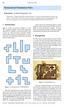 44 Geometry at Play Symmetrical Pentomino Pairs Kate Jones, Kadon Enterprises, Inc. Pentominoes shapes made of five congruent squares provide a natural platform for games and puzzles. In this article,
Excel -- Creating Charts
 Excel -- Creating Charts The saying goes, A picture is worth a thousand words, and so true. Professional looking charts give visual enhancement to your statistics, fiscal reports or presentation. Excel
Learning Styles and Aptitudes
 Learning Styles and Aptitudes Learning style is the ability to learn and to develop in some ways better than others. Each person has a natural way of learning. We all learn from listening, watching something
Chapter 11 Number Theory
 Chapter 11 Number Theory Number theory is one of the oldest branches of mathematics. For many years people who studied number theory delighted in its pure nature because there were few practical applications
Worksheets for Teachers. The Lowry
 Worksheets for Teachers The Lowry Worksheets LS Lowry Worksheets for Primary & Secondary Pupils The following pages contain worksheets for you to use with your class. They can be photocopied for each person