
Quiz for Chapter 1 Computer Abstractions and Technology 3.10
|
|
|
- Veronica Wood
- 9 years ago
- Views:
Transcription
1 Date: 3.10 Not all questions are of equal difficulty. Please review the entire quiz first and then budget your time carefully. Name: Course: Solutions in Red 1. [15 points] Consider two different implementations, M1 and M2, of the same instruction set. There are three classes of instructions (A, B, and C) in the instruction set. M1 has a clock rate of 80 MHz and M2 has a clock rate of 100 MHz. The average number of cycles for each instruction class and their frequencies (for a typical program) are as follows: Instruction Class Machine M1 Cycles/Instruction Class Machine M2 Cycles/Instruction Class A % B % C % (a) Calculate the average CPI for each machine, M1, and M2. For Machine M1: Clocks per Instruction = (60/100)* 1 + (30/100)*2 + (10/100)*4 = 1.6 For Machine M2: Clocks per Instruction = (60/100)*2 + (30/100)*3 + (10/100)*4 = 2.5 (b) Calculate the average MIPS ratings for each machine, M1 and M2. For Machine M1: Average MIPS rating = Clock Rate/(CPI * 10 6 ) = (80 * 10 6 ) / (1.6*10 6 ) = 50.0 For Machine M2: Average MIPS rating = Clock Rate/(CPI * 10 6 ) = (100 * 10 6 ) / (2.5*10 6 ) = 40.0 Frequency (c) Which machine has a smaller MIPS rating? Which individual instruction class CPI do you need to change, and by how much, to have this machine have the same or better performance as the machine with the higher MIPS rating (you can only change the CPI for one of the instruction classes on the slower machine)? Machine M2 has a smaller MIPS rating. If we change the CPI of instruction class A for Machine M2 to 1, we can have a better MIPS rating than M1 as follows:

2 Clocks per Instruction = (60/100)*1 + (30/100)*3 + (10/100)*4 = 1.9 Average MIPS rating = Clock Rate/(CPI * 10 6 ) = (100 * 10 6 ) / (1.9*10 6 ) = [10 points] (Amdahl s law question) Suppose you have a machine which executes a program consisting of 50% floating point multiply, 20% floating point divide, and the remaining 30% are from other instructions. (a) Management wants the machine to run 4 times faster. You can make the divide run at most 3 times faster and the multiply run at most 8 times faster. Can you meet management s goal by making only one improvement, and which one? Amdahl s Law states: Execution time after improvement = (Execution time affected by improvement)/(amount of Improvement) + Assuming initially that the floating point multiply, floating point divide and the other instructions had the same CPI, Execution time after Improvement with Divide = (20)/3 + ( ) = Execution time after Improvement with Multiply = (50)/8 + ( ) = The management s goal can be met by making the improvement with Multiply alone. (b) Dogbert has now taken over the company removing all the previous managers. If you make both the multiply and divide improvements, what is the speed of the improved machine relative to the original machine? If we make both the improvements, Execution time after Improvement = (50)/8 + (20)/3 + (30) = The speedup relative to the original machine = (100)/(53.33) = [5 points] Suppose that we can improve the floating point instruction performance of machine by a factor of 15 (the same floating point instructions run 15 times faster on this new machine). What percent of the instructions must be floating point to achieve a Speedup of at least 4? We will use Amdahl s Law again for this question. Let x be percentage of floating point instructions. Since the speedup is 4, if the original program executed in 100 cycles, the new program runs in 100/4 = 25 cycles. (100)/4 = (x)/15 + (100 x) Solving for x, we get: x = The percent of floating point instructions need to be [6 points] Just like we defined MIPS rating, we can also define something called the MFLOPS rating which stands for Millions of Floating Point operations per Second. If Machine A has a higher MIPS rating than that of Machine B, then does Machine A necessarily have a higher MFLOPS rating in comparison to Machine B? Page 2 of 6

3 A higher MIPS rating for machine A compared to machine B need not imply a higher MFLOPS rating for that machine A. One reason for this can be the following: It is possible that the floating point instructions form a fairly low proportion of the all the instructions in a given program. So if the floating point operations of machine B are far more efficient than the floating point operations of machine A while the other (integer, memory etc) instructions are more efficient on B, then machine B gets a higher MFLOPS rating than A while A has a higher MIPS rating. 5. [6 points] Consider the SPEC benchmark. Name two factors that influence the resulting performance on any particular architecture. Two factors that influence the resulting performance of a SPEC benchmark on any particular architecture are (a) The compiler flags used to compile the benchmark (b) The input data that is given to the benchmark while measuring performance 6. [5 points] How did the development of the transistor affect computers? What did the transistor replace? The answer to the first part of this question is subjective: The development of transistor has had a tremendous impact on bring the computer to our homes in the form of PCs and more recently into our hands (Personal Digital Assistants etc). The ability to package and integrate transistors on a chip at a rate that has been increasing exponentially according to Moore s Law has resulted in tremendous performance gains for programs without having to change any of them. The transistor replaced the vacuum tube in [25 points] A two-part question: (Part A) Assume that a design team is considering enhancing a machine by adding MMX (multimedia extension instruction) hardware to a processor. When a computation is run in MMX mode on the MMX hardware, it is 10 times faster than the normal mode of execution. Call the percentage of time that could be spent using the MMX mode the percentage of media enhancement. (a) What percentage of media enhancement is needed to achieve an overall speedup of 2? We will use Amdahl s Law for this question. Execution time with Media Enhancement = (Execution time improved by Media enhancement)/(amount of Improvement) + Let x be the percent of media enhancement needed for achieving an overall speedup of 2. Then, (100)/2 = (x)/10 + (100-x) Solving for x, we have x = (b) What percentage of the run-time is spent in MMX mode if a speedup of 2 is achieved? (Hint: You will need to calculate the new overall time.) The new overall time is 100/2 = 50. Now of the original program used media enhancement. Let x be the percentage of the new run-time that is spent in MMX mode (for a speedup of 2). x = (55.55 *50)/100 = Page 3 of 6
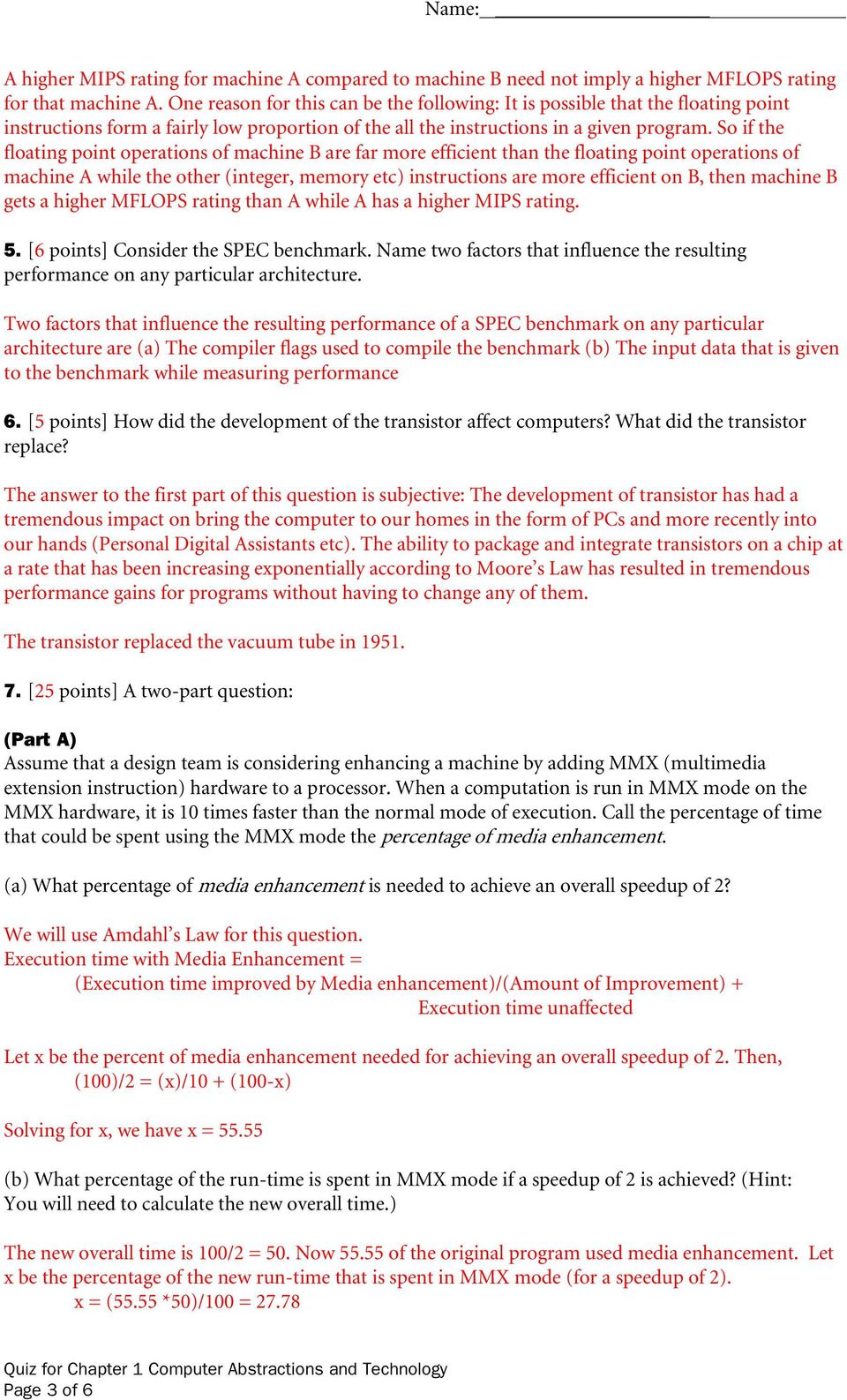
4 (c) What percentage of the media enhancement is needed to achieve one-half the maximum speedup attainable from using the MMX mode? The maximum speedup using MMX mode occurs when the whole program can run in media enhancement mode. The maximum speedup in this case is 10. One-half of this is 15. Plugging in 15 instead of 2 in (a): (100)/15 = (x)/10 + (100-x) Solving for x, we get x = (Part B) If processor A has a higher clock rate than processor B, and processor A also has a higher MIPS rating than processor B, explain whether processor A will always execute faster than processor B. Suppose that there are two implementations of the same instruction set architecture. Machine A has a clock cycle time of 20ns and an effective CPI of 1.5 for some program, and machine B has a clock cycle time of 15ns and an effective CPI of 1.0 for the same program. Which machine is faster for this program, and by how much? The CPU Time is given by the equation: CPU Time = Instruction count * CPI * Clock cycle Time MIPS rating is defined by: MIPS = (Clock Rate)/(CPI * 10 6 ) For machines A and B: (CPUTime) A = (Instruction count) A * (CPI) A * (Clock cycle Time) A (CPUTime) B = (Instruction count) B * (CPI) B * (Clock cycle Time) B (MIPS) A = (Clock Rate) A /((CPI) A * 10 6 ) (MIPS) B = (Clock Rate) B /((CPI) B * 10 6 ) If clock rate of A is higher than that of B, and MIPS rating of A is higher than that of B, (MIPS) A > (MIPS) B and (Clock Rate) A > (Clock Rate) B From the above equations it follows that: (Clock Rate) A / (Clock Rate) B > (CPI) A / (CPI) B (Clock Cycle Time) B / (Clock Cycle Time) A > (CPI) A / (CPI) B From this it emerges that if the instruction counts are the same, processor A will always execute faster than processor B. Assuming instruction counts are the same, (CPUTime) A = (I) * 1.5 * 20ns = (I)*30ns (CPUTime) B = (I) * 1.0 * 15ns = (I)*15ns Machine B is faster by twice as much as Machine A. 8. [6 points] Suppose a program segment consists of a purely sequential part which takes 25 cycles to execute, and an iterated loop which takes 100 cycles per iteration. Assume the loop iterations are independent, and cannot be further parallelized. If the loop is to be executed 100 times, what is the maximum speedup possible using an infinite number of processors (compared to a single processor)? The sequential part takes 25 cycles. Each iteration of the loop (which takes 100 cycles) can executed independently and there are totally 100 iterations. Applying Amdahl s law, Execution time after improvement = (Execution time affected by improvement)/(amount of Improvement) + = (100*100)/ Page 4 of 6

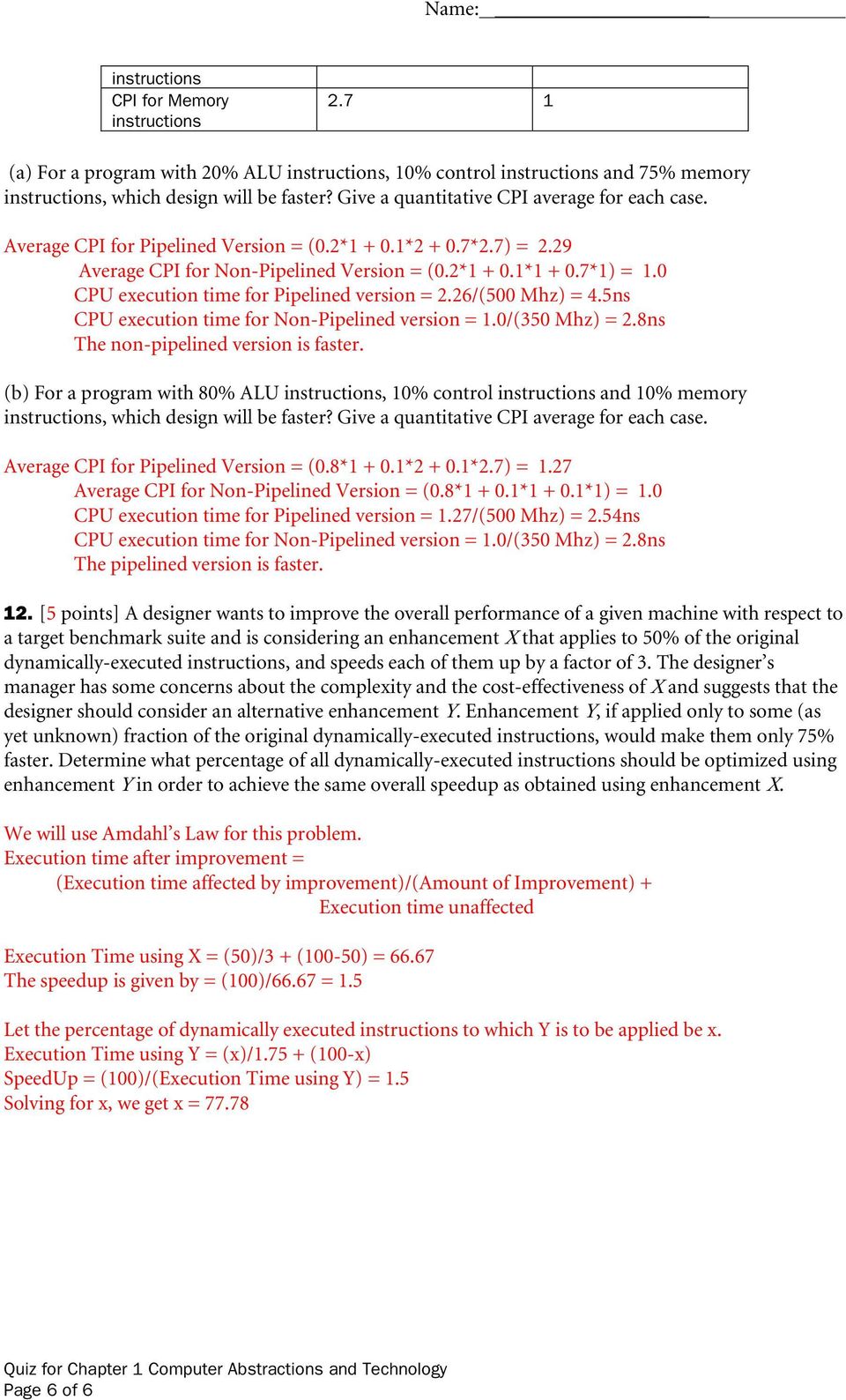
5 = Speedup = 125/100 = [5 points] Computer A has an overall CPI of 1.3 and can be run at a clock rate of 600MHz. Computer B has a CPI of 2.5 and can be run at a clock rate of 750 Mhz. We have a particular program we wish to run. When compiled for computer A, this program has exactly 100,000 instructions. How many instructions would the program need to have when compiled for Computer B, in order for the two computers to have exactly the same execution time for this program? (CPUTime) A = (Instruction count) A * (CPI) A * (Clock cycle Time) A = (100,000)*(1.3)/(600*10 6 ) ns (CPUTime) B = (Instruction count) B * (CPI) B * (Clock cycle Time) B = (I) B *(2.5)/(750*10 6 ) ns Since (CPUTime) A = (CPUTime) B, we have to solve for (I) B and get [5 points] Imagine that you are able to perform benchmarking races to compare two computers you are thinking about buying. Come up with a list of 5 benchmark programs or usage scenarios you would use to create your own personalized benchmark suite. For each program you select, justify it. For the benchmark suite as a whole, discuss a method for calculated a weighted average of the different program run-times. The answer to this question is subjective. One possible list of benchmarks could include the following: Benchmark Program Browser with multimedia plug ins Financial Application (Stock Value Predictor) Games that involve a lot of AI Word processing software Desktop Search Software Reason to choose this benchmark Opening a lot of media content in a lot of tabs at the same can be used to test the memory performance and parallelism potential Can be used to measure floating point and vector instruction set performance Can be used to test branch prediction performance Most common use case. Can be used to test general integer operations and rendering Can be used to test I/O performance since a search software builds up a huge index by constant read of file system Program Runtime (s) Weight The weighted average of the runtimes is = (300* * * * *3)/20 = [8 points] The design team for a simple, single-issue processor is choosing between a pipelined or non-pipelined implementation. Here are some design parameters for the two possibilities: Parameter Pipelined Version Non-Pipelined Version Clock Rate 500MHz 350 MHz CPI for ALU instructions 1 1 CPI for Control 2 1 Page 5 of 6

6 instructions CPI for Memory instructions (a) For a program with 20% ALU instructions, 10% control instructions and 75% memory instructions, which design will be faster? Give a quantitative CPI average for each case. Average CPI for Pipelined Version = (0.2* * *2.7) = 2.29 Average CPI for Non-Pipelined Version = (0.2* * *1) = 1.0 CPU execution time for Pipelined version = 2.26/(500 Mhz) = 4.5ns CPU execution time for Non-Pipelined version = 1.0/(350 Mhz) = 2.8ns The non-pipelined version is faster. (b) For a program with 80% ALU instructions, 10% control instructions and 10% memory instructions, which design will be faster? Give a quantitative CPI average for each case. Average CPI for Pipelined Version = (0.8* * *2.7) = 1.27 Average CPI for Non-Pipelined Version = (0.8* * *1) = 1.0 CPU execution time for Pipelined version = 1.27/(500 Mhz) = 2.54ns CPU execution time for Non-Pipelined version = 1.0/(350 Mhz) = 2.8ns The pipelined version is faster. 12. [5 points] A designer wants to improve the overall performance of a given machine with respect to a target benchmark suite and is considering an enhancement X that applies to 50% of the original dynamically-executed instructions, and speeds each of them up by a factor of 3. The designer s manager has some concerns about the complexity and the cost-effectiveness of X and suggests that the designer should consider an alternative enhancement Y. Enhancement Y, if applied only to some (as yet unknown) fraction of the original dynamically-executed instructions, would make them only 75% faster. Determine what percentage of all dynamically-executed instructions should be optimized using enhancement Y in order to achieve the same overall speedup as obtained using enhancement X. We will use Amdahl s Law for this problem. Execution time after improvement = (Execution time affected by improvement)/(amount of Improvement) + Execution Time using X = (50)/3 + (100-50) = The speedup is given by = (100)/66.67 = 1.5 Let the percentage of dynamically executed instructions to which Y is to be applied be x. Execution Time using Y = (x)/ (100-x) SpeedUp = (100)/(Execution Time using Y) = 1.5 Solving for x, we get x = Page 6 of 6
on an system with an infinite number of processors. Calculate the speedup of
 1. Amdahl s law Three enhancements with the following speedups are proposed for a new architecture: Speedup1 = 30 Speedup2 = 20 Speedup3 = 10 Only one enhancement is usable at a time. a) If enhancements
EEM 486: Computer Architecture. Lecture 4. Performance
 EEM 486: Computer Architecture Lecture 4 Performance EEM 486 Performance Purchasing perspective Given a collection of machines, which has the» Best performance?» Least cost?» Best performance / cost? Design
Lecture 3: Evaluating Computer Architectures. Software & Hardware: The Virtuous Cycle?
 Lecture 3: Evaluating Computer Architectures Announcements - Reminder: Homework 1 due Thursday 2/2 Last Time technology back ground Computer elements Circuits and timing Virtuous cycle of the past and
! Metrics! Latency and throughput. ! Reporting performance! Benchmarking and averaging. ! CPU performance equation & performance trends
 This Unit CIS 501 Computer Architecture! Metrics! Latency and throughput! Reporting performance! Benchmarking and averaging Unit 2: Performance! CPU performance equation & performance trends CIS 501 (Martin/Roth):
Performance evaluation
 Performance evaluation Arquitecturas Avanzadas de Computadores - 2547021 Departamento de Ingeniería Electrónica y de Telecomunicaciones Facultad de Ingeniería 2015-1 Bibliography and evaluation Bibliography
Chapter 2. Why is some hardware better than others for different programs?
 Chapter 2 1 Performance Measure, Report, and Summarize Make intelligent choices See through the marketing hype Key to understanding underlying organizational motivation Why is some hardware better than
EC 362 Problem Set #2
 EC 362 Problem Set #2 1) Using Single Precision IEEE 754, what is FF28 0000? 2) Suppose the fraction enhanced of a processor is 40% and the speedup of the enhancement was tenfold. What is the overall speedup?
EE361: Digital Computer Organization Course Syllabus
 EE361: Digital Computer Organization Course Syllabus Dr. Mohammad H. Awedh Spring 2014 Course Objectives Simply, a computer is a set of components (Processor, Memory and Storage, Input/Output Devices)
CISC, RISC, and DSP Microprocessors
 CISC, RISC, and DSP Microprocessors Douglas L. Jones ECE 497 Spring 2000 4/6/00 CISC, RISC, and DSP D.L. Jones 1 Outline Microprocessors circa 1984 RISC vs. CISC Microprocessors circa 1999 Perspective:
Chapter 5 Instructor's Manual
 The Essentials of Computer Organization and Architecture Linda Null and Julia Lobur Jones and Bartlett Publishers, 2003 Chapter 5 Instructor's Manual Chapter Objectives Chapter 5, A Closer Look at Instruction
Unit 4: Performance & Benchmarking. Performance Metrics. This Unit. CIS 501: Computer Architecture. Performance: Latency vs.
 This Unit CIS 501: Computer Architecture Unit 4: Performance & Benchmarking Metrics Latency and throughput Speedup Averaging CPU Performance Performance Pitfalls Slides'developed'by'Milo'Mar0n'&'Amir'Roth'at'the'University'of'Pennsylvania'
Q. Consider a dynamic instruction execution (an execution trace, in other words) that consists of repeats of code in this pattern:
 Pipelining HW Q. Can a MIPS SW instruction executing in a simple 5-stage pipelined implementation have a data dependency hazard of any type resulting in a nop bubble? If so, show an example; if not, prove
Parallelism and Cloud Computing
 Parallelism and Cloud Computing Kai Shen Parallel Computing Parallel computing: Process sub tasks simultaneously so that work can be completed faster. For instances: divide the work of matrix multiplication
Week 1 out-of-class notes, discussions and sample problems
 Week 1 out-of-class notes, discussions and sample problems Although we will primarily concentrate on RISC processors as found in some desktop/laptop computers, here we take a look at the varying types
Choosing a Computer for Running SLX, P3D, and P5
 Choosing a Computer for Running SLX, P3D, and P5 This paper is based on my experience purchasing a new laptop in January, 2010. I ll lead you through my selection criteria and point you to some on-line
COMPUTER ORGANIZATION ARCHITECTURES FOR EMBEDDED COMPUTING
 COMPUTER ORGANIZATION ARCHITECTURES FOR EMBEDDED COMPUTING 2013/2014 1 st Semester Sample Exam January 2014 Duration: 2h00 - No extra material allowed. This includes notes, scratch paper, calculator, etc.
Central Processing Unit (CPU)
 Central Processing Unit (CPU) CPU is the heart and brain It interprets and executes machine level instructions Controls data transfer from/to Main Memory (MM) and CPU Detects any errors In the following
Solution: start more than one instruction in the same clock cycle CPI < 1 (or IPC > 1, Instructions per Cycle) Two approaches:
 Multiple-Issue Processors Pipelining can achieve CPI close to 1 Mechanisms for handling hazards Static or dynamic scheduling Static or dynamic branch handling Increase in transistor counts (Moore s Law):
CSEE W4824 Computer Architecture Fall 2012
 CSEE W4824 Computer Architecture Fall 2012 Lecture 2 Performance Metrics and Quantitative Principles of Computer Design Luca Carloni Department of Computer Science Columbia University in the City of New
what operations can it perform? how does it perform them? on what kind of data? where are instructions and data stored?
 Inside the CPU how does the CPU work? what operations can it perform? how does it perform them? on what kind of data? where are instructions and data stored? some short, boring programs to illustrate the
Lecture 11: Multi-Core and GPU. Multithreading. Integration of multiple processor cores on a single chip.
 Lecture 11: Multi-Core and GPU Multi-core computers Multithreading GPUs General Purpose GPUs Zebo Peng, IDA, LiTH 1 Multi-Core System Integration of multiple processor cores on a single chip. To provide
Instruction Set Architecture. or How to talk to computers if you aren t in Star Trek
 Instruction Set Architecture or How to talk to computers if you aren t in Star Trek The Instruction Set Architecture Application Compiler Instr. Set Proc. Operating System I/O system Instruction Set Architecture
Computer Architecture TDTS10
 why parallelism? Performance gain from increasing clock frequency is no longer an option. Outline Computer Architecture TDTS10 Superscalar Processors Very Long Instruction Word Processors Parallel computers
A Lab Course on Computer Architecture
 A Lab Course on Computer Architecture Pedro López José Duato Depto. de Informática de Sistemas y Computadores Facultad de Informática Universidad Politécnica de Valencia Camino de Vera s/n, 46071 - Valencia,
CPU Performance. Lecture 8 CAP 3103 06-11-2014
 CPU Performance Lecture 8 CAP 3103 06-11-2014 Defining Performance Which airplane has the best performance? 1.6 Performance Boeing 777 Boeing 777 Boeing 747 BAC/Sud Concorde Douglas DC-8-50 Boeing 747
Binary Number System. 16. Binary Numbers. Base 10 digits: 0 1 2 3 4 5 6 7 8 9. Base 2 digits: 0 1
 Binary Number System 1 Base 10 digits: 0 1 2 3 4 5 6 7 8 9 Base 2 digits: 0 1 Recall that in base 10, the digits of a number are just coefficients of powers of the base (10): 417 = 4 * 10 2 + 1 * 10 1
 More on Pipelining and Pipelines in Real Machines CS 333 Fall 2006 Main Ideas Data Hazards RAW WAR WAW More pipeline stall reduction techniques Branch prediction» static» dynamic bimodal branch prediction
How To Understand The Design Of A Microprocessor
 Computer Architecture R. Poss 1 What is computer architecture? 2 Your ideas and expectations What is part of computer architecture, what is not? Who are computer architects, what is their job? What is
2: Computer Performance
 2: Computer Performance http://people.sc.fsu.edu/ jburkardt/presentations/ fdi 2008 lecture2.pdf... John Information Technology Department Virginia Tech... FDI Summer Track V: Parallel Programming 10-12
System Models for Distributed and Cloud Computing
 System Models for Distributed and Cloud Computing Dr. Sanjay P. Ahuja, Ph.D. 2010-14 FIS Distinguished Professor of Computer Science School of Computing, UNF Classification of Distributed Computing Systems
Figure 1: Graphical example of a mergesort 1.
 CSE 30321 Computer Architecture I Fall 2011 Lab 02: Procedure Calls in MIPS Assembly Programming and Performance Total Points: 100 points due to its complexity, this lab will weight more heavily in your
22S:295 Seminar in Applied Statistics High Performance Computing in Statistics
 22S:295 Seminar in Applied Statistics High Performance Computing in Statistics Luke Tierney Department of Statistics & Actuarial Science University of Iowa August 30, 2007 Luke Tierney (U. of Iowa) HPC
Introduction to Microprocessors
 Introduction to Microprocessors Yuri Baida [email protected] [email protected] October 2, 2010 Moscow Institute of Physics and Technology Agenda Background and History What is a microprocessor?
Design Cycle for Microprocessors
 Cycle for Microprocessors Raúl Martínez Intel Barcelona Research Center Cursos de Verano 2010 UCLM Intel Corporation, 2010 Agenda Introduction plan Architecture Microarchitecture Logic Silicon ramp Types
Types of Workloads. Raj Jain. Washington University in St. Louis
 Types of Workloads Raj Jain Washington University in Saint Louis Saint Louis, MO 63130 [email protected] These slides are available on-line at: http://www.cse.wustl.edu/~jain/cse567-08/ 4-1 Overview!
EE282 Computer Architecture and Organization Midterm Exam February 13, 2001. (Total Time = 120 minutes, Total Points = 100)
 EE282 Computer Architecture and Organization Midterm Exam February 13, 2001 (Total Time = 120 minutes, Total Points = 100) Name: (please print) Wolfe - Solution In recognition of and in the spirit of the
LSN 2 Computer Processors
 LSN 2 Computer Processors Department of Engineering Technology LSN 2 Computer Processors Microprocessors Design Instruction set Processor organization Processor performance Bandwidth Clock speed LSN 2
CS 159 Two Lecture Introduction. Parallel Processing: A Hardware Solution & A Software Challenge
 CS 159 Two Lecture Introduction Parallel Processing: A Hardware Solution & A Software Challenge We re on the Road to Parallel Processing Outline Hardware Solution (Day 1) Software Challenge (Day 2) Opportunities
Performance Metrics and Scalability Analysis. Performance Metrics and Scalability Analysis
 Performance Metrics and Scalability Analysis 1 Performance Metrics and Scalability Analysis Lecture Outline Following Topics will be discussed Requirements in performance and cost Performance metrics Work
Chapter 12: Multiprocessor Architectures. Lesson 01: Performance characteristics of Multiprocessor Architectures and Speedup
 Chapter 12: Multiprocessor Architectures Lesson 01: Performance characteristics of Multiprocessor Architectures and Speedup Objective Be familiar with basic multiprocessor architectures and be able to
Introducción. Diseño de sistemas digitales.1
 Introducción Adapted from: Mary Jane Irwin ( www.cse.psu.edu/~mji ) www.cse.psu.edu/~cg431 [Original from Computer Organization and Design, Patterson & Hennessy, 2005, UCB] Diseño de sistemas digitales.1
CSCI 4717 Computer Architecture. Function. Data Storage. Data Processing. Data movement to a peripheral. Data Movement
 CSCI 4717/5717 Computer Architecture Topic: Functional View & History Reading: Sections 1.2, 2.1, & 2.3 Function All computer functions are comprised of four basic operations: Data processing Data storage
Computer Architecture
 Computer Architecture Slide Sets WS 2013/2014 Prof. Dr. Uwe Brinkschulte M.Sc. Benjamin Betting Part 6 Fundamentals in Performance Evaluation Computer Architecture Part 6 page 1 of 22 Prof. Dr. Uwe Brinkschulte,
Towards Energy Efficient Query Processing in Database Management System
 Towards Energy Efficient Query Processing in Database Management System Report by: Ajaz Shaik, Ervina Cergani Abstract Rising concerns about the amount of energy consumed by the data centers, several computer
Generations of the computer. processors.
 . Piotr Gwizdała 1 Contents 1 st Generation 2 nd Generation 3 rd Generation 4 th Generation 5 th Generation 6 th Generation 7 th Generation 8 th Generation Dual Core generation Improves and actualizations
This Unit: Putting It All Together. CIS 501 Computer Architecture. Sources. What is Computer Architecture?
 This Unit: Putting It All Together CIS 501 Computer Architecture Unit 11: Putting It All Together: Anatomy of the XBox 360 Game Console Slides originally developed by Amir Roth with contributions by Milo
Advanced Computer Architecture-CS501. Computer Systems Design and Architecture 2.1, 2.2, 3.2
 Lecture Handout Computer Architecture Lecture No. 2 Reading Material Vincent P. Heuring&Harry F. Jordan Chapter 2,Chapter3 Computer Systems Design and Architecture 2.1, 2.2, 3.2 Summary 1) A taxonomy of
Benchmarking Large Scale Cloud Computing in Asia Pacific
 2013 19th IEEE International Conference on Parallel and Distributed Systems ing Large Scale Cloud Computing in Asia Pacific Amalina Mohamad Sabri 1, Suresh Reuben Balakrishnan 1, Sun Veer Moolye 1, Chung
picojava TM : A Hardware Implementation of the Java Virtual Machine
 picojava TM : A Hardware Implementation of the Java Virtual Machine Marc Tremblay and Michael O Connor Sun Microelectronics Slide 1 The Java picojava Synergy Java s origins lie in improving the consumer
Computer Organization and Architecture
 Computer Organization and Architecture Chapter 11 Instruction Sets: Addressing Modes and Formats Instruction Set Design One goal of instruction set design is to minimize instruction length Another goal
An Introduction to Parallel Computing/ Programming
 An Introduction to Parallel Computing/ Programming Vicky Papadopoulou Lesta Astrophysics and High Performance Computing Research Group (http://ahpc.euc.ac.cy) Dep. of Computer Science and Engineering European
IA-64 Application Developer s Architecture Guide
 IA-64 Application Developer s Architecture Guide The IA-64 architecture was designed to overcome the performance limitations of today s architectures and provide maximum headroom for the future. To achieve
VLIW Processors. VLIW Processors
 1 VLIW Processors VLIW ( very long instruction word ) processors instructions are scheduled by the compiler a fixed number of operations are formatted as one big instruction (called a bundle) usually LIW
Computer Performance. Topic 3. Contents. Prerequisite knowledge Before studying this topic you should be able to:
 55 Topic 3 Computer Performance Contents 3.1 Introduction...................................... 56 3.2 Measuring performance............................... 56 3.2.1 Clock Speed.................................
Instruction Set Architecture
 Instruction Set Architecture Consider x := y+z. (x, y, z are memory variables) 1-address instructions 2-address instructions LOAD y (r :=y) ADD y,z (y := y+z) ADD z (r:=r+z) MOVE x,y (x := y) STORE x (x:=r)
Am186ER/Am188ER AMD Continues 16-bit Innovation
 Am186ER/Am188ER AMD Continues 16-bit Innovation 386-Class Performance, Enhanced System Integration, and Built-in SRAM Problem with External RAM All embedded systems require RAM Low density SRAM moving
Instruction Set Architecture (ISA) Design. Classification Categories
 Instruction Set Architecture (ISA) Design Overview» Classify Instruction set architectures» Look at how applications use ISAs» Examine a modern RISC ISA (DLX)» Measurement of ISA usage in real computers
Overview. CISC Developments. RISC Designs. CISC Designs. VAX: Addressing Modes. Digital VAX
 Overview CISC Developments Over Twenty Years Classic CISC design: Digital VAX VAXÕs RISC successor: PRISM/Alpha IntelÕs ubiquitous 80x86 architecture Ð 8086 through the Pentium Pro (P6) RJS 2/3/97 Philosophy
Binary search tree with SIMD bandwidth optimization using SSE
 Binary search tree with SIMD bandwidth optimization using SSE Bowen Zhang, Xinwei Li 1.ABSTRACT In-memory tree structured index search is a fundamental database operation. Modern processors provide tremendous
Parallel Scalable Algorithms- Performance Parameters
 www.bsc.es Parallel Scalable Algorithms- Performance Parameters Vassil Alexandrov, ICREA - Barcelona Supercomputing Center, Spain Overview Sources of Overhead in Parallel Programs Performance Metrics for
361 Computer Architecture Lecture 14: Cache Memory
 1 361 Computer Architecture Lecture 14 Memory cache.1 The Motivation for s Memory System Processor DRAM Motivation Large memories (DRAM) are slow Small memories (SRAM) are fast Make the average access
Chapter 2 Logic Gates and Introduction to Computer Architecture
 Chapter 2 Logic Gates and Introduction to Computer Architecture 2.1 Introduction The basic components of an Integrated Circuit (IC) is logic gates which made of transistors, in digital system there are
Architecture of Hitachi SR-8000
 Architecture of Hitachi SR-8000 University of Stuttgart High-Performance Computing-Center Stuttgart (HLRS) www.hlrs.de Slide 1 Most of the slides from Hitachi Slide 2 the problem modern computer are data
Computer Organization and Components
 Computer Organization and Components IS5, fall 25 Lecture : Pipelined Processors ssociate Professor, KTH Royal Institute of Technology ssistant Research ngineer, University of California, Berkeley Slides
Computer System: User s View. Computer System Components: High Level View. Input. Output. Computer. Computer System: Motherboard Level
 System: User s View System Components: High Level View Input Output 1 System: Motherboard Level 2 Components: Interconnection I/O MEMORY 3 4 Organization Registers ALU CU 5 6 1 Input/Output I/O MEMORY
İSTANBUL AYDIN UNIVERSITY
 İSTANBUL AYDIN UNIVERSITY FACULTY OF ENGİNEERİNG SOFTWARE ENGINEERING THE PROJECT OF THE INSTRUCTION SET COMPUTER ORGANIZATION GÖZDE ARAS B1205.090015 Instructor: Prof. Dr. HASAN HÜSEYİN BALIK DECEMBER
Virtuoso and Database Scalability
 Virtuoso and Database Scalability By Orri Erling Table of Contents Abstract Metrics Results Transaction Throughput Initializing 40 warehouses Serial Read Test Conditions Analysis Working Set Effect of
Parallel Algorithm Engineering
 Parallel Algorithm Engineering Kenneth S. Bøgh PhD Fellow Based on slides by Darius Sidlauskas Outline Background Current multicore architectures UMA vs NUMA The openmp framework Examples Software crisis
Five Families of ARM Processor IP
 ARM1026EJ-S Synthesizable ARM10E Family Processor Core Eric Schorn CPU Product Manager ARM Austin Design Center Five Families of ARM Processor IP Performance ARM preserves SW & HW investment through code
Reconfigurable Architecture Requirements for Co-Designed Virtual Machines
 Reconfigurable Architecture Requirements for Co-Designed Virtual Machines Kenneth B. Kent University of New Brunswick Faculty of Computer Science Fredericton, New Brunswick, Canada [email protected] Micaela Serra
Virtualization and Cloud Computing. Sorav Bansal
 Virtualization and Cloud Computing Sorav Bansal Administrivia Instructors: Sorav Bansal, Huzur Saran, Gautam Shroff (Tata Consultancy Services) Webpage: http://www.cse.iitd.ernet.in/~sbansal/csl862 Syllabus:
Unit A451: Computer systems and programming. Section 2: Computing Hardware 1/5: Central Processing Unit
 Unit A451: Computer systems and programming Section 2: Computing Hardware 1/5: Central Processing Unit Section Objectives Candidates should be able to: (a) State the purpose of the CPU (b) Understand the
Optimizing Code for Accelerators: The Long Road to High Performance
 Optimizing Code for Accelerators: The Long Road to High Performance Hans Vandierendonck Mons GPU Day November 9 th, 2010 The Age of Accelerators 2 Accelerators in Real Life 3 Latency (ps/inst) Why Accelerators?
Instruction Set Architecture (ISA)
 Instruction Set Architecture (ISA) * Instruction set architecture of a machine fills the semantic gap between the user and the machine. * ISA serves as the starting point for the design of a new machine
PROBLEMS. which was discussed in Section 1.6.3.
 22 CHAPTER 1 BASIC STRUCTURE OF COMPUTERS (Corrisponde al cap. 1 - Introduzione al calcolatore) PROBLEMS 1.1 List the steps needed to execute the machine instruction LOCA,R0 in terms of transfers between
A Survey on ARM Cortex A Processors. Wei Wang Tanima Dey
 A Survey on ARM Cortex A Processors Wei Wang Tanima Dey 1 Overview of ARM Processors Focusing on Cortex A9 & Cortex A15 ARM ships no processors but only IP cores For SoC integration Targeting markets:
A New, High-Performance, Low-Power, Floating-Point Embedded Processor for Scientific Computing and DSP Applications
 1 A New, High-Performance, Low-Power, Floating-Point Embedded Processor for Scientific Computing and DSP Applications Simon McIntosh-Smith Director of Architecture 2 Multi-Threaded Array Processing Architecture
Performance metrics for parallel systems
 Performance metrics for parallel systems S.S. Kadam C-DAC, Pune [email protected] C-DAC/SECG/2006 1 Purpose To determine best parallel algorithm Evaluate hardware platforms Examine the benefits from parallelism
Faculty of Engineering Student Number:
 Philadelphia University Student Name: Faculty of Engineering Student Number: Dept. of Computer Engineering Final Exam, First Semester: 2012/2013 Course Title: Microprocessors Date: 17/01//2013 Course No:
Computer Architecture Lecture 2: Instruction Set Principles (Appendix A) Chih Wei Liu 劉 志 尉 National Chiao Tung University [email protected].
 Computer Architecture Lecture 2: Instruction Set Principles (Appendix A) Chih Wei Liu 劉 志 尉 National Chiao Tung University [email protected] Review Computers in mid 50 s Hardware was expensive
Lecture 8: Binary Multiplication & Division
 Lecture 8: Binary Multiplication & Division Today s topics: Addition/Subtraction Multiplication Division Reminder: get started early on assignment 3 1 2 s Complement Signed Numbers two = 0 ten 0001 two
GPUs for Scientific Computing
 GPUs for Scientific Computing p. 1/16 GPUs for Scientific Computing Mike Giles [email protected] Oxford-Man Institute of Quantitative Finance Oxford University Mathematical Institute Oxford e-research
ACCELERATING COMMERCIAL LINEAR DYNAMIC AND NONLINEAR IMPLICIT FEA SOFTWARE THROUGH HIGH- PERFORMANCE COMPUTING
 ACCELERATING COMMERCIAL LINEAR DYNAMIC AND Vladimir Belsky Director of Solver Development* Luis Crivelli Director of Solver Development* Matt Dunbar Chief Architect* Mikhail Belyi Development Group Manager*
CS:APP Chapter 4 Computer Architecture. Wrap-Up. William J. Taffe Plymouth State University. using the slides of
 CS:APP Chapter 4 Computer Architecture Wrap-Up William J. Taffe Plymouth State University using the slides of Randal E. Bryant Carnegie Mellon University Overview Wrap-Up of PIPE Design Performance analysis
High-speed image processing algorithms using MMX hardware
 High-speed image processing algorithms using MMX hardware J. W. V. Miller and J. Wood The University of Michigan-Dearborn ABSTRACT Low-cost PC-based machine vision systems have become more common due to
CPU Organization and Assembly Language
 COS 140 Foundations of Computer Science School of Computing and Information Science University of Maine October 2, 2015 Outline 1 2 3 4 5 6 7 8 Homework and announcements Reading: Chapter 12 Homework:
The AVR Microcontroller and C Compiler Co-Design Dr. Gaute Myklebust ATMEL Corporation ATMEL Development Center, Trondheim, Norway
 The AVR Microcontroller and C Compiler Co-Design Dr. Gaute Myklebust ATMEL Corporation ATMEL Development Center, Trondheim, Norway Abstract High Level Languages (HLLs) are rapidly becoming the standard
Processor Architectures
 ECPE 170 Jeff Shafer University of the Pacific Processor Architectures 2 Schedule Exam 3 Tuesday, December 6 th Caches Virtual Memory Input / Output OperaKng Systems Compilers & Assemblers Processor Architecture
ADVANCED PROCESSOR ARCHITECTURES AND MEMORY ORGANISATION Lesson-12: ARM
 ADVANCED PROCESSOR ARCHITECTURES AND MEMORY ORGANISATION Lesson-12: ARM 1 The ARM architecture processors popular in Mobile phone systems 2 ARM Features ARM has 32-bit architecture but supports 16 bit
SOC architecture and design
 SOC architecture and design system-on-chip (SOC) processors: become components in a system SOC covers many topics processor: pipelined, superscalar, VLIW, array, vector storage: cache, embedded and external
Pipelining Review and Its Limitations
 Pipelining Review and Its Limitations Yuri Baida [email protected] [email protected] October 16, 2010 Moscow Institute of Physics and Technology Agenda Review Instruction set architecture Basic
Chapter 2 Basic Structure of Computers. Jin-Fu Li Department of Electrical Engineering National Central University Jungli, Taiwan
 Chapter 2 Basic Structure of Computers Jin-Fu Li Department of Electrical Engineering National Central University Jungli, Taiwan Outline Functional Units Basic Operational Concepts Bus Structures Software
FPGA area allocation for parallel C applications
 1 FPGA area allocation for parallel C applications Vlad-Mihai Sima, Elena Moscu Panainte, Koen Bertels Computer Engineering Faculty of Electrical Engineering, Mathematics and Computer Science Delft University
Multi-core architectures. Jernej Barbic 15-213, Spring 2007 May 3, 2007
 Multi-core architectures Jernej Barbic 15-213, Spring 2007 May 3, 2007 1 Single-core computer 2 Single-core CPU chip the single core 3 Multi-core architectures This lecture is about a new trend in computer
WAR: Write After Read
 WAR: Write After Read write-after-read (WAR) = artificial (name) dependence add R1, R2, R3 sub R2, R4, R1 or R1, R6, R3 problem: add could use wrong value for R2 can t happen in vanilla pipeline (reads
Intel 8086 architecture
 Intel 8086 architecture Today we ll take a look at Intel s 8086, which is one of the oldest and yet most prevalent processor architectures around. We ll make many comparisons between the MIPS and 8086
CPU Performance Evaluation: Cycles Per Instruction (CPI) Most computers run synchronously utilizing a CPU clock running at a constant clock rate:
 CPU Performance Evaluation: Cycles Per Instruction (CPI) Most computers run synchronously utilizing a CPU clock running at a constant clock rate: Clock cycle where: Clock rate = 1 / clock cycle f = 1 /C
Quantitative Computer Architecture
 Performace Measuremet ad Aalysis i Computer Quatitative Computer Measuremet Model Iovatio Proposed How to measure, aalyze, ad specify computer system performace or My computer is faster tha your computer!
PyCompArch: Python-Based Modules for Exploring Computer Architecture Concepts
 PyCompArch: Python-Based Modules for Exploring Computer Architecture Concepts Workshop on Computer Architecture Education 2015 Dan Connors, Kyle Dunn, Ryan Bueter Department of Electrical Engineering University
Intel Pentium 4 Processor on 90nm Technology
 Intel Pentium 4 Processor on 90nm Technology Ronak Singhal August 24, 2004 Hot Chips 16 1 1 Agenda Netburst Microarchitecture Review Microarchitecture Features Hyper-Threading Technology SSE3 Intel Extended