
GnuCash Help Manual Feedback
|
|
|
- Jade Ilene Reeves
- 10 years ago
- Views:
Transcription
1 GnuCash Help Manual Yawar Amin, GnuCash Documentation Team J. Alex Aycinena, GnuCash Documentation Team Frank Ellenberger, GnuCash Documentation Team Chris Good, GnuCash Documentation Team Dave Herman, GnuCash Documentation Team Geert Janssens, GnuCash Development Team Chris Lyttle, GnuCash Documentation Team Cristian Marchi, GnuCash Documentation Team John Ralls, GnuCash Documentation Team Robert Ratliff, GnuCash Documentation Team Mark Simpson, GnuCash Documentation Team Christian Stimming, GnuCash Documentation Team

2 GnuCash Help Manual by Yawar Amin, J. Alex Aycinena, Frank Ellenberger, Chris Good, Dave Herman, Geert Janssens, Chris Lyttle, Cristian Marchi, John Ralls, Robert Ratliff, Mark Simpson, and Christian Stimming This manual describes how to use the GnuCash Financial software. Copyright GnuCash Documentation Team Permission is granted to copy, distribute and/or modify this document under the terms of the GNU Free Documentation License (GFDL), Version 1.1 or any later version published by the Free Software Foundation with no Invariant Sections, no Front-Cover Texts, and no Back-Cover Texts. You can find a copy of the GFDL at this link [ghelp:fdl] or in the file COPYING-DOCS distributed with this manual. This manual is part of a collection of GNOME manuals distributed under the GFDL. If you want to distribute this manual separately from the collection, you can do so by adding a copy of the license to the manual, as described in section 6 of the license. Many of the names used by companies to distinguish their products and services are claimed as trademarks. Where those names appear in any GNOME documentation, and the members of the GNOME Documentation Project are made aware of those trademarks, then the names are in capital letters or initial capital letters. DOCUMENT AND MODIFIED VERSIONS OF THE DOCUMENT ARE PROVIDED UNDER THE TERMS OF THE GNU FREE DOCUMENTATION LICENSE WITH THE FURTHER UNDERSTANDING THAT: 1. DOCUMENT IS PROVIDED ON AN "AS IS" BASIS, WITHOUT WARRANTY OF ANY KIND, EITHER EXPRESSED OR IMPLIED, INCLUDING, WITHOUT LIMITATION, WARRANTIES THAT THE DOCUMENT OR MODIFIED VERSION OF THE DOCUMENT IS FREE OF DEFECTS MERCHANTABLE, FIT FOR A PARTICULAR PURPOSE OR NON-INFRINGING. THE ENTIRE RISK AS TO THE QUALITY, ACCURACY, AND PERFORMANCE OF THE DOCUMENT OR MODIFIED VERSION OF THE DOCUMENT IS WITH YOU. SHOULD ANY DOCUMENT OR MODIFIED VERSION PROVE DEFECTIVE IN ANY RESPECT, YOU (NOT THE INITIAL WRITER, AUTHOR OR ANY CONTRIBUTOR) ASSUME THE COST OF ANY NECESSARY SERVICING, REPAIR OR CORRECTION. THIS DISCLAIMER OF WARRANTY CONSTITUTES AN ESSENTIAL PART OF THIS LICENSE. NO USE OF ANY DOCUMENT OR MODIFIED VERSION OF THE DOCUMENT IS AUTHORIZED HEREUNDER EXCEPT UNDER THIS DISCLAIMER; AND 2. UNDER NO CIRCUMSTANCES AND UNDER NO LEGAL THEORY, WHETHER IN TORT (INCLUDING NEGLIGENCE), CONTRACT, OR OTHERWISE, SHALL THE AUTHOR, INITIAL WRITER, ANY CONTRIBUTOR, OR ANY DISTRIBUTOR OF THE DOCUMENT OR MODIFIED VERSION OF THE DOCUMENT, OR ANY SUPPLIER OF ANY OF SUCH PARTIES, BE LIABLE TO ANY PERSON FOR ANY DIRECT, INDIRECT, SPECIAL, INCIDENTAL, OR CONSEQUENTIAL DAMAGES OF ANY CHARACTER INCLUDING, WITHOUT LIMITATION, DAMAGES FOR LOSS OF GOODWILL, WORK STOPPAGE, COMPUTER FAILURE OR MALFUNCTION, OR ANY AND ALL OTHER DAMAGES OR LOSSES ARISING OUT OF OR RELATING TO USE OF THE DOCUMENT AND MODIFIED VERSIONS OF THE DOCUMENT, EVEN IF SUCH PARTY SHALL HAVE BEEN INFORMED OF THE POSSIBILITY OF SUCH DAMAGES. Feedback To report a bug or make a suggestion regarding this package or this manual, follow the directions at the GNOME Bug Tracking System [ bugzilla.gnome.org].
3 Table of Contents 1. Introduction to GnuCash Using This Document & Getting Help... 2 Accessing Help... 2 GnuCash Tutorial and Concepts Guide... 2 GnuCash On-line Assistance Getting Started... 4 Running GnuCash... 4 Welcome to GnuCash dialog... 4 New Account Hierarchy Setup... 4 Import QIF Files... 6 Tip of The Day GnuCash Windows & Menus Options Overview GnuCash Windows and Menus Main GnuCash Window Account Tab Display Account Tree - Menus Account Tree - Toolbar Icons/Buttons Tab bar Main pane - Account tree Summarybar Statusbar Account Register/General Ledger Account Register & General Ledger Window Account Register Menus Account Register - Toolbar Icons/Buttons Tab Bar List of Transactions Summarybar Statusbar Report Window Report Display Window Report Menus Reports - Toolbar Icons/Buttons Tab Bar Report Main Display Summarybar Statusbar Reconcile Window Reconcile Display Window Schedule Transaction Window Scheduled Transactions Main Display Window Budget Window Budget Window Menus Budget Window Toolbar Buttons Budget Window Main Display Budget Options Business Windows Customers Overview Vendors Overview Employees Overview Setting Up, Editing & Working with Accounts iii

4 GnuCash Help Manual Types of GnuCash Accounts Creating a Chart of Accounts Editing a Chart of Accounts Creating a New Account General Information Tab Opening Balance tab Editing an Account Renumbering Subaccounts Deleting an Account Reconciling an Account to a Statement Reconciling Information Reconcile Common Transaction Operations Changing the Register View Transfer Funds window Enter Transaction via register Entering Directly in the Register Window Multiple Split Transactions Multiple Currency Transactions Editing a Transaction Deleting a Transaction Removing Transaction Splits Copying a Transaction Setting the reconcile status (R field) of a transaction Jump to another Account Register Scheduling Transactions Scheduled Transactions Window Edit Scheduled Transaction Window Printing Checks Online Actions Get Balance Get Transactions Issue Transaction Direct Debit General Ledger Business Features Initial Setup Account Setup Company Registration Accounts Receivable Customers New Find and Edit Invoices New Edit Post Find Print Assign Starting Invoice Number Customer Jobs Process Payment Changing the Invoice Appearance Accounts Payable iv

5 GnuCash Help Manual Vendors New Find and Edit Bills New Edit Post Find Vendor Jobs Process Payment Employees New Employee Find and Edit New Expense Voucher/Credit Note Find and Edit Expense Voucher/Credit Note Tools & Assistants Find Find Transaction Find Customer, Invoice, Job, Vendor, Bill, Employee, Expense Voucher Since Last Run Assistant Mortgage & Loan Repayment Assistant Recording a Stock Split Stock Split Assistant HBCI (Online Banking) Setup Assistant Price Editor Adding a stock price manually Configuring for use of the Get Quotes button Security Editor Adding or Editing a Commodity Configuring Securities/Currencies for On-Line Retrieval of Prices Loan Repayment Calculator Close Book Dialog Box Details How It Works What It Doesn t Do Necessity Conclusion Reports And Charts General Reports Assets & Liabilities Income & Expense Business Reports Customizing Reports and Graphs Printing or Exporting Reports and Graphs Creating Reports and Graphs Customizing GnuCash Account Display Options Setting Preferences Accounting Period Accounts Business Date/Time General Online Banking v
6 GnuCash Help Manual Printing Register Register Defaults Reports Scheduled Transactions Windows Book Options Accounts Book Options Tab Budgeting Book Options Tab Business Book Options Tab Counters Book Options Tab Changing Style Sheets Default Style Sheet Easy Style Sheet Footer Style Sheet Technicolor Style Sheet Setting Tax Report Options TXF Export - Known Anomalies and Limitations Detailed TXF Category Descriptions Reset Warnings Changing the Language A. GnuCash Tips and tidbits Finance::Quote Sources Finance::Quote Sources - Currency source Quote Sources - Individual sources Finance::Quote Sources - Multiple sources Yahoo Specifics TIAA-CREF Specifics B. GNU Free Documentation License PREAMBLE APPLICABILITY AND DEFINITIONS VERBATIM COPYING COPYING IN QUANTITY MODIFICATIONS COMBINING DOCUMENTS COLLECTIONS OF DOCUMENTS AGGREGATION WITH INDEPENDENT WORKS TRANSLATION TERMINATION FUTURE REVISIONS OF THIS LICENSE Addendum vi
7 List of Figures 4.1. The Main GnuCash Window The Account Tree Display The Account Register Display The Report Window The Preferences Accounting Period tab The Preferences Accounts tab The Preferences Business tab The Preferences Date/Time tab The Preferences General tab The Preferences Online Banking tab The Preferences Printing tab The Preferences Register tab The Preferences Register Defaults tab The Preferences Reports tab The Preferences Scheduled Transactions tab The Preferences Windows tab vii

8 List of Tables 4.1. Account Tree - File Menu - Access to file, account operations and printing Account Tree - Edit Menu - Access to file and account editing operations and preferences Account Tree - View Menu - Changes display window view Account Tree - Actions Menu - Setup scheduled transactions, repair accounts, perform stock splits, transfer and reconcile transactions Account Tree - Business Menu - Access small business features of GnuCash Account Tree - Reports Menu - Access GnuCash Reports and Charts Account Tree - Tools Menu - Access to miscellaneous tools and editors Account Tree - Windows Menu Account Tree - Help Menu - Access to this help and the Tutorial and Concepts Guide Account Tree - Window Toolbar Account Register - File Menu - Access to file and account operations and printing Account Register - Edit Menu - Access to file and account editing operations and preferences Account Register - View Menu - Changes GnuCash display window characteristics Account Register - Transaction Menu - access to transaction tools Account Register - Actions Menu - Setup scheduled transactions, repair accounts, perform stock splits, transfer and reconcile transactions Account Register (Transaction Register) Window Toolbar Report - File Menu - Access to file and account operations and printing Reports - Edit Menu - Access to file and account editing operations and preferences Reports - Actions Menu - Setup scheduled transactions Reports - Toolbar Buttons Components of the Reconcile Window Reconcile Menu - Access to Reconcile Information and finishing or postponing Account Menu - Access to account operations Transaction Menu - Access to transaction editing operations Help Menu - Access to help Reconcile Window Toolbar Components of the Schedule Transactions Window Scheduled Menu - Access to scheduled transaction editing operations Scheduled Transactions Window Toolbar Edit Menu - Special items for the budget window Actions Menu - Items in the standard menu that relate to budgets Reports Menu - Items in the standard menu that relate to budgets Budget Window Toolbar Budget options Customers Overview - Toolbar Buttons Customer context menu Vendors Overview - Toolbar Buttons Vendor context menu Employees Overview - Toolbar Buttons Employee context menu Types of GnuCash Accounts Starting account numbers Renumbered account numbers Final account numbers Search criteria buttons - Split Search Search criteria buttons - Customer Search Search criteria buttons - Invoice Search Search criteria buttons - Job Search viii

9 GnuCash Help Manual 8.5. Search criteria buttons - Vendor Search Search criteria buttons - Bill Search Search criteria buttons - Employee Search Search criteria buttons - Expense Voucher Search Detailed TXF Category Descriptions A.1. Currency source for Finance::Quote A.2. Individual sources for quotes A.3. Multiple sources for quotes A.4. Yahoo Codes for Exchanges and Markets A.5. Pseudo-symbols that can be used for TIAA-CREF quotes ix

10 Chapter 1. Introduction to GnuCash What is GnuCash? GnuCash is a personal and small business finance application. It s designed to be easy to use, yet powerful and flexible. GnuCash allows you to track your income and expenses, reconcile bank accounts, monitor stock portfolios and manage your small business finances. It is based on professional accounting principles to ensure balanced books and accurate reports. 1

11 Chapter 2. Using This Document & Getting Help This document is organized in two dimensions; From the GUI (Graphical User Interface) explaining the available options and their functions, with links to deeper descriptions and usage. Chapter 4, GnuCash Windows & Menus Options Overview By classifying Operations, Tasks, or Functions based on whether it is an Account, Transaction, Reporting or other oriented operation. Examples are; Account Actions - Chapter 5, Setting Up, Editing & Working with Accounts Transaction/Register Actions - Chapter 6, Common Transaction Operations Tools and Assistants - Chapter 8, Tools & Assistants Reporting & Charting - Chapter 9, Reports And Charts Customization - Chapter 10, Customizing GnuCash Accessing Help This window is accessed by going to the Help menu and selecting either the Tutorial and Concepts Guide or the Contents (F1). the section called Account Tree - Help Menu The Help Window has a Toolbar for navigation. The Toolbar is described below; Back Used to navigate to topics previously viewed. Forward Used to navigate to topics previously viewed. Help Used to access various GNOME Help files. Search Enter search term to search GNOME Help files. Does not search GnuCash Help file. The right side of the Help Window displays the currently opened help page. The left side of the Help Window contains the help Topics list tab. Selecting one of the help topics will load that page on the right side. GnuCash Tutorial and Concepts Guide This guide is the counterpart to this help. It explains the concepts used in GnuCash and has a tutorial that takes you through using GnuCash to manage your accounts. It will appear if you choose Open the new user tutorial in the Welcome to GnuCash! menu. To open this Guide manually go to Help Tutorial and Concepts Guide. It is strongly recommended to read this guide if you are new to GnuCash or unfamiliar with accounting concepts. 2
12 Using This Document & Getting Help GnuCash On-line Assistance There are several online channels you can access for more assistance. GnuCash has several mailing lists: User List - User questions and discussions. The developers and many very helpful users hang-out here. Development List - Discussion of issues related to the design and development of GnuCash and submission of patches. Or you can chat live with the developers on IRC. Join them on #gnucash at irc.gnome.org. The GnuCash web site [ has more details on these channels. You will also find pointers there to additional useful resources such as the GnuCash wiki and bug tracking system. 3

13 Chapter 3. Getting Started Running GnuCash GnuCash can be run from your desktop main menu by selecting the associated menu entry. Alternatively it can be run from a shell (command line) with the command gnucash. During the loading of the GnuCash main window you will see the GnuCash Splash Screen where some information about the program itself and the loading process are displayed. Welcome to GnuCash dialog Next you will be presented with the Welcome to GnuCash! dialog with three choices: Create a new set of accounts Runs the New Account Hierarchy Setup assistant (see the section called New Account Hierarchy Setup ). Select this option if you want to be assisted in creating a set of accounts. Import my QIF files Runs the Import QIF Files assistant (see the section called Import QIF Files ). Select this option if you already have Quicken files (.qif files) from another financial application and wish to import them into GnuCash. Open the new user tutorial Opens the GnuCash Tutorial and Concepts Guide. Select this option if you are completely new to GnuCash and accounting concepts. Note It is possible to run these items after you have made a choice here, but the Welcome to GnuCash! screen will not reappear. To try one of the other choices later, read the section called New Account Hierarchy Setup, the section called Import QIF Files and the section called GnuCash Tutorial and Concepts Guide to see how to start them from the GnuCash menu. This screen is intended for you to use to get up and running quickly. The Cancel button is used to exit the screen. It will then prompt you with Display Welcome Dialog Again?. If you do not want to see the Welcome to GnuCash! menu again click the No button. Click the Yes button or press the keyboard Enter key for the default which is to have the Welcome to GnuCash! screen run again. Note Selecting either of these options will leave you with a minimum GnuCash main window. Operations in this window are described in Chapter 4, GnuCash Windows & Menus Options Overview. New Account Hierarchy Setup This assistant helps you to create a set of GnuCash accounts. It will appear if you choose Create a new set of accounts in the Welcome to GnuCash! menu. This will create a new blank GnuCash file and then automatically start the New Account Hierarchy Setup assistant. 4

14 Getting Started Tip To start this assistant manually, go to File New if you need to create a new file. If you want to run the assistant within the opened file, go to Actions New Account Hierarchy... when the accounts tree tab is displayed. 1. The New Account Hierarchy Setup assistant opens with a screen that briefly describes what this assistant does. The three buttons at the very bottom of the screen will not change while using the assistant. Cancel exit the process and cancel creating a new set of accounts. Warning If you click this button, any selections you have made up to this point will be lost. Back brings up the previous screen so that you can change a previous selection until the first screen. Forward brings up the next screen so you can continue through the assistant. 2. The next screen allows you to Choose Currency to use as default for your accounts. The Currency: drop down list defaults to the currency configured in the Accounts tab under GnuCash Preferences (see the section called Accounts ). If you wish your accounts to use a different default currency, select one from the list. The Forward button is used to confirm your selection and continue to the next screen. 3. The next screen is used to Choose accounts to create. You will see a screen divided into three parts. The left upper portion has a list of Categories for commonly used hierarchies of accounts. Select from this list the types of accounts you wish to use. You can select as many of the categories of accounts as you wish. The left lower section has a Category Description that displays a detailed description of the category currently highlighted. The right side has a list of the Accounts that will be created from the selected category. The Select All button allows you to include all of the account categories. The Clear All button allows you to deselect all of the categories selected. 4. The next screen allows you to Setup selected accounts by entering the opening balances and by selecting if the account is a placeholder. Note Equity accounts do not have opening balances so the opening balance value for this kind of accounts is locked and set to zero by GnuCash 5

15 Getting Started Note Placeholder accounts are used to create a hierarchy of accounts and normally do not have transactions or opening balances. Follow the instructions in the display on how to select the account and entering an opening balance for the account. A single click is used to highlight an account. The left side of the screen has a list of Account Names. Select an account by "clicking" once in the Account Names column with the account highlighted. This will open the account name for changes. The right side of the screen has a check-box to make an account a Placeholder and a box to add the Opening Balance for the selected account. Again a single click in the Opening Balance or Placeholder column will open the field for changes. 5. The Finish account setup is the last screen and gives you a final list of the three choices to finish the assistant. Cancel exits the assistant and cancels creating a new set of accounts. Warning If you click this button, any selections you have made up to this point will be lost. Back brings up the previous screen so that you can change a previous selection until the first screen. Apply creates the accounts you have selected. You should now have a hierarchy of accounts in your main GnuCash account window. Import QIF Files This Assistant helps you import Quicken QIF files. It will appear if you choose Import my QIF files in the Welcome to GnuCash! menu. To start this assistant manually go to File Import... Import QIF... In the following all the screens that you can see in this assistant are described in order of appearance. 1. The Import QIF files assistant opens with a screen that briefly describes what this assistant does and requests the file(s) to import. The three buttons at the very bottom of the screen will not change while using the assistant. Cancel exit the process and cancel importing QIF files. Warning If you click this button, any selections you have made up to this point will be lost. Back brings up the previous screen so that you can change a previous selection until the first screen. Forward brings up the next screen so you can continue through the assistant. 6

16 Getting Started 2. The next screen allows you to Select a QIF file to load. The Select... button on this screen is used to access the list of files. The Select... button brings up the Select QIF File dialog. Navigate to where you have stored your QIF files and select the first one then click Import. The next screen will display it in the Select a QIF File to Load field. Note If the file you are loading does not have an QIF date listed in it you will see the Set a date format for this QIF file screen. Select the proper format from the pull down list and continue. Note If the file you are loading does not have an account name listed in it you will see the Set the default QIF account name screen. Otherwise you will skip this screen and go on to the screen in the next section that shows loaded QIF files. The Account name: field is used to set an account name for this QIF file. 3. The next screen shows you the QIF files you have loaded. You can use this screen to return to the previous screen and load more QIF files. It will also let you unload any files you have loaded by mistake. The top panel shows the list of QIF Files you have loaded. The Load another file button takes you back to the previous screen to load another QIF file. The Unload selected file button allows you to select a file from the top panel and remove it from the list. When you have selected all the QIF files to be imported, click the Forward button. 4. Depending on the type of data contained in the QIF files to be imported, you may see only one or all of the following screens: Accounts and stock holdings This screen gives a description of the Accounts and stock holdings matching process on the following Match QIF accounts with GnuCash accounts screen. Tip This and other informational screens in the Import QIF files assistant can be turned off in the Online Banking tab (see the section called Online Banking ) under GnuCash Preferences. The next screen lets you Match QIF accounts with GnuCash accounts. You will see a list of QIF account names on the left and suggested GnuCash account names on the right. The New? column indicates if the GnuCash account name will be created by the QIF Import. To change the GnuCash account to a different one select the QIF account. A screen will pop up to select another account or create a new one. Select an account from the list to choose a already existing account. The New Account button allows you to add a new account name as a sub-account (child of selected) of the selected account. 7

17 Getting Started The OK button is used to confirm your selection. The Cancel button is used to exit the dialog without using any changes you have made. Income and Expense categories This screen gives a description of the Income and Expense categories matching process on the following Match QIF categories with GnuCash accounts screen. Tip This and other informational screens in the Import QIF files assistant can be turned off in the Online Banking tab (see the section called Online Banking ) under GnuCash Preferences. The next screen lets you Match QIF categories with GnuCash accounts. You will see a list of QIF category names on the left and suggested GnuCash account names on the right. The New? column indicates if the GnuCash account name will be created by the QIF Import. To change the GnuCash account to a different one select the QIF category. A dialog will pop up to select another account or create a new one. Select an account from the list to choose a already existing account. The New Account button allows you to add a new account name as a sub-account (child of selected) of the selected account. The OK button is used to confirm your selection. The Cancel button is used to exit the dialog without using any changes you have made. Payees and memos This screen gives a description of the Payees and memos matching process on the following Match payees/memos to GnuCash accounts screen. Tip This and other informational screens in the Import QIF files assistant can be turned off in the Online Banking tab (see the section called Online Banking ) under GnuCash Preferences. The next screen lets you Match payees/memos to GnuCash accounts. You will see a list of QIF payee/memo names on the left and suggested GnuCash account names on the right. The default GnuCash account used is called Unspecified. The New? column indicates if the GnuCash account name will be created by the QIF Import. To change the GnuCash account to a different one select the QIF payee/memo. A dialog will pop up to select another account or create a new one. Select an account from the list to choose a already existing account. The New Account button allows you to add a new account name as a sub-account of the selected account. The OK button is used to confirm your selection. 8
18 Getting Started The Cancel button is used to exit the dialog without using any changes you have made. 5. The next screen allows you to Enter the QIF file currency. The drop down list defaults to the currency configured in the Accounts tab (see the section called Accounts ) under GnuCash Preferences. If you wish the new accounts to use a different currency, select one from the list. When you have selected the currency, click the Forward button. 6. Depending on the type of data contained in the QIF files to be imported, you may or may not see one or more of the following screens: Tradable Commodities This screen gives a description of the Tradable Commodities process on the screen. Tip This and other informational screens in the Import QIF files assistant can be turned off in the Online Banking tab (see the section called Online Banking ) under GnuCash Preferences. A series of screens, one for each of the stock, mutual fund, or commodity, displays the exchange, full name, and symbol for each of the commodities listed in the QIF file you are importing so that you can check them before proceeding. Match duplicate transactions This screen gives a description of the Match duplicate transactions process on the following Select possible duplicates screen. Tip This and other informational screens in the Import QIF files assistant can be turned off in the Online Banking tab (see the section called Online Banking ) under GnuCash Preferences. The next screen lets you Select possible duplicate transactions. Imported transactions are shown on the left panel and possible matches to each selected transaction are shown on the right. The left panel shows the list of Imported transactions to select from for matching duplicates The right panel shows the list of possible duplicates for the selected imported transaction. Select the one that most closely matches 7. The last screen, Update your GnuCash accounts, gives you a list of three choices to finish the assistant. Cancel exit the process and cancel importing QIF files. Warning If you click this button, any selections you have made up to this point will be lost. Back brings up the previous screen so that you can change a previous selection until the first screen. Forward imports the data and creates the accounts you have specified. 9
19 Getting Started You should now have successfully imported your accounts. Tip Imported transactions might need to be reconciled. This process is described in the GnuCash Tutorial and Concepts guide. Tip of The Day The Tip of the Day screen starts whenever you start GnuCash unless it has been disabled in the GnuCash Preferences. It gives tips on features and using GnuCash. You can use the three buttons at the bottom of the screen to look through the tips. Close Prev Forward Dismiss the Tip of the Day screen Shows the previous tip Shows the next tip The Show tips at startup check-box is used to enable or disable the Tip of the Day from running at GnuCash start-up. It is also possible to configure the Tip of the Day to run at start-up under the General tab in GnuCash Preferences. The Tip of the Day can also be manually run by going to Help Tip of the Day. 10
20 Chapter 4. GnuCash Windows & Menus Options Overview The main GnuCash window displays the accounts, reports, menu selections and tools you may use to process your financial data. This section gives you an overview of the different windows and sections of windows that you will see in GnuCash. Links in the various tables will lead to additional details on the topic. GnuCash Windows and Menus Main GnuCash Window You can access commonly used sub-windows and tools through this window. Figure 4.1. The Main GnuCash Window The parts in which the main GnuCash window is divided. When you start GnuCash, after a couple of windows (Splash screen, Tip of the Day) the main window will be displayed. This window is divided into the following sections (see Figure 4.1, The Main GnuCash Window for reference): Titlebar Menubar Displays the name of the currently opened file and the active tab s name Displays the available menu entries 11
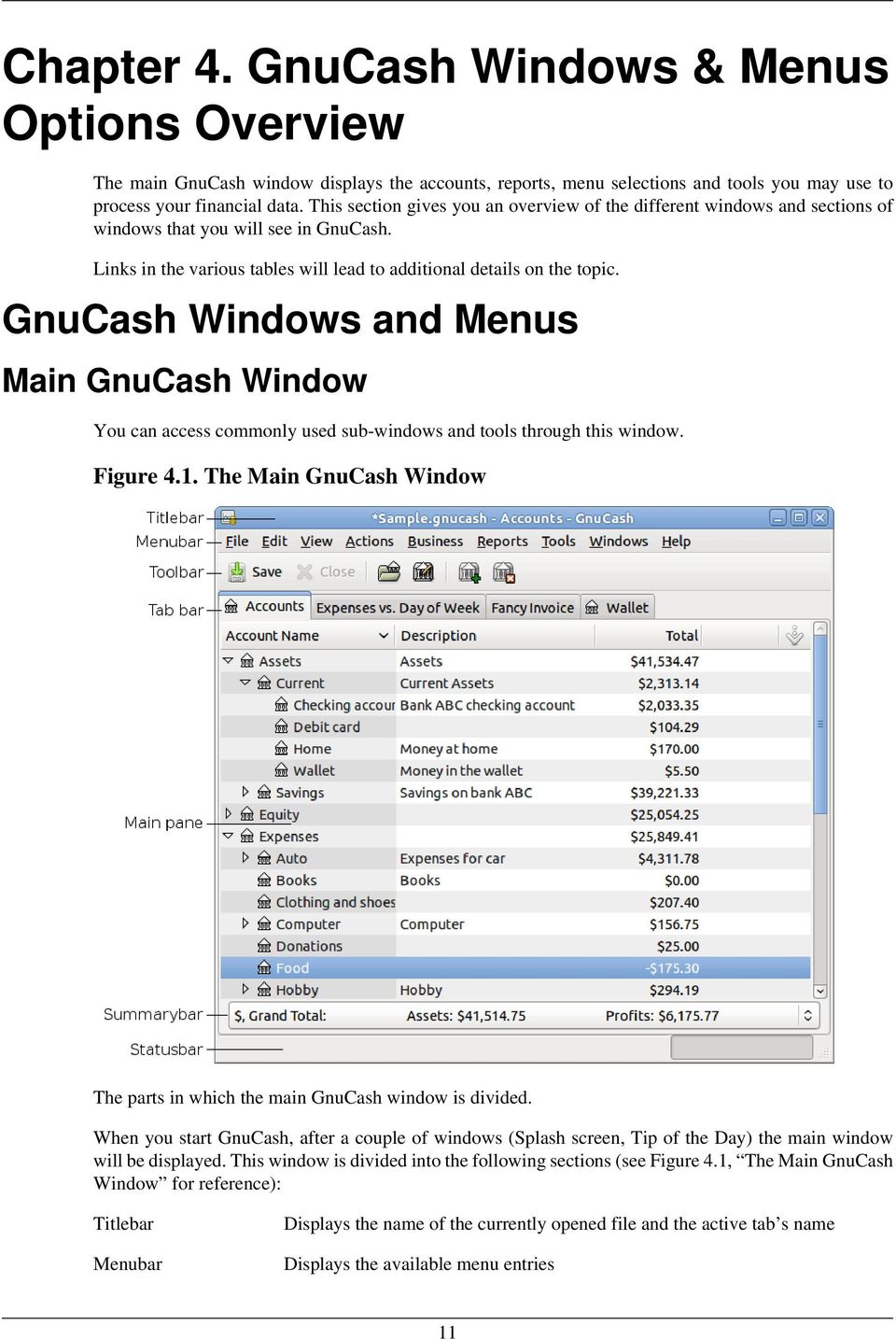
21 GnuCash Windows & Menus Options Overview Toolbar Tab bar Main pane Summarybar Statusbar Note Displays the available Toolbar buttons Lists the open reports, registers and tree of accounts The major display space showing the content of the currently selected tab Displays a financial summary Gives a description of the active menu item and shows a progress bar The contents and options within the various sub-menus of the different sections of the main GnuCash window will vary upon the active display window. The tree of accounts is labeled Accounts in the Tab bar, and displays all your accounts and their balances, grouped according to standard accounting practice. Tip To open an additional view of the tree of accounts go to View New Accounts Page. This will open the account tree in the existing window. Tip To open a new window with a tree of accounts view, go to Windows New Window with Page. Account Tab Display Figure 4.2. The Account Tree Display. This is an image of the Accounts tab. Account Tree - Menus The Menubar for the Accounts Tree window contains the following options. 12
22 GnuCash Windows & Menus Options Overview Account Tree - File Menu The following table describes the options in the File Menu. Clicking on the File option of the Menubar will pull down a menu of options described in Table 4.1, Account Tree - File Menu - Access to file, account operations and printing.. Table 4.1. Account Tree - File Menu - Access to file, account operations and printing. Menu Item New File (Ctrl+N) Open... (Ctrl+O) Import Save (Ctrl+S) Save As... (Shift+Ctrl+S) Description Creates a new data file (starts with new accounts and data.) Opens an already existing GnuCash data file. Import QIF... Import OFX/QFX... Import Accounts from CSV... Opens the Import sub-menu to import files from other financial programs. Import Transactions from CSV... Replay GnuCash.log file... Import MT940. Import MT942. Import DTAUS. Import DTAUS and send. Import Bills & Invoices... Import Customers and Vendors... Saves the currently open file. Starts the QIF file Import process. Starts the OFX/QFX file Import process. Starts the CSV Account file import process. The file to import must be in the same format as the one exported by GnuCash. Starts the CSV Transactions file import process. The file to import must be a delimited file. Starts the replaying of a GnuCash log file. Used for data recovery from "crashes". Open the Import Transactions from text file window. Open the Import Customers and Vendors from text file window. Saves the currently opened file with a different name. Warning Revert Print Page Setup... (Shift+Ctrl+P) Do NOT store your data file in ~/.gnucash/books. Reload the last saved version of the currently opened file. Useful if you need to discard changes made to the data and not yet saved. Grayed out option. Let you choose the paper size, layout and margins for printing. 13
23 GnuCash Windows & Menus Options Overview Menu Item Export Properties (Alt+Enter) Recently opened files Close (Ctrl+W) Opens the Export sub-menu. Export Accounts Tree to CSV Export Transactions to CSV Export Accounts Description Sets options for this GnuCash data file. Exports your account hierarchy to a delimited CSV file. Does not export data. Exports transactions to a delimited CSV file. Exports your account hierarchy to a new GnuCashfile. Does not export data. Numbered list of most recently opened GnuCash data files. Close the current tab. Note Quit (Ctrl+Q) In the initial Account tree this item is not available - it will be grayed out. Exits GnuCash. Account Tree - Edit Menu Table 4.2. Account Tree - Edit Menu - Access to file and account editing operations and preferences. Menu Item Cut (Ctrl+X) Copy (Ctrl+C) Paste (Ctrl+V) Edit Account (Ctrl+E) Delete Account... (Delete) Renumber Subaccounts... Description Performs a standard Cut operation. Performs a standard Copy operation. Performs a standard Paste operation. Modify name or characteristic of selected account. the section called Editing an Account Remove an account. See the section called Deleting an Account Starts the Renumber Account assistant. See the section called Renumbering Subaccounts. Note Open Account Open Subaccount This item is selectable only if you have highlighted an account with at least one subaccount in the accounts tree. Opens the register window for the currently selected account. Opens a register window that displays all the transactions for the selected account and for all its subbaccounts. 14
24 GnuCash Windows & Menus Options Overview Menu Item Find... (Ctrl+F) Preferences (GnuCash Preferences on Mac OS X). Style Sheets Tax Report Options Description Set criteria for a search for a specific transaction. See the section called Find for specifics on searches. Customize GnuCash for location, style, and numerous other preferences. See the section called Setting Preferences. Modify/customize Style Sheets. See the section called Changing Style Sheets. Set tax characteristics on account(s) (US). Assign tax form and line to account. See the section called Setting Tax Report Options Account Tree - View Menu Table 4.3. Account Tree - View Menu - Changes display window view. Menu Item Toolbar Summarybar Statusbar Filter by... Refresh (Ctrl+R) New Accounts Page Description Check-box to enable/disable display of Toolbar. Check-box to enable/disable display of Summarybar. Check-box to enable/disable display of Statusbar. Set filter for accounts displayed in the Account Tree display. Repaint the display screen. Open a new tab that display the account tree. Account Tree - Actions Menu Table 4.4. Account Tree - Actions Menu - Setup scheduled transactions, repair accounts, perform stock splits, transfer and reconcile transactions. Menu Item Online Actions Scheduled Transactions Get Balance Get Transactions Issue Transaction... Description This menu item (and sub-menu) is shown only if Online Banking was enabled for GnuCash Issue SEPA Transaction... Internal Transaction... Direct Debit... Show log window... Download transactions from online accounts Upload transaction(s) to online account?? Open the Online Banking Connection Window Scheduled Transactions sub-menus 15
25 GnuCash Windows & Menus Options Overview Menu Item Budget New Account... New Account Hierarchy... Transfer... (Ctrl+T) Reconcile... Auto clear... Stock Split... View Lots... Check & Repair Reset Warnings... Scheduled Transaction Editor Since Last Run... Mortgage & Loan Repayment... New Budget Open Budget Copy Budget Description Budget sub-menus Invoke tool to edit scheduled transactions. See the section called Edit Scheduled Transaction Window Display Scheduled transactions since last running of GnuCash. the section called Since Last Run Assistant Starts the Mortgage & Loan Repayment assistant for setting up repayments. the section called Mortgage & Loan Repayment Assistant Opens the window to create a new budget. Opens an existing budget. Copy a budget. Creates a new account and opens the account properties window. Starts the New Account Hierarchy Setup assistant. Starts the Transfer assistant for transfer between accounts. Open the Reconcile window. the section called Reconciling an Account to a Statement Opens the auto-clear screen where you can fill up the automatic clear information. Starts the Stock Split assistant. Additional details the section called Recording a Stock Split Opens the Lots in Account form. Check & Repair Account Check & Repair Subaccounts Check & Repair All Check & Repair Submenus Check for and repair unbalanced transactions and orphan splits in this account. Check for and repair unbalanced transactions and orphan splits in this account and its subaccounts. Check for and repair unbalanced transactions and orphan splits in all accounts. GnuCash gives warnings when certain operations are attempted, such as removing a transaction or removing the splits of a transaction. The warning message gives you the option to not give you these warnings when attempting the operation. Check-boxes labeled Remember and don t ask me again and Remember and don t ask me again this session allow disabling the warnings. This option 16
26 GnuCash Windows & Menus Options Overview Menu Item Description resets the warnings to the default, This option resets the warnings to the default, i.e. display all warnings. Tip Rename Page Warnings may be selectivly enabled. Open the form to rename the current page/tab. Account Tree - Business Menu Table 4.5. Account Tree - Business Menu - Access small business features of GnuCash. Menu Item Customer Vendor Customers Overview New Customer... Find Customer... New Invoice... Find Invoice... New Job... Find Job... Process Payment... Vendors Overview New Vendor... Find Vendor... New Bill... Find Bill... New Job... Description Select customer related activities. Open a customers overview page. Start the form to create a new customer. Start the assistant to search for a customer. Start the form to create a new invoice. Start the assistant to search for a invoice. Start the form to create a new job. Select vendor related activities. Start the assistant to search for a job. Starts the Process Payment assistant. Requires an account of type "A/Payable" before running assistant. Open a vendors overview page. Start the form to create a new vendor. Start the assistant to search for a vendor. Start the form to create a new bill. Start the assistant to search for a bill. Start the form to create a new job. 17
27 GnuCash Windows & Menus Options Overview Menu Item Employee Sales Tax Table Billing Terms Editor Bills Due Reminder Find Job... Process Payment... Employees Overview New Employee... Find Employee... New Expense Voucher... Find Expense Voucher... Process Payment... Description Start the assistant to search for a job. Starts the Process Payment assistant. Requires an account of type "A/Payable" before running assistant. Select employee related activities. View and edit the list of tax tables. View and edit the list of Billing Terms. View and edit the list of Bills Due Reminder. Open an employees overview page. Start the form to create a new employee. Start the assistant to search for a employee. Start the form to create a new expense voucher. Start the assistant to search for a expense voucher. Starts the Process Payment assistant. Requires an account of type "A/Payable" before running assistant. Account Tree - Reports Menu This is only a brief listing of each of the available reports and graphs. Each report or graph may be customized by selecting a different Stylesheet or by pressing the Options button in the Toolbar. Table 4.6. Account Tree - Reports Menu - Access GnuCash Reports and Charts. Menu Item Description Budget Assets & Liabilities Budget Balance Sheet Budget Barchart Budget Flow Budget Income Statement Budget Profit & Loss Budget Report Advanced Portfolio Asset Barchart 18
28 GnuCash Windows & Menus Options Overview Menu Item Business Reports Income & Expense Description Asset Piechart Average Balance Balance Sheet Balance Sheet using eguile-gnc General Journal General Ledger Investment Portfolio Liability Barchart Liability Piechart Net Worth Barchart Net Worth Linechart Price Scatterplot Customer Report Customer Summary Easy Invoice Employee Report Fancy Invoice Job Report Payable Aging Printable Invoice Receivable Aging Tax Invoice Vendor Report Cash Flow Equity Statement Expense Barchart Expense Piechart Expenses vs. Day of Week Income & Expense Chart Income Barchart Income Piechart Income Statement Income vs. Day of Week Profit & loss Trial Balance 19
29 GnuCash Windows & Menus Options Overview Menu Item Sample & Custom Account Summary Future Scheduled Transactions Summary Preconfigured Reports Tax Schedule Report & TXF Export Transaction Report Welcome Sample Report Custom Multicolumn Report Sample Report With Examples Description Report showing the balance of selected accounts. Report showing a summary of future transactions. Open the screen to manage user created and stored reports. Create a Tax report (US) and/or export data for tax preparation software. (TXF) Account Tree - Tools Menu Table 4.7. Account Tree - Tools Menu - Access to miscellaneous tools and editors Menu Item Online Banking Setup... Price Editor Security Editor Loan Repayment Calculator Close Book General Ledger Description Starts the Online banking setup assistant, if GnuCash was built to support on-line banking. the section called HBCI (Online Banking) Setup Assistant Tool to enter or modify Stock/Fund prices. Details at the section called Price Editor Tool to enter or modify Stock or commodities. Details at the section called Security Editor Details at the section called Loan Repayment Calculator Open a screen where you can enter the required information to close the current accounting book. See the section called General Ledger Account Tree - Windows Menu Table 4.8. Account Tree - Windows Menu Menu Item New Window New Window with Page Opened windows Description Opens a new GnuCash empty window. Moves the current tab into a new window. A numbered list of open windows. 20
30 GnuCash Windows & Menus Options Overview Account Tree - Help Menu Table 4.9. Account Tree - Help Menu - Access to this help and the Tutorial and Concepts Guide. Menu Item Tutorial & Concepts Guide Tips Of The Day Contents About Description Explanation of accounting principles and how to apply them in GnuCash Shows short notes about features you might otherwise miss. Open this document. Show the information screen with GnuCash version, license and credits Account Tree - Toolbar Icons/Buttons The GnuCash main Window has a number of buttons in the Toolbar to quickly access some common functions used with the specific active tab. The Toolbar can be hidden or shown by selecting View Toolbar. The specific options displayed in the Toolbar vary with the functions available to the "active tab". A brief description of the function of a Toolbar button is displayed when the mouse pointer is placed over the icon for a couple of seconds. Table Account Tree - Window Toolbar Toolbar Buttons Save (Ctrl+S) Close (Ctrl+W) Description Perform a save on the data file, commit all transactions to the data file. Close the currently active account page Note Open Edit New Delete This icon is not available for the first accounts tab. It is available for additional account tree displays. Open a transaction register of the selected account. Edit the characteristics for the selected account. the section called Editing an Account Start the assistant for creating a new account. the section called Creating a New Account Remove the selected account. the section called Deleting an Account Tab bar The Tab bar displays file/notebook folder style tabs for open transaction registers, reports and the account tree. 21
31 Main pane - Account tree GnuCash Windows & Menus Options Overview The account tree displays the list of your accounts in hierarchical format. This enables you to organize your accounts by type. Tip The triangle shape (or plus sign) beside the account name is used to open and close the account tree. When you click on the triangle (plus sign), it changes from a rightward-pointing into a downward-pointing sign (minus sign) to indicate that the tree is opened. You will then see offset below the account name either a list of the sub account(s) or another triangle (plus sign) to the left of an account. This indicates another lower level of the account tree. In the main pane are also shown, by default, four columns: Account Name, Type, Description and Total. For each account, this informations, if available, is displayed in the same row of the account. Tip The columns shown for each account in the Account Tree can be customized to suit your needs. Click on the arrow icon on the far right of the Account Tree window to display a drop down list of column options. Click on a column description to add it to the Account Tree window. Click again on the column description to hide it. The default display for the account tree window is in Notebook mode. This is indicated by the tab in the tab row of the main window. Other tabs will appear beside this one when you open reports, account registers or additional account trees. Summarybar Statusbar The Summarybar displays balances appropriate for the opened account type at a glance. Usually accounts display today s account balance, any balance for future dates, a balance for cleared items and a reconciled balance. Stock accounts, however, display shares totals and their value. The Summarybar can be hidden or shown by selecting View Summarybar. The Statusbar displays informations about the currently highlighted menu item. It also shows a progress bar when opening or saving a GnuCash data file or generating reports. The Statusbar can be hidden or shown by selecting the Statusbar item on the View menu. Account Register/General Ledger Account Register & General Ledger Window This window is used to enter and edit your account data. It also provides tools for scheduling future transactions, finding and reporting on transactions and printing checks. To open the Account Register Window for an account, select the account in the Account Tree then go to File Open Account or press Ctrl+O. This will open a new window with the Account Register. Pressing the Open button on the Toolbar in the Account Tree Window or the Jump button in the Account Register Window are alternate methods. 22
32 GnuCash Windows & Menus Options Overview Figure 4.3. The Account Register Display. This is an image of the Account Register tab. Tip Appearance of the Account Register Display is highly customizable (see the section called Changing the Register View ). Note The methods to enter transactions are described in detail in Chapter 6, Common Transaction Operations. Account Register Menus The Menubar for the Transaction Register window contains the following options. Account Register - File Menu The following table describes the options in the File. Clicking on File in the Menubar will pull down a menu of choices described in Table 4.11, Account Register - File Menu - Access to file and account operations and printing.. Table Account Register - File Menu - Access to file and account operations and printing. Menu Item New File (Ctrl+N) Open... (Ctrl+O) Import Description Creates a new data file (starts with new accounts and data.) Opens an already existing GnuCash data file. Import QIF... Import OFX/QFX... Opens the Import sub-menu to import files from other financial programs. Starts the QIF file Import process. Starts the OFX/QFX file Import process. 23
33 GnuCash Windows & Menus Options Overview Menu Item Save (Ctrl+S) Save As... (Shift+Ctrl+S) Import Accounts from CSV... Import Transactions from CSV... Replay GnuCash.log file... Description Import MT940. Import MT942. Import DTAUS. Import DTAUS and send. Import Bills & Invoices... Import Customers and Vendors... Saves the currently open file. Starts the CSV Account file import process. The file to import must be in the same format as the one exported by GnuCash. Starts the CSV Transactions file import process. The file to import must be a delimited file. Starts the replaying of a GnuCash log file. Used for data recovery from "crashes". Open the Import Transactions from text file window. Open the Import Customers and Vendors from text file window. Saves the currently opened file with a different name. Print Checks... (Ctrl+P) Page Setup... (Shift+Ctrl+P) Export Exports... Properties (Alt+Enter) Recently opened files Close (Ctrl+W) Quit (Ctrl+Q) Warning Do NOT store your data file in ~/.gnucash/books. Starts the Print Checks assistant. See the section called Printing Checks. Let you choose the paper size, layout and margins for printing. Export Accounts Tree to CSV Export Transactions to CSV Export Accounts Sets options for this GnuCash data file. Exports your account hierarchy to a delimited CSV file. Does not export data. Exports transactions to a delimited CSV file. Exports your account hierarchy to a new GnuCashfile. Does not export data. Numbered list of most recently opened GnuCash data files. Closes the currently opened transaction register. Exits GnuCash. 24
34 Account Register - Edit Menu GnuCash Windows & Menus Options Overview Table Account Register - Edit Menu - Access to file and account editing operations and preferences. Menu Item Cut (Ctrl+X) Copy (Ctrl+C) Paste (Ctrl+V) Assign as payment... Edit Account Find... (Ctrl+F) Preferences (GnuCash Preferences on Mac OS X). Style Sheets Tax Report Options Description Performs a standard Cut operation. Performs a standard Copy operation. Performs a standard Paste operation. Assign as payment the selected transaction. Open form to edit/modify account characteristics and parameters. Set criteria for a search for a specific transaction. See the section called Find for specifics on searches. Customize GnuCash for location, style, and numerous other preferences. See the section called Setting Preferences. Modify/customize Style Sheets. Set tax characteristics on account(s) (US). Assign tax form and line to account. See the section called Setting Tax Report Options. Account Register - View Menu Table Account Register - View Menu - Changes GnuCash display window characteristics. Menu Item Toolbar Summarybar Statusbar Basic Ledger Auto-Split Ledger Transaction Journal Double Line Sort by... Description Check-box to enable/disable display of Toolbar. Check-box to enable/disable display of Summary Bar. Check-box to enable/disable display of Status Bar. Radio button to select register display mode. Radio button to select register display mode. Radio button to select register display mode. Check-box to enable/disable display of Double Line display. Set the sort order of the transactions display. Requires a click to start options form. Option form requires Cancel/OK to close. Standard Order Date Date of Entry Statement Date Number Keep normal account order Sort by date Sort by date of entry. Sort by the statement date (unreconciled items last). Sort by number. 25
35 GnuCash Windows & Menus Options Overview Menu Item Filter by... Refresh (Ctrl+R) New Accounts Page Description Amount Memo Description Action Notes Sort by amount. Sort by memo. Sort by Description. Sort by action field. Sort by notes field. Set filtering for accounts displayed in the Account Tree or transactions in Register display. Repaint the display screen. Open a new tab that display the account tree. Account Register - Transaction Menu Table Account Register - Transaction Menu - access to transaction tools. Menu Item Cut Transaction Copy Transaction Paste Transaction Duplicate Transaction Delete Transaction Remove Other Splits Enter Transaction Cancel Transaction Void Transaction Unvoid Transaction Add Reversing Transaction Associate File with Transaction Associate Location with Transaction Open Associated File/Location Description Cut the selected transaction into the clipboard. Copy the selected transaction into the clipboard. Paste the selected transaction from the clipboard. Insert in the register a copy of the selected transaction. Delete the selected transaction. Remove all splits from the selected transaction. Enter in the register the transaction you are currently working on. Blanks all fields in the selected transactions if it has not yet been recorded. Void the selected transaction. Unvoid the selected transaction. Add a copy of the selected transaction with an inverted amount. Associate a file to the selected transaction. Associate a URL to the selected transaction. Open the file or location associated with the transaction. Available if a file or location was associated to the currently selected transaction. 26
36 Account Register - Actions Menu GnuCash Windows & Menus Options Overview Table Account Register - Actions Menu - Setup scheduled transactions, repair accounts, perform stock splits, transfer and reconcile transactions. Menu Item Online Actions Scheduled Transactions Budget Transfer... (Ctrl+T) Reconcile... Stock Split... View Lots... Blank Transaction Get Balance Get Transactions Issue Transaction... Description This menu item (and sub-menu) is shown only if Online Banking was enabled for GnuCash Issue SEPA Transaction... Internal Transaction... Direct Debit... Show log window... Scheduled Transaction Editor Since Last Run... Mortgage & Loan Repayment... New Budget Open Budget Copy Budget Download transactions from online accounts Upload transaction(s) to online account?? Open the Online Banking Connection Window Scheduled Transactions sub-menus Budget sub-menus Invoke tool to edit scheduled transactions. See the section called Edit Scheduled Transaction Window Display Scheduled transactions since last running of GnuCash. the section called Since Last Run Assistant Starts the Mortgage & Loan Repayment assistant for setting up repayments. the section called Mortgage & Loan Repayment Assistant Opens the window to create a new budget. Opens an existing budget. Copy a budget. Starts the Transfer assistant for transfer between accounts. Start the Reconcile process for the selected account. the section called Reconciling an Account to a Statement Starts the Stock Split assistant. Additional details the section called Recording a Stock Split Opens the Lots in Account form. Move to the blank transaction at the bottom of the register 27
37 GnuCash Windows & Menus Options Overview Menu Item Split Transaction Edit Exchange Rate Schedule... Jump Check & Repair Reset Warnings... Description Expand the currently selected transaction to show splits. Edit the exchange rate for the current transaction. Create a Scheduled Transaction with the current transaction as a template. Jump to the corresponding transaction in the other account. All Transactions This Transaction Check & Repair Submenus Check for and repair unbalanced transactions and orphan splits in this account. Check for and repair splits in this transaction. GnuCash gives warnings when certain operations are attempted, such as removing a transaction or removing the splits of a transaction. The warning message gives you the option to not give you these warnings when attempting the operation. Check-boxes labeled Remember and don t ask me again and Remember and don t ask me again this session allow disabling the warnings. This option resets the warnings to the default, This option resets the warnings to the default, i.e. display all warnings. Tip Rename Page Warnings may be selectively enabled. Open the form to rename the current page/tab. Account Register - Business Menu The items shown in the Business menu are the same listed in Table 4.5, Account Tree - Business Menu - Access small business features of GnuCash.. Account Register - Reports Menu The items shown in the Reports menu are the same listed in Table 4.6, Account Tree - Reports Menu - Access GnuCash Reports and Charts. plus the two types of report listed in the following. Account report Account Transaction Report Account Register - Tools Menu The items shown in the Tools menu are the same listed in Table 4.7, Account Tree - Tools Menu - Access to miscellaneous tools and editors. Account Register - Windows Menu The items shown in the Windows menu are the same listed in Table 4.8, Account Tree - Windows Menu. 28
38 Account Register - Help Menu GnuCash Windows & Menus Options Overview The items shown in the Help menu are the same listed in Table 4.9, Account Tree - Help Menu - Access to this help and the Tutorial and Concepts Guide.. Account Register - Toolbar Icons/Buttons The GnuCash main Window has a number of icons/buttons in the Toolbar to quickly access some common functions used with the specific active tab. The Toolbar can be hidden or shown by selecting the Toolbar item on the View menu. Note The specific options displayed in the Toolbar varies by the functions available to the active tab. A brief description of the function of a button is displayed when the mouse pointer is placed over the button for a couple of seconds. Table Account Register (Transaction Register) Window Toolbar Toolbar Buttons Save (Ctrl+S) Close Duplicate Delete Enter Cancel Blank Split Jump Schedule Transfer Reconcile Description Perform a save on the data file, commit all transactions to the data file. Close this register. Make a copy of the current transaction. Delete the current transaction in this register. Record the current transaction. Cancel the current transaction. Move to a blank transaction at bottom of register. Show all splits in the current transaction. Not highlighted if View Auto-Split Ledger is enableb. Jump to the corresponding transaction in the other account Create a Scheduled Transaction with the current transaction as a template. Start the transfer assistant to transfer funds from one account to another. Start the Reconcile process for the selected account. the section called Reconciling an Account to a Statement Tab Bar The Tab bar displays notebook/file folder style tabs for open transaction registers, account trees and reports. 29
39 GnuCash Windows & Menus Options Overview List of Transactions The List of Transactions displays transactions you have entered and a running balance. It also provides a blank transaction to enter new transactions. The column headings vary according to what type of account you have opened. Common headings are Date, Description, Transfer and Balance. The View menu can be used to alter the appearance of the List of Transactions. Possible changes are limiting the number of transactions shown, using a different sort order and changing the style to more easily see transactions. The Split button also provides quick access to view all the parts of a transaction. Summarybar Statusbar The Summarybar displays balances appropriate for the opened account type at a glance. Usually accounts display Present (today s) account balance, any balance for Future dates, a balance for Cleared items, a Reconciled balance and a Projected Minimum balance. Stock accounts, however, display shares totals and their value. The Summarybar can be hidden or shown by selecting the View Summarybar item. The Statusbar works the same as described in the section called Statusbar. Report Window Report Display Window This window is shown whenever a report or chart is selected from the Reports menu. To open the report window, select a report from the Reports item in the Menubar. This will open a new window with the report displayed. It provides a web browser type display with active links to account data. Note Depending on the report there may be a delay while the report is generated. An approximation of the progress to completion is displayed in the Statusbar, if has not been opted out of displaying. 30
40 Figure 4.4. The Report Window GnuCash Windows & Menus Options Overview This is an image of the Income/Expense Chart. Report Menus The Menubar for the report window contains the following options. Reports - File Menu The following table describes the options in the File Menu. Clicking on the File option of the Menubar will pull down a menu of options described in Table 4.17, Report - File Menu - Access to file and account operations and printing.. Table Report - File Menu - Access to file and account operations and printing. Menu Item New File (Ctrl+N) Open... (Ctrl+O) Import Description Creates a new data file (starts with new accounts and data.) Opens an already existing GnuCash data file. Import QIF... Import OFX/QFX... Opens the Import sub-menu to import files from other financial programs. Starts the QIF file Import process. Starts the OFX/QFX file Import process. 31
41 GnuCash Windows & Menus Options Overview Menu Item Save (Ctrl+S) Save As... (Shift+Ctrl+S) Import Accounts from CSV... Import Transactions from CSV... Replay GnuCash.log file... Description Import MT940. Import MT942. Import DTAUS. Import DTAUS and send. Import Bills & Invoices... Import Customers and Vendors... Saves the currently open file. Starts the CSV Account file import process. The file to import must be in the same format as the one exported by GnuCash. Starts the CSV Transactions file import process. The file to import must be a delimited file. Starts the replaying of a GnuCash log file. Used for data recovery from "crashes". Open the Import Transactions from text file window. Open the Import Customers and Vendors from text file window. Saves the currently opened file with a different name. Warning Revert Save Report Save Report As... Print Report... (Ctrl+P) Page Setup... (Shift+Ctrl+P) Export as PDF Export Do NOT store your data file in ~/.gnucash/books. Reload the last saved version of the currently opened file. Useful if you need to discard changes made to the data and not yet saved. Saves the displayed report. You will be able to run the exact same report again by using the Reports Predefined Report menu item. Saves the displayed report in a configuration file with a given name. You will then be able to run the exact same report again by using the Reports Predefined Report menu item. Print the selected report. Let you choose the paper size, layout and margins for printing. Exports the displayed report as a PDF file. Opens the Export sub-menu. Export Accounts Tree to CSV Export Transactions to CSV Export Report Exports your account hierarchy to a delimited CSV file. Does not export data. Exports transactions to a delimited CSV file. Export the current report in an HTML formatted file. 32
42 GnuCash Windows & Menus Options Overview Menu Item Properties (Alt+Enter) Recently opened files Close (Ctrl+W) Quit (Ctrl+Q) Export Accounts Description Sets options for this GnuCash data file. Exports your account hierarchy to a new GnuCashfile. Does not export data. Numbered list of most recently opened GnuCash data files. Closes the current report. Exits GnuCash. Report - Edit Menu Table Reports - Edit Menu - Access to file and account editing operations and preferences. Menu Item Cut (Ctrl+X) Copy (Ctrl+C) Paste (Ctrl+V) Find... (Ctrl+F) Preferences (GnuCash Preferences on Mac OS X). Style Sheets Report Options Tax Report Options Description Performs a standard Cut operation. Performs a standard Copy operation. Performs a standard Paste operation. Set criteria for a search for a specific transaction. See the section called Find for specifics on searches. Customize GnuCash for location, style, and numerous other preferences. See the section called Setting Preferences. Modify/customize Style Sheets. Open form to edit/modify report selection criteria, stylesheets, date ranges, and many other parameters. Set tax characteristics on account(s) (US). Assign tax form and line to account. See the section called Setting Tax Report Options. Report - View Menu Except Filter By..., the items shown in the View menu are the same listed in Table 4.3, Account Tree - View Menu - Changes display window view. Report - Actions Menu Table Reports - Actions Menu - Setup scheduled transactions. Menu Item Online Actions Show log window... Description This menu item (and sub-menu) is shown only if Online Banking was enabled for GnuCash Open the Online Banking Connection Window 33
43 GnuCash Windows & Menus Options Overview Menu Item Scheduled Transactions Budget Reset Warnings... Scheduled Transaction Editor Since Last Run... Mortgage & Loan Repayment... New Budget Open Budget Copy Budget Description Scheduled Transactions sub-menus Budget sub-menus Invoke tool to edit scheduled transactions. See the section called Edit Scheduled Transaction Window Display Scheduled transactions since last running of GnuCash. the section called Since Last Run Assistant Starts the Mortgage & Loan Repayment assistant for setting up repayments. the section called Mortgage & Loan Repayment Assistant Opens the window to create a new budget. Opens an existing budget. Copy a budget. GnuCash gives warnings when certain operations are attempted, such as removing a transaction or removing the splits of a transaction. The warning message gives you the option to not give you these warnings when attempting the operation. Check-boxes labeled Remember and don t ask me again and Remember and don t ask me again this session allow disabling the warnings. This option resets the warnings to the default, This option resets the warnings to the default, i.e. display all warnings. Tip Rename Page Warnings may be selectivly enabled. Lets you type a new name for the current page or tab. Report - Business Menu The items shown in the Business menu are the same listed in Table 4.5, Account Tree - Business Menu - Access small business features of GnuCash.. Report - Reports Menu The items shown in the Reports menu are the same listed in Table 4.6, Account Tree - Reports Menu - Access GnuCash Reports and Charts.. Report - Tools Menu The items shown in the Tools menu are the same listed in Table 4.7, Account Tree - Tools Menu - Access to miscellaneous tools and editors. 34
44 GnuCash Windows & Menus Options Overview Report - Windows Menu The items shown in the Windows menu are the same listed in Table 4.8, Account Tree - Windows Menu. Report - Help Menu The items shown in the Help menu are the same listed in Table 4.9, Account Tree - Help Menu - Access to this help and the Tutorial and Concepts Guide.. Reports - Toolbar Icons/Buttons The Report Window has a Toolbar to quickly access the functions used with reports. The Toolbar can be hidden or shown by selecting View Toolbar. Table Reports - Toolbar Buttons Toolbar Button Save (Ctrl+S) Close (Ctrl+W) Back Forward Reload Stop Save Report Save Report As... Export Options Print (Ctrl+P) Export as PDF Description Closes the displayed report. Move back one step in the history. Move forward one step in the history. Reload (rerun) current report. Stops the HTML requests. Saves the displayed report. You will be able to run the exact same report again by using the Reports Predefined Report menu item. Saves the displayed report in a configuration file with a given name. You will then be able to run the exact same report again by using the Reports Predefined Report menu item. Exports HTML formatted report to a file. Edit options specific to selected report. Queues the current report for printing. Exports the selected report as a PDF file. Tab Bar The Tab bar displays notebook/file folder -style tabs for open transaction registers, account trees and reports. Report Main Display This is where the report or chart you have selected is shown. The properties of this window are editable in two ways. Selecting the Options button on the Toolbar lets you edit what the report is showing and which accounts the information is drawn from. Selecting Edit Style Sheets... lets you select the properties of the page that displays your report. 35
45 GnuCash Windows & Menus Options Overview The report is able to act like a web browser if your report contains links to external web pages. The Toolbar buttons allow you to move Back and Forward through web pages. It will also open account registers when you click on links to accounts contained in the report. You can also Export your report to a file and Print the report through the Toolbar buttons. Summarybar Statusbar The Summarybar is not displayed when viewing a report window. The Statusbar works the same as described in the section called Statusbar. Reconcile Window To simplify navigation the following are the topics covered in this section; the section called Reconcile Display Window, the section called Menus, the section called Toolbar Buttons. The detailed explaination of reconciling an account is described in the section called Reconciling an Account to a Statement. Reconcile Display Window To open the Reconcile window, click Actions Reconcile... from the Menubar or the Reconcile button from the Toolbar in a register window. This will open a Reconcile screen in which you need to enter the Statement Date and the Ending Balance. If you select the Include subaccounts option, all transactions in the subaccounts of the selected account will also be counted for the reconcile operation. Pressing the OK button will open a Reconcile window allowing you to compare deposit and withdrawal transactions to your statement. Table Components of the Reconcile Window. Component Menubar Toolbar (Icons and/or Text) Funds In Funds Out Balance Pane Description Contains the Menus used in the Reconcile Window. Contains buttons used to access common Reconcile Account Window tasks. This pane in the left contains a list of funds deposited in the account. This pane in the right contains a list of funds withdrawn from the account. This pane in the lower right contains a list of balances useful for reconciling. Menus The following tables describe menus in the Reconcile Window. 36
46 GnuCash Windows & Menus Options Overview Table Reconcile Menu - Access to Reconcile Information and finishing or postponing. Menu Item Reconcile Information... Finish (Ctrl+F) Postpone (Ctrl+P) Cancel Description Opens the Reconciling Information Window. Complete the reconciliation of this account. Postpone the reconciliation of this account. Cancel the reconciliation of this account. Table Account Menu - Access to account operations. Menu Item Open Account Edit Account Transfer... (Ctrl+T) Check & Repair Description Opens a transaction register for the accounts Modify name or characteristic of selected account. the section called Editing an Account Opens a Transfer assistant for entering a transfer transaction between any two accounts. Verify and repair this account if necessary. Table Transaction Menu - Access to transaction editing operations. Menu Item New Balance Edit Delete Description Add a new transaction to the account. Opens the account s register window with a precompiled balancing transaction. Edit the currently selected transaction. Remove the currently selected transaction. Table Help Menu - Access to help. Menu Item Help Description Open this Help text file. Toolbar Buttons The Reconcile window has a Toolbar to access quickly some common functions used with reconciliation. Table Reconcile Window Toolbar Toolbar Button New Balance Edit Delete Open Description Add a new transaction to the account. Opens the account s register window with a precompiled balancing transaction. Edit the currently selected transaction. Remove the currently selected transaction. Open an Account transaction window. 37
47 GnuCash Windows & Menus Options Overview Toolbar Button Finish Description Complete the reconciliation of this account. Postpone Cancel Note Schedule Transaction Window This button is not active (grayed out) until the Difference value in the balance pane (lower right) is 0. Postpone the reconciliation of this account. Cancel the reconciliation of this account. To simplify navigation the following are the topics covered in this section; the section called Scheduled Menu, the section called Scheduled Transactions Toolbar Buttons, the section called Scheduled Transactions Window. the section called Edit Scheduled Transaction Window, The detailed explaination of scheduling transactions is described in the section called Scheduling Transactions. Scheduled Transactions Main Display Window This window is shown when Actions Scheduled Transactions Scheduled Transactions Editor is selected from the Menubar. This will open a new tab window with the Scheduled Transactions displayed. Scheduled Transaction Main Window Components Table Components of the Schedule Transactions Window. Component Menubar Description Contains the Menus used in the Schedule Transactions Window. It provides the standard list of Menubar options and an additional option, Scheduled, which presents options; New, Edit or Delete. If no transaction is highlighted Edit and Delete will be "grayed out". Toolbar (Icons and/or Text) Contains buttons used to access Schedule Transitions tasks. Tabs Transactions Upcoming Tabs to switch between open displays. The Transactions pane contains a list of transactions scheduled and related characteristics. The Upcoming pane contains a calendar of the next months In this calendar the days in which one or more transactions are scheduled, are highlighted with a circle. You could change the time interval displayed in the calendar by selecting a different period from the View: drop down list on the right. 38
48 GnuCash Windows & Menus Options Overview Component Description Tip Click on a date in the pane and the details about the scheduled transactions on this very date will be displayed. Scheduled Menu The following table describe the Scheduled menu options available in the Menubar when you are in the Scheduled Transaction window. Table Scheduled Menu - Access to scheduled transaction editing operations. Menu Item New Edit Delete Description Add a new schedule transaction. Edit the currently selected transaction. Remove the currently selected transaction. Scheduled Transactions Toolbar Buttons The Scheduled Transactions window has a Toolbar to quickly access some common functions used with scheduling. Table Scheduled Transactions Window Toolbar Toolbar Button Save (Ctrl+S) Close (Ctrl+W) New Edit Delete Budget Window Description Save the current schedule of transactions. Close the Scheduled Transactions window. Add a new scheduled transaction. Edit the currently selected transaction. Remove the currently selected transaction. Actions Budget Open Budget will open the default budget or offer you a choice if there is more than one budget. A new tab will open with the budget displayed. Budget Window Menus Here are some menu items that are particularly useful to working with budgets. Budget Window - Edit menu Table Edit Menu - Special items for the budget window. Menu Item Estimate Budget Description Estimate a budget value for the selected accounts from past transactions. 39
49 GnuCash Windows & Menus Options Overview Menu Item Delete Budget Budget Options Description Delete this budget. Edit this budget s options. Budget Window - Actions menu Table Actions Menu - Items in the standard menu that relate to budgets. Menu Item Budget New Budget Open Budget Copy Budget Description Opens the Budget sub-menu to select budget actions. Create a new budget and open it in a new tab. If no budget exists, create a new budget and open it. If only one budget exists, open it; otherwise user selects one to open. If no budgets exist yet, just open a new budget. If only one budget exists, create a copy of it; otherwise user selects one to copy. If a copy is made, then the copy is opened in a new tab. Budget Window - Reports menu Using more than one budget When there is more than one budget, the reports will use the budget selected in book options by default. See the section called Book Options and the section called Budgeting Book Options Tab for more details. After the report is displayed, the budget it uses can be changed in the report options General tab. Table Reports Menu - Items in the standard menu that relate to budgets. Menu Item Budget Description Opens the Budget sub-menu to select a budget report. Budget Balance Sheet Budget Barchart Budget Flow Budget Income Statement This report includes information from one budget period at a time. The left column of numbers shows the budgeted amounts, and the right column of numbers shows the actual amounts. It only shows certain accounts, those that have no sub-accounts. 40
50 Menu Item GnuCash Windows & Menus Options Overview Budget Profit & Loss Budget Report Description This report is identical to the Budget Income Statement report. The budget report shows all accounts and all periods. For each period it gives the budgeted amount and the actual amount. There is an option to add another column showing the difference (budgeted - actual). Budget Window Toolbar Buttons The Budget window has a Toolbar to quickly access common functions used with budgeting. Table Budget Window Toolbar Toolbar Button Save (Ctrl+S) Close (Ctrl+W) Options Estimate Delete Description Save the current budget. Close the Budget window. Edit this budget s options. Estimate a budget value for the selected accounts from past transactions. Delete this budget. Budget Window Main Display The budget window contains a list of accounts down the left hand side, and a set of columns down the right hand side that represent budget values. Each column corresponds to a budget period. The number of periods for a budget can be changed using the Budget Options dialog. Procedure 4.1. Entering a budget value 1. Click the row corresponding to the account you wish to budget 2. Choose the period this value is for, and click in the cell corresponding to that period 3. Type the value in the cell 4. Press Enter to finish editing the value. Budget Options Table Budget options Option Budget Name Description The budget name is used in the tab s name and also in any reports you create with the budget. 41
51 GnuCash Windows & Menus Options Overview Option Notes Budget Period Number of Periods Description A description of the budget. The budget period includes when the budget starts (start date) and how long each budget period lasts. The number of periods in the budget. Business Windows Customers Overview To open the Customers Overview window, click Business Customer Customers Overview. Table Customers Overview - Toolbar Buttons Toolbar Buttons New Edit New Invoice Customer Listing Description Create a new customer Edit the selected customer Create a new invoice (by default it is for the selected customer) Show customer aging overview for all customers Table Customer context menu Context menu item Rename Page Edit Customer New Invoice Customer Report Description Edit the selected customer Create a new invoice Show customer report Note The customer context menu appears if you right click on a customer in the list. Vendors Overview To open the Vendors Overview window, click Business Vendor Vendors Overview. Table Vendors Overview - Toolbar Buttons Toolbar Buttons New Edit New Bill Vendor Listing Description Create a new vendor Edit the selected vendor Create a new bill (by default it is for the selected vendor) Show vendor aging overview for all vendors 42
52 Table Vendor context menu GnuCash Windows & Menus Options Overview Context menu item Rename Page Edit Vendor New Bill Vendor Report Description Edit the selected vendor Create a new bill Show vendor report Note The vendor context menu appears if you right click on a vendor in the list. Employees Overview To open the Employees Overview window, click Business Employee Employees Overview. Table Employees Overview - Toolbar Buttons Toolbar Buttons New Edit New Voucher Description Create a new employee Edit the selected employee Create a new voucher (by default it is for the selected employee) Table Employee context menu Context menu item Rename Page Edit Employee New Voucher Employee Report Description Edit the selected employee Create a new voucher Show employee report Note The employee context menu appears if you right click on a employee in the list. 43
53 Chapter 5. Setting Up, Editing & Working with Accounts This section describes the process of setting up, editing and working with GnuCash Accounts. In GnuCash an Account is used as the basic tool to organize the recording of where money comes from and goes to. GnuCash also extends the concept of real world accounts such as a bank account or loan account to grouping income and expense accounts. This allows you to quickly see where you spent your money and what your major income and expenses are. GnuCash sets Account Types (as described in the next section) to help in organizing and grouping accounts. Account Types can be used to create a Chart of Accounts. Types of GnuCash Accounts GnuCash supports a number of different account types. It is recommended to choose an appropriate account type based on the list of account types described below. Warning The Accounts Payable and Accounts Receivable types are used internally by GnuCash s business features. Users should not manually modify or enter transactions in these account types. Table 5.1. Types of GnuCash Accounts. Account Type Accounts Payable Description Accounts Payable are used by businesses to record amounts that must be paid. Example: The business has bought something, but the business has not paid the bill until later. Note Accounts Receivable Previous versions of this help defined A/P and A/R the other way round. Accounts Receivable records amounts for which money has not yet been received. Example: A business has sold something and issued a bill, but the client has not payed until later. Note Asset Bank Previous versions of this help defined A/P and A/R the other way round. Asset accounts are used for tracking things that are of value and can be used or sold to pay debts. (Normally a placeholder account) The Bank account type denotes savings or checking accounts held at a bank or other financial institution. Some of these accounts may bear interest. This is also the appropriate account type for check (debit) 44
54 Account Type Cash Credit Card Setting Up, Editing & Working with Accounts Description cards, which directly withdraw payments from a checking account. The Cash account type is used to denote the cash that you store in your wallet, shoe box, piggyback, or mattress. The Credit Card account type is used to denote credit card accounts, both for cards that allow floating lines of credit (e.g. VISA, MasterCard, or Discover) and with cards that do not permit continuing balances (e.g. American Express) Currency Currency Accounts were used for trading currencies, but have been replaced by the Currency Transfer pane on the Transfer Funds Window (the section called Transfer Funds window ). Equity Expense Income Liability Mutual Fund Stock Equity accounts are used to store the opening balances when you first start using GnuCash or start a new accounting period. Any expense such as food, clothing, taxes, etc. This type is called a category in Quicken. Any income received from sources such as salary, interest, dividends, etc. This type is called a category in Quicken. Liability accounts are used for tracking debts or financial obligations. (Normally a placeholder account) A professionally managed portfolio of stocks and bonds or other investments divided up into shares. A share of ownership in a corporation, which entitles its owner to all the risks and rewards that go with it. The New Account Hierarchy Setup assistant described in the first section of this help is a convenient way of setting up a set of accounts to use as a framework of account types. When new accounts are created the available choices of account types are grayed out according to what type the parent account is. The following list contains the possible choices. Accounts Payable: All accounts except Equity, Expense and Income can be child accounts. Accounts Receivable: All accounts except Equity, Expense and Income can be child accounts. Asset: All accounts except Equity, Expense and Income can be child accounts. Bank: All accounts except Equity, Expense and Income can be child accounts. Cash: All accounts except Equity, Expense and Income can be child accounts. Credit Card: All accounts except Equity, Expense and Income can be child accounts. Currency: All accounts except Equity, Expense and Income can be child accounts. 45
55 Setting Up, Editing & Working with Accounts Equity: Only Equity accounts can be child accounts. Expense: Only Expense or Income accounts can be child accounts. Income: Only Expense or Income accounts can be child accounts. Liability: All accounts except Equity, Expense and Income can be child accounts. Mutual Fund: All accounts except Equity, Expense and Income can be child accounts. Stock: All accounts except Equity, Expense and Income can be child accounts. Creating a Chart of Accounts The Chart of Accounts is like a table of contents for your finances. The best way to conceptualize a chart of accounts is as a tree. The main branches represent entire categories or groups, while the leaves of the tree denote individual bank accounts or expense categories. When a summary report is requested, typically only the main branches are shown in the report, rather than the individual accounts. For example, a chart of accounts might look like the following: 300 Expenses Living Expenses Beer Cable Business Expenses inch Floppies Blue Ray RW DVDs : : Accounts codes Note that accounts not only have names; they may have codes, to order the accounts. When a report is generated, the sort order is determined by the numbering. It s customary to have the leaf accounts end in non-zero digits, while parent nodes have increasing numbers of zeros. Warning GnuCash does not prevent duplicate numbering, although we would encourage you to avoid this. Account codes are treated as numbers in base-36, thus, if you run out of numbers, you can use the letters, a through z. Editing a Chart of Accounts Editing the Chart of Accounts is done within the Parent Account pane of the Edit Account dialog. It is possible to move an account to any part of the Chart of Account. It is recommended to keep accounts generally under the related types of accounts as described in the section called Types of GnuCash Accounts. This helps to preserve the Chart of Accounts structure. 46
56 Setting Up, Editing & Working with Accounts To move the selected account to a different parent account just select the account in the Parent Account pane. If New top level account is selected then the account will be moved to the top level. Creating a New Account To create a new account go to Actions New Account... or click the New Toolbar icon in the Account Tree Window. The New Account dialog will be opened. The New Account properties dialog consists of two tabs, the General tab and the Opening Balance tab. Creating a New Account involves planning in advance several details that are used in the New Account dialog. What type of account is needed. Where it fits in the structure of the Chart of Accounts. If there is an Opening Balance. If there is a Commodity (security/currency) needed for the account. If on-line updating of the commodity price is needed. These details are described below. General Information Tab The General tab is used to access the basic information about the account. It provides a way of connecting the account to stock information if it is one of the currency, mutual fund or stock account types. It can also be flagged as a Placeholder account. It displays if it is flagged as a Tax Related account (which is set through the Edit Tax Report Options dialog). There are seven fields in the Identification section of this tab. 1. Account Name: The name for the account such as First Bank Checking. 2. Account Code: The optional number code as described in Accounts codes. 3. Description: Optional description for the account. 4. Security/Currency: Note The Type field in the Select Security is determined by the selection of Account Type panel in the New Account screen. For accounts other than Stock or Mutual Fund this should be the default currency, USD (US Dollar) or your local currency symbol. If this account is for a foreign currency then use the Select... button to choose a different currency from the currencies pull-down list. For Accounts containing a Stock and Mutual Fund; first select stock or mutual fund in the Account Type panel, then the Parent Account, then use the Select... button, to choose the Type (usually the exchange the security is traded on) and security from the Select Security window. 47
57 Setting Up, Editing & Working with Accounts If the required security/fund is not on the list, and you have the correct Type you will need to create the security/fund. To create a commodity for mutual fund and stock accounts select the New... button in the Select Security screen, to bring up the New Security: screen. The options are described in detail in the Security Editor the section called Security Editor section. Fill in a name, symbol and type and Close to create the security. After the security is created select the Type: (usually the exchange the security is traded on) and the name in the Currency/security: drop down list and Close the screen. 5. Smallest Fraction: The smallest fraction that will be tracked. 6. Account Color: The color to assign to the account s register tab. Click on the color button to open the Pick a Color screen. To reset the account color click the Default button. 7. Notes: Free form text box. This is used for any additional notes about the account. Below the panes are check-boxes: one to show if the account is Tax Related (which is set through the Edit Tax Report Options dialog), and two to mark the account as a Placeholder, and/or a Hidden account. The Tax Related check-box means that this account has been flagged to be included in the Tax Schedule Report. This flag is only displayed on the Edit Account dialog and is set in the Income Tax Information dialog (Edit Tax Report Options). See the Tax Schedule Report and TXF Export section in Reports Chapter (the section called General Reports ). The check-box Placeholder marks this account as solely a placeholder in the hierarchy, it is used to enable a hierarchy or chart of accounts to be setup. Note A Placeholder means this account is not used for transaction data. Transactions may not be posted to this account, only to sub-accounts of this account not marked themselves as Placeholder. The check box Hidden marks this account (and any sub-accounts) to be hidden in the account tree and not appear in the pop-up account list in the register. To reset this option, you will first need to open the View Filter By... dialog for the account tree and check the show hidden accounts option. Doing so will allow you to select the account and reopen this dialog. The next pane contains a list of Account Types. Select a type from the descriptions in the section called Types of GnuCash Accounts. The next pane contains an account tree to choose a Parent Account. To create a new account tree select New top level account. Note The available choices in the Account Type pane depends on the selected account in the Parent Account pane. For example if the Parent Account is Assets you will see only Equity in the Account Type pane. This is to help maintain a proper account structure for the Chart of Accounts. Steps to enable On-line price updating GnuCash relies on an external tool to retrieve online quotes. This tool is a Perl module named Finance::Quote and has to be installed on your computer independently from GnuCash. The first step in enabling online price updating should thus be to ensure Finance::Quote is properly installed. To determine if the Perl module Finance::Quote is already installed on your system, type perldoc Finance::Quote in a terminal window and check to see if there is any documentation available. If you 48
58 Setting Up, Editing & Working with Accounts see the documentation, then the module is installed, if you do not see the documentation, then it has not been installed. Installing Finance::Quote differs from one operating system to another. For the various supported systems, you can follow these guidelines: Linux: Most linux distributions (like Fedora, opensuse, Mandriva, Ubuntu, and so on) have a package in their software repositories for the Finance::Quote perl module. So in most cases, you can simply use your preferred package manager (yum, apt, rpm, synaptics, yast,...) to install the module. The name of the package may vary from one distribution to another. It s called often something like perl- Finance-Quote. Windows: Finance::Quote on Windows requires perl to be installed already. If you haven t done so, you should first install ActivePerl. The Windows installer from the GnuCash home page comes with a small helper program to install Finance::Quote for you. You can find it in the Start Menu under the GnuCash group and is called Install Online Price Retrieval. Mac OS X: If you have installed GnuCash from the installer found on the GnuCash home page, Finance::Quote is already installed for you. If none of the above applies to your setup, you can try these alternative, more generic instructions: 1. Close any GnuCash applications you have running. 2. Locate the folder where GnuCash is installed by searching for gnc-fq-update (without the quotes). 3. Change to that directory, open a root shell and run the command gnc-fq-update (without the quotation marks). This will launch a Perl CPAN update session that will go out onto the Internet and install the Finance::Quote module on your system. The gnc-fq-update program is interactive, however, with most systems you should be able to answer no to the first question: Are you ready for manual configuration? [yes] and the update will continue automatically from that point. After installation is complete, you should run the gnc-fq-dump test program, in the same directory, distributed with GnuCash to test if Finance::Quote is installed and working properly. Note If you feel uncomfortable about performing any of these steps, please either the GnuCash-user mailing list (<[email protected]>) for help or come to the GnuCash IRC channel on irc.gnome.org. You can also leave out this step and manually update your stock prices. Create the Account for the mutual fund or stock with it listed in the Security/Currency field, as described above. Tip When creating these accounts it is a good time to create income accounts to track dividends, capital gains (long and short) and expense account(s) for tracking commissions and losses (if you track losses as expenses). Create the mutual fund or stock with either the Security Editor for existing stock/funds or the New Security/Currency dialog for a new stock/fund. 49
59 Setting Up, Editing & Working with Accounts Select Get On-line Quotes:, Type of Quote Source and Timezone. Online currency quotes require that the check-box for Online quotes and the timezone be selected in the Security screen and the Security Editor check-box for "get quote" box is checked for those currencies that are to be downloaded. Get On-line Quotes: This check-box is to enable this security/fund to have quotes downloaded from an on-line source. Type of Quote Source use the radio buttons to select the type of source for the Online quotes. Multiple: quote sources like Europe should be used if fail-over to multiple sites are desirable. Single: selections will only return information from the specified source. After selecting the type of source for price quotes, select a quote source from the pull-down menu. Currently among the supported quote sources are; Yahoo, Yahoo Europe, Fidelity Investments, T. Rowe Price, the Vanguard Group, the Australian Stock Exchange (ASX) and TIAA-CREF. Note Note that Yahoo will provide price quotes for many mutual funds including Fidelity, T.Rowe Price and Vanguard, and that the quoted prices at Yahoo should be identical to those that may be found at the source sites. If you are outside the US and use one of the different Yahoo sources or multiple sources containing Yahoo, you should append the market code for the security such as PA for Paris, BE for Berlin, etc. Example: PA (a Peugeot security in the Paris market). Table A.4, Yahoo Codes for Exchanges and Markets below lists suffixes for various markets around the world. Pseudo-symbols for TIAA-CREF funds are listed in table Table A.5, Pseudo-symbols that can be used for TIAA-CREF quotes. Timezone for these quotes: Select the timezone for the source of the on-line quotes you are receiving. For example, Yahoo normally quotes Eastern timezone, so choose America/New York if you use that quote source. Select a commodity to the Price Editor. Select Get Quotes in the Price Editor. Check the latest price for the selected security. If you wish to update price quotes from the command line, you can do so by the following command; gnucash --add-price-quotes <gnucash-file-name> The command gnucash --add-price-quotes <gnucash-file-name> can be used to fetch the current prices of your stocks. The file specified <gnucash-file-name> will depend on the name and location of your data file. This can be determined by the name displayed in the top frame of the GnuCash window, before the -. The file name can also be found under File in the list of recently opened file; the first item, numbered 1, is the name of the currently open file. This can be automated by creating a crontab entry. For example, to update your file every Friday evening (18:00) after markets close (modify the time accordingly for your time zone), you could add the following to your personal crontab: 0 18 * * 5 gnucash --add-price-quotes $HOME/gnucash-filename > /dev/null 2>&1 50
60 Setting Up, Editing & Working with Accounts Remember that Mutual Fund prices are really Net Asset Value and require several hours after the exchange closes before being available. If NAVs are downloaded before the current days NAVs are determined, yesterday s NAVs are retrieved. Opening Balance tab The Opening Balance tab is visible only when creating a new account, and is disabled for Stock and Mutual Fund accounts. In the latter case, opening balances must be created by hand. Please see Section in the Tutorial and Concepts Guide for instructions if you need to create an opening balance in a Stock or Mutual Fund account. It is used to record the beginning balance for an account. This allows it to be used for two different scenarios. If using GnuCash for the first time to record transactions, it can be used as a beginning balance. If the accounts in use are closed at the end of a period and new accounts are created, it is used to close and carry balances forward. There are three panes in this tab. The top pane contains the Balance Information. Balance: The balance to start the account with. Date: The date the opening balance should be recorded. The next pane is the Transfer Type pane. Use Opening Balances Equity account: This transfers the opening balance for the account from a standard Equity account called Opening Balances. Select Transfer Account: This enables the pane below so a different account can be used to transfer the opening balance. The last pane is the Transfer Account pane. Select the account to use for opening balances from the list of accounts in this pane. Editing an Account The Edit Account dialog consists of just the General tab. This tab has the same information that was described in the section called Creating a New Account. To access the Edit Account dialog go to Edit Edit Account (menu shortcut Ctrl+E) or click the Edit Toolbar icon in the Account Tree Window. Renumbering Subaccounts Use Renumber Subaccounts to rewrite the account codes for all children of the current account. For example, you have the following account structure: Table 5.2. Starting account numbers. Code Name 10 Colors 10-1 Red 10-2 Orange 10-3 Yellow Blue 10-5 Violet 51
61 Setting Up, Editing & Working with Accounts You now need to add the Green account, but you want it to sort between the Yellow and Blue accounts. Instead of having to manually renumber all the accounts starting with Blue, you can use the Renumber subaccount command on the Colors account. In the pop-up dialog the prefix value should default to 10, the account code for the colors account. If you set an interval value of 5 and click Renumber you will end up with the following account structure: Table 5.3. Renumbered account numbers Code Name 10 Colors Red Orange Yellow Blue Violet Now you have room in the account code numbering space to add the Green account with an account code to force the proper ordering. Table 5.4. Final account numbers. Code Name 10 Colors Red Orange Yellow Green Blue Violet Deleting an Account Deleting an Account means removing all transaction information and information about this account from the file. This cannot be undone. You will be prompted to verify that you wish to remove the account. If the account still contains transaction information you will be warned that this account contains transactions. A side effect of removing an account that contains transactions is that you will end up with unbalanced accounts. This will be indicated in the account by a gray check-box next to the debit and credit amounts. You can repair automatically these unbalanced accounts by using the Actions Check & Repair menu. This will automatically assign the unbalanced amounts to a new account named Imbalance. Reconciling an Account to a Statement Reconciliation of Accounts in GnuCash with statements from a bank or other institution is a way of double checking the accuracy of your (and your banks) transactions and the balance of your accounts. It also is useful to track uncleared checks and other outstanding transactions. 52
62 Setting Up, Editing & Working with Accounts The reconciling process in GnuCash involves two dialogs: the the section called Reconciling Information dialog followed by the the section called Reconcile window. They provide access to various GnuCash functions to make it easy to enter and update account information during the reconciliation. Tip The Reconcile window is accessed from the account tree window or the account register window by going to Actions Reconcile... or using the menu shortcut Alt+A, R. The Summary Bar at the bottom of the Account Register Window indicates the amounts of Present (Balance), Future (Balance), Cleared (Transactions), Reconciled (Transactions) and Projected Minimum. On-line account information can be used to mark which transactions the bank has processed by changing the R (reconciliation status) column in the register from n (new) to c (cleared). The bank statement is then used with the Reconcile window to reconcile the account which changes the R field to y (reconciled). Reconciling Information The Reconcile Information dialog is used to indicate the closing Statement Date and the Starting Balance (fixed from last reconciliation) and Ending Balance from the statement. The Include Sub-accounts checkbox is used if one or more subaccounts are used to track the account you are reconciling. The Enter Interest Payment button is used to add a transfer to the accounts for an interest payment. If selected a dialog will be displayed to add the the section called Interest Payment to the account. Note The Enter Interest Payment button is shown only if you are reconciling an account of Bank type. When you have entered all relevant data, press Ok to proceed to the the section called Reconcile dialog or Cancel to discard the reconciliation process. Interest Payment There are three panes in the Interest Payment dialog. At the bottom is a button called No Auto Interest Payments for this Account which will cancel the dialog. The top pane contains the Payment Information. Amount: Enter the amount of the interest payment. Date: Select the date for the interest payment. Num: Enter a number for the transaction (optional). Description: Enter an informational description for the transaction. Memo: Enter a note about the transaction (optional). The Reconcile Account pane highlights in the tree the account that the interest payment will be transferred to or from. The Payment From pane contains a list of accounts where you can select the source account. Note If the payment is for a credit or loan account then usually the payment would be from an Expense account. If the payment is for a checking or savings account then usually this would be from an Income account. 53
63 Setting Up, Editing & Working with Accounts Tip Reconcile The Show Income/Expense check-box shows or hides the Income and Expense accounts. Select OK to enter the interest transaction (or Cancel the payment) and return to the initial reconciliation screen. Note For a detailed description of menu items and buttons on the reconcile window, see the section called Reconcile Window. The Reconcile dialog is where the actual process of matching your statement to GnuCash data takes place on a per transaction basis. The Reconcile dialog is composed by a toolbar and three panes; Funds In on the left, Funds out on the right and a balance pane. Note If you enabled the option Use formal accounting labels in the Accounts section of the GnuCash preferences, you will see Debits and Credits panes instead of Funds In and Funds Out panes. The Funds In and Funds Out pane shows all unreconciled deposits to the account. Both panes are composed by five columns. Tip To order the listed transactions with a preferred criteria, click on the relevant column header. To reverse the selected order click a second time on the column header. Date Num Description Amount R The date of the unreconciled transaction. The number of the unreconciled transaction. The Description of the unreconciled transaction. The Amount of the unreconciled transaction. Shows a green tick if the transaction will be reconciled when done. To mark a transaction as reconciled just click on it and a green checkmark will appear on the relevant R column. Note Under each pane a Total for reconciled transactions is shown. The balance pane shows a summary of the balances used in reconciliation. Statement Date Starting Balance The date on the statement set on the the section called Reconciling Information. The balance at the end of the last reconciliation. 54
64 Setting Up, Editing & Working with Accounts Ending Balance Reconciled Balance Difference The balance entered from the statement. The balance of selected transactions. The difference between the Reconciled and Ending balances. The set of unreconciled transactions in the Funds In and Funds Out panes can be changed by using the menus and Toolbar to access the account and transaction information. You can create a New transaction, Edit a selected transaction, add a Balance transaction (of the same amount as listed under Difference in the balance pane), and delete the selected transaction. Tip To modify a listed transaction, double click on it. By pressing the Open icon the register of the account to reconcile will be opened. If you wish to postpone the reconciliation until later use the Reconcile Postpone menu item (menu shortcut Ctrl+P) or pressing the Postpone icon. If you wish to cancel the reconciliation use the Reconcile Cancel menu item or press the Cancel icon. All previous command are also available in the Reconcile dialog menu. Select each unreconciled transaction matching a transaction on the statement so a green tick appears in the R column. The Balance pane changes to reflect each selected transaction until the Ending Balance equals the Reconciled Balance and the Difference is zero. Once this is done select the Finish button or Reconcile Finish (menu shortcut Ctrl+F) to finish the reconcile process. 55
65 Chapter 6. Common Transaction Operations A transaction represents the movement of money from one account to another account. Whenever you spend or receive money, or transfer money between accounts, that is a transaction. In GnuCash transactions always involve at least two accounts. GnuCash uses accounts as a way of grouping or organizing the recording of transactions. This section describes the methods GnuCash has to help enter transactions quickly into the register. GnuCash has several methods available for entering transactions. Entering directly into the register window is the most common way of entering transactions. Using the Transfer Funds window. Importing transactions either from a QIF/OFX file or via "OFX on-line banking". Changing the Register View GnuCash has several options to change the way the register looks so transactions can be seen more clearly. The default style is the Basic Ledger. This presents a single line view of transactions to allow the most concise view with all the relevant details. The default view or style can be changed by going to View menu, three radio buttons will select the desired option. When the window closes the style will revert to the Basic Ledger style. To make this change permanent change the style in the Register Defaults tab of the GnuCash Preferences. Basic Ledger: The default one line per transaction style. Splits are shown as a summary. The Splits icon and Actions Split Transaction are enabled. Auto-Split Ledger: This style will automatically expand the splits in any transaction selected. Transaction Journal: This style expands all transactions so the complete transaction can be seen. Double Line: This check-box changes any of the above styles so that an additional line for notes about the transaction is added. The two other options to change the view of the register are; to restrict displayed items with the View Filter By..., and changing the sort order View Sort Order. the section called Account Register - View Menu. Transfer Funds window The method described here uses the Transfer Funds window to enter a single transaction. This is mainly used as a quick way to enter a single transaction without opening the account registers. When entering multiple transactions it is recommended to use the register directly. The Transfer Funds window is accessed from Action Transfer, or by pressing the Transfer icon from the account register tab. 56
66 Common Transaction Operations 1. Enter in the Transfer Information pane the Amount, Date and Description. The Num and Memo fields are optional. 2. Choose the Transfer From account. If this account is an income or expense account select the checkbox at the bottom of the Transfer From pane. 3. Choose the Transfer To account. If this account is an income or expense account select the check-box at the bottom of the Transfer From pane. 4. If one of the accounts above is a different currency from the other account the Currency Transfer pane will be enabled to add either an Exchange Rate or a To Amount. 5. Select OK to commit the transaction or Cancel to dismiss the dialog without entering the transaction. Enter Transaction via register When the Account Register Window for an account is opened the list of transactions for that account is shown. This window has the name of the account on its tab. The menus contain several functions that alter the display of transactions. The Toolbar also contains several functions that are often used when entering or manipulating transactions. These are described in the the section called Account Register & General Ledger Window section of this document. Entering Directly in the Register Window The register window will look slightly different depending on the style options you have chosen. The following describes entering simple transactions in the basic ledger style. The cursor is placed in the date field by default when the register window is opened. Note When working on transactions in GnuCash, be aware that the Enter key and the Tab key behave differently, and perform different actions. The Enter key moves to the first field of the next split, regardless of which field you are in. If there is no next split, proceeds to the next transaction. In any case, Enter finishes the transaction edit, and any imbalance is posted to Imbalance-CUR, where CUR is the currency of the transaction. The Tab key moves to the next field in the current split. If it's the last field, moves to the next split, creating a new one if there isn't one. If the split is blank, the Tab key finishes the transaction and posts any imbalance to Imbalance-CUR, as above. 1. Selecting the small icon on the right of the date field drops down a date selection calendar. Use the arrows to select the correct month and year for the transaction then select the date. Selecting the icon once more will close the date selection calendar. It is also possible to type in the date or part of the date and let GnuCash fill the rest. 2. Press Tab to move to or select the Num field. Here you can enter a check or transaction number. Pressing + (plus) will automatically advance the number by one from the last transaction to have a number. 3. Press Tab to move or select the Description field. This field is used to enter either a payee or other description for the transaction. It will automatically attempt to fill the payee name as you type. 4. At this stage one of two things will happen if tab is pressed. If GnuCash matches an existing transaction the cursor will jump to one of the amount fields, automatically filling in the transfer account. Selecting 57
67 Common Transaction Operations any field with the mouse instead of tabbing will not automatically fill the transferring account field. If there is no matching (existing) transaction, GnuCash will move the cursor to the Transfer field with only one line of the transaction supplied. 5. When typing into the account field GnuCash will also attempt to automatically match the account name with an existing account. It does this alphabetically, so typing Ex will match the Expenses section of the account list. When the section is matched, it is possible to move to a child account by pressing : (colon). If after typing Ex you press : then the cursor will move to the first child account in the list. Typing combinations of letters and : will allow movement down the tree of accounts quickly. The triangle icon on the right of the Transfer box can be used as an alternate way of selecting accounts. Up & down arrow keys will also move up/down the displayed list of accounts. 6. The next field (R) is used for reconciliation. This is described in the Reconcile an Account to a Statement section. the section called Reconciling an Account to a Statement 7. Press the Tab key to move to the first of the amount fields. The names of the next two columns are different according to what type of account is opened. For example, Bank accounts show Deposit and Withdrawal here, Credit Card accounts show Payment and Charge, and Stock accounts show Shares, Price, Buy and Sell. 8. Enter an amount for the transaction in the correct fields. When the transaction is "balanced" pressing the Enter key, selecting the Enter icon or going to Transaction Enter Transaction will finish the transaction. Selecting the Cancel icon or going to Transaction Cancel Transaction will erase the transaction. 9. Transactions with just one transfer account will show the name of that account in the Transfer field in completed transactions. (The Transfer field is the fourth (4) from the left in the register display.) 10.To move to the blank transaction at the bottom of the register, press the Blank Toolbar icon or go to Actions Blank Transaction. Multiple Split Transactions The register window will look slightly different depending on the style options you have chosen. The following describes entering transactions with multiple splits in the basic ledger style. GnuCash describes as a Split when money is transferred to or from more than two accounts in a transaction. The cursor is placed in the date field by default when the register window is opened. The multiple account lines will not be displayed in the Basic Ledger unless the Split icon or the Action Split Transaction option have been selected. 1. Selecting the triangle icon on the right of the date field drops down a date selection dialog. Use the arrows to select the correct month and year for the transaction then select the date. Selecting the icon once more will close the date selection calendar. It is also possible to type in the date or part of the date and let GnuCash fill the rest. 2. Press Tab to move to or select the Num field. Here you can enter a check or transaction number. Pressing + (plus) will automatically advance the number by one from the last transaction to have a number. 3. Press Tab to move to or select the Description field. This field is used to enter either a payee or other description for the transaction. It will automatically attempt to fill the payee name as you type. 4. At this stage one of two things will happen if tab is pressed. If GnuCash matches an existing transaction the cursor will jump to one of the amount fields, automatically filling in the transfer account. Selecting 58
68 Common Transaction Operations any field with the mouse instead of tabbing will not automatically fill the transferring account field. If there is no matching (existing) transaction, GnuCash will move the cursor to the Transfer field with only one line of the transaction supplied. 5. When typing in the Transfer field GnuCash will also attempt to automatically match the account. It does this alphabetically, so typing Ex will match the Expenses section of the account list. When the section is matched, it is possible to move to a child account by pressing : (colon). If after typing Ex you press : then the cursor will move to the first child account in the list. Typing combinations of letters and : will allow movement down the tree of accounts quickly. The small icon on the right of the Transfer field can be used as an alternate way of selecting accounts. 6. The next field is used for reconciliation. This is described in the section called Reconciling an Account to a Statement 7. Press Tab to move to the first of the amount fields. The names of the next two columns are different according to what type of account is opened. For example, Bank accounts show Deposit and Withdrawal here, Credit Card accounts show Payment and Charge, and Stock accounts show Shares, Price, Buy and Sell. 8. Enter the total amount for the transaction in the correct field. Before pressing Tab or Enter read next step. 9. To enter the additional splits, press the Split button on the Toolbar or select Actions Split Transaction. Transactions with more than one split show the text --Split Transaction-- and the Split button will need to be used to show the details. 10.The display will expand, the titles of the amount columns will be renamed and the Transfer column name will be blank. The first line contains the description and the amount of the transaction. The second line contains the currently opened account name in the Account field and the amount of the transaction. The third line contains the transfer account name in the Account field. If the amount is not balanced, GnuCash will indicate this by placing gray check-boxes in the amount columns with the unbalanced amount in a blank last row. 11.When one of the short lines is selected, the column titles will change. The very first and last (Date and Balance) columns will have blank titles. Num will change to Action, Description to Memo, the now blank Transfer column will change to Account. The last two amount columns will show the name described in step seven. 12.The Action and Memo columns are optional to fill out at this stage. Action is used to describe what kind of account transfer is involved. Memo is an additional description of the transfer. 13.Move to the missing amount field on the third line and fill in the amount. Pressing the Enter key, selecting the Enter icon or going to Actions Enter will now move the cursor to the next line. 14.The Account column contains the list of transfer accounts. This column is the one that is used to add splits. The method described in step five can be used to select another account on a blank line. Add as many additional splits as needed. 15.When the transaction is balanced the gray check-boxes will disappear and the last blank line will not have an amount. 16.Pressing Enter as described above will jump to the next transaction. Selecting the next transaction will close the split or it can be manually closed by pressing the Split icon or selecting Actions Split Transaction. 59
69 Common Transaction Operations Multiple Currency Transactions Currently transfers between different currencies are only supported by using the Transfer Funds window described above (the section called Transfer Funds window ). It is necessary to use this dialog to add an exchange rate. To setup an account as a different currency edit the account properties and change the Commodity field to the foreign currency. This account will now enable the Currency Transfer pane in the Transfer Funds window. Editing a Transaction Editing a transaction involves just selecting the part of the transaction that needs to be changed. Once the changes are complete pressing the Enter key, selecting the Enter icon or going to Transaction Enter Transaction will now move the cursor to the next line or transaction. To see a more detailed view of a transaction for editing in Basic Ledger, press the Split button on the Toolbar or select Actions Split Transaction. Deleting a Transaction If a transaction needs to be removed from the register, select the transaction and press either the Delete icon on the Toolbar or go to Transaction Delete Transaction. A window will appear to confirm the delete, unless the preference has been changed. The window presents two options; "Remember and don t ask again", and "Remember and don t ask again this session". The response will be set according to the selected checkbox. The preference can also be reset via Actions Reset Warnings. the section called Reset Warnings.... Parts of a transaction can also be removed by pressing the Split button on the Toolbar or selecting Actions Split Transaction. The part of the transaction that needs to be deleted can be then selected for deletion. Removing Transaction Splits Removing Transaction Splits involves erasing all splits except the one for the account that is opened. This is a useful way of reusing a previous transaction that has multiple splits that need to be changed. (Note this can be done without opening the split, but doing so makes the effect more visible) 1. If in Basic Ledger, press the Split button on the Toolbar or select Actions Split Transaction to open the transaction. If in other modes select transaction. 2. Select Transaction Remove Transaction Splits. A window will appear to confirm the delete, unless the preference has been changed. The window presents two options; "Remember and don t ask again", and "Remember and don t ask again this session". The response will be set according to the selected checkbox. The preference can also be reset via Actions Reset Warnings. the section called Reset Warnings All Accounts and their related details will be removed except for the currently opened account. 4. The amount is not balanced and GnuCash will indicate this by placing gray check-boxes in the amount columns with the unbalanced amount in the blank last row. 60
70 Common Transaction Operations 5. Edit the transaction to fill in the new details. Copying a Transaction Copying Transactions is available from the Transaction menu. The Transaction menu has Cut Transaction, Copy Transaction and Paste Transaction which allows a whole transaction to be cut or copied and pasted to a new transaction line. This way of copying a transaction will use the date showing in the new transaction blank line. The Transaction Duplicate Transaction... or the Toolbar Duplicate which, unlike the Copy method, allows for choosing a different date. Select the transaction to duplicate. Go to Transaction Duplicate Transaction... A dialog called Duplicate Transaction will prompt for a new Date and Num for the transaction. Press OK to add the transaction to the register. Setting the reconcile status (R field) of a transaction In the GnuCash register there is a column named R. This field indicates the status of a transaction. Possible values are: n Default status when a transaction is created c Cleared. Status may be assigned either manually or by an import process. y Status assigned solely by the reconciliation process (see the section called Reconciling an Account to a Statement ). Places limits optionally requiring confirmation on editing fields in that line of a transaction. f Frozen. Not implemented at this time v Voided. Status is assigned or released manually through the transaction menu (the section called Account Register - Transaction Menu ) to a transaction and applies to every line in the transaction. It hides most of the transaction details but does not delete them. When a transaction is voided a reason entry is required that appears to the right of the description. Jump to another Account Register When using the Account Register Window it is frequently useful to be able to view another account and also the transfer account at the same time. GnuCash allows you to do this quickly by using the Jump button available in the Toolbar or the Actions Jump menu item in the Account Register Window. Select the transaction in the Account Register Window and either click the Jump icon or select Actions Jump to open the Account Register Window target. If the transaction is split between more than one transfer account then you will need to show all the split transfer accounts first and select the transfer account to jump to. 61
71 Common Transaction Operations Scheduling Transactions Scheduled Transactions provide the ability to have reminders scheduled or transactions scheduled to be entered at a specified date. This is combined with the Since Last Run assistant (the section called Since Last Run Assistant ) to review and enter the transactions. The Mortgage & Loan Repayment assistant (the section called Mortgage & Loan Repayment Assistant ) is used to setup a scheduled transaction to repay a compounding interest loan. The Scheduled Transaction Editor (the section called Edit Scheduled Transaction Window ) is used to create and edit transactions that are to be added to the register in an automated way. The easiest way to setup a scheduled transaction is to use an existing transaction in an account register as a template. Select the transaction you wish to use as a template and then either select the Schedule icon on the Toolbar or go to Actions Schedule... This will bring up the Make Scheduled Transaction dialog. Name: Enter a name to use for the scheduled transaction. This will be used in the Description file of the transaction. Frequency: Choose the time period you want between scheduled entries. The dates that the transactions will be entered will show in the mini calendar pane to the right. Start Date: Choose a date for the scheduled transaction to start. Never End: This scheduled transaction has no finish date. End Date: Choose a date for the scheduled transaction to end. Number of Occurrences: Enter the number of times you wish the scheduled transaction to be added to the register. The Advanced... button brings up the Scheduled Transaction Editor s dialog to Edit the Scheduled Transaction. This is described in the section Scheduled Transaction Editor. the section called Edit Scheduled Transaction Window Scheduled Transactions Window The Scheduled Transaction Window is used to access the list of scheduled transactions and create, edit or remove them. It also provides a calendar which displays upcoming scheduled transactions. Clicking on the calendar view and hovering over any date will pop up a small dialog that shows the transactions scheduled for that day. The yellow highlight in the calendar indicates which days have scheduled transactions. To dismiss the hover dialog click once more. The top pane of the Scheduled Transaction Window contains the list of scheduled transactions that are currently setup. This window lists the Name of the transaction, if the transaction is enabled for scheduling, the Frequency (month and day) that the transaction is to be entered, the last time the transaction was entered and the next time the transaction will be entered. The right side of this pane contains a down arrow button that when clicked will pull-down a window to allow selection of the characteristics displayed in the list. Unchecking the appropriate box will remove the characteristic from the display. The Toolbar of this window contains three buttons to create, delete and edit scheduled transactions. New and Edit buttons opens the Edit Scheduled Transaction dialog. Delete removes the selected scheduled transaction. The same options are available thru Schedule New/Edit/Delete, from the Scheduled Transaction Tab. 62
72 Common Transaction Operations Below the list of scheduled transactions is the Upcoming calendar. This calendar displays up to the next year and highlights the dates that the scheduled transactions are scheduled to occur so it is easy to see when the transactions are scheduled. Clicking on a date in the calendar brings up a list of scheduled transactions for that date. Moving the mouse over other dates changes to the list of transactions on those dates. Clicking once more on the calendar removes the transaction list. The Scheduled Transaction Window is activated from the Account tab or the Transaction Register via Actions Scheduled Transaction Scheduled Transaction Editor... Edit Scheduled Transaction Window The Edit Scheduled Transaction Window is divided into a Name area, Options area, Occurrences area, Recurrence Frequency area, mini calendar and Template Transaction pane. The Name field is used to enter the name for the scheduled transaction. This will be used in the Description of the transaction. The Options area contains check-boxes to set if the transaction is automatically created and how many days in advance the transaction is created and/or a reminder posted. The Occurrences area contains selections to set for dates limits on transactions to be entered or the number of transactions to be entered. The Recurrence Frequency area contains selections to set how often the transaction is scheduled to be added and on what dates this occurs. The mini calendar provides a visual indication of what transactions are already scheduled. The Template Transaction pane allows you to setup the transaction as you would like it to be entered into the register. These options are described in more detail in the section called Scheduling Transactions From the Scheduled Transaction tab selecting a transaction from the list and pressing the Edit or New buttons will bring up the Edit Scheduled Transaction Editor. Printing Checks Checks are printed in GnuCash from the account register. GnuCash provides the ability to print to several standard Quicken Checks (including US Letter) or to make a custom check format. Check position and Date formats are also customizable. To print a single check in GnuCash, select the transaction to print a check for and go to File Print Checks. This will open the Print Checks properties dialog to print the selected transaction. To print multiple checks in GnuCash execute a search to find the transactions you wish to print. With the search results window as the front window go to File Print Checks. This will open the Print Checks properties dialog to print all the transactions in the search results window. The Print Checks dialog has two tabs. The first tab, Options, is used to setup the most common options to print a check. The second tab, Custom format, is used to setup the position of various fields on the check. It is useful to print a test check to a plain piece of paper first and use that to make any adjustments needed. The default selection in Options is for Quicken/Quickbooks (tm) US-Letter checks. 63
73 Common Transaction Operations Check format: Test with Quicken first then use custom if the position is incorrect. Check position: This sets if the Top, Middle or Bottom check is printed. Custom is used if the position of the checks on the page is incorrect. Date format: The default here is set in the Preferences International section. Choose a date format. This can also be adjusted by the Use of the Months: and Years: lines. Custom allows the date format to be set in the Format: box (%m means month, %d means day, %Y means year) A Sample of the format chosen is displayed below. Address: This sets the address of the Payee, if the check format includes a space for it and you are printing a single check. The Custom format tab has two sections. The top half of the window (above the dividing line) allows you to position the fields in each check. It contains two columns to enter in the X and Y co-ordinates of the field position on the check. Positions in the Custom Check Format entry area are specified with x = 0 at the left edge of the check with x increasing to the right, and y = 0 at the top edge of the check with y increasing as you travel down. (If you are using a version of GTK prior to 2.10, then y = 0 is at the bottom of the page and y increases as you travel up.) Payee: Date: Amount (words): Amount (numbers): Address: Notes: Memo: Splits Amount: Splits Memo: Splits Account: The part of the custom format tab below the dividing line contains fields to position the entire check correctly on the page. The Translation field is the distance from the top left corner and the Rotation field rotates the check clockwise by the indicated amount. The Units field in the bottom half of the window specifies the units used in all the fields in both halves of the window. Once OK is pressed on the Print Check dialog the Print GnuCash Document dialog is presented. Press OK to print the check. Online Actions... Note This section is "under construction - any input will be welcome!!". 64
74 Common Transaction Operations Get Balance Get Transactions... Issue Transaction Direct Debit General Ledger The General Ledger is an advanced register used to enter transactions without needing to open individual accounts. The General Ledger shows the transaction entries for all accounts on one register. Entering transactions in the General Ledger is more complicated than entering them in the individual account registers. The advantage is the General Ledger provides a more comprehensive view of the transactions you have entered in all your accounts. The General Ledger defaults to showing only the previous month of transactions. This is changeable by using the "Filter By..." on the View menu. 65
75 Chapter 7. Business Features The accounting needs of a business are quite different from that of a person. Businesses have customers that owe money, vendors which are owed money, employee payroll, more complex tax laws, etc. GnuCash offers business oriented features to facilitate these needs. Accounts Receivable (A/R) are used by businesses to record sales for which they are not immediately paid. Accounts Payable (A/P) record bills that they have received, but might not pay until later. These types of accounts are used primarily when you have a lot of bills and receipts flowing in and out, and do not want to lose track of them just because you do not pay or get paid right away. For most home users, A/R and A/P are too complicated to be worth the effort. Accounts Receivable (or A/R) refers to products or services provided by your company for which payment has not yet been received. This is represented on the balance sheet as an asset, because the expectation is that you will receive payment soon. Accounts Payable (or A/P) refers to products or services bought by your company for which payment has not yet been sent. This is represented on the balance sheet as a liability because you will have to pay for them. Initial Setup To set up GnuCash to handle accounts receivable and accounts payable for a company two preliminary things must be done. The first is to build an appropriate Account Hierarchy and the second is to register the company in GnuCash. Account Setup There are many different ways to set up a business account hierarchy. You can start with the Business Accounts setup which is available from the New Account Hierarchy assistant, or you could build one manually. To access the prebuilt Business Accounts, start GnuCash and click on File New File and proceed until you see the list of available accounts, select Business Accounts. Note The prebuilt Business Account hierarchy will not meet your needs exactly. You will need to make adjustments for the hierarchy to function well with your particular situation. It should be close enough that it is recommended you begin with it. Company Registration After you have built the account structure, register the GnuCash file as belonging to your company by filling in the data requested in the the section called Business Book Options Tab accessible from the File Properties menu item. Accounts Receivable GnuCash has an integrated accounts receivable system. To use GnuCash s integrated accounts receivable system, you must first set up an account (usually a subaccount under Assets) defined with account type A/Receivable. It is within this account that the integrated A/R system will place transactions. 66
76 Business Features Basic A/R Account Hierarchy: -Assets -Checking -Accounts Receivable -Income -Sales Note You need to add additional asset, expense, and income accounts to this hierarchy for it to be useful. The important aspects of this hierarchy are the use of an income account and the Accounts Receivable asset account, with account type set to A/Receivable. The transactions generated by the A/R system are recorded within the Accounts Receivable account. You generally do not work directly with this account. You generally work with the four integrated GnuCash A/ R application components available through the Business Customer sub-menu. These four components are: the section called Customers the section called Invoices the section called Customer Jobs the section called Process Payment People or companies to whom you sell products or services on credit. The physical invoice you send to a customer to request payment. This invoice contains an itemized list of things you sold. Is where you register Customer Jobs. Jobs are a mechanism by which you can group multiple invoices to a particular customer. Used to register payments you received from a customer. The following sections introduce the individual components in more detail. Customers New Customers are people or companies to whom you sell goods or services. They must be registered within the A/R system. To register a new customer, enter the menu Business Customer New Customer. Fill in customer information, such as Company Name, Address, Phone, Fax, etc. Below is a list of the other options: Identification - Customer Number - can be any number by which you would like to refer to this customer. You may leave it blank and a number will be chosen automatically. See the section called Counters Book Options Tab for more info. Identification - Active - differentiates active customers from inactive ones. This is useful when you have many past customers, and you want to see only those marked active. Billing Address - Name - is the contact name of the person to receive the invoices. 67
77 Business Features Notes - records any additional comments about the customer. Billing Information - Currency - specifies the default billing currency. Billing Information - Terms - specifies the default billing terms for this customer. Billing terms must be preregistered using Business Billing Terms Editor. Billing Information - Discount - gives the customer a default percentage based discount at the time of invoice creation. Enter a value from 0 to 100. You can override the default discount when you create an invoice. Billing Information - Credit Limit - stores the maximum credit you are willing to extend to the customer. This field is for your reference purposes only. GnuCash does not use the value. Billing Information - Tax Included - this specifies whether nor not tax is included in invoice amounts by default. You can choose Yes, No, or Use Global. Yes means that the tax is already included in amounts on invoices. No means tax is not included. Use Global means to use the setting made in the global preferences accessible through Edit Preferences (Gnucash Preferences on Mac OS X). Billing Information - Tax Table - specifies a default tax table to apply to invoice line items. Tax tables must be registered from the Business Tax Table Editor menu item. Shipping Address - records the customer s shipping address if it is different from the billing address. The shipping address is for your reference. GnuCash does not use the value. Find and Edit To search for an existing customer, use the Business Customer Find Customer window. You select a customer to View/Edit from the results of the search. This window is also used to look up customers when creating invoices and processing payments. If many customers match the search criteria you provide, the search can be refined by running an additional search within the current results. The current result set is searched when the Refine Current Search radio button is selected. In fact, GnuCash selects this option for you after you run the initial search. If the customer you are searching for does not match the supplied search criteria, change the search criteria, click the New Search radio button and then the Find button. The relevant step is the New Search selection. If the customer is not in the result of the original search, and you only search within this set, the customer cannot be found, regardless of new search criteria. Note Invoices To return a list of all registered active customers, set the search criterion to matches regex, and place a single dot "." in the text field area. Make sure Search only active data is checked, then click Find. The regular expression "." means to match anything. An invoice is the paperwork you send to a customer to request payment for products or services rendered. GnuCash can generate and track invoices. 68
78 Business Features A credit note is the paperwork you send to a customer to correct products or services rendered that were incorrectly invoiced. GnuCash can generate and track credit notes via the same menu entries as invoices. Note This section applies to both invoices and credit notes. In order to avoid repeating everything twice and to keep the text easier to read it will refer only to invoices. You can apply it equally to credit notes. Only where the behaviour of credit notes differs from invoices this will be explicitly mentioned. New To send an invoice to a customer you must first create a new invoice. To create an invoice use Business Customer New Invoice. The New Invoice window must be filled in appropriately: Invoice Information - Type - the type of customer document to create - either an invoice or a credit note. Invoice Information - Invoice ID - the identification number of this invoice. This is your internal number for this invoice. If you leave it blank, an invoice number will be generated automatically. See the section called Counters Book Options Tab for more info Invoice Information - Date Opened - the date this invoice was created. Billing Information - Customer - the customer who is to receive this invoice. If you remember the company name you entered in the New Customer window for this customer, start to type it in this field and GnuCash will try auto complete it for you. Else, press the Select... button to access the Find Customer window described in the section called Find and Edit. Highlight the customer you are looking for with a click in the search results, then press the Select button. Billing Information - Job (optional) - associates the new invoice with a customer job (see the section called Customer Jobs ). If you remember the job name you entered in the New Job window for this job, start to type it in this field and GnuCash will try auto complete it for you. Else, press the Select... button to access the Find Job window. This window is the same to the one described in the section called Find and Edit. Highlight the job you are looking for with a click in the search results, then press the Select button. Billing Information - Billing ID - this is the customer s PO Number or other customer reference number. You should use it to identify your invoices to this customer (and job, if you have one). Billing Information - Terms - the payback terms agreement for this invoice. A list of registered terms is available within the pop up menu. If you specified a default value for the selected customer, this field is initialized with the default. When you click the OK button, the Edit Invoice window opens. Edit From the Edit Invoice window you can enter an itemized list of goods and services you sold on this invoice in a manner similar to how the account register works. For credit notes you enter an itemized list of goods and services you refunded instead. There are 15 columns in the Invoice Entries area: Date - The date this item was sold. Invoiced? - X means the item is attached to this invoice, an empty box means the item is not attached to this invoice. The item is attached for you when you proceed to the next line item. 69
79 Business Features Description (optional) - is what the item or service is called. Action (optional) - is a user defined field. You can place Cost Center information here, or use one of the 3 predefined actions, Hours, Material, or Project. Income Account - selects which income account is credited with this income. Quantity - tracks how many of the items you sold. Unit Price - is the unit price of the item. Discount Type - is the type of discount: $ means Discount is a monetary value % means Discount is a percentage. You can click the field to toggle between the discount types. Discount How - the discount can be computed as follows: > means the discount applies after tax. < means the discount applies before tax. = means both discount and tax are applied to the pretax value. You can click the field to change the setting. Discount (optional) - is the total discount, in monetary units or percentage, depending on Discount Type. You can leave it blank for no discount. Any default discount you specified for the customer will be automatically entered for each new item. Taxable? - is this item taxable? X means yes, a blank field means no. You can click the field to toggle the setting. Tax Included? - has the tax already been included in the unit price? X means yes, a blank field means no. For example, if there is 1 item of $100 with a tax of 5% then: If Tax Included is empty, then subtotal = $100 and tax = $5. If Tax included is set (X), then subtotal = $95.23 and tax = $4.77. The computation is: Subtotal = Total / (1+taxrate) and Tax = Total - Subtotal = Total - (Total / (1+taxrate)). Tax Table (optional) - this is a pop up menu of all the available tax tables. If you make the item taxable, then this table is used to compute the amount of tax. The tax table determines tax percentages and the accounts to which tax is charged. Subtotal (uneditable) - is the computed subtotal for this item (less tax). Tax (uneditable) - is the computed tax for this item. Post When you have finished entering all the items, you can Post and print the invoice. When you finish editing an invoice and are ready to print, you must Post the invoice. The invoice does not have to be posted immediately. In fact, you should only post an invoice when you are ready to print it. Posting an invoice places the transactions in an accounts receivable account. 70
80 Business Features The Post Invoice window appears and asks you to enter the following information: Post Date - specifies the date for the transactions entered into the accounts receivable account. By default this is the invoice s Date Opened (see the section called New for information about that date). Due Date - is the date on which payment for the invoice is expected. If you specified payment terms when you created the invoice, the date is calculated according to selected terms, and the entry field is insensitive. If you did not specify payment terms, enter the expected payment due date here. Description - is an arbitrary description. When invoice transactions are placed in the accounts receivable account, this description is entered in the memo field of those transactions. Post To Account - selects the accounts receivable account in which invoice transactions are posted. You can select the account from a list of existing A/Receivable accounts. Accumulate Splits - determines if invoice items which transfer to the same account are combined into a single split for that account or entered individually. For the sample invoice which sold Nails and a Hammer, the setting affects post results as follows: Checked (splits are accumulated) - a single transfer of $ from the Income:Sales account is recorded. Not checked - the transaction created in the A/Receivable account, shows two transfers from Income:Sales account $ and $ The memo fields in the splits indicate the sale of Nails and the Hammer (the item descriptions entered on the invoice) respectively. Find To find an existing invoice, use the Business Customer Find Invoice menu item. From the results of the search, you can select an invoice to edit or view. Note Before you can edit a posted invoice, you will need to Unpost it. One of the design goals in GnuCash s Account Receivable system was to allow different processes to get to the same state, so you can reach an invoice from different directions based on the way you think about the problem: You can search for the customer first, then list their invoices. You can search for invoices by number or by company name. You can list invoices associated with a customer job. Print After you post an invoice, you should print it and send it to your customer. To print an invoice use File Print Invoice menu item. Tip You can modify the appearance of the invoice, IE: add a company logo, etc. To do so, see the the section called Changing the Invoice Appearance. 71
81 Business Features Invoices can also be printed from the main window by selecting Reports Business Reports Printable Invoice from the main menu. The resulting report window states that no valid invoice is selected. To select the invoice to print: 1. Use the Options Toolbar button or select Edit Report Options from the main menu. 2. Select the General tab of the report options dialog. 3. Click the Select button next to the Invoice Number field. 4. Search for the invoice as usual. You can also print invoices from within the Process Payment dialog. See the the section called Process Payment for instructions on how to do so. Assign Starting Invoice Number By default, GnuCash starts with invoice number 1 and increments from there. You can manually type an invoice number into the text box each time you create an invoice, but this gets tiring and sooner or later leads to duplicate numbers. You can change the starting invoice number if it is important you. Use File Properties, access the Counters tab, change the Invoice number value to be one less than your desired starting invoice number and click the OK button or the Apply button. Customer Jobs Customer Jobs are used to group multiple invoices and credit notes to the same customer. Use of the Customer Jobs feature is optional. The feature is useful when you have multiple jobs for the same customer, and would like to view all the invoices and credit notes related to a single job. To use customer jobs, you must create them using the Business Customer New Job menu item. You will see the New Job window. The editable fields are: Job Info - Job Number (optional) - enter the number for this job. If left blank, a number will be chosen for you. See the section called Counters Book Options Tab for more info. Job Info - Job Name - the name you want to assign to the new job. Owner Info - Customer - the customer for whom the job is created. If you remember the company name you entered in the New Customer window for this customer, start to type it in this field and GnuCash will try auto complete it for you. Else, press the Select... button to access the Find Customer window described in the section called Find and Edit. Highlight the customer you are looking for with a click in the search results, then press the Select button. Owner Info - Billing ID - the customer s reference to this job (e.g. their PO Number). This is the "Billing Identification" that they require to correlated your invoices with their order. The Billing ID you enter is used to set the billing id for new invoices associated with this job. Job Active - toggles this job being active or not. This is useful when you have many inactive jobs, since it is easier to search only among jobs that are marked active. To edit an existing customer job, use the Business Customer Find Job menu item. Select the desired job in the search results, and click the View/Edit Job button. 72
82 Business Features To select from the invoices and credit notes associated with a given job, use Business Customer Find Job menu item. Select the desired job in the search results and click the View Invoices button. A window listing invoices and credit notes associated with this job appears. Select an invoice or credit note and click the View Invoice button to open an invoice editor in the main application window. Process Payment Eventually, you will receive payment from your customers for outstanding invoices. To register these payments, use the Process Payment application found in Business Customer Process Payment. The Process Payment application consists of: Payment Information - Customer - the customer who paid you. If you remember the company name you entered in the New Customer window for this customer, start to type it in this field and GnuCash will try auto complete it for you. Else, press the Select... button to access the Find Customer window described in the section called Find and Edit. Highlight the customer you are looking for with a click in the search results, then press the Select button. Payment Information - Invoice - the invoice for which payment was received. If you remember the invoice ID, start to type it in this field and GnuCash will try auto complete it for you. Else, press the Select... button to access the Find Invoice window described in the section called Find. Highlight the invoice you are looking for with a click in the search results, then press the Select button. Payment Information - Date - the date you you received payment. Payment Information - Amount - the amount of money received. Payment Information - Num - the check number. Payment Information - Memo - any comments about this payment. Post To - the A/Receivable account to which to post this transaction. Transfer Account - the account where the money will be deposited (a checking account for example). Changing the Invoice Appearance The default Invoice style, as shown in the section called Print, is fairly barren. The default invoice style leaves the top part of the form blank, so you can print on company letterhead paper. There are some things you can do to change invoice appearance. Use File Properties to enter your Company informations in the Business tab of the Book Options window. Some of the entered informations are printed on the right side of invoices. To add a customized background, heading banner or logo to invoices, modify the invoice style sheets. To do this, go to Edit Style Sheets and select the New button in the Select HTML Style Sheet window that will appear. Give a Name to the new style sheet (e.g. Custom Invoice) and select the Fancy Template. When you click the OK button, the HTML Style Sheet Properties window is displayed. This window presents you five sections listed in the left pane: Colors, Fonts, General, Images, and Tables. The Colors section allows you to change the colors of various items of the invoice. The Fonts section lets you set fonts type and dimensions. The General section allows you to set the Preparer and Prepared for information, and to Enable 73
83 Business Features Links. The Images section allows you to import graphics into the style sheet. The Tables section allows you to adjust the spacing around the tables which make up the invoice. To include a company logo, banner heading and background image, use your favorite graphics application such as The Gimp or OpenOffice Draw to save the images in either GIF or PNG format. Then import them into the style sheet using the Images section described above. Note The images are placed in the invoice as follows. The Background Tile is tiled to become the background image, the Heading Banner goes to above the invoice text, and the Logo is placed in the upper left corner of the invoice to the left of the Heading Banner. You will probably have to try a few different sized images until you get the invoices to print nicely. Some sizing suggestions are that the Logo should be 1 square cm (~0.5 inch), and the Heading Banner should be 15 cm (~6 inches) wide and 1 cm (~0.5 inch) tall. With the style sheet configured, when you print the invoice, you select the style sheet to use from the Options menu. Accounts Payable Vendors New GnuCash has an integrated accounts payable system. The transactions generated by the A/P system are placed within the Accounts Payable account, as a record of what occurs. Generally you do not directly work with this account but use the four integrated GnuCash A/P application components. The A/P components are available from the Business Vendor sub-menu. These A/P components are: Vendors are people or companies from which you buy products or services on credit. Bills represent the physical bills vendors send to request payment from you. A bill contains an itemized list of things you purchased. Jobs (optional) is where you register Vendor Jobs. Jobs are mechanism by which you can group multiple bills from a particular vendor. Process Payments is where you register payments to a vendor to whom you owe money. The following sections introduce the individual Accounts Payable application components. A vendor is a company or person from whom you purchase goods or services. Vendors must be registered within the A/P system. To register a new vendor, select the Business Vendor New Vendor menu item. Fill in general information about the vendor, such as Company Name, Address, Phone, Fax, etc. Below is a list of the other options: Identification - Vendor Number - can be any number by which you would like to refer to this vendor. You may leave it blank and a number will be chosen automatically. See the section called Counters Book Options Tab for more info 74
84 Business Features Identification - Active - differentiates active vendors from inactive ones. This is useful when you have many past vendors, and you want to see only those marked active. Payment Address - Name - is the contact name of the person to receive payments you make. Notes - records any additional comments about the vendor. Use it to track names of contact people within the vendor s company, for example. Payment Information - Currency - specifies the default payment currency. Payment Information - Terms - specifies the default payment terms for this vendor. Payment terms must be preregistered using Business Billing Terms. Payment Information - Tax Included - specifies if tax is included in bills from this vendor. You can choose Yes, No, or Use Global. Yes means that tax is already included in amounts on bills. No means tax is not included. Use Global means to use the setting made in the global preferences accessible through Edit Preferences (Gnucash Preferences on Mac OS X). Payment Information - Tax Table - specifies a default tax table to apply to bills from this vendor. Tax Find and Edit Bills tables must be registered using the Business Tax Table menu item. To search for an existing vendor, use the Business Vendor Find Vendor window. You select a vendor to View/Edit from the results of the search. This window is also used to look up a vendor when entering bills and processing payments. If many vendors match the search criteria you provide, the search can be refined by running an additional search within the current results. The current result set is searched when the Refine Current Search radio button is selected. In fact, GnuCash selects this option for you after you run the initial search. If the vendor you are searching for does not match the supplied search criteria, change the search criteria, click the New Search radio button and then the Find button. The relevant step is the New Search selection. If the vendor is not in the result of the original search, and you only search within this set, the vendor cannot be found, regardless of new search criteria. Tip To return a list of all registered active vendors, set the search criterion to matches regex, and place a single dot. in the text field area. Make sure Search only active data is checked, then click Find. The regular expression. means to match anything. A bill is a request for payment you receive from a vendor. GnuCash can track bills. A credit note is the document you receive from a vendor to correct products or services rendered that you were incorrectly charged for on a bill. GnuCash can generate and track credit notes via the same menu entries as bills. 75
85 Business Features Note This section applies to both bills and credit notes. In order to avoid repeating everything twice and to keep the text easier to read it will refer only to bills. You can apply it equally to credit notes. Only where the behaviour of credit notes differs from bills this will be explicitly mentioned. New When you receive a bill from a vendor and want to enter it into GnuCash, you must create a new bill. To create a new bill use the Business Vendor New Bill menu item, and fill in the resulting window appropriately. Invoice Information - Type - the type of vendor document to create - either a bill or a credit note. Invoice Info - Invoice ID (optional) - the identification number of the invoice as emitted by the vendor (IE: the vendor s internal number for this invoice). Invoice Info - Date Opened - the date the Invoice was emitted by the vendor. Billing Info - Vendor - the issuing vendor. If you remember the company name you entered in the New Vendor window for this vendor, start to type it in this field and GnuCash will try auto complete it for you. Else, press the Select... button to access the Find Vendor window described in the section called Find and Edit. Highlight the vendor you are looking for with a click in the search results, then press the Select button. Billing Info - Job (optional) - associates a vendor job (see the section called Vendor Jobs ) with this bill. If you remember the job name you entered in the New Job window for this job, start to type it in this field and GnuCash will try auto complete it for you. Else, press the Select... button to access the Find Job window. This window is very similar to the one described in the section called Find and Edit. Highlight the job you are looking for with a click in the search results, then press the Select button. Billing Info - Billing ID (optional) - the vendor s ID for the bill (e.g.: their invoice #). Billing Info - Terms - the pay back terms agreement for this bill. A list of registered terms is available within the pop up menu. If you specified a a default value for the selected vendor, this field is initialized with the default. Chargeback Project - Customer (optional) - the customer to associate with this bill. This is used to charge your customer later. Chargeback Project - Job (optional) - the customer job to associate with this bill. When you click the OK the Edit Bill opens. Edit From the Edit Bill window you can enter an itemized list of goods and services you purchased, in a manner similar to how the account register works. For credit notes you enter an itemized list of goods and services the vendor refunded instead. There are 12 columns in the Invoice Entries area: Date - The date this item was sold. 76
86 Business Features Invoiced? - X means the item is attached to this invoice, an empty box means the item is not attached to this invoice. If the box is empty you can attach the item to the invoice by first selecting the item row and then clicking in this box. Description (optional) - is what the item or service is called. Action (optional) - is a user defined field. You can place Cost Center information here, or use one of the 3 predefined actions, Hours, Material, or Project. Expense Account - selects the expense account to change for this item. Quantity - tracks how many of the items you bought. Unit Price - is the unit price of the item. Taxable? - is this item taxable? X means yes, a blank field means no. You can click the field to toggle the setting. Tax Included? - has the tax already been included in the unit price? X means yes, a blank field means no. Tax Table (optional) - this is a pop up menu of all the available tax tables. If the item is taxable and tax has not been included in the unit price, then this tax table is used to compute the amount of tax. Subtotal (uneditable) - computed subtotal for this item (less tax) Billable - is this item billable to the chargeback customer/job? When you have finished entering all the items, Post the bill. Post When you finish editing a bill, you should Post the bill. You do not have to post the bill, you can close it and return to it later. You have to post the bill eventually. Posting a bill places its transactions into an accounts payable account. The Post Bill window appears and asks you to enter information: Post Date - specifies the date for the transactions entered into the accounts payable account. Due Date - is the date on which payment for the bill is expected. If you specified payment terms when you created the bill, the date is calculated according to selected terms, and the entry field is insensitive. If you did not specify payment terms, enter the expected payment due date here. Description - is an arbitrary description. When bill transactions are placed in the accounts payable account, this description is entered in the memo field of those transactions. Post To Account - selects the accounts payable account in which bill transactions are posted. You can select the account from a list of existing A/Payable accounts. Accumulate Splits - determines if bill items which transfer to the same account are combined into a single split for that account or entered individually. For the sample bill for Letterhead and Envelopes, the setting affects post results as follows: Checked (splits are accumulated) - a single transfer of $ to the Expenses:Office Supplies account is recorded. 77
87 Business Features Not checked - the transaction created in the A/Payable account, shows two transfers to Expenses:Office Supplies account $75.00 and $ The memo fields in the splits indicate the purchase of Letterhead and Envelopes (the item descriptions entered on the bill) respectively. Find To find an existing bill, use the Business Vendor Find Bill menu item. From the results of the search, you can select a bill to edit, or view. Note Before you can edit a posted bill, you will need to Unpost it. Note Vendor Jobs There are other ways to access an existing bill. These are similar to accessing invoices for your customers. See the section called Find for more information. Vendor Jobs are used to group multiple bills and credit notes from a single vendor. Use of the vendor jobs feature is optional. The feature is useful when you have multiple jobs for the same vendor, and would like to view all the bills and credit notes for a single job. To use vendor jobs, you must create them using the Business Vendor New Job menu item. You will see the New Job window. The editable fields are: Job Info - Job Number (optional) - enter the number for this job. If left blank, a number will be chosen for you. Job Info - Job Name - the name you want to assign to the new job. Owner Info - Vendor - the vendor for whom the job is created. Owner Info - Billing ID - the vendor s reference to this job (e.g. their PO Number). Job Active - toggles this job being active or not. This is useful when you have many inactive jobs, since it is easier to search only among jobs that are marked active. To edit an existing vendor job, use the Business Vendor Find Job menu item. Select the desired job in the search results, and click the View/Edit Job button. To select from the bills and credit notes associated with a given job, use Business Vendor Find Job menu item. Select the desired job in the search results and click the View Invoices button. A window listing bills and credit notes associated with this job appears. Select a bill or credit note and click the View Invoice button to open a bill editor in the main application window. Process Payment Eventually, you need to pay your bills. To do so, use the Process Payment application found in Business Vendor Process Payment. 78
88 Business Features The Process Payment application consists of: Payment Information - Vendor - the vendor you wish to pay. If you remember the company name you entered in the New Vendor window for this vendor, start to type it in this field and GnuCash will try auto complete it for you. Else, press the Select... button to access the Find Vendor window described in the section called Find and Edit. Highlight the vendor you are looking for with a click in the search results, then press the Select button. Payment Information - Bill - the bill you wish to pay. If you remember the bill ID, start to type it in this field and GnuCash will try auto complete it for you. Else, press the Select... button to access the Find Bill window described in the section called Find. Highlight the bill you are looking for with a click in the search results, then press the Select button in the search window. Payment Information - Date - the date you wish to make the payment, normally the current date. Payment Information - Amount - the amount of money to transfer in this payment. Payment Information - Num - the check number. Payment Information - Memo - any comments about this payment. Post To - the A/Payable account to post this transaction. Transfer Account - the account from which money for the payments comes from, such as a checking account. Employees GnuCash can help your company by tracking employees. You can register a the section called New Employee, the section called Find and Edit existing employees, create the section called New Expense Voucher/Credit Note and the section called Find and Edit Expense Voucher/Credit Note. Expense voucher are used to reimburse employees for authorized expenses (f.e. travels, parking, food etc...). Employees credit notes are the opposite of expense vouchers. New Employee To register a new employee, select the Business Employee New Employee menu item. The New Employee window will open with two tabs: Employee tab Access Control tab Employee tab Identification - Employee Number - can be any number by which you would like to refer to this vendor. You may leave it blank and a number will be chosen automatically. See the section called Counters Book Options Tab for more info. Identification - Username (Mandatory) - a unique username to identify the employee. Identification - Active (Optional) - differentiates active employees from inactive ones. This is useful when you have many past employees, and you want to see only those marked Active. 79
89 Business Features Payment Address - Name (Mandatory) - the full name of the employee. Payment Address - Address (Mandatory) - the address of the employee. Payment Address - Phone, Fax, (Optional)- others optionals contact information for the employee. Interface - Language (Optional) - Payment Information - Currency (Optional) - specifies the default payment currency. Payment Information - Terms (Optional) - specifies the default payment terms for this employee. Payment terms must be preregistered using Business Billing Terms. Billing - Default Hours per Day (Optional) - Billing - Default Rate (Optional) - Billing - Currency (Optional) - Billing - Credit Account (Optional) - Access Control tab Access Control List Find and Edit To search for an existing employee, use the Business Employee Find Employee... menu. You select an employee to View/Edit from the results of the search. This window is also used to look up an employee when entering voucher and processing payments. If many employees match the search criteria you provide, the search can be refined by running an additional search within the current results. The current result set is searched when the Refine Current Search radio button is selected. In fact, GnuCash selects this option for you after you run the initial search. Note If the employee you are searching for does not match the supplied search criteria, change the search criteria, click the New Search radio button and then the Find button. The relevant step is the New Search selection. If the employee is not in the result of the original search, and you only search within this set, the employee cannot be found, regardless of new search criteria. Tip To return a list of all registered active employees, set the search criterion to matches regex, and place a single dot. in the text field area. Make sure Search only active data is checked, then click Find. The regular expression. means to match anything. New Expense Voucher/Credit Note To register a new expense voucher/ Credit Note, select the Business Employee New Expense Voucher... menu item. The New Expense Voucher window will open. You can enter the following data: 80
90 Business Features Voucher information - Type (Optional) - select if you are entering a Voucher or a credit note. Voucher information - Voucher ID (Optional) - can be any number by which you would like to refer to this voucher. You may leave it blank and a number will be chosen automatically. See the section called Counters Book Options Tab for more info. Voucher information - Date opened - the date of the voucher. Click on the button on the right of the date to open a calendar. Billing information - Employee (Mandatory) - the employee to which voucher refers. Tip The field supports auto-completion so if you start typing GnuCash will try to complete the text automatically using existing employees name. You can also press the button Select... to open the Find Employee window. Billing information - Billing ID (Optional) - the identification number of the document (f.e. the bill number for a dinner). Billing information - Terms (Optional) - the pay back terms agreement for this bill. A list of registered terms is available within the pop up menu. Default chargeback project - Customer (Optional) - the Customer to wich voucher refers. Tip The field supports auto-completion so if you start typing GnuCash will try to complete the text automatically using existing Customer name. You can also press the button Select... to open the Find Customer window. Default chargeback project - Job (Optional) - the Customer Job to wich voucher refers. Note you can type in this field only if there is one or more job registered in GnuCash belonging to the selected Customer. Tip The field supports auto-completion so if you start typing GnuCash will try to complete the text automatically using existing Customer name. You can also press the button Select... to open the Find Customer window. Notes - records any additional comments about the voucher/credit note. Find and Edit Expense Voucher/Credit Note To search for an existing Expense Voucher, use the Business Employee Find Expense Voucher... menu item. You select an Expense Voucher to View/Edit from the results of the search. This window is also used to look up an expense voucher when entering voucher and processing payments. If many expense vouchers match the search criteria you provide, the search can be refined by running an additional search within the current results. The current result set is searched when the Refine Current Search radio button is selected. In fact, GnuCash selects this option for you after you run the initial search. 81
91 Business Features Note If the expense voucher you are searching for does not match the supplied search criteria, change the search criteria, click the New Search radio button and then the Find button. The relevant step is the New Search selection. If the expense voucher is not in the result of the original search, and you only search within this set, the voucher cannot be found, regardless of new search criteria. Tip To return a list of all expense vouchers, set the search criterion to matches regex, and place a single dot. in the text field area. Make sure Search only active data is checked, then click Find. The regular expression. means to match anything. 82
92 Chapter 8. Tools & Assistants Find There are many specialized Tools used in GnuCash. These tools enable access to the enhanced functionality in GnuCash. These tools are accessed via the Tools option from any window that displays a Tools menu. Several of these tools may not be displayed depending on if your software was not configured to support Online banking, or the tools appropriate for the current window. The GnuCash Find assistant can be used to find transactions or to perform business related research on your data file. Find Transaction Find Transaction is used to search for transactions in GnuCash and display the results in a register window. To open the Find Transaction dialog in Split Search mode, you can type the keyboard shortcut Ctrl+f. Exactly which transactions are searched depends on where you invoke the tool from. If you start from the main accounts hierarchy page, all transactions will be searched. If you start from an individual account register, only transactions in that account will be searched. And if you filter the transactions in a register using View Filter By..., then only transactions in that account and shown by the filter will be searched. Note The first row of the Find Transaction dialog indicates that you are performing a Split Search. There are two panes in the Find Transaction dialog. The top pane contains the Search Criteria buttons and the bottom pane contains the Type of Search selection. There are two buttons in the top of the Search Criteria pane. The left button allows you to Add another criteria row to search for multiple criteria. The existing criteria row needs to be completed before adding a new row. The right button is used to Search for items where all criteria are met or Search for items where any criteria are met. The all criteria are met search requires all of the criteria rows to have at least one match. The any criteria are met search requires only one of the criteria rows to be matched. The criteria row in the Search Criteria pane is used to combine different criteria buttons (see table Table 8.1, Search criteria buttons - Split Search for a comprehensive list of combinations) In the Type of Search pane there are five selections. The first option is always enabled, the following three are available when you invoke the Find... option from a register window or after performing the first Find if the Find... command was invoked from any other window. Last option is available only for Business search. New Search Refine current search Add results to current search Delete results from current search Perform a new transaction search Search within the results of the previous search Search based on the first set of criteria or the new criteria Discard any results that match the previous search results 83
93 Tools & Assistants Search only active data Search only if data are marked as active. This selector is greyed out for the Split Search as it is meaningful only for business related search Note When selecting search criteria keep in mind that criteria are applied to individual splits or fields in transactions, and that the entire transaction is included in the results. There is no visual indication in the results to indicate which split or field met the search criteria. When search criteria are selected, you can press the Find button. You will be presented with the search results in a new register tab. Note Press the Close button to close the Find Transaction dialog. Table 8.1. Search criteria buttons - Split Search Button 1 Button 2 Button 3 Button 4 Button 5 Button 6 Button 7 Button 8 contains matches regex b Description a does not match regex b contains Memo a matches regex b does not match regex b contains Number a matches regex b does not match regex b Action Notes contains matches regex b does match regex b contains matches regex b not Criteria entry field Criteria entry field Criteria entry field Criteria entry field Criteria entry field Is entry Remove Case row Insensitive? Is entry Remove Case row Insensitive? Is entry Remove Case row Insensitive? Is entry Remove Case row Insensitive? Is entry Remove Case row Insensitive? 84
94 Tools & Assistants Button 1 Button 2 Button 3 Button 4 Button 5 Button 6 Button 7 Button 8 Date Posted Value Shares does match regex b is before not is before or on is on is not on is after is on or after has credits or debits has credits has debits is less than is less than or equal to equals does not equal to Date selection field less than less than or equal to equal to not equal to greater than greater than or equal to less than less than or equal to equal to not equal to greater than greater than or equal to less than less than or equal to equal to not equal to greater than greater than or equal to Amount entry field Remove row Amount entry field Remove row Remove row 85
95 Tools & Assistants Button 1 Button 2 Button 3 Button 4 Button 5 Button 6 Button 7 Button 8 Share Price Reconcile c Balanced Account d All Accounts e is greater than is greater than or equal to is less than is less than or equal to equals is not equal to is greater than is greater than or equal to is is not is is not matches any account matches no accounts matches all accounts Amount entry field Remove row Not Cleared Cleared Reconciled Frozen Voided set true Choose Accounts Choose Accounts Remove row Remove row Remove row Remove row a The Description, Memo, Number are common to all lines in a transaction. b regex means regular expression text search as used in various computer programs such as Perl c The Reconcile option applies the selected criteria to each line of a transaction individually. Each transaction line may have only one of the indicated values, but there is often a mix of values within a complete transaction, so companion lines may not meet the selected criteria. See separate note defining status values. For a detailed description of transaction statuses see the section called Setting the reconcile status (R field) of a transaction d The Account option performs a search where the accounts selected in the Choose Accounts dialog will both be searched individually for results. This means that a match in any of the selected accounts will either be displayed (matches any account) or discarded (matches no account). e The All Accounts option performs a search where accounts selected in the Choose Accounts dialog will only return results that match in both accounts. Explanations of the Criteria The Reconcile criterion deserves some more explanation. Think of the selected reconciliation status buttons (Not Cleared, Cleared, and so on) as a single group, joined with a logical or. In other words, the selection is or is not applies to the or of the selected status buttons. The buttons which are left unselected are simply ignored. (It s not the same as saying the reconciliation status must not be one of these.) For example: if you select Reconcile is Cleared Reconciled, that means you re saying I want all transactions which contain cleared splits OR reconciled splits (imagine an invisible OR between all 86
96 Tools & Assistants the selected status buttons). It s the same as selecting Reconcile is Cleared, then adding another search criterion with the Add button, then on the new line selecting Reconcile is Reconciled, and finally selecting Search for items where any criteria are met. In either case, GnuCash will show you exactly the same set of transactions. Find Customer, Invoice, Job, Vendor, Bill, Employee, Expense Voucher The business find assistant is used to search for business related items (Customer, Invoice, Job, Vendor, Bill, Employee, Expense Voucher). To open the business search dialog select the desired item to Find from the Business Customer/Vendor/Employee submenus. Tip The titlebar and the first row of the assistant dialog reports the item type you are searching for: Customer, Invoice, Job, Vendor, Bill, Employee, Expense Voucher. There are two panes in the Find dialog. The top pane contains the Search Criteria buttons and the bottom pane contains the Type of Search selection. Search Criteria section There are two buttons in the top of the Search Criteria pane. The left button allows you to Add another criteria row to search for multiple criteria. Note The existing criteria row needs to be completed before adding a new row. The right button is used to Search for items where all criteria are met or Search for items where any criteria are met. The all criteria are met search requires all of the criteria rows to have at least one match. The any criteria are met search requires only one of the criteria rows to be matched. The criteria row in the Search Criteria pane is used to combine different criteria buttons (see tables Table 8.2, Search criteria buttons - Customer Search, Table 8.3, Search criteria buttons - Invoice Search, Table 8.4, Search criteria buttons - Job Search, Table 8.5, Search criteria buttons - Vendor Search, Table 8.6, Search criteria buttons - Bill Search, Table 8.7, Search criteria buttons - Employee Search Table 8.8, Search criteria buttons - Expense Voucher Search for a comprehensive list of combinations) Type of Search section In the Type of Search pane there are five selections. The first and alst options are always selectable while the following three are available only when you perform the first search by setting some search criteria and pressing the Find button. New Search Refine current search Add results to current search Perform a new search Search within the results of the previous search Search based on the first set of criteria or the new criteria 87
97 Tools & Assistants Delete results from current search Search only active data Discard any results that match the previous search results Search only if data are marked as active. The rest of the search dialog When search criteria are selected, you can press the Find button. You will be presented with the list of search results in the same Find dialog. Tip Aside the results, GnuCash gives you some buttons to manage the highlighted result. Tip In the bottom right of the Find dialog there is a button that allows to create a New business item. Note Press the Close button to close the Find assistant dialog. List of search criteria buttons Table 8.2. Search criteria buttons - Customer Search Button 1 Button 2 Button 3 Button 4 Button 5 Button 6 Button 7 Button 8 Company Name Customer ID Billing Contact Shipping Contact contains matches regex b does match regex b contains matches regex b does match regex b contains matches regex b does match regex b contains not not not Criteria entry field Criteria entry field Criteria entry field Criteria entry field Is entry Remove Case row Insensitive? Is entry Remove Case row Insensitive? Is entry Remove Case row Insensitive? Is entry Remove Case row Insensitive? 88
98 Tools & Assistants Button 1 Button 2 Button 3 Button 4 Button 5 Button 6 Button 7 Button 8 matches regex b does match regex b not Table 8.3. Search criteria buttons - Invoice Search Button 1 Button 2 Button 3 Button 4 Button 5 Button 6 Button 7 Button 8 Invoice ID Company Name Date Opened Is Posted? Date Posted Is Paid? Billing ID contains matches regex b does match regex b contains matches regex b does match regex b is before not not is before or on is on is not on is after is on or after is is not is before is before or on is on is not on is after is on or after is is not Criteria entry field Criteria entry field Date selection field set true Date selection field set true contains Criteria entry field Is entry Remove Case row Insensitive? Is entry Remove Case row Insensitive? Remove row Remove row Remove row Remove row Remove row 89
99 Tools & Assistants Button 1 Button 2 Button 3 Button 4 Button 5 Button 6 Button 7 Button 8 Invoice Notes Invoice Owner matches regex b does match regex b contains matches regex b does match regex b is is not not not Criteria entry field Customer Vendor Employee Job Customer Vendor Employee Job Is entry Case Insensitive? Is entry Remove Case row Insensitive? Criteria entry field Select... Table 8.4. Search criteria buttons - Job Search Remove row Button 1 Button 2 Button 3 Button 4 Button 5 Button 6 Button 7 Button 8 Job Name Job Number Billing ID Only Active? contains matches regex b does match regex b contains matches regex b does match regex b contains matches regex b does match regex b is is not not not not Criteria entry field Criteria entry field Criteria entry field set true Is entry Remove Case row Insensitive? Is entry Remove Case row Insensitive? Is entry Remove Case row Insensitive? Remove row 90
100 Tools & Assistants Button 1 Button 2 Button 3 Button 4 Button 5 Button 6 Button 7 Button 8 Owner's Name contains matches regex b does match regex b not Criteria entry field Is entry Remove Case row Insensitive? Table 8.5. Search criteria buttons - Vendor Search Button 1 Button 2 Button 3 Button 4 Button 5 Button 6 Button 7 Button 8 Company Name Vendor ID Billing Contact contains matches regex b does match regex b contains matches regex b does match regex b contains matches regex b does match regex b not not not Criteria entry field Criteria entry field Criteria entry field Is entry Remove Case row Insensitive? Is entry Remove Case row Insensitive? Is entry Remove Case row Insensitive? Table 8.6. Search criteria buttons - Bill Search Button 1 Button 2 Button 3 Button 4 Button 5 Button 6 Button 7 Button 8 Bill ID Company Name Due Date contains matches regex b does match regex b contains matches regex b does match regex b is before not not Criteria entry field Criteria entry field Is entry Remove Case row Insensitive? Is entry Remove Case row Insensitive? Remove row 91
101 Tools & Assistants Button 1 Button 2 Button 3 Button 4 Button 5 Button 6 Button 7 Button 8 Date Opened Is Posted? Date Posted Is Paid? Billing ID Bill Notes Bill Owner is before or on is on is not on is after is on or after is before is before or on is on is not on is after is on or after is is not is before is before or on is on is not on is after is on or after is is not contains matches regex b does match regex b contains matches regex b does match regex b is not not Date selection field Date selection field set true Date selection field set true Criteria entry field Criteria entry field Customer Vendor Remove row Remove row Remove row Remove row Is entry Remove Case row Insensitive? Is entry Remove Case row Insensitive? Criteria entry field Select... Remove row 92
102 Tools & Assistants Button 1 Button 2 Button 3 Button 4 Button 5 Button 6 Button 7 Button 8 is not Employee Job Customer Vendor Employee Job Table 8.7. Search criteria buttons - Employee Search Button 1 Button 2 Button 3 Button 4 Button 5 Button 6 Button 7 Button 8 Employee Name Employee Username Employee ID contains matches regex b does match regex b contains matches regex b does match regex b contains matches regex b does match regex b not not not Criteria entry field Criteria entry field Criteria entry field Is entry Remove Case row Insensitive? Is entry Remove Case row Insensitive? Is entry Remove Case row Insensitive? Table 8.8. Search criteria buttons - Expense Voucher Search Button 1 Button 2 Button 3 Button 4 Button 5 Button 6 Button 7 Button 8 contains matches regex b Voucher ID does not match regex b Employee Name contains matches regex b does match regex b not Criteria entry field Criteria entry field Is entry Remove Case row Insensitive? Is entry Remove Case row Insensitive? 93
103 Tools & Assistants Button 1 Button 2 Button 3 Button 4 Button 5 Button 6 Button 7 Button 8 Due Date Date Opened Is Posted? Date Posted Is Paid? Billing ID Voucher Notes is before is before or on is on is not on is after is on or after is before is before or on is on is not on is after is on or after is is not is before is before or on is on is not on is after is on or after is is not contains matches regex b does match regex b contains matches regex b does match regex b not not Date selection field Date selection field set true Date selection field set true Criteria entry field Criteria entry field Remove row Remove row Remove row Remove row Remove row Is entry Remove Case row Insensitive? Is entry Remove Case row Insensitive? 94
104 Tools & Assistants Button 1 Button 2 Button 3 Button 4 Button 5 Button 6 Button 7 Button 8 Voucher Owner is is not Customer Vendor Employee Job Customer Vendor Employee Job Criteria entry field Since Last Run Assistant Select... Remove row The Since Last Run assistant is run automatically when GnuCash is started. It is used to enter into the register any transactions that are due to be automatically entered (see the section called Scheduling Transactions ). The run on GnuCash start can be altered in the Scheduled Transactions tab of the GnuCash Preferences. To run the Since Last Run assistant manually, go to Actions Scheduled Transactions Since Last Run... In the Since Last Run assistant window you can see three columns: Transaction State The name assigned in the Scheduled Transaction Editor that identifies the scheduled transaction. The state column of the scheduled transaction can be one of the following: Tip Click on the state field in the row of a transaction to change its state (this option is available only if the state field is not empty) Ignored Postponed Reminder To-create If a scheduled transaction is being displayed, either to be created or as a reminder, the user can set the status to Ignored to skip this event. The scheduled transaction will not be entered in the register and the next reminder for this scheduled transaction will be the next occurrence. For instance, if you have a scheduled transaction set up with a reminder to transfer $500 at the end of the month to your savings account but you bought yourself a computer this month and don t have the money for this month s transfer then you would set the status to Ignored. If a scheduled transaction has been listed with a status To-create but you want to hold it and not have it entered to your register yet, then you can set it to Postponed. You are n days from the scheduled transaction due date. The number of days n to remind in advance, is set either in the GnuCash Preferences Scheduled Transactions tab or in the Overview tab of the Scheduled Transaction Editor. This scheduled transaction will be automatically created when you press OK. 95
105 Tools & Assistants Empty An empty field means that no operations are pending for the scheduled transaction. At the bottom of the window there are two buttons: The Cancel button is used to exit the Since Last Run window without creating the transactions scheduled to be entered. The Ok button closes the Since Last Run window and applies the pending operations. At the bottom right of the Since Last Run window there is also an option that allows to Review created transactions. If this option is enabled when there are one or more transactions To-create, pressing OK will open a register window in which are shown the details of the scheduled transactions splits entered automatically by GnuCash. Mortgage & Loan Repayment Assistant This assistant creates a loan repayment scheduled transaction. When used to setup a scheduled transaction, the assistant creates a variable formula so that the compounding interest is correctly calculated. To start this assistant manually go to Actions Scheduled Transactions Mortgage and Loan Repayment... The Mortgage and Loan Repayment assistant opens with a screen that briefly describes what this assistant does. The three buttons at the very bottom of the screen will not change while using the assistant. The Cancel button is used to exit the assistant and cancel creating the scheduled transaction. Any selections you have made in this assistant up to this point will be lost. The Back button will bring up the previous screen so you can change a selection made on that screen. The Forward button will bring up the next screen so you can continue though the assistant. The next screen allows you to enter the basic loan information. This is usually the information provided by the bank when loan and disclosure documents are given to the borrower. Here you can also setup an account that the scheduled transaction will use to enter the payment transaction. Loan Account: Choose an account for the loan payment transactions or use New... to setup a new account for the transactions. Loan Amount: Enter the amount of the loan. Interest Rate: Enter the loan interest rate. Type: Choose the type of loan. If an adjustable rate is used the frequency screen is enabled. Interest Rate Change Frequency: Choose the frequency for the rate change and the start date of the rate change. Start Date: Choose the date the loan is starting on. Length: Enter the length of the loan. Months Remaining: This should be automatically calculated. Choose how many months are remaining on the loan. The next screen is used to set escrow, insurance and tax options for the loan. It is mainly used for mortgage payments. When each of the options here is set, this enables additional pages in the assistant to setup those 96
106 Tools & Assistants portions of the payments. All of the pages will be described here, even though some may not show if that option is not chosen.... utilize an escrow account for payments?: This selection enables the use of an account setup for tracking escrow payments. If the mortgage or loan uses an escrow account to pay taxes, insurance, etc then setup an account here.... pay "Taxes"?: adds an additional page to setup a scheduled transaction to pay taxes.... pay "Insurance"?: adds an additional page to setup a scheduled transaction to pay insurance payments.... pay "PMI"?: adds an additional page to setup a scheduled transaction to pay PMI payments.... pay "Other Expense"?: adds an additional page to setup a scheduled transaction to pay other expenses. The next screen is used to setup the details of the scheduled transaction for the Loan Repayment. Transaction Memo: The name entered here will be used as the name for the scheduled transaction, the description of the scheduled transaction and the memo. Payment Amount: Shows the variable used to calculate the payment amount. Payment From: Choose an account to pay the loan amount from. Principal To: Choose an account to transfer the principal part of the loan to. Interest To: Choose an account to transfer the interest part of the loan to. Remainder to: Choose an account to transfer the rest of the payment amount to. Repayment Frequency: Select the Frequency and start date for loan repayments. The next screen is used to setup the details of the scheduled transaction for the Tax payment. Transaction Memo: The name entered here will be used as the name for the scheduled transaction, the description of the scheduled transaction and the memo. Amount: Enter the payment amount. Payment From: Choose an account to pay the tax amount from. Payment To: Choose an account to transfer the tax payment to. Repayment Frequency: Select the Frequency and start date for tax payments. The next screen is used to setup the details of the scheduled transaction for the Insurance payment. Transaction Memo: The name entered here will be used as the name for the scheduled transaction, the description of the scheduled transaction and the memo. Amount: Enter the payment amount. Payment From: Choose an account to pay the insurance amount from. Payment To: Choose an account to transfer the insurance payment to. Repayment Frequency: Select the Frequency and start date for insurance payments. 97
107 Tools & Assistants The next screen is used to setup the details of the scheduled transaction for the PMI payment. Transaction Memo: The name entered here will be used as the name for the scheduled transaction, the description of the scheduled transaction and the memo. Amount: Enter the payment amount. Payment From: Choose an account to pay the PMI amount from. Payment To: Choose an account to transfer the PMI payment to. Repayment Frequency: Select the Frequency and start date for PMI payments. The next screen is used to setup the details of the scheduled transaction for the Other Expense payment. Transaction Memo: The name entered here will be used as the name for the scheduled transaction, the description of the scheduled transaction and the memo. Amount: Enter the payment amount. Payment From: Choose an account to pay the other expense amount from. Payment To: Choose an account to transfer the other expense payment to. Repayment Frequency: Select the Frequency and start date for other expense payments. The last screen gives you a list of three choices to finish the assistant. The Cancel button is used to exit the assistant and cancel creating a new loan scheduled transaction. Any selections you have made in this assistant up to this point will be lost. The Back button will bring up the previous screen so you can change a selection made on that screen. The Finish button creates the scheduled transaction. You should now have the Mortgage or Loan Repayment scheduled transaction setup. Recording a Stock Split Stock splits commonly occur when a company decides its stock price is to expensive for individual investors to buy the stock. Splits have the effect of lowering the price of a single share while keeping the value of shares owned by investors who have already purchased shares. Stock Split Assistant GnuCash uses the Stock Split assistant to record stock splits. This provides a way of entering the details of the stock split and also any change in stock price or cash disbursement as a result of the stock split. The Stock Split assistant is accessed by going to Actions Stock Split... The Stock Split assistant opens with a screen that briefly describes what this assistant does. The three buttons at the very bottom of the screen will not change while using the assistant. The Cancel button is used to exit the assistant and cancel entering the stock split information. Any selections you have made in this assistant up to this point will be lost. 98
108 Tools & Assistants The Back button will bring up the previous screen so you can change a selection made on that screen. The Forward button will bring up the next screen so you can continue though the assistant. The next screen allows you to select a Stock Account. Select an account from the list to record a stock split or merger. Account: Lists the GnuCash account name for the stock. Symbol: The stock symbol for the stock associated with this account. Shares: The amount of shares that have been purchased in the account. The next screen lets you set the Stock Split Details. The top part of the screen contains details used in creating the stock split transaction. Date: Choose the date of the stock split. Share Distribution: Enter the amount of shares gained from the stock split. For a stock merger enter a negative number. Description: Enter a description or leave as the default. The bottom part of the screen contains details used to record a price for the split (optional). New Price: Enter the price of the shares on the day of the stock split. Currency: Choose the currency of the shares. The next screen lets you enter a transaction for a cash disbursement (Cash In Lieu) as a result of the stock split (optional). Cash Amount: Enter the amount of the Cash disbursement. Memo: Enter a memo or leave as the default. Income Account: Choose an Income Account for the disbursement. Asset Account: Choose an Asset Account for the disbursement. The last screen gives you a list of three choices to finish the assistant. The Cancel button is used to exit the assistant and cancel creating the Stock Split transactions. Any selections you have made in this assistant up to this point will be lost. The Back button will bring up the previous screen so you can change a selection made on that screen. The Finish button creates the transactions for the Stock Split. You should now have successfully entered the Stock Split or Merger. HBCI (Online Banking) Setup Assistant Note This section is "under construction - any input will be welcome!!". 99
109 Tools & Assistants The HBCI Assistant is used to create and edit data to enable access to Online banking transactions. Currently the best instruction for this process are in the GnuCash wiki at Setting up OFXDirectConnect in GnuCash 2 [ If HBCI Setup does not appear in your Tools menu, verify that you are in an Account Tree or Register tab. Price Editor The Price Editor is used to track/modify the value of a currency, mutual fund and stocks. It provides a unified interface to updating the values of these commodities and is able to update manually or through on-line quotes. Each entry in the editor shows a record of a security/commodity price(s): Security: The Security/commodity being priced. The display is sorted by the exchange that the individual securities are listed on. The list is expanded by clicking on the caret on the left of the name. Currency: The currency the price is recorded in. Date: The date the price was recorded. Source: The source of the commodities price quote. Typically, this will be either user:price-editor, indicating you entered it directly, or Finance::Quote, indicating that it was retrieved from an on-line source by the Finance::Quote module. Type: There are several different types of stock price quotes. Bid: Indicates what a specialist dealer is prepared to pay for a stock. Ask: Indicates at what price the dealers are prepared to sell a stock. Last: Indicate the price at which the last trade in that stock/security occurred at. This is the price most commonly quoted in the media. Net Asset Value: Are typically used for mutual funds. They are calculated on the net value of the fund s assets. Unknown: Use this if the type of price quoted is not known. Price: The actual price of the commodity. Adding a stock price manually To add a new price, click on Add, and enter the details of the security and price into the dialog box. To edit an existing price, select the price in the price list, click the Edit button, and edit the figures. To remove just one price, select the price and click the Remove button. If you want to remove all prices older than a certain date, click on the Remove Old button and enter the details in the dialog box. A pop-up will display with the message "Delete all stock prices based upon the criteria below:". Enter the date of the last price you wish to delete. Two check-boxes are below the date field; Delete manually entered prices - If checked, delete manually entered stock prices dated earlier than the specified date. Otherwise only stock prices added by Finance::Quote will be deleted. 100
110 Tools & Assistants Delete last price for a stock - If checked, delete all prices before the specified date. Otherwise the last stock price dated before the date will be kept and all earlier quotes deleted. Configuring for use of the Get Quotes button To support on-line quotations for a particular stock or mutual fund account, you must first enable on-line price quoting and select a price source in the Security. This is described in detail in the section called Configuring Securities/Currencies for On-Line Retrieval of Prices. Once on-line quotes are enabled, and Finance::Quote is installed, you can update prices for your stocks and mutual funds manually by clicking the Get Quotes button. Security Editor The Security Editor is used to create and edit commodities that are used by mutual fund and stock type accounts. It also shows the details of National Currencies that are used by GnuCash. To show the details for National Currencies click the Show National Currencies check-box at the bottom of the screen. Each entry in the editor shows the details used by the security/currency: Type: Categories for organizing securities. GnuCash has the following built in: CURRENCY or ISO4317: These are used for national currencies and are not editable with the Security Editor. FUND: Ordinarily used for open-ended mutual funds, i.e., those that one purchases from and sells to only the issuing company and that are priced daily at their net asset value. AMEX, ASX, EUREX, NASDAQ, and NYSE: These represent a few of the exchanges on which stocks, closed-end mutual funds, and exchange-traded funds are traded. Template: This is a reserved word. It will not normally appear in the Security Editor unless you type it in, and if you do it will cause problems. Don't use it. If your investment doesn't fit into one of these categories, for example if you trade stocks on the DAX or LSE, you can easily create your own type simply by typing it into the field. The type of security has no meaning to Gnucash (except Template, don't use that!), it's there only to make it easier for you to find the security from the selection lists. Symbol: Indicates the symbol or abbreviation for the commodity. This is usually the ticker symbol (for stocks) or other unique abbreviation for the commodity. If the commodity is traded on any public exchange, it is important to use the same identifier used on that exchange. For national currencies the symbol is the ISO-4217 currency code. Name: The full name of the commodity is a recognizable name such as US Dollars or IBM Common Stock. Code: This is any numeric or alphanumeric code that is used to identify the commodity. The CUSIP code is a unique identifying numeric string that is associated with every stock, bond or mutual fund, and most kinds of traded options, futures and commodities. This code is not required. Fraction: This is the smallest traded unit of the commodity, expressed as a fraction of a single nominal unit. This unit is used by GnuCash accounts as the default fraction for trades in the commodity. 101
111 Tools & Assistants Adding or Editing a Commodity To add a new commodity (stock, or mutual fund), click on Add, and enter the details of the commodity into the New Security dialog box. To edit an existing commodity, select the commodity from the Commodities list, click the Edit button, and edit the Edit Security dialog box. To remove a commodity, select the commodity and click the Remove button. The fields in the New/Edit Security screens are the same as defined for the Security Editor the section called Security Editor. Below these fields are the options for Online Quotes. Configuring Securities/Currencies for On-Line Retrieval of Prices To support on-line quotations for a particular stock or mutual fund account, you must first enable on-line price quoting and select a price source in the Security Editor. Online currency quotes require only that the check-box for Online quotes and the timezone be selected, and that the Get Quotes box be checked in the Security Editor. Detailed instructions are in the section on Creating New Accounts. the section called Steps to enable Online price updating Loan Repayment Calculator The Loan Repayment Calculator is used to calculate compound interest. It provides a way of entering four of the five parameters of a compound interest calculation and then calculating the remaining figure. The calculator is split into two panes. The left pane has five fields with a Calculate button and a Clear button. The Calculate button is used to select the figure to calculate. The Clear button is used to clear any amount in the field. Payment Periods: This field is used to select the number of payments you wish to use in the calculation. Interest Rate: This field is used for the interest rate percentage. Present Value: This field usually contains the amount you have borrowed. It is the base amount you wish to compound. Periodic Payment: This field contains the amount that is the payment for the period selected (IE monthly, weekly, etc). If it is for repaying a loan it should be a negative number. Future Value: This field contains the final value at the end of the periods above. If we are repaying a loan in full it would be 0. The right pane contains buttons to select what sort of payments and compounding is used for the left pane calculations. Compounding: This button allows you to select the interval used if the Discrete Compounding button is selected. Payments: This button allows you to select the interval used for the Payment Periods field. End of Period Payments: Use this button if the payment is at the end of the period. 102
112 Tools & Assistants Beginning of Period Payments: Use this button if the payment is at the beginning of the period. Discrete Compounding: This button is used where interest is charged at a discrete interval defined by the Compounding button above. Continuous Compounding: This button is used when the interest is charged continuously. Payment Total: This field shows the total amount paid. Examples of using the Loan Repayment Calculator are given in the Tutorial and Concepts Guide. GnuCash Tutorial and Concepts Guide s Chapter on Loans [ Close Book The Close Book dialog box is used for closing the books, --an accounting process that resets the balances of the income and expense accounts. In this process, income account balances are transferred into an income equity account, while expense account balances are transferred into an expense equity account. You must specify both these accounts, which may be the same. You must also specify the date for the closing transfer. Dialog Box Details The dialog box has the following parts: Closing Date: Specify the date for the closing transfer. You can type in a date or choose one from the drop-down. Income Total: Specify the account into which the total balance of all income accounts will be transferred. Optionally you can create a new account to receive the transfer using the New button. Expense Total: Specify the account into which the total balance of all expense accounts will be transferred. Again, you can optionally create a new account to receive the transfer using the New button. Description: Specify the description that will be entered in the closing entry. How It Works GnuCash closes books by creating one transaction per currency for income accounts, and one transaction per currency for expense accounts. The transactions all use the date selected by the user, and each transaction may contain any number of splits. Each split moves the balance out of one income or expense account. The last split in each closing transaction moves the total offsetting debit/credit balance into the specified equity account. Each transaction will use the description provided by the user in the Description: entry. The fact that GnuCash just uses transactions to close the books makes it very simple to undo a book closing: just delete the closing transactions. What It Doesn t Do The book closing tool does not delete any accounts or transactions; create any new files; or hide any accounts. 103
113 Tools & Assistants Necessity Note that closing the books in GnuCash is unnecessary. You do not need to zero out your income and expense accounts at the end of each financial period. GnuCash s built-in reports automatically handle concepts like retained earnings between two different financial periods. In fact, closing the books reduces the usefulness of the standard reports because the reports don t currently understand closing transactions. So from their point of view it simply looks like the net income or expense in each account for a given period was simply zero. Conclusion If you close your books, be prepared to see inaccuracies in the standard reports. On the other hand, you will see current-period income and expense figures in the chart of accounts. 104
114 Chapter 9. Reports And Charts Note This section is a work in process all of the material has not been reviewed for V2.0. While it may not be strictly accurate, it is at least a "guide". Reports and Charts give GnuCash the ability to present an overview of financial data in various ways. This can range from a simple summary of account totals to an advanced portfolio view. This section will present an explanation of the main GnuCash reports and how to adjust them. GnuCash has classified the main types of reports into four major classes. These are all available under the Reports menu. General Reports The General Reports include the Account Summary Report, Custom Reports, the Tax Schedule Report and TXF Export, and the Transaction Report and also the reports in the Sample & Custom menu. Account Summary: Tax Schedule Report and TXF Export: The tax schedule report lists all taxable income and deductible expense amounts used in the preparation of US Income Tax returns. The purpose of the report is to provide a complete audit trail for these amounts. The report is intended to be used by a tax payer to manually prepare his or her own tax return, or alternatively, to be provided to a tax preparer for that purpose. The report can also be used to generate an export of all tax related income and expenses to a TXF (Tax exchange Format) file (this is in addition to exporting to the HTML format that all reports allow). The TXF file can be imported into tax filing programs such as TaxCut or TurboTax. The report should be run, inspected carefully for errors or omissions, and then corrections made to transactions, report settings, currency conversion rates or the account structure as needed. This process should be repeated as often as needed until all the amounts on the report are correct before a final version is used and saved along with the tax returns. For accounts specified in the report options (none = all) that are also flagged as Tax-related, all transactions for the time period selected (also in the report options) are included. The report sorts transactions by date within account providing subtotals by account within tax code within Form or Schedule line number. Support is also provided for multiple copies of and for sub-line items for selected Forms/Schedules. Optionally uses special date processing to include federal estimated tax payments after year end. All totals are in USD since this is the currency required for filing US Income Tax returns. Non-USD transaction amounts are converted to USD using the transaction conversion rate to USD, if available. If not, a conversion rate from the price database is used (either the date nearest the transaction date or nearest the report date as specified in the report options; if none is available, transaction amounts are converted to zero and the report provides a comment accordingly). A complete audit trail of conversions is provided. Note For this to work, the user has to segregate taxable and non taxable income to different accounts, as well as deductible and non deductible expenses. The Income Tax Information dialog is used for this. To access the Income Tax Information dialog go to Edit Tax Report Options. The 105
115 Reports And Charts user also must set the TXF category of each tax related account. The Income Tax Information dialog is described in the the section called Setting Tax Report Options section. Transaction Report: Welcome Sample Report: Custom Multicolumn Report: This report is used to place multiple reports into a single report window to examine a set of financial information at a glance. Sample Graphs Sample Report with Examples: Assets & Liabilities The Assets & Liabilities reports includes the Balance Sheet report, Investment reports and the Net Worth report. Advanced Portfolio: Columns Account Stock Account Symbol Ticker Symbol/Abbreviation as defined in the Security Editor. A report option can suppress this column. Listing Type as defined in the Security Editor. A report option can suppress this column. Shares Number of shares (quantity). A report option sets how many decimal places to show. A report option can suppress this column. Price Unit market price as at report date. A report option can suppress this column. Basis Cost of all shares acquired by any means, including brokerage fees if the option to include them is checked. Report option Basis calculation method can be set to Average, LIFO or FIFO. Value Number of shares * Unit market price as at report date Money In Sum of the cost of stock purchased, excluding stock acquired as part of a Dividend Reinvestment Plan. I.e. External money used to purchase shares. Money Out Money from selling shares or a spin off transaction. Realized Gain Money received for selling shares minus basis for shares sold, minus brokerage fees for the sale if the option to include them in basis is checked. Unrealized Gain Value less Basis for unsold shares Total Gain Realized Gain + Unrealized Gain Rate of Gain Total Gain / Money In * 100 (from GnuCash onwards) Income Total of all income transactions associated with a stock account. 106
116 Reports And Charts Note To include income from dividends which are not reinvested (if there is no split to the stock account in the income transaction, the report has no way of associating the income with a particular stock) : Ensure there is a dummy transaction split to the stock account with quantity 0, price 1 and value 0 in the dividend transaction. Enter the dummy stock split with no values in the dividend account and it will create the transaction with price 1 even though you cannot see the Price column in that register. In GnuCash 2.6.6, this report was modified to simplify the recording of dividend and interest payments. With this change it may not be necessary to include the dummy stock split in the transaction. The report will find income (and expense) transactions that are in the parent account of the stock account being reported on. This is done by looking in the parent account for transactions that have exactly two splits (not counting trading account splits) where the other split is to an income or expense account with the same name as the stock's account. For example given an account structure like Assets (type ASSET) Broker (type ASSET) Widget Stock (type STOCK) Income (type INCOME) Dividends (type INCOME) Widget Stock (type INCOME) A transaction that debits the "Assets:Broker" account and credits the "Income:Dividends:Widget Stock" account will count as income even though it doesn't have a split with account "Assets:Broker:Widget Stock". This only works if the parent account ("Assets:Broker" in this case) is a Bank or Asset account and the Income/Expense account has the same name as the stock account. It won't double count transactions that have a dummy split since they won't have exactly two split transactions. It will not work if the income or expense account split is to a subaccount of the account with the same name as the stock account i.e. "Income:Dividends:Widget Stock:Franked" Brokerage Fees Brokerage Fees Total Return Total Gain + Income Rate of Return Total Return / Money In * 100 Common report options are described in the section called Customizing Reports and Graphs Report Specific Options Accounts Tab Include accounts with no shares Unchecked (default) or checked. 107
117 Reports And Charts Display Tab Show ticker symbols Checked default) or unchecked. If unchecked, Symbol column will be omitted. Show listings Checked (default) or unchecked. If unchecked, Listing column (source of shares price quotes) will be omitted. Show number of shares Checked (default) or unchecked. If unchecked, Shares column will be omitted. Share decimal places The number of decimal places to show in the number of shares. Default is 2. Show prices Checked (default) or unchecked. If unchecked, Price column will be omitted. General Tab Price Source Nearest in time (default) or Most Recent. Basis calculation method Average (default), FIFO or LIFO. Set preference for price list data Checked (default): Use price list data. If there is no relevant price list data, transaction prices will be used and there will be a warning. Unchecked: Get prices from stock transactions. How to report brokerage fees Include in basis (default), Include in gain or Ignore. Asset Barchart: The Asset Barchart report displays bars that present the value of all assets in a GnuCash file over time. By default, the report shows all accounts in Accounts Receivable, Current Assets, Fixed Assets, Investments and Special Accounts (if they exist) and it displays monthly bars for the current financial period. This report provides a graphic view of the assets in the file over time. Tip Like all the generic reports, the user can assign a title and save the report with it's selected options for re-use later. The display is in the form of either a stacked barchart or simple barchart with an option to display a table of the values. This report calculates and displays a default of 8 bars or up to 24 separate asset accounts value at the end of the day on several dates through a specified time period. The report automatically selects the most significant accounts to display with all other selected accounts summed as Other. The report exploits the outline structure of the chart of accounts to allow the user to select top level accounts and sub-accounts down to a user-selectable depth. Selected sub-accounts below the selected depth are automatically summed up into the next level when it is also selected. The default number of sub-account levels is 2, giving a summary view. Increasing the number of sub-levels increases the detail available to display. It is possible to un-select a higher level account and leave sub-accounts selected to force greater detail to appear in the report. 108
118 Reports And Charts By default the report includes all asset accounts and sub-accounts, as well as Imbalance and Orphan Special accounts in whatever currencies or commodities may be present. The report's base currency is the default currency of the GnuCash file but if the file has data for multiple currencies, then it can be changed to another currency. Since each account may be individually selected, the report can be designed to focus on a small subset of data such as current assets or investments. The overall interval of the report defaults to start at the start of the current accounting period and to end at the end of the current accounting period. Numerous other starting choices and ending choices are available. The first bar shows the selected values at the end of the day on the first date chosen. There are a number of choices for step size from day to year with the default being month. Note that if any step date would fall on the 29th, 30th or 31st in a month that does not have such a date the next interval will be 31 days later. For that step only the date will slip up to 3 days into the following month. This is true for releases at least through Bug is open in Bugzilla to modify this behavior. Currently, there is no option to start the report on the last day of any period. There is also no option to show beginning balances or end of previous step balances. This makes it difficult to correlate this report to business quarterly reports, for example. The Net Worth linechart report, Liability barchart report and Net Worth barchart report are similar except for the graphic type and default account groups selected. Other features are customizable in a manner similar to other standard reports. Asset Piechart: Average Balance: Balance Sheet: This report summarizes assets, liabilities, and equity. When properly maintained, assets should equal the sum of liabilities and equity. If that is not the case, there is some kind of internal imbalance in the accounts. General Journal: General Ledger: Investment Portfolio: This report summarizes the value of the stocks in the current portfolio. Liability Barchart: Liability Piechart: Net Worth Barchart: Net worth is the difference between the value of assets or liabilities. Net Worth Linechart: Net worth plotted over time. Net worth is the difference between the value of assets or liabilities. Price Scatterplot: Income & Expense The Income & Expense reports includes the Cash Flow and Income Statement reports. 109
119 Reports And Charts Budget Report: Cash Flow: Equity Statement: Expense Barchart: Expense Piechart: Expense vs Day of Week: Income Barchart: Income & Expense Chart: Income Statement: This report summarizes sources of income and expenditure. (This report was called Profit & Loss in gnucash-1.8.) Income Statement: Income vs Day of Week: Trial Balance: This report summarizes sources of income and expenditure. Business Reports The Business Reports includes Customer and Vendor Reports and Printable Invoices as well as Aging reports. Customer Report: Easy Invoice: Employee Report: Fancy Invoice: Payable Aging: Printable Invoice: Receivable Aging: Vendor Report: Customizing Reports and Graphs GnuCash reports have many options for customization. First, run the original report itself. Then, access the report options with the Options button on the toolbar. Note Check changed Graphic Engine Options and describe Saving Customized Reports Many reports share similar sorts of options. Some common ones include: 110
120 Reports And Charts Report Name: Set the title of the report. This is also used to print the report for later viewing. Date Options: Reports typically specify either a single date, or a date range, for the report. Dates can be specified in two ways, either directly (using the date selector), or by selecting a relative date from the menu. Relative dates allow you to specify dates like Beginning of this year or Today. Step Size: This option is used on bar charts to determine the interval which each bar represents. Typical values are daily, weekly, monthly, and yearly. Accounts: Select the appropriate accounts for the report. Note that in some reports only certain types of accounts can be selected. For example, an expense piechart only allows expense accounts to be selected. Show Long Account Names: This option allows displaying either short account names (for example, Power) or long account names (for example, Utilities:Power). Include Subaccounts?: Summary reports typically have an include all subaccounts option, which if selected ensures that all subaccounts are included if the parent account is. Depth: This option allows the selection of how many levels the report displays subaccounts. If the subaccounts go deeper than selected, an overall value for all the subaccounts is calculated and included in a total. To make sure every account selected is individually displayed, select All. Style Sheet: Select a Style Sheet. Style sheets control how reports are displayed. At the moment, there are four style sheets: Default, Easy, Footer and Technicolor. You can customize each of these from the Edit Style Sheets... menu item. This is described in the Changing Style Sheets section. the section called Changing Style Sheets Plot Dimensions: There are width and height options for most graphs, which specify the displayed dimensions (in pixels). Report Currency: Select the report currency. Generally, values will be converted to this currency for display. Price Source: Select how stock and currency prices are calculated in this report. Choose between a weighted average of prices over all transactions, prices at current values, or prices at the time of the report date. Totals: Charts display totals in the chart legend if this option is selected. Maximum Slices: Controls the maximum number of slices displayed in a piechart - other accounts will be placed in a slice marked Other. Maximum Bars: Controls the maximum number of bars displayed in a barchart. Display Columns: Choose columns to show from the register. Printing or Exporting Reports and Graphs Note Verify!!! How customize printing with Gnome? GnuCash is able to print reports and to export the reports to HTML (web) pages. The Print GnuCash Document dialog is accessed from the Print button on the Toolbar or go to File Print in the menu. To Export a report to a web page (HTML) select the Export button on the Toolbar and type in a file name. 111
121 Reports And Charts The Print GnuCash Document dialog is used to select which Printer to send the print job to or to print to a File. It also contains a Preview button to view the document before printing. Press Print to send the job to the selected printer or Cancel to dismiss the Print dialog. Printing from an open register prints the Account Report, which is also called the Register Report. This lists transactions in the account with a total. Other reports print as viewed in the Report screen. Creating Reports and Graphs Note This section may need updating!!! It is possible to write reports if the current ones are not suitable. To do this you will need to know Scheme (a LISP-like programming language), and it is an excellent idea to have a copy of the GnuCash source code available. The reporting interface is documented in the source code file src/report/report-system/ doc/report-html.txt. The file src/report/utility-reports/hello-world.scm in the GnuCash source distribution provides a good example of how reports are developed. It is also necessary to access data from the engine to get information for your report. This is performed by a set of Scheme wrapper functions that are documented in the file src/g-wrap/gnc.html. Examine some of the other reports in src/scm/report for an indication of how they are used. At present, reports are produced by calling a HTML-generation API, which outputs a dialect of HTML and rendering this with a HTML widget. This has limitations, particularly when trying to align objects precisely, as might be necessary for printing onto pre-printed invoices for example. 112
122 Chapter 10. Customizing GnuCash Account Display Options The View Filter By... is used to set or modify the view of the account tree window. The Accounts tab of this form allows the selection of the types of accounts to display. These selections effect the view on each specific open window of the account tree. The Other tab allows enabling/disabling of the options; Show Hidden accounts, Show zero total accounts. The account tree window, by default, only shows the quantity of each commodity that you own, under the column heading Total. Often, however, you may want to display other values. This is easily accomplished by clicking on the Options button (the small down pointing arrow on the right side of the main account window Titlebar), and selecting the option(s) to display. These selections set the view on all open windows of the account tree. Setting Preferences The GnuCash Preferences window allows you to customize your GnuCash session by setting several options. From the GnuCash menu select Edit Preferences (GnuCash Preferences on Mac OS X). The GnuCash Preferences window will open. Using the tabs on the left make your desired changes. The settings in this dialog are set per user and not stored with the file. This is in contrast to the settings described in the section called Book Options, which are kept with, and are part of, the file (or Book), and as such are common to all users. So GnuCash Preferences settings are individual to each user who uses a given file and any changes made by one user will not affect other users of that file. Also, a given user's preferences will be common to all files that that user opens with GnuCash. Tip Pausing the cursor for a couple of seconds over options in these windows will display a tooltip with in-depth information on the choice. Note The changes you make will be applied at once. To close the GnuCash Preferences window press the Close button. Each tab in the GnuCash Preferences window is discussed in its own section below. For a listing of the tabs, see Chapter 10, Customizing GnuCash. 113
123 Customizing GnuCash Accounting Period Figure The Preferences Accounting Period tab Start Date This item sets the accounting period s start date. Relative Use the specified relative starting date for profit/loss calculations. Also use this date for net assets calculations. Relative defines start by today or start of current/previous year, quarter, month. Absolute Use the specified absolute starting date for profit/loss calculations. Also use this date for net assets calculations. End Date This item sets the accounting period s end date. Relative Use the specified relative ending date for profit/loss calculations. Also use this date for net assets calculations. Absolute Use the specified absolute ending date for profit/loss calculations. Also use this date for net assets calculations. Summarybar content Include grand total If checked, show in the Summarybar a grand total of all accounts converted to the default currency. Include non-currency totals if this option is selected, GnuCash will include in the Summarybar a total for non-currency items (for instance number of shares). 114
124 Customizing GnuCash Accounts Figure The Preferences Accounts tab Separator Character The account separator is the character that separates a parent account from its sub-account, for example Utilities:Electric. The default is a : (Colon), but you can also select / (Slash), \ (Backslash), (Dash) or. (Period), or any Unicode character that isn t a letter or a number. Reverse Balanced accounts This option lets you determine whether account balances will display as positive or negative numbers: Income & Expense assigns a positive credit balance to income account balances and a negative debit balance to expense account balances. See the section called Types of GnuCash Accounts for more information on these account types. Credit accounts (default) displays a positive balance for account types that would normally carry a credit balance (income, credit, liability, equity). See the section called Types of GnuCash Accounts for more information on these account types. None shows all credit balances as negative and all debit balances as positive. Labels Select this option if you want column headings in the register to refer to debits and credits instead of the default informal headings such as withdrawal and deposit. Default Currency This item determines which currency will be selected by default when creating new accounts. Locale Use the system locale currency for all newly created accounts. 115
125 Customizing GnuCash Business Choose specify the currency to use, independent of your system settings. Account Color This option lets you manage the display of the account color set in the Edit Account window: Show the Account Colors as background show the accounts color as account name background in the Accounts Page. Show the Account Colors on tabs show the accounts color as background in the account register tabs. Figure The Preferences Business tab General Enable extra buttons If checked, extra toolbar buttons for common business functions are shown. Open in new window If checked, each invoice will be opened in its own top level window. If clear, the invoice will be opened in the current window. Accumulate splits on post Whether multiple entries in an invoice which transfer to the same account should be accumulated into a single split by default. Invoices Report for printing: Allows to select the invoice report to be used for printing. 116
126 Customizing GnuCash Tax Included Whether tax are included by default in entries on invoices. This setting is inherited by new customers and vendors. Auto pay on posting If enabled, at post time automatically attempt to pay customer documents with outstanding pre-payments and counter documents. Bills Note Counter documents are documents with opposite sign. For example for an invoice, customer credit notes and negative invoices are considered counter documents. The pre-payments and documents obviously have to be against the same customer. Notify when due Lets you set whether you want to be notified at GnuCash startup of when a bill is soon to be due. Days in advance How many days before the due date to warn about bills coming due. Tax Included Whether tax are included by default in entries on bills. This setting is inherited by new customers and vendors. Auto pay on posting If enabled, at post time automatically attempt to pay vendor documents with outstanding pre-payments and counter documents. Note Counter documents are documents with opposite sign. For example for a bill, vendor credit notes and negative bills are considered counter documents. The pre-payments and documents obviously have to be against the same vendor. 117
127 Customizing GnuCash Date/Time Figure The Preferences Date/Time tab Time Format Use 24-hour clock Lets you specify if you want to use 24 or 12 hours time format. That is if 11 o clock at night should be represented as 11PM or 23:00. Date Format This option controls the appearance of the date (you could see a preview of the date beside any of the choices). The available choices are: US Use the date format common in the United States. UK Use the date format common in the United Kingdom. Europe Use the date format common in continental Europe. ISO Use the date format specified by the ISO-8601 standard. Locale Use the date format specified by the system locale. Date completion This option lets you manage the case when a date is entered without a year: In the current calendar year (Default) Dates will be completed so that they are within the current calendar year. 118
128 Customizing GnuCash General In a sliding 12-month window starting a configurable number of months before the current month Dates will be completed so that they are close to the current date. You can enter the maximum number of months to go backwards in time when completing dates. Figure The Preferences General tab General Display "Tip of the Day" dialog This option displays or hides the Tip of the Day screen when GnuCash is started. Show splash screen With this option you can enable or disable the visualization of the startup screen while GnuCash is starting up. Perform account list setup on new file This option turns off the display of the New Account Hierarchy Setup assistant when the entry File New File is selected from the GnuCash menu. Set book option on new files to use split "action" field for "Num" field on registers/reports If selected, the displayed setting on the New Book Options dialog for the Use Split Action Field for Number setting will be selected and, if saved, the book option for the new file will be set so that the "Num" field on registers shows/updates the split-action field and the transaction-num field is shown on the second line in double line mode (and is not visible in single line mode). Otherwise, the displayed setting on the dialog will not be selected and, if saved, the book option for the new file will be set so that the "Num" field on registers shows/updates the transaction-num field. See the 119
129 Customizing GnuCash discussion in the section called Book Options about how to set book options including the option for the section called Use Split Action Field for Number. Regardless of the setting of this preference, the user can modify the initially displayed setting for this option on the New Book Options dialog before saving the options. Note Numbers If the New Book Options dialog appears in situations where a new book is being set up, the settings from this preference will determine the default setting for the corresponding check box on the dialog. However, the OK button on the New Book Options dialog must be pressed for the setting to be made for the new book; otherwise it will default to not selected. Display negative amounts in red If you turn off this option, GnuCash will display negative numbers in black. Automatic Decimal Point This option will automatically insert a decimal point into numbers you type in. Decimal Places This field allows you to set the number of decimal places to be used. Files Note The following options are only relevant for files saved in XML format. Compress files This option determines whether the GnuCash data file will be compressed or not. Show auto-save confirmation question If this option is enabled, GnuCash will show you a confirmation screen each time the auto-save process is started. Auto-save time interval This field sets the number of minutes between each automatic saving of the file. Set to 0 to disable the auto-save feature. Enable timout on "Save changes on closing" question If enabled, the Save changes on closing question will only wait a limited number of seconds for an answer. If the user didn t answer within that time, the changes will be saved automatically and the question window closed. You can sete the number of seconds in the Time to wait for answer field. Retain log files In this section you could set your preferences about the log files using the provided radio buttons. Never Disable the creation of log files. For: Enter a specific number of days for which keep the files. Forever Disable the auto deletion of log files; retains the log files forever. Search Dialog New search limit: Defaults to "new search" if fewer than this number of items is returned. 120
130 Customizing GnuCash Online Banking Figure The Preferences Online Banking tab QIF Import Show documentation The first time you use the QIF importer you may notice that the importer has detailed instructions on how to import a file. Once you have become familiar with using the importer, you might want to turn off this option. Turning off the option gives you less detail in the importer screens. Default transaction status (overridden by the status given by the QIF file) In this section you could set the default status for imported transactions using the provided self-explainingradio buttons: Not cleared (Default) Cleared Reconciled Generic Importer Enable skip transaction action Enable the SKIP action in the transaction matcher. If enabled, a transaction whose best match s score is in the yellow zone (above the Auto-ADD threshold but below the Auto-CLEAR threshold) will be skipped by default. Enable update match action Enable the UPDATE AND RECONCILE action in the transaction matcher. If enabled, a transaction whose best match s score is above the Auto-CLEAR threshold 121
131 Customizing GnuCash and has a different date or amount than the matching existing transaction will cause the existing transaction to be updated and cleared by default. Use Bayesian matching Use Bayesian algorithms to match new transactions with existing accounts. Match display threshold The minimal score a potential match must have to be displayed in the match list. Auto-add threshold A transaction whose best match s score is in the red zone (above display threshold, but below or equal to Auto-add threshold) will be added by default. Auto-clear threshold A transaction whose best match s score is in the green zone (above or equal to Auto-clear threshold) will be cleared by default. Commercial ATM fees threshold In some places commercial ATMs (not belonging to a financial institution) are installed in places like convenience store. These ATM add its fee directly to the amount instead of showing up as a separate transaction or in your monthly banking fees. For example, you withdraw $100, and you are charged $ plus Interac fees. If you manually entered that $100, the amounts won t match. You should set this to whatever is the maximum such fee in your area (in units of your local currency), so the transaction will be recognized as a match by GnuCash. Automatically create new commodities Enables the automatic creation of new commodities if any unknown commodity is encountered during import. If not enabled, the user will be asked what to do with each unknown commodity. Online Banking Note This section is shown only if GnuCash is compiled with Aqbanking and HBCI support. Close log window when finished Close the log window when the operation is completed. Remember PIN Enable this option if you want GnuCash to remember the PIN you enter for online banking authentication. Verbose debug messages Enable this option if you want GnuCash to show more information about the online banking operations. 122
132 Customizing GnuCash Printing Figure The Preferences Printing tab The Printing tab allows you to set some options that affect the printing on paper of checks. Print date format Enable this option if you want to print on the check, below the actual date, its format in 8 point type. Print blocking chars Enable this option to print a series of three asterisks before and after each text field in the check. Default font: Click the button on the left to open a Pick a Font screen in which you can customize the font that will be used to print checks. 123
133 Customizing GnuCash Register Figure The Preferences Register tab Actions 'Enter' moves to blank transaction If selected, move the cursor to the blank transaction at the end of the register after the user presses the Enter key. Otherwise the cursor will be moved down one row. Auto-raise lists If selected, all lists will automatically be expanded when input focus is in the list field. Tab order includes Transfer on Memorised Transaction If selected, when the transaction is auto filled, pressing the Tab key in the register the cursor s jump will include the Transfer field. Reconciling Check cleared transactions If selected, automatically check off cleared transactions when reconciling. Automatic interest transfer If selected, prior to reconciling an account which charges or pays interest, prompt the user to enter a transaction for the interest charge or payment. Currently only enabled for Bank, Credit, Mutual, Asset, Receivable, Payable, and Liability accounts. Automatic credit card payment If selected, after reconciling a credit card statement, prompt the user to enter a credit card payment. Always reconcile to today If selected, always open the reconcile screen with today s date for statement date, regardless of previous reconciliation. 124
134 Customizing GnuCash Graphics Use system theme colors If selected, the system color theme will be applied to register windows. Otherwise the original GnuCash register color will be used. Double mode colors alternate with transactions If selected, configures the register window to alternate between the primary and secondary colors with each transaction, instead of each row. Draw horizontal lines between rows If selected, GnuCash will draw a horizontal line between each row. Draw vertical lines between columns If selected, GnuCash will draw a vertical line between the cells in each row. Register Defaults Figure The Preferences Register Defaults tab The Register Defaults tab preferences affect the behavior of the transaction register windows. Default Style Here you can choose from 3 different styles for register windows: Basic ledger Show all transactions on one line. (Two in double line mode.) Auto-split ledger Automatically expand the current transaction to show all splits. All other transactions are shown on one line. (Two in double line mode.) 125
135 Customizing GnuCash Reports Transaction journal All transactions are expanded to show all splits. Other Defaults Register opens in a new window If selected, register will be in a separate window instead of in a tab. Double line mode If selected, show two lines of information for each transaction instead of one. Only display leaf account names If selected, only the name of the leaf accounts will be displayed in the Account selection popup. The default behavoir is to display the full account name including the path in the account tree. Warning Enabling this option implies that you use unique leaf account names. Number of transactions How many transactions to show in a register. Set to 0 to show all transactions. Figure The Preferences Reports tab The Reports tab preferences affect the behavior of GnuCash reports. Default Report Currency This item determines which currency will be used by default when creating reports. You can choose: 126
136 Customizing GnuCash Locale Use the system locale currency for all newly created reports. Choose Use the specified currency for all newly created reports. Location Report opens in a new window if you select this option, the reports will open up in a new window, instead of in a tab. Scheduled Transactions Figure The Preferences Scheduled Transactions tab The Scheduled Transactions tab preferences affect the behavior of GnuCash for scheduling transactions. More information about scheduled transactions can be found in the section called Scheduling Transactions. Since Last Run Dialog Run when data file opened If selected, the Since Last Run screen will appear on GnuCash startup (or rather when GnuCash opens the file). Transaction Editor Defaults Auto-Create new transactions If selected, new scheduled transactions will automatically be entered into the register. If the auto-create option is enabled, you could also check Notify before transactions are created so that you will be able to confirm creating the transactions. 127
137 Customizing GnuCash Windows Create in advance The default number of days in advance to create the registered scheduled transactions. Remind in advance The default number of days in advance to remind on new scheduled transactions. Figure The Preferences Windows tab Window Geometry Save window size and position If selected, next time GnuCash starts will re-use the windows size and position configured in the last run. Tabs Show close button on notebook tabs Adds a small close icon on each tab, to make it easier to close the various tabs. Bring the most recent tab to the front If selected, the newly created tab will be shown over the other tabs. Width: The width of tab label expressed in characters. 128
138 Customizing GnuCash Note Tab Position If the text in the tab is longer than this value (the test is approximate) then the tab label will have the middle cut and replaced with an ellipsis. Position the tabs at the Top (default), Bottom, Left or Right. Summary Bar Position Position the Summary Bar at the Top or at the Bottom (default) of the GnuCash main window. Book Options The File Properties menu item is used to set or modify choices that affect how a specific GnuCash file (also referred to as a Book) operates. Selecting this menu item brings up the Book Options dialog. This dialog also appears in situations where you are importing transactions into a new book, with the title New Book Options. It is automatically raised in these 'new book' situations because these settings can affect how imported data are converted to GnuCash transactions and so should be considered and set before your first import (specifically, the the section called Use Split Action Field for Number setting). The settings in this dialog are kept with, and are part of, the file (or Book). This is in contrast to the settings described in the section called Setting Preferences, which are set per user and not stored with the file. So Book Options settings are shared by all users who use a given file and any changes made by one user will affect all users of that file. Tip Pausing the cursor for a couple of seconds over options in these tabs will display a tooltip with a more detailed description of the choice. The Book Options dialog has five buttons that are common to all tabs. The Reset defaults button takes all items on the visible tab and sets their value to the default setting; it only affects the visible tab. The Help button opens up a help window to this section. The Cancel button closes the dialog, making no changes to the saved settings for Book Options. The Apply button is initially insensitive but becomes sensitive when any setting is set or changed. Selecting it saves the setting(s) for the book but keeps the Book Options dialog open. Typically, the changes are reflected in the affected areas of GnuCash as soon as the button is pressed, so it can be used to 'see' the effect of a given option without having to re-open the dialog. The Apply button is not sensitive on the dialog if it appears during transaction import (that is, 'new book') situations. The OK button behaves like the Apply button except that it immediately closes the dialog, as well. Accounts Book Options Tab The Accounts tab of this dialog allows the selection of options that affect how accounting registers function. Use Trading Accounts Check the Use Trading Accounts checkbox to have trading accounts used for transactions involving more than one currency or commodity. 129
139 Customizing GnuCash Day Threshold for Read-Only Transactions Use the Day Threshold for Read-Only Transactions spin-box to choose the number of days before today, prior to which, transactions will be read-only and cannot be edited anymore in the registers. This threshold is marked by a red line in the account register windows. If zero, all transactions can be edited and none are read-only. This feature is intended to be used to guard against accidental changes to non-current transactions. Use Split Action Field for Number Note This option is only available in GnuCash version 2.6 or later. Check the Use Split Action Field for Number checkbox to have the split action field of the anchor split used for the 'Num' column in registers, reports and import/export functions, where applicable, in place of the transaction number; the transaction number is then shown as 'T-Num' on reports and on the second line of registers. This choice has a corresponding effect on business features. The difference between the two is that with the checkbox not selected, the same 'Num' is displayed for a given transaction regardless of what register it is viewed in and with the checkbox selected, a different 'Num' can be entered/displayed for a given transaction in each register it is viewed in. In both cases, the 'next number logic' of the 'Num' cell is based on the account of the register the transaction is entered to or viewed from but in one case it fills the transaction number, in the other, it fills the split action field of the anchor split. In both cases, both fields are visible and can be viewed and used as free-form text in doubleline mode for any value the user wants. Warning Initial setup of GnuCash: It is expected that, after careful consideration of the consequences, this option will be set when a new GnuCash file is created and not changed thereafter (see next warning). For this reason, a preference is provided (see Setting Preferences - General ) that can establish an initial default setting for new files, so that if you will have more than one file, it is easier to set them all up consistently. You may wish to set up a test file and experiment with the two settings to understand the differences before establishing your first real GnuCash file. Tip Moving from Quicken: For users that are switching from other personal accounting applications, such as Quicken, selecting this option may be more consistent with the numbering approach used there and can preserve the numbering of historical data brought over; this option should be set before performing the initial import. Warning Changing this option for an existing GnuCash file: If you change this option for an existing file, historical data will not be changed. This means that if you set the option one way, enter (or import) transactions, then change the option and enter (or import) additional transactions and switch backand-forth, you will end up with a file that will appear to have inconsistent treatment of numbers in registers, reports and exports. This is because the setting of this option at the time of data entry/ import determines where the number data is stored and the setting at the time of data display/ reporting/exporting determines which field is displayed as number. There is no reason to avoid changing this option for an existing GnuCash file if you understand the implications. If you elect to make this change, it should probably be done between accounting 130
140 Customizing GnuCash periods with the understanding that number data prior to the date the option is changed will be displayed/reported/exported differently from that after the date. Warning If you change this option, and press Apply or OK, open registers and labels on query and sorting dialogs will be refreshed to reflect the new option immediately. But open reports need to be individually reloaded by the user to have the change reflected on the report. Warning This option is only available in GnuCash version 2.6 or later. If a GnuCash file from an earlier version is opened in version 2.6 or later, and this feature is not used, this feature will not prevent the file from being opened in the earlier version of GnuCash. However, if the option is set, the file will not be able to be opened by the earlier version, even if the option is set back to its original setting. A warning dialog will be displayed from the earlier version. Do not set this option if you want to open the file with an earlier version. Budgeting Book Options Tab The Budgeting tab allows you to specify the budget to be used for reports when none has otherwise been specified. Business Book Options Tab The Business tab allows you to enter values that are in turn used by the business features of GnuCash: Company Name Company Contact Person Company Phone, Fax, Address Company Website URL Company ID Default Customer TaxTable Default Vendor TaxTable Fancy Date Format Reset Defaults The name of the company. The name of the contact person to print on invoices. The references of your business. The internet address of the company s website. The tax ID of your company. The default taxtable applicable to your most common customers. The default taxtable applicable to your most common vendors. The default date format used for fancy printed dates (e.g. on invoices). Press the button to reset all values to their defaults. Note None of the above values is required to use GnuCash but, if given, will be used throughout the program. (f.e. in reports, invoices etc...) 131
141 Customizing GnuCash Counters Book Options Tab The Counters tab allows you to set the 'previous' value for each number indicated: Bill, Customer, Employee, etc. These counters are used by the Chapter 7, Business Features of GnuCash. The number entered here will be incremented when the various business features calculate a value for a corresponding field on a dialog. For example, if you leave the Customer Number field blank on the New Customer dialog, the customer will be assigned the number in the counter field plus 1. The numbers displayed in the tab are incremented as these business features are used. (But note that if you have the Book Options dialog open, you need to close it and re-open it to see the changes; the displayed field values are not automatically refreshed.) The corresponding format fields are used to specify printf-style format strings that are used to format the printing of the number. For example, to put the literal "C - " in front of the customer number, you would put "C - %li" (without the quotes; "li" on Unix, "I64i" on Windows) in the customer format string field. If the value in the customer number field was 5, the next cutomer added would be assigned the number "C - 6". As another example, if you wanted the number to be printed with leading zeros and 5 characters wide, you would enter "C - %05li" and the next customer number would be assigned the number "C ". Changing Style Sheets GnuCash has four default style sheets for web-page reports. These style sheets can be altered by using the HTML Style Sheets editor. To access the editor go to Edit Style Sheets... Using the Style Sheet Editor you may display/modify the setting of a Style Sheet. Note Changing the Style Sheet will change the appearance of all reports that have selected that Style Sheet. A Reload is required to view the changes, if the report(s) are currently displayed. To add a new Style Sheet click the New... button in the Style Sheet pane. The New Style Sheet dialog will appear. Fill in the name field with the name of the new Style Sheet and choose a template. To remove a Style Sheet select the Style Sheet from the list and click Delete. Default Style Sheet Colors Tab Fonts Tab The Default Style Sheet has four tabs to alter the appearance of reports utilizing it, Colors, Fonts, General and Tables. Alternate Table Cell Color: Opens the color picker to choose a color that will be applied to alternate table rows. Title: Select the font and size for Titles. Account Link: Select the font and size for Account Links. Number Cell: Select the font and size for Number Cells. Negative Values in Red: Select to have negative values displayed in red. Text Cell: Select the font and size for Text Cells. 132
142 Customizing GnuCash General Tab Tables Tab Total Number Cell: Select the font and size for Total Number Cells. Total Label Cell: Select the font and size for Total Label Cells. Centered Label Cell: Select the font and size for Centered Label Cells. Background Color: Opens the color picker to choose a new background color. Background Pixmap: Use the Browse button to select a picture to use as the background in reports. Enable Links: Select this to enable blue hyperlinks in reports. Table cell spacing: Sets the space between table cells Table cell padding: Sets the space between table cell edges and contents Table border width: Sets the width of the borders on tables. Easy Style Sheet Colors Fonts The Easy Style Sheet has five tabs to alter the appearance of reports: Colors, Fonts, General, Images and Tables. Background Color: Opens the color picker to choose a new background color. Text Color: Opens the color picker to choose a new text color. Text Cell Color: Opens the color picker to choose a new text cell color. Link Color: Opens the color picker to choose a new link color. Alternate Table Cell Color: Opens the color picker to choose a new color for alternate table rows. Subheading/Subtotal Cell Color: Opens the color picker to choose a new color for subheading/subtotal table rows. Sub-subheading/total Cell Color: Opens the color picker to choose a new color for sub-subheading/total table rows. Grand Total Cell Color: Opens the color picker to choose a new color for grand total rows. Title: Select the font and size for Titles. Account Link: Select the font and size for Account Links. Number Cell: Select the font and size for Number Cells. Negative Values in Red: Select to have negative values displayed in red. Number Header: Select the font and size for Number Header table rows. Text Cell: Select the font and size for Text Cells. 133
143 Customizing GnuCash General Images Tables Total Number Cell: Select the font and size for Total Number Cells. Total Label Cell: Select the font and size for Total Label Cells. Centered Label Cell: Select the font and size for Centered Label Cells. Preparer: Name of the person preparing the report. Prepared for: Name of Organization or Company the report is prepared for. Show preparer info: Show the Preparer information in the report. Enable Links: Select this to enable blue hyperlinks in reports. Background Tile: Use the Browse button to select a picture to use as the background in reports. The Clear button will clear the selection. Heading Banner: Use the Browse button to select a picture to use as the heading in reports. The Clear button will clear the selection. Heading Alignment: Select from pull-down list; Left, Right, Center, to specify the alignment of the banner at top of report(s). Logo: Use the Browse button to select a picture to use as the logo in reports. The Clear button will clear the selection. Table cell spacing: Sets the space between table cells Table cell padding: Sets the space between table cell edges and contents Table border width: Sets the width of the borders on tables. Footer Style Sheet Colors The Footer Style Sheet has the same five tabs to alter the appearance of reports as the Easy Style Sheets: Colors, Fonts, General, Images and Tables. Background Color: Opens the color picker to choose a new background color. Text Color: Opens the color picker to choose a new text color. Text Cell Color: Opens the color picker to choose a new text cell color. Link Color: Opens the color picker to choose a new link color. Alternate Table Cell Color: Opens the color picker to choose a new color for alternate table rows. Subheading/Subtotal Cell Color: Opens the color picker to choose a new color for subheading/subtotal table rows. Sub-subheading/total Cell Color: Opens the color picker to choose a new color for sub-subheading/total table rows. 134
144 Customizing GnuCash Fonts Grand Total Cell Color: Opens the color picker to choose a new color for grand total rows. General Images Tables Title: Select the font and size for Titles. Account Link: Select the font and size for Account Links. Number Cell: Select the font and size for Number Cells. Negative Values in Red: Select to have negative values displayed in red. Number Header: Select the font and size for Number Header table rows. Text Cell: Select the font and size for Text Cells. Total Number Cell: Select the font and size for Total Number Cells. Total Label Cell: Select the font and size for Total Label Cells. Centered Label Cell: Select the font and size for Centered Label Cells. Preparer: Name of the person preparing the report. Prepared for: Name of Organization or Company the report is prepared for. Show preparer info: Show the Preparer information in the report. Enable Links: Select this to enable blue hyperlinks in reports. Footer: Text to be included in report footer. Background Tile: Use the Browse button to select a picture to use as the background in reports. The Clear button will clear the selection. Heading Banner: Use the Browse button to select a picture to use as the heading in reports. The Clear button will clear the selection. Heading Alignment: Select from pull-down list; Left, Right, Center, to specify the alignment of the banner at top of report(s). Logo: Use the Browse button to select a picture to use as the logo in reports. The Clear button will clear the selection. Table cell spacing: Sets the space between table cells Table cell padding: Sets the space between table cell edges and contents Table border width: Sets the width of the borders on tables. Technicolor Style Sheet The Technicolor Style Sheet has has five tabs to alter the appearance of reports: Colors, Fonts, General, Images and Tables. 135
145 Customizing GnuCash Colors Background Color: Opens the color picker to choose a new background color. Text Color: Opens the color picker to choose a new text color. Text Cell Color: Opens the color picker to choose a new text cell color. Link Color: Opens the color picker to choose a new link color. Alternate Table Cell Color: Opens the color picker to choose a new color for alternate table rows. Subheading/Subtotal Cell Color: Opens the color picker to choose a new color for subheading/subtotal table rows. Sub-subheading/total Cell Color: Opens the color picker to choose a new color for sub-subheading/total table rows. Grand Total Cell Color: Opens the color picker to choose a new color for grand total rows. Fonts General Images Title: Select the font and size for Titles. Account Link: Select the font and size for Account Links. Number Cell: Select the font and size for Number Cells. Negative Values in Red: Select to have negative values displayed in red. Number Header: Select the font and size for Number Header table rows. Text Cell: Select the font and size for Text Cells. Total Number Cell: Select the font and size for Total Number Cells. Total Label Cell: Select the font and size for Total Label Cells. Centered Label Cell: Select the font and size for Centered Label Cells. Preparer: Name of the person preparing the report. Prepared for: Name of Organization or Company the report is prepared for. Show preparer info: Show the Preparer information in the report. Enable Links: Select this to enable blue hyperlinks in reports. Background Tile: Use the Browse button to select a picture to use as the background in reports. The Clear button will clear the selection. Heading Banner: Use the Browse button to select a picture to use as the heading in reports. The Clear button will clear the selection. Heading Alignment: Select from pull-down list; Left, Right, Center, to specify the alignment of the banner at top of report(s). 136
146 Customizing GnuCash Logo: Use the Browse button to select a picture to use as the logo in reports. The Clear button will clear the selection. Tables Table cell spacing: Sets the space between table cells Table cell padding: Sets the space between table cell edges and cell contents Table border width: Sets the width of the borders on tables. Setting Tax Report Options The Income Tax Information dialog is used to set Tax Report Options. The settings on accounts in this dialog are used by the TXF Export function in reports to select the accounts for export. To access this dialog go to Edit Tax Report Options. If the Income Tax features are used, it is strongly recommended that the Tax Info column be made visible on the accounts tab (click large downward-pointing arrow and select Tax Info check box). The Tax Info column will display the Form/Schedule and tax category (e.g., Schedule D Dividend, cap gain distrib.) assigned to an account, if any. Alternatively, it will display the following error messages which can be corrected through Edit Tax Report Options Tax-related but has no tax code Tax entity type not specified Tax type "tax_type": invalid code "code" for account type" Not tax-related; tax type "tax_type": invalid code "code" for account type Invalid code "code" for tax type "tax_type" Not tax-related; invalid code "code" for tax type "tax_type" No form: code "code", tax type "tax_type" Not tax-related; no form: code "code", tax type "tax_type" No description: form "form", code "code", tax type "tax_type" Not tax-related; no description: form "form", code "code", tax type "tax_type" Not tax-related; "form"("copy") "desc" (code "code", tax type "tax_type") The Income Tax Identity must be set in order to assign codes to individual accounts. Click Edit to set the identity. The Tax Name is optional. If entered, it will be printed at the top of the report. A Type must be selected in order to activate the tax category selections. The choices are: Individual, Joint, etc. - Files US Form 1040 Tax Return Partnership - Files US Form 1065 Tax Return Corporation - Files US Form 1120 Tax Return S Corporation - Files US Form 1120S Tax Return None - No Income Tax Options Provided 137
147 Customizing GnuCash While the Income Tax Entity Type can be changed after tax categories have been assigned to accounts, you should be cautioned that you will need to manually change each one if you do so, which could be quite tedious. The tax categories are unique for each Income Tax Entity Type, so changing the type will make all previously assigned categories invalid. It is assumed (and highly recommended) that each GnuCash file is for only one tax entity and this is where you specify its type of tax entity. You should not keep, for example, personal and partnership accounts mixed in one GnuCash file if you plan to use the Income Tax Reporting features. A given TXF code can be assigned to multiple accounts. The Tax Schedule Report will combine accounts by code and generate a detailed TXF record for each account and a summary TXF record for the total as calculated by the report. For codes for which the "Payer Name Source" is not grayed, the payer on the TXF record will be based on what is specified here, either the account name of the account or the account name of the account s parent account. This feature is typically used for interest accounts or stocks or mutual funds that pay dividends where the individual payees are shown on the tax schedule. For example, if the parent account s name is the name of your broker and the sub-account s names are the names of individual stocks that pay dividends and the name on the 1099-DIV received is that of the broker, in order to match that name, you would select Parent Account ; the total dividends from the broker would be exported and, if you had several brokers, there would be an amount exported and a subtotal for each broker, along with each brokers name. Alternatively, if you had a parent account named Directly Held, for example, and below it sub-accounts for one or more stocks, you would receive a 1099-DIV from the issuer of each stock separately and, in order to match that name, you would select Current Account; the total dividends from each stock would be exported and, if you had several stocks, there would be an amount exported and a subtotal for each stock, along with each stock s name as the payer. Some tax Forms/Schedules need to have multiple copies filed under some circumstances (for example, Schedule C if a taxpayer and spouse have separate businesses). For tax categories on these Forms/ Schedules, the Copy Number is not grayed out and can be used to segregate accounts by copy number. Accounts: This pane contains the list of accounts. Select an account to set a TXF category. If no account is selected nothing is changed. If multiple accounts are selected, all of the accounts will be set to the selected item. Tax Related: Select this check-box to add tax information to an account then select the TXF Category below. This setting is displayed on the account edit dialogue but cannot be changed from there. TXF Categories: Select the desired one. A detailed description appears just below (if available, otherwise it says No help available), along with the TXF code for the category and information about what line number on the form or schedule the amounts are included in by tax year (used for detailed sort on report). Payer Name Source: Select an option to determine where the text description that is exported along with the value of the account is derived from, as described above. This is usually the name of a bank, stock, or mutual fund that pays dividends or interest. Occasionally, it is a description of a deduction. Copy Number: A copy number that is exported along with the value of the account. This is used to segregate amounts between different copies of the same Form/Schedule that may need to be filed (e.g., Schedule C(1), Schedule C(2), etc.). This is also used to sort the report. TXF Export - Known Anomalies and Limitations TaxCut 1999 Code: N488 "^ Sched B \ Div. income, cap gain distrib." Code: N286 "^ Sched B \ Dividend income" 138
148 Customizing GnuCash These two codes, from the same payer, are not correlated. The user will have to adjust for this after import. TaxCut 1999, 2000 Code: N521 " F1040 \ Federal estimated tax, quarterly" Does not accept the date field and does not import the individual payment amounts, only the total. The date and individual payment amounts, only matter if you have to compute the penalty. (this may be a TurboTax enhancement) Code: N460 " W-2 \ Salary or wages, self" Code: N506 " W-2 \ Salary or wages, spouse" and other related codes. Use Copy Number to separate information from more than one job. TurboTax 1999, 2000 Code: N521 " F1040 \ Federal estimated tax, quarterly" Does not accept the dates outside of the tax year. This is a problem for the last payment that is due Jan 15. GnuCash changes the the date of the last payment to Dec 31 for the export unless the "Do not use special date processing" option is selected in the report options display tab. The user will have to adjust for this after import. The date only matters if you have to compute the penalty. TXF Tax export Format Duplicate Codes Codes can be assigned to multiple accounts and the amounts will be summed for all the accounts generating one detail TXF record per account and one summary TXF record for the sum. Codes that let you select "Payer Name Source" will generate a separate summary TXF account with each change in payer. Selecting the "Print TXF export parameters" option will cause the report to show to which codes this applies (Payer Name Source option Y) and, for the accounts assigned to those codes, the Name Source each account is set to and the TXF item number that will be assigned to each. A summary TXF record will be generated for each change in assigned item line number. These may not be handled the same by TaxCut and TurboTax. Code: N673 "Short/Long gain or loss" Short term or long term gain or loss from the sale of a security; generates TXF output for only the date sold and sales amount, with the date acquired and cost basis information left blank (to be separately added in the tax software). The code can be assigned to either a short-, long-, or mixed-term gain/loss income account and the security sales transaction should be entered as illustrated in Section 8.7, Selling Shares, of the GnuCash Tutorial and Concepts Guide. The report uses the transaction split of the gain/loss account to find one or more other splits in the same transaction with negative share quantities. For each of these found, it generates a detailed TXF output record with the quantity sold, the name of the security, the date sold, and the sales amount. Note that if, for a given transaction, more than one transaction split is to a gain/loss income account assigned to code 673, TXF output data will be erroneously repeated. That is because the report will fetch the same data, and re-output it, for each transaction split set to a gain/loss income account within the same transaction. For this reason, there should be no more than one gain/loss account entered per transaction to use this tax reporting code properly. (Note that no amounts are used from GnuCash s lot-tracking; a future enhancement is expected to use this data to provide capital gain reporting). Detailed TXF Category Descriptions Table 32. Detailed TXF Category Descriptions 139
149 Customizing GnuCash Table Detailed TXF Category Descriptions Tax Form \ TXF Code Description < help \ H001 Name of Current account is exported. ^ help \ H002 Name of Parent account is exported. # help \ H003 Not implemented yet, Do NOT Use! none \ N000 Tax Report Only - No TXF Export Help F1040 \ H256 Form the main tax form F1040 \ N261 Alimony received F1040 \ N257 Other income, misc. F1040 \ N258 Sick pay or disability pay F1040 \ N260 State and local tax refunds F1040 \ N262 IRA contribution, self F1040 \ N263 Keogh deduction, self F1040 \ N264 Alimony paid Extended TXF Help messages Categories marked with a < or a ^, require a Payer identification to be exported. < indicates that the name of this account is exported as this Payer ID. Typically, this is a bank, stock, or mutual fund name. Categories marked with a < or a ^, require a Payer identification to be exported. ^ indicates that the name of the PARENT of this account is exported as this Payer ID. Typically, this is a bank, stock, or mutual fund name. Categories marked with a # not fully implemented yet! Do not use these codes! This is a dummy category and only shows up on the tax report, but is not exported. Form 1040 is the main form of your tax return. Amounts received as alimony or separate maintenance. Note: child support is not considered alimony. Miscellaneous income such as: a hobby or a farm you operate mostly for recreation and pleasure, jury duty pay. Exclude self employment income, gambling winnings, prizes and awards. Amounts you receive from your employer while you are sick or injured are part of your salary or wages. Exclude workers compensation, accident or health insurance policy benefits, if you paid the premiums. Refund of state or local income tax refund (or credit or offset) which you deducted or took a credit for in an earlier year. You should receive a statement, Form 1099-G. Not reportable if you didn t itemize last year. Contribution to a qualified IRA. If you or your spouse are covered by a company retirement plan, this amount could be limited or eliminated. Contributions to a Keogh or HR 10 plan of a sole proprietor or a partnership. Amounts payed as alimony or separate maintenance. Note: child support is not considered alimony. 140
150 Customizing GnuCash Tax Form \ TXF Code Description < F1040 \ N265 Early withdrawal penalty F1040 \ N266 Social Security income, self F1040 \ N269 Taxable fringe benefits F1040 \ N481 IRA contribution, spouse F1040 \ N482 IRA contrib., non-work spouse F1040 \ N483 Social Security inc., spouse F1040 \ N516 Keogh deduction, spouse F1040 \ N517 SEP-IRA deduction, self F1040 \ N518 SEP-IRA deduction, spouse F1040 \ N519 RR retirement income, self F1040 \ N520 RR retirement inc., spouse F1040 \ N521 Federal estimated tax, quarterly F1040 \ N607 Extended TXF Help messages Penalty on Early Withdrawal of Savings from CD s or similar instruments. This is reported on Form 1099-INT or Form 1099-OID. The part of any monthly benefit under title II of the Social Security Act. These will be reported on Form SSA Fringe benefits you receive in connection with the performance of your services are included in your gross income as compensation. Examples: Accident or Health Plan, Educational Assistance, Group- Term Life Insurance, Transportation (company car). Contribution of a working spouse to a qualified IRA. If you or your spouse are covered by a company retirement plan, the deductible contribution could be limited or eliminated. IRA contribution for a non-working spouse. Spouse s part of any monthly benefit under title II of the Social Security Act. These will be reported on Form SSA Spouse Contributions to a Keogh or HR 10 plan of a sole proprietor or a partnership. Contributions made to a simplified employee pension plan (SEP-IRA). Spouse contributions made to a simplified employee pension plan (SEP-IRA). The part of tier I railroad retirement benefits, which are treated as a social security benefits. These will be reported on Form RRB Spouse s part of tier I railroad retirement benefits, which are treated as a social security benefits. These will be reported on Form RRB The quarterly payments you made on your estimated Federal income tax (Form 1040-ES). Include any overpay from your previous year return that you applied to your estimated tax. NOTE: If a full year (Jan 1, YEAR to Dec 31, YEAR) is specified, GnuCash adjusts the date to Mar 1, YEAR to Feb 28, YEAR+1. Thus, the payment due Jan 15 is exported for the correct year. Contributions made to your medical savings account that were not reported on your Form W
151 Customizing GnuCash Tax Form \ TXF Code Description Medical savings contribution, self F1040 \ N608 Medical savings contribution, spouse F1040 \ N609 SIMPLE contribution, self F1040 \ N610 SIMPLE contribution, spouse F1040 \ N611 Fed tax withheld, Social Security, self F1040 \ N612 Fed tax withheld, Social Security, spouse F1040 \ N613 Fed tax withheld, RR retire, self F1040 \ N614 Fed tax withheld, RR retire, spouse F1040 \ N636 Student loan interest Help F1099-G \ H634 Form 1099-G - certain Government payments F1099-G \ N260 State and local tax refunds F1099-G \ N479 Unemployment compensation F1099-G \ N605 Unemployment comp repaid F1099-G \ N606 Fed tax withheld, unemployment comp F1099-G \ N672 Extended TXF Help messages Contributions made to your spouse s medical savings account that were not reported on their Form W-2. Contributions made to your SIMPLE retirement plan that were not reported on your Form W-2. Contributions made to your spouse s SIMPLE retirement plan that were not reported on your spouse s Form W-2. The amount of federal income taxes withheld from your part of any monthly benefit under title II of the Social Security Act. The amount of federal income taxes withheld from your spouse s part of any monthly benefit under title II of the Social Security Act. The amount of federal income taxes withheld from your part of tier I railroad retirement benefits, which are treated as a social security benefits. The amount of federal income taxes withheld from your spouse s part of tier I railroad retirement benefits, which are treated as a social security benefits. The amount of interest you paid this year on qualified student loans. Form 1099-G is used to report certain government payments from federal, state, or local governments. Refund of state or local income tax refund (or credit or offset) which you deducted or took a credit for in an earlier year. You should receive a statement, Form 1099-G. Not reportable if you didn t itemize last year. Total unemployment compensation paid to you this year. Reported on Form 1099-G. If you received an overpayment of unemployment compensation this year or last and you repaid any of it this year, subtract the amount you repaid from the total amount you received. The amount of federal income taxes withheld from your unemployment compensation. Qualified state tuition program earnings you received this year. 142
152 Customizing GnuCash Tax Form \ TXF Code Description Qualified state tuition earnings Help F1099-MISC \ H553 Form 1099-MISC - MISCellaneous income ^ F1099-MISC \ N259 Prizes and awards ^ F1099-MISC \ N557 Other income ^ F1099-MISC \ N555 Rents ^ F1099-MISC \ N556 Royalties ^ F1099-MISC \ N558 Federal tax withheld ^ F1099-MISC \ N559 Fishing boat proceeds ^ F1099-MISC \ N560 Medical/health payments ^ F1099-MISC \ N561 Non employee compensation ^ F1099-MISC \ N562 Crop insurance proceeds ^ F1099-MISC \ N563 State tax withheld Help F1099=MSA \ H629 Form 1099-MSA Medical Savings Account Extended TXF Help messages Form 1099-MISC is used to report miscellaneous income received and direct sales of consumer goods for resale. The amount of prizes and awards that are not for services performed. Included is the fair market value of merchandise won on game shows. The amount of prizes and awards that are not for services performed. Included is the fair market value of merchandise won on game shows. Included is all punitive damages, any damages for nonphysical injuries or sickness, and any other taxable damages, Deceased employee s wages paid to estate or beneficiary. Amounts received for all types of rents, such as real estate rentals for office space, machine rentals, and pasture rentals. The gross royalty payments received from a publisher or literary agent. The amount of federal income tax withheld (backup withholding) from 1099-MISC income. Your share of all proceeds from the sale of a catch or the fair market value of a distribution in kind that you received as a crew member of a fishing boat. The amount of payments received as a physician or other supplier or provider of medical or health care services. This includes payments made by medical and health care insurers under health, accident, and sickness insurance programs. The amount of non-employee compensation received. This includes fees, commissions, prizes and awards for services performed, other forms of compensation for services you performed for a trade or business by which you are not employed. Also include oil and gas payments for a working interest. The amount of crop insurance proceeds as the result of crop damage. The amount of state income tax withheld (state backup withholding) from 1099-MISC income. Form 1099-MSA is used to report medical savings account distributions. 143
153 Customizing GnuCash Tax Form \ TXF Code Description F1099-MSA \ N631 MSA gross distribution F1099-MSA \ N632 MSA earnings on excess contrib Help F1099-R \ H473 Form 1099-R - Retirement distributions ^ F1099-R \ N475 Total pension gross distribution ^ F1099-R \ N476 Total pension taxable distribution ^ F1099-R \ N477 Total IRA gross distribution ^ F1099-R \ N478 Total IRA taxable distribution ^ F1099-R \ N529 Pension federal tax withheld ^ F1099-R \ N530 Pension state tax withheld ^ F1099-R \ N531 Pension local tax withheld ^ F1099-R \ N532 IRA federal tax withheld ^ F1099-R \ N533 IRA state tax withheld ^ F1099-R \ N534 IRA local tax withheld Extended TXF Help messages The amount you received this year from a Medical Savings Account. The amount may have been a direct payment to the medical service provider or distributed to you. The earnings on any excess contributions you withdrew from an MSA by the due date of your income tax return. If you withdrew the excess, plus any earnings, by the due date of your income tax return, you must include the earnings in your income in the year you received the distribution even if you used it to pay qualified medical expenses. Form 1099-R is used to report taxable and nontaxable retirement distributions from retirement, pension, profit-sharing, or annuity plans. Use a separate Form 1099-R for each payer. The gross amount of a distribution from a qualified pension or annuity plan. Note: IRA distributions are not included here. The taxable amount of a distribution from a qualified pension or annuity plan. Note: IRA distributions are not included here. The gross amount of a distribution from a qualified Individual Retirement Arrangement (IRA) plan. The taxable amount of a distribution from a qualified Individual Retirement Arrangement (IRA) plan. The amount of federal income taxes withheld from your pension distribution. The amount of state income taxes withheld from your pension distribution. The amount of local income taxes withheld from your pension distribution. The amount of federal income taxes withheld from your IRA distribution. The amount of state income taxes withheld from your IRA distribution. The amount of local income taxes withheld from your IRA distribution. 144
154 Customizing GnuCash Tax Form \ TXF Code Description ^ F1099-R \ N623 SIMPLE total gross distribution ^ F1099-R \ N624 SIMPLE total taxable distribution ^ F1099-R \ N625 SIMPLE federal tax withheld ^ F1099-R \ N626 SIMPLE state tax withheld ^ F1099-R \ N627 SIMPLE local tax withheld Help F2106 \ H380 employee business expenses F2106 \ N381 Education expenses F2106 \ N382 Automobile expenses F2106 \ N384 Local transportation expenses F2106 \ N385 Other business expenses F2106 \ N386 Meal/entertainment expenses Extended TXF Help messages The gross amount of a distribution received from a qualified SIMPLE pension plan. The taxable amount of a distribution received from a qualified SIMPLE plan. This amount may be subject to a federal penalty of up to 25%. The amount of federal income taxes withheld from a SIMPLE distribution received. The amount of state income taxes withheld from a SIMPLE distribution received. The amount of local income taxes withheld from a SIMPLE distribution received. Form 2106 is used to deduct employee business expenses. You must file this form if you were reimbursed by your employer or claim jobrelated travel, transportation, meal, or entertainment expenses. Use a separate Form 2106 for your spouse s expenses. Cost of tuition, books, supplies, laboratory fees, and similar items, and certain transportation costs if the education maintains or improves skills required in your present work or is required by your employer or the law to keep your salary, status, or job, and the requirement serves a business purpose of your employer. Expenses are not deductible if they are needed to meet the minimum educational requirements to qualify you in your work or business or will lead to qualifying you in a new trade or business. Total annual expenses for gasoline, oil, repairs, insurance, tires, license plates, or similar items. Local transportation expenses are the expenses of getting from one workplace to another when you are not traveling away from home. They include the cost of transportation by air, rail, bus, taxi, and the cost of using your car. Generally, the cost of commuting to and from your regular place of work is not deductible. Other job-related expenses, including expenses for business gifts, trade publications, etc. Allowable meals and entertainment expense, including meals while away from your tax 145
155 Customizing GnuCash Tax Form \ TXF Code Description F2106 \ N387 Reimb. business expenses (non-meal/ent.) F2106 \ N388 Reimb. meal/entertainment expenses F2106 \ N389 Job seeking expenses F2106 \ N390 Special clothing expenses F2106 \ N391 Employee home office expenses F2106 \ N383 Travel (away from home) Help F4137 \ H503 Form tips not reported F4137 \ N505 Total cash/tips not reported to employer Help F2441 \ H400 Form child and dependent credit Extended TXF Help messages home overnight and other business meals and entertainment. Reimbursement for business expenses from your employer that is NOT included on your Form W-2. Note: meals and entertainment are NOT included here. Reimbursement for meal and entertainment expenses from your employer that is NOT included on your Form W-2. Fees to employment agencies and other costs to look for a new job in your present occupation, even if you do not get a new job. cost and upkeep of work clothes, if you must wear them as a condition of your employment, and the clothes are not suitable for everyday wear. Include the cost of protective clothing required in your work, such as safety shoes or boots, safety glasses, hard hats, and work gloves. Your use of the business part of your home must be: exclusive, regular, for your trade or business, AND The business part of your home must be one of the following: your principal place of business, a place where you meet or deal with patients, clients, or customers in the normal course of your trade or business, or a separate structure (not attached to your home) you use in connection with your trade or business. Additionally, Your business use must be for the convenience of your employer, and You do not rent all or part of your home to your employer and use the rented portion to perform services as an employee. See IRS Pub 587. Travel expenses are those incurred while traveling away from home for your employer. The cost of getting to and from your business destination (air, rail, bus, car, etc.), taxi fares, baggage charges, and cleaning and laundry expenses. Note: meal and entertainment expenses are not included here. Form 4137 is used to compute social security and Medicare tax owed on tips you did not report to your employer. The amount of tips you did not report to your employer. Form 2441 is used to claim a credit for child and dependent care expenses. 146
156 Customizing GnuCash Tax Form \ TXF Code Description < F2441 \ N401 Qualifying child/dependent care expenses < F2441 \ N402 Qualifying household expenses Help F3903 \ H403 Form moving expenses F3903 \ N406 Transport/storage of goods F3903 \ N407 Travel/lodging, except meals Help F4684 \ H412 Form casualties and thefts F4684 \ N416 FMV after casualty F4684 \ N413 Basis of casualty property F4684 \ N414 Insurance/reimbursement F4684 \ N415 FMV before casualty Help F4835 \ H569 Extended TXF Help messages The total amount you actually paid to the care provider. Also, include amounts your employer paid to a third party on your behalf. The cost of services needed to care for the qualifying person as well as to run the home. They include the services of a babysitter, cleaning person, cook, maid, or housekeeper if the services were partly for the care of the qualifying person. Form 3903 is used to claim moving expenses. The amount you paid to pack, crate and move your household goods and personal effects. You may include the cost to store and insure household goods and personal effects within any period of 30 days in a row after the items were moved from your old home. The amount you paid to travel from your old home to your new home. This includes transportation and lodging on the way. Although not all members of your household must travel together, you may only include expenses for one trip per person. Do not include meals. Form 4684 is used to report gains and losses from casualties and thefts. The fair market value (FMV) is the price at which the property would change hands between a willing buyer and seller, each having knowledge of the relevant facts. The FMV after a theft is zero if the property is not recovered. The FMV is generally determined by competent appraisal. Cost or other basis usually means original cost plus improvements. Subtract any postponed gain from the sale of a previous main home. Special rules apply to property received as a gift or inheritance. See Pub 551, Basis of Assets, for details. The amount of insurance or other reimbursement you received expect to receive. The fair market value (FMV) is the price at which the property would change hands between a willing buyer and seller, each having knowledge of the relevant facts. FMV is generally determined by competent appraisal. Form 4835 is used to report farm rental income received as a share of crops or livestock produced 147
157 Customizing GnuCash Tax Form \ TXF Code Description Form farm rental income F4835 \ N572 Total cooperative distributions F4835 \ N571 Sale of livestock/produce F4835 \ N573 Agricultural program payments F4835 \ N574 CCC loans reported/election F4835 \ N575 CCC loans forfeited/repaid F4835 \ N576 Crop insurance proceeds received F4835 \ N577 Crop insurance proceeds deferred F4835 \ N578 Other income F4835 \ N579 Car and truck expenses Extended TXF Help messages by your tenant if you did not materially participate in the operation or management of the farm. Use a different copy of Form 4835 for each farm rented. Distributions received from a cooperative. This includes patronage dividends, non patronage distributions, per-unit retain allocations, and redemption of non qualified notices and per unit retain allocations. Reported on Form 1099-PATR. Income you received from livestock, produce, grains, and other crops based on production. Under both the cash and the accrual methods of reporting, you must report livestock or crop share rentals received in the year you convert them into money or its equivalent. Government payments received for: price support payments, market gain from the repayment of a secured Commodity Credit Corporation (CCC) loan for less than the original loan amount, diversion payments, cost-share payments (sight drafts), payments in the form of materials (such as fertilizer or lime) or services (such as grading or building dams). Reported on Form 1099-G. Generally, you do not report CCC loan proceeds as income. However, if you pledge part or all of your production to secure a CCC loan, you may elect to report the loan proceeds as income in the year you receive them, instead of the year you sell the crop. The full amount forfeited or repaid with certificates, even if you reported the loan proceeds as income. See IRS Pub 225. You generally include crop insurance proceeds in the year you receive them. Treat as crop insurance proceeds the crop disaster payments you receive from the federal government. If you use the cash method of accounting and receive crop insurance proceeds in the same tax year in which the crops are damaged, you can choose to postpone reporting the proceeds as income until the following tax year. A statement must also be attached to your return. See IRS Pub 225. Illegal Federal irrigation subsidies, bartering income, income from discharge of indebtedness, state gasoline or fuel tax refund, the gain or loss on the sale of commodity futures contracts, etc. The business portion of car or truck expenses, such as, for gasoline, oil, repairs, insurance, tires, license plates, etc. 148
158 Customizing GnuCash Tax Form \ TXF Code Description F4835 \ N580 Chemicals F4835 \ N581 Conservation expenses F4835 \ N582 Custom hire expenses F4835 \ N583 Employee benefit programs F4835 \ N584 Feed purchased F4835 \ N585 Fertilizers and lime F4835 \ N586 Freight and trucking F4835 \ N587 Gasoline, fuel, and oil F4835 \ N588 Insurance (other than health) F4835 \ N589 Interest expense, mortgage F4835 \ N590 Extended TXF Help messages Chemicals used in operating your farm, such as insect sprays and dusts. Your expenses for soil or water conservation or for the prevention of erosion of land used in farming. To take this deduction, your expenses must be consistent with a plan approved by the Natural Resources Conservation Service (NRCS) of the Department of Agriculture. Amounts you paid for custom hire (machine work) (the machine operator furnished the equipment). Do not include amounts paid for rental or lease of equipment you operated yourself. Contributions to employee benefit programs, such as accident and health plans, group-term life insurance, and dependent care assistance programs. Do not include contributions that are a incidental part of a pension or profit-sharing plan. The cost of feed for your livestock. Generally, you cannot currently deduct expenses for feed to be consumed by your livestock in a later tax year. See instructions for Schedule F. The cost of fertilizer, lime, and other materials applied to farm land to enrich, neutralize, or condition it. You can also deduct the cost of applying these materials. However, see Prepaid Farm Supplies, in Pub 225, for a rule that may limit your deduction for these materials. The costs of freight or trucking of produce or livestock. The costs of gas, fuel, oil, etc. for farm equipment. Premiums paid for farm business insurance, such as: fire, storm, crop, theft and liability protection of farm assets. Do not include premiums for employee accident and health insurance. The interest you paid to banks or other financial institutions for which you received a Form 1098, for a mortgage on real property used in your farming business (other than your main home). If you paid interest on a debt secured by your main home, and any proceeds from that debt were used in your farming operation, refer to IRS Pub 225. The interest you paid for which you did not receive a Form 1098 (perhaps someone else did, and you are 149
159 Customizing GnuCash Tax Form \ TXF Code Description Interest expense, other F4835 \ N591 Labor hired F4835 \ N592 Pension/profit-sharing plans F4835 \ N593 Rent/lease vehicles, equip. F4835 \ N594 Rent/lease land, animals F4835 \ N595 Repairs and maintenance F4835 \ N596 Seeds and plants purchased F4835 \ N597 Storage and warehousing F4835 \ N598 Supplies purchased F4835 \ N599 Taxes F4835 \ N600 Utilities F4835 \ N601 Vet, breeding, medicine Extended TXF Help messages liable too), for a mortgage or other loans for your farm business. The amounts you paid for farm labor. Do not include amounts paid to yourself. Count the cost of boarding farm labor but not the value of any products they used from the farm. Count only what you paid house-hold help to care for farm laborers. Enter your deduction for contributions to employee pension, profit-sharing, or annuity plans. If the plan included you as a self-employed person, see the instructions for Schedule C (Form 1040). The business portion of your rental cost, for rented or leased vehicles, machinery, or equipment. But if you leased a vehicle for a term of 30 days or more, you may have to reduce your deduction by an inclusion amount. For details, see the instructions for Schedule C (Form 1040). Amounts paid to rent or lease property such as pasture or farm land. Amounts you paid for repairs and maintenance of farm buildings, machinery, and equipment. You can also include what you paid for tools of short life or minimal cost, such as shovels and rakes. The amounts paid for seeds and plants purchased for farming. Amounts paid for storage and warehousing of crops, grains, etc. Livestock supplies and other supplies, including bedding, office supplies, etc. Real estate and personal property taxes on farm business assets; Social security and Medicare taxes you paid to match what you are required to withhold from farm employees wages and any Federal unemployment tax paid; Federal highway use tax. Amounts you paid for gas, electricity, water, etc., for business use on the farm. Do not include personal utilities. You cannot deduct the base rate (including taxes) of the first telephone line into your residence, even if you use it for business. The costs of veterinary services, medicine and breeding fees. 150
160 Customizing GnuCash Tax Form \ TXF Code Description F4835 \ N602 Other farm expenses Help F4952 \ H425 Form investment interest F4952 \ N426 Investment interest expense Help F6252 \ H427 Form income from casual sales F6252 \ N428 Selling price F6252 \ N429 Debt assumed by buyer F6252 \ N431 Depreciation allowed F6252 \ N432 Expenses of sale F6252 \ N434 Payments received this year F6252 \ N435 Payments received prior years Help F8815 \ H441 Extended TXF Help messages Include all ordinary and necessary farm rental expenses not deducted elsewhere on Form 4835, such as advertising, office supplies, etc. Do not include fines or penalties paid to a government for violating any law. Form 4952 is used to compute the amount of investment interest expense deductible for the current year and the amount, if any, to carry forward to future years. The investment interest paid or accrued during the tax year, regardless of when you incurred the indebtedness. Investment interest is interest paid or accrued on a loan (or part of a loan) that is allocable to property held for investment. Form 6252 is used to report income from casual sales of real or personal property when you will receive any payments in a tax year after the year of sale (i.e., installment sale). Enter the total of any money, face amount of the installment obligation, and the FMV of other property that you received or will receive in exchange for the property sold. Enter only mortgages or other debts the buyer assumed from the seller or took the property subject to. Do not include new mortgages the buyer gets from a bank, the seller, or other sources. Enter all depreciation or amortization you deducted or should have deducted from the date of purchase until the date of sale. Add any section 179 expense deduction. Several other adjustments are allowed, See Form 6252 instructions. Enter sales commissions, advertising expenses, attorney and legal fees, etc., in selling the property. Enter all money and the fair market value (FMV) of any property you received in this tax year. Include as payments any amount withheld to pay off a mortgage or other debt, such as broker and legal fees. Do not include interest whether stated or unstated. Enter all money and the fair market value (FMV) of property you received before this tax year from the sale. Include allocable installment income and any other deemed payments from prior years. Do not include interest whether stated or unstated. Form 8815 is used to compute the amount of interest you may exclude if you cashed series EE U.S. 151
161 Customizing GnuCash Tax Form \ TXF Code Extended TXF Help messages Description Form EE U.S. savings bonds sold for education F8815 \ N442 Qualified higher education expenses F8815 \ N443 Nontaxable education benefits F8815 \ N444 EE US savings bonds proceeds F8815 \ N445 Post-89 EE bond face value Help F8863 \ H639 Form Hope and Lifetime Learning education credits F8863 \ N637 Hope credit F8863 \ N638 Lifetime learning credit Help F8829 \ H536 Form business use of your home F8829 \ N537 Deductible mortgage interest savings bonds this year that were issued after 1989 to pay for qualified higher education costs. Qualified higher education expenses include tuition and fees required for the enrollment or attendance of the person(s). Do not include expenses for room and board, or courses involving sports, games, or hobbies that are not part of a degree or certificate granting program. Nontaxable educational benefits. These benefits include: Scholarship or fellowship grants excludable from income under section 117; Veterans educational assistance benefits; Employer-provided educational assistance benefits that are not included in box 1 of your W-2 form(s); Any other payments (but not gifts, bequests, or inheritances) for educational expenses that are exempt from income tax by any U.S. law. Do not include nontaxable educational benefits paid directly to, or by, the educational institution. Enter the total proceeds (principal and interest) from all series EE and I U.S. savings bonds issued after 1989 that you cashed during this tax year. The face value of all post-1989 series EE bonds cashed this tax year. Form 8863 is used to compute the Hope and Lifetime Learning education credits. IRS rules are stringent for these credits. Refer to IRS Publication 970 for more information. Expenses qualified for the Hope credit are amounts paid this tax year for tuition and fees required for the student s enrollment or attendance at an eligible educational institution. Expenses qualified for the Lifetime Learning credit are amounts paid this tax year for tuition and fees required for the student s enrollment or attendance at an eligible educational institution. Form 8829 is used only if you file a Schedule C, Profit or Loss from Business, and you meet specific requirements to deduct expenses for the business use of your home. IRS rules are stringent for this deduction. Refer to IRS Publication 587. The total amount of mortgage interest that would be deductible whether or not you used your home for business (i.e., amounts allowable as itemized deductions on Schedule A, Form 1040). Form 8829 computes the deductible business portion. 152
162 Customizing GnuCash Tax Form \ TXF Code Description F8829 \ N538 Real estate taxes F8829 \ N539 Insurance F8829 \ N540 Repairs and maintenance F8829 \ N541 Utilities F8829 \ N542 Other expenses Help F8839 \ H617 Form adoption expenses F8839 \ N618 Adoption fees F8839 \ N619 Court costs F8839 \ N620 Attorney fees F8839 \ N621 Traveling expenses F8839 \ N622 Other expenses Home Sale \ N392 Home Sale worksheets (was F2119) Home Sale \ N393 Selling price of old home Extended TXF Help messages The total amount of real estate taxes that would be deductible whether or not you used your home for business (i.e., amounts allowable as itemized deductions on Schedule A, Form 1040). Form 8829 computes the deductible business portion. The total amount of insurance paid for your home, in which an area or room is used regularly and exclusively for business. Form 8829 computes the deductible business portion. The total amount of repairs and maintenance paid for your home, in which an area or room is used regularly and exclusively for business. Form 8829 computes the deductible business portion. The total amount of utilities paid for your home, in which an area or room is used regularly and exclusively for business. Form 8829 computes the deductible business portion. If you rent rather than own your home, include rent paid for your home, in which an area or room is used regularly and exclusively for business. Form 8829 computes the deductible business portion. Form 8839 is used to report qualified adoption expenses. Adoption fees that are reasonable and necessary, directly related to, and for the principal purpose of, the legal adoption of an eligible child. Court costs that are reasonable and necessary, directly related to, and for the principal purpose of, the legal adoption of an eligible child. Attorney fees that are reasonable and necessary, directly related to, and for the principal purpose of, the legal adoption of an eligible child. Traveling expenses (including meals and lodging) while away from home, directly related to, and for the principal purpose of, the legal adoption of an eligible child. Other expenses that are reasonable and necessary, directly related to, and for the principal purpose of, the legal adoption of an eligible child. Home Sale worksheets (replaces Form 2119) are used to report the sale of your personal residence. See IRS Pub 523. The selling price is the total amount you receive for your home. It includes money, all notes, mortgages, or other debts assumed by the buyer as part of 153
163 Customizing GnuCash Tax Form \ TXF Code Description Home Sale \ N394 Expense of sale Home Sale \ N396 Fixing-up expenses Home Sale \ N397 Cost of new home Help Sched A \ H270 Schedule A - itemized deductions Sched A \ N271 Subscriptions Sched A \ N272 Gambling losses Sched A \ N273 Medicine and drugs Sched A \ N274 Medical travel and lodging Sched A \ N275 State income taxes Extended TXF Help messages the sale, and the fair market value of any other property or any services you receive. Reported on Form 1099-S. Selling expenses include commissions, advertising fees, legal fees, title insurance, and loan charges paid by the seller, such as loan placement fees or "points." Fixing-up expenses are decorating and repair costs that you paid to sell your old home. For example, the costs of painting the home, planting flowers, and replacing broken windows are fixing-up expenses. Fixing-up expenses must meet all the following conditions. The expenses: Must be for work done during the 90-day period ending on the day you sign the contract of sale with the buyer; Must be paid no later than 30 days after the date of sale; Cannot be deductible in arriving at your taxable in-come; Must not be used in figuring the amount realized; and Must not be capital expenditures or improvements. The cost of your new home includes costs incurred within the replacement period (beginning 2 years before and ending 2 years after the date of sale) for the following items: Buying or building the home; Rebuilding the home; and Capital improvements or additions. Schedule A is used to report your itemized deductions. Amounts paid for subscriptions to magazines or services that are directly related to the production or collection of taxable income. (example: subscriptions to investment publications, stock newsletters, etc.). Gambling losses, but only to the extent of gambling winnings reported on Form Note: not subject to the 2% AGI of limitation. Prescription medicines, eyeglasses, contact lenses, hearing aids. Over-the-counter medicines are not deductible. Lodging expenses while away from home to receive medical care in a hospital or a medical care facility related to a hospital. Do not include more than $50 a night for each eligible person. Ambulance service and other travel costs to get medical care. State income taxes paid this year for a prior year. Include any part of a prior year refund that you chose to have credited to this years state income taxes. 154
164 Customizing GnuCash Tax Form \ TXF Code Description Sched A \ N276 Real estate taxes Sched A \ N277 Other taxes Sched A \ N280 Cash charity contributions Sched A \ N281 Tax preparation fees Sched A \ N282 Investment management fees Sched A \ N283 Home mortgage interest (1098) Sched A \ N284 Points paid (no 1098) Sched A \ N484 Doctors, dentists, hospitals Sched A \ N486 Misc., subject to 2% AGI limit Extended TXF Help messages Include taxes (state, local, or foreign) you paid on real estate you own that was not used for business, but only if the taxes are based on the assessed value of the property. Do not include taxes charged for improvements that tend to increase the value of your property (for example, an assessment to build a new sidewalk). Other taxes paid not included under state and local income taxes, real estate taxes, or personal property taxes. You may want to take a credit for the foreign tax instead of a deduction. Contributions or gifts by cash or check you gave to organizations that are religious, charitable, educational, scientific, or literary in purpose. You may also deduct what you gave to organizations that work to prevent cruelty to children or animals. For donations of $250 or more, you must have a statement from the charitable organization showing the amount donated and the value of goods or services you received. Fees you paid for preparation of your tax return, including fees paid for filing your return electronically. Investment interest is interest paid on money you borrowed that is allocable to property held for investment. It does not include any interest allocable to passive activities or to securities that generate taxexempt income. Home mortgage interest and points reported to you on Form The interest could be on a first or second mortgage, home equity loan, or refinanced mortgage. Generally, you must deduct points you paid to refinance a mortgage over the life of the loan. If you used part of the proceeds to improve your main home, you may be able to deduct the part of the points related to the improvement in the year paid. See Pub. 936 Use this line for points not reported on Form Insurance premiums for medical and dental care, medical doctors, dentists, eye doctors, surgeons, X- ray, laboratory services, hospital care, etc. See IRS Pub 502. Safety equipment, small tools, and supplies you needed for your job; Uniforms required by your employer and which you may not usually wear away from work; subscriptions to professional journals; 155
165 Customizing GnuCash Tax Form \ TXF Code Description Sched A \ N485 Non-cash charity contributions Sched A \ N522 State estimated tax, quarterly Sched A \ N523 Misc., no 2% AGI limit Sched A \ N535 Personal property taxes Sched A \ N544 Local income taxes Sched A \ N545 Home mortgage interest (no 1098) Help Sched B \ H285 Schedule B - interest and dividend income ^ Sched B \ N286 Dividend income, Ordinary < Sched B \ N287 Interest income < Sched B \ N288 Interest income, US government Extended TXF Help messages job search expenses; certain educational expenses. You may need to file Form The fair market value of donated property, such as used clothing or furniture. State estimated tax payments made this year. Other miscellaneous itemized deductions that are not reduced by 2% of adjusted gross income, such as casualty and theft losses from incomeproducing, amortizable bond premium on bonds acquired before October 23, 1986, federal estate tax on income in respect to a decedent, certain unrecovered investment in a pension, impairmentrelated work expenses of a disabled person. Enter personal property tax you paid, but only if it is based on value alone. Example: You paid a fee for the registration of your car. Part of the fee was based on the car s value and part was based on its weight. You may deduct only the part of the fee that is based on the car s value. Local income taxes that were not withheld from your salary, such as local income taxes you paid this year for a prior year. Home mortgage interest paid, for which you did not receive a Form 1098 from the recipient. The interest could be on a first or second mortgage, home equity loan, or refinanced mortgage. Schedule B is used to report your interest and dividend income. Ordinary dividends from mutual funds, stocks, etc., are reported to you on a 1099-DIV. Note: these are sometimes called short term capital gain distributions. Do not include (long term) capital gain distributions or non-taxable dividends here, these go on Sched D Taxable interest includes interest you receive from bank accounts, credit unions, loans you made to others. There are several categories of interest, be sure you select the correct one! Interest on U.S. obligations, such as U.S. Treasury bills, notes, and bonds issued by any agency of the United States. This income is exempt from all state and local income taxes. There are several categories of interest, be sure you select the correct one! 156
166 Customizing GnuCash Tax Form \ TXF Code Description < Sched B \ N289 Interest income, State and municipal bond < Sched B \ N290 Interest income, tax-exempt private activity bond < Sched B \ N487 Dividend income, non-taxable < Sched B \ N489 Interest income, non-taxable < Sched B \ N490 Interest income, taxed only by fed < Sched B \ N491 Interest income, taxed only by state < Sched B \ N492 Interest income, OID bonds < Sched B \ N524 Interest income, Seller-financed mortgage < Sched B \ N615 Fed tax withheld, dividend income Extended TXF Help messages Interest on bonds or notes of states, counties, cities, the District of Columbia, or possessions of the United States is generally free of federal income tax (but you may pay state income tax). There are several categories of interest, be sure you select the correct one! Interest income from a qualified tax-exempt private activity bond is not taxable if it meets all requirements. This income is included on your Schedule B as non-taxable interest income. There are several categories of interest, be sure you select the correct one! Some mutual funds pay shareholders non-taxable dividends. The amount of non-taxable dividends are indicated on your monthly statements or Form 1099-DIV. Non-taxable interest income other than from bonds or notes of states, counties, cities, the District of Columbia, or a possession of the United States, or from a qualified private activity bond. There are several categories of interest, be sure you select the correct one! Interest income that is taxed on your federal return, but not on your state income tax return - other than interest paid on U.S. obligations. There are several categories of interest, be sure you select the correct one! Interest income that is not taxed on your federal return, but is taxed on your state income tax return - other than interest income from state bonds or notes, the District of Columbia, or a possession of the United States. There are several categories of interest, be sure you select the correct one! Interest income from Original Issue Discount (OID) bonds will be reported to you on Form 1099-OID. There are several categories of interest, be sure you select the correct one! Interest the buyer paid you on a mortgage or other form of seller financing, for your home or other property and the buyer used the property as a personal residence. There are several categories of interest, be sure you select the correct one! The amount of federal income taxes withheld from dividend income. This is usually reported on Form 1099-DIV. 157
167 Customizing GnuCash Tax Form \ TXF Code Description < Sched B \ N616 Fed tax withheld, interest income Help Sched C \ H291 Schedule C - self-employment income Sched C \ N293 Gross receipts or sales Sched C \ N294 Meals and entertainment Sched C \ N296 Returns and allowances Sched C \ N297 Wages paid Sched C \ N298 Legal and professional fees Sched C \ N299 Rent/lease vehicles, equip. Sched C \ N300 Rent/lease other business property Sched C \ N301 Supplies (not from Cost of Goods Sold) Sched C \ N302 Other business expenses Extended TXF Help messages The amount of federal income taxes withheld from interest income. This is usually reported on Form 1099-INT. Schedule C is used to report income from selfemployment. Use a separate Schedule C to report income and expenses from different businesses. The amount of gross receipts from your trade or business. Include amounts you received in your trade or business that were properly shown on Forms 1099-MISC. Total business meal and entertainment expenses. Business meal expenses are deductible only if they are (a) directly related to or associated with the active conduct of your trade or business, (b) not lavish or extravagant, and (c) incurred while you or your employee is present at the meal. Credits you allow customers for returned merchandise and any other allowances you make on sales. The total amount of salaries and wages for the tax year. Do not include amounts paid to yourself. Accountant s or legal fees for tax advice related to your business and for preparation of the tax forms related to your business. The amount paid to rent or lease vehicles, machinery, or equipment, for your business. If you leased a vehicle for a term of 30 days or more, you may have to reduce your deduction by an amount called the inclusion amount. See Pub The amounts paid to rent or lease real estate or property, such as office space in a building. The cost of supplies not reported under Cost Of Goods Sold. Other costs not specified on other lines of Schedule C, such as: Clean-fuel vehicles and refueling property; Donations to business organizations; Educational expenses; Environmental cleanup costs; Impairment-related expenses; Interview expense allowances; Licenses and regulatory fees; Moving machinery; Outplacement services; Penalties and fines you pay for late performance or nonperformance of a contract; Subscriptions to trade or professional publications. 158
168 Customizing GnuCash Tax Form \ TXF Code Description Sched C \ N303 Other business income Sched C \ N304 Advertising Sched C \ N305 Bad debts from sales/services Sched C \ N306 Car and truck expenses Sched C \ N307 Commissions and fees Sched C \ N308 Employee benefit programs Sched C \ N309 Depletion Sched C \ N310 Insurance, other than health Sched C \ N311 Interest expense, mortgage Sched C \ N312 Interest expense, other Sched C \ N313 Office expenses Extended TXF Help messages The amounts from finance reserve income, scrap sales, bad debts you recovered, interest (such as on notes and accounts receivable), state gasoline or fuel tax refunds you got this year, prizes and awards related to your trade or business, and other kinds of miscellaneous business income. The amounts paid for advertising your trade or business in newspapers, publications, radio or television. Also include the cost of brochures, business cards, or other promotional material. Include debts and partial debts from sales or services that were included in income and are definitely known to be worthless. You can deduct the actual expenses of running your car or truck, or take the standard mileage rate. The amounts of commissions or fees paid to independent contractors (non employees) for their services. Contributions to employee benefit programs that are not an incidental part of a pension or profitsharing plan. Examples are accident and health plans, group-term life insurance, and dependent care assistance programs. The amounts for depletion. If you have timber depletion, attach Form T. See Pub Premiums paid for business insurance. Do not include amounts paid for employee accident and health insurance. nor amounts credited to a reserve for self-insurance or premiums paid for a policy that pays for your lost earnings due to sickness or disability. See Pub The interest you paid to banks or other financial institutions for which you received a Form 1098, for a mortgage on real property used in your business (other than your main home). The interest you paid for which you did not receive a Form 1098 (perhaps someone else did, and you are liable too), for a mortgage or other loans for your business. The cost of consumable office supplies such as business cards, computer supplies, pencils, pens, postage stamps, rental of postal box or postage machines, stationery, Federal Express and UPS charges, etc. 159
169 Customizing GnuCash Tax Form \ TXF Code Description Sched C \ N314 Pension/profit sharing plans Sched C \ N315 Repairs and maintenance Sched C \ N316 Taxes and licenses Sched C \ N317 Travel Sched C \ N318 Utilities Sched C \ N493 Cost of Goods Sold - Purchases Sched C \ N494 Cost of Goods Sold - Labor Sched C \ N495 Cost of Goods Sold - Materials/supplies Extended TXF Help messages You can set up and maintain the following small business retirement plans for yourself and your employees, such as: SEP (Simplified Employee Pension) plans; SIMPLE (Savings Incentive Match Plan for Employees) plans; Qualified plans (including Keogh or H.R. 10 plans). You deduct contributions you make to the plan for yourself on Form The cost of repairs and maintenance. Include labor, supplies, and other items that do not add to the value or increase the life of the property. Do not include the value of your own labor. Do not include amounts spent to restore or replace property; they must be capitalized. Include the following taxes: State and local sales taxes imposed on you as the seller of goods or services; Real estate and personal property taxes on business assets; Social security and Medicare taxes paid to match required withholding from your employees wages; Also, Federal unemployment tax paid; Federal highway use tax. Expenses for lodging and transportation connected with overnight travel for business while away from your tax home. The costs of electricity, gas, telephone, etc. for your business property. If you are a merchant, use the cost of all merchandise you bought for sale. If you are a manufacturer or producer, this includes the cost of all raw materials or parts purchased for manufacture into a finished product. You must exclude the cost of merchandise you withdraw for your personal or family use. Labor costs are usually an element of cost of goods sold only in a manufacturing or mining business. In a manufacturing business, labor costs that are properly allocable to the cost of goods sold include both the direct and indirect labor used in fabricating the raw material into a finished, salable product. Materials and supplies, such as hardware and chemicals, used in manufacturing goods are charged to cost of goods sold. Those that are not used in the manufacturing process are treated as deferred charges. You deduct them as a business expense when you use them. 160
170 Customizing GnuCash Tax Form \ TXF Code Description Sched C \ N496 Cost of Goods Sold - Other costs Help Sched D \ H320 Schedule D - capital gains and losses # Sched D \ N321 Short Term gain/loss - security # Sched D \ N323 Long Term gain/loss - security ^ Sched D \ N488 Dividend income, capital gain distributions # Sched D \ N673 Short/Long Term gain or loss Help Sched E \ H325 Schedule E - rental and royalty income Sched E \ N326 Rents received Sched E \ N327 Royalties received Sched E \ N328 Advertising Sched E \ N329 Auto and travel Sched E \ N330 Cleaning and maintenance Extended TXF Help messages Other costs incurred in a manufacturing or mining process that you charge to your cost of goods sold are containers, freight-in, overhead expenses. Schedule D is used to report gains and losses from the sale of capital assets. Short term gain or loss from the sale of a security. Not yet implemented in GnuCash. Long term gain or loss from the sale of a security. Not yet implemented in GnuCash. Sometimes called long term capital gain distributions. These are from mutual funds, other regulated investment companies, or real estate investment trusts. These are reported on your monthly statements or Form 1099-DIV. Note: short term capital gain distributions are reported on Sched B as ordinary dividends Short term or long term gain or loss from the sale of a security; for use when only the date sold and net sales amount are available and the date acquired and cost basis information is not available and will be separately added in the tax software. Schedule E is used to report income or loss from rental real estate, royalties, and residual interest in REMIC s. Use a different copy for each rental or royalty. Use the Schedule K-1 categories for partnership rental income and loss amounts. The amounts received as rental income from real estate (including personal property leased with real estate) but you were not in the real estate business. (If you are in the business of renting personal property, use Schedule C.) Royalties received from oil, gas, or mineral properties (not including operating interests); copyrights; and patents. Amounts paid to advertise rental unit(s) in newspapers or other media or paid to realtor s to obtain tenants. The ordinary and necessary amounts of auto and travel expenses related to your rental activities, including 50% of meal expenses incurred while traveling away from home. The amounts paid for cleaning services (carpet, drapes), cleaning supplies, locks and keys, pest 161
171 Customizing GnuCash Tax Form \ TXF Code Description Sched E \ N331 Commissions Sched E \ N332 Insurance Sched E \ N333 Legal and professional fees Sched E \ N334 Mortgage interest expense Sched E \ N335 Other interest expense Sched E \ N336 Repairs Sched E \ N337 Supplies Sched E \ N338 Taxes Sched E \ N339 Utilities Sched E \ N341 Other expenses Sched E \ N502 Management fees Help Sched F \ H343 Schedule F - Farm income and expense Sched F \ N344 Labor hired Extended TXF Help messages control, pool service, and general cost of upkeep of the rental property. The amounts paid as Commissions to realtor s or management companies to collect rent. Insurance premiums paid for fire, theft, liability. The amounts of fees for tax advice and the preparation of tax forms related to your rental real estate or royalty properties. Interest paid to banks or other financial institutions for a mortgage on your rental property, and you received a Form Interest paid for a mortgage on your rental property, not paid to banks or other financial institutions or you did not receive a Form You may deduct the cost of repairs made to keep your property in good working condition. Repairs generally do not add significant value to the property or extend its life. Miscellaneous items needed to maintain the property, such as: brooms, cleaning supplies, nails, paint brushes, etc. The amounts paid for real estate and personal property taxes. Also include the portion of any payroll taxes you paid for your employees. The costs of electricity, gas, telephone, etc. for your rental property. Other expenses that are not listed on other tax lines of Schedule E. These might include the cost of gardening and/or snow removal services, association dues, bank charges, etc. The amount of fees to a manager or property management company to oversee your rental or royalty property. Schedule F is used to report farm income and expense. Use a different copy of Schedule F for each farm you own. The amounts you paid for farm labor. Do not include amounts paid to yourself. Count the cost of boarding farm labor but not the value of any products they used from the farm. Count only what you paid house-hold help to care for farm laborers. 162
172 Customizing GnuCash Tax Form \ TXF Code Description Sched F \ N345 Repairs and maintenance Sched F \ N346 Interest expense, mortgage Sched F \ N347 Interest expense, other Sched F \ N348 Rent/lease land, animals Sched F \ N349 Rent/lease vehicles, equip. Sched F \ N350 Feed purchased Sched F \ N351 Seeds and plants purchased Sched F \ N352 Fertilizers and lime Sched F \ N353 Supplies purchased Sched F \ N355 Vet, breeding, and medicine Sched F \ N356 Extended TXF Help messages Amounts you paid for repairs and maintenance of farm buildings, machinery, and equipment. You can also include what you paid for tools of short life or minimal cost, such as shovels and rakes. The interest you paid to banks or other financial institutions for which you received a Form 1098, for a mortgage on real property used in your farming business (other than your main home). If you paid interest on a debt secured by your main home, and any proceeds from that debt were used in your farming operation, refer to IRS Pub 225. The interest you paid for which you did not receive a Form 1098 (perhaps someone else did, and you are liable too), for a mortgage or other loans for your farm business. Amounts paid to rent or lease property such as pasture or farm land. The business portion of your rental cost, for rented or leased vehicles, machinery, or equipment. But if you leased a vehicle for a term of 30 days or more, you may have to reduce your deduction by an inclusion amount. For details, see the instructions for Schedule C (Form 1040). The cost of feed for your livestock. Generally, you cannot currently deduct expenses for feed to be consumed by your livestock in a later tax year. See instructions for Schedule F. The amounts paid for seeds and plants purchased for farming. The cost of fertilizer, lime, and other materials applied to farm land to enrich, neutralize, or condition it. You can also deduct the cost of applying these materials. However, see Prepaid Farm Supplies, in Pub 225, for a rule that may limit your deduction for these materials. Livestock supplies and other supplies, including bedding, office supplies, etc. The costs of veterinary services, medicine and breeding fees. The costs of gas, fuel, oil, etc. for farm equipment. Gasoline, fuel, and oil 163
173 Customizing GnuCash Tax Form \ TXF Code Description Sched F \ N357 Storage and warehousing Sched F \ N358 Taxes Sched F \ N359 Insurance, other than health Sched F \ N360 Utilities Sched F \ N361 Freight and trucking Sched F \ N362 Conservation expenses Sched F \ N363 Pension/profit sharing plans Sched F \ N364 Employee benefit programs Sched F \ N365 Other farm expenses Sched F \ N366 Chemicals Sched F \ N367 Custom hire expenses Extended TXF Help messages Amounts paid for storage and warehousing of crops, grains, etc. Real estate and personal property taxes on farm business assets; Social security and Medicare taxes you paid to match what you are required to withhold from farm employees wages and any Federal unemployment tax paid; Federal highway use tax. Premiums paid for farm business insurance, such as: fire, storm, crop, theft and liability protection of farm assets. Do not include premiums for employee accident and health insurance. Amounts you paid for gas, electricity, water, etc., for business use on the farm. Do not include personal utilities. You cannot deduct the base rate (including taxes) of the first telephone line into your residence, even if you use it for business. The costs of freight or trucking of produce or livestock. Your expenses for soil or water conservation or for the prevention of erosion of land used in farming. To take this deduction, your expenses must be consistent with a plan approved by the Natural Resources Conservation Service (NRCS) of the Department of Agriculture. Enter your deduction for contributions to employee pension, profit-sharing, or annuity plans. If the plan included you as a self-employed person, see the instructions for Schedule C (Form 1040). Contributions to employee benefit programs, such as accident and health plans, group-term life insurance, and dependent care assistance programs. Do not include contributions that are a incidental part of a pension or profit-sharing plan. Include all ordinary and necessary farm expenses not deducted elsewhere on Schedule F, such as advertising, office supplies, etc. Do not include fines or penalties paid to a government for violating any law. Chemicals used in operating your farm, such as insect sprays and dusts. Amounts you paid for custom hire (machine work) (the machine operator furnished the equipment). Do not include amounts paid for rental or lease of equipment you operated yourself. 164
174 Customizing GnuCash Tax Form \ TXF Code Description Sched F \ N372 Agricultural program payments Sched F \ N373 CCC loans reported/election Sched F \ N374 CCC loans forfeited or repaid Sched F \ N375 Crop insurance proceeds received Sched F \ N376 Crop insurance proceeds deferred Sched F \ N377 Other farm income Sched F \ N368 Sales livestock/product raised Sched F \ N369 Resales of livestock/items Sched F \ N370 Custom hire income Sched F \ N371 Total cooperative distributions Extended TXF Help messages Government payments received for: price support payments, market gain from the repayment of a secured Commodity Credit Corporation (CCC) loan for less than the original loan amount, diversion payments, cost-share payments (sight drafts), payments in the form of materials (such as fertilizer or lime) or services (such as grading or building dams). Reported on Form 1099-G. Generally, you do not report CCC loan proceeds as income. However, if you pledge part or all of your production to secure a CCC loan, you may elect to report the loan proceeds as income in the year you receive them, instead of the year you sell the crop. The amount forfeited or repaid with certificates, even if you reported the loan proceeds as income. See IRS Pub 225. You generally include crop insurance proceeds in the year you receive them. Treat as crop insurance proceeds the crop disaster payments you receive from the federal government. If you use the cash method of accounting and receive crop insurance proceeds in the same tax year in which the crops are damaged, you can choose to postpone reporting the proceeds as income until the following tax year. A statement must also be attached to your return. See IRS Pub 225. Illegal Federal irrigation subsidies, bartering income, income from discharge of indebtedness, state gasoline or fuel tax refund, the gain or loss on the sale of commodity futures contracts, etc. Amounts you received from the sale of livestock, produce, grains, and other products you raised. Amounts you received from the sales of livestock and other items you bought specifically for resale. Do not include sales of livestock held for breeding, dairy purposes, draft, or sport. These are reported on Form 4797, Sales of Business Property. The income you received for custom hire (machine work). Distributions received from a cooperative. This includes patronage dividends, non patronage distributions, per-unit retain allocations, and redemption of non qualified notices and per unit retain allocations. Reported on Form 1099-PATR. 165
175 Customizing GnuCash Tax Form \ TXF Code Extended TXF Help messages Description Sched F \ N378 Cost of resale livestock/items Sched F \ N543 Car and truck expenses Help Sched H \ H565 Schedule H - Household employees ^ Sched H \ N567 Cash wages paid ^ Sched H \ N568 Federal tax withheld Help Sched K-1 \ H446 Schedule K-1 - partnership income, credits, deductions # Sched K-1 \ N448 Ordinary income or loss # Sched K-1 \ N449 Rental real estate income or loss # Sched K-1 \ N450 Other rental income or loss Sched K-1 \ N451 Interest income Sched K-1 \ N452 Dividends, ordinary # Sched K-1 \ N453 Net ST capital gain or loss The cost or other basis of the livestock and other items you actually sold. The business portion of car or truck expenses, such as, for gasoline, oil, repairs, insurance, tires, license plates, etc. Schedule H is used to report Federal employment taxes on cash wages paid this year to household employees. Federal employment taxes include social security, Medicare, withheld Federal income, and Federal unemployment (FUTA) taxes. For household employees to whom you paid $1,100 (as of 1999) or more each of cash wages that are subject to social security and Medicare taxes. To find out if the wages are subject to these taxes, see the instructions for Schedule H. Federal income tax withheld from total cash wages paid to household employees during the year. Schedule K-1 is used to report your share of a partnership s income, credits, deductions, etc. Use a separate copy of Schedule K-1 for each partnership. Your share of the ordinary income (loss) from the trade or business activities of the partnership. This is reported to you on Schedule K-1. (You usually report this on Schedule E, See instructions for Schedule K-1) The income or (loss) from rental real estate activities engaged in by the partnership. This is reported to you on Schedule K-1. (You usually report this on Schedule E, See instructions for Schedule K-1) The income or (loss) from rental activities, other than the rental of real estate. This is reported to you on Schedule K-1. (You usually report this on Schedule E, See instructions for Schedule K-1) The amount of interest income the partnership reported to you on Schedule K-1. (You report this on Schedule B) The amount of dividend income the partnership reported to you on Schedule K-1. (You report this on Schedule B) The short-term gain or (loss) from sale of assets the partnership reported to you on K-1. (You report this on Schedule D) 166
176 Customizing GnuCash Tax Form \ TXF Code Description # Sched K-1 \ N454 Net LT capital gain or loss Sched K-1 \ N455 Guaranteed partner payments # Sched K-1 \ N456 Net Section 1231 gain or loss Sched K-1 \ N527 Royalties Sched K-1 \ N528 Tax-exempt interest income Help W-2 \ H458 Form W-2 - Wages earned and taxes withheld ^ W-2 \ N267 Reimbursed moving expenses, self ^ W-2 \ N460 Salary or wages, self ^ W-2 \ N461 Federal tax withheld, self ^ W-2 \ N462 Social Security tax withheld, self ^ W-2 \ N463 Local tax withheld, self ^ W-2 \ N464 State tax withheld, self ^ W-2 \ N465 Dependent care benefits, self ^ W-2 \ N480 Medicare tax withheld, self Extended TXF Help messages The long-term gain or (loss) from the sale of assets the partnership reported to you on Schedule K-1. (You report this on Schedule D) A guaranteed payments the partnership reported to you on Schedule K-1. (You report this on Schedule E) The gain or (loss) from sale of Section 1231 assets the partnership reported to you on Schedule K-1. (You report this on Form 4797) The amount of the royalty income the partnership reported to you on Schedule K-1. (You report this on Schedule E) The amount of tax-exempt interest income the partnership reported to you on Schedule K-1. (You report this on Form 1040) Form W-2 is used by your employer to report the amount of wages and other compensation you earned as an employee, and the amount of federal and state taxes withheld and fringe benefits received. Use a separate copy of Form W-2 for each employer. Qualified moving expense reimbursements paid directly to you by an employer. The total wages, tips, and other compensation, before any payroll deductions, you receive from your employer. The amount of Federal income tax withheld from your wages for the year. The amount of social security taxes withheld from your wages. The amount of local taxes withheld from your wages. The amount of state taxes withheld from your wages. The amount dependent care benefits, including the fair market value of employer-provided or employer-sponsored day-care facilities you received. The amount of Medicare taxes withheld from your wages. 167
177 Customizing GnuCash Tax Form \ TXF Code Description ^ W-2 \ N506 Salary or wages, spouse ^ W-2 \ N507 Federal tax withheld, spouse ^ W-2 \ N508 Social Security tax withheld, spouse ^ W-2 \ N509 Local tax withheld, spouse ^ W-2 \ N510 Medicare tax withheld, spouse ^ W-2 \ N511 State tax withheld, spouse ^ W-2 \ N512 Dependent care benefits, spouse ^ W-2 \ N546 Reimbursed moving expenses, spouse Help W-2G \ H547 Form W-2G - gambling winnings ^ W-2G \ N549 Gross winnings ^ W-2G \ N550 Federal tax withheld ^ W-2G \ N551 State tax withheld Extended TXF Help messages The total wages, tips, and other compensation, before any payroll deductions, your spouse receives from your spouse s employer. The amount of Federal income tax withheld from your spouse s wages for the year. The amount of social security taxes withheld from your spouse s wages. The amount of local taxes withheld from your spouse s wages. The amount of Medicare taxes withheld from your spouse s wages. The amount of state taxes withheld from your spouse s wages. The amount dependent care benefits, including the fair market value of employer-provided or employer-sponsored day-care facilities your spouse received. Qualified moving expense reimbursements paid directly to your spouse by your spouse s employer. Form W-2G is used to report certain gambling winnings. The amount of gross winnings from gambling. This may include winnings from horse racing, dog racing, jai alai, lotteries, keno, bingo, slot machines, sweepstakes, and wagering pools. If the amount is large enough, it will be reported on Form W-2G. The amount of federal income taxes withheld from gross gambling winnings. The amount of state income taxes withheld from gross gambling winnings. Reset Warnings... GnuCash gives warnings when certain operations are attempted, such as removing a transaction or removing the splits of a transaction. The warning message gives you the option to not give you these warnings when attempting the operation. Check-boxes labeled Remember and don t ask me again and Remember and don t ask me again this session allow disabling the warnings. This option permits reseting the warnings to the default, IE make the warning happen. Warnings may be selectivly enabled. 168
178 Customizing GnuCash Changing the Language The language of the GnuCash user interface is not modifiable directly from the program s preferences. The way you can change the language depends on the operating system you are running GnuCash on. Linux In general you should set the LANGUAGE and LANG environment variables before starting GnuCash. To do this you need to open a terminal and run the following command: LANGUAGE=ll_LL LANG=ll_LL gnucash ll_ll is the locale you want to run GnuCash with (de_de for Deutsch, it_it for Italian etc.) Note On some systems (e.g. Ubuntu) the encoding could be part of the locales name, like ll_ll.utf-8. You can use these names as well. MacOSX If you want to use a different translation from the one that is automatically selected, you can run the following in Terminal.app: defaults write $(mdls -name kmditemcfbundleidentifier -raw /Applications/ GnuCash.app) AppleLanguages "(de, en)" Use whatever language codes you want, replacing Deutsch and English. It won t work if there isn t a translation file for the language you want. If you want to unset it (that is, return to using the system settings), run this: defaults delete $(mdls -name kmditemcfbundleidentifier -raw /Applications/ GnuCash.app) Windows If you are running GnuCash (or newer) on Windows, you can set the interface language by editing the file environment with a text editor (e.g. Notepad). By default this file is installed in c:\program Files\gnucash\etc\gnucash. Change this file such that the last few lines are: # If you wish GnuCash to use a different language, uncomment the two # below and set LANG to your preferred locale LANG=ll_LL LANGUAGE={LANG} ll_ll is the locale you want to run GnuCash with (de_de for Deutsch, it_it for Italian etc.) Tip More and updated information about this topic can be found on the Locale Settings page [ wiki.gnucash.org/wiki/locale_settings] of the GnuCash wiki. 169
179 Appendix A. GnuCash Tips and tidbits GnuCash Version Finance::Quote Version 1.18, April 2013 This chapter gives you some background informations about Finance::Quote. Finance::Quote Sources There are 3 types of sources of which the first - currency - is hardcoded and responsible to fetch ISO currencies. The other two can be selected in the security editor. Finance::Quote Sources - Currency source Table A.1. Currency source for Finance::Quote GnuCash Name Finance::Quote Name Notes Currency currency In 2012 happened a modification on the website. Make shure, you updated F::Q to version Quote Sources - Individual sources Table A.2. Individual sources for quotes GnuCash Name Finance::Quote Name Notes Amsterdam Euronext exchange, NL American Assurance, HK aex International aiahk Association of Mutual Funds In India, IN Athens Stock Exchange, GR Australian Stock Exchange, AU BMO NesbittBurns, CA BUX/Magyar Tökepiac, HU amfiindia asegr asx bmonesbittburns bux includes Futures and Options Cominvest, ex-adig, DE cominvest Obsolet, update: software/comdirect.pm Deka Investments, DE DWS, DE Fidelity Direct Finance Canada Finanzpartner, DE First Trust Portfolios, US Fund Library, CA GoldMoney spot rates, JE HElsinki stock exchange, FI deka dwsfunds fidelity_direct financecanada finanzpartner ftportfolios_direct fundlibrary goldmoney hex 170
180 GnuCash Tips and tidbits GnuCash Name Finance::Quote Name Notes Man Investments, AU Morningstar, SE Motley Fool, US maninv morningstar fool New Zealand stock exchange, NZ nzx Paris Stock Exchange/ Boursorama, FR Paris Stock Exchange/LeRevenu, FR bourso lerevenu Platinum Asset Management, AU platinum Skandinaviska Enskilda Banken, SE Sharenet, ZA StockHouse Canada, CA TD Waterhouse Canada, CA TD Efunds, CA seb_funds za stockhousecanada_fund tdwaterhouse tdefunds TIAA-CREF, US tiaacref Also here were changes, which require F::Q Toronto Stock exchange, CA tsx T. Rowe Price, US troweprice_direct Trustnet, GB Union Investment, DE US Treasury Bonds, US US Govt. Thrift Savings Plan, US tsp trustnet unionfunds usfedbonds Vanguard, US vanguard part of yahoo_us module VWD, DE (unmaintained) vwd lists.gnucash.org/ pipermail/gnucash- user/2008- February/ html Yahoo USA Yahoo Asia Yahoo Australia Yahoo Brasil Yahoo Europe Yahoo New Zealand yahoo yahoo_asia yahoo_australia yahoo_brasil yahoo_europe yahoo_nz Zuerich Investments (outdated) zifunds 171
181 GnuCash Tips and tidbits Finance::Quote Sources - Multiple sources Table A.3. Multiple sources for quotes Name Asia (Yahoo,...) Australia (ASX, Yahoo,...) Brasil (Yahoo,...) Canada (Yahoo,...) Canada Mutual (Fund Library,...) Dutch (AEX,...) Europe (Yahoo,...) Greece (ASE,...) India Mutual (AMFI,...) Fidelity (Fidelity,...) Finland (HEX,...) First Trust (First Trust,...) France (Boursorama,...) Nasdaq (Yahoo,...) New Zealand (Yahoo,...) NYSE (Yahoo,...) T. Rowe Price U.K. Unit Trusts USA (Yahoo, Fool...) Sources: src/engine/gnc-commodity.c:gnc_quote_source r22290 which was adjusted for GnuCash- Wiki, bugzilla, mailing list archive. Yahoo Specifics Yahoo offers quotes from many exchanges and markets. If you are not asking for US markets, you has to specify where to look. A typical Yahoo symbol has the form <ISIN><markets suffix>. Table A.4. Yahoo Codes for Exchanges and Markets Country Exchange Suffix Delay Argentina Buenos Aires Stock Exchange Australia Australian Stock Exchange.BA.AX 30 min 20 min Austria Vienna Stock Exchange.VI 15 min Brazil BOVESPA - Sao Paolo Stock Exchange.SA 15 min Canada Toronto Stock Exchange.TO 15 min 172
182 GnuCash Tips and tidbits Country Exchange Suffix Delay Canada TSX Venture Exchange.V 15 min Chile Santiago Stock Exchange China Shanghai Stock Exchange China Shenzhen Stock Exchange Denmark Copenhagen Stock Exchange.SN.SS.SZ.CO 15 min 30 min 30 min 15 min France Euronext.NX 15 min France Paris Stock Exchange.PA 15 min Germany Berlin Stock Exchange.BE 15 min Germany Bremen Stock Exchange.BM 15 min Germany Dusseldorf Stock Exchange Germany Frankfurt Stock Exchange Germany Hamburg Stock Exchange.DU 15 min.f 15 min.hm 15 min Germany Hanover Stock Exchange.HA 15 min Germany Munich Stock Exchange.MU 15 min Germany Stuttgart Stock Exchange.SG 15 min Germany XETRA Stock Exchange.DE 15 min Greece Athens Stock Exchange.AT 15 min Hong Kong Hong Kong Stock Exchange.HK 15 min India Bombay Stock Exchange.BO 15 min India National Stock Exchange of India.NS Real-time** Indonesia Jakarta Stock Exchange.JK 10 min Israel Tel Aviv Stock Exchange.TA 20 min Italy Milan Stock Exchange.MI 20 min Japan Nikkei Indices N/A 30 min Mexico Mexico Stock Exchange.MX 20 min Netherlands Amsterdam Stock Exchange New Zealand New Zealand Stock Exchange.AS.NZ 15 min 20 min Norway Oslo Stock Exchange.OL 15 min 173
183 GnuCash Tips and tidbits Country Exchange Suffix Delay Russia Moscow Interbank.ME Currency Exchange (MICEX) Singapore Singapore Stock Exchange.SI 15 min 20 min South Korea Korea Stock Exchange.KS 20 min South Korea KOSDAQ.KQ 20 min Spain Barcelona Stock Exchange.BC 15 min Spain Bilbao Stock Exchange.BI 15 min Spain Madrid Fixed Income Market.MF 15 min Spain Madrid SE C.A.T.S..MC 15 min Spain Madrid Stock Exchange.MA 15 min Sweden Stockholm Stock Exchange.ST 15 min Switzerland Swiss Exchange.SW 30 min Taiwan Taiwan OTC Exchange.TWO 20 min Taiwan Taiwan Stock Exchange.TW 20 min United Kingdom FTSE Indices N/A 15 min United Kingdom London Stock Exchange.L 20 min United Kingdom London Stock Exchange.IL 20 min United States of America BATS Exchange N/A Real-time United States of America Chicago Board of Trade.CBT 10 min United States of America Chicago Exchange Mercantile.CME 10 min United States of America Dow Jones Indexes N/A Real-time United States of America NASDAQ Exchange Stock N/A United States of America New York Board of Trade United States of America New York Commodities Exchange United States of America New York Mercantile Exchange United States of America New York Stock Exchange.NYB.CMX.NYM N/A Real-time* 30 min 30 min 30 min Real-time* United States of America NYSE Mkt N/A Real-time* United States of America OTC Bulletin Board Market N/A Real-time* United States of America OTC Markets Group N/A 15 min 174
184 GnuCash Tips and tidbits Country Exchange Suffix Delay United States of America S & P Indices N/A Real-time Source: queried at TIAA-CREF Specifics TIAA-CREF Annuities are not listed on any exchange, unlike their mutual funds TIAA-CREF provides unit values via a cgi on their website. The cgi returns a csv file in the format bogus_symbol1,price1,date1 bogus_symbol2,price2,date2..etc. where bogus_symbol takes on the following values for the various annuities: Note The symbols are case-sensitive and changed their capitalization in the last time. Table A.5. Pseudo-symbols that can be used for TIAA-CREF quotes Name Symbol bogus CREF Bond Market Account CREFbond CREF Equity Index Account CREFequi CREF Global Equities Account CREFglob CREF Growth Account CREFgrow CREF Inflation-Linked Bond Account CREFinfb CREF Money Market Account CREFmony CREF Social Choice Account CREFsoci CREF Stock Account CREFstok TIAA Real Estate Account TIAAreal TIAA-CREF Bond Fund (Retirement) TIAA-CREF Bond Index Fund (Retirement) TIAA-CREF Bond Plus Fund (Retirement) TIAA-CREF Emerging Markets Equity Fund (Retirement) TIAA-CREF Emerging Markets Equity Index Fund (Retirement) TIDRX TBIRX TCBRX TEMSX TEQSX
185 GnuCash Tips and tidbits Name Symbol bogus TIAA-CREF Equity Index Fund (Retirement) TIAA-CREF Global Natural Resources Fund (Retirement) TIAA-CREF Growth & Income Fund (Retirement) TIAA-CREF High Yield Fund (Retirement) TIQRX TNRRX TRGIX TIHRX TIAA-CREF Inflation-Linked TIKRX Bond Fund (Retirement) TIAA-CREF International Equity Fund (Retirement) TIAA-CREF International Equity Index Fund (Retirement) TIAA-CREF Large-Cap Growth Fund (Retirement) TIAA-CREF Large-Cap Growth Index Fund (Retirement) TIAA-CREF Large-Cap Value Fund (Retirement) TIAA-CREF Large-Cap Value Index Fund (Retirement) TIAA-CREF Lifecycle 2010 Fund (Retirement) TIAA-CREF Lifecycle 2015 Fund (Retirement) TIAA-CREF Lifecycle 2020 Fund (Retirement) TIAA-CREF Lifecycle 2025 Fund (Retirement) TIAA-CREF Lifecycle 2030 Fund (Retirement) TIAA-CREF Lifecycle 2035 Fund (Retirement) TIAA-CREF Lifecycle 2040 Fund (Retirement) TIAA-CREF Lifecycle 2045 Fund (Retirement) TIAA-CREF Lifecycle 2050 Fund (Retirement) TIAA-CREF Lifecycle 2055 Fund (Retirement) TIAA-CREF Lifecycle Index 2010 Fund (Retirement) TRERX TRIEX TILRX TRIRX TRLCX TRCVX TCLEX TCLIX TCLTX TCLFX TCLNX TCLRX TCLOX TTFRX TLFRX TTRLX TLTRX
186 GnuCash Tips and tidbits Name Symbol bogus TIAA-CREF Lifecycle Index 2015 Fund (Retirement) TIAA-CREF Lifecycle Index 2020 Fund (Retirement) TIAA-CREF Lifecycle Index 2025 Fund (Retirement) TIAA-CREF Lifecycle Index 2030 Fund (Retirement) TIAA-CREF Lifecycle Index 2035 Fund (Retirement) TIAA-CREF Lifecycle Index 2040 Fund (Retirement) TIAA-CREF Lifecycle Index 2045 Fund (Retirement) TIAA-CREF Lifecycle Index 2050 Fund (Retirement) TIAA-CREF Lifecycle Index 2055 Fund (Retirement) TLGRX TLWRX TLQRX TLHRX TLYRX TLZRX TLMRX TLLRX TTIRX TIAA-CREF Lifecycle Index TRCIX Retirement Income Fund (Retirement) TIAA-CREF Lifecycle TLIRX Retirement Income Fund (Retirement) TIAA-CREF Lifestyle TSARX Aggressive Growth Fund (Retirement) TIAA-CREF Lifestyle TSCTX Conservative Fund (Retirement) TIAA-CREF Lifestyle Growth Fund (Retirement) TIAA-CREF Lifestyle Income Fund (Retirement) TIAA-CREF Lifestyle Moderate Fund (Retirement) TIAA-CREF Managed Allocation Fund (Retirement) TIAA-CREF Mid-Cap Growth Fund (Retirement) TIAA-CREF Mid-Cap Value Fund (Retirement) TIAA-CREF Money Market Fund (Retirement) TSGRX TLSRX TSMTX TITRX TRGMX TRVRX TIEXX
187 GnuCash Tips and tidbits Name Symbol bogus TIAA-CREF Real Estate Securities Fund (Retirement) TIAA-CREF S&P 500 Index Fund (Retirement) TIAA-CREF Short-Term Bond Fund (Retirement) TIAA-CREF Small-Cap Blend Index Fund (Retirement) TIAA-CREF Small-Cap Equity Fund (Retirement) TIAA-CREF Social Choice Equity Fund (Retirement) TIAA-CREF Bond Fund (Institutional) TIAA-CREF Bond Index Fund (Institutional) TIAA-CREF Bond Plus Fund (Institutional) TIAA-CREF Emerging Markets Equity Fund (Institutional) TIAA-CREF Emerging Markets Equity Index Fund (Institutional) TRRSX TRSPX TISRX TRBIX TRSEX TRSCX TIBDX TBIIX TIBFX TEMLX TEQLX TIAA-CREF Enhanced TFIIX International Equity Index Fund (Institutional) TIAA-CREF Enhanced Large- Cap Growth Index Fund (Institutional) TIAA-CREF Enhanced Large- Cap Value Index Fund (Institutional) TIAA-CREF Equity Index Fund (Institutional) TIAA-CREF Global Natural Resources Fund (Institutional) TIAA-CREF Growth & Income Fund (Institutional) TIAA-CREF High Yield Fund (Institutional) TLIIX TEVIX TIEIX TNRIX TIGRX TIHYX TIAA-CREF Inflation-Linked TIILX Bond Fund (Institutional) TIAA-CREF International Equity Fund (Institutional) TIIEX
188 GnuCash Tips and tidbits Name Symbol bogus TIAA-CREF International Equity Index Fund (Institutional) TIAA-CREF Large-Cap Growth Fund (Institutional) TIAA-CREF Large-Cap Growth Index Fund (Institutional) TIAA-CREF Large-Cap Value Fund (Institutional) TIAA-CREF Large-Cap Value Index Fund (Institutional) TIAA-CREF Lifecycle 2010 Fund (Institutional) TIAA-CREF Lifecycle 2015 Fund (Institutional) TIAA-CREF Lifecycle 2020 Fund (Institutional) TIAA-CREF Lifecycle 2025 Fund (Institutional) TIAA-CREF Lifecycle 2030 Fund (Institutional) TIAA-CREF Lifecycle 2035 Fund (Institutional) TIAA-CREF Lifecycle 2040 Fund (Institutional) TIAA-CREF Lifecycle 2045 Fund (Institutional) TIAA-CREF Lifecycle 2050 Fund (Institutional) TIAA-CREF Lifecycle 2055 Fund (Institutional) TIAA-CREF Lifecycle Index 2010 Fund (Institutional) TIAA-CREF Lifecycle Index 2015 Fund (Institutional) TIAA-CREF Lifecycle Index 2020 Fund (Institutional) TIAA-CREF Lifecycle Index 2025 Fund (Institutional) TIAA-CREF Lifecycle Index 2030 Fund (Institutional) TIAA-CREF Lifecycle Index 2035 Fund (Institutional) TIAA-CREF Lifecycle Index 2040 Fund (Institutional) TCIEX TILGX TILIX TRLIX TILVX TCTIX TCNIX TCWIX TCYIX TCRIX TCIIX TCOIX TTFIX TFTIX TTRIX TLTIX TLFIX TLWIX TLQIX TLHIX TLYIX TLZIX
189 GnuCash Tips and tidbits Name Symbol bogus TIAA-CREF Lifecycle Index 2045 Fund (Institutional) TIAA-CREF Lifecycle Index 2050 Fund (Institutional) TIAA-CREF Lifecycle Index 2055 Fund (Institutional) TLXIX TLLIX TTIIX TIAA-CREF Lifecycle Index TRILX Retirement Income Fund (Institutional) TIAA-CREF Lifecycle TLRIX Retirement Income Fund (Institutional) TIAA-CREF Lifestyle TSAIX Aggressive Growth Fund (Institutional) TIAA-CREF Lifestyle TCSIX Conservative Fund (Institutional) TIAA-CREF Lifestyle Growth Fund (Institutional) TIAA-CREF Lifestyle Income Fund (Institutional) TIAA-CREF Lifestyle Moderate Fund (Institutional) TIAA-CREF Managed Allocation Fund (Institutional) TIAA-CREF Mid-Cap Growth Fund (Institutional) TIAA-CREF Mid-Cap Value Fund (Institutional) TIAA-CREF Money Market Fund (Institutional) TIAA-CREF Real Estate Securities Fund (Institutional) TIAA-CREF S&P 500 Index Fund (Institutional) TIAA-CREF Short-Term Bond Fund (Institutional) TIAA-CREF Small-Cap Blend Index Fund (Institutional) TIAA-CREF Small-Cap Equity Fund (Institutional) TIAA-CREF Social Choice Equity Fund (Institutional) TSGGX TSITX TSIMX TIMIX TRPWX TIMVX TCIXX TIREX TISPX TISIX TISBX TISEX TISCX
190 GnuCash Tips and tidbits Name Symbol bogus TIAA-CREF Tax-Exempt Bond Fund (Institutional) TITIX TIAA-CREF Bond Fund (Retail) TIORX TIAA-CREF Bond Index Fund (Retail) TIAA-CREF Bond Plus Fund (Retail) TIAA-CREF Emerging Markets Equity Fund (Retail) TIAA-CREF Emerging Markets Equity Index Fund (Retail) TIAA-CREF Equity Index Fund (Retail) TIAA-CREF Global Natural Resources Fund (Retail) TIAA-CREF Growth & Income Fund (Retail) TIAA-CREF High Yield Fund (Retail) TBILX TCBPX TEMRX TEQKX TINRX TNRLX TIIRX TIYRX TIAA-CREF Inflation-Linked TCILX Bond Fund (Retail) TIAA-CREF International Equity Fund (Retail) TIAA-CREF Large-Cap Growth Fund (Retail) TIAA-CREF Large-Cap Value Fund (Retail) TIERX TIRTX TCLCX TIAA-CREF Lifecycle TLRRX Retirement Income Fund (Retail) TIAA-CREF Lifestyle TSALX Aggressive Growth Fund (Retail) TIAA-CREF Lifestyle TSCLX Conservative Fund (Retail) TIAA-CREF Lifestyle Growth Fund (Retail) TIAA-CREF Lifestyle Income Fund (Retail) TIAA-CREF Lifestyle Moderate Fund (Retail) TIAA-CREF Managed Allocation Fund (Retail) TIAA-CREF Mid-Cap Growth Fund (Retail) TSGLX TSILX TSMLX TIMRX TCMGX
191 GnuCash Tips and tidbits Name Symbol bogus TIAA-CREF Mid-Cap Value Fund (Retail) TIAA-CREF Money Market Fund (Retail) TIAA-CREF Real Estate Securities Fund (Retail) TIAA-CREF Short-Term Bond Fund (Retail) TIAA-CREF Small-Cap Equity Fund (Retail) TIAA-CREF Social Choice Equity Fund (Retail) TIAA-CREF Tax-Exempt Bond Fund (Retail) TIAA-CREF Bond Fund (Premier) TIAA-CREF Bond Index Fund (Premier) TIAA-CREF Bond Plus Fund (Premier) TIAA-CREF Emerging Markets Equity Fund (Premier) TIAA-CREF Emerging Markets Equity Index Fund (Premier) TIAA-CREF Equity Index Fund (Premier) TIAA-CREF Global Natural Resources Fund (Premier) TIAA-CREF Growth & Income Fund (Premier) TIAA-CREF High Yield Fund (Premier) TCMVX TIRXX TCREX TCTRX TCSEX TICRX TIXRX TIDPX TBIPX TBPPX TEMPX TEQPX TCEPX TNRPX TRPGX TIHPX TIAA-CREF Inflation-Linked TIKPX Bond Fund (Premier) TIAA-CREF International Equity Fund (Premier) TIAA-CREF International Equity Index Fund (Premier) TIAA-CREF Large-Cap Growth Fund (Premier) TIAA-CREF Large-Cap Value Fund (Premier) TIAA-CREF Lifecycle 2010 Fund (Premier) TREPX TRIPX TILPX TRCPX TCTPX
192 GnuCash Tips and tidbits Name Symbol bogus TIAA-CREF Lifecycle 2015 Fund (Premier) TIAA-CREF Lifecycle 2020 Fund (Premier) TIAA-CREF Lifecycle 2025 Fund (Premier) TIAA-CREF Lifecycle 2030 Fund (Premier) TIAA-CREF Lifecycle 2035 Fund (Premier) TIAA-CREF Lifecycle 2040 Fund (Premier) TIAA-CREF Lifecycle 2045 Fund (Premier) TIAA-CREF Lifecycle 2050 Fund (Premier) TIAA-CREF Lifecycle 2055 Fund (Premier) TIAA-CREF Lifecycle Index 2010 Fund (Premier) TIAA-CREF Lifecycle Index 2015 Fund (Premier) TIAA-CREF Lifecycle Index 2020 Fund (Premier) TIAA-CREF Lifecycle Index 2025 Fund (Premier) TIAA-CREF Lifecycle Index 2030 Fund (Premier) TIAA-CREF Lifecycle Index 2035 Fund (Premier) TIAA-CREF Lifecycle Index 2040 Fund (Premier) TIAA-CREF Lifecycle Index 2045 Fund (Premier) TIAA-CREF Lifecycle Index 2050 Fund (Premier) TIAA-CREF Lifecycle Index 2055 Fund (Premier) TCFPX TCWPX TCQPX TCHPX TCYPX TCZPX TTFPX TCLPX TTRPX TLTPX TLFPX TLWPX TLVPX TLHPX TLYPX TLPRX TLMPX TLLPX TTIPX TIAA-CREF Lifecycle Index TLIPX Retirement Income Fund (Premier) TIAA-CREF Lifecycle TPILX Retirement Income Fund (Premier) 183
193 GnuCash Tips and tidbits Name Symbol bogus TIAA-CREF Lifestyle TSAPX Aggressive Growth Fund (Premier) TIAA-CREF Lifestyle TLSPX Conservative Fund (Premier) TIAA-CREF Lifestyle Growth Fund (Premier) TIAA-CREF Lifestyle Income Fund (Premier) TIAA-CREF Lifestyle Moderate Fund (Premier) TIAA-CREF Mid-Cap Growth Fund (Premier) TIAA-CREF Mid-Cap Value Fund (Premier) TIAA-CREF Money Market Fund (Premier) TIAA-CREF Real Estate Securities Fund (Premier) TIAA-CREF Short-Term Bond Fund (Premier) TIAA-CREF Small-Cap Equity Fund (Premier) TIAA-CREF Social Choice Equity Fund (Premier) TSGPX TSIPX TSMPX TRGPX TRVPX TPPXX TRRPX TSTPX TSRPX TRPSX Source: Comments in 184
194 Appendix B. GNU Free Documentation License Version 1.1, March 2000 Copyright 2000 Free Software Foundation, Inc. Free Software Foundation, Inc. 59 Temple Place, Suite 330, Boston, MA USA Everyone is permitted to copy and distribute verbatim copies of this license document, but changing it is not allowed. 0. PREAMBLE The purpose of this License is to make a manual, textbook, or other written document free in the sense of freedom: to assure everyone the effective freedom to copy and redistribute it, with or without modifying it, either commercially or noncommercially. Secondarily, this License preserves for the author and publisher a way to get credit for their work, while not being considered responsible for modifications made by others. This License is a kind of copyleft, which means that derivative works of the document must themselves be free in the same sense. It complements the GNU General Public License, which is a copyleft license designed for free software. We have designed this License in order to use it for manuals for free software, because free software needs free documentation: a free program should come with manuals providing the same freedoms that the software does. But this License is not limited to software manuals; it can be used for any textual work, regardless of subject matter or whether it is published as a printed book. We recommend this License principally for works whose purpose is instruction or reference. 1. APPLICABILITY AND DEFINITIONS This License applies to any manual or other work that contains a notice placed by the copyright holder saying it can be distributed under the terms of this License. The Document, below, refers to any such manual or work. Any member of the public is a licensee, and is addressed as you. A Modified Version of the Document means any work containing the Document or a portion of it, either copied verbatim, or with modifications and/or translated into another language. A Secondary Section is a named appendix or a front-matter section of the Document [185] that deals exclusively with the relationship of the publishers or authors of the Document to the Document s overall subject (or to related matters) and contains nothing that could fall directly within that overall subject. (For example, if the Document is in part a textbook of mathematics, a Secondary Section may not explain any mathematics.) The relationship could be a matter of historical connection with the subject or with related matters, or of legal, commercial, philosophical, ethical or political position regarding them. The Invariant Sections are certain Secondary Sections [185] whose titles are designated, as being those of Invariant Sections, in the notice that says that the Document [185] is released under this License. The Cover Texts are certain short passages of text that are listed, as Front-Cover Texts or Back-Cover Texts, in the notice that says that the Document [185] is released under this License. A Transparent copy of the Document [185] means a machine-readable copy, represented in a format whose specification is available to the general public, whose contents can be viewed and edited directly 185
195 GNU Free Documentation License and straightforwardly with generic text editors or (for images composed of pixels) generic paint programs or (for drawings) some widely available drawing editor, and that is suitable for input to text formatters or for automatic translation to a variety of formats suitable for input to text formatters. A copy made in an otherwise Transparent file format whose markup has been designed to thwart or discourage subsequent modification by readers is not Transparent. A copy that is not Transparent is called Opaque. Examples of suitable formats for Transparent copies include plain ASCII without markup, Texinfo input format, LaTeX input format, SGML or XML using a publicly available DTD, and standard-conforming simple HTML designed for human modification. Opaque formats include PostScript, PDF, proprietary formats that can be read and edited only by proprietary word processors, SGML or XML for which the DTD and/or processing tools are not generally available, and the machine-generated HTML produced by some word processors for output purposes only. The Title Page means, for a printed book, the title page itself, plus such following pages as are needed to hold, legibly, the material this License requires to appear in the title page. For works in formats which do not have any title page as such, Title Page means the text near the most prominent appearance of the work s title, preceding the beginning of the body of the text. 2. VERBATIM COPYING You may copy and distribute the Document [185] in any medium, either commercially or noncommercially, provided that this License, the copyright notices, and the license notice saying this License applies to the Document are reproduced in all copies, and that you add no other conditions whatsoever to those of this License. You may not use technical measures to obstruct or control the reading or further copying of the copies you make or distribute. However, you may accept compensation in exchange for copies. If you distribute a large enough number of copies you must also follow the conditions in section 3. You may also lend copies, under the same conditions stated above, and you may publicly display copies. 3. COPYING IN QUANTITY If you publish printed copies of the Document [185] numbering more than 100, and the Document s license notice requires Cover Texts [185], you must enclose the copies in covers that carry, clearly and legibly, all these Cover Texts: Front-Cover Texts on the front cover, and Back-Cover Texts on the back cover. Both covers must also clearly and legibly identify you as the publisher of these copies. The front cover must present the full title with all words of the title equally prominent and visible. You may add other material on the covers in addition. Copying with changes limited to the covers, as long as they preserve the title of the Document [185] and satisfy these conditions, can be treated as verbatim copying in other respects. If the required texts for either cover are too voluminous to fit legibly, you should put the first ones listed (as many as fit reasonably) on the actual cover, and continue the rest onto adjacent pages. If you publish or distribute Opaque [185] copies of the Document [185] numbering more than 100, you must either include a machine-readable Transparent [185] copy along with each Opaque copy, or state in or with each Opaque copy a publicly-accessible computer-network location containing a complete Transparent copy of the Document, free of added material, which the general network-using public has access to download anonymously at no charge using public-standard network protocols. If you use the latter option, you must take reasonably prudent steps, when you begin distribution of Opaque copies in quantity, to ensure that this Transparent copy will remain thus accessible at the stated location until at least one year after the last time you distribute an Opaque copy (directly or through your agents or retailers) of that edition to the public. 186
196 GNU Free Documentation License It is requested, but not required, that you contact the authors of the Document [185] well before redistributing any large number of copies, to give them a chance to provide you with an updated version of the Document. 4. MODIFICATIONS You may copy and distribute a Modified Version [185] of the Document [185] under the conditions of sections 2 and 3 above, provided that you release the Modified Version under precisely this License, with the Modified Version filling the role of the Document, thus licensing distribution and modification of the Modified Version to whoever possesses a copy of it. In addition, you must do these things in the Modified Version: A. Use in the Title Page [186] (and on the covers, if any) a title distinct from that of the Document [185], and from those of previous versions (which should, if there were any, be listed in the History section of the Document). You may use the same title as a previous version if the original publisher of that version gives permission. B. List on the Title Page [186], as authors, one or more persons or entities responsible for authorship of the modifications in the Modified Version [185], together with at least five of the principal authors of the Document [185] (all of its principal authors, if it has less than five). C. State on the Title Page [186] the name of the publisher of the Modified Version [185], as the publisher. D. Preserve all the copyright notices of the Document [185]. E. Add an appropriate copyright notice for your modifications adjacent to the other copyright notices. F. Include, immediately after the copyright notices, a license notice giving the public permission to use the Modified Version [185] under the terms of this License, in the form shown in the Addendum below. G. Preserve in that license notice the full lists of Invariant Sections [185] and required Cover Texts [185] given in the Document s [185] license notice. H. Include an unaltered copy of this License. I. Preserve the section entitled History, and its title, and add to it an item stating at least the title, year, new authors, and publisher of the Modified Version [185]as given on the Title Page [186]. If there is no section entitled History in the Document [185], create one stating the title, year, authors, and publisher of the Document as given on its Title Page, then add an item describing the Modified Version as stated in the previous sentence. J. Preserve the network location, if any, given in the Document [185] for public access to a Transparent [185] copy of the Document, and likewise the network locations given in the Document for previous versions it was based on. These may be placed in the History section. You may omit a network location for a work that was published at least four years before the Document itself, or if the original publisher of the version it refers to gives permission. K. In any section entitled Acknowledgements or Dedications, preserve the section s title, and preserve in the section all the substance and tone of each of the contributor acknowledgements and/or dedications given therein. L. Preserve all the Invariant Sections [185] of the Document [185], unaltered in their text and in their titles. Section numbers or the equivalent are not considered part of the section titles. 187
197 GNU Free Documentation License M. Delete any section entitled Endorsements. Such a section may not be included in the Modified Version [185]. N. Do not retitle any existing section as Endorsements or to conflict in title with any Invariant Section [185]. If the Modified Version [185] includes new front-matter sections or appendices that qualify as Secondary Sections [185] and contain no material copied from the Document, you may at your option designate some or all of these sections as invariant. To do this, add their titles to the list of Invariant Sections [185] in the Modified Version s license notice. These titles must be distinct from any other section titles. You may add a section entitled Endorsements, provided it contains nothing but endorsements of your Modified Version [185] by various parties--for example, statements of peer review or that the text has been approved by an organization as the authoritative definition of a standard. You may add a passage of up to five words as a Front-Cover Text [185], and a passage of up to 25 words as a Back-Cover Text [185], to the end of the list of Cover Texts [185] in the Modified Version [185]. Only one passage of Front-Cover Text and one of Back-Cover Text may be added by (or through arrangements made by) any one entity. If the Document [185] already includes a cover text for the same cover, previously added by you or by arrangement made by the same entity you are acting on behalf of, you may not add another; but you may replace the old one, on explicit permission from the previous publisher that added the old one. The author(s) and publisher(s) of the Document [185] do not by this License give permission to use their names for publicity for or to assert or imply endorsement of any Modified Version [185]. 5. COMBINING DOCUMENTS You may combine the Document [185] with other documents released under this License, under the terms defined in section 4 above for modified versions, provided that you include in the combination all of the Invariant Sections [185] of all of the original documents, unmodified, and list them all as Invariant Sections of your combined work in its license notice. The combined work need only contain one copy of this License, and multiple identical Invariant Sections [185] may be replaced with a single copy. If there are multiple Invariant Sections with the same name but different contents, make the title of each such section unique by adding at the end of it, in parentheses, the name of the original author or publisher of that section if known, or else a unique number. Make the same adjustment to the section titles in the list of Invariant Sections in the license notice of the combined work. In the combination, you must combine any sections entitled History in the various original documents, forming one section entitled History ; likewise combine any sections entitled Acknowledgements, and any sections entitled Dedications. You must delete all sections entitled Endorsements. 6. COLLECTIONS OF DOCUMENTS You may make a collection consisting of the Document [185] and other documents released under this License, and replace the individual copies of this License in the various documents with a single copy that is included in the collection, provided that you follow the rules of this License for verbatim copying of each of the documents in all other respects. You may extract a single document from such a collection, and dispbibute it individually under this License, provided you insert a copy of this License into the extracted document, and follow this License in all other respects regarding verbatim copying of that document. 188
198 GNU Free Documentation License 7. AGGREGATION WITH INDEPENDENT WORKS A compilation of the Document [185] or its derivatives with other separate and independent documents or works, in or on a volume of a storage or distribution medium, does not as a whole count as a Modified Version [185] of the Document, provided no compilation copyright is claimed for the compilation. Such a compilation is called an aggregate, and this License does not apply to the other self-contained works thus compiled with the Document, on account of their being thus compiled, if they are not themselves derivative works of the Document. If the Cover Text [185] requirement of section 3 is applicable to these copies of the Document, then if the Document is less than one quarter of the entire aggregate, the Document s Cover Texts may be placed on covers that surround only the Document within the aggregate. Otherwise they must appear on covers around the whole aggregate. 8. TRANSLATION Translation is considered a kind of modification, so you may distribute translations of the Document [185] under the terms of section 4. Replacing Invariant Sections[185] with translations requires special permission from their copyright holders, but you may include translations of some or all Invariant Sections in addition to the original versions of these Invariant Sections. You may include a translation of this License provided that you also include the original English version of this License. In case of a disagreement between the translation and the original English version of this License, the original English version will prevail. 9. TERMINATION You may not copy, modify, sublicense, or distribute the Document [185] except as expressly provided for under this License. Any other attempt to copy, modify, sublicense or distribute the Document is void, and will automatically terminate your rights under this License. However, parties who have received copies, or rights, from you under this License will not have their licenses terminated so long as such parties remain in full compliance. 10. FUTURE REVISIONS OF THIS LICENSE The Free Software Foundation [ may publish new, revised versions of the GNU Free Documentation License from time to time. Such new versions will be similar in spirit to the present version, but may differ in detail to address new problems or concerns. See copyleft/ [ Each version of the License is given a distinguishing version number. If the Document [185] specifies that a particular numbered version of this License or any later version applies to it, you have the option of following the terms and conditions either of that specified version or of any later version that has been published (not as a draft) by the Free Software Foundation. If the Document does not specify a version number of this License, you may choose any version ever published (not as a draft) by the Free Software Foundation. Addendum To use this License in a document you have written, include a copy of the License in the document and put the following copyright and license notices just after the title page: 189
199 GNU Free Documentation License Copyright YEAR YOUR NAME. Permission is granted to copy, distribute and/or modify this document under the terms of the GNU Free Documentation License, Version 1.1 or any later version published by the Free Software Foundation; with the Invariant Sections [185] being LIST THEIR TITLES, with the Front-Cover Texts [185] being LIST, and with the Back-Cover Texts [185] being LIST. A copy of the license is included in the section entitled GNU Free Documentation License. If you have no Invariant Sections [185], write with no Invariant Sections instead of saying which ones are invariant. If you have no Front-Cover Texts [185], write no Front-Cover Texts instead of Front-Cover Texts being LIST ; likewise for Back-Cover Texts [185]. If your document contains nontrivial examples of program code, we recommend releasing these examples in parallel under your choice of free software license, such as the GNU General Public License [ to permit their use in free software. 190
GnuCash Help Manual Feedback
 GnuCash Help Manual Yawar Amin, GnuCash Documentation Team J. Alex Aycinena, GnuCash Documentation Team Frank Ellenberger, GnuCash Documentation Team
GnuCash Help Manual Feedback
 GnuCash Help Manual Yawar Amin, GnuCash Documentation Team J. Alex Aycinena, GnuCash Documentation Team Frank Ellenberger, GnuCash Documentation Team
GnuCash Tutorial and Concepts Guide
 GnuCash Tutorial and Concepts Guide Yawar Amin, GnuCash Documentation Team J. Alex Aycinena, GnuCash Documentation Team Tom Bullock Carol Champagne
Sage 50. Sage 50 Accounting U.S. Edition. Resource guide for Sage Business Care customers. Sage Learning Services
 Sage 50 Accounting U.S. Edition Sage 50 Resource guide for Sage Business Care customers Learn how to set up and use basic accounting functions, including sales, purchases, inventory, and payroll. Sage
SAP BusinessObjects Financial Consolidation Web User Guide
 SAP BusinessObjects Financial Consolidation Document Version: 10.0 Support Package 18 2016-02-19 SAP BusinessObjects Financial Consolidation Web User Guide Content 1 General user functions....12 1.1 To
How to Define Authorizations
 SAP Business One How-To Guide PUBLIC How to Define Authorizations Applicable Release: SAP Business One 8.8 All Countries English September 2009 Table of Contents Introduction... 3 Authorizations Window...
ACCOUNT RECEIVABLES TABLE OF CONTENTS
 ACCOUNT RECEIVABLES TABLE OF CONTENTS 1. SETUP CUSTOMER...2 2. CUSTOMER LISTING...6 3. CUSTOMER INVOICE...7 4. CUSTOMER INVOICE LISTING...12 5. ENTER CREDITS / REFUNDS...14 6. CUSTOMER CREDITS LISTING...20
Appendix A How to create a data-sharing lab
 Appendix A How to create a data-sharing lab Creating a lab involves completing five major steps: creating lists, then graphs, then the page for lab instructions, then adding forms to the lab instructions,
Integrated Accounting System for Mac OS X and Windows
 Integrated Accounting System for Mac OS X and Windows Program version: 6.2 110111 2011 HansaWorld Ireland Limited, Dublin, Ireland Preface Books by HansaWorld is a powerful accounting system for the Mac
Moneyspire Help Manual. 2015 Moneyspire Inc. All rights reserved.
 Moneyspire Help Manual 2015 Moneyspire Inc. All rights reserved. Getting Started Getting started with Moneyspire is easy. When you first start the program, you will be greeted with the welcome screen.
TheFinancialEdge. Configuration Guide for Accounts Payable
 TheFinancialEdge Configuration Guide for Accounts Payable 102312 2012 Blackbaud, Inc. This publication, or any part thereof, may not be reproduced or transmitted in any form or by any means, electronic,
Avaya Network Configuration Manager User Guide
 Avaya Network Configuration Manager User Guide May 2004 Avaya Network Configuration Manager User Guide Copyright Avaya Inc. 2004 ALL RIGHTS RESERVED The products, specifications, and other technical information
TheFinancialEdge. Records Guide for Accounts Payable
 TheFinancialEdge Records Guide for Accounts Payable 101212 2012 Blackbaud, Inc. This publication, or any part thereof, may not be reproduced or transmitted in any form or by any means, electronic, or mechanical,
Basic Introduction. GMFX MetaTrader 4.0. Basic Introduction
 GMFX GMFX About Got Money FX Got Money FX is an Australian owned and operated foreign exchange brokerage firm. We pride ourselves in offering our clients an honest and ethical trading environment. Clients
How To Create A Powerpoint Intelligence Report In A Pivot Table In A Powerpoints.Com
 Sage 500 ERP Intelligence Reporting Getting Started Guide 27.11.2012 Table of Contents 1.0 Getting started 3 2.0 Managing your reports 10 3.0 Defining report properties 18 4.0 Creating a simple PivotTable
Ohio University Computer Services Center August, 2002 Crystal Reports Introduction Quick Reference Guide
 Open Crystal Reports From the Windows Start menu choose Programs and then Crystal Reports. Creating a Blank Report Ohio University Computer Services Center August, 2002 Crystal Reports Introduction Quick
Administration and Business Collaboration. User Manual
 Administration and Business Collaboration User Manual Copyright 2007 by Eurekify Ltd., 8 Hasadna Street Raanana 43651, ISRAEL. All Rights Reserved. This document maybe used in its complete form only and
Chapter 15: Forms. User Guide. 1 P a g e
 User Guide Chapter 15 Forms Engine 1 P a g e Table of Contents Introduction... 3 Form Building Basics... 4 1) About Form Templates... 4 2) About Form Instances... 4 Key Information... 4 Accessing the Form
Timeless Time and Expense Version 3.0. Copyright 1997-2009 MAG Softwrx, Inc.
 Timeless Time and Expense Version 3.0 Timeless Time and Expense All rights reserved. No parts of this work may be reproduced in any form or by any means - graphic, electronic, or mechanical, including
Open Workbench. User Guide. v2.0.00
 Open Workbench User Guide v2.0.00 This documentation, which includes embedded help systems and electronically distributed materials, (hereinafter referred to as the Documentation ) is for your informational
TheFinancialEdge. Fast! Guide
 TheFinancialEdge Fast! Guide 101811 2011 Blackbaud, Inc. This publication, or any part thereof, may not be reproduced or transmitted in any form or by any means, electronic, or mechanical, including photocopying,
How To Use Microsoft Gpa On Microsoft Powerbook 2.5.2.2 (Windows) On A Microsoft P2.1 (Windows 2.2) On An Uniden Computer (Windows 1.5) On Micro
 Microsoft Dynamics GP Analytical Accounting Copyright Copyright 2011 Microsoft. All rights reserved. Limitation of liability This document is provided as-is. Information and views expressed in this document,
How To Set Up Total Recall Web On A Microsoft Memorybook 2.5.2.2 (For A Microtron)
 Total Recall Web Web Module Manual and Customer Quick Reference Guides COPYRIGHT NOTICE Copyright 1994-2009 by DHS Associates, Inc. All Rights Reserved. All TOTAL RECALL, TOTAL RECALL SQL, TOTAL RECALL
Getting Started Guide. Chapter 14 Customizing LibreOffice
 Getting Started Guide Chapter 14 Customizing LibreOffice Copyright This document is Copyright 2010 2012 by its contributors as listed below. You may distribute it and/or modify it under the terms of either
Accounts Receivable Reference Guide
 Last Updated: March 7, 2009 About this Guide This Guide is for use by SedonaOffice customers only. This guide is not meant to serve as an operating or training manual, its purpose is to provide an overview
FINACS INVENTORY Page 1 of 9 INVENTORY TABLE OF CONTENTS. 1. Stock Movement...2 2. Physical Stock Adjustment...7. (Compiled for FINACS v 2.12.
 FINACS INVENTORY Page 1 of 9 INVENTORY TABLE OF CONTENTS 1. Stock Movement...2 2. Physical Stock Adjustment...7 (Compiled for FINACS v 2.12.002) FINACS INVENTORY Page 2 of 9 1. Stock Movement Inventory
Chapter 11 Sharing and Reviewing Documents
 Calc Guide Chapter 11 Sharing and Reviewing Documents This PDF is designed to be read onscreen, two pages at a time. If you want to print a copy, your PDF viewer should have an option for printing two
User Guide. Microsoft Dynamics GP 10 Upgrade. Understanding and using new features and functionality within Dynamics GP 10
 User Guide Microsoft Dynamics GP 10 Upgrade Understanding and using new features and functionality within Dynamics GP 10 Version 3.7 (Spring 2009) Microsoft Dynamics GP 10 Upgrade Copyright Copyright 1997-2009
Microsoft Dynamics SL (Solomon)
 Microsoft Dynamics SL (Solomon) Integrated Product Deferred Revenue Processing v6.5b Copyright Notice Print Date: April 2007 The information contained in this document is subject to change without notice.
Microsoft Dynamics GP. Purchase Order Enhancements
 Microsoft Dynamics GP Purchase Order Enhancements Copyright Copyright 2007 Microsoft Corporation. All rights reserved. Complying with all applicable copyright laws is the responsibility of the user. Without
Web Intelligence User Guide
 Web Intelligence User Guide Office of Financial Management - Enterprise Reporting Services 4/11/2011 Table of Contents Chapter 1 - Overview... 1 Purpose... 1 Chapter 2 Logon Procedure... 3 Web Intelligence
FOR WINDOWS FILE SERVERS
 Quest ChangeAuditor FOR WINDOWS FILE SERVERS 5.1 User Guide Copyright Quest Software, Inc. 2010. All rights reserved. This guide contains proprietary information protected by copyright. The software described
TheFinancialEdge. Records Guide for Accounts Receivable
 TheFinancialEdge Records Guide for Accounts Receivable 102511 2011 Blackbaud, Inc. This publication, or any part thereof, may not be reproduced or transmitted in any form or by any means, electronic, or
Microsoft Dynamics GP. Bank Reconciliation
 Microsoft Dynamics GP Bank Reconciliation Copyright Copyright 2007 Microsoft Corporation. All rights reserved. Complying with all applicable copyright laws is the responsibility of the user. Without limiting
Results CRM 2012 User Manual
 Results CRM 2012 User Manual A Guide to Using Results CRM Standard, Results CRM Plus, & Results CRM Business Suite Table of Contents Installation Instructions... 1 Single User & Evaluation Installation
ArchestrA Log Viewer User s Guide Invensys Systems, Inc.
 ArchestrA Log Viewer User s Guide Invensys Systems, Inc. Revision A Last Revision: 7/3/07 Copyright 2007 Invensys Systems, Inc. All Rights Reserved. All rights reserved. No part of this documentation shall
Microsoft Dynamics GP. Cashbook Bank Management
 Microsoft Dynamics GP Cashbook Bank Management Copyright Copyright 2007 Microsoft Corporation. All rights reserved. Complying with all applicable copyright laws is the responsibility of the user. Without
TimeValue Software Due Date Tracking and Task Management Software
 User s Guide TM TimeValue Software Due Date Tracking and Task Management Software File In Time Software User s Guide Copyright TimeValue Software, Inc. (a California Corporation) 1992-2010. All rights
Multicurrency Bank Reconciliation 9.0
 Multicurrency Bank Reconciliation 9.0 An application for Microsoft Dynamics ΤΜ GP 9.0 Furthering your success through innovative business solutions Copyright Manual copyright 2006 Encore Business Solutions,
CLIENT BOOKKEEPING SOLUTION. Tutorial. version 2007.x.x
 CLIENT BOOKKEEPING SOLUTION Tutorial version 2007.x.x TL 22537 (06/09/09) Copyright Information Text copyright 1997-2009 by Thomson Reuters/Tax & Accounting. All rights reserved. Video display images copyright
How To Write Tvalue Amortization Software
 TimeValue Software Amortization Software Version 5 User s Guide s o f t w a r e User's Guide TimeValue Software Amortization Software Version 5 ii s o f t w a r e ii TValue Amortization Software, Version
2002 Blackbaud, Inc. This publication, or any part thereof, may not be reproduced or transmitted in any form or by any means, electronic, or
 041902 2002 Blackbaud, Inc. This publication, or any part thereof, may not be reproduced or transmitted in any form or by any means, electronic, or mechanical, including photocopying, recording, storage
PCLaw/PCLawPro Version 6.6x Training Tips and Tricks
 PCLaw/PCLawPro Version 6.6x Training Tips and Tricks PCLaw Tips and Tricks Matter Manager... 3 Memos... 4 Collection Memos... 4 Summary Tab... 5 Appointments Tab... 5 Calls Tab... 6 Notes Tab... 6 Ledger,
email-lead Grabber Business 2010 User Guide
 email-lead Grabber Business 2010 User Guide Copyright and Trademark Information in this documentation is subject to change without notice. The software described in this manual is furnished under a license
Task Force on Technology / EXCEL
 Task Force on Technology EXCEL Basic terminology Spreadsheet A spreadsheet is an electronic document that stores various types of data. There are vertical columns and horizontal rows. A cell is where the
Integrated Accounting System for Mac OS X
 Integrated Accounting System for Mac OS X Program version: 6.3 110401 2011 HansaWorld Ireland Limited, Dublin, Ireland Preface Standard Accounts is a powerful accounting system for Mac OS X. Text in square
Security Explorer 9.5. User Guide
 2014 Dell Inc. ALL RIGHTS RESERVED. This guide contains proprietary information protected by copyright. The software described in this guide is furnished under a software license or nondisclosure agreement.
DataPA OpenAnalytics End User Training
 DataPA OpenAnalytics End User Training DataPA End User Training Lesson 1 Course Overview DataPA Chapter 1 Course Overview Introduction This course covers the skills required to use DataPA OpenAnalytics
Strategic Asset Tracking System User Guide
 Strategic Asset Tracking System User Guide Contents 1 Overview 2 Web Application 2.1 Logging In 2.2 Navigation 2.3 Assets 2.3.1 Favorites 2.3.3 Purchasing 2.3.4 User Fields 2.3.5 History 2.3.6 Import Data
INVESTOR360º CLIENT USER GUIDE
 INVESTOR360º CLIENT USER GUIDE TABLE OF CONTENTS 1. About Investor360 3 1.1 What does Investor360 provide? 3 1.2 Security 3 2. Logging in to Investor360 4 3. Welcome to Investor360 7 4. Navigating in Investor360
CheckBook Pro 2 Help
 Get started with CheckBook Pro 9 Introduction 9 Create your Accounts document 10 Name your first Account 11 Your Starting Balance 12 Currency 13 Optional password protection 14 We're not done yet! 15 AutoCompletion
Blackbaud FundWare Accounts Receivable Guide VOLUME 1 SETTING UP ACCOUNTS RECEIVABLE
 Blackbaud FundWare Accounts Receivable Guide VOLUME 1 SETTING UP ACCOUNTS RECEIVABLE VERSION 7.50, JULY 2008 Blackbaud FundWare Accounts Receivable Guide Volume 1 USER GUIDE HISTORY Date Changes June 2000
Microsoft Dynamics GP. Extender User s Guide
 Microsoft Dynamics GP Extender User s Guide Copyright Copyright 2010 Microsoft. All rights reserved. Limitation of liability This document is provided as-is. Information and views expressed in this document,
Getting Started with POS. Omni POS Getting Started Manual. switched on accounting
 Omni POS Getting Started Manual switched on accounting i i Getting Started with Omni POS Table Of Contents Overview...1 Setting up POS...2 Initial Steps...2 Tellers...2 POS Clearing Account...3 Printing...4
6 Managing Bank Accounts
 6 Managing Bank Accounts The Bank Account Screen allows you to add and maintain information for WinCruise bank accounts, including bank contact and account information, General Ledger accounts, checks,
Microsoft Dynamics GP. Project Accounting Accounting Control Guide
 Microsoft Dynamics GP Project Accounting Accounting Control Guide Copyright Copyright 2007 Microsoft Corporation. All rights reserved. Complying with all applicable copyright laws is the responsibility
Power Log PC Application Software
 Power Log PC Application Software Users Manual May 2007 Rev. 1, 5/08 2007-2008 Fluke Corporation. All rights reserved. Specifications are subject to change without notice. All product names are trademarks
CALCASIEU PARISH SCHOOL BOARD SCHOOL ACTIVITY FUNDS EPES ACCOUNTING PROCEDURES MANUAL
 CALCASIEU PARISH SCHOOL BOARD SCHOOL ACTIVITY FUNDS EPES ACCOUNTING PROCEDURES MANUAL TABLE OF CONTENTS CPSB SAF EPES Procedures Manual START UP 4 Log in 4 Main Screen 5 Exit 5 UTILITIES 5 Preferences
Recurring Contract Billing 10.0 SP6
 Recurring Contract Billing 10.0 SP6 An application for Microsoft Dynamics ΤΜ GP 10.0 Furthering your success through innovative business solutions Copyright Manual copyright 2011 Encore Business Solutions,
BLUECIELO MERIDIAN ASSET MANAGEMENT MODULE 2014
 BLUECIELO MERIDIAN ASSET MANAGEMENT MODULE 2014 User's Guide Manual BlueCielo ECM Solutions bluecieloecm.com December 09 2014 LEGAL NOTICE 2014 BlueCielo ECM Solutions B. V. Polarisavenue 1 2132 JH Hoofddorp
EMC Smarts Network Configuration Manager
 EMC Smarts Network Configuration Manager Version 9.4.1 Advisors User Guide P/N 302-002-279 REV 01 Copyright 2013-2015 EMC Corporation. All rights reserved. Published in the USA. Published October, 2015
Reporting Tips and Tricks
 Chapter 16 Reporting Tips and Tricks Intuit Statement Writer New for 2009! Company Snapshot New for 2009! Using the Report Center Reporting Preferences Modifying Reports Report Groups Memorized Reports
Introduction to Microsoft Access 2003
 Introduction to Microsoft Access 2003 Zhi Liu School of Information Fall/2006 Introduction and Objectives Microsoft Access 2003 is a powerful, yet easy to learn, relational database application for Microsoft
Infor ERP BaanIV / Baan 5.0 / LN 6.1. User's Guide for Worktop 2.4
 Infor ERP BaanIV / Baan 5.0 / LN 6.1 User's Guide for Worktop 2.4 Copyright 2008 Infor All rights reserved. The word and design marks set forth herein are trademarks and/or registered trademarks of Infor
Invoice Quotation and Purchase Orders Maker
 Invoice Quotation and Purchase Orders Maker Professional Edition Version 2.0.0.0 Help File By: Khaled Aljundi Software developer 1 P a g e Table of Contents 1.0 License Agreement... 3 2.0 About This Software...
Creating a Database in Access
 Creating a Database in Access Microsoft Access is a database application. A database is collection of records and files organized for a particular purpose. For example, you could use a database to store
CLIENT BOOKKEEPING SOLUTION ACCOUNTS RECEIVABLE. Getting Started. version 2007.x.x
 CLIENT BOOKKEEPING SOLUTION ACCOUNTS RECEIVABLE Getting Started version 2007.x.x TL 20746 (06/09/09) Copyright Information Text copyright 1997 2009 by Thomson Reuters/Tax & Accounting. All rights reserved.
Table of Contents. Part I Welcome. Part II Introduction. Part III Getting Started. Part IV The User Interface. Part V Quick Start Tutorials
 Contents I Table of Contents Part I Welcome 5 Part II Introduction 5 1 Overview... 5 2 Product... Levels 5 3 Technical... Support 6 4 Copyright... 7 Part III Getting Started 7 1 Installation... 7 2 Register...
EMC Documentum Webtop
 EMC Documentum Webtop Version 6.5 User Guide P/N 300 007 239 A01 EMC Corporation Corporate Headquarters: Hopkinton, MA 01748 9103 1 508 435 1000 www.emc.com Copyright 1994 2008 EMC Corporation. All rights
Juris User Guide. Version 2.7. 2015 LexisNexis. All rights reserved.
 Juris User Guide Version 2.7 2015 LexisNexis. All rights reserved. Copyright and Trademark LexisNexis, Lexis, and the Knowledge Burst logo are registered trademarks of Reed Elsevier Properties Inc., used
How To Create A Report On A Pc Or Macbook
 TheFinancialEdge Reports Guide for Accounts Payable 041813 2013 Blackbaud, Inc. This publication, or any part thereof, may not be reproduced or transmitted in any form or by any means, electronic, or mechanical,
Decision Support AITS University Administration. Web Intelligence Rich Client 4.1 User Guide
 Decision Support AITS University Administration Web Intelligence Rich Client 4.1 User Guide 2 P age Web Intelligence 4.1 User Guide Web Intelligence 4.1 User Guide Contents Getting Started in Web Intelligence
TheFinancialEdge. Records Guide for Fixed Assets
 TheFinancialEdge Records Guide for Fixed Assets 101811 2011 Blackbaud, Inc. This publication, or any part thereof, may not be reproduced or transmitted in any form or by any means, electronic, or mechanical,
MAS 500 Intelligence Tips and Tricks Booklet Vol. 1
 MAS 500 Intelligence Tips and Tricks Booklet Vol. 1 1 Contents Accessing the Sage MAS Intelligence Reports... 3 Copying, Pasting and Renaming Reports... 4 To create a new report from an existing report...
QuickBooks 2007 Resource Manual Table Of Contents
 QuickBooks 2007 Resource Manual Table Of Contents QUICKBOOKS 2007 RESOURCE MANUAL...I TABLE OF CONTENTS... 1 USING THIS MANUAL... 5 OBJECTIVES... 7 GETTING STARTED WITH QUICKBOOKS PRO 2007... 9 Introducing
Chapter 2: Clients, charts of accounts, and bank accounts
 Chapter 2: Clients, charts of accounts, and bank accounts Most operations in BankLink Practice are client specific. These include all work on coding transactions, reporting, and maintaining chart of accounts
Chapter 9 Slide Shows
 Impress Guide Chapter 9 Slide Shows Transitions, animations, and more Copyright This document is Copyright 2007 2013 by its contributors as listed below. You may distribute it and/or modify it under the
Migrating to Excel 2010 from Excel 2003 - Excel - Microsoft Office 1 of 1
 Migrating to Excel 2010 - Excel - Microsoft Office 1 of 1 In This Guide Microsoft Excel 2010 looks very different, so we created this guide to help you minimize the learning curve. Read on to learn key
Microsoft Dynamics GP. Cash Flow Management
 Microsoft Dynamics GP Cash Flow Management Copyright Copyright 2010 Microsoft. All rights reserved. Limitation of liability This document is provided as-is. Information and views expressed in this document,
Business Objects Version 5 : Introduction
 Business Objects Version 5 : Introduction Page 1 TABLE OF CONTENTS Introduction About Business Objects Changing Your Password Retrieving Pre-Defined Reports Formatting Your Report Using the Slice and Dice
for Sage 100 ERP Business Insights Overview Document
 for Sage 100 ERP Business Insights Document 2012 Sage Software, Inc. All rights reserved. Sage Software, Sage Software logos, and the Sage Software product and service names mentioned herein are registered
Custom Reporting System User Guide
 Citibank Custom Reporting System User Guide April 2012 Version 8.1.1 Transaction Services Citibank Custom Reporting System User Guide Table of Contents Table of Contents User Guide Overview...2 Subscribe
TheFinancialEdge. Records Guide for General Ledger
 TheFinancialEdge Records Guide for General Ledger 061015 2015 Blackbaud, Inc. This publication, or any part thereof, may not be reproduced or transmitted in any form or by any means, electronic, or mechanical,
Third-party software is copyrighted and licensed from Kofax s suppliers. This product is protected by U.S. Patent No. 5,159,667.
 2006-2008 Kofax, Inc., 16245 Laguna Canyon Road, Irvine, California 92618, U.S.A. All right reserved. Portions 2002-2006 Kofax Development GmbH. Portions 1997-2006 Kofax Development UK Ltd. All Rights
Microsoft Dynamics GP. Project Accounting Billing Guide
 Microsoft Dynamics GP Project Accounting Billing Guide Copyright Copyright 2007 Microsoft Corporation. All rights reserved. Complying with all applicable copyright laws is the responsibility of the user.
SchoolCash.NET User Guide Issue Checks
 SchoolCash.NET User Guide Issue Checks Table of Contents 1 Issue Checks...3 1.1 Getting Started:...3 1.2 Test Print:...5 1.3 To Complete the Working Copy of A Check:...8 1.4 To Manage Categories:...10
Simply Accounting Intelligence Tips and Tricks Booklet Vol. 1
 Simply Accounting Intelligence Tips and Tricks Booklet Vol. 1 1 Contents Accessing the SAI reports... 3 Running, Copying and Pasting reports... 4 Creating and linking a report... 5 Auto e-mailing reports...
Computer Link Software
 Computer Link Software Important Information Except as otherwise expressly stated in the License that accompanies a program, Texas Instruments makes no warranty, either express or implied, including but
Sage 300 ERP 2014. Tax Services User's Guide
 Sage 300 ERP 2014 Tax Services User's Guide This is a publication of Sage Software, Inc. Copyright 2014. Sage Software, Inc. All rights reserved. Sage, the Sage logos, and the Sage product and service
Microsoft Dynamics GP. Payment Document Management
 Microsoft Dynamics GP Payment Document Management Copyright Copyright 2007 Microsoft Corporation. All rights reserved. Complying with all applicable copyright laws is the responsibility of the user. Without
TOPS PROFESSIONAL ACCOUNTS PAYABLE MANUAL. By TOPS Software, LLC Clearwater, FL
 TOPS PROFESSIONAL ACCOUNTS PAYABLE MANUAL By TOPS Software, LLC Clearwater, FL Document History Version Edition Date Document Software Version 1 10-2011 TOPS-AP 10-10-11 Professional Version 4 Trademark
Microsoft Dynamics GP. Inventory Control
 Microsoft Dynamics GP Inventory Control Copyright Copyright 2010 Microsoft. All rights reserved. Limitation of liability This document is provided as-is. Information and views expressed in this document,
CHAPTER 1: END-OF-CHAPTER QUESTIONS
 PLEASE NOTE: You do not have permission to share the following information with anyone who is not currently registered for BUS 93 at Chabot College. Such permission must be obtained from the publisher
Quick Start Program Advanced Manual ContactWise 9.0
 Quick Start Program Advanced Manual ContactWise 9.0 Copyright 2010 GroupLink Corporation. All Rights Reserved. ContactWise is a registered trademark of GroupLink Corporation. All other trademarks are the
BIGPOND ONLINE STORAGE USER GUIDE Issue 1.1.0-18 August 2005
 BIGPOND ONLINE STORAGE USER GUIDE Issue 1.1.0-18 August 2005 PLEASE NOTE: The contents of this publication, and any associated documentation provided to you, must not be disclosed to any third party without
Using Microsoft Dynamics AX 2012
 Exercise Guide Andreas Luszczak Using Microsoft Dynamics AX 2012 Springer Vieweg, 2nd Edition 2012 ISBN 978-3-8348-1742-6 September 2012 VI Exercise Guide Registered and/or industrial names, trade names,
Scribe Online Integration Services (IS) Tutorial
 Scribe Online Integration Services (IS) Tutorial 7/6/2015 Important Notice No part of this publication may be reproduced, stored in a retrieval system, or transmitted in any form or by any means, photocopying,
Getting Started Guide
 Getting Started Guide Introduction... 3 What is Pastel Partner (BIC)?... 3 System Requirements... 4 Getting Started Guide... 6 Standard Reports Available... 6 Accessing the Pastel Partner (BIC) Reports...