
-lead Grabber Business 2010 User Guide
|
|
|
- Gwenda Hopkins
- 10 years ago
- Views:
Transcription
1 -lead Grabber Business 2010 User Guide

2 Copyright and Trademark Information in this documentation is subject to change without notice. The software described in this manual is furnished under a license agreement. In no event will egrabber (A ProdEx Technologies Company) be liable for any damages resulting from any defects or from the use of information contained herein. No part of this manual or the software may be reproduced translated or transmitted in any form or by any means electronic or mechanical including photocopying or recording for any purpose without the prior written permission of egrabber (A ProdEx Technologies Company). You may make one backup copy of the program for your own use. The copyright laws that pertain to computer software protect the program. It is illegal to make copies of the disks without written permission from egrabber (A ProdEx Technologies Company). In particular, it is illegal to give a copy of the program or your spare set of disks to another person. Copyright egrabber (A ProdEx Technologies Company). All rights reserved. -lead Grabber Business is a trademark of egrabber (A ProdEx Technologies Company). Other products mentioned in this manual are trademarks of their respective holders. egrabber (A ProdEx Technologies Company) 1340 S. De Anza Blvd., Suite #106 San Jose, CA Tel: (408) Fax: (408)

3 Contents Preface...1 What is on the CD?... 1 Conventions Key Features Supported Applications lead Grabber Setup Wizard lead Grabber - Components Setup to download into -lead Grabber Setup to download from GoldMine Setup to download using IMAP Server Setup to download from Microsoft Outlook Setup to download from Outlook Express Setup to download using POP3 Server Personality Settings Download into -lead Grabber Working with -lead Grabber lead Grabber - Menu bar lead Grabber - Toolbar lead Grabber - Status bar Report bar Shortcut Menus Using Import Toolbar Customize Import Toolbar Add / Remove Source Application Add / Remove Destination Application Miscellaneous Setup Download using Import Toolbar TemplateMaker Create Template in Wizard Mode Name the Template Edit Sample Extract tags from Customize Anchor Text Select Destination Application Create Template for Access Login to Access Select Fields Map Fields Map Header Information Setup to check for duplicates... 36

4 12.7. Create Template for ACT! Login to ACT! Select User Fields Map Fields Map Header Information Setup to transfer company details Setup to check for duplicates Schedule and attach Activity Create Template for Microsoft Excel Select an Excel File Select Fields in Excel Create an Excel File Create Excel Fields Map Fields Map Header Information Miscellaneous Setup Create Template for GoldMine Login to GoldMine Select Details Select User Fields Map Fields Map Header Information Setup to check for duplicates Schedule Activity User Settings while updating GoldMine Setup to attach Process Create Template for Outlook Select Folder Filing Information Map Fields Map Header Information Setup to check for duplicates Schedule Activity Attach Contents Keyword Search Select Mail Merge Template Assign Pre-defined Values Save the Template Create Template in Advanced Mode Create Template for Data Export... 77

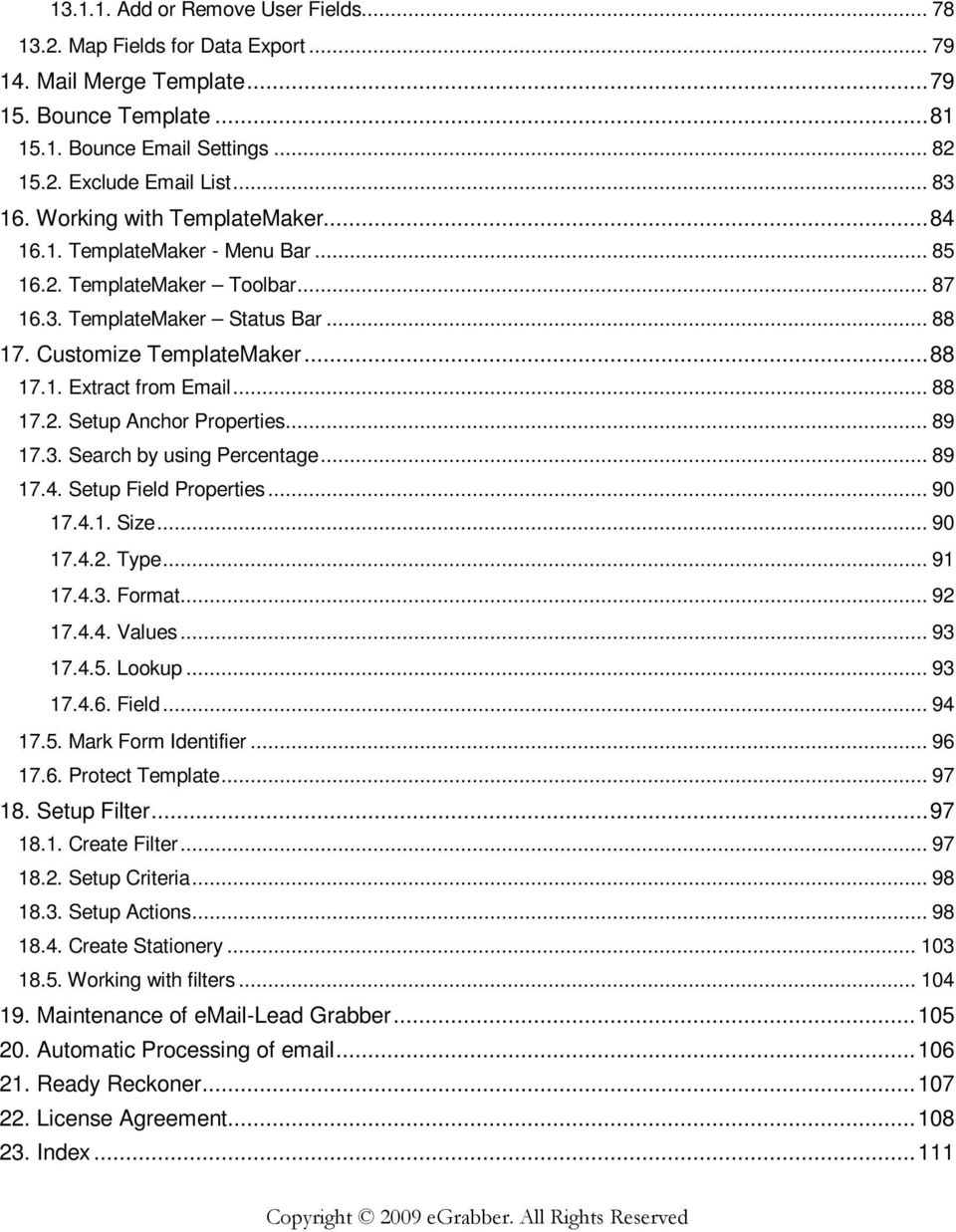
5 Add or Remove User Fields Map Fields for Data Export Mail Merge Template Bounce Template Bounce Settings Exclude List Working with TemplateMaker TemplateMaker - Menu Bar TemplateMaker Toolbar TemplateMaker Status Bar Customize TemplateMaker Extract from Setup Anchor Properties Search by using Percentage Setup Field Properties Size Type Format Values Lookup Field Mark Form Identifier Protect Template Setup Filter Create Filter Setup Criteria Setup Actions Create Stationery Working with filters Maintenance of -lead Grabber Automatic Processing of Ready Reckoner License Agreement Index Copyright 2009 egrabber. All Rights Reserved
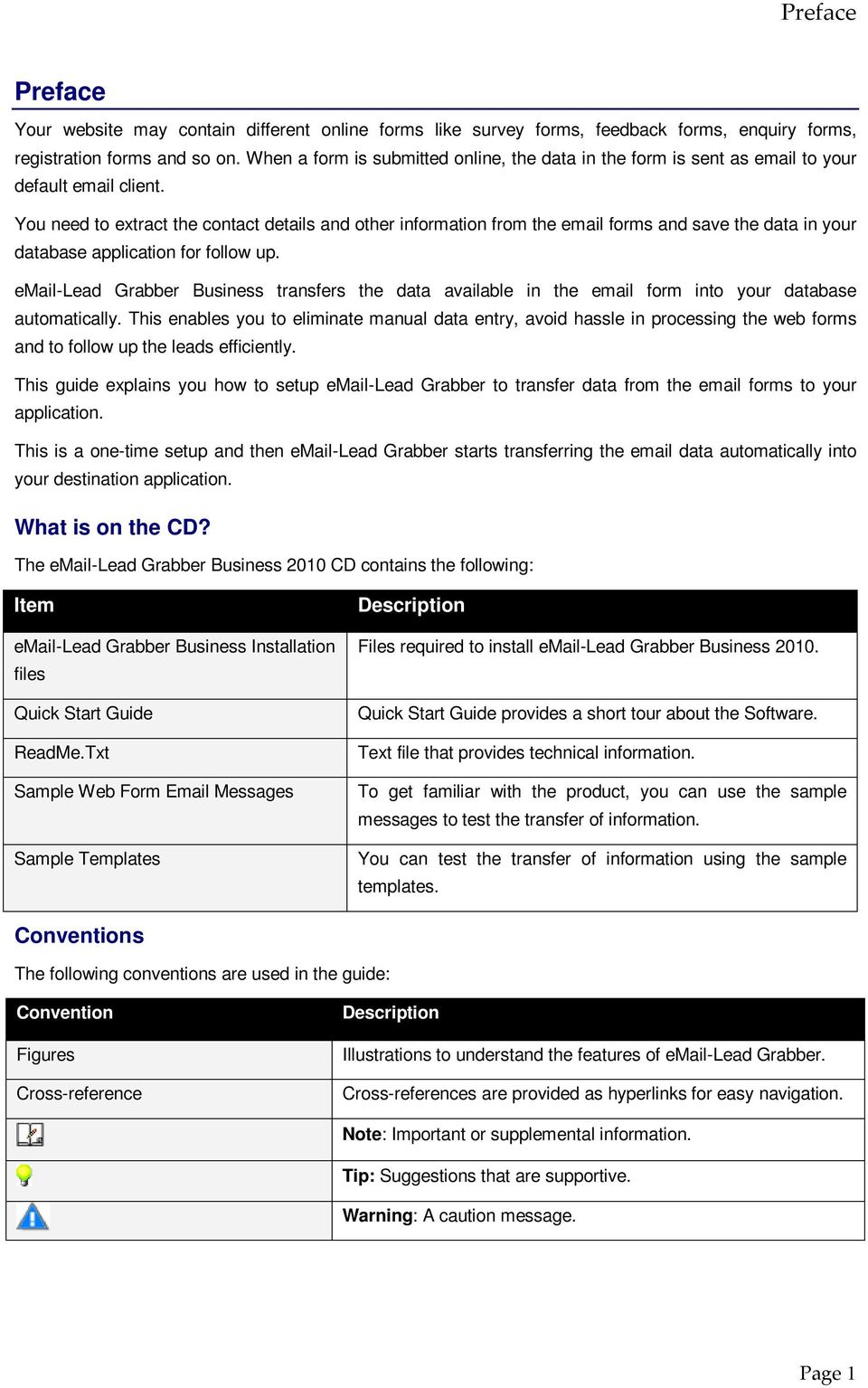
6 Preface Preface Your website may contain different online forms like survey forms, feedback forms, enquiry forms, registration forms and so on. When a form is submitted online, the data in the form is sent as to your default client. You need to extract the contact details and other information from the forms and save the data in your database application for follow up. -lead Grabber Business transfers the data available in the form into your database automatically. This enables you to eliminate manual data entry, avoid hassle in processing the web forms and to follow up the leads efficiently. This guide explains you how to setup -lead Grabber to transfer data from the forms to your application. This is a one-time setup and then -lead Grabber starts transferring the data automatically into your destination application. What is on the CD? The -lead Grabber Business 2010 CD contains the following: Item -lead Grabber Business Installation files Quick Start Guide ReadMe.Txt Sample Web Form Messages Sample Templates Description Files required to install -lead Grabber Business Quick Start Guide provides a short tour about the Software. Text file that provides technical information. To get familiar with the product, you can use the sample messages to test the transfer of information. You can test the transfer of information using the sample templates. Conventions The following conventions are used in the guide: Convention Figures Cross-reference Description Illustrations to understand the features of -lead Grabber. Cross-references are provided as hyperlinks for easy navigation. Note: Important or supplemental information. Tip: Suggestions that are supportive. Warning: A caution message. Page 1
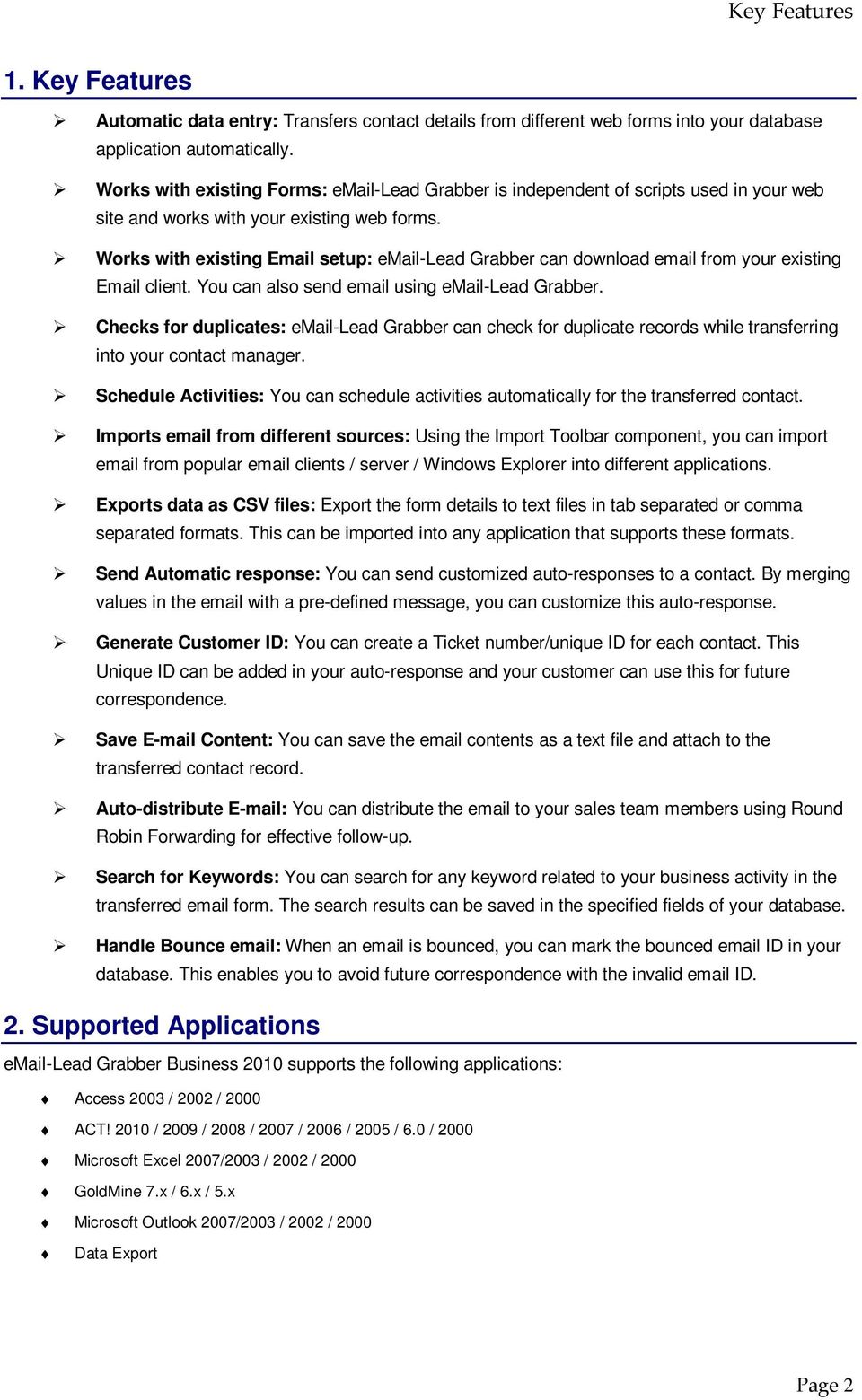
7 Key Features 1. Key Features Automatic data entry: Transfers contact details from different web forms into your database application automatically. Works with existing Forms: -lead Grabber is independent of scripts used in your web site and works with your existing web forms. Works with existing setup: -lead Grabber can download from your existing client. You can also send using -lead Grabber. Checks for duplicates: -lead Grabber can check for duplicate records while transferring into your contact manager. Schedule Activities: You can schedule activities automatically for the transferred contact. Imports from different sources: Using the Import Toolbar component, you can import from popular clients / server / Windows Explorer into different applications. Exports data as CSV files: Export the form details to text files in tab separated or comma separated formats. This can be imported into any application that supports these formats. Send Automatic response: You can send customized auto-responses to a contact. By merging values in the with a pre-defined message, you can customize this auto-response. Generate Customer ID: You can create a Ticket number/unique ID for each contact. This Unique ID can be added in your auto-response and your customer can use this for future correspondence. Save Content: You can save the contents as a text file and attach to the transferred contact record. Auto-distribute You can distribute the to your sales team members using Round Robin Forwarding for effective follow-up. Search for Keywords: You can search for any keyword related to your business activity in the transferred form. The search results can be saved in the specified fields of your database. Handle Bounce When an is bounced, you can mark the bounced ID in your database. This enables you to avoid future correspondence with the invalid ID. 2. Supported Applications -lead Grabber Business 2010 supports the following applications: Access 2003 / 2002 / 2000 ACT! 2010 / 2009 / 2008 / 2007 / 2006 / 2005 / 6.0 / 2000 Microsoft Excel 2007/2003 / 2002 / 2000 GoldMine 7.x / 6.x / 5.x Microsoft Outlook 2007/2003 / 2002 / 2000 Data Export Page 2
8 -lead Grabber Setup Wizard You can download the forms from the following clients: Microsoft Outlook 2007/2003/2002/2000 Outlook Express 5.5/5.0/4.72/4.71 GoldMine Center Windows Messaging 4.0 Netscape Communicator 4.7/4.5/4.04 AOL and Other clients 3. -lead Grabber Setup Wizard After installation, the Setup Wizard appears that guides through the setup process of -lead Grabber. The Setup Wizard consists of three steps. Figure 1: Setup Wizard Step 1: Click here to setup -lead Grabber to download messages from your default client. The setup wizard appears and guides you through the process of downloading messages from selected client. Refer to Chapter 5 for downloading from various clients. The settings that appear in the wizard are similar to the options explained in this chapter. Step 2: Click here to launch the Template Wizard that guides you through the process of creating a template. You need to create a template to map the fields that appear in your form with the fields available in your destination. Refer to Chapter 12 for creating templates. Step 3: Click here to create a filter. The Create Filter wizard guides you through the process of creating a filter with specific criteria and to setup the actions to be performed when the condition is satisfied. You need to create a filter to separate appropriate messages and to transfer them to relevant templates. Refer to Page 3

9 -lead Grabber - Components Chapter 18 to setup a filter. The settings that appear in the Create Filter wizard are similar to the options explained in this chapter. Launch at Startup: By default this option is selected. Whenever you launch -lead Grabber, the Setup Wizard is launched. Clear this checkbox to disable the wizard being displayed. You can access this wizard from the File > Quick Setup Wizard menu. You can also Cancel this wizard and setup the options manually. For best results, you can complete the above steps sequentially. Once you finish the wizard steps, - Lead Grabber automatically downloads the forms from your default client, filters appropriate messages and transfers the contact details to selected destination application lead Grabber - Components -lead Grabber contains three major components. -lead Grabber Business: Once you install and launch -lead Grabber, this window is displayed. This window appears similar to an client and contains mailboxes like Inbox, Outbox and Trash. You can download your messages into the Inbox available in -lead Grabber. You can also check for mail, send, reply to and forward as you do with an client. Figure 2: -lead Grabber Window The -lead Grabber also contains Form Processing Center that displays the templates. You can launch the TemplateMaker, Import Toolbar and create filters from this window. You can setup to download the forms from your default client into the Inbox available in - Lead Grabber. Import Toolbar: You can use the Import Toolbar to transfer the from your client to Inbox in -lead Grabber or directly to your application. Page 4

10 Setup to download into -lead Grabber TemplateMaker: You can use this component to create templates. The templates enable you to map the fields available in your form with the fields in your application. These components are explained in detail in the following sections. 5. Setup to download into -lead Grabber You can download the forms from your default client into -lead Grabber Inbox. Click the Accounts option available in the -lead Grabber toolbar. [OR] Click Tools > Accounts. In the Account Setup dialog box, click Add and select your client. Figure 3: Account Setup You can setup to download from the following clients. GoldMine IMAP Microsoft Outlook Outlook Express POP Setup to download from GoldMine To download the from GoldMine, Click Add > GoldMine in the Account Setup dialog box. In the GoldMine Personality Settings dialog box, enter the following details: Page 5

11 Setup to download into -lead Grabber Under GoldMine Login Details, Click Get Values from GoldMine to retrieve the following details automatically. Sys Dir: Installation path of the GoldMine and the location of the License database file. Gold Dir: Location of the Calendar database file that contains a record for each scheduled activity. Common Dir: Location of the Contact database file that contains the main fields of contact records. User Name: Login name of your GoldMine database. Password: Enter your GoldMine database password. Figure 4: Personality Settings - GoldMine Under Personality Settings, Personality Name: Enter a name for the messages to be downloaded. This name is provided to differentiate specific type of messages when you receive different type of forms. For Example, you can provide the personality name as Feedback Forms to download the forms that contain feedbacks. Import Mailbox: Click the button to select the mailbox from which you want to download the forms. Export Mailbox: Click the button to select the mailbox to which you want to save the processed forms. After downloading from GoldMine, the forms are moved to the Export Mailbox. You can create a new folder to save the processed forms. Poll Personality: Select this option to download the from GoldMine to -lead Grabber Inbox automatically. Click OK. Page 6

12 Setup to download into -lead Grabber 5.2. Setup to download using IMAP Server To download the using IMAP server, Click Add > IMAP in the Account Setup dialog box. In the POP3 Personality Settings dialog box, enter the following details: Figure 5: Personality Settings - IMAP Personality Name: Enter a name for the messages to be downloaded. Incoming Mail Server: Enter your Incoming mail server name. User Name: Enter login name of your IMAP account. Password: Enter your IMAP account password. Polling Mailbox: Click the button to select the mailbox from which you want to download the forms. Return Address: Enter your address. Outgoing SMTP Server: Enter your Outgoing mail server name. Poll Personality: Select this option to download the from POP3 server to -lead Grabber Inbox automatically. More Settings: Click here to configure the SMTP server to send mail. As you click More Settings, the Settings dialog box is displayed. In the Outgoing Server tab, make the following settings: Page 7

13 Setup to download into -lead Grabber Figure 6: settings - Outgoing Server Select My Outgoing Server (SMTP) requires authentication to ensure SMTP server authentication before sending . Specify the method of authentication by selecting any one of the following options: Select Use Same Settings as my incoming mail server if you want to use the login and password details of incoming mail server (POP3). Select Log on using if the SMTP server requires a different user name and password. Enter the following details: User Name: Enter the user name of your SMTP server. Password: Enter the password of your SMTP server. Click OK to save the settings. In the Advanced tab, you can make the following settings: Figure 7: settings - Advanced Page 8

14 Setup to download into -lead Grabber Under Server Port Numbers, Incoming Server (IMAP): The port number of your Incoming Server (IMAP) is displayed by default. Outgoing Server: The port number of your Outgoing Server (SMTP) is displayed by default. Click Use Defaults to use the default port numbers. You can also change the port numbers. Under Server Timeouts, specify the time interval by moving the slider. (The time varies from 30 seconds to 6 minutes). The time indicates how long to wait for a response from the server. Specify short time if your server is fast and long-time if the server is slow or busy. Click OK to save the settings Setup to download from Microsoft Outlook To download the from Microsoft Outlook, In the Account Setup dialog box, Click Add > Outlook 2007 / 2003 / 2002 to download from Microsoft Outlook 2007 / 2003 / In the Outlook Mail Personality Settings dialog box, enter the following details: Figure 8: Personality Settings - Outlook 2007 / 2003 / 2002 Mail Personality Personality name: Enter a name for the messages to be downloaded. Polling Mailbox: Click the button to select the mailbox from which you want to download the forms. Processed Mailbox: Click the button to select the mailbox to which you want to save the processed forms. Return address: Enter your address. SMTP server: Enter your outgoing mail server name. Page 9

15 Setup to download into -lead Grabber Poll personality: Select this option to download the from Outlook to -lead Grabber Inbox automatically. Import sender s address: Select this option to display the sender s ID in the From column of -lead Grabber Inbox. Import sender s display name: Select this option to display the sender s display name in the From column of -lead Grabber Inbox. Date received on mail server: Select this option so that the Received Date in the Inbox is retrieved from the date on which mail is received by the mail server. Date delivered into Outlook mailbox: Select this option so that the Received Date in the Inbox is retrieved from date on which mail is received by Outlook mailbox. Click OK. Click Add > Microsoft Outlook to download from Microsoft Outlook In the Outlook Mail Personality Settings dialog box, the details to be entered are similar to Outlook 2007 / 2003 / 2002, except the following: Figure 9: Personality Settings Outlook 2000 Import Personality Display Name: Select this option to display the sender s display name in the From column of -lead Grabber Inbox. Import Personality Address: Select this option to display the sender s ID in the From column of -lead Grabber Inbox. Click OK Setup to download from Outlook Express To download the from Outlook Express, Click Add > Outlook Express in the Account Setup dialog box. In the Outlook Mail Personality Settings dialog box, enter the following details: Page 10

16 Setup to download into -lead Grabber Figure 10: Personality Settings Outlook Express Personality Name: Enter a name for the messages to be downloaded. Polling Mailbox: Click the button to select the mailbox from which you want to download the forms. Processed Mailbox: Click the button to select the mailbox to which you want to save the processed forms. Return Address: Enter your address. SMTP Server: Enter your outgoing mail server name. Poll Personality: Select this option to download the from Outlook Express to -lead Grabber Inbox automatically. Click OK. When you download from Outlook Express or Outlook, the messages are deleted from the selected folder. So, it is recommended not to use your Inbox as the Polling mailbox. Create a separate folder in your client to save the leads. You can set a filter to automatically move the leads to the specific folder or drag and drop the leads from your Inbox to the folder. You can use this folder as the Polling Mailbox Setup to download using POP3 Server To download the using POP3 server, Click Add > POP3 in the Account Setup dialog box. In the POP3 Personality Settings dialog box, enter the following details: Page 11

17 Setup to download into -lead Grabber Figure 11: Personality Settings - POP3 Personality Name: Enter a name for the messages to be downloaded. Login Name: Enter login name of your POP3 account. Password: Enter your POP3 account password. Return Address: Enter your address. Incoming (POP3) Mail Server: Enter your Incoming mail server name. Outgoing (SMTP) Mail Server: Enter your Outgoing mail server name. Delete mail from server after download: Select this option to delete the messages available in your POP3 server after downloading them into -lead Grabber. Poll Personality: Select this option to download the from POP3 server to -lead Grabber Inbox automatically. Ignore Incoming mail above: Enter size limitation for incoming messages. The messages that exceed the size you have defined here are not downloaded into -lead Grabber. More Settings: Click here to configure the SMTP server to send mail. As you click More Settings, the Settings dialog box is displayed. In the Outgoing Server tab, the settings are similar to the IMAP settings. Refer to IMAP for details. In the Advanced tab, you can make the following settings: Page 12

18 Setup to download into -lead Grabber Figure 12: settings - Advanced Under Server Port Numbers, Incoming Server: The port number of your Incoming Server (POP3) is displayed by default. Outgoing Server: The port number of your Outgoing Server (SMTP) is displayed by default. Click Use Defaults to use the default port numbers. You can also change the port numbers. Under Server Timeouts, specify the time interval by moving the slider. (The time varies from 30 seconds to 6 minutes). The time indicates how long to wait for a response from the server. Specify short time if your server is fast and long-time if the server is slow or busy. Under Compression Setting, select the Enable Compression Settings checkbox to download from Microsoft Exchange v5.5 Server. Enter the Compression Order number to download the complete from Microsoft Exchange. You can increase or decrease the compression order number according to the size of your Microsoft Exchange server. The default number is 4. Click OK to save the settings Personality Settings After you enter details and save the personality settings, the personality name is displayed in the Account Setup dialog box. Page 13

19 Download into -lead Grabber Figure 13: Account Setup for GoldMine Click Remove to delete the personality settings. Click Properties to edit the settings. Click Test to test the settings. The forms are downloaded to the -lead Grabber Inbox. Set as default: Click here to make the selected personality name as your default account. When you reply to a message or send an auto-response, this account is used for sending the . Options: Click here to open the Miscellaneous Setup dialog box. You can setup to check for messages automatically. This option is explained in detail in the next section. Click Close. You can also make use of Step 1 in the setup wizard to download the messages. The wizard provides step-bystep instructions to complete the setup. 6. Download into -lead Grabber After you have setup your Account, you can start downloading forms from your client. To download the forms manually, Click Check Mail in the -lead Grabber Business toolbar. [OR] Click Check Mail in the File menu. The forms are downloaded from your client as you have setup and saved in -lead Grabber Inbox. To download the forms automatically, you need to setup the Miscellaneous option. Click Tools > Options. In the Miscellaneous Setup dialog box, make the following settings: Page 14

20 Download into -lead Grabber Figure 14: Miscellanous Setup Check for new messages at startup: Select this option to check for whenever you launch -lead Grabber. Show popup when new message arrives: Select this option to be notified whenever you receive new . Show Alert for mailbox Compaction: Select this option to get a message for compaction whenever your mailbox exceeds a limit of 45 MB. This option is selected by default. To disable the warning message, you can clear this checkbox. Automatically download new messages: Select this option to check for at specified time interval. Enter the time in minutes in the space provided. Use System Date Time format: Select this option to display the date as per your System settings. If this option is not selected, then the date is displayed in the default format as MM/DD/YY. Click Setup Login to setup login restrictions for -lead Grabber. In the User Login dialog box that appears, enter User Name and Password Re-enter the password in Confirm Password. Click OK. Use Outlook: Select this checkbox to send using Microsoft Outlook. Enter the Profile Name and Password to send through secured authentication. Click OK to save the settings. Now the is checked automatically in the specified time interval. Ensure that the Poll Personality checkbox is selected in the Personality Settings to download the . If you enter the time interval as zero (0), then is not checked. Next, you need to create a template to process the downloaded messages and to transfer the details to your destination. Refer to TemplateMaker to create a template. Page 15

21 Working with -lead Grabber 7. Working with -lead Grabber -lead Grabber window contains the following to manipulate the messages. Menu bar Toolbar Status bar Report bar You can make use of the above components to send, reply or forward the messages. You can launch the Import Toolbar that can be used to download messages from other clients. You can also launch the Template Maker to create templates lead Grabber - Menu bar The -lead Grabber menu bar contains the following commands: File Menu Option Check Mail New Folder New Mailbox Print Quick Setup Wizard Show Import Toolbar Show Template Wizard Show Template Maker Exit Function Checks and download new to the Inbox. Create a new folder in Center. Create a new mailbox in Center. Print selected message. Launch the Setup Wizard Launch the -lead Grabber- Import Toolbar. Launch the Template Wizard to create templates. Launches TemplateMaker to create templates. Quit -lead Grabber. Edit Menu Option Undo Cut Copy Paste Find Select All Function Reverts the last performed action. Removes the selected text and places it in the Clipboard. Copies the selected text to the Clipboard. Inserts the contents of Clipboard. Opens the Find Message dialog box and enables you to search for messages. Selects all the contents of a message. Page 16
22 Working with -lead Grabber View Menu Option Toolbar Status Bar Report Bar Folder View Task Status Process Status Errors Refresh View Function Show or Hide the -lead Grabber Toolbar. Show or Hide the Status Bar. Show or Hide the Report Bar. Show or Hide the folders displayed in the Folders view. Show the Task Status tab displayed in the Report Bar. Show the Process Status tab in the Report Bar. Show the Errors tab in the Report Bar. To update and reflect the changes made to the folders displayed in the current view. Message Menu Option Compose Reply Reply All Forward Delete Import Messages Function Create a new message. Reply to the sender of the selected message. Reply to all in the TO and CC columns of the selected message. Forward selected message. Delete selected messages. Import messages from the default client. Folders Menu Option Inbox Outbox Trash User Folders Function Displays the Inbox. Displays the Outbox. Displays the Trash. Select the sub folders and mailboxes within folders, if available. Form Processing Center Displays all the templates. Click the template name to view the messages processed using the same. Page 17
23 Working with -lead Grabber Tools Menu Option Filters Accounts User Setup Stationery Register / Unregister Template Backup/Compact Options Function Create a new filter or edit an exiting filter. Create a new account in -lead Grabber. Setup login restrictions to -lead Grabber. Enter a user name and password to login to -lead Grabber. Create, Edit, or Delete Stationery. Add or remove templates from the Form Processing Center. Launches Dr. Mailbox to maintain your mailboxes. View the Options dialog box to provide mail settings for all your accounts. Help Menu Option Help Topics egrabber on the Web Demo Function Launches the Help. Access Live Update, Online User Guide and FAQs from egrabber website. Launches demo on the product. Register/Unregister Product Register or unregister -lead Grabber. About -lead Grabber Displays -lead Grabber version and copyright information. Page 18
24 Working with -lead Grabber lead Grabber - Toolbar The -lead Grabber toolbar contains the following commands: Option Function Check for new manually. Setup Accounts. Launch Setup Wizard. Setup Filters. Launch Import Toolbar. Create new message. Reply to the sender of the selected message. Reply to all in the TO and CC columns of the selected message. Forward selected message. Opens the Find Message dialog box and enables you to search for messages. Delete selected messages. Re-process an message Launches Help Page 19
25 Working with -lead Grabber lead Grabber - Status bar The status bar displays the total number of messages and the number of messages selected in the current folder Report bar The report bar displays the status of the processed messages and error messages. This bar contains three tabs as follows: Task Status: Click or View>Task Status to view this tab. Figure 15: Task Status The task status displays the background activities like retrieving from your client, processing messages through filters, templates, etc. This tab also displays the progress of a task in percentage. Right-click the Task Status and select Abort Task to stop a task being processed. Process Status: Click or View>Process Status to view this tab. Figure 16: Process Status The following details are displayed in the Process Status tab: Column Date Subject From Filter Template Description Date and time of process. Subject of the processed . The sender s ID of the processed . Name of the filter used for processing the . Name of the template used for processing the . Page 20
26 Using Import Toolbar Status\Error Displays the Transfer Status. If the transfer is successful, the message Transfer Successful is displayed. If the transfer fails then the error message is displayed with the reason for failure. If the transfer is skipped then Skipped Transfer is displayed. If the is processed and not transferred then Process Successful is displayed. To save the processed details, right-click in the Process tab and select Save Status Log. To clear the text, righ-click and select Delete or Delete All. Errors: Click or View>Errors to view this tab. Figure 17: Errors tab The errors that occurred during the background process are displayed here. To clear the error messages, righ-click and select Delete Shortcut Menus Right-click on any part of the -lead Grabber window to access the shortcut menus. The shortcut menus vary according to the selected area. For example, if you right click the message grid, you can access the shortcut menu as shown in Figure 23Figure 23 You can use these shortcut menus to quickly access the commands that are available in the menu bar and the toolbar. 8. Using Import Toolbar You can download messages from other clients using the Import Toolbar. To launch the Import Toolbar, Click the Import Toolbar Icon in the -lead Grabber Toolbar. [OR] Click File > Show Import Toolbar. The Import Toolbar appears as shown in Figure 18. Figure 18: Import Toolbar You can select the source from which the messages to be downloaded from the drop-down list that appears on the left panel. Page 21
27 Customize Import Toolbar The options available in this list are: Selected Text Text in Clipboard Windows Explorer Outlook Express Outlook GoldMine Windows Messaging Netscape Communicator If you are using an client other than the applications listed above, then you can use the Selected Text / Text in Clipboard / Windows Explorer options to download the messages. The right panel displays the option Inbox and the templates created. Select the option Inbox to download the messages to -lead Grabber Inbox or the template to directly transfer the details from the selected message to selected destination application. You can find the option to create a template in this drop-down list. Refer to Chapter 11 for details on creating a template. 9. Customize Import Toolbar You can customize the source and destination options available in the Import Toolbar. Click that appears in the center of the Toolbar to launch the Options dialog box. In the Options dialog box, you can setup the source, destination and miscellaneous options Add / Remove Source Application In the Options dialog box, click the Input Source option to add or remove the source applications that are displayed in the Import Toolbar. The available source applications are displayed in the dialog box. To add an application to the toolbar, Select the application displayed under Available Sources and click the Add button. The application is now displayed under Selected Sources. Page 22
28 Customize Import Toolbar Figure 19: Add / Remove Source Applications To hide an application being displayed in the toolbar, Select the application displayed under Selected Sources and click the Remove button. The application is now displayed under Available Sources. Click OK to save the settings. The applications listed under Selected Sources are displayed in the drop-down list on the left panel of the toolbar Add / Remove Destination Application In the Options dialog box, click the Destination option to add or remove the templates that are displayed in the Import Toolbar. The available templates are displayed in the dialog box. To add a template to the toolbar, Select the template displayed under Available Templates and click the Add button. The template is now displayed under Selected Templates. Page 23
29 Customize Import Toolbar Figure 20: Add / Remove Templates To hide a template being displayed in the toolbar, Select the template displayed under Selected Templates and click the Remove button. The template is now displayed under Available Templates. Click OK to save the settings. The templates listed under Selected Templates are displayed in the drop-down list on the right panel of the toolbar Miscellaneous Setup In the Options dialog box, click Miscellaneous to setup other options. In the Miscellaneous dialog box, you can setup the following options: Show Transfer Window: Select this check box to display a transfer window. The transfer window appears whenever you process messages; this window displays the status and number of messages processed. Page 24
30 Download using Import Toolbar Figure 21: Import Toolbar - Miscellaneous Setup Under Left mouse click on Tray icon should, Toggle Toolbar between Show and Minimize: Select this option so that when you click on the Tray Icon, the Import Toolbar is shown or minimized. Capture using last set source and destination: Select this option so that when you click the Tray Icon, the messages are transferred with the last settings selected in the Import Toolbar. Click OK to save the settings. 10. Download using Import Toolbar Select your client from the Source list of the Import Toolbar. If your client is not available in the list, select your message manually and select the option Selected Text in the toolbar. You can also transfer information from documents available in a folder bys selecting the option Windows Explorer. Select the option Inbox in the Destination list to transfer the messages to the -lead Grabber Inbox. To transfer the messages directly to your destination, select the relevant template. Now click the Go button in the toolbar. The selected messages are transferred according to the selected settings. You can create a new template by selecting the option Create Template from the destination list. After downloading the messages to -lead Grabber Inbox, you need to create templates for transferring the information into your destination. Page 25
31 TemplateMaker 11. TemplateMaker Your form contains two major components: Form Tags and the form data. Form tags are the fields available in your form. Form data is the value filled in by the visitor. You need to map the form tags with the database fields. While transferring, the form data is transferred into the mapped fields in the selected application. The mapping of fields varies according to the selected destination. You can create the templates in two methods: 1) Wizard Mode 2) Advanced Mode Figure 22: Example for an Form Page 26
32 Create Template in Wizard Mode 12. Create Template in Wizard Mode Launch the Template Wizard by any one of the following methods: Click Step 2 in the Setup Wizard [OR] Select any that contains all the form tags, right-click and select Create Template in Wizard Mode. (Refer Figure 23) [OR] Right-Click the Form Processing Center and select Create Template Wizard Mode. [OR] Click File > Show Template Wizard. Figure 23: Create Template The Template Creation Wizard is launched and this wizard guides you through the process of creating a template Name the Template The first step is to name the template. Enter a name and click Next. Page 27
33 Create Template in Wizard Mode Figure 24: Enter Template Name Edit Sample The next step is to view and edit the form. The selected text appears in the wizard. If you have launched the template wizard by using the File > Show Template Wizard option, then the wizard space appears blank. You need to copy and paste your text that contains all the form tags and data (Refer to Figure 22). Figure 25: View and edit the sample Page 28
34 Create Template in Wizard Mode You can verify the details and edit them, if required and click Next Extract tags from The next step is to extract the form tags from the . You can extract the tags by any one of the following methods: Extract Form Tags Automatically: This option is selected by default. The form tags are extracted automatically from the selected . The Form Tag separator is displayed automatically next to Tag and Field Separator. You can also enter the tag separator manually. Select the TAB checkbox if there is a tab separator appearing in between the form tags and the form data. Tag Separator is the character that separates the form tag and the form data. Manual Entry of Form Tags: Select this option to manually enter the form tags from your web form. XML Form This option is selected by default if your form is in XML format. Select the relevant option and click Next. Figure 26: Extarct form tags Page 29
35 Create Template in Wizard Mode Customize Anchor Text The next step is to customize the anchor text. The form tags need to be marked as anchor text for mapping the fields. Figure 27: Edit Anchor Text If you have selected the option Manual Entry of Form Tags, you need to enter the anchor text manually. Else, the form tags are marked as anchor text automatically and displayed. Select an anchor text and click Set Properties to define the properties for the anchor text. Refer to Setup Anchor Properties for more details. Click View to view the sample for reference. After customizing the anchor text, click Next. Page 30
36 Create Template in Wizard Mode Select Destination Application The next step is to select your destination application. Figure 28: Select Destination Application Select the appropriate destination application from the Select Contact Manager list, and click Next. The next step in the wizard varies according to the selected destination. The following applications are supported: Access ACT! Microsoft Excel GoldMine Microsoft Outlook Create Template for Access You can create template for the following versions of Microsoft Access. Microsoft Access 2003 / 2002 / Select the option Access 2003 / 2002 / 2000 from the Contact Manager list (Refer Figure 28) and click Next. Page 31
37 Create Template in Wizard Mode Login to Access In the next step you need to login to the Microsoft Access database. User Name: Enter the login name of your database. Password: Enter the password for the database. Figure 29: Login to Access database Database: Click displayed. to browse and select your database. The name and path of the selected database is Click Login. The Logged in Successfully message is displayed. Click Next. Page 32
38 Create Template in Wizard Mode Select Fields The next step is to select the Tables and Fields to which the data is to be transferred. The available tables are displayed in the left pane and the corresponding fields in the right pane. Figure 30: Select Table and Fields Select the appropriate table and the corresponding fields and click Next. Click Select All to select all the fields and Clear to deselect all the fields. Page 33
39 Create Template in Wizard Mode Map Fields The next step is to map the fields available in the selected Access table with the form tags. Figure 31: Map Access Table Fields Double-click the Fields row and select the appropriate database field to map the field manaually. Click Auto Map to map the fields automatically. Click Clear Map to remove the mapping. Click Test Map to view the extracted values from the . Select a field and click Set Properties to define properties for the selected field. Refer to Setup_Field_Properties for more details. Click View to view the sample for reference. To add or remove a form tag, click Add Row or Delete Row respectively. After mapping the fields, click Next. Page 34
40 Create Template in Wizard Mode Map Header Information The next step is to extract the header information and save them in user fields. Figure 32: Map Header Information - Access You can save the following information from the Sent Date. Sent Time. From Address of the . To Address of the . Subject of the message. Double-click and select the appropriate field to save the above information. Copy to Notes: This option is not available for Access. Copy to History: This option is not available for Access. Copy and save attachments to this Folder: This option is not available for Access. After selecting appropriate fields, click Next. Page 35
41 Create Template in Wizard Mode Setup to check for duplicates The next step is to setup to check for duplicates. Figure 33: Access - Check for Duplicates To handle duplicate records, select any one of the following options: Select Add as new Contact to add the duplicate as a new contact to your application. Select Update if only one contact exist else cancel to update the existing contact in your application. This option updates the contact when only one contact is available in your database. If more than one record is found, the transfer process is cancelled. Select Warn if contact exists to get a warning message when you transfer a duplicate contact to access. During the transfer of a duplicate contact, a Contact Linker dialog box appears as shown in Figure 34. Select Cancel if contact exists to cancel transferring the duplicate contact. When you select any of the above options except Always add as new contact, the fields under Select Fields for Duplicate Check are made available. Select a single field or multiple fields to check for duplicate values. Contact Linker When you select Warn if contact exists option, the Contact Linker dialog box is displayed when duplicate contact information is transferred. Page 36
42 Create Template in Wizard Mode Figure 34: Contact Linker Access Select Add as new contact Update existing contact Cancel transfer To do Adds the duplicate record as a new record in your database. Updates an existing record with the new incoming details in your database. Cancel transferring the duplicate record to your database. If more than one contact exists in the database that matches the incoming record, then the Update option is disabled in the above dialog box. In this case, you can select to add the duplicate record as a new record or cancel transferring the record to your database. After making relevant settings, click Next. The next step is to save the contents to a text file and attach the file to the destination. Refer to Attach Contents to proceed with subsequent steps Create Template for ACT! You can create template for the following versions of ACT!. ACT! 2010 / 2009 / 2008 / 2007 / 2006 / 2005 / 6.0 / Select your version of ACT! from the Contact Manager list (Refer Figure 28) and click Next Login to ACT! In the next step you need to login to the ACT! database. Enter the following details in the Login dialog box. Database Path: Click and select the Database path of ACT! database. You can also select Use currently open database to detect and display the currently opened ACT! database automatically. UserName: Enter the login name of ACT! database. Password: Enter the password to access your database. Click Login to get access to database. The message Login Successful appears in the Result area. Page 37
43 Create Template in Wizard Mode Figure 35: Login to ACT! After logging in successfully, click Next Select User Fields The next step is to select the user fields. Figure 36: Select User Fields In this dialog box, all the user fields available in ACT! are displayed as Field Label with the corresponding Internal column name. Click Refresh if the user fields are not displayed. Page 38
44 Create Template in Wizard Mode Select the chekbox next to the user fields to map the data from the message. Click Select all or Clear all to select or deselct all the user fields. After selecting appropriate user fields, click Next. This option is available only if you select ACT! 2007 / 2006 / 2005 as destination. For ACT! 6.0/2000, the wizard moves to the next step to map the fields Map Fields The next step is to map the database fields available in your ACT! database. The settings are similar to mapping fields for Access. Refer to Map Fields in Access Template for more details. After mapping the appropriate fields click Next Map Header Information The next step is to extract the header information and save them in user fields. Figure 37: Map Header Information - ACT! You can save the following information from the Sent Date. Sent Time. From Address of the . To Address of the . Subject of the message. Double-click and select the appropriate field to save the above information. Page 39
45 Create Template in Wizard Mode Copy to Notes: Select this checkbox to copy the contents of the message to the Notes section of ACT!. Copy to History: Select this checkbox to copy the contents of the message to the History tab of ACT!. Copy and save attachments to this Folder: Select this checkbox to save the attachments. Click to browse and select the folder to save the attachment files. After making appropriate settings, click Next Setup to transfer company details The next step is to transfer the company records. Figure 38: ACT! - Transfer Company Details You can select the following options: Link to Company, if found: Select this option to link the contact information to an existing company (if found) in ACT! Create Company, if not found: Select this option to create a new company (if not found) in ACT! and link the contact information to that company. Prompt if a Contact is already linked to a Company: Select this option to get a message if the conatct is already linked to a company. Modify company details: Select this option to update the company details on ACT! with the new details being transferred. After selecting appropriate options, click Next. Page 40
46 Create Template in Wizard Mode Setup to check for duplicates The next step is to setup to check for duplicates. To handle duplicate records, select any one of the following options: Figure 39: ACT! - Check for Duplicates Under Select transfer mode, Select Add as new to add the duplicate as a new contact to your application. Select Update if only one contact exists to update the existing contact in your application. This option updates the contact when only one duplicate contact is available in your database. If more than one duplicate record is found, the transfer process is cancelled. Select Always update first duplicate record to update the existing contact in your application. This option updates the first found existing record when more than one duplicate record is found. Select Warn if contact exists to get a warning message when you transfer a duplicate contact to ACT!. During the transfer of a duplicate contact, a Validate Duplicates dialog box appears as shown in Figure 40. Select Cancel if contact exists to cancel transferring the duplicate record. When you select any of the above options except Add as new, the fields under Check for duplicates in Contact based on are made available. Select a single field or multiple fields to check for duplicate values. Contact: Check first and last name of the Contact. Company: Check the value of the company field. Contact: Check the address. Contact: Phone: Check the phone number of the contact. Page 41
47 Create Template in Wizard Mode Contact: Zip: Check the Zip Code of the contact. Bring ACT! to Forefront after transfer: Select this option to display the contact record after the transfer process. Validate Duplicates When you select Warn if contact exists option, the Validate Duplicates dialog box is displayed when a duplicate contact information is transferred. In the Validate Duplicates dialog box, the existing field values and the new incoming values are displayed in a tabular format. All the contacts with the duplicate values are displayed. You can browse between the contacts and choose to either update the existing contact or add the duplicate as a new contact. The following details are displayed in the dialog box: Figure 40: Validate Duplicates Field Name Existing Field Value Field Value in (New) Select Displays all the fields available in the database of your destination application. Displays the existing values available in your database. Displays the new incoming values available in the Form. Click to toggle between ACCEPT or REJECT. By default, ACCEPT is displayed. The Creation Date and Last Modified display the created and last modified dates of the existing record. Compare the values, and select the status as ACCEPT or REJECT to accept or reject the new values. Page 42
48 Create Template in Wizard Mode Select Reject All to reject all the changes. Under Mode of Transfer, To update the existing record, select Update. To add the incoming values as a new record, select Add as New. Click Transfer to transfer the record as per the settings you have made. You can click the navigation buttons ( or ) to browse the records that contain duplicate values. These buttons are enabled only when the database contains more than one duplicate record. Click Cancel to skip the transfer. After selecting appropriate mode to check for duplicates, click Next Schedule and attach Activity Next, you can setup to schedule activities like Meetings, Calls etc for the transferred contacts. You can attach, schedule, and prioritize activities like Call, Meeting, To-do for all contacts transferred to your ACT! database. The attached activities are displayed in the Activities tab of the transferred contact in ACT!. Figure 41: Schedule and attach Activity in ACT! Click the New button to create a new activity. In the Activity Settings, setup the following options to create a new activity. Page 43
49 Create Template in Wizard Mode Figure 42: Activity Settings - ACT! Activity type: Select activity (Call, Meeting, or To-do) from the list. No of Days: Enter the number of days counting from the present day when you want to perform the activity. For Example, type 30 days to execute the activity on the 30 th day counting from the present day. Time: Enter the time when you want to perform the activity. The current system time is displayed by default. Enter a time or click the down arrow to select time. The Time selector displays time slots with difference of 30 minutes. Duration: Enter the duration of the activity. For Example, if your calls last for 45 minutes, then type 45 in the Duration box. Scheduled With: The name of the contact to which you have scheduled the activity is displayed when you transfer records to ACT!. Regarding: Select from the list or type a description for the activity. Priority: Select High, Medium or Low from the list to prioritize your activity. Ring alarm: Set an alarm to remind you of scheduled activity. Select a time from the list. For Example: If you select 5 minutes from this list, the alarm pops up 5 minutes before the time at which the activity has been scheduled. Save activity as: Enter a name to save the activity. Confirm before transfer: Select this option to view the scheduled activity when the contact information is transferred to ACT! Schedule this activity for: This option is available for ACT! 2007 only. The existing database user names are displayed in this drop-down list. You can select the user name from this list. The activity is attached to the selected user name. Click OK to save the settings. The name of the activity is displayed under Attach selected activities while transferring to ACT!. You can create more activities by repeating the above steps. You can select/clear the activity names to activate/deactivate the process while transferring contact details. Page 44
50 Create Template in Wizard Mode Click Refresh to update the changes made to activities. To edit an activity: Select the activity displayed under Attach selected activities while transferring to ACT! Click Edit and make changes in the Activity Settings. Click OK. To delete an activity: Select the activity displayed in the area under Attach selected activities while transferring to ACT! Click Delete. Click OK. After creating required activities, click Next. The next step is to save the contents to a text file and attach the file to the destination. Refer to Attach Contents to proceed with subsequent steps Create Template for Microsoft Excel Select the option Excel 2007/2003/2002/2000 from the Contact Manager list (Refer Figure 28) and click Next. In the next step you can select to transfer the information to an existing or new Excel File Select an Excel File Transfer to an existing Excel Workbook: Select this option to transfer contact details to an existing Excel file. Select the Excel Workbook: Click next to this option to open an existing Excel file. Browse and locate your Excel file. Select the file and click Open. Click Next to Select Fields in the existing Excel File. Figure 43: Select / Create Excel File Page 45
51 Create Template in Wizard Mode Select Fields in Excel When you select an existing Excel file and click Next, the Select Fields dialog box appears as shown in Figure 44. The left pane displays all the sheets in the file and the right pane displays the column headings present in the selected sheet. From the left pane, select the sheet(s) to which you want to transfer your records. The first sheet is selected by default. The column headings present in the first row of the sheet are displayed by default in the right pane. Select the fields to which you want to transfer data from the form. Figure 44: Select Excel Fields You can select multiple sheets from your Excel File. Example: Select Sheet1 and select the fields of this sheet in the right panel. To select the next sheet click on Sheet2 and select fields from this sheet. When you select Sheet2, the already selected Sheet1 appears in blue color. Select the row containing the column header: Select the row number that holds the column headings, if no fields are displayed under Select Column(s). Select the starting row for entering new information: Select the row number from where you want to start inserting the transferred records. The values of the row numbers can be different for each sheet. Example: For Sheet1 row numbers can be 3,4 and for Sheet 2 the row numbers can be 2,3. A sample excel file is shown in Figure 45 that illustrates the row numbers and column headings. Page 46
52 Create Template in Wizard Mode Figure 45: Sample Excel File Check All: Click here to select all the column headings. Clear All: Click here to remove the selection of all the column headings. Turn off the warnings while transferring: Select this option to hide the warning messages during transfer. Click Next to map the fields Create an Excel File Create a new Excel Workbook: Select this option to transfer contact details to a new Excel file. Click next to this option. Enter the name of your Excel file. Click Save. A new Excel file is created with the specified name. Click Next to Create Excel Fields Create Excel Fields After creating a new Excel File, you have to create column headings. By default, three sheets of the new Excel file are displayed in the left pane. Figure 46: Create Excel Fields Page 47
53 Create Template in Wizard Mode Select a sheet from the list to which you want to transfer your records. The first sheet is selected by default. Click Add/Edit Fields to create column headings for the selected sheet. Enter your field names in the Edit Fields dialog box. You can also edit the fields. Click OK to save the data. Figure 47: Add / Edit Excel Fields The field names are displayed under Fields. By default, all the column headings are selected. You can select/clear the fields. Check All: Click here to select all the column headings. Clear All: Click here to remove the selection of all the column headings. Figure 48: Add / Edit Excel Fields The field names are displayed under Fields. By default, all the column headings are selected. You can select/clear the fields. Select All: Click here to select all the column headings. Clear All: Click here to remove the selection of all the column headings. Click Next to map the fields. Page 48
54 Create Template in Wizard Mode Map Fields The next step is to map the database fields available in your Excel Sheet. The settings are similar to mapping fields for Access. Refer to in Access Template for more details. After mapping the appropriate fields click Next Map Header Information The next step is to extract the header information and save them in user fields. Figure 49: Map Header Information - Excel You can save the following information from the Sent Date. Sent Time. From Address of the . To Address of the . Subject of the message. Double-click and select the appropriate field to save the above information. Copy to Notes: This option is not available for Excel. Copy to History: This option is not available for Excel. Copy and save attachments to this Folder: Select this checkbox to save the attachments. Click to browse and select the folder to save the attachment files. After making appropriate settings, click Next Miscellaneous Setup In the next step select the field to which you can link your attachment from the drop-down list. Page 49
55 Create Template in Wizard Mode Figure 50: Miscellaneous Settings - Excel Bring Excel to forefront after transfer: Select this option to display the Excel file with the inserted contact information after transfer and click Next. The next step is to save the contents to a text file and attach the file to the destination. Refer to Attach Contents to proceed with subsequent steps Create Template for GoldMine You can create template for the following versions of GoldMine. GoldMine 7.x / 6.x / 5.x Select your version of GoldMine from the Contact Manager list (Refer Figure 28) and click Next Login to GoldMine In the next step you need to login to the GoldMine database. Enter the following details in the Login dialog box. Page 50
56 Create Template in Wizard Mode Figure 51: Login to GoldMine Click Get GoldMine Details button. The following login details are automatically retrieved from GoldMine database and displayed. System Directory: Installation path of the GoldMine and the location of the License database file. GoldMine Directory: Location of the Calendar database file that contains a record for each scheduled activity. Common Directory: Location of the Contact database file that contains the main fields of contact records. UserName: Login name of your GoldMine database. Password: Enter the password to access your database. Click Login to get access to database. The message Logged in Successfully is displayed. Click Next Select Details In the next step, you can select the details fields to which you can transfer data from your form. All the fields from the details tab of your GoldMine database are displayed under Select Detail Fields. Select the checkbox next to a detail field name. The detail field displayed is the name of the profile record entry, like Credit Card Number. Click Select All to select all the fields displayed. All the field names are selected. To deselect all the fields, click Clear All. Page 51
57 Create Template in Wizard Mode Figure 52: Select Details - GoldMine You can select a maximum of 10 detail fields. Click Next Select User Fields In the next step, you can select the user fields to transfer data from the . All the user fields available in GoldMine are displayed under Label. The internal field name of the user fields is also displayed. Select the checkbox next to a user field name. Click Select All to select all the fields displayed. All the field names are selected. To deselect all the fields, click Clear All. Page 52
58 Create Template in Wizard Mode Figure 53: Select User Fields GoldMine You can select a maximum of 397 user fields. Click Next Map Fields The next step is to map the database fields available in your GoldMine database. The settings are similar to mapping fields for Access. Refer to Map Fields in Access Template for more details. After mapping the appropriate fields click Next Map Header Information The next step is to extract the header information and save them in user fields. The settings are similar to mapping for ACT!. Refer to Map Header Information in ACT! Template for more details. After making appropriate settings, click Next Setup to check for duplicates The next step is to setup to check for duplicates. To handle duplicate records, select any one of the following options: Page 53
59 Create Template in Wizard Mode Under Select Transfer Mode, Select Always Add as New Contact to add the duplicate as a new contact to your application. Select Warn if contact exists to get a warning message when you transfer a duplicate contact to ACT!. During the transfer of a duplicate contact, a Validate Duplicates dialog box appears as shown in Figure 40. Select Always update first duplicate to update the existing contact in your application. This option updates the first found existing record when more than one duplicate record is found. Select Update if only one contact exists to update the existing contact in your application. This option updates the contact when only one duplicate contact is available in your database. If more than one duplicate record is found, the transfer process is cancelled. Select Only Update existing contact to update existing contacts only. This option checks for a duplicate record and if no match is found, then the transfer process is cancelled. The contact is not added as a new record. Select Cancel if contact exists to cancel transferring the duplicate record. Figure 54: GoldMine - Check for Duplicates When you select any of the above options except Always Add as New Contact, the fields under Select Fields To Duplicate Check are made available. Select a single field or multiple fields to check for duplicate values. Bring GoldMine to the forefront after transfer: Select this option to display the contact record after the transfer process. After making relevant settings, click Next. Page 54
60 Create Template in Wizard Mode Schedule Activity The next step is to schedule activities for the transferred contact records. Figure 55: Attach Activities to GoldMine Click New and select an activity to be scheduled from the menu: Call Next Action Appointment Literature Request Forecasted Sale Other Action Event To-do Setup to Schedule Call, Next Action, Appointment, Other Action, Event The process is similar for the following activities: Call Next action Appointment Other action Event Page 55
61 Create Template in Wizard Mode When you select any of the above activities, a Schedule window is displayed. The Schedule window consists of Detail and Users tabs, and you can set up the following parameters: Detail Tab When scheduling a Call, Next Action, Appointment, Event, or Other Action, the Schedule window displays the Detail tab by default. In the Detail tab, you can setup the following options: Figure 56: Schedule a Call in GoldMine - Detail tab Contact: While transferring, name of the contact being transferred is automatically displayed here. Code: Enter the Job code, or other identifier, to categorize the activity. Reference: Enter brief description about the activity. Notes: Enter any additional text related to the activity. Opportunity/Project: This option is currently not available. Primary User: After transfer, the GoldMine user name to which activity is to be scheduled is displayed here. The user name is displayed based on the settings in the Users tab. Days: Enter the number of days counting from the present day to perform the activity. For example if you type 30 days then the activity is executed on the 30 th day counting from the present day. Time: Enter a time or click the arrow to select time. The Time selector shows the time slots with a difference of 30 minutes. Duration: Enter the time duration of the activity. For example, if your calls last for 45 minutes, then type 45 in the Duration box. Ring Alarm: Set an alarm to remind you of the scheduled activity. Select a time from the list. For Example: If you select 5 minutes from this list, the alarm pops up 5 minutes before the time at which the activity has been scheduled. Page 56
62 Create Template in Wizard Mode Private: Select this option to make your activity private. Now the activity is available only to the selected user. After transfer, other users can view information about the activity type, date, and user in the Pending tab of the contact records. The Reference column indicates that the user designated to the activity is private. In the Calendar, other users can view the activity, but cannot view the other details. RSVP: Select this option to notify when the assigned user completes the scheduled activity. Link: Select this option to attach the activity to the contact record. Notify: Select this option to send an message to user for whom the activity is scheduled, or when a scheduled activity is changed. Click Schedule to create the activity. After transfer, activities are automatically scheduled for the contacts transferred to your database. You can view the newly scheduled activity in the Pending tab of the transferred contact. Users tab In the Users tab, you can assign the scheduled activity to the selected users or user groups. Figure 57: Schedule a Call in GoldMine - Users tab Primary User: Select the primary user from the list. User List: Displays the list of all the users. To select a user, double-click the user name. The user name is moved to the list under the selected distribution list. User Group List: Displays all the user groups. Click Schedule to assign the scheduled activity to the selected users. Setup to Schedule Forecasted Sale A forecasted sale is an estimate to record the anticipated close date of a pending sale with a contact. This is different from other activities. You can enter the sale amount, probability of the sales etc., in this activity. Page 57
63 Create Template in Wizard Mode In the Schedule a Forecasted Sale dialog box, you can setup the following options: Figure 58: Schedule Forecasted Sale in GoldMine Contact: While transferring, name of the contact being transferred is automatically displayed here. Opportunity/Project: This option is currently not available. Product: Enter the name of the product or service that the prospect is expected to purchase. Code: Enter the Job code, or other identifier, to categorize the activity. User: Select the user to assign the activity. Units: Enter the number of units of product that the prospect is expected to purchase. Price: Enter the cost of each unit. Amount: The total cost is automatically calculated (Units * Price) and displayed. Probability: Enter the percentage of likelihood of the contact making this purchase. Days: Enter the number of days counting from the present day to perform the activity. For example, if you type 30 days then the activity is executed on the 30 th day counting from the present day. Notes: Enter any additional text related to the activity. Link: Select this option to attach the activity to the contact record. RSVP: Select this option to notify when the assigned user completes the scheduled activity. Alarm: Set an alarm to remind you of the scheduled activity. Select a time from the list. For Example: If you select 5 minutes from this list, the alarm pops up 5 minutes before the time at which the activity has been scheduled. Click Schedule to create the activity. After transfer, activities are automatically scheduled for the contacts transferred to your database. You can view the newly scheduled activity in Pending tab of the transferred contact. Page 58
64 Create Template in Wizard Mode Setup to Schedule Literature Request If your company has brochures, price lists, and other types of mass-printed documentation, you can schedule an activity to send this literature to one or more contacts in your GoldMine database. You can schedule a literature request to a user, reminding them to send literature and a cover letters to contacts. Figure 59: Schedule Literature Request in GoldMine Contact: While transferring, name of the contact being transferred is automatically displayed here. Routing: Select the mode of delivery from the following: Printer FAX Cover Letter: Select a form letter to be sent as a cover letter along with the literature. The templates displayed in this list are based on the selected user. User: Select the user name to view the corresponding document templates in the Cover Letter list. Literature List: Select from the list of literature options created in the Literature Fulfillment Center. The items included in the list are displayed in the text window below. Assigned to: Select the user name to assign the activity. Code: Enter the Job code, or other identifier, to categorize the activity. Days: Enter the number of days counting from the present day to perform the activity. For example, if you type 30 days then the activity is executed on the 30 th day counting from the present day. Alarm: Set an alarm to remind you of the scheduled activity. Select a time from the list. For Example: If you select 5 minutes from this list, the alarm pops up 5 minutes before the time at which the activity has been scheduled. Page 59
65 Create Template in Wizard Mode RSVP: Select this option to notify when the assigned user completes the scheduled activity. Special Instructions: Enter special instructions required to fulfill the request, such as packing or shipping instructions. Opportunity/Project: This option is currently not available. Click Schedule to create the activity. After transfer, activities are automatically scheduled for the contacts transferred to your database. You can view the newly scheduled activity in Pending tab of the transferred contact. Setup to Schedule To-Do list You can schedule activities without specific deadline in a To-Do list. In the Schedule a To-do dialog box, you can setup the following options: Figure 60: Schedule To-Do in GoldMine To-do: Enter a brief description for the to-do activity. Notes: Enter any additional text related to the activity. Priority: Enter a number from 1-9 to setup priority level for the activity. Code: Enter the Job code, or other identifier, to categorize the activity. User: Select the primary user whose calendar will be updated after scheduling the To-Do list. To display a list of available GoldMine users, click on the arrow to the right of the field.. Only those users available in your database are displayed here. RSVP: Select this option to notify when the assigned user completes the scheduled activity. Link: Select this option to attach the activity to the contact record. Private: Select this option to make your activity private. Now the activity is available only to the selected user. Page 60
66 Create Template in Wizard Mode After transfer, other users can view information about the activity type, date, and user in the Pending tab of the contact records. The Reference column indicates that the user designated to the activity is private. In the Calendar, other users can view the activity, but cannot view the other details. Click Schedule to create the activity. After transfer, activities are automatically scheduled for the contacts transferred to your database. You can view the newly scheduled activity in Pending tab of the transferred contact. The created activities are displayed under Schedule activities while transferring to GoldMine. To Edit Activity, Select the Activity displayed and click Edit. Make the required changes in the Activity Settings and click OK. To Delete Activity, Select the Activity displayed and click Delete. Click OK. After creating required activities, click Next User Settings while updating GoldMine In the next step, you can setup the options while updating existing records as follows: Do not Update User Fields, if incoming data is empty: Select this option so that the data in GoldMine User Field is not modified when: You have selected to update an existing record. Existing record contains data in the user fields. Incoming matching record does not contain user field data. GoldMine performance setting: Set an optimum level for GoldMine driver s performance. You can select any value between 1 and 15. Delimiter for fields mapped to Notes section: If you have mapped more than one form tag to the Notes section, you can separate the data by a TAB, a Line or any custom character. Page 61
67 Create Template in Wizard Mode Figure 61: User Settings for GoldMine Under Filing History Options, select the method to save data in the History tab of your GoldMine database. Write to History: Select this option to save an entry in the History tab. File in History: Select this option to file the message in the GoldMine Center. Select Enable Phone formatting to save the phone numbers in standard US format. After making relevant settings, click Next Setup to attach Process In the next step, you can attach process to the transferred contact. Select Attach Process after transferring records to GoldMine to enable the processes. Figure 62: Attach Process to GoldMine Page 62
68 Create Template in Wizard Mode All the automated processes created in your database are displayed. Select the checkbox that appears next to the automated process. If you have not created any automated processes in your database, then no process is displayed in this dialog box. While transferring a contact, the process is attached to the Tracks tab in GoldMine. If you are in the Scan Continuously mode, then the process is executed automatically and is attached to the Pending Tab of the transferred Contact. Click Next. The next step is to save the contents to a text file and attach the file to the destination. Refer to Attach Contents to proceed with subsequent steps Create Template for Outlook Select the option Outlook 2007/2003/2002/2000 from the Contact Manager list (Refer Figure 28) and click Next. In the next step, you need to select the Contact folder to transfer the information Select Folder Select the folder that contains the contact records. Selected Contact Folder: This option displays the default Contact folder that contains your contact information. Always transfer to selected contact folder: Under this list select the folder where you want to transfer the contact information from forms. After transfer, contacts are created in the selected folder. Figure 63: Select Folder in Outlook Page 63
69 Create Template in Wizard Mode The selected folder must contain contact items and must be your default address book in Outlook Select Contact Form: Every contact folder in Outlook is associated with a form. The form could be your customized form or the default contact form provided by Outlook. When Posting to this folder, use this Form: Select your customized form from this list. This customized form is used to create contacts in Outlook. Always use default Contact form shipped with Microsoft Outlook: Select this option to use the default contact form to create contacts in Outlook. Customized forms are listed only when you have used them for creating contacts in Outlook After selecting relevant options, click Next Filing Information In the next step, you can specify the format in which the contact information is filed and displayed. Select the filing method from the File As drop-down list. Figure 64: Filing Information - Outlook For example, assume that your form contains the following values: First Name: William Middle Name: J. Last Name: Stevenson Company: egrabber Page 64
70 Create Template in Wizard Mode This information is filed according to the option you select from the list, as shown in the table below: Options Last Name, FirstName MiddleName Contact Filed in Outlook Stevenson, William J (This option is selected by default) FirstName MiddleName LastName Company LastName, FirstName MiddleName (Company) William J Stevenson egrabber Stevenson, William J (egrabber) Company (LastName, FirstName MiddleName) egrabber (Stevenson, William J) Default mailing address: Select the address section from this drop-down list. The available options are Business, Home and Other Address. The selected address is set as the mailing address for the contacts. After selecting relevant options, click Next Map Fields The next step is to map the database fields available in your Outlook Address Book. The settings are similar to mapping fields for Access. Refer to Map Fields in Access Template for more details. After mapping the appropriate fields click Next Map Header Information The next step is to extract the header information and save them in user fields. Figure 65: Map Header Information Outlook Page 65
71 Create Template in Wizard Mode You can save the following information from the Sent Date. Sent Time. From Address of the . To Address of the . Subject of the message. Double-click and select the appropriate field to save the above information. Copy to Notes: Select this checkbox to copy the contents of the message to the Contact window in Outlook Copy to History: This option is not available for Outlook. Copy and save attachments to this Folder: Select this checkbox to save the attachments. Click to browse and select the folder to save the attachment files. After selecting appropriate fields, click Next Setup to check for duplicates The next step is to setup to check for duplicates. To handle duplicate records, select any one of the following options: Figure 66: Outlook - Check for Duplicates Under Select transfer mode, Select Always add as a new contact to add the duplicate as a new contact to your application. Select Update if contact exists to update the existing contact in your application. Page 66
72 Create Template in Wizard Mode Select Warn if contact exists to get a warning message when you transfer a duplicate contact to Outlook. During the transfer of a duplicate contact, a Validate Duplicates dialog box appears as shown in Figure 40. Select Cancel if contact exists to cancel transferring the duplicate record. When you select any of the above options except Always add as a new contact, the fields under Select Fields for Duplicate Check are made available. Select a single field or multiple fields to check for duplicate values. Bring Contact to the forefront after the transfer: Select this option to view the transferred Contact. After selecting relevant options, click Next Schedule Activity In the next step you can schedule and attach activities to the transferred contact records. Figure 67: Schedule Actitivty Outlook Schedule Appointments, Journals and Tasks You can attach and schedule Appointments, Tasks, and Journal Entries for the contacts transferred to Outlook. The activity created and scheduled for the transferred contact is displayed in the Activity tab of the contact in Outlook. You can attach activities for a single or multiple contacts. Click the Appointment, Task, or the Journal buttons to create new activities. Page 67
73 Create Template in Wizard Mode To attach an Appointment: Click Appointment in the Activity tab. Enter the following details in the Appointment Item dialog box: Figure 68: Attach Appointment in Outlook Name: Enter the Appointment name related to your contact. Subject: Enter a short description. Location: Enter the location. Start Time after days: Enter the number of days counting from the present day when you want to perform this particular activity. For Example, if you enter 30 days then it executes the activity only on the 30 th day counting from the present day. End Time after days: Enter the duration time when you want the appointment to end for that contact. For Example, if you enter 40 days then it ends the activity only on the 40 th day counting from the present day. Reminder: Select this option and set the time duration you want the reminder to occur before the appointment. Show Time as: Select from the list to view your appointment time as Busy/ Free/ Tentative or Out of Office. This enables others to view your appointment time as specified, when transferred to Outlook. Enter a detailed description of your activity in the space provided. Categories: Specify a category related to your Appointment. You can specify an item from the Master Category List supplied by Outlook or you can enter a new category specific to the activity. Private: Select this option to make your Appointment private. Click OK to save the Appointment. After transfer, this activity is attached and scheduled displaying the name of the transferred contact under Contacts. Page 68
74 Create Template in Wizard Mode To attach a Task: Click Task in the Activity tab. Enter the following details in the Task Item dialog box: Figure 69: Attach Task in Outlook Name: Enter the name of the Task Item. Subject: Enter a short description of the Task. Due after days: Enter the duration time you want the task to end for that contact. For Example, if you enter 40 days then it ends the activity only on the 40 th day counting from the present day. Start after days: Enter the number of days counting from the present day when you want to perform this particular activity. For Example if you enter 30 days then it executes the activity only on the 30 th day counting from the present day. Status: Select the status as Completed/In Progress/Not Started/Waiting for Someone else/deferred related to your task. Priority: Select the priority as High/Low/Normal relevant to the task. %Complete: Specify the percentage of progress related to the task. Reminder: Select this option and set the date and time when you want Outlook to remind you about the task. Enter a detailed description of your task. Categories: Specify a category related to your Task. You can specify an item from the Master Category List supplied by Outlook or you can enter a new category specific to the activity. Private: Select to make your task entry private. Click OK to save the Task. As you transfer records to Outlook, this Task is attached to the transferred contact. The Owner s name is displayed under Owner in the Task dialog box. Page 69
75 Create Template in Wizard Mode To Attach a Journal: Click Journal in the Activity tab. Enter the following details in the Journal Entry dialog box: Figure 70: Attach Journal in Outlook Name: Enter a name for your Journal entry. Subject: Enter short description related to your Journal entry. Entry Type: Select the entry that is related to your contact from this list. Start Time after days: Enter the number of days counting from the present day when you want to perform this particular activity. For Example, if you enter 30 days then it executes the activity only on the 30 th day counting from the present day. Duration: Select the time duration required to execute the activity. Enter a detailed description for the journal entry in the space provided below Duration. Categories: Specify a category related to your Journal Entry. You can specify an item from the Master Category List supplied by Outlook or enter a new category. Private: Select to make your journal entry private. Click OK to save the Journal. As you transfer records to Outlook, this activity is attached and is scheduled displaying the name of the transferred contact under Contacts. The Company name is extracted from the and is displayed under Company in the Journal Entry dialog box. The name of the activity is displayed under Attach selected activities while transferring to Outlook 2007/2003/2002/2000. You can create more activities by repeating the above steps. You can select/clear the activity names to activate/deactivate the process during transfer of contact details. After creating appropriate activities to be scheduled, click Next. Page 70
76 Create Template in Wizard Mode The next step is to save the contents to a text file and attach the file to the destination. Refer to Attach Contents to proceed with subsequent steps Attach Contents You can save the contents in a text file. Figure 71: Save the contents Select the Enable checkbox to make use of the options. Click next to Select a Folder to browse and select the folder to save the text file. FileName Prefix: Enter a text to appear before the file name. (Example: Cust) FileName: Click to select a database field that is saved as the file name. (Example: FirstName) FileName Suffix: Enter a text to appear after the file name. (Example: Order) Is the first name is William, then the file is saved as Cust-William-Order.txt. If filename is not specified, then the attachment is saved as untitled in the specified folder. When you transfer multiple form , the attachment name gets incremented and is saved as Cust-Wiliam-Order1.txt, Cust-Wiliam-Order2.txt and so on. The maximum length of a filename can be 50 characters. If the filename exceeds this limit then it is automatically truncated to the first 50 characters. After selecting relevant options, click Next. Page 71
77 Create Template in Wizard Mode Keyword Search The next step is to setup to search for specific keywords in the . Figure 72: Keyword Search For example, you can search for keywords related to sales to identify the customers and save the seacrh results in selected fields. Select the Enable checkbox to make use of the options. Click New to create a name for the seacrh. Enter the name and click OK. Under Seacrh Document, you can specify the percentage of the section to be searched. Enter the starting section as percentage in the From Top: box and the end section percentage in the To: box. The percentage is calculated based on the number of characters available in the message. Under Keywords, enter the terms to be seacrhed for in the message. Select Case Sensitive Search to search for terms that match the upper and lower case letters exactly. Under Keyword Matching Criteria, select the method to search for the keywords. Any keyword should match: the result is saved in the selected field if one of the searched keywords is available in the message. All keywords should Match: The result is saved in the selected field only if all the searched keywords are available in the message. Under Store Results of, select the database fields to save the following search results: Number of Occurrences: Click and select the field to save the number of times the keyword occurs in the . Page 72
78 Create Template in Wizard Mode Number of Keywords: Click and select the field to save the total number of searched keywords. Keywords: Click and select the field to save the searched keywords. After selecting the relevant options, click Next Select Mail Merge Template The next step is to attach a Mail Merge Template to the created template. Figure 73: Select Mail Merge Template Click to browse and select a mail merge template. Click Create Template to create a new mail merge template. Click Show Template to view the selected template. Click Clear to remove the selected template. Refer to Chapter 14 for more details on Mail Merge Template. After selecting the relevant template, click Next. Page 73
79 Create Template in Wizard Mode Assign Pre-defined Values The next step is to assign default values to specific fields. Figure 74: Assign default values Click to select the field and enter the value in Pre-Defined Values. Click Add to add the values. Now, whenever you transfer contact information from an form, the default value is saved in the selected field. For example, you can assign the value Website Feedback Form to the field Account in the database. Click Edit to modify the default value and Delete to remove the value. After adding appropriate values, click Next. Page 74
80 Create Template in Advanced Mode Save the Template The next step is to save the template. Figure 75: Save the template Enter any additional information as Comment and click Finish to save the template. The template you have created appears under the Form Processing Center in the -lead Grabber Window. You can also use the TemplateMaker to create the templates in advanced mode. 13. Create Template in Advanced Mode Launch the TemplateMaker by any one of the following methods: Select any that contains all the form tags, right-click and select Create Template in Advanced Mode. The Create New Template dialog box is displayed. (Refer Figure 77) [OR] Right-Click the Form Processing Center and select Create Template Advanced Mode. [OR] Click File>Show TemplateMaker. The TemplateMaker window is opened. In this window, click File>New to create a template. Page 75
81 Create Template in Advanced Mode The Create New Template dialog box is displayed. Figure 76: Create Template from TemplateMaker Figure 77: Create Template From the Select Contact Manager list, select your destination application and click OK. The settings are similar to the options explained in Chapter 12 to create a template in wizard mode. The setup options vary according to the selected destination. Refer to the section for creating templates for your destination in Chapter 12. The difference between creating templates in wizard and advanced mode is mapping the fields. You need to map the form tags as anchor text and the form data as database fields manually while creating a template in advanced mode. The following section explains the steps to create a template in advanced mode for Data Export and mapping the fields. You can follow the similar method to map fields for other destination applications. Page 76
82 Create Template in Advanced Mode Create Template for Data Export In the Create New Template dialog box, (Refer Figure 77) select Data Export from the Contact Manager list and click OK. The Data Export option is not available when you create a template in wizard mode. The Link Options dialog box appears where you can setup to export the form data as Comma Separated or Tab Separated values to a text file. This data can be imported to any application that supports these formats. In the Data Export Link Options tab, enter the following: Figure 78: Data Export - Link Options Under Transfer Options, you can select the fields to be exported along with the data. Export field names: Select this option to export the field names (Name, Address, City and so on) that are saved as headers for the fields in the text file. If you do not want to have headers, clear this option. Send date and time: Select this option to export the date and time of transfer. Under Select field separator, you can select the format in which the data is to be transferred. Tab: The data is separated by a Tab space and exported. Comma: The data is separated by a comma and exported. Under File name and location, you can select the file name and path to save the exported file. Click and select the location. Enter the filename and click Save. View: Click to view the file that contains the transferred data. The file displays data only after transfer. Clear the file: Click to delete the contents of the file. Show list after transfer: Select this option to open the file after transferring the data. Page 77
83 Create Template in Advanced Mode Click Apply to save the settings. The Export field names option is enabled only when the destination file is not containing any data. Click Clear to delete the contents of the file so that this option is enabled Add or Remove User Fields -lead Grabber enables you to create user fields in the CSV file. You can map the user field to fields in your form and export values to your CSV file. Example: If the form contains the field Referred By, the field can be mapped to User1 in the CSV file. During the transfer, the value of the Referred By field is transferred to User1 field in your CSV file. Click UserFields tab in the Data Export - Link Options dialog box to add or remove user-defined fields. Figure 79: Add or Remove UserFields in Data Export To Add User Field: Enter the name of the field in the text box provided before the Add button. Example: Referred By. Click Add. The field entered is displayed under UserFields. Click Apply to save. To Delete User Field: Select the user field name displayed under UserFields. Click Remove. The user field name is removed from UserFields. Click Apply to delete. You can add or delete the user fields only when the destination file is not containing any data. Click Clear in the Data Export Link Options tab, to delete the contents of the file. Click OK to save the settings and to map the fields. Page 78
84 Mail Merge Template Map Fields for Data Export After you have setup to export to a text file, the selected text appears in the TemplateMaker. If you have created the template by using the File > New option, then the template appears blank. You need to copy and paste your text that contains all the form tags and data (Refer to Figure 22) in the template. In the Template Maker, select the Form Tag including the separator (In the example shown, : is the separator). Now click to mark the form tag as Anchor text. Select the form data and click to map the corresponding database field as shown in Figure 80. The fields you have setup for Data Export are displayed. Select the field to which the Form Data is to be transferred. Figure 80: Data Export - Map Fields After mapping all the tags and fields, click File>Save to save the template. Enter a name for your template and click OK. You can use the same procedure to map the fields for other destinations. Close the Template Maker and you can find the name of the template being displayed under the Form Processing Center in the -lead Grabber window. Next, you can setup a Filter to transfer the messages to relevant templates. 14. Mail Merge Template You can create a template to send automatic reply to the messages processed by your templates. This automatic reply can be customized for every prospect by using the concept of mail merge. To create a mail merge template, click File > New in TemplateMaker. In the Create New Template dialog box, select the Template Type as Merge and select your destination from the Contact Manager list. Page 79
85 Mail Merge Template Figure 81:Select Template Type According to the selected destination, the Link Options dialog box appears and you need to fill in the details. These options are discussed under the Create Template in Wizard Mode section. Refer Chapter 12 for details on the Link Options for your destination. After you complete the Link Options, a blank template appears and you need to enter the pre-defined message in this window. Click 82. Insert Field Icon to insert the fields from your database in appropriate places as shown in Figure Figure 82: Mail Merge Template To insert the details from the received message, click Insert > and select the appropriate options as follows: Text: To insert the contents of the received message. Subject: To include the subject line of the received message. Date and Time: To include the date and time. Page 80
86 Bounce Template Figure 83: Insert details from received in Merge Template For every received message, the Merge Template sends an automatic customized reply. You can attach the Merge Template to the Extract Template so that whenever a message is processed by the template, a reply message is sent automatically. Refer to Chapter 12 for details on attaching the Merge Template to Extract Template. 15. Bounce Template Your to a prospect may be bounced sometimes due to various reasons. If the is bounced because the ID is invalid, then you need to delete the invalid ID from your contact manager to avoid future correspondence. You can create an Bounce Template and transfer the bounced using this template. This template automatically identifies and deletes the invalid ID from your contact manager. To create a Bounce Template, click File > New in TemplateMaker. In the Create New Template dialog box, select the Template Type as Bounce and select your destination from the Contact Manager list (Refer to Figure 81). You can create a Bounce Template for the following destination applications only: ACT! GoldMine Outlook Page 81
87 Bounce Template Bounce Settings The Link Options dialog box appears according to the selected destination. After you login to the database and enter other settings, the Bounce Mail Option dialog box appears as shown in Figure 84. In this dialog box, enter the following details. Figure 84: Bounce Settings Delete address of the matching contact: Select this checkbox to remove the invalid ID from your database. Paste status in Notes: Select this checkbox so that the changes are saved in the Notes section for future reference. Paste status in History: Select this checkbox so that the changes are saved in the History section for future reference. This option is not available for Outlook. In the Update Field drop-down list, select the database field where you can save the reason for deleting the ID. Enter the reason in the With Reason field. For example, save the reason as Invalid ID in the User 1. Click Next. Page 82
88 Bounce Template Exclude List In the Next dialog box, you can enter the Ids that can be excluded from the list of bounced . Figure 85: Exclude List The IDs entered in this list are not deleted from the database even if they are bounced. Click Next and the Save Template dialog box is displayed. Figure 86: Save the Bounce Template Enter your comments and a name for the template and click Finish to save the template. Now this Bounce Template appears under the Form Processing Center. Page 83
89 Working with TemplateMaker Whenever you receive a bounced , drag and drop the to the Bounce Template. This template searched for a matching contact in your database, deletes the ID and saves the changes in the Notes section. This avoids any future correspondence with the invalid ID when you are using merge template for sending messages all the contacts. You can also setup a filter that identifies the bounced and transfers the message to the Bounce Template. 16. Working with TemplateMaker The TemplateMaker window contains the following to process the templates. Menu bar Toolbar Status bar You can make use of the above components to create, edit or delete the templates. You can test a template for proper mapping of fields. You can also setup the properties of the Anchor text and the Field mapped by using the Template Maker. Refer to Figure 87 that illustrates TemplateMaker with a template created for ACT!. Figure 87: TemplaterMaker Page 84
90 Working with TemplateMaker TemplateMaker - Menu Bar The TemplateMaker menu bar contains the following commands: File Menu: Option New Open Save Save As Properties Exit Function Create a new template. Open an existing template. Save a template. Save template with a different name. Displays details about the template like Location, Size, Database etc. Quit TemplateMaker. Edit Menu Option Undo Cut Copy Paste Select All Find Find Next Function Reverts the last performed action. Removes the selected text and places it in the Clipboard. Copies the selected text to the Clipboard. Inserts the contents of Clipboard. Select all the contents in the Template. Search for a specific text in the Template. Look for the next occurrence of the searched text in the Template. View Menu Option Toolbar Status bar Anchor Properties Field Properties Always On Top Function Show or hide the Toolbar. Show or hide the Status bar. Select Anchor text to enable this command. You can modify the properties of the selected Anchor text. Select the Field text to enable this command. You can modify the properties of the selected database field. To display TemplateMaker in front of all open windows. Page 85
91 Working with TemplateMaker Insert Menu Option Field Anchor Function Insert database fields Insert Anchor text. Insert fields to create Merge Template. Process Menu Option Refresh database Extract from Duplicate Check Set Process Lead Source Set Activity Header Function Update the database settings. Extract additional information from the text and save them in the user fields. The text can be saved to Notes tab. Setup to check for duplicates. This option is enabled for Access, ACT!, GoldMine and Outlook templates only. Attaches automated processes. This option is enabled for GoldMine template only. This feature is currently not available. Schedule activities while transferring contact records. This option is enabled for ACT!, GoldMine and Outlook templates only Setup header values in an Merge Template. Tools Menu Option Mark Form Identifier Set/ Change Password Test Template Delete Templates Options Function Set an identifier text for the template to process an . Once the identifier text is set, a message that contains the identifier text alone is processed by the template. Setup a password for the template. Test the template with a sample for appropriate mapping of fields. Delete the selected template. Launches the Options dialog box to change the settings. Page 86
92 Working with TemplateMaker Help Menu Option Help Send Template About TPLMaker Function Launches Help Topics. If you encounter any problem with a template, click here to send the template attached to an message to egrabber support. Our support team would contact you to solve the problem. Displays information like version number, copyright and license details TemplateMaker Toolbar The TemplateMaker Toolbar contains the following commands: Option Function Create a new template. Open an existing template. Save a template. Removes the selected text and places it in the Clipboard. Copies the selected text to the Clipboard. Inserts the contents of Clipboard. Insert database fields Select Anchor text to enable this command. You can modify the properties of the selected Anchor text. Select the Field text to enable this command. You can modify the properties of the selected database field. Insert Anchor text. Extract additional information from the text and save them in the user fields. The text can be saved to the Notes tab. Launch Help. The options available in the Menu bar and the Toolbar can also be accessed when you right-click the template. Page 87
93 Customize TemplateMaker TemplateMaker Status Bar The TemplateMaker Status bar displays the following details: Name of the destination application. Database Name or File Name to which the data is to be transferred. 17. Customize TemplateMaker You can customize the TemplateMaker settings to extract additional information from the message, to setup the anchor text properties, database field properties, setup a password to protect the template etc Extract from To extract and save additional information from the message, Click Process > Extract from [OR] Click in the toolbar. In the Extract From dialog box that appears, make the following settings: Figure 88: Extract from Notes: Select this checkbox to save the text in the Notes tab of selected database. If you are transferring to Excel or Data Export, you can save the text to a specific column in Excel or specific location in the text file. The additional information like date, time, sender s address, TO address, subject text can be saved to user fields in your destination application. Click next to the additional details displayed in the dialog box to select the user field. While transferring, the additional information is transferred to the selected user field. Click OK to save the settings. Page 88
94 Customize TemplateMaker Setup Anchor Properties Some form tags may contain additional characters. You can mark the form tags as anchor text, and setup the anchor properties to search for these additional characters. For Example, if your form tag appears as <first>, then the symbols < and > are the leading and trailing characters respectively. While transferring, the template needs to identify the text containing these characters. You can setup the leading and trailing characters in the Anchor Properties. To setup the properties for anchor text, select the text and click or click View > Anchor Properties. In the Properties dialog box that appears, enter the following: Figure 89: Anchor Properties Leading Character: Enter the character that appears before the form tag. Example: < Trailing Character: Enter the character that appears after the form tag. Example: > Case Sensitive: Select this checkbox to search for form tags that match the upper and lower case letters exactly. Click OK to save the settings. Now the template automatically searches for form tags that contain the special characters and transfers the data accurately Search by using Percentage You can search for a certain section of the message for the form tags and transfer the details. Use this option when your text contains information other than form tags. Enter the percentage of the section to be searched by the template in the Search tab of the Properties dialog box. Enter the starting section as percentage in the From Top: box and the end percentage in the To: box. The percentage is calculated based on the number of characters available in the message. Figure 90: Search Properties Page 89
95 Customize TemplateMaker Click OK to save the settings. Now the template searches for form tags available in the specific section and transfers the details. This saves time when your form contains additional information that can be excluded while transferring to your application Setup Field Properties You can setup the properties for the database fields to ensure that they are transferred with specific details accurately. You can setup the maximum field length, field type, format and other attributes. Select a database field and click or click View > Field Properties. In the Properties dialog box that appears, you can setup the following: Size By default, the Size tab appears when you open the Properties dialog box. Enter the following to limit the size of the data to be transferred: Figure 91: Properties - Size Field Length Max: Enter the maximum number of characters to be transferred for the selected field. For example, if you enter 15 in this box, then the first 15 characters of the form data are transferred to the selected field. Number of Lines: Enter the number of lines used by your form data. If your form data is wrapped to two lines, then enter the value as 2, to transfer the entire data. If you enter the value as 1, then the data that appears in the first line of the form alone is transferred. End of document: Select this checkbox to include all the data that appear after the selected field till the end of the form. Text before anchor: Usually, the form data appears after the form tag. You mark the form tag as anchor and the form data as field. If your form is containing the form data followed by the from tag, then select this checkbox. For example, if your form contains data as follows: William: FirstName. Page 90
96 Customize TemplateMaker In the above example, William is the form data and FirstName is the anchor. The value William is to be transferred to the database field. Select the Text before anchor option to ensure that the data is transferred properly. Click OK to save the settings Type In the Type tab, you can setup the data type of the field. You can ensure that you are transferring only appropriate data to your application. Figure 92: Properties - Type Field Type: Select the appropriate data type of the field being transferred. For example, if you setup the Phone field type as Numeric, and the field in form contains alphabets, then the corresponding data is not transferred. Field start after: Enter the character that you want to exclude from a form data that appears prior to the data while transferring to particular field. For example, if the form data contains a value $1000 and you want to transfer only the value 1000 excluding the character $, then enter $ in this box. Field end before: This option is similar to the previous one. Enter the character that you want to exclude from a form data that appears after the data while transferring to particular field. For example, if the form data contains a value 1000# and you want to transfer only the value 1000 excluding the character #, then enter # in this box. You can mark a value for a particular database field so that the message is processed only when the field contains specific value. For example, you can process the message only if the field Company contains the value egrabber. Under Mark Form identifier, select the Field value checkbox to enter the value egrabber in the text box. Refer to Mark Form Identifier section for marking a text from any part of the message. Click OK to save the settings. Page 91
97 Customize TemplateMaker Format Click the Format tab to format the data being transferred. You can setup to transfer the data in specific format. Figure 93: Properties Format Change case: From the drop-down list, select the format in which the field value is to be transferred. Assume that the value for Company is egrabber Inc. The text is formatted as shown in the table. Case None Upper Case Lower Case Output egrabber Inc. (Value is not formatted) EGRABBER INC. egrabber inc. Sentence Case Egrabber inc. Title Case Egrabber Inc. The value is transferred in the selected format to the database field. Prefix field with: Enter a text that is added before the transferred data. For example, you can add salutation (like Mr. / Ms./ Dr.) to a name as prefix. The name is transferred with the added salutation. Suffix field with: Enter a text that is added after the transferred data. For example, you can add the currency symbol $ after a number being transferred. Const value: You can setup a constant value for a specific field. This value is automatically saved in the specified field, independent of the data contained in the form. Select this checkbox and enter the constant value in the box. Default value: You can setup a default value for a specific field. When the form is not containing any data for this field, then the default value is saved in this field. Click OK to save the settings. Page 92
98 Customize TemplateMaker Values In the Values tab, you can replace a value with relevant data. For example, if the form data contains the value for State as CA, then you can replace the text with California. Figure 94: Properties Values In the text boxes that appear before the Add button, enter the value that appears in the form and the value to be replaced. Click Add to include the values. You can add any number of data by repeating the steps. To edit the values, select the text and click Edit. To remove the values, select the text and click Del Lookup You can search for a particular value for a field and save a related value to another field. For example, for the name field containing value William, you can add the value Sales to the field Department. Figure 95: Properties LookUp Enter the value of the field to be looked up in the first box, click to be added and enter the value to be added in the last box. to select the field for which the value is Click Add to include the data entered. To edit the values, select the text and click Edit. To remove the values, select the text and click Del. Page 93
99 Customize TemplateMaker Field In the Field tab, you can save the values from a form tag into an additional field. Figure 96: Properties Field The Field Name column automatically displays the selected database field name. In the Alternate field column, click to select the additional field where the value is to be transferred. Database Field Relationship: This option is enabled for GoldMine Business Contact Manager only that can integrate SQL database. When your form contains multiple values for a single field or multiple details for a single contact, you can use this option to map the fields and transfer them. One to One: You can select this option when you receive multiple values for a single field. For example, assume that your form contains the following data: FirstName: William Last Name: Stevenson Source: Others Source: Search Engine Note that the field Source contains two values, Others and Search Engine. When you map the form tag Source as anchor text twice, the second tag is marked as Source1. You can map the form data to the same field twice and the second value is marked as Source:1. After Mapping, your template appears as follows: FirstName: «Contact» Last Name: «Last» Source: «Source» Source: 1 «Source:1» Page 94
100 Customize TemplateMaker After selecting the One to One option, in the Update Mode list, you can select either one of the following options: Select the Concatenate option to append the multiple values in the field. If you select this option, then the value is saved as Others, Search Engine in the field Source. Select the Lookup and Replace to replace the existing values with the modified data. In this case, the first value is replaced with the second value. One to Many: Select this option when your form contains multiple details for a single contact. You can transfer the multiple details to user fields for the same contact. For example, assume that your Order Form contains following data. Item: -lead Grabber Business Quantity: 1 Description: Single user license Item: -lead Grabber Standard Quantity: 2 Description: Single user license Bill to: First Name: James Last Name: Webber [email protected] The contact James Webber is to be transferred to your destination. Note that there are two values for the fields Item, Quantity, and Description. Now you need to save these details in the details tab of the contact James Webber. Page 95
101 Customize TemplateMaker You can map the values for the same fields. After mapping, the template appears as shown below: Item: «Item.Reference» ( First Item) Quantity: «Item.Qty» Description: «Item.Notes» Item: 1 «Item.Reference:1» (Second Item) Quantity: 1 «Item.Qty:1» Description: 1 «Item.Notes:1» Bill to: «Ignore» First Name: «Contact» Last Name: «Last» « » After mapping, select the Field Properties for the second item (Example: «Item.Reference:1») as One to Many and enter 1 in the Field Set option. If you have one more item for the same field (Example: «Item.Reference:2), then you need to set this option to 2. Similarly, select the second item for other fields and set the Field Set option to 1. For more number of items, set this option accordingly. After transfer, the details for the single contact are transferred to your GoldMine database as shown in Figure 97. Figure 97: Data transferred to Details tab You may receive multiple values for fields available in Registration Forms and Feedback Forms. You can use the database relationship option to transfer these values. Click OK to save the settings Mark Form Identifier You can mark a specific text to identify an form. The template searches for the marked text in the form and the message is processed only if the text is found. This ensures that only the appropriate messages are processed by the template. Page 96
102 Setup Filter To setup a form identifier, select the text available in your form and click Tools > Mark Form Identifier. To mark the form identifier for a database field, refer to the settings for Type tab under the section Setup Field Properties Protect Template You can protect your template being edited by other users by assigning a password. Click Tools > Set/Change Password. In the Add Password dialog box, enter the password in New Password. Re-enter the password in Verify Password for confirmation and click OK. Save the changes to the template and close the template. Now if you try to open the template, you are prompted to enter the password. To change the password, click Tools > Set/Change Password. In the Change Password dialog box, enter the password in New Password. Re-enter the password in Verify Password for confirmation and click OK. Password is case sensitive. Ensure that you provide the exact password text. 18. Setup Filter You can setup a filter that can check the form for certain criteria. The messages that satisfy the specified criteria alone are processed and transferred to destination. You can also send an automatic response to every message that is processed by a filter Create Filter To create a filter, Click the Filter Icon in the toolbar [OR] Click Tools > Filters In the Filter Setup dialog box that appears, click New to create a new filter. Page 97
103 Setup Filter Figure 98: Setup Filter Enter a name for the Filter. Select the Manual checkbox to process the messages manually. Select the Automatic checkbox to process the incoming messages automatically Setup Criteria Under Match Filter Setup, specify the filter criteria. Select the relevant column to be checked in the message from the Header drop-down list. The available options are: From, To, Subject, Content, Account. Select the matching condition from the next drop-down list. The available conditions are: Contains, Does not Contain, Is, Is not, Starts with, Ends with, Is in List. If you select the option Is in List, you need to create a text document that contains list of words to be searched in the message. After selecting the option, click next to the box and select the text file that contains the list of words. Enter the text to be matched in the next box. In the example shown in Figure 98, the messages with the subject line that contains the text ELG are processed through the filter Setup Actions Once the messages satisfy the specified condition, you need to specify the action to be performed. You can transfer the messages that satisfy specific condition to specified templates. Under Action, click the down arrow to select the action to be performed. The following options are available in the drop-down list. Page 98
104 Setup Filter Transfer To Select this option to transfer the message to selected templates. Click filter dialog box. to open the Choose template for Figure 99: Select templates In the dialog box, the templates are displayed under Available Templates. Select the relevant template and click Add. Now the template is displayed under Template chosen for the filter. To remove a template select the chosen template and click Remove. Click OK to save the settings. Reply with Select this option to send an automatic response to the processed message. You need to create Stationery for sending the auto response. Select the Stationery file from the drop-down list. Whenever a message is processed by the filter, a response is sent to the sender of the message as per the settings you have made in the Stationery file. Refer to 18.4 Create Stationery section for more details. Size Limitations You can setup to limit the size of the message to be processed. You need to specify the maximum size limit. For example, if you specify the size as 1000 KB, then messages exceeding the size 1000 KB are not processed by the filter. Date Range You can use the Date Range option so that messages that contain dates within the specified range alone are processed. Enter the From and To dates to specify the date range. Round Robin Forwarding You can use this option to distribute the messages to your team members in a repetitive cycle. Page 99
105 Setup Filter This enables you to distribute work among your team members effectively. For example, assume that the marketing team consists of three members with IDs as follows: Now Round Robin Forwarding can be setup so that William received the first , Richard receives the second, Mark the third and William again receives the fourth . This cycle is repeated. In the Filter Action, select Round Robin Forwarding from the list. In the next box, click Round Robin Forward dialog box. to open the Click New to create a new set of ID list. Enter the IDs one below the other and click Save. Enter a name for the group of IDs and click OK. Now the dialog box appears as shown in Figure 100. Figure 100: Round Robin Forwarding Click New to create another group. Click Save As to save the group with a different name. Click Delete to remove the group. Click Close. Now the created groups are available in the drop-down list next to the Round Robin Forwarding Action. Figure 101: Round Robin Forwarding selected in Filter Action Select the required group and save the filter. Now whenever a message is processed by the filter, it is also sent to the marketing team member for followup. Page 100
106 Setup Filter Round Robin Processing You can use this option to transfer the messages to various templates in a repetitive cycle. Round Robin Processing enables you to process the messages through a set of selected templates in a cycle. The messages that satisfy the Filter Criteria can be processed through different templates. In this method, you can process the first message through first template, second message through the second template and so on. If you have specified three templates, then the fourth message is processed through the first template and this cycle is repeated. When you are distributing messages to the team members, they can maintain different database for saving the contacts. You can create different templates and map them to respective database maintained by your team members and use Round Robin Processing to save the contact details in corresponding database. This enables your team members to follow up with the contact in their database effectively. In the Filter Setup, select Round Robin Processing from the Action list. Select the Template Group from the available list. To create a new group, click next to the option. In the Round Robin Process window that appears, setup the following options: Figure 102: Round Robin Processing Select the name of the group from Groups list. To create a new group, click New on the Template Group menu. Enter a name for the group. Under Available Templates, Select the Templates to be added to the group and click The added Templates are displayed under Templates in Group. To remove a Template from this list, select the Template and click. Page 101
107 Setup Filter To add all the Templates to the group, click Add All. To remove all the Templates from the group, click Remove All. To save the group, click Save or Save As on the Template Group menu. To delete a group, select the group name from the list and click Delete on the Template Group menu. Click Close on the Template Group menu. In the above example, the first message is processed through GM6_Sample; the second message through GM7_Sample and the third message is processed through GM_Sample. The fourth message is again processed through GM6_Sample and the cycle is repeated. Now the created groups are available in the drop-down list next to the Round Robin Processing Action. Figure 103: Round Robin Processing selected in Filter Action Select the required group and save the filter. Now whenever a message is processed by the filter, the contact details are saved in corresponding database for effective follow-up. Skip Rest When you have setup multiple filters, an message is processed through all the filters one by one. If you want to stop processing a message that satisfies a condition through all the filters, you can select this option. For example, assume that you have the following filters. Filter1 Filter2 Filter3 In Filter1, if the subject of an incoming contains the text -lead Grabber then the to transferred the specified template. If you want to stop the message being processed through Filter2 and Filter3, then select the option Skip Rest. If a message satisfies the specified condition, then it is not processed by rest of the filters. If the message doest not satisfy the condition, then it is processed by the other filters. When you use multiple filters, the Skip Rest action enables fast processing of by the relevant filter and avoids unnecessary processing of by the other filters. Repeat the above steps to create more number of filters. Page 102
108 Setup Filter Create Stationery When you receive an form from a prospect, you need to send a response to the message. Instead of sending these reply messages for each and every form, you can create a Stationery with customized message and link the Stationery with the Reply To action in Filter Setup. Whenever an message is processed through the filter, the Reply To option sends an automatic response to the message by using the selected Stationery. Click Tools> Stationery. In the Stationery dialog box, click Add to create new Stationery. Figure 104: Create Stationery A new message window appears as shown in Figure 105. The From column automatically displays the ID you have provided in the Account Setup. If you have created more than one account, then you can select the account from the drop-down list. The response message is sent using the selected account. In the TO: column, enter the ID of the recipient. If you are attaching the Stationery to a filter, then the TO: address is automatically detected. Enter a Subject line. The checkbox Include Incoming while responding is selected by default. This option includes the text of the original message while sending the auto response. You can clear this checkbox if you do not want to include the original message. Use Incoming subject while responding: Select this checkbox to include the subject line of the incoming in the auto response. The Subject line is disabled when you select this option. Type your message text and save the Stationery. Click Save or Save As and enter a file name to save the Stationery. The Stationery files are saved with the extension.sta Page 103
109 Setup Filter Figure 105: Sample Message to be sent as Auto Response Click Attach to browse and select a document that can be attached to the sent messages. For example, you send your company s brochure as attachment along with all the responses. If you want to send an message to an individual immediately, enter all the details and click File > Send. Once you save the Stationery file, the filename appears in the Stationery dialog box. To modify the details of a Stationery, select the appropriate filename and click Edit. To delete a Stationery, select the filename and click Remove. After creating required Stationery files, you can attach them to the Reply With action in appropriate filters. Whenever a message is processed by the corresponding filter, an auto response is sent to the sender of the message by using the selected Stationery. Refer to the Filters Reply With section for attaching the Stationery file to a filter and send automatic responses to all the processed messages Working with filters To process a message through filters, select the message in the -lead Grabber Inbox. To process all the messages, select all the messages by pressing CTRL + A. Now right-click in the message grid and select the option Process through Filters. The messages are processed through all the filters you have created. If you have selected the Automatic checkbox while creating a filter, then whenever a new message is downloaded into -lead Grabber Inbox, the message is automatically processed by the filter. Page 104
110 Maintenance of -lead Grabber 19. Maintenance of -lead Grabber As you receive more number of messages, your mailbox may occupy more space in the hard disk and it becomes difficult to manage large number of messages. You can use Dr. Mailbox utility to backup the old messages and to compact the mailbox. Dr Mailbox is a wizard based utility to compact, backup, repair, clean / backup and migrate Mailboxes. This enables you to clear the hard disk space and to manage the messages in -lead Grabber Inbox efficiently. Click Tools > Backup / Compact to open the Dr. Mailbox utility. Figure 106: Dr. Mailbox to mainatin the Mailbox In the dialog box, select one of the following options and click Next: Compact Mailbox: To compact the mailboxes that exceed the size limit. The mailboxes that exceed 45 MB size appear in red color in the next dialog box and require compaction. These mailboxes are selected by default for compaction. Backup Mailbox: To have a backup copy of the mailboxes. Repair Mailbox: To find and fix the errors. Clean/Backup Mailbox: To clear the messages in the selected mailbox and copy a backup of the mailbox. In the next dialog box, the mailboxes available in -lead Grabber are displayed. Select the mailboxes to be processed by selecting the check box that appears prior to the Mailbox. Click the appropriate option. Since -lead Grabber needs to be closed during the compaction/backup process, a message appears prompting you to close -lead Grabber. Click Abort to stop the compaction process. Click Finish. Once the compaction / backup is completed, -lead Grabber is launched automatically. Page 105
111 Automatic Processing of Migrate Mailbox You can use this option to import mailbox (with *.ebx extension) into -lead Grabber from a different application. Select Migrate MailBox and click Next. Click Browse and select the mailbox to be imported into -lead Grabber. Since -lead Grabber needs to be closed during the migration process, a message appears prompting you to close -lead Grabber. Click Finish. Migrate Template You can use this option to import templates (with *.etf extension) created in previous versions of -lead Grabber into the current version. Select Migrate Template and click Next. Click Browse and select the template to be imported into -lead Grabber. Since -lead Grabber needs to be closed during the migration process, a message appears prompting you to close -lead Grabber. Click Finish. Whenever you mailbox is overloaded with large number of messages, launch the Dr. Mailbox utility to compact, backup and make more space in your hard disk. This improves the efficiency of -lead Grabber. 20. Automatic Processing of Now that you have setup to download the messages, setup the filter and created a template for your destination, just launch -lead Grabber and minimize the application. If you have setup to download and filter the messages automatically, then you need not intervene with the application. -lead Grabber automatically downloads the messages whenever you receive an form from your website, filters them and transfers the contact and additional details to your destination application. If you have attached Stationery to the filter, then an automatic response is sent to the processed messages. This enables you maintain all the leads generated from your web form and to follow-up with the leads. Page 106
112 Ready Reckoner 21. Ready Reckoner The following list provides the shortcut keys for your ready reference. Figure 107: Ready Reckoner Page 107
113 License Agreement 22. License Agreement This legal document is an Agreement between you, the end user, and egrabber (THE COMPANY). By installing this software, you are agreeing to become bound by the terms of this agreement, which includes a software license and disclaimer of warranty. This agreement constitutes the complete agreement between you and the company. If you do not agree to the terms of this agreement, do not install the software. Promptly return the package and the other items that are part of this product to the place where you obtained them for a full refund. 1. GRANT OF LICENSE - THE COMPANY grants to you, the licensee, a royalty free non-exclusive right to use this copy of computer program (the "Software") with the terms set forth in this document. 2. OWNERSHIP OF SOFTWARE - THE COMPANY retains title and ownership of the software recorded on the original media and all subsequent copies of the software. 3. COPY RESTRICTIONS - The software and accompanying written materials are copyrighted. Unauthorized copying of any part of the software or of any accompanying written material is expressly forbidden. However, you may make one copy of the software for your personal backup purposes. You are not permitted to make any copy of the printed material accompanying the software. 4. BACKUP THIS SOFTWARE - IT IS YOUR RESPONSIBILITY TO MAINTAIN A BACKUP COPY OF THIS SOFTWARE ON ANOTHER PC OR ON A CD, FOR USE IN THE EVENT OF CATASTROPHIC LOSS SUCH AS HARD DISK CRASH OR LOSS OF YOUR WORKING PC IN ANY OTHER MANNER. As a courtesy, THE COMPANY will maintain links to download our software that were sold in the past 365 days on THE COMPANY S support web page. If the version of software you purchased is not on the support web page, you will be able to purchase the latest version at the published upgrade price for the software, after you provide proof of owner of the original software. 5. TRANSFER RESTRICTIONS - This software is licensed only to you, and you agree that you will not transfer, rent, loan, sub-license or host the software without the prior written consent of THE COMPANY. You may only make a one-time permanent transfer of the software in its entirety to another end user, provided you retain no copies and you transfer all of the software product including all component parts, media and printed materials, upgrades, this license agreement AND the recipient agrees to the terms of this license agreement. 6. TERMINATION - The License is effective until terminated. The License will terminate automatically without notice from THE COMPANY if you fail to comply with any provision of this license. Upon termination, you must destroy the accompanying written materials and all copies of software. 7. DISCLAIMER OF WARRANTY - THE COMPANY does not warrant that functions contained in the software will meet your requirements, or will operate in combinations which may be selected for use by you, or that the operation of the software will be uninterrupted or error free, or that any defects that may exist in the Software will be corrected. Errors may exist in the software. 8. REVERSE ENGINEERING - You may not yourself or through a third party reverse engineer, decompile or disassemble the software except, and only to the extent such activity is expressly permitted by applicable laws notwithstanding this limitation. 9. PARTIAL USE - This software may not be used in whole or in part to enhance, create or otherwise assist in the development of a similar competitive product without express written consent from THE COMPANY. 10. UPGRADE - If this software is issued as an upgrade, you must be properly licensed to use the product identified by THE COMPANY as being eligible for the upgrade. Following the upgrade, you may use the resulting upgraded software only in accordance with this license agreement and you may not sell or re-use the upgraded product or the original product. Page 108
114 License Agreement 11. UPDATES - Certain components of this Software requires to be updated automatically from time to time due to changes in Address formats and Web page formats which are not within egrabber's control. You shall have the right to obtain Component Update(s)free of cost only for 90 Days. However, You can purchase subscription to Component update(s) for additional fee after the free period of 90 Days to continue receiving such updates, but for the subscribed period only. This License does not otherwise permit the licensee to obtain and use Component Updates. 12. RESERVATION OF RIGHTS - THE COMPANY reserves all rights not expressly granted to you in this license agreement. 13. LICENSE KEY - You may not disclose to any other person or organization your license key. You agree to store it and keep it confidential and to notify THE COMPANY immediately if you have any reason to believe that you lost your license key. 14. LICENSE KEY REGISTRATION - There are technological measures in this Software that are designed to prevent unlicensed or illegal use of the Software. You agree that THE COMPANY may use these measures to protect against software piracy. This Software may contain enforcement technology that limits the ability to use the Software on multiple computers. This Agreement and the Software containing enforcement technology require license key registration as further set forth during installation and in the Documentation. 15. HOSTING - You may install the software on ONLY ONE PC at any given point of time and you may not permit or enable other individuals to use the software over a public access network of any kind including, but not limited to, internet, intranet, bulletin boards, phone or mobile; unless you receive specific written consent to do so from THE COMPANY. 16. RESTRICTIONS ON USE - You may not sell information captured using this software or reproduce, display, publicly perform, distribute, or otherwise use the captured information in any way for any public or commercial purpose. The use of the captured data on any other web site or in a networked computer environment for any purpose is prohibited. This license explicitly prohibits captured data from being placed on a server for access to others outside the company. This License explicitly prohibits re-broadcasting or sale of the captured data in any form. This license is not for use by service providers to provide data extraction services to multiple clients using the same license key. The captured data should be for company's internal use only. This License permits the use of the software only by the end user to extract data by their company or one end client for the purpose of using the extracted data by the company. 17. PIRATING OF DATA IS PROHIBITED - Some third party web sites and portals prohibit the use of automated capture tools like this software to capture data, and other sites place restrictions on how captured data can be used. This agreement expressly prohibits the use of this software to capture data from such third party web sites and documents, as well as using such captured data in a manner where it is illegal to do so. THE COMPANY can offer you no opinions on the legality of capturing any data, even if capability to capture such data is included in this software. It is your responsibility to make sure you have the relevant rights to capture and store the data the way you plan to, before using this software. 18. DISCLAIMER - THE COMPANY is not affiliated or connected in any manner to any third party web sites, including but not restricted to, online directories, listings, job boards, yellow pages and white pages. THE COMPANY recommends you to read license agreements of these third party web sites and ensure you do not violate any Government Laws or rules of the third party web sites before using the software. You agree that THE COMPANY is not responsible for any such violations committed by you using the software. DO NOT USE THE SOFTWARE IN ANY CASE WHERE SIGNIFICANT DAMAGE OR INJURY TO PERSONS, PROPERTY OR BUSINESS MAY HAPPEN IF AN ERROR OCCURS, YOU EXPRESSLY ASSUME ALL RISK FOR SUCH USE. THE SOFTWARE AND ACCOMPANYING WRITTEN MATERIALS ARE PROVIDED "AS IS" WITHOUT WARRANTY OF ANY KIND. Page 109
115 License Agreement THE COMPANY DOES NOT WARRANT, GUARANTEE, OR MAKE ANY REPRESENTATIONS REGARDING THE USE, OR THE RESULT OF THE USE, OF THE SOFTWARE OR WRITTEN MATERIALS IN TERMS OF CORRECTNESS, ACCURACY, RELIABILITY, CURRENTNESS OR OTHERWISE. YOU ASSUME THE ENTIRE RISK AS TO THE RESULTS, QUALITY AND PERFORMANCE OF THE SOFTWARE. IF THE SOFTWARE OR WRITTEN MATERIALS ARE DEFECTIVE, YOU ASSUME THE ENTIRE COST OF ALL NECESSARY SERVICING OR REPAIR OR CORRECTION. THE COMPANY MAKES NO WARRANTIES OF ANY KIND, EXPRESSES OR IMPLIED, INCLUDING BUT NOT LIMITED TO THE IMPLIED WARRANTIES OF MERCHANTIBILITY AND FITNESS FOR A PARTICULAR PURPOSE, WITH RESPECT TO THIS PRODUCT. NO ORAL OR WRITTEN INFORMATION OR ADVICE GIVEN BY THE COMPANY, ITS DEALERS, DISTRIBUTORS, AGENTS OR EMPLOYEES SHALL CREATE A WARRANTY OR IN ANY WAY INCREASE THE SCOPE OF THIS WARRANTY, AND YOU MAY NOT RELY ON ANY SUCH INFORMATION OR ADVICE. NEITHER THE COMPANY NOR ANYONE ELSE WHO HAS BEEN INVOLVED IN THE CREATION, PRODUCTION, OR DELIVERY OF THIS PRODUCT SHALL BE LIABLE FOR ANY DIRECT, INDIRECT, CONSEQUENTIAL OR INCIDENTAL DAMAGES (INCLUDING DAMAGE FOR LOSS OF BUSINESS PROFITS, BUSINESS INTERRUPTION, LOSS OF BUSINESS INFORMATION, AND THE LIKE) ARISING OUT OF THE USE OF OR INABILITY TO USE THIS PRODUCT, EVEN IF THE COMPANY HAS BEEN ADVISED OF THE POSSIBILITY OF SUCH DAMAGES. Some states do not allow limitations on how long an implied warranty lasts, or exclusion or limitation of incidental or consequential damages, so the above limitations and exclusions may not apply to you. This warranty gives you specific legal rights, and you may also have other rights, which may vary, from state to state. 19a. LIMITATION ON SUIT - You agree that any suit or other legal action or any arbitration relating in any way to this Agreement or to the software MUST be officially filed or officially commenced no later than ONE (1) YEAR after the software is received by you. 19b. LIMITATION OF LIABILITY - IN NO EVENT WILL THE COMPANY OR ITS SUPPLIERS BE LIABLE TO YOU FOR ANY DAMAGES, CLAIMS, OR COSTS WHATSOEVER OR ANY CONSEQUENTIAL, INDIRECT, INCIDENTAL DAMAGES, OR ANY LOST PROFITS OR LOST SAVINGS, EVEN IF A COMPANY REPRESENTATIVE HAS BEEN ADVISED OF THE POSSIBILITY OF SUCH LOSS, DAMAGES, CLAIMS OR COSTS OR FOR ANY CLAIM BY ANY THIRD PARTY. THE FOREGOING LIMITATIONS AND EXCLUSIONS APPLY TO THE EXTENT PERMITTED BY APPLICABLE LAW IN YOUR JURISDICTION. THE COMPANY'S AGGREGATE LIABILITY AND THAT OF ITS SUPPLIERS UNDER OR IN CONNECTION WITH THIS AGREEMENT SHALL BE LIMITED TO THE AMOUNT PAID FOR THE SOFTWARE. 20. GOVERNING LAW AND FORUM - All disputes arising out of, under, or related to this Agreement will be brought exclusively in the state or federal courts located in Santa Clara County, California, USA. 21. COMPLETE AGREEMENT - This Agreement is the complete software license agreement between you and THE COMPANY, and supersedes all prior negotiations, agreements, and understandings concerning its subject matter. The interpretation of this Agreement may not be explained or supplemented by any course of dealing or performance, or by usage of trade. If you have any questions concerning this Agreement, or if you desire to contact THE COMPANY for any reason, please contact in writing. egrabber Inc S. De Ana Blvd., Suite #106 San Jose, CA USA Page 110
116 Index 23. Index A Access, 2, 18, 31, 32, 34, 35, 36, 37, 39, 49, 53, 65, 86 Access Template, 39, 49, 53, 65 ACT!, 2, 31, 37, 38, 39, 40, 41, 42, 43, 44, 45, 53, 54, 81, 84, 86, 88 ACT! Template, 53 Activity, 43, 44, 45, 55, 61, 67, 68, 69, 70, 86 Add as New Contact, 54 Add/Edit Fields, 48 Anchor Text, 30 AOL, 3 Appointment, 55, 56, 67, 68 B Bounce, 2, 81, 82, 83, 84 Bounce Settings, 82 C Cancel if contact exists, 36, 41, 54, 67 Check for duplicates, 41 Comment, 75 Contact Linker, 36, 37 Contact Manager, 31, 37, 45, 50, 63, 76, 77, 79, 81, 94 Create Filter, 3, 97 Create Template, 25, 27, 31, 37, 45, 50, 63, 73, 75, 76, 77, 80 CSV, 2, 78 D Data Export, 2, 76, 77, 78, 79, 88 Database Name, 88 Delete Activity, 61 Detail, 51, 56 Duplicate Check, 36, 54, 67, 86 E Edit Activity, 61 Edit Fields, 48 Exclude List, 83 Extract, 81 Header, 35, 39, 49, 53, 65, 86 Merge, 79, 86 Excel, 2, 31, 45, 46, 47, 48, 49, 50, 88 Export, 2, 6, 76, 77, 78, 79, 88 Extract From , 88 F Features, 2 Field Separator, 29 Field Value, 42 Filter, 4, 20, 79, 97, 98, 103 Form , 1 Form Tags, 26, 29, 30 Page 111
117 Index G Get Values from GoldMine, 6 GoldMine, 2, 3, 5, 6, 14, 22, 31, 50, 51, 52, 53, 54, 55, 56, 57, 58, 59, 60, 61, 62, 63, 81, 86, 94, 96 H History, 35, 40, 49, 62, 66, 82 Ignore, 12 IMAP Server, 7 Import Toolbar, 2, 4, 16, 19, 21, 22, 23, 25 I J O Outlook, 2, 3, 5, 9, 10, 11, 15, 22, 31, 63, 64, 65, 66, 67, 68, 69, 70, 82, 86 Outlook Express, 3, 5, 10, 11, 22 Password, 6, 7, 8, 12, 15, 32, 37, 51, 86, 97 POP3 Server, 11 Pre-Defined Value, 74 Priority, 44, 60, 69 Refresh, 17, 38, 45, 86 Ring Alarm, 56 P R Journal, 67, 70 K Save Template, 83 S Key Features, 2 M Schedule Activity, 55, 67 Search, 2, 72, 85, 89, 94, 95 Select Destination, 31 Miscellaneous, 14, 24, 25, 49, 50 N Netscape Communicator, 3, 22 New Password, 97 Notes, 35, 40, 49, 56, 58, 60, 61, 66, 82, 84, 86, 87, 88 Select Folder, 63 Select Template Type, 80 Select User Fields, 38, 52, 53 Separator, 29 Set Process, 86 Set/Change Password, 97 Setup Action, 98 SMTP, 7, 8, 9, 11, 12, 13 Page 2
118 Index Status Bar, 17, 88 Transfer Mode, 54 Subject, 20, 35, 39, 49, 66, 68, 69, 70, 80, 98, 103 U Tab Separated, 77 Task, 17, 20, 67, 69 T User Fields, 38, 52, 53, 61, 78 User Name, 6, 7, 8, 15, 32 V Template Type, 79, 80, 81 Template Wizard, 3, 16, 27, 28 TemplateMaker, 4, 5, 15, 16, 26, 75, 76, 79, 81, 84, 85, 87, 88 Test Template, 86 To-Do, 60 Tools, 5, 14, 18, 86, 97, 103, 105 Validate Duplicates, 41, 42, 54, 67 Verify Password, 97 W Windows Explorer, 2, 22 Windows Messaging, 3, 22 Page 3
USING MS OUTLOOK. Microsoft Outlook
 USING MS OUTLOOK In this tutorial you will learn how to use Microsoft Outlook with your EmailHosting.com account. You will learn how to setup an IMAP account, and also how to move your emails and contacts
USING MS OUTLOOK WITH FUSEMAIL
 USING MS OUTLOOK WITH FUSEMAIL In this tutorial you will learn how to use Microsoft Outlook with your FuseMail account. You will learn how to setup an IMAP account, and also how to move your emails and
USING OUTLOOK WITH ENTERGROUP. Microsoft Outlook
 USING OUTLOOK WITH ENTERGROUP In this tutorial you will learn how to use Outlook with your EnterGroup account. You will learn how to setup an IMAP or POP account, and also how to move your emails and contacts
Getting Started Guide
 Getting Started Guide Mulberry IMAP Internet Mail Client Versions 3.0 & 3.1 Cyrusoft International, Inc. Suite 780 The Design Center 5001 Baum Blvd. Pittsburgh PA 15213 USA Tel: +1 412 605 0499 Fax: +1
IceWarp Notifier User Guide
 IceWarp Unified Communications IceWarp Notifier User Guide Version 10.4 Printed on 16 April, 2012 Contents IceWarp Notifier User Guide 1 Installation... 2 Settings... 6 Notifications... 8 Pop-up Menu...
Parallels Panel. Parallels Small Business Panel 10.2: User's Guide. Revision 1.0
 Parallels Panel Parallels Small Business Panel 10.2: User's Guide Revision 1.0 Copyright Notice ISBN: N/A Parallels 660 SW 39 th Street Suite 205 Renton, Washington 98057 USA Phone: +1 (425) 282 6400 Fax:
If you encounter difficulty or need further assistance the Archdiocesan help desk can be reached at (410) 547-5305, option 1. Email Access Methods:
 ArchMail (www.archbalt.org/archmail) is a centrally hosted email system for the employees of the Archdiocese. To simplify employee access multiple methods for accessing email have been established. This
Amicus Link Guide: Outlook/Exchange E-mail
 Amicus Link Guide: Outlook/Exchange E-mail Applies to: Amicus Premium 2015 Synchronize your Amicus and Outlook e-mail. Choose a client-side link with your local Microsoft Outlook or a Server-side link
Module One: Getting Started... 6. Opening Outlook... 6. Setting Up Outlook for the First Time... 7. Understanding the Interface...
 2 CONTENTS Module One: Getting Started... 6 Opening Outlook... 6 Setting Up Outlook for the First Time... 7 Understanding the Interface...12 Using Backstage View...14 Viewing Your Inbox...15 Closing Outlook...17
Outlook Email. User Guide IS TRAINING CENTER. 833 Chestnut St, Suite 600. Philadelphia, PA 19107 215-503-7500
 Outlook Email User Guide IS TRAINING CENTER 833 Chestnut St, Suite 600 Philadelphia, PA 19107 215-503-7500 This page intentionally left blank. TABLE OF CONTENTS Getting Started... 3 Opening Outlook...
Using Your New Webmail
 1 Using Your New Webmail Contents Compose a New Message... 3 Add an Attachment... 5 Insert a Hyperlink... 6 Forward an Email... 7 Search Email... 8 Download Email from an existing POP3 Account... 9 Move
Exchange 2010. Outlook Profile/POP/IMAP/SMTP Setup Guide
 Exchange 2010 Outlook Profile/POP/IMAP/SMTP Setup Guide September, 2013 Exchange 2010 Outlook Profile/POP/IMAP/SMTP Setup Guide i Contents Exchange 2010 Outlook Profile Configuration... 1 Outlook Profile
CLIENT APPLICATION USER GUIDE
 CLIENT APPLICATION USER GUIDE NOTICE The information contained in this document is believed to be accurate in all respects but is not warranted by Mitel Networks Corporation (MITEL ). The information is
KPN SMS mail. Send SMS as fast as e-mail!
 KPN SMS mail Send SMS as fast as e-mail! Quick start Start using KPN SMS mail in 5 steps If you want to install and use KPN SMS mail quickly, without reading the user guide, follow the next five steps.
Grapevine Mail User Guide
 Grapevine Mail User Guide Table of Contents Accessing Grapevine Mail...2 How to access the Mail portal... 2 How to login... 2 Grapevine Mail user guide... 5 Copying your contacts to the new Grapevine Mail
Time & Expense Entry WalkThrough
 PRACTICE CS Time & Expense Entry WalkThrough Version 2014.x.x TL 27573a (01/16/2015) Copyright Information Text copyright 2004-2015 by Thomson Reuters. All rights reserved. Video display images copyright
Vodafone PC SMS 2010. (Software version 4.7.1) User Manual
 Vodafone PC SMS 2010 (Software version 4.7.1) User Manual July 19, 2010 Table of contents 1. Introduction...4 1.1 System Requirements... 4 1.2 Reply-to-Inbox... 4 1.3 What s new?... 4 2. Installation...6
Configuring, Customizing, and Troubleshooting Outlook Express
 3 Configuring, Customizing, and Troubleshooting Outlook Express............................................... Terms you ll need to understand: Outlook Express Newsgroups Address book Email Preview pane
Legal Notes. Regarding Trademarks. 2012 KYOCERA Document Solutions Inc.
 Legal Notes Unauthorized reproduction of all or part of this guide is prohibited. The information in this guide is subject to change without notice. We cannot be held liable for any problems arising from
Webmail Instruction Guide
 Webmail Instruction Guide This document is setup to guide your through the use of the many features of our Webmail system. You may either visit www.safeaccess.com or webmail.safeaccess.com to login with
Fairfield University Using Xythos for File Sharing
 Fairfield University Using Xythos for File Sharing Version 7.0 Table of Contents I: Manage your Department Folder...2 Your Department Folder... 2 II: Sharing Folders and Files Inside of Fairfield U...3
Microsoft Outlook 2010
 Microsoft Outlook 2010 Prepared by Computing Services at the Eastman School of Music July 2010 Contents Microsoft Office Interface... 4 File Ribbon Tab... 5 Microsoft Office Quick Access Toolbar... 6 Appearance
EMAIL QUICK START GUIDE
 IT Services Microsoft Outlook 2010 EMAIL QUICK START GUIDE Contents What is Outlook?...2 Quick Guide to Email...2 Create a new e-mail message...2 Forward or reply to an e-mail message...2 Creating new
NETWORK PRINT MONITOR User Guide
 NETWORK PRINT MONITOR User Guide Legal Notes Unauthorized reproduction of all or part of this guide is prohibited. The information in this guide is subject to change without notice. We cannot be held liable
A Presentation of TeachUcomp Incorporated. Copyright TeachUcomp, Inc. 2013. Mastering Outlook Made Easy for Lawyers CPE Edition v.2.
 A Presentation of TeachUcomp Incorporated. Copyright TeachUcomp, Inc. 2013 Mastering Outlook Made Easy for Lawyers CPE Edition v.2.0 TeachUcomp, Inc. it s all about you Copyright: Copyright 2013 by TeachUcomp,
Zimbra Connector for Microsoft Outlook User Guide 7.1
 Zimbra Connector for Microsoft Outlook User Guide 7.1 March 2011 Legal Notices Copyright 2005-2011 VMware, Inc. All rights reserved. This product is protected by U.S. and international copyright and intellectual
Utilities. 2003... ComCash
 Utilities ComCash Utilities All rights reserved. No parts of this work may be reproduced in any form or by any means - graphic, electronic, or mechanical, including photocopying, recording, taping, or
Using Your New Webmail
 Using Your New Webmail Table of Contents Composing a New Message... 2 Adding Attachments to a Message... 4 Inserting a Hyperlink... 6 Searching For Messages... 8 Downloading Email from a POP3 Account...
Outlook. Getting Started Outlook vs. Outlook Express Setting up a profile Outlook Today screen Navigation Pane
 Outlook Getting Started Outlook vs. Outlook Express Setting up a profile Outlook Today screen Navigation Pane Composing & Sending Email Reading & Sending Mail Messages Set message options Organizing Items
Using Webmail. Document Updated: 11/10. Technical Manual: User Guide. The Webmail Window. Logging In to Webmail. Displaying and Hiding the Full Header
 Using Webmail Technical Manual: User Guide Webmail is supported in the following browsers: Windows Internet Explorer 6, Internet Explorer 7, Firefox 2, and Firefox 3 Mac OSX Safari 2, Safari 3, Firefox
Outlook Web Access Tipsheets
 You can use a Web browser to access your Outlook mailbox from any computer with an Internet connection. You can use Outlook Web Access with Microsoft Internet Explorer, Mozilla Firefox and many other browsers.
MailEnable Connector for Microsoft Outlook
 MailEnable Connector for Microsoft Outlook Version 2.23 This guide describes the installation and functionality of the MailEnable Connector for Microsoft Outlook. Features The MailEnable Connector for
How To Use Gfi Mailarchiver On A Pc Or Macbook With Gfi Email From A Windows 7.5 (Windows 7) On A Microsoft Mail Server On A Gfi Server On An Ipod Or Gfi.Org (
 GFI MailArchiver for Exchange 4 Manual By GFI Software http://www.gfi.com Email: [email protected] Information in this document is subject to change without notice. Companies, names, and data used in examples
Getting Started Guide
 Getting Started Guide Mulberry Internet Email/Calendar Client Version 4.0 Cyrus Daboo Pittsburgh PA USA mailto:[email protected] http://www.mulberrymail.com/ Information in this document is subject
User Guide Online Backup
 User Guide Online Backup Table of contents Table of contents... 1 Introduction... 2 Adding the Online Backup Service to your Account... 2 Getting Started with the Online Backup Software... 4 Downloading
SCOoffice Mail Connector For Microsoft Outlook. Installation Guide Outlook 2002
 SCOoffice Mail Connector For Microsoft Outlook Installation Guide Outlook 2002 Rev 1.2 14 Jan 2003 SCOoffice Mail Connector for Microsoft Outlook Installation Guide - Outlook XP Introduction This document
Set Up E-mail Setup with Microsoft Outlook 2007 using POP3
 Page 1 of 14 Help Center Set Up E-mail Setup with Microsoft Outlook 2007 using POP3 Learn how to configure Outlook 2007 for use with your 1&1 e-mail account using POP3. Before you begin, you will need
Using Outlook WebAccess
 Using Outlook WebAccess Outlook Toolbars - Terminology Update all folders New Move/Copy Reply Forward Check for New Messages Help Show/Hide Folders Delete Reply to All Show/Hide Reading Pain Search Address
Live@edu User Guide. Please visit the Helpdesk website for more information: http://www.smu.edu.sg/iits/helpdesk_support/index.asp
 IITS Main Office SINGAPORE MANAGEMENT UNIVERSITY Administration Building, Level 11 81, Victoria Street Singapore 188065 Phone: 65-6828 1930 Email: [email protected] Please visit the Helpdesk website for
To install ZCO. Once you have the above information and the ZCO.msi installation file, use the following instructions to install ZCO.
 How to Install and Use Zimbra Connector for Outlook The Zimbra Connector for Outlook (ZCO) provides real time two-way synchronization of email messages, folders including the Chats folder, tags, contacts,
How To Set Up Total Recall Web On A Microsoft Memorybook 2.5.2.2 (For A Microtron)
 Total Recall Web Web Module Manual and Customer Quick Reference Guides COPYRIGHT NOTICE Copyright 1994-2009 by DHS Associates, Inc. All Rights Reserved. All TOTAL RECALL, TOTAL RECALL SQL, TOTAL RECALL
Configuring your email client to connect to your Exchange mailbox
 Configuring your email client to connect to your Exchange mailbox Contents Use Outlook Web Access (OWA) to access your Exchange mailbox... 2 Use Outlook 2003 to connect to your Exchange mailbox... 3 Add
Outlook Web App User Guide
 Outlook Web App Table of Contents QUICK REFERENCE... 2 OUTLOOK WEB APP URL... 2 Imagine! Help Desk...... 2 OUTLOOK WEB APP MAIN WINDOW... 2 KEY NEW FEATURES... 3 GETTING STARTED WITH OUTLOOK... 4 LOGGING
Trend Micro Incorporated reserves the right to make changes to this document and to the products described herein without notice.
 Trend Micro Incorporated reserves the right to make changes to this document and to the products described herein without notice. Before installing and using the software, please review the readme files,
File Management Utility User Guide
 File Management Utility User Guide Legal Notes Unauthorized reproduction of all or part of this guide is prohibited. The information in this guide is subject to change without notice. We cannot be held
Getting Started - The Control Panel
 Table of Contents 1. Getting Started - the Control Panel Login Navigation Bar Domain Limits Domain User Account Properties Session Management 2. FTP Management Creating and Editing Users Accessing FTP
Outlook Tips & Tricks. Training For Current & New Employees
 Outlook Tips & Tricks Training For Current & New Employees The workshop will help build the necessary skills needed to begin using Microsoft Outlook 2010. The participant will learn how to create e-mail
Exchange 2010. Outlook Profile/POP/IMAP/SMTP Setup Guide
 Exchange 2010 Outlook Profile/POP/IMAP/SMTP Setup Guide Document Revision Date: Nov. 13, 2013 Exchange 2010 Outlook Profile/POP/IMAP/SMTP Setup Guide i Contents Introduction... 1 Exchange 2010 Outlook
What browsers can I use to view my mail?
 How to use webmail. This tutorial is our how-to guide for using Webmail. It does not cover every aspect of Webmail; What browsers can I use to view my mail? Webmail supports the following browsers: Microsoft
Zimbra Connector for Microsoft Outlook User Guide. Network Edition 7.0
 Zimbra Connector for Microsoft Outlook User Guide Network Edition 7.0 February 2011 Legal Notices Copyright 2005-2011 VMware, Inc. All rights reserved. This product is protected by U.S. and international
Zimbra Connector for Outlook User Guide. Release 6.0
 Zimbra Connector for Outlook User Guide Release 6.0 Network Edition August 2010 Legal Notices Copyright 2005-2010 Zimbra, Inc. All rights reserved. Zimbra and the Zimbra logo are trademarks of Zimbra.
Importing Contacts to Outlook
 Importing Contacts to Outlook 1. The first step is to create a file of your contacts from the National Chapter Database. 2. You create this file under Reporting, Multiple. You will follow steps 1 and 2
Installing LearningBay Enterprise Part 2
 Installing LearningBay Enterprise Part 2 Support Document Copyright 2012 Axiom. All Rights Reserved. Page 1 Please note that this document is one of three that details the process for installing LearningBay
Spambrella SaaS Email Encryption Enablement for Customers, Domains and Users Quick Start Guide
 January 24, 2015 Spambrella SaaS Email Encryption Enablement for Customers, Domains and Users Quick Start Guide Spambrella and/or other noted Spambrella related products contained herein are registered
www.novell.com/documentation Client User Guide GroupWise 2014 R2 November 2015
 www.novell.com/documentation Client User Guide GroupWise 2014 R2 November 2015 Legal Notices Novell, Inc., makes no representations or warranties with respect to the contents or use of this documentation,
Changes to Skillnet Group Emails. Outlook and Outlook Express Users
 Changes to Skillnet Group Emails Skillnet Group emails are moving from the current provider to our own exchange mail server. This will mean that you will have a much improved web-mail system and almost
1. Open Thunderbird. If the Import Wizard window opens, select Don t import anything and click Next and go to step 3.
 Thunderbird The changes that need to be made in the email programs will be the following: Incoming mail server: newmail.one-eleven.net Outgoing mail server (SMTP): newmail.one-eleven.net You will also
PCRecruiter Internal Email Client
 PCRecruiter Internal Email Client The standard email buttons on contact record screens and lists allow PCRecruiter users to send email out to any contact in the database. However, if you are using PCRecruiter
Outlook Profile Setup Guide Exchange 2010 Quick Start and Detailed Instructions
 HOSTING Administrator Control Panel / Quick Reference Guide Page 1 of 9 Outlook Profile Setup Guide Exchange 2010 Quick Start and Detailed Instructions Exchange 2010 Outlook Profile Setup Page 2 of 9 Exchange
Plesk for Windows Copyright Notice
 2 Plesk for Windows Copyright Notice ISBN: N/A SWsoft. 13755 Sunrise Valley Drive Suite 325 Herndon VA 20171 USA Phone: +1 (703) 815 5670 Fax: +1 (703) 815 5675 Copyright 1999-2007, SWsoft Holdings, Ltd.
Vodafone Text Centre User Guide for Microsoft Outlook
 Vodafone Text Centre User Guide for Microsoft Outlook 1 Contents Introduction 1 System requirements 2 Installation 3 The installation guide 3 First use 5 Send a message 8 Select recipient 8 Enter the message
Colligo Email Manager 6.0. Offline Mode - User Guide
 6.0 Offline Mode - User Guide Contents Colligo Email Manager 1 Key Features 1 Benefits 1 Installing and Activating Colligo Email Manager 2 Checking for Updates 3 Updating Your License Key 3 Managing SharePoint
Crystal Reports Installation Guide
 Crystal Reports Installation Guide Version XI Infor Global Solutions, Inc. Copyright 2006 Infor IP Holdings C.V. and/or its affiliates or licensors. All rights reserved. The Infor word and design marks
Table of Contents Chapter 1 INTRODUCTION TO MAILENABLE SOFTWARE... 3 MailEnable Webmail Introduction MailEnable Requirements and Getting Started
 Webmail User Manual Table of Contents Chapter 1 INTRODUCTION TO MAILENABLE SOFTWARE... 3 MailEnable Webmail Introduction MailEnable Requirements and Getting Started Chapter 2 MAILENABLE KEY FEATURES OVERVIEW...
Zimbra Connector for Outlook User Guide. Release 6.0
 Zimbra Connector for Outlook User Guide Release 6.0 Network Edition August 2009 Legal Notices Copyright 2009. Yahoo! Inc. All rights reserved. Zimbra is a trademark of Yahoo!. No part of this document
Microsoft Outlook 2003 Basic Guide
 Microsoft Outlook 2003 Basic Guide Table of Contents Introduction... 2 Getting Help... 2 Exploring Outlook... 3 Drop-Down Menus... 3 Navigation Pane... 4 Folder Pane... 7 Reading Pane... 7 Toolbars...
www.novell.com/documentation Client User Guide GroupWise 2014 April 2014
 www.novell.com/documentation Client User Guide GroupWise 2014 April 2014 Legal Notices Novell, Inc., makes no representations or warranties with respect to the contents or use of this documentation, and
PREMIUM MAIL ADMINISTRATOR GUIDE
 PREMIUM MAIL ADMINISTRATOR GUIDE WHO THIS USER GUIDE IS FOR This document is for the: Administrator of the BigPond Premium Mail service. Users who have purchased the Solo Manager or a Solo Manager Plus
RoboMail Mass Mail Software
 RoboMail Mass Mail Software RoboMail is a comprehensive mass mail software, which has a built-in e-mail server to send out e-mail without using ISP's server. You can prepare personalized e-mail easily.
FaxFinder Fax Servers
 FaxFinder Fax Servers Models: FF130 FF230 FF430 FF830 Client User Guide FaxFinder Client User Guide Fax Client Software for FaxFinder Series PN S000460B, Version B Copyright This publication may not be
A Presentation of TeachUcomp Incorporated. Copyright TeachUcomp, Inc. 2015. Mastering Outlook Made Easy for Lawyers CPE Edition v.3.
 A Presentation of TeachUcomp Incorporated. Copyright TeachUcomp, Inc. 2015 Mastering Outlook Made Easy for Lawyers CPE Edition v.3.0 TeachUcomp, Inc. it s all about you Copyright: Copyright 2015 by TeachUcomp,
ShoreTel Contact Center Using ShoreWare Agent Toolbar
 ShoreTel Contact Center Using ShoreWare Agent Toolbar USER GUIDES RELEASE 6 Document and Software Copyrights Copyright 1998 2010 ShoreTel, Inc. All rights reserved. Printed in the United States of America.
Bare Bones Guide to Using Outlook 2010 for Email
 Bare Bones Guide to Using Outlook 2010 for Email July 10, 2013 Alternative Format Statement This publication is available in alternative media upon request. Statement of Non-Discrimination The Pennsylvania
Microsoft Outlook 2010. Reference Guide for Lotus Notes Users
 Microsoft Outlook 2010 Reference Guide for Lotus Notes Users ContentsWelcome to Office Outlook 2010... 2 Mail... 3 Viewing Messages... 4 Working with Messages... 7 Responding to Messages... 11 Organizing
ONE-TOUCH MAIL V 2.3 MANUAL
 ONE-TOUCH MAIL V 2.3 MANUAL The Email Solution for a Mobile World One-Touch Mail combines a number of state-of-the-art technologies in one small package to give you access to vital information and keep
Web Mail Guide... Error! Bookmark not defined. 1 Introduction to Web Mail... 4. 2 Your Web Mail Home Page... 5. 3 Using the Inbox...
 Powered by Table of Contents Web Mail Guide... Error! Bookmark not defined. 1 Introduction to Web Mail... 4 1.1 Requirements... 4 1.2 Recommendations for using Web Mail... 4 1.3 Accessing your Web Mail...
MailStore Server 5.0 Documentation
 MailStore Server 5.0 Documentation 2010 deepinvent Software GmbH 24. May 2011 Products that are referred to in this document may be either trademarks and/or registered trademarks of the respective owners.
Web Mail Classic Web Mail
 April 14 Web Mail Classic Web Mail Version 2.2 Table of Contents 1 Technical Requirements... 4 2 Accessing your Web Mail... 4 3 Web Mail Features... 5 3.1 Home... 5 3.1.1 Mailbox Summary... 5 3.1.2 Announcements...
User Guide. Time Warner Cable Business Class Cloud Solutions Control Panel. Hosted Microsoft Exchange 2007 Hosted Microsoft SharePoint 2007
 Chapter Title Time Warner Cable Business Class Cloud Solutions Control Panel User Guide Hosted Microsoft Exchange 2007 Hosted Microsoft SharePoint 2007 Version 1.1 Table of Contents Table of Contents...
KeyAdvantage System DMS Integration. Software User Manual
 KeyAdvantage System DMS Integration Software User Manual ii Copyright Disclaimer Trademarks and patents Intended use EMC Directive Regulatory 2013 United Technologies Corporation. All rights reserved.
BCSD WebMail Documentation
 BCSD WebMail Documentation Outlook Web Access is available to all BCSD account holders! Outlook Web Access provides Webbased access to your e-mail, your calendar, your contacts, and the global address
PCRecruiter Resume Inhaler
 PCRecruiter Resume Inhaler The PCRecruiter Resume Inhaler is a stand-alone application that can be pointed to a folder and/or to an email inbox containing resumes, and will automatically extract contact
Forms Printer User Guide
 Forms Printer User Guide Version 10.51 for Dynamics GP 10 Forms Printer Build Version: 10.51.102 System Requirements Microsoft Dynamics GP 10 SP2 or greater Microsoft SQL Server 2005 or Higher Reporting
OWA - Outlook Web App
 OWA - Outlook Web App Olathe Public Schools 0 Page MS Outlook Web App OPS Technology Department Last Revised: May 1, 2011 Table of Contents MS Outlook Web App... 1 How to Access the MS Outlook Web App...
BIGPOND ONLINE STORAGE USER GUIDE Issue 1.1.0-18 August 2005
 BIGPOND ONLINE STORAGE USER GUIDE Issue 1.1.0-18 August 2005 PLEASE NOTE: The contents of this publication, and any associated documentation provided to you, must not be disclosed to any third party without
MICROSOFT OUTLOOK 2011 GETTING STARTED AND HELP RESOURCES
 MICROSOFT OUTLOOK 2011 GETTING STARTED AND HELP RESOURCES Lasted Edited: 2012-07-10 1 Introduction... 4 Getting Started... 4 Tour of the Outlook 2011 Interface... 4 Start Outlook 2011... 5 Configure E-mail
User Guide for Kelani Mail
 User Guide for Kelani Mail Table of Contents Log in to Kelani Mail 1 Using Kelani Mail 1 Changing Password 2 Using Mail Application 3 Using email system folders 3 Managing Your Mail 4 Using your Junk folder
XMailer Reference Guide
 XMailer Reference Guide Version 7.00 Wizcon Systems SAS Information in this document is subject to change without notice. SyTech assumes no responsibility for any errors or omissions that may be in this
Releasing blocked email in Data Security
 Releasing blocked email in Data Security IN-TopicInfo:Topic 41101/ Updated: 02-May-2011 Applies To: Websense Data Security v7.1.x Websense Data Security v7.5.x Websense Data Security v7.6.x - v7.8x SMTP
Parallels Plesk Control Panel
 Parallels Plesk Control Panel Copyright Notice ISBN: N/A Parallels 660 SW 39 th Street Suite 205 Renton, Washington 98057 USA Phone: +1 (425) 282 6400 Fax: +1 (425) 282 6444 Copyright 1999-2008, Parallels,
HOW WILL I KNOW THAT I SHOULD USE THE IAS EMAIL CONTINUITY SERVICE? https://web.ias.edu/updateme/
 WHEN DO I NEED TO ACCESS THE IAS EMAIL CONTINUITY SERVICE? This service is provided to address the following actions during periods where the IAS email servers are offline: 1. If you need to check for
MailStore Server 7 Documentation
 MailStore Server 7 Documentation 2012 MailStore Software GmbH 11. May 2012 Products that are referred to in this document may be either trademarks and/or registered trademarks of the respective owners.
Instructions for Creating an Outlook E-mail Distribution List from an Excel File
 Instructions for Creating an Outlook E-mail Distribution List from an Excel File 1.0 Importing Excel Data to an Outlook Distribution List 1.1 Create an Outlook Personal Folders File (.pst) Notes: 1) If
Using Webmail. Technical Manual: User Guide. Document Updated: 1/07. The Webmail Window. Displaying and Hiding the Full Header.
 Using Webmail Technical Manual: User Guide The Webmail Window To save an attachment: 1. Click once on the attachment name. Or, if there are multiple attachments, click the Save icon to save all attachments
 FaxTalk FaxCenter Pro Because your faxes are important! Version 8 Send. Receive. Manage. FaxTalk FaxCenter Pro Version 8 Because your faxes are important! Copyright 1992-2010 Thought Communications, Inc.
MGC WebCommander Web Server Manager
 MGC WebCommander Web Server Manager Installation and Configuration Guide Version 8.0 Copyright 2006 Polycom, Inc. All Rights Reserved Catalog No. DOC2138B Version 8.0 Proprietary and Confidential The information
Microsoft Outlook 2013 -And- Outlook Web App (OWA) Using Office 365
 1 C H A P T E R Microsoft Outlook 2013 -And- Outlook Web App (OWA) Using Office 365 1 MICROSOFT OUTLOOK 2013 AND OUTLOOK WEB ACCESS (OWA) Table of Contents Chapter 1: Signing Into the Microsoft Email System...
Learning Series. Volume 12: Configuration
 Learning Series Volume 12: Configuration NOTICES ServicePRO Learning Series Edition November 2014 HelpSTAR and ServicePRO are registered trademarks of Help Desk Technology International Corporation. This