
Annual Report
|
|
|
- Amber Park
- 10 years ago
- Views:
Transcription
1 Annual Report

2 VENTURE CAPITAL BANK B.S.C.(c) Venture Capital Bank Building Building 247, Road 1704, Block 317, Diplomatic Area P.O. Box 11755, Manama, Kingdom of Bahrain Tel: , Fax: Licensed as an Islamic Wholesale Bank by the CBB

3

4 CONTENTS 1 Business Review 3 Corporate Overview 4 Financial Highlights 5 Operational Highlights 6 Chairman s Statement 8 Board of Directors 10 Shari ah Supervisory Board 12 CEO s Report 14 Executive Management 16 Investment Review 24 Wealth Management 26 Corporate Functions 27 Risk Management Review 28 Corporate Governance Review 36 Governance and Organisation Structure 2 Financial Section 38 Shari ah Supervisory Board Report 39 Report of the Auditors 40 Consolidated Statement of Financial Position 41 Consolidated Statement of Income 42 Consolidated Statement of Comprehensive Income 43 Consolidated Statement of Changes in Equity 44 Consolidated Statement of Cash Flows 45 Consolidated Statement of Changes In Off-Balance Sheet Equity of Investment Account Holders 46 Notes to the Consolidated Financial Statements 3 Basel II Pillar 3 Disclosures 83 Introduction 83 Capital Structure 87 Risk Management 95 Board and Executive Management Remuneration 96 Corporate Governance and Transparency 2 VENTURE CAPITAL BANK ANNUAL REPORT

5 CORPORATE OVERVIEW Profile Venture Capital Bank (VCBank) is the first Islamic investment bank in the GCC and MENA region to specialise in small-tomedium enterprises (SMEs) and venture capital investment opportunities. Incorporated in the Kingdom of Bahrain in October 2005, VCBank operates under an Islamic wholesale banking licence from the Central Bank of Bahrain. With an authorised capital of USD 500 million and paid up capital of USD 250 million, the Bank benefits from the financial backing and support of a prominent group of regional shareholders; an experienced team of industry professionals; and a close-knit network of strategic partners, business associates and allies. VCBank offers clients a broad array of superior services and unique investment opportunities across a number of promising asset classes in the GCC, MENA and the United Kingdom. The Bank focuses primarily on venture capital and business development, private equity, and selective real estate investment opportunities. VCBank is uniquely positioned to lead the development of the nascent venture capital industry in the region by providing unmatched levels of support for fundamentally strong and undervalued small-tomedium enterprises (SMEs) that lack the necessary resources for growth and expansion. Vision Mission Values Our vision is to be the leading regional Islamic venture capital-based investment bank, helping to drive business growth, and supporting the social and economic development of the GCC and MENA region. We aim to maximise shareholders value and clients wealth, and add a new dimension to the Islamic banking industry. Our mission is to create a pioneering business model and take a leadership role in institutionalising investment in the regional venture capital market. By forging enduring strategic partnerships, we aim to provide support and encouragement for the growth and development of the underserved small-tomedium enterprises (SMEs) sector in the GCC and MENA region, which lacks the necessary resources for growth and expansion. Our values of performance, innovation, client focus, teamwork, and compliance with the rules and principles of Islamic Shari ah, guide us in our personal and professional behaviour. Our adoption of international standards and global best practice govern the way we manage the operations of the Bank across all areas of activity. 3 VENTURE CAPITAL BANK ANNUAL REPORT

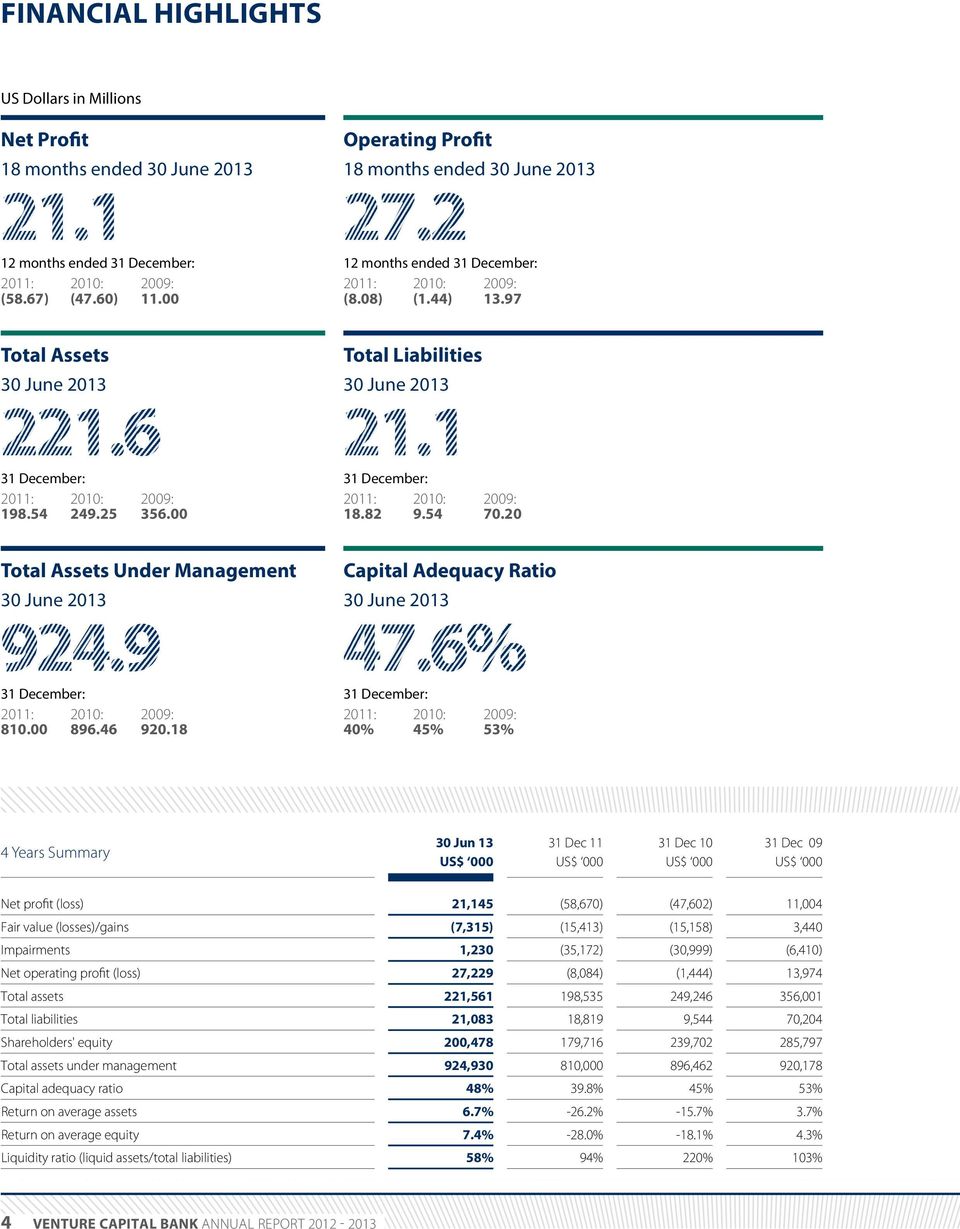
6 FINANCIAL HIGHLIGHTS US Dollars in Millions Net Profit 18 months ended 30 June months ended 31 December: 2011: (58.67) 2010: (47.60) 2009: Operating Profit 18 months ended 30 June months ended 31 December: 2011: (8.08) 2010: (1.44) 2009: Total Assets 30 June Total Liabilities 30 June December: 2011: 2010: : December: 2011: 2010: : Total Assets Under Management 30 June Capital Adequacy Ratio 30 June % 31 December: 2011: 2010: : December: 2011: 2010: 40% 45% 2009: 53% 4 Years Summary 30 Jun 13 US$ Dec 11 US$ Dec 10 US$ Dec 09 US$ 000 Net profit (loss) 21,145 (58,670) (47,602) 11,004 Fair value (losses)/gains (7,315) (15,413) (15,158) 3,440 Impairments 1,230 (35,172) (30,999) (6,410) Net operating profit (loss) 27,229 (8,084) (1,444) 13,974 Total assets 221, , , ,001 Total liabilities 21,083 18,819 9,544 70,204 Shareholders' equity 200, , , ,797 Total assets under management 924, , , ,178 Capital adequacy ratio 48% 39.8% 45% 53% Return on average assets 6.7% -26.2% -15.7% 3.7% Return on average equity 7.4% -28.0% -18.1% 4.3% Liquidity ratio (liquid assets/total liabilities) 58% 94% 220% 103% 4 VENTURE CAPITAL BANK ANNUAL REPORT
7 OPERATIONAL HIGHLIGHTS VCBank concluded a GBP 30 million investment to acquire a prime new-build freehold residential development in London s prestigious W1 conservation area. Mayfair Chambers will house six luxurious residences, designed and finished to the highest standards. VCBank and SVCIC joined a high-profile consortium in a GBP 355 million project to redevelop an iconic residential gateway to Regent s Park to its former glory. Park Crescent West is located in one of London s most prestigious residential neighbourhoods. VCBank is partnering with Al Othman Holding Company to develop a new 150-bed hospital at Al Khobar in Saudi Arabia. The hospital will focus on three centres of excellence women s health, children s health, and day surgery together with a range of specialist clinics. VCBank completed the acquisition of an additional 18.5 per cent stake in Goknur Foods Import Export Trading & Distribution Company the largest producer of fruit juice concentrate and fruit puree in Turkey bringing the Bank s and its investors total indirect equity stake in the Company to 83.5 per cent. VCBank increased its stake in Qatar Engineering & Construction Company (QCon) to 28 per cent. QCon is a leading engineering, procurement and construction (EPC) contracting company, specialising in industrial projects and plant maintenance in Qatar and the GCC region. VCBank s new strategic business model and investment strategy was finalised and approved by the Board of Directors; and the Bank s fiscal year was changed to July-June, in order to align the reporting year with the annual cycle of investment structuring and placement. The organisational restructuring of VCBank was completed, including the establishment of a single integrated investment division; and the creation of the new post of Chief Administrative Officer, responsible for Wealth Management and HR & Administration. 5 VENTURE CAPITAL BANK ANNUAL REPORT

8 CHAIRMAN S STATEMENT In the Name of Allah, the Most Beneficent, the Most Merciful, Prayers and Peace be upon our Prophet Mohammed, His Companions and Relatives. On behalf of the Board of Directors, I present to you the annual report and consolidated financial statements of Venture Capital Bank (VCBank) for the 18-month period ended 30 June 2013, which reflects the change to our fiscal year-end. I am delighted to report that, with the grace of God, we successfully concluded the strategic realignment of the Bank, and met our key objective of returning to profitability. Despite continued global economic uncertainty and regional market volatility, VCBank posted a very strong financial performance during this period. Total revenue increased by 435 per cent on an annualised basis to US$ 43.9 million compared with US$ 6.7 million for the year 2011; with income from investment banking activities growing 12-fold to US$ 35 million from US$ 2.96 million in 2011, representing an annualised growth of almost 8 times. These excellent results mark a major turnaround in the Bank s financial performance. They reflect the success of measures taken during the period to reduce costs, utilise our assets more effectively, restructure the organisation to improve efficiency and maximise synergies, and refocus our investment activities. VCBank posted a very strong financial performance during the period. Total revenue increased by 435 per cent on an annualised basis to US$ 43.9 million, with income from investment banking activities growing to US$ 35 million, representing an annualised growth of almost 8 times. Dr. Ghassan Ahmed Al Sulaiman Chairman of the Board Shareholders Equity 30 June 2013 US$ Million 6 VENTURE CAPITAL BANK ANNUAL REPORT
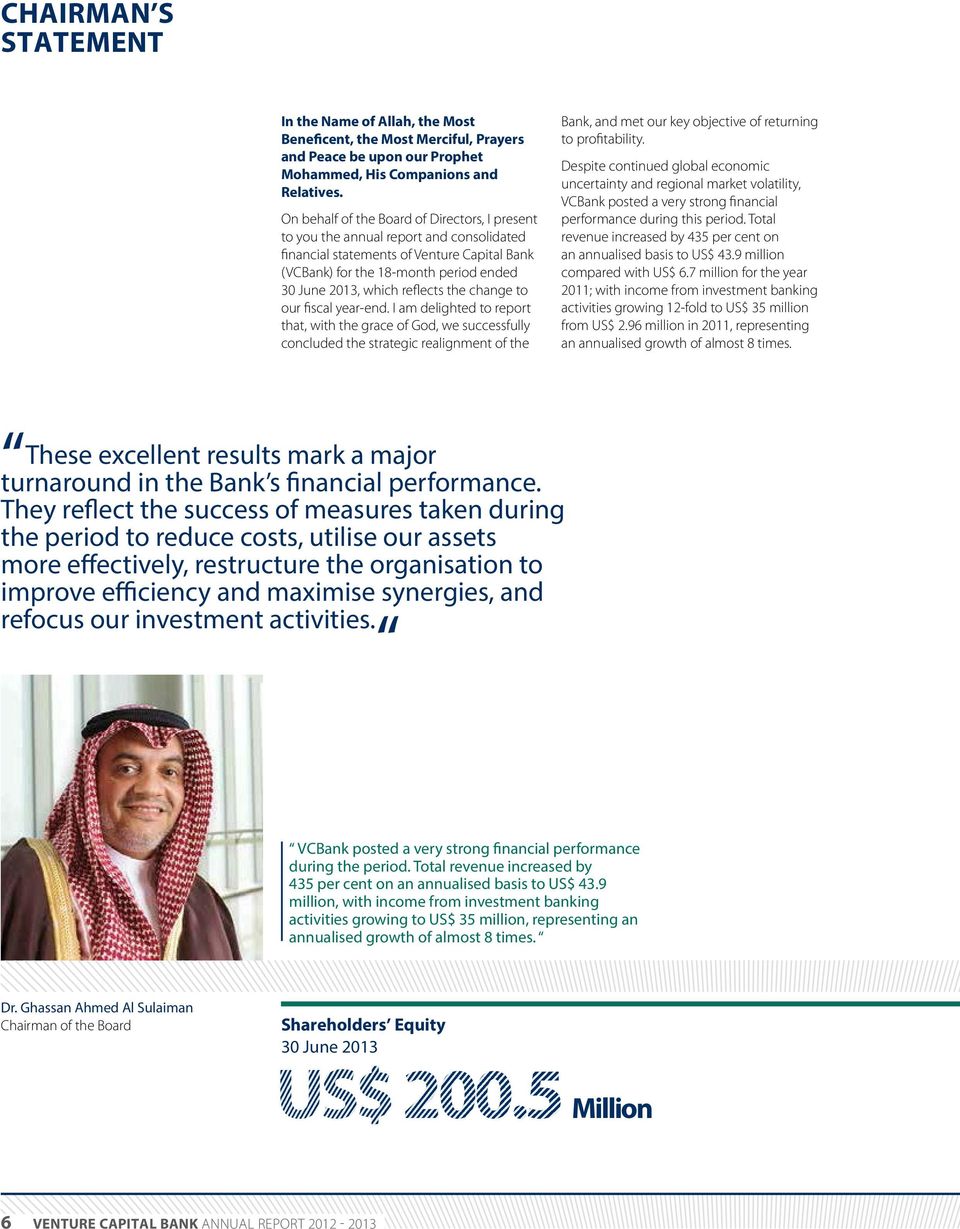
9 Total expenses decreased by 27 per cent on an annualised basis to US$ 15.9 million due to cost reduction initiatives and organisational restructuring. As a result, net profit for the period grew significantly to US$ 21.1 million compared to a loss of US$ 58.7 million for This takes into account fair value losses of US$ 7.3 million and impairment provisions of US$ 4.1 million, which were booked as a prudent measure in the light of current market conditions. VCBank continued to maintain a strong capital base, with total assets increasing to US$ million at 30 June 2013 compared with US$ million at 31 December 2011, while continuing to remain unleveraged. Shareholders equity grew by 8 per cent on an annualised basis to US$ million at the period-end compared with US$ million at end As at end-june 2013, the Bank s capital adequacy stood at a very robust 47 per cent, considerably higher than the 12 per cent minimum requirement of the Central Bank of Bahrain; while fiduciary assets under management totalled US$ 925 million compared with US$ 810 million at the end of These excellent results mark a major turnaround in the Bank s financial performance. They reflect the success of measures taken during the period to reduce costs, utilise our assets more effectively, restructure the organisation to improve efficiency and maximise synergies, and refocus our investment activities. They also confirm the validity of the Bank s new strategy and business plan, which aims to generate and sustain profitability, maintain adequate liquidity, and build a solid foundation for providing acceptable returns to our shareholders. This is underlined by our commitment to continuously enhance our corporate governance and risk management framework, in line with international standards and global best practice, and in compliance with the latest regulatory changes introduced by the Central Bank of Bahrain. In terms of investment activities over the past 18 months, I am pleased to report that the Bank successfully arranged and closed three major new deals, which constitutes a remarkable achievement for a regional investment bank during such a challenging business environment. These significant deals, which confirm the feasibility of our new investment strategy, have further strengthened and diversified our investment portfolio, and reinforced our market reputation for offering clients innovative and attractive investment opportunities. Looking ahead, we remain cautiously optimistic about the future prospects for VCBank in the short-to-medium term. Benefiting from a supportive Board, a strong management team, a clean portfolio and healthy deal pipeline, and a sound financial position, the Bank, God willing, is well placed to take advantage of market improvements and new business opportunities. The latest growth estimates for Bahrain, the GCC and MENA region in remain encouraging, underlined by strong macroeconomic fundamentals. However, given the likelihood of continued global economic and market volatility, and ongoing regional political and social tensions, we must remain mindful that the immediate future could continue to prove both unpredictable and challenging. During the period, there were a number of changes to the composition of the Board of Directors. Messrs Ali Mousa Al Mousa, Mohammed bin Sulaiman Abanumay, Ibrahim Hamad Al Babtain and Ajlan Abdulaziz Al Ajlan resigned from the Board; and I take this opportunity to thank them for their valuable contributions during their terms in office. In turn, I welcome Messrs Mohammed Abdulaziz Al Sarhan, Mohammed Abdulrazzaq Alkandari, Yasir Mohammed Al Jarullah and Khalid Abdulaziz Al Mediheem as newlyelected Directors; all of whom bring with them a wealth of experience and expertise that will undoubtedly benefit the Bank. On behalf of the Board of Directors, I extend my sincere appreciation to His Majesty the King of Bahrain, His Royal Highness the Prime Minister, and His Royal Highness the Crown Prince and First Deputy Prime Minister, for their wise leadership and reform programme, and their encouragement for the Islamic banking sector. My thanks are also due to the Central Bank of Bahrain, Ministry of Industry & Commerce and other Government institutions, for their continued professional advice and support during the period. I would also like to express my gratitude to our shareholders, clients and business partners for their enduring loyalty and confidence; to our Shari ah Supervisory Board for their valuable guidance and supervision; and to the Bank s management and staff for their highly-valued dedication and professionalism. May Allah guide us on the proper path, and lead us to the realisation of our goals for the future success of the Bank. Dr. Ghassan Ahmed Al Sulaiman Chairman of the Board 7 VENTURE CAPITAL BANK ANNUAL REPORT
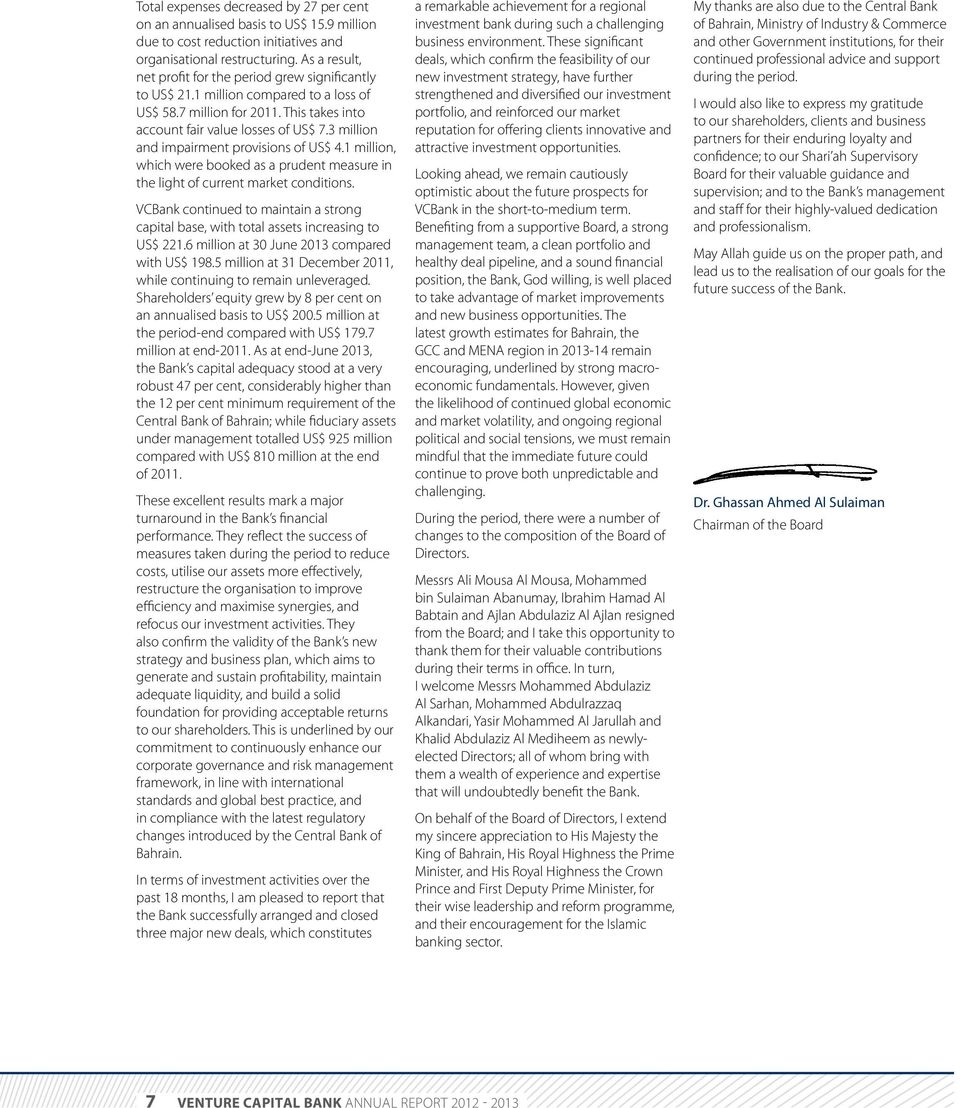
10 BOARD OF DIRECTORS Dr. Ghassan Ahmed Al Sulaiman Chairman Kingdom of Saudi Arabia Abdulfatah Mohammed Rafie Marafie Deputy Chairman State of Kuwait Abdullatif Mohamed Janahi Board Member & Chief Executive Officer Kingdom of Bahrain Marwan Ahmad Al Ghurair Board Member United Arab Emirates Saleh Mohammed Al Shanfari Board Member Sultanate of Oman Nedhal Saleh Al Aujan Board Member Kingdom of Bahrain 8 VENTURE CAPITAL BANK ANNUAL REPORT
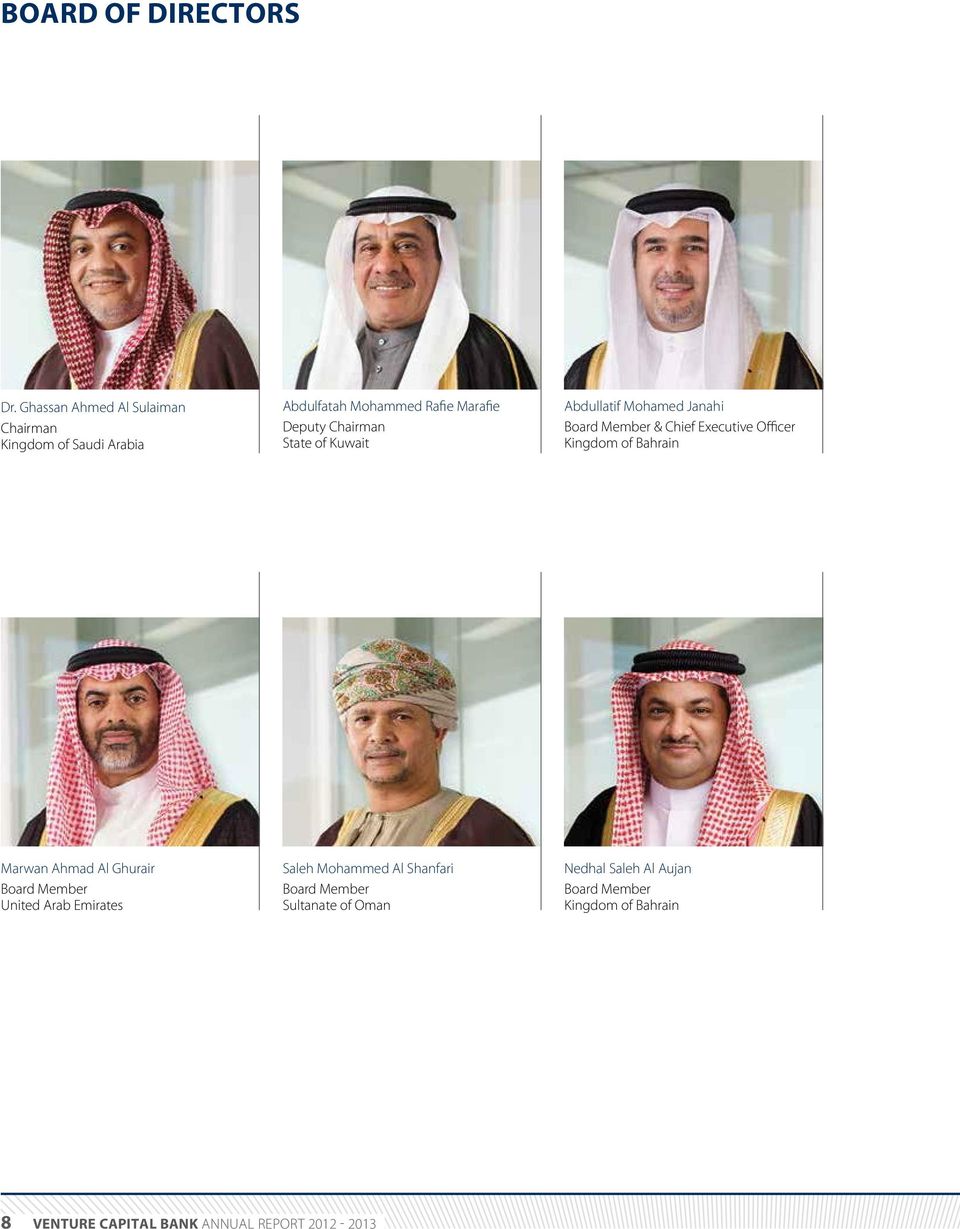
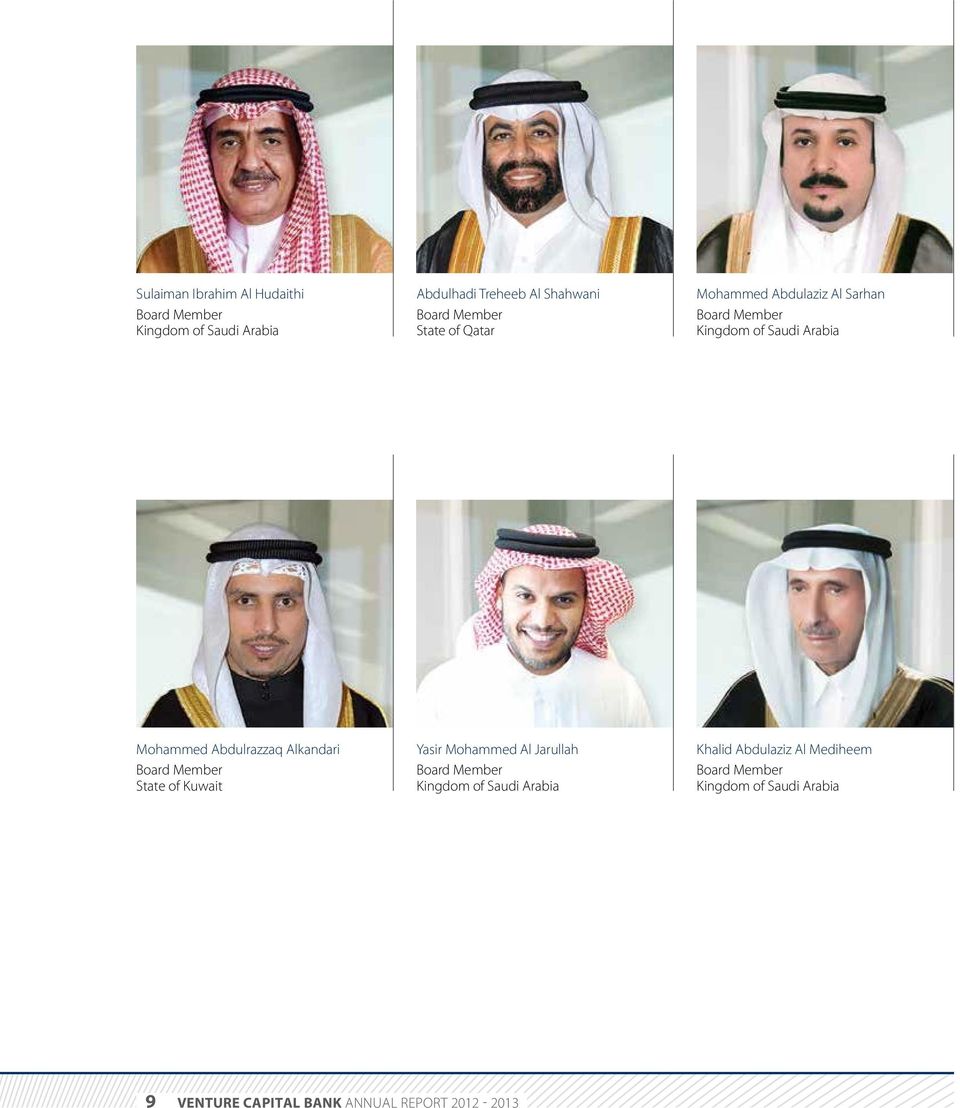
11 Sulaiman Ibrahim Al Hudaithi Board Member Kingdom of Saudi Arabia Abdulhadi Treheeb Al Shahwani Board Member State of Qatar Mohammed Abdulaziz Al Sarhan Board Member Kingdom of Saudi Arabia Mohammed Abdulrazzaq Alkandari Board Member State of Kuwait Yasir Mohammed Al Jarullah Board Member Kingdom of Saudi Arabia Khalid Abdulaziz Al Mediheem Board Member Kingdom of Saudi Arabia 9 VENTURE CAPITAL BANK ANNUAL REPORT
12 SHARI AH SUPERVISORY BOARD Shaikh Nidham Mohammed Saleh Yaqooby Chairman Dr. Abdul Sattar Abdul Kareem Abu Ghuddah Member Dr. Essa Zaki Essa Member Shaikh Yaqooby is a Ph.D. Reader in Islamic Law at the University of Wales, UK; and holds a BA in Economics & Comparative Religion from McGill University, Canada. He has been guided in Traditional Islamic Studies by eminent Islamic scholars from Saudi Arabia, Bahrain, Egypt, Morocco and India. During the 1990s, he was a Khatib in the Kingdom of Bahrain, and since 1976 has taught a range of Islamic topics. Shaikh Yaqooby is a Member of the Shari ah Supervisory Board of several Islamic banks, and is a Member of the following institutions: Shari ah Council of the Accounting & Auditing Organisation for Islamic Financial Institutions (AAOIFI), Shari ah Council of the Islamic Rating Agency, Shari ah Board of the Central Bank of Bahrain, and the Dow Jones Islamic Index. Shaikh Yaqooby is also a regular speaker at Islamic conferences and forums. Dr. Abu Ghuddah holds a Ph.D. in Shari ah from Al-Azhar University, Cairo, Egypt. He is a Member of the Islamic Fiqh Academy, which evolved from the Organisation of Islamic Conference in Jeddah, Kingdom of Saudi Arabia. He previously held the positions of Expert and Reporter for the Islamic Fiqh Encyclopedia, Ministry of Awqaf & Islamic Affairs, State of Kuwait. He is a Member of the Shari ah Supervisory Board of several Islamic financial institutions, and a Member of the Standards Board and Shari ah Council of the Accounting & Auditing Organisation for Islamic Financial Institutions (AAOIFI). He is the author of several specialist books in Fiqh & Fatwa of modern Muamalat and publications on different Islamic subjects, and a regular speaker at Islamic conferences and forums. Dr. Essa holds a Ph.D. in Comparative Fiqh from the Islamic University, Al Madina Al Munawarah, Kingdom of Saudi Arabia. He is an Assistant Professor at the College of Basic Education, Public Authority for Applied Education & Training, State of Kuwait. He is a Member of several Fatwa and Shari ah Boards and Committees. He is the author of several books and publications on different Islamic subjects. Also, Dr. Essa is a regular speaker at Islamic conferences and forums. 10 VENTURE CAPITAL BANK ANNUAL REPORT
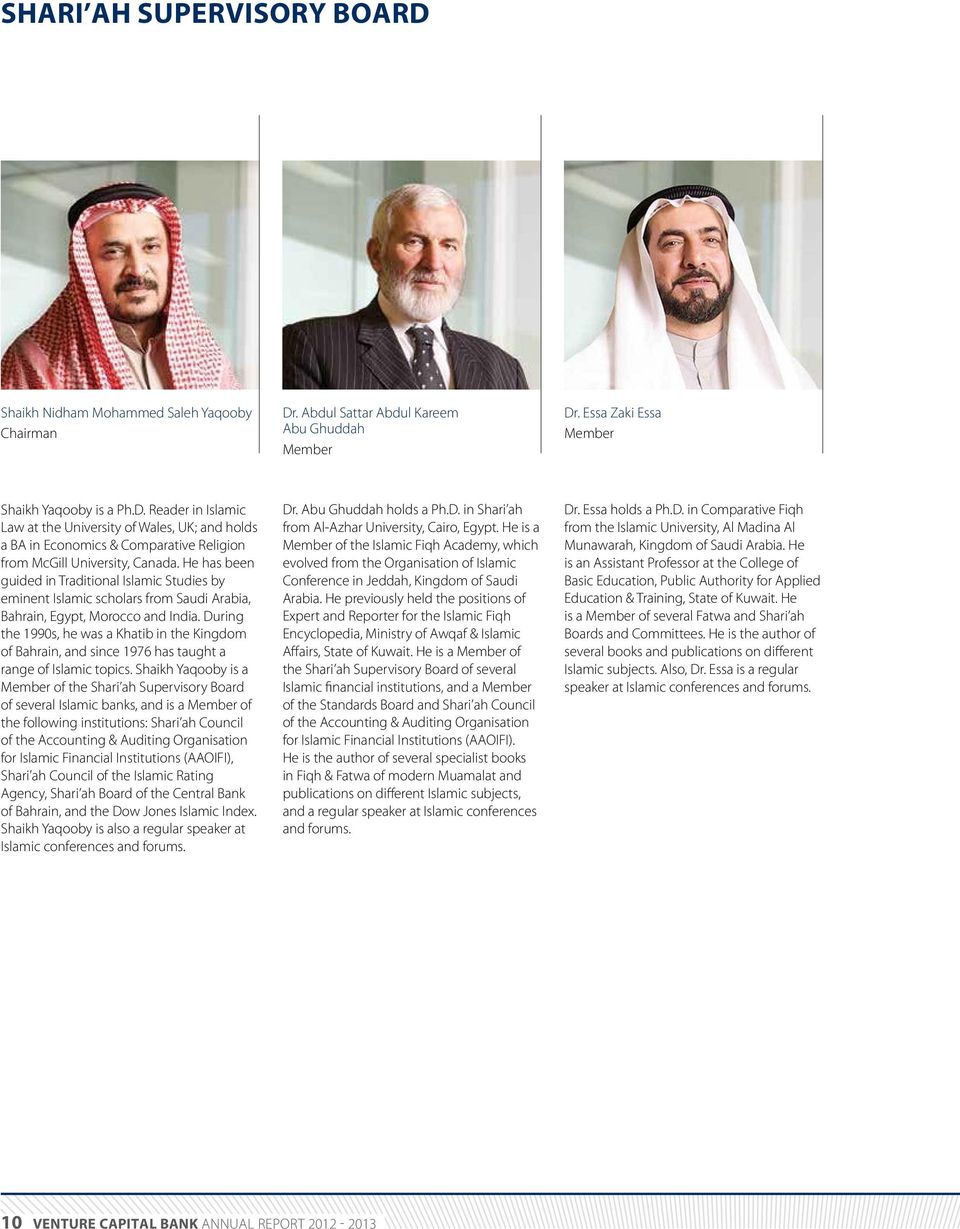
13 11 VENTURE CAPITAL BANK ANNUAL REPORT Composed of eminent Shari ah scholars, the Bank s Shari ah Supervisory Board is entrusted with the duty of directing, reviewing and supervising the activities of the Bank in order to ensure that they are in compliance with the rules and principles of Islamic Shari ah.

14 CEO S REPORT In the name of Allah, the Most Beneficent, the Most Merciful, Prayers and Peace be upon our Prophet Mohammed, His Companions and Relatives. The period under review from 1 January 2012 to 30 June 2013 has proved to be a pivotal chapter in the strategic evolution of Venture Capital Bank. During this period, we made significant progress in completing the rationalisation process that was started in late 2011 to realign our strategy and business model, and sharpen our focus on the Bank s core investment banking capabilities. The objective of this process was to transform VCBank in line with changing market dynamics, and return the Bank to profitability. Accordingly, we introduced a number of key measures which included finalising a new corporate strategy and business model; refocusing our investment activities on carefully selected sectors and geographies; and reducing costs through a major organisational restructuring exercise. Our financial results and operational achievements during the past fiscal period are testimony to the Bank s high standards of performance and the effectiveness of our refocused investment strategy. God willing, we are confident of VCBank s ability to build upon this excellent performance, and continue to adapt and capitalise on changes and opportunities in the market. VCBank reported six consecutive quarters of profitability, with net profit for the period growing significantly to US$ 21.1 million and total expenses decreasing to US$15.9 million. Abdullatif Mohamed Janahi Board Member & Chief Executive Officer Net Profit 30 June 2013 US$ 21.1 Million 12 VENTURE CAPITAL BANK ANNUAL REPORT

15 We also changed the Bank s fiscal yearend to align our reporting year with the annual cycle of investment structuring and placement, and minimise the impact of the annual summer holiday season for the greater convenience of our investors I am pleased to report that these measures proved to be extremely successful. Financially, VCBank reported six consecutive quarters of profitability, with net profit for the period growing significantly to US$ 21.1 million and total expenses decreasing to US$15.9 million. This was achieved by completing the staff rationalisation process, which was conducted in a most considerate and caring manner, with the headcount now less than half the 90 staff employed in Total revenues grew by 435 per cent to US$ 43.9 million, with a significant rise in the contribution of investment income to US$ 35 million. Organisationally, we restructured the three autonomous investment divisions into a single integrated investment group; established a new Wealth Management division; and reallocated responsibilities across the Bank to improve operating efficiency and maximise synergies. The successful refocusing of the Bank s investment activities resulted in VCBank raising a total of US$ 245 million from investors, including the conclusion of three new investment transactions, an increased stake in two existing key portfolio companies, and new subscriptions to the VCBank Liquidity Programme. This was achieved despite the volatile business environment and intensified competition from other players in the region; and ranks as one of the best performances by a regional investment bank. The new deals include two high-end UK property transactions in London s prestigious W1 residential district. With properties currently valued at 20 per cent higher than their peak of 2007, London s prime residential market has demonstrated its resilience to the global financial crisis. In the Kingdom of Saudi Arabia, VCBank has made significant progress in a planned investment involving the establishment of a specialist hospital in Alkhobar, Saudi Arabia. This will help to meet the Kingdom s growing demand for world-class private sector healthcare, which offers excellent growth prospects. In addition, VCBank finalised the acquisition of an additional 18.5 per cent stake in Goknur Foods Import Export Trading & Distribution Company the largest producer of fruit juice concentrate and fruit puree in Turkey - bringing the Bank s and its investors total indirect equity stake in the Company to 83.5 per cent. Following a favourable arbitration settlement in 2012, VCBank increased its stake in Qatar Engineering & Construction Company (QCon) a leading engineering, procurement and construction (EPC) contracting company to 28 per cent. The Bank has also identified a number of potential investment exits that are expected to be concluded during the next fiscal year. Looking ahead, GDP in the MENA region is forecast to grow by 2.5 per cent in 2013, according to the latest Global Economic Prospects Report by the World Bank. The GCC economies, which constitute the US$ 1.4 trillion Gulf market- and the Bank s core investment geographies- are expected to outperform the rest of the region, with overall economic growth averaging around 4 per cent in Closer to home, the Bahrain Economic Development Board expects the Kingdom s GDP to grow by 5 per cent, driven by a rebound in oil production, ongoing expansion in the non-oil sector, and robust private sector growth. We are therefore cautiously optimistic for VCBank s prospects over the next 12 months, as we continue to reap the benefits of the measures and, at times, the difficult decisions taken over the past two years. The Bank is now a leaner, more efficient and focused institution, backed by strengthened underlying financial fundamentals and a strong investment deal pipeline. As such, we are well placed to take advantage of emerging business opportunities, which will support the sustained profitability and continued development and growth of VCBank for the ongoing benefit of all our stakeholders. Our financial results and operational achievements during the past fiscal period are testimony to the Bank s high standards of performance and the effectiveness of our refocused investment strategy. God willing, we are confident of VCBank s ability to build upon this excellent performance, and continue to adapt and capitalise on changes and opportunities in the market. In conclusion, I would like to express my sincere appreciation for the unwavering support and encouragement that we have received from all our stakeholders. In particular, I would like to acknowledge the continued trust and confidence of our highly-supportive investor base; and pay special tribute to the commitment and hard work of our management and staff, without whose positive attitude towards embracing change and rising to new challenges, such a successful performance by the Bank would not have been possible. We are blessed by having such a dedicated and professional team. Abdullatif Mohamed Janahi Board Member & Chief Executive Officer 13 VENTURE CAPITAL BANK ANNUAL REPORT

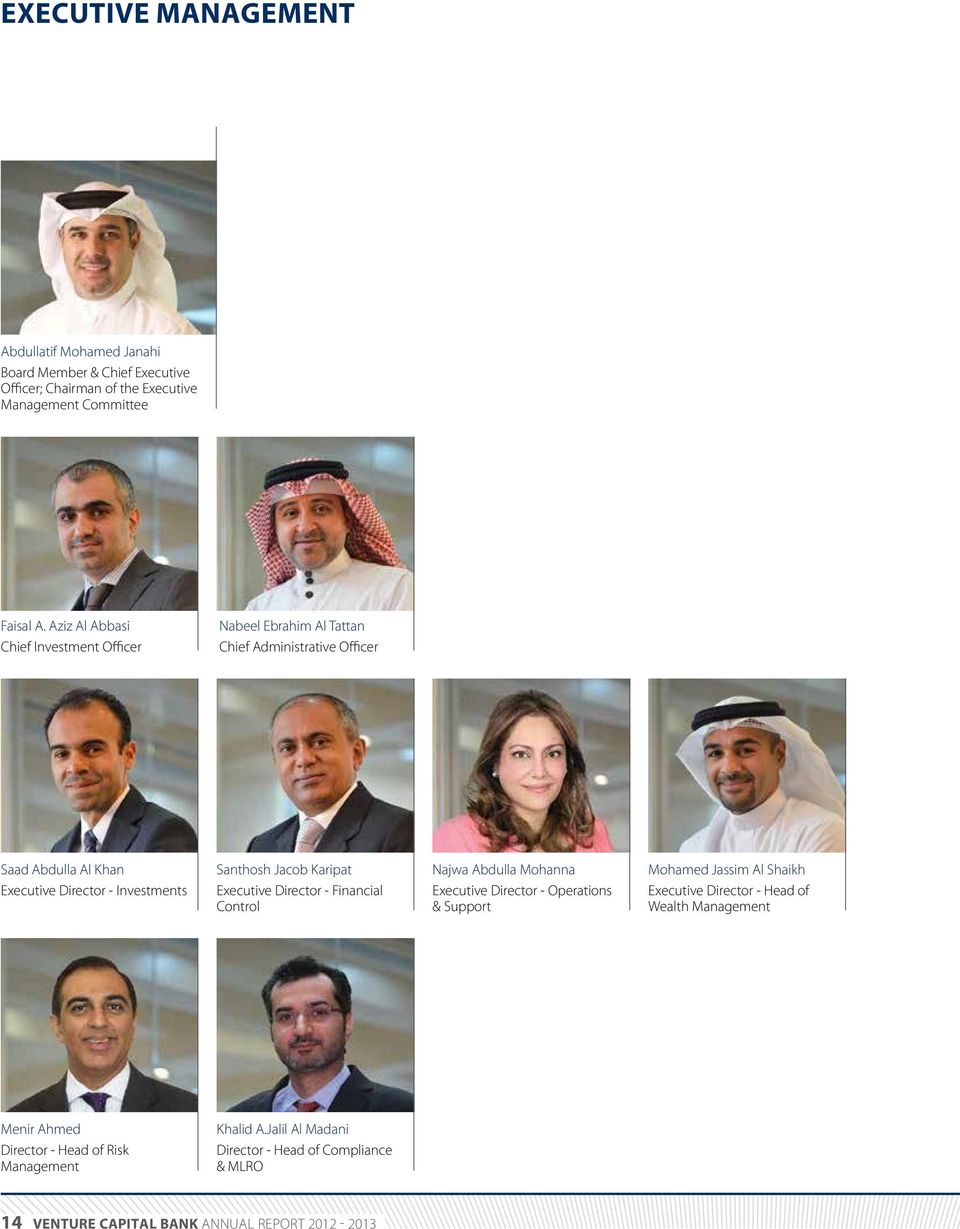
16 EXECUTIVE MANAGEMENT Abdullatif Mohamed Janahi Board Member & Chief Executive Officer; Chairman of the Executive Management Committee Faisal A. Aziz Al Abbasi Chief Investment Officer Nabeel Ebrahim Al Tattan Chief Administrative Officer Saad Abdulla Al Khan Executive Director - Investments Santhosh Jacob Karipat Executive Director - Financial Control Najwa Abdulla Mohanna Executive Director - Operations & Support Mohamed Jassim Al Shaikh Executive Director - Head of Wealth Management Menir Ahmed Director - Head of Risk Management Khalid A.Jalil Al Madani Director - Head of Compliance & MLRO 14 VENTURE CAPITAL BANK ANNUAL REPORT
17 15 VENTURE CAPITAL BANK ANNUAL REPORT The Chief Executive Officer (CEO) is delegated by the Board of Directors with responsibility for the day-to-day management of the Bank. The CEO is supported by a well-qualified and experienced Executive Management team. Executive Managers profiles are listed in the Corporate Governance Review.
18 INVESTMENT REVIEW As part of the Bank s strategic restructuring exercise, the existing three autonomous investment divisions were consolidated into one integrated division under a Chief Investment Officer. The objective of this exercise is to improve operating efficiency, and realign resources with a greater focus on private equity investment activities. Also during the year, an extensive review of the Bank s strategy and business model was completed, and a revised investment strategy was approved by the Board of Directors. Despite the continued challenging economic and financial environment, which affected investors risk appetite, VCBank was successful in concluding three new investment transactions and increasing its stake in two existing key portfolio companies. INVESTMENT STRATEGY VCBank s strategy is designed to generate consistent superior returns with calculated risk from high-quality, rigorouslyinvestigated, efficiently-structured and well-managed investment opportunities. The investment portfolio will be prudently diversified across different markets and sectors, and across different growth stages of private equity opportunities. This diversified approach aims to reduce the risk of geographic and sector concentration. The Bank will partner with experienced technical / business partners or entrepreneurs who share its vision of building pioneering companies or projects that have the potential for rapid growth, and to be world leaders in their respective industries. VCBank will also identify successful global business models for duplication in the MENA region in order to enhance and diversify regional economies; create employment opportunities; replace imports with local goods and services; and generate increased exports. The Bank will add value to its portfolio companies through active participation and support, in order to maximise the exit value of its investments. PHILOSOPHY VCBank s investment philosophy is generally guided by the fundamental premise that it is cash flow and profitability, not trophy status or fashion, which ultimately determines the value of an asset. The Bank considers that rigorous due diligence, the use of conservative assumptions in financial projections, and careful assessment of possible downside scenarios, are the best methods for consistently achieving its objectives. FOCUS The primary investment focus for VCBank will be private equity deals, followed by a reduced emphasis on venture capital and business development-themed transactions. Real estate investments will only be undertaken on a selective basis. Regardless of the investment type, the Bank adopts a consultancy-based analytical approach to thoroughly examine each prospective venture and early-stage business proposal; with an emphasis on customer value, strategic positioning, competitive dynamics, business model sustainability, and management capability. MARKETS VCBank will seek investment opportunities on a global basis but with greater emphasis on the MENA region. The investment portfolio will be diversified in order to avoid concentration in any particular market. The Bank s core investment markets are GCC countries, while priority markets are Turkey and, on a selective basis, the United Kingdom. Opportunistic markets that have the potential to generate interesting deals include the rest of MENA and, very selectively, the Far East, Asia and the West. SECTORS VCBank will focus its deal flow efforts on core sectors where its track record, and the cumulative in-depth knowledge of the Investment team and Board Members, can be called upon. Core sectors comprise healthcare, agriculture, food, fertilizers and petrochemicals, oil and gas services, liquidity programmes and international real estate. Priority sectors, which demonstrate scope for significant development in the MENA region, have been identified as education and infrastructure. Opportunistic sectors, considered on a case-by-case basis, include regional real estate and other potential highgrowth sectors. EXITS In evaluating investment opportunities, one of the Bank s primary considerations is the potential exit strategy. Accordingly, VCBank focuses on investments in industries that either have significant M&A activity, or where there is an appetite for listing on capital markets. The Bank has developed a timetable of planned investments exits, with a number of identified deals expected to be concluded during the second half of 2013 and in early VENTURE CAPITAL BANK ANNUAL REPORT

19 NEW INVESTMENTS MAYFAIR CHAMBERS LONDON W1, UK This GBP 30 million property transaction involves the acquisition of a prime newbuild freehold residential development in the heart of Central London. Mayfair Chambers is a bespoke building currently being developed to house six luxurious residences, designed and finished to the highest standards. The property is situated in the Mayfair W1 conservation area, one of London s most prestigious residential locations. For the full report on Mayfair Chambers, please see the entry under Real Estate. PARK CRESCENT WEST LONDON W1, UK VCBank and Saudi Venture Capital Investment Company are part of a highprofile consortium led by the Saudi-based Rassmal Investments, which is owned by Al Shawaf family. Through its construction company, Al Bawani, the group has established itself as a leading high-end contracting company in the Kingdom, with significant strengths in residential property and healthcare. The consortium has invested in the acquisition of an iconic residential development in one of London s most prestigious residential areas overlooking Regent s Park. For the full report on Park Crescent West, please see the entry under Real Estate. SPECIALIST HOSPITAL AL KHOBAR, SAUDI ARABIA VCBank is partnering with Saudi-based Al Othman Holding Company to develop a new 150-bed hospital at Al Khobar in the Kingdom of Saudi Arabia. Covering a total area of 40,000 square metres, the hospital will concentrate on three centres of excellence women s health, children s health and day surgery which are in high demand and generate high margins. In addition, specialised clinics will cover diabetes, dermatology, plastic surgery, eye care, cardiology, ENT and orthopaedics. The hospital will focus on the immediate catchment area comprising Dammam, Al Khobar and Dhahran, with a total population of 2.4 million; but will also attract patients from other provinces in the Kingdom. For the full report on Specialist Hospital, please see the entry under Venture Capital & Business Development. GOKNUR During 2012, VCBank completed the acquisition of an additional 18.5 per cent stake in Goknur Foods Import Export Trading & Distribution Company, one of the largest producers of fruit juice concentrate and fruit puree in Turkey. This latest acquisition brings the Bank s and its investors total indirect equity stake in the Company to 83.5 per cent. Goknur made two dividend distributions to investors of 6.8 per cent and 9 per cent for the years ending 2011 and 2012 respectively. For the full report on Goknur, please see the entry under Private Equity. QCON Given the interest from its investors and the company s promising prospects, VCBank s stake in Qatar Engineering & Construction Company (QCon) was increased by 20 per cent to 28 per cent. Following another successful performance, the Company distributed 10 per cent in dividends for the year ended 31 December 2011, in line with the dividend payment for the previous year. For the full report on QCon, please see the entry under Private Equity. The primary investment focus for VCBank will be private equity deals, followed by a reduced emphasis on venture capital and business development-themed transactions, and with real estate investments being undertaken on a selective basis. 17 VENTURE CAPITAL BANK ANNUAL REPORT VENTURE CAPITAL BANK ANNUAL REPORT

20 INVESTMENT REVIEW PRIVATE EQUITY INVESTMENT PORTFOLIO UPDATE Goknur Established in 1993, Goknur Foods Import Export Trading & Distribution Company is the largest fruit juice concentrate and fruit puree producer and exporter in Turkey, with a 50 per cent market share. It exports to over 60 countries worldwide, with a focus on Europe, USA and Russia; and a client base including leading international brands such as Coca Cola, Pepsi Cola, Sun Top, Hero and Smuckers. In 2012, VCBank completed the acquisition of an additional 18.5 per cent stake in Goknur, bringing the Bank s and its investors total indirect equity stake in the Company to 83.5 per cent. During the year, Goknur implemented its expansion plans with the purchase of 2 million square metres of farmland for the cultivation of fruits such as apple, sour cherry, apricot and peach. This acquisition brings the Company s total land bank to 6.2 million square metres. Goknur also completed the construction of a second production plant in the city of Adana with an annual processing capacity of 177,000 tons; while construction started on a third processing plant which is close to completion as well. SHIPCO This US$ 33.5 million shipping capital lease project entails a capital lease through sale and leaseback on a bareboat basis of three one-year-old Supramax 57,000 dwt bulk carriers. The individual price tag of US$ 28.3 million of these vessels is well below the market value for comparable five-year-old Supramax bulk carriers. Headquartered in Greece, the lessee is a fast-growing provider of marine transportation services, currently operating its own fleet of seven Supramax vessels, and managing a fleet of 180 charter vessels. MENA SME Fund Established in 2006, this Fund made its last capital call in 2010 and then closed following its investment in QCon. The Fund has performed relatively well since inception, and at the end of 2012, the NAV per share stood at US$ 45.52, a decrease of 9.96 per cent from the original NAV. Distributions to investors during the year totalled US$ 0.75 million. The Fund s portfolio companies are Challenger Limited, JAFCCO, ITWorx and QCon, whose progress is reported separately below. The Fund is currently finalising plans for a number of exits during 2013 and Challenger Limited Libya-based Challenger is a provider of contract oil and gas land drilling and workover services, operating primarily in the MENA region. Following the unforeseeable events in Libya during 2011, the Company embarked upon a major asset restoration programme in Challenger s commitment to stay in Libya during the war is starting to prove beneficial. The Company has six rigs currently operational, with another five being prepared for deployment. JAFCCO The growing demand for fertilizers continued during 2012, enabling Jordan Al Abyad Fertilizers & Chemicals Company (JAFCCO) to report a good level of revenue for the year. However, this was affected by recurring technical issues facing the fifth production line of the new expansion project, which have prevented it from coming on stream as planned. The Company has appointed a reputable neutral international consultant to inspect and evaluate the status of the fifth line, and recommend remedial actions to be undertaken by the EPC contractor. ITWorx Company ITWorx is one of the largest software outsourcing firms in Egypt, with offices in Saudi Arabia, the UAE, Qatar, Europe and the USA. The Company reported increased revenue and profitability in 2012, and secured a number of important new contracts. These include delivery of its customised Visit Management System to Ottawa Public Health (OPH) in Canada, providing OPH with an integrated and costeffective bilingual system for automating the handling of influenza vaccination campaigns. ITWorx also attended the prestigious International Society for Technology in Education in San Diego, USA, where it presented its Connected Learning Gateway platform; and introduced its new Virtual Lab product, which uses Microsoft s Kinect to simulate the running of a scientific experiment. QCon VCBank holds a 28 per cent stake in Qatar Engineering & Construction Company (QCon), a leading engineering, procurement and construction (EPC) contracting company. It specialises in projects and plant maintenance for the oil and gas, petrochemicals, fertilizers, power and other industrial infrastructure sectors in Qatar. Established in 1975, QCon has built a dominant position, and a high reputation for quality and safety, in the niche segments in which it operates. In 2012, the Company reported increased revenues and profitability, and won a number of major new contracts in Qatar. Outside Qatar, the Company was awarded the main plant maintenance contract from ADGAS in Abu Dhabi, marking the first step in the QCon s geographic expansion strategy. Lemissoler Maritime Company Taking into consideration the collapse of the shipping sector as a result of the global economic recession, Lemissoler Maritime Company has performed reasonably well. In an environment where vessel valuations were dropping and many major charterers were collapsing, causing most shipping companies in the world to incur sizable losses, the Company performed reasonably well in 2012, while preserving its liquidity and its assets. Lemissoler operates a fleet of five specialised commercial vessels and container ships under a diverse portfolio of long-term, fixed-rate time charters with bluechip clients. SVCIC Saudi Venture Capital Investment Company (SVCIC) is a Saudi-based investment company with a paid-up capital of US$ 100 million. With a primary focus on investing in small and medium enterprises in the Kingdom, the Company is currently evaluating a number of promising investment opportunities. During 2012, SVCIC continued to build its management team, with the appointment of a Chief Financial Officer, Chief Investment Officer, Chief Placement Officer and Chief Risk Officer. Key developments include investment in imena an e-commerce and internet start-up holding company based in Jordan. The Company also partnered with Venture Capital Bank in a highprofile consortium led by the Saudi-based Rassmal Investments, for the acquisition and development of an iconic residential development, Park Crescent West, in one of London s most prestigious residential areas overlooking Regent s Park. 18 VENTURE CAPITAL BANK ANNUAL REPORT
21 2 1. ITWorx Company 2. QCon 3. Goknur 1 3 VCBank s investment portfolio is prudently diversified across different markets and sectors, and across different revenue stages of private equity opportunities. This diversified approach aims to reduce the risk of geographic and sector concentration. 19 VENTURE CAPITAL BANK ANNUAL REPORT
22 VCBank s strategy is designed to generate consistent superior returns with reasonable risk from high-quality, rigorouslyinvestigated, efficiently-structured and well-managed investment opportunities German Orthopaedic Hospital 2. Royal Maternity Hospital 3. VCBank Liquidity Programme VENTURE CAPITAL BANK ANNUAL REPORT
23 INVESTMENT REVIEW VENTURE CAPITAL & BUSINESS DEVELOPMENT INVESTMENT PORTFOLIO UPDATE Specialist Hospital Al Khobar, Saudi Arabia VCBank is partnering with Saudi-based Al Othman Holding Company to develop a new 150-bed hospital at Al Khobar in the Kingdom of Saudi Arabia. Covering a total area of 40,000 square metres, the hospital will concentrate on three centres of excellence women s health, children s health and day surgery which are in high demand and generate high margins. In addition, specialised clinics will cover diabetes, dermatology, plastic surgery, eye care, cardiology, ENT and orthopaedics. The hospital will focus on the immediate catchment area comprising Dammam, Al Khobar and Dhahran, with a total population of 2.4 million; but will also attract patients from other provinces in the Kingdom. Healthcare is a highly attractive sector in Saudi Arabia, with excellent growth prospects. These are driven by favourable demographics; the emergence of lifestyle-related diseases such as diabetes, hypertension, obesity and heart problems; the influx of expatriate patients who previously had access to public hospitals; mandatory health insurance coverage for expatriates; and favourable regulatory changes and government incentives for the private sector. This new investment project draws upon VCBank s healthcare experience gained from development of the German Orthopaedic Hospital and Royal Maternity Hospital in Bahrain; and Al Othman s involvement in the 200-bed Al Ahsa Hospital in the Eastern Province of Saudi Arabia. VCBank Liquidity Programme This first-of-its-kind Shari ah-compliant short-term liquidity programme completed its second year in The subsequent launch of a third offering was well received and fully subscribed. Providing a profit rate of between 4 and 6 per cent, the short-term trust certificates of the programme are backed by the prime asset of Venture Capital Bank Building. The programme has attracted steady interest from potential investors, with the majority of certificate holders being corporates, financial institutions and insurance companies, as well as individual investors. German Orthopaedic Hospital Since opening in 2010, this specialist hospital has quickly earned a reputation for worldclass orthopaedic treatment and surgery in Bahrain and the wider GCC market, especially the Eastern Province of Saudi Arabia and Kuwait. Patients no longer need to travel to Germany for specialist treatment, and agreements signed by the hospital to date include the General Organisation for Youth and Sports (GOYS) for the treatment of players of Bahrain s national sports teams. The Hospital has recorded steady year-onyear growth since its opening in June Following the success of this project, a similar medical institution is currently under study for development in Riyadh, Saudi Arabia. The German Orthopaedic Hospital serves to illustrate the distinct ability of VCBank to identify a lucrative captive market, with the potential for replication in other GCC countries. Royal Maternity Hospital Based on a proven international model for healthcare and hospitality, the Royal Maternity Hospital will provide world-class basic and advanced healthcare services for women and children. The initial focus of this 22-bed hospital will be on the provision of comprehensive maternity services, extending to prenatal and postnatal care, in addition to gynaecology. Construction made good progress in 2012, including earthworks, foundations and the full structure for the main hospital building. A leading team of international consultants was assigned in October 2012, with responsibility for the procurement of medical equipment; functional planning and IT reviews; staffing requirements; and the development of departmental policies and procedures. The Lounge This specialist serviced offices company, launched in Bahrain in 2008, has made excellent progress, despite difficult market conditions. Having managed to retain most of its existing clients, revenues have been steady for the past two years. With a 90 per cent occupancy rate, the Lounge maintained profitability in 2012, despite operating in a very competitive and price-sensitive market. The Lounge illustrates the venture capital approach of VCBank in successfully seeding a new concept in Bahrain, and then replicating it elsewhere in the MENA region. GLOREI The Global Omani Development & Investment Company (GLOREI) provides VCBank with an investment platform for opportunities in Oman. The company has successfully executed deals in the hospitality and logistics sectors, as well as certain sub-sectors of real estate, such as serviced offices. The Maktabi Watayah property was completed in 2012, with approximately 60 per cent of the space having been leased to date. Bayan Real Estate Development Company Founded by leading companies and private investors from Saudi Arabia, Kuwait and Bahrain, Bayan Real Estate Development Company has been profitable since its establishment in In line with its focus on demand-driven, non-speculative real estate projects in Saudi Arabia, Bayan is currently executing a number of deals in the Kingdom s Eastern Province. Its debut project Gardinia Aziziyah is progressing well. This integrated residential district comprises villas of different designs, specifications and prices; and community facilities such as mosques, schools, medical centres, and retail outlets. Gardinia offers middle-income families the opportunity of owning a high quality and affordable home. The SR 800 million project, which covers an area of 625,000 square metres, is located in the Aziziyah area of Al Khobar, close to Half Moon Beach and Prince Mohammed bin Fahd University. In 2012, the Company completed the sale of a developed piece of land in Um AlKhair at an impressive gain after a three-year holding period. Gulf Projects Company The Company is the part-owner and operator of Venture Capital Bank Building in the Diplomatic Area of Manama in Bahrain. This successful mixed-use commercial, retail and car parking complex is operating near to 100 per cent capacity. The Venture Capital Bank Building is the prime asset for the shortterm trust certificates of the VCBank Liquidity Programme. In 2012, the building achieved 100 per cent occupancy of the office area, and over 83 per cent of the car park. Mozon Investment Holding Company Mozon provides VCBank with an investment platform for opportunities in Morocco. The Lounge a specialist serviced offices company launched in Bahrain in 2008 has been successfully replicated in Casablanca. Mozon also completed investments in the education and affordable housing sectors during 2012, and has identified a number of new business opportunities. 21 VENTURE CAPITAL BANK ANNUAL REPORT
24 INVESTMENT REVIEW REAL ESTATE INVESTMENT PORTFOLIO UPDATE Mayfair Chambers London W1, UK This GBP 30 million property transaction involves the acquisition of a prime newbuild freehold residential development in the heart of Central London. Mayfair Chambers is a bespoke building currently being developed to house six luxurious residences, designed and finished to the highest standards. The property is situated in the Mayfair W1 conservation area, one of London s most prestigious residential locations, second only to the prime SW1 postcode of Knightsbridge and Belgravia. All necessary planning permissions have been obtained and construction has commenced, with completion planned for April London s prime and super-prime residential market has weathered the global financial crisis, with prime property currently valued at 20 per cent higher than its 2007 peak. The market is forecast to continue performing strongly, driven by London s safe haven status and limited delivery of new homes. Mayfair is considered to be under-priced when compared with Knightsbridge and Belgravia, where values in excess of GBP 4,000 per square foot have been achieved. Very few new, or relatively new, apartment blocks of a similar scale are currently available in this sought-after residential area. Park Crescent West London W1, UK VCBank and Saudi Venture Capital Investment Company are part of a highprofile consortium led by the Saudi-based Rassmal Investments, which is owned by Al Shawaf family. Through its construction company, Al Bawani, the group has established itself as a leading high-end contracting company in the Kingdom, with significant strengths in residential property and healthcare. The consortium has invested in the acquisition of an iconic residential development in one of London s most prestigious residential areas overlooking Regent s Park. Park Crescent West was originally designed as one of the main gateways to Regent s Park by the famous architect John Nash in the early 19th century. Discussions are well underway with Westminster City Council and English Heritage in regard to the redevelopment of the Crescent. The proposed scheme will deliver between high specification, dual aspect apartments with excellent shared amenities and access to private gardens, with a total expected net internal area of c. 150k square feet. In a residential usage the project s gross development value is GBP 355 million. With its London W1 postcode, Park Crescent West is situated in a prime residential area of Central London, where there is a limited supply of competing property, and a growing demand for highend residential accommodation. Jebel Ali Labour Accommodation This project involves the construction of three strategically-located labour accommodation complexes in the Jebel Ali Industrial Area, Dubai. Fully-compliant with the latest UAE regulations for labour accommodation, the complexes will provide high-quality accommodation and supporting amenities for over 4,360 workers. Construction of all three complexes has been completed, and water and electricity connected to building one; while connection to the second and third building is expected to take place towards the end of Labour camp market dynamics have been adversely affected in recent years, driven by the volatility of Dubai s real estate sector and downturn in the construction industry, with a resultant downward pressure on prices. However, market conditions began to improve during 2012, as evidenced by the number of enquiries received by the sales agents for the project. Demand for labour accommodation is now coming from facilities management, light industrial, cleaning and retail companies, as well as from contractors. One Bahrain The land for this Shari ah-compliant hospitality and residential project, located on the prestigious Reef Island development off the north coast of Manama, was acquired through a joint-venture with a Bahraini partner during One Bahrain will be developed as an up-market residential development split into two components: serviced apartments, and residential units for sale to end-users. Difaaf This architecturally-distinguished real estate development consists of two high-rise residential towers strategically located on Reef Island, off the north coast of Manama in Bahrain. The land has been purchased and designs drawn up; and preliminary construction works, such as piling, have been completed. Great Harbour Great Harbour was established to undertake a mixed-use development on a plot measuring over 35,000 square metres in the Hidd Area, Bahrain. A unique seafront plot with excellent development potential, it is located alongside the new Shaikh Khalifa Park. 22 VENTURE CAPITAL BANK ANNUAL REPORT
25 1 1. Jebel Ali Labour Accommodation 2. Mayfair Chambers 3. Park Crescent West 2 3 Real estate investments will only be undertaken on a selective basis. Regardless of the investment type, the Bank adopts a consultancybased analytical approach to thoroughly examine each prospective venture and early-stage business proposal; with an emphasis on customer value, strategic positioning, competitive dynamics, business model sustainability, and management capability. 23 VENTURE CAPITAL BANK ANNUAL REPORT
26 The Wealth Management team consists of highly qualified and experienced professionals who act as the main point of contact for investors, delivering regular portfolio updates, introducing new investment opportunities, offering insight into local and regional markets, and providing financial advisory to their clients as partners. 24 VENTURE CAPITAL BANK ANNUAL REPORT
27 WEALTH MANAGEMENT As part of the Bank s restructuring, a new Wealth Management division, incorporating the previous Investment Placement team, was established in This initiative supports VCBank s strategy to provide clients with consistently superior returns with reasonable risk from high-quality, rigorouslyinvestigated, efficientlystructured and well-managed investment opportunities. These cover private equity, venture capital and business development, and selected real estate offerings. The Wealth Management division is responsible for developing and maintaining relationships with the Bank s broad network of institutional investors and high net worth individuals across the GCC. The Bank has also established a number of strategic relationships with certain institutions interested in particular types of investment offerings. The team consists of highly-qualified and experienced professionals assigned to cover the Kingdom of Bahrain, all provinces of the Kingdom of Saudi Arabia, the State of Kuwait, all Emirates of the UAE, the State of Qatar and the Sultanate of Oman. Team members have demonstrated their technical ability to place a wide range of products across different sectors. Acting as the main point of contact for investors, the team members deliver regular portfolio updates, introduce new investment opportunities, offer insight into local and regional markets, and provide financial advisory to their clients as partners. During the year, the team maintained its close client relationships through regular visits across the region. The Bank s new investment offerings Mayfair Chambers and Park Crescent in London, in addition to the liquidity portfolios managed by VCBank on behalf of their clients were successfully placed, despite the volatile investment environment and intensified competition from other players in the region. Providing the highest levels of client service remains a key priority for the Bank. Following final testing, VCBank s new client relationship management (CRM) system was tested to be implemented during the year. Incorporating more sophisticated client profiling, the system will enable the Bank to provide shareholders and investors with a more focused and responsive service. In addition, the change in the Bank s fiscal year from January-December to July-June was implemented during Designed to align VCBank s reporting year with the annual cycle of investment structuring and placement, and minimise the impact of the holiday season, this will provide investors with a more timely and convenient service. Committed to meeting clients needs for more diversified wealth management solutions, the Bank is developing plans to expand its product offering. Key areas under consideration include additional liquidity programmes and the provision of new debt instruments. VCBank is also currently finalising a timetable of planned investments exits, with a number of identified deals expected to be concluded during the second half of 2013 and in early Since the establishment of VCBank seven years ago, the Wealth Management team has successfully placed all the investment offerings of Bank, which constitutes an exceptional performance for a regional investment bank. This would not have been possible without the enduring trust and confidence of the Bank s highly supportive investor base. During the year, the Bank s new investment offerings Mayfair Chambers and Park Crescent West in London, in addition to the liquidity portfolios managed by VCBank on behalf of their clients were successfully placed, despite the volatile investment environment and intensified competition from other players in the region. 25 VENTURE CAPITAL BANK ANNUAL REPORT
28 CORPORATE FUNCTIONS Human Resources The process of organisational restructuring and downsizing, which started last year, was completed during Key structural changes and reallocation of responsibilities include the creation of the new position of Chief Administrative Officer (CAO), with responsibility for Wealth Management and Human Resources & Administration; a unified Investment division under a single Chief Investment Officer (CIO); and the incorporation of Liquidity Management and Operations under Financial Control. A further reduction in staff took place during the year. This was achieved primarily through voluntary resignations, and was carried out in a most considerate and caring manner. Staff numbers totalled 44 at the end of the current fiscal period, compared with 62 at the end of the previous year. As a result, staff costs reduced by 33 per cent on an annualised basis to US$ 8.5 million for the 18-month period compared with US$ 8.4 million in Training & Development The Bank continued to invest in human resource development and training during the period, with the focus on enhancing skills and knowledge, and gaining professional qualifications. Following the identification of individual training needs during annual staff appraisals, each employee was registered for three training courses with the Bahrain Institute of Banking & Finance or other accredited providers. VCBank also collaborated with Tamkeen regarding relevant professional certifications for staff, and reviewed the results of the one-year Tamkeen Career Progression Programme. During the period, a special workshop for the executive management team was conducted to finalise development of the Bank s new strategy, and was complemented by brainstorming sessions involving all employees. VCBank continued to provide internships for students from different universities, as well as offering work experience for college students. Due to changes in Bahrain s Labour Law, the Bank revised its HR policies and processes manual; and also updated job descriptions in light of the organisational restructuring and reallocation of responsibilities. Administration To facilitate a more synergistic grouping of departments, the head office layout was reorganised in line with restructuring and reallocation of responsibilities. In addition, a new secure location for the Bank s disaster recovery site was identified, and centralisation of the filing system was completed. VCBank was also successful in reducing the use of paper and printers through the introduction of tablets for meetings, including the Board and its Committees. Furthermore, the Banks new client relationship management (CRM) system was tested to be implemented during the year, which will enable the Bank to provide shareholders and investors with a more focused and responsive service. Corporate Communications The Bank communicates with all stakeholders in a professional, transparent and timely manner. Main communication channels comprise the annual general meeting of shareholders, annual report, corporate website, marketing campaigns and regular announcements in the local media. In a key communications initiative, development commenced for the complete re-engineering and redesigning of VCBank s website. During next year, the focus will be on communicating with all shareholders and investors and providing them with information regarding their investments. Information Technology The Bank maintained its investment in information technology during the period, with a focus on maintaining the quality of its ICT infrastructure and assets, enhancing support and rationalising costs. Alternative media and providers were introduced to improve the efficiency and cost-effectiveness of communications; while the Bank moved closer to its goal of being a paperless organisation through the use of smart devices and tablets for meetings. Information security remained a priority, with penetration testing being conducted in-house by the Bank s Information Security Officer, who is a Certified Ethical Hacker; while fitting-out commenced for the relocated disaster recovery site. In addition, the Bank s new client relationship system was tested to be implemented during the year; the revised IT policies and processes manual was approved by the Board; and consultancy services were provided for the Royal Maternity Hospital project. Financial Control As part of the organisational restructuring of VCBank, the Financial Control division assumed responsibility for Liquidity Management and Operations. During the year, the Bank upgraded its financial control processes and procedures in line with the latest regulatory changes; and successfully implemented the change in its fiscal year from January-December to July-June. Focus continued to be placed on managing the Bank s liquidity, monitoring the VCBank Liquidity Programme, and acting as a cash manager for portfolio companies. Back office processes of Operations comprising murabaha contracts, bank account management including limits monitoring, plus cheque payments and transaction processing and settlement through SWIFT, were further streamlined to provide enhanced support to all areas of the Bank. 26 VENTURE CAPITAL BANK ANNUAL REPORT
29 RISK MANAGEMENT REVIEW Risk Management Objective The Board of Directors has the overall responsibility for establishing VCBank s approach to risk, and in ensuring that an effective risk management framework is in place. The Board approves and periodically reviews the risk management policies and strategies of the Bank. The Head of Risk Management reports directly to the Risk Committee of the Board, and administratively to the Chief Executive Officer. The primary objective of the Risk Management department is to provide an enterprise-wide approach to risk management; proactively identify, monitor and mitigate all embedded risks; establish risk management standards; and instill an organisational culture whereby all employees are individual owners of risks. The department periodically reviews and assesses the Bank s risk management policies, processes and procedures; and provides advice to strengthen internal controls. The department is also responsible for the development of a risk management and internal capital adequacy assessment framework, which incorporates a capital allocation process to ensure that the Bank manages its capital in accordance with standards prescribed by the Central Bank of Bahrain. VCBank is exposed to various kinds of risks, which are described in the Notes to the Consolidated Financial Statements (see Note 37), and in the Basel II Pillar 3 Disclosures. However, given the nature of VCBank s business, 90 per cent of the regulatory capital charge for the Bank relates to Investment and Operational risks. Investment Risk Investment risk, which arises from the Bank s investments in Private Equity, Venture Capital & Business Development and Real Estate, is the main risk to which the Bank is exposed. VCBank seeks to manage its Investment risk through each stage of the investment cycle, including deal sourcing, acquisition, investment holding period and divesture. The day-to-day operational management of the Bank s investments is overseen by the Investment team, while the Risk Management department reviews all investments from the perspective of VCBank s balance sheet and client franchise. Prior to funding an investment, and regardless of its size, the department provides an independent assessment of the opportunity, highlighting key risks prior to commitment. The Risk Management team analyses the financial models to identify how a potential investment might perform under various scenarios, focusing where appropriate, on specific characteristics of the investment. The main risk and return drivers of the investment are identified and simulated to determine the potential range of outcomes. This analysis is performed in addition to the extensive due diligence undertaken by the Investment team; and enables measurement of the target investment s risk compared to previous investments undertaken by VCBank, as well as its fit from a client franchise and balance sheet retention perspective. Once the investment is purchased, the Risk Management department takes a portfolio approach in evaluating the risk impact on the balance sheet. Such risk analysis is performed regularly to ascertain how the risks of the portfolio change overtime, and how they relate to internal limits and guidelines. Correlation analysis of the portfolio holdings is also conducted on a regular basis in order to identify any over-concentration in a specific sector or geography. Operational Risk Operational risk was a particular focus of VCBank s overall risk assessment framework during the period under review. Operational risk is defined as the risk of loss arising from inadequate or failed internal processes, people and systems; or from external events such as natural disasters, changes in regulation, or outsourcing of operations. The Risk Management team conducted a risk and control self-assessment (RCSA) in each business line and control function, in order to identify and assess the major operational risks, and the relevant controls which mitigate those risks. Where necessary, a mitigation plan was drawn up to improve the control environment, and its ownership allocated to the relevant department. Key risk indicators were also identified and adjusted to enable a comprehensive and efficient early warning system. The Operational Risk framework also includes the implementation of all relevant policies, and the development of a comprehensive risk register. Internal Capital Adequacy Assessment Plan (ICAAP) The Risk Management department has developed an internal capital adequacy assessment plan (ICAAP). This incorporates a proprietary capital allocation process to ensure that the Bank manages its capital in accordance with international best practices, and meets the standards prescribed by the Central Bank of Bahrain. VCBank uses this model to determine if it has sufficient capital to cover the combination of all balance sheet risks; while maintaining sufficient flexibility to facilitate future growth plans, and protect against periods of prolonged and extreme stress in the Bank s operating environment, execution or performance. Regulatory Developments In January 2013, the Central Bank of Bahrain issued a new Risk Management module which sets out principles for the management of risk by Islamic banks. A gap analysis conducted by VCBank on its compliance with these CBB requirements did not reveal any major gaps, indicating that the Bank s risk management practice meets or exceeds the minimum regulatory requirements. 27 VENTURE CAPITAL BANK ANNUAL REPORT
30 CORPORATE GOVERNANCE REVIEW VCBank is committed to upholding the highest standards of corporate governance in full compliance with relevant governing laws, regulations and international best practice. The Bank has put in place a robust and comprehensive Corporate Governance Framework (the Framework) aimed at ensuring the adoption of the highest standards of ethical conduct, transparent and prudent disclosures, and operational effectiveness; while protecting the rights and interests of all stakeholders. The Framework has been designed in accordance with the Nine Principles of the Kingdom of Bahrain s Corporate Governance Code, which was issued by the Ministry of Industry & Commerce in March 2010; and embraced by the Central Bank of Bahrain in its High-Level Controls Module in October The adoption and implementation of such regulations, along with the continuous review and adherence to the Bank s Corporate Governance Framework, is the direct responsibility of the Board of Directors. Key Aspects of VCBank s Corporate Governance Framework 1. A comprehensive set of Charters and Job Descriptions that clearly articulate the roles, responsibilities and mandate of the Board of Directors, Board Committees, the Executive Management and the Control Functions, as well as all other key functions within the Bank. 2. A comprehensive set of Policy and Procedures Manuals considered as an integral part of the Framework, including Internal Discretionary Authority Limits; Code of Conduct, Ethics & Conflict of Interests Policy; Whistle Blowing Policy; Investment Companies Governance Framework; Directors Independence Policy; Board Committees Minutes of Meeting Policy; and Customer Complaints Policy. 3. Effective and independent Board oversight through the formation of five independent Board Committees; and through the Bank s Control Functions, with clear, direct and independent reporting lines. 4. A reputable and independent Shari ah Supervisory Board. 5. A comprehensive annual Self-assessment and Evaluation of the Board and its Committees. 6. An effective set of Policies and Procedures to govern the activities of the Bank s Business Units and Support Functions. 7. An up-to-date and adequate formal Succession Plan for the Bank s key positions. Key Developments During the Period Under Review During the period covering 1 January 2012 to 30 June 2013, VCBank continued to strengthen its Corporate Governance Framework on several levels: Three new Board Members joined the Bank during the re-election of the Board of Directors that took place on 25 April 2012 Restructuring the Business Units in line with the Bank s new Strategic Plan Strategic headcount reduction in line with the Bank s size and operation as well as reallocation of key and talented personel Appointment of one new Board Member Appointment of an Independent Advisor to the Audit Committee As part of the Bank s emphasis on the awareness and overall enhancement of Directors understanding of the evolving issues in the areas of governance, the Chairman of the Board and the Chairman of the Risk Committee actively participated in a one-day workshop on Corporate Governance organised by the Waqf Fund in liaison with the CBB during May 2012; with the key takeaways from this workshop having been shared with the entire Board Members of VCBank. Additionally, the Bank actively participated in the Waqf Fund s 5th Senior Roundtable Discussion on Shari ah and Corporate Governance Issues in SPV Governance as a key speaker representing the perspective of a market player. Board of Directors The Board is responsible for the stewardship of the Bank s business and affairs on behalf of the shareholders, with a view to enhancing long-term shareholder value whilst taking into account the interests of other stakeholders, and maintaining high standards of transparency and accountability. The Board comprises 12 members, with the majority being independent non-executive Directors except for the CEO. Board Members and their profiles are listed at the end of this Review. Board Committees The Board is supported by 5 Board Committees: Nomination & Remuneration Committee Corporate Governance Committee Audit Committee Risk Committee Finance & Investment Committee Nomination & Remuneration Committee The mandate of the Nomination & Remuneration Committee is to assist the Board of Directors in establishing a fair and transparent nominations process for the appointment and remuneration of Directors, other Board Committees and the Chief Executive Officer, and remuneration of the Executive Management team. Corporate Governance Committee The mandate of the Corporate Governance Committee is to assist the Board of Directors in fulfilling its responsibilities of corporate governance and oversight over the Bank s compliance with legal and regulatory requirements, as well as liaising with the Shari ah Supervisory Board. Finance & Investment Committee The mandate of the Finance & Investment Committee is to oversee the financial and investment affairs of the Bank, including asset and liability management in coordination with the Executive Management Committee. Audit Committee The Audit Committee is mandated with oversight responsibilities on financial reporting, internal control and risk management, internal and external audit, and adherence to Shari ah rules and principles. Risk Committee The mandate of the Risk Committee is to maintain oversight of the Bank s risk management framework, including its Basel II framework, covering all risks faced by the Bank as well as its control environment. 28 VENTURE CAPITAL BANK ANNUAL REPORT
31 Membership of Board Committees Board Committee Member s Name Member s Position Nomination & Remuneration Committee Corporate Governance Committee Audit Committee Risk Committee Finance & Investment Committee Dr. Ghassan Al Sulaiman Mr. Abdulfatah Marafie Mr. Sulaiman Al Hudaithi Mr. Abdulfatah Marafie Dr. Ghassan Al Sulaiman Mr. Mohammed Al Sarhan Mr. Nedhal Al Aujan Mr. Marwan Al Ghurair Mr. Yasir Al Jarullah Mr. Saleh Al Shanfari Mr. Mohammed Al Sarhan Mr. Abdulhadi Al Shahwani Dr. Ghassan Al Sulaiman Mr. Abdulfatah Marafie Mr. Abdullatif Janahi Mr. Saleh Al Shanfari Mr. Mohammed Alkandari Chairman Deputy Chairman Member Chairman Deputy Chairman Member Chairman Deputy Chairman Member Chairman Deputy Chairman Member Chairman Deputy Chairman Member Non-voting Member Member Directors Attendance January 2012 to June 2013 Names of Directors Board Meeting Finance & Investment Committee Meeting Risk Committee Meeting Audit Committee Meeting Corporate Governance Committee Meeting Nomination & Remuneration Committee Meeting Dr. Ghassan Ahmed Al Sulaiman 7 of 7 C 5 of 5 C 4 of 4 4 of 4 C Mr. Abdulfatah Moh d Rafie Marafie 6 of 7 5 of 5 4 of 4 C 4 of 4 Mr. Abdullatif Moh d Janahi 7 of 7 5 of 5 Mr. Saleh Moh d Al Shanfari 7 of 7 4 of 5 4 of 4 C Mr. Marwan Ahmed Al Ghurair 7 of 7 6 of 6 Mr. Nedhal Saleh Al Aujan 6 of 7 7 of 7 C Mr. Sulaiman Ibrahim Al Hudaithi 5 of 7 1 of 1 R 3 of 4 Mr. Abdulhadi Treheeb Al Shahwani 6 of 7 3 of 3 R Mr. Mohammed Abanumay 1 1 of 1 1 of 1 Mr. Ibrahim Al Babtain 2 1 of 1 1 of 1 Mr. Ali Al Mousa 3 0 of 1 1 of 1 Mr. Mohammad Abdulrazzaq Alkandari 4 5 of 6 4 of 4 Mr. Mohammed Abdulaziz Al Sarhan 5 6 of 6 4 of 4 4 of 4 Mr. Yasir Mohammed Al Jarullah 6 5 of 6 2 of 2 R 2 of 2 R Mr. Ajlan Al Ajlan 7 2 of 4 0 of 2 Mr. Khalid Abdulaziz Al Mediheem 8 1 of 1 C - Denotes Chairman R - Member reallocated to/from another committee 1 - Directorship term ended on 25 April Directorship term ended on 25 April Directorship term ended on 25 April Directorship term started on 25 April Directorship term started on 25 April Directorship term started on 25 April Voluntary resignation effective 12 December New Board appointment on 23 January VENTURE CAPITAL BANK ANNUAL REPORT
32 CORPORATE GOVERNANCE REVIEW Continued Directors Remuneration The Nomination & Remuneration Committee assists the Board in establishing a fair and transparent nomination and remuneration process for the appointment and remuneration of its Directors and Board Committee members. This Committee is guided by the Nomination & Remuneration Committee Charter, which forms part of the Bank s overall Corporate Governance Framework. The remuneration of Directors is a formulabased approach, based on the Bank s profitability level and the number of Board meetings attended by each Director. It also reflects the extent of responsibilities of each Director. Total remuneration includes Directors membership in one or more of the Board s committees. The actual remuneration of VCBank s Board of Directors and the Bank s policy are disclosed in the Bank s annual report. This disclosure policy supports the Bank s assurance to its stakeholders that sufficient disclosure is provided in relation to the Bank s remuneration policies. Board and Board Committees Development Board Development The annual training plan for Board members includes workshops designed to enable them to carry out their supervisory and observation roles and responsibilities. These include important topics such as corporate governance, compliance and risk management. Board Members also attend an annual strategy workshop with the Executive Management team to review the Bank s strategic plan and objectives. Board Evaluation The Bank has in place a comprehensive Board Evaluation Programme, which is designed to help them identify areas for improvement and reinforce their responsibilities. The programme comprises three phases of self assessment: at a Board level, at a Board Committee level, and at an Individual Director level. Shari ah Supervisory Board Composed of eminent Shari ah scholars, the Bank s Shari ah Supervisory Board is entrusted with the duty of directing, reviewing and supervising the activities of the Bank in order to ensure that they are in compliance with the rules and principles of Islamic Shari ah. Members of the Shari ah Supervisory Board and their profiles are listed on page 10 of this annual report. Management The Chief Executive Officer (CEO) is delegated by the Board of Directors with responsibility for the day-to-day management of the Bank. The CEO is supported by a well-qualified and experienced Executive Management team. Executive Managers and their profiles are listed at the end of this Review. Executive Management Committee The Executive Management Committee comprises the members of the Executive Management team. The Committee is responsible for assisting the CEO in overseeing day-to-day operations of the Bank; monitoring the performance of business lines and departments in relation to strategy, policies, targets and limits; and conducting investment decisions as delegated by the Board of Directors under the Discretionary Authority Limits (DAL), in addition to asset and liability management in coordination with the Finance & Investment Committee. Strategy Statement In 2012, an extensive review of the Bank s strategy and business model was completed, and a revised investment strategy was approved by the Board of Directors. VCBank s strategy is designed to generate consistent superior returns with calculated risk from high-quality, rigorouslyinvestigated, efficiently-structured and well-managed investment opportunities. The investment portfolio will be prudently diversified across different markets and sectors, and across different growth stages of private equity opportunities. This diversified approach aims to reduce the risk of geographic and sector concentration. CODE OF CONDUCT The Bank has developed a Code of Conduct which contains rules on professional conduct and ethical behaviour that are applicable to the directors and employees of the Bank. The Code is designed to guide all directors and employees in fulfilling their responsibilities and obligations towards the Bank s stakeholders, in compliance with all applicable laws and regulations. The Code is posted on the Bank s website. Shareholder / Investor Communication & Awareness The Board is committed to communicating with its shareholders and investors in a professional, transparent, accurate and timely manner, and adopts a number of different ways through which to promote greater understanding and dialogue with all stakeholders. These include the Annual General Meeting, annual reports and quarterly financial reports, corporate website and regular announcements in the local media. A detailed and dedicated section on Corporate Governance is available on the Bank s website at: corporategovernance.html. Investor Complaints VCBank is dedicated towards providing investors with the highest level of proficiency in delivering products and services as well as promptly assisting and responding to enquiries or complaints. The Bank treats investors feedback, concerns and complaints with a great deal of due care and attention. Their inputs constitute a key element toward improving VCBank s standards, policies, products and services. While keen to provide a first-class service to clients, the Bank understands that there could be a few incidences where a client might not be fully satisfied with the Bank s products, services or responses. Therefore, investors are encouraged to immediately contact VCBank if at any stage they feel that its service levels are not up to their expectation. The Bank adopts a strict hierarchy and timeframe toward resolving investors complaints swiftly and promptly. 30 VENTURE CAPITAL BANK ANNUAL REPORT
33 Whistle-Blowing Policy VCBank s Board and Executive Management are committed to creating a culture of openness within the Bank. Accordingly, the Bank has formulated a whistle-blowing policy aiming to enable the airing of genuine concerns regarding suspected malpractice within VCBank, enhance transparency, and safeguard the Bank s integrity. The whistleblowing procedure is embedded in the Human Resources Manual. Malpractice includes, but is not limited to: conduct likely to prejudice the reputation of VCBank; breaches of applicable regulations; breaches of internal rules and limitation; criminal offences or endangerment of the health and safety of any person; environmental damage; and the deliberate concealment of any malpractice. The recommended rule of thumb rule is If in doubt raise it. Governance Control Functions As well as undertaking their specific responsibilities, the Compliance, Risk Management, Internal Audit, and Shari ah Coordination & Review departments work closely together in assisting the Board and Executive Management of the Bank to uphold the highest standards of corporate governance. Compliance Compliance is most effective in a corporate culture that emphasises high standards of honesty and integrity, and where the Board and Executive Management lead by example. At VCBank, compliance is recognised as the personal responsibility of all staff, not just the Compliance function. Compliance with regulatory requirements and internal policies and procedures is an ongoing process, and considered as an integral part of the Bank s culture. VCBank is committed to complying fully with the rules and regulations of the Central Bank of Bahrain, the Ministry of Industry and Commerce, and other applicable laws and regulations and international best practices. The Bank continuously strives to improve the level of compliance in conducting its business by actively educating staff to increase awareness of compliance issues and principles. The Bank s Compliance department acts as a central point for all regulatory compliance, as well as compliance with the Bank s internal policies and procedures. The department is independent from other business activities, and performs its compliance-specific responsibilities along with other limited activities as defined by the CBB, such as Anti-Money Laundering. The Compliance department reports functionally to the Corporate Governance Committee and administratively to the CEO, to ensure that the Bank s compliance objectives are achieved to the highest professional and ethical standards. The department performs its activities under a well-established Compliance Framework which is articulated by a comprehensive Compliance Manual approved by the Bank s Board. The primary purpose of the manual is to facilitate the establishment of a robust compliance culture within VCBank, and to enable the Bank to discharge it duties toward all regulatory authorities requirements, and ensure appropriate management of the Bank s compliance risk. Anti-Money Laundering VCBank s anti-money laundering measures are based on three main pillars: 1. The Ethical pillar, by actively taking part in the fight against financial crime. 2. The Professional pillar, by preventing the Bank and its products to be used as a channel for money laundering and terrorist financing by recycling the proceeds of crime. 3. The Legal pillar, by complying with Kingdom of Bahrain s legislation and regulations pertaining to Anti-Money Laundering (AML) and Combating Terrorist Financing (CTF). The Bank s AML Manual has been developed in line with Central Bank of Bahrain guidance, and the requirements stipulated in the Financial Crime Module of the CBB Rulebook Volume 2 Islamic Banks; international best practices promoted by the Financial Action Task Force (FATF), with 40 recommendation on money laundering and 9 special recommendations on terrorist financing; and Basel Committee guidance on Customer Due Diligence. The manual provides a comprehensive set of AML policies and procedures that set out detailed requirements relating to customer identification, customer due diligence, ongoing due diligence and monitoring, reporting SAR, combating the financing of terrorism, record keeping, and staff education and training. The Bank s compliance with the anti-money laundering regulations is monitored by its Money Laundering Reporting Officer (MLRO) and Deputy MLRO; and independently assessed, both internally and externally, by Internal Audit and the Bank s external Auditors on an annual basis. In addition, the CBB performs periodic inspections and follows up on the Bank s compliance with anti-money laundering regulations. Risk Management The role and responsibilities of the Risk Management function are covered under the separate Risk Management Review section of this annual report. Internal Audit The Internal Audit department reports directly to the Audit Committee of the Board, and administratively to the Chief Executive Officer. The department is responsible for evaluating and providing assurance to the Board of Directors and Executive Management on the effectiveness of the Bank s control, risk management and governance processes. This involves reviewing the effectiveness and efficiency of all business processes and their compliance with the Bank s policies, standards and procedures, and all applicable laws and regulations. In addition, the department audits the activities of some portfolio companies for which the Bank has a fiduciary responsibility. The department conducts its audits in accordance with the audit plan approved by the Audit Committee. This plan is developed using a risk-based methodology which also considers any risks identified by the Risk Management function, the Executive Management and external Auditors. Regular reports on Internal Audit activities are presented to the Audit Committee. The Internal Audit department also provides management and staff with preventive advice and guidance. 31 VENTURE CAPITAL BANK ANNUAL REPORT
34 CORPORATE GOVERNANCE REVIEW Continued Shari ah Coordination & Review The Shari ah Coordination & Review department reports directly to the Bank s Shari ah Supervisory Board, and administratively to the Chief Administrative Officer (CAO). The department is responsible for Shari ah compliance, monitoring, auditing and coordinating all activities of the bank. The department is proactively involved in the development of new products and investments and following up on investment project activities such as sub-transactions, liquidity management transactions and payments on a daily basis. The department plays an important role in communicating all transactions, structures and documentation of every business plan to the Shari ah Supervisory Board, in order to ensure that the Bank s activities are in full compliance with the rules and principles of Islamic Shari ah. Governance Training and Awareness The Compliance, Risk Management, Internal Audit, and Shari ah Review departments work closely with the Human Resources department to coordinate an education, training and awareness programme, which covers all aspects of corporate governance, for directors, management and staff. Status of Compliance with CBB s Corporate Governance Guidelines (High Level Controls Module) As required by the CBB, VCBank regularly reviews and conducts a detailed gap analysis on its compliance with the governance requirements stipulated in the CBB s High Level Control Module of its Rulebook Volume 2 - Islamic Banks. This practice demonstrates a high level of compliance with the Nine Principles of the Corporate Governance Code of the Kingdom of Bahrain, along with its Rules and Guidance. The CBB has embraced the Comply or Explain methodology with regard to its Guidance. VCBank is fully compliant with the requirements of the CBB s High Level Control Module except for the following guidance listed below. However, it should be noted that in order to comply with CBB s objectives, VCBank implemented alternative internal arrangements as explained below. Guidance HC-7.2.4: The Bank should maintain a website with a dedicated section on describing shareholders right to participate and vote at each shareholders meeting; posting documents relating to the meetings; and establishing electronic means for communicating with shareholders, including the appointment of proxies. VCBank s Explanation: In a key communications initiative, development commenced for the complete reengineering and redesigning of VCBank s website. Communication with the shareholders will be handled through the CRM system; however, due to the Bank s current shareholding size, there is no urgent need to implement an electronic system for handling the appointment of shareholders proxies. The current manual approach is considered sufficient for the time being, but the Bank will take this issue into consideration for future improvement. Guidance HC-9.2.4a: The Corporate Governance Committee shall be chaired by an independent director. VCBank s Explanation: Due to the percentage ownership of shares in the Bank, the Chairman of the CGC is not considered as an independent director and at the same time he is a Non-Executive Director. The other members of the committee are Independent and Non-executive directors. Taking into consideration the vast experience of the Chairman of the CGC in the area of Corporate Governance, as well as his positive participation during the previous term, the Board is of opinion that the current composition of the CGC is highly adequate and does not compromise the mandate of the committee. Guidance HC-9.2.4b: The Corporate Governance Committee (CGC) shall consist of at least three members, one of which should be from the Shari ah Supervisory Board (SSB). VCBank s Explanation: It is worth noting that VCBank established a dedicated Corporate Governance Committee well in advance of CBB requirements, due to its commitment to promote good governance. While the CGC committee does not include a member from the Shari ah Supervisory Board, the Bank believes that this Guidance from the CBB can be achieved through an alternative internal arrangement. This entails providing the SSB with an agenda in advance of CGC Committee meetings. Based on that, the SSB and the Bank s Shari ah Reviewer have the full right to attend the Committee meetings. In addition, the minutes of the meeting will be shared with the Bank s SSB for greater transparency. Board Members Profiles Dr. Ghassan Ahmed Al Sulaiman Chairman Kingdom of Saudi Arabia Independent and Non-Executive Director Appointed 6 October years experience VCBank Committees: Chairman of Finance & Investment Committee; Chairman of Nomination & Remuneration Committee; Deputy Chairman of Corporate Governance Committee. Chairman: Ghassan Ahmad Al Sulaiman Development Co. Ltd.; Ghassan Ahmed Al Sulaiman Trading (GAAT); Ghassan Ahmad Al Sulaiman Furniture Co. Ltd (IKEA); SME Center; Kayanat Co.; Saudi Venture Capital Investment Co. (SVCIC); Unaizah Investment Company; Al Mathaaq Development Co. Ltd; Altalea Trading Co.; Delta United Company Ltd.; Goknur Foods Import Export Trading & Production Company, Turkey. Board Member: Bin Sulaiman Holding Co.; Al Maghrabi Hospitals Co.; Namaa Company. Board Member and Chairman of Corporate Governance Committee: Arabian Cement Co. Abdulfatah Mohammed Rafie Marafie Deputy Chairman State of Kuwait Independent and Non-Executive Director Appointed 6 October years experience VCBank Committees: Chairman of Corporate Governance Committee; Deputy Chairman of Finance & Investment Committee and Nomination & Remuneration Committee. Chairman & Managing Director, Chairman of Executive Committee and Corporate Governance Committee: Commercial Real Estate Company (Al-Tijaria). Chairman & General Manager, Chairman of Executive Committee: Mozon Investment Holding Company. Board Member and Member of Investment Committee and Audit Committee: Public Institution for Social Security. Board Member: Amar Finance and Leasing Company. Board Member, Chairman of Corporate Governance Committee, and Member of Finance & Investment Committee: Saudi Venture Capital Investment Company. Board Member and Chairman of Executive Committee: Bayan Realty Company. 32 VENTURE CAPITAL BANK ANNUAL REPORT
35 Board Member and Chairman of Audit & Corporate Governance Committee: Goknur Foods Import Export Trading & Production Company. Member: Supreme Council for Planning & Development. Board Member: Kuwait University. Member of the Board of Trustees: Kuwait Award for Knowledge Economy - Centre of Excellence in Management - College of Administrative Sciences, Kuwait University. Member of the Board of Trustees: Voluntary Work Center. Abdullatif Mohamed Janahi Board Member Kingdom of Bahrain Chief Executive Officer Appointed 6 October years experience VCBank Committees: Member of Finance and Investment Committee; Chairman of the Executive Management Committee. Chairman: Industrial & Financial Investments Company, Kuwait; German Orthopaedic Hospital, Bahrain; Royal Maternity Hospital Holding W.L.L; Lemissoler Maritime Company; World Development Company; Gulf Projects Company; Venture Capital Fund Bahrain; Al Jazira Plastic Company. Deputy Chairman: Challenger Oil Drilling Company; Jordan Al Abyad Fertilizers and Chemicals Company (JAFCCO); Goknur Foods Import Export Trading & Production Company, Turkey. Board Member and Chairman of Investment Committee: GLOREI, Oman. Board Member: Qatar Engineering & Construction Company (QCON); Bayan Realty Company, Saudi Arabia; Mozon Holding Company, Morocco; Saudi Venture Capital Investment Company (SVCIC), Bahrain Bayan School. Marwan Ahmad Al Ghurair Board Member United Arab Emirates Independent and Non-Executive Director Appointed 6 October years experience VCBank Committees: Member of Audit Committee. Chairman: Fanan Investments; Fanan Food Trading; Dubai National School. Board Member: Qatar Engineering & Construction Company (QCON); Jordan Al Abyad Fertilizers and Chemicals Company (JAFCCO). Saleh Mohammed Al Shanfari Board Member Sultanate of Oman Independent and Non-Executive Director Appointed 6 October years experience VCBank Committees: Chairman of Risk Committee; Member of Finance & Investment Committee. Chairman: Global Computer Services Company; Asaffa Foods; Asaffa Meat Processing Company. Board Member: Global Omani Investment Company; Global Mining Company; Global Gypsum Company; Omani Integrated Logistic; Global Omani Real Estate Development Company (GLOREI); Arab Poultry Production and Processing, Sudan; Goknur Foods Import Export Trading & Production Company, Turkey. Other memberships: Chairman of Omani- Sudan Business Council; Member of Advisory Committee, College of Agriculture and Marine Sciences, Sultan Qaboos University; Oman Chamber of Commerce (SME, Food Security, Industrial Development Committees); Omani-UAE Joint Business Council; Omanization Committee (AG & Fisheries). Previous memberships: MD, Global Omani Investment co., Tageer Finance, Albatinah Investment Holding, and AlRawabi Group (UAE). Nedhal Saleh Al Aujan Board Member Kingdom of Bahrain Independent and Non-Executive Director Appointed 6 October years experience VCBank Committees: Chairman of Audit Committee. Chief Executive Officer: Bahrain Development Bank. Chairman: Gulf Diabetes Specialist Centre, Arabian Taxi Company. Board Member: Bahrain Telecommunication Company (Batelco); Etihad Atheeb Telecom; Retail Arabia; Gulf Membrane & Coating Industries. Chairman of the Executive Committee: Bahrain Business Incubator Centre. Sulaiman Ibrahim Al Hudaithi Board Member Kingdom of Saudi Arabia Independent and Non-Executive Director Appointed 4 March years experience VCBank Committees: Member of Nomination & Remuneration Committee. Managing Director: Jeddah Commercial Investment Company. Board Member: Saudi Research & Marketing Group; Saudi Printing and Packaging Company; Aseer Trading, Tourism & Manufacturing Co.; Saudi Specialised Laboratories Company; Al Madaen Star Group; Saudi Shipping and Maritime Services Company; Saudi Venture Capital Investment Company (SVCIC). Abdulhadi Treheeb Al Shahwani Board Member State of Qatar Independent and Non-Executive Director Appointed 4 March years experience VCBank Committees: Member of Risk Committee. Chairman and Managing Director: Al Shahwani Group of Companies, including Bin Nayfa Al Shahwani International; Hadi Sons Group; Al Hadi Cars & Heavy Equipments; Gulf Fire Fighting Foam Factory; Qatar Fire Extinguishers Factory; and Shahwani Fire Protection & Technical Services. Board Member: Qatar Oman Investment Company (Joint Stock Company) & Chairman of Executive & Investment Committee. 33 VENTURE CAPITAL BANK ANNUAL REPORT
36 CORPORATE GOVERNANCE REVIEW Continued Mohammed Abdulaziz Al Sarhan Board Member Kingdom of Saudi Arabia Independent and Non-Executive Director Appointed 25 April years experience VCBank Committees: Member of Risk Committee and Corporate Governance Committee. Chairman: Al Safi Danone. Vice Chairman: National Shipping Company of Saudi Arabia. Board Member and Senior Advisor: Al Faisaliah Group Holding. Board Member: European Islamic Investment Bank; Saudi Fresh Dairy Board; Saudi Arabian Public Transport Company; Saudi Civil Aviation Holding Company; Qatar Engineering & Construction Company (QCON). Member of Board of Trustees: Alyamama University, Riyadh. Mohammed Abdulrazzaq Alkandari Board Member State of Kuwait Independent and Non-Executive Director Appointed 25 April years experience VCBank Committees: Member of Finance & Investment Committee. Executive Vice President - Direct Investment: Securities Group, Kuwait. Deputy Chairman: Gulf Energy Holdings, Kuwait. Board Member: Kuwait Saudi Pharmaceutical Industries, Kuwait; Sub Center Real Estate Company, Saudi Arabia. Yasir Mohammed Al Jarullah Board Member Kingdom of Saudi Arabia Independent and Non-Executive Director Appointed 25 April years experience VCBank Committees: Member of Audit Committee. Co-Founder & Chief Executive Officer: Tharwaa Investments. Board Member: Tharwaa Investments; Bin Jarullah Holding Company; Inma Medical Services; Tharwaa Escan Investments. Khalid Abdulaziz Al Mediheem Board Member Kingdom of Saudi Arabia Independent and Non-Executive Director Appointed 23 January years experience Owner & Chairman: Khalid Al Mediheem Trading Establishment. Co-Owner: Taleah Trading & Industrial Company; Arad Real Estate Company. Executive Management Profiles Abdullatif Mohamed Janahi FCIMA Board Member & Chief Executive Officer Member of Finance & Investment Committee Chairman of the Executive Management Committee Joined VCBank in years experience One of the originators and key founders of VCBank initiative, Mr. Janahi served as the Managing Director of the Incorporating Committee of the Bank. He is the Chairman of Industrial & Financial Investments Company in Kuwait, German Orthopaedic Hospital in Bahrain, Royal Maternity Hospital Holding W.L.L, Lemissoler Maritime Company, World Development Company, Gulf Projects Company, Venture Capital Fund Bahrain, and Al Jazira Plastic Company. Mr. Janahi is Deputy Chairman of Challenger Oil Drilling Company, Jordan Al Abyad Fertilizers and Chemicals Company (JAFCCO), and Goknur Foods Import Export Trading & Production Company. He is a Board Member of Qatar Engineering and Construction Company (QCon), Bayan Realty Company in Saudi Arabia, Mozon Holding Company in Morocco, Saudi Venture Capital Investment Company (SVCIC), and Bahrain Bayan School; and a Board member and Chairman of the Investment Committee of GLOREI in Oman. Previously, Mr. Janahi was one of the key founders and a Director of the Incorporating Committee of International Investment Bank, a Bahrain-based Islamic investment bank. Prior to that, Mr. Janahi was a member of the senior management of Assurance & Business Advisory with Arthur Andersen in Bahrain. A Fellow of the UK Chartered Institute of Management Accountants, he holds an MSc in Accounting & Finance from Leicester Business School, De Montfort University, UK; and a BSc in Accounting from the University of Bahrain. Faisal A. Aziz Al Abbasi Chief Investment Officer Member of the Executive Management Committee Joined VCBank in years experience Mr. Al Abbasi has specialised experience in private equity and investment banking, having worked with several leading financial institutions in the Middle East. Prior to joining VCBank, he was a senior member of the Middle East Private Equity team at Bank Al Khair (formerly Unicorn Investment Bank). Previously, he worked in the Direct Investment Group at Kuwait Finance House Bahrain, and the Investment Division of BBK. Mr. Al Abbasi holds a BSc degree in Accounting from the University of Bahrain. Nabeel Ebrahim Al Tattan, CFA Chief Administrative Officer Member of the Executive Management Committee Joined VCBank in years experience Mr Al Tattan has extensive experience in treasury and investments; retail, corporate and investment banking (including real estate); and wealth management. Prior to joining VCBank, he was Chief Investment Officer at Manara Developments. Previously, he was Executive Vice President - Head of MENA Region at Al Salam Bank; and Director - Investment Placement at Arcapita Bank. A Chartered Financial Analyst, Mr. Al Tattan holds a BSc in Business Administration (majoring in Business Finance) from Husson College, Maine, USA. 34 VENTURE CAPITAL BANK ANNUAL REPORT
37 Saad Abdulla Al Khan Executive Director - Investments Member of the Executive Management Committee Joined VCBank in years experience Mr. Saad Al Khan s background is in the field of Islamic banking. Prior to joining VCBank, he was Senior Manager of Investments & Marketing at AlBaraka Islamic Bank (AIB). During his time at AIB, he gained extensive knowledge of Islamic investment banking activities, and was successful in establishing a broad network of regional relationships, especially in the UAE. Mr. Al Khan holds a BSc in Accounting from the University of Bahrain. Santhosh Jacob Karipat Executive Director - Financial Control Member of the Executive Management Committee Joined VCBank in years experience Mr. Santhosh Jacob Karipat has extensive experience in accounting and finance, investment analysis and valuations, auditing, internal controls and general management, gained from working for over 20 years with Big Four accountancy firms in the UK and the Middle East. Prior to joining VCBank, he was Director, Audit & Advisory with KPMG Bahrain. Previously, he worked with Deloitte & Touche in Riyadh and Jeddah, Kingdom of Saudi Arabia; and with Coopers & Lybrand in the UK. A Chartered Accountant (Fellow of the Institute of Chartered Accountants in England & Wales), Mr. Karipat holds an MSc degree in Management Science (Business Finance) from the University of Manchester Institute of Science and Technology (UMIST), UK. Najwa Abdulla Mohanna CPA Executive Director - Operations & Support Member of the Executive Management Committee Joined VCBank in years experience Prior to her promotion to Executive Director - Operations & Support, Mrs Mohanna was Head of Human Resources & Support, including responsibility for shareholder and investor support. She played a key role in the establishment and operations of Saudi Venture Capital Investment Company (SVCIC). Before joining VCBank, Mrs. Mohanna worked at Bahrain Petroleum Company (Bapco), where she held a number of senior positions in the Management and Financial departments. Her various responsibilities included reporting and profit analysis, and costing and budgeting, cash and bank payroll, and international sales. At Bapco, she was also a key player of the Strategic and Business Planning Programme, and a major contributor to various merger projects. Mrs Mohanna is a Certified Public Accountant (CPA) from the Oregon State Board of Accountancy, USA. Mohamed Jassim Al Shaikh Executive Director - Head of Wealth Management Member of the Executive Management Committee Joined VCBank in years experience Prior to joining VCBank, Mr. Al Shaikh was a Placement Senior Supervisor at Kuwait Finance House Bahrain. Previously, he worked in the Private Banking department at Taib Bank Bahrain, where he was involved marketing a broad range of investment products to HNWI and institutions. He started his career working with Al Shaikh Group as a Sales Manager. Mr. Al Shaikh holds a Masters Degree from NYIT and a BSC in Business Administration (majoring in Finance and Economics) from the University of South Florida, USA. Menir Ahmed Director - Head of Risk Management Member of the Executive Management Committee Joined VCBank in years experience Menir Ahmed has over 25 years experience encompassing the fields of accountancy, treasury and risk management. Prior to joining VCBank, he held senior positions with Oasis Capital Bank and Investcorp Bank in Bahrain. Before this, Menir spent over 15 years working in various institutions in London, including Deutsche Bank, Bankers Trust, ABN Amro and Shell. He is qualified Chartered Accountant (Institute of Chartered Accountants in England & Wales) and he is also a member of the Association of Corporate Treasurers in the UK. Menir holds a BSc Honours degree in Physics and Electronic Engineering from the University of Manchester, UK. Khalid A.Jalil Al Madani Director - Head of Compliance and MLRO Member of the Executive Management Committee Joined VCBank in years experience Mr. Khalid Al Madani was promoted to his current position in 2012, having joined VCBank in 2008 as Deputy Compliance Officer and MLRO. Prior to this, he spent five years with the Central Bank of Bahrain, where his final position was Senior Bank Analyst in the Islamic Financial Institutions Supervision Directorate. He obtained the CIPA designation as accorded by the AAOIFI during 2009 and holds a Certified Anti-Money Laundering Specialist ( CAMS ) credential issued by the Association of Certified Anti-Money Laundering Specialists ( ACAMS ) and ICA International Diploma in Compliance awarded in association with Manchester Business School, The University of Manchester as well as Professional Certificate in Compliance (MCP) designation by the International Academy of Financial Management. Mr. Al Madani holds a BSc degree in Accounting from the University of Bahrain. 35 VENTURE CAPITAL BANK ANNUAL REPORT
38 GOVERNANCE AND ORGANISATION STRUCTURE Shareholders Board of Directors Board & Chairman Secretary Shariah Reviewer Shari ah Supervisory Board Corporate Governance Committee Finance & Investment Committee Nomination & Remuneration Committee Audit Committee Risk Committee Chief Executive Officer Compliance & MLRO Internal Audit Risk Management Management Executive Secretary Chief Administrative Officer Chief Investment Officer Wealth Management Operations & Support Information Technology Financial Control Investments 36 VENTURE CAPITAL BANK ANNUAL REPORT
39 FINANCIAL STATEMENTS FINANCIAL STATEMENTS 38 Shari ah Supervisory Board Report 39 Report of the Auditors 40 Consolidated Statement of Financial Position 41 Consolidated Statement of Income 42 Consolidated Statement of Comprehensive Income 43 Consolidated Statement of Changes in Equity 44 Consolidated Statement of Cash Flows 45 Consolidated Statement of Changes in off-balance Sheet Equity of Investment Account Holders 46 Notes to the Consolidated Financial Statements 82 Basel II Pillar 3 Disclosures 37 VENTURE CAPITAL BANK ANNUAL REPORT
40 SHARI AH SUPERVISORY BOARD REPORT 38 VENTURE CAPITAL BANK ANNUAL REPORT
41 REPORT OF THE AUDITORS INDEPENDENT AUDITORS REPORT TO THE SHAREHOLDERS OF VENTURE CAPITAL BANK B.S.C. (c) Report on the consolidated financial statements We have audited the accompanying consolidated financial statements of Venture Capital Bank B.S.C. (c) ( the Bank ) and its subsidiaries (together the Group ), which comprise the consolidated statement of financial position as at 30 June 2013, and the consolidated statements of income, comprehensive income, cash flows, changes in equity and changes in off-balance sheet equity of investment account holders for the 18 month period then ended, and a summary of significant accounting policies and other explanatory information. Board of Directors responsibility for the consolidated financial statements The Bank s Board of Directors is responsible for the preparation and fair presentation of these consolidated financial statements in accordance with International Financial Reporting Standards and with the Financial Accounting Standards issued by the Accounting and Auditing Organisation for Islamic Financial Institutions, and for such internal control as the Board of Directors determines is necessary to enable the preparation of consolidated financial statements that are free from material misstatement, whether due to fraud or error. Auditors responsibility Our responsibility is to express an opinion on these consolidated financial statements based on our audit. We conducted our audit in accordance with International Standards on Auditing. Those standards require that we comply with ethical requirements and plan and perform the audit to obtain reasonable assurance whether the consolidated financial statements are free from material misstatement. An audit involves performing procedures to obtain audit evidence about the amounts and disclosures in the consolidated financial statements. The procedures selected depend on the auditors judgement, including the assessment of the risks of material misstatement of the consolidated financial statements, whether due to fraud or error. In making those risk assessments, the auditors consider internal control relevant to the entity s preparation and fair presentation of the consolidated financial statements in order to design audit procedures that are appropriate in the circumstances, but not for the purpose of expressing an opinion on the effectiveness of the entity s internal control. An audit also includes evaluating the appropriateness of accounting policies used and the reasonableness of accounting estimates made by the Bank s Board of Directors, as well as evaluating the overall presentation of the consolidated financial statements. We believe that the audit evidence we have obtained is sufficient and appropriate to provide a basis for our audit opinion. Opinion In our opinion the consolidated financial statements present fairly, in all material respects, the financial position of the Group as of 30 June 2013, and its financial performance and cash flows for the 18 month period then ended in accordance with International Financial Reporting Standards and the Financial Accounting Standards issued by the Accounting and Auditing Organisation for Islamic Financial Institutions. Report on other regulatory requirements As required by the Bahrain Commercial Companies Law and the Central Bank of Bahrain ( CBB ) Rule Book (Volume 2), we report that: a) the Group has maintained proper accounting records and the consolidated financial statements are in agreement therewith; and b) the financial information contained in the Report of the Board of Directors is consistent with the consolidated financial statements. We are not aware of any violations of the Bahrain Commercial Companies Law, the Central Bank of Bahrain and Financial Institutions Law, the CBB Rule Book (Volume 2 and applicable provisions of Volume 6) and CBB directives, or the terms of the Bank s memorandum and articles of association during the 18 month period ended 30 June 2013 that might have had a material adverse effect on the business of the Bank or on its financial position. Satisfactory explanations and information have been provided to us by management in response to all our requests. 29 July 2013 Manama, Kingdom of Bahrain 39 VENTURE CAPITAL BANK ANNUAL REPORT
42 CONSOLIDATED STATEMENT OF FINANCIAL POSITION As at 30 June 2013 Note 30 June December 2011 ASSETS Balances with banks 5,903 3,286 Placements with financial institutions 8 4,720 10,652 Investments 9 131, ,694 Investments in associates and joint venture accounted under the equity method 10 25,033 29,474 Investment property 11 9,130 9,130 Receivable from investment banking services 12 13,192 6,550 Funding to project companies 13 12,858 5,839 Other assets 14 9,246 6,933 Property and equipment 15 9,912 10,977 TOTAL ASSETS 221, ,535 LIABILITIES Islamic financing payable 16 13,011 8,631 Employee accruals 4,109 6,323 Other liabilities 17 3,963 3,865 Total liabilities 21,083 18,819 EQUITY Share capital , ,000 Share premium 18 28,429 28,429 Unvested shares of employee share ownership plan (22,764) (22,764) Statutory reserve 18 10,414 10,414 Investment fair value reserve Employee share ownership plan reserve 18 5,349 5,349 Accumulated losses (71,195) (92,340) Total equity 200, ,716 TOTAL LIABILITIES AND EQUITY 221, ,535 OFF STATEMENT OF FINANCIAL POSITION ITEMS Equity of investment account holders 3,740 16,846 Dr Ghassan Al Sulaiman Chairman Abdullatif M. Janahi Board Member and Chief Executive Officer The attached notes 1 to 39 form part of these consolidated financial statements. 40 VENTURE CAPITAL BANK ANNUAL REPORT
43 CONSOLIDATED STATEMENT OF INCOME For the 18 month period ended 30 June 2013 Note 1 January 2012 to 30 June 2013 Year ended 31 December 2011 REVENUE Income from investment banking services 19 35,053 2,966 Finance income Dividend income 3, Rental and other miscellaneous income 21 4,377 2,820 Total revenue 43,873 6,718 OTHER GAINS (LOSSES) Fair value losses on investments at fair value through profit or loss - net 22 (7,315) (15,413) Other gains on investments - net 23 1, ,701 (7,789) EXPENSES Staff costs 24 8,452 8,422 Travel and business development expenses Legal and professional fees 1,050 1,435 Finance expense Depreciation 15 1,887 1,509 Other expenses 26 3,404 2,323 Total expenses 15,974 14,530 PROFIT (LOSS) BEFORE IMPAIRMENT PROVISIONS AND SHARE OF LOSS OF ASSOCIATES AND JOINT VENTURE 21,727 (22,319) Impairment provisions released / (charged) - net 25 1,230 (35,172) Share of losses of associates and joint venture, net 10 (1,812) (1,179) NET PROFIT (LOSS) FOR THE PERIOD / YEAR 21,145 (58,670) The attached notes 1 to 39 form part of these consolidated financial statements. 41 VENTURE CAPITAL BANK ANNUAL REPORT
44 CONSOLIDATED STATEMENT OF COMPREHENSIVE INCOME For the 18 month period ended 30 June 2013 Note 1 January 2012 to 30 June 2013 Year ended 31 December 2011 PROFIT (LOSS) FOR THE PERIOD / YEAR 21,145 (58,670) Other comprehensive (loss) income Recycling of the gain on sale of available-for-sale investments to the consolidated statement of income 23 (1,124) (867) Changes in fair value of available-for-sale investments 741 (734) Other comprehensive loss for the period / year (383) (1,601) TOTAL COMPREHENSIVE INCOME (LOSS) FOR THE PERIOD / YEAR 20,762 (60,271) The attached notes 1 to 39 form part of these consolidated financial statements. 42 VENTURE CAPITAL BANK ANNUAL REPORT
45 CONSOLIDATED STATEMENT OF CHANGES IN EQUITY For the 18 month period ended 30 June 2013 Note Share capital Share premium Unvested shares of employee share ownership plan Statutory reserve Investment fair value reserve Employee share ownership plan reserve Accumulated losses Total Balance at 1 January ,000 28,429 (22,764) 10, ,349 (92,340) 179,716 Net profit for the period ,145 21,145 Other comprehensive loss for the period (383) - - (383) Total comprehensive (loss) income for the period (383) - 21,145 20,762 Balance at 30 June ,000 28,429 (22,764) 10, ,349 (71,195) 200,478 Balance at 1 January ,000 28,429 (22,764) 10,414 2,229 5,064 (33,670) 239,702 Net loss for the year (58,670) (58,670) Other comprehensive loss for the year (1,601) - - (1,601) Total comprehensive loss for the year (1,601) - (58,670) (60,271) Employee share ownership plan vesting charge Balance at 31 December ,000 28,429 (22,764) 10, ,349 (92,340) 179,716 The attached notes 1 to 39 form part of these consolidated financial statements. 43 VENTURE CAPITAL BANK ANNUAL REPORT
46 CONSOLIDATED STATEMENT OF CASH FLOWS For the 18 month period ended 30 June 2013 Note 1 January 2012 to 30 June 2013 Year ended 31 December 2011 OPERATING ACTIVITIES Net profit (loss) for the period / year 21,145 (58,670) Adjustments for non-cash items: (Gain) loss on investments 23 (1,124) (867) Share of results of associates and joint venture accounted under the equity method 10 1,812 1,179 Employee share ownership plan vesting charge Impairments (released) / charged 25 (1,230) 35,172 Depreciation 15 1,887 1,509 Gain on disposal of property and equipment (100) - Dividend income (3,858) (358) Operating profit (loss) before changes in operating assets and liabilities 18,532 (21,750) Changes in operating assets and liabilities: Investments (11,377) 15,485 Receivable from investment banking services (6,822) 1,907 Funding to project companies (4,957) (6,944) Other assets (2,589) 1,804 Employee accruals (2,214) 538 Other liabilities Net cash used in operating activities (9,329) (8,810) INVESTING ACTIVITIES Dividends received 2, Property and equipment - net 15 (657) (136) Net cash from investing activities 1, FINANCING ACTIVITIES Islamic financing payables 4,380 8,587 Net cash from financing activities 4,380 8,587 NET DECREASE IN CASH AND CASH EQUIVALENTS (3,315) (1) Cash and cash equivalents at beginning of the period / year 13,938 13,939 CASH AND CASH EQUIVALENTS AT END OF THE PERIOD / YEAR 10,623 13,938 Comprising of: Balances with banks 5,903 3,286 Placements with financial institutions 8 4,720 10,652 10,623 13,938 The attached notes 1 to 39 form part of these consolidated financial statements. 44 VENTURE CAPITAL BANK ANNUAL REPORT
47 CONSOLIDATED STATEMENT OF CHANGES IN OFF-BALANCE SHEET EQUITY OF INVESTMENT ACCOUNT HOLDERS For the 18 month period ended 30 June 2013 Movements during the period Balance as at 1 January 2012 Investment / withdrawal Fair value movement / (impairment) Gross income Bank s fees as an agent Balance as at 30 June GCC Pre IPO Fund 3,681 (17) ,740 VCBank Investment Projects Mudarabah 13,165 (13,404) (18) - Balance as at 30 June ,846 (13,421) (18) 3,740 Movements during the period Balance as at 1 January 2011 Investment / withdrawal Fair value movement / (impairment) Gross income Bank s fees as an agent Balance as at 31 December GCC Pre IPO Fund 3,878 (266) (2) 71-3,681 VCBank Investment Projects Mudarabah 12, (62) 13,165 Balance as at 31 December ,219 (266) (2) 957 (62) 16, Investment in equities 3,722 3,679 Balances with banks 18 13,167 Total as at 30 June / 31 December 3,740 16,846 The GCC Pre-lPO Fund targets investments in selected GCC equities in the pre-lpo stage with the primary objective of benefiting from the potential market gains expected to arise from their IPO s. Investors nominate the specific equities they wish to participate in from a pool of GCC Pre-IPO equities, specifying the amounts in each, and receive all returns less the Bank s fee of 20% over a 10% simple return. The VCBank Investment Projects Mudarabah provides an opportunity for investors to earn attractive returns from providing liquidity financing to selected investment projects from the portfolio of projects promoted by the Group. The attached notes 1 to 39 form part of these consolidated financial statements. 45 VENTURE CAPITAL BANK ANNUAL REPORT
48 NOTES TO THE CONSOLIDATED FINANCIAL STATEMENTS For the 18 month period ended 30 June INCORPORATION AND ACTIVITIES Incorporation Venture Capital Bank B.S.C. (c) ( the Bank ) was incorporated in the Kingdom of Bahrain on 26 September 2005 as a closed shareholding company under commercial registration (CR) number issued by the Ministry of Industry and Commerce. The Bank is licensed as a wholesale Islamic bank by the Central Bank of Bahrain ( CBB ) and is subject to the regulations and supervision of the CBB. Activities The principal activities of the Bank comprise venture capital, real estate and private equity investment transactions and related investment advisory services. The Bank conducts all its activities in compliance with Islamic Shari ah under the guidance and supervision of the Bank s Shari ah Supervisory Board, and in compliance with applicable laws and regulations. Change of reporting period Following the approval of the Bank s shareholders at an extraordinary general meeting on 25 April 2012 and after obtaining the necessary regulatory approval, the Bank changed its financial reporting period to end as of 30 June. Accordingly, these consolidated financial statements are prepared for the 18 month period ended 30 June The comparative figures included in the consolidated statements of income, comprehensive income, changes in equity, cash flows and changes in off- balances sheet equity of investment account holders and related explanatory notes cover a period of 12 months and therefore are not necessarily comparable. The consolidated financial statements comprise the financial statements of the Bank and its subsidiary companies (together, the Group ). Refer to note 6 for details of the Bank s subsidiaries. These consolidated financial statements were approved by the Bank s Board of Directors on 29 July BASIS OF PREPARATION Statement of compliance The consolidated financial statements of the the Group have been prepared in accordance with both the Financial Accounting Standards (FAS) issued by the Accounting and Auditing Organisation (AAOIFI) for Islamic Financial Institutions and International Financial Reporting Standards (IFRS) and in conformity with Bahrain Commercial Companies Law, the Central Bank of Bahrain and Financial Institutions Law, the CBB Rule Book (Volume 2 and applicable provisions of Volume 6) and CBB directives and the terms of the Bank s memorandum and articles of association. Accounting convention The consolidated financial statements have been prepared under the historical cost convention as modified for the remeasurement at fair value of investment securities, and are presented in United States Dollars (USD) which is the functional currency of the Group. All values are rounded off to the nearest thousand (USD 000 s) unless otherwise indicated. Basis of consolidation A subsidiary is an entity that the Group has the power to control so as to obtain economic benefits and therefore excludes those held in a fiduciary capacity. The Group accounted for the consolidation of its subsidiaries based on their results for the 18 month period ended 30 June The audited financial statements of the subsidiaries are currently prepared using a reporting period ending on 31 December, using consistent accounting policies. However, the reporting period of these subsidiaries is in the process of being made coterminous with the Bank s reporting period. Subsidiaries are consolidated from the date of acquisition, being the date on which the Group obtains control and continue to be consolidated until the date that such control ceases. All intra-group balances, transactions, income and expenses and profit and losses are eliminated in full. Non-controlling interests represent the portion of profit or loss and net assets not owned, directly or indirectly, by the Group and are presented separately in the consolidated statements of income and comprehensive income and within equity, separately from the parent shareholders equity. 3 SIGNIFICANT ACCOUNTING JUDGEMENTS AND ESTIMATES The preparation of these consolidated financial statements requires management to make judgements, estimates and assumptions that affect the reported amounts in the consolidated financial statements. However, uncertainty about these assumptions and estimates could result in outcomes that require a material adjustment to the carrying amount of the asset or liability affected in future periods. The most significant judgements and estimates are discussed below: 46 VENTURE CAPITAL BANK ANNUAL REPORT
49 NOTES TO THE CONSOLIDATED FINANCIAL STATEMENTS For the 18 month period ended 30 June 2013 Going concern The Group s management has made an assessment of the Group s ability to continue as a going concern and is satisfied that the Group has the resources to continue in business for the foreseeable future. Furthermore, management is not aware of any material uncertainties that may cast significant doubt upon the Group s ability to continue as a going concern. Therefore, the consolidated financial statements continue to be prepared on a going concern basis. Classification of investments Management decides on acquisition of a financial asset whether it should be classified as fair value through profit and loss, available-forsale or held to maturity. The classification of each investment reflects the management s intention in relation to each investment and is subject to different accounting treatments based on such classification. Fair value of financial instruments When the fair value of financial assets and financial liabilities recorded in the consolidated statement of financial position cannot be derived from active markets, their fair value is determined using valuation techniques, including the discounted cash flow model. The inputs to these models are taken from observable markets where possible, but where this is not feasible, a degree of judgement is required in establishing fair values. The judgements include considerations of inputs such as liquidity risk, credit risk and volatility. Changes in assumptions about these factors could affect the reported fair value of financial instruments. Details of estimates and related sensitivity analysis are disclosed in notes 37 and 38. Impairment on assets carried at amortised cost Judgement by management is required in the estimation of the amount and timing of future cash flows when determining impairment loss. In estimating these cash flows, the Group makes judgements about the liquidity of the project, evidence of deterioration in the financial health of the project, impacts of delays in execution and the net realisable value of any underlying assets. These estimates are based on assumptions about a number of factors, and actual results may differ, resulting in future changes to the allowance. Each asset is assessed on its merits, and the strategy to recover and estimate of cash flows considered recoverable are independently evaluated by the Risk Management Department and approved by the Finance and Investment Committee. Impairment of available-for-sale investments The Group records impairment charges on available-for-sale equity investments when there has been a significant or prolonged decline in the investment s fair value compared to cost. The determination of what is significant or prolonged requires judgement and is assessed for each investment separately. In case of quoted equity securities, the Group considers a decline of more than 30% in the fair value below cost to be significant and considers a decline below cost which persists for more than six months as prolonged. In making this judgement, the Group evaluates, among other factors, historical share price movements and the duration and extent to which the fair value of an investment is less than its cost. Where fair values are not readily available and the investments are carried at cost, the recoverable amount of such investment is estimated to assess impairment. In making a judgement of impairment, the Group evaluates among other factors, evidence of deterioration in the financial health of the project, impacts of delays in execution, industry and sector performance, changes in technology, and operational and financing cash flows. It is reasonably possible, based on existing knowledge, that the current assessment of impairment could require a material adjustment to the carrying amount of the investments within the next financial year due to significant changes in the assumptions underlying such assessments. Consolidation of special purpose entities (SPEs) The Group sponsors the formation of SPEs primarily for the purpose of allowing clients to hold investments. The Group provides nominee, corporate administration, investment management and advisory services to these SPEs, which involve the Group making decisions on behalf of such entities. The Group administers and manages these entities on behalf of its clients, who are by and large third parties and are the economic beneficiaries of the underlying investments. The Group does not consolidate SPEs that it does not have the power to control. In determining whether the Group has the power to control an SPE, judgements are made about the objectives of the SPE s activities, its exposure to the risks and rewards, as well as about the Group s intention and ability to make operational decisions for the SPE and whether the Group derives benefits from such decisions. 47 VENTURE CAPITAL BANK ANNUAL REPORT
50 NOTES TO THE CONSOLIDATED FINANCIAL STATEMENTS For the 18 month period ended 30 June PROSPECTIVE CHANGES IN ACCOUNTING POLICIES Standards issued but not yet effective The standards and interpretations that are issued, but not yet effective, up to the date of issuance of the Group s consolidated financial statements are disclosed below. The Group intends to adopt these standards, if applicable, when they become effective. IFRS 7 Disclosures - Offsetting Financial Assets and Financial Liabilities - Amendments to IFRS 7 These amendments require an entity to disclose information about rights to set-off and related arrangements (e.g., collateral agreements). The disclosures would provide users with information that is useful in evaluating the effect of netting arrangements on an entity s financial position. The new disclosures are required for all recognised financial instruments that are set off in accordance with IAS 32 Financial Instruments: Presentation. The disclosures also apply to recognised financial instruments that are subject to an enforceable master netting arrangement or similar agreement, irrespective of whether they are set off in accordance with IAS 32. These amendments will not impact the Group s financial position or performance and will become effective for annual periods beginning on or after 1 January IFRS 9 Financial Instruments IFRS 9, as issued, reflects the first phase of the IASB s work though the adoption date is subject to the recently issued Exposure Draft on the replacement of IAS 39 and applies to classification and measurement of financial assets and liabilities as defined in IAS 39. The standard was initially effective for annual periods beginning on or after 1 January 2013, but Amendments to IFRS 9 Mandatory Effective Date of IFRS 9 and Transition Disclosures, issued in December 2011, moved the mandatory effective date to 1 January In subsequent phases, the Board will address impairment and hedge accounting. The Group will quantify the effect of the adoption of the first phase of IFRS 9 in conjunction with the other phases, when issued, to present a comprehensive picture. IFRS 10 - Consolidated Financial Statements, IAS 27 Separate Financial Statements The standard becomes effective for annual periods beginning on or after 1 January It replaces the requirements of IAS 27 Consolidated and Separate Financial Statements that address the accounting for consolidated financial statements and SIC 12 Consolidation Special Purpose Entities. What remains in IAS 27 is limited to accounting for subsidiaries, jointly controlled entities, and associates in separate financial statements. The Group is currently assessing the impact of adopting IFRS 10. IFRS 11 - Joint Arrangements The standard becomes effective for annual periods beginning on or after 1 January It replaces IAS 31 Interests in Joint Ventures and SIC 13 Jointly Controlled Entities Non-monetary Contributions by Venturers. Because IFRS 11 uses the principle of control in IFRS 10 to define control, the determination of whether joint control exists may change. The adoption of IFRS 11 is not expected to have a significant impact on the accounting treatment of investments currently held by the Group. IFRS 12 - Disclosure of Interests in Other Entities IFRS 12 includes all of the disclosures that were previously in IAS 27 related to consolidated financial statements, as well as all of the disclosures that were previously included in IAS 31 and IAS 28. These disclosures relate to an entity s interests in subsidiaries, joint arrangements, associates and structured entities. A number of new disclosures are also required, but has no impact on the Group s financial position or performance. This standard becomes effective for annual periods beginning on or after 1 January IFRS 13 - Fair Value Measurement IFRS 13 establishes a single source of guidance under IFRS for all fair value measurements. IFRS 13 does not change when an entity is required to use fair value, but rather provides guidance on how to measure fair value under IFRS when fair value is required or permitted. The Group is currently assessing the impact that this standard will have on the financial position and performance, but based on the preliminary analyses, no material impact is expected. This standard becomes effective for annual periods beginning on or after 1 January IAS 1 Presentation of Items of Other Comprehensive Income - Amendments to IAS 1 The amendments to IAS 1 change the grouping of items presented in other comprehensive income (OCI). Items that could be reclassified (or recycled) to profit or loss at a future point in time (for example, net gains on hedges of net investments, exchange differences on translation of foreign operations, net movements on cash flow hedges and net losses or gains on available-for-sale financial assets) would be presented separately from items that will never be reclassified (for example, actuarial gains and losses on defined benefit plans). The amendment affects presentation only and has no impact on the Group s financial position or performance. The amendment becomes effective for annual periods beginning on or after 1 July VENTURE CAPITAL BANK ANNUAL REPORT
51 NOTES TO THE CONSOLIDATED FINANCIAL STATEMENTS For the 18 month period ended 30 June 2013 IAS 27 Separate Financial Statements (as revised in 2011) As a consequence of the new IFRS 10 and IFRS 12, what remains in IAS 27 is limited to accounting for subsidiaries, jointly controlled entities and associates in separate financial statements. The Bank does not present separate financial statements. The amendment becomes effective for annual periods beginning on or after 1 January IAS 28 Investments in Associates and Joint Ventures (as revised in 2011) As a consequence of the new IFRS 11 Joint Arrangements and IFRS 12 Disclosure of Interests in Other Entities, IAS 28 Investments in Associates, has been renamed IAS 28 Investments in Associates and Joint Ventures, and describes the application of the equity method to investments in joint ventures in addition to associates. The revised standard becomes effective for annual periods beginning on or after 1 January IAS 32 Offsetting Financial Assets and Financial Liabilities - Amendments to IAS 32 These amendments clarify the meaning of currently has a legally enforceable right to set-off. The amendments also clarify the application of the IAS 32 offsetting criteria to settlement systems (such as central clearing house systems) which apply gross settlement mechanisms that are not simultaneous. These amendments are not expected to impact the Group s financial position or performance and become effective for annual periods beginning on or after 1 January Annual Improvements - May 2012 The following improvements, which are effective for annual periods beginning on or after 1 January 2013, are not expected to have any impact on the Group: IFRS 1 First-time Adoption of International Financial Reporting Standards This improvement clarifies that an entity that stopped applying IFRS in the past and chooses, or is required, to apply IFRS, has the option to re-apply IFRS 1. If IFRS 1 is not re-applied, an entity must retrospectively restate its financial statements as if it had never stopped applying IFRS. IAS 1 Presentation of Financial Statements This improvement clarifies the difference between voluntary additional comparative information and the minimum required comparative information. Generally, the minimum required comparative information is the previous period. IAS 16 Property Plant and Equipment This improvement clarifies that major spare parts and servicing equipment that meet the definition of property, plant and equipment are not inventory. IAS 32 Financial Instruments, Presentation This improvement clarifies that income taxes arising from distributions to equity holders are accounted for in accordance with IAS 12 Income Taxes. IAS 34 Interim Financial Reporting The amendment aligns the disclosure requirements for total segment assets with total segment liabilities in interim financial statements. This clarification also ensures that interim disclosures are aligned with annual disclosures. 5 SUMMARY OF SIGNIFICANT ACCOUNTING POLICIES 5.1 New and amended standards and interpretations The accounting policies adopted are consistent with those of the previous financial year, except for the following new and amended IFRS and IFRIC interpretations effective as of 1 January 2012: IFRS 7 Financial instruments: Disclosures (amendment) The IASB issued an amendment to IFRS 7 on 7 October The amendment provides enhanced disclosures for transferred financial assets that are derecognised in their entirety and transferred assets that are not derecognised in their entirety. The effective date is for annual periods beginning on or after 1 July The amendment has had no effect on the disclosures made by the Group as the Group has not issued these types of instruments. 49 VENTURE CAPITAL BANK ANNUAL REPORT
52 NOTES TO THE CONSOLIDATED FINANCIAL STATEMENTS For the 18 month period ended 30 June SUMMARY OF SIGNIFICANT ACCOUNTING POLICIES (continued) 5.1 New and amended standards and interpretations (continued) Improvements to IFRSs Other amendments resulting from improvements to IFRSs to the following standards did not have any impact on the accounting policies, financial position or performance of the Group: - IAS 12 Income Taxes (Amendment) - Deferred Taxes: Recovery of Underlying Assets; and - IFRS 1 First-Time Adoption of International Financial Reporting Standards (Amendment) - Severe Hyperinflation and Removal of Fixed Dates for First-Time Adopter. 5.2 Significant accounting policies (a) Foreign currency transactions (i) Functional and presentation currency Items included in the consolidated financial statements are measured using the currency of the primary economic environment in which the entity operates (the functional currency). The consolidated financial statements are presented in USD, which is the Bank s functional and presentation currency. (ii) Transactions and balances Transactions in foreign currencies are initially recorded at the functional currency rate prevailing at the date of the transaction. Monetary assets and liabilities denominated in foreign currencies are retranslated at the functional currency spot rate of exchange ruling at the consolidated statement of financial position date. All differences are taken to the consolidated statement of income. Non-monetary items that are measured in terms of historical cost in a foreign currency are translated using the exchange rates as at the dates of the initial transactions and are not subsequently restated. Non-monetary items measured at fair value in a foreign currency are translated using the exchange rates at the date when the fair value was determined and the differences are included in equity as part of the fair value adjustment of the respective items. Fair value differences arising from investments in associates denominated in a foreign currency are taken to foreign currency translation reserve forming part of equity. (iii) Group companies The Group does not have significant investments in foreign operations with functional currency different from the presentation currency of the Group. The functional currency of the majority of the Group s entities are either USD or currencies which are effectively pegged to the USD, and hence, the translation of the financial statements of Group entities that have a functional currency different from the presentation currency do not result in significant exchange differences. (b) Financial assets and liabilities (i) Recognition and de-recognition Financial assets of the Group comprise cash and balances with banks, placements with financial institutions, investments (other than associates and joint venture that are equity accounted), receivable from investment banking services, funding to project companies and other assets. Financial liabilities of the Group comprise Islamic financing payables, employee accruals and other liabilities. All financial assets (except investment securities) and financial liabilities are recognised on the date at which they are originated. Investment securities are recognised at the trade date i.e. the date that the Group contracts to purchase or sell the asset, at which date the Group becomes party to the contractual provisions of the instrument. A financial asset or liability is initially measured at fair value which is the value of the consideration given (in the case of an asset) or received (in the case of a liability). A financial asset (or, where applicable a part of a financial asset or part of a group of similar financial assets) is derecognised when: (i) the right to receive cash flows from the asset has expired; (ii) the Group retains the right to receive cash flows from the asset, but has assumed an obligation to pay them in full without material delay to a third party under a pass through arrangement; or 50 VENTURE CAPITAL BANK ANNUAL REPORT
53 NOTES TO THE CONSOLIDATED FINANCIAL STATEMENTS For the 18 month period ended 30 June 2013 (iii) the Group has transferred its rights to receive cash flows from the asset and either (a) has transferred substantially all the risks and rewards of the asset, or (b) has neither transferred nor retained substantially all the risks and rewards of the asset, but has transferred control of the asset. When the Group has transferred its rights to receive cash flows from an asset and has neither transferred nor retained substantially all the risks and rewards of the asset nor transferred control of the asset, the asset is recognised to the extent of the Group s continuing involvement in the asset. The Group derecognises a financial liability when its contractual obligations are discharged, cancelled or expire. (ii) Classification of financial assets and liabilities The Group classifies financial assets under the following IAS 39 categories: financial assets at fair value through profit or loss, loans and receivables, held-to-maturity and available-for-sale financial assets. Except for investment securities, the Group classifies all other financial assets as loans and receivables. All of the financial liabilities of the Group are classified at amortised cost. Management determines the classification of its financial instruments at initial recognition. (iii) Measurement principles Financial assets and liabilities are measured either at fair value, amortised cost or in certain cases carried at cost. Fair value measurement Fair value is the amount for which an asset could be exchanged, or a liability settled, between knowledgeable, willing parties in an arm s length transaction on the measurement date. When available, the Group measures the fair value of an instrument using quoted prices in an active market for that instrument. A market is regarded as active if quoted prices are readily and regularly available and represent actual and regularly occurring market transactions on an arm s length basis. If a market for a financial instrument is not active, the Group establishes fair value using a valuation technique. Valuation techniques include using recent arm s length transactions between knowledgeable, willing parties (if available), discounted cash flow analysis and other valuation models with accepted economic methodologies for pricing financial instruments. Amortised cost The amortised cost of a financial asset or liability is the amount at which the financial asset or liability is measured at initial recognition, minus principal repayments, plus or minus the cumulative amortisation using the effective profit method of any difference between the initial amount recognised and the maturity amount, minus any reduction for impairment. The calculation of the effective profit rate includes all fees and points paid or received that are an integral part of the effective profit rate. (c) Investments The Group classifies its investments, excluding investment in subsidiaries and equity accounted associates and joint ventures, in the following categories: fair value through profit or loss, held-to- maturity, and available-for-sale. (i) Classification Investments carried at fair value through profit or loss are financial assets that are either held for trading or which upon initial recognition are designated as such by the Group. An investment is classified as held for trading if it is acquired principally for the purpose of selling or repurchasing it in the near term or part of a portfolio of identified financial instruments that are managed together and for which there is evidence of a recent actual pattern of short-term profit-taking. These include investments in quoted equities. The Group designates investments as at fair value through profit or loss at inception only when it is managed, evaluated and reported internally on a fair value basis. These include certain private equity investments, including investments in certain associates and joint ventures. Held-to-maturity investments are investments with fixed or determinable payments and fixed maturity that the Group has the positive intent and ability to hold to maturity, and which are not designated as at fair value through profit or loss or as available-for-sale. The Group currently does not hold any held-to- maturity investments. 51 VENTURE CAPITAL BANK ANNUAL REPORT
54 NOTES TO THE CONSOLIDATED FINANCIAL STATEMENTS For the 18 month period ended 30 June SUMMARY OF SIGNIFICANT ACCOUNTING POLICIES (continued) 5.2 Significant accounting policies (continued) (c) Investments (continued) (i) Classification (continued) Available-for-sale investments are financial assets that are not investments carried at fair value through profit or loss or heldto-maturity or loans and receivables and are intended to be held for an indefinite period of time and that may be sold in response to need for liquidity or in response to change in market conditions. These include investments in certain quoted and unquoted equity securities. (ii) Initial recognition Investments are initially recognised at cost, plus transaction costs for all financial assets not carried at fair value through profit or loss. Transaction costs on investments carried at fair value through profit or loss are expensed in the consolidated statement of income when incurred. (iii) Subsequent measurement Subsequent to initial recognition, investments at fair value through profit or loss and available-for-sale investments are remeasured to fair value. Gains and losses arising from a change in the fair value of investments carried at fair value through profit or loss are recognised in the consolidated statement of income in the period in which they arise. Gains and losses arising from a change in the fair value of available-for-sale investments are recognised in the consolidated statement of comprehensive income and presented in Investment fair value reserve within equity. When available-for-sale investments are sold, impaired, collected or otherwise disposed of, the cumulative gain or loss previously recognised in equity is transferred to the consolidated statement of income. Available-for-sale investments which do not have a quoted market price or other appropriate methods from which to derive reliable fair values are stated at cost less impairment allowances. Held-to-maturity investments are carried at amortised cost less any impairment allowances. (iv) Fair value measurement principles The determination of fair value for investments depends on the accounting policy as set out below: (i) For investments quoted in an active market, fair value is determined by reference to quoted market prices; (ii) For investments in unit funds, fair value is determined based on the latest net asset value provided by the fund manager; and (iii) For unquoted investments, where the fair values cannot be derived from active markets, they are determined using a variety of valuation techniques that include the use of mathematical models. The inputs to these models are derived from observable market data where possible, but where observable market data are not available, judgement is required to establish fair values. The judgements include considerations of liquidity and model inputs such as expected cash flows, expected scale of activity, EBITDA multiples and discount rates. For certain investments, the Group uses proprietary models, which usually are developed from recognised valuation models for fair valuation. Some or all of the inputs into these models may not be market observable, but are estimated based on assumptions. Inputs to valuation techniques reasonably represent market expectations and measures of the risk-return factors inherent in the financial instrument. Valuation adjustments are recorded to allow for bid-ask spreads, liquidity risks, as well as other factors. Management believes that these valuation adjustments are necessary and appropriate to fairly state the values of these investments. (v) Impairment of investments On each reporting date, the Group assesses whether there is objective evidence that investments not carried at fair value through profit or loss are impaired. Impairment is assessed on an individual basis for each investment and is reviewed twice a year. In case of available-for-sale equity securities carried at fair value, a significant or prolonged decline in the fair value of the security below its cost is objective evidence of impairment resulting in recognition of an impairment loss. If any such evidence exists for available-for-sale investments, the cumulative loss measured as the difference between the acquisition cost and the current fair value, less any impairment loss on that financial asset previously recognised in profit or loss is removed from equity and recognised in the consolidated statement of income. Impairment losses recognised in the consolidated statement of income on equity instruments are not subsequently reversed through the consolidated statement of income. For available-for-sale investments carried at cost, the Group makes an assessment of whether there is an objective evidence of impairment for each investment by assessment of financial and other operating and economic indicators. Impairment is recognised if the estimated recoverable amount is assessed to be below the cost of the investment. 52 VENTURE CAPITAL BANK ANNUAL REPORT
55 NOTES TO THE CONSOLIDATED FINANCIAL STATEMENTS For the 18 month period ended 30 June 2013 (d) Other financial assets carried at amortised cost All other financial assets are classified as loans and receivables and are carried at amortised cost less impairment allowances. Impairment loss is measured as the difference between the carrying amount of the financial asset and the present value of estimated cash flows discounted at the assets original effective profit rate. Losses, if any, are recognised in the consolidated statement of income and reflected in an allowance account against the respective financial asset. (e) Investment in associates accounted under the equity method The Group s investment in its associates, entities in which the Group has significant influence, are accounted for using the equity method. Under the equity method, the investment in the associate is initially recognised at cost. The carrying amount of the investment is adjusted to recognise changes in the Group s share of net assets of the associate since the acquisition date. Goodwill relating to the associates is included in the carrying amount of the investment and is neither amortised nor individually tested for impairment. The consolidated statement of income reflects the Group s share of the results of operations of the associates. When there has been a change recognised directly in the equity of the associate, the Group recognises its share of any changes and discloses this, when applicable, in the consolidated statement of changes in equity. Unrealised gains and losses resulting from transactions between the Group and the associate are eliminated to the extent of the interest in the associate. The Group s share of profit of associates is shown on the face of the consolidated statement of income. This is the profit attributable to equity holders of the associates and, therefore, is profit after tax and non-controlling interests in the subsidiaries of the associates. The financial statements of the associates are prepared for the reporting period ending on 31 December. When necessary, adjustments are made to bring the accounting policies in line with those of the Group. After application of the equity method, the Group determines whether it is necessary to recognise an additional impairment loss on its investment in its associates. The Group determines at each reporting date whether there is any objective evidence that the investment in the associate is impaired. If this is the case, the Group calculates the amount of impairment as the difference between the recoverable amount of the associate and its carrying value and recognises the amount in Share of loss of associates and joint venture in the consolidated statement of income. Upon loss of significant influence over the associate, the Group measures and recognises any remaining investment at its fair value. Any difference between the carrying amount of the associate upon loss of significant influence and the fair value of the investment and proceeds from disposal is recognised in profit or loss. (f) Investment in a joint venture accounted under the equity method The Group has an interest in a joint venture, which is a jointly controlled entity, whereby the venturers have a contractual arrangement that establishes joint control over the economic activities of the entity. The agreement requires unanimous agreement for financial and operating decisions among the venturers. The Group recognises its interest in the joint venture using the equity method. The Group presents its aggregate share of profit or loss from the jointly controlled entity accounted under the equity method on the face of the consolidated statement of income in Share of loss of associates and joint venture. Adjustments are made in the Group s consolidated financial statements to eliminate the Group s share of intragroup balances, transactions and unrealised gains and losses on such transactions between the Group and its joint venture. Losses on transactions are recognised immediately if the loss provides evidence of a reduction in the net realisable value of current assets or an impairment loss. Upon loss of joint control, the Group measures and recognises its remaining investment at its fair value. Any difference between the carrying amount of the former joint controlled entity upon loss of joint control and the fair value of the remaining investment and proceeds from disposal are recognised in the consolidated statement of income. When the remaining investment constitutes significant influence, it is accounted for as investment in an associate and accounted under the equity method. (g) Investment property Properties that are held for long-term rental yields or for capital appreciation or both, and that are not occupied by the entities in the Group, are classified as investment properties and are accounted for under the cost method net of accumulated depreciation. Investment property comprises freehold land and building. Properties may be partially occupied by the Group, with the remainder being held for rental income or capital appreciation. If part of the property that is occupied by the Group can be sold separately, the Group accounts for the portions separately. The portion that is owner-occupied is accounted for under IAS 16 Property, Plant and Equipment, and the portion that is held for rental income or capital appreciation or both is treated as investment property under IAS 40 Investment Property. The portions that require allocation between self-occupied property and investment property are determined based on the relative area of the property. Investment properties are measured initially at cost, including transaction costs. Subsequent expenditure is included in the asset s carrying amount only when it is probable that future economic benefits associated with the item will flow to the Group and the cost of the item can be measured reliably. All other repairs and maintenance costs are charged to the consolidated statement of income during the financial period in which they are incurred. 53 VENTURE CAPITAL BANK ANNUAL REPORT
56 NOTES TO THE CONSOLIDATED FINANCIAL STATEMENTS For the 18 month period ended 30 June SUMMARY OF SIGNIFICANT ACCOUNTING POLICIES (continued) 5.2 Significant accounting policies (continued) (h) Cash and cash equivalents For the purpose of the consolidated statement of cash flows, cash and cash equivalents comprise cash and balances with banks and placements with financial institutions with original maturities of ninety days or less. (i) Property and equipment Property and equipment is stated at cost, net of accumulated depreciation. Depreciation is computed using the straight-line method to write-off the cost of the assets over the following estimated useful lives. Land is not depreciated. Residual values and useful lives are reviewed, and adjusted if appropriate, at each reporting date. Building Office equipment Furniture and fixtures Motor vehicles 40 years 4 years 5 years 4 years (j) Impairment of non-financial assets The Group assesses, at each reporting date, whether there is an indication that an asset may be impaired. If any indication exists, or when annual impairment testing for an asset is required, the Group estimates the asset s recoverable amount. An asset s recoverable amount is the higher of an asset s or cash-generating unit s (CGU) fair value less costs to sell and its value in use. Where the carrying amount of an asset or CGU exceeds its recoverable amount, the asset is considered impaired and is written down to its recoverable amount. In assessing value in use, the estimated future cash flows are discounted to their present value using a pre-tax discount rate that reflects current market assessments of the time value of money and the risks specific to the asset. In determining fair value less costs to sell, an appropriate valuation model is used. These calculations are corroborated by valuation multiples, quoted share prices for publicly traded subsidiaries or other available fair value indicators. For assets excluding goodwill, an assessment is made at each reporting date as to whether there is any indication that previously recognised impairment losses may no longer exist or may have decreased. If such indication exists, the Bank estimates the asset s or CGU s recoverable amount. A previously recognised impairment loss is reversed only if there has been a change in the assumptions used to determine the asset s recoverable amount since the last impairment loss was recognised. The reversal is limited so that the carrying amount of the asset does not exceed its recoverable amount, nor exceeds the carrying amount that would have been determined, net of depreciation, had no impairment loss been recognised for the asset in prior years. Such reversal is recognised in the consolidated statement of income. Impairment losses relating to goodwill cannot be reversed in future periods. (k) Islamic financing payable Islamic financing payables are initially measured at fair value plus transaction costs, and subsequently measured at their amortised cost using the effective profit rate method. Finance expense is recognised in the consolidated statement of income on a timeapportioned basis at the effective profit rate. (l) Financial guarantees Financial guarantees are contracts that require the Group to make specified payments to reimburse the holder for a loss it incurs because a specified debtor fails to make payment when due in accordance with the terms of a debt instrument. A financial guarantee contract is recognised from the date of its issue. The liability arising from a financial guarantee contract is recognised at the present value of any expected payment, when a payment under the guarantee has become probable. The Group only issues financial guarantees to support its development projects and investee entities. (m) Dividends and Board remuneration Dividends to shareholders and board remuneration are recognised as liabilities in the period in which they are approved by the shareholders at the Bank s Annual General Meeting. 54 VENTURE CAPITAL BANK ANNUAL REPORT
57 NOTES TO THE CONSOLIDATED FINANCIAL STATEMENTS For the 18 month period ended 30 June 2013 (n) Share capital and statutory reserve Ordinary shares issued by the Bank are classified as equity. The Group classifies capital instruments as financial liabilities or equity instruments in accordance with the substance of the contractual terms of the instruments. Incremental costs directly attributable to the issue of an equity instrument are deducted from the initial measurement of the equity instruments. Treasury shares The amount of consideration paid including all directly attributable costs incurred in connection with the acquisition of the treasury shares are recognised in equity. Consideration received on sale of treasury shares is presented in the financial statements as a change in equity. No gain or loss is recognised on the Group s consolidated statement of income on the sale of treasury shares. Statutory reserve The Bahrain Commercial Companies Law 2001 requires that 10 per cent of the annual profit be appropriated to a statutory reserve which is normally distributable only on dissolution. Appropriations may cease when the reserve reaches 50 per cent of the paid up share capital. (o) Revenue recognition Revenue is recognised to the extent that it is probable that the economic benefits will flow to the Group and the revenue can be reliably measured, regardless of when the payment is being made. Revenue is measured at the fair value of the consideration received or receivable, taking into account contractually defined terms of payment. The specific recognition criteria described below must also be met before revenue is recognised. Income from investment banking services Income from investment banking services comprise income from investment advisory and structuring income, advisory fee, placement and arrangement fee and other fees arising from related activities, as further explained below: (i) Investment advisory and structuring income Investment advisory and structuring income is recognised when the service is provided and income is earned. This is usually when the Group has performed all significant acts in relation to a transaction and it is highly probable that the economic benefits from the transaction will flow to the Group. (ii) Fee income Fee income is recognised when earned and the related services are performed and / or upon achieving required performance. (iii) Income from placements with financial institutions Income from placements with financial institutions is recognised on a time-apportioned basis over the period of the related contract. Dividend income Dividend income is recognised when the right to receive payment is established. (p) Operating leases Payments made under operating leases are recognised in the consolidated statement of income on a straight-line basis over the term of the lease. (q) Off-balance sheet equity of investment account holders Off-balance sheet equity of investment account holders represent assets acquired using funds provided by holders of restricted investment accounts and managed by the Group as an investment manager based on either a mudaraba contract or agency contract. The restricted investment accounts are exclusively restricted for investment in specified projects as directed by the investment account holders. Assets that are held in such capacity are not included as assets of the Group in the consolidated financial statements. 55 VENTURE CAPITAL BANK ANNUAL REPORT
58 NOTES TO THE CONSOLIDATED FINANCIAL STATEMENTS For the 18 month period ended 30 June SUMMARY OF SIGNIFICANT ACCOUNTING POLICIES (continued) 5.2 Significant accounting policies (continued) (r) Employee benefits (i) Short-term benefits Short-term employee benefit obligations are measured on an undiscounted basis and are expensed as the related service is provided. A provision is recognised for the amount expected to be paid under short-term cash bonus or profit-sharing plans if the Group has a present legal or constructive obligation to pay this amount as a result of past service provided by the employee and the obligation can be estimated reliably. (ii) Post employment benefits Pensions and other social benefits for Bahraini employees are covered by the Social Insurance Organisation for Bahrain (SIO) scheme, which is a defined contribution scheme in nature under IAS 19 Employee Benefits, and to which employees and employers contribute monthly on a fixed- percentage-of-salaries basis. Contributions by the Bank are recognised as an expense in the consolidated statement of income when they are due. (ii) Post employment benefits (continued) Employees are also entitled to leaving indemnities payable based on length of service and final remuneration. Provision for this unfunded commitment, which is a defined benefit scheme in nature under IAS 19, has been made by calculating the notional liability had all employees left at the date of the statement of financial position. Any increase or decrease in the benefit obligation is recognised in the consolidated statement of income. (iii) Share based payment transactions The Group has established an employee share ownership plan (ESOP) under which employees are entitled to purchase units in the ESOP on a deferred payment basis. Each unit carries the rights to benefits of ownership of one share of the Bank upon completion of a five year service lock-in period. The cost to the Group, representing the fair value of the units offered determined, using the Black- Scholes model, is recognised as an expense in the consolidated statement of income over the vesting period, with corresponding increase in the ESOP reserve recognised as a separate component of the consolidated statement of changes in equity. The amount recognised as an expense is adjusted to reflect the number of share awards for which the related service conditions are expected to be met, such that the amount ultimately recognised as an expense is based on the number of share awards that meet the related service conditions at the vesting date. (s) Provisions Provisions are recognised when the Group has a present obligation (legal or constructive) as a result of a past event, it is probable that an outflow of resources embodying economic benefits will be required to settle the obligation and a reliable estimate can be made of the amount of the obligation. The expense relating to a provision is presented in the consolidated statement of income net, of any reimbursement. (t) Segment reporting The Group primarily operates as an investment bank and its lines of business comprise venture capital, private equity and real estate. At present the Group s revenue is reviewed by lines of business and the expenses and results are reviewed at a Group level and therefore no separate operating segment results and other disclosures are provided in these consolidated financial statements. (u) Zakah In the absence of appointment of the Bank to pay Zakah on behalf of the shareholders, the responsibility of payment of Zakah is on individual shareholders of the Group. The Zakah per share amount is presented in note 29. (v) Offsetting financial instruments Financial assets and financial liabilities are offset, and the net amount reported in the consolidated statement of financial position, if and only if there is a legally enforceable or religious right (based on Shari ah) to set off the recognised amounts and the Group intends to settle on a net basis. (w) Trade and settlement date accounting All regular way purchases and sales of financial assets are recognised on the trade date, i.e. the date that the Group commits to purchase or sell the asset. 56 VENTURE CAPITAL BANK ANNUAL REPORT
59 NOTES TO THE CONSOLIDATED FINANCIAL STATEMENTS For the 18 month period ended 30 June INVESTMENT IN SUBSIDIARIES Key subsidiaries of the Group are as follows. There is no change in the percentage holding of the subsidiaries during the year and all of them are wholly owned. Name of subsidiary Year of incorporation Country of incorporation Principal activities Gulf Projects Company W.L.L Kingdom of Bahrain To own an interest in and operate the VCBank Building. MENA SME Fund Manager Limited 2006 Cayman Island Fund manager to MENA SME Fund 1 LP. Lime Restaurant Management and Catering Services Co. W.L.L Kingdom of Bahrain To own, operate and manage restaurant and catering services companies. The Lounge Serviced Offices Company W.L.L Kingdom of Bahrain To own, operate and manage serviced offices in Bahrain and regionally. VCBank ESOP S.P.C Kingdom of Bahrain To hold employee share ownership plan shares on behalf of the employees of the Bank. 7 CLASSIFICATION OF FINANCIAL INSTRUMENTS The Group s financial instruments have been classified for the purpose of measurement under International Accounting Standard 39: Financial Instruments: Recognition and Measurement as follows: ASSETS Balances with banks - - 5,903 5,903 Placements with financial institutions - - 4,720 4,720 Investments 84,559 47, ,567 Receivable from investment banking services ,192 13,192 Funding to project companies ,858 12,858 Other assets - - 8,978 8,978 TOTAL FINANCIAL ASSETS 84,559 47,008 45, ,218 Equity of investment account holders - 3, ,740 Fair value through Availablefor-sale Amortised profit and loss cost / cost Total At 30 June 2013 Fair value through Availablefor-sale Amortised profit and loss cost / cost Total At 31 December 2011 ASSETS Balances with banks - - 3,286 3,286 Placements with financial institutions ,652 10,652 Investments 72,175 43, ,694 Receivable from investment banking services - - 6,550 6,550 Funding to project companies - - 5,839 5,839 Other assets - - 6,760 6,760 TOTAL FINANCIAL ASSETS 72,175 43,519 33, ,781 Equity of investment account holders - 3,679 13,167 16,846 At 30 June 2013, all the financial liabilities of the Group are classified under amortised cost. (2011: all liabilities classified at amortised cost.) 57 VENTURE CAPITAL BANK ANNUAL REPORT
60 NOTES TO THE CONSOLIDATED FINANCIAL STATEMENTS For the 18 month period ended 30 June PLACEMENTS WITH FINANCIAL INSTITUTIONS 30 June December 2011 Short-term placements 4,725 10,694 Less: Deferred profits (5) (42) 4,720 10,652 Short-term placements comprise commodity murabaha and wakala deals entered into for cash management purposes with local banks of good credit standing. These carry annual profit rates ranging between 1.75% and 3.9% (2011: 1.75% and 3.9%) and mature within 90 days of initial placement. The Group considers the promise made in the Murabaha to the purchase orderer as obligatory. 9 INVESTMENTS 30 June December 2011 Investments at fair value through profit or loss Quoted equities held for trading Unquoted: Equities 70,495 58,097 Fund 13,971 13,971 84,559 72,175 Available-for-sale investments Quoted equities 1,577 3,568 Unquoted equities 42,918 36,969 Managed fund - at net asset value Short term liquidity certificates 2,500 2,740 47,008 43, , ,694 Investments include USD million of unquoted equities and a managed fund classified as available for sale (2011: USD million) which are carried at cost less impairment in the absence of reliable measure of fair value. It is not possible to obtain a reliable measure of fair value for these investments due to their illiquid nature and lack of ready saleability. These investments comprise equites in the following market segments: 30 June December 2011 Real estate projects 11,216 11,992 Business development projects 16,192 13,568 Healthcare projects 10,160 10,160 Financial services 3,248 3,717 Shipping 4,101 - Oil and Gas ,431 39,951 The Group plans to dispose of these investments through trade sales over a 3 to 5 year horizon. 58 VENTURE CAPITAL BANK ANNUAL REPORT
61 NOTES TO THE CONSOLIDATED FINANCIAL STATEMENTS For the 18 month period ended 30 June 2013 The unquoted equities carried at fair value through profit or loss includes investment in a joint venture that the Group has choosen to carry at fair value using the exemption allowed under IAS 28. Summarised financial information of this joint venture is as follows: 30 June December 2011 Total assets ,878 Total liabilities ,410 Total revenues for the period / year - - Total net loss for the period / year - (12,124) 10 INVESTMENTS IN ASSOCIATES AND JOINT VENTURE ACCOUNTED UNDER THE EQUITY METHOD The Group has the following associates and joint venture as at 30 June: Name of associate Nature of business Country of incorporation % holding 30 June December 2011 Mozon Holding SA Investment development Kingdom of Morocco German Medical Centre Bahrain Specialist orthopaedic hospital Kingdom of Bahrain Dari Holdings Real estate development Kingdom of Bahrain House of Development Software development Kingdom of Saudi Arabia Venture Capital Fund Small & medium enterprises investment fund Kingdom of Bahrain Name of joint venture Nature of business Country of incorporation % holding 30 June December 2011 Global Real Estate Co. W.L.L. Real estate development Kingdom of Bahrain The carrying value comprises: 30 June December 2011 Associates 4,114 8,010 Joint venture 20,919 21,464 25,033 29,474 Movements in investments in associates and joint venture accounted under equity method are as follows: 30 June December 2011 At 1 January 29,474 31,677 Redemption / sale of investment (2,370) - Share of losses of associates and joint venture, net (1,812) (1,179) Impairment allowance (note 25) (259) (1,024) At 30 June / 31 December 25,033 29, VENTURE CAPITAL BANK ANNUAL REPORT
62 NOTES TO THE CONSOLIDATED FINANCIAL STATEMENTS For the 18 month period ended 30 June INVESTMENTS IN ASSOCIATES AND JOINT VENTURE ACCOUNTED UNDER THE EQUITY METHOD (continued) Summarised financial information for investments in associates and joint venture accounted under the equity method, is as follows: 30 June December 2011 Total assets 92, ,775 Total liabilities 38,823 22,094 Total revenues for the period / year 6,706 4,288 Total net loss for the period / year (5,805) (7,884) 11 INVESTMENT PROPERTY This relates to a land located in the Kingdom of Bahrain. The land is carried at cost. The fair value of the land as at 30 June 2013 is approximately USD million (31 December 2011: USD million). The fair value as of 30 June 2013 was determined based on the valuation from an independent external valuer. 12 RECEIVABLE FROM INVESTMENT BANKING SERVICES 30 June December 2011 Gross receivables 22,893 16,759 Less: Specific impairment provisions (9,701) (10,209) 13,192 6,550 Movement in specific impairment provisions for receivables from investment banking services is as follows: 30 June December 2011 At 1 January 10,209 4,829 Reversal (160) - Write-off (653) - Transfer from collective impairment provision Charge for the period / year (note 25) 155 5,380 At 30 June / 31 December 9,701 10, FUNDING TO PROJECT COMPANIES 30 June December 2011 Gross funding 40,117 38,406 Less: Specific impairment provisions (27,259) (32,567) 12,858 5, VENTURE CAPITAL BANK ANNUAL REPORT
63 NOTES TO THE CONSOLIDATED FINANCIAL STATEMENTS For the 18 month period ended 30 June 2013 These relates to receivables include funding provided to projects and investments promoted by the Group. The financing facilities are generally free of profit and do not have specific terms of repayment, and are expected to be recovered in the course of project development and on realisation of cash flows from sale of the underlying assets and their operations. Impairment allowances have been recorded where necessary to reflect delays and doubts over recoverability based on the Group s regular impairment assessements. Movement in specific impairment provision for funding to project companies is as follows: 30 June December 2011 At 1 January 32,567 10,487 Write-off (2,597) - Transfer out of collective impairment provision to specific provision (2,534) - Transfer from collective impairment provision 1,884 - Specific impairment charge for the period / year (note 25) ,755 Collective impairment charge for the period / year (note 25) 2,368 9,325 Release of collective impairment provision (note 25) (5,300) - At 30 June / 31 December 27,259 32, OTHER ASSETS 30 June December 2011 Advances to acquire investments 6,604 5,227 Project costs recoverable 1,497 1,522 Dividend receivable 1, Other receivables 1, Less: Specific impairment provisions (1,586) (931) 9,246 6,933 Movement in specific impairment provisions is as follows: 30 June December 2011 At 1 January Reversal of Provision (145) - Transfer from collective impairment provision Charge for the period / year (note 25) At 30 June / 31 December 1, VENTURE CAPITAL BANK ANNUAL REPORT
64 NOTES TO THE CONSOLIDATED FINANCIAL STATEMENTS For the 18 month period ended 30 June PROPERTY AND EQUIPMENT Furniture Office Building equipment and fixtures Motor vehicles Total Cost At 1 January ,794 1,361 4, ,546 Additions during the year (6) Disposal - (3) (10) (408) (421) At 30 June ,098 1,528 4, ,950 Depreciation At 1 January ,180 3, ,569 Charge for the year , ,887 Disposal - - (10) (408) (418) At 30 June ,411 4, ,038 Net book value at 30 June , ,912 Net book value at 31 December , , , ISLAMIC FINANCING PAYABLE These consist of short-term murabaha and wakala borrowing from local Islamic banks of good credit standing with maturities of not more than one month. These borrowing carry profit rates ranging from 0.75% to 2.85% (2011: 0.75% to 2.85%). 17 OTHER LIABILITIES 30 June December 2011 Accounts payable 927 1,371 Provisions and accruals 1,603 1,298 Deferred income 1, Other ,963 3, SHARE CAPITAL 30 June December 2011 Authorised: 500,000,000 ordinary shares of USD 1 each 500, ,000 Issued and fully paid up: 250,000,000 shares of USD 1 each (2011: 250,000,000 shares of USD 1 each) 250, , VENTURE CAPITAL BANK ANNUAL REPORT
65 NOTES TO THE CONSOLIDATED FINANCIAL STATEMENTS For the 18 month period ended 30 June 2013 Share premium Amounts collected in excess of the par value of the issued share capital during any new issue of shares, net of issue expenses, are treated as share premium. This amount is not available for distribution, but can be utilised as stipulated by the Bahrain Commercial Companies Law and following the approval of the Central Bank of Bahrain. Statutory reserve As required by the Bahrain Commercial Companies Law and the Bank s articles of association, 10% of the profit for the year has to be transferred to a statutory reserve. The Bank may resolve to discontinue such annual transfers when the reserve totals 50% of paid up share capital. The reserve is not distributable except in such circumstances as stipulated in the Bahrain Commercial Companies Law and following the approval of the Central Bank of Bahrain. No transfer has been made during the period in view of accumulated losses. Investment fair value reserve The unrealised fair value gains or losses from revaluation of available-for-sale investments, if not determined to be impaired, are recorded under the investment revaluation reserve in equity. Upon disposal of such assets, the related cumulative gains or losses are transferred to the consolidated statement of income. 19 INCOME FROM INVESTMENT BANKING SERVICES 1 January 2012 to 30 June 2013 Year ended 31 December 2011 Investment structuring income 28, Investment management fees 6,399 2,786 Placement and arrangement fees ,053 2, FINANCE INCOME AND EXPENSE 1 January 2012 to 30 June 2013 Year ended 31 December 2011 Finance income Income from placements with financial institutions Income from funding to project companies Finance expense Profit on murabaha (269) (75) Net finance income RENTAL AND OTHER MISCELLANEOUS INCOME 1 January 2012 to 30 June 2013 Year ended 31 December 2011 Rental and property management income 2,647 1,609 Recoveries of impaired receivables 1,703 1,045 Others ,377 2, VENTURE CAPITAL BANK ANNUAL REPORT
66 NOTES TO THE CONSOLIDATED FINANCIAL STATEMENTS For the 18 month period ended 30 June FAIR VALUE LOSSES ON INVESTMENTS AT FAIR VALUE 1 January 2012 to 30 June 2013 Year ended 31 December 2011 Trading securities (15) (131) Investments designated at fair value through profit or loss (7,300) (15,282) ( 7,315) (15,413) Details of gains and losses by type of investments are as follows: Designated at Trading fair value Total 30 June 2013 Fair value gains Fair value losses (15) (7,300) (7,315) (15) (7,300) (7,315) Designated at Trading fair value Total 31 December 2011 Fair value gains - 7,589 7,589 Fair value losses (131) (22,871) (23,002) (131) (15,282) (15,413) 23 OTHER GAINS ON INVESTMENTS - NET 1 January 2012 to 30 June 2013 Year ended 31 December 2011 Gain on sale of available for sale investment 1, Gain on sale of trading investments - 21 Other , STAFF COSTS 1 January 2012 to 30 June 2013 Year ended 31 December 2011 Salaries and benefits 7,744 6,756 Social insurance expenses Severance costs Other staff expenses 9 6 8,452 8, VENTURE CAPITAL BANK ANNUAL REPORT
67 NOTES TO THE CONSOLIDATED FINANCIAL STATEMENTS For the 18 month period ended 30 June IMPAIRMENT PROVISIONS RELEASED / (CHARGED) - NET 1 January 2012 to 30 June 2013 Year ended 31 December 2011 Impairment charges against: Available for sale investments (117) (6,223) Investment in associates and joint venture (note 10) (259) (1,024) Receivable from investment banking services (note 12) (155) (5,380) Funding to project companies (note 13) (3,239) (22,080) Other assets (note 14) (300) (465) (4,070) (35,172) Release of collective impairment provision 5,300-1,230 (35,172) Specific impairment provisions Receivable from investment banking services (Note 12) Funding to project companies (Note 13) Collective impairment provision (Note 13) Investments Investments in associates and JV Other assets (Note 14) Total 30 June 2013 US$ 000 US$ 000 US$ 000 US$ 000 US$ 000 US$ 000 US$ 000 Provision at the beginning of the period 30,763 4,442 10,209 23, ,325 78,912 Release from collective impairment provision (5,300) (5,300) Transfer from collective impairment provision , (2,534) - Reversals (3,347) - (160) - (145) - (3,652) Write-offs - - (653) (2,597) - - (3,250) Transfer from Omran Al Bahrain 1, ,589 Charge for the period ,368 4,070 Provision at the end of the period 28,650 5,173 9,701 23,400 1,586 3,859 72,369 Specific impairment provisions Receivable from investment banking services (Note 12) Funding to project companies (Note 13) Collective impairment provision (Note 13) Investments Investments in associates and JV Other assets (Note 14) Total 31 December 2011 US$ 000 US$ 000 US$ 000 US$ 000 US$ 000 US$ 000 US$ 000 Provision at the beginning of the year 27,040 3,418 4,829 10, ,240 Release from collective impairment provision Transfer from collective impairment provision Reversals (2,500) (2,500) Charge for the year 6,223 1,024 5,380 12, ,325 35,172 Provision at the end of the year 30,763 4,442 10,209 23, ,325 78, VENTURE CAPITAL BANK ANNUAL REPORT
68 NOTES TO THE CONSOLIDATED FINANCIAL STATEMENTS For the 18 month period ended 30 June OTHER EXPENSES 1 January 2012 to 30 June 2013 Year ended 31 December 2011 Rent and office expenses 2,595 1,698 Publicity, conferences and promotion Board of directors and Shari ah supervisory board Other ,404 2, EMPLOYEE SHARE OWNERSHIP PLAN On 1 October 2007, the Group set up an employees share ownership plan (ESOP) under which employees are offered units in the ESOP for purchase at the book value of the equity shares of the Bank determined as on the grant date. Each unit represents the rights to the benefits of one equity share in the Bank and the purchase price of these units is to be paid in instalments over a five year service vesting period upon which the employee will be allotted shares underlying these units. The units carry the rights to the full value of the underlying shares including dividends and participation in bonus rights conditional on completion of the service period and settlement of the cost of the units. In accordance with IFRS 2 - Share based payments, the cost to the Bank (being the fair value of units offered at each grant date as determined by an independent firm of consultants using appropriate valuation techniques) is recognised as an expense in the consolidated statement of income over the service vesting period and credited to the ESOP reserve in equity which amounted to USD million as at 30 June 2013 (31 December 2011: USD million). The shareholders have authorised issue of up to million shares (2011: million shares) to the ESOP under this scheme. The Group has incorporated VCBank ESOP SPC, a special purpose vehicle, to hold the shares for the benefit of the participating employees under the ESOP. The shares issued to the ESOP are treated as treasury shares until they unconditionally vest to the benefit of the employees. The vesting charge for the current year amounted to USD nil whereas the amounts of writebacks during the year for employees no longer in service amounted to USD 244 thousand (2011: vesting charge of USD 285 thousand and write backs of USD 831 thousand). Movement in the ESOP units during the period: The following table illustrates the number and weighted average purchase price (WAPP) of, and movements in ESOP units, during the year: 30 June December 2011 No of units (thousands) WAPP $ No of units (thousands) WAPP $ Outstanding at 1 January 6, , Relating to leavers during the year (1,020) (4,718) Outstanding at 30 June / 31 December 5, , Under the ESOP Rules, the Units vest upon completion of the 5 year service period and full payment of purchase price (both conditions to be satisfied). These conditions remained to be satisfied as at 30 June 2013 and, accordingly, no units were exercisable for vesting as at 30 June RELATED PARTY TRANSACTIONS Related parties represent shareholders, directors and key management of the Group, and entities controlled, jointly controlled or significantly influenced by such parties. A significant portion of the Group s income from investment banking services and management fees are from entities over which the Group exercises influence. Although these entities are considered related parties, the Group administers and manages these entities on behalf of its clients, who are mostly third parties and are the economic beneficiaries of the underlying investments. 66 VENTURE CAPITAL BANK ANNUAL REPORT
69 NOTES TO THE CONSOLIDATED FINANCIAL STATEMENTS For the 18 month period ended 30 June 2013 The significant related party balances and transactions included in these consolidated financial statements are as follows: Associates and joint venture Key management personnel Significant shareholders / entities in which directors are interested Assets under management (including special purpose entities) 30 June 2013 Assets Balances with banks - - 1,080-1,080 Placements with financial institutions Investments ,623-46,623 Investments in associates and joint ventures 25, ,033 Receivable from investment banking services 34-3,800-3,834 Funding to project companies 7,314-2,794-10,108 Other assets Total Liabilities Employee accruals ,397 Payable on acquisition of investment property Payables Income Income from investment banking services 2, ,344 Loss on investments Share of profit/ (loss) of associates and joint venture accounted for using the equity method (1,812) (1,812) Other income 1,200-2,992-4,192 Expenses (excluding compensation for key management personnel) Impairment allowances against investments Impairment allowances against receivables Commitments and contingencies Equity of investment account holders VENTURE CAPITAL BANK ANNUAL REPORT
70 NOTES TO THE CONSOLIDATED FINANCIAL STATEMENTS For the 18 month period ended 30 June RELATED PARTY TRANSACTIONS (continued) Associates and joint venture Key management personnel Significant shareholders / entities in which directors are interested Assets under management (including special purpose entities) 31 December 2011 Assets Balances with banks Placements with financial institutions - - 3,555-3,555 Investments ,623-46,623 Investments in associates and joint ventures 29, ,474 Receivable from investment banking services 372-2,853-3,225 Funding to project companies 8,732-3,523-12,255 Other assets Total Liabilities Employee accruals - 2, ,713 Payable on acquisition of investment property Payables Income Income from investment banking services 1, ,948 Loss on investments (13,572) - (3,000) - (16,572) Share of profit/ (loss) of associates and joint venture accounted for using the equity method (1,179) (1,179) Other income - - 3,028-3,028 Expenses (excluding compensation for key management personnel) Impairment allowances on investments 1, ,024 Impairment allowances on receivables 6,085-6,086-12,171 Commitments and contingencies ,831-12,266 Equity of investment account holders 13, ,165 Key management personnel Key management personnel of the Group comprise of the Board of Directors and key members of management having authority and responsibility for planning, directing and controlling the activities of the Group. 68 VENTURE CAPITAL BANK ANNUAL REPORT
71 NOTES TO THE CONSOLIDATED FINANCIAL STATEMENTS For the 18 month period ended 30 June 2013 Details of Directors interests in the Bank s ordinary shares as at the period / year end were: Categories* Number of Shares 30 June December 2011 Number of Directors Number of Shares Number of Directors Less than 1% 35,520, ,928, % up to less than 5% 9,393, ,255,000 1 * Expressed as a percentage of total outstanding shares of the Bank. Details of material contracts involving directors include: 30 June December 2011 Directors participation in investments promoted by the Group 23,909 14,987 The key management personnel compensation is as follows: 30 June December 2011 Board member fees Salaries and other short-term benefits 1,859 2,397 2,148 2,512 Terms and conditions of transactions with related parties The Group enters into transactions, arrangements and agreements with its related parties in the ordinary course of business at commercial profit rates and fees. The above mentioned transactions and balances arose from the ordinary course of business of the Group. Outstanding balances at the period end are unsecured. 29 ZAKAH In accordance with the Articles of Association, the Bank is not required to collect or pay Zakah on behalf of its shareholders or its offbalance sheet equity accounts holders and during the period ended 30 June 2013 and the prior period, the Bank did not pay Zakah on behalf of its shareholders. Accordingly, statement of sources and users of Zakah Fund is not presented in the financial statements. However, the Bank is required to calculate and notify individual shareholders of their pro-rata share of Zakah on each share held in the Bank. Zakah payable by the shareholders is computed by the Bank based on the method prescribed by the Bank s Shari ah Supervisory Board. Zakah payable by the shareholders in respect of each share for the period ended 30 June 2013 is US cents for every share held (2011: US cents for every share held). Investors should be aware that the ultimate responsibility of calculating and paying the Zakah due on them is their sole responsibility. 30 EARNINGS PROHIBITED BY SHARI AH The Group is committed to avoid recognising any income generated from non-islamic sources. Accordingly, all non-islamic income is credited to a charity account where the Group uses these funds for charitable means. There were no earnings from non-islamic sources during the period (2011: nil). 31 SHARI AH SUPERVISORY BOARD The Group s Shari ah Supervisory Board consists of three Islamic scholars who review the Group s compliance with general Shari ah principles and specific fatwas, rulings and guidelines issued. Their review includes examination of evidence relating to the documentation and procedures adopted by the Group to ensure that its activities are conducted in accordance with Islamic Shari ah principles. 32 SOCIAL RESPONSIBILITY The Group discharges its social responsibilities through donations to charitable causes and organisations. 69 VENTURE CAPITAL BANK ANNUAL REPORT
72 NOTES TO THE CONSOLIDATED FINANCIAL STATEMENTS For the 18 month period ended 30 June MATURITY PROFILE The table below shows the maturity profile of the Group s assets and liabilities and unrecognised commitments on the basis of their expected maturities. The amount of cash flows on these instruments may vary significantly from this analysis. For contractual maturity of financial liabilities refer note 38 (c). No fixed Up to 3 3 to 6 6 months Total 1 to 3 Over 3 maturity months months to 1 year up to 1 year years years Total 30 June 2013 USD 000 USD 000 USD 000 USD 000 USD 000 USD 000 USD 000 USD 000 Assets Balances with banks - 5, , ,903 Placements with financial institutions - 4, , ,720 Investments 129, ,500 2, ,567 Investments in associates and joint venture 25, ,033 Investment property 9, ,130 Receivable from investment banking services ,650-2,724 8,933 1,535 13,192 Funding to project companies - 4, ,227 6,305 2,326 12,858 Other assets - 6,957 1, , ,246 Property and equipment 9, ,912 Total assets 173,142 21,881 3,917 2,505 28,303 16,192 3, ,561 Liabilities Islamic financing payables - 13, , ,011 Employee accruals ,109 4,109 Other liabilities , , ,149 3,963 Total liabilities - 13,312 1, , ,258 21,083 Net liquidity gap 173,142 8,569 2,721 1,768 13,058 15,612 (1,334) 213,536 Cumulative liquidity gap 173, , , , , , , VENTURE CAPITAL BANK ANNUAL REPORT
73 NOTES TO THE CONSOLIDATED FINANCIAL STATEMENTS For the 18 month period ended 30 June 2013 No fixed Up to 3 3 to 6 6 months Total 1 to 3 Over 3 maturity months months to 1 year up to 1 year years years Total 31 December 2011 Assets Balances with banks - 3, , ,286 Placements with financial institutions - 10, , ,652 Investments 112, ,740 2, ,694 Investments in associates and joint venture 29, ,474 Investment property 9, ,130 Receivable from investment banking services ,981 2,777 2,238 1,535 6,550 Funding to project companies ,112 4,395-1,444 5,839 Other assets - 1,791 4, , ,933 Property and equipment 10, ,977 Total assets 162,535 15,762 5,288 9,508 30,558 2,375 3, ,535 Liabilities Islamic financing payables - 8, , ,631 Employee accruals ,423 6,323 Other liabilities ,199 2,608 1, ,865 Total liabilities 19 10, ,199 12,139 1,134 5,527 18,819 Net liquidity gap 162,516 5,633 4,477 8,309 18,419 1,241 (2,460) 198,135 Cumulative liquidity gap 162, , , , , , , VENTURE CAPITAL BANK ANNUAL REPORT
74 NOTES TO THE CONSOLIDATED FINANCIAL STATEMENTS For the 18 month period ended 30 June CONCENTRATION OF ASSETS, LIABILITIES, COMMITMENTS AND EQUITY OF INVESTMENT ACCOUNT HOLDERS a) Industry sector Trading and Manufacturing Banks and financial Institutions Real estate Oil and Gas Health care Technology Shipping Other Total 30 June 2013 USD 000 USD 000 USD 000 USD 000 USD 000 USD 000 USD 000 USD 000 USD 000 Assets Balances with banks - 5, ,903 Placements with financial institutions - 4, ,720 Investments 22,371 24,542 13,918 13,048 10,160 1,887 11,329 34, ,567 Investment in associates and joint ventures accounted under the equity method - 1,656 20,919-1, ,392 25,033 Investment property - - 9, ,130 Receivable from investment banking services 699 2,284 4, ,815 4,190 13,192 Funding to project companies 6, ,915 1, ,858 Other assets ,603 2,500 9,246 Property and equipment - - 8, ,189 9,912 Total assets 29,989 39,126 58,218 13,048 15,162 3,688 18,747 43, ,561 Liabilities Islamic financing payable - 13, ,011 Employee accruals ,109 4,109 Other liabilities ,963 3,963 Total liabilities - 13, ,072 21,083 Commitments and contingencies 12,098 10,000 14, ,651 Equity of investment account holders - 3, , VENTURE CAPITAL BANK ANNUAL REPORT
75 NOTES TO THE CONSOLIDATED FINANCIAL STATEMENTS For the 18 month period ended 30 June 2013 Trading and Manufacturing Banks and financial Institutions Real estate Oil and Gas Health care Technology Shipping Other Total 31 December 2011 Assets Balances with banks - 3, ,286 Placements with financial institutions - 10, ,652 Investments 22,622 25,005 12,091 15,295 10,160 1,887 11,728 16, ,694 Investment in associates and joint ventures accounted under the equity method - 4,319 21,723-1, ,759 29,474 Investment property - - 9, ,130 Receivable from investment banking services 450 1,350 1, ,702 1,208 6,550 Funding to project companies 1, ,443-2, ,839 Other assets ,228 1,027 6,933 Property and equipment - - 9, ,789 10,977 Total assets 24,511 44,905 55,207 15,399 15,266 1,900 18,658 22, ,535 Liabilities Islamic financing payable - 8, ,631 Employee accruals ,323 6,323 Other liabilities ,701 3,865 Total liabilities 141 8, ,024 18,819 Commitments and contingencies 10,513 37,260 15, ,094 Equity of investment account holders - 3,097 13, , VENTURE CAPITAL BANK ANNUAL REPORT
76 NOTES TO THE CONSOLIDATED FINANCIAL STATEMENTS For the 18 month period ended 30 June CONCENTRATION OF ASSETS, LIABILITIES, COMMITMENTS AND EQUITY OF INVESTMENT ACCOUNT HOLDERS (continued) (b) Geographic region The following table shows the assets and liabilities of the Group, classified into geographical regions based on the domicile of the entity for the period / year ended 30 June / 31 December: GCC countries Other MENA countries Europe Cayman / Americas Global Total 30 June 2013 Assets Balances with banks 5, ,903 Placement with financial institutions 4, ,720 Investments 68,498 50,240 1,500-11, ,567 Investment in associates and joint venture accounted under the equity method 23,641 1, ,033 Investment property 9, ,130 Receivable from investment banking services 3,397 3,087 2,650 2,244 1,814 13,192 Funding to project companies 4,466 6,609-1,783-12,858 Other assets 1,536 1, ,603 9,246 Property and equipment 9, ,912 Total assets 131,203 62,570 4,939 4,103 18, ,561 Liabilities Islamic financing payable 13, ,011 Employee accruals 4, ,109 Other liabilities 3, ,963 Total liabilities 21, ,083 Commitments and contingencies 24,553 12, ,651 Equity of investment account holders 3, , VENTURE CAPITAL BANK ANNUAL REPORT
77 NOTES TO THE CONSOLIDATED FINANCIAL STATEMENTS For the 18 month period ended 30 June 2013 GCC countries Other MENA countries Europe Cayman / Americas Global Total 31 December 2011 Assets Balances with banks 3, ,286 Placement with financial institutions 10, ,652 Investments 66,923 37, , ,694 Investment in associates and joint venture accounted under the equity method 27,716 1, ,474 Investment property 9, ,130 Receivable from investment banking services 3, ,227 1,702 6,550 Funding to project companies 4,719 1, ,839 Other assets 1, ,228 6,933 Property and equipment 10, ,977 Total assets 137,861 40, ,315 18, ,535 Liabilities Islamic financing payable 8, ,631 Employee accruals 6, ,323 Other liabilities 3, ,865 Total liabilities 18, ,819 Commitments and contingencies 52,581 10, ,094 Equity of investment account holders 16, , FIDUCIARY ASSETS UNDER MANAGEMENT The Group provides corporate administration, investment management and advisory services to its project companies, which involve the Group acting as the custodian of the assets and or making decisions on behalf of such entities in a fiduciary capacity. Assets that are held in such capacity are not included in these consolidated financial statements. At 30 June 2013, the Group had fiduciary assets under management of USD 925 million (31 December 2011: USD 810 million). 36 COMMITMENTS AND CONTINGENCIES The Group has issued financial guarantees totalling USD million (31 December 2011: USD million) in respect of a number of its investee companies on which no losses are expected. The Group also had commitments to finance of USD 2.96 million (31 December 2011: USD 3.88 million) and commitments to invest of USD million (31 December 2011: USD million). 37 RISK MANAGEMENT AND CAPITAL ADEQUACY The Group has an internal risk management function to oversee risk management and ensure the maintenance of an adequate capital base in line with best practice and in compliance with the regulations of the Central Bank of Bahrain. The Risk Committee of the Board has the overall responsibility for this function, which is managed by the Management s Executive Committee through the Risk Management Department. The Risk Management Department independently identifies and evaluates risks in respect of each investment proposal, and periodically monitors and measures risks at investment and statement of financial position level. The Head of Risk Management is the secretary to the Risk Committee of the Board and has access to the Board of Directors. The Group is exposed to credit risk, concentration risk, liquidity risk, and market risk (which comprises equity price risk, profit rate risk and currency risk), in addition to operational risk. The Group s approach to monitoring, measuring and managing these risks are discussed below. 75 VENTURE CAPITAL BANK ANNUAL REPORT
78 NOTES TO THE CONSOLIDATED FINANCIAL STATEMENTS For the 18 month period ended 30 June RISK MANAGEMENT AND CAPITAL ADEQUACY (continued) a) Credit risk Credit risk is the risk that the counterparty to a financial instrument does not discharge its obligations on due dates and cause the other party to incur a financial loss. The Group s credit risk arises mainly from the balances with banks, placements with financial institutions, receivable from investment banking services, funding to project companies and certain other assets like advances to acquire investments, project costs recoverable and other receivables. The Group has put in place policies and procedures for managing credit risks to ensure that risks are accurately assessed, properly approved and regularly monitored. Formal credit limits are applied at counterparty and single obligor level. Overall exposures, including large exposures, are evaluated on a monthly basis to ensure a broad diversification of risk by counterparties and concentration limits by geography and industry. Credit-related commitments risks In the course of its business, the Group may extend to its investment project companies guarantees which may require the Group to make payments on their behalf. Such payments are collected from the projects based on the terms of the guarantee. They expose the Group to risks similar to financing contracts and these are mitigated by the same control processes and policies. Maximum exposure to credit risk The maximum exposure of credit risk on the financial assets of the Group is the carrying value of the financial assets as at 30 June The Group does not hold collateral against any of its exposures as at 30 June 2013 (31 December 2011: nil). Past due The Group s receivables are generally free of profit and do not have specific terms of repayment, but are expected to be recovered in full in the course of project development and on realisation of cash flows from sale of the underlying assets and their operations. The Group does not consider these as past due based on the expected cash flows of the project companies. For expected timelines of recovery of these balances please refer to note 33. Impaired financial assets Impaired financial assets are those for which the Group determines that it is probable that it will be unable to collect all principal and profit due according to the contractual terms of the exposure. Impairment is assessed on an individual basis for each exposure. Based on the estimates of recovery of these receivables, the Group has made specific impairment provisions of USD 2.9 million (2011: USD 27.9 million) against its receivable exposure during the period. The gross amount of impaired exposures by class of financial assets is as follows: 30 June December 2011 Receivable from investment banking services 15,612 13,814 Funding to project companies 40,117 30,449 Other assets 7,114 1,043 Total 62,843 45,306 b) Concentration risk Concentration risk arises when a number of counterparties are engaged in similar economic activities or activities in the same geographic region or have similar economic features that would cause their ability to meet contractual obligations to be similarly affected by changes in economic, political or other conditions. The Group seeks to manage its concentration risk by establishing geographic and industry wise concentration limits. The geographical and industry wise distribution of assets and liabilities are set out in note 34. At 30 June 2013, the total credit exposure to individual counterparties which comprised 10% or more of the Group s equity was USD million relating to one counterparty (31 December 2011: USD 63.4 million relating to three counterparties). 76 VENTURE CAPITAL BANK ANNUAL REPORT
79 NOTES TO THE CONSOLIDATED FINANCIAL STATEMENTS For the 18 month period ended 30 June 2013 c) Liquidity risk Liquidity risk is defined as the risk that an entity will encounter difficulty in meeting obligations associated with financial liabilities that are settled by delivering cash or another financial asset. The Group s approach to managing liquidity is to ensure, as far as possible, that it will always have sufficient liquidity to meet its liabilities when due, under both normal and stressed conditions, without incurring unacceptable losses or risking damage to the Group s reputation. The table below shows the undiscounted cash flows on the Group s financial liabilities, including issued financial guarantee contracts, and unrecognised financing commitments on the basis of their earliest possible contractual maturity. For issued financial guarantee contracts, the maximum amount of the guarantee is allocated to the earliest period in which the guarantee could be called. The Group s expected cash flows on these instruments may vary significantly from this analysis. Refer note 33 for the expected maturity profile of assets and liabilities. Gross undiscounted cash flows Up to 3 months 3 to 6 months 6 months to 1 year 1 to 3 years Over 3 years Carrying amount 30 June 2013 Liabilities Islamic financing payables 13, ,011 Employee accruals ,109 4,109 Other liabilities 301 1, ,149 3,963 Total financial liabilities 13,312 1, ,258 21,083 Commitments and contingencies 250 7,339 1,359 15,605 12,098 36,651 Equity of investment account holders 18-3,722-3,740 Gross undiscounted cash flows Up to 3 months 3 to 6 months 6 months to 1 year 1 to 3 years Over 3 years Carrying amount 31 December 2011 Liabilities Islamic financing payables 8, ,631 Employee accruals ,423 6,323 Other liabilities ,199 1, ,865 Total financial liabilities 10, ,199 1,134 5,527 18,819 Commitments and contingencies - 9,806 12,708 9,315 31,265 63,094 Equity of investment account holders 2-13,165 3,679-16, VENTURE CAPITAL BANK ANNUAL REPORT
80 NOTES TO THE CONSOLIDATED FINANCIAL STATEMENTS For the 18 month period ended 30 June RISK MANAGEMENT AND CAPITAL ADEQUACY (continued) d) Market risk Market risk is the risk that changes in market prices, such as profit rate, equity prices, foreign exchange rates and credit spreads will affect the Group s income or the value of its holdings of financial instruments. Market risk comprises four types of risk: currency risk, profit rate risk, equity price risk and other price risk. The objective of market risk management is to manage and control market risk exposures within acceptable parameters, while optimising the return on risk. (i) Profit rate risk Profit rate risk arises due to different timing of re-pricing of the Group s assets and liabilities. The Group s significant financial assets and liabilities sensitive to profit rate are placements with financial institutions, financing receivables and financing payables. The Group s exposure to profit rate risk is limited due to the relatively short-term nature of these assets. Average profit rates on financial instruments were: 30 June December 2011 Placements with financial institutions 2.27% 2.75% Islamic financing payables 2.20% 1.60% Sensitivity analysis An analysis of the Group s sensitivity to an increase or decrease in market profit rates (assuming no asymmetrical movement in yield curves and a constant statement of financial position) is as follows: Effect on consolidated statement of income 30 June December bps parallel increase / (decrease) Placements with financial institutions ± 47 ± 107 Funding to project companies ± 76 ± 207 Islamic financing payables ± 130 ± 86 Overall, profit rate risk positions are managed by the Group s Treasury, which uses placements from / with financial institutions to manage the overall position arising from the Group s activities. (ii) Currency risk Currency risk is the risk that the value of a financial instrument will fluctuate due to changes in foreign exchange rates. The Group is exposed to currency risks on certain financing receivables and investments denominated in Kuwaiti Dinars, Euros and Great Britain Pounds. The Group seeks to manage currency risk by continually monitoring exchange rates and exposures. The Group had the following significant currency exposures as of 30 June / 31 December: 30 June December 2011 Kuwaiti Dinars 1,590 1,888 Great Britain Pounds 4,938 - Euro VENTURE CAPITAL BANK ANNUAL REPORT
81 NOTES TO THE CONSOLIDATED FINANCIAL STATEMENTS For the 18 month period ended 30 June 2013 (ii) Currency risk (continued) The table below indicates the currencies to which the Group had significant exposure at 30 June 2013 and 31 December 2011 on its monetary assets and liabilities. The analysis calculates the effect of a reasonably possible movement of the currency rate against the US Dollar with all other variables held constant on the consolidated statement of income (due to the fair value of currency sensitive non- trading monetary assets and liabilities) and equity. A negative amount on the table below represents a potential net reduction in the consolidated statements of income or equity, while a positive amount reflects a net potential increase. 30 June December 2011 Change in currency rates Effect on Effect on Effect on Effect on profit equity profit equity Kuwaiti Dinars +10% Great Britain Pounds +10% Euro +10% Kuwaiti Dinars -10% (159) - (189) - Great Britain Pounds -10% (494) Euro -10% (1) - (1) - (iii) Other price risk The Group s available-for-sale equity investments carried at cost are exposed to risk of changes in equity values. Refer note 3 for significant accounting judgements and estimates in relation to impairment assessment of available-for-sale equity investments carried at cost. The Group manages exposure to other price risks by actively monitoring the performance of the equity securities. (iv) Equity price risk on quoted equities Equity price risk is the risk that the fair value of equities decreases as a result of changes in the value of individual companies shares. The effect on profit and equity, as a result of a change in fair value of trading equity instruments and equity instruments held as available-for-sale, due to a reasonably possible change in equity indices or net asset values, with all other variables held constant, is as follows: 30 June December 2011 Effect on Effect on Effect on Effect on profit equity profit equity Trading securities +1% Available-for-sale +1% Trading securities -1% (1) (1) - Available-for-sale -1% (16) - (13) (25) e) Operational risk Operational risk is the risk of loss arising from systems and control failures, fraud and human errors, which can result in financial and reputation loss, and legal and regulatory consequences. The Group manages operational risk through appropriate controls, instituting segregation of duties and internal checks and balances, including internal audit and compliance. The Risk Management Department is in charge of identifying, monitoring and managing operational risk in the Bank. The Group has an approved policy for doing this and the organisational and physical infrastructure is in place. f) Investment property price risk Investment property price risk is the risk that the fair value of investment property decreases as a result of downfall in the real estate market. The investment property price risk exposure arises from Group s holding of land. The Group carries its investment in the land at cost less impairment. 79 VENTURE CAPITAL BANK ANNUAL REPORT
82 NOTES TO THE CONSOLIDATED FINANCIAL STATEMENTS For the 18 month period ended 30 June RISK MANAGEMENT AND CAPITAL ADEQUACY (continued) g) Capital management The Bank s regulator, the Central Bank of Bahrain (the CBB) sets and monitors capital requirements for the Group as a whole. The Group is required to comply with the provisions of the Capital Adequacy Module of the CBB (based on the Basel II and IFSB frameworks) in respect of regulatory capital. In implementing current capital requirements, the CBB requires the Group to maintain a prescribed ratio of total capital to risk-weighted assets. The Bank s operations are categorised as either trading book or banking book, and riskweighted assets are determined according to specified requirements that seek to reflect the varying levels of risk attached to assets and off-balance sheet exposures. The Group s policy is to maintain a strong capital base so as to maintain investor, creditor and market confidence and to sustain future development of the business. The Group s regulatory capital position as at 30 June / 31 December was as follows: 30 June December 2011 Total risk weighted assets 679, ,190 Tier 1 capital 323, ,924 Tier 2 capital Total regulatory capital 323, ,924 Total regulatory capital expressed as a percentage of total risk weighted assets 47.63% 36.71% Minimum requirement 12% 12% Tier 1 capital comprises share capital, share premium, statutory reserve and retained earnings, gross unrealised gains arising from fair valuing available-for-sale equity securities (subject to 55% haircut), minority interest in consolidated subsidiaries less gross unwrealised loss arising from fair valuing equities and 50% of excess over permitted large exposure limit. Tier 2 capital comprises unrealised gains arising from fair valuing equity securities (subject to 55% haircut) and 50% of excess over permitted large exposure limit. Certain adjustments are made to IFRS and AAOIFI based results and reserves, as prescribed by the CBB. The Bank has complied with all externally imposed capital requirements throughout the period. 38 FAIR VALUE Fair value hierarchy The table below analyses the financial instruments carried at fair value, by valuation technique. The different levels have been defined as follows: Level 1 Quoted prices (unadjusted) in active markets for identical assets or liabilities. Level 2 Other techniques for which all inputs which have a significant effect on the recorded fair value are observable, either directly or indirectly. Level 3 Techniques which use inputs which have a significant effect on the recorded fair value that are not based on observable market data. This hierarchy requires the use of observable market data when available. There have been no transfers between the levels of valuation during the period / year. 80 VENTURE CAPITAL BANK ANNUAL REPORT
83 NOTES TO THE CONSOLIDATED FINANCIAL STATEMENTS For the 18 month period ended 30 June 2013 Level 1 Level 2 Level 3 Total 30 June 2013 USD 000 USD 000 USD 000 USD 000 Held for trading Fair value through profit or loss ,466 84,466 Available-for-sale 1, ,590 1, ,466 86,149 Level 1 Level 2 Level 3 Total 31 December 2011 USD 000 USD 000 USD 000 USD 000 Held for trading Fair value through profit or loss ,068 72,068 Available-for-sale 3, ,810 3, ,068 75,985 The following table shows a reconciliation of the opening and closing amount of Level 3 financial assets which are recorded at fair value. 30 June December 2011 Balance at 1 January 76,050 84,913 Fair value losses recognised in the consolidated statement of income - net (7,300) (11,301) Investments acquired during the period / year 15,716 2,438 At 30 June / 31 December 84,466 76,050 Determining fair value under Level 3 includes use of valuation techniques such as the discounted cash flow model. The future cash flows have been estimated by the management, based on information and discussion with representatives of the management of the investee companies, and based on the latest available audited and un-audited financial statements. Cash flows have been projected for an initial period of between two to five years and then a terminal value has been estimated using a combination of value based on forward multiples and at a perpetual growth rate of up to 2-6% applied on the discounted cash flows of the last year of the estimate. The discount rates used for computing the present value of future cash flows range from 10.0% 17.9%. The discount rates have been arrived at after considering the risk free rate, expected market premium, country risk and systematic risk underlying each investee company. The Group has also made use of illiquidity and marketability discount where appropriate. The potential income effect of a 1% increase in the discount rates, which is a key variable used in the valuation technique, would decrease the fair values by approximately USD 780 thousand (31 December 2011: USD 2,231 thousand), whereas a 1% decrease in the discount rate would increase the fair values by approximately USD 804 thousand (31 December 2011: USD 2,387 thousand). The potential income effect of 0.5 times change, on either side, in the market multiples, which is a key variable used in the valuation technique, would increase the fair values by approximately USD 3,763 thousand (31 December 2011: USD 4,530 thousand) or reduce the fair values by approximately USD 3,763 thousand (31 December 2011: USD 4,530 thousand) respectively. 39 COMPARATIVE FIGURES In the Group s audited consolidated financial statements for the 18 month period ended 30 June 2013 certain comparative amounts have been reclassified for more meaningful presentation of the consolidated statements of financial position and income which did not result in any changes to the financial position and income for the year ended 31 December VENTURE CAPITAL BANK ANNUAL REPORT
84 BASEL II PILLAR 3 DISCLOSURES BASEL II PILLAR 3 DISCLOSURES 1. Introduction Capital Structure Risk Management Board and Executive Management Remuneration Corporate Governance and Transparency VENTURE CAPITAL BANK ANNUAL REPORT
85 BASEL II PILLAR 3 DISCLOSURES 30 June Introduction These disclosures have been prepared in accordance with the Central Bank of Bahrain s ( CBB ) Basel II guidelines on Capital Adequacy and the Public Disclosure Module ( PD ), Chapter 1.3 of the CBB Rule Book, Volume II for Islamic Banks. These disclosures also reflect Basel II - Pillar 3 and the Islamic Financial Services Board s ( IFSB ) recommended disclosures for Islamic banks. Change in fiscal year-end The shareholders of the Bank at the annual and extraordinary general meeting held for the fiscal year ended 31 December 2011 in Bahrain on 25 April 2012 resolved to change the Bank s financial reporting year-end to 30 June with effect from 1 January 2012 and, accordingly, the Bank s current consolidated financial statements and Annual Report have been prepared for the 18 month period ended 30 June These Pillar 3 Disclosures are therefore based on the audited consolidated financial statements for the 18 month period ended 30 June 2013 and supplements the information and disclosures provided in the consolidated financial statements. These disclosures provide qualitative and quantitative information on the Bank s risk exposures and risk management processes. The Bank makes these disclosures on a comprehensive basis annually and on a restricted basis semi-annually. 2. Capital Structure 2.1 Capital Base The authorized share capital of the Bank is US$ 500 million, comprising 500 million common shares of US$ 1 each. The Bank s initial paid up capital was US$ 66 million, which was increased to US$ 150 million in 2007 through a rights issue and a private placement to new strategic investors. In addition, a further 15 million shares were authorized for allocation to the Bank s Employee Share Ownership Plan ( ESOP ). The Bank undertook a further capital increase in 2009 which increased its paid up capital to US$ 250 million par value during 2010, comprising 250 million shares of US$ 1 each, including million shares allotted to the Bank s ESOP. 2.2 Group structure: The Bank has the following operational subsidiaries which are fully consolidated in its consolidated financial statements. Subsidiary Country Capital Percentage interest Gulf Projects Company W.L.L Bahrain BHD 1,000, % The Lounge Serviced Offices Co. W.L.L Bahrain BHD 20, % Lime Restaurant Management & Catering Services Co. W.L.L Bahrain BHD 20, % Mena SME Fund Manager Limited Cayman Islands USD 2 100% 2.3 Review of financial performance: The Bank commenced operations in October 2005 and achieved excellent returns in its initial years. The results for 2010 and 2011 were unfortunately affected by the regional market turmoil, as a consequence of which significant impairment provisions and fair value losses were recorded resulting in significant net losses for 2010 and However, the Bank has witnessed a major turnaround during the period, registering a net profit of US$ million for the 18 month period ended 30 June 2013 by successfully exploring new markets, regionally and internationally. December 2008 December 2009 December 2010 December 2011 December 2012 June 2013 Net profit (US$ m) (47.60) (58.67) ROC (return on paid up capital) 29% 6.3% -18.6% -22.9% 7.2% 5.5% Head count Total investments to total assets 58% 64% 71% 76% 76% 75% Leverage (total liabilities / total equity) 8% 25% 4% 10% 6% 11% Retained earnings to paid up capital 22% 20% -7% -30% -23% -22% As shown by the consolidated financial statements, income from investment banking services is the main contributor to net income. The Bank s investment team has a solid pipeline of investment deals which are expected to grow its fiduciary assets under management going forward and thereby increase the proportion of recurring income from management fees to provide an increased level of sustainable income. 83 VENTURE CAPITAL BANK ANNUAL REPORT
86 BASEL II PILLAR 3 DISCLOSURES 30 June Capital Structure (continued) Capital Adequacy Management Program 2.4 The Bank s capital adequacy management program ensures that the Bank not only complies with regulatory capital requirements, but also continues to maintain a strong capital base to support its growing lines of business. 2.5 To manage its capital the Bank employs a risk adjusted measure of capital adequacy (i.e. Capital Adequacy Ratio or CAR ) based on the local regulatory regime implemented by the CBB that is consistent with the Basel II guidelines issued by the Basel Committee on Banking Supervision s International Convergence of Capital Measurement and Capital Standards. 2.6 Beginning January 2008, the CBB has required all Bahrain banking institutions to implement Pillar 1 of these Basel II guidelines that deals with the maintenance of a minimum level of capital calculated for three major components of risk exposures i.e. credit risk (including investment risks), operational risk and market risk. 2.7 The Bank uses the Standardised Approach to quantify its credit and market risk weighted exposures and the Basic Indicator Approach to measure its operational risk weighted exposures. a. Credit risk weighted exposures may be calculated in three different methods of varying degrees of sophistication, namely the Standardized Approach, Foundation Internal Rating Based Approach and Advanced Internal Rating Based Approach. The Bank has adopted the Standardized Approach for credit risk measurement, which uses fixed risk weights for different categories of credit risk. b. Market risk weighted exposures may be quantified using the Standardized Approach, which uses fixed capital charges for specific categories of market risk, or the Internal Models Approach subject to prior approval by CBB. The Bank uses the Standardized Approach for market risk measurement. c. For operational risk, there are three different approaches - Basic Indicator Approach, Standardized Approach, and Advanced Measurement Approach. The Bank uses the Basic Indicator Approach, which uses the average of the gross income for the past three years as a basis for the calculation of capital charges for operational risk measurement. 2.8 In determining CAR, the Bank calculates its risk adjusted assets, which are then expressed as a factor of regulatory eligible capital rather than the equity capital appearing in the Bank s statement of financial position. Regulatory capital is composed of two elements: a. Tier 1 Capital which is the nominal value of paid in capital, audited retained earnings and accumulated reserves arising from the appropriation of current and past years income and/or retained earnings less treasury stock, minority interests and negative fair value reserves. Local regulations also require that certain investments or exposures should be deducted from Tier 1 capital. b. Tier 2 Capital, which consists of the qualifying portion of subordinated loans and unrealised gains arising on fair valuation. Under the CBB regulations, the aggregate amount of Tier 2 capital eligible for inclusion in the CAR is limited to no more than 100% of Tier 1 Capital. 2.9 As the Bank has no operating branches outside the Kingdom of Bahrain, it is subject only to the capital requirements of the CBB, which currently requires all financial institutions in Bahrain to maintain a 12% minimum CAR and a 12.5% trigger CAR The Bank s capital adequacy position is reviewed and stress tested regularly for various scenarios given the nature of the Bank s investments in alternative assets. Reports on the Bank s capital adequacy are filed quarterly with the CBB During the 18 month period ended 30 June 2013, the Bank continued the development and enhancement of its risk management and internal capital adequacy assessment framework. This framework includes a capital allocation process as well as a process description for scenario analysis of the Bank s strategy. It is envisaged that once the framework is finalized and implemented, quantitative details of capital allocated to each business line as well as a scenario analysis of the Bank s strategy will be provided As a further step in mitigating risks, the Bank follows a policy of diversification in its activities and seeks to minimize the risk exposure to particular geographical regions, counterparties, instruments and types of business. 84 VENTURE CAPITAL BANK ANNUAL REPORT
87 BASEL II PILLAR 3 DISCLOSURES 30 June The quantitative details of the Bank s CAR are depicted in the following tables: Table 1: Regulatory Eligible Capital as at 30 June 2013 Details of Eligible Capital Base Tier 1 Tier 2 Issued and fully paid ordinary shares 250,000 Less: Employee stock incentive program funded by the bank (outstanding) 22,764 Disclosed reserves 44,193 General reserves Legal / statutory reserves 10,415 Share premium 28,429 Capital redemption reserve Others 5,349 Retained profit brought forward (83,144) Unrealized gains arising from fair valuing equities (45% only) 5,377 Minority interest in consolidated subsidiaries 130,029 Less: Goodwill - Current interim cumulative net losses - Unrealized gross losses arising from fair valuing equity securities - Reciprocal cross-holdings of bank capital (amount originally existed in Tier 1) Tier 1 Capital before PCD deductions 323,691 Current interim profits (reviewed by external auditors) - Asset revaluation reserve - Property, plant, and equipment (45% only) - Unrealized gains arising from fair valuing equities (45% only) 110 Profit equalization reserve - Investment risk reserve - Less: Reciprocal cross-holdings of bank capital (amount originally existed in Tier 2) - Tier 2 Capital before PCD deductions 110 Total Available Capital 323,801 Unconsolidated majority-owned or -controlled banking, securities or other financial entities - Capital shortfall of non-consolidated entities subsidiaries - Significant minority investments in banking, securities and other financial entities unless pro-rata consolidated - Capital shortfall not pro-rata consolidated significant banking, securities or other financial entities - Capital shortfall in insurance subsidiaries - Excess amount over materiality thresholds in case of investment in commercial entities - Investment in insurance entity greater than or equal to 20% - Excess amount over maximum permitted large exposure limit - - Additional deduction from Tier 1 to absorb deficiency in Tier 2 - Other deductions - - Total Deductions - - i ii Net Available Capital 323, Total Eligible Capital (i + ii) 323, VENTURE CAPITAL BANK ANNUAL REPORT
88 BASEL II PILLAR 3 DISCLOSURES 30 June Capital Structure (continued) Table 2 Details of exposures as at 30 June 2013 Details of exposures and capital requirement Credit risk: Gross exposures Risk weighted exposures Capital charge Exposures to banks 31,351 6, Exposures to corporates 30,266 30,266 3,632 Investments in listed equities in banking book 1,661 1, Investments in unlisted equities in banking book 171, ,905 30,829 Investments in real estate 70, ,687 17,002 Premises occupied by the bank 10,141 10,141 1,217 Other exposures 98,739 98,739 11,849 Total credit risk exposure under standardized approach 414, ,672 65,481 Market risk Trading equities position Foreign exchange position 73,119 73,119 8,774 Total market risk under standardized approach 73,212 73,304 8,797 Operational risk under Basic Indicator Approach (ref. below) 60,887 7,306 Total 679,863 81,584 Total eligible capital - (Tier 1 + Tier 2) 323,801 Total eligible capital - Tier 1 323,691 Total Capital Adequacy Ratio (Tier 1 + Tier 2) 47.63% Tier 1 Capital Adequacy Ratio 47.61% Capital requirement for Operational Risk (Basic Indicator Approach) USD Gross income for prior three years (8,968) (445) 32,473 Average of past 3 years gross income (excl. loss years) 32,473 Capital requirement for Operational Risk (15%) 4,871 Risk weighted exposure for Operational Risk 60,887 Total unrealized fair value gains / (losses): 18 months ended Jun months ended Dec months ended Dec months ended Dec months ended Dec months ended Dec 2008 Unrealized fair value (losses)/gains recognized in income (7,315) (2,020) (15,413) (15,158) 3,440 13,574 Unrealized fair value gains/(losses) recognized in equity during the period (734) 733 1,581 (265) Unrealized fair value gains/(losses) recognized in equity at the end of the period 244 (1) 627 2,229 1,496 (85) 86 VENTURE CAPITAL BANK ANNUAL REPORT
89 BASEL II PILLAR 3 DISCLOSURES 30 June 2013 The maximum and minimum values of each category of market risk exposure during the 18 months are detailed in the table below: Table 2.1 Details of market risk weighted exposures Particulars 30-Jun Mar Dec Sep Jun Mar-12 Maximum Minimum Market risk exposures Listed equities held for trading Foreign currency exposure 73,119 75,103 64,274 78,966 1,331 1,387 78,966 1,331 Market risk charge Listed equities held for trading Foreign currency exposure 5,850 6,008 5,142 6, , Total market risk charge 5,864 6,023 5,156 6, , Market risk weighted exposure Listed equities held for trading Foreign currency exposure 73,119 75,103 64,274 78,966 1,331 1,387 78,966 1,331 Total market risk weighted exposure 73,304 75,293 64,448 79,134 1,485 1,619 79,197 1,485 Table 2.2 Details of credit risk weight on Islamic financing contracts at 30 June 2013, which is representative of the average exposure during the period: Asset Categories for Credit Risk Credit Exposure Credit Risk Weighted Assets Commodity Murabaha 2,382 2,382 Qard Hassan 9,772 13,534 Total Islamic Financing Contract 12,154 15, Risk Management Risk Governance Structure 3.1 As an Islamic investment bank dealing predominantly in alternative assets, the Bank is exposed to various risks in the normal course of its business and these risks include: a. Credit and counterparty credit risk; b. Market risk; c. Operational risk; d. Equity risk in the Banking Book (Investment Risk); e. Liquidity risk; f. Profit margin rate risk in the Banking Book; and g. Displaced Commercial Risk (DCR). 3.2 An understanding of and transparency in risk-taking are key elements in the Bank s business strategy. The Bank maintains a prudent and disciplined approach towards risk taking, and embeds a structured risk management process as an integral part of its decision making practice. This risk management process, which is applicable to the various risks the Bank is exposed to, is divided into three key components comprising the following: a. Risk Identification and Measurement i. Procedures for the identification and quantification of risks; and ii. The use of quantitative models and qualitative approaches to assess and manage risks. b. Risk Control i. Clearly defined risk exposure limits; ii. Criteria for risk acceptance based on risk and return as well as other factors; iii. Portfolio diversification and, where possible, other risk mitigation techniques; iv. Robust operating policies and procedures; and v. Appropriate Board Committee s authorization and approval for investment transactions. c. Risk Monitoring and Reporting i. Ongoing review of exposures and risks by Risk Management Department, including stress testing and frequent reporting to the Board; and ii. Periodic internal audits of the Bank s control environment 87 VENTURE CAPITAL BANK ANNUAL REPORT
90 BASEL II PILLAR 3 DISCLOSURES 30 June Risk Management (continued) Risk Governance Structure (continued) 3.3 The Bank s Board of Directors through its Risk Committee (a subcommittee of the Board of Directors) has the responsibility for ensuring the establishment and effective implementation of an integrated risk management framework for the Bank. Further, the Risk Management Department (a department which functionally reports to the Risk Committee) is empowered to independently identify and assess risks that may arise from the Bank s investing and operating activities; as well as recommend directly to the Executive Management Committee any prevention and mitigation measures as it deems fit. In addition, the Internal Audit Department, which is independent of both operations and the Bank s investments units, also assists in the risk management process. In particular, the Internal Audit Department is charged with a periodic review of the effectiveness of the Bank s policies and internal controls, including those relating to the risk management process. 3.4 The Internal Audit Department adopts a risk-based audit approach whereby the nature, timing and extent of the audits are determined with regard to the risk relevant to each business or support unit of the Bank. A risk assessment is carried out annually to determine the major risks faced by each business or support unit and accordingly, an annual audit plan is prepared by the Internal Audit Department and approved by the Board s Audit Committee. The annual plan envisages the coverage, amongst others, of the Risk Management and Compliance Departments. Detailed operational risk assessments and tests of effectiveness of internal controls designed to mitigate risks (covering each of the risk components as mentioned above) are carried out in accordance with the annual audit plan. A follow up audit to ascertain the status of implementation of observations previously made by internal or external audit is also part of the annual audit plan. The key findings arising from the work performed by Internal Audit is reported to the Board Audit Committee and senior management of the Bank. Credit and Counterparty Credit Risk Management (PD ) 3.5 Credit risk is defined as the potential that a borrower or counterparty will fail to meet its obligations in accordance with agreed terms. 3.6 The Bank is not involved in the granting of credit facilities in the normal course of its business activities. Further, the Bank is not engaged in retail business and therefore does not use credit scoring models. 3.7 The credit risk exposures faced by the Bank are in respect of its own short term liquidity related to placements with other financial institutions, and in respect of investment related funding made to projects. The investment related funding exposures arise in the ordinary course of its investment banking activities and are generally transacted without contractual due dates, collateral or other credit risk mitigants. All such exposures are however reviewed periodically for recoverability and specific provisions made where necessary having regard to the nature of the exposure and the assessment of collection. Additionally, during the 18 month period ended 30 June 2013, due to continued negative market conditions, a collective impairment provision has also been recorded based on the recommendations of the external auditors. As at 30 June 2013, the total collective impairment provision stood at US$ 3.86 million. 3.8 The Bank uses the Standardized Approach under the Basel II framework for measuring its credit risk. As it does not use an internal credit scoring system, the Bank depends, where available, on ratings from External Credit Assessment Institution recognized by the CBB for its bank counterparty exposures. In the absence of such an external rating e.g. in the case of an investee company, a detailed credit risk assessment of the obligor is performed by the investment team and independently reviewed by the Risk Management Department. In addition, the Bank does not have any credit exposure to highly leveraged institutions. 3.9 All lines of counterparty credit limits are subject to annual reaffirmation by the Board of Directors. The limits are also reviewed frequently to ensure consistency with the Bank s investment strategies and to take into account the latest market developments. Given the nature of the Bank s business, the Bank uses nominal balance sheet amounts including accrued interest and other receivables as its measure of exposure. Overall, the Bank s management considers that its policies and procedures constitute a reasonable approach to managing the credit risk in the activities it is engaged in. 88 VENTURE CAPITAL BANK ANNUAL REPORT
91 BASEL II PILLAR 3 DISCLOSURES 30 June 2013 Securitisation 3.10 The Bank does not generally participate in securitization activities in relation to credit synthesis, acting as a sponsor, liquidity facility provider, credit enhancement facility provider, swap provider nor have any of its assets securitized and therefore has no recourse obligations under such transactions as defined by the Financial Stability Task Force. However, the Bank has structured and arranged the Liquidity Program which raised a total of US$ 55 million in 2010 through the issuance of Shari ah compliant one year liquidity certificates with early redemption options of 30 days, 90 days and 180 days with attractive yields, which has been more than fully subscribed by investors. These certificates are backed by an 84.61% share in the rental yield of the VCBank Building, a prime commercial property in the Diplomatic Area of the Kingdom of Bahrain. As at 30 June 2013, the Bank will act as a liquidity provider under the Program to take up any early redemption up to US$ 53 million which are not immediately taken up by replacement investors under the Liquidity Program. Off-Balance Sheet Items 3.11 The Bank s off-balance sheet items comprise: a. Contingent exposure of US$ million associated with the issuance of guarantees for investment related funding made by financial institutions to the Bank s investment projects. Since these may expire without being drawn upon, the total contract amounts do not necessarily represent future cash requirements; b. Commitments to finance and invest of US$ million, and c. Restricted investment accounts of US$ 3.74 million (refer to statement of changes in off-balance equity of investment account holders to the financial statements). Concentration Risk 3.12 Concentration of risks arises when a number of obligors, counterparties or investees are engaged in similar business activities or activities in the same geographic region or have similar economic features that would cause their ability to meet contractual obligations to be similarly affected by changes in economic, political or other conditions. Accordingly, such concentrations indicate the relative sensitivity of the Bank s performance to developments affecting a particular industry or region The Bank has established limits based on geographic regions and industry sectors. The Bank s Large Exposure Policy details the Bank s exposure limits and is in compliance with the concentration limits laid down by the CBB The quantitative details of the Bank s credit risk exposures are depicted in the following tables, which are representative of the position during the period and, accordingly, of the average exposures: a. Table 3: Distribution of the Bank s exposures by geographic sector as at 30 June 2013 Geographic sector GCC countries Other MENA countries Europe Cayman / Americas Global Total Assets Balances with banks 5, ,903 Placements with financial institutions 4, ,720 Investments 68,498 50,240 1,500-11, ,567 Investment in associates and joint ventures 23,641 1, ,033 Investment property 9, ,130 Receivable from investment banking services 3,397 3,087 2,650 2,244 1,814 13,192 Funding to project companies 4,466 6,609-1,783-12,858 Other assets 1,536 1, ,603 9,246 Property and equipment 9, ,912 Total Assets 131,203 62,570 4,939 4,103 18, ,561 Off statement of financial position items Equity of investment account holders 3, ,740 Commitments and contingencies 24,553 12, , ,495 74,668 4,939 4,103 18, ,951 Note: Allocation of the Bank s exposures is based on the asset s country of risk. 89 VENTURE CAPITAL BANK ANNUAL REPORT
92 BASEL II PILLAR 3 DISCLOSURES 30 June Risk Management (continued) b. Table 4: Distribution of the Bank s exposures by Industry Sector as at 30 June 2013 Industry sector Trading & Mfg Banks & financial Inst. Real estate related Oil and Gas Health Care Technology Shipping Others Total Assets Balances with banks - 5, ,903 Placements with financial institutions - 4, ,720 Investments 22,371 24,542 13,918 13,048 10,160 1,887 11,329 34, ,567 Investment in associates and joint ventures - 1,656 20,919-1, ,392 25,033 Investment property - - 9, ,130 Receivable from investment banking services 699 2,284 4, ,815 4,190 13,192 Funding to project companies 6, ,915 1, ,858 Other assets ,603 2,500 9,246 Property and equipment - - 8, ,189 9,912 Total Assets 29,989 39,126 58,218 13,048 15,162 3,688 18,747 43, ,561 Off statement of financial position items Equity of investment account holders - 3, ,740 Commitments and contingencies 12,098 10,000 14, ,651 42,087 52,242 72,771 13,048 15,162 3,688 18,747 44, ,952 c. Table 5: Exposures by maturity as at 30 June 2013 Over 3 years Total Maturity-wise exposures No fixed maturity Up to 3 months 3 to 6 months 6 months to 1 year Total up to 1 year 1 to 3 years Assets Balances with banks - 5, , ,903 Placements with financial institutions - 4, , ,720 Investments 129, ,500 2, ,567 Investment in associates and joint ventures 25, ,033 Investment property 9, ,130 Receivable from investment banking services ,650-2,724 8,933 1,535 13,192 Funding to project companies - 4, ,227 6,305 2,326 12,858 Other assets - 6,957 1, , ,246 Property and equipment 9, ,912 Total assets 173,142 21,881 3,917 2,505 28,303 16,192 3, ,561 Off statement of financial position items Equity of investment account holders 3, ,740 Commitments and contingencies 36, , ,533 21,881 3,917 2,505 28,303 16,192 3, ,951 Liabilities Islamic financing payable - 13, , ,011 Employee accruals ,109 4,109 Other liabilities , , ,149 3,963 Total liabilities - 13,312 1, , ,258 21,083 Note: There are no dues which are expected to be of longer duration than 5 years. 90 VENTURE CAPITAL BANK ANNUAL REPORT
93 BASEL II PILLAR 3 DISCLOSURES 30 June 2013 d. Related party transactions In the ordinary course of its business the Bank enters into transactions with related parties which are at an arm s length and approved by management. The following table gives an analysis of related party transactions and balances: Related Party Transactions 30 June 2013 Associates and joint venture Key management personnel USD 000 Significant shareholders / entities in which directors are interested Total Assets Balances with banks - - 1,080 1,080 Placements with financial institutions Investments ,623 46,623 Investments in associates and joint ventures 25, ,033 Receivable from investment banking services 34-3,800 3,834 Funding to project companies 7,314-2,794 10,108 Other assets Liabilities Employee accruals - 1,397-1,397 Income Income from investment banking services 2, ,344 Loss on investments Share of profit/ (loss) of associates and joint venture accounted for using the equity method (1,812) - - (1,812) Other income 1, ,200 Commitments and contingencies Market Risk Management 3.15 Market risk is defined as the risk of losses in the Bank s on-balance sheet and off-balance sheet positions arising from movements in market prices. The risks subject to market risk management relate to: a. Those pertaining to profit-rate related instruments and equities in the trading book; and b. Foreign exchange and commodities risk throughout the Bank The Bank s market risk exposures arise predominantly from its trading portfolio of listed equities and a small portfolio of foreign currency denominated assets that are not pegged to the United States Dollar. The Bank s market risk is currently not a major source of risk since the Bank s business strategy does not envisage taking on significant market risk. The Bank measures its market risk exposure using the Standardised Approach under the Basel II framework. Operational Risk Management 3.17 Operational risk is defined as the risk of direct and indirect losses resulting from inadequate or failed processes, people and systems or from external events. This definition includes legal risk but excludes strategic and reputational risks. Operational risk differs from other banking risks in that it is not directly taken in return for an expected reward but exists in the natural course of corporate activity, which in turn affects the risk management process The Bank is exposed to operational risk due to the complex nature of its alternative investment products and the intricacy of the documentary, legal and other regulatory requirements that surround such investment transactions. Operational risk emanates from all areas of the Bank The Bank uses the Basic Indicator Approach under the Basel II Framework for measuring its operational risk. Currently, the Bank conducts its business from a single location. Accordingly, the number of client relationships and volume of transactions at the Bank are lower than at institutions having multi-location or retail operations. 91 VENTURE CAPITAL BANK ANNUAL REPORT
94 BASEL II PILLAR 3 DISCLOSURES 30 June Risk Management (continued) Operational Risk Management (continued) 3.20 Notwithstanding this, the Bank s operations are conducted according to well-defined processes and procedures. These processes and procedures include a broad system of internal controls, including segregation of duties and other internal checks, which are designed to prevent either inadvertent staff errors or malfeasance prior to the release of a transaction. The Bank also engages in subsequent monitoring of accounting records, daily reconciliation of cash, bank and securities accounts and other checks to enable it to detect, on a timely basis, any erroneous or improper transactions which may have occurred The Bank is currently enhancing its operational risk management framework that will a. help track operational loss events and potential exposures as well as report these on a regular basis; and b. improve the Bank s loss mitigation process and hence, the overall operational risk management framework. In addition, the Bank is reviewing and updating its Business Continuity Plan to mitigate the risk of loss from business disruption due to unexpected events. Legal Risks 3.22 Legal risk includes the risk of non-compliance with applicable laws or regulations, the illegality or unenforceability of counterparty obligations under contracts and additional unintended exposure or liability resulting from the failure to structure transactions or contracts properly The Bank s legal risks are mitigated through legal counsel review of transactions and documentation, as appropriate. Where possible, the Bank uses standard formats for transaction documentation. To prevent potential association with any money laundering activities, the Bank has designed and implemented a comprehensive set of policies and procedures. Adherence to the Bank s policies and procedures is reinforced through staff training as well as internal and external reviews. As on the reporting date, the Bank has no significant material legal contingencies including pending legal actions. Shari ah compliance 3.24 The Shari ah Supervisory Board (SSB) is entrusted with the duty of directing, reviewing and supervising the activities of the Bank in order to ensure that they are in compliance with the rules and principles of Islamic Shari ah. The Bank also has a dedicated internal Shari ah reviewer who performs an ongoing review of the compliance with the fatwas and rulings of the SSB on products and processes and also reviews compliance with the requirements of the Shari ah standards prescribed by AAOIFI. The SSB reviews and approves all products and services before launching and offering to the customers and also conducts periodic reviews of the transactions of the Bank. An annual audit report is issued by the SSB confirming the Bank s compliance with Shari ah rules and principles. Equity Risk in the Banking Book (Investment Risk) 3.25 The Bank invests predominantly in three major segments of alternative assets, namely venture capital, private equity and real estate with the main objective to generate consistent superior returns with reasonable risks from high quality, rigorously investigated, efficiently structured and well managed investments. The intent of such investments is a later sale at a profit to strategic investors either through a private placement offering or trade sale The Bank uses the Standardised Approach under the Basel II Framework for measuring its investment risks, which is considered a part of its Banking Book. The Bank manages its investment risks at the specific investment level through an in-depth pre-entry due diligence process based on an established set of guidelines, criteria and parameters, as well as active ongoing consulting-based monitoring by investment teams. The Bank also seeks to diversify its investments, not only geographically and sectorally, but across various revenue stages of investments as well Notwithstanding this, the Risk Management Department independently reviews and provides inputs on areas of risk in potential investments at an early stage of the due diligence process. Working in close co-operation with the respective investment teams, these independent risk reviews support the investment decision making process through both a qualitative assessment and quantitative analysis. Impairment Provisions 3.28 The Bank follows a prudent policy of regularly reviewing all assets for impairment. Impairment is recognized and charged to the statement of income when circumstances indicate that the recoverability of the asset is in doubt or the investment is not expected to perform as expected. 92 VENTURE CAPITAL BANK ANNUAL REPORT
95 BASEL II PILLAR 3 DISCLOSURES 30 June 2013 General allowance represents collective impairment against exposures which, although not specifically identified, are considered to have a greater risk of loss than when originally incepted. Impaired Islamic financing facilities includes those where full repayment (collectability) of the principal or/and the profit is in doubt, highly questionable or considered uncollectible due to inadequate protection by the impaired paying capacity of the customer (or counterparty) or by impairment of the collateral pledged if any The impairment provisions recorded is summarized in the tables below : Impairment provisions - by asset class Net carrying value Particulars () Gross exposure Impairment booked in 2013 Cumulative impairment Investments 43, ,650 14,443 Investments in associates and joint venture 5, ,173 - Receivable from investment banking services 15, ,701 5,911 Funding to project companies 37, ,400 14,570 Other assets 7, ,586 5,528 Collective impairment allowance - 2,368 3,859 - Total 108,961 4,070 72,369 40,452 Impairment provisions - by industrial sector Net carrying value Particulars () Gross exposure Impairment booked in 2013 Cumulative impairment Real estate 57, ,472 16,138 Health care 5,236-1,300 3,936 Technology 14, ,115 1,784 Oil and gas 1, Transportation 7, ,125 6,609 Others 22, ,680 11,471 Collective impairment allowance - 2,368 3,859 - Total 108,961 4,070 72,369 40,452 Unrealized Fair Value Gains (losses) 3.30 The Bank s investments which are designated at fair value through profit or loss are re-valued at every half calendar year, and the gains / (losses) recognized in the statement of income are in accordance with the relevant International Financial Reporting Standards. The valuations are performed by the Bank s investment divisions using appropriate internal valuation models with relevant market inputs and assumptions. These valuations are then independently reviewed by the Risk Management Department and the external auditors, and presented to the Board s Finance and Investment Committee for approval. Particulars () 18 months ended June months ended Dec months ended Dec months ended Dec months ended Dec months ended Dec 2008 Total Private Equity investments -fair value (losses) / gains (7,300) (2,000) (1,711) - 3,830 3,300 3,419 Real Estate investments -fair value (losses) / gain - - (13,572) (15,100) (750) 6,500 (22,922) Listed equity investment - fair value (losses) / gains (15) (20) (131) (58) 360 3,774 3,926 Total unrealized fair value (loss) / gain (7,315) (2,020) (15,413) (15,158) 3,440 13,574 (15,577) 93 VENTURE CAPITAL BANK ANNUAL REPORT
96 BASEL II PILLAR 3 DISCLOSURES 30 June Risk Management (continued) Liquidity Risk Management 3.31 Liquidity risk is defined as the risk that the Bank may have insufficient funds to meet its obligations as and when they fall due i.e. risk of being unable to satisfy claims without impairment of its financial capital due to mismatches in the timing of cash flows The Bank does not currently have any borrowings other than an insignificant amount of bank financing and routine accounts payables for operating costs. Accordingly, it does not have any significant liquidity risk exposure from borrowings. However, the Bank has extended certain guarantees and undertaken commitments in support of its investment projects as disclosed in Note 5 to the consolidated financial statements Although this gives rise to a level of liquidity funding risk, management carefully monitors liquidity through regular forecasts prepared by the Bank s Treasury Department in consultation with the business and finance functions of the Bank, including considerations of stress scenarios. The Bank also has a portfolio of quoted equity securities which are available to meet any unexpected shortfalls in funding requirements. Accordingly, management considers that the Bank is not exposed to any significant funding liquidity risk The Bank funds its assets primarily through internal accruals and shareholders equity. The Bank maintained a healthy liquidity position during the period. Its liquidity ratio (cash and cash equivalents plus marketable securities to total liabilities) stood at 58% as at 30 June Liquidity ratio: 30-Jun-13 USD Dec-12 USD Dec-11 USD Dec-10 USD Dec-09 USD Dec-08 USD 000 Cash at bank 5,903 2,354 3,286 2,672 14,287 1,093 Placements at bank 4,720 4,222 10,652 11,267 50,789 31,718 Marketable trading securities ,293 1,351 4,646 Marketable AFS securities 1,577 1,332 3,568 5,756 5,832 5,277 Total liquid assets 12,293 7,994 17,613 20,988 72,259 42,734 Liabilities 21,083 11,911 18,819 9,544 70,204 18,395 Liquidity ratio 58% 67% 94% 220% 103% 232% Profit Margin Rate Risk Management in the Banking Book 3.35 As a financial intermediary, the Bank may encounter profit margin risks that arise from timing differences in the maturity and repricing of the Bank s assets and liabilities. While such repricing mismatches are fundamental to the business of banking, these can expose a bank s income and underlying economic value to unanticipated fluctuations as profit margins vary. This however, is not a major source of risk for the Bank The table below depicts a profit margin sensitivity analysis in the Bank s banking book. Position at 30 June 2013 Repricing period Rate sensitive assets USD 000 Rate sensitive liabilities Gap Cumulative Gap Impact of 200 bp change 1 day > 1 day to 3 months 4,720 13,011 (8,291) (8,291) (41) > 3 months to 6 months (8,291) - > 6 months to 12 months 1,804-1,804 (6,487) 36 > 1 year to 5 years (6,487) - > 5 years (6,487) Applying Basel II s requirement of quantifying the impact on the value of net profit margin income for a benchmark change of 200 basis points in profit rates, the following are noted: a. The Bank s net profit margin income for the repricing period of 1 day to 3 months would potentially decrease by US$ 41 thousand if the profit margin rate increases by 200 basis points; b. The Bank s net profit margin income for the repricing periods of 6 months to 12 months would potentially increase by US$ 36 thousand if the profit margin rate increases by 200 basis points. 94 VENTURE CAPITAL BANK ANNUAL REPORT
97 BASEL II PILLAR 3 DISCLOSURES 30 June 2013 Equity of Investment Account Holders and Displaced Commercial Risk (DCR) 3.38 The Bank s exposure to Displaced Commercial Risk is limited to its Equity of Investment Account Holders which comprises the following Restricted Investment Account: i. The GCC Pre IPO Fund, which was set up in 2006 to invest in the shares of unlisted GCC companies in the pre-ipo stage. The total size of the fund is relatively small with funds under investment of approximately US$ 3.7 million. The Bank manages the fund as a Mudarib, in exchange for a fee of 20% of returns over a 10% simple return. The investments in the GCC Pre IPO Fund are exposed to the general equity market risks prevalent in the GCC countries and in the real estate and petrochemical sectors. ii. The Bank s Investment Projects Mudarabah was set up in 2009 to provide liquidity financing to a selected investment project which comprised an investment of US$ 12 million on which it earned a return of 7% less the Bank s share of profit as Mudarib of 7% thereof distributable to investors on maturity. During the period, the Bank has settled in full the principal and profit payable relating to the Investment Projects Mudarabah. The investment in the Investment Projects Mudarabah was exposed to the risks prevalent in the real estate sector in Bahrain. iii. Historical returns on Equity of Investment Account Holders: 5 years historical return data on equity of investment account holders 18 months ended Jun months ended Dec months ended Dec months ended Dec months ended Dec months ended Dec 2008 USD 000 USD 000 USD 000 USD 000 USD 000 USD 000 GCC Pre IPO Fund Net profit/(loss) (1,406) Total assets 3,740 3,678 3,681 3,878 4,471 4,615 Total equity 3,740 3,678 3,681 3,878 4,471 4,615 Return on assets (ROA) 1% 0% 2% -36% 3% 1% Return on equity (ROE) 1% 0% 2% -36% 3% 1% VCBank Investment Projects Mudarabah Net Profit N/A N/A N/A Total assets N/A N/A 14,105 13,219 12,331 N/A Total equity N/A N/A 13,165 12,341 12,308 N/A Return on assets (ROA) N/A N/A 6% 7% 3% N/A Return on equity (ROE) N/A N/A 7% 7% 3% N/A 3.39 The Bank is aware of the importance of its fiduciary responsibilities in the management of the Equity of Investment account holders. Transactions with Investment Account Holders are entered into only on the basis of signed subscription and underlying investment agreements, and internal procedures are in place for the proper management and handling of these responsibilities. (Refer to statement of changes in off-balance equity of investment account holders to the financial statements). Additionally, the Bank does not have any Unrestricted Investment Account. 4 Board and Executive Management Remuneration 4.1 The Nomination and Remuneration Committee of the Board assists the Board in determining the remuneration and compensation of the Board and Executive Management, including executive incentives and employee share ownership plan entitlements. 4.2 Board compensation comprises board remuneration on a formula approach reflecting the Bank s profitability and participation in Board meetings, and attendance fees per meeting attended. 4.3 Executive Management compensation comprises, in addition to salaries that are in line with industry norms, incentives based on profitability and performance, plus participation in the Bank s employee share ownership plan. 95 VENTURE CAPITAL BANK ANNUAL REPORT
98 BASEL II PILLAR 3 DISCLOSURES 30 June Corporate Governance and transparency Disclosures on corporate governance and transparency, including qualifications and experience of directors have been disclosed in the Annual Report for the year ended 31 December These will be updated in the Annual Report for the 18 months period ending 30 June The following tables give details of distribution of shares by nationality, ownership of shares by directors etc. 5.1: Distribution of shareholders by nationality: Country Ownership % United Arab Emirate 3.3% Kuwait 21.6% Kingdom of Saudi Arabia 51.8% Qatar 4.3% Oman 2.3% Kingdom of Bahrain 16.7% Total 100.0% 5.2: Distribution of shareholders by size of shareholding: Ownership % Number of shareholders Less than 1% 154 1% - 2% 15 2% - 3% 5 3% - 4% 2 4% - 5% 0 More than 5% 2 Total 178 Two of the Bank s shareholders own more than 5% ownership in the Bank. These are corporate shareholders noted below: - The Commercial Real Estate Co. (K.S.C.C.) 6.51% ownership; and - Securities Group (K.S.C.C.) 5.43% ownership. 5.3: Ownership of shares by government: The Bahrain Development Bank B.S.C. (c), a public sector organization owned by the Government of Bahrain has a 1.07% interest in the share capital of the Bank. 5.4: Ownership of shares by Board members: Seven members of the Board have shareholdings ranging from 0.13% to 0.98% of total capital. No Board members have shareholding exceeding 1% of total capital, although a number of Board members represent corporate shareholders with shares ranging from 0.43% to 5.43%. The Board is responsible for the stewardship of the Bank s business and affairs on behalf of the shareholders, with a view to enhancing long-term shareholder value whilst taking into account the interests of other stakeholders, and maintaining high standards of transparency and accountability. The Board comprises 12 members, all of whom are independent non-executive Directors except for the CEO. 96 VENTURE CAPITAL BANK ANNUAL REPORT
Harnessing New Opportunities
 Harnessing New Opportunities ANNUAL REPORT FISCAL YEAR 2014 1 VENTURE CAPITAL BANK BSC(C) Venture Capital Bank Building Building 247 Road 1704, Block 317 Diplomatic Area P.O. Box 11755, Manama Kingdom
Abu Dhabi Islamic Bank net profit for Q1 2016 increases 6.9% to AED 482.0 million
 MANAGEMENT DISCUSSION & ANALYSIS FOR THE QUARTER ENDING 31 MARCH 2016 Abu Dhabi Islamic Bank net profit for Q1 2016 increases 6.9% to AED 482.0 million Group Financial Highlights Income Statement: Q1 2016
GCC FM BRIEFING 2013
 GCC FM BRIEFING 2013 GROWTH IS RETURNING TO THE REGION Facilities Management (FM) is relatively new to the GCC market, having developed on the back of significant real estate and infrastructure investment
Corporate Governance. The benefits of good practice for private companies in the GCC February 2013
 Corporate Governance The benefits of good practice for private companies in the GCC February 2013 Contents 01 Introduction 02 What is corporate governance? 03 The benefits of good corporate governance
Deutsche Bank UK Banks Conference 07 April 2011 Chris Lucas, Group Finance Director
 Deutsche Bank UK Banks Conference 07 April 2011 Chris Lucas, Group Finance Director Slide: Name Slide Thanks very much, it s a great pleasure to be here today and I d like to thank our hosts Deutsche Bank
Performance = Ratio of Knowledge
 Performance = Ratio of Knowledge Introduction SG Petroleum is a company based in the Eastern Province of the Kingdom of Saudi Arabia and has over 200 years of collective experience. The company is situated
P.O Box: 2152 Safat, Kuwait www.dimah.com.kw
 T +965 1844 000 +965 2295 5700 F +965 2241 4270 E [email protected] P.O Box: 2152 Safat, Kuwait www.dimah.com.kw Khaled Bin Al Waleed St Al Dhow Tower, Floor 26-27 Contents. Dimah Capital. Our Mission.
Wire & Cable Focus Report Middle East and North Africa Markets
 Wire & Cable Focus Report Middle East and North Africa Markets Prospects and opportunities in the MENA cable markets Dubai, UAE at night, 2011 www.integer-research.com How has the Arab Spring affected
UNITED ARAB EMIRATES
 UNITED ARAB EMIRATES Extensive Local Capabilities Pioneering knowledge and experience As one of the world s most open and swiftly growing economies, the United Arab Emirates continues to be a strategic
AL ABDULKARIM HOLDING
 AL ABDULKARIM HOLDING Industrial Systems Group Naizak Global Engineering Systems East West Trading International Saudi Arabia / Dubai / Bahrain / Qatar / Kuwait / Jordan / India / Kazakhstan Group Profile
Statement by IDB Governor for Arab Republic of Egypt
 Statement by IDB Governor for Arab Republic of Egypt The 39 th Annual Meeting of the IDB Board of Governors Jeddah Kingdom of Saudi Arabia 26-28 Sha baan 1435H (24-26 June 2014) Original Text Arabic Your
How To Understand The Health Insurance Market In The Ghanian And Muslim Countries
 Development of Health Insurance in the GCC & MENA Region Dr. Michael Bitzer Arab-German Finance & Investment Conference November 17, 2011 Agenda Healthcare Expenditures in the GCC and MENA Insurance penetration
Healthcare Transformation in the Middle East
 Healthcare Transformation in the Middle East A perspective from E33 What is Health Care Transformation? Throughout the world, healthcare organizations are failing to meet their objectives of providing
A Guide to Corporate Governance for QFC Authorised Firms
 A Guide to Corporate Governance for QFC Authorised Firms January 2012 Disclaimer The goal of the Qatar Financial Centre Regulatory Authority ( Regulatory Authority ) in producing this document is to provide
trust When you choose an accountant, you need someone you can trust. This trust does not come from a job title - it needs to be earned.
 about us trust When you choose an accountant, you need someone you can trust. This trust does not come from a job title - it needs to be earned. At Duncan & Toplis we understand this and our clients trust
MIDDLE EAST. Property asset management
 MIDDLE EAST Property asset management BUILDING RELATIONSHIPS Knight Frank is the world s largest privately-owned global property agency and consultancy firm. We provide comprehensive real estate solutions
Willis makes firm offer to buy Gras Savoye at year-end 2015, to expand its fully integrated multinational offering to clients
 News Release Contact: Media: Investors: Paul Platt (Willis) +44 20 3124 7659 [email protected] Céline Meslier (Gras Savoye) +33 (0)1 41 3 55 02 [email protected] Peter Poillon +1 212 915
Doha Airport / City Centre. Increase in tourist arrivals and opening of new hotels expected to keep the market growth in line with 2014 performance.
 MENA Hotels August 2015 MENA HOTEL FORECASTS 3-Month Rolling Forecast Highlights Aug Oct 2015 YoY RevPAR Variance % Doha Airport / City Centre Increase in tourist arrivals and opening of new hotels expected
Financial Information
 Financial Information Solid results with in all key financial metrics of 23.6 bn, up 0.4% like-for like Adjusted EBITA margin up 0.3 pt on organic basis Net profit up +4% to 1.9 bn Record Free Cash Flow
SHUAA Capital PSC INTERIM CONDENSED CONSOLIDATED FINANCIAL STATEMENTS
 INTERIM CONDENSED CONSOLIDATED FINANCIAL STATEMENTS 30 SEPTEMBER INTERIM CONSOLIDATED STATEMENT OF INCOME Notes 1 July to (3 Months) 1 January to 1 July to (3 Months) 1 January to Interest income 31,906
Recession and Employment in the Gulf
 Recession and Employment in the Gulf Saudi Arabia Kuwait Qatar Oman Bahrain UAE RESEARCH 2009 Introduction This research study is intended to provide an overview of key employment and recruitment trends
Mouwasat Medical Services Company - Mouwasat
 Recommendation Overweight Fair Value (SR) 92.00 Price as of 2 nd of March 2014 (SR) 81.75 Expected return 12.5% Company data Tadawul symbol 4002.SE 52- week high (SR) 94.00 52-week low(sr) 52.25 YTD change
How To Improve Profits At Bmoi
 Bank of America Merrill Lynch Banking and Insurance CEO Conference London, 29 September 2009 Good morning. I d like to thank Bank of America Merrill Lynch for letting us speak this morning. Before I talk
Welcome To Bahrain 1
 Welcome To Bahrain 1 Services Provided by the Economic Development Board (EDB) The EDB s Business Development Department provides free facilitation services for companies planning to establish or expand
ELEFTHO : Supporting Business Incubators & technology parks.
 ELEFTHO : Supporting Business Incubators & technology parks. Region of Central Macedonia Task Page 1 of 14 Contents Description of policy... 3 Name of the policy... 3 Responsible body... 3 Implementation
RESEARCH Recruiting Online
 RESEARCH Recruiting Online A Guide for Decision Makers Introduction This guide is intended to provide employers with an overview of online recruitment and how it can be utilised to attract top talent effectively
Bond Street Capital London
 Bond Street Capital London Management and Solutions for International Expansion WHO we ARE Bond Street Capital London is an alternative professional services firm, specifically formulated to capitalise
Bahrain-at the heart of the Gulf. Centrally Located and Regionally Connected Business Friendly Environment Economic Advantages Cosmopolitan Lifestyle
 Bahrain-at the heart of the Gulf Centrally Located and Regionally Connected Business Friendly Environment Economic Advantages Cosmopolitan Lifestyle Centrally Located An island similar in size to Singapore
FRANCHISE INFORMATION
 FRANCHISE INFORMATION LETTER FROM OUR CEO 51 PRODUCTS 15 COUNTRIES 10,000 MERCHANT PARTNERS Welcome to the s products are available in two formats a printed franchise guide and thank you for book or an
Al-Thouraia Project Management Company, WLL
 Al-Thouraia Project Management Company, WLL (an SPV to invest in Mazaya Saudi) Private Placement of 500,000 units Unit Price KD378.000 per unit 2008 Lead Manager Global Investment House KSCC Contents Introduction
PRESS RELEASE. Ana Botín: Santander is well positioned to face the challenges. We will lead change GENERAL SHAREHOLDERS MEETING
 PRESS RELEASE GENERAL SHAREHOLDERS MEETING Ana Botín: Santander is well positioned to face the challenges. We will lead change Banco Santander has room for growth within our customer base and in our ten
Strategic and Operational Overview May 11, 2016
 Strategic and Operational Overview May 11, 2016 Safe Harbor Statement This presentation contains several forward-looking statements. Forward-looking statements are those that use words such as believe,
Analyst & Investor Presentation Interim results to 30 June 2011
 Analyst & Investor Presentation Interim results to 30 June 2011 Ian Temple - Executive Chairman Tim Smeaton - Chief Executive Officer John Glover - Finance Director www.hydrogengroup.com Summary Introduction
Commodity Trading COMMODITIES
 Commodity Trading COMMODITIES About us Enix Commodities s.r.o is a Commodity Trading investment firm founded in 2008 with the aim to manage discretionary investments for select investors in the energy
Secure Trust Bank PLC. 2015 INTERIM RESULTS 21st July 2015
 Secure Trust Bank PLC 2015 INTERIM RESULTS 21st July 2015 Introduction & business review PAUL LYNAM Chief Executive Officer Strategy continues to deliver Maximise shareholder value: To maximise shareholder
Manaar Energy Consulting & Project Management
 Manaar Energy Consulting & Project Management Is rising Middle East gas demand encouraging investments in unconventional resources? MENA gas challenges Explosive growth of power demand Economic and population
Rating Methodology for Domestic Life Insurance Companies
 Rating Methodology for Domestic Life Insurance Companies Introduction ICRA Lanka s Claim Paying Ability Ratings (CPRs) are opinions on the ability of life insurance companies to pay claims and policyholder
The MEED view of the GCC construction market Ed James, Head of MEED Insight
 The MEED view of the GCC construction market Ed James, Head of MEED Insight A presentation for Arabian World Construction Summit Abu Dhabi, 24 May 21 Copyright 21 Emap Business Communications Ltd All rights
Hotel Asset Management
 Hotel Asset Management A World Apart The leading Hotel Asset Management Company serving Asia Pacific region S i n g a p o r e B a l i N e w Z e a l a n d i n f o @ g l o b a l a s s e t s o l u t i o n.
Consulate General of the United States of America Dhahran, Saudi Arabia
 Consulate General of the United States of America Dhahran, Saudi Arabia LAWYER S LIST The following lawyers in the Dhahran / Al-Khobar / Dammam area have expressed interest in providing legal services
Secure Trust Bank PLC. 2014 YEAR END RESULTS 19th March 2015
 Secure Trust Bank PLC 2014 YEAR END RESULTS 19th March 2015 Introduction PAUL LYNAM Chief Executive Officer Strategy Continues to Deliver Maximise shareholder value by: To maximise shareholder value through
1 st MENA CEO Insurance Summit Amman, Jordan 19 June 2007. Dr. Nasser Saidi Executive Director Hawkamah
 an autonomous international association promoting corporate governance in the Middle East North Africa, Central Asia and beyond Corporate Governance Walking the Talk Beyond Mere Regulatory Compliance 1
Advisory Services in Islamic Economics and Finance
 Advisory Services in Islamic Economics and Finance Islamic Development Bank Group (IDBG) IDBG Vision To foster the economic development and social progress of member countries and Muslim communities individually
Al Razzi Holding Company
 4 February 214 Analyst Analyst Title Recomm. Subsidiaries, 213 Stake (%) Shifa Healthcare 1% Warba Medical Supplies 8% Dawaa Manufacturing 99% Environmental Industries Held through Shifa Healthcare NR
Bank of America Merrill Lynch Banking & Insurance CEO Conference Bob Diamond
 4 October 2011 Bank of America Merrill Lynch Banking & Insurance CEO Conference Bob Diamond Thank you and good morning. It s a pleasure to be here and I d like to thank our hosts for the opportunity to
Financial planning. A bespoke plan for your future
 Financial planning A bespoke plan for your future ABOUT US Tilney Bestinvest is a leading investment and financial planning firm that builds on a heritage of more than 150 years. We look after more than
AIB Group (UK) p.l.c. Highlights of 2015 Business and Financial Performance. For the year ended 31 December 2015. Company number: NI018800
 AIB Group (UK) p.l.c. Highlights of 2015 Business and Financial Performance For the year ended 31 December 2015 Company number: NI018800 Contents Page Financial and Business review 1. 2015 Performance
Regulatory challenges in the Levant and GCC insurance markets
 Regulatory challenges in the Levant and GCC insurance markets by Fadi B. Nader, Levant Law Practice The insurance regulatory environment in the Levant and Gulf Cooperation Council (GCC) region has significantly
METRO GROUP increases sales 2012 in a challenging consumer environment
 METRO GROUP increases sales in a challenging consumer environment Sales rose by 1.2% to 66.7 billion (adjusted for portfolio measures: +2.3%); EBIT before special items reached around 2.0 billion Operating
Kingdom of Saudi Arabia Capital Market Authority. Mutual Funds
 Kingdom of Saudi Arabia Capital Market Authority Mutual Funds Introduction Mutual Funds are investments pools that allow those who don t have the ability to manage their investments directly the opportunity
Asset Management. Enabling effective estates strategies >
 Asset Management Enabling effective estates strategies Enabling effective estates strategies In these challenging times, we help our clients deliver strategies that contribute to the overall performance
OW BUNKER ANNOUNCES INTENTION TO LAUNCH AN IPO AND TO SEEK A LISTING ON NASDAQ OMX COPENHAGEN
 PRESS RELEASE 5 March 2014 NOT FOR PUBLICATION, DISTRIBUTION OR RELEASE, DIRECTLY OR INDIRECTLY, IN OR INTO THE UNITED STATES OF AMERICA, AUSTRALIA, CANADA OR JAPAN This announcement is not a prospectus
With offices in the UK, Canada and France, MDT has developed a reputation for structuring and arranging financial solutions for clients worldwide.
 MDT is a financial services and investment firm specialising in arranging equity, debt, lease and structured finance for a broad range of clients involved in capital intensive projects and industries.
Unaudited Financial Report
 RECRUITING SERVICES Amadeus FiRe AG Unaudited Financial Report Quarter I - 2015 Temporary Staffing. Permanent Placement Interim Management. Training www.amadeus-fire.de Unaudited Amadeus FiRe Group Financial
Facing the challenge and constraints of growth in global markets The Australian experience.
 Facing the challenge and constraints of growth in global markets The Australian experience. Address by Mr Frank Cicutto Managing Director and Chief Executive Officer National Australia Bank British Bankers
SUMMARY. Capitalised terms are defined in the section headed Definitions.
 This summary aims to give you an overview of the information contained in this prospectus. As this is a summary, it does not contain all the information that may be important to you. You should read the
Dallah Healthcare Holding Company Dallah Health
 Recommendation Fair Value (SR) Price as of 23 rd of April 2014 (SR) Expected return Company data Tadawul symbol 52- week high (SR) 52-week low(sr) YTD change Average trading volume (thousand shares) Market
SALES & MARKETING TRAINING COURSES. www.aztech.ae 17-OCT-15
 SALES & MARKETING TRAINING COURSES www.aztech.ae 17-OCT-15 AZTech Training & Consultancy is a leading international provider of training courses, seminars, and learning solutions. We deliver a wide range
Manifesto. Giving Strength to the Voice of The Independent Broker
 Manifesto Giving Strength to the Voice of The Independent Broker Brokerbility Ltd, AGM House, 3 Barton Close, Grove Park, Enderby, Leicester LE19 1SJ www.brokerbility.co.uk Authorised and regulated by
Technical & Engineering: OIL & GAS
 Providing Qualified Professionals Be Exceptional About us Recruitment Process Compliance Client Support Payroll Control Our Clients Oil & Gas Industry Contact About us Cordant Technical & Engineering Recruitment
INVESTMENT POLICY April 2013
 Policy approved at 22 April 2013 meeting of the Board of Governors (Minute 133:4:13) INVESTMENT POLICY April 2013 Contents SECTION 1. OVERVIEW SECTION 2. INVESTMENT PHILOSOPHY- MAXIMISING RETURN SECTION
Executive MBA (EMBA - London or Dubai) Creating a business case for company sponsorship
 Executive MBA (EMBA - London or Dubai) Creating a business case for company sponsorship A. Introduction B. Return on Investment B.1. Key programme features B.2. Programme structure B.3. Recommendation
CBRE GROUP INC. Headquartered in Los Angeles, CBRE Group, Inc. is the world s largest commercial real estate services firm. We are a Fortune 500 and
 Singapore SERVICES 2012 CBRE, Inc. Information herein is based on third party sources we believe reliable and we do not assure its accuracy or completeness. Offerings are subject to price changes, rental,
SPV Global. Overseas Property Investment. Investing in established and stable property markets
 SPV Global Overseas Property Investment Investing in established and stable property markets About Us SPV Global is an overseas property agency for Chinese investors in Hong Kong, Macau, China and Taiwan.
Generali, Your Loyal Insurance Partner Since 1831
 Generali, Your Loyal Insurance Partner Since 1831 Generali Global Corporate & Commercial U.S.A generali.com 1 Assicurazioni Generali - Generali Global Corporate & Commercial U.S.A Generali. One of the
WEALTH MANAGEMENT SOLUTIONS
 WEALTH MANAGEMENT SOLUTIONS Contents Wealth management 1 Boutique approach, global solutions 3 Traditonal values, innovative thinking 4 Working in partnership 4 Protecting wealth 6 Enhancing wealth 8 Distributing
Corporate & Investment Banking Top 5 position in Europe
 15 June 2010 Corporate & Investment Banking Top 5 position in Europe Séverin Cabannes Deputy Chief Executive Officer Michel Péretié Head of Corporate and Investment Banking A model able to generate strong
ANNUAL GENERAL MEETING CHAIRMAN AND CEO ADDRESS
 SLIDE CHAIRMAN S ADDRESS Chairman s Address Allan English ANNUAL GENERAL MEETING CHAIRMAN AND CEO ADDRESS MEDIA/ASX ANNOUNCEMENT October 24, 2013 I am pleased to report that Silver Chef has achieved another
Diligence Management Consultants Company profile. Middle East - Africa - South Asia
 Diligence Management Consultants Company profile Middle East - Africa - South Asia Chapter 1 Who we are Established in 2008 in the United Arab Emirates, Diligence has emerged as the primary security and
HAYS UAE 2011 SALARY GUIDE
 HAYS UAE 2011 SALARY GUIDE We are the world s leading recruiting experts in qualified, professional and skilled work. By truly understanding our clients and candidates, locally and globally, we help companies
INTERNATIONAL EMPLOYMENT GROUP. Employment Services in Oman
 INTERNATIONAL EMPLOYMENT GROUP Employment Services in Oman We continue to recommend them to others because of their strength in dealing with detail CHAMBERS GLOBAL 2015 10-5112821-9 0 Addleshaw Goddard's
Ahlers AG, Herford. ISIN DE0005009708 and DE0005009732 INTERIM REPORT
 Ahlers AG, Herford ISIN DE0005009708 and DE0005009732 I N T E R I M R E P O R T for the first six months of the 2006/07 financial year (December 1, 2006 to May 31, 2007) BUSINESS DEVELOPMENT IN THE FIRST
To Our Shareholders A Message from the CEO
 To Our Shareholders A Message from the CEO Overview of Fiscal 2007 Performance Looking at consolidated performance during fiscal 2007, or the year ended March 31, 2007, ORIX achieved an 18% rise in net
About Standard Chartered
 About Standard Chartered Standard Chartered PLC, listed on both London and Hong Kong stock exchanges, ranks among the top 25 companies in the FTSE-100 by market capitalisation. The London-headquartered
AXA INVESTMENT MANAGERS
 AXA INVESTMENT MANAGERS Entering a new phase of growth Investor Day November 20, 2014 Andrea ROSSI CEO AXA Investment Managers Member of the AXA Group Executive Committee Certain statements contained herein
Full year results. March 2012
 2 0 1 1 Full year results March 2012 1 DISCLAIMER Safe Harbour Statement This presentation contains forward-looking statements (made pursuant to the safe harbour provisions of the Private Securities Litigation
TO OUR SHAREHOLDERS A MESSAGE FROM THE CEO. shareholders equity ratio and ROE both rose to over 10%.
 TO OUR SHAREHOLDERS A MESSAGE FROM THE CEO During the fiscal year ended March 31, 2004, attained record-high total revenues, income before income taxes, and net income. We also made steady progress in
CBL International Dubai Business School
 Academic Programme Outline 2015 Overview In Dubai, CBL International Education has partnered with Higher Colleges of Technology, UAE University and Emirates Academy of Hospitality Management to provide
Welcome to RAKIA. The Land of Business Opportunities
 Welcome to RAKIA The Land of Business Opportunities Ras Al Khaimah At a Glance Ras Al Khaimah GDP Growth USD 6.55 Billion (2012) Umm al Quwain Ajman Sharjah Fujairah Dubai USD 4.5 Billion (2009) Abu Dhabi
for Analysing Listed Private Equity Companies
 8 Steps for Analysing Listed Private Equity Companies Important Notice This document is for information only and does not constitute a recommendation or solicitation to subscribe or purchase any products.
Q3 2014 IFRS Results. November 2014
 Q3 4 IFRS Results November 4 Important Notice By attending the meeting where the presentation is made, or by reading the presentation slides, you agree to the following limitations and notifications and
Corporate Governance An Overview Around the Globe (1) Prepared by: M. Tarek Youssef Principal Partner Grant Thornton - Egypt
 Corporate Governance An Overview Around the Globe (1) Prepared by: M. Tarek Youssef Principal Partner Grant Thornton - Egypt Section A: Introduction 1 About this paper A - The purpose of this paper is
Standard Chartered Singapore posts 17% rise in operating profit
 FOR IMMEDIATE RELEASE Standard Chartered Singapore posts 17% rise in operating profit Strong fundamentals and resilient platform continue to drive growth 2 August 2012, Singapore Standard Chartered Bank
Investor Presentation 2010 Financial Results Full Year ended 30 June. Rebecca Norton, Chief Financial Officer
 Investor Presentation 2010 Financial Results Full Year ended 30 June Simon Full Year Woodfull, results Group CEO for year ended Rebecca Norton, Chief Financial Officer August 2010 AGENDA Group Highlights
SETTING UP AN OFFSHORE COMPANY IN DUBAI MULTI COMMODITIES CENTRE (DMCC)
 SETTING UP AN OFFSHORE COMPANY IN DUBAI MULTI COMMODITIES CENTRE (DMCC) CORPORATE SERVICES Our greatest glory is not in never failing, but in rising up everytime we fail. Ralph Waldo Emerson Introduction
NATIONAL GENERAL INSURANCE COMPANY (P.S.C.) BEST'S CREDIT RATINGS RATING RATIONALE
 Page 1 of 8 Operating Company Composite NATIONAL GENERAL INSURANCE COMPANY (P.S.C.) Levels Ground, 3, 5, 6, UP House, Port Saeed Street, Deira, Dubai, United Arab Emirates PO Box 154, Dubai, United Arab
JUST RETIREMENT (HOLDINGS) LIMITED ( JUST RETIREMENT OR THE GROUP )
 INTERIM RESULTS 9 April 2013 INTERIM RESULTS JUST RETIREMENT (HOLDINGS) LIMITED ( JUST RETIREMENT OR THE GROUP ) Just Retirement, the specialist UK life assurance group focusing on the provision of financial
Brookfield financial Review q2 2010
 Brookfield financial Review q2 2010 Overview Operating cash flow and gains totalled $327 million in the second quarter or $0.53 per share compared to $294 million in the prior year. This brings operating
Global Wealth Management
 Global Wealth Management RBC: A Global Leader with a Proud Canadian Heritage Royal Bank of Canada provides personal and commercial banking, wealth management services, insurance, corporate and investment
Initial Public Offering. Are you ready to float?
 Initial Public Offering Are you ready to float? What is an IPO? Are you considering listing your company on a stock exchange? In recent times, the phrases listing and floating have been replaced with an
Challenges of Islamic Financial Market Development
 Challenges of Islamic Financial Market Development By, Ijlal Alvi Contents Evolution of the Islamic Finance Industry & Islamic Capital Markets Current State of the Islamic Capital Markets Sukuk Issues
Frequently Asked Questions Q3 2006
 Frequently Asked Questions Q3 2006 1. Were there any unusual or one-time items in your Q3 results? CIBC s reported diluted earnings per share (EPS) for the third quarter were $1.86. Our EPS was increased