
WALTER SISULU UNIVERSITY
|
|
|
- Anastasia Edwards
- 9 years ago
- Views:
Transcription
1 WALTER SISULU UNIVERSITY MTHATHA CAMPUS Faculty of Health Sciences 20

2 WALTER SISULU UNIVERSITY MTHATHA CITY CAMPUS Prospectus 20 Faculty of Health Sciences Degrees, Diplomas and Certificates l page 1

3 How to use this prospectus Note this prospectus contains material and information applicable to the whole campus. It also contains detailed information and specific requirements applicable to programmes that are offered by the campus. This prospectus should be read in conjunction with the General Prospectus which includes the University s General Rules & Regulations, which is a valuable source of information. Students are encouraged to contact the Academic Head of the relevant campus if you are unsure of a rule or an interpretation. Disclaimer Although the information contained in this prospectus has been compiled as accurately as possible, WSU accepts no responsibility for any errors or omissions. WSU reserves the right to make any necessary alterations to this prospectus as and when the need may arise. This prospectus is published for the 2015 academic year. Offering of programmes and/or courses not guaranteed Students should note that the offering of programmes and/or courses as described in this prospectus is not guaranteed and may be subject to change. The offering of programmes and/or courses is dependent on viable student enrolment numbers being met (as determined by HOD) and physical and human resources being available. Faculty overview l page ii

4 STUDENT DECLARATION As a student in the Faculty of Health Sciences of Walter Sisulu University - I do solemnly declare: That I shall respect and protect the privacy of those who may confide in me in my professional capacity, and will not improperly divulge anything I may learn in my capacity as a student, That in my relations with colleagues and with my teachers, I shall conduct myself as becomes a member of an honourable profession, and I further declare that I shall be loyal to my University, and will endeavor to promote its welfare and maintain its reputation at all times. WALTER SISULU UNIVERSITY (WSU) (FHS) 2015 Faculty overview l page iii

5 GENERAL CONTACT DETAILS MTHATHA CAMPUS The Registrar Walter Sisulu University Private Bag X1 Nelson Mandela Drive MTHATHA 5117 ENQUIRIES AND APPLICATIONS MTHATHA CAMPUS Nelson Mandela Drive Site Admissions Office Tel No: +27 (0) /8 Fax No: +27 (0) FACULTY CONTACT DETAILS Office of the Dean : Faculty Administrative Officer : Undergraduate Education and Training Unit : Postgraduate Education and Training Unit : Medical Library : Faculty overview l page iv
6 IN THIS PROSPECTUS Student Declaration Page iii General and Faculty Contact Page iv Details General Information Page 1 Message from the Dean- Faculty Vision, Mission, Values, Principles, Areas of Research and Niche Areas History of Faculty of Health Sciences Page 6 Medicine Nursing Allied Health Professions Academic Health Service Complex (AHSC) of Eastern Cape Teaching Platform Page 9 Community Engagement Page 10 Research Page11 Linkages - National and International Page 11 Staff - Faculty of Health Sciences Page 13 Prospective Student: Useful Information Registration Hepatitis B Vaccination Financial Aid Proof of Registration Student Identification Cards Guidance and Counselling Deregistration (Qualification) Orientation Mentoring Oath-Taking Page 46 New Applications Selection Procedure Fees Residence Fees Financial Assistance Visiting Medical Students Regulations for Registered Students Page 49 Faculty overview l page v

7 General Information Page 53 Student Life Computing in the Faculty of Health Sciences Accommodation Catering Services Student Societies Sports Facilities Health Service Transport Professional Code of Conduct Page 56 Degrees, Diplomas And Certificates Offered by Faculty Page 63 Health Sciences Resource Page 57 Centre (HSRC) Degrees and Diplomas Codes Page 63 Rules and Curriculum Outlines Page 65 Medicine Page 66 Rehabilitation Medicine Page 137 Nursing Page 6 Special Programmes Page 187 Hippocratic Oath Page 191 G7 Readmission of Students to Undergraduate Programmes Page 189 Nurses Pledge of Service Page 191 Declaration for Clinical Associates Page 192 SCHEDULE OF MEETINGS FOR 20 Faculty overview l page v

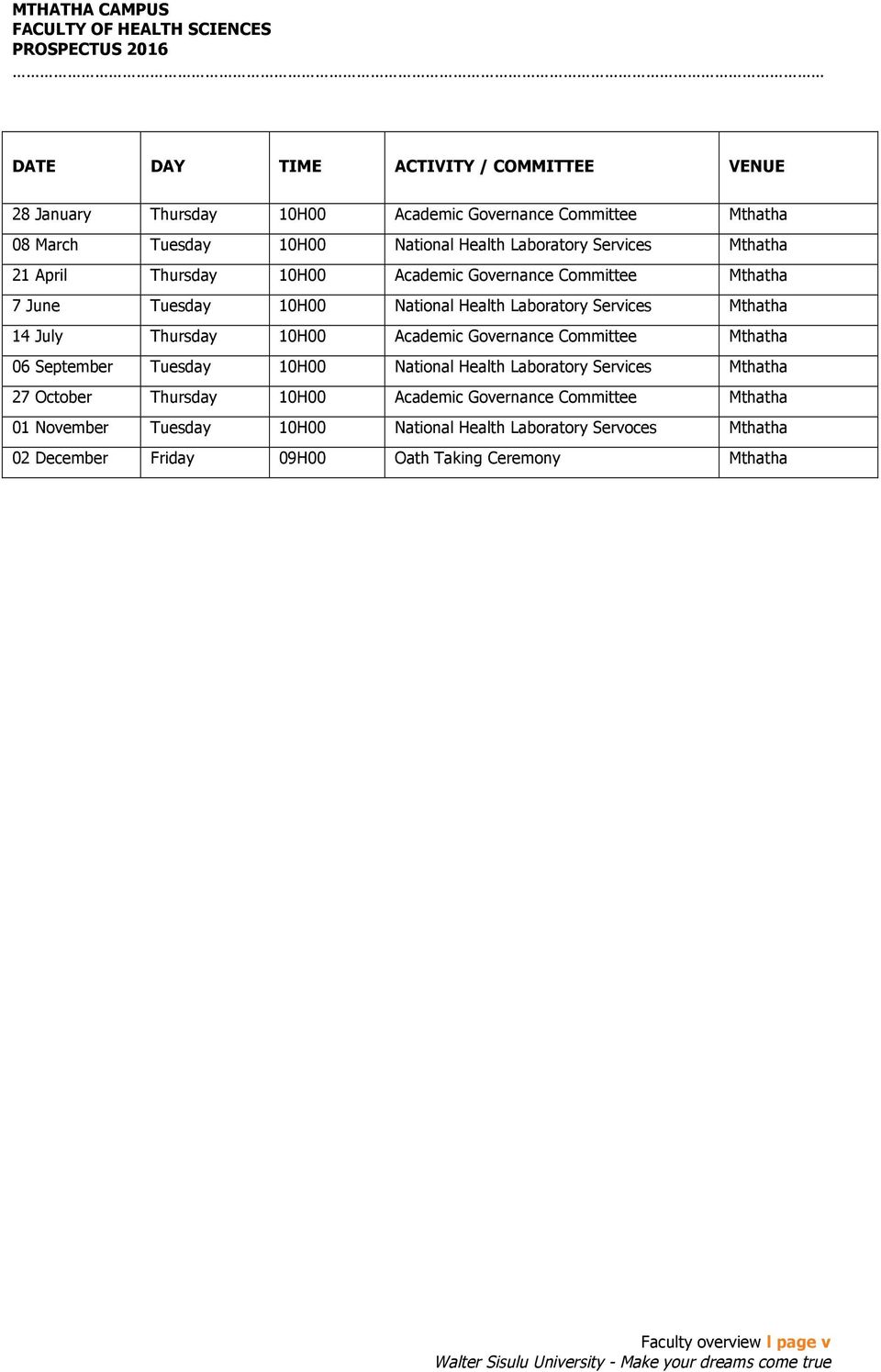
8 DATE DAY TIME ACTIVITY / COMMITTEE VENUE 28 January Thursday 10H00 Academic Governance Committee Mthatha 08 March Tuesday 10H00 National Health Laboratory Services Mthatha 21 April Thursday 10H00 Academic Governance Committee Mthatha 7 June Tuesday 10H00 National Health Laboratory Services Mthatha 14 July Thursday 10H00 Academic Governance Committee Mthatha 06 September Tuesday 10H00 National Health Laboratory Services Mthatha 27 October Thursday 10H00 Academic Governance Committee Mthatha 01 November Tuesday 10H00 National Health Laboratory Servoces Mthatha 02 December Friday 09H00 Oath Taking Ceremony Mthatha Faculty overview l page v
9 WALTER SISULU UNIVERSITY VISION Walter Sisulu University (WSU) will be a leading African comprehensive university focusing on innovative educational, research and community partnership programmes that are responsive to local, regional, national development priorities, and cognisant of continental and international imperatives. MISSION In pursuit of its vision as a developmental University, WSU will: Provide an educationally vibrant and enabling environment conducive to the advancement of quality academic, moral, cultural and technological learner-centred education for holistic intellectual empowerment, growth and effective use of information; Provide and maintain the highest possible standards in innovative learning and teaching, applied, basic and community-based research and community partnerships in cooperation with development agencies, the public and private sectors; Provide affordable, appropriate, career-focused and professional programmes that address rural development and urban renewal with primary emphasis on science, technology and development studies; Create a new generation of highly-skilled graduates capable of understanding and addressing complex societal challenges, with critical scholarly and entrepreneurial attributes grounded on morally should work ethics and responsible leadership. MESSAGE FROM THE DEAN It is my pleasure and honour to welcome both students and staff to the Faculty of Health Sciences at Walter Sisulu University (WSU). The Faculty of Health Sciences celebrated its 25th anniversary at the end of We are an established Faculty that has made its mark not only locally at WSU, but also nationally and globally. The area of strength for this Faculty is Problem-Based Learning and Community-Based Education. This was one of the commendations by the Higher Education Quality Committee (HEQC) when the Institutional Audit was conducted at this university in April Community-Based Education has made us focus on the health needs of the people we serve, especially the disadvantaged. Focusing on the health needs of the community has made us to be seen by the whole world as being one of leading Faculties in Socially Accountable Health Professions Education globally. This also goes with a clear demonstration of a strong partnership between the Faculty, the Community and the Eastern Cape Department of Health. Our Motto is Excellence through Relevance. Faculty overview l page 1

10 We are a Faculty of firsts: The first Faculty of Health Sciences in South Africa to introduce an undergraduate degree in Health Promotion. Up to now, no other Faculty has followed. The first Faculty of Health Sciences in South Africa to introduce Problem-Based Learning and Community- Based Education in Medical Education. One of the two Faculties of Health Sciences in South Africa to first introduce an integrated 5-year MB ChB curriculum. The first Faculty of Health Sciences with a Medical School in South Africa to incorporate Social Work. The first Faculty of Health Sciences in South Africa to offer the Clinical Associate Programme The first Faculty of Health Sciences in South Africa to introduce placement of all medical students at district hospitals for a continuous period of 20 weeks during the 5th year of study in medicine. The first Faculty of Health Sciences in South Africa to establish a Centre for Global Health and Research. To the new students, the selection of students into our programmes is very competitive. Too many applicants compete for limited number of spaces. The admission into our programmes is restricted by staffing, space and equipment, so as to maintain high quality teaching and learning. We continue to explore ways to increase our capacity, working together with the National Department of Health, Eastern Cape Department of Health and Department of Higher Education and Training, so as to be able to double our intake of medical students and triple the intake of clinical associates, in addition to increased intake in nursing, health promotion, medical scientists and medical specialists. We also have a vision to introduce new programmes in the near future within the Department of Rehabilitation Medicine such as Dietetics, Physiotherapy, Speech Pathology and Audiology, and Occupational Therapy. The recent gazetting of Nelson Mandela Academic Hospital as a Central Hospital in the Eastern Cape has empowered both government and the university to proceed in earnest with efforts to build a new Faculty of Health Sciences adjacent to Nelson Mandela Academic Hospital. Construction is now in progress. Working together with the Department of Higher Education and Training, Eastern Cape Department of Health and our partners, we have prepared district hospitals in terms of equipment, staffing and student accommodation and have given them the opportunity to participate in the teaching platform through our Community-based Education. I would like to remind all of us that individuals come and go, be they staff or students. The institution is bigger and more important than all of us. It is important for all of us to receive this institution of integrity with such a proven track record in society and hand over a better Walter Sisulu Faculty of Health Sciences to future generations. Let us, therefore, build on our strengths, convert our weaknesses to opportunities, and contribute positively to the growth of this institution, particularly the Faculty of Health Sciences, for the sake of the youth and future citizens of this country. I would like to remind every student that being admitted in study to this faculty is an opportunity of a life time. Take it! Treasure it! Make the best out of it. Faculty overview l page 2

11 1. VISION The Faculty of Health Sciences will be the leader in Problem-Based Learning (PBL), Community-Based Education (CBE) and Community Partnerships in Africa, in order to improve the quality of life of all the people served. 2. MISSION The Faculty of Health Sciences is committed to excellence in Problem-Based Learning (PBL), Community-Based Education (CBE) and social responsiveness through the integration of community service into its learning programmes that involve innovative teaching and research, with special emphasis on Primary Health Care (PHC), and sustainable rural development in partnership with communities and service providers. 3. VALUES Academic freedom in teaching and learning, research and community service. Quality management and integrity in teaching and learning, research and community service Equity in all activities of the faculty, be it in student matters, staff matters, patient care and community service in general. Democratic governance at all levels of management. Student access for success in all programmes within the faculty Staff development and leadership capacity for all faculty staff. Batho pele principles of good character, respect and humility in our daily activities. Cost effectiveness in handling institutional resources at all times. Relevance to the needs of those we serve, especially students and the community 4. PRINCIPLES 4.1 Building partnerships between university, community and service providers that should guide teaching and learning, research and community engagement throughout the Faculty. 4.2 Developing an appropriate recruitment and selection process that enables the Faculty to recruit from communities with greatest need. This process should also: Look at both academic performance and personal attributes of prospective students. Includes community members in the selection committee and thus as members of the selection panel/s. 4.3 Developing an appropriate curriculum that is based on the primary health care approach and guided by health and social needs. This curriculum should include: Early clinical exposure. Significant learning in the community. Problem-based learning as a vehicle for community-based education and service. Integration of basic sciences, clinical medicine and population medicine from 1 st year to final year. Student centeredness and self-directed learning. Faculty overview l page 3

12 4.4 Developing a student support programme that ensures access for success. This should include: A student mentoring programme, where senior students are mentors for junior students, staff members are mentors to needy students and community members are mentors to all students in the community. Provision of financial assistance to almost all students coming from disadvantaged backgrounds. 4.5 Recruiting and developing appropriate teaching staff that has passion for community engagement including health professionals in the workplace (general/ family practitioners, nurses, health promoters, social workers, etc.), community health workers and community liaison officers, this initiative requires: Training of academic staff across disciplines to be tutors/facilitators of small group learning within an integrated curriculum beyond their respective disciplines/ specialisations. Training of health professional also as tutors/facilitators of small group learning centrally, in the skills laboratory and in the community. Recruitment of community health workers and community liaison officers to be teachers and mentors that guide students in the community. 4.6 Developing an appropriate and expanded teaching and learning platform that will enable the Faculty to admit more students and also enable teaching to take place mainly in secondary and primary health care settings rather than at tertiary hospitals. In this regard, each Learning Complex, including a District Learning Complex (consisting of a district hospital(s) and associated community health centres and/or clinics) should have : A learning centre that has seminar/tutorial rooms with teaching equipment, a skills laboratory and a library with intro and internet facilities, in addition to patient care facilities. Accommodation for students and staff. 4.7 Providing tangible, sustainable, integrated and comprehensive primary health care services that are based on relevance, equity, quality and cost effectiveness. This can be achieved through: Teaching and application of the biopsychosocial model throughout the teaching platform. Exposing the students to community diagnosis that is followed by intervention projects, based on feasible and prioritised community needs. Re-introduction of family attachment scheme that enables students to follow patients into their homes over a period of time. District hospital and community health centre visits by academic staff for teaching students, capacity building to peripheral staff and service to the community. 5. Albertina Sisulu Centre for Global Health and Research The Faculty of Health Sciences established the Centre for Global Health & Research in 2012 and named it after the struggle icon and education activist, Mrs Albertina Sisulu. This Centre: Faculty overview l page 4

13 Is an overarching umbrella centre of the Faculty where research and community engagement activities are housed in support of national, regional and global efforts; Provides a consolidated platform for research advancement and research training within the faculty, Champions global health and advances the implementation of socially accountable educational and health care systems. This effort is done as an addition to the recruitment of Research Champions at the level of Research Professors and Research Associate Professors in the Faculty in order to build a research culture and enhance research productivity. The Research NICHE areas are: 5.1 Basic Sciences Human Nutrition Medicinal Plants & Traditional Medicine 5.2 Clinical Sciences Clinical Epidemiology Chronic Diseases including Tuberculosis, Asthma, Cardiac Diseases HIV & AIDS from Health Promotion and Prevention including HIV Vaccine Testing to Monitoring and Evaluation of HIV & AIDS Management including ARVs 5.3 Public Health The Burden of Disease Disease Prevention and Health Promotion Health Systems Research Health Informatics 5.4 Medical Education Problem-based Learning Community-based Education Service-Learning Faculty overview l page 5

14 HISTORY OF Walter Sisulu University (WSU) came into existence on 1 July 2005, arising from the merger of the former University of Transkei, Eastern Cape Technikon and Border Technikon. The establishment of WSU completed the restructuring of the South African Higher Education landscape in terms of the Higher Education Act no 101 of 1997 as amended. It is therefore a new comprehensive university that offers a range of programmes from certificates to diplomas, degrees and post-graduate programmes. Strategically located within the Eastern Cape Province, WSU straddles a vast spectrum of the urban and rural divide of this region. This context has then led the university to define its NICHE area as that of Rural Development and Urban Renewal. WSU has four (4) campuses as follows: Buffalo City, Butterworth, Queenstown, and Mthatha (Head Office). WSU has 11 faculties with student population of 24,000 and a staff complement of approximately, 2,000. The Faculty was established in 1985 with the introduction of MBChB programme. At this time, the Department of Nursing, which was already operating under the Faculty of Economic Sciences, was relocated to the newly established Faculty of Medicine. The Department of Health Promotion was established in 1989 as a Department of Health Education. Initially the focus was on undergraduate education and training and postgraduate programmes were later on introduced. To date the Faculty offers a range of programmes from certificates to undergraduate diplomas, bachelor degrees, honours, postgraduate diplomas, masters, Ph D s and MD s (Doctor of Medicine). The Faculty has a Medical Library which has a Skills Laboratory and Computer Learning Centre with Telemedicine facilities. In collaboration with the Eastern Cape Department of Health, the Faculty has established a Regional Training Centre (RTC) for HIV and AIDS in The Faculty has been recommended as a WHO collaborating centre for PBL/CBE. It is a full and active member of The Network: Towards Unity for Health, and hosted the 1996 International Network Conference in Durban. The Faculty is now recognised by its peers internationally as one of eight (8) Medical Schools in the world that are champions of social accountability in health professions education. These medical schools have formed an organisation called the Training for Health Equity Network (THEnet). The Faculty of Health Sciences at WSU is the only Faculty of Health Sciences in Africa that is a member of this organisation. The Faculty of Health Sciences has its Headquarters at Mthatha Campus but has an Academic Health Service Complex that spreads throughout the Eastern Cape Province including all levels of health facilities in the Eastern Cape Region (Mthatha), Central Region (East London) and Western Region (Port Elizabeth).The teaching platform is further enhanced by the establishment of Health Resource Centres at Mthatha, East London, Port Elizabeth and Queenstown. Health Resource Centres are of different sizes are currently being set in various health facilities in the province. These Health Resource Centres are strategically built next to hospitals. The purpose for establishing these Health Resource Centres is to create an academic environment throughout the Eastern Cape Province so that students are taught properly by joint staff that has access to library and internet facilities, to enable the three functions of an academic institution to be fulfilled adequately, i.e. teaching & learning, research and service to the people. The Faculty of Health Sciences is regarded as the flagship of this university. Its niche area is rural health, based on its context. This has made this Faculty to be committed to learning and teaching in the community from District Hospitals to Community Health Centres, Clinics and patient homes (i.e. district learning complexes). Problem-Based Learning is introduced in first year and continues to be the main learning strategy up to final year. This is the only University in South Africa that offers small group Problem-Based Learning tutorials in clinical years. Learning in the community (i.e. Community-Based Learning) is also introduced early in the curriculum and the time spent in the community is progressively increased up to final year. Community-Based Learning in this Faculty is strengthened by the establishment of community partnerships around Mthatha and this Faculty overview l page 6
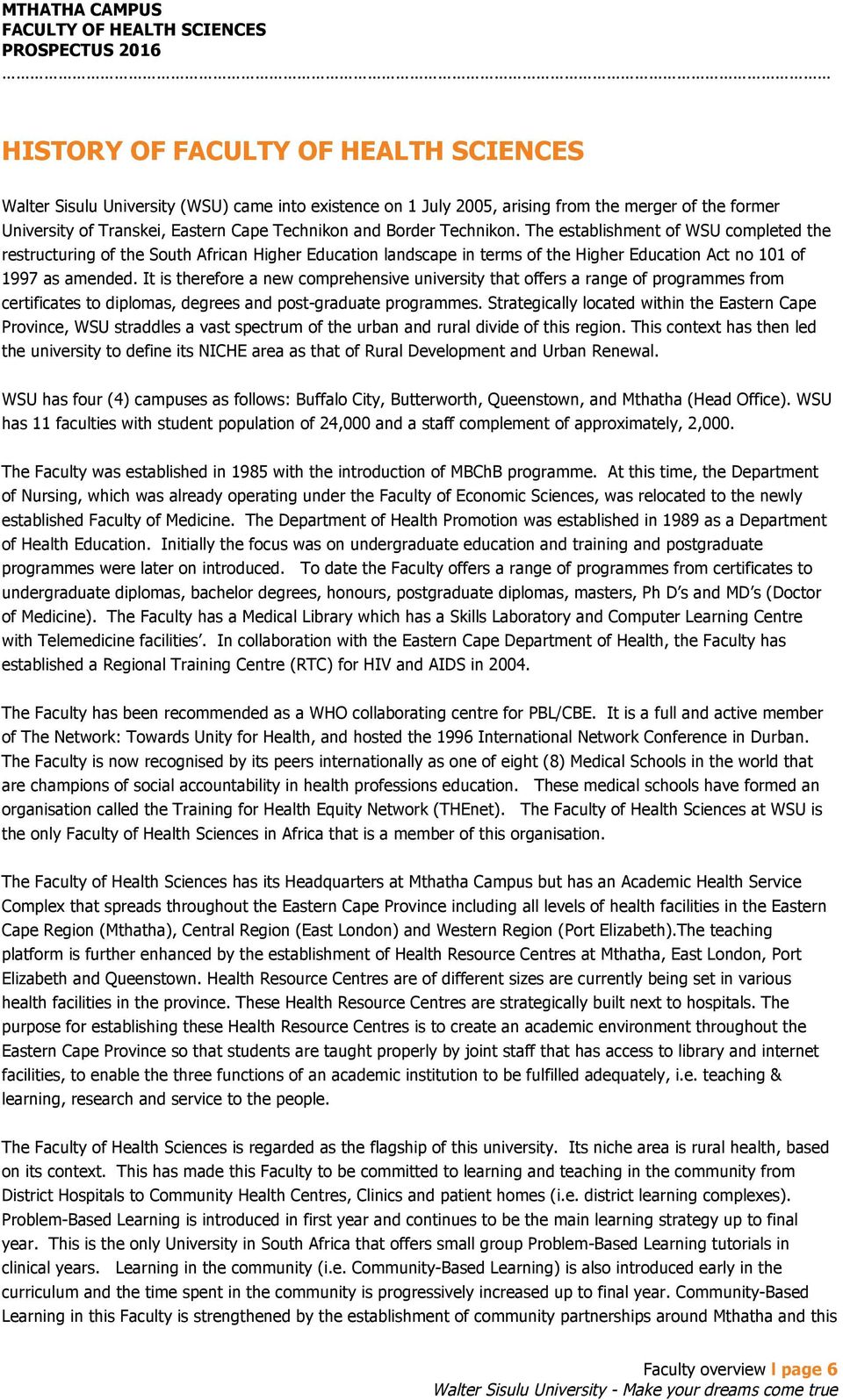
15 led to the establishment of four (4) purpose-built Community Health Centres around Mthatha. The Clinical Associate Programme is thus modelled through these two powerful learning strategies, Problem-Based Learning and Community-Based Education. More than 90% of the curriculum for the Clinical Associate Programme is taught in District Learning Complexes, which is where the graduates of this programme will practise after completion. Faculty overview l page 7

16 Medicine Programmes Our MBChB programme has graduated 935 doctors [111 on the traditional medical curriculum ( ); 340 on the innovative PBL/CBE 6-year curriculum ( ); and 758 doctors on an even more innovative and integrated PBL/CBE 5-year curriculum ( )]. The first year intake has been increased from 100 to 120 new students since The Bachelor of Medical Clinical Practice (Clinical Associate Programme) was introduced in 2008 and had an intake of 23 students. The first cohort completed the programme at the end of 2010 and graduated in May The programme has produced a total of 93 graduates from This 100% pass from year one to completion of a new programme in the higher education and training landscape must be commendable in the South African context. It is expected that the subsequent cohorts would equally do as well. The first year intake was increased from 24 to 32 since Nursing Programmes The Nursing Programme that was initially offered in 1982 was a part-time Diploma in Nursing Administration and Community Health Nursing which was an 18 month programme. In 1984, the Diploma in Nursing Administration and Community Health Nursing was upgraded to two years. Staff complement from consisted of three part-time lecturers, two of whom were employed as full-time in In 1990, the B Cur was started and the Honours degree started in The 4 year basic nursing degree (B Cur Basic), now called Bachelor of Nursing, started in This programme adopted a problem-based, community based approach and 608 registered professional nurses have qualified to date. A Masters programme started in 1999 and has produced 15 graduates. The first year intake is currently restricted to 85 students including repeaters. Allied Health Professions Programmes The Department of Health Promotion that was established in 1989 was upgraded to Health Education and Health Promotion in 1995 in response to the need to re-orientate training towards Primary Health Care, using problem based and community based learning. In 1999, a Bachelor of Science in Health Promotion degree was introduced and more than 400 students have since graduated. In 2000, a Postgraduate Diploma in Health Promotion was also introduced and this programme has since graduated 28 students. The first year intake is currently restricted to 85 students including repeaters.. Faculty overview l page 8

17 ACADEMIC HEALTH SERVICE COMPLEX (AHSC) OF EASTERN CAPE The Academic Health Service Complex of the Eastern Cape consists of health facilities at all levels of health care (level 1, level 2 and level 3). The functions of the AHSC include teaching and learning, research, service and community engagement. WSU-Nelson Mandela Academic Hospital serves as the epicentre with other Provincial Hospitals, District Hospitals, Community Health Centres and Health Resource Centres being integral parts of the Teaching Platform. In addition to being a centre for teaching of both undergraduate and postgraduate students, NMAH is also a referral hospital for Highly Specialised Hospital Care, serving 2,6 million people. The foundation stone was laid by the former State President of South Africa, Dr Nelson Mandela after whom the Hospital is named. The Sod- Turning Ceremony to commence construction was inaugurated by the then State President of South Africa, Mr Thabo Mbeki. TEACHING PLATFORM The following teaching facilities currently serve as the Teaching Platform for WSU: Provincial Hospitals Mthatha Hospital Complex East London Hospital Complex Port Elizabeth Hospital Complex Provincial Psychiatric Hospitals Elizabeth Donkin in Port Elizabeth and Fort England in Grahamstown. District Hospitals All Saints Hospital Bisho Hospital Cala Hospital Canzibe Hospital Frontier Hospital Glen Grey Hospital Grey Hospital Hewu Hospital Holy Cross Hospital Kokstad Hospital Madwaleni Hospital Madzikane kazulu Hospital Dr Malizo Mpehle Hospital Mount Ayliff Hospital Rietvlei Hospital Settlers Hospital Sipetu Hospital St Barnabas Hospital St Elizabeth Hospital St Patricks Hospital Faculty overview l page 9

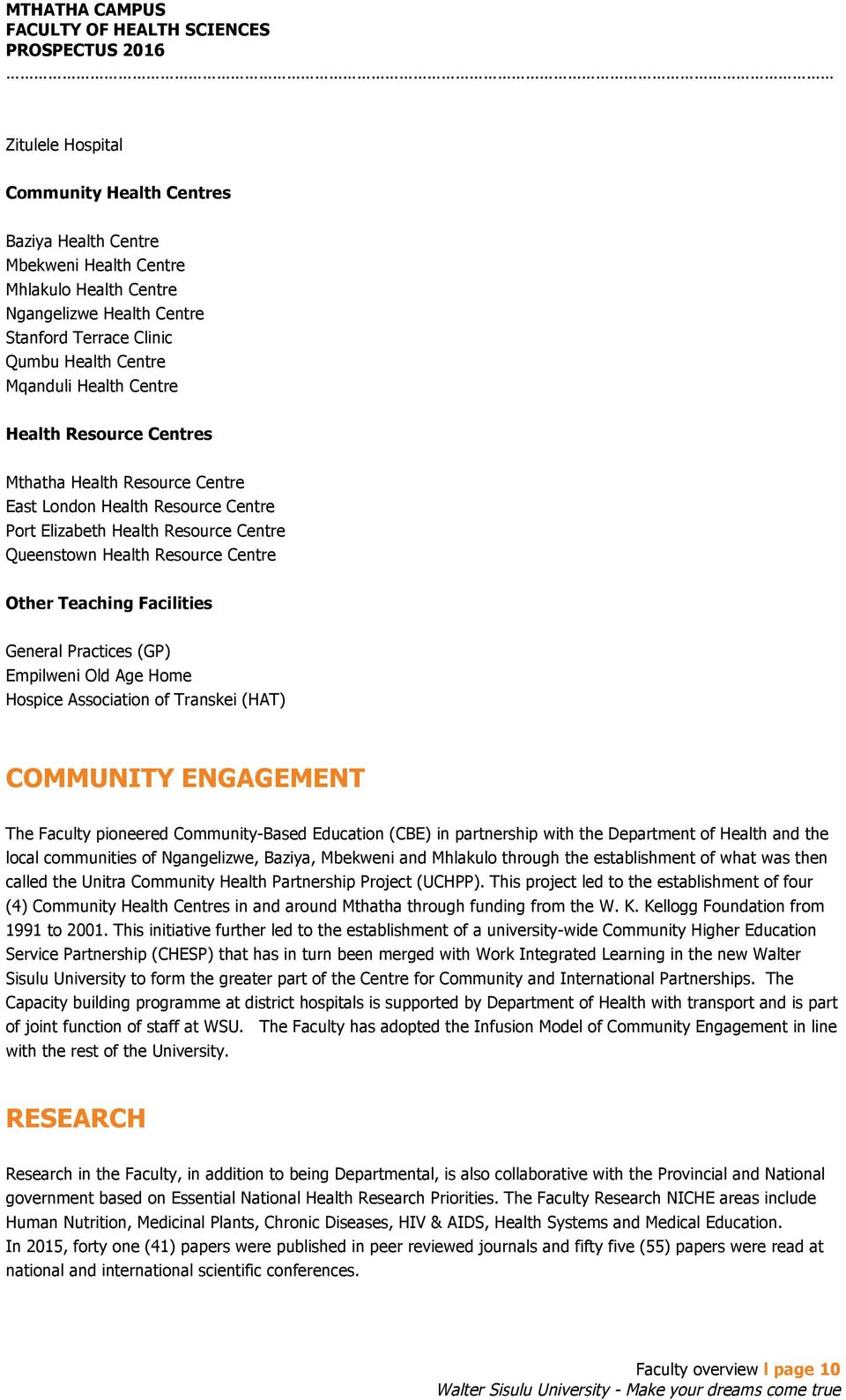
18 Zitulele Hospital Community Health Centres Baziya Health Centre Mbekweni Health Centre Mhlakulo Health Centre Ngangelizwe Health Centre Stanford Terrace Clinic Qumbu Health Centre Mqanduli Health Centre Health Resource Centres Mthatha Health Resource Centre East London Health Resource Centre Port Elizabeth Health Resource Centre Queenstown Health Resource Centre Other Teaching Facilities General Practices (GP) Empilweni Old Age Home Hospice Association of Transkei (HAT) COMMUNITY ENGAGEMENT The Faculty pioneered Community-Based Education (CBE) in partnership with the Department of Health and the local communities of Ngangelizwe, Baziya, Mbekweni and Mhlakulo through the establishment of what was then called the Unitra Community Health Partnership Project (UCHPP). This project led to the establishment of four (4) Community Health Centres in and around Mthatha through funding from the W. K. Kellogg Foundation from 1991 to This initiative further led to the establishment of a university-wide Community Higher Education Service Partnership (CHESP) that has in turn been merged with Work Integrated Learning in the new Walter Sisulu University to form the greater part of the Centre for Community and International Partnerships. The Capacity building programme at district hospitals is supported by Department of Health with transport and is part of joint function of staff at WSU. The Faculty has adopted the Infusion Model of Community Engagement in line with the rest of the University. RESEARCH Research in the Faculty, in addition to being Departmental, is also collaborative with the Provincial and National government based on Essential National Health Research Priorities. The Faculty Research NICHE areas include Human Nutrition, Medicinal Plants, Chronic Diseases, HIV & AIDS, Health Systems and Medical Education. In 2015, forty one (41) papers were published in peer reviewed journals and fifty five (55) papers were read at national and international scientific conferences. Faculty overview l page 10
19 LINKAGES - NATIONAL AND INTERNATIONAL (Learning & Teaching, Research and Community Engagement) Linkage/Collaboration/Partners hip Focus Area Contact / Department 1. Training for Health Equity Network (THEnet) Social Accountability Faculty of Health Sciences 2. University for Colorado, Denver Clinical Associates Programme Faculty of Health Sciences 3. University for Development Studies, Tamale, Ghana 4. Inkosi Albert Luthuli Central Hospital, Durban Health Sciences 5. University of Cape Town, Desmond Tutu Research Unit Health Professions Education and Research National Enteic, Respiration & Meningeal Surveillance HIV Vaccine Research Faculty of Health Sciences Haematopathology Faculty of Health Sciences 6. South African Medical Research Council, Strategic Health Innovations & Partnerships (SHIP) 7. Cape Peninsula University of Technology (CPUT) 8. Stellenbosch University, Stellenbosch Research Training & Capacity Building Medical Technology Postgraduate Education & Training Faculty of Health Sciences Chemical Pathology Faculty of Health Sciences 9. University of Cape Town Postgraduate Education and Training Faculty of Health Sciences 10. University of Newcastle, Australia 11. Foundation for the Advancement of International Medical Education and Research (FAIMER) 12. Southern African Regional (FAIMER) Institute (SAFRI) 13. ITECH, University of Washington Health Professions Education and Research Health Professions Education and Research Health Professions Education and Research Technical Support on Programmatic Training Activities and Clinical Mentoring Faculty of Health Sciences Faculty of Health Sciences Faculty of Health Sciences Eastern Cape Regional Training Centre (ECRTC) 14. JHPEGO Training Information Database ECRTC 15. Institute for Health Care Technical Support on Health ECRTC Faculty overview l page 11

20 Linkage/Collaboration/Partners hip Improvement (IHI) Focus Area Contact / Improvement Department. Lilitha College of Nursing Affiliation Nursing Education Nursing 17. The Valley Trust Community Empowerment Health Promotion 18. Boitekanelo College, Botswana Teaching and Learning Health Promotion 19. Northern Ontario School of Medicine (NOSM) Health Professions Education Faculty of Health Sciences 20. The Network Health Professions Education Faculty of Health Sciences 21. KwaZulu-Natal Department of Health Training of Clinical Associates Faculty of Health Sciences 22. North West Department of Health 23. Eastern Cape Department of Health 24. Lilitha College of Nursing Affiliation Training, research, technical support and Health Professions Education Service, training, technical support and Health Professions Education Nursing Education Faculty of Health Sciences Faculty of Health Sciences Department of Nursing 25. Phelophepha Teaching and Primary Health Care Department of Nursing Faculty overview l page 12

21 STAFF - FACULTY OFFICE Dean : Dr WW Chitha; MBChB, MPH Health Economics (UCT), AMDP (SU) PhD (WSU) Secretary : Ms C Pillay, B Admin (WSU) B.SOC.Sc.Hons (WSU) Deputy Dean : Vacant Secretary : Vacant Quality Assurance Officer : Mr Toni, B Sc (Unitra), HDE (Unitra), PG Dip in Health Promotion (WSU) Faculty Administrative Officer : Mrs EN Mkosi, PTC (Cicira), B Com (Unitra), PG Professional Short Courses Environmental Studies (Natal) Student Affairs : Ms X Xothongo; ND OMT (WSU) Administrative Assistant : Mrs P Madikazi, B Compt (Unitra), PG Dip in Health Promotion (WSU) : Mrs P Mayekiso Academic Coordinators - Western Deanery : Professor LR Smit, MBChB (UKZN), FCA (SA) - Central Deanery : Professor CL Lazarus, MBChB, FCS(SA), FRCS - Eastern Deanery : Professor CL Myataza, MBChB (Natal), MMed(LetO) (Medunsa) - ILCC Coordinator : Dr L Godlimpi, MBChB (UKZN) FINANCE OFFICE Faculty Accountant : Vacant MEDICAL LIBRARY Librarian : VO Mjoli, BA (Cur)(Unisa), HDLIS (Unitra), B Bibl Hons (Unisa), Diploma HIV/Aids (Unisa), Knowledge Mnagement Short course(unisa) Assistant Librarian : M Somkoko, B Bibl (Unitra), B Bibl Hons(Unitra) Library Assistant : MST Ndzotyana Librarian : EP Mavume, B Bibl (Unizulu), B Bibl Hons(Unitra), Diploma Public Relations (Intec), Knowledge Management Short Course (Unisa) : T Sonamzi, BA (Unitra), PGDLIS(Unitra) Library Assistant : N Nyoka Staff Surgery l page 13
22 ALBERTINA SISULU CENTRE FOR GLOBAL HEALTH AND RESEARCH Director : NI Funani, MBChB (UCT), Dip in Public Health (Wits) RESEARCH CHAMPION Professor B Longo Mbenza, MD, PhD (Bucarest), M Sc, D Sc (Brussels) DEPARTMENT OF FAMILY MEDICINE AND RURAL HEALTH FAMILY MEDICINE MTHATHA ACADEMIC HOSPITAL COMPLEX & HEALTH CENTRES Professor/Chief Specialist Head of Department : P Yogeswaran, MBBS (Peradeniva), M Fam Med (Unitra), MSc (Health Informatics), FCFP (SA) Secretary : Ms ZJ Fadane Secretary : N Lunguza, Enrolled Nurse, ND Fin Info System Administrative Assistants : D Giba, ND Office Mgtmt, B Tech Public Mngnt (WSU) N Hlomendlini, ND Public Relations Mgtmt, B Tech Public Relations (WSU) Nomfundo Blondie Cenge, B Tech, Public management Sindiswa Mbilase, ND Office Management and Technology Associate Professor/Principal Specialist : J Chandia, MBChB(Makerere), DTM & H, DPH (Wits), Dip Acupuncture (SAMAS), M Prax Med (Medunsa), FCFP(SA) GFD Rupesinghe, MBBS (Ceylon), M Prax Med (Medunsa) FCFP (SA) Principal Specialist/Senior Lecturer : B Cawe, B Sc, MBChB, M Med (Fam Med) (Unitra) : MB Khatry-Chhetry, Cert Gen, Med (Nepal), MBBS (China), Post Grad Acupunture, Moxibuston and Massage & Oi Gong (China), M Fam Med (OFS), M Sc Health Informatics (Winchester, UK) Senior Specialist/Senior Lecturer : FJLB Mayanja, MBChB (Makerere), DTM&H, DPH, DHSM, M Fam Med (Wits), MBA (Stellenbosch) Senior Lecturer : E Velazquez Martinez MD(Cuba), Second degree general Staff Surgery l page 14
23 Medical Internal medicine, First degree internal medicine Mastership medical education, Mastership in infectious Diseases M Nico-Garcia MD (Cuba), Second degree general internal Medicine, Mastership integral attention to the woman JO Ofono, Med Management (Makerere), Higher Dip Education(Makerere), Dip Clin Med & Comm Health (Mbalae School Clinical Officers) Lecturer : R Osinjolu MBBS (Nigeria), Post Grad Dip Palliative Med (WC) : M Kolosa, MBChB (Natal) A Kakia, MBChB (Uganda) E Rosales Gonzalez, MD (Cuba), First degree general internal Medicine, First degree internal medicine JC Garcia Alonso, MD Cuba, First degree general internal Medicine G Isembatva, Dip Clinical Med and Community Health A Khainza, Degree Health Service Management, Dip ENT Clinical Medicine, Dip Clinical Medicine & Community Health (Uganda) N Pikini BA (Nursing),Dip Gen Nursing & Midwifery, Cert Audiometry & Spirometry Medical Skills laboratory facilitator : R H Siwahla, Dip in General Nursing and Midwifery (Livingstone Hospital), Dip Nursing Edu (UKZN) B Cur (Unisa),Dip in Nursing Psychiatry (Queenstown Mental Institution) EAST LONDON COMPLEX Senior Specialist/ Head of Department Senior Lecturer : TR Kharel, MBBS (IOM Kathmandu), Mfam.Med Senior Specialist : J Mugambe, MBBS, Mfam Med, DA(SA),Dip Obst Specialist : OA Adeniyi MBBS, FCFP(SA) MMed (WSU),MPhil,Higher Dip in Sexual Health and HIV Medicine, Dip in HIV Management, Dip in Obst PORT ELIZABETH COMPLEX Head Of Department /Principal Specialist : E Ajudua, MBBS(NAU), MMed Fam Med (Stell ) Dip.Obst.(COG, SA) Specialist : F Ajudua, MBBS (UNILAG), DA(SA), M Med Fam (Stell) Staff Surgery l page 15
24 DEPARTMENT OF HUMAN BIOLOGY Head of Department : Dr CR Sewani-Rusike, MBChB (Zim), PhD (Physiology) (Michigan, USA) Secretary : B Tofile, Nat Dip (HR) (ECT) ANATOMY, EMBRYOLOGY & HISTOLOGY Professor : Vacant Associate Professor & Acting Head of Discipline : SL Abura, MBChB, M Med Associate Professor : MA Gari, MD Emryology (Havana) Senior Lecturer ( x3) : Vacant Lecturer : G Milanes-Rodriguez, MD (Santiego) : S Kamanzi, B Med Sc (Hons) (UDW), MSc (WITS) Demonstrator : Vacant Chief Technologist : Vacant Snr Med Lab Technologist : I N Kolosa, B Sc, HDE (Unitra), Nat Dip Med Tech (Pen Tech), B Ed (UNISA), MA(UZUL) Technologist : MA Shauli, Dip Bio Med Sc (NUL),B Tech Bio Med Tech(NMMU) Lab Technician : M A Shopo Lab Attendant : S Buswana MEDICAL BIOCHEMISTRY Professor : G George, B Sc (Kerala), M Sc PhD(Mysore), PGD (Res Ethics) (UCT) Associate Professor (x2) : Vacant Senior Lecturer : M Villa Daldes Lecturer : F Ganjifrockwala, B Sc, M Sc (MSU Baroda) : J Joseph, B Sc, M Sc (Barathiyar University) Research Assistant : TR Tshaka, ND Med (Pen Tech), BTech (PE Tech), MBA (North West) Senior Lab Assistant : BM Gqaza, BSc (Rhodes), BSc (Hons) (WSU) MSc Biochemistry (WSU) Staff Surgery l page
25 PHYSIOLOGY Associate Professor : E Umapathy, M Sc, PhD (Madras), Dip in German (Madras), R. Nutr (UK) Senior Lecturers : AV Namugowa,BSc, Dip Ed (Makerere), Adv Dip Renewable Energy Sources, ( IIT Delhi), MSc (St Andrews UK), PhD (WSU) : M Mammen, B Sc, M Sc (Kerala), HDE (Fort Hare), BEd(Rhodes), PhD Physiology (WSU), Fellowship in Medical Education (FAIMER USA) : KO Awotedu, MBBS (Ib), PG Dip Immune FMCGP (Nig), B Sc Hons (Ib), PhD (WSU) Lecturers : Dr D Kamadyaapa, M Sc, Ph D (Physiology) (UKZN) : E Ndebia; MSc (Yaundee), PhD (WSU) : A Meeme, BSc, MSc(makerere), PHD (WSU) : M Mathews, B Sc (Kerala), M Sc (Baroda), HDE (Unitra), MEd (WSU) : S Zono BSc (Hons)(WSU), MSc (WSU) : M Gondwe MSc, PhD(UKZN) Lab Technician : YYY Stofile Nat Dip in Analytical Chem (WSU) Laboratory Assistant : ST Muthiraparampil; BSc (Kerala), B Ed (Bangalore) BSc Hons (WSU), MEd (WSU) : B Umapathy, B Sc (Madras), PG Dip (Health Promotion (WSU) : M Yongeza, BSc (WSU), BSc Hons (UWC) DEPARTMENT OF GENERAL MEDICINE AND THERAPUETICS Professor/Chief Specialist/ Head of Department : AA Awotedu, MBBS (Iba), FMCP (Nig), FWACP, FCCP, FCP (SA), FRCP (Edin),FRCP (London) Staff Surgery l page 17
26 Secretary : Vacant Professor/Chief Specialist : PO Oluboyo, MBBS (Iba)FMCP (Nig), FWACP, FCCP Chief Specialist/Associate Professor : N Tonjeni, B Sc, UED (UFH); MBChB, M Med Int. (Medunsa), Dip HRM, Dip Training Mngmt, Dip Train the Trainer, Dip ABET (DSM) Principal Specialist /Associate Professor : MB Thomas, MD (Padua), Specialist in Internal Medicine (Pama), Specialist in Nuclear Medicine (Padua) Associate Professor/Principal Specialist : H Foyaca-Sibat, MD (Havana) Principal Specialist/Associate Professor : K Mashiyi, MBChB (Unitra), FCP (SA) Principal Specialist/Senior Lecturer : A Mankahla, MBChB FRC-derm Principal Specialist/Associate Professor : T Dubula, MBChB (Unitra), FCP (SA) Senior Specialist/Senior Lecturer : KM Thomas, MBBS (Ind), MD (Med), MD (Anaes), DA : MX Lubanga, MBChB, MSc Med (Lond), DTMH Senior Lecturer/Senior Specialist : CO Ekpebegh, MBBS(Ibadan),FMCP(Nig), MSc (UCT) Lecturer/Specialist : L S Mthingi-Nkonzombi, MBChB (Unitra), FCP(SA) Lecturer/Specialist : M Valavi, MBBS (Ind) Lecturer : Vacant Lecturer/Specialist : L Zingeli, MBChB (WSU), FCP(SA) PORT ELIZABETH COMPLEX Principal Specialist/Head of Department : M Nomvete, MBChB, FCP (SA),Cert.Phys Gastroenterology(SA) Principal Specialist/Senior Lecturer : B Brown, MBChB (UCT), FCP (SA) Specialist Par- time Lecturer : G Naidoo, MBChB (UCT) FCP(SA), MPhil Associate Professor/Senior Lecturer : T Ellis, MBChB, Mmed (USA) Principal Specialist/AssociateProfessor : E Van der Merwe, MBChB,Mmed(Int) Cert.Critical Care(SA) Principal Specialist/Senior Lecturer : G Wahl, MBChB, MMed (Nuerol) Principal Specialist/Senior Lecturer : J Black, MBChB, FCP(SA), Cert. Inf. Diseases (SA) : T Butau, MBChB, FCP(SA),Cert Critical Care (SA) Specialist/Senior Lecturer : R Freercks, MBChB, FCP (SA), Cert. Nephrology (SA) Specialist/Lecturer : E Gardiner, MBChB, FCP(SA) : T Fodo, MBChB, Dip HIV Management (SA), FCS (SA) : C Almira : E Ballester,MD Havana : D Baker, MBChB,FRCP(SA) : R Behari, MBChB,FCP(SA),FRCP(UK) EAST LONDON COMPLEX Chief Specialist/Associate Professor : A Parish, MBChB (UCT), FCP(SA) Staff Surgery l page 18
27 Principal Specialist/Associate Professor : C Horsfall; MRCP Senior Specialist/Senior Lecturer : A Gordon, MBChB, FCP (SA) Senior Specialists/Lecturer : R Mahlunge, MBBS, FCP (SA) Senior Specialist/Lecturer : C Mason, FCP Senior Specialist/ Lecturer : S Rossouw, FCP (SA) Nuerol Senior Specialist/ Lecturer : N Majova, FCP(SA) Senior Specialist/Lecturer : D Stead, MBChB,FCP(SA),DA(SA),Cert ID(SA),Phys, Dip Obst (SA) NUCLEAR MEDICINE Principal Specialist : Adams, MBChB, FC Nuclear Med RADIATION ONCOLOGY EAST LONDON HOSPITAL COMPLEX Chief Specialist/Associate Professor : B Pokharel; FC RAD Onc(SA) Senior Specialist/Senior Lecturer : V Reddi; DMRT (London), FFR RCS PORT ELIZABETH Senior Specialist/Lecturer Head of Department : A Defreitas, MBChB, FCRadOncology Specialist/Lecturer : O Magowan PHARMACOLOGY Professor : Vacant Associate Professor : JA Aguirre, MD (Havana), M Sc (Canada), PhD (Havana) Senior Lecturer : NB Sathiakumar, B Sc, M Sc, PhD (Madras) Lecturer : N Katende, M Pharm Sc (Hav), HDE (Unitra), M Pham (UNW), M Sc (IPHC) (London), Ph D (NWU) Laboratory Assistant : Vacant DEPARTMENT OF LABORATORY MEDICINE AND PATHOLOGY Professor/Chief Specialist/Head of Department : L Banach, MBChB, M Med Pathology (Anatomical), Ph D (Lublin Poland) Secretary : K Hermanus, LLB (WSU) Staff Surgery l page 19
28 ANATOMICAL PATHOLOGY, HISTOPATHOLOGY & CYTOLOGY Associate Professor/Principal Specialist : CM Mzileni, B Sc (Fort Hare), MbChB (Natal, Dip Forensic Med (SA), M Med (Anat Path) Medunsa Associate Professor/Senior Specialist : M E Garcia-Jardon, MD, Specialisation in Path II (Havana) Chief Technologist : N J Paton, AIMLS (Histopathology) : J Govender, B Tech in Biomedical Tech (PE Tech), M Sc (Health Care Management (Luton, UK) PORT ELIZABETH Professor/Chief Specialist : CA Wright Nat Dip Med Tech, MBBCh (Wits), FCPath (Anat Path) (SA), FRCPath (Histopath), M Med (Anat Path) (Wits), FIAC, PhD (US) CHEMICAL PATHOLOGY Professor/Chief Specialist : EV Blanco-Blanco, MD (Havana), Second Degree Specialist in Clinical Pathology (Havana), MSc Infectious Diseases (Havana) Senior Lecturer : CT Vazquez-Drake, MD (Camaguey), First Degree Specialist in Clinical Pathology (Camaguey), MSc Infectious Diseases (Camaguey) Senior Medical Technologist : ZK Gqweta, MSc Chem Path (WSU), Dip in Chem Path & Microbiology (KEM Hosp, Natal), B Tech in Biomedical Tech (CPUT) Technologist : M Mdoda, PG Dip Chem Path (WSU), NDMT Chem Path (Garankuwa Hosp), B Tech Biomedical Technology (Pen Tech), PG Dip Chem Path (Garankuwa Hosp) FORENSIC MEDICINE Professor/ Chief Specialist : Vacant Associate Professor/ Principal Specialist : BL Meel, MBBS, MD (AIIMS, New Dehli), DHSM (Natal), DOH (Wits), M Phil HIV/ AIDS Managment (Stellenbosch) HAEMATOPATHOLOGY Staff Surgery l page 20
29 Professor/ Specialist : BA Ogunsanwo, MBBS (Ibadan), FMC Path (Nigeria) (Nigeria), FWACP (Lab Med) Medical Technologist : PP Oliphant, N Dip in Med Tech, B Tech in Biomedical Technology PORT ELIZABETH Principal Specialist/Head of Department Senior Lecturer : N Littleton, MBChB, MMed MEDICAL MICROBIOLOGY Professor/Chief Specialist : Vacant Associate Professor/Principal Specialist : SD Vasaikar, MBBS, MD (Med Microbiology) Senior Lecturer : T Apalata, M Med Microbiology Lecturer : W Martinez Martinez, MSc (Infectious Diseases) (Cuba) Chief Medical Technologist : N Nxasana, Dip in Med Technology (Pen Tech), B Tech (PE Tech) Medical Technologist : SM Mvo, B Tech (PE Tech) Senior Lab Assist : N Qotoyi, Dip in Med Technology (Pen Tech), B Tech CATE Tech) Post Grad Dip-HIV/Aids Managment (SU) DEPARTMENT OF MEDICAL EDUCATION Professor : JE Iputo (MBChB) (Makerere), Ph D (Dublin) Secretary : Ms YMM Mweli, Dip Public Relations INTEGRATED LONGITUDINAL COMMUNITY CLERKSHIP Co-ordinator : L Godlimpi, MBChB (Natal) Lecturers/ Preceptors : S N Okafor, MBBS (Nigeria), MMed Fammed (Stellenbosch) : V Titi, ND Rad (PE Tech), HIV/AIDS Risk Mngmt (Intec College), MBChB (WSU),Advanced Health Mngmt (FPD/YALE Univ.) : S U Odunze, MBChB, Dip Obstet (SA), Post Grad Dip HIV/AIDS MNGT(Stellenbosch) : AY Ishola, MBChB, (Nigeria), Intensive Medical English(Wits) : L Gcememe, MBChB (Unitra) Staff Surgery l page 21
30 : Nxiweni, BSc (Fort Hare), MBChB (Medunsa) : Z Ndunge, MBChB (Unitra) : N Ndyalvan, BSc Unitra), HDE (Unitra), MBChB (Medunsa) : PU Khondlo, BSc Honours (Unitra), MBChB(Medunsa) : S Mkhize, MBChB (Unitra) : TA Adedayo, MBBS (Ilorin Nigeria), Diploma Tropical Medicine & Hygiene (Pretoria), Post Grad Dip.in Family Medicine(Stellenbosch) : A O Adeleke, MBBS, MPhil in HIV/AIDS Mangement (Stellenbosch), FCFP (SA), Post Grad Dip. HIV/AIDS Management (Stellenbosch), Post Grad Diploma Fam Med (Stellenbosch), Diploma HIV/Management (SA) : CF Okafor, MBBS (Nigeria), Dip.in HIV/AIDS Management (Stellenbosch) UNDERGRADUATE EDUCATION AND TRAINING UNIT Co-ordinator : Miss AGA Konyana, B Com, HDE (Unitra) Senior Typist : Ms NR Malusi POSTGRADUATE EDUCATION AND TRAINING UNIT Co-ordinator : Mrs N N Dabata, B Com Ed (Unitra), LLB (WSU) DEPARTMENT OF NURSING Head of Department : M J Ntsaba, BA Cur (UNISA), NHD Community Nursing (DUT) M.Tech, Nursing (DUT) PhD (UKZN) Secretary : Ms F Dyan, Dip. HR Mangmnt (EC Technikon), B.Tech Public Managmnt (WSU) Senior Clerk/Typist : Ms T Cewu, BA (Unitra) MIDWIFERY Lecturer : A J Shete, BA Cur, B Cur Hons (Unisa), M Cur (WSU), DNA (Potch), Adv. Dip Mid (Natal), Adv Dip Psych Nurs. (Natal) : BN Sitole; BA Cur (UNISA), B Cur Hons (UNISA), M Cur (WSU) Junior Lecturer : S Dubo; B Cur Basic (WSU), Adv. University Dip. Nursing Education (North West University) PSYCHIATRIC NURSING Staff Surgery l page 22
31 Junior Lecturer : NI Mbadi, B Cur (Administration, Nursing Education and Community) (UNISA), BA Cur, Hons (UNISA), M Cur (UJ), D Cur (RAU) Junior Lecturer : N Spelman; BA Cur Hons, Dip. Nursing Education (UNISA) COMMUNITY HEALTH NURSING Lecturer : L V Dlwati BA Cur, B Cur Hons,(UNITRA) M Cur (Unitra), Dip. Psych Nurs. (Natal), Dip. PHC (London) : A N Madolo, BA Cur (UNITRA), B Cur Hons (WSU), M Cur (Nursing Ed) (Natal), MBA (MANCOSA) Junior Lecturer : N Kula, B Cur Basic (UNITRA), Dip. Nursing Education & Administration (UNISA), Dip. Child Nursing Science (Baragwanath Nursing College) MEDICAL & SURGICAL NURSING Lecturers : N Mjekula, BA Cur, BA Cur Hons (Unisa), M Cur (WSU), MSc Health Informatics, (Winchester, UK) PB Dip Crit Care (Garankuwa, Pretoria), Nurs. Management (Unisa) : T Twantwa, B Cur (Unisa), B Cur Hons (WSU) MCur (WSU) : R V N Sikuza, BA Cur, B Cur Hons (Unisa), M Cur (WSU) : B M Sitole; BA Cur, BA Cur Hons (Unisa), M Cur (Unitra), Adv.Dip. Nurse Mangmnt (Unisa), Psych Nursing (NATAL), Dip. Opthalmology (NATAL) PROFESSIONAL STUDIES Senior Lecturer : NF Nonkelela, B Cur (North), B Cur Hons (Unisa), MSN (South Carolina), Ph D (Newcastle) Lecturer : RVN Sikuza, BA Cur, B Cur Hons (Unisa), M Cur (WSU) : A N Madolo, BA Cur (UNITRA), B Cur Hons (WSU), M Cur (Nursing Ed)(Natal), MBA (MANCOSA) Junior Lecturer : Ms Spelman, BA Cur Hons, Dip.Nurs. Ed)(UNISA) DEPARTMENT OF OBSTETRICS AND GYNAECOLOGY Professor /Head of Department : ML Mdaka, BSc, MBChB, MMed (Medunsa) Secretary : Staff Surgery l page 23
32 MTHATHA COMPLEX Professor/Chief Specialist : GAB Buga, MBChB, MMed (O&G) (Makerere), PhD (Dublin) Senior Lecturer/Principal Specialist : CNE Mkotcha, MBChB, MMed (Dar) Senior Lecturer/Senior Specialist : CB Businge, MBChB, M Med (Makerere) Principal Specialist/Senior Lecturer : J Byaruhanga, MBChB, M Med(O&G) (Makerere) : GE Appiah, MBChB, FCOG Lecturers : H Ndobo,MBChB, FCOG : S Gonya, MBChB, FCOG : V Mpumlwana, MBChB, FCOG : M Mdondolo, MBChB, FCOG : ZZ Ngayo, MBChB, FCOG EAST LONDON COMPLEX Chief Specialist/Associate Professor Head of Department : GJ Hofmeyr, MRCOG D Sc Principal Specialist/Senior lecturer : ET Nigussie, Spec Dip O&G, PHP Principal Specialist/Senior Lecturer : S Gwababa, FCOG(SA) Specialist/Lecturer : N Nivikova, PhD, MRCOG Senior Specialist/Lecturer : N Selanto-Chairman, FCOG Senior Specialist/Lecturer : K Middleton, FCOG (SA) Senior Specialist/Lecturer : B Majeke, FCOG (SA) PORT ELIZABETH COMPLEX Associate Professor/Head of Department : M Mabenge, MBChB, Dip,obst, Dip pract labout law, (O&G), MMed O&G, FCOG(SA), MA(HWM) Principal Specialist/Senior Lecturer : A Adams, MBChB, FCOG(SA) : Gaul, MD Specialist/Lecturer : D Chetty Specialist : Q Blignaut : A Ntliziyo : N Lalendle Lecturer : C Yingwani, DEPARTMENT OF PAEDIATRICS AND CHILD HEALTH Professor/ Chief Specialist : Vacant Secretary : Staff Surgery l page 24
33 MTHATHA COMPLEX Associate Professor/ Principal Specialist : D Perez-Vizccaino, MD (Havana) : A Cejas-Petanas, MD (Havana) Chief Specialist/Associate Professor : KS Gaire, MBBS, MCPS, DCH, MD (Paed), DHSM (Natal) Principal Specialist/Associate Professor : V Karaire Mushabe Senior Lecturer : Vacant EAST LONDON COMPLEX Principal Specialist/Associate Professor Head of Department : G Boon, MBChB (UCT), DCH, FCPaeds (SA) Principal Specialist/Senior Lecturer : M Levy, MBChB (UCT), DCH, FCPaeds (SA) : D Russion, FCPaed( SA), Cert. Nephrol. Senior Specialist/Lecturer : F Goosen, MBChB (UCT), DCH, FCPaeds (SA) : K Harper; FCPaeds (SA) : B Van Emmenes; FCPaeds (SA) : I Michaelis; Staatsexamen-Paeds (Germany) : N Mbilini; FCPaeds (SA) : D Awotedu; FCPaeds (SA) : S Jiyana, FCPaed (SA) : T Quvile, FCPaed (SA) : K Oosthuizen, FCPaed (SA) : K Thomas, FC Paed (SA) : B Van Emmenes, FCPaed ( SA) PORT ELIZABETH Specialist/Head of Department/ Associate Professor : L Pepeta, MBChB, FCPAED(SA), DCH(SA), Cert. Cardiology (SA), MMed (Wits) Principal Specialist/Associate Professor : Vacant Specialist/Senior Lecturer : A Gryling, MBChB, MRCPCH (UK), FC. PAED(SA) Specialist/Senior Lecturer : F. Khan, MBChB, FC PAED(SA) Specialist/Senior Lecturer : S Mahmud, MBChB, FC. PAED Specialist/Senior Lecturer : M Nxele, MBChB FC. PAED (SA) Specialist/Senior Lecturer : N Zozi, MBChB FC. PAED (SA) Specialist/ Lecturer : E Mathews, MBChB FC. PAED(SA) Specialist/ Lecturer : N Mafongosi, MBChB FC. PAED(SA) Specialist: /Senior Lecture : NP Makubalo, Nat.Dip in Clin Tech, MBChB, FC.PAED(SA) Specialist/Senior Lecturer : J Vermeulen, Specialist/ Lecturer : MBChB(WSU), FC Paed (SA) Specialist : F Khan, MBChB (UCT), FC.Paed(SA) Lecturer : ZM Makrexeni,MBChB(WSU), FC Paed(SA) Staff Surgery l page 25
34 DEPARTMENT OF PSYCHIATRY AND HUMAN BEHAVIOURAL SCIENCES Chief Specialist/ Head of Department : Z Zingela, FC Psych (SA) MMed Psych (UP) Secretary : S Jafta, National Diploma Office Management (WSU) Senior Specialist/Senior Lecturer : Vacant EAST LONDON COMPLEX Principal Specialist/Associate Professor : H Uys, FC Psych (SA),M Med Psych (Wits) Senior Specialist/Senior Lecturer : K Sukeri, FC Psych (SA) PORT ELIZABETH COMPLEX Principal Specialist/Associate Professor : S Grobler, MBChB (Pret), DOH (Pret), MMed (Psych) (UFS), FC Psych (SA) (PhD (University of Pretoria) Senior Specialist/ Associate Professor : S Van Wyk, M.Med Psych (Pretoria), FC Psych (SA) Specialist / : N Reddy, MBChB, FC Psych Lecturer/Specialist : N Smith MMed Psych (Bloemfontein) Lecturer : Willem Esterhuysen, MMed Psych (UFS) GRAHAMSTOWN Principal Specialist/Associate Professor : M Nagdee, FC Pysch (SA), Master of Sciences (Wits) Specialist/Lecturer : Taryn Sutherland MMed Psych Senior Lecturer : H Loffstadt, M Med Psych (UFS) Lecturer : L Kovalsky, 2 nd Degree Specialist in Psychiatry (Poland) : H Jordaan, MMed Psych (Pret) DEPARTMENT OF PUBLIC HEALTH Head of Department/Senior Lecturer : Z Vundle, MBChB (Medunsa), FCPHM (SA), MMed (Wits) Professor : Vacant Associate Professor : A Del Rio, MD (Camaguey), M Sc (Mexico) : LF Valdes, MD (Santiago) Specialist 2nd Degree Epidemiology MSc.Infectious Diseases, PhD Senior Lecturer : J Bernal, MD (Villa Clara), Spec 2 Degree Biostatistic : E Zaldivar, MD (Sto Cuba), Spec.2 Degree in Health Man. MSc Health Informatics Staff Surgery l page 26
35 : NI Funani, MBChB (UCT), PG Dip in Public Health (Wits) Lecturers : GA Pulido, MD (Villa Clara),Specialist 1st Degree Biostatistics : N O Fipaza, B Sc Speech and Lang Path & Therapeutics (UCE), PG Diploma (Health Ed & Prom), PG Dip Internat Prim Health Care, M Sc (Health Prom) (Leeds) : MP Thipanyane, Dip Nursing (Edendale), Dip Midwifery (Mc Cord s), Dip Clinical Nurs Health Assessment, Treatment & Care (Baragwanath) B Cur (Unitra), B Cur Hons (Unitra), MPH (UWC) : OOA Oluboyo, RN, RM, BSc (B Ed) Health Education (Ado-Ekiti), MPH (Ilorin) : S C Nomatshila, BSc Health Promotion (WSU), Post Grad Dip Health Promotion (WSU), MSc Health Promotion (WSU) Junior Lecturer : T Zini, B Sc, PG Diploma (Health Promotion) (WSU) DEPARTMENT OF REHABILITATION MEDICINE MEDICAL ORTHOTICS AND PROSTHETICS Programme Coordinator : Amolo HBR, CPO-D (Dortmund); MOM (Dortmund) Secretary : Yako Y, B Sc (Health Promotion) (WSU) DEPARTMENT OF SURGERY Principal Specialist/Senior Lecturer/ Head of Department : S Molaoa, MBChB (Natal) FCS (SA) Secretary : Ms F Xamlashe, ND: (HR) (CPUT) B Tech Public Management (WSU) ANAESTHESIOLOGY Chief Specialist : B Mrara, MBBCh (Wits), FCA (SA), DA (SA), Cert. critical Care(SA) Staff Surgery l page 27
36 Associate Professor : RG Nelivigi, MBBS, DA, MD (Karnataka) Senior Lecturer : D Eghan, MBChB, DA (London), MD (Charles University) Principal specialist : MB Thomas, MD Specialisation in Anaesthesia (Milan) Principal specialist : M Salah, Specialist in anaesthesiology & Intensive Care (Santa) Lecturer : CP Shrivastava, MBBS (Calcutta), DA (Dhaka), MCPS (Dhaka) Lecturer : A Vargese, MBBS, DA (SA) EAST LONDON COMPLEX Principal Specialist/Associate Professor Head of Department : D Morell, MBChB, FFA (SA) Principal Specialist/ Senior Lecturer : A Bhat, MBBS, DA, MD Principal Specialist/ Senior Lecturer : M Coltman, MBChB, FCA (SA) Principal Specialist/Senior Lecturer : A Ritcher, MMed(Anaes) Senior Specialist : N Wessels Senior Lecturer : P Diyelela-Ndwandwa, FCA(SA) D.O&G(SA) : S Poultney, MBChB, FCA(SA) Specialist/Lecturer : C Curran, FCA (SA) PORT ELIZABETH COMPLEX Principal Specialist/ Associate professor : LR Smith, MBChB (UKZN), FCS(SA) Senior Lecturer : T Mabusela, MBChB,DA(SA), FCA (SA) Principal Specialist/Senior Lecturer : DE Schmidt, MBChB, DA (SA),FCA (SA) Principal Specialist/Associate Professor : P Alexandris, MBChB, DA (SA) FCS(SA) Specialist Anaesthesiologist : S Venter, MBChB, DA(SA),FCA(SA), D O&G(SA) Senior Specialist : C Basson, MBChB,DA(SA), FCA (SA) Specialist Anaesthesiologist : A Wentzel Principal Specialist/Head of Department : A Van der Byl, MBChB, DA, FCA(SA) Senior Specialist : T Serdyn, MBChB, DA,FCA CARDIO-THORACIC SURGERY MTHATHA COMPLEX Professor/Chief Specialist : Vacant Senior Lecturer : MC Fontes Maestre, MD PORT ELIZABETH Staff Surgery l page 28
37 Principal Specialist : M Jansen, MBChB, MMed, FC Cardo-Thoracic Surgery Principal Specialist/Senior Lecturer : G Mphahlele, MBChB, FCCardio-Thoracics Surgery Principal Specialist/Lecturer : H Munir, MBBES, MMed.(UOFS) DERMATOLOGY : EAST LONDON COMPLEX Head of Department/Senior Lecturer : L la Grange, M Med Derm PORT ELIZABETH COMPLEX Head of Department/Senior Lecturer : B Magigaba, MBChB, FC Dermatology (SA) GENERAL SURGERY MTHATHA COMPLEX Professor/Chief Specialist : Vacant Associate Professor/Principal Specialist : A Dhaffala, MBChB, M Med (Makerere), FAS (EA), FCS : N Bustamante, MD (Havana), PhD (Budapest) Senior Lecturer/Senior Specialist : HJC Kingu, MD, M Med (Surgery) (Dar-es) : R Adeshna Perez, MD, Specialist in General Surgery : Delgado-Delgado, MD Specialisation in Surgery : Toledo, MD Specialisation in Surgery Chief Specialist/Senior Lecturer : C A Tackie, MD (Esses), Specialist in Gen Surg (Dortmund), Paediatric Surgery (Germany) : A B Kafuko, MBChB (Makerere), M Med Surg (Makerere) : N Lusawana, MBChB (Unitra), FCS (Urology) Specialist/Lecturer : OK Thomas, MBBS, FCS (SA) Senior Lecturer : D Muballe, MBChB, MMed, FCS(SA) Consultant : R Jayakrishnan, MBBS (Mahatma Ghandi),H Dip Surg, FCS( SA) : P Ncapai, MBChB (WSU), FCS(SA) EAST LONDON COMPLEX Chief Specialist/Head Clinical Department/ Associate Professor : W M Matshoba, MBChB, FCS (SA) Staff Surgery l page 29
38 Lecturer : S Pandey, MBBS, MS (Surgery) : D Brown, MBChB, Higher Diploma Surgery (SA) Senior Specialist/Lecturer : E Simpson, MBBS, FCS (SA) Senior Lecturer : A McCausland, FCS (SA) : L Klassen PORT ELIZABETH COMPLEX Principal Specialist/Senior Lecturer : R Vogel, MBChB, FCS Principal Specialist/Associate Professor : SS Pillay, LLM.RC (IREL) LLM.RC (IREL), MBChB NU (IREL), RCS (SA) Principal Specialist/Senior Lecturer : G R Manoharan, MBBS, DHMS, FRCS (GLASG) : D Mbete, MBChB, FCS (SA) Principal Specialist/ Senior Lecturer : B Ocharo, MBChB,FCS (SA) Principal Specialist : Manoharan, MBBES Principal Specialist : E Honiball, MBChB, M.Med, FCS, Certi. Vascular Surgery MO/Lecturer : A.Amin, MBBES, FRCS, Dip.Surgery Specialist/Lecturer : Nongogo, MBChB, FCS MTHATHA COMPLEX Professor/Chief Specialist : Vacant Senior Lecturer/Senior Specialist : M C Salazar-Campos, MD (Havana), Second Degree TNM (Hav) Specialist in Ophthalmology (Havana), MSc in Principal Specialist/Associate Professor : ML Bhala, MBBS (JAIP), MS (Ophth) EAST LONDON COMPLEX Principal Specialist/ Associate Professor : P Alexander, MBChB (UCT), FCS (Ophth) SA Principal Specialist/Senior Lecturer : A. Thompson FC (Ophth) SA Senior Specialist/Lecturer : M Djan, FCS (Ophth) SA Senior Specialist/Lecturer : A Boliter, FC Ophth (SA) Senior Specialist/Lecturer : S Cook, FC Ophth (SA) PORT ELIZABETH COMPLEX Principal Specialist/ Senior Lecturer : D Louw, MBChB (Stellenbosch), FCS Opthal(SA),MMed Dip.Opthal. Specialist/Senior Lecturer : M Jacoby, MBChB (Stelenbosch), FC(Ophthal)SA,DA (SA) Specialist/Senior Lecturer : H. Ketteldas,BSc. (MBChB) FCS,Hons,Dip Opthal(SAO F,C) Staff Surgery l page 30
39 Specialist/Lecturer : O Read, MBChB, FC Opthal. ORTHOPAEDICS MTHATHA COMPLEX Professor/Chief Specialist : Vacant Senior Lecturer/Senior Specialist : LO Anozie, MBBS(Lag), FWACS Principal Specialist/Senior Lecturer : D Oloruntoba, MBBS, FWACS EAST LONDON COMPLEX Chief Specialist/Associate Professor : N Gibson, FCOrth (SA) Senior Specialist/Senior Lecturer : K Daniel, FC orth (SA) : A Khaschula, FC Orth (SA) : B Riemer, FC Orth (SA) CMO/Lecturer : K Wait, MBChB Part Time : P Sanchez, FC Orth (SA) PORT ELIZABETH Principal Specialist : D.Thomas, MBChB, FCOrtho (SA) MBA Principal Specialist : B.Garatt, MBChB, FCOrtho (SA) HCU : T Bam, MBChB, FCOrtho (SA) Specialist/Lecturer : WJ Van Zyl, MBChB,FCOrtho (SA) Specialist/Lecturer : B Theunissen, MBChB, FCOrtho (SA) Principal Specialist/Senior Lecture : Odendaal, MBChB,M.MedOrtho (SA) Specialist/Lecturer : P Gonzalez Specialist : J Niazi, MBBS,FCOrtho OTORHINOLARYNGOLOGY Professor/Chief Specialist : CL Myataza, MBChB (Natal), MMed (L et O) (Medunsa) Secretary : Miss AW Mxi, ND, BA Principal Specialist/Senior Lecturer : K Nepaul, BSc, MBChB, FCORL (SA) EAST LONDON COMPLEX Principal Specialist/Senior Lecturer Head of Department : I Gardiner, MBChB, FCS (SA) ORL Staff Surgery l page 31
40 Senior Lecturer : C Favara, LMC (Italy), MD, FCS (SA) ORL Senior Lecturer : V Galvano, LMC (Catania) Senior Specialist- Part Time : J James, FCS(SA) ORL Chief Medical officer/lecturer : G Gyawali, MBChB, DLO PORT ELIZABETH COMPLEX Principal Specialist/Professor : B Singh, BSc, MBChB, MMed (ORL) Natal EAST LONDON COMPLEX Chief Specialist/Associate Professor : C Lazarus, MBChB, FCS (SA), FRCS Chief Specialist/Associate Professor : M Chitnis, Cert Paed Surg (CMSA) Specialist/Senior Lecturer : I Simango, FCS(SA), Cert Paed Surg (CMSA) Specialist/Senior Lecturer : C Van Rensburg, FC Paediatic Surg (SA) RADIOLOGY Associate Professor/Principal Specialist : Vacant Senior Lecturer : AFK Namugenyi, M Med Radiology (Makerere) : Vacant Principal Specialist/Senior Lecturer : MI Anwary, MBBS (Mysore), M Med Diagnostic Radiology (Nairobi) EAST LONDON HOSPITAL COMPLEX Senior Specialist/Lecturer : N Macingwane, FC Rad(SA) Senior Specialist/Lecturer : N Makaula-Chimusoro, FC Rad (SA) Part Time Lecturer : S Vedajallam FC Radio (SA) PORT ELIZABETH Principal Specialist : Mapukata, MBChB, M.Med, FC Radiology Specialist : S Murphy, MBChB, FC Radiology NEUROSURGERY EAST LONDON COMPLEX Head of Department/Senior Lecturer : A Makangee, FC NEUROSURGE (SA) PORT ELIZABETH Principal Specialist/Head of Department Senior Lecturer : Wopula, MBChB, FCNeurosurg (SA) Staff Surgery l page 32
41 PLASTIC SURGERY Principal Specialist/Senior Lecturer : C Van Der Walt, MBChB, MMed(US), FC Plastic & UROLOGY Reconstruction (SA) Head of Department/Senior Lecturer : K Kesner, FC Urol (SA) Staff Surgery l page 33
42 PROSPECTIVE STUDENTS: USEFUL INFORMATION NEW APPLICATIONS 1. Application forms for Health Science Students are available from the Admissions and Registration Office from March of each year. To obtain these forms apply to: Admissions and Registration Office Walter Sisulu University Private Bag X1 MTHATHA Closing date for submission of completed forms: MBChB - 30 September B Cur - 30 September B Sc Health Promotion - 30 September B Sc Degrees - 30 September Bachelor of Medical Clinical Practice - 30 September 3. Late application fee of R will be charged. Closing date for late applications as follows: MBChB - 31 October B Cur - 31 October B Sc Health Promotion - 31 October B Sc Degrees - 31 October Bachelor of Medical Clinical Practice - 31 October SELECTION PROCEDURE Short listing A selected number of candidates will be short listed for an interview, after which recommendations for the final selection for admission will be referred to the Faculty Admission Committee. Final selection for admission Academic results and performance at interviews will weigh equally. The decision of the Faculty Admissions Committee will be final. Please note: Due to the structure of the curriculum, admission can only be at MBChB 1 level. However, under special circumstances, students coming from other schools that offer integrated problem-based and community based programmes may be considered at levels other than MBChB 1, to cater for multiple entry points. Prospective Students Useful information l page 34
43 FEES (subject to annual review) MBChB The tuition fee for MBChB is approximately R36,450 per annum, excluding books and meals. Students are expected to pay 25% of the total fee on registration. The rest of the tuition fee can be paid in three instalments i.e. 25% in March, 25% in April and 25% in May. The last instalment must be paid before October to obtain entry for examinations. Bachelor of Medical Clinical Practice Tuition fee is approximately R per annum, excluding books and meals. Students are expected to pay 25% of the total fee on registration. The rest of the tuition fee can be paid in three instalments i.e. 25% in March, 25% in April and 25% in May. The last instalment must be paid on or before October to obtain entry for examinations. Nursing and Health Promotion The tuition fee for these courses is R R per annum, depending on the courses registered for excluding books and meals. Students are expected to pay 25% of R on registration for each semester. The rest of the tuition fee for the first semester can be paid in three instalments i.e. 25% in March, 25% in April and 25% in May and for second semester in three instalments i.e. 25% in August, 25% in September and 25% in October. The last instalment must be paid on or before October to obtain entry for examinations RESIDENCE FEES MBChB, Nursing Sciences, & Health Promotion, Bachelor of Medical Clinical Practice, Medical Orthotics &Prosthetics and ILCC Programme Students are expected to pay R per annum. The residence fee for the first semester should be paid before the end of May and before the end of October for the second semester. Prospective Students Useful information l page 35
44 FINANCIAL ASSISTANCE Bursaries Limited bursaries are available on merit from the Department of Health of each province. Application forms are available from Health Districts throughout the country. MESAB Bursary: application forms are available in the Financial Aid Bureau of the university. Bursaries are offered to students who are needy with sound academic performance. Minister s Bursary: application forms are available in the Financial Aid Bureau of the university. South African Medical Association (SAMA): open to all matriculating students who want to study medicine in a recognised academic institution. Students must have excellent academic record. i.e. A aggregate Solly Ginwala Memorial Trust: open to all undergraduate students studying B Cur. In any South African university especially under privileged communities after completion of first year. Note: Contact Financial Aid Bureau for more information on other bursaries. Loan Schemes NSFAS: application forms are available at the Financial Aid Bureau. A proof of registration, and a receipt of initial payment must be produced. Banks such as Standard Bank, First National Bank and ABSA have loan schemes for students. Students should approach these banks by themselves. VISITING MEDICAL STUDENTS The Faculty accepts visiting undergraduate medical students from other health sciences faculties who are in their semi-final or final clinical year of study only. Visiting students will take part in clinical clerkship along with WSU medical students. Such students will still be registered by the Faculty with HPCSA and such visits still take place under WSU s auspices. Research Students in non clinical departments are not allowed to work with patients and will not be registered with the HPCSA. Visits are limited to a maximum period of six weeks in all divisions. No exceptions will be made in this regard. The full elective placement must be spent in the department to which you have been allocated. Study Visas All non-south African students who intend to spend their elective periods at universities in South Africa are required to obtain study permits before they enter South Africa. As soon as you have received our letter confirming your elective placement, you should apply to the nearest South African Consulate-General or Embassy for a study visa. Prospective Students Useful information l page 36
45 Registration and fees The fee for students coming to WSU is R400 per week and is payable in advance. The fee for undergraduate research students is R1800 per month or part thereof. Departments may charge additional fees if they incur additional expenses to support students. Accommodation Unfortunately the University is not in a position to provide accommodation to visiting students. Faculty will assist in obtaining suitable accommodation. REGULATIONS FOR REGISTERED STUDENTS REGISTRATION 1. Registration with the University All students must first be admitted by the University, before registration with the Faculty of Health Sciences. Foreign students should ensure that their study permits remain valid. (For details please consult the Admissions and Registration Office). 2. Registration of Undergraduate Students with Relevant Professional Bodies Medical students must register with Health Professions Council of South Africa (HPCSA) as Medical Students, at the beginning of the first year of study. A student who resumes his/her professional studies after an interruption of more than one year is required to renew registration with the Council. Medical Finalist Students At the beginning of the final year of study, the student shall register as a Student Intern with the Health Professions Council of South Africa (HPCSA). On completion of the MBChB degree, the student shall be required to register with HPCSA as Medical Intern. On completion of Bachelor of Medical Clinical Practice degree, the student shall be required to register with HPCSA as a Clinical Associate. This registration should be processed immediately after the Oath-taking Ceremony before the student leaves the University to enable completion and signing of registration forms by all parties concerned. Prospective Students Useful information l page 37
46 Nursing students All students are required to register with the South African Nursing Council at the beginning of the first year and should be a member of Nursing Organisation for indemnity. Registration and membership must be maintained throughout the course. Students from the nursing profession are expected to submit proof of registration with the South African Nursing Council and any Professional Organisation/Association in South Africa. HEPATITIS B VACCINATION It is compulsory for all Faculty of Health Sciences undergraduate students to have received a full course of Hepatitis B immunization by the end of March of their first year or study. Students will not be permitted to register for their second year of study until they have submitted to Faculty Office written proof that they have received a full course of the vaccine. The vaccination can be obtained from hospital or a general practitioner. FINANCIAL AID A student who needs financial assistance or who has a letter of guarantee from a sponsor, should report to Financial Aid Bureau before registration. PROOF OF REGISTRATION Students who need proof of registration should approach the Admissions and Registration Office. STUDENT IDENTIFICATION CARDS Student identification cards are issued at the Photographic Office and should be visibly displayed at all times by all students. Prospective Students Useful information l page 38
47 GUIDANCE AND COUNSELLING Introduction The Guidance and Counselling Unit provides a supportive environment in which students clarify and attain their educational, personal and career objectives. The Unit helps students cope with academic demands by offering personal, career and educational counselling services. In responding to the needs of our students the Unit encourages cooperation and communication with the academic and administrative sections of the university. The Unit provides services in the following broad spheres: Personal and group Counselling We help students acquire self-understanding, relate effectively to their environment, relate to university life expectations, make personal decisions and be responsible for their actions, become critical independent thinkers and doers and cope with any life problems or challenges. Academic Support We provide programmes designed to help students develop effective study skills, work skills and collaborate with faculties and departments in addressing student academic needs. Career Planning We provide students with skills necessary in making informed decisions about careers, personal growth and self-realisation experiences that would prepare them for the world of work. Life skills The Unit offers programmes that help develop and enhance the individual s self concept and his/ her relationship to the people around him/ her. We encourage students not just to learn for a job but to learn for life. DEREGISTRATION (QUALIFICATION) This is processed at the Admissions and Registration Office. ORIENTATION The purpose of orientation programme in the Faculty of Health Sciences is to introduce new students to the functioning of the university and the Faculty, the curriculum, the staff members, the lay-out of the campus, academic support services and to assist them with general adjustment to the academic and personal demands of university life. Orientation is run for first year students from medicine, nursing science and health promotion. It is usually conducted during the first week of February, immediately after the interviews. Orientation Programme Prospective Students Useful information l page 39
48 Orientation is run for a week and the following items are included: Welcome address by the Dean WSU Health Sciences Curriculum Student input on problem-based learning (PBL) and community-based education (CBE) Input from first year coordinators Input from staff on first year curriculum Study skills and resources Time Management Stress Management Adjustment to university life Sexual harassment at WSU HIV/AIDS at WSU Library Services Residence rules and regulations SRC HESSCO Rural Support Network Tour of Campus Entertainments in the evening at the residences Introducing mentors to mentees MENTORING Mentoring at the Faculty of Health Sciences is designed mainly to provide first year health science students (mentees) with the opportunity to meet regularly to discuss the social and academic issues with their senior peers (mentors) who had already gone through the first year level. The faculty emphasises that mentors are an additional source of support for mentees and are not intended to replace the normal relationship and functions offered by lecturers, tutors and other members of faculty. Mentor Selection and Training Applications are invited at the beginning of the year from senior students. Mentors are selected by the Mentoring committee based on the selection criteria: good communication skills, good interpersonal skills, leadership skills and fair academic soundness. The mentoring co-ordinator and student guidance unit usually conduct three training sessions. During training, mentors are given specific guidelines on mentoring. Mentor/Mentee Allocations This is done on the last day of the orientation after giving sufficient guidelines to the mentees. Prospective Students Useful information l page 40
49 Mentoring Evaluation There is a formal mid-term evaluation every year. There are several other informal evaluations done by the mentoring co-ordinator. Mentoring winding up programme for the year is done usually in the first week of October. OATH-TAKING conduct. At the commencement, all Faculty of Health Sciences first year students will make a declaration of On completion of their studies, medical final year grandaunts shall subscribe to a declaration (Hippocratic Oath) which precedes the graduation ceremony. On completion of the programme, nursing students are expected to undertake a Nurse s Pledge of Service. GENERAL INFORMATION STUDENT LIFE With the ongoing changes to Higher Education landscape, it was envisaged that there will be improvements regarding student life. COMPUTING IN THE Faculty of Health Sciences is committed to computer literacy, computer assisted learning and health informatics are fully integrated in our curriculum. Computer-assisted Learning in the Curriculum As part of the curriculum, each 1st year student will spend one afternoon per week from in the computer labs. During these lab sessions, students will receive ongoing training in a range of applications, including the Internet, on-line library catalogues, medical search engines etc. Students will also work on computer-assisted tasks and exercises related to other parts of the curriculum, and in preparation for group sessions. Students will be assigned to an afternoon group during Orientation. Attendance of these sessions is compulsory. Facilities First year students in the Health Sciences Faculty will mostly make use of the student training laboratories in the Resource Centre, both for training and for self-study purposes. When these facilities are in use for teaching purposes, students also have access to the computer laboratory on the 4th floor of the Health Sciences Library building. Prospective Students Useful information l page 41
50 Use of the Computer Laboratories All students will be given a username (and address) and password. Your address will be based on your student number e.g @wsu.ac.za. Please keep your password in the safe place. If you lose your password, or failure to change it in time, you can ask the laboratory tutors for a new one. Facilities are limited and academic use takes precedence over social use. The laboratory tutors will assist students wherever possible, but outside the teaching sessions it is not their task to teach you how to use a computer - you must attend the training offered to acquire the necessary skills. Rules of the Computer Laboratories The laboratory tutors are your first port of call for all computer or laboratory usage problems. They will refer you, or the problem, on if necessary. Do not approach other laboratory staff, faculty office staff, or teaching staff on these matters as they will be unable to assist and will refer you back to the tutors. Eating and drinking are prohibited in the laboratories. Computer Laboratory 4 th Floor, (Faculty of Health Sciences) Library - Tel: Hours: Monday-Thursday : 08h30-21h45 Friday : 08h30-17h45 Saturday : 08h30 - h45 ACCOMMODATION Currently students from the Faculty of Health Sciences are accommodated in all available residences at Nelson Mandela Drive Site. Students are required to undertake the whole process of registration before they are admitted to residences. A student will also be required to pay the residential initial payment for the semester/year. After receiving a clearance receipt, only then can student be entitled for room allocation. Application forms for Residences will be made available from the Registration Office. For more information contact the Office of the Dean of Students at CATERING SERVICES Catering Services is available for all registered students at affordable prices. For more information consult the Catering Manager, Mr E Paulse at STUDENT SOCIETIES Upon registration, students are free to join any student society at the University. In addition there are three main Faculty Societies as follows: Health Science Students Council (HESSCO) Prospective Students Useful information l page 42
51 HESSCO is one of academic societies at WSU, representing Faculty of Health Sciences students in general. It is the supreme and mother body of all societies within the Faculty, under the umbrella of the Students Representative Council (SRC). It represents students in Faculty Boards, All Students Faculty Council on National and international issues. HESSCO is an affiliate of South African Medical Students Association (SAMSA), South African Students Nurses Organisation (SASNO) and National Organisation for Health Promotion. To become a member of HESSCO you pay a subscription fee which is paid during registration and the amount is determined by the HESSCO-AGM. Every student has the right to be elected into HESSCO Executive. Rural Support Network (RSN) RSN is an initiate of Health Science Students, formed in 1996 in UCT and launched at Unitra in September This is an independent humanitarian organisation because of their broad scope, they also include students from other faculties. It focuses mainly on community outreach projects, students are also encouraged to join. Health Science Alumni Association (HSAA) HSAA is an organisation formed by the finalists, graduates from the faculty i.e doctors, nurses and other health professions. They promote welfare and faculty and the University in general. All societies are affiliates of Student Representative Council (SRC). For more information regarding student activities, one should consult the University Prospectus. It should be emphasised that WSU upholds the principles of rights of individuals that include religion, political and social associations. SPORTS FACILITIES Students should enquire about sport from the SRC Office or the office of the Sport Administration and Development Officer. Prospective Students Useful information l page 43
52 HEALTH SERVICE Location : Basement of A C Jordan Dinning Hall Opening Hours : 08h00-h00 Monday Thursday 08h00 15h30 Friday Telephone : Staff Professional Nurse - available full time Doctor - available for limited hours for patients referred by the professional nurse. Counsellors - available by appointment through the professional nurse. Charge: Students: R6,00 for all services other than Family Planning and HIV counselling which are free of charge. Staff: University Employees : R50 per visit Services: Primary care for any medical problem Family planning HIV counselling and testing Provision of male and female condoms free of charge. Proof of identification as a registered student or employee of the University is essential at every visit. TRANSPORT The Faculty provides transport service from the University to places of learning at scheduled times. Students are expected to strictly conform to scheduled times without exception. Transportation of students from the University to Mthatha General Hospital is a privilege and not a right. PROFESSIONAL CODE OF CONDUCT DRESS CODE Students are expected to dress appropriately when on duty in the hospital, health centres, clinics and other places of learning. Untidy or inappropriate clothing may offend patients, their relatives and visitors and result in lack of confidence in the care offered, as well as negatively affect the public image of the university. Students should note the following: All medical students are expected to wear a clean white coat or white safari top, All nursing students shall wear the prescribed uniform when going to clinical areas: Navy pants/skirt and a white top with a navy stripe on the collar White nurses uniforms Black/navy shoes Ladies to wear nylon stockings Navy jersey to be worn on cold days. All students in health promotion be smart and tidy and shall wear the white coat for community activities, Wearing of Prospective students Useful information l page 44
53 theatre clothing especially soiled clothing, outside the areas where such clothing is normally worn, is unacceptable. The following items are NOT appropriate for students to wear when on duty: casual sandals and tackies ragged trousers and jeans short pant revealing or see-through blouses track suits other unsuitable attires No hats, baseball caps, berets or woollen caps may be worn by students while on duty unless permission has been granted by the University. Any exception may be made for religious and other reasons approved by the University. BEHAVIOUR Students are at all times expected to behave in a manner appropriate to the profession they have pledged to pursue. DISCIPLINARY PROCEDURES Students should adhere to all the rules and regulations as stipulated in the University Prospectus. Violation of these rules, such as assault, sexual harassment, racial discrimination, theft, noise at residences and infringement of examination rules may lead to the exclusion or the suspension of a student. Drug and alcohol abuse are regarded as inappropriate for future graduates in this Faculty and may also lead to the suspension or expulsion of a student. For this reason, drugs and alcohol are strictly forbidden at residences that are purely assigned for students in this Faculty. HEALTH SCIENCES RESOURCE CENTRE (HSRC) MEDICAL LIBRARY GENERAL GUIDE TO WSU HEALTH INFORMATION SERVICES Welcome to WSU Health Information Services and Resources Health Information Service is composed of 5 fully operational sites, spread across the Eastern Cape Region: Medical Library/Health Sciences Resource Centre Mthatha Health Resource Centre Queenstown Health Resource Centre East London Health Resource Centre Port Elizabeth Health Resource Centre All these site libraries strive to open access to quality health information services and resources. Work as collaborating partners, by sharing knowledge, exchange skills and resources thus creating lasting solutions to the Prospective students Useful information l page 45
54 most challenging health problems. Work in partnership to support the delivery of community based health services. 1. Vision To offer centres of excellence in providing health information services and resources for the faculty of Health Sciences and the wider communities surrounding it. 2. Mission and Objectives Health Information Libraries support the basic objectives of the Health Sciences Faculty, which are considered under the traditional headings of teaching and scientific research operations. They form an integral part of these activities and its function includes the responsibility to service efficiently, effectively and thoroughly the information needs of the faculty student body. Users from the community are also catered for to limited degree. 3. Location 4. Contact Us 3.1 Medical Library/Health Sciences Resource Centre is situated within NMD site campus along Nelson Mandela Drive on the 4 th level of Old Library Building. It encompasses mini libraries in the following Primary Health Care Clinics: Stanford Terrace, Ngangelizwe, Mbekweni, Baziya, Mqanduli, Mhlakulo and Qumbu. 3.2 Mthatha Health Resource Centre is within Nelson Mandela Academic Hospital along Fort-Gale Season s Street in the West of the City Centre. It encompasses the following District Clerkship Hospitals: Dr. Malizo Mpehle, Madzikane ka Zulu, St Patricks and Holly Cross. 3.3 Queenstown Health Resource Centre is within Frontier Hospital at Kingsway Street along the North of the City Centre. It encompasses the following Clerkship Hospitals: All Saints, Settlers and Komani Psychiatric Hospital. 3.4 East London Health Resource Centre is at the back of Frere Hospital along Cheltenham Street. It encompasses Cecilia Makiwane. 3.5 Port Elizabeth Health Resource Centre is within Livingstone Hospital in Korstenarea. It encompasses Dora Ngindza and Provincial Hospitals. We can be reached at the following phone numbers and addresses: 4.1 Medical Library: /3 Medical Librarian: / [email protected] Serial s Librarian: [email protected] Prospective students Useful information l page 46
55 Circulation Librarian: Mthatha HRC: Manager: Librarian: / Queenstown HRC: Manager: Librarian: East London HRC: Manager: Librarian: Port Elizabeth HRC: Manager: Librarian: Library Hours 5.1 Medical Library Term Time/Examination Time/Short Vacation (March & September) Monday Friday : 08h00 24h00 Saturday : 09h00 17h00 Sunday : Closed Sunday (Exam time only) : 09h00 17h00 Long Vacation (June) Monday Friday : 08h00 21h00 Saturday : 09h00 17h00 Long Vacation (December) Monday Friday : 08h00 18h00 Saturday/Sunday : Closed All Public holidays closed 5.2 Mthatha HRC Monday Friday : 08h00 h30 College Exam Time : 08h00 00h Queenstown HRC Monday Thursday : 08h00 18h00 Prospective students Useful information l page 47
56 Friday : 08h00 15h30 Saturday : 09h00 12h East London HRC Monday Thursday : 08h00 18h30 Friday : 08h00 18h00 Saturday : 08h30 12h Port Elizabeth HRC Monday Thursday : 08h00 18h30 Friday : 08h00 18h00 Saturday : 08h30 12h00 Sundays and Public Holidays : All HRCs Closed 6. Services and Privileges We are dedicated to serving the research and teaching needs of our faculty and students, teaching and district clerkship hospitals, university community and members of the Public. Membership is open to registered students and staff. It expires at the end of each academic year or when a student/staff discontinues his/her studies or services. Choose one of the categories below, relevant to you, to find out which access and privileges we can offer you. 6.1 HS Faculty, Academics, Students and Staff We provide both on campus and off campus access and privileges to them. We also help in establishing access and lending privileges to collections at other academic libraries with which we have reciprocal agreements. 6.2 Chancellor/Council members We offer on campus access and limited lending privileges. 6.3 HS faculty Visitors We offer access and lending privileges free of charge. 6.4 Faculty, Students and Staff from other Institutions We offer use of our facilities and free access to our collection especially to researchers, provided they produce a confirmation letter from their respective library manager. 6.5 Members of the Public/WSU Alumni They pay non-refundable R per year at the Medical Library and R with HRCs to be registered users and have on campus access only. 6.6 Access to the Africana and Special Collection Centre The Centre welcomes visiting researchers to use their resources. The Section provides access to rare books, manuscripts and university archives. Learn more about this Section. Prospective students Useful information l page 48
57 When not sure which category describes you Ask a LIBRARIAN the original search engine 7. Lending Services 7.1 Borrowing, Renewing and Returning Borrowing Items To borrow library items, bring them to the circulation desk in each library and present your University Staff/Student card and ID.Due date and loan period will be stamped at back of the book on a date slip. Renewing Items Users may renew regular loan items online twice. Once you reach that limit, bring that item back to the Circulation desk for renewal. Telephonic renewals are allowed by giving personal details and the item barcode. Returning Items Regular loan items and recalled items must be returned to the library from which they were loaned in the case of the HRC s. Recalled items must be returned within 5 days after the library sends notice, regardless of the original loan period. Regular items may be called from the user at any time. Loan periods for interlibrary loan items vary by owning library. Fragile items such as CDs which are only borrowed to tutors are returned in person to the Circulation desk staff. Mind due date when returning an item in order to avoid a fine. 7.2 Reserves Items, Short Term Loans, Due Dates and Loan Periods Reserves Items Reserve items circulate for a short period of time. Users may borrow 2 reserves items at a time. Reserves must be returned to the library from which they were borrowed. Fines accrue the minute the item is overdue. Reference material/books marked for Library use only may not be issued out, except with a special permission of the Librarian. Short Term Loans Short loan items are on high demand, required to be read for tests, assignments, examination etc. Items in this collection may be used in the library for a stipulated time. Short loan items may be loaned overnight/weekends and returned the following morning. Due Dates and Loan Periods Due Dates are stamped on a date slip at the last page of each book. Loan periods are determined by the user s category as follows: Category No. of Items Loan Period Prospective students Useful information l page 49
58 Chancellor/Council members 5 30 days Academic Staff days Administrative Staff days Post-graduate students days Under-graduate students 8 14 days Visiting Staff/Students 5 14 days Alumni/Public 3 30 days Loan Periods for Health Resources Centres: Loan period for Health Resource Centre s differ from each centre, due to limited number of books in its holdings. Item Member Category Duration (days) Number of Items Books Health Professionals 14 4 Community Members 14 4 Periodicals Health Professionals 14 2 Community Members Library use only Reference Books Electronic / audio-visual materials Health Professionals 7 3 Library use only Community Members Library use only 7.3 Fines and Lost Items Fines View outstanding fines by login into My Account. Users are responsible for paying all outstanding fines and other charges. Fines are levied on all regular items at R1.00 per item per day. Failure to pay library fines may result in the temporary suspension of borrowing privileges or exam results being withheld. Lost items should be replaced by paying current costs of the item plus administrative fee of R If out of print the original price plus 15 % inflation will be paid. Replacement copy must be new or used one should be in a very good condition. It must also match the original copy to the satisfaction of the Circulation Librarian. 7.4 Inter-library Loans Prospective students Useful information l page 50
59 Interlibrary Loan is the standard way libraries get material they do not own, but another has and will share. This service is provided to staff and postgraduate students because of the expenses involved. Request forms are available at each Circulation Desk. 7.5 Information Literacy/Services During the first term of the year, time is devoted to in-house orientation programme for first year students. On-going information literacy skills training are conducted per appointment. These may include basic research skills, assignment writing, effective use of information sources etc. Professional Librarians also provide reference services, develop and maintain library collections and liaise with academics and senior students pertaining to collection development. 7.6 Computer Services and Connecting to Electronic Resources Library maintains and supports a number of computers. These are located in all libraries. For users with their computers or mobile devices, all libraries and Clerkship Hospitals provide wireless access (WiFi) to the library network. Library computers automatically have access to electronic resources, either from campus or off campus. Access to the library s online journals and databases are restricted to current students, faculty and WSU staff, being accessible from any computer connected to campus network. Laptops and other devices can also be connected. Access to electronic resources from off-campus requires authentication, done through IT services. WSU Library catalogue is freely available to the public through WSU web site. Photocopying and printing from electronic sources may be done at a cost and must comply with the requirements of Copyright Act. If unable to connect to electronic resources, please contact the library. 7.7 Creation of My Library Account The library currently offers service account. View checked out from library and borrows direct items and their due dates. Renew library items currently checked out and borrow direct items that may not be renewed. View the status of items requested for recall, including items currently on hold for pickup. View outstanding fines and other library charges. 7.8 Maintaining a Scholarly Healthy Environment The Medical Library and all the Health Resource Centres seek to enrich human life through the growth of knowledge. In pursuit of knowledge to flourish, each library is committed in maintaining an environment for users that is: Supportive of study, research, reflection and scholarly collaboration. Welcoming and care of users. Safe Respectful of all Comfortable with spaces for quiet individual study, research and reflection and designated areas for collaborative work. Creating and Sustaining a Scholarly Environment The Library staff and users share the responsibility for creating and sustaining an environment supportive of scholarship. To ensure this they must: Prospective students Useful information l page 51
60 Treat others with dignity and respect Refrain from engaging in behaviour that creates a disturbance, interfere with the right of others to use the library Learn and comply with library policies for maintaining the environment Restoring a Scholarly Environment Library staff will identify themselves and request that users comply with library rules Users who do not respond to initial requests or violate rules repeatedly may force the staff to take additional measures, for example asking for student ID, seek security assistance, issuing oral or written warning or even asking the user to leave the library. Library staff will be respectful of the rights of all in working to restore the scholarly environment, for example rights to ask others to end conversation or lower their voices in study areas; rights to request and receive assistance from a library staff member etc. When serious violations occur and the resulting actions are criminal, endanger safety, Library staff will seek assistance from security guards. Those engaged in serious violations may lose the privilege of using the library and be subject to WSU imposed discipline, or even be charged for damage to library material. Helping to Preserve Library Collections by: Eating only in areas specifically designated for this purpose or during specially approved events. Not writing in, underlining, highlighting or damaging library material. Not smoking inside or within the entrances of the library building. The above lists of responsibilities and prohibited actions should not be taken as exhaustive. 7.9 Library Tours The Medical Library and all the Health Resource Centres are pleased to offer a variety of tours such as: Orientation Tours which are held at the beginning of each academic year for the faculty, specific departments or programmes. Tours for Visiting Scholars, Prospective students and librarians are available by request Schedule an Appointment with a Librarian Having difficulty in locating library materials on a particular topic and would like personal assistance or simply need help beginning the research process, schedule an appointment with the librarian. Sessions may include identifying appropriate resources in various formats or mapping out research project. To request an appointment, complete the form below and we will need 2 days before the appointment time. Name:.. address:. Prospective students Useful information l page 52
61 Affiliation:. Department/Division:.. Course (if applicable):. Assignment Due Date (if applicable): Project Description: Times When Available: How did you hear about this service: GET ME & PLACE ME AT THE CIRCULATION DESK SUMMARY OF LIBRARY SERVICES Reference Services/Ask a Librarian Contact a Librarian in person at the Medical Library/Health Resource Centre, by or phone. Circulation Services Information about borrowing library materials, including due dates, renewals, fines etc. Computer Search Services Mediated online database searching in all areas of Medicine, Nursing and Allied health. Computing Services Information about computers and computing laboratories, connecting to the WiFi and how to get assistance. Copy, Print and Scan Information about copying, printing and scanning using Card printing service including their locations. Course Reserves High demand items available on short loan at the library. Inter-Library Loan Request materials available at other libraries Library Instruction Programmes to help you learn about the Library and its resources. Includes information on how to schedule an appointment or tour the Library. Purchase Request Request that an item be purchased for the Library. Research Consultation Make an appointment with a Librarian about a research paper or project. Lost and Found If you find or lose something in one of our Libraries, please contact the Circulation Desk for that Library. MEDICAL ILLUSTRATION AND PHOTOGRAPHY UNIT Prospective students Useful information l page 53
62 SERVICES AVAILABLE Large format poster production and laminations - presentations, research projects, exhibitions 35 mm slide presentation production PowerPoint Digital photographic services medical only Digital video clip production medical only E-6 slide processing Enquiries: Mr Steyn Swanepoel Mthatha Health Resource Center Phone: +27 (0) [email protected] NEEDLE STICK INJURIES The risk of acquiring HIV infection following a needle stick injury is small (approximately 1 in 250 or 0.35%). The risk of acquiring HIV infection through mucous membrane exposure is less than 1 in 1000 (<0.1%). Many studies have revealed no evidence of risk where blood is in contact with intact skin. A recent study has suggested that the risk can be reduced further if antiretroviral therapy (AZT) is taken prophylactically within a few hours after exposure. The best prophylaxis against occupational exposure is adherence to universal precautions, which are based on the assumption that any patient may have HIV or another blood-borne pathogen. UNIVERSAL PRECAUTIONS Take care in handling, cleaning or disposing of sharp needles, scalpels etc. Do not recap (re-sheath) used needles or manipulate used needles in any way. Place sharps in a designed sharps safe. Use protective barriers-gloves/eyeglasses/waterproof aprons/waterproof footwear. Immediately and thoroughly wash hands and other skin surfaces that are contaminated by blood or blood stained body fluids. In the event of accidentally injuring yourself with a needle, blade or sharp object in the presence of blood from another individual you should: Contact the senior consultant for assistance. If he/she is not available, the sister in charge of the ward will assist you. The senior consultant (or if he/she is not available, the sister in charge of the ward) will send you to the Trauma Unit immediately. Explain to the person on duty what has happened and a trained nursing sister or staff doctor will assist you. You will be required to give blood for a blood test. The patient s blood will then be screened for HIV, Hepatitis B & Syphilis. If necessary you will be counselled on your possible options (e.g. AZT therapy, etc). Prospective students Useful information l page 54
63 DEGREES, DIPLOMAS AND CERTIFICATES OFFERED BY FACULTY Certificates Higher Certificate in HIV & AIDS (awaiting approval from the Department of Higher Education & Training as a new programme). Higher Certificate in Health Informatics (awaiting approval from the Department of Higher Education & Training as a new programme). Bachelor Degrees Bachelor of Science in Health Promotion Bachelor of Medical Clinical Practice Bachelor of Science in Medical Orthotics and Prosthetics Bachelor of Medical Sciences Bachelor of Nursing Bachelor of Medicine and Bachelor of Surgery (MBChB) Postgraduate Diploma Postgraduate Diploma in Health Promotion Postgraduate Diploma in Chemical Pathology Advanced Diploma in District Health Management and Leadership Advanced Diploma in Nursing Honours Bachelor of Nursing Bachelor of Medical Sciences in Physiological Science Biochemistry Medical Microbiology Bachelor of Nursing Honours Masters Master of Nursing Master of Public Health Master of Science in - Health Promotion - Biochemistry - Physiological Sciences - Chemical Pathology - Medical Microbiology Master of Medicine in - Anaesthesiology - Anatomical Pathology - Community Medicine Degrees, Diplomas and Certificates l page 55
64 - Family Medicine - General Surgery - Internal Medicine - Obstetrics and Gynaecology - Ophthalmology - Orthopaedic Surgery - Otorhinolaryngology - Paediatrics and Child Health - Paediatric Surgery - Psychiatry - Radiation Oncology - Radiology Doctoral Doctor of Philosophy in Health Sciences Doctor of Medicine (for Honorary Degrees) DEGREES AND DIPLOMAS CODES AVIM MT5217 MT5211 MT5212 MT5204 MT5383 MT5213 BUM BPHS BSCBH BSHMM MT5210 CHBEX CHBEFR CHBEFS CHBSAC MT5282 PGDPAT MSCHP MSCPS MSCBIO MMMBIO MCPATH MT5363 MPHE MEDANS MEDAP MEDCOM MEDFAM MEDSUR Aviation Medicine Advanced Diploma in Nursing Bachelor of Nursing Bachelor of Science in Health Promotion Bachelor of Science in Medical Sciences Bachelor of Science in Orthotics and Prosthetics Bachelor of Medicine Clinical Practice Honours Bachelor of Nursing B Sc Honours in Physiological Sciences B Sc Honours in Biochemistry B Sc Honours in Medical Microbiology Bachelor of Medicine & Bachelor of Surgery Bachelor of Medicine & Surgery (Exchange Studies) Bachelor of Medicine & Surgery (Exam for Full Registration) Bachelor of Medicine & Surgery (International Electives) Orientation (SA/Cuba Students) Postgraduate Diploma in Health Promotion Postgraduate Diploma in Chemical Pathology Master of Science in Health Promotion M Sc in Physiological Sciences M Sc in Biochemistry M Sc in Medical Microbiology M Sc in Chemical Pathology Master of Nursing Master of Public Health M Med in Anaesthesiology M Med in Anatomical Pathology M Med in Community Medicine M Med in Family Medicine M Med in General Surgery Degrees, Diplomas and Certificates l page 56
65 MEDME M Med in Medicine MEDOBG M Med in Obstetrics and Gynaecology MEDOPH M Med in Ophthalmology MMOS M Med in Orthopaedic Surgery MEDORL M Med in Otorhinolaryngology MEDPAE M Med in Paediatrics and Child Health MEDPS M Med in Paediatric Surgery MEDPSY M Med in Psychiatry MEDRAO M Med in Radiation Oncology MEDRD M Med in Radiology DPHS Doctor of Philosophy in Health Sciences (Ph D) Degrees, Diplomas and Certificates l page 57
66 RULES AND CURRICULUM OUTLINES The following regulations are to be read in conjunction with the provision of the Act, Statute and General Regulations of the University: UNDERGRADUATE DEGREES, DIPLOMAS AND CERTIFICATES BACHELOR OF SCIENCE IN MEDICAL SCIENCES MEDICAL SCIENCES - MEDICAL BIOCHEMISTRY, PHYSIOLOGY AND MEDICAL MICROBIOLOGY Purpose of the Programme The programme is designed to provide theoretical and practical knowledge of the human body in an integrated manner to understand the mechanics and mechanism of human body. It offers training in a range of scientific skills: understanding of basic medical sciences, basic and applied aspects especially in clinical medicine, teaching skills in basic medical sciences, background information on scientific research methodology, and applying the basic principles in research to the advantage of community especially to those living in rural areas, and students in rural schools. The programme also offers additional training in human and animal experiments. The graduates of this programme will be able to pursue postgraduate training in science and become scientists with skills to carry out both basic and applied research. At the end of the programme they should have acquired enough skill and confidence to carry out further research in medicine, veterinary science, dentistry and allied health professions. They can be trained to teach basic medical sciences at medical schools thereby meeting the local demands for qualified teachers in basic medical sciences. Delivery Mode: Full-time contact The programme will be delivered in a format that will be accessible to full-time students. It will be in the form of lectures, seminars, tutorials, laboratory practical sessions and self-directed learning. Entry Requirements Assumption of Earlier Learning Basic medical sciences deal with fundamental scientific basis of the body function. It therefore requires certain basic understanding of the body functions. Students with a good pass in chemistry, physics, mathematics and biology/ life sciences will find it easier to understand the basic medical science principles. The following shall apply to entry in to first (1 st ) year of the programme: Students who qualify for university admission with good passes in the above specified subjects and proficiency in English are eligible for admission to the 1 st year of the programme. Bachelor of Science in Medical Sciences l page 58
67 A student who successfully completes the pre-clinical years of the MBChB programme may be permitted to join at level 2 of the B Med Sciences programme. Bachelor of Medical Sciences - Level I (To be taken from Faculty of Natural Sciences) SUMMARY OF COURSES AND CREDITS Bachelor of Medical Sciences Level I [To be taken from FSET BSc (Biological Science Programme)] Introduction to plant Form & Function Introduction to Animal Form & Function Animal Diversity Plant Diversity General Chemistry 1 General Chemistry 11 Physics for Life Sciences 1 Physics for Life Sciences 11 Cell Biology Genetics and Evolution Computer Literacy 1 Communication Skills English for academic Purposes BSP 11M1 BSP 11M2 BSP 12M4 BSP 12M2 CHE 11M1 CHE 12M2 PHY 11M3 PHY 12M4 BSP 12M2 CLT 11M1 EDU 11M0 ELS11M (136) Bachelor of Science in Medical Sciences l page 59
68 Bachelor of Medical Sciences Level II (To be taken from Faculty of Health Sciences) Option 1 (Biochemistry) Core Courses Introduction to Organic Molecules Introduction to Biochemistry Metabolic Biochemistry Molecular Biology BMC 22M1 BMC 21M0 BMC 22M0 BMC 22M (96) Option 2 (Physiology) Core Courses Human Anatomy Introduction to Human Physiology Systems Physiology Physiological Chemistry BMA 23M0 BMP 22M1 BMP 22M2 BMC 23M (96) Elective Courses for Options 1 & 2 (choose 24 credits) Basic Physiology (Elective for option 1 only) Basic Microbiology Basic Immunology BMP 21M0 BMM 24M0 BMC 21M2 08 (24) Total credits required to proceed to Level II (120) Bachelor of Medical Sciences Level III (To be taken from FHS) Option 1 (Biochemistry) Core Courses Advanced General Biochemistry Advanced Metabolic Biochemistry Enzymology BMC 31M0 BMC 32M0 BMC 33M (96) Option 2 (Physiology) Core Courses Advanced Cell Physiology Advanced Systems Physiology Research Assignment BMP 31M1 BMP 32M1 BMP 31M (96) Common Core Courses for Options 1 & 2 Principles of Scientific Research and Ethics Basic Biostatistics BMS 34M0 BMS 35M0 08 (24) Total Credits required at Level III (120) Bachelor of Science in Medical Sciences l page 60
69 A student who accumulates a minimum of 120 credits from the above prescribed courses at Level II of the programme may proceed to Level III. A student who is unable to obtain a pass mark in any of the courses prescribed for either Biochemistry or Physiology will be eligible to register for advanced level courses in the discipline only after passing them. There will be no course carry-over to the next level. A student who obtains 120 credits at Level III/ Year III of the programme and accumulates a total of 360 credits qualifies to graduate with Bachelor of Medical Sciences (Physiology / Biochemistry). BACHELOR OF SCIENCE IN HEALTH PROMOTION Purpose of the Programme The programme prepares individuals in attaining scientific knowledge of empowering people to have ability of having control over and improve their health. The graduating student should be able to: Involve population as a whole in promoting health, rather than focusing on people at risk of specific disease Target individuals, groups and communities in prevention of diseases affecting them, focusing mainly on behavioural and environmental adaptation Work with people to assess community needs, plan, design, implement and evaluate health promotion programmes in the communities Integrate health promotion activities into Primary Health Care Empower communities to enhance community development and promote health through advocacy, mediation and enablement Promote health and prevent diseases at a primary level, thereby reducing the cost of treatment of diseases at secondary and tertiary levels Facilitate health promotion programmes towards action on the causes or determinants of health to ensure that the total environment which is beyond the control of individuals is conducive to health Combine diverse but complementary methods and approaches including communication, education, legislation, fiscal measures, organisational change, community development and spontaneous local activities against health hazards Aim at effective public participation supporting the principle of self-help movements and encouraging the people to find their own ways of managing the health of their community Work in partnership with relevant stakeholders across many professions and sectors, government, nongovernmental organisations for the attainment of better health for all Empower people to gain understanding and control over personal, social, community, economic and political forces in order to take action and improve their life situation The course embraces Social Accountability as an underlying philosophy. Health promotion programme is embedded into the community through its practical component. Bachelor of Science in Medical Sciences l page 61
70 Delivery Mode: Full-time contact The programme will be delivered in a format that will be accessible to full-time students. It will be in the form of lectures, seminars, tutorials, practical sessions and self-directed learning Course entry requirements/prerequisites National Senior Certificate (NSC) Compulsory Subjects 4(50-59%) in English at First Additional language level 4(50-59%) in isixhosa or any home language 3(40-49%) in Maths 4(50-59%) in Mathematical Literacy 4(50-59%) in Life Sciences 4(50-59%) in Life Orientation Not Compulsory Subjects (but advantageous) 4(50-59%) in Physical Science 4(50-59%) in Agricultural Science Minimum statutory NSC requirements for degree entry should be met and all candidates subjected to the selection process Matriculation Requirements Matriculation Exemption with the following subjects: English E (HG) or D (SG) Biology (E) (HG) or D (SG) Applicable mathematics is desirable Person above age 23 years with Senior Certificate and Conditional Exemption from SAHE (South African Higher Education). Failure to obtain Mature Age Exemption (MAE) will disqualify student from registration. Diploma in Health Promotion or Health Education. Relevant Professional Certificates. Recognition of Prior Learning Applicants with diploma in Health Promotion qualifications from recognized institutions are considered after selection and interviews. Credits of some modules are granted after proper assessments with relevant departments and examination department, applicants are allowed to commence at second year level. Attendance Theory and Practical Students are advised to attend all scheduled lectures, tutorials, practical sessions and seminars. All the theoretical and practical sessions are compulsory. Bachelor of Science in Health Promotion l page 62
71 Duration of the Course Three (3) years, full time. Admission/Selection Procedure A selected number of candidates will be short-listed for an interview, after which, recommendations for final selection for admission will be made. The closing date for applications will be 30 September. However, late applications will be considered under certain circumstances. Orientation All students are expected to attend the Faculty Orientation Programme. Declaration All students are expected to attend the Declaration Ceremony. Registration Students not fully registered with the University should not attend lecturers, practical and tutorials. Also, they should not write tests and examinations. The department facilitated the establishment of Health Promotion Professionals Association of South Africa (HPPASA). The faculty is in the process of registering health promotion practitioners and students with HPCSA. Course Organisation The course is designed to develop appropriate knowledge and skills in the principles and the process of planning, implementing and evaluating health promotion programmes in various settings including the community, school, workplace and correctional services. Studies are in health promotion, primary health care, public health, nutrition, human biology, behavioural sciences, communication, epidemiology and biostatistics. Professional practice and research project studies are part of the course. Summary of courses (New Curriculum Structure) BACHELOR OF SCIENCE IN HEALTH PROMOTION Year 1 Semester 1 CODE CORE CREDITS HEP 11M1 IPH 11M1 Introduction to Health Promotion Introduction to Public Health 12 Bachelor of Science in Health Promotion l page 63
72 HPP 10M0 Health Promotion Practical (Year Module) CODE FUNDAMENTAL CREDITS HUB 11M1 CNN 12M2 Year 1 Semester 2 Human Biology Communication & Computer Skills CODE CORE CREDITS HPL 12M2 PHN 12M2 Health Promotion Planning Public Health Nutrition CODE FUNDAMENTAL CREDITS HUB 12M1 PSY 11M1 SOC 11M1 Human Biology Psychology (Understanding of Human Behaviour) Sociology Total Credits for Year Year 2 Semester 1 CODE CORE CREDITS HPM 21M1 EPB 21M1 PHC 2101 HPP 2001 HPP20M1 RET10M0 Health Promotion Methods Epidemiology and Biostatistics Primary Health Care I (Communicable & Noncomm Disease) Health Promotion Practical (Year Module) Research Theory 12 Year 2 Semester 2 CODE CORE CREDITS MHP 22M2 HVA 22M2 Mental Health Promotion HIV and AIDS Control CODE ELECTIVE (SELECT ONE) CREDITS EDU 1061 Education (Principles of Bachelor of Science in Health Promotion l page 64
73 PAD 11M1 Learning) OR Introduction to Public Administration Total Credits for Year Year 3 Semester 1 CODE CORE CREDITS HPA 31M1 PHC 31M1 REP 30M1 HPP 30M1 Year 3 Semester 2 Health Promotion in Action Primary Health Care II (International Health) Research Project (Year Module) Health Promotion Practical (Year Module) CODE CORE CREDITS HPE 32M1 Health Promotion Evaluation PHC 32M1 PPH 32M1 Primary Health Care II ( Indigenous Health) Professional Practice in Health Promotion HPS 32M1 Health Promotion in Settings Total Credits for Year TOTAL CREDITS OF THE WHOLE PROGRAMME 376 ASSESSMENT Integrated Assessment Integrate assessment on both formative and summative assessments. Emphasis is on assessing students on theory, supervised research through oral presentations, role plays, assignments, tests, supervised practical and final examinations. Continuous assessment of health promotion students at all three levels are expected to write tests, submit assignments as required by the department. Computation of Marks Formative assessment contributes 60% of the final mark Bachelor of Science in Health Promotion l page 65
74 20% Tests 10% Oral presentations/role plays 10% Assignments 20% Practical ( in the community) Summative assessment contributes 40% of the final mark 40% Final examinations (60% theory and 40% practical) Practical Assessment Continuous assessment of practical work will be done by circulating lecturers providing theory and health promotion practitioners as supervisors in the districts. Fifty (50%) of the formative assessment will be related to practical work calculated as above: 10% Oral presentation and 20% practical (in the community). Forty (40%) of final examination of the second semester of the year will constitute objective structural practical examination (OSPE). OSPE will be in the form of behavioural modification role plays. These role plays will represent health promotion programmes that were planned, developed, implemented, and evaluated practically in the communities working with groups in the field sites. Assessments/Tests & Examination Assessment will be formative and summative. Any candidate who without a valid reason with proof and/or without the permission of the Head of Department, fails to present him/herself to a class test, practical, assessment will fail such test. Any candidate who does not turn up for the examination without knowledge from the Dean or Head of Department will fail the examination unless there is valid reason with proof of absence for the examination. Weighting of marks To enter into an examination a student should have obtained 40% and above. Bachelor of Science in Health Promotion l page 66
75 Computation of Marks All marks shall be expressed as percentages. The assessment programme, its format as well as test dates shall be communicated to the candidates timeously throughout the year. The year semester mark is the arithmetic mean of the marks obtained in written, oral or practical assessments. The combined mark (final mark) in a prescribed course shall be computed from the year mark obtained throughout the course. Unless the rules for a degree, diploma, or certificate provide otherwise, a candidate who fails to obtain a pass in a prescribed course, but obtains a combined mark of not less than forty five percent (45%) in it, may be permitted by Senate to present himself for supplementary examination. To qualify for a Degree, the student must have obtained 360 credits. Supplementary Examination A student who obtains 45-48% from a combined continuous assessment and examination mark will be required to write a supplementary examination. Notwithstanding the General Rules and Regulations of the University. A student who obtains 50% and above from a combined semester and examination mark, but obtains less than 40% in any one paper will be regarded as having failed and have obtained a sub- minimum mark, and will repeat the course. Unsuccessful Candidates A student who fails any of the core modules will not proceed to the next level of study. A first year level student must have passed all core modules to proceed to second year. To proceed to the third year level of study, a second year student must have passed all core modules for first year and second year. Bachelor of Science in Health Promotion l page 67
76 BACHELOR OF MEDICINE IN CLINICAL PRACTICE (B MED CLIN PRAC) Purpose of the Programme The aim of this programme is to train a new level of medical worker, to be called clinical associates, who are equipped with the necessary professional knowledge, skills and attitudes to work under the supervision of doctors in district hospitals to assist them with emergency care, procedures, and inpatient care in order to improve the quality of life of the people served. Delivery Mode The Faculty of health Sciences of the Walter Sisulu University has implemented a student-centred, problembased, integrated, community-orientated and community-based curriculum that includes electives, is systematic and promotes self-directed learning, known as the SPICES model. The educational strategies of the Clinical Associate Programme are based on this model. A key instructional method is small group learning in the form of Problem-Based Learning (PBL) tutorials of 8-12 students. Each group has a tutor who acts as the facilitator for the group. Patient presentations are used as triggers for learning. This requires students to acquire their knowledge in an integrated manner as they analyse the presented problems, identify the biological aspects (including the anatomical, physiological and historical) aspects of problem as well as the psychological and social considerations that they need to understand in order to help the patient. Patient presentations, bedside teaching, expert resource sessions, seminars, ward rounds and lectures supplement the PBL tutorials with a special emphasis on skills training relevant to assisting physicians with emergency and inpatient hospital care. Entry Requirements Senior Certificate Student intake is determined by a structured selection process, whereby academic and personal attributes are given equal importance. From 2009, a national Senior Certificate (NSC) will be required with an achievement rating of 4 (50% or better) in four recognised NSC 20-credit subjects: English, Mathematics, Biology and Physical Science. National Senior Certificate (NSC) Compulsory Subjects 4(50-59%) in English at Home language or First Additional language level 4(50-59%) in Mathematics 5(60-69%) in Physical Science 5(60-69%) in Life Sciences Not Compulsory Subjects 4(50-59%) in isixhosa 4(50-59%) in Life Orientation Learners who register for this qualification at Level 7 will also need to have the following: 68 Bachelor of Medicine in Clinical Practice (B Med Clin Prac) l page
77 the ability to communicate in English at NQF level 4 because most of the textbooks and documentation will be in English; the ability to communicate in isixhosa as most of the patents are isixhosa speaking. There is a course in isixhosa offered by the University Department of African languages and a language laboratory to assist with the learning. All non-isixhosa speaking students will be required to pass that course before proceeding to clinical contact with patients. Selection Procedures Students are selected on the basis of their personal attributes in equal measure to their academic achievements. Personal attributes are assessed by a biographical questionnaire and an interview. Interviews are conducted with those students who are short listed on academic merit and the biographical questionnaire. The attributes assessed are: critical thinking; logical argument; problem solving abilities; communication skills; interpersonal relationship and conflict resolution strategies; empathy, friendliness and sensitivity; stress tolerance and resilience; community awareness and motivation. The selection committee is made up of members of the Faculty, the Health Professions Committee, and the Community. Students should be from the communities where they will be working and should be prepared to stay in those communities for at least two years post-graduation. Registration All students must register with the Health Professions Council of South Africa (HPCSA) at the beginning of their first year of study. Students will not be allowed to proceed to the clinical training modules without HPCSA registration. Duration of the Programme Three years full time. Exit Level Outcomes Bachelor s degree in Clinical Practice (minimum of 4 credits) eligible for registration with the Health Professions Council of South Africa as a Clinical Associate. Critical Outcomes Upon successful completion of the Degree in Medical Clinical Practice the student is expected to be able to: Perform a patient-centred consultation across all ages in a district hospital, Apply clinical reasoning in the assessment and management of patients, Perform investigative and therapeutic procedures appropriate for a district hospital, Prescribe appropriate medication within scope of practice, Provide emergency care, facilitate communication and provide basic counselling, function as an effective member of the health care team, produce and maintain clinical records, function as an ethical practitioner, demonstrate ongoing learning in clinical practice, integrate an understanding of family, community and health system in practice. 69 Bachelor of Medicine in Clinical Practice (B Med Clin Prac) l page
78 Summary of Courses and Credits The content of the programme focuses on the important health problems in the community with a particular focus on the skills necessary to equip the clinical associate to assist doctors working in district hospitals with emergency care, procedures and inpatient care. Organisation The programme is structured in terms of the following key features: Phases The curriculum is organised into two phases as follows: Phase 1 : year 1 and year 2 Phase 2 : year 3 Modules The content in both Phase 1 and Phase 2 is organised into modules. Two foundation modules are taught daily for the first ten-eleven(10-11) weeks of each of the three years at the Main Campus. The core modules for the 1 st and 2 nd year levels are based on body systems. During the 3 rd year, the core modules are based on themes and in addition, the students will complete two elective modules from a prescribed list. Spirals The foundation modules (skills and human biology), are offered at increasing levels of depth each of the three years. All of the body systems are introduced in 1 st year and repeated in 2 nd year, again, at a deeper level. This way of arranging modules not only reinforces what is learned in previous years, but also introduces new information at a higher level at a later stage. Students are therefore introduced to advanced knowledge and skills when they are better prepared for them. The thematic modules (given in the final year) follow the body systems modules, both consolidating and taking previous knowledge and clinical skills to a higher level still. Integration The curriculum is integrated both horizontally and vertically. Integration breaks boundaries between disciplines and enables all aspects of a problem to be learned at the same time. Integration also introduces students to a holistic approach to clinical medical practice. Early Clinical Contact Students are introduced to early clinical work during their 1 st year. Only the foundation modules are taught away from clinical practice. Learning in the District The District Health Complexes, composed of District Hospitals with Learning/Service Centres, Community Health Centres, Clinics, and NGOs are part of the teaching complex of the university used to train health professionals. 70 Bachelor of Medicine in Clinical Practice (B Med Clin Prac) l page
79 Thus, teaching of students in this programme not only takes place at the Main Campus but also in the district, as occurs with other student health professionals. Clinical Skills Lab Skills training is done in the skills laboratory, ensuring that students have had an opportunity to practice their skills before performing them on patients. Expert Resource Sessions These sessions are done by video conferencing whereby a number of students from different district sites are connected. Expert resource sessions are conducted as seminars for areas that are identified either by staff or students as difficult to cover within the tutorial system. Summary of Courses Qualification and Courses Codes Credits PHASE I - YEAR I Foundation Generic Skills Human Biology 1 SKI 10M1 BIO 10M2 Core Cardiovascular System Respiratory System Gastro-Intestinal System Genito-Urinary Tract System Central Nervous System, Eyes, Ears, Nose and Throat Musculoskeletal System Endocrine System, Skin and Reticulo-Endothelial System CVS 10M3 RSP 10M4 GIT 10M5 GUT 10M6 CNS 10M7 MSS 10M8 END 10M MODULES (128) PHASE 1 - YEAR 2 Foundation Special Skills Human Biology 2 SKI 20M1 BIO 20M2 Core Cardiovascular Respiratory System Gastro-Intestinal System Genito-Urinary Tract System Central Nervous System, Eyes and Ear, Nose and Throat CVS 20M3 RSP 20M4 GIT 20M5 GUT 20M6 CNS 20M Bachelor of Medicine in Clinical Practice (B Med Clin Prac) l page
80 Musculoskeletal System MSS 20M8 13 Endocrine System, Skin and Reticulo- Endothelial System END 20M MODULES (128) PHASE 2 - YEAR 3 Foundation Advanced Special Skills Human Biology 3 SKI 30M1 BIO 30M2 Core Women s Health Child Health Accident and Emergency Infectious Diseases Anaesthetics Dispensing Mental Health Health Care System WNH 30M3 CHH 30M4 AEM 30M5 INF 30M6 ANA 30M7 DSP 30M8 MNH 30M9 HCS 30M ELECTIVES (SELECT 2) Medico-legal and Clinical Forensic Termination of Pregnancy and Family Planning Orthopaedics Health Management and Quality Improvement Trauma and Emergency MCF 30M1 TPF 30M2 ORT 30M3 MHQ 30M4 TEM 30M5 12 MODULES (0) 30 MODULES 4 Attendance Attendance is compulsory for all tutorials, patient presentations, bedside teachings, expert resource sessions, seminars, ward rounds and skills training session. Assessments 72 Bachelor of Medicine in Clinical Practice (B Med Clin Prac) l page
81 A range of formative and summative assessment methods are used to permit the learner to demonstrate applied competence. Integrated assessment methods include theory and practical skills evaluation. Formative assessment is ongoing throughout the year and contributes 60% of the final mark. The students should submit to a minimum of two POMR (problem/patient oriented medical records and two LNWS (learning needs worksheets) i.e. 4 records in total per module/themes. Summative assessment contributes the other 40% of the final mark and is done in November of each year for the exam subjects; namely: the Foundation Modules at the end of each year and the Core Modules at the end of each Phase. The final examination will be externally moderated. It apply same in supplementary examination too, 60 % on going throughout the year and 40% the supplementary examination. Grading A Pass requires a mark of 50% and A Distinction requires a mark of 75%. Promotion For entry into the next year of study, a student must have passed with 50% or more the entire examination subjects prescribed for their present year. In addition, to be promoted from first to second and second to third year, they need to have an average of 50% or more on both the foundation modules and the seven core modules. Supplementary A student shall only be admitted to supplementary examination in a module/theme provided he/she has obtained a subminimum of 40% examination mark and a final mark of between 45-48%.Candidates qualify for supplementary exam should be conducted in ample time to allow the students to register for a new academic year. Repeating the year A student who fails three or less modules/themes prescribed for the year will be allow to repeat the year. Exclusion A student who fails more than 50% of the prescribed modules/themes for the year shall be excluded on academic ground. Any candidate who fails after 2 attempts of supplementary exam shall be excluded from the programme on academic grounds. Articulation The training programme is independent of existing training programmes offered by the Health Sciences Faculty. This programme addresses a unique gap in the health care system and does not substitute or oppose any other programme. 73 Bachelor of Medicine in Clinical Practice (B Med Clin Prac) l page
82 Horizontal articulation: Learners with this qualification may proceed to specialise in clinical practice in relevant disciplines such as clinical forensics, palliative care, emergency medicine, orthopaedics, infectious diseases, chronic diseases, military medicine, hospital administration, clinical education by obtaining postgraduate certificates in these areas. Vertical articulation: Various post-graduate possibilities exist including medical education, public health, health services management, and medical ethics. Employment Opportunities Graduates of this programme who have successfully completed the national examination will be eligible to register with the HPCSA as Clinical Associates. The Department of Health will employ Clinical Associates at the various District hospitals throughout the country, to assist doctors with emergency care, procedures and inpatient care. 74 Bachelor of Medicine in Clinical Practice (B Med Clin Prac) l page
83 BACHELOR OF HEALTH SCIENCES IN ORTHOTICS AND PROSTHETICS BHSC (ORTHOTICS AND PROSTHETICS) Purpose of the Programme The purpose of this qualification is to develop a graduate competent in the knowledge, attitudes, insight and skills required for the orthotic and prosthetic professions. The qualifying graduate will be able to competently apply and integrate theoretical principles, evidence-based techniques, practical experience, clinical procedures and appropriate skills. The qualification will produce a well-rounded graduate who will be capable of practicing as a clinician, developing and managing a clinic or a laboratory or providing services as a private practitioner. The graduate will be a team player, capable of working in multidisciplinary teams and moving the profession forward. Delivery Mode This shall be a contact course. There shall be didactic lectures, small group tutorials, seminars, bed-side teaching, patient presentations, and most importantly, practical training in the workshop. The training manuals shall be developed using most updated orthotic and prosthetic resources available and based on the World Health Organisation guidelines for training of personnel in developing countries for prosthetics and orthotics services (WHO 1990). The programme will utilise innovative methods of learning like cooperative learning (team learning in small groups), self-directed learning, and problem-based learning, community based Rehabilitation and services learning. These learning methods and strategies should hopefully produce a life-long learner committed to the service of needy communities. This would be in line with the institution s mission of rural development and urban renewal. Entry Requirements Senior Certificate A National Senior Certificate (NSC) will be required with an achievement rating of 4 or better in English, Mathematics, Physical Science and Biology. Selection Procedures Students are selected on the basis of their personal attributes in equal measure to their academic achievements. Personal attributes are assessed by a biographical questionnaire and an interview. Interviews are conducted with those students who are short listed on academic merit. The attributes assessed are: critical thinking; logical argument; problem solving abilities; communication skills; interpersonal relationship and conflict resolution strategies; empathy, friendliness and sensitivity; stress tolerance and resilience; community awareness and motivation. Registration Bachelor of Health Sciences in Orthotics and Prosthetics l page 75
84 All students must register with the Health Professions Council of South Africa (HPCSA) at the beginning of their first year of study. Students will not be allowed to proceed to the clinical training modules without HPCSA registration. Duration of the Programme Four years full time. Exit Level Outcomes The bachelor s degree of Health Sciences in medical orthotics and prosthetics is at level 8 on the HEQSF with 520 credits. The grandaunt will demonstrate effective communication and apply the principles of medical ethics, professional behaviour and the legal framework to the context within which medical orthotic and prosthetic practitioners operate while maintaining personal health, wellness and safety. The grandaunt should be able to assists and advice on relevant aspects of pre-surgical, post-surgical, medical and therapeutic management of individuals requiring prosthetic/orthotic devices; formulate prosthetics or orthotics designs, including selection of materials, components and additional aids; take part in follow-up procedures as well as maintenance, repairs and replacement of the appliance; and supervise and conduct the education and training of orthopaedic technologists and technicians. Module Code Module Name NQF level Credits per module Compulsory/ optional Year BOP 11M1 Anatomy Compulsory 1 BOP 12M2 Mechanics 6 8 Compulsory 1 BOP 13M1 Mathematics 6 8 Compulsory 1 BOP 14M1 Engineering Drawing 6 12 Compulsory 1 BOP 15M1 Electronics and Electro 6 8 Compulsory 1 Technology BOP M1 Computer and Graphical 6 8 Compulsory 1 Communication BOP 11M2 Orthotic and Prosthetic 6 24 Compulsory 1 Laboratory Practice BOP 12M2 Biomechanics Compulsory 1 BOP 13M2 Principles of Orthotics and Prosthetics-1 6 Compulsory 1 BOP 14M2 Physiology Compulsory 1 BOP 15M2 Experiential Learning 6 12 Compulsory 1 Total Credit Year Module Code Module Name NQF level Credits per module Compulsory/ Year optional Bachelor of Health Sciences in Orthotics and Prosthetics l page 76
85 BOP 21M1 Psychology 7 8 Compulsory 2 BOP 22M1 Orthotic and Prosthetic Clinical 6 24 Compulsory 2 Practice-2 BOP 23M1 Biomechanics Compulsory 2 BOP 24M1 Anatomy Compulsory 2 BOP 25M1 Physiology Compulsory 2 BOP 21M2 Rehabilitation 6 8 Compulsory 2 BOP 22M2 Pathology Compulsory 2 BOP 23M2 Clinical studies 6 12 Compulsory 2 BOP 24M2 Principles of Orthotics and 6 24 Compulsory 2 Prosthetics-2 BOP 25M2 Experiential Learning 6 Compulsory 2 Total Credits for Year Module Code Module Name NQF level Credits per module Compulsory Year BOP 31M1 Anatomy Compulsory 3 BOP 32M1 Computer Aided Design and 7 8 Compulsory 3 Manufacturing (CAD CAM) BOP 33M1 Biomechanics Compulsory 3 BOP 34M1 Ethics and Medical laws 7 8 Compulsory 3 BOP 35M1 Upper Limb Orthotic and 7 24 Compulsory 3 Prosthetic Clinical Practice BOP 31M2 Spinal Orthotics Clinical Practice 7 8 Compulsory 3 BOP 32M2 Pathology Compulsory 3 BOP 33M2 Research Methodology and 7 12 Compulsory 3 Statistics BOP 34M2 Business Management I 7 8 Compulsory 3 BOP 35M2 Experiential Learning Total Credit for Year Module Code Module Name NQF level Credits per module Compulsory Year BOP 41M1 Orthotic and Prosthetic Clinical 8 24 Compulsory 4 Practice 3 BOP 42M1 Elective 8 Compulsory 4 BOP 43M1 Research Project 8 24 Compulsory 4 BOP 41M2 Business Management II 8 Compulsory 4 BOP 42M2 Ethics and Medical Law 8 Compulsory 4 BOP 43M2 Experiential Learning 8 32 Compulsory 4 Total Credits for Year TOTAL COURSE CREDITS 520 Assessment There is a fair balance between continuous and summative assessment, between written and oral examinations, the use of normative and criterion referenced judgements, and the use of special types of examinations, e.g. Portfolio Examination in the assessment of experiential learning. The use of external examiners in all the stages of the programme is mandatory Bachelor of Health Sciences in Orthotics and Prosthetics l page 77
86 Continuous assessment consisting of tutorial assessment, tests, practical, seminars and reports during the module will contribute to 40% of the total mark for each module. Summative assessment is done on completion of each module and involves the use of external moderation. The assessment may be in the form of a theory paper, a practical paper, or both, depending on the module, and will contribute to 60% of the total mark for each module. Criteria for Pass A total mark (from continuous and summative assessments in the proportions given above) of 50% and above is required to pass the module. Criteria for Supplementary Examination A total mark of 45% - 49% qualifies the student for a supplementary examination in the given module. Criteria for Fail A total mark of less than 45% fails the student and will require the student to repeat the module. Criteria for Promotion All the modules prescribed for a given year must be passed before the student is allowed to proceed next level (year) of the study. Bachelor of Health Sciences in Orthotics and Prosthetics l page 78
87 Criteria for Discontinuation from the Programme A student who fails more than 50% of the prescribed modules in the Year 1 of study will be discontinued from the programme. A student may register for a maximum of two years for the same level (year) of study. BACHELOR OF NURSING Rules for Nursing Science programmes- Degrees and Diplomas The rules and regulations which follow must be read in conjunction with those of the Faculty of Health Sciences, the provisions of the Higher Education Act, The University Statute, the general rules and regulations of the University, and of the South African Nursing Council. Where a learner includes a module(s) from another faculty, the rules and regulations of that faculty apply to that/those module(s) THE DEGREE BACHELOR OF NURSING QUALIFICATION CODE: BCRB (NQF LEVEL 7) MINIMUM CREDITS FOR QUALIFICATION: 480. (Credit value 524) The purpose of the Programme A Nursing degree leading to registration with the South African Nursing Council as a nurse (general, psychiatric, community) and midwife (Regulation R425). This programme aims to prepare a fully fledged nursing professional, comprehensively trained, capable of providing preventive, promotive, curative and rehabilitative care, with special emphasis on rural communities. The graduates must have values, competencies, knowledge and role development that will give foundation to continue to grow and learn in their profession. Delivery Mode: Full-time Contact The programme will be delivered in a format that will be accessible to full- time students. It will be in the form of lectures, tutorials, and laboratory practical sessions followed by placement in different health services. The focus is on problem-based learning and community-based education Minimum Entry Requirements Senior Certificate (Minimum admission score of 32) Age of entrance shall be 17 years to 36 years. Minimum educational requirements - 12 years of schooling. Matriculation exemption with the following subjects: English E(HG) or D(SG) Biology E(HG) or D(SG) Physical Science E(HG) or D(SG), E(SG) may be considered on merit if the other symbols are above the minimum requirements. Bachelor of Health Sciences in Orthotics and Prosthetics l page 79
88 National Senior Certificate (NSC) Minimum statutory NSC requirements for degree must be met Compulsory Subjects NSC achievement rating of at least 5 (60-69%) in IsiXhosa as home language or first additional NSC achievement rating of at least 4 (50-59%) in English NSC achievement rating of at least 4 (50-59%) in Mathematics literacy or NSC achievement rating of at least 3 (40-49%) in Mathematics NSC achievement rating of at least 4 (50-59%) in Life Sciences NSC achievement rating of at least 4 (50-59%) in Physical Science Not compulsory subjects 4(50-59%) in Life Orientation 4(50-59%) in Information Technology Admission of students shall be once a year. Applicant must be medically fit The closing date for applications will be 30 September, however late applications will be considered under certain circumstances Persons above 23 years of age with a Senior Certificate and conditional exemption from South African Higher Education. Failure to obtain the mature age exemption the student with be disqualified. International Students Must produce a valid student permit Submit proof of the assessment of qualifications by SAQA. Statement from the professional body of the country of origin that the qualification obtained will be recognised Duration of Courses Four (4) years full time only. Admission / Selection Procedure A selected number of candidates will be short-listed for an interview, after which Recommendations for final selection will be made. Students are selected on the basis of their personal attributes in equal measure to their academic qualifications. Community members are involved during interviews. The attributes assessed are: critical thinking; communication skills; interpersonal relationship; friendliness and sensitivity community awareness and motivation. NB: Please note that it is the responsibility of the applicant to provide the University with official results. No applicant will be processed without results. 80 B Bachelor of Nursing l page
89 Orientation All admitted students are expected to attend the Faculty Orientation Programme. For registration with the South African Nursing Council all candidates must bring a certified copy of an Identity Document and certified Std 10 certificate. Declaration All new students will be required to undertake the Faculty Declaration, in a ceremony to be determined by the faculty. Registration Registration with the professional body: South African Nursing Council should be done at commencement of training and a certificate will be issued as proof of the registration. The onus is on the learner therefore, to ensure that he/she is registered. Registration as a learner with the university takes place every year, otherwise no one is allowed to attend lectures, practicals, and tutorials, nor write tests and examinations without being registered for that module/s, as these may not be recognised i.e. credited by the university. Learners should produce proof of being members of a professional organisation for indemnity purposes. Some health facilities will not allow learners who do not carry indemnity. Practical and clinical training Learners shall complete a prescribed clinical programme for each sub-discipline i.e. general nursing science, psychiatric nursing science, community nursing science, and midwifery at approved clinical and health care facilities and in community settings. Relevant integration is necessary. The total number of hours, as prescribed by the South African Nursing Council, is Obtaining the degree The degree shall be obtained by completing the modules and practical work prescribed. On completion, students are expected to undertake a Nurse s pledge of service, in a ceremony determined by the Faculty. Awarding degree cum laude The degree will be awarded cum laude if candidates comply with the requirements of the relevant General Rules as set out in the General Prospectus, and provided that only Nursing Science modules shall be regarded as major modules. Summary of Courses COURSES AND QUALIFICATIONS CODES CREDITS 81 B Bachelor of Nursing l page
90 COURSES AND QUALIFICATIONS CODES CREDITS Bachelor of Nursing First Year : 1 st Semester Community Health Nursing I General Nursing Science I Biophysics Biochemistry Anatomy Sociology I Anthropology Communication and Computer Skills Second Year: General Nursing Science Community Health Nursing Microbiology, Parasitology and Pathology Psychology Physiology Pharmacology Sociology Third Year: General Nursing Science Midwifery Nursing Management Psychiatric Nursing Research Methodology Fourth Year Midwifery II Psychiatric Nursing Science CBN 11M1 CBN 12M1 NUN 11M1 NUN 12M1 BCN 11M1 BCN 12M1 ATN 11M1 ATN 12M1 SOC 11M1 SOC 12M2 ANT 11M2 ANT 12M2 CNN 12M2 NUN 21M1 NUN 22M1 CBN 21M1 CBN 22M1 MPN 10M1 PSY 11M2 PSY 12M3 PHN 11M3 PHN 12M2 PRN 21M1 PRN 22M1 SOC 22M8 NUN 31M1 NUN 32M1 MNS 31M1 MNS 32M1 NUM 32M1 PNS 31M1 PNS 32M1 RPN 32M1 MNS 41M1 MNS 42M1 PNS 41M1 PNS 42M (128) (140) (128) 82 B Bachelor of Nursing l page
91 COURSES AND QUALIFICATIONS CODES CREDITS Research Project Primary Heath Care Nursing Management and Ethics BPM 42M1 PHC 41M1 PHC 42M1 NUM 42M1 [128] Attendance Theory and Practical Theory and practical attendance is compulsory. Practicals continue even during the University vacation. A learner who due to unforeseen circumstances misses lectures and or practicals will be expected to make-up the deficiency. Arrangements should be discussed with the lecturer responsible for the module. Examinations/Assessments The semester mark and examination mark (theory and practical) shall each count 50% towards the final mark of a Module A subminimum of 40% shall apply in all Nursing courses No candidate shall be admitted to the examination at the end of a module unless s/he has attended at least 85% of the lectures and has met all the prescribed clinical requirements. For all subjects with both theoretical and practical components the following rules will apply: NB: Credit will only be given if both the practical and theory components are passed. Where the candidate fails to obtain 50% in one component, and provided a mark of at least 40 % was obtained s/he may be granted a supplementary examination in that component. The candidate who fails the supplementary examination must repeat the whole module. A fourth year student may be granted permission to write a supplementary regardless of the mark obtained in a module provided it is the last remaining requirement for the degree. Computation of Marks All marks shall be expressed as percentages and those which, upon computation yield fractions shall be raised to the first integer. The combined mark (examination mark) in a prescribed course shall be computed from practical mark and theory mark obtained from assessment in the examination in that course. Students must pass the practical examination by 50%. Paper 1 consists of practical marks which are an average of continuous assessment mark and the practical examination mark. Paper 11 consists of theoretical paper/s and is an average of theoretical continuous evaluation (year/semester mark) and written examination paper/s. Students must pass theory examination by 50%. 83 B Bachelor of Nursing l page
92 Unsuccessful Candidate Students are not allowed to register for the next level of a subject or module before they have passed the previous level. Promotion to the Next Level of Study Level of study is determined by qualifying for registering the majors of that level i.e. having passed the previous level. To proceed to Second Year a first year student must pass the following courses: Nursing Science I Community Health Nursing I Biophysics and Biochemistry Anatomy NB. If one has to repeat this level, the student may register psychology and/or microbiology, and/or physiology if passed anatomy. The student may register for these courses provided there is no clash in time-tables i.e. for classes or practical attendance. To be promoted to the 3rd year of study A student must have passed: All second year courses General Nursing 11 Community Health Nursing 11 Physiology Microbiology, and pharmacology To be promoted to 4th Year of Study All 3rd year courses must have been passed. Exclusion on Academic Grounds A student who has failed 50% of the courses registered during the first year of study will be excluded on academic grounds. A student who fails the course twice. A student who fails to proceed to the next level of study on two successive years will be excluded on academic grounds. A student who fails to comply with clinical requirements without a valid reason will be excluded on academic grounds. Completion On completion of the programme, students are expected to undertake a Nurse s Pledge of Service, in a ceremony determined by the Faculty. 84 B Bachelor of Nursing l page
93 DESCRIPTIONS OF NURSING MODULES COMMUNITY NURSING SCIENCE CBN level 1 (1101, 1201) Credits: 24 Purpose: To prepare nurse practitioners to function at primary health level of care within comprehensive framework of the District health services Contents: National Plan and systems available in South Africa Principles and elements of Primary health care, Intersectoral collaboration, community participation, comprehensive health care and principles related to: Prevention, promotive, curative and rehabilitation. Health legislation and other related legislation that affects the health status of communities, community-based services Batho Pele principles, Expanded ImmUnisation Programme, environmental and personal hygiene, family study, prioritisation of health needs, effective collaboration with community and multidisciplinary team, HIV/AIDS (prevention and health promotion), community assessment, planning, implementation and evaluation, community project, GOBIFF, NUTRITION, first aid and emergency midwifery, emergency psychiatry, TB. Historical overview of the development of Community Nursing Sciences, International health service, South African Health Policy guidelines integrated management of childhood infections, White Paper for the trans formation of health system in South Africa, District Health Systems, Comprehensive health care systems, home based care, opportunistic infections, introduction to health education, epidemiology. Instruction: Group discussions, experiential learning, problem based learning and field trips, and lectures. Assessment: Formative and summative evaluation. Continuous assessment through projects, peer group teaching/learning, workbooks, assignments, Tests Health education talks. Practical examination and One x 3 hour written examination in June and November, internally moderated. CBN level 2 (2101, 2201) Credits: 24 Purpose: Learners credited with this module will be able to assess, plan, implement and evaluate nursing interventions in the care of clients in specialised settings, with common physical problems identified through comprehensive community assessment Content: Demography, epidemiology and community development, physical assessment, Maternal, child health and women s health, School health services, youth and adolescent health, Occupational health services, care of the aged, family planning services, care of clients in urban, peri urban and rural communities, Care and management of HIV positive clients including ARV treatment, essential drug list, genetic services, family health, family violence, common problems in the community, economic influences on community nursing. Communicable diseases. Demographic aspects and heath care statistics, prevention of communicable diseases. Tuberculosis control (MDR,XDR). Contemporary issues in health care policy and health care delivery. Instruction: Group discussions, experiential learning, problem based learning, field trips, and lectures Assessment: Formative and summative evaluation. Continuous assessment through projects, peer group teaching/learning, workbooks, assignments, tests Health education talks. Practical examination and one x 3 hour written examination in June and November externally moderated. 85 B Bachelor of Nursing l page
94 PHC 4101, 4201 Credits: 32 Purpose: To equip the learner with counselling and management skills for provision of primary health care services, and thorough understanding of district health systems. Content: Prevention, diagnosing, and management and treatment of Drug Resistant TB (MDR and XDR) and HIV/AIDS in Primary health care setting. Recognition of common opportunistic infections required for clinical staging and for initiation of ART. Management of HAART. Management Use of mass media in health education, Indicator driven health information systems, heath care partnerships (traditional and voluntary organisations). Ethics and health promotion. WHO staging in patient management. Instruction: Group discussions, experiential learning, problem based learning Assessment: Formative and summative. Continuous assessment through projects, peer group teaching/learning, workbooks, assignments, Tests Health education talks. One x 3 hour written examination in June and November. GENERAL NURSING SCIENCE Level 1 (Nun 1101, 1201) Credits: 24 Purpose: Learners credited will be able to apply basic nursing knowledge and skills in the provision of scientific nursing care, using the nursing process, to individuals and families throughout the health-illness continuum in all stages of life. Content: Introduction to the foundation of nursing, history of nursing in South Africa, Health and illness: Different views of health and illness, including cultural determinants relevant to communities served, impact of disease on families, communities and society. Professionalism and legal framework, ethical issues in nursing practice, therapeutic environment, interpersonal skills, communication skills, basic human needs, theoretical foundations,(maslow, Orem, Activities of daily living, Henderson) basic nursing skills including assessment, infection control, universal precautions, nutrition throughout the life cycle. Medico-legal hazards, care of the terminally ill, the unconscious patient. Haemorrhage, first aid, cardiopulmonary resuscitation. Introduction to midwifery. Instruction: Group discussion, role play, lectures, case studies and demonstrations. Assessment: Tests, assignments, class participation, and one three hour examination, internally moderated, and OSCE, in June and November. Level 2 (Nun 2101, 2201) Credits: 32 Purpose: To equip learners with knowledge and skills to care for individuals and families in all settings, using the scientific approach. To enable students extend and integrate the subject content of first year with other nursing sub disciplines, related social, natural, and biological sciences and relevant medicine and surgery to provide a scientific basis for the cognitive, psychomotor and affective skills required for comprehensive nursing, of patients in various groups whose capacity for meet their own needs is compromised, completely, or partially, 86 B Bachelor of Nursing l page
95 by an inherited or acquired physical illness or injury to formulate nursing care plans and discharge plans involving families. Contents: Focus is on principles of nursing care and preventive measures of clients with acute and chronic disease problems, as well as rehabilitation needs, of the respiratory system, cardiovascular system, gastrointestinal and liver conditions, and the urinary system. Conditions related to blood disorders. Management of patients undergoing major general surgery, including pre and post operative care for specific procedures; burn injuries. Dietary requirements in various conditions. Relevant aspects of professional practice, medicolegal hazards and pathophysiology, and basic and behavioural sciences are integrated. Instruction: Group discussion, role play, lectures, case studies/ scenarios and demonstrations, self directed activities Assessment: Tests, assignments, class participation, and one three hour examination, internally moderated, and OSCE, in June and November. Level 3 (NUN 3101, 3201) Credits: 32 Purpose: To equip learners with knowledge and skills to be able to take care of clients with a variety of problems related to sensory-perceptual alterations mobility and cancer, child nursing, trauma and emergencies. To enable students to draw nursing care plans and discharge plans involving families. Contents: Focus is on principles of prevention, promotive and curative nursing care, of patients with acute and chronic disease problems, as well as rehabilitation needs for clients with sensory perceptual problems: eyes, ears, skin (Ophthalmology, dermatology) male and female reproductive problems, paediatric nursing, the critically patient, trauma and emergencies in medical and surgical wards. Endocrine and metabolic problems, oncology. Neurological nursing. Management of patients receiving specific medications for the conditions. Instruction: Lectures, demonstrations, small group discussions, case studies, problem-based learning, presentations, self directed learning. Assessment: Tests, assignments one three hour paper externally moderated in June and November. Practical examination. PSYCHIATRIC NURSING SCIENCE PNS (3101, 3201) Credits: 32 Purpose: To prepare learners for provision of nursing care to individuals with common mental health problems, conduct a community profile for detection and management of clients at risk of mental illness and provision of continued mental health care for community based clients. Content: Legal Aspects, Admission procedures, causes, classification and general symptomatology of psychiatric conditions. Theories and theoretical frameworks applicable to psychiatric nursing, ethical dilemmas, assessment, treatment modalities and strategies, management of specific behavioural problems, and of specific clinical syndrome e.g. Schizophrenia, mood disorders. 87 B Bachelor of Nursing l page
96 Instruction: Lectures, demonstrations, small group discussions, case studies, problem-based learning, presentations, self directed learning. Assessment: Tests, assignments one three hour paper internally moderated in June and November. Practical examination. PNS (4101, 4201) Credits: 32 Purpose: To conduct a community profile for detection and management of clients at risk of mental illness and provision of continued mental health care for community based clients Content: Pharmacological management of clients. Stress, anxiety and coping, mental retardation and community mental health. Management of high risk groups: adolescent, people living with HIV/AIDS, unemployed, substance abuse. Multidisciplinary approach. Instruction: Lectures, demonstrations, small group discussions, case studies, problem-based learning, presentations, self directed learning. Assessment: Tests, assignments one three hour paper externally moderated in June and November. Practical examination. MIDWIFERY MNS (3101, 3201) Credits: 32 Purpose: To enable the students to function as competent practitioners in regard to women s health issues as well as the child bearing processes within the primary health framework and hospital setting. Content: Normal pregnancy and normal labour, women s health and women s rights, history of midwifery, anatomy and physiology affecting conception and child birth, ante natal care, HIV/AIDS and pregnancy, prevention of mother to child transmission (PMTCT), normal labour and partogram, application of South African Nursing Council regulations, immediate care of the newborn and mother, normal puerperium, prevention of complications that may arise, minor disorders of the neonate. The normal newborn baby, feeding and care of babies born of HIV/AIDS mothers. Instruction: Lectures, demonstrations, small group discussions, case studies, problem-based learning, presentations, self directed learning. Assessment: Tests, assignments one three hour paper internally moderated in June and November. Practical examination MNS (4101, 4201) Credits: 32 Purpose: Be able to identify abnormalities in midwifery and manage her baby during prenatal, intra-natal and post natal period. Content: Abnormalities during labour: Presentation, disordered uterine action, prolonged and obstructed labour, augmentation and induction of labour, complications of labour, management of medical conditions during pregnancy and labour, active management of 3rd stage of labour, and management of obstetric emergencies. Complications of the puerperium according to the national guidelines. Postpartum haemorrhage, 88 B Bachelor of Nursing l page
97 subinvolution, puerperial sepsis, psychosis, breast infections, urinary and vaginal complications. Management of ARVs in pregnancy and delivery, ARVs in neonates. Pain relief in labour, Surgical and operative procedures Abnormalities of the neonate, termination of pregnancy, ethical legal and administrative aspects, genetic disorders health education Instruction: Lectures, demonstrations, small group discussions, case studies, problem-based learning, presentations, self directed learning. Assessment: Tests, assignments one three hour paper externally moderated in June and November. Practical examination. PHARMACOLOGY PRN (2101, 2201) Credits: 24 Purpose: To introduce and guide prospective nurse practitioners in the safe and effective use of pharmaceutical agents Topics covered: Introduction, pharmacokinetics, pharmacodynamics, the autonomic nervous system; sympathetic NS, The autonomic NS; parasympathetic Antimicrobials: Antibiotics, anti TB drugs, anti fungal, antiviral. Anti-asthmatic drugs, drugs for hypertension. Drugs for treating heart failure, angina pectoris, myocardial infarct, anti coagulants, thrombolytic and anti platelet drugs. GI tract: PUD, diarrhoea/constipation, IV fluids, ORT. Gastroenteritis, cholera, typhoid, shigellosis, amoebic dysentery. Narcotic and non-narcotic analgesics; NSAIDs, RA, OA, gout. Epilepsy: anticonvulsants, febrile convulsions, meningitis. Antipsychotics, sedative-hypnotics, antidepressants. Diabetes: thyroid, adrenal and pituitary gland. Oral contraceptives, dysmenorrhoea, oxytocic agents. STIs, HIV/AIDS, PID; metronidazole. Instruction: Lectures, demonstrations, small group discussions, case studies, problem-based learning, presentations, self directed learning. Assessment: Tests, assignments one three hour paper internally moderated examination paper, in June and November. UNIT MANAGEMENT NUM 3201: Credits Purpose: Management of care: To enable the learner to manage the human and material resources within a nursing unit, implementing appropriate policies, functioning within the ethical, legal and professional frameworks Content: Acts affecting health provision and care, management of a nursing unit, management systems, provision of optimum care to patients, evaluation of quality of nursing unit management, leadership, supervision, disaster management, clinical teaching, staff allocation, report writing, conflict management, budgeting, stock control, Instruction: Lectures, group discussions, role play, field-based learning experiences, problem based learning, case study analysis 89 B Bachelor of Nursing l page
98 Assessment: Tests, assignments, one three hour paper internally moderated examination paper, in November. UNIT MANAGEMENT and ETHICS Credits: NUM 4201 Purpose: To guide the students so that they will to recognise ethical theories and principles and how they apply to practice. That they develop skills in ethical decision making, bringing to bear critical thinking skills, and also develop an understanding of the nature of rights, responsibilities and obligations and how they operate within society and health care. Have ability to recognise and analyse ethical issues in nursing practice. Content: Content should address the philosophical and professional foundations of ethics. Include relevant ethical theories e.g. major theories deontology and utilitarianism and applicable principles. Human rights and special groups and circumstances: the right to life, individuals seeking termination of pregnancy, the elderly and children s rights, religious and sex orientations, substance abusers and HIV/AIDS sufferers are some of examples. Transcultural nursing. Cultural emphasis on informed consent and autonomy- NUREMBERG Code Instruction: Scenarios, problem-based learning, case studies, students experiences and how the issues came about and outcome, self directed learning, lectures. Assessment: Tests, assignments, one three hour paper externally moderated examination paper, in November. SOCIAL SCIENCES Psychology, sociology and anthropology modules: Credits: 60 Purpose: To help the student understand how the combination of biological, psychological and socio-cultural factors motivate human behaviour, and determines the manner in which the human individual reacts to situations. Content: Basic concepts of sciences of human behaviour which have relevance for the behaviour of people in matters of health. BIOLOGICAL SCIENCES: Credits: 72 Anatomy, physiology, medical biophysics and biochemistry, microbiology and parasitology Purpose: To provide understanding of the normal structure and functioning of the body systems to maintain homeostasis, and application of physical laws to nursing. To introduce student to the basic knowledge of pathogens and to techniques for prevention of infection RESEARCH NURSING Research methodology; RPN 3201 credits 90 B Bachelor of Nursing l page
99 Purpose: To introduce the students to research methods commonly used in nursing Content: Nature and function of Nursing research, classification, designing nursing research, writing of a research proposal, introduction to qualitative and quantitative data analysis, conducting a mini research study Instruction: Lectures, self study, class activities Assessment: Tests and assignments, one three- hour paper at end of module-november Research Project: BPM 4201 credits Students work in groups on a specific research topic. ADVANCED DIPLOMA IN NURSING Purpose of the Programme This programme is aimed at training registered nurses for planning, management and education in nursing or in nursing services at hospital and community level. Summary of Courses QUALIFICATION/ COURSES CODES CREDITS Advanced Diploma in Nursing Option 1 Nursing Management & Community Health Nursing First Year Nursing Management I Community Health Nursing Science I Sociology Psychology Public Administration Computer Skills Second Year Part-time Students all courses ADN 1101 ADN 1201 CHN 1101 CHN 1201 SOC 1111 SOC 1202 PSY 1111 PSY 1213 PAD 1101 PAD 1203 CNN (120) 91 B Bachelor of Nursing l page
100 QUALIFICATION/ COURSES CODES CREDITS Nursing Management II Classical Theories Social Differentiation and HIV & Aids Computer Skills Nursing Dynamics Introduction to Research Nursing Education II ADN 2101 ADN 2201 SOC 2101 SOC 2208 CNN 2201 NUD 2101 NUD 2201 IRM 2101 EDN 2101 EDN (120) QUALIFICATION/ COURSES CODES CREDITS Advanced Diploma in Nursing Option 2: Nursing Education & Community Health Nursing First Year Nursing Education Community Health Nursing Science Education Sociology Psychology Part time students to register 3 EDN 1101 EDN 1201 CHN 1101 CHN 1201 EDU 1101 EDU 1202 SOC 1111 SOC 1202 PSY 1111 PSY (112) Second Year Nursing Education 11 Community Health Nursing Science 11 Sociology 11 Nursing Dynamics Computer Skills Introduction to Research Part time students to register ALL EDN 2101 EDN 2201 CHN 2101 CHN 2201 SOC 2101 SOC 2208 NUD 2101 NUD 2201 CNN 2201 IRM (120) 92 B Bachelor of Nursing l page
101 Delivery mode Tutorial presentations in class group discussions, teachings and managements sessions in hospitals under the supervision of lecturers. Methods of Assessment First Year One (1) paper of 3 hours duration for each module. In addition, a comprehensive oral examination in Nursing Administration and Community Health Nursing. Second Year One (1) paper of 3 Hours duration for each module. In addition, a comprehensive oral examination in Nursing Administration and Community Health Nursing. Continuous evaluation through tests, assignments and group work contributes towards a semester mark. BACHELOR OF MEDICINE AND BACHELOR OF SURGERY (MBChB) The curriculum at the Faculty of Health Sciences of the Walter Sisulu University is an innovative problem-based and community-based education programme. This curriculum extends over at least six academic years of fulltime study. All new entrants into the Bachelor of Medicine and Bachelor of Surgery training programme shall follow the new six year curriculum. The old five year curriculum will apply to pipeline students who are in level 5 of the programme. Admission procedure Due to the structure of this curriculum, admission to MBChB can only be at MBChB I level. However, under special circumstances, students coming from other medical schools that offer integrated problem-based and community-based programmes, may be considered at levels other than MBChB I, on a case-by-case basis. National Senior Certificate (NSC) NSC achievement rating, at first attempt, of at least Compulsory Subjects 5(60-69%) in English at Home language or First Additional language level 5(60-69%) in Mathematics 5(60-69%) in Physical Science 5(60-69%) in Life Sciences Not Compulsory Subjects 4(50-59%) in isixhosa 93 B Bachelor of Nursing l page
102 4(50-59%) in Life Orientation Good performance in Grade 11 end-of-year examinations and Grade 12 mid-year/trial examinations will be a recommendation. Applicants with qualifications from countries other than the Republic of South Africa will have their qualifications evaluated by the Joint Matriculation Board (JMB). The University Admissions Office will communicate with the JMB on this issue. Candidates with A-levels should have obtained a minimum of 3 principal passes at grades D or better. Post Matric Applicants A limited number of students with appropriate degrees may be considered for admission. Graduate students are assessed on the basis of their post-matric results without reference to their matriculation results. Applicants are assessed with a scoring system that includes the NQF level of post-matric qualification, the CESM category of the qualification, and the time taken to complete the course (vis-a-vis the duration of the course). Selection Procedure A selected number of candidates will be short-listed for an interview, after which recommendations for final selection for admission will be referred to the Faculty Admissions Committee. Final selection for admission. Academic results and/or performance, as well as performance at interview will weigh equally. The recommendations of the Faculty Admissions Committee for admission will be final. The closing date for MBChB applications will be 30 September. Please note that it is the responsibility of the applicant to provide the University with official results. No applicants will be processed without results. Grade 11 : end-of-year results Grade 12 : June or trial examination results Grade 12 final results Diploma / Degree end-of-year results Registration All students must register with the Health Professions Council of South Africa (HPCSA) at the beginning of their first year of study. Students will not be allowed to proceed to second year without HPCSA Registration. Students who resume their professional studies after an interruption of more than one year are required to renew their registration with the Council. BACHELOR OF MEDICINE AND BACHELOR OF SURGERY (MBChB) CURRICULUM B Bachelor of Medicine and Bachelor of Surgery l page 94
103 The innovative curriculum employs Problem-Based Learning and Community-Based Education (PBL & CBE) mode of delivery. There are small group tutorials, laboratory classes, projects, clinical clerkships, patient presentations, bedside clinical teaching, clinical procedures, grand round presentations, seminars and a few lectures. The curriculum is student-centred, problem-based, integrated, community-based, has electives and has self-directed learning. There is early exposure of students to clinical practice, diagnostic disciplines (Chemical Pathology, Haematology, and Radiology) and community-based education. Programme Organisation and Delivery The medical curriculum is divided into 3 phases as follows: Phase I Level I (Phase IA) - 36 weeks Level II (Phase IB) - 39 weeks Phase II Level III - 36 weeks Phase III Level IV - 36 weeks Level V - 44 weeks Level VI - 36 weeks Total time dedicated to teaching and learning: 227 weeks. In addition, the examinations in the MBChB programme are by their nature also learning opportunities for the student. The content in each phase is organised into 4 themes as follows: Theme 1. Normal Structure and Function Theme 2. Abnormal Structure and Function Theme 3. Population Medicine Theme 4. Clinical Practice. This is a spiral curriculum where all 4 themes are introduced at level 1 but in various degrees and depth. New information in the next level is introduced in such a way that there is a link with information obtained from the previous level. Previously acquired information, therefore, acts as a building block, as students walk their way through from Level I to Level V. For this reason, the programme is not modularised. Core Modules / Courses - The spiral curriculum builds on the courses as follows: Phase I A (LEVEL I) Credits Human Behavioural Science and Medical Ethics BEH 11M1 (12 credits) Medical Physics MPH 11M2 (13 credits) Medical Chemistry MCH 11M3 (13 credits) Medical Biology BIM 11M4 (13 credits) Communication and Clinical Skills CCS 10M5 (12 credits) Cell Biology and Cell Metabolism CBM 12M1 (30 credits) Nutrition, GIT and Metabolism NGT 12M2 (38 credits) (131 credits) B Bachelor of Medicine and Bachelor of Surgery l page 95
104 Phase I B (LEVEL II) Credits Neuroscience, Head & Neck, Eye, Ear, Nose & Throat NHN 20M1 (27 Credits) Musculoskeletal (Include Parathyroid) MSK 20M2 (23 Credits) Community-Based Education and Service (COBES) I COB 20M3 ( Credits) Renal, Body Fluids, Reproductive RBR 20M4 (25 Credits) Cardio Respiratory (Including Pharynx) CRS 20M5 (25 Credits) Clinical Skills I CLS 20M6 (12 Credits) (128 credits) Phase II (LEVEL III ) Credits The main areas of coverage in Phase II include Pathology (Anatomical, Chemical, Forensic), Medical Microbiology and Pharmacology, Normal Structure and Function, Population Medicine and Clinical Practice (including Laboratory Skills as part of Professional Skills) will also be covered. The following courses will be offered: Man, Environment, Stress, Adaptation and Disease MEA 30M1 (30 Credits) Disorders of Growth, Cardiovascular and Respiratory GCR 30M2 (18 Credits) Disorders of Alimentary System and of Genitourinary Tract AGU 30M3 (18 Credits) Community- Based Education and Service (COBES) II COB 30M4 (12 Credits) Clinical Skills II CLS 30M5 (12 Credits) Forensic Medicine I FRM 30M6 (12 Credits) Community Medicine I COM 30M7 (08 Credits) Neuro-Endocrine, Skin and Musculoskeletal Disorders DSM 30M8 (22 Credits) (132 credits) PHASE III (LEVEL IV - VI) Credits This is a phase of clinical clerkship in primary, secondary and tertiary care facilities, where emphasis is not on clinical practice alone, but also on normal structure and function, abnormal structure and function and population medicine in an integrative fashion. Clinical Clerkship will be done in the following areas: Phase III A (LEVEL IV) -144 Credits Internal Medicine I ITM 40M2 (24 Credits) Obstetrics and Gynaecology I OBG 40M3 (24 Credits) Psychiatry I PCY 40M4 (24 Credits) Paediatrics and Child Health I PDT 40M5 (24 Credits) General Surgery and Radiology I SUR 40M6 (24 Credits) Community Medicine II COM 40M7 (12 Credits) Forensic Medicine II FRM 40M8 (12 Credits) (144 credits) Phase III B (LEVEL V) Credits Orthopaedics ORT 51M1 (12 Credits) Anaesthesiology ANA 51M2 (12 Credits) Ophthalmology OPH 51M3 (12 Credits) Otorhinolaryngology OTO 51M4 (12 Credits) Family Medicine I FME 51M5 (12 Credits) B Bachelor of Medicine and Bachelor of Surgery l page 96
105 Integrated Longitudinal Community Clerkship ILC 52M6 (72 Credits) Electives ELT 50M7 (08 Credits) Electives The electives are compulsory special study modules that may be laboratory-based, clinical or research-focused, and will be selected by students either to strengthen their areas of weakness, or to study in depth their areas of interest. Phase 3C (LEVEL VI) Credits Family Medicine II FME 60M1 (24 credits) Internal Medicine II ITM 60M2 (24 credits) Obstetrics and Gynaecology II OBG 60M3 (24 credits) Psychiatry II PCY 60M4 (24 credits) Paediatrics and Child Health II PDT 60M5 (24 credits) General Surgery and Radiology II SUR 60M6 (24 credits) Integrated Assessment The assessment is in line with the way students are taught and also with the way students will work after completion of the programme. There is both formative and summative assessment with an emphasis on the formative. OSPE/OSCE, MEQ and IPA are the cornerstones of assessment in our innovative problem-based learning and community-based education curriculum. The aim is towards an integrated form of examination at the end of each phase, where multiple disciplines are examined at the same time, rather than only disciplinebased examination. NB: OSPE = Objective Structured Practical Examination OSCE = Objective Structured Clinical Examination MEQ = Modified Essay Questions IPA = Individual Process Assessment MBChB I a. Courses will be: Phase 1 A.1 - Discipline-based: 1. Medical Physics 2. Medical Chemistry 3. Medical Biology 4. Human Behavioural Sciences 5. Communication and Clinical Skills Phase 1 A.2 - Integrated: 6. Cell Biology, Cell Metabolism 7. Nutrition, GIT, Metabolism COBES will be integrated in all the courses. b. Learning of the discipline-based courses will take place in the first half of the year. B Bachelor of Medicine and Bachelor of Surgery l page 97
106 c. Attendance All students are advised to attend all scheduled lectures. Tutorials, clinical skills, seminars and practical classes are compulsory. d. Phase 1A.1 - Assessment: The continuous assessment mark will be computed from the tests, practicals, seminars and assignment completed. Students will be expected to make reports on the COBES activities done. e. Examinations will be held in each of the courses. NB the weighting of: HBS will be Psychology 40%, Sociology 25%, Anthropology 25%, Medical Ethics 10% Communication Skills will be English or Xhosa 30%, Computer Skills 30% Clinical Skills 40% f. Final Mark - Computation: Continuous assessment 60% Examination mark 40% g. Mark Obtained: Action 50% Pass 45% - <49% Fails but qualifies for supplementary <45% Fails h. Supplementary Examination A student will not be allowed to sit for supplementary examination in more than three MBChB 1 registered courses. A student has to sit for the supplementary examination of phase 1A.1 registered courses during the first week of the second half of the year. i. The Computation of Supplementary Examination shall be: Continuous assessment 60% Examination mark 40% j. Phase 1A.2 Will take place in the second half of the year. Learning will take place in an integrated manner, consisting of two blocks: Block Cell Biology, Cell Metabolism Nutrition, GIT, Metabolism Duration 10 weeks 10 weeks k. Phase 1A.2 Assessment: Admission to the examination: B Bachelor of Medicine and Bachelor of Surgery l page 98
107 As per general university rule G20.1.1, a student qualifies to be admitted to the end of the block examination only if he/she has obtained a continuous assessment of at least 40%. The continuous assessment will consist of: integrated progress assessment (MEQs) (65%), tutorial assessment (25%) and practicals (10%). l. Assessment There will be continuous assessment consisting of tutorial assessment, integrated MEQs, practical, seminars and reports during the two blocks. OSPE and IPA examinations will be at the end of each the two combined blocks and they will be externalised. m. Computation of the Block marks Continuous assessment (60% of the final mark) will be made up of: Tutorial assessment: 15% MEQ 40% Practicals 5% Examination mark (40% of the final mark) will be made up of IPA: 20% OSPE 20% n. Mark obtained Action 50% Pass 45 49% Fails but qualifies for supplementary <45% Fails o. Phase 1A.2 Supplementary Examinations A student will be allowed to sit for supplementary examinations at the end of the semester, provided that she /he qualifies for supplementary examination and has obtained a final mark of between 45-49%. p. The Computation of the Supplementary Examination for Phase 1A.2 will be Continuous Assessment 60% OSPE 20% IPA 20% B Bachelor of Medicine and Bachelor of Surgery l page 99
108 q. Mark Obtained Action 50% Pass <50% Fail r. Promotion For entry into the second year of study, a student must have passed all the courses prescribed for MBChB 1. s. Repeating the year year. A student who fails four (4) or less of the courses prescribed for MBChB 1 will be allowed to repeat the t. Exclusion A student who fails more than four (4) courses prescribed for MBChB 1 will be excluded on academic grounds. MBChB II a. In Phase 1B, learning will take place in an integrated manner consisting of six blocks: 1. Clinical Skills: offered throughout the year 12 credits 2. COBES: offered throughout the year credits 3. Musculoskeletal: offered in semester 1 23 credits 4. Neuroscience: offered in semester 1 27 credits 5. Cardio-respiratory: offered in semester 2 25 credits 6. Renal, Body Fluids and Reproduction: offered in semester 2 25 credits b. Attendance All students are advised to attend all scheduled lectures. Tutorials, clinical skills, seminars and practical classes are compulsory. c. Admission to the Examination As per general rule G20.1.1, a student qualifies to the examination at the end-of the block only if he/she has obtained a continuous assessment mark of at least 40%. d. Assessment There will be continuous assessment consisting of tutorial assessments, integrated MEQs and practicals. B Bachelor of Medicine and Bachelor of Surgery l page 100
109 OSPE will be written at the end of the block and will be externalised. A common IPA examination will be written at the end of each semester and will be externalised. e. Computation of Marks i) Continuous assessment contributes 60% of the final mark of each block and will comprise of: 1. Tutorial Assessment 15% 2. MEQs 40% 3. Practicals 05% ii) The end of block examination contributes 40% of the final mark and will be made of: 1. IPA 20% 2. OSPE 20% f. Final Mark Obtained Action 50% Pass 45-49% Fails but qualifies for supplementary exam <45% Fail and does not qualify for supplementary g. Supplementary Examinations A student shall be admitted to supplementary examinations at the end of each semester provided he/she has obtained a final mark of between 45% and 49%. h. The Elements of the Supplementary Examination will be: Block Continuous Assessment 60% OSPE 20% IPA 20% A student must obtain 50% in order to pass the supplementary examination. i. Promotion For entry to the third year of study, a student must have passed all the courses prescribed for the second year. j. Repeat the Year A student who fails three or less of the courses prescribed for MBChB II will be allowed to repeat the year. k. Exclusion B Bachelor of Medicine and Bachelor of Surgery l page 101
110 A student who fails four or more of the courses prescribed for the MBChB II shall be excluded on academic grounds. MBChB III Phase II Abnormal Structure and Function will be covered during one academic year MBChB III a. MBChB III courses will be: Clinical Skills offered throughout the year CLS 30M5 (12 credits) COBES - offered throughout the year COB 30M4 (12 credits) Forensic Medicine - offered throughout the year FRM 30M6 (12 credits) Community Medicine offered throughout the year COM 30M7 (08 credits) Abnormal Structure and Function Courses Man, Environment, Stress, Adaptation and Disease MEA 30M1 (30 Credits) Disorders of Growth, Cardiovascular and Respiratory GCR 30M2 (18 Credits) Disorders of Alimentary System and of Genitourinary Tract AGU 30M3 (18 Credits) Neuro-endocrine, Skin and Musculoskeletal Disorders DSM 30M8 (22 Credits) Community- Based Education and Service (COBES) II COB 30M4 (12 Credits) Clinical Skills II CLS 30M5 (12 Credits) Forensic Medicine I FRM 30M6 (12 Credits) Community Medicine I COM 30M7 (08 Credits) Total courses for Phase II = (132 credits) a. Course Components The thematic courses (Abnormal structure and function), which are year courses including four disciplines: Anatomical Pathology, Chemical Pathology, Medical Microbiology and Pharmacology. The activities for these four disciples run in a parallel integrated fashion with some common activities such as tutorial sessions and some discipline-based activities such as practicals and resource sessions. b. Course Activities Tutorial sessions: 2 sessions of 3 hours a week. weekly cases relevant for the four integrated disciplines Practical sessions: 2 hours per discipline/week (total 8 hours/week) Resource sessions :2 hours per discipline/week Clinical Skills: One session per week (4 hours) COBES: One session per week (4 hours) B Bachelor of Medicine and Bachelor of Surgery l page 102
111 c. Attendance All students are advised to attend all scheduled resource sessions, BUT attendance to tutorials, practicals, clinical skills and COBES is compulsory. d. Course Assessment The year content for the four Abnormal structure and function courses is organised in a progressive, integrated and systematic sequence. The year comprises of four assessment periods which take place at the end of the academic course. The tests are progressive and based on the core contents for the integrated courses. The average of the continuous assessment components produces the year mark. Final exams are written at the end of the year. e. Assessment Components The Continuous assessment for the year includes the following exercises: (a) 4 Tutorial assessments, (b) Integrated MEQ Assessment, (c) 4 Ongoing integrated practical assessments OGPA and (d) Mid-year IPA. Each integrated MED and OGPA produces individual marks for each of the 4 integrated courses. The MEQs and the OGPA will be written at the end of the terms, the mid- year IPA will be carried out during the second term assessment. The contribution of each component to the year mark is as follows. Continuous assessment (60% of the final mark) will be made up of: Tutorial assessment (20%) End of term MEQ Assessments MEQ (50%) On Going Practical Assessments OGPA ( 5%) Midyear IPA (25%) f. Entry to the End of the Year Examinations To be eligible to write the exams a student is required to fulfil the following requirements: (a) 85% of the tutorial attendance (b) 85% of the practical session attendance (c) A sub minimum of 40 % in the continuous assessment in each of the disciplines (Anatomical Pathology, Chemical Pathology, Microbiology and Pharmacology). B Bachelor of Medicine and Bachelor of Surgery l page 103
112 g. End of Year Examination (40% of final mark) will be made of OSPE (integrated disciplines) 15% Final IPA 1 and 2 (50:50) 85% The final IPA and OSPE are integrated exercises. The OSPE produces individual marks for the integrated courses but IPA mark is common for the four of them. A student qualifying for the final exam in any of integrated courses will be admitted to IPA to produce the final mark only for the courses he/she qualifies for admission to exam. h. Final Mark The marks for each course will be computed as 60% Cont. assessment + 40 % from exam marks. Each of the integrated courses will be computed individually. Decision will be based on results as follows: Pass >49% Fail; qualify for supplementary >44-49% Fail >45% i. Supplementary Exams To be eligible for supplementary Exam the candidate must: 1) Pass at least 4 of the 8 courses for the year. 2) Obtain a subminimum of 40 % in year mark of the courses (s) to be supplemented and 3) A final mark of more than 44% in the courses to be supplemented. Final results will be subjected to decisions according to the university rules. The supplementary Examinations for the eligible candidates will be written at the end of the academic year. The supplementary Examinations for the integrated courses comprise of a discipline-based MEQ for the specific course(s) to be supplemented. A student reaching a final mark between 44% and 49% in any of the four integrated disciplines qualifies for supplementary exam only if he/she has obtained more than 40% in the final IPA. A student with <40% in the final IPA will not be eligible for supplementary examination and the four specific courses will be considered as failed. The Supplementary Examinations for the eligible candidates will be written at the end of the academic year. The supplementary Examinations for integrated courses comprise of: OSPE for the specific courses(s) to be supplemented, contributing with 20%of the supplementary Exam mark; and IPA (All integrated subjects), Contributing with 80% of the supplementary Exam mark. B Bachelor of Medicine and Bachelor of Surgery l page 104
113 j. Final Marks after Supplementary The mark obtained in the supplementary MEQ will constitute 40% of the final mark of the course supplemented which will be combined with the mark for that course (60%) Final mark = Year mark (60%) + supp exam Mark (40%) k. Promotion Decisions The promotion decisions are based on the re-calculated Final Mark after supplementary exams. The addition of 60% year mark + 40% supplementary Exam must reach 50% for the candidate to pass. - Pass > 40% - Fail < 50% - Repeat/Exclude < 45% Candidate must pass at least 4 of 8 prescribed courses for the year to be eligible to repeat the year. l. Exclusion A student who fails five (5) or more courses prescribed for MBChB III will be excluded on academic grounds. PHASE III - MBChB IV VI A student should pass all courses at a given level before proceeding to the next level. A student who fails three (3) or more courses at a given level shall repeat the year including repeating all the courses already passed. The only exception to this rule is in the final year when the student only repeats the failed clinical courses. MBChB IV - Phase 3A At MBChB IV LEVEL, a student must pass both the clinical and theory components of the examination in addition to obtaining an overall mark of fifty percent (50%) or more before proceeding to Level V. A student who fails three (3) or more clinical course shall repeat the year including repeating all the clinical blocks already passed. A student who fails one or two clinical courses at MBChB IV will repeat and pass the failed courses within the year before proceeding to level MBChB V. A student who fails the repeat clinical courses should repeat the year and repeat all the courses offered in that year. B Bachelor of Medicine and Bachelor of Surgery l page 105
114 MBChB V - Phase 3B At MBChB V level a student must pass both the clinical and theory components of the examination in addition to obtaining an overall mark of fifty percent (50%) or more before proceeding to Level VI. A student who fails to obtain fifty per cent (50%) but obtains forty five per cent (45%) or more in any of the courses offered in MBChB V shall be given a supplementary exam with the exception of ILCC and Electives. A student who fails one or two courses (with the exception of Integrated Longitudinal Clinical Clerkship) will repeat and pass failed courses within the year before proceeding to MBChB VI. If a student fails three (3) or more Surgical Speciality courses, he/she repeats the year. A student who fails Integrated Longitudinal Clinical Clerkship will have to repeat the year including all the courses already passed. If a student fails a repeat course, the student repeats the year including repeating the courses already passed. MBChB VI - Phase 3C A student shall register as a Student Intern with the Health Professions Council of South Africa (HPCSA). A student must pass all the courses before they graduate At level VI, a student must pass both clinical and theory components of the examination, in addition to obtaining an overall mark of fifty per cent (50%) or more, to pass the block(s). A student who fails less than three (3) courses shall repeat those courses at the beginning of the following year with the level VI students. A student who fails three (3) or more clinical courses registered for the year will repeat the failed courses. A student who fails a course he/she is repeating will register for the year and repeat the failed course(s). Exclusion In conformity with the University Rules, with the exception of Phase III students, a student who fails a course twice shall be excluded on academic grounds. A student who has been excluded from the programme on academic grounds will not be considered for re-admission to the MBChB course. The grandaunt shall subscribe to the following declaration before graduation: B Bachelor of Medicine and Bachelor of Surgery l page 106
115 As a graduate in Medicine of the Walter Sisulu University, I do solemnly declare: that I will exercise my profession to the best of my knowledge and ability for the good of all persons whose health may be placed in my care and for the public weal; that I will not knowingly or intentionally do anything or administer anything to any person to their hurt or prejudice for any consideration or motive whatsoever, and I do also declare that I will keep silence about those things, which I have seen or heard while visiting the sick, which ought not to be divulged; that I will hold in due regard the honourable obligations of the medical profession, and will do nothing inconsistent therewith; and I do further declare that I will be loyal to my university and endeavour to promote its welfare and maintain its traditions. B Bachelor of Medicine and Bachelor of Surgery l page 107
116 POSTGRADUATE DIPLOMAS AND DEGREES ADVANCED DIPLOMA IN DISTRICT HEALTH SERVICES MANAGEMENT AND LEADERSHIP Admission The Walter Sisulu University, University of Fort Hare, University of Port Elizabeth and Rhodes University through facilitation of the Eastern Cape Department of Health and Equity Project. The submission to the Council on Higher Education was made by Walter Sisulu University, Faculty of Health Sciences on behalf of all four participating universities. A joint venture agreement has been signed by the four universities and the Eastern Cape Department of Health. In the agreement, it is stated clearly that the participating universities will be responsible for offering the diploma, whilst the department of health will be responsible for providing the students/candidates/participants. The programme is targeted at current government employees and candidates must have a tertiary qualification (such as in nursing or medicine) and must be members of the district health management team. Courses In order to qualify for the diploma a student must complete the core modules (40 credits) and four other modules (i.e. two modules from the health services programme development section and two from the health systems management section) The core module focuses on: The District Health System The Strategic Action Cycle Collecting, analysis, interpreting and using information Analysis, interpretation and use of financial information Presentation skills (both written and oral). The Health Services Programme Development Modules include managing a: HIV/AIDS/STI/TB (HAST) programme Drug management programme. Maternal, Women s and Reproductive health programme Child health (including nutrition and school health) programme Mental health /disability/rehabilitation programme. The Health Systems Management modules include: Building the district health team District health governance Human resources development (including labour relations, discipline and supervision Budgeting and financial management Management of physical resources (including transport and communication systems) Diploma District Health Services l page 108
117 Each module is coordinated by one of the participating universities who plans in conduction with a senior member of the department of health to ensure that content is relevant and current. Assessment Each module runs over a six month period and consists of two one-week blocks, approximately two months apart. As this is a team-based and project-based programme, most of the work occurs at the workplace. Projects are carried out between the two blocks and after the completion of the second block. At the end of each module, all the district participants present what they have achieved to a big audience consisting of senior members of the department of health, representatives of the four participating universities and module teachers and facilitators. The presentation is both oral (or poster) and written. Graduation Lectures are presented mainly at the All Saints Campus of Fort Hare at Bhisho, but decentralisation is also welcome. On completion of the programme, students graduate from all four participating universities at a graduation ceremony that is organised on a rotational basis. The certificates carry the university logos of all four universities. POSTGRADUATE DIPLOMA IN CHEMICAL PATHOLOGY (NQF Exit Level 08) Entry Requirements 1) B Med Sciences, or 2) BSc with a strong background in Biochemistry and Physiology. (Other Science graduates with a background in Chemistry and Zoology can also be considered), or 3) Medical Technologist with B.Tech. Note: Candidates must provide proof of immunisation to the Hepatitis B virus prior to enrolment in the programme. Learning Outcomes Upon the successful completion of the Postgraduate Diploma in Chemical Pathology, graduates will be able to: Display knowledge and understanding of the basic principles of Chemical Pathology. Have a sound understanding of instrumentation and principles of laboratory techniques. Be able to relate biochemical tests to the disease process emphasis will be placed on diseases commonly present in the rural environment. Be able to apply their learning in a practical manner. Display knowledge and understanding of the principles Research and Planning in medical sciences. Summary of Courses QUALIFICATION / COURSES CODES CREDITS Diploma District Health Services l page 109
118 Research Methodology, Laboratory Management & Quality Control CLM 41M0 25 Electrolytes, Acid-Base and Renal Pathology CEA 42M0 20 Nutrition,Gastrointestinal and Hepatobiliary Pathology CNG 43M0 20 Diagnostic Molecular Biology and Neoplasias CDM 44M0 15 Endocrinology and Central Nervous System Pathology CEC 45M0 25 Cardiovascular Pathology and Therapeutic Drug Monitoring CCP 46M0 15 TOTAL (120) Course Activities Seminars: presented in two sessions. Topic presentations, according to active courses, by the students and/or Chemical Pathology staff once weekly with a second session also weekly for the students to discuss related clinical cases/applications. Laboratory Exposure: Students should be involved with daily regularity in the clinical services provided by the Chemical Pathology Lab at all levels: technical, administrative and clinical. Students should attend all the undergraduate practical sessions conducted for the MBChB III students throughout the year, help in setting up the practicals and in marketing. Test follow-up and case write-up: Students should interact with the clinical services to give clinical follow-up to abnormal tests and produce a write up with the case description, discussion and conclusions. At least one follow up report to be produced weekly. Journal Club and/or topic review: Presented weekly by the Chemical Pathology staff or the students. Students are expected to participate and contribute in the discussions. Assessment of Modules for the Postgraduate Diploma in Chemical Pathology Formative Assessment: (accounts for 60% of the final mark) Regular activities: 20% from seminars and topic reviews 20% from Lab work and teaching participation 20% from test follow-up and write-ups Summative Assessment Final Exam: (accounts for 40% of the final mark) Module Final Mark: 60% formative assessment + 40% summative assessments. POSTGRADUATE DIPLOMA IN HEALTH PROMOTION Entry Requirements Diploma Chemical Pathology l page 110
119 Prior experience in relevant domains, (e.g. a degree in humanities, education and social work), recognised as credit bearing units in their formal study programme. A degree in Health Promotion Duration of the Course One year full-time and 18 months part-time. Registration Students not fully registered with the University should not attend lectures, seminars and practical. Also they should not write tests and examinations. Summary of Courses COURSE CODES CREDITS Core Modules Epidemiology, Biostatistics, Research Contemporary Issues in Health Promotion The Social Context of Health Promotion The Psychological Basis of Health Promotion Health Promotion Project Health Promoting Schools EBR 41M0 CIH 41M0 SCH 42M0 PBH 42M0 HPP 42M0 HPS 42M0 32 Electives Policy Development in Health Promotion OR Physical Activity and Health PDH 42M0 PAH 4103 (128) Assessments/Tests/Examinations Any candidate who without a valid reason with proof and or without the permission of the Head of Department fails to present him/herself to a class test/assessment which he/she is required to write shall be deemed to have failed such test. Any candidate, who without the permission of the Dean, in consultation with the Head of Department fails to sit for an examination which she/he is permitted to write, shall be deemed to have failed the examination, unless there is a valid reason with proof for failure to present him/herself duly for the examination. Supplementary Examinations Candidates who fail to obtain a pass in the prescribed course but obtained a combined mark of not less than 45% may be permitted by senate to present him/her for a supplementary examination. Final supplementary mark will be computed using combined year/semester mark and supplementary examination. Honours Bachelor of Nursing l page 111
120 Articulation Possibilities Candidates undertaking the Postgraduate Diploma may seek to upgrade to the Masters programme upon completion of the Postgraduate Programme. Standing may be granted, upon application, for the completed course work. Applicants will not normally be permitted to undertake the Masters Dissertation option unless they achieve at least a credit standard in the Health Promotion Research Project. HONOURS BACHELOR OF NURSING The degree is optional for R879 (Regulation of the SANC) product. The Purpose To strengthen research skills, managerial skills and educational skills acquired at Bachelor s degree level. To develop specialisation in the area of interest so as to improve the quality of care through proper planning and input to policy formulation. To conduct research for the improvement of nursing and health services and to utilise research for the provision of quality care. To increase the understanding of dynamics in health care and health service. Entry Requirements A bachelor s degree in the field of nursing or equivalent, Proof of registration with the South African Nursing Council and proof of membership with any South African Nursing Professional Organisation. The candidate must have obtained 60% in the area of specialisation or have passed an additional entry examination designed for candidates who obtained less than 60% in the area of specialisation at Bachelor s degree level. Students who have conducted a research project may be credited. Summary of Courses QUALIFICATION / COURSES CODES CREDITS Honours Bachelor of Nursing Option: Nursing Management Nursing and Health Service Management Research Methodology Research Project Computer Skills Honours Bachelor of Nursing Option: Nursing Education Nursing Education Research Methodology Research Project Computer Skills HNM 4000 NRM 4000 RPH 4000 CNN 4001 HNE 4000 NRM 4000 RPH 4000 CNN (128) Honours Bachelor of Nursing l page 112
121 QUALIFICATION / COURSES CODES CREDITS (120) Honours Bachelor of Nursing Option: Community Health Nursing Community Health Nursing Research Methodology Research Project Computer Skills HCN 4000 NRM 4000 RPH 4000 CNN (120) A minimum of 50% final combined mark (aggregate of Year/Semester mark & Exam Mark) for a supplementary a final mark of 45% to 48% Honours Bachelor of Nursing l page 113
122 BACHELOR OF SCIENCE (HONOURS) (MEDICAL MICROBIOLOGY) Purpose of the programme The programme provides generally formative and research orientated training in Medical Microbiology. To develop the student s knowledge and skill in medical microbiology, and to enable him/her to contribute to the prevention and research in bacterial infectious diseases relevant to our community, and to provide a background for further study in an academic environment and optimal functioning in a work environment. Entry Requirements For admission to the Hons BSc programme in Medical Sciences with Medical Microbiology as the major subject, a candidate must be in possession of a relevant BSc degree from a recognised university, with a combination of appropriate subjects such as Microbiology, biochemistry, Biotechnology and Genetics. The pass rate should be above 60% in the final year. International Students A valid study permit Proof of assessment of qualification by South African Authority for Qualification Assessment. PROGRAMME STRUCTURE AND CONTENT Outcomes of the programme: After completion of the programme, he/she should have the following: A comprehensive understanding of the diagnosis of bacterial infection A basic understanding of the interaction between the host and the pathogen and the epidemiology of bacterial infections Specific skills relevant to the work done in a medical microbiology laboratory An understanding of the research in a medical context and the ability to formulate and execute a research project independently. Bachelor of Science (Honours) (Microbiology) l page 114
123 Summary of Courses COURSES CODES CREDITS Advanced Medical Microbiology Molecular Microbiology Research Project MIC 4001 MIC 4002 MIC Elective Modules - choose one Research Methodology Reading/ Discussions in Med. Microbiology MIC 4004 MIC (120) Assessment Assessment will be formative and summative. End of course examinations will be externally moderated. Any candidate who without valid reason with proof and or without permission of the Head of the Department, fails to present him/herself at an assessment which he/she is required to write, shall be deemed to have failed a test. Any candidate without permission of the Dean, in consultation of the head of the department fails to sit for examination which he/she is permitted to write, shall be deemed to have failed the examination, unless there is a valid reason with proof. Final mark for the course will be computed using the continuous assessment mark for the semester/ year and the exam mark in 60:40 ratio (continuous assessment contributing (60%) and final examination contributing 40% 1. Formative assessment: 60% of the total marks a) 20% from the three blocks b) 20% from the write-up c) 20% from the tutorial and practical participation 2. 40% from the final examination Research Project Examination panel consists of (1) internal examiner and (1) external examiner. The internal examiner is the supervisor of the project who evaluates the student s commitment and execution of the project, while the external examiner evaluates the overall content, methodology, results and discussions. The average of both these marks contribute towards the final project mark. Bachelor of Science (Honours) (Microbiology) l page 115
124 Criteria for Pass (P) and Distinction (D) Pass mark 50%. A 50% pass in the research Project component is mandatory. Distinction 75% and above. Pass in all three components of the above is mandatory. Fail (F) A student is deemed to have failed if the overall aggregate is less than 50% or he/she has failed to obtain the mandatory 50% in the project. Supplementary (S) A student will be required to resubmit the project if he/she has failed to obtain the mandatory 50% in the project. All other conditions will apply as per the general University rules and regulations. Enquiries Name of programme co-ordinator : Professor S. D. Vasaikar Telephone number : +27 (0) / [email protected] Bachelor of Science (Honours) (Microbiology) l page 1
125 BACHELOR OF SCIENCE IN BIOCHEMISTRY WITH HONOURS Purpose of the programme To strengthen educational and research skills acquired at bachelors degree level. To develop specialisation in the area of interest To conduct research for the benefit of society To develop a carrier oriented in biochemistry and related sciences Assumption of Prior Learning A bachelor s degree in biochemistry or equivalent. Candidates who obtained bachelor s degree in related fields may enter the program after completing the required level 2 & 3 core courses in biochemistry. Credits required The candidate must have obtained 60% or above in the area of specialisation or have passed an additional entry examination designed for candidates who obtained less than 60% in the area of specialisation at Bachelors degree level. Duration of the programme - One academic year (Full time) - Two academic years (Part time) Summary of Courses COURSES CODES CREDITS Core courses: Research Project Seminars in Biochemistry BCH 4000 BCH Electives: Choose any two: Nutritional Biochemistry Clinical Biochemistry Molecular Biochemistry Biotechnology BCH 4003 BCH 4004 BCH 4005 BCH Exit Level Exit Level = Bachelors degree (Hons) = Minimum of 124 credits from prescribed core and elective courses at levels 117 Bachelor of Science in Biochemistry with honours l page
126 Delivery mode The programme is offered in a format accessible to full time and part time students in the form of seminars, tutorials, laboratory practicals and self-directed learning. Attendance All students are advised to attend all seminars, tutorials, practicals are compulsory. Assessments/Tests/Examinations Assessment will be formative and summative. End of course examinations will be externally moderated. Any candidate who without valid reason with proof and or without permission of the Head of the department fails to present him/herself to an assessment which he/she is required to write shall deemed to have failed such a test. Any candidate without permission of the dean, in consultation with the head of department, fails to sit for an examination which he/she is permitted to write, shall be deemed to have failed the examination, unless there is a valid reason with proof of failure to present him/herself duly for examination. Computation of Marks All marks shall be expressed as percentages and those which, up on computation yield fractions shall be raised to the first integer. The assessment programme, and its format as well as test dates shall be communicated to the candidates timeously throughout the year. The continuous assessment mark for the semester/year will be computed using the tests, assignments, practical and other academic activities as determined by the department concerned for prescribed courses and will be informed to the students timeously. Final mark for the course will be computed using the continuous assessment mark for the semester/year and the exam mark in 60:40 ratio (continuous assessment contributing 60% and final exam contributing 40%. Supplementary examination Candidates who fail to obtain a pass in the prescribed course but obtain a combined mark of not less than 45% may be permitted by senate to present him/herself for a supplementary examination. Final supplementary marks will be computed using combined year/semester (60%) and supplementary examination (40%). BACHELOR OF SCIENCE (HONOURS) (PHYSIOLOGICAL SCIENCES) 118 Bachelor of Science in Biochemistry with honours l page
127 Recognition of Prior learning BSc in Physiology or equivalent. Duration One year full time Two year part time Credits required The candidate must have obtained 60% or above in Physiology courses at Bachelors degree level to be considered for admission. Summary of Courses QUALIFICATION / COURSES CODES CREDITS Bachelor of Science (Hons) Physiological Sciences Core Modules : Research Project Readings in Physiology Research Methodology PIO 4002 PIO 4003 PIO (120) Delivery mode To facilitate understanding of basic concepts in physiology, learning is in the form of seminars, assignments and self directed learning. Attendance Compulsory in all classes seminars and practicals and active participation in discussions is expected from all students. Research Project It is a core module. Course Work Bachelor of Science (Honours) (Physiological Sciences) l page 119
128 a. Seminars BSc (Hon) students must attend seminars presented by staff and post graduate students and contribute in discussions. BSc (Hon) students will make Departmental seminar presentations of their research proposals. These will be assessed and the mark contributes to Research Methodology final course mark. Class seminar presentations on relevant topics assigned by relevant staff will also be assessed and contribute towards Readings in Physiology final course mark. b. Laboratory exposure Students will be exposed to research laboratory methods and equipment used within the Department by rotating with different research teams for hands on practicals. Students will be assessed and marks will contribute to the Research Methodology final course mark Assessment Formative assessment is used for course work. The average marks from different staff members will form the final mark. Research Project Examination panel consists of one (1) internal and one (1) external examiner. The average marks of both internal and external examiners contribute towards the final project mark. A student will be required to resubmit the project if he/she has failed to obtain the mandatory 50% in the project. Criteria for Pass (P) and Distinction (D) Pass mark 50%. A 50% pass in the Research Project component is mandatory. Distinction 75% and above. Pass in all three components of the above is mandatory. Fail (F) A student is deemed to have failed if the overall aggregate is less than 50% or if he/she has failed to obtain the mandatory 50% in the Project Supplementary examination Candidates who fail to obtain a pass in the prescribed course but obtain a combined mark of not less than 45% may be permitted to present him/herself for a supplementary examination. Final supplementary marks will be computed using combined year (60%) and supplementary examination (40%). Bachelor of Science (Honours) (Physiological Sciences) l page 120
129 MASTER OF SCIENCE IN MEDICAL MICROBIOLOGY The Master of Science in Medical Microbiology is designed to provide sound advanced knowledge in Medical Microbiology and Infectious Disease for graduates with honours in Medical Microbiology to pursue further training in Medical Microbiology. ENTRY REQUIREMENTS Recognition of Prior Learning Honours degree in Medical Microbiology or equivalent. B Sc Honours In Science with a strong background in Medical Microbiology. Other Science graduates with a background in Virology can also be considered. Science students without honours may enrol but they are required to do B Sc honours status examination. Science students who have undergone a four (4) year degree course will also be eligible. Medical Technologist who have undertaken the B Tech degree from Technikons. They may be required to sit for a status examination to establish their eligibility. This may however be waived in exceptional circumstances on the recommendation of the head and the Higher Degrees Committee. Medical doctors with a special interest in Medical Microbiology and Infectious Diseases who might later want to specialise in the discipline or may simply want to gain experience in research. Summary of Courses COURSES CODES CREDITS Discussions & Seminars MMM 51M0 120 Research Project MMM 52M0 60 (180) EXIT LEVEL = Masters Degree in Medical Microbiology) = Minimum of 180 credits from prescribed core courses at masters level. Delivery mode The programme is offered in a format accessible to full time and part time students in the form of seminars, selfdirected learning, Research project in a specified topic under supervision. MASTER OF SCIENCE IN MEDICAL BIOCHEMISTRY 121 Master of Science l page
130 The programme is designed to provide sound advanced knowledge in biochemistry for graduates with honours in chemical sciences to pursue further training in biochemistry. Recognition of Prior Learning Honours degree in biochemistry or equivalent. Duration of the course One year full time Two years part time Summary of Courses COURSES CODES CREDITS Discussions & Seminars BCH 51M0 120 Research Project BCH 50M0 60 (180) EXIT LEVEL = Masters Degree in Biochemistry) = Minimum of 180 credits from prescribed core courses at masters level. Delivery mode The programme is offered in a format accessible to full time and part time students in the form of seminars, selfdirected learning, and Research project in a specified topic under supervision. Attendance Attendance in all seminars & discussions are compulsory. Assessments/Tests/Examinations Assessment will be formative and summative. End of course examinations will be externally moderated. Any candidate who without valid reason with proof and or without permission of the Head of the department fails to present him/herself to an assessment which he/she is required to write shall deemed to have failed such a test. Any candidate without permission of the dean, in consultation with the head of department, fails to sit for an examination which he/she is permitted to write, shall be deemed to have failed the examination, unless there is a valid reason with proof of failure to present him/herself duly for examination. Research project will be evaluated by internal and external examiners according to general university rules. Attendance Attendance in all seminars & discussions are compulsory. 122 Master of Science l page
131 Assessments/Tests/Examinations Assessment will be formative and summative. End of course examinations will be externally moderated. Any candidate who without valid reason with proof and or without permission of the Head of the department fails to present him/herself to an assessment which he/she is required to write shall deemed to have failed such a test. Any candidate without permission of the Dean, in consultation with the head of department, fails to sit for an examination which he/she is permitted to write, shall be deemed to have failed the examination, unless there is a valid reason with proof of failure to present him/herself duly for examination Research project will be evaluated by internal and external examiners according to general university rules. MASTER OF SCIENCE IN PHYSIOLOGICAL SCIENCES The Programme is mainly aimed at providing both basic and applied research skills in physiology for graduates with honours in physiology and allied sciences to pursue further training in physiology. The emphasis is laid on applied research as applicable to common clinical conditions that affect the general public in the rural areas of South Africa especially in the Eastern Cape. Recognition of Prior Learning Honours in Physiology or equivalent. Duration of the Course One year full time Two years part time Summary of Courses QUALIFICATION / COURSES CODES CREDITS Readings/ Discussions in Physiology Research Project PIO 56M0 PIO 55M (180) Delivery mode The programme is offered to facilitate understanding of basic concepts in physiology and is in the form of seminars, assessments and self-directed learning. 123 Master of Science l page
132 Research Projects are supervised by well by well qualified academic staff whose research expertises in the following areas are complimented by research facilities in the Department of Physiology. 1. Gastrointestinal physiology 2. HIV & Cardio Vascular parameters 3. Metabolic syndrome and Medicinal plants research 4. Eclampsia and CVS changes 5. Medical education research 6. Reproductive Physiology Attendance Compulsory in all seminars and active participation in discussions is expected. Assessments/Tests/Examinations Seminars and assignments are conducted periodically and evaluated. Feedback is provided to improve the quality of presentations and where necessary additional tools of learning are applied. Research project will be evaluated by two internal examiners and one external examiners according to general University rules. Research Project Research project will be evaluated by one internal examiner and two external examiners according to general University rules. Departmental and Faculty research proposal seminar will be presented by the candidate. Final results seminar will be presented at Faculty level prior to external examiner assessment of the project. The average marks of both internal and external examiners contribute towards the final research project mark. This is according to general University rules. A student will be required to resubmit the project if he/she has failed to obtain the mandatory 50% in the project. MASTER OF PUBLIC HEALTH (MPHE) Contextual framework of MPH Programme What is and why public health? The definition and understanding of public health as a discipline, has always been a source of confusion internationally, even among health workers. The vastness and enormity of the discipline makes it very difficult to simplify. Whilst attempts are made below to explain the concept, it is by no means complete and readers are referred to relevant textbooks for in-depth understanding there-of. Public health generally is a specialty that is most concerned with holistic approach to health care and services problems, attempting at all times to answer the scientific questions; what, who, where, when, why and how. 124 Master of Science l page
133 What is the problem? [Is it an epidemic or improved reporting system?] Who is affected? [Is the problem confined to a particular race, age, ethnic group?] Where is the problem? [Is it a rural problem or a particular province with specific characteristics.] Why are we having this problem? Classically a Public Health specialist addresses the question; but why problems exist in the health sector and how to solve them? E.g. Why is the Infant Mortality Rate high in South Africa, Eastern Cape in particular? Why is the mortality rate among the newly circumcised boys rising in Eastern Cape? Why are diarrhoeal diseases common in rural areas of the Eastern Cape? Why is hospital X always overspending on its budget? Most importantly, is the question How to solve all the above problems? Why MPH Programme WSU VISION: The Faculty of Health Sciences endeavours to be a leading Faculty of Health Science in Africa, in Problem Based Learning (PBL), Community Based Education (CBE) and Community Partnerships in order to improve the Quality of Life of all the people served. WSU MPH PROGRAMME VISION A dynamic and growing MPH programme that produces a cadre of quality public health oriented health professionals who can effectively deal with the health needs of the province; an MPH programme that will give birth to other relevant Masters programmes. Faculty MISSION STATEMENT: Commitment to excellence and social responsiveness through the integration of community service into its learning programmes that involve teaching and research, with a special emphasis on sustainable rural development and in partnership with communities and service providers. EASTERN CAPE MISSION To provide and ensure accessible comprehensive integrated services in the Eastern Cape, emphasising the primary health care approach utilising and developing all resources to enable all its present and future generations to enjoy health and quality life. The Eastern Cape Province is the second largest in the country. It is also the poorest province in South Africa. All available indicators are a reflection of the poverty state of this province, as will be observed from below. Epidemiological Indicators: Infant, Neonatal, Maternal Mortality Rates, burden of disease, cholera epidemics all are highest in EC Diarrheal Diseases, Malnutrition, TB, Trauma and Accidents, are the commonest causes of morbidity. 125 Master of Public Health (MPH) l page
134 Demographic Indicators: The total population of EC is estimated at 6.37 million, 88% of which are Blacks The province is predominantly rural with very poor infrastructure, a legacy of the past homelands (Transkei & Ciskei) Demographic pyramids are typical of an under developed community with children dominance. Both fertility and mortality rates are quite high Migration: A fairly mobile population Emigration to other economically better off provinces and countries is widespread. In-migration from rural to urban areas is also prominent Socio-Economic Indicators: These are all the worst in EC The above brief description of the current situation in EC, confirms beyond any reasonable doubt the stated poverty status of the Eastern Cape. It also and more importantly, confirms the priority needs of the province can be most efficiently and effectively met through public health interventions or strategies, delivered by appropriately trained health workers. There are very few appropriately trained staff in the province to effectively deal with the prevailing challenges. The current health care service delivery strategy is hospicentric, expensive and not as effective in addressing the priority needs. All the above brief explanation conclusively point to an urgent need for the training of a cadre of health workers in Eastern Cape, who will be sufficiently equipped to answer the questions of but why, in Eastern Cape. Importantly again is the production of a cadre of health workers who will come with appropriate intervention strategies in order to improve the quality of life of all communities in Eastern Cape. It is within this context, that a need was identified for the development of a Public Health programme in Eastern Cape. Aim of the MPH Programme: This programme is designed to provide postgraduate training in Public Health to all those, whose work impacts on public health. It aims to prepare such professionals to draw on the knowledge and skills from a variety of disciplines to be able to identify, critically assess and resolve public health problems Programme objectives To train relevant health professionals to assume leadership roles in the planning, delivery, management and evaluation of health services, with particular emphasis on public health services. To train these workers in identifying, prioritising, investigating and designing appropriate cost-effective intervention programme to a public health problem To assist and equip learners with appropriate skills for them to be able to assist and support policy-makers in the 126 Master of Public Health (MPH) l page
135 Department of Health in identifying, implementing, monitoring and evaluating appropriate health policies and legislations. MODE OF DELIVERY Educational approach The educational approach will have the following characteristics: All courses will be offered in a modular form. Modularisation of the course is to facilitate vertical and horizontal mobility as well as user-friendliness of the course. Each module will be examined and needs to be passed separately. The programme consists of Core/compulsory modules and Elective modules Facilitation of each module will cover both theoretical and practical aspects of the course material. All modules will be prepared and facilitators drawn from academic, research environment, service organisations and communities Each learner will be allocated a mentor for the period of study whose purpose shall be to: Assist the learner in selecting the most appropriate optimal package of modules. Supervise and guide the student with the Research project. Facilitate integration and implementation of skills, learning and expertise gained, into the student s work Registered candidates will, for now, complete the requirements of the degree on part-time basis. Total Credits for the course is 180 The course will comprise of Core modules with total of 90 credits each, a Thesis(60 credits) prepared from an original self-initiated and supervised research work in the Public Health field, and 3 Electives (30 credits). Core/Compulsory modules will be composed of seven modules, and the 3 elective modules will be chosen by the student according to his/her interests. The mode of delivery will be through structured contact periods in the form of classroom-based blocks of course units in the Faculty of Health Sciences at WSU and/or designated Centres of the Eastern Cape Academic Health Complex (Complex). These contact periods will also be substantially augmented, by supervised practice-based learning in selected public health service centres within the Complex. NB: Attendance to these contact sessions is compulsory. Each course Unit and the Thesis will earn the student a certain amount of credits. The learning methods to be employed will include the following: 127 Master of Public Health (MPH) l page
136 Problem-based and problem - solving tutorials in real public health situations Active student directed learning Expert resource sessions Journal Club sessions Research meetings Visits to service centres relevant to the programme objectives Admission and selection Preference for admission to the programme will be given to applicants with: Clearly identified career goals that are consistent with the anticipated training A strong academic record and academic preparation Impressive references that state the potential for success as a Public Health professional Such applicants will have to be in possession of a minimum entry tertiary level credit of 480 credits. Applicants will be drawn from, but not limited to the following groups: Graduates of doctoral professions such as Medicine, Dentistry, Veterinary medicine Baccalaureate or post-baccalaureate graduates in such field as Nursing, Engineering, Law graduates etc Graduates from Natural or Social Sciences. The nature and content of the degree will be required to be suitable as a preparation for post-graduate studies in Public Health. Consideration will be given to academic merit, prior work experience, future career plans, employer support, commitment to public health and the need to address representatively. It will be considered an advantage for a candidate to be employed in a public health field and to have at least two years experience in such employment. Applicants who satisfy the above conditions shall be subject to competition for selection. Recognition of credits gained prior to registration for the MPH degree: With the approval of the Board, a candidate may be exempted from and given credit for: (a) modules which form part of the coursework requirements of the Master of Public Health degree and which have been previously passed by the candidate whilst registered for non-degree purposes or for another qualification (b) Modules forming part of the coursework requirements of the Master of Public Health degree, passed by the candidate whilst registered for the degree MPH degree at another credited institution. PROGRAMME OUTCOMES Learning outcomes On completion of the Programme the graduate should be able to: 128 Master of Public Health (MPH) l page
137 Play a leadership role in health services planning and management Identify, investigate and draw correct conclusions on public health problems and needs. Develop appropriate cost-effective intervention programme to any public health matter. Design, implement, monitor and evaluate comprehensive, integrated, community participatory public health programmes that are able to meet the public health needs of the communities effectively and efficiently. Formulate, assist in implementation, monitor and evaluate health policies and legislations Develop a specialist expertise in at least one major area within the field of public health. 129 Master of Public Health (MPH) l page
138 Summary of Courses QUALIFICATION / COURSES CODES CREDITS Master of Public Health (MPHE) - 2 Years Core Modules Health Measurements I Health Measurements II Health Systems Management I Health Systems Management II Primary Health Care I Primary Health Care II Health Information System I Health Information System II Occupational and Environmental Health Disease Control Research Project Health Promotion I Health Promotion II HMS 51M0 HMS 52M0 HSM 51M0 HSM 52M0 PHC 51M0 PHC 52M0 HIS 51M0 HIS 52M0 OEH 51M0 DIS 51M0 PHP 50M0 HEP 51M0 HEP 52M (220) ELECTIVES (Student-driven and non-exclusive) (Any three Electives) Applied Epidemiology Advanced Demography Maternal, Child & Environmental Health Advanced Occupational & Environmental Health Medical Sociology and Anthropology Research Methodology Urbanisation and Health Monitoring and Evaluation Health Law AEP 53M0 ADM 54M0 MCE 56M0 AOE 57M0 MSA 58M0 MET 59M0 URB 50M0 MOE 51M0 HEL 52M (60) [280] Research Thesis Each student will be required to conduct and report on a self-initiated, original scientific report or intervention study. The work should be of publishable standard; the subject of which should fall within the scope of Public Health. Original data collection or analysis of secondary data will be acceptable. This will be submitted mini dissertation following the University guidelines on theses report-writing. Teaching and Learning Methods Compulsory resource lectures, self-directed learning, tutorials, seminars, individual and group projects, work visits. Attendance to lectures is compulsory. Honours Ba
139 Assessment Both formative and summative assessment methods will be used. Each course-work module will be concluded by a formal examination. A minimum pass mark of 50% is required. The research work will be assessed based exclusively on a presented thesis which will be externally examined. Oral defence of thesis may form part of the assessment. MASTER OF NURSING There are two options in this degree: Clinical Masters 2-3 years part time or 2 years full time. Research Masters 2 3 years part time or 2 years full time Credits Required for Entrance The Entry requirements into this programme are divided into two: Candidates must have an Honours degree to enter the Research Masters. Candidates must have a four (4) years bachelor s degree leading to registration as general nurse, community health nurse, psychiatric nurse and midwife in order to enter into the Clinical Masters. Registration with the South African Nursing Council in the area to be studied / researched and a degree in which this specialisation is done as a major. A total of 480 credits are required for entry. International Students Must produce a study permit, Must produce proof of assessment of qualifications by the HSRC. Must produce a study permit, Must produce proof of assessment of qualifications by the HSRC. Honours Ba
140 Summary of Courses QUALIFICATION / COURSES CODES CREDITS Master in Nursing (M Cur) Clinical - Option 1 Core Pharmacology Clinical Nurse Specialist Role Research Methodology Mini Dissertation PRN 50M0 CNS 50M0 NMR 50M0 RPH 50M Electives Advanced Midwifery Practical Midwifery Advanced Community Health Nursing Community Health Nursing Practical Advanced Medical/Surgical Nursing Medical Surgical Practical Advanced Psychiatric Nursing Psychiatric Nursing Practical AMN 50M0 MNS 50M0 CAN 50M0 CNP 50M0 AGN 50M0 MSP 50M0 APN 50M0 PNP 50M Master in Nursing (M Cur) Dissertation Option 2 MAT 50M0 180 Integrated Assessment Methods of Assessment in Clinical Masters One (1) 3 hour paper semester/year for core courses. Two (2) 3 hour papers for each elective A mini dissertation in the area of specialisation A practical examination of 1 4 hours duration A minimum combined mark of 50% is required to pass the exam To qualify for a supplementary a student obtains 45% - 48% Method of Assessment in Research Masters A dissertation in the area of specialisation. The topic and methodologies of research in the form of a proposal should be submitted to faculty Research Committee and the Bioethics Committee for approval. There will be two external examiners for a Research Masters and I (one) external examiner for Clinical Masters mini- dissertation. M SC IN CHEMICAL PATHOLOGY Honours Ba
141 (NQF Exit Level 09) Entry Requirement Post-Graduate Diploma in Chem Path, or MBChB degree Note: Candidates must provide proof of immunisation to the Hepatitis B virus prior to enrolment in the programme. Learning Outcomes Upon successful completion of the MSc in Chemical Pathology, graduates will be able to: Have knowledge of the process involved in laboratory management in a rural setting. Be able to apply their learning in a practical manner. Should be able to design and execute a research project in the medical sciences. Be able to teach basic Chemical Pathology to other health professions undergraduate students. QUALIFICATION / COURSES CODES CREDITS Advanced Laboratory Management and Quality Control CLM 51M0 120 Research Project CRP 52M0 60 TOTAL (180) Assessment of the Module on Advanced Lab Management Self-directed learning with seminar presentations (summative) and a final exam. Module final mark 60% from summative assessment and 40% from Final Exam. Assessment of the Research Module/Project for the MSc in Chem Path: The research project for the MSc Chem Path will be approved, supervised and assessed according to the Policies of the WSU Postgraduate Unit. Assessment of the Research Module/Project for the MSc in Chem Path: The research project for the MSc Chem Path will be approved, supervised and assessed according to the Policies of the WSU Postgraduate Unit. Outcome Criteria Pass (P): Ma
142 Final mark for each module >50 % Distinction (D) Final mark >75% Supplementary (S): A student will be required to write supplementary exam if his/her final mark is <50 but >40. A student will be required 50 % in the project. Fail (F): A student fails in the following two situations: If his/her module final mark (combined formative and summative) <40% If his/her module final mark is less than 50% or Research Project <50% after supplementary exam or project resubmission respectively. All other conditions will apply as per general WSU Rules and Regulations & Postgraduate Unit Policies. MASTER OF SCIENCE IN HEALTH PROMOTION Entry Requirements Applicants should hold a Postgraduate Diploma in Health Promotion or a degree in humanities, education or social work at honours level. Duration of the Course 2 Years for applicants without a health related degree 1 Year for applicants with a Post Graduate Diploma in Health Promotion Summary of Courses COURSE CODES CREDITS Methods and Strategies in Health Promotion Epidemiology, Biostatistics and Research Contemporary Issues in Health Promotion The Social Context of Health Promotion The Psychological Basis of Health Promotion Health Promotion Project Research Any three Elective Modules HPM 5211 EBR 5101 CIH 5102 SCH 5203 PBH 5204 HPP 5005 HPR Ma
143 ELECTIVE MODULES - 48 (240) Health Promotion in the Community Health Promotion in the Work Place Health Promotion in Service Settings Policy Development in Health Promotion Physical Activity and Health HPC 5208 HPW 5209 HPS 5210 PDH 5206 PAH 5212 Students who possess the Postgraduate Diploma in Health Promotion will be credited for the courses they did in that course. An elective module will only be offered provided the majority of students wish to register for it. Ma
144 MASTER OF MEDICINE (M MED) Introduction The M Med Curriculum is similar in content to the Fellowship Syllabuses of the Colleges of Medicine of South Africa. The overall objective is to produce skilled Medical Specialists in clinical disciplines with the capability to pursue academic career. The disciplines accredited to date by HPSCA for the award of the Colleges of Medicine Fellowships are: Anaesthesiology Cardiothoracic Surgery Critical Care Dermatology Diagnostic Radiology Family Medicine Internal Medicine Neurosurgery Obstetrics and Gynaecology Ophthalmology Orthopaedic Surgery Otorhinolaryngology Paediatric Surgery Paediatrics Plastic and Reconstructive Surgery Psychiatry Radiation Oncology Urology However, Paediatrics Surgery, Cardiothoracic Surgery, Radiation Oncology, Critical Care and Anaesthesia have not yet been approved by the University for the award of M Med and Registrars are registered either in related disciplines of Medicine or Surgery. M Med Family Medicine has been approved by the University and recently approved by HPCSA as a specialist qualification. HPSCA did not approve automatic recognition of M Med degree only for specialist registration. Therefore, prior to the award of M Med, postgraduate students must pass the Fellowship examinations of the Colleges of Medicine of South Africa. Admission A person may be admitted as a candidate for Master degree in Medicine (M Med) if he or she: Meets the admission requirements as a postgraduate student of Walter Sisulu University. Fulfils the registration requirements of the Health Professions Council of South Africa (HPCSA) as a Medical Practitioner (full/independent registration categories) 136 Master of Medicine (M MED) l page
145 OR Has passed MBChB or equivalent and at least 3 years of post graduation. OR Has passed Part 1 examination of the Colleges of Medicine of South Africa or Part 1 M Med examination of another University in South Africa. OR Has passed Part II examination of the Colleges of Medicine of South Africa or Part II M Med examination of another University in South Africa. Registration A person who has been offered admission to the M Med programme and for training for the fellowship examinations of the Colleges of Medicine of South Africa must register every year at the beginning of the Session or at any other time of the year by special permission of the Registrar. Summary of Courses QUALIFICATION / COURSES CODES CREDITS Master of Medicine in Anaesthesiology MMed in Anaesthesiology I MMed in Anaesthesiology II MMed in Anaesthesiology III MMed in Anaesthesiology IV (Research) ANA 51M0 ANA 52M0 ANA 53M0 ANA 54M (180) Master of Medicine in Anatomical Pathology MMed in Anatomical Pathology I MMed in Anatomical Pathology II MMed in Anatomical Pathology III MMed in Anatomical Pathology IV (Research) PTH 51M0 PTH 52M0 PTH 53M0 PTH 54M (180) Master of Medicine in Community Medicine MMed in Community Medicine I MMed in Community Medicine II MMed in Community Medicine III MMed in Community Medicine IV (Research) COM 51M0 COM 52M0 COM 53M0 COM 54M (180) Master of Medicine in Diagnostic Radiology MMed in Diagnostic Radiology I MMed in Diagnostic Radiology II DGR 51M0 DGR 52M Master of Medicine (M MED) l page
146 QUALIFICATION / COURSES CODES CREDITS MMed in Diagnostic Radiology III MMed in Diagnostic Radiology IV (Research) DGR 53M0 DGR 54M (180) Master of Medicine in Family Medicine MMed in Family Medicine I MMed in Family Medicine II MMed in Family Medicine III MMed in Family Medicine IV (Research) FAM 51M0 FAM 52M0 FAM 53M0 FAM 54M (180) Master of Medicine in General Surgery MMed in General Surgery I MMed in General Surgery II MMed in General Surgery III MMed in General Surgery IV (Research) SRG 51M0 SRG 52M0 SRG 53M0 SRG 54M (180) Master of Medicine in Obstetrics and Gynaecology MMed in Obstetrics and Gynaecology I MMed in Obstetrics and Gynaecology II MMed in Obstetrics and Gynaecology III MMed in Obstetrics and Gynaecology IV(Research) OBS 51M0 OBS 52M0 OBS 53M0 OBS 54M (180) Master of Medicine in Medicine MMed in Medicine I MMed in Medicine II MMed in Medicine III MMed in Medicine IV (Research) MED 51M0 MED 52M0 MED 53M0 MED 54M (180) Master of Medicine in Ophthalmology MMed in Ophthalmology I MMed in Ophthalmology II MMed in Ophthalmology III MMed in Ophthalmology IV (Research) OPH 51M0 OPH 52M0 OPH 53M0 OPH 54M (180) 138 Master of Medicine (M MED) l page
147 QUALIFICATION / COURSES CODES CREDITS Master of Medicine in Otorhinolaryngology MMed in Otorhinolaryngology I MMed in Otorhinolaryngology II MMed in Otorhinolaryngology III MMed in Otorhinolaryngology IV (Research) ENT 51M0 ENT 52M0 ENT 53M0 ENT 54M (180) Master of Medicine in Paediatrics and Child Health MMed in Paediatrics and Child Health I MMed in Paediatrics and Child Health II MMed in Paediatrics and Child Health III MMed in Paediatrics and Child Health IV (Research) PAE 51M0 PAE 52M0 PAE 53M0 PAE 54M (180) Master of Medicine in Paediatric Surgery MMed in Paediatric Surgery I MMed in Paediatric Surgery II MMed in Paediatric Surgery III MMed in Paediatric Surgery IV (Research) Master of Medicine in Psychiatry MMed in Psychiatry I MMed in Psychiatry II MMed in Psychiatry III MMed in Psychiatry IV (Research) Master of Medicine in Radiation Oncology MMed in Radiation Oncology I MMed in Radiation Oncology II MMed in Radiation Oncology III MMed in Radiation Oncology IV (Research) PSR 51M0 PSR 52M0 PSR 5M03 PSR 54M0 PSY 51M0 PSY 52M0 PSY 53M0 PSY 54M0 RAO 51M0 RAO 52M2 RAO 53M0 RAO 54M (180) (180) (180) Doctor of Philosophy in Health Sciences (Ph D) MT5215 HSC 60M0 360 Content 139 Master of Medicine (M MED) l page
148 Each department has a structured programme relevant to the discipline and obtainable in the Postgraduate Office at the Faculty of Health Sciences at Walter Sisulu University, Mthatha Campus. Examinations The candidate must pass the relevant fellowship examination of the Colleges of Medicine of South Africa for that discipline. The candidate should obtain at least 50% for the mini-dissertation from at least one external examiner. Dissertation Structure/Content A dissertation must be typed in double spacing and be stoutly bound. The title page of the dissertation must bear the following inscription Full title of dissertation Full name of candidate Submitted in partial fulfilment of the requirements of the degree of Master of Medicine in.. (name of discipline) at the Walter Sisulu University. Names of Supervisors Name of Academic Head of Department Date Submitted For full details, consult the University General Prospectus. Award of M Med A person who wishes to be considered for award of the M Med degree must submit a written application on a prescribed form to the Registrar having fulfilled the admission requirement 140 Master of Medicine (M MED) l page
149 DOCTOR OF PHILOSOPHY IN HEALTH SCIENCES (BIOCHEMISTRY) Purpose This programme is designed to develop scientists with necessary skills who are capable of initiating and implementing research in the various disciplines in health science. Biochemistry option is available for candidates who wish to specialise in Biochemistry. Delivery Mode Research in a topic of interest under supervision Duration Two years full time Three years part time Summary of Courses QUALIFICATION / COURSES CODES CREDITS Thesis HSC 60M0 360 Assessment Thesis will be evaluated by 1 internal and 3 external examiners according to general university rules. Exit level outcome Doctor of Philosophy in Health Sciences DOCTOR OF PHILOSOPHY IN HEALTH SCIENCES (MEDICAL MICROBIOLOGY) Delivery mode Research in a topic of interest under supervision Duration Not less than three years Summary of Courses Doctor of Philosophy in Health Sciences l page 141
150 COURSES CODES CREDITS Thesis HSC 60M0 360 Research project will be evaluated by internal and external examiners according to the general university rules. Exit Level Outcome Doctor of Philosophy in Health Sciences. DOCTOR OF PHILOSOPHY IN HEALTH SCIENCES (PHYSIOLOGY) Entry Requirement Masters in Physiology or equivalent Purpose The Programme is designed to develop research skills suitable to the basic needs of conducting scientific research qualities and purpose. The prospective students are expected to initiate the research projects that are mainly in line with the abilities and research expertise of the academic staff in the department of Physiology. The students are encouraged to do applied research in conjunction with clinical department and to make use of the material available in these clinical disciplines. In addition to implementing research the doctoral students should be able to have a grasp of the subject material that they have researched on and to impart the knowledge to others by developing their teaching skills. This will be facilitated by giving opportunity for students by having active participation in tutorials, seminars and laboratory practical for the undergraduate students. Delivery Mode Research in a topic of interest under supervision. Duration Two years full time Three years part time Summary of Courses QUALIFICATION / COURSES CODES CREDITS Thesis HSC 60M0 360 Doctor of Philosophy in Health Sciences l page 142
151 Assessment Departmental and Faculty research proposal seminar will be presented by the candidate. Final results seminar will be presented at Faculty level prior to external examiner assessment of the project. This is according to general University rules. Thesis will be evaluated by one (1) internal and three (3) external examiners according to Exit level Outcome Doctor of Philosophy in Health Sciences. DOCTOR OF PHILOSOPHY IN HEALTH SCIENCES (HEALTH PROMOTION) Delivery mode The programme is offered in format of accessible to full-time and part-time students. Research in a topic of interest under supervision of a relevant professor Duration Three years full-time Four years part-time Summary of courses COURSE CODES CREDITS Thesis HSC 60M0 360 Assessment Thesis will be evaluated by internal and external examiners according to general university rules. Exit level Doctor of Philosophy in Health Sciences DOCTOR OF PHILOSOPHY IN HEALTH SCIENCES (NURSING) Delivery mode Research in a topic of interest under supervision Duration Doctor of Philosophy in Health Sciences l page 143
152 Not less than three years Summary of Courses COURSES CODES CREDITS Thesis HSC 60M0 360 SPECIAL PROGRAMMES 1. EXAMINATION FOR FULL REGISTRATION (CHBEFR) Modules Internal Medicine Obstetrics and Gynaecology Paediatrics Psychiatry Surgery Family Medicine Codes ITE 60M1 OBE 60M2 PDE 60M3 PCE 60M4 SGE 60M5 FAE 60M6 2. EXCHANGE STUDIES (CHBEX) Modules Aids-MIRT Research Programme Telemedicine Research Programme Global Health Programme Codes COL 10M0 TEL 10M0 GHP 10M0 3. ELECTIVES FOREIGN STUDENTS Modules Internal Medicine Obstetrics and Gynaecology Paediatrics Psychiatry Surgery Family Medicine Codes ITL 60M1 OBL 60M2 PDL 60M3 PCL 60M4 SGL 60M5 FAL 60M6 4. SOUTH AFRICAN/CUBA STUDENTS (CHBSAC) Modules Orientation in Clinical Departments Codes SAC 10M0 5. APPLYING FOR SPECIAL PROGRAMMES Please complete the Walter Sisulu University Application Form which is obtainable at and then go to Admissions. The application form must be completed in detail Doctor of Philosophy in Health Sciences l page 144
153 and signed by the applicant. The completed form must be sent to the Office of the Registrar, Walter Sisulu University. Application form must be posted with application fee of R100 (reviewable). 6. ADMISSION OF NON-SOUTH AFRICAN STUDENTS The admission of international applicants (i.e. students from all countries outside the borders of South Africa), to study at any South African university is restricted by the South African Government to persons who comply with certain conditions summarised as follows : 6.1 An international applicant must follow the prescribed admission procedures, which include obtaining a valid study permit and a final letter of acceptance from the University. A copy of the study permit, certified only by the Admissions Office, will be acceptable. 6.2 A study permit will normally be issued for a period not exceeding the official duration of the study period. 6.3 A study permit will only be valid for the course of study for which the original approval was given. 6.4 Any international student discontinuing his/her studies must notify the South African High Commission accordingly. 6.5 A non-south African citizen, who is in possession of a permanent residence permit, need not submit a study permit. 6.6 A separate fee structure applies to international students. 7. REGISTRATION WITH THE HEALTH PROFESSIONS COUNCIL OF SOUTH AFRICAN (HPCSA) Registration with HPCSA will be processed after admission. Special Programmes l page 145
154 G7 READMISSION OF STUDENTS TO UNDERGRADUATE PROGRAMMES The following rules and procedure shall apply to all undergraduate students to determine their eligibility for readmission to academic programmes according to Section 37(4) of the Higher Education Act, Act 101 of 1997 as amended: G7.1 A first year student who does not obtain sufficient credits to proceed to the second year of study will not be readmitted to the university on academic grounds. G7.2 A student who fails a course twice will not be readmitted to that course provided that the Head of Department (HOD) may, if the course is a prerequisite or a final course needed for the degree/diploma purposes, require the student to satisfy other specific academic requirements before allowing student to register for a third time. G7.3 A full-time student, who fails to complete the degree, diploma or certificate within the prescribed number of years, will be allowed an extra year for a certificate and extra two years for a diploma and degree. Should she/he fail to complete by the end of the expected period, then such student may be refused readmission on academic grounds. Part-time students will be allowed two extra years for certificate and three years for diploma and degree over the normal number of years. G7.4 Students not readmitted in terms of these rules will not be allowed to register for degree, diploma and certificate programmes of the university for at least one year. G7.5 Refusal of readmission of students from other universities on academic grounds shall be upheld and readmission will only be considered after the year period as in G7.4 for another programme. G8 Application of the Rules G8.1 Readmission rules will apply to undergraduate students in all faculties. G8.2 Students at risk will be those below the faculty s minimum progression requirements. G8.3 Exclusion will hold for a minimum of one year unless otherwise stipulated. G8.4 A student may apply for readmission in the same faculty or another faculty. G8.5 Each faculty will develop a process to review academic performance of students at a module and/or programme level. G8.6 This process to review academic performance from each faculty will be developed by each faculty and approved by Senate. G9 Determination of minimum requirements for Readmission 146 Readmission of Students to Undergraduate Programmes l page
155 G9.1 Minimum requirements of readmission will be determined by faculties, submitted to Senate for approval and published in the faculty prospectus. G9.2 Faculties will decide to determine generic faculty readmission requirements for all programmes or for each programme in the faculty. G10 Process to determine if Readmission Requirements have been met and to refuse readmission. The following process must be followed when reaching a decision that a student has not met the readmission requirements: G10.1 The academic performance of all registered students in a programme will be reviewed against the readmission requirements by the Faculty Board Executive at the end of each semester examinations and year end examinations. G10.2 The Directors of Schools through the HOD s will identify the students that do not meet the readmission requirements and submit them to the Faculty Board Executive at the end of each semester and year end examinations for approval. G10.3 The Executive Dean will inform the students who fail to meet the readmission requirements in writing. G11 Appeal Procedures G11.1 All students have a right to appeal. G11.2 Each faculty will have a Faculty Readmission Appeal Committee (FRAC). G11.3 A student will submit his/ her appeal in writing with full motivation and supporting documentation to the Executive Dean s Office. G11.4 The Faculty Readmission Appeals Committee shall convene to look inter-alia at the following factors: G The student s academic record. G The appropriateness of the reasons for the refusal to readmit the student. G Whether there are any special circumstances related to the student s unsatisfactory academic performance to be taken into account. G11.5 The FRAC decision will be final. G11.6 All documents will be filed in the student s file. 147 Readmission of Students to Undergraduate Programmes l page
156 HIPPOCRATIC OATH I do solemnly declare that, as a graduate in Medicine of the Walter Sisulu University, I will exercise my profession to the best of my knowledge and ability for the good of all persons whose health may be placed in my care and for the public weal; that I will not knowingly or intentionally do anything or administer anything to any person to their hurt or prejudice for any consideration or motive whatsoever; that I will hold in due regard the honourable obligations of the medical profession, and will do nothing inconsistent therewith; I do also declare that I will keep silence about those things, which I have seen or heard while visiting the sick, which ought not to be divulged; and I do further declare that I will be loyal to my university and endeavour to promote its welfare and maintain its traditions. NURSES PLEDGE OF SERVICE I solemnly pledge myself to the service of humanity and will endeavour to practice my profession with conscience and with dignity. I will maintain by all the means in my power the honour and the noble traditions of my profession. The total health of my patients will be my first consideration. I will hold in confidence all personal matters coming to my knowledge. I will not permit considerations of religion, nationality, race or social standing to intervene between my duty and my patient. I will maintain the utmost respect for human life. I make these promises solemnly, freely and upon my honour. Oaths, Pledges and Declarations l page 148
157 DECLARATION FOR CLINICAL ASSOCIATES I do solemnly declare that, as a graduate of the Clinical Associate Programme of the Walter Sisulu University, I will exercise my profession to the best of my knowledge and ability for the good of all persons whose health may be placed in my care and for the public good; that I will not knowingly or intentionally do anything or administer anything to any person to their hurt or prejudice for any consideration or motive whatsoever; that I will hold in due regard the honourable obligations of the medical profession, and will do nothing inconsistent therewith; and I do also declare that I will keep silence about those things, which I have seen or heard while visiting the sick, which ought not to be divulged; and I do further declare that I will be loyal to my university and endeavour to promote its welfare and maintain its traditions. DECLARATION FOR MEDICAL ORTHOTISTS AND PROSTHETISTS I do solemnly declare that, as a graduate of the Medical Orthotics and Prosthetics Program of the Walter Sisulu University, I will exercise my profession to the best of my knowledge and ability for the good of all persons whose health may be placed in my care and for the public good; that I will not knowingly or intentionally do anything or administer anything to any person to their hurt or prejudice for any consideration or motive whatsoever; that I will hold in due regard the honourable obligations of the medical profession, and will do nothing inconsistent therewith; and I do also declare that I will keep silence about those things, which I have seen or heard while visiting the sick, which ought not to be divulged; and I do further declare that I will be loyal to my university and endeavour to promote its welfare and maintain its traditions. Oaths, Pledges and Declarations l page 149
158 CONTACT DETAILS Mthatha Campus Nelson Mandela Drive Site: +27 (0) /2844 Zamukulungisa Site: +27 (0) Nkululekweni Site: +27 (0) /2844 Butterworth Campus Ibika Site: +27 (0) Buffalo City Campus Potsdam Site: +27 (0) College Street Site: +27 (0) Cambridge Street Site: +27 (0) Chiselhurst Site: +27 (0) Buffalo City Stadium Site: +27 (0) Heritage Building Site: +27 (0) Queenstown Campus Whittlesea Site: +27 (0)
Walter Sisulu University PROSPECTUS 2014
 Walter Sisulu University PROSPECTUS 2014 Faculty of Health Sciences School of Medicine School of Nursing School of Allied Health Professions www.wsu.ac.za FACULTY OF HEALTH SCIENCES PROSPECTUS 2014 1 2014
HEALTH PROFESSIONS ACT 56 OF 1974
 HEALTH PROFESSIONS ACT 56 OF 1974 RULES RELATING TO THE REGISTRATION BY RADIOGRAPHERS OF ADDITIONAL QUALIFICATIONS Published under Board Notice 113 in Government Gazette 31535 of 31 October 2008 and amended
UNIVERSITY OF SOUTH AFRICA
 UNIVERSITY OF SOUTH AFRICA DEPARTMENT OF HEALTH STUDIES INFORMATION CONCERNING THE DEGREES FOR THE HONOURS BACHELOR OF ARTS IN HEALTH STUDIES; MASTER OF ARTS IN HEALTH STUDIES; MASTER OF PUBLIC HEALTH
KAMPALA INTERNATIONAL UNIVERSITY
 KAMPALA INTERNATIONAL UNIVERSITY Ggaba Road, Kansanga P.O. BOX 20000 Kampala, Uganda. Tel: +234 8039227358 +256 (0) 41 501974 E-mail: [email protected]; [email protected] Website: http://www.kiu.ac.ug DIRECTORATE
UNIVERSITY OF SOUTH AFRICA
 UNIVERSITY OF SOUTH AFRICA DEPARTMENT OF HEALTH STUDIES INFORMATION CONCERNING POST GRADUATE PROGRAMMES HONOURS BACHELOR OF ARTS IN HEALTH STUDIES POSTGRADUATE DIPLOMA IN PUBLIC HEALTH MASTER OF PUBLIC
Courses offered by the University
 1. Ph. D. (all faculties) UNDERGRADUATE COURSES SRI RAMACHANDRA UNIVERSITY Porur, Chennai - 600 116. Courses offered by the University 2. MBBS (Bachelor of Medicine & Bachelor of Surgery) 3. BDS (Bachelor
Moi University Academic Calendar 2012/2015 (ISO 9001:2008 Certified)
 Moi University Academic Calendar 2012/2015 (ISO 9001:2008 Certified) 388 School of Nursing SCHOOL OF NURSING Contact: Dean, School of Nursing College of Health Sciences, Moi University P.O. Box 4606 30100,
UNIVERSITY OF SOUTH AFRICA
 UNIVERSITY OF SOUTH AFRICA DEPARTMENT OF HEALTH STUDIES INFORMATION CONCERNING THE DEGREES FOR THE HONOURS BACHELOR OF ARTS IN HEALTH STUDIES MASTER OF ARTS IN HEALTH STUDIES MASTER OF PUBLIC HEALTH AND
MINISTRY OF HEALTH- BOTSWANA VACANCY ANNOUNCEMENTS
 MINISTRY OF HEALTH- BOTSWANA VACANCY ANNOUNCEMENTS Vacancies for health professional exist in the Ministry of Health in Botswana. The Ministry of Health exists to provide health services that will improve
MUHIMBILI UNIVERSITY OF HEALTH AND ALLIED SCIENCES APPLICATION FOR POSTGRADUATE DEGREE STUDIES FOR ACADEMIC YEAR 2016/2017
 MUHIMBILI UNIVERSITY OF HEALTH AND ALLIED SCIENCES APPLICATION FOR POSTGRADUATE DEGREE STUDIES FOR ACADEMIC YEAR 2016/2017 Applications are invited from the public for postgraduate degree studies in the
MUHIMBILI UNIVERSITY OF HEALTH AND ALLIED SCIENCES APPLICATION FOR POSTGRADUATE DEGREE PROGRAMMES FOR ACADEMIC YEAR 2014/2015
 MUHIMBILI UNIVERSITY OF HEALTH AND ALLIED SCIENCES APPLICATION FOR POSTGRADUATE DEGREE PROGRAMMES FOR ACADEMIC YEAR 2014/2015 Applications are invited from the public for the programmes indicated below
Programme Name: Post-Baccalaureate Doctor of Pharmacy (Pharm. D) Programme Code: PPHPHARPT
 Graduate Education Courses of Study in the College of Health Sciences The College of Health Sciences currently offers 4 Graduate courses of study namely: Post Baccalaureate Doctor of Pharmacy (Pharm. D),
Faculty of health sciences. Postgraduate Programmes
 Faculty of health sciences Postgraduate Programmes 2 POSTGRADUATE PROGRAMMES The University reserves the right, at any time, should circumstance dictate, to make changes to, or withdraw any of the opportunities
MUHIMBILI UNIVERSITY OF HEALTH AND ALLIED SCIENCES LATE APPLICATION FOR POSTGRADUATE DEGREE STUDIES FOR ACADEMIC YEAR 2015/2016
 MUHIMBILI UNIVERSITY OF HEALTH AND ALLIED SCIENCES LATE APPLICATION FOR POSTGRADUATE DEGREE STUDIES FOR ACADEMIC YEAR 2015/2016 Applications are invited from the public for postgraduate degree studies
REGIONAL GUIDELINES FOR ASSESSMENT AND RECOGNITION OF MEDICAL SCHOOLS
 REGIONAL GUIDELINES FOR ASSESSMENT AND RECOGNITION OF MEDICAL SCHOOLS INTRODUCTION: The guidelines were developed by Medical Regulatory Boards and Councils following a directive by the 3 rd EAC Sectoral
MUHIMBILI UNIVERSITY OF HEALTH AND ALLIED SCIENCES APPLICATION FOR POSTGRADUATE DEGREE STUDIES FOR ACADEMIC YEAR 2015/2016
 MUHIMBILI UNIVERSITY OF HEALTH AND ALLIED SCIENCES APPLICATION FOR POSTGRADUATE DEGREE STUDIES FOR ACADEMIC YEAR 2015/2016 Applications are invited from the public for postgraduate degree studies in the
Information Guide. Initial Teacher Education
 Information Guide on Initial Teacher Education Make teaching your career of choice www.funzalushaka.doe.gov.za www.education.gov.za Make a difference... become a teacher Department of Education Sol Plaatje
ENGINEERING COUNCIL OF SOUTH AFRICA Standards and Procedures System
 ENGINEERING COUNCIL OF SOUTH AFRICA Standards and Procedures System Degrees Accredited as Meeting the Educational Requirement for Registration as a Candidate or Professional Engineering Technologist Status:
Scholarship Application Form
 2015 APPLICATION FORM Closing date 31 July 2015 Master s reference number IT1674/2005 Scholarship Application Form The Old Mutual Education Trust provides scholarships for higher education to members and
MUHIMBILI UNIVERSITY OF HEALTH AND ALLIED SCIENCES APPLICATION FOR POSTGRADUATE DEGREE PROGRAMMES FOR ACADEMIC YEAR 2013/2014
 MUHIMBILI UNIVERSITY OF HEALTH AND ALLIED SCIENCES APPLICATION FOR POSTGRADUATE DEGREE PROGRAMMES FOR ACADEMIC YEAR 2013/2014 Applications are invited from the public for the programmes indicated below
A New Kind of Health Professional in South Africa
 Clinical Associates A New Kind of Health Professional in South Africa Clinical Associates will be competent, professional members of the public healthcare sector. They have the necessary knowledge, skills,
Kamuzu College of Nursing is one of the constituent colleges of the University of Malawi
 KAMUZU COLLEGE OF NURSING Kamuzu College of Nursing Private Bag 1 Lilongwe Tel: 01751622 Fax: 01 750 506 Email: [email protected] http://www.kcn.unima.mw Kamuzu College of Nursing is one of the constituent
UNIVERSITY OF SOUTH AFRICA
 UNIVERSITY OF SOUTH AFRICA DEPARTMENT OF HEALTH STUDIES INFORMATION CONCERNING THE DEGREES FOR THE HONOURS BACHELOR OF ARTS IN HEALTH STUDIES; MASTER OF ARTS IN HEALTH STUDIES; MASTER OF PUBLIC HEALTH
UNIVERSITY OF SOUTH AFRICA
 UNIVERSITY OF SOUTH AFRICA DEPARTMENT OF PUBLIC ADMINISTRATION AND MANAGEMENT INFORMATION CONCERNING MASTER'S AND DOCTOR'S DEGREES IN PUBLIC ADMINISTRATION UNISA S NEW APPLICATION AND REGISTRATION PHASES
DIRECTORATE OF HUMAN RESOURCES OFFICE OF THE DIRECTOR
 MAKERERE UNIVERSITY P.O Box 7062 Kampala Telephone +256-414-530295/531410 Cables MAKUNIKA Email: [email protected] DIRECTORATE OF HUMAN RESOURCES OFFICE OF THE DIRECTOR EMPLOYMENT OPPORTUNITIES (EXTERNAL
New Health Science Courses
 New Health Science Courses The University of Western Sydney is introducing a new set of flexible health science courses in 2010. The new approach responds to the demand for healthcare professionals, especially
Teaching makes a difference. Information Guide on Initial Teacher Education. Make a difference... Become a teacher
 Teaching makes a difference Information Guide on Initial Teacher Education Make a difference... Become a teacher Information Guide on Initial Teacher Education Make teaching your career of choice www.funzalushaka.doe.gov.za
UNIVERSITY OF PRETORIA FACULTY OF HEALTH SCIENCES SCHOOL OF HEALTH SYSTEMS AND PUBLIC HEALTH INFORMATION PACK FOR PROSPECTIVE STUDENTS (2015)
 UNIVERSITY OF PRETORIA FACULTY OF HEALTH SCIENCES SCHOOL OF HEALTH SYSTEMS AND PUBLIC HEALTH INFORMATION PACK FOR PROSPECTIVE STUDENTS (2015) Physical Address and contact details: Student administration
SPORT PORTFOLIO GUIDANCE (E1) FOR PLACEMENT PROVIDERS 2009-2010 OFFERING A WORK PLACEMENT
 SPORT PORTFOLIO GUIDANCE (E1) FOR PLACEMENT PROVIDERS 2009-2010 OFFERING A WORK PLACEMENT THANK YOU!! Firstly, thank you. If you are reading this document then it is likely that you have already had contact
A/AC.105/2009/CRP.17. Composition of the bureaux of the Committee and its subsidiary bodies for the period 2010-2011
 10 June 2009 English only Committee on the Peaceful Uses of Outer Space Fifty-second session 3-12 June 2009 Composition of the bureaux of the Committee and its subsidiary bodies for the period 2010-2011
Faculty of Health Sciences
 Faculty of Health Sciences POSTGRADUATE PROGRAMMES DEGREES v DIPLOMAS FACULTY OF HEALTH SCIENCES BACHELOR OF TECHNOLOGY DEGREE PROGRAMMES (BTech) BTech (Biomedical Technology) 55 BTech (Environmental Health)
College of Nursing. College Prospectus
 College of Nursing University of Dammam College of Nursing 2015-2016 College of Nursing Phone: 013 3331592 / 013 3331587 / 013 3331593 / 013-3331602 Fax: 013-3330235 Email:[email protected] Contents 1.
Please note that for area of speciazation of graduate programmes, candidates are advised to contact the various Departments/Schools/Institutes.
 Departmental Requirements for Graduate Programmes Please note that for area of speciazation of graduate programmes, candidates are advised to contact the various Departments/Schools/Institutes. After submission
Master of Nursing. The Chinese University of Hong Kong The Nethersole School of Nursing
 The Chinese University of Hong Kong A clinically based programme The Chinese University of Hong Kong Esther Lee Building Shatin, N.T., Hong Kong http://www.cuhk.edu.hk/med/nur DIVISION OF NURSING Staff
Programme Specification 1
 Programme Specification 1 1. Programmes: Programme Title UCAS GU Code Code BN Degree / BN Degree with Honours B700 M33B700 2.1 SCQF Level: 10 2.2 Credits: 460 3. Awarding Institution: University of Glasgow
University Degree Courses in Homeopathy examples. Second Edition December 2007
 University Degree Courses in Homeopathy examples Second Edition December 2007 University Degree Courses in Homeopathy examples University degree courses in homeopathy examples, December 2007 Page 2 of
School of Medicine, Dentistry and Biomedical Sciences
 School of Medicine, Dentistry and Biomedical Sciences Academic Year 2011/12 Undergraduate Dentistry Year 1and beyond: 2011/2012 An Introduction to Dentistry at Queen s The undergraduate course in Dentistry
UNIVERSITY OF SOUTH AFRICA
 UNIVERSITY OF SOUTH AFRICA DEPARTMENT OF HEALTH STUDIES INFORMATION CONCERNING THE DEGREES FOR THE HONOURS BACHELOR OF ARTS IN HEALTH STUDIES MASTER OF ARTS IN HEALTH STUDIES MASTER OF PUBLIC HEALTH AND
How To Get A Social Work Degree In Hku.Hku.Hk
 FACULTY OF SOCIAL 93 SOCIAL DEGREES OFFERED Website: http://www.hku.hk/socsc/ Title Abbreviation to be used JUPAS Code in the application form Bachelor of Social Sciences BSS 6717 BSocSc Bachelor of Social
Post Graduate Diploma in Public Mental Health
 Post Graduate Diploma in Public Mental Health The Centre for Public Mental Health (CPMH) is a joint initiative of the Department of Psychology at Stellenbosch University (SU) and The Department of Psychiatry
MUHIMBILI UNIVERSITY OF HEALTH AND ALLIED SCIENCES DIRECTORATE OF POSTGRADUATE STUDIES
 MUHAS/PG.F1 MUHIMBILI UNIVERSITY OF HEALTH AND ALLIED SCIENCES DIRECTORATE OF POSTGRADUATE STUDIES APPLICATION FOR ADMISSION TO POSTGRADUATE PROGRAMME (PRINT OR USE BLOCK LETTERS) Attach recent passport
UNIVERSITY OF SOUTH AFRICA
 UNIVERSITY OF SOUTH AFRICA UNISA S NEW APPLICATION AND REGISTRATION PHASES APPLICATION PHASE First-time students at UNISA must apply for admission on the prescribed form which is to be submitted together
DIVISION OF ACADEMIC AFFAIRS
 UNIVERSITY OF EDUCATION, WINNEBA DIVISION OF ACADEMIC AFFAIRS PROGRAMMES 2014/2015 ACADEMIC YEAR Applications are invited from qualified applicants for admission into the following Postgraduate programmes
UNIVERSITY OF PRETORIA FACULTY OF HEALTH SCIENCES SCHOOL OF HEALTH SYSTEMS AND PUBLIC HEALTH INFORMATION PACK FOR PROSPECTIVE STUDENTS (2016)
 UNIVERSITY OF PRETORIA FACULTY OF HEALTH SCIENCES SCHOOL OF HEALTH SYSTEMS AND PUBLIC HEALTH INFORMATION PACK FOR PROSPECTIVE STUDENTS (2016) Physical Address and contact details: Student administration
COURSES OFFERED BY MAHE
 COURSES OFFERED BY MAHE MBBS - BACHELOR OF MEDICINE & BACHELOR OF SURGERY Duration: 41/2 years plus 1year internship Seats: Manipal 250, Mangalore 250 Eligibility: - Indian Nationals, 17 years of age,
STELLENBOSCH UNIVERSITY FACULTY OF MEDICINE AND HEALTH SCIENCES PUBLIC HEALTH MEDICINE SPECIALITST TRAINING AT STELLENBOSCH UNIVERSITY APRIL 2014
 STELLENBOSCH UNIVERSITY FACULTY OF MEDICINE AND HEALTH SCIENCES PUBLIC HEALTH MEDICINE SPECIALITST TRAINING AT STELLENBOSCH UNIVERSITY APRIL 2014 PUBLIC HEALTH MEDICINE SPECIALIST TRAINING GENERAL PROGRAMME
School of Health Sciences. Nursing
 School of Health Sciences Nursing 2016 What Is IMU s Nursing Programme About? Overview The Nursing degree is a 4-year full-time programme which prepares a student to become a registered nurse, qualified
The University of Zambia DIRECTORATE OF RESEARCH AND GRADUATE STUDIES POSTGRADUATE PROGRAMMES FOR 2016 ACADEMIC YEAR
 The University of Zambia DIRECTORATE OF RESEARCH AND GRADUATE STUDIES POSTGRADUATE PROGRAMMES FOR 2016 ACADEMIC YEAR Applications are invited from suitably qualified persons to read for the following postgraduate
WALTER SISULU UNIVERSITY
 WALTER SISULU UNIVERSITY Follow your DREAMS... A CAREER IN BUSINESS & COMMERCE MANY PROMISING CAREERS FROM WHICH TO CHOOSE Take a step towards one of these promising careers with a University business
nursing, midwifery, allied health, & psychology NURSING, MIDWIFERY, ALLIED HEALTH & PSYCHOLOGY
 NURSING, MIDWIFERY, ALLIED HEALTH & PSYCHOLOGY www.scu.edu.au/healthscience CRICOS Provider Nos: NSW 01241G, WA 02621K, QLD 03135E nursing, midwifery, allied health, & psychology Psychological Science
NATIONAL UNIVERSITY OF SCIENCE AND TECHNOLOGY
 NATIONAL UNIVERSITY OF SCIENCE AND TECHNOLOGY 1.0 ADMISSION BY NORMAL ENTRY AND BY SPECIAL ENTRY INTO UNDERGRADUATE CONVENTIONAL AND PARALLEL DEGREE PROGRAMMES FOR THE 2015/2016 ACADEMIC YEAR 1.1 Applications
for appointment as Skills Laboratory Clinical Director / DSM Undergraduate Medicine Clinical Skills Director (Part-time) DUNEDIN SCHOOL OF MEDICINE
 A07/46 INFORMATION FOR CANDIDATES for appointment as Skills Laboratory Clinical Director / DSM Undergraduate Medicine Clinical Skills Director (Part-time) DUNEDIN SCHOOL OF MEDICINE General Information
Department of Prevention and Community Health
 Department of Prevention and Community Health Master of Public Health and Graduate Certificate Community Oriented Primary Care (COPC) 2014-2015 Note: All curriculum revisions will be updated immediately
ENGINEERING COUNCIL OF SOUTH AFRICA Standards and Procedures System
 ENGINEERING COUNCIL OF SOUTH AFRICA Standards and Procedures System Diplomas Accredited as Meeting the Educational Requirement for Registration as a Candidate and Professional Engineering Technician Status:
CLINICAL TRAINING FRAMEWORK FOR NURSING EDUCATION IN MAURITIUS TABLE OF CONTENTS. Minimum standard requirement for a Nursing School or College 1
 CLINICAL TRAINING FRAMEWORK FOR NURSING EDUCATION IN MAURITIUS TABLE OF CONTENTS Page Minimum standard requirement for a Nursing School or College 1 Physical facilities for a college of Nursing 1 Building
Current Title: Lecturer & Clinical Nurse Specialist, School of Nursing Sciences, University of Nairobi
 CURRICULUM VITAE PERSONAL DETAILS Name: Miriam Carole Atieno Wagoro Address: P. O. Box 52353-00200, Nairobi. E-mail: atienomo @ yahoo.co.uk [email protected] Cell phone: +254 722 737356, 0735626960 Office
School of Health Sciences. Psychology
 School of Health Sciences Psychology 2016 What Is IMU s Psychology Programme About? Overview s have the opportunity to study the entire 3-year psychology programme in IMU and will then be awarded a degree
MUHIMBILI UNIVERSITY OF HEALTH AND ALLIED SCIENCES DIRECTORATE OF POSTGRADUATE STUDIES
 MUHAS/PG.F1 MUHIMBILI UNIVERSITY OF HEALTH AND ALLIED SCIENCES DIRECTORATE OF POSTGRADUATE STUDIES APPLICATION FOR ADMISSION TO POSTGRADUATE DEGREE PROGRAMME (PRINT OR USE BLOCK LETTERS) Attach recent
GENERAL INSTRUCTIONS FOR COMPLETING THE DATABASE
 GENERAL INSTRUCTIONS FOR COMPLETING THE DATABASE Each of the standards in this section is followed by relevant questions. In some cases, two closely related standards are placed together, followed by a
Jordan University of Science and Technology (JUST) http://www.just.edu.jo/
 Jordan University of Science and Technology (JUST) http://www.just.edu.jo/ Dr. Mahmoud Al Refaei JUST Campus One of the biggest in region. It covers more than 100 hectares Located in Irbid city, in the
NATIONAL COUNCIL FOR HIGHER EDUCATION
 NATIONAL COUNCIL FOR HIGHER EDUCATION REGISTERED PROGRAMMES BY DEGREE AWARDING INSTITUTIONS INSTITUTION Lilongwe University of Agriculture and Natural Resources (LUANAR) Address University Registrar P.O.
Faculty of health sciences. Undergraduate Qualifications
 Faculty of health sciences Undergraduate Qualifications 1 INTRODUCTION The University of Johannesburg offers a comprehensive range of programmes from vocational to traditional, academic to professional
JOB DESCRIPTION. 1. JOB TITLE: Senior Lecturer in Public Health Nutrition
 JOB DESCRIPTION 1. JOB TITLE: Senior Lecturer in Public Health Nutrition 2. HRMS REFERENCE NUMBER: HR15038 3. ROLE CODE: FINSLECTSR4 4. DEPARTMENT: Clinical Sciences and Nutrition 5. ORGANISATION CHART:
Located in Tehran, the nation's capital,
 Located in Tehran, the nation's capital, Established in 1974 as the International Medical Center of Iran. It started its activities as a non-profit institution, whose main objectives were to provide medical
Bachelor of Health Sciences
 Medicine, Nursing and Health Sciences Bachelor of Health Sciences Bachelor of Emergency Health and Paramedic Practice Bachelor of Human Services Bachelor of Public Health Science Bachelor of Radiation
Dental Therapy Employer Workshop
 Dental Therapy Employer Workshop Dental Therapy Program Introduction (Excerpts) Karl Self, DDS, MBA Director, Division of Dental Therapy School of Dentistry Site Visits To Recognized Dental Therapy Programs
SCHOOL OF NURSING & MIDWIFERY
 SCHOOL OF NURSING & MIDWIFERY PEER REVIEW GROUP Professor S. Ryan, Department of Occupational Therapy, School of Clinical Therapies, UCC (Chair) Dr D. Dooley, Department of Philosophy, UCC (Co-ordinator
TE UNDERGRADUA TION BROCHURE INFORMA
 of Faculty Law ATE U D A R RE G U R H E C D O N R U NB O I T A M INFOR Faculty of Law MESSAGE FROM THE DEAN Outstanding lawyers and a sound legal system are prerequisites of any civilised society. The
UNIVERSITY OF EDUCATION, WINNEBA
 UNIVERSITY OF EDUCATION, WINNEBA UNIVERSITY OF EDUCATION, WINNEBA DIVISION OF ACADEMIC AFFAIRS PROGRAMMES 2013/2014 ACADEMIC YEAR Applications are invited from qualified applicants for admission into the
OFFICE OF HUMAN RESOURCES MANAGEMENT CODE OF PRACTICE REGARDING INSTRUCTIONAL STAFF TITLES: TITLE DESCRIPTIONS AND MINIMUM QUALIFICATIONS
 OFFICE OF HUMAN RESOURCES MANAGEMENT CODE OF PRACTICE REGARDING INSTRUCTIONAL STAFF TITLES: TITLE DESCRIPTIONS AND MINIMUM QUALIFICATIONS PREAMBLE INDEX I. ADMINISTRATIVE POSITIONS 1. SENIOR VICE PRESIDENT
Jobs in Botswana - Ministry of Health
 Jobs in Botswana - Ministry of Health Botswana is a landlocked country in Southern Africa surrounded by the Republic of South Africa, Namibia, Zimbabwe and Zambia The country has an area of 581, 730 sq
History and objectives of KMA
 Kenya Medical Association An overview Background Kenya Medical Association (KMA) is a professional body for medical and dental practitioners registered in Kenya Its mandate was originally concentrated
Master of Arts (Counseling Psychology) M.A. (Counseling Psychology)
 Master of Arts (Counseling Psychology) M.A. (Counseling Psychology) Objectives 1. To prepare competent counseling psychologists who are capable of providing professional services to individuals, groups,
College of Nursing, Midwifery and Healthcare
 College of Nursing, Midwifery and Healthcare The College of Nursing, Midwifery and Healthcare is passionate about ensuring the delivery of a high quality, bespoke experience, which is specifically designed
THE UNIVERSITY OF THE WEST INDIES ST. AUGUSTINE OFFICE OF GRADUATE STUDIES AND RESEARCH POSTGRADUATE PROGRAMMES 2015/2016
 THE UNIVERSITY OF THE WEST INDIES ST. AUGUSTINE OFFICE OF GRADUATE STUDIES AND RESEARCH POSTGRADUATE PROGRAMMES 2015/2016 On-line applications are invited for entry in September 2015 from suitably qualified
STUDY AT ONE OF THE WORLD S BEST UNIVERSITIES
 STUDY AT ONE OF THE WORLD S BEST UNIVERSITIES WHY AT UOW Psychology at UOW connects you with people, programs and technology to enhance your learning experience. 1. RECOGNISED AUSTRALIA-WIDE When peak
Trends in Instructional Activity in STEM Disciplines at the University of Wisconsin Madison
 Trends in Instructional Activity in STEM Disciplines at the University of Wisconsin Madison Prepared June, 20 2014 Executive Summary This report reviews recent trends in instructional activity in STEM
HANDBOOK FOR 2015. FACULTY of MANAGEMENT SCIENCES. DEPARTMENT of ENTREPRENEURIAL STUDIES and MANAGEMENT
 HANDBOOK FOR 2015 FACULTY of MANAGEMENT SCIENCES DEPARTMENT of ENTREPRENEURIAL STUDIES and MANAGEMENT VISION OF THE DEPARTMENT OF ENTREPRENEURIAL STUDIES & MANAGEMENT To be the department of choice in
IoDSA Director Development Faculty 2015
 IoDSA Director Development Faculty 2015 Core Faculty Name: Adv. Annamarie van der Merwe Higher Qualifications: BIuris LLB LLM Name: Adv. Ansie Ramahlo Higher Qualifications: BIuris LLB Professional Affiliations:
COLLEGE OF HEALTH SCIENCES ACADEMIC RULES...
 Contents COLLEGE OF HEALTH SCIENCES ACADEMIC RULES... 66 Undergraduate Diplomas... 70 Diploma in Nursing... 70 Diploma in Oral Health... 71 Bachelors Degrees... 73 Bachelor of Communication Pathology (Audiology)...
Programme Specification. MSc Children s Nursing (Pre-Registration) Valid from: September 2014 Faculty of Health and Life Sciences
 Programme Specification MSc Children s (Pre-Registration) Valid from: September 2014 Faculty of Health and Life Sciences SECTION 1: GENERAL INFORMATION Awarding body: Teaching institution and location:
STRENGTHENING PRIMARY HEALTH CARE THROUGH PRIMARY CARE DOCTORS AND FAMILY PHYSICIANS: NATIONAL STAKEHOLDER WORKSHOP
 STRENGTHENING PRIMARY HEALTH CARE THROUGH PRIMARY Prof Bob Mash Family Medicine and Primary Care, Stellenbosch University CARE DOCTORS AND FAMILY PHYSICIANS: NATIONAL STAKEHOLDER WORKSHOP INTRODUCTION
Medicine, Nursing and Health Sciences. Postgraduate Degrees. School of Nursing and Midwifery. www.med.monash.edu/nursing
 Medicine, Nursing and Health Sciences Postgraduate Degrees School of Nursing and Midwifery Monash University is ranked in the top 100 of World universities and is the only Australian member of the prestigious
UNIVERSITY OF PRETORIA FACULTY OF HEALTH SCIENCES SCHOOL OF HEALTH SYSTEMS AND PUBLIC HEALTH INFORMATION PACK FOR PROSPECTIVE STUDENTS (2015)
 UNIVERSITY OF PRETORIA FACULTY OF HEALTH SCIENCES SCHOOL OF HEALTH SYSTEMS AND PUBLIC HEALTH INFORMATION PACK FOR PROSPECTIVE STUDENTS (2015) Physical Address and contact details: Student administration
Genetic Counselling Programme Division Human Genetics University of Cape Town. Semester courses for Occasional Students
 Genetic Counselling Programme Division Human Genetics University of Cape Town Semester courses for Occasional Students 2015 Head of Division: Prof Raj Ramesar Programme conveners: Prof Jacquie Greenberg
LM CODE EU FEE NON EU FEE
 All Fees listed are for Academic unless otherwise indicated. The University is not responsible for any errors/omissions Faculty of Arts Humanities & Social Sciences Academic 2015/16 Undergraduate Course
Bachelor of Health Sciences
 Bachelor of Health Sciences Detailed Course Requirements The 2016 Monash University Handbook will be available from October 2015. This document contains interim 2016 course requirements information. Description
The University of South Africa (UNISA) is an open distance learning (ODL)
 HUMAN CAPACITY BUILDING THROUGH PUBLIC ADMINISTRATION EDUCATION AT UNISA Department of Public Administration and Management University of South Africa ABSTRACT The University of South Africa (UNISA) is
Psychology, Social Work and Human Sciences
 School of Psychology, Social Work and Human Sciences It is my pleasure to welcome you to the School of Psychology, Social Work and Human Sciences. One of the great benefits of the School is that we have
offers many fascinating study opportunities
 31 JuniorTukkie November 2015 Humanities: Psychology You have a passion for people. Human behaviour and what causes people to react the way they do is something that fascinates you. You are considering
MANAGING HEALTH WORK FORCE
 MANAGING HEALTH WORK FORCE Quality Improvement for Medical Education Under the leadership of the Ministry of Health, the Department of Medical Science is carrying out the responsible duty of training and
Special Regulations for Examinations Leading to the Degrees of Bachelor of Medicine and Bachelor of Surgery at University College London
 Special Regulations for Examinations Leading to the Degrees of Bachelor of Medicine and Bachelor of Surgery at University College London Including Candidates Following the MBPhD Programme (With effect
Annual Fee. Annual Fee. UNIVERSITY of LIMERICK
 Undergraduate programmes Interdisciplinary programmes The fees listed cover the following where applicable, tuition fee and student contribution LM020 B.A. Law and Accounting 5,558 11,423 LM036 B.A. Economics
PRIMARY HEALTH CARE TRAVEL MEDICINE GENERAL PRACTICE
 POSTGRADUATE QUALIFICATIONS IN PRIMARY HEALTH CARE TRAVEL MEDICINE GENERAL PRACTICE PROSPECTUS 2013 1 INTRODUCTION Welcome to interdisciplinary postgraduate education for primary health care professionals.
ALL SAINTS UNIVERSITY, LANGO
 ALL SAINTS UNIVERSITY, LANGO FACULTY OF BUSINESS AND MANAGEMENT FORWARD The Faculty of Business and Management is one of the first faculties that were opened with the university in 2008. It has remained