
Installation and Operating Manual
|
|
|
- Ruby Baker
- 9 years ago
- Views:
Transcription
1 Installation and Operating Manual EN Smart connections. Installation and Operating Manual PIKO-Inverter
2 LEGAL NOTICE KOSTAL Solar Electric GmbH Hanferstrasse Freiburg i. Br. Germany Tel Fax Exclusion of liability All names of usage, trade names, product names or other designations given in this manual may also be legally protected even without special labelling (e.g. as a trademark). KOSTAL Solar Electric GmbH accepts no liability and gives no assurance that they can be freely used. The illustrations and texts have been compiled with great care. However, the possibility of errors cannot be ruled out. The compilation is made without any guarantee. Software version above FW: 4.00 General note on non-sexist language KOSTAL Solar Electric GmbHis aware of the importance of language with regard to the equality of women and men and always makes an effort to reflect this in the documentation. Nevertheless, for the sake of readability we are unable to use nongender-specific terms throughout and have used the masculine form as a rule. 0 KOSTAL Solar Electric GmbH All rights reserved by KOSTAL Solar Electric GmbH, including those of reproduction by photocopy and storage in electronic media. Commercial use or distribution of the texts, displayed models, diagrams and photographs appearing in this product is not permitted. The manual may not be reproduced, stored, transmitted or translated in any form or by means of any medium in whole or in part without prior written permission.

3 Contents Contents Notes on this manual Proper use EU Declaration of Conformity Safety instructions Unit and system description Installation Installation Electrical connection Connecting the AC side Connecting the DC side Setting the country of use Connecting communication components with communication board I Connecting communication components with communication board II Installing accessories with communication board I Installing accessories with communication board II Closing the housing Commissioning and de-commissioning Switching on the inverter Setting up communication and accessories Handover to the operator Switching the inverter off/decommissioning Servicing/maintenance Disassembly and disposal Inverter operating characteristics Display field Determine the operating status (operating LEDs) Determining the operating status (display) Displaying operating values and changing settings (communication board I) Displaying operating values and changing settings (communication board II) Faults System monitoring Displays and settings via web server Logging into the web server Downloading log data Displaying log data End data transfer to a solar portal Appendix Technical data Block diagram Type plate Warranty and service information Index Installation and Operating Manual for PIKO Solar Inverter 3

4

5 Notes on this manual Thank you for choosing a solar inverter PIKO from KOSTAL Solar Electric GmbH! We hope you enjoy consistently high energy yields with the PIKO inverter and your photovoltaic system. If you have any technical questions, please call our service hotline: +49 (0) Notes on this manual Read this manual carefully in its entirety. It contains important information on the installation and operation of the inverter. Pay particular attention to the instructions regarding safe usage. KOSTAL Solar Electric GmbH assumes no liability for damages arising from the non-observance of this manual. This manual is an integral part of the product. It only applies to solar inverters PIKO from KOSTAL Solar Electric GmbH. Keep this manual and give it to the new owner should you pass it onto a new operator. The installer as well as the user must always have access to this manual and must be familiar with its contents, particularly the safety instructions. Target groups This manual, especially chapters 6 ( Installation ) and 7 ( Commissioning and de-commissioning ), are intended for specialist tradespersons. Information relevant for the operator can be found in chapters 8 ( Inverter operating characteristics ) and 9 ( System monitoring ). The inverters described in this manual differ from one another in terms of particular technical details. Information and instructions that only apply to certain device types are indicated accordingly, for example PIKO 4./5.5. Information concerning your safety or that of the unit is highlighted especially. DANGER Non-observance of safety warnings, which are identified by the signal word DANGER, can cause fatal injuries. WARNING Non-observance of safety warnings, which are identified by the signal word WARNING, can cause serious and/or permanent injuries. ATTENTION Non-observance of safety warnings, which are identified by the signal word ATTENTION, can cause damage to property. Proper use The inverter PIKO converts DC current into symmetric, single-phase (PIKO 3.0/3.6) or 3-phase (PIKO 4./5.5/7.0/8.3/0.) AC current and feeds this into the public mains grid. The unit may only be used in gridconnected photovoltaic systems within the permissible power range and under the permissible environmental conditions. The unit is not intended for mobile use. Inappropriate use can be hazardous and lead to injury or even death of the user or third parties. Material damage to the unit and other equipment can also occur. The inverter may therefore only be used for its intended purpose. Exclusion of liability Any use that differs from or goes beyond the stated intended purpose is considered inappropriate. The manufacturer accepts no liability for any damage resulting from this. Modifications to the inverter are prohibited. The inverter may only be used if safe to operate and in technically perfect condition. Any instance of misuse will cause the termination of the warranty, guarantee and general liability of the manufacturer. Only a qualified electrician may open the unit. The inverter must be installed by an electrician who is responsible for observing the applicable norms and regulations. Work that could affect the electrical power system of the respective utility company at the site of the solar energy feed-in may only be carried out by qualified electricians expressly authorised (licensed) by the utility company. This includes changes to the factory preset parameters. The installer must always observe the regulations of the utility company. The utility company's specifications must always be observed when setting the parameters, since otherwise the ENS (grid monitoring) will no longer function correctly. CAUTION Non-observance of safety warnings, which are identified by the signal word CAUTION, can cause minor and/or reversible injuries. Installation and Operating Manual for PIKO Solar Inverter 5

6 Proper use Transport and storage The function if the inverter has been tested and it has been carefully packed prior to delivery. Upon delivery, check that the delivery is complete and check for any possible transport damage. Complaints and damage claims are to be directly addressed to the shipping company. ATTENTION Risk of damage when the inverter is placed on its underside. Always place the inverter on its rear side (cooling elements) after unpacking. If stored for a longer period before installation, all components of the inverter must be kept dry and dust-free in the original packaging. 6 Installation and Operating Manual for PIKO Solar Inverter

7 3 EU Declaration of Conformity 3 EU Declaration of Conformity EU Declaration of Conformity The company KOSTAL Solar Electric GmbH Hanferstraße Freiburg i. Br., Deutschland hereby declares that the inverters Type PIKO 3.0 DCS 5x PIKO 3.6 DCS 5x PIKO 4. DCS 5x PIKO 5.5 DCS 5x PIKO 7.0 DCS 5x PIKO 7.0 AD 5x PIKO 8.3 DCS 5x PIKO 8.3 AD 5x PIKO 0. DCS 5x PIKO 0. AD, basic 5x to which this declaration refers, conform to the following guidelines and standards. EMC Directive 004/08/EEC DIN EN :006 + A:009 + A:009 (Harmonic currents) DIN EN :008 (Flicker) DIN EN :005 + AC:005 (Interference resistance for industrial environments) DIN EN :007 + A:0 (Interference emission for domestic environments) 006/95/EEC Low Voltage Directive DIN EN 5078:998 (Electronic devices in high voltage systems) This declaration applies to all identical copies of this product. This declaration loses its validity if KOSTAL Solar Electric GmbH Werner Palm (Managing Director) Dr. Armin von Preetzmann (Development Manager) instructions in the product documentation provided must be observed! Fig. : EU Declaration of Conformity Installation and Operating Manual for PIKO Solar Inverter 7

8 4 Safety instructions 4 Safety instructions Improper handling during installation and while operating inverters can cause potentially fatal situations due to electrical shock. Furthermore, non-observance of this manual could cause burns or even fires due to the potentially high surface temperature of the cooling elements. Therefore always observe all safety instructions in this manual. Safety markings The labels and markings attached to the housing by the manufacturer may not be changed or removed. Proper installation The installer must be familiar with and observe all local installation regulations valid in their respective country. The installer must be familiar with this manual and follow all instructions. Electromagnetic fields Danger due to electromagnetic fields! People with pacemakers, metallic implants or hearing aids may experience complications. Such people should consult their doctor before entering a site with inverters. Opening the unit Only a qualified electrician may open and perform work on the unit. There are deadly voltages in the inverter during operation. Switch off the unit completely (DC side and AC side) before all work. Wait at least five minutes after switching off until the capacitors have discharged. Disconnecting cables Burns from arcs! Cables must never be removed from the device during operation as dangerous arcs may form. First de-energise the DC side, then remove plug-in connectors! Disconnecting the DC side on units with a DC-load break switch The DC load break switch is not an isolation switch for complete disconnection. The inverter is isolated from the PV generator only when the plug-in connectors are disconnected. It is possible to plug in and disconnect the plug-in connectors under voltage but not while under electrical load. Touching the inverter during operation Individual housing sections, especially the cooling elements, can reach temperatures of over 80 C during operation. Do not touch hot components. Allow the device to cool down before maintenance work. Avoiding risk of fire Individual housing sections, especially the cooling elements, can reach temperatures of over 80 C during operation. Comply with regulations when choosing the installation site. Always keep the ventilation openings clear. Do not obstruct the unit. Do not store combustible and flammable materials near the inverter. 8 Installation and Operating Manual for PIKO Solar Inverter

9 5 Unit and system description 5 Unit and system description Function Fig. : Inverter PIKO Screws Cover 3 Display 4 Housing 5 Plug-in connector or cable openings to connect the solar modules 6 DC load break switch 7 Cable openings for optional communication 8 Opening for the mains cable PIKO solar inverters are powerful and transformer-less string inverters. The inverters convert DC current generated by the photovoltaic modules into symmetric, single-phase (PIKO 3.0/3.6) or 3-phase (PIKO 4./5.5/7.0/8.3/0.) AC current and feeds this into the public mains grid. Power generation independent of the public grid ( island operation ) is not possible. Through three-phase technology, PIKO 4./5.5/7.0/8.3/0. combine the stability and durability of large central inverters with the flexibility and high efficiency of transformer-less string inverters. The single-phase inverters PIKO 3.0/3.6 use the modern and fail-safe phase-shifting procedure to monitor the grid. To improve efficiency, PIKO 4./5.5/7.0/8.3/0. use only one or two phases with a limited power input (less than 0 percent of the rated power) for feeding current into the grid. The device selects the phase on a random basis each time. The PIKO inverters are fitted with an integrated DC load break switch. No external break switch is therefore required, unless specified by local country laws (example France). The solar modules are connected to the inverter via plug-in connectors. The PIKO inverters are available in various output sizes (see table, page 63) and offer you maximum flexibility in configuring your solar energy system. This is achieved through a broad DC input voltage range, independent MPP regulators for each input, which enable the connection of solar modules in various combinations (alignment, inclination, quantity, type). In order to conveniently display the yields and production data of your photovoltaic system, the inverter has an integrated web server, see chapter 7... Note: The inverter is available in two series: small series: PIKO 3.0/3.6/4./5.5 large series: PIKO 7.0/8.3/0. The small series is equipped with the communication board I and the large series with the communication board II. The series have different displays (see Fig. 3 and Fig. 4). Fig. 3: Display PIKO 3.0/3.6/4./5.5 (with communication board I) Fig. 4: Display PIKO 7.0/8.3/0. (with communication board II) Installation and Operating Manual for PIKO Solar Inverter 9

10 5 Unit and system description Arc recognition Arcs can occur in a PV system. These arcs can cause damage. The inverters PIKO 7.0 AD/8.3 AD/0. AD are equipped with arc recognition Arc types There are two kinds of arcs: Serial arcs Parallel arcs Serial arcs occur on damaged DC lines or at loose contact points. These arcs occur more often in PV systems than parallel arcs. Parallel arcs can occur between the plus and minus pole of the system or at individual sub-generators. Arcs are dangerous. For one thing they destroy the components upon which they occur and high temperatures can also trigger a fire in the PV system. The arc recognition monitors the PV system for arcs. It determines the string in which an arc is occurring. The arc recognition differentiates between serial or parallel arcs. In the event of a serial arc, the inverter shuts off the relevant string. This extinguishes the arc. A parallel arc is issued as an error message. Malfunction Arc When an arc occurs, the message Malfunction arc appears in the display. The red LED is permanently lit, the yellow LED blinks in a 5-second rhythm and a signal tone is heard. The inverter switches off the relevant string. After 30 seconds, the inverter attempts to switch on the relevant string again. When the inverter recognises an arc four times within a period of 30 minutes, it shuts off the defective string entirely. The arc recognition can be deactivated with the communication board II menu (default On ). The occurring malfunctions are recorded in the inverter. Acknowledge malfunction The DC break switch must be switched off and on again in order to acknowledge the error message. The inverter then starts normally. When an arc occurs again, the inverter behaves as previously described. Because it is not technically possible for an inverter to delete a parallel arc, this is only shown as a message in the display. The signal tone also sounds and the red LED lights up. The message disappears in the display once the error message is acknowledged. Note: The entire installation of the PV system should be checked for damage after each Arc malfunction. Inform your installer where appropriate. Note: In rare individual cases, false alarms can occur that can be extinguished outside of the PV system. Causes for such false alarms can include, for example, transformer stations or large energy consumers. IMPORTANT: Under certain circumstances (e. g. with feed cables > 60m), arcs cannot be registered. This is why regular maintenance of the PV system is essential. Regular inspection of the installation must be carried out despite arc recognition! 0 Installation and Operating Manual for PIKO Solar Inverter

11 5 Unit and system description Fig. 5: System illustration of a grid-connected photovoltaic system PV string PV string and 3 (optional) 3 Inverter 4 Electronic DC load break switch Inputs The PIKO operates using the so-called string principle: In this system, a limited number of solar modules (depending on the desired power output while considering the maximum permissible input voltage) are connected in series as a string, which is then connected to the inverter. The number of strings depends on the configuration of the solar energy system. The strings are connected to the inverter via plug-in connectors. Depending on the unit type, one, two or three separately controllable inputs are available. Inputs one and two can sometimes be connected in parallel in order to allow a higher input current (see table 3, page 8). For PIKO 5.5, parallel connection is not possible. You can obtain the highest yields through the maximum permissible input voltage. This is achieved by using the smallest possible number of inputs with identical power. An example: For the installation of 48 solar modules, it is better to use two inputs with 4 modules each rather than three inputs with 6 modules each. Be sure to always observe the specifications on the type plate! 5 AC mains cable 6 Single-phase or 3-phase AC line circuit breaker (for layout, see table, page 8) 7 Feed meter Internal consumption All PIKO inverters are designed in such a way that the generated power can be used internally in part or entirely. Control signal External load relay Photovoltaic module Inverter Production meter Feed meter Consumption meter Jumper switch Consumer devices Grid Fig. 6: Possible configuration for internal consumption The switch output is a potential-free NO switch and can deal with a max. load of 00 ma. Note: An external load relay must be installed between inverters and devices. No devices may be connected directly to the inverter! You can find the description for the electrical connection in section Connect switch output (S0/Al OUT) on page 34. You can find the description for the inverter configuration in section Setting the switch output function on page 43. Installation and Operating Manual for PIKO Solar Inverter

12 5 Unit and system description Active power and reactive power control The terms There are three types of electrical power in the mains grid: Active power (W) Reactive power (Var) Apparent power (VA) Active power Active power is that electrical power that is converted by an ohmic device. Ohmic devices are devices with no coil and capacitors (e.g. heat radiators, electric stoves, light bulbs). The active power is registered by the usual electricity meters. This means that only the active power is calculated or paid for. The active power current is in phase. That means that power and voltage are synchronous. Both reach the zero point and the peak value at the same time. Reactive power Reactive power is that electrical power that is converted by inductive and capacitive devices. Inductive devices are coils. Capacitive devices are capacitors. These devices require electrical energy in order to build up the magnetic or electrical field. This power is referred to as reactive power. Devices with motors and capacitors (e.g. washing machine) draw reactive power from the grid. The reactive power is not registered by the usual electricity meters. However, like the active power, it does draw from the power grid. The reactive power current is out-of-phase. That means that power and voltage reach the zero point and the peak value at different times. The phase shift caused by inductive and capacitive devices reduces the stability of the power grid and must be compensated. The compensation of reactive power requires electrical power. This required energy must be provided by the electricity producers at no charge. Apparent power Apparent power is the total power, consisting of real and reactive power. The calculation of electrical power takes place through the geometrical addition with the angular functions (cos, sin and tan ). Displacement factor cos The size of the real, reactive and apparent power can be determined with the displacement factor cos. The smaller the cos factor is, the less the active power and therefore the greater the reactive power. Note: (The cos displacement factors are set with the parameterisation software PARAKO and the size of the reactive power is defined in this way. You can acquire the software from the support. VDE application rule (VDE-AR-N 405) and Renewable Energies Act (EEG) 0 New application rules for PV systems have applied in Germany since January 0. The VDE application rules (VDE-AR-N 405) and the Renewable Energies Act (EEG) are compulsory. The PIKO inverters satisfy the currently required standards and guidelines. Note: Should the PV system not fulfil the Renewable Energies Act (EEG) 0, the grid operator can reduce the feed-in tariff or dispense with it entirely. The following points are relevant when implementing the new application rules: Frequency-dependent active power control Active power control with a ripple control signal receiver Fixed limitation of the feed-in power to 70% of the PV output Provision of reactive power Regulating of unbalanced loads Frequency-dependent active power control To date inverters are to be immediately disconnected from the grid when they exceed the upper frequency limit of 50. Hz. Grid stability can be negatively impacted by the abrupt switching off of large generation systems. Hence the need for an active power reduction solution in the event of overfrequency. This means that inverters need not be disconnected from the grid when exceeding 50. Hz, but instead that the active power must be reduced. This active power is then reduced by 40% per Hz. When the frequency reaches 5.5 Hz, the inverter must be immediately separated from the grid. Installation and Operating Manual for PIKO Solar Inverter

13 5 Unit and system description Active power control with a ripple control signal receiver The active power of the PIKO inverter can be controlled directly by the energy supply company via a ripple control signal receiver. With this technology, the generated power can be regulated at four levels (see Fig.7). 00 % EVU Regulating of unbalanced loads: In order that the power grid remains stable, it must be evenly loaded. Single-phase feed-in results in an uneven load (unbalanced load) in the grid. The maximum permitted unbalanced load measured between the phases is 4.6 kva. Note: This rule only needs to be observed when using the single-phase PIKO inverter. Only one PIKO 3.0 or only PIKO 3.6 may be connected to a phase. You can get further information on this from our service hotline (+49 (0) ). 0 % 60 % 30 % Fig. 7: Active power control with a ripple control signal receiver Note: For all PIKO inverters, the ripple control signal receiver can be directly connected without an additional device (see section Connecting a ripple control receiver for active power control on page 39). The regulating function is activated in the web server of the inverter (option Function of analogue inputs: active power control ). Fixed limitation of the feed-in power to 70% of the PV output Should the active power control not be realisable with a ripple control signal receiver, the feed-in power is then generally to be reduced to 70% of the PV output according to the Renewable Energies Act 0 (EEG 0). The reduction is carried out with the parameterisation software PARAKO. Provision of reactive power As of a system apparent power of 3.68 kva, the energy provider must release a part of the generated power as reactive power. The reactive power can be prescribed as follows with the parameterisation software PARAKO: cos A value for cos is prescribed cos (P) An active power curve is prescribed Table : Reactive power control with PARAKO In addition, the displacement factor cos can be remote-controlled through a ripple control signal receiver. Installation and Operating Manual for PIKO Solar Inverter 3

14 6 Installation Scope of delivery The packaging contains: inverter () wall mount (not for replacement devices) () GD containing operating instructions (3) poly bag with: sealing caps (3-pole, 5-pole) for sealing the AC terminal with lead (mandatory in Italy) (4) Installation accessories: 4 Screws DIN 57 A 6 45, 4 screw anchors with a diameter of 8 mm and length of 40 mm, tapping screw DIN 756 form A galvanised M4 0) (5) wire jumpers for parallel connection (not possible on all units) (6) Plug seals for the screw connection for the network cable (7) insulating caps (8) Poly bag each with (number of poly bags corresponding to string inputs): counterparts for plug-in connectors (9) ( plug, socket) 6 Installation DANGER Risk of death due to electrical shock! When performing any work on the inverter and feed cables: Switch off the voltage on the AC and DC sides of the unit. Secure the voltage supply from being unintentionally switched back on. Wait at least five minutes until the capacitors of the inverter have discharged. Check the device and cables to make certain that they are voltage-free. Prior to installation, check whether the local mains grid and the power output of the photovoltaic modules are compatible with the technical data of the inverter. Observe the type plate. Observe the specified sequence of installation tasks: Install the inverter first, then connect it to the electricity supply. Observe the VDE safety regulations, all national regulations in the country of use as well as the connection and safety regulations of the local energy supplier. Pay attention to careful and correct installation: No dirt, no foreign bodies and no moisture may enter the inverter x L N PE x L L L3 N PE 3 Fig. 8: Scope of delivery 4 Installation and Operating Manual for PIKO Solar Inverter

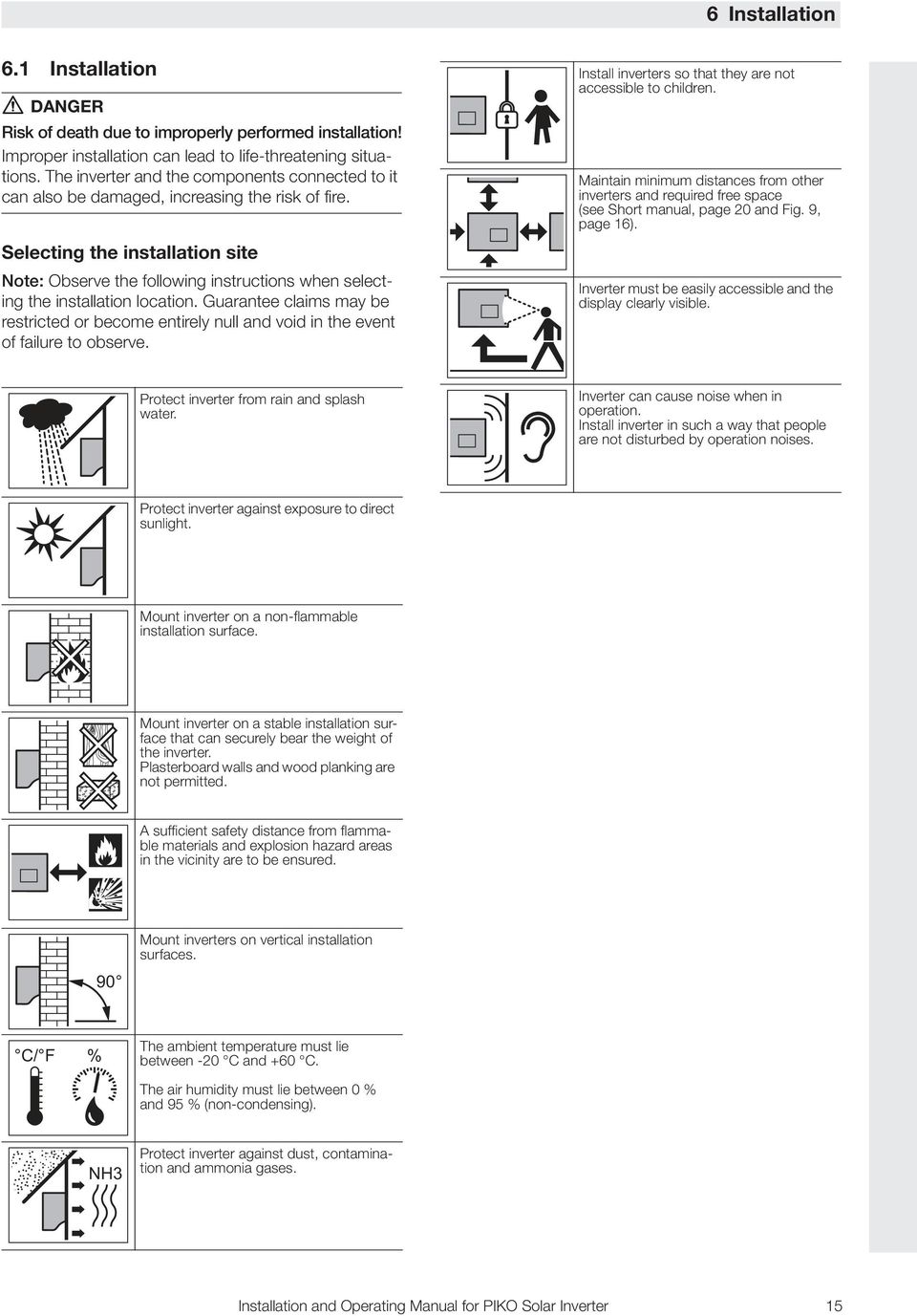
15 6 Installation 6. Installation DANGER Risk of death due to improperly performed installation! Improper installation can lead to life-threatening situations. The inverter and the components connected to it can also be damaged, increasing the risk of fire. Selecting the installation site Note: Observe the following instructions when selecting the installation location. Guarantee claims may be restricted or become entirely null and void in the event of failure to observe. Install inverters so that they are not accessible to children. Maintain minimum distances from other inverters and required free space (see Short manual, page 0 and Fig. 9, page 6). Inverter must be easily accessible and the display clearly visible. Protect inverter from rain and splash water. Inverter can cause noise when in operation. Install inverter in such a way that people are not disturbed by operation noises. Protect inverter against exposure to direct sunlight. Mount inverter on a non-flammable installation surface. Mount inverter on a stable installation surface that can securely bear the weight of the inverter. Plasterboard walls and wood planking are not permitted. A sufficient safety distance from flammable materials and explosion hazard areas in the vicinity are to be ensured. 90 Mount inverters on vertical installation surfaces. C/ F % The ambient temperature must lie between -0 C and +60 C. The air humidity must lie between 0 % and 95 % (non-condensing). NH3 Protect inverter against dust, contamination and ammonia gases. Installation and Operating Manual for PIKO Solar Inverter 5
16 6 Installation Installing the wall mount and hanging the inverter Mark the positions of the drill holes at the installation site by using the wall mount as a drilling template max Electrical connection DANGER Risk of death due to electrical shock! If exposed, voltage-carrying cables make contact, an electrical arc can occur, posing a life-threatening hazard. Only remove as much of the cable insulation as is necessary. The insulation must reach up to the terminal. DANGER Risk of death due to electrical shock! Metal slivers can fall into the inverter when removing the insulation. Contact with voltage-carrying components during operation can cause an electrical arc to occur, posing a life-threatening hazard. Never remove the cable insulation above the inverter! 3. Opening the housing Release the four screws of the cover and carefully remove the cover Connecting the AC side Unscrew the cable screw connection for the mains cable ( in figure 0). max Fig. 9: Installing the inverter (top: PIKO 3.0/3.6/4./5.5, below: PIKO 7.0/8.3/0.) Required space for cooling Outer dimensions of the inverter Drill holes and insert wall anchors if necessary. Screw the wall mount to the intended surface. Use the supplied screws. Hang the inverter on the wall mount. Fasten the inverter on the underside using the supplied screw. Fig. 0: Connections on the housing Cable screw connection for mains cable Press the blind plug and the sealing ring out of the screw connection from the inside towards the outside using a screwdriver or similar implement. Detach the sealing ring from the blind plug. 6 Installation and Operating Manual for PIKO Solar Inverter

17 L L L3 N PE 6 Installation L L L3 N PE Fig. 3: Sealing cap for AC terminal Fig. : Pressing the blind plug out of the sealing ring Blind plug Sealing ring Note: To connect the AC and DC cables, the inverter is equipped with spring-loaded terminal strips (figure 4).. We recommend a mains cable of type NYM-J 5.5 (for single-phase connection NYM-J 3.5). The outer diameter of the cable can be 9 7 mm, the crosssection of the individual conductors can be a max. of 4 mm² for flexible cables and a max. of 6 mm² for rigid cables. The three-phase feed-in to the mains means that the currents are lower than single-phase feed-in, allowing the cable cross-section to be smaller. For flexible cables, we recommend using core end sleeves. Remove the sheath and the insulation of the mains cable as much as needed. First thread the unscrewed union nut (4 in illustration ) and then the sealing ring (3 in illustration ) over the cable. Guide the mains cable through the cable duct into the interior of the inverter. Thread the sealing cap (illustration 3) over the mains cable. The sealing cap is mandatory in Italy. Fig. 4: Spring-loaded terminal strip: Fastening the cable (left), detaching the cable (right) Connect the conductors of the mains cable to the AC terminal in accordance with the labelling (figure 5). L L L3 N PE. L L L3 N PE Fig. : Laying the mains cable AC terminal (5-pole; for PIKO 3.0/3.6: 3-pole) Mains cable 3 Sealing ring 4 Union nut 4 3 Fig. 5: Mains cable connected (left without sealing cap, right with sealing cap (illustration shows PIKO 7.0/8.3/0.) Sealing cap Sealing wire 3 Mains cable 3 Place the sealing cap on the terminal block and attach the seal. The sealing cap is mandatory in Italy. Screw the union nut with inner sealing ring and plug tightly onto the cable screw connection. Note: The cable connection seals the housing against moisture and also relieves tension on the cable to ensure it is not pulled out of the terminals by its own weight. Installation and Operating Manual for PIKO Solar Inverter 7

18 6 Installation Check whether all lines are securely connected and cannot become loose. Switch off the current distributor and secure the voltage supply from being unintentionally switched back on. Ensure that the current distributor is deenergised. Lay the mains cable from the inverter to the current distributor. WARNING! Risk of fire due to overcurrent and heating of the mains cable. Install a line circuit breaker into the mains cable between the inverter and the feed meter (see table ) to secure it against overcurrent Do not switch on the voltage yet. PIKO 6.4 Connecting the DC side Type Single-pole Three-pole Tripping characteristic 0. Rated current 5 A 6 A 5 A Table : Recommended AC line circuit breaker The number of strings to be connected depends on the configuration of the photovoltaic system. First connect string, then strings and 3 (if present). The cross-section of the DC cables should be as large as possible, a maximum of 4 mm² for flexible cables and 6 mm² for rigid cables. The cross-section of the DC cables must be 4 6 mm². We recommend using tin-plated cables. If non-tinplated cables are used, the copper strands may oxidise as a result of which the transition resistance of the crimp connections will be too high. If the rated current of a string is higher than the permitted input value of the inverter, you can, on certain unit types, connect the DC inputs and in parallel (see table 3). Two bridges have been added to the units for this purpose (figure 6). B Fig. 6: DC bridges Number of DC inputs Nominal DC current per input [A] Max. DC input current per input [A] Is parallel connection of inputs & possible? DC nominal current for parallel connection + [A] Max. DC input current for parallel connection input & [A] PIKO When supplied, the inverter is equipped with plug-in connectors from Multi-Contact (type MC4). During assembly, always observe the latest specifications from the manufacturer of the plug-in connectors, e.g. regarding required special tools, permissible tightening torques etc. Further information is available, for example online at Installing the plugs onto the DC cables 8.3 Ensure that the DC load break switch is set to O (OFF). The plug-in connectors may be plugged in and disconnected in this position only ,5,5, ,5,5,5 No Yes Yes No Yes Yes Yes Table 3: Connecting inputs in parallel Eliminate any existing earth faults or short circuits in the strings. Remove mm of insulation from the DC cable. Be careful not to cut any individual conductors. Crimp the DC cables according to the recommendations of the plug-in connector manufacturer. Lead the crimped contacts from behind into the plug or socket insulation until they engage. Make sure to use the correct counterparts for the 8 Installation and Operating Manual for PIKO Solar Inverter

19 6 Installation plug-in connector couplings on the inverter. Observe the polarity of the cables. Pull gently on the cable in order to check whether the metal part has engaged. Check that assembly has been carried out in accordance with the recommendations of the plugin connectors' manufacturer. Hand-tighten the cable connections. The tightening torque must match the DC cable. Typical values are between.5 Nm and 3 Nm. Inserting DC cables into the inverter Fig. 9: Connecting the PV string 3 Fig. 7: DC inputs (the number of inputs which can be used depends on the model) Plug-in connector couplings DC input Plug-in connector couplings DC input 3 Plug-in connector couplings DC input 3 Check that the inverter is de-energised. Set the DC load break switch to OFF. OFF Pull on the plugs in order to ensure that they are properly engaged. Note: To disconnect the plug-in connectors, press the engaging clips together manually or with the tool available from the plug-in connectors' manufacturer and pull the plug out. To connect additional strings, repeat the above installation steps for each string. Any additional plug-in connectors needed are available from specialist shops. PIKO 3.6/4.: If you connect DC input and in parallel, remove the cable ends of the second DC input from the clamping block DC and insulate the free cable ends using the caps supplied. PIKO 3.6/4./7.0/8.3/0.: If required, now connect inputs and in parallel. Insert the bridges supplied into the clamps as shown (figure 0/). Note: Please note that a parallel connection is not possible with PIKO 5.5 Fig. 8: DC load break switch OFF DC DC Remove the two plug seals from the plug-in connectors. Keep the plug seals. Insert the PV string plugs until they engage in the corresponding counterparts on the inverter (figure 9). 3 Fig. 0: Inputs and connected in parallel (PIKO 3.6/4.) DC bridges PV string 3 PV string Installation and Operating Manual for PIKO Solar Inverter 9

20 6 Installation DC DC Note: You can change the preset language of the display and integrated web server (see Table 4) to any selection you wish after the commissioning. Fig. : Inputs and connected in parallel (PIKO 7.0/8.3/0.) DC bridges PV string 3 PV string Leave the plug seals on the plug-in connectors not in use to protect them from moisture and dirt. 6.5 Setting the country of use Prior to initial commissioning, the country in which the inverter is used must be specified. This is necessary so that the grid monitoring functions appropriately for the local mains grid. 3 ATTENTION The communication board may be damaged by electrostatic discharge. Use a blunt, non-metallic utensil to activate the DIP switch. Touch a grounded point, for example the holder for the housing screw connection on the bottom right, before touching the circuit board. Set the DIP switch as appropriate for the country of use according to table 4. Country Delivery condition (inverter deactivated) DE DE NSR DE MSR ES Switch setting Default language none de de de es Once the AC voltage has been initially switched on, the country setting is permanently set! If the country setting is incorrect, the inverter will not function. In order to set the country of use, consult the chapter corresponding to your communication board Communication board I Fig. : DIP switch DIP switch The country setting is made via the DIP switch () on the communication board I. FR PT IT GR (mainland) CY (EU) GR (islands) NL BE LU CH CZ AT UK/MT < 6A 3 UK/MT > 6A 3 SI DK Table 4: DIP switch settings fr pt it en en nl fr fr fr cs de en en en en 0 Installation and Operating Manual for PIKO Solar Inverter

21 6 Installation Country SE PL BA/BG/EE/HR/ LV/LT/ME/RO/ RS/SK/TR Switch setting Table 4: DIP switch settings (Forts.) with frequency-dependent active power reduction with frequency dependent active power reduction and reactive power control according to VDE-AR-N Feed-in current per phase, in relation to the entire system. Only valid for inverters with AC apparent power up to 5500 VA Communication board II After commissioning, a prompt to select the country setting appears in the display (4). 4 Fig. 3: Display on the inverter Default language Press the arrow keys ( or ) to select the desired country. Press the Enter key (3) to go to the confirmation window. Press the arrow keys ( or ) to switch between NO and YES choices. Press the Enter key (3) to confirm your selection. 6.6 Connecting communication components with communication board I Install the available communication components, such as an analogue modem, cable etc. The GSM modem is an exception, since the PIN code of the SIM card must be entered before the GSM modem can be installed in the inverter with the SIM card (see section 7..). en en en 3 DANGER Risk of death due to electrical shock! Single-insulated cables from communication components may come into contact with parts carrying mains voltage if the insulation is damaged. Only connect double-insulated cables to the inverter. ATTENTION The communication board may be damaged by electrostatic discharge. Touch a grounded point, for example the holder for the housing screw connection on the bottom right, before touching the circuit board. Overview of the communications interfaces In terms of communication options, four different situations are taken into account.. Inverter configuration.. Direct retrieval of the current yield value and/or saved log data. 3. Transferring the yield data to an solar portal. 4. Remote retrieval of the current yield value and/or saved log data. Situation : Configuring the inverter All communication settings, for example, activation of data transfer to a solar portal, are made via the integrated web server. To access the configuration on the web server, you will need a computer, which must be connected to the inverter. The inverter is equipped with an Ethernet interface (RJ45 socket) for this purpose. The computer must also be equipped with this type of interface. The operating system is irrelevant. An Internet browser must be installed on the computer. You can then connect the inverter and computer either a) via a local network (switch and Ethernet cable, see figure 4), or b) directly via a so-called crossover cable (see figure 5). Version a) is the best option when a local network is already available. Several inverters can also be connected in the network (figure 6). Version b) is the best option when no switch is available. Installation and Operating Manual for PIKO Solar Inverter
22 6 Installation Note: Ethernet cables ( network cables ) are standard connection cables commonly used for computer networks. These cables are suitable for most applications and available from computer specialty traders. A crossover cable is a special type of Ethernet cable for which the plugs are occupied differently. In this way two devices can be directly connected to one another without a switch or hub being necessary. You only require a crossover cable when you wish to connect the inverter directly to a computer, meaning without a switch/hub (Fig. 5). Fig. 4: Connecting inverter and computer with Ethernet cables and switch Inverter Ethernet cable 3 Switch/hub 4 Computer (for configuration or data retrieval) Fig. 6: Multiple inverters in the network Inverter Additional inverters 3 Ethernet cable 4 Switch/hub 5 Computer (for configuration or data retrieval) Situation : Direct retrieval of the yield data The retrieval of the current yield data as well as the stored inverter log data is also only possible using a computer. The units are cabled as described under situation. Alternatively, you can connect the inverters to each other via the RS485 interface and then only need to connect one of the inverters via Ethernet (figure 7). With this type of connection, the web server of the inverter connected via the Ethernet also displays the current output data of the other inverters. However, the web server and the stored log data are only available for the inverter connected via Ethernet. 3 Fig. 5: Connecting inverter and computer with crossover cable Inverter Crossover cable 3 Computer (for configuration or data retrieval) Fig. 7: Connecting inverters via the RS485 and retrieving performance data via Ethernet Inverter Additional inverters, max. 00 depending on cable length 3 RS485 connection 4 Crossover cable 5 Computer Situation 3: Data transfer to a solar portal The inverter can send yield data to an Internet solar portal at regular intervals. Installation and Operating Manual for PIKO Solar Inverter
23 6 Installation To do so, a) the inverter must be connected to a DSL router or to a network with Internet access or b) the inverter must have an integrated analogue modem or wireless modem (GSM, available as an accessory). Version a) requires a DSL connection. If your inverter is located close to where you already have a DSL connection, you can use the available connection for transmission. Note: If the inverters are connected to the Internet by DSL router in the local network, both direct retrieval of the log data as well as transmission of the log data of all connected inverters is possible through a solar portal. Version b) with an analogue modem requires the inverter to be connected to a separate analogue telephone connection or an analogue extension of a telecommunications system. This requires a telephone connection close by. The inverter must be connected to the telephone connection at all times. For version b) with a wireless modem, you will require a SIM data card from a mobile phone provider. There must also be adequate wireless reception at the point of installation. Make sure that the access point name is set correctly. To do this, use the GSM-Link configuration tool (see section Installing GSM modem). A detailed description can be found on our website and the CD provided. Note: Inadequate reception quality, for example, in areas with weak network coverage, can lead to connection problems and to the GSM modem dialling into the grid too often. Depending upon the price model of the GSM contract, this can result in increased costs. The reception quality also depends upon weather conditions. We recommend testing the reception with a normal mobile telephone for a few days prior to installation to ensure that adequate reception is possible despite differing weather conditions. Ensure that the antenna cable length does not exceed 8 m! Note: For installations with several inverters, you will only need one modem. Version b) with one or two inverters If you have two inverters, you can connect them both with a crossover cable and equip one of the two with a modem. There is then no need for a switch or hub. The additional connection to a computer or a DSL router is not an option in this case. 3 4 Fig. 8: Connecting two inverters with a crossover cable, transferring data via modem Inverter (without modem) Inverter with an integrated modem (analogue or GSM) 3 Crossover cable 4 Telephone connection box or mobile communications antenna (depending on the modem being used) Version b) with two or more inverters To transfer data from several inverters to a solar portal via modem, first connect the inverter to a switch/hub via an Ethernet cable. You will only need one modem: the inverter with the modem then assumes the function of a router for the other inverters. The number of network connectable inverters is in principle only limited by the available IP addresses. In practice, for data transfers via GSM or analogue modem, a max. of 30 inverters can be networked, for data transfers via DSL, a max. of 300 inverters can be networked WWW WWW Fig. 9: Connecting several inverters through the Ethernet and transferring data via modem Inverter with an integrated modem (analogue or GSM) Additional inverters (without a modem), max. 9 3 Ethernet cable 4 Switch/hub 5 Computer (for configuration and, if applicable, direct retrieval) 6 Telephone connection box or mobile communications antenna (depending on the modem being used) Installation and Operating Manual for PIKO Solar Inverter 3
24 6 Installation Situation 4: Remote retrieval of yield data You can also connect to the inverter remotely instead of through a local network. This may possibly involve additional connection costs. Similar to situation 3, the inverter must either a) be connected to a DSL router or b) have a modem (analogue or GSM) installed. Version a) Inverter with DSL connection to the Internet To ensure the inverter can actually be accessed via the Internet, several requirements must be met. The inverter must have a fixed IP address in the local network. Port forwarding must be configured to the inverter IP address in the router. The router must be assigned a fixed IP address by the Internet provider or you must register the router with a DynDNS service to connect the dynamic router IP address with a fixed name. The inverter can then be accessed over the Internet under the domain name provided by the DynDNS service, and you can connect to the inverter with any Internet browser (see figure 30). Setting up a port forwarding and a DynDNS service can not be illustrated in detail here due to the vast number of different devices and services available. Note: DynDNS services can also be found under the designation Dynamic DNS and DNS-Host-Service. In order that the router can be reached under the selected domain name, it informs the DynDNS service of each IP address change. Many of the available routers offer such a function, but a router generally only supports certain DynDNS services. With some router manufacturers the function for port forwarding is called Virtual Server or similar. For further information see the operating instructions of the router. Fig. 30: Retrieving log data: Inverter connected to the Internet via DSL Inverter DSL router 3 Internet 4 Computer 5 Internet-compatible mobile phone with browser function Version b) with an integrated modem An inverter connected to the telephone network by an analogue modem can only be contacted by a computer when the computer establishes the connection via an analogue telephone connection or via the analogue connection of a telecommunications system (dial-in connection, see figure 3). WWW Fig. 3: Retrieving log data: Inverter connected to a telephone network Inverter with integrated analogue modem Telephone socket 3 Telephone network 4 Computer with modem Dialling in with a computer and analogue telephone connection does not function reliably for an inverter with GSM modem. We therefore recommend dialling in via a computer with a GSM modem or a mobile telephone with a modem function (see figure 3). 4 Installation and Operating Manual for PIKO Solar Inverter
25 6 Installation 3 4 Fig. 3: Retrieving log data: Inverter connected to a mobile communications network Inverter with integrated GSM modem Mobile communications antenna 3 Mobile telephone (GSM) with modem function 4 Computer Overview of the communications interfaces 4 Fig. 33: Communication interfaces Modem (accessory) RJ socket 3 RJ45 socket 4 Terminal for RJ45 and RJ 3 Fig. 34: Installing the modem Connect the telephone cable (see the following section). Connecting the telephone cable The RJ socket is used to connect the inverter to an analogue telephone jack or to an ISDN line with a terminal adapter. To use the RJ interface, you will require a modem, available as an accessory. Insert the plug of the telephone cable into the corresponding socket ( figure 33). Connecting an Ethernet cable and/or telephone line to the cable terminal Instead of the RJ45 and RJ sockets, you can use the six-pole screw terminal to connect the Ethernet cable and telephone cable (4 in figure 33). This type of connection is intended for installation in large systems. Connect the lines to the cable terminal according to the terminal assignment (table 5). Connecting Ethernet cable You can connect the inverter to a computer or a computer network (Ethernet 0BaseT, 0 MBit/s) via the RJ45 socket. Use crossover cables of category 5 (Cat 5e, FTP) with a maximum length of 00 m. Insert the plug of the Ethernet cable into the corresponding socket (3 figure 33). Installing analogue modem Prerequisite for usage of the analogue modem is an analogue telephone connection. Using a modem involves additional costs. Details can be obtained from telecommunications providers. Carefully attach modem to circuit board. The uppermost plug pin on the left must be inserted into the uppermost hole in the multipoint connector. b a Modem Fig. 35: Cable terminal Rx - Rx+ Analogue telephone connection Ethernet connection Tx - Tx+ Terminal Designation Description Tx+ Transmission pair + Tx Transmission pair 3 Rx+ Reception pair + 4 Rx Reception pair Table 5: Cable terminal connection assignment for twisted pair cables and telephone line Installation and Operating Manual for PIKO Solar Inverter 5
26 6 Installation Terminal Designation Description 5 Modem a Telephone line a 6 Modem b Telephone line b Table 5: Cable terminal connection assignment for twisted pair cables and telephone line Installing GSM modem In order to use the GSM modem, you will need a SIM data card with a contract with a mobile phone provider. The GSM-Link software leaves you free to select your mobile phone provider. Using a modem involves additional costs. Details can be obtained from telecommunications providers. Connect an Ethernet cable to the communication board (RJ45 interface (network connection)) and connect to the PC. If connecting directly (inverter with PC - without switch), you must use a crossover cable. Switch the inverter back on again. In the Internet browser, enter the serial number, inverter name or IP address in the address line to go to the inverter's web server (e.g. s or s9034ie0000 or ). Enter the PIN number on the Settings page in the GSM PIN field. Not every mobile phone tariff is suitable for use with an inverter! Before purchasing the SIM data card, discuss the following points with your mobile phone provider and obtain all the access data you require (APN, user name and password). You should select a provider whose network supplies the strongest GSM signal at your chosen location. The tariff must allow for packet data communication via GPRS. Prepaid cards which are charged by mobile calls are not suitable. Tariffs which specify particular times for data downloads cannot be used. The tariff must permit a data volume of at least 5MB per month and inverter. The SIM card must be activated before installation. Download the GSM-Link software from our website Download area or use the CD supplied. Switch the inverter off for at least 5 minutes. Fatal voltages are produced in the inverter during operation. Only a qualified electrician may open and perform work on the unit. Open the cover. Fig. 36: Settings page (Communications board I) Launch the GSM-Link software. 6 Installation and Operating Manual for PIKO Solar Inverter
27 6 Installation Switch the inverter on again and wait at least minutes. In the Internet browser, enter the serial number, inverter name or IP address in the address line to go to the inverter's web server. Check the current modem status on the Info page Fig. 37: GSM-Link Enter the serial number or IP address of the inverter in the Host/IP address field (note: enter the letter S and the inverter's serial number, for example In the GSM area, enter the data (APN, user name and password) of the SIM card in the corresponding fields and confirm by selecting Write new settings. Switch the inverter off for at least 5 minutes. Slide the SIM card into the card holder on the underside of the modem. Carefully attach GSM modem to circuit board. The uppermost plug pin on the left must be inserted into the uppermost hole in the multipoint connector. Fig. 39: Modem status If the Modem status: GSM signal strength field is displaying at least two bars, the connection is OK. Activating data transfer to a solar portal The factory default setting does not include a solar portal. To use a solar portal, you will need a portal code. Only the name of one solar portal will be displayed. It is not possible to use several portals at the same time. Open the web server's Settings page (see illustration 36). Enter the code for the intended solar portal in the Portal-Code field. The portal code for the PIKO Solar Portal ( is P34. The portal code for safer Sun ( is P0L. Fig. 38: Installing the modem Insert the plug of the radio antenna into the GSM modem. Install the radio antenna where it will have the best possible reception. Note: The reception quality will be displayed on the web server info page after starting up (see section Checking sensors and modem in chapter 7.). Click on adopt to save the settings. The name of the solar portal will appear on the page. The box ( ) next to the portal name was activated automatically. Data transfer is now activated. Note: To end the data transfer, see chapter 9.5 (page 6). Check that the connection is OK. Enter the words go online in the Portal-Code field. Confirm by clicking on adopt. Open the Info page. If a value in minutes is stated in the last connection to portal field, there is a connection to the solar portal. Installation and Operating Manual for PIKO Solar Inverter 7
28 6 Installation You can then register on the solar portal and use the inverter to create a system and/or add the inverter to this system. Note: An inverter first has to log onto the portal go online before it can be assigned to a system in the portal. 6.7 Connecting communication components with communication board II Now install the available communication components, such as an analogue modem, cable etc. The GSM modem is an exception, since the PIN code of the SIM card must be entered before the GSM modem can be installed in the inverter with the SIM card (see section 7..). DANGER Risk of death due to electrical shock! Single-insulated cables from communication components may come into contact with parts carrying mains voltage if the insulation is damaged. Only connect double-insulated cables to the inverter. You can then connect the inverter and computer either a) directly via an Ethernet cable (see illustration 4) or b) via a local network (switch and Ethernet cable, see figure 4). Version a) is the best option when no switch is available. Version b) is the best option when a local network is already available. Several inverters can also be connected in the network (figure 40). 3 Fig. 40: Multiple inverters in the network Inverter Additional inverters 3 Ethernet cable 4 Computer (for configuration or data retrieval) 4 ATTENTION The communication board may be damaged by electrostatic discharge. Touch a grounded point, for example the holder for the housing screw connection on the bottom right, before touching the circuit board. Overview of the communications interfaces In terms of communication options, four different situations are taken into account.. Inverter configuration.. Direct retrieval of the current yield value and/or saved log data. 3. Transferring the yield data to an Internet solar portal. 4. Remote retrieval of the current yield value and/or saved log data. Fig. 4: Connecting inverter and computer with Ethernet cable Inverter Ethernet/crossover cable 3 Computer (for configuration or data retrieval) 3 Situation : Configuring the inverter All communication settings, for example, activation of data transfer to a solar portal, are made via the integrated web server. To access the configuration on the web server, you will need a computer, which must be connected to the inverter. The inverter is equipped with two Ethernet interfaces (RJ45 sockets) for this purpose. The computer must also be equipped with this type of interface. The operating system is irrelevant. An Internet browser must be installed on the computer. 8 Installation and Operating Manual for PIKO Solar Inverter
29 6 Installation Fig. 4: Connecting inverter and computer with Ethernet cables and switch Inverter Ethernet/crossover cable 3 Switch/hub 4 Computer (for configuration or data retrieval) Situation : Direct retrieval of the yield data The retrieval of the current yield data as well as the stored inverter log data is also only possible using a computer. The units are cabled as described under situation. Alternatively, you can connect the inverters to each other via the RS485 interface and then only need to connect one of the inverters via Ethernet (figure 43). With this type of connection, the web server of the inverter connected via the Ethernet also displays the current output data of the other inverters. However, the web server and the stored log data are only available for the inverter connected via Ethernet. Inverter Additional inverters, max. 00 depending on cable length 3 RS485 connection 4 Ethernet/crossover cable 5 Computer Situation 3: Data transfer to a solar portal The inverter can send yield data to an Internet solar portal at regular intervals. To do so, Fig. 43: Connecting inverters via the RS485 and retrieving performance data via Ethernet a) the inverter must be connected to a DSL router or to a network with Internet access or 5 b) the inverter must have an integrated analogue modem or wireless modem (GSM, available as an accessory). Version a) requires a DSL connection. If your inverter is located close to where you already have a DSL connection, you can use the available connection for transmission. Note: If the inverters are connected to the Internet by DSL router in the local network, both direct retrieval of the log data as well as transmission of the log data of all connected inverters is possible through a solar portal. Version b) with an analogue modem requires the inverter to be connected to a separate analogue telephone connection or an analogue extension of a telecommunications system. This requires a telephone connection close by. The inverter must be connected to the telephone connection at all times. For version b) with a wireless modem, you will require a SIM data card from a mobile phone provider. There must also be adequate wireless reception at the point of installation. Make sure that the access point name is set correctly. To do this, use the Settings page (see section Installing GSM modem) via the GSM-Link configuration tool. You will find a detailed description on our website. Note: Inadequate reception quality, for example, in areas with weak network coverage, can lead to connection problems and to the GSM modem dialling into the grid too often. Depending upon the price model of the GSM contract, this can result in increased costs. The reception quality also depends upon weather conditions. We recommend testing the reception with a normal mobile telephone for a few days prior to installation to ensure that adequate reception is possible despite differing weather conditions. Note that the antenna position depends on the maximum cable length of the GSM antenna of 8 m! Note: For installations with several (max. 30) inverters, you will only need one modem. Version b) To transfer the data of several inverters to a solar portal with a modem, first connect the inverter with the Ethernet-crossover cable. You will only need one modem: the inverter with the modem then assumes the function of a router for the other inverters. The number of network connectable inverters is in principle only limited by the available IP addresses. In practice, for data transfers via GSM or analogue modem, a max. of 30 inverters can be networked, for data transfers via DSL, a max. of 300 inverters can be networked. Installation and Operating Manual for PIKO Solar Inverter 9
30 6 Installation 5 3 WWW Fig. 44: Connecting several inverters through the Ethernet and transferring data via modem Inverter with an integrated modem (analogue or GSM) Additional inverters (without a modem), max. 9 3 Ethernet/crossover cable 4 Computer (for configuration and, if applicable, direct retrieval) 5 Telephone connection box or mobile communications antenna (depending on the modem being used) 4 Situation 4: Remote retrieval of yield data You can also connect to the inverter remotely instead of through a local network. This may possibly involve additional connection costs. Similar to situation 3, the inverter must either a) be connected to a DSL router or b) have a modem (analogue or GSM) installed. Version a) Inverter with DSL connection to the Internet To ensure the inverter can actually be accessed via the Internet, several requirements must be met. The inverter must have a fixed IP address in the local network. Port forwarding must be configured to the inverter IP address in the router. The router must be assigned a fixed IP address by the Internet provider or you must register the router with a DynDNS service to connect the dynamic router IP address with a fixed name. The inverter can then be accessed over the Internet under the domain name provided by the DynDNS service, and you can connect to the inverter with any Internet browser (see figure 45). Setting up a port forwarding and a DynDNS service can not be illustrated in detail here due to the vast number of different devices and services available. Note: DynDNS services can also be found under the designation Dynamic DNS and DNS-Host-Service. In order that the router can be reached under the selected domain name, it informs the DynDNS service of each IP address change. Many of the available routers offer such a function, but a router generally only supports certain DynDNS services. With some router manufacturers the function for port forwarding is called Virtual Server or similar. For further information see the operating instructions of the router. 30 Installation and Operating Manual for PIKO Solar Inverter
31 6 Installation 3 5 WWW Fig. 45: Retrieving log data: Inverter connected to the Internet via DSL Inverter DSL router 3 Internet 4 Computer 5 Internet-compatible mobile phone with browser function Version b) with an integrated modem An inverter connected to the telephone network by an analogue modem can only be contacted by a computer when the computer establishes the connection via an analogue telephone connection or via the analogue connection of a telecommunications system (dial-in connection, see figure 46). Inverter with integrated analogue modem Telephone socket 3 Telephone network 4 Computer with modem 3 Fig. 46: Retrieving log data: Inverter connected to a telephone network Dialling in with a computer and analogue telephone connection does not function reliably for an inverter with GSM modem. We therefore recommend dialling in via a computer with a GSM modem or a mobile telephone with a modem function (see figure 47). 4 Fig. 47: Retrieving log data: Inverter connected to a mobile communications network Inverter with integrated GSM modem Mobile communications antenna 3 Mobile telephone (GSM) with modem function 4 Computer Overview of the communications interfaces PC / ABS Fig. 48: Communications interface Communication board II Modem (accessory) RJ socket 3 Terminal for RS485 interface 4 S0 voltage output 5 RJ45 sockets 6 S0 alarm output Connecting Ethernet cable You can connect the inverter to a computer or a computer network (Ethernet 0/00 MBit/s) via the RJ45 socket. Insert the plug of the Ethernet/crossover cable into one of the corresponding sockets (5 in figure 48). Installing analogue modem 5 Prerequisite for usage of the analogue modem is an analogue telephone connection. Using a modem involves additional costs. Details can be obtained from telecommunications providers. Carefully attach modem to circuit board. The uppermost plug pin on the left must be inserted into the uppermost hole in the multipoint connector. XX 4 3 Installation and Operating Manual for PIKO Solar Inverter 3
32 6 Installation Fig. 49: Installing the modem Connect the telephone cable (see the following section). Fatal voltages are produced in the inverter during operation. Only a qualified electrician may open and perform work on the unit. Open the cover. Connect an Ethernet/crossover cable to the communication board (RJ45 interface (network connection)) and connect this to the PC. Switch the inverter back on again. In the Internet browser, enter the serial number, inverter name or IP address in the address line to go to the inverter's web server (e.g. s or s9034ie0000 or ). Enter the PIN number on the Settings page in the GSM PIN field. Connecting the telephone cable The RJ socket is used to connect the inverter to an analogue telephone jack or to an ISDN line with a terminal adapter. To use the RJ interface, you will require a modem, available as an accessory. Insert the plug of the telephone cable into the corresponding socket ( figure 48). Installing GSM modem In order to use the GSM modem, you will need a SIM data card with a contract with a mobile phone provider. The GSM-Link software leaves you free to select your mobile phone provider. Using a modem involves additional costs. Details can be obtained from telecommunications providers. Not every mobile phone tariff is suitable for use with an inverter! Before purchasing the SIM data card, discuss the following points with your mobile phone provider and obtain all the access data you require (APN, user name and password). You should select a provider whose network supplies the strongest GSM signal at your chosen location. The tariff must allow for packet data communication via GPRS. Prepaid cards which are charged by mobile calls are not suitable. Tariffs which specify particular times for data downloads cannot be used. The tariff must permit a data volume of at least 5MB per month and inverter. The SIM card must be activated before installation. Fig. 50: Settings page (Communicationsboard II) Switch the inverter off for at least 5 minutes. 3 Installation and Operating Manual for PIKO Solar Inverter
33 6 Installation Launch the GSM-Link software. Note: The reception quality will be displayed on the web server info page after starting up (see section Checking sensors and modem in chapter 7.). Switch the inverter on again and wait at least minutes. In the Internet browser, enter the serial number, inverter name or IP address in the address line to go to the inverter's web server. Check the current modem status on the Info page Fig. 5: GSM-Link Enter the serial number or IP address of the inverter in the Host/IP address field (note: enter the letter S and the inverter's serial number, for example In the GSM area, enter the data (APN, user name and password) of the SIM card in the corresponding fields and confirm by selecting Write new settings. Switch the inverter off for at least 5 minutes. Slide the SIM card into the card holder on the underside of the modem. Carefully attach GSM modem to circuit board. The uppermost plug pin must be inserted into the uppermost hole in the multipoint connector. Fig. 53: Modem status If the Modem status: GSM signal strength field is displaying at least two bars, the connection is OK. Activating data transfer to a solar portal The factory default setting does not include a solar portal. To use a solar portal, you will need a portal code. Only the name of one solar portal will be displayed. It is not possible to use several portals at the same time. Open the web server's Settings page (see illustration 50). Enter the code for the intended solar portal in the Portal-Code field. The portal code for the PIKO Solar Portal ( is P34. The portal code for safer Sun ( is P0L. Fig. 5: Installing the modem Insert the plug of the radio antenna into the GSM modem. Install the radio antenna where it will have the best possible reception. Installation and Operating Manual for PIKO Solar Inverter 33
34 6 Installation Click on adopt to save the settings. The name of the solar portal will appear on the page. The box ( ) next to the portal name was activated automatically. Data transfer is now activated. Note: To end the data transfer, see chapter 9.5 (page 6). Check that the connection is OK. Enter the words go online in the Portal-Code field. Confirm by clicking on adopt. Open the Info page. If a value in minutes is stated in the last connection to portal field, there is a connection to the solar portal. You can then register on the solar portal and use the inverter to create a system and/or add the inverter to this system. Note: An inverter first has to log onto the portal ( go online ) before it can be assigned to a system in the portal. 6.8 Installing accessories with communication board I If available, now install accessories such as sensors or ripple control receiver. DANGER Risk of death due to electrical shock! The communication board is energised! Single-insulated cables from communication components may come into contact with parts carrying mains voltage if the insulation is damaged. Only connect double-insulated cables in the inverter. ATTENTION The communication board may be damaged by electrostatic discharge. Touch a grounded point, for example the holder for the housing screw connection on the bottom right, before touching the circuit board. Overview of the accessory interfaces Fig. 54: Communication board I connections Switch output (S0/Al OUT) RS485 interface 3 DIP switch for RS485 configuration 4 Terminal for analogue interfaces Connect switch output (S0/Al OUT) The switch output S0/AI-OUT can be occupied with the following functions: S0 interface Alarm output Switching of devices (internal consumption) S0 interface: The switch output functions as a pulse output as described in DIN EN with a constant rate of 000 pulses per kilowatt hour. Using a suitable receiver device such as an energy meter or a display, you can record and display the energy yield of your photovoltaic system. Alarm output: The switch output functions as a potential-free NC contact. It opens when a malfunction occurs (see Faults on page 56). Internal consumption: The switch output functions as a potential-free NO contact. It closes when the set conditions are fulfilled (see section Setting the conditions for switching on devices (internal consumption) (Communications board II) on page 44). For more information, refer also to the text and image in section Internal consumption, on page. Max. load Max. voltage Connections 00 ma 50 V (AC or DC) Neutral polarity Table 6: Switch output technical data 4 3 Note: You must install a component such as an external load relay between the inverter and the consumer device. Do not connect any consumer devices directly to the switch output. Connect all wires to the appropriate terminals (fig. 54, position ). 34 Installation and Operating Manual for PIKO Solar Inverter
35 6 Installation Connecting the S0 input (energy pulse meter) The S0 input allows you to record the pulses of an energy meter or a second inverter. Note: While the second inverter will not be displayed in the solar portal, its energy yield is included in the first inverter's data (in total). When using the S0 input, the analogue inputs Aln3 and Aln4 are inactive. The web server of the inverter shows the pulses counted on the info page. Connect the lines to the terminal (4 in figure 54) according to the terminal assignment (table 7). AGND S0 In input External energy meter S0-In Fig. 55: Example of the connection of an external energy meter at the S0 In input Connecting analogue sensors The inverter features four analogue inputs to which you can connect, for example, temperature and irradiation sensors or wind sensors. The additional measured data enable a more precise monitoring of the photovoltaic system. The sensors must have an output voltage of V (factory setting). An additional voltage supply may be required, depending on the sensor. Note: When using the S0 input, the analogue inputs Aln3 and Aln4 are inactive. Note: If the inverter is intended for connecting a ripple control receiver, you cannot connect sensors. Connect the lines to the terminal according to the terminal assignment (figure 56 and table 7). +5V AGND Fig. 56: Cable terminal Voltage output Analogue inputs 3 S0 input (energy pulse meter) 4 RS485 Terminal Designation Description RS485 A RS485 A RS485 B RS485 B 3 GND Ground for RS485 4 S0 In S0 input (energy pulse meter) 5 AIn Inputs for analogue sensors 6 AIn (0...0 V) or for ripple control receivers 7 AIn3 8 AIn4 AIn4 3 4 AIn3 AIn AIn S0-In GND B A RS485 9 AGND Ground for analogue inputs and S0 input 0 +5V 5 V output for external sensors (not potential-free; max. 0 ma) or for ripple control receivers Table 7: Cable terminal connection assignment Connecting a ripple control receiver for active power control Note: The information in this section applies only to systems in Germany. The inputs for analogue sensors can be used to connect a ripple control receiver for active power control (in accordance with the Renewable Energy Law, as applicable in Germany). This function must be activated via the inverter web server (see section Setting the analogue input functions in chapter 7..). The inverter must then be linked via Ethernet (figure 57) or RS485 (figure 58) so that the inverter connected to the ripple control receiver can forward the information received to the other inverters. Installation and Operating Manual for PIKO Solar Inverter 35
36 6 Installation +5V AGND AIn4 AIn3 AIn AIn S0-In GND B A RS % 6 7 Fig. 57: Connecting the ripple control receiver for inverters with Ethernet connections Master inverter Additional inverters 3 Ethernet cable 4 Switch/hub 5 5-conductor connection at analogue-in 6 Ripple control receiver 7 Grid Fig. 58: Connecting the ripple control receiver for inverters with RS485 connections Master inverter Additional inverters 3 RS485 connection (3-conductor) 4 5-conductor connection at analogue-in 5 Ripple control receiver 6 Grid Fig. 59: Connecting the ripple control receiver to the inverter Ripple control receiver Connecting RS485 30% 60% 00% Connections for the serial RS485 interface are found on the terminal for analogue interfaces (figure 56). Using RS485, up to 00 inverters - depending on the inverters used - can be connected, see Table 8. Additional components can be connected to RS485. An additional level converter may be required in some cases. Use a twisted-pair cable for connection, such as LiYCY 0.5. To do so, the DIP switch for the RS485 configuration ( in figure 60) must be set accordingly on the communication boards of all inverters. Connect the ripple control receiver lines in accordance with the terminal assignment (figure 59 and table 7). Fig. 60: DIP switch for RS485 configuration DIP switch for RS485 configuration 36 Installation and Operating Manual for PIKO Solar Inverter
37 6 Installation It is possible to mix inverters with and without DIP switch for the RS485 configuration. The potential connection scope and the DIP switch setting required are illustrated in Table 8. If all inverters for connection are equipped with DIP switches, cable lengths of up to 500 m are possible. Note: If other RS485 units are connected in a RS485 network in addition to the inverters (e. g. a display), the number of inverters which can be connected and the maximum cable lengths may be limited. ATTENTION The communication board may be damaged by electrostatic discharge. Use a blunt, non-metallic utensil to activate the DIP switch. Touch a grounded point, for example the holder for the housing screw connection on the bottom right, before touching the circuit board. If necessary, switch the termination on using DIP switch and switch the bus supply voltage on using the DIP switches and 3. Connection scope Inverter 3 n max. 0 inverters without DIP switch without DIP switch without DIP switch without DIP switch max. 0 inverters without DIP switch without DIP switch without DIP switch On 3 4 max. 0 inverters when the inverter is at a distance of n without DIP switch On 3 4 On 3 4 On 3 4 max. 00 inverters On 3 4 On 3 4 On 3 4 On 3 4 Table 8: DIP switch for RS485 configuration Note: If you have the necessary expertise, you can connect the inverter to a serial interface (RS3 or USB) of your computer via a signal level converter. For this type of connection, however, only the current performance data can be accessed. The integrated web server and the stored log data are not available. Connect the lines to the terminal (4 in figure 56) according to the terminal assignment (table 7). Installation and Operating Manual for PIKO Solar Inverter 37
38 6 Installation 6.9 Installing accessories with communication board II If available, now install accessories such as sensors or ripple control receiver. DANGER Risk of death due to electrical shock! Single-insulated cables from communication components may come into contact with parts carrying mains voltage if the insulation is damaged. Only connect double-insulated cables in the inverter. ATTENTION The communication board may be damaged by electrostatic discharge. Touch a grounded point, for example the holder for the housing screw connection on the bottom right, before touching the circuit board. Overview of the accessory interfaces PC / ABS XX 3 Internal consumption: The switch output functions as a potential-free NO contact. It closes when the set conditions are fulfilled (see section Setting the conditions for switching on devices (internal consumption) (Communications board II) on page 44). For more information, refer also to the text and image in section Internal consumption, on page. Max. load Max. voltage Connections 00 ma 50 V (AC or DC) Neutral polarity Table 9: Switch output technical data Note: You must install a component such as an external load relay between the inverter and the consumer device. Do not connect any consumer devices directly to the switch output. Connect all wires to the appropriate terminals (fig. 6, position ). Connecting the S0 input (energy pulse meter) The S0 input allows you to record the pulses of an energy meter or a second inverter. Note: While the second inverter will not be displayed in the solar portal, its energy yield is included in the first inverter's data (in total). When using the S0 input, the analogue inputs Aln3 and Aln4 are inactive. The web server of the inverter shows the pulses counted on the info page. Connect the lines to the terminal (4 in figure 6) according to the terminal assignment (table 0). Fig. 6: Communication board II connections Switch output (S0/Al OUT) Terminal for analogue interfaces 3 RS485 interface Connect switch output (S0/Al OUT) The switch output S0/AI-OUT can be occupied with the following functions: S0 interface Alarm output Switching of devices (internal consumption) S0 interface: The switch output functions as a pulse output as described in DIN EN with a constant rate of 000 pulses per kilowatt hour. Using a suitable receiver device such as an energy meter or a display, you can record and display the energy yield of your photovoltaic system. Alarm output: The switch output functions as a potential-free NC contact. It opens when a malfunction occurs (see Faults on page 56). AGND Fig. 6: Example of the connection of an external energy meter at the S0 In input S0 In input External energy meter S0-In 38 Installation and Operating Manual for PIKO Solar Inverter
39 6 Installation Connecting analogue sensors The inverter features four analogue inputs to which you can connect, for example, temperature and irradiation sensors or wind sensors. The additional measured data enable a more precise monitoring of the photovoltaic system. The sensors must have an output voltage of V. An additional voltage supply may be required, depending on the sensor. Note: When using the S0 input, the analogue inputs Aln3 and Aln4 are inactive. Note: If the inverter is intended for connecting a ripple control receiver, you cannot connect sensors. Connect the lines to the terminal according to the terminal assignment (figure 63 and table 0). +V AGND Fig. 63: Cable terminal Voltage output Analogue inputs 3 S0 input (energy pulse meter) 4 RS485 Terminal Designation Description RS485 A RS485 A RS485 B RS485 B 3 GND Ground for RS485 4 S0 In S0 input (energy pulse meter) 5 AIn Inputs for analogue sensors 6 AIn (0...0 V) or for ripple control receivers 7 AIn3 8 AIn4 AIn4 3 4 AIn3 AIn AIn S0-In GND B A RS485 9 AGND Ground for analogue inputs and S0 input 0 +V V output for external sensors (not potential-free; max. 00 ma) or for ripple control receivers Table 0: Cable terminal connection assignment Connecting a ripple control receiver for active power control Note: The information in this section applies only to systems in Germany. The inputs for analogue sensors can be used to connect a ripple control receiver for active power control (in accordance with the Renewable Energy Law, as applicable in Germany). This function must be activated via the inverter web server (see section Setting the analogue input functions in chapter 7..). The inverter must then be linked via Ethernet or RS485 (figure 64) so that the inverter connected to the ripple control receiver can forward the information received to the other inverters Fig. 64: Connecting the ripple control receiver for inverters with Ethernet or RS485 connections Master inverter Additional inverters 3 Ethernet cable, alternatively RS485 connection (3-conductor) 4 5-conductor connection at analogue-in 5 Ripple control receiver 6 Grid Connect the ripple control receiver lines in accordance with the terminal assignment (figure 65 and table 0). Installation and Operating Manual for PIKO Solar Inverter 39
40 6 Installation +V AGND AIn4 AIn3 AIn AIn S0-In GND B A RS485 Note: If you have the necessary expertise, you can connect the inverter to a serial interface (RS3 or USB) of your computer via a signal level converter. For this type of connection, however, only the current performance data can be accessed. The integrated web server and the stored log data are not available. Connect the lines to the terminal (4 in figure 63) according to the terminal assignment (table 7). 0% 30% 60% 00% 6.0 Closing the housing Fasten all cables with a cable tie to the recesses in the protective plate. Make sure that all cables run directly over the protective plate and do not project laterally over the protective plate. Fig. 65: Connecting the ripple control receiver to the inverter Ripple control receiver Connecting RS485 Connections for the serial RS485 interface are found on the terminal for analogue interfaces (figure 63). Using RS485, up to 00 inverters - depending on the inverters used - can be connected. Additional components can be connected to RS485. An additional level converter may be required in some cases. Use a twisted-pair cable for connection, such as LiYCY 0.5. To do this, you must set the bus prestress and bus termination menu items in the user menu to ON (fig. 88). If using an inverter with communication board II, all other inverters must also be fitted with communication board II. Cable lengths of up to 500 m are possible. Note: If other RS485 units are connected in a RS485 network in addition to the inverters (e. g. a display), the number of inverters which can be connected and the maximum cable lengths may be limited. For the connection, activate the bus prestress in the user menu of the first inverter and the bus termination in the user menu of the first and last inverters. Fig. 66: Fastening cable to protective plate Screw all union nuts together with sealing ring tightly onto the cable screw connection. Recommended tightening torques:,5 Nm (M) and 8 Nm (M5). Check whether all lines are securely connected and cannot become loose. Remove any foreign objects from the inverter (tools, wire cuttings, etc.). Fit the cover and bolt it tight. 40 Installation and Operating Manual for PIKO Solar Inverter
41 7 Commissioning and de-commissioning 7 Commissioning and de-commissioning 7. Switching on the inverter For the initial commissioning, sufficient solar irradiation must exist so that a DC input voltage of at least 80 V is available for the inverter. Turn the DC load break switch to ON or switch on the DC strings one after another via the external DC isolator. Fig. 67: DC load break switch ON ON Switch on the grid voltage via the line circuit breaker. If the following message appears on the display, the country of use is not set. Fig. 68: Display message if the country of use is not set (communication board I) If using communication board I, switch off the device voltage on the AC and DC sides and set the country of use as described in chapter 6.5. select country Germany Fig. 69: Display message if the country of use is not set (communication board II) The inverter is now in operation: the display lights up and successively shows the device type, the country setting, the hardware and software versions and the name of the inverter. The yellow LED lights up and the device automatically carries out the required tests according to DIN VDE 06. If the yellow LED does not light up, the input voltage may be too low. When the tests have been successfully completed, the green LED lights up and the inverter begins feeding in current to the grid. If the green LED does not light up, the input voltage or the power may be too low or a fault has occurred (see the chapter Fault correction ). Note: With a limited input power, PIKO 4./5.5/7.0/8.3/0. use only one or two phases for feeding current into the grid. The device selects the phase on a random basis each time. Setting the language If desired, set the display to a different language (see chapter 8.4). 7. Setting up communication and accessories Perform the remaining setup using the web server of the inverter. Note: You can change all settings which you make at any time and as often as you like with the exception of the country of use. 7.. Connecting to the web server of the inverter Connect the inverter with a computer, as described in chapter 6.6 or 6.7. Set the Ethernet interface (TCP/IP protocol) of the computer so that the IP address automatically obtains the DNS server address. To alter this setting, administrator access rights may be required. Start your Internet browser and enter the letter S and the serial number of the inverter in the address bar, for example The log-in window for the web server opens. Enter user name and password. The factory defaults for user name and password are set as follows: Confirm the entries by clicking on OK. User name: pvserver Password: pvwr The main screen of the inverter is displayed. Installation and Operating Manual for PIKO Solar Inverter 4
42 7 Commissioning and de-commissioning 7.. Configuring settings Click on the Settings link. The Settings page is displayed. Fig. 70: Main page of the web server (the number of inputs- and outputs displayed may vary depending on unit type). Fig. 7: Settings page (Communications board I) Setting S-no. Item number Language Name RS485 inverter bus address Explanation Inverter serial number Item number of the inverter Selection of the language for the web display Allocation of a name to the inverter Unit address for the RS485 interface Data acquisition Choose between a saving interval of 5 or 60 minutes Switch output function Function of analogue inputs Network Three settings possibilities: S0 pulse Alarm output Internal consumption Table : Web server settings Two setting possibilities: Sensors Active power control (connection of a ripple control signal receiver) Configuration of the inverter network interface (Ethernet) 4 Installation and Operating Manual for PIKO Solar Inverter
43 7 Commissioning and de-commissioning Setting Public line GSM PIN New log-in-password Portal code Data export Explanation Changing the language You can select a different language for the web server from the drop-down list. Select the intended language. Click on Accept to save the settings. Changing the name Only required when using an analogue modem (optional accessory) and an analogue telephone system PIN for the GSM modem SIM card. For further information on configuration and installation of the GSM modem, see chapter 6.7. Change of password Entry field for the portal code for changing the solar portal displayed under 'data export' Activation of data transfer to the solar portal displayed ( ) or deactivation ( ) Table : Web server settings (Forts.) You can assign a name of your own choosing to the inverter. When connecting the browser to the web server you can then use the name instead of the serial number. Access with the serial number remains possible. Type in the name you have chosen. The letters a z, A Z and numbers 0 9 are all permitted. Diacritics, spaces or special characters are not permitted. Click on Accept to save the settings. Note: Make a note of the new name for the inverter. The name is also shown in the display of the inverter in the submenu Settings. Changing the data capture (saving interval) When selecting the saving interval, you have the option of a 5-minute or 60-minute period between the saving procedures. The internal memory can store the data for approximately 00 days if the 5-minute period is selected and for about 400 days with the 60-minute period. The inverter data are only saved in the unit for a limited time. When the internal memory is full, the oldest data will be overwritten. To save the data on a long-term basis, you can either transfer the data to a solar portal or download them to a computer. Select the desired saving interval. Click on Accept to save the settings. Setting the switch output function Select from the following options: S0 pulse Alarm output Internal consumption, see section Setting the conditions for switching on devices (internal consumption) (Communications board II) on page 44 Click on Accept to save the settings. Configuring the RS485 address If you have linked two or more inverters via RS485, you must set the RS485 addresses of the inverter so that each address is unique. Enter the desired address in the field Inverter bus (RS485) address. Click on Accept to save the settings. Installation and Operating Manual for PIKO Solar Inverter 43
44 7 Commissioning and de-commissioning Setting the conditions for switching on devices (internal consumption) (Communications board I) Setting the conditions for switching on devices (internal consumption) (Communications board II) Abbildung : Setting conditions for internal consumption (Communications board I) Power limit Stable exceeding of the limit Run time This is the minimum power (in watts) that must be produced before the device is switched on. You can enter any value from watt to 999,000 watts. This is the period (in minutes) during which the inverter must produce at least the power set in the power limit field before the device is switched on. You can enter any value from minute to 70 minutes (= hours). The connected device is switched on for this period (in minutes) when both the above conditions have been met. You can enter any value from minute to 440 minutes (= 4 hours). When the inverter turns off, the term ends. The run time is ended and not continued again if the inverter has not produced any current for three hours. Table : Internal consumption function Fig. 7: Setting conditions for internal consumption (Communications board II) Choose between functions or and enter values. function Power limit Stable exceeding of the limit Run time This is the minimum power (in watts) that must be produced before the device is switched on. You can enter any value from watt to 999,000 watts. This is the period (in minutes) during which the inverter must produce at least the power set in the power limit field before the device is switched on. You can enter any value from minute to 70 minutes (= hours). The connected device is switched on for this period (in minutes) when both the above conditions have been met. You can enter any value from minute to 440 minutes (= 4 hours). When the inverter turns off, the term ends. The run time is ended and not continued again if the inverter has not produced any current for three hours. Activation The number indicates how often internal consumption is activated each day. Table 3: Internal consumption function function Activation limit This is the minimum power (in watts) that must be produced before the device is switched on. You can enter any value from watt to 999,000 watts. Deactivation limit The device is switched off when the power generated falls below this value. Table 4: Internal consumption function Delay during fault / drop in output Short term interruptions or drops in output can occur during operation. In order that these events do not result in the disconnection of the device, a delay time 44 Installation and Operating Manual for PIKO Solar Inverter
45 7 Commissioning and de-commissioning can be set. Following the set period, the inverter shuts the device off in the vent of en enduring fault or drop in output. Click on Accept to save the settings. Setting the analogue input functions Select whether the analogue inputs should be used for connecting sensors or a ripple control receiver for active power control. Click on Accept to save the settings. Configuring the network Sample images are provided for both communication boards I and II. As the standard default setting, the option Auto IP / DHCP is activated. This means that the inverter obtains its IP address automatically from a DHCP server, such as from a DSL router for example. (A DHCP server is a program which assigns a network address to its subscribers). If no DHCP server is available, the inverter assigns an IP address to itself. The option Auto IP/DHCP is suitable for most applications (figure 73 or 74) www 6 7 Fig. 74: Communication board II: Network settings with automatic network configuration for an external DSL router ( Auto IP/DHCP, external router) Inverter Auto-IP / DHCP Inverter Auto-IP / DHCP 3 Inverter 3 Auto-IP / DHCP 4 Ethernet cable 5 DSL router with DHCP server 6 Switch/hub 7 Computer with network setting Obtain IP address automatically 5 4 www 6 7 Fig. 73: Communication board I: Network settings with automatic network configuration for an external DSL router ( Auto IP/DHCP, external router) Inverter Auto-IP / DHCP Inverter Auto-IP / DHCP 3 Inverter 3 Auto-IP / DHCP 4 Ethernet cable 5 DSL router with DHCP server 6 Switch/hub 7 Computer with network setting Obtain IP address automatically Network with a fixed IP addresses Sample images are provided for both communication boards I and II. A fixed IP address assignment ( manual network configuration setting) is only required in a few cases: You have a local network (Ethernet) with fixed IP addresses and wish to integrate the inverter into the network (figure 75 or 76). Or you operate the inverter through a DSL connection with router and wish to connect to the inverter remotely via the router (figure 77 or 78). Installation and Operating Manual for PIKO Solar Inverter 45
46 7 Commissioning and de-commissioning WWW 5 www 6 7 Fig. 75: Communication board I: Network settings with manual network configuration for analog- oder GSM-communication, subnetzmask external router) Inverter with an integrated modem (analogue or GSM) Inverter IP address Optional additional inverters (without modem) Inverter IP address Ethernet/crossover cable 4 Switch/hub 5 Computer IP address Telephone connection or mobile communications antenna Fig. 77: Communication board I: Network settings with manual network configuration for external DSL router, subnet mask: , external router Inverter IP address Inverter IP address Inverter 3 IP address , etc. 4 Ethernet/crossover cable 5 DSL router IP address Switch/hub 7 Computer IP address WWW Fig. 76: Communication board II: Network settings with manual network configuration for analog- oder GSM-communication, subnetzmask external router) Inverter with an integrated modem (analogue or GSM) Inverter IP address Optional additional inverters (without modem) Inverter IP address Ethernet cable 4 Computer IP address Telephone connection or mobile communications antenna 4 5 www 6 7 Fig. 78: Communication board II: Network settings with manual network configuration for external DSL router, subnet mask: , external router Inverter IP address Inverter IP address Inverter 3 IP address , etc. 4 Ethernet cable 5 DSL router IP address Switch/hub 7 Computer IP address Installation and Operating Manual for PIKO Solar Inverter
47 7 Commissioning and de-commissioning Note: The factory default setting of the DNS server address is , and it provides the alternative name resolution in the Internet. Do not change this setting, as the export of log data to a solar portal may otherwise not function anymore. Activate the setting manual network configuration if you wish to assign a fixed IP address. Enter the IP address and subnet mask. Note: The changed settings take effect immediately upon clicking Accept. Your inputs may have the consequence that the inverter is no longer accessible through the current connection. Click on Accept to save the settings. If the inverter is to use an external router to send data to a solar portal, activate the option external router and enter the IP-address of the router. Click on Accept to save the settings. Note: Your old password becomes invalid immediately after the password change. You should therefore note the password as a precaution. Forgotten the password? Our customer service is on hand to assist. Note: The user name cannot be changed Checking sensors and modem On the main page of the web server, click on the link Info page. The Info page window then opens. Entering the public line number (for analogue modems only) If applicable, enter the public line number. Click on Accept to save the settings. Entering the PIN code (for GSM modems only) You must enter the PIN code that you received from your mobile phone provider in the configuration of the inverter before you install the GSM modem with the SIM card. Enter the PIN code of the GSM card. Click on Accept to save the settings. Note: If you subsequently change your mobile phone provider, first enter the new GSM PIN in the web server of the inverter and then replace the SIM card in the GSM modem. Changing the password You can change the preset log-in password on the integrated web server. Type in the intended password. The letters a z, A Z and numbers 0 9 are all permitted. Diacritics, spaces or special characters are not permitted. Type the password into the Repeat field again. Click on Accept to save the settings. Fig. 79: Info page Entry x- analogue input Explanation Shows the voltage which is currently available on the analogue input x Modem status Shows the modem status: When the analogue modem is connected correctly, Analogue modem detected is displayed. When the GSM modem is connected correctly, the GSM signal strength is displayed. When the modem is connected incorrectly or not available, Modem not available is displayed. Last portal connection No. of energy pulses Table 5: Info page Displays how many minutes ago the inverter last transferred data to the solar portal (when the function is active) Displays the number of energy pulses per time unit occurring at the S0 interface Installation and Operating Manual for PIKO Solar Inverter 47
48 7 Commissioning and de-commissioning Check whether the modem has been detected (analogue modem) or whether adequate reception quality (at least two bars) is displayed (GSM modem). Enter the code for the intended solar portal in the Portal-Code field. The portal code for the Piko Solar Portal ( is P34. The portal code for safer Sun ( is P0L. Fig. 80: Modem status When the reception quality is too low, try another location for the GSM antenna. Please note that the reception quality also depends upon weather conditions. Note: Reception quality which is inadequate can lead to connection problems and to the GSM modem dialling into the net too often. Depending on the price model of the GSM contract, this can result in increased costs. Click on Back to home page to display the home page again. Click on adopt to save the settings. The name of the solar portal will appear on the page. The box ( ) next to the portal name was activated automatically. Data transfer is now activated Activating data transfer to a solar portal The factory default setting does not include a solar portal. To use a solar portal, you will need a portal code. Only the name of one solar portal will be displayed. It is not possible to use several portals at the same time. Open the web server's Settings page (see illustration 50). 48 Installation and Operating Manual for PIKO Solar Inverter
49 7 Commissioning and de-commissioning 7..5 Disconnecting Close the browser window to disconnect from the web server of the inverter. 7.3 Handover to the operator After successful installation and commissioning, give the inverter and this manual to the user. Advise the operator about the following points: The position and function of the DC load break switch or the external DC isolator and the AC line circuit breaker. Safety when handling the device. Appropriate procedure when checking and servicing the unit. Meaning of the LEDs and the display messages. Contact person in the event of a fault. 7.4 Switching the inverter off/decommissioning For maintenance work and repairs, the inverter must be switched off. It is not necessary to switch the converter off during normal operation. Turn the DC load break switch to OFF (figure 8) or switch off the solar generator via the external DC isolator. No more DC input current is fed to the inverter and it ends the feed-in operation. OFF Note: The plug-in connectors are designed for only a limited number of application (see the manufacturer's specifications). For this reason, avoid plugging them in and unplugging them unnecessarily. Use the line circuit breaker to disconnect the inverter from the mains. Secure the voltage supply from being switched back on. Allow the unit to cool down. Wait five minutes until the capacitors of the inverter have discharged. Ensure that all connections are de-energised. 7.5 Servicing/maintenance DANGER Risk of death due to improperly performed work! Work performed improperly can cause life-threatening situations. Only qualified electricians or appropriately trained persons may perform work on the inverter. Once correctly installed, the inverter operates nearly maintenance-free. Check the cable connections and plugs at least once a year. If there are loose connections, damaged cables, etc., switch off the inverter immediately. Damage may only be repaired by qualified electricians. Fan cleaning For cooling during operation, inverters are equipped with one or two fans. To ensure that the fans function properly, you should regularly perform a test of the fans. If the fans are dirty, the inverter may not be adequately cooled and the efficiency of the unit decreases. Fig. 8: DC load break switch OFF In the event that you wish to perform work on the inverter or cables, you must completely de-energise the inverter: Disconnect the plug-in connectors by pushing the engaging clips together and pulling out the plug. 3 4 Fig. 8: Removing the fan (PIKO 3.0/3.6/4./5.5) Fan cable Fan 3 Fan grille 4 Screws Installation and Operating Manual for PIKO Solar Inverter 49
50 7 Commissioning and de-commissioning ON Fig. 84: DC load break switch ON Fig. 83: Dismantle fan (PIKO7.0/8.3/0.) Fan cable Fan plate with fan and grille 3 Screws The fan test can only be performed during feed-in mode (green LED lit). For information on starting the fan test, refer to chapter 8.4. If the fan does not run properly, it should be cleaned. To do so, you must switch off the inverter: DANGER Risk of death due to electrical shock! There are deadly voltages in the inverter during operation. Switch off the unit completely (DC side and AC side) before all work. Wait at least five minutes after switching off until the capacitors have discharged. Switch off the inverter as described in chapter 7.4. You can now clean the fan: PIKO 3.0/3.6/4./5.5: Loosen the screws (4 in fig. 8) and carefully remove the fan grille and the fan. PIKO 7.0/8.3/0.: Loosen the screws (3 in fig. 83) and carefully remove the fan plate. Disconnect the fan cable plug connection. Clean the fan with a soft brush. PIKO 3.0/3.6/4./5.5: Reinsert the fan cable, place the fan back into the housing and screw the fan and the fan grille on. PIKO 7.0/8.3/0.: Reconnect the fan cable and screw the fan plate back onto the housing. You can now switch the inverter back on: 3 Turn the DC load break switch to ON or switch on the DC strings one after another via the external DC isolator. Switch on the grid voltage via the line circuit breaker. 7.6 Disassembly and disposal To disassemble the inverter, proceed as follows: DANGER Risk of death due to electrical shock! There are deadly voltages in the inverter during operation. Switch off the unit completely (DC side and AC side) before all work. Wait at least five minutes after switching off until the capacitors have discharged. Switch off the inverter as described in chapter 7.4. Open the cover of the inverter. Loosen the terminals and cable screw connections and remove all DC and AC-cables. Close the cover of the inverter. Loosen the screw on the underside of the inverter and lift the inverter off the wall mount. Disassemble the wall mount. Disposal Dispose of the inverter properly and in accordance with the applicable regulations. The box of the inverter is made of cardboard and can be recycled as paper. Plastic parts and the packaging sack can be sorted to plastic recycling. 50 Installation and Operating Manual for PIKO Solar Inverter
51 8 Inverter operating characteristics 8 Inverter operating characteristics The inverter will work automatically after commissioning, meaning that regular operation is not necessary. As soon as the photovoltaic module generates sufficient current, the inverter begins feeding into the mains. 8. Display field The inverter indicates the respective operating status through three LEDs and an LC display. You can also query operating values and enter settings on the display. Fault LED (red) DC LED (yellow) 3 AC LED (green) 4 Contact sensor 5 LC display 3 Fig. 85: Display on the inverter (Communication board I) 4 5 Note: The contact sensor responds to the touch of a finger. Do not press the contact sensor forcefully. Note: When a few minutes pass in which you press no key on communication board II, the display automatically shows the screensaver with the inverter designation. 8. Determine the operating status (operating LEDs) The LEDs on the front of the device indicate the current operating status. LED AC LED lit green DC LED lit yellow No LED is lit Fault LED lights up or flashes red OR: DC LED flashes yellow Explanation The green LED signals that the inverter is in feed-in mode if the output voltage of the photovoltaic module is more than 80 V. The yellow LED signalises the active status of the inverter control system. It lights as soon as the output voltage of the photovoltaic modules exceeds 00 V. When the output voltage falls below 00 V, the yellow light goes out. Once energy is being fed into the mains grid, the yellow DC LED goes out and the green AC LED lights up. The device is operationally ready but the input voltage is less than 00 V. OR: The device is switched off. A fault has occurred. Remedial measures can be found in chapter Fig. 86: Display on the inverter (Communication board II) Fault LED (red) DC LED (yellow) 3 AC LED (green) 4 UP arrow key 5 DOWN arrow key 6 Enter key 7 LC display Table 6: LED indicators in operation 8.3 Determining the operating status (display) The operating statuses are shown on the display. Display Off Idle Start Feed-in (MPP) Feed-in regulated Explanation Table 7: Operating statuses Input voltage on the DC side (photovoltaic modules) is too low Electronics are ready for operation, DC voltage is still too low for feed-in Internal control measurements according to VDE 06 Measurement successful, MPP control (MPP = maximum power point) active Feed-in power has been regulated due to excessive device temperature Installation and Operating Manual for PIKO Solar Inverter 5
52 8 Inverter operating characteristics 8.4 Displaying operating values and changing settings (communication board I) The user menu is activated through the round contact sensor on the right next to the display. Touch the contact sensor. The display illumination switches on. The operating values are each displayed successively for three seconds. To switch between the values more quickly, touch the contact sensor. The inverter acknowledges the switchover with a brief signal tone. The following operating values are shown in the display successively: AC power 55W daily energy.3kwh total energy 65kWh total oper. time 6h U-DC 3 [V] I-DC 3 [A],90,78 0,00 U-AC 3 [V] operating mode supply settings language Fig. 87: User menu and settings submenu English Auto IP / DCHP name no name fan test start RS485 inverter address 8 version operating data Place your finger for a few seconds on the contact sensor... in order to fixate the current display or... to activate the submenu from the menu point Settings. The following data can be accessed in the settings submenu: Language IP address Inverter name RS485 address Software version To switch between the values displayed, tap the contact sensor. To return to the main menu from the Operating values menu item, place your finger on the contact sensor for several seconds. Changing the language Go to the Settings submenu and select the Language menu item. To activate the language selection, place your finger on the contact sensor for several seconds. Lightly tap the contact sensor to display the available languages one after another. To confirm the selected language, place your finger on the contact sensor for several seconds. Activating fan test Go to the Settings submenu and select the Start fan test menu item. To start the fan test, place your finger on the contact sensor for several seconds. Note: The fan test is only possible during feed-in to the mains grid. If grid feed-in is not taking place, the message Not possible, no DC power appears. Note the running sounds of the fan. If the fan is not running or running sluggishly, it may need to be cleaned or repaired. For further information, see chapter Displaying operating values and changing settings (communication board II) 8.5. Call up main menu and navigate In order to deactivate the screensaver and call up the main menu: Press any key. The background lighting of the display lights up. Press the key once again. The screensaver disappears and the main menu appears. 5 Installation and Operating Manual for PIKO Solar Inverter
53 8 Inverter operating characteristics = Entry of text and numbers Select with the arrow keys: letters and numbers Letter or number with black background means: letter or number is selected and can be changed with the arrow keys. Fig. 88: Main menu 3 Letters and numbers are deleted with this function (corresponds to the backspace key). When the name inverter is set, the input is confirmed and saved with a long pressing of the Enter key. DC menu Settings menu 3 AC menu In the DC menu you can call up information about the DC input page (see DC menu on page 53). In the AC menu you can view current performance data of the AC output page (see AC menu on page 54). In the Settings menu you can configure the inverter (see Settings menu on page 55). In order to call up a menu: Press the arrow keys UP or DOWN several times if necessary until the symbol for the desired menu is marked. Press the Enter key. The menu is opened. Table 9: Data entry DC menu In the DC menu you can call up information about the DC input page. Information about the voltage (U), the current strength for direct current (I) and the power (P) is available: DC total input = 8.5. Information for control, navigation and data entry Control and navigation Object with the dashed line means: object is selected and can be executed with Enter. Object point with black background means: object is selected and can be executed with the input keys. The next higher menu level is shown following selection of this menu point. U I P Fig. 89: DC menu V A kw(w) Table 8: Control, navigation Installation and Operating Manual for PIKO Solar Inverter 53
54 8 Inverter operating characteristics AC menu = Total yield Yield Operating time Output voltages Output current Output power Fig. 90: AC menu 54 Installation and Operating Manual for PIKO Solar Inverter
55 8 Inverter operating characteristics Settings menu = Basic settings Language Choose language Device information SW / HW version Serial number SW / HW version ) FW HW UI PAR Inverter name Input Serial number Serial number Arc recognition ) Function test Fan test Switch on/off Fan test Communication Network settings Auto IP Service menu Service code Network settings IP address Subnet mask Factory setting 4) Router settings Ext. router Router IP RS485 settings Bus termination Bus prestress RS485 address Event messages 3) Immediate transmission Fig. 9: AC menu Installation and Operating Manual for PIKO Solar Inverter 55
56 8 Inverter operating characteristics SW/HW version Pure display (like type plate) FW: Firmware version HW: Hardware version UI: Software version of the communication board PAR: Version of the parameter file Arc recognition This menu is only displayed for devices with arc recognition and serves to activate and deactivate the function. 3 Event messages Event messages can be faults or other events. The option Immediate at the end of the data collection period transmission sends the event message immediately to an Internet portal. Note: When a data flat rate is not present, the data transfer with a GSM or analog modem can result in higher costs. 4 Factory settings In this menu the inverter can be reset to the factory setting. Attention: All user settings are lost during this reset. 8.6 Faults The inverter interrupts the feed-in and switches off in the event of a fault. Check if the DC load break switch or the external DC isolator was opened. Check if the fault is due to a mains power failure or if the fuse between the feed meter and the inverter has tripped. DANGER Risk of death due to electrical shock! Deadly voltages are present in the inverter. Only a qualified electrician may open and perform work on the unit. If the fuse has tripped, notify the installer; if there is a power failure, simply wait until the mains operator has corrected the problem. If the fault lasts only a short time (mains fault, excess temperature, overload, etc.), then the inverter will automatically resume operation as soon as the fault has been resolved. If the fault persists, notify your installer or the manufacturer's customer service department (for contact information, see back page). Provide the following information: Device type and serial number. You will find this information on the type plate on the exterior of the housing. Description of fault (LED indicator and display message). 56 Installation and Operating Manual for PIKO Solar Inverter
57 8 Inverter operating characteristics Event list There is no need to take action when a fault occurs occasionally or only briefly and the device resumes operation. When a fault occurs over long periods or recurrs often, the cause must be determined and corrected. The following table should be helpful in the process. Code Fan fault Display in the display Warning Fan blockage le Warning Fan blockage ri 3 Warning Fan speed le 4 Warning Fan speed ri Mains fault [red LED lights] 06 Fault, Neutral conductor 50 Fault, Mains fault 5-64 Fault, Mains voltage Fault, Frequency 40 Fault, 4 Mains fault Description Blockage of left fan Blockage of right fan Left fan too slow Right fan too slow Neutral conductor not connected correctly Grid frequency error Grid error during feed-in Frequency error Overcurrent on AC side Measures Clean fans where necessary Check plugs, connection cables and fans for damage Contact the hotline when the cause cannot be determined Attention: Fan test only possible in feed-in operation mode! Check neutral conductor Check grid frequency where possible 50 Mains voltage too high or too low Check mains voltage 5-78 Fault, Mains voltage 79-9 Fault, Phase error Table 0: Events Mains voltage error Phase error Check grid (especially when switching) ALL phases and N against PE Check frequency of the grid (operation with emergency power unit not possible) Contact technical support in the event of enduring or constant occurrence Check phase angle where possible Installation and Operating Manual for PIKO Solar Inverter 57
58 8 Inverter operating characteristics Code Display in the display Residual current [red LED blinks] System Residual current Insulation error [red and yellow LEDs light up] System Insulation error Description Switch-off due to residual current The insulation resistance is too low Measures Check the electrical installation for insulation errors, the DC side (PV modules) as well as the AC side (mains). Causes of faults could be, for example: frayed cable insulation, incorrectly connected plug-in connectors or moisture. Check insulation resistance (kohm / V, min 500 kohm) Check system at the module side for damaged insulation, false plug connections, dampness and damage in the module insulation Arc fault [red LED lights, yellow LED blinks and a signal tone is heard] 50 System Arc 50 System Arc 503 System Arc 504 System Arc 505 System Arc 506 System Arc Excess temperature [green LED flashes] Fault Excess temperature Parallel arc on string Parallel arc on string Parallel arc on string 3 Serial arc on string Serial arc on string Serial arc on string 3 Unit has become too hot. The inverter has derated or temporarily switched off the power. Check insulation resistance (kohm / V, min 500 kohm) After each arc error, be absolutely sure to inspect the entire installation of the PV system for damage that could indicate an arc. Inform your installer where appropriate. Wait until the device has cooled down. The installation site is possibly not perfect and the inverter is not receiving enough cooling air. The inverter should not be exposed to direct sunlight where possible. System fault [red and yellow LEDs flash] Fault System fault Internal system fault Check fans for dirt and clean, if necessary. Sporadic, brief occurrence: No measures necessary Frequent, brief occurrence: Contact technical support Enduring occurrence: De-energise the inverter completely. Recommence operation after 5 minutes In the event of continuing problems, contact technical support Table 0: Events 58 Installation and Operating Manual for PIKO Solar Inverter
59 9 System monitoring 9 System monitoring Also observe the descriptions about communication and accessories in chapter 7. from page 4 on. The inverter regularly records performance data, for example, the voltage generated by the photovoltaic modules or the quantity of current fed into the public grid. These log data are stored in the unit for about 00 days or 400 days, depending on the set saving interval (5 min. or 60 min.). Note: Some of the data will also be shown on the inverter display during operation (see chapter 8.4). There are two ways of retrieving, displaying and permanently saving all log data: Transfer the log data to a solar portal. Download the log data onto a computer. You can, of course, make use of both options together. Transfer the log data to a solar portal. The inverter can transfer its log data automatically and at regular intervals to a solar portal in the Internet. The data transfer may involve potential additional costs. As a rule, you must register the inverter with the solar portal operator. You can find further information at our service hotline. See also chapter 7... The solar portal displays the data on an Internet page and archives them. This enables you to view the status of your photovoltaic system at any time and from anywhere. All you need is access to the Internet (computer, Internet hotspot, mobile phone, etc.) Downloading the log data onto a computer. Retrieve the performance data of your photovoltaic system directly from the inverter. To do so, establish a connection to your inverter with a computer. The integrated web server displays the current performance data clearly on HTML pages so that you can access the data with any conventional Internet browser. No special software is needed. In addition, you can download all saved log data and display it using the free visualisation software PIKO MasterControl (see chapter 9.4). Alternatively, you can use a spreadsheet application. 9. Displays and settings via web server To quickly and easily retrieve the log data of your photovoltaic system, you have, in addition to direct data retrieval on the built-in display, the option of the following further communication channels: Data retrieval by computer/cable connection Data retrieval by remote access Data retrieval through a solar portal in the Internet Depending on which communications interfaces are configured, you can access your inverter or several inverters with your computer directly by cable, through a network or through a web portal. The basic settings and accessing options on the integrated web server are identical in all cases. Note: The inverter data are stored in the device only for a limited time, approximately 00 or 400 days, depending on the setting. To save the data on a long-term basis and be able to compare it, you should register at a solar portal or save the data on your own computer. 9. Logging into the web server Switch on your computer. Only for dialling in via analogue or GSM modem: Establish a dialling connection to the modem in the inverter. Open your Internet browser program. Note: Ensure that the proxy server for LAN connections has been deactivated. You can find further instructions concerning network settings in the operating system manual for your computer. If your computer is connected to the inverter via an Ethernet network or via crossover cable, enter an S into the address line of the browser, followed by the serial number of the inverter (see type plate), for example The log-in window for the web server opens. If your computer is connected to the modem in the inverter via dial-up connection, enter the letters wr.s in the browser's address line followed by the serial number of the inverter (see type plate), for example The log-in window for the web server opens. Note: Instead of the serial number, you can also use the name of the inverter or the IP address, for example or for a dial-in connection or (if the inverter has this IP address). You can find out how to allocate a name to the inverter or to change the name in section Changing the name in chapter 7.. Installation and Operating Manual for PIKO Solar Inverter 59
60 9 System monitoring Enter user name and password. The factory defaults for user name and password are set as follows: User name: pvserver Password: pvwr Option Save : the data are saved on your hard drive. After saving, these data can be displayed and further processed. Note: Regularly create backup copies of your saved log data. You can change the password in the settings of the web server at any time (see section Changing the password in chapter 7.). The user name cannot be changed. Click on OK to confirm you entry. The main screen of the web server will be displayed. Fig. 9: Main page of the web server (the number of inputs- and outputs displayed may vary depending on unit type). By clicking on the button Display/update, you can update the data or, when operating several inverters that are linked via an RS485 network, select a different inverter via its RS485 address and access its current performance data. 9.3 Downloading log data With the log data it is possible to display the yield data of the PV system. Malfunctions can also be determined with the log data. The log data of the inverter can be downloaded as a DAT or a txt file. (The log data are explained in table on page 6. Procedure: On the main page of the web server, click on the link history. A window with the options Open or Save opens. Option Open : the data can be opened and processed with a table calculation program. 60 Installation and Operating Manual for PIKO Solar Inverter
61 9 System monitoring 9.4 Displaying log data The log data includes information on your photovoltaic system. In order to comfortably display the log data, we recommend using the visualisation software PIKO Master Control V (PMC V). With this software you can directly access the inverter, download and display the data. You can download this free of charge from the download area of our website Note: The software PIKO Master Control V (PMC V) cannot import DAT or Txt files. Entry AC I AC I AC3 I AC P AC P AC3 P AC T AC T AC3 T AC F AC S FC I AIn AIn AIn3 AIn4 Explanation AC current: output current of the respective phase* (, and 3) in ma AC power: output power of the respective phase* (, and 3) in W AC temperature: details for service AC frequency: grid frequency in Hz AC status: Value Meaning 0 Inverter off Inverter idling Inverter starting up 8 Feed* Residual current: measured residual current in ma Analogue input voltage: display of the analogue inputs to 4 of the communication board. The measured voltage value in V can be calculated with the value from the table (digits) and the following formula: input voltage [V] = (0/04) * digits If the S0 input is used to count the energy pulses, both table columns Aln3 and Aln4 give the sum of the energy pulses per log interval. This total value is calculated as follows: E total = AIn3 * 6 + AIn4 Fig. 93: Visualisation software PIKO Master Control V If you are not using visualisation software, you can display the log data with any conventional spreadsheet application. The following table lists which measurement values are contained in the log data. Entry Time DC U DC U DC3 U DC I DC I DC3 I DC P DC P DC3 P DC T DC T DC3 T DC S DC S DC3 S AC U AC U AC3 U Explanation Details in seconds of the time since putting the inverter went into operation DC voltage: input voltage of the respective string (, and 3) in V DC current: input current of the respective string (, and 3) in ma DC power: input power of the respective string (, and 3) in W DC temperature: details for service DC status: details for service Table : Log data AC voltage: output voltage of the respective phase* (, and 3) in V ERR ENS S ENS Err KB S Total E Iso R Event General malfunctions Status of the ENS (device for grid monitoring with assigned switching elements): Status of grid monitoring Value Meaning 0 Grid monitoring deactivated Initialisation phase Pending (start-up of inverter) 3 Running (current feed-in to the grid) 5 Error Malfunction of the ENS (device for grid monitoring with assigned switching elements) Internal status of the communication: internal communication status when switching to AC grid. Total energy: total fed-in energy in kwh when switching to AC grid. Insulation resistance: insulation resistance in kohm when switching to AC grid. POR event, power on reset : renewed start-up of communication after a loss of AC voltage. Table : Log data (Forts.) * With a limited input power, PIKO 4./5.5/7.0/8.3/0., use only one or two phases for feeding current into the grid. The device selects the phase on a random basis each time. For the single-phase feed-in inverters PIKO 3.0/3.6 the value 0 (zero) is automatically entered for phases and 3. Installation and Operating Manual for PIKO Solar Inverter 6
62 9 System monitoring Abbreviations AC: alternating current, designation for alternating current DC: direct current, designation for direct current U: voltage in volts [V] I: current strength in milliamps [ma] P: power in watts [W] E: energy in kilowatt hours [kwh] F: frequency in Hertz [Hz] R: resistance in kiloohms [kohm] T: counting unit in points [digits] AIn: counting unit in points [digits] Time: details in seconds [sec] since the inverter was put into operation 9.5 End data transfer to a solar portal You can end an activated data transfer to a solar portal at any time. Open the setting page of the web server. Click the box next to the name of the portal to deactivate the data export to the solar portal ( ). Click Accept to apply and save the settings. Note: To activate the data transfer, see chapter 7..4 (page 48). 6 Installation and Operating Manual for PIKO Solar Inverter
63 0 Appendix 0 Appendix 0. Technical data Input side (DC) Number of DC inputs/ Number of MPP trackers PIKO 3.0 (DCS) 3.6 (DCS) 4. (DCS) 5.5 (DCS) 7.0 (DCS, AD) (DCS, AD) 3 0. (DCS, AD, basic) 3 / / / 3 / 3 / / 3 / 3 Recommended DC power 5 to 0% above AC rated output Max. DC input voltage (idling voltage) Min. DC input voltage DC start input voltage DC nominal voltage Max. MPP voltage Min. MPP voltage in singletracker operation Min. MPP voltage in dualtracker or parallel operation 950 V 80 V 80 V 680 V 850 V 380 V 440 V 500 V 660 V Not recommended 340 V 360 V 360 V 400 V 400 V 40 V Max. DC input current 9 A 9 A / 3 A 9 A.5 A / 5 A Max. DC input current with parallel connection Output side (AC) 3 A 5 A Number of feed-in phases 3 AC mains voltage /N/PE, AC, 30 V 3/N/PE, AC, 30/400 V Max. AC output current 3, A 5,7 6, A 8 A 0, A A 4,5 A AC rated output (cos = ) 3,000 W 3,600 W (IC: 3300 W, PT: 3300 W) AC apparent power (cos, adj) Power factor cos ACr 0.95 capacitive inductive 4,00 W (UK: 4000 W, PT: 3680 W PT: 3450 W) 5,500 W (IC: 5000 W, PT: 5000 W) W (DK: 6000 W) 8,300 W 0,000 W 3,000 VA 3,600 VA 4,00 VA 5,500 VA 7,000 VA 8,300 VA 0,000 VA 0.9 capacitive inductive Max. efficiency max 95,7% 95,8% 96,5% 96,% 96,0% 97,0% 97,0% European efficiency EU 95,0% 95,% 95,4% 95,7% 95,3% 96,3% 96,4% Rated frequency Table : Technical data dependent upon ambient temperature and solar irradiation with parallel connection of two MPP trackers 3 This inverter is available in two versions: with or without arc recognition 50 Hz Installation and Operating Manual for PIKO Solar Inverter 63
64 0 Appendix PIKO 3.0 (DCS) 3.6 (DCS) 4. (DCS) 5.5 (DCS) 7.0 (DCS, AD) (DCS, AD) 3 0. (DCS, AD, basic) 3 Power requirements for night operation Protection class Topology Type of grid monitoring Reverse polarity protection Operator protection Conditions of usage, protection type according to IEC 6059 Inverter < W, communication board <.7 W I Transformer-less according to national certificate Short circuit diodes on DC side AFI and ground monitoring inside + outside, IP 55 Ambient temperature C Air humidity Cooling principle Communication interfaces 0 95% regulated fans Ethernet (RJ45) (x for communication board, incl. integrated switch), RS485, S0, 4x analogue inputs Max. noise < 33 db(a) Fan 5% - 33 db(a) Fan 50% - 4 db(a) Fan % - 46 db(a) Connection technology at input side Connection technology at output side MC 4 Spring-loaded terminal strip Dimensions (W D H) mm mm Weight (approx.) 9.8 kg 0 kg 0.5 kg. kg 33 kg 33 kg 34 kg Disconnection device Table : Technical data (Forts.) electronic isolation switch, integrated 64 Installation and Operating Manual for PIKO Solar Inverter
65 0 Appendix 0. Block diagram L L L3 N PE Fig. 94: Block diagram (illustration shows PIKO 0.) DC regulator ( to 3, depending on model) System control with MPP trackers 3 Display and communication 4 Grid monitoring and shutdown 5 Three-phase AC output (for PIKO 3.0/3.6 single-phase: L / N / PE) 6 Power supply unit 7 Inverter bridge 8 PV string ( to 3, depending on model) 9 Electronic DC load break switch Installation and Operating Manual for PIKO Solar Inverter 65
66 0 Appendix 0.3 Type plate The type plate is located on the right side of the inverter. You will find the device type and the most important technical data listed on the type plate. Hanferstraße 6 D-7908 Freiburg +49 (0) XXXXXXXX 9 DC input: UMPP = XXX XXX V, UMAX = XXX V, 0 3 IMAX = XX.X A 4 AC output:xxxxxxxxxxxx, 5 XXXX VA, (cos ϕ=, adj.) max. XX.X A 6 (XX: YYYYW (cos ϕ=)) 0.4 Warranty and service information Information on the warranty can be found in the warranty conditions, which are included separately. Do you have any technical questions regarding your inverter? Our hotline +49 (0) is on hand to assist. For service information and a possible shipment of parts, we require your device type and the serial number. You will find this information on the type plate on the exterior of the housing. If parts are required, use only genuine replacement parts. 7 8 IP 55, -0 C 60 C Überspg. Kat. DC: II / AC: III Grid monitoring in compliance with: DIN V VDE V 06--:006-0 Art.-Nr.: NNNNNNNN Ser.-Nr.: XXXXXABCXXXXX HW: XXXX Par / PIB: XX.XX FW: XX.XX UI: XX.XX Serviceupdate: XXXXXXXX XXXXXXX XXXXXABCXXXX 6 Fig. 95: Type plate (example) Name and address of manufacturer Device type 3 MPP control range 4 Number of feed-in phases 5 Maximum AC power 6 Deviating power with national setting 3.6: ES, PT: 3.300W 4.: UK: 4.000W, PT: 3.680W, PT: 3.450W 5.5: ES, PT: 5.000W 7.0: DK: 6.000W 7 Protection type and ambient temperature range 8 Requirements conforming to those of the built-in grid monitoring 9 Maximum input voltage DC 0 Maximum DC input current Output voltage (nominal) Maximum output current AC 3 Item number 4 Serial number 5 Version number of hardware, firmware, parameter set and user interface of the device 6 Removable guarantee label 66 Installation and Operating Manual for PIKO Solar Inverter
67 Index Index A AC cable cross-section Active power control , 35, 39, 45 Alarm output , 38, 43 Auto IP C Cable ,, 5 Connecting strings Contact sensor Cooling Country of use D Data retrieval Data saving DC cable cross-section DHCP server Dimensions Display Disposal DynDNS service , 30 E Ethernet , 8 Ethernet cable Event list F Fan Fan test Function of the inverter , 9 G Grid monitoring (ENS) GSM PIN , 47 H History Hotline , 66 I Inputs Installing accessories , 38 Interfaces , 3, 34, 35, 38, 64 Internal consumption , 34, 38, 43 IP address L Language , 43, 5 LC display LED indicator lights Line circuit breaker Log data Log-in , 59 M Modem (analogue, GSM) N Network cable ,, 8 Network settings O Opening the housing Operating statuses P Parallel connection Password , 47, 60 Proper use Proxy server Putting into operation R Reactive power control Ripple control receiver RJ socket , 3 RJ45 socket , 3 Router, external RS , 40, 43 S S0 interface , 38, 43 Safety instructions Saving interval Scope of delivery Sealing cap Sensors , 39 Settings , 5 Solar portal , 33, 48, 59, 6 Spring-loaded terminal strips Storage Switch output , 38, 43 Switching off T Technical data Telephone cable , 3 Type plate U User menu User name , 60 V Visualisation software , 6 W Wall mount Warranty Web server Weight Installation and Operating Manual for PIKO Solar Inverter 67
68 KOSTAL Solar Electric GmbH Hanferstr Freiburg i. Br. Deutschland Telefon: Fax: KOSTAL Solar Electric Ibérica S.L. Edi cio abm Ronda Narciso Monturiol y Estarriol, 3 Torre B, despachos y 3 Parque Tecnológico de Valencia Valencia España Teléfono : Fax: KOSTAL Solar Electric France SARL, rue Jacques Cartier 7880 Guyancourt France Téléphone: Fax: KOSTAL Solar Electric Hellas Steliou Kazantzidi st., P.O. Box: st building nd entrance 55535, Pilea, Thessaloniki Greece / elephone: Fax: KOSTAL Solar Electric Italia Srl Via Genova, Rivoli (TO) Italia Telefono: Fax: SEM 0-
PS 3.0 Excellent PS 3.6 Excellent PS 4.2 Excellent PS 5.5 Excellent PS 7.0 Excellent PS 8.3 Excellent PS 10.1 Excellent www.centrosolar.
 Installation and Operating Manual PS 3.0 Excellent PS 3.6 Excellent PS 4. Excellent PS 5.5 Excellent PS 7.0 Excellent PS 8.3 Excellent PS 0. Excellent www.centrosolar.com LEGAL NOTICE CENTROSOLAR AG Stresemannstr.
Installation and safety instructions for AC/DC built-in devices
 The device type and date of manufacture (week/year) can be found on the device rating plate. In the event of any queries about the device, please quote all the details given on the rating plate. For further
Data Sheet. PIKO-Inverter 3.0 3.6 4.2 5.5 7.0 8.3 10.1
 EN Data Sheet PIKO-Inverter 3.0 3.6 4.2 5.5 7.0 8.3 10.1 Table of content 4 Overview technical data Inverter single-phase 5 Inverter PIKO 3.0 5 Inverter PIKO 3.6 Inverter three-phase 6 Inverter PIKO 4.2
How To Set Up An Inverter
 MAKING MODERN LIVING POSSIBLE SOLAR INVERTERS Installation Guide GSM Option Kit FLX series www.danfoss.com/solar Safety Safety Safety Message Types WARNING Safety information important for human safety.
Advantium 2 Plus Alarm
 ADI 9510-B Advantium 2 Plus Alarm INSTALLATION AND OPERATING INSTRUCTIONS Carefully Read These Instructions Before Operating Carefully Read These Controls Corporation of America 1501 Harpers Road Virginia
MCR1900 Media Converter 19-Slot Chassis
 MCR1900 Media Converter 19-Slot Chassis Installation Guide Part #5500304-11 Copyright Statement This document must not be reproduced in any way whatsoever, either printed or electronically, without the
/ Our accessories complement all PV systems, simplify installation and ensure that the system meets the required safety standards.
 56 / Accessories for inverters Accessories for inverters / Our accessories complement all PV systems, simplify installation and ensure that the system meets the required safety standards. FRONIUS STRING
Modular I/O System Analog and Digital Interface Modules
 OPERATING INSTRUCTIONS Modular I/O System Analog and Digital Interface Modules Installation Operation Maintenance Document Information Document ID Title: Operating Instructions Modular I/O System Part
What are the basic electrical safety issues and remedies in solar photovoltaic installations?
 What are the basic electrical safety issues and remedies in solar photovoltaic installations? Presented by: Behzad Eghtesady City of Los Angeles Department of Building and Safety Topics Covered Photovoltaic
Technical Description. Transistor D.C. Chopper Controller Type GS 24 S
 Technical Description Transistor D.C. Chopper Controller Type GS 24 S Table of contents 1. Getting started guide 2. General information 2.1. Characteristics 2.2. Accessories 3. Information about the Machine
Installation Manual. BYD Wall-mounted AC Charging Box
 Installation Manual BYD Wall-mounted AC Charging Box BYD Wall-mounted AC Charging Box Installation Manual Version/Revision: A/0 Dedicated Service Commitment from BYD Auto Dear valuable customers: We are
Match. GE Digital Energy. Uninterruptible Power Supply 500-1500 VA. Technology for the Digital World. Match UPS. GE Digital Energy.
 Match Uninterruptible Power Supply 500-1500 VA Manufactured by: General Electric Company Telephone +41 (0)91 / 850 51 51 CH 6595 Riazzino (Locarno) Fax +41 (0)91 / 850 51 44 Switzerland Website www.gedigitalenergy.com
BODi rs BD004 Series Bandwidth-on-Demand Internet with Reliability and Survivability. Quick Start Guide NOTES
 NOTES BODi rs BD004 Series Bandwidth-on-Demand Internet with Reliability and Survivability Quick Start Guide This is a Class A device and is not intended for use in a residential environment. Important
Getting started with
 PART NO. CMA113 MADE IN CHINA 1. Measuring CAT II 2. Max. voltage 250V ~ 3. Max. current 71 Amp Getting started with Electricity consumption monitoring single phase for homes and some smaller light commercial
HP UPS R1500 Generation 3
 HP UPS R1500 Generation 3 Installation Instructions Part Number 650952-001 NOTE: The rating label on the device provides the class (A or B) of the equipment. Class B devices have a Federal Communications
Disclaimers. Important Notice
 Disclaimers Disclaimers Important Notice Copyright SolarEdge Inc. All rights reserved. No part of this document may be reproduced, stored in a retrieval system, or transmitted, in any form or by any means,
YSmart Technology Co.,Ltd
 YSmart Technology Co.,Ltd GWV Series Grid Tie Microinverter User Manual The copyright of this user manual belong to YSmart TechnologyCompany Limited. Without the written permission of the copyright holder,
DRM75A 230V 20/100A DIN rail single phase two wire energy meter
 DRM75A 230V 20/100A DIN rail single phase two wire energy meter 1.1 Safety instruction 1.2 Foreword 1.3 Performance criteria 1.4 Specifications 1.5 Basic errors 1.6 Description 1.7 Dimensions 1.8 Installation
FLUORESCENT UV- RING LIGHT OPERATING INSTRUCTION
 FLUORESCENT UV- RING LIGHT OPERATING INSTRUCTION Caution! UV-radiation of this device is in the range of UV-A (320-400 nm). Direct exposure to eyes shall therefore be avoided. UV protection glasses shall
TIG INVERTER INSTRUCTION MANUAL
 TIG INVERTER INSTRUCTION MANUAL Contents Warning General Description Block Diagram Main Parameters Circuit Diagram Installation and Operation Caution Maintenance Spare Parts List Troubleshooting 3 4 4
Daker DK 1, 2, 3 kva. Manuel d installation Installation manual. Part. LE05334AC-07/13-01 GF
 Daker DK 1, 2, 3 kva Manuel d installation Installation manual Part. LE05334AC-07/13-01 GF Daker DK 1, 2, 3 kva Index 1 Introduction 24 2 Conditions of use 24 3 LCD Panel 25 4 Installation 28 5 UPS communicator
ABB Drives. User s Manual. Pulse Encoder Interface Module RTAC-01
 ABB Drives User s Manual Pulse Encoder Interface Module RTAC-0 Pulse Encoder Interface Module RTAC-0 User s Manual 3AFE 64486853 REV A EN EFFECTIVE:.5.00 00 ABB Oy. All Rights Reserved. Safety instructions
ADM1TE 5/30A DIN rail single phase two wire energy meter
 ADMTE 5/30A DIN rail single phase two wire energy meter. Safety instruction.2 Foreword.3 Performance criteria.4 Specifications.5 Basic errors.6 Description.7 Dimensions.8 Installation.9 Operating.0 Troubleshooting.
UM-X Field display for continous level sensors
 Technical Documentation Field display for continous level sensors 10/2007 Edition: 1 Item No.: 207120 FAFNIR GmbH Bahrenfelder Str. 19 D-22765 Hamburg Telephone: +49 (0)40-39 82 07-0 Fax: +49 (0)40-3 90
Operating manual. PIKO inverter 3.0-20
 Operating manual PIKO inverter.0-0 0 Legal notice KOSTAL Solar Electric Gmb anferstraße 0 Freiburg i. Br. Germany Phone + (0) - 00 Fax + (0) - www.kostal-solar-electric.com Exclusion of liability All names,
Brake module AX5021. Documentation. Please read this document carefully before installing and commissioning the brake module!
 Documentation Brake module AX5021 Please read this document carefully before installing and commissioning the brake module! Version : 1.2 : 2012.03.05 Date Article-no. : TDmlAX-5021-0000-0200 Page 2/8
Sunny Boy Accessories SMA POWER BALANCER
 Sunny Boy Accessories SMA POWER BALANCER Installation Guide SBUS-PowBal-IUS102810 IMUS-SBUS-PBL Version 1.0 US SMA America, LLC Legal Restrictions Copyright 2010 SMA America, LLC. All rights reserved.
Infrarot-Bewegungsmelder IP44
 Infrarot-Bewegungsmelder IP44 infrared motion sensors IP44 ODA (weiß) slim ODA (schwarz) slim 95174 96000 ODA (weiß) ODA (schwarz) 95175 96001 Betriebsanleitung User s Manual User s Manual infrared motion
How To Use A Power Supply Unit (Upu)
 BRAVER UPS (Uninterruptible Power System) User s Manual Safety CAUTION! This UPS utilizes voltages that may be hazardous. Do not attempt to disassemble the unit. The unit contains no user replaceable parts.
* DISCLAIMER: Contents. How to Use This Guide: COMMERCIAL INSTALL GUIDE 2
 COMMERCIAL INSTALL GUIDE 2 Contents How to Use This Guide: The first section of this guide is designed to assist you with the installation of your DECK Monitoring hardware. The revenue grade meter and
HERZ-Thermal Actuators
 HERZ-Thermal Actuators Data Sheet 7708-7990, Issue 1011 Dimensions in mm 1 7710 00 1 7710 01 1 7711 18 1 7710 80 1 7710 81 1 7711 80 1 7711 81 1 7990 00 1 7980 00 1 7708 11 1 7708 10 1 7708 23 1 7709 01
MOUNTING AND OPERATING INSTRUCTIONS
 MOUNTING AND OPERATING INSTRUCTIONS CF 51/55 1. Delivery CF 51/55-1 calculator with battery (optionally with mains power supply) - 1 wall mounting bracket - package with material for sealing, screws, wall
Subminiature Load Cell Model 8417
 w Technical Product Information Subminiature Load Cell 1. Introduction... 2 2. Preparing for use... 2 2.1 Unpacking... 2 2.2 Using the instrument for the first time... 2 2.3 Grounding and potential connection...
SolarEdge Export Limitation Guide
 SolarEdge Export Limitation Guide Europe and APAC Version 2.0 Disclaimers Disclaimers Important Notice Copyright SolarEdge Inc. All rights reserved. No part of this document may be reproduced, stored in
33.6W Power over Ethernet Waterproof Adapter PoE Plus Single Port Injector for Outdoor Application
 33.6W Power over Ethernet Waterproof Adapter PoE Plus Single Port Injector for Outdoor Application Features Compliant with the IEEE802.3at Standard -40 to +60 C Temperature Range Diagnostic LEDs Full Protection
Operating Instructions
 Operating Instructions Cable Glands Ex d and Ex e with Compound > Contents 1 Contents 1 Contents...2 2 General Information...2 3 General Safety Information...3 4 Designated Use...4 5 Technical Data...4
KNX R. Rain Sensor. Installation and Adjustment
 EN KNX R Rain Sensor Installation and Adjustment 1 Content 1. Description... 3 1.1. Technical specifications... 3 2. Installation and commissioning... 4 2.1. Installation notes... 4 2.2. Location... 4
Wiser Panel Meter, Model Number WISERCTPM200 Installer s Guide
 Instruction Bulletin EAV85226 08/2014 Wiser Panel Meter, Model Number WISERCTPM200 Installer s Guide Retain for future use. Product Description Kit Contents The Wiser Panel Meter is for use in energy management
Outdoor 33.6W Dual Port Passive Power-over-Ethernet Midspan For External Security Cameras and Wireless Access Points
 Outdoor 33.6W Dual Port Passive Power-over-Ethernet Midspan For External Security Cameras and Wireless Access Points Features SELV Compliant No Detection Passive Injector Gigabit Compatible Full Protection
12 SOLAR PHOTOVOLTAIC POWER SUPPLY SYSTEMS by John Ware. PV modules are current-limiting
 12 SOLAR PHOTOVOLTAIC POWER by John Ware IT IS PLANNED for BS 7671:2008 to include a new Section 712 providing additional requirements for safety applicable to solar photovoltaic (pv) power supply systems.
Alarm over IP. IRIS Touch Home Installation Manual. Version 1.0 ENGLISH. Now certified and compliant with EN50131, EN50136 Security Grade 4 ATS6
 Alarm over IP IRIS Touch Home Installation Manual Version 1.0 ENGLISH Now certified and compliant with EN50131, EN50136 Security Grade 4 ATS6 1. Introduction No more bulky batteries, just one sleek unit
Current Monitoring Kit
 Current Monitoring Kit QUICK START GUIDE DO090-6 CONTENTS Issues: 1) 2.10.02 WP A4 format 2) 2.10.02 Added safety warning 3) 17.3.06 Word A5 format. S1: Removed relay modules. S2: Added MI010. S4.1: added
Waveguide Access Point WGA631. Product Guide
 Waveguide Access Point Product Guide Waveguide Access Point Contents 1. Description............................ 3 2. Application............................ 3 3. Technical data... 4 4. Physical interfaces......................
LS1024B / LS2024B/ LS3024B. Solar Charge Controller USER MANUAL
 EPSOLAR LS1024B / LS2024B/ LS3024B Solar Charge Controller USER MANUAL Thank you very much for selecting our product! This manual offers important information and suggestions with respect to installation,
Current valve. for AC 24 V pulse/pause control of electrical loads up to 30 kw
 4 937 DESIO Current valve for AC 24 V pulse/pause control of electrical loads up to 30 kw SEA45.1 Use The current valve is used for the control of electric heating elements in heating, ventilation and
Addendum to the Operating Instructions
 Drive Technology \ Drive Automation \ System Integration \ Services Addendum to the Operating Instructions MOVIMOT with AS-Interface and AC Motor DT/DV Unit Replacement MOVIMOT MM..C -> MM..D with MLK3A
Duct Humidity Transmitter
 SDC-H Duct Humidity Transmitter Features Replaceable sensor element Humidity measurement for air ducts Minimum and maximum value memory 0 0V, 0 0mA or 0V, 4 0mA measuring signals selectable with jumpers
5-port 10/100Base-TX Industrial Switch (314500) User s Guide
 5-port 10/100Base-TX Industrial Switch (314500) User s Guide COPYRIGHT All rights reserved. No part of this publication may be reproduced, stored in a retrieval system, or transmitted in any form or by
Square D Clipsal DIN-Rail Four-Channel Auxiliary Input Unit
 Square D Clipsal DIN-Rail Four-Channel Auxiliary Input Unit SLCLE5504AUX for Use with Wired C-Bus Networks Instruction Bulletin Retain for future use. Square D Clipsal DIN-Rail Four-Channel Auxiliary Input
Communication Interface for SMA Inverters SMA BLUETOOTH PIGGY-BACK
 Communication Interface for SMA Inverters SMA BLUETOOTH PIGGY-BACK Installation Guide BTPB-IEN112112 98-0014212 Version 1.2 EN SMA Solar Technology AG Table of Contents Table of Contents 1 Notes on this
PIKO Inverters flexible, communicative and practical
 flexible, communicative and practical KOSTAL competence generating energy the smart way. KOSTAL family PIKO inverters Country settings / Certifications Communication system Features of the communication
MODEL 2202IQ (1991-MSRP $549.00)
 F O R T H E L O V E O F M U S I C F O R T H E L O V E O F M U S I C MODEL 2202IQ (1991-MSRP $549.00) OWNER'S MANUAL AND INSTALLATION GUIDE INTRODUCTION Congratulations on your decision to purchase a LINEAR
Structured Cabling, Earthing & Equipotential Bonding
 White Paper Information and Communication Technology Structured Cabling, Earthing & Equipotential Bonding English Rev. 1.0.1 / 2012-06-01 1 Abstract All Dallmeier network products (PoE cameras, recorders,
CONTROLS DATA MANAGEMENT PROCESS AUTOMATION EUROCUBE. General purpose single phase thyristors and solid state relays Product data.
 425 CONTROLS DATA MANAGEMENT PROCESS AUTOMATION EUROCUBE General purpose single phase thyristors and solid state relays Product data abc 425 EUROCUBE A complete range of low cost solid state relays and
Product and functional description
 Product and functional description The KNX / DALI gateway N 141/02 is a 4 MU wide, DINrail mounted KNX device with one DALI interface to which up to 64 DALI actuators (e.g. DALI ballasts) can be connected
MICA HEATER INSTRUCTION MANUAL Model No: UHM-786 230V 50Hz 2200W
 MICA HEATER INSTRUCTION MANUAL Model No: UHM-786 230V 50Hz 2200W Safety Precautions To reduce the risk of personal injury or damage to property, basic safety precautions must be observed including the
Installation and operating instructions. Solar charge controller Solarix MPPT 2010 730927 Z03 1242 730927 Z03 1242
 Installation and operating instructions Solar charge controller Solarix MPPT 2010 EN 730927 Z03 1242 730927 Z03 1242 1 Contents 1. About these instructions...3 1.1 Applicability...3 1.2 Users...3 1.3.
SUNNY TRIPOWER 5000TL 12000TL
 SUNNY TRIPOWER 5000TL 12000TL STP 5000TL-20 / STP 6000TL-20 / STP 7000TL-20 / STP 8000TL-20 / STP 9000TL-20 / STP 10000TL-20 / STP 12000TL-20 NEW available as 10 kva and 12 kva versions Economical Flexible
Rousseau 10. User Guide
 Rousseau 10 User Guide Base station overview ➀ LED signals White, permanent light: - Base station ready, you can register a handset Slow flashing white light: - Paging call in progress - Active call (you
Digital input modules
 8 172 TX-I/O Digital input modules TXM1.8D TXM1.16D Two fully compatible versions: TXM1.8D: 8 inputs, each with a three-color LED (green, yellow or red) TXM1.16D: As TXM1.8X, but 16 inputs, each with a
Elektromotoren und Gerätebau Barleben GmbH
 Elektromotoren und Gerätebau Barleben GmbH OPERATING INSTRUCTIONS Transformer Protection Relay NM Series (Buchholz principle) Elektromotoren und Gerätebau Barleben GmbH Table of contents Page 1. Safety
LIEBERT VNSA Installation Sheet
 LIEBERT VNSA Installation Sheet Description The Liebert vnsa network switch is designed for connecting multiple Ethernet-ready devices and comes in various models. The unit may have: A Liebert icom display
Bullet Camera. Installation Guide. Hangzhou Hikvision Digital Technology Co., Ltd. http://www.hikvision.com
 Bullet Camera Installation Guide Hangzhou Hikvision Digital Technology Co., Ltd. http://www.hikvision.com 1 Thank you for purchasing our product. If there are any questions, or requests, please do not
SOLAR ELECTRIC MODULE ES-124 & ES-62T Owners Manual and Installation Guide
 SOLAR ELECTRIC MODULE ES-124 & ES-62T Owners Manual and Installation Guide circuit. Reverse connection will damage the module and may result in fire. CAUTIONS Solar electric modules produce DC electricity
PRO 5000 CPE 1D Quick Installation Guide
 PRO 5000 CPE 1D Quick Installation Guide Introduction This Quick Installation Guide covers the basic installation of the PRO 5000 CPE. For more information, refer to the relevant sections in the Product
SolarEdge Installation Guide MAN-01-00057-2.1. Cover goes here (right-side [odd] page)
![SolarEdge Installation Guide MAN-01-00057-2.1. Cover goes here (right-side [odd] page)](/thumbs/26/9028191.jpg "SolarEdge Installation Guide MAN-01-00057-2.1. Cover goes here (right-side [odd] page)") 1 Cover goes here (right-side [odd] page) Disclaimers 2 Disclaimers Important Notice Copyright SolarEdge Inc. All rights reserved. No part of this document may be reproduced, stored in a retrieval system
1 Cover goes here (right-side [odd] page) Disclaimers 2 Disclaimers Important Notice Copyright SolarEdge Inc. All rights reserved. No part of this document may be reproduced, stored in a retrieval system
MAC-821SC-E. Centralized On-Off Remote Controller. English ÏÏËÓÈÎ. Русский [FOR INSTALLER] INSTALLATION MANUAL
![MAC-821SC-E. Centralized On-Off Remote Controller. English ÏÏËÓÈÎ. Русский [FOR INSTALLER] INSTALLATION MANUAL](/thumbs/24/3019861.jpg "MAC-821SC-E. Centralized On-Off Remote Controller. English ÏÏËÓÈÎ. Русский [FOR INSTALLER] INSTALLATION MANUAL") Centralized On-Off Remote Controller MC-821SC-E [FOR INSTLLER] INSTLLTION MNUL English [ [ π À À π ] E XEIPI IO O H IøN E KT T H [ [MONTÖR Ç N] MONTJ ELK TBI ÏÏËÓÈÎ [ДЛЯ УСТАНОВИТЕЛЯ] РУКОВОДСТВО ПО УСТАНОВКЕ
Centralized On-Off Remote Controller MC-821SC-E [FOR INSTLLER] INSTLLTION MNUL English [ [ π À À π ] E XEIPI IO O H IøN E KT T H [ [MONTÖR Ç N] MONTJ ELK TBI ÏÏËÓÈÎ [ДЛЯ УСТАНОВИТЕЛЯ] РУКОВОДСТВО ПО УСТАНОВКЕ
Art.S001-S002 SOLAR MODULE WITH DELIVERY AND RETURN CONNECTIONS
 Art.S001-S002 SOLAR MODULE WITH DELIVERY AND RETURN CONNECTIONS Technical Information sheet 0001/07/Rev01 ENG FUNCTION Series S001 and S002 circulation units are applied to the primary circuit of solar
ABB PV + Storage REACT-3.6/4.6-TL 3.6 to 4.6 kw
 Solar inverters ABB PV + Storage REACT-3.6/4.6-TL 3.6 to 4.6 kw PV energy, combined with energy storage systems, can help increase self-consumption and energy selfsufficiency*. One of the biggest challenges
User s Manual Before using the inverter, you need to read and save the safety instructions.
 User s Manual Before using the inverter, you need to read and save the safety instructions. STI SERIES (STI200, STI300, STI500, STI700, STI1000) Power Frequency Pure Sine Wave Inverter The information
Current Monitoring Kit QUICK START GUIDE
 Current Monitoring Kit QUICK START GUIDE Pico Technology EL040 Current Monitoring Kit Quick Start Guide CONTENTS 1 Introduction... 1 2 Kit contents... 3 3 Installation... 3 3.1 Connecting the system together...
alpha DSL WTM HS Instructions for use ADSL modem alpha DSL WTM HS
 alpha DSL WTM HS Instructions for use ADSL modem alpha DSL WTM HS Safety precautions Safety precautions The DSL modem alpha DSL WTM HS complies with the European norm EN60950 safety of information technology
EVC40 EMERGENCY VOICE COMMUNICATION SYSTEM
 EVC40 EMERGENCY VOICE COMMUNICATION SYSTEM INSTALLATION MANUAL Protec Fire Detection PLC, Protec House, Churchill Way, Nelson, Lancashire, BB9 6RT. Telephone: +44 (0) 1282 717171 Fax: +44 (0) 1282 717273
Precision Miniature Load Cell. Models 8431, 8432 with Overload Protection
 w Technical Product Information Precision Miniature Load Cell with Overload Protection 1. Introduction The load cells in the model 8431 and 8432 series are primarily designed for the measurement of force
ABB i-bus EIB / KNX Analogue Input AE/S 4.2
 Product Manual ABB i-bus EIB / KNX Analogue Input AE/S 4.2 Intelligent Installation Systems This manual describes the functionality of Analogue Input AE/S 4.2. Subject to changes and errors excepted. Exclusion
EZmoto V2. Product description Rev. 6 10/01/2014. EZmoto V2 Product description Rev.6 10/01/2014
 EZmoto V2 Product description Rev. 6 10/01/2014 1 Contents 1. Overview... 3 2. Hardware Interface Description... 3 2.1 Main features of the EZmoto... 3 2.2 Hardware block diagram... 4 2.3 Internal Hardware
SOLAR MICRO INVERTER 260 COMMUNICATION GATEWAY. Apparent Power Control (APC) unique micro inverter with
 SOLAR MICRO INVERTER 260 COMMUNICATI GATEWAY Apparent Power Control (APC) P Q unique micro inverter with REAL & REACTIVE POWER CTROL 2 Micro Inverters unique micro inverter with real & reactive power control
SmartLogger1000. Quick Installation Guide. Issue 05. Date 2013-12-15 HUAWEI TECHNOLOGIES CO., LTD.
 Issue 05 Date 2013-12-15 HUAWEI TECHNOLOGIES CO., LTD. 2013. All rights reserved. No part of this document may be reproduced or transmitted in any form or by any means without prior written consent of
Operating instructions
 ebm-papst Mulfingen GmbH & Co. KG Bachmühle D-74673 Mulfingen Phone +49 (0) 7938 81-0 Fax +49 (0) 7938 81-110 [email protected] www.ebmpapst.com CONTENTS 1. SAFETY REGULATIONS AND S 1.1 Levels of hazard
User Manual DONGGUAN SHENGYANG INDUSTRIAL CO., LTD. SY WMVC Smart Grid Tie Microinverter. Dongguan Shengyang Industrial Co., Ltd.
 DONGGUAN SHENGYANG INDUSTRIAL CO., LTD SY WMVC Smart Grid Tie Microinverter User Manual Dongguan Shengyang Industrial Co., Ltd. ADD: No. 1 Shangxin Road, New Village, Xin An Community, Chang An Town, Dongguan
T7560A,B,C Digital Wall Module
 T7560A,B,C Digital Wall Module HONEYWELL EXCEL 5000 OPEN SYSTEM BEFORE INSTALLATION All wiring must comply with local electrical codes and ordinances or as specified on installation wiring diagrams. Digital
Power supply unit Model: PAC-SC50KUA
 Building Air Conditioning Control System Power supply unit Model: PAC-SC50KUA Installation Manual Contents 1. Safety precautions... 1 2. Product feature... 2 1. Specification... 2 2. Appearance... 2 3.
How To Make A Fronius Cl Power Inverter
 Fronius CL PV central inverter with Fronius MIX concept Modular system. Maximum yield. The Fronius CL combines high-yield power electronics with the unique, modular system design of up to 15 identical
MILLENIUM INSTALLATION MANUAL NTR 735 A. Simple Automation Control Module (MAS)
 MILLENIUM Table of contents 1. INTRODUCTION 1 2. HARDWARE DESCRIPTION 2 3. INSTALLATION 5 4. CONNECTION 6 5. USER SAFETY AND PROTECTION OF EQUIPMENT 8 1. Introduction The MILLENIUM series has been designed
User s Manual. Copyright 2014 Trick Technologies Oy
 User s Manual Copyright 2014 Trick Technologies Oy Catchbox Pro Module Catchbox Cover Contents 1 Safety Instructions...4-5 2 Quick Start... 6-15 3 Product Description... 16-18 Overview...16 Compatibility...17
Online UPS. PowerWalker VFI 1000R/1U
 Online UPS PowerWalker VFI 1000R/1U Manual Uninterruptible Power Supply System Table of Contents 1. Important Safety Warning... 1 1-1. Transportation... 1 1-2. Preparation... 1 1-3. Installation... 1 1-4.
5-port / 8-port 10/100BaseTX Industrial Ethernet Switch User Manual
 5-port / 8-port 10/100BaseTX Industrial Ethernet Switch User Manual Content Overview... 1 Introduction... 1 Features... 3 Packing List... 4 Safety Precaution... 4 Hardware Description... 5 Front Panel...
Business Audio System: Music & Messaging MP3 Player. by Grace Digital Audio. User Guide. Model No. GDI-USBM10
 Business Audio System: Music & Messaging MP3 Player by Grace Digital Audio User Guide Model No. GDI-USBM10 User Guide Contents Introduction 2 Safety & General Use Information 2 Features 3 Set Up & Operation
Product and Applications Description. Application Programs. Example of Operation. GAMMA instabus Technical Product-Information.
 Product and Applications Description The power supply units N 125/x2 can supply DC 24 V power from an additional pair of terminals (yellowwhite). This DC 24 V output voltage can be used to power e.g. an
WEB log. Device connection plans
 WEB log LIGHT+ 20 BASIC 100 PRO unlimited Device connection plans Version 20151210* Copyright Copyright for this manual remains with the manufacturer. No part of this manual may be reproduced or edited,
SolarMax P series The power package for residential solar plants
 SolarMax P series The power package for residential solar plants The future-proof solution The requirements for residential photovoltaic plants have increased continuously in the past years. Due to our
Instruction Bulletin. MCS025 Sync-Check Module Installation Sheet
 Instruction Bulletin 63230-216-244B1 LaVergne, TN, USA MCS025 Sync-Check Module Installation Sheet Retain for future use. DANGER HAZARD OF ELECTRIC SHOCK, EXPLOSION, OR ARC FLASH Only qualified electrical
Elektromotoren und Gerätebau Barleben GmbH
 Elektromotoren und Gerätebau Barleben GmbH OPERATING INSTRUCTIONS Transformer Protection Relay (Buchholz principle) Elektromotoren und Gerätebau Barleben GmbH Table of contents Page 1 Safety instructions
E E V R E - R S - O S L O A L R
 Solar Eye User Manual Edition JIANGSU EVER-SOLAR NEW ENERGY CO., LTD. Revision History Date Edition Specification 17/08/2011 1.0 Create File 02/09/2011 1.1 Add Micro SD function description www.ever-solar.com
Mounting Instructions. Torque Transducer. A0329 3.2 en
 Mounting Instructions Torque Transducer T5 T5 Contents 3 Page Safety instructions.............................................. 4 1 Measuring characteristics..................................... 7 2 Mounting.....................................................
R.C.C.B. s two-pole LEXIC
 87045 LIMOGES Cedex Telephone : (+33) 05 55 06 87 87 Fax : (+ 33) 05 55 06 88 88 R.C.C.B. s two-pole LEXIC 089 06/09/10/11/12/15/16/17/18/ 27/28/29/30/35, CONTENTS PAGES 1. Electrical and mechanical characteristics...
Installation Guide. Wireless N Access Point EAP110/EAP120/EAP220
 Installation Guide Wireless N Access Point EAP110/EAP120/EAP220 CONTENTS Network Topology 01 Hardware Overview 02 Hardware Installation 05 1. Installation Requirements... 05 2. Mounting Bracket... 05
Technical Data. Dimensions
 0102 Model Number Features 15 mm quasi flush Usable up to SIL2 acc. to IEC 61508 Accessories BF 30 Mounting flange, 30 mm V1-G-N-2M-PUR Female cordset, M12, 2-pin, NAMUR, PUR cable V1-W-N-2M-PUR Female
Operating Instructions Drill rig DRU160
 Operating Instructions Drill rig DRU160 Index 000 / 001 Original operating instructions 10988825 en / 20.10.2009 Congratulations! With a Hydrostress unit from TYROLIT you have chosen a tried and tested
GREISINGER electronic GmbH
 T38.0.0X.6C-03 CO2 - Transmitter Operating Manual GT10 - CO2-1R GREISINGER electronic GmbH D - 93128 Regenstauf, Hans-Sachs-Straße 26 Tel.: +49 9402 / 9383-0, Fax: +49 9402 / 9383-33, email: [email protected]