
TMA Basics Guide. Version 8.1. TMA Systems, LLC
|
|
|
- Kathryn Stephens
- 9 years ago
- Views:
Transcription
1 TMA Basics Guide Version 8.1 TMA Systems, LLC In our continuing endeavor to provide superior documentation, TMA encourages you to send your suggestions and comments about the documents to:
2 Copyright TMA Systems, LLC All rights reserved WebTMA, TMA express, TMA WorkGroup, TMA Enterprise are trademarks of TMA Systems, LLC Warning: This documentation is protected by copyright laws and international treaties. Unauthorized reproduction or distribution of this documentation, including any portion of it, may result in severe civil and criminal penalties, and will be prosecuted to the maximum extent possible under the law. June 2008 TMA Systems, LLC 5100 East Skelly Drive, Suite 900 Tulsa, OK Phone:

3 Contents 1 Understanding TMA 1-1 Introduction to the Guide What is a Database? Basic Navigation 2-1 Login Getting Around in TMA Time Saving Functions Asterisk Indicator TotalView Common Features and Functions Help Functions Exiting TMA If TMA Locks Up Creating a Basic Work Order 3-1 Overview Creating a Basic Work Order Required Fields Creating a Basic Work Order Elective Fields Report Options from the Report Manager Scheduling and Assigning Work Orders 4-1 Overview Scheduled Work Orders Using TMA Scheduler Assigning a Work Order from the Work Order Window Printing Work Orders 5-1 General Print Information Printing Individual Work Orders Batch Printing Reprinting Work Orders Work Order Browse Reviewing Work Orders 6-1 Work Order Browse Printing Work Orders from Work Order Browse Printing a Work Order Browse Report Recording Work Order Time 7-1 Overview Recording Work Order Time Quick-Post Time & Labor Recording Time Work Order / Charges Tab TMA Basics Guide Contents i

4 8 Closing Work Orders 8-1 Overview How to Close Work Orders Report Options PM Generation 9-1 Introduction Generating PM Work Orders Report Options Appendix A A-1 TMA Menus Appendix B B-1 Shortcut Overview... B-1 Slash Key Uses... B-1 Keyboard Combinations... B-4 Glossary of Terms G-1 Index I-1 ii Contents TMA Basics Guide

5 Chapter 1 Understanding TMA Introduction to the Guide The TMA Basics Guide gives you an overview of standard conventions and how to use the basic functions of the TMA software. If you are new to TMA software, this Basics Guide identifies the menus, commands, and conventions. The chapters include instruction on: creating a basic work order posting labor closing the work order Detailed information and instructions for all TMA functions are provided in the TMA User's Guide. For those familiar with TMA software, this Basics Guide offers a quick reference for fundamental tasks. The TMA Basics Guide has been written with the assumption that TMA Administrator and System setups have been completed. Since the TMA software is a database application, a short review of database concepts and definitions follows. What is a Database? A database is a collection of one or more lists or Tables of information. Many operations we use daily are based on database applications, for example: automatic tellers at the bank supermarket checkout airline reservations Databases are made up of Tables, Records, and Fields. Database Tables The TMA software has many Tables (lists of information), such as: buildings rooms technicians warehouse inventory TMA Basics Guide Understanding TMA 1-1

6 When work orders are added to the system, they are actually added to a list of information or Table. Database Records Database Tables are composed of Records. Records are one of many line items within a database Table. For example, the TMA Parts Table contains many records. Each record contains detailed information about the individual parts that are kept in inventory. Database Fields Each Record (item) in a Table (list) requires different types of details. The details are called Fields. Certain Fields are required for each Table. For example, a Table that lists rooms will require the room number, building name, room type, and description. Database Functions A database application like TMA performs many different types of Functions, which affect the information stored in the database Tables. Database Functions usually do one of three things: 1. Add a new Record to a Table. For example, creating a work order adds a new work order record to the TMA Work Order Table. 2. Change one or more fields in an existing record. For example, when parts are issued, a transaction called an On-hand Adjustment changes the value of the Qty OH for that Part Record in the Part Table. 3. Search, find, and summarize information. Data contained in the TMA Tables can be summarized in an on-screen or printed report. Summary TMA is a database application that consists of Tables and Functions. The Functions add or change the values in the Tables. Examples of some of the TMA Tables include: Facility 1-2 Understanding TMA TMA Basics Guide

7 Building Equipment Vehicles Some of the Functions performed by TMA software include: Adding, editing or deleting existing Records in a Table Scheduling a work order using the Scheduler Entering an On-hand Adjustment Adjusting the price of a part Running a report that lists a history of completed work orders for an Area TMA Basics Guide Understanding TMA 1-3

8 Chapter 2 Basic Navigation Login A shortcut icon is usually installed on the desktop to launch the TMA application. If you do not have a TMA icon or have not been given instructions on how to launch the software, contact your TMA System Administrator. If you have the icon on your desktop, double-click the icon to launch TMA software. Depending on the type of connection your TMA System Administrator has selected, you may be asked to enter an ID and Password. The term user in TMA documents refers to the person who is logged in to the TMA software. The TMA System Administrator sets up user records and assigns each user a specific level of access. All transactions, including adding or editing records, are registered under the current user s ID. If a user logs in to a workstation and does not log off, all transactions made by other users from that workstation are attributed to the original user. If a user fails to log out of the system, anyone can use the workstation and operate the software with the same level of access as the user currently logged in. Getting Around in TMA Login Messages When logging in, you may receive error messages. If so, contact your TMA System Administrator for further assistance. The TMA home window is visible after a successful login. Each element of the home window is defined below. TMA Basics Guide Basic Navigation 2-1
9 TMA Home Window Title Bar The Title Bar identifies your facility name and the software version. Main Menu The Main Menu provides access to every menu and submenu within the TMA software. Click any enabled (darkened) word to display a menu of related functions. See Appendix A for descriptions of each function accessed from the Main Menu. Keyboard shortcut equivalents are available for most menu items and functions and are defined in Appendix B. In general, you can press the Ctrl Key and the underlined character (Windows) or Option and the underlined character (Macintosh) for main menus or Ctrl+Shift+ the underlined character for submenu items (Ctrl+Options for Macintosh). TMA Toolbar The TMA toolbar is used to locate records as well as Add, Edit, OK (save) changes, and Cancel changes. You can adjust the size of the toolbar in TMA. The small size eliminates the toolbar text and displays only the function buttons. To display the toolbar text, select File > Preferences > User Preferences / User Interface Elements, and click the Show Toolbar Text check box, or rightclick on the TMA toolbar for the Toolbar Options context menu. Buttons on the toolbar are grouped in sections that apply to adding/editing records, locating records, and task management. 2-2 Basic Navigation TMA Basics Guide

10 Adding / Editing Click Add on the TMA toolbar to start a new record or transaction from a record window. Type information in the blank fields on a window, and click OK to Add and Save a record. Click Edit on the TMA toolbar to place the record in Edit mode and modify the existing record. Delete on the TMA toolbar is sometimes used to remove a record from the database. Because of the intricate database connections, only records that are not connected to other records can be deleted. Locating Records Click First, Previous, Find, Next, and Last on the TMA toolbar to locate particular records from a record window. Find locates a particular record. To use this feature, you must have a specific record identifier (for example, a work order number). See the topic titled Locating Records with the Toolbar Find Button. Next and Previous display the next record in sequence either before or after the record currently displayed. First and Last display the first or last record entered. Task Management Click Help on the TMA toolbar for access to information related to the open window. Click Print on the TMA toolbar to print the displayed record and choose any available reporting options. Click Cancel on the TMA toolbar to exit Add or Edit mode without saving the entries or changes made to the record. Esc is the keyboard equivalent of the Cancel button in MS Windows. Command +. (Period) is the keyboard equivalent of the Cancel button for the Macintosh. Click OK to save the entries or the changes made to the record and leave Add or Edit mode. The Enter Key is the keyboard equivalent of the OK button. TMA Wallpaper Click File > Preferences > User Preferences / User Interface Elements and click the Show Wallpaper check box to display or hide wallpaper. TMA Navigation Bar The Navigation Bar on the left side of the TMA home window provides quick access to TMA software functions. These icons correspond to frequently used selections on the main menu. Click the menu names at the bottom of the TMA Navigation Bar to view function icons associated with that menu. Click an icon to launch the function window. Icons are available based on the user s privileges. If the user does not have access to a function, the icon for that function will not appear on the Navigation Bar. TMA Basics Guide Basic Navigation 2-3
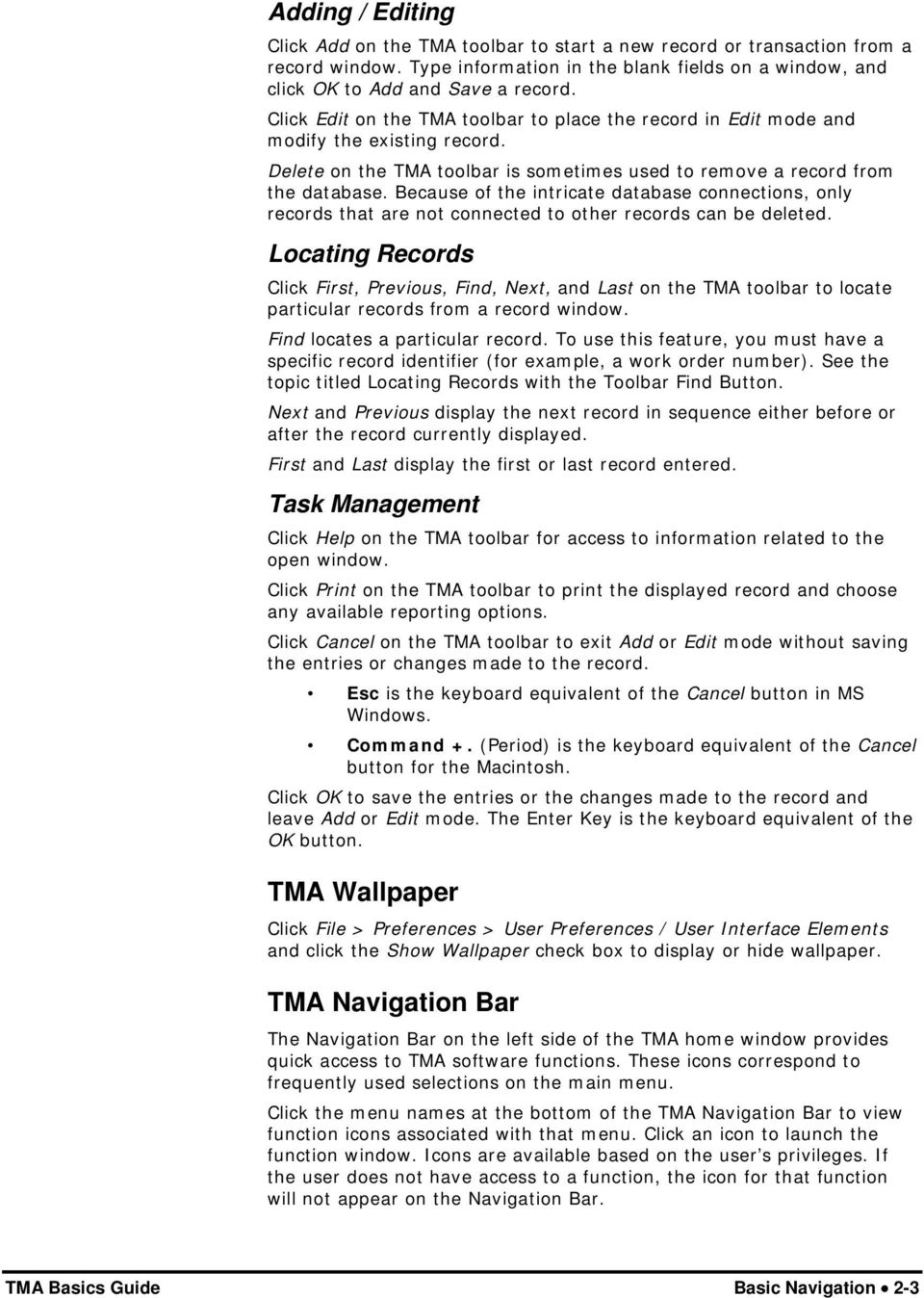
11 The optional Teach Me! menu title bar contains icons for tutorials. Updated copies of the tutorials are also available from For a complete description, see the topic TMA Teach Me! The Navigation Bar is convenient, but the Main Menu is the recommended route to review every aspect of the TMA software. TMA Window Tour Window name Folder Tabs Field names Linked Documents button Other Functions button Subtabs Subtab Pane The name of the selected function. Tabs that open windows containing optional fields of information related to the window. Click a folder Tab for access to the window. Assigned name for a field that occurs in every record in the selected window. Some field names can be changed by the TMA System Administrator. Access point for a list of user-defined files that can be linked to the associated window. Access point for a list of submenus with information and functions related to the window. Access points at the bottom of the window for information and history related to the window. Not all windows include Subtabs. Display area for each Subtab. 2-4 Basic Navigation TMA Basics Guide
12 Viewing Tab Windows Most windows have multiple folder Tabs. Each Tab window contains fields for additional information and options that pertain to a record. To move from one to another, click the Tab. Keyboard shortcut: Ctrl+Tab (Windows) or Command+Tab (Macintosh). This opens Subtab panes as well as upper Tab windows. Moving From Field to Field Press the Tab Key to move the cursor from one field to another. To move in reverse order, hold down the Shift Key and press the Tab Key. TMA software uses the Enter Key to save the current record and change to View mode. View, Edit, or Add Mode The terms View, Edit, and Add mode are used when referring to a window status. View mode. The window is available for viewing only you cannot click in a field or tab from field to field to add or modify information. Rightclick functions are available in View mode, but the Cancel and OK buttons on the TMA toolbar are unavailable. Edit mode. When you click Edit on the TMA toolbar, only Cancel and OK are available. You can click in most of the fields to modify the record. Click Cancel to exit the record without saving any editing changes. Click OK to save the record with changes. Add mode. When you click Add on the TMA toolbar, a new record window opens. Create a new record by adding information to the fields. Only Cancel and OK are available for selection. Click Cancel to exit the record without saving entries. Click OK to save the record as entered. Time Saving Functions The following functions are used to accelerate data entry when locating records or editing data: Find Browse Model Records Locating Records with the Toolbar Find Button When using Find on the TMA toolbar, the search focuses on a particular field within a record. To locate a particular record: 1. Open the desired window such as Work Order. TMA Basics Guide Basic Navigation 2-5
13 2. Click Find on the TMA toolbar. 3. Click the search field such as Work Order #. 4. Type the specific information concerning the record being sought. 5. Click OK on the TMA toolbar. If a record matches the criteria, it is displayed. When using Find, you can identify an indexed field because the mouse pointer changes to an I beam. Locating Records Using the Browse Tab Browse is a means of displaying a list of the records in a Table. You can view records in groups of varying sizes. Use caution before choosing more than a few hundred at a time. If you have many records, loading a large list can take time. Double-click a line to view the full record on the Identity Tab and close the Browse window. The number of records in the available list is indicated by the red number at the lower right corner of the window. 2-6 Basic Navigation TMA Basics Guide

14 Sorting Lists Both selection popup lists and Browse Tabs support columnar sorting. The column with an Up or Down arrow indicates the primary sort column and the direction of the sort. A Down arrow indicates a descending sort (A-Z), and an Up arrow means an ascending sort (Z-A). When you first open the window, the first column displays an ascending sort by default. No Up or Down arrow is shown. Once you click a column, the arrow is displayed to identify it as the sort column. Using Drag-and-Drop with Selection Lists Use the drag-and-drop technique to populate fields from the lists in the selection windows: 1. Click to select a line in the list. 2. Click and hold the mouse button. 3. Drag your selection into the field or list. 4. Release the mouse button to populate the field/list with the selection. Using Auto Find and Wildcards with Selection Lists To use Auto Find in Add or Edit mode: 1. Enter the first few characters in a field. 2. Press the Tab Key. The software automatically populates the field with the closest match to the characters typed. For example, typing Red in the Building field and pressing the Tab Key could locate Redwood Office Park. To use the asterisk ( * ) as a wildcard in an Auto Find on the first column of a selection list: 1. Press the asterisk key on the numeric key pad (do not use the number line above the alpha keys). 2. Type the first few characters of the record you want to find. 3. Press the Tab Key. The software finds the first record with the closest match. Press the Backspace Key to reset a search. TMA Basics Guide Basic Navigation 2-7

15 Asterisk Indicator Adding Records Using the Model Records Feature Model records save time when entering consecutive records that have identical or similar settings. 1. Locate the record that you wish to model. 2. Click the Model records check box on the Identity Tab. 3. Click Add on the TMA toolbar. Some of the data from the selected record are retained in a new record, instead of the usual empty record. 4. Edit fields as required. (Some fields do not allow duplicate data.) 5. Click OK on the TMA toolbar to save the record. TotalView Linked Documents. An asterisk ( * ) automatically displays next to the Linked Documents button when files are linked to a record. The asterisk indicates that additional information is available. Estimates. An asterisk indicates that an estimate has been completed and saved in the Advanced Estimates window (WorkGroup and Enterprise only). TotalView is a tree list accessed from the File menu or by pressing the F4 function key. It is somewhat like a table of contents or directory. It displays the data structure of the TMA software. There are seven initial Views to open: 2-8 Basic Navigation TMA Basics Guide

16 Location View Item View Click the plus sign to expand the tree from Facility, to Building or Entity to Area and items. Click the plus sign to expand the tree from any type of item to specific items. You can only zoom to the Equipment Type categories linked to your repair center (if Equipment Types are linked to a specific repair center). This is true regardless of the repair center designated for the individual equipment items. HR View Click the plus sign to expand the tree from Shop, to Trade to individual Technician. Materials View Click the plus sign to expand the tree from Warehouse or Part Types to Parts records. Project View Utility View Department View Click the plus sign to expand the tree from Project Type to Project, Project Tasks, Requisitions and Work Orders. Click the plus sign to expand the tree to the Facility or Utility. Right-click on an icon for context menu options. These vary depending on the item. Click the plus sign to expand the tree to view the various Departments and related Items. Right-click an icon for context menu options. These vary depending on the Department. Right-click an icon in TotalView for related options: Zoom (to record) History (of work) Send (to technician) Create a work order Click the minus sign to close a cascade list from one of the views. Access for TotalView is set from Admin > Security > Users / Privileges Tab File-TotalView check box. Zoom access to connected records via TotalView is restricted by repair center access and regulated by normal User Privilege controls. The Asset and Tools functions are only available in WorkGroup and Enterprise versions. Common Features and Functions Some features and functions are common to most windows in the TMA software. TMA Basics Guide Basic Navigation 2-9

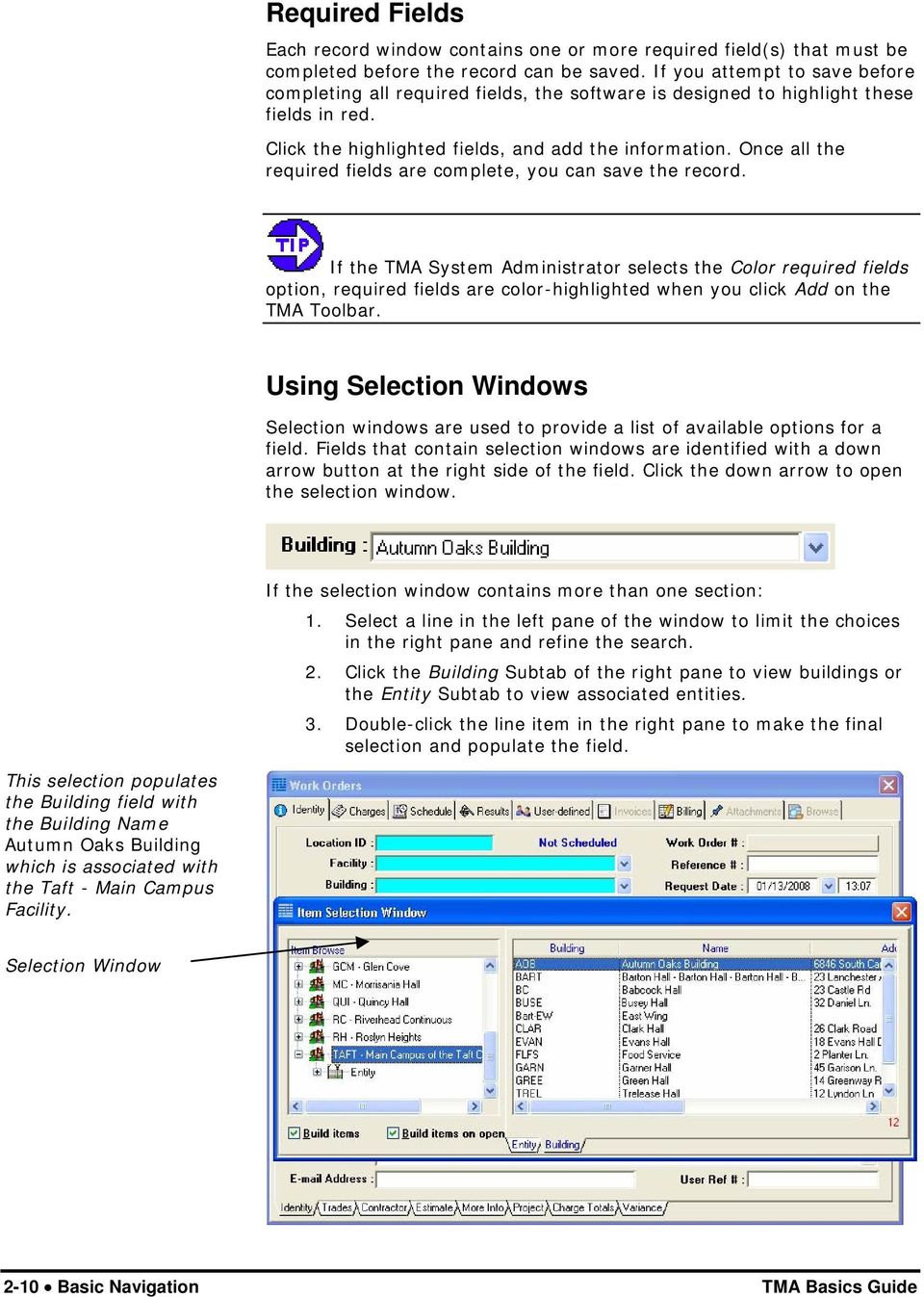
17 Required Fields Each record window contains one or more required field(s) that must be completed before the record can be saved. If you attempt to save before completing all required fields, the software is designed to highlight these fields in red. Click the highlighted fields, and add the information. Once all the required fields are complete, you can save the record. If the TMA System Administrator selects the Color required fields option, required fields are color-highlighted when you click Add on the TMA Toolbar. Using Selection Windows Selection windows are used to provide a list of available options for a field. Fields that contain selection windows are identified with a down arrow button at the right side of the field. Click the down arrow to open the selection window. This selection populates the Building field with the Building Name Autumn Oaks Building which is associated with the Taft - Main Campus Facility. If the selection window contains more than one section: 1. Select a line in the left pane of the window to limit the choices in the right pane and refine the search. 2. Click the Building Subtab of the right pane to view buildings or the Entity Subtab to view associated entities. 3. Double-click the line item in the right pane to make the final selection and populate the field. Selection Window 2-10 Basic Navigation TMA Basics Guide
18 Adding Records 1. Click the Main Menu or Navigation icon to open the window for the new record. 2. Click Add on the TMA toolbar. This places the cursor in the first field of the window. 3. Type or select the information. A down arrow indicates that a selection window is available to assist with choosing the correct entry if fields are linked to other files. 4. Press the Tab Key to move to the next field (or place your cursor in the field). 5. Type the information. 6. Press the Enter Key or click OK on the TMA toolbar to save the record. Some fields are required and must be completed to save the record. Not every field must be completed when adding a new record. An option in Organization > Repair Center > Records / Preferences is available to color-highlight required fields when you click Add. Editing Records 1. Open the desired function window. 2. Locate the specific record. 3. Click Edit on the TMA toolbar. The cursor is automatically positioned in the first editable field. 4. Modify the desired fields. 5. Use the Tab Key to move from field to field, or click in the field you want to edit. 6. Click OK on the TMA toolbar to save the revisions. Deleting Records 1. Open the desired function window. 2. Locate the specific record. 3. Click Delete on the TMA toolbar. If the record is linked to other records, a message indicates that you cannot delete the record. If there are no links or history affected, a prompt asks you to confirm deletion. 4. Click Yes to delete the record. On many windows in the TMA software you see an Active check box. On new records, this check box is marked by default. Since most records cannot be deleted because of links or history, they can be made inactive to remove them from lists and reports. In Add or Edit mode, click the box to clear it and make the record inactive. TMA Basics Guide Basic Navigation 2-11

19 Right-Click (Option Click for Macintosh) Numerous shortcuts are embedded in TMA software; they are accessed by a right-click (Option+click for the Macintosh). In addition to right-click context menus, many fields feature the rightclick. For example: Work Order Location ID or Tag Number field for zoom and reporting options. Work Order Almost any field or check box related to batch print, browse, create confirmations, and individual billing options on any of the Tabs. Work Order Browse Any line to assign technicians. Building Record Facility field for zoom to the facility record or building history report. Area Record Building field for zoom to the building record or area history report. On the Subtab pane, right-click an item in the list to create a work order or access the Model Records function. Location ID Field Area, equipment, asset, vehicle, group, tool, and entity to create a work order from the record window. Tag No. Field Equipment, asset, vehicle, tool, group to create a work order from the record window. Other areas also use a right-click to access hidden options. If in doubt, give it a try. Using Date Shortcuts To include date information in TMA software: Day/Month shortcut for dates in the current year, type the month and day, for example 0708 for July 8. Be sure to include the leading zeros for single digit days and months. If you use the European date format (day/month), use the day/month sequence. In the previous example, Day shortcut for days in the current month, type the day (numerical), and tab out of the field. No leading zeros are needed with this option. When you tab out of the field, TMA completes the full date. Calendar date look-up click the down arrow to open the calendar window. Double-click the day on the desired month/year to select the date from the calendar page. Cut, Copy, and Paste TMA software supports the Microsoft Windows standard cut, copy, and paste of text to and from fields in the application. Linked Documents Click the Linked Documents button to access and create links between the TMA window and other files such as spreadsheets, graphics, documents, etc. created with external applications. Files are launched from the Linked Documents window in the correct application with full editing and formatting functionality Basic Navigation TMA Basics Guide

20 The application used to create the selected file must be installed on or available to the TMA workstation in order to launch a file using the Linked Documents button. Creating a Document Link 1. Locate the record you want to link. 2. Click the Linked Documents button. 3. Click Add on the TMA toolbar when the Linked Documents window opens. 4. Type information in the three required fields: Name: Type a name to identify the link. The name entered here does not have to match the actual file name. Path: This is the path to the file. TMA software cannot launch the file unless the path and file name are valid. Click the Path button to open the Select Import File window and browse for the file; double-click the file name to load the path. Type: Select a File Type. These categories are specific to your business needs. If the desired File Type has not yet been established, it can be created on-the-fly from the Document Types List window. At least one Type must exist for this window to display. 4. (Optional) Use the selection list to choose from a predefined set of Applications. This identifies the program associated with the file. 5. (Optional) Locate the correct program 6. (Optional) Double-click to select. The field is for information only, but specifying an application helps other users locate the appropriate file. 7. Click OK on the TMA toolbar to save the link. The linked document Name and Type is shown in the read-only section of the window. 8. Repeat steps 2-7 to create additional links to other files. An asterisk is displayed next to the Linked Documents button on the Identity Tab if a record has Linked Documents. Viewing an Existing Linked Document 1. Click the Linked Documents button. 2. Double-click the line item in the list of linked files to launch the non-tma application and the file. You can modify the file if you do not have another copy of the non-tma application open. 3. Save the modified file with a new name. After saving, this new file must be linked using the steps outlined in Creating a Document Link above. If you purchased the TMA CAFM option, you can view the file with CAFM by clicking the View Document with TMA CAFM button. Once launched, TMA Basics Guide Basic Navigation 2-13

21 the file displays in a window over the linked record. Reposition the window as needed for optimal viewing. Viewing tools and options are available for use with the file from within the CAFM Module as well. For AutoCAD drawings, menus and tools are visible on the window to perform many drawing functions such as Zoom Extents and Leader Notes. Information about Editing and Deleting Document Links is found in the Standard Functions chapter of the TMA User Guide. Files launched in other applications (such as Microsoft Word or Excel) are not released until the current TMA function window, i.e., Work Order, Vendors, Equipment, etc., is closed. Other Functions Button A list of submenus that offer additional information and reports related to the item record is visible when you click the Other Functions button on a record. Specific details about features on the submenu can be found in the Standard Functions chapter of the TMA User Guide. Subtabs Detailed information specific to the open record is displayed on the Subtab panes. Subtabs vary with the item being viewed. The Subtab panes for each window containing this feature are described in the TMA User Guide. Report Options Click Print on the TMA toolbar to see options for various reports including record lists and detail sheets to view or print. These reports vary depending on the window. Printing The software offers to print a work order when you click OK to save the record if your repair center has the option Prompt for print selected. You can click Print on the TMA toolbar if you do not receive a prompt to print. The Report Destination window displays several options: 2-14 Basic Navigation TMA Basics Guide
22 Printer: The work order prints to your system default printer. Screen: A copy of the work order displays on your monitor with an icon on the title bar to send to the printer. Double-click your destination preference. (Other print options are described in the TMA User Guide.) Help Functions The TMA software provides help on several levels from broad to specific. Field Help Message The field help message gives you indispensable online help and information about a specific field. This feature is cursor sensitive. Move the cursor over a field and watch for a "popup" help message related to that field. You can use the technique on fields, check boxes, or radio buttons. Descriptive information regarding their operation, requirements, or purpose is displayed. On-Line Help Select Help > TMA Help from the Main Menu for the TMA User's Guide. The entire manual is available online with full contents, index, and search capabilities available. TMA Teach Me! Brief audio-visual tutorials of some of the primary TMA software functions are available if installed from the TMA installation CD. Click Teach Me! on the TMA Navigation bar, then click one of the icons to start a.wmv tutorial of the related TMA software function. Tutorial files are launched in the Windows Media Player and should be viewed in full screen to prevent distortion. Note that Windows Media Viewer is the only application that will play.wmv files. Updated copies of the tutorials are also available from After you log in, click the Download link in the On-Line Tutorials paragraph. When you click a.wmv file name, it is TMA Basics Guide Basic Navigation 2-15
23 launched. You may need to set different options in Internet Explorer so you can choose Windows Media Player as the viewer and set it to full screen. Exiting TMA Exit the TMA software using File > Quit at the end of operations. Failure to exit properly can cause serious problems. Closing the Program Always close TMA software before you leave for the day, and be certain to the use the File > Quit command to do this. Daily backup of data is usually made after regular business hours, but the backup may fail if any users are logged in when the operation is performed. If a user is logged in during records processing, data can be lost or corrupted. Data corruption is not immediately detected and may be compounded with additional data transactions. If TMA Locks Up Contact your TMA System Administrator immediately if the TMA software locks up, e.g., you cannot enter data or exit the current window during the processing of records. In the interim, try the following keyboard options in the order listed to attempt to remedy the problem: 1. Press the Esc (Escape) Key on your keyboard. 2. Press Ctrl + Break 3. Press Ctrl + Alt + Delete Be prepared to tell the TMA System Administrator exactly what actions you were taking in detail when the system shut down or locked up Basic Navigation TMA Basics Guide
24 Chapter 3 Creating a Basic Work Order Overview Work orders form the heart of TMA transactions. When a request is received for a maintenance task or when planned maintenance is due, a work order is created using TMA software. Using information included in the work order windows, you can track: Labor costs Material costs and other charges Payments received Billing information Safety and risk factors Creating a Basic Work Order Required Fields Path: Transactions > Work Order > Records / Identity Tab All that's needed to create a new a work order is data in the required fields. (This assumes that the System Administrator has set up the TMA Basics Guide Creating a Basic Work Order 3-1
25 Lookups records that are related to the required fields of the Work Order window.) Required fields for the Work Order and the associated record are: Field Name Description Related Records Location ID Building Area Task Trade Combination of Building Code and Area number Location (hierarchy level 2) Location (hierarchy level 3) Defines what needs to be done Identifies the Trade that will perform the work Building and Area Building (Organization > Building) Area (Organization > Area) Task Library (Organization > Task) Trade (Organization > Lookups) Work order numbers are assigned by TMA when all required fields are completed and the record is saved, that is, when you click OK on the TMA toolbar. How to Create a Work Order Path: Transactions > Work Order > Records / Identity Tab 1. Open the Work Order window. You can do this in several ways, such as, click the icon on the Navigation Bar, follow the menu path, or use the keyboard shortcuts Ctrl+M (Windows) or Command+M (Macintosh). 2. Click Add on the TMA toolbar. Required fields may show a colorhighlighted background until they contain data. This option is selected for your repair center by the TMA System Administrator. 3. Type the Location ID, or if you don t know the ID, tab out and complete the Building and Area fields. 4. Type or select the Building. If the Location ID field was completed, this field is populated automatically. 5. Type or select the Area number. If you use a selection window, you can double-click to transfer information to the field. The Location ID field is also populated if previously left blank. If the Location ID field has been completed, the Area field is populated automatically. 6. The Date/Time, Priority, Repair Center, Type, and Charge fields are completed by default, but you can make changes. Select (highlight) the information in these fields to type your changes, or click the down arrow to choose different data. Date/Time defaults to the date of the system clock and initiates the elapsed time displayed on the Results Tab. Priority defines the urgency of the work order compared to other scheduled work. Repair Center is that of the user logged into TMA. 3-2 Creating a Basic Work Order TMA Basics Guide
26 Type refers to the category of the work order, such as a PM work order or a safety-related work order, etc. Charge indicates whether or not the work will be billed to another department. The default is NO or YES, depending on a selection in your Repair Center / Preferences. 7. Type or select a Task Code. If you choose from the Task Selection Window, use of the Add Task Type or Code buttons is restricted. 8. Type or select a Trade. Some task types are linked to a trade. If a trade is associated with the task, the Trade field is completed by default. 9. Double-click the desired Trade on the popup window. Use the Trades Subtab to add additional trades. When more than one trade is selected, the work order is called a multitrade work order. (See the TMA User Guide for more information on multi-trade work orders.) Additional information about the requested work can be added in the Request field and is printed on the work order. 10. Click OK on the TMA toolbar to save. TMA Basics Guide Creating a Basic Work Order 3-3
27 If prompted to print the work order, follow your company s policy and click Yes or No. Creating a Basic Work Order Elective Fields Path: Transactions > Work Order > Records / Identity Tab It is best to complete as many of the optional fields as possible. Information in these fields is useful for follow-up work. Requester - The name of the person who made the request. Ph - The phone number of the requester. Acct # - The account number to be charged (if the work order is chargeable). Item # (Equipment#, Asset#, etc.) The ID of a hard asset. Hard assets (e.g., equipment, vehicle, etc.) have an identification number. A blank Item # field indicates this is a work order for the identified space rather than for a specific item. Change the dynamic label by clicking the down arrow adjacent to the label and selecting from the context menu: Click the down arrow at the right side of the field for selections of item # and type. (See the topic Using the Item Selection Window for details.) Reference # The number that is converted from the request log. If a work order is converted from a request, this field contains the request number. If blank, this alphanumeric field can be used as an internal reference. Estimated Start / Estimated End - The dates a work order is assigned to a technician and completion is expected. Status - An explanation of the work order progress. If the work order is to remain open, click the down arrow and select a status. Request Additional information that is printed on the work order. The task code description appears by default, but you can type more details about the job. Information in this field is printed on the work order. The following options are available for WorkGroup and Enterprise users only: Contractor Subtab - The name of an independent contractor, if used. For additional information see Contract Management in the TMA User Guide. Project # The number of the related project. Click the down arrow to select or create a project associated with the work order. This field is automatically populated if a project activity is converted to a work order from the Project window. Using the Item Selection Window After you click the down arrow in the Item # field: 1. Click the appropriate radio button on the Item Selection Window to view a list of corresponding types. 3-4 Creating a Basic Work Order TMA Basics Guide
28 2. Select either a specific type or All types to see related Item # and Description. 3. Double-click the line item of your choice in the lower pane. (If the Work Order Building/Area fields are complete, the Item Selection Window list only includes items linked to the Area identified on the Work Order.) Entities are not associated with a specific building or area. If the Entity radio button is selected for the search, the software displays all entity items connected to the same facility linked to the building and area on the work order. Report Options from the Report Manager Path: Reports > Report Manager This is not a complete list of work order reports available from the Report Manager window, but these are the more frequently used reports. Management Reports Path: Reports > Report Manager / Management Work Order Analysis by Type A summary of all work orders by type, showing total quantity issued vs. total quantity and total hours completed. Information available: work order type, # issued, # completed, and total hours. Search based on request date. Work Order Completion Summary A summary of all complete work orders. Information available: work order type, priority of work, # of Work Orders, labor cost, material cost, and total cost. Options: By selected repair center or all repair centers. Date range selection available based on the Complete Date field. TMA Basics Guide Creating a Basic Work Order 3-5
29 Work Order Received A list of work orders received during a specified time frame. Work Order Statistics Detail A detailed list of work orders sorted by building and subtotaled by facility and repair center. This report includes work type detail. Work Order Status by Facility A summary list of all work orders, open and closed, subtotaled by repair center, including a breakdown by facility. Options: By selected repair center or all repair centers. Date range selection based on open and completion date. Work Order Status by Repair Center A summary list of all work orders, open and complete, subtotaled by repair center. Work orders qualify if the Request Date or Complete Date falls within the date range specified. Status Reports Path: Reports > Report Manager / Status Work Order Aging List Sorted By Date A list of all open work orders grouped by type and sorted by date. Work Order Aging List Sorted By Facility A list of open work orders requested within a specified date range, sorted by facility. Information includes work order #, requested date, task code, task description, status, location id, building, estimated time, and estimated cost. Report options: By selected Repair center or all repair centers. For all locations in the selected facility or selected building. Work Order Aging List Sorted By Technician A list of all open work orders for a specified date range, for one or all technicians. Work Order Aging List Sorted By Trade A list of all open work orders sorted by date and grouped by trade. The report can be limited to one trade and repair center. 3-6 Creating a Basic Work Order TMA Basics Guide
30 Chapter 4 Scheduling and Assigning Work Orders Overview Assigning the open work order to a technician or group of technicians is the next step in creating a work order. One of the benefits of TMA software is the ability to review unassigned work orders either on a broad or a specific basis. You can request a list of all unassigned work orders or refine your search to specific criteria based on repair center, shop, trade, shift, and/or work order type. Scheduled Work Orders Work orders are identified for scheduling and reporting purposes as Not Scheduled or Scheduled. The assignment status is noted on each Tab of the Work Order window. TMA Basics Guide Schedule Work Orders 4-1
31 Whether you assign a technician from the Schedule Tab or from the TMA Scheduler window, the work order reflects the term Scheduled. Using TMA Scheduler Use the Scheduler window to assign multiple work orders and/or multiple technicians at one time. Two steps are involved in this process: 1. Determine the criteria for the work orders you want to review for assignment. 2. Assign technician(s) to the work order(s) for the date the work is to be done. Searching for Unassigned Work Orders Path: Transactions > Time Manager > Scheduler The following steps take you through the process of finding work orders that need to be assigned to a technician based on the selection criteria you determine. 4-2 Schedule Work Orders TMA Basics Guide
32 1. Open the Scheduler window using the keyboard shortcut Ctrl+Shift+Q (Windows) Command+Shift+Q (Macintosh) or the menu path. The Scheduling Criteria dialog box is active when you open the Scheduler window. The Scheduler window itself is inactive in the background. 2. Make your criteria selections on the Scheduling Criteria dialog box (detailed in steps 3 7). 3. Select a Zone if you want to search zones. The default is All Zones. The use of zones is optional in TMA software. 4. Select a Shop. The default is All Shops. The use of shops is optional in TMA software. 5. Select a Shift if you wish to search by shifts. 6. Click the Trades you want to search or All Trades. TMA Basics Guide Schedule Work Orders 4-3
33 7. Click the Work Order Types or select All Types. 8. Click OK on the TMA toolbar to close the Scheduling criteria window and start the search. Once the work order list is generated, you can assign technicians to perform the work. Assigning a Work Order from Scheduler Path: Transactions > Time Manager > Scheduler The Scheduler window is enabled after you: Make selections in the Scheduling Criteria window Click OK on the TMA toolbar To review a read-only copy of a specific work order, double-click the work order line in the Unscheduled Work section of the Scheduler window. One or more technicians or crews can be assigned to one or more work orders in a simple drag-and-drop action. 1. Select a Technician or Crew line. 2. Click-and-drag to the desired Work Order line. When you release the mouse button, the assigned technician(s), the work order number, and a colored bar display in the Gantt View. If a work order has been scheduled for the technician in advance, the work will also be displayed in the Gantt Chart pane. Lunch Periods. The lunch period will display only when lunch is scheduled and occurs entirely within the shift. Therefore, the lunch period will not display if it: starts before the beginning of the shift ends after the shift is finished has the same start and end times (i.e., no lunch) 4-4 Schedule Work Orders TMA Basics Guide
34 Estimated hours for a work order are pulled from an estimate if one was created for the work order. Hours can also derive from the PM Scheduler window if the Est. Time field is completed for the task. Click the Cancel button on the TMA toolbar to exit the Scheduler window. When you close the window, a message offers the option to batch print the scheduled work orders. Select Yes or No depending on your organization s procedures. Viewing Workload from the Scheduler Path: Transactions > Time Manager > Scheduler To review a technician's work schedule on a daily, weekly, or monthly basis from the Scheduler window, follow these steps: 1. Select the Technician whose workload you want to review. 2. Click the Workload Subtab below the technician names. 3. Click the Daily, Weekly, or Monthly Subtab under the right pane. 4. On the Calendar, click the workload date you want to view to display color bars that represent assigned work orders and the start/end time. 5. Double-click the bar to view details of the work order. Assigning a Work Order from the Work Order Window Technicians can also be assigned from the Schedule Tab of the Work Order window using the following instructions. Making Assignments from the Work Order Schedule Tab Path: Transactions > Work Order > Records / Schedule Tab 1. Open the Work Order window. 2. Locate the work order you wish to assign. 3. Click Edit on the TMA Toolbar. 4. Click the Schedule Tab. 5. Type or select the ID Code / Name. It is not a requirement that the selected technician belong to the trade assigned with the work order. 6. Type the Start Date / Time. 7. Click OK on the TMA Toolbar. Making Assignments Using a Keyboard Shortcut Path: Transactions > Work Order > Records / Identity tab 1. Open the Work Order window. 2. Locate the work order you wish to assign. 3. Click Edit on the TMA Toolbar. TMA Basics Guide Schedule Work Orders 4-5
35 4. Use the keyboard shortcut, Ctrl+Shift+S (Windows) or Command+Shift+S (Macintosh), to open the Technician Selection window. 5. Double-click to select the technician you want to assign. The selected technician is added to the ID Code/Name fields of the Schedule Tab with the current date in the Start Date/Time fields. 6. Click OK on the TMA toolbar to save the record. 4-6 Schedule Work Orders TMA Basics Guide
36 Chapter 5 Printing Work Orders General Print Information Work orders can be printed using three different methods: Individually (from Work Order or Work Order Browse windows) Batch (from Work Order Browse or Batch Print windows) Batch Print Override (from Batch Print window) Printing Individual Work Orders The individual print option allows you to find and print a single work order. Printing from the Work Order Window Path: Transactions > Work Order > Records Follow these step-by-step instructions to print one Work Order. 1. Open the Work Order window. 2. Locate the work order you wish to print. 3. Click Print on the TMA toolbar. 4. Click the destination icon of your choice on the Report Destination window. 5. Click the OK button on the window. Keyboard Shortcut: Ctrl+Shift+R (Windows) or Command+Shift+R (Macintosh) from the Work Order window opens the Print Setup window to allow you to select a specific printer or print source. Printing from Work Order Browse Path: Transactions > Work Order > Browse Single or multiple work orders may be printed from the Work Order Browse window. 1. Highlight the Work Orders to be printed. TMA Basics Guide Printing Work Orders 5-1
37 2. Click the Batch Print button at the lower right of the screen. To print selected lines in the list: 1. Highlight the first line. 2. Press and hold the Control key. 3. Click each line item desired. 4. Click the Batch Print button at the lower right of the screen. To print the entire list: 1. Highlight the first line. 2. Press and hold the Shift key. 3. Click the last line in the list. This action highlights all lines between the first and last. 4. Click the Batch Print button at the lower right of the screen. Batch Printing The default Batch Print option will print any open work orders that have not been printed in the past. Batch Printing Work Orders Path: Transactions > Work Order > Batch Print The batch print option will print any open work orders. If you select the Re-print work orders previously printed check box, work orders that have been printed in the past and meet the selection criteria can be reprinted. The selection choices are By request date or By schedule date for Trade, Work Order Type, and Repair Center. 5-2 Printing Work Orders TMA Basics Guide
38 Schedule date is the date the work order was assigned. The Request Date field on the Work Order / Identity Tab reflects the date the request or work order was initiated. Step-by-Step Batch Printing Path: Transactions > Work Order > Batch Print 1. Follow the menu path. 2. Click the Individual Work Orders or Work Order Listing radio button on the Report options window. 3. Click OK on the TMA toolbar. 4. Select the desired output (Printer, Screen, etc.). 5. Click OK on the TMA toolbar. 6. Select the Starting Date and Ending Date of Work Orders to print. 7. Click the radio button of your choice By request date or By schedule date. 8. (Optional) Mark the Print all copies for multi-trade work order to print multiple copies for the work that qualifies. 9. Select the Trade or All Trades. 10. Select the WO Type or All Types. 11. Select the Repair Center or All Repair Ctrs if available. 12. Click OK on the TMA toolbar to open the Sort Options window. 13 Choose the appropriate sort order. TMA Basics Guide Printing Work Orders 5-3
39 Reprinting Work Orders 14. Click OK the TMA toolbar. To print previously printed work orders, see the next topic, Reprinting Work Orders. You can reprint work orders for different criteria. Reprinting Previously Printed Work Orders Path: Transactions > Work Order > Batch Print The Re-print items previously printed check box prints all open work orders that meet the criteria you specify including those printed in the past. This feature offers more selection criteria compared to the options on the Batch Print Override Subtab, which is limited to a range of work order numbers. 1. Follow instructions in the Step-by-Step Batch Printing topic on the previous page. 2. Click the Re-print items previously printed check box. 3. Continue with the Step-by-Step Batch Printing process. Using Batch Print Override Path: Transactions > Work Order > Batch Print The Batch Print Override options print all work orders within a specified work order number range including those printed in the past. This option is less targeted than using the Re-print check box. 1. Click the Batch Print Override Subtab. 2. Select the Repair Center. This is required. TMA express users are limited to a single repair center. Therefore, they have only one option. 3. Type the Starting # and Ending # in a series. To print a single work order, use the same work order number in both fields. 5-4 Printing Work Orders TMA Basics Guide
40 4. (Optional) Click the Print all copies for multi-trade work check box. This option will print a copy of the work order for each trade scheduled on a multi-trade work order. 5. (Optional) Click the Include Details check box. 6. Click OK on the TMA toolbar. 7. Select the sort order or accept the default. 8. Click OK on the TMA toolbar to print the work orders. TMA Basics Guide Printing Work Orders 5-5
41 Chapter 6 Work Order Browse Reviewing Work Orders Work Order Browse Sometimes you need to review both open and closed work orders created with TMA software. From the Work Order Browse window you can set the criteria you want to review and sort the work orders based on a number of available options. You can also: View work order details Zoom directly to the work order Print the entire Browse list Using Work Order Browse Path: Transactions > Work Order > Browse TMA Basics Guide Work Order Browse 6-1
42 The Work Order Browse filters can yield very broad or very narrow results, depending on how many of the optional selections you choose. For example, you can browse for all work orders written for a facility during a long time period, or you can search for work orders scheduled for a particular technician of a specific type. The broader your search, the longer it can take to generate the browse list. 1. Open the Browse Selection Criteria dialog box (Transactions > Work Order > Browse). 2. Select the Beginning Date and Ending Date fields for the date range. You can also click the Today button, and select a range such as Today, Yesterday, This month, etc. 3. Select a Work Order Type. 4. Click the desired radio button to see Work Orders By Request Date, By Complete Date, or By Finish Date. 5. Click the down arrow in the default Select Facility field to select from Building, Area, Zone, or item (equipment, tools, etc.) to narrow the search. Depending on your selection, subsequent fields are available to further refine the search. Example: If you seek work orders for a specific item number such as equipment, type the number in the next field or click the down arrow to make a selection. The filtering feature of the selection window allows you to focus on the area or item of interest and reduce the time required to generate the list. 6. Select your choice in the Open Only and Finished or Not Finished fields. 7. (Optional) Type or select a Technician or Crew ID. The Schedules and Labor check boxes relate to the Technician. Hold the mouse pointer over the two check boxes for definitions. The Retrieve shop and contractor info check box adds more detail to the Browse; however, it can slow the progress of generating the Browse list. 8. (Optional) Select your choice of Task, Department, Shop, Trade, and Repair Center. The default Repair Center is limited to the user who is logged in. If you have TMA Dispatcher access, click the down arrow to select your choice. 9. Click OK on the TMA toolbar to start the search. 6-2 Work Order Browse TMA Basics Guide
43 A work order marked Finish indicates the work was done, but some requirements need attention before closing the request. A Complete work order is closed with no outstanding requirements. Sorting the Work Order Browse List Two buttons are located at the bottom of the window and are labeled Sort Fields and User-Defined Sort. Click the Sort Fields button to select one or more choices from the list of column headings. As soon as you make a selection from the list, the Browse window line items are sorted. Click the button to the right of the Sort Fields button (the default name for the button is <<< User-Defined Sort) to sort by one of the following predefined groupings: Repair Center, Facility, Department, Building Department, Work Order # Supervisor, Trade, Priority, Date Trade, Priority, Date To enable to the Sort Fields button once more, click the User-Defined Sort button (the name of a predefined group may be displayed but it's also the User-Defined Sort button), and select the first option <<< User- Defined Sort on the list. Removing Entries from the Browse List To remove selected work orders from the browse list, highlight the work order line item on the list, and click the Remove button. Using the Remove button does not delete the work order record from the database; it merely eliminates it from the browse list. Work Order Browse Context Menu Options When you select a line or multiple line items in the Work Order Browse window, you have the following options on a right-click context menu: Work Order to Technician Schedule Selected Work Order Update Selected Work Order as Completed (closed) Change Status On Selected Work Order to the Technician If settings have been established for your repair center, you can the assignment to technicians from the Work Order Browse list. TMA Basics Guide Work Order Browse 6-3
44 The function must be part of the setup for the repair center. Also, addresses for technicians must be included in the Technicians window (Organization > Repair Center > Technicians). To use 1. Highlight a line in the list. 2. Right-click the selected line for a context menu. Note: If the work order has not been assigned, the system includes the line No Technician Scheduled. 3. Select Work Order To:[technician name]. If the work order is assigned to more than one technician, you can also select Work Order To:All technicians. 4. Click your selection to send the message. When you click your selection, an window opens with the address of the technicians. The work order number is shown in the Subject field, and work order information is in the message body field. The From address is established in Organization > Repair Center / Configuration Tab. Schedule Selected Work Order 1. Highlight a line item in the list. 2. Right-click the selected line. 3. Select Schedule Selected Work Order. 4. Select a Technician or Crew from the Select Technician window. 5. Double-click to schedule the selected Technician or Crew. When the Select Technician window closes, the assignment is made. Complete Selected Work Order 1. Highlight a line item in the list. 6-4 Work Order Browse TMA Basics Guide
45 2. Right-click the selected line. 3. Select Update Selected Work Order As Complete. 4. Click Yes on the message box if you want to close the work order. The work order is closed and the Work Order Browse window reflects the current date as the Complete Date. Change Status on Selected Work Order 1. Highlight a line item in the list. 2. Right-click the selected line. 3. Select Change Status On Selected Work Order. 4. Select the status on the Work Order Status window. 5. Click OK on the TMA toolbar. 6. Scroll to the right. The status is displayed in the column labeled Hours / Status. When you change the status from work order browse, the work order record is also updated. If you zoom to the Work Order window from the Browse window, you will see the new status displayed in the Status field. TMA Basics Guide Work Order Browse 6-5
46 Viewing Details of the Work Order To see the details of a particular work order without exiting the Browse window, click the Show Detail button. Items such as Action Requested, Task Code, and Location are available on the Work Order Detail window. The Zoom button is available on both the browse list and the Work Order Detail window. Zooming to the work order closes the Browse list window and opens the Work Order window. On the browse list, select a line item and click the WO Zoom button or double-click a line item in the list to open the Work Order window. Click the Zoom button on the Work Order Detail window to view the actual record. Making a New Browse Selection The software retains the last browse selection until you log off from TMA or generate a new list. For example, if you make a browse selection and close the Browse window to work on a different module or if you choose Zoom to view a work order, the same browse selection opens when you return to the Work Order Browse window. To make a new browse selection: 1. Click the New Browse Selection button. 2. Change the desired fields on the Browse Selection Criteria window. 3. Click OK on the TMA toolbar to start the new search. 6-6 Work Order Browse TMA Basics Guide
47 Printing Work Orders from Work Order Browse You can print specific lines or all lines from the browse list. Selected lines in the list. Highlight the first line, press and hold the Control key, and click each line item desired. Click the Batch Print button. Entire list. Highlight the first line, press and hold the Shift key, and click the last line in the list. This action highlights all lines between the first and last line selected. Click the Batch Print button. Printing a Work Order Browse Report Two reports on the items displayed in the Work Order Browse window can be printed directly from the window. Check boxes located below the list provide the choices. The buttons are: Include Additional Info Include Action Requested on Report Generate the browse list and check one or both of the report choices. To print the report: 1. Click Print on the TMA toolbar. 2. Choose the desired print option (screen, printer, etc.). 3. Click OK on the TMA toolbar. Example of Include Action Requested Report The Show Action Requested option includes the instructions typed in the Action Requested field on the Work Order > Identity Tab but does not show the Job Code/Description. Example of Include Additional Info Include Additional Info prints the task code and corresponding description, but does not include the action requested. If you select both check boxes, you can see both the request and the task code. TMA Basics Guide Work Order Browse 6-7
48 Chapter 7 Recording Work Order Time Overview There are several ways to record the amount of time worked in connection with a work order. This Basics Guide covers the use of two: Quick-Post Time & Labor Work Order / Charges Tab Recording Work Order Time Quick-Post Time & Labor Path: Transactions > Quick-Post > Time and Labor Use the Quick-Post modules to record work order time in a batch format. This saves data entry time because data is entered without opening and closing individual work orders. Use the Quick Post Time & Labor module to enter work order information such as: Who performed the task When the work was done TMA Basics Guide Work Order Time 7-1
49 Amount of time required Labor account number Complete date Corrective action The fields that must be completed depend on the type of work order, but a minimum number are always required. These are listed in the following topic, Using Quick-Post Time & Labor. Technicians indirect time such as meetings, sick time, etc. can also be entered from this window. The posting list generated on these windows is not saved until you click OK on the TMA toolbar. Be certain to save your work every 8-10 lines. Using Quick-Post Time & Labor Path: Transactions > Quick-Post > Time & Labor 1. Follow the menu path to open the window. 2. Type the Work Order #. If no work order number is entered in this field, only indirect time can be posted. To view and select from a list of open work orders, type /R and tab out of the field. (Other shortcut keys include: /E for a list of equipment work orders, /A for assets, /V for vehicles, /G for groups, and /T for tools.) 3. Type or select the Technician #. This is the ID of the technician who performed the work. 4. Tab out of the Technician # field. The Date of Work field defaults to one day prior to the current date. Select a different date if needed. 5. Type the number of Hours and Start Time. The default format for the Start Time field is military (24 hour) time. The Start time check box next to the Comment button indicates whether the Start Time field is available. To enable the option, click the check box. If the Start Time check box is blank, the cursor skips the Start Time field. The Approved check box is used by those who have rights to approve time cards. 6. Type or select the Type Hrs (Regular Time, Overtime, Travel). The default for this field is the time type of the selected work order. 7. Accept the default Shift (defaults from the technician's personnel record), or type a different Shift code. 8. Type the desired Complete? field option to close the work order. Options are: N - do not close the work order (the default) Y - close the work order C - close only the current trade (for multi-trade WO) The software displays the current work order trade in the Quick-Post window. When C is selected, only the specific trade is closed. When a work order number is typed in the field later, 7-2 Work Order Time TMA Basics Guide
50 the next trade (that follows the closed trade) is displayed on the Quick-Post window. 9. Tab through the Date / Time Closed fields to show the current date and time if Y or C is typed in step 8, or type the desired close date and time. 10. Tab out of the Time Closed field to clear the screen and create another active data line, unless the work order is chargeable. If chargeable, press the Tab Key to move the cursor into the Account field (See QP Time & Labor - Optional Fields). An account number must be entered before the transaction can be saved. 11. Click OK on the TMA toolbar to save your work. Until you actively save the input, it is not recorded. This should be done every 8-10 lines. 12. Click Cancel on the TMA toolbar when all entries are saved. Quick-Post Time & Labor Optional Fields Path: Transactions > Quick-Post > Time & Labor Account # - If the work order is chargeable, type or select the TMA account # responsible for providing the work. This is not the number from the Work Order / Identity Acct # field. Failure Code - is used for failure analysis reports. Click the down arrow to select a code from the selection list. Quick-Post Time & Labor - Technician Report If you want to add the technician s report to the work order, press Alt+C or click the Comments button to open the free-form text window. TMA Basics Guide Work Order Time 7-3
51 To save data, you must click OK on the TMA toolbar from the Quick-Post Time & Labor window. Recording Time Work Order / Charges Tab Path: Transactions > Work Order > Records / Charges Tab The Quick Post function is the most efficient method to record hours for multiple work orders, but you may find it easier to record hours for a single work order from the Work Order / Charges Labor Subtab. Recording Time from Work Order Path: Transactions > Work Order > Records / Charges Labor Subtab 1. Locate the Work Order record. 2. Click Edit on the TMA toolbar. 3. Click the Charges Tab. The default view is the Labor Subtab. 4. Place the cursor in the Technician ID field. You can also use the right-click context menu to Copy all scheduled technicians to labor list from the Schedule Tab. 5. Type or select the Technician or Crew ID. To view a list of technicians associated with a specific trade, select a Trade or All Trades (Dispatcher access only) on the Select Technician window. From the lower portion of the Technician Selection window, select the name of the technician who performed the work. Double-click to populate the Technician ID field. When a technician is selected, the fields for Time Type, Trans Date, Shift, and Account will populate if the default information has been set up in TMA. 7-4 Work Order Time TMA Basics Guide
52 6. Accept or select the default Time Type. The default is determined by your repair center affiliation. 7. Accept or select the default Trans Date. This is the date that work was actually performed. 8. Accept or select the default Shift. The default is the first shift unless the selected technician has an assigned shift set up in the technician record. 9. Type the number of Hours worked by the technician. TMA software calculates the total cost of labor by multiplying the hours worked by the charge rate for the selected technician (established on the Technician window). Other costs such as rate multiplier and shift differentials are also considered in the calculation if these are used. 10. (Optional) Type or select the Account #. This refers to the credit account of the department responsible for providing the work; typically this is the maintenance department or the labor account number for the technician. This is a required field only if the work order is specified as chargeable on the Work Order / Identity Tab. A work order is made chargeable (or not) by designating YES or NO in the Charge? field of the Work Order / Identity Tab screen. If YES is in the field, the work order is chargeable. When you tab through the Account # field, a new active data line appears, and you can add hours for additional technicians. Results Tab Technician s Report Path: Transactions > Work Order > Records / Results Tab The Technician s Comments Subtab on this window includes a large text Technician s report of corrective action taken field that provides space to type actions made by the technician. In addition, other notations regarding the work order are added here. TMA Basics Guide Work Order Time 7-5
53 Results Tab Check List Path: Transactions > Work Order > Records / Results Check List Subtab The Check List Subtab on the window displays any required actions where the technician can check off the items and mark as Pass/Fail or other results. Checks can be added to the window. In most cases, they are associated with a specific task, and the technician clicks the Edit button on the window to add his or her findings. 7-6 Work Order Time TMA Basics Guide
54 Chapter 8 Closing Work Orders Overview Path: Transactions > Work Order > Records / Results Tab A date entered in the Finish Date field on the Work Order / Results Tab indicates that the work itself is done but some requirements are outstanding. A date in the Complete Date field on this window indicates that the work order is closed; however, labor hours and other costs can be added to a closed work order. A closed work order can also be reopened to add information if the user has appropriate privileges. Work orders are reopened by clearing the Complete Date field. How to Close Work Orders Path: Transactions > Work Order > Records / Results Tab Work Orders can be closed in the Work Order window or from the TMA Quick Post function. See the previous chapter for details on closing work orders using Quick Post. Follow these steps to close a work order from the Work Order window: 1. Open the Work Order window. 2. Locate the completed work order. 3. Click Edit on the TMA toolbar. 4. Click the Results Tab. 5. Type the date that the work was finished in the Finish Date field. The time of day defaults to the current hour and minute but can be modified. TMA Basics Guide Closing Work Orders 8-1
55 When the Complete Date field is populated a work order is seen as closed by TMA. The read-only fields display the length of time the work order has been open, not the number of hours worked. The software calculates the time elapsed from the request Date/Time to the Finish Date or Complete Date and Time fields on the Work Order / Results Tab. The time elapsed is not a record of the labor hours for the work order. The Finish Date does not impact TMA reports, but the Complete Date is used in reports. Failure Codes Path: Transactions > Work Order > Records / Results Tab Failure codes are used in conjunction with the planned maintenance and work order modules. The failure code is an optional field used to track failures related to equipment, vehicles, areas, and assets. A Failure Analysis report is available in Report Manager / Status that allows you to review the PM or work order that failed, why it failed, and how frequently failure occurred. The Failure Code field includes a down arrow so you can select the reason for failure. You can track failures with the Failure Analysis Report for all types of work orders. They do not have to be related to PM work orders. Failed PM If the item or area identified failed on the PM work order, click the Failed PM check box on the Work Order / Results Tab to indicate the failure. Work Not Done If no action is taken on a work order, click the Work Not Done check box to indicate the fact that the PM or task was not completed because of the failure. You may check both the Failed PM and Work Not Done boxes. Report Options Management Reports Path: Reports > Report Manager / Management tab The following identifies some of the more frequently used reports related to work orders. It is not an all-inclusive list. 8-2 Closing Work Orders TMA Basics Guide
56 Work Order Status by Facility A summary list of all work orders, both open and complete, subtotaled by repair center including a breakdown by facility. Work orders qualify if the request or completion date falls within the date range specified. Work Order Status by Repair Center A summary list of all work orders, both open and closed, subtotaled by repair center. Work orders qualify if the request or completion date falls within the date range specified. Work Order Completion Summary A summary of all completed work orders. Information available: work order type, number of work orders, labor cost, part cost, and total cost. Options: By selected repair center or all repair centers. Trade Work Order Report A list of all work orders requested within a specified date range, sorted by trade. This report shows all trades for multi-trade work orders. For this reason, work orders are repeated for each trade. Cost and hours for the total work order are reflected on each trade. For purposes of this report, the terms open or complete refers to the specified trade only. Status Reports Path: Reports > Report Manager / Status Complete Work Orders Work orders completed for a selected date range. Failure Analysis A detailed list of failures reported on work orders for equipment, vehicles, assets, and areas. Information available: work order # dates, requested action, and corrective action taken. TMA Basics Guide Closing Work Orders 8-3
57 Chapter 9 PM Generation Introduction Planned Maintenance (PM) is a function that allows you to schedule PM procedures for areas, equipment, assets, vehicles, tools, entities, or groups. PMs are scheduled for fixed or floating dates and for frequency intervals such as daily, weekly, monthly, yearly, or unit. Once items have been scheduled, work orders can be generated from the Transactions > Generate PMs menu. This TMA Basics Guide assumes the PM schedules have been established and are available for generation. Generating PM Work Orders After the schedules for planned maintenance items are established using the PM Scheduler window, generating the work orders requires human interaction to start the process. Someone in your organization must be assigned the responsibility for generating PM work orders on a regular basis. At some work sites, this task may occur on a weekly basis; at others it may be monthly. The time frame used to search ahead for PMs that need to be generated is defined by each repair center. If that number is defined as 7, the system looks for PMs due in the next 7 days from the day PMs are generated. TMA Basics Guide PM Generation 9-1
58 PM Generation Window Path: Transactions > Generate PMs / Basic Filters The Generate PMs window is designed to give you numerous filters so you can have PM work orders only for the items you want. Basic Filters The Basic Filters Tab has a number of default settings identified below. When generating PMs, you can select your desired settings. PM Types All item types are selected by default. Click to clear a check box. Only items with a mark in the check box will be available for PM generation. Departments - All departments are selected by default. Click to clear a check box. Only departments with a mark in the check box will be available for PM generation. Manual Selection A preview list of scheduled PMs that are due. This option is preferred until you are familiar with the results from your selections. From the preview list, you can elect to generate some or all PMs. PM Generation Days - The number of calendar days you want to include in this generated list of PMs. The default number displayed is set by your TMA System Administrator in Organization > Repair Center > Records / Preferences. Repair Center The user s assigned repair center. (Users with Dispatcher access have other options.) Zone - All Zones is selected by default. Click the down arrow to choose a specific zone. If one zone is selected, only that zone will be used for PM generation. Building All Buildings is selected by default. Click the down arrow to choose a specific building. If one building is selected, only that building will be used for PM generation. 9-2 PM Generation TMA Basics Guide
59 Shop All Shops is selected by default. Click the down arrow to choose a specific shop. If one shop is selected, only that shop will be used for PM generation. Trade All Trades is selected by default. Click the down arrow to choose a specific trade. If one trade is selected, only that trade will be used for PM generation. Account, Technician, Contract # These fields are blank by default. You can type or select the account and technician. When a specific technician is selected on the Generate PMs window, only PMs assigned to the technician you select will be generated. When a technician is selected, all other criteria (risk level, buildings, and types of schedules) are disregarded in the search. Advanced Filters The Advanced Filters Tab is enabled when only one PM Type is selected. Click the Advanced Filters Tab to select the types. If Equipment PM is selected, additional Equipment Priority fields are also available on the Advanced Filters Tab. TMA Basics Guide PM Generation 9-3
60 Equipment Priority The All risk levels radio button is selected by default. Click a radio button to select a specific level. As with all radio button choices, only one button can be selected. This information relates to the Risk Level field on the Organization > Equipment / Identity Tab. How to Generate PM Work Orders Path: Transactions > Generate PMs / Basic Filters 1. Open the PM Generation window. You can also use the keyboard shortcut Ctrl+Shift+G (Command+Shift+G for Macintosh). 2. Determine the selection criteria the system will use to generate PM work orders. 3. Click OK on the TMA toolbar. If you are using manual selection, the PM Due for Assignment window opens for you to view a list of PM schedules that meet your selection criteria. NOTE: If you click the Automatic Selection button to automatically generate all PM schedules, this option does not allow a preview of the list or an opportunity to make selections before creating PM work orders. 4. Highlight the desired lines. 9-4 PM Generation TMA Basics Guide
61 For multiple selections, use the Microsoft multiple selection convention Shift+Click for adjacent lines in the list or Ctrl+Click for non-adjacent lines. 5. Click OK on the TMA toolbar to generate a PM work order from the PM Due for Assignment window. A message box prompts you with a query to print all PM items just generated. 6. (Optional) Click No to exit the message window and return to the home screen. You can always print them individually from the work order window if needed. 7. Click Yes for available print options. All items generated are printed as a work order. The PM Due for Assignment list may include some past due schedules. If a PM schedule is due but is never generated into a work order, it remains available for the PM generation list until generated. A blue icon next to a task code in the list indicates the line item is a consolidated PM that is, it includes more than one PM. In consolidated PMs, all PM tasks are included on a single work order. Sample PM Work Order A partial view of a PM work order generated by the PM Scheduler is shown below. If a PM task sheet has been completed for the PM task, the procedure is printed on the work order. PM Generation Options for Refining the Search To narrow the search when generating PM work orders: Clear a check box next to one or more PM item types in the Select PM Schedules section. This narrows the search to include only PM item types that are marked. Click a radio button in the Equipment Priority section of the Advanced Filters tab to generate a PM for specific Equipment Priority/Risk Level. If you do not have sufficient time or TMA Basics Guide PM Generation 9-5
62 resources available to complete all of the equipment PM schedules, the Equipment Priority options allow you to generate those with the highest risk factors first. Generate PM schedules for a particular building by choosing the building from the selection list in the Select Building field. Generate PM schedules assigned to a particular technician by selecting the name from the Select Technician window opened from the Technician field. When a technician is selected, all other criteria (such as priority, buildings, and types of schedules) are disregarded in the search. Selection of Asset PM and Tool PM are available in WorkGroup and Enterprise only. Report Options Following are some of the many reports related to generating planned maintenance work orders that are available in the TMA Report Manager. PM Reports Path: Reports > Report Manager / PMs PM-Complete All complete PM work orders with a completion date within the specified date range. Selection criteria include date range and repair center. Information available: work order, location information, task code, and description, tag #, and request date. Totals include: Total number of PMs, materials cost, and labor cost. PM-Open All open PM work orders with request date within the specified date range. Selection criteria include date range and repair center. Information available: work order, location information, task code, and description, tag #, and request date. Sorted by request date. 9-6 PM Generation TMA Basics Guide
63 Appendix A TMA Menus File Open Library Preferences Page setup Set print destination User Preferences Bookmarks Add Bookmarks Edit Bookmarks Statistics TotalView My Tasks GIF Viewer Page Technician Message History Log off Quit Used for accessing the TMA software files. These options include change printer settings, toggle text on the toolbar menu, and background display. This selection allows users to flag records for quick retrieval. A tabbed window display of the current number of records and table schema within TMA software. Cascading list of all records set up in the data file. A reminder list that is created from the Attachment tab window in a number of TMA functions. A window to view.gif graphics files A window used to send paging messages. A searchable message log used to locate previous messages. Allows user to log out of TMA software and log back in without re-launching the application. Closes the TMA software program. Edit Standard edit menu options for editing (cut, paste, select all) fields and records in TMA software. Depending on the Purchase Options and TMA version you use, menu commands will vary. Not all menu commands are available with all versions of TMA. TMA Basics Guide Appendix A A-1
64 Transactions Request Log Batch Validation Browse Work Order Records Browse Batch Print Confirmation Individual Billing Quick Work Order Authorization Quick-Post Time & Labor Material Rental/Other Charges Labor by Technician PM Meters Fuel & Oil Training CM Readings Down Time Refrigerant Service Time Manager Time & Attendance Staff Schedules Scheduler Calendar Review Assignments Batch Attendance Gantt Review Refrigerant Service Fuel & Oil Returns & Repairs Project Records Browse Requisitions Gantt Chart Estimate Records Change Orders Allows users to store all work requests in one place, giving the option to reject or accept the requests. Accepted requests can be changed into a work order from these windows. Access to the Work Order records as well as features related to browsing, confirming, authorizing, and printing existing work orders. Used to batch post data for faster processing. Menus used to view technician s schedules, assign open work orders, plan schedules, and review assignments on a daily and weekly basis. Gantt review of all work orders for a given day or by individual trade or technician. Document use of refrigerant from a cylinder (or piece equipment). Document individual fuel and oil ticket items along with payment and billing information. Track defective items that are returned to the manufacturer or vendor for refund or repair. TMA software defines a Project as a work request that requires multiple work orders. All expenses, including labor, material and other charges are linked automatically to the project. Gantt charting is available for tracking progress of the project. Estimates linked to any Request, Work Order, Project, or Project Task. When any estimated items are converted to a Work Order, the TMA software automatically links the original Estimate information to the Work Order. Depending on the Purchase Options and TMA version you use, menu commands will vary. Not all menu commands are available with all versions of TMA. A-2 Appendix TMA Basics Guide
65 TRANSACTIONS Pending Authorization Generate PMs Facility Scheduler Reservation Request Wizard Reservation Request Reservation Expense Ticket Reservation Request Planboard Reservation Planboard Used with TMA Authorization Routing. Used to generate work orders from scheduled planned maintenance tasks that are currently due. Users can select all or specific categories (i.e., equipment, areas, vehicles, etc.) and have the option to generate all or manually pick from the list. Used with the optional Facility Scheduler module to request and reserve Facility areas and items such as equipment and tools. Vehicles are requested and reserved using the Fleet Management option module. Materials Vendors Manufacturers Warehouse Parts Records Kits Transfers Cross Reference On-hand Adjustments P-Card Transactions Reconcile Purchases Requests for Quote Purchase Reqs Purchase Orders Change Order Stock Replenishment Wizard Receivings Sales Material Request Sales Order Contains detailed contact information related to Vendors and outside Contractors who provide Materials or labor. Details contact information regarding manufacturers of equipment and linked to item records. Records related to warehouses and linked to part records with additional feature to select a repair center to filter access for facilities using multi-repair centers. Detailed information about a stocked item. Items can be cross-referenced to equipment, vendor, or vehicle records. Tracks adjustments, both positive and negative; worker return; order arrival; part issuance; and defective parts. Automatically logs parts entered on the Work Order to track stock movement in and out of the Warehouse. Used to record and track purchases made with Purchase Cards. Used to request a pricing Quotation, to request authorization from a manager to place an order for parts or materials, or to issue an order from Vendors. Quotes and Requests can be converted into a Purchase Order within TMA software. Receipt of purchased items is tracked through Receivings. Used to request and sell material from the Warehouse to other departments within the organization. Includes accounting functions. Depending on the Purchase Options and TMA version you use, menu commands will vary. Not all menu commands are available with all versions of TMA. TMA Basics Guide Appendix A A-3
66 MATERIALS Material Browse Tools Records Transfers Reservation Request Wizard Reservation Requests Reservations Expense Tickets Hazardous Materials Refrigerants Used to review lists of items that have been requested or purchased from Vendors or the Warehouse. Used for recording information on tools and tool usage, including PM. Transfer the "home base" for tools to a new location. If you purchase the Facility Scheduler module, the Tools reservation-related menu commands are also available. Used for tracking specific details on hazardous material, including MSDS files, and user precautions. A record of Refrigerant types, volume, location, condition, and other pertinent information. Accounting Accounts Contracts Rate Schedules Depreciation ACI Post Charges Project Rollups Cost Rollups Accounts Receivable Invoices Payments Accounts Payable Invoices Payments Purge Accumulatives Table for defining account numbers and account descriptions from which expenses may be charged or credited. When work orders are written and charges are posted to an account, TMA software rolls up the labor cost, hours, and material costs to the account record. A record of Contracts held with outside service providers. Markups applied to line items. TMA software allows the user to track depreciation on equipment, assets and vehicles. Asset Condition Index used to compare the condition of assets on a yearly basis. Used to roll up costs to the respective accounts. A process used to roll up the totals for work orders and project requisitions into the Project record account fields. Used to posts costs to the appropriate accounts. Records to batch pay, view, add and delete account receivables. User access must be available. Records to batch pay, view, add and delete account payables. User access must be available. Shifts accumulative display of year-to-date or month-todate to the next level in record windows. TMA software holds four years of previous data plus the current year. Depending on the Purchase Options and TMA version you use, menu commands will vary. Not all menu commands are available with all versions of TMA. A-4 Appendix TMA Basics Guide
67 Organization Lookups Repair Center Records Shops Technicians Crews Departments Customers Facility Building Records Sites Leases Trip Standards Area Records Reservation Request Wizard Reservation Requests Reservations Expense Tickets Inspection Forms Inspections Inspection Browse Load Inspections Inspection HotSync Setup HotSync Messages Entity Records Reservation Request Wizard Reservation Requests Reservations Expense Tickets Zones Used for entering pick list data and defining categories of items displayed in selection windows and for distinguishing data for report options. Used to establish criteria to access, display and report information within TMA software related to areas of responsibility. Technician records are linked to trades, shops, and repair centers from this menu. TMA express is limited to one Repair Center. Records of individuals or organizations that occupy or have financial responsibility for maintenance costs incurred for certain spaces within the facility (can be linked to other records in the TMA system). Information about the people in your organization who use the items and services provided by your facility maintenance department. Records for the highest level of the 3-tier location hierarchy in TMA software and for non-structural components of a Facility that require maintenance (entities). Ultimately all costs (both Building and Area costs) roll up to the Facility level. The second level of the three-tier location hierarchy contains all the building records within a facility and associated site and lease information. Labor, materials, and other costs roll up from associated work orders. The third and lowest level identifier in TMA software s three-tier-location hierarchy. Most items in TMA software are linked to area records. All associated costs roll up to the Building where the Area is linked. The Area level is usually synonymous with the rooms within a Building. Reservation commands are available if you have purchased the Facility Scheduler optional module. Inspections commands including HotSync Messages are part of the the Room Inspection optional purchase module. Standalone items such as benches, lamp posts, and portable signs can be classed as entities. Reservation commands are available if you have purchased the Facility Scheduler optional module. An optional method to associate items in a geographic area. Depending on the Purchase Options and TMA version you use, menu commands will vary. Not all menu commands are available with all versions of TMA. TMA Basics Guide Appendix A A-5
68 ORGANIZATION Equipment Records Transfers Reservation Request Wizard Reservation Requests Reservations Expense Tickets Biomed Equipment Records Transfers Reservation Request Wizard Reservation Requests Reservations Expense Tickets Asset Records Transfers Reservation Request Wizard Reservation Requests Reservations Expense Tickets Vehicle Records Transfers Reservation Request Wizard Reservation Requests Reservations Expense Tickets Reservation Request Planboard Reservation Planboard Group Records Checks Cable Tracking Cables Cable Pairs Jacks Panels Task Library PM Scheduler PM Load Balancing Master Check Items Mechanical or electronic items that may require a planned maintenance schedule. Reservation commands are available if you have purchased the Facility Scheduler optional module. Clinical Engineering mechanical or electronic items used by Healthcare licensees. Reservation commands are available if you have purchased the Facility Scheduler optional module. Non-mechanical items that require maintenance. Reservation commands are available if you have purchased the Facility Scheduler optional module. Detailed records of Vehicles within a facility. Reservation commands are available if you have purchased the Fleet Management optional module. Records of multiple items collected to save time when scheduling and applying the same job/task, including preventive maintenance and condition checks. (WorkGroup & Enterprise only) Allows the user to track Cables, the Pairs that comprise the Cables, Panels, Jacks, and connected equipment to produce a complete signal trace from the Panel of origin to the Jack or connected device. A Library and Scheduler that contains Task codes and Task descriptions defining Tasks that can be assigned to a Work Order and/or to create a calendar or meter schedule to generate PM Work Orders. Depending on the Purchase Options and TMA version you use, menu commands will vary. Not all menu commands are available with all versions of TMA. A-6 Appendix TMA Basics Guide
69 Reports Report Manager Active Reports Ad hoc Reports New Open Crystal Reports New Open Data Dictionary Data Collections Form Executive Dashboard SQL Query Window More than 350 report options and graphs with optional criteria An advanced report writer designed to help the user create custom reports that are not included with the Report Manager. A flexible report generator designed to help the user create custom reports that are not included with the Report Manager. You can use this interface connection to include reports in TMA that you created outside of TMA using Crystal Reports. Utility to store the current design library file formats to the data file. Forms used to assist in collecting initial data on items to be entered in the TMA system. Used to view the Dashboard monitors created using the options Executive Dashboard module. Used by Advanced TMA administrators. Admin Preferences LDAP Setup iservicedesk Server Manager Secured Pages RetrieveHTML Security Groups Users Approval Routing Executive Dashboard Dashboards User Assignment Field Attributes Editor Fields to set date format; to set counters for Purchase Orders/Requisitions and Projects, and to establish some global changes to nomenclature within TMA software. Also allows user to choose inventory valuation method and default cash account. Used to configure LDAP Settings from TMA. Used by clients who purchase the optional iservicedesk module to set up and administer users and HTML pages. Records to determine a user s level of access to windows and records in TMA software. Used to set up the routes for clients who use the Routing Authorization System. Used by clients who have purchased the optional Executive Dashboard module to create, edit, and assign the Dashboard displays. Option to designate properties of fields within a record. Depending on the Purchase Options and TMA version you use, menu commands will vary. Not all menu commands are available with all versions of TMA. TMA Basics Guide Appendix A A-7
70 ADMIN Single User Functions View Logins Purge Records Activate All SQL Error Log Used to view and release users logged using Post Project, Post Charges and PM Generation functions. Used by the TMA System Administrator to review the users who are logged in to TMA. Utility to purge records from the TMA Data File. Use with caution. Used to activate all records previously tagged Inactive. Used by Advanced TMA administrators to view SQL Errors. Options Retrieve Requests CAFM Event Scheduler Key Management The selections on this menu provide access to purchased options available with the TMA Studio products, with the exception of Barcode Manager. TMA supplies bar code fonts to WorkGroup and Enterprise clients so Work Order numbers and other items can be printed as bar codes. Utility Management mobiletma Commands Menu selection of commands used to perform basic records handling functions. Help Access to Help files associated with the TMA software. Also includes the About TMA menu that provides specific information used by TMA Technical Support. Spell Spell checking by field or by window. Window Displays information about open windows and allows user to close or print a window. Depending on the Purchase Options and TMA version you use, menu commands will vary. Not all menu commands are available with all versions of TMA. A-8 Appendix TMA Basics Guide
71 Appendix B Shortcut Overview TMA includes numerous keyboard shortcuts to enhance the efficiency of data entry. Key combinations that use the Ctrl (or Command for Macintosh), Shift, and forward slash (/) keys in conjunction with alpha characters can save time when you are entering large amounts of data. Since the Tab Key is recommended for moving from field to field, you can use the shortcuts to quickly complete a window and rarely use the mouse. Selection Lists When you tab out of a blank required field that has a selection list, the list will open automatically. If the selection list has an upper and lower pane, use Shift+Tab to toggle between the panes of the selection list and press the up or down arrow keys on the keyboard to make your selection. Press the Enter key, and the field is populated. Definitions The following terms are used throughout the documentation: tab out - press the Tab Key on the keyboard to move the cursor to the next field. fields with selection lists - fields that have an arrow button at the right end of the field (usually referred to as the down arrow). This arrow indicates that a separate window can be opened to make selections and populate the field. required fields - fields that must be completed before you can save a record. Slash Key Uses The slash key can be used alone or in combination with alpha characters to open selection lists or populate other fields in the Work Order windows, Quick Post windows, and Biomed Equipment. Work Orders When entering work orders, you can use the forward slash key in various ways depending on the amount of information you have TMA Basics Guide Appendix B-1
72 available. For instance, if you have the Tag # of an item, you can use it in a slash key combination to complete required fields. The topic titled New Work Order All Fields Blank includes an example. You can also type the forward slash and tab out of non-required fields that have selection lists to open the selection list window. New Work Order All Fields Blank IMPORTANT: The following technique works only if the Location ID, Building/Area and Tag# fields are empty when the shortcut is used. These steps apply to a work order written for an Equipment item that has a known tag number: 1. Click the Add button on the TMA toolbar. 2. Type /E followed by the Tag# in the Location ID field. 3. Tab out of the field. When you tab out, the Location ID, Building, Area and Tag # fields are populated. Example: Type /EB-2365 to populate the required Location ID and related fields with information about a piece of equipment (E) with the tag # B The same procedure applies to any of the following items on a work order. Follow the steps outlined above and use the alpha character and tag # that apply to the item you want. /G Groups /N - Entities /V - Vehicles /A - Assets (WorkGroup and Enterprise) /T - Tools (WorkGroup and Enterprise) Reminder: This technique works only if the Location ID, Building/Area and Tag# fields are empty when the shortcut is used. Work Order Non-Required Fields If a down arrow is present at the right end of a non-required field, type a slash and tab out of the field. This should open the selection list. Selection lists can always be opened by using the mouse to click the down arrow. Quick-Post Windows When you post work orders using the Quick Post function, use the slash + character technique to limit the items on the selection list to those of a particular type. The following apply to: Quick-Post Time and Labor Quick-Post Material Quick-Post Other Charges Rather than typing the work order number in the Work Order field, you can use one of the shortcut entries (/R, /E, /G, /V, /A, /T) and tab out to open a selection list of work orders that show: Areas (/R) B-2 Appendix TMA Basics Guide
73 Equipment (/E) Groups (/G) Vehicles (/V) Assets (/A) (WorkGroup and Enterprise only) Tools (/T) (WorkGroup and Enterprise only) Biomed Equipment Since the location hierarchy rules are different for biomed equipment, you can override the current location for a piece of biomed equipment by using the /B shortcut. This shortcut breaks the association with the previous location and uses the new location. The format is: [NewLocation]/B[TagNumber] Example: New Location = B-100 Tag Number = JL2705 The shortcut is entered as: B-100/BJL2705 This shortcut applies to biomed equipment only. Date Fields The slash key technique does not work with date fields, however, you can type the numeric day or day and month and tab out. TMA will format the entry and add the current year to the date. Examples: If you type the number 9 and tab out of the field, the field will change to read: Current month/09/current year. or If you type 1023 and tab out, the field will display 10/23/current year. Selection Windows Search If you want to search a character or character string in selection popup windows, these tips help expedite your efforts. Many selection windows are multi-paned. When the window opens, the focus is in the top pane. You can select a term in the first pane by typing the first character or characters. A line item is highlighted immediately. Once you have highlighted a line in the upper pane, press the Tab key to move the focus to the lower pane. You can type the initial characters again to search for an item, or you can search for a character within a string using the asterisk wild card (*). The wild card technique also works for popups in a single-pane list. TMA Basics Guide Appendix B-3
74 Keyboard Combinations The following steps outline the process: 1. Type a character in the upper pane to locate the desired line. 2. Press the Tab key. 3. Type an asterisk using Shift Type the character or characters you seek. 5. Use the plus (+) and minus (-) keys on the numeric keypad to move forward and backward through the list to view other line items that contain the character or characters you specified. You can use key combinations to achieve the same results as point and click. These key combinations are available for the TMA toolbar, the menu bar, TMA function menus and several miscellaneous functions. Note: The same combinations apply to Macintosh users, but the combination uses the Command key ( ) rather than Ctrl, i.e., Command+A is used to add a record, etc. TMA Toolbar Keys Ctrl+A Ctrl+E Ctrl+D Ctrl+F Ctrl+N Ctrl+P Equivalent Mouse Click TMA Add Record (Add button)* TMA Edit mode (Edit button) TMA Delete Current Record (in View mode) TMA Find Record (Find button) TMA Next Record (Next button) TMA Previous Record (Prev button) B-4 Appendix TMA Basics Guide
75 Keys Ctrl+- Ctrl++ Ctrl+R ESC Enter Equivalent Mouse Click Find First Find Last TMA Print (Print button) TMA Cancel button TMA OK button *Ctrl+A serves double duty (see File and Edit Menu Options next). File and Edit Menu Options Keys Ctrl+Q (File) Ctrl+Shift+L (File) Ctrl+A (Edit) Ctrl+C (Edit) Ctrl+V (Edit) Ctrl+X (Edit) Ctrl+Z (Edit) Delete key Miscellaneous Equivalent Mouse Click Exit TMA (File > Quit) Log off (File > Log off) Select All (in a particular field) Copy (selected data from a field) Paste (selected data to a field) Cut (selected data from a field) Undo (before tabbing to next field) Clear selected text Keys Equivalent Mouse Click Ctrl+Q Quit the application Ctrl+W Close Current Window Ctrl+TAB Next Tab window (Identity, etc.) - Studio Alt+C Comments window on Quick Post Time & Labor Ctrl+Shift+L Log off F1 Help F4 TotalView F6 Edit Bookmark F7 Spell check a field Shift+F7 Spell check a window Alt+F7 Spell Checker Options ; Previous window - Classic, Next window - Classic Function Windows Keyboard equivalents using both Ctrl and Ctrl+Shift are used to open thirty-three TMA windows. To help you find the code, the information is organized in two ways. The following combinations are sorted by window name (in alphabetical order) and then by key combination. Note: The same combinations apply to Macintosh users, but the combination uses the Command key ( ) rather than Ctrl, i.e., Command+Shift+E is used to open a Building record, etc. TMA Basics Guide Appendix B-5
76 SORTED BY WINDOW NAME Equivalent Mouse Click Area Records Asset Records Biomed Equipment Buildings Records Checks & Conditions Records Contracts Departments Records Entity Records Equipment Records Generate PMs Hazardous Materials Records Manufacturers Materials Browse On-Hand Adjustment Records Part Records Personnel/Technician Records Projects Records Purchase Requisitions Records Quick Post - Labor by Technician Quick Post - Material Quick Post - Other Quick Post - Time & Labor Receivings Refrigerants Records Report Manager Request Batch Validation Request Browser Sales Order Records Scheduler SQL Query Window Task (Job) Library Time & Attendance Tools Records Vehicles Records Vendors Warehouse or Stockroom Work Order Browse Work Order Records Keys Ctrl+K Ctrl+G Ctrl+U (TMA Client/Server) Ctrl+Shift+E Ctrl+Shift+J Ctrl+Shift+K Ctrl+Shift+D Ctrl+Y Ctrl+L Ctrl+Shift+G Ctrl+Shift+H Ctrl+Shift+N Crtl+Shift+S Ctrl+Shift+A Ctrl+I Ctrl+H Ctrl+Shift+P Ctrl+O Ctrl+Shift+F Ctrl+Shift+M Ctrl+Shift+O Ctrl+Shift+T Ctrl+Shift+I Ctrl+Shift+Y Ctrl+Shift+R Ctrl+Shift+U Ctrl+Shift+B Ctrl+S Ctrl+Shift+Q Ctrl+1 Ctrl+J Ctrl+Shift+V Ctrl+Shift+C Ctrl+Shift+Z Ctrl+Shift+X Ctrl+Shift+W Ctrl+T Ctrl+M B-6 Appendix TMA Basics Guide
77 SORTED BY KEY COMBINATION Keys Ctrl+1 Ctrl+G Ctrl+H Ctrl+I Ctrl+J Ctrl+K Ctrl+L Ctrl+M Ctrl+O Ctrl+S Ctrl+T Ctrl+U Ctrl+Y Ctrl+Shift+A Ctrl+Shift+B Ctrl+Shift+C Ctrl+Shift+D Ctrl+Shift+E Ctrl+Shift+F Ctrl+Shift+G Ctrl+Shift+H Ctrl+Shift+I Ctrl+Shift+J Ctrl+Shift+K Ctrl+Shift+M Ctrl+Shift+N Ctrl+Shift+O Ctrl+Shift+P Ctrl+Shift+Q Ctrl+Shift+R Ctrl+Shift+S Ctrl+Shift+T Ctrl+Shift+U Ctrl+Shift+V Ctrl+Shift+W Ctrl+Shift+X Ctrl+Shift+Y Ctrl+Shift+Z Equivalent Mouse Click SQL Query Window Asset Records Personnel/Technician Records Part Records Task (Job) Library Area Records Equipment Records Work Order Records Purchase Requisitions Records Sales Order Records Work Order Browse Biomed Equipment (TMA Client/Server) Entity Records On-Hand Adjustment Records Request Browser Tools Records Departments Records Buildings Records Quick Post Labor by Technician Generate PMs Hazardous Materials Records Receivings Checks & Conditions Records Contracts Quick Post - Material Manufacturers Quick Post - Other Projects Records Scheduler Report Manager Materials Browse Quick Post - Time & Labor Request Batch Validation Time & Attendance Warehouse or Stockroom Vendors Refrigerants Records Vehicles Records TMA Basics Guide Appendix B-7
78 Glossary of Terms Add mode when the Add button on the TMA toolbar is clicked to create a new record in the TMA software, the software is said to be in Add mode. From the time the Add button is clicked until the OK button is clicked to save, the record is in Add mode. Area part of the location hierarchy nomenclature from TMA. The Area is the third and lowest hierarchy level, and work orders are written on this level. Browse a way to display a list of the records in a table format. Double-click a line in the browse table, and the software will open that record on the Identity Tab. Building the second level of the location hierarchy. Check box a square toggle field. Click to select (place a mark in the box), or click to deselect (clear). Command+click a technique used for selecting nonadjacent files for a Macintosh computer. Press and hold the Command ( ) key and click random lines to select (or deselect) lines. Ctrl+click a technique used for selecting non-adjacent files in MS Windows. Press and hold the Ctrl key and click random lines to select (or deselect) lines. A similar technique is Shift+click to select adjacent files. TMA Basics Guide Glossary of Terms G-1
79 Deselect a term meaning to clear a choice, frequently in check boxes or radio buttons. Check boxes and radio buttons operate on a toggle principle: click to select, and click once more to clear. Disabled when part or all of the display on a window is disabled, the print is light gray and does not respond when clicked. See Enabled. Drag-and-drop a standard procedure where text or a line item is selected. You place the cursor somewhere on the selection, and then you press and hold down the left mouse button. While continuing to hold the mouse button, move the cursor (drag) to a different location. When the mouse button is released, the selection is "dropped" in the new location. Frequently, the mouse displays as the universal stop symbol until the correct destination is reached. This indicates that no action will be taken unless you 'drop' on the correct area of the window. Down arrow the button marked with a downward pointing arrow at the end of a field. When you click this button, it opens a selection window from which to choose data to add to the field. Edit mode when the Edit button on the TMA toolbar is clicked, the record on display is said to be in Edit mode. In this mode, changes to a record can be made and saved. You remain in Edit mode until the changes are saved (click OK on the TMA toolbar) or cancelled (click Cancel on the TMA toolbar). Enabled menu items and some buttons on a window can be enabled or disabled. When enabled, the print is dark and easily seen. This indicates that the menu option or function can be selected. When disabled, the print is light gray and does not respond when clicked. Enter key the key that is labeled "Enter" on most keyboards. It is also marked with an arrow that points left. Enterprise the most robust version of TMA software. It is used with Oracle and SQL databases. Facility the highest level of the TMA location hierarchy. G-2 Glossary of Terms TMA Basics Guide
80 Field an element of the TMA window used to store default settings from the software program or information entered by users. The type of information required for the field is identified by the field name. Field information can be numbers, text, time, date, Y/N, or name. Indexed fields refers to key identifiers in the data tables. Indexed fields can be recognized because the mouse pointer changes to an 'I' beam when positioned over an indexed field. Keyboard shortcuts a keyboard equivalent for most menu options so you can avoid using the mouse. Shortcuts consist of a combination of two or three keys pressed at the same time (usually the Control key plus others). For example, Ctrl+M opens the Work Order window, Ctrl+Shift+W opens the Warehouse window. Location hierarchy the area-based levels that are part of the core structure of TMA. The default levels, starting at the top, are Facility, Building and Area. Location ID a combination of a building code and an area number used throughout TMA to identify a space. Path a term used to describe the location of a file. Starting with the drive designation (C:, D:, etc.), the Path shows each directory (folder) and subdirectory separated by a backslash (\) and the name of the file. Example: C:\My Documents\Files\letter.doc PM an acronym meaning planned or preventive maintenance. Many items are scheduled for planned maintenance to avoid breakdowns at inconvenient times. Populate a field a term that indicates information is added to a field either manually or automatically. Radio button round toggle option buttons. A mark within the button indicates it is selected. Only one in a group of radio buttons can be selected. Record a record is a collection of fields stored in the database. TMA Basics Guide Glossary of Terms G-3
81 Repair Center the group/work center responsible for the maintenance of areas, equipment, assets and other items within TMA. Assigning a repair center allows TMA to segregate data by areas of responsibility. TMA users cannot view items linked to a repair center other than their own without Dispatcher or System Administrator access. Request date the date the work request was submitted or a work order was created. Required fields one or more fields on a window that must be completed in Add mode to create a valid record in the table. These show the minimum amount of information needed to create a record. Scheduled date the date a work order is assigned to a technician. Selection window a smaller window that is superimposed on the current window. Typically these windows pop up when a down arrow is clicked. Use these windows to refine the search criteria to find the data you want to add to a field. Shift+click similar to Ctrl+click except the lines selected are adjacent. For example, to select an entire list, click the first line item, press the shift key, and click the last line item to select all lines in between. Subtab pane the panes associated with folder-style Tabs at the bottom of a window that display additional information. As each Subtab is clicked, you can review the information on the Subtab panes. Subtab strip a series of folder-style Tabs at the bottom of a window that display additional information. These operate like the Tabs at the top of the window. Click each Subtab to review the information on the Subtab panes. Tab Key the Tab Key on the keyboard. This is the recommended navigation tool used to move from one field to the next in TMA. Tab out this term indicates that you press the Tab Key on the keyboard to move out of one field and into another. Using the Tab Key for cursor movement is the preferred navigation method when using TMA software. G-4 Glossary of Terms TMA Basics Guide
82 Tab a window within a function that is identified by a folder-style Tab along the top of a window. The interface for each Tab can be viewed by clicking the labeled Tab. User in the TMA manuals, the term user refers to the person logged in to the TMA software. View mode when a saved record is displayed in the window, the record is in View mode. You can see the contents but cannot make changes to the record. WorkGroup a version of TMA with more features than TMA express but fewer than TMA Enterprise. Zoom this term refers to a convenient right-click method of opening a related record. When you zoom to a record, the current window closes, and the related window opens. Typically, you can zoom back to the original record. TMA Basics Guide Glossary of Terms G-5
83 Index table 1:1 date fields shortcut B:3 date shortcuts 2:12 delete records how to 2:11 down arrow B:1 drag-and-drop using 2:7 E A add records 2:3 how to 2:11 advanced filters PMs 9:3 asterisk indicator 2:8 auto find 2:7 auto-find 2:7 B batch print 5:3 override 5:4 work order 5:2 biomed equipment keyboard shortcuts B:3 browse defined 2:6 details 6:6 using 2:6 work order 6:1 browse list deleting entries 6:3 sort 6:3 browse selection new 6:6 C check list work order 7:6 close TMA application 2:16 work order 6:5, 8:1 comments technician 7:5 complete work order work order browse 6:4 context menus 2:12 contractor work order 3:4 copy text 2:12 D database concepts 1:1 edit records how to 2:11 from work order browse 6:3 exit TMA application 2:16 F failed PM 8:2 failure code quick post 7:3 failure codes 8:2 filter PMs 9:2 find 2:5 G generate PM 9:1 generate PMs how to 9:4 H help field definitions 2:15 help functions 2:15 home window 2:1 I item selection window using 3:4 K keyboard shortcuts B:1, B:3 L linked documents 2:12 M main menu 2:2 model records 2:8 multi-task work order 3:3 TMA Basics Guide Index I-1
84 multi-trade work order 3:3 N navigation 2:1 navigation bar 2:3 O online help 2:15 other functions button 2:14 override batch print 5:4 P PMs 9:1 how to generate 9:4 print batch print 5:3 browse list 6:7 browse report 6:7 general print information 5:1 reprints of work orders 5:4 single work order 5:1 work order in batch 5:2 printing 2:14 project # work order 3:4 Q quick post how to add time/labor 7:2 keyboard shortcuts B:2 summary 7:1 time and labor 7:1 R reopen work order 8:1 reports work order 3:5, 8:2 reprinting work order 5:4 required fields defined 2:10 S schedule work order browse 6:4 work orders 4:1 scheduler 4:2 selection list using auto find and wildcards 2:7 selection lists B:1 selection windows 2:10 shortcut date fields B:3 shortcut keys B:1 shortcut menus 2:12 shortcuts toolbar B:3 window B:4 slash key B:1 shortcuts B:1 sorting lists 2:7 status work order 6:5 status of work order 3:4 status reports work order 8:3 subtab strip 2:14 T tables database 1:1 tabs on windows 2:5 task selection work order 3:3 teach me 2:15 technician report 7:3 time record on work order 7:4 time and labor quick post 7:1 title bar description 2:2 toolbar buttons defined 2:2 keyboard equivalents B:3 TotalView 2:8 trade work order 3:3 troubleshooting 2:16 tutorial TMA 2:15 W wallpaper description 2:3 wildcards in selection list 2:7 window shortcuts B:4 tour 2:4 work not done 8:2 work order assign from schedule tab 4:5 assign with keyboard shortcut 4:5 assigning from scheduler 4:4 batch print 5:2 batch print override 5:4 browse 6:2 browse list sort 6:3 chargeable 7:5 close, how to 8:1 create 3:1 detail 6:6 failed PM 8:2 keyboard shortcuts B:2 reopen 8:1 required information 3:2 I-2 Index TMA Basics Guide
85 unassigned, search 4:2 work not done 8:2 work order browse options 6:3 workload viewing 4:5 TMA Basics Guide Index I-3
NETWORK PRINT MONITOR User Guide
 NETWORK PRINT MONITOR User Guide Legal Notes Unauthorized reproduction of all or part of this guide is prohibited. The information in this guide is subject to change without notice. We cannot be held liable
Introduction to MS WINDOWS XP
 Introduction to MS WINDOWS XP Mouse Desktop Windows Applications File handling Introduction to MS Windows XP 2 Table of Contents What is Windows XP?... 3 Windows within Windows... 3 The Desktop... 3 The
Legal Notes. Regarding Trademarks. 2012 KYOCERA Document Solutions Inc.
 Legal Notes Unauthorized reproduction of all or part of this guide is prohibited. The information in this guide is subject to change without notice. We cannot be held liable for any problems arising from
Time & Expense Entry WalkThrough
 PRACTICE CS Time & Expense Entry WalkThrough Version 2014.x.x TL 27573a (01/16/2015) Copyright Information Text copyright 2004-2015 by Thomson Reuters. All rights reserved. Video display images copyright
Table of Contents. Part I Welcome. Part II Introduction. Part III Getting Started. Part IV The User Interface. Part V Quick Start Tutorials
 Contents I Table of Contents Part I Welcome 5 Part II Introduction 5 1 Overview... 5 2 Product... Levels 5 3 Technical... Support 6 4 Copyright... 7 Part III Getting Started 7 1 Installation... 7 2 Register...
Accounts Receivable WalkThrough
 PRACTICE CS Accounts Receivable WalkThrough Version 2014.x.x TL 27675a 1/16/15 Copyright Information Text copyright 2004-2015 by Thomson Reuters. All rights reserved. Video display images copyright 2004-2015
TimeValue Software Due Date Tracking and Task Management Software
 User s Guide TM TimeValue Software Due Date Tracking and Task Management Software File In Time Software User s Guide Copyright TimeValue Software, Inc. (a California Corporation) 1992-2010. All rights
Decision Support AITS University Administration. Web Intelligence Rich Client 4.1 User Guide
 Decision Support AITS University Administration Web Intelligence Rich Client 4.1 User Guide 2 P age Web Intelligence 4.1 User Guide Web Intelligence 4.1 User Guide Contents Getting Started in Web Intelligence
Blackbaud FundWare Accounts Receivable Guide VOLUME 1 SETTING UP ACCOUNTS RECEIVABLE
 Blackbaud FundWare Accounts Receivable Guide VOLUME 1 SETTING UP ACCOUNTS RECEIVABLE VERSION 7.50, JULY 2008 Blackbaud FundWare Accounts Receivable Guide Volume 1 USER GUIDE HISTORY Date Changes June 2000
DIRECTV Rio Track 2 Dispatch 3 rd Party QA Truck Roll Activities Instructor Guide
 Rio Track 2 Dispatch 3 rd Party QA Truck Roll Activities Table of Contents Introduction...1 Course Outline...2 Siebel (Rio) Benefits...3 Getting Started...4 Logging Onto the etrust Identity Manager...5
TOPS v3.2.1 Calendar/Scheduler User Guide. By TOPS Software, LLC Clearwater, Florida
 TOPS v3.2.1 Calendar/Scheduler User Guide By TOPS Software, LLC Clearwater, Florida Document History Version Edition Date Document Software Trademark Copyright First Edition Second Edition 02 2007 09-2007
Getting Started Guide. Trimble Accubid Enterprise Software
 Getting Started Guide Trimble Accubid Enterprise Software Revision A August 2013 F Toronto Office Trimble Canada Ltd. 7725 Jane Street Concord, Ontario L4K 1X4 Copyright and Trademarks 2005-2013 Trimble
Project Management WalkThrough
 PRACTICE CS Project Management WalkThrough version 2014.x.x TL 27715a (1/16/15) Copyright Information Text copyright 2004 2015 by Thomson Reuters. All rights reserved. Video display images copyright 2004
How To Create A Document On A Pc Or Macbook
 ApplicationXtender 6.5 Document Manager User Guide (version 1.0) CCS Computing and Communications Service June 2013 Table of Contents OVERVIEW... 3 Logging in to AppXtender Document Manager... 4 Changing
NDA-30141 ISSUE 1 STOCK # 200893. CallCenterWorX-Enterprise IMX MAT Quick Reference Guide MAY, 2000. NEC America, Inc.
 NDA-30141 ISSUE 1 STOCK # 200893 CallCenterWorX-Enterprise IMX MAT Quick Reference Guide MAY, 2000 NEC America, Inc. LIABILITY DISCLAIMER NEC America, Inc. reserves the right to change the specifications,
NorthClark Computing, Inc. Bill of Material and Parts Master Maintenance. Administrator s Guide
 ERP Consulting Web Development Custom Programming Solutions Desktop & Web Applications for Manfact NorthClark Computing, Inc. Bill of Material and Parts Master Maintenance Administrator s Guide Web and
Strategic Asset Tracking System User Guide
 Strategic Asset Tracking System User Guide Contents 1 Overview 2 Web Application 2.1 Logging In 2.2 Navigation 2.3 Assets 2.3.1 Favorites 2.3.3 Purchasing 2.3.4 User Fields 2.3.5 History 2.3.6 Import Data
CMS/ Custom Maintenance Software. Operating Manual
 CMS/ Custom Maintenance Software Operating Manual 2 TABLE OF CONTENTS Logging on and Startup... Pg. 3 My CMS Pg. 3 Work Orders Creating Work Orders.. Pg. 5 Assigning Work Orders... Pg. 6 Assigning More
Getting Started Guide. Chapter 14 Customizing LibreOffice
 Getting Started Guide Chapter 14 Customizing LibreOffice Copyright This document is Copyright 2010 2012 by its contributors as listed below. You may distribute it and/or modify it under the terms of either
Reduced Quality Sample
 Access 2007 Essentials PART ONE Mobile MOUSe Access 2007 Essentials Version # 1.1 Part One 08/08/2010 11:20 About this Course Microsoft Access is the database application included with Microsoft Office.
Module One: Getting Started... 6. Opening Outlook... 6. Setting Up Outlook for the First Time... 7. Understanding the Interface...
 2 CONTENTS Module One: Getting Started... 6 Opening Outlook... 6 Setting Up Outlook for the First Time... 7 Understanding the Interface...12 Using Backstage View...14 Viewing Your Inbox...15 Closing Outlook...17
Microsoft Access 2010 handout
 Microsoft Access 2010 handout Access 2010 is a relational database program you can use to create and manage large quantities of data. You can use Access to manage anything from a home inventory to a giant
AFN-AccountsPayableGuide-111506
 111506 2006 Blackbaud, Inc. This publication, or any part thereof, may not be reproduced or transmitted in any form or by any means, electronic, or mechanical, including photocopying, recording, storage
Results CRM 2012 User Manual
 Results CRM 2012 User Manual A Guide to Using Results CRM Standard, Results CRM Plus, & Results CRM Business Suite Table of Contents Installation Instructions... 1 Single User & Evaluation Installation
Juris User Guide. Version 2.7. 2015 LexisNexis. All rights reserved.
 Juris User Guide Version 2.7 2015 LexisNexis. All rights reserved. Copyright and Trademark LexisNexis, Lexis, and the Knowledge Burst logo are registered trademarks of Reed Elsevier Properties Inc., used
Ohio University Computer Services Center August, 2002 Crystal Reports Introduction Quick Reference Guide
 Open Crystal Reports From the Windows Start menu choose Programs and then Crystal Reports. Creating a Blank Report Ohio University Computer Services Center August, 2002 Crystal Reports Introduction Quick
SHAREPOINT 2010 FOUNDATION FOR END USERS
 SHAREPOINT 2010 FOUNDATION FOR END USERS WWP Training Limited Page i SharePoint Foundation 2010 for End Users Fundamentals of SharePoint... 6 Accessing SharePoint Foundation 2010... 6 Logging in to your
Microsoft Dynamics GP. Cash Flow Management
 Microsoft Dynamics GP Cash Flow Management Copyright Copyright 2010 Microsoft. All rights reserved. Limitation of liability This document is provided as-is. Information and views expressed in this document,
2002 Blackbaud, Inc. This publication, or any part thereof, may not be reproduced or transmitted in any form or by any means, electronic, or
 041902 2002 Blackbaud, Inc. This publication, or any part thereof, may not be reproduced or transmitted in any form or by any means, electronic, or mechanical, including photocopying, recording, storage
Horizon Inventory. User s and Administrator s Guide
 Horizon Inventory User s and Administrator s Guide Windows is a trademark of the Microsoft Corporation. Percon, PT 2000, PT Dock, and TopGun are trademarks or registered trademarks of PSC, Inc. Telxon
Internet Explorer 7. Getting Started The Internet Explorer Window. Tabs NEW! Working with the Tab Row. Microsoft QUICK Source
 Microsoft QUICK Source Internet Explorer 7 Getting Started The Internet Explorer Window u v w x y { Using the Command Bar The Command Bar contains shortcut buttons for Internet Explorer tools. To expand
Outlook Web Access (OWA) User Guide
 Outlook Web Access (OWA) User Guide September 2010 TABLE OF CONTENTS TABLE OF CONTENTS... 2 1.0 INTRODUCTION... 4 1.1 OUTLOOK WEB ACCESS SECURITY CONSIDERATIONS... 4 2.0 GETTING STARTED... 5 2.1 LOGGING
for Sage 100 ERP Business Insights Overview Document
 for Sage 100 ERP Business Insights Document 2012 Sage Software, Inc. All rights reserved. Sage Software, Sage Software logos, and the Sage Software product and service names mentioned herein are registered
Most of your tasks in Windows XP will involve working with information
 OFFICE 1 File Management Files and Folders Most of your tasks in Windows XP will involve working with information stored on your computer. This material briefly explains how information is stored in Windows
Tabs3, PracticeMaster, and the pinwheel symbol ( trademarks of Software Technology, Inc. Portions copyright Microsoft Corporation
 Tabs3 Trust Accounting Software Reseller/User Tutorial Version 16 for November 2011 Sample Data Copyright 1983-2013 Software Technology, Inc. 1621 Cushman Drive Lincoln, NE 68512 (402) 423-1440 http://www.tabs3.com
ZIMBRA LAYOUT. Keyboard Shortcuts Hitting G and the beginning letter of any of the tabs will instantly take you to that tab
 TABS ZIMBRA LAYOUT Overview Pane TABS Mail Inbox, compose new Address Book contacts (university contacts do not show up in book; however, they will show up in search) Calendar appointments (can be shared)
Event Record Monitoring and Analysis Software. Software Rev. 3.0 and Up. User s Guide
 Event Record Monitoring and Analysis Software Software Rev. 3.0 and Up User s Guide 2 Contents Contents Chapter 1: About ERMAWin 4 Chapter 2: Overview 5 About this Manual 5 System Requirements 5 Installing
EMS User Manual. EMS Workplace 5.2.1 EMS Campus 2.2.1 EMS Enterprise 5.2.1 EMS Legal 5.2.1. Dean Evans & Associates, Inc.
 EMS User Manual EMS Workplace 5.2.1 EMS Campus 2.2.1 EMS Enterprise 5.2.1 EMS Legal 5.2.1 Dean Evans & Associates, Inc. EMS Workplace 5.2.1/EMS Campus 2.2.1/Enterprise 5.2.1/EMS Legal 5.2.1 User Manual
EXCEL PIVOT TABLE David Geffen School of Medicine, UCLA Dean s Office Oct 2002
 EXCEL PIVOT TABLE David Geffen School of Medicine, UCLA Dean s Office Oct 2002 Table of Contents Part I Creating a Pivot Table Excel Database......3 What is a Pivot Table...... 3 Creating Pivot Tables
Practice Management Application Suite
 RESOURCE AND PATIENT MANAGEMENT SYSTEM Practice Management Application Suite (BPRM) Version 3.0 Office of Information Technology Division of Information Technology Table of Contents 1.0 Introduction...
User Manual for Web. Help Desk Authority 9.0
 User Manual for Web Help Desk Authority 9.0 2011ScriptLogic Corporation ALL RIGHTS RESERVED. ScriptLogic, the ScriptLogic logo and Point,Click,Done! are trademarks and registered trademarks of ScriptLogic
Chapter 2: Clients, charts of accounts, and bank accounts
 Chapter 2: Clients, charts of accounts, and bank accounts Most operations in BankLink Practice are client specific. These include all work on coding transactions, reporting, and maintaining chart of accounts
Horizon Debt Collect. User s and Administrator s Guide
 Horizon Debt Collect User s and Administrator s Guide Microsoft, Windows, Windows NT, Windows 2000, Windows XP, and SQL Server are registered trademarks of Microsoft Corporation. Sybase is a registered
Project Management WalkThrough
 PRACTICE CS Project Management WalkThrough version 2009.x.x TL 21455 10/25/09 Copyright Information Text copyright 2004-2009 by Thomson Reuters/Tax & Accounting. All rights reserved. Video display images
email-lead Grabber Business 2010 User Guide
 email-lead Grabber Business 2010 User Guide Copyright and Trademark Information in this documentation is subject to change without notice. The software described in this manual is furnished under a license
BIGPOND ONLINE STORAGE USER GUIDE Issue 1.1.0-18 August 2005
 BIGPOND ONLINE STORAGE USER GUIDE Issue 1.1.0-18 August 2005 PLEASE NOTE: The contents of this publication, and any associated documentation provided to you, must not be disclosed to any third party without
EMC Documentum Webtop
 EMC Documentum Webtop Version 6.5 User Guide P/N 300 007 239 A01 EMC Corporation Corporate Headquarters: Hopkinton, MA 01748 9103 1 508 435 1000 www.emc.com Copyright 1994 2008 EMC Corporation. All rights
MCCG PowerChart. Message Center Complete Manual. Hold the Ctrl key down & then left click on a link below to navigate to it:
 Hold the Ctrl key down & then left click on a link below to navigate to it: Table of Contents Overview of the Message Center Message Center Basics Working with the Message Journal Working with Documents
Section 4. Mastering Folders
 Section 4 Mastering Folders About This Section Section 3: Working with Receipts introduced you to the Receipts Grid area of the Receipt Organizer window (the lower of the two grids). In the Receipts Grid,
MICROSOFT ACCESS 2003 TUTORIAL
 MICROSOFT ACCESS 2003 TUTORIAL M I C R O S O F T A C C E S S 2 0 0 3 Microsoft Access is powerful software designed for PC. It allows you to create and manage databases. A database is an organized body
Windows XP Pro: Basics 1
 NORTHWEST MISSOURI STATE UNIVERSITY ONLINE USER S GUIDE 2004 Windows XP Pro: Basics 1 Getting on the Northwest Network Getting on the Northwest network is easy with a university-provided PC, which has
How To Create A Powerpoint Intelligence Report In A Pivot Table In A Powerpoints.Com
 Sage 500 ERP Intelligence Reporting Getting Started Guide 27.11.2012 Table of Contents 1.0 Getting started 3 2.0 Managing your reports 10 3.0 Defining report properties 18 4.0 Creating a simple PivotTable
Time Matters and Billing Matters 11.1. User Guide
 Time Matters and Billing Matters 11.1 User Guide About this guide This guide provides steps to achieve basic, commonly performed tasks. For additional details, including interface elements and advanced
Enterprise Reporting Advanced Web Intelligence Training. Enterprise Reporting Services
 Enterprise Reporting Advanced Web Intelligence Training Enterprise Reporting Services Table of Contents Chapter Page 1 Overview 4 2 Web Intelligence Access 8 3 BI Launch Pad Navigation 12 4 Nested Query
IT Quick Reference Guides Using Windows 7
 IT Quick Reference Guides Using Windows 7 Windows Guides This sheet covers many of the basic commands for using the Windows 7 operating system. WELCOME TO WINDOWS 7 After you log into your machine, the
Novell ZENworks Asset Management 7.5
 Novell ZENworks Asset Management 7.5 w w w. n o v e l l. c o m October 2006 USING THE WEB CONSOLE Table Of Contents Getting Started with ZENworks Asset Management Web Console... 1 How to Get Started...
User Guide QAD Customer Relationship Management. Introduction Sales Management Marketing Management Customer Service
 User Guide QAD Customer Relationship Management Introduction Sales Management Marketing Management Customer Service 78-0707B QAD CRM 6.1 September 2008 This document contains proprietary information that
Bank Reconciliation User s Guide
 Bank Reconciliation User s Guide Version 7.5 2210.BR75 2008 Open Systems Holdings Corp. All rights reserved. Document Number 2210.BR75 No part of this manual may be reproduced by any means without the
Fleet Maintenance Software
 Fleet Maintenance Software Welcome Thank you for taking time to review FleetWise VB Maintenance Management Made Simple. This guide is intended to provide a quick overview of installing the software and
Microsoft Access 2010 Part 1: Introduction to Access
 CALIFORNIA STATE UNIVERSITY, LOS ANGELES INFORMATION TECHNOLOGY SERVICES Microsoft Access 2010 Part 1: Introduction to Access Fall 2014, Version 1.2 Table of Contents Introduction...3 Starting Access...3
WINDOWS 7 MANAGE FILES AND FOLDER WITH WINDOWS EXPLORER
 WINDOWS 7 MANAGE FILES AND FOLDER WITH WINDOWS EXPLORER Last Edited: 2012-07-10 1 Introduce Windows Explorer... 3 Navigate folders and their contents... 5 Organize files and folders... 8 Move or copy files
USER MANUAL APPLICATION MONITOR. Version 1.5 - March 2015
 USER MANUAL APPLICATION MONITOR Version 1.5 - March 2015 USER MANUAL IP2Archive 1.5 Application Monitor Disclaimer This manual and the information contained herein are the sole property of EVS Broadcast
History Explorer. View and Export Logged Print Job Information WHITE PAPER
 History Explorer View and Export Logged Print Job Information WHITE PAPER Contents Overview 3 Logging Information to the System Database 4 Logging Print Job Information from BarTender Designer 4 Logging
ProSystem fx Engagement
 ProSystem fx Engagement Admin Guide October 2009 Copyright 2009 CCH INCORPORATED. A Wolters Kluwer business. All Rights Reserved. Material in this publication may not be reproduced or transmitted, in any
State of Ohio DMS Solution for Personnel Records Training
 State of Ohio DMS Solution for Personnel Records Training 1 Contents LOGGING IN AND THE BASICS... 3 LOGGING INTO THE DMS... 3 NAVIGATING THE UNITY CLIENT... 4 CREATING PERSONAL PAGES... 6 ADDING WEB LINKS
Introduction to Microsoft Access 2003
 Introduction to Microsoft Access 2003 Zhi Liu School of Information Fall/2006 Introduction and Objectives Microsoft Access 2003 is a powerful, yet easy to learn, relational database application for Microsoft
OWA - Outlook Web App
 OWA - Outlook Web App Olathe Public Schools 0 Page MS Outlook Web App OPS Technology Department Last Revised: May 1, 2011 Table of Contents MS Outlook Web App... 1 How to Access the MS Outlook Web App...
Training Guide. Customizing Your Food/Service Items in Menu Manager
 Training Guide Customizing Your Food/Service Items in Menu Manager Customizing Your Food/Service Items in Menu Manager Copyright 2014 TABLE OF CONTENTS Unit 1: Menu Manager Setup Functions 5 Setting Up
Infoview XIR3. User Guide. 1 of 20
 Infoview XIR3 User Guide 1 of 20 1. WHAT IS INFOVIEW?...3 2. LOGGING IN TO INFOVIEW...4 3. NAVIGATING THE INFOVIEW ENVIRONMENT...5 3.1. Home Page... 5 3.2. The Header Panel... 5 3.3. Workspace Panel...
Appointment Scheduler
 EZClaim Appointment Scheduler User Guide Last Update: 11/19/2008 Copyright 2008 EZClaim This page intentionally left blank Contents Contents... iii Getting Started... 5 System Requirements... 5 Installing
Bank Account 1 September 2015
 Chapter 8 Training Notes Bank Account 1 September 2015 BANK ACCOUNTS Bank Accounts, or Bank Records, are typically setup in PrintBoss after the application is installed and provide options to work with
Using SSH Secure Shell Client for FTP
 Using SSH Secure Shell Client for FTP The SSH Secure Shell for Workstations Windows client application features this secure file transfer protocol that s easy to use. Access the SSH Secure FTP by double-clicking
Microsoft Access Basics
 Microsoft Access Basics 2006 ipic Development Group, LLC Authored by James D Ballotti Microsoft, Access, Excel, Word, and Office are registered trademarks of the Microsoft Corporation Version 1 - Revision
Contact Manager and Document Tracking. CampusVue Student User Guide
 Contact Manager and Document Tracking CampusVue Student User Guide Campus Management Corporation Web Site http://www.campusmanagement.com/ E-mail Information: Support: E-mail form on Web site [email protected]
FrontDesk Installation And Configuration
 Chapter 2 FrontDesk Installation And Configuration FrontDesk v4.1.25 FrontDesk Software Install Online Software Activation Installing State Related Databases Setting up a Workstation Internet Transfer
Scheduling Software User s Guide
 Scheduling Software User s Guide Revision 1.12 Copyright notice VisualTime is a trademark of Visualtime Corporation. Microsoft Outlook, Active Directory, SQL Server and Exchange are trademarks of Microsoft
Microsoft Project Server 2010 Project Manager s Guide for Project Web App
 Microsoft Project Server 2010 Project Manager s Guide for Project Web App Copyright This document is provided as-is. Information and views expressed in this document, including URL and other Internet Web
The LSUHSC N.O. Email Archive
 The LSUHSC N.O. Email Archive Introduction The LSUHSC N.O. email archive permanently retains a copy of all email items sent and received by LSUHSC N.O. Academic email users. Email items will be accessible
PCLaw 11.0. Administration Guide
 PCLaw 11.0 Administration Guide About this guide This guide provides a list of tasks for installing PCLaw Practice Management Software. If you need additional information, refer to the PCLaw Support Center.
In-Class Lab Assignment
 In-Class Lab Assignment Prepared by Ms. Delores J. Reaves Please bring copy to class!!!!! Introduction to Windows (the Operating System) Understanding File Management F ile management is the process of
Smart Web. User Guide. Amcom Software, Inc.
 Smart Web User Guide Amcom Software, Inc. Copyright Version 4.0 Copyright 2003-2005 Amcom Software, Inc. All Rights Reserved. Information in this document is subject to change without notice. The software
Getting Started with KompoZer
 Getting Started with KompoZer Contents Web Publishing with KompoZer... 1 Objectives... 1 UNIX computer account... 1 Resources for learning more about WWW and HTML... 1 Introduction... 2 Publishing files
AFN-FixedAssets-062502
 062502 2002 Blackbaud, Inc. This publication, or any part thereof, may not be reproduced or transmitted in any form or by any means, electronic, or mechanical, including photocopying, recording, storage
AFN-SchoolStoreManagerGuide-032703
 032703 2003 Blackbaud, Inc. This publication, or any part thereof, may not be reproduced or transmitted in any form or by any means, electronic, or mechanical, including photocopying, recording, storage
Webmail Instruction Guide
 Webmail Instruction Guide This document is setup to guide your through the use of the many features of our Webmail system. You may either visit www.safeaccess.com or webmail.safeaccess.com to login with
Integrated Accounting System for Mac OS X and Windows
 Integrated Accounting System for Mac OS X and Windows Program version: 6.2 110111 2011 HansaWorld Ireland Limited, Dublin, Ireland Preface Books by HansaWorld is a powerful accounting system for the Mac
MICROSOFT OUTLOOK 2010
 MICROSOFT OUTLOOK 2010 George W. Rumsey Computer Resource Center 1525 East 53rd, Suite 906 Chicago, IL 60615 (773) 955-4455 www.computer-resource.com [email protected] What Is Outlook?... 1 Folders... 2
ORACLE USER PRODUCTIVITY KIT USAGE TRACKING ADMINISTRATION & REPORTING RELEASE 3.6 PART NO. E17087-01
 ORACLE USER PRODUCTIVITY KIT USAGE TRACKING ADMINISTRATION & REPORTING RELEASE 3.6 PART NO. E17087-01 FEBRUARY 2010 COPYRIGHT Copyright 1998, 2009, Oracle and/or its affiliates. All rights reserved. Part
Avaya Network Configuration Manager User Guide
 Avaya Network Configuration Manager User Guide May 2004 Avaya Network Configuration Manager User Guide Copyright Avaya Inc. 2004 ALL RIGHTS RESERVED The products, specifications, and other technical information
Introduction to IMAP Email with Outlook 2003
 Introduction to IMAP Email with Outlook 2003 Version 4 August 2006 Massachusetts Institute of Technology Outlook 2003 Eudora Feature Comparison Eudora Outlook Page Mailboxes Mailbox Folders p. 4, 5, 10,
Editor Manual for SharePoint Version 1. 21 December 2005
 Editor Manual for SharePoint Version 1 21 December 2005 ii Table of Contents PREFACE... 1 WORKFLOW... 2 USER ROLES... 3 MANAGING DOCUMENT... 4 UPLOADING DOCUMENTS... 4 NEW DOCUMENT... 6 EDIT IN DATASHEET...
OnBase with Workflow
 Table of Contents with Workflow 9.2.0 User Manual February 2010 Page 1 of 55 2008 Northwoods Consulting Partners, Inc. ABOUT NORTHWOODS CONSULTING PARTNERS Northwoods Consulting Partners provides document
Now part of ALLSCRIPTS. HealthMatics EMR Input Manager
 Now part of ALLSCRIPTS HealthMatics EMR Input Manager May 9, 2006 Statement of Confidentiality The information contained herein is proprietary and confidential to A 4 HEALTH SYSTEMS. No part of this document
Office of History. Using Code ZH Document Management System
 Office of History Document Management System Using Code ZH Document The ZH Document (ZH DMS) uses a set of integrated tools to satisfy the requirements for managing its archive of electronic documents.
CLIENT BOOKKEEPING SOLUTION. Tutorial. version 2007.x.x
 CLIENT BOOKKEEPING SOLUTION Tutorial version 2007.x.x TL 22537 (06/09/09) Copyright Information Text copyright 1997-2009 by Thomson Reuters/Tax & Accounting. All rights reserved. Video display images copyright
Microsoft Outlook 2007 Calendar Features
 Microsoft Outlook 2007 Calendar Features Participant Guide HR Training and Development For technical assistance, please call 257-1300 Copyright 2007 Microsoft Outlook 2007 Calendar Objectives After completing
Accounts Payable User s Guide. Version 7.6 2210.AP76
 Accounts Payable User s Guide Version 7.6 2210.AP76 1995, 1997, 2000, 2003 2010 by Open Systems Holdings Corp. All rights reserved. No part of this manual may be reproduced by any means without the written
PopupProtect User Guide
 Having the power to block or allow popup and popunder advertising www.contentwatch.com 2004 All rights reserved. 2369 West Orton Circle, Salt Lake City, UT 84119 Table of Contents Welcome and Installation
Search help. More on Office.com: images templates
 Page 1 of 14 Access 2010 Home > Access 2010 Help and How-to > Getting started Search help More on Office.com: images templates Access 2010: database tasks Here are some basic database tasks that you can