
ProSystem fx Engagement
|
|
|
- Anne Bradford
- 9 years ago
- Views:
Transcription
1 ProSystem fx Engagement Admin Guide October 2009

2 Copyright 2009 CCH INCORPORATED. A Wolters Kluwer business. All Rights Reserved. Material in this publication may not be reproduced or transmitted, in any form or by any means, without prior written permission. Request for that permission should be directed to: CCH INCORPORATED Hawthorne Blvd. Torrance, CA The contents of this publication are believed to be accurate. However, responsibility cannot be assumed for the information contained herein, and the consequences resulting from the use thereof. Material in this publication is subject to change without notice. This User Guide and the computer software it describes are designed to provide accurate and authoritative information in regard to the subject matter covered. They are distributed with the understanding that the publisher is not engaged in rendering legal, accounting, or other professional service. If legal advice or other expert assistance is required, the services of a competent professional should be sought. ProSystem fx Engagement is a registered trademark of CCH INCORPORATED. Windows is a registered trademark of Microsoft Corporation. All other brand, product, or company names are trademarks or registered trademarks of their respective owners. Printed in U.S.A.

3 CONTENTS Engagement Administrator Overview... 1 Using the ProSystem fx Engagement Administrator...2 Initial Login to the Engagement Administrator...2 Entering Information about Your Firm...3 Using Your Active Directory in ProSystem fx Engagement...4 Mapping Your Active Directory to Engagement Staff...4 Manually Updating Staff...5 Viewing the Active Directory Import Log...6 Scheduling an Import from Active Directory...6 Setting Up Staff Groups and Staff...7 Staff Groups...8 Default Staff Groups...8 Adding a New Staff Group...8 Assigning Staff Group Rights...9 Deleting a Staff Group...11 Adding Staff Members...11 Adding New Staff Members...11 Modifying Staff Properties...13 Using the Global Profile Manager...14 Viewing Profile Information...14 Scanning Active Profiles for Workpapers...15 Disabling a Profile...15 Setting Up Teams...16 Managing Teams...17 Assigning Staff to a Team...17 Licensing Adding Licenses...19 Internet Download...19 Diskette...20 Assigning Licenses...20 Assigning Licenses Using View by Staff...21 Assigning Licenses Using View by Product

4 Setting up the Administrator Environment...24 Creating a Secondary Office Server...24 Disabling/Enabling Admin Synchronization for an Office Server...26 Changing the Main Office Server...26 Creating an Admin Package...27 Saving the Admin Package to a Hard Drive...27 Attaching the Admin Package to an Receiving an Admin Package...28 Scheduling Admin Synchronization...29 Manually Running an Admin Synchronization...30 Viewing Admin Synchronization History...31 Viewing the Admin Activity Log...31 Setting Firm Options...32 Setting Admin Synch Options...33 Using the Document Completion Date Report...34 Scheduling the Document Completion Date Report...35 Creating a Central File Room...36 Disabling/Enabling Synchronization on a Central File Room...37 Setting Up Client Folders...38 Deleting a Client...39 Deleting a Central File Room...39 Deleting a Secondary Office Server...39 Deleting the Secondary Office Server Program...40 Managing Binder Types...40 Creating a New Binder Type...40 Editing an Active Binder Type...41 Deleting a Binder Type...42 Deleting a Binder Type before Synchronization...42 Deleting a Binder Type after Synchronization...42 Editing a Deleted Binder Type...43 Managing Binder Statuses...43 Creating a new Binder Status...43 Editing an Active Binder Status...43 Deleting a Binder Status...44 Editing an Inactive Binder Status...44 Managing Client Binders...45 Creating a New Client Group...45 Editing a Client Group...46 Deleting a Client Group...46 ii
5 Assigning Clients to Client Groups...46 Assigning Staff Members to Binders...47 Archiving a Binder...48 Unarchiving a Binder...49 Unfinalizing a Binder...50 Moving Binders...50 Moving Binder(s) to Another Client Folder in the Same CFR...50 Moving Binders to a Different CFR on the Same Office Server...51 Moving Binders to a CFR on a Different Office Server...51 Moving Binders to a CFR on a Disabled Office Server...52 Receiving Transition Binder Packages...52 Deleting a Binder...53 Using the ProSystem fx Practice Interface...53 Linking and Editing Projects...53 Linking and Editing Clients...54 Accessing the ProSystem fx Practice Inquiry Module...55 Managing Bins Launching the Bin Manager Utility...56 Bin Manager Utility Main Window...57 List View...57 Graphical View...58 Creating a Bin...58 Deleting a Bin...59 Scheduling Daily Tasks...59 Updating Bin Statistics Manually...59 Moving Binders...59 Viewing Binder Properties...60 Viewing and Interpreting the Bin Diagnostic Report...61 Managing the Tip of the Day...62 iii
6 ADMIN GUIDE Engagement Administrator Overview This guide shows you how to set up the ProSystem fx Engagement Administrator module. When accessing the Administrator module for the first time, the administrator must designate a main office server. The main office server manages firm, licensing, staff, and central file room information. An optional secondary office server can be created and promoted to main office server in the event an administrator at the secondary office server needs to perform functions limited to the main office server. Secondary office servers can be configured and connected to the main office server or maintained as disabled for synchronization. The secondary office server shares pertinent staff, firm, and central file room information with the main office server. Firm, team, client group, and staff information can be viewed, but not changed, from a secondary office server. You must use the Administrator module to set up staff members in your firm before they can begin to use the ProSystem fx Engagement program. Each staff member is assigned to a staff group. Each group is given specific group rights to various functions within ProSystem fx Engagement. You can also create staff teams to streamline the binder assignment process. This allows you to control and manage the electronic engagement process. In the Administrator module, you can do the following: Add ProSystem fx Engagement, CCH Title, and Knowledge Tools licenses Add staff groups and assign the appropriate rights to those groups Add staff members and assign them to staff groups Manage staff profiles Assign staff members to a home office server Assign licenses to staff members Add teams and assign staff members to teams Add clients to be used in the ProSystem fx Engagement program Add client groups and assign clients to the groups Assign staff members and teams to client engagement binders Archive binders that have been finalized 1
7 Page 2 Engagement Administrator Unarchive and unfinalize binders Create a main office server to store firm, staff, licensing, team, client group, and central file room information Create secondary office servers to store additional central file rooms with client and binder information, if applicable Create central file rooms to store and organize binders Synchronize main and secondary office server information Move binders from one central file room to another Edit Binder properties in a central file room Create, edit, and delete custom binder types and binder statuses Import staff and staff groups Import staff via Active Directory Manage Binder database information by storing binders in bins Edit ProSystem fx Practice projects and clients, and launch the ProSystem fx Practice Client Inquiry module Manage Tip of the Day Using the ProSystem fx Engagement Administrator From the Windows Start menu, select the program group where you installed the ProSystem fx Engagement Administrator. Select ProSystem fx Engagement Administrator, or double-click the Administrator icon on your desktop. The ProSystem fx Engagement Admin Login dialog displays. Initial Login to the Engagement Administrator Only staff assigned to the Administrator Staff Group can log in to the Administrator. The program provides one default staff member in the Administrator Staff Group. You can modify the password and staff information for the default user, but you cannot change the Login Name or delete this staff member. There is no limit to the number of licensed staff you can assign as administrators. Note: If you want other workstations to access the Administrator module, install Administrator Workstation to those workstations. See Chapter 2, Installation, in the User Guide for details. The first time you log in, do the following: 1. In the Login Name field, enter ADMIN. Leave the Password field blank. 2. Click OK. The ProSystem fx Engagement Administrator program detects that a main office server has not been set up and displays a message that the computer must be configured as an office server before you can log in. 3. Click Yes. The Provide Office Server Information dialog displays. 2

8 Engagement Administrator Page 3 4. Enter a label of up to 32 characters for the main office server in the Label field. The label is required and is used as the office server's name. 5. The Server name field defaults to the name of the computer to which you are logged in. 6. Enter a description for the server of up to 60 characters in the Description field. The description is optional. 7. Click Next. The Determine the office server designation dialog displays. 8. Select Main office server to establish this as the main office server. 9. If the Firm has more than one office server and this office server does not have a physical connection with the other office server(s), check the Disable Admin Synchronization check box. 10. Click OK. The Firm Properties dialog displays. 11. Enter the firm information and click Next. The Configure Office Server Summary Report displays. 12. Do any of the following: Click Print to print the summary report. Click Save As to save the report as an HTML file. Click Back to make changes to your settings. Click Cancel to discard your work and exit the Configure Office Server Wizard. Click Finish to save your settings and open Engagement Administrator. Once you are in the program, you can change the administrator s password and add more staff to the Admin group, if needed. See Adding New Staff Members on page 11. Note: For instructions on creating a secondary server, see page 24. Entering Information about Your Firm The upper-most icon in the left pane represents your firm. Using this feature, you can change the properties of the firm and enter your firm name and information. To change firm information, click the icon and perform one of the following actions: Select File/Properties. Right-click and select Properties from the pop-up menu. Click the Properties button on the toolbar. 3
9 Page 4 Engagement Administrator The Firm Properties dialog displays. Complete the information in the dialog. When you are finished, click OK. The caption for the File Room icon changes to the name entered in the mandatory Firm Name field. You can use the Properties command to change firm information. The information entered in this dialog is available for linking to your Word and Excel workpapers. See Chapter 9, Using Excel, and Chapter 10, Using Word in the User Guide, for further information. Using Your Active Directory in ProSystem fx Engagement Administrators can leverage the time and effort spent building up the Active Directory on the firm s network. ProSystem fx Engagement allows administrators to import and map existing users in the ProSystem fx Engagement staff table. This can be done manually or scheduled via Scheduled Tasks to be done during off hours. Mapping Your Active Directory to Engagement Staff Use this procedure to map existing users in your Active Directory to existing users in the ProSystem fx Engagement staff. 1. From the ProSystem fx Engagement Administrator main menu, select Staff/Import from Active Directory/Configure Mapping. The Domain Login dialog displays. 4
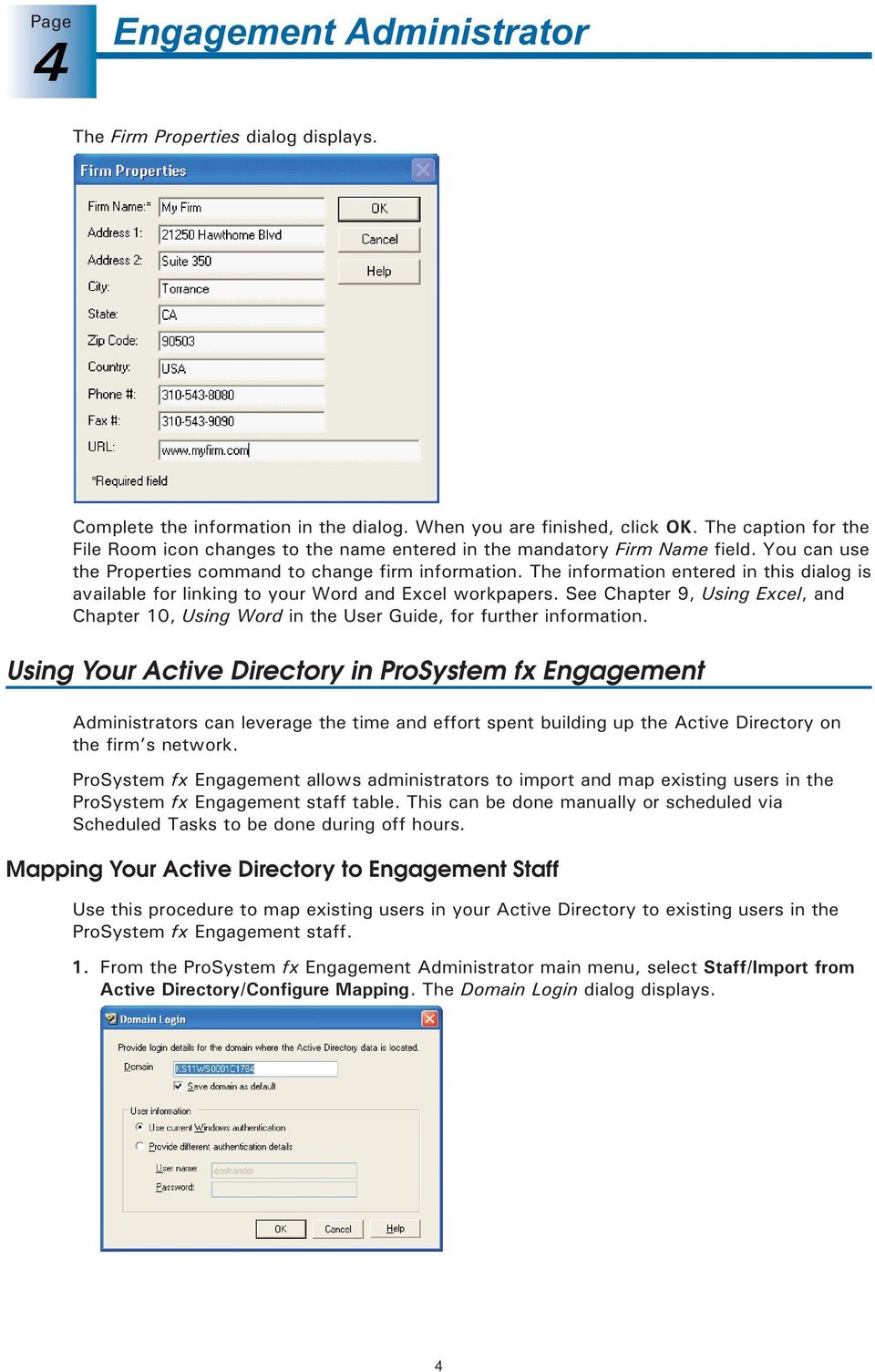
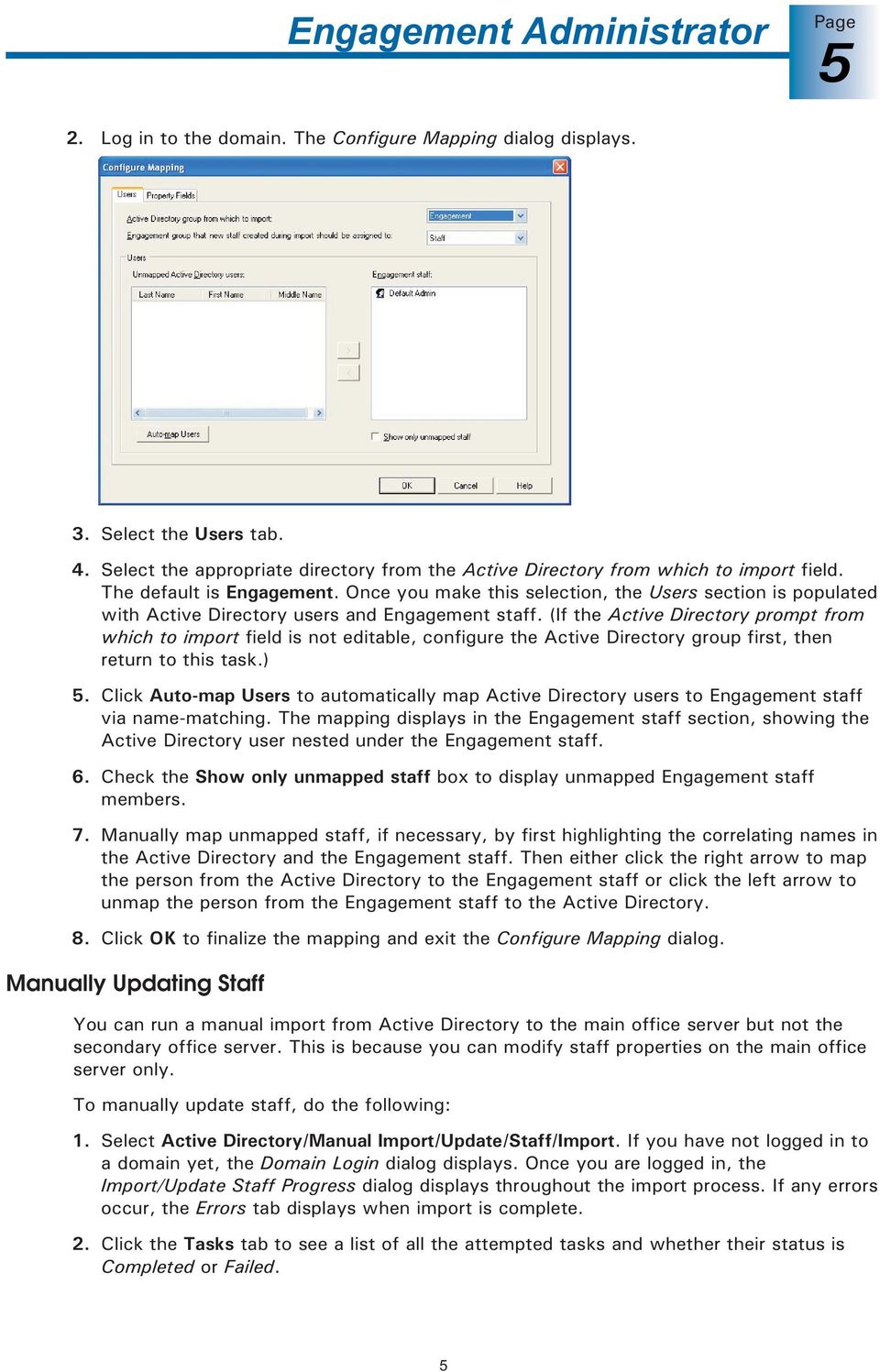
10 Engagement Administrator Page 5 2. Log in to the domain. The Configure Mapping dialog displays. 3. Select the Users tab. 4. Select the appropriate directory from the Active Directory from which to import field. The default is Engagement. Once you make this selection, the Users section is populated with Active Directory users and Engagement staff. (If the Active Directory prompt from which to import field is not editable, configure the Active Directory group first, then return to this task.) 5. Click Auto-map Users to automatically map Active Directory users to Engagement staff via name-matching. The mapping displays in the Engagement staff section, showing the Active Directory user nested under the Engagement staff. 6. Check the Show only unmapped staff box to display unmapped Engagement staff members. 7. Manually map unmapped staff, if necessary, by first highlighting the correlating names in the Active Directory and the Engagement staff. Then either click the right arrow to map the person from the Active Directory to the Engagement staff or click the left arrow to unmap the person from the Engagement staff to the Active Directory. 8. Click OK to finalize the mapping and exit the Configure Mapping dialog. Manually Updating Staff You can run a manual import from Active Directory to the main office server but not the secondary office server. This is because you can modify staff properties on the main office server only. To manually update staff, do the following: 1. Select Active Directory/Manual Import/Update/Staff/Import. If you have not logged in to a domain yet, the Domain Login dialog displays. Once you are logged in, the Import/Update Staff Progress dialog displays throughout the import process. If any errors occur, the Errors tab displays when import is complete. 2. Click the Tasks tab to see a list of all the attempted tasks and whether their status is Completed or Failed. 5
11 Page 6 Engagement Administrator 3. Click View Import Log to see the cumulative diagnostic report for all imports. The most recent import inserts at the top of the report. You can print the import log from your Internet browser. An electronic copy is stored at X:\Pfx Engagement\Admin\Admin Share directory (where X represents the drive where Engagement Administrator is installed). We Recommend: Schedule nightly updates, even if you routinely do manual updates after every staff change. (See Scheduling an Import from the Active Directory on page 6.) Viewing the Active Directory Import Log The Active Directory Import Log keeps a history of all imports from Active Directory for the firm, with the most recent import inserted at the top of the document. The log opens in your Internet browser as a printable HTM file. The log is stored in the X:\Pfx Engagement\Admin\Admin Share directory (where X represents the drive where Engagement Administrator is installed). Use one of the following methods to view the Active Directory import log: Select Staff/Import from Active Directory/View Import Log from the main menu. Initiate a manual update by selecting Staff/Import from Active Directory/Manual Import/Update. When the update is completed, click View Import Log in the Import/Update Staff Progress dialog. Scheduling an Import from Active Directory You can schedule the import from Active Directory to take place automatically on the date and time you select. You can review the schedule, retry if an import fails, and view the import log of the office servers involved in the import. You can schedule an import from Active Directory to the main office server but not to a secondary office server. This is because you can modify staff properties on the main office server only. To schedule an import of staff information from Active Directory, do the following: 1. Select Tools/Scheduled Tasks from the ProSystem fx Engagement Administrator main menu. The Scheduled Tasks dialog displays. 2. Select Import staff information from Active Directory and click Edit. The Scheduled Tasks opens, displaying Admin Active Directory Import in its title bar. 6

12 Engagement Administrator Page 7 3. Select the Task tab. 4. In the Run field on the Task tab, the path to the import defaults to X:\Pfx Engagement\ADImport.exe (where X represents the drive where the ProSystem fx Engagement Administrator program was installed). You can also browse to another location. 5. The Run as field should display the Windows user name of the person logged on to the computer. Click Set Password to enter and confirm the user s Windows password. The scheduled task will not run without this information. Click OK to exit the Set Password dialog. 6. Check the Enabled (scheduled task runs at specified time) box. 7. Click the Schedule tab and select how often the task is to be run from the Schedule Task drop-down list. 8. Use the arrows to specify the time that the synchronization is to start. You may also click Advanced to specify start and end dates and details on when to repeat the task. Click OK to exit the Advanced Schedule Options dialog. 9. Use the Every field in the Schedule Task Daily section to specify if you want to repeat the import every day, every two days, etc. 10. Check the Show multiple schedules box to change or delete schedules. Click the New button to create a new schedule for the task, which will run after the last schedule is completed. Click Delete to delete a highlighted schedule. 11. Click the Settings tab to specify the following: Whether to delete the task if it is not scheduled to run again. Whether to stop the task if it runs beyond a time you specify. To start the task only if the computer has been idle for a specified time or to stop the task if the computer becomes active. Whether to start the task if the computer is running on batteries, stop the task if battery mode starts, and wake the computer to run the task. 12. Click OK to save your schedule and exit Scheduled Tasks. 13. Click Close to exit the Scheduled Tasks dialog. Note: The first time the scheduler is run, you must input the password for the current Windows user. Setting Up Staff Groups and Staff In the ProSystem fx Engagement Administrator module, you add the staff members that you want to access ProSystem fx Engagement. You assign each staff member to a staff group. Staff groups are assigned rights to various functions within the program, and these rights transfer to the staff members that you assign to the group. This allows you to control and manage the electronic engagement process. 7

13 Page 8 Engagement Administrator Staff Groups You can customize staff groups to represent the different levels and roles of your firm s staff. At each staff group level, you select which rights in the ProSystem fx Engagement program you want to enable. Once staff members are assigned to the appropriate staff group, they receive the rights of that staff group when they log in to the program. Default Staff Groups The Administrator module provides five default staff groups: Admin Manager Partner Senior Staff You may customize staff groups by adding, deleting, or modifying groups. One staff member, Default Admin, has already been added to the Admin staff group. This staff person cannot be deleted, but you can modify the staff information with the Staff Properties dialog. For example, you may want to change the password to prevent others from accessing the ProSystem fx Engagement Administrator module. You can also add additional staff members to the Admin group. Adding a New Staff Group To add a new staff group, do the following: 1. Click the Staff Groups icon in the left pane of the Administrator screen and do one of the following: Select Staff/New Staff Group. Right-click the Staff Groups icon and select New Staff Group. Click the New Staff Group button on the toolbar. The Create New Staff Group dialog displays. 8

14 Engagement Administrator Page 9 2. Complete the Name and Description fields. The Name field is required. The rights available to a staff group are found on the following tabs: LFR Client Binder Workpaper Notes Sign Off These rights are discussed in more detail in the Assigning Staff Group Rights section below. 3. Click OK to close the dialog. Assigning Staff Group Rights To assign or modify staff group rights, do the following: 1. Select from the tabs listed below on the Create New Staff Group dialog: LFR. This tab allows you to select whether sharing of local file rooms is allowed. Client. These rights are associated with the tasks involved with creating, modifying, and deleting clients. Binder. These rights allow staff members to create binders, modify binder properties and staff assignments, override document completion dates, override binder retention periods, and roll forward, finalize, synchronize, back up, and restore binders. You can also allow staff members to create, modify, and delete binder tabs, empty all workpapers from the trash, empty Current Editor workpapers from the trash, interface with tax software, create and receive binder packages, and save binders as templates. Note: Override document completion date and Override binder retention period are inactive until Modify binder properties/staff assignment is selected. Workpaper. The Workpaper tab contains rights associated with workpapers within the engagement binders. These rights include creating, deleting/restoring, moving, taking over, and assigning/unassigning workpapers, as well as deleting workpapers after the document completion date. This tab also establishes rights for saving workpapers as templates, locking workpapers, unlocking workpapers, freezing and unfreezing engagement links, publishing workpapers, and printing workpapers. In the Trial Balance section of the Workpaper tab, you can also grant rights to create new trial balances, and save trial balances as templates on this tab. 9

15 Page 10 Engagement Administrator Roll forward. These rights allow staff members to select how workpapers are handled when the binder is rolled over. In the All Workpaper section, you can grant group members the right to determine whether a workpaper should or should not be included when the binder is rolled forward. In the Knowledge Tools section of the Roll forward tab, you can grant group members the right to choose to accept/reject changes in Knowledge Tools workpapers that are rolled forward, and/or to keep answers and comments when a Knowledge Tools workpaper is rolled over. This section displays only if Knowledge Tools is installed. In the Knowledge Coach section of the Roll forward tab, you can grant group members the right to override the roll forward settings that have been applied to individual responses, and to accept/reject changes to the Knowledge Coach content. This section displays only if Knowledge Coach is licensed. Notes/Diagnostics. Notes rights include creating/clearing notes, deleting the staff member's own notes, deleting cleared notes belonging to other members, deleting uncleared notes belonging to other members, clearing other staff members' notes, and printing a notes report. Diagnostics rights allow users to delete Knowledge Coach diagnostics. Sign Off. The rights on the Sign Off tab include signing off as preparer, signing off as a first or second reviewer, adjusting sign off dates, and changing the password. Note: Sign Off as Reviewer and is dependent on Sign Off as Preparer. In order to be able to sign off as reviewer, you must first be able to sign off as preparer. If Knowledge Coach is licensed, this tab also allows you to grant users the right to maintain the program step sign off when creating new workpapers from existing workpapers. Content. Displays if Knowledge Coach is licensed. These rights include adding and removing Knowledge Coach titles, releasing titles to staff, and inserting Knowledge Coach workpapers from unreleased titles. 2. For existing staff groups, select the applicable group and perform one of the following options: Select File/Properties. Right-click and select Properties from the pop-up menu. Select the Properties button. Note: The Admin group defaults to all rights selected. This cannot be modified. 3. When you are finished, click OK. The staff group caption is taken from the Name field. You can use the Properties command to change staff group information, if required. Note: Modifications to the rights of a user do not take effect until the user logs in to or synchronizes to the office server. 10

16 Engagement Administrator Page 11 Deleting a Staff Group To delete a staff group, click the staff group in the left pane and perform one of the following actions: Select Edit/Delete. Right-click the staff group icon and select Delete Staff Group. Click the Delete button on the toolbar. You cannot delete the Admin staff group. This group is required for access to the ProSystem fx Engagement Administrator module. Also, you cannot delete staff groups with staff members assigned. You must delete or move the staff before deleting the staff group. Adding Staff Members After the trial period for using ProSystem fx Engagement expires, you are required to have a license for each staff member set up in the Administrator module. See Licensing on page 19 for information on adding licenses. Important: Verify that you have the required number of licenses before creating users. Adding New Staff Members 1. Click the staff group to which you want to assign the staff member in the left pane and perform one of the following actions: Select Staff/New Staff. Right-click the staff group icon and select New Staff. Click the New Staff button on the toolbar. The Staff Properties dialog displays with the Staff Profile tab selected. 11

17 Page 12 Engagement Administrator 2. In the Account information section, enter a Login name of up to 16 characters. This field is required. 3. Enter a Password of up to 16 characters in the Password field, and then enter it a second time in the Confirm password field. Check the Inactive box to mark the staff member as inactive. Note: An inactive staff member cannot log in to the Workpaper Management or Administrator modules. In addition, binder synchronization cannot be performed with the inactive staff member. Marking a staff member as inactive removes any license assignment you have made for the staff member. 4. In the Staff information section, enter the First name, Initials, and Last name. These fields are required. 5. In the Default location field, enter the name of the computer the staff member uses when accessing Engagement, or click Browse to choose the computer. This is the default computer associated with this staff member for peer-to-peer synchronization. 6. From the Home Office Server drop-down list, select the default office server that contains the central file rooms and client folders the staff member would normally use. You can change the home office server and default computer location when logging in to Workpaper Management. 7. Select the Other Info tab. You can use the drop-down list to assign a staff member to an alternate staff group. When assigning a staff member to a binder, you are able to choose between the default or alternate staff group assignment. The staff member acquires the rights of either the default or alternate staff group for that binder assignment. 12

18 Engagement Administrator Page If the staff member has access to the CCH Tax Research NetWork (TRN) or to Accounting Research Manager (ARM), enter the login information on this tab. Enter the staff member s login name and password in the appropriate fields. This allows the staff to access the TRN or ARM without having to enter their login name and password. Access the TRN by selecting Help/ProSystem fx on the Web, and access the ARM by selecting Help/Accounting Research Manager on the Web in ProSystem fx Engagement. TRN and ARM can also be accessed from the Guidance items in the Binder window. 9. When you have finished entering information for a staff member, you can do one of the following: Click Save and then New to save the new staff and create another staff member. Click Save and Close to create the new staff member and exit the dialog. Click Close to exit the dialog. If you have entered any information, you are asked if you want to save it. Select Yes to create the new staff member or No to close the dialog without creating the new staff. Notes: Modifying Staff Properties If you want to reassign a staff member s role in your firm, drag the staff member from one staff group to another. The All Firm Staff team automatically updates to include the new staff created. Binders with the All Firm Staff team assigned are also updated. If the All Firm Staff team is assigned to several binders, the processing time to update may be lengthy. To avoid delays, import the staff prior to adding the All Firm Staff team to existing binders. Use the Properties command in the Admin module to change staff information. Highlight the staff member and select File/Properties or right-click and select Properties. Staff members can change their passwords by selecting Tools/User Profile in the Engagement File Room. If you must delete a staff member instead of making them inactive, follow these steps: 1. In the Firm and Staff pane, click the staff group to which the staff member belongs. 2. Do one of the following in the Staff Members pane: Highlight the staff member and select Edit/Delete. Highlight the staff member and click the Delete icon on the toolbar. Right-click the staff member and select Delete Staff from the pop-up menu. 3. Click Yes to confirm deletion. Notes: You cannot delete the Admin Default or the user that is logged in to Administrator. The All Firm Staff team automatically updates when staff are deleted. Binders with the All Firm Staff team assigned are also updated. If the All Firm Staff team is assigned to several binders, the processing time to update may be lengthy. 13

19 Page 14 Engagement Administrator Using the Global Profile Manager The Global Profile Manager in Engagement Administrator allows you to manage all staff profiles across all of your office servers. You can view summary information about staff members, disable staff profiles, and scan selected staff to view checked out and assigned workpapers. Viewing Profile Information To view summarized profile information, do the following: 1. In Engagement Administrator, select Staff/Profiles. The Global Profile Manager window displays. 2. The Active Profiles tab is selected by default. The following information is provided: Staff Name Staff Initials Login Name Staff Status Machine Name Home Office Server Profile ID Staff ID 3. Select the Disabled Profiles tab to view profiles that have been disabled. The following information is provided: Staff Name Staff Initials Login Name Staff Status Machine Name Home Office Server Profile ID Staff ID 4. Click Save Report to save a report of the active tab. The Save Report as a CSV file dialog opens. Enter a file name and click Save. 14

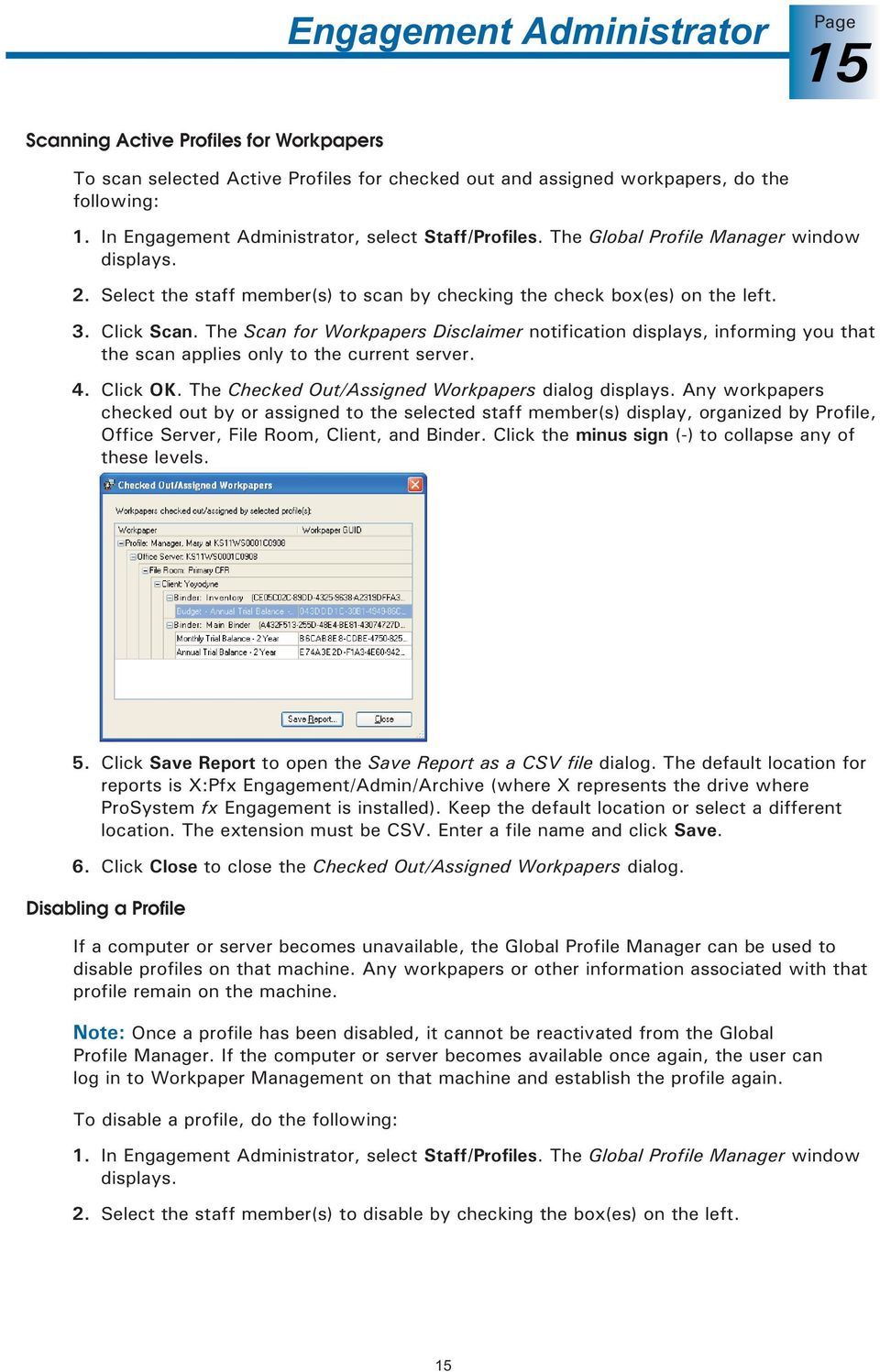
20 Engagement Administrator Page 15 Scanning Active Profiles for Workpapers To scan selected Active Profiles for checked out and assigned workpapers, do the following: 1. In Engagement Administrator, select Staff/Profiles. The Global Profile Manager window displays. 2. Select the staff member(s) to scan by checking the check box(es) on the left. 3. Click Scan. The Scan for Workpapers Disclaimer notification displays, informing you that the scan applies only to the current server. 4. Click OK. The Checked Out/Assigned Workpapers dialog displays. Any workpapers checked out by or assigned to the selected staff member(s) display, organized by Profile, Office Server, File Room, Client, and Binder. Click the minus sign (-) to collapse any of these levels. 5. Click Save Report to open the Save Report as a CSV file dialog. The default location for reports is X:Pfx Engagement/Admin/Archive (where X represents the drive where ProSystem fx Engagement is installed). Keep the default location or select a different location. The extension must be CSV. Enter a file name and click Save. 6. Click Close to close the Checked Out/Assigned Workpapers dialog. Disabling a Profile If a computer or server becomes unavailable, the Global Profile Manager can be used to disable profiles on that machine. Any workpapers or other information associated with that profile remain on the machine. Note: Once a profile has been disabled, it cannot be reactivated from the Global Profile Manager. If the computer or server becomes available once again, the user can log in to Workpaper Management on that machine and establish the profile again. To disable a profile, do the following: 1. In Engagement Administrator, select Staff/Profiles. The Global Profile Manager window displays. 2. Select the staff member(s) to disable by checking the box(es) on the left. 15
21 Page 16 Engagement Administrator 3. Click Disable Profile. The Disable Profile Confirmation dialog displays. 4. Click Scan to scan for checked out or assigned workpapers before disabling the profile. The Scan for Workpapers Disclaimer notification displays, informing you that the scan applies only to the current server. 5. Click OK. The Checked Out/Assigned Workpapers dialog displays. Any workpapers checked out by or assigned to the selected staff member(s) display, organized by Profile, Office Server, File Room, Client, and Binder. Click the minus sign (-) to collapse any of these levels. 6. Click Save Report to open the Save Report as a CSV file dialog. The default location for reports is X:Pfx Engagement/Admin/Archive (where X represents the drive where ProSystem fx Engagement is installed). Keep the default location or select a different location. The extension must be CSV. Enter a file name and click Save. 7. Click Close to return to the Disable Profile Confirmation dialog. 8. Click Yes to disable the profile. The profile is removed from the Active Profiles tab. Setting Up Teams Teams provide a quick and easy way to organize staff members for assignment to ProSystem fx Engagement binders. Teams are set up so that multiple staff members can be added to a binder at the same time. The staff members added to or removed from the team in the Administrator module are added to or removed from the binder team. A staff member can be assigned to more than one team, and a team may have many members. To create a new team or edit staff teams, the administrator must be logged in to the main office server. Note: The system defined All Firm Staff team can be used to automatically assign all staff members to binders. 16
22 Engagement Administrator Page 17 Managing Teams The Teams dialog displays the names and descriptions of existing teams on the main office server and allows you to assign the teams to new binders. It allows you to create new teams or edit and delete existing teams. This option is a view-only feature on a secondary office server. To set up a team, do the following: 1. Perform one of the following actions to open the Teams dialog: Select Staff/Teams. Select the Teams icon on the Toolbar. 2. The following options are available on the main office server only. New. Creates a new team. Enter a unique name of up to 50 characters in the Name field on the New Team dialog. This is a required entry. Enter a description for the team. There is an option to automatically assign the team to binders created in the New Binder and Roll Forward wizards. Edit. Allows you to edit the highlighted team s name and/or description on the Edit Team dialog. The option to automatically assign the team to binders created in the New Binder and Roll Forward wizard can also be edited. 3. Click OK. Note: The team name for the system-defined All Firm Staff team cannot be edited. Delete. Deletes the highlighted team. Note: The system-defined All Firm Staff team cannot be deleted. Note: Changes made to existing teams do not affect team assignments. Deleted staff members are automatically unassigned. See the following section, Assigning Staff to a Team, for additional instructions. Assigning Staff to a Team The Team Member Assignment dialog allows you to assign staff members to teams. To assign staff members to a team, follow the steps below: 1. Perform one of the following actions: Select Staff/Team Member Assignment. Select the Team Member Assignment icon on the toolbar. 17
23 Page 18 Engagement Administrator The Team Member Assignment dialog displays. 2. Select a team from the drop-down list. The description provided for the selected team displays in the Description field. If this team is automatically assigned in the New Binder and Roll Forward wizards, this option is checked. To change this option, go to Staff/Teams, select the team, and click Edit. Note: The staff assigned to the All Firm Staff team cannot be modified. This team always includes all active and inactive staff of the firm. 3. All existing staff members not already assigned to the selected team display in the Available Staff list. To filter the list of staff, you can enter a name or partial name, the asterisk wild card (*), or the placeholder (?) in the field above Staff Name. To change the way the staff is sorted, click the Staff Name column header. 4. To assign staff members to a team, do either of the following: Click the Assign All button to move all staff members to the Assigned team members box. Highlight specific staff members and click the Assign button to move the selected staff to the Assigned team members box. 5. The Assigned team members box displays staff members assigned to the team. To change the way the team members are sorted, click the Staff Name column header. 6. To filter the list of staff, enter a name or partial name, the asterisk wild card (*), or the placeholder (?) in the field above Staff Name. To remove team members from a team, do either of the following: Click the Unassign All button to move all team members to the Available staff box. Highlight specific team members and click the Unassign button to move the selected team members to the Available staff box. 18
24 Engagement Administrator Page Click one of the following when you have finished assigning staff members to teams: Click OK to save staff selections and close the dialog. Click Cancel to close the dialog without saving your changes. Click Apply to save staff selections for the selected team and select another team. Notes: Licensing If your firm has more than one office server, an Admin Synchronization should be performed on all office servers to update the servers with the changes made to the teams. See Manually Running an Admin Synchronization on page 30 for instructions. When you exit the Team Member Assignment dialog, binders where teams were modified are updated. If the teams that were modified are assigned to numerous binders, there may be a lengthy processing time. You can purchase licenses for the following: ProSystem fx Engagement Workpaper Management ProSystem fx Engagement Trial Balance ProSystem fx Knowledge Tools CCH Integrated Engagement Guides Once you have set up your staff members, assign the license information for each specific staff member so they can access the programs. See Setting Up Staff Groups and Staff on page 7. Adding Licenses Your license key information unlocks the number of licenses purchased for each program. Once you have purchased your licenses, you can either download the permission key files or receive a diskette with the files. Notes: A license for ProSystem fx Engagement Workpaper Management is required for every active staff member. If there are more active staff members than available licenses, a dialog displays prompting the administrator to make applicable staff members inactive. Staff members can be set to inactive status on the Staff Properties dialog. If the number of licenses for any other module added is less than the number of licenses currently assigned, a message displays in Workpaper Management indicating that the administrator must unassign licenses. Internet Download To download your Engagement permission key files, do the following: 1. Select Staff/Add/Update License. The Add/Update License dialog displays. Internet Download is selected by default. 2. Click OK. The Global fx Login screen displays. 19
25 Page 20 Engagement Administrator Diskette 3. Enter your User ID and Password to log in to Configure Staff. Based on your account information, the application automatically downloads the appropriate permission key and installs the licenses. A message displays when the licenses have been added successfully. 4. Click OK. To add or update your licenses using a permission key on a diskette, do the following: 1. Insert your permission diskette and select Staff/Add/Update License. The Add/Update License dialog displays. 2. Select the Permission key disk drive path radio button. 3. Click Browse to select the drive and folder where the perm key files reside. Click OK. A message displays stating that the licenses have been added to the application. 4. Click OK. Note: If you are upgrading your version of Engagement, a dialog asks if you are upgrading from a previous version of Engagement. You may choose from these three options: Assigning Licenses Yes. I would like to convert 2.x staff and staff groups now. Choose this option to begin converting your 2.x staff and staff groups immediately. Yes. Remind me to convert 2.x staff and staff groups next time I log in. Choose this option and the next time you log in to Engagement you will be reminded to convert your 2.x staff and staff groups to the upgraded version of Engagement. No. Do not ask me again. Choose this option if you are adding licenses for the first time. After the license information has been added, you must assign licenses to staff members who access the programs. You can assign, unassign, and review staff license assignments using one of the following views: View by Staff, which is the default, displays available product licenses and the number of licenses available for assignment. The Available staff box on the right displays staff groups and staff members and their license assignments. View by Product displays the Available staff box on the left, which displays the staff members and their group assignments. The Available licenses box displays a list of products, the number of available licenses, and current staff assigned to the product. Note: Be sure you have enough licenses for the staff using the program. If you purchase fewer licenses than the number of staff you create during your trial period, the unlicensed staff members must be inactive. Also, the default staff members provided with the trial program are deleted. 20
26 Engagement Administrator Page 21 Assigning Licenses Using View by Staff To assign license information using the Staff view, do the following: 1. Select Staff/Assign License. The License Assignment dialog displays. On the left side of the dialog, the Available licenses box displays the following information: Products. A description of the application, the CCH Integrated Engagement Guide (formerly Miller Integrated Engagement Guides) purchased, or the McGladrey & Pullen Integrated Work Program purchased. Total. The total number of licenses purchased for the product. Available. The number of licenses available for staff assignment. On the right side of the dialog, the Available staff box displays the following information: Staff Groups. Lists the established staff groups. Staff Members. The staff to whom you are assigning licenses. Click the plus sign beside a staff group to display the staff members belonging to the group. Note: Admin Default does not display beneath the Admin group because you cannot assign licenses to the Admin Default. Licensed Products. Assigned products are listed under the user s name. Once a license is assigned, the staff member can access the product. Note: Miller titles purchased previously display with the original titles. 21
27 Page 22 Engagement Administrator 2. You can assign the licenses available on the left side of the dialog to the appropriate staff member listed on the right side of the dialog by doing one of the following: Click the product on the left, click the staff member on the right, and then click the Assign button pointing to the right. Click the product on the left and drag it to the target staff on the right. Right-click a staff member and click the Transfer Licenses option. Highlight an unlicensed staff member to which you want to transfer the licenses and click Paste Licenses. All licenses except the Workpaper Management license are removed from the first staff member and assigned to the second staff member. Right-click the staff member that has the licenses you want to copy and click the Copy Licenses option. Click the unlicensed staff member to which you want the licenses copied and click Paste Licenses. The second staff member now has the same licenses as the first staff member. Note: You must have licenses available in order to copy and paste from one staff member to another. As you match licenses to staff members, the number of available licenses decreases. You do not have to assign all the available products at one time. You can return to this dialog and assign licenses at a later time. Note: When licenses are added and a new staff member is added to a staff group, the ProSystem fx Engagement Workpaper Management license is automatically assigned to the staff member. You must have a Workpaper Management license to log in to ProSystem fx Engagement. 3. Click OK to save settings and close the dialog. Assigning Licenses Using View by Product To assign licenses using the product view, do the following: 1. Select Staff/Assign License. The License Assignment dialog displays. 2. Select the View by Product tab. 22
28 Engagement Administrator Page 23 On the left side of the dialog, the Available staff information displays the following information: Staff. Lists all staff members available for license assignments. Group. Lists the group to which the staff members are assigned. On the right side of the dialog, the Available licenses information displays the following information: Available Licenses. Lists all available products. The total number of licenses available for assignment displays in brackets next to each product. Staff Members Assigned. Clicking the plus sign beside a product displays staff members who have been assigned a license for this product. Once a license is assigned, the staff member can access the product. 3. You can modify or assign the licenses available on the right side of the dialog to the appropriate staff members listed on the left side of the dialog by doing one of the following: Click the staff member on the left, click the product on the right, and then click the Assign arrow pointing to the right. Drag the staff member's name from the left column to the appropriate product on the right. Right-click a staff member and click the Transfer Licenses button. Highlight an unlicensed staff member to which you want to transfer the licenses and click Paste Licenses. All licenses except the Workpaper Management license are removed from the first staff member and assigned to the second staff member. Right-click the staff member that has the licenses you want to copy, and click the Copy Licenses button. Click the unlicensed staff member to which you want the licenses copied to and click Paste Licenses. The second staff member now has the same licenses as the first staff member. As you match up staff members to licenses, the number of licenses in the Available licenses column on the right decreases. Note: When licenses are added and a new staff member is added to a staff group, the ProSystem fx Engagement Workpaper Management license is automatically assigned to the staff member because you must have the Workpaper Management license to log in to ProSystem fx Engagement. You do not have to assign all the available products at one time. You can return to this dialog and assign licenses at a later time. 4. Click OK to save and close the dialog. 23
29 Page 24 Engagement Administrator Setting up the Administrator Environment This section provides instructions on setting up office servers that can manage one or more central file rooms and your client engagement work. You can create multiple office servers. One office server must be designated as the main office server upon the initial log in to Administrator. For more details on configuring the main office server, see Initial Log In to the Engagement Administrator on page 2. The main office server contains firm, licensing, staff, staff group, team, client, client group, and central file room information. You may want to create one or more secondary office servers if you have more than one office or more than one network server. In the event you have to take the main office server down or you want the administrator at the secondary office server to perform functions limited to the main office server, you can designate a secondary office server as the main office server. You can create secondary office servers that are disabled for Admin synchronization and send Admin Packages created on the main office server to synchronize the admin information. Secondary office servers and the main office server should be synchronized either manually or automatically on a regular basis to ensure that information on all servers remains current. Client folders may be set up in the central file rooms in the Engagement Administrator or in Workpaper Management. When staff members log in to the servers in the office, they can synchronize client engagement binders with central file rooms. This facilitates the collaboration of multiple staff members working on the same electronic engagement binder simultaneously and from remote sites. The client engagement binders must be created in the local file room and then synchronized to the central file room. You cannot create a client engagement binder in the central file room. You may want only your firm s administrator to set up client folders so you can control the process. Or you may permit some or all of the staff to set up client folders in the Engagement program by utilizing the Staff Group rights in Administrator. Note: If the administrator sets up the client folder in the Administrator module, the New Binder Wizard must be used to create a binder for the client in ProSystem fx Engagement. See Chapter 6, Creating and Using Binders, in the User Guide for information on the New Binder Wizard. Creating a Secondary Office Server You can create secondary office servers, which are optional, to organize your central file rooms and client information. During the creation process, the main office server information (i.e. server properties, staff properties, central file room properties, client properties, and client group data) is passed to the secondary office server. Secondary office servers can also be configured and then connected to the main office server. Firm, team, client group, and staff information can be viewed, but not changed, from a secondary office server. Data on main and secondary office servers should be synchronized frequently. You can set up an automatic synchronization schedule or manually synchronize the servers. 24
30 Engagement Administrator Page 25 We recommend that you close all dialogs on the main office server when creating a secondary office server. If a dialog is open, it is possible that the main office server will not recognize the secondary office server after it has been created. An office server can be disabled for Admin Synchronization. This office server does not have a connection with other office servers. In this case, an Admin Package needs to be created on the main office server and received on the secondary server to transfer Admin data. If it becomes necessary to disable the main office server or the administrator of a secondary office server needs to perform functions limited to the main office server, you can promote a secondary office server to be the main office server by passing the main office server token to the secondary server. (See Changing the Main Office Server on page 26 for instructions.) If you are setting up a secondary server with synchronization disabled, create an Admin Package on the main office server before beginning this process, because you need to receive the Admin Package as part of setup. (See Creating an Admin Package on page 27 for detailed instructions.) Note: In a multi-office server environment, all office servers need to be installed on computers that have static IP addresses. To set up a secondary server, do the following: 1. Log in to ProSystem fx Engagement Administrator on a computer that has Administrator installed but does not have an office server associated with it. The Configure Office Server dialog displays. 2. Click Next. The Provide office server information dialog displays. 3. Enter a label of up to 64 characters for the secondary office server in the Label field. 4. The Server name field defaults to the name of the computer you are logged in to. This field cannot be edited. 5. Enter a description of up to 64 characters in the Description field. The description is optional. 6. Click Next. The Determine the office server designation dialog displays. 7. Select Secondary office server to establish this as the secondary office server. The Connect to main office server field becomes active. 8. Enter the name of the computer where the main office server is located, or click Browse to select the computer name from a list. 9. Check the Disable Admin synchronization box, if applicable. 10. On the Browse for Admin Package dialog, click the Browse button and choose the location of the Admin Package (file extension AZA). 11. Click OK. The Admin Package is received on the secondary office server. 25
31 Page 26 Engagement Administrator Disabling/Enabling Admin Synchronization for an Office Server To disable/enable Admin Synchronization for an office server, do the following: 1. In the Central File Rooms pane, click the Office Servers icon. 2. Right-click the office server in the List pane. 3. Select Properties from the pop-up menu and the Office Server Properties dialog displays. 4. Check the Disable Admin synchronization box. If the office server is disabled, it becomes enabled. If the office server is enabled, it becomes disabled. If an office server is disabled and later enabled, synchronize it with the main office server. Note: If an office server is disabled because maintenance work is needed, disable the local file room to central file room synchronization in the central file room properties of the central file rooms on the office server. Once maintenance is complete, modify both the office server and CFR properties to allow for synchronization. Changing the Main Office Server Designating a secondary office server as the main office server can be accomplished by passing the main office server token to a secondary office server. If synchronization is disabled on the secondary office server, the system creates an Admin Package as part of the process of changing servers. To change the main office server, do the following: 1. Log in to the main office server. 2. Select Tools/Pass Main Office Server Token to open the Select New Main Office Server dialog. 3. Use the drop-down list to select the secondary office server you want to make the new main office server and click OK. 4. A message confirming the change of the main office server appears. Click Yes to continue. 5. If the secondary office server has disabled synchronization, continue with step 6. If the secondary office server is enabled for synchronization, the Manual Admin Sync dialog displays as the system activates the secondary office server as the main office server. The office server s icon changes to that of the main office server. Note: Be sure to perform an Admin synchronization between the new main office server and all other secondary office servers to notify them of the change in main office server. 26
32 Engagement Administrator Page If the secondary office server is disabled for synchronization, the Create Admin Package dialog displays when you select Yes to continue. Choose Save package to a file or Send package via . See the following section on Creating an Admin Package. 7. Follow the directions under Receiving an Admin Package on page 28. After the Admin Package is received, the system activates the secondary office server as the main office server. The office server's icon changes to that of the main office server. Note: Be sure to exchange an Admin Package from the new main office server to any secondary office servers to notify them of the new main office server. Creating an Admin Package The Create Admin Package function creates a package containing office server information that can be used to synchronize data between any two office servers. Create Admin Package can be used to pass information to and from office servers that are disabled for synchronization. It is also used to pass main office server information to a secondary office server that is going to be disabled for synchronization. The following information is included in an Admin Package: staff, licensing, teams, staff groups, client groups, office server properties, central file room properties, and client and binder properties. When you create an Admin Package file, you can do one of two things: Save the file to the hard disk Attach the file to an After you create the file, it can be applied to the other office server using the Receive Admin Package function. Saving the Admin Package to a Hard Drive 1. Select Tools/Create Admin Package. 2. Choose Save package to a file. 3. Either enter a drive, directory, and file name, or click the Browse button and select a drive, directory, and file name in the Save As dialog and then click Save. The file extension is AZA. The drive and directory default to X:\Pfx Engagement\ADMIN\Admin Packages\<office server name> (where X represents the drive where the Administrator module is installed). 4. Click OK to create the file and store it in the location specified. Notes: You can use only alphanumeric characters (letters and numbers) in the Admin Package file name. If you have already saved an Admin Package file with the same name to the specified location, you are given the option of overwriting the existing file or changing the file name. 27
33 Page 28 Engagement Administrator Attaching the Admin Package to an 1. Select Tools/Create Admin Package. 2. Enter a file name for the package in the file name field. The file extension must be AZA. 3. Choose Send package via Click OK to create the file. 5. Your application opens with the file attached so you can send the package to the appropriate person. Note: You cannot use the following characters in the Admin Package file name: /:*? <> \ Receiving an Admin Package Admin Packages are created on the main office server or any secondary office server and are used to download and synchronize data between office servers when at least one of the office servers is disabled for synchronization. To receive an Admin Package, do the following: 1. Log in to the office server that is going to receive the Admin Package. 2. Select Tools/Receive Admin Package. 3. Select the appropriate folder on the Receive Admin Package dialog. 4. Select the AZA Admin Package file. 5. Click OK. 28
34 Engagement Administrator Page 29 Scheduling Admin Synchronization Admin Synchronization can be scheduled and run only from the main office server. Synchronization needs to be maintained between the main office server and secondary office servers so that updated information on the main office server regarding staff, licensing, teams, staff groups, and client groups is passed to the secondary office servers. Also, synchronization ensures that changes to office server properties, central file room properties, client folder properties, and binder properties are updated on every server. A secondary office server must be set up and visible on the main office server before the Scheduled Task option becomes available. If the secondary office server is not recognized by the main office server, you need to run a manual admin synchronization on the secondary office server. See Manually Running an Admin Synchronization on page 30. Both servers must be enabled for synchronization for an automatic Admin Synchronization to take place. If a secondary office server is disabled, an Admin Package must be created on the main office server and received on the secondary office server. See Creating an Admin Package, page 27, and Receiving an Admin Package, page 28, for instructions. You can schedule synchronization to take place automatically on the date and time you select. During synchronization a progress marker displays. You can view the schedule, retry if a synchronization fails, and view the synchronization history of the office servers involved in the synchronization. Note: The first time the scheduler is run, you need to input the user name and password for the user who will be logged in to Windows at the time the synchronization takes place. To schedule Admin Synchronization, do the following: 1. Log in to the main office server. 2. Select Tools/Scheduled Tasks. 3. Select Main office server synchronization with secondary office servers and click Edit. 4. In the Run field on the Task tab, the path to the synchronization EXE file defaults to X:\Pfx Engagement\ADMIN\CFRSynch.exe (where X represents the drive where the Administrator program was installed). 5. The Run as field should show the Windows user name of the user logged on to the computer. Click Set Password to enter and confirm that user's Windows password. The scheduled task does not run without this information. Note: The user name should be the user who will be logged in to the computer when the task is run. 6. Click the Enabled (Scheduled task runs at specified time) box. The synchronization does not run if Enabled is not checked. Note: Only a Windows administrator can successfully launch the scheduled task. 7. Click the Schedule tab and select how often the task is to be run from the Schedule Task drop-down list. 29
35 Page 30 Engagement Administrator 8. Use the arrows to specify the time the synchronization is to start. You can click Advanced to specify start and end dates and details on when to repeat the task. Click OK to exit the Advanced Schedule Options dialog. 9. Use the Every field in the Schedule Task Daily section to specify if you want to repeat the synchronization every day, every two days, etc. 10. Check the Show multiple schedules box to change or delete schedules. Click New to create a new schedule for the task that will run after the last schedule is completed. Click Delete to delete a highlighted schedule. 11. Click the Settings tab to specify the following: To delete the task if it is not scheduled to run again. This option is not recommended, as you would have to recreate the task. To stop the task if it runs beyond a time you specify. To start the task only if the computer has been idle for a specified time or to stop the task if the computer stops being idle. To start the task if the computer is running on batteries, stop the task if battery mode starts, or wake the computer to run the task. 12. Click Apply to save your schedule and then OK to exit the scheduler. 13. Click Close to exit the Scheduled Task dialog. Manually Running an Admin Synchronization The time required for the manual Admin Synchronization depends on the office servers involved. You can run a manual Admin Synchronization from either a main or a secondary office server. Note: Run a manual Admin Synchronization if the main office server does not recognize a secondary office server. In this case, run the synchronization from the secondary office server. To run a manual Admin Synchronization, do the following: 1. Log in to the appropriate office server. 2. Select Tools/Manual Admin Synchronization. 3. The system starts the synchronization either from the main office server or the secondary office server, depending on the server you are logged in to. 4. The Admin Synchronization Status dialog displays during the synchronization process. You can perform the following procedures on this dialog: Click Retry to have the system attempt the synchronization again if an office server has a status of failed. Click View Synchronization History to view the synchronization record for the server you are logged in to. Click View Schedule to view the schedule for the synchronization. 30
36 Engagement Administrator Page 31 Viewing Admin Synchronization History Admin Synchronization needs to be maintained between the main office server and secondary office servers. You can view an office server's synchronization history to resolve synchronization issues and provide detailed data to Technical Support personnel, if required. A synchronization history displays the following information: Person currently logged in to the computer Computer name Operating system ProSystem fx Engagement version number Office server name and if it is a main or secondary server Office server ID The synchronization history also displays a list of all synchronization for the server. To view synchronization history, do the following: 1. Log in to the office server. 2. Highlight the office server in the Central File Room pane. 3. Select File/Properties. 4. Click View Synchronization History. You can save or print the log. Viewing the Admin Activity Log The Admin Activity Log records actions taken within the ProSystem fx Engagement Administrator module. This log file lists the date, action taken, result, user, computer, office server, and, if necessary, the reason an activity fails. To view the log file, follow these steps: 1. Select Tools/View Admin Activity Log. The View Admin Activity Log dialog displays. 2. Click one of the following options: Details. Displays detail of a log entry. Print. Prints the Admin Activity log. Save as. Saves the Admin Activity log to a file. Clear. Deletes the contents of the log. 3. Click Close when you are finished viewing the file. 31
37 Page 32 Engagement Administrator Setting Firm Options The Firm Options feature in Administrator allows you to set firm-wide administrative options. To set firm options, do the following: 1. Select Tools/Firm Options to open the Firm Options dialog. 2. Select the applicable options as described below. Firm options can be set only on the main office server and are firm-wide. They are synchronized to local file rooms. General tab Shared Local File Room. Select this option to allow users to collaborate on binders through directly accessing shared local file rooms. Trash. When a binder is closed, Engagement will keep the items in the trash, prompt the user to empty the trash, or automatically empty the trash, depending on your selection here. Prompt when/for. By default, a warning message displays when a binder that is set to monitor the Document Completion Date is opened during the assembly period. If you clear this check box, the warning message does not display. Sign off tab Sign off options Skip Binder Staff Sign Off Analysis page in Finalize Binder Wizard. Inthe Finalize Binder Wizard, a page with analysis of staff sign off for the binder displays by default. Checking this box prevents this page from displaying during the finalizing process. Skip Clear Workpaper Sign Off Dates and Times page in Finalize Binder Wizard. In the Finalize Binder Wizard, a page can display that gives you the opportunity to clear the workpaper sign off dates and times. By default, ProSystem fx Engagement skips this step. If you want to be able to clear the workpaper sign off dates and times, then uncheck this item. Retain workpaper sign off history upon binder finalization. Select this option to retain all workpaper sign off information after binder finalization. When this option is selected, the option Skip Clear Workpaper Sign Off Dates and Times page in Finalize Binder Wizard is automatically checked and cannot be deselected. If this option is not selected, only the final sign off for preparer and the final sign off for reviewer are retained. Display indicator when workpapers are modified after reviewed. Select this option if you want the Modified After Review icon to display for workpapers that have been modified after review. If you clear this box, the icon does not display. 32
38 Engagement Administrator Page 33 Knowledge Tools Program step sign off options Show current date when program step is signed off with initials. When signing off a Knowledge Tools workpaper with initials, shows the current date. When program step is marked as N/A show. Select either Initials or Current Date to display when the program step is marked as N/A. Note: Knowledge Tools Program step sign off options apply only if you have purchased Knowledge Tools licenses and are using Knowledge Tools workpapers. Engagement Today tab Engagement today will display binders in the diagnostics area based on your selections: Document completion date is past due or within <X> days of current date. Binders will display in Engagement Today diagnostics if the document completion date is past due or within the specified number of days from the current date. Enter a number or use the spin boxes to select a number of days. The default is 15. Due date is within <X> days of current date. Binders will display in Engagement Today diagnostics if the due date is within the specified number of days from the current date. Enter a number or use the spin boxes to select a number of days. The default is Click OK to exit the dialog. Setting Admin Synch Options 1. Select Tools/Admin Synch Options to display the Admin Synch Options dialog. 2. If a secondary office server has been created, then when Engagement Administrator is closed, a message asks if you want immediate synchronization. This message does not appear if you select either of the two following options: Automatically synchronize when closing. Any changes to the main office server information are automatically synchronized to existing secondary office servers, when the Administrator is closed. Any changes made to a secondary office server automatically synchronize to the main office server when the secondary Administrator is closed. Don t prompt me regarding synchronize when closing. Changes are not automatically synchronized and the message regarding synchronization does not display. 3. Click OK to exit the dialog. 33
39 Page 34 Engagement Administrator Using the Document Completion Date Report The Document Completion Date Report displays all binders with document completion dates that fall within the date range you specify. This report provides the following information about each binder: Office Server CFR (Central File Room) Binder Name Binder ID Client Name Client ID Binder Type Binder Status Lead Partner Client Group Period End Date Report Date Report Release Date Doc Completion Date Finalized Date Retention Period End To use the Document Completion Date Report, do the following: 1. Select Tools/Doc Completion Date Report. The Document Completion Date Report dialog displays. 2. Select Run central file room report to update the central file room report. Select View report from last scheduled task to view the most recent report. 3. If you selected Run central file room report, do the following: a. Select Include only binder types set to monitor document completion date to include only binder types that have been set to be monitored for the document completion date. b. Select Include finalized binders to include finalized binders in the report. c. You can filter your results to binders that have a Document Completion Date, Year End, Period End, or Retention Period within a certain date range. Select the criterion from the Date range drop-down list, or select No Date Range. d. Select the appropriate beginning date in the Start field. Either enter the date or click the down arrow to use the calendar. The default setting is the current date. e. Select the final date for the report range in the End field. Either enter the date or click the down arrow to use the calendar. The default setting is two months from the current date. 4. Click Update Report. The report displays the binders that fall within the range you selected. Click a column heading to sort by that heading. Drag column headings to reorder the columns. 5. Click Export to Excel to open an Excel spreadsheet of the report data. 6. Click Close to exit the report. 34
40 Engagement Administrator Page 35 Scheduling the Document Completion Date Report You can schedule a Document Completion Date report to be generated automatically on a specified date and time. You can schedule the Generate Document Completion Date Report task on either the main office server or a secondary office server. To schedule the Document Completion Date Report to run as a scheduled task, do the following: 1. From the ProSystem fx Engagement Administrator main menu, select Tools/Scheduled Tasks. The Scheduled Tasks dialog displays. 2. Select Document Completion Date Report and click Task Properties. The Windows scheduler opens, displaying the name of the task in the title bar. 3. Select the Task tab if it is not already selected. 4. In the Run field on the Task tab, the path to the import defaults to X:\Pfx Engagement\Admin\DCDScheduledReport.exe (where X is the drive where Administrator was installed). You can also browse to another location if that is necessary. 5. The Run as field should show the Windows user name of the person logged on to the computer. Click Set Password to enter and confirm that user s Windows password. The scheduled task will not run without this information. Click OK to exit the Set Password dialog. 6. Check the Enabled (scheduled task runs at specified time) box. 7. Click the Schedule tab and select how often the task is to be run from the Schedule Task drop-down list. 8. Use the arrows to specify the time the report should run. Tip: We recommend that you schedule the Generate Document Completion Date Report task to run after the Admin Synch task. This will help to ensure that the Document Completion Date report is as accurate as possible. 9. Click Advanced to specify start and end dates and when to repeat the task. Note: The Document Completion Date report can be generated only once every 24 hours. 10. Click OK to exit the Advanced Schedule Options dialog. 11. Use the Every field in the Schedule Task Daily section to specify if you want to repeat the task every day, every two days, etc. 12. Check the Show multiple schedules box to change or delete schedules. Click the New button to create a new schedule for the task, which will run after the last schedule is completed. Click Delete to delete a highlighted schedule. 35
41 Page 36 Engagement Administrator 13. Click the Settings tab to specify the following: Whether to delete the task if it is not scheduled to run again Whether to stop the task if it runs beyond a time you specify To only start the task if the computer has been idle for a specified time or to stop the task if the computer becomes active Whether to start the task if the computer is running on batteries, stop the task if battery mode starts, and wake the computer to run the task 14. Click OK to save your schedule and exit the Windows scheduler. 15. Click Settings to display the Document Completion Date Report dialog and select the appropriate settings. 16. Click Close to exit the Scheduled Tasks dialog. Creating a Central File Room You can create central file rooms on the main office server or a secondary office server, depending on the server you are logged in to. A central file room is used to store client folders, which can be created in the Administrator module or in Workpaper Management. A client's binders can only be created in the client folder in a local file room in Workpaper Management and must be synchronized with the central file room to copy the binder information to the central file room. Note: If a secondary office server has been disabled for synchronization, an Admin Package needs to be created on the main office server and then received by the secondary office server for the central file room to display in the secondary office server. You can create as many central file rooms as you need. To create a central file room, do the following: 1. In the Central File Rooms pane, select the office server where you want to create the central file room. If you are logged in to the main office server, you can select it or any secondary office server. If you are logged in to a secondary office server, you can create only central file rooms on that server. 2. In the lower left pane, do one of the following to open the Central File Room Properties dialog: Select File Rooms/Create Central File Room. Right-click an office server and then select Create Central File Room. 36
42 Engagement Administrator Page 37 Click the Create Central File Room button on the toolbar. 3. The Name field is mandatory. Enter a name of up to 64 characters for the central file room. This name displays with its own icon under the respective office server icon. You may also enter a description. 4. Enter the path where the central file room workpapers are to be located or use the Browse button to select a drive and directory. Choose any drive or directory on the computer or available network connection except directories already used by other central file rooms. The default is X:\Pfx Engagement\ADMIN\Workpapers, where X is the drive where the Administrator module is installed. You can click New Folder to create a new folder for the workpapers. 5. To disable synchronization, check the Disable LFR to CFR synchronization box. Binders cannot be synchronized with the central file room when synchronization is disabled. 6. Click OK to save the information and close the dialog. Disabling/Enabling Synchronization on a Central File Room Notes: You may disable synchronization of binders from local file rooms to the central file room when maintenance is performed on the server with the central file room. If a central file room is disabled for synchronization, binders are locked and cannot be synchronized with the central file room. If a central file room is enabled for synchronization, local file rooms can synchronize binders with the central file room. To disable or enable the synchronization of a central file room, do the following: 1. In the Central File Room pane, right-click the file room you want to disable or enable. 2. Select Properties from the pop-up menu. 3. Check the Disable LFR to CFR synchronization box to disable synchronization of binders to the central file room. Remove the check mark to enable the central file room for binder synchronization. 37
43 Page 38 Engagement Administrator Setting Up Client Folders New clients can be added in the Administrator module, but you must use the Workpaper Management program to add client binders for new clients. To add a new client in a central file room, do the following: 1. To display the Create New Client dialog, click the central file room in which you want to add a client and perform one of the following actions: Select File Rooms/New Client. Right-click the Central File Room icon and select New Client. Click the New Client button on the toolbar. 2. Enter the client information on the Profile tab. An entry in the Client name 1 field (Last name field if you select Individual as the Entity type) is required and can contain up to 64 characters. The name you enter becomes the client folder name. 3. If you want to add the client to one or more client groups, select the Group tab and check the box next to the group or groups you want to add the client to. You can also do this at a later time using the File Rooms/Assign Clients to Groups option. See Creating a New Client Group on page 45 for setting up the client groups. 4. Select the Contacts tab. 5. Click New and enter the information as desired. An entry in the Last Name field is required. To continue entering contacts for the client, click Save and New. You can use the left and right arrow buttons to move to the previous or next contact entered. 6. When you have finished entering contact information and have saved all the data, click OK to exit the dialog. You can use the Properties command to change client information entered earlier. The profile information entered in this dialog is available for linking into Excel and Word workpapers. See Chapter 9, Using Excel, and Chapter 10, Using Word, in the User Guide for information on linking these fields. 38
44 Engagement Administrator Page 39 Deleting a Client To delete a client, click the client folder in the left pane and then do one of the following: Select Edit/Delete. Right-click the Client Folder and select Delete Client. Click the Delete button on the toolbar. When the confirmation dialog displays, click Yes to delete or No to cancel the deletion. Notes: You must remove all binders from the client folder before it can be deleted. To delete a client on a secondary office server when logged in to the main office server, there must be a connection between the servers, and they must be enabled for Admin Synchronization. Deleting a Central File Room To delete a central file room, click the icon of the file room to delete and do one of the following: Select Edit/Delete. Right-click and select Delete CFR from the pop-up menu. Click the Delete button on the toolbar. When the confirmation prompt displays, click Yes to permanently delete the central file room. This deletes the central file room from Engagement Administrator. Notes: The CFR to be deleted must not contain any client folders or binders. When logged in to the main office server to delete a central file room on a secondary office server, there must be a connection between the servers and they must be enabled for synchronization. Deleting a Secondary Office Server You cannot delete a secondary office server if it contains any central file rooms. You must first move the client binders in the central file rooms to a different central file room(s) on a different server. After removing the binders, you must delete the central file rooms. (See the sections on moving binders to a different central file room beginning on page 51.) To delete the secondary office server, do the following: 1. In the Central File Room pane, highlight the secondary office server to delete and do one of the following: Select Edit/Delete. Right-click and select Delete Server. Click the Delete button on the toolbar. 2. Click Yes to delete the office server. If more than one secondary office server has been configured, run a manual Admin Synchronization to update the other secondary office servers. See Manually Running an Admin Synchronization on page
45 Page 40 Engagement Administrator Deleting the Secondary Office Server Program To completely delete a secondary office server, you also need to manually remove the program from the computer where the secondary office server was located. Once you have removed the three programs listed below, you can use Microsoft Explorer to delete the Pfx Engagement directory on the local drive of the computer. To manually remove the secondary office server program, do the following: 1. Right-click My Computer on your Windows desktop and select Manage. The Computer Management window displays. 2. Select Services under Services and Applications. 3. In the list of services in the right-hand pane, right-click SQL Server (PROFXENGAGEMENT) and select Stop. 4. Select File/Exit to close the Computer Management window. 5. Select Start/Control Panel, and then double-click Add or Remove Programs. The Add or Remove Programs window displays. 6. Remove the following programs: ProSystem fx Engagement Microsoft SQL Server 2005 Note: When removing Microsoft SQL Server 2005, select only the PROFXENGAGEMENT: Database Engine instance in the Component Selection section. Managing Binder Types Like paper-based engagement binders, ProSystem fx Engagement binders store and organize client workpapers for any type of engagement, such as a tax return or an audit. Binder types allow you to specify completion date calculations and retention period calculations for binders used for different purposes. You can view, create, edit, and delete types of binders from the Engagement Administrator module. Creating a New Binder Type To create a new binder type, do the following: 1. Select File Rooms/Binder Types. The Binder Types dialog displays. 40
46 Engagement Administrator Page Click New. The New Binder Type dialog displays. 3. Enter a name for the new binder type in the Name field. This field is required. Once the Name field is filled, the OK and New buttons become active. Note: Duplicate binder type names are not allowed. 4. Select Date of Report or Report Release Date in the Beginning of assembly period drop-down list to set the date from which Engagement calculates the document completion date. Select N/A if you do not want Engagement to calculate the document completion date. 5. Enter the appropriate information in the Length of assembly period field. The entry may be between 1 and 365 days. 6. Select Date of Report, Report Release Date, or Document Completion Date in the Start of retention period drop-down list to set the date from which Engagement calculates the End of Retention Period. Select N/A if you do not want Engagement to calculate the retention period. 7. Use the spin box or type the appropriate information in the Duration of retention period field. The entry may be between 1 and 10 years. 8. Click New to save the binder type and begin creating another. Click OK to save the binder type and close the New Binder Type dialog. Editing an Active Binder Type To edit an active binder type, do the following: 1. Select File Rooms/Binder Types. The Binder Types dialog displays. 2. Select the binder type to edit and click Edit. The Edit Binder Type dialog displays. 3. If this is a binder type you have created, you can edit the Name field. Edit the information in the Document Completion Date Calculation and Retention Period Calculation sections as necessary. Note: You cannot edit the name of a standard binder type. 4. Click OK to close the Edit Binder Type dialog. 5. Click Save on the Binder Types dialog to save your changes and exit the dialog. Click Cancel to discard your changes and exit the Binder Types dialog. 41
47 Page 42 Engagement Administrator Deleting a Binder Type Note: You cannot delete standard binder types. If a Central File Room or Manual Admin Synchronization has not occurred since you created the binder type, you can perform a "hard delete." The binder type is permanently deleted. If a Central File Room or Manual Admin Synchronization has occurred since you created the binder type, you can perform a "soft delete." The deleted binder type no longer appear as an option in the Type drop-down list, but any binders of that type already created remains. Deleting a Binder Type before Synchronization To hard delete a binder type you have created, do the following: Notes: This process applies if a Central File Room or Manual Admin Synchronization has not occurred. You can delete only binder types that you have created. You cannot delete standard binder types. When a standard binder type is selected, the Delete button becomes inactive. 1. Select File Rooms/Binder Types. The Binder Types dialog displays. 2. Select the binder type to delete and click Delete. A confirmation box asks you to confirm the deletion. 3. Click Yes to delete the binder type. Click No to cancel the deletion. 4. Click Save on the Binder Types dialog to save your changes and exit the dialog. Click Cancel to discard your changes and exit the Binder Types dialog. Caution: If you delete a binder type, you can view and edit it by checking the Show deleted binder types box on the Binder Types dialog. However, once you click Save, the binder type is permanently deleted. Deleting a Binder Type after Synchronization To soft delete a binder type you have created, do the following: Notes: This process applies if a Central File Room or Manual Admin Synchronization has occurred. You can delete only binder types that you have created. You cannot delete standard binder types. When a standard binder type is selected, the Delete button becomes inactive. 1. Select File Rooms/Binder Types. The Binder Types dialog displays. 2. Select the binder type to delete and click Delete. A confirmation box asks you to confirm the deletion. 3. Click OK to delete the binder type. 42
48 Engagement Administrator Page Click Save on the Binder Types dialog to save your changes and exit the dialog. Click Cancel to discard your changes and exit the Binder Types dialog. Caution: If you delete a binder type, you can view and edit it by checking the Show deleted binder types box on the Binder Types dialog. However, once you click Save, the binder type is permanently deleted. Editing a Deleted Binder Type To edit a binder that has been deleted, do the following: 1. Select File Rooms/Binder Types. The Binder Types dialog displays. 2. Check the Show deleted binder types box. Binder types you have deleted since the last save display in red print. Note: If you have saved changes to the Binder Types dialog since deleting the binder type, it does not appear. You must create the binder type again. 3. Select the deleted binder type to edit and click Edit. The Edit Binder Type dialog displays with all fields inactive. 4. Check the Activate Binder Type box. All fields become active. 5. Edit the information in the Document Completion Date Calculation and Retention Period Calculation sections as necessary. 6. Click OK to save your changes. 7. Click Save on the Binder Types dialog to save your changes and exit the dialog. Click Cancel to discard your changes and exit the Binder Types dialog. Managing Binder Statuses In Administrator you can view binder statuses and create, edit, and delete custom binder statuses. Creating a new Binder Status To create a new binder status, do the following: 1. Select File Rooms/Binder Statuses. The Binder Statuses dialog displays. 2. Click New. The New Binder Status dialog displays. 3. Enter the name of the new binder status. 4. Click New to save the new binder status and create another binder status. Click OK when you are finished creating new binder statuses. Editing an Active Binder Status To edit the name of a binder status, do the following: 1. Select File Rooms/Binder Statuses. The Binder Statuses dialog displays. 2. Select the binder status to edit. 43
49 Page 44 Engagement Administrator 3. Click Edit. The Edit Binder Status dialog displays. 4. Change the name of the binder status. 5. Click OK. Note: Only custom binder statuses can be edited. The system-defined statuses (In Process, Finalized, and Archived) cannot be edited. Deleting a Binder Status If you create a binder status and choose to delete it before the binder statuses have synchronized to Engagement Workpaper Management, you can perform a "hard delete." The binder status is permanently deleted. If the binder statuses have synchronized after you created the binder status, you can perform a "soft delete." The deleted binder status no longer appears as an option in the Status drop-down list of the Binder Properties dialog. However, any binders with this status already assigned will remain. A soft delete occurs in any of the following situations: The custom binder status has been saved in the Binder Statuses dialog and a user has opened Engagement Workpaper Manager, which causes the binder statuses to synchronize. The custom binder status has been saved in the Binder Statuses dialog and an Admin Synch has been performed. The custom binder status has been saved in the Binder Statuses dialog and the custom binder status was previously saved as the status of a binder in the Administrator binder properties. The custom binder status has been saved in the Binder Statuses dialog and any binder has been archived or unarchived in Administrator. Note: Only custom binder statuses can be deleted. The system-defined statuses (In Process, Finalized, and Archived) cannot be deleted. To delete a binder status, do the following: 1. Select File Rooms/Binder Statuses. The Binder Statuses dialog displays. 2. Select the binder status to delete. 3. Click Delete. 4. Click Save. Editing an Inactive Binder Status To activate and edit a binder status that has been soft-deleted, do the following: 1. Select File Rooms/Binder Statuses. The Binder Statuses dialog displays. 2. Check the Show deleted binder statuses box. Binder statuses you have deleted since the last save display in red. Note: If you have saved changes to the Binder Statuses dialog since deleting the binder status, it does not appear. You must create the binder status again. 44
50 Engagement Administrator Page Select a deleted binder status and click Edit. The Edit Binder Status dialog displays. 4. Check the Activate Binder Status box. The Binder status name field becomes active. 5. Edit the binder status name if necessary. 6. Click OK to save your changes. 7. Click Save on the Binder Statuses dialog to save your changes and exit the dialog. Managing Client Binders Individual client binders are created in the ProSystem fx Engagement Workpaper Management program. Once they are created and synchronized to the main or secondary office server, you can perform certain actions with the binders from the Administrator module, including the following: Creating, editing, and deleting client groups Assigning clients to client groups Assigning staff and teams to binders Archiving binders that are finalized Unarchiving binders, if necessary Unfinalizing binders, if necessary Creating a New Client Group Client Groups allow you to organize processing for your firm by grouping clients with common requirements. Clients can be assigned to multiple client groups. Client Groups are created within the Admin module on the main office server. 1. Select one of the following to add a new Client Group. File Rooms/Client Groups. Click the Client Groups button on the toolbar. The Client Groups Main Office Server dialog displays. 2. Click New. The New Client Group dialog displays. 3. Complete the information in the following fields: Name. Enter the name of the new client group. This field is required. Description. Enter a description of the new client group. 4. Click OK to save. 45
51 Page 46 Engagement Administrator Editing a Client Group 1. Select File Room/Client Groups or click the Client Groups button on the toolbar. 2. Highlight a Client Group, click Edit, and the Edit Client Group dialog displays. 3. Edit the applicable information in the Name and Description fields and click OK to save. Deleting a Client Group 1. Select File Room/Client Groups or click the Client Groups button on the toolbar. 2. Highlight the client group you want to delete and click Delete. 3. When the confirmation message box displays, click Yes to delete or No to cancel the deletion. Note: Clients that are assigned to deleted client groups will be unassigned. The client properties for clients in that group no longer reflect that the client is assigned to that group. Assigning Clients to Client Groups To assign clients to Client Groups on the Office Server, follow these steps: 1. Do one of the following: Select File Rooms/Assign Clients to Groups. Click the Assign Clients to Groups button. The Assign Clients to Groups dialog displays. 46
52 Engagement Administrator Page Select a client group from the drop-down list. The client group s description displays in the Description field. Available clients. Lists clients not previously assigned to the selected client group. You can enter text, wildcards (*), and placeholders (?) in any of the filter fields to filter the various columns listed below. Client Name. Lists the client name. ID. Lists the client ID. Entity Type. Use the drop-down list to change the filter to one of the following: None, Entity Type, or Industry Type. Assigned clients. Lists clients previously assigned to the selected client group. You can enter text, wildcards (*), and placeholders (?) in any of the filter fields to filter the various columns. Client Name. Lists the client name. ID. Lists the client ID. Entity Type. Use the drop-down list to change the filter to one of the following: None, Entity Type, or Industry Type. 3. You can select one or more clients from the Available client box and click the Assign button. The selected client(s) now display on the right side of the dialog. You can unassign clients by highlighting the client(s) and clicking the Unassign button. The selected client(s) now display on the left side of the dialog. 4. Click Apply to save the changes and continue to assign clients, if necessary. 5. Click OK to save the changes and close the dialog. Assigning Staff Members to Binders The staff that works on an engagement binder are called staff members. Staff members can be assigned to binders in either Administrator or Workpaper Management. You must be a binder staff member in order to open and use the binder. To assign staff members to binders in the Admin module, do the following: 1. Click the binder where you want to assign the Staff members and do one of the following: Select Staff/Assign Binder Staff. Select File/Properties. Select the Binder Staff tab and click Assign. Right-click the binder in the right pane and select Assign Binder Staff. Right-click the binder and select Properties. Select the Binder Staff tab and click Assign. Click the Properties toolbar button. Select the Binder Staff tab and then click Assign. 47
53 Page 48 Engagement Administrator The Assign Binder Staff dialog displays. 2. In the Available teams or staff list, select one of the following options: View: All. Lists all teams and staff members that are not assigned to this binder. View: By team. Lists the teams, if any, that were set up in the Admin module that are not assigned to this binder. View: By staff. Lists all staff members that are not assigned to this binder. 3. Click the staff member s name or team's name, then click the Assign button. The selected staff members now display on the right side of the dialog as Assigned binder teams and staff. You can select multiple staff or teams by holding down the b or k keys. Note: When staff members are added to or removed from the team in the Admin module, the staff members are automatically added to or removed from the team assigned to the binder. 4. Click OK to accept the assignments. The next time the binder is synchronized from the central file room to the local file room, the binder staff assignments will be active. Archiving a Binder Binders that have been finalized in ProSystem fx Engagement can be archived in Administrator. The Archive feature compresses the binder into one file, making it easy for you to store on your network or on a backup system. If you need to restore an archived binder, see the section Unarchiving a Binder on page 49. To archive a binder, follow these instructions: 1. Click the binder you want to archive and do one of the following: Select File Rooms/Archive Finalized Binder. Right-click the binder and select Archive Finalized Binder. Click the Archive Finalized Binder button on the toolbar. 48
54 Engagement Administrator Page 49 The Archive Finalized Binder dialog displays. The Archive Finalized Binder dialog displays a default file name consisting of the client folder ID and name, binder ID and name, and binder current period end date. 2. Click Browse to open a dialog where you can select the drive and directory where you want to store the archived file. The path defaults to X:\Pfx Engagement\ADMIN\Archive, where X is the drive where ProSystem fx Engagement Administrator is installed. 3. You can change the default file name or the default path by entering the pathway or the file name for the archived binder in the Destination Path field. The file extension defaults to EAB. 4. Click OK to archive the binder. The binder is compressed into one file and stored in the chosen destination path. Archived binders listed in the central file room are identified by the icon to the left. 5. Click OK on The selected binder was successfully archived dialog or click View Log to see a log of archived/unarchived binders. To view the log at a later time, navigate to X:\Pfx Engagement\Admin\Admin Share\archive log, where X is the drive where the Administrator module is installed. Unarchiving a Binder If you need to retrieve an archived binder, you can use the Unarchive Binder feature. 1. Click the binder you want to unarchive and do one of the following: Select File Rooms/Unarchive Binder. Right-click the binder and select Unarchive Binder. Click the Unarchive Binder button on the toolbar. 2. The binder is unarchived automatically. 3. On the confirmation message, click OK to close the dialog or click View Log to view a log of the unarchived binders. If the archived binder to unarchive is not in the central file room, follow these directions: 1. Do one of the following: Select File Rooms/Unarchive Binder. Click the Unarchive Binder button on the toolbar. 2. Use the Look in field to locate the archived file. The default path is X:\Pfx Engagement\ ADMIN\Archive, where X represents the drive where ProSystem fx Engagement is installed. The file type is Binder Archive File (EAB). 3. Highlight the archived file and click Open. 49
55 Page 50 Engagement Administrator 4. On The selected binder was successfully unarchived dialog, click OK to close the dialog or click View Log to view a log of the archived/unarchived binders. 5. The archived file is uncompressed and restored in the central file room. Unfinalizing a Binder Binders that have been finalized in ProSystem fx Engagement can be unfinalized in the Administrator module, allowing binder staff members to access the binder and make any necessary changes. The read-only restriction is removed; however, any team or open item notes, workpaper history, or sign-off dates and times are not restored. For detailed instructions, see Finalizing Binders in Chapter 6 of the User Guide. To unfinalize a binder, do the following: 1. Highlight the finalized binder and perform one of the following actions: Select File Rooms/Unfinalize Binder. Right-click the finalized binder and select Unfinalize Binder. Click the Unfinalize Binder button on the toolbar. 2. Click Yes to confirm the action to unfinalize the selected binder. The binder is unfinalized, and the next time the binder is synchronized from the central file room to the local file room, binder staff members can modify the binder as required. Moving Binders You can move binders from one central file room to another central file room. In addition, you can move binders from one client to another client within the same central file room. Moving Binder(s) to Another Client Folder in the Same CFR In the Admin module, you can move binder(s) from one client folder to another in the same central file room. Binders that are finalized, archived, or in use by another binder staff member cannot be moved to a different client folder. You can move a binder using either of the following methods: Moving a Binder Using Drag and Drop 1. Click the binder you want to move. 2. Drag the binder from the List pane to the new client folder on the same central file room in the Central File Rooms pane. The binder is moved to the new client folder and deleted from the original client folder. Moving a Binder Using Cut and Paste 1. Click the binder you want to move and select Edit/Cut. 2. Click the client folder on the same central file room where you want to move the binder. 3. Select Edit/Paste. The binder is moved to the new client folder and deleted from the original client folder. Note: You can move multiple binders using the b or k keys. 50
56 Engagement Administrator Page 51 Moving Binders to a Different CFR on the Same Office Server Binders must have been synchronized to the central file room. Archived binders and binders that are in use by another binder staff member cannot be moved. To move binders, do the following: 1. To move all binders assigned to a client folder, click the folder. To move a single binder, click the binder. To move multiple binders assigned to a client folder, use the b or k key to select the binders. 2. Drag the client folder or binder(s) from the List pane to the new central file room in the Central File Room pane. 3. Select Yes on the confirmation message to move the folder or binder. Select No to cancel the process. The binder(s) are associated with the new central file room. If the client folder associated with the binder(s) does not already exist in the new central file room, the client folder is copied there. The client folder in the original central file room is not deleted. Moving Binders to a CFR on a Different Office Server Binders can be moved from a central file room on the main office server to a central file room on a secondary office server. You cannot move binders from a secondary office server to another office server. To move a binder, do the following: 1. To move all the binders assigned to a client folder, click the client folder. To move a single binder, click the binder. To move multiple binders assigned to a client folder, use the b or k key to select the binders. 2. Drag the client folder or binder(s) from the List pane to the new central file room in the Central File Room pane. 3. If both office servers are enabled for synchronization, a confirmation message displays. Select Yes to move the binder(s) or select No to cancel the process. The binder(s) in the original central file room display with an "in-transition binder" icon. While a binder is in transition, the following cannot be done: Binder staff members cannot synchronize the binder(s) from the local file room to the original central file room. An administrator cannot change the binder properties of the binder(s) in the original central file room. An administrator cannot delete the binder(s) in the original central file room. An administrator cannot modify the client properties for the client associated with the binder(s). If both office servers are enabled for synchronization, the binder(s) are copied to the new central file room. The client folder in the original central file room is not deleted. 51
57 Page 52 Engagement Administrator Moving Binders to a CFR on a Disabled Office Server Binders can be moved from a central file room on the main office server to a central file room on a disabled secondary office server. See step 4 of the procedure above, Moving Binders to a CFR on a Different Office Server, for more information. To move binders, do the following: 1. To move all the binders assigned to a client folder, click the client folder. To move a single binder, click the binder. To move multiple binders, use b and k. 2. Drag the client folder or binder(s) from the Contents pane to the new central file room in the Central File Room pane. 3. If only one binder is being moved, the Create Transition Binder Package dialog displays. Choose one of these options: Save package to a file. The File name field displays the default path and file name for the transition binder package. You can enter a different path and/or file name or click Browse to open the Save As dialog and select a different path. Send package via . Your application opens with the binder package attached. If multiple binder packages are being moved, the Location to Save Transition Binder Packages dialog displays. Select the drive and directory where you want to save the packages. You can click New Folder to create a new directory. Click OK. 4. A confirmation dialog displays when the transition binder package(s) have been successfully created. You can do one of the following: Select Print to print a report listing the transition binder packages and location of the transition binder package file. Select Save As to save the report to a file. 5. After the transition binder package(s) is created on the main office server, an administrator at the secondary office server must receive the transition binder package. The binder displays in the central file room on the secondary office server. 6. To delete the in-transition binder on the main office server, an Admin Package must be created by an administrator on the secondary office server and received by an administrator on the main office server. See Creating an Admin Package on page 27 and Receiving an Admin Package on page 28 for instructions. Receiving Transition Binder Packages Transition binder packages are created when binders are being moved from a central file room on one office server to another office server that is not connected to the network. To receive a transition binder package, do the following: 1. Log in to the office server that is going to receive the Transition Binder Packages. 2. Select Tools/Receive Transition Binder Package. 3. On the Receive Transition Binder Package dialog, select the folder containing the package(s). 52
58 Engagement Administrator Page Select the AZB transition binder package file and click OK. The binders display in the central file room of the secondary office server. To remove the in-transition binder from the Central file Room on the main office server, an administrator on the secondary office server must create an Admin Package to be received by an administrator on the main office server. Deleting a Binder Important: If you delete a binder, you permanently remove the binder and all its contents. To delete a binder, do the following: 1. Click the binder you want to delete. 2. Select Edit/Delete, click the Delete button, or right-click the binder and select Delete Binder from the pop-up menu. 3. A message box prompts you to confirm the delete. To delete the binder, click Yes. To cancel the deletion, click No. Using the ProSystem fx Practice Interface ProSystem fx Engagement Administrator now interfaces with ProSystem fx Practice version 7.0 or higher, allowing access to valuable features in Practice. These include the following: Inquiry Module, which allows you to quickly look up or edit client information. The ability to link projects and clients so that edits made in ProSystem fx Engagement are automatically updated in ProSystem fx Practice. Linking and Editing Projects A binder in ProSystem fx Engagement correlates to a project in ProSystem fx Practice. You cannot tell by looking at binders whether they are already linked or not. However, the system automatically produces the correct dialog. If you need to link, the Select Project to Link dialog displays. If the project is already linked, the Edit Project dialog displays. To link a project, do the following: 1. Highlight the binder. 2. Select File Rooms/Pfx Practice Interface/Edit Linked Project, or right-click the highlighted binder and select Edit Linked Project from the pop-up menu. If the project is not yet linked, the Select Project to Link dialog displays so that you can link the project. (If ProSystem fx Practice is not already running, you must log in first, then the Select Project to Link dialog displays.) 3. Specify the ProSystem fx Practice Client and Engagement ID. The display area displays the ProSystem fx Practice projects that are associated with that client. 4. If you do not see the project you want, check the Include projects already linked box. 5. Highlight the project to which you want to link. 6. Click Link. 53
59 Page 54 Engagement Administrator To edit linked projects, do the following: 1. Highlight the binder and right-click to open the pop-up menu. 2. Select Edit Linked Project. If the project is already linked, the ProSystem fx Practice Edit Project dialog displays. (If ProSystem fx Practice is not already running, you must log in first, then the Edit Project dialog displays.) 3. Edit as directed by ProSystem fx Practice Help. Linking and Editing Clients You can link a ProSystem fx Engagement client to the same client in ProSystem fx Practice. You cannot tell by looking at ProSystem fx Engagement clients whether they are already linked or not. However, the system automatically produces the correct dialog. If you need to link, the Select Client to Link dialog displays. If the client is already linked, the Client Properties dialog displays. To link a client, do the following: 1. Highlight the client. 2. Select File Rooms/Pfx Practice Interface/Edit Linked Client or right-click the highlighted client and select Edit Linked Client from the pop-up menu. If the client is not yet linked, the Select Client to Link dialog displays so that you can link the client. (If ProSystem fx Practice is not already running, you must log in first, then the Select Client to Link dialog displays.) 3. Specify the ProSystem fx Practice Client and Engagement ID. (Only unlinked ProSystem fx Practice clients are available for selection.) 4. Click Link. To edit linked clients, do the following: 1. Highlight the client. 2. Select File Rooms/Pfx Practice Interface/Edit Linked Client or right-click the highlighted client and select Edit Linked Client from the pop-up menu. If the client is already linked, the ProSystem fx Practice Client Properties dialog box displays. (If ProSystem fx Practice is not already running, you must log in first, then the Client Properties dialog displays.) 3. Edit as directed by ProSystem fx Practice Help. 54
60 Engagement Administrator Page 55 Accessing the ProSystem fx Practice Inquiry Module You can use the Inquiry Module from ProSystem fx Practice to look up information about your clients that are linked to ProSystem fx Practice, just as you have been doing in ProSystem fx Practice. To access the Inquiry Module, do the following: 1. From the Engagement Administrator main menu, select File Rooms/Pfx Practice Interface/Client Inquiry. The Inquiry Module displays. If the Inquiry Module is not already running, you must log in first, then the Inquiry Module displays. If a linked client is selected, the Inquiry Module defaults to the linked client in ProSystem fx Practice. If an unlinked client is selected, or if a non-client object is selected, the Inquiry Module displays without a pre-selected client. 2. For further instructions, open the ProSystem fx Practice Help and locate the Inquiry book in the table of contents. Managing Bins Engagement has an efficient database structure, in which each database is divided into bins and a binder's database information can be stored in any bin. Once the space in a bin is maximized, a new bin is created, and the database information for new binders is placed in the new bin. Administrators can also create additional bins and set them up to be used in other ways, such as organizing the binders' database information. The Bin Manager Utility allows administrators to view and manage bins. Bins can be viewed in a list or in a graphical view, which provides color coded bar charts that notify the administrator when a binder is approaching capacity. Using the Bin Manager Utility, administrators manage bins in the following ways: Create bins Name bins Delete bins Designate one bin as the primary bin (where new binders are assigned) Move binders from bin to bin Specify the default path for creating new bins Specify the start time for database maintenance tasks 55
61 Page 56 Engagement Administrator Launching the Bin Manager Utility To launch the Bin Manager Utility, you must know which computer you want to log in to. 1. From the Engagement Administrator main menu, select Tools/Manage Bins. The Bin Manager Login dialog displays. 2. Select whether you want to manage bins containing trial balances, binders, or Knowledge Coach content. Note: Trial Balance and Knowledge Coach appear only if your firm has licenses for these products. 3. Choose the location to log in to. Currently logged in office server is pre-selected unless you are logged in to the main office server and a secondary office server is selected in the Administrator frame. Another office server is pre-selected when you are logged in to the main office server and a secondary office server is selected in the Administrator frame. Terminal services database should be chosen if you need to manage bins for an office server located in a terminal services environment. Note: If you are logged in to a secondary office server, you cannot manage the bins on another office server. 3. Specify the path where the login computer can be found, in the Select the computer to log in to field. If you choose Currently logged in office server, the path defaults to that of the current office server and is not editable. If you choose Another office server, with a secondary office server selected in the Administrator frame, the path defaults to that of the secondary office server and is editable. If no secondary office server was selected in the Administrator frame, the field remains blank. If you choose Terminal services database, the field remains blank. 4. If the field is editable and you want to change the path, type in the field, or click Browse to open the Browse for computer dialog and to navigate to a remote computer. 5. Click OK to exit the dialog and log in to the specified computer. 56
62 Engagement Administrator Page 57 Bin Manager Utility Main Window List View The main window of the Bin Manager Utility is divided into a left frame and a right frame. The left frame displays the office server and the bins within that office server. The right frame can display either a list view or a graphical view. The list view is the default view. The list view is a table listing all the current bins attached to this office server. You can double-click a bin to show the binders within the bin in the frame on the right. The right pane of the list view provides the following information when an office server is selected: Name. The name of the bin. Primary. Whether each bin is the primary bin (Yes or No). Only one bin can be designated as the primary bin. Capacity. Whether the bin capacity is at the Full level (more than 2.5 GB for a primary bin or more than 3.75 GB for a non-primary bin) or Within Limit (less than 2.5 GB for a primary bin or less than 3.75 GB for a non-primary bin). Space Used (MB). The exact space used for the bin, in megabytes. Binders. The total number of binders contained within this bin. Database Name. The name of the database that contains the bins. Location. The path to the location of each bin. The right pane displays the following information when a bin is selected: Trial Balance Name. The name of the trial balance. Displays only for Trial Balance bins. Trial Balance Index. The trial balance index number. Displays only for Trial Balance bins. Binder Name. The name of the binder. Binder ID. The binder's index number. Profile. The staff profile the binder belongs to. Displays only for binders in terminal services databases. Status. Whether the binder is in process, in transition, or finalized. Type. The type of binder. Year End. The year end as designated in the binder properties. Period End. The period end as designated in the binder properties. Client ID. The ID of the client the binder is assigned to. Client Name. The name of the client the binder is assigned to. 57
63 Page 58 Engagement Administrator Graphical View To open the graphical view from the Bin Manager Utility, select View/Graphical View from the main menu. To return to list view from graphical view, select View/List View. The graphical view is a color-coded bar chart that notifies you when bins are reaching capacity. For a primary bin, capacity is 2.5 GB. During daily scheduled tasks, the system automatically creates a new primary bin if the existing one has reached the 2.5 GB capacity. For a non-primary bin, the warning level capacity is 3.75 GB. However, the bin is not maximized until it reaches 4.0 GB. A red warning zone indicates when the non-primary bin is in this zone. Binders cannot be synchronized to this bin. Creating a Bin In most cases, it is not necessary to create a new primary bin in the Bin Manager Utility. The daily scheduled task that calculates the space used by each bin automatically creates a new primary bin when the existing primary bin reaches 2.5 GB of space used. However, you can create a new bin manually whenever you want a new primary bin or when you want to organize binders by bin. When new bins are created, the default bin size is 4 MB for binders, 6 MB for trial balances, and 2 MB for Knowledge Coach content. 1. In Administrator, select Tools/Manage Bins. The Bin Manager Login dialog displays. 2. Select the type of bin you want to create. 3. Select the location to log in to. 4. Click OK. The Bin Manager Utility displays. 5. Highlight the name of the bin in the left pane of the Bin Manager Utility. 6. Select Bins/Create Bin from the Bin Manager main menu. The Create Bin dialog displays. 7. In the Bin name field, type a unique name for the new bin. 8. In the Bin database path field, type the path to the location where the bin should be created or click Browse to open the Browse dialog and navigate to the location. 9. If the new bin is to be a primary bin for assigning new binders, check the Primary bin box. 10. Click OK to exit the dialog and create the new bin. 58
64 Engagement Administrator Page 59 Deleting a Bin A bin can be deleted only under the following conditions: The bin is not designated as the primary bin. The bin is empty. A connection can be made with the office server/terminal services database. To delete a bin, do the following: 1. In the Bin Manager Utility, highlight the office server and the bin that you want to delete. 2. From the Bin Manager Utility main menu, select Bins/Delete Bin. A warning message asks you if you are sure you want to delete the bin. 3. Click Yes. The bin is deleted. Scheduling Daily Tasks The daily tasks consist of both calculating the disk space used for each bin and updating the bin statistics. You must tell the system when you want these tasks to be performed. It is recommended that you run these tasks during the night when normal ProSystem fx Engagement processing is not occurring. 1. From the Bin Manager Utility main menu, select Bins/Global Settings. The Global Bin Settings dialog displays. 2. Specify the Start time by clicking the spinner arrows to move to the time you want or type the time in the field. 3. Click OK to finalize the schedule and exit the Global Bin Settings dialog. Updating Bin Statistics Manually You do not have to wait for the daily scheduled tasks to be executed to update bin statistics. If ProSystem fx Engagement users are experiencing performance issues, you may want to manually initiate a bin statistics update. However, the process may take longer during the daytime when other processes are also functioning. 1. In the Bin Manager Utility, highlight the office server whose bin statistics you want to update. 2. From the Bin Manager Utility main menu, select Bins/Update All Bin Statistics. As the bin statistics are updated, an hourglass displays. This may take a few minutes. 3. When the bin statistics are updated, a message displays. Click OK. Moving Binders You can move binder database information from one bin to another. You can move binders singly or in multiples by selecting one or more binders at a time. One purpose for moving binders is to keep the capacity of bins less than the warning level of 3.0 GB. A binder can be moved only under the following conditions: The target bin must be different than the source bin. Capacity of the target bin must be less than the warning level of 3.0 GB. A connection can be made with the office server/terminal services database. 59
65 Page 60 Engagement Administrator To move binders, do the following: 1. In the Bin Manager Utility, highlight the office server and the bin that contain the binder(s) you want to move. 2. Select the binder(s) to be moved by using the b or k keys. 3. Either drag the binders to the target bin or use the Cut and Paste functions to move the binders. A warning message asks you if you are sure you want to move the binder(s). 4. Click Yes. The Move Binder Job Queue dialog opens, displaying the status of each binder as it is moved. Viewing Binder Properties Administrators occasionally need to view the statistical properties of binders assigned to a bin. Archived binders are not included in the bins. To view binder properties, do the following: 1. In the Bin Manager Utility, highlight the office server and the bin that contain the binder whose statistical properties you want to view. 2. Highlight the binder whose statistical properties you want to view. 3. From the Bin Manager Utility main menu, select File/Properties. The read-only Binder Properties window displays the following information about the binder: Name. Displays the name of the binder. ID. Displays the ID of the binder. Status. Displays the status of binder: Finalized. Binder s engagement is complete and the binder successfully finalized. In Transition. Binder is being moved to another office server or central file room. In Process. Binder s engagement is in process. <Custom>. A custom binder status that has been created in Administrator. Type. Displays the type of engagement. Workpapers. Tallies the total number of workpapers within this binder. Notes. Tallies the total number of notes within this binder. History Records. Tallies the total number of history records within this binder. 4. When you are finished viewing the statistical properties of the binder, click Close to exit the Binder Properties window. 60
66 Engagement Administrator Page 61 Viewing and Interpreting the Bin Diagnostic Report If there is a diagnostic result to report, the Bin Diagnostic Report automatically displays when you log in to the Engagement Administrator. A result means one of the following conditions exists: A new primary bin was automatically created when the former primary bin reached 2.5 GB. A non-primary bin has reached the warning level of 3.0 GB, meaning that new binders can no longer be synchronized to this bin. It has been over 24 hours since performance of the daily scheduled tasks (i.e., either calculating the disk space used for each bin or updating the bin statistics). The Bin Diagnostic Report is especially helpful because, in addition to reporting diagnostic facts, it also explains exactly what action should be taken for each scenario. Note: The Bin Diagnostic Report does not display upon log in to a terminal services database (a Citrix local file room). The following items display on the Bin Diagnostic Report: Bin Diagnostic Report. Displays the office server, office server name, and computer name being reported. Bin Created for New Binders. Displays the name and path of the new primary bin, if one was created. At Warning Capacity Level. Displays the bin name and path of bins that have exceeded the warning capacity of 3.0 GB. Failed Disk Space Usage Check. In the event that the scheduled task to calculate disk space failed, displays the date and time of the attempt. If a failure occurred, a message advises what corrective action you should take. Status of Scheduled Bin Disk Space Usage Check. In the event that the scheduled task to calculate disk space failed, displays the status of the schedule for calculating disk space. For example, the scheduled task to calculate bin disk space may have been disabled or deleted or, even though the daily task was properly scheduled, the calculation of disk space did not run as scheduled. A message advises what corrective action you should take for each scenario. Failed Updated Bin Statistics Report. In the event that the scheduled task to update the bin statistics failed, displays the date and time of the attempt. If a failure occurred, a message advises what corrective action you should take. Status of Scheduled Update Bin Statistics Check. In the event that the scheduled task to update the bin statistics failed, displays the status of the schedule for updating bin statistics. For example, the scheduled task to update the bin statistics may have been disabled or deleted, or even though the daily task was properly scheduled, the updating of bin statistics did not run as scheduled. A message advises what corrective action you should take for each scenario. 61
67 Page 62 Engagement Administrator Managing the Tip of the Day The Tip of the Day feature displays the Tip of the Day in Engagement Today, Binder Snapshot, and Trial Balance Snapshot in Workpaper Management. You can customize the Tip of the Day items to show tips that are specific to your firm s operations in each of the categories listed above. Using your administrator login, you can add, edit, or delete tips for Tip of the Day in the main office server. The updated Tip of the Day items synchronize to secondary office servers and users' local machines. To create, edit, or delete a Tip of the Day, do the following: 1. Select Tools/Tip of the Day in the Administrator module on the main office server. The Tip of the Day dialog displays. 2. Select one of the following Tip of the Day categories to edit. The default selection is Engagement Today. Engagement Today Binder Snapshot Trial Balance Snapshot 3. Select one of the following: New. Click New to open the New Tip of the Day dialog. Enter the title in the Title field and then enter the body of the tip in the Description field. Edit. Highlight a Tip of the Day item and click Edit. On the Edit Tip of the Day dialog you can edit the tip title and or description. Delete. Highlight a Tip of the Day and click Delete. Engagement prompts you for confirmation and then deletes the tip. The updated Tip of the Day items carry to secondary office servers and users local machines after the next synchronization. 62
Shared File Room Field Guide
 Shared File Room Field Guide September 2013 Copyright: 2013, CCH, a part of Wolters Kluwer business. All rights reserved. Material in this publication may not be reproduced or transmitted in any form or
Shared File Room Field Guide. Version 5.5
 Shared File Room Field Guide Version 5.5 Summer 2008 Copyright: 2008, CCH, a Wolters Kluwer business. All rights reserved. Material in this publication may not be reproduced or transmitted in any form
Administrator s Guide to deploying Engagement across multiple computers in a network using Microsoft Active Directory
 Administrator s Guide to deploying Engagement across multiple computers in a network using Microsoft Active Directory Fall 2009 Copyright 2009, CCH INCORPORATED. A Wolters Kluwer Business. All rights reserved.
Networking Best Practices Guide. Version 6.5
 Networking Best Practices Guide Version 6.5 Summer 2010 Copyright: 2010, CCH, a Wolters Kluwer business. All rights reserved. Material in this publication may not be reproduced or transmitted in any form
ProSystem fx Electronic Filing How to Set Up Office Manager
 ProSystem fx Electronic Filing How to Set Up Office Manager January 2015 2000-2015, CCH INCORPORATED, a part of Wolters Kluwer. All rights reserved. Material in this publication may not be reproduced or
Database Backup and Restore Instructions. Version 6.5. Instructions
 Database Backup and Restore Instructions Version 6.5 Instructions Summer 2010 Table of Contents Overview... 2 Backup Considerations... 2 Running the Backup Utility (with User Interface)... 4 Running the
Knowledge Coach. User Guide
 Knowledge Coach User Guide October 2009 Copyright 2009, CCH INCORPORATED. A Wolters Kluwer business. All Rights Reserved. Material in this publication may not be reproduced or transmitted, in any form
Legal Notes. Regarding Trademarks. 2012 KYOCERA Document Solutions Inc.
 Legal Notes Unauthorized reproduction of all or part of this guide is prohibited. The information in this guide is subject to change without notice. We cannot be held liable for any problems arising from
ProSystem fx Engagement Installation Guide
 ProSystem fx Engagement Installation Guide August 2011 Copyright 2011 CCH INCORPORATED. A Wolters Kluwer business. All Rights Reserved. Material in this publication may not be reproduced or transmitted,
Reduce the number of years of general ledger transactions and balances to save
 MINIMIZING DISK SPACE USAGE IN VIRTUAL OFFICE CS OR SAAS In General... 1 Creative Solutions Accounting... 1 Engagement CS... 4 FileCabinet CS... 4 Fixed Assets CS... 6 Practice CS... 8 UltraTax CS... 8
ProSystem fx Document
 ProSystem fx Document Server Upgrade from Version 3.7 to Version 3.8 1 This Document will guide you through the upgrade of Document Version 3.7 to Version 3.8. Do not attempt to upgrade from any other
Results CRM 2012 User Manual
 Results CRM 2012 User Manual A Guide to Using Results CRM Standard, Results CRM Plus, & Results CRM Business Suite Table of Contents Installation Instructions... 1 Single User & Evaluation Installation
QUANTIFY INSTALLATION GUIDE
 QUANTIFY INSTALLATION GUIDE Thank you for putting your trust in Avontus! This guide reviews the process of installing Quantify software. For Quantify system requirement information, please refer to the
1 of 10 1/31/2014 4:08 PM
 1 of 10 1/31/2014 4:08 PM copyright 2014 How to backup Microsoft SQL Server with Nordic Backup Pro Before creating a SQL backup set within Nordic Backup Pro it is first necessary to verify that the settings
Citrix EdgeSight for Load Testing User s Guide. Citrx EdgeSight for Load Testing 2.7
 Citrix EdgeSight for Load Testing User s Guide Citrx EdgeSight for Load Testing 2.7 Copyright Use of the product documented in this guide is subject to your prior acceptance of the End User License Agreement.
PCLaw 11.0. Administration Guide
 PCLaw 11.0 Administration Guide About this guide This guide provides a list of tasks for installing PCLaw Practice Management Software. If you need additional information, refer to the PCLaw Support Center.
EMC Documentum Webtop
 EMC Documentum Webtop Version 6.5 User Guide P/N 300 007 239 A01 EMC Corporation Corporate Headquarters: Hopkinton, MA 01748 9103 1 508 435 1000 www.emc.com Copyright 1994 2008 EMC Corporation. All rights
WatchDox Administrator's Guide. Application Version 3.7.5
 Application Version 3.7.5 Confidentiality This document contains confidential material that is proprietary WatchDox. The information and ideas herein may not be disclosed to any unauthorized individuals
PCLaw Administration Guide. Version 13.0
 PCLaw Administration Guide Version 13.0. Copyright and Trademark LexisNexis, Lexis, and the Knowledge Burst logo are registered trademarks of Reed Elsevier Properties Inc., used under license. PCLaw is
WhatsUp Gold v16.2 Installation and Configuration Guide
 WhatsUp Gold v16.2 Installation and Configuration Guide Contents Installing and Configuring Ipswitch WhatsUp Gold v16.2 using WhatsUp Setup Installing WhatsUp Gold using WhatsUp Setup... 1 Security guidelines
McAfee Endpoint Encryption Reporting Tool
 McAfee Endpoint Encryption Reporting Tool User Guide Version 5.2.13 McAfee, Inc. McAfee, Inc. 3965 Freedom Circle, Santa Clara, CA 95054, USA Tel: (+1) 888.847.8766 For more information regarding local
Getting Started with Vision 6
 Getting Started with Vision 6 Version 6.9 Notice Copyright 1981-2009 Netop Business Solutions A/S. All Rights Reserved. Portions used under license from third parties. Please send any comments to: Netop
BillQuick Agent 2010 Getting Started Guide
 Time Billing and Project Management Software Built With Your Industry Knowledge BillQuick Agent 2010 Getting Started Guide BQE Software, Inc. 2601 Airport Drive Suite 380 Torrance CA 90505 Support: (310)
PRODUCT WHITE PAPER LABEL ARCHIVE. Adding and Configuring Active Directory Users in LABEL ARCHIVE
 PRODUCT WHITE PAPER LABEL ARCHIVE Adding and Configuring Active Directory Users in LABEL ARCHIVE TEKLYNX International March 19, 2010 Introduction Now more than ever, businesses large and small alike are
NETWORK PRINT MONITOR User Guide
 NETWORK PRINT MONITOR User Guide Legal Notes Unauthorized reproduction of all or part of this guide is prohibited. The information in this guide is subject to change without notice. We cannot be held liable
How To Use Senior Systems Cloud Services
 Senior Systems Cloud Services In this guide... Senior Systems Cloud Services 1 Cloud Services User Guide 2 Working In Your Cloud Environment 3 Cloud Profile Management Tool 6 How To Save Files 8 How To
Outlook 2010 Essentials
 Outlook 2010 Essentials Training Manual SD35 Langley Page 1 TABLE OF CONTENTS Module One: Opening and Logging in to Outlook...1 Opening Outlook... 1 Understanding the Interface... 2 Using Backstage View...
Utilities. 2003... ComCash
 Utilities ComCash Utilities All rights reserved. No parts of this work may be reproduced in any form or by any means - graphic, electronic, or mechanical, including photocopying, recording, taping, or
DCA. Document Control & Archiving USER S GUIDE
 DCA Document Control & Archiving USER S GUIDE Decision Management International, Inc. 1111 Third Street West Suite 250 Bradenton, FL 34205 Phone 800-530-0803 FAX 941-744-0314 www.dmius.com Copyright 2002,
WhatsUp Gold v16.1 Installation and Configuration Guide
 WhatsUp Gold v16.1 Installation and Configuration Guide Contents Installing and Configuring Ipswitch WhatsUp Gold v16.1 using WhatsUp Setup Installing WhatsUp Gold using WhatsUp Setup... 1 Security guidelines
FOR WINDOWS FILE SERVERS
 Quest ChangeAuditor FOR WINDOWS FILE SERVERS 5.1 User Guide Copyright Quest Software, Inc. 2010. All rights reserved. This guide contains proprietary information protected by copyright. The software described
ProSystem fx Workpaper Manager. Installation Guide
 ProSystem fx Workpaper Manager Installation Guide July 2014 Copyright 2014, CCH INCORPORATED, a part of Wolters Kluwer. All Rights Reserved. Material in this publication may not be reproduced or transmitted,
SOS SO S O n O lin n e lin e Bac Ba kup cku ck p u USER MANUAL
 SOS Online Backup USER MANUAL HOW TO INSTALL THE SOFTWARE 1. Download the software from the website: http://www.sosonlinebackup.com/download_the_software.htm 2. Click Run to install when promoted, or alternatively,
ProSystem fx Engagement
 ProSystem fx Engagement Guide to the Tax Software Interface ProSystem fx Tax and Global fx Tax Training and Consulting Icon Legend Tax Software Interface - ProSystem fx & Global fx Tax Introduction This
Contact Manager and Document Tracking. CampusVue Student User Guide
 Contact Manager and Document Tracking CampusVue Student User Guide Campus Management Corporation Web Site http://www.campusmanagement.com/ E-mail Information: Support: E-mail form on Web site [email protected]
TimeValue Software Due Date Tracking and Task Management Software
 User s Guide TM TimeValue Software Due Date Tracking and Task Management Software File In Time Software User s Guide Copyright TimeValue Software, Inc. (a California Corporation) 1992-2010. All rights
Crystal Reports Installation Guide
 Crystal Reports Installation Guide Version XI Infor Global Solutions, Inc. Copyright 2006 Infor IP Holdings C.V. and/or its affiliates or licensors. All rights reserved. The Infor word and design marks
File Management Utility User Guide
 File Management Utility User Guide Legal Notes Unauthorized reproduction of all or part of this guide is prohibited. The information in this guide is subject to change without notice. We cannot be held
Changing Your Cameleon Server IP
 1.1 Overview Technical Note Cameleon requires that you have a static IP address defined for the server PC the Cameleon server application runs on. Even if the server PC has a static IP address, you may
16.4.3 Lab: Data Backup and Recovery in Windows XP
 16.4.3 Lab: Data Backup and Recovery in Windows XP Introduction Print and complete this lab. In this lab, you will back up data. You will also perform a recovery of the data. Recommended Equipment The
Citrix EdgeSight for Load Testing User s Guide. Citrix EdgeSight for Load Testing 3.8
 Citrix EdgeSight for Load Testing User s Guide Citrix EdgeSight for Load Testing 3.8 Copyright Use of the product documented in this guide is subject to your prior acceptance of the End User License Agreement.
Backup Assistant. User Guide. NEC NEC Unified Solutions, Inc. March 2008 NDA-30282, Revision 6
 Backup Assistant User Guide NEC NEC Unified Solutions, Inc. March 2008 NDA-30282, Revision 6 Liability Disclaimer NEC Unified Solutions, Inc. reserves the right to change the specifications, functions,
ProSystem fx Electronic Filing User Guide
 ProSystem fx Electronic Filing User Guide January 2015 2000-2015, CCH INCORPORATED, a part of Wolters Kluwer. All rights reserved. Material in this publication may not be reproduced or transmitted, in
Drake Hosted User Guide
 Drake Hosted User Guide Last Revision Date: 11/23/2015 Support.DrakeSoftware.com (828) 524-8020 Drake Hosted User Guide Copyright The Drake Hosted User Guide, Drake Tax Software, and any other related
Microsoft Visual Studio Integration Guide
 Microsoft Visual Studio Integration Guide MKS provides a number of integrations for Integrated Development Environments (IDEs). IDE integrations allow you to access MKS Integrity s workflow and configuration
3 Setting up Databases on a Microsoft SQL 7.0 Server
 3 Setting up Databases on a Microsoft SQL 7.0 Server Overview of the Installation Process To set up GoldMine properly, you must follow a sequence of steps to install GoldMine s program files, and the other
Version 4.61 or Later. Copyright 2013 Interactive Financial Solutions, Inc. All Rights Reserved. ProviderPro Network Administration Guide.
 Version 4.61 or Later Copyright 2013 Interactive Financial Solutions, Inc. All Rights Reserved. ProviderPro Network Administration Guide. This manual, as well as the software described in it, is furnished
Create a New Database in Access 2010
 Create a New Database in Access 2010 Table of Contents OVERVIEW... 1 CREATING A DATABASE... 1 ADDING TO A DATABASE... 2 CREATE A DATABASE BY USING A TEMPLATE... 2 CREATE A DATABASE WITHOUT USING A TEMPLATE...
LepideAuditor Suite for File Server. Installation and Configuration Guide
 LepideAuditor Suite for File Server Installation and Configuration Guide Table of Contents 1. Introduction... 4 2. Requirements and Prerequisites... 4 2.1 Basic System Requirements... 4 2.2 Supported Servers
Using SSH Secure Shell Client for FTP
 Using SSH Secure Shell Client for FTP The SSH Secure Shell for Workstations Windows client application features this secure file transfer protocol that s easy to use. Access the SSH Secure FTP by double-clicking
TOPS v3.2.1 Calendar/Scheduler User Guide. By TOPS Software, LLC Clearwater, Florida
 TOPS v3.2.1 Calendar/Scheduler User Guide By TOPS Software, LLC Clearwater, Florida Document History Version Edition Date Document Software Trademark Copyright First Edition Second Edition 02 2007 09-2007
MGC WebCommander Web Server Manager
 MGC WebCommander Web Server Manager Installation and Configuration Guide Version 8.0 Copyright 2006 Polycom, Inc. All Rights Reserved Catalog No. DOC2138B Version 8.0 Proprietary and Confidential The information
Symantec Enterprise Vault
 Symantec Enterprise Vault Guide for Microsoft Outlook 2010/2013 Users 10.0 Full Outlook Add-In Symantec Enterprise Vault: Guide for Microsoft Outlook 2010/2013 Users The software described in this book
How To Sync Between Quickbooks And Act
 QSalesData User Guide Note: In addition to this User Guide, we have an extensive Online Video Library that you can access from our website: www.qsalesdata.com/onlinevideos Updated: 11/14/2014 Installing
Fairfield University Using Xythos for File Sharing
 Fairfield University Using Xythos for File Sharing Version 7.0 Table of Contents I: Manage your Department Folder...2 Your Department Folder... 2 II: Sharing Folders and Files Inside of Fairfield U...3
Symantec Enterprise Vault
 Symantec Enterprise Vault Guide for Microsoft Outlook 2010/2013 Users 10.0 Full Outlook Add-In Symantec Enterprise Vault: Guide for Microsoft Outlook 2010/2013 Users The software described in this book
Colligo Email Manager 6.0. Offline Mode - User Guide
 6.0 Offline Mode - User Guide Contents Colligo Email Manager 1 Key Features 1 Benefits 1 Installing and Activating Colligo Email Manager 2 Checking for Updates 3 Updating Your License Key 3 Managing SharePoint
Module One: Getting Started... 6. Opening Outlook... 6. Setting Up Outlook for the First Time... 7. Understanding the Interface...
 2 CONTENTS Module One: Getting Started... 6 Opening Outlook... 6 Setting Up Outlook for the First Time... 7 Understanding the Interface...12 Using Backstage View...14 Viewing Your Inbox...15 Closing Outlook...17
ewebextra OfficeMate Integration User s Guide
 ewebextra OfficeMate Integration User s Guide April 2014 2014 Eyefinity, Inc. All rights reserved. Eyefinity, OfficeMate, ewebextra, and ExamWRITER are registered trademarks of Eyefinity, Inc. All other
HP LaserJet MFP Analog Fax Accessory 300 Send Fax Driver Guide
 HP LaserJet MFP Analog Fax Accessory 300 Send Fax Driver Guide Copyright and License 2008 Copyright Hewlett-Packard Development Company, L.P. Reproduction, adaptation, or translation without prior written
Symantec Enterprise Vault
 Symantec Enterprise Vault Guide for Microsoft Outlook 2010 Users 9.0 Symantec Enterprise Vault: Guide for Microsoft Outlook 2010 Users The software described in this book is furnished under a license agreement
Symantec Enterprise Vault
 Symantec Enterprise Vault Guide for Microsoft Outlook 2003/2007 Users 10.0 Full Outlook Add-In Symantec Enterprise Vault: Guide for Microsoft Outlook 2003/2007 Users The software described in this book
WebEx Remote Access User s Guide
 About This Guide This guide introduces you to WebEx Remote Access and its features. This guide assumes that you have a user account for your Remote Access service. Note To obtain a user account, contact
A Presentation of TeachUcomp Incorporated. Copyright TeachUcomp, Inc. 2013. Mastering Outlook Made Easy for Lawyers CPE Edition v.2.
 A Presentation of TeachUcomp Incorporated. Copyright TeachUcomp, Inc. 2013 Mastering Outlook Made Easy for Lawyers CPE Edition v.2.0 TeachUcomp, Inc. it s all about you Copyright: Copyright 2013 by TeachUcomp,
Portions of this product were created using LEADTOOLS 1991-2009 LEAD Technologies, Inc. ALL RIGHTS RESERVED.
 Installation Guide Lenel OnGuard 2009 Installation Guide, product version 6.3. This guide is item number DOC-110, revision 1.038, May 2009 Copyright 1992-2009 Lenel Systems International, Inc. Information
Server Manager Performance Monitor. Server Manager Diagnostics Page. . Information. . Audit Success. . Audit Failure
 Server Manager Diagnostics Page 653. Information. Audit Success. Audit Failure The view shows the total number of events in the last hour, 24 hours, 7 days, and the total. Each of these nodes can be expanded
SC-T35/SC-T45/SC-T46/SC-T47 ViewSonic Device Manager User Guide
 SC-T35/SC-T45/SC-T46/SC-T47 ViewSonic Device Manager User Guide Copyright and Trademark Statements 2014 ViewSonic Computer Corp. All rights reserved. This document contains proprietary information that
Providing Patch Management With N-central. Version 7.1
 Providing Patch Management With N-central Version 7.1 Contents Patch Management 3 Introduction 3 Monitoring for Missing Patches 3 Setting up Patch Management in N-central 4 Adding a WSUS Server to N-central
ewebextra OfficeMate Integration User s Guide
 ewebextra OfficeMate Integration User s Guide September 2013 2013 Eyefinity, Inc. All rights reserved. Eyefinity, OfficeMate, ewebextra, and ExamWRITER are registered trademarks of Eyefinity, Inc. All
Zimbra Connector for Outlook User Guide. Release 6.0
 Zimbra Connector for Outlook User Guide Release 6.0 Network Edition August 2010 Legal Notices Copyright 2005-2010 Zimbra, Inc. All rights reserved. Zimbra and the Zimbra logo are trademarks of Zimbra.
10.3.1.6 Lab - Data Backup and Recovery in Windows XP
 5.0 10.3.1.6 Lab - Data Backup and Recovery in Windows XP Introduction Print and complete this lab. In this lab, you will back up data. You will also perform a recovery of the data. Recommended Equipment
Scheduling Software User s Guide
 Scheduling Software User s Guide Revision 1.12 Copyright notice VisualTime is a trademark of Visualtime Corporation. Microsoft Outlook, Active Directory, SQL Server and Exchange are trademarks of Microsoft
Shavlik Patch for Microsoft System Center
 Shavlik Patch for Microsoft System Center User s Guide For use with Microsoft System Center Configuration Manager 2012 Copyright and Trademarks Copyright Copyright 2014 Shavlik. All rights reserved. This
020112 2008 Blackbaud, Inc. This publication, or any part thereof, may not be reproduced or transmitted in any form or by any means, electronic, or
 Point of Sale Guide 020112 2008 Blackbaud, Inc. This publication, or any part thereof, may not be reproduced or transmitted in any form or by any means, electronic, or mechanical, including photocopying,
Kaspersky Password Manager USER GUIDE
 Kaspersky Password Manager USER GUIDE Dear User! Thank you for choosing our product. We hope that this documentation helps you in your work and provides answers you may need. Any type of reproduction or
Welcome to MaxMobile. Introduction. System Requirements. MaxMobile 10.5 for Windows Mobile Pocket PC
 MaxMobile 10.5 for Windows Mobile Pocket PC Welcome to MaxMobile Introduction MaxMobile 10.5 for Windows Mobile Pocket PC provides you with a way to take your customer information on the road. You can
Instructions for Configuring a SAS Metadata Server for Use with JMP Clinical
 Instructions for Configuring a SAS Metadata Server for Use with JMP Clinical These instructions describe the process for configuring a SAS Metadata server to work with JMP Clinical. Before You Configure
Minimum Requirements... 2. New Firm Installation Instructions for the Software Delivery Manager...2. NEW Firms Installing for the First Time...
 Release 2014.14.03 December, 2014 CCH, a part of Wolters Kluwer, welcomes you to ProSystem fx Practice Management. For first-time installations of ProSystem fx Practice Management the Installation Guide
ProSystem fx Engagement. Installation Guide
 ProSystem fx Engagement Installation Guide October 2013 Copyright 2013, CCH INCORPORATED and/or its affiliates. All Rights Reserved. Material in this publication may not be reproduced or transmitted, in
Cloud. Hosted Exchange Administration Manual
 Cloud Hosted Exchange Administration Manual Table of Contents Table of Contents... 1 Table of Figures... 4 1 Preface... 6 2 Telesystem Hosted Exchange Administrative Portal... 7 3 Hosted Exchange Service...
isupport 15 Release Notes
 isupport 15 Release Notes This document includes new features, changes, and fixes in isupport v15. The Readme.txt file included with the download includes a list of known issues. New Features in isupport
WSDOT ProjectWise V8i Training 101
 WSDOT PROJECTWISE V8I TRAINING 101 ABOUT THIS TRAINING This training is intended to give a user the ability to open ProjectWise and access working files. Once you become comfortable working within the
Sophos SafeGuard File Encryption for Mac Quick startup guide. Product version: 6.1
 Sophos SafeGuard File Encryption for Mac Quick startup guide Product version: 6.1 Document date: January 2014 Contents 1 About SafeGuard File Encryption for Mac...3 2 First use...4 3 Working with SafeGuard
Trend Micro Incorporated reserves the right to make changes to this document and to the products described herein without notice.
 Trend Micro Incorporated reserves the right to make changes to this document and to the products described herein without notice. Before installing and using the software, please review the readme files,
User Guide for TASKE Desktop
 User Guide for TASKE Desktop For Avaya Aura Communication Manager with Aura Application Enablement Services Version: 8.9 Date: 2013-03 This document is provided to you for informational purposes only.
Avaya Network Configuration Manager User Guide
 Avaya Network Configuration Manager User Guide May 2004 Avaya Network Configuration Manager User Guide Copyright Avaya Inc. 2004 ALL RIGHTS RESERVED The products, specifications, and other technical information
Table of Contents. Welcome... 2. Login... 3. Password Assistance... 4. Self Registration... 5. Secure Mail... 7. Compose... 8. Drafts...
 Table of Contents Welcome... 2 Login... 3 Password Assistance... 4 Self Registration... 5 Secure Mail... 7 Compose... 8 Drafts... 10 Outbox... 11 Sent Items... 12 View Package Details... 12 File Manager...
Chapter 15: Forms. User Guide. 1 P a g e
 User Guide Chapter 15 Forms Engine 1 P a g e Table of Contents Introduction... 3 Form Building Basics... 4 1) About Form Templates... 4 2) About Form Instances... 4 Key Information... 4 Accessing the Form
To install ZCO. Once you have the above information and the ZCO.msi installation file, use the following instructions to install ZCO.
 How to Install and Use Zimbra Connector for Outlook The Zimbra Connector for Outlook (ZCO) provides real time two-way synchronization of email messages, folders including the Chats folder, tags, contacts,
Novell ZENworks Asset Management 7.5
 Novell ZENworks Asset Management 7.5 w w w. n o v e l l. c o m October 2006 USING THE WEB CONSOLE Table Of Contents Getting Started with ZENworks Asset Management Web Console... 1 How to Get Started...
How To Create A Document On A Pc Or Macbook
 ApplicationXtender 6.5 Document Manager User Guide (version 1.0) CCS Computing and Communications Service June 2013 Table of Contents OVERVIEW... 3 Logging in to AppXtender Document Manager... 4 Changing
Strategic Asset Tracking System User Guide
 Strategic Asset Tracking System User Guide Contents 1 Overview 2 Web Application 2.1 Logging In 2.2 Navigation 2.3 Assets 2.3.1 Favorites 2.3.3 Purchasing 2.3.4 User Fields 2.3.5 History 2.3.6 Import Data
OrgPublisher 11 Client and Web Administration for Server 2003 Installation Guide
 OrgPublisher 11 Client and Web Administration for Server 2003 Installation Guide Web Administration 2003 InstallationGuide Table of Contents Table of Contents OrgPublisher Installation... 4 OrgPublisher
HDAccess Administrators User Manual. Help Desk Authority 9.0
 HDAccess Administrators User Manual Help Desk Authority 9.0 2011ScriptLogic Corporation ALL RIGHTS RESERVED. ScriptLogic, the ScriptLogic logo and Point,Click,Done! are trademarks and registered trademarks
Getting Started with Microsoft Office Live Meeting. Published October 2007 Last Update: August 2009
 Getting Started with Microsoft Office Live Meeting Published October 2007 Last Update: August 2009 Information in this document, including URL and other Internet Web site references, is subject to change
MCCG PowerChart. Message Center Complete Manual. Hold the Ctrl key down & then left click on a link below to navigate to it:
 Hold the Ctrl key down & then left click on a link below to navigate to it: Table of Contents Overview of the Message Center Message Center Basics Working with the Message Journal Working with Documents
Trustwave SEG Cloud Customer Guide
 Trustwave SEG Cloud Customer Guide Legal Notice Copyright 2015 Trustwave Holdings, Inc. All rights reserved. This document is protected by copyright and any distribution, reproduction, copying, or decompilation
ShoreTel Enterprise Contact Center Using Agent Toolbar
 ShoreTel Enterprise Contact Center Using Agent Toolbar USER GUIDES RELEASE 7 Document and Software Copyrights Copyright 1998 2011 ShoreTel, Inc. All rights reserved. Printed in the United States of America.
WEST LIVENOTE ADMINISTRATION WEST CASE NOTEBOOK/WEST LIVENOTE
 WEST LIVENOTE ADMINISTRATION WEST CASE NOTEBOOK/WEST LIVENOTE JULY 2009 WEST LIVENOTE ADMINISTRATION USER GUIDE WEST CASE NOTEBOOK/WEST LIVENOTE JULY 2009 West Customer Service West LiveNote Administration
WhatsUp Gold v16.3 Installation and Configuration Guide
 WhatsUp Gold v16.3 Installation and Configuration Guide Contents Installing and Configuring WhatsUp Gold using WhatsUp Setup Installation Overview... 1 Overview... 1 Security considerations... 2 Standard