
Profitability in Telecommunications: Seven Levers Securing the Future
|
|
|
- Peter Neal
- 10 years ago
- Views:
Transcription
1 Future Telco Profitability in Telecommunications: Seven Levers Securing the Future DETECON Consulting

2

3 Future Telco Profitability in Telecommunications: Seven Levers Securing the Future DETECON Consulting

4 Copyright by Detecon International GmbH Cologne

5 Future Telco Content Foreword 7 Challenging Future 01. Network is King! 8 2. Interview: The Capital Market Perspective 26 on Challenges Facing the Telecommunications Industry Modern Network Concepts 03. Future Network Architectures Interview: At the Forefront: Network 50 Expansion Oriented to Customers and Needs 5. Virtualization Is Transforming the Telecommunications Industry Interview: The Network Must Take Over 72 the Intelligent Management of Data Traffic. Integrated Deployment of Network Capacities 7. Future Broadband Communication Between 78 Wishful Thinking and Reality 8. Interview: How Is SaskTel Preparing for the Future New Network Strategies Keep Telecommunications Business Profitable An Effective Approach to Successful Integrated Planning of the Future 114 Detecon International GmbH 3

6 Focused Innovation 11. Innovation The Future of Telecommunication Interview: The Importance of Innovation Can Not Be Overestimated 144 Enforcement Partnering 13. Successful Partnering Generates New Growth Interview: Partnering as Strategic Growth Weapon 160 Empowerment Wholesale 15. Managed Services Are Entering the Stage of Maturity 164 Results of a Survey 16. Wholesale Under Pressure and with New Chances Regionalization of the Markets Challenges 188 National Wholesale and Retail Operators Differentiated Market Approach 18. What Will Be Required from Future ICT Providers from 200 the Swisscom Perspective 19. Transformation to Value Orientation 208 in Marketing Performance Management 20. Interview: Successful Long-term Positioning on the 224 Competitive Telecommunications Services Market 4 Detecon International GmbH
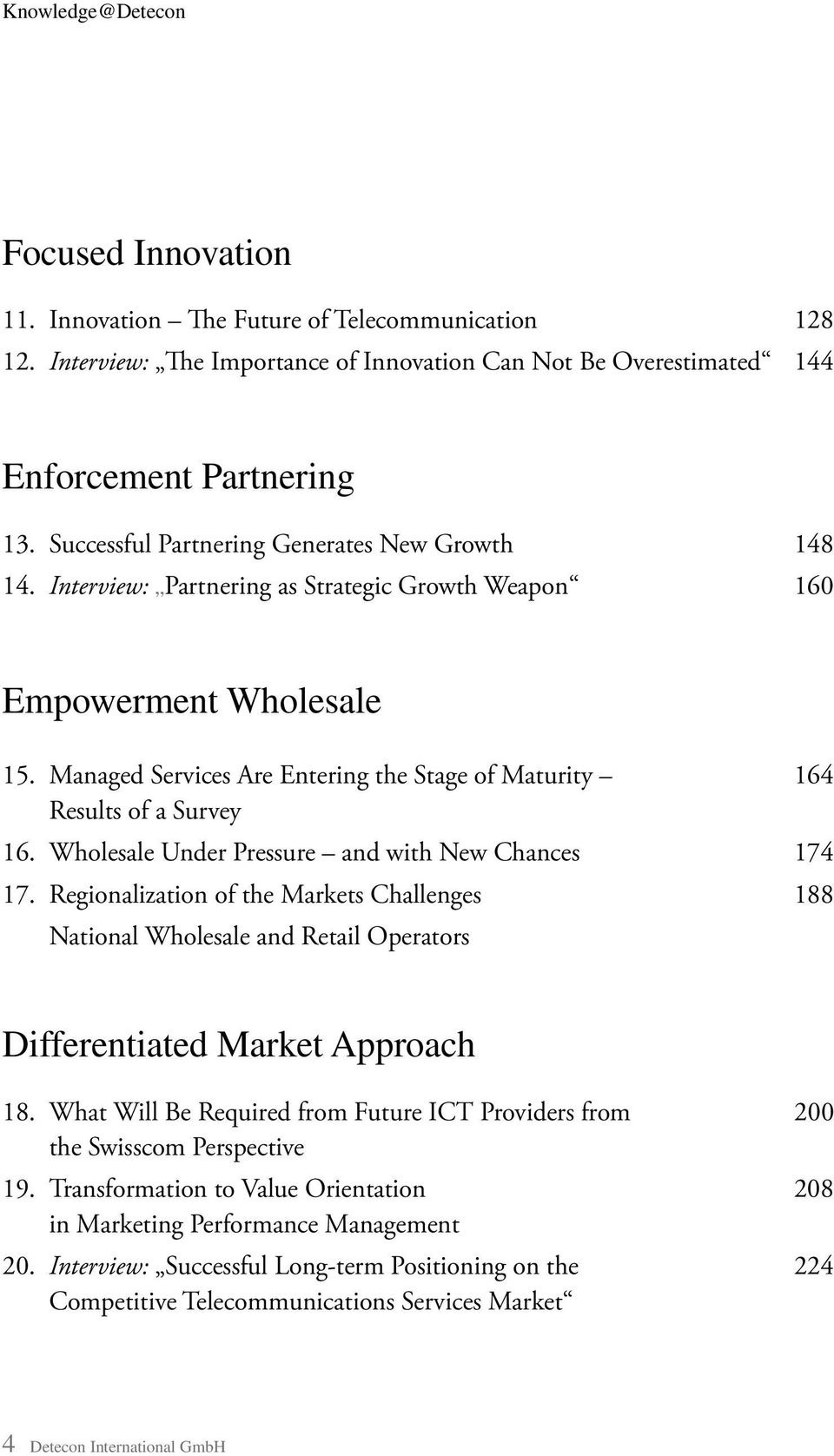
7 Future Telco 21. Marketing and Sales: Total Turnaround Interview: Brand Strategy Is More Important than Ever Before 244 in Telecommunications 23. Winning Hearts and Minds Loyalizing Customers 250 through a Convincing Customer Experience 24. Interview: Employee Pride Is an Important Element 264 of Customer Experience 25. Customer Self-Services: Efficiency and Customer Loyalty 270 in the Age of Digital Transformation Agile Processes and IT 26. Customer Self-Services: IT Architecture as Enabler 286 for Digital Self-Service 27. From Telecommunications Company to Process Factory 298 Outlook 312 The Authors 316 About Detecon International GmbH 320 Detecon International GmbH 5

8

9 Future Telco Foreword Neither the strongest nor the most intelligent survive, but the ones who can best adapt to change. Darwin s insights into the evolution of species (freely interpreted) can be applied with astonishing accuracy to the telecommunications industry as well: markets change and force all companies to review their structures, products, and business models and adapt them to new conditions. This is by no means a simple process and must be repeated constantly because in our fast-paced world of today transformation has become a constant.we see this in a positive light. Change is the driving force behind progress and always offers opportunities as well. Telecommunications companies should welcome transformation and boldly take charge of shaping and advancing it. Detecon International has defined seven fields of action which open up new opportunities for companies. They begin with modern network concepts which can be used to exploit to the full the possibilities created by digitalization. Network capacities must be expanded while simultaneously securing their integration. Fixed and mobile networks belong together. Companies should strive to incorporate more agility in their processes and IT systems, which will enable them to respond faster to changes in customer requirements and market conditions. Everyone involved in value creation must focus on innovation. New technologies, new products, and new services pave the way for penetrating new markets. As they set out in new directions, telecommunications companies will work together with partners and develop business fields that could not be any further from their thoughts at this time. Alliances and networks allow the sharing of risks, faster research, more specific advertising, and the realization of business models which would be out of reach for companies going it alone. There are revenue sources in the wholesale business just waiting to be developed in full. A strong infrastructure can serve as more than merely a unique selling proposition in the competition for end customers. It can also be used for business models founded on optimized utilization of network capacities and offering various levels of quality. In the future, retail business will differentiate market segments in greater detail. Factors such as variances in the capabilities of network infrastructures from one region to the next, varying intensity of competition between regions, and of course the differences in willingness to pay and preference structures of end customers must be given consideration. Companies which take the right factors into consideration will be successful on every market and in every segment. Shaping the markets of tomorrow will be the privilege of those firms which take on these exciting tasks today. I hope you enjoy reading these articles; may they inspire you with many new ideas. Best regards, Francis Deprez, CEO Detecon International GmbH Detecon International GmbH 7
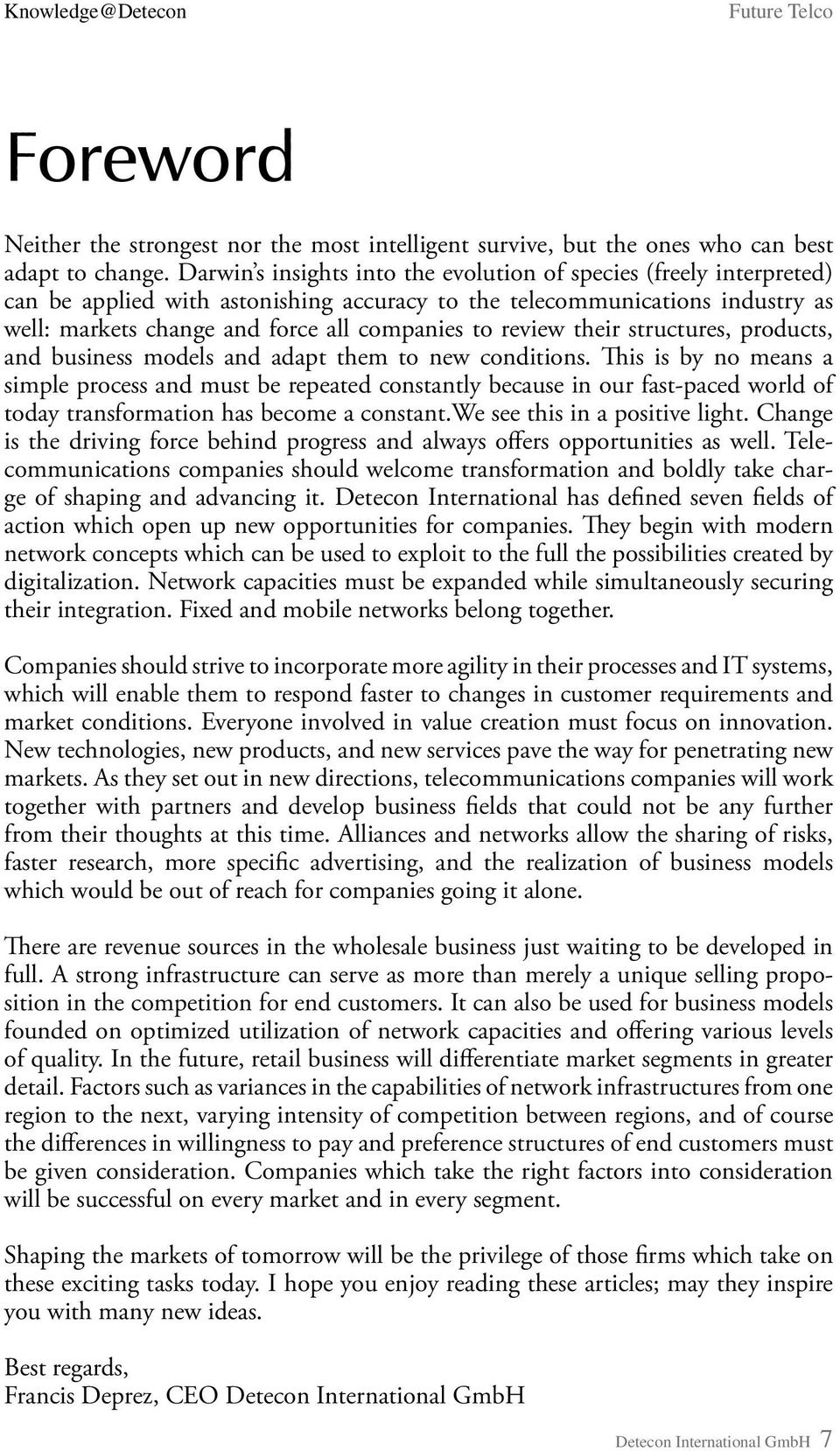
10 Challenging Future Network is King! Dr. Peter Krüssel > Handling the growth in network traffic is becoming the key task for Carriers. > Only integrated heavy asset carriers will have a chance of surviving. Companies which do business exclusively as mobile network operators have come to a dead end. > Seven levers for each value-added stages can support carriers in securing their profitability long-term. > These plans position the companies as a key director of digital value creation, and a driver of digital transformation in business and society. 8 Detecon International GmbH
11 Network is King! Keen Competition Among Carriers and OTTs Breathtaking growth in network traffic will drastically change the telecommunications industry. The effect on the network operator landscape is especially forceful in its impact. One might be tempted to say that this development is a consequence of the success of Internet-based service providers. At the service level, carriers are finding themselves in increasingly stiff competition with the Internet-based service providers, the so-called over-the-top (OTT) players. Some of these players are large corporations active worldwide such as Google, Microsoft, Facebook, Amazon, Samsung, or Apple. They have been highly successful in realizing immense growth in revenues by offering attractive end devices and the matching ecosystem in terms of operating systems, services, and apps, bypassing telecommunications companies and directly establishing stable customer relationships as well as billing models. Although sales figures are comparable, the profit margin situation and market capitalization of some of these companies exceed the values posted by carriers many times over. Amazon is a prominent exception; the company is obviously pursuing a strategy of unrelenting market expansion at the expense of the margin. A bewildering number of smaller, specialist OTT service providers such as Dropbox, Spotify, Deezer, LinkedIn, Napster, Gameloft, WhatsApp, Twitter, Zattoo, or Flickr are operating in the shadow of the large OTT providers. Within a relatively short period of time, they have successfully managed to position themselves worldwide in the niches gaming, on-demand and streaming music services, films, business networks, news, cloud-based document management, messaging, or photos. In contrast to telecommunications companies, they offer services which scale worldwide and can consequently realize equally economies of scope and scale. Attempts by carriers to accelerate to match the pace of these innovations have shown limited success. Their offers derived from their fundamental core business or the result of the spin-off of startups, from independent innovation units, or in cooperation with other carriers tend to be reactive in nature and frequently come too late. Nevertheless, OTTs and end device manufacturers are also operating in a highrisk environment which is extremely fast-lived. Focusing on only a few products or services creates dependencies, and the effects are both immediate and negative if an important end device generation flops or if important trends in operating systems, usability, or usage habits slip past unnoticed. The similar development of companies which differ so widely from one another like BlackBerry, Nokia, Motorola, Myspace, or Zynga is a vivid case in point. Detecon International GmbH 9

12 Challenging Future The relationship of the carriers to these competitors is ambivalent. On the one hand, they have caused broadband connectivity the carriers core business to skyrocket. The demand for broadband connectivity on both fixed and mobile networks has in effect risen so drastically because of the attractive end devices and the corresponding services. But the other side of the coin is that the OTTs are contributing to the problem of the networks reaching the limits of their capacities faster, making substantial investments in capacity expansion necessary and these expenditures fall squarely on the shoulders of the carriers alone. In view of the keen competition among classic telecommunications companies and cable television operators (where the price is the primary weapon) and the dominance of pricing schemes oriented to flat rates which in the fixed networks at least is now firmly established, financing the investments by raising the prices for the connectivity services on this market is certainly difficult, perhaps even impossible. Moreover, end device and OTT players are invading the realms originally ruled by the telecommunications companies such as text messaging and voice services in ever greater numbers. In addition, there are additional openings for attack from the exploitation of the potential inherent in technologies such as esim or in open standards for real-time communication (VoIP, chat, video telephony) such as WebRTC now in the final stages of standardization. These factors are putting even more downward pressure on the earnings of telecommunications companies. Growth in traffic is becoming a key task The main driver for the forecasted change in the carrier landscape is the exponential rise in traffic volume. We currently generate as much traffic in two days as in all of the year Analysys Mason predicts that data traffic in worldwide mobile networks will increase by a factor of 17 between 2012 and The causes are rooted in various developments. 2 The number of tablet PCs and smartphones with display resolutions which are frequently higher than those of HD television sets regularly available in retail trade has grown steadily in recent years. The landscape for services and apps has truly experienced a big bang 1 Cf. Analysys Mason, Wireless Network Traffic Worldwide: Forecasts and Analysis Cf. Petry/Schnitter/Salisbury, Operators Caught Between Scylla and Charybdis How Much Differentiation Potential Does the Performance Capability of the Networks Really Offer?, DMR 2/ Detecon International GmbH
13 Network is King! thanks to the enthusiasm for innovations on the part of the OTT players. These two factors, coupled with the expansion of the broadband infrastructures for fixed networks, the 3G and 4G hub in mobile networks, and the flat rates being offered by operators, influence the usage habits of customers because opportunity generates demand. The effects produced by the new services, some of which are still in their infancy (M2M, cloud services, virtualization of end device functions, and the digitalization of entire branches of industry think of Industry 4.0 and of people s private lives), have not yet made much of a splash. It must be emphasized that these influencing factors are by and large independent of one another. We assume there is an exponential rather than additive cumulation leading to the overall effect. So there is no reason to expect an end to the exorbitant growth in traffic. The fundamental challenge for the carriers will initially be on the side of the infrastructure. Carriers face the extraordinary difficulty to be forced to handle the growing traffic economically with to be upgraded networks by investing enormous financial resources, even though at this time corporate revenue are tending in the downward direction or, at best, stagnating. On the revenue side, the options open to carriers are essentially to increase prices for current services or to develop new sources of income from innovative services and new customers. The primary task on the side of costs and investments is the expansion and efficient operation of modern, powerful network infrastructures oriented to earnings potential. Regulatory framework from the political side is lacking If carriers want to secure their profitability, they must have an important prerequisite: a regulatory framework offering investment security and sufficient incentive for decisions in the face of risk. The political establishment in Europe has in the last few years set forth its demands on carriers with the intent of securing a functioning broadband infrastructure. But support, whether in the form of monetary aid or the creation of regulatory framework conditions, has generally been noticeable for its absence, or the proposed concepts have been too tentative. However, there have very recently been indications of a hesitant change of heart. It results first and foremost from recognition of the fact that a high-performance telecommunications infrastructure is a major competitive factor for industries. Europe has fallen Detecon International GmbH 11

14 Challenging Future behind in the competitive race among the regions of the world. Comparative statistics of broadband expansion in Europe, Asia, and the USA reveal just how clearly Europe now lags behind in fixed network and even in mobile services. The coverage rate of the 4G standard in the USA is three to four times greater than in Europe. South Korea is a prime example of an FTTH infrastructure which is more or less full-area coverage and has completely run away from the Europeans. Regulatory rulings such as the vectoring decision of the Federal Network Agency in Germany, recent access decisions for the last mile of some national regulatory authorities, and the initiative of the EU Commissioner Neelie Kroes, responsible for the European Digital Agenda and author of a new draft for a regulatory package with an eye on the single European telecommunications market, are headed in the right direction. While it is true that the initiative aimed at eliminating roaming fees within the EU by 2016 will wipe out yet another substantial source of income volume for carriers from the market, a path is also being mapped out which could allow operators, under certain conditions, to assign priorities to the handling of services from other providers based on the payment of monetary charges. This will offer opportunities for better financing of the required network expansion and force OTT players to contribute to the financing of the networks. In the end, the signals being sent out by the regulatory side in Europe are highly disparate, as was once again demonstrated during the most recent auction of mobile frequency licenses in Austria. The three mobile network companies bidding for the frequencies here had to pay really high amounts in excess of two billion euros. The network factor: integrated heavy assets as first choice What does the business model for telecommunications companies which will be successful in the future look like? The possibilities range from a strict bit pipe model to a full-service provider. Which model is ultimately most promising is a question of three factors in particular: the infrastructural base of the fixed and mobile network, the competitive position on the end customer market, and the ability to manage partnerships successfully. But the consequences are of even greater scope. The challenge traffic growth and the need for seamless connectivity across all infrastructures and the most highly diversified access technologies will force carriers to build an infrastructure which is increasingly finely meshed and truly integrated. Carriers with a granular fixed network of full-area coverage and a 12 Detecon International GmbH

15 Network is King! matching mobile network infrastructure will clearly be at an advantage in comparison with single-business mobile network companies. Resources at the air interface are proving to be limited. The available spectrum will be exhausted in the foreseeable future, even refarming will not be sufficient, and innovative technologies such as MIMO (multiple input, multiple output) and AAS (adaptive antenna systems) cannot promise to do more than gain a little time. Sooner or later, mobile network corporations will be forced to make the cells smaller and smaller. 3 The bottom line is that the number of cells which must be created, maintained, connected to the core network (backhaul), and integrated into network management will increase substantially. At this time, the four mobile network companies in Germany operate perhaps 80,000 macrocells. In the middle term, this figure will increase by a factor of 5 at the very least. In addition to these small cells, end customers will utilize indoor cells (WiFi offloading, femtocells) at their locations. Not every mobile network company will be able to afford this. In fact, considering the immense investment requirements and the necessity to connect this large number of additional cells to the core network, the fundamental question arises as to whether single-business mobile network companies are even capable of survival at all. Two options, dependent on parameters such as competitive position and infrastructural base, are moving to the forefront: either doing without an exclusive mobile network and divesting the network (sale and lease back), taking advantage of managed service from a third party and, as a kind of reseller, operating as a service provider or virtual network operator (MVNO) on the market; or stepping out in the other direction and building up or acquiring a fixed network. However, a project of this type would presumably be difficult to carry out on mature markets because suitable options cannot be developed in every country. If neither of these options can be realized, or can be realized only under difficult conditions, there is no choice other than the exit option. We can already observe movement in this direction on the market, prominently exemplified by Vodafone. The company has divested its mobile network holding in the USA and acquired the cable television operator KDG in Germany. Traffic growth will be the prominent driver of consolidation on the market. Size, volume (scaling effects, cost leadership), and utilization of network capacity which can be monetized will be decisive for survival on the market. 3 Cf. Petry, Future Broadband Communication, p. 78 pp. in this volume. Detecon International GmbH 13

16 Challenging Future This is why only integrated carriers (heavy assets) will have a chance of surviving. Companies which do business exclusively as mobile network operators have come to a dead end. They are left with essentially three options: > Development in the direction of an integrated carrier by acquisition or creation of a fixed network (heavy asset) > Positioning as an MVNO/reseller/service provider (Light Asset) > Exit. The priorities for a light-asset approach, an OPEX-dominated business model, focus less on the refinancing of the networks and more on achieving the greatest possible spread between the costs for the purchased wholesale services and the retail prices which can be realized on the market in conjunction with OTT partnerships. If the alternative of the heavy asset approach is chosen, the previously defined question about the business model must be answered. In contrast to the light asset model, the heavy asset model is CAPEX-dominated and requires business logic oriented to the long term. The networks are at the hub of all business decisions. The necessary investments must be justified by the achievable revenues and profit and/or be refinanced as quickly as possible (monetarization of the networks). Primary focus is on improving efficiency in the allocation of CAPEX and OPEX for the networks, the full utilization of network capacities, and the increase in revenues. Efficiency of the networks Modernization heightens network efficiency Modern network concepts enable an increase in network efficiency. Virtually all carriers have taken a step in the direction of IP and are in the process of rigorously shutting down legacy systems and heterogeneous, service-specific production platforms which have developed over the course of time and of implementing IP technology. More advanced steps toward centralization of intelligence in the network, virtualization of network functions, reduction of active components and locations in the network, strict application of IT principles to the classic telecommunications products such as software-defined networks, and, finally, automation are in the planning stages and undergoing feasibility tests; in a few cases, some of these steps are already being implemented. 4 Concepts of this nature do more than simply reduce CAPEX and, above all, OPEX; they accelerate and flexibilize innovation, product development, provision 14 Detecon International GmbH

17 Network is King! and billing of services, and the integration of external partners. In other words, they create the key prerequisite for the sustained monetarization of the networks and pave the way for marketing departments to realize innovative product ideas and price models, either alone or in collaboration with partners on the market. Moreover, they reduce dependencies on network component manufacturers and create maneuvering room in dealings with OTT players. They are of transformational significance for carriers and implicitly entail precisely such structural, cultural, and procedural changes. Examples include the closer interaction of the process landscapes of IT, technology, and product development departments (which are usually strictly separated in organizational structures and lack adequate harmonization of processes) and partnering capability. Expansion of network capacities by means of small cells and hetnets The largest investment items are related to the increase in network capacity either through the more efficient utilization of existing resources or by the generation or acquisition of additional resources. In the fixed network segment, there will ultimately be no other choice than to expand the optical fiber infrastructure in the various FTTx variants such as fiber to the building (FTTB), fiber to the curb (FTTC), or fiber to the distribution point (FTTDP). This is an undertaking demanding extremely high investments because it is usually necessary to do civil and underground work when laying the cable. Enormous investment sums ranging as high as 93.8 billion, depending on the scope of the estimates and the planned technology, have been projected for the FTTH expansion in Germany to achieve full-area coverage. 5 The mobile networks have the choice of increasing either the spectral efficiency of the radio access technologies or the spatial reutilization of the spectrum in cellular mobile radio systems. This ultimately means a reduction in cell sizes and an increase in the number of cells. 6 The optimization of the spectral efficiency by means of methods such as smart antennas and MIMO as well as the utilization of higher modulation frequencies and improved channel coding are the technologies now in use. But they will not be sufficient to cover the rising demand or to assure viability of certain application 4 Cf. Schnitter/Bornhauser, Future Network Architectures, p. 34 pp.; Gonsa/Chrestin/Reith, Virtualization, p. 56 pp. in this volume. 5 Cf. Study on behalf of the German Federal Ministry of Economics and Technology (BMWi), August 2013, p Cf. Petry, Future Broadband Communication, p. 78 pp. in this volume; Heuermann, New Network Strategies, p.100 pp. in this volume. Detecon International GmbH 15
18 Challenging Future scenarios such as adequate radio coverage in street canyons or availability in buildings. There is simply no alternative to more finely meshed networks. Rather than a few large base stations with a wide range, usually involving high costs, it will be necessary in the future to plan, build, connect, and operate additionally a large number of small, inexpensive cells. In supplement to the small cells, which will be used primarily outdoors, it will be necessary to use DSL-connected WiFi routers for end customers (indoors) as an offload opportunity and to install so-called 3G/4G femto cells with SON (self-organizing network) capability for improved coordination of potential interference, all possibly requiring additional expenditures for operators related to infrastructure and integration. Future access routers used by end customers should ideally contain both an LTE and WiFi modem. But these devices are beyond the conventional control of the network operators. In the end, there will be completely new and enormous challenges in network planning, roll-out, backhaul, logistics, required installation and maintenance capacity, location acquisition, roll-out processes, network management, management of increasing interference, and processes for eliminating disruptions. 7 Integrated planning of fixed and mobile networks The concern will be to allocate these investments for the build-up of new grids or the expansion of existing ones on the basis of market needs and with an eye on the existing infrastructure to ensure that they deliver an economic profit as quickly as possible. A precise geographic forecast, as granular as possible, of the traffic volume is indispensable to guarantee the profitability of local capacity increases. 8 It is just as important to regard fixed and mobile networks as integrated so that the synergies between the two networks can be mined. These synergies arise from full-area coverage from existing fixed networks, above all from the locally available WiFi offload capacities, and from the opportunity to provide low-cost backhaul for the smaller-cell mobile networks of the future. The smaller the cells of the mobile networks, the greater the synergies between fixed and mobile networks! The two networks grow together and supplement each other synergetically. For its part, the fixed network supports the mobile network because it can divert mobile network traffic (backhaul) or can provide offload capacities (WiFi/femto cells). In return, the integration of the small cells can contribute to a substantial improvement in the business case for the FTTx roll-out in the fixed network. 7 Cf. Petry, Future Broadband Communication, p. 78 pp. in this volume. 8 Cf. Fritzsche/Schweigel/Rhong, Integrated Planning, p. 114 pp. in this volume. 16 Detecon International GmbH

19 Network is King! Monetarization potential of the networks in wholesale and retail Investments in the networks must produce a return. The creation of the technological basis for the efficient transport of the growing traffic volume is not an end in itself for carriers. They must be in a position to monetarize these investments in the networks and to realize appropriate earnings. Network cooperationen In view of the investment demands sketched out above, the related necessity to utilize network capacity to the full, and the significance of scaling effects for profitability, it is only logical to locate an important source of income in the wholesale business. 9 Cooperative ventures among carriers in the sense of infrastructure sharing or wholebuy will be essential in the future if these investments are to be economically justifiable. 10 The room for alternatives in the mobile sector ranges from wholesale services pursuant to regulatory requirements to managed services of varying ranges. 11 The following examples are illustrative: 12 > Site sharing refers to the sharing among network operators of the passive elements of the infrastructure such as installation sites or masts. This model will presumably find great favor in view of the difficulties in finding suitable locations which already exist today. > National roaming to increase reach and/or network coverage is enticing for new network operators on the market or for operators who do not want to finance the next round of investments for the development of less attractive areas. > Network sharing includes the joint usage of active as well as passive elements in access or core networks. Spectrum sharing occurs when one network operator takes over the optimized utilization of the spectral resources which are jointly available on behalf of the partner(s). 9 Cf. Nielinger/Steingröver, Wholesale, p. 174 pp. in this volume. 10 Cf. Lundborg, Regionalization, p. 188 pp. in this volume. 11 Cf. Schmitz, Managed Services, p. 164 pp. in this volume. 12 Cf. Schultz/Schieder, Ways Out of the Frequency Bottleneck New network concepts for the cost-efficient provision of mobile broadband services, DMR Detecon International GmbH 17
20 Challenging Future > The most far-reaching form of cooperation ends with a network operator divesting its own network, transferring it to a third party, and acting strictly as a reseller, virtual network operator, or service provider with respect to customers. This option essentially corresponds to the light asset approach described above. Carriers which have a strong infrastructural base for both fixed and mobile networks on a market have a unique opportunity to score points, especially in wholesale business, as a consequence of the demand for network expansion briefly described above and the imminent roll-out of small-cell networks and their integration. They can force other competitors out of the infrastructure business and consign them to the position of virtual network operators or resellers. Business models based on QoS in wholesale Besides the aspects of wholesale business revolving primarily around the question of securing the required network capacities and network coverage on national markets, additional opportunities result from the ICTization of the world or the Internet of Things. New business fields such as cloud services, XaaS, or M2M are leading to the dramatic gain in significance of worldwide connectivity which functions seamlessly no matter which of the many and diversified access technologies are in use. This achievement is subject to the conclusion of interconnection agreements, either direct or indirect, with as many access network operators as possible around the world. The laws of large numbers apply to this business as well so that production and delivery at low cost are possible. However, the transport of the data traffic also has aspects of quality. Providers must be able to attach various quality parameters such as delay, jitter, or packetloss probabilities to the transport. 13 QoS differentiation in retail An alternative to driving wholesale business is the chance to offer a superior network infrastructure exclusively to the company s own retail division and to initiate competition based on quality in the hope that end customers will be willing to open their wallets to pay for this quality. But this is an approach which will be difficult to turn into reality in view of the intense price competition, established flat rates, a lack of awareness on the part of many customers that there is any shortage (in the fixed network, at least, best effort is still sufficient for most applications), the performance capability of cable network operators, and the 13 Cf. Gerlach/Knoben/Schellschmidt, Everything Flows The emerging cross-industry ICTization changes competition within the wholesale business 2032, DMR 2/ Detecon International GmbH

21 Network is King! everything is free mentality dominant on the Internet; at most, it will appeal to only a narrow segment of the market. Ultimately, the reasonable solution is to move in the one direction while not neglecting the other in other words, to realize wholesale and retail offers equally. The prerequisites for differentiation based on quality in retail are quality features such as the aforementioned parameters, which must be palpable for customers. Consequently, there must be price differences based on different quality classes. The idea of limited network resources must be given due consideration in the form of reasonable volume dependencies. This means nothing less than a weakening of the established flat rate regime. Initial efforts in this direction can be noted on the market. Telekom Deutschland announced that the pricing logic of the mobile network in the form of prices dependent on volume would be applied to the fixed network from 2016 as a way to highlight the limited character of network resources. The speed of the connection for certain rate plans would be throttled when a certain data volume had been reached. Telekom experienced firsthand just how difficult it is to change price models which are firmly established on the market and in the minds of customers when it found itself at the center of a shitstorm in social media as well as the entire press landscape, from consumer protection organizations, and in the reactions from politicians. But telecommunications companies still have to face the major conflict in the implementation of price models differentiated according to quality. It has not yet been clarified whether aspects such as differentiation and prioritization based on quality and subsequently perhaps discrimination against certain providers and applications can be realized at all in view of the dominance of the principle of network neutrality. However, the digital agenda of the EU is cause for cautious optimism among carriers. One solution which is virtually networkneutral and simultaneously differentiating is offered by temporary quality assurance oriented to the concrete needs of end customers. For instance, one could imagine providing a turbo or speed button which end customers can push to ensure specific quality for a limited time when using a certain service such as viewing an HD video or an Internet-based video service. A model of this nature (quality on demand) would moreover be in alignment with the predicted usage behavior of end customers purchasing digital content. These customers are less restricted in their consumption of content by time constraints and broadcasting schedules; they decide for themselves when and where they watch programs. Detecon International GmbH 19
22 Challenging Future Innovation and Partnering Price models which differentiate according to quality or volume give rise to the question about opportunities for cooperation between telecommunications companies and OTT players. Companies seeking potential new sources of revenue and possible differentiation factors in competition with other, direct competitors will set their sights on OTT players. For the most part, telecommunications companies have been reduced, especially in the private customer segment, to their basic business: connectivity. Their efforts to go beyond this and offer their own innovative services at the OTT level have been and continue to be disappointing. This statement is true of both the long-tail and the short-tail segments of services. The logical conclusion is to conclude partnerships with Internet-based service providers. Initial steps have been taken in this direction as well, including the successful cooperation between Telekom Deutschland and the music streaming provider Spotify or the cooperation between SFR in France and the game provider Gameloft or the music service Napster. Possible elements of cooperation are revenue sharing models, joint marketing campaigns either with or without separate branding, distribution partnerships, or differentiation related to QoS, to network technology, or to rate plans. It is foreseeable that telecommunications companies will in the future be competing for the most attractive partnerships or for their own position in so-called multilateral smart business networks. 14 Cooperative ventures of this nature are suitable for enhancing the emotional associations of the company s own brand by offering appropriate products, rounding off its own service portfolio, and countering the commoditization of basic services and connectivity. The decisive factors for carriers who want to build up their negotiating strength when competing for attractive partnerships include extensive reach or market shares in the pertinent countries, distribution power, branding, service, and correspondingly attractive partner models. First and foremost, however, is an attractive service-enabling portfolio such as innovative QoS mechanisms, SLAs, AAA, LBS, billing, bundling, open APIs, multi-client capability, speed, and flexibility in systems and processes 15 which enables potential partners to become integrated into the telecommunications companies platforms quickly and without complication. The issue which must be artfully solved by the telecommunications companies will be the clear definition of the distinction between make or buy, i.e., between what belongs to the core business and what is acquired through partnerships. Their own innovations will be feasible in the fields in which concepts for services closely related to the network are created for their own customers and also for partner companies so that the original business models of the partners 20 Detecon International GmbH
23 Network is King! are supported by digitalization. 16 Moreover, their own development of innovative services will be logical when such services are scalable primarily on the national markets of the relevant carriers or display a high degree of affinity to the existing portfolio. 17 It is foreseeable that the integration of the networks and the efforts in the direction of network modernization 18 all-ip, virtualization, SDN, convergence of IT and network technology will drive genuinely seamless and convergent connectivity services as well as open interfaces and flexible processes forward. A highly diversified group of partners will be able to dock onto these convergent services. The prerequisites must be created by telecommunications companies with respect to platforms significantly faster and more flexible in the future. 19 By implementing innovations in the areas closely related to networks, carriers will make an essential contribution to, and create the fundamental prerequisites for, the digital transformation of other business sectors. At the same time, they will ensure the security of their original business model for the future. 20 Differentiation in market development The next area requiring major work is differentiation in market development. Differentiation refers to the regions within one market which have been developed with infrastructures of varying capability and to the heterogeneity of the market segments which can be segmented according to willingness to pay as well as to psychographic or socio-demographic criteria. 21 In the first case, the available service portfolio and the connection speeds vary from one region to the next. Such circumstances must be taken into account as a comparison of the performance capability of competitors in this region when entering the market and deciding on the use of marketing instruments. At this point, the necessity for integrated planning of networks appears once again. Integration in this context is not limited to the integration of fixed and mobile networks; it goes beyond that to include the integration of market data such as 14 Cf. Krämer, Successful Partnering, p. 148 pp. in this volume. 15 Cf. Roos, CSS: IT Architecture, p. 286 pp. in this volume. 16 Cf. Helbig, From Telecommunications Company to Process Factory, p. 298 pp. in this volume. 17 Cf. Kellmereit/Narielvala, Innovation, p. 128 pp. in this volume. 18 Cf. Schnitter/Bornhauser, Future Network Architectures, p. 34 pp. in this volume. 19 Cf.. Gonsa/Chrestin/Reith, Virtualization, p. 56 pp. in this volume. 20 Cf. Theobaldt/Lünendonk, Mission Future: ICT 2032, 45 Theses on the Road to Tomorrow, Cf. Lundborg, Regionalization, p. 188 pp. in this volume. Detecon International GmbH 21
24 Challenging Future competitive situation, information about existing customers, and technological information such as the existing network infrastructures, traffic information, and forecasts. The expansion activities can then be managed at a geographic level and as granularly as possible with an orientation to needs and according to strictly economic criteria, e.g., optimized for results according to the criterion NPV (net present value). 22 The second case takes as its starting point the gap on the markets found between the segments on the basis of the criterion of willingness to pay. The segment of discount shoppers or bargain hunters on many European markets is growing at the expense of the segments which exhibit a greater willingness to pay. The successful launch of low-cost brands such as yourfone in Germany or free in France are evidence of this trend. In this respect, telecommunications companies are called upon to give thought to correspondingly different development strategies for the pertinent segments. Multibranding strategies, which are being successfully pursued by some carriers such as E-Plus in Germany, can be useful. But most nationwide carriers still act according to a single-branding strategy and attempt to cover all of the segments and their needs by offering various rate plan and service models. A multibranding strategy assuming that effective fencing mechanisms are in place creates an opportunity to participate in the growth of these segments without significant cannibalization of the core brand. Points of differentiation can be played out across the entire marketing mix: from product qualities and prices to bundles featuring possible additional offers, to innovative own services or partnerships, and all the way to heterogeneous service qualities, e.g., technical installation service and repair service on site, reachability of the call centers, variances in the reachability of the channels, and SLAs. Other subjects which deserve greater attention when markets are largely saturated are churn prevention, customer retention, or loyalty management. The acquisition of new customers or winning back previous customers involves an unreasonably high market investment. The care and differentiated, value-oriented treatment of the clientele along with the mining of cross- and upselling potential from the viewpoint of efficiency carry great weight for this reason. Top customers in the private and business customer segment must be treated differently than customers who are less attractive for carriers from a value-oriented standpoint. 23 Raising barriers to churn and establishing lock-in mechanisms do not necessarily lead to genuine intrinsic customer loyalty to the provider in the top segment. Such loyalty will more likely be generated by fairness and, together with r ational 22 Cf. Fritzsche/Schweigel/Rhong, Integrated Planning, p. 114 pp. in this volume. 22 Detecon International GmbH
25 Network is King! elements, by using the mechanisms of an emotional bond. Carriers must complete the step from service excellence to true customer enthusiasm. All of the customer touch points must be optimized in terms of a thrilling customer experience. 24 As they strive to monetarize the networks, marketing departments must obey the dictates of efficiency and effectiveness just like the technology and IT departments. The marketing investment in the form of so-called customer acquisition costs (CAC) and customer retention costs (CRC) must be strictly aligned with customer value. Initial experience in the area of customer self-service reveals that the creation of positive customer experiences and an improvement in the perception of customer service in compliance with important design principles for the underlying IT architecture can definitely go hand in hand with cost reductions, which in some cases are substantial. 25 It is important that the actions related to marketing and sales are embedded in a framework of consistent target systems, defined KPIs, and corresponding steering logic across all of the various marketrelated corporate divisions and channels. This framework must take into account the situation of the specific company and the market conditions so that actions and performance measurement can be correctly controlled. 26 Basically, the prerequisites for generating true customer loyalty and enthusiasm by means of a positive customer experience are good for carriers. Together with their partners, integrated carriers have at their disposal an extraordinarily attractive service portfolio which has the emotional and rational attributes necessary to open access to the exciting world of digital experience of the 21st century in all of its many facets to their customers. Seven levers for the integrated carrier of the future The present business situation for many carriers is characterized by stagnating or even declining sales, rising need for investments, high levels of debt, and falling profits. The causes lie in the tremendous growth in traffic, the success of the OTT players, and the keen price competition among the carriers. As long as the earnings per bit continue to fall dramatically and the costs per bit cannot be adjusted to match (as a minimum) the speed of the decline, many carriers will find themselves confronted with the issue of their survival in the middle term. 23 Cf. Penkert/Eberwein, Customer Self-Services, p. 270 pp. in this volume. 24 Cf. Hauk, Customer Experience, p. 250 pp.; Aumann, Marketing and Sales, p. 230 pp. in this volume. 25 Cf. Roos, CSS: IT Architecture, p. 286 pp. in this volume. 26 Cf. Eberhard, Marketing Performance Management, p. 208 pp. in this volume. Detecon International GmbH 23
26 Challenging Future Only integrated heavy asset carriers will be able to master the problems economically. Companies which do business exclusively as mobile network operators have come to a dead end. They will not survive on mature markets. They have the options of divesting their own networks and operating as resellers or MVNOs or of merging with a fixed network operator and developing into an integrated heavy asset carrier. If neither of these options can be realized, the exit is the only remaining choice. But the challenges described above remain for the integrated heavy asset carriers as well. They must on the one hand provide additional resources and work on their production and marketing efficiency, while on the other hand they at least slow down the decay in the earnings per bit and develop new sources of income. Detecon experts have identified seven levers which can support carriers in securing their profitability long-term. The following articles describe the significance and effects of these seven levers for each value-added stages of an integrated heavy asset carrier. Carriers which understand how to plan, build up, operate, and monetarize their networks highly efficiently will survive. Realization of economies of scale, integrated network expansion aligned strictly with economic profit criteria, implementation of modern network concepts, close linking of network and IT, development of new sources of income and innovative price models, and successful acquisition of end customers through attractive own products and services and innovative offers organized in partnerships are the success criteria for a sustained and profitable positioning on the market. 24 Detecon International GmbH
27 Network is King! A successful realization of the plans briefly sketched above will create substantial opportunities for telecommunications companies. These plans lay the foundation for securing profitability long-term, positioning the companies with respect to customers as a key director of digital value creation, and developing from a party driven by digital transformation in business and society to a driver of this transformation. Figure: Short to medium term challenges & solutions for telcos: Seven keys to ensure profitability for integrated heavy asset carriers Challenges Strategic options Seven keys to success for integrated heavy asset carriers Traffic growth Infrastructure heavy asset Mobile 2 3 Network is King! 5 1. Modern Network Concepts 2. Integrated Deployment of Network Capacities OTT Player Resale light asset Focused Innovation 4. Enforcement Partnering 5. Empowerment Wholesale Price competition No activity 2 2 Fixed 6. Differentiated Market Approach 7. Agile Processes & IT No activity Resale light asset Infrastructure heavy asset 5 1 Attractivity of position = high = low Source: Detecon Detecon International GmbH 25
28 The Capital Market Perspective on Challenges Facing the Telecommunications Industry Interview Massive challenges loom in the future of the telecommunications industry. Dramatic growth in traffic, intense price competition among the carriers, and the success of the over-the-top (OTT) players these factors will, in the short and middle term (so a common assumption), generate substantial pressure toward consolidation. Frank Rothauge, AHP Capital Management, and Wolfgang Specht, Bankhaus Lampe, answer questions about the validity of this assumption. 26 Detecon International GmbH
29 The Capital Market Perspective on Challenges Facing the Telecommunications Industry Question: What kind of influence do the capital market and banks have on the telecommunications industry when it comes to the challenges of the future? How great is the capital market s influence, and what impact does it have? Rothauge: The influence of the capital market and banks is always particularly powerful when funds to finance activities are required. In view of the enormous magnitude of the investments currently needed to ensure that the networks are prepared for the future, the capital market is a weighty factor indeed. However, the interesting phenomenon here is that the mechanism for direct influence during the financing of new investments additional third-party capital, for instance is as a rule of less relevance than the mechanism for indirect influence, the way the governing bodies of the companies are influenced by shareholders or lenders. The capital market always concentrates on the highest possible return on capital, and many telecommunications companies find it difficult to satisfy the demands of the capital market precisely in this respect. Specht: The differences in the time horizons of the various parties can also be problematic. Generally speaking, investors prefer fast realization of their returns. Moreover, they like glass-clear transparency in the assessment of the recoverability of their investments. This is often contrary to the long-term investment cycles related to investments in the network infrastructure. Question: What needs to be done to promote the willingness of the capital market to finance new network infrastructures? Specht: Investors must be convinced of the recoverability of their investments. Unfortunately, they have suffered a number of disappointments in this respect in the past. Technological trends have turned out to be shorter-lived than originally expected. Decisions made by the regulating authorities in Europe have also heightened competition and increased pressure on prices. Regulators here have set for themselves a different focus from that in the USA and other countries. European consumers have had good reason to celebrate average revenue per user in mobile networks is only half as high as in the USA. Rothauge: The decisive point is a change in the price mechanisms. Telecommunications is the only large infrastructure-based industry in which prices have been declining for years. This trend has been accompanied by a creeping devaluation of the infrastructure. Price stabilization would be highly desirable; indeed, the establishment of a trend in the direction of slightly rising prices for infrastructurerelated services would be ideal, especially with respect to network connections. Detecon International GmbH 27
30 Interview The severe competition has frequently forced players to throw their plans along these lines out the window. But they have also been guilty of not thinking their price strategies completely through or of being too short-sighted. Question: What price strategies should telecommunications companies pursue to achieve this objective? Rothauge: The sharp rise in traffic volume for every single customer resulting from the new ways the telecommunications infrastructure is being used represents a key opportunity for leverage in this issue. Mobile Internet is regarded as the major driver in mobile networks; this role is played for fixed networks above all by video content. In the USA, for instance, 30% of the traffic is related to the utilization of video content from Netflix alone. Here is a unique chance for the telecommunications companies to push through higher prices for higherspeed connections, especially since the competition is naturally limited as a rule because profitable expansion will be possible solely for one single higher-speed infrastructure. The customers need to utilize the new services will inevitably lead to greater willingness to pay for faster connections especially if customers are intelligently introduced to these new services. The conflict described so frequently between OTT providers such as Netflix, Hulu, or Lovefilm and the telecommunications providers is in reality a symbiosis: both sides are dependent on each other for their success. But this is precisely the issue where providers must maintain their price discipline. Ill-conceived price reductions related to connections are absolutely counterproductive. Specht: Moreover, a greater willingness to substitute on the part of customers could prove to be helpful from the companies perspective. If the trend to immaterial consumption continues, it is certainly imaginable that customers will devote a greater portion of their budgets to telecommunications services. This would be balanced by limitations in their purchases of CDs, DVDs, or magazines, for example. Question: Maintaining price discipline would be much simpler if the competitive landscape were more strongly consolidated. In comparison with the USA, the landscape of the telecommunications companies in Europe is highly fragmented. There is only a handful of carriers in the USA; their number in Europe is almost unmanageable. Does Europe need to play catch-up in consolidation of the players? How important is size as a factor? 28 Detecon International GmbH
31 The Capital Market Perspective on Challenges Facing the Telecommunications Industry Specht: Historical development undoubtedly plays a role here. Setting up telecommunications networks was seen as a national responsibility in the past century, analogously to other infrastructures of a network nature. The large number of countries led to a large number of independent networks. In the past, cross-border mergers often did not fulfill expectations for synergy effects. And there are still national interests involved, resulting in part from the equity holdings in a number of incumbents and making consolidation more difficult. Rothauge: One of the major reasons for the fragmented competitive landscape in Europe is the regulatory landscape which is still equally fragmented, characterized as it is by 27 national regulatory authorities in the EU alone. The national regulations make it difficult for companies to exploit synergies from international mergers. However, some of the factors which play a role can never be changed. The common language in the USA serves as the basis for a standard marketing strategy; this will never be the case in Europe. That is why I am skeptical about the genuine benefits an international consolidation would provide, even if Europe should successfully centralize its regulatory activities; such a consolidation is more likely in mobile services than in the fixed networks. There is not a shadow of doubt about the advantages of a national consolidation for the companies but the extent of such a consolidation is restricted by the competition authorities. Question: What do you see as the most important drivers and hurdles related to consolidation among the telecommunications companies in Europe? Specht: There has often been a lack of strategic sense behind the international mergers among incumbents, and opportunities to exploit synergies have been rare. Corporate managers must ask themselves: Why should I buy into the same problems abroad that I have on my home market? Relevant issues include redundant personnel, lack of clarity about the regulatory future, or rising infrastructure competition. In the meantime, however, a number of restructuring steps have been taken, and we can even see a trend in the direction of standardization of the regulatory frameworks. There could be stronger arguments in favor of crossborder mergers in the future. Uniform network standards which are on their way will also play a key role. The cross-border implementation and management of services will be significantly simpler when standard all-ip networks have been established. But there is still a long way to go before we reach that point. Detecon International GmbH 29
32 Interview Question: What characterizes carriers which would like to play an active role in defining this consolidation process? How important are the stock prices, market capitalization, or other financial KPIs? Rothauge: Consolidation is first and foremost a question of financial strength. Carriers with a high stock exchange value and a low level of indebtedness when viewed, for instance, as the ratio of net indebtedness to operating profit are ideally positioned; indebtedness in particular is of extremely great importance because the investors initially have few benefits from the advantages of the consolidation. But shareholders often regard mergers with a critical eye because there have been, and there still are, many examples of counterproductive developments. Evidence of such developments can be found in the extensive write-offs of goodwill which have followed some of the mega-mergers. Mergers put a tremendous burden on management and employees, frequently diverting concentration away from the market and customers and causing companies to fall behind their competition. These are reasons why the capital market as a rule tends to be critical in its assessment of large mergers, especially international ones, while smaller, more easily manageable acquisitions are viewed with greater approval. Specht: Credibility plays an important role, as does management s track record with acquisitions and integration. When they look back, investors have seen too many expensive acquisitions in our industry which did not fulfill growth expectations or result in the scope of synergies as planned. One example from the German market is the investment of France Télécom in Mobilcom. Question: What dos and don ts should carriers take to heart if they want to be attractive to the capital market in their consolidation scenarios? Rothauge: In my opinion, the clearest and most consistent strategy possible is decisive when it comes to consolidation. It is hard to explain why an incumbent which is the market leader in its home country should suddenly buy the number four on the mobile market of a neighboring country when it has no experience in that country and cannot point to a convincing development strategy for the asset. In other words, if a carrier has achieved success by pursuing an integrated strategy with strong network depth, it should also stick with the model in the event of international expansion. If the carrier pursues an asset light strategy, then it should continue to do so. Above all, it must be possible to demonstrate clearly the added value of an acquisition; at a minimum, the purchased asset should offer an opportunity to apply once again an added value strategy which has already been realized with success. 30 Detecon International GmbH
33 The Capital Market Perspective on Challenges Facing the Telecommunications Industry Specht: The passive role can also be interesting. If a company is able to position itself as an attractive target for acquisition, investors will often add an acquisition bonus to the fair value. Sometimes it is enough if members of management simply do not deny the idea reported in the press that the company is a candidate for acquisition. Question: How important are cooperative ventures among telecommunications companies as a kind of substitute for a consolidation? In what areas do cooperative ventures among carriers make good sense? Rothauge: Cooperative ventures among telecommunications companies as well as with OTT providers will play a greater role in the future because there are very few companies with the resources required to master the challenges of network expansion all on their own. So there will certainly be closer collaboration between strictly mobile network providers and strictly fixed network providers as a means of resisting the pressure from integrated providers. Cooperation management will become a key area of competence, especially for players with lower market share, in relation to other carriers as well as OTT providers. Specht: There are already a number of examples in the form of purchasing cooperatives e.g., between France Télécom and Deutsche Telekom for hardware or of the joint development of services such as the message service Joyn, a project of a number of European incumbents. But Joyn also reveals the dilemma of the industry: own developments are often expensive and take too long. By the time the product had reached market maturity, WhatsApp had conquered the market. Question: How can the relationship between carriers and OTT players be successfully structured from the carrier perspective? How can carriers secure a position of sustainable success? Are they better off as suppliers of outstanding connectivity or as providers of a broad spectrum of their own innovative content products as well? How important are vertical partnerships with OTT players? Specht: Unfortunately, most carriers must be satisfied with focusing on connectivity, although they do not have to give up completely their desire to offer some additional content. One buzzword is smart pipe : the company provides the transport platform and aggregates a number of different services simultaneously for the customers, but most of these services have been procured from partners. The result is a package of network access, data volume, security solution, and content. Detecon International GmbH 31
34 Interview Rothauge: To start with, the carrier is not a supplier to the OTT provider; as a rule, it has its own relationship to the end customers. The way carriers see themselves is characterized in part by arrogance, in part by fear. They would be better served by a more sober self-appraisal. Clearly: there would not be a single customer interested in fast Internet access without the millions of services and content from Internet companies. This means that carriers have benefited greatly from the OTT providers. The key question is whether the carriers have the skills required for success as Internet content providers and whether this role would be of overall benefit. Deutsche Telekom has just sold a highly successful Internet provider like ImmobilienScout24. This clearly demonstrates that vertical integration produces added value only if and when network connection and content have an especially close relationship. This is the case for video and television offerings, for example. There are some concrete examples in this specific area which show how carriers can become successfully established with their products and services. Question: How do you appraise the middle-term chances of survival for smaller regional or local carriers within a country and for so-called resellers? Aren t the latter especially at risk of being pushed out of the market, sooner or later, by the OTT providers? Rothauge: I don t see any risk of this happening at all. Local carriers are concentrating more and more on the network connection in their local environment. What point would there be for an OTT provider to develop in this area? It is certainly possible for OTT providers to become successful resellers of telecommunications services, but this will presumably not happen at the expense of existing resellers. The latter are involved in hard-fought competition with the carriers anyway and have created marketing strategies which are difficult for OTTs to copy, just as the carriers have a hard time copying the content services of the OTTs. However, we could imagine completely new reselling approaches. The future will presumably see highly successful M2M resellers who do especially lucrative business in the realization of M2M strategies for specific customer groups and applications. Equally imaginable is the development of online game providers into successful resellers of speed options for Internet access. Specht: There are several city and regional carriers which have already reached a critical mass and which would find buyers if the current investors wanted to sell. However, the vectoring decision by the German Federal Network Agency and the draft of the new regulatory statutes in Europe pose some risks for carriers especially with respect to their access to the local loop. I share Mr. Rothauge s 32 Detecon International GmbH
35 The Capital Market Perspective on Challenges Facing the Telecommunications Industry opinion about resellers and MVNOs. More than a decade of interaction between network operators and market has produced strong and, above all, lean providers. Moreover, it is imaginable that special rights will be granted to resellers and MVNOs in the course of further market concentration such as a merger of O2 with E-Plus. In Austria, for example, 3 was required to guarantee access to up to 30% of the network capacity to as many as 16 MVNOs at agreed terms and conditions for ten years as part of its acquisition of Orange Austria. AHP Capital Management GmbH is an assets management company for private and professional clients approved by the German Federal Financial Supervisory Authority. AHP offers tailored assets management in collaboration with reputable custodian banks to private clients and advises professional investors as well in selected investment fields. Bankhaus Lampe is one of the leading as well as one of the few independent private banks in Germany. Founded in 1852, the traditional institution is wholly owned by the Oetker family. Business activities concentrate on comprehensive customer support for well-to-do private customers, midsize companies, and institutional investors. Detecon International GmbH 33
36 Modern Network Concepts Future Network Architectures Dr. Stefan Schnitter, Dr. Uli Bornhauser > The choice of the right network architecture is the decisive factor to balance competitive targets as cost reduction, quality and flexibility. > From a wealth of principles and trends as SDN, NfV, Multi-Layer networks and others Telcos have to choose the appropriate one and to develop an end-to-end network architecture. > Since many trends in evolving network architectures require changes not only to the technology itself but also to the Telco s organization and processes, the main non-technical boundary conditions to implement these trends have to be discussed. 34 Detecon International GmbH
37 Future Network Architectures Core competence network are in the center of attention again Network is king! If this claim is correct for Telcos today then network architectures are the basis to build, develop and defend the kingdom! In times when quality and customer experience gain more importance, it is obvious that Telcos are refocusing on the network as their core asset and competence. In this situation, network architectures are the most important tools to balance between the conflicting priorities of cost reduction, quality and flexibility for new revenues. There are certain challenges relevant for nearly all operators independently of the business segment and market they operate in that can be addressed by the future network architecture the operator chooses to implement. The growth of traffic and the corresponding need to invest in infrastructure to cope with this growth is undoubtedly one of them. Until 2018, prognoses for worldwide fixed and mobile data traffic growth are varying estimations for fixed traffic growth are in the range of 20-30% per year whereas mobile traffic will grow in the range of 60-70% per year. This requires operators to constantly invest into their access and core network infrastructure. New technologies and more efficient implementations do lead to decreased costs per bit for the transport studies show annual cost decrease per bit in the range of 15% but obviously this is not sufficient for the described traffic growth levels if revenues stay flat or do not increase significantly. In addition there are also disruptive effects on network costs that are mainly related to new access technology, e.g. the roll-out of Fiber-to-the-Home (FTTH) technologies with its high costs on civil works or the deployment of small cells that introduces a jump in the number of base stations that need to be deployed and connected to network. Not only the increase of capital expenditures form a fundamental challenge but also the growing number of subscribers requires the operator to increase the efficiency in provisioning of services and network operations to decrease operational costs. The third major challenge addresses the ability of Telcos to design or change the services that they offer to their customers. Over-the-top (OTT) players like Google, Amazon, and others operate with a much higher flexibility to design innovative services. Telcos need to decide whether they want to compete or cooperate with OTT players. In case that they choose to cooperate instead of competing, they also need flexible services or interfaces to 3rd parties to implement revenue sharing or other partnering models. Historically, services development cycles in operators are long and the introduction of the required level of flexibility in services creation and partnering forms a major challenge. As operators traditionally react carefully on new trends and developments, today we are in a situation where most of them still cope with challenges that came up Detecon International GmbH 35
38 Modern Network Concepts in the last decades. Classical examples are the convergence of fixed and mobile networks, the development towards next generation networks, and the migration from purely IPv4-based to fully IPv6 capable networks and services: Traditionally coming from separated fixed and mobile networks as well as products, operators have understood the benefits from converging these domains. While integration has often already happened from a marketing perspective, technical and product integration are often still ongoing processes. Merging mobile and fixed networks and realizing saving potential requires lengthy adjustments in the network infrastructure, IT systems, processes, and organizations. And while first products and offerings show that convergence may have an essential impact on the product strategy, the long term roadmaps for integrated services often do not exist yet. The basis for developing towards a next generation network is the deployment of and migration towards an all-ip network. Knowing the necessity of building a unified service platform, switching off specialized legacy technology, realizing significant OPEX and in the long run CAPEX savings, most operators started to build all-ip networks in the last decade. However, the complexity of emulating POTS features, providing the quality and robustness customers are used to, and migrating customers from legacy technology took significantly longer than estimated. This observation is also true for business services where Telcos are still operating legacy SDH networks to provide leased line services. As a result, most operators are today in the middle of the migration process towards all-ip networks. Switching off legacy technology and realizing significant savings is often still a long way to go, increasing the OPEX demands in the migration phase. The resulting heterogeneity and diversification in technology drives IT complexity, which has a negative impact on the time-to-market for new products, services, and network adjustments. Mainly compelled by the rapid distribution of always online devices into the mass market, more and more operators have recently started to introduce IPv6 in their networks. The deployment of IPv6, long-time blocked by the chicken-and-egg problem of missing IPv6 content and missing IPv6 end-to-end connectivity, will keep operators busy for the next years: Not only network elements, but also security concepts as well as underlying IT and management systems need to be adjusted. While tackling the established challenges like fixed/mobile convergence, all-ip migration, and IPv6 deployment blocks important resources, operators already perceive the impact of the current challenges. As results of this pressure, operators think about models to generate new revenues (e.g. high quality transport for selected content providers) and quick but risky ways to cut costs (like introducing so called fair use policies in flat rate markets). 36 Detecon International GmbH
39 Future Network Architectures To successfully handle the arising challenges, telecommunication operators have to develop their network, organization, and processes in different areas towards more lean designs and unique selling propositions. In particular quality of experience, for example network coverage and access speed, more and more becomes an important aspect customer perceive and are willing to pay for. Current industry trends for future network architectures have different pro and cons and can be grouped into four main categories: the convergence of IT and network technologies, the convergence of different network layers, the convergence of fixed and mobile networks and the Static and Dynamic Architecture Paradigm. 1 Network architecture option 1: convergence of IT and network technologies The convergence of IT and network technologies is by no means a very new trend: Information and communication technologies (ICT) are seen as closely related since long but only from the product and marketing viewpoint. Based on recent trends and developments this convergence of IT and network technologies is also one cornerstone of Telco s future network architectures. Converging infrastructure (IT and networks) is one major aspect but even more important is convergence of the underlying main principles or, in fact: the introduction of IT principles in the network domain. Some of the IT principles that are now being introduced in network architectures are Open Source, Virtualization, open and standardized interfaces and no vertical integration of hardware, operating systems and applications. 2 A further trend that is related to the convergence of IT and network technologies is Software Defined Networks (SDN). Not only are many of the previously mentioned IT principles a core part of SDN, but with SDN the network is seen as an open and programmable fabric that is used to implement network applications. SDN implements a three-layer network architecture shown in Figure 1 that separates network infrastructure, network control and application layers. Since the SDN controller forms the central part of this architecture, interfaces to the network infrastructure are commonly called south-bound interfaces and those to the application layer are called north-bound interfaces. This three layer architecture is a major change to the current network architecture that is mostly vertically integrated: That means that hardware, the basic operating systems and application 1 Cf. Hauk, Customer Experience, p. 250 pp. in this volume. 2 Cf. Gonsa/Chrestin/Reith, Virtualization, p. 56 pp. in this volume. Detecon International GmbH 37
40 Modern Network Concepts are usually provided by the same supplier (Cisco, Huawei, Juniper). In this sense, today s network equipment still resembles very much the mainframe computers from the past and SDN is on its way to change this. In SDN architectures, in order to spate the forwarding and control functionality one or several (logically centralized) controllers are introduced. This is done to achieve several benefits for future network architectures: The control functionality does not need to be implemented in every network device, which leads to simpler and potentially cheaper network devices. Device vendors can focus on efficient forwarding and edge functionality instead. The network control functionality is closely related to the services and their requirements having a separate and central controller allows for implementing new service or features faster and more flexibly. Currently, the features of services are coupled quite tightly to functionality of network devices so this increased flexibility introduced by an independent controller is a major step ahead. SDN based architectures also allow for an increased granularity of control up to the control of individual traffic flows. The introduced flexibility is maximized, in case other IT principles, like rapid prototyping or open source, are applied to the control software. Another presumed benefit of the SDN architecture is the network abstraction that is implemented with the controller. As network infrastructure gets more and more complex - abstraction is the key to master this increased complexity. SDN controllers are used to abstract from the physical network view to various logical views on the network topology that is presented to network services and business application via open interfaces.open interfaces are another benefit from the SDN concept: In particular north-bound interfaces will enable operators to offer network capabilities to third parties. There is a multitude of business models that can be implemented via north-bound interfaces, e.g. enabling 3rd parties to offer own services on the operator s network, controlling the quality of OTT services or implementing information services. North-bound interfaces to 3rd parties are a key component when an operator wants to implement a smart pipe business model. 3 Although, the first products to implement SDN are already commercially available (e.g. OpenFlow based network controllers), the SDN concept is still under development. In particular what granularity of control is used between the controller and the network devices leaves room for interpretation: Initially, a low-level control of individual traffic flows was considered whereas today 3 Cf. Krämer, Successful Partnering, p. 148 pp. in this volume. 38 Detecon International GmbH
41 Future Network Architectures also automated provisioning of services or user sessions is considered as software defined networking. Now SDN architectures are becoming reality and a multitude of use cases exist relevance and benefits of these use cases depend on the Telco s business model: There are SDN use cases that are more relevant for network operators, service providers or data center operators. At the same time, use cases can be categorized based on their respective target: Increase agility and service flexibility (revenue focus), increase automation (OPEX focus) or optimize the use of network infrastructure (CAPEX focus). Naturally, some of the use cases that are now discussed in the context of SDN could have been implemented by Telcos before (e.g. in the area of automatic provisioning, bandwidth on demand). When deciding between hype and reality the Telco s should analyze their previous attempts to implement these use cases. Figure 1: SDN architecture Application layer Network application Business application North-bound interfaces Control layer SDN CONTROLLER South-bound interfaces Infrastructure layer Optical transport (v)switches Router Firewalls Core Source: Detecon Detecon International GmbH 39
42 Modern Network Concepts There are clear differences in the maturity of SDN architectures for different use cases: SDN in the data center is entering the market today. Since there is the complementary trend of network function virtualization (NFV) and network operators will be implementing more and more services in data centers, all SDN use cases for the data center will become relevant for traditional network operators, too. Using SDN to implement a higher level of dynamics and flexibility for the creation of services is currently tested by large service providers (e.g. NTT DoCoMo, Telefonica, ) and will be implemented in operation within one year. Implementing SDN in the wide area networks (WAN) of operators with focus to increase network utilization is rather a mid-term use case first implementation exists for example in Google s WAN between data centers. Introducing the SDN concept in their future network architectures, operators can therefore expect OPEX reduction and an increased service flexibility in the short term and CAPEX savings in the mid- to long-term. If it seems compelling and attractive now for operators to leverage the cost and monetization benefits from network and IT convergence it is far from easy to implement. Besides the challenge to create a converged IT and network technology strategy, the largest challenge lies in the Telco s organization and processes. IT and network processes that are currently independent and often different in their underlying principles need to be integrated. Additionally Telcos need to build up product development units that are able to make use of the increased flexibility that SDN architectures bring. Finally, Telcos need to transform themselves much more into software companies in order to fully utilize the benefits of IT and network convergence. Network architecture option 2: convergence of network layers Within organization and technology itself, different layers of the network infrastructure were typically planned and operated separately. This divide-andconquer approach has its advantages since it splits the tasks of network planning and operation in separate and independent subtasks. This enables to develop each network layer Cables, Fibers, Wavelengths/DWDM, Ethernet, IP/MPLS individually and at its own speed. Naturally this is not the most efficient network architecture since optimization opportunities across network layers are not leveraged. The increased pressure for efficiency and cost reduction has led to three main trends that all target at leveraging the benefits of a converged multi-layer network. Firstly, there is the trend of integrating the network equipment itself. 40 Detecon International GmbH
43 Future Network Architectures Based on own development or merger and acquisition activities among suppliers, network equipment is becoming available that integrates functions of DWDM, OTN and IP/MPLS network layers within one device. This simplifies network architectures and can lead to reduced space and power requirements. A significant reduction of the CAPEX for network equipment out of this hardware integration is rather a mid-term benefit for network operators. The second and more shortterm benefit is the logical integration of layers to implement multi-layer network planning and management. One integrated management and optimization plane can be used to utilize the converged network more efficiently, for example when implementing automatic mechanisms to restore connections in the IP network when failures in the underlying transport network occur. Also mechanisms to dynamically change the topology of the IP network based on changes in the traffic patterns can be implemented with a multi-layer network management plane. Similarly, multi-layer planning tools 4 can be used to optimize the resources across network layers already in the planning phase. 5 The implementation of multi-layer network management and planning is already possible today and many operators have started its implementation to leverage the significant CAPEX and OPEX reduction it will yield. Examples to achieve this include the implementation of multi-layer restoration, the optimization of shared risk link groups across layers and the implementation of multi-layer bypassing. Today Open Networking Foundation is already working on the extension of Open Flow (standardized data plane programming protocol) down to the transport layers such as DWDM and OTN. Among many goals of this ONF activity Telcos identify ability to manage multi-domain/multi-vendor network as single network via a standard open interface.the last trend when implementing converged multi-layer networks is related to the organization and processes of the network operator. Integration of the organizational units that are responsible for planning, engineering and operation of the different network layers is a prerequisite to fully leverage the technological possibilities described before. Additionally it supports the general effort of all network operators to become more efficient and reduce operational expenditures. Converging different organizational units within the operator is an ongoing process and many operators have started to converge the fixed and mobile network units first. But converging the organizational units that are responsible for different network layers now is a logical and necessary next step Cf. Fritzsche/Schweigel/Rhong, Integrated Planning, p. 114 pp. in this volume. Detecon International GmbH 41
44 Modern Network Concepts Network architecture options 3: convergence of fixed and mobile networks The advantages of a converged fixed and mobile network are well understood and accepted in the telecommunication industry. This is most probably the reason why most integrated telecommunication operators are currently in the process of merging these domains. Efficiency improvements and economies of scale that come along with such network integration can be realized to optimize the capital and operational expenditures. Quick wins have already been implemented in marketing and product development. Most integrated operators provide bundled products using an integrated sales approach with the target to improve revenues and customer loyalty. However, even if quick wins are realized, most operators do not have a long-term roadmap on how to evolve products to integrated services. A more long-term benefit from fixed/mobile convergence is the implementation of a converged network architecture. In the transport domain, the crucial tasks to realize CAPEX and OPEX savings are mostly obvious: Beyond the different access networks, common aggregation, backbone, and peering networks should be used. The traffic itself is separated and prioritized according to different quality requirements, protection mechanisms are applied where necessary for fixed and/or mobile traffic. The complexity drivers in this domain arise mostly from practical issues such as the need to implement synchronization in the packet-based network when they replace circuit-switched networks. For fixed and mobile core networks, reasonable migration strategies are typically not that obvious. But for true convergence, also the core network should be integrated with the fixed network. Core functionality of fixed and mobile networks has to be virtualized and deployed in common data centers. However, the different requirements in term of redundancy and delay, for example, complicate such an approach. A potential driver for the convergence of fixed and mobile core networks are the all-ip migration programs in the fixed network domain on the one hand, and the introduction of LTE in the mobile domain that is based on an all-ip architecture as well. Since IMS-based solutions are implemented in the fixed and mobile domain now, the target to implement only one IMS for fixed and mobile services is clear. In an integrated network, another driver for convergence and source of further cost reduction is the complementary usage of technologies in the access. For example, small cell approaches like WIFI networks that are fully integrated in a 4G network with handover support could be used to transparently offload traffic in busy hours. While this approach saves 42 Detecon International GmbH
45 Future Network Architectures CAPEX, it also significantly increases the overall complexity of the converged network. Therefore, all optimization through fixed/mobile convergence in the access needs to be complemented with an integrated approach for network planning and management. 6 Process automation: The static and dynamic architecture paradigm Process automation has to be an integral component of future network architectures since operational expenditures are directly driven by the effort necessary to manage those events and incidents that require manual intervention. Typical reasons for such incidents are physical changes or persistent failures that make an automated processing impossible. The former group of incidents can be illustrated by capacity upgrades in the network or re-wiring of physical connections. The latter group is represented by missing information as well as inconsistent or wrong inventory data, for example. To reduce operational expenditures in a stable network architecture, avoiding incidents that require manual interaction is a straight-forward and reasonable approach. The ability to avoid such incidents is usually closely related to the network design and the applied processes themselves. If resources are scarce and replacement as well as extension follows strict rules, frequent changes become necessary. If information is redundantly kept in multiple repositories, network topology frequently changed, and data manually edited, the probability for inconsistent and incorrect information increases. Thus, an end-to-end architecture should whenever possible avoid that these cases appear. Successful measures that avoid manual intervention directly pay off in terms of OPEX reduction. Especially for traditional incumbent operators, OPEX reduction is usually of high interest. In modern network architectures, two principles can be observed to avoid manual intervention: dynamic and static designs. The main idea behind dynamic designs is to avoid static configuration and data whenever possible. Data is dynamically gathered from the network on demand and configuration is renewed every time it is needed; repositories are avoided whenever possible. Fixed thresholds and rules that require immediate intervention are relaxed to tolerance ranges that allow for a reasonable grouping and execution of measures. In contrast to this, the main idea behind static designs is to avoid changes at all. As things are never changed, inventories do not have to be maintained and updated; information 6 Cf. Heuermann, New Network Strategies, p. 100 pp.; Fritzsche/Schweigel/Rhong, Integrated Planning, p. 114 pp. in this volume. Detecon International GmbH 43
46 Modern Network Concepts may even not be maintained at all but calculated from schemes when they are required. The difference between static and dynamic approaches in different domains can be illustrated based on two examples: the access network and data centers. In a dynamic access network design, the customer behind an access line is always determined when its link comes up. Based on that process, the line is re-provisioned with the customer profile. A mapping between lines and customers, which may become incorrect in case of re-wirings, is not maintained. Thus, the network can be flexibly extended and adjusted; for example if access ports fail, the process of replacing defective ports can be delayed until a reasonable number of ports is replaced simultaneously. In a static access network design, the access network is planned and provisioned once. Existing customers are never re-wired due to capacity reasons or port failures, for example. Instead, spare ports for new customers are planned in advance, uplink bandwidths are statically planned in advance with sufficient reserve, and defect ports are immediately replaced. In turn, reconfigurations beyond initial fulfillment and assurance are never required. Also in the data center domain, similar strategies can be applied: Using a dynamic approach, service end-points in the data centers can be flexibly adjusted between data centers according to available and required resources. The distribution of users to end-points may be varied depending on load, hardware defects, and other aspects. If a static approach is applied, data centers are planed and built once. Even if physical resources fail, planed spare capacity makes sure that users don t have to be shifted. Strictly applying a static scheme (in contrast to the access domain), defect hardware is simply disabled. The data center is operated until productivity falls below a certain threshold. Once this happens, the whole data center is renewed. Whether static or dynamic designs are more economical depends on various aspects. Generally, the number and complexity of processes differ. Applying a dynamic design usually increases the number of process executions. By avoiding that data runs out of sync, manual intervention can still be prevented efficiently. In turn, static designs avoid that some processes must be applied at all. However, this is bought by spare capacity, an initial deployment with full capacity, and thus CAPEX. A decision between dynamic and static approaches therefore also tends to be a decision between investments in IT systems and development vs. network and service infrastructure. Note that static approaches usually also require a more precise planning over a longer period. While adjusting dynamically to changes in the network allows to rely on short-term forecasts, planning and building long time ahead increases the 44 Detecon International GmbH
47 Future Network Architectures business risks that come along with unexpected developments and inaccurate forecasts. Consequently, the reasonableness of a design principle in a certain domain significantly depends on the external boundary conditions: if an environment is highly volatile and requires high investments, static approaches seem less suited. A Case Study The architecture trends sketched here may be applied in various different ways in a network in general. Suitably combined and adjusted to the external edge conditions, they may help to evolve today s infrastructures towards more lean, automated, and thus cost efficient designs. A case study in this section illustrates how the different trends may be applied and do interact in an overall architecture for an integrated operator. The case follows reasonable developments that are visible in projects started at different operators. It leads from the access network, via the aggregation and backbone domains, to traffic offloading to interconnection partners (external peering and upstream) and data centers (internal). Access Domain A high level of automation and the avoidance of customer and product specific configurations are measures with high leverage to reduce operation expenditures especially in the access network. In a converged design for an integrated operator, the access network provides connectivity across a wide area for both, fixed and mobile customers. A low level of traffic aggregation in that domain as well as the continuous development process in urban construction and customer locations, densities, demands, and expectations rather requires frequent changes in that domain over time. Based on this boundary condition, access networks should be rather flexible, following a dynamic design where a high level of automation is reached through recurring discovery and configuration. The access technology should be kept flexible, too; this allows operators to use the best access technology for different areas, stretch capital expenditures for network modernization (e.g. fiber rollout), and selectively improve the competitive situation where required. Since multivendor strategies are common and very much recommended in the access network, device configurations should be as generic as possible and it is useful to implement an element abstraction layer that separates functional from vendor-specific configuration activities. Detecon International GmbH 45
48 Modern Network Concepts Aggregation Domain The main task of the aggregation domain is providing IP edge functionality towards customers and the final port aggregation towards the backbone. A flat design preferably as a single aggregation layer keeps required capital expenditures low. The IP edge functionality focuses on transport services like IP connectivity, quality of service (QoS), traffic isolation, and bandwidth limitations only. In the mid-term network architecture development the IP edge function may also be virtualized with the NFV concept. 7 To keep interdependencies low and flexibility high, the architecture follows next generation network concepts and separates further services from the transport domain towards data centers. Enforcing customer profiles, devices must be continuously provisioned and reconfigured. Thus, the IP edge should consist of highly unified and simplified devices. In the upstream direction, CAPEX requirements can be met through multi-layer integration of optical and IP logical transport. Here, a static design seems reasonable, as profound adjustments beyond capacity extensions are rare. Another important aspect in the aggregation domain is the balance between customer ag-gregation and provided redundancy: Required capital expenditures and available topology diversity usually does not allow for full link redundancy in downstream direction towards access nodes; however, especially for high-margin business products, link-redundancy in upstream direction is essential. Traffic Offloading Interconnection and Data Centers As a general rule, it seems reasonable to bring network interconnections (e.g. peering with other operators) and data centers as traffic offloading points as close as possible to the demand i.e. the customer. In practice, the right number of locations requires careful planning and depends on various aspects such as the commercial aspects that mainly drive peering agreements, the existing fiber infrastructure, redundancy, and quality requirements imposed by services. Data centers evolve towards flexible and shared resources where all elements for service creation (e.g. mobile core, IMS, AAA), auxiliary network functions (e.g. firewalls, load balancer, etc) and the network within the data center itself (switches and virtual switches) are implemented in a virtualized manner: Services instantiated on virtual machines can be flexibly shifted, deployed, chained 7 Cf. Gonsa/Chrestin/Reith, Virtualization, p. 56 pp. in this volume. 46 Detecon International GmbH
49 Future Network Architectures and terminated according to changing demands. Apart from some services that are highly critical for business continuity, resources for network, computing and storage can be shared. In such a highly dynamic environment, traffic flows must be precisely and flexibly programmed, making SDN a perfect choice. Backbone Domain Telcos can choose to develop backbone networks in two different directions: The first option is to reduce the backbone to as few as possible locations as possible or even to remove it completely. This approach requires a larger number of (potentially paid) interconnections with other operators and a larger number of data centers that host content delivery networks (CDN) to reduce the amount of traffic that needs to be offloaded to other operators. Figure 2: In future network architectures, new trends will find entrance in all domains. Fixed/Mobile integration Interconnection 3G/4G... enodeb NodeB misc SDN SDN OLT Fiber Cooper Dynamic discovery & configuration (IP) Edge Device Multi-layer integration Service virtualization WIFI WIFI access Backbone router Data center SDN SDN Last Mile Access Aggregation Backbone Offloading Source: Detecon Detecon International GmbH 47
50 Modern Network Concepts The second option is to build and actively develop a highly efficient backbone network that allows optimizing the costs for interconnection and number of data centers and which is used as well to transport traffic of wholesale customers. In this case multi-layer network architectures will be implemented to ensure efficiency, integrating network devices from optical and packet domain and optimizing planning and operation across network layers. In a converged backbone that transports traffic for a large variety of different service types a fine granular control of flows and the centralizing of the control plane becomes more important, making SDN also a design model for the backbone domain in midterm. It is a strategic decision for the operator which of the two directions to follow in the backbone domain depending on its business/wholesale strategy. The decision is yours! The trends for future network architectures form a tool-box for operators that can be used to cope with today s and tomorrow s challenges. Which tools to use and how to prioritize them, is a question that depends on the operator s specific situation. From the architecture options mentioned above we have extracted nine and evaluated them based on the typical situation of a incumbent Telco with a full-service portfolio (fixed and mobile). The nine architecture development options are: > SDN in the data center > SDN for flexible service production > SDN in the operator s WAN > Network Function Virtualization (NFV) > Multi-Layer Planning and Operation > Multi-Layer hardware integration in network devices > Fixed-mobile convergence in transport networks > Fixed-mobile convergence in core networks > Network Architecture that implement full process automation by either the static or dynamic model The following figure gives a qualitative evaluation of these options regarding their readiness for implementation short- or mid-term and regarding their estimated financial impact CAPEX or OPEX savings or potential for new revenues. The size of the circles indicates the implementation effort. 48 Detecon International GmbH
51 Future Network Architectures Based on its own specific situation, Telcos should make their own assessment of these options for future network architectures and create an implementation roadmap. The success of implementing new and innovative network architecture concepts will depend significantly on the question if Telcos are able to converge their organization along with their network architecture. For most of the architecture options, a focus must especially be set on the integration of IT and network organization and processes. Some of the opportunities for future network architectures raise again the questions if the Telcos want to focus on services development themselves or prefer partnering models for example with OTTs. This business decision needs to be taken by the Telco based on its own strategy and capabilities. The good news from the network and its architecture is: You are free to choose both will be supported and possible! Figure 3: Time and impact evaluation of network architecture options High FM transport Full automation (static/dznamic) Financial Impact Multi-layer plan and operate NFV SDN for services SDN in WAN FM Core SDN in DC Multi-layer hardware Medium Now Readiness for Implementation Mid/term Source: Detecon Detecon International GmbH 49
52 At the Forefront: Network Expansion Oriented to Customers and Needs Interview The dramatic growth of traffic in telecommunications networks entails a need for transmission speed and capacity at all network levels which is growing at an equally rapid pace. Telecommunications companies must find a way to accomplish the required network expansion, despite the immense financial resources it will devour, in the face of modest prospects for earnings. The challenge appears to be as daunting as the squaring of the circle. Martin Bouchard, Senior Vice President Functional Strategy and Programs Technology, and Stefan Rinkel, Vice President Network Strategy, are the people responsible for network strategy at Telekom Deutschland GmbH; in the following interview, they answer questions about the approach taken by a large European incumbent to these challenges. 50 Detecon International GmbH
53 At the Forefront: Network Expansion Oriented to Customers and Needs Question: How important do you believe the influence of technology strategy will be for the overall success of Telekom Deutschland? Martin Bouchard: Our technology strategy will determine the performance capability and quality of our networks, so it is both the foundation and a key success factor for an integrated carrier like Telekom. Securing the high quality of our network means constantly investing in our network. Some of these investments have a very long timeline. In this sense, the right technology and network expansion strategy represents a major factor for the long-term value of investments in the future of the corporation. That is why we are determined to continue the pursuit of our integrated network strategy as presented to the capital market at the end of Question: What will be the greatest challenges for Telekom Deutschland over the next five years from the technological perspective, and how are you addressing them? Martin Bouchard: First on the list of key challenges is the optimized expansion of broadband. We must maintain our market leadership in mobile service, continue to expand our optic fiber lines in orientation to need and competition, and raise the bandwidth in our existing copper-based grid by the use of vectoring. Starting from the basis of our high-performance fixed and mobile networks, we will further enhance the broadband experience of our customers by offering convergent products. Other elements in our broadband strategy include cooperation with partners and participation in public tenders for the subsidized expansion. We regard the conversion of these grids into more flexible, more modern networks to be the second challenge. Our IP transformation is creating a simple and efficient network architecture which substantially heightens our flexibility during product launches and enables simpler processes when customers move or change to a different product. In addition, we are opening our networks to our wholesale customers by offering bitstream access services. Moreover, network modernization allows us to shut down older platforms in consideration of technological aspects and in conformity with market demands. The third challenge is in the more efficient production of our services. The methods range from the virtualization of certain network functions to integrated planning with a long-term orientation such as that of access networks, for Detecon International GmbH 51
54 Interview instance, which take into account the optimal interaction of fixed and mobile network expansion and the relevant technological developments. By significantly tightening the meshing of product development, technology, marketing, and sales, we also ensure that the network platforms which have been built are used to their full capacity more quickly and we amortize our investments. All three of these focal points are being driven forward in concrete programs and projects. Question: What principles is Telekom Deutschland using as the basis to optimize the further expansion of network capacities in terms of efficiency or while simultaneously sparing the investment budget? Martin Bouchard: The expansion of our network is oriented to need, i.e., on the basis of principles oriented to customers and competition. Our customers receive from us the network they need so they can make optimal use of the services they utilize at the right place, for the appropriate device, with the necessary bandwidth and quality. However, this also means that we do not necessarily provide the greatest bandwidth; instead, we offer as much bandwidth as the customers need but in excellent quality. This is the reasoning behind our current focus in many cases on FTTC (fiber to the curb) expansion, which is less demanding on resources, over FTTH (fiber to the home). A significant part of this newly created infrastructure will serve as the foundation for future expansion stages, at which time we will bring optical fiber even closer to customers. Question: How important do you believe the following technological trends and technologies will be for Telekom Deutschland with respect to the not-so-distant future: SDN, virtualization, small cells, WiFi? Stefan Rinkel: SDN, virtualization, small cells, and WiFi are completely separate subjects which will each gain in importance in its own way. That is why it is very important to be at the cutting edge of technological development and to integrate it early into the technology portfolio. With this in mind, we here at Telekom are active at international conferences and in standardization work. Of course, some key questions are still waiting for an answer such as when the new 52 Detecon International GmbH
55 At the Forefront: Network Expansion Oriented to Customers and Needs technologies will be ready for the market and in what scope an expansion appears to be optimal from an operational and an economic viewpoint. But the future is clear: We will virtualize more and more network functions and utilize various technologies even more holistically so that we can satisfy our customers demands for bandwidth. Question: What major factors limit the selection of the optimal technology, and just how great is their impact? Stefan Rinkel: Besides the issues of financial and personnel resources, there are limitations with respect to the availability of services we procure on the market, ranging from civil engineering to IT support services. In addition, we constantly ask ourselves how many projects the company can and wants to manage parallel to one another. In this context, a project portfolio management which functions effectively plays a weighty role. Yet another key question asks when new technologies will be available at a carrier grade level, i.e., when they will be ready for the market and technologically mature and can be offered by multiple manufacturers. Telekom Deutschland places great value on innovation leadership and works with its partners to drive technological innovations forward, but at the same time we do not lose sight of a multivendor strategy and the deployment of mature technologies. Question: What convergence topics will be the most important in the future for you: convergence of network and IT, convergence of fixed and mobile, convergence of the network layers, or other areas? Martin Bouchard: Telekom is an integrated player. We offer our services, both in fixed and mobile networks, across all network levels. Convergence topics hold a key position when it comes to differentiation in competition. As networks are being converted to IP technology, the convergence of network and IT as well as the convergence of network levels are already playing an outstanding role. The convergence of the networks (fixed and mobile networks) is even now reality at the planning and roll-out levels and will continue to be expanded. At the service level, we are in the process of developing a genuinely hybrid product which will link fixed and mobile networks even more closely for customers. Detecon International GmbH 53
56 Interview Question: What decisive changes in organization and processes will convergence issues bring about? Martin Bouchard: Several years ago, Telekom Deutschland took a significant organizational step in the form of its orientation to one technology. At that time, we brought fixed and mobile networks together. The common orientation of technology and IT is also assured by the interlocking of personnel. Moreover, we more and more frequently work from a project orientation position when we take on new topics. In these projects, the early integration of the appropriate skills assures the cross-division and convergent aspects. There is an ever greater aggregation, nationally and internationally, of the networks at the operating level as well. Question: What importance do you attach to the realization of partner models with OTT providers, and what is decisive from a technological perspective for taking advantage of opportunities or controlling risks? Martin Bouchard: Our networks live from the attractive services which are made accessible by partners and OTT providers. Most of these services are developed and provided by Telekom directly. But we want to make use of the creativity of third parties as well in this highly dynamic environment, and we are happy to be their network partners. Our collaboration with the music streaming provider Spotify is one example. Our goal is to integrate partners and their products into our network and our processes quickly and flexibly. 54 Detecon International GmbH
57 At New the Forefront: Network Strategies Network Expansion keep Telecommunications Oriented to Customers Business and profitable Needs Deutsche Telekom is one of the world s leading integrated telecommunications companies, with some 143 million mobile customers, 31 million fixed-network lines, and more than 17 million broadband lines. We provide fixed-network/broadband, mobile communications, Internet, and IPTV products and services for consumers, and information and communication technology (ICT) solutions for business and corporate customers. Deutsche Telekom is present in around 50 countries. With a staff of some 230,000 employees throughout the world, we generated revenue of 60.1 billion Euros in the 2013 financial year, over half of it outside Germany. Detecon International GmbH 55
58 Modern Network Concepts Virtualization Is Transforming the Telecommunications Industry Dr. Osvaldo Gonsa, Dr. Arne Chrestin, Lothar Reith > Virtualization has the potential to transform the telecommunication industry. > Virtualization could become an outstanding catalyst for transformation in the competition against Internet software giants. > Innovation management and product development are at the epicenter of the changes triggering virtualization in the telecommunications industry. > The merging of network operation and IT service management driven by virtualization is both a challenge and an opportunity to re-engineer and to simplify processes in network operation. 56 Detecon International GmbH
59 Virtualization Is Transforming the Telecommunications Industry The potential to transform Virtualization is a method for the allocation or in the opposite case, the consolidation of computer resources so that at least one physical machine executing command code is turned into a number of machines executing command code. 1 The latter are known as virtual machines (VM) because this is a logical rather than a physical allocation. When time-sharing processes are running, for instance, virtual machines become active either alternatively or as needed. The virtualization software creates an abstraction layer which models the available hardware resources multiple times, depending on capacity, for the upper layer of applications and services. 2 The application of server virtualization to network functions which previously ran on dedicated hardware and in the future will run on standard servers as VNF (virtualized network functions) has triggered a process of transformation. Network functions virtualization (NFV) continues to drive this transformation. Figure 1: Depiction of virtualization SILO Deployment APP APP APP APP APP APP OS OS OS OS OS OS Virtualization Software Source: Detecon 1 Cloud Computing Uncovered: A Research Landscape, Mohammad Hamdaqa and Ladan Tahvildari, ADVANCES IN COMPUTERS, VOL. 86, p. 41, ISSN: An Introduction to Virtualization: Amit Singh, January 2004, retrieved from Detecon International GmbH 57
60 Modern Network Concepts The roots of virtualization are to be found in forty years of backward-compatible software development in the areas of compute (X86 architecture of the first IBM PCs), storage (hardware and software architecture of the IBM PCs with hard drive storage and memory), and network (forty years of Ethernet). An additional factor is in the open source movement, which is rooted in Linus Torvalds decision to develop the open source operating system Linux, initially for an X86 processor in The open source movement has transformed IT on a broad scale since 1991 and the open source Linux has become the dominant operating system. There are many indications that a similar transformation is imminent in the telecommunications industry. Important virtualization components are being provided by the open source movement, these include e.g. Open vswitch for virtualization of local networks on one server or OpenStack as a tool for the orchestration of cloud-based services utilizing virtual computers, storage, and networks. All of this is supplemented by the trend to SDN (software-defined networking), which separates a part of the network intelligence from the discrete network nodes and places it in a central position as a kind of traffic control center. Used in conjunction with modern network analysis methods, it enables improved traffic management with higher granularity of the regulated traffic flows and provides access to applications via so-called north-bound interfaces. 3 Hype or catalyst for competition? Virtualization has the potential to transform telecommunications companies. This transformation encompasses both, the way companies plan, build, and operate their networks and the introduction of new business models of network operators; e.g. entering into partnership in the future with one another and with new suppliers and partners thus creating new supply chains. Companies will develop the ability to launch a larger number of products on the market much faster than today. The underlying physical design of core network locations will follow the pattern of IT computer centers rather than traditional layouts. The telecommunications world will become even more of a software-driven industry than it is today while the pace and potential for innovation will be substantially greater. That is why virtualization could become an outstanding catalyst for transformation in the competition against Internet software giants like Facebook, 3 Cf. Schnitter/Bornhauser, Future Network Architectures, p. 34pp. in this volume. 4 Can Green IT Bloom in an Economic Downturn? (Market Focus), Datamonitor, Reference Code: DMTC2262, June Detecon International GmbH
61 Virtualization Is Transforming the Telecommunications Industry Google, and Amazon. But how will virtualization impact the telecommunications industry? Significant savings in CAPEX and OPEX: initially OPEX, later CAPEX as well Virtualization can legitimately claim to have high potential for the reduction of CAPEX and OPEX: Substantial savings in CAPEX, which result from more efficient utilization of server capacity, have been obtained in the financial services industry, manufacturing, and in health care companies. 4 Telecommunications operators fear, however, that substantial CAPEX savings cannot be expected from virtualized network functions over the short term, perhaps not even over the middle term. For one, it will take some time until possible competitors of the established infrastructure providers have gained the experience and trust which will enable them to compete effectively in essential network functions. For their part, established telecommunications infrastructure vendors will keep prices of virtualized systems at a high level for as long as possible so that they do not cannibalize their traditional hardware-based business any sooner than necessary. On the other hand, additional costs could actually be incurred because of the necessity to create special solutions for the transition period in which virtualized and non-virtualized functions co-exist and this will also lead to additional CAPEX investments. During the initial phases of the implementation of virtualization in a telecommunications network, virtualized network functions will operate in parallel to the existing network of non-virtualized network functions in the form of dedicated hardware appliances. Operation of this equipment will not be suspended until the new technology has convincingly demonstrated its reliability taking into account the depreciation periods as well. So additional OPEX costs for parallel operation can also be expected.. However, in the middle and long term, OPEX savings will represent the lion s share of the potential for cost reductions. Virtualization favors a trend to consolidation and site locations reduction which is generally going on anyway and offers substantial potential for the reduction of personnel expenses in network operation. Moreover, virtualization can reduce expenses for energy, e.g., by shutting down servers when there is little traffic and through more effective utilization of server capacity and the resultant lower requirements for area and cooling; overall, there can be better exploitation of the scaling effects in both the network infrastructure and the network operator s IT infrastructure. Detecon International GmbH 59
62 Moderne Netzkonzepte Manufacturer dependency: is it possible to avoid it or only shift it Telecommunications companies today have little freedom of choice for sourcing infrastructure outside of a small number of highly specialized providers, but the supplier pool for virtualization products will expand enormously in the future. The entry hurdles to the market of virtualized network functions are much lower than to the market of dedicated hardware appliances if for no other reason, simply because of the decomposition into smaller functional components. A possibility is to integrate these components as functions in nodes concatenated in a service chain where data packets are transported along a chain of service nodes as a means of performing a service. The result can be the rise of an ecosystem from which telecommunications companies can flexibly serve themselves in the future, taking only what they need a revolution in the telecommunications supply chain! The liberation from manufacturer dependency thanks to the utilization of standard servers instead of manufacturer-specific hardware solutions is often mentioned as one of the most important benefits of virtualization. A closely related factor is the flexible positioning and scaling of so-called workloads, the amount of work that one instance of a virtualized network function carries out within a defined period of time, e.g., during rush hour. This flexibility demands a price in the form of an additional abstraction layer on every server, the so-called hypervisor for server virtualization. 5 This is what makes it possible to have multiple virtual machines, each of them performing one network function as a workload, on a single physical machine. Any manufacturer dependency is no longer related to specialized network functions, but more with respect to the hypervisor software, at least when certain performance features are used which have been implemented in different ways by hypervisor producers. A different manufacturer dependency 6 may be created during the selection of the tools for the management of the virtualization environment and during the selection of the orchestration system because a change of manufacturer at this level is a highly complex affair. Manufacturers of virtualization environments (hypervisor system manufacturers) are restrictive in granting permission for automatic integration via the management console because this limits their freedom to make changes and their flexibility. There are exceptions for the vendors accredited partners which are actually able to integrate with that vendor s management console. 5 Ovum Decision Matrix: Selecting a Virtualization and Cloud Management Solution, 2013/14. 6 Ovum Report: Virtualization and Cloud Management, An introduction for IT Management, 04 Apr Detecon International GmbH
63 Virtualization Is Transforming the Telecommunications Industry The development on the market for management tools used in virtualization environments indicates however that manufacturer dependency is declining in importance. More recent developments in so-called cross-management tools demonstrate that some manufacturers are prepared to lower barriers so that they can offer cross-hypervisor management. As of now, the scope of these functions is limited. It is advisable to exercise great caution when selecting the manufacturer of these upper-level systems because this can lead to long-term dependency on a single manufacturer. Increased competition: new market players sense opportunities When a market is undergoing a period of disruption like the one the telecommunications market will be facing from virtualization, new market players seize upon the opportunity to gain market share. These players may be new start-up companies or established enterprises from a neighboring market. Since virtualization enables the previously separate worlds of network outfitters and the software industry to blend together, established IT companies such as HP, IBM, or Oracle are in an outstanding starting position to secure growing market share for themselves on the market of the telecommunications suppliers. But other companies such as Red Hat, which have grown up with the open source movement, also have a good chance to grab a piece of the pie. As it is the market leader on the virtualization market, the company VMware is in an especially strong position, but the competition with open source-based virtualization environments for the network operators business is stiff. Manufacturers of standard servers and chip producers have also recognized the potential in the telecommunications market and are focusing their development on requirements from this sector. Various smaller providers are already offering what used to be hardware appliances as virtualized network functions and have installed them in pilot or even productive operation in the systems of innovative network operators. They are using the experience they have gained as an advantage and are expanding vertically by adding other network functions. The broad scope of the offered services and products is impressive even now. Network operators would be well advised to analyze this diversity in offered products thoroughly so that they find the partners who best fit to the situation of the specific network operator. Detecon International GmbH 61
64 Modern Network Concepts Integration expenditures: reduction through standardization Telecommunications companies have always designed and built new products as silo solutions. This approach requires substantial expenditures for integration and is a straitjacket for multivendor strategies. The integration expenditures decline substantially when virtualized network functions are used because of the utilization of standardized hardware and standardized API interfaces. The utilization of standardize and, therefore open interfaces is being driven forward by the broadening of the manufacturer spectrum and the necessity of combining partial functions from various manufacturers. This is exactly what network operators want to see because they do not want to be tied to specific suppliers, and their selection criteria are encouraging the trend. Suppliers whose proprietary interfaces and extensions make integration with other manufacturers more difficult or permit integration solely by means of an expensive, upper-level abstraction layer are falling behind. Software developers incorporate the virtualized network functions into their service applications via these well-defined open interfaces and can rely on the functions provided by such interfaces. This is the route commonly taken in software development procedures and is followed by Google with its open source operating system Android and by Amazon in its cloud services EC2 and AWS. The expectation is that the integration of virtualized network functions into new services will involve relatively low expenditures. The required open API interfaces are created as open source software within the framework of open source projects, a process which is one of the forces driving virtualization. Innovation engine at many levels Innovation management and product development are at the epicenter of the changes triggering virtualization in the telecommunications industry. Focus being shifted to business model and process innovation A study by IBM 7 documents that, in comparison with other industries, top management of telecommunications companies pay more attention to innovation in the area of products and services and are less concerned with business model and process innovation. Business model innovation encompasses the develop- 7 IBM Global Business Services, The Innovation Paradox in the Telecom Industry, Detecon International GmbH
65 Virtualization Is Transforming the Telecommunications Industry ment of new business fields and cooperation with new partners from other industries while process innovation leads to a rise in operational efficiency. This study points out that business model and process innovation has proved to be substantially more effective than product innovation for heightening profitability. The overemphasis on product innovation in the telecommunications industry is, at least in part, a consequence of the high requirements for capital and the related lock-in with only a few manufacturers with whom the operators are engaged today because of the high barriers to change. This gives them a strong incentive to utilize existing systems to the greatest possible extent and to continue operating with the current business model. The transition to virtualized network functions can be expected to result in CAPEX savings of only minor scope initially, but there will be substantial cost savings in the OPEX area. The demand for capital will decline significantly overall. The lock-in to a limited number of manufacturers will also break up. This development will allow a sharper focus on business model and process innovation in the telecommunications sector as well. Moreover, the generation of new opportunities on virtualization will encourage business model innovation directly. 8 Thanks to their resources and infrastructure, telecommunications operators could better play up their unique selling propositions and compete more effectively with OTT providers such as Google, Facebook, and Amazon. The use of open source supports increased cooperation with large developer communities. This trend will play an important role in this context. Powerful innovation capability is a prerequisite for telecommunications companies if they do not want to end up as nothing more than a pure bit carrier in a less attractive position in the value chain. Shortened product cycles improve network operators agility Virtualization heightens network operators agility in the development of new services in a number of ways. Virtualized network functions can be started up and shut down again on the existing virtualization infrastructure at only marginal cost. There are no lead-in times for planning, ordering, delivery, installation, operational startup, and system integration of specialized hardware. Virtualization puts telecommunications companies in a position from which they can respond more adequately to changes in market demands, e.g., through faster product development and greatly simplified processes. Full automation of the product-specific capacity management in the orchestration system replaces 8 Cf. Krämer, Successful Partnering, p. 148 pp. in this volume. Detecon International GmbH 63
66 Modern Network Concepts manual, product-specific capacity management processes for the planning, buildup, and dismantling of dedicated resources. Essentially, these are the advantages of cloud computing, which virtualization is also bringing to network operators. New development methods such as SCRUM can be combined with virtualization to bring about major reductions in product development times. Using virtualization technologies, feedback about prototypes can be obtained from real customers at an earlier point in time. Pilot phases can be carried out for precise target groups with comparatively low expenditures of time and money. These factors will enable telecommunications companies to design, test, and launch products on the market faster. They will even be able to position niche products for smaller target groups on the market which could previously not be addressed because they were not profitable. The marketing of so-called long-tail products becomes possible. However, rigorous life cycle management is required to prevent the uninhibited proliferation of virtualized network functions which are used so infrequently that revenues do not cover costs despite the lower operating costs of virtualization. Another aspect is the trend to decomposition of applications and network functions. Smaller and more specialized network functions are created as modular components which are more suitable for flexible assembly of new products and services. This trend to specialization is favorable to the entry of new, small competitors on a newly evolving market for specialized network functions which become a component of the telecommunications supply chain. It can be expected that competing marketplaces for these specialized network functions will appear in the future, similar to the app stores for mobile end devices to. Third-party developers will be able to offer network functions to network operators, and the latter can install these functions in their networkbased products in real time. Simple examples are firewall, load balancing, antivirus, and content filtering services (parental control) as virtual network functions which adapt automatically to the changes in the virtualization environment within the framework of a service chain such as the addition of a virtual machine or its transfer to a different physical server, i.e., a transfer during operation without service interruption. Product managers in telecommunications companies will take advantage of this to combine components from a number of manufacturers and compose new products using so-called service chains comprising service nodes which apply network service functions to data packets running through the service chain. This will be a radical transformation of the process for creating a new telecommunications product which today is still very tedious and 64 Detecon International GmbH
67 Virtualization Is Transforming the Telecommunications Industry protracted. The direction is clear: towards greater automation and enhanced agility for network operators. But virtualization will also bring about changes for the end customers of telecommunications operators. Instead of various customer devices highly specialized for a specific purpose (CPEs, customer premise equipment), operators will in the future deliver a small standard server they control themselves and which is integrated into the operator s virtualization environment via a secure interface. Depending on the requirements of the specific market and customer, this can be a very low-cost device with limited flash storage and a simple processor or a powerful home server platform. The required applications will be downloaded and booted by automated processes or will be made available right from the network operator s cloud. Innovative billing methods make new partnering models possible Billing and charging, i.e. the capture of usage data for calculation of a charge to be put on a debit or credit account, do not at first glance appear to be affected by virtualization. Today, charging takes place mainly at the application level and is independent of whether the application is running on dedicated hardware or in a virtualized environment. With the implementation of modular network functions being flexible elements in a service chain it becomes possible to design usage measurement as a specialized network function within a service chain. This could simultaneously control service quality as a function of price, whereby integrating policy and charging. A network function for charging enables network operators to design more flexible business models such as revenue sharing with content providers and other activities. One could imagine the extension of today s online charging functions to include the simultaneous debiting and crediting of charges for the various parties involved in the performance of the service such as end customers, network operators, marketplace operators, and network application developers. This would open the door to the creation of new business models such as the cooperation of a number of network operators or the cooperation of network operators and content providers involving the participation of marketplace operators and network application developers. Functions of this type would equate to a quantum leap in agility for telecommunications companies, which suffer especially from the lack of flexible billing methods during the introduction of new products because their implementation in the OSS and BSS systems takes a very long time. Detecon International GmbH 65
68 Modern Network Concepts Innovation push from open source software The use of open source software and the exploitation of the potential in the open source movement are closely tied to the transition to virtualized network functions. In contrast to the telecommunications hardware now in use, software development for x86 platforms is generally accessible. This is allowing open source software to establish a foothold in the telecommunications segment as well, a situation which can decisively impel the innovation and competitive capabilities of network operators. By using open source software, network operators obtain access to the innovation potential of a developer community distributed all around the world. Marketplaces for network application developers arise and stimulate further growth of the developer community because there is a business model with low entry hurdles for the development of virtual network functions. The business model is not based on the licensing of software, but on the use of virtualized network functions subject to a fee. A completely new ecosystem evolves, based on a win-win situation for network application developers, marketplace operators, and network operators. Network operators are the customers on this marketplace; they look for network functions suitable for the composition of their new products, assemble the functions to satisfy their specific needs, pay according to what they use, and pass on the costs when they bill their customers. Marketplace operators who act as the link between supply and demand will play a new and decisive role. Some of the first examples of such ecosystems to appear include the SDN App Store announced by HP and similar partnerships for VMware aiming at the integration of various virtualized load-balancing and firewall network functions as a solution distributed in the network. New technologies such as Semantic Web (Web 3.0), context-sensitive services, and software agents have greater opportunities to find entry into network operators service portfolios via ecosystems like these. Open source software is an important component of these ecosystems. The open source movement and its many projects and communities have proved that they can transform and simultaneously drive forward an entire industry. Some of the software programs most used worldwide today are based on open source because the principle of open source software ultimately generates superior quality and verifiable security. Generally speaking, the use of open source is innovationfriendly because the source software is disclosed and is accessible to the developer community for improvements. Open interfaces for the integration of function blocks (APIs) are innovation drivers as well. They allow software developers to access a large number, even entire libraries, of components and in the future network functions without having to reinvent the wheel every time. 66 Detecon International GmbH
69 Virtualization Is Transforming the Telecommunications Industry Simplification through comprehensive re-engineering of processes As virtualization moves in, telecommunications companies will have to examine closely some of their traditional ways of thinking. This will affect a number of processes which can be eliminated completely, automated, or radically re-engineered and simplified. There will be related changes in the demands made on the knowledge and skills of the employees because the human factor will play a major role. The process domains of the enhanced Telecom Operations Map (etom) the framework for business processes in telecommunications companies defined by the Telemanagement Forum (TMF) during years of standardization work will be affected to varying degrees. Figure 2: etom Processes Customer Strategy, Infrastructure and Product Operations Strategy and Commit Infrastructure Lifecycle Management Product Lifecycle Management Operations Support and Readiness Fulfillment Assurance Billing and Revenue Management Marketing and Offer Management Customer Relationship Management Service Development and Management Service Management and Operations Resource Development and Management (Application, Computing and Network) Supply Chain Development and Management Resource Management and Operations (Application, Computing and Network) Supplier/Partner Relationship Management Enterprise Management Strategic and Enterprise Planning Enterprise Risk Management Enterprise Effectiveness Management Knowledge and Research Management Financial Asset Management Stakeholder and External Relationship Management Human Resources Management Source: Detecon Detecon International GmbH 67
70 Modern Network Concepts It is obvious that changes for processes in the area Infrastructure Lifecycle Management and the area Operations Support and Readiness are imminent. The processes of Infrastructure Lifecycle Management will benefit from the standardization of the infrastructure on standard servers with standard networking on an Ethernet basis and from a standard solution for network-based data storage a major simplification in comparison with today s situation of many product-specific silos, characterized by special life cycles specific to manufacturer in each case and administrated by means of historically developed special solutions. The processes in the area Operations Support and Readiness serve the provision and capacity management of the network infrastructure. They will be drastically simplified because the network infrastructure is independent of the product. Instead of product-specific hardware appliances, nothing more than standard servers with standard network connection will be installed and operated as network, storage, and server factories. Key processes in this area will be able to run almost completely automatically in the future. System automation (SA) is an integral part of the virtualization strategy. It enables automatic operation of the virtualized components managed in accordance with guidelines (policy-based). SA has the capability of delivering a self-healing and high-availability solution and of maximizing efficiency and availability of critical systems and applications. In this case, the product-specific capacity management must be assumed by the orchestration layer, which decides where an additional workload will run, i.e., on what server an additional instance of a virtualized network function is to be launched. This should be as close as possible to the location of the demand, whereby ideally the current utilization of the required networks, CPU, and storage units will be taken into account. If there is not enough capacity available anywhere in the network or if a local or network-wide capacity threshold value is exceeded, a manual process is initiated for the addition of another standard server with a standard network connection and standard storage unit. Administrative tasks such as backup, recovery, and fault management can easily be handled using scripts. Besides the ability to respond to operating incidents almost in real time, the high degree of automation resulting from virtualization also has the potential to reduce administrative costs as well as the operating tasks. The computer center staff employs user interfaces to create virtual servers on any platform quickly thereby reducing drastically some major steps in the traditional value chain. Automation makes it possible even for end customers in the business sector to book virtual machines with the necessary connection to storage and network on a self-service portal and to control and monitor the assignment of workloads themselves. All in all, automation and self-service functions reduce 68 Detecon International GmbH
71 Virtualization Is Transforming the Telecommunications Industry operating costs substantially because complex processes are automated, operation becomes simpler, and in the final analysis personnel expenses for operation decline. Another source for process simplification could be the implementation of the virtualization technology described above on the end customers premises in the form of a server, programmable by the network operator without any restrictions, as a virtual CPE. This could be administrated using the automated standard processes of the orchestration layer, enabling the provision of updates, new functions, and products in the simplest way possible. The previously described reformation of the value chain through the combination of specialized network functions will also lead to a transformation of additional telecommunications processes. In this case, the etom process domain Product Lifecycle Management in particular will be affected. Since current virtualization technologies put important network aspects in the hands of the service administrators or so-called DevOps who are responsible for system operation and the development of software systems, there is a shift in power distribution in the direction of server teams and DevOps and away from the network teams. There is a risk that the latter will no longer have a complete overview of all of the network aspects. So-called SDN overlay networks virtually relocate the network edge even farther to the outside and into the physical server, which is also known as the virtualization host. This blurs the boundary between the traditional process world of network operation depending on the implementation variant of this network edge and process worlds from the IT environment such as the IT infrastructure library (ITIL), which propagate themselves into network operation. Most telecommunications companies will already be using ITIL for the etom process area Assurance, anyway. ITIL is a collection of best practices and has established itself internationally in the meantime as the de facto standard for IT service management (ITSM). The merging of network operation and IT service management driven by virtualization is both a challenge and an opportunity to re-engineer and to simplify processes in network operation. Pace of transformation depends on individual actions Virtualization is a powerful trend now moving into the world of telecommunications. At this time, the first steps in the direction of virtualization in various network domains are being taken. The previously mentioned CPE virtualization and the virtualization of service layer functions are two examples. In addition, Detecon International GmbH 69
72 Modern Network Concepts the virtualization of control plane functions appears to be especially interesting. This includes packet gateways in mobile networks, including the Layer 4 to Layer 7 value added services within the Gi LAN such as deep packet inspection as well as components with similar function in fixed networks. Virtualization has already transformed the world of IT a data center without virtualization is no longer imaginable. The world of telecommunications has certainly understood that so-called OTT players like Google, Amazon, and Facebook have far lower costs and can develop greater dynamics. Telecommunications companies have decided relatively late in the game to take advantage of what virtualization can offer. But now they are making intense efforts to exploit the potential to cut costs and the opportunities for simplification such as those in the field of simpler processes. New competitors, characterized by great differences in size, focus, strategy, and market approach, are entering the market, lured by the current state of disruption. This has an undesirable side effect of heightening the confusion. The market is still in an early stage and highly fragmented, as is indicated by the diversity of providers and the diversity of pertinent products. An in-depth analysis is needed to recognize the future winners at an early point in time. One important influencing factor is the strength of the existing lock-in of network operators with specific network equipment vendors, an association which has often developed historically over the course of many years. Cutting loose from their grip in order to enjoy the advantages of a diversified ecosystem among suppliers is a long process. This situation has an inherent risk that delay tactics on the part of the established vendors could hinder the introduction of virtualization of network functions. Telecommunications companies could make use of virtualization as a catalyst to accelerate the transformation of their own innovation culture: moving toward competition of innovation instead of competition of price. Innovation ties up less capital when virtualization reduces OPEX and, to some extent, CAPEX for dedicated hardware systems in test and production. 70 Detecon International GmbH
73 Virtualization Is Transforming the Telecommunications Industry The experience from the first wave of investments is evidence of how meaningful it is for telecommunications companies to rethink their business models and organizational structures. In our estimation, however, it will be some time before established network operations understand virtualization as a catalyst for transformation and at least five years before virtualization is being used on a wide scale. Every network operator sets its own pace. As soon as it becomes clear how operators can be liberated from manufacturer lock-in, and as soon as clear evidence of superior quality of open source software is provided by important open source projects, the competitive environment and the entire market will change from the ground up. Network operators who refuse to go along with this transformation will, in the middle to long term, lose their competitiveness. Detecon International GmbH 71
74 Interview The Network Must Take Over the Intelligent Management of Data Traffic. Interview In view of the predicted growth in traffic, network operators must continue to expand the capacity of their networks. Yet the paucity of financial resources will force them to find ways to carry out this expansion as efficiently as possible. Jochen Apel, CTO Deutsche Telekom Global Account and Head of Technical Sales Central Europe at Alcatel-Lucent Deutschland AG, describes how network operators can prepare to meet this challenge and which solutions are offered by equipment vendors. 72 Detecon International GmbH
75 Die Funktion The der intelligenten Network Must Steuerung Take Over von the Datenverkehr Intelligent Management muss das Netz of Data übernehmen Traffic. Question: Looking at the situation from the equipment vendors perspective, what will be the major infrastructural challenges which network operators will be facing in the coming years? Apel: There will be a number of different challenges, driven by consumers steadily growing hunger for bandwidth and by megatrends such as M2M or the Internet of Things. One of them will be the provisioning of ever greater bandwidth for consumers; others will be related to low latency, extremely high availability, and secure and protected transmission of content. The rule that data volume on the Internet almost doubles every ten months continues to hold true. Five years ago, we were very aware when we went onto the Internet ; today, we don t give a second thought to whether we are on or off. We are always on the Internet. The Smartphone is on the Internet. The television is on the Internet. The notebook or tablet as well. Even the car, the wristwatch, our home. Everything and everyone is becoming more and more tightly networked with everything and everyone else, 24 hours a day, seven days a week. We expect worldwide growth to more than twelve billion devices by the end of 2015 in the M2M sector alone. Moreover, there will be an increase by more than 800% in video consumption and the doubling of app downloads. All of this will probably take place within a time period of less than four years. Neither a mobile network nor a fixed network can today master such massive challenges on its own. The key to successful handling of these tasks is to ensure that the network which is able best to manage a specific task is actually doing so. One important element here is the management of data flows. However, customers do not want their data traffic to be viewed as part of the problem. Their willingness to accept limitations is not very great. So the network must take over intelligent management of data traffic. Network operators will continue to invest primarily in the expansion of access technologies such as Vectoring and FTTx in fixed networks and LTE and LTE Advanced (to a certain extent, carrier WiFi as well) in the mobile sector. Whether access is provided by copper cable or via radio, the same principle applies: the greater the bandwidth, the nearer the active access technology must move to customers. In the fixed network sector, this means that FTTx and Vectoring must be expanded using additional active network elements which are smaller than those in use today. The network mesh topology in the mobile sector must become tighter as well, which means using small cells or a carrier WiFi infrastructure which can relieve the burden on the macro cells. Detecon International GmbH 73
76 Interview Question: What essential trends regarding cost reductions or cost efficiency do telecommunications network operators expect over the next three to five years? Apel: I basically see two major trends. The first trend is in the direction of convergent networks and applications. Historical development has given us our currently separate networks for fixed network communication and mobile usage, and these networks come together at the earliest in a transport network which they share in common. Stringent utilization of IP as a basic technology for mobile networks will greatly simplify network convergence. The step in the direction of LTE represents an enormous simplification, mainly because LTE represents the first technology based strictly on IP in mobile networks. However, the changeover is not only the responsibility of the CTOs. The challenge in mobile networks is to shut down conventional technologies such as 2G and 3G as quickly as possible. The people in charge of products and marketing have a special obligation to move in the direction of all-ip. This is the only way to achieve a genuine merger of fixed and mobile networks and the synergies resulting from it. The situation for applications is analogous. Fixed and mobile networks are still going their separate ways on the road to all-ip. Yet the appropriate convergent applications such as IMS/VoLTE, Converged Payment, Policy Server, and others have long since been available. The second megatrend concerns Network Functions Virtualization (NFV) and Software-Defined Networking (SDN). Tremendous potential is slumbering here. These technologies will lead to a fundamental transformation in the way network services are produced in the future. Functions such as automatic scaling of resources and automatic error correction will generate significant improvements in efficiency. Cloud technologies offer a broad range of advantages, especially for network operators who operate with a large number of subsidiaries in a global, or at least European, environment. Today, network functions such as IMS or enhanced Packet Core (epc) are produced as dedicated services in every single network, no matter how small using dedicated hardware and software, often from different manufacturers, and by a dedicated team of experts from an operator.these types of functions can be produced at a central location and used locally with NFV and the corresponding backbone connecting the different operational companies with each other, leading to savings of as much as 60% for some services. That can significantly enhance competitiveness, especially on pricesensitive markets. 74 Detecon International GmbH
77 Die Funktion The der intelligenten Network Must Steuerung Take Over von the Datenverkehr Intelligent Management muss das Netz of Data übernehmen Traffic. Question: What are the major trends for telecommunications operators when it comes to new sources of income in the coming three to five years? Apel: For many people, communications services play a role which is of equal importance with the supply of electric power. The demand for constant availability of the Internet will continue to rise. Communications networks are even today virtually omnipresent; we use them at home, while on the go, during leisuretime activities, and at work. Without these networks, our lives would not only be poorer because of the loss of opportunities to communicate we would also be substantially less prosperous. The communications industry will concentrate on providing network access to people at any time and at any place. The key to success for network operators is in the provision of high bandwidth in conjunction with the greatest network availability. Over-the-top Internet players like Google, Facebook, and Amazon cannot provide such services not yet. But the giant Internet brands need these services more than ever before. The shifting of more and more data and services to the cloud will only reinforce this trend. Network operators can upgrade their port-folios in the cloud. Integrated network and data center services Infrastructure as a Service combine high-value network services with high-availability computing and storage capacity. But if we look at network production based on NFV and SDN, the same general operating conditions apply equally to both worlds. Genuine convergence between telecommunications and IT will then be a reality. Another important element is the expansion in the number of partnerships. Network operators and Internet players should see themselves as partners, not as competitors. There are certainly inhibitions here in view of the competition among them in important sectors such as video, voice, and Web services. Nevertheless, the large brands on the Internet need especially high quality for their services. This is where network operators can play their trump cards. They can produce all of the services, in a controlled and guaranteed quality, in very close proximity to customers. Internet players value this very highly. If both sides show the required flexibility, they will be able to find business models which are a good fit. Detecon International GmbH 75
78 Interview Question: Are there any significant geographical or market-related differences related to the two questions above and, if so, how can they be described? Apel: Network operators differ greatly in the way they build their networks and in the consistency of the definition of their services. Ten years ago, there was an inclination in Europe to view the communications infrastructure in the USA as Stone Age. Neither the fixed nor the mobile networks came close to the standards in Europe. That has turned around completely. Today, Europe is lagging behind in worldwide comparison. Leading industrialized countries which are our global competitors grin about the low bandwidth we have available in many parts of Germany. In the middle term, this will cause massive harm to Europe as a business location. The fact that not a single large Internet player comes from Europe tells the story. LTE is another typical example. While network operators in Europe are putting massive investments into single RAN technology and with it indirectly still into 2G and 3G, the US is putting its focus on LTE and shutting down legacy technology, overtaking us in the fast lane. If we want to catch up, we have no choice but to concentrate on the expansion of new technologies and to invest only in these whenever possible. Question: Are there any technologies which you believe have disruptive potential for carriers revenue or cost side in the next three to five years? Apel: Cloud technologies such as NFV and SDN will have a massive impact on the costs for production and for the innovation process. New products can be launched much faster and will require lower investments. Question: What is Alcatel-Lucent s starting point for providing support to carriers? Apel: We support our clients as they mold the future. We are strictly oriented to the growth sectors IP networking, Ultra-broadband Access, and Cloud. A universal all-ip infrastructure is indispensable for all network operators today, and we support this infrastructure from the access network to the data center. During the last ten years, we have risen to second place worldwide in the sector of IP routing. We incorporate the knowledge we have acquired during this process into new projects. Nor are such projects limited to the IP routing sector; they include LTE or IP/WDM integration as well. 76 Detecon International GmbH
79 Die Funktion The der intelligenten Network Must Steuerung Take Over von the Datenverkehr Intelligent Management muss das Netz of Data übernehmen Traffic. We provide special aid to our customers during the transformation of legacy infrastructures such as 2G/3G, SDH, ATM, PSTN, and other networks into lean and efficient IP networks. It is relatively simple to design and build new networks. The great challenge is in the shut-down of legacy networks and assuring a commercial as well as technological transformation of the products. New disruptive technologies such as NFV offer many different benefits, but they also confront our customers with immense organizational challenges. It is especially important in this respect to include customers at a very early stage of our product development. We call this co-creation. Our customers are empowered to influence technological development and to build up and expand their own know-how. We are highly successful in these types of partnerships with many Tier 1 telecommunications operators through the utilization of our Cloud- Band solution, particularly in the NFV sector. Alcatel-Lucent: Alcatel-Lucent is at the forefront of global communications and provides products and innovations in IP and cloud networking, as well as ultra-broadband fixed and wireless access. We serve service providers and their customers, as well as enterprises and institutions throughout the world. Alcatel-Lucent s Bell Labs, one of the world s foremost technology research institutes, is responsible for countless breakthroughs that have shaped the networking and communications industry. We have been recognized by Thomson Reuters as a Top 100 Global Innovator. Alcatel-Lucent has also been named Technology Hardware & Equipment Industry Group Leader for 2013 in the Dow Jones Sustainability Indices review. Detecon International GmbH 77
80 Integrated Deployment of Network Capacities Future Broadband Communication Between Wishful Thinking and Reality Dr. Hans-Peter Petry > Conventional strategies for infrastructure implementation can not cope with the growing data demand. This is in particular true for future mobile broadband communication. > Depending on the data rate growth forecast, a substantial gap between demand and performance will exist. > Small Cell architectures offer a way out of the dilemma. > But: implementation is not trivial and requires some paradigm changes. 78 Detecon International GmbH
81 Future Broadband Communication Between Wishful Thinking and Reality Technology s answers to accelerating data rates No one disputes the challenge which must be mastered for the technical and commercially profitable realization of infrastructure and end devices arising from the rapidly growing demand for transmission speed and capacity at all levels of the networks. The key question for future telecommunications networks is this: How well can today s technologies and the capabilities of the various transmission media keep up with this breathtaking growth? Will there be a gradual adjustment of technological performance capability and its progress to meet demand, or will we run up against immutable limits in some areas which may possibly force us to find new solutions or to initiate a paradigm shift? The answer to this question is rather simple. It is founded in the basic principles of information theory which have been known for quite some time. According to C. Shannon (in an article originally published in 1948), the transmission capacity of any transmission channel is dependent on two essential factors: the bandwidth of the channel (the scope of the available resources) and the channel quality which can be achieved in the particular medium, itself determined by the ratio of receivable wanted signal to the totality of the disturbing signals, which is basically equivalent to the sum of the noise and interference from other transmission channels. Once this is known, the familiar transmission media can be easily classified and possible bottlenecks can be recognized at an early stage. Different media compared Let us begin with optical fiber, a transmission medium in the optical frequency domain. Owing to the extremely high frequency of optical signals, the channel bandwidth is naturally enormous. As a rule of thumb, a rough estimate is that the availability of bandwidth exceeds that of all other transmission media by about six powers of ten, even if no other measures are initiated. Moreover, modern fiber is almost perfectly insulated from interference so that the signal quality is excellent. These considerations are what make optical fiber the medium of choice with respect to capacity and bridgeable distance for stationary connections. The real hindrance is a matter of commercial rather than technological realization: an optical fiber infrastructure with wide-area coverage is incredibly expensive. Every specific instance must be carefully calculated, and in many cases the use of this technology proves to be unprofitable. The limits to profitability excluding subsidization of course are in the meantime well known. Yet there are still substantial reserves for optical fiber. Even higher speeds can be achieved through the application of technologies such as higher-order modulations, familiar from Detecon International GmbH 79
82 Integrated Deployment of Network Capacities other areas as a means of increasing efficiency, which can provide one more order of magnitude. So we are completely justified in stating that optical fiber is a medium which can keep pace with the growth rates of future networks without any trouble, and it is already being used to a significant degree in core networks today. Far greater problems are encountered in the access area. International statistics such as those of the OECD (last revised 2012) clearly reveal that the permeation of broadband connections using optical fiber technology varies widely from one country to the next. Japan and Korea lead the rankings with values of 60% to 65%, Europe s leader Sweden posts 34%, while Germany is near the bottom of the list with barely 0.8%. Why is that? Initially, efforts were aimed at exploiting existing transmission media mostly copper and coaxial cable to the greatest possible extent. This is necessary because the broadband resources are several orders of magnitude lower than that of optical fiber. Coaxial cable turns in the best performance among this group. In terms of propagation physics, this is a low-pass system with a usable bandwidth of up to one GHz. Modern cable with double shielding provides good protection from interference and secures good signal quality. The latest technologies such as DOCSIS 3.0 utilize in addition modern high-order modulation technologies such as 256 QAM; increases in efficiency of about one order of magnitude (factor of 10) are possible. Despite the fact that all users in a coaxial tree must share the capacity, user data rates of about 50 Mbit/s per 6 MHz channel are today possible for fixed Internet access. If needed, channel bundling makes it possible to increase this to as much as 200 Mbit/s. However, it is foreseeable that the potential for any substantial further increases will soon be exhausted. Copper cable infrastructures run into this wall even earlier. Owing to the classic methods used for laying copper cable, the available bandwidth is lower and the interference level is higher because the twisted copper pairs are not shielded and are characterized by substantial attenuation proportional to distance as well as by substantial crosstalk. Despite these disadvantages, sophisticated technologies such as VDSL and vectoring raise the performance thresholds in real installation situations to about 50 and 100 Mbit/s respectively. This increase comes at the cost of a drastic reduction of the distance which can be bridged while maintaining these data rates. As a rule, no more than a few hundred meters is possible, and the possibility of additional unforeseen effects leads to insecurity in planning. This is why the promised performance capability includes the qualifier up to, especially in the DSL environment. The consequence is a correspondingly 80 Detecon International GmbH
83 Future Broadband Communication Between Wishful Thinking and Reality dissatisfied clientele. Copper has nevertheless always been a variant of distinct appeal but it is definitely not future-proof in view of the continuing rise in user data rates. Moreover, the improvement from vectoring can be exploited only if the main cable is under the control of a single network operator an interesting regulatory task within an open access policy! Specific challenge: mobile broadband Naturally enough, broadband communication becomes especially appealing when it goes hand in hand with mobility. If this were simple and could be realized without any constraints then all wireline technologies in the access area would quickly become obsolete. But unfortunately the most difficult conditions with respect to Shannon s theorem are found in the mobile environment. Mobile communications are possible thanks to electromagnetic waves in frequency ranges suitable for mobile communications located between several multiples of 10 MHz and a maximum of 3 GHz. Beyond this point, the capability of electromagnetic waves to ensure strong broadband communications without direct line of sight falls off significantly. Even if the frequency range described above were fully available, the total resources would amount to only about three-thousandths of the resources available when using modern coaxial cable; the discrepancy to optical fiber is completely out of sight. Frequency bands which are this attractive are of course interesting for other radio services as well, so the entire range is allocated in an extraordinarily complex way, utilization is strictly regulated, and changes are impossible without protracted international coordination processes. The bottom line is that only a few multiples of 10 MHz remain available for the individual mobile network application of a single operator, distributed among scattered fragments. The fragments themselves typically have ranges of 5 MHz (for 3G systems such as UMTS) and 10/20 MHz (for 4G systems such as LTE). So even a modern 4G system has little hope for providing anything better than 20 MHz for a radio cell. This so-called channel bandwidth is now of the same order of magnitude as coaxial cable (about 6 MHz here). However, since cable has far greater resources, there are substantially more channels which can be used for step-by-step adjustments to data growth until the limit to resources is reached. The latest generation of mobile communications systems such as LTE-A also uses channel bundling, but the potential for improvement is limited. Besides the lack of resources, mobile communications must struggle with the second decisive parameter of the Shannon theorem: signal quality. First of all, electromagnetic waves are subject to free-space path loss once they have been broad- Detecon International GmbH 81
84 Integrated Deployment of Network Capacities cast from the antenna, even if there is visual contact. This loss is proportional to the square of distance and very quickly reaches very high values. In the mobile environment, obstacles and the reception circumstances inside of buildings quickly lead to further substantial attenuation of the signal. To the same degree, interference between the overlapping radio cells has a negative impact on signal quality. All of these effects are well known today and are taken into account during the planning of mobile communications systems. But if no other steps are taken, this would mean that efficiency the channel capacity in relation to the resources, measured in Bit/s/Hz would fall to values well below 1; this was and is the rule for the mobile communications systems of the first and second generations such as GSM. These systems are consequently not suitable for true broadband applications. Limits of efficiency improvement As necessity is the mother of invention, technology of course began providing the required improvements which can enhance efficiency years ago. The utilization of higher-order modulation technologies permits the transmission of more information by subdividing amplitudes and phases of the carrier signal into finer and finer gradations up to 64 levels for mobile networks, 256 levels for coaxial Figure 1: Distribution of the modulation efficiency in a real radio cell (LTE) m Cell efficiency (Bit/s/Hz) m Medium efficiency Maximum efficiency Example: LTE 20 MHz: Example: LTE 20 MHz: Medium Rate: 40 Mbit/s Peak Rate 100 Mbit/s Source: Comnets 82 Detecon International GmbH
85 Future Broadband Communication Between Wishful Thinking and Reality cable, and as many as 2048 levels for stationery radio relay systems. The capacity can also be raised exploiting specific propagation phenomena (MIMO: multiple input, multiple output systems which virtually provide more channels) or the improvement of the signal-to-noise ratio with intelligent antennas focusing their beam to the mobile device. All of these tuning measures are adaptive in today s technology, meaning that they can change dynamically during operation without the user being aware of it. In the best cases, efficiency can theoretically be increased by a factor of 20 and more. But this is exactly the point where another problem comes up: if these tuning measures change dynamically, it is only logical that the corresponding efficiency and the possible transmission speed fluctuate and do not always reach the best possible value. An example will illustrate this clearly.: Unlike most graphs of this type, this illustration does not show the strength of the signal distribution in a typical inner city cell; instead, it depicts the distribution of the modulation rates, equivalent to the maximum speed existing at each specific location. It can clearly be seen here that the maximum possible efficiency (in this case: a factor of five) can be achieved only at a few positions within the cell. The usable cell capacity can be calculated only via spatial averaging. This value is substantially lower (in this case: a factor of 2), so the total cell capacity which users must share is equal to twice the bandwidth of the RF channel. This translates into a real cell capacity of 40 Mbit/s for a 20 MHz LTE system. The 100 Mbit/s usually claimed for LTE presume an efficiency factor of 5 and actually occur only in exceptional cases. This example is certainly representative and proven by the fact that planning engineers at mobile network operators actually work with efficiency values of around 2 when planning their radio networks. Anyone who uses a 3G or 4G smartphone can easily test this him-/herself. There are numerous apps which enable users to measure download and upload speeds directly and to assess the value of the claims for speeds of up to. In actual practice, the value is often substantially lower than the value described above. This is a result of other effects and influencing factors such as the cell utilization, the power of the smartphone CPU, and, above all, the weakening of the signal in the interior of buildings. Besides the increase in the number of modulation levels, modern radio systems make use of yet another tuning trick to improve transmission efficiency: the exploitation of spatial resources referred to below by the use of the two key words MIMO and AAS. Detecon International GmbH 83
86 Integrated Deployment of Network Capacities MIMO (multiple in, multiple out) makes use of multiple antennas and radio units for transmit and receive. This makes it possible to combine constructively signals which take different paths from the transmitter to the receiver*. We get the effect of a larger number of channels, hence it is not in contradiction to the Shannon Theorem. Unfortunately, the discrepancy between theoretical maximum values and the improvements which can practically be achieved is enormous here as well. This is based on a variety of influencing factors which are too complex to examine closely here. Let us just say this much: one factor is that an adequate number of (decoupled) multiple channel paths must be available, while another is that improvement only occurs if there is a larger number of antennas on the radio base station and the end device. Realization of this latter criterion in particular is highly restricted in modern and compact mobile end user devices. Nevertheless, MIMO has become established in modern mobile communications standards; the improvements are measurable and in the low percent range. The additional costs in the infrastructure alone, on the other hand, are sizable. When AAS (adaptive antenna systems) is used, the attempt is made to improve signal quality and to have a positive impact on the second decisive parameter of the Shannon equation. There is potential for improvement here because the standard base stations used in mobile communications systems work as a rule with a rigid 1200 sectorization, meaning that broadcasting energy is radiated evenly throughout the surrounding space. The antenna gain is constant and no more than moderate. If a so-called array antenna can successfully concentrate the beam on the mobile devices currently located in the cell at any given moment and block out areas which are not needed, the antenna gain for each specific beam grows and so do signal quality and capacity. Interference is weakened to the same degree. While this sounds simple, it is quite a complicated affair in practice, and significant hardware power is required. This has prevented the establishment of such solutions over wide areas. Is there a gap between demand and performance? At this point, technical improvement measures seem to be exhausted. Figure 2 contrasts the technical potential for improvement with growth rates in the data sector and illustrates how these factors fit together in a strategic context: * Cf. Schultz/Petry, Speed Is (No) Magic The Performance Capability of Modern Mobile Network Standards Between Hype and Reality, in DMR 01/ Detecon International GmbH
87 Future Broadband Communication Between Wishful Thinking and Reality In each case, a distinction is made between a conservative and an aggressive approach so that a certain strategic bandwidth of the findings can be covered. Since change factors are presented over time periods, it is of course necessary to define a reference and target point. This period as set in Figure 2 begins in about 2002/2003 the dawning of the era of Mobile Broadband and continues through to a target of 2015/2020. Naturally enough, the growth of data rates over this time period is not constant; like all growth processes, it takes an S-shape. Since we are still in the early phases of the process, it is not yet foreseeable when we will reach a level of saturation. However, that need not concern us in detail for our deliberations here. What is important for a rough appraisal are the total factors during this period, which essentially reveal exponential growth. A conservative approach to the technology considers the values of the various improvement effects described above as they occur under unfavorable conditions in real propagation situations, so real situations with more favorable conditions would result in more optimistic values. An approach based on the theoretical maximum values is definitely out of the question because such values either cannot be realized because of hardware technology issues or the probability of their actually occurring is very low. Figure 2: Capacity increase and growth in data rates Conservative Aggressive Very aggressive Growth data rates Frequency resources 10 Modulations efficiency (5) MIMO/ AAS (4) = 2 1,5 Capacity increase via technical measurements ( = realististic szenario) (200) 30 5 times 17 times Theoretic maximum factors 33 times Source: Detecon Detecon International GmbH 85
88 Integrated Deployment of Network Capacities A forecast of the growth in data rates is substantially more difficult because the number of influencing factors is much greater, and they are all characterized by a broad range of variance. But from the standpoint of what we know today, we can be absolutely certain that the multimedia capability of modern end devices will continue to expand enormously. Who would have thought that a tablet would have a higher picture resolution than a stationery HD television set? The increase in data traffic as a consequence of flat rate offers may be an unpopular fact, but reversing the trend would be very difficult or, more likely, impossible. At the same time, the number of modern smartphones and tablets continues to rise at breakneck speed, and users behavior is changing accordingly. Today, in the year 2014, we are in the middle of this process. Analysts are largely in agreement that these effects alone will lead to growth factors of between 200 and 300 times over the period of one decade. There is an additional question of how these rates would have developed if the mobile communications systems had not consistently failed to deliver on their initial promises. As if this were not enough: even more revolutions are imminent. One new buzzword, the cloud, has already become an established part of our vocabulary. At the moment, we still use this to mean the centralized storage of data without particularly great demands on transmission capacity because the flow of data does not necessarily have to take place in real time. But in the future, (real-time) functions such as the computing performance of an end device will be shifted to the cloud. This makes a lot of sense indeed because it will significantly relieve the burdens placed on local resources; one major benefit can be a hefty prolongation of the battery life between charges. But: the required growth in transmission speed is enormous. Another term which has found widespread acceptance is the Internet of Things. It encompasses a series of attractive applications such as communication between machines for the enhancement of production efficiency or the many planned applications in medical technology for improved patient monitoring and reductions in health care costs, and, finally, innovative ideas for traffic control and communication among vehicles leading to the final objective of the autonomous vehicle. All of these ideas are definitely sensible and could contribute to further and sustainable improvements in our lives and surroundings. But none of them are viable without extremely high broadband capacity in mobile communications and cannot be realized unless the performance capability of mobile networks is raised to meet this demand. Figure 2 shows that even if all of the technical possibilities at our disposal were exploited, there would still be a gap between what is required and what is available, and further innovations in the future will only cause the gap to become much, much wider. 86 Detecon International GmbH
89 Future Broadband Communication Between Wishful Thinking and Reality The way out of the dilemma: small cells This gap is so wide that it cannot be closed even if all of the available technological tricks are exploited to the full. The introduction of 5G systems as successors to 2G, 3G, and 4G systems is projected at this time by the period If the laws of technical change showing an increase of about one order of magnitude for each generation continue to hold, a functioning fifth generation would be at least ten times better than today s systems. This would mean that the (theoretical) cell capacities could feasibly push ahead into the range of 1 GBit/s. The most recent lines of thought (source: Ericsson) consider even the possibility of targets in the range of GBit/s. But if we look a little more closely, we see that all of the ideas behind 5G assume the utilization of higher frequencies and the correspondingly greater resources they provide. Efficiency cannot be increased any more. But frequencies in this range are definitely not suitable for transmission without visual contact, a fact which severely restricts their usability. We can certainly imagine implementing solutions of this type for communications systems in closed rooms where the probability of visual contact is high. But they will not help to solve the problems of mobile communications, especially in urban environments. Fortunately, there is a way out of this dilemma. We have a method for the exploitation of resources which is not in contradiction to the Shannon Theorem: the use of smaller radio cells in large numbers. The relevant resource is in this case primarily of geometrical nature and no longer one of information theory, so there are initially no limits. However, the capacity over an area cannot be increased at will because the many cells would interfere with one another unless corrective measures were taken, and as their numbers grow, the electromagnetic noise would grow in intensity. We might say that Shannon comes in through the back door. But we can assume that a natural decoupling of the small cells from the large cells can be achieved through proper dimensioning. In this case, signal quality is not reduced to unacceptable levels by interference. Quite the opposite: the proximity of the mobile end device to the (mini) base station means as a rule a stronger signal. The bottom line is substantially better spectral efficiency within a small cell. Even if we are conservative in our estimation, we can assume it will double, and in many cases it will probably be higher than this. The process is the inverse of what we see happening in a large cell. The possible growth in capacity over an area is nevertheless enormous and can keep pace with the growth in traffic. Detecon International GmbH 87
90 Integrated Deployment of Network Capacities There is nothing really revolutionary in what we have just described. WLANs have been a fixed component of our communications world for some time now. They represent standardized small cell technology (cell radii of a few tens of meters under normal conditions) which are conceived strategically as wireless extensions of a (private) wireline LAN. The latest WLAN standards use about the same sophisticated technologies at the air interface as mobile network standards and have consequently arrived at a technological barrier in much the same way as the latter. However, the achievable data rates have always been several steps ahead of mobile communications. This is in fact due to the greater cell efficiency resulting from the factors described above. From a strictly theoretical standpoint, the capacities could be much, much greater because substantial frequency resources are available for WLAN (unlicensed bands at 2.4 and 5.8 GHz.). But the resources are consumed by highly inefficient resource control technologies because WLANs are systems which can be operated in private surroundings without any additional planning (so-called ad hoc systems).. Nevertheless, WLAN has become widely accepted, especially in the private sphere. No modern end devices today can afford to do without WLAN support. The technology has also moved into the professional environment via so-called hotspots. But the limits to what it can do quickly become apparent in these use cases. Hotspot users of WLAN networks (often provided free of charge) report that the speeds are severely throttled; while adequate for downloading s or searching the Web, they fall short of what is needed for applications using highresolution videos on YouTube and similar sites. Still, WLAN has temporarily provided an offload, a relief of the strain placed on mobile communications systems. But we cannot speak here of truly mobile broadband access because as a rule only a data offload is supported. Genuine mobile features such as handover do not exist. Moreover, concerns about data protection in networks which are so open are naturally legitimate. However, the success of WLAN points out the clear path to be taken by future small-cell solutions: networks with a large number of small cells of correspondingly greater efficiency and lower costs operating in licensed frequency ranges. Network operators have here complete control over capacity and quality (services differentiation, for instance). The technology of the air interface is identical to that of the macro mobile radio network so that seamless transition between cells is possible. But the large number of cells prohibits complete planning in terms of radio technology. Other solutions will have to be found for this. Since many of these small cells operate in closed spaces and over short distances, it is possible to 88 Detecon International GmbH
91 Future Broadband Communication Between Wishful Thinking and Reality use much higher frequencies with their correspondingly greater resources because the probability of an LOS (line of sight) is much greater. From this perspective, initial thoughts and ideas for 5G systems are thoroughly sensible. Sample calculation We now want to take a concrete case study and investigate how small-cell concepts elegantly resolve the dilemma between capacity and costs. We will take a specified region for this example, the Rhine-Ruhr Valley in Germany: sq, 12.5 Million population, one operator, 20 % market share. The following assumptions are made for the mobile network: Cell density: function of capacity, four cell types, rollout ten years, costs: investment, operation, and output: capacity and costs. Planning for this region gives us the result (logical, really) that the cell density must be oriented 1-to-1 to traffic density. We distinguish the various cell types according to two types of macrocells and two types of microcells (small cells). The two types of macrocells are the cell types classically used to date in the roll-out of mobile networks: large and expensive systems requiring substantial additional infrastructure at specially chosen locations and urban cells which require a little less expenditure of effort, but still involve substantial costs. We will call these cell types large cells for the purpose of simplification. But the idea of cell shrinkage can be carried further: the next miniaturization stage is characterized by a further reduction in expenditure of effort and consequently costs, but still requires professional installation work. The final stage of miniaturization encompasses solutions which remind us strongly of WLAN small stations, usually installed in buildings, for which placement is no longer controlled by network operators. In calculating how capacity and costs for the specific solutions develop over time, we will distinguish only between large cells and small cells for the sake of simplification. As a further simplification, we will assume that all of the systems operate in the same frequency range, possible interference is incorporated into the cell efficiency, and a certain allowance for frequency reuse is assumed for small cells. The results are unambiguous: while the capacity for a large-cell concept quickly reaches a saturation level because of the low level and restriction of efficiency and the costs especially for operation continue to rise steadily, a small-cell concept is much more easily scalable and capacity rises faster than the costs. Two Detecon International GmbH 89
92 Integrated Deployment of Network Capacities parameters play a major role here: as noted above, cell efficiency is substantially higher while the costs (CAPEX and OPEX) are significantly lower. Holding fast to large-cell strategies can solve the problem regarding capacity for a certain time, but the costs are over proportionately high and therefore unreasonable. This calculation does not even include the costs for additional frequency licenses. Additional reserves are available. Small cells, anything but self fulfilling major challenges Simple though this solution sounds, its implementation is complex and challenging. Almost all of the familiar approaches must be revised or even tossed overboard completely! A network operator must tackle paradigm shifts of this complexity at an early stage; sitting back and putting its hopes in a demanddriven adaptation strategy will not have the desired results. Let us concentrate here on the principal challenges: Figure 3: Capacity-cost-ratios small cells and large cells 2000 Large cell Small cell *20 MHz 2 Bit/s/Hz 3 Market value 2012 Market value 2012 Parameters: RF Broadband Cell Efficiency Number of Sectors Capital costs Operational costs 1*10 MHz 4 Bit/s/Hz 1 10% von Large Cell 10% von Large Cell = Overall cost intotal (Mio. ) = Overall capacity (Gbit/s) Source: Detecon 90 Detecon International GmbH
93 Future Broadband Communication Between Wishful Thinking and Reality 1. The sample calculation shows that we will have to deal with a major increase in the number of cells and the related network complexity: a ballpark figure is at least one order of magnitude. The application of conventional roll-out strategies is no longer feasible. Planning and production processes must be reconsidered in every single aspect, network management systems must cover a considerably greater number of network elements, and data base (inventory) systems must be able to provide substantially more data. 2. In particular, there must be a complete change in the way of thinking during network and radio network planning. Detailed planning is out of the question once a critical number of small cells has been reached. For one, this would be much too expensive and time-consuming, and for another, the details of the necessary planning parameters are not available or can be procured only at great expense of time and effort. The solution here is self-organization. This is also a major challenge for the IT environment. To start with, efficient algorithms are required for the minimization of the mutual interference of the cell cluster and coordination with the macrocells the desired enhancement of efficiency otherwise remains an illusion; second, a monitoring of the individual cells is absolutely essential so that undesirable effects can be averted in good time. Possible solutions (self-organizing networks, SON) have already become available on the market. The problem can be further reduced by intelligent frequency allocations. Without going into the complex details, we can mention in passing that a natural decoupling of macro- and microcells can be achieved through the careful combination of FDD (frequency division duplex) and TDD (time division duplex) allocations. Control by complex automatic equipment then becomes obsolete. This requires a joint effort by operators, standardization organizations, and regulators. 3. The large number of new radio cells requires to the same extent an increase in the number of new connections to the aggregate network. This is presumably the greatest challenge because the existing broadband connections do not, by their nature, correlate with the possible installation sites of small cells. Naturally, attempts will be made to make use of existing broadband connections whenever possible. But favorable circumstances where this is possible will not be found very often. This is especially true for small cells in outdoor areas in urban environments. For indoor applications, network integration can be similar to WLAN. Detecon International GmbH 91
94 Integrated Deployment of Network Capacities There is a vast selection of possible (backhaul) technologies. But that does not make things any easier. We cannot go into detail here, either, so this is only a list of alternatives: > Optical fiber (FTTx) > Copper lines (xdsl) > Coaxial cable systems > PTP (point-to-point) radio relay systems (with and without line of sight) > PMP (point-to-multipoint) radio relay systems (with and without line of sight) > FSO (free space optics) systems > Satellite connections Each of the solutions has its own specific advantages and disadvantages which must be carefully benchmarked in the particular case. Another possible solution would be to link the small cells via the large cells (self-backhaul). This is definitely an attractive variation which would no longer involve any dependency on the fixed network in the access area. But this approach is possible only if adequate radio bandwidth is available. 4. The capacity-cost ratios shown in the sample calculation are of course correct only if the costs of small cells decline faster than their numbers rise, including the costs for the network connection. For the moment, this does not appear realistic. But the latest developments in devices and market launches are evidence that this will be possible in the foreseeable future. Target values are created from the model calculation which must be applied to the particular solutions in each situation. Operating costs can be reduced dramatically especially by the introduction of self-organizing technologies. Technical necessity and commercial feasibility are moving in the same direction in this case. Small cells permeate our living spaces and are much more likely to be noticed than conventional installations on rooftops or mountain ridges. Special attention must be devoted to their visual appearance in urban and private surroundings. The examples for small cells given in Figure 4 point in the right direction. Naturally, it is ideal if the backhaul component is integrated directly. The low output level of small cells means there are no technical problems related to electromagnetic environmental compatibility. We will have to wait and see if there is an emotional discussion. 92 Detecon International GmbH
95 Future Broadband Communication Between Wishful Thinking and Reality Another problem still remains for network operators, especially for small cells in urban environments. The need for additional sites below the rooftop line (e.g., on light masts or building walls) is enormous. Acquired rights and access, including power supply, must be clarified in every single case and could present enormous obstacles. In any case, initiatives for partnerships with the pertinent institutions and private individuals in good time are highly recommended. If adequate provisions for the projected traffic growth in future mobile networks are to be made so that users can be assured a genuine broadband experience in line with (or even exceeding) the promised performance capability, increasing cell density is unavoidable. It will otherwise not be possible to maintain rates and acquire new customers. Small-cell solutions represent a technically and commercially feasible pathway. But the pathway is new and not an easy one to take. The obstacles along the road are many. Network operators must prepare to face these obstacles well in advance and adapt their strategies and processes for the long term. Detecon International GmbH 93
96 How Is SaskTel Preparing for the Future Interview Looking over the European border, you will notice that even telecommunication companies in North America are facing specific challenges. Darwin Janz, A.Sc.T., Senior Planner Technology Strategy, and Klaus Ottenbreit P.Eng., A.Sc.T., Senior Strategic Planner, SaskTel, provide detailed information. 94 Detecon International GmbH
97 How Is Sasktel Preparing for the Future Question: As a starting point, as most of our readers do not know SaskTel, could you give us a short introduction in your company and the local environment you are in. D. Janz: SaskTel is a unique service provider, in that it is wholly owned by the Provincial Government and has a strong social mandate in delivering world class services to the people of Saskatchewan. SaskTel has embraced the many new technologies such as FTTP (fiber to the premise), LTE (wireless long term evolution), VoIP services (Voice over IP) and IP TV (internet protocol television services), and is recognized as achieving many industry firsts with adoption of technology. Saskatchewan has a population of 1,108,303 with a land geographical size of 651,900. A quick calculation shows a population density of 1.7 persons per square kilometre. However approximately half the population resides in the metropolitan areas of the two main cities, Regina, Capital city, 2011 census population of 210,556, and Saskatoon, largest city, 2011 census population of 260,600. Saskatchewan is located in the middle of Canada with approximately one half of the province is covered by forest, one-third by farmland and one-eighth by fresh water. Principal Industries are mining, agriculture, manufacturing and tourism. SaskTel is recognized as achieving many industry firsts with adoption of technology and was recognized as one of Canada s Top 100 Employers and one of Saskatchewan Top Companies by MediaCorp Canada Inc. Question: Everybody is talking about data rate growth today. What is your view on that and what are the main drivers from your perspective? D. Janz: We are experiencing significant demand and growth for data services and concur with industry predictions of continued exponential growth ahead. We are not sure when the growth will flatten or reach some point of saturation. I guess that will occur when everyone can do everything they need to in a digital world. Until then the demand will continue with the addition of larger and new types of consumption. From my perspective this is being driven by the shift to a digital world, processing power of devices, powerful software, censors, more natural human interface and social changes. Our industry is fueling the consumption of data by spreading the availability of connectivity and by improving upon technologies that deliver higher bandwidth. So today, it is becoming expected to hold our powerful devices, running brilliant software, with easy interfaces and enjoy a rich experience. People are now connected to a global community of collaboration, entertainment and growth. Machines will be next. Although M2M is still emerging and the individual bandwidth is viewed as relatively small, the extent of connected devices is expected to be very large. Detecon International GmbH 95
98 Interview K. Ottenbreit: Both data rate and data consumption have grown for SaskTel at a high rate. We especially see this on our wireless networks. Since 2011, we have seen mobile data consumption has grown approximately 9X. The wireless data consumption is largely down link related with a down to up ratio of approximately 10X. Traffic for the two major urban centers are running just over twice the rural traffic with a slightly higher uplink consumption (DL/UL approximately 8-9X). Much of the traffic can be attributed to video. Uplink consumption along the major highways in Saskatchewan is minimal. Many people will download a movie for vehicle passengers and stream the video on the often 2 to 3 hour drives between major centers. The uplink traffic is largely attributed to social media. Question: We all know that fiber is well prepared to cover nearly any demand but what is the future for mobile communications: can wireless technology progress gradually catch up with the demand or are we approaching limits that require new approaches? D. Janz: I see fiber fixed broadband into homes and business and mobile attached to nomadic people or machines as complimentary ways to gain coverage for connectivity and bandwidth needs. I would agree that we will see some continued growth in mobile technologies but it will most likely be expensive and will eventually reach a limit. This limit may satisfy demands of consumption and if not, I suspect the crafty human ingenuity will discover new methods. If new methods are found to overcome barriers, the consumption will then grow at an even greater rate. Human history has shown this trend with many constrained resources. K. Ottenbreit: SaskTel utilizes much fiber throughout the province of Saskatchewan. All our wireless sites are backhauled via fiber and as such have the bandwidth to support both LTE and HSPA as well multiple roaming partners. Our wireless sites are located in order to maximize the coverage for the urban and rural customers. The wireless technologies are becoming more efficient and as such are approaching the theoretical Shannon limit. The current technologies are reaching the limits of physics. Once a new approach is found and physical realization of a cost effective solution is implemented, we will see the next gain in bandwidth capabilities. 96 Detecon International GmbH
99 How Is Sasktel Preparing for the Future Question: Small Cell strategies are commonly seen to be a promising solution. What is your opinion on that in particular for dense traffic areas? K. Ottenbreit: SaskTel has taken the traditional approach to dealing with wireless capacity. The first and easiest step was to add multiple carriers to the existing macro sites. Along with this is some antenna optimization without losing too much coverage. The next step for us was the sector splits with some busy sites carrying as many as 6 sectors. Additional macro sites have been added with the necessary decrease of existing cell footprints and re-optimization. Smaller microcell poles, stealth poles and street light pole sites have been utilized in addition to in-building solutions utilizing dedicated sectors and DAS (Distributed Antenna System). These solutions have been deployed in targeted dense wireless traffic locations. Wi-Fi and femto cells will be investigated and utilized when and where they make business sense. Question: In your environment you also are focusing areas with low population densities. How do you handle that challenge reflecting the fact that broadband should be available everywhere? D. Janz: This is a significant challenge that is not only limited to low population densities but is also a challenge with respect to our overall operation. The Telecommunications or or ICT (Information Communications Technology) industry, technology solutions and costs are aligned for large scale. SaskTel has a limited scale and is challenged with low population densities. Combined with these challenges, SaskTel is operating with growing competition from traditional providers and with internet services that displace both function and revenue. Our ability to flourish connectivity and bandwidth to low populated areas has been achieved to a large extend because of our unique government ownership and social mandate. The people of Saskatchewan enjoy some of the best service in North America. Having that service available, brings great pride and value our communities. In summary, SaskTel will continually be challenged with costs, complexity, keeping the pace of technology while the competition grows stronger. I suspect this means or reaffirms that we need to discover and use better ways: Network Function Virtualization, Cloud, shared network functions, partners, new models. Detecon International GmbH 97
100 Interview K. Ottenbreit: Our provincial capital city has a population density of just over 1500 people per square km. Conversely, some areas of Saskatchewan have population densities as low as 0.1 persons per square km. We have built wireless infrastructure far into the rural areas of Saskatchewan as well as fiber into some communities with populations as low as 500 people. Our owner, the Provincial Government has mandated that we provide services to all of Saskatchewan. Our wireless footprint serves approximately 95% of the population of Saskatchewan. Although some site locations show a better positive business case than others, it is the substantial and contiguous coverage that our customers desire and as such, we deliver. Customers utilize USB wireless dongles to get connectivity where copper connections are not available. In very remote areas we utilize satellite. Question: Small Cell strategies are elegant but offer a lot of new challenges, e.g. SON, Backhaul, site acquisition, optical outfit. How do you see them and what is your experience so far? K. Ottenbreit: Approximately 20% of our macro sites produce 80 % of the traffic. Additionally, 90% of the traffic is produced indoors. Saskatchewan s climate can range from -40 C to +35C or more. SaskTel has deployed a small amount of microcells. To date we have seen good correlation between the LTE and HSPA microcells. Overall there is approximately a 5% improvement with a single microcell. Since the microcells are located near the high traffic areas, coverage into problematic buildings is improved, resulting in significant reduction in required downlink power during busy hour. Placement of the small cell sites continues to be problematic when dealing with the government municipalities. Lead times can be in excess of 16 months for some locations before approval is acquired. Due to finite spectrum holdings, very busy sites become tricky to deploy due to co-channel interference. D. Janz: Self Organizing Networks are still relatively new in our RAN. As more micro-cell and in-building solutions are deployed, the task of managing RAN parameters such as neighbor lists becomes quite daunting. There is still a level of distrust in letting cells organize these parameters on their own. Initial deployment of SON will most likely be open loop where parameters are suggested and 98 Detecon International GmbH
101 How Is Sasktel Preparing for the Future then evaluated by the optimizing engineers. As confidence in the technology builds and more cells and micro-cells are deployed, there will be more reliance on SON. As SON matures with new additional features, we see the role of the optimizing engineers evolving to troubleshooting specific customer issues Question: We often hear the opinion that WiFi in particular used as offload from the mobile network can at least partly resolve traffic problems. What is your opinion on that and how do you use WiFi in your approach? K. Ottenbreit: Wi-Fi is a necessity in some locations where microcells cannot be deployed due to co-channel interference. The younger customers have all grown up with Wi-Fi and as such often seek out locations where Wi-Fi is available. We have recently deployed Wi-Fi in a large stadium that seats 44,000 people. To date, the Wi-Fi network in the stadium processes approximately GBytes of traffic per football game. The traffic does not traverse the 3GPP core at this time. Other deployments are still pending a proper business case analysis. Saskatchewan Telecommunications Holding Corporation (SaskTel) is the leading full service communications provider in Saskatchewan, with $1.2 billion in annual revenue and over 1.44 million customer connections including 607,659 wireless accesses, 492,070 wireline network accesses, 250,068 Internet and data accesses and 97,262 Max (TV) subscribers. SaskTel offers a wide range of communications products and services including competitive voice, data, Internet, entertainment, security monitoring, messaging, cellular, wireless data and directory services. In addition, SaskTel International offers software solutions and project consulting in countries around the world. SaskTel and its wholly-owned subsidiaries have a workforce of 4,031 full-time equivalent employees (FTEs). Detecon International GmbH 99
102 Integrated Deployment of Network Capacities New Network Strategies Keep Telecommunications Business Profitable Dr. Arnulf Heuermann > Increasing data transmission traffic leads to a necessary adaption in capacities. CAPEX and OPEX for the mobile network operators rise. > Competitive pressure, flat rates and the success of the OTT providers prevent a parallel sales increase for mobile network operators. > Substantial synergies between fixed and mobile networks can stop falling margins. > Process optimization, partnering and new price models are essential for long-term profitablility. 100 Detecon International GmbH
103 New Network Strategies Keep Telecommunications Business Profitable Omnipresent communication is a trend Utilization of information and communications technologies (ICT) has become a constant companion during almost every moment of our lives. ICT is more than an instrument to create more division of labor and mobility or to reduce costs. It is one of the driving forces behind the social changes around us, enables innovations and opening up new prospects for growth in almost all sectors of the economy. The Internet of Things cannot be realized without full-area availability of broadband data communications for people, vehicles, machines, and consumer products. The usage of Internet-based services and applications is becoming independent of the type of device and network being used. The size of the devices is the primary factor determining whether they are more likely to be used statically (as fixed network devices) monitors in conference rooms and living rooms, for instance or whether they are used mobile cameras, smartphones, tablet PCs, and navigation devices. In the future, there will be far more devices capable of communication than there are people. Devices and machines will communicate without human intervention whether in the form of software updates, push s, or telematics data. Utilization by people will move away from classic voice transmission to data communications supported by videos and images, the internet is transforming to a media distribution platform. Local storage of data will decrease because of cloud virtualization. Most of the data transmission will continue to be billed on a flat-rate basis, largely without regard for actual usage. There is consequently no reason to expect the current trend toward extremely rapid growth in (mobile) data transmission to weaken significantly over the next decade. We expect mobile data transmissions in Germany to increase in volume by at least 115 to 150 times by the end of the next decade and for every resident to have about four devices with communications capability. Numerous analysts expect even far higher figures. Telecommunications markets in the profitability trap During the initial build-up phase of a mobile network, wide-area coverage is the first objective. Antennas which can transmit powerful signals are located on towers so that they can broadcast over the largest possible area. Depending on frequency of the signal and the topography, a cell of this type can have a radius of up to 10 km, and the costs for land, building, electricity and emergency power connections, and cable or directional radio connection make it very expensive. Detecon International GmbH 101
104 Integrated Deployment of Network Capacities However, the data rate available to a user in a cell declines as the distance from the antenna increases and is further reduced by attenuation from building walls and other physical obstacles. But it decreases especially precipitously with the number of users communicating simultaneously in the cell and the bandwidth demand of their applications. If the number of users and their data traffic increase in one cell, the number of antennas and cell locations must increase as well. 1 This is why the cell radius in densely populated urban areas is significantly smaller only a few hundred meters as a rule. Increasing data transmission traffic consequently leads to a necessary adaptation in capacities as soon as certain thresholds are exceeded during peak load periods. CAPEX and OPEX for the network operators rise. Assuming that the transmission traffic for Germany grows as forecast by a minimum of 115 to 150 times the present volume by the year 2025, the annual CAPEX for German mobile network operators will rise by an annual average of 14% and OPEX by an annual 4% unless there are changes in the network expansion strategy. None of this would be a problem if only the growth in transmission volume were accompanied by a similar rise in revenues. But that is currently not the case for network operators revenues in mobile networks are stagnating or even declining. Rising online revenues are being realized by the service and application providers like Apple, Google, ebay, or Amazon. The network operators had virtually no success in forcing these over-the-top (OTT) providers to pay a share of the costs incurred by growing data volume. The prices for the network operators end customers, in contrast, are largely independent of the volume used for the services. It is extraordinarily difficult to eliminate flat rates, once they have become established in the competitive environment. Even attempts to lower the volume cap run into serious resistance on the market. In addition, regulated prices in segments such as roaming and termination charges tend to result in declining sales and profits and services such as text messaging, which have been effective in generating sales and earnings, are being eroded by growing use of OTT applications like WhatsApp. This sharp decline in profits in mobile network business is a serious threat to network operators. A simulation calculation for Germany reveals the risk of carriers not being able to earn enough to cover their depreciation from 2016 on (negative EBIT) and that even the operating business EBITDA could be in the red from Cf. Petry, Future Broadband Communication, p. 78 pp. in this volume. 102 Detecon International GmbH
105 New Network Strategies Keep Telecommunications Business Profitable Strategic options for securing profitability Generally speaking, a mobile network company can attempt to prevent cost increases by enhancing the efficiency of the radio network or off-loading the traffic into other networks. Another possibility is compensation through higher revenues. More spectrum and more efficient technology Technologically, it would be possible to transmit more data at relatively low additional cost in the existing network structures by using more bandwidth and more frequency bands. But using a large number of frequency bands makes the technology for the end devices more complicated and consequently more expensive. Even today, LTE is transmitted across a very large number of various frequency bands which cannot all be received by all devices. Spectrum is not renewable a resource which is in short supply and therefore precious and it is owned by the government. This is especially true of the bands in the range from 0 to 4 GHz which can be used for mobile communications. New allocations of the limited frequencies for mobile network providers are usually issued today during an auction, and the required investments quickly rise into the billions. Figure 1: Development of profitability in Germany during conventional network expansion Cloud, M2M User Behavior m Euro Detecon Case Germany: MNO s revenues and cost following a conventional network deployment approach More & better Devices More rich Content Flat Rates = Far mor Traffic Shrinking margins EBIT negative EBITDA negative = Revenues = OPEX = OPEX + Depreciation Source: Detecon Detecon International GmbH 103
106 Integrated Deployment of Network Capacities Obviously the need for additional spectrum for mobile communications has been recognized, and the work to make it available is being driven forward internationally by the ITU, regionally by the EU, and nationally by regulatory authorities. The European Commission is planning to open or rededicate new spectrum with a bandwidth of 1500 MHz for mobile communications applications by 2016; the GSMA is calling for expansion all the way to 1945 MHz. The German Federal Network Agency wants to carry out a technologically neutral reallocation of the existing mobile spectrum in 2016 and provide 140 MHz of new spectrum in the 700 MHz and 1.5 GHz bands. Even beyond these steps, another almost 1000 MHz could be made available by However, many of the frequency ranges which could possibly be used are currently blocked by the military, radio, and television or by other public and private users. Clearing out these spectral ranges involves substantial technological adaptations for these users at a high cost in terms of money and, above all, time. There are legitimate doubts about the magnitude of the spectrum which can be rededicated, and chronological progress is hampered further by the high level of international cooperation required. One possible consequence of these factors could be that the provision of additional spectrum will be unable to keep pace with the demands of increasing transmission traffic, heightening even more the importance of more efficient utilization of the current spectrum. New technologies such as 4G and 5G can optimize frequency utilization. There is a widespread opinion that more efficient technology can solve all problems at the air interface. The most realistic opportunity appears to be the planned technologically neutral allocation of the frequencies previously released solely for GSM or UMTS. New standards are not tied to specific frequencies, and old frequency bands can be used for significantly greater data volumes with the aid of LTE and LTE-A technology. However, even using the latest and best technology can increase data rates only to a physically absolute limit defined by Shannon s Law. In actual practice, attenuation in buildings, the distance to the radio cell, and interference with other cells restrict data rates and limit the value for LTE to about 2 bit/s for each Hz (outdoor). So if the bandwidth in a cell is 10 MHz, download speeds of about 20 Mbps are achievable as an average. Even if absolutely cutting-edge 5G or 6G technologies make it possible to double these data rates, the demand for data rates will presumably rise even faster than the rate of utilization efficiency. 104 Detecon International GmbH
107 New Network Strategies Keep Telecommunications Business Profitable Higher speeds can also be realized if frequency re-farming makes greater range allocations available, especially in rural areas. The usual practice during spectrum auctions is to limit various providers to range allocations of no more than 10 MHz in a certain band. But this makes it virtually impossible to achieve the broadband targets of the EU 30 Mbps for everyone, everywhere. This has prompted some countries to begin auctioning off the entire bandwidth in the 800 or 700 band, for example to a single bidder who then, as a monopolist, has the obligation to make high-speed capacity accessible to all other providers on a wholesale basis. In view of the inefficiencies typically associated with monopolies, there is still substantial disagreement among politicians, economists, and regulators about this approach. In summary, we can determine that more, and more efficiently utilized, spectrum reduces the pressure on mobile network companies with regard to the need to expand networks. But without a new infrastructure, this type of expansion can neither completely master the rise in transmission traffic nor put an end to the loss of profitability. Other means must be found to close this gap. WiFi offloading, heterogeneous networks, and small cells Theoretically, the additional capacity could be made available simply by building more of today s macrocells. However, this would be inefficient for a number of reasons: capacities increase under-proportionately because of interference, while the costs continue to rise proportionately. If, on the other hand, the macrocells are supplemented by a large number of small cells, the distance to the users can be reduced, resulting in efficient utilization of the radio signal, possibly higher data transmission rates, improved battery life, and lower radiation level exposure. The macrocell networks of the mobile network providers would even today be unable to handle the data traffic on mobile devices if users did not already divert traffic directly into fixed networks via WiFi. About 75% of the mobile data traffic in Germany is handled at home or in the office where both mobile services and WiFi are often available. Many modern smartphones and tablets automatically connect with available WiFi networks. Physically, WiFi is virtually identical with a femto cell, a mobile network small cell, which is usually connected to a private broadband Internet connection in the building. However, WiFi utilizes an unlicensed spectrum which is free of charge and is unable to transfer a mobile user from one cell to the next. This feature is why WiFi and public WiFi hotspots are typically grouped with fixed Detecon International GmbH 105
108 Integrated Deployment of Network Capacities networks. Nonetheless, the handover capability is not a fundamental problem; future technologies are already preparing for the convergence of WiFi and mobile networks in this respect. Today, there are several million WiFi cells in Germany; the comparative figure for mobile network cells is about 80,000. Despite this large number, the WiFi spectrum proves to be quite restricted. Many of us have experienced the airport lounge problem : the device can receive the WiFi signal in full strength, but, owing to the numerous users in the cell, Internet access is not possible. Future mobile networks will have to add small cells as supplements in other spectral ranges to resolve this issue. Physically, there will no longer be any discernible difference between a fixed network connection and a mobile one. The antennas most of them located indoors, others mounted on street light masts, distribution points, or building walls as well will direct traffic in a small cell directly into the Internet via copper, optical fiber, or directional radio. Distinctions which currently still exist between mobile and fixed connection networks will be a thing of the past. Convergent networks in which users can use one and the same application across various devices and media, whether fixed or mobile, are being discussed under the heading of heterogeneous networks (HetNets). Simulation calculations show that small cell networks are perfectly scalable, have fewer problems from interference than macrocell networks, and can be perfectly adapted to match the future demand for data. But they will require a huge increase by a factor of 20 in our simulation in the current number of macrocells, and the costs of the access and aggregation network will become eminently relevant. Essentially, macrocells are needed only in rural areas. Subject to the reality of certain assumptions about the costs (e.g., mass production similar to WiFi, self-organizing configuration, significant gains in spectrum efficiency), the savings from the utilization of small cells will be so great that the threat of losses for mobile network operators can be warded off by this new network strategy alone. Synergies between small cells and optical fiber expansion We estimate that the demand for small cells in the peak period will rise to over 30 Mbps per cell in Germany. As previously mentioned, the costs for the radio cell connection (aggregation network) become highly relevant as the number of 106 Detecon International GmbH
109 New Network Strategies Keep Telecommunications Business Profitable cells grows. Private and public WiFi is typically connected to the core network via xdsl. Unfortunately, it will be virtually impossible to handle the extremely high data transmission rates of the future using the copper networks (xdsl) which were installed for telephony. Microwave connections can achieve the necessary speeds with no trouble, but there must be a line of sight from one antenna to the next, making their installation in cities difficult. Non-line-of-sight technologies could provide an alternative in the future. Another ideal transmission medium would be optical fiber networks, which various providers are currently rolling out in many densely populated areas. This can obviously open the door to substantial synergies between fixed and mobile networks. If the small cell network is connected to optical fiber, fewer small cells will be required to handle the demand for data transmission than if the cells are all connected using xdsl. Network operators will be able to save OPEX and CAPEX from the reduction in the number of additional microcells needed. From the reverse perspective, the provision of some two million small cells in multiple-residence complexes can contribute to the financing of the FTTH expansion. Once an optical fiber cable has been laid in a street or a building to transmit mobile data traffic, connecting new residences entails relatively low additional expenditures. However, exploiting these synergies requires integrated planning and coordinated roll-out for future HetNets. Typically, only integrated network operators will have the financial resources to offer services both in fixed and mobile networks. The decline in profitability is less dramatic for them. Higher revenues from small cell networks Network operators can generate higher revenues by > introducing price schedules charging higher rates for customers requiring higher data volume; > selling services and applications to customers so profitably that the additional costs for the rising data traffic volume are compensated; or > passing on the costs for network expansion to service and application providers who use the network operators to reach their customers. Detecon International GmbH 107
110 Integrated Deployment of Network Capacities Realistically speaking, all three of these methods will have to be used, but their impact will vary. Avoiding the flat rate trap is currently one of the greatest problems on the market. Customers, who usually have no idea of the required data volumes before launching an application, reject linear volume rates. The competition among MNOs and MVNOs has prevented the complete elimination of flat rates. However, there are a number of ideas in both retail and wholesale business which will make it possible for network operators to increase their revenues as volume rises. Retail price models: 2 > One option which is already becoming more widespread is the volume cap with an additional purchase option: when users have exceeded the data volume included in their flat rate, the speed is throttled until they pay an additional charge to restore the original speed. > Another possibility, already common in fixed networks, is to differentiate rates according to speed for mobile connections: the flat rate varies depending on the data transmission rate chosen by users. > Another option is user differentiation. Prioritized VIP users paying a higher rate can utilize a guaranteed minimum speed in every small cell while customers with lower-price rates receive only the best effort speed. > Excessive investments in radio cells can be reduced by media differentiation based on the load on the radio cell at any given time. The quality of the services is adjusted according to network status and user profile. For instance, an HD video transmission can be downscaled to normal video standard if the cell is overloaded. > There can be a differentiation among various services in future small cell networks. Standard best effort services may be contained in flat rate packages, but users must pay extra for premium services such as HD voice, video, mobile TV, and other features. 2 Cf. Aumann, Marketing and Sales, p. 230 pp. in this volume. 108 Detecon International GmbH
111 New Network Strategies Keep Telecommunications Business Profitable Wholesale price models: 3 > Generally speaking, partner differentiation as a wholesale price model is conceivable. Prioritized services can be routed at guaranteed quality for providers who are willing to pay more while others accept only best effort. > At the moment, little use is being made of the option to sell market-relevant data (with the customers consent) to OTT players. Many of these ideas must be modified to comply with the applicable regulatory requirements for network neutrality, non-discrimination, cost orientation, and data protection. There is often a very fine line between differentiation and discrimination, and this definitely limits the possibilities for increasing revenue in the area of mobile data communications. We were especially conservative in carrying out the simulation calculations to determine the impact of increased revenues on the profits of German mobile network operators. The chart below illustrates the cumulative effects of small cell network strategies, WiFi offloading, optical fiber connection of the small cells, and rising revenues from innovative price models. The small cell base case assumes for Germany that future traffic will be handled exclusively by expanding capacity through the addition of over two million small cells. This will keep companies operating in the black until The number of small cells can be significantly reduced if more of them are connected to optical fiber rather than DSL grids. If the optical fiber costs for small cells are shared with the private users of optical fiber connections, there will be substantial improvement in the EBIT margins. The revenue increases from private optical fiber users have not been included in the calculations. WiFi offloading of 13% of total traffic would increase margins even further, as would the introduction of innovative rate plans. Sensitivity analyses regarding the ARPU, the cost per optical fiber connection, or higher percentages of WiFi offloading can improve the EBIT margin to over 20%. These measures can secure the profitability of mobile networks. 3 Cf. Nielinger/Steingröver, Wholesale, p. 174 pp. in this volume. Detecon International GmbH 109
112 Integrated Deployment of Network Capacities Implementation steps for mobile network operators These future trends give rise to challenges for mobile network operators during the implementation of a new strategy; mastering these challenges will be essential for survival, but a certain lead-in time will be unavoidable. Forecast capability The quality demanded of forecasts will be higher: in the future, such forecasts will have to be much more precise and provide greater differentiation in the data. 4 Basically, exact planning of a microcell roll-out requires network operators to be able to project what traffic volume must be handled per street and building. Topdown approaches must be supplemented by regional and local geomarketing. Since the prediction of the behavior of individual customers affects this more and more, big data infrastructure must be established here and watertight data protection must be incorporated into the planning right from the beginning. Network strategy, WiFi integration, and partnership approaches One challenge which many network operators have not yet solved concerns the integration of private and public WiFi into the future small cell networks. This Figure 2: Business case simulation Mio. Euro 7000 German MNO s EBIT simulation = Small cell base case = Small cell with fibre roll-out = Small cell with fibre roll-out & Wifi offloading = Pricing measures = 11% margin = 10% margin = 8% margin = -1% margin Source: Detecon 110 Detecon International GmbH
113 New Network Strategies Keep Telecommunications Business Profitable issue is especially complicated because the WiFi market is characterized by a large number of small and very small companies which operate locally in the unregulated spectrum. But coordination of the small cell mobile world with the existing and planned WiFi networks is necessary, as is possibly the technical integration of standards and systems. Cost efficiency will be a fundamental driver of any strategy on the saturated markets of the future. It will include realizing competitive advantages more from differentiation of services and applications, prices, performance, and customer service rather than through unnecessary redundancies in expensive infrastructure. Radio network operators must decide early whether to pursue in the future a strategy based on operation as capacity providers of especially cost-intensive access and concentration networks or on procurement of this section of the value chain. 5 Partnership approaches and integrated planning are also necessary to exploit synergies between microcell networks and optical fiber expansion in urban centers. Efficiently dealing with the demand for sites, significantly greater than that for large cell networks, will not be possible without expanding the scope of partnerships. This has less to do with the joint use of antenna locations by mobile network operators now common in Europe and involves more the cooperation with municipal utilities, housing companies and similar institutions. End devices Work does not stop with the access and aggregation networks; coordination with manufacturers of end devices will play a decisive role for the success of small cell networks. The handover from one cell to the next will be the rule, not the exception, in small cell networks. Devices will require significantly more complex algorithms for the selection of WiFi or mobile cells than before. While the user is driving through the city, for example, the device should (depending on speed) log on to a macrocell rather than to the many stronger small cells along the route. Fundamental considerations regarding the possible intervention of network operators in the device software must be clarified for each operating system. 4 Cf. Fritzsche/Schweigel/Rhong, Integrated Planning, p. 114 pp. in this volume. 5 Cf. Nielinger/Steingröver, Wholesale, p. 174 pp. in this volume. Detecon International GmbH 111
114 Integrated Deployment of Network Capacities Spectrum and regulation Within the next few years, a major part of the mobile radio spectrum in Europe will be reallocated and expanded substantially. In Germany, for instance, all of the current mobile licenses and the assigned frequencies will expire in 2016 and be reallocated in an auction. At the same time, parts of the 700 MHz band now used principally for radio will be added. Extending the mobile spectrum in the range above 2500 MHz is in planning. While the high frequencies are primarily of interest for urban centers, i.e., small cells, because of the small cell radius, the lower frequencies can supplement the macrocells in rural areas at low cost. In rural areas, radio networks will in the middle term be the only infrastructure which can offer high-speed broadband communications because coaxial cable and optical fiber networks do not exist here and it is simply not possible to expand such networks profitably into these areas. Regulators consequently have an especially great responsibility to make use of the frequencies in such a way as to enable very high data transmission rates. Unfortunately, planning in Germany, even for the 700 MHz range, presently foresees the auctioning of frequency blocks with a range of 10 MHz for all network providers. But small frequency blocks limit the achievable data transmission rates or make the design of devices with the capability of using all of the various frequency spectra more expensive. It would be worthwhile to consider auctioning the entire 700 spectrum to one operator who would then be obligated to make regulated wholesale offers to all other service providers. Another possibility would be to permit spectrum trading among network operators for the purpose of realizing services with higher data transmission rates in rural areas. Technology concepts and processes Small cell networks will be able to ward off the imminent collapse in profits among mobile network operators only if the related potential for lowering OPEX and CAPEX expenses is exploited in full as well. This will require major adaptations of current processes and procurement procedures. Reducing CAPEX will mean lowering procurement costs for future small cell routers to the magnitude of today s WiFi devices through stepped-up standardization, mass production, and standardization of LTE and WiFi technology. The industry is already well on its way in this respect. 112 Detecon International GmbH
115 New Network Strategies Keep Telecommunications Business Profitable Substantial OPEX reductions can be achieved through self-organizing network structures and the shifting of costs for electricity, equipment, and maintenance to users. Price differentiation and regulation Many of the possibilities for coupling network operator revenues with the development of rising traffic volume described above include a gray area with respect to the requirements for network neutrality, data protection, and nondiscrimination. Discussions of these topics in the press at this time, however, arise primarily from cases of obvious misuse or even criminal behavior. It is important for mobile network operators to look further and to enter into talks with regulatory authorities, with an eye on the future, concerning where exactly the boundary between reasonable, efficient price differentiation and prohibited discrimination lies. It might be useful to create a cross-industry round table discussion to resolve the issues before regulators and courts begin to define the market by issuing regulations and prohibitions. Detecon International GmbH 113
116 Integrated Deployment of Network Capacities An Effective Approach to Successful Integrated Planning of the Future Lutz Fritzsche, Dr. Mathias Schweigel, Dr. Rong Zhao >The prices which can be charged per transmitted bit are stagnating or even falling. End users are aware of this because of the flat rate models which allow them to use telecommunications networks for an unlimited time in return for a basic fee. > Network operators are faced with the challenge of aligning costs for planning, construction, and operation of the required communications infrastructure with limited revenues. > Operators can meet the required cost-cutting targets only by rigorously exploiting all of the potential for saving money and by efficiently expanding networks at the exact points where it is required. > The fundamental prerequisite for their success is comprehensively integrated planning oriented to potential. 114 Detecon International GmbH
117 An Effective Approach to Successful Integrated Planning of the Future Vision of a future network infrastructure OTT, 3-D HDTV, or HD video conferences and other broadband services are already available today or are on the threshold of their market launch. The life cycle of a new service or technology from its development to implementation is becoming shorter and shorter. New requirements for the network infrastructure appear at closer and closer intervals. The use of cloud computing has undergone intensive tests in many countries and has been identified by marketing and end customers as an extremely interesting alternative to current data storage concepts. More and more private and business data are being stored on the Internet. Recent estimates indicate that the share of the total traffic to data centers found in the cloud will rise to 69% by In 1984, Nielsen proclaimed Nielsen s Law of Internet Bandwidth, which states that the Internet bandwidth will double every two years. 2 This prediction has held true with very few exceptions: bandwidth per customer has risen from about 120 bit/s in 1983 to as much as 100 Mbit/s today. Internet traffic has increased in comparably dramatic fashion as the number of customers has ballooned. Not too long ago, the European Commission published its Digital Agenda. 3 The primary objective of this agenda is to secure sustained economic and social benefits from a digital single market based on high-speed Internet and interoperable applications. One of the pillars of the policy envisions activities in the telecommunications sector to secure fast broadband service with download rates of 30 Mbit/s or more for all EU citizens by 2020 and 50% of European households subscribing to ultrafast broadband Internet connections above 100 Mbit/s by The primary concern for end customers is that they are satisfied with the purchased services or the provided bandwidth regardless of the technology behind its realization through a fixed or mobile network connection. The expansion of broadband service is of national significance because of its economic impact, prompting governments to initiate programs aimed at this 1 Global Cloud Index, Forecast and Methodology, , White Paper, Cisco, European Commission, A Digital Agenda for Europe, COM(2010) 245, Brussels, May 19, Bundeskanzleramt Österreich, Detecon International GmbH 115
118 Integrated Deployment of Network Capacities objective. The Federal Network Agency has declared in its broadband strategy for Germany 5 that the aforementioned goals will be achieved... by a technology mix and in competition. An important parallel requirement for the broadband strategy was the exploitation of synergies among various infrastructure owners. Market observers note that the revenues of network operators continue to stagnate. This is in part a consequence of the level of market saturation. Moreover, the trend to flat rate models limits revenues. This situation can be resolved by the development of new customers. M2M communication, for instance, might well create new customer groups. But since these customers do not need sleep or rest, there will be a permanent change in traffic flows and load relationships. It is more than doubtful that it will be possible to secure an increase in the price per bit as the measure of the utilized network resources. There are several goals regarding the future network architectures which can be observed: convergence of the various network levels, convergence of fixed and mobile networks, convergence of IT and network technologies, and convergence of static and dynamic architectural paradigms. Many network operators currently regard the convergence of fixed and mobile networks as their primary task, both in network planning and implementation. Simplified network architecture, 6 networks with higher capacity, 7 the secure quality of the service, and the combination of products from fixed and mobile network sectors create the most important preconditions for satisfying customers. One issue is the question of how operators should plan and expand future networks so that they can satisfy these requirements. But there is another side to this: competitive pressures on network operators will remain enormous in the future as well, and they will have to find a way to complete these tasks despite the caps on their budgets. Challenges in planning The planning of telecommunications networks is a means of managing and expanding available network resources such as transmission capacities while simultaneously complying with cost limits, performance indicators, and threshold 5 German Federal Ministry of Economics and Technology (BMWi), 6 Cf. Schnitter/Bornhauser, Future Network Architectures, p. 34 pp.; Gonsa/Chrestin/Reith, Virtualization, p. 56 pp. in this volume. 7 Cf. Petry, Future Broadband Communication, p. 78 pp. in this volume. 116 Detecon International GmbH
119 An Effective Approach to Successful Integrated Planning of the Future values for reliability. There will be little change in these fundamental objectives in future telecommunications networks. The challenges in the planning of future networks will arise to a far greater extent in the constraints related to realization. As a rule, telecommunications networks consist of a number of partial networks such as signaling and transit networks, whereby the latter can function either circuit- or packet-switched. The distinction between fixed and mobile networks is another example. This differentiation serves in part to reduce complexity because the partial networks are planned and operated separately from one another. But this separation was and is a consequence of their history as well because certain technologies became available later than others and were simply added to an existing infrastructure. The systems for operation of the partial networks naturally differ from one another; they have been specifically adapted to the existing technology, and in general merging them into a single system requires substantial effort. However, this separation presents an obstacle to finding a cross-layer solution for the entire network at optimal cost. It is often the cause of multiple redundancies of security measures against network failure at various network levels or can even result in a lack of precisely such redundancies. Path diversity in a packet-switched transit network, for instance, can use the same underground cable. If there is a cable break, the service quality may suffer, a situation which could result in the payment of penalties or loss of income. The merger of the various partial networks is a reasonable step and is being driven forward, as shown by the integration of the transit network technologies IP/MPLS and WDM. The convergence of the previously separate fixed and mobile networks and consequently their joint usage of transit network capacities and locations can be viewed in the same context. In the long run, this integration will simplify planning of the telecommunications networks. As far as technologies are concerned, the technical constraints are just as significant as local influences. For instance, the characteristics of the ground whether rock or sand for laying underground cable or the possible installation of an above-ground cable connection and the related labor costs play an essential role in the comparative analysis of the various transmission technologies. Conclusions cannot be transferred directly from one geographic area and market to another. Regulatory aspects, competitors, customers expectations, and special features of geography have a major influence on planning results. Planning is always a local decision. Detecon International GmbH 117
120 Integrated Deployment of Network Capacities One challenge for the planning, however, is and will remain the integration of the network data from active and passive network technology. When the appropriate protocols are used, it is possible to record automatically and process configuration and capacity utilization information from the active network technology, and this can be used to create highly accurate network models for planning purposes. Passive network technology cannot be monitored by this kind of automation, so the quality of these data and subsequently the planning results will continue to be highly dependent on the commitment of the responsible departments in the future. The progress in the integration of inventory systems for network operation opens up new prospects for the planning of telecommunications networks. Consistent data storage of the current network is an important prerequisite for cross-layer network planning of various technologies which takes the specific properties into account. This information must be combined with certain command variables such as maximum load for network analysis; it also provides a valuable foundation for strategic planning for the initiation of technological conversions in combination with tactical considerations. But even integrated planning in future networks will be confronted with challenges comparable to those facing network planners in the past. The constraints will change, new interdependencies will arise. However, improved data storage, more powerful computer performance, more precise network models, and improved algorithms will help to master the greater complexity. The general problem of recreating the subject of the examination as precisely as necessary inherent in any modeling will still be around. Approach for successful integrated planning Constraints The challenge in creating uniform planning for an entire network results from the large number of different constraints which must be processed while giving due consideration to the possibilities of the existing network or the planned technology. These constraints can be classified in the dimensions of time, space, and degree of detail. Each of these dimensions is subject to its own constraints and possible solutions which steer the planning process. It must be noted that these dimensions can in part be used independently of one another for the input parameters and the planning results. 118 Detecon International GmbH
121 An Effective Approach to Successful Integrated Planning of the Future The time level determines how quickly the planning results can be realized. Obviously the scope of action for short-term immediate measures differs from that of long-term projects. As far as the input parameters of the planning are concerned, time plays a role in the assessment of the current situation and the history of the network (measurement data). The spatial level defines the distribution of the resources over an area in the results. In terms of the input parameters, this can refer to the availability of free resources (movable, immovable), user distribution, or traffic volume in the area. The definition of the planning area parts of the network or the complete network also falls in this category. The degree of detail determines whether the planning is carried out at the user or at a higher abstraction level, e.g., service level. The degree of detail in the input data often varies, so they must be adjusted and matched on the basis of suitable assumptions. The degree of detail in the results will naturally be determined by the input value with the lowest degree of detail, so it is desirable for the planning process to have information which is as detailed as possible. The abstraction and compilation of this detailed information in the extent required for the planning must be carried out by the planning tool which is used. The following are examples of various combinations of the aforementioned dimensions: > Best possible exploitation of available free resources which are spatially restricted. This includes free transmission capacities such as wavelengths and fibers as well as free interfaces in installed devices. > Optimal distribution of available resources which can be distributed spatially without restrictions. Examples are interface cards in the warehouse or allowances for leasable transmission capacities. > Expansion of the network in alignment with demand at locations with the highest projected market potential. > Remedy of a spatially limited overload on a device or a transmission line. Detecon International GmbH 119
122 Integrated Deployment of Network Capacities Realization of the integrated planning The realization of integrated planning in the future will be even more heavily dependent on appropriate software solutions than in the past. The ability of these programs to process large quantities of detailed network data with configuration information, measurement data, and load values will serve as the basis for forecasting the need for resources in the future. However, parameters which can be quantified and measured only with great difficulty will continue to play a role in the future, especially in the middle- and long-term network planning. It will not be possible to automate planning as a creative process completely, especially for strategic considerations, in the immediate future. Rising to the challenges of standard network planning will require a concept which both integrates the network planning smoothly into the network operator s processes and itself exerts an integrating effect, e.g., on the convergence of the former mobile and fixed network sectors. Moreover, this integrated planning must encompass to the greatest possible extent all of the network layers from the services to the infrastructure. It should consider market and technology data and unify various planning horizons such as those existing for strategic planning or project planning. Planning of various time horizons One possibility is a three-stage planning process comprising strategic planning, detailed concept, and implementation.8 Strategic network planning entails looking ahead over a period of five to ten years, and its objective is the development of future-proof network concepts and structures with a special focus on commercial aspects. The input data and influencing factors for strategic planning are manifold, including items such as marketing forecasts, technology trends, service concepts, and the existing networks. Although this requires sophisticated strategic planning, it offers in return high potential for optimization when drafting concepts for new technical platforms, for example. The detailed network concept underpins the results of the strategic network planning with technical details and continues to develop it over a period of one to three years. While strategic planning works with aggregated network objects in defined regions of a network, the network concept covers the realization in 8 Grunert/Meyer/Knöfel/Zhao: From Strategy to Implementation Tool based Planning of Optical Networks, Asia Communications & Photonics Conference & Exhibition (ACP 2011). 120 Detecon International GmbH
123 An Effective Approach to Successful Integrated Planning of the Future spatially concrete network objects such as devices and lines. The implementation steers and secures the realization of the planning results. Network nodes Lines Table: Degree of detail for network nodes, lines, and demand in the various phases of integrated network planning Strategic planning Detailed Concept Implementation Aggregated nodes Aggregated line bundles between aggregated nodes Single network nodes as devices Single lines connected to devices Devices with equipment information (components) Single lines connected to ports Demand Aggregated demand between aggregated nodes routed over line bundles Specific demand between single nodes routed over single lines Specific demand between single nodes routed over through single lines and ending in tributary ports Generally speaking, the degree of detail in the planning results rises parallel to the progress of the depicted planning phases. The planning results will become more and more detailed and precise the closer the implementation phase comes. Focus of strategic planning is on the preparation of concepts for possible platforms and on the interdependencies within them. Strategic planning must give consideration to influencing factors for which the determination of exact values proves difficult. The consequence is that the degree of detail for strategic planning is relatively low. The detailed network concept provides a reliable network development concept in terms of network investment and life cycle management for a period of one to three years. Cross-layer planning A cross-layer perspective is important during all of the phases. In the past, established network operators set up many widely diverse technical platforms which were often planned independently of one another in different departments. Occasionally the utilization of other platforms was hidden, which led to subsequent costs which had not been budgeted. For instance, the existing optical fiber infrastructure must be taken into account right from the strategic planning phase of a new transit network platform so that any investment costs which may be required for its expansion can be budgeted. Cross-layer planning is not possible without comprehensive and correct documentation of the operated net- Detecon International GmbH 121
124 Integrated Deployment of Network Capacities work platforms and their interdependencies as well as of the offered services and extending to the utilized infrastructure across all layers. Tool support Results cannot be produced within the desired time frame during any phase of the planning process and the data volume, which is often daunting, cannot be processed without effective tool support. A standard tool concept is needed which permits concrete calculations using specifically developed building blocks during every single phase and enables the transfer of results without any interface problems. The network documentation itself remains in the network operator s systems. Prerequisites for integrated planning The prerequisites for integrated network planning include above all comprehensive network documentation, the preparation of forecasts of the greatest possible precision, and the support of the planning process by the processes established in the operator s business. Comprehensive, contemporaneous, and cross-it system network documentation is the basis for every planning project. An outstanding example is a standard ID concept for locations which represents the basis for every kind of network documentation. A unique ID for locations, whatever form it may take, must be applicable to all of the network operator s departments, to every IT system (regardless of whether OSS or a planning or order system), or to every type of location (regardless of whether the technology at the location is active or passive). Building on the standardized identification of the locations, a unique ID must also be assigned to the network objects such as active and passive devices, transit lines, cable, or routes. The creation of an ID which includes an indication of the geographic location is helpful. Cross-layer documentation is often a problem, but it is indispensable during the planning phase. It should display the connections of point objects with one another such as the allocation of devices to locations or of components to devices as well as information about lead and configuration information for linear objects such as the configuration of the fiber pairs with DWDM systems or the laying of cables along routes. This cross-layer documentation is absolutely mandatory so 122 Detecon International GmbH
125 An Effective Approach to Successful Integrated Planning of the Future that statements about the load on specific network objects, network areas, or the complete network can be made or so that nondisjoint routings can be identified. Comprehensive network documentation must also include the customers on the mass and individual market along with their input data relevant for planning such as the bandwidth of DSL connections. The number of documentation systems in use should be limited. A standard inventory extending in coverage from access to aggregation to core networks and encompassing all of the technologies is optimal. The most precise forecasts possible throughout all of the diverse phases of planning Beyond a doubt, the preparation of forecasts belongs to the essential input data for every stage of the planning process. A distinction must be made here between the forecasts for internal and external customers. Whereas internal forecasts designate, for example, the need for a line to a platform which will be used by another platform, external forecasts are characterized by predictions for customers on the mass and individual market and in wholesale business. The forecasts must be provided in correlation to the time period for every planning phase. By their nature, forecasts for a time ten years in the future will be less precise than those for the coming year, so regular review is necessary. Forecasts based on dependable data such as population, structural development, average income, or penetration by competitors should be prepared for the early stage of the strategic planning. The living processes in the network operator s business must encourage, not hinder integrated network planning Integrated network planning will prove to be a success only if the established processes in the network operators business have a supportive effect. Above all, the principle of To each his own Excel list must be tossed overboard so that redundant plans can be avoided and a smooth transfer of the planning results of the various phases can become possible. In addition, responsibilities in the planning process must be clearly defined and the results must also be realized in network operation! Detecon International GmbH 123
126 Integrated Deployment of Network Capacities Examples for application of integrated planning Optimal network expansion strategy The available technologies give a network operator the chance to realize services using a broad range of diverse technologies. The local influences must always be taken into account. They include market data like the customers income position and the competition as well as technical realization. While investors are often concerned with the costs for the construction of a completely new network, the most precise mapping possible of the existing infrastructure, along with configuration and load information as the basis for a precise estimate of the network expansion and extension costs, is important for established network operators. Integrated, cross-technology, end-to-end network planning can be used to draw up the optimal network expansion strategy. In preparing the strategy, mobile and fixed network technologies must be combined, the existing infrastructure must be given due consideration, and projected market data over a period of several years must be processed. This type of planning results in recommendations for action describing what technologies should be used in what areas so that the network expansion is driven forward while maintaining cost efficiency. In the same way, various rollout scenarios can be examined and compared with one another. Synergy effects from the combined usage of various technologies can be examined in detail. The results can easily be tested for plausibility when a geo-based network planning tool for technical modeling is used. The possibility of breaking the calculated costs all the way down to specific devices guarantees transparency and ensures the applicability of the planning results. Strategic planning Carriers faced with the task of establishing strategic network planning for a period of up to ten years with the aid of a suitable software program should follow the procedure below. 124 Detecon International GmbH
127 An Effective Approach to Successful Integrated Planning of the Future First, they should begin by analyzing the as-is network. The next step is the identification of the existing logical and technical platforms and the corresponding data sources. A suitable planning tool is used to import and aggregate the as-is network consisting of individual devices and lines. Aggregation is based on each connection area with one aggregated location as the compilation of all of the existing locations and devices and as the terminus of the line bundle. This procedure drastically reduces the volume of the data. The aggregate network created in this fashion provides the foundation for strategic planning which can be carried out in the form of scenario calculations. Both concrete platform shutdowns and the setup of new platforms can be examined in the scenarios. In addition, the methodology for the scenario calculation can be implemented by the development of modified building blocks for automated calculations. Figure 1: Approach Networks Existing Network Identification of the logical and technical platforms and the related data sources, allocation of the network elements to the platforms. Aggregated Network Aggregation of locations, devices, and lines Modeling of the real cable sections.. Planning Scenario 1 Planning Scenario 2 Planning Scenario n Conducting strategic planning in the form of scenario calculations. Source: Detecon Detecon International GmbH 125
128 Integrated Deployment of Network Capacities The building blocks should treat the aspects customers and services (e.g., with respect to the distribution of nationwide forecasts to the connection areas), platforms (such as the automatic generation of network topologies), dimensions and cost estimates, and the cable network. It then becomes possible for the network operator to determine the development of the network topology for a new aggregation platform over a period of ten years (including the required investment costs), to describe the development of the load on the cable network, and to identify required investments, for example. Figure 2: Example for the building blocks of network planning Customer and services A B C Mass market Business customers Wholesale Platforms Traffic modeling D1 D2 D3 D4 D6 Topology Dimension of aggregation points Bundle dimensions Costs/ Reporting Cable network Source: Detecon E1 Cable dimensions E2 Costs/ Reporting 126 Detecon International GmbH
129 An Effective Approach to Successful Integrated Planning of the Future Benefits: network transparency and efficiency Effective integrated planning is capable of creating transparency across all of the different network areas, maintaining control of network costs, and maximizing the commercial benefits. The most important advantages for network operators can be summarized as follows: Comprehensive view of fixed and mobile networks: Integrated planning makes it possible to obtain a complete picture of fixed and mobile network systems from the technical as well as marketing perspective. Integrated planning can include a broad range of highly diverse technologies for the realization of needs or customers products. Crossover network planning and analysis: In contrast to segmented strategic planning, integrated planning creates transparency among the various network levels and layers. This includes above all a consistent view from services to transit layers to cable network and route infrastructure. Sound selection of future network developments: Integrated planning makes it possible to calculate scenarios especially for middle- and long-term planning periods, ensures their comparability particularly with respect to expected costs and thus simplifies the selection of the best variation. The calculations incorporate market as well as technical data. Close meshing with the IT infrastructure: Integrated planning requires close meshing with the IT infrastructure in the company. It paves the way for the simultaneous realization of planning tasks and the necessary adaptations in IT so that fast product development can be achieved. Detecon International GmbH 127
130 Focused Innovation Innovation The Future of Telecommunication Daniel Kellmereit, Yasmin Narielvala > The predominant mistake that Telcos did was not focusing on their core competences, and underestimating the competitive market environment in some of these innovation areas. > A mix of alternative innovations approaches is key: internal innovation, open innovation and external cooperation. > Nuturing Future big Bets requires commitment and excellence. 128 Detecon International GmbH
131 Innovation The Future of Telecommunication Why innovating? Innovation has been on the agenda of many large corporations for a number of years. The idea of a unique and superior customer proposition, followed by major success and market domination sounds attractive, and a few, selected companies that succeeded have shown, how rewarding this can be. So why has this topic caught so much attentions amongst Telco s in the past years? Why have Telcos started so many costly initiatives in this area, despite a history of providing communication services to customers, driven by an innovative supplier ecosystem? The reasons for this innovation push can be found when looking into macro economic developments of the past two decades: Declining revenues in historical profit pools due to deregulation and new market entrants, in combination with market saturation and missing major new growth waves after broadband and mobile. Even in many emerging markets, growth is starting to slow down. But maybe the most obvious reason for Telco s to get active in this space was the competition of what Telco s call OTT (Over the Top) players, like Google, Apple, Facebook, Amazon, Skype (now Microsoft) and most recently companies like What s App or Viber. These companies were starting to cut into long standing profit pools of Telcos, like voice and SMS services, that have been untouched for long time. Also, most of these companies have been successful in building a direct relationship to customers, bypassing carrier sales and billing channels. Given the increased competition in markets with blurring borders and a constantly changing competitive environment, Telcos decided to act. The question was, what markets should they attack? And how, where, with whom should they innovate in order to keep their market position? What Telco s should focus on Telco s have been active in a number of innovation fields in the past years. They hired experts, started large innovation programs and built internal innovation groups. While most of the new initiatives sounded promising, and helped to improve the image towards shareholders, they did not even come close to generating the levels of revenue and profit that Telcos are used to from their core business. Why were most of these innovation initiatives not successful? In our opinion, the predominant mistake that Telcos did was not focusing on their core competences, and underestimating the competitive market environment in some of these innovation areas. Detecon International GmbH 129
132 Focused Innovation Telco s have always been great at channeling best-in-class technologies to the market, largely by taking external innovations and selling them into their customer base. Continuing that success story means staying within this area of core competence. From an innovation perspective the new challenge is to define where and how to find these best-in-class technologies and integrate them into core distribution platforms better than anyone else. This means using not one, but many different approaches: > Changing things internally around the core business to supplement or compliment technologies that will be brought to market. Most markets have intense competition today, so there needs to be something that the telco does fundamentally different than his competitors to succeed. > Leverage outside innovation by new approaches to get closer to innovators, these can be innovation networks, incubation approaches or the build-up of innovation foresight tools and units. > Smart partnering becomes the evolution of traditional vendor relationships. Telco s are really good at managing complex innovations from vendors. As markets are saturating, this competence is becoming more and more of an efficiency game, leveraging economies of scale by centralizing procurement functions amongst different entities, or building alliances to increase buying power. > One of the most important weaknesses in Telco innovation approaches we have observed in the last years is a lack of focus and commitment. Building new businesses is really, really hard, and is often dramatically underestimated. The efforts that go into building a substantial new business are tremendous, the investments are fairly large and the time horizon towards profitability rather long (5-8 years). The portfolio of initiatives at many carriers, aimed to generate new business, often show a huge amount of small projects that neither have strong top management support, nor funding to really make an impact. So what can be done differently? Try to find markets where you are really able to compete, make a small number of the big bets and execute on them brilliantly, make a larger number of smaller bets, to stay close to relevant developments and act quickly, ones one of these areas becomes a major market or business and kill new businesses consequently and quickly, if they do not work out. 130 Detecon International GmbH
133 Innovation The Future of Telecommunication Innovation activities not a success story yet Driven by that threat, many Telco s, especially the large, global players, started innovation initiatives, built innovation groups, fostered innovation culture amongst employees, build software groups or digital groups to compete against the big software and cloud powerhouses. But in the end, success in these new markets is a question of overall competitive strength, scale, ability to make large bets, and overall company agility and DNA. Telcos tend to score poor in most of these categories: Most of them are only active in a couple of markets, have tiny software groups in comparison to any large software players, and organizational structures are rather inflexible and focused on groups/silos. Large software players can often monetize their products and services in more than 160 target markets worldwide. They have a very large pool of software engineers with deep expertise and cutting edge knowledge. Starting in 2010, incubation became the new buzzword for a number of Telco s. Very prominent groups were built by the largest carrier groups. Telefonica started Wayra, a global accelerator network with an appealing business proposition. Figure 1: Telcos are well behind best practise in all partnering success factors. Success factors TELCO Status Quo Strategic Partner Scouting Resources and Investment Easy Partner Integration Partner Lifecycle Manangement Top Management Responsibilty Standardized Tools & Processes low high Source: Detecon Detecon International GmbH 131
134 Focused Innovation Vodafone started Xone, a global innovation center with core activities in the San Francisco Bay Area and other international markets. Verizon and Sprint opened up or re-opened facilities in the Bay Area. AT&T started foundry innovation centers to facilitate innovation through a diverse, collaborative community. Where will these incubators end up? At this point in time, it is too early to say which model, and how many of the initiatives will be successful. What is clear, is that it is extremely difficult to leverage incubation as a trend, when there is no clear strategy, proposition, mandate, and mid to long-term funding. The Telco as best in class partner for innovators The latest wave of Telco innovation activities is focused on partnering. 1 The idea is basically to become a best in class partner for innovative product and services companies, to become a very attractive channel for startups and high growth companies that pushes products through its core channels into the market. Attractive revenue share agreements between Telcos and large and small innovation partners should guarantee future revenue streams. On top of that, Telcos are hoping to leverage the positive branding and image effects that some of these players certainly bring to the table. While this again sounds like a very appealing proposition, Telcos are running into operational difficulties. The biggest hurdle to a successful adoption of such strategy is a lack of required organization, processes, and technology platforms. To be an attractive channel partner, Telcos have to massively invest into state of the art partnering platforms. This requires much more than a classic vendor setup. It requires a deep understanding of current and future requirements in the partner ecosystem. Currently, despite clear effort of Telcos to become more partner friendly, many startups prefer to do business with other digital players, rather than going through the often still painful process of partnering with a Telco. Where do we have successful partnering models today that are showing a potential roadmap for future Telco partnerships? One of the very successful partnerships between Telcos and high growth tech startups is Spotify, the Swedish music-streaming service. While the basic service is free to all users, the company partnered with a number of European Telcos to provide premium services with guaranteed quality of service, which is critical for such an application. Telcos are able to use Spotify as a marketing instrument, to acquire specific customers. The Spotify 1 Cf. Krämer, Successful Partnering, p. 148 pp. in this volume. 132 Detecon International GmbH
135 Innovation The Future of Telecommunication partnership therefore includes all of the important ingredients that are key for a successful partnership: > a clear value proposition that is based on certain network and provisioning assets, > quality of service as a differentiator that can be monetized, > positive marketing and branding effects, > tangible benefits for the Telco partner in terms of marketing and sales channel leverage. Telco adjacent industries Finally, Telcos have started to move into large adjacent verticals. The focus here is mostly on areas, where connectivity assets can be leveraged. Large verticals include healthcare, education, finance/payments, M2M, cloud, security and entertainment/content. Most Telcos started internal groups with the aim to build these areas into larger business segments in the near future. Large Telcos acquired some businesses in these areas in order to get a first footprint in these new markets. Some Telcos realigned their assets, and bundled certain competences under one new leadership. Also here, it is too early to say if this strategy will lead to success. What we can mostly observe though, is that competition in these market adjacencies is very strong, and that most players in these verticals have already started to move into the same direction by acquiring network related or digital assets, or by forming strategic new business segments with solid funding and top management visibility and reporting. On the Telco side, however, these verticals are often lacking the talent, funding and long-term perspective, that is needed in order to be successful. The mentality of a carrier is thinking in month, maximum annual cycles. In many of these future markets, it can take up to 10 years of massive investments, in order to be successful. Looking at how long it took Google to build the infrastructure around self-driving cars, next generation internet access and wearable s before being relevant in these new verticals, reveals how long it can take: Investment phases of 5-8 years, with a breakeven of a new unit after 10 years are not the exception. Detecon International GmbH 133
136 Focused Innovation M&A and Venture Capital to foster innovation M&A in the Telco segment has mostly been focused on extending the footprint of existing, classic Telco services into new markets. Telcos either expanded geographically, or from fixed line into mobile or vice versa. Given the fact, that most Telcos are very large organizations, resistant to radical change, and not event able to take large risks (stock markets expect most Telcos to be in the low risk stable cash flow category), investment strategy has to largely follow this low risk pattern as well. In the digital arena, Telcos have taken a couple of bets. In comparison to their core business, these are still relatively small investments; however, there also have been a few prominent acquisitions: SingTel branched out into mobile advertising, through the acquisition of Amobee for 321 million USD. Telefonica group acquired Jajah, an innovative voice service, in 2010 for 270 million USD in order to leverage the technology and service throughout its global footprint. Verizon acquired Hughes Telematics for 612 Million USD to bolster its M2M business and Terremark for 1.4 billion USD to further expand into cloud computing. These acquisitions show a clear trend towards increased M&A activity in the digital space. While it is too early to say if these acquisitions will become sustainable, longterm businesses, they still show the strong urge of large Telcos do differentiate and grow beyond the core. Large Telcos have contributed the majority share of these deals in the past years, hoping to be able to leverage the acquired company s assets throughout their business footprint. Smaller carriers with business either in a single country or region have been much less active. To address the early-stage technology segment, a number of Telcos have established Corporate Venture Capital (CVC) groups. While some are only financially-driven, the majority of them have a clear mission to support internal innovation initiatives and build a portfolio of synergetic partnerships around the core business. Most of the CVC s are what we call Evergreen Funds, meaning it allows the business to renew its debt periodically, pushing back the maturity date each time. The financial return of these funds is difficult to measure, as Telcos usually do not publish this data in detail in their financial statements. However, when we interviewed a number of these CVC s in the San Francisco Bay Area, we found out that some of the funds seem to have a very good Internal Rate of Return (IRR). So at least from a pure financial perspective, some of these 134 Detecon International GmbH
137 Innovation The Future of Telecommunication vehicles seem to work well. The second piece of the equation, synergies with the core business, is even more difficult to quantify. Nearly all CVC groups have to go through board approval processes, meaning that managing directors of business groups and divisions need to approve each individual deal. Synergies therefore exist through this integrated investment approach, they are just very difficult to measure and quantify. The question remains, should a Telco invest in this segment? Looking at performance data of in-house R&D groups, one can clearly say that many of these investment vehicles provider better returns. Synergies with the core business and organizational setup to fully leverage these remain to be a field of ongoing improvement. Towards the future Despite the many challenges there is little cause for some of the pessimism that currently manifests itself amongst top executives within the industry. For sure, there are significant obstacles. However, considering the assets and resources at the telecoms disposal, there is still a clear opportunity to successfully redefine the future. Innovation is the key to this redefinition. By driving internal innovation initiatives that bring together and enrich the best of external 3rd party innovation, telecoms can continue to offer the unique value proposition that has kept them at the forefront of technology delivery for decades. The lessons learned from current innovation approaches clearly show that there is no longer one single approach for how to innovate within the telco. In the end, success relies on a mix of multiple solutions blending internal innovation, open innovation and external cooperation. Innovation in the future needs to encompass multiple stakeholders, different approaches and integrated functions, but somehow run as a well-orchestrated, cohesive solution. There are lessons learned that make it clear that there are innovation areas where telcos should definitely not be active. Firstly, you cannot innovate up the value chain, i.e. into the area of software and services. In this space, strong global competitors such as Google, Facebook and myriad start-ups have showed time and again that they can move faster and more effectively into new areas. Dropbox and Box can create global storage solutions in the cloud faster than any tele- Detecon International GmbH 135
138 Focused Innovation com player. Similarly, telecoms focus on providing local solutions, dealing with complex country-specific industry regulation can be of great value, but in the area of simple applications and services with little or no regulatory barriers, the telecoms lack of ability to compete on a global scale limits their opportunity. Similarly, you cannot innovate down the value chain, i.e. into the area of hardware solutions. Here again, OEMs such as Apple and Samsung, and network equipment vendors, lead by Chinese manufacturers such as Huawei, have the ability to build solutions catering to a global market, providing them with economies of scale that cannot be matched by any telecom. OEMs have the research capabilities and the necessary historical expertise to bring device and network innovation rapidly and effectively to market via their product roadmaps aggregating feedback from customers globally and incorporating this into their upcoming release cycles. Any attempts to try to out-smart or out-pace their established core competencies in this area would be challenging at best. So where should telcos innovation efforts be focused? Firstly, the most critical area is to continue to innovate internally, but to do so in a way that is completely aligned with core competences. Secondly, telcos still need to harness outside-in technology innovation from 3rd party vendors and suppliers in order to fulfill the entire technology stack toward customers. In the past, telcos simply followed the roadmaps of external 3rd party vendors, brought in their technologies, tested, improved and scaled them before deploying them for the mass market. Today, multiple integration methods must be used to source innovation. On the one hand, telcos can consider how to foster disruptive ideas in a low risk way through venturing and incubation. Additionally, they can look to leverage existing assets to spur innovation within the market, through enabling. And finally, given the number of digital solutions required in the future, telcos need to look to cooperate with best in class suppliers of services and software, through smart partnering. The different pieces from internal competence-focused innovation, through external open innovation, to 3rd party partnering create an overarching innovation approach of the future that has the potential to best harness new opportunities in the most cost and risk-optimized way. However, one last puzzle piece remains: the idea to still continuously search for the next big thing. These are the one or two potential opportunities that come about through digital transformation that could become the next wave of enormous growth, like internet connectivity or mobile before. To do this requires a mindset to continuously search for these opportunities and then place big bets on those potential 136 Detecon International GmbH
139 Innovation The Future of Telecommunication areas where potential growth could come. These areas of opportunity will be quickly claimed by someone in the digital ecosystem, and for the telco to be the one to win they must clearly position themselves to be better at executing than the competition at an early stage. The Telecoms Innovation Artillery From our experience working in telecoms innovation over many years, we believe that a large number of approaches to innovation are essential. Interestingly, major telecoms operators have already at least partially established initiatives in almost all of these areas. In the next section we outline our views, based on historical and current efforts, of where and how the telecom can use its existing innovation artillery to build out a successful innovation approach for the future. And most critically, beyond highlighting the relevant assets, we present our perspectives on where and how this needs to be slightly refocused to create a more significant impact into the future. Strengthen but focus internal innovation efforts There is unfortuantely much innovation effort and investment undertaken by telcos in recent years that has resulted in zero return. The internet boom and the growth of web-services was held up as some sort of hidden promised land of opportunity for creating copycat services which would easily outperform the web-service players and lead the telecom towards clear value-add revenues. Much investment went into internal innovation in these areas, and most of it was wasted. In our opinion, one of the key learnings from the past is that internal innovation efforts into the future must become much better aligned with core competences. So what are the telcos core competencies? On the one hand, telcos are exceptional at bringing together complex technologies from various suppliers, enriching these and bringing them to mass markets. This capability is of great relevance for innovation in the future. End users both consumers and enterprises do require smart yet simple solutions in complex fields such as M2M and sensor networks, cloud, and network security. These areas require a specialist with deep technology expertise relevant for local markets and local regulations, that can to bring together best-in-class vendor technologies, package them in a way that is suitable for the mass market and provide them as a simplified service offering. Detecon International GmbH 137
140 Focused Innovation Telcos also have fundamental core competences beyond network technology. For example, telcos are leaders in customer relationship management from sales through after-sales support, with very sophisticated methods, processes and tools. From mass marketing, through customer acquisition, through churn management to customer engagement, the telecoms industry is clearly a leader, with assets and potential to take on even the most formidable competition. Today, most efforts within internal product and strategy departments related to innovation are highly product and service centric. When reflected against the core competences, it is fairly clear to see that this effort is largely misaligned. On the other hand, other groups within the organization tasked with a longer term perspective, such as R&D groups, have a mandate to focus on technology integration and enhancement of supplier offerings, a goal which is clearly well aligned with core competencies. Our belief is that a long-term mandate is required for these groups within the organization. Finally, within the telecom, the entire area of innovation in customer relationship management is vastly underserved. Given that this is such a critical competence of the organization, the lack of attention placed in this field is somewhat surprising. Development of technologies, product enhancements, business models or other approaches to better support the customer relationship function could have significant impact. Figure 2: Five key ingredients are crucial to build a successful foundation Clear positioning and value proposition Organizational design is the backbone of successful incubators Strategy & Positioning Incubation processes Bridge between start-ups and corporation, incubators requires lean processes and agile decision making Organizational structure Incubator services Corporations need to leverage their core competencies to provide unique offerings and services for top start-ups People management Successful incubators require innovative HR approaches Source: Detecon 138 Detecon International GmbH
141 Innovation The Future of Telecommunication We believe that there is too much focus currently on product and service innovation, and far too little emphasis on internal innovation in tools, technologies and processes for customer relationship management. Focus incubation efforts based on clear strategic goals Incubation has become a popular approach to drive innovation within many corporate environments in recent years. The latest wave of interest in incubation began in the Silicon Valley just a few years ago. Players such as 500 Start-ups and Y Combinator provided a new breed of agile start-ups with the coaching, mentoring and capital they needed at an early stage to kick-start their ideas. Large corporates had previously dabbled in incubation, but watching the success of the current wave of proponents they also became fascinated with the model. For telecoms players in particular, the promise of being able to access a vast number of new ideas for potential products, services and technologies that could offset challenges within the core without the risks they had seen in internal development was highly promising. Many telcos rushed to the new approach. Incubation became a hot trend. However, in many cases the underlying goals and objectives of the incubator were never clearly defined. For some the goal of the incubator was to try to create a positive Public Relations impact. For others, the underlying goal was really to drive revenues in the short to mid-term through integration of incubated ideas within the portfolio. However, time and again, incubators were established with a significant chasm between the underlying goals and the execution of the incubation approach. It is important to note that the current hype around incubation and start-up acceleration has led to an oversupply of early-stage capital in the market. Telecoms need to be careful about their positioning against high-quality standalone incubators and other corporate incubation efforts. We expect that up to 90% of all current incubation activities will fail and it is still open as to which models, geographies and product categories will be most successful. Telcos must be extremely cautious and focused in their strategic planning of incubation efforts to ensure that their goals and investments are matched to the potential opportunity. Detecon International GmbH 139
142 Focused Innovation Partner to leverage external core competences As outlined in more depth in other chapters of this book, partnering is a crucial cornerstone of the future telco. 2 In the previous section, we looked at the areas of the value chain where it did not make sense for the telco to innovate internally, primarily up the stack into software and services and down the stack into hardware. However, the core competence of aggregating 3rd party solutions, enriching them and bringing them to market at scale is still a valuable asset that can be leveraged. Increasingly today, telecoms players are starting to create partnerships with multiple smaller suppliers. In M2M for example, many players now have created a semi-open 3rd party platform, where partners can dock-on with their own solutions. In the new digital paradigm the telco is reinventing itself from a provider of 3rd party-based communications services, to a provider of 3rd party-based digital services. Despite the fact that players are already partnering widely the current ad hoc approach does not seem scalable or sustainable. At some point, partnering within the telecom needs to be seen as a core competence, and provided with the resources and investment that entails. Much better processes and tools for identification of focus areas for creating 3rd party relationships, more in depth approaches to support selection of best partners, and more robust capabilities for integration of partner competencies need to be developed. Partnering needs to be seen as a lifecycle and not just an acquisition effort. Partners should be managed and coached through the lifecycle, even up to and including constant review of when to terminate the partnership. Telecoms need to learn from other industries to understand best-practice use of partnering methodologies. There are many existing examples of companies who have built a core competence in managing complex channels and ecosystems of partners. What is clear from these best-practice players is that if partnering is a core competence and a core driver of future innovation which we believe it should be! the investment and focus placed on partnering needs to be dramatically increased. 2 Cf. Krämer, Successful Partnering, p. 148 pp. in this volume. 140 Detecon International GmbH
143 Innovation The Future of Telecommunication Nuturing future big bets requires commitment and excellence In their search for the next big thing telecoms players have looked to try to drive new opportunities across an incredibly broad spectrum of services: across technology fields such as M2M and cloud, verticals such as health, car, energy and education, consumer services such as payment and TV and many, many more. These efforts all focus on trying to create momentum for trying to find the next big growth opportunity, aligned with the current wave of digital transformation. In some best practice telcos, these new initiatives have been established not just as slogans and catch-phrases, but with determined effort and significant investment. In others, attempts to capitalize on these opportunities have been less impressive. We believe that continuing to seek out the most important and relevant opportunity for future growth is a key pillar of the future innovation strategy. Creating focused units that can execute on these opportunities is fundamental. However, when creating these units two factors need to be carefully considered: firstly Figure 3: Successfully building adjacent businesses requires real commitment, large investments, a stringent process, top talent Funding Significant initial outlay Mid/longterm outlook Continuous investment Team Top talent Competitive incentives Cross-functional expertise Governance Independant units P&L responsibility Single accountability Case Study Acqui-Hired talent and players initially Setup as independent business unit Invested $480 Mn in technology for new services Partners with players like SUN, Linux Unit structure tweaked to promote independent innovation More than $2 Bn annual investment Source: Detecon Detecon International GmbH 141
144 Focused Innovation which areas are the right ones to focus on, and secondly, once the focus is in place how to maximize impact within this area to ensure sustainable competitive advantage in the future. The real opportunity for telcos in many of these fields should be assessed up front through more rigorous and realistic calculation of their true revenue and margin potential. By assessing the challenges and complexities of the competitive landscape and the real value that the telco has to offer, it would be possible to eliminate many of the current areas of action. Alternatively, areas where some telcos have been slow to react would have come more sharply into focus. Choosing the right 3-5 areas of action that have potential given the assets and capabilities of the telco within a specific market is critical. Once the fields of action are chosen, it is imperative for telcos to realize the need to put in place outstanding teams, support ventures with significant funding, and build sub-units with a governance structure that encourages them to thrive. Consider the case of when Amazon moved into Web Services. The case study clearly outlines the core requirements for successful execution of any new business approach. New fields of action are a major component for the future telco innovation strategy. Execution within these fields must be reassessed to become bestpractice, learning from other players and industries. Only then will it be possible to compete with the many other players who are also vying for a position in these emerging opportunities. A mix of alternative innovations approaches is key Although the landscape today is very different from the past, there are still very clear imperatives for innovation within the telco. Not all innovation has to be internal, much (as in the past) will need to be open and 3rd party driven. The key is to blend together a mix of alternative innovation approaches, each with a specific goal, to create a holistic approach towards finding short and longer term ways to drive sustainable value. Internal innovation will play a role in the future. The key requirement is to sharpen historical efforts to focus clearly on core competences. These are both within the network technology domain as well as more broadly in areas such as vendor management and customer relationship management. Leading innovation in these areas, leveraging and enriching supplier offerings will provide an important springboard for longer term cost savings and efficiencies. 142 Detecon International GmbH
145 Innovation The Future of Telecommunication External innovation, through partnering and incubation in particular, provides the complimentary springboard to internal innovation. Whilst internal efforts can drive cost efficiencies, drawing in external 3rd party innovation should be done with a key goal to drive growth. This can be short term and incremental, through partnering with smaller players, or longer term and more strategic through incubation or through larger partners with complimentary competences. Beyond tactical measures for cost savings and revenue growth, there is still the ability of the telco to attempt to move into new blue oceans. This should also not be neglected within the innovation strategy. Realigning the corporate strategy to incorporate highly focused big bets will provide an additional piece to ensure that the next wave of opportunity is not missed. The key learning here for telcos is to understand and build the right mix of talent, structure and funding to promote excellence. It is not sufficient to try to create mediocre business units; the technology field is far too crowded. Given the complexity of the innovation solution of the future, the key for the telco is to find a way to execute the various methods in a smart way. Different teams and organizational units with stakes in innovation should consciously accept that the multiple complimentary methods and approaches are required to position for the future, and build the necessary foundation to orchestrate these various disparate efforts to maximize their impact on the organization. The benefit is that if it s done right it will lead to sustainable future revenues despite the constantly changing technology landscape. Detecon International GmbH 143
146 The Importance of Innovation Can Not Be Overestimated Interview Innovation is a driver of growth and growth opportunities were desperately sought for in telecommunication markets. More focus and more flexibility postulates Dennis Tsu, Stanford Research Institute (SRI). He is Executive Director of Innovation Programs for SRI International and manages the team that develops and delivers SRI s Innovation Programs. 144 Detecon International GmbH
147 The Importance of Innovation Can Not Be Overestimated Question: Dennis, you work with a lot of clients to develop processes for driving and managing innovation. Can you tell us a little more about SRI s approach? Tsu: SRI International has developed his own methodology, which we call the 5 Disciplines Of Innovation, or 5DOI, that we have applied ourselves across multiple technologies and markets. We have shared this with thousands of clients, including governments, universities, enterprises, and entrepreneurs in over 20 countries around the globe. Our CEO, Curt Carlson, described these disciplines in a book, Innovation, the Five Disciplines For Creating What Customers Want. At SRI, we define innovation as the creation and delivery of new customer value in the marketplace with a sustainable business model for the enterprise producing it. This definition takes us far beyond ideas and creativity to an organization-wide, managed process. We really believe that these 5 Disciplines are fundamental and basic and can and should be applied in almost all industries. The first point is our focus on meeting important customer needs, instead of focusing simply on interesting research topics, helps assure that the results of our work will have positive impact for our clients, partners, end users, and the marketplace. The second point concerns the value creation: For every initiative, we work closely with clients to articulate their important needs; define the most compelling and unique approach to address their needs; analyze the benefits per costs of that approach; and quantify why the chosen approach is better than the competition and alternatives. This NABC method Needs, Approach, Benefits (per costs), and Competition helps us quickly define, create, and communicate the highest customer value. Third, we are working with Innovation Champions. Each project is driven by a passionate advocate to advance the value creation process. We believe having a champion for each initiative is critical to success. At SRI, if there s no champion, there s no project. Fourth, we have Innovation Teams. Champions build productive teams. Our multidisciplinary, team-based approach taps into the collective genius of SRI, our clients, and our partners. SRI has pioneered open innovation for decades by bringing the best collaborators and ideas together to meet our clients needs. And last but not least our fifth discipline is the Organizational Alignment. Our innovation teams align with client and partner needs to ensure we are focused on delivering the highest value. SRI is committed to leadership in innovation best practices and in the continuous improvement of our business. Detecon International GmbH 145
148 Interview Question: So would you see any specific challenges within innovation for the Telecommunications industry? Tsu: Yes, there are three specific challenges in innovating in Telecom that I could highlight. The first is how do you define your charter? what will your organization allow you to consider as a viable product or service offering? We see that many organizations in the telecommunications industry box themselves in and don t allow innovation outside the box. The second is what will your regulators and shareholders allow? In most countries Telecom Operators are regulated entities, and this creates a challenge for innovation. And lastly, the challenges of innovating within any big company culture where there are entrenched interests and organizations that want to preserve the status quo. Since most Telecom Operators are large organizations, this is a challenge that must be overcome to successfully innovate. Question: Are there differences in the approach toward innovation for R&D centric organizations vs. companies that operate a mostly regionally focused business like Telco s with much less R&D spending? Tsu: On the question of whether Telco s should be innovating differently because they are regionally focused and spend less on R&D this needs to be parsed into at least three different questions. First, spending on R&D does not equal innovation. Some of the most innovative companies in the world spend less than 3% of their revenues on R&D. So, we do believe Telco s can innovate even if they do not spend a lot on R&D. Second, a regional focus can be a both a blessing and a curse. It allows for a better and deeper understanding of your customer base, and their specific needs and wants. And it means that you really need to be conscious of your competition in your territory and decide how you want to be perceived in innovation relative to the other service providers in your geography. And then you need management processes that allow you to execute on that strategy. Third, as operators with large staffs delivering services to large numbers of customers both consumers and enterprises you face particular challenges to the rollout and implementation of any innovation. This innovation execution challenge needs to be well understood as part of your process of managing innovation. 146 Detecon International GmbH
149 The Importance of Innovation Can Not Be Overestimated Question: Are there any recent trends and changes that you have incorporated into your innovation frameworks? In general, are these innovation frameworks very static, or do they change over time? Tsu: The 5DOI Principles or Disciplines have stood SRI in good stead for more than the last 20 years, so we think the basic disciplines remain fundamental and sound. However, everything evolves over time. For example the Internet, mobile devices, app stores, and so on, have dramatically changed the cost and time involved in rolling out a new application business. Also, the financing of startups is evolving, with angel investors playing a larger role and the venture capital industry adapting to this. On a more technical front, 3D printing is at the cusp of altering the manufacturing process, while the world is more and more interconnected and therefore your competition is now global from day 1 for almost all products and services. And of course, the average lifespan of a large (F500) company is getting shorter. The importance of innovation even for large telecom operators cannot be overstated. As a result of these changes and many others going on in the world, we think it s increasingly important to stay focused on the fundamentals. That includes understanding your market and customers what do they really need, understanding the competition and why or how you are better or different, and being able to articulate the benefits you re delivering to your customer compared to their costs in a way they can understand. SRI International is a nonprofit, independent research and innovation center serving government and industry. We provide basic and applied research, laboratory and advisory services, technology development and licenses, deployable systems, products, and venture opportunities. SRI s Innovation Programs help organizations in government, academia, and industry to develop and implement processes that encourage, foster, and manage innovation and entrepreneurship within a supportive ecosystem. These programs have multiple repeat clients around the globe in Canada, Chile, Malaysia, the Mideast, Japan, Finland, Turkey and other countries, as well as in the United States. Detecon International GmbH 147
150 Enforcement Partnering Successful Partnering Generates New Growth Dr. Christian Krämer > Growth on the saturated telecommunications markets is an elusive target; its achievement requires companies to diversify onto new markets with new products or to increase the depth of their value creation. > Partnerships represent a low-risk alternative for telecommunications companies which enables them to realize new business models and develop new markets quickly. > But successful partnering also demands the build-up of new skills by the participating companies at both the organizational and cultural levels. 148 Detecon International GmbH
151 Successful Partnering Generates New Growth How can growth be achieved when the core business is stagnating? The telecommunications industry is under pressure. Revenues on mature markets such as Germany have been shifting at an increasingly faster rate from fixed to mobile networks for a number of years. While the demand for mobile Internet is rising in the latter sector, revenues in absolute figures are declining. Cable network operators have been the only players who have been able to post record growth rates in the past five years. 1 From the global perspective, the outlook for the telecommunications industry is not so dim. Based on data from the European Information Technology Observatory (EITO), the industry association BITKOM 2 projects rising revenues from ICT infrastructure and services for The BRIC countries are growing the fastest, followed by the USA at about half the speed. But as soon as these markets have reached a certain maturity level, the international network operators will be confronted with the same problem that already exists in Germany: finding a way to achieve growth in the face of stagnation in the core business. In their efforts to solve the problem, telecommunications companies have for quite some time now been expanding their service portfolio in the direction of higher-value services providing additional customer benefits. The traditional core services of network operators are transmitting and making accessible data and voice. Their cloud services, for instance, offer customers additional protection from data loss and unauthorized access as well as availability via any Internet connection regardless of time and location. Triple play products combining TV/ video, telephony, and Internet into a single package are another example. Deutsche Telekom attracts triple-play customers, for instance, with its Entertain service and audio-visual entertainment; however, it is dependent on third parties to provide content for this higher-value data service. The deeper companies efforts push them into new market and product sectors, the greater their risks. Experience shows that the development of solutions which function technically is not enough to ensure success on new markets. Reducing risks and achieving goals together Cooperation packages which network operators develop in collaboration with partners offering content, IT, or hardware are more promising of success and involve fewer risks than own developments and own operation. By choosing 1 Cf. the study Branchenkompass 2013: Telekommunikation, F.A.Z. Institut BITKOM Press Release (11/11/2013). Worldwide ITC Market Grows by 3.8%. Detecon International GmbH 149
152 Enforcement Partnering the right partners, operators strengthen their competitive position, share investment risks and expenses, and increase their customer reach, ideally to full-area coverage. The possibilities offered by partnering are many and varied, and the motivation to move in this direction comes from similar reasons across all industries. In today s age of an increasingly digitalized, globalized economy, virtually every business model has come under pressure. Customer requirements change from one moment to the next, technological innovations cast doubt on established products and services, and new competitors are able to defy even large international corporations. The value chains are undergoing major transformation and demand flexibility and speed in previously unknown dimensions. Companies are cooperating with one another so that they can keep pace with these dynamic changes and, by working together, achieve common goals. Sales, marketing, and innovation partnerships, for instance, serve to increase revenues. Setting up new cross-industry business models is a means of increasing the average revenue per user (ARPU). Outsourcing, the establishment of shared service centers, and near- and offshoring serve primarily to reduce costs. Partnering surrenders the holistic structure of an in-house value chain in favor of the strengths of a network. This trend will continue. Future competition will no longer take place between individual companies, but between crosscompany corporate alliances and virtual corporate networks. These networks, the so-called smart business networks, are evolving into a key organizational form in today s business world. 3 They are characterized by closely meshed business models among their players and make it possible to enter into business relationships quickly and flexibly; in the event the relationship proves to be of little value, it can be dissolved just as simply. One good example of successful partnering is the cooperation between Telekom and the music streaming service provider Spotify. The corporation s fixed and mobile network subscribers can simply add the streaming service to their rate plan and pay for it as part of their monthly telephone bill. This is more convenient for customers than booking the service separately. They enjoy yet another advantage the usage is not charged to their data allocation. When customers of other mobile network providers listen to music on Spotify while on the go, every transmitted byte is deducted from the data volume of their contract. The competitors of Spotify and Telekom have entered into similar cooperative agreements or are in the process of negotiating such contracts. E-Plus is partner with Napster in Germany, Vodafone cooperates with the service Ampya of ProSiebenSat.1 Media 3 Cf. Krämer/Schuhbauer/Zenner (2011): Intelligent Crossovers Next Generation Collaboration in Business Networks; Detecon Management Report Detecon International GmbH
153 Successful Partnering Generates New Growth AG, and Mobilcom-Debitel collaborates with Juke, the streaming subsidiary of the electronics retailer Media-Saturn. The carriers involved in these partnerships concentrate on their core businesses of distribution, transport, and billing, distributing information over smart infrastructures and high-performance networks with high bandwidths (VDSL, fiber-to-the-home, LTE) and high transmission speeds from 25 Mbit/sec to 50 Mbit/sec to 100 Mbit/sec downstream. In addition, they use the contact points of their own sales departments to market partner products in return for a share of the revenues. In the other direction, sales partners are contracted to increase customer reach in the event that their own sales departments are not, or not adequately, represented in certain market segments. OTT products kindle competition The digital medial value chain illustrates the growing need for partnerships. Telecommunications companies are not alone in experiencing pressure from the increasing number of over-the-top (OTT) services. OTT is the distribution of voice, video, and data services via the public Internet without the controlling management of a mobile network, fixed network, or Internet service provider. OTT products such as WhatsApp, Skype, and the up and coming Google Voice featuring voice and text messaging services are crowding into the core business of the telecommunications companies. These products offer telephony and messaging free of charge or at extremely low rates via the Internet protocol; the sole consequence for the providers is the increased demand for more bandwidth and reliable service quality. In the IPTV segment, video portals like Netflix or Hulu are competing with the services offered by the ISPs. Providers traditionally distribute audio-visual content via a content network which gives them control over the feed-in and billing of the content. Standardized applications now enable users to access videos by means of various devices, bypassing the providers who no longer serve as middlemen operating between the content providers and the consumers. The new services give consumers an alternative to set-top boxes. The rise of OTT services has rekindled the competition between Internet providers, telecommunications companies, and providers of devices and applications. Yet at the same time, this development has created the space for partnerships. Every single one of these competitors is dependent on the performance of services outside of its own core business if it wants to offer superior products and services. Detecon International GmbH 151
154 Enforcement Partnering The value potential of business with OTT services is high. While advertising revenues in classic TV distribution are rising at no more than moderate rates (even stagnating or declining on some markets), experts predict a tripling of advertising revenues via OTT services in the time from 2013 to Net advertising revenues via OTT services in Western Europe exceeded one billion euros in This figure will grow to about three billion euros by Partnership potential on the media market OTT services kindle competition among companies at various stages of the digital media value chain. Simultaneously, they open up space for partnerships because every provider requires services from its competitors for the realization of new business models, whether providers of hardware and IT services or telecommunications companies in the content sector. Web providers require access to customers via radio, cable, or optical fiber, while classic content distributors such as television broadcasters are dependent on both access to customers and the transport of their content. Identifying and acquiring partners If carriers are to take full advantage of growth opportunities, they must identify and acquire the right partners. Only the top 3 providers of each vertical sector are Figure 1: Partnership potential on the media market Content Distribution Application Web Browser and Search Engine ACCESS TELCOS Hardware Source: Detecon 152 Detecon International GmbH
155 Successful Partnering Generates New Growth genuine candidates for successful expansion of value creation onto new markets. Companies should also explore possible coalitions with innovative startups the shooting stars of the industry at an early stage as an ace in the hole. It is imperative that they proactively seek out partnerships. All too frequently, companies carry out activities of this type as a sideline. A company can offer monetary or image-enhancing incentives to attract partners. Moreover, it is extremely important to create a culture of trust; most partnerships end in failure because one of the parties feels it has been outsmarted by the other. The choice of partners should be aimed at securing long-term competitiveness and not just quick returns, so partner management must be oriented to assuring sustained benefits for both sides. Nevertheless, speed plays a massive role. A glance at the music streaming market in Germany reveals that there are 14 different providers today. In the middle to long term, however, only three to five market players will survive worldwide. Viewed against this background, telecommunications companies have the task of carefully examining potential partners, identifying providers who will be competitive in the long run, and winning them over with cooperation models attractive to both sides. Companies need a kind of early-warning radar so that they can identify the value chains with the greatest potential for returns, competitiveness, and security appropriate to their position and probe the field of possible partners with clear goals in mind. By doing so, they can approach the winners on the market as their partners of choice at an early stage. 4 Since it will not always be possible to acquire the top 3 providers in an industry, companies must also observe newcomers so that they identify the future winners among the startups at an early stage. A professional partner analysis provides insights about the appropriate partners and their potential for development. The right positioning in the network Companies must find a competitive position in their value creation networks where they can generate genuine added value. The role they can play here depends on their core competence and their strategic corporate goals. Conducting a strategic market and competition analysis or commissioning such an analysis will help companies to find the right role. Experts with cross-industry market knowledge are able to predict the development of markets and customer requirements. 4 Cf. Kellmereit/Narielvala, Innovation, p. 128 pp. in this volume. Detecon International GmbH 153
156 Enforcement Partnering They analyze and break down into segments the various links of an existing value chain and appraise them to determine which ones are served well and which ones are not served so well. Based on the strengths and goals of a telecommunications company, these experts identify the position in the chain where the firm should ideally be placed. Carriers in particular have the opportunity to play the role of the network operator or a provider for managed and application services (MSP/ASP). The operator s job is to take charge of network operation, logistics, and billing. When they play the role of an MSP or an ASP, carriers act as service providers who take over the management of networks and services or who become platform operators offering and hosting application-oriented services. Another option for carriers is to concentrate on building a media and content company which utilizes their digital channels to convey multimedia content and mobile solutions to their customers. The fourth possibility is to concentrate on branding, concept, and sales and service oriented to consumers. Carriers in this role have the tasks of interacting with the market, doing research, and collaborating with teams from production to draw up long-term strategies for market development. Carriers can even bracket various value creation stages and encompass stages in which partners boast absolute strengths. If they simultaneously take over both the infrastructure and the branding, sales, and service, they will cover device manufacturers and content producers. The suitable position in a cooperation model for any carrier is dependent on its own strengths and on the gap in the needs of the target market which must be covered. If competence is oriented strictly to telecommunications, the role of network operator would initially be the most logical one. The role of channel leader can also be considered if brand and network competence is strong. The channel leader holds a key position in the value network and develops a general strategy for all of the partners. A company wanting to fulfill this role must be competent in the fields of partnership design and system leadership. 154 Detecon International GmbH
157 Successful Partnering Generates New Growth Strengthening partnering capability The capability of partnering the network capability of a carrier will be the deciding issue in the future for success and survival in the meshed industries and on fast-paced markets. Companies must be able to adapt to their partners, conclude cooperation agreements, and collaborate to create convincing products and services. Thorny issues such as revenue sharing and exit strategies will also become a component of routine business. Partnerships are temporary by nature. Exit mechanisms developed at an early stage provide for a fair and frictionless disconnect in the event that a cooperative venture does not work out. Flexibility will become a key success factor as markets become more and more volatile. Companies will no longer be able to survive in the long run by offering a rigid product line. They must act quickly, comprehensively, and sustainably to take advantage of any opportunities which arise. If customer requirements on a market change, a company must be prepared and able to jump to another market and to find new partners for the development of a new product strategy. This flexibility requires professional, friction-free partner management which enables companies to connect with and disconnect from new and old co-players, allow alliances to be oriented to new requirements, and promote the special strengths of the involved parties. Figure 2: Positioning opportunities for telecommunications companies CUSTOMERS Roles close to Telco Internet Plattform Provider Network Operator Managed Services and Plattform Vendor Resellers Customer Service Provider Roles faraway from Telco Device Provider Media and Content Company App Store Broadcasters Infrastructure Access Devices Content aggregation Applications Playout/ Distribution Branding/ Sales Service Network, Platform, Hardware Content and Services Market Development Source: Detecon Detecon International GmbH 155
158 Enforcement Partnering Becoming the channel leader Complex value networks need strategic management and coordination. They will not have the tendency to evolve into self-regulating systems. We can assume that certain co-players will turn into leaders who are capable of managing value chains in competition. These companies will create the framework conditions leading to win-win situations for their members. Companies with strong brands, good partnering expertise, and far-sighted network design character have the best chances to take on the role of a channel leader. They must have the skills required to oversee and manage the entire B2B and B2C chain. This is essential above all for new services such as those in the M2M sector. If a telecommunications company wants to take on the function of channel leader, it must not become tied to the role of connectivity provider. Instead, it must act as the orchestrator in its partnerships. This is also a desirable role to play because the network orchestrator will receive the major share of the growth in value which is jointly created. The channel leaders must be capable of highly professional management of alliances. The necessary skills include clear communication, openness, and almost complete transparency. These are the prerequisites for a partnership which works well. If a company is to be accepted by its partners as the channel leader, it should, on the one hand, assume responsibility for coordination and, on the other hand, act as a fair intermediary among the parties. A company suspected of acting unilaterally in its own interests cannot become a channel leader. In terms of coordination, the orchestrator has responsibility for two task areas: it must create efficient procedures for changes, terminations, etc. (process-related coordination) 5 and it must ensure that status and order information and other data are conveyed to the right position in the value chain (information-related coordination). These processes must run in real time so that customers enjoy a seamless customer experience. 6 Products and services created within the framework of a partnership must nevertheless appear to consumers to be from a single source. 5 Cf. Helbig, From Telecommunications Company to Process Factory, p. 298 pp. in this volume. 6 Cf. Hauk, Customer Experience, p. 250 pp.; Penkert/Eberwein, Customer Self-Services, p. 270 pp. in this volume. 156 Detecon International GmbH
159 Successful Partnering Generates New Growth Transformation and setting up operating management Two steps are necessary to survive in network-centric competition by following a partnership approach: companies must complete a strategic business transformation, and they must set up the operating management of their partnering and network activities. Strategic business transformation requires a realignment of value creation activities to the competitive position which is being sought. Anyone who does not want to invest in mergers can consider the cooperative strategies of partnering in addition to organic change management of its business. Such strategies range from joint ventures, carve-outs, and outsourcing to the establishment of shared service centers and to classic cooperative ventures without capital investments. One s own value share in the chain changes substantially as a consequence of this realignment. Partners a carrier wants to use for differentiation will be brought into play as appropriate. This is not simply a material decision. It involves a fundamental change in attitude. A carrier s future objective must no longer be the conduct of all value creation activities by itself; it must now make specific use of partners competence to offer competitive products and services. This applies to both OTT services and to infrastructural subjects such as wholebuying. In the past, the subject of partnership was treated as a stepchild and an operating issue. Today, it is a strategic core task demanding significantly more attention and utilization of resources. Once the partner alliance is in place, the network must be set into motion and kept in motion. Traditional regulating mechanisms such as organization and processes provide the framework conditions for performance of the services. However, the question of whether the division of labor evolves efficiently or remains stuck in paralysis, lack of orientation, or frictional losses is decided at the interfaces of the concrete cooperation, at the point of collaboration. The binding alignment of the market players and their mobilization in the direction of the common goal become success factors where cooperation is especially important. On the technical side, there are a number of solutions and tools for the support of the cross-company collaboration. Companies with the intention to cooperate should provide the appropriate means to their employees at an early stage so that Detecon International GmbH 157
160 Enforcement Partnering the collaboration can enjoy the best possible support from the very beginning. Depending on the collaboration model, such means can include Web-centric supplier portals for the support of the purchasing department, social work spaces where project members from various companies can work together across all media, and cloud computing applications for the distribution of data to a large number of devices and users. Video conferences, Web meetings, data exchange using EDI 2.0, and the utilization of social media round out the collaboration. Cooperative procedures are accelerated by process-steered workflows at the team level. A holistic management approach followed by companies to develop and organize their partnerships on the basis of the value creation analysis is important. The cooperation managers must initiate the required adaptations and transformations so that the actors in the network can interact smoothly. Taut management with the appropriate governance, guidance, and collaboration technologies secures the performance of the network. Figure 3: Procedural model for remodeling the value chain Value Chain Analyse Identification of value chain gaps and opportunities SWOT of value strategies Strategy/M-O-P-S Decide on Value Chain Strategy Options: Make, Outsource/ Shared Service Center, Partner/JV Performance Measurement Define KPIs Set-up steering logic and system Collaborative Action Plan Adjustment actions Optimization actions Plan Monitor Process of remodeling the value chain Run Build Partner selection Long list/short list partners Partner Initiation and Contract design Approach short list partners and initiate contract negotiations Transition and Transformation Adapt interfaces, applications, data links, and, if necessary, locations Make the Network Run Connect the new partner Engage collaborative ICT and push processes Source: Detecon 158 Detecon International GmbH
161 Successful Partnering Generates New Growth Well-structured remodeling in four stages We recommend that companies follow a 4-stage procedural model so that the remodeling of a value chain and partner management can be driven forward according to a solid structure and schedule. This model has proven its value in many consulting projects and covers the entire lifecycle of a value creation network. The decisive element for the success of the remodeling is the process design during the transformation phase. No matter what the nature of the cooperation, tasks will have to be distributed differently, so processes, process steps, and responsibilities must, as a minimum, be examined closely and, if necessary, modified. The organizational optimization begins as soon as there is agreement on a new section and on the optimization of the process chains which the parties will from now on follow jointly. The objective is to realize a common, sensible, and consistent process. The basis of the management model is the entrepreneurship of its members. Control opportunities increase at another point: IT standards and the existence of M2M control systems make the monitoring of the flow of goods in the value chains and of the responses of the customers increasingly simple. Tracking the success of the partnership and the measured value contribution of every single partner will become even more deeply integrated into companies control systems in the future. And: partnerships are temporary by nature. Suitable exit mechanisms must be set up in advance so that a fair and smooth disconnect is possible if the cooperation does not work out. Always achieving growth with a culture of sharing Virtual value networks will dominate the market in the future. Control over the value chain through ownership will cease to exist. Companies have no choice but to develop the competence which will enable them to manage their networks by means of power and management other than financial possession. A culture of understanding for other partner organizations, of sharing, and of professional cooperation at all corporate levels will be required for joint success in value creation of the future: on teams, between departments, and at the level of strategic management. Companies able to acquire this competence will always be able to exploit new growth potential even on saturated markets. Detecon International GmbH 159
162 Partnering as Strategic Growth Weapon Interview Professor Jens Böcker studies the development of marketing strategies on dynamic markets marked by technology, especially the ICT market. He is professor for business administration and marketing at the University Bonn-Rhine-Sieg, a member of the Board of Directors of the M2M-Allianz e.v., and scientific advisor to a management consultancy in Bonn. In his opinion, the enhancement of the partnering capabilities of telecommunications companies must be given a very high position on their agendas. 160 Detecon International GmbH
163 Partnering as Strategic Growth Weapon Question: Have you noticed a relative increase in partnering activities as a growth strategy among telecommunications companies? Prof. Böcker: Telecommunications companies are making increasing use of partnering as a strategic growth weapon because it is important to avoid the risk of a dumb bit pipe. This arises from the awareness that specialists are often superior to all-rounders. It is the reason these companies like to enter into partnerships with innovative service providers it rounds off their portfolios. Companies like Spotify or ClickandBuy have the advantage that they enjoy a very close proximity to the market, being small players which are few in number in business policy. On the other side, the investment for the large network operators is manageable, the potential negative image transfer from the partners activities to their own brand is limited, and the risk of a flop is restricted to the partner. Question: The telecommunications industry frequently aims to play an enabler role in new, digitally driven business models. Have telecommunications companies taken over the leading role in machine-to-machine (M2M) initiatives? Prof. Böcker: I don t believe that the battle for leadership in value networks has been decided. Telecommunications companies have proved on standardized mass markets that they can turn the market around. But the specific technological solution competence and industry support on the new highly individual and dynamic markets such as M2M are oriented to customer target groups which are mostly very narrow in scale. Their needs can certainly be served by companies from the IT industry such as IBM, ATOS, Computacenter, or Bechtle as well. Network operators have their USP in the transport infrastructure, the digital distribution of solutions, and wide-area distribution. However, the various M2M initiatives driven by telecommunications and the creation of partnering departments by the operators indicate that the prerequisite for enablership partnering capability is systematically being reinforced. An enabler is expected to have the ability to orchestrate players from various industries. Detecon International GmbH 161
164 Interview Question: What role does partnering play in the roll-out of M2M solutions? Prof. Böcker: Technological solution competence is undoubtedly the top business card for the competitiveness of such networks. Partnering is the most important hygiene factor. Both partner selection and management of partners during ongoing operations are decisive for success just as much, by the way, as the ability to disconnect from weak partners and to replace them quickly with more powerful cooperation partners. This capability is especially decisive on the outsourcing market, which is becoming increasingly characterized by secondgeneration outsourcing or multi-vendor solutions. Question: How has the quality of partnering changed over the last ten years? Prof. Böcker: During the last decade, partnering has developed from an operational vicarious agent to bridge bottlenecks in resources into a strategic factor. On the revenue side, it plays an important role as innovation and sales partnering. The quality and speed of these types of cooperation are continuing to accelerate. In view of the growing maturity of the telecommunications industry, partnering helps telecommunications companies to concentrate on their core capabilities. Outsourcing deals and the shifting of cross-over tasks even R&D to supplying partners mine potential for cost reductions which simply cannot be mobilized in the form of conventional cost-cutting projects. Question: What developments can we expect to see in the future? Prof. Böcker: Carriers will continue to enhance their partnering capabilities within the framework of their growth objectives. The creation of strategically motivated partner management can be found at or near the top of the agendas of many providers. The skills which will be really high up on the job description for partner managers: the capability of developing networks strategically and acquiring leading companies as partners; proven expertise in the field of partner selection and the management of partner portfolios; and talent for implementation which keeps cooperative ventures agile and leads to mutual success. 162 Detecon International GmbH
165 Partnering as Strategic Growth Weapon Detecon International GmbH 163
166 Empowerment Wholesale Managed Services Are Entering the Stage of Maturity Results of a Survey Manfred Schmitz > For more than ten years managed services have helped many network operators to be strategically fit. > Expectations on managed services will be even higher in future. > The results of an international survey show, that OPEX optimization and cost predictability were mentioned as the top priorities in business strategy. For the future there is a trend to service quality. > Extending additional functional processes and IT managed services announce the third phase of the managed service model. 164 Detecon International GmbH
167 Managed Services Are Entering the Stage of Maturity Results of a Survey More than ten years of managed services If telecom operators want to remain competitive on an increasingly tough market, they must evolve. For more than ten years, managed services have helped many network operators to achieve better cost efficiency, close gaps in operational competence, and sharpen focus on their core business. As they seek to master the challenges arising from new market players as well as the convergence of network technologies and IT, operators will expect even more from managed services. Over the years, Detecon has been involved in number of projects around the globe in the field of managed services. Our consultants have supported operators during all phases of the process, ranging from assistance in making strategic decisions to preparation of tender documentation, evaluation, contract negotiation, and transitions and including evaluation of the impact of MS and a re-design of the model.this article looks at the key drivers behind managed services and the new expectations from telco operators. It highlights the results of the survey conducted by Detecon among a number of telecom operators around the world, evaluating the current status of outsourcing, preferences, and inclinations as well as future trends in this dynamic field. The survey results have been built based on both primary research consisting of face to face interviews with decision makers on 5 continents who are responsible for telecom network operations and collections of Detecon expert experiences, as well as secondary research using external reports and databases with over 3,500 Managed Services deals. Managed services have been available in the telecom industry for more than ten years. During this period, technologies have progressed rapidly, and operators demands on managed services have evolved at a similar pace. Technology change is actually one of the key factors driving operators to use managed services. More than ten years ago, mobile networks were being installed at a furious rate around the world. Many operators who lacked the required skills and processes to operate the emerging technology and were simultaneously focused on cost efficiency turned to the equipment vendors for managed services. A model known as PBOT (Plan, Build, Operate, and Transfer) was created. As the level of their trust in vendors was relatively low, many operators obtained equipment from different suppliers. The transfer phase never took place, resulting in multi-vendor networks operated by several managed service providers (MSP). It was typical of such networks that each managed service provider was responsible for its own equipment. Detecon International GmbH 165
168 Empowerment Wholesale There exists another model, driven sometimes by commercial interests but often by pro-competition regulation, in which existing network operators provide network resources together with operations services to other service providers who may actually be their competitors. Mobile virtual networks and backhaul connectivity are examples of this model. However, the provision of such resources is normally based on a wholesale arrangement with limited service flexibility in terms of SLA and KPI. This may work fine if the products are simple and commodity-like, or if the competitors pose little threat to the market share. Otherwise, the tricky relationship of cooperation-competition will greatly influence the potential of the service offering. Exceptions are being observed in the countries where structural separation of the retail and wholesale arms is mandated on the dominant network operators. Despite the complexity we expect a strong increase of these kinds of arrangements in alignment with heavy assets vs. light assets approach as further described in this book. * Priorities of outsourcing are cost-related, service quality and focus on business are named as well Even today, the top objectives in using managed services are still cost-related. In Detecon s survey of operators around the world, OPEX optimization and cost predictability were mentioned by more than 50% as the top priorities in their business strategy. Nonetheless, we should not ignore the fact that other objectives such as service quality and focus on business were named as well. While greater weight is being given to such goals, however, they tend to be regarded as an extension of the cost-related objectives rather than as significant alternatives. It should also be noted that there were major regional differences regarding such priorities. This vividly illustrates that the exact nature of managed services continues to be specific to locality. The issue of professional expertise is an especially good example. Some markets in Africa and the Middle East still have difficulty finding people with the right professional skills and expertise. Situations like this represent a genuine opportunity for the introduction of managed services. * Cf. Krüssel, Network is King!, p. 8 pp. in this volume. 166 Detecon International GmbH
169 Managed Services Are Entering the Stage of Maturity Results of a Survey Operators generally happy with managed services The respondents to our survey indicated that the top objective of OPEX optimization had largely been achieved; managed services have definitely helped the operators to reduce operational costs. When asked about cost predictability, 78% of our respondents were satisfied, and another 11% even rated the accomplishment as exceeding expectations. Cost efficiency is only one of the selling points of managed services. When it comes to the evaluation and selection of offers, 77% of our respondents found it most important for the MSPs to demonstrate that they have proven frameworks, processes, tools, and operational models. MSPs always promise to introduce the best processes featuring appropriate tools for efficient performance of daily operations and maintenance activities. Optimized processes and efficient tools, supplemented by economies of scale in other services provided by experts in regional/global centers of excellence and NOCs, also help to drive down the costs of operations. Most of the operators are happy with their outsourcing decision. Over time, trust in the MSP has risen to the level of partnership. Some operators with multiple Figure 1: Priorities of Outsourcing Strategy 33% 30% 22% 22% 11% 30% 25% 20% 18% 15% 30% 20%20% 19% 12% 17% 15% 14% 13% 13% 11% 10% 10% 9%8% = Middle East = Africa = Asia = Europe = America 14% 13% 9% 8% 6% OPEX Reduction Cost Predictability Service quality Focus on Business Organisation & Process framework Professional Expertise Source: Detecon Detecon International GmbH 167
170 Empowerment Wholesale MSPs have started to consolidate the number of partners in order to minimize operational complexities and the tasks of vendor management. The operators have a clear picture of the experience and capabilities they value highly in their managed service providers. Proven frameworks, processes, and tools as well as a proven operational model are the most important factors in their assessment of a managed service offer. They also view well-trained personnel as a core asset to be provided by the MSPs. Trends toward consolidation The large majority of our respondents (71%) had contracts with multiple MSPs; a regional split (i.e., each vendor operating a separate region) was more common than a network segment split (e.g., one vendor operating the core and another operating RAN). However, more than half of them indicated a slight preference for a single MSP and network segment split. A process split, e.g., one vendor responsible for fault management and another for optimization, did not exist among the operators we interviewed. Consolidation of partners is one of the big steps towards a more efficient outsourcing model. It ranks as one of the top sourcing tactics of the network operators and will drive the development of managed services in the coming years. The reduction in complexity and the backing of a trusted partner will enable operators to focus more on their core business. It is not without risks Transition from the current mode of operation to the target mode, whether it is from in-house operations to managed services or from multi-msps to a single partner, is never an easy task. 31% of the respondents were disappointed by the partnership approach of the MSPs. They found that the MSPs were often inflexible in their contract negotiations. Starting up the managed services was often a painful experience. Operators were often highly optimistic about project milestones. For example, an average of 3.4 months was planned for transition, and the subsequent stabilization period was expected to last 3.1 months. The actual time for both turned out to be more than twice as long. One of the respondents noted that we suffered from hiccups during the transition and this affected our KPIs, and another said that overcoming the transition from in-house to MS has been a hurdle, but we were able to improve our network KPIs 168 Detecon International GmbH
171 Managed Services Are Entering the Stage of Maturity Results of a Survey after transition (12 months). 38% of our respondents were unhappy about the slow start of services, which often caused milestones for SLA/KPI achievement to be missed. Although the top objective of cost control was fully achieved, service quality, which ranked as the third top objective of managed services in our survey, was not always fully delivered. One-third of the respondents said that service quality delivery was below expectations. Other areas of dissatisfaction included access to best processes and expertise, which were, however, relatively low on the operators agenda. The level of dissatisfaction in that area was closely linked to the quality and time of preparation allocated during the first phases of managed services implementation. As operators are generally performing these tasks for the first time, there is frequently a lack of experience which can be bridged by using external help. Extending to other functional processes The network lifecycle consists of the phases Plan, Build and Run. Managed services are utilized mostly in the Run phase, i.e., operations, although occasionally in the Build phase as well. Consolidation of managed services for the Run phase proves that it is a successful model. The past few years have seen strong growth in the use of managed services. The fastest growth can be observed in the Build phase when the MSPs, usually the equipment vendors, are contracted to roll out the network. This trend will continue in the coming years. As to the Plan processes, they represent a key strategic area, and many operators would like to keep planning activities within the company. However, third parties have been successful in taking over some of these activities. Our survey indicates there will be strong growth in outsourcing activities related to these functional processes in the next two years. MSPs will continue to take over more of the duties in implementation-oriented design as well as network deployment and operations. Operators who have typically treated activities related to strategy and design as a core competency are now more open to the idea of outsourcing such tasks. Operators display a clear preference (61%) for delegating such activities to telco equipment vendors over assigning the activities to in-house departments (25%) or to business management consultants (7%). However, professional services in the strategic area may differ from the operational area in their approach. Detecon International GmbH 169
172 Empowerment Wholesale Extending to IT managed services Besides assuming responsibility for additional functional processes, some MSPs are actively working to expand their service offering to the IT sector. In this sense, IT refers to systems and platforms supporting the telco networks such as content management, CRM systems, business support systems, and provisioning systems rather than the internal IT infrastructure like LAN and desktop. Most of the IT system operations are currently handled by IT system outsourcers or in-house staff. Telco vendors have barely penetrated this area, so there is significant potential for telco vendors to acquire market share in terms of the support systems. Issues like network quality and customer experience are closely linked with such support systems. Telco vendors are in a good position to propose solutions focused on enhancing end-to-end network quality and customer experience by bringing in their network equipment together with support systems, improving the interfaces, and introducing operational processes adapted to the telco business needs. Figure 2: Growing trend for managed services in various functional processes MC* PLAN Build RUN MC Strat. Plan. NW Design Detail. Plan. NW Deploy NW Expansion NW Surveil 1 st Line 2 nd Line SPM Perf. Mgmt. Optimization Mapping Telecom Vendors Capabilities Left Bar = current Right Bar = future * Managed Capacity = 0% - 33% Operators outsource = 34% - 66% Operators outsource = 67% - 100% Operators outsource Source: Detecon 170 Detecon International GmbH
173 Managed Services Are Entering the Stage of Maturity Results of a Survey To look further ahead, development such as virtualizing of networks with service-defined networking (SDN) may push Managed Services even further. The decoupling of control plane from data plane and infrastructure layer would result in less hardware to be maintained in the field. With control systems located remotely and managed centrally, operators can enjoy further economy-of-scale benefit from Managed Services. Customer experience expectations and closer partnership While cost-related targets have up to now been the top priority for contracting managed services, service quality and customer experience are revealed by our survey to rank as the most important considerations in the coming years. To be sure, cost and efficiency will continue to play a major role in operators decisions, but they have become standard expectations in a managed services deal, causing a shift in focus to customer and service experience. This trend is clearly illustrated by the responses in our survey when we asked operators to specify the Figure 3: Expansion of managed services MC* PLAN Build RUN Mechanical Telco Fast paced Expansion Services IT- & Support Systems Slow Paced Expansion * Managed Capacity Source: Detecon Detecon International GmbH 171
174 Empowerment Wholesale areas in their current MS setup they would like to adjust. The results: > Focus of KPIs on customer experience survey (32%) > Focus on end-to-end service quality management (32%) > Transfer of some CAPEX responsibilities to the partner (21%) > Initiatives for energy management (9%) > Introduction of revenue sharing model (6%) Customer experience and service quality will play a major role as operators seek greater differentiation from their competitors. Operators expect adaptation and improvement of the related SLAs/KPIs, which, to a certain extent, can be achieved by better support systems. Such expectations actually open a door to this IT business segment for telco vendors. However, if they hope to seize the opportunity, telco vendors will first have to demonstrate their abilities and knowhow, something that is currently lacking in their service and product portfolios. Besides, extending managed services into the IT segment means pushing the partnership up to a new level. More trust between the partners is critical. There will be challenges to overcome and compromises to be reached in various issues such as those discussed above: flexibility during contract negotiations, operators expectations regarding service start and project milestone achievement, desire to transfer some CAPEX responsibilities to the vendors, and even a revenue sharing model for managed services. Evolve and move forward! Our survey shows that telco operators have reached the 2nd phase of managed services development; they have started consolidating service partners, reducing operational complexities, and extending the scope to more functional processes related to strategy. A good level of trust has been built up between the partners. With technologies advancing further towards data and broadband services, value-added services, convergence of wired and wireless networks, and crossover of IT into the telco world, managed services are well on their way into the 3rd phase of development. During this 3rd phase, operators will push their KPI expectations more deeply into the customer experience category, extending their scope to cover other processes like planning and technical areas like IT, with the aim of securing added improvement in service quality, customer experience, and cost efficiency. The transformed managed services will be characterized by an unprecedented level of trust and partnership between telco vendors and operators, which will allow operators to focus more on their core business in the face of the increasing competition. 172 Detecon International GmbH
175 Managed Services Are Entering the Stage of Maturity Results of a Survey The managed services model is an important strategy among global telecom groups. The extent of outsourcing may vary among regions and depend on the market situation. For example, Africa, APAC, and Europe expect to outsource more processes in the near future. While Europe may limit outsourcing to certain technical areas, the Middle East is expected to extend managed services to both processes and technical areas. In general, the managed services model has been successful up to this point, and the 3rd phase has come as a natural development. As we continue to progress along the road, there will definitely be many challenges to overcome. One challenge, as noted by some respondents, is the evolution of our mindset: The biggest hurdle in our outsourcing strategy has been the acceptance in change of philosophy regarding how to manage the business not by people, but by KPIs, and Mindset alignment is the real challenge. In any case, this fast-changing telecom world with challenges and threats from new technologies and market players will continue to rely on managed services as a useful means of helping operators to stay competitive and achieve operational excellence. It has become abundantly clear that the scope of the mission which started ten years ago as a simple OPEX-cutting exercise limited to basic operational activities and typified by a limited level of trust in service providers has expanded. Operators are largely happy with their decision and plan to expand the scheme into more areas and to cover a greater number of processes. Over time, the level of trust has risen to the level of partnership, an essential development for involving service providers in sensitive areas such as planning, strategic planning of the network, areas related to sensitive customer data like billing, or actions enabling an operator to create differentiation such as outsourcing of application development and provision of content. As part of their activities for the near future, operators are planning to expand outsourcing into IT and various support systems and services. Consolidation of vendors across the telco and IT world and consolidation of the main areas of outsourcing for the telco infrastructure sector (Plan, Build, Run) will play a major role in operators outsourcing strategy. Detecon International GmbH 173
176 Empowerment Wholesale Wholesale Under Pressure and with New Opportunities Dr. Olaf Nielinger Dr. Markus Steingröver > Wholesale markets are undergoing major change. Demand for increasingly complex system solutions for managed services in lieu of standardized mass business is growing. > Wholesalers must learn how to operate in smaller units and professionally along the entire value chain. Partnerships function as success factors to provide support for wholesale business. > In the future, wholesale business will play an important role as part of the integrated fixed and mobile network strategies of network operators. This is the only approach which will enable comprehensive realization of economies of scale generally recognized as the prerequisite for low-cost offers on retail markets. 174 Detecon International GmbH
177 Wholesale Under Pressure and with New Opportunities Changes on the market necessitate new wholesale business models Wholesale business models are currently undergoing major changes. Although the revenue sources of the past are shrinking or collapsing, the migration to the all-over-ip world and the explosion in data traffic are opening up many new fields of operation for wholesalers. Global providers are supplementing transmission-only services with higher-value offers such as cloud products. In 2011, only about 42% of Akamai s revenues still came from traditional content distribution business while the company was already earning 58% of its income with cloud services. At the same time, these providers are expanding geographically into new markets, both globally (the takeover of Global Crossing by Level 3 is one example) and regionally (as illustrated by the acquisition of Pantel by Turk Telekom). Broadly speaking, a focus on the fast-growing emerging markets and developing countries can be observed. Adding value to generate growth is another megatrend in wholesale business. System integration is becoming relevant as a value element and will play a more significant role in the wholesale world of the future. BT, for instance, is successively expanding its portfolio by the addition of cloud service (BT Compute) and supply chain solution business (BT Trace). Virtela is a virtual provider of managed services focusing on system solutions and on-demand solutions for global business customers. In brief, the great megatrends in wholesale business feature the augmentation of the value chain in conjunction with the simultaneous broadening of the Tabele: Fields of action in wholesale business Field of action Comment Strategic thrust Managed network service/mobile Core drivers of future wholesale Growth backhaul business Voice services/interconnection Securing revenues Defense Data center strategy Satisfying demand and market Complementary strategy requirements Wholesale triple play Achieve customer lock-in Complementary strategy Small cell strategy Investment in the future Growth Partnership strategy Innovation and expansion Complementary strategy Detecon International GmbH 175
178 Empowerment Wholesale footprint. A data center strategy, partnerships, and mobile backhaul services, all aimed at creating more value, are right at the top of the list of priorities. When these future-oriented strategic tasks are combined with those from legacy business, six specific fields of action can be identified. Wholesale strategies in the acces network Broadband is the primary business driver in the access sector. However, the markets have developed to a point where nothing less than triple play or even more comprehensive bundled services are truly competitive. Without a portfolio of bundled services, there is not a chance of binding customers long-term to a specific provider on today s highly competitive wholesale market (lock-in effect). Network operators in almost all countries have begun to offer commercial IPTV services (mostly as multi-play bundles of various services), to their retail market customers. A standard IPTV offer includes a basic package of TV channels, additional channels on a subscription basis, plus video-on-demand services and top sports events as pay-per-view (PPV) offers. The wholesale customers in turn require wholesale IPTV solutions which enable a fully convergent portfolio of fixed network, wireless services, broadband Internet, and TV. The objective is to position an offer which can successfully compete with the aggressive marketing activities of cable TV operators and others. The provision of multi-play services is dependent on the availability of broadband with a transmission rate of about 20 Mb/s per household. Network operators cannot provide broadband at this speed level without either upgrading their copper-based access networks using digital subscriber line (xdsl) technologies or rolling out optical fiber-to-the-home (FTTH) access networks. For all practical purposes, optical fiber can provide unlimited bandwidth, but this is not true of xdsl technologies, even enhanced by vectoring. In the medium to long term, xdsl providers will have to modernize their networks and lay optical fiber closer and closer to the end customers. While incumbents already own their own copper and FTTx access networks, alternative network operators can select from a number of options which enable them to offer IPTV services: utilization or creation of their own FTTx infrastructure, utilization of unbundled local loop or line sharing, access to 176 Detecon International GmbH
179 Wholesale Under Pressure and with New Opportunities broadband input services in the access network (bitstream access) suitable for the provision of IPTV (multi-cast functionality is required), or the utilization of a bundle of wholesale IPTV input products as part of a specific wholesale solution. From the wholesalers perspective, a sustainable, long-term wholesale strategy for broadband access networks needs to secure customer loyalty and achieve lock-in effects. Such a strategy comprises a number of elements: 1. Business model: Business targets, services, and the related bundling strategy and pricing must be fine-tuned to match the segmentation of the wholesale customer market. 2. Platform and processes: The specifications for the underlying platforms and processes must be carefully defined to ensure that all planned wholesale services can indeed be marketed. 3. EInfluence on the retail market: Wholesale-retail interdependencies must be analyzed in detail to uncover conflicting goals and to ensure that the appropriate management decisions are made. 4. Regulation management: Besides implementing current regulatory decisions (multi-casting, for instance), wholesalers should anticipate possible regulatory requirements. Just one example: the bundling of mobile and fixed network services could lead to regulatory consequences. Mobile Backhaul Viewed from the wholesale providers perspective, the explosion in mobile broadband traffic has two important effects. One concerns the enormous pressure on mobile network providers to expand their networks and the concomitant cost pressure on them. The right wholesale products could provide significant relief here. The second is that mobile data traffic is virtually the only telecommunications market which is growing. Wholesale products can enable fixed network providers and fixed network divisions to participate in this growth as well. Mobile backhaul solutions for mobile network providers initially represent pointto-point solutions connecting all parts of the mobile network from the BTS to the backbone network. As the LTE infrastructures continue to expand, these Detecon International GmbH 177
180 Empowerment Wholesale solutions will increasingly be transformed into NGN solutions optimized for greater bandwidth and reduced latency. But this is only one further step toward a stringent, goal-oriented backhaul wholesale strategy: wholesale services for mobile network operators can certainly develop beyond the simple mobile backhaul solution and move in the direction of full-scale outsourcing. Mobile network operators could then concentrate on providing mobile services, marketing, sales, and billing. Herein lies significant revenue potential, but successfully exploiting it will require as a minimum coverage of the following aspects: successful positioning on the outsourcing and managed services market alongside providers such as Huawei, Ericsson, and IT service providers; close ties to the customers so that customer needs and requirements can be anticipated (wholesale business is in this case a solution business and not the traditional selling of one simple service!); and the intelligent bundling of services aimed at generating lock-in effects and strengthening customer loyalty. Optical fiber network operators must consider further effects. The explosion in mobile broadband traffic will force mobile network providers to depend more and more on small cells, i.e., cells with a smaller radius, but greater data throughput (FN: Cf. HPP, p. kk; AHS, tt). Economies of scale make it possible for optical fiber network operators to offer small cell wholesale products at low cost. Mobile network providers cannot close the gap to this cost structure. The expansion of the optical fiber infrastructure should allow these and similar considerations to be incorporated into network planning at an early stage. The market potential of bundled small cells with backhaul services appears to be enormous. Voice services and interconnection Until now, interconnection has been the strongest driver of revenues in wholesale business. However, NGN migration is turning voice interconnection services into data services and they are significantly less expensive. An adjustment in cost-based termination rates ordered by regulatory authorities will result in substantial loss of revenue while new income sources and new wholesale products will be slow in developing. Moreover, many regulators are dramatically lowering the cost yardstick used as the basis for the determination of interconnection rates by changing over to the so-called pure LRIC model (Long Run Incremental Cost) or are at least conside- 1 Cf. Petry, Future Broadband Communication, p. 78 pp.; Heuermann, New Network Strategies, p. 100 pp. in this volume. 178 Detecon International GmbH
181 Wholesale Under Pressure and with New Opportunities ring this changeover. The application of this yardstick means that interconnection rates are determined solely on the basis of the variable costs without taking any overhead costs whatsoever into account, and the consequences are dramatic: interconnection rates can decline by as much as 90%. The driver behind this development is the EU Commission, which is calling for further harmonization of interconnection rates within the European Union. In the opinion of the Commission, the variations in national cost standards and the different levels of termination rates have a negative impact on the common market. The standardization of fixed and mobile network interconnection rates is also planned in the medium term; roaming charges will also decline to the level of on-net calls. So wholesalers need a defense strategy incorporating tight regulation management. The minimum objective is to coordinate this development with the revenue development of other services. Appropriate cost modeling of the various interconnection services, one of the most crucial elements of a defense strategy, is the focus of attention. However, this regulation management will not, in the long run, prevent regulators from doing away completely with termination rates by changing over to a so-called bill-and-keep regime. Wholesalers will have no choice but to identify alternative high-growth revenue drivers. IP monetarization Meeting the demands for network expansion is an enormous undertaking. Huge sums are required to fund the investments, exceeding the capability of any single operator. This is behind the trend to partnerships and cooperative ventures for expansion as a way to limit investment risks. Yet at the same time, the good economic sense of investments in the network infrastructure is being questioned more and more often. Pressure on prices and margins in wholesale business will remain high even in the future, and the business model which compensates for declining prices by raising volume has also come to the end of the line. The present logic for network expansion is part of the problem, based as it is on overprovisioning: as soon as available network capacity is fully utilized, new capacity is created. As costs rise and income declines, the loss of profitability for transmission business is foreseeable. Flat rates and all you can eat packages which increase traffic without improving the revenue side reinforce the trend. There is no incentive to make efficient use of bandwidth. Detecon International GmbH 179
182 Empowerment Wholesale Business models based on QoS It is essential for carriers to make optimal use of networks and to offer efficient added-value transmission service in addition to the dumb pipe basic transport. The issue at stake here is how to earn money from the transport of data traffic in the future as well. The most important drivers are quality-based (QoS) business models which allocate types of data traffic to a number of quality classes with varied pricing. Traffic management prioritizes traffic in higher-value quality classes required for bandwidth-sensitive applications such as online games or HD video streaming and permits a breakdown into various QoS classes. Other models for traffic differentiation are the introduction of a charge for traffic termination, the prioritization of traffic coming from own (content) offers or selected partners, or the introduction of an 0800 model 2 in which the traffic from partner networks is not charged against the data cap of the purchased Internet packages (Spotify model). However, the prioritization or discrimination of Internet traffic always has a regulatory implication. Discrimination is at the heart of the debate on network neutrality under what circumstances and to what extent can regulatory authorities accept the prioritization of or discrimination against data traffic. Even though many regulators essentially recognize and acknowledge that permitting differentiation according to quality is an economic necessity, authorities have still not succeeded in providing a clear definition of best effort, the definition of the minimum requirements which must be included in a basic package for open and unrestricted access to the Internet. Regional expansion Other means of wholesale diversification can be found in internationalization. International wholesale business is determined by the regional situation. Conditions are dictated first and foremost by the density of the data network, which varies greatly from one region to another. Moreover, business conditions for international wholesale business in the USA or Europe differ fundamentally from those in South America or Asia. But all of the continents see one common trend: the regionalization of international wholesale business. Carriers with a strategically favorable location Egypt, Turkey, Singapore, Hong Kong, or the United Arab Emirates, for instance are playing an increasingly important role refers to German toll free numbers 180 Detecon International GmbH
183 Wholesale Under Pressure and with New Opportunities New regional specialists base their newly oriented market approaches on proximity to the customers, regional network coverage, redundant connections to intercontinental cables, and enhanced understanding of local market conditions. Local championship is a powerful proposition in regional wholesale business if the regional providers succeed in carving out their niches in competition with the global connectivity operators such as Level 3, Cable & Wireless, Tata, or Verizon. Eyeball principle Another trend in international data business has its counterpart in the introduction of termination rates at the national level. National incumbents with a strong retail basis are challenging more and more the billing practice for wholesale Internet access products. The previous practice has been for the national Internet service providers to purchase Internet access a service known as IP transit. The termination of the traffic in the specific network is free of charge. Large incumbents argue today, especially with respect to content providers, that their network coverage on their home market offers access to a large number of potential customers for the content providers hence the name eyeball. If the latter want to profit from this market potential, they must pay a fee for the access to the end customers. This equates to a paradigm shift from content is king to end customer is king. The outcome of this battle is uncertain. The probability of successful implementation is greatest at the point where the arguments of the national providers are backed by substantial numbers of customers and their actions can cause significant harm to content providers. New services require a more extensive sales and segment approach Sales and sales operations will be valued more highly in the modern wholesale world. The business horizon for wholesale business has broadened tremendously because of the requirements, especially the demands made on data centers for provision of the services. The proposition for data centers includes the existing wholesale data center portfolio physical infrastructure, access, connectivity, and platform services but it extends to complex IT applications, support functions, and other professional services. Data centers are at the heart of the cloud universe and encompass infrastructure, platform, and software services (IaaS, PaaS, Detecon International GmbH 181
184 Empowerment Wholesale SaaS). The possible portfolio range is broad: content, storage, hosting, white label service, and business outsourcing, to name just a few areas of application. There is significant business potential here. If this potential is to be developed, the approach to wholesale customers and the segment strategy must be completely overhauled. The focus will shift to sales and sales operations. An extended data center proposition aims at new customer segments such as cloud and Web 2.0 service providers, intermediate dealers, content providers, system integrators, and resellers. The customers have little in common with traditional wholesale customers. The new segments require more complex solutions, provided in toolkit-type modules and, in part, in partnerships. So new wholesale approaches always require new segment strategies as well so that they can satisfy the range of customer requirements. Web 2.0 providers look for simple self-service provision; flexible and dynamic adjustment of traffic capacity is the decisive sales argument for content providers; cloud providers demand resource elasticity or consumption-based pay-as-you-go solutions. The order of the day: away from technology-driven wholesale business and toward a customer-oriented market approach! The second argument for putting more emphasis on the customer side is in the nature of wholesale business in the sense of large account business with long-term loyalty. Proximity and familiarity with customers are not only required to serve specific demands; they are essential for defining jointly with customers win-win partnerships and long-term customer loyalty in the sense of stickiness. This works only if the customers needs and pain points are known and appropriate solutions are offered. This approach goes beyond normal key account management because it implies the quantification of business options. A sustainable common foundation for business can be laid only if both sides achieve higher profitability when working together than when each operates in isolation. The more exact the knowledge about the customers, the simpler the modeling of a business model based on partnership. 3 This is also true because success in wholesale is dependent on large projects and customer relationships of long-term stability. Wholesale megatrends are of outstanding significance. One current example is mobile backhaul, the return direction of mobile traffic from the base station/node B to the backbone. Owing to the expected data volumes, traffic can be managed effectively only if the return 3 Cf. Krämer, Successful Partnering, p. 148 pp. in this volume. 182 Detecon International GmbH
185 Wholesale Under Pressure and with New Opportunities flow is based on broadband optical fiber connections. Since the connection to the base stations is very expensive, some mobile network providers are starting to concentrate on simple access and leaving network connection, in some cases network operation as well, in the hands of specialized partners. A flexible mobile backhaul proposition and the exact knowledge of network performance capability and readiness of the mobile network operator is indispensable for wholesale business so that long-term and far-reaching partnerships can be established. Broadband connection of base stations also helps incumbents broadband retail business and is another argument in favor of an integrated fixed and mobile network strategy encompassing retail and wholesale. Further expansion of network capacities through small cells and HetNets opens up more opportunities to wholesalers with a strong network infrastructure all the way to complete outsourcing of network services and network management services. Partnerships as prerequisite for business success Partnerships are rapidly rising in importance parallel to the increase in demand for investments in high broadband infrastructures and in the complexity of the end-to-end value creation. Partnerships share the business risk among a number of shoulders, support a faster market entry, and enable the compilation of an attractive product portfolio which can satisfy all of the customers demands end to end. Obviously partnerships are an important building block enabling the fast and flexible action on the market which in turn leads to long-term and sustainable success. There is nothing new about this paradigm! Partnerships have always been a determining force in business relationships. From the traditional wholesale and telecommunications perspective, a partnership is viewed as successful if each of the partners can achieve healthy development of its core business field. For typical incumbents, the traditional wholesale partnership must maintain a balance between reduction of the investment risk, high platform utilization in the sense of generation of scaling effects, and strong price stability at the retail level. Partnerships make good sense only in a well-balanced triad. This is living practice and describes wholesale bread and butter business. It is supplemented by new variants in wholesale business in which the typical incumbent wholesaler does not perform solely as a seller, but also buys whole- Detecon International GmbH 183
186 Empowerment Wholesale sale services, i.e., at the wholebuy level. Typical examples can be found in highbroadband access business in which the networks are expanded in coordinated activities because of the high investment requirements. One operator expands in a region, provides non-discriminatory access to its own network to a competitor, and receives in return non-discriminatory access in regions in which the competitor has expanded the network. Competitors here can be other telecommunications operators, utilities, or alternative competitors who have the appropriate infrastructure. Reciprocal models of this type have long been implemented but they are not without their pitfalls. Creating truly fair partnerships is not such a simple matter. Processes and technical interfaces must be reconciled, and ultimately the entire corporate culture must be adapted if omnipresent incumbents must exercise restraint and purchase access to end customers via wholesale access products. But the new pressure point of the partnership challenge is a different one: speed, especially the implementation speed of core business partnerships such as those in the access sector. An increase in speed presumes test methods and standardized implementation modules which help the partners to quantify quickly the benefits of a partnership, to identify suitable partner models, and, in particular, to initiate technical and operational implementation steps rapidly. This is true not only for traditional partnerships between telecommunications operators, but explicitly encompasses new partnerships with utilities or housing associations. The second core challenge is related to the depth of the partnership. Cloud and Web 2.0 make new demands on the traditional, line-driven telecommunications business. New partnerships are aimed at innovation and the development of new business fields. Platform business models such as billing, payment, or verification are product features which are served by wholesale platforms today, but can be purchased in part from third-party providers. There is a significant opportunity here to offer this service to small Web 2.0 or e-commerce providers quickly and flexibly. New and more extensive partnerships are necessary in the same way that cloud services such as software as a service, platform as a service, and infrastructure as a service represent requirements which can be satisfied only by third-party providers. New product demands, pressures of innovation and competition, and customers demands for end-to-end marketing are the drivers here. 184 Detecon International GmbH
187 Wholesale Under Pressure and with New Opportunities M2M becoming established as a niche business Machine-to-machine communication (M2M) is another major trend on the current communications landscape. M2M business differs significantly from traditional telecommunications business models. M2M communication encompasses fully automated data transfer between two machines which are physically separated from one another and a central server. As a business model, M2M combines connectivity with an IT-based application scenario such as vehicle traffic control, automated payment processing, smart metering, or transport and development. M2M includes both fully automated and user-initiated communication. The M2M value chain includes the modem and/or end device in the machine on the one hand and the connectivity between machines, often supplemented by automated M2M management platforms, on the other, plus the IT application for control of the end device as a central element of the value chain. M2M telecommunications business is located in a gray area between wholesale and key account business. The wholesale components represent the basic feature of the provision of connectivity between two parties via technologies based on either mobile or fixed networks. Communication via SIM cards is the most commonly found variant. In this respect, M2M business frequently displays a similarity with MVNO business in the sense of management of a SIM card operation. Platform-based added-value services like those of provision, verification, or billing familiar from MVNO business are additional link-up points for wholesale business. In contrast, the IT application for control of the end device must satisfy the demands inherent in its utilization. Examples include the special security requirements for payments made using a mobile card reader, real-time monitoring of vital functions in medicine, optimization of load utilization in power grids through intelligent, self-regulating load balancing, tracking and traffic flow optimization in the transportation sector, or automatic update and patching functions for smartphones or GPS devices. Additional potential arises from automated production and manufacturing strategies driven especially from Germany which can be grouped under the general heading of Industry 4.0. M2M is beyond a doubt a growth business: the cost pressure on companies is, and will remain, very Detecon International GmbH 185
188 Empowerment Wholesale high, which is why especially flexible and mobile M2M solutions will continue to be in demand in the future. The challenge to wholesale business is the utilization of the strengths from platform-based connectivity business: SIM card management, number planning and number management with regulated number blocks as a scarce resource, management of roaming costs for cross-border solutions such as in the transportation sector in connected car solutions, and the provision of pre-configured devices. This is where the telecommunications sector, especially wholesale business, has a comparative advantage thanks to its wealth of experience, and it must transform this advantage into future business potential while determinedly developing further its business models. Strong wholesale business as success factor for integrated network operators In summary, we see that wholesale markets are undergoing major changes and that complexity is increasing. The range of demands on wholesalers is tremendous. The need for increasingly complex system solutions for managed services in lieu of standardized mass business is growing. Wholesalers must learn how to operate in smaller units and professionally along the entire value chain. Partnerships provide support in this area. The identification and management of suitable partnerships is a success factor in wholesale business. Moreover, wholesale business will play an important role as part of the integrated fixed and mobile network strategies of network operators in the future. This is the only way to realize successfully economies of scale, in turn the prerequisite for low-cost services for development of retail markets. Once this point has been reached, strong wholesale business will become a success factor for integrated network operators. 186 Detecon International GmbH
189 Wholesale Under Pressure and with New Opportunities Detecon International GmbH 187
190 Empowerment Wholesale Regionalization of the Markets Challenges National Wholesale and Retail Operators Martin Lundborg > The trend toward regionalized markets continues unabated. > National telecommunications companies must adapt their operations to align with regionalization and initiate the required measures in wholesale and retail business. > Actions relevant to regionalization include determining the optimal technology mix, optimizing wholesale services (including the introduction and revamping of regionalized wholesale services), the procurement of wholesale services, and the introduction of a multi-brand strategy. 188 Detecon International GmbH
191 Regionalization of the Markets Challenges National Wholesale and Retail Operators Trend to regionalization The deregulation of the telecommunications markets in Europe in the 1990s laid the foundation for the development of markets which were no longer delineated strictly by national borders. On the one hand, the EU Commission s mission is to promote a single market in Europe, and many national operators initiated international expansion. On the other hand, competitors entered the market without achieving a too costly nationwide full coverage. Incumbents were unable to immediately fund the investments required to create a state-of-the-art nework (e.g. FTTx) and, at the same time, full-coverage infrastructure. The result: regionalization of the markets. Regionalization is an issue with many different aspects. Due to the investments in FTTx networks and the introduction of DOCSIS 3.0 (3.1 in the future), carried out in selected areas, Europe now possesses a patchwork of technologies. By its nature, this patchwork causes substantial differences in terms of bandwidth among the regions, especially between urban and rural areas. A second aspect of regionalization concerns market entry of local or regional providers which have no ambitions/abilities to offer their services on a nationwide basis. Stokab in Sweden, ATB-Nett in Norway, or NetCologne in Germany are only a few examples of local and regional market newcomers in the FTTx sector. This development is also due to the introduction of infrastructure-based, intramodal competition, in particular when the unbundling of the local loop was initiated. Competitors who procure local loops as a wholesale service have not contributed to any expansion of national networks. Cost differences between rural and urban areas are driving the regionalization process as well. This is especially true for fixed access networks, but mobile networks are affected as well. This will presumably lead to even greater regional differentiation of the services and products in the future. Faced with these conditions in their field of operation, national providers must decide whether they should offer regionalized prices. These aspects leads us to the following questions: > Is there a trend to regionalized markets, and what are its recognizable features? > What effects does regionalization have on the broadband markets, especially on prices and wholesale services? > How must the nationally active network operators react to regionalization so that they can optimally exploit its business potential? Detecon International GmbH 189
192 Empowerment Wholesale Access markets in Europe are regional The regionalization of the markets is being driven by a number of factors, including network expansion, the business models, and, to a lesser degree, regulation. These factors clearly indicate that regionalization is supply-side driven. Many governments in Europe as well as the EU Commission have defined targets for the expansion of broadband services in excess of 16 Mbit/s. The EU Commission s target is a market penetration of 30 Mbit/s for all households in 2020, but only 50% of the connections will presumably have a minimum speed of 100 Mbit/s. 1 The EU Commission apparently does not expect national full-area coverage to be realized within the coming years. The map below shows the status of NGA service in various regions in This map clearly illustrates that there are no longer any national broadband markets as of today. An even more differentiated picture emerges if the availability of services in terms of the various technologies is considered. While ADSL is offered nationwide with almost full coverage, network coverage of VDSL is about 25%, FTTP (fiber to the premise) approx. 10%, and DOCSIS 3 at approx. 40%. 2 Above all, when it comes to networks a gap is predominant between rural and urban areas. Broadband in the country is provided almost exclusively by ADSL and wireless solutions. The differences between NGA expansion in the urban areas and in the country can be explained primarily as a consequence of the costs. A cost study conducted by the WIK [Scientific Institute for Infrastructure and Communications] on behalf of the German Ministry of Economics reveals enormous differences in costs differing according to the density of the households. The CAPEX per household is substantially lower in urban areas. 3 Based on these market and cost circumstances and in view of the time it takes to roll out full-area coverage of broadband access networks (NGA), we can expect these regional divergences to remain or even to increase in the middle term. The business models implemented are the second factor driving regionalization. At the beginning of 2013, a mere 21.9% of the NGA connections were attributable to incumbents. Moreover, only 3.8% of the CATV connections belonged to incumbents. 4 In other words, the incumbents and their ADSL networks are facing competitors offering CATV or FTTx networks in most of the urban regions of Europe. In other regions, the incumbents and their ADSL networks are still the sole providers or compete only with mobile networks. 190 Detecon International GmbH
193 Regionalization of the Markets Challenges National Wholesale and Retail Operators Figure 1: NGA in Europe = 100% = 65% und <100% = 35% und <65% = >0% und <35% = 0% Source: EU Commission, Digital Agenda Europe, Scoreboard 1 Additional information at the URL: 2 EU Commission, Digital Agenda Europe, Scoreboard 2013, 3/4 WIK, Economic and Legal Framework Conditions for the Expansion and Financing of Broadband Highperformance Infrastructure in Sparsely Settled Areas, Study on behalf of the German Federal Ministry of Economics and Technology (BMWi), Bad Honnef, 1 June 2011, p. 20. Detecon International GmbH 191
194 Empowerment Wholesale The regional differences have an impact on pricing strategies. When CATV operators with 40% network coverage or other providers operating regionally and locally introduce prices which differ significantly from those of the incumbents, the result is a regionalization of the prices. Hence, this regionalization occurs even if the incumbents continue to offer national prices. This is resulting in higher prices in areas where there is barely one broadband provider implementing DOCSIS 3 or FTTx while they will be below-average in the cities where a number of providers are engaged in fierce competition. Regulatory authorities have already reacted to market situations characterized by divergent network coverage from one region to the next, differing business models, and varying price strategies. Portugal, Austria and Great Britain were the first in Europe to introduce regionalized regulation in 2008 and The wholesale markets for bitstream access in Portugal and Great Britain are delineated on the basis of the number of providers in the specific access area. In Great Britain, the number of competitors with their own infrastructure in certain geographical territories was essentially the basis for the regulation. 5 The markets were classified into service regions, i.e. at the MDF level, and divided into three clusters. The first cluster included the service regions with one operator (BT), Cluster 2 defined regions with BT plus a maximum of two additional providers, and Cluster 3 contained the service regions with four or more providers. There was no notable market dominance in Cluster 3, so s ectorspecific regulation was suspended here. In 2013, the Ofcom conducted a new market analysis of the bitstream market; the regionalization has been maintained. The market for bitstream connections in Portugal was also determined to be regional by the regulatory authority. This was justified due to the influence of the cable operator on the market situation. Two geographic markets were defined and regulation was suspended in one of them. 6 5 Ofcom, Review of the Wholesale Broadband Access Markets 2006/07. 6 ANACOM, Markets for the Supply of Wholesale (Physical) Network Infrastructure Access at a Fixed Location and Wholesale Broadband Access, January 2009, Detecon International GmbH
195 Regionalization of the Markets Challenges National Wholesale and Retail Operators In Austria 7 the regulatory authority defined boundaries to national markets, but wanted to establish differing regulatory obligations according to the various regions. The decision in favor of regionalization was made in However, the Higher Administrative Court in Austria nullified the decision because the judges did not see any possibility to impose regional differences in the obligations within a national market. As a consequence, regionalization has for the moment not been realized in Austrian regulation. Demand and price elasticity for connections with high bitrates The outcome on pricing due to the regionalization and the heterogeneous market situation raises questions about price elasticity, the effects of prices on the penetration rates and the market, and how sensitively the end customers react to prices.the most interesting observation in this respect is that there is a lack of consistency in price elasticity according to bandwidth. Numerous academic studies have been conducted on the subjects of willingness to pay (WTP) and price elasticity of the demand for broadband connections. Takanori Ida and Toshifumi Kuroda have determined (for the Japanese market) that price elasticity of the demand for ADSL is low, but that it is high for FTTH and CATV (DOCSIS 3.0). 8 In another study, Takanori Ida and Masayuki Sato come to the conclusion that the price elasticity of the demand for ADSL is higher if FTTH is offered in the access area. 9 The studies on prices demonstrate that end customers do not (at this time) clearly distinguish among the various technologies such as CATV and FTTH. Cardona et al. draw the conclusion that the demand for ADSL connections in markets with offers for a number of access technologies such as CATV, 3G, and FTTx is elastic. Hence there is a substitution among broadband technologies TKK, Decision M 1/ of 04/07/2008. Higher Administrative Court, File No. 2008/03/0116, 17/12/2008, and TKK, Decision M 1/10 of 15/11/ Ida/Kuroda, Discrete Choice Model Analysis of Demand for Broadband in Japan. 9 Ida/Sato, Conjoint Analysis of Consumer Preferences for Broadband Services in Japan, The Kyoto Economic Review 75(2), p , December Cardona/Schwartz/Yurtoglu/Zulehner, Demand estimation and market definition for broadband internet services, July Detecon International GmbH 193
196 Empowerment Wholesale Although substitutions occur among the various broadband technologies and between fast and slow broadband connections, this is not always the case when it comes to demand for Internet. Dutz et al. determine that there is not any crossprice elasticity between narrowband (dial-up in this case) and broadband and that overall the price elasticity for broadband declined between 2005 and Other studies reveal that end customers are prepared to pay for higher bandwidths and reliability. Gregory Rosston et al. assume in their study that the willingness to pay rises parallel to education level, household income, and online experience and declines with increasing age. However, the results do not indicate any difference between rural and urban areas. 12 Other studies on willingness to pay document the price elasticity of the demand for higher bandwidths. 13 The studies leads us to the conclusion that the willingness to pay for Internet as a fundamental service is generally very high, but willingness to pay for higher or additional bandwidth is low. This conclusion can be backed up by empirical data as well. The chart below shows the prices and price development for broadband connections in Europe. The necessity for market segmentation and price differentiation The fact that there are such significant differences in competition, regionally and locally, and that end customers do not essentially differentiate between technologies and bandwidths as long as basic service is available implies that providers on a market are barely able, if at all, to rely on their access products (with premium bandwidth) as unique selling points. Any provider operating in an environment where there is a number of competitors has no choice but to participate in the product and price competition. This is not the case on markets where one provider is the sole one. If there is little competition in a market, it can be assumed that as a rule of thumb the providers will realize higher revenues through price differentiation at the expense of the consumer surplus Dutz/Willig, The Substantial Consumer Benefit of Broadband Connectivity for US House-holds, Mimeo; in: Rosston/Savage/Waldman, Household Demand for Broadband Internet Service, Final Report to the Broadband.gov Task Force, Federal Communication Commission, 29 January 2010, pp Rosston/Savage/Waldman, Household Demand for Broadband Internet Service, Final Report to the Broadband.gov Task Force, Federal Communication Commission, 29 January pp Varian, The Demand for Bandwidth: Evidence from the INDEX Project, Mimeo, University of California Berkeley, in: Rosston/Savage/Waldman, Household Demand for Broadband Internet Service, Final Report to the Broadband.gov Task Force, Federal Communication Commission, 29 January 2010, pp Savage/Waldman, Broadband Internet Access, Awareness and Use: Analysis of United States household Data, Telecommunications Policy 29, p , Cadman/Dineen, Price and Income Elasticity of Demand for Broadband Subscriptions: A cross-sectional Model of OECD countries, SPC Network, February Lundborg/Ruhle/Bahr, Discounts and Price Discrimination in the Telecommunications Regulation of NGA Networks, ITS Conference, Kopenhagen, September 2010, Detecon International GmbH
197 Regionalization of the Markets Challenges National Wholesale and Retail Operators In other words, higher prices can be charged by introducing product and price options without causing turnover to decline. The following scenarios are possible: 1. Regional markets without competition: High prices and high turnover can be realized on these types of markets. 2. Regional markets with a number of NGA and DOCSIS 3 providers: Price competition is intense because of substitution effects and the number of competitors. High bandwidths make it possible to offer additional services (such as IPTV) as product differentiation. 3. Regional markets with only one provider of NGA or DOCSIS 3 connections, but a number of providers offering ADSL connections: Price competition exists, but the provider of the NGA or DOCSIS 3 connections will be able to bill customers a small surcharge for higher bandwidths. 4. Regional markets with a number of ADSL providers, but no NGA or DOCSIS 3 providers: Comparable with Scenario 2 the price competition is intense. Since bandwidths are limited, differentiation opportunities by offering additional services such as IPTV are also limited. The investments of NGA networks are CAPEX-intense and cannot be realized without a price premium. Any network operator which is the only provider offering NGA or DOCSIS 3 in an area will be able to charge a premium without any great difficulties. Figure 2: Prices per Bandwidth in the EU Mbps ,3 49,0 47,0 = 4-8 Mbps = Mbps = 30+ Mbps ,4 39,0 33,1 38,0 33,0 28,2 33,4 28,5 23,9 32,5 28,1 24, Source: EU Commission, Digital Agenda Europe, Scoreboard Detecon International GmbH 195
198 Empowerment Wholesale In other regions, however, the operators will have to offer additional products such as IPTV, music streaming, cloud services, services and security packages, implementing innovative price strategies, marketing strategies and other measures if they want to realize sufficient margins. In terms of price strategies, it must be assumed that the price lists will become less transparent and more complex. The number of price variations will rise and the price spread will become greater as competition increases. 15 Since there are such great regional differences and the network operators must improve and optimize their margins, a long-term strategy based on price and product differentiation with regional differences is required. Sacrificing higher margins in those regions where competition is limited for the sake of implementing national price and product strategies is not a rewarding approach. Regionalization measures for nationally active network operators National operators have a number of options for realizing regionalization. The simplest method is to introduce products and prices which vary from one region to the next. But many national providers are reluctant of taking such a direct step, and they have good reason for this. The disadvantaged customers can become frustrated because they live in the wrong area and must pay more for the same service. Moreover, advertising becomes more complicated when multiple prices must be communicated. However, there are alternative paths for the realization of regionalization for national operators who are reluctant to introduce regionalized products in the market. Technology mix The technology mix (which technology in which area) is an important strategic decision during the network roll-out. While it is true that the long-term goal of every nation-wide network operator must be to expand its FTTH coverage to the entire country, there are a number of different paths to take, above all to decide on where to implement VDSL with/without vectoring, FTTB, and radio-based solutions.the utilization of different technologies from one region to the next means that network operators can no longer launch standard products on a nationwide basis. A technology mix, on the other hand, enables the 15 Lach/Moraga-González, Asymmetric Price Effects on Competition, February Detecon International GmbH
199 Regionalization of the Markets Challenges National Wholesale and Retail Operators implementation of product features varying according to region, but with unified prices across the country, i.e. the same price for all customers but customers with a fiber connection gets more bandwidth for the same price. Some operators have already put this type of approach into practice. 16 Wholesale business However, the wholesale service markets offer leverage for regionalization. 17 The CAPEX required for an NGA roll-out with significant fixed costs as a result means that the costs does not scale with the number of customers, i.e. unit costs can be reduced primarily by means of higher customer penetration rates. An optimized wholesale service strategy can increase the the utilization of the network. Provided that the wholesale services do not cannibalize the end customer business to a greater extent, this is an opportunity to improve profitability significantly through wholesale services. This and other factors such as the increase in intermodal competition mean that the importance of the wholesale services is expecteded to increase. Wholesale service products such as bitstream access, unbundled local loops i.e. virtually undebundled local loops in the future and resale allow consideration of differing conditions from one region to the next and their realization on the market. Network operators can set up wholesale service contracts for bitstream advance services which provide for varying prices and terms and conditions according to region. But it is also possible to pass on variances in costs to the advance service procurers on the basis of a regionalized price list. For example, advance services can be designed in such a way that advance services procurers must pay different amounts for the connection to transfer points, network connections, collocation, and other services depending on the region. Greater or lower shares of the costs of any particular advance service can be passed on to the advance service procurers on the basis of region. As far as unbundled local loops are concerned, there have always been regional differences in the roll-out caused by the cost situation of the wholesale buyers (unbundling operators). Hence, due to the cost situation, the unbundling operators have focused on the densely populated areas, also referred to as cherrypicking, which has driven the regionalization. 16 See (among others) the products offered by Telekom Deutschland, URL: and Telia Sonera in Sweden, URL: 17 TKK, Decision M 1/ of 04/07/2008. Higher Administrative Court, File No. 2008/03/0116, 17/12/2008. and TKK, Decision M 1/10 of 15/11/2010. Detecon International GmbH 197
200 Empowerment Wholesale As described above, some regulatory authorities in Europe have already responded to regionalization and decided to implement regional market boundaries. If the national operators move forward with regionalization, even more regulatory authorities in Europe can be expected to decide to pursue a course of regionalization. Since regionalization has so far affected the market for bitstream access and not the wholesale markets for unbundled local loops, its impact on the markets has been limited. A Regulations against price-margin-squeezes have been adopted in competition law and need to be considered as well. 18 If thethe retail prices, which are too low in relation to the prices of the wholesale services, this implies critical restraints on competition and has been banned by competition law and in the sectorspecific regulation. If national operators can show that their costs in rural areas are higher than in cities, they have the chance to introduce wholesale prices and retail prices which differ regionally, yet are in compliance with competition law. The important point here is that the differences do not create a price-marginsqueeze. Consequently, the wholesale strategy and the retail prices must be consistant. A combination of high wholesale prices and low retail prices in a region can easily produce the prohibited price-margin-squeeze and must be avoided. Wholesale procurement Besides bringing own wholesale services to the market, nationwide operators can procure wholesale services themselves in order to circumvent regional differences. For instance, a nationwide operator can use wholesale procurement to fill the geographical gaps in its network in order to provide full coverage. The thereby challenge to overcome is the complexity caused to the internal processes. This is especially true if the only locally available wholesale providers of FTTx or DOCSIS 3 are small which means that a larger number of suppliers must be coordinated. Nevertheless, wholesale procurement offers a solution to nationwide operators because CAPEX can be reduced while still provide sufficient coverage. 18 Commission Decision of 21 May 2003 relating to a proceeding under Article 82 of the Treaty (Case COMP/C-1/37.451, , Deutsche Telekom AG), OJ L 263, ( Deutsche Telekom ), Commission Decision of 4 July 2007 relating to a proceeding under Article 82 of the EC Treaty (Case COMP/ Wanadoo España V. Telefónica), OJ C 83, ( Telefónica ). 19 Cf. Aumann, Marketing and Sales, p. 230 pp. in this volume. 198 Detecon International GmbH
201 Regionalization of the Markets Challenges National Wholesale and Retail Operators Multi-brand strategy Nationwide operators who do not want to give up their national marketing approach and nationally uniform prices have the opportunity to adapt to regionalization by applying a multi-brand strategy. Second or third brands from within the operator can be launched in order to provide broadband connections under new names and with differentiated pricing. 19 In this way, the operators can implement regionalized marketing and sales concepts with different prices in different regions. Conclusions and outlook The trend toward regionalized markets is will prevail. There are several reasons for this: > The expansion of NGA networks will take a number of years, it is being handled differently among different regions, and it is far from being completed. > There are multiple technologies for broadband connections on the market, but they generally do not assure full-area service coverage. > There are various providers offering connections with bandwidths higher than ADSL (to about 16 Mbit/s), but none of them is in a position to establish a network with full national coverage in the next years. > The CAPEX discrepancy between the densely populated urban areas and the more rural areas is substantial. The deviating conditions among the regions have a negative impact on nationally standardized business models. Instead of this approach, products and prices must be aligned to local and regional circumstances. National network operators must be prepared to deal with regionalization and initiate regionalization measures. Actions which operators should consider include determining the optimal technology mix, optimizing the provision ofwholesale services (including the introduction and revamping of regionalized wholesale services), the procurement of wholesale services, and the introduction of a multi-brand strategy. Detecon International GmbH 199
202 Differentiated Market Approach What Will Be Required from Future ICT Providers from the Swisscom Perspective The Swisscom mission statement contains a promise: We want to guide our customers into the digital world. We want to show them what they can do to feel confident and safe in this world and how to navigate its many regions quickly and easily, paving the way to extraordinary experiences and performance. But we cannot do this without the trust of our customers earning this trust anew every single day is at the focus of our efforts. Building from this objective as the starting point Stefan Berg, Senior Strategy Manager, reflects on the challenges and opportunities which will arise in the next few years, focusing in particular on Switzerland and the business customer segment. 200 Detecon International GmbH
203 What Will Be Required from Future ICT Providers from the Swisscom Perspective The Swiss B2B market There are several special aspects of the Swiss ICT market which set it apart from other markets in Europe. One is the relatively small size of Switzerland in terms of its geographic boundaries and population. Another is the relatively high level of prosperity among its inhabitants (per capita gross domestic product ranks fifth in Europe) 1, an above-average price level, and protection which mitigates the effects of EU legislation on the ICT market so that the impact is not too dramatic. However, the existence of a strong midsize business segment is comparable with other European countries such as Germany. Of the approximately 320,000 companies registered in Switzerland, only about 3,800 (about 1.2%) have a workforce larger than 100. The by comparison relatively limited ICT budgets of small and midsize businesses (SMB) with fewer than 100 employees on the one hand and the small number (in absolute terms) of large companies on the other establish the boundaries within which every Swiss ICT company on the B2B market must operate when designing its portfolio, especially pricing and scaling effects. However and this is the good news the ICT budgets of the small companies are growing overproportionately. The Swiss market research company MSM, for instance, expects ICT expenditures of the SMBs to increase by as much as 5% annually over the next two years. 2 Providing access and connectivity services to business customers is primarily a local business in an environment of largely local competitors. In contrast, any services going beyond the provision of access present a challenge because of the growing competition from ICT providers operating globally. The services offered by Amazon (Cloud and Web Services, Managed Workplace), Microsoft (Azure, Office 365, including Lync), or Google (Enterprise Apps), to mention only a few, are attractive to users, simple to use, and simultaneously define a price benchmark. The growth rate of 5,000 new corporate customers every day quoted by Google CEO Larry Page is clear evidence that these services must be taken seriously 3 even (especially) in Switzerland, where well-known companies have also made decisions in favor of Google Enterprise and similar services. 4 These general conditions in combination with global trends such as the mobilization of the labor force and companies, globalization, digitalization of internal 1 IWF, Oktober MSM, ICT-Markt Schweiz 2013, Mid-Year Update Example: press releases Ringier Sep. 2009, Holcim März 2013, Roche Feb. 2012, Sunrise Detecon International GmbH 201
204 Differentiated Market Approach business processes, and the changes which have generally been triggered by the Internet have driven the transformation of classic telecommunications providers into modern ICT service providers in recent years. This process continues apace. What changes will ICT companies have to realize over the next three to five years in order to continue profitable operations on the market? Focus above all on customer needs Sales structures in the telco B2B segment were once clear and simple. There was one central contact point for customers which was used to sell relatively standardized, technology-focused products. The outsourcing discussion revolved around the operational takeover of clearly defined areas of IT operations. This situation has undergone a radical transformation. In the meantime, 50% of the available IT budget in a company is allocated by the business departments. This trend will continue, and the role of the central IT departments will continue to change. The consequences also affect Swisscom in its role as ICT solution provider: understanding the needs of customers has become a complex undertaking! The marketing department of a chocolate producer, the production department of a midsize watchmaker, or the IT department of a large international bank all have different needs which in part diverge significantly, and they express what they want in no uncertain terms. ICT companies which want to be able to develop the right mix of horizontal, scalable standard products and industry-specific solutions must make greater efforts to learn the language of the customers and to understand the special circumstances and business processes of each industry. Customer segmentation based on size of the company alone is no longer adequate. In addition to the unceasing acquisition of industry-specific knowledge, Swisscom is committed to a human-centric design approach. Design focusing on people is more than just a method; it is primarily a question of the attitude of all employees and management. Taking into account the complete customer experience chain from Day 1 of development, including marketing, service, and support; constant interaction among all of the departments; joint development of longer-term product and service visions; and learning by doing require a cultural transformation throughout the entire organization. Naturally we cannot ignore the cloud in this context especially as a flexible solution for the realization of widely divergent customer needs and not only as a technological concept. The strict separation between Internet (e.g., Web 202 Detecon International GmbH
205 What Will Be Required from Future ICT Providers from the Swisscom Perspective information, social media, external storage and file sharing) and intranet (file server, CRM systems, SAP) is breaking down faster and faster because of the implementation of CRM based on social media (such as Facebook), cloud services (such as Evernote and Dropbox), and new technologies (such as WebRTC-based call centers). State-of-the-art cloud services enable us to offer to our customers a consistent customer experience without giving up security. 5 Create sustainable revenues The fact that volume-based revenues (voice, data, text messages) are in decline and experiencing constantly growing pressure from flat rate plans and OTT services is old hat. While it has been possible in recent years to keep revenues dependent on usage relatively stable in the B2B segment, especially among large customers, 6 the flat rate effect already familiar in the private customer segment will dominate the B2B segment as well within a few years. Moreover, other business fields such as the classic PBX business (sales, leasing, operation) will face disruptive pressures as will of course in the middle term roaming revenues. What is called for here is the artful conversion of the revenues which, as described above, can no longer be deemed sustainable into sustainable revenues. In the mobile network segment, Swisscom has succeeded in initiating a change by introducing innovative Infinity rate plans for private and business customers. The proactive, consistent elimination of usage-dependent components and the introduction of rates oriented to customer needs and based on speeds without a volume cap have been embraced by the market. Swisscom has not only stabilized revenues, but gained additional market share as well. The introduction of upper limits to volume in fixed and mobile networks now under discussion by other telecommunications companies is not regarded at Swisscom as conducive to achieving corporate goals. Transparent costs which can be confidently budgeted along with consistently high service quality are features on which customers can depend. Swisscom has made a greater commitment to managed service approaches as a means of securing revenues in the PBX segment. Simplicity, flexibility, and security as well as low costs are important requirements of our customers Swisscom Facts & Figures, December 31, 2012, P&L Breakdown, Corporate Business Revenues. Detecon International GmbH 203
206 Differentiated Market Approach Complete solutions and their operation from a single source, connectivity which goes hand in hand with communications and collaboration solutions from the Internet, an attractive best-in-class security portfolio, and guaranteed data storage in Switzerland are our response to these requirements. Swisscom will continue to develop its portfolio in this area. Strengthen innovation capability The term innovation is used colloquially in the sense of new ideas and inventions and their commercial realization. In a narrower sense, innovations do not result until ideas are realized in the form of new products, services, or procedures which are actually applied successfully and penetrate the market. 7 Based on this definition, it is fair to say that in the past the majority of the telecommunications companies positioned themselves more as participating innovation followers than as innovation leaders. Exceptions from the rule are found mainly in the network sector, in part in the IP-TV segment, or in a few, select services such as M-PESA, a highly successful African mobile payment service based on text messages. The innovations on the smartphone market driven by Apple, HTC, Samsung, and others and the explosive growth in mobile data business which has resulted are classic examples of the participatory role. Considering the core competencies of a classic telecommunications company, this is not surprising and it was also acceptable as long as growth could be generated by adding more subscribers or increasing ARPU. But now that this is no longer the case, the importance of innovations is rising sharply. How should this challenge which is ultimately a cultural transformation as well be met? Partnering is the frequently encountered answer, often little more than a kneejerk response in this context. Partnering certainly plays an important role, whether for the generation of new services (e.g., through OTT and access bundling), in the provision of content, or in service development and delivery. The attempt to develop a better Office 365 than Microsoft is undoubtedly doomed to failure. But if you are the third Office 365 reseller on the market, you must be prepared to answer critical questions about the differentiation and sustainability of this strategy. Which of the partners involved in this interaction enjoys the greater advantages and what dependencies are generated must be carefully considered. 7 Cf. Müller-Prothmann/Dörr, Innovationsmanagement. Strategien, Methoden und Werkzeuge für systematische Innovationsprozesse, 2009, p. 7. Quote: Innovation = Idea + Invention + Diffusion. 204 Detecon International GmbH
207 What Will Be Required from Future ICT Providers from the Swisscom Perspective Swisscom is firmly convinced that its own innovations are more than just possible; they are absolutely mandatory if we are to be successful market players in the future. The intelligent exploitation of our own strengths and assets, possibly in combination with partner products or services for the generation of added value for customers, is for Swisscom an essential key to differentiation and success. It will often be necessary for Swisscom to enter uncharted territory and to step beyond the threshold of its own standard competencies; this is completely intentional and will be further developed by our staff. Here are some examples: > Using the FTTS technology (fiber-to-the-street or, in ITU terminology, fiberto-the-distribution-point, FTTdp) developed jointly with an OEM, Swisscom installs optical fiber to within about 200 meters of the building, reducing the length of the copper connection. The additional implementation of vectoring in 2014, followed in the middle term by G.fast, in combination with a new, innovative GB-capable home router, is the basis for new IP- and cloud-based services even in areas where the installation of FTTH is not yet planned. The dual processor platform in the router has sufficient computing power to handle future applications as well. Software defined networking (SDN) is a technological enabler which will open the door to many further opportunities in the future. > In the IP-TV sector, Swisscom has expanded the platform provided by the manufacturer by adding innovative features such as replay 8 or the complete integration of mobile end devices. These extensions are based on excellent network quality in both the fixed and mobile networks, access to the home network, and the right software development capabilities for the mobile applications. > The capability to develop own software is also important in the area of communication and collaboration. The communications app io 9 made available by Swisscom to customers of other mobile network providers as well as our own or the video conference solution for SMBs, Vidia, now in the beta test phase, are examples of our own developments. Non-technical assets should also be mentioned: a strong local shop network, experienced and competent customer service, or pronounced process experience (e.g., in billing) can make decisive contributions to the innovation process. Recent events have heightened awareness for data protection and local data storage; these aspects cannot be neglected. 8 watch programs on 90 channels, time-shifted back by up to 30 hours without previously programming a recording and on mobile end devices as well. 9 io offers voice, chat, and presence functions independently of SIM cards. Swisscom customers and customers of other network operators who have booked an additional subscription can also call fixed line phone numbers in Switzerland or Europe free of charge. Detecon International GmbH 205
208 Differentiated Market Approach But technological developments in the coming years will provide further starting points for the development of own innovations. The potential for the use of software defined networking or big data analytics as the basis for new end customer products has not yet been mined. Increase efficiency Despite all of the excitement about new and innovative products lean production of services, optimized in respect of costs, is also an area which must remain in the spotlight. Standardized platforms and efficient processes are concepts which have been the subject of discussion in the industry for many years. The ways the cloud can be used to address customer needs were described above. It is an enabler with great potential to improve our customers efficiency. Swisscom will pursue this approach internally as well and migrate a major part of its own IT applications to the Swisscom cloud by It is Swisscom s philosophy to use its own products itself. This practice is supportive of a continuous improvement process and helps new products to achieve maturity faster. Swisscom was able to gain valuable experience with this concept during the implementation of the Managed Unified Communications and Collaboration (Managed UCC) products which were consistently rolled out at all of the locations in the company. In addition to the aforementioned product maturity, this led to a significant enhancement of efficiency and reduction of travel expenses. Eating your own dog food really does work, and Swisscom will s teadfastly continue to follow this principle. However, one aspect should not be forgotten in the midst of all of these efficiency measures: the flexibility and agility required to try out ideas especially when they are seemingly over the top as a basis for innovations must be maintained. A highly standardized VW platform may be eminently suitable for low-cost production of a number of different Polo or Golf models but you can t build a Tesla on it. Flexible innovation departments which have been provided with adequate resources and skills are the crystallization seeds for new developments. 206 Detecon International GmbH
209 What Will Be Required from Future ICT Providers from the Swisscom Perspective Advanced development of the labor force Last, but not least: best service is a Swisscom objective and a major differentiation feature and cannot be achieved without the Swisscom employees as the guides for the customers. The ongoing evolvement of motivation and skills in the technical (IP migration, cloud, SDN) and the non-technical (customer understanding, human-centric design) areas are prerequisites for ensuring the right customer-centric attitude among the staff. Without such an attitude, it will not be possible to keep our service promises to our customers and to fulfill our B2B vision, namely: helping our customers to become more efficient and successful in their own businesses through innovative and high-quality products and services. Conclusion The velocity of the transformation in the ICT industry will continue to accelerate in the next few years. Technologies will evolve rapidly, new providers will appear with fascinating new products and services, and competition will become stiffer. This is all we can be absolutely sure about when talking about the ICT market. In a market environment of this nature, long-term customer relationships in which complete trust has evolved on the basis of excellent service and innovative and high-quality products are invaluable and the key to profitable growth. Earning this trust anew every single day is the objective of Swisscom. As Switzerland s leading telecom provider, Swisscom is a trustworthy companion in the digital world. Our aim is to inspire our customers with the best network, superb offers and outstanding service. Our turnover of CHF 2,821 million and EBITDA of CHF 1,061 million in the first quarter of 2014 are around the same level as last year. Ecological and social performance levels are more or less as planned: We achieved our targets for Detecon International GmbH 207
210 Differentiated Market Approach Transformation to Value Orientation in Marketing Performance Management Ulrike Eberhard > An empirical benchmark study among marketing and sales managers in telecommunications companies identifies the critical success factors for marketing performance management. > Owing to the market saturation on their core markets and the tectonic shifts in market structures, many telecommunications operators are faced with the challenge of transforming their marketing performance management from customer, revenue, or EBITDA growth into a value orientation. > The results of this study and of other analyses can be used to determine valuable recommendations and innovative starting points for the implementation of this type of marketing performance management. 208 Detecon International GmbH
211 Transformation to Value Orientation in Marketing Performance Management Global benchmark study: learning how to optimize Extremely high penetration rates in mobile networks by the end of 2013, levels of more than 128% of the population in industrialized countries and 90% of the population in developing countries had been reached have brought telecommunications companies face to face with the harsh reality of market saturation. The intensity of the competitive battles and pressures on the KPIs continue to rise. Operators who find themselves in these kinds of situations typically optimize their networks and related operations, contract third-party service providers for the management of secondary processes, or initiate other organizational changes involving substantial reductions in headcount. Experience with numerous operators and knowledge of the influence of marketing on companies success in other saturated sectors reveal that enormous potential lies slumbering in the marketing management of telecommunications companies; if exploited, it can contribute to the success of the company. A worldwide benchmark study conducted among 35 telecommunications operators in Europe, Asia, North and South America, MENA, and Africa uncovers the key factors for success. The results offer support to marketing and sales staffs seeking to focus on relevant objectives and their efficient realization. The study was based on a framework concept for marketing performance management (MPM) developed specifically for fixed and mobile network operators. It incorporates goal-oriented, integrated planning and implementation of steering and KPI systems, analysis and prediction methods, programs (products and services, customer experience, regional roll-out), and organizational structures and processes for all of a telecommunications operator s activities which are in close proximity to customers and related to products, prices, sales, and communications. The foundation of the study is a broad interpretation of the concept of performance, enabling due consideration of the various market and corporate circumstances. Performance is consequently defined very generally as the degree of achievement of goals and can be applied to a number of specific goal categories such as customer, revenue, and margin growth, improved growth rates, and increased value. Interviews with the top managers from 35 telecommunications companies were conducted personally and in line with a standardized questionnaire. Moreover, KPI analyses of the participating companies and their regional competitors based on business reports and studies from international telecommunications analysts Detecon International GmbH 209
212 Differentiated Market Approach from 2010 to 2013 (Merrill Lynch, GSMA, TeleGeography, Ovum, Analysys Mason, Pyramid Research, Yankee Group) were correlated to the results of the interviews, revealing the relationships between the defined objectives, the actual activities, and the operators achievement of their objectives. The interviewed operators structure and implement their MPM activities in many different ways. It was possible to identify four groups which could be clearly distinguished according to the focus of their activities: 49% focus on customer growth, 27% on turnover growth, 14% on margin growth, and 9% on value growth. Matching with objectives is critical to success optimization needed here! However, it must be noted that many operators do not always align their MPM activities with the primary objectives they have set for themselves. This means that the operators in the aforementioned groups do not necessarily pursue their objectives with the priorities expected in view of the focus of their activities. But operators who ensure a close match are obviously more successful than companies which do not match activities with objective: > Only 28% of the interviewed operators are positioned in the optimal corridor the match of primary goals and actual MPM activities is very high. The majority of 72%, however, are outside of this corridor. > In comparison with the operators who do not display a clear match between objectives and activities, the companies within the optimal corridor surpass their local competitors in terms of achievement of primary objectives by a significant margin. The difference in relative goal achievement amounts to +54%! The lack of alignment between objectives and MPM activities is frequently a consequence of the lack of transformation management. Targets have already been raised, e.g., from growth in turnover to growth in margin, but the KPI systems, analysis procedures, programs, and organizational structures and processes have not been consistently adapted. A rigid organizational structure is an especially great hindrance to efficient adaptation of all MPM measures to the new goals in some cases. 210 Detecon International GmbH
213 Transformation to Value Orientation in Marketing Performance Management KPI management, analyses, programs, and organization learning from peers! A detailed analysis of the respondents leads to the following findings for the four areas of marketing performance management: KPI systems are the key success factor: The majority of the surveyed companies regard KPI systems to be the key success factor for their MPM. Especially those companies which fall within the aforementioned best fit corridor and are obviously more successful than their regional competitors attribute comparatively much greater significance to their KPI system than companies outside of the corridor. Moreover, their KPI systems (according to the companies own statements) are especially striking in terms of the following properties: > balance between financial, quantitative, and qualitative KPIs > early indicators which enable initiation of countermeasures at an early stage > integration with the KPI systems of the departments responsible for IT and networks > inclusion of knowledge management and learning processes for the continuous improvement of marketing performance management. Interestingly, KPI systems of the operators who prioritize value growth cause fewer contradictory or ambiguous situations during decision-making processes than those of all other operators, even though such systems cover a greater number of quantitative and qualitative KPIs and display substantially tighter networking with the KPI systems of other departments in the company such as networks and IT. Marketing analytics focus and continuous improvement are what count: When it comes to marketing performance analytics and predictive modeling, a general trend toward improvement of the fundamental skills in data, information, and knowledge management for MPM can be determined for all of the operators. Big data are slowly moving into the operators marketing and sales departments as well. Depending on the precise issue, 30% to 40% of the respondents work with major aspects of big data analytics. However, the majority do not enhance their basic information for making decisions with structured and unstructured data from sources such as customer panels, device panels, or social media. Regardless of their focus, the top priority for all telecommunications companies is given to churn and migration analyses. Almost 90% of them conduct these analyses Detecon International GmbH 211
214 Differentiated Market Approach monthly, some even weekly. Market share analyses, conducted by 60% of the operators with the same frequency, are a distant second. The former undoubtedly serve as early indicators for market share shifts and must consequently be checked more regularly. There are a few differences here and there among the various groups. Companies with a sharper focus on margin targets make less use as a whole of analyses and predictions in comparison with value-oriented companies. The logical assumption is that these companies as a rule look for short-term potential for cost reductions and include marketing performance analytics as well. They make comparatively greater use only of profitability analyses for regions and advertising efficiency analyses than other operations. In contrast, the chief commercial officers (CCO) of the value-oriented telecommunications companies prioritize the intensity and standardization of the analytics related to brand value, customer lifetime value (CLV), net present value (NPV) of the products and regions, return on marketing invest (ROMI), and customer satisfaction and loyalty slightly higher than others. Nevertheless, they still make intensive use of their earlier analysis methods. This could be one of the reasons for their relative lack of success with regard to value targets. Classic procedures still dominate predictive modeling; in other words, predictions of the risk of bad debt for new customers, projections of terminations, and early detection of fraud and customer value (CLV) of current clientele belong to the routine operations of almost all telecommunications companies. The situation is different for models used to predict usage behavior, i.e., the utilization of voice, data, content, and applications. While prediction of the voice minutes is part of the daily routine for all, these models intend to standardize and include in the regular reports the predictions regarding the usage of data services or specific content and applications which have found only sporadic use in projects. This is the case regardless of the group in which the companies are classified. Generally speaking, it can be determined that telecommunications companies display a very high commitment to marketing analytics, but there is frequently a lack of the necessary focus. Especially companies which have redefined their goals frequently fail to adapt their analyses to align with the new situation. Moreover, although telecommunications companies have become aware of certain innovative analysis methods such as prediction methods to determine the customer lifetime values (CLV) of current clientele and new customers, the operators have not yet seen any justification for their intensive use. This is the case, for instance, if a carrier s top priority is achieving strong customer growth and a greater market share. 212 Detecon International GmbH
215 Transformation to Value Orientation in Marketing Performance Management Marketing performance programs from analysis to implementation competence: Success in marketing management cannot be achieved without the creative and meaningful conversion of analysis results into actions and the coordinated realization of such actions on the market. Good news for the study participants: evidently those who are less successful the ones outside of the best fit corridor are particularly aware that they must significantly improve their skills in the analytical phase of data collection, the distillation of the relevant information, and the generation of knowledge about relationships as well as (and especially) in the conversion of the analysis results into effective initiatives and programs ranging from design to operational implementation. Their future plans for marketing performance programs are substantially more ambitious than the plans of telecommunications companies which have already achieved success. The marketing performance programs analyzed specifically in the study strategic and operational programs for optimization of segmentation, sales, products and services, rates, and communications are relevant for all of the operators and are all utilized in standardized form frequently (sometimes more, sometimes less so). As suspected, however, the composition of the program portfolio, the frequency of application, and the degree of standardization vary significantly from one group to the next. We have observed that most telecommunications companies still continue their use of the programs typically aimed solely at growth of clientele and revenues in their pursuit of short- or long-term profit targets. Organization of the MPM integration at all levels: The foundation for successful MPM is laid by the structural and procedural organization of the areas of responsibility in the MPM. Almost 50% of the surveyed operators have a central MPM department. The other half operate with localized MPM. Responsibility has largely been assigned to the various business departments sales, product management, communications, and customer care which are coordinated at best via KPIs and occasionally by issuing strategic directives. However, 50% of these companies are planning to centralize these activities. A close look at the various groups reveals that centralization is more pronounced in the companies oriented to margins and values (75%) and is seen in only a minority (40%) of the companies oriented to growth in clientele or revenue. The latter tend to leave responsibility for MPM in the business departments. Profit orientation quite obviously demands greater coordination and integration of steering functions because isolated profit maximization actions achieve optimal results only locally, but do not necessarily result in maximization of overall Detecon International GmbH 213
216 Differentiated Market Approach profit. This is why a central MPM department should ideally be able to depend on strong support from top management, an especially critical factor for companies operating on mature markets. The study shows that in fact 40% of the MPM departments of the companies oriented to growth in margins and/or value report directly to top management. This is the case for only 27% of the companies focusing on customers or revenues. Each of the central MPM departments is responsible for reporting and controlling as a minimum. But only half of them develop strategic directives or coordinate strategic marketing programs themselves; a minority of 10% conduct isolated marketing programs. The scope of responsibilities for central MPM departments at successful operators goes well beyond analysis, monitoring, and controlling. They are much more deeply involved in strategy development and, in part, in the realization of larger-scale marketing programs. Evidently, many telecommunications companies must still expand the responsibility of MPM for KPI reporting and controlling to include analyses and forecasts of the impact of marketing initiatives or programs and to mesh such activities with partial responsibility for implementation. It is striking that a greater share of the successful companies in particular, besides having central MPM departments holding adequate authority, utilize multiple instruments for the coordination of all marketing functions or departments, including above all else annual target agreements (100%), strategic planning (60%), standardized processes (50%), program management office (40%), and weekly meetings (90%). MPM must not stop at the borders of the marketing departments. Close coordination with the network and IT departments is required if the marketing departments at telecommunications companies are to be able to implement measures successfully. Ideally, the intermeshing of these departments will extend to all management tasks: KPI systems, strategic planning, analytics, programs, and organization. The respondents confirm that there is a lot of room for optimization here. Only 28% and/or 26% of all respondents report good or excellent coordination between marketing and networks and between marketing and IT, respectively. It will come as no surprise that the results from the successful companies in the best fit corridor are significantly better in this respect. Margin and value targets gaining in importance telcos are not ambitious enough! Many of the operators participating in the study are not pursuing the marketing goals which they should on the basis of their market and corporate position. It 214 Detecon International GmbH
217 Transformation to Value Orientation in Marketing Performance Management is especially striking that many have not yet taken the required step to margin or value orientation and have not yet recognized the necessity of transformation into a profitable MPM: > A recommendation has been given to 37% to concentrate primarily on growth in margins, but only 46% of this group have actually followed this recommendation. > Owing to the market and corporate position, 20% need to prioritize sustained profitability over short-term profit goals; in other words, their recommended targets are related to value. But only 14% of this group have taken this advice. During the course of the interviews, it became clear that some of the operators had already shifted their focus to margin targets, but they subsequently suffered unexpected and substantial loss of market share. Since the latter is an important driver for short- and long-term profitability, especially in network economies and on oligopolistic markets, these operators returned to customer growth. Figure 1: Main factor for success: recommendations for prioritization of objectives congruent with market and corporate position Goal Recommendations Based on Life Cycle Telco Positioning Market Leader Revenue Marge* Margin* Revenue Revenue Margin Value Margin* Market Follower Customers Revenue Margin Revenue Growth Stagnation/Decline = Recommendation for setting goals according to situation; in the event of double goals, the underlined goals must be prioritized *) Margin refers to EBITDA margin; value refers to concepts such as ROCE, ROMI, shareholder value, etc. Source: Detecon Market Life Cycle Phase Detecon International GmbH 215
218 Differentiated Market Approach The art of successful margin- and value-oriented MPM lies in maintaining balance between retention of the customer base and growth in margins and/or in improving customer structure within a stable market share during the pursuit of value targets on highly saturated markets. In the chapter below, we will be focusing on concrete recommendations for transformation to value-based marketing performance management because this has now become the current challenge for many telcos or will confront them in the short or middle term. Transformation to value-oriented marketing performance management The motivation: value orientation in marketing Many telecommunications companies are facing the challenges related to saturated markets and the resultant stagnation in customer and revenue growth for voice and data services. Tectonic shifts in market structures in the direction of OTT providers such as Skype and WhatsApp have even caused declines in revenues from core business. Some companies are posting falling EBITDA margins as well because the costs, especially for network operation, are rising, the adherence to device subsidization to avoid churn leads to high subscriber acquisition cost/subscriber retention cost (SAC/SRC), and the spreading popularity of flat rates inevitably contributes to revenue stagnation. Some companies, after conducting multiple cost optimization programs, have in the meantime changed over to systematic value-oriented corporate management 1 as clearly indicated by the use of such performance indicators as return on capital employed (ROCE) or economic value added (EVA) and the extensive remarks on these indicators in business reports. However, systematic implementation of value orientation in marketing activities of telecommunications companies can be discerned only in isolated cases, as evidenced by the study. This is a consequence of the overproportional significance of marketing for revenue, which ultimately raises value as a major driver of ROCE and remains set as a KPI, and in the fact that marketing expenditures do not represent investments per se from the financial perspective. Last, but not least, the customer market share continues to be an important success factor for profit. However, there are numerous examples showing that marketing creates sustained value for companies. Moreover, it is also well known that the brand value, 1 Cf. Hauk, Customer Experience, p. 250 pp. in this volume. 216 Detecon International GmbH
219 Transformation to Value Orientation in Marketing Performance Management which is heavily influenced by marketing, is measured either as goodwill during corporate acquisitions or can be monetarized by granting brand licenses. Company assessments during acquisitions are frequently discussed as the value of the customer base (customer equity), i.e., the total of the individual customer lifetime values (CLV). This is precisely the point where value-oriented MPM begins. It views marketing and the related expenditures as an investment namely, as an investment in brand or customer values. These investments are intended to lead to positive cash flow in the future which, evaluated using the DCF method, are clearly higher than those of alternative investment opportunities in marketing. In comparison with other MPM concepts, the focus here is on long-term cash flow orientation and not on profit maximization in the current or budgeted fiscal year. This perspective is vital for the survival of telecommunications companies operating on markets which are becoming saturated because customers who change providers or who do not extend their contracts are usually lost for a number of years or can be persuaded to come back only with the aid of very high marketing investments. Value-oriented marketing in this sense emphasizes the use of return on marketing investment (ROMI) as a key target and management variable. However, we recommend that network operators take a view enhanced by two key components which give special consideration to the structural changes in the ICT world and the decisive value drivers in telecommunications: the addition of non-monetary, social customer values and the integration with value-oriented expansion of the network infrastructures. This does not exclude management on the basis of ROMI, which continues to be useful as a key variable. The initial point: return on marketing investment ROMI is defined as the ratio of customer equity less indirect marketing expenditures, i.e., expenditures which are not directly attributable to specific customers, as the numerator and the total direct and indirect marketing expenditures as the denominator. Customer equity here is the total CLV of all of the company s customers, i.e., the cash flow discounted at a specific point in time by the weighted average cost of capital (WACC) for the expenditures directly attributable to a customer over the entire lifetime of the customer relationship, from conclusion of the contract to its termination. Direct marketing expenditures are incurred especially for device subsidization, license fees for digital content and applications, sales commissions, interconnection, and bonuses and discounts within the framework of direct Detecon International GmbH 217
220 Differentiated Market Approach Definition of Return on Marketing Investment (ROMI) U i,t Revenue from Customer i in Period t Examples: ARPU, ASPU, ARPA ROMI c l i== 11 t = l (Ui,t DirMAi,t ) t ( 1 + r) GesMA t ( 1 + r) DirMA i,t Direct Marketing Expenditures for Customer i in Period t. Examples: device subsidies, contract commissions per customer or for customer revenue, direct campaigns, forwarding charges, license fees; revenue sharing for service provider t= 1 l t= 1 IndMA t t ( 1 + r) IndMA t GesMA t r Indirect Marketing Expenditures in Period t, i.e., Marketing Expenditures Not Directly Attributable to a Customer Examples: advertising (TV, radio, print, online, outdoor), sponsoring, sales commissions, personnel expenses for marketing and sales, investments in product platforms Total Marketing Expenditures in Period t = DirMA it + IndMA t Discount Rate campaigns. All of the other marketing expenditures which cannot be attributed directly to a customer are indirect marketing investments for classic offline and online advertising, public relations, and point of sale. The differentiation of the ROMI according to customer segments (SMB, corporate, private customers), regions and distribution channels (points of sale, service providers, MVNOs, specialist retailers), as well as according to initiatives such as new products, campaigns, loyalty programs, or rate plan innovations is useful for concrete management actions. The expansion: customer value segmentation with CLV and advocacy score Management of direct and indirect marketing expenditures oriented to ROMI logically depends on a customer segmentation based on CLV. Customers who secure high positive cash flow because of their long-time relationship or low churn risk are prioritized over customers who frequently switch providers and, moreover, generate low ARPUs. Forecast methods which compare historical data records with actual behavior in terms of call minutes to third-party networks, ratio of outgoing to incoming minutes in relationship to remaining contractual term, or customer complaints as the basis for predictions about probability of a future change and development of revenues from certain customers are useful for the creation of this type of CLV segmentation of the clientele. As the importance of general data services, 218 Detecon International GmbH
221 Transformation to Value Orientation in Marketing Performance Management VoIP and IP-based chat, and instant messaging services grows, these methods, which are still strongly aligned to classic telephony, must be adapted and refined. Properties such as quality of the data connections (e.g., connection times, dropped connections, data throughput in Mbps, latency, duration of the data connections, device replacements, and use of provider s own or partner OTT services) are becoming more important. Suitable marketing programs start with these parameters. They steer direct marketing investments for device upgrades or loyalty bonuses to current customers who generate high revenues and may, under certain circumstances, be considering a change or into temporary price reductions for new customers who simultaneously conclude a number of contracts with the company. Actions of this type are familiar from other sectors such as insurance and banking. However, management of the CLV falls short if and when it measures the value of a customer solely on the basis of the related revenues and expenditures. Customers increase customer equity both directly and indirectly through their recommendations and their influence because they either recruit new customers for the telecommunications operators or hinder others from making a change. Their loyalty is especially important in view of technological developments such as esim or even soft SIM and the intervention of regulatory authorities in product policies such as the reduction of minimum contract terms. As OTT services increase, even more aspects of customer assessment which are not of immediately financial nature will enter the picture. Customers who display a high degree and high quality of interaction with the provider and its services initially independently of their CLV will be assessed as more valuable than those who do not make any kind of impression. This customer value can be interpreted as social customer value. It is typically measured by means of scoring methods which take into account the four following types of interaction, either individually or in combination: 1. Active, direct customer recommendations: customers recommend or recruit new customers directly for the provider. The net promoter scoring method is widely used for this purpose. 2. Active utilization of network sharing services such as utilization of the WLAN TO GO service developed in cooperation between Deutsche Telekom and the Spanish startup Fon in 2013, which customers worldwide use to share their WiFi connections with other customers. Detecon International GmbH 219
222 Differentiated Market Approach 3. Active, direct feedback, e.g., participation in various surveys, positive/ negative contact with customer care. 4. Active online influence, i.e., influencing perception of the provider by the frequency and quality of postings by customers and non-customers on social networks. Providers such as Klout, Kred, PeerinIndex, and Tweetlevel specialize in social media analytics and appraise these types of activities of individual online users, taking into account factors like the number of their followers and fans, number and quality of their postings, and views and reactions such as likes and comments to their postings by other users. Value-based MPM of telecommunications companies should supplement the CLV-based customer segmentation with segmentation based on an advocacy score. Customers who simultaneously have a high CLV and high advocacy score (A, high-carat followers) are the strongest drivers of customer equity. Customers with a high advocacy score, but at the same time low CLV (B, demanding supporters) are a source of potential and concrete starting points for cross- and upselling. They could be especially interesting targets for services featuring network Figure 2: Expanded Customer Value Segmentation a combination of CLV and Customer Advocacy Score Customer Lifetime Value Mindless Money Blowers C High-carat followers A D Worthless Grasshoppers B Demanding Supporters Customer Advocacy Score Source: Detecon 220 Detecon International GmbH
223 Transformation to Value Orientation in Marketing Performance Management sharing properties such as WLAN TO GO from Deutsche Telekom or OTT services. The loyalty of these customers can be strengthened by providing incentives from cooperation with OTT rewards programs such as beenitoo or kii. MasterCard, for example, offers vouchers for Twitter activities. Telecommunications companies seeking further growth from new business models using mobile apps, mobile payment, and the related digital advertising will achieve a high degree of monetization of their channels from the use of customer insights, especially from customers with a high advocacy score. The integration: expansion of the network infrastructure oriented to customer value Marketing performance programs aligned with CLV and/or a high advocacy score certainly lead to optimal value management of marketing expenditures for product and service development, customer care, sales systems, campaigns, and communication. However, telecommunications companies guided by value orientation should emphasize close coordination between marketing, IT, and networks much more than ever before for two major reasons. First of all, the greatest part of investments by far goes into network licenses and infrastructure for improvement of network coverage and increase in network capacities. CEOs and CFOs who steer their companies by means of ROCE should be especially diligent in their planning of these investments. At the moment, this is particularly important for the on-going LTE roll-outs, mobile backhauling, and FTTx expansion. Second, the structure and scope of the introduction of new services, rate plans, devices, and campaigns are developing a powerful impetus unlike any seen before, and this is having a huge effect on the utilization of capacity of IT and network systems and consequently on the quality of the services, especially data services. In extreme cases, the launch of the iphone a few years ago, as one example, caused failure of regional networks, and the harm to their image reduced their value. In other regions, we see networks with large idle capacities which do not generate any added value at all. Optimal value-based management of network expansion begins with the customer value segmentation described above and identifies the primary locations of the various segments and the differences in regional demands on network quality; one example is the difference in average data throughput in Mbps during the busy hour because of the types of service being used primarily at such times Detecon International GmbH 221
224 Differentiated Market Approach (video streaming in HD, social media, instant messaging, navigation). Demands in network quality, differentiated according to region, in conjunction with the correlating usage forecast provided by marketing and coordinated with network expansion planning, are decisive for regional optimization of network expansion on a value basis. 2 The analysis of the current regional network performance data will help to identify early indicators and their threshold value for quality-oriented network expansion differentiated according to region. The trailblazer: big data A key challenge to the transformation to expanded value-oriented MPM is found in the development of the analysis, forecast, and planning methods required for this purpose. The new technologies and their increasingly powerful processors and storage capacities and new intelligent algorithms for the analysis of structured and unstructured data, known collectively as big data, open the doors to new opportunities. For instance, more and more data about the impact on success of various campaigns can be stored and analyzed with respect to CLV and advocacy score over longer periods of time, thus heightening the reliability of the forecasts and consequently the effectiveness and ROMI of future campaigns. What is more, intelligent algorithms for recognition of patterns and early warning make contemporaneous management possible. In the field of social customer assessment, for example, negative posts from customers with high advocacy scores can be identified relatively quickly, and fast and appropriate response can stop avalanches of bad publicity before they become too great. In addition, the new trends revolving around big data enable analyses of data containing geographical references. Answers to questions such as What services are being used by what customer value segments, where, and with what quality demands? are especially useful for integrated, value-oriented network planning. The circle to integrated, value-oriented expansion and marketing of the network infrastructure in coordination between marketing and technology can be closed through comprehensive correlation and regression analyses of data from many sources, including device utilization data for services, network performance 2 Cf. Fritzsche/Schweigel/Rhong, Integrated Planning, p. 114 pp. in this volume. 222 Detecon International GmbH
225 Transformation to Value Orientation in Marketing Performance Management data from the various network components from the radio network to the core, connected third-party IT systems, customer satisfaction data, CLV data, and advocacy score data. This lays the groundwork for an increase in ROMI relevant for the CCO and of the long-term ROCE, a KPI which is used above all by CEO and CFO for value-oriented management of the company. Mastering transformation The benchmarking study of international telecommunications providers has shown that many providers should consider a change to value-oriented MPM in the immediate future. Their markets are characterized by stagnation in customers and revenues, usually accompanied by pressure on EBITDA margins. Moreover, we were able to demonstrate that only focused structure and orchestration of KPI systems, marketing analytics, marketing programs, and the underlying organization will lead to success. The ROMI as the starting point, expansion of CLV on the basis of customer advocacy score segmentation, and the integration of the approach with the expansion planning for network infrastructures represent the primary features of expanded, value-oriented MPM. The new technical opportunities discussed in the context of big data must be rigorously exploited. During the changeover to this approach, many telecommunications companies will run up against challenges which can be mastered only by professional transformation management which involves all of the company s stakeholders, establishes a clear value-oriented strategy and related KPI system, and creates the organizational prerequisites structure and processes for closer coordination within marketing and between marketing and technology. IT will be challenged as well by the demand to provide the necessary systems, data, and analytics. Last, but not least, change management, accompanied by training and coaching of all of the involved employees, will be needed. Detecon International GmbH 223
226 Successful Long-term Positioning on the Competitive Telecommunications Services Market Interview Colt Technology Services is an established alternative provider of business communications solutions which began operating across Europe immediately after the deregulation of the telecommunications markets. Just like the large incumbents, this firm finds itself facing the question of how telecommunications companies can master the challenges arising from the convergence of classic telecommunications and IT, the trends of globalization, and the related changes in customer requirements. Bernd Krause, Authorized Commercial Representative and Director Sales, Sales Germany Branded, Colt Technology Services, has answers to this and the question about successful long-term positioning. 224 Detecon International GmbH
227 Successful Long-term Positioning on the Competitive Telecommunications Services Market Question: What does Colt consider to be the primary challenges which will have to be mastered on the market in the future? What actions and ideas do you have for meeting these challenges? Krause: Our market positioning in the B2B sector is based on being the Information Delivery Platform for European Business for our customers. This means that Colt and its ICT services aim to be at the center of acquiring, processing, and distributing information on behalf of its customers and will play a pioneering role in finding solutions to all of the business challenges confronting European corporations in this technological field. If we are to fulfill this vision, we require a powerful technical ICT infrastructure which is continuously being expanded and in which we constantly invest. At this time, we have one of the leading networks in Europe as well as more than 20 computer centers. The Colt optical fiber network has a total length of 43,000 kilometers, connects 22 countries, and encompasses municipal networks in 39 European metropolises, featuring direct optical fiber connections into 18,000 buildings and to the European data centers. This system is the foundation which gives our employees all over Europe the unique opportunity to provide to our customers high-quality, reliable, and scalable products along with solutions in compliance with a uniform European standard. This means that the services we perform everywhere on our continent have the identical service description and quality. This portfolio of powerful services a combination of network and IT infrastructure with expertise in the areas of IT managed services, network and communications solutions must of course be perfectly transported in its breadth and depth to the market by our employees. There will be three key challenges in the coming years. First, the expansion of the network infrastructure must be continued so that the new, network-centric, ICT-convergent services (cloud) can be rolled out for customers on a broadband infrastructure. Second, there is the further expansion of the cloud platforms and IT services from the Colt computer centers so that the industrialization of IT via cloud services can offer our customers additional opportunities to heighten the efficiency of their operations. The third challenge is in the transformation of our organization from an infrastructure-centric to an ICT solution-oriented organization which concentrates its work entirely on producing benefits for our customers. Question: How does Colt, an internationally operating carrier, secure the connectivity for its customers across all of the countries? Do you construct your own networks, or do you rely on cooperation agreements or advance services? Detecon International GmbH 225
228 Interview Krause: We fundamentally regard ourselves to be European technology providers. Nevertheless, we follow our customers with our services as well as our network services worldwide. We are able to realize this presence solely because we have negotiated network interconnections with several hundred cooperation partners; thanks to these agreements, we can provide products at fair market prices to our customers even in countries without a Colt network footprint. Using MPLS and Ethernet network interconnections with our partners, we can offer our customers new locations for their corporate networks in the most remote regions of America, Asia, or Africa, enabling them to enjoy the quality of service and security they are accustomed to in Europe even at these sites. Moreover, we also have an excellent position on the Asian market thanks to our cooperation with our affiliate KVH in Japan, Asia s Information Delivery Platform, because we can access their optical fiber infrastructure and services and provide connectivity to the corporate networks of our customers at fair market prices. Question: Colt operates its own fixed network and offers wireless services on the basis of third-party infrastructures, i.e., cooperation agreements. Is this not proving to be a disadvantage for Colt in view of the trend to merger of fixed and mobile networks, the convergence of services, and the necessity to model mobility components in the connectivity of people, devices, and things? Does this possibly restrict Colt to specific segments or services or force it into a niche? Krause: In the past, Colt made wireless service solutions available wherever they were of essential importance for our customers for example, the mobile dial-up of our customers field representatives into the hub of their MPLS VPN and will continue to offer such services in the future. In this respect, the provision of FMC integration by offering suitable apps on the mobile devices being used is indispensable. However, it is not absolutely necessary for Colt to operate mobile connectivity itself because we are a company which works closely with its partners, and we can utilize the services of partners who provide the required mobile bandwidth. That does not mean that we will never go this way ourselves. But the road must lead to an absolutely profitable solution; we will certainly not take this step no matter what the price. Too many companies without a mobile network have lost enormous amounts of money here. Our customers appreciate our chosen path of ICT convergence which we have been persistently following for many years and which documents our innovative capability. 226 Detecon International GmbH
229 Successful Long-term Positioning on the Competitive Telecommunications Services Market Regardless of whether a technology company decides in favor of FMC or ICT convergence, even companies dominated by infrastructure such as telecommunications companies must embrace partnerships and not fall victim to the conviction that they must develop, operate, and market everything themselves; this plays an important role because the demands on our market are too diversified. Being successful on the market means that missing service modules must always be obtained from national or international partners and incorporated into the company s own value chain. Colt, for instance, realizes almost two-thirds of its total revenue from cooperation models of some kind and not from direct sales. A significant contribution comes from national and regional distribution partners who provide optimal on-site service to midsize customers during the installation of customized communications services. The distribution partner channel is especially prominent at Colt because an attractive incentive model for this type of distribution outsourcing has been in place on the market for more than 15 years; over the course of the years, our active partner management has created a stable and effective network of relationships. There are now several hundred distribution agencies and their employees who are actively and successfully selling Colt products and solutions all across Europe. Question: Does Colt, being a provider which serves primarily business customers, find itself exposed to the growing competition from OTT players to the same extent as carriers operating in the private customer segment? What role do the large classic IT service providers and IT solution providers like SAP, HP, Oracle, Microsoft, T-Systems play here as well as smaller IT service providers specializing in particular applications who have also discovered cloud-based services as a new field of growth for themselves? Krause: The impact of OTT players familiar from the private customer segment is limited to our business strategy. OTTs can flex their muscles only in the customer segment of the VSEs and smaller SMEs where the requirements placed on ICT service are not so demanding. The requirements for data throughput, latency periods, and security of the network and IT infrastructure in our sweet spot, the midsize to large business customer segment, have reached such a high level that only a proven B2B provider such as ourselves can meet them. That is why, for example, we have brought all of the ICT security experts from across Europe to a security center in London, where they can provide the competence required to meet the demands for Detecon International GmbH 227
230 Interview protection against attacks from within and from the outside every single day, 24/7/365. Moreover, there is the factor of keeping our customers data within the jurisdiction of European laws, which we can always promise. We can even guarantee that the data of our customers in Germany remain in our local computer centers in Hamburg, Berlin, and Frankfurt if this is desired. However, the diversity of the competition has risen significantly as a consequence of the trend toward cloud services because various IT cloud companies have joined the ranks of the telecommunications companies. We take this very seriously. Still, the requirement profiles of the customers vary to such a degree that most companies are able to provide only a part of the required services. Yet customers still expect one-stop shopping. Providers who have learned how to combine their assets with the assets of others are best equipped to deal with this conundrum. Colt has had excellent experience with cooperation agreements in the necessary fields. This approach has brought us success on the international stage so that we can intensify our efforts on the optimization of our own work rather than spending our time worrying about our competitors. Question: Does this mean that Colt depends on cooperation with partners when it comes to the subject of innovation in the frequently mentioned areas such as cloud, XaaS, M2M, and convergence? How are these innovative products marketed and distributed in the direction of customers? Krause: Since we view ourselves in this environment primarily as technology providers operating out of our computer centers, we take a position on the reseller market as an enabler to carriers and resellers; we make our cloud platforms available to them and do not offer our own retail products to end customers. The focus of our product line is on the sector of infrastructure as a service (IaaS). Our current software as a service (SaaS) line covers the communications and collaboration segment in companies, includes Microsoft Exchange, SharePoint, and Lync, and is also marketed as a reseller product so that our European partners can sell their own ICT service to their customers. Colt takes advantage in this case of the classic distribution channels existing on the ICT market while also pointing the way to a new approach in the B2B field, a kind of franchise system. It includes international and national carriers, classic IT distributors across Europe like Avnet and Arrow, new cloud distributors, national and local resellers and IT system companies, and national franchise companies. 228 Detecon International GmbH
231 Successful Long-term Positioning on the Competitive Telecommunications Services Market This latter channel is of special importance because franchise companies act as branded resellers to offer Colt-branded products on the resale market and thereby communicate as exclusive reseller partners the Colt brand all the way to the end customers. This franchise channel, which we have newly created, is unique on the B2B ICT market and will provide major impetus to our strategy because we also sell and then operate as resellers standard communications services such as voice, IP access, and Ethernet services via the reseller cloud portal Ceano, which the franchisees can use to market and operate IT services from the cloud. Question: What are the major core elements which differentiate Colt from the competition? Krause: Colt views itself as an integrator of voice, data, and managed IT (cloud) services, so we are active in a steadily growing segment of the IT sector as well because the pace of market penetration in the European business customer segment is accelerating. Owing to our ability to perform these integrated services in Europe with our own infrastructure and our own skills, we are in an ideal position to increase the share of wallet among our customers and to acquire new customers. An additional decisive element is that the hunger for bandwidth will grow strongly because of the steady penetration of the market by cloud services, and Colt, by continuing to expand its optical fiber network in the backbone sector as well as in urban networks and the last mile, has chosen the right technology to create high-quality loyalty in the business customer segment and to generate enthusiasm on this market for Colt. Thanks to all of these assets and the skills which characterize Colt Technology Services, we come very close to achieving our goal of being the Information Delivery Platform for European Business. Colt is an international IT services company. We help businesses perform better by removing the complexity around delivering and integrating network, data centre and IT services. From individual products to fully integrated solutions, Colt provides tailored services to enterprises, small businesses, channel partners and operators. Our network spans 22 European countries, 20 data centres and we have an increasing presence in the U.S., Asia and Africa. Colt delivers advanced business performance wherever our customers need it. Our customers benefit from simple, seamless solutions which cut through the complexity of IT services leaving them free to focus on core business objectives. This is what makes Colt the Information Delivery Platform. Detecon International GmbH 229
232 Differentiated Market Approach Marketing and Sales: Total Turnaround Clemens Aumann > Solution strategies for marketing and sales focus on proximity to the customer and organizational efficiency. > M-commerce platforms are predestined to act as the basis for the modeling of crosschannel management and for customer convenience. > Quality differentiation and partnering save future revenues, and simple and modular products build the structural basis. > Multi-brand management maximizes market penetration. The assignment of concrete accountability for profit and loss stimulates competition and therefore effectivity and efficiency. 230 Detecon International GmbH
233 Marketing and Sales: Total Turnaround Solution strategy for marketing and sales: proximity to the customer and organizational efficiency There are two pressure points on the demand side having an impact on carriers at the moment: the pressure from substitution created by OTT providers for voice telephony, messaging, and other applications, and the rising demand for data volume and bandwidth with simultaneously declining revenues per unit. Both factors put direct pressure on earnings. If sales and marketing departments hope to fulfill their responsibilities to achieve growth and profitability long-term, they will have to master two imperative tasks which arise from these circumstances: the defense of existing and the exploitation of new revenue sources and the obligation to reduce costs. The external facet of the solution strategy is directed at maximizing proximity to the customer. The objective is to secure a line of products and services which satisfies segment-specific customer needs better than the offers of the competitors while taking advantage of the variations in prices customers are willing to pay. Moreover and definitely meant literally proximity to the customer means personal advising of customers by the company s own employees in sales and marketing. This type of consulting support is still of major importance in service and sales for the majority of customers. So carriers can utilize this type of support as an effective means for positive differentiation, especially because typical OTT providers will not have this contact path at their disposal even in the middle term. The primary objective of the internally oriented changes is to improve efficiency. Harmonization of sales channels opens the door to cost reductions by steering customers into less expensive channels and by cutting expenses in administrative areas. Proximity to the market can be anchored in organizational terms by modeling (sub-)brands as profit centers. Such an alignment with profitability goals serves as a key means for heightening marketing efficiency and promoting effective marketing measures. The hygiene factor found in all functional and emotional demand trends is convenience. Convenience requires a consistent and comprehensive concept encompassing all of the processes of an information-buy use characterized by minimal expenditures of time and effort for customers. As this cannot be achieved without knowledge of the need leading to demand, it provides a further argument for the encouragement of proximity to the customer. Detecon International GmbH 231
234 Differentiated Market Approach Both of these solution strategies are applicable, albeit in varying forms, to all three of the marketing building blocks described briefly below: sales, products, and brand. These are the key changes in the marketing building blocks sales, products, and brand: Sales: Cross-channel management based on m-commerce platforms satisfies future convenience requirements of customers and is the sine qua non for comprehensive optimization of marketing. Products: Quality differentiation and partnering secure future revenues. Simplification and modularization are the structural requirements. Brand: Multiple-brand policies will maximize market penetration. The establishment of a profit center organization assures effectiveness and efficiency through competition. Sales: cross-channel management Cross-channel is regarded as standard by many of today s consumers. The combination of offline and online during a purchase process is everyday routine and on a path of steady growth thanks to smartphones. A few clicks on a smartphone are all that is needed to obtain information about a provider s price, product, performance, and service and to make purchases. Moreover, the point in time and place of the handover of the goods can be flexibly selected and optimized by customers for their needs depending on whether they prefer short distances or short time periods. Carriers who provide their customers with freedom of choice in the form of optimized channel hopping can differentiate themselves from the competition by the added value for customers and innovative character created in this way; moreover, they can justify charging premium prices. Reality in sales departments is lagging behind the real-life behavior of customers. Incentive and information systems which are limited to specific channels make it more difficult to distribute the steps in a single concrete buying process across a number of channels. Disruptions when changing channels are consequently the norm and the result of the silo organization oriented to a single channel in each case usually found today. These disruptions during a change of channels are the source of expense and risk. Costs are incurred by the conduct of multiple processes for determining needs and advising sessions. There is also a risk that customers will cancel an unfinished buying process and turn to a different 232 Detecon International GmbH
235 Marketing and Sales: Total Turnaround provider. Today s sales structures are often relicts from the channel landscape of the 1990s, supplemented by the new channel e-commerce. Historically speaking, direct and indirect sales are deliberately brought into conflict with each other, and multiple, overlapping customer contacts are accepted as the price. First step: channel coordination brands as basis for differentiation. Today, the parallel marketing actions of the various channels lead to offer constellations which repeatedly overlap and are not plausible for customers. If, for instance, an offer is made only on a certain channel, the price on a different channel is also different. Inconsistencies of this nature demand explanation, weaken the brand, and ultimately mean that every price is negotiable. True, it is possible to coordinate campaigns among the channels and reduce the incidence of especially great differences in the offers. But this measure essentially aims at achieving nothing more than the avoidance of collateral damage instead the creation of added value and is therefore suitable solely for a transition phase. When all is said and done, the transparency available to customers from the use of smartphone and Internet turns extensive price and offer differentiation into a problem. That is why there must be a guarantee of the same pricing across all channels. At the same time, differentiation in the future can be oriented to segments. A possible solution here involves (sub-)brands. Price and service differentiation between various brandings can be achieved in a clear form which is understandable both to customers and the company s own organization. Examples include carrier basic brand, carrier premium brand, carrier business brand. The orientation to m-commerce changes the entire marketing mix. Another factor driving the revision of the product portfolio is the ongoing rise in the use of smartphones by customers during the acquisition process. Low search costs for users represent a key success criterion for the design by providers. The required adaptations for the special conditions of mobile use 1 prove to be far-reaching: both in the visualization and, in no small measure, in the structure of the offered service itself in the form of a simply structured and presented portfolio for the rate plans, service, and end devices, for instance. But as the mobile form of access will be dominant in the future, it is the guiding light for the presentation and structuring of all service content aimed at the mass market across all channels. The (cost) benefits demand radical integration. The goal is to secure coherent planning, integrated control, a consistent line of products and services, and cross-over monitoring and incentive systems. Integration of such comprehensive nature does more than simply enhance proximity to the customer. It reduces costs 1 An example for this can be seen at mobile access (per Nov. 2012). Detecon International GmbH 233
236 Differentiated Market Approach significantly and can even finance itself. These are only a few of the cost-reducing effects: lead management becomes clearer and faster, customer queries can be answered with fewer follow-up questions and errors, and the administrative costs for individual channels are eliminated as are the expenditures for maintenance and administration of various control and management platforms incurred today for every single channel. Tangibility: unique differentiation over OTT providers by our man on the spot. At this time, the potential inherent in the workforce employed in the carriers sales and service organizations and working in the geographical field is not being fully exploited. Unfortunately, these organizations are viewed in practice primarily from the viewpoint of costs. The fact that these employees, thanks to their opportunities for direct interaction and their personal competence as advisors, represent a differentiation feature is ignored. OTTs may be able to upload exciting video clips onto YouTube but they will hardly be able to create opportunities for sincere personal encounters in the short term. But the significance of personal interaction will play an elementary role in sales and service especially in the future. I am the product! The necessary change in the way of thinking is not limited to the management perspective; it must spread to the role image and self-understanding of all employees. 2 Although the share of the service and information sector continues to rise, there is still at this time a tremendous heterogeneity in the mindset of employees when it comes to viewing themselves as a part of the offered service; indeed, in general the tendency is more in the direction away from such an attitude. Turning this around and convincing the great majority of employees to engage passionately in their work is a key challenge for management. Significant improvement in this area also contributes to alleviating the weakness of the carriers in terms of their proximity to the customer criticized at the beginning of this article. Suitable measures to bring this about include transparently applied idea and suggestion programs and a frank handling of grievances. Partners are an elementary part of the cross-channel concept. The relationship of the companies to their (trading) partners must be revised in a similar fashion. External partners will continue to be of essential importance in the sense of providing geographically far-reaching sales opportunities and service which, as a whole, address all segments while nevertheless operating as efficiently as possible. 2 Cf. Hauk, Customer Experience, p. 250 pp., Gouthier, Employee Pride, p. 264 pp. in this volume. 234 Detecon International GmbH
237 Marketing and Sales: Total Turnaround The seamlessness of channel hopping by potential customers and customers which is necessary demands significant information transparency with respect to the partners and vice-versa. Ultimately, this binds the partners more closely together. The IT bonds become tighter, and the tasks and obligations of the partner with respect to handling data and the loyal presentation and marketing of the core services of the brand become greater. A key hygiene factor for a wellfunctioning relationship is the creation of a transparent incentive system which generates trust. The future opportunities of cooperative ventures which pursue strictly short-term sales targets are highly limited in such a scenario. These action partnerships with a limited term are especially useful as a door-opener for the initial approach to specific microsegments. Use mobile individualization and self-service. At the turn of the millennium, product managers fought tooth and nail to obtain a prominent place in the insert accompanying the invoices sent out every month; today, this position is found on the provider s home page. However, an intelligent adaptation of the home page based on recognized or stored data specific to the visiting customer is a description of potential which is largely unexplored. Equally, the degree to which self-service opportunities for customers have been tailored for mobile requirements is still low. This is regrettable, especially since customers display decidedly open attitudes toward self-services, especially on mobile end devices. 3 The shop is dead long live the shop: new old roles for classic channels. As e-/m-commerce take over larger shares of simple information and transaction functions, new space opens up or new challenges, depending on your viewpoint for existing channels, especially for classic brick-and-mortar stores. The interest in personal discussions and advice remains high. Many mobile buyers still want to examine the end devices before they make their final purchase decision. Besides this touch function for end devices and accessories, the expansion of after-sales service beckons. This situation is in line with demographic change and the further expansion of complex offers. In terms of logistics, a shop can as a supplement provide the customer-friendly position of warehouse and pick-up point. 3-D printers, beyond the financial reach of individuals, could lure digital innovators into the shops. Overall, carriers do not make adequate use of the chance to work actively with customers on solutions here; workshops or playgrounds for the most widely diverse interest groups could enhance the social network in real life. The tangible person to person experience supports the differentiation from OTTs and drives forward a customer-centric market approach. 3 Cf. Penkert/Eberwein, Customer Self-Service, p. 270 pp., Roos, CSS: IT Architecture, p. 286 pp. in this volume. Detecon International GmbH 235
238 Differentiated Market Approach New channels for complex advising. Video chats are expensive, in part because the 1-to-1 form of communication means that the agent can serve only one customer at a time, limiting this form of interaction to high-revenue customers and services. Nevertheless, communication using image and voice offers substantial benefits in communications whether for presentation of products or for solving problems in installation or use. Smartphones with their cameras are a catalyst in this area as well. As this development continues, the current form of a call center appears increasingly antiquated. The anonymity and non-committal nature of today s form of customer care are especially striking here a factor which, alone because of experience with social media such as Facebook, no longer appears modern to most customers. The recipe used by many providers, in the meantime with proven effect, of meeting the resultant demand by maintaining their own social network sites, is the first step toward fulfilling these requirements, but logically leads as well to a review of the current implementation practice of contact center activities in the form of calls and chats. E-/m-commerce platforms are predestined to act as the basis for the modeling of cross-channel management. The platforms for e-/m-commerce come with the best prerequisites to serve as the foundation for orchestration of cross-channel management. They can reproduce the full length of the acquisition chain and already offer now a broad variety of interfaces to the sales systems of the classic channels. Moreover, they are specialized in the two key communication channels Internet and mobile and include opportunities for integrating partners. 4 Effective marketing: measure success, optimize measures. The orchestration using e-/m-commerce platforms generates additional opportunities. Since these platforms are designed in alignment with real time and control capability, they ensure significantly improved transparency of marketing activities. Tests and pilot programs can be carried out here faster, more precisely, and, above all, more comprehensively because they extend across all channels. The gain in knowledge of sales and marketing activities is the primary benefit which can be realized from the direct internal improvements in efficiency. Whether the knowledge is of tactical nature, provides the key to optimal marketing of new products, gives rise to new campaign structures, or is a revelation regarding the repositioning of entire sales forms the internal added value of the integration will be at least as high as the external added value in the form of substantially heightened customer friendliness. This cannot be accomplished without the organizational integration of the channels as well as the appropriate comprehensive overhaul of the IT infrastructure. 4 Cf. Roos, CSS: IT Architecture, p. 286 pp. in this volume. 236 Detecon International GmbH
239 Marketing and Sales: Total Turnaround Channel silos are torn down. The target image of segment-oriented, cross-channel customer interaction is subject to the prerequisite of a coherent organization under single leadership. There is a lot to be done in this direction and it begins with the fact that in practice the responsibility for online is quite often (still) in the marketing department. Nor are all of the channels required to report to a chief sales officer. The concrete design of cross-channel, optimal sales operations ultimately requires the classification and subordination of specific channels within an overall construction including their integration. Products: innovations and renovations in the portfolio Additional revenues from quality differentiation of the core products and from new markets. One point is that telecommunications has a key role to play in many market fields which, unless it actively contributes, will develop only slowly, if at all. Direct examples are intelligent transport infrastructures and the networked home. Another point is that there is still earning potential in classic telecommunications core services themselves. Turn quality into money. There are many voices in the telecommunications industry which are quick to deny fundamentally that quality differentiation offers opportunities for revenues: price is the one and only competition factor. However, a glance at the market of any given country quickly reveals that the more expensive network is as a rule the one that is also perceived to be better. It is surprising that this subject has been so thoroughly neglected in the past while the experiments of the pricing specialists fill volumes in the histories of the mobile networks. We can also put it this way: The telecommunications industry has never made an effort to differentiate according to quality; the price-centric situation of today describes merely the results of providers actions which have never moved in any other direction. This is precisely the reason why we consider this to be a major lever which can be used, even (and especially) in the telecommunications core services to generate new revenues and defend existing ones. Challenge: dimensions of quality. One of the reasons for the neglect of differentiation based on quality is the fact that it is many times more difficult to implement in practical terms than price, which at least appears to be clear and simple and in the dimensions in which it is expressed, that is also the case (euros, dollars, yuan). But anyone who has ever tried to calculate the right price of a provider for one minute of mobile network service concludes that this Detecon International GmbH 237
240 Differentiated Market Approach simplicity and truth are mere phantoms. The modeling of quality is found, if at all, in a single figure currently shown exclusively in the form of published test results and customer surveys. A ranking of network quality can be read from this figure. However, it is precisely the rather more diffuse characteristic of the quality concept which is equally an ideal and an urgent field of work for marketing. What is needed is an identification of which characteristics and dimensions are relevant for which target groups, and how these characteristics and features can be served, documented, sold, and billed. Quality I: the classic quality of customer service. Various carriers have recently been striking out on new paths in the consumer segment. In the past the customer service quality offered by providers to their customers was tied either tacitly to a premium rate plan, the amount of the invoice or their (VIP) status. Now some are taking the approach of openly offering customer service packages as enhanced services in their price argumentation or even decoupling these packages completely from the selected telecommunications service and offering them for sale separately. In the business customer segments, service level agreements featuring various terms and conditions are requested, accepted, and priced according to what is offered. When supplemented by self-service, products of differing quality levels which can be integrated relatively quickly into a marketing process optimized for costs and revenues are created in customer service. Quality II: network quality. THE epic battlefield in national advertising campaigns! Powerful images emotionalize the benefits of the network for individual customers or for the community. Numbers and acronyms document the technical superiority of the specific network, which is additionally confirmed by the test results from impartial institutions. This approach is necessary and meaningful because network quality is subject to criteria varying among individuals and, moreover, its actual performance is dependent to an enormous degree on time, place, and application. In this respect, the influencing of perception by means of classic advertising is indispensable. For carriers to achieve a sustained quality positioning, they must also operationalize the crossover quality criteria as well as those identified for specific segments as especially relevant. This means, on the one hand, an unambiguous, communicated promise of service for each quality criterion and, on the other hand, the tangibility of the quality experience, supplemented by proactive management of expectations. The derived communications measures can be conducted generically, specific to segments, and individually. Customers requiring high bandwidth 238 Detecon International GmbH
241 Marketing and Sales: Total Turnaround performance should be put in a position which enables them to determine the service quality, e.g. by current and forecast bandwidth records for their particular location. Simple statistics can illustrate how high the proportion of dropped calls within a certain period of time was and what led to these drops. Appropriate messages alert the affected user groups to future restrictions or current issues. Approaches such as Netzwetter can be used for generic illustration, irrespective of the target group, for network performance, and defined KPIs can be updated hourly and communicated. In addition, channels such as social media are a way to obtain proactively information about gaps in network performance from subscribers and to manage them just as proactively in public on the social network. Besides the information generated from the networks, concrete actions for network optimization can be defined and direct contacts for small cells can be identified on this basis. The tangible experience of differing levels of quality also serves to support the technical differentiation of quality. Quality III: differentiation of existing services. There is also potential for earnings in the core service. Car-to-car calling, preferably in conference quality, remains an unfulfilled wish even for the drivers of the most luxurious vehicles and an undeveloped source of revenue for carriers. While 4K television sets are almost within reach, high definition in voice telephony continues to live in the shadows even though voice quality has noticeably deteriorated with the implementation of digital technology. Encryption of voice and data transmission is no more an available option than the prioritized connection when radio cells are utilized to the full extent of their capacity. There is even a lag in meeting the need for retroactive or temporary procurement of higher bandwidths in many cases, there is little awareness of the possibility, or media disruptions have to be accepted when it is used. Customers using M2M have completely different demands when it comes to the points in time and reliability, but very little thought is given to this now. My carrier is my castle instead of Big Brother. Many different business models and applications are listed in the tag cloud Big Data. Utilizing the data economically is driven in two closely related directions: inwardly in the form of determining potential for innovation and optimization or to third parties in the sale of relevant data to other companies. But a completely different role offers an opportunity to carriers which gives them even more support in differentiating themselves from OTTs: the role of a fiduciary for personal data. Customers have long since realized that their personal information has value. But from the customer perspective, personal data security (in , for instance) cannot be achieved without tinkering, causing a lot of trouble and without a trace of Detecon International GmbH 239
242 Differentiated Market Approach convenience. There is a gap in the offered services here. Carriers can create significant added value by coming up with solutions which combine data security and the selective disclosure of data with convenience ( single sign-on ). 5 Since carriers unlike OTTs are bound by tangible and national laws and are in any case in immediate proximity to the critical processes because they are infrastructure providers for data transmission, any services they offer in this direction appear credible to many customers and necessary. Partnering additional revenue from sales performance and differentiation. Since the innovation capabilities of the carriers are not anywhere near being adequate to cover the demand, partnering is an important approach. Internally, technical and procedural interfaces still prove to be inadequate. Another obstacle is related to the lack of size of national carriers: from the viewpoint of globally operating partners, they are often second choice. Cooperating with other carriers can generate the critical mass. Various forms of cooperation with other carriers or with a leader in the particular industry are also necessary for the development of new market fields such as smart home and Industry Brand: More brands. Agile brands. Each one a profit center. The carrier brand becomes an umbrella brand. Brands managed as monoliths will be confronted with two challenges in the future. On the one side, they will be promoted by the expansion of the product portfolio, which will grow from variations in the product line differentiated according to quality and the assumption of additional functional elements addressing above all niche segments. On the other side, the smartphone as a communications channel the decisive one in the future demands a self-explanatory and clearly structured presentation of the products and services. Structured sub-brands can provide a solution for this balancing act between expansion and simplification. Its modeling can be based on the addressed niches, the technologies, quality levels, and/or the types of needs which are covered. The planning of an adequate architecture is the responsibility of the brand management. Branding determines the rules of the game for market-oriented activities. The brand architecture thus developed provides the elementary orientation framework 5 The application CheckAp from Swisscom, which helps ios and Android users to determine when apps attempt to access critical functions and data, and the initiative for a national network by Telekom Deutschland are steps in this direction. 6 Cf. Krämer, Successful Partnering, p. 148 pp.; Kellmereit/Narielvala, Innovation, p. 128 pp. in this volume. 240 Detecon International GmbH
243 Marketing and Sales: Total Turnaround for the concrete design of all market-oriented activities. It defines the essential rules of the game which create the differentiation in all of the individual partial brands. This includes the clarification of what technical innovations should be made available to what (sub-)brands at what point in time. We regard the development, evolution, and, in particular, the sustained realization of this structure within the sales and market organization to be the greatest challenges and success factors for future market development. Moreover, brand management is confronted by the challenge of questioning critically the performance of its own brand portfolio. Maximum market coverage requires more than one brand. At some point, every (umbrella) brand reaches its limits. Determining these limits and coming up with solutions for the development of successor groups outside of the own brand is another task of brand management. Rules for the positioning space of the third brands must be defined in advance and measuring instruments must be established so that the contribution of specific branding becomes measurable. As the objective is maximum market coverage, generous space for taking action should be allowed. With respect to the typical knock-out criterion of cannibalization, the onus of proof can be reversed the core brand must demonstrate that it will be permanently disadvantaged by the activities of another brand. The following arguments also speak in favor of such a reversal. Pressure from third brands on the core brand is necessary. The majority of observers expect an increase in oligopolistic structures on the telecommunications market. In theory, such market conditions encourage passive behavior on the part of providers and innovation and customer orientation are more likely the last concern than the first choice. 7 Competition not only vitalizes business; it also keeps companies fit and ensures faster (re)action. The deliberate and broad opening of wholesale is consequently a highly appropriate approach to promoting both the performance capability and the efficiency of carriers own market-oriented organization. Moreover, it leads to space for innovations in which ideas such as a social media brand, temporary brands, and other concepts can be tried out. 7 In a comparison of industries, the customer service offered by telecommunications providers ranks well below average (107th place out of 126 industries; flanked in the rankings by budget hotels and garden centers/flower markets ), Detecon International GmbH 241
244 Differentiated Market Approach Suitable platforms are the prerequisites for operational implementation. So an important step is to design the nature and quality of the pre-service products to be manageable, performable, and billable. Moreover, there must be a weighing of what services the carrier will offer to the (third) brand: billing, sales, and customer care are essential elements. In view of the future organizational form for marketing, sales, and branding sketched out here briefly, however, these (product) platforms will be required in any case. Their expansion by the addition of the partnering capability function represents only a minor additional investment. Total transformation of the market development. The transformation of production and subsequently organization and processes as well to the IP protocol is the key challenge in the change for the carriers technical departments. The inevitable reorganization of the marketing departments is absolutely comparable: the present silo form of the sales channels has exceeded its expiration date no less so than the function- and product-centric organizational forms in marketing. Any future-proof market management organization of the carriers must be oriented toward driving cost reductions through transparency and efficiency pressure and creating effective competitive advantages through customer orientation. Everything becomes wholesale: every brand is a profit center. We regard the assignment of concrete accountability for profit and loss in a specific demand segment to be a constructive core means of remedying the current lack of external customer orientation and internal transparency. It is assured by clear cost transparency and the measurement of the success of actions. The segmentrelated marketing units purchase the product building blocks required for their success, bundle them under their (sub-)brand, and address the segments assigned to them with these brands. We believe the third or sub-brands are a suitable differentiation criterion for profit-loss accountability. Sales and services will also be procured in modular form by the individual market departments and configured as required by the specific market. The cross-channel platforms described briefly enable the measurement and control of marketing success. The principle of (modular) service procurement can be expanded all the way to the brand: the market departments pay license fees to the brand management for the utilization of the brand, contributing to the latter s refinancing. 242 Detecon International GmbH
245 Marketing and Sales: Total Turnaround Detecon International GmbH 243
246 Brand Strategy Is More Important than Ever Before in Telecommunications Interview What has long been normal practice in the automotive and cigarette industries is now finding favor in the telecommunications industry: one company offers a number of brands from one and the same product line Ingo Gebhardt, owner of the agency GMK Markenberatung, explains how brand management can be utilized to exploit the willingness to buy among heterogeneous groups. 244 Detecon International GmbH
247 Brand Strategy Is More Important than Ever Before in Telecommunications Question: The telecommunications industry is a market characterized by consolidation tendencies. What would you advise companies to do when brands which were originally in competition with one another suddenly find themselves under the same roof? Gebhardt: In the same way that markets and products are merging today, brands have become part of consolidation processes. As a result, brand strategy in the telecommunications sector is of considerably greater importance than simply image and brand awareness. Consolidation tendencies are forcing telecommunications companies to weigh a wide range of diversified brand strategy options. If promised performance, products, and target group can be logically aligned with one another, the greatest potential is undoubtedly in brand migration. It not only offers an opportunity to strengthen the perception of brand competence, but reduces as well the complexity of the brand management. However, if the new brand line is associated with target groups and the promise of benefits which are by and large contrary to the positioning of the established master brand, I advise making a clear distinction between the brands. This is the only strategy with any prospect of satisfying heterogeneous customer needs through focused and credible brand propositions. Question: OTT providers such as Google, Amazon, and Apple are a source of increasingly stiff competition for network operators. What role does brand management play in this conflict, and how should the network operators branding be positioned so that it can become a success? Gebhardt: Rarely have the competition parameters in an industry changed as radically as we see in the telecommunications industry. Observers have noted for some time that the boundaries between the Internet, media, and entertainment markets are blurring. But the battle for market shares has intensified beyond anything in the past. I have the impression that the traditional telecommunications companies reacted far too late to this drastic change and resigned themselves to a place on the back bench a long time ago. Whereas a customer like me used to decide consciously in favor of D1 or D2, today I want the new Samsung Galaxy S5 or the new iphone 5S. The same goes for content another area in which telecommunications providers have not been able to establish a convincing position as competent authorities. The term network operator essentially says it all. For the future, I see two positioning options for telecommunications companies if they want to remain competitive on this hard-fought market: Either they concentrate strictly on their core business network operation and invest Detecon International GmbH 245
248 Interview innovation and development budgets primarily in network technology, or they position themselves as fully integrated providers with their own B2B and B2C models. My assessment is that this can succeed only with strong brands based on anticipatory and market-oriented action. The companies in question develop new products featuring promises of relevant and appealing benefits, firms which are flexible enough to re-orient their business fields and, last, but not least, which proactively drive forward consolidation and cooperation activities. Question: Partnering describes one of the key strategies of the carriers for future growth. One of the sources of conflict in a partnership is in the concrete positioning of its own brand. What do you consider to be the success factors for a good partnership with staying power? Gebhardt: The competitive ability of market players in the telecommunications industry is increasingly dependent on how well they manage to integrate new business models into the value chain. Under market conditions like these, it is not unusual for partnering to act as a strategic enabler. The complementary supplementing of competence fields and the interactive image transfer promise a stronger competitive position as well as access to new customer groups. But this should not be assumed to mean that any and every partnership in the telecommunications industry is a prospective success. In fact, the success of a brand partnership is linked to two essential conditions. One is that its credibility derives from a fit of the brand values, meaning that the participating companies must be largely congruent in their brand personality. The second is that the partnership of brands promises a better competitive position only if and when it results in genuine added value for the customer. This in turn presumes that an exclusive that is, a unique brand proposition and service result from the supplementing of the competence fields. Question: On the customers side, we see a continuation in the strong trend toward the utilization of smartphones for shopping and service incidents. What does this mean for brand management? Gebhardt: The utilization of smartphones is a development which has in the meantime reached the point of no return. In October 2013, about 37 million people in Germany owned a smartphone. Half of these smartphone owners are always online, no matter where they are. These mobile devices have made the greatest contribution to the shifting of shopping and services from stores or telephone hotlines to the Internet. Telecommunications companies must recognize 246 Detecon International GmbH
249 Brand Strategy Is More Important than Ever Before in Telecommunications and exploit the potential of these mobile brand contact points so that they can manage their customer relationships. It is not enough, although also necessary, to optimize the home page for the commonly used smartphone operating systems such as ios and Android; customer-oriented apps must be used to increase user friendliness and to create a contact point consistent with the brand. Question: What role will multi-branding approaches play in the future? What advantages and challenges do you see in their realization? Gebhardt: One consequence of convergence is that the telecommunications industry is characterized more than ever before by heterogeneous target groups. Multi-branding approaches are an appropriate means of addressing these target groups precisely and credibly. Since the specific brands are relatively autonomous in their actions, they also promise benefits of speed and flexibility of not insubstantial proportions and this can be a decisive competitive advantage, especially in view of the short life cycles of products and innovations which have now become the norm. In an industry which sells its products and services primarily as a function of price, multi-branding approaches can be used to exploit the potential of heterogeneous willingness to buy, for instance although there is always an inherent risk of potential cannibalization effects and heightened demands on the brand portfolio management. Question: What impact do the developments in Web-based communications, i.e., online shops and online advertising as well as social networks, have on established brands? Will it become simpler for companies to establish completely new brands through the use of such channels? Gebhardt: The most important communication channels between brand and consumer today are Web-based. So it is not surprising that marketers in the telecommunications sector also take these channels seriously and are shifting their budgets even further in the online direction. Telecommunications companies invest almost 20% of their entire marketing budget in the optimization of their infrastructure with a special focus on online activities in the areas social media, mobile marketing, and online advertising. There is no question whatsoever that Web-based communications offer opportunities to communicate more directly and interactively than ever before with the specific target groups. Nonetheless, it must be absolutely clear to everyone that the time and effort required for the establishment of new brands are substantially higher today because of the diversity of new channels and the increasingly selective behavior of customers. More- Detecon International GmbH 247
250 Interview over, Web-based communications have completely new requirements for brand communication. Brand dialog instead of brand monolog is now the theme. Today s Web-based communications have virtually nothing to do with the old means of classic communications. If the potential of digital brand management is to be exploited optimally, we will need products and services tailored to match users and, above all, the channels and which are in addition consistently tied to offline activities. Question: Analysis and controlling of the brand success do not in practice always have the standing that theoretical concepts demand. Why do companies have such difficulties in this respect? Gebhardt: My experience is that two preconditions must essentially be met if brand controlling for a company is to be realized over the long term and to result in benefits. One is that all of the brand-relevant services and activities on the company s side must be recorded and not just the significant effects of the brand on the customers. In my opinion, the former point is precisely where the weakness in brand controlling of many companies is to be found. Effects such as brand awareness, image, and perception can be described down to the smallest details, but as a rule cannot be traced back to previous activities. Do specific actions at certain contact points actually create the desired brand image within the target group? This and other questions cannot be answered unless the internal brand controlling pursues an approach with a clear relationship to action. I always advise my clients to prepare a lean KPI concept which considers equally brand effects and brand-relevant company activities. Unless the relationship to daily business is secured, brand controlling cannot truly realize its full potential for the company and the brand. 248 Detecon International GmbH
251 Brand Strategy Is More Important than Ever Before in Telecommunications Another, no less significant success factor for brand controlling involves its implementation within the corporate organization. If there is to be genuine longterm profit for a brand from success measurement, internal expertise must be built up so that data will not only be continuously recorded, but so that they can also be analyzed against the background of concrete actions. GMK Markenberatung is a strategic partner for brand analysis, positioning, and implementation in all points of contact. The focus is to create an efficient brand value. A successful brand is not a question of budget, but of consequence. GMK Markenberatung has offices in Munich and Cologne, and was founded in 2006 by Ingo Gebhardt and Hans Meier-Kortwig. Detecon International GmbH 249
252 Differentiated Market Approach Winning Hearts and Minds Loyalizing Customers through a Convincing Customer Experience Joachim Hauk > Customer experience offers new differentiation opportunities for the telecommunication industry. > The fields of action range from brand promise to net quality, service culture and product and process experience. > Out recommendations build on one another and jointly contribute to the successful establishment of customer experience management. 250 Detecon International GmbH
253 Winning Hearts and Minds Loyalizing Customers Through a Convincing Customer Experience Potential for differentiation in competition through customer experience Telecommunications companies are on the look-out for differentiation opportunities, so it is no wonder that customer experience management (CEM) has become a topic of interest especially in this industry. Its objective is to increase profitability for companies operating in an intensely competitive and dynamic market through emotional loyalization and a differentiated portfolio of products and customer oriented services. 1 The effectiveness of outstanding customer experience (CEX) as a differentiation feature is documented by Forrester s Customer Experience Index, which has been surveyed for North America since It reveals that there has been a moderate general improvement in average values over the course of the years, but the CEX outperformers continue to achieve a clear differentiation, and the gap between outperformers (CEX leaders) and underperformers (CEX laggards) is in some cases growing even larger. 2 The development in stock prices for CEX champions outdistances the market average by a factor of three. The evidence is clear: undeviating orientation to customer experience pays for itself economically as well. At the heart of CEM is the focus on the customer perspective at the moment when customers come into contact with a provider s products, services, and processes. In contrast to programs with focus on a specific function, e.g., improvement of service excellence, it is possible to achieve a high level of consistency at all customer touch points. Special attention is devoted to the moments of truth (MoT) critical situations in which companies have the chance to strengthen a customer relationship or run the risk of leaving a lasting negative impression on their customers. MoT describe critical customer processes such as provisioning, a service problem, or a complaint. The error-free provisioning of a product in compliance with all deadlines and featuring plug-and-play which functions properly in conjunction with friendly instructions for complex products enhances readiness to buy and reinforces loyalty while a combination of postponements, unsuccessful provisioning attempts and a lack of transparency in the processes can, in extreme cases, lead directly to the cancellation of an order; at the very least, it will have a long-lasting impact on future purchasing behavior. MoTs are not, however, tied exclusively to critical processes. If a customer urgently requires a duplicate invoice and an inordinate amount of time passes before it is received, a supposedly secondary routine process can become highly relevant and critical in the customer s perception. 1 Cf. Hauk/Schulz: Customer Experience Management für Telekommunikationsunternehmen, pp , in: Customer Experience, Forum Dienstleistungsmanagement, 2012, pp Forrester, The Customer Experience Index 2013, pp. 6. Detecon International GmbH 251
254 Differentiated Market Approach In this context, it is expressly a matter of delighting customers with noticeable added value and not just creating additional services. Flexible and pragmatic service behavior is a good example: A worldwide study by the Corporate Executive Board was able to determine a direct causal relationship between speed of solution, simplicity, and efficiency and customer loyalty: the less time a customer required to obtain a solution for a problem, the greater the reinforcement of the customer loyalty. 3 Guaranteeing customer experience during all phases of the life cycle is an enormous challenge and requires the interaction of processes, systems, and organization at all customer touch points. Companies must align their own performance with the individual questions and expectations of their customers this precisely is the great opportunity for differentiation from the competition! The holistic perspective of CEM offers the chance to take leave of the one size fits all approach and to fulfill instead the relevant requirements and expectations of specific customer segments according to their profitability potential. Objectives and impact areas of customer experience management Times of economic challenge give rise to changes in objectives. A study conducted by the TM Forum on customer experience reveals that the enhancement of customer satisfaction and the strengthening of loyalty are currently the top priorities for telecommunications companies.4 This is caused by a change from the focus on new customers during the growth phase and a redirection toward the strengthening of loyalty in the existing customer base. In terms of priority, reduction of operating costs follows in second place. 5 This is related to certain fields of action: improvement of productivity through process and organizational efficiency, restructuring in the sense of concentration on customers, and cost reductions through value-oriented, segment-specific customer management. The generation of additional revenue takes third place and includes cross- and upselling approaches for expanded services such as cloud services or unique ID which require enhanced data protection and the trust of customers. The achievement of these objectives in the relevant fields of action requires a high level of consistency from telecommunications providers, a critical factor for the success of customer experience. 3 Cf. Corporate Executive Board: Shifting the Loyalty Curve. Mitigating Disloyalty by Reducing Customer Effort, 2010, p. 8. 4/5 Cf. TM Forum Insights Research, Customer Experience: Hitting a moving target, 2013, p Detecon International GmbH
255 Winning Hearts and Minds Loyalizing Customers Through a Convincing Customer Experience Ideally, orientation and prioritization are designed based on a target picture of the customer experience. This is a major precondition for the necesaary consistent control of products and processes. In this kind of target picture, rational target attributes such as user friendliness or availability join with emotional target attitudes such as reliability or individual communication to describe the (desired!) customer experience with the provider. Only then can the customer experiences generated at a number of touch points in the various corporate units by means of different processes be encompassed in a consistent overall picture. Moreover, the target image provides a guideline for design of the relevant instruments for measuring customer experience. The target picture provides indispensable orientation especially for employees in direct contact with customers and their respective actions in customer situations. Moreover the cultural transformation important for successful customer experience management can also be guided through the use of the target picture. Our experience with CEM transformation programs highlights the fact that companies are not yet adequately prioritizing and steering the element of culture in comparison with the concrete optimization measures. Figure 1: Fields of action for telecommunications companies for the realization of CEX Brand promise Network quality Service culture Channel offer Product experience Process experience CEX etablished in claim strategy and field targets Branding guidelines for CE-strategies Derivation of CE components to be focused Network quality accessibilty and reliability Usability of product and service offering Service culture Steering still strongly efficiency oriented CE oriented interactionsstrategies and MoT management Reduction of non-valuable contacts Channel Offer and contact surface Cross Channel capability Weighted steering channel management logics User Experience integrated in product development Etablishment of design thinking methods Customer oriented improvement methods Main enablers and process stability Source: Detecon Detecon International GmbH 253
256 Differentiated Market Approach But employee pride and motivation are an important component of customer experience, as has been affirmed by diverse studies. 6 Last, but not least, the target picture serves as a structural element to shape a company s communication with the outside world. Along with the sustainability of the target picture, the genuine commitment to implementation and the credibility of the effort are decisive factors for success. If the company s CE target picture creates excessive expectations in the public mind and poor implementation causes the customer experience to fall well short of the aspired standards, the communication can generate substantial negative impact. One example of this from Germany is the 1&1 campaign with the Director Customer Satisfaction Marcell D Avis. The godfather of service quickly became one of the most despised figures in advertising because many consumers felt they had been deceived. A better recommendation is to pursue a course of prudence in dealing with the public and to ensure that concrete performance exceeds the promises made in communication. Recommendations for action for CEM in telecommunications companies Based on the Detecon study and our project experience, we have derived six recommendations for action to optimize customer experience for telecommunications providers, which we have tested and validated in dedicated projects. The recommendations build on one another and jointly contribute to the successful establishment of CEM in the company. Assure consistency of brand promises with customer experience A company s image and its brand promises definitively shape customer expectations concerning performance and quality; thus they have a direct impact on the CEX. Customers have greater demands towards premium brands, for instance, than towards discount providers. Consistency of individual experience and brand values creates trust and sincerity. In reality, however, the values and properties of a company communicated via the brand do not always match the actual experience customers have with the company s products, processes, and employees (vertical inconsistency). Moreover, various channels often contain different offers with the consequence that CEX are differing from one touch point to the next (horizontal inconsistency). 6 Cf. Gouthier, Employee Pride, p. 264 pp. in this volume. 254 Detecon International GmbH
257 Winning Hearts and Minds Loyalizing Customers Through a Convincing Customer Experience However, companies are expected to deliver on their brand proposition during every single customer experience. If brand proposition and CEX do not match, either the image components must be adapted or the target image of the customer experience management has to be modified. Specific analyses of advertising effectiveness to determine congruity of brand identity and brand awareness can be of help here. Beside that social media monitoring delivers an objective measurement of the perception of a company s performance in relevant blogs, forums, and social networks. From the results of these analyses key measures affecting all touch points can be derived to support the brand values in customer interaction: > Culturally anchoring the brand proposition in the company s guidelines for managers and employees, including regular appraisal of compliance with these guidelines. > Developing overarching specifications for service and interaction goals from the CEX target picture. > Assuring consistency in offers, discounts, and benefits, periodic conduction reviews and audits on customer experience, supplemented by systematic confrontation of employees and especially managers with critical customer situations within the course of training programs. CEX is only one element of branding. But customers concrete experience in their interaction with the company makes a decisive contribution to the successful establishment of a brand. The signaling function ofthe respective strategic principles for the necessary cultural transformation of the company are therefore of extraordinarily high relevance. 7 Knowing what customers really want Although this sounds so simple, it is often inexcusably neglected in reality! Obviously companies collect information about their customers needs, perception of performance, and expectations. This information is crucial as the customers perception of performance, for example, can be compared to the 7 Cf. Acklin (2011), Studienergebnisse zu Design Thinking und Customer Experience Management bei Unternehmen des CX-Forums, p. 8. Detecon International GmbH 255
258 Differentiated Market Approach internally measured performance. By this basic elements, performance and excitement elements can be identified from the customers perspective. But if these types of information are determined in separate corporate units and not related to one another frequently itself not a simple undertaking because of the different methods used for their collection 8 an opportunity to gain tremendous insight is missed. Loyalty and satisfaction indices are calculated in representative surveys mostly without a chance to analyze the root causes in the specific cases which display extremely positive or negative assessments. From insights gained in such direct analysis of critical events important conclusions for processes, business transactions, or customer situations can be drawn. This leads to our recommendation to collate data at a central location in a customer intelligence department which can distill general insights from the raw data and provide the findings to the relevant principals for customer-centric s egmentation, brand management, product development, and service design. Assure performance in basics, introduce delight elements Basic services cover the minimum requirements of the customers. The compulsory requirements for companies include assuring reliable and high-quality performance in basic elements as well as recognizing faulty or poor performance at an early stage and counteracting it. Including the customer s perspective in product and process design is decisive. Methods such as design thinking and customer journey mapping help identify and address desired product features and the other expectations from the customers experience perspective The analysis of customer contacts enables companies to identify basic requirements for products and processes which are currently not being satisfied adequately and to initiate countermeasures. Despite all of their efforts, companies can rarely fulfill completely all of the expectations of all of their customers and still be profitable. Customer dissatisfaction may be caused by infrastructural problems or complex processes involving many or all departments which cannot be optimized in the short or medium term. But companies can look ahead to identify critical customer situations, the moments of truth, which will arise in the future and prepare to meet them head-on with a bundle of suitable measures. When dealing with dissatisfied customers, for example, the transparency of the customer situation and related 8 Cf. TM Forum Insight Research: Quick insight customer experience: Leveraging the wealth of network data, 2013, p Detecon International GmbH
259 Winning Hearts and Minds Loyalizing Customers Through a Convincing Customer Experience activities plays an important role. The basis for this comes from a standardized CRM system, including detailed customer contact history, encompassing all channels. The phenomenon of treating symptoms instead of the root cause turns out to be critical; in the event of recurring malfunctions, the elimination of the malfunction is more crucial and helpful than any compensatory credit. Success or failure in these critical, negative customer situations is determined by having the option of specialized customer care teams for complex problems such as recurring malfunctions. Repeated attempts to find a solution in a standard service layout are frustrating for customers and economically harmful to the company. The ability to recognize and control these types of critical business incidents at an early stage is above all a product of experience and control settings. With a professional approach a fast learning curve can be achieved. The loyalization of customers by means of emotional measures, so-called delight elements, characterizes an important component of customer retention in addition to the legal bond variations such as contract terms and the related barriers to churn. Due to low customer involvement a differentiation by product is more difficult in the telecommunications industry. Telecommunications providers can mitigate this commodity perception by entering into carefully chosen partnerships, either in the area of content (music, videos, or games) or with the manufacturers of exclusive devices. In such a scenario securing consistency of the customer experience to prevent predetermined breaking points between the partners. Campaigns focused on transporting delight elements and goodwill are most effective, when used with the right dosage. If executed too intensively, the positive loyalization effect loses its punch, and there is a risk that customers will interpret them as an indication of downpricing potential and rather demand rebates. Delight elements are almost completely worthless if basic requirements are not satisfied and, depending on the exact situation, can even result in undesirable customer reactions. Attempts by companies to generate excitement seem superfluous rather than sincere if the reason for the dissatisfaction is not corrected. The result is even greater dissatisfaction and a negative attitude toward any further loyalization efforts. Detecon International GmbH 257
260 Differentiated Market Approach Delight measures add distinctive highlights emphasizing the positive aspects of the customer relationship if linked to concrete customer situations or life cycle. One example from the insurance business is the offer of special driving skills training programs (e.g. cold weather driving) for car insurance policyholders who have been accident-free for a longer period of time; this loyalization instruments rewards their driving habits. Employees as the key to success Employees are for customers the first and foremost representatives of a credible and sincere realization of customer experience, so they must be well trained in communication skills and have the required professional competence. But above everything else, they must be motivated to support the customer experience target picture and have the will to excite customers! Empowerment and a firmly established service culture act along with qualifications to support employees as their development moves in this direction. 9 Companies must select and train the right employees for specific categories of customer contacts and ensure the appropriateness of their qualifications for customer interactions. Competent and well-trained employees improve the rate of first-contact solutions and reduce the rate of unnecessary follow-up contacts. Especially at the customer touch points employee satisfaction is an decisive determinator for customer satisfaction. Motivated staff acting autonomously and sensitively to the specific context within reasonably defined limits of action are capable of finding individual problem solutions which serve the interests of both customers and companies. Solution-oriented behavior in customer interaction is encouraged by these factors: > Employee training programs which communicate the importance and target picture of customer experience, > Understanding of the company s quality philosophy, > Anchoring of the corporate values in guidelines and rewards for behavior in line with those values, > Consistent information levels about customers and their ongoing processes in all customer interactions, > Direct and transparent communications with employees and customers, > Internal and external communication of success. 9 Cf. Hauk/Eberwein/Jost/Hoffmann/Luyken: Customer Experience Management in der Telekommunikationsbranche, Detecon study, pp , Detecon International GmbH
261 Winning Hearts and Minds Loyalizing Customers Through a Convincing Customer Experience Emotional customer loyalisation is based in large part on the effects of behavior exhibited to customers and the attitudes reflected in this behavior. A consistent target system must model this effect and weigh it so that it is in equilibrium with goals for efficiency and revenues. Merit-based compensation can be an effective instrument for steering behavior, albeit a risky one. Companies should ensure that the individual target values are compatible with the general corporate goals. However, it would be utopian to believe that behavior in complex, dynamic environments can be completely steered just by a target system. The values of the corporate culture must be able to handle the growing number of unforeseeable special cases in accordance with the maxim of principles, not rules 10. Loyalization through participation and interaction Depersonalized contact between customers and companies can cause customers to feel that they are caught up in intransparent machinery which does not respond to customer desires and requirements. But this is not primarily a question of the channel; excellent online self-service is valued by customers and perceived as tailored specifically to their situation. 11 Uninspired advice felt to consist of standard phrases in a shop, on the other hand, gives little sense of personal involvement despite the direct contact. The promotion of participation requires a thinking in contact chains and the processing of customers reactions. Customers quite correctly feel ignored if they take part in surveys and express specific suggestions for desired improvements, only to wait in vain for any comments or consideration of their ideas. Surveys and many other opportunities for customer interaction reveal to a company a wealth of information about the customers, their experience with the products, and their perception of the company. Making effective use of this unstructured information represents one of the challenges of customer experience. Customer feedback uncovers systematic performance weaknesses and enables companies to quickly initiate measures for improvement which will truly satisfy customer needs. A fundamental prerequisite for this achievement is a constructive approach to dealing with mistakes in the company. Successful companies are characterized by constant monitoring and the swift and konsequent realization of measures for improvement. Centralized customer feedback management as an impartial 10 Wohland/Huther-Fries/ Wiemeyer/Wilmes: Vom Wissen zum Können, Detecon-Study, Cf. Penkert/Eberwein, Customer Self-Service, p. 270 pp. in this volume. Detecon International GmbH 259
262 Differentiated Market Approach instance within the organization supports implementation. The underlying feedback loop consists of the phases collect, analyze, and optimize. Companies can actively involve customers through transparency of processes and coherency of interactions. With this in mind, we recommend providing multiple channel offerings for interaction to customers, including the company s own communications about itself and its products on social media channels such as social networks, administrated forums, and exclusive communities. Companies which make a strong appearance here are viewed as transparent and trustworthy. Proactive communication in case of service problems or delays demonstrates fairness and commitment in the same way as the proactive provision of status information. This form of communication supports the process of laying an emotional foundation and building loyalty between customers and companies. Participating customers and acquired fans have a far-reaching, augmenting impact on others. They reward a company and its efforts with acceptance, loyalty, and by spreading the word. Figure: 2: Professional management of customer feedback Feedback categories Input channels and media Procedure Suggestions Complaints Opinions Ideas Shops Letter Contact Center E-Channel Fax Service Technicians Retail-Partner Corporate Sales Agents News Web Blogs Product Reviews Communities Focus Groups Customer Interviews Forum Incoming feedback Feedback categorization Store and utilize Use of special programs or the usual channels and media Contact driver and causes Customer pain points Usage of feedback management Source: Detecon 260 Detecon International GmbH
263 Winning Hearts and Minds Loyalizing Customers Through a Convincing Customer Experience No effect without the measurement of success of CEM measures Unless there is reasonable, objective measurement of success, companies cannot consistently carry on with their measures for good customer experience in a highly competitive environment. But the effect of customer experience measures on customer behavior and the related economic effects are complex. Moreover, there are interdependencies among the various performance areas of a company which create problems in attributing effects to specific measures. Therefore a set of performance indicators (KPIs) for measuring the customer experience activities is needed which is capable to cover the full length of the chain, starting with the measures and going all the way to their impact on loyalization effects, revenues, and costs. The prioritization reference is the overarching customer experience target picture which stakes out the content and structural bounds for orientation of the measurement. The first step is to determine the desired parameters and their specific attributes such as improvement of success rates, increased revenues, or reduction of termination rates and to record them systematically. During the second step, the drivers for behavior such as appreciation, relief, or gratitude are identified. The impact of the customer experience actions must be measured regularly. A time series analysis of the drivers enables the alignment of statistical relationships among the actions and their impact on customer perception and other relevant core variables. The measurement data also give insights into effective time periods and the required intensity of the contact. As a supplement to these activities, companies can continuously measure the degree of customer loyalty via a customer loyalty index. Finally, a customer experience dashboard models statistically valid links among customer-oriented key performance indicators such as the customer loyalty index and the financial indicators like revenues, customer value, and the processes and products. When it comes to major variables such as the customer loyalty index, the generation of valid conclusions about the time series demands a high level of stability in the definitions and data collection method. Consequently particular diligence is called for when selecting the indicators during the design of the dashboard. Detecon International GmbH 261
264 Differentiated Market Approach Success factors and risks for profitable customer experience management A number of success and risk factors during the realization of customer experience have been distilled during projects and from discussions with experts as being especially relevant. The nucleus of all efforts related to customer experience is in the strict observance of the customer perspective during analysis and creation. Steering the right course between cross-channel consistency of action and assurance of adequate freedom for employees actions in contact with customers, paying particular attention to the MoTs, is a constant challenge. It turns out that instructions which are too restrictive make reasonable actions appropriate to the situation more difficult when dealing with customers and often do not appear authentic. However, the provision of a safety net for the identification and control of complex and crucial cases as well as their clear solution via tailored service and escalation concepts is decisive for success in critical customer situations and for avoiding customer disasters. Figure 3: Critical success and risk factors for CEM Take the Customer Perspective Analyze the customer experience on the basis of customer feedback and customer behavior. Create Flexibility at the CTP Customer experience is dependent on the situation ensure flexible (inter-)action of the employees with contact to customers. Focus on Moments of Truth Be convincing when it matters! Create a safety net for critical customer experiences. Measure Impact on Profitability Measure the profitability of the CEM activities so they can be optimized and assessed. Secure Consistency CE builds on the integration and consistency of all channels and interactions. Inconsistency ruins the experience. Too Little Analysis Empty Actionism Assumptions about customer needs governed by self-image are a fundamental source of across the board failure. CE Design Too Rigid Customers do not want to be treated like an object rules which are too rigid prevent response to the needs of individual customers. Indiscriminate Distribution of Good Deeds Delighting customers with small gifts is a fine idea but they will not compensate for poor service at critical moments. Satisfaction as the Top Goal of CEM Satisfied customers are not necessarily loyal so satisfaction is only an indicator for the experience, not for the success. Departmental Thinking One department by itself is not able to offer convincing customer service CEM requires holistic thinking. Source: Detecon 262 Detecon International GmbH
265 Winning Hearts and Minds Loyalizing Customers Through a Convincing Customer Experience In a mid-term perspective, the strict measurement of effect and profitability is indispensable for the confirmation and validity of the measures. A focus on customer satisfaction as the objective of customer experience management falls short of what is needed. In addition, general indices do not have sufficient granularity to serve as proof of the effectiveness of specific measures. Coming to terms with the far-reaching character of the customer experience measures, which calls for broad organizational involvement, is challenging. Our experience has shown that the conduct of a pilot project of limited performance scope, e.g., specific products or specific customer groups, followed by its gradual transfer to other business areas, is an approach which has proved its value. Sustained success requires rapid deployment of a cross-departmental setup establishing a mix of communication and control measures based on the customer experience target picture subsequent to the pilot phase. Sponsorship by top management is essential. Depending on the as-is situation of a company, reaching the aspired target level may require a mid- to long-term transformation. We recommend a multiple-stage approach so that direct improvement in customer experience can be achieved in the short and mid-term, whereas enablers decisive for a sustained success but longer implementation cycles can be identified early, and their realization planned and initiated. Detecon International GmbH 263
266 Employee Pride Is an Important Element of Customer Experience Interview In times of shortages on the labor market, employee pride is a much-discussed subject because of its relevance for employee recruiting and retention. But surveys reveal that only one out of two employees in Germany are proud of their companies. Yet there is undeniable evidence of a fundamental effect towards customers. Professor Matthias Gouthier holds the Chair of Marketing and Electronic Services and is Director of the Center for Service Excellence at the University of Koblenz-Landau. This expert in the fields of service excellence, customer and employee delight, employee pride, and service productivity describes the significance of employee pride and its relationship to customer experience. 264 Detecon International GmbH
267 Employee Pride Is an Important Element of Customer Experience Question: Is the equation proud and delighted employees = delighted customers a valid one? Prof. Gouthier: Let me put it this way: Why would a customer be enthusiastic about a company and its products and services if the company s own employees are not? This is where the employees authenticity plays a significant role in addressing customers. Employees are perceived to be authentic only if they themselves are convinced of the value of what they are offering. In particular, this means that they must be enthusiastic about, as well as proud of, their own products and services. Many internationally successful and respected companies regarded as examples of best practices for the performance of excellent services have long since recognized this relationship. Among them are the luxury hotel chain The Ritz- Carlton, which operates 85 hotels in 30 countries and employs 35,000 people. In 2006, The Ritz-Carlton defined employee pride as a primary service value: I am proud to be Ritz-Carlton. Employee pride has been firmly anchored as a key element of The Ritz-Carlton corporate culture as a means of ensuring professionalism in staff conduct, vibrant demonstration of brand delight, and passion of employees to do their very best. Question: What exactly should we understand employee pride to mean, and why is it such an important element for customer experience? Prof. Gouthier: In its essence, employee pride is the positive emotion a person experiences when he/she has achieved an above-average level of accomplishment, exceeding even his/her own expectations. However, pride in achievements need not be limited to a person s own achievements, but can equally arise from the performance and results of other relevant reference persons and reference groups. So we can feel pride in the achievements of our own employees, the achievements of our own team, and even the achievements of our own company. The latter case is an example of the so-called organizational pride. We can demonstrate in various studies we have conducted in many different industries that customer and service orientation in particular are highly dependent on the pride felt by the employees who have contact to customers. The influence exercised by employee pride on customer and service orientation is several times greater than the effect which results from employee satisfaction. Obviously, companies that want to promote positive customer experience can take action aimed specifically at enhancing employee pride. Detecon International GmbH 265
268 Interview In another study, we were able to verify that the creativity of employees when it comes to finding better solutions for the customers can be furthered by employee pride. Question: What factors are generally decisive for the generation of employee pride, and how can companies encourage its development? Prof. Gouthier: Obviously, every company starts from a different position and must consequently focus on differing priorities when building and expanding employee pride. Nevertheless, there are some drivers behind employee pride which should generally be valued more highly. Recognition of employee achievements is an especially important one. Recognition can intensify the feeling of pride because employees whose performance has been recognized receive reinforcement from feedback about their success. As the Gallup studies document, our studies also show that the achievements of employees, even the employees themselves, generally do not receive adequate recognition in companies. It includes the appropriate celebration of successes. Today we rush from one task to the next without ever taking a moment to pause and allow the sense of success to sink in or to enjoy the moment. Challenges are another important prerequisite for being able to experience employee pride and employee delight. We can hardly expect employees to take pride in carrying out the same repetitive tasks over and over again. Employees must repeatedly be confronted with the need to master new and challenging tasks. The assignment of project responsibilities is one means of accomplishing this. When the tasks have been successfully completed, employees experience a sense of pride that can develop into delight. After all, employees can feel pride only if they turn in successful performances, whether as individuals, as members of a team, or as part of the company. Their feeling comes from their demonstration of the relevant skills and the experience of support from the company, direct supervisors, and colleagues. Regular meetings providing feedback on employees work are another important element. How are employees supposed to take pride in their work and improve their performance if they don t even know just how good the present level is? Support from supervisors and colleagues plays an essential role because these people are the sources of stimulus, feedback, support, and recognition. 266 Detecon International GmbH
269 Employee Pride Is an Important Element of Customer Experience Question: You have been investigating the concept of employee pride for quite a while. Have there been any changes over the course of time with regard to its importance from the corporate perspective and from the perspective of the employees themselves? Prof. Gouthier: There are always surging and retreating waves of attention paid to specific subjects. For instance, a worsening of the economic position causes the focus of interest in many companies to shift to the need to save money and cut costs. When the economy begins to grow again, innovations play a weightier role. But if radical innovations fail to materialize and if the market is characterized by relatively homogeneous products and services, companies attempt to set themselves apart from the competition by enhancing their customer and service orientation. We see especially today a greater corporate interest in concepts such as empathy, delight, and pride. In view of demographic transformation and the challenge of securing adequate numbers of motivated and qualified specialists now and in the future, aspects such as employee pride and delightare gaining significantly in relevance. Potential employees from Generation Y will increasingly look for employers with whom they can identify. They want jobs that do more than just satisfy them; they want work which will enable them to develop as individuals, workplaces where they are enthusiastic about their activities and, ultimately, where they can feel pride in their performance and their employers. Question: Studies document that employees in Germany are less likely to feel proud of their companies. Does the culture here have an impact on employee pride? Do you have any comparable data from other countries? Prof. Gouthier: Emotions like employee pride are always shaped by culture as well. We Germans especially a consequence of our history feel a certain reserve when there is a question of pride. Based on my personal perception, this attitude was much more pronounced ten years ago than it is today. This is especially true of the matter of employee pride. Still, people in other countries, such as the United States, are much more relaxed and above all assertive in dealing with this subject. Organizational pride is virtually a part of the DNA in American companies. However, it is important that a subject of such emotional power and intensity as employee pride must be in alignment with the national culture and the specific corporate culture. It does no good, and may even do harm, if attempts are made to transfer concepts such as the Wal-Mart cheer, used by Wal-Mart in the USA to generate company loyalty among the company s employees, without Detecon International GmbH 267
270 Interview any adaptations. The attempt to introduce the Wal-Mart cheer in German Wal- Mart stores several years ago was a dismal failure. While on this subject, I would like to point out explicitly a special issue here. Standard procedures in international studies on employee satisfaction, employee commitment, and employee pride compare directly and interpret accordingly the (mean) values from all of the countries. As a rule, however, this undoubtedly results in substantial misinterpretations because there are differences in the way people reply to questions among different cultures. Asians tend to give more neutral answers and have a tendency to check values more toward the middle of the scale. They avoid extremes in their answers. The consequence is that the mean values from Asians are on average lower than the answers from Americans, who have practically zero problems with superlatives. International studies on employee as well as customer satisfaction indicate that Latin Americans and Americans have comparatively high values, Europeans range in midfield, and Asians tend to have below-average values. But this does not automatically mean that the quality of products and services or objective working conditions are actually worse. Moreover, evaluators must be aware that the content associated with a question varies according to the cultural background. These effects must consequently be given appropriate consideration during the interpretation of international comparative studies so that misinterpretations and faulty management recommendations can be avoided. Question: What is required to ensure that customer experience on the outside and employee pride on the inside become established cultural values rather than merely temporarily fluctuating, unstable phenomena? Prof. Gouthier: The fundamental prerequisite is that top management is convinced of the relevance of this subject. Ideally, this will permanently fix the aspect of employee pride in the company s fundamental principles. Assuring the sustained anchoring of employee pride in the corporate culture is impossible unless this pride is continuously measured. It should be comparatively simple to realize this because it does not require a special survey; typically, the aspect of employee pride can be integrated into the regular employee survey. The analysis should strive to determine the most important drivers and barriers for the establishment of employee pride in the company. Based on the results, instruments for the enhancement of employee pride can be developed. For example, factors which are a source of employee pride can be the subject of constant reference. However, the implementation of employee pride as a consistent cultural value cannot be realized from one day to the next; it requires a longerterm transformation and change process in the company. 268 Detecon International GmbH
271 Employee Pride Is an Important Element of Customer Experience Question: Can employee pride have any negative effects as well? What are the limits to the utilization of employee pride as a management instrument. Prof. Gouthier: Negative effects can occur when pride turns into haughtiness. This is also known as hubris, arrogance, or negative pride, and it can definitely have a negative impact on customer perception and the corporate image. From their perspective, companies must make sure that employees do not become arrogant and condescending towards customers over the course of time. One example of a countermeasure would be an advanced training program for dealing with emotions during which these topics can be addressed and handling emotions can be trained. The example of the Shangri-La Hotel Group shows that this is certainly a relevant subject addressed in real practice. The Group currently operates 80 luxury hotels around the world and has set itself the mission of generating delightamong its guests during every stay in one of the hotels. As the corporation says itself, the achievement of this goal requires highly motivated and innovative employees. To ensure this achievement, Shangri-La relies on the establishment of Pride Without Arrogance in its corporate culture. Accordingly, it is important for Shangri-La that employees conduct themselves modestly with respect to guests so that any negative effects on customer perception are avoided. Ultimately, employee pride is not a panacea. Since people normally feel a sense of pride for extraordinary performance, the generation of employee pride is only of interest when it is a question of reaching outstanding goals. Logically, pride in the performance of everyday tasks does not play a special role. Detecon International GmbH 269
272 Differentiated Market Approach Customer Self-Services: Efficiency and Customer Loyalty in the Age of Digital Transformation Andreas Penkert, Patrick Eberwein > In the age of digital transformation, customer self-servcies means for the telecommuncations industry, which devotes so much time and energy to advising its customers, an important lever to facilitate positioning and differentiation. > Customers regard self-services following price and product features as a significant factor affecting decisions for or against a carrier, > Simplicity, security, and speed are most important to customers, but carriers do not fully implement these customer requirements yet. > The telecommunications industry with its rate structures and product and service diversity is likely to tend toward a recommendation of a convergent self-service mix with the option of personal consulting for complicated customer queries. 270 Detecon International GmbH
273 Customer Self-Services: Efficiency and Customer Loyalty in the Age of Digital Transformation Strategic lever in care and sales The large service industries have experienced a profound transformation over recent years. Revenues and growth are stagnating in largely saturated markets. The increasing commoditization of products and services as well as the growing standardization of properties and functions are driving the search for new levers to facilitate positioning and differentiation on the market. Pressures to reduce costs are becoming greater in companies, in no small part an effort to counter the decline in revenues. Major cost drivers arise from innovation pressure and increased expenditures for customer loyalty and retention measures in the battle to hold on to current customers while simultaneously acquiring new ones. The telecommunications industry is a good example of this development. Digital transformation is the force driving permanent change in the relationship and communication between companies and their customers. The Internet and the widespread use of mobile devices with their technological features are behind the rising inclination of consumers to realize their purchase intentions or service needs via digital portals autonomously and without any restrictions in terms of time or location. From the customer s point of view, modern customer service must pass the tests of speed, mobility, flexibility, and individuality. 1 When all is said and done, the automation of sales and care in the telecommunications industry, which devotes so much time and energy to advising its customers, means that the creation, presentation, and utilization of services are being irreversibly transformed. Web shops, customers-help-customers communities, and video portals on the Internet or in the form of smartphone applications have already become standard. Customers of many carriers can access their providers own YouTube channel for self-explanatory support videos whenever they have questions about operation or installation; in some cases, such as the mobile cell phone help application at Deutsche Telekom, they can even download the support in app form. A company s presence in social networks such as Facebook and Twitter also plays an important role in the communication between companies and customers today and represents clear sales and service touch points in the channel landscape. 2 Deutsche Telekom customers can submit service queries on various social media platforms: Facebook, Twitter, various subject-related service forums, even their own feedback community. 1 Simmet (2013): Digitale Transformation im Kundenservice, 2 Zendesk.com (2013): The Zendesk Benchmark Q3/2013 In Focus: Customer Satisfaction. Detecon International GmbH 271
274 Differentiated Market Approach Benchmarks for innovative business models of strictly e-companies from the telecommunications industry such as the MVNOs giffgaff (UK) or Solavei (US) are evidence that the potential for development and utilization of self-services in the telecommunications industry has not been fully exploited. While giffgaff customers take over part of the work in service and product development in return for incentive offers, Solavei customers are fully in charge of the sales work of the American company. Through their involvement, current customers can earn back the monthly costs charged by the operatoras well as bonuses of up to $20,000 by acquiring new subscribers. Digitalization is accompanied by a shift in customers needs expectations rise and change more frequently. The many and varied ways to obtain digital access and information enable customers to find out what they want to know more quickly and more independently. As they gain in autonomy, their consumption patterns become more dynamic and selective as a consequence of enhanced opportunities for comparison and evaluation. 3 They go to the Internet to compare product features or prices, ask their friends on social networks for advice, and assess rate schedules or service packages online on the relevant comparison portals. Ultimately, customers can take advantage of these digital options to make decisions for or against a provider which are more closely aligned to individual preferences and, thanks to the improved comprehensiveness of the information, based more on facts. Their willingness to make a change rises and their loyalty to specific brands weakens. Since they are also fully aware of the advantages digital transformation offers to the companies as well, their expectations with regard to customized address during marketing campaigns and to care requests also rise. Service markets face the key challenges of satisfying the more complex, more variable demands of their current customers (despite the downward trend in their loyalty), coming out a winner in the enormous competition for new customers, and securing the long-term loyalty of them. If differentiation in terms of products, price, and core services is no longer possible because there is virtually no distinction among the various competitors, success or failure is today determined more than ever before at the immediate point in time when customers come into contact with a carrier s products and services. Moments of truth can positively reinforce customer relationships, but they can have a long-lasting negative impact as well. The interaction at the customer touchpoints is becoming an essential differentiation factor critical for success in competition. Digital transformation has spearheaded the expansion of 3 Wirtz, B.W. (2008): Multi-Channel-Marketing. Grundlagen Instrumente Prozesse, Wiesbaden. 272 Detecon International GmbH
275 Customer Self-Services: Efficiency and Customer Loyalty in the Age of Digital Transformation the spectrum of customer communications at the touch points where customer experiences the moments of truth are generated. 4 The distinctive element of self-services is not the interaction between customers and employees, but between customers and company, aided by technology as the enabler. Customers are no longer merely passive recipients; they begin to play an active part by becoming directly involved in the actual performance of all services and in the marketing, sales, and care processes. Enabled by automation, customers have the opportunity to serve as co-producers, triggering the desired business processes independently and co-determining the design of these processes. Carriers make portals or applications available as intelligent self-service solutions utilized by customers to handle sales and care requests such as plan updates for a current contract or the booking of a music streaming service as an additional option all on their own. Self-services represent an important chance to secure in real time a continuous improvement process through feedback management in chats, blogs, and reviews of products and services and to give customers the opportunity to participate in improvements. The telecommunications industry can glean valuable information for product development and service optimization from these processes. Carriers like Deutsche Telekom are even now realizing this potential through their social media channels and separate feedback communities. Detecon study confirms the immense importance of customer self-services Detecon has conducted a study in which the perception and importance of selfservices and the expectations regarding them have been empirically analyzed from customer and corporate perspectives. 5 Approximately 450 consumers and 90 companies from the five core industries telecommunications, energy supply, e-commerce, banking, and public transportation were surveyed. The results make one thing clear immediately: customers regard self-services following price and product features as a significant factor affecting decisions for or against a carrier. When customer and corporate viewpoints concerning utilization and design of self-services are compared across a number of industries, we see that there are significant differences between the various sectors in terms of the assessment of positive customer experience or the importance of data security. Companies have the task of eliminating the existing discrepancies between expectations and reality. This means nothing less than rigorously analyzing existing channels and applications through the eyes of customers and focusing on decisive core 4 Zendesk.com, The Zendesk Benchmark Q3/2013 In Focus: Customer Satisfaction, Penkert/Eberwein/Salma, Customer Self-Services, Detecon Study Detecon International GmbH 273
276 Differentiated Market Approach demands during realization. If this is successful, self-services can build the strategic bridge which will enable more successful fulfillment of increased customer expectations while achieving ambitious targets for efficiency. Self-services meet with a positive response Self-services meet with a highly positive response in the telecommunications industry. While it is true that customers recognize corporate goals such as the reduction of costs, standardization of customer contacts, or self-interests of the companies to be the primary and decisive drivers behind the carriers decision to implement the features, about 75% of the customers of all ages in the telecommunications industry respond positively to self-services. Self-services represent an important element of customers decisions. More than half (53%) of those surveyed based their decision in favor of a telecommunications provider on the availability of self-services as well as on price and product features. Customers obviously grasp the advantages of automated sales and care processes such as availability independently of location and time and are happy to make use of them. In view of the basically high approval rating for self-service, there arises the question concerning the extent to which the significance of personal customer service in the telecommunications industry (with its highneed for advisory) is affected by the growing number of automated processes. Despite the demands from customers for intelligent self-service solutions, personal customer service will continue to play a role, even in the future, within the scope of the carriers holistic multi-channel management. Just under 76% see personal customer service as important in the telecommunications industry, especially when there are more complex issues at the 2nd or 3rd level. So companies must integrate the interfaces of digital and personal contact channels within the framework of consistent multi-channel management. 6 Best practices for seamlessly transferring the transaction out of the self-service to personal contact in the service department by means of click to call back or co-browsing can already be found in many industries. 6 Cf. Aumann, Sales and Marketing, p. 230 pp. in this volume. 274 Detecon International GmbH
277 Customer Self-Services: Efficiency and Customer Loyalty in the Age of Digital Transformation Simplicity, security, and speed are most important to customers In the telecommunications industry, self-services are state-of-the-art, and customers simply expect them as a standard element in today s world. The critical point for carriers is to align their self-services with the actual demands of their customers. Essentially in keeping with the recognition that the best service is no service 7 customers are most interested in having no contact at all with the service department; they want self-explanatory, high-performance and reliable products and processes which, in the ideal case, make service superfluous. 8 But if there is reason to contact their telecommunications provider, they demand the availability of simple and clearly structured (85% agreement) as well as secure (69% agreement) self-services. Aspects such as attractiveness and design (2%) of the applications or diversity of functions (3%), on the other hand, are of lower priority for most. 9 Customers want self-services to include core functions such as filter and comparison options, customer accounts, or apps which aid in securing a simple, clearly structured, and flexible self-service process. These findings remain constant regardless of frequency of use or age of the customers. The results can validly be interpreted to demonstrate that a positive customer experience i.e., the successful moment of truth in self-services is generated first and foremost by an easily operated, clearly structured, and secure application along with fast process performance. 10 This focuses special attention on IT as an enabler of self-services at the corporate level. Translated into basic technical requirements, zero touch customer interaction must be self-explanatory and implemented without any media discontinuity or barriers. Ideally, self-services should build on processes and systems identical to those used by staff in customer interaction so that customer requests are processed consistently. Customers expect the handling and processing of their requests to be the same whatever the touch point is and select the channel they deem to be most efficient for achieving their objective during their transactions Price/Jaffe, The Best Service is no Service, Cf. Roos, CSS IT Architecture, p. 286 pp. in this volume. 9 The lower ranking of the aspect design/attractiveness can be explained in part by a statistical correlation between the top-ranked item simplicity and clarity of operation and the subject of design. 10 Corporate Executive Board (2010) has determined that simplicity and lean processes have a positive impact on customer loyalty above all when they give customers the feeling that the required effort has been reduced (CEB: Shifting the Loyalty Curve. Mitigating Disloyalty by Reducing Customer Effort ). 11 Cf. Roos, CSS IT Architecture, p. 286 pp. in this volume. Detecon International GmbH 275
278 Differentiated Market Approach Carriers do not fully implement customer requirements A look at reality in the telecommunications industry from the customer perspective reveals that there is still room for improvement in the realization of self-services in terms of these fundamental requirements. Customers rate the operation of self-services as no more than conditionally simple (rating = 2.73) and convenient (rating = 2.74) while data protection (rating = 3.47) and transparency/control (rating = 3.17) are merely satisfactory. There is room for improvement in the aspects customers tend to regard as secondary rather than important as well. The example of customization of selfservices can be taken as representative of this group: customers do not classify it as a primary requirement and its implementation is rated only at The effects of this incomplete implementation quickly become apparent: less than half (42%) of the customers currently report distinctly positive experiences when using the self-services of their telecommunications providers. Although customers who use self-services several times a week tend to have positive experiences more frequently, they are not representative of the average user. An analysis of current self-services strictly aligned to the customer perspective appears useful and a source of added value, especially with regard to the potential for development which carriers could exploit. Figure 1: Fundamental requirements of self-services and ratings of self-service features from the customer perspective From the customer s perspective, self-services should be simple and secure! Customers rate the realization of self-service features as no better than average! = Functional = Emotional = Security Simplicity & Clarity Data Protection 69% 85% Rating based on school grading system from 1 (excellent) to 5 (poor). 2,73 3,47 3,17 2,74 2,74 3,58 3,64 3,02 3,19 Transparency & Control 46% Speed & Convenience Stability of the application 26% 46% Simplicity & Clarity Data protection Transparency & Control Speed & Convenience Stability of the Application Multiple functions Customization of Services Attractiveness/ Design Interactive participation Source: Detecon 276 Detecon International GmbH
279 Customer Self-Services: Efficiency and Customer Loyalty in the Age of Digital Transformation The benchmarks of the MVNOs giffgaff and Solavei mentioned earlier indicate that digital transformation has latent opportunities going far beyond mere selfadministration and independent performance of purchase and service transactions. Customers are fundamentally prepared to take care of almost all of their concerns along the customer buying cycles by utilizing self-services. This willingness extends even to involvement in more complex processes such as claims (57%) or complaints (46%) as part of the feedback management which go well beyond the simpler tasks of availability checks (84%), ordering and activation (72%), or payment (72%). An important factor (in addition to simple and more secure processes) for the exploitation of this potential is related to the end devices customers can use for self-services. While desktops or notebooks are highly favored (96%), smartphones (88%) and tablets (50%) are preferred devices as well. The significance of mobile devices has a positive correlation to frequency of use: the more often customers utilize carriers automated sales or care features, the greater their willingness or the greater their desire to utilize self-services on smartphones and tablets. One sensitive aspect during mobile utilization is the issue of data security. Customers see substantial need for improvement in the security of mobile applications. According to the market research company Juniper Research 12, only 15% of the surveyed customers have complete trust in their mobile devices and enter their personal data in apps. Corporate perspective: customer satisfaction and cost reduction Telecommunications companies have essentially recognized the critical significance of self-services for success. So it will come as no surprise to learn that carriers are almost unanimous in their positive acceptance of self-services and clearly confirm (61%) customers opinions that these services are an important factor when deciding for or against a provider (53%). But unlike their customers, telecommunications companies believe the motivation for their self-service activities comes more from the customer side. Enhancing customer satisfaction (100% agreement) is mentioned ahead of cost reductions (95% agreement) as the most common goal of self-service investments. In other words, customer orientation represents a major driver from the corporate perspective. 12 Juniper Research, Trusted-Mobility-Index, Detecon International GmbH 277
280 Differentiated Market Approach The question remains open whether carriers have the right ideas when it comes to a customer-centric design of self-services. Both sides companies and customers agree on the priorities: functional aspects such as simplicity, clarity, and speed are emphasized. Although at first glance there appears to be fundamental agreement, a comparison of customer and company perspectives reveals differences which can prove to be critical. Whereas customers complain first and foremost about the lack of data protection and rank this concern as the second-most important basic requirement, less than half of the surveyed carriers (40%) attach so much significance to this issue. Even though security-related features may be factors which play out in the background, their role is all the more important in these times of data protection scandals. This indicates that it would be important for carriers to pay more attention to security aspects and emphasize the fact of their implementation rather than to concentrate solely on simple and logically structured self-service processes. The divergence of opinion is also reflected in the different ways customer experiences are appraised. While in customers opinion (42% agreement) self-services do not (yet) provide the expected support, telecommunications companies believe the customer experience to be substantially more positive (82% agreement). Self-services help to strengthen customer loyalty and enhance efficiency Provided that they are focused strictly on the customers and meet essential requirements such as simplicity and clarity, security, and speed, self-services can generate positive customer experiences and effectively promote customer loyalty. But what effects can carriers incorporate into their economic calculations? The chance to relieve the burden on traditional touch points which tie up r esources through the use of digitalized services has an important economic impact for carriers. Calculations in the telecommunications industry for the next one to two years are based on cost reductions of up to 15% in sales and care and the potential transfer of existing customer contacts of up to 20%. On the other hand, carriers expect additional revenue stimulus of up to 10% from the self-service channels. In view of the expected cannibalization effects among the various channels, logic would seem to mandate caution in the forecasts. 278 Detecon International GmbH
281 Customer Self-Services: Efficiency and Customer Loyalty in the Age of Digital Transformation One strategic overall objective in self-services for carriers along this line of thought could be the achievement of constant revenues accompanied by a rise in customer satisfaction and the simultaneous reduction of costs through automation of customer processes. Convincing customers digitally In the meantime, one target group of more than passing relevance has sprung up: customers who prefer digital to personal contact. The consequence is that the quantitative and qualitative modeling of self-services plays a significant role in customers decision-making process for or against a carrier. In terms of the What? of self-service, companies in the telecommunications industry already cover the multi-channel requirements common on the market, so the foundation has been laid. But if a configuration focusing sharply on the customer is to result in noticeably positive customer loyalty effects, it is important to go beyond this and optimize the How? to a greater extent as well. The first priority for self-services is to function without any glitches and to provide for simple and secure use. This is expected of the user interface as well as the underlying IT processes. The empirical results of the study reveal that these demands are not being consistently satisfied. Customers still rate the companies realization of simplicity of operation, speed, and data protection as less than fully satisfactory. If telecommunications providers want to counter actively this perception and present a long-lasting, convincing line of self-services to customers, they will have to close completely the gap between the expectations of how self-services should be realized and the reality of what is now on offer service components, the perception of customer experience, or a combination of self-services and personal customer services. Recommendations for action: analyze, eliminate, automate, expand Detecon has drawn up a set of recommendations for action based on empirical findings. The necessary focus on a customer-centric, effective self-service portfolio is not a detached building block which companies can view as an isolated strategic or technical measure. Customers are happiest when communicating simply and quickly, but they want a variable entry as well a multi-channel view is indispensable. Customer contacts of varying types occur at the most widely divergent touch points. Detecon International GmbH 279
282 Differentiated Market Approach The recommended approach to resolving in part the dichotomy between securing the satisfaction and loyalty of customers on the one hand and achieving ambitious cost targets on the other is to set up customer contact management on a value basis. Business incidents involving customers are highly diversified and individual and their value, for the company and the customers themselves, varies, so value-oriented managements must expressly incorporate both perspectives. The customer contact management approach developed by Detecon on the basis of the intrinsic value principle breaks down into four implementation phases and focuses on digital transformation as an important guide rail within the concept. Phase 1: Analysis and value-based classification of contact (business incidents) The essential element of any value-oriented structure of customer service is an analysis and classification differentiating between valuable and valueless customer contacts. A distinction must also be made between valuable from the customer perspective and from the corporate perspective. We recommend a specific, strategic procedure for dealing with the business incidents in each category. The most Figure 2: Contact management strategy Phase 1: Analysis Phase 2: Reduction Phase 3: Automation Phase 4: Expansion Analysis and classification of all customer contacts Elimination of valueless contacts Redirection of customer contacts to the self-service channels Expansion of customer traffic in the e-channel Source: Detecon 280 Detecon International GmbH
283 Customer Self-Services: Efficiency and Customer Loyalty in the Age of Digital Transformation important target dimensions in dealing with contacts are customer experience/ customer satisfaction and cost efficiency. Maintaining a balance between the two factors is the overriding premise of value-oriented contact management. Business incidents must be classified according to four value categories: 1. Valueless for company and customer: Customer concerns which do not result in any value whatsoever for either customer or company mean an expenditure without ROI. They lead to annoyance and dissatisfaction for customers, e.g., because of the excessive expenditure of time required for the solution. This category includes repeated contacts related to a previously communicated service request or the repeated occurrence of product malfunctions or disruptions of services and processes. 2. Valuable for the customer, valueless for the company: A contact is valuable for customers if they obtain an immediate benefit from it without excessive expenditure of time and effort. This value may be the result of immediate help for a functional issue with a service process or a product. But it may also be a learning effect which permanently simplifies certain process steps or reduces effort for customers. If the contact is related to frequently recurring standard questions, it offers virtually no potential value to the company because it concerns the fulfillment and securing of a fundamental service which has neither significant positive influence on loyalty nor noteworthy upselling options. 3. Valuable for the company and valueless for the customer: Contacts with unilateral value potential for the company are more complicated operating processes which customers do not understand and therefore lead to a detriment in the service or other complaints about more extensive, specific circumstances. One example of such a contact is the failure of an Internet router to function when a new connection is installed. The value potential for the company is found in the opportunity to resolve the issue fully and convincingly to the customer s satisfaction; it can also produce valuable customer feedback which the company can use for continuous improvement and indirectly to cost optimization. 4. Valuable for customer and company: Contacts which are valuable for both customer and company are a stroke of good fortune because they create a win-win situation. These are cases in which customers ask for detailed advice about new products or additions to products they have previously purchased. The customer Detecon International GmbH 281
284 Differentiated Market Approach has the intention, either direct or indirect, to purchase a product or service. The company has an opportunity to realize revenue as well as to enhance customer value. The customer benefits from especially close attentiveness and personal attention which the company devotes to the situation. The company profits from concrete sales opportunities and the chance to generate customer experiences in an exclusive contact which is highly personal. The primary values obtained in this contact category from the customer perspective are the rewards for the customer s loyalty, personal appreciation, and money saved thanks to special offers. We recommend acting according to the motto preserve, cultivate, and expand in personal communication when dealing with contacts in this category. Contact Category 3 is strongly leveraged by means of business process re-engineering and business incident optimization. As the focus of this article is on automation and digital transformation, the following remarks will concentrate on Contact Categories 1 and 2 owing to their relevance in this context. Phase 2: Identification and elimination of valueless contacts The goal of this phase is the implementation of an analysis procedure which can identify the valueless contacts of Category 1 and either eliminate them completely or substantially reduce the frequency of occurrence. Once the major types of Figure 3: Value-oriented customer contact matrix Corporate perspective Valuable ( learning, reduce costs, increase revenues) Valueless (undesirable interaction) Simplify, Improve basic procedures Eliminate by analyzing and eliminating causes Utilize, Exploit and invest more time Automate echannel, IVR, etc. Valueless (undesirable interaction) Valuable (saves money, obtains help and advice) Customer perspective Source: Detecon 282 Detecon International GmbH
285 Customer Self-Services: Efficiency and Customer Loyalty in the Age of Digital Transformation valueless contacts have been identified, the elimination process immediately starts with the initial solution competence and quota in customer service: What are the reasons and causes preventing the resolution of certain concerns during the initial contact, leading to follow-up contacts? During the second step, the causes at the level of the underlying core service processes and functions are eliminated. Achieving long-term success in the reduction of valueless customer contacts often requires process re-engineering of a fundamental scope, but sometimes minor modifications such as the change in a misleading name of invoice items suffice. Phase 3: Automation and redirection of contacts into self-service channels The second phase is directed at the form taken by the customer contact redirection into self-service channels. Processing queries in a self-service channel is an especially useful solution approach for Contact Category 2. Customers resolve the issue themselves with a minimum expenditure of time while the companies do not have to tie up any service resources and save money. However, this must be followed up by the stabilization of the redirection through trust and feedback management activities: 1. Definition of procedure scenarios for potential redirection of customer contacts (use case, e.g., text message or IVR referring to self-services). 2. Development of a migration plan: What campaigns do we launch? How can we create an incentive for customers to transfer? What solutions do we offer? 3. Compensation for possible losses of inbound revenues, e.g., by focusing more sharply on outbound campaigns during the redirection phase. 4. Utilization of certificates for data security and transparency in data collection. 5. Development of intelligent and linked customer data management. 6. Integration of customers into the business processes and active utilization of feedback for the improvement and development of products and services. Detecon International GmbH 283
286 Differentiated Market Approach The Detecon study reveals that customers expect regarding self-services simple and clearly structured operations, strict compliance with data protection and security requirements, and high speed. In addition, a number of channels must be available simultaneously for various customer segments. An all-encompassing view cannot be assured without maintenance of standardized information and transparent processes in the background. It must also take into account the possibility that customers may begin to channel hop, as it is known, during the digital interaction. Applications can support such actions across multiple channels by employing crossover session handling and user management. All of the applications must, without exception, meet the basic requirement of being extraordinarily impervious to error and robust. 13 Phase 4: Increase in traffic in the e-channel During the third phase, carriers focus on increasing customer traffic in the e-channel by developing and enhancing positive customer experiences: 1. Identification and analysis of needs and wishes of the target group. 2. Customization of products, services, and information. 3. Application support using filter or comparison functions. 4. Improvement in usability through intuitive and self-explanatory navigation. 5. Involvement of peer-to-peer communities and matching incentive plans to promote customer integration. The path of the transformation into a self-service company is one for the middle to long term. The process of heightening customers awareness for the use of the services must be especially well thought out and systematically carried out. Whether the target is a 100% e-company or a multi-channel concept oriented to self-service depends on more than just the industry; target group, competitive environment, and the company s own philosophy must be given consideration. The telecommunications industry with its rate structures and product and service diversity, which can at times become very complex, is likely to tend toward the 13 Cf. Roos, CSS IT Architecture, p. 286 pp. in this volume. 284 Detecon International GmbH
287 Customer Self-Services: Efficiency and Customer Loyalty in the Age of Digital Transformation recommendation of a convergent self-service mix with the option of personal consulting for complicated customer queries. Regardless of the depth and form in which a carrier decides to realize the aforementioned recommendations for action the more complex and difficult to understand the business is, the more cautious the company should be as it carries its customers along during the transformation process and leads them into the new, digitalized service world. Detecon International GmbH 285
288 Agile Processes and IT Customer Self-Services: IT Architecture as Enabler for Digital Self-Service Steffen Roos > If a self-services architecture is to be future-proof, it must be constructed as a service-based, multi-layer architecture in which every single layer is characterized by specific capabilities. The architecture must be built as a modular system comprising reusable services with open interfaces. > Provision and distribution of self-services among the channels must be abstracted via a separate layer. > Specific crossover functions must be kept separate as own services which gather all of the centrally used services and requirements for the self-services infrastructure into a single group of core services. > Access to the data must be organized via a coherent integration layer. > Crossover, consistent, and coherent data management is a mandatory prerequisite for the proper functioning of a crossover self-services architecture. 286 Detecon International GmbH
289 Customer Self-Services: IT Architecture as Enabler for Digital Self-Service Requirements for seamless self-service Customer self-service is a megatrend, continuously being driven forward along the value chain by digitalization, in all industries. Digitalized self-services have found their way into both business customer and private customer telecommunications systems. 1 The implementation of integrated and consistent selfservices across all digital channels and their accessibility for brick-and-mortar stores, direct sales, call centers, or technical service requires some adaptations in the classic BSS and OSS architecture on the road to an architecture which makes zero touch customer interaction possible on various channels. Zero touch customer interaction must be self-explanatory and implemented without any media disruptions or barriers. Self-services must build on processes and systems identical to those used by staff in customer interaction so that customer requests are processed consistently. Customers expect the handling and processing of their requests to be the same whatever the touch point and select the channel they deem to be most efficient for achieving their objective during their transactions. A Detecon study 2 reveals that customers using self-services expect simple and clearly structured operation, strict compliance with data protection and security requirements, and high speed. In addition, a number of channels must be available simultaneously for various customer segments. Companies cannot assure an all-encompassing view without maintenance of standardized information and transparent processes in the background. Their design must ensure simple and secure use for every single customer, creating a customer experience in conformity with the customers expectations for the selected self-service and device. Applications can enable channel hopping by incorporating session handling and user management across all channels. But the most fundamental requirement is that they be extremely forgiving of error and highly stable. Should any uncertainties arise during the handling process, companies must have personal help (e.g., click-to-chat or call-back options) available for their customers at any and every point of the procedures. The representatives must have the technological means to access the same data records, process steps, and application as the customers. Corporate communications should go beyond specific applications and answer additional follow-up questions within social networks. As the level of technical complexity involved in entering social networks 1 Although the requirements vary with respect to the nature of their application, they must essentially be satisfied by the provision of the same self-service infrastructure. 2 Penkert/Eberwein/Salma, Customer Self-Services, Detecon Study Detecon International GmbH 287
290 Agile Processes and IT is low, companies can be empowered to respond to a high volume of customer interaction from a very early stage of the customers concerns. Resolving the tensions between business and IT At the moment, self-services have been implemented primarily in the form of classic Web applications and in optimized versions for mobile devices. In response to the demand for more extensive opportunities for mobile use, however, the number of native apps for smartphones and tablets will increase in the future. Call routing via interactive voice response (IVR), a well-established procedure, is frequently used as well. Still, many companies continue to operate each of their customer interaction channels as separate entities and dedicate them to specific products or customer segments. But self-services should be consistent and integrated across all channels and cover all products. The integration of the various hardware variations is obviously a fundamental condition. Self-services, when understood to mean assuring access to all of the relevant customer services from anywhere, is a tremendous challenge for the IT department. Two other factors make the realization even more difficult. As more and more suitable use cases for self-services are found at a rapid pace and the IT requirements for their implementation are drafted and just as quickly revised, pressure on the IT department increases; the diversity and fast changes in requirements leave its developers tilting at windmills and constantly struggling to catch up with the demands of the time. User interfaces for self-services must be up to date and modern, offer a specific, recognizable user experience, and quickly serve the needs of users at any time. But this can be in conflict with governance principles, which establish crystal-clear requirements for every type of interaction with customers and partners as well as the information technology on which it is based, impeding fast response on the part of the IT department because it must satisfy the technical requirements for the consistent provision and governance of the communicative contents, product information, prices, and processes. Transaction security must be assured, the most highly diversified business and legacy applications must be integrated, data security and protection must be guaranteed. The IT department must demonstrate prudence and awareness of the need for long-term usability when planning investments despite being faced with constant change and new developments in the technical requirements for user interfaces, rich Internet applications, mobile apps, and the tremendous leap in consumer- and user-driven computing within telecommunications companies. 288 Detecon International GmbH
291 Customer Self-Services: IT Architecture as Enabler for Digital Self-Service Figure: Components of a self-services architecture model of an ideal target architecture Prozess Orchestration Scheduling, Queuing, Routing, Collaboration Connectivity and Interoperability Information Security and Privacy Authentication, Authorization, Encryption, Roles, SSO User management and Personalization User Interface Unified Experience Customer Portals (Information, Sales, Services) Configurators Service Community Service Apps Management Apps TV Subjects/Microsites Sales Information Customer Service platform... Flat Client Mobile Browser Interactive TV Smart Appliances Prosumers Browser Native Mobile App Smart Home Provision and Distribution (deploy, distribute, prepare) Content Management Content Lifecycle Management, Search/ Cataloguing, Integration External Content Sources Catalog Product details, Prices, Promotions, Bundles -> Excerpt(s) from full catalog Shopping Shopping Cart, Checkout Payment Processing Customer Services Self Services, Exchange, Returns, Configuration Social Media Blogs, Customer Ratings, Customer Forum, Community Customer management Master Data, Subscriptions, Loyalty Programs Orders Verification, Tracking, Tracing Inventory Allocation, Returns Management, Pre-Orders Analysis and Reporting Website Traffic, Conversions, Social Interactions, Analyses Integration (Aggregation, Access, Transfer Integration) Master Data Customer Relationship Management System, Contract Maintenance System Sales Data Calculation System, Distribution System Umstructured Data Web Content, Graphics, Documents, Videos Users/Profiles Identity Management Metadata unambigiguos ID s Product Data Product Inventory System Analysis data Analytical CRM Social Media Workflows Definitionen, Roles, Tracking, Persistence Search Indices, Key Words, Best Bets Services Catalog integrated Systems (Services) Administration und Management DATA Partner Sites... Source: Detecon Detecon International GmbH 289
292 Agile Processes and IT The resolution of the tension between the extreme agility of the business requirements and the reputed sluggishness of the IT department is the major challenge to the development of a self-services architecture for carriers. Recommendations and design parameters for a self-services architecture As a fundamental principle, self-services must be conceived and developed as one infrastructure component within the overall application landscape. The specific architecture components must be maintained in the central application architecture. An additional requirement is a high level of flexibility in the development of new applications and customer touch points. If a self-services architecture is to be future-proof, it must be designed as a service-based, multi-layer architecture in which every single layer is characterized by specific capabilities. User Interface Business user interfaces (internal/external) must be modeled for various technical prosumers and have their roots in a standard infrastructure. A successful self-services architecture must provide a presentation layer of high flexibility built on a relatively stable and static core. This presentation layer must have the capability of realizing current user interfaces ( joy of use ). It must serve various mobile channels as well as the Web channel while also extending coverage to other multi-channel scenarios such as print-to-pdf, RSS/atom feeds, and data transport formats like XML. User interfaces must be viewed as prosumers which, besides consuming content, send back content and information for further processing. Guidelines and specifications for a consistent user experience are important for the design of the user interfaces. Ideally, customers will immediately feel at home in the interface because the important and relevant functions are displayed in a standard look and feel of designations and color schemes across all channels. One requirement for self-services which is unfortunately often neglected is the accessibility in the sense of a presentation of electronic contents and information in a form easily usable by people with handicaps. Government services have been required to comply with the provisions of the German Barrier-free Information 290 Detecon International GmbH
293 Customer Self-Services: IT Architecture as Enabler for Digital Self-Service Technology Code (BITV) since 2005; compliance by private businesses is voluntary. Although barrier-free implementation is often requested, it is frequently not realized in full. Yet there are definitely strategies which assure implementation which is at least partially barrier-free, e.g., by using special versions of simplified design. Provision and distribution The answer to the question as to how flexibly and quickly new customer selfservices can be rolled out across various channels without necessitating in-depth modifications of the fundamental infrastructure is important for the investment security of the self-services architecture. The provision and distribution of the self-services among the channels must be abstracted via a separate layer which allows both Web formats and the native development of mobile apps (native platforms or on a mobile enterprise application platform (MEAP)). This layer must be very specific in its distribution of the back-end technical services supplying non-channel-specific content to ensure that the special technical requirements such as format specifications of the various recipient channels are satisfied. In terms of the dynamics briefly described above, a self-services architecture is confronted with the challenge of providing performance and avoidance of overload at the right place by utilizing caches as buffer storage. There must be clear definitions, right from the creation of the concept, of the points at which information can be stored in the cache and where dynamic or static content is to be supplied. Administration and management Self-services should be created, configured, and organized within a management layer which fills the self-services architecture with life, with content and services. Cockpits are needed to support various user groups such as special authors from the editorial staff for products and shop. One fundamental challenge for these cockpits is to compile contents and applications from a broad range of delivery systems and allocate them to the appropriate channels. Detecon International GmbH 291
294 Agile Processes and IT The linking of an identity management system or even of several systems to support the system of rights and roles is an indispensable characteristic of the cockpits; moreover, it is a fundamental prerequisite for the implementation of AAA concepts (authentication, authorization, accounting) as a key requirement for single sign-on (SSO) and personalization. Another key role within this concept is played by a search engine, which must have the capability of modeling the front-end search for self-service users as well as linking to third-party systems. A large majority of the cockpit functions for administrators and business users are steered by the submitted queries. In the future, more and more applications will be implemented on the basis of search queries. Company-wide searches and identity management can definitely not be conducted reliably with the onboard means of self-services; such activities require integration and alignment with the search and identity management strategy of a company. One highly relevant aspect concerns requirements related to the analysis of user behavior and the opportunities to respond directly to this behavior. Both internal sources and external data from the social Web (which are generally extensive) must be analyzed and correlated with one another (social media analytics). The analyses are of critical importance for customer experience management. Where have users beaten a path through the system? Where did they leave the service or cancel the process? User retention concepts are supported by means of various functions such as heat maps, click path analyses, and recommendation engines which can carry out complex shopping cart analyses. In any case, every self-services architecture must provide functions which make it possible to analyze user behavior or which provide interfaces for specialized tools to take over this function. Customer feedback such as classic opportunities for evaluation (ratings) or recommendation and comment functions are fundamental features of user retention. Generally speaking, users should be able to generate content with little effort (user-generated content). Excellent use can be made of user-generated content for retention measures, e.g., by influencing search rankings. Integration Access to the data of both generic systems (e.g., CRM system) and specific selfservices systems (e.g., Web content) must be organized via a standard integration layer. One of the most important premises for the development of the self- 292 Detecon International GmbH
295 Customer Self-Services: IT Architecture as Enabler for Digital Self-Service services architecture must be to avoid whenever possible the reconstruction or parallel implementation of business logic in self-services, but instead to choose a path of abstract and standardized integration of logic-guided back-end and legacy systems. One major requirement for self-services is the provision of back-end information, processes, and functions of specialized software tools in consolidated views. A company must face the following key question from the viewpoints of the architecture: How do we want to integrate applications into the selfservices architecture? All of the more detailed concepts regarding connectivity of applications, messaging, and routing of information are rooted in the answer to this question. In any case, the architecture should be modularized through reusable services with open interfaces and the support of data federation technologies. Ideally, the self-services architecture can build on a standardized, servicebased integration landscape which is already in place. The linking of a CRM system is an absolutely indispensable prerequisite for providing specific content and products to specific customers and customer segments. The linking of product information management tools (PIM) is a similar requirement. These tools are often integrated deeply within the product development and master data processes while self-services merely consume finished catalogs and master data maintained at a central location. The same is true of commerce applications; although such applications are often marketed in combination with supplemental self-services functions, these functions are usually inadequate for inclusion in a holistic corporate scenario. Data Crossover, consistent, and coherent data management is also a mandatory prerequisite for the proper functioning of a crossover self-services architecture. Overcoming an organizational hurdle is the greatest issue in this case. Data are distributed, maintained, and stored for access. Complex consolidation steps are required to store data in an accessible central location and simultaneously to ensure the required maintenance quality. General master data management initiatives must be implemented or securely established within the organization. Much like integration, the self-services architecture should always make use of existing data sources and take its place in existing data maintenance processes. Detecon International GmbH 293
296 Agile Processes and IT One important parameter for cross-channel utilization and re-use of content and data is the uniform use of metadata which make an unequivocal identification of the document possible (identifier). Supplementary technical information such as format, type, and language, a summarized description imparting structure to the content (title, subject, description), information about the author and rights as well as the life cycle (time stamp, period of validity) must be defined and used as standard. Metadata offer opportunities, previously never imagined, for giving unstructured content a quasi-structural character, making it re-usable and locatable. Source, relation, and audience have a special function and role as meta-information for networking. These components can be used to organize the allocation of the services to channels and to link separate services. A general metadata management structure is the key prerequisite for a crossover self-services architecture which makes use of various repositories and differing back-end systems and which can also make a crossover search function available to users. Moreover, metadata offer tremendous flexibility in the creation of taxonomies and alternative navigation trees for use as administrative mechanisms in a classic hierarchy. But metadata management cannot develop its potential to the full unless the metadata model is developed in correlation and coordination with the general master data management initiatives described above and remains expandable. Another important aspect for self-services architecture is the secure and dependable support of transactions. Use cases with a major focus on commerce, for example, do not define complex products on the basis of a master product data process; such products are viewed rather as a sequence of process steps, each contingent on the preceding one, featuring specific offers and calculators for customers. Examples include general agreements for specific products, availability checks such as product in stock or product available regionally, complex product dependencies for orders of replacement parts and service upgrades, and the linking to the back-end systems in production, logistics, and billing where the orders are processed. Transactions of this nature should never be reconstructed in their complexity and degree of specialization in the self-services infrastructure, but should always be consumed and delivered via interfaces. This is undoubtedly one of the fundamental challenges for a self-services architecture: the seamless guarantee of the required transaction security. 294 Detecon International GmbH
297 Customer Self-Services: IT Architecture as Enabler for Digital Self-Service Core Services Specific crossover functions such as the orchestration of the processes, the handling of security, or personalization must be externalized. These are the core services which bring together all of the centrally utilized services and requirements for the self-services infrastructure. These fundamental services represent and make available a set of basic technical functions. After initial implementation, the core services must be viewed as relatively stable. Special diligence is necessary during the definition and development of the core services because minor modifications of the core can always have tremendous impact on the peripheral services and functions. Personalized contents are a given within the context of self-services. But what are the technical and functional paradigms underlying personalization? How flexibly can content and applications be controlled with respect to user behavior? Are self-service rights transferred to linked content from third-party systems, or do these systems themselves remain responsible for the management of rights? During the development of a self-services architecture, there is a need to clarify whether personalization is to be realized with the rules engines such as a portal software or a third-party personalization framework. As it is a leading system, the linking of the CRM system is absolutely essential so that the necessary master customer data can be personalized. Self-services in a multi-channel architecture provide many different ways to access personalized information, services, and processes. At the same time, these entry gateways are potential positions of risk for data security. Data security and protection are among the most customer demands when it comes to selfservices. 3 The publicity about the NSA affair has pushed this subject right to the forefront of public awareness in Germany as well as in other countries. The most important objective is the integrity of the self-services. Once customer trust has been lost because of inadequate security precautions, restoring it requires enormous effort. A self-services architecture must make use of comprehensive mechanisms for entry security and access control such as secure SSO, encrypt the connection between end-device and servers, and manage and store data in compliance with the principles of data protection. Security requirements must be defined and evaluated with regard to processes as well as to software and hardware. 3 Cf. Penkert/Eberwein, Customer Self-Services, p. 270 pp. in this volume. Detecon International GmbH 295
298 Agile Processes and IT It goes without saying that penetration and security audits must be conducted regularly and by impartial authorities. Fundamental rules about connectivity and interoperability must be managed by a central position so that the overall system comprising separate services maintains its coherency. Rules about file formats, protocols, and interfaces must be cataloged. One important component of a service-based architecture is process orchestration describing the flexible combining of a number of services into a services composition, an executable business process. This orchestration must contain a description of the services, the conditions under which they may be called up, and their interdependencies. General transaction security cannot be guaranteed without overall process orchestration. Session handling has an important function in this situation; it serves to pinpoint users and their activities in the system. Session handling must satisfy the requirement of being able to start sessions on one channel and continue them on another. In other words, session handling must function abstractly from its actual channel and is an indispensable prerequisite for transaction security. Orchestration requires a central repository where the services are registered and which can be used to manage the services. One might say that the services repository is a kind of central telephone directory for the self-services architecture and that it is used for orchestration of the various services and the related presentation channels. All of the channels must be linked via reference points such as metadata to a standard information repository and to the processes. Clear responsibilities and roles clear the way to re-use and investment protection A holistic approach to the development of application architecture for a selfservices infrastructure requires a clear definition of the tasks expected of the actual front-end applications and the delimitation of specialized support and back-end systems. Defined rules for its evolvement at various levels must be documented in advance during this process. Standardized, stable, and documented APIs and interfaces are an important prerequisite for investment security of the selfservices architecture. Customizing and further development must build on these APIs. Ideally, the self-services architecture can build on an integration frame- 296 Detecon International GmbH
299 Customer Self-Services: IT Architecture as Enabler for Digital Self-Service work of standardized APIs which has already been established. Support for developers and development through software development accelerates the learning curve and reduces the level of risk during implementation. Besides encapsulating development on the basis of APIs, a modern infrastructure must be able to provide light-weight and abstract development of applications at the presentation level using templates and scripting. Requirements, especially those related to the user interface, can be satisfied only if modifications at the presentation layer such as the development of new channels can be made both easily and quickly and can be implemented without any downtime of the systems. The modules underlying a self-services architecture must be modeled as reusable services and designed with a distinct emphasis on technology. The services act as a central and expandable library of functions within the IT landscape and can be used as toolkits for implementation projects such as the shortening of time-tomarket cycles, the exploitation of synergies from the recycling of previously used applications, and the securing of previous investments. Detecon International GmbH 297
300 Agile Processes and IT From Telecommunications Company to Process Factory Dr. Ralf Helbig > Old ways of thinking obstruct agility and innovation strength. > Process design and responsibility back into the hands of the actors; collective process knowledge becomes a decisive resource. > Modular processes (subjects) transform organizations into smart business networks. > S-BPM drives change process in organizations forward in the direction of smart business networks. 298 Detecon International GmbH
301 From Telecommunications Company to Process Factory Collaborative process world requires paradigm shift Fundamental patterns of thought found in the telecommunications industry have been borrowed from industrialization and developed from the principles of Taylorism and Fordism. These two principles of process management have been major forces influencing the development of familiar and applied management styles, learning systems, and our concept of man. In the course of the mechanization of production, work processes were subdivided in line with top-down methods into small partial processes and functions, each strictly oriented to the procedural demands of the next-higher production level. People were integrated as human resources into this largely rigid production process, and their labor was employed exclusively in the fulfillment of the demands of this process. This approach secured a smoothly flowing general process which was largely free of disruption. The aforementioned principles are especially suitable for highfrequency mass production of standardized products of substantial production depth and a high degree of automation. Industrial process methods of this type were transferred to the operation and related services in the telecommunications industry. Their application results in rigid systems which model and support collaborative processes. But the modern working worlds in telecommunications companies demand the greatest possible flexibility in response to the extremely volatile demands of markets and customers which have arisen as a consequence of digitalization. In the future, it will very rarely be possible to define a linear chain of repetitive work steps. Instead, employees will themselves become role-defining actors who communicate and search for alternative ways, means, and methods so that the specific demands and needs of their customers can be fulfilled. Highly qualified employees, so-called knowledge workers, act autonomously in these complex environments and cannot be tied to closely meshed top-down process environments developed by a central agency. Process descriptions which link tasks and objects sequentially with one another are no longer appropriate to the modern age of telecommunications because they cannot provide the flexibility required for fulfillment of the order. Companies are challenged to redesign the current rigid process environments from the ground up. They must bundle the process knowledge of all involved parties and then make it accessible and usable, enabling collaborative redesign and evolvement and optimal exploitation of synergies. The once normal separation of definition and design of processes, on the one hand, and their implementation under conditions of the involved parties Detecon International GmbH 299
302 Agile Processes and IT remoteness from process changes that this causes, on the other hand, entails many different disadvantages which prevent the fast adaptation of processes. A protracted procedure requiring complex steering logic significantly restricts the required agility and individuality. But the dynamic environment is causing these latter elements to advance to the status of critical factors for success. So the people involved in the process must think and work in terms of processes and determine the processes themselves. Moreover, the traditionally complete coverage of the value chain in the telecommunications industry blocks the agility required in the digital world. Close collaboration with a large, dynamic, and frequently cross-company partner environment in so-called smart business networks is the road to follow into the future, and telecommunications companies wishing to operate successfully will have no choice but to take it. New digital business models such as the provision of platforms for the operation of two-sided market models or service broker models for the build-up of cloud-based, industryspecific ecosystems require innovative cooperation concepts enabling the flexible coupling and decoupling of partners. Ant colonies as the model of perfect organization Every organization regardless of whether companies, religious communities, or sports clubs is founded on the assumption that its members can achieve more by working together than each individual can accomplish when acting alone. The primary function of organizations is to evolve on the basis of the resources available to them by joining forces to master challenges and solve problems. The ability to do so can generally be defined as the intelligence of the organization and its components. But the intelligence of the components is frequently not exploited to the benefit of the organization because exclusively the intelligence of the leadership levels, and not that of the collective, is utilized. Proof of the tremendous accomplishments possible in a social organization which utilizes its collective intelligence to the full is found in the structures of ant colonies, which have been steadily optimized over the course of evolution. Their social organization can be used as a benchmark to identify the weaknesses of business process management (BPM) as currently practiced. Just like companies in the modern working world today, ant colonies are constantly confronted with changing events requiring an individual response. If additional food sources suddenly appear, more collectors are required; if the nest is damaged, immediate and fast repair is necessary. These external challenges demand internal coordination of the workers with respect to assignments, types, 300 Detecon International GmbH
303 From Telecommunications Company to Process Factory and places of performance of the tasks; as a rule, all of this takes place autonomously and without centralized or hierarchical control. The individuals, acting as part of a complete organism, can achieve cognitive levels which exceed the capabilities of every single insect many times over. The intelligence of the ant colony is disseminated as decentralized collective intelligence among its members. Since the ant queen is responsible solely for propagation and does not exercise authority of any kind, the organization manages itself and optimizes its functions during a continuous process of adaptation to the environment. The collaboration of the workers in the performance of their tasks is carried out in constantly changing formations and is much the same as a modern smart business network in which in-house employees and external partners with the skills required by the specific need and task come together and cooperate ad hoc to complete the work. Every member of the ant colony acts for a single purpose and toward a specific goal: the development and maintenance of the community. It is essential for the paradigm of autonomous responsibility and networking presented here that the meaning and purpose of the company as well as its strategic objectives have been unambiguously defined and that all of the employees accept these elements as definitive for their actions and identify with them. The networking of employees and partners creates an important factor influencing the company s success in highly developed organizations. Recognizing this, many companies utilize various approaches to promote communication within the organization and, as a consequence, to enhance their performance. Organization is communication The first step taken to improve the communication culture in a company locally and to promote exchange among colleagues in business affairs has frequently been the creation of open working conditions. The (re-)introduction of openplan offices with flexible workplaces and the provision of team areas offering a broad choice of exercise and leisure-time activities as practiced at Google and other companies are among the initial course headings in this direction. But the actual added value for the company is very difficult to measure. While the measures undoubtedly lead to an increase in exchanges among employees, their interaction does not take place at a specific process level in most cases and is limited to a narrow scope. The exchange is rarely followed by direct implementation Detecon International GmbH 301
304 Agile Processes and IT of the achieved results. The knowledge generated among the colleagues is not utilized to enhance value, nor does it find its way to the management levels with decision-making authority owing to the hierarchical barriers which continue to exist. Innovation systems which provide employees with opportunities to submit their own suggestions for innovations and process improvements are only partially successful in remedying such failures. They do no more than enable a unilateral bottom-up monolog, isolated from other knowledge carriers, which management can either accept or reject. Many companies regard in-house social networks as viable alternatives to counter these disadvantages. In addition to breaking down local constraints, they provide a virtualization of employee exchanges which serves as documentation, enabling the involved parties to trace the line of events and ideas at a later time. Results are saved as they are achieved and can be retrieved by the pertinent group of people at any time. However, such networks are still far from realization because of the systemic separation of concept planning and implementation. Moreover, organizational concepts, generally being hierarchical in nature, are contrary to the functional operation of social networks. Telecommunications corporations, which by their nature are providers of communications solutions, have of course introduced social media platforms for sharing information, finding and getting in touch with the right contacts, and forming interest groups. They have even linked such platforms with the archiving of documents and messages. But utilization and acceptance almost always fall short of expectations owing to the reasons mentioned above. However, companies have recognized that the growing complexity and volatility of global relationships demand a focus on dynamic knowledge transfer within the organization. Moreover, there is a growing understanding that the agility and innovation strength required of telecommunications companies on the market cannot be adequately achieved within the dominant corporate structures and organizational forms tied to a central hierarchy. If business process management is to function properly, it must take additional requirements into consideration. 302 Detecon International GmbH
305 From Telecommunications Company to Process Factory Process knowledge as a decisive resource In contrast to our working world, the process knowledge found in ant colonies has optimized itself over the course of evolution. Companies do not have a comparable amount of time. Ant colonies can function as they do because all of their members have exactly the same process knowledge at their disposal and can consequently take over any role as required by circumstances. In our modern working world, the sheer numbers and complexity of processes exceed the capabilities of any individual many times over. The process knowledge of a single person, although more restricted, is simultaneously more individual and therefore more valuable for the organization as a whole. The hierarchies which have been established in today s organizations only rarely allow the utilization of this individual knowledge, however, and lead to a situation in which the process knowledge of the organization as a whole represents merely a reflection of the knowledge and intelligence of the management levels. The formalized, protracted planning and top-down implementation of processes make the corporate levels virtually impenetrable for bottom-up reactions and innovations. These structures inhibit the companies own agility which their employees need to respond to changing market conditions and individual customer requirements. By making existing process knowledge transparent and available, the company can motivate its staff to participate and simultaneously secure a common understanding of process structure and execution among its employees. The foundation for this achievement is a simple language which is understandable for employees at all levels of the hierarchy and yet at the same time has the ability to describe complex process relationships. Communication among ants is based on a simple system of pheromones and ensures that the sender and recipient understand each other with absolute clarity. The simplicity of the communication does not result in any disadvantages for the ant colony; on the contrary, it helps them to share knowledge about the specific jobs with others and to perform the required tasks efficiently. System architects and IT experts know as well that the components of a system should not be too complicated because the degree of complexity will rise by itself and generate a broad range of differentiation. Detecon International GmbH 303
306 Agile Processes and IT In other words, the simple availability of process knowledge is not enough; there must be a generally understandable language for its description. In view of these two premises, it is obvious that process modeling languages which have been used previously cannot contribute to this type of self-organization because they are not understandable to anyone but experts and are generally not available to everyone. Subject-oriented business process management utilizes collective intelligence Subject-oriented business process management (S-BPM) offers a radical further development of the approaches described above from a process-specific perspective. S-BPM turns the modeling of processes into an activity of networks comprising knowledge workers. Process re-engineering, harmonization, and expansion are transformed into the results of collaborative knowledge. In a virtualized system of this type, every employee is reachable without regard for hierarchies and locations and can participate in process development thanks to the simple modeling technology and the natural language understood equally by humans and computers. Despite these opportunities, personal meetings of the participating people are expressly intended. Success factors: accessible process knowledge and simple language Companies can make use of S-BPM to democratize process management. The IT systems no longer limit the nature of the collaboration and processes. Instead, the local intelligence is exploited by continuous collaboration on processes, and the process knowledge acquired by this means and made available in the private cloud can be systematically utilized for crossover process re-engineering by means of intelligent central analyses. A decentralized-centralized S-BPM approach replaces the centralized management approach taken in the past. Even low up-front investments are enough to assure viral network-based dissemination and to achieve availability of process knowledge which is always up to date. In view of the benefits which are generated immediately, S-BPM promises to find broad acceptance in the organization quickly. The combination of top-down and bottom-up approaches enables management to draw on the knowledge pool of its staff and to recognize potential for harmonization and synergy while nevertheless maintaining centralized control wherever necessary and expedient. At the same time, the employees can take advantage of the high process transparency and availability to realize effective improvements themselves in cooperation with facilitating process experts. 304 Detecon International GmbH
307 From Telecommunications Company to Process Factory The future premise will no longer state that everything is uniformly standardized and controlled by a single process, but that individual subjects can unambiguously communicate by understandable messages. This is where currently existing systems and standard software prove to be much too inflexible and hamper the necessary agility at important points. The available process knowledge leads to greater intelligence of the organization s components in the long term. A collective, multilayered swarm intelligence arises which goes even one step beyond the swarm intelligence of the ant colony because its members actively strive to develop processes further. The result for the organization as a whole is significantly greater agility. Simultaneously, overall efficiency and the capability of adapting new business models and of realizing rapid improvements in quality through the initiatives of individual knowledge workers rise. This can immediately lead to enhancements in process efficiency in all positions in telecommunications companies and even to process innovations because the central bottleneck, which must otherwise be concerned with the complex, time-consuming, and expensive path of modeling, system specifications, and system implementation and its uncertain end results, is eliminated. It is not at all unusual to discover that requirements have already changed when, after such a long time, the previously required functions can be made available. This change induced by S-BPM shifts process responsibility to the business side and relieves the burden on the IT department, which can concentrate on its facilitating role, the management of data and their redundancy-free organization, and the seamless provision of the data. The IT infrastructure is made available in the cloud as needed, offering maximum efficiency and standardization. There is no longer a need for a shadow IT department which technologyminded employees in telecommunications companies are so quick to create. It is no longer needed by the business departments themselves, a situation which not only leads to substantial savings, but also eliminates risks. S-BPM utilizes a structure derived from the syntax of natural language for modeling processes, a sequence of subject, predicate, and object. The subject corresponds to the role of the actor, the predicate determines the action, and the object stands for the element which is to be processed. Subject-oriented business process modeling was created on the basis of this logic. The subjects can be people as well as IT systems or machines. In contrast to traditional BPM approaches, the S-BPM approach focuses on the subjects. Detecon International GmbH 305
308 Agile Processes and IT Communication among subjects is based on the exchange of messages. Following identification of the subjects participating in the process, the interaction relationship can be modeled on the basis of the exchanged messages. This focus on subjects and their exchange of messages is especially useful for dynamic processes involving large quantities of information; such processes are typically found in service companies. The impact of the subjects actions and their interactions on parameters such as quality of process results and speed of process execution is substantial. The exchanged messages may be simple data types such as character strings, figures, characters, or business objects. Business objects describe complex data structures with components consisting of simple data elements. An application for a business trip, for example, is made up of data about the applicant and the trip itself. The nature of the message exchange is classified as synchronous, asynchronous, and message exchange via an input pool. During a synchronous exchange, sender and recipient wait for each other. This means there is a tight chronological coupling which, especially in cross-company communication, can lead to problems such as inactive waiting times. An asynchronous message exchange, on the other hand, Figure 1: S-BPM is oriented to the structure of natural language Subject Verb Object Question Who acts? What shall be done? What has to be changed? Essential details Who acts actively in that process? Who must communicate with whom? With whom does the subject communicate? Which activities does the subject perform for itself? Are documents generated processed or forwarded? Which IT support is given? Examples Employees, Superiors, Travel Management Produce, book, send Business trip proposal, hotel, ticket Source: Detecon 306 Detecon International GmbH
309 From Telecommunications Company to Process Factory is characterized by the recipients retrieving the messages sent to them from a buffer, acting on them accordingly, and then answering the sender, who does not have to remain inactive while waiting for the answer. Message exchange via an input pool is a modification of the asynchronous message exchange and can additionally be controlled by type, size of the message, maximum number of messages, or other criteria. With the aid of the subjects participating in a process and of the message exchange between the subjects, the process can subsequently be developed by designing and restricting it from two directions. S-BPM offers an opportunity to model the behavior of all employees, enabling interactive process re-engineering rooted in reality because employees themselves negotiate the required incoming and outgoing messages, the nature of their interaction in the process. The separation between concept and implementation which appeared insurmountable for all other approaches developed in the past disappears so that it is even possible to move back and forth constantly between concept and implementation and create an ad hoc iterative procedure. Release cycles are no longer required, and employees can immediately validate the results of their modeling in the implementation. Moreover, the realization of S-BPM promises improved exploitation of intraorganizational synergies as well as savings in IT and personnel expenses, all Figure 2: Overview of subject-oriented process modeling subject (= role) > customer communication receive and send news letter of resignation subject (= role) > callcenter employees players news letter of resignation players internal subject behavior (= acts) handling of letter of resignation Source: Detecon Detecon International GmbH 307
310 Agile Processes and IT concomitant with improved efficiency. S-BPM could in this way become the next stage of evolution for the previous way business process management was understood. Four roles for steering and optimizing the process factory The approach of subject-oriented process management defines four roles which largely incorporate the range of tasks of today s BPM players. The role of governor has responsibility for stipulation of the strategic goals which determine the orientation of action and of the processes. Governors can be members of top management who, at the normative management level, define the corporate and business field strategy from which functional and IT strategies are later developed by middle management and IT directors. The organization department supports the aforementioned units by stipulating methods, tools, and conventions. The process owners, also assigned to the governors, bear responsibility for communication of the strategic goals to the staff members involved in the process (actors), the optimal orientation of the processes, and their performance efficiency as verified by the tracking of appropriate process performance indicators and target values. The process developers of the past in traditional BPM appear in the S-BPM model as so-called experts and are recruited primarily from among in-house and outside process consultants and IT architects. In contrast to today, they do not develop processes on the drawing board, but instead make use of their process intelligence for the analysis of the processes documented and carried out in the central knowledge base by the actors. They are consequently in a position to recognize top-down synergies as well as process efficiencies and to carry out company-wide process re-engineering in accordance with the framework conditions and target values set down by the governors. Their counterparts are the actors, the real agents, who are responsible for the actual execution of the work processes. They represent both the point of reference and the agents, above all within the framework of the local analysis, modeling, re-engineering, and implementation of business process models in accordance with the objectives of the S-BPM. They are themselves responsible for the design of their processes. They define their process in the S-BPM process model and, in doing so, contribute to the build-up and continuous updating of the process knowledge base. 308 Detecon International GmbH
311 From Telecommunications Company to Process Factory Facilitators act as go-betweens and help to coordinate the practical experience of the actors, who are new to process design, and the ideas of the experts. They assure the exchange with the relevant stakeholders in addition to their function of supporting communications among the agents as well as between agents and specialists. The role of the facilitator can be assumed by executives from middle management, project managers, organization developers, and/or consultants. The common objective for all of the roles is the modeling of processes in close cooperation and, on the basis of a uniform understanding of processes, the developing of the processes further from both the acting perspective and the overall perspective of the company. A process is understood as a structure in which actors carry out activities bundled in a materially logical and chronological sequence into tasks, utilizing the relevant resources and information, to process a business object. This process always features defined input and generates a result which has value for the customer. Finally, communication among the subjects is set down within the framework of the top-down analysis while a modeling of the activities of the subject takes place within the framework of the bottom-up analysis. Communication behavior and internal behavior come together to create the subject behavior which defines the sequence of the actions. A complete S-BPM model which can be understood by all of the participating roles emerges from the communication and internal behavior of all subjects. The interaction of formal and content validation subsequently generates a correct image of the process. This image can be translated directly into executable software via the underlying formal characteristics of a finite state machine. Objective of the change process: agile smart business networks The subject-oriented concept of S-BPM thus paves the way to an automated and in many areas autonomous orchestration of business services which can comprise both human and machine or IT services. Telecommunications companies are given the opportunity to reuse or expand business services, specifically to develop new services which are missing, or to integrate services provided by partners, and to generate newly required or modified process and products at a speed never previously experienced. This capability not only supports heightened agility, but also significantly reduces process and IT expenses. In a further stage of evolution, the consistent use of subjects as facilitators of communication in processes could make direct communication among applications superfluous. The standardized provision of data which does not require any Detecon International GmbH 309
312 Agile Processes and IT knowledge about the physical data structure ( data as a service ) would be considered yet another step to reduce the heterogeneity and complexity of the IT system landscape and the diversity of the required connectors in companies. The enterprise service bus (ESB), presently admired as so advanced and which at least has led to the avoidance of innumerable point-to-point connections between IT systems, would be obsolete. With the help of so-called behavioral interfaces, subjects would be in a position to identify the receiving subjects independently and to send the messages to the identified subject for further action. This opens the door for telecommunications companies to realize completely new concepts for partner identification and integration, ad hoc and in an automated process. Behavioral interfaces and data as a service entail a fundamental change in the architectures of today s IT landscape and in entire telecommunications companies. Agility and autonomy in conjunction with intelligent interoperability are developing into inherent characteristics of the entire IT and process architecture of companies. The complete implementation of an S-BPM approach augmented by this idea causes substantial upheaval in organizations. However, the static organizational structures, responsibilities of employees and systems, their ways of working, and the sequence of business procedures such as budgeting do not yet appear mature enough in many companies to permit them to strike out on the road to an agile organization in short order. The transformation required to turn the vision of agile telecommunications into reality must be carried out with specific goals and one step at a time. S-BPM in its basic framework is already contributing to the initiation of this transformation process in companies. It creates the prerequisites for doing away with the compulsion toward central control of the full complexity because it regards subjects such as employees, cloud services, or external partners as autonomous with regard to internal behavior and unambiguously defines its interaction with the subjects of the environment. Networks, including smart business networks, could at any time be reconfigured as well as coupled and decoupled on short notice with the aid of such a mechanism. The difference between internal and external subject, employee and partner, is of rather subordinate importance in the configuration of the performance networks because both align with the same principles of the subject. The laying of the path to this new process world can be viral. Certain critical processes are modeled optimally in accordance with strategically stipulated goals and implemented. The neighboring subjects are then modeled in their environment with their internal behavior until this methodology has spread throughout the company. The models can be developed in a cloud as process as a service 310 Detecon International GmbH
313 From Telecommunications Company to Process Factory and made available to every part of the organization. The result is an essential knowledge base for the identification of synergies and further development of central guidelines. The prerequisite is that employees understand the meaning and purpose of the company along with its major strategic objectives and can draw conclusions about the consequences for their process. This viral approach must be induced properly and carefully observed, however, so that understanding and awareness of benefits are created among the staff and the correct conclusions regarding communication and dissemination of the methods are drawn. Moreover, top management must support this type of approach because a majority of today s functions such as the IT or the process modeling departments will discern a threat to their activities. These fears must be alleviated by the anchoring of the aforementioned new roles in the organization at an appropriate point in time. An approach of this kind will cause the parties involved in the processes to change their ways of thinking and begin to consider their own role in the process which they can design autonomously or by and large independently of the IT department. The boundaries between internal and external, between automated service and manual labor dissolve because the interaction among the subjects is defined using S-BPM. Ad hoc partners such as startups or smaller OTT players which assume a part of the value creation in a new telecommunications product can be integrated and then decoupled again easily. The result is agile smart business networks which can rapidly link internal and external capabilities as subjects with one another and generate added value from dynamically changing customer requirements. The parties involved in the processes design their processes themselves, and they can directly realize their ideas for process improvement and immediately incorporate customer feedback into their process. Such a capability ensures iterative, goal-oriented process re-engineering and speedy adaptation to new situations. Best practices and stable standards which crystallize over the course of time can implement the behavior of individual subjects automatically as service. Telecommunications companies gain new opportunities to develop agilely to meet market demands, quickly and successfully. Detecon International GmbH 311
314 Outlook Setting the Course for Digital Transformation Dr. Peter Krüssel, Dr. Stefan Schnitter 312 Detecon International GmbH
315 Setting the Course for Digital Transformation Megatrends such as dramatically accelerated innovation rates and networking of customers, enterprises, and products within the scope of global value creation to an extent which has never been seen before have their roots in digital technologies. Industry 4.0 and the Internet of Things are just two buzzwords illustrative of such developments. These trends are experienced tangibly in products such as M2M or cloud services and industry-specific solutions, including smart grids or intelligent mobility concepts which turn cars into Internet nodes. ICT is i tself being transformed, metamorphosing from the enabler of these developments into the essential core of every business model. Society is in the midst of a digital transformation which will fundamentally or sustainably change the basis of every company s business. The impact of this development on telecommunications companies has a particular twist. On the one hand, they must master the challenges arising from digital transformation in their own operations in the sense of adaptation of structures, processes, and business models. At the same time, they are expected to establish the platform for the digital transformation of society and their customers. What does this mean for telecommunications companies? Network is king! Networks are the indispensable foundation for carriers production and will in the future, even more than today, become the nucleus around which corporate decisions revolve. In view of the immense investments in the necessary expansion of capacities and the synergetic merger of fixed and mobile networks, only the integrated heavy-asset carriers among the (multi-)national carriers will remain on the market. Reselling is the second-best option for the rest, but sooner or later, this position could probably be filled by OTT providers equally well, perhaps even better. Competitive networks are the guarantee for carriers survival: as an elementary differentiation factor setting them apart from other carriers, as the basis for negotiations and establishment of a power position with respect to OTT providers, as a platform for partners, and as a key component of the profile presented to wholesale, business, and private customers. Comparative competitive advantages of networks are created by lowering costs per transmitted bit while maintaining a comparable level of quality. Ultimately, the lowest possible operating and investment costs for the infrastructure coupled with simultaneously high utilization of network capacities will tip the scales in one direction or the other. But many overlook the fact that network efficiency is more than just a technical challenge; the optimization of organization and processes is critical for success. The pressure to achieve broad reach and high utilization of capacity pushes the size factor to the forefront. The size of a carrier as measured by revenue, number of customers, global presence, or supply Detecon International GmbH 313
316 Outlook capability will strongly determine the attractiveness of the offered services from the perspective of partners and customers. The circumstances described above will in the near future drive forward the consolidation process among carriers, whether through M&A or cooperation among carriers. But this trend towards size does not by any means automatically translate into a trend to uniform services, uniform prices, or uniform networks. On the contrary: Regionalization will in the future be an even more important field for carriers activities, both with respect to retail or wholesale services offered regionally and capacity extensions driven regionally by customer demand.. The carriers who standardize services and technologies as far as possible and implement them as regionalized as necessary will be the ones who are successful. Besides the reduction of costs per bit, the increase, or at least stabilization, of the revenues per bit is a key task for operators. Both of these requirements can be met by the carriers wholesale business, although this demands rigorous wholesale empowerment. The classic conflicts between wholesale and retail which arise must be strictly balanced according to the economic contribution to profit in each case. The retail sector is under no less pressure to contribute to the monetization of the networks. Buzzwords such as quality differentiation, a balanced mix of own innovations and offerings organized within partnerships, as well as customer experience which generates enthusiasm describe the fields of action most urgently calling for attention. The differences in network quality are noticeable already today, especially in the mobile networks sector, and will be increasingly perceptible to customers in the future. Matching differing levels of quality to corresponding price models, either temporarily or permanently, is the goal for certain services or applications, for private, business, or wholesale customers, for segments, regions, partners, or different brands. The same is true for the accessibility to different distribution channels and differentiation with regard to access to technical services. Even beyond this, the technological, infrastructural, and procedural innovations such as SDN, virtualization, and S-BPM open up new and promising opportunities to marketing departments to create product innovations both as their own developments and in partnership with third-party providers to 314 Detecon International GmbH
317 Setting the Course for Digital Transformation place them on the market, and, as appropriate, withdraw them again significantly faster and more flexibly than in the past. Carriers marketing departments must recognize and exploit these opportunities. In the future, carriers will be forced to devote substantially greater attention to the subject of partnering, an area which has until now been rather neglected as a kind of stepchild. In this case, the key points are the definition of a company s own role in so-called smart business networks and the competition for attractive partnerships. Lucrative opportunities for differentiation can be found here as well. When operating in mature markets where price competition is severe and customer growth limited, carriers will prioritize careful management of existing customer relationships, cross- and upselling activities, and loyalty aspects. While objective product features are of importance for customer loyalty, emotional attributes of the products, the brands, or the company ultimately tend to make the difference. Carriers would do well to obtain clarity about the major rational and emotional elements of outstanding customer experience and to use them to transform mere customer satisfaction into genuine customer enthusiasm. Enthusiastic employees are an absolute prerequisite for this accomplishment. The challenges and recommendations for action described here are as a whole of far-reaching transformational significance for carriers. They have structural and procedural implications, e.g., in the form of closer integration of technology and IT, of business units such as marketing and sales, and beyond this cultural consequences. The latter arise from opening up to partnerships, flexibility and agility in innovations, and from the value of employee pride as an indispensable prerequisite for customer experience which generates enthusiasm. One key pillar for the success of this transformation and the securing of longterm profitability for carriers rests on a balanced regulatory framework, perhaps even comprehensive industrial policies, which must offer telecommunications providers incentives for network expansion and innovations at the service level while allowing them sufficient freedom to set prices. Under such conditions, carriers would be in a position to convince capital markets that investments will yield valuable returns. Detecon International GmbH 315
318 The Authors Clemens Aumann has been working as a Managing Consultant to drive the development and marketing of telecommunications services for 20 years. His latest studies investigate the future consequences of IT-telco convergence for market-oriented processes and the organizational forms of telecommunications providers. Dr. Uli Alexander Bornhauser is a Senior Consultant at Detecon International. He focuses on strategic, technical, and financial advisory services for the telecommunications industry. In the last years, Uli was involved in the development of new, cost-efficient network and service production architectures. He has worked primarily for service providers and regulators in Germany and across Asia. Dr. Arne Chrestin is a Managing Consultant with 15 years of experience as expert, executive advisor, and team leader in international telecommunication projects. He has developed network modernization strategies for fixed and mobile operators and acquired extensive experience regarding migration to all-ip networks. In his most recent project, he supports the development and implementation of the SDN and virtualization strategy of a major operator. Ulrike Eberhard is a Managing Partner with a focus on business process modeling, marketing strategies in different market phases, marketing performance programs, portfolio planning and pricing. She has developed and successfully implemented all these strategies as an interim manager or project manager for telco carriers and Internet service providers in Europe, Middle East, Asia, and Africa. Patrick Eberwein is active as a Senior Consultant in the Knowledge Community CRM Sales and Service. His work as an author has included the presentation of studies on customer experience management and customer self-services. His activities focus on the fields of channel and customer contact management, cross- and upselling strategies for long-term value, and digital services. Lutz Fritzsche is Managing Consultant in the International Telco Cluster. The focus of his consulting activities is on the planning and optimization of telecommunications networks, especially the transmission networks. Moreover, he actively participates in the advanced development and sale of Detecon s own planning tool NETWORKS and is the contact consultant for numerous clients using the program. 316 Detecon International GmbH
319 Future Telco Dr. Osvaldo Gonsa, Senior Consultant, is active in the LTE Core Network and the NFV&SDN Knowledge Community. His experience in the field of virtualization has been gained in the course of his project activities, and it serves him well as the foundation for his work as an author. His primary interests are in the subjects of architecture and services for telecommunications networks and strategies for the implementation of virtual services via the current LTE networks. Joachim Hauk is Managing Consultant and knowledge leader for CRM, sales, and service. He advises in particular companies in the service industry with regard to these subjects. His special focus is on issues of channel management, customer experience management, and customer loyalty. Dr. Ralf Helbig, Managing Partner, is in charge of the units IT Strategy and Architecture, Travel, Transport and Logistics and has been working as a consultant for more than ten years. He is a researcher and lecturer at the University of Bonn and is involved in various startups. Dr. Arnulf Heuermann, Managing Partner, has held various positions as a group leader for regulatory consulting, practice leader for strategy and marketing, and director for international sales over the course of his career. He has had project manager experience in management consulting projects in the telecommunications sector in more than 40 countries of Europe, Asia, and Africa. His core competencies are found in the fields of strategy consulting, telecommunications regulation, privatization, and M&A business. Daniel Kellmereit has a wealth of experience in the areas of innovation management, marketing, corporate development and growth strategies. He has spent more than a decade enabling large global companies to develop business strategies, innovate and shape markets, adopt emerging technologies, design strategic alliances, and launch new products and services. He also guides early-stage companies. In his current position as CEO of Detecon, Inc., he is responsible for the North America and Latin America region and leads the Strategy and Innovation group. He works with clients in the telecom, Internet, hardware, software and services industries as well as investors. Dr. Christian Krämer, Managing Consultant, has been the manager for a broad range of cooperation projects. He does research in the field of business collaboration and serves as an EFQM assessor for the improvement of companies from the perspective of top performers. Detecon International GmbH 317
320 The Authors Dr. Peter Krüssel, Managing Partner, is the account manager for T-Deutschland. He advises telecommunications companies on strategic issues in the retail and wholesale sectors. His focus is on the interrelationships between network infrastructure and marketing, product policy, need-oriented grid expansion strategies, differentiation of strategies for the development of markets, social media, competition and market analyses and scenarios, and regulatory issues. Martin Lundborg (M.Sc.) has been a corporate consultant in the telecommunications industry for almost 15 years, where he has focused on strategy projects, broadband investments, wholesale markets, network costs, and regulation. Yasmin Narielvala is a future telecoms enthusiast and Director of Detecon s Strategy and Innovation Practice in San Francisco. With nearly 20 years of industry experience, Yasmin leads strategic technology assessments for clients, assessing emerging technologies, products and services and developing measures to apply innovation to drive growth and counter disruption. Dr. Olaf Nielinger, Managing Consultant, works in the wholesale and regulation sector. He has had more than 14 years of profound experience on international telecommunications and ICT markets. His focus is on the areas of national and international wholesale, business strategy development, and business planning, while on the regulatory side he concentrates on commercial and social regulation and on ICT guidelines and strategy development. Andreas Penkert is Managing Consultant and advises clients in organization und processes, service management, customer experience, and innovative sales management in the digital age. He is author of the Customer Self-Services study. Dr. Hans-Peter Petry followed his industrial career at leading manufacturers in the telecommunications industry by working as a Managing Partner at Detecon. Until his retirement, he was the head of the unit Telecommunications Technologies. He currently serves as Senior Advisor for Detecon and does volunteer work for the DLR (German Aerospace Center) and DeSK (German Center for Satellite Communications). Lothar Reith, Senior Consultant, devotes his special attention to communications technology. He has had 30 years of experience in packet-switching technology and network-related IT and works on client projects for SDN on behalf of carrier networks and data centers. He is a member of standardization committees such as IETF, ONF, MEF, and TMF where he contributes his expertise on the subjects of network virtualization and overlay techniques. 318 Detecon International GmbH
321 Future Telco Steffen Roos, Managing Consultant, advises clients on social media business, multi-channel management, mobile enterprise, CRM, and Enterprise 2.0. He has had many years of experience in the drafting of concepts, development, and roll-out of complex IT architectures in various industries. Manfred Schmitz is Partner and focuses his work on managed services and operational efficiency. During his more than fifteen years of experience in the mobile and fixed network telecommunications business, he has worked for various manufacturers and mobile operators. He has completed multiple international assignments in the area of global technology strategy and planning and is the author of numerous publications on telecommunications strategy and planning, network operations management, and managed services. Dr. Stefan Schnitter, Partner, is in the unit International Telco. He has had years of international experience in the field of IP-based networks and services as a result of his activities as consultant and of the management positions he has held for network operators. He currently focuses his consulting activities on strategies for broadband expansion for fixed and mobile network operators and on architecture, planning, and implementation of networks for telecommunications companies worldwide. Dr. Mathias Schweigel works as a managing consultant specialized on tool-based network planning and joined Detecon after earning his PhD in telecommunications in In addition to the specification of functions and the training of users in Detecon s network planning and optimization software NetWorks, he has supported many Detecon projects that required the application of planning software for operational as well as strategic questions. Dr. Markus Steingröver, Managing Partner, is in the unit International Telecommunications and is the team leader for Global Wholesale and Regulatory Knowledge. He advises mobile and fixed network operators as well as regulatory authorities around the world on the subjects of business models, wholesale and regulatory strategies, and cost planning. Dr. Steingröver s primary fields of work encompass business development strategies for broadband and wholesale. Dr. Rong Zhao, Managing Consultant, has been studying the topics of planning, optimization, migration, and implementation of access and transmission networks for 14 years. He is a member of the VDE/ITG specialist group Access and Home Networks (FG 5.2.5) and an author and speaker with numerous publications and talks to his credit. Detecon International GmbH 319
322 Who we are! About Detecon International GmbH Detecon is one of the world s leading consulting companies for ICT management consulting. Our services focus on consulting and implementation solutions which are derived from the use of information and communications technology (ICT). They encompass classic strategy and organization consulting as well as the planning and implementation of complex, technological ICT architectures and applications. Detecon s expertise bundles the knowledge from the successful conclusion of management and ICT consulting projects in more than 160 countries. Detecon is a subsidiary of T-Systems International, the business customer brand of Deutsche Telekom. 320 Detecon International GmbH
323
324 The growth in data transmission traffic is unstoppable, the revenue per user is declining. Carriers have no choice but to modernize their network infrastructures and create new capacities. This will not be possible unless lawmakers create a regulatory framework which enables telcos to develop new sources of revenue. Ultimately, only integrated carriers offering attractive services they have organized themselves and in partnerships to their customers will be successful in the competition for end customers. Detecon Experts have identified seven levers to support carriers: modern network concepts, integrated deployment of network capacities, innovation, partnering, wholesale, a differentiated market approach and agile processes and IT. DETECON Consulting
The emerging cross-industry ICTization changes competition within the wholesale business 2032
 Strategy Christof Gerlach, Dr Werner Knoben, Tim Schellschmidt Everything Flows The emerging cross-industry ICTization changes competition within the wholesale business 2032 The need for cross-industry
OTT, COMPETING OR COLLABORATING OTT ON INDONESIA TELECOMMUNICATION BUSINESS
 OTT, COMPETING OR COLLABORATING OTT ON INDONESIA TELECOMMUNICATION BUSINESS Guillaume Mascot December 5 th, 2013 INDUSTRY TRENDS FAST GROWING MARKETS +30% +32% +346% FIXED BROADBAND CONNECTIONS 532 Million
www.samsungnetworks.com Most Innovative LTE Commercial Launch Best Solution for Spectrum Optimization Cell Site Innovation
 Most Innovative LTE Commercial Launch Best Solution for Spectrum Optimization Most Innovative Application/Service Outstanding Overall Technology CTO s Choice Best VoLTE Innovation Wide Area Network - Core
Nokia Siemens Networks Network management to service management - A paradigm shift for Communications Service Providers
 White paper Nokia Siemens Networks Network management to service management - A paradigm shift for Communications Service Providers Service management solutions enable service providers to manage service
France Telecom Orange investor day conquests 2015
 France Telecom Orange investor day conquests 2015 adapt to conquer Stéphane Richard Chairman & CEO May 31 st, 2011 cautionary statement This presentation contains forward-looking statements about France
Digital Dividend Making the broadband business successful
 Digital Dividend Making the broadband business successful Achieving the highly desired ubiquitous broadband coverage is firmly on the agendas of governments and their subordinate agencies, telecommunication
M2M for Telecommunications Companies. Strategy Dimensions for Entering the M2M Market
 M2M for Telecommunications Companies Strategy Dimensions for Entering the M2M Market 62 Detecon Management Report blue 1 / 2015 Telecommunications companies find themselves facing the threat of stagnating
Operating from the middle of the digital economy: Integrated Digital Service Providers. By Ed Bae, Sumit Banerjee and Tom Loozen
 Operating from the middle of the digital economy: Integrated Digital Service Providers By Ed Bae, Sumit Banerjee and Tom Loozen 2 Operating from the middle of the digital economy: Integrated Digital Service
Competitor or Partner?
 Manfred Schmitz, Patrick Hung Fai Ma Competitor or Partner? Equipment vendors are getting more and more involved into the telecom operators business via Managed Services Vendors are expanding their service
See what cloud can do for you.
 See what cloud can do for you. Uncomplicating cloud business Table of contents Introduction 3 Why cloud is relevant for your business? 4 What is changing? 4 Why organizations are moving to cloud 5 What
Mobile Virtual Network Operator (MVNO) basics:
 Viewpoint Telecom Practice October 2008 Mobile Virtual Network Operator (MVNO) basics: What is behind this mobile business trend MVNOs bring the opportunity to telecom and non-telecom companies to participate
LIVE REPLY: INNOVATIVE SERVICES IN THE TELCO AND MEDIA SECTOR
 LIVE REPLY: INNOVATIVE SERVICES IN THE TELCO AND MEDIA SECTOR Over the last few years Web 2.0 solutions have attracted a growing number of users. The impact of 2.0 services is not limited to the Internet
How To Profit From Fiber In European Business
 Solon Telecoms White Paper PROFITABLE GROWTH IN FIBER: FIVE WINNING STRATEGIES CHRISTIAN TEICHMANN, SVEN MÜLLER, OLIVER THEISS MARCH 2012 Fiber carriers across Europe are ideally positioned to benefit
Disruptive events in telecom market. Challenges and possible response. Proposed approach by NEC Corporation Ziua Telecomunicatiilor
 Disruptive events in telecom market Challenges and possible response Proposed approach by NEC Corporation Ziua Telecomunicatiilor Bucharest, May, 20 th, 2014 NEC Confidential MARKET CONTEXT Page 2 NEC
Wi-Fi Calling (and Texting) For Mobile Operators
 Wi-Fi Calling (and Texting) For Mobile Operators How Operators Can Leverage Existing Wi-Fi Networks to Solve Voice Coverage Challenges within the Home Kineto Wireless, Inc. Worldwide Headquarters 670 N.
CONSUMERLAB CONNECTED LIFESTYLES. An analysis of evolving consumer needs
 CONSUMERLAB CONNECTED LIFESTYLES An analysis of evolving consumer needs An Ericsson Consumer Insight Summary Report January 2014 Contents INTRODUCTION AND KEY FINDINGS 3 THREE MARKETS, THREE REALITIES
#Essentiels2020. Orange strategic plan. 17 mars 2015
 #Essentiels2020 Orange strategic plan 17 mars 2015 disclaimer This presentation contains forward-looking statements about Orange. Although we believe these statements are based on reasonable assumptions,
Trends in the Telecom industry Drivers for our connected age Gabrielle Gauthey President, Government and Public Sector Global Forum- Geneva-17
 Trends in the Telecom industry Drivers for our connected age Gabrielle Gauthey President, Government and Public Sector Global Forum- Geneva-17 november 2014 1 COPYRIGHT 2011 ALCATEL-LUCENT. ALL RIGHTS
TECHNOLOGY. The Future of Consumer VoIP. Leveraging Internet advances for profitable consumer voice services. Report Price Publication date
 For a clearer market perspective The Future of Consumer VoIP Leveraging Internet advances for profitable consumer voice services Report Price Publication date 1495/ 2160/$2875 June 2010 TECHNOLOGY About
Hybrid system and new business model
 Hybrid system and new business model July 2014 Jérôme DAVID - Strategic Marketing Manager The explosion of data traffic over telecom networks is changing both business rules and network deployment methods
TELEGEOGRAPHY REPORT EXECUTIVE SUMMARY. Executive Summary
 Executive Summary Few industries have experienced more wrenching changes than the international longdistance business. Over the past two decades, service providers have weathered market liberalization,
WHITE PAPER. Telecom industry the expatriate consumer segment
 WHITE PAPER Telecom industry the expatriate consumer segment Summary The telecom industry, keeping pace with the leaps in this global digital era, is undergoing an immense transformation. It has been affected
Definition of Mobile Instant Messaging (MIM) Systems
 J son & Partners Consulting Company presents the results of the research Mobile instant messaging systems as a direct threat to SMS. Definition of Mobile Instant Messaging (MIM) Systems MIM (Mobile Instant
FTTH Progress and Impact. Understanding the FTTH landscape to enable better business decisions
 FTTH Progress and Impact Understanding the FTTH landscape to enable better business decisions Informational Objectives For Session Better FTTH planning The drivers for FTTH The direction of FTTH Better
How To Make Internet Available For Free
 Is Connectivity A Human Right? For almost ten years, Facebook has been on a mission to make the world more open and connected. For us, that means the entire world not just the richest, most developed countries.
Forecast of Mobile Broadband Bandwidth Requirements
 Forecast of Mobile Broadband Bandwidth Requirements s Executive Summary The consumption of video content is creating a shift from use in the home to mobile devices. This is driving exponential increases
DEUTSCHE TELEKOM German Corporate. Niek Jan van Damme Board member for Germany
 DEUTSCHE TELEKOM German Corporate conference Niek Jan van Damme Board member for Germany DISCLAIMER This presentation contains forward-looking statements that reflect the current views of Deutsche Telekom
Nokia Siemens Networks Mobile WiMAX
 Nokia Siemens Networks Mobile WiMAX 1. 2/6 Mobile WiMAX leads the way to wireless broadband access With Mobile WiMAX, the communications industry is another step closer to offering mobile broadband Internet
DEUTSCHE TELEKOM LEADING TELCO
 DEUTSCHE TELEKOM LEADING TELCO TREND ANALYSIS Digital agenda HetNets Multiple contractual relationships Competitive advantage through best networks Shrinking telecoms margins Internet of things Global
The Evolution to Local Content Delivery
 The Evolution to Local Content Delivery Content caching brings many benefits as operators work out how to cope with the astounding growth in demand for Internet video and other OTT content driven by Broadband
France Telecom Orange investor day conquests 2015
 France Telecom Orange investor day conquests 2015 France Delphine Ernotte Senior Executive Vice-President, France May 31 st, 2011 1 investor day Conquests 2015 cautionary statement This presentation contains
Studies on Market and Technologies for IMT in the Next Decade CJK-IMT Working Group
 Studies on Market and Technologies for IMT in the Next Decade CJK-IMT Working Group Dr. LEE, HyeonWoo ([email protected]) ITU-R Working Party 5D Workshop IMT for the Next Decade March 21 st 2011, Bangkok
MOBILE DATA GROWTH: HOW OPERATORS CAN HANDLE THE TRAFFIC EXPLOSION
 . Solon Telecoms White Paper MOBILE DATA GROWTH: HOW OPERATORS CAN HANDLE THE TRAFFIC EXPLOSION MARC SIER, STEPHAN KALLEDER & ANDREAS PAULY, MAY 2012 Mobile data traffic will continue its tremendous growth
By CDG 450 Connectivity Special Interest Group (450 SIG)
 Economics of 450 MHz band for the Smart Grid and Smart Metering By CDG 450 Connectivity Special Interest Group (450 SIG) September 2013 1. Introduction Alliander in The Netherlands is the first utility
Expanding the human possibilities of technology
 Expanding the human possibilities of technology Let s talk Barcelona Days 2015 1 Nokia Solutions and Networks 2015 - Technology Vision 2020 For internal use Nokia Networks voice evolution strategies How
Telecom Applications:
 Wireless Broadband: As the global economy continues to expand, so does the demand for information. This information needs to be abundant, diversified, instant, scattered and mobile, all at the same time.
FNT EXPERT PAPER. // From Cable to Service AUTOR. Data Center Infrastructure Management (DCIM) www.fntsoftware.com
 FNT EXPERT PAPER AUTOR Oliver Lindner Head of Business Line DCIM FNT GmbH // From Cable to Service Data Center Infrastructure Management (DCIM) Data center infrastructure management (DCIM), as understood
INTUG Position. The economic and social benefits of providing business users with a single market for telecommunications
 INTUG Position The economic and social benefits of providing business users with a single market for telecommunications September 2013 INTUG Position The economic and social benefits of providing business
TELEGEOGRAPHY REPORT EXECUTIVE SUMMARY. Executive Summary
 Executive Summary Over the past two decades, the international long-distance industry has experienced wrenching changes. Service providers have weathered market liberalization, the enormous telecom market
Global Headquarters: 5 Speen Street Framingham, MA 01701 USA P.508.872.8200 F.508.935.4015 www.idc.com
 WHITE PAPER Monetizing the Cloud: XaaS Opportunities for Service Providers Sponsored by: EMC Brad Nisbet March 2011 Global Headquarters: 5 Speen Street Framingham, MA 01701 USA P.508.872.8200 F.508.935.4015
How To Transform Insurance Through Digital Transformation
 Digital transformation can help you tame the perfect storm. The digital future for insurance. Following the 2008 financial crisis, the insurance sector has faced tighter regulation, which has made it harder
Mobile in-market consolidation in Western Europe: impact of recent mergers on margins and market share
 About Analysys Mason 1 Mobile in-market consolidation in Western Europe: impact of recent mergers on margins and market share August 2013 Pablo Iacopino Executive summary Mobile in-market consolidation
2015 Global Performance Monitoring for Network Operators New Product Innovation Award
 2015 Global Performance Monitoring for Network Operators New Product Innovation Award 2015 Contents Background and Company Performance... 3 Industry Challenges... 3 New Product Attributes and Customer
DigiWorld Services Research July 2015
 Contact: Jeremy GEORGE Research Business Manager [email protected] +33 (0)4 67 14 44 88 DigiWorld Services Research July 2015 Roland Montagne Principal Analyst [email protected] +33 (0)467 144 426 Why IDATE
Delivering 4x4 MIMO for LTE Mobile Devices. March 2014. SkyCross Dual imat 4x4 MIMO Technology for LTE. Introduction
 Delivering 4x4 MIMO for LTE Mobile Devices SkyCross Dual imat 4x4 MIMO Technology for LTE March 2014 Introduction With the rise of low-cost smartphones on the horizon, creating differentiation by leveraging
US Business Services 2015
 US Business Services 2015 Executive Summary CMR Market Research May 2015 Reproduction without permission 1 The contents of this report represent CMR s analysis of the information available to the public
Spectrum and Network Sharing Models Trends & Business Impacts
 Spectrum and Network Sharing Models Trends & Business Impacts Dr. Riad Hartani, Frank Rayal Andrew Murton, Richard Jeffares January 2014 Page 2 Synopsys Forward-looking access service providers have amassed
GROWTH OPPORTUNITIES FOR TOWERCOS IN DEVELOPED MARKETS
 GROWTH OPPORTUNITIES FOR TOWERCOS IN DEVELOPED MARKETS Network upgrade and densification potential Brian Burns and Hannah de Villiers 30 years Celebrating 30 years as global specialist advisers on telecoms,
White Paper Closing the Mobile Data Revenue Gap
 White Paper Closing the Mobile Data Revenue Gap Copyright Openet Telecom, 2009 Copyright OPENET Telecom, 2010 2 Closing the Mobile Data Revenue Gap The demand for mobile data is exploding, presenting operators
The Order Management Tipping Point:
 The Order Management Tipping Point: Why Salesforce is at the Center of the New Communication Service Provider Architecture Sponsored by Technology Changing the Customer Change is constant for all industries,
DISCOVER ASCOM S EXCITING BUSINESS FRITZ MUMENTHALER, CEO
 DISCOVER ASCOM S EXCITING BUSINESS FRITZ MUMENTHALER, CEO ABOUT ASCOM OUR STRATEGY ATTRACTIVE GROWTH OPPORTUNITIES AN APPEALING INVESTMENT CASE ASCOM THE ELEVATOR PITCH Two independent ICT businesses,
FTTx Roll-out: A Commercial Perspective beyond Technology
 Opinion Paper FTTx Roll-out: A Commercial Perspective beyond Technology 2010 / 11 We make ICT strategies work Table of Contents 1 Motivation...3 2 Roll-out Levers...4 2.1 Demand Drivers...4 2.2 Competitive
White paper. Mobile broadband with HSPA and LTE capacity and cost aspects
 White paper Mobile broadband with HSPA and LTE capacity and cost aspects Contents 3 Radio capacity of mobile broadband 7 The cost of mobile broadband capacity 10 Summary 11 Abbreviations The latest generation
The butterfly effect. How smart technology is set to completely transform utilities
 How smart technology is set to completely transform utilities An era of unprecedented change Utility companies operate in one of the most complex, high profile, regulated and politically charged sectors.
Rethinking the Small Cell Business Model
 CASE STUDY Intelligent Small Cell Trial Intel Architecture Rethinking the Small Cell Business Model In 2011 mobile data traffic experienced a 2.3 fold increase, reaching over 597 petabytes per month. 1
You steer but I ll shift gears!
 Strategy Stephanie Felgentreff, Jutta Funk Social Media You steer but I ll shift gears! Measuring the success of social media activities The implementation of social media as a communication channel requires
European Mobile Market: Beyond Price-based Strategies. Laura Allen Phillips, Research Analyst, Parks Associates
 European Mobile Market: Beyond Price-based Strategies Laura Allen Phillips, Research Analyst, Parks Associates A Paradigm Shift Italy The European Mobile Industry European Mobile Market: Beyond Price-based
DEVELOPMENT OF BUSINESS IN THE OPERATING SEGMENTS
 96 DEVELOPMENT OF BUSINESS IN THE OPERATING SEGMENTS GERMANY CUSTOMER DEVELOPMENT G 27 Mobile customers G 29 Fixed-network lines 4, 38,625 39,145 39,337 39,653 38,989 24, 21,417 21,22 21,34 2,841 2,686
Streamlining Order Delivery of Next-Generation Business Services
 Streamlining Order Delivery of Next-Generation Business Services Prepared by Caroline Chappell, Principal Analyst, NFV & Cloud Sarah Wallace, Analyst Heavy Reading White Paper March 2015 Monetizing Next-Generation
A HISTORICAL PERSPECTIVE ON THE TELECOMMUNICATION SERVICES INDUSTRY: LESSONS LEARNED WHITE PAPER
 A HISTORICAL PERSPECTIVE ON THE TELECOMMUNICATION SERVICES INDUSTRY: WHITE PAPER by Xavier Van de Lanotte President, VXTConsulting, Inc. Miami May, 2002 The telecommunication industry landscape has significantly
The Order Management tipping point. Why Salesforce is at the center of the new Communication Service Provider architecture
 The Order Management tipping point Why Salesforce is at the center of the new Communication Service Provider architecture Why Salesforce is at the center of the new Communication Service Provider architecture
Smart VoIP Enabling Mobile Operators to Deliver OTT VoIP
 Enabling Mobile Operators to Deliver OTT Kineto Wireless, Inc. 1601 McCarthy Blvd. Milpitas, CA 95035 Tel: +1 408 546 0660 2012 Kineto Wireless, Inc. All rights reserved. www.kineto.com Introduction Today
Why Business Intelligence is Mission Critical for Winning Against Your Competition. By Stan Cowan Senior Solutions Marketing Manager
 White Paper Business Intelligence Why Business Intelligence is Mission Critical for Winning Against Your Competition By Stan Cowan Senior Solutions Marketing Manager Why Business Intelligence is Mission
Accenture leverages Accenture Video Solution to help KPN be Over-the-Top in the Dutch TV market in record time
 Accenture leverages Accenture Video Solution to help KPN be Over-the-Top in the Dutch TV market in record time 1 About KPN KPN is a leading information and telecommunications provider in the Netherlands,
Seven ways to boost customer loyalty and profitability through an empowered contact center
 Seven ways to boost customer loyalty and profitability through an empowered contact center Is your bank using today s communications technology to its full potential? The financial services industry as
EVOLUTION TO SCALABLE, MULTISERVICE CORE AND EDGE NETWORKS FOR CABLE MSOS STRATEGIC WHITE PAPER
 EVOLUTION TO SCALABLE, MULTISERVICE CORE AND EDGE NETWORKS FOR CABLE MSOS STRATEGIC WHITE PAPER It s no exaggeration to say the multiple-system operator (MSO) industry has undergone a radical transformation
Application Performance Management
 Application Performance Management Intelligence for an Optimized WAN xo.com Application Performance Management Intelligence for an Optimized WAN Contents Abstract 3 Introduction 3 Business Drivers for
DEUTSCHE TELEKOM Q3/14 Results
 DEUTSCHE TELEKOM Results DISCLAIMER This presentation contains forward-looking statements that reflect the current views of Deutsche Telekom management with respect to future events. These forwardlooking
The 5G Infrastructure Public-Private Partnership
 The 5G Infrastructure Public-Private Partnership NetFutures 2015 5G PPP Vision 25/03/2015 19/06/2015 1 5G new service capabilities User experience continuity in challenging situations such as high mobility
DEUTSCHE TELEKOM Q2/15 Results
 DEUTSCHE TELEKOM Results DISCLAIMER This presentation contains forward-looking statements that reflect the current views of Deutsche Telekom management with respect to future events. These forward-looking
Monetizing Mobile Applications How to maximize investment, move up the value chain and expand into new markets
 Monetizing Mobile Applications How to maximize investment, move up the value chain and expand into new markets Strategic White Paper Network providers are well aware of the challenges presented by today
App coverage. ericsson White paper Uen 284 23-3212 Rev B August 2015
 ericsson White paper Uen 284 23-3212 Rev B August 2015 App coverage effectively relating network performance to user experience Mobile broadband networks, smart devices and apps bring significant benefits
The Quad-Play Balancing Act
 Understanding the Business Model By Michael Dargue and Jennifer Lin Service providers continue to invest heavily to build quad-play bundles, many with high hopes for lower churn and better margins. The
Banking on Business Intelligence (BI)
 Banking on Business Intelligence (BI) Building a business case for the Kenyan Banking Sector The new banking environment in Kenya is all about differentiating banking products, increased choices, security
Maximizing Operator Value from VoIP Services
 WIRELESS 20/20 Maximizing Operator Value from VoIP Services Maximizing Operator Value from VoIP Services How cloud-based service delivery platforms are changing the game By Haig Sarkissian and Randall
PAY TV MONETIZATION IN THE AGE OF OTT. enabled by. www.infonova.com
 PAY TV MONETIZATION IN THE AGE OF OTT enabled by www.infonova.com MONETIZING THE OTT AGE Pay TV has entered the multi-device over-the-top (OTT) era on a global basis. People still consume video in traditional
Introduction. 1. Superior broadband technology. 2. Economics of the legacy content distribution model. 3. Favorable regulatory status quo
 Finding Opportunity in Disruption: Driving a New Era of Value Growth in the Cable Industry Introduction The cable industry has generated impressive growth over the last half decade, building on its traditional
Creating Value in Russia
 Creating Value in Russia Mikhail Slobodin Group Executive Vice President and Head of Russia London, January 28-29, 2014 Strong free cash flow generation Good quality mobile network Strong mobile data revenue
VAS ConSolidAtion, VirtuAliSAtion And the Cloud Pieter oonk, ProduCt MAnAger
 VAS Consolidation, Virtualisation and The Cloud Pieter Oonk, Product Manager Executive Summary Over the past decade, computing power and the bandwidth to deliver it have become extraordinarily efficient,
How Network Operators Do Prepare for the Rise of the Machines
 Internet of Things and the Impact on Transport Networks How Network Operators Do Prepare for the Rise of the Machines Telecommunication networks today were never designed having Inter of Things use cases
Subtitle. VoIP Trends. What to Expect in 2016. VoIP 2016 Compare Business Products 2015 1
 Subtitle VoIP Trends What to Expect in 2016 VoIP 2016 Compare Business Products 2015 1 Contents The VoIP Market Is Set to Grow... 3 Nomadic VoIP Stakes a Claim... 4 Some Key Technologies for 2016... 5
HSPA, LTE and beyond. HSPA going strong. PRESS INFORMATION February 11, 2011
 HSPA, LTE and beyond The online multimedia world made possible by mobile broadband has changed people s perceptions of data speeds and network service quality. Regardless of where they are, consumers no
Wireless Technologies for the 450 MHz band
 Wireless Technologies for the 450 MHz band By CDG 450 Connectivity Special Interest Group (450 SIG) September 2013 1. Introduction Fast uptake of Machine- to Machine (M2M) applications and an installed
How To Understand And Understand The Concept Of Iptv
 The multimedia challenge for communications operators Keys for an IPTV strategy 2009 everis No part of this publication may be reproduced, stored in a retrieval system, or transmitted in any form, or by
The Future of Mobile Networks
 The Future of Mobile Networks Author Stuart Taylor February 2013 Cisco Internet Business Solutions Group (IBSG) Cisco IBSG 2013 Cisco and/or its affiliates. All rights reserved. 02/13 The Future of Mobile
DEUTSCHE TELEKOM Q3/15 Results
 DEUTSCHE TELEKOM Results DISCLAIMER This presentation contains forward-looking statements that reflect the current views of Deutsche Telekom management with respect to future events. These forward-looking
Highlight. 21 October 2015. OTT Services A Digital Turning Point of the TV Industry
 OTT Services A Digital Turning Point of the TV Industry Highlight 21 October 2015 The widespread availability of high-speed internet in developed countries like the US, the UK, and Korea has given rise
How the emergence of OpenFlow and SDN will change the networking landscape
 How the emergence of OpenFlow and SDN will change the networking landscape Software-defined networking (SDN) powered by the OpenFlow protocol has the potential to be an important and necessary game-changer
Profiting from the Rise of Wi-Fi
 Cisco Internet Business Solutions Group (IBSG) Cisco IBSG 2012 Cisco and/or its affiliates. All rights reserved. Profiting from the Rise of Wi-Fi New, Innovative Business Models for Service Providers Authors
CES 9.1 Unleash the Power of Experience
 CES 9.1 Unleash the Power of Experience Making the complex SIMPLE > Social, Immediate, Multiple Choice, Personalized Lifestyle Experience Today, communication is not just about the network technology,