
THE BEST EXECUTION VENUE
|
|
|
- Darren Wheeler
- 10 years ago
- Views:
Transcription
1 THE BEST EXECUTION VENUE Positioning for the Next Wave of Change in Enterprise IT Infrastructure As automation and consumerization become the dominant paradigms for designing and deploying IT infrastructure, these trends will also extend to the next frontier of IT-shop modernization: systems management and higher-level automation. This report identifies and examines the current state of enterprise adoption of private, public and hybrid clouds by workload using original survey research. KEY FINDINGS The adoption of best execution venues (BEVs) varies according to workload complexity and the level of demand. Despite the hype, the transition from traditional IT architectures to a cloud-based future is a slow, organic process that will continue developing for years to come. For each class of workload identified by 451 Research, there exists some level of servicedelivery capability and thriving interest. Some workloads can already be considered to have viable BEVs, thanks to clearly defined needs and available technology services. Security remains the largest barrier to adoption of external services; however, this is beginning to be addressed by providers. Current trends in cloud management tools are making it more viable for IT organizations to consider a strong mix of IT providers without resorting to outsourcing operations. Hybrid clouds will be a predominate model for underlying infrastructure services. JULY RESEARCH: INTERNET INFRASTRUCTURE SERVICES
2 ABOUT 451 RESEARCH 451 Research is a leading global analyst and data company focused on the business of enterprise IT innovation. Clients of the company at end-user, service-provider, vendor and investor organizations rely on 451 Research s insight through a range of syndicated research and advisory services to support both strategic and tactical decision-making Research, LLC and/or its Affiliates. All Rights Reserved. Reproduction and distribution of this publication, in whole or in part, in any form without prior written permission is forbidden. The terms of use regarding distribution, both internally and externally, shall be governed by the terms laid out in your Service Agreement with 451 Research and/or its Affiliates. The information contained herein has been obtained from sources believed to be reliable. 451 Research disclaims all warranties as to the accuracy, completeness or adequacy of such information. Although 451 Research may discuss legal issues related to the information technology business, 451 Research does not provide legal advice or services and their research should not be construed or used as such. 451 Research shall have no liability for errors, omissions or inadequacies in the information contained herein or for interpretations thereof. The reader assumes sole responsibility for the selection of these materials to achieve its intended results. The opinions expressed herein are subject to change without notice. New York 20 West 37th Street, 6th Floor New York, NY Phone: Fax: San Francisco 140 Geary Street, 9th Floor San Francisco, CA Phone: Fax: London Paxton House (5th floor), 30 Artillery Lane London, E1 7LS, UK Phone: +44 (0) Fax: +44 (0) Boston 125 Broad Street, 4th Floor Boston, MA Phone: Fax: RESEARCH: INTERNET INFRASTRUCTURE SERVICES i

3 TABLE OF CONTENTS SECTION 1: EXECUTIVE SUMMARY INTRODUCTION KEY FINDINGS METHODOLOGY SECTION 2: MODELING THE IT INFRASTRUCTURE OUTCOME ON DEMAND CHARACTERISTICS: THE BEST EXECUTION VENUE AREN T I JUST PICKING A SAAS PROVIDER? RESOURCE MANAGEMENT IS INCREASINGLY IMPORTANT Figure 1: Cloud as-a-service Phases of Adoption THE HYBRID CLOUD WILL BE THE MODEL Figure 2: Usage of Digital Infrastructure and Cloud Technologies and Services Figure 3: The Hybrid Cloud Model Will Predominate REALITY CHECK HANDS ON THE REINS OF EVERYTHING SECURITY: FIRST, LAST, ALWAYS SECTION 3: CHOICES OF VENUE PUBLIC, PRIVATE OR HYBRID FOR IDENTIFIED WORKLOADS 11 Figure 4: Cloud Adoption Patterns by Workload CUSTOMER-FACING ENTERPRISE APPLICATIONS Figure 5: Primary Deployment Method Customer-Facing Apps Figure 6: Reason for Deployment Choice Customer-Facing Apps BACK-OFFICE ENTERPRISE APPLICATIONS Figure 7: Primary Deployment Method Back-Office Apps Figure 8: Reason for Deployment Choice Back-Office Apps BATCH COMPUTING APPLICATIONS Figure 9: Primary Deployment Method Batch Computing Apps Figure 10: Reason for Deployment Choice Batch Computing Apps ii THE BEST EXECUTION VENUE
4 3.4 E-BUSINESS HOSTING Figure 11: Primary Deployment Method E-business Hosting Apps Figure 12: Reason for Deployment Choice E-Business Hosting Apps COLLABORATIVE APPLICATIONS Figure 13: Primary Deployment Method Collaborative Apps Figure 14: Reason for Deployment Choice Collaborative Apps TEST AND DEVELOPMENT OF APPLICATIONS Figure 15: Primary Deployment Method Test and Dev of Apps Figure 16: Reason for Deployment Choice Test and Dev of Apps CLOUD-NATIVE APPLICATIONS Figure 17: Primary Deployment Method Cloud-Native Apps Figure 18: Reason for Deployment Choice Cloud-Native Apps SECTION 4: CONCLUSION 20 SECTION 5: APPENDIXES 21 APPENDIX A: DEFINED WORKLOADS AND CATEGORIES APPENDIX B: SURVEY DEMOGRAPHICS Figure 19: Industry Verticals Figure 20: Enterprise Revenue Figure 21: Respondent s Title Figure 22: Budget for Cloud Spending APPENDIX C: SERVICE PROVIDER TAXONOMY AND GLOSSARY RESEARCH: INTERNET INFRASTRUCTURE SERVICES iii

5 SECTION 1 Executive Summary As automation and consumerization become the dominant paradigms for designing and deploying IT infrastructure, these trends will also extend to the next frontier of IT-shop modernization: systems management and higher-level automation. This report identifies and examines the current state of enterprise adoption of private, public and hybrid clouds by workload using original survey research. It further examines future trends in best execution venues (BEVs). Today, an admin can easily select, configure, provision and deploy the IT stack needed for any given workload, whether from a virtualized resource farm in-house or from external providers, and these resources can be connected like a child s construction set with common interfaces provided that the enterprise has executed a strategic commitment to the cloud computing model. The next step is bringing those ideal states that is, the BEV for a defined IT need to the same level of automation. We are within sight of the application being able to select and maintain the IT environment it requires, with the same ease a user boots a server in the cloud. This report details trends, adoption and strategies for enterprises and service providers to identify the BEV, and position themselves to meet upcoming demand. 1.1 INTRODUCTION The purpose of this report is to show the approaches that enterprises are taking to best deploying needed IT workloads internally, externally with a provider, or in some combination in the cloud computing model. We have used end-user adoption data gathered by 451 Research and TheInfoPro (a service of 451 Research) to show the choice of venue for a number of classes of identified workloads. Specific solutions are always dependent on specific situations, but given the fundamental role that IT plays in how a business functions today, the identification of different workloads and a given environment s applicability and suitability must take into account the rapidly evolving and maturing constellation of cloud services. This report uses the IT workloads that 451 Research has identified as part of the overall trend in the adoption of cloud computing, as well as user-survey data and marketsizing data, to show statistical trends for various workloads. It also analyzes the availability of BEVs for each class of IT need. The scope of this report is not to be a strategy guide for every extant IT workload, but to give enterprises and service providers a view of the market for each workload, so they can craft an informed strategy on their own. For enterprises, this report attempts to be a guide to the relative availability of BEVs for each workload, to examine strategies for improving IT operations and uptake of services by competitors and colleagues, and to provide a vision for improvements to application delivery. For service providers, this document is a snapshot of the opportunity to meet 451 RESEARCH: INTERNET INFRASTRUCTURE SERVICES 1
6 identified enterprise needs and continue the trend of absorbing workloads that outgrow or overshadow enterprise IT capabilities and capacity, so they can tune go-to-market strategies to meet evolving enterprise demands. The BEV for any workload is a two-sided coin. For the user or IT organization, it is a place that obtains the best results at an optimal rate of investment for a given IT need. For service providers, it s a specific stack or special area of expertise that can be profitably handed over and integrated into enterprise IT operations. In short, it is the next way to improve IT-service delivery from IT organizations to their users, and from service providers to IT organizations. 1.2 KEY FINDINGS The adoption of BEVs varies according to complexity and the level of demand. Despite the hype, the transition from traditional IT architectures to a cloud-based future is a slow, organic process that will continue developing for many years to come. For each class of workload identified by 451 Research, there exists some level of service-delivery capability and thriving interest. These workloads are: Customer-facing enterprise applications Back-office enterprise applications Batch computing applications E-business hosting Collaborative applications Test and development of applications Cloud-native applications Security remains the largest barrier to adoption of external services; however, this is beginning to be addressed by providers. Current trends in cloud management tools are making it more viable for IT organizations to consider a strong mix of IT providers without resorting to outsourcing operations. Hybrid clouds will be a predominate model for underlying infrastructure services. Some workloads can already be considered to have viable BEVs, thanks to many years of clearly defined need and available technology services. For many of the above workloads, considerations for use are based entirely on process and policy, and they can be considered mature parts of the IT services market. 2 THE BEST EXECUTION VENUE
7 1.3 METHODOLOGY This report on best execution venues is based on a series of in-depth interviews with a variety of stakeholders in the industry, including IT managers at end-user organizations across multiple sectors, technology vendors, managed service providers, telcos and VCs. This research was supplemented by additional primary research, including attendance at a number of trade shows and industry events. Reports such as this one represent a holistic perspective on key emerging markets in the enterprise IT space. These markets evolve quickly, though, so 451 Research offers additional services that provide critical marketplace updates. These updated reports and perspectives are presented on a daily basis via the company s core intelligence service 451 Market Insight. Forward-looking M&A analysis and perspectives on strategic acquisitions and the liquidity environment for technology companies are also updated regularly via 451 Market Insight, which is backed by the industry-leading 451 M&A KnowledgeBase. Emerging technologies and markets are also covered in additional 451 practices, including our CloudScape, Datacenter Technologies (DCT), Enterprise Security, Information Management, Infrastructure Computing for the Enterprise (ICE) and 451 Market Monitor services. All of these 451 services, which are accessible via the Web, provide critical and timely analysis specifically focused on the business of enterprise IT innovation. This report was written by Carl Brooks, Analyst, Infrastructure Services. Any questions about the methodology should be addressed to Carl at: [email protected]. Carl Brooks, Analyst, Infrastructure Services Carl Brooks covers cloud computing and the next generation of IT infrastructure for 451 Research. Previously, he spent several years researching and reporting on the emerging cloud market for TechTarget. Carl also spent more than 10 years supporting small and medium-sized businesses as an IT consultant, network and systems integrator, and IT outsourcer. He specialized in server and desktop operations, Linux and Microsoft products, and security, and has thorough knowledge of hardware platforms and networking technologies, as well as significant experience working with the channel market. For more information about 451 Research, please go to: RESEARCH: INTERNET INFRASTRUCTURE SERVICES 3
8 SECTION 2 Modeling the IT Infrastructure Outcome on Demand Characteristics: The Best Execution Venue BEV is a concept that rationalizes the current trends around automation, self-service and the rapidly commodifying IT infrastructure within the overall context of running a business. It presents the IT practitioner with an opportunity to improve efficiency and time to market with IT infrastructure. The term has its origins in the financial world, where it refers to the ability to place orders and trade stocks in the best possible environment to maximize return. It became mainstream after the implementation of The Markets in Financial Instruments Directive (Directive 2004/39/EC) in the EU, which formalized and standardized the policy-driven automation of trading practices throughout the EU zone, and made it possible to optimize the choice of trading venue in ways that had direct value. Consequently, a cottage industry of services to locate and provide the BEVs for trading has sprung up around the world, enmeshing technology, data, practical experiences and software-driven management to create value for financial traders. This is not the first time the financial world s need for systemization has impacted IT. The standards for compliance in IT operations, now used by nearly every IT organization and provider as a baseline for conducting operations, came from the world of accounting decades ago. The venerable Statement on Auditing Standards No. 70 was the system of record, until replaced by the Statement on Standards for Attestation Engagements (SSAE) No. 16 in To this day, SSAE 16 is still overseen by the Auditing Standards Board of the American Institute of Certified Public Accountants. The concept of BEV has the potential to rival the importance of those accounting standards that is, to become fundamental to how IT operates. In plain English, the BEV is the idea that every class of IT-related business need has an environment where it will best balance performance and cost, and the IT organization should be able to select that environment (or even have the application select it automatically) as part of the general practice of IT. It can be basic. If all that s needed is a place for a handful of workers to share and store files, the BEV is either a file server (and backup solution) located in the most convenient place that meets whatever access or security concerns are in play. For a multifaceted collaborative online application involving multiple stakeholders, regulated data forms (like health or payment data), a mix of ongoing development and operations, and multiple domains of IT (servers, storage, code delivery, Internet services like DNS, CDN and security services) the answer will be considerably more complex. Then, the BEV may be a mix of processes, technology, and internal and external service delivery from both the IT department and third-party service providers, which work as a holistic, repeatable, improvable whole. 4 THE BEST EXECUTION VENUE
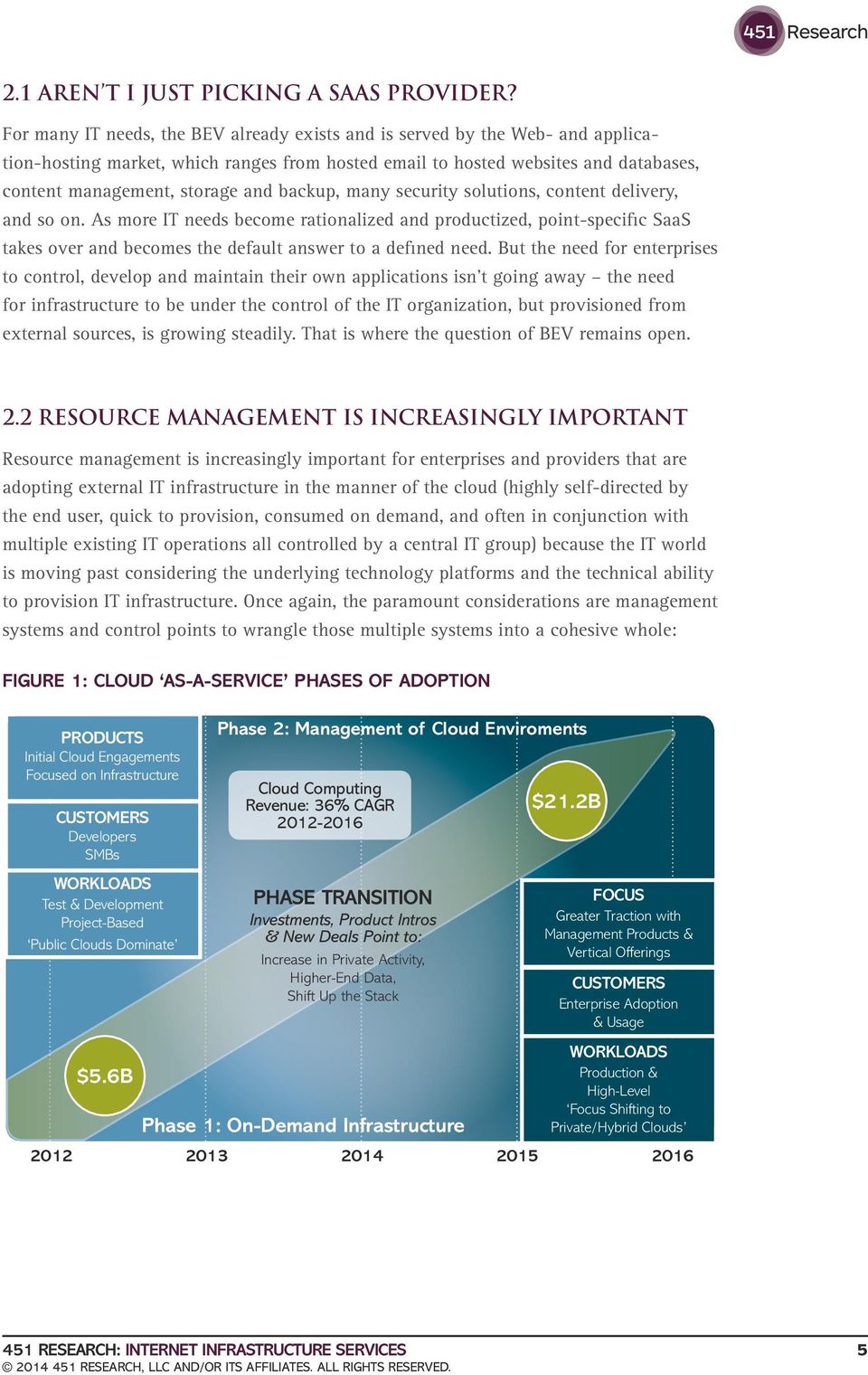
9 2.1 AREN T I JUST PICKING A SAAS PROVIDER? For many IT needs, the BEV already exists and is served by the Web- and application-hosting market, which ranges from hosted to hosted websites and databases, content management, storage and backup, many security solutions, content delivery, and so on. As more IT needs become rationalized and productized, point-specific SaaS takes over and becomes the default answer to a defined need. But the need for enterprises to control, develop and maintain their own applications isn t going away the need for infrastructure to be under the control of the IT organization, but provisioned from external sources, is growing steadily. That is where the question of BEV remains open. 2.2 RESOURCE MANAGEMENT IS INCREASINGLY IMPORTANT Resource management is increasingly important for enterprises and providers that are adopting external IT infrastructure in the manner of the cloud (highly self-directed by the end user, quick to provision, consumed on demand, and often in conjunction with multiple existing IT operations all controlled by a central IT group) because the IT world is moving past considering the underlying technology platforms and the technical ability to provision IT infrastructure. Once again, the paramount considerations are management systems and control points to wrangle those multiple systems into a cohesive whole: FIGURE 1: CLOUD AS-A-SERVICE PHASES OF ADOPTION PRODUCTS Initial Cloud Engagements Focused on Infrastructure CUSTOMERS Developers SMBs WORKLOADS Test & Development Project-Based Public Clouds Dominate $5.6B Phase 2: Management of Cloud Enviroments Cloud Computing Revenue: 36% CAGR PHASE TRANSITION Investments, Product Intros & New Deals Point to: Increase in Private Activity, Higher-End Data, Shift Up the Stack Phase 1: On-Demand Infrastructure $21.2B FOCUS Greater Traction with Management Products & Vertical Offerings CUSTOMERS Enterprise Adoption & Usage WORKLOADS Production & High-Level Focus Shifting to Private/Hybrid Clouds RESEARCH: INTERNET INFRASTRUCTURE SERVICES 5
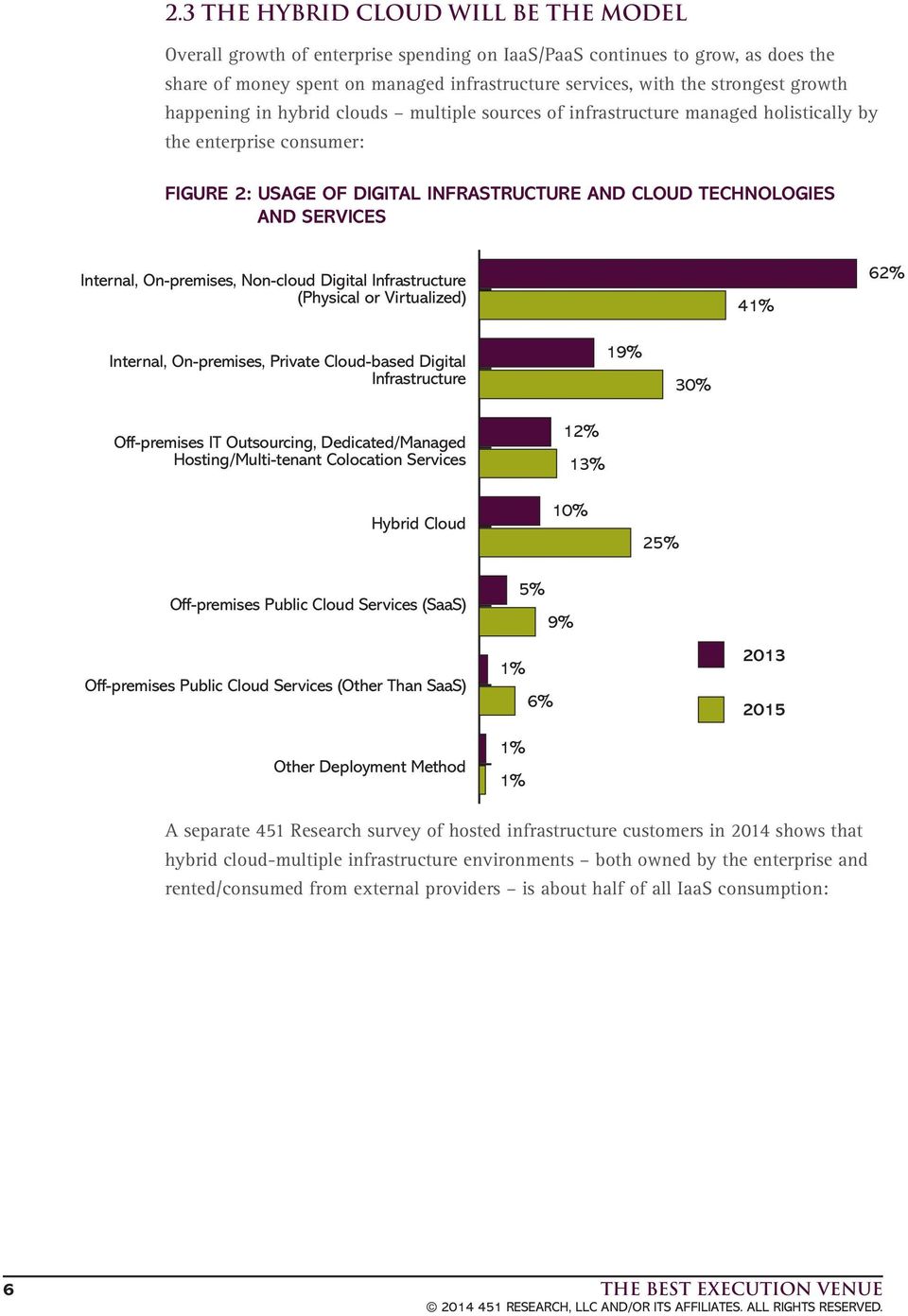
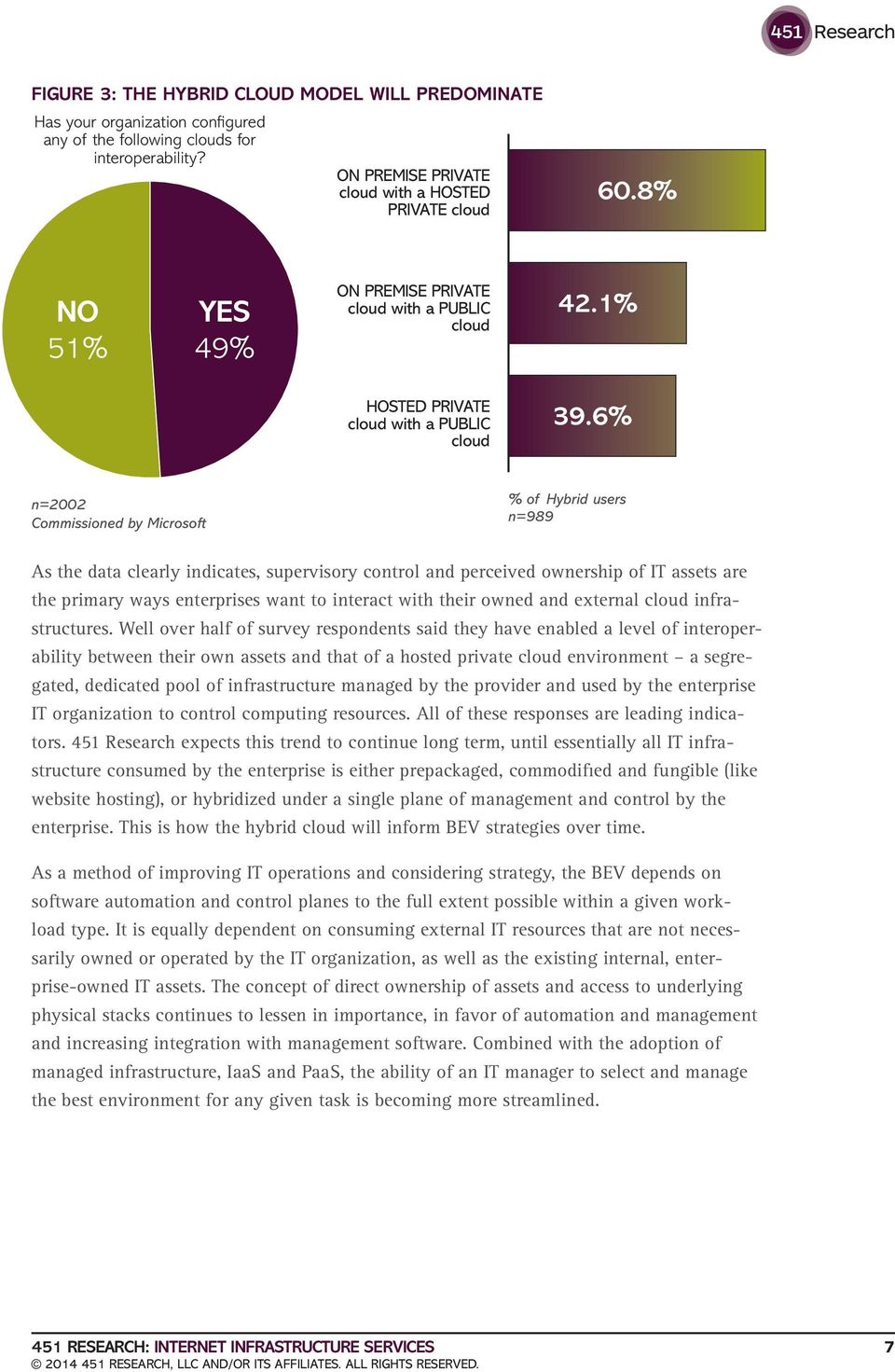
10 2.3 THE HYBRID CLOUD WILL BE THE MODEL Overall growth of enterprise spending on IaaS/PaaS continues to grow, as does the share of money spent on managed infrastructure services, with the strongest growth happening in hybrid clouds multiple sources of infrastructure managed holistically by the enterprise consumer: FIGURE 2: USAGE OF DIGITAL INFRASTRUCTURE AND CLOUD TECHNOLOGIES AND SERVICES Internal, On-premises, Non-cloud Digital Infrastructure (Physical or Virtualized) 41% 62% Internal, On-premises, Private Cloud-based Digital Infrastructure 19% 30% Off-premises IT Outsourcing, Dedicated/Managed Hosting/Multi-tenant Colocation Services Hybrid Cloud 12% 13% 10% 25% Off-premises Public Cloud Services (SaaS) 5% 9% Off-premises Public Cloud Services (Other Than SaaS) Other Deployment Method 1% 6% 1% 1% A separate 451 Research survey of hosted infrastructure customers in 2014 shows that hybrid cloud-multiple infrastructure environments both owned by the enterprise and rented/consumed from external providers is about half of all IaaS consumption: 6 THE BEST EXECUTION VENUE
11 FIGURE 3: THE HYBRID CLOUD MODEL WILL PREDOMINATE Has your organization configured any of the following clouds for interoperability? ON PREMISE PRIVATE cloud with a HOSTED PRIVATE cloud 60.8% NO 51% YES 49% ON PREMISE PRIVATE cloud with a PUBLIC cloud 42.1% HOSTED PRIVATE cloud with a PUBLIC cloud 39.6% n=2002 Commissioned by Microsoft % of Hybrid users n=989 As the data clearly indicates, supervisory control and perceived ownership of IT assets are the primary ways enterprises want to interact with their owned and external cloud infrastructures. Well over half of survey respondents said they have enabled a level of interoperability between their own assets and that of a hosted private cloud environment a segregated, dedicated pool of infrastructure managed by the provider and used by the enterprise IT organization to control computing resources. All of these responses are leading indicators. 451 Research expects this trend to continue long term, until essentially all IT infrastructure consumed by the enterprise is either prepackaged, commodified and fungible (like website hosting), or hybridized under a single plane of management and control by the enterprise. This is how the hybrid cloud will inform BEV strategies over time. As a method of improving IT operations and considering strategy, the BEV depends on software automation and control planes to the full extent possible within a given workload type. It is equally dependent on consuming external IT resources that are not necessarily owned or operated by the IT organization, as well as the existing internal, enterprise-owned IT assets. The concept of direct ownership of assets and access to underlying physical stacks continues to lessen in importance, in favor of automation and management and increasing integration with management software. Combined with the adoption of managed infrastructure, IaaS and PaaS, the ability of an IT manager to select and manage the best environment for any given task is becoming more streamlined. 451 RESEARCH: INTERNET INFRASTRUCTURE SERVICES 7
12 2.4 REALITY CHECK A lot of the BEV concept s potential is pie in the sky for most enterprises, but it s rapidly becoming a norm for technology-forward organizations. It s not hard to envision applications and services automated and flexible enough to pick their own best environments based on triggering criteria (performance, price changes, surge in demand). We can already see this happening. Sophisticated online services like Netflix and YouTube, and lots of Web properties, invest huge amounts of energy and code into ways to respond to exactly those situations, and environments like Amazon Web Services (AWS) explicitly enable those properties. In short order, we will see applications that follow the sun to optimize capacity, as a global audience grows and shrinks according to the time of day. The largest online businesses (ebay, Facebook, Google, Amazon, etc.) already construct their own datacenters and online services as exercises in BEVs, because they perceive IT as the basic commodity that makes their companies money. In most enterprises, this kind of hyper-consideration of every facet of operations lags far behind with the general exception of Web-facing retail, sales and marketing operations that drive business into an enterprise, IT operations are still a cost center. The incentive to build out a fabulously high-performing stack for bread-and-butter IT is just not there. So how to square what is obviously the preferred idea of BEVs with the dreary reality? Look to where these venues already exist and/or can be constructed with a minimum of fuss. Generally, this means using external specialized and semi-specialized service providers, and increasing the sophistication of the IT department s control. As with all things cloud, much of the forward motion in BEVs is driven by the consumerization of IT, as well as increased expectations. IT consumers within the enterprise expect to be able to make rational decisions about how and where to run applications and tasks based on workload profile, policies and SLA requirements. The question of whether a technology can be had as a service is vanishing and becoming an academic one literally. Research institutions requiring sole access to custom supercomputing installations are the last bastion of uncommercialized IT infrastructure available as a service, and on-demand HPC services will encroach as connectivity options improve 2.5 HANDS ON THE REINS OF EVERYTHING As the worlds of outsourcing, hosting, managed services and the cloud converge, the options are growing exponentially. BEV strategies and the execution engines that underpin them will enable users to determine which services are right for their needs as part of an overall digital infrastructure. Successful BEV strategies will likely mean owning and operating fewer assets, while at the same time integrating additional hosted resources. The most sophisticated IT users may operate these supplier relationships independently. But even those with contract-negotiation expertise will probably struggle with the complexity of the mechanisms available, especially in relation to the pricing 8 THE BEST EXECUTION VENUE
13 and delivery of cloud services. The reality is that most organizations have access to more than a handful of cloud-infrastructure services the same kind of access they probably have to other utilities. Indeed, where they do exist, these are mostly bilateral sourcing relationships between the end user and service provider. We expect that third-party tools including technical and financial cloud brokers, business-application marketplaces and other integrators will therefore play an important role in providing access to other venues. Some applications, workloads or service requests may be best suited to running on-premises. For others, a public multi-tenant cloud may be sufficient, while still others may need a dedicated hosted venue. Major industry players want to own and operate the control plane, catalog or console that can automate the scheduling, delivery and access to services as part of their BEV strategies as well as provide the venues themselves in many cases. As they seek to raise their software IQ and meet raised expectations of technology in the workplace based on the consumer experience, delivering an IT vending machine experience to end users will require IT departments to become service brokers to their own organizations. BEV-sourcing strategies will be key to achieving this. Moreover, the cloud s service-driven, usage-based consumption model will turn traditional IT cost centers into service-delivery organizations. 2.6 SECURITY: FIRST, LAST, ALWAYS When considering the use of IT infrastructure sourced outside enterprise walls, and getting to a BEV, security remains the paramount concern and hurdle to adoption. Largely, this is not a matter of technical security implementation. Almost to a fault, infrastructure providers have better core security practices and operations than enterprises do, simply because the stakes are higher, and it s the most visible topic during any discussion of use. The automated security practices of AWS s threat (and misuse) detection, and its response and mitigation systems that run on and around its infrastructure, are well out of reach for even the most sophisticated enterprise environments. However, that is only part of the security conversation when looking at how an application is relevant to an enterprise. Decisions must be made about what data can and cannot be stored in certain locations (thanks to compliance regulation like HIPAA and PCI DSS, and state regulations), where responsibility lies for breaches, and so on. For the enterprise, the security bugbear is the first factor in determining where and how a potential workload can take advantage of external services. For customer-facing e-commerce sites, for instance, AWS might be the ideal place to construct and manage a Web presence and deliver services, media or retail purchasing options to the consumer. But how does the enterprise ensure that personally identifying customer information isn t vulnerable? Answers range from hiring auditors and security experts to build and certify applications as safe, to integrating a third-party payment processor, to maintaining hybrid infrastructures that direct one flow of information to a secure datacenter, while the rest stays on the cloud. 451 RESEARCH: INTERNET INFRASTRUCTURE SERVICES 9
14 All of this has to happen in the context of general security practices, such as ensuring the application isn t vulnerable to attack, or leaving entry routes into other enterprise systems as was the case with the blockbuster Target breach in All of this adds significant gravitas to something as seemingly easy as operating a customer-friendly website on an ideal platform, and can thus be the largest snarl in any plan to adopt. But the pressure to do more, and do it faster, for the same amount of money is immense so providers are beginning to fall into a recognizable pattern to combat this scenario. The first approach is to differentiate on security by making it part of the managed infrastructure service experience. Most providers can give users decent visibility and access to the secure environments they provision. Delineation of responsibility for sensitive data is firmly embedded and indemnified in contractual language and project planning, etc. The second is to specialize there is a growing vertical of cloud providers that can offer compliance as a service, with audit checks and certification for the enterprise automated, streamlined and baked into the service delivery. Some examples include Verizon s managed services, Carpathia, INetU and Online Tech. This is found in varying forms, from the provider simply having lots of expertise in compliance regimes and an efficient set of practices around delivering it, to the beginnings of automated, user-friendly dashboards and reporting systems that follow the buffet service trend of cloud computing. This trend will continue to grow, but for now, it remains a value-add for providers. Another way around security concerns is using managed security services that automate a great deal of online security practices and free up resources for IT security teams to look after specific concerns. This is part of the larger trend toward more infrastructure management. 10 THE BEST EXECUTION VENUE

15 SECTION 3 Choices of Venue Public, Private or Hybrid for Identified Workloads The data presented here can be used by providers to evaluate their choice of strategy to support or target different workloads, and by enterprises to gauge the relative maturity and state of adoption for each class. It does not reach the levels of complexity and active states of management as does the evolution of BEVs for IT, which we described above only the suitability and preference for enterprises to adopt internal, self-provisioned and owned IT infrastructure, or external, hosted IT infrastructure in all its various forms. Further editions of this report will include more granular, workload- and technology-specific use data, as the market matures and advanced infrastructure services enter the mainstream enterprise supply channels. This section of the report shows the results of 451 Research s enterprise user-survey data from TheInfoPro, for identified categories of IT workload and relative rates of adoption of external service providers. It has been gathered through a running survey of hundreds of enterprise IT decision makers for many years. The survey encompasses 11 defined industry verticals primarily financial services, healthcare and retail and it covers small, medium and large enterprise. Definitions, condensed versions of the survey results and demographics are available in the appendices at the end of this report. Workload and deployment scenarios are varied, showing that a) cloud adoption is quite mainstream for enterprises at this point, and b) choice exists for every workload, and the specific application will be the deciding factor. This overview chart also shows that considerable opportunity exists across the board to serve these workload types: 451 RESEARCH: INTERNET INFRASTRUCTURE SERVICES 11
16 FIGURE 4: CLOUD ADOPTION PATTERNS BY WORKLOAD Internal Private Cloud Hybrid Cloud External Public Cloud and SaaS Test and Development of Applications 42% 27% 31% E-business Hosting 18% 43% 39% Customer-facing Enterprise Applications 53% 26% 21% Collaborative Applications 35% 17% 46% Cloud-native Applications 11% 23% 66% Batch Computing Applications 68% 1 18% Back-office Enterprise Applications 53% 18% 29% The breakdown of adoption by workload shows that while cloud-native applications are far and away the most popular choice for external cloud providers, there is significant adoption in each area. Breaking them down by type to show the reasons for one choice or another reveals where enterprise sentiment (and entrenched investment and traditional practices) are headed for each one. Without exception, the trends in the future are for more hybrid and cloud expenditure, and the same or less on-premises consumption. 3.1 CUSTOMER-FACING ENTERPRISE APPLICATIONS For customer-facing enterprise applications, internal private cloud is the preferred deployment model for 53% of respondents, followed by hybrid cloud at 26%, external public cloud at 13% and SaaS at 8%. The top reasons cited for the selections were cost and agility, control/management issues, security issues, data sensitivity/ip risk, and cost. For internal private cloud, the primary selection reasons were control/management issues, data sensitivity/ip risk and security issues. For hybrid cloud, the primary reason cited was cost. 12 THE BEST EXECUTION VENUE
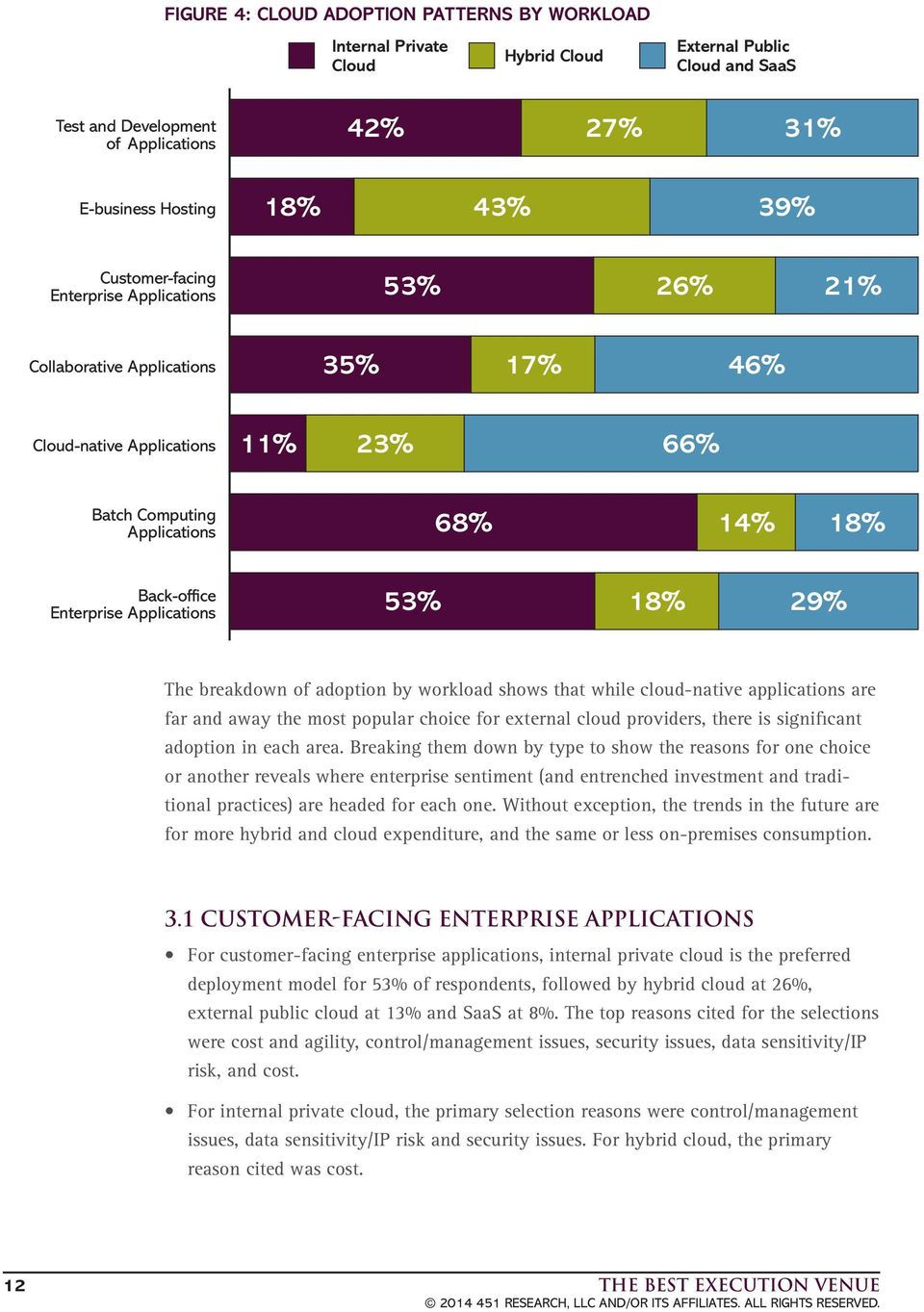
17 FIGURE 5: PRIMARY DEPLOYMENT METHOD CUSTOMER-FACING APPS Internal Private Cloud 53% Hybrid Cloud 26% External Public Cloud 13% SaaS 8% FIGURE 6: REASON FOR DEPLOYMENT CHOICE CUSTOMER-FACING APPS Cost and Agility Control/Management Issues Security Issues Data Sensitivity/IP Risk Cost 13% 13% 11% 11% 11% Functionality/Ease of Use Cost and Performance 9% 9% Compliance/Governance 8% Business Continuity/Disaster Recovery 6% Good Fit for Public Cloud Value We Provide to Clients Performance Issues 2% 2% 451 RESEARCH: INTERNET INFRASTRUCTURE SERVICES 13

18 3.2 BACK-OFFICE ENTERPRISE APPLICATIONS For back-office enterprise applications, internal private cloud is the preferred deployment model for 53% of respondents, followed by SaaS at 20%, hybrid cloud at 18% and external public cloud at 9%. The top reasons cited for the selections were cost, cost and agility, control/management issues, and security issues. For internal private cloud, the primary selection reasons were security issues, cost and agility, and cost. For SaaS, the primary reason cited by 33% of respondents was cost. FIGURE 7: PRIMARY DEPLOYMENT METHOD BACK-OFFICE APPS Internal Private Cloud 53% SaaS 20% Hybrid Cloud 18% External Public Cloud 9% FIGURE 8: REASON FOR DEPLOYMENT CHOICE BACK-OFFICE APPS Cost Cost and Agility Control/Management Issues 13% 16% 18% Security Issues 9% Functionality/Ease of Use Cost and Performance 7% 7% Performance Issues Data Sensitivity/IP Risk Compliance/Governance Agility Limited Data Sensitivity/IP Risk Business Continuity/Disaster Recovery 2% 2% No External Cloud Plans 9% 14 THE BEST EXECUTION VENUE

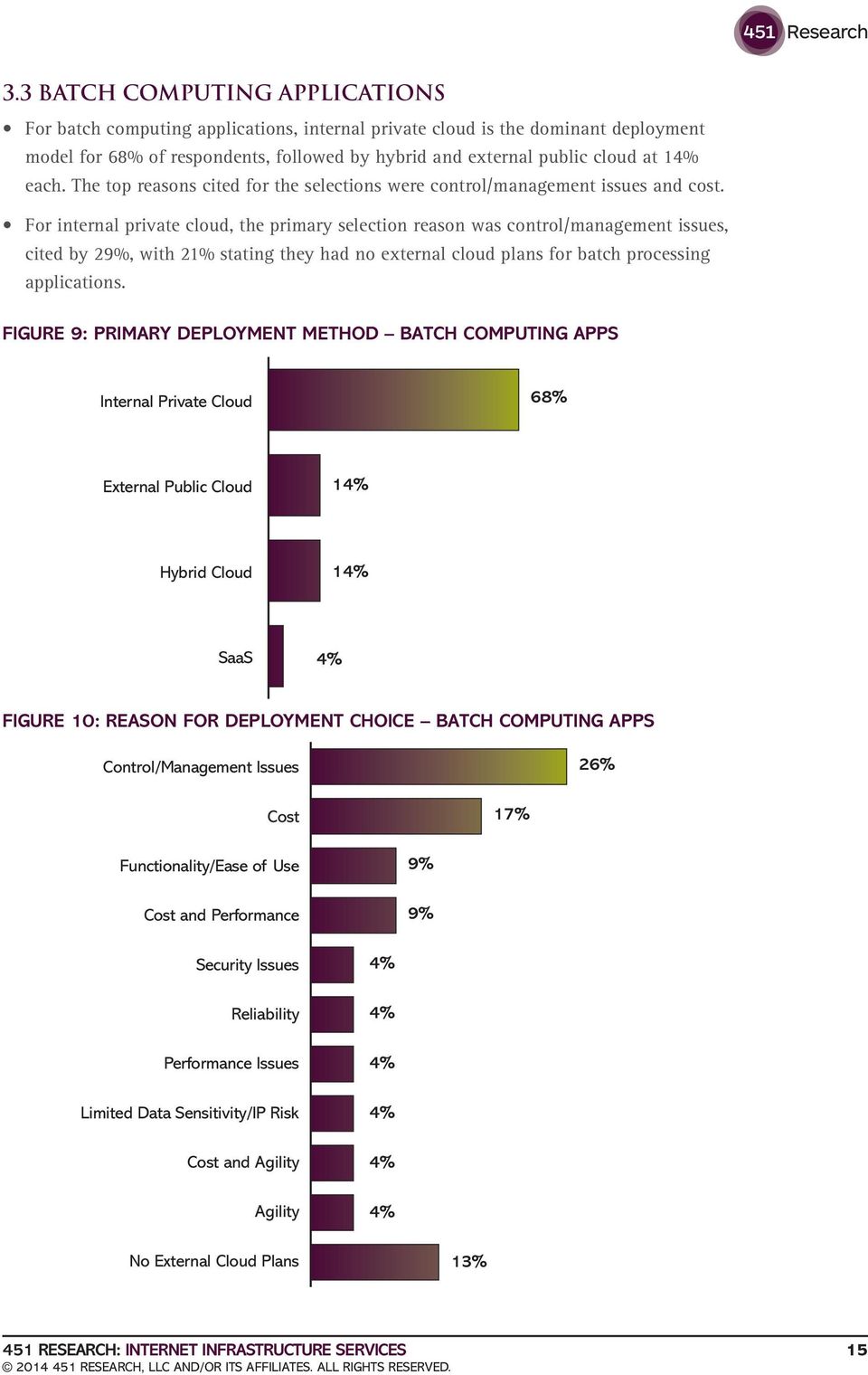
19 3.3 BATCH COMPUTING APPLICATIONS For batch computing applications, internal private cloud is the dominant deployment model for 68% of respondents, followed by hybrid and external public cloud at 1 each. The top reasons cited for the selections were control/management issues and cost. For internal private cloud, the primary selection reason was control/management issues, cited by 29%, with 21% stating they had no external cloud plans for batch processing applications. FIGURE 9: PRIMARY DEPLOYMENT METHOD BATCH COMPUTING APPS Internal Private Cloud 68% External Public Cloud 1 Hybrid Cloud 1 SaaS FIGURE 10: REASON FOR DEPLOYMENT CHOICE BATCH COMPUTING APPS Control/Management Issues 26% Cost 17% Functionality/Ease of Use 9% Cost and Performance 9% Security Issues Reliability Performance Issues Limited Data Sensitivity/IP Risk Cost and Agility Agility No External Cloud Plans 13% 451 RESEARCH: INTERNET INFRASTRUCTURE SERVICES 15
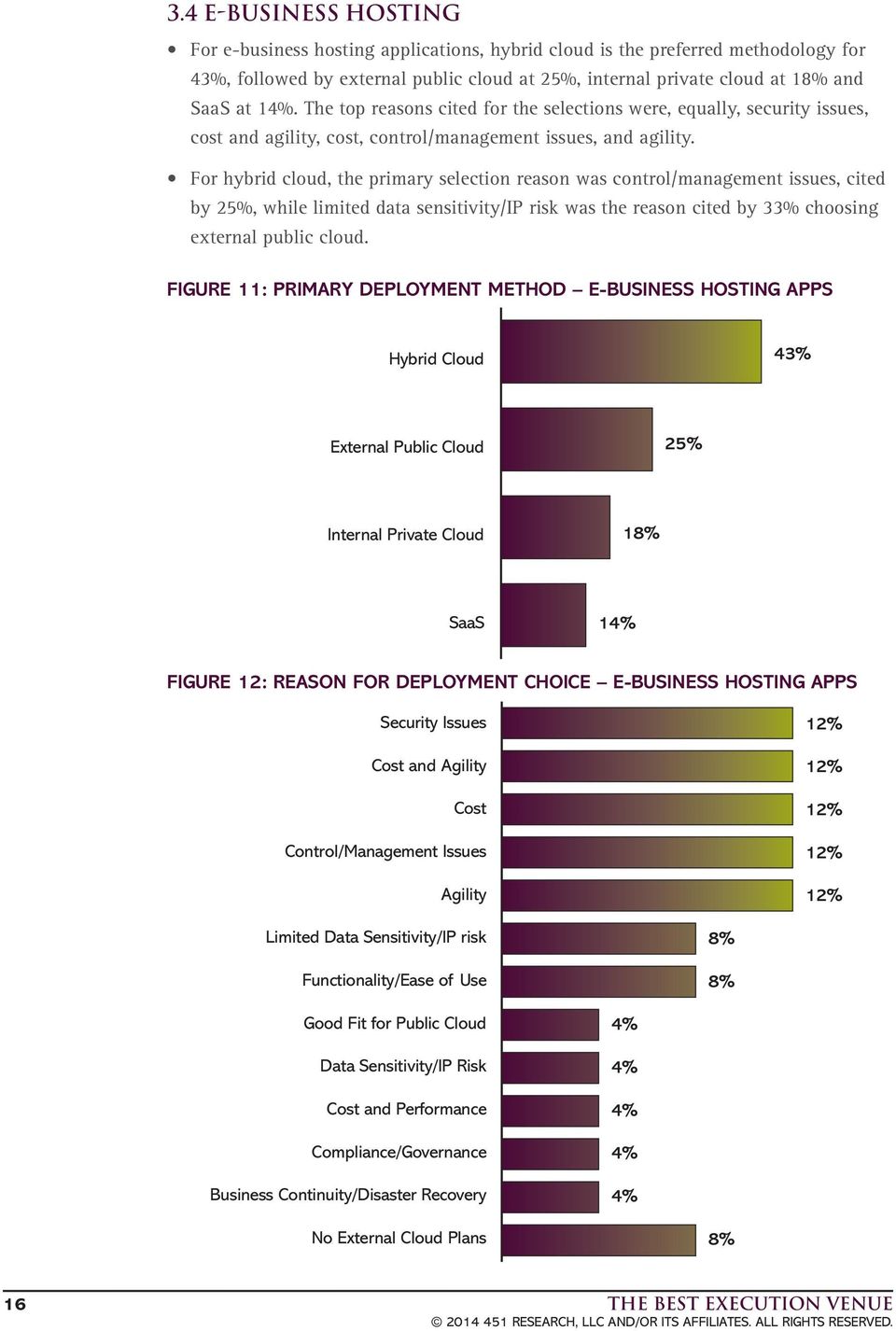
20 3.4 E-BUSINESS HOSTING For e-business hosting applications, hybrid cloud is the preferred methodology for 43%, followed by external public cloud at 25%, internal private cloud at 18% and SaaS at 1. The top reasons cited for the selections were, equally, security issues, cost and agility, cost, control/management issues, and agility. For hybrid cloud, the primary selection reason was control/management issues, cited by 25%, while limited data sensitivity/ip risk was the reason cited by 33% choosing external public cloud. FIGURE 11: PRIMARY DEPLOYMENT METHOD E-BUSINESS HOSTING APPS Hybrid Cloud 43% External Public Cloud 25% Internal Private Cloud 18% SaaS 1 FIGURE 12: REASON FOR DEPLOYMENT CHOICE E-BUSINESS HOSTING APPS Security Issues Cost and Agility Cost Control/Management Issues Agility 12% 12% 12% 12% 12% Limited Data Sensitivity/IP risk Functionality/Ease of Use 8% 8% Good Fit for Public Cloud Data Sensitivity/IP Risk Cost and Performance Compliance/Governance Business Continuity/Disaster Recovery No External Cloud Plans 8% 16 THE BEST EXECUTION VENUE
21 3.5 COLLABORATIVE APPLICATIONS For collaborative applications, internal private cloud is the preferred methodology for 35%, followed by external public cloud for 27%, with SaaS at 19% and hybrid cloud at 17%. The top reasons cited for the selections were good fit for public cloud, functionality/ease of use, and cost. For internal private cloud, the primary selection reasons were security issues and data sensitivity/ip risk Good fit for public cloud, and cost were the top two reasons cited for choosing external public cloud. FIGURE 13: PRIMARY DEPLOYMENT METHOD COLLABORATIVE APPS Internal Private Cloud 35% External Public Cloud 27% SaaS 19% Hybrid Cloud 17% FIGURE 14: REASON FOR DEPLOYMENT CHOICE COLLABORATIVE APPS Good Fit for Public Cloud 23% Functionality/Ease of Use Cost 13% 13% Security Issues Data Sensitivity/IP Risk Cost and Agility 9% 9% 9% Existing SaaS Workloads Control/Management Issues Business Continuity/Disaster Recovery Performance Issues Compliance/Governance Agility No External Cloud Plans 2% 2% 2% 6% 451 RESEARCH: INTERNET INFRASTRUCTURE SERVICES 17
22 3.6 TEST AND DEVELOPMENT OF APPLICATIONS For test and development of applications, internal private cloud is the preferred methodology for 42%, followed by hybrid and external public cloud, at 27% each. The top reasons cited for the selections were data sensitivity/ip risk, and cost and agility. For internal private cloud, the primary selection reasons were cost and agility, cost, and compliance/governance. Data sensitivity/ip risk was the primary reason for selecting hybrid cloud, with cost and agility the main reason for choosing external public cloud. FIGURE 15: PRIMARY DEPLOYMENT METHOD TEST AND DEV OF APPS Internal Private Cloud 42% Hybrid Cloud 27% External Public Cloud 27% SaaS FIGURE 16: REASON FOR DEPLOYMENT CHOICE TEST AND DEV OF APPS Data Sensitivity/IP Risk Cost and Agility 15% 15% Functionality/Ease of Use Cost 10% 10% Cost and Performance 8% Performance Issues Good Fit for Public Cloud Compliance/Governance 6% 6% 6% Control/Management Issues Agility Security Issues Performance Issues Limited Data Sensitivity/IP Risk Effort and Aversion to Change Business Continuity/Disaster Recovery No External Cloud Plans 2% 2% 2% 2% 2% 8% 18 THE BEST EXECUTION VENUE
23 3.7 CLOUD-NATIVE APPLICATIONS For cloud-native applications, external public cloud is the preferred methodology for 37%, followed by SaaS for 29%, hybrid cloud for 23% and internal private cloud for just 11% of respondents. The top reasons cited for the selections were existing SaaS workloads, good fit for public cloud, functionality/ease of use, and cost and agility. For external public cloud, the primary selection reasons were equally good fit for public cloud, and cost and agility. Good fit for public cloud and existing SaaS workloads were the primary reasons for selecting SaaS, followed by functionality/ease of use. FIGURE 17: PRIMARY DEPLOYMENT METHOD CLOUD-NATIVE APPS External Public Cloud 37% SaaS 29% Hybrid Cloud 23% Internal Private Cloud 11% FIGURE 18: REASON FOR DEPLOYMENT CHOICE CLOUD-NATIVE APPS Existing SaaS Workloads 20% Good Fit for Public Cloud 17% Functionality/Ease of Use 13% Cost and Agility 13% Cost 10% Data Sensitivity/IP Risk 7% Control/Management Issues 7% Agility 7% Limited Data Sensitivity/IP Risk 3% Business Continuity/Disaster Recovery 3% 451 RESEARCH: INTERNET INFRASTRUCTURE SERVICES 19
24 SECTION 4 Conclusion The BEV itself may be an internal cloud, a public cloud, some trusted cloud or a hosted environment. It may simply be a browser-based application; it may be a custom application developed by a third party and deeply integrated into enterprise IT systems. It may be a combination of many different external services both fundamental and complex, but all will be driven by software management, and by the aim to smooth out the process of finding, provisioning and consuming the infrastructure necessary to a functional IT workload (and a functional and valuable IT operations team). Enterprises can use BEVs as a way to continually adapt and improve their organizations; service providers must continually learn from those enterprise customers and provide cumulative benefits for being customers, by targeting service delivery toward specific needs. 20 THE BEST EXECUTION VENUE
25 SECTION 5 Appendixes APPENDIX A: DEFINED WORKLOADS AND CATEGORIES Customer-Facing Enterprise Applications Applications that serve to facilitate customer engagement and fulfillment such as point of sale, CRM, sales force automation, customer support, field services Back-Office Enterprise Applications Applications built to serve internal organizational needs, including ERP, production and manufacturing, procurement, B2B, supply chain management, business process automation, HR, accounting/financial management systems, infrastructure management and monitoring systems, records management, middleware Batch Computing Applications Data-processing applications, transaction processing, reconciliation, payroll or financial data processing, high -performance computing applications, background workloads, business intelligence and data analytics, computer simulations E-business Hosting Internet-enabled electronic business applications including website hosting, e-marketing, e-business hosting, e-commerce sites, Web-based applications (not including mobile apps) Collaborative Applications Collaboration and communication applications including , collaboration platforms (e.g., SharePoint), voice and video conferencing, chat, internal blogging and micro-blogging Test and Development of Applications IT infrastructure suitable for rapid deployment and redeployment for developing and testing applications including integrated development environments, source control and code management, PaaS and quality assurance tools Cloud Native Applications Applications that derive from the availability of cloud computing services or benefit disproportionately from consuming a cloud-style resource pool, including non-relational data-handling applications (NoSQL), highly distributed applications, highly automated resource-independent applications (auto-scaling), dynamically reconfigurable, elastic and stateless applications, highly centralized one-to-many applications, mobile applications, content delivery services, object storage and object management 451 RESEARCH: INTERNET INFRASTRUCTURE SERVICES 21
26 APPENDIX B: SURVEY DEMOGRAPHICS FIGURE 19: INDUSTRY VERTICALS Financial Services - 25% Healthcare/Pharmaceuticals - 13% Consumer Goods/Retail - 10% Industrial/Manufacturing - 9% Telecoms/Technology - 7% Education - 7% Transportation - 6% Public Sector - 5% Services: Business/ Accounting/Engineering - 5% Energy/Utilities - 3% Materials/Chemicals - 2% Other - 9% FIGURE 20: ENTERPRISE REVENUE < $499.99M - 11% $500M-$999.99M - 7% $1B-$4.99B - 36% $5B-$9.99B - 11% $10B-$19.99B - 10% $20B-$29.99B - 6% $30B-$40B - 8% > $40B - 12% 22 THE BEST EXECUTION VENUE
27 FIGURE 21: RESPONDENT S TITLE Architect/Engineer/Analyst - 3 Director/Manager - 49% VP Level and Above - 17% FIGURE 22: BUDGET FOR CLOUD SPENDING < $499.99K - 48% $1M-$4.99M - 33% $5M-$9.99M - 11% > $10M - 7% APPENDIX C: SERVICE PROVIDER TAXONOMY AND GLOSSARY 451 Research adheres to a number of widely accepted definitions of various kinds of facilities and services in the IT market. These definitions are not only useful for understanding this report, but are also used to help quantify market research and generally improve understanding of how each type of service operates as a business. This taxonomy is for the purposes of this report. 451 Research s Market Monitor service retains an expanded and authoritative list of taxonomies within the industry as well. Managed Infrastructure Managed infrastructure services are composed of the following subgroups: managed hosting, dedicated hosting, IaaS and, in some cases, PaaS, and span a wide range of associated types of operational services, add-ons and configurations. Commodification of x86 CPUs and storage capacity has led to a great commingling of previously specialized subsets of hosted infrastructure. 451 RESEARCH: INTERNET INFRASTRUCTURE SERVICES 23
28 Managed infrastructure, from IaaS to dedicated server leases, all share a similar core value proposition and increasingly use the same kinds of tools to deliver a wide range of services on top of base infrastructure. In all cases, the defining characteristics are: An IT environment servers, storage, and access to same that is managed and operated by the provider at Layer 1 and 2 at a minimum. Customers do not pay the power bill, plug in the cables, rack the equipment, monitor the environment or respond to or repair outages and failures. Some degree of elastic capacity available to the consumer, ranging from the illusion of infinite scale afforded by the largest IaaS players to the ability to quickly provision additional physical hosts in managed environments. A strong degree of control manifested by the consumer over IT architecture and direction over operations, again ranging from blind self-service available from public cloud providers to phased design projects and implementation undertaken as a partnership between provider and consumer. Dedicated resources, either physical or virtual that are not oversubscribed and assumed to accurately represent a fixed capacity of resources available on a subscription basis. (This is the major reason VPS providers are a subset of shared hosting and not managed infrastructure, although in short order many will qualify as true IaaS environments). Managed Hosting Services Managed hosting is defined as operating servers and storage for clients and providing a variety of additional IT services on top of that core function (operating and/or renting servers with minimal or no additional services is dedicated hosting; see below). Managed hosting services are the most complex and flexible of the traditional hosting services. While shared and dedicated hosting services provide only the server or a part thereof, managed hosting services add significant administration and engineering services to the mix. In a managed hosting environment, the server hardware may be owned by either the hosting provider or the customer. As in dedicated and shared hosting, managed hosting providers may own their own datacenters or use colocation facilities. The provider may manage operating systems, databases, security and patch management, while the customer often just manages the applications riding on top of those managed systems. Managed hosting services are typically used for third-party or customer-provided applications, ranging from communication and collaboration applications like SharePoint and Exchange to traditional enterprise software, like Oracle and SAP, to custom engagements that provide a suite of IT services to a business; managed storage services (including large drive arrays or backup robots); disaster recovery and business continuity; e.g., clustering and global server load balancing; database servers, applications and services. 24 THE BEST EXECUTION VENUE
29 Dedicated Hosting Dedicated hosting is the leasing or rental of a server by the customer. That server is dedicated to a single customer it is not shared, regardless of how it is used. Customers exercise full control over the server beyond physical maintenance, and the hosting provider will not generally include administrative services besides ensuring the server s ability to function at a hardware level. Amenities often include remote hands services to power machines on and off or upgrade parts, browser-based remote administration and monitoring software as well as direct remote control to the physical machine. What separates these providers from the managed services providers is the scope of the services provided, the use of the servers and whether they use shared resources, and the skill set of support resources in use. Dedicated servers are typically used by shared hosting providers that resell capacity, and SMBs that need to host Web applications without significant outsourced management. Shared Hosting In shared hosting, many customers share a single server and operate a variety of applications from that server. This is the most common deployment model for website hosting firms like The Go Daddy Group. A software management framework and user interface overlay a physical server with multi-tenant-enabled applications running on it, such as, but not limited to, Apache HTTP Server, Microsoft Internet Information Services (IIS), MySQL and many others. Many smaller and midsized shared hosting providers will purchase services from dedicated hosting providers and use the dedicated servers to house large numbers of shared accounts, without infrastructure ownership. Cloud Computing Cloud computing is a model of service delivery for individual servers and storage allotments. It has a broadly accepted definition first put forth by the National Institute of Standards and Technology: Compute (server instances running an operating system), storage and application resources must be available over a network, as a shared pool of resources. Elastic (can be grown and shrunk by the user automatically), billed on-demand and be self-service, that is, available to an end user to provision. The three canonical categories are IaaS (infrastructure as service), which is compute and storage provisioned to a user via API or portal; IaaS (software as a service), an application delivered online from a provider; and PaaS (platform as a service), an environment designed to let developers interact with code and create running applications without maintaining or operating the runtime. The permutations are vast at this point; SaaS is widely accepted to have been a viable model well before the definition existed, and infrastructure services are a shifting target depending on who is defining and operating them. The core characteristics for a cloud-computing business revolve around service delivery. All agree that it needs to be automated, both on the provider side and for the end user, that it be elastic in nature (users can obtain and release servers and storage resources with ease) and that it be consumed on demand. 451 RESEARCH: INTERNET INFRASTRUCTURE SERVICES 25
30 Private Cloud Private cloud is held to mean IT infrastructure that operates similarly to public IaaS services, but built and maintained by an enterprise IT organization. Virtual private cloud is virtually segregated infrastructure (by networking topology and/or maintaining customers on specific parts of physical infrastructure within a cloud environment) maintained by a provider for an enterprise, while hosted private cloud is actually separate, single-tenant infrastructure maintained for a hosting customer as a cloudstyle environment. Unfortunately, in common parlance, the cloud is now used generically to refer to storing data and consuming applications that are hosted online. 451 Research has expanded definitions to cover all the major IT services that are following this model, and holds that cloud computing must be properly separated and identified apart from the cloud or virtual server hosting services. It is considered an evolution of those services and of hosting overall, but using the cloud is not the same as cloud computing, especially at an infrastructure level. 26 THE BEST EXECUTION VENUE
Web and Application Hosting 2015
 MARKET FORECAST Web and Application Hosting 2015 SEP 2015 Liam Eagle, Senior Analyst, Service Providers Web and application hosting, a mature IT market, is facing changes to the variety of services on
CLOUDSCAPE. IT SERVICES Tooling up for ITaaS KEY FINDINGS
 IT SERVICES Tooling up for ITaaS IT as a service (ITaaS) is an operational model where the enterprise IT department acts and operates as a distinct business entity, creating services for the other lines
2016 Trends in Datacenter Technologies
 PREVIEW 2016 Trends in Datacenter Technologies OCT 2015 Rhonda Ascierto, Research Director Andy Lawrence, Research Vice President Andrew Donoghue, European Research Manager Daniel Bizo, Senior Analyst
Cloud Brokers EXECUTIVE OVERVIEW MAKING ITAAS A PRACTICAL REALITY?
 Cloud Brokers MAKING ITAAS A PRACTICAL REALITY? This report examines what a cloud broker is, its components and functions, its role(s), its audience and how it supports the delivery of ITaaS by turning
Cloud Management Platform Market Map 2016
 MARKET MAP Cloud Management Platform Market Map 2016 MAY 2016 William Fellows, Research Vice President A cloud management platform should operate like a cloud Uber app for IT consumption and delivery that
Social Intranets and the Supply Chain
 THOUGHT LEADERSHIP Social Intranets and the Supply Chain EXECUTIVE OVERVIEW SEP 2015 Alan Pelz-Sharpe, Research Director, Business Applications Matt Mullen, Senior Analyst, Business Applications In one
Seattle EXECUTIVE OVERVIEW MULTI-TENANT DATACENTER MARKET
 Seattle MULTI-TENANT DATACENTER MARKET This report provides an overview of the competitive dynamics in the Seattle market, a 451 Research Market Map of the competitors in the area, market share of the
2016 Trends in Storage
 PREVIEW 2016 Trends in Storage DEC 2015 Henry Baltazar, Research Director Though storage is far from dead, change is coming in the shape of new form factors such as hyperconverged infrastructures and disruptive
TOTAL DATA WAREHOUSING: 2013-2018
 TOTAL DATA WAREHOUSING: 2013-2018 Analytic Database and Hadoop Market Sizing and Forecasts This report examines the marketplace for Total Data Warehousing including competing players, revenue generation
GETTING THE MOST FROM THE CLOUD. A White Paper presented by
 GETTING THE MOST FROM THE CLOUD A White Paper presented by Why Move to the Cloud? CLOUD COMPUTING the latest evolution of IT services delivery is a scenario under which common business applications are
DATACENTER INFRASTRUCTURE MANAGEMENT SOFTWARE. Monitoring, Managing and Optimizing the Datacenter
 Analyzing the Business of Enterprise IT Innovation DATACENTER INFRASTRUCTURE MANAGEMENT SOFTWARE Monitoring, Managing and Optimizing the Datacenter As datacenters become bigger, denser and more complex,
The Data Management of Things
 The Data Management of Things THE IMPLICATIONS OF IOT FOR DATA ANALYTICS The Internet of Things (IoT) is placing new demands on data storage, networking, processing and analytics. For end users, vendors
Mexico EXECUTIVE OVERVIEW MULTI-TENANT DATACENTER MARKET
 Mexico MULTI-TENANT DATACENTER MARKET This report provides an overview of the competitive dynamics in the Mexico market, a 451 Research Market Map of the competitors in the area, market share of the dominant
Drivers for the Growing Adoption of Cloud-Based Disaster Recovery PREPARED FOR VMWARE BY 451 RESEARCH
 Drivers for the Growing Adoption of Cloud-Based Disaster Recovery PREPARED FOR VMWARE BY 451 RESEARCH JAN 2015 i 451 RESEARCH ADVISORY SERVICES ABOUT 451 RESEARCH 451 Research is a preeminent information
Demystifying the Cloud Computing 02.22.2012
 Demystifying the Cloud Computing 02.22.2012 Speaker Introduction Victor Lang Enterprise Technology Consulting Services Victor Lang joined Smartbridge in early 2003 as the company s third employee and currently
Software as a Service Offers Broadening Appeal for Small and Medium-Sized Discrete Manufacturers
 Software as a Service Offers Broadening Appeal for Small and Medium-Sized Discrete Manufacturers WHITE PAPER Sponsored by: SAP Simon Ellis November 2010 IDC MANUFACTURING INSIGHTS OPINION Software as a
Achieve Economic Synergies by Managing Your Human Capital In The Cloud
 Achieve Economic Synergies by Managing Your Human Capital In The Cloud By Orblogic, March 12, 2014 KEY POINTS TO CONSIDER C LOUD S OLUTIONS A RE P RACTICAL AND E ASY TO I MPLEMENT Time to market and rapid
GET CLOUD EMPOWERED. SEE HOW THE CLOUD CAN TRANSFORM YOUR BUSINESS.
 GET CLOUD EMPOWERED. SEE HOW THE CLOUD CAN TRANSFORM YOUR BUSINESS. Cloud computing is as much a paradigm shift in data center and IT management as it is a culmination of IT s capacity to drive business
Overview. The Cloud. Characteristics and usage of the cloud Realities and risks of the cloud
 Overview The purpose of this paper is to introduce the reader to the basics of cloud computing or the cloud with the aim of introducing the following aspects: Characteristics and usage of the cloud Realities
Solution White Paper Monetizing the Service Provider Cloud
 Solution White Paper Monetizing the Service Provider Cloud Deliver the value-added cloud services that customers need while maximizing revenue Table of Contents 1 EXECUTIVE SUMMARY 2 EVOLUTION OF THE CLOUD
Defining a framework for cloud adoption
 IBM Global Technology Thought Leadership White Paper Computing Defining a framework for cloud adoption How common ground can help enterprises drive success with cloud computing 2 Defining a framework for
Table of Contents. Abstract. Cloud computing basics. The app economy. The API platform for the app economy
 Table of Contents Abstract Cloud computing basics The app economy The API platform for the app economy Your API platform: in the cloud or on premises? The cloud deployment model Cloud characteristics The
Infopaper. Demystifying Platform as a Service
 Demystifying Platform as a Service The dividing lines between PaaS and IaaS may be blurring, but it s important for outsourcers of IT infrastructure to understand what sets Private PaaS apart from commodity
Five Cloud Strategy Must -Dos for the CIO
 Issue 2 Five Cloud Strategy Must -Dos for the CIO 1 Five Cloud Strategy Must -Dos for the CIO When Building a Private Cloud, Start Small, Think Big 5 About Red Hat Featuring research from Even if your
Data Platforms and Analytics Market Map 2016
 MARKET MAP Data Platforms and Analytics Market Map 2016 APRIL 2016 Matt Aslett, Research Director, Data Management & Analytics Krishna Roy, Senior Analyst, Data Platforms & Analytics James Curtis, Senior
Telco Multi-Play and Content Strategies
 THOUGHT LEADERSHIP Telco Multi-Play and Content Strategies APR 2016 Declan Lonergan, VP, Research As telecom operators extend their convergence strategies and launch multi-play landline/mobile/tv services,
Expert Reference Series of White Papers. Understanding NIST s Cloud Computing Reference Architecture: Part II
 Expert Reference Series of White Papers Understanding NIST s Cloud Computing Reference Architecture: Part II [email protected] www.globalknowledge.net Understanding NIST s Cloud Computing Reference
How To Compare The Two Cloud Computing Models
 WHITE PAPER Elastic Cloud Infrastructure: Agile, Efficient and Under Your Control - 1 - INTRODUCTION Most businesses want to spend less time and money building and managing infrastructure to focus resources
Cloud Backup And Disaster Recovery Meets Next-Generation Database Demands Public Cloud Can Lower Cost, Improve SLAs And Deliver On- Demand Scale
 A Forrester Consulting Thought Leadership Paper Commissioned By Microsoft March 2014 Cloud Backup And Disaster Recovery Meets Next-Generation Database Demands Public Cloud Can Lower Cost, Improve SLAs
Journeys in the Clouds The Cloud Codex John Barr, Head of EU Research
 Journeys in the Clouds The Cloud Codex John Barr, Head of EU Research The 451 Group The 451 Group Who We Are and Who Uses Us Analyzing the business of enterprise IT innovation Publish syndicated research
Hybrid Cloud Computing
 Dr. Marcel Schlatter, IBM Distinguished Engineer, Delivery Technology & Engineering, GTS 10 November 2010 Hybrid Computing Why is it becoming popular, Patterns, Trends, Impact Hybrid Definition and Scope
Software-as-a-Service: Managing Key Concerns and Considerations
 Software-as-a-Service: Managing Key Concerns and Considerations A research report Publication sponsored by: TABLE OF CONTENTS Introduction: Cloud IT, including SaaS, is Real IT Managing The Key Concerns
Elastic Private Clouds
 White Paper Elastic Private Clouds Agile, Efficient and Under Your Control 1 Introduction Most businesses want to spend less time and money building and managing IT infrastructure to focus resources on
Kent State University s Cloud Strategy
 Kent State University s Cloud Strategy Table of Contents Item Page 1. From the CIO 3 2. Strategic Direction for Cloud Computing at Kent State 4 3. Cloud Computing at Kent State University 5 4. Methodology
Quattra s Cloud Vision & Framework Value
 Quattra s Cloud Vision & Framework Value Data centers provide the foundation for the applications and services that organizations deliver, and companies need their IT facilities to be reliable, compliant
HPE provides Helion Managed Cloud Broker service for hybrid IT management WILLIAM FELLOWS
 REPORT REPRINT HPE provides Helion Managed Cloud Broker service for hybrid IT management WILLIAM FELLOWS 12 FEB, 2016 To support enterprises that are seeking to find, access and use a range of IT resources
WhitePaper. Private Cloud Computing Essentials
 Private Cloud Computing Essentials The 2X Private Cloud Computing Essentials This white paper contains a brief guide to Private Cloud Computing. Contents Introduction.... 3 About Private Cloud Computing....
The ServiceNow Effect
 The ServiceNow Effect ITSM MOVES TO THE CLOUD Spurred on by the runaway success of ServiceNow over the past decade, IT service management is increasingly delivered as a cloud service via a remotely hosted
Building Blocks of the Private Cloud
 www.cloudtp.com Building Blocks of the Private Cloud Private clouds are exactly what they sound like. Your own instance of SaaS, PaaS, or IaaS that exists in your own data center, all tucked away, protected
SAP Business One OnDemand. SAP Business One OnDemand Solution Overview
 SAP Business One OnDemand SAP Business One OnDemand Solution Overview SAP Business One OnDemand Table of Contents 4 Executive Summary Introduction SAP Business One Today 8 A Technical Overview: SAP Business
VALUE PROPOSITION FOR SERVICE PROVIDERS. Helping Service Providers accelerate adoption of the cloud
 VALUE PROPOSITION FOR SERVICE PROVIDERS Helping Service Providers accelerate adoption of the cloud Partnership with Service Providers Enabling Your Cloud Services in Complex Environments Today s challenge
Cloud Computing in Banking
 Financial Services the way we see it Cloud Computing in Banking What banks need to know when considering a move to the cloud Contents 1 Overview 3 2 Why Cloud Computing for Banks? 4 2.1 Cost Savings and
Bringing the Cloud into Focus. A Whitepaper by CMIT Solutions and Cadence Management Advisors
 Bringing the Cloud into Focus A Whitepaper by CMIT Solutions and Cadence Management Advisors Table Of Contents Introduction: What is The Cloud?.............................. 1 The Cloud Benefits.......................................
The Cloud is Not Enough Why Hybrid Infrastructure is Shaping the Future of Cloud Computing
 Your Platform of Choice The Cloud is Not Enough Why Hybrid Infrastructure is Shaping the Future of Cloud Computing Mark Cravotta EVP Sales and Service SingleHop LLC Talk About Confusing? Where do I start?
Optimizing Service Levels in Public Cloud Deployments
 WHITE PAPER OCTOBER 2014 Optimizing Service Levels in Public Cloud Deployments Keys to Effective Service Management 2 WHITE PAPER: OPTIMIZING SERVICE LEVELS IN PUBLIC CLOUD DEPLOYMENTS ca.com Table of
Developing SAP Enterprise Cloud Computing Strategy
 White Paper WFT Cloud Technology SAP Cloud Integration Service Provider Developing SAP Enterprise Cloud Computing Strategy SAP Cloud Computing is a significant IT paradigm change with the potential to
The Need for Service Catalog Design in Cloud Services Development
 The Need for Service Catalog Design in Cloud Services Development The purpose of this document: Provide an overview of the cloud service catalog and show how the service catalog design is an fundamental
MANUFACTURING IN THE CLOUD IMPROVED PRODUCTIVITY AND COST SAVINGS ARE ON THE HORIZON
 MANUFACTURING IN THE CLOUD IMPROVED PRODUCTIVITY AND COST SAVINGS ARE ON THE HORIZON White paper by Bala Adiseshan President & CEO inkumo, Inc. MANUFACTURING IN THE CLOUD: IMPROVED PRODUCTIVITY AND COST-
Simplify And Innovate The Way You Consume Cloud
 A Forrester Consulting October 2014 Thought Leadership Paper Commissioned By Infosys Simplify And Innovate The Way You Consume Cloud Table Of Contents Executive Summary... 1 Cloud Adoption Is Gaining Maturity
How to ensure control and security when moving to SaaS/cloud applications
 How to ensure control and security when moving to SaaS/cloud applications Stéphane Hurtaud Partner Information & Technology Risk Deloitte Laurent de la Vaissière Directeur Information & Technology Risk
Worldwide Cloud Systems Management Software 2013 Vendor Shares
 COMPETITIVE ANALYSIS Worldwide Cloud Systems Management Software 2013 Vendor Shares Mary Johnston Turner IDC OPINION In 2013, the worldwide cloud systems management software competitive market showed very
Solution brief. HP CloudSystem. An integrated and open platform to build and manage cloud services
 Solution brief An integrated and open platform to build and manage cloud services The industry s most complete cloud system for enterprises and service providers Approximately every decade, technology
Datamation. Find the Right Cloud Computing Solution. Executive Brief. In This Paper
 Find the Right Cloud Computing Solution In This Paper There are three main cloud computing deployment models: private, public, and hybrid The true value of the cloud is achieved when the services it delivers
Commercial Software Licensing
 Commercial Software Licensing CHAPTER 12: Prepared by DoD ESI January 2013 Chapter Overview Most software licenses today are either perpetual or subscription. Perpetual licenses involve software possession
Top five lessons learned from enterprise hybrid cloud projects
 Top five lessons learned from enterprise hybrid cloud projects Top performer highlights More than half of top performers give users access to selfservice provisioning across both private and public cloud
Ensuring High Service Levels for Public Cloud Deployments Keys to Effective Service Management
 Ensuring High Service Levels for Public Cloud Deployments Keys to Effective Service Management Table of Contents Executive Summary... 3 Introduction: Cloud Deployment Models... 3 Private Clouds...3 Public
AskAvanade: Answering the Burning Questions around Cloud Computing
 AskAvanade: Answering the Burning Questions around Cloud Computing There is a great deal of interest in better leveraging the benefits of cloud computing. While there is a lot of excitement about the cloud,
2015 SMB Cloud InsightsTM
 GLOBAL HEADQUARTERS 500 SW 39th Street Suite 200 Renton, WA 98057 USA main: + 425 282 6400 [email protected] EMEA Willy-Brandt-Platz 3 8829 Munich Germany main: +49 89 450 80 86-0 [email protected]
HP Cloud Services Enablement portfolio for communications service providers: Compute Services. Solution brief
 SCALEnow. HP Cloud Services Enablement portfolio for communications service providers: Compute Services Solution brief HP Cloud Services Enablement (HP CSE) for infrastructure as a service (IaaS) enables
Accenture Cloud Platform Unlocks Agility and Control
 Accenture Cloud Platform Unlocks Agility and Control 2 Accenture Cloud Platform Unlocks Agility and Control The Accenture Cloud Platform is at the heart of today s leading-edge, enterprise cloud solutions.
In a dynamic economic environment, your company s survival
 Chapter 1 Cloud Computing Defined In This Chapter Examining the reasons for cloud Understanding cloud types Defining the elements of cloud computing Comparing private and public clouds In a dynamic economic
GET CLOUD EMPOWERED. SEE HOW THE CLOUD CAN TRANSFORM YOUR BUSINESS.
 GET CLOUD EMPOWERED. SEE HOW THE CLOUD CAN TRANSFORM YOUR BUSINESS. Cloud computing is as much a paradigm shift in data center and IT management as it is a culmination of IT s capacity to drive business
Unified Communications and the Cloud
 Unified Communications and the Cloud Abstract Much has been said of the term cloud computing and the role it will play in the communications ecosystem today. Undoubtedly it is one of the most overused
VODACOM HANA CLOUD PLATFORM ERMANO QUARTERO HEAD OF PRODUCT VODACOM BUSINESS
 VODACOM HANA CLOUD PLATFORM ERMANO QUARTERO HEAD OF PRODUCT VODACOM BUSINESS WHY CLOUD SOLUTIONS MAKE SENSE? VODACOM S EVOLUTION INTO THE CLOUD 2014 Cloud 2010 2008 Unified communications Value ADSL FTTB
Technology & Business Overview of Cloud Computing
 Your Place or Mine? In-House e-discovery Platform vs. Software as a Service Technology & Business Overview of Cloud Computing Janine Anthony Bowen, Esq. Jack Attorneys & Advisors www.jack-law.com Atlanta,
1 Introduction. 2 What is Cloud Computing?
 1 Introduction Table of Contents 1 Introduction 2 What is Cloud Computing? 3 Why is Cloud Computing important? 4 Why Cloud deployments fail? 5 Holistic Approach to cloud computing implementation 6 Conclusion
Odin. SMB Cloud InsightsTM UNITED STATES
 Odin 2015 SMB Cloud InsightsTM UNITED STATES DEFINITIONS SMBs Defined We define SMBs also known as small and medium enterprises (SMEs) as companies with one to 999 employees. There are around 7 million
Datacenter Management and Virtualization. Microsoft Corporation
 Datacenter Management and Virtualization Microsoft Corporation June 2010 The information contained in this document represents the current view of Microsoft Corporation on the issues discussed as of the