
LEON COUNTY SCHOOL BOARD DIGITAL CLASSROOM PLAN
|
|
|
- Deborah Barnett
- 9 years ago
- Views:
Transcription
1 LEON COUNTY SCHOOL BOARD DIGITAL CLASSROOM PLAN The intent of the District Digital Classroom Plan (DCP) is to provide a perspective on what the district considers being vital and critically important in relation digital learning implementation, the improvement of student performance outcomes, and how progress in digital learning will be measured. The plan shall meet the unique needs of students, schools and personnel in the district as required by s (12)(b), F.S. Part I. DIGITAL CLASSROOMS PLAN - OVERVIEW 1.1 District Team Profile - Title/Role Name: /Phone: Information Technology Bill Nimmons [email protected] Curriculum Stuart Greenberg [email protected] Instructional Shane Syfrett [email protected] Assessments Gillian Gregory [email protected] Finance Merrill Wimberley [email protected] District Leadership Scotty Crowe [email protected] Grants Coordinator Amy Bradbury [email protected] Planning Process- District Team The district team assigned to complete the District Digital Classroom Plan developed the plan based upon the Leon County School Board approved Technology Plan (Attachment 1). The components of the plan presented are comprised of sections from the Technology Plan and modified to address the additional detail required within the Digital Classroom Plan template as provided by FLDOE. Charter Schools were allowed to develop their own plans or align with LCS approved plan. The Technology Plan provides detail on the following:
2 1) IT Governance Committee structure Our IT Governance Committee structure (Appendix 1) is structured so that we gather input from all stakeholders (district and school administrators, teachers, union reps, and members of the community/business/industry experts) on our technology initiatives and technology plan development process. These committees provide strategic input, advice, assistance and recommendations in the procurement and implementation of technology. 2) Basic Technology Standards and the 21st Century Classroom a. We solicit input on our standards from all constituents in the development of our technology needs. These standards have been developed and refined over time and are continually involving as significant changes in technology dictate. b. We've defined the basic technology standards (Appendix 2) for every school that identifies the technology that is required by each school. This standard defines specific technology each school should possess based upon the size and type of school (high, middle, elementary, other). This standard covers, for example, the specific number of staff, teacher, student and lab workstations; the number and types of printers, bandwidth, and productivity software. c. In addition, we developed our concept of the modern 21st Century Classroom (Appendix 3) and define the standard we wish to achieve for each and every classroom in Leon County Schools. This standard includes a projection device, interactive whiteboard, interactive response system, mobile textbook device for each student, document camera, audio amplification, and printer. 3) Instructional Technology Rationale. To accomplish LCS technology vision and mission statements, the LCS Technology Plan addresses the following factors required for successful implementation: a. Equal Access for the Learning Community b. Development of Lifelong Learners c. Integration of Technology in the Classroom d. Build a Culture of Continuous Learning for Staff e. LCS will develop District technology standards for all students. These address five areas for all students in grades K-12: f. Integrate technology in all areas of the curriculum, ESOL, and Special Needs 1.3 Technology Integration Matrix (TIM) LCS is at the early stages of incorporating the TIM tools. District leadership will participate in the FLDOE series of courses designed to teach districts how to use the TIM and the TIM Tools to describe and compare classroom technology use. FLDOE summarizes that the course will provide an introduction to the TIM, the TIM Observation Tool and protocol, implementation of the Technology Uses and Perceptions Survey (TUPS), and incorporation of the TIM data into professional development planning and reporting. 1.4 Multi-Tiered System of Supports (MTSS)- LCS has existing instructional technology resources in place to track and monitor individual student achievement as it relates to the MTSS/RtI requirements. Progress monitoring software 3/21/16 Page 2

3 include A3, AIMSWeb, Pearson SuccessMaker, Achieve3000 and Longleaf. LCS utilizes DataDirector for progress monitoring and formative assessments throughout the school year. LCS also accesses digital content for core curriculum programs, ie GoMath, Wonders. Student behavior and disciplinary actions are tracked and monitored utilizing EducatorsHandbook. Parent portal provides attendance, academic performance and school information for students to parents. These systems provide crucial data for district and school level data chats in order to make informed decisions relating to MTSS. I.5 District Policy Student data safety, security, and privacy District teacher evaluation components relating to technology Bring Your Own Device (BYOD) Policy for refresh of devices Acceptable/ Responsible Use Master Inservice Plan Technology Components 2416 Protection of Student Privacy Technology Privacy 8530 Confidentiality Bullying and Harassment 7530A Security of user access to district technology resources Element 4 Element 5 Element Use of Personal Communication Devices 7542 Network Access to technology resource from personally-owned communication devices Computer operating and security guidelines (Computer Use Manual) Student network and internet acceptable use and safety Staff network and internet acceptable use and safety CMPT1: Management Computer Applications CMPT2: Management and Administrative Uses of Technology CMPT3: Instructional Uses of Technology CMPT4: Advanced Instructional Computer Application /4/12 9/4/12 9/4/12 9/4/12 9/4/12 9/10 9/4/12 9/4/12 9/4/12 9/4/12 9/4/12 7/15 3/21/16 Page 3

4 Part II. DIGITAL CLASSROOMS PLAN STRATEGY STEP 1 Need Analysis: With the renewal of the half-penny sales tax in 2012, the district engaged the Tallahassee Chamber of Commerce to establish an independent review committee to asses the district s needs. The Capital Improvements Review Team (CIRT) was lead by the President of Tallahassee Community College and was comprised of over 50 community members. Team members volunteered more than 2,000 hours and completed some 50 site visits to assess the needs and justification for the half-penny sales tax. The teams were Oversight; Renovation and Maintenance; New Construction and Remodeling; Transportation; Instructional Delivery and Technology, Finance, Special Issues, and Communications. The half-penny sales tax was recommended, voted upon by the general public and approved. The CIRT independent review was the basis for the Technology Plan and Digital Classroom Plans for and The CIRT Report included as Attachment 2 to this plan. The needs analysis is delineated accordingly: A) Student Performance Outcomes B) Digital Learning and Technology Infrastructure C) Professional Development D) Digital Tools E) Online Assessments 3/21/16 Page 4
5 Highest Student Achievement A. Student Performance Outcomes (Required) Baseline Target Date for Target to be Achieved (year) TBD from II.A.1. ELA Student Achievement school year TBD II.A.2. Math Student Achievement TBD from school year TBD II.A.3. Science Student Achievement 5 th Grade 60% 63% II.A.3. Science Student Achievement 58% 61% II.A.4. II.A.5. II.A.6. 8 th Grade Science Student Achievement Biology ELA Learning Gains Math Learning Gains II.A.7. ELA Learning Gains of the Low 25% II.A.8. Math Learning Gains of the Low 25% 69% 72% TBD from school year TBD from school year TBD from school year TBD from school year TBD 2016 TBD 2016 TBD 2016 TBD B. Student Performance Outcomes (Required) Baseline Target Date for Target to be Achieved (year) II.A.9. Overall, 4-year Graduation Rate 83.5% 84% II.A.10. Acceleration Success Rate 55% 60% /21/16 Page 5
6 Quality Efficient Services A. Infrastructure Needs Analysis (Required) II.B.1. II.B.2. II.B.3. II.B.4. II.B.5. II.B.6. II.B.7. Student to Computer Device Ratio Count of student instructional desktop computers meeting specifications Count of student instructional mobile computers (laptops) meeting specifications Count of student web-thin client computers meeting specifications Count of student large screen tablets meeting specifications Percent of schools meeting recommended bandwidth standard Percent of wireless classrooms (802.11n or higher) Baseline from 2014 Actual from Spring 2015 Target Date for Target to be Achieved (year) Gap to be addressed (Actual minus Target) 2 : : 1 1 : : 1 10,342 13,592 14, ,711 3,840 5, , N/A N/A 1,077 1,653 15, % 84% 100% 41% 45.4% 100% , (ongoing) 2020 (ongoing) 16% 54.6% Eight of our school sites do not meet either the external connection recommendation of 100 kbps per student, or the internal connection recommendation of 1000 kbps per student based upon their current school enrollment. The recommended connections for these schools are typically less 10% over the actual connections. The table below summarizes our current minimal internal and external connections. Our network operations department monitors bandwidth utilization in real time. Utilization at these sites rarely rises above 50% of capacity. Our core infrastructure allows us to shape traffic and increase capacity as needed. School Type Internal Connection External Connection Elementary 1 gbps backbone 100 mbps 100 mbps to each device Middle 1 gbps backbone 300 mbps 100 mbps to each device High 1 gbps backbone 300 mbps 100 mbps to each device Elementary & Middle Shared Connection (2 sites) 1 gbps backbone 100 mbps to each device 300 mbps Disaster recovery site, (1 high school) 1 gbps backbone 100 mbps to each device 1000 mbps 3/21/16 Page 6

7 II.B.8. II.B.9. B. Infrastructure Needs Analysis (Required) District completion and submission of security assessment * District of browsers in the last two versions Baseline from 2014 Actual from Spring 2015 Target Date for Target to be Achieved (year) N/A N/A N/A N/A N/A N/A Yes Yes 2015 N/A Gap to be addressed (Actual minus Target) 3/21/16 Page 7
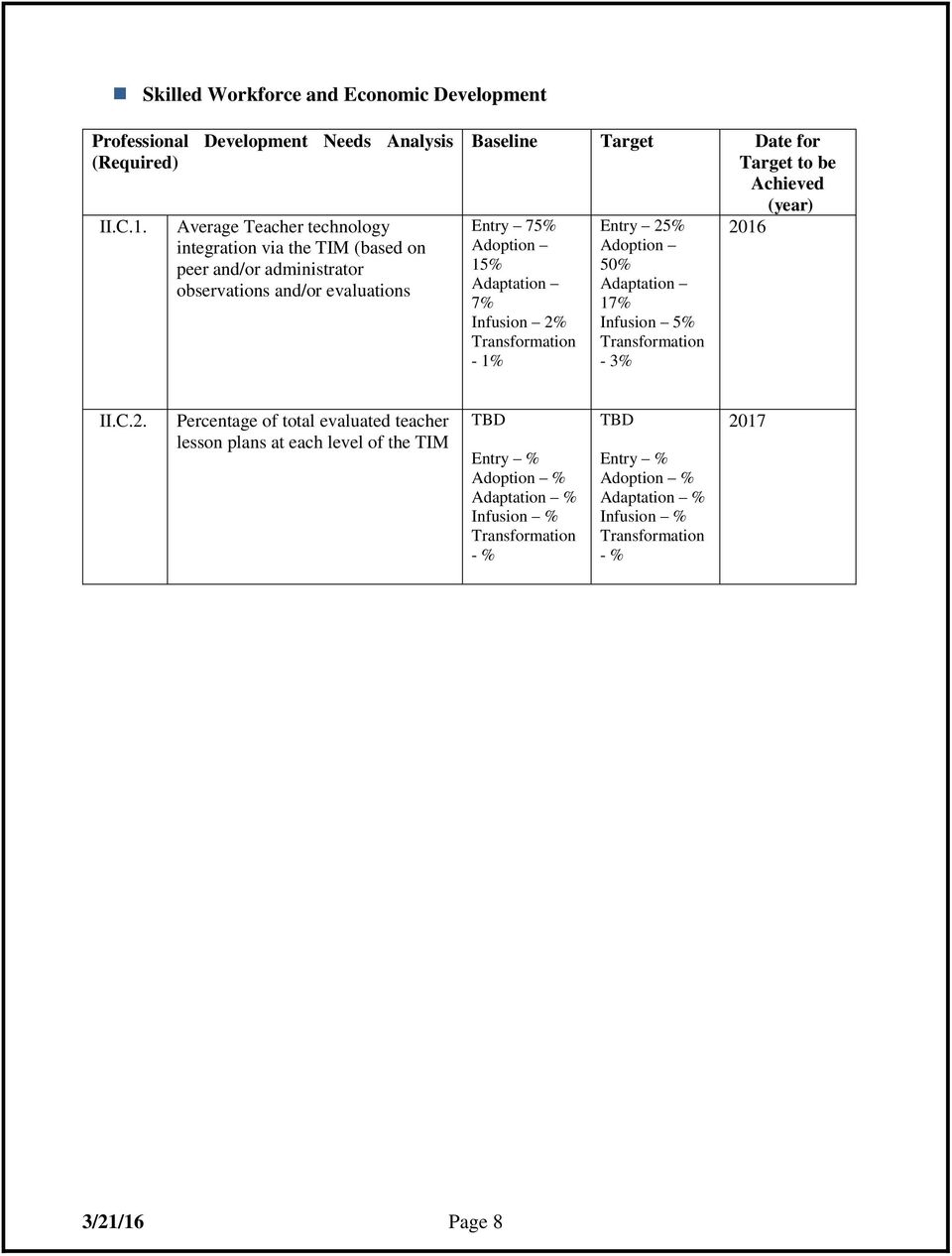
8 Skilled Workforce and Economic Development Professional Development Needs Analysis (Required) II.C.1. Average Teacher technology integration via the TIM (based on peer and/or administrator observations and/or evaluations Baseline Target Date for Target to be Achieved (year) Entry 75% Adoption 15% Adaptation 7% Infusion 2% Transformation - 1% Entry 25% Adoption 50% Adaptation 17% Infusion 5% Transformation - 3% 2016 II.C.2. Percentage of total evaluated teacher lesson plans at each level of the TIM TBD Entry % Adoption % Adaptation % Infusion % Transformation - % TBD Entry % Adoption % Adaptation % Infusion % Transformation - % /21/16 Page 8
9 Seamless Articulation and Maximum Access B. Digital Tools Needs Analysis (Required) Baseline (to be established in 2015) II.D.1. (S) II.D.2. (S) II.D.3. (S) II.D.4. (S) II.D.5. (S) Student Access and Utilization (S) A system that enables access and information about standards/benchmarks and curriculum. A system that provides students the ability to access instructional materials and/or resources and lesson plans. A system that s student access to online assessments and personal results. A system that houses documents, videos, and information for students to access when they have questions about how to use the system. A system that provides secure, role-based access to its features and data. % of student access Baseline (to be established in 2015) % of student Target % of student access utilization 100% TBD Ongoing 100% TBD Ongoing 100% TBD Ongoing 100% TBD Ongoing 100% TBD Ongoing Date for Target to be Achieved (year) School Year Systems are in place for core subject areas, and some noncore subject areas. We are in the process of determining the percent of student utilization as part of our digital tools review. The review will be complete by the end of the school year. D. Digital Tools Needs Analysis (Required) Baseline (to be established in 2015) II.D.1. (T) II.D.2. (T) II.D.3. (T) Teachers/Administrators Access and Utilization (T) A system that enables access to information about benchmarks and use it to create aligned curriculum guides. A system that provides the ability to create instructional materials and/or resources and lesson plans. A system that s the assessment lifecycle from item creation, to assessment authoring and administration and scoring. % of Teacher/ Admin access Baseline (to be established in 2015) % of Teacher/ Admin Utilization Target % of Teacher/ Admin access 100% %TBD Ongoing 100% %TBD Ongoing 100% %TBD Ongoing Date for Target to be Achieved (year) 3/21/16 Page 9

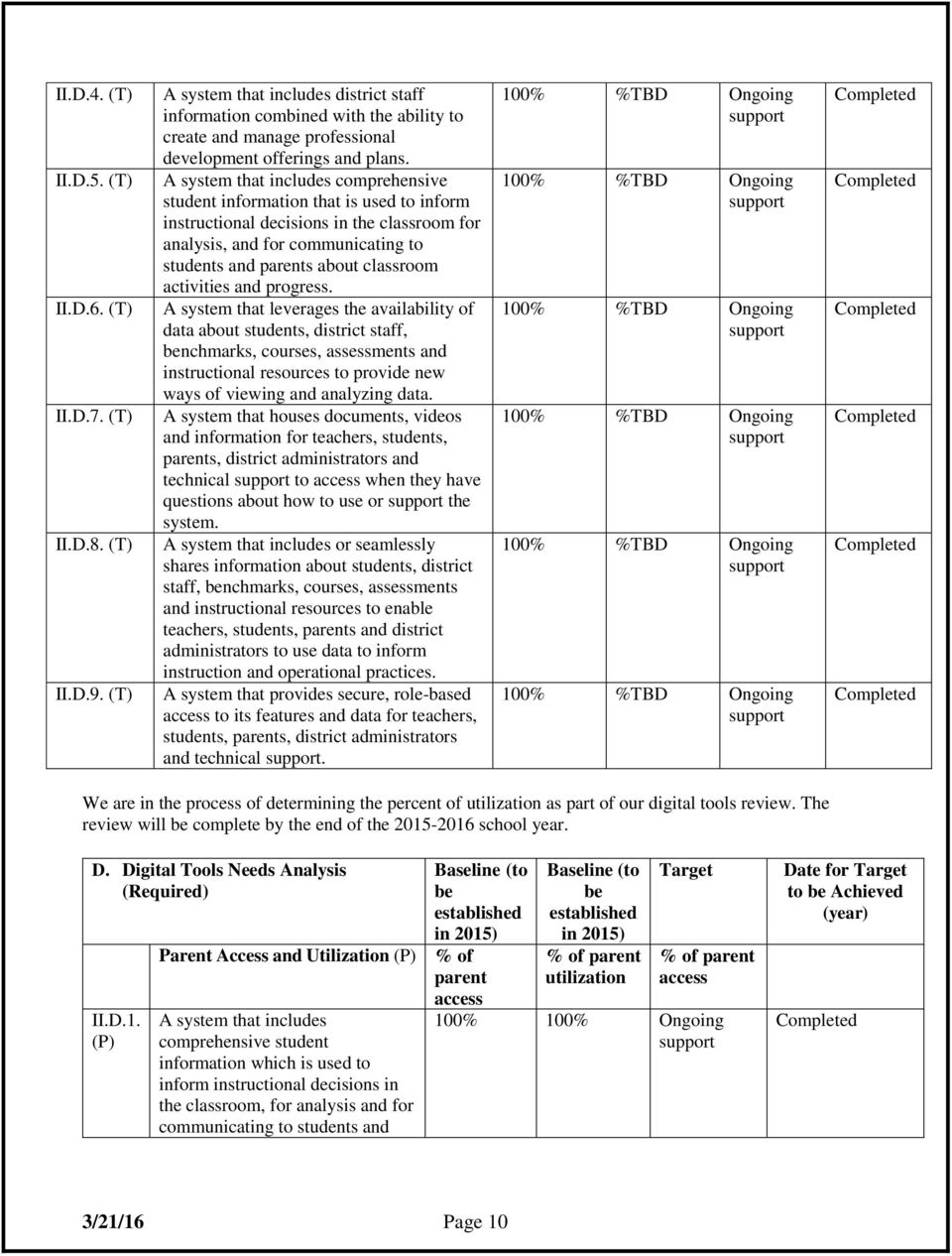
10 II.D.4. (T) II.D.5. (T) II.D.6. (T) II.D.7. (T) II.D.8. (T) II.D.9. (T) A system that includes district staff information combined with the ability to create and manage professional development offerings and plans. A system that includes comprehensive student information that is used to inform instructional decisions in the classroom for analysis, and for communicating to students and parents about classroom activities and progress. A system that leverages the availability of data about students, district staff, benchmarks, courses, assessments and instructional resources to provide new ways of viewing and analyzing data. A system that houses documents, videos and information for teachers, students, parents, district administrators and technical to access when they have questions about how to use or the system. A system that includes or seamlessly shares information about students, district staff, benchmarks, courses, assessments and instructional resources to enable teachers, students, parents and district administrators to use data to inform instruction and operational practices. A system that provides secure, role-based access to its features and data for teachers, students, parents, district administrators and technical. 100% %TBD Ongoing 100% %TBD Ongoing 100% %TBD Ongoing 100% %TBD Ongoing 100% %TBD Ongoing 100% %TBD Ongoing We are in the process of determining the percent of utilization as part of our digital tools review. The review will be complete by the end of the school year. D. Digital Tools Needs Analysis (Required) II.D.1. (P) Baseline (to be established in 2015) Parent Access and Utilization (P) % of parent access A system that includes comprehensive student information which is used to inform instructional decisions in the classroom, for analysis and for communicating to students and Baseline (to be established in 2015) % of parent utilization Target % of parent access 100% 100% Ongoing Date for Target to be Achieved (year) 3/21/16 Page 10
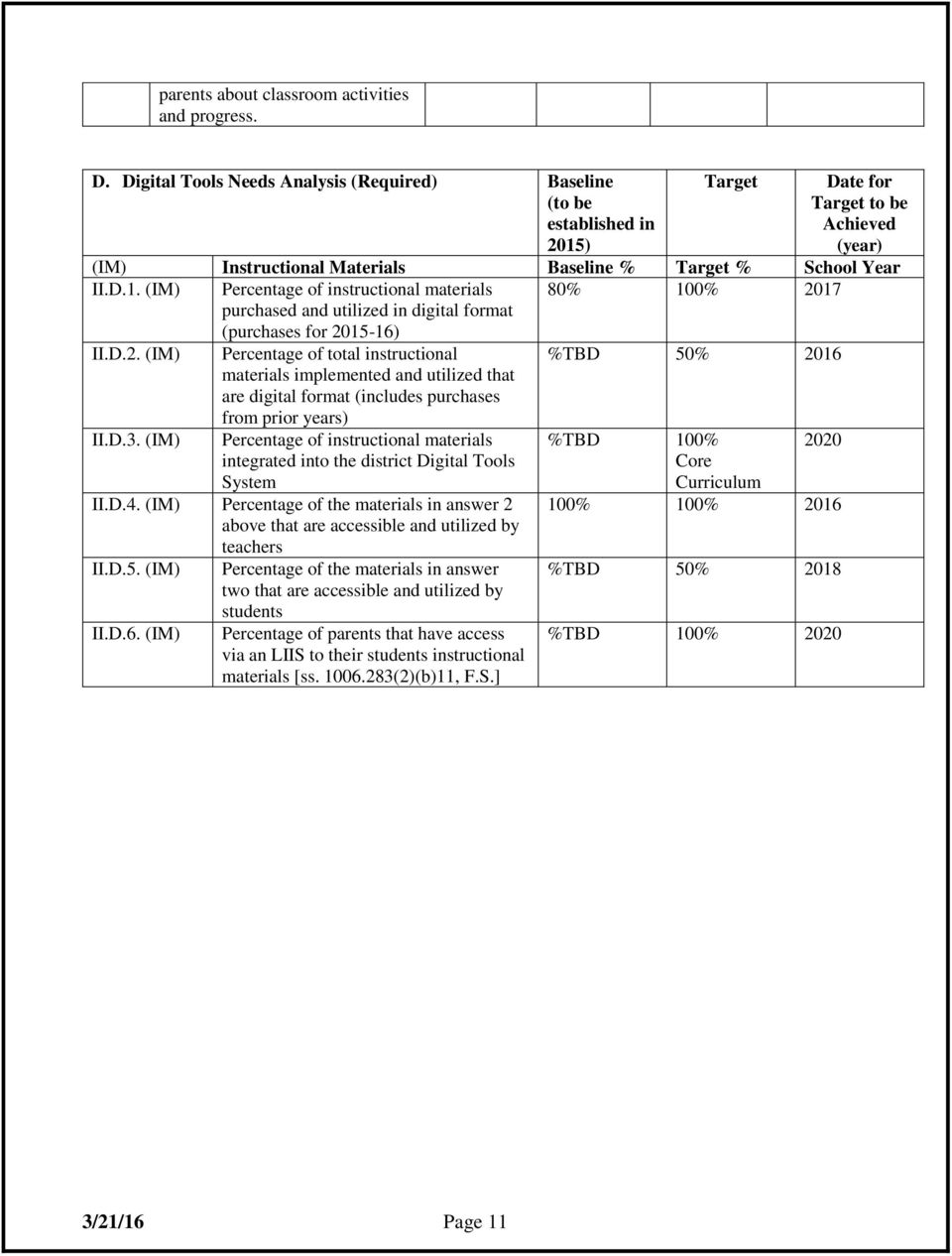
11 parents about classroom activities and progress. D. Digital Tools Needs Analysis (Required) Baseline (to be established in 2015) Target Date for Target to be Achieved (year) (IM) Instructional Materials Baseline % Target % School Year II.D.1. (IM) Percentage of instructional materials 80% 100% 2017 purchased and utilized in digital format (purchases for ) II.D.2. (IM) Percentage of total instructional materials implemented and utilized that are digital format (includes purchases from prior years) %TBD 50% 2016 II.D.3. (IM) Percentage of instructional materials integrated into the district Digital Tools System II.D.4. (IM) Percentage of the materials in answer 2 above that are accessible and utilized by teachers II.D.5. (IM) II.D.6. (IM) Percentage of the materials in answer two that are accessible and utilized by students Percentage of parents that have access via an LIIS to their students instructional materials [ss (2)(b)11, F.S.] %TBD 100% Core 2020 Curriculum 100% 100% 2016 %TBD 50% 2018 %TBD 100% /21/16 Page 11
12 Quality Efficient Services D. Online Assessments Needs Analysis (Required) Baseline (to be established in 2015) II.E.1. Computers/devices available for statewide FSA/EOC computer-based assessments II.E.2. Percent of schools reducing the amount of scheduled time required to complete statewide FSA/EOC computer-based assessments 5,995 devices are currently used for testing. Target 7,800 devices used for testing. Date for Target to be Achieved (year) % 15% /21/16 Page 12

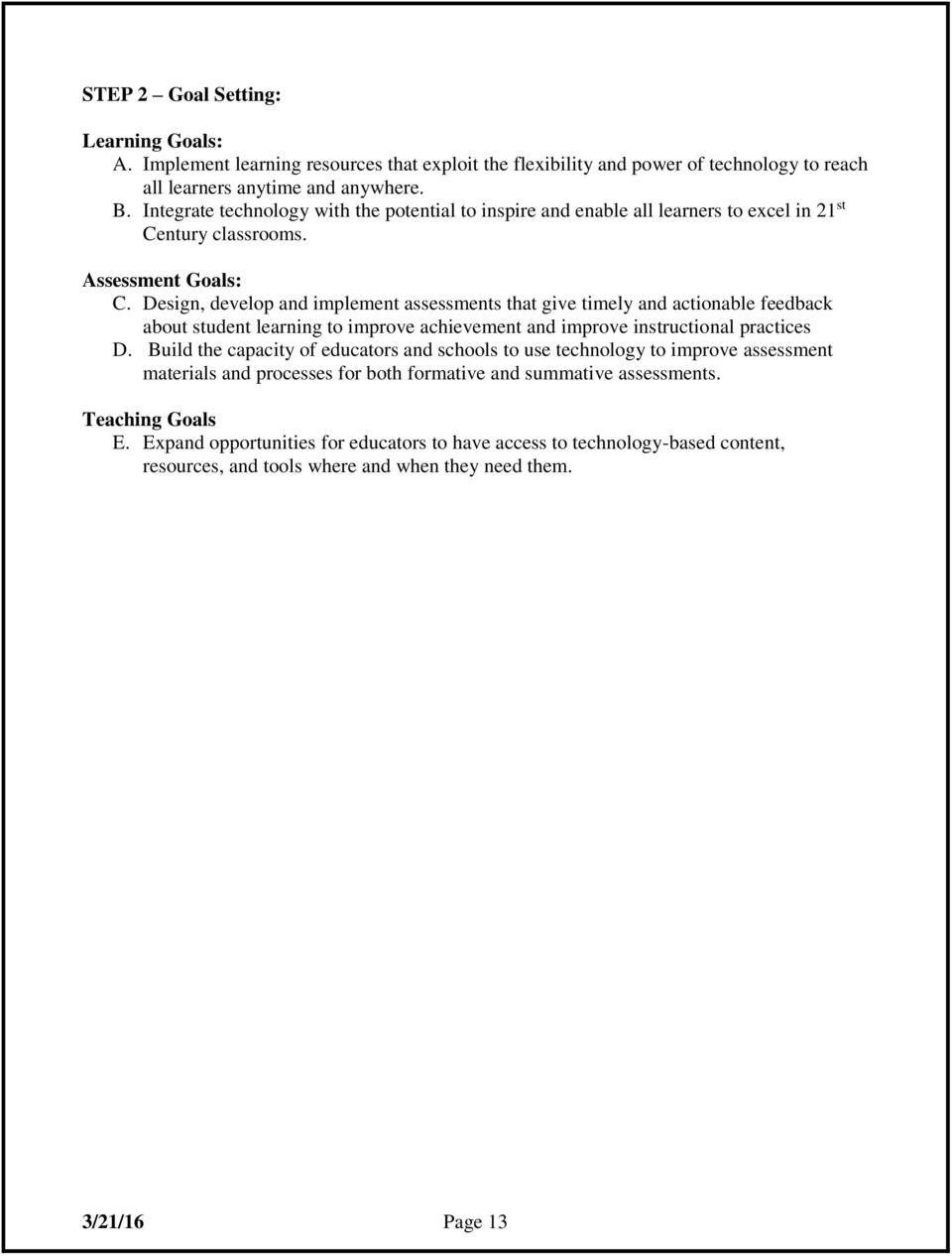
13 STEP 2 Goal Setting: Learning Goals: A. Implement learning resources that exploit the flexibility and power of technology to reach all learners anytime and anywhere. B. Integrate technology with the potential to inspire and enable all learners to excel in 21 st Century classrooms. Assessment Goals: C. Design, develop and implement assessments that give timely and actionable feedback about student learning to improve achievement and improve instructional practices D. Build the capacity of educators and schools to use technology to improve assessment materials and processes for both formative and summative assessments. Teaching Goals E. Expand opportunities for educators to have access to technology-based content, resources, and tools where and when they need them. 3/21/16 Page 13
14 STEP 3 Strategy Setting: Goal Addressed Strategy Measurement Timeline Implement learning resources that exploit the flexibility and power of technology to reach all learners anytime and anywhere. Provide professional learning opportunities for core subject teachers Assess skills necessary for implementing digital learning into the curriculum (Survey) June 2016 Integrate technology with the potential to inspire and enable all learners to excel in 21 st Century classrooms. Design, develop and implement assessments that give timely and actionable feedback about student learning to improve achievement and improve instructional practices Purchase infrastructure Acquire progress monitoring assessments reflecting the FSA item specs. Percent of classrooms meeting definition of 21 st Century classroom, as defined in district s Technology Plan. Purchase of software and item/test bank including items that address the increased rigor of FSA June 2016 June 2016 Build the capacity of educators and schools to use technology to improve assessment materials and processes for both formative and summative assessments. Provide professional learning related to existing resources aligned with the new Florida Standards and assessment of standards. Agendas, attendance, teacher evaluations June 2016 Expand opportunities for educators to have access to technologybased content, resources, and tools where and when they need them. Purchase and/or develop web-based instructional resources to enhance instruction. Core content courses developed for blended learning. June /21/16 Page 14

15 Part III. DIGITAL CLASSROOMS PLAN - ALLOCATION PROPOSAL A) Student Performance Outcomes Student Performance Outcomes Baseline Target 1. 5 th grade science 59% 63% 2. ELA Student Achievement 59% 63% 3. Math Student Achievement 60% 64% 3/21/16 Page 15

16 B) Digital Learning and Technology Infrastructure B. Infrastructure Implementation Deliverable III.B.1. Increase the ratio of computer to student devices, including desktop computers, laptops, tablets, and other mobile devices. Estimated Completion Date Estimated Cost 2023 Combined with Century Classroom 21 st School/ District Gap addressed from Sect. II Leon II.B.2, 3, 5 II.E. III.B.2. Increase the bandwidth of both internal and external connections 2020 Combined with Century Classroom 21 st Leon II.B.6, 7 III.B.3. Increase the percent of classrooms meeting the 21 st Century classroom definition as defined in the district s technology plan. Devices 70 interactive televisions with integrated computer Network infrastructure upgrades/installation to devices 2020 Total Allocated for $321, Leon II.B. II.E. 46 Classrooms, $253, Classrooms, 68, III.B.4. Charter school approved plans 2016 $42, Leon N/A Evaluation and Success Criteria for B) Digital Learning and Technology Infrastructure: B. Infrastructure Evaluation and Success Criteria Deliverable (from above) Monitoring and Evaluation and Process(es) Success Criteria Identification of schools and timeline by December 2016 III.B.1. III.B.2. Start of implementation by July :1 in grades 3-12 by July Identification of schools and timeline for completion by December Deploy desktops to identified schools by July As devices are distributed, student performance on the ELA and math FSA will be compared to previous years. Success: A 5% increase on the ELA and math FSA for students that have received a device. As devices are distributed, the number of days required for testing will decrease. Success: A 10% decrease in the number of days required for testing ELA and math FSA. 3/21/16 Page 16

17 III.B.3. III.B.4. Elimination of gap by Ongoing monitoring and corrections to allocation to be completed by Instructional Technology. Identification of schools and timeline by December Start of deployment by July Annual deployment every July. Elimination of mobile device gap by Ongoing monitoring and corrections to allocation to be completed by Instructional Technology. Periodic reporting of expenditures consistent with approved plan. As devices are distributed, student performance on the ELA and math FSA will be compared to previous years. Success: A 5% increase on the ELA and math FSA for students that have received a device. Financial documentation consistent with current district standards. Additionally, if the district intends to use any portion of the DCP allocation for the technology and infrastructure needs area B, ss (12)(b), F.S., requires districts to submit a third-party evaluation of the results of the district s technology inventory and infrastructure needs. Please describe the process used for the evaluation and submit the evaluation results with the DCP. See the CIRT Plan (Attachment 2) C) Professional Development Professional Development Implementation Deliverable Estimated Completion Date C.1. Up to 150 school-based tech leaders participate in LIIS training (core digital curriculum, progress monitoring & assessment, oneto-one initiative) ongoing professional development. Up to 700 teachers participate in summer training (core digital curriculum, progress June 2016 Estimated Cost Instructional Technology Leaders: $45, Teacher Professional Development 700 teachers, 20 hours of training. School/ District Gap addressed from Section II II.C., II.D. 3/21/16 Page 17

18 C.2. monitoring & assessment, oneto-one initiative) Establish a technology learning center at the district training and conference center. This site will up to 32 teachers and staff for professional development. It will also serve as a testing center for students at special school sites. April 2016 $300, Equipment and Furnishings: $80, Network Infrastructure $20, Leon II.C, II.D. Evaluation and Success Criteria for C) Professional Development: Professional Development Evaluation and Success Criteria Deliverable Monitoring and Evaluation and Success Criteria (from above) Process(es) C.1. Existing processes for documenting trainings occurrence Established scalable training module (train-the-trainer) Teachers meeting TIM Goals: Instructional Technology Curriculum Developer to ensure school-based trainings occurred Entry 25% Adoption 50% Adaptation 17% Infusion 5% Review of teacher evaluation to show increased use of technology school wide Transformation - 3% Completion of training module for LIIS training C.2. Periodic reporting of expenditures consistent with approved plan. Completion and utilization of training facility prior to June Financial documentation consistent with current district standards. 3/21/16 Page 18

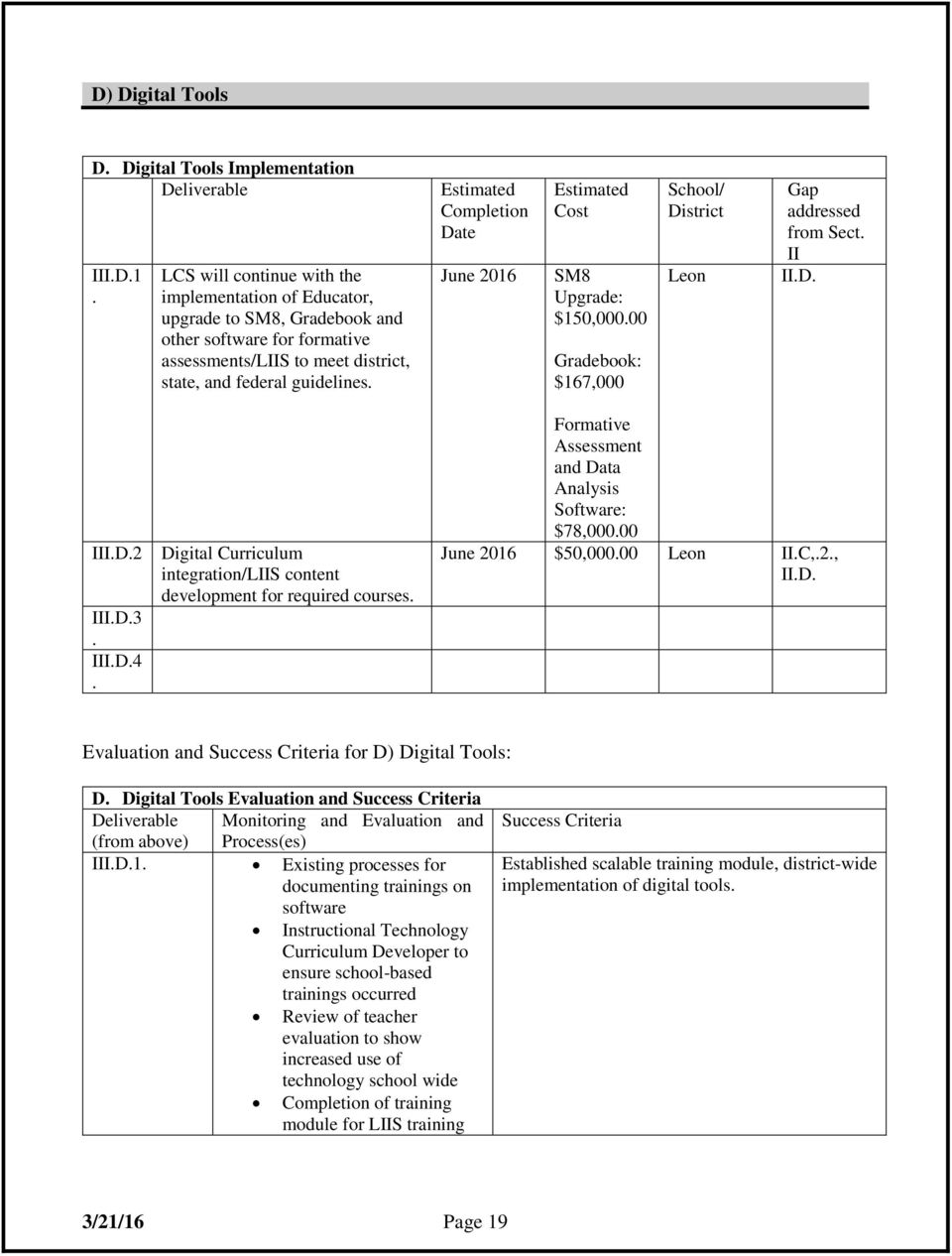
19 D) Digital Tools D. Digital Tools Implementation Deliverable III.D.1. LCS will continue with the implementation of Educator, upgrade to SM8, Gradebook and other software for formative assessments/liis to meet district, state, and federal guidelines. Estimated Completion Date June 2016 Estimated Cost SM8 Upgrade: $150, Gradebook: $167,000 School/ District Leon Gap addressed from Sect. II II.D. III.D.2 III.D.3. III.D.4. Digital Curriculum integration/liis content development for required courses. Formative Assessment and Data Analysis Software: $78, June 2016 $50, Leon II.C,.2., II.D. Evaluation and Success Criteria for D) Digital Tools: D. Digital Tools Evaluation and Success Criteria Deliverable (from above) Monitoring and Evaluation and Process(es) III.D.1. Existing processes for documenting trainings on software Instructional Technology Curriculum Developer to ensure school-based trainings occurred Review of teacher evaluation to show increased use of technology school wide Completion of training module for LIIS training Success Criteria Established scalable training module, district-wide implementation of digital tools. 3/21/16 Page 19
20 III.D.2. Personnel/payroll records Project tasks/timeline completion checklist Support TIM Goals by accomplishing at least 3 content courses developed for blended learning. E) Online Assessments E. Online Assessment Implementation Deliverable III.E.1. Increase the ratio of computer to student devices, including desktop computers, laptops, tablets, and other mobile devices. Estimated Completion Date Estimated Cost 2023 Combined with 21 st Century Classroom School/ District Gap addressed from Sect. II Leon II.B.2, 3, 5 II.E. III.E.2. Increase the bandwidth of both internal and external connections 2020 Combined with 21 st Century Classroom Leon II.B.6, 7 Evaluation and Success Criteria for E) Online Assessments: See Digital Learning and Technology Infrastructure. 3/21/16 Page 20

NASSAU COUNTY SCHOOL DISTRICT DIGITAL CLASSROOM PLAN
 NASSAU COUNTY SCHOOL DISTRICT DIGITAL CLASSROOM PLAN The Digital Classroom Plan (DCP) provides a perspective on what the district considers to be vital and critically important in relation to digital learning
DISTRICT DIGITAL CLASSROOM PLAN 2015-2016
 DISTRICT DIGITAL CLASSROOM PLAN 2015-2016 Part I. DIGITAL CLASSROOMS PLAN - OVERVIEW I.1 District Team Profile Title/Role Name: Email: Phone: Information Technology District Contact Frank Shin [email protected]
ty School District Digita al Classrooms Plan
 Nassau Count ty School District Digita al Classrooms Plan Nassau County School Districtt Digital Classrooms Plan 1 P age The intent of the District Digital Classroom Plan (DCP) is to provide a perspective
DISTRICT DIGITAL CLASSROOM PLAN: MADISON COUNTY
 DISTRICT DIGITAL CLASSROOM PLAN: MADISON COUNTY The intent of the District Digital Classroom Plan (DCP) is to allow the district to provide a perspective on what it considers to be vital and critically
WILLSBORO CSD Instructional Technology Plan - Annually - 2015
 LEA Information A. LEA Information 1. What is the total student enrollment based on the most recent BEDS Day submission? 2. 249 What is the student enrollment by grade band based on the latest BEDS Day
MORIAH CSD Instructional Technology Plan - Annually - 2015
 LEA Information A. LEA Information 1. What is the total student enrollment based on the most recent BEDS Day submission? 2. 693 What is the student enrollment by grade band based on the latest BEDS Day
NANUET UFSD Instructional Technology Plan - Annually - 2015
 LEA Information A. LEA Information 1. What is the total student enrollment based on the most recent BEDS Day submission? 2. 2,209 What is the student enrollment by grade band based on the latest BEDS Day
The Baltimore County Public Schools 2015-2019 Technology Plan
 2015-2019 Technology Plan Prepared by: The Department of Information Technology Plan Origination Date: March 2014 Plan Updated April 2015 Version 2.0 The guiding document of Baltimore County Public Schools
FLORENCE SCHOOL DISTRICT TWO DISTRICT TECHNOLOGY PLAN. 2121 South Pamplico Highway, Pamplico, South Carolina 29583
 FLORENCE SCHOOL DISTRICT TWO DISTRICT TECHNOLOGY PLAN 2010 2015 Robert E. Sullivan Jr., Superintendent Mark A. Parker, Information Technology Coordinator 2121 South Pamplico Highway, Pamplico, South Carolina
Technology Plan Saugus Public Schools 2014-2017 http://www.saugus.k12.ma.us
 Technology Plan Saugus Public Schools 2014-2017 http://www.saugus.k12.ma.us Executive Summary This document contains the Three-Year Technology Plan for the Saugus Public Schools developed by a technology
New York State Education Department Instructional technology plan survey
 The instructional technology plan survey is designed to allow districts the opportunity to compile all data related to their technology planning and needs in one location. The data collected in the survey
Douglas County School System
 Douglas County School System Douglasville, Georgia Three-Year Plan July 1, 2009 June 30, 2012 Creation Date December 10, 2008 Superintendent Don Remillard Todd Hindmon 770-651-2387 [email protected]
Monroe County Department of Education. Technology Plan
 Monroe County Department of Education Technology Plan Madisonville Tennessee 2011-2013 Office of Technology Gary Sharp, Director III. SYSTEM-WIDE GOALS AND OBJECTIVES Instructional Technology A. GOAL I:
EAST GREENBUSH CSD Instructional Technology Plan - Annually - 2015
 LEA Information A. LEA Information 1. What is the total student enrollment based on the most recent BEDS Day submission? 2. 4,068 What is the student enrollment by grade band based on the latest BEDS Day
Garden City Public Schools Strategic Plan. Vision: Student Focused Team Driven Globally Competitive with a Hometown Spirit
 Garden City Public Schools Strategic Plan Mission: Our mission is to be a learning community that ensures a safe, caring, quality education for students of all ages to prepare for the possibilities of
North Platte Public School District
 North Platte Public School District Student Learning, Student Achievement, Student Success District Technology Plan 2014-2019 Table of Contents Table of Contents 2 Executive Summary 3 District Description
Lancaster Central School District
 Lancaster Central School District Smart Schools Bond Act Allocation Preliminary Investment Plan As presented at the December 7, 2015 meeting of the Board of Education. Public Hearing to follow on January
Start Date: July 2015 End Date: June 2016. Technology Plan 1. West Michigan Academy of Arts & Academics 7/30/15
 District: West Michigan Academy of Arts & Academics [70902] Building: [08332] ISD: Ottawa Area ISD [70] Address: 17350 Hazel Street, Spring Lake, Michigan 49456 Contact: Cathy Cantu Phone: 616 844 9961
THE SCHOOL BOARD OF ST. LUCIE COUNTY, FLORIDA TEACHER PERFORMANCE APPRAISAL SYSTEM, 2014-2015 TABLE OF CONTENTS
 , 2014-2015 TABLE OF CONTENTS Purpose and Key Components... 1 1. Core of Effective Practices... 1 2. Student Growth... 2 3. Evaluation Rating Criteria... 13 4. Teacher and Principal Involvement... 14 5.
New Prague Area Schools ISD 721. 2012-2017 Technology Plan
 New Prague Area Schools ISD 721 2012-2017 Plan 0 Table of Contents District Mission, Vision, and Values... 2 Demographics of School District... 2 Organization Leadership and Planning... 3 Needs Assessment...
CERTIFICATION OF SCHOOL TECHNOLOGY PLAN
 CERTIFICATION OF SCHOOL TECHNOLOGY PLAN PRESENTED TO 4580, Hanover Community School Corp 7/1/2014-6/30/2017 Approved 1st Update The above referenced school corporation's technology plan is hereby certified
IUSD TECHNOLOGY PLAN. November 2013. Irvine Unified School District Information Technology Department 1
 IUSD TECHNOLOGY PLAN November 2013 1 AGENDA Agenda 1 Scope and Purpose of the Plan 2 Plan Development 3 Plan Content 3.1 Current Access and Use 3.2 Curriculum Goals 3.3 Professional Learning Goals 3.4
Lincoln Public Schools 2015 2018 Technology Plan. Vision for Technology Integration
 Lincoln Public Schools 2015 2018 Technology Plan The introduction of Chromebooks for staff for the 2015-2016 school year will be a game changer for teaching and learning. This cost effective solution will
Instructional Technology Initiative Task Force: Vision, Mission, & Core Values
 Instructional Technology Initiative Task Force: Vision, Mission, & Core Values Our Vision: All schools use technology as a tool to differentiate and personalize instruction, increase academic rigor, and
a. What is the period of validity for an educator s license? Less than 5 years 5 years X 3 Greater than 5 years
 I. Teacher Preparation A. Elementary School Licensure Requirements 1. Licensure Grade Levels 1 a. Does the state offer an Early Elementary Education credential (Preschool/Kindergarten to Grade 2/3)? b.
Lancaster City School District. Technology Plan July 1, 2012 to June 30, 2015
 Lancaster City School District Technology Plan July 1, 2012 to June 30, 2015 Adopted on May 22, 2012 SPECIAL THANKS The following people collaborated on this transformative plan for educational technology
Covington Community Schools Innovative Technology Finalized Planning Grant Report
 Covington Community Schools Innovative Technology Finalized Planning Grant Report Covington Community Schools believes that students learn differently and at individual paces. To ensure that our students
5. Infrastructure, Hardware, Software, & Technical Support
 5. Infrastructure, Hardware, Software, & Technical Support 5 A & B: Current District Hardware Existing hardware and electronic resources at each of our sites is included in Component 3a: Current Technology
A second year progress report on. Florida s Race to the Top
 Florida s Race to the Top A second year progress report on Florida s Race to the Top January 2013 Florida s Race to the Top Florida has a strong history of reform, establishing a solid foundation that
South Washington County Schools World s Best Workforce Summary Report
 South Washington County Schools World s Best Workforce Summary Report This comprehensive plan is intended to serve as a foundational document to align school district educational initiatives that serve
ConnectED: President Obama s Plan for Connecting All Schools to the Digital Age
 THE WHITE HOUSE ConnectED: President Obama s Plan for Connecting All Schools to the Digital Age Driven by new digital technologies, the future of learning is increasingly interactive, individualized, and
Blackstone Valley Prep, a Rhode Island Mayoral Academy. Technology Plan
 Blackstone Valley Prep, a Rhode Island Mayoral Academy Technology Plan Amended/Revised January 2012 for Plan Period 1/2012 6/2014 TABLE OF CONTENTS Introduction/Executive Summary... 3 Mission... 4 Goal(s)...
2013-2016. Three Year District Technology Plan. Pasco School District #1 July 1, 2013 to June 30, 2016
 2013-2016 Three Year District Technology Plan Pasco School District #1 July 1, 2013 to June 30, 2016 Development History August 2012 November 2012 December 2012 December 2012 February 2013 March 2013 April
Technology Plan 2010-2015 Attleboro Public Schools
 ATTLEBORO PUBLIC SCHOOLS 100 RATHBUN WILLARD DRIVE ATTLEBORO, MA 02703 Technology Plan 2010-2015 Attleboro Public Schools ATTLEBORO COMMUNITY PROFILE Attleboro, Massachusetts Attleboro is a small city
LEE COUNTY SCHOOLS. Leesburg, Georgia THREE-YEAR TECHNOLOGY PLAN JULY 1, 2012 JUNE 30, 2015. Superintendent. Dr. Lawrence T.
 LEE COUNTY SCHOOLS Leesburg, Georgia THREE-YEAR TECHNOLOGY PLAN JULY 1, 2012 JUNE 30, 2015 Superintendent Dr. Lawrence T. Walters Curriculum Director Gail Melvin (229) 903-2100 [email protected] Technology
Self Assessment. Orange County Public Schools. Dr. Barbara Jenkins, Superintendent 445 W Amelia St Orlando, FL 32801-1129
 Dr. Barbara Jenkins, Superintendent 445 W Amelia St Orlando, FL 32801-1129 Document Generated On April 13, 2016 TABLE OF CONTENTS Introduction 1 Purpose and Direction 2 Governance and Leadership 8 Teaching
Gadsden City Schools. Page 1. State Educational Technology Directors Association www.setda.org
 Gadsden City Schools Background The American Recovery and Reinvestment Act of 2009 (ARRA) included a $650 million allocation in ESEA Title II, Part D, commonly referred to as the Enhancing Education Through
PIERCE COLLEGE TECHNOLOGY MASTER PLAN 2010 2012. Technology Committee & Educational Technology Committee
 PIERCE COLLEGE TECHNOLOGY MASTER PLAN 2010 2012 Technology Committee & Educational Technology Committee July 2, 2010 INTRODUCTION The mission of LACCD s technology plan is to offer students an information-rich
Honeoye Smart Schools Investment Plan (SSIP) Overview Final Plan
 Honeoye Smart Schools Investment Plan (SSIP) Overview Final Plan What is the estimate of the total number of students and staff that will benefit from this Smart Schools Investment Plan based on the cumulative
ONE-OF-A-KIND, DIGITAL LEARNING SOLUTION FOR SCHOOLS & STUDENTS.
 ONE-OF-A-KIND, DIGITAL LEARNING SOLUTION FOR SCHOOLS & STUDENTS. I have truly enjoyed all of the great service that Odysseyware Academy [is] able to provide. I know you deliver on ALL fronts. You re the
SMART SCHOOLS BOND ACT Prelimary Investment Plan 2015-2016
 SMART SCHOOLS BOND ACT Prelimary Investment Plan 2015-2016 390 North Ridge Street, Rye Brook, NY 10573 914-937-3600 (t), 914-937-5871 (f) Table of Contents PLAN OVERVIEW... 3 PRECONDITIONS... 3 PLAN GOALS...
WIDA ELD Standards Implementation in Boston Public Schools 2.0
 WIDA ELD Standards Implementation in Boston Public Schools 2.0 Frances Esparza Ed.D., Daphne Germain, and Joelle Gamere Office of English Language Learners * Session Objectives 1. Attendees will analyze
Treutlen County School System Soperton, GA. Three-Year Technology Plan July 1, 2014-June 30, 2017
 Treutlen County School System Soperton, GA Three-Year Technology Plan July 1, 2014-June 30, 2017 Superintendent Dr. Cheryl Conley Gregory Martin TCSS Three Year Technology Plan 2014-2017 Page 1 of 18 1.
OCSD School Leadership Program. Where Do We Stand and Where Are We Going?
 OCSD School Leadership Program Where Do We Stand and Where Are We Going? Florida s school leaders must possess the abilities and skills necessary to perform their designated tasks in a highperforming manner.
MONTGOMERY COLLEGE INFORMATION TECHNOLOGY STRATEGIC PLAN FY 2012-2014
 MONTGOMERY COLLEGE INFORMATION TECHNOLOGY STRATEGIC PLAN FY 2012-2014 Strategic Planning Requests December 23, 2010 INFORMATION TECHNOLOGY STRATEGIC PLAN TABLE OF CONTENTS EXECUTIVE SUMMARY 3 INFORMATION
Performance Goal 1: All students will reach high standards, at a minimum, attaining proficiency or better in reading and mathematics by 2013-2014.
 Performance Goal 1: All students will reach high standards, at a minimum, attaining proficiency or better in reading and mathematics by 2013-2014. Planned Improvement in Student Performance in Reading
Atlantis Charter School
 Atlantis Charter School Technology Plan 2013-2017 Background Atlantis Charter School, one of the longest-standing charter schools in Massachusetts, is currently in its 18 th year of operation. The school
Lawrence Public Schools
 Lawrence Public Schools Jeffrey C. Riley, Superintendent/Receiver Lawrence Public Schools TECHNOLOGY PLAN 2012-2015 Lawrence Public Schools Phone: 978.975.5905 x25690 Office of Instructional Technology
Northeastern Catholic District School Board. Catholic Education in a Digital Age
 Northeastern Catholic District School Board Catholic Education in a Digital Age 1 Northeastern Catholic District School Board - Geography 2 Northeastern Catholic District School Board Mission and Vision
Louisiana Believes: Louisiana s Technology Footprint
 July 2012 Issue 1 Louisiana Believes: Louisiana s Technology Footprint Technology Readiness Assessment to Prepare for 2014-15 District Technology Checklist q Determine the current technology readiness
WIDA ELD Standards Implementation in Boston Public Schools
 WIDA ELD Standards Implementation in Boston Public Schools Daphne Germain and Paulina Mitropoulos Office of English Language Learners Amy King WIDA Consultant * Session Objectives 1. Attendees will analyze
AGRICULTURE STAGE NETWORKED PLACES APPLICATIONS & SERVICES LEADERSHIP. No computer use. No website. All contacts via phone and postal mail.
 Organization: Your Name: This assessment tool is designed to quickly assess where the community stands today. A rating of Level 1 is the lowest, Level 5 is the highest and Level 0 is disconnected. AGRICULTURE
Instructional Technology Plan
 Okeechobee County School Board 700 SW 2 nd Ave Okeechobee, FL 34974 Phone 863-462-5000 ext. 235 Fax 863-462-5017 Instructional Technology Plan Okeechobee County School Board District Instructional Technology
Collier County Public Schools Superintendent s Self Evaluation Aligned to Strategic Plan 2015-2016 Performance Indicators
 Collier County Public Schools Superintendent s Self Evaluation Aligned to Strategic Plan 2015-2016 Performance Indicators Goal 1: Expand Early Childhood Education to Enhance School Readiness and Early
High School Distance Learning: Online/Technology Enhanced Course or Experience Guidance
 Provided by: Technology Initiatives and Curriculum and Instruction Alabama Department of Education High School Distance Learning: Online/Technology Enhanced Course or Experience Guidance As part of the
BRING YOUR OWN DEVICE (BYOD)
 BRING YOUR OWN DEVICE (BYOD) SM LIMOTTA IT Virtualization Solutions for Hospitality 888.884.6278 SM www.limottait.com [email protected] Virtualization Solutions for Education LIMOTTAIT.com BRING YOUR
Florida Department of Education. Professional Development System Evaluation Protocol
 Professional Development System Evaluation Protocol Reviewer s Guide Third Cycle 2010-14 Bureau of Educator Recruitment, Development and Retention April 2010 printing Florida Department of Education Reviewers
Douglas County School District. Information Technology. Strategic Plan 2014-17
 Douglas County School District Information Technology Strategic Plan 2014-17 Introduction About the Strategic Plan About the Division The goal of the Douglas County School District is to prepare students
2010-2016 TECHNOLOGY PLAN
 2010-2016 TECHNOLOGY PLAN Bland County Public Schools 361 Bears Trl. Bastian, VA 24315 www.bland.k12.va.us Six Year Technology Plan for Bland County Public Schools APPROVED BY SCHOOL BOARD MAY 23, 2011
Technology in the Boston Public Schools
 Technology in the Boston Public Schools Office of Instructional & Information Technology Type Date Here Melissa Dodd Type Presenter Name/Contact Here Chief Information Officer 1 BPS Technology Vision Why
Administrative and Instructional Technology
 Administrative and Instructional Technology Summary The Indian River County School District is using all nine of the administrative and instructional technology best practices. The district acquires technology
How To Integrate And Implement Web 2.0 Tools And Blogging In The Classroom
 Felicia A. Belcher January 2014 Dr. Sherri Booker Summer 2012 Integrating and Implementing Web 2.0 Tools and Blogging in the Classroom CAPSTONE PROPOSAL Master s Degree in Instructional Technology Candidate
Getting Started with BYOD
 Getting Started with BYOD If we teach today as we taught yesterday, we rob our children of tomorrow. - John Dewey Today s education system is evolving to take full advantage of the potential of mobile
PETALUMA CITY SCHOOLS DISTRICT EDUCATION TECHNOLOGY PLAN JULY 1, 2013 JUNE 30, 2018
 PETALUMA CITY SCHOOLS DISTRICT EDUCATION TECHNOLOGY PLAN JULY 1, 2013 JUNE 30, 2018 TABLE OF CONTENTS District Summary and Plan Duration (Criteria Item 1) Stakeholders Involvement (Criteria Item 2) Curriculum
Holland Elementary School Local Stakeholder Group Recommendations to the Commissioner Submitted January 6, 2014
 Holland Elementary School Local Stakeholder Group Recommendations to the Commissioner Submitted January 6, 2014 Holland Elementary School was designated by Commissioner Chester as chronically underperforming
State College Area School District Elementary Curriculum Office. Elementary Mathematics Pilot Plan
 Uniting Talent and Passion! State College Area School District Elementary Curriculum Office Elementary Mathematics Pilot Plan November 8, 2010 Elementary Mathematics Pilot Plan Purpose To select a high-quality