
Cloud Management for Communications Service Providers
|
|
|
- Bernice Pearson
- 10 years ago
- Views:
Transcription
1 Communications Service Providers Whitepaper: Exploring the Synergies between DMTF and TM Forum Version 1.0 DMTF Work In Progress January 2012 DSP2029 version 1.0.0a DMTF and TM Forum 2011, 2012

2 Notice This document has been jointly developed by the TeleManagement Forum (TM Forum) and The Distributed Management Task Force (DMTF). This document has been through review cycles; however, due to the inherent complexity in the design and implementation of software and systems, no liability is accepted for any errors or omissions or for consequences of any use made of this document. Under no circumstances will the TM Forum or DMTF be liable for direct or indirect damages or any costs or losses resulting from the use of this document. The risk of designing and implementing products in accordance with this document is borne solely by the user of this document. This document is a copyrighted document of TM Forum and its use by members and non-members of TM Forum is governed by all of the terms and conditions of the Intellectual Property Rights Policy of the TM Forum ( Forumorum.org/Bylaws/1094/home.html) and may involve a claim of patent rights by one or more TM Forum members or by non-members of TM Forum. This document is a copyrighted document of DMTF and its use by members of DMTF is governed by the terms and conditions of DMTF Policies and Member Rules of Conduct at Direct inquiries to the TM Forum office: 240 Headquarters Plaza, East Tower 10 th Floor, Morristown, NJ USA Tel No Fax No TM Forum Web Page: Forumorum.org Direct inquiries to DMTF should be directed to Distributed Management Task Force Inc. office: 1001 SW 5th Avenue, #1100 Portland, OR Tel No Fax No The DMTF Web Page: DMTF and TM Forum 2011, 2012 Page 2 of 50
3 DMTF: Information for Work in Progress Version IMPORTANT: This specification is not a standard. It does not necessarily reflect the views of the DMTF or all of its members. Because this document is a Work in Progress, this specification may still change, perhaps profoundly. This document is available for public review and comment until the stated expiration date. It expires on: February 1, 2013 Provide any comments through the DMTF Feedback Portal: DMTF and TM Forum 2011, 2012 Page 3 of 50

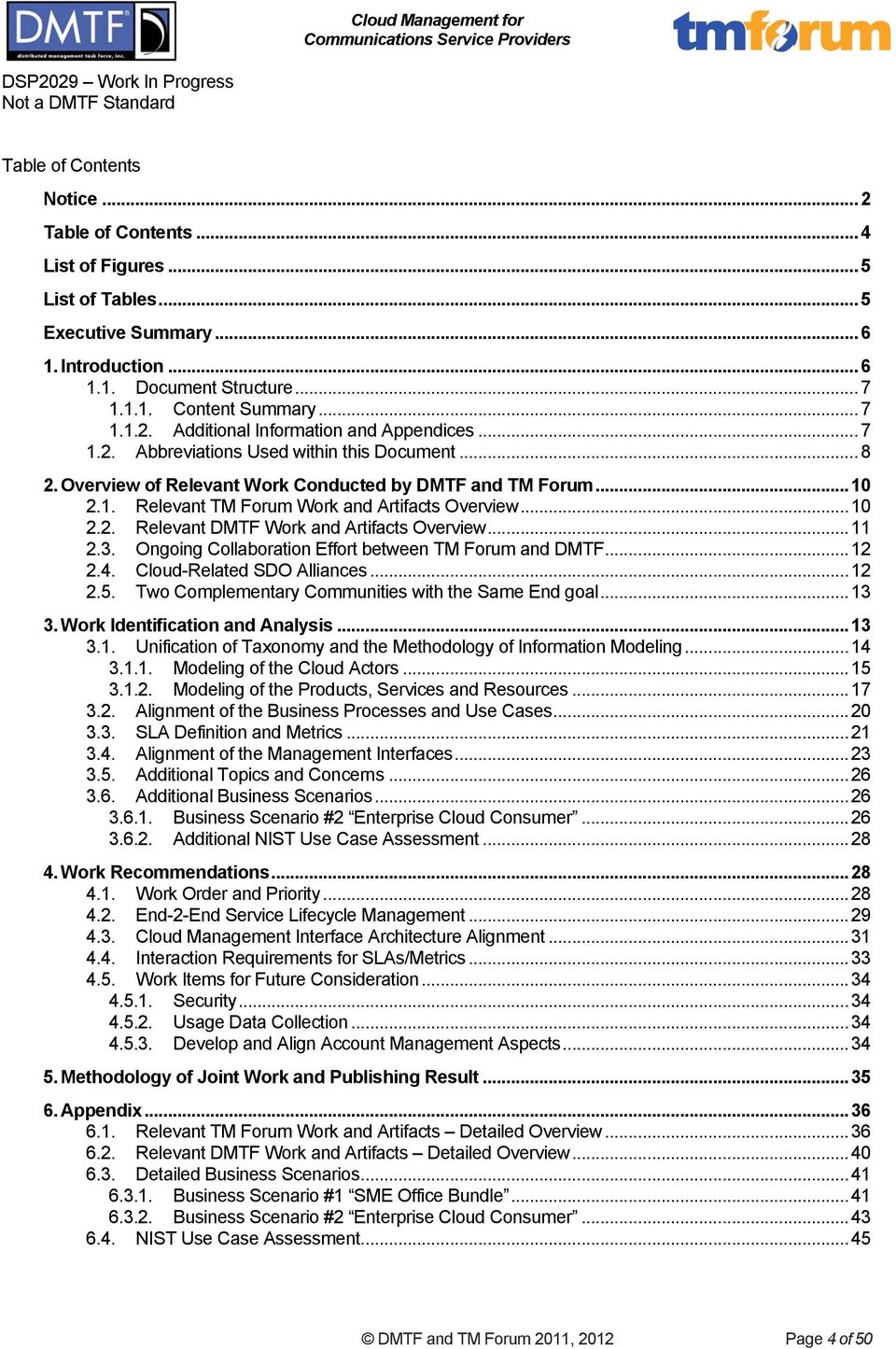
4 Table of Contents Notice...2 Table of Contents...4 List of Figures...5 List of Tables...5 Executive Summary Introduction Document Structure Content Summary Additional Information and Appendices Abbreviations Used within this Document Overview of Relevant Work Conducted by DMTF and TM Forum Relevant TM Forum Work and Artifacts Overview Relevant DMTF Work and Artifacts Overview Ongoing Collaboration Effort between TM Forum and DMTF Cloud-Related SDO Alliances Two Complementary Communities with the Same End goal Work Identification and Analysis Unification of Taxonomy and the Methodology of Information Modeling Modeling of the Cloud Actors Modeling of the Products, Services and Resources Alignment of the Business Processes and Use Cases SLA Definition and Metrics Alignment of the Management Interfaces Additional Topics and Concerns Additional Business Scenarios Business Scenario #2 Enterprise Cloud Consumer Additional NIST Use Case Assessment Work Recommendations Work Order and Priority End-2-End Service Lifecycle Management Cloud Management Interface Architecture Alignment Interaction Requirements for SLAs/Metrics Work Items for Future Consideration Security Usage Data Collection Develop and Align Account Management Aspects Methodology of Joint Work and Publishing Result Appendix Relevant TM Forum Work and Artifacts Detailed Overview Relevant DMTF Work and Artifacts Detailed Overview Detailed Business Scenarios Business Scenario #1 SME Office Bundle Business Scenario #2 Enterprise Cloud Consumer NIST Use Case Assessment...45 DMTF and TM Forum 2011, 2012 Page 4 of 50
5 7. References Acknowledgements...50 List of Figures Figure 1 Who, What, When, Where, Why Pattern 14 Figure 2 The concept of the Party 16 Figure 3 An example of DMTF Information Model for Cloud Management 18 Figure 4 TM Forum Information Framework concepts of Product, Service and Resource19 Figure 5 Representation of Bundles in TM Forum Information Framework 20 List of Tables Table 1 NIST Use Case Assessment 49 DMTF and TM Forum 2011, 2012 Page 5 of 50

6 Executive Summary The joint effort between DMTF and TM Forum aims to coordinate the work around development and adoption of standards for the management and operational aspects of the Cloud computing environment for. Customers and vendors of both organizations will benefit from this effort by having consistent information models, management interfaces, protocols and metrics used for Cloud computing and its lifecycle management, from technology through business perspectives. Combined work will provide a stronger basis for application interoperability and co-existence and will lower development, integration and operational costs. This document provides: an overview of the Cloud management related work conducted by DMTF and TM Forum highlights of the similarities and gaps in coverage recommendations for both SDOs on how to coordinate work on developing standards for a more holistic approach in Cloud management. 1. Introduction This document provides an overview and describes the results of analysis of the ongoing and planned work conducted by TM Forum and DMTF in the Cloud management area and sets the stage for detailed work on alignment of the existing and coordinated development of new Cloud management standards by both SDOs. By walking through two simple end-to-end scenarios, we illustrate how the standards developed by the organizations can be applied and where alignment between the TM Forum and DMTF is necessary. Finally we identify the next level work items that should be carried jointly by both SDOs in order to prevent divergence in the development of Cloud management standards. DMTF and TM Forum 2011, 2012 Page 6 of 50
7 1.1. Document Structure Content Summary Executive Summary: Summarizes the main points from the document and highlights the problem statement being addressed, the main results, the conclusions drawn and the next steps as appropriate. Introduction: Provides an overview of this document, outlines its structure and defines abbreviations used in the document. Overview of Relevant Work Conducted by DMTF and TM Forum: Provides an overview of the work TM Forum and DMTF are conducting in the Cloud Management area. Work Identification and Analysis: Identifies and describes the work areas that warrant consideration for synergies and alignment between TM Forum and DMTF. Work Recommendations: Recommends work items based on the analysis that can be carried out by DMTF and TM Forum in cooperation with each other to avoid divergence in the Cloud Management standards development. Methodology for Joint Work and Publishing Results: Describes the suggested methodology for the joint work between DMTF and TM Forum in the Cloud Management area and the process of publishing work results Additional Information and Appendices Relevant TM Forum Work and Artifacts Detailed Overview: Provides detailed overview of the relevant work TM Forum is doing in the Cloud Management area. Relevant DMTF Work and Artifacts Detailed Overview: Provides detailed overview of the relevant work DMTF is doing in the Cloud Management area. Detailed Business Scenarios: Describes sample business scenarios used throughout the document in more detail. NIST Use Case Assessment: Describes the assessment of the NIST Cloud Use Cases against the Processes, Use Cases and other related artifacts developed by TM Forum and DMTF. References: Contains references to the materials used in preparation of this document. DMTF and TM Forum 2011, 2012 Page 7 of 50

8 Administrative Appendix: Describes document history, lists primary contact for the document and acknowledges contributors Abbreviations Used within this Document BPF TM Forum Business Process Framework CDMI Cloud Data Management Interface CIM DMTF Common Information Model CIMI DMTF Cloud Infrastructure Management Interface Standard CMDBf Configuration Management Database (federated) CMWG DMTF Cloud Management Working Group CSA Cloud Security Alliance DMTF Distributed Management Task Force ECLC TM Forum Enterprise Cloud Leadership Council IaaS Infrastructure as a Service IF TM Forum Information Framework ITIL Information Technology Infrastructure Library ITU-T International Telecommunication Union, Telecommunication Standardization Sector JOSIF Joint Open Source Interface Framework JSON JavaScript Object Notation KPI Key Performance Indicator KQI Key Quality Indicator MTNM Multi-Technology Network Management MTOSI Multi-Technology Operations Systems Interface NaaS Network as a Service DMTF and TM Forum 2011, 2012 Page 8 of 50

9 NIST National Institute of Standards and Technology OCCI Open Cloud Computing Interface ODCA Open Data Center Alliance OGF Open Grid Forum OMG Object Management Group OVF Open Virtualization Format PaaS Platform as a Service REST Representation State Transfer SaaS Software as a Service SAJACC NIST group on Standards Acceleration to Jumpstart Adoption of Cloud Computing SDO Standards Development Organization SES TM Forum Software Enabled Services team SID TM Forum Shared Information and Data Model SLA Service Level Agreement SLO Service Level Objective SNIA Storage Networking Industry Association SOA Service Oriented Architecture SPLC TM Forum Service Provider Leadership Council TIP TM Forum Integration Program VA Virtual Appliance VM Virtual Machine XML Extensible Markup Language DMTF and TM Forum 2011, 2012 Page 9 of 50

10 2. Overview of Relevant Work Conducted by DMTF and TM Forum 2.1. Relevant TM Forum Work and Artifacts Overview TM Forum Cloud Services Initiative is a set of activities that analyze the business and operational impact to all stakeholders in the Cloud ecosystem. The aim is to identify re-usable Frameworx assets, enhancements and new standards required in order to achieve end-to-end Cloud service management. The work streams include: 1. Business-facing requirements for the various Cloud layers are being developed by the Enterprise Cloud Leadership Council (ECLC). The requirements include: a. The Enterprise-grade External Compute IaaS (VPC) document describes the enterprise customer requirements. It explores generic attributes of an External Private Cloud. b. The Database as a Service (DBaaS) project explores what is required to make a DBaaS offering attractive to business, in particular what is needed to provide competitive & flexible pricing, easy rapid provisioning, solid data security and with the same (or near same) level of service as the more traditional Database NOT as a Service. c. Both of the above projects share common terminology to reduce semantic arguments over meanings of words, and explore requirements in Commercial, Technical and Operational categories. It supplies also information on the Cloud business case and sample use-cases. 2. Cloud-Dynamic business modeling consists of Dynamic Business Modeling based on principles wherein the business logic of an application is managed independently from the application servers that automate the services and processes defined in the business logic. 3. Billing for the Cloud explores how Frameworx supports billing with regard to business processes, data models, applications and interfaces. The purpose of this project is to create a whitepaper on Cloud Billing as pertinent to Service Providers. 4. SLA Management for the Cloud. This effort essentially is an extension and application of existing SLA models for the Cloud environment. The project involves eexpanding the GB917 Service Level Agreement Management Handbook by ensuring Cloud use cases are covered. 5. Technical and Business support for Cloud broker role (guaranteed service delivery via CSP network and accurate billing). Cloud Service Broker catalyst provided a trusted Cloud management platform to simplify the delivery of complex Cloud services. DMTF and TM Forum 2011, 2012 Page 10 of 50

11 In addition to the CSI activities, the following long running TM Forum technical programs provided essential architecture building blocks for the Cloud management at business and operational level: 1. Software Enabled Services (SES; formerly known as SDF) was established to provide a means to allow consistent end-to-end management and metering of services exposed by and across different service providers domains and technologies, such as network, IT, web2.0 services. Essential design pattern to operate and manage the Cloud or a multi-cloud environment. 2. Business Services and Interface specification methodology. Work in progress within the TM Forum Integration Program (TIP) provides promising framework for both public and private Cloud management solution interface specification (as well as for B-2-B). 3. Information modeling and Shared Information and Data Model (SID) provides the starting business oriented info modeling framework which can be adapted for use in the Cloud management environment. One of the advantages beyond using SID for the Cloud work is that it is essentially a taxonomy aligned with the structure of the business processes Relevant DMTF Work and Artifacts Overview The Distributed Management Task Force (DMTF) develops a set of prescriptive specifications that deliver architectural semantics as well as implementation details to achieve interoperable management of clouds between service requestors/developers and providers. The work streams include: 1. High-level Use Cases related to the management of Clouds. The DMTF Open Cloud Incubator study group produced a white paper, Use Cases and Interactions for Managing Clouds. [2] The Cloud Management Workgroup (CMWG) has taken this work further and mapped its initial efforts to a subset of the NIST SAJACC Cloud Use Cases. 2. Cloud management architecture and interoperability. The Open Cloud Incubator produced a white paper, Architecture for Managing Clouds. [1] The CMWG is building on this work to develop a set of prescriptive specifications that deliver architectural semantics as well as implementation details to achieve interoperable management of clouds between service requestors/developers and providers. The work is focused on mainly Cloud resource management aspects of Infrastructure as a Service (IaaS). Other DMTF Working Groups, including the Telecommunications and Networks WG (TNWG) and the Server Desktop Mobile Platforms WG (SDMPWG), are working to provide additional contributions to these efforts as they mature. 3. Open Virtualization Format (OVF) is an industry standard for portable virtual machines. The DMTF is using OVF for the definitions of VMs, Virtual Appliances and the managed Virtual Resources within and allocated to those DMTF and TM Forum 2011, 2012 Page 11 of 50

12 VMs and VAs. OVF can be used with almost every aspect of any Business, Cloud, Service or Resource Lifecycle. 4. Current work in progress in the CMWG is addressing both a REST-based Cloud Management API and a separate protocol effort to carry that API. Subordinate to these efforts is a Logical Network Model that provides the semantics and syntax for the API and protocol efforts. 5. The newly formed Cloud Auditing Data Federation WG is developing an audit event data model and a compatible interaction model to describe interactions between IT resources suitable for Cloud deployment models and convey them in a federated manner Ongoing Collaboration Effort between TM Forum and DMTF There are a number of work items that have already been going on as a part of the existing liaison between DMTF and TM Forum on harmonization of the management standards, which we should leverage as relevant to the Cloud management effort: 1. Model Harmonization Methodology CIM/SID Harmonization. 2. TM Forum SID and ITIL s CMDBf specification that is being maintained by DMTF. SID and CMDB are often encountered in the same integration project. This often requires investigation into the relationship between the two models for each project. The TM Forum did some original work on identifying the relationship between the elements that make up the CMDB and comparable SID elements. This work was never officially published. The TM Forum would like to continue to collaborate with the DMTF to complete and publish this original work in order to reduce or eliminate this duplicate, project-by-project work and to provide a consistent solution to this challenge. An option also exists to see how the CMBD could be expressed in UML as a way of showing where it could be placed in the SID. 3. TM Forum and DTMF work on Metrics. Under the TM Forum TIP and IT Services a logical information model for usage and metering is being identified. TM Forum wants to leverage the information and expertise from DMTF in this area Cloud-Related SDO Alliances 1. TM Forum is forging the following Cloud-related relationships with other industry groups: a) ATIS: Cloud Service Forum (Liaison agreement in place.) b) Cloud Commons (Founding member) c) CSA d) ITU-T: Cloud Computing Focus Group DMTF and TM Forum 2011, 2012 Page 12 of 50
13 e) NIST: Cloud Computing Roadmap and Reference Architecture & Taxonomy Work Groups f) ODCA: Finalizing a formal MOU g) OMG: (Liaison agreement in place and member of the Cloud Services Customer Council) 2. DMTF Cloud-related alliance partnerships include: a) OGF b) SNIA: has proposed joint efforts with the DMTF for development of CDMI. c) CSA d) NIST (DMTF member) e) ODCA f) OMG g) TOG h) TM Forum 2.5. Two Complementary Communities with the Same End goal The work conducted by TM Forum and DMTF in parallel has both complementary and overlapping aspects. The strong business orientation of the TM Forum Cloudrelated work, represented via requirements generated by ECLC and SPLC and driven by the Cloud services providers, consumers and brokers community, is very well complemented by the technology and implementation focus of the DMTF work, primarily driven by the infrastructure and technology vendor community. 3. Work Identification and Analysis To produce the work recommendations documented in Section 5 of this white paper, the team first identified a few areas that deserve consideration for work synergies and alignment between the two SDOs. They are: Taxonomy and Information Model o Modeling Cloud Actors o Modeling the Product/Services/Resources Business Process and Use Cases SLA metrics modeling Management Interfaces DMTF and TM Forum 2011, 2012 Page 13 of 50

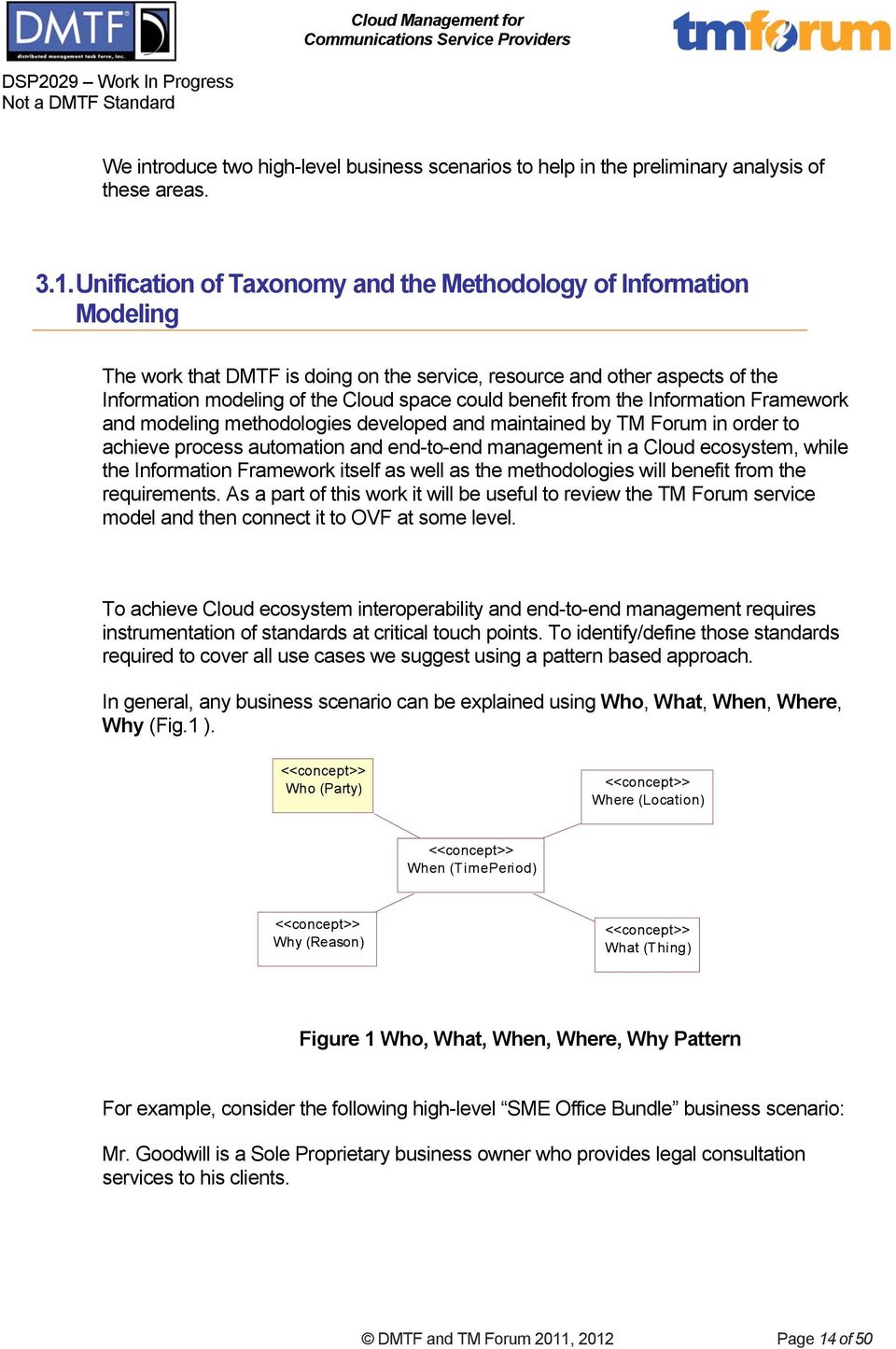
14 We introduce two high-level business scenarios to help in the preliminary analysis of these areas Unification of Taxonomy and the Methodology of Information Modeling The work that DMTF is doing on the service, resource and other aspects of the Information modeling of the Cloud space could benefit from the Information Framework and modeling methodologies developed and maintained by TM Forum in order to achieve process automation and end-to-end management in a Cloud ecosystem, while the Information Framework itself as well as the methodologies will benefit from the requirements. As a part of this work it will be useful to review the TM Forum service model and then connect it to OVF at some level. To achieve Cloud ecosystem interoperability and end-to-end management requires instrumentation of standards at critical touch points. To identify/define those standards required to cover all use cases we suggest using a pattern based approach. In general, any business scenario can be explained using Who, What, When, Where, Why (Fig.1 ). Figure 1 Who, What, When, Where, Why Pattern For example, consider the following high-level SME Office Bundle business scenario: Mr. Goodwill is a Sole Proprietary business owner who provides legal consultation services to his clients. DMTF and TM Forum 2011, 2012 Page 14 of 50
15 Mr. Goodwill subscribes to the SME Office Bundle (SOB) service from A1 Inc. to make his growing business more manageable and to also allow him to work effectively when meeting clients at a remote location. o The SOB package comes with , Office Suite and Virtual Desk top capabilities. A1 Inc. is a Cloud infrastructure provider as well as a service aggregator who combines and manages the end user experience with its superior operation and customer support systems and processes. o A1 Inc. has several data centers that provide the hosting infrastructure for the SOB service o The SOB/ and Office Suite are provided by Genius Corp. o The Virtual Desktop Interface (VDI) configuration and management is provided by Max LLC. As Mr. Goodwill s business transactions need to comply with certain data sovereignty regulations, part of the SOB service that A1 Inc. offers is to pass all Mr. Goodwill s B2B transactions through Guardian System for preliminary regulatory compliance check. In the following subsections we look at how aspects of this scenario are represented by the different models. In particular we look at the Who, which represents different Actors for our sample scenario, and the What, which represents the entities our Actors are producing, consuming and monitoring. These are the two areas where the overlap and benefits of alignment seem to be the strongest. The analysis of the remaining aspects is left for the follow-up detailed alignment work Modeling of the Cloud Actors People and Organizations exhibit complex behaviours. These behaviors can be grouped, based on a particular context, or participation in a certain interaction (usually defined in terms of Actors). These behavior groups will change over time, causing problems if we define them statically or model them using inheritance / specialization (aka Is-a relationship). The TM Forum Information Framework identifies a few patterns to address this challenge: Party: representing an organisation, individual or system 1 (Fig. 2) Parties can perform a set of roles Roles can be added over time Parties can add or delete roles 1 SID Party definition does not include system DMTF and TM Forum 2011, 2012 Page 15 of 50

16 Party Role: In a Value Network, Parties play roles in the context of an interaction to provide Customer value. Therefore, by modeling PartyRole as a separate concept from Party, we allow for proper representation of these complex sets of behaviors by allowing a Party to have multiple roles (aka Has-a relationship.) The following diagrams illustrate the concepts. Figure 2 The concept of the Party Using this pattern, Actors may be thought of as Parties playing specific PartyRoles. Considering the SME Office Bundle Business Scenario defined earlier, we can derive the following table of Parties and Roles: Party Party Role/Actor Mr. Goodwill Individual Cloud Service Consumer A1 Inc. Organization Cloud Carrier Cloud Service Provider Cloud Service Broker Genius Corp. Organization Cloud Service Provider Max LLC Organization Cloud Service Provider Guardian System Cloud Auditor DMTF and TM Forum 2011, 2012 Page 16 of 50

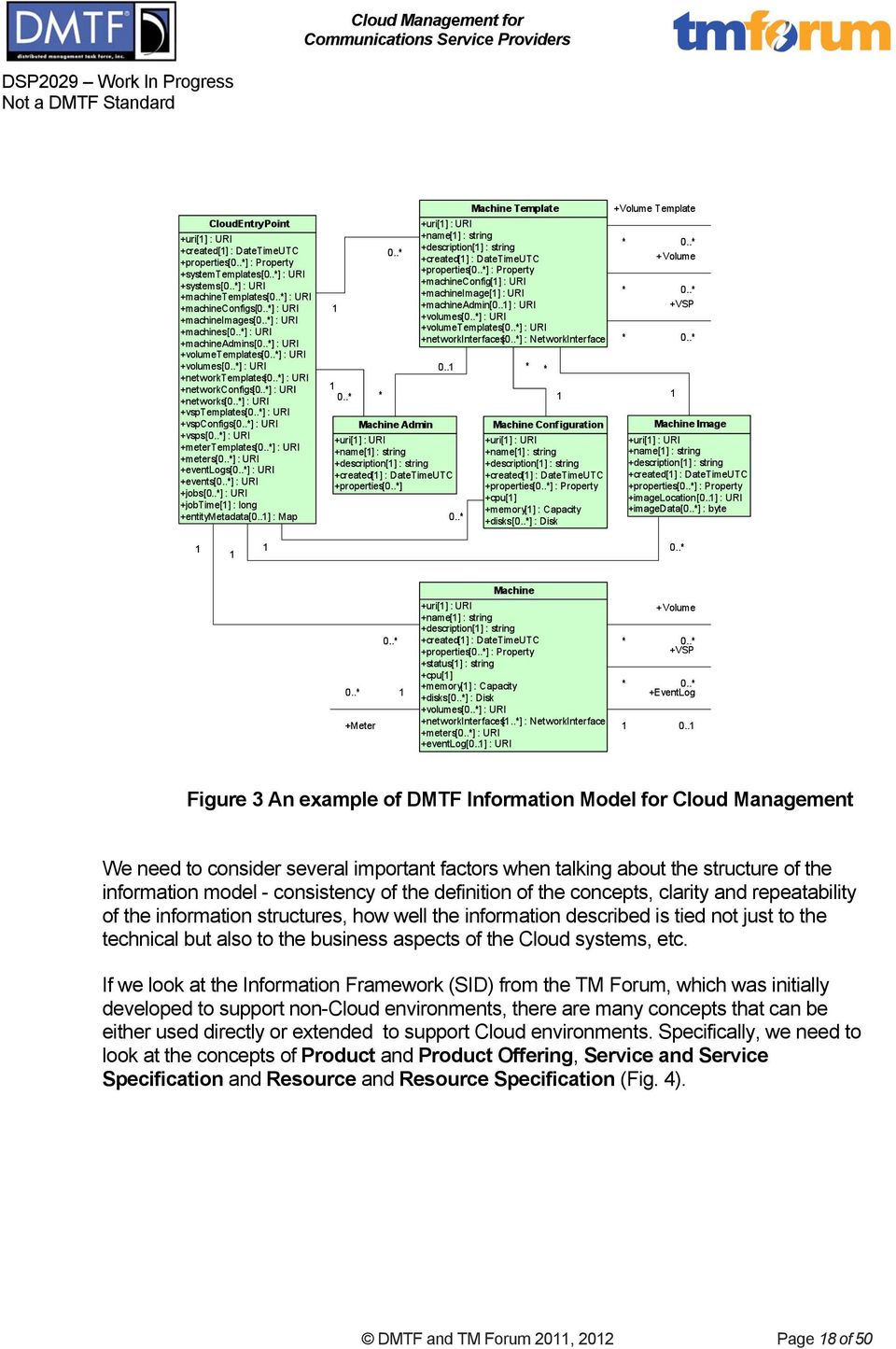
17 When specifying the Actors, we are using the following categories/types per DMTF and NIST taxonomy: Cloud Service Consumer: Maintains a business relationship with, and uses service from, Cloud Service Providers (e.g. Mr Goodwill). Cloud Service Provider: Responsible for making a service available to Cloud Service Consumers (e.g. A1 Inc., Genius Corp., Max LLC). Cloud Service Developer: Designs, implements, and maintains service templates (technical aspect). These templates can be used by Cloud Service Providers to create offerings. The party performing this role could be employed by the same organization that is a Cloud Service Provider or Cloud Service Consumer. Cloud Auditor: Conducts independent assessment of Cloud services, information system operations, performance and security of the Cloud implementation (e.g. Guardian). Cloud Service Broker: Manages the use, performance and delivery of Cloud services, and negotiates relationships between Cloud Service Providers and Cloud Service Consumers. (Optional, as Cloud Service Consumers may obtain service directly from a Cloud Service Provider) (e.g. A1 Inc.). Cloud Service Carrier: Provides connectivity and transport of Cloud services to Cloud Service Providers and their customers Cloud Service Consumers (e.g. A1 Inc.) Modeling of the Products, Services and Resources The sample Use Cases, introduced in section are talking about things like SME Office Bundle, , Office Suite and Virtual Desktop offered and consumed by different actors/players, as well as things like Virtual Machine Images, Storage, and other Infrastructure entities. The Information models specified and developed by different SDOs should be able to provide consistent and repeatable definitions of these and many other concepts related to the Cloud environment. For example, the diagram below (Fig.3) is a fragment of such an Information model that DMTF is working on: DMTF and TM Forum 2011, 2012 Page 17 of 50

18 Figure 3 An example of DMTF Information Model for Cloud Management We need to consider several important factors when talking about the structure of the information model - consistency of the definition of the concepts, clarity and repeatability of the information structures, how well the information described is tied not just to the technical but also to the business aspects of the Cloud systems, etc. If we look at the Information Framework (SID) from the TM Forum, which was initially developed to support non-cloud environments, there are many concepts that can be either used directly or extended to support Cloud environments. Specifically, we need to look at the concepts of Product and Product Offering, Service and Service Specification and Resource and Resource Specification (Fig. 4). DMTF and TM Forum 2011, 2012 Page 18 of 50
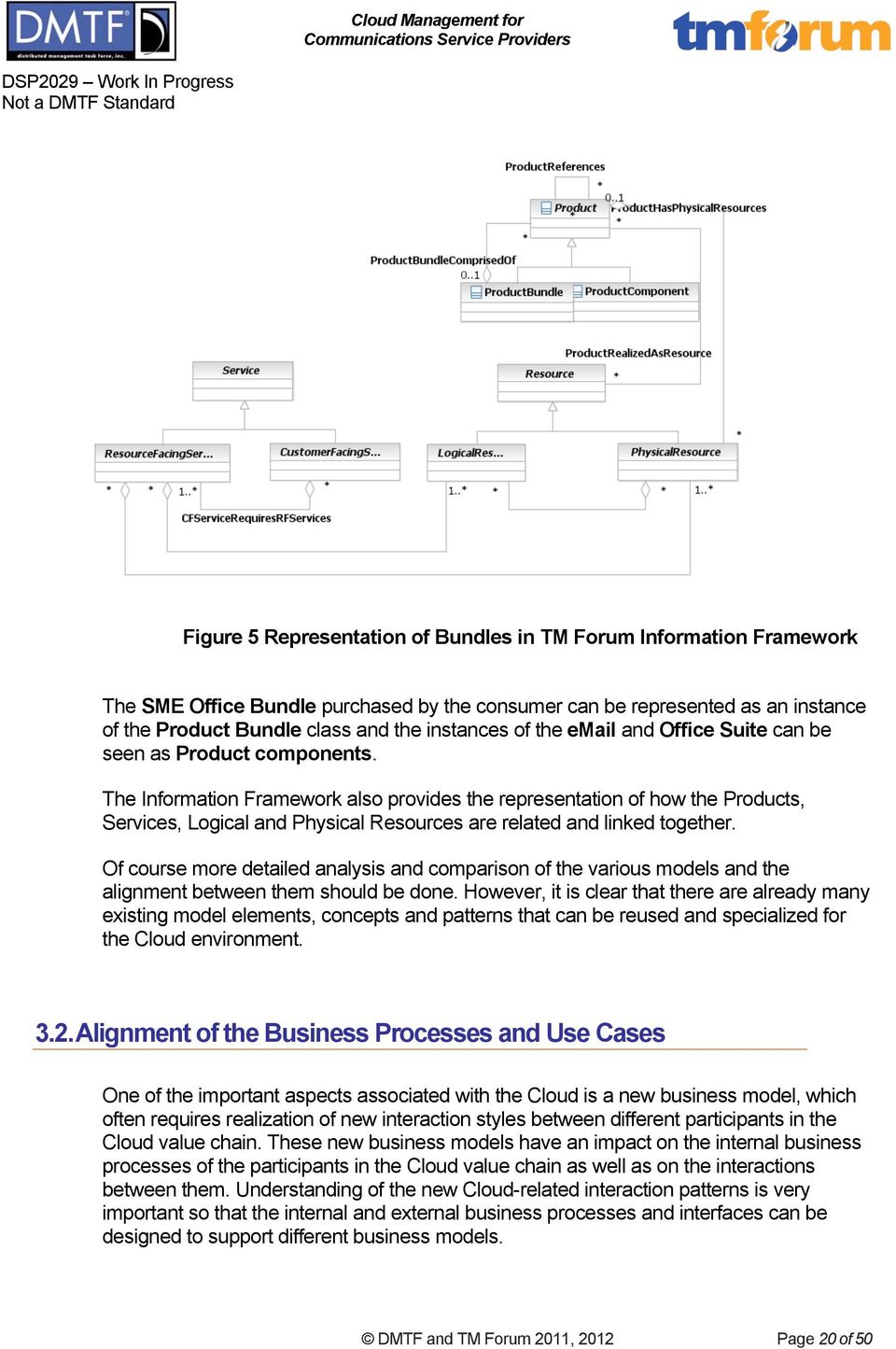
19 Figure 4 TM Forum Information Framework concepts of Product, Service and Resource The entities, such as SME Office Bundle, , Office Suite and Virtual Desktop as well as Virtual Machine Images, Storage used in the sample Use Cases in section can be represented as specializations of the Products, Services and Resources offered and consumed in the Cloud environment. The specialization of the Product Specification, Service Specification and Resource Specification classes can be used to describe the Product/Service/Resource Templates. The Information Framework also has patterns that allow representation of the concepts of Bundles (Fig. 5), such as the SME Office Bundle we are using in the first of the sample Use Cases, as well as model dynamic property of Products, Services and Resources. DMTF and TM Forum 2011, 2012 Page 19 of 50

20 Figure 5 Representation of Bundles in TM Forum Information Framework The SME Office Bundle purchased by the consumer can be represented as an instance of the Product Bundle class and the instances of the and Office Suite can be seen as Product components. The Information Framework also provides the representation of how the Products, Services, Logical and Physical Resources are related and linked together. Of course more detailed analysis and comparison of the various models and the alignment between them should be done. However, it is clear that there are already many existing model elements, concepts and patterns that can be reused and specialized for the Cloud environment Alignment of the Business Processes and Use Cases One of the important aspects associated with the Cloud is a new business model, which often requires realization of new interaction styles between different participants in the Cloud value chain. These new business models have an impact on the internal business processes of the participants in the Cloud value chain as well as on the interactions between them. Understanding of the new Cloud-related interaction patterns is very important so that the internal and external business processes and interfaces can be designed to support different business models. DMTF and TM Forum 2011, 2012 Page 20 of 50
21 Cloud-related changes in the technology, such as virtualization and new SLA metrics associated with the Cloud, also have an impact on the internal business processes of organizations, especially in the Service and Resource management domains. The requirements from the TM Forum Enterprise Cloud Leadership Council (ECLC) and Use Cases from NIST that are now being used by both TM Forum and DMTF capture these new interaction patterns. On the other hand TM Forum has a well-developed and mature Business Process Framework (etom), which captures the components of the internal business processes of organizations, as well as the business processes that support interactions with Customers and Partners. The elements of the Business Process Framework are used, not just to describe the organizational processes, but also in specifications of Business Services, which are linked to the interface specifications. The TM Forum Business Process Framework at present is also fairly well aligned with ITIL and other best practices of the industry. By analyzing the Cloud-management requirements and Use Cases from both NIST and TM Forum ECLC, we can adjust the business process specifications captured by the TM Forum Business Process Framework to better support new interaction styles and new process flows associated with the Cloud, both external and internal to the organizations We can also use the TM Forum Business Process Framework to identify the process areas that at present may not be covered by any of the existing Use Cases and potentially develop the new Use Cases covering the missing interactions. With this we can analyze whether or not any additional Cloud-related changes are needed for the particular business processes described by BPF. For example, if we look at A1 Inc. who plays the role of a Cloud infrastructure provider as well as a service aggregator who combines and manages the end user experience with its superior operation and customer support systems and processes, it is extremely important to understand how well the business processes that the company implements support the Use Cases capturing interaction with its customers, as well as suppliers and partners. A1 may use TM Forum Business Process Framework (etom) to describe its processes, however in order to understand how well these processes support the business it is imperative to have these processes and the Use Cases aligned SLA Definition and Metrics The SLA represents the contract between the Cloud user and Cloud provider and will guide the way server/network/storage and then middleware/application metrics are collected and reported. It is important to consider the mapping of customer-oriented Key DMTF and TM Forum 2011, 2012 Page 21 of 50
22 Quality Indicators (KQIs) to infrastructure, platform and software-related Key Performance Indicator (KPI) metrics. Both SDOs have ongoing projects relevant to this problem space. The TM Forum Cloud SLA Management effort is creating a Cloud SLA Application Note that applies and extends existing SLA models for the Cloud environment. The project involves expanding the GB917 Service Level Agreement Management Handbook by ensuring Cloud use cases are covered. The team is working with the ECLC and SPLC to identify relevant Enterprise Customer and Cloud Service Provider use cases and requirements. SLAs will need appropriate measures and metrics to demonstrate that realistic objectives are defined, and eventually realized, in quantifiable terms. The SLA and the appropriate measures will be defined in context with the specific goals, objectives, party roles/ actors and activities that require consideration. Specific measures should be consistently defined using appropriate industry standard definitions. Reporting on the measures and metrics (numerator/ denominator, example; GB Storage Used/ Month) will also require appropriate consideration to align with SLA and other contractual obligations. Note that the goals are from any party role/ actor perspective. A simple example of this is that a Cloud Consumer s goal might be to save money, while the goal of the Cloud Provider is to increase revenue. Non-goal-focused measures and metrics will be of interest (operationally), but might not form part of the SLA. Some measures will be collected automatically using mechanized capabilities; others may be collected manually or require some calibration to maximize their relevance and value. Collecting measures, generating metrics and performing analytics needs to be considered carefully, especially when they are included within SLAs, where compensation and penalties are potentially also affected. From a DMTF/OVF perspective, there are infrastructure resources (e.g. virtual server, network and storage) that contribute to instantiating the service and are monitored for utilization (e.g. chargeback) and for contribution to overall performance. Examples of metrics that are being collected and possible associated goals/objectives for each include Server CPU and memory initial settings for capacity required and then prioritization (CPU share) to influence what percentage any given virtual server can consume. Network bandwidth and latency initial setting for capacity allocated and prioritization (e.g. QOS) to influence percentage packets associated with server can consume Storage capacity and latency initial setting and monitoring of storage capacity and responsiveness for data access DMTF and TM Forum 2011, 2012 Page 22 of 50
23 There may be an opportunity to feed the requirements and methodology/metrics from TM Forum to the DMTF to guide API/spec development. Considering the SME Office Bundle Business Scenario defined in Section 4.1, there would be an SLA between Mr. Goodwill (Cloud Service Consumer) and A1 Inc. (as Cloud Service Provider). There could also be SLAs between A1 Inc. (in its Cloud Service Broker role) and Genius Corp. and Max LLC (Cloud Service Providers). In a case where different parties filled the Cloud Service Provider and Cloud Carrier roles, there could be yet another set of SLAs between them. The relationships between the different SLAs among the various parties will depend on the business models assumed by those parties. Cloud Consumers expect highly flexible, scalable service capabilities, including "on demand" provisioning of SLAs. The need to guarantee and monitor end-to-end service levels in a dynamic Cloud environment will require automated B2B processes and APIs for capacity requests/changes and SLA metric queries and reporting Alignment of the Management Interfaces The DMTF work on Cloud management interface requirements and specifications of protocols, operations, security and audit complements and overlaps at the same time with TM Forum work on Management Interfaces. The current work in progress in the DMTF Cloud Management WG is a REST-based API and a protocol effort to carry that API. The goal of this effort is to provide RESTful access to Cloud management modeled entities, such as: Cloud Entry Point Entity Collections and Entity o System Templates o Systems o Machine Configuration o Machine Template o Machine Image o Machine Admin o Machine, o Volume, Network,Job,Meter, Event The access is provided via a set of HTTP based operations whose design is guided by RESTful principles. Currently all operations are based on the HyperText Transfer Protocol, version 1.1 as defined in RFC2616. Each request is sent using an HTTP verb such as PUT, GET, DELETE, HEAD or POST and includes a message body in either JSON or XML format. The interface supports both synchronous and asynchronous operations. DMTF and TM Forum 2011, 2012 Page 23 of 50
24 The entities in the system are identified by URIs. Dereferencing (via an HTTP GET) the URI of an entity will yield a representation of the entity containing attributes and links to associated entities. To begin operations, a client must know the URI to the main entry point of a Cloud Provider - also known as the "Cloud Entry Point" entity. All other entities within the environment shall then be discoverable via the iterative following of links to associated resource within each resource retrieved. Cloud Providers is required to support secure HTTP connections using TLS. Cloud Providers may support non-secure HTTP connections. TLS 1.0, which shall be implemented, is specified in RFC2246, and the TLS 1.1 and TLS 1.2 should be implemented as specified in RFC4346 and RFC5246, respectively. The details of the Cloud Management interface and protocol work can be found in the DMTF documents DSP0263, DSP0264 and DSP2027, which are published as work in progress. Another specification DMTF is working on that is directly related to the Management interfaces for the Cloud is the Open Virtualization Format (OVF). The OVF Specification describes an open, secure, portable, efficient and extensible format for the packaging and distribution of software to be run in virtual machines. The details on OVF can be found in section 7.2 Relevant DMTF Artifacts the Detailed Overview. There are several parallel and complimentary initiatives that exist in TM Forum, which are related to the definition of Cloud Management Interfaces and their integration into the overall Enterprise Architecture of the Cloud value chain participants. In particular, the following are most closely related: The Cloud and IT Business Services project has been established with the TM Forum Integration Program (TIP). This project is to provide detailed business service definitions (based on TMF GB942 for the management of Clouds and IT resources, services and products. The project has defined several draft business services for Inventory Retrieval, Inventory Update, Product Activation and Service Problem. Additional business service definitions are planned. Software Enabled Services (SES; formerly known as SDF) Service management interface specification looks at the delivery of next generation services in a framework where the lines between network and IT are blurred. The goal of this program is to define a generic management framework for next generation services regardless of the software or network technologies used to implement those services. This management framework is aimed at addressing the full lifecycle of the services, from concept to cash. A key deliverable is the SES Management Solution Reference Model, which is an abstract representation of the entities and relationships involved in the problem space. It thereby serves as a template for the development of more specific models in a given domain and allows for comparison between complying models. The goal of the Reference Model is to establish a vocabulary and common understanding of a SES Management Solution. DMTF and TM Forum 2011, 2012 Page 24 of 50
25 Shared Interface Infrastructure (SII) and Joint Open Source Interface Framework (JOSIF). The goals of these efforts by the TM Forum Integration Program (TIP) is to create a consistent and repeatable mechanism of defining the operations and infrastructure for the management interfaces (SII) and provide the tooling for creation of such consistent interfaces, compliance test kits and reference implementations (JOSIF). The interface development tooling is based on the open source Eclipse project Tigerstripe which is complimented by a set of the open source plugins created as a part of the JOSIF development effort that allow to generate interface specifications, reference implementation and interface compliance test kits. Currently the interfaces created by the TM Form using SII principles and JOSIF tooling are covering Resource and Service Assurance areas and there is an ongoing effort to define the Ordering and Activation and well as Inventory retrieval/exchange interfaces. One of the notable characteristics of the JOSIF tooling is its extensibility. Though within the current scope of the TIP work it is using TM Forum Information model (SID) and SOAP-style interfaces, the tooling can be extended to use essentially any UML 2.x compliant model as a payload of the interface operations and can be easily extended to support interfaces of a different style, e.g. RESTful interfaces, as well as communicationprotocol-specific message exchange patterns. We may benefit from using the open source JOSIF tooling and TM Forum Shared Interface Infrastructure for specification of the RESTful interfaces for Cloud management DMTF is working on. Also, the OVF that is already supported by many vendors may have an influence on the specification of the TM Forum interfaces supporting resource and service provisioning and activation. Let s take a look at the activities A1 Inc. is performing in the SME Office Bundle Business Scenario defined in Section 3.1: The company itself has several data centers that provide the hosting infrastructure for the SOB service. The Genius Corp. provides the SOB/ and Office Suite applications. The Max LLC provides the Virtual Desktop Interface (VDI) configuration and management. If we look at the variety of interfaces and management systems involved into providing and maintaining end-2-end services to the A1 customers, we will see the interfaces for server and storage virtualization management specified by DMTF and the interfaces for the transport network management (within the datacenter and potentially all the way to the customer premises) standardized by TM Forum. Management solutions that A1 Inc. hosts should deal with the end-to-end provisioning and management of this diverse infrastructure. Plus, in the Cloud environment some of the end-to-end management capabilities are exposed to the partner companies, such as Genius Corp. and Max LLC so they can host and manage their applications. The consistency of the management interfaces is extremely important in the Cloud environment, as diversity of management DMTF and TM Forum 2011, 2012 Page 25 of 50
26 interfaces will increase the complexity and thus drive up the cost of application development and integration. The developers of the applications, such as Virtual Desktop systems, various Office applications and especially performance-sensitive applications such as back office database management systems, search engines, etc. that are designed to run and interact in the Cloud environment will greatly benefit from having consistency between systems and infrastructure management interfaces, as well from the use of open source tooling which facilitates management interface development and extensions Additional Topics and Concerns One of the additional areas that needs to be considered as a part of this effort is Security. Work in this area could possibly start with auditing and the types of policy/governance that the TM Forum customers can provide guidance on. Then the group may pass them on to the new Cloud Audit, Data Federation WG in DMTF Additional Business Scenarios The analysis just described above for the SME Office Bundle scenario applies equally well to a range of other Cloud-related business scenarios. This section describes a related Enterprise Cloud consumer scenario, as well as related assessment of a set of NIST use cases. More details on both business scenarios and the NIST use cases are given in Appendices 6.3 and Business Scenario #2 Enterprise Cloud Consumer ABC insurance is an enterprise which is looking to outsource some of its IT infrastructure requirements to a Cloud Service Provider to augment its own private Cloud. Ms. Doubtfire is responsible for obtaining IaaS resources from Cloud Service Providers to augment ABC Ins. IT infrastructure resources for hosting its quarterly rate calculation application. o The QRC application has private customer data and an anonymized aggregation of customer data ABC Inc. is also its own Cloud infrastructure provider who combines and manages the end user experience for its analysts with its superior operation and customer support systems and processes. o ABC Inc. has several data centers that provide the hosting infrastructure for the QRC service with centralized service desk (in Hartford) for worldwide support. DMTF and TM Forum 2011, 2012 Page 26 of 50
27 o The QRC application is internally developed and maintained by ABC. o SLAs for the Cloud server and storage capacity are negotiated by Ms. Doubtfire with Mr. Headroom from Service Inc. Also, data protection requirements are communicated from Mr. Williams through Ms. Doubtfire to Mr. Headroom. o Reports on usage on Service Inc. are generated by Mr. Headroom and sent to Ms. Doubtfire who reviews them with Mr. Williams on weekly basis. o ABC Cloud service users interface with ABC help desk for SLA violations. This needs to be extended to integrate information from the Service Inc. infrastructure help desk for Cloud service transactions for QRC transactions running on their infrastructure. As Ms. Doubtfire s business transactions need to comply to certain data sovereignty regulations, part of QRC s services that ABC Inc. offer is to pass all Ms. Doubtfire s B2B transactions through Guardian System for preliminary regulatory compliance check. Mapping of the Use Case Actors to NIST definition of Actors: Mapping for the Use Case 2: Party Ms. Doubtfire (ABC) Individual Party Role/Actor Cloud Service Consumer Administrator ABC Insurance Organization Cloud Service Consumer Cloud Service Provider Service Inc. Organization Cloud Service Provider Cloud Service Broker Max Headroom (SvcInc) Individual Cloud Service Provider Business Manager Guardian System Cloud Auditor Mr. Williams Individual Cloud Service Consumer Business Manager DMTF and TM Forum 2011, 2012 Page 27 of 50
28 Additional NIST Use Case Assessment Though the two Use Cases described above help to provide an idea of where alignment between the two SDOs is possible, we need to consider a much wider set of Use Cases describing interaction between various actors in the Cloud. Both DMTF and TM Forum are focused on a subset of the NIST Cloud Use Cases for initial efforts on development of Cloud architecture and work on other aspects of the Cloud management. A subset of the NIST Cloud Use Cases, together with the CMWG s Inventory Use Case, is used here for initial assessment. The specific NIST Use Cases under consideration for the initial work are NIST SAJACC use cases 3.1, 3.2, 3.3, 3.7, 3.8, and 3.9 and Cloud Security Use Case 5.3. This will help to prioritize a set of metrics/operations along with model interchanges that are required to fulfill the alliance goals. Please see Table 1 NIST Use Case Assessment in Appendix Work Recommendations 4.1. Work Order and Priority From the analysis performed in Section 3 we can see that there are many areas where cooperation between DMTF and TM Forum will benefit the industry Taxonomy and Information Model, Business Processes, Management Interfaces, SLA management, etc. The main purpose of this section is to identify the concrete work items that can be carried by DMTF and TM Forum in cooperation with each other. We suggest that the subsequent work will be performed by several cross-sdo teams organized around cross sectional end-to-end work areas that span all of the dimensions where harmonization, alignment or joint development work is necessary. The table below highlights the high-priority work items that should be addressed first. Work Area Taxonomy/ Information Model Business Process Catalog/ Repository SLA Interfaces/ Architecture E-2-E Service Lifecycle Management Align Information Frameworks for Cloud Services lifecycle management Identify Business Processes and Touch points supporting Cloud Services Identify key design patterns to support lifecycle metadata coordination Identify and validate Frameworx Business Services metamodel to support Cloud lifecycle DMTF and TM Forum 2011, 2012 Page 28 of 50
29 Work Area Taxonomy/ Information Model Business Process Catalog/ Repository SLA Interfaces/ Architecture lifecycle management management Cloud Mgmt Interface Architecture Alignment Align TM Forum and DMTF Interfacespecific models for Cloud and Virtualization Align Business Svcs with Contracts concepts Mgmt interface coordination for Cloud Investigate TIP framework and CMWG REST-based interface architectures Interaction Requirements for SLAs/Metrics Development Align Cloud Actor and Metrics models Identify Interaction patterns Define library of metrics available to support SLAs/SLOs Define Metrics Determine Data collection and SLA/SLO specification mechanisms The following subsections describe each of the identified high-priority work areas in more details. Section 3.5 briefly describes additional work for future consideration End-2-End Service Lifecycle Management A challenge facing the management of the Cloud ecosystem is that the ecosystem must meet the business goals of all of its members through facilitated cooperation in management of the entire service lifecycle, such as service creation, fulfillment, assurance and billing. This problem is further amplified as most of the Cloud services are composite services, where each service component that is being consumed has its own lifecycle (e.g. registered, provisioned, activated, instantiated) and often multiple versions of service instances exist for the same service. To ensure a coherent set of specifications will be developed by the alliance to enable end-to-end Cloud Services lifecycle management, the following work items have been identified: 1. Align Information Frameworks for Cloud Services Lifecycle Management a) Position key artifacts from each organization in a service lifecycle and understand their relationships and terms that need to be aligned. Specifically: DMTF and TM Forum 2011, 2012 Page 29 of 50
30 i. How the SID Product/Service/Resource model relates to the DMTF Service Model ii. How the SES lifecycle connects to the OVF lifecycle iii. How the SID resource lifecycle maps to the Virtual image lifecycle b) Review and harmonize terms used for service lifecycle management: i. There might be different lifecycle phases at the Product, Service and Resource layers. Define and harmonize the terms of lifecycle phases or explain their relationships. ii. Reference TM Forum TR142 for product lifecycle and TMF061 for Software Enabled Services lifecycle definition; compare and harmonize (or position) terms used by ITIL and the SOA community. c) Review current TM Forum Frameworx Party/Party Role pattern; provide refinement so that it is fit for purpose for the Cloud community and Cloud service lifecycle management i. Based on NIST actor definitions reference and re-use of the TM Forum GB924 document for a finer grain service lifecycle stakeholder definition to the extent possible. ii. Extend or add an application note to the current SID Party pattern so that it is more easily understood by the Cloud community d) The SID and ITIL s CMDBf are often encountered in the same integration project. This often requires investigation into the relationship between the two models for each project. We need to complete and publish the TM Forum original work on identifying the relationship between the elements that make up the CMDBf and comparable SID elements, in light of the service lifecycle management. e) Output: i. A technical report: Identify and baseline key models and terms for end-to-end Cloud Service Lifecycle Management Explain how some of the key artifacts from the alliance relate to one another in the context of the service lifecycle. 2. Identify key Business Processes and Touch Points to support End-to-End Cloud Services lifecycle management a) TM Forum to highlight the business processes that affect the infrastructure and the management of its resources (use the lifecycle defined in section 1). b) Examine the linkage of etom and ITIL specifically for Cloud service & resource lifecycle management in relation to current DMTF Cloud management work activities c) Collaborate with TM Forum related B2B /Value Chain efforts to understand the implication in multi-cloud/multi-provider ecosystem environment d) Output: DMTF and TM Forum 2011, 2012 Page 30 of 50
31 i. A technical report: Highlight key business processes that affect virtualization and Cloud infrastructure management Enhance current etom or etom-itil required to support Cloud lifecycle management, especially in a Cloud ecosystem where multiservice providers collaboration/interactions are required in the lifecycle to deliver desired customer experience 3. Identify and validate key design patterns to support lifecycle metadata coordination a) Build upon the studies of 1 and 2 from the alliance, validate the SES Lifecycle Management Metadata design pattern for Cloud service lifecycle management and recommendations for technical specifications development b) Understand the impact to service catalogue, service instance repository (inventory) and related Frameworx architecture artifacts to support lifecycle management or lifecycle management metadata coordination c) Output: i. A technical report to document the analysis. This may be in the form of a Change Request and/or Feature Request to the TM Forum Frameworx releases. 4. Identify and validate Frameworx Business Services metamodel to support Cloud lifecycle management a) To facilitate the work of 5.3 Cloud Management Interface Architecture Alignment, a clear understanding is required on current SES design pattern and business service metamodel to see whether they are sufficient to support the interactions for Cloud ecosystem lifecycle management and how they link to related DMTF Cloud management work. b) Output: i. Baseline a version of the Business Service metamodel (although may not be complete) for Cloud service lifecycle management that the industry may collectively refine and improve upon Cloud Management Interface Architecture Alignment The DMTF work on Cloud management interface requirements and specifications of protocols, operations, security and audit both complements and overlaps with TM Forum work on the Business Services, Interfaces and Software Enabled Services. There needs to be one coherent mechanism of defining and alignment of interfaces with the rest of the enterprise architecture. DMTF and TM Forum 2011, 2012 Page 31 of 50
32 TM Forum is currently harmonizing MTOSI and OSS/J interfaces and is creating new Inventory and Ordering interfaces. This would be a good time to align this effort with the Cloud Management Interface and OVF work conducted by the DMTF. Further, the TM Forum, via an open source project, is developing tooling for automated interface generation. The DMTF may also benefit from using the tooling for Cloud Management Interface specification and joining the tooling development effort to extend the environment to support interfaces of a different style, e.g. RESTful interfaces as well as the definition of the Cloud Management interfaces communication protocol specific message exchange patterns. In order to align management interface development efforts between the two organizations in general and specifically for the Cloud Infrastructure Management, we suggest the following work items: 1. Align TM Forum Business Services with the Service Contracts concepts a) Align the definition of the DMTF Service Contract and TM Forum Business Service as it applies to Cloud and Virtualization Management b) Unify the parameters associated with the Business Service and the Service Contract (operations, metrics, SLO, etc.) and the relationship between them and the Management Interfaces c) Output: i. Coherent definition of the Business Services and the Service Contract and their relationships to the Cloud Management Interface specifications (e.g. DMTF CIMI) 2. Align TM Forum and DMTF Interface-specific (Information and data) models for Cloud and Virtualization a) Analyze the correspondence/relationship between the information (e.g. transformed SID or MTOSI/MTNM) models used by the TM Forum Management Interfaces and the information models used in the DMTF Cloud Infrastructure Management Interfaces, OVF and CMDBf. b) Analyze and relate the data models (e.g. XML, JSON) used in the DMTF and TM Forum management interfaces c) Output: i. Assessment of the differences and similarities between the models used in the management interfaces ii. Recommendations and detailed plan on the model alignment 3. Investigate applicability of Catalogs to Management Interface Coordination a) Determine the relationships between aligned concepts of Business Services and Service Contracts and Catalogs (e.g. what information should be stored in various Catalogs) b) Investigate what additional information needs to be specified, either for the Business Services/Service Contracts or for the Management Interfaces, in order to improve capability discovery and components integration using the Catalogs DMTF and TM Forum 2011, 2012 Page 32 of 50
33 c) Output: i. Specification of the Catalog parameters necessary to improve capability discovery in the Cloud environment and the coordination between Cloud Infrastructure management systems 4. Investigate TIP framework and CMWG REST-based interface architectures a) Determine what changes are needed to be done to the JOSIF interface definition framework used by the TM Forum Integration Program (TIP) in order to support the definition of the RESTful interfaces b) Output : i. Implementation plan for the necessary changes to JOSIF tooling 4.4. Interaction Requirements for SLAs/Metrics Cloud SLA/SLO Management is an important area in which both DMTF and TM Forum have substantial prior and ongoing activity that would benefit from close coordination. This area addresses SLA/SLO definition and mapping of customer-oriented Key Quality Indicators (KQIs) to infrastructure, platform and software-related Key Performance Indicator (KPI) metrics. To identify and develop standards required between DMTF and TM Forum for Cloud SLA management, we suggest the following work items: 1. Align DMTF and TM Forum information models for Cloud Actors and Metrics a) Align models for Cloud Actors i. Define the roles that are relevant to SLA management and metrics ii. This work will build on the discussion of actors/roles in Section 3 of this document, defining the next level of granularity for specific roles and extending the set of roles as needed. b) Align models for metrics i. Identify and align base metrics models and metrics-related concepts, such as metrics profiles, treatment of time intervals, etc. ii. This work item will not define specific metrics; rather it should align the generic treatment of metrics in the respective modeling frameworks. c) The SLA-oriented model alignment work should be coordinated with the basic Cloud taxonomy alignment work item in the End-to-End Service Lifecycle Management work area (Section 5.2). 2. Identify Interaction Patterns a) Identify the interactions between the actors required to specify, negotiate and verify SLAs and associated metrics/objectives in a Cloud environment b) The investigation should include consideration of the Cloud ecosystem with multi-stake holders and business model implications for SLA deployment. DMTF and TM Forum 2011, 2012 Page 33 of 50
34 3. Define Metrics a) Reference TM Forum Business Benchmarking work b) Identify and define specific customer-facing KQI Cloud SLA metrics and c) Map these KQIs to corresponding KPI infrastructure metrics 4. Define library of metrics available to support SLAs/SLOs a) Examine how metrics registry concepts can be applied to Cloud SLA/SLO metrics 5. Determine Data Collection and SLA/SLO Specification Mechanisms a) Identify candidate mechanisms for dynamically specifying the SLA/SLO for a given service in terms of the underlying metrics and objectives. b) Identify candidate mechanisms for collection of data from virtual/physical resources, once metrics are specified and associated with those resources. 6. Expected output: a) Work items 1 through 4 are interrelated and likely should be addressed in a single technical report. b) Work item 5 should produce a technical report with the results of the joint investigation and outlining specific follow on work as appropriate Work Items for Future Consideration Security Security, including user management, authentication and authorization, is considered out of scope (due to too much variability), so probably not worth focusing on for this first phase of joint work. However we could possibly start with auditing and the types of policy/governance upon which TM Forum customers can provide guidance and then they can be passed on to the new DMTF Cloud Audit, Data Federation WG Usage Data Collection Future work should examine generic usage data collection for performance, audit, billing and related activities. This would be more general than the data collection work item under SLA management Develop and Align Account Management Aspects The view in DMTF is that the account (for 3.1 to 3.3) is associated with who s paying for the services in 3.7 to 3.9. There s not a focus on account management in CIMI V1 but we could possibly leverage work in TM Forum and align the use cases. DMTF and TM Forum 2011, 2012 Page 34 of 50
35 5. Methodology of Joint Work and Publishing Result 1. We want to make sure that the specifications developed by both SDOs do not contradict each other. 2. For the domains that are complementary, each SDO may release a specification independently, following its own release and access policies and procedures. However the specification released by each SDO should complement the specification released by other SDO, so that taken together they provide complete coverage (as much as it is within the domains of both SDOs) for the problem of interest. This is one goal of joint work. 3. For each overlapping area the process is essentially the same. However, we want to make sure that duplication is removed as much as possible and the complimentary specifications are cross-referenced. Again, the release process of specifications is similar to the one in the previous case. However, the possible duplicates are removed as a part of the joint problem analysis. This is another goal. 4. In order to allow 2 and 3 to happen, the representatives of each SDO need to be well aware of the relevant work-in-progress performed by other SDO. This can be achieved by involving the representatives of the companies that are the members of both SDOs into day-to-day work of the SDOs technical teams and workgroups, as well as wider access to the work-in-progress results via periodic publishing of such results as work-in-progress artifacts. (Such an option is available in DMTF, but the document should be in scope of the TC and Board approved Work Register. In TM Forum we should be able to share the documents available for team review/evaluation with DMTF if that document is an output of the work captured by the Work Register between the SDOs). 5. For each significant milestone in the joint work, a joint Technical Report (TR) or Whitepaper (WP) is produced and published. Such TR or WP will outline the scope of work, gaps and overlaps the work is trying to address and mitigate. The TR or WP can be published jointly or independently by each SDO, with the reference to the similar document published by the other SDO. Same process was used during Phase 1 of CIM/SID harmonization and seems to be working fine comparing to the process of publishing joint document as one publication endorsed by both SDOs we tried it once and failed. This is the third goal/outcome. 6. At the end each artifact/specification developed during such joint effort is contributed by each SDO to its peer(s) as external contribution, following the processes and procedures of the peer SDO(s). This makes the materials available for crossreference. This is the fourth result of the joint work. 7. Each item of the joint work as well as the expected artifacts produced by both sides are described in the Work Register between the SDOs, which may be amended if necessary to reflect the new scope of the joint work. WR approval is happening in parallel in both SDOs per process that exist in each SDO. DMTF and TM Forum 2011, 2012 Page 35 of 50
36 6. Appendix 6.1. Relevant TM Forum Work and Artifacts Detailed Overview 1. Enterprise Cloud Leadership Council (ECLC) and Service Providers Leadership Council (SPLC) - putting together Business-facing requirements for the various Cloud layers. For example, Enterprise-grade External Compute IaaS and Database as a Service and contributions like Cloud-Dynamic business modeling a) The Enterprise-grade External Compute IaaS (VPC) document describes the enterprise customer requirements. It explores generic attributes of an External Private Cloud. Some of the features common to a general purpose External Public Cloud include: i. Highly flexible service capability (able to scale up and down on demand) ii. Pay per use (PPU) pricing iii. Virtualization iv. Images (where the workloads are instantiated from images) v. Ability to store images for fast reload vi. A management interface vii. A baseline level of security management (including encryption and isolation from other consumer activities) viii. A baseline level of network control (e.g. VLAN mapping, firewalls, overall service provider intrusion detection/prevention, etc.) b) The Database as a Service (DBaaS) project explores what is required to make a DBaaS offering attractive to business, in particular what is needed to provide competitive & flexible pricing, easy rapid provisioning, solid data security and with the same (or near same) level of service as the more traditional Database NOT as a Service. The service offering includes varying degrees of regularly tested and validated fault tolerance, such as Site Recovery, High Availability, etc. c) Both of the above projects share common terminology to reduce semantic arguments over meanings of words, and explore requirements in Commercial, Technical and Operational categories. It supplies also information on the Cloud business case and sample use-cases. The objective is to share the document with the broader Cloud Services Initiative members in order to create best practice and updates to Frameworx through a reference implementation catalyst. 2. The Enabling New Services contribution Cloud-Dynamic business modeling consists of Dynamic Business Modeling based on principles wherein the business logic of an application is managed independently from the application servers that automate the services and processes defined in the business logic. DMTF and TM Forum 2011, 2012 Page 36 of 50
37 a) Business modeling and integration are defined in a business logic layer, allowing underlying application servers to be business logic agnostic and therefore need no business driven customization. DBM applied correctly should reduce both the cost and risk in the initial implementation and its future evolution of systems. 3. Billing for the Cloud explores how Frameworx supports billing with regard to business processes, data models, applications and interfaces. The purpose of this project is to create a whitepaper on Cloud Billing as pertinent to Service Providers. In particular it will: a) Examine existing Communication Service Providers (CSP) billing systems and payments channels to understand whether they give them a distinct market advantage. b) Capture billing requirements for Cloud services, competitor capabilities and partner needs in order to create differentiation and create real value to the Cloud services market place. c) Explore Business Models and monetization of Cloud Services. i. Cloud Services Provider, Retailer, Wholesaler and Billing Services Provider. ii. Competition, Single Bill, BoBo, Revenue Leakage, Payments, Settlements, etc. 4. SLA Management for the Cloud. This project essentially is an extension and application of existing SLA models for the Cloud environment. The project involves: a) Expanding the GB917 Service Level Agreement Management Handbook by ensuring Cloud use cases are covered. b) Identify relevant Enterprise Customer and Cloud Service Provider use cases required to create a Cloud Application note which can be reviewed using the SLA Handbook. c) Closing the loop between business intelligence, data analytics and benchmarking. 5. Technical and Business support for Cloud broker role (guaranteed service delivery via CSP network and accurate billing). Cloud Service Broker catalyst provided a trusted Cloud management platform to simplify the delivery of complex Cloud services. a) Enhancements to PSA included: i. A white paper proposing enhancements to the PSA specification version 0.9 draft 10 has been produced; the paper proposes extensions to the capability and dependency concepts such that dependencies can be specified against a list of capabilities or subset thereof. DMTF and TM Forum 2011, 2012 Page 37 of 50
38 ii. The paper explores also the use of consumable capabilities where a capability may be restricted in the number of times it may be used within an assembly. iii. Recommends that the changes be considered along with others that were made in version 1.0 of the PSA specification. b) New Business Models: i. Complex industry forces compel most telcos to explore how they can build new revenue streams and the business and functional requirements of industry 2.0 business models. ii. These outline that the capabilities required to deliver new revenues needs a different type of architecture than that of traditional BSS solutions. Such platforms need an external-facing orchestration capability so that telcos can truly partner with enterprise customers from other industry sectors such as healthcare, utilities, and Cloud-based suppliers that are forcing the change for new types of service. 6. End-2-End Customer Experience in the Cloud. 7. Software Enabled Services (SES; formerly known as SDF) Service management interface specification looks at the delivery of next generation services in a framework where the lines between network and IT are blurred. Within this framework, profitability as well as customer experience are driven by managing the complete service lifecycle in a SOA aligned environment. a) The goal of the SES Management Solution program is to define a generic management framework for next generation services regardless of the software or network technologies used to implement those services. This management framework is aimed at addressing the full lifecycle of the services, from concept to cash. b) A key deliverable is the SES Management Solution Reference Model which is an abstract representation of the entities and relationships involved in the problem space. It thereby serves as a template for the development of more specific models in a given domain and allows for comparison between complying models. The goal of the Reference Model is to establish a vocabulary and common understanding of a SES Management Solution. c) The Reference Model consists of a set of concepts, rules and relationships to promote the understanding of the domain of SES Management Solutions. It represents the commonality that applies to all service delivery frameworks and from which each may derive its own reference architecture. 8. Business Services and Interface specification methodology. Work in progress however provides promising framework for both public and private Cloud management solution interface specification (as well as for B-2-B). DMTF and TM Forum 2011, 2012 Page 38 of 50
39 a) The Cloud and IT Business Services project has been established with the TM Forum Integration Program (TIP). This project is to provide detailed business service definitions (based on TMF GB942) for the management of Clouds and IT resources, services and products. The intent is to make optimal re-use of existing TM Forum work in the area of interfaces and information models (extensions and additions will be made as needed). b) In order to enable Cloud and IT providers and enterprise users to assemble a flexible and competitive management environment, it is necessary to facilitate interoperability between the management products of multiple vendors. To achieve this goal, it is necessary to define open management interfaces (in the form of business services) along with support Compliance Test Kits (CTKs) that allow for automatic compliance testing for a given interface. c) The project has already defined draft business services for Inventory Retrieval, Inventory Update, Product Activation and Service Problem. Additional business service definitions are planned. d) Required (and critical) input to this team includes the service definitions from the previously mentioned Cloud Service Definition team and information model updates to the SID model for Cloud and IT resources (the DMTF work could be very important here). e) The Cloud and IT Business Services team reviewed the DMTF white paper entitled Architecture for Managing Clouds (DSP-IS0102). Please note that this white paper was shared with the TM Forum via a prior liaison. The intent of the review was to look for areas of collaboration. In terms of specific areas of collaboration, we would like to offer the following suggestions: i. Collaborate on the definition of resource entities (e.g., Storage, Volume and Virtual Machines) and infrastructure services (load sharing and application assignment). The later items are sometime referred to as Resource Facing Services (RFS) in the TM Forum. We see the DMTF as taking the lead here. ii. Extend the TM Forum s Joint Open Source Interface Framework (JOSIF) to include the MEFs noted in DSP-IS0102. In particular, REST is not support but would be a welcome addition. As the name suggests, JOSIF is a public open source project and the DMTF members are welcome to join this. iii. Work on possible CIM-SID model alignment in the areas of overlap noted in the attached spreadsheet (e.g., in the area of templates and specifications). 9. Information modeling and Shared Information and Data Model (SID) provides the starting business oriented info modeling framework which can be adapted for use in the Cloud management environment. One of the advantages beyond using SID for DMTF and TM Forum 2011, 2012 Page 39 of 50
40 the Cloud work is that it is essentially a taxonomy aligned with the structure of the business processes. 10. The SID and ITIL s CMDB are often encountered in the same integration project. This often requires investigation into the relationship between the two models for each project. The TM Forum did some original work on identifying the relationship between the elements that make up the CMDB and comparable SID elements. This work was never officially published. The TM Forum would like to collaborate with the DMTF to complete and publish this original work in order to reduce or eliminate this duplicate project by project work and to provide a consistent solution to this challenge. An option also exists to see how the CMBD could be expressed in UML as a way of showing where it could be placed in the SID. There also is a generalized Configuration set of entities that have been contributed to the SID, but not implemented, that may be useful in the work Relevant DMTF Work and Artifacts Detailed Overview 1. High-level Use Cases related to the management of the Clouds a) An earlier-formed Study Group - the Cloud Incubator produced several artifacts including a white paper titled Use Cases and Interactions for Managing Clouds [2] b) The Cloud Management Workgroup (CMWG) has taken this work further and settled on a subset of the NIST Cloud Use Cases for its initial efforts on development of Cloud architecture and work on other aspects of the Cloud management. The specific NIST Use Cases under consideration for the initial work are NIST SAJACC use cases 3.1, 3.2, 3.3, 3.7, 3.8, and Cloud management architecture and interoperability a) This work conducted primarily by the CMWG covers development of a set of prescriptive specifications that deliver architectural semantics as well as implementation details to achieve interoperable management of clouds between service requestors/developers and providers. The aim is to propose a resource model that at minimum captures the key artifacts identified in the Use Cases and Interactions for Managing Clouds document produced earlier by the Open Cloud Incubator [2] and the NIST-developed Use Cases. The work is focused on mainly Cloud resource management aspects of Infrastructure as a Service (IaaS) and will include Constraints and policies, SLAs, QoS, etc. along with modeling considerations for managing utilization, provisioning, monitoring/reporting and auditing. b) Other DMTF Working Groups are working to provide additional contributions to these efforts as they mature. Some of these efforts can be found in the Telecommunications and Networks WG and the PPP WG as well as others. DMTF and TM Forum 2011, 2012 Page 40 of 50
41 3. Open Virtualization Format (OVF) a) The Open Virtualization Format (OVF) is an industry standard for portable virtual machines that was approved by the DMTF based on a submission from a group of leading vendors, including VMware, XenSource, HP, IBM, Microsoft, Dell. The DMTF is using OVF for the definitions of VMs, Virtual Appliances and the managed Virtual Resources within and allocated to those VMs and VAs. b) OVF has been matured to fit most every aspect of any Business, Cloud, Service or Resource Lifecycle use including full systems management. c) Currently the OVF is available in version 1.1 with version 2.0 inclusions being actively discussed in the DMTF s System Virtualization and Partitioning (SVPC) Working Group. Associated White Papers for OVF and the Specifications themselves are available from the DMTF. 4. Cloud Management APIs a) The current work in progress in the CMWG is addressing both the REST-based API and a separate protocol effort to carry that API. Subordinate to these efforts is a Logical Network Model that provides the semantics and syntax for the API and protocol efforts. b) Since the inception of the Cloud Incubator through the formation of the CMWG there have been a number of submission from Vendors and Operators / Service Providers alike have contributed value add into the initial material under consideration in the CMWG. 5. Auditing Data Federation in the Cloud a) This work is addressed by the newly formed WG in the DMTF the Cloud Auditing Data Federation WG, which is developing an audit event data model and a compatible interaction model that is able to describe interactions between IT resources suitable for Cloud deployment models, including real and virtual resources contained within Cloud providers IT infrastructures and convey them in a federated manner Detailed Business Scenarios Business Scenario #1 SME Office Bundle Mr. Goodwill is a Sole Proprietary business owner who provides legal consultation services to his clients. Mr. Goodwill subscribes to the SME office bundle (SOB) service from A1 Inc. to make his growing business more manageable and to also allow him to work effectively when meeting clients at a remote location. o The SOB package comes with , Office Suite and Virtual Desk top capabilities. DMTF and TM Forum 2011, 2012 Page 41 of 50
42 A1 Inc. is a Cloud infrastructure provider as well as a service aggregator who combines and manages the end user experience with its superior operation and customer support systems and processes. o A1 Inc. has several data centers that provide the hosting infrastructure for the SOB service o The SOB/ and Office Suite are provided by Genius Corp. o While the VDI configuration and management is provided by Max LLC. As Mr. Goodwill s business transactions need to comply to certain data sovereignty regulations, part of SOB s services that A1 Inc. offer is to pass all Mr. Goodwill s B2B transactions through Guardian System for preliminary regulatory compliance check. When specifying the Actors, participating in this Business Scenario we are considering the following categories/types per DMTF and NIST taxonomy: Cloud Service Consumer: Maintains a business relationship with, and uses service from, Cloud Service Providers (e.g. Mr Goodwill). Cloud Service Provider: Responsible for making a service available to Cloud Service Consumers (e.g. A1 Inc., Genius Corp., Max LLC). Cloud Service Developer: Designs, implements, and maintains service templates (technical aspect). These templates can be used by Cloud Service Providers to create offerings. The party performing this role could be employed by the same organization that is a Cloud Service Provider or Cloud Service Consumer. Cloud Auditor: Conducts independent assessment of Cloud services, information system operations, performance and security of the Cloud implementation (e.g. Guardian). Cloud Service Broker: Manages the use, performance and delivery of Cloud services, and negotiates relationships between Cloud Service Providers and Cloud Service Consumers. (Optional, as Cloud Service Consumers may obtain service directly from a Cloud Service Provider) (e.g. A1 Inc.). Cloud Service Carrier: Provides connectivity and transport of Cloud services to Cloud Service Providers and their customers Cloud Service Consumers (e.g. A1 Inc.). Also the entities, such as SME Office Bundle, , Office Suite and Virtual Desktop can be considered as Products and Services offered and consumed in the Cloud environment. DMTF and TM Forum 2011, 2012 Page 42 of 50
43 Business Scenario #2 Enterprise Cloud Consumer ABC insurance is an enterprise which is looking to outsource some of its IT infrastructure requirements to a Cloud Service Provider to augment its own private Cloud. Ms. Doubtfire is responsible for obtaining IaaS resources from Cloud Service Providers to augment ABC Ins. IT infrastructure resources for hosting its quarterly rate calculation application. o The QRC application has private customer data and an anonymized aggregation of customer data ABC Inc. is also its own Cloud infrastructure provider who combines and manages the end user experience for its analysts with its superior operation and customer support systems and processes. o ABC Inc. has several data centers that provide the hosting infrastructure for the QRC service with centralized service desk (in Hartford) for worldwide support. o The QRC application is internally developed and maintained by ABC. o SLAs for the Cloud server and storage capacity are negotiated by Ms. Doubtfire with Mr. Headroom from Service Inc. Also, data protection requirements are communicated from Mr. Williams through Ms. Doubtfire to Mr. Headroom. o Reports on usage on Service Inc. are generated by Mr. Headroom and sent to Ms. Doubtfire who reviews them with Mr. Williams on weekly basis. o ABC Cloud service users interface with ABC help desk for SLA violations. This needs to be extended to integrate information from the Service Inc. infrastructure help desk for Cloud service transactions for QRC transactions running on their infrastructure. As Ms. Doubtfire s business transactions need to comply to certain data sovereignty regulations, part of QRC s services that ABC Inc. offer is to pass all Ms. Doubtfire s B2B transactions through Guardian System for preliminary regulatory compliance check. Mapping of the Use Case Actors to NIST definition of Actors: Mapping for the Use Case 2: Party Party Role/Actor Ms. Doubtfire (ABC) Individual Cloud Service Consumer Administrator ABC Insurance Organization Cloud Service Consumer Cloud Service Provider DMTF and TM Forum 2011, 2012 Page 43 of 50
44 Service Inc. Organization Cloud Service Provider Cloud Service Broker Max Headroom (SvcInc) Individual Cloud Service Provider Business Manager Guardian System Cloud Auditor Mr. Williams Individual Cloud Service Consumer Business Manager Use Case details: Actors: Cloud Service Consumer (ABC Insurance), Cloud Service Consumer Administrator (Ms. Doubtfire (ABC)), Cloud Service Consumer Business Manager (Mr. Williams), Cloud Service Provider (ABC Insurance, Service Inc.), Cloud Service Provider Business Manager (Max Headroom (SvcInc)), Cloud Service Broker (Service Inc.), Cloud Auditor (Guardian). Goals: Maintain required service levels for an agency s data-center hosted process, by dynamically allocating/deallocating Cloud computer or storage resources to service current demands. Assumptions: Assumes the Use case Open an Account Success Scenario 1 (base, IaaS): Cloud Service Consumer provisions and maintains Cloud Service Provider virtual machine images and/or configured storage capacity designed to support Cloud Service Consumer defined units of work ranging in scope from individual computing or storage tasks to entire distributed applications. Cloud Service Consumer establishes load monitoring processes for the units of work concerned, and load threshold and sensitivity limits for Cloud bursting. Upper limits govern starting new processes on Cloud Service Provider to handle increasing load; lower limits govern stopping Cloud Service Provider processes to handle decreasing load. As monitored load triggers threshold limits, processes start or stop on Cloud Service Provider infrastructure to maintain required service levels. Failure Conditions 1 (base): Failed allocation or deallocation event Failure Handling 1 (base): Failed allocation or deallocation event: Cloud Service Provider notifies Cloud Service Consumer. DMTF and TM Forum 2011, 2012 Page 44 of 50
45 Cloud Service Consumer either communicates with Cloud Service Provider for resolution within an acceptable SLA or has access to automated Cloud Service Provider notification and resolution. Failed deallocation events can result in excess agency charges and must be covered in SLA agreements. Success Scenario 2 (Manual Bursting, IaaS): Cloud Service Consumer manually allocates and deallocates cloud provider resources based on threshold notifications. Failure Conditions 2 (Manual Bursting): N/A Failure Handling 2 (Manual Bursting): N/A Success Scenario 3 (Automated Bursting, IaaS): Cloud-management-broker processes monitor load and threshold limits and allocate or deallocate Cloud Service Provider resources using programming interfaces provided by Cloud Service Provider. Failure Conditions 3 (Automated Bursting): Failed event detection Failure Handling 3 (Automated Bursting): Cloud Service Broker independently monitors its event detection services and notifies Cloud Service Consumer of outages so Cloud Service Consumer can fall back to manual bursting scenarios. The entities used in Business Scenarios, such as Virtual Machine Images, Storage, and other Infrastructure entities can be considered as Products and Resources offered and consumed in the Cloud environment. Also the scenarios are mentioning the processes of provisioning of the infrastructure, monitoring of the load and threshold limits and maintaining of SLA a. All these processes can be found in or directly related to the TM Forum Business Process Framework (etom). This will be discussed in more detail in section 3.2 and NIST Use Case Assessment NIST Use Cases DMTF Assessment TM Forum Assessment CMWG Inventory Use Case List Systems, Machines, Volumes, Networks in a CloudSite Client CRUD ops for entities: templates, machines volumes, addresses/networks, zones TM Forum s high level view; applicability and extensions to resource, services and product information models. Information Framework; Information modeling and Shared Information and Data Model (SID) provides the starting business oriented info modeling framework which DMTF and TM Forum 2011, 2012 Page 45 of 50
46 NIST Use Cases DMTF Assessment TM Forum Assessment can be adapted for use in the Cloud management environment. Requires a side-by-side comparison; need to point out the areas where DMTF and TM Forum have differing views. TIP inventory interfaces Capturing the difference and definition of Catalogues, templates and inventory and their use. Cloud Management Use Cases 3.1 Open An Account 3.2 Close An Account Business Process Framework commercial layer 3. Enterprise Identity Management; specifically TMF615 Operator User Management Information Agreement (IA): describes the data and operational model and has use cases and information model defined for single sign-on, user management, create, suspend, terminate an account End users vs. enterprise users; need to reconcile TM Forum/ DMTF users. Business Process Framework commercial layer 3 (billing, archive, etc.); list preconditions (e.g. leave out-ofscope handling of dependencies). Enterprise Identity Management; specifically TMF615 Operator User Management Information Agreement (IA): describes the data and operational model and has use cases and information model defined for DMTF and TM Forum 2011, 2012 Page 46 of 50
47 NIST Use Cases DMTF Assessment TM Forum Assessment single sign-on, user management, create, suspend, terminate an account End users vs. enterprise users; need to reconcile TM Forum/ DMTF users. 3.3 Terminate An Account 3.7 VM Control: Allocate VM Instance 3.8 VM Control: Manage Virtual Machine Instance Use OVF to Create Template Create and deploy a System to a CloudSite using a System Template Create system Create entity (Machine, Volume, Network) Remove System from a CloudSite Modify entity Create/Edit Entity Associations Add entity to a System Re-position as Suspend An Account as needs to incorporate SOX, regulatory compliance etc., and auditing. Enterprise Identity Management; specifically TMF615 Operator User Management Information Agreement (IA): describes the data and operational model and has use cases and information model defined for single sign-on, user management, create, suspend, terminate an account End users vs. enterprise users; need to reconcile TM Forum/ DMTF users. Business Process Framework and data model sets accommodates resource, services and products. DMTF to supply the interfaces and data model specifics. Understand and define or understand and align terminology (create a definition of terms dictionary). TM Forum processes and organizational perspective; DMTF interoperability. Need to look at the implication of service lifecycle management both from business centric and resource centric views. Business Process Framework and data model sets accommodates resource, DMTF and TM Forum 2011, 2012 Page 47 of 50
48 NIST Use Cases DMTF Assessment TM Forum Assessment State Add entity association Remove entity association Attach a Volume to a Machine Update a System Remove entity from a System Start/stop a system (machine) Ability to monitor/stop longrunning jobs View Job Progress Control System State Get monitoring information Subscribe to monitoring information Subscribe to alarms/notification View System Status Monitor System State 3.9 Query Cloud- Provider Capabilities and Capacities Cloud Security Use Cases List System Templates Catalog services and products. Understand and define or understand and align terminology (create a definition of terms dictionary). TM Forum processes and organizational perspective; DMTF interoperability. Need to look at the implication of service lifecycle management both from business centric and resource centric views. Business service mapping into related DMTF OAM interfaces (homework) Business Process Framework and data model sets accommodates resource, services and products. TM Forum processes and organizational perspective. Different kinds of catalog ; need to distinguish businesscentric and resource-centric views 5.3 Identity Management - Data Access Authorization Policy Management in the Cloud Authorize enterprise identity with rights, privileges, roles etc. at the Cloud provider Enterprise Identity Management; specifically TMF615 Operator User Management Information Agreement (IA): describes the data and operational model and has use cases and information model defined for single sign-on, user management, create, suspend, terminate an account Policy Information Exchange (PIE) integration DMTF and TM Forum 2011, 2012 Page 48 of 50
49 Table 1 NIST Use Case Assessment 7. References 1. DMTF DSP-ISO102 - Architecture for Managing Clouds. The document is available at 2. DMTF DSP-ISO103 - Use Cases and Interactions for Managing Clouds. The document is available at IS0103_1.0.0.pdf 3. NIST CC Reference Architecture v1, March 30, DMTF DSP0264 Cloud Infrastructure Management Interface Common Information Model (CIMI-CIM) Specification. The document is available at 5. DMTF DSP0263 Cloud Infrastructure Management Interface (CIMI) Model and REST Interface Specification. The document is available at 6. DMTF CIMI Schema. The schema can be downloaded from 7. DMTF DSP2027 Cloud Infrastructure Management Interface Primer. The document can be downloaded from 8. DMTF DSP0243 Open Virtualization Format Specification. The document is available at 9. TM Forum Technical report TR139 Service Delivery Framework Overview. The document is available at TM Forum Technical report TR519 Service Delivery Framework Business Agreement. The document is available at TM Forum Guidebook GB942 Business Services: Concepts and Principles. The document is available at TM Forum Guidebook GB921 Business Process Framework (etom) Suite, Release 9.0. The document is available at TM Forum Guidebook GB922 Information Framework (SID) suite, Release 9.0. The document is available at DMTF and TM Forum 2011, 2012 Page 49 of 50
50 14. TM Forum Guidebook GB917 SLA Management Guidebook, Release 3.0. The document is available at 8. Acknowledgements This document was prepared by the members of the TM Forum DMTF team. This collaboration consists of: TM Forum Members: Jenny Huang, A&T Fred Serr, Consultant Steve Woodward, Cloud Perspectives Matt Edwards, TM Forum DMTF Members: Mike Baskey, IBM Alex Zhdankin, CISCO DMTF and TM Forum 2011, 2012 Page 50 of 50
Interoperable Clouds
 Interoperable Clouds A White Paper from the Open Cloud Standards Incubator Version: 1.0.0 Status: DMTF Informational Publication Date: 2009-11-11 Document Number: DSP-IS0101 DSP-IS0101 Interoperable Clouds
Distributed Management Task Force Work Area Associated with Liaison
 TM Forum / DMTF Work Register Addendum Version 1.4 Date Initiated: June 30, 2011 Cloud Computing Environment Management Standards Development and Adoption Alliance Organizations Distributed Management
DMTF TELCO WORKING GROUP ON CLOUD MANAGEMENT AND VIRTUAL NETWORK. Alex Zhdankin, Cisco Systems
 DMTF TELCO WORKING GROUP ON CLOUD MANAGEMENT AND VIRTUAL NETWORK Alex Zhdankin, Cisco Systems TELCO AND NETWORKS WG THE AIM AND PURPOSE There is an increasing demand to provide unified management for the
Cloud Computing Standards: Overview and ITU-T positioning
 ITU Workshop on Cloud Computing (Tunis, Tunisia, 18-19 June 2012) Cloud Computing Standards: Overview and ITU-T positioning Dr France Telecom, Orange Labs Networks & Carriers / R&D Chairman ITU-T Working
September 2009 Cloud Storage for Cloud Computing
 September 2009 Cloud Storage for Cloud Computing This paper is a joint production of the Storage Networking Industry Association and the Open Grid Forum. Copyright 2009 Open Grid Forum, Copyright 2009
Introduction to etom. White Paper. 2009 Cisco Systems, Inc. All rights reserved. This document is Cisco Public Information.
 . Introduction to etom White Paper 2009 Cisco Systems, Inc. All rights reserved. This document is Cisco Public Information. Page 1 of 13 Contents Introduction... 3 What Is NGOSS?... 3 History and Context
Public Cloud Workshop Offerings
 Cloud Perspectives a division of Woodward Systems Inc. Public Cloud Workshop Offerings Cloud Computing Measurement and Governance in the Cloud Duration: 1 Day Purpose: This workshop will benefit those
A Strawman Model. NIST Cloud Computing Reference Architecture and Taxonomy Working Group. January 3, 2011
 A Strawman Model NIST Cloud Computing Reference Architecture and Taxonomy Working Group January 3, 2011 Objective Our objective is to define a neutral architecture consistent with NIST definition of cloud
Standardised SLAs: how far can we go? DIHC, Euro-Par 2013, Aachan John Kennedy Intel Labs Europe
 Standardised SLAs: how far can we go? DIHC, Euro-Par 2013, Aachan John Kennedy Intel Labs Europe Before we begin AMD AT&T Microelectronics Digital Equipment Harris Semiconductor Hewlett-Packard IBM Intel
Attacking the roadblocks preventing aggressive adoption of Cloud Standards:
 Attacking the roadblocks preventing aggressive adoption of Cloud Standards: How SNIA and other standards orgs are developing standards that benefit high priority use cases. John Eastman, CTO, Presented
Cross-Domain Service Management vs. Traditional IT Service Management for Service Providers
 Position Paper Cross-Domain vs. Traditional IT for Providers Joseph Bondi Copyright-2013 All rights reserved. Ni², Ni² logo, other vendors or their logos are trademarks of Network Infrastructure Inventory
Cloud Standards - A Telco Perspective
 Cloud Standards - A Telco Perspective Abdellatif Benjelloun Touimi [email protected] Corporate Standards Department www.huawei.com TEN YEARS OF CONNECTING EUROPE HUAWEI TECHNOLOGIES CO.,
White Paper on CLOUD COMPUTING
 White Paper on CLOUD COMPUTING INDEX 1. Introduction 2. Features of Cloud Computing 3. Benefits of Cloud computing 4. Service models of Cloud Computing 5. Deployment models of Cloud Computing 6. Examples
Applying Business Architecture to the Cloud
 Applying Business Architecture to the Cloud Mike Rosen, Chief Scientist Mike.Rosen@ WiltonConsultingGroup.com Michael Rosen Agenda n What do we mean by the cloud? n Sample architecture and cloud support
CONDIS. IT Service Management and CMDB
 CONDIS IT Service and CMDB 2/17 Table of contents 1. Executive Summary... 3 2. ITIL Overview... 4 2.1 How CONDIS supports ITIL processes... 5 2.1.1 Incident... 5 2.1.2 Problem... 5 2.1.3 Configuration...
Cloud Monitoring and Auditing with CADF (Cloud Auditing and Data Federation)
 July, 2013 Portland Cloud Monitoring and Auditing with CADF (Cloud Auditing and Data Federation) Jacques Durand (Fujitsu) Matt Rutkowski (IBM) Disclaimer The information in this presentation represents
BPTrends January 2005 etom and ITIL. etom and ITIL: Should you be Bi-lingual as an IT Outsourcing Service Provider? Jenny Huang
 etom and ITIL: Should you be Bi-lingual as an IT Outsourcing Service Provider? Service Providers Dilemma Jenny Huang Over the recent years, the sourcing of IT-enabled services has been facilitated tremendously
Highlights & Next Steps
 USG Cloud Computing Technology Roadmap Highlights & Next Steps NIST Mission: To promote U.S. innovation and industrial competitiveness by advancing measurement science, standards, and technology in ways
Cloud Computing Actionable Standards An Overview of Cloud Specifications
 Computing Actionable Standards An Overview of Specifications Computing Broker Inter- Computing IaaS PaaS SaaS IaaS PaaS SaaS Web Data Web Data Michael Behrens, CTO, R2AD, LLC Eugene Luster, Standards Architect,
NIST Cloud Computing Program
 NIST Program USG Roadmap Top 10 high priority requirements to accelerate USG adoption of the model NIST Mission: To promote U.S. innovation and industrial competitiveness by advancing measurement science,
Defining, Modeling & Costing IT Services Integrating Service Level, Configuration & Financial Management Processes
 Defining, Modeling & Costing IT Services Integrating Service Level, Configuration & Financial Management Processes In our cost driven economy IT is facing increasing pressure to account for and reduce
Cloud Computing Standards: Overview and first achievements in ITU-T SG13.
 Cloud Computing Standards: Overview and first achievements in ITU-T SG13. Dr ITU-T, Chairman of Cloud Computing Working Party, SG 13 Future Networks Orange Labs Networks, Cloud & Future Networks Standard
Open Data Center Alliance Usage: VIRTUAL MACHINE (VM) INTEROPERABILITY IN A HYBRID CLOUD ENVIRONMENT REV. 1.1
 sm Open Data Center Alliance Usage: VIRTUAL MACHINE (VM) INTEROPERABILITY IN A HYBRID CLOUD ENVIRONMENT REV. 1.1 Open Data Center Alliance Usage: Virtual Machine (VM) Interoperability in a Hybrid Cloud
Compute Infrastructure as a Service: Recommendations from the Open Data Center Alliance SM and TM Forum A joint perspective on the requirements of
 Compute Infrastructure as a Service: Recommendations from the Open Data Center Alliance SM and TM Forum A joint perspective on the requirements of the enterprise consumer Legal Notice This CIaaS: Recommendations
Open Data Center Alliance Usage: VIRTUAL MACHINE (VM) INTEROPERABILITY
 sm Open Data Center Alliance Usage: VIRTUAL MACHINE (VM) INTEROPERABILITY 1 Legal Notice This Open Data Center Alliance SM Usage: VM Interoperability is proprietary to the Open Data Center Alliance, Inc.
The NIST Cloud Computing Program
 The NIST Cloud Computing Program Robert Bohn Information Technology Laboratory National Institute of Standards and Technology October 12, 2011 Information Technology Laboratory Cloud 1 Computing Program
SERVICE-ORIENTED MODELING FRAMEWORK (SOMF ) SERVICE-ORIENTED SOFTWARE ARCHITECTURE MODEL LANGUAGE SPECIFICATIONS
 SERVICE-ORIENTED MODELING FRAMEWORK (SOMF ) VERSION 2.1 SERVICE-ORIENTED SOFTWARE ARCHITECTURE MODEL LANGUAGE SPECIFICATIONS 1 TABLE OF CONTENTS INTRODUCTION... 3 About The Service-Oriented Modeling Framework
HP SOA Systinet software
 HP SOA Systinet software Govern the Lifecycle of SOA-based Applications Complete Lifecycle Governance: Accelerate application modernization and gain IT agility through more rapid and consistent SOA adoption
ITU- T Focus Group Cloud Compu2ng
 ITU- T Focus Group Cloud Compu2ng International Telecommunication Union 1 ITU-T FG Cloud Management & Structure Management team: Chairman: Victor Kutukov (Russia) Vice-Chairman: Jamil Chawki (France Telecom
CLOUD SERVICE LEVEL AGREEMENTS Meeting Customer and Provider needs
 CLOUD SERVICE LEVEL AGREEMENTS Meeting Customer and Provider needs Eric Simmon January 28 th, 2014 BACKGROUND Federal Cloud Computing Strategy Efficiency improvements will shift resources towards higher-value
High-Level Guide for Managers. The Information Framework
 High-Level Guide for Managers The Information Framework March 2010 1. Executive Summary The Information Framework is one of the major components that make up TM Forum Frameworx, an Integrated Business
Improving IT Service Management Architecture in Cloud Environment on Top of Current Frameworks
 Improving IT Service Management Architecture in Cloud Environment on Top of Current Frameworks Fatemeh Arabalidousti 1 and Ramin Nasiri 2 1 Department of Computer Engineering, Islamic Azad University,
Logical Data Models for Cloud Computing Architectures
 Logical Data Models for Cloud Computing Architectures Augustine (Gus) Samba, Kent State University Describing generic logical data models for two existing cloud computing architectures, the author helps
Cloud Business Models
 B2B Business Model Inventory Release 1.0 TR174 Addendum A Version 1.1 April 2012 TM Forum 2012 Notice No recipient of this document shall in any way interpret this document as representing a position or
NIST Cloud Computing Security Reference Architecture (SP 500-299 draft)
 NIST Cloud Computing Security Reference Architecture (SP 500-299 draft) NIST Cloud Computing Security Working Group Dr. Michaela Iorga, NIST Senior Security Technical Lead for Cloud Computing Chair, NIST
Interoperable Cloud Storage with the CDMI Standard
 Interoperable Cloud Storage with the CDMI Standard Storage and Data Management in a post-filesystem World Mark Carlson, SNIA TC and Oracle Co-Chair, SNIA Cloud Storage TWG and Initiative Author: Mark Carlson,
NASCIO EA Development Tool-Kit Solution Architecture. Version 3.0
 NASCIO EA Development Tool-Kit Solution Architecture Version 3.0 October 2004 TABLE OF CONTENTS SOLUTION ARCHITECTURE...1 Introduction...1 Benefits...3 Link to Implementation Planning...4 Definitions...5
Service Catalog and Configuration Management Database as the Foundation of SIAM. Eija Hallikainen
 Service Catalog and Configuration Management Database as the Foundation of SIAM Eija Hallikainen Master s Thesis Degree Programme in Information Systems Management 2015 Abstract 25.9.2015 Author(s) Eija
Meta-Model specification V2 D602.012
 PROPRIETARY RIGHTS STATEMENT THIS DOCUMENT CONTAINS INFORMATION, WHICH IS PROPRIETARY TO THE CRYSTAL CONSORTIUM. NEITHER THIS DOCUMENT NOR THE INFORMATION CONTAINED HEREIN SHALL BE USED, DUPLICATED OR
Storage Clouds. Karthik Ramarao. Director of Strategy and Technology and CTO Asia Pacific, NetApp Board Director SNIA South Asia
 Deploying PRESENTATION Public, TITLE Private, GOES HERE and Hybrid Storage Clouds Karthik Ramarao Director of Strategy and Technology and CTO Asia Pacific, NetApp Board Director SNIA South Asia SNIA Legal
Cloud Computing in a Regulated Environment
 Computing in a Regulated Environment White Paper by David Stephenson CTG Regulatory Compliance Subject Matter Expert February 2014 CTG (UK) Limited, 11 Beacontree Plaza, Gillette Way, READING, Berks RG2
Figure 1: Illustration of service management conceptual framework
 Dagstuhl Seminar on Service-Oriented Computing Session Summary Service Management Asit Dan, IBM Participants of the Core Group Luciano Baresi, Politecnico di Milano Asit Dan, IBM (Session Lead) Martin
How To Improve Your Business
 IT Risk Management Life Cycle and enabling it with GRC Technology 21 March 2013 Overview IT Risk management lifecycle What does technology enablement mean? Industry perspective Business drivers Trends
journey to a hybrid cloud
 journey to a hybrid cloud Virtualization and Automation VI015SN journey to a hybrid cloud Jim Sweeney, CTO GTSI about the speaker Jim Sweeney GTSI, Chief Technology Officer 35 years of engineering experience
A discussion of information integration solutions November 2005. Deploying a Center of Excellence for data integration.
 A discussion of information integration solutions November 2005 Deploying a Center of Excellence for data integration. Page 1 Contents Summary This paper describes: 1 Summary 1 Introduction 2 Mastering
Cloud Computing and Standards
 Cloud Computing and Standards Heather Kreger CTO International Standards, IBM [email protected] 2012 IBM Corporation Technology will play the key role in success Speed Value 90% 1 view cloud as critical
Lecture 02b Cloud Computing II
 Mobile Cloud Computing Lecture 02b Cloud Computing II 吳 秀 陽 Shiow-yang Wu T. Sridhar. Cloud Computing A Primer, Part 2: Infrastructure and Implementation Topics. The Internet Protocol Journal, Volume 12,
Five best practices for deploying a successful service-oriented architecture
 IBM Global Services April 2008 Five best practices for deploying a successful service-oriented architecture Leveraging lessons learned from the IBM Academy of Technology Executive Summary Today s innovative
The Need for Service Catalog Design in Cloud Services Development
 The Need for Service Catalog Design in Cloud Services Development The purpose of this document: Provide an overview of the cloud service catalog and show how the service catalog design is an fundamental
An Overview of the Most Important Reference Architectures for Cloud Computing
 26 Informatica Economică vol. 18, no. 4/2014 An Overview of the Most Important Reference Architectures for Cloud Computing Răzvan ZOTA, Ionuț Alexandru PETRE The Bucharest University of Economic Studies
SLA BASED SERVICE BROKERING IN INTERCLOUD ENVIRONMENTS
 SLA BASED SERVICE BROKERING IN INTERCLOUD ENVIRONMENTS Foued Jrad, Jie Tao and Achim Streit Steinbuch Centre for Computing, Karlsruhe Institute of Technology, Karlsruhe, Germany {foued.jrad, jie.tao, achim.streit}@kit.edu
Cloud Storage Standards Overview and Research Ideas Brainstorm
 Cloud Storage Standards Overview and Research Ideas Brainstorm Mark Carlson, SNIA TC and Sun Chair, SNIA Cloud Storage TWG CMU SDI Lecture 12 th November 2009 Abstract! Cloud Storage is a new business
agility made possible
 SOLUTION BRIEF CA IT Asset Manager how can I manage my asset lifecycle, maximize the value of my IT investments, and get a portfolio view of all my assets? agility made possible helps reduce costs, automate
Professional Cloud Solutions and Service Practices
 Emerging Technologies Professional Cloud Solutions and Service Practices The Shift to a Service-on-Demand Business Operating Model and Working Practices By Mark Skilton, CEO, Digital Ecosystem practices,
Strategic Briefing Data Center Management & Automation
 Strategic Briefing Data Center & Automation Contents Why is Data Center & Automation (DCMA) so important? 2 The Solution Pathway: Data Center and Automation 2 Identifying and Addressing the Challenges
Latest in Cloud Computing Standards. Eric A. Hibbard, CISSP, ISSAP, ISSEP, ISSMP, CISA CTO Security & Privacy Hitachi Data systems
 Latest in Cloud Computing Standards Eric A. Hibbard, CISSP, ISSAP, ISSEP, ISSMP, CISA CTO Security & Privacy Hitachi Data systems 1 Short Introduction CTO Security & Privacy, Hitachi Data Systems Involved
Oracle Application Integration Architecture: Business Process Modeling and Analysis. An Oracle White Paper April 2009
 Oracle Application Integration Architecture: Business Process Modeling and Analysis An Oracle White Paper April 2009 Note: The following is intended to outline our general product direction. It is intended
ITSM in the Cloud. An Overview of Why IT Service Management is Critical to The Cloud. Presented By: Rick Leopoldi RL Information Consulting LLC
 ITSM in the Cloud An Overview of Why IT Service Management is Critical to The Cloud Presented By: Rick Leopoldi RL Information Consulting LLC What s Driving the Move to Cloud Computing Greater than 70%
OPEN DATA CENTER ALLIANCE USAGE Model: Software as a Service (SaaS) Interoperability Rev 1.0
 sm OPEN DATA CENTER ALLIANCE USAGE Model: Software as a Service (SaaS) Interoperability Rev 1.0 SM Table of Contents Legal Notice... 3 Executive Summary... 4 Purpose... 5 Assumptions... 5 SaaS Interoperability
CompatibleOne Open Source Cloud Broker Architecture Overview
 CompatibleOne Open Source Cloud Broker Architecture Overview WHITE PAPER October 2012 Table of Contents Abstract 2 Background 2 Disclaimer 2 Introduction 2 Section A: CompatibleOne: Open Standards and
Interoperability & Portability for Cloud Computing: A Guide. http://www.cloud-council.org/cscc-cloud-interoperability-and-portability.
 Interoperability & Portability for Computing: A Guide http://www.cloud-council.org/cscc--interoperability-and-portability.pdf December, 2014 The Standards Customer Council THE Customer s Voice for Standards!
Monitoring, Managing and Supporting Enterprise Clouds with Oracle Enterprise Manager 12c Name, Title Oracle
 Monitoring, Managing and Supporting Enterprise Clouds with Oracle Enterprise Manager 12c Name, Title Oracle Complete Cloud Lifecycle Management Optimize Plan Meter & Charge Manage Applications and Business
Patterns of Information Management
 PATTERNS OF MANAGEMENT Patterns of Information Management Making the right choices for your organization s information Summary of Patterns Mandy Chessell and Harald Smith Copyright 2011, 2012 by Mandy
Cloud Computing Landscape: The Importance Of Standards
 Cloud Computing Landscape: The Importance Of Standards Ndu Emuchay, Chief Architect, Cloud Computing Client Engagements IBM Corporation July 22, 2009 Abstract Customers expect the Cloud Services they use
Enterprise Architecture and the Cloud. Marty Stogsdill, Oracle
 Marty Stogsdill, Oracle SNIA Legal Notice The material contained in this tutorial is copyrighted by the SNIA unless otherwise noted. Member companies and individual members may use this material in presentations
OPEN DATA CENTER ALLIANCE Usage Model: Guide to Interoperability Across Clouds
 sm OPEN DATA CENTER ALLIANCE Usage Model: Guide to Interoperability Across Clouds SM Table of Contents Legal Notice... 3 Executive Summary... 4 Purpose... 5 Overview... 5 Interoperability... 6 Service
CMDB Federation. DMTF Standards for Federating CMDBs and other Management Data Repositories
 CMDB Federation DMTF Standards for Federating CMDBs and other Management Data Repositories Synopsis Many organizations base IT management on a configuration management system consisting of a configuration
Enterprise SOA Strategy, Planning and Operations with Agile Techniques, Virtualization and Cloud Computing
 Enterprise SOA Strategy, Planning and Operations with Agile Techniques, Virtualization and Cloud Computing Presented by : Ajay Budhraja, Chief, Enterprise Services ME (Engg), MS (Mgmt), PMP, CICM, CSM,
Implementing, Serving, and Using Cloud Storage
 Implementing, Serving, and Using Cloud Storage Cloud Storage Initiative October 2010 Table of Contents Introduction...1 The Business Case for Cloud Storage...1 Applications for Cloud Storage...3 Backup...3
National Institute of Standards and Technology
 Special Publication 500 291 NIST Cloud Computing Standards Roadmap National Institute of Standards and Technology NIST Cloud Computing Standards Roadmap Working Group Michael Hogan Fang Liu Annie Sokol
Oracle Reference Architecture and Oracle Cloud
 Oracle Reference Architecture and Oracle Cloud Anbu Krishnaswamy Anbarasu Enterprise Architect Social. Mobile. Complete. Global Enterprise Architecture Program Safe Harbor Statement The following is intended
CA Oblicore Guarantee for Managed Service Providers
 PRODUCT SHEET CA Oblicore Guarantee for Managed Service Providers CA Oblicore Guarantee for Managed Service Providers Value proposition CA Oblicore Guarantee is designed to automate, activate and accelerate
Cloud Computing Architecture: A Survey
 Cloud Computing Architecture: A Survey Abstract Now a day s Cloud computing is a complex and very rapidly evolving and emerging area that affects IT infrastructure, network services, data management and
A New Approach Towards Integrated Cloud Computing Architecture
 A New Approach Towards Integrated Cloud Computing Architecture Niloofar Khanghahi 1 and Ramin Nasiri 2 and Mahsa Razavi 3 1 Department of Computer Engineering, Islamic Azad University, Central Tehran Branch,
Cloud Computing A NIST Perspective & Beyond. Robert Bohn, PhD Advanced Network Technologies Division
 Cloud Computing A NIST Perspective & Beyond Robert Bohn, PhD Advanced Network Technologies Division ISACA National Capital Area Chapter Arlington, VA, USA 17 March 2015 Cloud Program Overview Launch &
NGN Management Focus Group
 NGN Focus Group v2.1 1. Purpose and scope The goal of the work of the NGN Focus Group (NGNMFG) is to "organize and undertake a centralized approach regarding specification of NGN management related to
White Paper. Software Development Best Practices: Enterprise Code Portal
 White Paper Software Development Best Practices: Enterprise Code Portal An Enterprise Code Portal is an inside the firewall software solution that enables enterprise software development organizations
How To Map On An Etom Level 2
 Business Process Framework (etom) For The Information and Communications s Industry Addendum E: Application Note: End-to-End Business Flows Release 9.1 GB921 Addendum E TM Forum Approved Version 9.4 April,
Open Data Center Alliance Usage: SERVICE CATALOG
 sm Open Data Center Alliance Usage: SERVICE CATALOG Legal Notice This Open Data Center Alliance SM Usage: Service Catalog is proprietary to the Open Data Center Alliance, Inc. NOTICE TO USERS WHO ARE NOT
How to bridge the gap between business, IT and networks
 ericsson White paper Uen 284 23-3272 October 2015 How to bridge the gap between business, IT and networks APPLYING ENTERPRISE ARCHITECTURE PRINCIPLES TO ICT TRANSFORMATION A digital telco approach can
ISO/IEC JTC 1 SC 38 Cloud Works & Issues
 ISO/IEC JTC 1 SC 38 Cloud Works & Issues International Cloud Symposium 2011 10-13 October 2011, Ditton Manor, UK Dr. Seungyun Lee [email protected] International Cloud Symposium 2011, 10-13 October 2011,
Oracle Application Development Framework Overview
 An Oracle White Paper June 2011 Oracle Application Development Framework Overview Introduction... 1 Oracle ADF Making Java EE Development Simpler... 2 THE ORACLE ADF ARCHITECTURE... 3 The Business Services
White Paper. An Introduction to Informatica s Approach to Enterprise Architecture and the Business Transformation Toolkit
 White Paper An Introduction to Informatica s Approach to Enterprise Architecture and the Business Transformation Toolkit This document contains Confidential, Proprietary and Trade Secret Information (