
University of Connecticut
|
|
|
- Allan Morrison
- 9 years ago
- Views:
Transcription
1 University of Connecticut Sharing Information on Progress (SIP) Report on the Implementation of the Principles for Responsible Management Education (PRME) AY Point of Contact for SIP Report: Timothy J. Dowding, Ph.D. Professor-in-Residence UCONN School of Business One University Place Stamford, CT

2 Table of Contents Letter from Dean Elliott... 1 Overview of UConn School of Business... 2 GOAL 1: Undergraduate Education... 4 Strategy Academic Excellence... 4 Experiential Learning... 5 Globalization... 6 Strategy Academic Excellence... 7 Experiential Learning... 7 Globalization... 7 Strategy Academic Excellence... 8 Experiential Learning... 8 Globalization... 8 Strategy Academic Excellence... 9 Experiential Learning... 9 Globalization... 9 GOAL 2: Graduate and Professional Education... 9 Strategy Academic Excellence Experiential Learning Globalization University of Connecticut School of Business SIP Report Page i

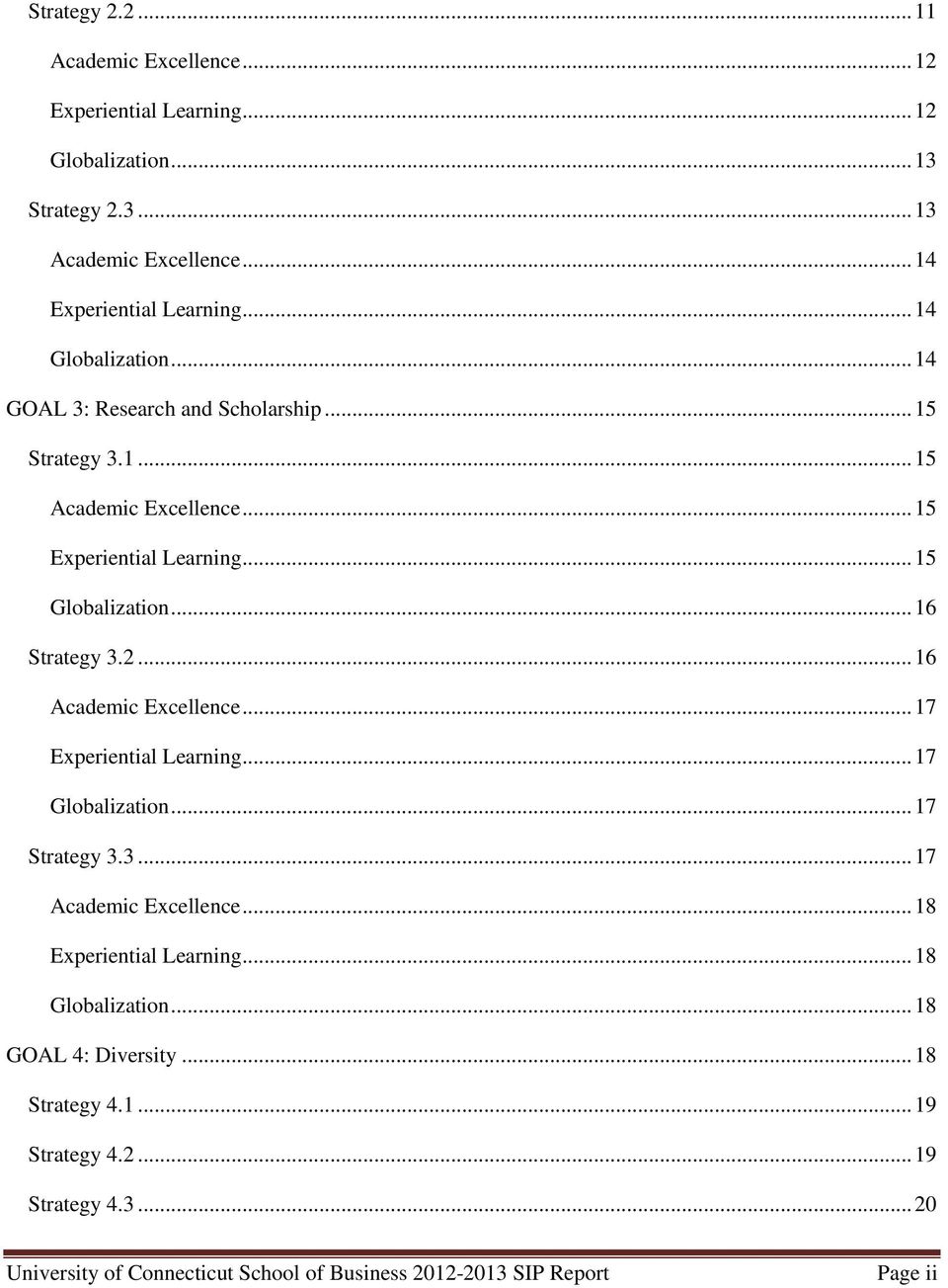
3 Strategy Academic Excellence Experiential Learning Globalization Strategy Academic Excellence Experiential Learning Globalization GOAL 3: Research and Scholarship Strategy Academic Excellence Experiential Learning Globalization Strategy Academic Excellence Experiential Learning Globalization Strategy Academic Excellence Experiential Learning Globalization GOAL 4: Diversity Strategy Strategy Strategy University of Connecticut School of Business SIP Report Page ii
4 Strategy GOAL 5: Public Engagement Strategy Academic Excellence Experiential Learning Globalization Strategy Academic Excellence Experiential Learning Globalization Strategy GOAL 6: Administrative Organization, Capital Infrastructure, and Budget Processes Office of Global Programs (Excepts from Annual Report AY ) Project Development International Scholarships Global Partnerships Universitas Undergraduate students Graduate students Faculty and Staff Media Coverage Programming Visitors Sponsorship and Participation in Campus Events Public Engagement University of Connecticut School of Business SIP Report Page iii

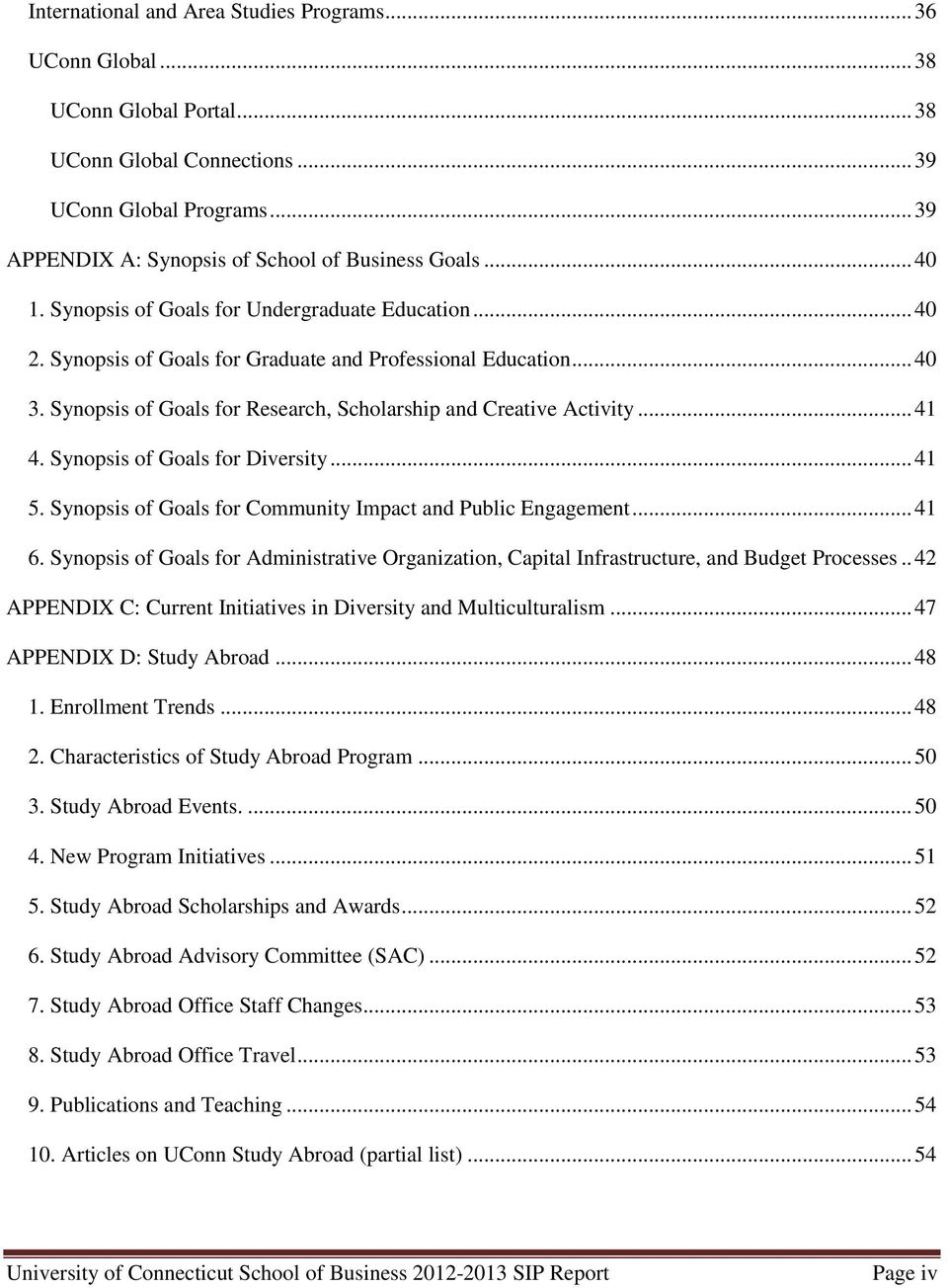
5 International and Area Studies Programs UConn Global UConn Global Portal UConn Global Connections UConn Global Programs APPENDIX A: Synopsis of School of Business Goals Synopsis of Goals for Undergraduate Education Synopsis of Goals for Graduate and Professional Education Synopsis of Goals for Research, Scholarship and Creative Activity Synopsis of Goals for Diversity Synopsis of Goals for Community Impact and Public Engagement Synopsis of Goals for Administrative Organization, Capital Infrastructure, and Budget Processes.. 42 APPENDIX C: Current Initiatives in Diversity and Multiculturalism APPENDIX D: Study Abroad Enrollment Trends Characteristics of Study Abroad Program Study Abroad Events New Program Initiatives Study Abroad Scholarships and Awards Study Abroad Advisory Committee (SAC) Study Abroad Office Staff Changes Study Abroad Office Travel Publications and Teaching Articles on UConn Study Abroad (partial list) University of Connecticut School of Business SIP Report Page iv
6 Letter from Dean Elliott As Dean of the School of Business at the University of Connecticut, I am pleased to affirm our commitment to the Principles of Responsible Management Education (PRME). Since I joined the School six months ago I have been pleased to see that our mission, and our activities in support of that mission, align with PRME. We are committed to maintaining and expanding that alignment. Moreover, the University of Connecticut provides multiple points of contact for the School of Business to interact with other schools and colleges to further these principles. Our current PRME report has been delayed by the change in deans but I believe it illustrates the many elements of our mission, values and programs that reflect these principles. We are currently refining several of our degree programs and our alignment with PRME will be further enhanced in the process. Activity through our SCOPE (Sustainable Community Outreach and Public Engagement) program and other learning accelerators link our students to corporate and other organizational efforts in support of social and environmental initiatives. Our faculty and students similarly engage with University activity through the Human Rights Institute to enhance global awareness and sensitivity. Such efforts include the Universitas 21 Summer School Program for 2013 to be held at UConn. Ultimately these distinctive programs are exemplars of the ongoing commitment to PRME that leads to inclusion of the values of global social responsibility in our academic activities and curricula. We look forward to continuing and deepening our embrace of the PRME principles. John A. Elliott, PH.D Dean and the Arun J. Fox Chair in Business University of Connecticut School of Business SIP Report Page 1
7 Overview of UConn School of Business The mission of the University of Connecticut School of Business (BUSN) identifies our educational and strategic priorities: Real World, Real Learning, Real Impact. Be a globally recognized provider of exceptional managerial and business leadership through innovative experiential learning in a dynamic global business context: integrating real world education, outstanding research and strategic outreach. Our mission statement confirms our commitment to academic excellence, experiential learning, and globalization. We are committed to providing the highest possible quality in teaching, research and outreach in order to attain these goals. We believe that academic excellence in a modern business education requires an international perspective that strives to identify and address business challenges experienced by workers, managers, entrepreneurs, investors, policy makers, and the greater community. Also, as part of New England s premier public university, we are committed to enhancing the competitive advantage of Connecticut s workforce in an expanding global business environment. The School of Business is identified with excellent research-oriented faculty, talented students, successful alumni, and close partnerships with major corporations locally and globally. Bolstered by support from the state of Connecticut, UConn administration, and private donation, the School aspires to be a nationally and internationally recognized institution in key strategic areas of research, innovative training of business leaders for a competitive workforce, and engagement and commitment to the local and professional communities. The School s goal for the next decade is to gain international recognition for our ability to generate topquality academic research on global business problems and for our ability to have a real-world impact on business practice and education. We will do this through our distinctive competencies, which include: an integrative curriculum that blends theory with contemporary practice. classroom pedagogy that provides a real-world context to business fundamentals. cutting-edge research that informs managerial practice, public policy, and teaching. strategic use of technology as an enabler in the solution of complex business issues. intensive experiential learning opportunities that provide a meaningful business context to the classroom. These opportunities provide our students with real-world, critical path projects sponsored by our corporate partners. This innovative approach allows our students to merge their experience and classroom University of Connecticut School of Business SIP Report Page 2

8 knowledge in solving problems identified by the partner companies. Student consulting teams are supervised by School of Business faculty and by corporate project managers. These accelerators include the Student Managed Investment Fund, the UConn/General Electric edgelab, the SS&C Technologies Financial Accelerator, the ING Center, the Corporate MBA Residency (CMR), the Innovation Accelerator of the Connecticut Center for Entrepreneurship and Innovation (CCEI), and the proposed Sustainable Community Outreach & Public Engagement Accelerator (SCOPE). Additionally, we will leverage our international partnerships to enhance learning by providing active global experiences to enrich student development. A recent example demonstrating UConn s commitment to global sustainability is the University of Indonesia (Jakarta) GreenMetric Ranking of World Universities, where UConn is ranked as #1 in the world for most sustainable campuses in the world ( University of Connecticut School of Business SIP Report Page 3

9 GOAL 1: Undergraduate Education Develop programs and strategies to maintain high levels of demand from top regional, national, and international undergraduate students to meet the workforce needs of the future. A primary objective of the School of Business is to recruit, admit, retain, and graduate the highest quality undergraduates and to provide them with a superior educational experience. The School of Business offers undergraduate degrees in eleven majors: Accounting, Business & Technology, Finance, Health Care Management, Management, Management & Engineering for Manufacturing (MEM), Management Information Systems (MIS), Marketing, Real Estate & Urban Economics, Risk Management & Insurance, and Bachelor of Science in Business & Technology (exclusive to regional campuses). In addition, the School offers a number of business minors such as General Business, Entrepreneurship, Professional Sales, and the proposed MEM. The present success of our undergraduate programs is reflected in our admissions and in our national rankings. In 2008, we accepted approximately 40% of UConn students requesting admission to the School of Business. These admitted students had an average SAT of In 2009, U.S. News & World Report ranked our undergraduate business program 30 The School will continue to attract and retain highly qualified students, provide a strong academic program and encourage community engagement that will develop our students into successful professionals and world citizens. To that end, we propose a multi-strategy approach. Strategy 1.1 Foster success in undergraduate education that ensures access for well-prepared students to excellent teaching and outstanding learning environments. Academic Excellence Academic excellence begins with admitting highly motivated, high-achieving students, and then providing support to help them realize their goals. We will pursue several strategies in order to recruit and retain outstanding undergraduates: We will work closely with the University Admissions office to ensure that highly qualified students are admitted to the School of Business. We will monitor and improve our internal admissions review process in order to assure entry of students whose academic performance maximizes their chances for success. University of Connecticut School of Business SIP Report Page 4

10 We will continuously improve student advising to ensure completion of major requirements in alignment with career objectives. We will develop an ongoing curriculum review process that identifies and adopts best-teaching practices across all business majors. We will continuously update curriculum to align student skills with current and future market demand. We will increase the number of scholarships available to our students. We will direct specific efforts toward our regional campuses, including enhanced recruiting efforts, increased online and distance learning courses, participation in Transfer Pathways from the community colleges, and development of a general business major (Bachelor of Science in Business Administration). We will increase our support of career counseling and job placement to ensure that our undergraduates have sufficient and diverse internship opportunities, and that seniors have job placement choices so that they benefit from their educational experience. A robust honors program is a key element to attracting and retaining the best students. We plan to strengthen our honors program in several ways: 1. Increase the number of business courses with dedicated honors sections. 2. Increase retention of students in honors program. 3. Increase number of students graduating with honors. 4. Facilitate honors student / faculty research opportunities. 5. Increase honors student participation in the learning accelerators. 6. Investigate allowing honors students to do a minor in a second business discipline. Experiential Learning There are numerous experiential learning opportunities available to undergraduates in the School of Business. These include traditional class exercises, case studies, business simulations, co-ops, internships, and practicums. For example, in 2008, students enrolled in the Venture Consulting Practicum completed 58 consulting projects for small Connecticut businesses resulting in a bottom-line impact of over $1.93 million in cost savings or increased sales. In addition, our unique experiential learning accelerators enable blended teams of undergraduates and graduate students to work on real-world projects in intensive research environments under the dual University of Connecticut School of Business SIP Report Page 5
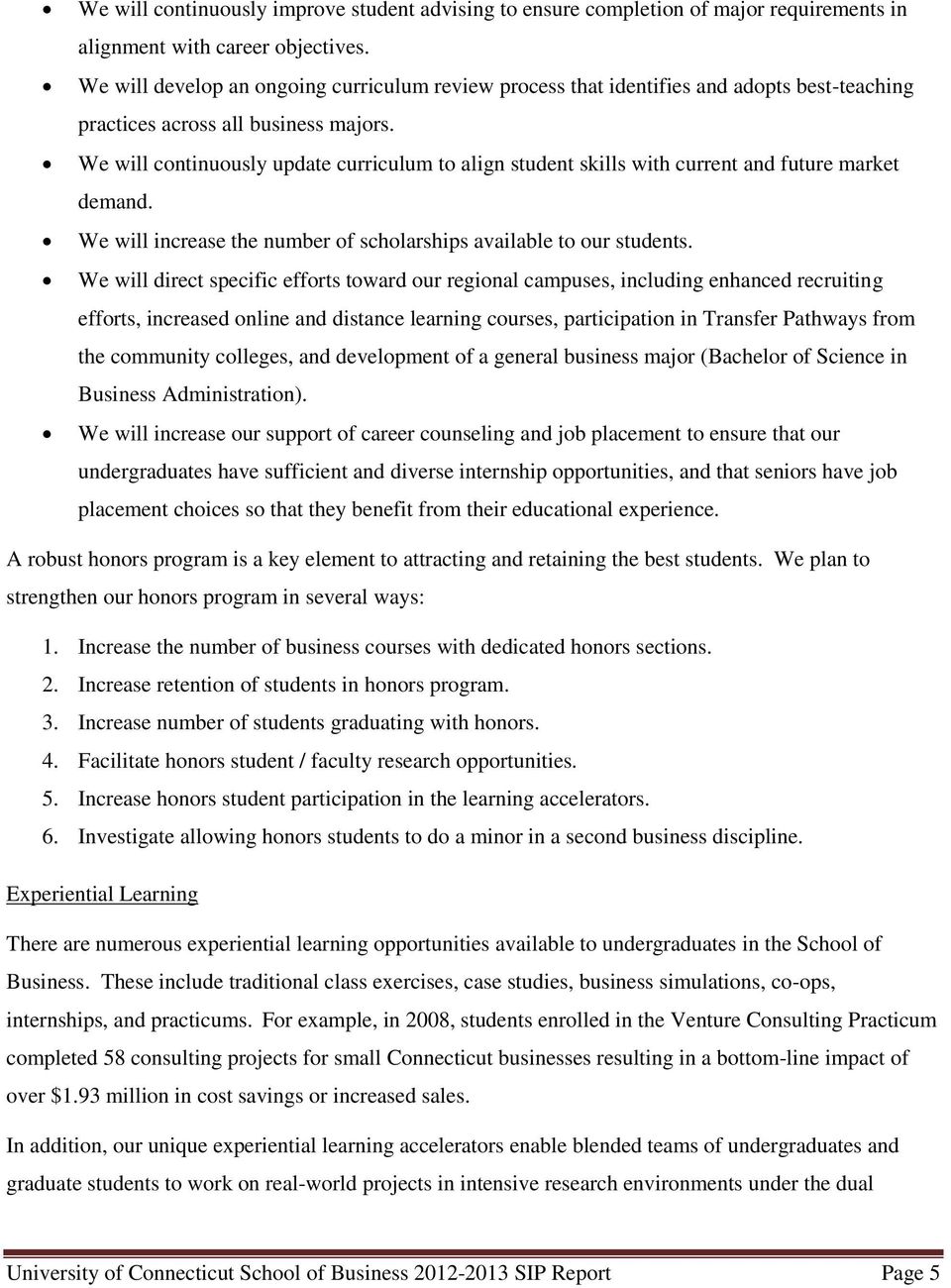
11 guidance of faculty and corporate project managers. We propose increasing the opportunities for qualified undergraduates in these accelerators. Involvement in our next learning accelerator, the Sustainable Community Outreach and Public Engagement (SCOPE) Accelerator, will provide a framework for qualified undergraduates to connect and collaborate with partners in the public sector. See Appendix B for a complete description of SCOPE. Other experiential learning opportunities are more inclusive. We will pursue several activities that can engage the broader undergraduate population: Provide exposure to the professional business world by promoting class speakers, student society meetings, and other venues open to all business students. Increase placement in internships, co-ops, and other work experiences. Increase focus on experiential activities both such as consulting projects, case studies, simulations, site visits and other related assignments. Globalization The School of Business is committed to producing future leaders who can understand and manage the complexities of an increasingly global economy. By providing our students with cross-cultural classroom immersion, international internships, study abroad opportunities, and increased exposure to global partnerships; we strive to emerge as a recognized leader in global business education. We have identified several initiatives that will help us attain these goals: Increase participation in study abroad and exchange programs and international internships. Increase representation of non-us students in our undergraduate programs through exchange partnerships. Enhance global content and exposure in undergraduate curriculum. Explore possible major in international business. Strategy 1.2 Develop enhanced degree programming and course opportunities in emerging areas of interdisciplinary excellence and workforce demand. University of Connecticut School of Business SIP Report Page 6

12 Academic Excellence The School of Business is currently involved in multiple activities that prepare our undergraduates for an increasingly complex and interdisciplinary workplace. Currently, our partnerships include Engineering, Communications, and Actuarial Science. We also provide minors to non-business majors in general business, entrepreneurship, and professional selling. We will pursue several activities to enhance these relationships and seek new partnerships: Develop a Bachelor of Science in Business Administration (BSBA) for the regional campuses with advanced electives from each department and the opportunity for students to pursue interdisciplinary concentrations that include non-business courses. Pursue new business minors and additional interdisciplinary programs such as the proposed program in engineering management. Develop under-division level service courses in business literacy for non-business majors. Enhance the joint major in Management and Engineering for Manufacturing (MEM), housed in the School of Business and the School of Engineering through reviewing and revising curriculum requirements; expanding the coverage of professional, ethical, global, environmental, and social issues; and increasing education abroad opportunities. Experiential Learning We plan to encourage cross-disciplinary participation in select experiential learning accelerators by recruiting qualified undergraduates from Engineering, Statistics, Economics, Actuarial Science, Computer Science, the School of Law, and the School of Medicine. Globalization We will further build our partnerships with premier international business schools, corporations, nonprofits, and alumni. This will provide our students increased opportunities to study abroad, engage in exchange relationships, conduct international internships, and engage in globally-oriented projects with companies and non-profits. We will also continue to encourage our business undergraduates to participate in the University s International Studies minor. We will investigate increasing the business courses available to the University s International Studies minor. University of Connecticut School of Business SIP Report Page 7

13 Strategy 1.3 Increase opportunities for small-group, experiential, and service learning for undergraduates. We will build on the strength of our undergraduate programs by providing a learning environment that promotes a strong sense of community and the development of global citizens. We will pursue several activities to ensure our students are successful and contributing member of society. Academic Excellence The School of Business is committed to expanding the concept of academic excellence to experiences beyond the classroom. To this end, we propose: Developing the Sustainable Community Outreach and Public Engagement (SCOPE) Accelerator as a platform to integrate curricular and co-curricular experiences that complement and extend traditional classroom learning. Developing a Business Learning Living Community where students can experience a residential community with a focus on developing leaders though business activities and service. Increasing participation of under-division students in School of Business activities so they can connect with the School earlier in their academic career. Developing activities to develop student leadership skills; enhance the student leadership council so that students are more engaged in the activities and decisions of the school. Experiential Learning The School of Business will explore incorporating service learning into our regional campus curriculum. Service learning, as defined by the University, is an educational approach that integrates community service with academic coursework; it promotes learning, fosters civic engagement, and accommodates different learning styles. We will encourage and support increased student participation in national and international case competitions. Globalization The School of Business will develop new business related study abroad programs that will allow our students to experience business issues in an international setting. We plan to develop virtual study abroad programs for small groups of undergraduates interested in particular geographic or cultural areas. University of Connecticut School of Business SIP Report Page 8
14 Strategy 1.4 Enhance timely placement of students in professional positions. One of the major goals of the School of Business is to prepare students for professional engagement. Listed below are several initiatives that we believe are essential to achieving that goal: Academic Excellence Provide professional development opportunities for students to improve interpersonal skills needed for success in business. Provide information and support so that students can identify appropriate career opportunities. Increase placement of students in professional jobs. Experiential Learning Ensure that experiential learning enhances appropriate employment decision-making. Encourage full student participation in online CareerConnections and other placement initiatives. Globalization Improve contact with international alumni to facilitate placing students with international companies. GOAL 2: Graduate and Professional Education Develop outstanding graduate students who are able to attain high-quality employment in the public or private sector. Sustain and develop select graduate programs of national and international distinction. The School of Business has multiple graduate and professional education programs: a full-time MBA program (FTMBA), three part-time MBA programs (PTMBA), an Executive MBA program (EMBA), a Master in Accounting program (MSA), Ph.D. programs in 5 areas of concentration, and an Executive Education program. In addition, the School of Business is investigating expanded options in our specialized master s programs. We are considering a Master of Science in Financial Risk Management in fall 2009; an accelerated MBA program, with a tentative start date of spring 2010, is being explored; and we are studying a Master of Science in Business Analytics and Project Management. University of Connecticut School of Business SIP Report Page 9

15 The present success of our graduate programs is reflected in our national rankings. Our FTMBA program recently rose to Business Week s top 45 (which puts us in the top 20 for public universities). Business Week also ranked our MBA program 7 th in the nation for Return on Investment. Our MSA program is ranked 18 th in the U.S. by Public Accounting Report; our graduate Information Systems program is ranked in the top 25 by U.S. News and World Report; our Real Estate program is ranked 1 st in research internationally by the Journal of Real Estate Research and 8 th nationally in education by U.S. News and World Report. By leveraging the positive publicity that these rankings bring, we can expand our recruitment efforts to encompass a broader national and international audience. By attracting the best students, we can also anticipate an increase in outstanding MBA and Ph.D. job placements. While the various programs face differing needs based on their student populations, the unfailing primary objective is to provide exceptional educational training and to prepare these students for success in their chosen careers. To that end, there are several strategies that can be applied in order to continue and improve the quality of our graduate programs. Strategy 2.1 Offer a strong research, teaching and service environment that enhances the School of Business Masters, Professional Development and Doctoral programs. Academic Excellence Maintaining and enhancing the scholarly reputation of our faculty is key to continued success in graduate education. We have identified several actions that will help us in this goal: Recruit and retain highly productive faculty. Align faculty responsibilities to capitalize on distinctive competencies. Compete successfully for external fellowships and grants. Experiential Learning Our goal is to expand upon and deepen the experiential learning opportunities for all our graduate students. Our learning accelerators recruit both Ph.D. candidates and MBA students from Storrs, Stamford, Hartford and Waterbury. We plan to increase the number and variety of opportunities for substantive experiential learning to MBA students in both the Full-time and Part-time Professional University of Connecticut School of Business SIP Report Page 10
16 programs. Doctoral student participation can afford excellent research opportunities, and should be further encouraged. Some graduate courses incorporate real-world projects, for example, developing marketing plans for companies that participate in the Family Business Program, or engaging in market research projects with partner companies. We plan to expand on these classroom-based projects wherever feasible. Globalization The School of Business is uniquely positioned to pursue international initiatives through our International Affairs Office (IAO), which contains the GE Global Learning Center and the Center for International Business Education and Research (CIBER). These two centers provide programs designed to increase the competitiveness of U.S. businesses in the global marketplace, as well as to develop internationally focused business education. They can identify new opportunities in international business for professional development/executive education. Similarly, our graduate faculty is committed to exploring initiatives that will enhance our curriculum with global content wherever appropriate, including: Reviewing our graduate courses to ensure availability of global content on a regular basis. Increasing graduate participation in courses and activities in which global experiences are embedded, including projects with international companies and local companies operating or expanding abroad. Exploring online courses that will enable students abroad to take School of Business classes, and will facilitate team-teaching with faculty at institutions worldwide. Enhancing the current dual MBA/MA in International Studies. Expanding the international concentration in the part-time MBA program. Developing a certificate in International Business for post-graduate students. Using the graduate curriculum and other activities to educate students in multicultural teamwork and business practices. Strategy 2.2 Offer a resource-rich training environment for graduate students. University of Connecticut School of Business SIP Report Page 11

17 The mission of the graduate programs in the School of Business is to develop outstanding graduate students and prepare them to conduct state-of-the-art research (where appropriate) and to attain high quality positions in the public and private sectors. Academic Excellence The School has identified several priorities that we feel are essential toward achieving the best possible learning environment for our graduate students. These include: Monitoring and improving the admission process to target students whose qualifications maximize their chances for success. Employing a continuous process of curriculum assessment and improvement and adopting best practices across all disciplines. Continually updating curriculum to align student skills with current and future market demand. Exploring new programs to respond to market demands. Options may include an Accelerated MBA, a Master of Science in Financial Risk Management, a Master of Science in Business Analytics and Project Management. Exploring interdisciplinary programs/partnerships with Engineering, Economics, Public Administration, Public Policy, Social Work, Law, and International Studies. Exploring alternate instructional formats, including blended learning environments and distance learning as appropriate to curriculum suitability and market demands. Providing exceptional faculty mentoring. Strengthening graduate student / community interaction. Improving coordination between School of Business graduate programs. Providing appropriate training, oversight, and evaluation for graduate teaching assistants. Experiential Learning Experiential learning is offered in varying degrees across graduate business programs. It is central to the FTMBA, and that program offers multiple opportunities for participation in all the experiential learning initiatives. There are more limited opportunities in the PTMBA, MSA, and Ph.D. programs; however, we seek to offer as broad an experience as possible to our entire graduate student population. Some proposals for expanding these opportunities include: Increasing student accessibility across all campuses to speaker series and guest lectures through use of podcasts, online classes, and video-conferencing. University of Connecticut School of Business SIP Report Page 12

18 Increasing graduate participation in national and international case competitions. Exploring alternative, asynchronous experiential projects to encourage increased participation by regional campus MBAs. Expanding asynchronous online simulations. MS in Accounting currently offers simulations in the online environment, for example in Acct Similar simulations can be developed for online classes outside of the MSA. Increasing experiential opportunities, including summer internships, CMRs (for MBAs), and EMBA management projects. Increasing Ph.D. participation / research / publication opportunities in learning accelerator projects. Globalization Increasing the number and quality of our global initiatives is central to the mission of the school. There are currently global course opportunities in the PTMBA and EMBA: for example, PTMBA offers an international marketing trip during Spring Break, and EMBA students travel abroad each summer as a requirement of their program. We seek to expand these opportunities across programs wherever feasible; the Dean of the School of Business is currently exploring additional alliances with premier foreign universities that will expand the international study/travel opportunities for our entire student population. Where travel may not be available or may be impractical, we are pursuing online course opportunities by partnering with other premier non-us universities to develop and conduct classes. We also propose: Renewing the CIBER grant to provide resources for student and faculty development. Initiating international business education accreditation of the school. Expanding international partnerships with premier corporations, non-profits, and alumni. Facilitating international recruiting and placement. Strategy 2.3 Enhance timely placement of graduate and professional students in top positions. Since one of the primary goals of a graduate education is to obtain high-quality internships and employment in public or private enterprise, the School must develop strategies to ensure continued University of Connecticut School of Business SIP Report Page 13

19 placement of our graduates in exceptional domestic and international positions. Listed below are several initiatives that we believe are essential to achieving that goal: Academic Excellence Provide professional development opportunities for all graduate students to enhance their progress and professional visibility. Assess need and provide support to improve verbal and written English language skills, in order to improve placement of international students. Facilitate timely degree completion, and provide five-year funding packages for Ph.D. students. Provide Ph.D. students with travel support to professional conferences and research funding as appropriate. Increase placement of Ph.D. students in tenure-track positions with peer or aspire schools. Experiential Learning Ensure that experiential learning opportunities directly supplement and enhance progress toward employment. Encourage full student participation in online CareerConnections and other placement events and initiatives. Provide career counseling and training to students to ensure their ability to describe, verbally and on resumes, their experiential learning and its value to potential employers. Provide graduating MBA s with a virtual tool kit to assist with ongoing career issues and changes, including online resources and counseling by the Business Career Center. Globalization Improve contact with international alumni to facilitate placing our Masters students in top international organizations. Facilitate doctoral program recruitment and research collaboration with alumni. Host international visiting scholars who offer seminars or colloquia for our Ph.D. students that will enhance their placement opportunities, especially at top non-u.s. business schools. Provide international travel resources for Ph.D. students to develop their academic network and increase their placement at top non-u.s. business schools. Encourage Ph.D. students to attend special globalization research workshops where appropriate. University of Connecticut School of Business SIP Report Page 14

20 GOAL 3: Research and Scholarship Develop strong and sustained efforts toward national and international prominence in the quality and quantity of faculty research and scholarship. The academic reputation of the School of Business depends on our continued support for faculty research and scholarship across all disciplines. We have identified several focused areas of research excellence within the School and we will develop strategies to promote and encourage that research. Among these areas are Entrepreneurship, Financial Services, and Technology. We will also identify and encourage multiple avenues of research collaboration across UConn schools and departments and also with public and private sector institutions, both domestic and international. Strategy 3.1 Promote and enhance high-quality research activities. Academic Excellence The School of Business encourages and fosters a rich, research-oriented environment for faculty and doctoral candidates. We are committed to providing feasible support for an increased volume of faculty research and publication in top peer-reviewed journals. Initiatives to aid this objective include efforts to: Increase summer funding to support faculty research. Increase extramural funding from granting agencies (NEH / NEA support, Guggenheim Fellowships, Fulbright Awards). Increase extramural funding from corporate partners. Seek new Chairs and Professorships. Maintain and improve high rankings in education and research. Experiential Learning The School of Business is strongly positioned to expand upon well-established industry partnerships and extra-mural support through our learning accelerators. Our collaboration with General Electric in edgelab has completed more than 112 strategic projects, with a 95%+ successful implementation rate. The Center for Entrepreneurship and Innovation (CCEI) is funded by a $2 million grant from the State of Connecticut, and houses several major initiatives, including the Innovation Accelerator, the Family Business Program, and the Intellectual Property Law Clinic. The ING Center was established with an University of Connecticut School of Business SIP Report Page 15

21 endowment from ING Financial Services and sponsors projects and research focused on cutting-edge marketing scholarship. In addition, The Connecticut Information Technology Institute (CITI) supports major research across School of Business departments; for example CITI supports e-business research for the OPIM Department, which is ranked 7 th worldwide in publications in premier INFORMS journals. We propose two initiatives to deepen the research potential of our learning accelerators: Increase Ph.D. participation in learning accelerators wherever opportunities for research and publication apply. Broaden faculty participation wherever feasible to include research faculty from all departments, disciplines, and campuses. The depth and breadth of these experiential projects can provide excellent platforms for multi-disciplinary faculty research. One strategic goal of CCEI, for example, is to facilitate cross-disciplinary research in entrepreneurship and innovation through CCEI grants. And in edgelab, the mentoring faculty retains absolute right to publish, which has resulted in numerous research journal articles. Globalization There are several proactive steps that the School of Business intends to follow in order to further expand the scope of our research faculty into a more international arena, including: Provide opportunities and resources for faculty to globalize their research and develop relationships with top-quality international scholars. Promote increased publication in international journals, attendance at academic conferences outside the U.S., and participation in international professional societies and organizations. Encourage faculty to attend FDIB (Faculty Development in International Business) workshops abroad. Encourage faculty to visit non-us based universities for exchanges to broaden their research agendas. Strategy 3.2 Intensify efforts to move our discoveries into applied outcomes that further enhance our standing as a research university and the quality of life for our citizens. University of Connecticut School of Business SIP Report Page 16
22 A key driver for success with this strategy is to capitalize on our existing relationships with top corporate partners in the public and private sectors. As mentioned throughout this academic plan, the School of Business has a long history of productive relationships with prominent U.S. and international firms, and we anticipate deepening and expanding these partnerships for translational research. We can facilitate our efforts in this direction through a variety of approaches: Academic Excellence Encourage applied scholarship, as well as basic academic research. Applied scholarship should be a particular focus for in-residence faculty. Increase involvement of faculty on corporate advisory boards. Increase faculty involvement on external boards. Experiential Learning Introduce a practicum with non-profit organizations for regional campus and Storrs students. Partner companies can be focused on local or global business. This course could be incorporated into the undergraduate and MBA curriculum as an elective. Globalization Increase exposure in applied research publications and trade books that target the international business community. Leverage faculty expertise in global issues to develop executive education programs, public symposia, and other mechanisms for engaging the public. Strategy 3.3 Enhance the standing and national / international recognition of our programs of research and scholarship. The University of Connecticut is one of only two Carnegie Foundation Research 1 public universities in New England, and the only Ph.D. granting public university in Connecticut. The School of Business houses an outstanding research facility, distinguished faculty, intensive academic programs, and excellent academic and placement ratings. In order to maintain and improve our standing in these areas, we propose the following: University of Connecticut School of Business SIP Report Page 17
23 Academic Excellence Increase the visibility and impact of research activity in School of Business Quality List journals. Increase participation in national and international research conferences. Provide appropriate assistance for professional development opportunities, research related travel, and sabbaticals that will facilitate scholarship at the highest level. Encourage and reward faculty who are leaders in prominent professional associations or serve as editors and board members of leading journals in their fields. Host regular speaker series and workshops to keep abreast of recent developments in each discipline. Host, as appropriate, disciplinary and interdisciplinary conferences and research forums. Experiential Learning Explore global projects with select international academic partners. Promote projects that advance our reputation in Entrepreneurship, Financial Services, and Technology. Globalization Bring top international visiting scholars to campus. Develop global partnerships with top international firms in critical regions of the world. Obtain recognition in international research rankings. Facilitate top rankings of our faculty research in their areas of expertise. GOAL 4: Diversity Ensure an enriched learning and work environment by creating a more inclusive community that recognizes and celebrates individual differences. Business in the 21 st century will operate in highly complex and competitive global markets. In these environments, corporate America's prospects for economic growth, increased worker productivity and enhanced business/company profitability will depend significantly on its capacity to develop effective leadership in a diverse workforce. The School of Business is committed to providing opportunities for students to experience different perspectives and cultures, not only from an international point of view, but from welcoming and engaging individuals from a variety of backgrounds and cultures within the U.S. We are further committed to University of Connecticut School of Business SIP Report Page 18
24 developing a diversified, multi-cultural faculty, staff, and student body that operates in a mutually supportive and creative environment. Strategy 4.1 Create more opportunities for interaction with people from different cultures and backgrounds. Increasing the diversity of our undergraduate population is a key goal of the School of Business. Traditionally, our undergrad classes consist of less than 20% non-white students. In fall 2008, for example, the percentages were as follows: Native American (0.2%), Asian (8.3%), Black (2.2%), and Hispanic (4.9%). Our goal is to increase our total percentage of minority students to over 20% of the undergraduate class by While our primary emphasis for increased diversity lies with African- American, Hispanic, and Native American groups, we are committed to providing complete services and support to all underrepresented minorities. Other initiatives that we propose include: Improve recruitment and retention of faculty and staff from underrepresented groups. Increase admission, retention, and graduation rates among students from minority groups. Increase scholarship awards for targeted populations. Expand and improve academic support and tutoring for targeted populations. Develop partnerships with global institutions to increase opportunities for scholarly exchange and study abroad. Increase participation in experiential learning opportunities by minority and international students. Attend national conferences for minority MBA candidates to enhance recruiting strategies. Recruit Transfer Pathway students from Connecticut Community Colleges. Strategy 4.2 Strengthen programs that promote cultural competency among faculty, staff, and students. Support and strengthen the Office of Diversity Initiative (ODI). Support and strengthen the Teenage Minority Business Program. Provide increased faculty involvement with Multicultural Business Society. Provide training in best practices for recruiting underrepresented faculty and staff, as an element University of Connecticut School of Business SIP Report Page 19
25 of all search processes. Provide training for admissions committees and directors of graduate and professional programs to facilitate recruitment of underrepresented and international students. Provide support to improve English language skills, both verbal and written, of international students. Engage in cultural sensitivity training to enhance the learning and working environment. Strategy 4.3 Build accountability for promoting diversity and creating an inclusive climate into all programs of the School. Incorporate and strengthen diversity goals in the strategic plans of all departments. Provide units with tracking data related to performance on diversity. Include diversity data in evaluations and reviews of all programs and departments. Strategy 4.4 Enhance course content on cross-cultural, gender, and diversity management. Promote enrollment in diversity and multiculturalism courses that are part of the general education requirements. Promote an international component in the curriculum. See Appendix C for current initiatives in teaching and research. GOAL 5: Public Engagement Enhance the contributions of faculty, staff, and students to the state, nation, and world through appropriate collaboration with partners in both the public and private sectors. The School of Business has a well-established history of community involvement and public engagement through our learning accelerators, our Executive Education program, our Family Business Program, our various campus initiatives, and our diverse centers and programs. We are actively engaged with local, national, and international partners in a wide array of projects and collaborations. These partnerships include projects and programs with international firms such as General Electric and ING, state agencies such as the Connecticut Department of Public Safety, Connecticut-based firms such as SS&C Technologies, local family-owned businesses, and others. University of Connecticut School of Business SIP Report Page 20
26 Building on our successful track record in the arena of public engagement, we are seeking and encouraging new partnerships with state agencies, non-profit and for-profit enterprises, and international institutions, both academic and corporate. We are also engaged in nurturing our existing partnerships through continued collaborations and programs. Strategy 5.1 Increase the visibility and accessibility of faculty expertise. Academic Excellence The regional campuses in Hartford, Stamford and Waterbury have articulated an objective of incorporating Service Learning throughout their curriculum, increasing faculty involvement in civic and public engagement activities in each community. The regional campuses are ideally situated to engage with local civic organizations and international non-profits. The regional campuses have also identified two additional goals: Identify three faculty to become Service Learning Fellows by spring 2010 Integrate Service Learning opportunities into three courses per semester Our Executive Education program offers advanced training and education programs to companies and professionals throughout the greater Connecticut region, and draws on the expertise of a broad crosssection of our faculty. The programs generally cover a wide range of business skills and knowledge. Our Business Mastery Program for Public Service Professionals, begun in January 2008, was developed in conjunction with a state-wide Public Service Consortium, a group of State agency representatives. The program is designed to deliver valuable management concepts and skills to professionals working in public service positions in State government or in municipal agencies. Executive Education plans several enhancements to its current offerings: Development of an online Executive Education Program. Providing customized courses to state and municipal employees at general tuition rates. Providing a percentage of tuition-free courses to UConn employees. The School of Business has also targeted Social Innovation and Social Entrepreneurship as new areas of focus, and will be creating courses and programs in these subjects to meet demand. We define social entrepreneurship broadly to encompass activities that help create innovative non-profit organizations, initiate new for-profit ventures with socially-oriented missions, and support entrepreneurial efforts that University of Connecticut School of Business SIP Report Page 21
27 lift people out of poverty by empowering them with the skills and resources to create and run their own businesses. In summer of 2009, the School will send students to work on development projects with community entrepreneurs in the highlands of Central America as part of an eight-week summer internship called Social Entrepreneurship in Guatemala. Experiential Learning As detailed throughout this academic plan, our faculty work extensively with regional and global partners through projects in our learning accelerators. Our next learning accelerator, the Sustainable Community Outreach and Public Engagement (SCOPE) Accelerator, will work exclusively with partners in the public sector, extending the school s commitment to public outreach. Globalization The School of Business proposes to expand faculty exposure to international constituents through publication in leading international journals, attendance at international conferences, leadership in international professional societies, and presentation of their research abroad. Strategy 5.2 Develop new and stronger partnerships throughout the state. Academic Excellence Engage relevant community and state agencies and organizations to identify challenges and develop partnerships to address them. Establish and support the Programs in Healthcare Management & Insurance Studies to develop partnerships with state-related health care issues and management. Experiential Learning Strengthen and expand the role of our learning accelerators, especially the Innovation Accelerator and SCOPE, with the needs of the State of Connecticut. Globalization Develop partnerships with Connecticut companies operating or expanding abroad. University of Connecticut School of Business SIP Report Page 22
28 Strategy 5.3 Strengthen the State s K-12 education system by continuing to contribute our expertise to the state s efforts in education reform. Continue and strengthen outreach to pupils and teachers in the K-12 education system; leverage students in the Teenage Minority Business Program and the Financial Literacy Program. Facilitate more partnerships with the state and public schools to promote evidence-based teaching and research on methods and policies that enhance learning. GOAL 6: Administrative Organization, Capital Infrastructure, and Budget Processes To move this academic plan forward, the School of Business proposes new monitoring and assessment systems in line with the goals articulated here. Heads of major subunits (that is, department heads, associate deans, program and campus directors, and center directors) will be responsible for annual reports that describe their units contributions to, and shortcomings with regard to, the goals laid out in this academic plan. This accountability will also trickle down to the annual evaluation of individual faculty and staff members. Subunits within the School of Business will incorporate an annual assessment of each individual s contributions to the school s strategic foci into the merit evaluation system. For example, each department head, in consultation with his or her faculty members, will develop a set of guidelines for evaluating an individual faculty member s contributions to the School of Business s academic plan and employ these guidelines as part of the department s assessment of an individual for purposes of determining merit increases. The specific guidelines will be developed within the subunit as it deems appropriate, and the Faculty Activity reporting system will be revised in accordance with these guidelines. Given the multifaceted constituencies and diverse goals of a business school, subunit heads will be asked to emphasize an individual s contributions to multiple aspects of the School of Business s broader missions of research, teaching, and service. In addition, subunit heads and the Dean s Office will be aligning budgeting processes and capital investments with the goals stated in this academic plan. The promotion and tenure processes employed in the School of Business will, however, remain unchanged in this regard. The School of Business will work with center and institute directors to set specific goals each academic year. Annual performance reviews will be conducted on the success of the centers/institutes in meeting those goals and in delivering excellence in their areas. On an ongoing basis, the School will consider possible reorganization and consolidation where it is evident that such actions will promote excellence and further the goals and mission of the School. We anticipate that some centers, where appropriate, will University of Connecticut School of Business SIP Report Page 23
29 be moved outside of academic departments to be run at the school level. This will ensure that the crossand multidisciplinary demands of these centers will be better met by faculty and staff throughout the school, and that these centers will be better focused on the school s academic priorities. The School of Business will also investigate reorganizing and coordinating faculty staffing and student recruiting functions across the learning accelerators. As part of this, mentoring of new faculty into the accelerator experience will be emphasized. University of Connecticut School of Business SIP Report Page 24
30 Office of Global Programs (Excepts from Annual Report AY ) As a demonstration of UConn s commitment to achieving its goals relating to developing international and global programs, UConn hired Dr. Daniel Weiner for the newly created position of Vice Provost for Global Affairs ( ). Project Development The Office of Global Programs (OGP) develops, implements, and administers activities related to grant and contract procurement and management, including the Fulbright Student and Scholar programs, and Boren Scholarships and Fellowships and Critical Languages Scholarships for students. We also oversee the development of international partnership agreements. A major initiative during was the development of a concept paper, Enhancing Capacity for the Sustainable Management of Marine and Coastal Resources in Indonesia, submitted in March to the U.S. Agency for International Development. The concept paper, which was developed in collaboration with Boris Bravo-Ureta and Robert Pomeroy, both professors of Agricultural and Resource Economics, was selected by USAID for development into a full grant proposal, which was submitted on June 13. If approved, the project will engage UConn with Hasanuddin, Halouleo, and Mataram Universities to develop curriculum, research, and extension programs that address adaptation to climate change in marine communities in Indonesia. Three OGP staff members (Associate Executive Director Elizabeth Mahan; Program Specialist Raluca Nahorniac; and Business Manager Beth Summers) will be part of the project team. International Scholarships OGP coordinates four highly competitive national grant and scholarship programs, sponsored by the U.S. government, for students and faculty seeking to study or do research abroad. These are the traditional Fulbright Scholar programs for faculty and students; the Fulbright-Hays Faculty Research Abroad and Doctoral Dissertation Research Abroad programs; the Boren Fellowship and Scholarship programs for graduate and undergraduate students; and the Critical Languages Scholarships program for graduate and undergraduate students. The Fulbright Scholarship Committee is a standing committee of the University, chaired by Elizabeth Mahan, the Associate Executive Director of OGP. As the University's officially designated Fulbright Program Advisor, she recruits and counsels student and faculty applicants for the various Fulbright University of Connecticut School of Business SIP Report Page 25
31 programs, and serves as Project Manager for Fulbright-Hays Training Grants (Doctoral Dissertation Research Abroad Program and Faculty Research Abroad Program). Working with the members of the Fulbright Scholarship Committee, the Fulbright advisor evaluates and rates applications for Fulbright Grants for graduate study and research abroad. In , the following faculty served on the Fulbright Scholarship Committee: Susan Randolph (Economics), William Berentsen (Geography), Timothy Byrne (Marine Sciences and Geography), Laura Crow (Dramatic Arts), Alexis Dudden (History), Samuel Martinez (Anthropology), Lynn Bloom (English), and María Luz Fernández (Nutritional Sciences). Two UConn doctoral students received Fulbright grants for AY : Nicola Bulled (Anthropology), for research on the relationship between knowledge of HIV and behavior among college students in Lesotho; and David Hudson (Physiology and Neurobiology), for research in Colombia on freshwater crabs and climate change. Eight students submitted applications for Fulbright grants in , but none received awards, although one, Tea Psorn, a graduating senior, has been named an alternate for a Fulbright English Teaching Assistantship in Bosnia. Sixteen Fulbright-funded international students were enrolled in Master s and Ph.D. programs or conducting dissertation research at UConn during Family Name First Name Department Country Abdelaziz Ahmed LCL Egypt Aristizabal Rivera Juan Nutritional Science Colombia Barona Acevedo Maria Nutritional Science Colombia Contreras Ortiz Sonia BME Colombia Darius Jeliel Economics Haiti Figueroa Valenzuela Rodrigo Sociology Chile Li Li Political Science China Martinez Santos Juan Electrical Engineering Colombia O'Flatharta Cuan MLC? Ireland Praino Rodrigo Political Science Italy Robinson Duggon Jose Chemistry Panama Rojas Ospina Carmen Educational Psychology Colombia Schroefl Adam Chemical, Molecular & Biomolecular Engineering Czech Republic Shimamura Koji Linguistics Japan University of Connecticut School of Business SIP Report Page 26
32 Yousaf Farhan Sociology Pakistan University of Connecticut School of Business SIP Report Page 27
33 In , six UConn faculty members won Fulbright awards. Name Destination Department Madjar, Nora Bulgaria Business (Management) Eigisti, Inge-Marie France Psychology Schultz, Eric Greece Biology Utz, Stephen Germany Law Trumbull, Nathaniel Russia Geography Ward, J. Evan United Kingdom Marine Sciences As of this writing, one UConn faculty member has been informed of a Fulbright award for the academic year: Carol Auer (Plant Science), for teaching in Ecuador. UConn hosted two visiting Fulbright Scholars at the Storrs campus this year: Makram Haluani, a Venezuelan Political Scientist, hosted by Professor Mark Boyer, in the Political Science Department; and Femke ten Bloemendal, from the University of Amsterdam, hosted by Donna Korbel, director of the Center for Students with Disabilities. Global Partnerships Twelve Memoranda of Understanding with higher education institutions outside the United States were signed this year: 1. Korea Environment Institute (KEI), Korea 2. University of Talca (UT), Chile 3. University of Antananarivo, Madagascar 4. Nha Trang University, Nha Trang, Khanh Hoa, Vietnam 5. University of Malaga, Spain 6. Universiteit Gent-Ghent University, Belgium 7. Indian Institute of Management, Calcutta, India 8. National Center for Biological Sciences, Tata Institute of Fundamental Research, Bangalore, India 9. Hochschule Merseburg-University of Applied Sciences, Merseburg, Germany 10. Management Development Institute, Gurgaon, India 11. Universitatea de Arte, Targu-Mures, Romania 12. College of Science, National Taiwan University, Taiwan In addition, new Student Exchange Agreements were signed with four Universitas 21 institutions: 1. University of Birmingham, UK 2. Waseda University, Japan 3. McGill University, Montreal, Canada 4. Lund University, Sweden University of Connecticut School of Business SIP Report Page 28
34 In , the Office of Global Programs launched the Global Partnerships Travel Grants competitions, to support selected faculty initiatives that aim to develop UConn s existing global partnerships and full time staff members to learn and share international best practices in higher education. Successful projects involved faculty or professional staff travel to one or more UConn partner institutions, with the purpose of developing new collaborative projects and programs or improving the implementation of current joint activities, furthering collaboration, dialogue and exchange. The second Round of the Faculty Travel Grants Competition is scheduled for Fall Table 1. Global Partnerships: Faculty Travel Grants Competition Round 1, 2012 Awardees Year/ Round Name Uconn Department Proposal Title Partner Institution Country Grant (US$) 2012 Round 1 Alan Marcus University of Nottingham United Kingdom 5, Round Round 1 Anna Mae Duane Richard Parnas Dept. of Curriculum and Instruction Dept. of English, American Studies Dept. of Chemical, Materials & Biological Engineering Developing Global Citizens: Teacher Education and Museum Education in The United Kingdom and the United States American Studies Abroad: Collaborating with Ugent Reaction Engineering of Biofuel Production University of Ghent Sichuan University Belgium 4, China 2, University of Connecticut School of Business SIP Report Page 29
35 Table 2. Global Partnerships: Travel Grants for Professional Staff, 2012 Awardees Year Name UConn Unit Proposal Title Partner Institution Country Grant (US$) 2012 Elizabeth Omara- Otunnu University Communications Identifying Best Practices in Global Public National University of Singapore Singapore 4, Richard Miller 2012 Margaret Lamb Universitas 21 Office of Environmental Policy Honors Relations Building an International Sustainability Alliance Facilitating the Evaluation of Honors Coursework Done by University of Connecticut Undergraduates on U21 Exchange in the United Kingdom University of Freiburg University of Birmingham University of Nottingham University of Edinburgh University of Glasgow Germany 4, United Kingdom 4, Undergraduate students Semester Exchange: The number of UConn students studying abroad on exchange at a Universitas 21 partner institution during AY11-12 increased 13% compared to AY The distribution by term shows a slow trend towards balancing the Fall and Spring semesters, with 66% of students studying on exchange in Fall 2011 compared to 73% in Fall 2010, 30% of students in Spring 2012 compared to 25% in Spring 2011, and 4% of students choosing to study abroad at a U21 partner for the entire AY11-12, compared to 2% in AY Compared to AY10-11, in AY11-12 UConn students participated in five additional U21 exchange programs: University of Edinburgh (United Kingdom), University of Birmingham (United Kingdom), University of Amsterdam (Netherlands), Pontificia Universidad Catolica de Chile (Chile), and Fudan University (China). New Exchange Initiatives: UConn signed new exchange agreements with Waseda University (Tokyo, Japan) on October 26, 2011; and with McGill University (Montreal, Canada) on January 12, Both McGill and Waseda are members of the Universitas 21 network. University of Connecticut School of Business SIP Report Page 30
36 Undergraduate Research Conferences: In July 2011, the Provost funded three students and one faculty member (Dr. Jeffrey McCutcheon, Chemical Engineering) to attend the U21 Undergraduate Research Conference. Fudan University in Shanghai hosted the 2011 week-long conference, and our students either presented their research or a poster to both peers and accompanying faculty members from the majority of U21 institutions. One of the UConn student participants, Ms. Meaghan Roy-O Reilly, has published a presentation of her research in the University of Virginia s Undergraduate Research Journal The Oculus, which was dedicated to the U URC proceedings. Waseda University in Tokyo will host the 2012 conference July 1-6, and UConn will send three students and two faculty members to participate in the event (Dr. Paulo Verardi, Pathobiology & Vet Science, and Dr. Joanne Conover, Physiology and Neurobiology). Undergraduate Summer Schools: In July 2011, UConn participated for the first time in U21 s annual Summer School. University College of Dublin hosted the 2011 summer school on the theme of Conflict Resolution. UConn sent five students to participate in that program, along with one faculty member (Dr. Diana Rios, Communication Sciences). This eight day program took place July 11-20, UConn will send five undergraduate students and two faculty members to participate in the Universitas 21 Summer School: Shaping the Global Future Entrepreneur, hosted by the Tecnologico de Monterrey at the Queretaro Campus in Mexico, July Out of the five selected student participants, three come from UConn s Storrs campus, one from Waterbury campus, and one from Stamford campus. The faculty members accompanying the students to Mexico are Dr. Anne Gebelein (Institute of Latino, Caribbean, and Latin American Studies), and Dr. Wynd Harris (Marketing, Stamford Campus and Director of the SCOPE program). Planning for the U21 Summer School 2013 on Human Rights at UConn: The Institute for Human Rights, under the leadership of Dr. Richard Wilson, agreed to host the Universitas21 Summer School in Extensive planning, including a draft program description, course outline, and schedule, has already been completed. The Office of Global Programs and the Institute for Human Rights are working together on the implementation of the Summer School project. Dr. Raluca Nahorniac (Office of Global Programs) presented the 2013 Summer School plans during the U21 Student Mobility Network meeting in Mexico City (May 2012), receiving positive feedback from across the U21 network. New U21 program initiative led by UConn: In AY11-12, UConn launched the U21 Social Entrepreneur Corps in Guatemala program, which builds on UConn s and other U21 partners expertise in social entrepreneurship, online and blended learning, international collaboration and service learning, as well as University of Connecticut School of Business SIP Report Page 31
37 on our common commitment to global citizenship. The U21 Social Entrepreneur Corps program is a tailored approach to study abroad that combines global collaboration, new technologies and impactoriented learning activities. Twelve undergraduate students coming from seven U21 partner institutions will participate in the 2012 U21 SEC program. The participating institutions for 2012 are: University of Connecticut (two students), University of Melbourne (four students), University of Queensland (two students), University of Birmingham (one student), University of Nottingham (one student), National University of Singapore (one student), and Hong Kong University (one student). Based on the feedback received so far from other U21 partners, it is expected that institutional participation in the program will increase in In an effort to promote this innovative program across all U21 universities campuses, the Office of Global Programs collaborated with UConn s Communications Department to create a U21 Social Entrepreneur Corps student blog on the UConn Today webpage, set up procedures for weekly social media updates about the program, and instruct the students on recording significant video footage of their experience in Guatemala, which will be edited upon their return. Graduate students U21 Early Careen Researcher (ECR) participation: In 2011, UConn sent its first representative to the annual U21 Early Career Researcher Workshop, hosted by the University of Birmingham, December The 2011 workshop was organized on the topic of Healthy Living. Dr. Ofer Harel (CLAS, Statistics) participated in the event and subsequently submitted a very positive report. The Office of Global Programs plans to support two UConn representatives to participate in the 2012 U21 Early Career Researcher Workshop, organized by Shanghai Jiao Tong University, December The 2012 workshop theme is Ecological Urban Design. U21 Doctoral Conference in Business: UConn s School of Business hosted the inaugural Universitas 21 Doctoral Research Conference in Business (DRCB) April 10-13, The Office of Global Programs provided support in the preparation of a grant application to U21, which resulted in a US$ 10,000 U21 contribution to the conference budget. This UConn School of Business initiative included faculty and PhD students from twelve U21 partners: UConn, National University of Singapore, Tecnológico de Monterrey, University College Dublin, University of Amsterdam, University of Auckland, University of Birmingham, University of Delhi, University of Glasgow, University of New South Wales, University of Nottingham, and University of Queensland. University of Connecticut School of Business SIP Report Page 32
38 Joint PhDs: The Office of Global Programs awarded two U21 PhD Exchange scholarships, each of US$ 12,000, for PhD students in UConn s departments of Philosophy and Civil Engineering to spend one semester conducting research at the University of Melbourne, and University of New South Wales, respectively. This PhD exchange program will start in AY Faculty and Staff Planning for U21 Managers Meeting and U21 International Directors Meeting October 2012: UConn is organizing the Fall 2012 U21 Managers Meeting and U21 International Directors Meeting. The logistics of the two meetings have already been arranged through the Office of Global Programs. U21 Visitors to UConn: In AY11-12, UConn hosted the following faculty and staff visitors from U21 partner institutions: Lund University, Sweden: Christina Grossmann, Per Warfvinge, Dr. Kjell Nilsson, Dr. Magnus Ring. University of Amsterdam, the Netherlands: Mrs. Femke Ten Bloemendal. National University of Singapore: Anne Pakir, Shona Gillies. University of Queensland, Australia: David Bunyan, Jen Nielsen. U21 partners as destinations for Global Partnerships Faculty (FTG) and Professional Staff (STG) Travel Grants: This year, the Office of Global Programs has launched two travel grants competitions, to support the further development of UConn s current global partnerships. Out of the six grants awarded, three have Universitas 21 partner institution as a destination for UConn faculty and staff visits, as it follows: Year/ Round FTG 2012 Round 1 STG 2012 STG 2012 Name Alan Marcus Elizabeth Omara- Otunnu Margaret Lamb UConn Department Dept. of Curriculum and Instruction University Communications Honors Proposal Title Developing Global Citizens: Teacher Education and Museum Education in The United Kingdom and the United States Identifying Best Practices in Global Public Relations Facilitating the Evaluation of Honors Coursework Done by University Partner Institution University of Nottingham National University of Singapore University of Birmingham University of Nottingham Country United Kingdom Grant (US$) 5, Singapore 4, United Kingdom 4, University of Connecticut School of Business SIP Report Page 33
39 of Connecticut Undergraduates on U21 Exchange in the United Kingdom University of Edinburgh University of Glasgow U21 Meetings participation: In September 2011, Dr. Rob Aseltine and Dr. Ann Ferris attended the U21 Health Sciences Network Meeting hosted by Korea University, in Seoul, South Korea. In October 2011, Dr. Ross Lewin attended the U21 International Directors Meeting at the National University of Singapore. In October 2011, Dr. Ross Lewin attended the U21 Managers Meeting at University of Nottingham campus in Malaysia. In October 2011 UConn hosted the Steering Group Meeting for the U21 Collaborative Group Water Future for Sustainable Cities (WFSC). In May 2012, Dr. Mun Choi and Dr. Elizabeth Mahan attended the U21 Annual General Meeting in Lund, Sweden. Dr. Mahan also attended the U21 International Directors Meeting. In May 2012, Dr. Raluca Nahorniac attended the Annual U21 Student Mobility Network Meeting hosted by Tecnológico de Monterrey in Mexico City, Mexico. Media Coverage The Office of Global Programs is monitoring electronic media in order to maintain a database of UConn s presence in the media. Articles featuring UConn s achievements in a global environment are posted in the Global Headlines section of the new UConn Global website. Some sample U21-related items are listed below: U21 Summer School Conflict Resolution: UConn Political Science blog: August 1, UConn Today: August 4, 2011 University of Connecticut School of Business SIP Report Page 34
40 U21 Undergraduate Research Conference Share Your Inspiration UConn Today: August 5, UConn associate professor visiting University of Melbourne involved in Kangaroo Genome Sequencing Project The Melbourne Newsroom: August 19, Programming Visitors The Office of Global Programs facilitated visits from several international delegations of university administrators. On October 13, 2011, we hosted 15 faculty and administrators from the Beijing Electronic Science and Technology Institute, and, on February 21, 2012, a Higher Education Quality Assurance delegation composed of 17 faculty and administrators from 15 colleges, universities and research institutes. The President of Nha Trang University, in Vietnam, accompanied by two faculty members in Marine Sciences, visited the Storrs and Avery Point campuses on November 9-11, to discuss research and training opportunities in the College of Agriculture and Natural Resources and in the Marine Sciences and Sea Grant programs. On March 8, 2012, the President of Al-Nahrain University in Iraq visited the Storrs campus to discuss opportunities for graduate studies in engineering, economics, business and political science. Finally, a delegation from the Egyptian Cultural and Education Bureau of the Egyptian Embassy visited Storrs from April 20-May 1, to discuss renewal of an agreement concerning the funding of Egyptian graduate students at UConn. Sponsorship and Participation in Campus Events OGP co-sponsored the Humanities and Global Citizenship lecture series offered through the UConn Humanities Institute this year, as well as the World Café, organized by the Center for Community Outreach, and a lecture by Marisa DeYoung (UConn 08, Business) titled Answering the Call to Global University of Connecticut School of Business SIP Report Page 35
41 Citizenship: Utilizing Entrepreneurship to Fight Poverty. OGP also supported the Cooperative Extension Services Youth Internet Master s program, but sponsoring the attendance of one Guatemalan participant Public Engagement OGP regularly responds to inquiries from educators and the general public concerning resources for studying or working abroad, many of which come into the Office through the INTLQ feature on the website. From May 2011 through April 2012, Carolyn Golden, OGP s Program Assistant, responded to approximately 125 inquiries received via INTLQ. The number of responses to those inquiries was somewhat higher as some questions required multiple responses. The Interim Executive Director of OGP is a member of the Board of Directors of the World Affairs Council of Connecticut, and the Secretary-Treasurer of the Consortium of Latin American Studies Programs. Within UConn, she is also on the advisory boards of the Center for International Business Education and Research (CIBER), India Studies, and the Center for Latin American & Caribbean Studies; and serves on the Academic Award Support Committee and the Programs and Partnerships Committee of the Public Engagement Forum. International and Area Studies Programs OGP administers the Master of Arts program in International Studies and provides administrative support for the India Studies and Middle East Studies programs, which draw their faculty and course offerings from departments throughout the University. Coordinated by the Associate Executive Director of OGP, the MA program in International Studies draws its faculty from throughout UConn, and offers a general degree as well as concentrations in European Studies and Latin American Studies. Nine students entered the MA program in International Studies during the , bringing total enrollment in the program for the year to 24. Of that number, 2 were enrolled in the European Studies concentration, 12 in Latin American Studies; and 10 in the general program. Eight students completed the program in May 2012: 1 in European Studies; 5 in Latin American Studies, and 2 in the general program. Seventeen students applied to the MA program in International Studies during , of whom 9 were admitted. India Studies Program ( The India Studies program was launched in the spring 2004 with the help of two large donations that now constitute an endowment fund. The program endeavors to increase knowledge about India by creating University of Connecticut School of Business SIP Report Page 36
42 new courses on India and by integrating existing courses to constitute an India Studies minor. This interdisciplinary program draws on various departments including History, Fine Arts, Modern and Classical Languages, English, Philosophy, Political Science, and Sociology to offer courses. Other aspects of the program: Encourage scholarly research by faculty and students Sponsor lectures, performances and films Bring visiting faculty to campus Establish linkages with universities in India for study abroad and for faculty exchange and research India Studies is coordinated by a group of interdisciplinary faculty, chaired by Betty Hanson, Professor Emerita of Political Science, which organizes lectures and other co-curricular events. The highlights of the year were the Winter Term Study Abroad program: Contemporary Indian Art and Popular Culture, led by Professors Kathryn Myers (Art and Art History) and Neil Chowdaury (Art- Cazenovia College), and the establishment of a new endowed internship with Human Rights Institute on Human Rights and Law, which will place two interns at the Bangalore Mediation Center each year. India Studies sponsored a number of events, notably, a symposium celebrating the 150 th anniversary of the birth of Rabidranath Tagore, and lectures by: Phyllis Granoff, Professor of Religious Studies, Yale University, The Art of Non-violence: Reflections on Jain Sculpture and Painting, co-sponsored with the Asian American Studies Institute and the Greater Hartford Jain Center; Laila Ollapally, founder and coordinator at the Bangalore Mediation Centre, Increasing Access to Justice in India Through Mediation ; and Dr. A.K. Abdul Momen, Bangladesh Ambassador to the United Nations, The Poetic Tradition of Bangladesh, co-sponsored with Asian American Cultural Center. Middle East Studies Program ( Middle East Studies (MES) at UConn is coordinated by a group of interdisciplinary faculty, which organizes lectures and other co-curricular events The MES faculty group is chaired by Jeremy Pressman, Associate Professor of Political Science. Middle East Studies co-sponsored several events this academic year. On October 17, 2012, Prof. Marcia Inhorn (Yale University) spoke on The New Arab Man: Emergent Masculinities, Technologies, and Islam in the Middle East. The lead organizer was the UConn Medical Anthropology Forum. Amb. Daniel Kurtzer, former U.S. ambassador to Egypt and Israel and currently a professor at Princeton, talked about the prospects for peace and democracy in the Middle East. Almost 200 people came out to hear University of Connecticut School of Business SIP Report Page 37
43 him. His talk was also in October 2011; I did the lead organizer as part of my work as the Bennett Honors Professor in Political Science. In the spring, Middle East Studies co-sponsored a one-day conference on the Arab spring. Nine speakers including Issandr El Amrani who lives in Cairo and blogs at the Arabist participated in four panels about the past and future of political change in the Arab world and its meaning for the United States and other countries outside the region. The conference was well-attended, with one session reaching an audience of people. The audio of all the talks and the presenters papers remain available on-line: UConn Global The Office of Global Programs developed a new global website for the University of Connecticut, which is hosted on Both through the programs and services provided, and through the development of the website itself, we aim to facilitate and support a strong, active community of practice for UConn s internationalization efforts. The Office of Global Programs is one of the first departments at UConn to use Word Press as Content Management System for its web development needs. The UConn Global Project includes three major components: UConn Global Portal Global Initiatives: UConn and UCHC globally relevant units, programs and initiatives (Global House, Human Rights Institute, Critical Languages Program, GTDI, GlobalEd, Global Health Education: CBE&CICHS, etc) Global Headlines (selected national and international news featuring UConn s global achievements or presence). Global Curriculum, including UConn s International and Area Studies undergraduate programs, International Studies Master s programs and other globally relevant academic programs. Opportunities: globally relevant opportunities for students, faculty and staff, including internal and external funding opportunities and deadlines. Resources for travel abroad (links to the UConn Travel Department instructions for foreign travel, Department of State Alerts and Warnings, Visa Information, CDC, etc.) Links to information and resources for alumni, current and prospective students, faculty and staff, visitors. Blog roll: blogs from/about UConn that feature global content: Globally yours, Letters from Cape Town, Letters from London, One Student. One Story, UConn Student Life. Did you know? (globally relevant facts about UConn) Calendar of Events. University of Connecticut School of Business SIP Report Page 38
44 UConn Global Connections UConn Global Connections aims to provide both internal and external constituents a one-stop shop for all things international at the University of Connecticut. The project for the UConn Global Connections includes the development of four databases, which can be searched independently or simultaneously by geographical parameters to identify UConn s connections with any country around the world, through: 1. Partnerships - active 2. Research and Creativity under development 3. Global Curriculum under development 4. Faculty and Staff Expertise under development The four databases will be accessed and interrogated either separately or all at once, through an interactive map or through a search page. In AY11-12, OGP collaborated with the Web Development Lab (UITS) to create the Partnerships database, search tool and interactive map, as Phase 1 of the UConn Global Connections tool. For AY12-13, OGP plans to continue its collaboration with the Web Development Lab, for the full development of all four databases, integrated search tool and interactive map. The Partnerships database search tool can be accessed at: The interactive map linked to the Partnerships database can be accessed at: The interactive map is also readily available from the UConn Global homepage. UConn Global Programs Study Abroad Immigration Services A section of the UConn Global website was dedicated to the Immigration Services. This Immigration Services redesigned page can be accessed at: International Center A section of the UConn Global website was dedicated to the International Center. This International Center redesigned page can be accessed at: Global Partnerships and International Project Development University of Connecticut School of Business SIP Report Page 39
45 APPENDIX A: Synopsis of School of Business Goals 1. Synopsis of Goals for Undergraduate Education GOAL CURRENT PROPOSED Improve & enhance honors 25 honors graduates in 2008 Increase honors grads by 15% program Increase international 30% student participation opportunities Develop business-oriented study abroad opportunities 2 study abroad programs 3 exchange programs Double the number of business study abroad opportunities Increase experiential learning 50% student participation opportunities Develop an active learning living community Currently none Engage 50 students in the Living Learning Community Increase successful job placement opportunities 15% increase in diversity of internships and jobs (by location Maintain and improve high national rankings Complete programmatic assessment for all undergraduate programs, with recommendations for learning improvements Undergraduate Program ranked 66 th nationally by Business Week Real Estate ranked 8 th nationally by US News and Reports Accounting program ranked 11 th nationally by Business Week We have identified specific objectives for each undergraduate major, as listed in UConn Online Assessment Tracking System (OATS) 2. Synopsis of Goals for Graduate and Professional Education and industry) Undergraduate Program ranked top 50 Real Estate ranking of 6 th in nation Accounting program ranked in top 10 Implement recommended changes as listed in OATS GOAL CURRENT PROPOSED Improve quality of incoming students 627 incoming GMAT (MBA) 686 incoming GMAT (Ph.D.) Improve GMAT by 5% on average Increase experiential learning opportunities Achieve 100% participation of MBA students Increase study abroad opportunities 1 exchange opportunity Create 5 new exchange opportunities Increase international 12% student participation opportunities Maintain and improve high national rankings MBA Program ranked 45 th by Business Week MS Accounting program ranked #18 by Public Accounting Report MBA ranking in top 40 nationally MS Accounting rank of # 10 University of Connecticut School of Business SIP Report Page 40
46 Increase successful MBA internship and job placement Complete programmatic assessment for all graduate programs, with recommendations for learning improvements 57% of MBAs placed upon graduation; 75% placed 3 months after graduation We have identified specific objectives for the PhD program, as listed in UConn Online Assessment Tracking System (OATS). We are currently finalizing the objectives for Masters programs. Increase MBA job placement rates by 10%; Increase full-time MBA internships by 20% Implement recommended changes as listed in OATS 3. Synopsis of Goals for Research, Scholarship and Creative Activity GOAL Premier journal publications per year Citations and scholarly impact of research Editorial activity Presentations in top intn l conferences Books / grants PROPOSED 10% increase over present levels 10% increase over present levels 10% increase over present levels 20% increase over present levels 5% increase over present levels 4. Synopsis of Goals for Diversity GOAL CURRENT PROPOSED Increase diversity of 15.6% of overall student body 22% of overall student body undergraduates Increase graduation rate of minority undergraduates 64% of enrolled minority students 75% of enrolled minority students Increase diversity of graduate student population Under 10% of enrolled students 10% minority graduate enrollment Increase recruitment of minority 8% of overall faculty 13% of overall faculty faculty Increase recruitment of minority staff 9% of overall staff 14% of overall staff 5. Synopsis of Goals for Community Impact and Public Engagement 1. Develop curriculum and structures in regional campuses to emphasize service learning. 2. Increase offerings and enrollments in executive education. 3. Initiate the SCOPE accelerator. 4. Increase number of partnerships with state and community organizations and for-profit companies targeting community development, including those focused on healthcare and global outreach. University of Connecticut School of Business SIP Report Page 41
47 6. Synopsis of Goals for Administrative Organization, Capital Infrastructure, and Budget Processes 1. Create annual review and reporting system for subunits contributions to academic plan. 2. Develop subunit-level procedures to assess individuals contributions to academic plan for merit evaluation. 3. Tie budgeting processes within subunits and school to academic plan. 4. Review and reorganize, where appropriate, academic centers. University of Connecticut School of Business SIP Report Page 42
48 APPENDIX B: Sustainable Community Outreach and Public Engagement (SCOPE) Accelerator Background A hallmark of the University of Connecticut s School of Business is its emphasis on experiential learning to create impactful linkages among students, faculty, and industry. Experiential learning plays a critical role in contextualizing what is taught in the classroom to emphasize when, where, why, and how it should be applied. The UConn Business School offers diverse experiential learning opportunities, including internships, field experiences, integration of external industry leaders into classroom sessions, case study explorations, etc. A particularly unique way that UConn School of Business creates learning synergies is through our learning accelerators. The first accelerator was Edgelab, a joint learning venture between General Electric and UConn School of Business, and it is housed at our Stamford campus. Edgelab projects are GE-based but range across a wide array of contexts, from medical devices to financial modeling to marketing strategies. Following the success of Edgelab, two additional accelerators were founded at UConn s Business School: the Innovation Accelerator (IA) as part of the Connecticut Center for Innovation and Entrepreneurship in East Hartford, and the Financial Accelerator (FA) based in the Graduate Business Learning Center in downtown Hartford. The IA focuses on projects with entrepreneurial start-ups leveraging technology and innovation, while the FA focuses on projects on a wide range of financial issues. In all cases, accelerator projects integrate across business functions. In a typical accelerator experience, one to two faculty members come together with a group of students from the MBA, Masters, undergraduate, and even PhD programs to work intensively with company representatives for a fixed time period (often 14 weeks of full-time effort). The faculty members and the sponsoring organization jointly decide the goals and appropriate activities for the project. For Edgelab, projects are generated from within various business units of General Electric, and it is the dedicated, fulltime responsibility of two GE managers, whose offices are located at our Stamford campus, to manage the projects. For the IA and FA, companies apply to participate in the accelerator and they generate project ideas. Here projects are chosen based on the learning opportunities presented for our students. The Missing Piece Until recently, our portfolio of learning accelerators has not included projects that bring a business perspective to focus on social innovation and social entrepreneurship with the goal of having a positive community impact. While in the 1980s and 1990s, commentators noted the rise of the service economy in the U.S. referring to the shift from manufacturing jobs to service jobs we are currently experiencing University of Connecticut School of Business SIP Report Page 43
49 a surge in a new form of service economy. Economic success at the local, national, and global levels increasingly depends upon extraordinary efforts at public engagement and community contributions that happen alongside traditional efforts at building strong, for-profit business sectors. UConn s business students can commence their lifelong learning journeys to play a part in this new community-serviceoriented economy by participating in our new accelerator Sustainable Community Outreach and Public Engagement, or SCOPE. The new accelerator offers learning opportunities for our business students to help address business challenges facing the social sector broadly defined. We define SCOPE s target group of organizations to include non-profit organizations and for-profit companies that have social outreach and community impact as a significant part of their strategic missions. To avoid what some have described as the tyranny of the bottom line, our approach is based on the idea that having a positive influence on society-at-large complements the typical for-profit focus emphasized by most business schools. We emphasize the sustainability of this community influence with attention to revenue generation that is enhanced by incorporating a business or for-profit perspective. Rather than training business leaders for the non-profit sector, the SCOPE accelerator has been created to train business leaders who pursue careers in either the private or public sector that want to make a difference in the lives of others around them. Implementing SCOPE The structure of the SCOPE accelerator will take a hybrid form utilizing the best of our experiences with other accelerators. It will combine a dedicated company model (such as employed with GE in Edgelab) while retaining the diversity of participating organizations (as possible with the IA and FA accelerators, which regularly add new participating companies). We envision SCOPE having four primary pillar organizations with which we will maintain long-term working relationships. At the same time, SCOPE will engage each year in a limited number of short-term relationships with organizations to help a diverse set of social innovation projects to achieve successful launches. One pillar organization of SCOPE will be the Special Olympics organization, which empowers individuals with intellectual disabilities through sports training and competition. This relationship with the UConn School of Business was initiated through the financial support of a generous alumnus of the school, and personal commitments from top managers in the Special Olympics organization will provide our students with access to projects tackling the challenges of introducing new avenues toward achieving University of Connecticut School of Business SIP Report Page 44
50 this organization s overarching social goals. We will begin our first projects with the Special Olympics organization in the fall of The second pillar will be an in-house program that provides entrepreneurship and business management training to U.S. military veterans disabled as a result of service to their country. This program will be conducted at UConn in collaboration with the founding institution, the Whitman School of Business at Syracuse University, and its consortium partners (Florida State University, UCLA, Texas A&M, and Purdue University). This program provides an intensive opportunity for these veterans to develop the skills and support needed to launch a new business; it also offers our UConn students an opportunity to learn from assisting the veterans in the development of their entrepreneurial ideas. We are currently in the process of preparing to be accepted into this consortium and provide the first residency for the veterans in summer of 2010 at our Stanford campus. The third pillar is an intensive study abroad program for undergraduate business students to work with social entrepreneurs in rural Guatemala. This program was begun in 2007 in cooperation with the nonprofit organization, Social Entrepreneurship Corps. Partnering with students from other universities (such as Notre Dame and Duke University), UConn undergraduates spend two months during the summer in rural Guatemala alongside local entrepreneurs initiating and growing businesses that have a positive social impact. In the past, projects have worked with entrepreneurs providing eyeglasses, water purification systems, and eco-friendly stoves to the indigenous populations. At present, we are seeking our fourth pillar organization, and we believe that one such partner might be Cigna Healthcare with their emphasis on public outreach programs that provide health-related education and other services in diverse and economically disadvantaged communities. Based on preliminary discussions with Cigna managers who serve as advisors to the School of Business Healthcare Program, we are encouraged that community outreach for health-related programs is a high priority for the Cigna Foundation. Given the expertise at the University of Connecticut (Medical School, Public Health, Nursing, Pharmacy, as well as School of Business) in health-related fields, we believe that this fourth pillar organization would complement not only university priorities but also state-wide and national priorities. Longer term, this emphasis might help establish a more prominent footprint for UConn and the State of Connecticut in the global health-care community. Moving Forward with SCOPE While we have great aspirations and expectations for the SCOPE accelerator, we not only need to secure our fourth pillar organization but we also need to establish donor support to fund SCOPE s activities. University of Connecticut School of Business SIP Report Page 45
51 Each of these projects requires support for the students involved in the form of an assistantship/scholarship as well as infrastructure and faculty support. We estimate that a typical project of this type will cost the school approximately $40,000 (including faculty time) after including assistantship support and other costs, and the estimated cost of the Veterans program is approximately $120,000/year. At a time in which the university funding to the Business School is shrinking, we need to create an endowment that would ensure the continuing future of the accelerator. We estimate that, with an endowment of $5M and reasonable ongoing annual gifts, we can keep our SCOPE accelerator sustainable. Fortunately, the nature of SCOPE lends itself to giving and we already have tentative commitments for approximately $1M toward the endowment goal. Recently, one of our prominent and successful business alum was giving a presentation to the business students about the current financial crisis. A student asked him Given the crisis and all of the financial turmoil, what should we do to ensure that things move forward? After a few moments of reflection our speaker said Give back to the community engage and give of yourself and have an impact on others. This answer embodies the very essence of what we are trying to accomplish with SCOPE. University of Connecticut School of Business SIP Report Page 46
52 APPENDIX C: Current Initiatives in Diversity and Multiculturalism General Education Requirements (Content Area 4) ensure that all School of Business students complete two courses with a focus on Diversity and Multiculturalism. The requirement has two categories from which students can focus: national and international. Business students must have one course from the international category. Courses within the Management Department put particular focus on issues of gender and diversity in the workplace; they incorporate case studies and real-world examples. These courses include MGMT 3239 (Managing a Diverse Workforce), MGMT 5639 (Gender and Diversity in the Workplace), MGMT 3245 (Managing Behavior in Cross-cultural Settings). International courses, both graduate and undergraduate, are offered through most of the school s departments. These include courses in Global Financial Management (FNCE 4305 and FNCE 5205), Economics for Global Business Decisions (FNCE 3451), International Business (MGMT 3225 and MGMT 5640), Global Marketing Strategy (MKTG 3370), and Marketing for Global Competitiveness (MKTG 5625). In addition, the Management Department offers an International Business concentration. Over half of the students receiving a University-based International Studies minor are from the School of Business. The School of Business has placed an increased focus on global experiences with expanded study abroad opportunities including new business exchange programs with National University of Singapore and Warwick University. During 2008, 18% of the school s undergraduates participated in formal study abroad programs. An international experience is a required part of the Executive MBA program. University of Connecticut School of Business SIP Report Page 47
53 APPENDIX D: Study Abroad 1. Enrollment Trends Note: data valid as of June 1, See Appendix 3 for details. Study Abroad Program Size. In , 925 UConn students studied abroad outside the borders of the United States, up from 912 in This figure translated into 22% of UConn students studied abroad, up 1% from AY Full-Year Program. In , 35 students studied abroad for the entire academic year, up from 33 in , though still lower than the 40 for As a percentage 3.8% studied abroad for the entire year, no significant change from 3.6% the previous year. Semester Program. In , 527 students studied for one semester, up from 490 in amounts to 56.98% of all the students who studied abroad, a slight increase in percentage from the previous academic year. Summer Program. In studied abroad in the summer of 2012, the exact same number as in the summer of Winter Intersession Program. In , 35 students studied abroad during the Winter Intersession. The number represents a slight increase compared to the previous academic year, when only 29 students studied abroad during the Winter Intersession. Spring Break Program. The number of students who studied abroad during Spring Break 2012 fell to 26, from 58 during Spring Break Only 2.81% of all study abroad participating students chose Spring Break programs this year, compared to 6.4% the previous year. Program Types. In , 606 or 65% studied abroad on UConn administered programs (see Appendix 4), compared to 618 or 67.8% for , 422 or 54.2% for , and 395 or 51.8% While a small decrease in numbers and percentage was registered, the overall figure maintained a solid level testifying to the sustainability of the significant increase registered during the previous academic year. In , 147 or 16% of all students who studied abroad went on exchange, no remarkable change from the 145 or 15.8% for AY Third party program participation was of 154 students or 17%, a small growth from the 130 or 14.3% in AY or 2% of all UConn study abroad students petitioned to go on programs not on our approved list, virtually no change from the previous academic year. University of Connecticut School of Business SIP Report Page 48
54 World Region Breakdown. In students went to Asia, up from 48 in , and 42 in went to Africa, up from 72 students in , and 58 in In , 56 students went to Australasia, 13 students went to the Caribbean, 12 on an around the world ocean trip, and 2 students went to the Middle East. In , 27students went to Latin America, significantly down from the 71 in students went to Europe, up from 597 for the previous year. Country Breakdown. The most popular destinations for UConn students for were the UK (181), Italy (154), Spain (90), South Africa (83), Australia (50), Greece (48), France (47), Germany (32), Czech Republic and Germany (26), China (19), Ireland (16), Guatemala (16), Singapore (13), Netherlands (12), Around the World (12), Puerto Rico (11), India (11), Denmark (11). Twenty other destinations were chosen by less than ten students each. College/School Breakdown. 587 or % of all UConn study abroad students were in Liberal Arts and Sciences, up from 450 or 51.7% in of all study abroad students were Business majors in , up from 106 in , and 74 in Fine Arts students studied abroad in , down from 63 in Agriculture and Natural Resources study abroad participation grew remarkably, with 100 students coming from that college, compared to 70 in , and 26 in In Education, 21 students studied abroad, compared to 35 in the previous year. 36 of all study abroad students were from Engineering, compared to 47 in , and 26 in Nursing students studied abroad, up from 33 in , and 24 in Only 2 Pharmacy students studied abroad in , down from 10 in , and 14 in Individualized/ Interdisciplinary Majors studied abroad, and 58 were registered as Exploratory or Unidentified Majors. College of Liberal Arts and Sciences Breakdown. Given the size of CLAS, we are providing a divisional breakdown of participation within the unit. 30% of the Liberal Arts and Sciences study abroad students were from the Humanities; 41% from the Social Sciences; 10% from Biological Sciences; 11% from Psychology; 3% in Math Sciences; and 5% in the Physical Sciences. What cannot be determined from this data is what these students actually studied abroad. Many science students, for example, may have fulfilled only general education and elective courses while abroad. Study Away. In , 40 UConn students studied away (in the US), either on UConn Honors in Washington, Exploring the Blue program, Urban Semester or the National Student Exchange, up from 23 for the previous year. Non-UConn students. In addition to the 925 UConn students who studied abroad, 52 non-uconn students participated in UConn study abroad programs during University of Connecticut School of Business SIP Report Page 49
55 Incoming Exchange Students. 202 students came to UConn on exchange this academic year, compared to 174 in , and 136 in of the 202 came from Universitas 21 institutions. 2. Characteristics of Study Abroad Program Note: data valid as of June 1, See Appendix 3 for details. Gender Breakdown. In , 69% of all study abroad students were women, down from 70.60% for the previous year. 31% were men. Ethnic Breakdown. In , 65.90% of study abroad students indicated White, up from 59.4% in , and 62.70% in % declared they were Black, not significantly different from the 4.80% the previous year. 8.44% indicated Hispanic, compared to 7.50% the previous year. 5.92% indicated Asian, compared to 6.20% in % declined to indicate, down from 22% for the previous year. Class Status Breakdown. In , 12.97% of all study abroad students were sophomores, 38.92% were juniors, 44.22% were seniors, and 2.16% could not be determined. No freshmen participated in study abroad this academic year. However, in , 16 graduate students studied abroad through UConn, significantly up from 2 students last year. Honors Program Statistics. In , 135 Honors students studied abroad, compared to 139 in , and 116 in CAP Statistics. In , 38 CAP students participated in a study abroad program, down from 48 the previous academic year. 3. Study Abroad Events. Study Abroad Fairs. Two fairs were held, one in the fall, one in the spring Information Sessions. Over 20 Information Sessions were held this year, including Study Abroad 101 classes, which we designed this semester. Photo Contests. One each semester. Welcome Back Reception. Fall Semester First-Year Experience Visits. 30 presentations were held at FYE courses by various members of the Study Abroad staff. University of Connecticut School of Business SIP Report Page 50
56 Presentations: presentations for students, staff, and parents were held in a variety of venues across campus and at the Regional Campuses to promote study abroad, led by various members of the Study Abroad staff. Resident Director Workshops: Three workshops were held to orient faculty members leading study abroad programs about risk management, health and safety, academics and budget issues. Pre-departure Orientations. Two pre-departure orientations were held, one in the fall for students studying abroad in the spring, a second in the spring for students studying abroad in the summer and fall. In addition, program specific orientations were held for each exchange program and for each UConn faculty led short term and semester program in both the fall and spring semesters. Incoming Student Orientation. One each semester, including airport pick-ups, visit to Avery Point Campus, Walmart trips, campus tours, briefings by essential offices, Dairy Barn visit, soccer games, etc. 4. New Program Initiatives New Exchange Agreements University of Waseda, Japan New Faculty Led Programs Bangalore Mediation Internships, Summer 2012 UConn Business Connections Learning Community International Immersion: Munich and Prague, Spring Break 2012 UConn Business Connections Learning Community International Immersion: China, approved for Summer 2013 UConn Chronic and End-of-Life in Belgium, January 2012 UConn Communication Design in London, Spring 2012 UConn Environment and Agriculture of China, approved for Summer UConn Exploring the Blue: Maritime Culture at SeaThrough Literature, History and Policy, Summer UConn Geoscience and Geohazards in Taiwan, Winter 2013 UConn Mediterranean Diet and Tuscan Cuisine, Summer 2012 University of Connecticut School of Business SIP Report Page 51
57 UConn Nursing in Hong Kong, January 2012 UConn SSS Summer in London, Summer 2012 UConn Study Abroad in Costa Rica, Winter 2013 UConn Summer Olympics Program, Summer 2012 U21 Social Entrepreneur Corps in Guatemala, Summer Study Abroad Scholarships and Awards Note: data valid as of June 19, The Office of Study Abroad awarded more than $422,838 in scholarships, up from $287,125 the previous year. The scholarships break down as follows: Global Citizenship Scholarship Fund: $195,206; Universitas 21 Global Citizenship Fund: $56,500; Ed Satell International Social Entrepreneur Scholarship Fund: $30,700; Study Abroad Office Scholarships: $97,105; Catherine Dudley Scholarship Fund: $1,000; David Herzberger Scholarship Fund: $1,000; Elizabeth C. Hanson Scholarship Fund: $1,500; Presidential Scholar Enrichment Award: $27,127; John & Ann Ellen Rutherford International Scholarship Fund: $6,500; United Nations Scholarship Fund: $1,000; Urban Semester Fund: $4,200; Washington DC Scholarship Fund: $1,000. In addition, our students received scholarships from various foundations and study abroad providers, including $10,500 from the Gilman International Scholarship Fund, $24,000 from University of Virginia Semester at Sea, $1,000 from DIS, $3, from Sophia University (JASSO Scholarship, Japan). 6. Study Abroad Advisory Committee (SAC) Dr. Ross Lewin, (Study Abroad) Dr. Dorothea Hast (Study Abroad) Prof. David Moss, Chair (Education) Prof. Christopher Clark (CLAS) Prof. Reda Ammar (Engineering) Prof. Diane Burgess (Pharmacy) Prof. Katharina von Hammerstein (CLAS) University of Connecticut School of Business SIP Report Page 52
58 Prof. Judith Thorpe (Fine Arts) Prof. Sheila Andrews (Agriculture) Prof. John Silander (CLAS) Prof. Kathryn Hegedus (Nursing) Prof. Subash Jain (Business) SAC met four times this year, twice in the fall and twice in the spring. Ross Lewin served as the chair and Dorothea Hast led discussion and the approval/voting process for the new faculty led programs listed above. Both served as non-voting members of the Committee. A subcommittee of SAC members also served to approve Study Abroad planning grant proposals. 7. Study Abroad Office Staff Changes Erin Beecher was hired in September 2011 and resigned in January Four Study Abroad Peer Leaders were hired and trained for both the fall and spring semesters. 8. Study Abroad Office Travel Ross Lewin attended the U21 Annual General Meeting in Malaysia and Singapore Dora Hast conducted site visits to UConn in London in January and UConn in Cape Town in April. Summer Spaderna conducted site visits to UConn in Florence and the new U21 Social Entrepreneurship Corps program in Guatemala. Cheryl Blain assisted in the orientation program for incoming students at various Baden Württemberg universities. Meghan Silva visited the University of Melbourne, the University of New South Wales and the University of Wollongong in Australia in March. Heather Sinclair attended the National Student Exchange Conference in Alaska and the NAFSA conference in Houston in May. Denise Ferreri attended the NAFSA conference in May. Raluca Nahorniac attended the U21 Student Mobility Conference in Mexico in May. University of Connecticut School of Business SIP Report Page 53
59 9. Publications and Teaching Dora Hast taught two courses through First Year Programs: Music, Human Rights and Social Action (Fall 2011) and Global Ed (with David Ouimette, Spring 2012) 10. Articles on UConn Study Abroad (partial list) Ross Lewin, Globally Yours: No Time for Isolationism, UConn Today, August 17, Study Abroad in London: experiences and challenges, UConn Today, September 1, Letters from London: Student Blog, Daily Campus, Fall semester Global Network of Possibilities, Daily Campus, September 8, Study Abroad Fair Provides Insights, Resources, Daily Campus, September 9,2011. Ross Lewin, Globally Yours: Global Citizenship and UConn, UConn Today, September 11, Swapping Homer Babbadge for the Eiffel Tower and a Cruise, Daily Campus, September 13, Five Ways Studying Abroad Can Jumpstart Your Career, USA Today, October 21, UConn Students Around the World, UConn Today, November 28, Ross Lewin, Globally Yours: Universitas 21, Taking Stock, UConn Today, November 28, Study Abroad Offers Summer Olympics Program, Daily Campus, February 3, Face to Face with Poverty, Privilege, and the Legacy of Apartheid, UConn Today, February 3, Ross Lewin, Globally Yours: The Next Big Thing, UConn Today, February 28, Letters from Cape Town: Student Blog, UConn Today, Spring 2012 University of Connecticut School of Business SIP Report Page 54
Pamplin College of Business Strategic Plan 2014-2019
 Pamplin College of Business Strategic Plan 2014-2019 Adopted: 5-13-2014 Revised: 7-3-2014 1. Introduction Pamplin is a nationally recognized, integral part of Virginia Tech the premier research university
Journey to Excellence
 STRATEGIC PLAN: 2010-2015 Journey to Excellence Henry W. Bloch School of Business and Public Administration University of Missouri Kansas City SEPTEMBER 2010 TABLE OF CONTENTS Preface... 3 Where We Are
Rhode Island School of Design Strategic Plan Summary for 2012 2017. critical making. making critical
 Rhode Island School of Design Strategic Plan Summary for 2012 2017 critical making making critical executive summary This strategic plan serves as a guide for Rhode Island School of Design (RISD) over
Achievement, Innovation, Community: The University of Baltimore Strategic Plan 2014-17
 Achievement, Innovation, Community: The University of Baltimore Strategic Plan 2014-17 Mission The University of Baltimore provides innovative education in business, public affairs, the applied liberal
Strategic Plan 2013-2015. The College of Business Oregon State University. Strategic Plan. Approved June 2012 Updated June 2013 Updated June 2014
 The College of Business Oregon State University Strategic Plan Approved June 2012 Updated June 2013 Updated June 2014 1 The College of Business Oregon State University Vision Developing professionals who
Commission on Peer Review and Accreditation
 Commission on Peer Review and Accreditation Network of Schools of Public Policy, Affairs, and Administration ACCREDITATION STANDARDS For Master s degree programs Adopted October 16, 2009 at the NASPAA
Associate Dean, Graduate Academic & Faculty Affairs College of Professional Studies Boston, MA
 Associate Dean, Graduate Academic & Faculty Affairs College of Professional Studies Boston, MA Executive Summary The College of Professional Studies at Northeastern University seeks a seasoned and innovative
SYRACUSE UNIVERSITY: ACADEMIC STRATEGIC PLAN
 SYRACUSE UNIVERSITY: ACADEMIC STRATEGIC PLAN These are extraordinary times for higher education and for students aspiring to succeed in a rapidly changing world. Technology is affecting the way we learn
Academic Affairs Strategic Plan 2012
 Academic Affairs Strategic Plan 2012 The Academic Affairs Strategic Plan is a continually evolving plan, building on the university s Strategic Plan and its three pillars: learner-centered, discovery driven,
UNIVERSITY OF COLORADO DENVER GRADUATE SCHOOL STRATEGIC PLAN 2009-2015
 UNIVERSITY OF COLORADO DENVER GRADUATE SCHOOL STRATEGIC PLAN 2009-2015 MISSION: The Graduate School mission is to 1) guide, facilitate, and enhance educational quality, opportunities and experiences for
Purdue University Department of Computer Science West Lafayette, IN Strategic Plan 2010-2015
 Purdue University Department of Computer Science West Lafayette, IN Strategic Plan 2010-2015 Final Version 5.0: May 3, 2010 Computer science is a discipline that involves the understanding and design of
DEFIANCE COLLEGE Business Department Strategic Plan 2013-2016. Mission Statement
 DEFIANCE COLLEGE Strategic Plan 2013-2016 The at Defiance is part of the Division of Business, Education, and Social Work. The department includes majors in Business Administration and Accounting; minors
Division of Undergraduate Education 2009-2014 Strategic Plan Mission
 Mission The mission of the Division of Undergraduate Education is to promote academic excellence through collaboration with colleges and support units across the University. The mission is realized through
Strategic Plan 2011. The College of Arts and Sciences. Vision. www.art-sci.udel.edu/ Leading the Way in Academics, Research and Public Engagement
 Strategic Plan 2011 and Sciences Leading the Way in Academics, Research and Public Engagement www.art-sci.udel.edu/ Vision The and Sciences at the University of Delaware will be nationally recognized for
Strategic Plan Overview
 College of Business Administration Strategic Plan Overview Mission: The mission of the College of Business Administration at SDSU is to maintain a challenging learning environment that fosters excellence
Mission and Goals Statement. University of Maryland, College Park. January 7, 2011
 Summary of Mission Statement Mission and Goals Statement University of Maryland, College Park January 7, 2011 The mission of the University of Maryland, College Park is to provide excellence in teaching,
The Graduate School STRATEGIC PLAN 2007-2016
 The Graduate School STRATEGIC PLAN 2007-2016 Table of Contents Page 1. Introduction 4 2. The Graduate School s Mission, Vision and Core Values.. 5 3. Strategic Advantages. 6 4. Strategic Challenges.. 7
Andrew Young School of Policy Studies at Georgia State University Strategic Plan Approved by faculty: May 15, 2013
 Andrew Young School of Policy Studies at Georgia State University Strategic Plan Approved by faculty: May 15, 2013 VISION, MISSION, VALUES Proposed Vision 1 Changing the World: One Student at a Time, One
Strategic Plan. Revised, April 2015
 Strategic Plan 2011 2020 Revised, April 2015 A Message from the President I am pleased to present Endicott College: Strategic Plan 2011 2020, which was developed by the Endicott College Planning Committee
STRATEGIC PLAN 2015-2020
 STRATEGIC PLAN 2015-2020 EXECUTIVE SUMMARY Georgia Regents University Division of Enrollment & Student Affairs participates in annual strategic planning so that the division can clarify goals and focus
2010 MISSION STATEMENT. November 12, 2010
 Summary Mission Statement 2010 MISSION STATEMENT November 12, 2010 The University of Baltimore provides innovative education in business, public affairs, the applied liberal arts and sciences, and law
GRADUATE PROGRAM REVIEW POLICY. Texas Southern University
 GRADUATE PROGRAM REVIEW POLICY Texas Southern University The Purposes of Graduate Program Review Graduate program review at Texas Southern University exists to ensure that programs are functioning at the
School of Accounting Florida International University Strategic Plan 2012-2017
 School of Accounting Florida International University Strategic Plan 2012-2017 As Florida International University implements its Worlds Ahead strategic plan, the School of Accounting (SOA) will pursue
UNIVERSITY OF MIAMI SCHOOL OF BUSINESS ADMINISTRATION MISSION, VISION & STRATEGIC PRIORITIES. Approved by SBA General Faculty (April 2012)
 UNIVERSITY OF MIAMI SCHOOL OF BUSINESS ADMINISTRATION MISSION, VISION & STRATEGIC PRIORITIES Approved by SBA General Faculty (April 2012) Introduction In 1926, we embarked on a noble experiment the creation
UWG Vision Statement: UWG aspires to be the best comprehensive university in America sought after as the best place to work, learn and succeed!
 1 UWG Vision Statement: UWG aspires to be the best comprehensive university in America sought after as the best place to work, learn and succeed! Strategic Imperative #1: Student Success Enhanced Learning,
PACIFIC. Excelling in a. Changing Higher Education environment
 PACIFIC 2020 Excelling in a Changing Higher Education environment 1 PACIFIC 2020 Excelling in a Changing Higher Education environment STOC KTON SAN FRANC I S C O S A CRA MENTO University of the Pacific
The vision of the Belk College of Business is to be a leading urban research business school.
 The vision of the Belk College of Business is to be a leading urban research business school. To fulfill this vision we must: Offer a full array of rigorous and innovative undergraduate, graduate, and
The mission of the Graduate College is embodied in the following three components.
 Action Plan for the Graduate College Feb. 2012 Western Michigan University Introduction The working premises of this plan are that graduate education at WMU is integral to the identity and mission of the
Goal #1 Learner Success Ensure a distinctive learning experience and foster the success of students.
 Western Michigan University is committed to being learner centered, discovery driven, and globally engaged as it transitions into the next strategic planning cycle. In the first year of the University
The Final Assessment of A Framework to Foster Diversity at Penn State: 1998-2003. The Smeal College of Business Administration
 The Final Assessment of A Framework to Foster Diversity at Penn State: 1998-2003 The Smeal College of Business Administration A Framework to Foster Diversity at Penn State: 1998-2003 The Smeal College
Strategic Plan 2012 2020
 Department of Economics College of Arts and Sciences Texas Tech University Strategic Plan 2012 2020 Mission The Department of Economics is dedicated to excellence in teaching, research, and service. The
Terry College of Business Strategic Plan
 Terry College of Business Strategic Plan The mission of the University of Georgia s Terry College of Business is the pursuit and dissemination of knowledge for the effective and ethical practice of business.
Tallahassee Community College Foundation College Innovation Fund. Program Manual
 Tallahassee Community College Foundation College Innovation Fund Program Manual REVISED JUNE 2015 TCC Foundation College Innovation Fund Page 2 Table of Contents INTRODUCTION & OVERVIEW... 3 PURPOSE...
The University of Toledo College of Engineering. Strategic Directions 2005-2015
 The University of Toledo College of Engineering Strategic Directions 2005-2015 November 9, 2005 The University of Toledo College of Engineering Strategic Directions 2005-2015 Table of Contents EXECUTIVE
Online Master of Business Administration (MBA)
 Online Master of Business Administration (MBA) Dear Prospective Student, Thank you for contacting the University of Maryland s Robert H. Smith School of Business. By requesting this brochure you ve taken
Leadership Statement Dean College of Design, Construction and Planning
 Leadership Statement Dean College of Design, Construction and Planning Opportunity The University of Florida seeks candidates for the position of Dean of the College of Design, Construction and Planning.
Rutgers, The State University of New Jersey School of Nursing Legacy CON Faculty
 1 Rutgers, The State University of New Jersey School of Nursing Legacy CON Faculty Appointment, Reappointment, and Promotion of Clinical Track Faculty (Policy 60.5.10) Individuals whose status is qualified
Online Master of Business Administration (MBA)
 Online Master of Business Administration (MBA) Dear Prospective Student, Thank you for contacting the University of Maryland s Robert H. Smith School of Business. By requesting this brochure you ve taken
SCHOOL OF BUSINESS STATE UNIVERSITY OF NEW YORK AT NEW PALTZ
 SCHOOL OF BUSINESS STATE UNIVERSITY OF NEW YORK AT NEW PALTZ Five-Year Strategic Plan Revised June 1, 2008 by Chih-Yang Tsai, Associate Dean This strategic plan for the School of Business is the result
Guidelines for Massachusetts Early Educator Preparation Programs Participating in the Early Childhood Educator Scholarships Program.
 Guidelines for Massachusetts Early Educator Preparation Programs Participating in the Early Childhood Educator Scholarships Program Background The Departments of Higher Education and Early Education and
Founding Director, Lowell Institute School Associate Dean, Undergraduate Education, College of Professional Studies Boston, MA
 Founding Director, Lowell Institute School Associate Dean, Undergraduate Education, College of Professional Studies Boston, MA Executive Summary The College of Professional Studies at Northeastern University
Department of Marketing College of Business Florida State University. 2007 2011 Strategic Plan
 Department of Marketing College of Business Florida State University 2007 2011 Strategic Plan Updated Version Adopted December 10, 2007 International Acclaim. Individual Attention. Department of Marketing
University of Arizona Foundation President and CEO
 University of Arizona Foundation President and CEO The University of Arizona Foundation (UAF) Board of Trustees seeks an innovative, dynamic and forward-thinking President and CEO to lead and create a
California State Polytechnic University, Pomona University Strategic Plan 2011 2015
 California State Polytechnic University, Pomona University Strategic Plan 2011 2015 Introduction On the threshold of its 75 th anniversary, California State Polytechnic University, Pomona, is positioned
COMING TOGETHER, ENVISIONING THE FUTURE: THE STRATEGIC PLAN OF THE DEPARTMENT OF COMMUNICATION, UNIVERSITY OF MARYLAND
 COMING TOGETHER, ENVISIONING THE FUTURE: THE STRATEGIC PLAN OF THE DEPARTMENT OF COMMUNICATION, UNIVERSITY OF MARYLAND CONTENTS INTRODUCTION 1 MISSION & VISION 1 STRENGTHS, CONSTRAINTS, OPPORTUNITIES 2
the school of PUBLIC POLICY
 the school of PUBLIC POLICY at THE SCHOOL OF PUBLIC POLICY AT UMBC The University of Maryland, Baltimore County (UMBC) has been in the vanguard of public policy education and research since establishing
Draft Policy on Graduate Education
 Draft Policy on Graduate Education Preface/Introduction Over the past two decades, the number and types of graduate programs have increased dramatically. In particular, the development of clinical master
Our Mission To provide leadership, resources, and support for academically rigorous graduate study. *************
 Our Vision To serve as a model unit of support, service, and stewardship of excellence in graduate education to meet the intellectual, academic, and vocational needs of students in the region and beyond.
INDIANA UNIVERSITY SCHOOL OF EDUCATION. Long-Range Plan. An Evaluative Framework for Pursuing School Goals and Objectives
 INDIANA UNIVERSITY SCHOOL OF EDUCATION Long-Range Plan An Evaluative Framework for Pursuing School Goals and Submitted by the School of Education Long-Range Planning Committee 3/4/2013 Approved by Policy
Implementing Entrepreneurship Programs Utilizing a Change Management Model
 Implementing Entrepreneurship Programs Utilizing a Change Management Model Presented By Mary M. Secor Executive Director of Workplace Learning Crisis Prevention Institute [email protected] Implementation
National Rankings AND RECOGNITION. Bloomberg Businessweek. Princeton Review. Hispanic Business. Since 2007 inaugural rankings.
 MASTER S PROGRAMS National Rankings AND RECOGNITION g Top 100 for Part-time MBA Program Bloomberg Businessweek Since 2007 inaugural rankings g Top 10 MBA Program for Minorities Princeton Review Since 2006
DEAN OF THE SCHOOL OF HEALTH SCIENCES
 OAKLAND UNIVERSITY DEAN OF THE SCHOOL OF HEALTH SCIENCES Oakland University seeks an inspiring and visionary leader to serve as Dean of the School of Health Sciences. The Search Committee will begin reviewing
Vision To be the clear business school choice for those who want to engage in real-world learning experiences
 1. Introduction 2015-2020 College Of Business Strategic Plan The College of Business (COB) engaged in an intensive college-wide strategic planning process from April, 2014-December, 2015 to develop the
FIVE YEAR STRATEGIC PLAN 2011-2016
 FIVE YEAR STRATEGIC PLAN 2011-2016 (LSU SSW Five Year Strategic Plan 2011 2016 unanimously approved 11/18/11) Vision, Values, Mission, and Goals: Vision The LSU School of Social Work (SSW) aspires to be
THE UNIVERSITY OF MARYLAND COLLEGE PARK MISSION STATEMENT
 PREAMBLE THE UNIVERSITY OF MARYLAND COLLEGE PARK MISSION STATEMENT The University of Maryland at College Park, founded in 1856, is the flagship campus and the original land grant institution of the University
Frank Batten School of Leadership and Public Policy. As the new century dawns, the United States faces major social, technological,
 Frank Batten School of Leadership and Public Policy EXECUTIVE SUMMARY As the new century dawns, the United States faces major social, technological, and political challenges. The nation must address the
College of Arts and Sciences
 College of Strategic Plan July, 2013 A Strategic Vision for the College of Mission The College of serves the public good by weaving the cultural, artistic, and intellectual fabric of the university experience
Draft. Graduate Education Strategic Plan. Contents. DRAFT September 29, 2014
 Graduate Education Strategic Plan Contents Vision... 3 Mission... 3 Guiding Principles... 3 Graduate Education at Georgia Tech... 4 Strategic Goals... 5 Goal 1: Deliver an educational experience that is
OKLAHOMA STATE UNIVERSITY STILLWATER SCHOOL OF APPLIED HEALTH AND EDUCATIONAL PSYCHOLOGY
 Strategic Planning View Plans OSU System Home System at a Glance System News Administration School of Applied Health and Educational Psychology This is the School of Applied Health and Educational Psychology
The University of Louisville College of Business Dean
 The University of Louisville College of Business Dean The University of Louisville (UofL) announces the search for Dean of the College of Business. The successful candidate will succeed retiring Dean Dr.
Online Master of Science in Taxation. Prepare for Tomorrow s Tax Challenges Today
 Online Master of Science in Taxation Prepare for Tomorrow s Tax Challenges Today Welcome Letter It is my honor and pleasure to welcome you to the D Amore-McKim School of Business at Northeastern University.
Master of Health Care Administration Program Strategic Plan 2008 2010
 Master of Health Care Administration Program Strategic Plan 2008 2010 The faculty and staff of the MHA program met and developed the following document. Included are foundational statements that include:
2010-2015 Strategic Plan Executive Summary
 2010-2015 Strategic Plan Executive Summary REACH Context The School of Business and Economics Brand................................2 Vision, Mission, & Values................................................
Evaluation of Undergraduate Academic Programs. Self-Study Guidelines
 Evaluation of Undergraduate Academic Programs Self-Study Guidelines Office of the Provost Fall 2009 Purpose This guide is designed to support academic unit efforts to evaluate undergraduate academic programs
Department of Management and Human Resources PhD Program
 Department of Management and Human Resources PhD Program The primary goal of the PhD program is to develop top-class researchers in the field of management, with specializations in the areas of entrepreneurship,
Darden School. Commission/Schools/Darden/November 2007 1
 Darden School The Darden School of Business recently celebrated its 50 th anniversary, reflecting the strong base on which to build toward its centennial. While the world in which the School operates has
SMART. NIMBLE. COMPASSIONATE. PREPARED. SMART. Strategic NIMBLE. Plan COMPASSIONATE. 2013-2017 PREPARED.
 SMART. NIMBLE. COMPASSIONATE. PREPARED. SMART. Strategic NIMBLE. Plan COMPASSIONATE. 2013-2017 PREPARED. SMART. NIMBLE. COMPASSIONATE. PREPARED. SMART. Achieving NIMBLE. the Business COMPASSIONATE. University
Vision 2020 Strategic Plan
 UNIVERSITY OF HOUSTON COLLEGE OF PHARMACY Vision 2020 Strategic Plan A VISION OF THE FUTURE Caring for Texans through health and discovery The college will be a leader in education, research, service and
FOCUS MONASH. Strategic Plan 2015 2020
 F CUS FOCUS MONASH Strategic Plan 2015 2020 2 Vice-Chancellor s Introduction 4 Over the last half century, Monash University has forged a path that reflects the ambitions of its beginnings and signals
College of Architecture Strategic Plan 2014-2025
 College of Architecture Strategic Plan 2014-2025 From the Dean The College of Architecture at the Georgia Institute of Technology houses a rich mix of disciplines that are critical in shaping how people
2012-2017. Strategic Plan
 Strategic Plan 2012-2017 An internationally recognized leader in global business education, scholarly excellence, and collaborative community engagement International Business Healthcare Management Entrepreneurship
College of Human Environmental Sciences Strategic Plan for 2012-2015
 College of Human Environmental Sciences Strategic Plan for 2012-2015 Revised Fall 2013 Mission: The College will be a well-recognized leader in preparing students to impact the lives of individuals and
NORTHEASTERN 2025. Distinctively Excellent PhD Education. Context
 Draft: April 10, 2016 NORTHEASTERN 2025 Distinctively Excellent PhD Education Context We are in a moment of Northeastern s history when our PhD programs have the opportunity to excel by building on the
Online Master of Science in Finance Master the Financial Side of Business
 Online Master of Science in Finance Master the Financial Side of Business Welcome Letter It is my honor and pleasure to welcome you to the D Amore-McKim School of Business at Northeastern University. Since
Boston University School of Public Health Position Description: Dean of the School of Public Health
 Boston University School of Public Health Position Description: Dean of the School of Public Health Position: Location: Position Summary: Dean Boston University School of Public Health Boston, Massachusetts
UNIVERSITY OF HAWAI I AT MĀNOA POSITION DESCRIPTION DEAN, COLLEGE OF NATURAL SCIENCES ~~~~~~~~~~~~~~~~~~~~~
 UNIVERSITY OF HAWAI I AT MĀNOA POSITION DESCRIPTION DEAN, COLLEGE OF NATURAL SCIENCES ~~~~~~~~~~~~~~~~~~~~~ Position No: 0089197 Title of Position: Dean Reports to: Vice Chancellor for Academic Affairs,
master of business administration APPALACHIAN STATE UNIVERSITY
 master of business administration APPALACHIAN STATE UNIVERSITY Master of Business Administration Master of Business Administration The mission of the MBA is to provide educational experiences to prepare
2011-2016 Strategic Plan. Creating a healthier world through bold innovation
 2011-2016 Strategic Plan Creating a healthier world through bold innovation 2011-2016 STRATEGIC PLAN Table of contents I. Global direction 1 Mission and vision statements 2 Guiding principles 3 Organizational
Southern University College of Business Strategic Plan
 Southern University College of Business Strategic Plan 2012-2017 Baton Rouge, Louisiana February 24, 2012 This document is the draft Strategic Plan of the College of Business for the period 2012 2017.
2010-2015 Strategic Plan Template. Department of Special Education and Child Development 2010-2015 Strategic Plan
 2010-2015 Strategic Plan Template Department of Special Education and Child Development 2010-2015 Strategic Plan I. EXECUTIVE SUMMARY 1-2 pages A. Mission and goals: The mission of the Department Special
School of Nursing Framework to Foster Diversity 2010-2015 (2009 Draft)
 School of Nursing Framework to Foster Diversity 2010-2015 (2009 Draft) School of Nursing Framework to Foster Diversity 2010-2015 INTRODUCTION The School of Nursing The Penn State University Board of Trustees
STRATEGIC PLAN 2012-2017. School of Business
 Office of the Dean School of Business University of North Carolina at Pembroke One University Drive P.O. Box 1510 Pembroke, NC 28372-1510 (910) 521-6214 Ramin Maysami, PhD, CFP Approved unanimously by
APPALACHIAN STATE UNIVERSITY. master of business administration
 APPALACHIAN STATE UNIVERSITY master of business administration Master of Business Administration Master of Business Administration The mission of the MBA is to provide educational experiences to prepare
SCHOOL OF HUMAN RESOURCES & LABOR RELATIONS
 SCHOOL OF HUMAN RESOURCES & LABOR RELATIONS Educating and developing outstanding talent PREMIER GRADUATE EDUCATION CUTTING-EDGE SCHOLARSHIP EXCEPTIONAL CAREER OPPORTUNITIES EXTRAORDINARY ALUMNI NETWORK
Mission/Vision/Strategic Plan Audiology and Speech-Language Sciences 2011-2016
 1 Mission/Vision/Strategic Plan Audiology and Speech-Language Sciences 2011-2016 UNC Mission Statement The University of Northern Colorado shall be a comprehensive baccalaureate and specialized graduate
Review of the B.A., B.S. in Criminal Justice Sciences 43.0104
 Review of the B.A., B.S. in Criminal Justice Sciences 43.0104 Context and overview. The B.A., B.S. in Criminal Justice Sciences program is housed in the Department of Criminal Justice Sciences within the
Towson University Strategic Academic Plan 2010-2016
 Towson University Strategic Academic Plan 2010-2016 University Summary Mission Statement Towson University, as the state s comprehensive Metropolitan University, offers a broad range of undergraduate and
Strategic Plan for the School of Engineering University of Alaska Anchorage. November 2, 2006
 1 Strategic Plan for the School of Engineering University of Alaska Anchorage November 2, 2006 The UAA School of Engineering (SOE) will strive to achieve the goals in the Strategic Plan for Engineering
Review of the Master of Business Administration (M.B.A.) 52.0201
 Review of the Master of Business Administration (M.B.A.) 52.0201 Overview of the program. The Master of Business Administration (M.B.A.) program within the College of Business is an interdisciplinary graduate
Leadership Statement Dean Carson College of Business
 Leadership Statement Dean Carson College of Business Fall 2014 The University Washington State University is a public research university committed to its land-grant heritage and tradition of service to
B.S. in Environmental Studies Degree Concept Paper. Submitted by the Department of Science, Technology & Society/Public Policy College of Liberal Arts
 Introduction B.S. in Environmental Studies Degree Concept Paper Submitted by the Department of Science, Technology & Society/Public Policy College of Liberal Arts The Department of STS/Public Policy in
STRATEGIC PLAN 2013-2017 SUPPORTING STUDENT SUCCESS
 STRATEGIC PLAN 2013-2017 SUPPORTING STUDENT SUCCESS FROM THE VICE PRESIDENT It is my pleasure to share the University of Houston Division of Student Affairs and Enrollment Services 2013-2017 Strategic