
The AUTISM SPECTRUM DISORDER Resource Guide
|
|
|
- Bonnie Parrish
- 9 years ago
- Views:
Transcription
1 The AUTISM SPECTRUM DISORDER Resource Guide A Guide for Parents Fifth Edition Updated June 2010

2 Resource Guide for Parents of Children with ASD Purpose: This resource guide was designed to assist and empower parents in their journey toward researching optimal services for their children with autism. We have provided a brief introduction to techniques and interventions commonly used in treating children with Autism Spectrum Disorders, as well as information on local and national resources. We do not expect to have covered all treatment areas or listed all providers. Please feel free to contact us at (858) or (619) with additional programs and information you would like to see listed. For updates, you can also contact us via [email protected] Disclaimer: Rady Children s Hospital, San Diego and The San Diego County Chapter Autism Society of America Resource Guide was developed to provide information only and does not recommend, endorse, guarantee, or promote the services and interventions included in this guide. Acknowledgments: This Resource Guide represents a collaborative effort among many professionals, parents, and organizations as well as generous donations. Thank you to everyone who provided input and support for this ongoing project. 2

3 Table of Contents Table of Contents Introduction to Autism Spectrum Disorders 1 First Steps for Parents 5 San Diego Referral System 6 - Referral pathway for children 0-3 years 6 - Referral pathway for children 3 and older 7 - Public early intervention programs 8 San Diego Resource Information 9 - San Diego school districts and contacts 9 - San Diego assessment, diagnostics, therapy, intervention 10 - Information resources 17 - San Diego research opportunities 18 - Recreation 19 - Family support 23 - Respite care 24 - Dentists that treat children with special needs 25 - Developmental optometrist 25 - Sensory processing and integration resources 26 - Products 26 - Biomedical information 27 - Attorneys and advocates 28 - Internet resources 30 - Books and journals about autism 31 - Charities and foundations 34 Rady Children s Hospital and Health Center Resources 35 - Brief description of services for families and children with autism Autism Society of America, San Diego County Chapter 37 Sibling Issues 38 Therapeutic Approaches 40 - Discrete Trial 40 - DIR/Floor Time 41 - Music Therapy 42 - Picture Exchange Communication System 42 - Pivotal Response Training 43 - Occupational Therapy 44 - Rapid Prompting Method 44 - Relationship Development Intervention 45 - SCERTS Model 45 - Sensory Integration/Sensory Processing 46 - Social Stories 47 - Speech and Language Therapy 47 - TEACCH 48 - Anti-Yeast Therapy 48 - Dietary Interventions 49 - Vitamins/Nutritional Supplements 49 - Medication for Treating Autistic Symptoms 50 Legislation and Entitlements 53 -Individuals with Disabilities Education Act, Part C of IDEA, Section 504, Lanterman Act Glossary of Terms 55 Abbreviations 59

4 Introduction to Autistic Spectrum Disorders Introduction Autism Spectrum Disorders Definition: An Autism Spectrum Disorder (ASD) is a developmental disorder that affects multiple aspects of a child s functioning. The disorder is characterized by difficulties in communication, impairment in social interactions and imaginative play, and behavioral symptoms involving repetitive behaviors and/or a restricted range of interest in activities. Autism is often referred to as a spectrum disorder due to the variety of characteristics and the range of severity that is unique to each child. Even though children diagnosed with ASD share a common set of behavioral characteristics, no two individuals are alike. Each can act very differently from one another and have a varying set of skills. Children may have milder or more severe symptoms. Children with ASD may also exhibit different symptoms over time, or from one situation to the next. A variety of diagnoses may be used for children on this spectrum: Autistic Disorder- Children meet full criteria for the disorder according to the Diagnostic and Statistical Manual of Mental Disorders (DSM-IV). Children in this group vary quite a bit, however they each have difficulties in all three areas of communication, social interactions, and repetitive behaviors that are sufficient in number and severity to meet criteria for the disorder. Pervasive Developmental Disorder-Not Otherwise Specified (PDD- NOS) - Children with this diagnosis typically have many features of autism, such as severe and pervasive difficulties in social interactions and either communication difficulties or restricted interests/repetitive behaviors, but do not meet the full criteria for Autistic Disorder. This diagnosis may also be given to very young children who do not yet meet full criteria for autism. Asperger s Disorder- This is typically diagnosed in school aged children who have social and behavioral symptoms of autism without a language delay. Measured intelligence is in the average to above average range. Frequently, these children show an almost obsessive interest that is unusual in intensity and focus. Additional Disorders- Pervasive Developmental Disorders can occur by themselves or in combination with other disabilities. Often, symptoms of Attention Deficit Hyperactivity Disorder (ADHD) are present in children with ASD. These symptoms may not require a separate diagnosis as they are considered part of the pervasive developmental disorder. Children may also experience learning disabilities (LD), anxiety disorders, obsessive-compulsive disorder (OCD), blindness, deafness, epilepsy or mental retardation. It is estimated that up to 70% of those diagnosed with an Autism Spectrum Disorder are also diagnosed with mental retardation ranging from mild to severe, although this number has recently been questioned. 1
5 Introduction to Autistic Spectrum Disorders Characteristics: A child with ASD may display only a few, or several, of the following characteristics: Communication - No speech or delayed speech - Lack of use of gestures (e.g., pointing) to compensate for delays in communication - Repetitive speech or unusual use of language (such as repeating strings of words from movies or things that others have said at other times) - Limited imitation of others - Limited symbolic play Social Interaction - Difficulty with back and forth interactions with adults and children - Minimal interest in pointing, sharing, showing, or getting others attention - Limited eye contact, poor use of eye contact, gestures, and facial expressions for communication - Difficulty playing with other children - Difficulty in responding to teaching efforts; dislike of being directed in play, being read to, etc. Behavioral Symptoms - Restricted range of interests or a preoccupation with parts of objects - Strong attachment to particular objects - Repetitive behaviors such as jumping, walking on toes, hand flapping, holding objects too close to eyes, etc. Associated Features that may be present - Oversensitivity to sound, light or touch - Lack of sensitivity (to hearing name, pain) - Eating limited variety of food - Highly developed memory skills - Abnormal sleeping patterns - Self-injurious behavior - Seizure disorder - Discrepancy between verbal and nonverbal IQ - IQ falling within range of mental retardation 2
6 Introduction to Autistic Spectrum Disorders Incidence: The number of children born or that develop ASD is estimated to be 1 in 110 births. It is the third most prevalent developmental disorder. It is four times more likely to occur in males than females for unknown reasons. Diagnosis: ASD cannot, at this point, be diagnosed using any type of medical test (e.g., blood test, genetic test, brain scan). Instead it is diagnosed on the basis of assessment of the child s behavior. Parents are most likely to receive an accurate diagnosis from an evaluation by an experienced professional that spends time with the child in both play and formal testing situations combined with careful interviewing of the parents regarding behaviors seen in the observation and in other environments. A clinical psychologist and/or medical doctor who has had training and experience in understanding ASD and other developmental disabilities can make the initial diagnosis, based on the behavioral characteristics listed in the Diagnostic and Statistical Manual of Mental Disorders (DSM-IV). Once an initial diagnosis or concern is raised, it is helpful to obtain a multidisciplinary assessment that includes a clinical psychologist, family members and other professionals such as a speech therapist, an occupational therapist and a consultation with a medical doctor. An educational assessment with a team of qualified professionals will be needed to determine eligibility for special education and related services. An educator should be involved in the assessment to address the child s educational needs. Causes of ASD: There is no single known cause for autism. There are many theories about potential causes and it appears that multiple factors are involved. Autism Spectrum Disorders are physical disorders of the brain that are neurologicallybased and are not emotional or behavioral disorders. Parents do not cause autism. The exact cause remains unclear, as we still do not understand how autism affects the structure of the brain, brain function, or brain chemistry. There is some evidence of a genetic component, as studies have shown that if you have one child with autism, you are at increased risk of having another child with autism. Autism has also been associated with a wide range of pre-, peri-, and postnatal difficulties. 3
7 Introduction to Autistic Spectrum Disorders Course of the Disorder: Receiving a diagnosis may alter your dreams for your son or daughter. Remember to maintain your determination, obtain the support you need, and don t lose hope. There are few guidelines for predicting outcomes for children with ASD. Making clear predictions about your child s developmental outcome can be very difficult. Research into causes and interventions is currently growing at an amazing rate. Certainly, there are successes that have been accomplished with hard work, creativity and perseverance from the individuals themselves, their family members, and the professionals and community members involved. Intervention needs will change as your child develops. A clearer understanding of your child s long term needs will emerge as your child grows. Obtaining Services: Once a diagnosis is obtained it is important to begin to identify needed services and resources. Each child with ASD is different and each family will have different needs. This guide describes public and private agencies that may provide services for your child depending upon your child s age, diagnosis and needs. Examples of services that individuals and families may require include educational services, speech therapy, sensory integration therapy, physical and occupational therapy, behavioral consultation, medical and dental care, advocacy, respite care, parent education and support, sibling support and education, socialization, recreation and employment training. There is no one right way to serve children with autism. Work with your providers to determine the appropriate type and intensity of services for your child and family. 4
8 Introduction to Autistic Spectrum Disorders First Steps for Parents A new diagnosis of autism and the many recommendations that come with it can be overwhelming. There are several things you can do right away to begin your journey. These recommendations are specific to San Diego. 1. The first step in beginning intervention is contacting the San Diego Regional Center. If your child is under 3 years of age, call San Diego Regional Center s Early Start Intake Unit at (858) A Service Coordinator will be assigned to plan for your needed services and supports. An Individualized Family Service Plan (IFSP) is then developed in collaboration with your family and service providers. If your child is older than 3 years, call San Diego Regional Center s Intake Unit at (858) During this initial contact, services will be explained and information about your child will be gathered. You will attend an orientation where the intake process is explained and initial application forms are completed. A plan for services (Individual Program Plan) will then be developed in collaboration with your family and intervention service providers. 2. If your child is over 3 years of age, your local school district will provide an educational program. Contact your school district (phone numbers on page 9). If you don t know your school district you can find that information at or by calling the San Diego County Office of Education at (858) District personnel will set up a time to meet with you and your child to determine eligibility and develop an Individualized Educational Plan (IEP) in collaboration with your family. 3. Use this time as an opportunity to learn about the disorder and find support. Entering Autism into Google produces an overwhelming 20,000,000 plus hits. We recommend choosing a good book (see recommendations for Introductory Books on page 30) and finding a support group. Experienced parents can give you resources, guidance, camaraderie, and above all, perspective (see Family Support, pg ). The local Autism Society of America Chapter is an excellent place to start. 4. Many parents recommend starting a notebook to hold copies of all your child s diagnostic information, treatment reports, and medical tests. Keep things in chronological order. Bring this with you to appointments to save time and help avoid duplication of tests. 5. Don t forget to take care of yourself. Keep lines of communication open with your spouse and family. Go out and do something unrelated to autism. Ask for help and support when you need it. 5

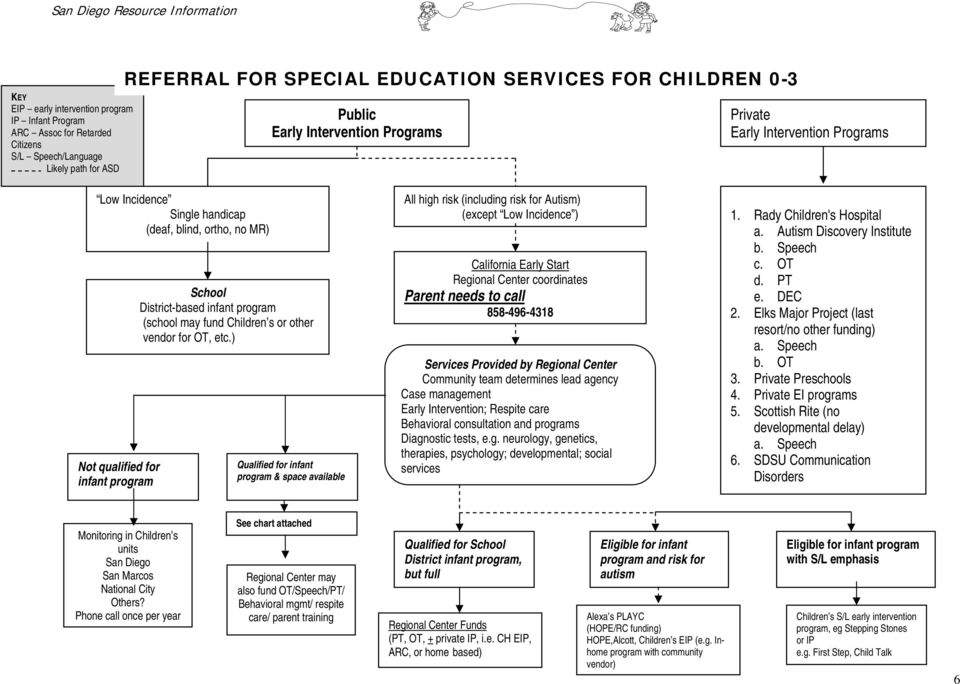
9 San Diego Resource Information KEY EIP early intervention program IP Infant Program ARC Assoc for Retarded Citizens S/L Speech/Language Likely path for ASD REFERRAL FOR SPECIAL EDUCATION SERVICES FOR CHILDREN 0-3 Public Early Intervention Programs Private Early Intervention Programs Low Incidence Single handicap (deaf, blind, ortho, no MR) Not qualified for infant program School District-based infant program (school may fund Children s or other vendor for OT, etc.) Qualified for infant program & space available All high risk (including risk for Autism) (except Low Incidence ) California Early Start Regional Center coordinates Parent needs to call Services Provided by Regional Center Community team determines lead agency Case management Early Intervention; Respite care Behavioral consultation and programs Diagnostic tests, e.g. neurology, genetics, therapies, psychology; developmental; social services 1. Rady Children's Hospital a. Autism Discovery Institute b. Speech c. OT d. PT e. DEC 2. Elks Major Project (last resort/no other funding) a. Speech b. OT 3. Private Preschools 4. Private EI programs 5. Scottish Rite (no developmental delay) a. Speech 6. SDSU Communication Disorders Monitoring in Children s units San Diego San Marcos National City Others? Phone call once per year See chart attached Regional Center may also fund OT/Speech/PT/ Behavioral mgmt/ respite care/ parent training Qualified for School District infant program, but full Regional Center Funds (PT, OT, + private IP, i.e. CH EIP, ARC, or home based) Eligible for infant program and risk for autism Alexa s PLAYC (HOPE/RC funding) HOPE,Alcott, Children s EIP (e.g. Inhome program with community vendor) Eligible for infant program with S/L emphasis Children s S/L early intervention program, eg Stepping Stones or IP e.g. First Step, Child Talk 6
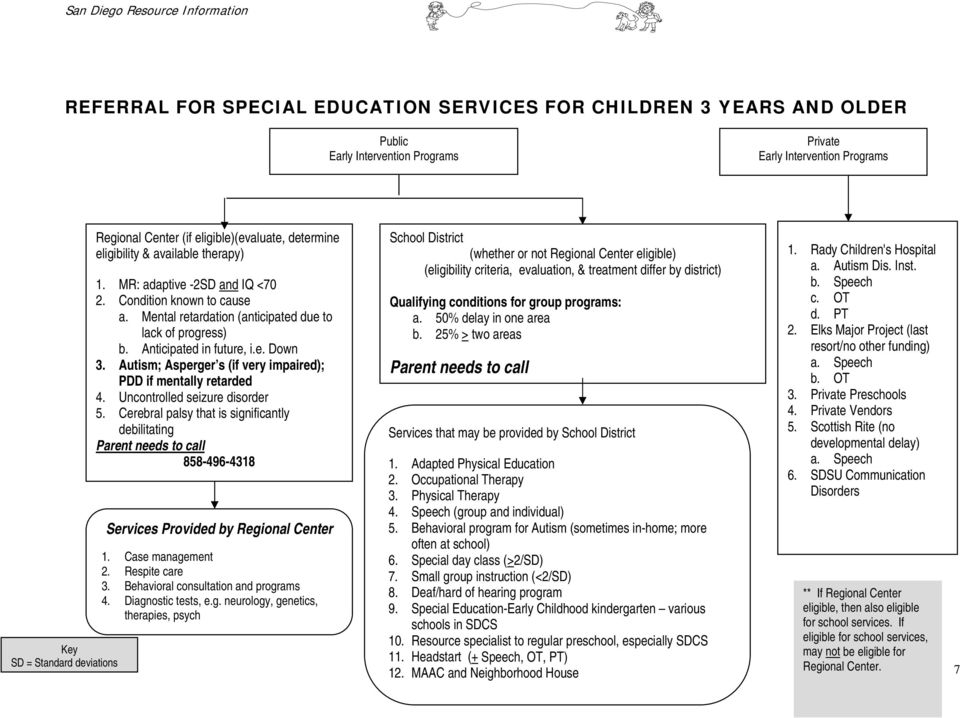
10 San Diego Resource Information REFERRAL FOR SPECIAL EDUCATION SERVICES FOR CHILDREN 3 YEARS AND OLDER Public Early Intervention Programs Private Early Intervention Programs Key SD = Standard deviations Regional Center (if eligible)(evaluate, determine eligibility & available therapy) 1. MR: adaptive -2SD and IQ <70 2. Condition known to cause a. Mental retardation (anticipated due to lack of progress) b. Anticipated in future, i.e. Down 3. Autism; Asperger s (if very impaired); PDD if mentally retarded 4. Uncontrolled seizure disorder 5. Cerebral palsy that is significantly debilitating Parent needs to call Services Provided by Regional Center 1. Case management 2. Respite care 3. Behavioral consultation and programs 4. Diagnostic tests, e.g. neurology, genetics, therapies, psych School District (whether or not Regional Center eligible) (eligibility criteria, evaluation, & treatment differ by district) Qualifying conditions for group programs: a. 50% delay in one area b. 25% > two areas Parent needs to call Services that may be provided by School District 1. Adapted Physical Education 2. Occupational Therapy 3. Physical Therapy 4. Speech (group and individual) 5. Behavioral program for Autism (sometimes in-home; more often at school) 6. Special day class (>2/SD) 7. Small group instruction (<2/SD) 8. Deaf/hard of hearing program 9. Special Education-Early Childhood kindergarten various schools in SDCS 10. Resource specialist to regular preschool, especially SDCS 11. Headstart (+ Speech, OT, PT) 12. MAAC and Neighborhood House 1. Rady Children's Hospital a. Autism Dis. Inst. b. Speech c. OT d. PT 2. Elks Major Project (last resort/no other funding) a. Speech b. OT 3. Private Preschools 4. Private Vendors 5. Scottish Rite (no developmental delay) a. Speech 6. SDSU Communication Disorders ** If Regional Center eligible, then also eligible for school services. If eligible for school services, may not be eligible for Regional Center. 7
11 San Diego Resource Information PUBLIC EARLY EDUCATION PROGRAMS Program Name Region(s) Served Location School Based Services HOPE Infant Program North Coastal: Del Mar, Solana Centers in: Beach, Rancho Santa Fe, South County All referrals Encinitas, Carlsbad, North Coastal (3) San Marcos Oceanside, Vista, San Marcos) North Inland North Inland: Escondido (and Ramona Fax referrals to: patients north and east) including Ramona South Bay: Coronado, National City, Chula Vista, San Ysidro Poway Home Based Services Ages 0-3 Contacts can be: Several per week Or One every one to two weeks Services - Other Behavior intervention Consultation services in Speech, OT, PT, and Audiology Alcott Infant Program FAX La Mesa/Spring Valley X Santee-Lakeside FAX Sevick Center FAX San Diego City Schools La Mesa Spring Valley Early Start Santee Lakeside Cajon Valley Mtn Empire Lindbergh-Schweitzer And Alcott Spring Valley Elementary Wintergardens School Center based months Center based months Home based 0-3 years Home based 0-3 years Home based 0-3 years Sevick Center months Home based 0-3 years Behavior intervention Consultation services in Speech, OT, PT, and Audiology Behavior intervention Consultation services in Speech, OT, PT, and Audiology Behavior intervention Consultation services in Speech, OT, PT, and Audiology Behavior intervention Consultation services in Speech, OT, PT, and Audiology California Early Start San Diego Regional Center Intake: Fax referrals to: San Diego County Ruffin Road Center based months Home based 0-3 Funding for services Diagnostics, OT, PT, Speech, Behavior Consultation/ Intervention Respite Care 8

12 San Diego Autism Society Resources San Diego Resource Information School Districts: Special Education Contacts North Coastal Districts: Bonsall Union Director of Special Education Cardiff D.S.E Carlsbad Unified D.S.E Del Mar Union D.S.E. & Psychologist Encinitas Fallbrook Elem. D.S.E. D.S.E Fallbrook Union Oceanside Unified Rancho Santa Fe San Dieguito Union San Marcos Unified Solana Beach Vallecitos Coordinator of Special Ed. D.S.E. D.S.E. D.S.E. D.S.E. D.S.E. D.S.E Vista Unified D.S.E HOPE Infant Family Support Program D.S.E East County Districts: Alpine Union D.S.E Cajon Valley D.S.E Dehesa D.S.E. & Superintendent Jamul-Dulzura D.S.E La Mesa/Spring Valley D.S.E Lakeside Union D.S.E Lemon Grove D.S.E Mountain Empire D.S.E Santee D.S.E South County Districts: Chula Vista D.S.E Coronado Unified D.S.E National City D.S.E San Ysidro D.S.E South Bay Union D.S.E Sweetwater Union D.S.E North Inland Districts: Borrego Springs Unified D.S.E Escondido Union D.S.E Julian Union D.S.E Poway Unified D.S.E Ramona Unified D.S.E San Pasqual Union D.S.E Spencer Valley D.S.E Valley Center Pauma Unified D.S.E Warner Unified D.S.E San Diego Unified District: San Diego City Schools San Diego Unified Early Childhood Parent Support D.S.E. D.S.E. D.S.E. D.S.E

13 San Diego Resource Information Assessment/Diagnostics/Therapy/Intervention 4Autism, LLC (949) Behavioral intervention services ACES, Inc. (619) Behavioral and educational services, assessments, tutoring, parent training Autism Experts Empowering Families and Children Together (619) Behavioral, assessment & consultation services, ABA, parent training, & support groups AIM (Applied Interventions & Methodologies) (858) Behavioral, educational & psychological services AIR-Autism Interventions and Resources (949) Behavioral intervention services Associated Speech Pathologists (760) Speech therapy and social skills groups Association for Retarded Citizens (ARC) (858) Will provide special needs childcare referrals Auditory Integration Therapy (858) Beard auditory integration training Autism Group Inc., The (858) Relationship Development Intervention, school consultation; parent training Autism Making A Difference -Consultation, coaching, and training for adolescents Autism Partnership (562) Intensive behavioral treatment for children with autism Autism Solutions for Kids (ASK) (949) Behavioral intervention services 10

14 San Diego Resource Information Autism Spectrum Consultants San Diego (858) Behavioral intervention, social skills groups, school shadowing, ABA, parent training, early start (early intervention through San Diego Regional Center), in-home consultations, and behavior consultations Balboa City School (619) Private K-12 academics with individual attention, Asperger s specific programming Banyan Tree Learning Center Point Loma (619) Special programs, school, respite services BEST Services, Inc. (619) Behavioral intervention services Brain Highways Center (760) Educational classes that examine behaviors in terms of neurological development and opportunity BRIDGES Educational Corporation (619) Behavioral intervention services, parent training, school consultation, school shadowing Rachel Brown, Behavior Consultant (619) Behavioral intervention services; parent training; school consultation, social skills CARES (Center for Autism Research, Evaluation & Service) (858) Educational, behavioral, and evaluation services, social skills groups, etc. CASE, Inc. (Comprehensive Autism Services and Education) (760) In-home programs, school consultation, social skills groups, summer camp, sex ed., etc. Center for Autism and Related Disorders (CARD) (858) Behavioral intervention services, in-home and school shadowing Coast Music Therapy (858) Music-assisted learning programs, adapted music lessons, early intervention Community Coaching Center (858) Program for socially appropriate behaviors and life skills 11

15 San Diego Resource Information Community Interface Services (760) Vocational & community living support for individuals with developmental disabilities Comprehensive Autism Center Inc. (951) In home and school ABA. Including Infant and Toddler Development Program, Early Intervention Applied Behavior Analysis Program, Socialization Groups, and Parent and Family Training. Comprehensive Autism Services and Education, Inc. (CASE) (760) Social skills training for children (4-18 years) with high functioning ASD, Friends Club (social skills group) Coyne & Associates, Inc. (760) Behavioral intervention services, play and language skill groups, education services Crimson Center for Speech and Language (858) Speech/language, psychology, occupational therapy, marriage/family counseling, free parent workshops, Baby Signs, Educ. Consultants, and Music Therapy consults DMS Consulting (619) Educational and behavioral consultation in the home and classroom; 1:1 educational and behavior modification services; parent/staff training; IEP coaching. Developmental Therapy Center (DTC) (619) Occupational therapy, sensory integration, yoga, art, sensory motor groups Excel Speech Therapy Center (858) Bonita (619) Provides physical therapy for pediatrics, adolescents, & adults, speech therapy, & occupational therapy Excelsior Academy (619) Grades 3-12 academics, social skills groups, Asperger s specific programming -Beard Auditory integration training (AIT) & Interactive Metronome (IM) Training Golden Steps Therapy (760) Occupational therapy with emphasis on sensory integration [email protected] 12

16 San Diego Resource Information I CAN PLAY! (858) :1 and group facilitation of social skills development Innovative Therapy-4-Kids (760) Occupational, speech, and physical therapy, social skills groups, therapeutic yoga, feeding evaluations, craniosacral therapy and other services Institute for Effective Education Children s Workshop (619) Cook Education Center (619) Private Applied Behavior Analysis School, Children s Workshop Program (ages 3-13) and Cook Educational Center (ages 6-22), special education school Jennifer Oke, Ph.D. (858) Assessment and treatment for individuals with autism & their families Kids Included Together (KIT) (858) Assistance for children with special needs for inclusion in community programs Kara Dodds and Associates Mission Valley (619) Encinitas (760) Speech, music, parent training, in-home services K.I.D.S. Therapy Associates (858) 673-KIDS -Speech, occupational and physical therapy, groups, feeding interventions, self-regulation Kirsch Therapy (760) Speech and occupational therapy, augmentative communication, sensory integration Lindamood-Bell Learning Processes (858) Programs designed to stimulate basic sensory functions related to learning Lovaas Institute for Early Intervention (LIFE) (858) Intensive behavioral intervention services Milestones Children s Therapy (760) Speech & Language therapy, occupational therapy, life coaching, social skills groups, sibling programs, diagnostic services, parent training and behavior management. Motiva Associates (619) Spanish & English counseling, behavioral intervention, school consultation 13

17 San Diego Resource Information The Music Therapy Center of California (619) Music therapy, school based lessons, consultation & group sessions Occupational Therapy, Etc. Kearny Mesa (858) Bonita (619) Occupational therapy, sensory integration, special diets Pacific Therapy, Inc. Ventura (805) Speech and language therapy Pioneer Day School (619) Alternative school and afterschool programs Promising Futures-Center for Independent Achievement (619) Unique vocational day program; residential services for adults with autism Pyramid Educational Consultants, Inc. (888) Consultation, supervision and training to home & schools on PECS (Picture Exchange Communication System) and behavioral intervention services Psychologists/Psychiatrists/Mental Health Professionals Chriss Allen, Ph.D. - autism experience, San Diego (619) Ext. 108 CCP Parent Aid Program RCHSD (858) Mary Baker-Ericzen, Ph.D.- autism specialization, child, adol., young adults (858) Richard Buccigross, MD Kearny Mesa (858) Sharon Lerner-Baron, Ph.D. - autism specialty (858) parent counseling/therapy, La Jolla Eve Dreyfus, MD PsyCare, Carmel Valley (858) Josh Feder, MD DIR Model, Solana Beach (858) Robert Friedman, MD PsyCare, Carmel Valley (858) Ellen Heyneman, MD Kearny Mesa (858) Martha Hillyard, Ph.D. - autism experience, San Diego (619) Angela Kilman, Ph.D. - autism experience, San Diego (619) Meg Lawrence, MD Clairemont (619) Mark Magulac, MD Rancho Bernardo (858) Monique Masse, MD Poway (858) Steven Meineke- family support, Solana Beach (858) Clarence Perry, MD San Diego (619) Audrey Phillips, MFT Rancho Santa Fe (858) Steven Pitman, Ph.D. Poway (858) Deborah Pontillo, Ph.D. developmental, behavioral specialty, Del Mar (858) Nick Putman, MD Encinitas (760) Lewis Ribner, Ph.D. Child, adol., adult therapy (858) Denise Ross, MFCC Encinitas (760)
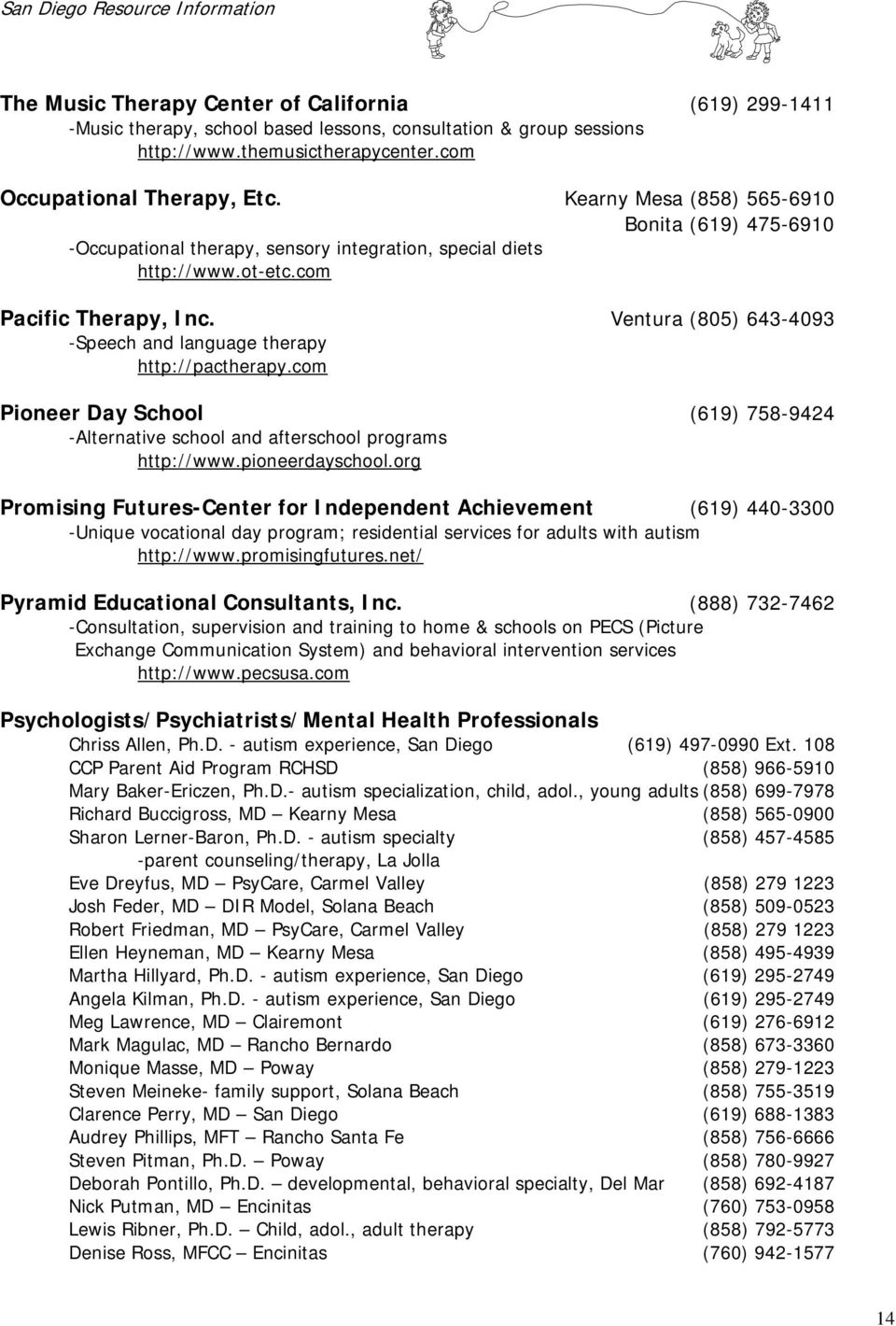
18 San Diego Resource Information DeeAnn Wong, MD Encinitas (760) Sheldon Zablow, MD Poway; La Jolla (858) Ronald Zappone, MD La Jolla (858) RCHSD Outpatient Psychiatry Main Center (858) Rancho Bernardo (858) Oceanside (760) Rady Children s Hospital Alexa s PLAYC (858) educational program designed to integrate early education for typically developing children and children with or at-risk for autism spectrum disorders (ASD). Autism Discovery Institute (877) 64AUTISM (858) First call for children with ASD at RCHSD. -offers coordinated services for children with autism spectrum disorders, as well as other behavior difficulties. Our programs use a variety of intervention strategies in naturalistic settings. -Provides intervention programs and parent and professional training programs; social skills groups; behavioral consultation Developmental Evaluation Clinic (858) Developmental or psychological assessments and recommendations Occupational Therapy/Sensory Integration (858) Therapy to enhance development, self-care, and sensory integration Speech, Hearing and Neurosensory Center (858) Offers language and hearing assessments, individual as well as multiple small groups Rescu Academy (619) Private school for children grades 6-12 that provides individualized support for behavior, mental health, and education difficulties San Diego Assistive Technology Center (858) Training and advocacy in augmentative communication systems San Diego Center for Children (858) Private school for children with developmental disabilities 15
19 San Diego Resource Information San Diego Regional Center Central (619) South (619) North (760) Imperial (760) State funded referral, evaluation, respite, behavioral consultation and advocacy services and California Early Start services for children under age 3 San Diego Treatment Network (858) Neuropsychology, psychology, speech therapy, occupational therapy, educational therapy, advocacy & music therapy in Mira Mesa area Sensory Learning Center (760) A multi-sensory therapy stimulating the auditory, visual and vestibular systems Sierra Academy (858) Nurturing learning environment in alternative setting for students, grades Also offers a life skills program for students up to age Small Talk Speech Therapy (619) Individual and small group therapy. Springall Academy (619) Provides an intensive, structured and individualized special education program STAR Program, Inc. Socialization Training & Reinforcement (858) After-school social skills program for children with autism and PDD Stein Education Center (858) A school for children with behavioral disorders and developmental disabilities; Strides Physical Therapy (858) Home and clinic-based physical therapy Teen Jam (and JuniorJam) -Social skills programs for children and teens in Scripps Ranch area [email protected] T.E.R.I. Inc. (760) Offers programs for children and adults with developmental & learning disabilities, including respite care 16
20 San Diego Resource Information The Winston School (858) Provides intensive special education program and individualized instruction, grades Total Education Solutions (619) One-on-one and small group sessions in speech and language therapy and occupational therapy in both environments and a clinical setting. Information Resources Autism Research Institute (866) Spanish (877) ext. 5 -Research center, publishes quarterly journal and information Autism Society of America California Chapter (858) State chapter of the national charitable organization with the mission of providing information on autism and the various approaches and treatment methods -San Diego chapter: Autism Society of America National Organization (800) Autism Speaks (212) Los Angeles (323) Advocacy, research, public awareness and support for Autism Spectrum Disorders California Department of Education - Special Education Division (916) Assistance and info regarding implementation of California Special Education Laws Exceptional Family Resource Center Central (619) S. County (619) N. Coastal (760) E. County (619) Imperial Co. (760) Provides support, referral information and education for families of children with disabilities and the professionals who assist these families National foundation for Autism Research (858) Provides funding for autism programming and research in SD 17

21 San Diego Resource Information National Information Center of Children & Youth with Disabilities (NICHCY) (800) National clearinghouse with many free resources Nisonger Center/Ohio State University (619) Medication Education for Consumers - Booklets available about developmental disabilities and psychotropic drugs, mood and behavior medicines as well as issues relating to a patient's rights and responsibilities. Organization for Autism Research (OAR) (703) Information and support, funds applied research in autism Valerie s List -Information, announcements, and networking To subscribe, [email protected] YMCA -Special needs childcare referrals, ages 0-12 years (619) x325 San Diego Research Opportunities Autism Research at the University of California, San Diego UCSD autism researchers have consolidated their recruitment information into one website to communicate autism-related research, assessment, and treatment opportunities at UCSD. The specific qualifications needed for participation, length of the project, and other details vary with each project. Projects change frequently, therefore only a general description of the programs is provided below. Please check the website for the most current information. Programs that can be accessed on this site include: Autism Center for Excellence and Healthy Infant Development Autism Research Program Dr. Laura Schreibman (858) Infant Vision Laboratory Dr. Karen Dobkins (858) Social and Cognitive Neuroscience Laboratory (858) Dr. Leslie Carver 18
22 San Diego Resource Information Research on Aging and Development Laboratory (858) Dr. Jeanne Townsend Other Research Programs in San Diego: Autism Diagnostic and Assessment Services Project (ADAPT) Dr. Natacha Akshoomoff (858) x Rady Children s Hospital Autism Research Dr. Aubyn Stahmer (858) x3223 UCSD Pediatric Neurology Research Group (858) There are several on-going research projects in the UCSD Neurology Laboratory related to Autism Spectrum Disorders UCSD Project in Cognitive and Neural Development Jodie Badgley (858) Children diagnosed with High-Functioning Autism, Language Impairment, Early Stroke, or Williams Syndrome between 7-12 years of age. [email protected] This is not an exhaustive list of research in San Diego. Additional Research Studies: Recreation Aqua Pros Swim School (619) Swim school that welcomes individuals with special needs; Offers Pool Pals program for SD Autism Society members ARTS- A Reason To Survive (619) 297-ARTS (2787) -Group or individual sessions for literary, visual, and performing arts projects for kids with special needs ASSERT-After School Social, Educational, & Recreational Therapy (619) therapeutic recreation and sensory integration, tutoring and homework assistance 19
23 San Diego Resource Information Boys & Girls Club of San Dieguito (858) Special needs groups after school in Solana Beach, Encinitas and Carmel Valley; inclusive recreation programs Camp I CAN (619) Weeklong summer camp exclusively for children with autism- Toby Wells YMCA in Kearny Mesa and Palomar Family YMCA in Escondido Camp Respite (858) Service provided by SDRC and provides weekend from Friday-Sunday Community Coaching Center (858) Community & behavioral life skills training and supervision for after school/saturdays/school vacation Coast Music Therapy (858) ext. 4 -Adapted music lessons, all ages and ability levels- Mira Mesa area Del Mar Sports Camps (858) Saturday and summer programs with an emphasis on sports acquisition and social skills Disneyland (714) Offers solutions to assist guests with special needs based on the individual needs of each family. Call the above number, or visit City Hall or Guest Relations for details. Friendship Circle (858) In-home social mentoring, sibling workshops, and Jewish holiday programs Easter Seals of San Diego (760) Adult day program, supportive employment, and camp Horsemanship for the Handicapped (619) Rehabilitation and therapy program offered at no cost to participants [email protected] Helen Woodward Animal Center (858) Pet encounters and training for disabled, therapeutic horseback riding 20
24 San Diego Resource Information Ivey Ranch Park (760) Daycare, respite care, recreational activities, and horseback riding Kids Included Together (KIT) (858) Assists children with special needs to be included in community recreation programs Kidspiration (619) Kid-friendly yoga and physical therapy, adaptive aquatics, birthday parties La Casa Center for Autism (619) Recreational and social programs for adolescents and young adults Lawrence Family Jewish Community Center (858) Recreation and social programs for children with special needs Legoland (760) Offers Premium Play Pass which includes park entry, front-of-the-line privileges, and reserved seating at shows. First-come first served, limited availability Music Therapy Center of California (619) Individual and group music therapy targeting language, social, and recreational skills SAS Supporting Alternative Solution (619) Provides in-home respite service, early childhood development program, vendor of San Diego Regional Center San Diego Park and Recreation Dept. Therapeutic Recreation (619) Services -Provides organized activities for all age groups, inclusion aides for community programs San Diego Zoo/ Wild Animal Park (619) x4900 -The Zoo offers an annual pass called the Koala Club for children with special needs. This pass allows the escort of the child to enter free of charge. A letter from a doctor stating the child s disability is required. Sea World (619) x2046 -Sea World offers an escort pass for children with special needs. The annual pass fee is reduced and allows the child s escort to get in free of charge. The pass also allows free parking. A letter from a doctor stating the child s disability is required. 21
25 San Diego Resource Information Special Olympics (619) Offers a variety of sports activities for individuals with intellectual disabilities, ages 8-adult Sports for Exceptional Athletes (858) Sports program and camp serving individuals with developmental disabilities ages 5 through adult. Stein Recreation Programs San Diego (619) Chula Vista (619) After-school socialization activities and programs, ages 3-17 in San Diego. Chula Vista location is Stein Education Center, which is a special education school. Summer Camps for Children with Disabilities (800) Directory of campsites Surfers Healing -Surf camps and lessons for children with autism (866) 647-HEAL Tender Loving Canines, Assistance Dogs (858) Provides custom-trained dogs for children with autism and their families United Cerebral Palsy Toy Lending Library (858) Circulates throughout the county loaning toys and software of families of children with special needs VALR Martial Arts and Karate Center (858) Private and group martial arts training for children with autism. XCITESTEPS (858) Variety of different after school programs, recreational sports, social skills, vocational opportunities, for children through adults with developmental disabilities 22
26 San Diego Resource Information Family Support Autism Society of America-San Diego Chapter (858) Spanish Language Support/Grupo de Apoyo en Español Autism Tree Project Foundation (619) Birth and Beyond Years (military families) (619) COMPASS Family Center & Services (619) (619) Crimson Center (858) Rady Children s Autism Discovery Institute (858) Exceptional Family Resource Center & (800) HOPE Infant Family Support (South) (619) (North) (760) Fragile X Center of San Diego (760) (877) International Association for Life Quality A Teri Initiative (760) Provides Life Quality Plans for individuals with disabilities. Kaiser Support Group (Kaiser families) (858) Navy Exceptional Family Member Program (619) Parent Advocates Seeking Solutions (PASS) Parents of Students in Special Education (POSSE) (619)
27 San Diego Resource Information Resources for Students with Autism/Parent Support Group (858) For parents with children in San Diego Unified School District -Contact Dr. Jodi Robledo; Rady Children s Hospital Autism Discovery Institute (858) Parent information and support group SibKids and SibNet Listservs (206) To sign up visit website Spanish Language Support (800) Talk About Curing Autism Now (TACA) Understanding Autism Together (military families) (619) United Cerebral Palsy Association (858) YMCA- Armed Forces (military families) (619) Respite Care Camp Respite (858) SDRC program providing respite weekends from Friday at 6pm Sunday at 2pm Community Coaching Center (858) Community and life skills training and supervision afterschool/saturday/vacation Community Living Services (ARC of San Diego) (619) Provides in-home respite services; SDRC vendor Home of Guiding Hands (619) Residential services and support for individuals with mental retardation. Includes individual life skills training, respite services, and training and support to adults who live independently. Ivey Ranch Park (760) Daycare, respite care, recreational activities and horseback riding 24
28 San Diego Resource Information San Diego Regional Center Main (858) San Marcos (760) East County (619) National City (619) Imperial (760) Supporting Alternative Solutions (SAS) (619) Provides in-home respite services, early childhood development program; SDRC vendor T.E.R.I. Inc., Respite Services (760) Provides in-home, afterschool and Saturday respite services; SDRC vendor YMCA -Provides in-home and out-of-home respite services; SDRC vendor (800) Dentists in San Diego that will treat children with special needs Children s Healthcare Referral Line (800) [email protected] San Diego Regionwide Task Force On Oral Health for People (858) Choose Patient Referral service option With Disabilities Dr. Tim Christian (858) San Diego Children s Dental Clinic (619) Oral Hygiene visits can be requested through San Diego Regional Center. Client should request through Case Manager. Developmental Optometrist Susan L. Daniel, O.D. (760) [email protected] Normal A. Rose, O.D. (760) [email protected] 25
29 San Diego Resource Information Sensory Processing and Integration Resources: Services and Supplies The Alert Program for Self-Regulation Therapy Works, Inc. (877) Balametrics, Inc. (800) The Handle Institute (415) (Neuro-developmental educational therapy) Sensory Learning Center (760) Southpaw Enterprises, Inc. (800) The Developmental Delay Resource (800) Products: California Telephone Access Program Phones for individuals with difficulty seeing, hearing, speaking, remembering, and moving. Lakeshore Learning Store (619) Educational products for children ages 0 to 11 years, adults and teachers. Mobile Thinking, LLC (619) Software to track and share discrete trial and behavioral data Note Abilities: Kibbles Rockin Clubhouse -DVD series designed to teach social skills through creative visuals, peer modeling, and fun songs to children ages 3 to 9 who have autism. Safe Art (858) Organic and all natural activity dough contains no lead, heavy metals, bromine, artificial coloring and is wheat and gluten free. 26
30 San Diego Resource Information Stages Learning Materials (530) Flash card sets, posters, for language skills, sorting, cognitive skills etc. United Cerebral Palsy Toy Lending Library (858) Circulates throughout the county loaning toys and software of families of children with special needs Biomedical Information Gluten and Casein Free Diets Autism Educational Services (732) Ener-G Foods (800) The Gluten Free Pantry (800) The Gluten-Free Baker Newsletter 361 Cherrywood Drive, Fairborn, Ohio, Trader Joe s, Whole Foods & Henry s Marketplace -Various locations throughout San Diego County - These stores offer a variety of items that are gluten-free Websites: The Pure Pantry (866) [email protected] The University of Florida- Research The Gluten Free, Casein Free Diet The Gluten Free Pantry Miss Roben s Feingold Dietary Program Mrs. Leeper s (816) [email protected] Edward & Sons 27
31 San Diego Resource Information Vitamin Therapy Websites: Center for the Study of Autism Kirkman Laboratories, Inc. Attorneys and Advocates San Diego and Los Angeles Resources Advocacy Services (858) Alternatives in Education (619) California Association of Private Special Education Schools (CAPSES) (916) Community Advisory Committee Poway Unified (858) San Diego Unified (858) COMPASS Family Center & Services (619) (619) Sliding scale family support, educational consultants, health consultation, family counseling, and research for children with special needs Developmental Disabilities Area Board XIII (619) East County Special Education Local Planning Area (SELPA) (619) John Kardos, ChLP (858) Learning Disability Association-San Diego (858) Legal Aid Society (619) Susan Moroff, Special Education Advocate (760) North Coastal SELPA (760) North Inland SELPA (760) Deb Plotkin Advocate (858)
32 San Diego Resource Information Poway Unified School District Special Education Parent Facilitator Program (858) x2525 San Diego City Schools- Office of Ombudsperson (619) San Diego City Schools Special Education Parent Helpline (619) San Diego SELPA (619) San Diego People First (619) South County SELPA (619) Team of Advocates for Special Kids (TASK) Of San Diego (619) Volunteer Lawyer Program of San Diego (619) Jayne Whitney- Education Consultant (760) Bonnie Yates- attorney (310) National Organizations CARES Notebook (866) x4 Community Alliance for Special Education (415) The Council for Disability Rights Federation for Children with Special Needs (617) Merrill Lynch Special Needs Trusts MERRILL errer=productfinderbycategory Parent Advocacy Coalition for Educational Rights (888) Protection & Advocacy, Inc. (PAI) (619) Social Security Benefits (800)
33 San Diego Resource Information Internet Resources Asperger s Education Network Autism Link Page Autism National Committee Autism Network International Autism Network for Dietary Intervention Autism Research Institute Autism Society of America Autism Speaks Cognitive Enhancement Research Institute Developmental disabilities Resources for healthcare providers Disability Resource Catalog Exceptional Family Resource Center FEAT- Families for Early Autism Treatment Four Leaf Press Future Horizons Publisher that specializes in ASD Interdisciplinary Council on Developmental and Learning Disorders International Society for Autism Research National Information Center for Children and Youth with Disabilities National Autism Center Organization for Autism Research Parents Helping Parents Protection and Advocacy, Inc. San Diego County Chapter of the Autism Society of America The Autism Online Community
34 San Diego Resource Information Books The following books are available at: By ordering these books directly from the links on this page, a percentage of all sales goes to the San Diego Autism Society to help support programs and outreach. Introductory Books: The Autism Book: Answers to Your Most Pressing Questions S. Jhoanna Robledo and Dawn Ham-Kucharski (2005) Penguin The Autism Sourcebook: Everything You Need to Know About Diagnosis, Treatment, Coping, and Healing Karen Exhorn (2005) Collins Autism Spectrum Disorders Wetherby & Prizant (2000) Brookes Publishing Co. Autism Spectrum Disorders: The Complete Guide to Understanding Autism, Asperger's Syndrome, Pervasive Developmental Disorder, and Other ASDs Chantal Sicile-Kira & Temple Grandin (2004) Berkley Publishing Group Autism Treatment Guide, 3 rd Edition Elizabeth Gerlah (2003) Future Horizons Inc. The Child with Special Needs: Encouraging Intellectual and Emotional Growth Stanley I. Greenspan, Serena Wieder, & Robin Simmons (1998) Merloyd Lawrence The Complete Guide to Asperger s Syndrome Tony Attwood (1998) Jessica Kingsley Publishers Keys to Parenting the Child with Autism Marlene Brill (1994) Barron Ten Things Every Child with Autism Wishes You Knew Ellen Notbohm (2005) Future Horizons Inc. The Science and Fiction of Autism Laura Schreibman (2007) Harvard University Press Families & Personal Accounts: The Boy Who Loved Windows Patricia Stacey (2003) DeCapo Press Eating an Artichoke: A Mother s Perspective on Asperger Syndrome Echo R. Fling (2000) Jessica Kingsley Publishers Just This Side Of Normal Elizabeth Gerlach (1999) Future Horizons Let Me Hear Your Voice Catherine Maurice (1993) Ballantine Books Living With Autism: The Parents Stories Kathleen M. Dillon (1995) Parkway Publishers Making Peace with Autism: One Family s Story of Struggle, Discovery, and Unexpected Gifts Susan Senator (2006) Trumpeter 31
35 San Diego Resource Information Miracle Milestones: One Autistic Child s Journey Marilyn Gefland and Sue Barron (2004) Trafford Pretending to Be Normal Liane Holliday Wiley (1999) Jessica Kingsley Publishers There s a Boy In Here Judy and Sean Barron (2002) Future Horizons Thinking in Pictures: My Life with Autism Temple Grandin (2006) Vintage Books Siblings: Brothers & Sisters: A Special Part of Exceptional Families Peggy Gallagher, Thomas Powell, & Cheryl Rhodes (2006) Brookes Publishing Co. Siblings of Children with Autism: A Guide for Families Sandra Harris & Beth Glasberg (1995) Woodbine House For Children: All About My Brother Ages 6-10 Sarah Peralta (2002) Autism Asperger Publishing Co. Are You Alone On Purpose? Ages 9-12 Nancy Werlin (1994) Penguin Group Everybody is Different: A Book for Young People Who Have Brothers or Sisters with Autism Ages 9-12 Fiona Bleach (2001) The National Autistic Society Ian s Walk: A Story about Autism Ages 4-8 Laurie Lears (1998) Albert Whitman & Co. My Brother Mathew Ages 4-8 Mary Thompson (1992) Woodbine House My Brother Sammy ages 4-8 Becky Edwards & David Armitage (2000) Bloomsbury Publishing Pl. My Friend with Autism: A Coloring Book for Peers and Siblings Ages 5-8 Beverly Bishop & Craig Bishop (2002) Future Horizons Views from Our Shoes: Growing Up With a Brother or Sister with Special Needs Ages 9-12 Donald J. Meyer (1997) Woodbine House Education & Treatment: 1001 Great Ideas for Teaching and Raising Children with Autism Spectrum Disorders Veronica Zysk & Ellen Notbohm (2004) Future Horizons Autism Treatment Guide Elizabeth Gerlach (1996) Four Leaf Press Behavioral Intervention for Young Children with Autism Edited by Maurice, Green and Luce (1996) Pro- Ed The Complete IEP Guide: How to Advocate for your Special Ed Child Lawrence M. Siegel (2007) Nolo Do-Watch-Listen-Say: Social and Communication Intervention for Children with Autism Kathleen Quill (2000) Brookes Publishing Co. Educating Children with Autism National Research Council (2001) National Academy Press 32
36 San Diego Resource Information Engaging Autism: Using the Floortime Approach to Help Children Relate, Communicate, and Think with the DIR/Floortime Approach Stanley Greenspan and Serena Wider(2006) De Capo Press Helping Children with Autism Learn: Treatment Approaches for Parents and Professionals Bryna Siegel (2003) Oxford University Press The New Social Story Book, 2 nd Edition Carol Gray (2000) Future Horizons The Out of Sync Child: Recognizing and Coping with Sensory Processing Disorder Carol Kranowitz & Lucy Miller (2006) Perigee Trade Overcoming Autism: Finding the Answers, Strategies, and Hope that Can Transform a Child s Life Lynn Koegel and Claire Lazebnik (2004) Viking Penguin Books Reaching Out, Joining In: Teaching Social Skills to Young Children with Autism Mary Jane Weiss and Sandra L. Harris (2001) Woodbine House Teaching Children with Autism: Strategies to Enhance Communication & Socialization Kathleen Ann Quill (1995) Thomas Delmar Learning The TEACCH Approach to Autism Spectrum Disorders Gary Mesibov, Victoria Shea & Eric Schopler (2004) Springer Teach Me Language: A Language Manual for Children with Autism, Asperger s Syndrome and Related Developmental Disorders Sabrina Freeman and Lorelei Dake (1997) SKF Books A Work in Progress: Behavior Management Strategies & A Curriculum for Intensive Behavioral Treatment of Autism Ron Leaf, John McEachin & Jaisom Harsh (1999) DRL Books Peer Play and the Autism Spectrum: The Art of Guiding Children's Socialization and Imagination Pamela Wolfberg (2003) Autism Asperger Publishing Co. Laws & Advocacy: The Complete IEP Guide: How to Advocate for Your Special Ed Child Lawrence M. Siegel (2007) Nolo From Emotions to Advocacy: The Special Education Survival Guide Peter Wright & Pamela Wright (2006) Harbor House Law Press How to Compromise With Your School District Without Compromising Your Child: A Field Guide for Getting Effective Services for Children with Special Needs Gary Mayerson (2004) DRL Books Negotiating the Special Education Maze: A Guide for Parents and Teachers Winifred Anderson, Stephen R. Chirwood & Deidre Hayden (1997) Woodbine House 33
37 San Diego Resource Information Magazines and Journals Journal of Autism and Developmental Disorders Focus on Autism and Developmental Disorders Autism: An International Journal Autism Research Research in Autism Spectrum Disorders The Advocate Autism Spectrum Quarterly The Autism Perspective Spectrum The Source Autism/Asperger s Digest Charities and Foundations Autism Research Institute Autism Society of America Foundation Autism Speaks Doug Flutie, Jr. Foundation for Autism Research Institute Kyle s Treehouse National Foundation for Autism Research 34
38 San Diego Resource Information Rady Children s Hospital Resources Autism Discovery Institute Services for Children with Autistic Spectrum Disorder AUTISM Call for current program availability. Diagnostic Evaluations Children s Developmental Evaluation Clinic provides evaluations by psychologists trained in the area of autism. Psychologists use standardized tests, parent interview, play-based assessment, and clinical observation to identify communication disorders, developmental delay, autistic spectrum disorders and other developmental challenges. The psychologist assists parents in determining the need for intervention and makes referrals to appropriate resources. Recommendations include referrals to public and private programs throughout the county. For further information or to schedule an evaluation, contact the Developmental Evaluation Clinic at: (858) Transdisciplinary Evaluations are also available. These include a psychologist, speech therapist, occupational therapist and a behavioral pediatrician, who evaluate children together in a unified assessment of development in all areas. These evaluations are offered on a fee-for-service basis only. Discipline Specific Evaluations Evaluations of speech and language, hearing, neurological assessment, sensory motor, fine motor and gross motor skills can be obtained by contacting the specific department. If your child requires further evaluation in any specific area after a diagnostic evaluation, the psychologist will refer you to the appropriate department at the developmental evaluation, or your pediatrician may refer you to a specific department based on concerns. After the specific evaluation your child may be referred for individual therapy. Individual therapy is also available at Children s Hospital. Specific individual evaluations and therapy can be scheduled through each department. Children s employs occupational therapists trained in sensory integration techniques. Speech and Hearing Center (858) Occupational Therapy (858) Physical Therapy (858) Neurology (858) Audiology (858) Parent Child Developmental Behavioral Therapy ADI provides parent training and education to help parents of children with ASD. This program is designed to teach parents how to interact with their child in ways that facilitate play, language, self-help and social skills, while reducing inappropriate behaviors. Skills are taught in individual sessions with the child and parent(s) one time per week. Intervention techniques vary according on the needs of the family and child, and often incorporate naturalistic behavioral strategies, interactive/developmental methods and Positive Behavioral Support techniques. Intensive Parent Training An Intensive Parent Training Program to help parents of children with ASD on a concentrated timeline. This course is appropriate for families who live in geographically distant areas with limited services and for those who live locally and desire accelerated parent training. Parents learn skills that increase their child s communication, play, and appropriate behaviors during one week (3 hours per day) of intense 35
39 San Diego Resource Information parent training from a psychologist or developmental specialist. Individual goals are set, and techniques frequently used include Pivotal Response Training, Interactive/developmental techniques, PECS, and Positive Behavioral Support. Parent Lecture Series/Support Group A six-week interactive, inspiring, educational program that introduces strategies to help parents effectively communicate with their children and encourage the development of language. The series teaches behavioral principles and practical techniques to decrease problem behaviors. It explores frequently used therapeutic approaches and provides information to assist in the development of an effective Individual Education Plan (IEP). There is an optional support component to the lecture series consisting of opportunities for discussion and support relating to the joys and challenges of raising a child with ASD. In Home Behavior Support and Behavior Support Consultation A behavioral specialist will provide in-home or in-clinic consultation with families and/or professionals to teach Positive Behavior Support techniques to improve self-help skills, compliance, sleep behaviors, or other issues needing attention. Following completion of this service, parents and/or providers will be empowered and knowledgeable in applying procedures to improve difficult behaviors and increase low frequency appropriate behaviors. The number of sessions will vary dependent on child and family needs. Social Skills / Social & Language Groups A variety of group therapy programs designed for children with high functioning PDD-NOS, autism or Asperger's Disorder are available. Goals of these groups include assisting children in classroom participation, perspective taking skills, peer interaction, and social/emotional development. Children participate in specific groups based on age and skill level. Groups meet 1-2 times per week and include a parent information component. Educational Consultation Educational consultations assist children with ASD or behavioral difficulties in their school placements. A master s or doctoral level specialist will meet with you and observe your child in his or her classroom environment to make behavioral and program recommendations. The specialist will also attend your child s IEP if desired. Inservices for school personnel working with your child are available as well. Alexa's PLAYC (Playful Learning Academy for Young Children) Formerly called the Child Care Center and Toddler School, Alexa's PLAYC provides children with a warm and loving environment that stimulates physical, social, intellectual and emotional growth. Located less than a mile from the main Hospital campus in Serra Mesa, Alexa's PLAYC welcomes children ranging in age from 18 months to 6 years. Alexa's PLAYC is an educational program designed to integrate early education for typically developing children and children with or at-risk for autism spectrum disorders (ASD). The Alexa's PLAYC curriculum focuses on teaching developmentally appropriate communication, cognitive and social skills and fosters independence in activities of daily living for all children involved. New students entering Alexa's PLAYC will receive a developmental screening to ensure that placement is appropriate. Resource Center for Parents ADI also offers a resource and lending library for parents. This is made possible by donations from the Biasco Foundation and from the San Diego Chapter of the Autism Society of America. Through our resource center, we offer information to parents through a large selection of books and articles addressing issues of Autism Spectrum Disorders. 36
40 San Diego Resource Information The Autism Society of America San Diego County Chapter (SDASA) The San Diego County Chapter of the Autism Society of America (SDASA) provides monthly informational meetings with timely topics where parents can network and find needed support. The SDASA has also funded libraries featuring various books and videos that are available on loan from the Exceptional Family Resource Center and Rady Children s Autism Discovery Institute. Membership in SDASA also includes a quarterly newsletter, keeping members informed on current topics, upcoming events and substantial member discounts on many chapter sponsored activities. Joining the San Diego Chapter will be especially helpful for meeting other parents who have struggles with the same issues. They can be your best resource for locating physicians, therapists and other professionals who can assist in your efforts. The Autism Society exists as a support, information and advocacy organization for individuals with Autism Spectrum Disorders and their families. You can access the Autism Society of America by calling Autism. The San Diego County Chapter can be reached by calling (858) , at [email protected]. You may also visit the website at 37
41 Sibling Needs Sibling Issues Helpful Information for Parents DEVELOPMENTAL CONSIDERATIONS What do you tell? Preschoolers (Before age 5) Children in this age group are unable to articulate their feelings, so they will likely show their feelings through their behavior. They will be unable to understand the special needs of their sibling, but they will notice differences and may try to teach their brother or sister. Children of this age are likely to enjoy their sibling because they have not learned to be judgmental and their feelings toward their siblings will likely be linked to normal sibling interactions. Elementary School Age (5 to 12) These children start venturing out into the world and become acutely aware of the differences between people. They have the ability to comprehend a definition and explanation of their sibling s special need as long as it is explained to them in terms that they can understand. They may worry that the disability is contagious or wonder if something is different about them, too. They may also experience guilt for having negative thoughts or feelings about their sibling as well as guilt for being the child who is not disabled. Some typical responses of children this age are to become OVERLY helpful and well behaved or to become non-compliant in order to obtain a parent s attention. Throughout this age span, the children will have conflicting feelings about their sibling. This happens in sibling relationships that do not include a disability, too. Adolescents (13 to 17) Adolescents have the capability of understanding more elaborate explanations of the particular disability. They may ask detailed and provocative questions. The developmental task of adolescence is to begin discovering oneself outside of the family. At the same time, conformity with peer groups is important. Therefore, for children this age, having a sibling who is different may be embarrassing in front of friends and dates. They may feel torn between their desire for independence from the family and maintaining a special relationship with their sibling. They may resent the amount of responsibility, and they may begin worrying about their sibling s future. EDUCATE YOUR CHILDREN Provide information to the child about how the condition is evaluated, diagnosed and treated. 1. The children need to know what the disability is and what to expect. 2. Explain the strengths and weaknesses of the child with the disability. 3. Explain ways to interact with sibling. 4. Explain ways to help with sibling. 38
42 Sibling Needs BALANCE TIME SPENT WITH CHILDREN 1. Encourage child to have activities unique to him/her. 2. Parental participation in activities outside the disability world/community with the child is important. 3. Parental recognition of child s strengths and accomplishments can build feelings of self worth. OPEN DISCUSSION 1. Open discussion in the family should exist where member s positive and negative feelings are expressed. 2. Discussions of ways to cope with stressful events such as peers and public reaction, as well as unexpected changes in family plans and extra home responsibility are important. SIBLING GROUPS 1. Participation in a group for siblings allows the children to meet others who are in the same circumstance. 2. A group also provides children with the chance to discuss feelings, which may be difficult to express to the family. WARNING SIGNS Depression 1. Change in child s sleeping habits 2. Change in child s eating habits 3. Sense of helplessness/hopelessness 4. Continued sense of irritability 5. Mentions hurting self (e.g., I wish I was dead ) 6. Difficulty making decisions or concentrating 7. Lack of pleasure in activities 8. Social withdrawal 9. Low self-esteem Anxiety 1. Excessive worry 2. Increased energy level without a purpose 3. Tearful at slightest frustration 4. Has difficulty separating from parents 5. Sleeping problems or change in sleeping habits 6. Changes in eating habits 7. School phobia 8. Worry about health or well being of family members 9. Somatic symptoms (e.g., stomachaches and headaches) 10. Perfectionism If your child displays a number of these symptoms for a prolonged period of time (2 weeks or more), it may be advisable to discuss the situation with the child s pediatrician or a local mental health professional. 39
43 Therapeutic Approaches Therapeutic Approaches Parents of children who fall on the autistic spectrum are frequently overwhelmed when confronted with the many treatment/educational approaches suggested for their children. The following is an explanation of some of the most widely used techniques. This list is not exhaustive. Some of these techniques are comprehensive programs, while others are designed to target a specific area. This listing does not constitute an endorsement of any particular technique, but is intended to be informational only. Some of these techniques have been well researched, while others are based on very limited evidence. This guide will give you a brief description only. Please find out more about any techniques you decide to use with your child. Discrete Trial Training (DT) Discrete Trial Training Theory: Discrete Trial Training is one type of treatment based on applied behavior analysis principles (ABA). This teaching method involves breaking tasks down into simple elements and teaching the child through repetition. An individualized program is designed for each child so that the child s specific strengths and weaknesses are appropriately addressed. Sessions are typically highly structured and more teacherdirected than child-directed. DT Goals: The goal of a DT program is to teach the child all that is required of a typically developing child of the same age. New students may focus on developing learning readiness skills such as sitting in a chair, responding to his/her name, establishing joint attention and learning how to focus on teaching materials. Once these skills are learned, programs may work on imitation skills, learning to follow simple commands, and increasing receptive and expressive vocabulary (labels, requests, etc). As the child progresses, the skills become more advanced, but the methodology and prompting techniques remain consistent. This method is designed to develop cognitive, play, social, and self-help skills. DT Technique: The instruction is most often performed one-on-one in the home or school with therapists. Specific techniques include: Breaking a skill into smaller parts Teaching one sub-skill at a time until mastered Providing opportunities for repetition in concentrated periods of time Prompting and fading prompts as necessary to reach independence Using reinforcement procedures Flexibility and patience are extremely necessary for DT. Language, social and play skills typically develop over months and years of intervention Additional information: Website: Book: A Work in Progress: Behavior Management Strategies & A Curriculum for Intensive Behavioral Treatment of Autism by Leaf & McEachin, (DRL Books, 1999) 40
44 Therapeutic Approaches This listing does not constitute an endorsement of any particular technique, but is intended to be informational only. Please work with a qualified professional to develop an appropriate, individualized intervention plan for your child. DIR/Floor Time DIR/Floor Time Theory: People with autism, like everyone, need to be calm and regulated enough to engage in warm, emotionally connected relationships that are truly reciprocal with mutual growth and learning (e.g. between parent and child, teacher and student, employee and fellow employee, etc.). DIR/Floortime looks at the Developmental level of the person (regulation, engagement, gestural reciprocity, etc.), often using the Functional Emotional Developmental Scale, the Individual differences of the person (with things like talking, moving, and other things), and uses our Relationships with others as the most important way to learn and grow together. DIR/Floor Time Intervention: In DIR/Floortime, every time we talk, play, or teach we start by seeing if the other person is calm enough to do things with us. If not, we help the person settle down. Usually that means just waiting a bit and seeing what the person is doing (following the person s lead). Sometimes, it means doing other things with the person to help them calm down. The next thing we do is woo the person into an interaction, usually by either joining in or playfully getting in the way of the other person. We look for the gleam in the eye that comes when you know the other person knows that you are both being playful. When we do this, the other person usually does something different, and so we keep doing things to see what the other person does. We try to keep these circles of play going, and as we do this we build a real, growing, learning bond with the other person. We can do this with all sorts of people, from children who seem to only flap their hands to people who can talk really well but get stuck with things like making friends. We do DIR/Floortime all day, every day. Its fun when we play and with young children that is often on the floor - but it can be done in the car, at the store, in class, at home, and in any situation. DIR/Floortime helps people react better to change and to the things that bother them, from scratchy clothes or loud noise to mean kids or even mean bosses. DIR/Floortime can help people learn how to care about other people and think about how other people feel. DIR/Floortime is a very useful way to think about and help people with autism and autism-like problems. DIR/Floor Time Goals: DIR/Floortime goals follow functional, developmental, emotional levels to assist the person in improving and mastering necessary developmental skills. I. Self-Regulation and Attention Goal: Take in sights and sounds and maintain shared attention II. Engagement and Relating Goal: Woo another and be wooed, stay engaged through emotions in warm interaction III. Use Affect to Convey Intent - Two Way Communication Goal: To do this for requests, emerging back and forth interactions IV. Behavioral Organization and Problem Solving Goal: Continuous flow of affective interactions with people for shared social problem solving V. Creates and Elaborates With Symbols Goal: Represents ideas and emotional themes in play and other interactions. VI.. Emotional Thinking: Logical Abstract Goal: Bridges ideas, elaborates and can reflect on actions, motives, aware of time and space Additional information: Dr. Josh Feder offers monthly open community meetings in Solana Beach (look for announcements on [email protected]) Website: or Book: Engaging Autism: Using the Floortime Approach to Help Children Relate, Communicate and Think with the DIR/Floortime Approach by S. Greenspan & S. Wieder (De Capo Press, 2006) 41
45 Therapeutic Approaches This listing does not constitute an endorsement of any particular technique, but is intended to be informational only. Please work with a qualified professional to develop an appropriate, individualized intervention plan for your child. Music Therapy Music Therapy Theory: Music therapy is a professional health discipline which uses music as a therapeutic stimulus to achieve nonmusical treatment goals. Findings from a recent analysis of music therapy research in the area of autism (Whipple, 2004) support the benefits of this intervention to assist in communication, on-task behavior, social development, self-care skills, and anxiety reduction. Additionally, research indicates enhanced processing and interest in musical stimuli for a subset of individuals on the autism spectrum. In combination with other evidence-based techniques, music is a strong modality to engage individuals with autism in more challenging or non-preferred tasks. For a complete research list (including the metaanalysis referenced above), visit Music Therapy Goals: As an adjunct learning support, many need areas can be targeted through music-based strategies. Techniques that are frequently utilized for individuals on the autism spectrum include: Teaching and role play of social scripts and scenarios via song-cued format Practice and repetition of vocal sounds, speech phrases, or conversation scripts through melodic & rhythmic techniques Presentation of academic facts, self-help sequences, and language concepts through song or chant Gross and fine motor exercises and motor imitation cued by rhythm or instrument play Engagement in music performance, songwriting, or music-facilitated social groups to encourage emotional expression, creativity, and interpersonal skills Music to assist with calming, self-regulation, and transitions Music Therapy Credentialing & Programs: A professional music therapist holds a minimum of a Bachelor s Degree in Music Therapy from an accredited university in addition to completion of 1200 hours of clinical training, and national board certification. For more information on this credentialing process, visit Services frequently offered by music therapists include: early intervention, adapted music lessons, educational services, individual and group therapy sessions, consultation and collaboration with other treatment providers, and development of resources for home or school carry-over. Additional information: Website: Picture Exchange Communication System (PECS) PECS Theory: The Picture Exchange Communication System offers children a unique alternative to verbally-based communication systems and is founded on applied behavior analysis and Verbal Behavior principles. It can be used in a variety of settings including the home, the classroom, and the community. According to the proponents of this system, it is more beneficial than other types of augmentative communication because natural reinforcers are used, there is no need to train prerequisite skills such as pointing or imitation, and natural use of communication is built into the program. 42
46 Therapeutic Approaches This listing does not constitute an endorsement of any particular technique, but is intended to be informational only. Please work with a qualified professional to develop an appropriate, individualized intervention plan for your child. PECS Goals: The goal of PECS is to teach children a form of communication that requires few prerequisite skills. PECS provides children with a functional form of communication that allows them to get needs met, make choices, engage with people socially, and form a sense of control over their environment. Research indicates that children using PECS typically also use spoken language after a period of time. PECS Technique: Children using PECS are taught to give a picture of a preferred item to a communicative partner in exchange for the item. The initial communicative behavior targeted is initiating a request and preferred items serve as reinforcers for communication. The communication is motivating for the child because he/she is receiving reinforcement for his/her choice. Requesting is an extremely useful skill and may facilitate the development of other communicative intents. Physical prompts are faded quickly in order to insure independent communication. Once requesting with pictures is firmly established, the child is encouraged to verbalize the request. PECS is set up in a series of phases which include training of initiations, requesting, use of sentences, commenting, and complex use of communication. Additional information: Website: Book: The Pyramid Approach to Education in Autism. A. Bondy & B. Sulzer-Azaroff (Pyramid Educational Products, 2002) Pivotal Response Training (PRT) Pivotal Response Training Theory: Pivotal Response Training (PRT) is a naturalistic intervention based on the principles of applied behavior analysis. PRT targets certain pivotal areas for treatment that are believed to be central to wide areas of functioning, so positive changes in pivotal behaviors should have widespread effects on many other behaviors. Important pivotal areas addressed using PRT are motivation and responsivity to multiple cues. This intervention is flexible and designed to be used in structured one-on-one teaching or a natural setting. This technique provides therapists, parents, teachers and caregivers with a method of responding to the child with ASD which provides teaching opportunities throughout the day. Integrating PRT into everyday living can facilitate generalization and maintenance of the desired behavior change. PRT Goals: PRT works to increase motivation in developing new skills such as language, social interaction, and play. PRT Techniques and Components: The question/instruction/opportunity to respond should: - Be clear, uninterrupted and appropriate to the task - Be interspersed with maintenance tasks - Be chosen by the child - Include multiple components when appropriate The Reinforcers should be: - Contingent upon behavior - Administered following any reasonable attempt to respond - Related to the desired behavior in a direct way Other important aspects of PRT include turn taking, frequent task variation, allowing child choice, and natural consequences. Additional information: Website: Book: How to Teach Pivotal Behaviors to Children with Autism: A Training Manual. R.L. Koegel, L. Schreibman, A. Good et al. (University of California, Santa Barbara, 1989) 43
47 Therapeutic Approaches This listing does not constitute an endorsement of any particular technique, but is intended to be informational only. Please work with a qualified professional to develop an appropriate, individualized intervention plan for your child. Occupational Therapy (OT) Occupational Therapy Goals: Occupational Therapy is concerned with the child s ability to function and participate in desired daily life activities or occupations, according to their needs. Children s occupations include self-care (dressing, eating, and personal hygiene), school activities, home chores, and play. Occupational therapy benefits children with autism by improving their skills required to participate in these activities. Occupational Therapy Techniques: Occupational Therapy uses a client-centered approach: the intervention is tailored to the child s strengths, weaknesses, and the family s needs. Interventions can take place individually or in groups. Occupational therapists routinely address: Attention Behavior Social skills Sensory processing Motor function Play Self-care Additional information: Websites: Rapid Prompting Method (RPM) Rapid Prompting Method Theory: The Rapid Prompting Method (RPM), developed by Soma Mukhopadhyay, initially to teach her severely autistic son, Tito, and since used to instruct many others. RPM is a method used for teaching by eliciting responses through intensive verbal, auditory, visual and/or tactile prompts. RPM seeks to increase students interest, confidence and self-esteem. Rapid Prompting Method Techniques: Prompting serves to compete with each student s self-stimulatory behavior, and is designed to keep students focused and successful. Student responses evolve from picking up answers, to pointing, to typing and writing which reveals students comprehension, academic abilities and eventually, conversational skills. RPM is a low-tech approach, requiring only paper and pencil. Additional information: Website: 44
48 Therapeutic Approaches This listing does not constitute an endorsement of any particular technique, but is intended to be informational only. Please work with a qualified professional to develop an appropriate, individualized intervention plan for your child. Relationship Development Intervention (RDI) Relationship Development Intervention Theory: Relationship Development Intervention (RDI) Program is a parent-based clinical treatment for individuals with autistic spectrum and other relationship-based disorders. The RDI Program is modeled after the way typical children become competent in the world of emotional relationships. The model for intervention begins with the Relational Development Assessment, a careful examination to pinpoint the specific stage of readiness and the appropriate developmental place to begin working. The RDI Program is founded upon the model of Experience Sharing developed by Steven Gutstein Ph.D. RDI Goals: The primary goal of the RDI Program is to systematically teach the motivation and skills of Experience Sharing interaction. RDI Objectives: Grouping of objectives is based on the RDI 'curriculum,' and is composed of six levels and 28 stages. Each of the stages represents a dramatic development shift in the central focus of relationships. Objectives are divided into 'Functions', which are the reasons why we engage in an action and 'Skills', which are the specific proficiencies needed to be competent. Along with social objectives, the RDI curriculum encompasses a number of non-social areas including flexible thinking, rapid attention shifting, reflection, planning, forethought, preparation, emotion regulation, improvisation, creativity, mistake management, and problem solving. Individuals certified in RDI use an assessment to determine level of need for the child and then use a specified curriculum, developed by the authors of the program for intervention. Additional information: Website: Book: Relationship Development Intervention with Young Children by S. Gutstein &. R. Sheely (Jessica Kingsley Publishers, 1992) The SCERTS Model Social Communication, Emotional Regulation and Transactional Support SCERTS Theory: The SCERTS Model (Social Communication, Emotional Regulation and Transactional Support) was developed out of 25 years of research and clinical/educational practice by a multidisciplinary team of professionals trained in Communication Disorders, Special Education, Occupational Therapy, and Developmental and Behavioral Psychology. SCERTS is a comprehensive, multidisciplinary approach to enhancing communication and socioemotional abilities and supporting families. This model provides an individualized education/treatment approach based on a child s strengths and needs, guided by research on the development of children with and without disabilities. SCERTS Goals: SCERTS offers a framework to directly address social communication and emotional regulation, the core challenges of Autism Spectrum Disorders (ASD). It focuses on building a child s capacity to communicate with a conventional, symbolic system from preverbal to conversational levels of communication. It also focuses on the development of emotional regulation (i.e., self and mutual regulatory capacities to regulate attention, arousal, and emotional state). 45
49 Therapeutic Approaches This listing does not constitute an endorsement of any particular technique, but is intended to be informational only. Please work with a qualified professional to develop an appropriate, individualized intervention plan for your child. SCERTS Program: The SCERTS program is designed to be comprehensive and address the following areas: 1. Social Communication, including joint attention and symbolic behavior. 2. Emotional Regulation, including self-regulation, mutual regulation and the ability to recover from dysregulation. 3. Transactional support including, educational supports, interpersonal supports, family support and collaboration among professionals. Additional information: Website: Book: The SCERTS Model (Volumes 1 & 2), Prizant, Wetherby, Ruben & Laurent (Brookes Publishing, 2005) Sensory Integration/Sensory Processing (SI) Sensory Integration Theory: Sensory Integration is a neurobiological process that refers to the integration and interpretation of sensory stimulation from the environment by the brain. It is the brain s process of organizing and interpreting information from sensory experiences that involve touch, movement, sight, sound, body awareness, and the pull of gravity. Children develop and integrate this information naturally as they grow, but children with ASD may have a dysfunctional sensory system. It is believed that a problem with an individual s ability to process such information could manifest as learning and behavior disorders. Distinct Behavioral Characteristics of SI Dysfunction: - Hyper, or hyposensitivity to touch, movements, sight or sound - Impulsivity - Distractibility - Inability to unwind or calm - Lack of a healthy self-concept - Physically clumsy - Socially and/or emotionally immature - Difficulty with transition - Delayed speech, language, or motor skills - Delayed academic achievement SI Goals: The goals of Sensory Integration are to provide the child with sensory information that helps to organize the central nervous system, to assist in modulating sensory information, and to process more organized responses to sensory stimuli. SI Intervention: Interventions are designed to enhance growth and development by involving children in whole body activities that provide vestibular input. SI programs can involve sports activities, fine and gross motor play, creative thinking, interactive play, and even music. Specific techniques include: brushing, deep pressure, joint compression, scooter board riding, swinging, and jumping activities among others. Additional information: Website: Book: Sensory Integration and the Child by A. Jean Ayres (Western Psychological Services, 2005) 46
50 Therapeutic Approaches This listing does not constitute an endorsement of any particular technique, but is intended to be informational only. Please work with a qualified professional to develop an appropriate, individualized intervention plan for your child. Social Stories Social Stories Theory: Many persons with autism have deficits in social cognition, the ability to think in ways necessary for appropriate social interaction. This deficit is addressed using social stories in which individuals with autism read about difficult social situations. The idea is that the child can practice and learn about social events in a structured safe format, before the event occurs. Social Stories Goals: The goal of using social stories is to help a person predict and understand what may occur in a social situation, thereby increasing the person s success in that situation and reducing behavior problems. Social Stories Intervention: Social behaviors are presented in the form of a story. This can be done with words or pictures, be read by or to the individual, or listened to via audiotape. Once the individual successfully enacts the skills or appropriately responds to the social situation, the use of the story can be faded. Stories can be re-written to address variations in a situation and individualized to the specific needs of the person with autism. Additional information: Website: Speech and Language Therapy Speech and Language Therapy Theory: The acquisition and effective use of communication is an integral part of daily life. Language and speech is the primary and optimal form of communication as it allows for the most detail and specification. Assisting children to communicate through speech provides more opportunity for engagement with others as well as an optimal avenue for having needs met. Speech and Language Therapy Goals: There are many goals for speech therapy dependent on the specific needs of the child. The treatment works to attain the best form of language or speech the child can communicate. Therapy will address all areas of receptive and expressive language. Other areas of focus may be vocabulary expansion, direction following instruction, and language organization. Speech and Language Therapy Components: Speech and Language therapy intervention may take place in the form of one-on-one sessions, home programs, social groups, or computerized training programs. Therapy will work to improve: - Receptive and expressive language - Word retrieval - Vocabulary development - Comprehension/auditory processing - Articulation - Oral motor disorders Additional information: Website: 47
51 Therapeutic Approaches This listing does not constitute an endorsement of any particular technique, but is intended to be informational only. Please work with a qualified professional to develop an appropriate, individualized intervention plan for your child. TEACCH: Treatment and Education of Autistic Communication Handicapped Children TEACCH Theory: TEACCH is a state funded public health program available in North Carolina, which provides services for diagnosis, early intervention, and early counseling for parents and professionals as well as adult community based centers. A hallmark of the TEACCH program is to provide Structured Teaching. This technique is based upon the observation that children with autism learn and integrate information differently than other children. TEACCH proponents believe that many noncompliant behaviors of children with autism are a result of their difficulty understanding what is expected of them. TEACCH uses the children s strength in visual processing as a cornerstone of the intervention. TEACCH Goals: The structured teaching technique is designed to help the children understand expectations, remain calm, focus on relevant information through visual cueing, achieve independence in tasks, and manage behavior. TEACCH Technique: Structured teaching places a heavy emphasis upon teaching through visual modes, due to the difficulties most children with autism have with processing verbal information. Visual structure is provided at many levels, such as organizing areas of the classroom, providing a daily schedule using pictures or written words, visual instructions, and visual organization signaling the beginning and end of tasks. Additional information: Website: Book: TEACCH Approach to Autism Spectrum Disorders by Mesibov, Shea & Schopler (Springer, 2005) Anti-Yeast Therapy Anti Yeast Theory: This theory is currently hotly debated in the field. Some medical professionals believe that there is a link between Candida Albicans and autism as well as other learning disabilities. Candida is a yeast-like fungus that is normally present in the body to some degree. Certain circumstances, however, may lead to an overgrowth of yeast that a normal, healthy immune system would otherwise suppress. The more severe symptoms of yeast overgrowth may include long-term immune system disturbances, depression and possibly autism. Medical Complaints Associated with Candida Complex: -Intestinal problems (constipation, diarrhea, flatulence) -Distended stomach -Excessive genital touching in infants and young children -Cravings for carbohydrates, fruits, and sweets -Unpleasant odor of hair and feet, acetone smell from mouth -Skin rashes -Fatigue, lethargy, depression, anxiety -Insomnia -Behavior problems -Hyperactivity 48
52 Therapeutic Approaches This listing does not constitute an endorsement of any particular technique, but is intended to be informational only. Please work with a qualified professional to develop an appropriate, individualized intervention plan for your child. Anti Yeast Treatment: Treatment for Candida overgrowth usually includes a prescription of antifungal medication. In addition, certain herbal formulas are sometimes used. Along with antifungal medications, a diet which eliminates sugar, yeast, and many other foods is a critical part of the treatment. Symptoms may grow worse at the onset of treatment but may gradually improve if Candida overgrowth is in fact contributing to the patient s problems. Finally, it is important to note that Candida Albicans is not the only yeast that may cause problems. Stool analysis may reveal serious problems in various functions of the body. Dietary Interventions Dietary Interventions Theory: The role diet and allergies play in the life of a child or adult with autism is not yet well understood. This means that parents who wish to explore this avenue of treatment must really do their homework. There has not yet been extensive research in this area for autism. Some preliminary research studies have indicated that individuals with autism may have trouble metabolizing peptides into amino acids because of an enzyme deficit. Two sources of protein, gluten and casein, are particularly suspect. Some anecdotal success has been noted when diets were modified to exclude gluten and casein. There are ways to uncover allergies, though some tests are more effective than others at discovering intolerances to food and chemicals. Careful research and consultation with a professional who is skilled in this area are probably the best bets in determining which tests are most appropriate. Food intolerances can often be determined by beginning a rotation or an elimination diet and observing any subsequent changes in behavior. Dietary Interventions Treatment: Dietary changes are the treatment for gluten and casein, or other allergies. Commitment and perseverance on the part of parents are required to make dietary changes and stick with them. Although any food could be the offender, there are several foods that are considered prime suspects in relation to behavioral disturbances. Sugar is one, as some children are allergic to it, and they may also be unable to metabolize it properly. As a result the adrenal glands in the body become stressed, depleted, and over time cease to function normally. The effects may include mood swings, irrational behavior, irritability, sleep disturbances, and nervousness among other symptoms. Other foods that cause allergic reactions are, unfortunately, foods we often consume the most. Wheat is one such food. Milk has also been linked to behavior problems. Other common food offenders include corn, chocolate, chicken, tomatoes, and certain fruits. However, any food can cause an intolerance or sensitivity. There may be more than one food that causes difficulty and other substances may also cause reactions in children, such as molds, chemicals, perfumes, food additives like phosphates and food colorings, and other substances. Additional information: Website: Vitamin/Nutritional Supplements Therapy B6/Magnesium Supplements Theory: The goal of vitamin therapy is to normalize metabolism and improve behavior. Studies have shown that vitamin B6 may help normalize brain waves and urine chemistry, control hyperactivity and improve overall behavior. It may also help in reducing the effects of allergic reactions by strengthening the immune system. Although improvements vary considerably among individuals, other possible improvements from B6/magnesium therapy are: speech improvements, improved sleeping patterns, lessened irritability, increased attention span, decrease in self-injury/self-stimulation, and overall improvements in general health. 49
53 Therapeutic Approaches This listing does not constitute an endorsement of any particular technique, but is intended to be informational only. Please work with a qualified professional to develop an appropriate, individualized intervention plan for your child. Dimethyglycine (DMG) Supplements Theory: Dimethyglycine (DMG) is a food substance. Its chemical make-up resembles that of water-soluble vitamins, specifically vitamin B 15. Anecdotal reports from parents giving their child DMG indicate improvements in areas of speech, eye contact, social behavior, and attention span. Occasionally, if too much DMG is given, the child s activity level has been seen to increase; otherwise, there are no apparent side effects. Additional information: Website: Medications for Treating Autistic Symptoms Many families wonder about the use of medications to treat autism and related disorders. For decades, doctors have been using many different medications off-label to treat various symptoms of these disorders. In 2007, the medication risperidone (Risperdal) was given the first FDA approval for marketing a medication for autism, specifically for the control of aggression. Medication can sometimes be very helpful, making it possible to utilize other treatments more effectively. At their best, some people have remarkable improvement in social awareness. However, medication cannot make up for an inappropriate placement or poor staff training in other treatments. Also, families need to weigh the benefits of medications against side effects and work closely with the prescribing physician. Here are examples of medications and classes of medications often used in the treatment of symptoms associated with autism spectrum disorders (alphabetical order): Antiseizure medications, also known as Antiepileptic Drugs or AED s: These are medications used for various kinds of seizures. They are often used to help persons with ASDs attain better mood stability, however they all have different side effects and many require frequent blood level checks. A full discussion is not possible here, but it is important that your doctor knows and discusses with you the various options and ways these medications are prescribed. As a class, AEDs are often useful in the treatment of persons with ASDs when there is suspicion that part of the underlying difficulty includes subclinical seizure activity that makes the person seem unfocused and at times unruly. Often a 24 hour EEG and a neurologic evaluation are helpful in deciding whether to try these medications. Some examples of medications in this class are valproate (Depakote), carbamazepine (Tegretol), lamotragine (Lamictal), oxycarbazine (Trileptal), topiramate (Topomax), gabapentin (Neurontin), and ethosuccimide (Zarontin). Atamoxetine (Strattera) is a non-stimulant medication for ADHD that is a lot like an norepinephrineserotonin reuptake inhibitor (NSRI, see below) and carries similar cautions. Like with all persons with ASDs, some people respond well, others have significant side effects such as agitation. Benzodiazepine medications such as diazepam (Valium), alprazolam (Xanax), clonazepam (Klonopin), and lorazepam (Ativan) are excellent anti-anxiety medications, but they tend to interfere with learning, memory, and coordination. There is also the danger that they may be addicting for both persons with ASDs and for family members who might borrow them, and their role in the safe treatment of ASDs is limited by these cautions. Bupropion (Welbutrin) is an antidepressant that is dopaminergic and therefore in a class of its own. Like stimulants, it tends to help focus and concentration, reduces craving for carbohydrates (and also tobacco and alcohol), and may have a place for some persons with ASDs who otherwise lack energy, as this class of medications is generally activating. They also increase seizure risk in those who are susceptible (with ASDs, the more challenged the person is the higher the seizure risk, also there seems to be an increased risk in the teenage years for seizures in persons with autism). Central Alpha Agonists such as guanfacine (Tenex, Guanfacine XR) and clonidine (Catapres) are medicines originally marketed for high blood pressure in adults. These medications can help with attention and focus, reduce tics and sensory sensitivity, and generally calm people with ASDs. They can also make people sleepy, dizzy, or cranky. Used with care, these medicines can be helpful and are often used in combination with other medications such as stimulants. 50
54 Therapeutic Approaches This listing does not constitute an endorsement of any particular technique, but is intended to be informational only. Please work with a qualified professional to develop an appropriate, individualized intervention plan for your child. Memantine (Namenda) is a medication marketed to help persons with Alzheimer s Disease retain cognitive function. There are now several reports of its use in persons with ASDs with scattered reports of success in improving cognitive ability. While it appears to be fairly safe, the long term effects of use, like with many medications, particularly in developing children, is unknown. Naltrexone (Revia) is an opioid antagonist used in the treatment of alcohol and drug addiction, which has also been tried for persons with ASDs to help with self-injurious behaviors. While no good research studies have proven that this helps, there are scattered reports of success attributed to naltrexone. Liver function should be monitored with use of this medication. Neuroleptics (Antipsychotics): These medications have the most research about their use in persons with ASDs. All are FDA approved for schizophrenia, but virtually all can help with mood stabilization and aggression in ASDs. Neuroleptics are very helpful for tic disorders and can also occasionally create significant improvement in social function, leading many doctors to recommend them as first line treatments for ASDs. Side effects can include weight gain, insulin resistance, sedation, agitation, changes in cardiac conduction, higher risk for seizure, new abnormal movements and muscle spasms (dystonias, Tardive Dyskinesia), and rarely, a dangerous fever with muscle stiffness (Neuroleptic Malignant Syndrome). These medicines are often used safely but require good follow up and good communication between family and the physician. Members of this class include chlorpromazine (Thorazine), molindone (Moban), fluphenazine (Prolixin), thioridazine (Mellaril), haloperidol (Haldol), trifluoperazine (Stelazine), etc.; and the new: clozapine (Clozaril), risperidone (Risperdal), olanzapine (Zyprexa), quetiapine (Seroquel), ziprasidone (Geodan), and aripiprazole (Abilify). Norepinephrine-Serotonin Reuptakes Inhibitors (NSRI): these include venlafaxine (Effexor), mirtazapine (Remeron), duloxetine (Cymbalta), and nefazadone. They are dual-action antidepressants and as a class they tend to be about as effective as SSRIs for depression but often have less activation associated with them. Cautions are similar to SSRIs with additional need to monitor blood pressure if there is already a concern. Serotonin Specific Reuptake Inhibitors (SSRI): These medicines are often used with persons with ASDs to target depression, anxiety, obsessiveness/perseveration, and rigid thinking. While often helpful, they also frequently create behavioral activation, i.e., make the person more active and impulsive. Side effect might include weight gain (over many months or years), mania or hypomanic (in those at risk for mania), increased seizure risk, and in combination with other medicines (MAOIs, buspirone, etc.) can create a risk for a potentially dangerous Serotonin Syndrome. The SSRIs include fluoxetine (Prozac), sertraline (Zoloft), paroxetine (Paxil), fluvoxamine, citalopram (Celexa), and escitalopram (Lexapro). Steroid Treatment: Some doctors prescribe courses of steroids, usually Prednisone, and usually to infants and very young children with autism or with sudden regression of development, whom they believe may have a variant of Landau-Kleffner Syndrome (LKS). LKS is a disorder typically seen in infants or very young children who have a certain type of seizures, and the steroids seem to help some of them stabilize and allow for more typical development. The treatment has potentially serious side effects which must be discussed with your doctor, although different methods of timing the steroids can help reduce side effects. Stimulants: This is the class of medication most used for Attention Deficit Hyperactivity Disorder (ADHD). While early studies found them ineffective in autism, more recent work and clinical experience shows that while they can help with inattention and overactivity in some persons with ASDs, they tend to have troubling side effects. Side effects can include loss of appetite, sleep disturbance, irritability when the medicine is wearing off, tics, increased sensory sensitivity, increased obsessiveness/perseveration, and rigid thinking. Stimulants are a good example of a class of medication that can often be used with good effect in combination with another medicine that balances the side effects, and equally a good example of medications that are relatively safe but easy to dislike because of side effects. Names of methylphidate type stimulants include Ritalin, Metadate, Methylin, Concerta, Focalin, and Daytrana. Dextroamphetamine type stimulates include Adderall, and mixed amphetamine salts. A prodrug called Vyvanse has recently been released. People treated with stimulants require cardiovascular screening and follow up (history, blood pressure, pulse) as well as monitoring of weight and growth as these can be affected (likely due to reduced appetite). 51
55 Therapeutic Approaches This listing does not constitute an endorsement of any particular technique, but is intended to be informational only. Please work with a qualified professional to develop an appropriate, individualized intervention plan for your child. Tricyclic Antidepressants, such as clomipramine (Anafranil), imipramine, desipramine (Norpramin), nortriptyline (Pamelor), and amitriptyline (Elavil) are older medications that some people still use for depression, anxiety, inattention, and bedwetting. While clomipramine can be an excellent medication for obsessive-compulsive symptoms too, these medicines require careful cardiac monitoring, can be cardiotoxic in overdose, and must be used with caution. This is by no means an exhaustive list as there are many other medications used in the treatment of ASDs. It is important to work closely your doctor, avoid rapid, large, or multiple changes in medication if possible, and to be sure to look at the entire range of interventions for the person rather than become focused on medication as the answer to the many challenges of living with autism. Information submitted by Dr. Joshua D. Feder, MD The above list of a treatment options represents a list of commonly used practices and does not represent endorsement by RCHHC. Please contact a professional before beginning any treatment programs. 52
56 Legislation and Entitlements Legislation and Entitlements Individuals with Disabilities Education Act (IDEA) Special education programs are governed under this law and its recent amendments for students from IDEA requires school districts to provide each student with a disability with a free and appropriate public education (FAPE). FAPE defined means special education and related services are to be provided at public expense and without charge to the individual, meet appropriate standards, include preschool through secondary education, and conform to an Individual Education Program (IEP). Special education must be provided in the least restrictive environment, and to the maximum extent appropriate, all students with disabilities will be educated (integrated) with students who are not disabled. Qualifying Areas for Eligibility: - Autism - Orthopedic impairment - Deaf-blindness - Other health impairment - Deafness - Serious emotional disturbance - Hearing impairment - Speech or language impairment - Mental retardation - Specific learning disability - Multiple disabilities - Visual impairment - Traumatic brain injury Part C of IDEA Early Intervention: Part C of IDEA outlines the regulations that specifically address the 0-3 populations. This amendment is for this population with qualifying disabilities or who have a diagnostic condition that places them at risk for future or substantial delay. One of the sole purposes of Part C is to enhance the development of infants and toddlers with disabilities by minimizing potential for delay, while enhancing the capacity of families to meet the special needs of these children. Definition of an Infant or Toddler with Disabilities: A child who is younger than three years old that is experiencing developmental delays in: - Cognitive development - Emotional development - Physical development - Self-help skills Eligibility Criteria for Early Intervention Services: - Younger than 3 - Delay in cognitive development - Delay in physical and motor development (including vision and hearing) - Delay in communication development - Delay in social/emotional development or adaptive development The diagnosis or determination of an existing developmental delay must be made by a professional such as a licensed psychologist, neurologist, or physician. Typically a significant risk for an autism spectrum disorder qualifies a child for services. The diagnosis will then lead to a referral to California Early Start or the school district requesting an assessment to identify the child s strengths, needs, and appropriate services. After the assessment (which must take place within 45 days of the referral), a multidisciplinary team including the parents, develops an Individual Family Service Plan (IFSP). The IFSP defines the child s present level of development, and structures an action plan to meet the special needs. The IFSP must be reviewed annually. 53
57 Legislation and Entitlements Services Included Under Part C: Services must be individualized to meet the unique needs of each child and may include: - Assistive technology devices - Occupational/physical therapy - Audiology - Psychological services - Family training - Social work services - Counseling and home visits - Service coordination - Health services - Special instruction - Medical services - Speech/language services - Nursing services - Transportation services - Nutrition services - Vision services Section 504 Section 504 of the Rehabilitation Act of 1973 outlines modifications for special education eligibility. A child who may have trouble learning may not be found eligible for special education services because the deficit may not fit into the criteria, or may not be severe enough to qualify for eligibility under IDEA. Such a child may be qualified for special services and program modifications under the federal anti-discriminatory law section 504. This law was designed to implement regulations that will appropriately accommodate students needs and conditions as adequately as the needs of students without disabilities are met. Section 504 protections are available to students who can be regarded in a functional sense as having a physical or mental impairment, which substantially limits a major life activity. The local school district is responsible for providing special education services to children. This education includes independent living skills, and an IEP or IFSP may require related services. These may include: - Language and speech - Audiology services - Orientation and mobility instruction - Instruction in the home/hospital - Adapted physical education - Physical/occupational therapy - Vision services - Specialized driver training - Counseling Lanterman Act The Lanterman Developmental Disabilities Services Act establishes the right of persons with developmental disabilities to services and supports they need and choose. The purpose of the act is to provide support and services for individuals with developmental disabilities to lead independent, productive and normal lives in the community. Services and supports must meet the needs and choices of each person, regardless of the person s age or disability, and at each stage of life. Services and supports must help each person with developmental disabilities integrate into mainstream community life. 54
58 Glossary of Terms Glossary of Terms Advocate a person that works for the rights and needed services of a disabled individual. That person can be the parent, guardian, or a professional. Assessment an assessment provides an accurate and thorough understanding of a child s strengths and weaknesses. There are several tests used to determine cognition/developmental levels, social and emotional skills, sensory regulation, motor skills, behavior, play/leisure activities, pre-academic/academic skills, self-help, independent living skills, pre-vocational/vocational skills, and community based skills. The results of the assessment are integrated into the IFSP and IEP. Assessment Team a team that gathers information for decision-making. In addition to parents, this team can include a Psychologist, Speech Therapist, Adapted Physical Education Specialist, Nurse, Family Facilitator, Teacher and Administrator. Adapted Physical Education (APE) a program that provides instruction to meet individual student needs in the development of motor skills, physical fitness, and self-image. Case Manager the primary person responsible for coordinating a child s services; works in partnership with the family and providers of special programs. Cognitive/Cognition term that describes the mental process people use for remembering, reasoning, understanding, and using judgment. Community Advisory Committee (CAC) a group of local people concerned with the development and review of our special education programs. The law mandates that the majority of the committee is composed of parents of individuals with exceptional needs. Representatives of other public and private agencies, as well as persons concerned with the needs of the handicapped, are also represented on this committee. Curriculum a master teaching plan in which the specific features reflect the skills, tasks, and behaviors that a school or program has decided are important for children to acquire. Designated Instruction and Services (DIS) supplementary or support services that may include Adapted Physical Education, Language, Speech and Hearing, or counseling. Eligibility is determined through the IEP process. Discrete Trial Training specific training procedures based on principles of applied behavior analysis that simplify learning into small segments that a child can more easily master. This form of therapy can be beneficial in eliminating unwanted behaviors as well as encouraging positive behaviors. Due Process a legal statement that certain principles and practices exist and must be respected in order to ensure that each child is treated in a manner that guarantees his/her rights to equal education opportunities. Early Intervention program or services designed to identify and treat a developmental problem as early as possible, usually before the age of 3. Echolalia - the immediate or delayed involuntary repetition of words or phrases just spoken by others. Evaluation a way of collecting information about a student s learning needs, strengths, and interests. An evaluation is part of the process of determining whether a student qualifies for special education programs and services. 55
59 Glossary of Terms Expressive Language what is said or written to communicate an idea or a question. Family Counselor a professionally trained school-based counselor who understands the needs of families with special needs children. They are available to provide counseling, guidance, emotional support for families, and information about community resources. Family Facilitator parents of children with special needs who work with the school district to provide information and support to other parents. Fine Motor in physical development, the use of the small muscles of the body, especially the hands and fingers. Floor Time a method for actively engaging children and families in a process that fosters socialemotional and cognitive development. Developed over the past 25 years, Floor Time uses a child s natural motivations and emotions to fuel development and relationships, using motor, sensory, and symbolic play as well as language. Gross Motor in physical development, the use of the large muscles of the body for activities such as running, climbing, throwing and jumping. Home Visit the visit of an intervention staff member to a child s home to talk with the parents about their child s school progress, IEP, demonstrate activities and share ideas and materials. Inclusion the placement of students with disabilities in classrooms with typically developing students of the same age. Full inclusion has two central features: moving students with disabilities into regular education classrooms and sending special education support services into those same classrooms. Individualized Education Program (IEP) an IEP outlines your child s unique education plan by defining broad goals and specific objectives for the school year, the services needed to implement those goals and objectives, and a method of evaluating your child s progress. The IEP must include a report of the child s present academic and non-academic performance, a statement of annual goals which may be reasonably accomplished within the next 12 months, and the specific special educational instruction and related services required to achieve the goals by the child. Individualized Family Service Plan (IFSP) an IFSP is a written plan for providing early intervention services to eligible children and their families. It must include a statement of the infant or toddler s present levels of physical development including hearing, vision and health status. The IFSP must include a statement of the specific early intervention services necessary to meet the unique needs of the child and family to achieve identified goals. Individualized Program Plan (IPP) a plan of goals and objectives designed to meet consumer needs. The development of the plan involves the participation of the consumer, family, Regional Center staff, and others as appropriate. The IPP is reviewed at least annually and as changes occur requiring modification. When the plan is reviewed, the performance of the service coordinator is also reviewed. Integration the mixing of students who are handicapped and non-handicapped in education and community environments. Interdisciplinary a term which describes professionals who work jointly with the child in the same environment but each work within their defined roles. Each staff member fulfills designated responsibilities. Group decisions and recommendations may occur but the staff roles determine who carries out those recommendations. Intervention design for changing an individual s behavioral, educational, medical or health status or a change in the program itself. 56
60 Glossary of Terms Language a structured system of symbols, spoken or written, used in interpersonal communication. There are four major components of language. (1) Phonology describes how to put sounds together to form words. (2) Syntax describes how to put words together to form sentences. (3) Semantics describes how to interpret the meaning of words and sentences. (4) Pragmatics describes how to participate in a conversation, how to sequence sentences, and how to anticipate the information needed by the listener. Language, Speech and Hearing (LSH) the service sector that provides assessment and remediation of speech and language disorders. Lanterman Act the Lanterman Developmental Disabilities Services Act establishes the right of persons with developmental disabilities to services and supports they need and choose. The intent of the Lanterman Act is to provide services and supports to help persons with developmental disabilities lead independent, productive, and normal lives in the community. Services and supports must meet the needs and choices of each person at each stage of life, regardless of age or degree of disability. Services and supports must help each person with developmental disabilities integrate into mainstream community life. Least Restrictive Environment (LRE) placement or program that can best meet the individual student s needs and which does so with a minimum loss of contact with regular programs. The intent is to place the child with exceptional needs in a program as close to a regular school program as possible. Mainstreaming refers to the placement of children with handicaps into educational programs for and with normally developing children. Master Plan State plan for implementing special education services for individuals with exceptional needs. The primary goal of the Master Plan is to provide a free and appropriate education in the least restrictive environment to individuals who qualify for special education. Occupational Therapy (OT) a therapy or treatment provided by an occupational therapist that helps individual development or physical skills that will aid in daily living. It focuses on sensory integration, coordination of movement, and on fine motor and self-help skills, such as dressing and eating with utensils. Perception the process of organizing or interpreting the information obtained through the five senses. Perceptual Motor term describing the interaction of the various channels or perception with motor activities. Physical Therapy (PT) services provided by trained physical therapists, in the general area of motor performance, to help the person improve the use of bones, muscles, joints and nerves. Pivotal Response Training (PRT) PRT teaches that there are specific ways of communicating with children that are pivotal in eliciting a response. This training offers a way to interact with the autistic child during the daily routine in a very structured, yet naturalistic and comfortable manner. Placement unique combination of facilities, personnel, location and equipment necessary to provide instructional services to an individual with exceptional needs as specified in the IEP. Program refers to the special education offices such as: Special Education Early Childhood (SEEC), Severely Handicapped (SH), Integrated Life Skills (ILS), Learning Handicapped (LH), Communicatively Handicapped (CH), etc. Public Law The Education for All Handicapped Children Act of 1975, is a federal law that mandates and affirms the right of all children to a free and appropriate public education. 57
61 Glossary of Terms Public Law an amendment to P.L passed in 1986, which requires states to provide a free and appropriate public education to all children ages 3-5. The amendment also provides funds for states to offer programs and services to infants and children (age s birth through 2 yrs.) with disabilities. Rapid Prompting Method (RPM) - a "Teach-Ask" paradigm for eliciting responses through intensive verbal, auditory, visual and/or tactile prompts believed to increase students' interest, confidence and selfesteem. Receptive Language language that is spoken or written by others and received by the individual. Receptive language skills are listening and reading. Resource Teacher a specialist responsible for coordinating curriculum, consulting with teachers concerning all aspects of classroom management, and providing program information to site offices and staff. The resource teacher also maintains class rosters and arranges placement of students. Resource Specialist a special education teacher who provides services to young children with special needs who are enrolled in community preschools with non-handicapped children. The resource specialist takes responsibility for coordinating their services, visits the children regularly, monitors progress, does periodic assessments and provides support and information to the teacher and family, as needed. Reverse Mainstreaming the placement of non-handicapped children in classes which are primarily for handicapped children. Sensorimotor Integration term applied to the combination of the input of sensation and the output of motor activity. Social Stories personalized, short stories developed and written by teachers, therapists or family members. Social stories utilize the strength as a visual learner that many persons with autism exhibit. The can be used for any situation or concern such as haircuts, sharing, going to the library or making the bed, and gives a handle to the person with autism with which to approach the complex area of social skills. Special Day Class classes for students with more intensive needs that cannot be met by the regular classroom setting. Special Education a set of educational programs or services designed to meet the needs of individuals whose special needs cannot be met in the regular classroom. Special Education Local Planning Area (SELPA) the organization of school districts into regional units for the delivery of special education services to children through the education system. Special Education Specialist administrator responsible for a specific program s planning and development. Separate programs exist for Early Childhood, Severely Handicapped, Deaf/Hard of Hearing, and other sectors. Speech/Language Therapy a planned program to improve and correct speech, language, or communication problems. Treatment and Education of Autism and related Communication-handicapped CHildren (TEACCH) is a broad-based program that uses visual cues such as picture schedules to break down a task step-by-step, so that a child can better comprehend it. This method seeks global skill improvements through receptive communication and sequential memory. 58
62 Abbreviations ABA Applied Behavior Analysis O & M Orientation and mobility AIT Auditory Integration Training OHI Other Health Impaired APE Adapted Physical Education OI Orthopedically Impaired CAC Community Advisory Committee OT Occupational Therapy CCS California Children Services PECS Picture Exchange Communication System CEC Council for Exceptional Children PH Physically Handicapped CH Communicatively Handicapped PRT Pivotal Response Training CLD Combined Learning Disabled PT Physical Therapy DB Deaf/Blind RS Resource Specialist DHH Deaf and Hard of Hearing RSP Resource Specialist Program DIS Designated Instruction & Services SDC Special Day Class DT Discrete Trial SED Socially and Emotionally Disturbed or EC Early Childhood Seriously Emotionally Disturbed ESL English as a Second Language SEEC Special Education Early Childhood FT Floor Time SELPA Special Education Local Planning Area HI Hearing Impaired SET Special Education Technician IA Instructional Aide SGI Small Group Instruction IDEA Individuals with Disabilities Education Act SH Severely Handicapped IEP Individualized Education Program SI Speech Impaired IFSP Individualized Family Service Plan SIT Sensory Integration Therapy ILS Integrated Life Skills ST Speech Therapy IPP Individualized Program Plan TA Teacher Assistant LD Learning Disabled TEACCH Treatment and Education of Autistic And LRE Least Restrictive Environment Related Comm. Handicapped Children LSH Language, Speech, & Hearing VH Visually Handicapped MH Multiple Handicapped VI Visually Impaired NAR Nurse Assessment Report 59
First 5 Commission of San Diego
 1 Capital Cycle 2 513026 2 3 4 Childhood Injury Prevention Program Childhood Obesity Prevention Community Transformation Grant s and s Master List U.S. Dept. of the Navy, Navy Region Southwest 545596 The
Developmental Disabilities
 RIGHTS UNDER THE LAN TERMAN ACT Developmental Disabilities Chapter 2 This chapter explains: - What developmental disabilities are, - Who is eligible for regional center services, and - How to show the
Identifying the Scopes of Services for People with Disabilities in Travis County Executive Summary
 Identifying the Scopes of Services for People with Disabilities in Travis County Executive Summary By Louise Bonneau, Jennifer Gordon, Ann Roth, and Ted Wilson The University of Texas at Austin, School
HomeDex Key Points January 2015 Data
 PLEASE READ The name HomeDex and its contents are protected under a trademark and copyright held by the North San Diego County Association of Realtors (NSDCAR). Permission is granted to NSDCAR members
CURRICULUM VITAE Lauren Franke Psy.D. CCC-SP May, 2010
 CURRICULUM VITAE Lauren Franke Psy.D. CCC-SP May, 2010 1600 Pacific Coast Highway Suite C Seal Beach, CA 90740 Phone (562) 493-0814 Fax (480) 247-4129 [email protected] www.drfranke.com coachingcomprehension.com
How To Run A School District School In Braintree
 Braintree Public Schools A Parent s Guide to Special Education Programs The purpose of this guide is to provide a general overview of programs and specialized services that are available at the pre-school,
Toronto Autism Spectrum Disorder (ASD) Resources
 Toronto Autism Spectrum Disorder (ASD) Resources Family Resource Centre This list an be accessed on the Holland Bloorview website at www.hollandbloorview.ca/resourcecentre What is Autism Spectrum Disorder?
General Information about CU-Boulder
 1 University of Colorado Providing Academic and Research Excellence in the Science Field of Speech-Language Pathology Vernon B. Ingraham, 33, Grand Cross Executive Secretary Scottish Rite Foundation of
FACE Veterinary Hospital Partners
 FACE Veterinary Hospital Partners Our veterinary partners help FACE achieve our mission by generously discounting their services for qualified FACE cases by at least 25% - thank you to the hospitals listed
S t e p h e n G. N e w t o n, P h. D. L i c e n s e d P s y c h o l o g i s t - P S Y 1 3 2 5 9
 S t e p h e n G. N e w t o n, P h. D. L i c e n s e d P s y c h o l o g i s t - P S Y 1 3 2 5 9 851 Fremont Avenue, Suite 103 650.949-2440 Los Altos, California 94024 [email protected] Areas
PRESCHOOL PLACEMENT CATEGORIES
 PRESCHOOL PLACEMENT CATEGORIES CASEMIS 20 EARLY CHILDHOOD SPECIAL EDUCATION SETTING Early Childhood Special Education Setting: This is a placement setting where children receive all of their special education
Clinical Practice Guidelines: Attention Deficit/Hyperactivity Disorder
 Clinical Practice Guidelines: Attention Deficit/Hyperactivity Disorder AACAP Official Action: OUTLINE OF PRACTICE PARAMETERS FOR THE ASSESSMENT AND TREATMENT OF CHILDREN, ADOLESCENTS, AND ADULTS WITH ADHD
Special Education Program Descriptions School-Based Program Delivery Model
 Special Education Program Descriptions School-Based Program Delivery Model Resource Room Services Resource Room Services, available in all MCPS schools, provide students with disabilities with the support
SCHREIBER PEDIATRIC REHAB CENTER OF LANCASTER COUNTY SCOPE OF CARE. Characteristics of Persons Served
 SCHREIBER PEDIATRIC REHAB CENTER OF LANCASTER COUNTY SCOPE OF CARE Ages: Children ages birth to 21 years of age may be served. Characteristics of Persons Served Cultural: Medical Status: Diagnosis(es):
CALIFORNIA SPECIAL EDUCATION MANAGEMENT INFORMATION SYSTEM (CASEMIS) SERVICE DESCRIPTIONS. San Diego Unified SELPA
 210 Family training, counseling, and home visits(ages 0-2 only): This service includes: services provided by social workers, psychologists, or other qualified personnel to assist the family in understanding
PROGRAM SERVICES GUIDE 2015 FALL / 2016 WINTER
 PROGRAM SERVICES GUIDE 2015 FALL / 2016 WINTER Welcome to Easter Seals Easter Seals is the champion for abilities, opening new pathways to opportunities, so that every child can reach for and realize their
Connecticut Birth to Three System. A Family Handbook. Guide 3: Transition to Early Childhood Special Education
 Connecticut Birth to Three System A Family Handbook Guide 3: Transition to Early Childhood Special Education July 2013 Connecticut Birth to Three System A Family Handbook This handbook and others are available
http://www.bls.gov/oco/ocos070.htm Teachers Special Education
 http://www.bls.gov/oco/ocos070.htm Teachers Special Education * Nature of the Work * Training, Other Qualifications, and Advancement * Employment * Job Outlook * Projections Data * Earnings * OES Data
Perkins Cancellation
 FEDERAL STUDENT AID HANDBOOK Volume 6 Managing Campus-Based Programs, 2011 2012 http://ifap.ed.gov/fsahandbook/attachments/1112fsahbkvol6ch5.pdf THIS IS AN EXCERPT FROM VOLUME 6, CHAPTER 5 CHAPTER 5 Perkins
Newton Public Schools. Guide to Special Education Programs and Related Services
 Newton Public Schools Guide to Special Education Programs and Related Services January 2013 1 of 49 pages The Newton Public Schools Guide to Special Education Programs and Related Services provides an
http://www.ssa.gov/ssi/ 800-772-1213 http://www.fns.usda.gov/wic/ 800-455-4942 http://www.acf.hhs.gov/programs/ofa/ 951-358-3000
 RIVERSIDE COUNTY RESOURCES Family Assistance Programs Supplemental Security Income (SSI) Provides Cash Assistance and Medi-Cal to low- income disabled individuals (all ages) http://www.ssa.gov/ssi/ 800-772-1213
Applied Behavior Analysis Question to the Defense Health Board 05 Sep 2008
 Applied Behavior Analysis Question to the Defense Health Board 05 Sep 2008 CAPT Robert DeMartino, MC, USPHS Director, Behavioral Medicine Division Office of the Chief Medical Officer TRICARE Management
Small Group Benefit Comparison
 Small Group Benefit Comparison effective January 1, 2016 A guide to choosing the right plan for your business San Diegans choose Sharp Health Plan With a range of solutions and provider networks, we have
Therapies for Children With Autism Spectrum Disorders. A Review of the Research for Parents and Caregivers
 Therapies for Children With Autism Spectrum Disorders A Review of the Research for Parents and Caregivers Is This Guide Right for the Child in My Care? Yes, if: The child you care for is between 2 and
Basis for Final Grade. Grading Scale (%) 96-100 Honors 69-95 Pass 0-68 Fail 30% 15% 20% 35% 100%
 Interprofessional Study of Autism Spectrum Disorder (ASD) and Neurodevelopmental (ND) Disabilities 1 &2 A SC LEND Educational Program involving collaboration between: Medical University of South Carolina
Register of Students with Severe Disabilities
 Department of Education Learners first, connected and inspired Register of Students with Severe Disabilities Department of Education Register of Students with Severe Disabilities 1. Eligibility Criteria
Programs and Services Offered at Surrey Place Centre. April 2013 Collaboration Accountability Innovation Respect Responsiveness
 Programs and Services Offered at Surrey Place Centre April 2013 Collaboration Accountability Innovation Respect Responsiveness About Us.................... 2 Infancy and Early Childhood Program.... 4
Understanding Pervasive Developmental Disorders. Page 1 of 10 MC5155-09 Pervasive Developmental Disorders
 Understanding Pervasive Developmental Disorders Page 1 of 10 MC5155-09 Pervasive Developmental Disorders Page 2 of 10 MC5155-09 Pervasive Developmental Disorders This information is intended to help you
The Role of Occupational Therapy for Children with ACC
 These articles were originally published in The Callosal Connection, Fall 2007. The Callosal Connection is a publication of the ACC Network The Role of Occupational Therapy for Children with ACC By Erin
An overview of Intellectual Developmental Disability Functioning levels of Mental Retardation/Intellectual Disability Autism
 An overview of Intellectual Developmental Disability Functioning levels of Mental Retardation/Intellectual Disability Autism Intellectual/Developmental Disability (IDD) - indicates an overall intellectual
Comprehensive Special Education Plan. Programs and Services for Students with Disabilities
 Comprehensive Special Education Plan Programs and Services for Students with Disabilities The Pupil Personnel Services of the Corning-Painted Post Area School District is dedicated to work collaboratively
People First Language. Style Guide. A reference for media professionals and the public
 People First Language Style Guide A reference for media professionals and the public What is People First Language? People First Language (also referred to as Person First ) is an accurate way of referring
Implementation of 1115 Waiver/Transition of Seniors and Persons with Disabilities. Frequently Asked Questions
 Healthy San Diego Many Medi-Cal beneficiaries are mandated to enroll in a Medi-Cal Managed Care Plan. The benefit of being on a Medi-Cal Managed Care Plan is improved access to health care including specialists
Eastgate Early Childhood & Family Center
 Eastgate Early Childhood & Family Center A seven member Board governs the Stark County Board of Developmental Disabilities: Robert Milliken, President Richard Hoffman, Vice President Carlene Harmon, Secretary
Transition to Early Childhood Special Education A Guide for Parents of Children with Disabilities Who Are Turning Three
 Transition to Early Childhood Special Education A Guide for Parents of Children with Disabilities Who Are Turning Three Originally developed: (1995) Bridging Early Services, Transition Taskforce, Kansas
An Overview of the Department of Assistive and Rehabilitative Services (DARS)
 An Overview of the Department of Assistive and Rehabilitative Services (DARS) House Committee on Human Services Veronda L Durden, Commissioner February 16, 2015 Mission and Responsibilities Mission To
Traumatic Brain Injury
 Traumatic Brain Injury NICHCY Disability Fact Sheet #18 Updated, July 2014 Susan s Story Susan was 7 years old when she was hit by a car while riding her bike. She broke her arm and leg. She also hit her
Courses in College of Education SPECIAL EDUCATION COURSES (480, 489)
 Courses in College of Education SPECIAL EDUCATION COURSES (480, 489) The expectations for graduate level Special Education enrollment is consistent with UW-Whitewater s guidelines and requires additional
Special Educaton Staff
 Special Educaton Staff The following consultant/support personnel provide service in addition to regular and special subject consultants, coordinators and guidance counselors. Please refer to Appendix
General Therapies for Individuals with Autism
 General Therapies for Individuals with Autism Speech and Language Pathology Speech- language therapy entails the assessment, diagnosis, treatment, and helping to prevent speech, language, cognitive, communication,
The National Survey of Children s Health 2011-2012 The Child
 The National Survey of Children s 11-12 The Child The National Survey of Children s measures children s health status, their health care, and their activities in and outside of school. Taken together,
AUTISM SPECTRUM DISORDERS
 AUTISM SPECTRUM DISORDERS JAGWINDER SANDHU, MD CHILD, ADOLESCENT AND ADULT PSYCHIATRIST 194 N HARRISON STREET PRINCETON, NJ 08540 PH: 609 751 6607 Staff Psychiatrist Carrier clinic Belle Mead NJ What is
School Psychology Resources Catalog
 For questions about the implementation of these materials/kits, please contact Shirley Cutshall, Director of Special Programs & Services at 360-299-4098 or [email protected]. To reserve materials, please
Maria V. Dixon, M.A., CCC-SLP 402 Ridge Rd. #8 // Greenbelt, MD 20770 (301) 405-8083 [email protected]
 Maria V. Dixon, M.A., CCC-SLP 402 Ridge Rd. #8 // Greenbelt, MD 20770 (301) 405-8083 [email protected] SUMMARY OF QUALIFICATIONS I am an accomplished Speech Language Pathologist with experience and expertise
Information for parents. Learning disabilities
 Background information Introduction What is a learning disability? are the most common form of childhood impairment: 1 in 20 children have a learning disability of some kind. The term learning disability
Documentation Requirements ADHD
 Documentation Requirements ADHD Attention Deficit Hyperactivity Disorder (ADHD) is considered a neurobiological disability that interferes with a person s ability to sustain attention, focus on a task
Medical and Allied Health Rebates and Financial Assistance
 This fact sheet was compiled in August 2011 to assist carers of children and adults with a disability; some of the information will be relevant to others also. It contains a range of information gathered
Belmont Public Schools Special Education Programs
 Belmont Public Schools Special Education Programs Preschool Program School: Belmont system wide Population Served: Special Education Students Aged 3 5 Grade: Pre K Program Description: This program is
Speech and Language. Social Communication. Occupational Therapy. Self Regulation
 Speech and Language Social Communication Occupational Therapy Self Regulation Executive Functioning Skills 4400 Keller Avenue, Suite 200, Oakland, CA 94605 (510) 639-2929 www.cwtherapy.com Experience Makes
Traumatic Brain Injury
 Traumatic Brain Injury NICHCY Disability Fact Sheet #18 Resources updated, March 2011 Susan s Story Susan was 7 years old when she was hit by a car while riding her bike. She broke her arm and leg. She
SPONSORED BY YOUR LOGO HERE. A Unique Golf Tournament during the final round of the PGA Farmers Insurance Open at Torrey Pines Golf Course
 SPONSORED BY YOUR LOGO HERE A Unique Golf Tournament during the final round of the PGA Farmers Insurance Open at Torrey Pines Golf Course Sunday, February 8th, 2015 7:30am Tee Time Chip In For Kids Golf
Curriculum Vitae. Jennifer C. Wendt, Ph.D. Licensed Clinical Psychologist, PSY25579
 Curriculum Vitae Jennifer C. Wendt, Ph.D. Licensed Clinical Psychologist, PSY25579 Therapy Changes 5055 North Harbor Drive, Ste. 320, CA 92106 (619) 309-5956 phone (619) 955-5696 fax Education Ph.D. Clinical
2015-2016 Academic Catalog
 2015-2016 Academic Catalog Autism Behavioral Studies Professors: Kuykendall, Rowe, Director Assistant Professors: Fetherston, Mitchell, Sharma, Sullivan Bachelor of Science in Autism Behavioral Studies
Southeast Regional Autism Center. A Program of May Institute Affiliated with the National Autism Center
 Southeast Regional Autism Center A Program of May Institute Affiliated with the National Autism Center Characterized by disorders in behavior, social interaction, and communication, autism can create enormous
Admissions Requirements
 Special Education Dickinson Hall, Rooms 300F, 304 (501) 569-3124, (501) 569-8710, (501) 569-8922 Master of Education in Special Education The Master of Education in Special Education (SPED) prepares candidates
Alliant International University, San Diego, CA Master of Arts in Psychology
 Rochelle J. Perper, Ph.D. 5055 North Harbor Drive, Suite 320 San Diego, CA 92106 (619) 275-2286 Office (619) 688-955-5696 Fax [email protected] Education May 2008 June 2005 May 2003 California
School Age Services INTERVENTION SERVICES FOR CHILDREN WITH DEVELOPMENTAL DELAYS
 INTERVENTION SERVICES FOR CHILDREN WITH DEVELOPMENTAL DELAYS Feel Good About Giving School Age Services EASTER SEALS SUPERIOR CALIFORNIA 3205 Hurley Way Sacramento, CA 95864 (916) 679-3155 www.myeasterseals.org
Social Service Agencies. Programs for Schools & Music Therapy. Outreach
 Music Therapy Outreach Programs for Schools & Social Service Agencies Innovative and creative programs addressing the therapeutic needs of children, adolescents, and adults. Brooklyn-Queens Conservatory
HIV/AIDS Epidemiology Report
 HIV/AIDS Epidemiology Report 2012 County of San Diego Health and Human Services Agency Division of Public Health Services Epidemiology and Immunization Services Branch HIV/AIDS Surveillance Program Epidemiology
Special Education For Preschoolers
 C A L I F O R N I A E A R L Y S T A R T Special Education For Preschoolers A G U I D E F O R P A R E N T S Early Intervention services system encouraging partnerships between families and professionals,
Aetna Autism Spectrum Disorders (ASD) Support Program
 Quality health plans & benefits Healthier living Financial well-being Intelligent solutions Aetna Autism Spectrum Disorders (ASD) Support Program Aetna Resources For LivingSM 44.02.919.1-ADO (9/12) 2 Autism
Partnering withyour Child s School: A Guide for Parents
 Partnering withyour Child s School: A Guide for Parents Introduction The booklet is designed to help parents of children who have been diagnosed with health or mental health care needs to learn about available
Provider Qualifications
 Provider Qualifications The following establishes general qualifications for providers by type of service. Additional qualifications may need to be met depending on the program and related funding source
Military Liaison List Mara Madrigal-Weiss Project Specialist, Student Support Services, San Diego County Office of Education
 S AN DI E G O COUNTY OFFI C E O F E DUC ATI O N RAN DOLP H E. W ARD, COUNTY SUPE RI NTE NDE NT O F S CHOOLS S t u d e n t S e rv i c e s a n d P r o g r a m s Div i s i o n S t u d e n t S u p p o r t
SPECIAL EDUCATION AND RELATED SERVICES
 i SPECIAL EDUCATION AND RELATED SERVICES Updated May 2008 i It is the policy of the South Dakota Department of Education, Office of Educational Services and Supports to provide services to all persons
Financial Tips for Parents of Children with Special Needs
 Financial Tips for Parents of Children with Special Needs Children and youth with special needs have medical, emotional, developmental, mental or behavioural problems that require ongoing help and support.
Special Needs & Developmental Delays
 Special Needs & Developmental Delays All Saints Early Learning and Care Center 904-737-7800 4171 Hendricks Avenue www.allsaintsjax.org Helps children, the elderly and individuals with special needs meet
Autism Speaks Grant Report 2012-2013. Title of Project: Educating for Excellence: Training Paraprofessionals in ASD Best Practices
 Autism Speaks Grant Report 2012-2013 Title of Project: Educating for Excellence: Training Paraprofessionals in ASD Best Practices Grant Recipient: The Autism Project 1516 Atwood Ave., Johnston, RI 02919
A GUIDEG EDUCATION FOR CHILDREN SPECIAL PRESCHOOL TRANSITIONING FROM EARLY INTERVENTION
 A GUIDEG TO PRESCHOOL SPECIAL EDUCATION FOR CHILDREN TRANSITIONING FROM EARLY INTERVENTION 2013 1 Early Childhood Direction Center c/o Women & Children s Hospital of Buffalo 219 Bryant Street Buffalo,
Semester Abroad IN CALIFORNIA S FINEST CITY. ali.sdsu.edu
 University Credit Over 80 Academic Fields Certificate Programs Full-time Study Work Authorization Semester Abroad IN CALIFORNIA S FINEST CITY ali.sdsu.edu SDSU Research Foundation Program America s Best
The Pediatric Program at Marianjoy
 MARIANJOY Rehabilitation Hospital Wheaton Franciscan Healthcare The Pediatric Program at Marianjoy Celebrating Even the Smallest Steps, One Step at a Time The Pediatric Program at Marianjoy Celebrating
Phone: 619-352-0514 Fax: 855-369-9491
 9820 Willow Creek Rd, Suite 245 E-mail: [email protected] San Diego, CA 92131 Website: http://drbeck-ellsworth.com Phone: 619-352-0514 Fax: 855-369-9491 EDUCATION PsyD in Marital and Family Therapy,
Side-by-side Comparison of Early Intervention and Preschool Special Education
 NM Part C Early Intervention Procedures - Appendix A. Side-by-side Comparison of Early Intervention and Preschool Special Education The following is a side-by-side comparison of: Early intervention services
A ROAD MAP TO SERVICES FOR INDIVIDUALS WITH DEVELOPMENTAL DISABILITIES IN TIOGA COUNTY
 A ROAD MAP TO SERVICES FOR INDIVIDUALS WITH DEVELOPMENTAL DISABILITIES IN TIOGA COUNTY A guide designed to help people with developmental disabilities and their families find services in Tioga County Presented
ARLINGTON PUBLIC SCHOOLS SPECIAL EDUCATION PROGRAMS AND SERVICES
 ARLINGTON PUBLIC SCHOOLS SPECIAL EDUCATION PROGRAMS AND SERVICES Introduction The Arlington Public Schools provides a comprehensive array of programs and services from pre-school through grades 12 designed
Special Education Eligibility: An Analysis. Prepared and Presented by Karen E. Samman ACSA Conference 2013
 Special Education Eligibility: An Analysis Prepared and Presented by Karen E. Samman ACSA Conference 2013 1 Agenda Why Does it Matter The Foundation: Appropriate Assessment Eligibility Categories Definition
Autism Spectrum Disorders Diagnosis. March 9, 2009 LEND Training Program Allison D. Brooks, Ph.D. University of Washington Autism Center
 Autism Spectrum Disorders Diagnosis March 9, 2009 LEND Training Program Allison D. Brooks, Ph.D. University of Washington Autism Center Autism Spectrum Disorders Communication Social Restricted/ Repetitive
SPONSORSHIP PACKAGES
 Benefitting Presented By SPONSORSHIP PACKAGES Our sponsorship packages offer an exceptional opportunity to gain exposure to fellow outstanding supporters throughout Southern California. We have developed
A GUIDEG SPECIAL PRESCHOOL EDUCATION FOR CHILDREN TRANSITIONING FROM EARLY INTERVENTION DRAFT
 A GUIDEG TO PRESCHOOL SPECIAL EDUCATION FOR CHILDREN TRANSITIONING FROM EARLY INTERVENTION 2010 Early Childhood Direction Center c/o Women & Children s Hospital of Buffalo 219 Bryant Street Buffalo, New
APPENDIX A GLOSSARY OF TERMS AND ABBREVIATIONS
 APPENDIX A GLOSSARY OF TERMS AND ABBREVIATIONS GLOSSARY OF TERMS AND ABBREVIATIONS Special Education Terms/Legal Terms Annual Goals Educational performance to be achieved by a student within one year.
The Role of Physical Therapy with Infants, Toddlers, and their Families in Early Intervention
 The Role of Physical Therapy with Infants, Toddlers, and their Families in Early Intervention AMERICAN PHYSICAL THERAPY ASSOCIATION SECTION ON PEDIATRICS EARLY INTERVENTION SPECIAL INTEREST GROUP Who are
Adaptive Physical Education
 Adaptive Physical Education Adapted Physical Education - APE Adapted physical education is a diverse program of developmental activities, exercises, games, rhythms, and sports designed to meet the unique
Parent Handbook for Special Education
 POWAY UNIFIED SCHOOL DISTRICT Parent Handbook for Special Education Developed by CAC Mission Statement Promoting and encouraging positive connections among students, parents, and PUSD and providing guidance
ADEPT Glossary of Key Terms
 ADEPT Glossary of Key Terms A-B-C (Antecedent-Behavior-Consequence) The three-part equation for success in teaching. Antecedents (A) Anything that occurs before a behavior or a skill. When teaching a skill,
EARLY CHILDHOOD TRANSITION PROCESS
 FALL 2015 EARLY CHILDHOOD TRANSITION PROCESS A guide for helping families of children with special needs prepare for smooth and effective transitions JOHN WHITE STATE SUPERINTENDENT OF EDUCATION Terms
Lock in Your Team: The Role of the School Nurse in Special Education
 Lock in Your Team: The Role of the School Nurse in Special Education 2009 National Alliance for Medicaid in Education Thursday, October 15, 10:45 AM 12:15 PM Derby Janet Lowe, LSN, CPN, MA Lock In : To
Ottawa County Resource Guide
 Ottawa County Resource Guide Basic Needs: Resources for assistance with Housing, Food, Utilities, Furniture Good Samaritan Ministries Community Housing Partnership program offers assistance with obtaining