
BUILDINGS AS MICRO ENERGY-HUBS DELIVERING CLIMATE SOLUTIONS
|
|
|
- Chrystal Sparks
- 9 years ago
- Views:
Transcription
1 BUILDINGS AS MICRO ENERGY-HUBS DELIVERING CLIMATE SOLUTIONS Briefing Buildings are more than just stand-alone units using energy supplied in various forms. They are becoming micro energy-hubs consuming, producing, storing and supplying energy more flexibly than before. Buildings can help balance the grid with demand management and can play a leading role in transforming the EU energy market, shifting from centralised, fossil-fuel based, national systems towards a decentralised, renewable, interconnected and variable system. Buildings could increase the speed with which the three biggest CO 2 polluters - the transport, power and building sectors - are reducing their climate impact. Our energy system is undergoing dramatic changes due to the increasing contribution of renewable energy, a significant trend towards decentralisation of energy generation and a rapid development of the IT sector and its applications, as Figure 1 illustrates. The built environment is the nexus where these changes meet, both in residential and commercial units. Consequently, the building sector should change rapidly as well. Buildings have the potential to become all-in-one entities that could facilitate a shift in the energy system, create benefit-for-all conditions and bring multiple positive outcomes, including an increased uptake of renewables and the resulting decarbonisation. Building owners and users would benefit from energy and cost savings, as well as gain increased control and comfort. The benefits of this transition will not be limited to the building sector. In fact, a transformation of the built environment can speed up decarbonisation in both the energy and transport sectors as well. Changes in our buildings will enable a faster expansion of renewable energy systems and will support the electrification of our vehicle fleet. New market actors which originate from different value chains such as the ICT sector (e.g. Google, Apple), the utility industry (e.g. E.on, British Gas) and the electric vehicle manufacturers (e.g. Mercedes, Tesla) are starting to capture value by entering the buildings market with new products and services. This shift creates simultaneously an opportunity and a threat for providers of HVAC, monitoring systems, appliances and even construction materials to adapt their product offering to this new technological environment. BUILDINGS PERFORMANCE INSTITUTE EUROPE
2 BUILDINGS AS MICRO ENERGY SERVICE PROVIDERS Buildings increasingly interact with the energy system and have the potential to take up an important role in the power -supply-system stability by becoming micro energy-hubs which generate energy with on-site renewable systems, provide storage for electric and thermal energy and deliver demand response. STEERING ENERGY CONSUMPTION WITH DEMAND RESPONSE Demand response (DR) is the capacity to change energy demand reducing peak consumption or avoiding system emergencies. It can be more cost-effective than increasing infrastructure to meet demand. Instead of steering the supply side with more energy generation to balance the grid, demand response steers the energy demand of consumers by using price signals to modify their consumption. All categories of consumers (industrial, commercial and residential) could engage in demand response by deploying different actions to achieve shifts in demand: reducing consumption temporarily without change in consumption during other periods (e.g. lower the indoor temperature), shifting consumption to other time periods (e.g. start cooling a building before peak period) or temporarily using on-site generation in place of energy from the grid (e.g. microcogeneration with renewable energy sources). Demand response could be enabled by adopting energy management systems (EMS) and new technologies such as smart meters, smart thermostats, lighting controls and other load-control technologies with smart end-use devices. Steps in this direction are already being made with the development of new apps allowing consumers to check on the status of their home appliances and thermostats and take control, enabling energy savings with a simple touch on their smart phones. Figure 1 - The smartening of the electricity system is an evolutionary process, not a one-time event (Source: IEA, 2011) BALANCING ENERGY DEMAND AND SUPPLY WITH ENERGY STORAGE The storage of both electric and thermal energy could balance daily and seasonally-varying energy supply and demand, and would lead to a reduction of expensive peakenergy-supply. Battery storage is developing fast and companies and innovators around the world are in fierce competition, creating a revolution towards more consumerdriven power storage. The economies of scale are leading to significant cost decrease (see Figure 2), demonstrated by the forecast of the World Energy Council, saying that the cost of batteries for large-scale energy storage could fall by 70% over the next 15 years. Flexible demand-management technologies should have a primary role in the energy system. In an energy environment of increased complexity, technologies that can rapidly adapt to operating loads, that absorb or release energy when needed or convert a specific final energy into another form of energy, will become highly valued. Storage possibilities will facilitate change in consumption over time, through load shifting and peak shavings. Battery-based projects are likely to account for a large part of future building-related storage investments, but other storage technologies options, such as thermal and hydrogen storage, could be considered as well. Domestic hot water storage is a well-known technology, often combined with solar thermal panels. The storage of
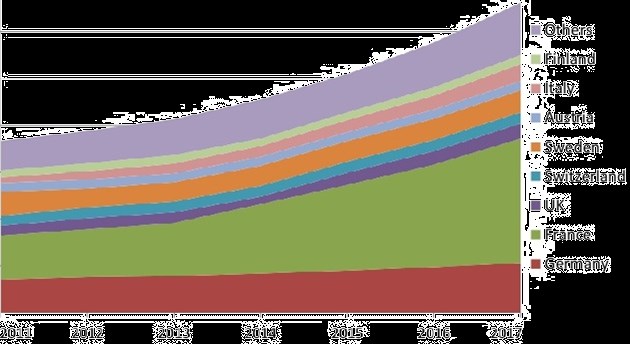
3 Total sales heat pump units heat or cold in the building mass i.e. walls and ceilings is a less common technology with a practically untapped potential, despite very low costs and short returns on investment. In order to have a well-functioning system, the building envelope has to be well-performing, i.e. reducing temperature losses to a minimum. Another more innovative technique would be to apply construction material with integrated phase-change materials, which can store heat or cold latently by using a process that occurs at a defined temperature level. By using heat storage, buildings connected to district heating could even support cutting the heat-load peak, allowing the district heating supplier to avoid running the peak-load boilers, often fuelled by conventional energy sources. District heating could as well integrate heat delivered by heat pumps driven by photovoltaic solar panels, geothermal and solar thermal energy as well as waste heat. Figure 2 Lithium-ion battery pack cost and production, (Source: Bloomberg New Energy Finance) ON-SITE RENEWABLES ARE GROWING The framework of the EU s climate targets and buildings performance requirements across Europe is driving the EU s new buildings towards a nearly zero-energy level, integrating small-scale renewable energy systems. These on-site or nearby building installed technologies such as heat pumps, photovoltaic and solar thermal panels are becoming mainstream technologies. The Deutsche Bank is expecting - despite the recent drop in oil price - solar electricity to become competitive with retail electricity 1 (i.e. grid parity) in an increasing number of markets globally due to declining solar panel costs as well as improving financing and customer acquisition costs. In 2015, the European solar power market grew by 15% year on year (mainly in 3 countries the UK, Germany and France), while globally there was a market growth of over 25%. The European heat pumps market grew slightly over the past years, but future volume sales are expected to grow rapidly, driving a power-load growth of the heating demand. Figure 3 European heat pump market: total heat pump sales per country in Europe, units, (Source: BSRIA) 1 Deutsche Bank Solar Grid Parity in a Low Oil Price Era, 2015 (

4 DECARBONISING HEATING AND COOLING ENERGY FOR BUILDINGS AND THE ROLE OF ENERGY EFFICIENCY From an economic perspective, energy efficiency measures and demand response technologies may be perceived as competing options. However, switching focus from energy efficiency to energy flexibility is not desirable, unless the energy efficiency potential is fully exploited first. Energy system analyses show that in relation to costs, fuel consumption, and CO 2 emissions, individual heat pumps together with district heating form the best heat supply solutions. At the same time, the real potential of demand response lies in thermal appliances, such as heat pumps which, however, achieve their most optimal performance (seasonal performance factor) in buildings with lower heating demand. A shift from boilers with conventional fuels to heat pumps will have the undesirable side-effect of significant contribution to peak electricity demand. Demand response could compensate this peak, but analyses demonstrate that peak shaving becomes less effective for heat pumps with higher capacity (mainly because less energy efficient buildings are not efficient for pre-heating). Considering this, it can be concluded that demand-flexible services are more effective in buildings with high levels of energy efficiency. Figure 4 - Decarbonising heating in buildings (Source: BPIE, 2016) HP= Heat Pumps DH= District Heating DR= Demand Response EE= Energy Efficiency CHALLENGES FOR A NEAR-FUTURE TRANSITION Despite their potential, demand response and power storage technologies are not yet common practice. A number of issues are challenging the transition ahead, from the need to establish IT protocols and advanced metering infrastructures (AMI) to data privacy and behavioural change. The lack of an overall communication/it protocol for all components of the demand response process to interact properly, the cost and maturity of storage units and a lack of closer collaboration between the building and energy sectors are only some of the challenges. Most important, consumers are not likely to use demand response and power storage technologies if their concerns about comfort decrease (e.g. not having access to energy at peak moments) and data privacy are not taken into account and if these technologies do not prove to be user-friendly. The absence of a broad societal acceptance and sense of urgency slows down the process towards the behavioural change needed for a speedily adoption of these new technologies.
5 INNOVATION AS THE KEY Eandis, a Belgian distribution system operator, declared: The old idea of fixing a capacity problem with extra cables is not sufficient anymore. [ ] IT solutions have become so widespread and cheap that this is a much better solution. Introducing innovative solutions facilitating buildings interactions with the energy system is therefore essential to this transition. In particular: Third-party business models (aggregators, agents or energy service companies ESCO s) aggregating demand response, storage and on-site power production, as well as monitoring and controlling them, thus saving money for building owners or occupants; Smart controls and household appliances that enable building users to temporarily modulate their energy use according to a user s stated preferences, system, load or price signals at the condition of not compromising the quality of their process; A communication interface and steering programme easy-to-use for building occupants, limiting their effort to implement demand response themselves; Dynamic prices needed to enable the uptake of the above-mentioned smart controls. UNLOCKING THE TRANSITION AND MITIGATING ITS SIDE-EFFECTS While innovation is instrumental to unlock this transition, it is also fundamental to be mindful of its consequences and to be ready to manage change to ensure that the involved actors are protected from potential side effects (i.e. extra costs of smart meters, the difficulties of adapting to new technologies, the limit to innovation in the absence of a strategic planning and more), and are properly equipped to contribute to this change. Industry and policy decision-makers can actively contribute to this transition and should be ready to manage its potential side-effects: Decision-makers should outline a comprehensive vision on the decarbonisation of heat, and more specifically on the integration of demand response, renewable energy production and storage in buildings, as well as an enabling regulatory framework encouraging buildings interaction with the energy system; Transmission and distribution system operators, energy market actors and decision-makers at all levels should strategically plan the grid adapted to the role of buildings as micro energy-hubs at both transmission and distribution levels, in order to trigger innovation; Electricity suppliers, power-system operators, policy-makers and energy regulators should make dynamic price signals available for industrial, commercial and residential consumers; Large players and sector federations in the smart metering and control industries together with standard bodies should adapt smart user metering and control systems to a universal communication protocol.
6 These measures are essential to allow buildings to fully take up an active role in the energy system, shaping their role as micro energy-hubs and unlocking the opportunities to offer new and tailored services. The implementation of the European Energy Union provides the necessary framework to make fast progress. As stated in the Commission communication on the Energy Union, an ambitious legislative proposal to redesign the electricity market and linking wholesale and retail to increase security of supply and ensure that the electricity market will be better adapted to the energy transition is needed to bring in a multitude of new producers, in particular of renewable energy sources, as well as to enable full participation of consumers in the market notably through demand response (EU Commission, 2015). Our buildings are the biggest infrastructure investment we have. Europeans should have a big interest in making this infrastructure future-proof by transforming the building stock and by ensuring that new and old buildings are energy smart. The revision of the Energy Performance of Buildings Directive sits at the core and centre of the answer to incorporate buildings as micro energy-hubs in the European energy system. Europe s innovation and technology leadership could gain a much needed support through the transformation of the building stock, benefitting both its economy and Europe s citizens getting healthier and better places to live and work. AUTHORS Maarten De Groote, Mariangiola Fabbri, Oliver Rapf, Roberta D Angiolella REFERENCES IEA, Technology Roadmap. Smart Grids., 2011 Bloomberg New Energy Finance, Battery Innovation: Incremental or Disruptive, 2012 Deutsche Bank, Solar Grid Parity in a Low Oil Price Era, 2015 ( BSRIA, Latest trends in the World Traditional & Renewable Heating Markets, 2015 BPIE, The active role of buildings in a transforming energy system presentation at the World Sustainable Energy Days, 2016 European Commission, A Framework Strategy for a Resilient Energy Union with a Forward-Looking Climate Change Policy, The Buildings Performance Institute Europe is a European not-for-profit think-tank with a focus on independent analysis and knowledge dissemination, supporting evidence-based policy making in the field of energy performance in buildings. It delivers policy analysis, policy advice and implementation support. Buildings Performance Institute Europe Rue de la Science / Wetenschapsstraat 23, B-1040 Brussels [email protected] /
BUILDING AUTOMATION AND CONTROL TECHNOLOGIES
 BUILDINGS PERFORMANCE INSTITUTE EUROPE BUILDING AUTOMATION AND CONTROL TECHNOLOGIES Deep-dive #4 SUMMARY Building Automation (BA) can refer to Building Automated Control Systems (BACS), Building Automation
LONG-TERM OUTLOOK FOR GAS TO 2 35
 LONG-TERM OUTLOOK FOR GAS TO 2 35 Eurogas is the association representing the European gas wholesale, retail and distribution sectors. Founded in 1990, its members are some 50 companies and associations
How To Improve The Energy Situation In Europe
 Low Carbon District Heating and CHP in the Future Energy Market: State of the Art and Perspectives in the light of the Energy Efficiency Directive Sabine Froning 31 January 2013 1 Euroheat & Power Unites
SCALING UP INNOVATION IN THE CONSTRUCTION VALUE CHAIN
 SCALING UP IN THE CONSTRUCTION VALUE CHAIN COMBINING VALUE CREATION AND CLIMATE AMBITION IN ONE OF EUROPE S KEY INDUSTRIES EXECUTIVE SUMMARY MEGATRENDS AND S IN THE CONSTRUCTION VALUE CHAIN (CVC) OFFER
EU Heating and Cooling Strategy
 EU Heating and Cooling Strategy March 2016 Unit Energy Efficiency DG ENER European Commission EU Strategy for Heating and Cooling One of the actions under the Energy Union Strategic Framework and Roadmap
SECTION 1. PREAMBLE 3 SECTION 2. EXECUTIVE SUMMARY 4 ABOUT US 6
 CONTENTS SECTION 1. PREAMBLE 3 SECTION 2. EXECUTIVE SUMMARY 4 ABOUT US 6 Disclaimer notice on page 8 applies throughout. Page 2 SECTION 1. PREAMBLE The New Energy Outlook (NEO) is Bloomberg New Energy
FIRST ANNOUNCEMENT AND CALL FOR ABSTRACTS. 7th International Conference on Energy Efficiency in Domestic Appliances and Lighting (EEDAL 13)
 FIRST ANNOUNCEMENT AND CALL FOR ABSTRACTS 7th International Conference on Energy Efficiency in Domestic Appliances and Lighting (EEDAL 13) 11-13 September 2013 Coimbra, Portugal Introduction Citizens and
Hybrid heat pumps. saving energy and reducing carbon emissions
 Hybrid heat pumps saving energy and reducing carbon emissions Bart Aspeslagh Product planning and new technology manager, Daikin Europe NV. [email protected] Stefanie Debaets Design engineer,
Is Germany in the slow lane for low carbon heat?
 Is Germany in the slow lane for low carbon heat? Our latest research challenges the conventional wisdom that the best growth opportunities for low carbon heat in Europe are in Germany Delta-ee Whitepaper
SMART GRIDS PLUS INITIATIVE
 Demand Response for residential customers -business opportunity for utilities ERA-NET SMART GRIDS PLUS INITIATIVE Sami Sailo, There Corporation Energy markets in Finland Supplier A Supplier B Settlement
Smart Cities. Integrated approach for innovative technologies. 2nd Annual Conference of the ETP on. Budapest, 6th May 2011
 Smart Cities Integrated approach for innovative technologies 2nd Annual Conference of the ETP on Renewable Heating and Cooling Budapest, 6th May 2011 Brigitte Bach, AIT Energy Department Low Carbon Economy
Gas Absorption Heat Pumps. Future proofing your heating and hot water
 Gas Absorption Heat Pumps Future proofing your heating and hot water Gas Absorption Heat Pumps 1 Contents Gas Absorption Heat Pumps (GAHPs) The heating solution What is a Gas Absorption Heat Pump? How
Comments of PU Europe on the Energy Efficiency Plan 2011 Commission Communication COM(2011) 109 final
 Comments of PU Europe on the Energy Efficiency Plan 2011 Commission Communication COM(2011) 109 final PU Europe is the European association representing the polyurethane insulation industry (PUR/PIR).
Energy storage in the UK and Korea: Innovation, Investment and Co-operation Appendix 4.1: Stakeholder interviews from Korea
 Energy storage in the UK and Korea: Innovation, Investment and Co-operation Appendix.1: Stakeholder interviews from Korea Peter Taylor & Lloyd Davies, University of Leeds Appendix.1: Stakeholder interviews
DANISH DISTRICT ENERGY PLANNING EXPERIENCE
 MOWAT ENERGY, A RESEARCH HUB AT THE MOWAT CENTRE, AT THE REQUEST OF THE ONTARIO MINISTRY OF ENERGY FUTURE INNOVATION IN ENERGY PLANNING: A SPECIAL SESSION TO ADVISE ON ONTARIO S LONG-TERM ENERGY FUTURE
ADVANCED INSULATION MATERIALS FOR BUILDING ENVELOPES
 BUILDINGS PERFORMANCE INSTITUTE EUROPE ADVANCED INSULATION MATERIALS FOR BUILDING ENVELOPES Deep-dive #2 SUMMARY Heating and cooling loads represent the largest building sector energy-end-use. Insulation
RENEWABLE SELF- CONSUMPTION. Cheap and clean power at your doorstep
 RENEWABLE SELF- CONSUMPTION Cheap and clean power at your doorstep Key messages Self-consumption helps European consumers and businesses to control their energy bill. In a context of increasing energy
Education & Training Plan Renewable Energy Specialist Online
 Education & Training Plan Renewable Energy Specialist Online MyCAA Information Tuition: $3600 (1 exam included for LEED) MyCAA Course Code: LIT-RES3 Course Contact Hours: 365 Hours Program Duration: 6
1. EXECUTIVE SUMMARY AND KEY RECOMMENDATIONS
 1. EXECUTIVE SUMMARY AND KEY RECOMMENDATIONS EXECUTIVE SUMMARY Energy policy in Greece has the potential to make a significant contribution to the country s economic recovery. Increasing competition and
Clean Energy Solutions Center IEA Technology Roadmap: Energy Efficient Building Envelopes Launch
 Clean Energy Solutions Center IEA Technology Roadmap: Energy Efficient Building Envelopes Launch Didier Houssin and Marc LaFrance International Energy Agency 18 December 2013 Paris IEA/SPT Flagship Publication,
Energy & Environment Market Trends, Smart Technologies, New Fuels, Future Business Models and Growth Opportunities
 & Environment Market Trends, Technologies, New Fuels, Future Business Models and Growth Opportunities September 2014 OUR COVERAGE & VISION: IDENTIFYING OPPORTUNITIES FROM UPSTREAM TO POINT OF USE Oil &
Optimising Energy Use in Cities through Smart Decision Support Systems
 Optimising Energy Use in Cities through Smart Decision Support Systems Energy Management for Sustainable Action Plans, Brussels, 18 June 2015 Siegfried Zoellner, Coordinator, ICLEI European Secretariat
Natural Gas & Energy Efficiency: Keys to Reducing GHG Emissions
 Natural Gas & Energy Efficiency: Keys to Reducing GHG Emissions Janet Gail Besser, Vice President, Regulatory Strategy NARUC 120 th Annual Convention November 17, 2008 New Orleans, Louisiana Overview 1.
NetVision. NetVision: Smart Energy Smart Grids and Smart Meters - Towards Smarter Energy Management. Solution Datasheet
 Version 2.0 - October 2014 NetVision Solution Datasheet NetVision: Smart Energy Smart Grids and Smart Meters - Towards Smarter Energy Management According to analyst firm Berg Insight, the installed base
DISTRIBUTED GENERATION AND ENERGY EFFICIENCY FOR ACHIEVING ENERGY SELF-SUSTAINING INDUSTRIAL AREAS
 DISTRIBUTED GENERATION AND ENERGY EFFICIENCY FOR ACHIEVING ENERGY SELF-SUSTAINING INDUSTRIAL AREAS Ing. Maria-Anna Segreto LAERTE Laboratory - 1 EUROPEAN DIRECTIVE 2010/31/UE It 's well known that higher
Smart grid promotion policy and activity in Sweden Sweden day, October 23, Smart City Week 2013
 Smart grid promotion policy and activity in Sweden Sweden day, October 23, Smart City Week 2013 Karin Widegren, Director Swedish Coordination Council for Smart Grid Outline of presentation Who we are -
How are energy companies adapting to the changing rules in the energy sector? Jaroslav Zlabek Country President Schneider Electric Polska
 How are energy companies adapting to the changing rules in the energy sector? Jaroslav Zlabek Country President Schneider Electric Polska Sopot November, 2011 the energy challenges today 2 The solution
UTILITY BUSINESS MODELS Future of Utilities discussion 6 October 2015. Andy Kelly
 UTILITY BUSINESS MODELS Future of Utilities discussion 6 October 2015 Andy Kelly PÖYRY MANAGEMENT CONSULTING A division of Pöyry a global consulting and engineering company Over 250 energy market experts
Geothermal ERA NET. 7 th Geothermal ERA NET meeting Trieste, Italy 10-11 September 2014. Guðni A Jóhannesson Director General, Orkustofnun, Iceland
 Cooperation between European countries through the Geothermal ERA NET 7 th meeting Trieste, Italy 10-11 September 2014 Guðni A Jóhannesson Director General, Afternoon Session The is supported by the European
Saving energy: bringing down Europe s energy prices
 Saving energy: bringing down Europe s energy prices Saving energy: bringing down Europe s energy prices By: Dr. Edith Molenbroek, Prof. Dr. Kornelis Blok Date: May 2012 Project number: BUINL12344 Ecofys
FORTNIGHTLY. Reliability Standards. PLUS A Role for Coal Falling Demand New York s Distributed Future
 FORTNIGHTLY PUBLIC UTILITIES Reliability Standards A fresh look at benefits, costs, and consequences. January 2015 ENERGY, MONEY, POWER PLUS A Role for Coal Falling Demand New York s Distributed Future
Nearly-zero, Net zero and Plus Energy Buildings How definitions & regulations affect the solutions
 Nearly-zero, Net zero and Plus Energy Buildings How definitions & regulations affect the solutions The topic of Zero Energy Buildings (ZEBs) has received increasing attention in recent years, up to inclusion
SMARTGRID Roadmap 1.
 SMARTGRID Roadmap 1. Introduction to the Smart Grid Roadmap to 25 Ireland faces the same long term energy challenges as the rest of the world: a need to move towards competitively priced, environmentally
Danish-German Energy Efficiency Summit. Cost effective policy instruments Obligations on Energy Companies
 Danish-German Energy Efficiency Summit Cost effective policy instruments Obligations on Energy Companies Eoin Lees Senior Advisor RAP Europe 8 th February 2012 The Regulatory Assistance Project 48 Rue
Summary of the Impact assessment for a 2030 climate and energy policy framework
 Summary of the Impact assessment for a 2030 climate and energy policy framework Contents Overview a. Drivers of electricity prices b. Jobs and growth c. Trade d. Energy dependence A. Impact assessment
HORIZON 2020. ENERGY context and Calls 2014/15. Ljubljana, 23 January 2014 THE EU FRAMEWORK PROGRAMME FOR RESEARCH AND INNOVATION
 THE EU FRAMEWORK PROGRAMME FOR RESEARCH AND INNOVATION HORIZON 2020 ENERGY context and Calls 2014/15 Ljubljana, 23 January 2014 Jeroen SCHUPPERS European Commission, DG Research and Innovation Europe's
Nuclear power is part of the solution for fighting climate change
 Nuclear power is part of the solution for fighting climate change "Nuclear for Climate" is an initiative undertaken by the members of the French Nuclear Energy Society (SFEN), the American Nuclear Society
COMMISSION STAFF WORKING PAPER EXECUTIVE SUMMARY OF THE IMPACT ASSESSMENT. Accompanying the document
 EUROPEAN COMMISSION Brussels, 22.6.2011 SEC(2011) 780 final COMMISSION STAFF WORKING PAPER EXECUTIVE SUMMARY OF THE IMPACT ASSESSMENT Accompanying the document DIRECTIVE OF THE EUROPEAN PARLIAMENT AND
Agder Energi. God kraft. Godt klima. Solar as a distributed energy source. How will it challenge the traditional utility business?
 Agder Energi God kraft. Godt klima. Solar as a distributed energy source. How will it challenge the traditional utility business? Players in the Traditional Electricity Sector 1. The traditional deregulated
ENA Submission to the Parliamentary Renewable and Sustainable Energy Group Inquiry into the access and management of renewables and the Grid
 1 ENA Submission to the Parliamentary Renewable and Sustainable Energy Group Inquiry into the access and management of renewables and the Grid 1.0 Introduction 1.1 Energy Networks Association (ENA) is
Transforming industries: energy and utilities. How the Internet of Things will transform the utilities industry
 Transforming industries: energy and utilities How the Internet of Things will transform the utilities industry GETTING TO KNOW UTILITIES Utility companies are responsible for managing the infrastructure
Preparatory Paper on Focal Areas to Support a Sustainable Energy System in the Electricity Sector
 Preparatory Paper on Focal Areas to Support a Sustainable Energy System in the Electricity Sector C. Agert, Th. Vogt EWE Research Centre NEXT ENERGY, Oldenburg, Germany corresponding author: [email protected]
Smart Cities. Smart partners in tomorrow s cities
 DNV KEMA serving the energy industry Smart Cities Smart partners in tomorrow s cities Experience, knowledge and advanced methods & tools for smart city planning and implementation 02 I DNV KEMA SERVING
INTERNATIONAL ENERGY AGENCY. UpcomingIEA Publications
 INTERNATIONAL ENERGY AGENCY UpcomingIEA Publications March 2009 2009 Spring Energy Policies of Luxembourg: 2008 Review Luxembourg has reformed its energy policies since the last IEA in-depth review in
Gas: the right choice for heating in Europe
 Gas: the right choice for heating in Europe The report has been prepared by a taskforce comprising members of Eurogas, Marcogaz and GERG. Avenue de Cortenbergh 172 1000 Brussels Belgium +32 2 894 48 48
Training in Renewable Energy INFORSE-Europe proposal for implementation of the Renewable Energy Directive Draft 28/12 2009
 Training in Renewable Energy INFORSE-Europe proposal for implementation of the Renewable Energy Directive Draft 28/12 2009 Requirements of the Renewable Energy Directive The EU countries have agreed the
Extending the Dialogue Among Canadians
 Nations fic and ization Acting on Climate Change: Extending the Dialogue Among Canadians A collection of texts in response to Acting on Climate Change: Solutions from Canadian Scholars, a consensus document
Main variations of business models for Flexible Industrial Demand combined with Variable Renewable Energy
 Innovative Business Models for Market Uptake of Renewable Electricity unlocking the potential for flexibility in the Industrial Electricity Use Main variations of business models for Flexible Industrial
Half the cost Half the carbon
 Half the cost Half the carbon the world s most efficient micro-chp What is BlueGEN? The most efficient small-scale electricity generator BlueGEN uses natural gas from the grid to generate electricity within
Shifting sands the UK market for low carbon B2B offerings may never be the same again
 Shifting sands the UK market for low carbon B2B offerings may never be the same again White Paper June 2015 Contact: Michael Brown [email protected] +44 131 466 5544 Dina Darshini [email protected]
INTRODUCTION OF DSM PROGRAMS. Ankara, November 2007. EVA MICHALENA Regulatory Authority for Energy, Greece Sorbonne University, France
 INTRODUCTION OF DSM PROGRAMS Ankara, November 2007 EVA MICHALENA Regulatory Authority for Energy, Greece Sorbonne University, France World State-Of Of-The-Art and the need for Energy Efficiency Rio Convention
JASPERS Networking Platform. Training on general State Aid issues in infrastructure projects CASE STUDY
 JASPERS Networking Platform Training on general State Aid issues in infrastructure projects CASE STUDY The national authorities of an EU Member State are designing four investment programmes which will
Multiple sources of energy will be available, giving the consumer choices. A Higher Percentage of Energy will come from renewable energy sources
 Editor s comments: Numbers in parentheses indicate the number of duplicate or extremely similar comments made. The headings are editor s best attempt to draft vision statements reflecting the participants
VISION FOR SMART ENERGY IN DENMARK Research, Development and Demonstration
 VISION FOR SMART ENERGY IN DENMARK Research, Development and Demonstration Smart Energy Networks Research, Development and Demonstration Vision for Smart Energy in Denmark - Research, Development and Demonstration
ACCELERATING GREEN ENERGY TOWARDS 2020. The Danish Energy Agreement of March 2012
 ACCELERATING GREEN ENERGY TOWARDS The Danish Energy Agreement of March 2012 The most ambitious energy plan of the world In March 2012 a historic new Energy Agreement was reached in Denmark. The Agreement
Smart Meters Executive Paper
 Smart Meters Executive Paper Smart infrastructure overview The ever growing global demand for energy, combined with increasing scarcity of resources and the threat of climate change, have prompted governments
THE EUROPEAN GREEN BUILDING PROGRAMME. Technical Module on Combined Heat and Power
 THE EUROPEAN GREEN BUILDING PROGRAMME Technical Module on Combined Heat and Power Contents Foreword...1 1. Introduction...2 2. Inventory of the CHP system...3 3. Assessment of technical energy saving measures...5
Integrated Solar Radiant Systems
 Integrated Solar Radiant Systems William Shady PE President Topics Radiant heating Indoor air quality Radiant Cooling Project Photos Questions and answers The goal for our clients Healthy Comfort Why Radiant
Green Data Centers. Jay Taylor Director Global Standards, Codes and Environment (512) 818-2073
 Green Data Centers Jay Taylor Director Global Standards, Codes and Environment (512) 818-2073 The energy dilemma: With Me, Without Me The facts The need Energy demand By 2050 Electricity by 2030 Source:
BUILDING ENERGY DEMAND AGGREGATION AND SIMULATION TOOLS A DANISH CASE STUDY
 BUILDING ENERGY DEMAND AGGREGATION AND SIMULATION TOOLS A DANISH CASE STUDY P. Gianniou; A. Heller; C. Rode Department of Civil Engineering, Technical University of Denmark, Kgs. Lyngby ABSTRACT Nowadays,
STORAGE IS THE FUTURE: MAKING THE MOST OF BATTERIES
 STORAGE IS THE FUTURE: MAKING THE MOST OF BATTERIES Dr Jonathan Radcliffe, Senior Research Fellow And Policy Director Birmingham Energy Institute Value Of Energy Storage And Aggregation To UK Grid, 10
From today s systems to the future renewable energy systems. Iva Ridjan US-DK summer school AAU Copenhagen 17 August 2015
 From today s systems to the future renewable energy systems Iva Ridjan US-DK summer school AAU Copenhagen 17 August 2015 STRUCTURE OF ENERGY SYSTEMS 8/17/2015 Copenhagen, Denmark 2 Components Demand Heat
Riga Smart City Concept. Timurs Safiuļins Riga Energy Agency
 Riga Smart City Concept Timurs Safiuļins Riga Energy Agency City development pillars Riga long-term development objectives Riga smart city Sustainable energy action plan 2014-2020 SEAP includes an initial
SAP 2012 IN A NUTSHELL
 SAP 2012 IN A NUTSHELL The consultation version of the SAP 2012 methodology was published by the Department of Energy and Climate Change (DECC) on January 4th 2012. This article from Dyfrig Hughes of National
How To Develop A Smart Grid In Danesland
 Smart Grid Strategy The intelligent energy system of the future Danish Ministry of Climate, Energy and Building May 2013 Smart Grid Strategy 3 Content Foreword 5 Summary of the strategy and key initiatives
ZERO CARBON HOMES AND NEARLY ZERO ENERGY BUILDINGS. UK Building Regulations and EU Directives
 ZERO CARBON HOMES AND NEARLY ZERO ENERGY BUILDINGS UK Building Regulations and EU Directives This leaflet summarises the UK s proposed Zero Carbon Standard for Homes, and the EU s new Nearly Zero- Buildings
sustainable gains in energy policy. While the report addresses energy policies comprehensively, the following sections highlight these three topics.
 EXECUTIVE SUMMARY 01 A small, somewhat isolated country, Finland takes a balanced view of its energy policy, taking advantage of its situation wherever possible. Where it can leverage its location and
Smart Cities - A European Initiative
 Smart Cities - A European Initiative Österreichische Technologieplattform Smart Cities Meeting 11 March 2011 Reinhard Schütz Energy Department, Austrian Institute of Technology (AIT) Drivers and challenges
GREEN COMFORT FOR SUSTAINABLE CITIES. www.ecoheat4cities.eu
 GREEN COMFORT FOR SUSTAINABLE CITIES www.ecoheat4cities.eu 1 Isn t it time to talk about green heat for your community? We have a solution for you! More and more communities formulate climate protection,
Executive summary. Chapter one: Foreword. Jochen Kreusel
 Chapter one: Foreword 2. Executive summary This report gives a comprehensive outlook towards an electricity system for Europe and North Africa based completely on renewable energy in 2050. Its particular
Storage Battery System Using Lithium ion Batteries
 Offices and schools Utilities / Renewable energy Storage Battery System Using Lithium ion Batteries Worldwide Expansion of Storage Battery System s Commercial Buildings Residential The Smart Energy System
8 October 2015 The evolution of renewable energy integration and the smart grid in Europe: The current situation, challenges and opportunities
 8 October 2015 The evolution of renewable energy integration and the smart grid in Europe: The current situation, challenges and opportunities Stefano Besseghini CEO & President Luciano Martini T&D Dept.
ENERGY PRODUCING SYSTEMS
 ENERGY PRODUCING SYSTEMS SOLAR POWER INTRODUCTION Energy from the sun falls on our planet on a daily basis. The warmth of the sun creates conditions on earth conducive to life. The weather patterns that
Netherlands National Energy Outlook 2014
 Netherlands National Energy Outlook 2014 Summary Michiel Hekkenberg (ECN) Martijn Verdonk (PBL) (project coordinators) February 2015 ECN-E --15-005 Netherlands National Energy Outlook 2014 Summary 2 The
Smart Energy Consumption and the Smart Grid
 Smart Energy Consumption and the Smart Grid Executive Summary The nation s outdated electrical infrastructure is being transformed. Fundamental changes that add intelligence, integrated communications
Virtual Power Plant solution for energy suppliers. Immediate, reliable access to distributed energy resources
 Virtual Power Plant solution for energy suppliers Immediate, reliable access to distributed energy resources The answer to meet today s energy market challenges Our virtual power plant (VPP) lets you leverage
Technology Fact Sheet for Mitigation
 Technology Fact Sheet for Mitigation Solar PV systems (>1MW) i Technology: Solar PV systems (>1MW) Sector : Energy Subsector : Technology characteristics Introduction Solar photovoltaic, or simply photovoltaic
The butterfly effect. How smart technology is set to completely transform utilities
 How smart technology is set to completely transform utilities An era of unprecedented change Utility companies operate in one of the most complex, high profile, regulated and politically charged sectors.
Daikin Altherma Hybrid Heat Pump
 your comfort. our world. Daikin Altherma Hybrid Heat Pump Smart heating technology for the best of both worlds Heating Integrated Solutions Ventilation Air Conditioning Refrigeration Forward thinking About
G20 ENERGY EFFICIENCY ACTION PLAN VOLUNTARY COLLABORATION ON ENERGY EFFICIENCY
 G20 ENERGY EFFICIENCY ACTION PLAN VOLUNTARY COLLABORATION ON ENERGY EFFICIENCY 16 NOVEMBER 2014 G20 Energy Efficiency Action Plan 2 1. Executive summary 1.1 Energy efficiency is a priority for G20 members.
Smart Cities Amsterdam, May 2014, Peter Van Den Heede Smart Cities Solid foundations for a Smart City
 Smart Cities Amsterdam, May 2014, Peter Van Den Heede Smart Cities Solid foundations for a Smart City Cities in the Global Context Already play a significant role All Cities Cities today Home to 50% of
Vitocaldens 222-F Compact Gas-Hybrid appliance
 Vitocaldens 222-F Compact Gas-Hybrid appliance Heating systems Industrial systems Refrigeration systems 2/3 Vitocaldens 222-F: The future-proof energy-source mix in one appliance Choosing Vitocaldens
Daikin Altherma Hybrid Heat Pump
 Daikin Altherma Hybrid Heat Pump Smart technology for the best of both worlds NATIONAL HEAT PUMP 19 JUNE 2014 ICC BIRMINGHAM WINNER Forward thinking Now is the time to rethink the way we heat our homes
FACOGAZ Association of European Gas Meter Manufacturers
 Page 1 of 13 GAS SMART METERING SYSTEM DRAFT MARCOGAZ/FACOGAZ POSITION PAPER FINAL 1. Introduction Marcogaz Members representing more than 100 million installed domestic gas meter in Europe owned by Distribution
Medium voltage products. Technical guide Smart grids
 Medium voltage products Technical guide Smart grids Contents 2 1. Introduction 8 2 The different components and functions of a smart grid 8 2.1 Integration of distributed renewable energy sources 9 2.2
Your partner of choice for integrated energy solutions
 E.ON Connecting Energies Your partner of choice for integrated energy solutions Would you like to reduce your company s energy costs? Do you have ambitious environmental objectives? Are you concerned about
Rules of Thumb Energy Efficiency in Buildings
 Energy Efficiency in Buildings Energy Savings Cost Savings Increased Productivity Economic Development Other Standard lighting retrofits: $0.90-$1.20 per square foot. High-efficiency packaged and split
Heat Pumps in the Building Sector: Hybrid Heat Pumps opening UK retrofit opportunities?
 Ltd Registered in Scotland: No SC259964 Registered Office: 15 Great Stuart Street, Edinburgh, EH3 7TS, UK Heat Pumps in the Building Sector: Hybrid Heat Pumps opening UK retrofit opportunities? Dr. Lindsay
Energy Union and 2030 Energy & Climate Governance. A EURELECTRIC position paper
 Energy Union and 2030 Energy & Climate Governance A EURELECTRIC position paper April 2015 EURELECTRIC is the voice of the electricity industry in Europe. We speak for more than 3,500 companies in power
The natural ombination
 The natural ombination DAikin Altherma Hybrid heat pump system The future is now The new hybrid system Heat pump solution for gas boiler replacement market Daikin Altherma hybrid combines heat pump technology