
VM ZINC : standing seam Guidelines for specification and installation
|
|
|
- Bruno Dickerson
- 10 years ago
- Views:
Transcription
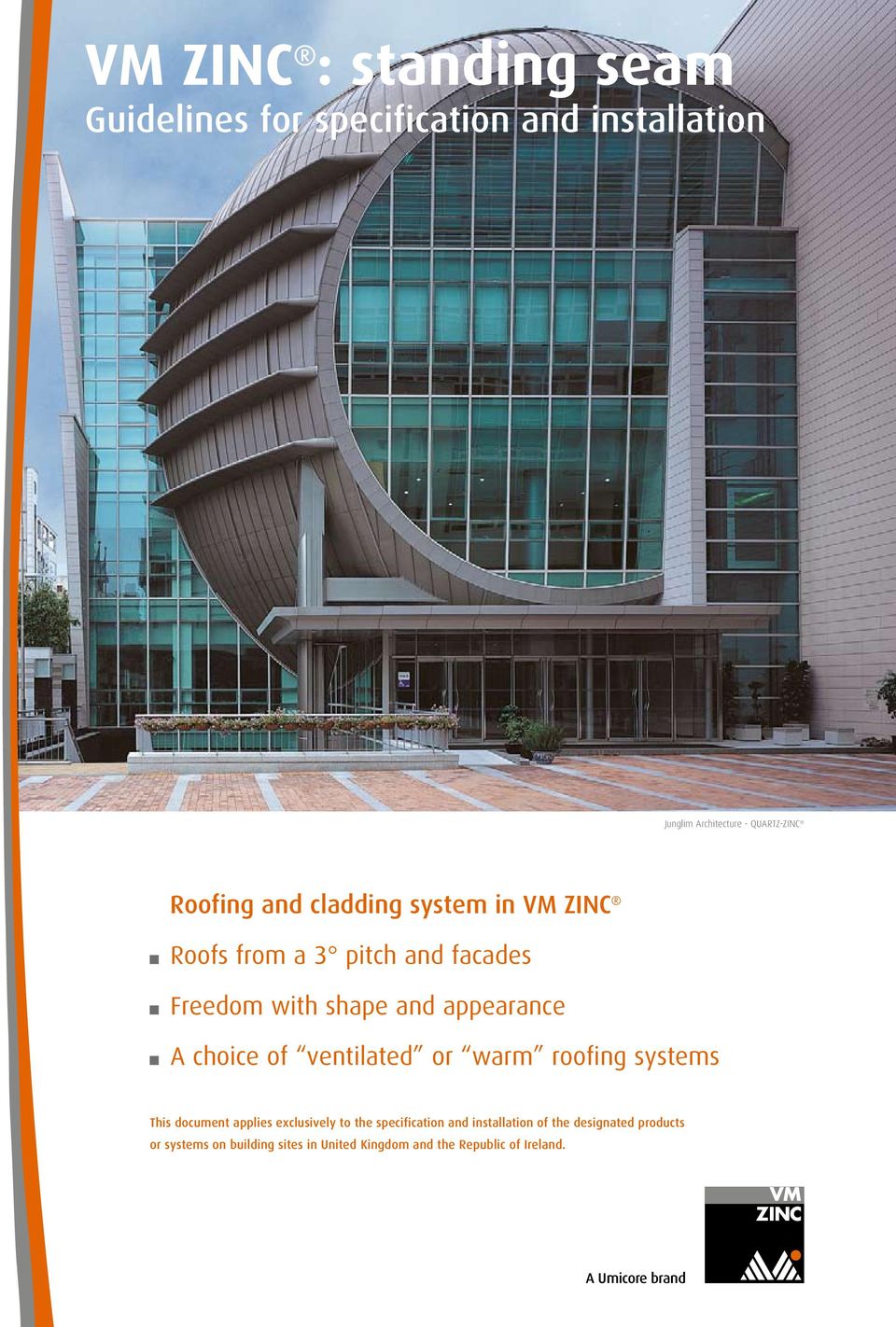
1 VM ZINC : standing seam Guidelines for specification and installation Junglim Architecture - QUARTZ-ZINC Roofing and cladding system in VM ZINC Roofs from a 3 pitch and facades Freedom with shape and appearance A choice of ventilated or warm roofing systems This document applies exclusively to the specification and installation of the designated products or systems on building sites in United Kingdom and the Republic of Ireland. A Umicore brand
2 Standing Seam - Contents and 7... VM ZINC natural and recyclable Surface appearances What is standing seam? Types and areas of applications to to to to to to to to Standing seam roofing, warm roof on mineral wool or PIR Fixing clips Examples of details: junction gutter, box gutter, verges, ridge/hip, valley detail, mansard, junction skylight and junction with chimmey Standing seam roofing, warm roof on composite panels Fixing clips Examples of details: junction gutter, box gutter, verges, ridge/hip, valley detail, mansard, junction skylight and junction with chimmey Standing seam roofing, warm roof on cellular glass Fixing clips Examples of details: junction gutter, box gutter, verges, ridge/hip, valley detail, mansard, junction skylight and junction with chimmey Standing seam roofing, ventilated roof on incompatible support Fixing clips Examples of details: junction gutter, box gutter, verges, ventilated ridge/hip, valley detail, mansard, junction skylight and junction with chimmey Standing seam roofing, ventilated roof on roof boarding Fixing clips Examples of details: junction gutter, box gutter, verges, ventilated ridge/hip, valley detail, mansard, junction skylight and junction with chimmey Standing seam roofing, example very low pitch Standing seam roofing, specific applications Standing seam facade, ventilated cladding, horizontal panels installed on boarding Standing seam facade, ventilated cladding, vertical panels installed on boarding Standing seam - System installation Expansion of VM ZINC - layout Measuring for and ordering profiled panels - maximum length of panels Transportation, storage, installing and working VM ZINC Preparation and fixing of the top of the panels 3 stage installation of the panels 1. Laying the panel on the structure 2. Installation of clips 3. Preparation of the panels for crimping Crimping Standing seam facade - Installation of the system Removing the protective film and moving around on the VM ZINC to Appendix 1 - Junctions at the foot of the pitch Appendix 2 - Verge flashing Appendix 3 and 4 - Flashings and forbidden contacts Appendix 5 - Ventilation of VM ZINC roofing and cladding Appendix 6 - Compatibility of VM ZINC with wood, wood derivates, glues and mastics 2
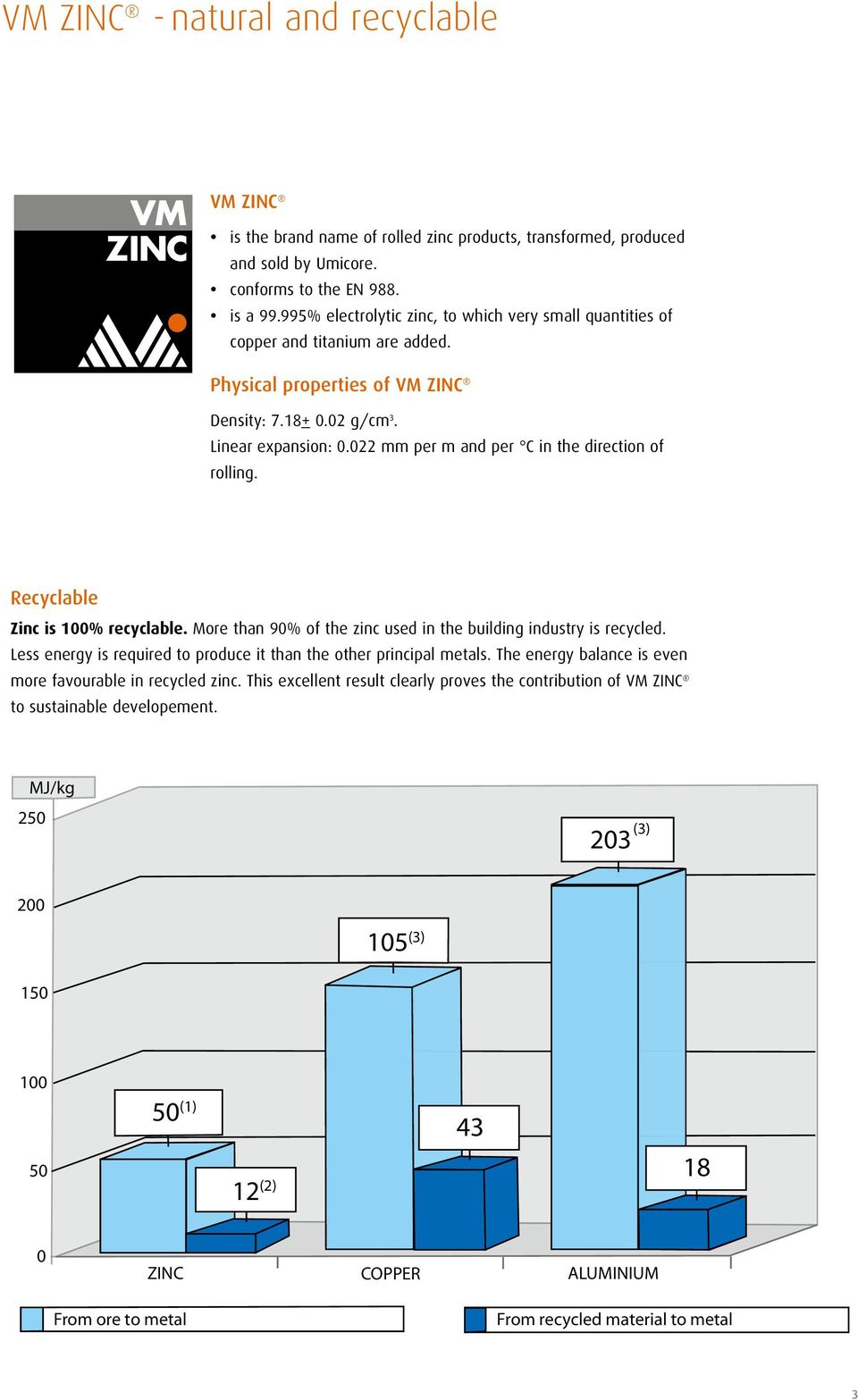
3 VM ZINC - natural and recyclable VM ZINC is the brand name of rolled zinc products, transformed, produced and sold by Umicore. conforms to the EN 988. is a % electrolytic zinc, to which very small quantities of copper and titanium are added. Physical properties of VM ZINC Density: g/cm 3. Linear expansion: mm per m and per C in the direction of rolling. Recyclable Zinc is 100% recyclable. More than 90% of the zinc used in the building industry is recycled. Less energy is required to produce it than the other principal metals. The energy balance is even more favourable in recycled zinc. This excellent result clearly proves the contribution of VM ZINC to sustainable developement. MJ/kg (3) (3) (1) 12 (2) ZINC COPPER ALUMINIUM From ore to metal From recycled material to metal 3
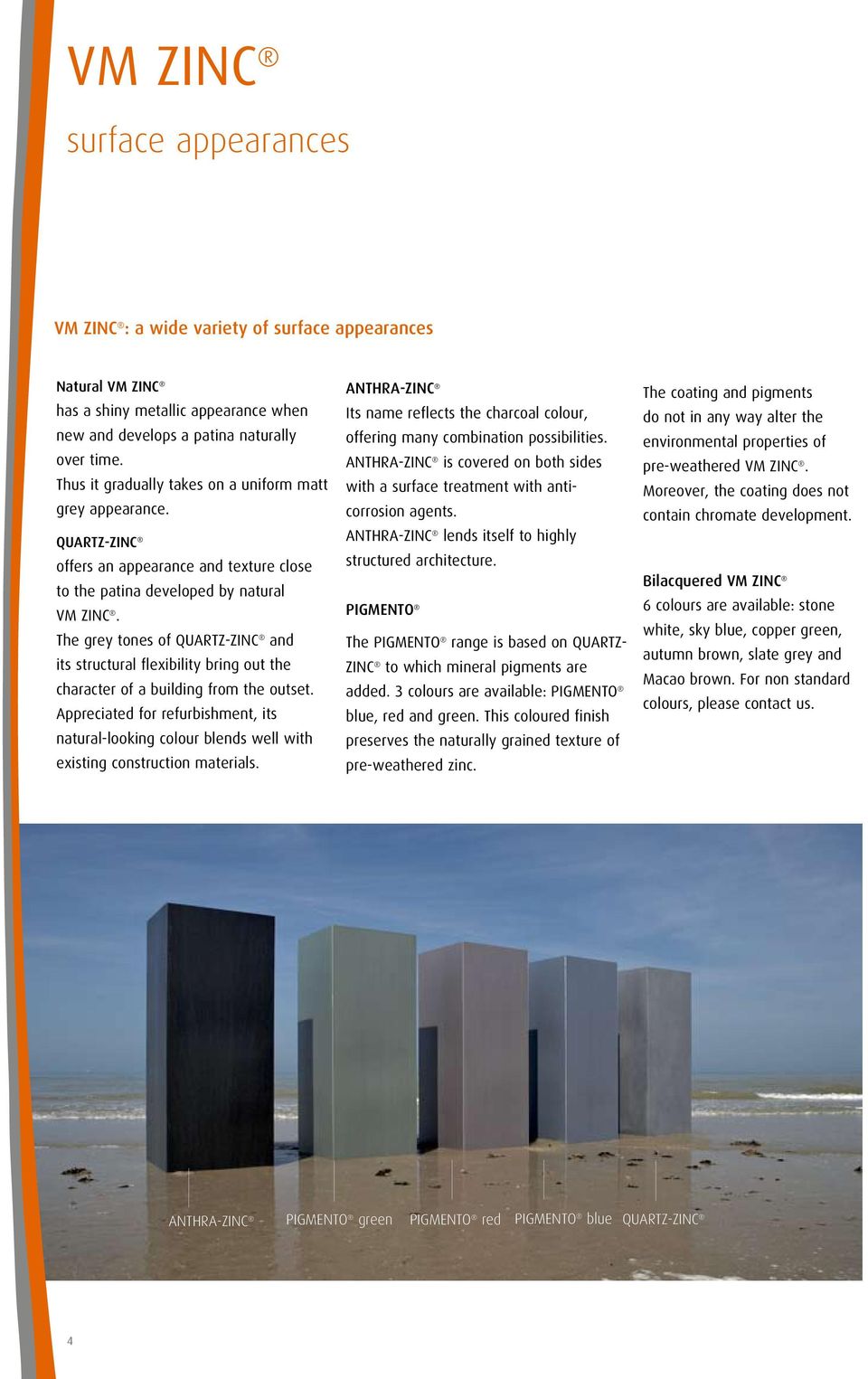
4 VM ZINC surface appearances VM ZINC : a wide variety of surface appearances Natural VM ZINC has a shiny metallic appearance when new and develops a patina naturally over time. Thus it gradually takes on a uniform matt grey appearance. QUARTZ-ZINC offers an appearance and texture close to the patina developed by natural VM ZINC. The grey tones of QUARTZ-ZINC and its structural flexibility bring out the character of a building from the outset. Appreciated for refurbishment, its natural-looking colour blends well with existing construction materials. ANTHRA-ZINC Its name reflects the charcoal colour, offering many combination possibilities. ANTHRA-ZINC is covered on both sides with a surface treatment with anticorrosion agents. ANTHRA-ZINC lends itself to highly structured architecture. PIGMENTO The PIGMENTO range is based on QUARTZ- ZINC to which mineral pigments are added. 3 colours are available: PIGMENTO blue, red and green. This coloured finish preserves the naturally grained texture of pre-weathered zinc. The coating and pigments do not in any way alter the environmental properties of pre-weathered VM ZINC. Moreover, the coating does not contain chromate development. Bilacquered VM ZINC 6 colours are available: stone white, sky blue, copper green, autumn brown, slate grey and Macao brown. For non standard colours, please contact us. ANTHRA-ZINC PIGMENTO green PIGMENTO red PIGMENTO blue QUARTZ-ZINC 4
5 Introduction What is standing seam? > Arch. G. Wastiau- QUARTZ-ZINC & bilacquered VM ZINC The standing seam system, which developed from roll cap: is a roof and facade covering system can be installed from a 3 pitch. can be laid in lengths upto 13 m without the need for expansion steps. can be used for ventilated or warm roofing. adapts to the simplest or the most complex roof shapes. can be used to cover soffits (box gutter overhangs, etc). Generally speaking, the profiled panels are held in place at the top of the pitch by fixed clips and on the sides by sliding clips distributed along the length of the panel. These clips, which are fixed to the structure, are crimped inside the joints. Thus the fixing clips for panels and flashings never penetrate the material and therefore do not damage the appearance or waterproofing. The low height of the seams (25 mm standard) and the 600 mm spacing between joints give the roof a light, harmonious appearance. Moreover, any non-standard width between 60 and 600 mm can be produced. Standing seam roofs or cladding should only be installed by properly trained and equipped professionals. What is VM ZINC PLUS? VM ZINC PLUS is exactly the same pure high quality material as standard VM ZINC. It, has a 60 micron thick organic coating to its underside VM ZINC PLUS is the future of Zinc in Architecture. This allows it to be installed over non ventilated & potentially non compatible substrates. Umicore organises practical training courses on the installation of VM ZINC standing seam: Reserved for roofing professionals. Organised in a covered, specially equipped training centre. : : (

6 Standing Seam Types of application Warm roof: VM ZINC roofing is fixed directly on the insulating material. The underside of the metal is unventilated and therefore the use of VM ZINC PLUS with an already protected underside is obligatory. VM ZINC PLUS on mineral wool or PIR Very competitive price Classes of internal humidity load: 1 to 4 VM ZINC PLUS on composite panels Very competitive price Classes of internal humidity load: 1 to 4 VM ZINC PLUS on cellular glass Non - penetrating fastening Classes of internal humidity load: 1 to 5 Ventilated roof on roof boarding: VM ZINC roof with ventilated underside. This ventilation consists of an air space where the C0 2 in the air allows the VM ZINC to develop a natural patina on the underside. This ventilated air space, with openings at the bottom and top of the roof is absolutely necessary to guarantee the durability of VM ZINC (cf appendix 5 page 79). Ventilated roof on incompatible support: In this application the underside of the metal is unventilated and therefore the use of VM ZINC PLUS with an already protected underside is obligatory. Easy installation Can be used to cover complex shapes Classes of internal humidity load: 1 to 4 Very competitive price Classes of internal humidity load: 1 to 4 6

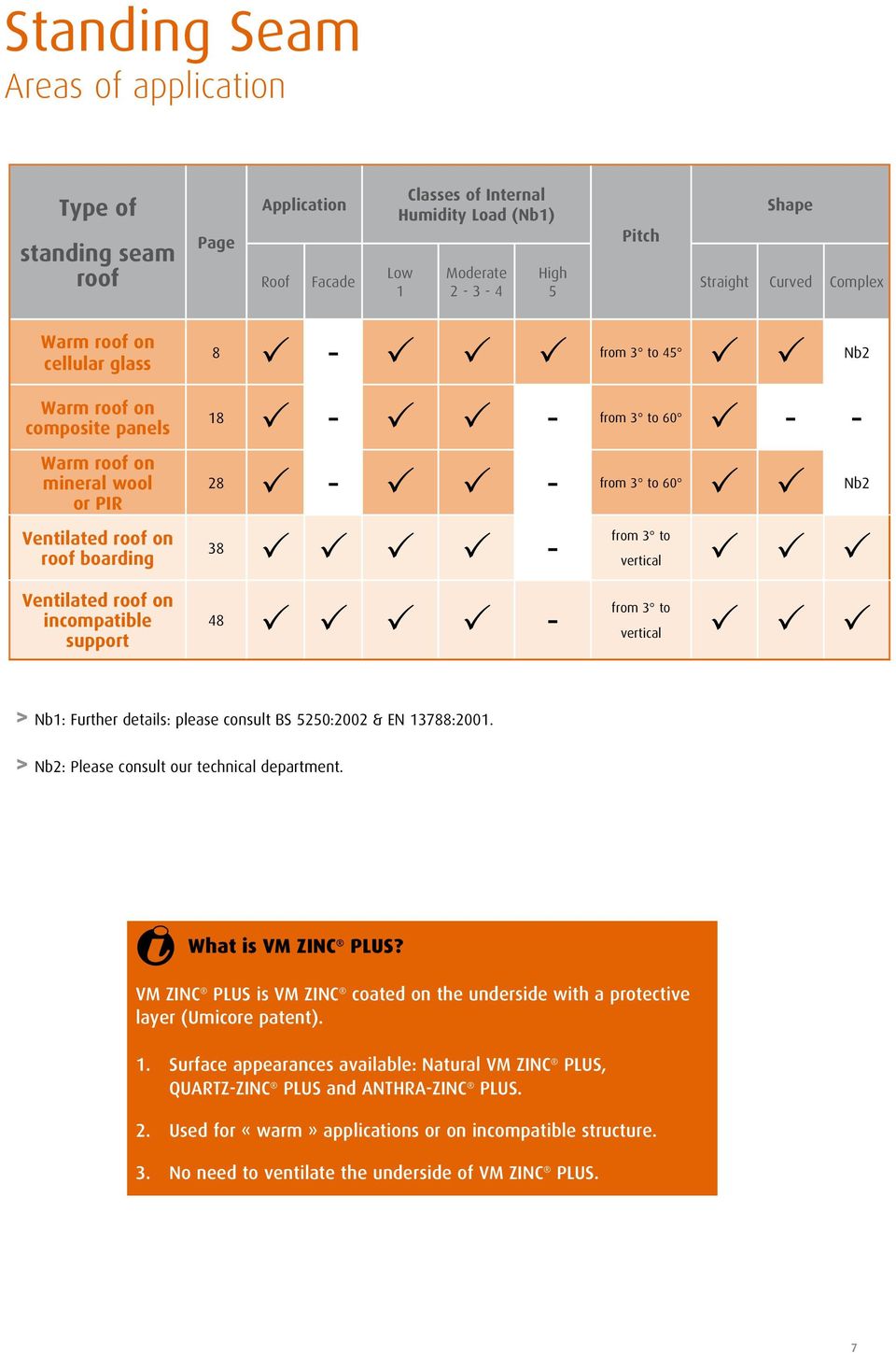
7 Standing Seam Areas of application Type of standing seam roof Page Application Roof Facade Classes of Internal Humidity Load (Nb1) Low 1 Moderate High 5 Pitch Shape Straight Curved Complex Warm roof on cellular glass Warm roof on composite panels Warm roof on mineral wool or PIR Ventilated roof on roof boarding 8 P - P P P from 3 to 45 P P Nb2 18 P - P P - from 3 to 60 P P - P P - from 3 to 60 P P Nb2 38 P P P P - from 3 to vertical P P P Ventilated roof on incompatible support 48 P P P P - from 3 to vertical P P P > Nb1: Further details: please consult BS 5250:2002 & EN 13788:2001. > Nb2: Please consult our technical department. What is VM ZINC PLUS? VM ZINC PLUS is VM ZINC coated on the underside with a protective layer (Umicore patent). 1. Surface appearances available: Natural VM ZINC PLUS, QUARTZ-ZINC PLUS and ANTHRA-ZINC PLUS. 2. Used for «warm» applications or on incompatible structure. 3. No need to ventilate the underside of VM ZINC PLUS. 7
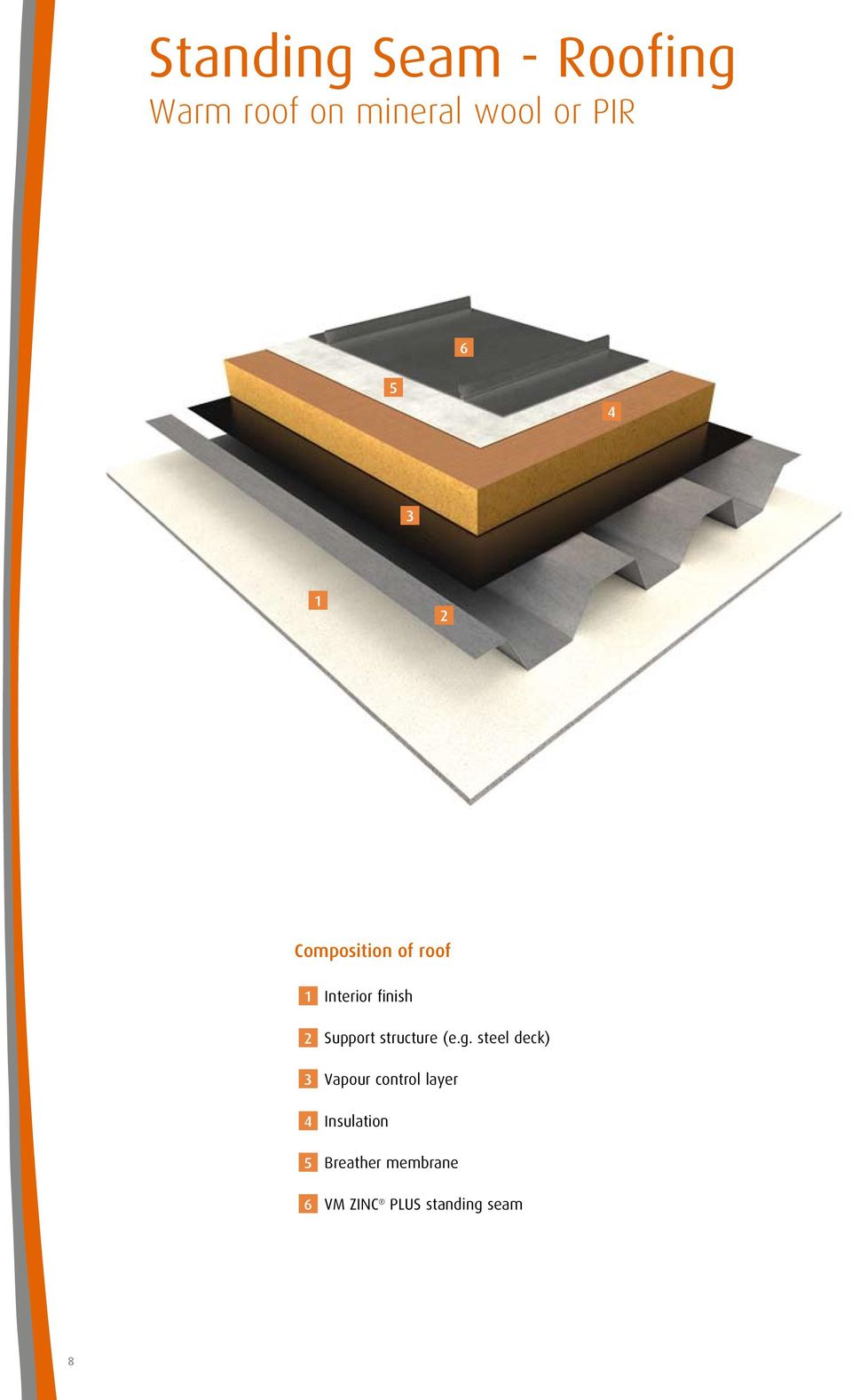
8 Standing Seam - Roofing Warm roof on mineral wool or PIR Composition of roof Interior finish Support structure (e.g. steel deck) Vapour control layer Insulation Breather membrane VM ZINC PLUS standing seam 8
9 Installation of this system see pages 66 to 79 >Arch. L3M - QUARTZ-ZINC PLUS Characteristics of this technique With this warm roof system VM ZINC PLUS standing seam can be installed on mineral wool or PIR insulation without ventilating the underside of the VM ZINC PLUS. Penetrating fixing elements can be used with the help of plates, joists or special fixing clips supplied by Umicore. Structure A choice of: Steel deck Timber deck. The insulation material has to comply with national regulation (i.e. fire resistance). Between the VM ZINC PLUS and the insulation, a breather membrane is fixed with an overlap of ± 150 mm. N.B. The information relating to the installation of insulation and membranes is simply an indication. The choice and installation of these products will be according to the recommendations of the insulation and membrane manufacturers. Area of application Roofs with a pitch from 3 to 60. Classes of internal humidity load: 1 to 4. VM ZINC, the choices Only PLUS type VM ZINC with a specially protected underside: Natural VM ZINC PLUS, QUARTZ-ZINC PLUS or ANTHRA-ZINC PLUS. 0.7 mm thick. This structure is successively covered by: A vapour control layer with a high water vapour resistance installed with cold or hot glued joints. Insulation: either mineral wool or some types of PIR. all insulation materials have to resist a compression strenght of minimum 50kPa (0.5kg/cm 2 ), at a maximum 10% deformation. Specifications: : See : See 9

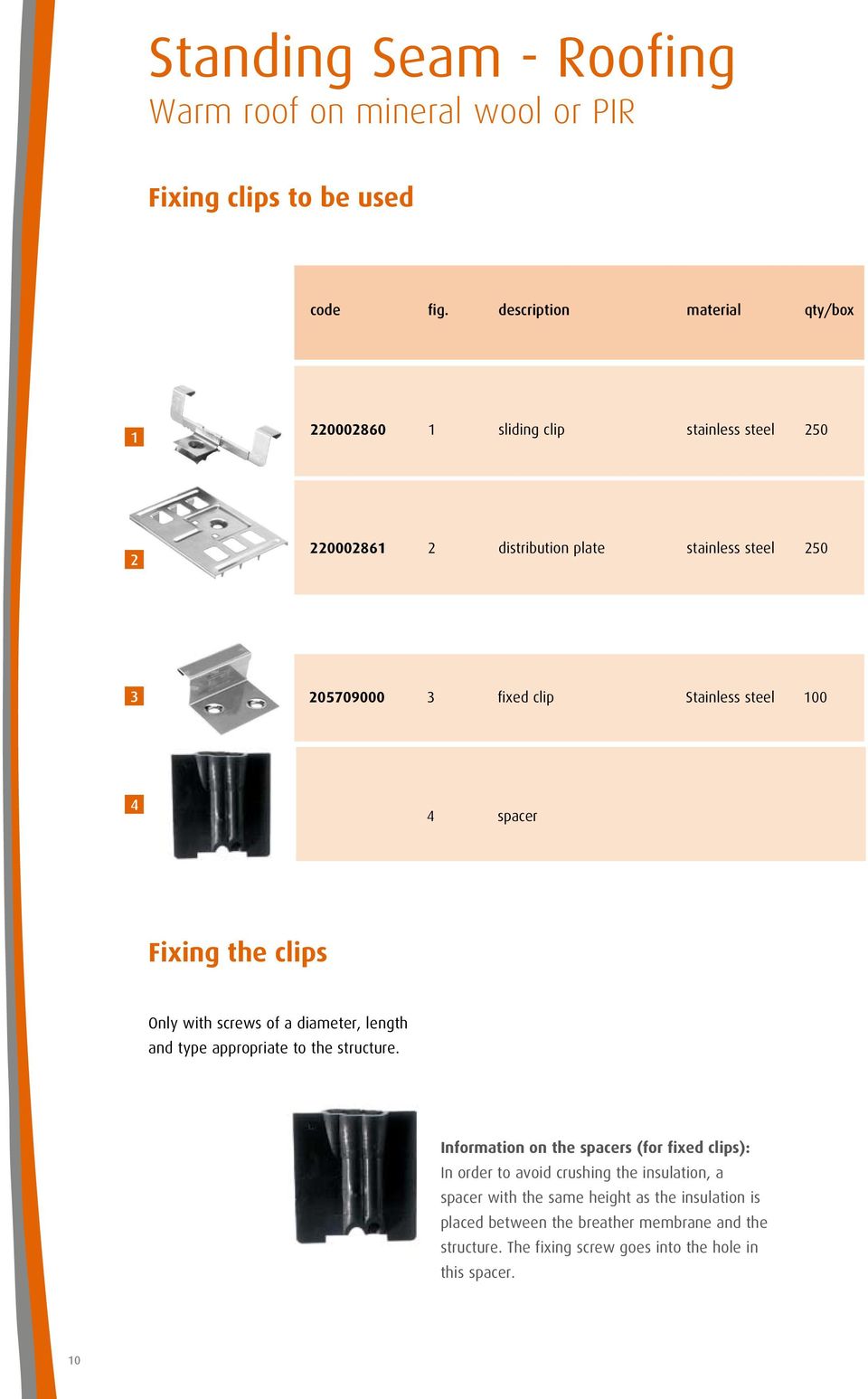
10 Standing Seam - Roofing Warm roof on mineral wool or PIR Fixing clips to be used code fig. description material qty/box sliding clip stainless steel distribution plate stainless steel fixed clip Stainless steel spacer Fixing the clips Only with screws of a diameter, length and type appropriate to the structure. Information on the spacers (for fixed clips): In order to avoid crushing the insulation, a spacer with the same height as the insulation is placed between the breather membrane and the structure. The fixing screw goes into the hole in this spacer. 10
11 Examples of details The solutions presented here are simply examples and are not the only ones possible. Our technical assistance department is available to study other solutions with you. Gutter L = Flashing length - see page 76 -When rendering a wall it is recommended to protect the VM ZINC. - In some cases it is recommended to provide snow guards. 2. continuous eaves apron strip in VM ZINC PLUS 3. folded strip in VM ZINC PLUS, th = 0.7 mm, continuous 4. sheet clip in VM ZINC PLUS, th = 0.7 mm, 5. loadbearing structure 6. continuous sheet strip in VM ZINC PLUS, th = 0.7 mm 7. flashing in VM ZINC PLUS 8. PLULINE gutter bracket 9. PLULINE gutter 10. rafter, 5 mm thinner than the insulation 11. breather membrane 12. vapour control layer 13. insulation mineral wool or PIR Variation pitch min. 1 pitch min. 1 L = Flashing length - see page 76 Box gutter (gutter outside the wall) 2. continuous strip in VM ZINC, th = 0.8 mm 3. sheet clip in VM ZINC PLUS, th = 0.7 mm, 4. continuous double welt strip in VM ZINC PLUS, continuously soldered 5. bracket in VM ZINC, th = 1 mm, w = 250 mm, 2 per m 6. rafter, 5 mm thinner than the insulation 7. roof boarding 8. box gutter in VM ZINC 9. ventilated space 10. packers fixed to gutter fall 11. fascia with welted panels in VM ZINC, dimensions maximum for each panels: 400 x 2000 mm 12. breather membrane 13. vapour control layer 14. insulation mineral wool or PIR 15. continuous welt piece in VM ZINC 16. mesh (2 mm maximum weave) Variation - In some cases it is recommended to provide snow guards. - When rendering a wall it is recommended to protect the VM ZINC. 11

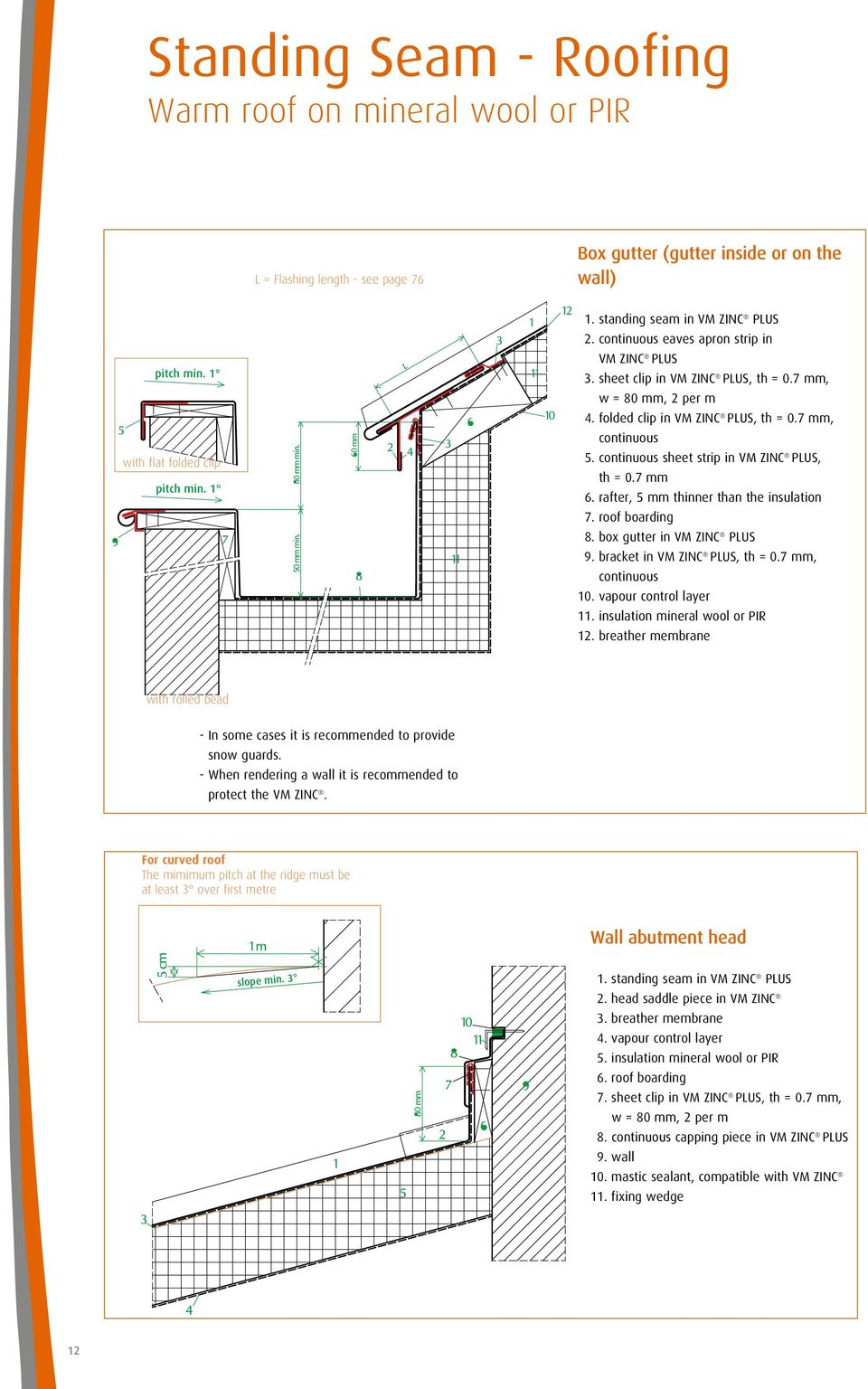
12 Standing Seam - Roofing Warm roof on mineral wool or PIR L = Flashing length - see page 76 Box gutter (gutter inside or on the wall) pitch min. 1 with flat folded clip pitch min continuous eaves apron strip in VM ZINC PLUS 3. sheet clip in VM ZINC PLUS, th = 0.7 mm, 4. folded clip in VM ZINC PLUS, th = 0.7 mm, continuous 5. continuous sheet strip in VM ZINC PLUS, th = 0.7 mm 6. rafter, 5 mm thinner than the insulation 7. roof boarding 8. box gutter in VM ZINC PLUS 9. bracket in VM ZINC PLUS, th = 0.7 mm, continuous 10. vapour control layer 11. insulation mineral wool or PIR 12. breather membrane with rolled bead - In some cases it is recommended to provide snow guards. - When rendering a wall it is recommended to protect the VM ZINC. For curved roof The mimimum pitch at the ridge must be at least 3 over first metre Wall abutment head slope min head saddle piece in VM ZINC 3. breather membrane 4. vapour control layer 5. insulation mineral wool or PIR 6. roof boarding 7. sheet clip in VM ZINC PLUS, th = 0.7 mm, 8. continuous capping piece in VM ZINC PLUS 9. wall 10. mastic sealant, compatible with VM ZINC 11. fixing wedge 12
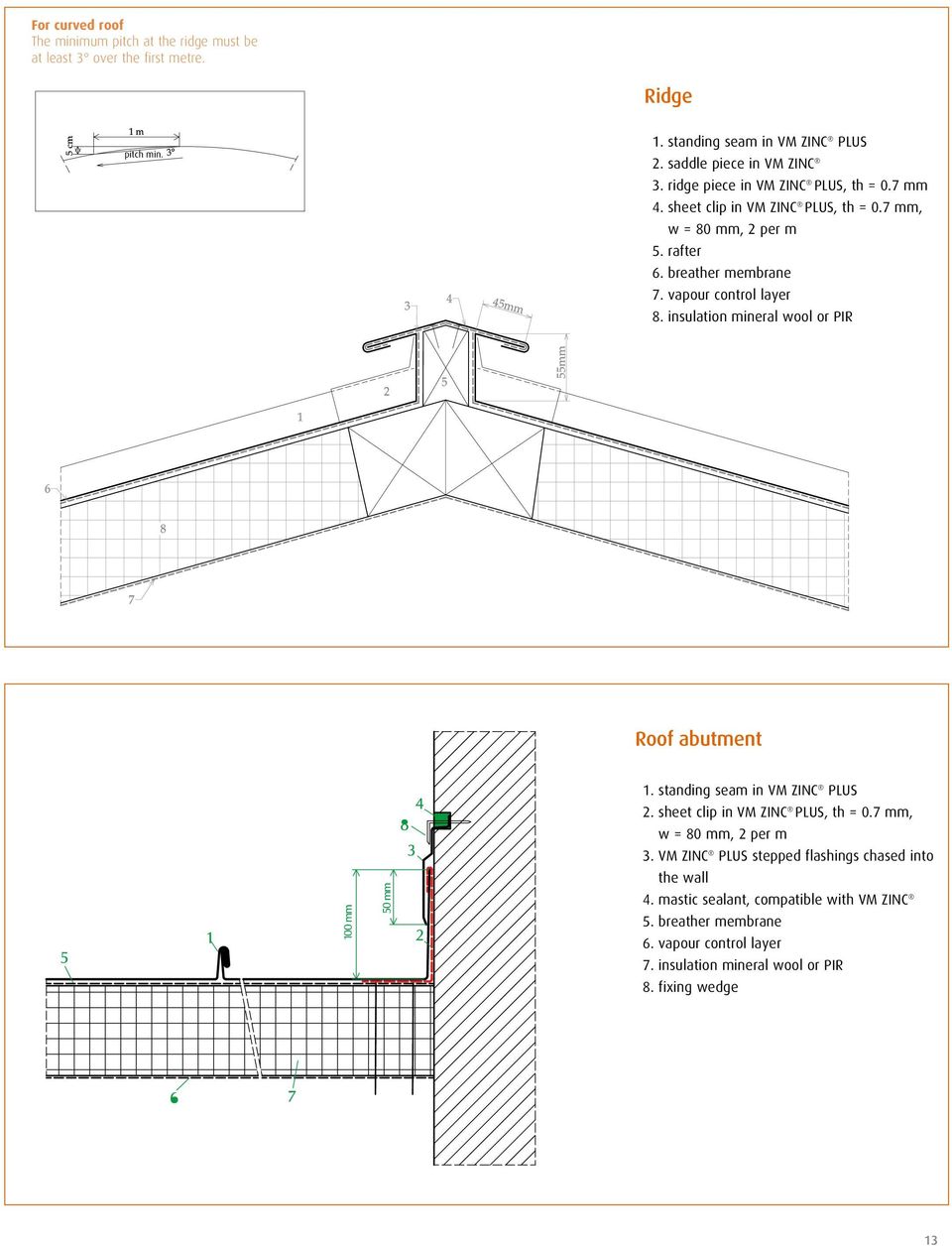
13 For curved roof The minimum pitch at the ridge must be at least 3 over the first metre. Ridge pitch min. 2. saddle piece in VM ZINC 3. ridge piece in VM ZINC PLUS, th = 0.7 mm 4. sheet clip in VM ZINC PLUS, th = 0.7 mm, 5. rafter 6. breather membrane 7. vapour control layer 8. insulation mineral wool or PIR Roof abutment 2. sheet clip in VM ZINC PLUS, th = 0.7 mm, 3. VM ZINC PLUS stepped flashings chased into the wall 4. mastic sealant, compatible with VM ZINC 5. breather membrane 6. vapour control layer 7. insulation mineral wool or PIR 8. fixing wedge 13
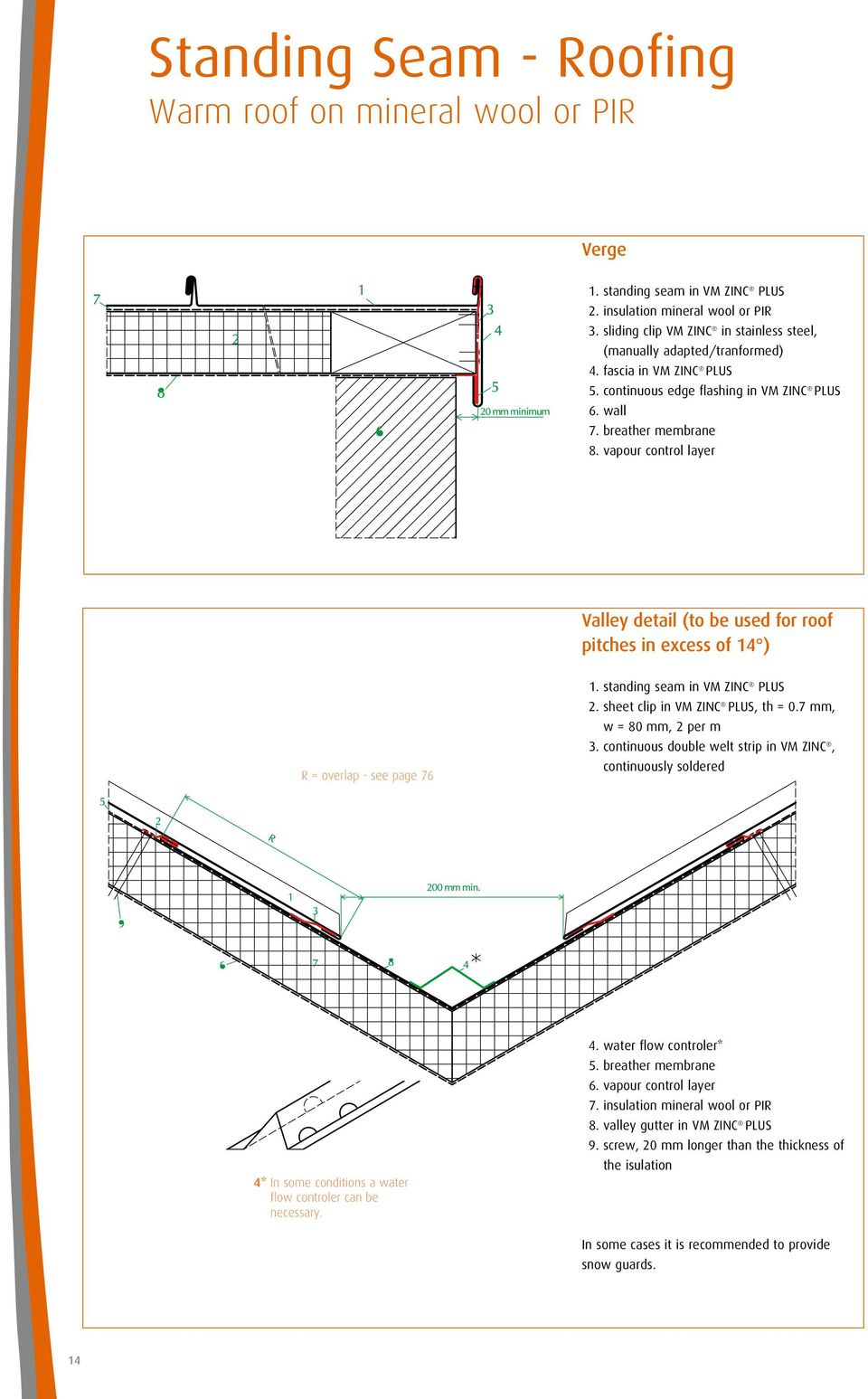
14 Standing Seam - Roofing Warm roof on mineral wool or PIR Verge 2. insulation mineral wool or PIR 3. sliding clip VM ZINC in stainless steel, (manually adapted/tranformed) 4. fascia in VM ZINC PLUS 5. continuous edge flashing in VM ZINC PLUS 6. wall 7. breather membrane 8. vapour control layer Valley detail (to be used for roof pitches in excess of 14 ) R = overlap - see page sheet clip in VM ZINC PLUS, th = 0.7 mm, 3. continuous double welt strip in VM ZINC, continuously soldered 4* In some conditions a water flow controler can be necessary. 4. water flow controler* 5. breather membrane 6. vapour control layer 7. insulation mineral wool or PIR 8. valley gutter in VM ZINC PLUS 9. screw, 20 mm longer than the thickness of the isulation In some cases it is recommended to provide snow guards. 14
15 Box valley gutter L = Flashing length - see page continuous eaves apron strip in VM ZINC PLUS 3. sheet clip in VM ZINC PLUS, th = 0.7 mm, 4. folded strip in VM ZINC PLUS, th = 0.7 mm, continuous 5. overflow 6. rafter, 5 mm thinner than the insulation 7. heating cables (if required) 8. box gutter in VM ZINC PLUS 9. breather membrane 10. insulation mineral wool or PIR 11. vapour control layer - In some cases it is recommended to provide snow guards. Hip 2. saddle piece in VM ZINC 3. hip piece in VM ZINC PLUS, th = 0.7 mm 4. sheet clip in VM ZINC PLUS, th = 0.7 mm, 5. rafter 6. breather membrane 7. vapour control layer 8. insulation mineral wool or PIR 15

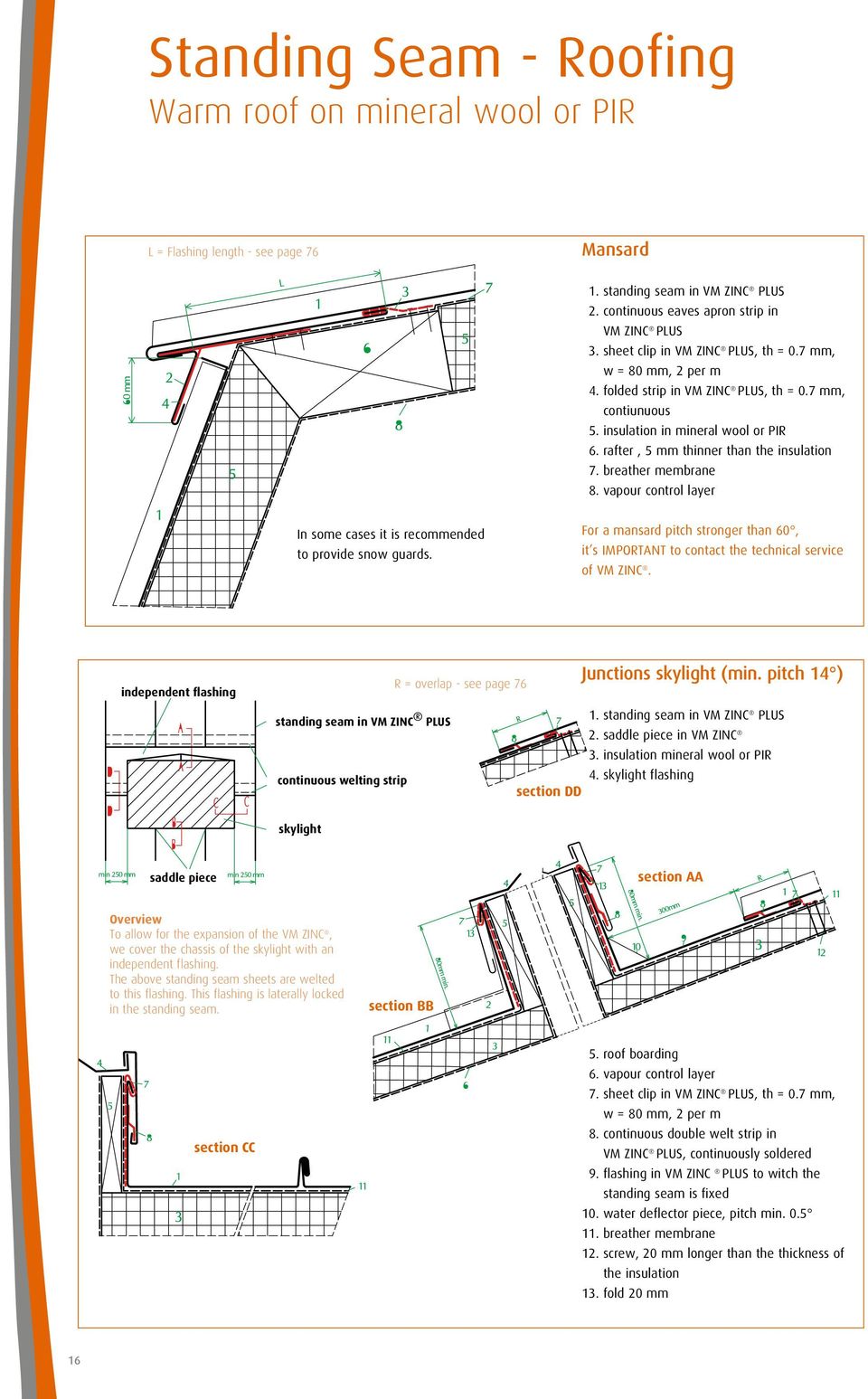
16 Standing Seam - Roofing Warm roof on mineral wool or PIR L = Flashing length - see page 76 Mansard 2. continuous eaves apron strip in VM ZINC PLUS 3. sheet clip in VM ZINC PLUS, th = 0.7 mm, 4. folded strip in VM ZINC PLUS, th = 0.7 mm, contiunuous 5. insulation in mineral wool or PIR 6. rafter, 5 mm thinner than the insulation 7. breather membrane 8. vapour control layer In some cases it is recommended to provide snow guards. For a mansard pitch stronger than 60, it s IMPORTANT to contact the technical service of VM ZINC. independent flashing R = overlap - see page 76 Junctions skylight (min. pitch 14 ) standing seam in VM ZINC 1. standing seam in VM ZINC PLUS PLUS 2. saddle piece in VM ZINC 3. insulation mineral wool or PIR continuous welting strip 4. skylight flashing section DD skylight saddle piece section AA Overview To allow for the expansion of the VM ZINC, we cover the chassis of the skylight with an independent flashing. The above standing seam sheets are welted to this flashing. This flashing is laterally locked in the standing seam. section BB section CC 5. roof boarding 6. vapour control layer 7. sheet clip in VM ZINC PLUS, th = 0.7 mm, 8. continuous double welt strip in VM ZINC PLUS, continuously soldered 9. flashing in VM ZINC PLUS to witch the standing seam is fixed 10. water deflector piece, pitch min breather membrane 12. screw, 20 mm longer than the thickness of the insulation 13. fold 20 mm 16
17 standing seam in VM ZINC PLUS Junctions skylight (pitch above 3 ) laid seam, soldered continuously section AA skylight Overview saddle piece Penetrations must not interupt more than three seams. At this level, expansion of the VM ZINC must be, towards the ridge not the eaves, = no fixed clip at the ridge. section CC section BB 2. saddle piece in VM ZINC 3. vapour control layer 4. skylight flashing 5. roof boarding 6. insulation mineral wool or PIR 7. sheet clip in VM ZINC PLUS, th = 0.7 mm, 8. continuous double welt strip in VM ZINC PLUS, continuously soldered 9. standing seam fold, fixed and soldered 10. breather membrane 11. water deflector piece, min. pitch fold 20 mm Junction with chimney in stainless steel (between two seams) 2. breather membrane 3. tube in VM ZINC 4. twinwall chimney in stainless steel with insulation 5. flashing piece in stainless steel 6. mastic sealant, compatible with VM ZINC 7. flashing collar in VM ZINC (dot soldering) 8. insulation in mineral wool or PIR 9. vapour control layer *: Fire space in accordance with the building regulations E: make allowances for the expansion & contraction of the VM ZINC (depending of the temperature when applied) Note: the top of the chimney must be high enough to prevent deposit falling onto the roof. We recommend the use of an uncovered finishing cone for fuel oil heating chimneys. 17

18 Standing Seam - Roofing Warm roof on composite panels Composition of roof Composite panel Tape / aluminium faced Breather membrane VM ZINC PLUS standing seam 18
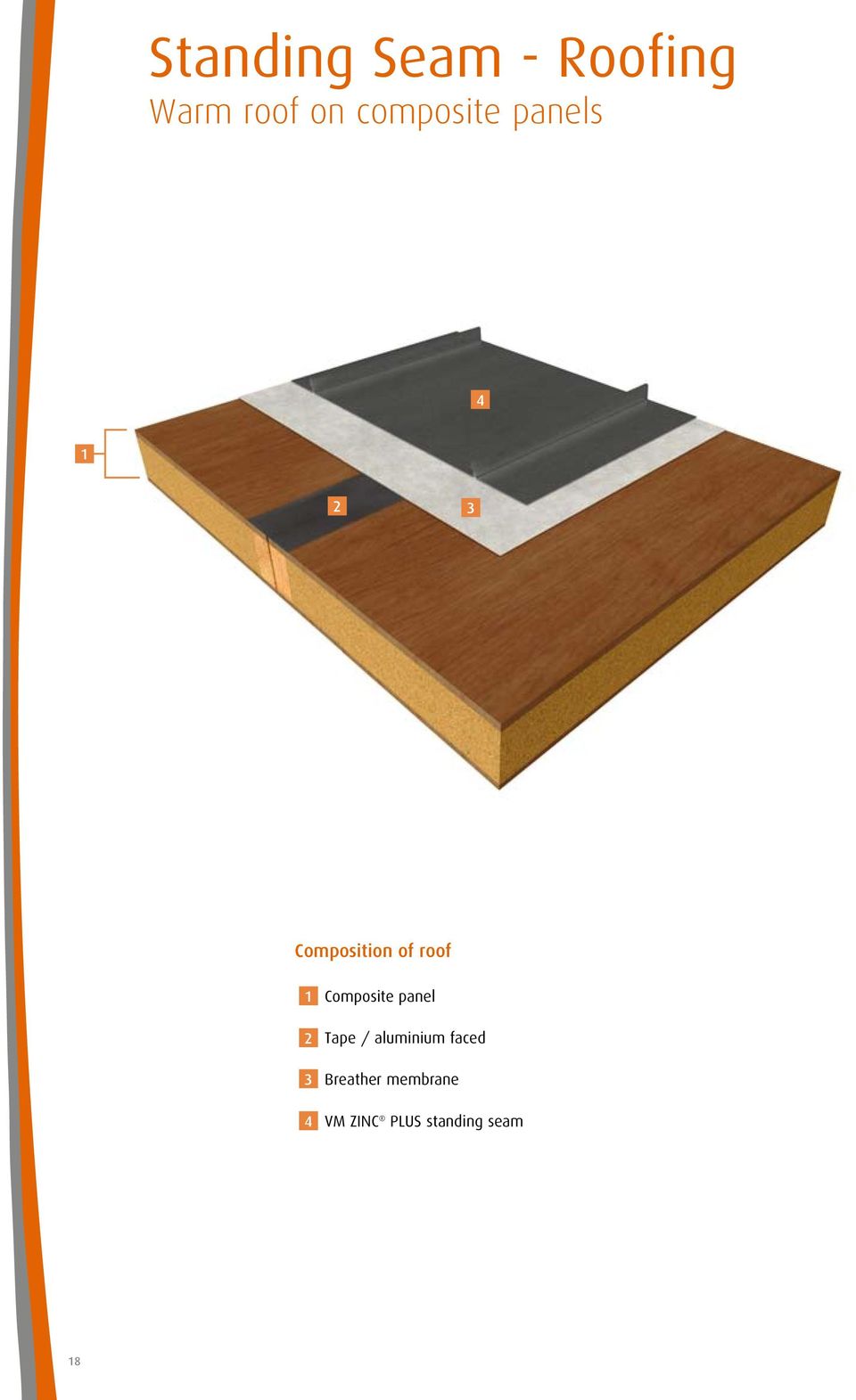
19 Installation of this system see pages 66 to 79 >Arch. P. Poncin - QUARTZ-ZINC Area of application Roofs with a pitch from 3 to 60. Classes of internal humidity load: 1 to 4. VM ZINC, the choices Only PLUS type VM ZINC with a specially protected underside: Natural VM ZINC PLUS, QUARTZ-ZINC PLUS or ANTHRA-ZINC PLUS. 0.7 mm thick. Characteristics of this technique With this warm roof system VM ZINC PLUS standing seam can be installed on composite panels without ventilating the underside of the VM ZINC PLUS. For all applications: 1. the substrate of the composite panels (on the warm side of the roof panel) must be covered with a vapour control layer material with vapour resistance always greater than the sum of the resistance of the elements fixed above the vapour control layer. It must be adapted to the internal humidity load of the building. 2. the joints between the composite panels must be totally air tight and have good vapour retarder properties. 3. breather membrane (Tyvek type 2480b or equivalent) should be installed between the VM ZINC PLUS and the composite panels. This breather membrane must be open to water vapour and completely watertight. The breather membrane must end into the gutter. Structure A choice of: Upper layer of the composite panel: solide wood panels or other panels, all certified for roofing applications (min. thickness: 12 mm). Particular attention to be put on certification of the upper facing of these panels for roofing usage. Upper layer able to resist pull out forces of 50daN/standing seam fixing clip (dynamic testing method). Galvanised steel internal and external facing (min. thickness: 0.7 mm for external facing). Particular attention to be put on certification of these panels for roofing usage. Upper layer able to resist pull out forces of 50daN/standing seam fixing clip (dynamic testing method). No delamination of the panel and pull out resistance decrease under wet conditions. N.B. The information relating to the installation of the composite panels and membranes is simply an indication. The choice and installation of these products will be according to the recommendations of the panels and membrane manufacturers. Specifications: : See : See 19

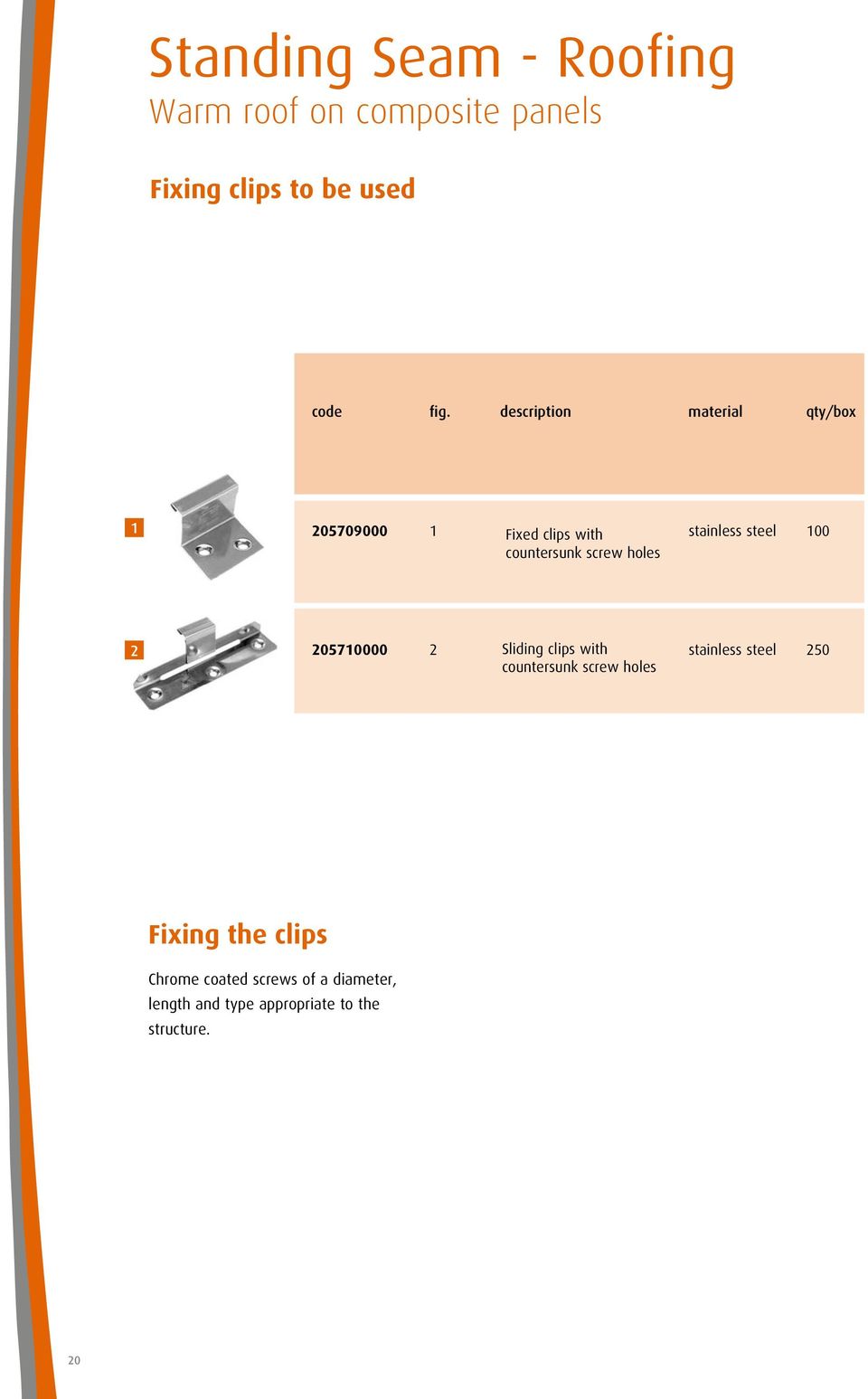
20 Standing Seam - Roofing Warm roof on composite panels Fixing clips to be used code fig. description material qty/box Fixed clips with stainless steel 100 countersunk screw holes Sliding clips with stainless steel 250 countersunk screw holes Fixing the clips Chrome coated screws of a diameter, length and type appropriate to the structure. 20
21 Examples of details The solutions presented here are simply examples and not the only ones possible. Our technical assistance department is available to study other solutions with you. Gutter L = Flashing length - see page 76 - In some cases it is recommended to provide snow guards. - When rendering a wall it is recom mended to protect the VM ZINC. 2. continuous eaves apron strip in VM ZINC PLUS 3. folded strip in VM ZINC PLUS, th = 0.7 mm, continuous 4. sheet clip in VM ZINC PLUS, th = 0.7 mm, 5. loadbearing structure 6. continuous sheet strip in VM ZINC PLUS, th = 0.7 mm 7. flashing in VM ZINC PLUS 8. PLULINE gutter bracket 9. PLULINE gutter 10. rafter, 5 mm thinner than the insulation 11. breather membrane 12. composite panel Variation pitch min. 1 pitch min. 1 R = overlap - see page 76 Box gutter (gutter outside the wall) 2. sheet clip in VM ZINC PLUS, th = 0.7 mm, 3. continuous double welt strip in VM ZINC PLUS, continuously soldered 4. rafter, 5 mm thinner than the insulation 5. roof boarding 6. box gutter in VM ZINC 7. bracket in VM ZINC, th = 1 mm, w = 250 mm, 2 per m 8. fascia with welted panels in VM ZINC, dimensions maximum for each panels: 400 x 2000 mm 9. ventilated space 10. continuous welt piece in VM ZINC 11. mesh (2 mm maximum weave) 12. packers fixed to gutter fall 13. continuous strip in VM ZINC, th = 0.8 mm 14. composite panel 15. breather membrane Variation - In some cases it is recommended to provide snow guards. - When rendering a wall it is recommended to protect the VM ZINC. 21
22 Standing Seam - Roofing Warm roof on composite panels pitch min. 1 L = Flashing length - see page 76 with flat folded clip pitch min. 1 Box gutter (gutter inside or on the wall) with rolled bead - In some cases snow guards and/or heating cables should be planned. - When rendering a wall it is recommended to protect the VM ZINC. 2. continuous eaves apron strip in VM ZINC PLUS 3. sheet clip in VM ZINC PLUS, th = 0.7 mm, 4. folded strip in VM ZINC PLUS, th = 0.7 mm, continuous 5. continuous sheet strip in VM ZINC PLUS, th = 0.7 mm 6. rafter, 5 mm thinner than the insulation 7. roof boarding 8. box gutter in VM ZINC PLUS 9. bracket in VM ZINC PLUS, th = 0.7 mm, continuous 10. composite panel 11. breather membrane For curved roof The minimum pitch at the ridge must be at least 3 over the first metre. Wall abutment head pitch min head saddle piece in VM ZINC 3. breather membrane 4. composite panel 5. mastic sealant, compatible with VM ZINC 6. roof boarding 7. sheet clip in VM ZINC PLUS, th = 0.7 mm, 8. continuous capping piece in VM ZINC PLUS 9. fixing wedge 22
23 For curved roof The minimum pitch at the ridge must be at least 3 over the first metre. Ridge pitch min saddle piece in VM ZINC 3. ridge piece in VM ZINC PLUS 4. sheet clip in VM ZINC PLUS, th = 0.7 mm, 5. rafter 6. breather membrane 7. composite panel Roof abutment 2. sheet clip in VM ZINC PLUS, th = 0.7 mm, 3. VM ZINC PLUS stepped flashings chased into the wall 4. mastic sealant, compatible with VM ZINC 5. breather membrane 6. composite panel 7. fixing wedge 23
24 Standing Seam - Roofing Warm roof on composite panels Verge 2. composite panel 3. sliding clip VM ZINC in stainless steel, (manually adapted/tranformed) 4. fascia in VM ZINC PLUS 5. continuous edge flashing in VM ZINC PLUS 6. wall 7. breather membrane R = overlap - see page 76 Valley detail (to be used for roof pitches in excess of 14 ) 4* In some conditions a water flow controler can be necessary. 2. sheet clip in VM ZINC PLUS, th = 0.7 mm, 3. continuous double welt strip in VM ZINC PLUS, continuously soldered 4. water flow controler* 5. breather membrane 6. composite panel 7. valley gutter in VM ZINC PLUS In some cases it is recommended to provide snow guards. 24
25 Box valley gutter L = Flashing length - see page continuous eaves apron strip in VM ZINC PLUS 3. sheet clip in VM ZINC PLUS, th = 0.7 mm, 4. folded strip in VM ZINC PLUS, th = 0.7 mm, continuous 5. overflow 6. rafter, 5 mm thinner than the insulation 7. heating cables (if required) 8. box gutter in VM ZINC PLUS 9. breather membrane 10. composite panel - In some cases it is recommended to provide snow guards. Hip 2. saddle piece in VM ZINC 3. ridge piece in VM ZINC PLUS 4. sheet clip in VM ZINC PLUS, th = 0.7 mm, 5. rafter 6. breather membrane 7. composite panel 25
26 Standing Seam - Roofing Warm roof on composite panels L = Flashing length - see page 76 Mansard 2. continuous eaves apron strip in VM ZINC PLUS 3. sheet clip in VM ZINC PLUS, th = 0.7 mm, 4. folded strip in VM ZINC PLUS, th = 0.7 mm, continuous 5. composite panel 6. breather membrane In some cases it is recommended to provide snow guards. For a mansard pitch stronger than 60, it s IMPORTANT to contact the technical service of VM ZINC. independent flashing standing seam in VM ZINC PLUS R = overlap - see page 76 Junctions skylight (min. pitch 14 ) continuous welting strip skylight section DD 2. saddle piece in VM ZINC 3. composite panel 4. skylight flashing 5. roof boarding saddle piece Overview To allow for the expansion of the VM ZINC, we cover the chassis of the skylight with an independent flashing. The above standing seam sheets are welted to this flashing. This flashing is laterally locked in the standing seam. section BB section AA 6 section CC 6. sheet clip in VM ZINC PLUS, th = 0.7 mm, 7. fold 20 mm 8. continuous double welt strip in VM ZINC PLUS, continuously soldered 9. flashing in VM ZINC PLUS to witch the standing seam is fixed 10. water deflector piece, pitch min breather membrane 26
27 standing seam in VM ZINC PLUS Junctions skylight (pitch above 3 ) laid seam, soldered continuously section AA skylight saddle piece Overview Penetrations must not interupt more than three seams. At this level, expansion of the VM ZINC must be, towards the ridge not the eaves, = no fixed clip at the ridge. section CC section BB 2. saddle piece in VM ZINC 3. breather membrane 4. skylight flashing 5. roof boarding 6. composite panel 7. sheet clip in VM ZINC PLUS, th = 0.7 mm, 8. double welt in VM ZINC PLUS, continuously soldered 9. standing seam fold, fixed and soldered 10. fold 20 mm 11. water deflector piece, min. pitch 0.5 Junction with chimney in stainless steel (between two seams) 2. breather membrane 3. tube in VM ZINC 4. twinwall chimney in stainless steel with insulation 5. flashing piece in stainless steel 6. mastic sealant, compatible with VM ZINC 7. flashing collar in VM ZINC (dot soldering) 8. composite panel *: Fire space in accordance with the building regulations E: make allowances for the expansion & contraction of the VM ZINC (depending of the temperature when applied) Note: the top of the chimney must be high enough to prevent deposit falling onto the roof. We recommend the use of an uncovered finishing cone for fuel oil heating chimneys. 27
28 Standing Seam - Roofing Warm roof on cellular glass Composition of the roof Interior finish Support structure (e.g. steel deck) Cellular glass Galvanised steel plates Bituminous membrane Separation layer / 1000 guage PE film VM ZINC PLUS standing seam 28
29 Installation of this system see pages 66 to 79 >Arch. S & C Molina - QUARTZ-ZINC PLUS Area of application Roofs with a pitch from 3 to 45. Classes of internal humidity load: 1 to 5. On all structures compatible with the installation of cellular glass (e.g. wood, concrete, steel deck, according to the manufacturer s specifications). Renovation of waterproof bitumen roof (according to the cellular glass manufacturer s specifications). VM ZINC, the choices Only PLUS type VM ZINC with a specially protected underside: Natural VM ZINC PLUS, QUARTZ-ZINC PLUS or ANTHRA-ZINC PLUS. 0.7 mm thick. Characteristics of this technique This warm roof system allows the installation of VM ZINC PLUS standing seam on cellular glass insulation without penetrating fastenings. Structure Cellular glass glued to its structure. The cellular glass is then covered with a coating of bitumen. Galvanised steel plates, which the insulation manufacturer has to supply, are glued to the bitumen coated cellular glass. The plates must be positioned in collaboration with the VM ZINC installer. A reinforced heat-sealable membrane is then sealed by torching to the entire surface of the insulation without overlapping. This membrane also covers the plates. In order to avoid any contact between the VM ZINC PLUS and the bituminous membrane, a transparent polyethylene separation membrane is fixed with an overlap of mm. The VM ZINC PLUS panels are fixed to this structure with special clips screwed into the galvanised steel plates. N.B. The information relating to the installation of insulation, plates and membranes is simply an indication. The choice and installation of these products will be according to the recommendations of the insulation manufacturer. Specifications: : See : See 29
30 Standing Seam - Roofing Warm roof on cellular glass Fixing clips to be used code fig. description material qty/box Fixed clips with stainless steel 100 countersunk screw holes Sliding clips with stainless steel 250 countersunk screw holes 2 Fixing the clips 4,8 mm Philips no. 2 conical head recessed screws, with a minimum length of 16 mm, or an equivalent with the same characteristics must be used. 30
31 Examples of details The solutions presented here are simply examples and not the only ones possible. Our technical assistance department is available to study other solutions with you. Gutter L = Flashing length - see page 76 - In some cases it is recommended to provide snow guards. - When rendering a wall it is recom mended to protect the VM ZINC. 2. continuous eaves apron strip in VM ZINC PLUS 3. continuous folded strip in VM ZINC PLUS, th=0.7 mm 4. sheet clip in VM ZINC PLUS, th = 0.7 mm, 5. loadbearing structure 6. continuous sheet strip in VM ZINC PLUS, th = 0.7 mm 7. flashing in VM ZINC PLUS 8. PLULINE gutter bracket 9. PLULINE gutter 10. rafter, 5 mm thinner than the insulation 11. PE-film 12. bituminous membrane 13. cellular glass Variation pitch min. 1 pitch min. 1 R = overlap - see page 76 Box gutter (gutter outside the wall) 2. sheet clip in VM ZINC PLUS, th = 0.7 mm, 3. continuous double welt strip in VM ZINC, soldered 4. rafter, 5 mm thinner than the insulation 5. roof boarding 6. box gutter in VM ZINC 7. bracket in VM ZINC, th = 1 mm, w = 250 mm, 2 per m 8. fascia with welted panels in VM ZINC, dimensions maximum for each panel: 400 x 2000 mm 9. ventilated space 10. continuous welt piece in VM ZINC 11. mesh (2 mm maximum weave) 12. packers fixed to gutter fall 13. continuous strip in VM ZINC, th = 0.8 mm 14. cellular glass 15. bituminous membrane 16. PE-film Variation - In some cases it is recommended to provide snow guards. - When rendering a wall it is recommended to protect the VM ZINC. 31
32 Standing Seam - Roofing Warm roof on cellular glass L = Flashing length - see page 76 Box gutter (gutter inside or on the wall) with flat folded clip pitch min. 1 pitch min. 1 with rolled bead 2. continuous eaves apron strip in VM ZINC PLUS 3. sheet clip in VM ZINC PLUS, th = 0.7 mm, 4. folded strip in VM ZINC PLUS, th = 0.7 mm, continuous 5. continuous sheet strip in VM ZINC PLUS, th = 0.7 mm 6. rafter, 5 mm thinner than the insulation 7. roof boarding 8. box gutter in VM ZINC PLUS 9. bracket in VM ZINC PLUS, th = 0.7 mm, continuous 10. bituminous membrane 11. PE-film 12. cellular glass - In some cases snow guards and/or heating cables should be planned. - When rendering a wall it is recommended to protect the VM ZINC. For curved roof The minimum pitch at the ridge must be at least 3 over the first metre. Wall abutment head pitch min head saddle piece in VM ZINC 3. PE-film 4. bituminous membrane 5. cellular glass 6. roof boarding 7. sheet clip in VM ZINC PLUS, th = 0.7 mm, 8. continuous capping piece in VM ZINC PLUS 9. fixing wedge 10. mastic sealant, compatible with VM ZINC - When rendering a wall it is recommended to protect the VM ZINC. 32
33 For curved roof The minimum pitch at the ridge must be at least 3 over the first metre. Ridge pitch min. 2. saddle piece in VM ZINC 3. sheet clip in VM ZINC PLUS, th = 0.7 mm, 4. ridge piece in VM ZINC PLUS, th = 0.7 mm 5. rafter 6. PE-film 7. bituminous membrane 8. cellular glass Roof abutment 2. sheet clip in VM ZINC PLUS, th = 0.7 mm, 3. VM ZINC PLUS stepped flashings chased into the wall 4. mastic sealant, compatible with VM ZINC 5. PE-film 6. bituminous membrane 7. cellular glass 8. fixing plate in galvanised steel 9. fixing wedge - When rendering a wall it is recommended to protect the VM ZINC. 33
34 Standing Seam - Roofing Warm roof on cellular glass Verge 2. cellular glass 3. sliding clip VM ZINC in stainless steel, (manually adapted/tranformed) 4. fascia in VM ZINC PLUS 5. continuous edge flashing in VM ZINC PLUS 6. wall 7. PE-film 8. bituminous membrane 9. fixing plate in galvanised steel - When rendering a wall it is recommended to protect the VM ZINC. Valley detail (to be used for roof pitches of minimum 14 ) 2. sheet clip in VM ZINC PLUS, th = 0.7 mm, 3. continuous double welt strip in VM ZINC, soldered 4. water flow controler* R = overlap - see page PE-film 6. bituminous membrane 7. cellular glass 8. valley gutter in VM ZINC PLUS 9. fixing plate in galvanised steel 4* In some conditions a water flow controler can be necessary. In some cases it is recommended to provide snow guards. 34
35 Box valley gutter L = Flashing length - see page continuous eaves apron strip in VM ZINC PLUS 3. sheet clip in VM ZINC PLUS, th = 0.7 mm, 4. folded strip in VM ZINC PLUS, th = 0.7 mm, continuous 5. overflow 6. rafter, 5 mm thinner than the insulation 7. heating cables (if required) 8. box gutter in VM ZINC PLUS 9. PE-film 10. bituminous membrane 11. cellular glass - In some cases it is recommended to provide snow guards. Hip 2. saddle piece in VM ZINC 3. sheet clip in VM ZINC PLUS, th = 0.7 mm, 4. ridge piece in VM ZINC PLUS, th = 0.7 mm 5. rafter 6. PE-film 7. bituminous membrane 8. cellular glass 35
36 Standing Seam - Roofing Warm roof on cellular glass L = Flashing length - see page 76 Mansard 2. continuous eaves apron strip in VM ZINC PLUS 3. sheet clip in VM ZINC PLUS, th = 0.7 mm, 4. folded clip in VM ZINC PLUS, th = 0.7 mm, continuous 5. cellular glass 6. fixing plate in galvanised steel 7. PE-film 8. bituminous membrane In some cases it is recommended to provide snow guards. For a mansard pitch stronger than 45, it s IMPORTANT to contact the technical service of VM ZINC. independent flashing Junctions skylight (min. pitch 14 ) standing seam in VM ZINC PLUS continuous welting strip R = overlap - see page saddle piece in VM ZINC 3. cellular glass 4. skylight flashing 5. roof boarding skylight section DD saddle piece Overview To allow for the expansion of the VM ZINC, we cover the chassis of the skylight with an independent flashing. The above standing seam sheets are welted to this flashing. This flashing is laterally locked in the standing seam. section AA section BB section CC 6. bituminous membrane 7. sheet clip in VM ZINC PLUS, th = 0.7 mm, 8. continuous double welt strip in VM ZINC PLUS, continuously soldered 9. flashing to witch the standing seam is fixed 10. water deflector piece, pitch min PE-film 12. fixing plate in galvanised steel 13. fold 20 mm 36
37 standing seam in VM ZINC PLUS Junctions skylight (pitch above 3 ) laid seam, soldered continuously section AA skylight saddle piece Overview Penetrations must not interupt more than three seams. At this level, expansion of the VM ZINC must be, towards the ridge not the eaves, = no fixed clip at the ridge. section CC section BB 2. saddle piece in VM ZINC 3. bituminous membrane 4. skylight flashing 5. roof boarding 6. cellular glass 7. sheet clip in VM ZINC PLUS, th = 0.7 mm, 8. continuous double welt strip in VM ZINC, soldered 9. standing seam fold, fixed and soldered 10. PE-film 11. water deflector piece, min. pitch fixing plate in galvanised steel 13. fold 20 mm Junction with chimney in stainless steel (between two seams) 2. PE-film 3. tube in VM ZINC 4. twinwall chimney in stainless steel with insulation 5. flashing piece in stainless steel 6. mastic sealant, compatible with VM ZINC 7. flashing collar in VM ZINC (dot soldering) 8. cellular glass 9. bituminous membrane *: Fire space in accordance with the building regulations E: make allowances for the expansion & contraction of the VM ZINC (depending of the temperature when applied) Note: the top of the chimney must be high enough to prevent deposit falling onto the roof. We recommend the use of an uncovered finishing cone for fuel oil heating chimneys. 37
38 Standing Seam - Roofing Ventilated roof on incompatible support Composition of the roof Interior finish Vapour control layer Insulation Breather membrane Ventilated air space Rafter Incompatible support VM ZINC PLUS Standing seam 38
39 Installation of this system see pages 66 to 79 >Arch. - QUARTZ-ZINC PLUS Areas of application Roofs with a pitch from 3 to vertical. Classes of internal humidity load: 1 to 4. Both renovation and new buildings. VM ZINC, the choices Only PLUS type VM ZINC with a specially protected underside: Natural VM ZINC PLUS, QUARTZ-ZINC PLUS or ANTHRA-ZINC PLUS. PIGMENTO & PIGMENTO Plus. 0.7 mm thick. Characteristics of this technique VM ZINC PLUS is installed on the incompatible support (plywood or panels). A 40 mm* continuous air gap must be left clear beneath the support of the VM ZINC PLUS, on all the roof pitches. Continuous ventilation openings are made at the top and bottom. In order to keep the integrity of the roof, it is recommended to install a breather membrane on the cold side of the insulation and a vapour control layer adapted to the internal humidity load of the building, on the warm side of the insulation. Possible substrates Plywood panels that are not compatible with VM ZINC must be certified for roofing application and at least 18 mm thick. All the substrates must be flat, dry, and sufficiently resistant to all the stresses to which they will be submitted (e.g. pull out force of 50 dan per standing seam fixing clip). This resistance needs to be guaranteed even through ageing of the system and humidity circumstances through the roof structure Maximum difference in height of 1 mm between support elements of the VM ZINC PLUS. The deflection measured under a rigid 600 mm long straight edge cannot exceed 2 mm in all directions. The nails/screws are countersunk in order to avoid any contact with the VM ZINC PLUS. Specifications: : See : See Arch. Lord Aeck Sargent Architecture - ANTHRA-ZINC PLUS > 39
40 Standing Seam - Roofing Ventilated roof on incompatible support Fixing clips to be used code fig. description material qty/box Fixed clips with Stainless steel 100 countersunk screw holes Sliding clips with Stainnless steel 250 countersunk screw holes Fixing the clips Chrome coated screws of a diameter, length and type appropriate to the structure. 40
41 Examples of details The solutions presented here are simply examples and are not the only possibilities. Our technical assistance department is available to study other alternatives with you. L = Flashing length - see page 76 Gutter - In some cases it is recommended to provide snow guards. - When rendering a wall it is recommended to protect the VM ZINC. 2. Sheet clip in vm zinc plus th= 0.7 mm, l=80 mm, 2 per m 3 continuous eaves apron strip in VM ZINC PLUS 4. plywood, 5 mm thinner than adjacent 5. plywood 6. ventilated space 7. folded strip in VM ZINC PLUS, th = 0.7 mm, continuous 8. flashing in VM ZINC PLUS 9. continuous sheet strip in VM ZINC plus, th = 0.7 mm 10. PLULINE gutter bracket 11. PLULINE gutter 12. breather membrane 13. mesh (2 mm max. weave) pitch 1 pitch 1 14 R=overlap page 76 Box gutter (gutter outside the wall) 1. standing seam in VM ZINC 2. sheet clip in VM ZINC, th = 0.7 mm, 3. continuous welting strip in VM ZINC, soldered 4. plywood, 5 mm thinner than adjacent 5. plywood 6. boxed gutter in VM ZINC PLUS 7. bracket in VM ZINC PLUS, th = 0.7 mm, continuous 8. fascia with welted panels in VM ZINC PLUS, dimensions maximum for each panel: 400 x 2000 mm 9. breather membrane 10. continuous welt piece in VM ZINC 11. mesh (2 mm maximum weave) 12. packers laid to gutter fall 13. continuous strip in VM ZINC PLUS, th = 0.7 mm 14. ventilated space - In some cases it is recommended to provide snow guards. - When rendering a wall it is recommended to protect the VM ZINC. 41
42 Standing Seam - Roofing Ventilated roof on incompatible support L = page 76 Box gutter (gutter inside or on the wall) 9 pitch 1 pitch continuous eaves apron strip in VM ZINC PLUS 3. sheet clip in VM ZINC PLUS, th = 0.7 mm, 4. folded strip in VM ZINC PLUS, th = 0.7 mm, continuous 5. mesh (2 mm maximum weave) 6. plywood, 5 mm thinner than adjacent 7. plywood 8. box gutter in VM ZINC PLUS 9. bracket in VM ZINC PLUS, th = 0.7 mm, continuous 10. packers laid to gutter fall 11. breather membrane 12. Ventilated space - In some cases it is recommended to provide snow guards. - When cementing a wall it is recommended to protect the VM ZINC. Wall abutment head for curved roof 2. head saddle piece in VM ZINC 3. sheet clip in VM ZINC PLUS, th = 0.7 mm, pitch min continuous capping piece in VM ZINC PLUS 5. timber 6. plywood 7. non-continuous timber 8. mesh (2 mm max weave) 9. fixing wedge 10. mastic sealant, compatible with VM ZINC 11. folded strip in VM ZINC PLUS, th = 0.7 mm, continuous 12. breather membrane 13. ventilated space 42
43 Ridge pitch min. 3 for curved roof 1. ventilated space 2. plywood 3. sprocket piece 4. mesh (2 mm maximum weave) 5. standing seam in VM ZINC PLUS 6. saddle piece in VM ZINC 7. sheet clip in VM ZINC PLUS, th=0.7 mm, w=80 mm, 2 per m 8. folded clip in VM ZINC 1 mm. L =50mm, 3 per m. 9. ridge piece in VM ZINC PLUS 10. breather membrane, in accordance with specifications Roof abutment 2. sheet clip in VM ZINC PLUS, th = 0.7 mm, 3. VM ZINC PLUS stepped flashings chased into the wall 4. mastic sealant, compatible with VM ZINC 5. breather membrane 6. plywood 7. ventilated space 43
44 Standing Seam - Roofing Ventilated roof on incompatible support Verge 2. plywood 3. sliding clip VM ZINC in stainless steel, (manually adapted/transformed) 4. fascia in VM ZINC max. 400 x 2000 mm 5. continuous edge flashing in VM ZINC PLUS 6. wall 7. ventilated space 8. breather membrane Valley detail (to be used for roof pitches of minimum 14 ) R = overlap - see page sheet clip in VM ZINC PLUS, th = 0.7 mm, 3. continuous welt strip in VM ZINC, soldered continuously 4. plywood 5. plywood 6. valley gutter in VM ZINC 7. ventilated space 8. water flow controler* 9. breather membrane 8* In some conditions a water flow controler can be necessary. In some cases it is recommended to provide snow guards. 44
45 L = Flashing length - see page 76 Box valley gutter 2. continuous eaves apron strip in VM ZINC PLUS 3. sheet clip in VM ZINC PLUS, th = 0.7 mm, 4. folded strip in VM ZINC PLUS, th = 0.7 mm, continuous 5. mesh (2 mm max weave) 6. plywood, 5 mm thinner than adjacent 7. plywood 8. box gutter in VM ZINC PLUS 9. ventilated space 10. packers fixed to gutter fall 11. breather membrane, in accordance with specifications 12. heating cables (if required) 13. overflow - In some cases it is recommended to provide snow guards. - When rendering a wall it is recom mended to protect the VM ZINC. Hip 1. Ventilated space 2. plywood 3. sprocket piece 4. mesh (2 mm maximum weave) 5. standing seam in VM ZINC PLUS 6. saddle piece in VM ZINC 7. sheet clip in VM ZINC PLUS 8. folded strip in VM ZINC PLUS 9. ridge piece in VM ZINC PLUS 10. breather membrane 45
46 Standing Seam - Roofing Ventilated roof on incompatible support L = Flashing length - see page 76 Mansard 2. continuous eaves apron strip in VM ZINC PLUS 3. sheet clip in VM ZINC PLUS, th = 0.7 mm, 4. folded strip in VM ZINC PLUS, th = 0.7 mm, continuous 5. plywood, 5 mm thinner than adjacent 6. plywood 7. mesh (2 mm max. weave) 8. ventilated space 9. breather membrane In some cases it is recommended to provide snow guards. independent flashing standing seam in VM ZINC R = overlap - see page 76 Junctions skylight (min. pitch 14 ) continuous welting strip section DD skylight section AA saddle piece Overview To allow for the expansion of the VM ZINC, we cover the chassis of the skylight with an independent flashing. This flashing is laterally locked in the standing seam. section BB section CC 2. saddle piece in VM ZINC 3. fold 20 mm 4. skylight flashing 5. plywood 6. ventilated space 7. sheet clip in VM ZINC PLUS, th = 0.7 mm, 8. continuous double welt strip in VM ZINC, soldered 9. flashing VM ZINC PLUS to witch the standing seam is fixed 10. water deflector piece, pitch min breather membrane 12. fold 20 mm 46
47 Standing seam in VM ZINC laid seam, soldered continuously Junctions skylight (pitch above 3 ) section AA skylight Overview Penetrations must not interupt more than three seams. At this level, expansion of the VM ZINC must be, towards the ridge not the eaves, = no fixed clip at the ridge. saddle piece section BB 2. saddle piece in VM ZINC 3. fold 20 mm 4. skylight flashing 5. plywood 6. ventilated space section CC 7. sheet strip in VM ZINC PLUS, th = 0.7 mm, 8. double welt in VM ZINC, continuously soldered 9. standing seam fold, laid and soldered 10. water deflector piece, min pitch breather membrane neatly glued in the corners Junction with chimney in stainless steel (between two seams) 2. plywood 3. continuously soldered tube in VM ZINC 4. twinwall chimney in stainless steel with insulation 5. flashing piece in stainless steel 6. mastic sealant, compatible with VM ZINC 7. flashing collar in VM ZINC (dot soldering) 8. breather membrane neatly glued 9. ventilated space *: Fire space in accordance with the building regulations E: make allowances for the expansion & contraction of the VM ZINC (depending of the temperature when applied) Note: the top of the chimney must be high enough to prevent deposit falling onto the roof. We recommend the use of an uncovered finishing cone for fuel oil heating chimneys. Or we recommend the use of chimney/ flue cowl-conical 47
48 Standing Seam - Roofing Ventilated roof on roof boarding Composition of the roof Interior finish Vapour control layer Insulation Breather membrane Ventilated air space Rafter Roof boarding VM ZINC standing seam 48
49 Installation of this system see pages 66 to 79 >Arch. M + W Pearce - Natural VM ZINC Areas of application Roofs with a pitch from 3 to vertical. Classes of internal humidity load: 1 to 4. Both renovations and new buildings. VM ZINC, the choices Natural VM ZINC, 5 pre-weathered VM ZINC colours QUARTZ-ZINC, ANTHRA-ZINC, PIGMENTO red, green, blue: 0.7 or 0.8 mm thick. 6 Bilacquered VM ZINC colours: 0.7 mm thick. Non standard bilaquered VM ZINC colours are also available (for large quantities, any colour - min. orders 10 Tons). Please contact our technical office for further information. Characteristics of this technique VM ZINC is installed on the roof boarding. A 40 mm* continuous air gap must be left clear beneath the roof boarding, on all the roof pitches. Continuous ventilation openings are made at the top and bottom. In order to keep the integrity of the roof, it is recommended to install a breather membrane on the cold side of the insulation and a vapour control layer adapted to the internal humidity load of the building, on the warm side of the insulation. Structure Clean and dry 100 to 150 mm wide, 18 or 24 mm thick softwood boarding, according to the rafter centres. Any wood treatment products (fungicides, insecticides) must be dry and completely neutral in relation to VM ZINC (cf appendix 6 page 80). The roof boards are fixed perpendicular to the direction of the pitch leaving a 3 to 5 mm gap between them. They are securely fixed to the structure. Maximum difference in height of 1 mm between roof boards. The deflection measured under a rigid 600 mm long straight edge cannot exceed 2 mm in all directions. The roof board nails are countersunk in order to avoid any contact with the VM ZINC. Specifications: *Cf. appendix 5 page 79 : See : See roof boarding > 49
50 Standing Seam - Roofing Ventilated roof on roof boarding Fixing clips to be used Fixed clips 1 Code Fig description material qty/box Screw-in fixed clips with stainless steel 100 countersunk screw holes Nail-in fixed clips without stainless steel 100 countersunk screw holes Sliding clips 3 Code Fig description material qty/box Screw in sliding clips with stainless steel 250 countersunk screw holes Nail-in sliding clips without stainless steel 250 countersunk screw holes Fixing the clips With either: Ring shark, galvanised or stainless steel nails. Chrome coated screws of a diameter, length and type appropriate to the structure. 50
51 Examples of details The solutions presented here are simply examples and are not the only possibilities. Our technical assistance department is available to study other alternatives with you. Junction gutter L = Flashing length - see page 76 - In some cases it is recommended to provide snow guards. - When rendering a wall it is recommended to protect the VM ZINC. 1. standing seam in VM ZINC 2. sheet clip in VM ZINC, th = 0.8 mm, 3. continuous eaves apron strip in VM ZINC 4. eaves boards, 5 mm thinner than adjacent boards 5. roof boarding 6. ventilated space 7. folded clip in VM ZINC, th = 1 mm, w = 250 mm, 2 per m 8. flashing in VM ZINC 9. continuous sheet strip in VM ZINC, th = 0.8 mm 10. PLULINE gutter bracket 11. PLULINE gutter 12. breather membrane 13. mesh (2 mm max. weave) Variation pitch min. 1 R = overlap - see page 76 Box gutter (gutter outside the wall, ventilation inlet through soffit) pitch min standing seam in VM ZINC 2. sheet clip in VM ZINC, th = 0.8 mm, 3. continuous double welt strip in VM ZINC, continously soldered 4. eaves boards, 5 mm thinner than adjacent boards 5. roof boarding 6. box gutter in VM ZINC 7. bracket in VM ZINC, th = 1 mm, w = 250 mm, 2 per m 8. fascia with welted panels in VM ZINC, dimensions maximum for each panel: 400 x 2000 mm 9. breather membrane 10. continuous welt piece in VM ZINC 11. mesh (2 mm maximum weave) 12. packers fixed to gutter fall 13. continuous strip in VM ZINC, th = 0.8 mm 14. ventilated space Variation - In some cases it is recommended to provide snow guards. - When rendering a wall it is recommended to protect the VM ZINC. 51
52 Standing Seam - Roofing Ventilated roof on roof boarding L = Flashing length - see page 76 Box gutter (gutter inside or on the wall, ventilation inlet through gutter) pitch min. 1 with flat folded clip pitch min standing seam in VM ZINC 2. continuous eaves apron strip in VM ZINC 3. sheet clip in VM ZINC, th = 0.8 mm, 4. folded clip in VM ZINC, th = 1 mm, w = 250 mm, 2 per m 5. mesh (2 mm maximum weave) 6. eaves boards, 5 mm thinner than adjacent boards 7. roof boarding 8. box gutter in VM ZINC 9. bracket in VM ZINC, th = 1 mm, w = 250 mm, 2 per m 10. packers fixed to gutter fall 11. breather membrane (optional) 12. continuous sheet strip in VM ZINC, th = 0.8 mm 13. ventilated space with rolled bead - In some cases it is recommended to provide snow guards. - When rendering a wall it is recommended to protect the VM ZINC. Wall abutment head pitch min. 3 For curved roof The minimum pitch at the ridge must be at least 3 over the first metre. 1. standing seam in VM ZINC 2. head saddle piece in VM ZINC 3. sheet clip in VM ZINC, th = 0.8 mm, 4. continuous capping piece in VM ZINC 5. timber 6. roof boarding 7. non-continuous timber 8. mesh (2 mm max weave) 9. fixing wedge 10. mastic sealant, compatible with VM ZINC 11. folded clip in VM ZINC, th = 1 mm, w = 250 mm, 2 per m 12. breather membrane 13. ventilated space 52
53 Ventilated ridge pitch min. 3 For curved roof The minimum pitch at the ridge must be at least 3 over the first metre. 1. ventilated space 2. roof boarding 3. sprocket piece 4. mesh (2 mm maximum weave) 5. standing seam in VM ZINC 6. saddle piece in VM ZINC 7. sheet clip in VM ZINC, th = 0.8 mm, Folded clip in VM ZINC 8. folded clip in VM ZINC, th = 1 mm, w = 50 mm, 3 per m 9. ridge piece in VM ZINC, th = 0.8 mm 10. breather membrane Roof abutment 1. standing seam in VM ZINC 2. sheet clip in VM ZINC, th = 0.8 mm, 3. VM ZINC stepped flashings chased into the wall 4. fixing wedge 5. mastic sealant, compatible with VM ZINC 6. roof boarding 7. breather membrane 8. ventilated space 53
54 Standing Seam - Roofing Ventilated roof on roof boarding Verge 1. standing seam in VM ZINC 2. roof boarding 3. sliding clip VM ZINC in stainless steel, (manually adapted/transformed) 4. fascia in VM ZINC max. 400 x 2000 mm 5. continuous edge flashing in VM ZINC 6. wall 7. ventilated space 8. breather membrane Valley detail (to be used for roof pitches of minimum 14 ) R = overlap - see page standing seam in VM ZINC 2. sheet clip in VM ZINC, th = 0.8 mm, 3. continuous double welt strip in VM ZINC, continously soldered 4. eaves boards, 5 mm thinner than adjacent boards 5. roof boarding 6. valley gutter in VM ZINC 7. ventilated space 8. water flow controler* 9. breather membrane (optional) 8* In some conditions a water flow controler can be necessary. In some cases it is recommended to provide snow guards. 54
55 Box valley gutter L = Flashing length - see page standing seam in VM ZINC - In some cases it is recommended to provide snow guards - When rendering a wall it is recommended to protect the VM ZINC 2. continuous eaves apron strip in VM ZINC 3. sheet clip in VM ZINC, th = 0.8 mm, 4. folded clip in VM ZINC, th = 1 mm, w = 250 mm, 2 per m or 5. mesh (2 mm max weave) 6. eaves boards, 5 mm thinner than adjacent boards 7. roof boarding 8. box gutter in VM ZINC 9. ventilated space 10. packers fixed to gutter fall 11. breather membrane 12. heating cables (if required) 13. overflow Ventilated hip 1. ventilated space 2. roof boarding 3. sprocket piece 4. mesh (2 mm maximum weave) 5. standing seam in VM ZINC 6. saddle piece in VM ZINC 7. sheet clip in VM ZINC, th = 0.8 mm, Folded clip in VM ZINC 8. folded clip in VM ZINC, th = 1 mm, w = 250 mm, 2 per m 9. hip piece in VM ZINC, th = 0.8 mm 10. breather membrane 55
56 Standing Seam - Roofing Ventilated roof on roof boarding L = Flashing length - see page 76 Mansard (with ventilation) 1. standing seam in VM ZINC 2. continuous eaves apron strip in VM ZINC 3. sheet clip in VM ZINC, th = 0.8 mm, 4. folded clip in VM ZINC, th = 1 mm, w = 250 mm, 2 per m 5. eaves boards, 5 mm thinner than adjacent boards 6. roof boarding 7. mesh (2 mm max weave) 8. ventilated space 9. breather membrane In some cases it is recommended to provide snow guards. R = overlap - see page 76 Junctions skylight (min. pitch 14 ) independent flashing standing seam in VM ZINC continuous welting strip section DD 1. standing seam in VM ZINC 2. saddle piece in VM ZINC 3. fold 20 mm 4. skylight flashing 5. roof boarding skylight section AA saddle piece Overview To allow for the expansion of the VM ZINC, we cover the chassis of the skylight with an independent flashing. This flashing is laterally locked in the standing seam. section BB section CC 5 6. ventilated space 7. sheet clip in VM ZINC, th = 0.8 mm, 8. continuous double welt strip in VM ZINC, continously soldered 9. flashing to witch the standing seam is fixed 10. water deflector piece, pitch min rafter 12. breather membrane neatly glued in the corners 56
57 standing seam in VM ZINC Junctions skylight (min. pitch 3 ) laid seam, soldered continuously section AA skylight saddle piece Overview section CC section BB Penetrations must not interupt more than three seams. At this level, expansion of the VM ZINC must be, towards the ridge not the eaves, = no fixed clip at the ridge. 1. standing seam in VM ZINC 2. saddle piece in VM ZINC 3. fold of 20 mm 4. skylight flashing 5. roof boarding 6. ventilated space 7. sheet clip in VM ZINC, th = 0.8 mm, 8. continuous double welt strip in VM ZINC, continuously soldered 9. standing seam fold, fixed and soldered 10. water deflector piece, min pitch rafter 12. breather membrane neatly glued in the corners Junction with chimney in stainless steel (between two seams) standing seam in VM ZINC 2. roof boarding 3. tube in VM ZINC 4. twinwall chimney in stainless steel with insulation 5. flashing piece in stainless steel 6. mastic sealant, compatible with VM ZINC 7. flashing collar in VM ZINC (dot soldering) 8. breather membrane (optional) 9. ventilated space 10. soudure continue *: Fire space in accordance with the building regulations E: make allowances for the expansion & contraction of the VM ZINC (depending of the temperature when applied) Note: the top of the chimney must be high enough to prevent deposit falling onto the roof. We recommend the use of an uncovered finishing cone for fuel oil heating chimneys. 57
58 Standing Seam - Roofing Example: very low pitch, ventilated roof Head verge pitch min standing seam in VM ZINC 2. saddle piece 3. sheet clip in VM ZINC, th = 0.8 mm, 4. mesh (2 mm max weave) 5. folded clip in VM ZINC, th = 1 mm, w = 250 mm, 2 per m 6. sprocket piece 7. capping piece in VM ZINC 8. roof boarding 9. discontinuous roof boarding 10. ventilated space 11. breather membrane (optional) Area of application From a 3 pitch. Both renovations and new buildings. VM ZINC, the choices Natural VM ZINC, QUARTZ-ZINC, ANTHRA-ZINC : 0.7 or 0.8 mm thick. 6 Bilacquered VM ZINC colours: 0.7 mm thick. PIGMENTO Characteristics of this technique The VM ZINC is installed on the roof boarding. A 40 mm* (minimum) ventilated air gap must be left under the roof boarding of the entire roofing area. Continuous ventilation openings must be made at the top and bottom of the roof*. Example of renovation of a roof with a low pitch 1. capping piece in VM ZINC 2. standing seam in VM ZINC 3. loadbearing structure 4. box gutter in VM ZINC 5. head verge with saddle piece in VM ZINC 6. existing roof 7. new insulation In order to keep the integrity of the roof, it is recommended to install a breather membrane on the cold side of the insulation and a vapour control layer adapted to the internal humidity load of the building, on the warm side of the insulation. Structure See structure recommendations on page 9. Specifications: : See : See *Cf. appendix 5 page 79 see joint detail pitch min. 3 58
59 Standing seam Specific applications Installation of this system see pages 66 to 79 Area of application Both renovations and new buildings. VM ZINC, the choices Natural VM ZINC, QUARTZ-ZINC, ANTHRA-ZINC : 0.7 or 0.8 mm thick. 6 Bilacquered VM ZINC colours: 0.7 mm thick. Continuous ventilation openings must be made*. Structure See structure recommendations on page 9. PIGMENTO Characteristics of this technique The VM ZINC is installed on the roof boarding. A continuous air gap of at least 40 mm* must be left under the roof boarding. Specifications: : See : See *Cf. appendix 5 page 79 R = overlap - see page 76 Secret box gutter with bullnose detail 1. standing seam in VM ZINC 2. sheet clip in VM ZINC, th = 0.8 mm, 3. continuous double welt strip in VM ZINC, soldered 4. eaves boards, 5 mm thinner than adjacent boards 5. roof boarding 6. box gutter in VM ZINC 7. continuous strip in VM ZINC, th = 0.8 mm 8. mesh (2 mm maximum weave) Detail between the welted panels (n 11). 9. packers fixed to gutter fall 10. ventilated space 11. fascia with welted panels in VM ZINC, dimensions maximum for each panels: 400 x 2000 mm 12. standing seam in VM ZINC 13. junction saddle piece in VM ZINC 14. saddle piece in VM ZINC 59
60 > Arch. Brock Carmichael - QUARTZ-ZINC > Standing Seam - Facade Ventilated cladding, horizontal panels installed on boarding Arch. Brock Carmichael - QUARTZ-ZINC Characteristics of this technique Area of application Roofs with a pitch from 75 to 90. Both renovation and new buildings. Classes of internal humidity load: 1 to 4. VM ZINC, the choices Natural VM ZINC, QUARTZ- ZINC, ANTHRA-ZINC : 0.7 or 0.8 mm thick. 6 Bilacquered VM ZINC colours: 0.7 mm thick. PIGMENTO The VM ZINC is installed on the boarding. A continuous 20 mm* (minimum) ventilated air gap is to be left behind the boarding on the entire facade. Continuous ventilation openings must be made at the top and bottom*. An efficient rain screen is recommended. The insulation panels must be sufficiently rigid and well anchored to their structure to prevent them from moving and blocking the ventilation space (Cf. appendix 5 page 79 and refer to the insulation manufacturer s specifications). To prevent potential quilting or canning of the tray centre s, we recommend that seam centres are limited to 430mm. (coil width 500 mm) Structure Clean and dry 100 to 150 mm wide by 18 or 24 mm thick softwood boards, depending on the centre-to-centre distance between bearing structure elements. Any wood treatment products (fungicides, insecticides) must be dry and completely neutral to VM ZINC (see appendix 6 page 80). 75 to 90 facades: install boards vertically leaving 3 to 5 mm between them. 90 facades: install boards vertically at 400 mm centre-to-centre. However, for the areas of the facade nearby traffic, continuous boarding should be installed to a height of 2 m. Maximum difference in height of 1 mm between roof boards. The deflection measured under a rigid 600 mm long straight edge cannot exceed 2 mm in all directions. The nails fixing the boards are countersunk in order to avoid any contact with the VM ZINC. Specifications: *Cf. appendix 5 page 79 : See : See 60
61 Facade installation: see pages 66 to 79 Fixing clips to be used and how to fix them Consult page 10 of this manual. However, since the last panel (at the top of the cladding) is specially profiled (L profile stiffener is mandatory), special sliding clips are soldered in place with spacing of 3 clips/m (see detail). Examples of details The solutions presented here are simply examples and are not the only possibilities. Our technical assistance department is available to study other alternatives with you. Junctions with window pitch min. 1 Verge junction 1. standing seam in VM ZINC 2. boarding 3/m, vertical (ventilation) 3. sheet clip in VM ZINC, th = 0.8 mm, 4. breather membrane/rain screen 5. mesh (2 mm max. weave) 6. continuous double welt strip in VM ZINC, soldered 7. mastic sealant, compatible with VM ZINC 8. non-continuous timber 9. window frame 10. continuous strip in VM ZINC 11. folded clip in VM ZINC, th = 1 mm, w = 250 mm, 2 per m 12. ventilated space 13. loadbearing structure 14. insulation 61
62 Standing Seam - Facade Ventilated cladding, horizontal panels installed on boarding pitch min. 1 Head cladding 1. standing seam in VM ZINC 2. sheet clip in VM ZINC, th = 0.8 mm, 3. mesh (2 mm max. weave) 4. folded clip in VM ZINC, th = 1 mm, w = 250 mm, 2 per m 5. capping piece in VM ZINC 6. vertical boarding 3/m (ventilation) 7. loadbearing structure 8. bituminous membrane 9. breather membrane/rain screen (optional) 10. insulation End of cladding 1. standing seam in VM ZINC pitch min edge flashing in VM ZINC 3. mesh (2 mm max weave) 4. vertical boarding 3/m (ventilation) 5. loadbearing structure 6. breather membrane/rain screen (optional) 7. capping piece in VM ZINC 8. sheet clip in VM ZINC, th = 0.8 mm, 9. folded clip in VM ZINC, th = 1 mm, w = 250 mm, 2 per m 10. continuous strip in VM ZINC 11. insulation 62
63 Standing Seam - Facade Ventilated cladding, vertical panels installed on boarding >Arch. Brock Carmichael - QUARTZ-ZINC Area of application Roofs with a pitch from 75 to 90. Both renovation and new buildings. Classes of internal humidity load: 1 to 4. VM ZINC, the choices Natural VM ZINC, QUARTZ-ZINC, ANTHRA-ZINC : 0.7 or 0.8 mm thick. 6 Bilacquered VM ZINC colours: 0.7 mm thick. PIGMENTO Characteristics of this technique The VM ZINC is installed on the boarding. A continuous 20 mm* (minimum) ventilated air gap is left clear behind the boarding on the entire facade. Continuous ventilation openings are made at the top and bottom*. An efficient rain screen is recommended. The insulation panels must be sufficiently rigid and well anchored to their structure to prevent them from moving and blocking the ventilation space (Cf. appendix 5 page 79 and refer to the insulation manufacturer s specifications). To prevent potential quilting or canning of the tray centre s, we recommend that seam centres are limited to 430mm (coil width 500 mm). Structure Clean and dry 100 to 150 mm wide by 18 or 24 mm thick softwood boards, depending on the centre-to-centre distance between bearing structure elements. Any wood treatment products (fungicides, insecticides) must be dry and completely neutral to VM ZINC (cf. appendix 6 page 80). 75 to 90 facades: install boards horizontally leaving 3 to 5 mm between them. 90 facades: install boards horizontally at 400 mm centre-to-centre. However, for the parts of the facade nearby traffic, continuous boarding should be installed to a height of 2 m. Maximum difference in height of 1 mm between roof boards. The deflection measured under a rigid 600 mm long straight edge cannot exceed 2 mm in all directions. The nails fixing the boards are countersunk in order to avoid any contact with the VM ZINC. Specifications: *Cf. appendix 5 page 79 : See : See Arch. Belaen & Van de Loock - QUARTZ-ZINC > 63
64 Standing Seam - Facade Ventilated cladding, vertical panels installed on boarding Fixing clips to be used and how to fix them Consult page 10 of this manual. Examples of details The solutions presented here are simply examples and are not the only possibilities. Our technical assistance department is available to study other alternatives with you. Junctions with window pitch min. 1 Verge junction 1. standing seam in VM ZINC 2. boarding 3. folded clip in VM ZINC, th = 1 mm, w = 250 mm, 2 per m 4. continuous strip in VM ZINC, th = 0.8 mm 5. mesh (2 mm max. weave) 6. continuous double welt strip in VM ZINC, soldered 7. mastic sealant, compatible with VM ZINC 8. capping piece in VM ZINC 9. window frame 10. sheet clip in VM ZINC, th = 0.8 mm, 11. loadbearing structure ventilated space 12. breather membrane/rain screen (optional) 13. insulation 64
65 Standing Seam - Facade Ventilated cladding, vertical panels installed on boarding pitch min. 1 Head cladding 1. standing seam in VM ZINC 2. boarding 3. mesh (max. gap size 2 mm) 4. folded clip in VM ZINC, th = 1 mm, w = 250 mm, 2 per m 5. capping piece in VM ZINC 6. bituminous membrane 7. ventilated space 8. breather membrane/rain screen (optional) 9. insulation End of cladding 1. standing seam in VM ZINC pitch min continuous edge flashing in VM ZINC 3. sheet clip in VM ZINC, th = 0.8 mm, 4. folded clip in VM ZINC, th = 1 mm, w = 250 mm, 2 per m 5. capping piece in VM ZINC 6. boarding 7. mesh (max. gap size 2 mm) 8. ventilated space 9. breather membrane/rain screen (optional) 10. insulation 65
66 Standing seam System installation - General Information Umicore organises practical training courses on the installation of VM ZINC standing seam: Reserved for roofing professionals. Organised in a covered, specially equipped training centre Expansion of VM ZINC Any work involving VM ZINC must allow it to expand and contract freely. The linear expansion of VM ZINC is mm per metre and per degree centigrade. Example: In United Kingdom and the Republic of Ireland, the temperature range to bear in mind is from 20 C in mid-winter to + 80 C on the surface of the metal in the sun at the height of the summer. Assuming an ambient temperature of 20 C during installation, we have to take into account: An additional 60 C (expansion) 40 C less (contraction). For a 10 metre long panel: anticipate an mm x 10 x 60 = 13.2 mm increase in length anticipate mm x 10 x 40 = 8.8 mm contraction. Layout Layout centred on axis section 530 mm standing seam (1) (1) surface to be covered either: a joint on the central axis of the surface to be covered. the middle of a sheet on the central axis of the element to be covered. Off-centre layout standing seam (1) (1) surface to be covered Dormers, chimneys or other obstacles must be taken into account before deciding layout. (1) see page
67 Measuring for and ordering profiled panels 530 mm L profile U profile Sheet profile Standard measurements: Useable width: 530 mm Height of standing seam: 25 mm Thickness: (0.7 mm) mm To estimate the weight of VM ZINC for the full surface, apertures and joints included, based on 600 mm between joints: Thickness 0.7 mm: kg/m 2 Thickness 0.8 mm: kg/m 2 Before accepting any order, the spacing between joints and marking of the panels for the building to be covered must be studied very carefully. There must be a sufficient reserve of material on the lateral panels for upstands to be made along the edges, along the walls etc. It is best to order panels that are about 180 mm longer than the part to be covered. For components which are not parallel to the base and/or the head a bigger reserve should be planned for. For a curved roof the exact bend radius of the structure must be given when the order is placed. During profiling, this radius is increased by 50 to 100 mm, so that the panel moulds perfectly to the shape of the roof. For conical roofs please consult our PRO-ZINC department. When using standing seam for cladding, in order to prevent potential quilting? or canning? of the tray centre s, we recommend that seam centres are limited to 430mm. It is possible to use 530mm seam centre s, but there is a potential for this phenomenon to occur. For projects located in areas with a high wind level we advise the use of sheet widths of max. 400 mm. In special cases, i.e. theatres, VM Overlapping of sheets before crimping Single lock 4 mm Double lock ZINC has developed an acoustical zinc system. For more information on these applications, please contact our technical service. Maximum length of panels The maximum length of roofing panels is 10 m. However, experience has shown that: On roofs, if the fixing clips are installed according to particular specifications, panels up to 13 m can be fixed. Particular care must be taken with the installation of this type of application. At least three people are needed to handle the panels without damaging them. Consult us first. The longest sides must be divided by one or several steps or welts. For facades, the length of the panels is limited to 6 m, both for ease of handling and to allow for expansion. 67
68 Standing seam System installation Transportation and storage of profiled VM ZINC The panels must be transported and stored vertically, standing on the L profile in containers designed for them. They must be transported and stored in dry conditions and in a constant temperature in order to avoid the formation of white rust. Unlike the patined layer, white rust provides no protection and leaves unattractive, indelible marks on the roof or facade. Consequently, we do not recommend installing panels that have been attacked by white rust. White rust forms on the surface of VM ZINC when the latter comes in contact with humidity in the absence of carbon dioxide. In this case, the protective passivated layer cannot form and white rust appears on the surface. Installing VM ZINC Before installation The roofer must ensure that: the structure is dry, clean and free of any rubbish (nails, leaves, vegetation, etc.). All the substrates must be flat, dry, and sufficiently resistant to all the stresses to which they will be submitted (e.g. pull out force of 50daN per standing seam fixing clip). Maximum flush tolerance of 1 mm. In the case of installation on a separation membrane, the roofer must also make sure that this is clean and dry. The panels have the correct measurements and profiles. The structure conforms (flatness, compatibility, etc.) to the specifications. Direction of installation Installation can begin on the right or the left, regardless of the direction of prevailing winds. Crimping can be done either from bottom to top or top to bottom! Some electric crimping machines only allow crimping in one direction! So check before deciding on installation direction! Working VM ZINC To avoid micro-cracks in the VM ZINC to the right of the folds, do not work it when the temperature of the metal is below 7 C. PIGMENTO requires working specifications with PIGMENTO are slightly different 68
69 Standing seam System installation - Preparation and fixing of the top of the panels All the junctions at the top of the roof (ridge cap, wall abutment, upper edge) are made using the saddle piece technique. For cladding, please consult the sketches on pages 61 to 65. For watertightness safety reasons we recommand the usage of the saddle piece which is in our opinion the most efficient solution. However another solution (folded seam) exists, the watertightness of this solution depends highly on the competence of the roofer. It remains the architect choice to accept or refuse this alternative. The cut out joint is still allowed Preparation of the tray with an exterior secured fold Pitch max. 60 to cut out secured fold to cut out α height of upturn ( mm) Fig. A Fig. B Fig. C part to be turned up according the pitch of the roof α = 90 - pitch 2 Fig. C secured fold place tray B on tray A saddle piece to fold after installation of the saddle piece corner to be folded back A B Fig. D Fig. E Fig. F Preparation of the tray with an interior secured fold Fig. A to cut out secured fold (20 mm) Fig. C β = 45 hight of upturn ( mm) part to be turned up to vertical corner to be folded forward Fig. B Fig. F Fig. D place tray B on tray A Fig. E saddle piece to fold after installation of the saddle piece A B 69
70 Standing seam System installation - 3 stage installation of panels 1. Laying the panel on the structure Lay the panel on the structure The L profile of the preceding panel and the clips that have been fastened to the panel and fixed to the structure are covered by the U of the next panel, avoiding stresses and lateral traction. Type of clips to be used and fixing method: You will find the clips specified for each type of application on pages 10, 20, 30, 40 and 50. Zinc clips must not be used: they do not offer sufficient wind uplift resistance and because they are too thick, they prevent free expansion of the panels. 2. Installation of clips Number of clips for roofing: The number of clips on the roof depends on the climate zone. The diagram page 71 represents the installation of standard 530 mm useable width panels, for normal wind loads. Zone a (middle): 1 clip every 330 mm (6 pieces/m 2 ) Zone b: 1 clip every 200 mm (9 pieces/m 2 ) Zone c (edges): 1 clip every 150 mm (11 pieces/m 2 ) In most cases the fixed clips hold the panels in place at the highest point and direct expansion downwards. Two clips are placed one behind the other at each joint (3 for panels longer than 10 m) (Fig. A). For pitches greater than 75, the seam is cut and fold (see diagram) to prevent the panel from slipping downwards (Fig. B). 25,5 36 The sliding clips are fixed to the structure taking care always to centre the sliding component in the slot. 24 Fig. B 70
71 The installation sequence described here is the one we recommend. However, it is possible to use other sequences. 3. Preparation of the panels for crimping Depending on the type of crimper, a 150 mm long single lock seam is made using 50 mm flat nippers or first fold seamers (special hand nippers) at the top or bottom of the standing seam panel. This allows the crimper to be inserted in the joint. This manoeuvre is repeated about every metre, so that the panels do not separate during crimping and are not lifted by wind action. NB: At the bottom of the pitch, the fixing clips are placed as close as possible to the eaves strip which must not be penetrated in any circumstances. min mm c b c b a b b c eave c min mm ridge 600 mm 600 mm Fig. A fixed clips 2. sliding clips 71
72 Standing seam System installation - Crimping For roofs with a 3 to 75 pitch, it is compulsory to join strips using double lock seams. Do not crimp when the metal temperature is below 7 C or else use a crimper equipped with a heater. Crimping can be done using an electric or hand crimper. Crimping with an electric crimping machine There are special machines for particular uses: flat panels, curved panels, cladding, multi-function. Some machines are reversible while others work only in one direction (upwards or downwards). An electric crimping machine should not be used in wet conditions (risk of electrocution). Crimping: Preparation of standing seam for closing with an electric seamer. Make a single seam by hand along 150 mm at one end of the pitch (Fig A). Fit the machine onto the joint (*) Close the handle Start up the machine: with switch in forward position The machine moves forward automatically and makes a double seam in one pass. At the end of the seam, support it while keeping it perfectly parallel to the roof. The seaming machine can be stopped at any point along the seam, be lifted off and then replaced on it. In the case of very steep pitches, tie a rope to the front handle and help the machine by pulling it up to the ridge of the roof. To move the machine down the pitch, open the pressure lever and let it descend the length of the folded standing seam with the help of the rope. Fig. B 150 mm Fig. A 150 mm (*) Should it be difficult to place the machine on to the 350 mm single folded profile, make a double fold by hand over a length of 350 mm and a further single fold along the length of the 150 mm of the profile. Place the machine on the double folded joint and firmly close the roller arm of the machine (Fig. B). 72
73 Hand crimping The joint is closed once along its entire length using first fold seamers (special hand nippers). The second fold is made using second fold seamers. Hand crimping - Tools Second fold seamer Angled pliers First fold seamer Large flat pliers Small bending pliers Roofing seamer Installation: Fig. A. Overlap sheet 2 on sheet 1, which is held in place by the previously installed fixing clips, by placing the sheets one on top of the other. Fig. B. 1 st fold made with the seaming pliers (manual single seaming). Fig. C. 2 nd fold (manual double seaming). Fig. D. Close the last few centimetres of the sheets at the abutment with a mallet and roofing seamer. Mallet Installation 2 Fig. B Fig. C Fig. D Fig. A 1 Seaming recommendations: Do not seam when it is raining (danger of electrocution) For oxidised zinc, use a cloth soaked in oil to go over the standing seam. A minimum space of 200 mm is needed to remove the seamer. Finish seaming the 200 mm by hand (Fig E). The lateral space required for the seamer is 200 mm (Fig F). The installation plan (layout see page 66) should be studied beforehand in order to limit manual interventions as much as possible, and ensure optimal use of the machine. 200 mm 200 mm Fig. E Fig. F 73
74 Standing Seam - Facade Installation of the system on facades UPPER AND LOWER EDGE OF TRAY VARIATION Fig. A Distinctive characteristics of standing seam on facades Installation (vertical panel): The sheet is fixed either with two nails or with fixed clips at the top (see pages 62 and 65). At the bottom, the edges of the sheets are cut out. The flat part of the sheet is folded 180 towards the back and is slid into the continuous 8 mm thick VM ZINC attachment strips which have been previously nailed to the supporting structure (Fig A). For cladding higher than 4 m, we recommend cutting the strips and installing them with a minimum overlap of 60 mm. Seaming: For seaming overlapping sheets the L profile of the upper sheet and the U profile of the lower sheet should be cut over 40 mm (Fig B). This makes handling easier and ensures better flatness. For pitches of over 75 single seaming is preferred. In order for the joint to be properly closed, two people are needed to do this work: the first, at the top of the sheet, supports the seamer with a rope, the second positions the machine against the wall at the bottom Number of clips on the facade: The number of clips and their distribution are determined in the same way as for a roof pitch (see page 71, Fig. A - below). OVERLAP OF TRAYS Fig. B 74
75 Removing the protective film from pre-weathered zinc As a general rule, the film must be removed from the entire surface at the same time, immediately following the installation of VM ZINC. Exceptions to this rule: Roofs: when the roofer still has to walk on it to install flashings. Roofs: when people still have to walk on it to do other work such as masonry, joint filling, rendering walls, installing windows, safety equipment, lighting equipment, etc. Facades: when the cladding is close to the ground and there is still work to be done around it, etc. Under no circumstances must the film be left on installed VM ZINC for more than a month. Pre-weathered QUARTZ-ZINC and ANTHRA-ZINC are produced using a surface treatment on Natural VM ZINC. As with all patinas, this change in the crystalline structure of both surfaces of the metal evolves with time. The pre-weathering treatment completed at the plant gradually evolves and coalesces over time with the naturally formed zinc patina. To ensure a consistent finish we recommend profiling and installing the components of a new project using a parent coil. Moving around on the VM ZINC during and after installation on the roof As a general rule, moving around on already installed VM ZINC, is to be avoided even if the latter is protected by film. However, if it is necessary to walk on the zinc, we strongly advise moving around using specially designed ladders and wearing safety shoes made for slippery surfaces as Natural VM ZINC, bilacquered VM ZINC and pre-weathered VM ZINC are slippery whether they are covered by film or not, particularly when they are wet. In any case, obey the building site safety standards in force and as a minimum make sure you are always secured by a safety harness. The VM ZINC fitted should be protected during peripheral works (rough casting, tuckpointing, rendering, etc). However, this protection must allow effective ventilation of the upper surface of the VM ZINC. 75
76 Standing seam - Appendix 1 Junctions at the base of the pitch The solutions shown here are examples and are not the only ones possible. Our technical department is available to analyse alternatives with you. Junctions using an eaves apron strip (used mainly with gutters): 1. standing seam in VM ZINC 2. sheet clip in VM ZINC, th = 0.8 mm, 3. continuous eaves apron strip in VM ZINC 4. loadbearing structure 5. folded clip in VM ZINC, th = 1 mm, w = 250 mm, 2 per m or in galvanised steel, th = 0.8 mm L = Flashing length: - For pitch stronger than 14 L = 70 mm - For pitch between 3 and 14 L = 120 mm A = nose of the eaves apron strip - For trays of standing seam smaller than 7 m A=B= 30 mm - For trays longer or egal than 7 m A=B= 50 mm C = C depending of the temperature when the standing seam is applied see chapter of the expansion/contraction of the standing seam. End roof with soldered continuous welting strip 1. standing seam in VM ZINC 2. sheet clip in VM ZINC th = 0.8 mm, 3. continuous welting strip in VM ZINC, soldered 4. loadbearing structure R = overlap - Pitch stronger than 14 R=120 mm - Pitch between 9 and 14 R=150 mm - Pitch between 3 and 9 R=300 mm A = B - For standing seam trays smaller than 7 m A=B=30 mm - For standing seam trays longer than 7 m A=B=50 mm C = C depending of the temperature when the standing seam is applied. see chapter about expansion/contraction of standing seam A =20 mm minimum 76
77 Standing seam - Appendix 2 Verge flashing The solutions shown here are examples and are not the only ones possible. Our technical department is available to analyse alternatives with you. Verge detail with VM ZINC fascia board 1. Roof boarding 2. Fascia board 3. Tray folded to form vertical profile 4. sheet clip in VM ZINC, th = 0.8 mm, w = 250 mm, 2 per m 5. continuous eaves apron strip in VM ZINC 6. VM ZINC fascia piece, th = 0.8 mm 7. VM ZINC capping piece, th = 0.8 mm Pitch 14 H min. = 35 mm Pitch 14 H min. = 55 mm VM ZINC verge fascia for curved roof Junction: detail with saddle piece (Fig. A) detail with welted panels (Fig. B) VERGE FASICA A-B 1. Clip in VM ZINC th = 0.7 mm, w = 50 mm 77
78 > Standing seam - Appendix 3 and 4 Flashings and forbidden contacts Appendix 3: Flashings IMPORTANT: Box gutters, gutters, eaves apron strips, surrounds of windows set in the roof and chimney surrounds must be installed before the panels are fixed. Verge and ridge cap flashing is installed after the panels are fixed. Appendix 4: Forbidden Contacts Direct contact with products such as fresh concrete, plaster, bitumen, mortar and structures containing substances that are aggressive towards VM ZINC. Contact with metals such as copper, unprotected or ungalvanised iron, natural lead is forbidden. Only galvanised steel, natural lead protected by a patinating oil, FLEXUM lacquered lead, aluminium and austenitic stainless steel can come in contact with VM ZINC. Heating oil soot resulting from imperfect combustion landing on the zinc causes irreparable damage. Regular maintenance of furnace burners and the use of fuel that meets standards prevent this damage. Using chimney caps may lead to aggressive deposits on the VM ZINC. Use of an uncovered finishing cone is therefore recommended for fuel oil heating chimneys. Arch. D. Wauters- QUARTZ-ZINC 78
79 > Standing seam - Appendix 5 Ventilation of VM ZINC - Roofing and cladding Contact with the outside air provides the CO required to form the natural patina of 2 VM ZINC. Without the presence of outside air VM ZINC does not protect itself and if there is any condensation, a chemical reaction can occur. As a result there can be corrosion on the underside of the VM ZINC which is not visible until holes appear on the outer skin. Therefore, to ensure the durability of VM ZINC fixed on roof boarding its underside must be ventilated. The best ventilation is ensured by two continuous air inlets: one at the bottom and the other at the top of the roof pitch or cladding. For installation on roof boarding, the underside of the latter and thus the underside of the VM ZINC will be ventilated. If it is impossible to realise this type of ventilation, it must be replaced by another air inlet system such as roof ventilators (pitches > 21 ) or air vents. These air inlets are to be carefully spaced to ensure that the entire underside of the metal is ventilated. Fixing fine mesh (< 2 mm) to all the air inlets will deter insects, rodents and birds from entering. The minimum depth of the air space under the roof boarding must be 40 mm. The total area of the air inlets (eaves and ridge) is 1/1,000th of the surface area of the roof, with a minimum width of 10 mm in the case of continuous ventilation. In general we advise planning a total area for ventilation at the ridge that is 1.5 times greater than at the base of the roof. For pitches greater than 13 m long, intermediate air inlets should be planned for. In most cases, a layer of insulating material is placed below the ventilated space. In order to avoid the risk of poorly installed insulation obstructing the air space, or of the insulation getting wet as the result of condensation, a breather membrane is required on the top side of the insulation. This breather membrane must be vapour permeable and end in the gutter, the box gutter or on the outside of the building. This breather membrane can also prevent convection currents of (cold) outside air entering the building. Given the increasing level of insulation in buildings, the installation of an effective vapour control layer on the warm side of the insulation is required. The use of PLUS type VM ZINC the underside of which has already been protected during production, means that installation can be done without ventilation of the underside as shown on pages 18, 28, 38 and 48. (Natural VM ZINC PLUS, QUARTZ-ZINC PLUS or ANTHRA-ZINC PLUS, PIGMENTO : red, green, blue). Developer: Berkeley Homes - QUARTZ-ZINC 79
80 Standing seam - Appendix 6 Compatibility of VM ZINC with wood, wood derivatives, glues and mastics The compatibility of the wood with VM ZINC must be analysed before specifying and installing. 1. VM ZINC on a wooden load bearing structure 1.1. Wood varieties that may or may not be placed in contact with VM ZINC Compatible varieties Fir (red or white) Spruce Pine Poplar Incompatible varieties Larch Oak Chestnut Red or white cedar Douglas pine All wood varieties with a ph < Compatibility of wood treatment products with VM ZINC If the wood is treated, the compatibility of the treatment products with VM ZINC must be checked (see table below). Indicative table of wood treatment products* Type of treatment Components Compatibility with VM ZINC Class Non-fixing metal salts Single component salts used in water (fluorine, boron or copper) NO C1 Metal fixing salts Complex metal salts containing chromium to fix the active metals (CCA, CCB) Study in progress (consult manufacturer) C1 to C5 Organic products Contain oil solvents YES C1 to C3 Emulsions Use water as a vehicle combined with nonhydrosoluble synthetic substances YES C1 to C2 Combined products Combined metal compounds (copper and boron) with synthetic molecules To be determined (consult manufacturer) C1 to C4 Creosote Compound of active substances produced from hard coal distillation To be determined (consult manufacturer) C4 * always refer to the manufacturer s notice for the product used. 80
81 1.3. Compatibility of glues and mastics with VM ZINC If less traditional decking is used (e.g. wood panels), the compatibility of all the decking s components (e.g. glues) with VM ZINC should be checked, and, if applicable, the possibility of ventilating the under-surface of the VM ZINC (see table below). Indicative table of glues and mastics* Compatible products Polyurethanes Non-acetic silicones MS Polymers Incompatible products Acetic silicones Acid epoxides Ureas/melanin/phenol-formaldehyde (wood or panel glue) Acrylics (depending on the reagent used) * always refer to the manufacturer s notice. 2. Use of wood above VM ZINC Incompatible wood varieties may not be used above VM ZINC elements (e.g. weather-boarding with incompatible boards or panels above the VM ZINC ). Incompatible timber wash, treatment products or tanic acids will quickly attack the zinc and cause the formation of unattractive stains. 81
82 Subject This document is intended for specifiers (building project architects and design teams) and users (companies responsible for installation on the building site) of the designated product or system. Its purpose is to provide the main information, text and diagrams, relating to specification and installation (including supporting structures) and flashing installation. Any use or specification outside the area of use and/or specifications contained in this manual requires specific consultation with the Umicore technical departments. This does not commit the latter to any responsibility with regard to the feasibility of the design or implementation of these projects. Countries of application This document applies exclusively to the specification and installation of the designated products or systems on building sites in United Kingdom and the Republic of Ireland. Qualifications and reference documents Please note that the correct use of this manual requires knowledge of VM ZINC materials and of the zinc-roofing profession. While construction is underway all standards in force must be respected, including: British Standard Code of Practice for control of condensation in buildings, BS5250:2002. Calculation procedure in BS EN ISO 13788:2001. BS 5250: 2002: Code of practice for control of condensation in buildings. BS 5427: Part 1: 1996: Code of practice for the use of profiled sheet for roof and wall cladding on buildings. BS 6229: 1982: Flat roofs with continuously supported coverings. Code of practice. BS 6399 Part 2: 1997: Loading for buildings. Code of practice for wind loads. BS EN 501: Roofing products from metal sheet. Specifications for fully supported roofing products of zinc sheet. BS EN 988: Zinc and zinc alloys. Specification for rolled flat products for building. BS EN 12056: Part 3: 2000: Gravity drainage systems inside buildings. Roof drainage, layout and calculation. BS EN ISO 13788: Hygrothermal performance of building components and building elements. Internal surface temperature to avoid critical surface humidity and interstitial condensation. Calculation methods. CP 143: Part 5: 1964 Zinc: Code of practice for sheet roof and wall coverings. Zinc. Furthermore, Umicore offers training courses specifically for professionals. Responsibility The specification and installation of VM ZINC products manufactured by Umicore are the sole responsibility of the architects and building professionals who must ensure these products are used in a way suited to the end purpose of the construction and that they are compatible with other products and techniques used. The specification and installation of the products implies respecting the standards in force and the manufacturer s recommendations. In this regard, Umicore publishes and regularly updates specification and installation manuals for specific geographic areas and provides training courses. All the information on the latter can be obtained from the local VM ZINC team. Unless otherwise agreed in writing, Umicore cannot be held responsible for any damages resulting from a specification or installation that does not respect all of Umicore s specifications and the above standards and practices. 82
83 Project by: Chetwood associates VMB ZINC /08 - F ENG3 - You can find the list of current technical publications on or Pictures: J. Collot, P. Kozlowski. Umicore Marketing Services U.K. Four Rivers House, Fentiman Walk Hertford, Herts, SG14 1DB ( , : :
!!!!!! !!! Decra Plus DPSW010 DPSTW011 DPSW012 DPSW013 DPSW014 DPSW015 DPSW016 DPSW020 DPSW021 DPSW024 DPSW030 DPSW031 DPSW035 DPSW030 DPSW031 DPSW035
 Decra Plus Drawing no DPSW010 DPSTW011 DPSW012 DPSW013 DPSW014 DPSW015 Description Shown In Decra Brochure Most Commonly Used Detail t~êã=oççñ=b~îéë=aéí~áä=b~îéë=lîéêü~åö=táíü=fåëìä~íéç=c~ëåá~=~åç=pçññáí
VMZ Standing seam. Design and specification requirements. Non-ventilated and ventilated roof systems ROOFING. Uniclass G312:G24:P45 CI/SfB
 ROOFING VMZ Standing seam Non-ventilated and ventilated roof systems Design and specification requirements Uniclass G:G:P CI/SfB () Mh February 0 Contents... Why use the VMZ standing seam system?... Sustainable
Ubiflex. Non-lead flashing system
 Ubiflex Non-lead flashing system Ubiflex non-lead flashing Ubiflex is a non-lead waterproof flashing material which can be used in most applications where lead is traditionally used to provide a weatherproof
RESIDENTIAL ROOFING & RE-ROOFING, ROOF VENTILATION AND ROOF SHEATHING REQUIREMENTS MICHIGAN RESIDENTIAL CODE 2000
 RESIDENTIAL ROOFING & RE-ROOFING, ROOF VENTILATION AND ROOF SHEATHING REQUIREMENTS MICHIGAN RESIDENTIAL CODE 2000 SECTION R905 REQUIREMENTS FOR ROOF COVERINGS R905.1 Roof covering application. Roof coverings
Medicam house, Saint Germain Lambron - Architect: Trinh et Laudat - Contractor: Entreprise Duche. Roofing with VMZINC
 Medicam house, Saint Germain Lambron - Architect: Trinh et Laudat - Contractor: Entreprise Duche Roofing with VMZINC ROOFING Cold roofs with ventilated substructures Chosen in the past for its unrivalled
Memtec Single Ply PVC Membrane Roofing and Waterproofing Technology. Modern Efficient Performance Cost Effective Flat Roofing Systems
 Memtec Single Ply PVC Membrane Roofing and Waterproofing Technology Modern Efficient Performance Cost Effective Flat Roofing Systems Introduction A complete range of Memtec Roofing and Waterproofing Single
STANDARD PROCEDURES FOR INSTALLATION OF METAL ROOF SYSTEMS
 ROOFING APPLICATION STANDARD (RAS) No. 133 STANDARD PROCEDURES FOR INSTALLATION OF METAL ROOF SYSTEMS 1. Scope 1.1 This application standard has been developed to provide consistent information for the
Asphalt Shingle Application Requirements
 Alberta Allied Roofing Association Asphalt Shingle Application Requirements Section 1 Roof Decks 1.1 General Asphalt Shingles are not permitted to be installed directly over rigid insulation. When Asphalt
Including. Rubershield-Pro. Breather Membrane
 Including RubershieldPro Breather Membrane 2 Ruberoid produces a wide range of underslating membranes, primarily to be installed below tiles, slates or metal roofing providing a secondary barrier against
Multi-layer Insulation Blanket for Roofs
 Multilayer Insulation Blanket for Roofs Thermal Insulation in a 40mm thin, flexible, multilayer membrane Meets requirements of L1A, L1B 2010 In accordance with BR443 NHBC Acceptance Pitched & Flat roof
Cupa Natural Slate Roofing design and fixing guide
 Cupa Natural Slate Roofing design and fixing guide Cupa Natural Slate synonymous with quality Currently the Spanish slate industry is the undisputed market leader in natural slate production, with 90%
Residential Roofing Guide
 Residential Roofing Guide TABLE OF CONTENTS Building Detail and Accessories...... 1 Panel Introduction and Handling...... 2 Cutting and Trimming.... 3 Roof Preparation..... 3 Roof Slope..... 3 Re-roofing...
Fig. 2 WALL-TO-WALL PANEL CONNECTIONS CORNER WALL CONNECTION
 SIPS SCREWS WITH MINIMUM 1" PENETRATION IN WOOD MEMBER IN SIP WALL PANEL CONNECTED TO @ 24" O.C. MAXIMUM OUTSIDE SKIN EACH SIDE OF FRAMING TYP. AS RECOMMENDED BY FOAM CORE AS EACH SIDE OF FRAMING TYP.
NRG 75 CRF NRG GREENBOARD WALL SYSTEM
 NRG GREENBOARD WALL SYSTEM NRG Energy Efficient Building Systems is pleased to announce a revolution in lightweight cladding systems. NRG Building Systems is the first and only company to achieve CodeMark
The formation of roof waterproofing details calls for
 3.5 BUILT-UP ROOFING DETAIL DESIGN INTRODUCTION The formation of roof details calls for a combination of the skills of the designer and the roofer. There are many different approaches to detail design
ROOFING APPLICATION STANDARD (RAS) No. 150 PRESCRIPTIVE BUR REQUIREMENTS
 ROOFING APPLICATION STANDARD (RAS) No. 150 PRESCRIPTIVE BUR REQUIREMENTS 1. 2. 3. 3.0 Scope 1.1 This application standard shall be used where the authority having jurisdiction has adopted its use, and
Final inspections are completed by site visit only. Access to fenced yards shall be planned.
 ROOFING RESIDENTIAL BUILDING INSPECTIONS DEPARTMENT www.ci.blaine.mn.us This handout is intended only as a guide and is based in part on the 2015 Minnesota State Building Code, Blaine City ordinances,
TABLE OF CONTENTS" SECTION 3: Comparing Standing Seam Metal to Other Metal Roofs PAGE 7"
 2 TABLE OF CONTENTS SECTION 1: What is a Standing Seam Metal Roof PAGE 3 SECTION 2: Common Types of Standing Seam Metal Roofs..PAGE 5 SECTION 3: Comparing Standing Seam Metal to Other Metal Roofs PAGE
When considering Roof drainage design the following should be taken into account:
 Roof Drainage Design The primary objective of a gutter or spouting system is to remove water from the roof catchment area and channel that water to the ground drainage. Water ingress can have detrimental
CITY OF WHITE BEAR LAKE BUILDING INSPECTION DEPARTMENT 4701 Highway 61 White Bear Lake, MN 55110 Fax: 651-429-8503. Re-Roofing: Asphalt Shingles
 CITY OF WHITE BEAR LAKE BUILDING INSPECTION DEPARTMENT 4701 Highway 61 White Bear Lake, MN 55110 Fax: 651-429-8503 Re-Roofing: Asphalt Shingles This is a summary of the standard requirements based on the
ROOF CONSTRUCTION Roof Styles Gable Roof Hip Roof Gambrel Roof
 ROOF CONSTRUCTION The overall appearance of a building is greatly affected by the roof lines and the roofing materials. The designer has many standard designs to choose from and should be able to find
Installation Manual for STANDING SEAM ROOFING
 Installation Manual for STANDING SEAM ROOFING Absolute Steel Toll Free 877-833-3237 / Phone 480-768-1618 / Fax 480-768-1514 www.metalroofingsource.com Standing Seam features approximately one-inch high
Roofing Systems. There are many different systems, each with it's own special requirements and benefits. Browse through all the options below.
 Roofing Systems There are many different systems, each with it's own special requirements and benefits. Browse through all the options below. BUR (Built-Up Roofing) Built-Up-Roofing, BUR is a roof that
CERTIFICATE NAME OF PRODUCT MANUFACTURER PRODUCT DESCRIPTION CERTIFICATION PROCEDURE. No VTT C-6044-10 Date of issue 11.10.2010, Updated July 1, 2011
 CERTIFICATE NAME OF PRODUCT No VTT C-6044-10 Date of issue 11.10.2010, Updated July 1, 2011 H-CONTROL REFLEX+ reflective insulating vapour control layer for roof and wall applications MANUFACTURER ACTIS
CHAPTER 7: Building Systems ROOFING SYSTEMS
 ROOFING SYSTEMS Purpose Examples 1. Shingle roof system 2. Metal roof with blanket insulation 3. Metal roof with rigid insulation 4. Built-up asphalt roof system 5. Single-ply roof system 6. Modified Bitumen
INSTALLATION OF A BAY WINDOW
 INSTALLATION OF A BAY WINDOW Installation of a Bay Window These instructions relate to the replacement of an existing bay window or replacement of a straight window with a new bay window, in an opening
0845 0098 980 www.nicholsonsts.com
 0845 0098 980 www.nicholsonsts.com ROOFTRAK The IFP is revolutionising the way we fix things to roofs. Technical Director of a leading UK roofing system manufacturer The ROOFTRAK-IFP A revolutionary solution
WATERPROOFING OF REINFORCED CONCRETE FLAT ROOF 12
 WATERPROOFING OF REINFORCED CONCRETE FLAT ROOF 12 87 88 GOOD INDUSTRY PRACTICES 12 WATERPROOFING OF REINFORCED CONCRETE FLAT ROOF 12.1 BACKGROUND Most roofs in Singapore are constructed using reinforced
REDLAND DRY BONDING GUTTER. Installation Instructions for Redland Dry Bonding Gutter
 REDLAND DRY BONDING GUTTER Installation Instructions for Redland Dry Bonding Gutter 1 Introduction 1.1 TECHNICAL DATA Dimensions: 3 m long x 210 mm wide Material: Glass-fibre/polyester composite. Pitch
CONTENTS. General conditions 2. Material requirements 3. Terms 4. Estimating shingle requirements 4. Roof preparation 6. Shingle application 9 - 1 -
 CONTENTS General conditions Material requirements 3 Terms 4 Estimating shingle requirements 4 Roof preparation 6 Shingle application 9 Shingle Shingle application application guide guide - - b a 3a 3b
Built-up roofing solutions with rigid insulation boards on concrete decks for new-build and refurbishment E-a5
 Cl Sfb (27-9) Rn7 M2 December 2004 Built-up roofing solutions with rigid insulation boards on concrete decks for new-build and refurbishment E-a5 Fesco, Fesco S, Retrofit, Retrofit S, Fesco Fillet, PF,
Classic Products, Inc. ClickLock Standing Seam Installation Manual
 Classic Products, Inc. ClickLock Standing Seam Installation Manual Classic Products, Inc. 8510 Industry Park Drive Piqua, OH 45356 800.543.8938 Table of Contents page Introduction 1. 1 Starter. 2. 1 Panels.
Shingle Installation Guide
 Shingle Installation Guide Getting Started Dedicated to improving the environment, NewTech manufactures roofing tiles that are composed of up to 90% recycled post-industrial plastic. The manufacture of
Epdm Flat Roofing Systems
 Epdm Flat Roofing Systems EDPM can be fully bonded, loose laid and ballasted or mechanically attached depending on the existing roof and its proposed usage. This applies to roofs to be refurbished and
Roofers Guide to Underslating Membranes
 Roofers Guide to Underslating Membranes IKO is a worldwide enterprise, with more than 3000 employees, and manufacturing plants in Canada, the United States, United Kingdom, Belgium, Holland, France and
Technology at its best. Benefits
 Protecting what s under your roof from the elements is simplicity itself with Ruberoid Roofing Shingles. Roofing Shingles make ideal roofing; they are attractive, easy to install and are perfect for use
Storage Store the siding in a dry and ventilated area. Do not place it directly on the ground. Always cover the siding after a day s work.
 Installation Guide Before you begin, take the time to read this entire guide to clearly understand the requirements and steps to follow for proper installation. Warning Do not install defective material.
Detached accessory structures that contain no conditioned floor area are exempt.
 RESIDENTIAL ROOFING PERMITS: A roofing permit is required for roofing of residential dwellings and garages in accordance with Section R105 of the International Residential Code. Updated 11/2013 City of
How To Build A Gambrel Roof And A Gable End Roof
 Dutch Gable or Gambrel Roof and The Scotch Valley The folowing pages are an extract from Carp 12 text TAFE NSW Construction and Transport Division 71 HIP and VALLEY ROOFING GAMBREL / DUTCH GABLE The effect
Light Architecture. Colors Sweden. Light
 Light Architecture Danpalon is the complete daylighting solution offering exceptional quality of light, thermal insulation and UV protection with a rich non-industrial visual appeal. The Danpalon system
Schlüter -KERDI-BOARD Substrate, structural panel, bonded waterproofing
 Substrate, structural panel, bonded waterproofing The universal substrate for tiles Perfect covering No matter whether you work with mosaics or large format tiles, an absolutely level substrate with straight
Lindab Seamline Application guide. Lindab Seamline TM. Lindab Standing Seam Roofing Application guide
 Lindab Seamline Application guide Lindab Seamline TM Lindab Standing Seam Roofing Application guide This handbook deals with long strip roofing with HB Polyester and aluminiumzinc on a boarded roof covering.
KAHU RESIDENTIAL ROOFING RRKA DETAIL LIST
 KAHU DETAIL LIST 00 / 24 COVER SHEET 01 / 24 ROOF RIDGE 02 / 24 SAWTOOTH RIDGE 03 / 24 SAWTOOTH EAVE 04 / 24 ROOF VALLEY 05 / 24 ROOF - CHANGE PITCH 06 / 24 EAVE WITH METALLINE FASCIA 07 / 24 EAVE WITH
The compliance of a roof to part of a new house at 28D Rata Street, Oxford, Waimakariri
 Determination 2009/103 The compliance of a roof to part of a new house at 28D Rata Street, Oxford, Waimakariri 1. The matters to be determined 1.1 This is a determination under Part 3 Subpart 1 of the
PREMIUM LAMINATED ASPHALT SHINGLES Dallas, TX Tuscaloosa, AL Phillipsburg, KS
 Application Instructions for THESE ARE THE MANUFACTURER S APPLICATION INSTRUCTIONS FOR THE ROOFING CONDITIONS DESCRIBED. TAMKO BUILDING PRODUCTS, INC. ASSUMES NO RESPONSIBILITY FOR LEAKS OR OTHER ROOFING
Fire Preventive and Fireproof Performance Test and Evaluation Procedure Manual
 BR BO-01-02 Effective from June 1, 2000 Revision: March 26, 2002 Fire Preventive and Fireproof Performance Test and Evaluation Procedure Manual (Unofficial Manual) Technical Appraisal Department, Building
UK Guide to Good Practice in Fully Supported Metal Roofing and Cladding
 F T M R C UK Guide to Good Practice in Fully Supported Metal Roofing and Cladding 2 nd Edition Federation of Traditional Metal Roofing Contractors F T M R C UK Guide to Good Practice in Fully Supported
Triflex system: Triflex ProDetail. Solution type: Roof detail and repair waterproofing. Application: Overlay of existing substrate
 CAD details Triflex ProDetail Triflex system: Triflex ProDetail Solution type: Roof detail and repair waterproofing Application: Overlay of existing substrate CAD details CAD S: CAD details Triflex ProDetail
Colorcoat Urban The choice you ll be glad you made. CI/SIB (4-) Nh2 March 2012
 Colorcoat Urban The choice you ll be glad you made CI/SIB (4-) Nh2 March 2012 WHY CHOOSE COLORCOAT URBAN? The choice you ll be glad you made. Product benefits: Tata Steel understands that truly sustainable
Stormproof Your Roof. I ve done enough roof repairs to know that storm water that gets past the shingles
 Stormproof Your Roof Self-adhering underlayment provides critical protection in vulnerable locations BY MIKE GUERTIN I ve done enough roof repairs to know that storm water that gets past the shingles and
CARPENTRY - HOUSING. This is the sloping length of a right-angled triangle.
 CARPENTRY - HOUSING PART 2: GABLE ROOFS The gable roof is classified as being double-pitched and one of the simplest roof forms, due to the fact that all rafters in the roof are exactly the same length
Composite Panel Firewall Systems
 Composite Panel Firewall Systems part of the Protecting more than your business Insulated mineral fibre panels have excellent thermal and acoustic properties, ideal for factory and office partition walls.
Linea Weatherboard DIRECT FIX CONCRETE SLAB AND SOFFIT FIGURE 1
 Top plate Stud Soffit lining 45mm min nog Fix scotia bead Building underlay/james Hardie rigid air barrier Soffit Detail Building underlay/james Hardie rigid air barrier Bottom plate 25mm wide cant strip.
SECTION 07400 STANDING SEAM METAL ROOF
 SECTION 07400 STANDING SEAM METAL ROOF PART 1 - GENERAL 1.01 SECTION INCLUDES A. Work described in this section includes pre-formed standing seam metal roofing system complete with clips, perimeter and
Table of Contents. Western States Standing Seam SS675 Panel Installation, Flashings & Shop Drawing Detail Guide. Notes to Designer /Installers..
 Western States Standing Seam SS675 Panel Installation, Flashings & Shop Drawing Detail Guide Table of Contents Section Page Section Page Notes to Designer /Installers.. 1 Fastener Placement and Selection.2-3
HURRICANE MITIGATION RETROFITS FOR EXISTING SITE-BUILT SINGLE FAMILY RESIDENTIAL STRUCTURES
 HURRICANE MITIGATION RETROFITS FOR EXISTING SITE-BUILT SINGLE FAMILY RESIDENTIAL STRUCTURES 101 Retrofits Required. Pursuant to Section 553.844 553.884, Florida Statutes, strengthening of existing site-built,
1.2.1 1.1.8 PRODUCTBLADEN GT ROCKPANEL STRUCTURE
 1..1 1.1.8 PRODUCTBLADEN SHEETS GT page 1 to 6 Rockpanel Structure is a very durable panel with a lightly textured finish, specially developed for use in cladding, fascia, soffit applications. The basic
SHINGLE APPLICATION GUIDE
 SHINGLE APPLICATION GUIDE CONTENTS 01. General conditions 01. Material requirements 02. Terms 07. Estimating shingle requirements 08. Roof preparation 10.Shingle application E version 2006 GENERAL CONDITIONS
Energy Company Obligation (ECO): Technical Monitoring Questions
 Energy Company Obligation (ECO) Technical Monitoring Questions v1 30/05/2013 Energy Company Obligation (ECO): Technical Monitoring Questions Under ECO suppliers are required to instruct suitably qualified
The better way to build TM. Installation Manual. FOUNDATION SIPs & FROST WALLS SIPs
 The better way to build TM Installation Manual FOUNDATION SIPs & FROST WALLS SIPs February 2016 PWF FOUNDATION & FROST WALL SIPs Installation Manual Table of Contents Topics General Requirements...................................
Building Construction. Lightweight construction. Conventional Construction
 Ventilation 53 Building Construction The firefighter s ability to safely and efficiently ventilate a building through its roof will depend to some degree on the firefighter s understanding of roof construction.
Post and Beam Construction
 Post and Beam Construction A Presentation By the Canadian Wood Council Canadian Conseil Wood canadien Council du bois Early settlers introduced the concept of post and beam construction in North America
Retrofitting an Insulated Cold Roof
 Retrofitting an Insulated Cold Roof As a metal-roofing contractor in the Upper Peninsula of Michigan, I am frequently asked to fix roof leaks that have less to do with roofing than with the way poorly
Good Craftsmanship Guide. Carpentry and Joinery- Carcassing
 Good Craftsmanship Guide Carpentry and Joinery- Carcassing Introduction This Good Craftsmanship Guide highlights key problems with the major elements of Carpentry and Joinery - Carcassing, and gives guidance
HIGH PERFORMANCE PRE-APPLIED SYSTEM FOR BLIND SIDE & BELOW GRADE WATERPROOFING APPLICATIONS
 BSW HIGH PERFORMANCE PRE-APPLIED SYSTEM FOR BLIND SIDE & BELOW GRADE WATERPROOFING APPLICATIONS BSW is a fully reinforced Pre-Applied system membrane designed for horizontal and vertical external blind-side
Drexel Metals Inc. DMC 100SS 16oz min. Copper Mechanical Seam Metal Roof System over Plywood
 Drexel Metals Inc. DMC 100SS 16oz min. Copper Mechanical Seam Metal Roof System over Plywood Section 07411 Metal Roof Panels Part 1 General 1.1 Summary A. This section includes the following: a. Factory-formed
Clad Direct Glaze Window Installation Instructions
 Clad Direct Glaze Window Installation Instructions Sill flashing and sealing: 2. An overview of the proper flashing sequence is shown in figure 1. Please read entire installation instructions carefully
Rooflight INSTALLATION INSTRUCTIONS
 INSTALLATION INSTRUCTIONS Rooflight These instructions should be used for: Installing Permanent Trickle Ventilation: Constructing & Waterproofing a Timber Upstand Curb: Installing & Waterproofing Proprietary
Air-Conditioning, Heating, and Refrigeration Institute. Sheet Metal and Air-Conditioning Contractors National Association
 Air-Conditioning, Heating, and Refrigeration Institute Sheet Metal and Air-Conditioning Contractors National Association GUIDELINE B-1997 ACKNOWLEDGEMENT These guidelines for Roof Mounted Outdoor Air-
Low Energy Low Carbon Buildings
 I n s u l a t i o n CI/Sfb (27.9) Rn7 M2 Eighth Issue March 2011 TR27 LPC/FM INSULATION FOR FLAT ROOFS WATERPROOFED WITH FULLY ADHERED SINGLE PLY, PARTIALLY BONDED BUILT UP FELT, MASTIC ASPHALT AND COLD
foot skylight) is enough to knock a worker off their feet. A 10 mph wind gust on a 5 x 6 skylight develops a wind force of 270 lbs.
 Skylight Installation Instructions This document provides instruction and guidelines for installation of both curb mount (CM) and self flashing (SF) unit skylights on flat, pitched (> or equal to 3/12
Building Construction. Structural Systems 1. Load-bearing wall construction 2. Skeleton framing 3. Combination of the two
 Structural Systems 1. Load-bearing wall construction 2. Skeleton framing 3. Combination of the two Factors governing type selection Economics not necessarily the one that requires the least structural
How To Repair A Boat Landing Deck With A Boat Bed
 RESIDENTIAL INSULATED SHEATHING INSTALLATION GUIDE Residential Insulated Sheathing Installation Guide ROXUL COMFORTBOARD IS Table of Contents Slab-on-grade-to Above Grade Wall...1 Foundation Wall at Footing
12.1 Schlüter -KERDI-BOARD
 I n n o v a t i v e p r o f i l e s 12.1 Schlüter -KERDI-BOARD S u b s t r a t e U N I V E R S A L S T R U C T U R A L P A N E L, B O N D E D W A T E R P R O O F I N G Application and Function Schlüter
CI SfB. (4-) Nn2. Onduline. Mini Profile. Onduline Garden Roof Range. Onduline Building Products Ltd
 CI SfB (4-) Nn2 Onduline Mini Profile Onduline Garden Roof Range Onduline Building Products Ltd Onduline Garden Roof Range Onduline Mini Profile The new Onduline Mini Profile sheets have been designed
VAIL Metal Shingles. Application Instructions. Custom-Bilt Metals 13940 Magnolia Ave. Chino, CA 91710
 VAIL Metal Shingles Application Instructions 13940 Magnolia Ave. Chino, CA 91710 VAIL Metal Shingles Application Instructions When installing or walking on VAIL Metal Shingles: 1. OSHA fall protection
March 14, 2007. Installation of Bay, Bow and Garden Windows
 March 14, 2007 Re: Installation of Bay, Bow and Garden Windows Attached are the Atrium Companies, Inc recommendation for the installation of bay, bow and garden windows. These instructions were developed
ABSeam Panel Overview and Installation Instructions
 82 Garden Spot Road Ephrata, PA 17522 717-445-6885 35 Ridge Road Newville, PA 17241 717-776-5951 ABSeam Panel Overview and Installation Instructions Applications: The ABSeam panel is an architectural panel
Rockwool Cladding Roll
 Rockwool Cladding Roll High performance industrial insulation has been specifically developed for use in lightweight cladding applications to commercial or industrial framed buildings. Cladding Roll U/F
Chimney systems ICOPAL WULKAN C/CI/C-eko/CI-eko
 INSTALLATION MANUAL Chimney systems ICOPAL WULKAN C/CI/C-eko/CI-eko Ventilated Notified entity Building Technical and Research Institute Prague notification no. 1020 This instruction refers to double-layer
Screw Patterns Roof & Walls 403-279-2766 TR-36 MD-36 TSM-32. PBR-Panel
 Screw Patterns Roof & Walls Overlap Underlap ¾ 9 TR-36 36 5/8 6 MD-36 36 ½ 8 TSM-32 32 1¼ 12 PBR-Panel 36 Bottom Edge Screw Pattern apply to every profile except for MD36 (1 screw beside every rib) High
CI/SfB (Ff3) January 2011. Roofing design guide. Showing you the way. Redefining traditional products
 CI/SfB (Ff3) January 2011 Roofing design guide Showing you the way Redefining traditional products Contents 2-3 General information Eaves detailing 4 Traditional eave 4 Hardrow slates eave Verge detailing
Chapter 36 - STRAW BALE CONSTRUCTION SECTION 3601 - PURPOSE. SECTION 3602 - SCOPE. SECTION 3603 - DEFINITIONS.
 Austin City Code - Volume II TITLE 25 LAND DEVELOPMENT\CHAPTER 25-12 TECHNICAL CODES\ARTICLE 1: UNIFORM BUILDING CODE\25-12-3 LOCAL AMENDMENTS TO THE BUILDING CODE Chapter 36 - STRAW BALE CONSTRUCTION
COMMERCIAL BUILDING APPLICATIONS
 EXPANDED POLYSTYRENE FOR COMMERCIAL BUILDING APPLICATIONS www.falconfoam.com Commercial Building Ap Expanded Polystyrene Insulation Falcon Foam leads the commercial building industry with products that
Cavity Drain R20 is manufactured from1.0mm thick black high density polyethylene with studs approximately 20mm high.
 CI/SfB Tn6 L6813 September 2013 RIW CAVITY DRAIN R20 R20 is manufactured from1.0mm thick black high density polyethylene with studs approximately 20mm high. Other systems are available for specific uses,
NEW ELECTRICAL SUBSTATION Building 300 SECTION 07 53 23 ETHYLENE-PROPYLENE-DIENE-MONOMER ROOFING WORK
 ETHYLENE-PROPYLENE-DIENE-MONOMER ROOFING WORK PART 1 GENERAL 1.1 REFERENCES The publications listed below form a part of this specification to the extent referenced. The publications are referred to within
ROOF CONSTRUCTION Roof Styles Gable Roof Hip Roof Gambrel Roof
 ROOF CONSTRUCTION The overall appearance of a building is greatly affected by the roof lines and the roofing materials. The designer has many standard designs to choose from and should be able to find
TR21. I n s u l a t i o n. Low Energy Low Carbon Buildings
 I n s u l a t i o n CI/Sfb (27.9) Rn7 M2 Fourth Issue March 2011 TR21 INSULATION FOR FLAT ROOFS WATERPROOFED WITH PARTIALLY BONDED BUILT UP FELT AND MASTIC ASPHALT High performance rigid thermoset insulation
UBBINK SOLAR IN-ROOF SYSTEM
 UBBINK SOLAR IN-ROOF SYSTEM The integrated solar mounting system Installation guide UBBINK SOLAR IN-ROOF SYSTEM Table of contents Solar In-Roof System introduction System components Installation guide
Installation Details. D1 General D2 Walls D3 Ceilings D4 Reference. D Installation Details
 D Installation Details D1 General D2 Walls D3 Ceilings D4 Reference D Installation Details D Contents D1 General Installation and Fastening Sequence for Steel Studs D1.1 Fastener Selection D1.3 D2 Walls
Although we do a fair amount of residential roofing, my family s breadand-butter. Installing a. Sealants aren t universal
 Installing a Low-Slope Exposed EPDM for roof transition Exposed EPDM for resistance to ice damming Sidewall flashing Done with care, a flat roof can provide 0 years or more of leak-free service Gravel
Additions and Alterations
 Additions and Alterations Addition and alteration construction is a miscellaneous grouping of home improvement and renovation projects that are generally geared toward the enhancement of an existing principal
Mark Cramer Inspection Services, Inc.
 Mark Cramer Inspection Services, Inc. 492 Twentieth Avenue, Indian Rocks Beach, FL 34635-2970 (727) 595-4211 Fax (727) 596-7583 Certified Member #12085 American Society of Home Inspectors Construction
STRUCTURAL CONCEPT FOR LIGHT GAUGE STEEL FRAME SYSTEM
 Chapter 9 STRUCTURAL CONCEPT FOR LIGHT GAUGE STEEL FRAME SYSTEM 9.1 BACKGROUND Steel is widely used in the construction of multi-storey buildings. However, steel construction is seldom used and is traditionally
07 72 53/ALP BuyLine 7504. 2008 Catalog
 07 72 53/ALP BuyLine 7504 2008 Catalog About Our Company Alpine SnowGuards is a division of Vermont Slate & Copper Services. The company, which began as a roofing contractor, worked on numerous historical
Chapter 6 ROOF-CEILING SYSTEMS
 Chapter 6 ROOF-CEILING SYSTEMS Woodframe roof-ceiling systems are the focus of this chapter. Cold-formed steel framing for a roof-ceiling system also is permitted by the IRC but will not be discussed;
Roofing. Sarnafil S 327-15EL. Polymeric membrane for roof waterproofing. Product Description
 Roofing Product Data Sheet Edition 02.2015 Identification no: 02 09 01 01 201 0 150000 Version no. 04 Sarnafil S 327-15EL Polymeric membrane for roof waterproofing Product Description Sarnafil S 327-15EL
Leaky Homes Financial Assistance Package (FAP) Repair plan example
 LEAKY HOMES FINANCIAL ASSISTANCE PACKAGE FACT SHEET Repair Plan Example - June 2014 Page 1 Leaky Homes Financial Assistance Package (FAP) Repair plan example Introduction This repair plan example is intended
AMERICAN GOTHIC PLAYHOUSE
 AMERICAN GOTHIC PLAYHOUSE Project Plan #856 Sheet 1 of 5 Pick a spot and get started with the beautiful that your kids will love. The design of the playhouse includes 35 square feet of interior space plus