
Whitney High School. Academic Planning Guide and Course Descriptions
|
|
|
- Felix Patterson
- 10 years ago
- Views:
Transcription
1 Whitney High School Academic Planning Guide and Course Descriptions For the most current information, please visit our website:

2 WHITNEY HIGH SCHOOL ACADEMIC PLANNING GUIDE TABLE OF CONTENTS General Overview of the Learning Process...3 Graduation Requirements...3 RUSD Transfer Policies...5 Class Change Policies...5 Advanced Placement & Honor Courses...5 Grade Level Placement Designation...6 Grading Policies...6 Transcripts...7 Academic Recognition...7 Testing...8 Higher Education Admission Requirements...9 UC Approved Courses er Regional Occupation Program General Information...14 Alternative Education...16 College & Career Center...17 Student Activities...18 Athletics...18 Counseling Center Services...18 COURSE DESCRIPTIONS Communication Studies...20 Consumer Studies and Health...25 Language Arts...26 Leadership...28 Mathematics...29 Physical Education...33 ROTC...36 Science...40 Social Science...44 Technology...48 Visual & Performing Arts...49 World Language er Regional Occupation Program (ROP)...58 Career Technical Education Pathways...65 Courses Listed by Graduation Requirements...67 Six-Year Plan Worksheet...68 For the most current information, please visit our website: 2

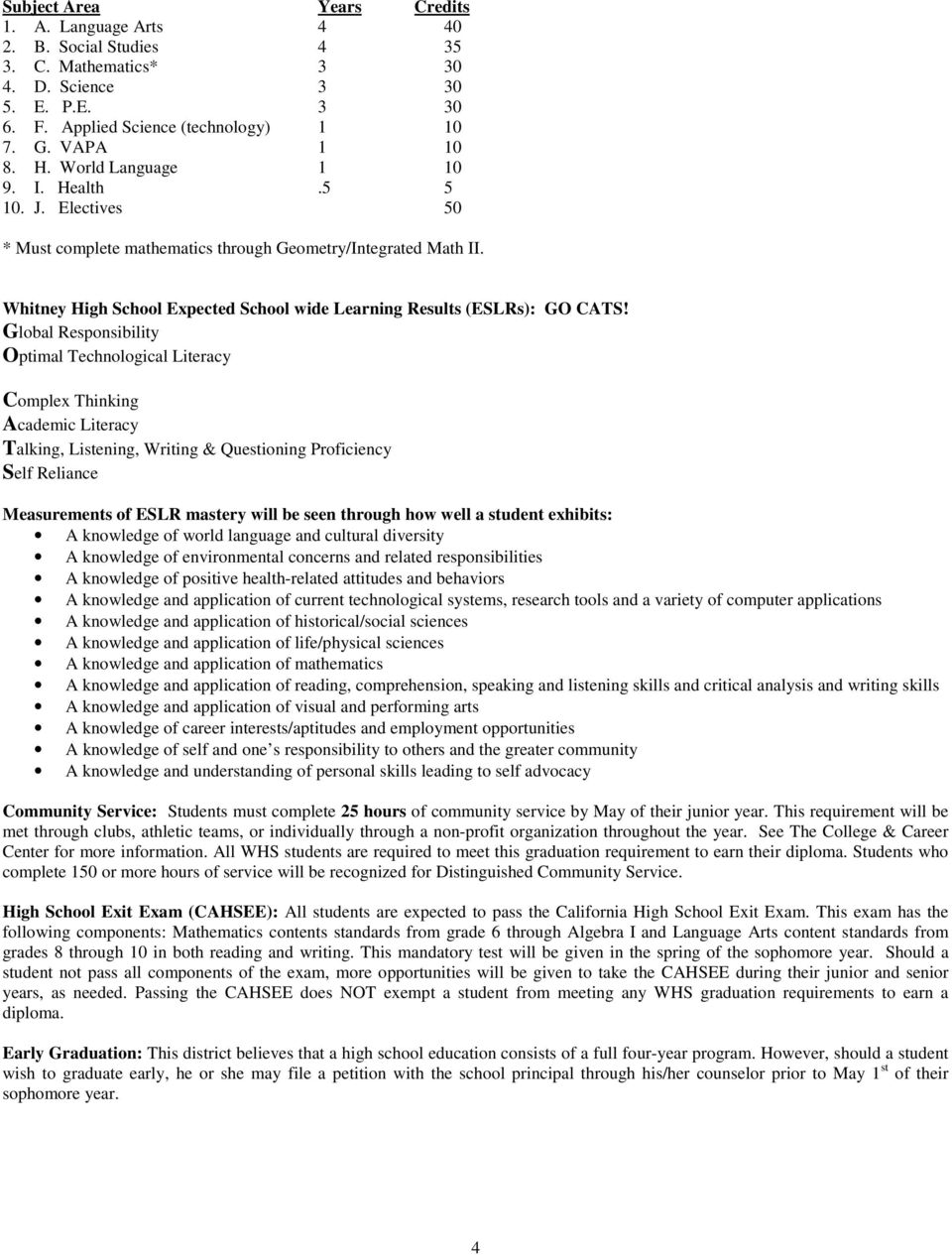
3 WHITNEY HIGH SCHOOL ACADEMIC PLANNING GUIDE AND SCHEDULE OF COURSES The WHS Academic Planning Guide describes the Whitney High School curricular offerings for the school year. This catalog provides basic planning information so students can develop their class schedule based upon their post-high school goals. Included in this booklet are the current graduation requirements as well as UC/CSU admission requirements. Each high school counselor is ready to assist students and parents in the development of a personalized four-year plan that takes these factors into consideration. The Whitney High School s commitment to parent involvement encourages and welcomes the continuous participation of parents during this planning process and throughout their student s high school years. Parents are vital partners in their student s high school success. Parents and students are urged to read this publication carefully and seriously consider the choices they make. The student s future will be impacted by the planning and the decisions he/she makes now. Students are encouraged to select classes that are both interesting and challenging to them. Students should also consider courses that will meet graduation requirements as well as best prepare them for post-secondary experiences and options. Counselors are available to provide assistance in planning a course of study. GENERAL OVERVIEW OF THE LEARNING PROCESS AT WHITNEY HIGH SCHOOL The system of education at Whitney High School is driven by performance based standards as mandated by the State of California and the Rocklin Unified School District. Standards are not new to education; educators have always had goals and expected levels of achievement for students. At Whitney High School, we go beyond expectations by requiring all students to master the learning associated with the common set of standards. In support of this philosophy, the curriculum, instruction, assessment, and reporting to parents is designed accordingly. Students will demonstrate mastery of the content standards through assessments and course work aligned with California Department of Education state standards and district standards. The grade reporting system is used to communicate a student s progress towards mastery. By requiring students to meet academic standards, a graduate will have the skills and knowledge needed for success in pursuing their post-high school goals. Parents and students need to understand that students must attend school on the first day of the school year. If you are out of town, WHS must have written notice of this. If your student is ill, you must call the attendance office. If you do neither of these and your student is absent, we will not save a space for your student. This will mean that your student may lose his/her seat in classes that he/she was previously enrolled in for this school year. GRADUATION REQUIREMENTS State Law and district policy are subject to modification. These modifications often impact district programs. Please consult with your school counselor for current requirements for your graduating class. Current Requirements: The system of education at WHS is driven by performance-based graduation requirements. Graduation will be based upon demonstrations of what students actually know. In the past, if a student had completed four years of high school and a certain number of courses, he/she was considered educated. At WHS, only after a student has demonstrated that learning has occurred, will WHS confirm that education has happened. A minimum of 250 credits including the following required subjects must be earned in grades 9 12 in order to meet graduation requirements: 3

4 Subject Area Years Credits 1. A. Language Arts B. Social Studies C. Mathematics* D. Science E. P.E F. Applied Science (technology) G. VAPA H. World Language I. Health J. Electives 50 * Must complete mathematics through Geometry/Integrated Math II. Whitney High School Expected School wide Learning Results (ESLRs): GO CATS! Global Responsibility Optimal Technological Literacy Complex Thinking Academic Literacy Talking, Listening, Writing & Questioning Proficiency Self Reliance Measurements of ESLR mastery will be seen through how well a student exhibits: A knowledge of world language and cultural diversity A knowledge of environmental concerns and related responsibilities A knowledge of positive health-related attitudes and behaviors A knowledge and application of current technological systems, research tools and a variety of computer applications A knowledge and application of historical/social sciences A knowledge and application of life/physical sciences A knowledge and application of mathematics A knowledge and application of reading, comprehension, speaking and listening skills and critical analysis and writing skills A knowledge and application of visual and performing arts A knowledge of career interests/aptitudes and employment opportunities A knowledge of self and one s responsibility to others and the greater community A knowledge and understanding of personal skills leading to self advocacy Community Service: Students must complete 25 hours of community service by May of their junior year. This requirement will be met through clubs, athletic teams, or individually through a non-profit organization throughout the year. See The College & Career Center for more information. All WHS students are required to meet this graduation requirement to earn their diploma. Students who complete 150 or more hours of service will be recognized for Distinguished Community Service. High School Exit Exam (CAHSEE): All students are expected to pass the California High School Exit Exam. This exam has the following components: Mathematics contents standards from grade 6 through Algebra I and Language Arts content standards from grades 8 through 10 in both reading and writing. This mandatory test will be given in the spring of the sophomore year. Should a student not pass all components of the exam, more opportunities will be given to take the CAHSEE during their junior and senior years, as needed. Passing the CAHSEE does NOT exempt a student from meeting any WHS graduation requirements to earn a diploma. Early Graduation: This district believes that a high school education consists of a full four-year program. However, should a student wish to graduate early, he or she may file a petition with the school principal through his/her counselor prior to May 1 st of their sophomore year. 4
5 TRANSFER POLICIES Intradistrict: Students wishing to move between Rocklin High School and Whitney High School must complete an INTRADISTRICT TRANSFER REQUEST before the priority deadline of March 1 st. Students requesting a transfer after this date will be considered by the administration on an availability basis. Parents of incoming freshmen will be notified of their student s status prior to the Freshmen Showcase Night which is held every March. Interdistrict: Students wishing to transfer into Whitney High School must complete an INTERDISTRICT TRANSFER REQUEST before the priority deadline of April 15 th. Students requesting a transfer after this date will be considered by administration on an availability basis. Students and parents must meet with administration prior to acceptance to Whitney High School in order to review the student s academic progress, attendance, discipline, and credits toward graduation. All Transfers: Transfer agreements to a RUSD high school must be renewed annually and students must be on-track for graduation and maintain good attendance and discipline records in order to maintain enrollment. Students residing within RUSD boundaries and wishing to return to their school of residence may request a transfer in the fall and must be on track for graduation. CLASS CHANGE POLICIES Drop/Add Policy: The Counseling Center has made every effort to match student needs with available classes. Therefore, there should be no reason for a schedule change unless there is an error on the student s schedule. In the interest of course planning purposes, counselors start working with students prior to the beginning of each school year. The Counseling Center provided each student on this campus (except for incoming freshmen) ample opportunity to change and adjust his/her schedule. These opportunities began in the spring when each student was given their course selection forms to fill out and ended with a one-on-one meeting with a counselor to confirm their selections for the upcoming school year. The Counseling Center believes that after school starts, the student should be committed to his/her schedule. Again, there should be no reason for a schedule change unless there is an error on the student s schedule. PLEASE NOTE: ALL COURSES AT WHITNEY HIGH SCHOOL ARE YEAR-LONG COURSES. Scheduling Errors will receive immediate attention by the Counseling Center. The following are considered scheduling errors: 1. Missing a course(s) needed for graduation. 2. Blank /missing a class period (does not include early/late arrival for seniors). 3. Student has not met the prerequisite for a course. 4. Double up of courses in the same period (does not include Sophomore Health/Dr. Ed.). The Counseling Center WILL NOT consider schedule changes for the following reasons: 1. To be with friends. 2. To change teachers. 3. Athletics. 4. Early/late arrival adjustments. 5. I have a job and have to leave early. The Counseling Center will correct any mistakes as quickly as possible. Each student must stay in his/her classes until he/she has been notified that the schedule has been changed. Students have a one week window to correct their schedule once the school year begins. Teachers will notify the Counseling Center if a student is inappropriately placed in a course. ADVANCED PLACEMENT (AP)/ HONOR COURSES (H)/ADVANCED COURSES Advanced Placement/ Honors/Advanced courses are provided for the highly motivated academic student who meet the prerequisites to enroll. Students who do not meet the prerequisites may speak directly with the AP teacher to discuss the possibility of a waiver to enroll in the course. The AP Program offers several AP Scholar Awards to recognize high school students who have demonstrated college-level achievement through AP courses and exams. In addition to receiving an award certificate, this achievement is acknowledged on an AP Grade Report that is sent to colleges the following fall. For additional information regarding AP Scholar Awards, please visit the following website: Taking Honors or Advanced Placement classes is a choice that you and your student make. College Prep (CP) courses are offered in place of any Honors or AP course, and they are college approved academic options. Students and parents should plan carefully when taking Honors and AP courses. These classes are taught in an accelerated format comparable to that of a university level course; therefore, they require extensive out-of-class work (approximately two hours per course per night). Please consider this information 5

6 when selecting classes. Class enrollment is year-long. Students are given three weeks after school begins to drop an Advanced Placement/Honors/Advance class if they find the class too difficult. A student is given the first semester to maintain AP appropriate level of work. If he/she does not maintain that level, he/she may be moved to a similar class at a lower level at the semester only (per teacher recommendation). Advanced Placement exams are administered in May. Students are subject to a test fee which is charged by the College Board. Reduced fee applications, due to financial hardship, are available in the Counseling Center. Many colleges award credit and/or advanced placement for demonstrated subject area proficiency (to research a specific college s policy, please consult their website). Please note: Universities will not consider awarding credit unless the AP exam is taken and passed. Whitney High School will only administer AP exams for the courses that are offered on our campus. Although students are not limited to a specific number of AP/Honors courses they may take, it is the recommendation of the school that students design their Six-Year Plan so that no more than three AP/Honors courses are taken in any given year. GRADE LEVEL PLACEMENT DESIGNATION The following list represents: A) the recommended number of credits students should have completed by the time they enter each respective school year, and B) the number of credits which reflect when a student would be considered deficient in credits. Grade Level Recommended Minimum Deficient Number of Credits Number of Credits or less or less or less While students can make up a deficiency in credits, it becomes increasingly difficult to do so the farther behind they get. In order not to jeopardize graduation, students should stay as close as possible to the recommended credit totals listed above. Students may attend summer school to make-up credit deficiencies. In addition, a limited number of evening classes are offered through RUSD programs. See your counselor for more information. GRADING POLICIES Eight reports are mailed home during the school year, approximately one every 4 5 weeks. This is done to help students, parents and teachers determine and discuss student achievement more frequently. The approximate mailing dates are listed in the student planner. Duplicate mailing is available upon request in the Administration Office. If parents would like to monitor the progress of their son/daughter on a weekly basis, there are three options available: 1. Grades can be checked on the school s website at To set up a new account, parents will need an activation code which they can access from the WHS front office at , ext Weekly Grade Check forms are available in the Counseling Center and in the student planner for students to take to their teachers. 3. Parents are welcome to or phone teachers to request information. Grade Reports (Report Cards) are mailed home approximately one week after the end of the first and third quarter. These dates are listed in the student handbook for your convenience. The first report card for each semester is actually a progress report (see below) with a grade. The final report card at the end of the semester is the official grade for the semester. Grade Reports (Progress Reports) are mailed in the middle of each quarter to notify students of their progress in each of their classes. These dates are also listed in the student planner for your convenience. Semester Reports are mailed home about one week after the end of each semester (fall semester report will be mailed out one week after the return from winter break). These grades carry final credit and are considered permanent grades. These grades become part of the official school record (transcript) for each student. 6

7 Grading System: On Report Cards: A = Distinguished On Progress Reports: P = Passing B = Commendable NM = No Mark C = Proficient (Mastery) (Potential for Failure) NC = Failure to achieve Minimum standards Please review the Overview of the Learning Process at Whitney High School section of this booklet regarding our philosophy on learning. Process for Appealing a grade on a Report Card: A student who believes he/she has received a grade considered in error should contact the instructor as soon as possible to check the accuracy of the grade. If the instructor agrees with the student that the grade is in error, the instructor will submit a grade change form to the Registrar s Office for the student. If the instructor disagrees with the student, the student may appeal the grade. The appeal should be in the form of a letter to the principal, explaining why the student disagrees with the grade. The principal will provide a written decision on the appeal. Included in the response will be steps for further appeal procedures. Repeat Policy: Students who fail to meet minimum expectations for a course required for graduation (semester NC) must repeat the course during summer school and/or night school. TRANSCRIPTS Student transcripts are available through the Registrar s Office. Official transcripts may be ordered by completing a request for transcript form in the Registrar s Office. This may be done before school, nutrition break, lunch, or after school. The cost is $1.00 per transcript. NOTE: Allow at least one week before the transcript will be ready for pick up or the mailing deadline. ACADEMIC RECOGNITION California Scholarship Federation (CSF): The following CSF membership requirements became effective July 1, 1987: 1. Previous semester grades determine membership. 2. Application must be made during the first four weeks of each semester. An application fee must be submitted with the application. 3. Semester grades and CSF points are: A=3, B=1, C=0 (AP/Honors A=4, B=2, up to a maximum of 2 extra points per semester.) 4. List two or more courses from List I. Seniors may use all List II courses. No CSF points are granted for PE, Student Service, or repeated courses. Student must not have any grade lower than C. 5. Ten (10) CSF points must be earned in five courses including at least seven (7) points from List I or II. List I: All UC certified courses List II: All other academic courses List III: All other courses except P.E. and Student Service. 6. Applications and additional help may be obtained from the Advisor. 7. To be an active member, CSF members must participate in one CSF club community service project per semester and attend club meetings. CSF chapter membership is earned each semester during high school. Membership is not automatic and application must be made each semester during the stated filing period. A life member is a CSF member who has earned membership during four (4) of the last six semesters of high school with one semester being during the senior year. National Honor Society: Membership in the National Honor Society is by invitation. Sophomores, juniors, and seniors who maintain a minimum cumulative 3.75 grade point average and have completed 150 hours of community service by the application date are invited to fill out an application to join this prestigious national organization. Selection is made by the Faculty Advisory Council and an interview panel. Selection is based on four areas: scholarship, leadership, service, and character. An annual candlelight induction ceremony is held in the spring. Membership is confirmed in the spring if all expectations have been met. In addition to maintaining a 3.75 grade point average, members must participate in society service projects and maintain good character. 7

8 Distinguished Scholar Diploma: The Distinguished Scholar Diploma is designed to recognize those students who have demonstrated academic excellence. This diploma distinction corresponds to an academic pathway which qualified students will take during their four years at Whitney High School. For qualification, it is recommended that students decide, with parent approval, to choose this pathway when they enter the high school. Students in this pathway will choose to take some of the most rigorous courses on campus. The students will have, at minimum, a 3.8 GPA and will maintain the same qualifications to continue in the pathway. Students DO NOT need to take all the courses listed for the pathway, but must choose to take 60% of the advanced, honors and AP offerings. Eligibility for the Distinguished Scholar Diploma: Complete 60% Advanced/Honors courses with five of those courses being Advanced Placement classes 3.8 weighted GPA 95% attendance each year No major disciplinary or attendance infractions Complete a minimum of 150 community service hours to earn a Distinguished Community Service or Service Learning award Complete at least one WHS leadership course (Leadership Committee or Officer position, STARS, Senior Mentor, Peer Counseling, JROTC Officer Position, Journalism Production Management, or Broadcasting Production Manager, News or Sports Director) Completion of an academic portfolio College Entrance Examinations EAP, PSAT, SAT Reasoning, & SAT Subject Exams, ACT Either the SAT or the ACT are required for admission to most four year universities. Colleges will typically accept either score. Students are highly encouraged to research admission requirements as policies from school to school can vary with admission requirements and/or recommendations. Early Assessment Program (EAP): With the establishment of the Measurement of Academic Performance (MAPP), starting in 2015, EAP will be fully incorporated into the 11 th grade math and English exams. Under this new system, there will be no need for supplemental questions, additional bubbles to be filled in on student answer sheets, or a separate essay segment. Logistics of reporting are pending, but EAP will continue to serve as an early signal of college readiness for rising seniors. We hope that the new testing model will facilitate broader and easier use of EAP by California high schools, educators, and students. PSAT: The Preliminary Scholastic Aptitude Test and National Merit Qualifying Test (PSAT/NMSQT) is offered to sophomores and juniors. The PSAT student score report offers skill assessment that students can utilize to identify their levels of proficiency in each of the reasoning skill areas and then work on improving them before entering college or taking the SAT. Juniors taking the PSAT are also taking the National Merit Qualifying Test. For juniors, the test can determine their initial eligibility or entry into scholarship competitions. SAT Reasoning Exam: The SAT Reasoning Exam contains a verbal portion, a math portion, and a writing portion. Official test time is 3 hours and 45 minutes. However, students should arrive at 7:30am to check in for the test and allow approximately 5 hours and 30 minutes total time at the test site. Each of the 3 tests is worth a maximum of 800 points; making the SAT Reasoning perfect score equal to *New policies and procedures are now in place for SAT registration and test days. Please pay careful attention to the rules listed on the Collegeboard website when registering for test dates.* The redesigned SAT test will begin in the Spring of SAT Subject Exam: The College Board offers exams in five different subject areas, including several foreign languages. Students can take up to three subject exams in one sitting. Students cannot take the SAT Reasoning Exam and SAT Subject Exams on the same test date. Some majors within the UC system also recommend or require the SAT Subject Tests. Students must check with specific colleges to confirm if the major of their choice requires the SAT Subject Tests to be eligible for admission. The UC system will not accept Math I as one of the subjects. ACT: The ACT is an achievement test that measures what a student has learned in school. The ACT has up to 5 components: English, Mathematics, Reading, Science, and an optional Writing Test. Although the writing portion is optional, students are encouraged to take it because if they chose to apply to a school that required it, they will not be able to use any scores from the test taken without it and would need to take the entire test again. Students will receive a score in each of the areas and also a composite score which takes into account all areas of the test. All of the scores, including the composite are based on a 1-36 scale. 8
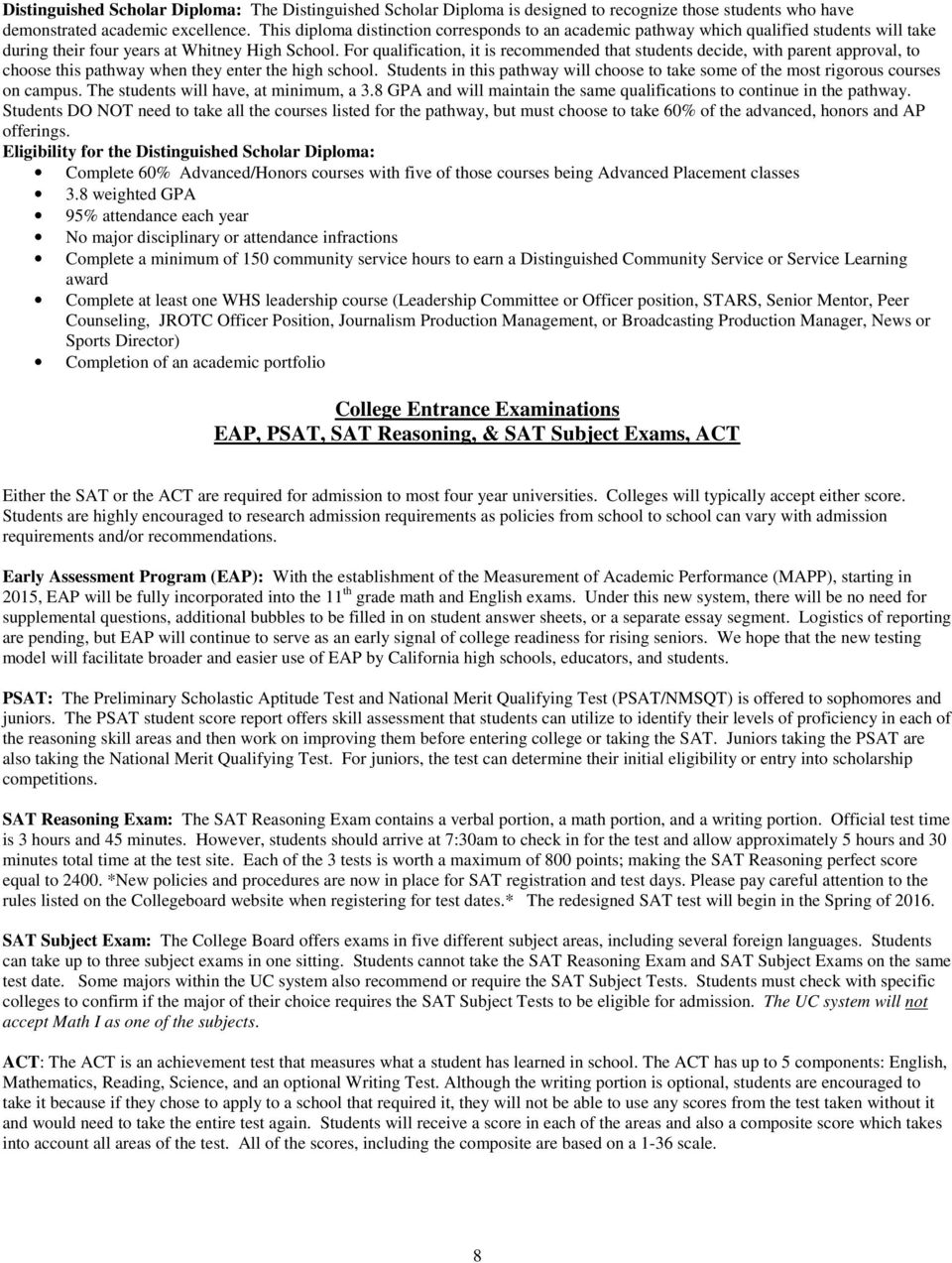
9 College Entrance Examinations (PSAT, SAT Reasoning & SAT Subject Exams, ACT): To obtain registration forms and information about required tests, and/or university/college requirements, go to the College & Career Center or visit the website, talk to your counselor, or check on-line at or There are many new features available on-line to assist students with college entrance exams. 1. Registration for tests 2. Send score reports 3. Practice for questions and essays for the SAT 4. Search for information about careers and colleges 5. Search for codes (test center, high school, college, scholarship and intended major) 6. Explore readiness for SAT Subject tests 7. Take a free diagnostic test and customize a study plan WHS School Code: College Entrance Examination Dates: SAT: Rocklin High School is an official test site for the SAT. However, students who register near the deadline are often assigned to a different test site. Students may register for the SAT on-line at Please visit for test dates. If you have any questions or concerns, please contact the College & Career Center or see your counselor. ACT: Rocklin High School is an official test site for the ACT. Check with the colleges to see which of the two tests (SAT or ACT) is preferred. Students may register for the ACT on-line at Please visit for test dates and registration information. If you have any questions or concerns, please contact the College & Career Center or see your counselor. HIGHER EDUCATION ADMISSION REQUIREMENTS Types of schools: There are several types of schools for higher learning in California: Community Colleges; California State University system, University of California system, private and independent colleges and universities, and vocational schools. There are also thousands of out-of-state schools available for higher learning. However, WHS does not monitor each school s minimum entrance requirements. WHS Counselors will be happy to assist any student interested in pursuing information on out-ofstate schools. Visit the College and Career Center for more information on these schools. Naviance: Every Whitney High School student is given a Naviance Family Connection account where they can research any college and career options in one place. Students may log in to Naviance Family Connection at: Community Colleges: Community College admission is open to any person who has a high school diploma or has passed the GED or state proficiency exam or is 18 years of age. There are no subject or grade requirements for admission to California Community Colleges. All students must take assessment exams for placement prior to registering for classes. Examples of local community colleges include Sierra College, Sacramento City College, and American River College. Private Colleges and Universities: Students wishing to attend a private college or university should consult the college for their specific requirements. The College & Career Center can assist in this process. Examples of private colleges include University of the Pacific, Stanford, Pepperdine, and Santa Clara. California State University (CSU): Students must have a high school diploma, have a qualifiable eligibility index (see CSU info in the College & Career Center for specifics), and must have completed the courses in the comprehensive pattern of college preparatory subject requirements with a C or better (see minimum entrance requirements chart, on following page). The eligibility index is the combination of your high school grade point average and your test score on either the American College Test (ACT) or the Scholastic Aptitude Test (SAT Reasoning). Grade point average is based on grades earned in college approved courses during your final three years of high school and bonus points for each C or better grade in approved Honors and/or AP courses. Rocklin High School hosts a College Fair each fall which includes workshops on the UC and CSU application process. There are twenty-three (23) CSU campuses with a wide range of majors leading to a B.S. or B.A. degree. Masters programs are also available in a variety of majors at the CSU system. Examples of CSU colleges include: Sacramento, Humboldt, San Diego, Monterey Bay, Long Beach, and Cal Poly. For additional information, please visit 9
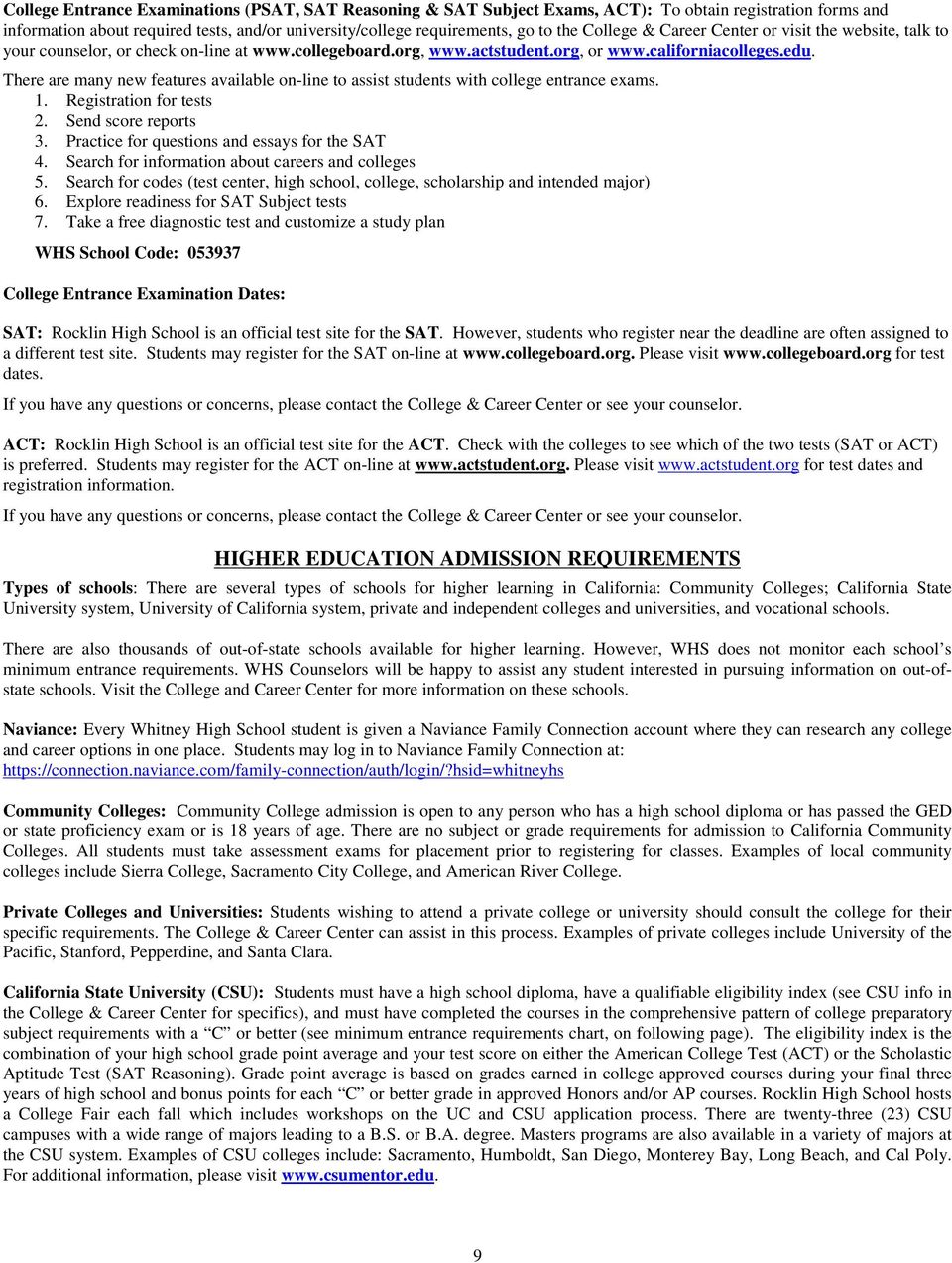
10 University of California (UC): The UC system includes nine four-year universities offering a variety of B.A. and B.S. degrees. Examples include Davis, Santa Barbara, and Berkeley. To qualify for entrance, students must have a high school diploma or a California Proficiency Certificate. Students must follow a university preparatory program and must earn a grade of C or better in the required courses listed on page 11. Students must have a high school grade point average of 3.0 or higher to be eligible for the UC system. Those students with a GPA below 3.3 must score proportionately higher on the ACT or SAT College Entrance Examinations. In addition, some majors require UC applicants to take two SAT Subject exams in two different subject areas of their choice (Note: The UC system does not accept Math I as a subject test). Entrance GPA and requirements may vary depending on the major area of study and the campus selected. If a student is eligible for a particular school and/or major this does not guarantee admission. For additional information, please visit Important Note: The top nine percent (9%) of the junior class who meet the minimum eligibility standards and who satisfy the A-G requirements will be accepted at a University of California campus, though not necessarily the campus of their choice. The University of California will notify eligible students in writing at the beginning of their senior year. Technical and Business Schools: These schools offer certificates for training in a variety of vocational occupations. Most of these schools require a high school diploma or its equivalent. Students who take advantage of high school preparation courses can complete training in a minimum amount of time. Some of these schools are available in the Sacramento area. The California Department of Education s definition of Career Technical Education (CTE), which is embodied in the vision statement contained in Career Technical Education Framework for California Public Schools Grades Seven Through Twelve (2007), is as follows: Career technical education engages all students in a dynamic and seamless learning experience resulting in their mastery of the career and academic knowledge and skills necessary to become productive, contributing members of society. The internet address for the portion of the CDE website where pupils can learn more about CTE is Apprenticeship Programs: The state of California offers a variety of Apprenticeship Programs. Qualifications/requirements are as follows: Applicants must be at least 18 years of age. Applicants must be physically able to do work performed in the trade. Applicants must have a high school diploma, high school proficiency certificate, or a GED. Applicants should be able to read, write, and speak the English language in order to comprehend instruction and safety. Additional information regarding Apprenticeship Programs can be found at 10

11 TEST SCORES ACT/SAT CSU-UC Comparison of Minimum Requirements California State University (CSU) University of California (UC) ACT or SAT is required* CSU combines best critical reading and math scores from multiple sittings of UC uses the highest combined score from a single sitting of the ACT Assessment plus Writing or the SAT Reasoning Test. SAT; may combine best subscores from SAT Subject Tests are no longer required, however multiple ACT tests to calculate a best students/parents should check with individual campuses composite. Test required for CSU regarding specific test requirements and recommendations. applicants to non-impacted campuses, who have earned an A-G GPA of less than 3.0. VALIDATION OF SUBJECT REQUIREMENTS BY OTHER COURSES Mathematics Language Other than English (LOTE) Chemistry A grade of C or better in the second semester of a mathematics course validates a D/F in the first semester. A grade of C or better in the first semester of Algebra II validates both semesters of Algebra I. A grade of C or better in Trigonometry or Pre-calculus validates the entire high school college preparatory requirement with the exception of Geometry. A grade of C or better in Statistics will validate only Algebra I and Algebra II, not Geometry. A grade of C or better in a higher-level course validates a lower-level course. A higher level LOTE course can validate the appropriate number of years based on the level. A college course can validate a high school LOTE course. The level of validation depends on the college course prerequisite and description. A grade of C or better in the second semester of Chemistry will validate a D in the first semester. A grade of C or better in the second semester of chemistry WILL NO LONGER VALIDATE a D in the first semester. VALIDATION OF D GRADES IN REQUIRED COURSES Required A-G courses must be completed with a grade of C or better. Courses in which grades of D are earned must be repeated, EXCEPT in the areas of math and language other than English, where grades of D can be validated by successful completion of higher level coursework. VALIDATION OF SUBJECT REQUIREMENTS BY TEST SCORES Subject omissions may be satisfied with appropriate test scores on SAT Subject Tests, Advanced Placement exams, and designated International Baccalaureate exams. A list of acceptable tests and scores is available on the UC and CSU websites. REPEATED COURSES Required a-g courses must be completed with a grade of C or better. Courses in which grades D/F are earned may be repeated. The highest grade will be used in the grade calculation. UC only allows a course to repeated one time for grade replacement. HIGH SCHOOL GPA Calculate GPA using only A-G approved courses taken after 9 th grade. All A-G courses must be reported. SUBJECT REQUIREMENTS 15 yearlong college preparatory courses from approved A-G list are required with a grade of C or better: 11 UC-required college preparatory courses must be completed prior to senior year. a History/Social Science b English c Math d Laboratory Science e Language Other Than English f Visual & Performing Arts g College Preparatory Elective 2 years of history/social science, including one year of US History OR one semester of US History and one semester of American Government, AND... 1 year of history/social science from either a or g subject area. 1 year of World History, Cultures, and Geography from the a subject area. 4 years of English (including no more than one year of Advanced ESL/ELD courses) 3 years of math (Algebra 1 and 11, Geometry); 4 years recommended* 2 years of laboratory science, including at least two of the three foundational subjects of biology, chemistry, and physics At least 1 year of physical science and 1 Both courses must be from the d subject area; 3 years year of biological science, one from the recommended d subject area and the other from the d or g area 2 years of language other than English (must be the same language) 3 years recommended 1 yearlong course in visual & performing arts (selected from dance, music, theatre/drama and visual arts) 1 year of an elective chosen from any area on approved a-g course list HONORS POINTS Numerous career technical courses are approved for fulfillment of A-G Maximum of 8 extra grade points awarded for approved honors, AP, or IB courses and transferable community college courses. No more than two yearlong courses taken in 10 th grade can earn honors points. 11

12 Example of Recommended Program for University of California, California State University & Some Independent Four-Year Colleges: These courses must be selected from the UC certified A-G subject requirements. See your counselor for a list of these courses and for more information regarding your student s four year plan. 9 th Grade 10 th Grade 11 th Grade 12 th Grade Language Arts Mathematics Social Studies Language Arts I Language Arts I Adv. Integrated I Integrated II Adv. Integrated II Algebra II Adv. Algebra II Geography Adv. Geography Language Arts II Language Arts II Adv. Integrated II Adv. Integrated II Algebra II/Adv. Alg. II Math Analysis Pre-Calculus/Trig H World History AP World History Language Arts III Language Arts III Honors Algebra II Math Analysis Pre-Calculus/Trig H AP Calculus AB AP Statistics US History AP US History AP Government Language Arts IV/ World Literature AP Literature Math Analysis Pre-Calculus/Trig H AP Calculus AB AP Calculus BC EAP Math AP Statistics Govt./Econ. AP Microeconomics AP Government Science (One year physical and one year life science) World Language Visual Performing Arts Academic Electives Biology Adv. Biology French I Spanish I Spanish II Beginning classes in: Art Broadcasting Choir Dance Graphics Mass Media Photo Theatre Jazz Band Symphonic Band String Orchestra May be fulfilled by college prep classes* Chemistry/Honors Chem Geology Physics I French II Spanish II Spanish III Spanish III Honors Beginning/Intermediate class in: Art Broadcasting Choir Dance Graphics Photo Photojournalism I Theatre Jazz Band Symphonic Band String Orchestra Music Appreciation Chemistry/Honors Chem Geology Anatomy/Physiology Physics Marine Biology AP Biology AP Chemistry AP Environ. Science AP Physics 1 French III French III Honors French IV AP French IV Spanish III Spanish III Honors Spanish IV AP Spanish Advanced level class in: Art Broadcasting Choir Dance Graphics Photo Theatre Jazz Band Symphonic Band String Orchestra Photojournalism II Chemistry/Honors Chem Geology Anatomy/Physiology Physics Marine Biology AP Biology AP Chemistry AP Environ. Science AP Physics 1 AP Physics 2 ROP Animal Science ROP AP Computer Science French IV AP French IV Spanish IV AP Spanish Advanced level class in: Art Broadcasting Choir Dance Graphics Photo Theatre Jazz Band Symphonic Band String Orchestra *College prep classes in Social Studies, Adv. Mathematics, Lab Science, World Language or VAPA taken in addition to the subject requirements in those areas. Other courses may also meet this requirement; check the Course Description section of this book for more details. 12

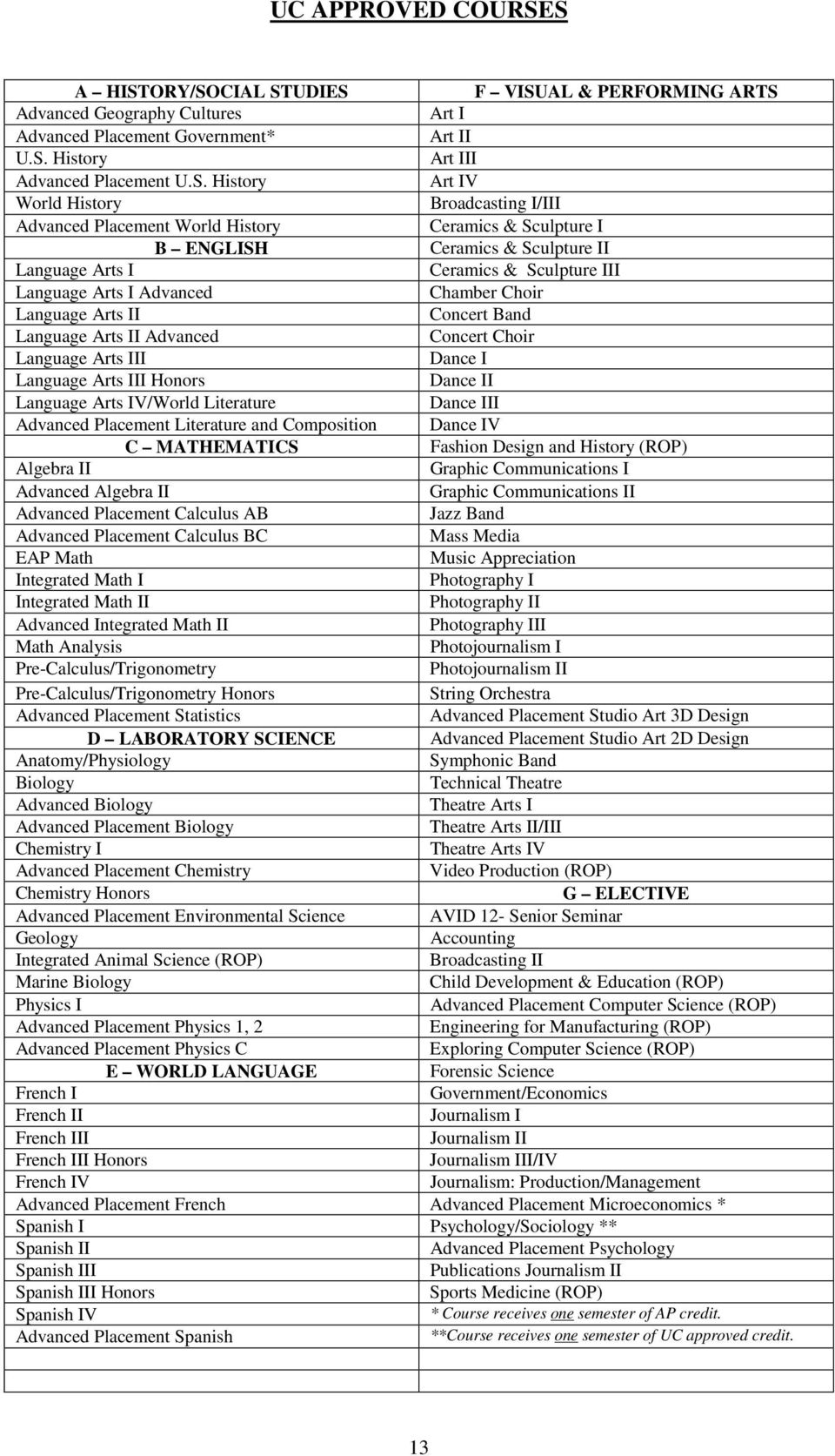
13 UC APPROVED COURSES A HISTORY/SOCIAL STUDIES F VISUAL & PERFORMING ARTS Advanced Geography Cultures Art I Advanced Placement Government* Art II U.S. History Art III Advanced Placement U.S. History Art IV World History Broadcasting I/III Advanced Placement World History Ceramics & Sculpture I B ENGLISH Ceramics & Sculpture II Language Arts I Ceramics & Sculpture III Language Arts I Advanced Chamber Choir Language Arts II Concert Band Language Arts II Advanced Concert Choir Language Arts III Dance I Language Arts III Honors Dance II Language Arts IV/World Literature Dance III Advanced Placement Literature and Composition Dance IV C MATHEMATICS Fashion Design and History (ROP) Algebra II Graphic Communications I Advanced Algebra II Graphic Communications II Advanced Placement Calculus AB Jazz Band Advanced Placement Calculus BC Mass Media EAP Math Music Appreciation Integrated Math I Photography I Integrated Math II Photography II Advanced Integrated Math II Photography III Math Analysis Photojournalism I Pre-Calculus/Trigonometry Photojournalism II Pre-Calculus/Trigonometry Honors String Orchestra Advanced Placement Statistics Advanced Placement Studio Art 3D Design D LABORATORY SCIENCE Advanced Placement Studio Art 2D Design Anatomy/Physiology Symphonic Band Biology Technical Theatre Advanced Biology Theatre Arts I Advanced Placement Biology Theatre Arts II/III Chemistry I Theatre Arts IV Advanced Placement Chemistry Video Production (ROP) Chemistry Honors G ELECTIVE Advanced Placement Environmental Science AVID 12- Senior Seminar Geology Accounting Integrated Animal Science (ROP) Broadcasting II Marine Biology Child Development & Education (ROP) Physics I Advanced Placement Computer Science (ROP) Advanced Placement Physics 1, 2 Engineering for Manufacturing (ROP) Advanced Placement Physics C Exploring Computer Science (ROP) E WORLD LANGUAGE Forensic Science French I Government/Economics French II Journalism I French III Journalism II French III Honors Journalism III/IV French IV Journalism: Production/Management Advanced Placement French Advanced Placement Microeconomics * Spanish I Psychology/Sociology ** Spanish II Advanced Placement Psychology Spanish III Publications Journalism II Spanish III Honors Sports Medicine (ROP) Spanish IV * Course receives one semester of AP credit. Advanced Placement Spanish **Course receives one semester of UC approved credit. 13
14 WHAT IS ROP? 49er REGIONAL OCCUPATIONAL PROGRAM Detailed ROP Course Description can be found in the ROP Course Description section of this handbook. The Regional Occupational Program (ROP) provides an opportunity for students to explore the world of work while mastering the necessary skills needed for college, advanced training, business, and industry. By applying the academic knowledge and technical skills acquired while in high school to a real-work environment, students may upgrade their existing skills and/or prepare for advanced training. All of this is accomplished through a combination of classroom instruction by qualified instructors and supervised hands-on training in laboratory or at a training site. ROP is available for high school seniors, juniors, and qualifying sophomores. Some ROP classes require students to report to a training site (called community classroom courses), and some ROP courses are taught entirely on-campus. Sophomores may be eligible if they meet these conditions: Sophomores who are 16 years of age may enroll in the oncampus classes with an administrator or counselor referral and approval. Seniors and juniors have enrollment priority. ROP classes are taught in blocks which vary in length, from a single block to a 3-hour class/training time period each day. ROP classes may be taken within the student s regular class day or during a period of time that extends past the regular school day. Students must be able to provide their own transportation to the training site if they are enrolled in a course that has a community-based training component and/or to classes held in a location other than the student s home campus. In order to receive a Certificate of Completion in a ROP course, the student must complete the course with at least 95% attendance, a grade of C or better, and must master 80% of the course s core competencies. Most classes do not accept students beginning in the spring semester. ROP PROVIDES... Preparation for post-secondary education and/or training. Valuable hands-on experience to improve students employability. Credit toward high school graduation. UC approved courses that meet required A-G guidelines. Community college credits: Most classes have articulation agreements in place for community college credit. Certificates of Completion awarded, if all conditions met, including a skills sheet showing mastered competencies. Community classroom courses include an internship at local businesses. SPECIAL FEATURES... Many classes offer internships in local community businesses or industries. After several weeks of classroom training students are placed at training sites for on-the-job training. During weekly class time, students continue learning industryspecific skills. Classes are held on high school campuses, at the ROP Center in Auburn, and at Maidu Fire Station in Auburn. If ROP students enroll in an off-campus course or a ROP course that requires students to report to training sites, students are expected to have reliable transportation to that site. Students are covered by workers compensation insurance. 14
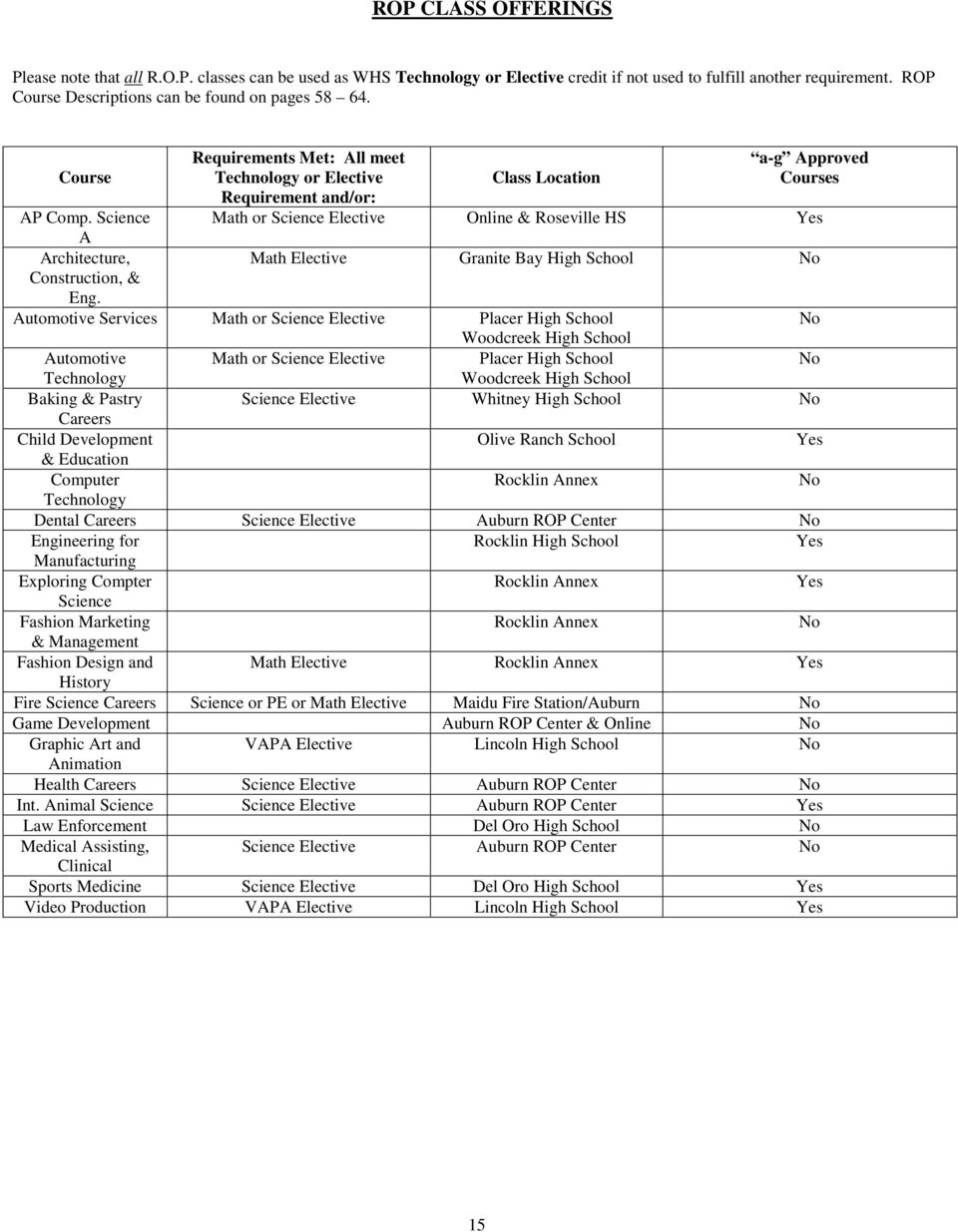
15 ROP CLASS OFFERINGS Please note that all R.O.P. classes can be used as WHS Technology or Elective credit if not used to fulfill another requirement. ROP Course Descriptions can be found on pages Course All meet Technology or Elective Requirement and/or: Class Location a-g Approved Courses AP Comp. Science Math or Science Elective Online & Roseville HS Yes A Architecture, Math Elective Granite Bay High School No Construction, & Eng. Automotive Services Math or Science Elective Placer High School No Woodcreek High School Automotive Math or Science Elective Placer High School No Technology Woodcreek High School Baking & Pastry Science Elective Whitney High School No Careers Child Development Olive Ranch School Yes & Education Computer Rocklin Annex No Technology Dental Careers Science Elective Auburn ROP Center No Engineering for Rocklin High School Yes Manufacturing Exploring Compter Rocklin Annex Yes Science Fashion Marketing Rocklin Annex No & Management Fashion Design and Math Elective Rocklin Annex Yes History Fire Science Careers Science or PE or Math Elective Maidu Fire Station/Auburn No Game Development Auburn ROP Center & Online No Graphic Art and VAPA Elective Lincoln High School No Animation Health Careers Science Elective Auburn ROP Center No Int. Animal Science Science Elective Auburn ROP Center Yes Law Enforcement Del Oro High School No Medical Assisting, Science Elective Auburn ROP Center No Clinical Sports Medicine Science Elective Del Oro High School Yes Video Production VAPA Elective Lincoln High School Yes 15
16 ALTERNATIVE EDUCATION Rocklin Unified School District offers several alternative programs for students to complete their education. These programs are planned to help individuals earn a high school diploma. For more information, visit the Rocklin Alternative Education Center s website at: Victory High School is a continuation high school program. Victory High School is WASC accredited and recognized by the State of California as a Model Continuation School. Victory provides students a smaller academic setting to reach their goals of a high school diploma as well as planning for their future. The continuation education staff focuses on student-centered instruction that provides pathways for a diverse student population to acquire the skills of the core curriculum. The continuation staff continually assesses the personal and academic needs of students and makes appropriate adjustments. Classes at Victory are no larger than 18 students (with a total student population ranging from ). Students earn credit through a time on task model which emphasizes strong attendance and participation. A diploma from Victory High School allows students access to all community colleges, most trade schools and access to the military. Due to smaller class sizes and more individualized attention, students are able to see success both in the classroom and in the school environment. Students interested in attending this program should meet with their counselor first. The program offers a curriculum that is personalized and contains work study and work experience components as well. In order to graduate from Victory High School, students must earn 200 credits. Qualifications for enrollment are that you are a Junior or Senior and at least 16 years of age. Please note: this program does not meet the UC/CSU A G requirements. See website for further information: Age/Grade Requirement: Students must be 16 years of age, a junior or senior, and a Rocklin resident. Rocklin Independent Charter Academy (RICA) is an accredited K-12 school that strives to meet the growing needs of students by preparing them for a career and college by offering a 3 Tier blended school model. Teachers use a combination of direct classroom instruction, on-line courses, and independent study to build an educational plan to meet the needs of every student. RICA offers blended courses through the use of Schoology in all subject areas such as English, math, history, science, art, health, and electives. These courses are taught using a wide range of resources from textbooks, videos, interactive lessons, and other supplementary materials. Students are engaged in the materials through assignments, forums, journals, tests, quizzes, and surveys. We also offer traditional online courses through a curriculum based program called OdysseyWare. All rigorous and relevant course work is completed online, at home, or at school to meet the same requirement as our direct instruction classes. In addition, some students also attend small direct instruction classes in math and English as well as science labs. Students meet with teachers in traditional group settings and receive teacher led instruction, participate in active conversations around texts, and collaborate on extended learning projects. All student work is monitored by highly qualified credentialed teachers who meet weekly with students to review, correct, proctor, and instruct in person. If students find they need more help, we provide tutoring. The unique design of RICA gives students a voice in their own educational goals. This voice leads to an ownership in personal academic achievement and a more positive learning experience which in turn helps them find success in future career or college of choices. RICA students have the opportunity to enroll in Associated Student Body (ASB). This course is designed to give students the opportunity for active participation in student leadership. Working with an advisor, students plan and conduct social activities for the school student population while learning about government procedures and earning elective or government credits. Rocklin Independent Charter Academy is a Western Association of Schools and Colleges/WASC accredited school which offers California State Standards Based Curriculum for students in grades K-12 culminating with a high school diploma. The RICA curriculum and instruction is tailored to meet the individual needs of its students providing choice, variety and flexibility. A variety of curriculum delivery options designed for charter school students is available. RICA is a blended model school with the support of a tutoring, intensive intervention, direct instruction, technology, electives, and college preparation coursework. Student assessment and performance is instructed and supervised by fully credentialed teachers. The School s founders believe that a well-educated person in the 21 st century possesses the knowledge and skills to succeed as affective citizens, workers, and leaders. They should be able to see connections so as to be able to make sense of the world and act within it in creative ways to purposely communicate, problem solve and an disseminate information. The program is located on the Rocklin Alternative Education Center campus and is open to all students regardless of district of residence. RICA requires students to earn 200 credits to graduate. Please note, this program does not currently meet the UC./CSU A G requirements for Science and Foreign Language only. Further information can be found on the school website at: 16

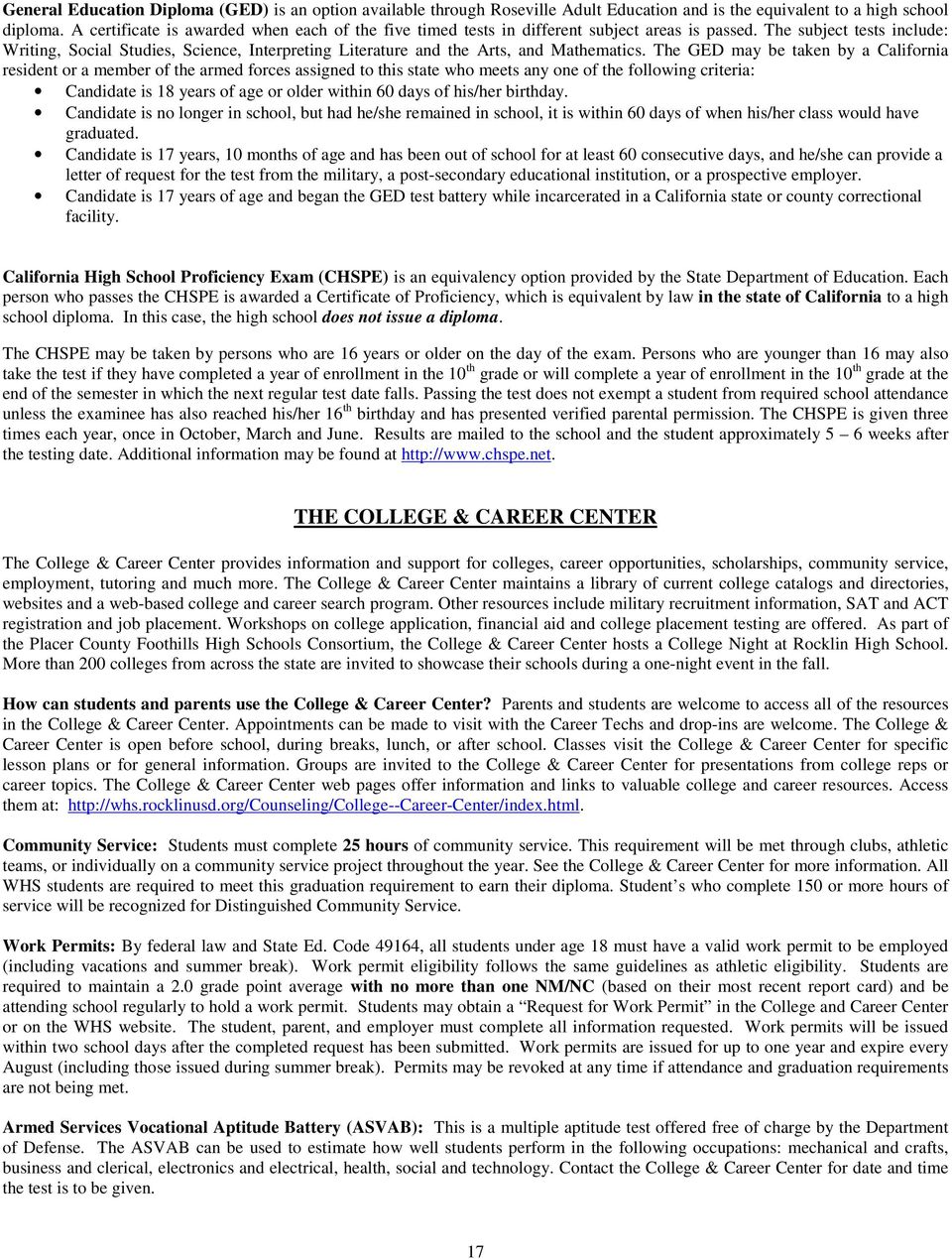
17 General Education Diploma (GED) is an option available through Roseville Adult Education and is the equivalent to a high school diploma. A certificate is awarded when each of the five timed tests in different subject areas is passed. The subject tests include: Writing, Social Studies, Science, Interpreting Literature and the Arts, and Mathematics. The GED may be taken by a California resident or a member of the armed forces assigned to this state who meets any one of the following criteria: Candidate is 18 years of age or older within 60 days of his/her birthday. Candidate is no longer in school, but had he/she remained in school, it is within 60 days of when his/her class would have graduated. Candidate is 17 years, 10 months of age and has been out of school for at least 60 consecutive days, and he/she can provide a letter of request for the test from the military, a post-secondary educational institution, or a prospective employer. Candidate is 17 years of age and began the GED test battery while incarcerated in a California state or county correctional facility. California High School Proficiency Exam (CHSPE) is an equivalency option provided by the State Department of Education. Each person who passes the CHSPE is awarded a Certificate of Proficiency, which is equivalent by law in the state of California to a high school diploma. In this case, the high school does not issue a diploma. The CHSPE may be taken by persons who are 16 years or older on the day of the exam. Persons who are younger than 16 may also take the test if they have completed a year of enrollment in the 10 th grade or will complete a year of enrollment in the 10 th grade at the end of the semester in which the next regular test date falls. Passing the test does not exempt a student from required school attendance unless the examinee has also reached his/her 16 th birthday and has presented verified parental permission. The CHSPE is given three times each year, once in October, March and June. Results are mailed to the school and the student approximately 5 6 weeks after the testing date. Additional information may be found at THE COLLEGE & CAREER CENTER The College & Career Center provides information and support for colleges, career opportunities, scholarships, community service, employment, tutoring and much more. The College & Career Center maintains a library of current college catalogs and directories, websites and a web-based college and career search program. Other resources include military recruitment information, SAT and ACT registration and job placement. Workshops on college application, financial aid and college placement testing are offered. As part of the Placer County Foothills High Schools Consortium, the College & Career Center hosts a College Night at Rocklin High School. More than 200 colleges from across the state are invited to showcase their schools during a one-night event in the fall. How can students and parents use the College & Career Center? Parents and students are welcome to access all of the resources in the College & Career Center. Appointments can be made to visit with the Career Techs and drop-ins are welcome. The College & Career Center is open before school, during breaks, lunch, or after school. Classes visit the College & Career Center for specific lesson plans or for general information. Groups are invited to the College & Career Center for presentations from college reps or career topics. The College & Career Center web pages offer information and links to valuable college and career resources. Access them at: Community Service: Students must complete 25 hours of community service. This requirement will be met through clubs, athletic teams, or individually on a community service project throughout the year. See the College & Career Center for more information. All WHS students are required to meet this graduation requirement to earn their diploma. Student s who complete 150 or more hours of service will be recognized for Distinguished Community Service. Work Permits: By federal law and State Ed. Code 49164, all students under age 18 must have a valid work permit to be employed (including vacations and summer break). Work permit eligibility follows the same guidelines as athletic eligibility. Students are required to maintain a 2.0 grade point average with no more than one NM/NC (based on their most recent report card) and be attending school regularly to hold a work permit. Students may obtain a Request for Work Permit in the College and Career Center or on the WHS website. The student, parent, and employer must complete all information requested. Work permits will be issued within two school days after the completed request has been submitted. Work permits are issued for up to one year and expire every August (including those issued during summer break). Permits may be revoked at any time if attendance and graduation requirements are not being met. Armed Services Vocational Aptitude Battery (ASVAB): This is a multiple aptitude test offered free of charge by the Department of Defense. The ASVAB can be used to estimate how well students perform in the following occupations: mechanical and crafts, business and clerical, electronics and electrical, health, social and technology. Contact the College & Career Center for date and time the test is to be given. 17
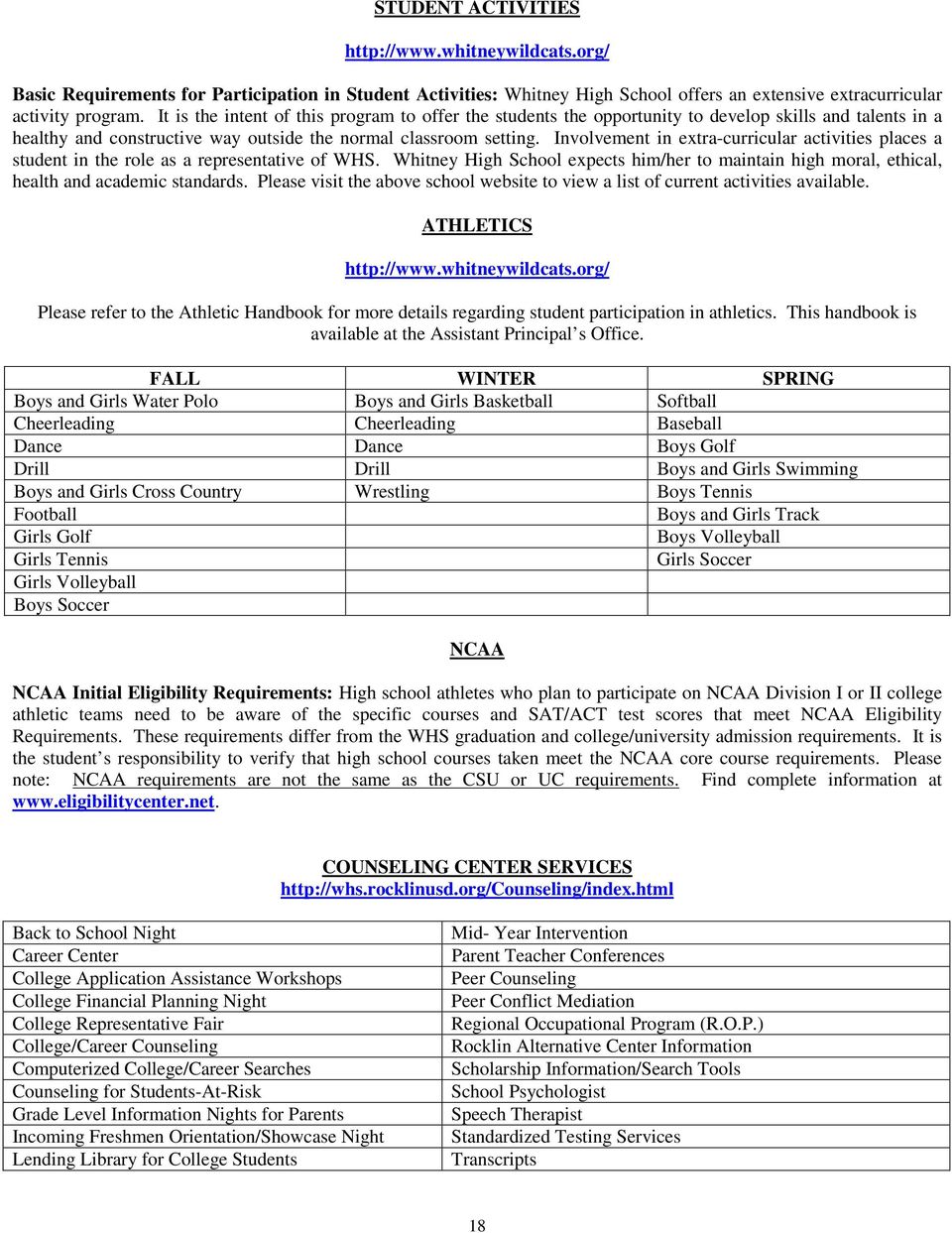
18 STUDENT ACTIVITIES Basic Requirements for Participation in Student Activities: Whitney High School offers an extensive extracurricular activity program. It is the intent of this program to offer the students the opportunity to develop skills and talents in a healthy and constructive way outside the normal classroom setting. Involvement in extra-curricular activities places a student in the role as a representative of WHS. Whitney High School expects him/her to maintain high moral, ethical, health and academic standards. Please visit the above school website to view a list of current activities available. ATHLETICS Please refer to the Athletic Handbook for more details regarding student participation in athletics. This handbook is available at the Assistant Principal s Office. FALL WINTER SPRING Boys and Girls Water Polo Boys and Girls Basketball Softball Cheerleading Cheerleading Baseball Dance Dance Boys Golf Drill Drill Boys and Girls Swimming Boys and Girls Cross Country Wrestling Boys Tennis Football Boys and Girls Track Girls Golf Boys Volleyball Girls Tennis Girls Soccer Girls Volleyball Boys Soccer NCAA NCAA Initial Eligibility Requirements: High school athletes who plan to participate on NCAA Division I or II college athletic teams need to be aware of the specific courses and SAT/ACT test scores that meet NCAA Eligibility Requirements. These requirements differ from the WHS graduation and college/university admission requirements. It is the student s responsibility to verify that high school courses taken meet the NCAA core course requirements. Please note: NCAA requirements are not the same as the CSU or UC requirements. Find complete information at COUNSELING CENTER SERVICES Back to School Night Career Center College Application Assistance Workshops College Financial Planning Night College Representative Fair College/Career Counseling Computerized College/Career Searches Counseling for Students-At-Risk Grade Level Information Nights for Parents Incoming Freshmen Orientation/Showcase Night Lending Library for College Students Mid- Year Intervention Parent Teacher Conferences Peer Counseling Peer Conflict Mediation Regional Occupational Program (R.O.P.) Rocklin Alternative Center Information Scholarship Information/Search Tools School Psychologist Speech Therapist Standardized Testing Services Transcripts 18
19 Course Descriptions Course offerings are subject to change based on student enrollment For the most current information, please visit our website: 19
20 COMMUNICATION STUDIES Communication Scope & Sequence Communication Studies courses are designed to offer students the opportunity to explore the general field of mass communications. Courses may be taken to meet either the WHS Applied Technology or VAPA credit. Students may advance into production courses following a variety of paths. For detailed options, see your counselor. 9 th 12 th Grades General Entry Courses 10 th 12 th Grades Mass Media (Grade 9 Only) Pubs I or Journalism I or Photo I or Broadcasting I (or level II with teacher approval) Broadcasting I Broadcasting II Broadcasting III Webmaster I Web II Web III Photo I Photo II or Photojournalism I or Broadcasting II Photojournalism II or Pubs II Graphic Communications I Graphic Comm. II or Broadcasting I or Journalism: Prod. Mgmnt. Photojournalism I or Publications I or Web I Publications I Pubs II Pubs III Pubs IV or Photojournalism I Journalism I Journalism II or Journalism III Journalism IV Broadcasting II or Journ: Prod. Mgmnt. Pubs II or Photojournalism I BROADCASTING I (INTRODUCTION TO BROADCAST JOURNALISM) Grade Level: 9-12 Prerequisite: None WHS Technology OR VAPA UC/CSU Approved F This course is designed for the study and practice of the basic elements of broadcast journalism with major emphasis in newsgathering, writing, video recording, editing, and the study of mass media. Students will recognize and apply the basic elements of news, news value, and vocabulary specific to broadcast journal writing. They will be able to identify and utilize various news sources, apply interview techniques and skill, and create stories using video and editing software. Students will produce a 30-minute news magazine for cable access that showcases their writing reporting, presentation, editing and production skills. Operation of broadcast newsrooms, ethics in journalism, interviewing techniques and media criticism will also be examined in the course. By creating broadcast programming, students will gain an intrinsic knowledge of the importance and role of the broadcast media. This class will also provide solid foundation knowledge for students who go on the Communication or Broadcast majors at the university level. All the assignments in this class are aligned with the California Visual and Performing Arts Standards or the California Career Technical Education Model Curriculum Standards. BROADCASTING II/III/IV (TELEVISION PRODUCTION) Prerequisite: Broadcasting I and/or Mass Media; with teacher approval and application. WHS Technology OR VAPA UC/CSU Approved G (Broadcasting II) UC/CSU Approved F (Broadcasting III) This class will encompass all aspects of field and studio television production. Students in this course will produce and direct television shows as the need arises. Outside-of-class projects will be required (i.e. covering school news and sporting events). Students will work on independent projects using linear and non-linear video equipment. This television production class gives students a chance to demonstrate a culmination of expertise in writing and editing that they have gained in the Broadcasting I class. They will also be responsible for solid foundation knowledge for students who go on to Communication or Broadcast majors at the university level. All the assignments in this class are aligned with the California Visual and Performing Arts Standards or the California Career Technical Education Model Curriculum Standards. 20
21 BROADCASTING II/III/IV (ADVANCED BROADCAST JOURNALISM) Prerequisite: Broadcasting I and/or Mass Media; with teacher approval and application WHS Technology OR VAPA UC/CSU Approved G (Broadcasting II) UC/CSU Approved F (Broadcasting III) This class builds on the skills learned in Broadcasting I. Students will create a monthly TV news magazine show called Unleashed; providing news, information, and entertainment to the student body of Whitney High School and the Rocklin community. The monthly show will be created by students and will include: feature stories, public service announcements, and commercials. Students will have the opportunity to attend national journalism conventions and enter their work in national competitions. In addition, students will also be responsible for producing and directing the school s morning announcements. This class will also provide solid foundation knowledge for students who go on to Communication or Broadcast majors at the university level. All the assignments in this class are aligned with the California Visual and Performing Arts Standards or the California Career Technical Education Model Curriculum Standards. BROADCASTING II/III/IV (SPORTS BROADCAST JOURNALISM) Prerequisite: Broadcasting I and/or Mass Media; with teacher approval and application WHS Technology OR VAPA UC/CSU Approved G (Broadcasting II) UC/CSU Approved F (Broadcasting III) Sports Broadcast Journalism students will continue to build on the skills they learned in Mass Media and Broadcast I. Students in this course will write and direct a bi-monthly coach s show and create a live production for each of Whitney s home football games. Students will also work on independent projects covering local high school sports events. They will make highlight packages based on sports events for the community. Outside-of-class projects will be required (i.e. covering sporting events). The sports broadcast class starts a foundation of knowledge for students who want to pursue a career in the field of sports media. All the assignments in this class are aligned with the California Visual and Performing Arts Standards or the California Career Technical Education Model Curriculum Standards. GRAPHIC COMMUNICATIONS I Grade Level: 9-12 Prerequisite: None Project ownership requires monetary contribution of $30 WHS Technology OR VAPA UC/CSU Approved F Desktop publishing and graphic design will be emphasized in this hands-on class. Students will master design for a variety of print and digital media: Advertising, publication design, posters, CD labels and more. Software training includes use of Adobe Illustrator and Photoshop. An emphasis is placed on learning the principles and elements of design as well as color theory. Students will be given the opportunity to design many of their own projects and may explore outside design work. GRAPHIC COMMUNICATIONS II Prerequisite: Graphic Communications I or Mass Media with teacher approval Project ownership requires monetary contribution of $30 WHS Technology OR VAPA UC/CSU Approved F This course will build greater understanding and skill development in desktop publishing and printing. Students may serve as teaching assistants in directing and assisting beginning graphic students. This may include the development of independent projects for both on and off site programs such as athletics, VAPA, and technology. Ability to work independently is a must. Software training includes advanced techniques in Photoshop and In Design with an introduction to Illustrator. JOURNALISM I Grade Level: 9-12 Prerequisite: None WHS Technology UC/CSU Approved G Beginning journalism students will learn all the basics of today s reporting in both print and online forms. The course will cover the fundamentals of journalism and multimedia storytelling in a variety of styles. Students will be introduced to fundamental skills in interviewing, reporting, and photography, as well as page design. Successful completion of Journalism I leads to a position on the news magazine staff, The Roar, and its online component, Whitney Update and editorial leadership opportunities at the advanced levels. Students in this class will have an opportunity to be published and will also explore the larger world of today s mass communication. 21
22 JOURNALISM II/III/IV (ADVANCED JOURNALISM) Prerequisite: Journalism I or Mass Media and teacher approval WHS Technology UC/CSU Approved G Advanced journalism students will be part of Whitney High Student Media, responsible for producing the news magazine The Roar and an online news source, Whitney Update. Led by student editors, the staff will determine content, write, design, photograph, and edit in both print and online form as well as handle marketing and advertising. Students will also use Adobe InDesign and Photoshop as well as social media and online tools. Students enrolled in Journalism III/IV will have the opportunity to hone their reporting, interviewing, editing, photography and page design skills. Students will be given greater roles of responsibility and will be given the chance to demonstrate leadership skills as they assume important editorial positions. JOURNALISM: PRODUCTION MANAGEMENT (EDITOR) Grade Level: Prerequisite: Second year Communications Studies class and teacher approval WHS Technology UC/CSU Approved G This class is an elective for students wishing to pursue a special project in Whitney High Student Media, with special emphasis on serving as an editor of the yearbook, news magazine, or news website. Students will develop and plan and work with a department instructor. Editors and students seeking leadership experience are strongly encouraged to enroll in this course. MASS MEDIA Grade Level: 9 Prerequisite: None Project ownership requires monetary contribution. TBA WHS Technology OR VAPA UC/CSU Approved F This course will provide students with an introduction to the Communication Studies department. Students will explore the essential skills and concepts in digital media, journalism (both print and broadcast), photography, and graphics with multiple instructors. Students will learn key concepts in visual arts in principles of design and color theory as well as an introduction to Photoshop, InDesign and a variety of web-based tools. Students will culminate each quarter with a hands-on project. This introductory course allows students to explore future learning paths in Broadcasting, Graphic Communications, Photography, Journalism, Publications, and Webmaster. PHOTOGRAPHY I Grade Level: Prerequisite: None Project ownership requires monetary contribution. TBA WHS Technology OR VAPA UC/CSU Approved F 2+2 Articulation with Sierra College This introductory course to photography will cover all aspects including camera basics, a variety of shooting techniques, and developing and printing in black and white. Students will also learn the fundamentals of digital photography and photo manipulation in Adobe Photoshop. Assignments will focus on the principles of design. This course prepares students for professional aspects of commercial photography. PHOTOGRAPHY II Grade Level: Prerequisite: Photo I and teacher approval Project ownership requires monetary contribution. TBA WHS Technology OR VAPA UC/CSU Approved F 2+2 Articulation with Sierra College This is an advanced photography course where students will explore and master advanced film and digital techniques. Students will explore studio photography, compositional work (elements of design), advanced digital photography, as well as traditional alternative processes in preparing their work for presentation and competition. This course prepares students for professional aspects of commercial photography. 22
23 PHOTOJOURNALISM I Grade Level: 9-12 Prerequisite: Photography I or Publications I or Journalism I or Mass Media or teacher approval Project ownership requires monetary contribution of $30 WHS Technology OR VAPA UC/CSU Approved F Students interested in telling stories through digital photography will be challenged by this course. Students will plan photo essays covering life in high school and shoot photo assignments of school activities. The focus is on digital work in color which will be published in the yearbook, newspaper and websites. Students will also prepare work for personal portfolios and for outside competitions. Participation in this class includes optional trips to national photo conventions and workshops. Digital cameras are provided for student use. PHOTOJOURNALISM II/III (ADVANCED PHOTOJOURNALISM) Grade Level: 9-12 Prerequisite: Photojournalism I and teacher approval Project ownership requires monetary contribution of $30 WHS Technology OR VAPA UC/CSU Approved F (Photojournalism II only) In this second and third year of photojournalism, students will apply and extend skills learned in prior experiences in photography. Student photojournalists will continue photo essay work for publication, edit peer work, and study the history of photojournalism. Experience with Web tools and digital portfolios online is part of this hands-on class. PUBLICATIONS JOURNALISM I Grade Level: 9-12 Prerequisite: None WHS Technology Publications I students learn the variety of skills required for yearbook/magazine production. The focus will be on reporting and interviewing skills, concept development, design and desktop publishing skills, basic photography, and business aspects of publications. The course is designed to lead students into greater participation in Whitney High Student Media. PUBLICATIONS JOURNALISM II Prerequisite: Graphic Communications I, Journalism I, Publication I, Photography I or instructor s waiver by application. WHS Technology UC/CSU Approved G Advanced publications students are part of Whitney High Student Media. Led by student editors, the staff will edit the yearbook for publication by determining its content and design. Adobe InDesign will be used along with graphics and digital imaging programs to prepare the book for disk submission to the publishing company. Students will take photographs as well as write and design all copy on the computers throughout this technical and vocational education course. The publications courses are also involved in a wide variety of social media, advertising, marketing, and real-world business skills. PUBLICATIONS JOURNALSIM III/IV Grade Level: Prerequisite: Publications II WHS Technology Continuing publications students will be expected to fulfill a variety of leadership and management roles in producing the yearbook. While the role will be determined by interests, third and fourth year students will also be expected to peer coach, edit, plan, and produce sections of the yearbook as advanced designers, reporters, and photographers. The publications courses are also involved in a wide variety of social media. 23
24 WEBMASTER I Grade Level: 9-12 Prerequisite: None Project ownership requires monetary contribution of $10 WHS Technology This introductory career technical and vocational education course to web page design will cover all aspects of web page design. The language HTML5 and web site maintenance will be learned. Assignments will focus on the skills that are essential in creating and maintaining web sites. Students will learn and explore one of the fastest growing career opportunities and gain a deeper understanding of today s web-based world. WEBMASTER II/III Prerequisite: Webmaster I and/or teacher approval Project ownership requires monetary contribution of $10 WHS Technology Webmaster II/III is a one-year follow up course that is designed to expand and enhance the student s knowledge of web page design. The languages HTML5, CSS, JAVASCRIPT, JQUERY, as well as web site maintenance will be learned. 24
25 CONSUMER STUDIES & HEALTH This course meets the WHS Health graduation requirement (5 credits). HEALTH AND DRIVERS ED./FAMILY LIFE Grade Level: 9-10 Prerequisite: Mandatory enrollment in Drivers Education segment. Students who possess a California Driver Education Completion Certificate issued before the first day of school will be exempt from some assignments. Enrollment in the family life segment is automatic unless exemption is requested by parent. WHS Health In this course, the student obtains, interprets, and understands basic health information and services. The following content areas are addressed: driver education, comprehensive sex education, nutrition and physical activity, mental and emotional health, alcohol, tobacco, and other drugs, injury prevention/safety, and personal/community health. Emphasis is placed on the development of lifelong positive health-related attitudes and behaviors. CONSUMER ELECTIVES The following courses will meet the WHS elective requirement (50 credits). CULINARY I (BEGINNING FOODS) Grade Level: 9-12 Prerequisite: None Project ownership requires monetary contribution. TBA (To be arranged) WHS Elective This is a comprehensive course designed to introduce students to the nutrient value, appetite appeal, social significance and cultural aspects of food. Students will participate in cooking labs, as well as a variety of classroom activities. Emphasis will be on reading recipes, measuring accurately, and food preparation. Basic food science principles will be introduced. Kitchen safety and sanitation; proper use of equipment; and essential job skills in the food industry will be reinforced as well. CULINARY II (FOOD SERVICES AND HOSPITALITY OCCUPATIONS WILDCAT CAFÉ) Prerequisite: Culinary I and teacher approval Project ownership requires monetary contribution. TBA WHS Elective This advanced culinary course teaches skills in food production, preparation, customer service, and teamwork. Instruction includes planning, selecting, storing, purchasing, preparing, testing, serving and selling of quality food and food products. Additional study areas will include nutritive values, safety and sanitation, use and care of commercial equipment, management of food establishments, cost and profitability analysis, handling customer orders, and food service standards, regulations and laws. Working in the Wildcat Café periodically during lunch is required. WORK EXPERIENCE Grade Level: Prerequisite: Students must have a valid Work Permit issued through the Work Experience Office and work at least 10 hours per week in a job covered by Worker s Compensation. WHS Elective Work Experience is an elective class which combines supervised, paid employment in any occupational field with related classroom instruction. Classroom instruction will focus on developing productive work habits, self-confidence and successful employment skills which can be used to locate, secure and retain employment. Awareness of the career exploration process and basic economic principles related to employment will also be taught. Students attend their jobs during the week, and attend a class session once a week at school. Students must have an approved, legally paid job while enrolled in this class. Regular visitations will occur at the jobsite by the Work Experience Coordinator. 25
26 LANGUAGE ARTS Language Arts Scope & Sequence The four year Language Arts program allows students to select advanced courses at the 9 th, 10 th, and 11 th grade levels. The advanced courses are recommended for students wishing to take AP English as their 12 th grade capstone course. The program offers several options at the 12 th grade level to satisfy the 4 th year English requirement for graduation and/or meet UC/CSU admissions requirements. For detailed options, see your counselor. 9 th Grade 10 th Grade 11 th Grade 12 th Grade LA I LA II LA III LA IV/World Literature Adv. LA I Adv. LA II LA III Honors AP LIT/COMP LANGUAGE ARTS I Grade Level: 9 Prerequisite: None WHS Language Arts UC/CSU Approved B Study will encompass the four areas of communication: reading, writing, speaking, and listening. Students will read both classical and contemporary works (of many genres). Focusing on the writing process, students will write personal narrative essays, informative and argumentative papers. Students will speak in a variety of situations that include group presentations. Students will demonstrate competency in active listening through note taking and other related activities. LANGUAGE ARTS I ADVANCED Grade Level: 9 Prerequisite: Grade of B+ of higher in 8 th grade Language Arts class. Students must have a signature from their 8 th grade Language Arts teacher on their Six-Year Plan to enroll in this course. WHS Language Arts UC/CSU Approved B This is an advanced course that exercises and expands all four realms of language arts: reading, writing, speaking and listening. Literary analysis and criticism will be studied with depth and complexity at an accelerated pace. The expectation for students who choose to enroll in this class is that they are serious four-year college bound students. Work habits and academic performance are expected to exceed that of students in the college prep English classes. LANGUAGE ARTS II Grade Level: 10 Prerequisite: None WHS Language Arts UC/CSU Approved B This course emphasizes the four major areas of communication: reading, writing, speaking, and listening. The literature based course follows the guidelines set in the curriculum content standards. Students will participate in an extensive reading program selected from a variety of genres. Students will study in-depth and sophisticated nuances as well as the larger meaning of these works. Student will write various types of essays. Students will demonstrate competency in active listening through note taking, research, and other related activities. LANGUAGE ARTS II ADVANCED Grade Level: 10 Prerequisite: Grade of A or higher in 9 th grade Language Arts class and teacher approval WHS Language Arts UC/CSU Approved B This is an advanced course that exercises and expands all four realms of language arts: reading, writing, speaking and listening. Literary analysis and criticism will be studied with depth and complexity at an accelerated pace. The expectation for students who choose to enroll in this class is that they are serious four-year college bound students. Work habits and academic performance are expected to exceed that of students in the college prep English classes. 26
27 LANGUAGE ARTS III Grade Level: 11 Prerequisite: None WHS Language Arts UC/CSU Approved B Study will explore American Literature from 1860 to the present. Reading, research, writing, discussion, and projects will guide students to demonstrate their understanding of grammar, literary elements, rhetoric, discourse, and writing structures. Students will also develop an awareness of the connection of themes and their relevancy to contemporary issues. LANGUAGE ARTS III HONORS Grade Level: 11 Prerequisite: Tenth grade LA with a grade of A or higher and teacher approval. Completion of summer homework is required. WHS Language Arts UC/CSU Approved B Honors Language Arts III is a challenging course designed for students who intend to take AP Literature and Composition their senior year. At an accelerated pace, students will closely read complex works under the guidance of the instructor, in order to prepare for both on-demand and process writing, and other forms of assessment (i.e. presentations, debates, Socratic Seminars). Writing assignments will focus on critical and persuasive analysis skills. Students independent work habits and academic performance are expected to exceed that of students in the college prep English classroom. Students must read a selection of works by the first day of school and be prepared to discuss tests and write about the literature by the first day of school. It is highly recommended that students purchase their own copies of the works in order to highlight important passages. A limited number of copies are available to be checked out at the Whitney High School Library. Read and annotate How to Read Literature Like a Professor by Thomas Foster. Complete the reading assignment and read the required supplemental texts found on the teachers websites found through the Whitney webpage, or Mr. Gale ([email protected]) or Mrs. Cavolt ([email protected]) LANGUAGE ARTS IV/ WORLD LITERATURE Grade Level: 12 Prerequisite: None WHS Language Arts UC/CSU Approved B World Literature English is a college preparatory class that focuses on building comprehensive knowledge of world cultures and continues to stress the four major areas of communication: listening, speaking, reading, and writing. Students will write in a variety of styles as they analyze the historical, literary, and cultural connections of texts from around the world. ADVANCED PLACEMENT LITERATURE AND COMPOSITION Grade Level: 12 Prerequisite: Honors LA/COM III with a grade of B or higher and teacher approval Fees: College Board testing fee ($TBA) WHS Language Arts UC/CSU Approved B AP Literature and Composition is an accelerated course (college level) designed for students intending to take the AP test (Literature and Composition) in the spring. Breadth and depth of the reading are the key features of the AP program in English. Students will closely read many complex works from the Greeks to the Moderns in preparation for frequent on-demand writings. Extensive writing assignments will focus on critical analysis skills. This course requires summer reading as assigned by the instructor. Students take the AP exam at the end of this course. Students who pass the test may receive college credit, advanced placement, or both depending on the institution s policies. Summer Reading Requirements: Students must read two works by the first day of school and be prepared to discuss, test, and write about the literature by the first day of school. It is suggested that students purchase their own copies of the novels in order to highlight important passages. A limited number of copies of the novel can also be checked out at the Whitney High School Library. It is expected that the student will obtain and read The Secret Sharer (Conrad), and Mother Night (Vonnegut). Students should come to the first day of class with a completed comparative essay. For further information contact Cruz Ordonez ([email protected]) at WHS. 27
28 LEADERSHIP The following courses meet the WHS elective requirement for graduation (50 credits). LEADERSHIP Grade Level: 9-12 Prerequisite: Students must be elected to an office, appointed to a commissioner position or apply to be in the class. Students must maintain a 3.0 GPA. Course may be repeated for credit. WHS Elective Students in this course will develop leadership and teamwork skills while covering a variety of topics including: time management, public speaking, goal setting, self-esteem, and communication. Students are required to work outside of class time according to the needs of their position. Students must maintain a 3.0 GPA throughout the year in order to participate in this class. PEER COUNSELING Prerequisite: Application, interview and selection process. Students must maintain a 3.0 GPA. WHS Elective The Peer Counseling class provides students with the opportunities to learn communication and support skills. Students will learn how to investigate school and community resources. They will use these skills to support students and the WHS counseling program. Our expectation is that students will stay current in all classes and be healthy of mind and heart. Meetings and class attendance are mandatory. PEER TEACHING Grade Level: Prerequisite: Application, interview and selection process. Student must maintain a 3.0 GPA (3.5 in teaching subjects). Course may be repeated for credit. WHS Elective This class is for students who would like to share their knowledge with their peers. It will be a wonderful opportunity for those students who have an interest in tutoring, and/or a teaching career. Students will work with students who have been identified with a need for academic support on and off the WHS campus. The next level of this course would be to take the R.O.P. Careers in Education course. SENIOR MENTOR Grade Level: 12 Prerequisite: Application and selection process WHS Elective This class is for seniors that would like to mentor and provide a positive role model for freshmen students. Mentors will work with small groups of students in Geography classes providing freshmen with basic instruction relating to academic success, school culture and tutorial time. Mentors will provide the tools and knowledge to assist freshmen to succeed in high school. This class requires a semester long commitment to the assistance of the freshman. STARS - STUDENTS TEACHING AND REACHING STANDARDS Grade Level: Prerequisite: Application, interview, and selection process. Course may be repeated for credit. WHS Elective This class is offered to Junior and Senior students as a Cross-Age Tutoring class. Students are trained to be Peer Teachers for all grades K-6. Students learn and become masters of the stages of the learning process, lead collaborative tutorial groups, work with students in their classroom, learn about various learning styles, study inquiry based strategies, and more. Once trained, students are assigned a classroom at a school within our district where they put their knowledge to use by working with other students. They are required to meet with their STARS teacher during intervention every other week to go over reflective journals and discuss common areas of concern and/or success. Students must provide their own transportation to the assigned school site. 28
29 MATHEMATICS Preparatory for High School Graduation Algebra 1/ Integrated Math 1 Geometry/ Integrated Math II Algebra II/ Integrated Math III* Accounting High school graduation requires 30 credits completed at the high school level. All students must complete through Geometry/ Integrated Math II. ROP Class *Offered starting in Please refer to the ROP Course Descriptions found on pages for a complete list of courses that meet the math elective graduation requirement. Preparatory for four-year College, University, or Community College with plans to transfer to a four-year school AP Statistics Math Analysis Pre-Calculus/ Trig AP Calculus AB AP Statistics (Seniors only) AP Calculus BC Algebra I/ Integ. Math I Geometry/ Advanced Geometry/ Advanced Integ. Math II/Integ. Math II Algebra II/ Advanced Algebra II/ Integ Math III * Pre-Calculus/ Trig AP Statistics (Seniors only) AP Calculus AB AP Calculus BC College bound students should complete at least 40 units of college-prep math and should be enrolled in one of the above courses all four years of high school. AP Statistics (Seniors only) AP Calculus BC (Seniors only) AP Statistics Starting in , Students wishing to accelerate their math course of study can take an Integrated Math II and Integrated Math III combination class. The class meets daily and covers Integrated Math II during the first semester and Integrated Math III during the second semester. Students should see their Integrated Math I teacher regarding placement for the following year. Sophomores and juniors may enroll in AP Statistics if they meet the prerequisites and are concurrently enrolled in another advanced math course. 29
30 INTEGRATED I Grade Level: 9-12 Prerequisite: None WHS Mathematics UC/CSU Approved C This course is the entry-level mathematics course at WHS. Topics covered include functions, transformations, modeling two variable data, sequences, systems of linear equations, congruence, coordinate geometry, exponential functions, and inequalities. INTEGRATED II Grade Level: 9-12 Prerequisite: Integrated I. Incoming 9 th grade students must have a grade of B or higher in Advanced Integrated I or Integrated I and they must have approval from their 8 th grade math teacher. Incoming 9 th grade students, who have earned a C in Advanced Integrated I, have the option of taking a placement test the first week in June to be enrolled in Integrated II. WHS Mathematics UC/CSU Approved C This course is for students who have completed Integrated I. Topics covered include, reasoning, angles, similarity, right triangles, probability, trigonometry, factoring, quadratic functions and equations, proof, quadrilaterals, polygons, circles, inequalities, functions, and solids. ADVANCED INTEGRATED II Grade Level: 9-10 Prerequisite: An A in Integrated I or Advanced Integrated 1. Incoming 9 th grade students must have approval from their 8 th grade math teacher. WHS Mathematics UC/CSU Approved C This course is for students who have completed Integrated I. Topics covered include, reasoning, angles, similarity, right triangles, probability, trigonometry, factoring, quadratic functions and equations, proof, quadrilaterals, polygons, circles, inequalities, functions, and solids. All the concepts in Integrated II will be covered, but in more depth. MATHEMATICS ELECTIVES The following courses meet the WHS Mathematics Elective graduation requirement. Students must complete 30 credits of mathematics and complete at least through Geometry. Students must be enrolled in a Mathematics course in grades It is recommended that college-bound students enroll in a 12 th grade UC/CSU approved math course. ALGEBRA II Grade Level: 9-12 Prerequisite: Student must have completed both semesters of Algebra I and Geometry. Incoming 9 th grade students must have a signature from their 8 th grade Math teacher on their Six-Year Plan to enroll in this course. WHS Mathematics Elective UC/CSU Approved C This course is to prepare students for the rigors of college level mathematics. Topics covered include problem solving, functions, sequences and series, exponentials, parent graphs, linear systems, complex numbers, polynomials, transcendentals, combinations and permutations. It is highly recommended each student have a graphing calculator. Algebra II is the minimum requirement for entrance into most four-year colleges and universities. ADVANCED ALGEBRA II Grade Level: 9-10 Prerequisite: An A in Algebra I and an A in Geometry. Incoming 9 th grade students must have a signature from their 8 th grade Math teacher on their Six-Year Plan to enroll in this course. A placement test will be given the first week of class. WHS Mathematics Elective UC/CSU Approved C This course is to prepare students for the rigors of college level mathematics. All the concepts in the Algebra II course will be covered, but in more depth. Additional concepts will be explored, such as matrices and descriptive statistics. It is highly recommended each student have a graphing calculator. 30
31 MATH ANALYSIS Prerequisite: A grade of C or higher in both semesters of Algebra II and teacher approval WHS Mathematics Elective UC/CSU Approved C This is a college preparatory course for students intending to go on to a UC/CSU school that have passed Algebra II, but need more practice with algebra related concepts to be successful in Pre-Calculus. The year-long course will incorporate California State Standards for mathematical analysis, linear algebra, and trigonometry. At the conclusion of this course, students will be prepared to continue studying mathematics in college or continue studying mathematical analysis and trigonometry in more detail in Pre-Calculus. PRE-CALCULUS/TRIGONOMETRY HONORS Prerequisite: A grade of B or higher in both semesters of Algebra II or a grade of C or higher in both semesters of Math Analysis and teacher approval WHS Mathematics Elective UC/CSU Approved C This course is to prepare students for the rigor of calculus. The topics include rational, polynomial, exponential, and transcendental functions, polar equations, parametric equations, the binomial theorem, vectors, limits, series, and trigonometry. This course will also cover trigonometry. In particular, students will learn about graphs, identities, and numerous applications. ADVANCED PLACEMENT CALCULUS AB Grade Level: Prerequisite: A grade of C or higher in both semesters of Pre-Calculus Fees: College Board testing fee ($TBA) WHS Mathematics Elective UC/CSU Approved C Covers one semester of college calculus. Topics to be covered include functions and graphs, limits and continuity, differential calculus, integral calculus, and graphing calculator applications. Students take the AP exam at the end of this course. Students who pass the test may receive one semester of college credit, advanced placement, or both depending on the institution s policies. ADVANCED PLACEMENT CALCULUS BC Grade Level: 12 Prerequisite: A grade of B or higher in both semesters of Pre-Calculus or Prior enrollment in AP Calculus AB Fees: College Board testing fee ($TBA) WHS Mathematics Elective UC/CSU Approved C Covers two semesters of college calculus. Topics to be covered include all topics from AP Calculus AB, parametric, polar and vector functions, Euler s method, applications of integrals, integration techniques, partial fractions, logistical differential equations, polynomial approximations, and series. Students take the AP exam at the end of the course. Students who pass the test may receive up to two semesters of college credit, advanced placement, or both depending on the institution s policies. ADVANCED PLACEMENT STATISTICS Grade Level: 12 (10 th -11 th grade students may enroll with concurrent enrollment in another college-prep math course) Prerequisite: Algebra II and an Academic GPA of 3.0 or higher Fees: College Board testing fee ($TBA) WHS Mathematics Elective UC/CSU Approved C AP Statistics is a college-level statistics course that is designed to prepare students for the AP Statistics exam in the spring. It is an introductory course in probability and statistics that includes descriptive statistics, techniques and principals of counting, probability, inferential statistics, regression techniques, and use of a statistical graphing calculator. It is recommended that each student have a graphing calculator. Students take the AP exam at the end of the course. Students who pass the test may receive college credit, advanced placement, or both depending on the institution s policies. 31
32 EAP MATH Grade Level: 12 Prerequisite: A grade of C or higher in both semesters of Algebra 2 WHS Mathematics Elective UC/CSU Approved C EAP Math is a joint math project of California State University, Sacramento, Sierra College, and Placer County high schools designed to enhance students understanding of functions and ability to model data mathematically. The course is designed to increase students mathematical thinking by studying problem solving, functions (including linear, quadratic, exponential, logarithmic, systems, absolute value, and piecewise), business related topics, and various mathematical applications. As an added benefit of the course, students will be allowed to waive the math placement test if he or she attends Sierra College and/or the summer math project if he or she attends California State University, Sacramento. ACCOUNTING Grade Level: Prerequisite: Algebra I College Articulation: Students may articulate and receive CSU/UC transferable college credit at Sierra College WHS Mathematics Elective UC/CSU Approved G This one-year course covers fundamental accounting principles for those who have had no previous study in bookkeeping or accounting. It provides practical training to enable students to hold bookkeeping or account clerk positions. Concepts covered will include basic accounting principles, data accumulation for financial statements, and the accounting cycle. The course utilizes a computerized accounting system, spreadsheets, and the use of word processing software for business applications. 32
33 PHYSICAL EDUCATION Physical Education Scope & Sequence (For detailed options, see your counselor) 1 st Year 2 nd & 3 rd Year PE I Aerobic Fitness Aerobic Walking Athletic Weight Training (COED, Varsity Girls/Boys, V/JV Football) Aquatic Activities Dance I/II/III/IV Lifetime Activities ROTC Drill Step Aerobics Team Sports Advanced Team Sports Female Team Sports PHYSICAL EDUCATION I Grade Level: 9 Prerequisite: None WHS Physical Education (One Year) The physical education program in P.E. I is to provide students with the opportunities to develop an optimal level of physical fitness through the use of psychomotor development activities, cardiovascular activities, flexibility exercises, strength training, and wellness education. The major activities of focus will be volleyball, dance, fitness lab, self-defense, pickleball, hockey, soccer, badminton, and swimming. This course meets the first year of the WHS Physical Education graduation requirement (10 credits). All 9th grade students will be enrolled in PE I. Students not earning a passing grade in PE I must repeat PE I. PHYSICAL EDUCATION ELECTIVES The following courses meet the second and third year WHS Physical Education elective graduation requirements (20 credits). The prerequisite for all PE elective courses is successful completion of PE I. An athletic waiver will waive up to two semesters of the third year Physical Education requirement. Two seasons of sport participation is equal to one semester of elective P.E. The credits needed for graduation remains at 250; however, the student may waive the PE elective course and select a new elective course in another department. Varsity athletes will be required to be enrolled in a weights conditioning class. For further information, please contact the Counseling Center. Students may also use Theatre Dance I, II, III and IV as a P.E. elective course. Aerospace Science Drill may only be taken once to fulfill the PE elective requirement. Please check the Graduation Verification Petition in this handbook to help you determine your graduation needs. AEROBIC FITNESS Grade Level: Prerequisite: Successful completion of PE I. Course may be repeated for credit. WHS Physical Education Elective This course is designed to introduce and provide the opportunity for students to participate in a variety of cardiovascular fitness activities. The course will also include the use of weighted balls, dumb bells, videos, steps, jump ropes, exercise bars, and other fitness equipment. The students will participate daily in warm-up exercises, cardiovascular endurance runs, body strengthening exercises, swimming, and other endurance exercises throughout the course. The ability to work well with others and participate at a high intensity level is expected. 33
34 AEROBIC WALKING Grade Level: Prerequisite: Successful completion of PE I and parental permission. Course may be repeated for credit. WHS Physical Education Elective This course is activity based focusing on fitness as a lifelong activity. The fitness components of cardio-respiratory endurance, cardiovascular efficiency, muscular strength and muscular endurance are emphasized. This course is designed to introduce and provide an opportunity for students to develop a fitness workout plan through the main activity of walking. All walking routes will be off campus. ATHLETIC WEIGHT TRAINING (COED, VARSITY GIRLS/BOYS, VARSITY/JV FOOTBALL) Prerequisite: Successful completion of PE I. Course may be repeated for credit. WHS Physical Education Elective This course is designed to improve functional flexibility, strength, power, agility, and speed. These areas must be improved through training to improve performance, reduce injury potential, and optimize athletic ability. Our weight lifting program macrocycle will follow a seven-unit model. The seven units in the model are: 1. Dynamic Warm-up, 2. Core Stabilization Training, 3. Neuromuscular Stabilization Training, 4. Strength Training, 5. Reactive Neuromuscular Training, 6. Lateral Speed and Agility, 7. Speed Development. Students will need to function in a small and large group setting with other students. This class will also introduce students to Crossfit workouts. There will also be a sport specific segment in each class for all athletes. AQUATICS Prerequisite: Successful completion of PE I and basic swim skills required. Course may be repeated for credit. WHS Physical Education Elective This course is designed for swimmers to increase their cardiovascular and muscular fitness through a variety of lap pool and land workouts. Course workouts are designed for intermediate to advanced swimmers. LIFETIME ACTIVITIES Prerequisite: Successful completion of PE I. Course may be repeated for credit. WHS Physical Education Elective This course is designed to introduce and provide opportunities for students to develop the basic and intermediate skills in a variety of non-traditional sports and activities that they will be able to participate in now and in the future. Every class will consist of a fitness component and an activity such as aerobic walking, jogging, aerobics, yoga, pickle ball, tennis, badminton, volleyball, softball, fitness, and water activities (swimming). Through this course, students will gain a greater knowledge and appreciation of possible activities that their community has to offer. SPORTS CONDITIONING Prerequisite: Successful completion of PE I. Course may be repeated for credit. WHS Physical Education Elective This course is designed to introduce and provide opportunities for students to participate in a cardiovascular activity using a variety of equipment such as balls, dumbbells, and one s own body weight. The step platform, fitness videos, aerobic walks, free weights, exercise bars and bands, stability balls, jump ropes, swimming, and other activities will be used and performed. The students will participate daily in flexibility, cardiovascular endurance, and muscle strength and endurance activities during this class. The ability to work well with others and participate at a high level on a daily basis is expected. STEP AEROBICS Grade Level: Prerequisite: Successful completion of PE I. Course may be repeated for credit. WHS Physical Education Elective This course is designed to introduce and provide the opportunity for students to participate in a cardiovascular activity using a variety of equipment such as the step platform or stepper, fitness videos, aerobic walks on and off campus, running and jogging on and off campus, weighted bars and balls, elastic bands, stability balls, jump ropes, and other cardiovascular activities. The students will participate daily in flexibility, cardiovascular endurance, and muscle strength and other cardiovascular/endurance activities during the class. Knowledge of the stepper and the ability to perform basic step aerobic moves while using the stepper will be emphasized. The Aerobics course will include proper warm-up, flexibility, cardiovascular endurance, and muscle strength into a proper routine. The ability to work well with others and participate at a high level daily is expected. 34
35 TEAM SPORTS Prerequisite: Successful completion of PE I. Course may be repeated for credit. WHS Physical Education Elective This course is designed to involve student participation in team sport activities. Students will be able to perform in various sports such as: flag football, basketball, softball, lacrosse, volleyball, and soccer. Students will learn the rules for these games and the fundamentals that make up each team sport. Each student will learn sportsmanship, communication, and the ability to work well with others. Team Sports will also include fitness as a part of the class. This will include bi-weekly mile runs, fitness exercise, and a variety of cardiovascular exercises. Each class will begin with a series of these exercises. ADVANCED TEAM SPORTS Grade Level: (special consideration for some 10 th grade students with teacher permission) Prerequisite: Successful completion of PE I, Team Sports, and signed permission from the student s Team Sports teacher. Course may be repeated for credit. WHS Physical Education Elective This course is designed to involve student participation in team sport activities. Students will be able to perform in various sports such as: flag football, basketball, softball, lacrosse, volleyball, water polo, and soccer. Students will learn the rules for these games and the fundamentals that make up each team sport. Each student will learn sportsmanship, communication, and the ability to work well with others. Team Sports will also include fitness as a part of the class. This will include bi-weekly mile runs, fitness exercise, and a variety of cardiovascular exercises. Each class will begin with a series of these exercises. FEMALE TEAM SPORTS Prerequisite: Successful completion of PE. Must be a female WHS Physical Education Elective This course is designed to involve student participation in team sport activities. Students will be able to perform in various sports such as: flag football, basketball, softball, lacrosse, volleyball, water polo, and soccer. Students will learn the rules for these games and the fundamentals that make up each team sport. Each student will learn sportsmanship, communication, and the ability to work well with others. Team Sports will also include fitness as a part of the he class. This will include bi-weekly mile runs, fitness exercise, and a variety of cardiovascular exercises. Each class will begin with a series of these exercises. 35
36 JROTC JROTC Scope & Sequence 9 th or 10 th Grade 10 th or 11 th Grade 11 th or 12 th Grade Aerospace Science I Aerospace Science II Aerospace Science III/IV Aerospace Science III Aerospace Science V Cadet Laboratory Course (formerly Summer Leadership School) and/or Aerospace Science Drill The following courses meet the WHS elective graduation requirement (50 credits). Aerospace Science I meets the WHS U.S. History Social Science requirement for graduation (maximum 10 credits). Aerospace Science II or III meet the WHS Science Elective requirement for graduation (maximum 10 Science credits). Aerospace Science Drill meets one year of WHS P.E. elective requirement for graduation (maximum of 10 PE credits). AEROSPACE SCIENCE I (JROTC I) Grade Level: 9-12 Prerequisites: None WHS Elective OR WHS US History (graduation requirement only) This is a History course designed to acquaint the student with the historical development of flight throughout the history of the United States and the role of the military in history. AS I meets the WHS U.S. History Social Science requirement for graduation (10 credits). The Leadership portion concentrates on the heritage of the Air Fore, individual self-control, wellness and fitness, as well as citizenship. Increased leadership opportunities in the cadet corps will also be available. Participation in the group Wellness program is mandatory. Physical fitness training is conducted on Friday during JROTC class. A Presidential Fitness Test is conducted early in the first semester and again in the middle of the second semester. Cadets must meet Air Force grooming standards. Instructors: Colonel Michael A. Fernandez, USAF, (Ret) [email protected] x 6683 Senior Master Sgt. Terry J. Barber, USAF, (Ret) [email protected] x 6609 Materials/Fees: No fees required; the cadet uniforms, which will be issued in the early Fall, need to be returned in good condition after the school year ends. Grading: The minimum satisfactory overall grade is 70% The AFJROTC Grade composition is: Academic Quizzes % of the grade Uniform Wear % Extreme Excellence Participation----15% Late Work Policy/ Make-up Work: Uniform wear- No later than the day prior to the next uniform wear day. Quizzes- No later than the end of the week following the scheduled quiz. Current Events- Cadets are encouraged to do two each time to have extra points. Leadership Quizzes- No later than the end of the week following the scheduled quiz. Special Circumstances will be considered. Instructors are available before and after school hours for any student requests/make-ups. Lunch Stamp: Based on completion of all requirements, wear of uniform, meet grooming standards, and a 70% overall grade. If a uniform wear is missed, the student will not receive a lunch stamp until the makeup is complete. 36
37 AEROSPACE SCIENCE II (JROTC II) Grade Level: 9-12 Prerequisites: Aerospace Science I WHS Elective OR WHS Science Elective (graduation requirement only) This is a Science course which examines our Earth, the Moon and planets, the latest advances in space technology, and the continuing challenges of space and manned spaceflight. This course meets the WHS Science Elective requirement for graduation (maximum of 10 Science credits). Issues that are critical to travel in the upper atmosphere such as orbits and trajectories, unmanned satellites, space probes, and guidance and control systems are explained. It also covers the development of space stations, the Space Shuttle, and international laws for the use and travel in space. In the Leadership portion, stress is on communication skills and cadet corps activities. Information is provided on communicating effectively, understanding groups and teams, preparing for leadership, solving conflicts and problems, and personal development. Increased leadership opportunities in the cadet corps will also be available. Participation in the group Wellness program is mandatory. Physical fitness training is conducted on Friday during JROTC class. A Presidential Fitness Test is conducted early in the first semester and again in the middle of the second semester. Cadets must meet Air Force grooming standards. Instructors: Colonel Michael A. Fernandez, USAF, (Ret) [email protected] x 6683 Senior Master Sgt. Terry J. Barber, USAF, (Ret) [email protected] x 6609 Materials/Fees: No fees required; the cadet uniforms, which will be issued in the early fall, need to be returned in good condition after the school year ends. Grading: The minimum satisfactory overall grade is 70%. The AFJROTC Grade composition is: Academic Quizzes % of the grade Uniform Wear % Extreme Excellence Participation % Late Work Policy/ Make-up Work: Uniform Wear- No later than the day prior to the next uniform wear day. Quizzes- No later than the end of the week following the scheduled quiz. Current Events- Cadets are encouraged to do two each time to have extra point. Leadership Quizzes- No later than the end of the week following the scheduled quiz. Special circumstances will be considered. Instructors are available before and after school hours for any student requests/make-ups. Lunch Stamp: Based on completion of all requirements, wear of uniform, meet grooming standards, and a 70% overall grade. If a uniform wear is missed, the student will not receive a lunch stamp until the makeup is complete. AEROSPACE SCIENCE III (JROTC III) Grade Level: 9-12 Prerequisite: Aerospace II WHS Elective/ Science- graduation requirement only This is a science course designed to acquaint the student with the cultural developments throughout the global community. This course meets the WHS Science Elective requirement for graduation (maximum of 10 Science credits). The Leadership portion concentrates on opportunities after high school and the many options available, such as college, technical school, etc. Also discussed is information on how to begin the job search, financial planning and how to save, invest, and spend money wisely, as well as how not to get caught in the credit trap. Increased leadership opportunities in the cadet corps will also be available. Participation in the group Wellness program is mandatory. Physical fitness training is conducted on Friday during JROTC class. A Presidential Fitness Test is conducted early in the first semester and again in the middle of the second semester. Cadets must meet Air Force grooming standards. 37
38 AEROSPACE SCIENCE IV (JROTC IV) Grade Level: 12 Prerequisite: Aerospace Science III WHS Elective This is a management course designed to immerse the cadets in the management of the cadet corps, while applying the 4 th year Leadership coursework. The course is a guide to understanding the fundamentals of management, managing yourself and others. The areas covered include Management Techniques, Decisions and Functions. Participation in the group Wellness program is mandatory. Physical fitness training is conducted on Friday during JROTC class. A Presidential Fitness Test is conducted early in the first semester and again in the middle of the second semester. Cadets must meet Air Force grooming standards. Instructors: Colonel Michael A. Fernandez, USAF, (Ret) [email protected] x 6683 Senior Master Sgt. Terry J. Barber, USAF, (Ret) [email protected] x 6609 Materials/Fees: No fees required; the cadet uniforms, which will be issued in early fall, need to be returned in good condition after the school year ends. Grading: The minimum satisfactory overall grade is 70%. The AFJROTC Grade composition is: Academic Quizzes % of the grade Uniform Wear % Extreme Excellence Participation % Late Work Policy/ Make-up Work: Uniform Wear- No later than the day prior to the next uniform wear day. Quizzes- No later than the end of week following the scheduled quiz. Current Events- Cadets are encouraged to do two each time to have extra points. Leadership Quizzes- No later than the end of the week following the scheduled quiz. Special circumstances will be considered. Instructors are available before and after school hours for any student requests/ make-ups. Lunch Stamp: Based on completion of all requirements, wear of uniform, meet grooming standards, and a 70% overall grade. If a uniform wear is missed, the student will not receive a lunch stamp until the makeup is complete. AEROSPACE SCIENCE DRILL Grade Level: 9-12 Prerequisite: Student must be concurrently enrolled in another Aerospace Science course. Course may be repeated for credit. WHS Elective OR Physical Education Elective (3 rd year) The drill and ceremonies course concentrates on the elements of military drill and describes unarmed, armed, and color guard precision movements, drill ceremonies, reviews, and development of command voice. Physical exercise will be interspersed during the class period so as to build physically stronger cadets capable of easily handling the armed and color guard drill sequences. The course is creditable toward one year of physical fitness. Cadets in this class can anticipate being chosen to represent the School and their Unit at drill competitions throughout the state. There are two after school sessions each semester which will require cadet participation (Midnight Madness- one week prior to drill completion; uniform preparation- during week prior to the drill meet). The Drill and Ceremonies text will be used in this class. The availability of this course will allow cadets the flexibility to participate in other after-school extracurricular activities. 38
39 AEROSPACE SCIENCE V- CADET LABORATORY COURSE Grade Level: 9-11 Prerequisites: Registration into the JROTC program for the following year. Five (5) elective Aerospace Studies credits are earned for successful completion of this course. Course may be repeated for credit. WHS Elective This is a special summer course designed to: (a.) introduce new students to the JROTC program and WHS, and (b.) provide command and management training to returning JROTC cadets. It consists of 80 hours of instruction over two 5-day academic weeks. Overviews of the entire JROTC Aerospace Science and Leadership Education curricula are presented. Aviation History, Aviation Science, Space Science and Senior Cadet Corps Management are covered in some detail. Military Customs and Courtesies, Drill and Ceremonies and Physical Training are taught in significant detail. Upon completion, the new JROTC cadet will be appreciably familiar the JROTC program, upper-class and other new cadets, and the values of citizenship and community service. A minimum of one field trip will be taken to a local/regional US or other facility for familiarization with functions and operations related to the military or other aerospace communities. 39
40 SCIENCE Science Scope & Sequence Freshmen start their science sequence with Biology. The sophomore year students will focus on physical science. Students may double up on the offerings in Science during grades 11, and 12. Those wishing to accelerate their course of study in Science should see their counselor. Life Science Physical Science Electives 9 th Grade 10 th Grade 11 th /12 th Grade ROP Courses (11 th /12 th ) Adv. Biology Chemistry/ Honors Anatomy/Physiology ROP Automotive Biology Physics AP Biology ROP Automotive Technologies Geology AP Environ. Science ROP Baking & Pastry AP Chemistry ROP AP Computer Science A AP Physics 1and 2 ROP Dental Careers Chemistry/Honors ROP Fire Science Forensic Science ROP Health Careers Geology ROP Integrated Animal Science Marine Biology ROP Medical Assisting Physics ROP Sports Medicine Energy, Power and Business Please see 49er ROP section for a complete list of ROP course descriptions. BIOLOGY Grade Level: 9 WHS Science Elective UC/CSU Approved D This laboratory science course studies the main concepts of biology with emphasis on the following: introduction to biochemistry, the cell, genetics, evolution and physiology. ADVANCED BIOLOGY Grade Level: 9 Prerequisite: Math 8 and grade of A in 8 th grade Science. Students must have a signature from their 8 th grade Science teacher on their Six-Year Plan to enroll in this course. Co-requisite: Concurrent enrollment in at least one other advanced freshman level course. WHS Science Elective UC/CSU Approved D This fast-paced year-long course is designed to prepare students for success in any of the AP Sciences. This course requires students to be highly motivated and willing to put in daily outside preparation. This is a laboratory science course that studies the main concepts of biology with emphasis on the following: introduction to biochemistry, plant and animal structures, genetics, evolution and ecology. SCIENCE ELECTIVES The following courses meet the second and third years of the WHS elective Science graduation requirement (20 credits). ANATOMY/PHYSIOLOGY Grade Level: Prerequisite: Biology and a second year of science. WHS Science Elective UC/CSU Approved D Students will study the major systems of the human body. Course emphasis will be on recognition and function of major features of the organ systems studied. Students will also apply their knowledge of organ functions to the exploration of typical organ system diseases. Labs will feature dissection of the cat organ systems. Labs will also include explorations of the functions of the organ systems studied. 40
41 CHEMISTRY I Prerequisite: A grade of B or higher in Biology, Geology (if applicable), and Algebra I/Integrated Math I. WHS Science Elective UC/CSU Approved D General chemistry is an initial exposure to the field of chemistry for the college-bound high school student, taught in a manner to enable the student to grasp the basic concepts and to pursue knowledge through experimentation. Students will solve problems and apply the solutions to real world situations as well as discover and work with quantitative relationships that are fundamental to chemical reactions and the structure of matter. CHEMISTRY- HONORS Prerequisite: Any student taking regular Chemistry can take Honors Chemistry. WHS Science Elective UC/CSU Approved D Honors Chemistry is a course embedded within the General Chemistry class. Students are required to complete the required course work for General Chemistry, but will also be expected to complete additional, advanced level work for every unit. There are three primary reasons for students to enroll: students intend to enroll in AP Chemistry, students intend to major in a science in college, or students find the general Chemistry curriculum not challenging enough. Students will need to be self motivated and work independently in order to be successful in this class, as these are important college preparatory skills. The expectation for students who choose to enroll in this class is that they are serious four-year college bound students. Work habits and academic performance are expected to exceed that of students in the college prep science classes. ENERGY, POWER AND BUSINESS Grade Level: Prerequisite: Biology WHS Science Elective OR Technology This course provides a comprehensive study of the basic elements of energy, power, and how they affect the world of business. We will cover the resources, processes, and systems used in the current world while exploring how they play a role in our everyday lives. We will spend the year building and learning about projects that relate to the real world. Our students will learn how to build DC circuits, wire residential outlets/switches, build insulated mini-houses, conduct energy audits, and challenge themselves to think like an engineer. Students will participate in a solar powered boat regatta sponsored by SMUD. This competition will take place in Rancho Saco in May, and we will design, build, and race a solar powered boat while acquiring sponsorships to assist our class. The overall goal of this course is hands on application, while reinforcing the Engineering Standards of the Common Core Curriculum. This course depends on community support through donations of resources, which allows our program to keep the cost down. FORENSIC SCIENCE Grade Level: Prerequisite: Biology and a second year of science. WHS Science Elective UC/CSU Approved G This course is designed to give the students both theory and hands-on experience in the skills and knowledge required of a forensic science technician. Students will learn to collect, preserve and analyze criminal evidence used to solve cases, such as: fingerprints, DNA, blood, hair and handwriting samples. The students will prepare reports or presentations of findings, investigate methods, or laboratory techniques used in solving crimes. There is also a focus on famous cases that relate to the topics studied. GEOLOGY Prerequisite: Biology WHS Science Elective UC/CSU Approved D Geology is a year-long, physical lab science that introduces students to the systems responsible for Earth s dynamic nature. Students will study the origin, history, and structure of the Earth and the processes that shape it. Major topics covered in this course are: origin and structure of the universe (Astronomy), composition and structure of the Earth, plate tectonics, rocks and minerals, volcanoes, earthquakes, tsunamis, climate and weather patterns, Earth history, Earth s resources, and California s unique geology. This class includes multiple hands-on lab activities. 41
42 MARINE BIOLOGY Grade Level: Prerequisite: Biology and a second year Science WHS Science Elective UC/CSU Approved D Marine Biology is designed to introduce students to a world as immense, enchanting and mysterious as the one above ground the ocean world. The marine environment will be explored as it relates to biology, geology, chemistry and physics. Through laboratory activities marine organisms will be explored relative to their functions, their different habitats and effects or organism interactions. The topics studied will include: environmental issues, marine resources, current research and aquatic ecosystems. PHYSICS I Prerequisite: A grade of B of higher in Geometry, Biology, and Geology (if applicable). Concurrent enrollment in Algebra II or higher (without a math lab class) WHS Science Elective UC/CSU Approved D This course is designed to engage students in everyday applications as well as professional applications of physics. This lab-based, college prep course will investigate a variety of physical phenomena through the use of computer-aided data retrieval and analysis. Students need to have strong math and critical thinking skills. This course is recommended for any student that is planning to attend a four-year university. Physics is essential for any student planning to major in the following: engineering, medicine, science, and math. ADVANCED PLACEMENT BIOLOGY Grade Level: Prerequisite: A grade of B or higher in Biology and Chemistry Fees: College Board testing fee ($TBA) WHS Science Elective UC/CSU Approved D AP Biology is an intensive and accelerated study of biology. It is designed for students seeking additional challenges and preparation for college. This course is a part of a nationwide program sponsored by the College Board. It is intended to be a representative freshman course commonly offered in American Universities, but not necessarily identical with a course at any specific institution. Students take the AP exam at the end of this course. Students take the AP exam at the end of this course. Students who pass the test may receive college credit, advanced placement or both depending on the institution s policies. ADVANCED PLACEMENT CHEMISTRY Grade Level: Prerequisite: A grade of B or higher in Honors Chemistry or a grade of A in Chemisty. Algebra II (grade of an A is highly recommended), and teacher approval Fees: College Board testing fee ($TBA) WHS Science Elective UC/CSU Approved D This course is an intensive and accelerated chemistry program designed for students seeking additional challenge and preparation for college. The purpose of this course is to explore the fundamentals of chemistry by focusing on chemical calculations and laboratory experimentation. This course is part of a nationwide program sponsored by the College Board. It is intended to be a representative freshman course commonly offered in American universities, but is not necessarily identical with a course at any specific institution. Students take the AP exam at the end of this course. Students who pass the test may receive college credit, advanced placement or both depending on the institution s policies. ADVANCED PLACEMENT ENVIRONMENTAL SCIENCE Grade Level: Prerequisite: Biology and a grade of B or higher in Chemistry or Geology is recommended Fees: College Board testing fee ($TBA) WHS Science Elective UC/CSU Approved D This course is a college level laboratory course that aims to provide students with the scientific principles, concepts, and methodologies required to understand the inter-relationships of the natural world. The course aims to identify and analyze environmental problems both natural and human-made, to evaluate the relative risks associated with these problems, and to examine alternative solutions for resolving and/or preventing them. This course is part of a nationwide program sponsored by the College Board. It is intended to be a representative freshman course commonly offered in American universities, but not necessarily identical to a course at a specific institution. Students take the AP exam at the end of this course. Students who pass the test may receive college credit, advanced placement or both depending on the policies at the specific institution. 42
43 ADVANCED PLACEMENT PHYSICS 1 Prerequisite: A grade of B or higher in Advanced Algebra II or a grade of A in Algebra II. Concurrent enrollment in Pre-Calculus or higher and teacher approval. Recommendation: Physics I is not a prerequisite course but strong math skills are strongly recommended to do well. Fees: College Board testing fee ($TBA) WHS Science Elective UC/CSU Approved D This is the first class of a two year course in AP Physics designed for students seeking additional challenge and preparation for college. AP Physics 1 is the equivalent to a first-semester college course in algebra-based physics. The course covers Newtonian Mechanics (including rotational dynamics and angular momentum); work, energy and power, and mechanical waves and sound. It will also introduce electric circuits. Focus of the class is based on scientific practices and inquiry investigation. This course is suggested for students interested in majoring in science, medicine, math, or engineering. ADVANCED PLACEMENT PHYSICS 2 Grade Level: Prerequisite: A grade of A in Physics 1 or a grade of B or higher in AP Physics 1 and concurrent enrollment in precalculus or higher and teacher approval. Fees: College Board testing fee ($TBA) WHS Science Elective UC/CSU Approved D This is the second class of a two year course in AP Physics designed for students seeking additional challenge and preparation for college. AP Physics 2 is equivalent to a second semester college course in algebra-based physics. The course covers fluid mechanics; thermodynamics, electricity and magnetism, optics, and atomic and nuclear physics. Focus of the class is based on scientific practices and inquiry investigation. This course is suggested for students interested in majoring in science, math, medicine, or engineering. ADVANCED PALCEMENT PHYSICS C: MECHANICS Grade Level: Prerequisite: Concurrent enrollment in AP Calculus AB. Grade of B or higher in AP Physics 1. Fee: College Board testing fee ($TBA) WHS Science Elective UC/CSU Approved D This course ordinarily forms the first part of the college sequence that serves as the foundation in physics for students majoring in the field of physical sciences or engineering. The sequence is parallel to or proceeded by mathematics courses that include calculus. Methods of calculus are used wherever appropriate in formulating physical principles and in applying them to physical problems. The sequence is more intensive and analytic than that in the AP Physics B course. Strong emphasis is placed on solving a variety of challenging problems, some requiring calculus. This AP Physics C course is the first part of a sequence often taken in college that is very intensive with a laboratory component. 43
44 SOCIAL SCIENCE Social Science Scope & Sequence (For detailed options, see your counselor) 9 th Grade 10 th Grade 11 th Grade 12 th Grade World Geography & Culture World History U.S. History or Government/Economics Advanced Geography AP World History AP U.S. History AP Microeconomics (Year-long course) AP Government (Year-long course) AP Government (Year-long course) WORLD CULTURAL GEOGRAPHY /COMPUTER LITERACY Grade Level: 9 Prerequisite: None WHS Social Science This introductory course is designed to explore the physical and cultural aspects of our world. It is a year-long course with first semester emphasizing freshmen strategies for success and computer literacy. In order to maintain support during the first semester, freshmen are assigned a Senior Mentor to guide and monitor their progress. Second semester, study is divided among the major regions of the earth. The course is intended to help students develop a geographic perspective of the world through a study of Themes of Geography, the Elements of Culture, and the Issues of Global Concern. ADVANCED WORLD CULTURAL GEOGRAPHY Grade Level: 9 Prerequisite: A grade of B or higher in 8th grade Social Studies and Language Arts. Students must have a signature from their 8 th grade Social Studies teacher on their Six-Year Plan to enroll in this course. No summer reading is required. Recommended: Enrollment in Advanced Language Arts I Supply requirements: Please refer to the WHS website for current supply requirement information WHS Social Science UC/CSU Approved A Advanced Geography is a year-long introductory course into the rigors of AP which is designed to explore the physical and cultural aspects of our world. Study is divided among the major regions of the world. The depth of the course will be achieved by focusing on past struggles and the contemporary issues affecting the regions. Critical issues such as religion, war, resources, and population will be addressed and analyzed. These issues will be addressed as it relates to current events. In addition to the Geography content the student will be prepared for computer presentations, report formatting, and research via the computer. Students enrolled in this course need not complete Computer Literacy, as this course satisfies the Geog./Comp. Lit. requirement. In order to maintain support during the first semester, freshmen are assigned a Senior Mentor to guide and monitor their progress. WORLD HISTORY, CULTURE, AND GEOGRAPHY: THE MODERN WORLD Grade Level: 10 Prerequisite: None WHS Social Science UC/CSU Approved A In this course students will explore the major issues and democratic ideas beginning in the ancient societies to the present day. Students will study the social, political, geographical and economical factors that have transformed societies and cultures throughout the world. Students will then study recent history, focusing on the development and expansion of the Western world, and the growing interdependence of people and cultures throughout the world. 44
45 ADVANCED PLACEMENT WORLD HISTORY Prerequisite: Grade of B or higher in Advanced World Cultural Geography or Grade of A in World Cultural Geography and teacher approval. Completion of summer homework is also required. Recommended: A grade of A in Language Arts I and strong skills in essay composition/critical thinking. Enrollment in Advanced Language Arts II. Fees: College Board testing fee ($TBA) WHS Social Science UC/CSU Approved A AP World History is a college level course in a high school setting. In this course students will examine questions in cultural, diplomatic, economic, intellectual, political, and social history. Students are expected to demonstrate knowledge the chronology of major events from approximately 8000 B.C.E. to the present. In addition to providing a basic narrative of events and movements, students will develop an understanding of some principle themes, demonstrate an ability to analyze historical evidence, and express historical understanding in writing. Students take the AP exam at the end of this course. Students who pass this test may receive college credit, advanced placement or both depending on the institution s policies. For more information regarding this course, please contact Mr. Collins at: [email protected]. Students must complete a packet over summer break which covers chapters 1-3 of the text book and be prepared to discuss and be tested on the material by the first day of school. Text books must be checked out at the Whitney High School Library before the library closes for summer break. For more information regarding summer course work, please contact Mr. Collins at [email protected]. U.S. HISTORY Grade Level: 11 Prerequisite: None WHS Social Science UC/CSU Approved A In this course students examine major turning points in American history in the twentieth century. During the year, the following themes will be emphasized: Students analyze the significant events in the founding of the nation and its attempts to realize the philosophy of government described in the Declaration of Independence. Students analyze the relationship among the rise of industrialization, large-scale rural-to-urban migration, and massive immigration from Southern and Eastern Europe. Students trace the rise of the United States to its role as a world power in the twentieth century. Students analyze the major political, social, economic, technological, and cultural developments of the 1920s. Students analyze the different explanations for the Great Depression and how the New Deal fundamentally changed the role of the federal government. Students analyze America's participation in World War II. Students analyze U.S. foreign policy since World War II. Students analyze the development of federal civil rights and voting rights. Students analyze the major social problems and domestic policy issues in contemporary American society. ADVANCED PLACEMENT U.S. HISTORY Grade Level: Prerequisite: A grade of A in World History and teacher approval Recommended: A grade of A in Language Arts II and strong skills in essay composition/vocabulary/critical thinking. Enrollment in LA/COM III/Honors Fees: College Board testing fee ($TBA) WHS Social Science UC/CSU Approved A The Advanced Placement course in United States History is designed to provide students with the analytical skills and factual knowledge necessary to deal critically with the problems and materials in United States history. The course prepares students for intermediate and advanced college courses by making demands on them equivalent to those made by full-year introductory college courses. This course will thus develop the skills necessary to arrive at conclusions on the basis of an informed judgment and to present reasons and evidence clearly and persuasively in essay format. The time period covered for the AP Exam is Exploration and Early Colonization (1500 s) up through the 2012 Presidential election. Students are expected to read a college level textbook and be prepared to discuss its contents in college style discussions with the instructor and students. Students take the AP exam at the end of this course. Students who pass the test may receive college credit, advanced placement or both depending on the institution s policies. It is strongly recommended that students enrolled in this course also enroll in Language Arts III Honors in order to focus on the writing skills needed to pass the AP exam. For more information regarding this course, please contact Mr. Bannister at: [email protected] 45
46 GOVERNMENT AND ECONOMICS ARE EACH ONE SEMESTER COURSES TAKEN IN 11 th 12 TH GRADE TO MEET THE WHS GRADUATION REQUIREMENT FOR GOVT/ECON. A STUDENT MAY CHOOSE TO TAKE AP GOVERNMENT OR AP MICROECONOMICS TO MEET THIS REQUIREMENT, BOTH OF WHICH ARE YEAR-LONG CLASSES. GOVERNMENT Grade Level: 12 Prerequisite: None WHS Social Science UC/CSU Approved G (One Semester) A one semester course, taken in conjunction with Economics, dedicated to the study of the principles, structures, and functions of the United States Government. The course will emphasize a current events perspective on political issues, the legislative process, and the U.S. Constitution. Students will gain a personal awareness of individuals rights and responsibilities as members of the community. ECONOMICS Grade Level: 12 Prerequisite: None WHS Social Science UC/CSU Approved G (One Semester) A one semester course, taken in conjunction with Government, dedicated to the study of basic principles of both micro and macroeconomics. Through an emphasis on current events and practical applications, the course introduces students to basic economic principles, such as supply and demand, government taxation and spending, interest rates, and inflation. In addition, the course will instruct students in issues of personal finance, such as saving and investing. ADVANCED PLACEMENT MICROECONOMICS Grade Level: Prerequisites: Successful completion of either AP US History or AP World History or grade of A in US History and teacher approval Recommended: Strong skills in graph analysis/vocabulary/critical thinking. Fees: College Board testing fee ($TBA) WHS Social Science UC/CSU Approved G (One Semester) The course is designed to give students a thorough understanding of the principles of economics and how they apply to individual decision makers (both consumers and producers) within the larger economic system. It places primary emphasis on the examination of how markets work and the role of government in promoting greater efficiency and equity in the economy and the economic way of thinking. Students will also study the core principles of both the senior government class and macroeconomics, therefore earning a semester of government credit. College level reading, writing, and discussion will characterize the course. Students take the AP exam at the end of this course. Students who pass the test may receive college credit, advanced placement or both depending on the institution s policies. For more information regarding this course, please contact Mrs. Ferguson at: [email protected] ADVANCED PLACEMENT GOVERNMENT Grade Level: Prerequisite: Successful completion of either AP US History or AP World History or a grade of A in US/World History and teacher approval. Strong skills in essay composition/vocabulary/critical thinking. Fees: College Board testing fee ($TBA) WHS Social Science UC/CSU Approved A (One Semester) This course will give students an analytical perspective on government and politics in the United States. It will include both the study of general concepts used to interpret U.S. politics and the analysis of specific examples. It also requires familiarity with the variety of theoretical perspectives and explanations for various behaviors and outcomes. The course will also provide students with the conceptual tools necessary to develop an understanding United States political structures and practices. Students will also study the core principles of the senior course in economics, therefore earning a semester of economics credit. College level reading, writing and discussion will characterize the course. Students take the AP exam at the end of this course. Students who pass the test may receive college credit, advanced placement or both depending on the institution s policies. For more information regarding this course, please contact Mr. Farnan at: [email protected] 46
47 SOCIAL SCIENCE ELECTIVES The following courses meet the WHS elective graduation requirements (50 credits). PSYCHOLOGY Grade Level: Prerequisite: None WHS Elective UC/CSU Approved G Psychology will focus on the study of individual human behavior and thought. Topics to be covered: psychological approaches (Freud, Erikson, Skinner, Pavlov, etc.), learning, human development, memory, thought, dreams, hypnosis, mental illness, etc. Students will explore theory and experimentation, with an emphasis on applying new knowledge to real-life situations. ADVANCED PLACEMENT PSYCHOLOGY Grade Level: Prerequisite: A grade of B+ or higher in Psychology OR a grade of B+ or higher in both semesters of last Social Studies class taken and teacher approval Recommended: Psychology in 11 th grade Fees: College Board testing fee ($TBA) WHS Elective UC/CSU Approved G Advanced Placement Psychology will engage the student in the systematic study of human and animal behavior and mental processes. Some of Psychology s important issues include: The roles of genetics, experience, and spirit in influencing human behavior; the concept that our experiences, choices, and environments interact with our genetic inheritance to form our brains and shape our personalities; Questions regarding stability versus change in personality; Human rationality versus irrationality; The ability to think critically about research in human behavior; Our ability to connect our behavior and experiences to our own futures and the future of humanity. Students take the AP exam at the end of this course. Students who pass the test may receive college credit, advanced placement or both depending on the institution s policies. For more information regarding this course, please contact Mr. Knowles at: [email protected] 47
48 TECHNOLOGY Technology Scope & Sequence (For detailed options, see your counselor) 9 th Grade 10 th 12 th Grade Basic Technical Drawing/Woodshop Construction Technologies I Construction Technologies II Construction Cabinet Making I BASIC TECHNICAL DRAWING/WOODSHOP Grade Level: 9-12 Prerequisite: None Project ownership requires monetary contribution. TBA (To be arranged) WHS Technology (Applied Science) This course is designed for students to learn the basic principles of technical drafting. This year long course will expose students to the proper drafting techniques associated with lettering, freehand sketching, manual drafting with tools, and dimensioning. Basic techniques of technical drafting and sketching will be covered along with an introduction to the general regulations for dimensioning from the ASME Y14.5M standard on dimensioning and tolerancing. Students will also survey through essential skills projects, fields in which drafting is used as a means of visual communication. Students will be introduced to AutoCAD drafting systems and they will build at least three projects (foot stool, cutting board and jewelry box). CONSTRUCTION TECHNOLOGIES I Prerequisite: Basic Technical Drafting Project ownership requires monetary contribution. TBA WHS Technology (Applied Science) This is a one year, beginning level, hands-on course introducing design techniques to students. Students will select from a list of projects to design on a CAD program. Individual projects will be built in class. The focus will be on the proper use of tools with safety in mind while working with wood, plastic, and metal. Students will use the laser engraver to engrave all projects. This course is designed to prepare students for the next level of construction technology. CONSTRUCTION TECHNOLOGIES II Grade Level: Prerequisite: Construction Technologies I Project ownership requires monetary contribution. TBA WHS Technology (Applied Science) This is an intermediate level course for students who are interested in considering a career in construction or architecture. Students enrolled in this course will continue to build on the design and safety skills learned in Construction Technologies I. They will apply their knowledge to design and build various projects including a shed and other architectural projects. CONSTRUCTION CABINET MAKING I Prerequisite: Construction Technologies I Project ownership requires monetary contribution. TBA WHS Technology (Applied Science) This is a one year, hands-on course introducing design techniques to students. Students will select from a list of cabinet projects to design on a CAD program. Individual projects will be built in class. The focus will be on the proper use of tools with safety in mind while working with wood. Students will choose three of the following projects to build: foot locker, toy box, upholstered window box, bookcases, desk or table. 48
49 VISUAL & PERFORMING ARTS Visual and Performing Arts- Scope & Sequence Visual Arts courses are designed to offer students the opportunity to explore the general field of visual arts. Courses may be taken to meet the VAPA requirement. Students may advance into individual production courses following a variety of paths. For detailed options, see your counselor. 9 th 12 th Grade 10 th - 12 th Grades 11 th /12 th Grade 12 th Grade Art I Art II Art III Theatre Arts IV Ceramics and Sculpture I Ceramics and Sculpture II Art IV Dance I Ceramics and Sculpture III Advanced Placement Studio Art Dance II Dance III Concert Choir Dance IV Concert Band Music Appreciation Jazz Ensemble Symphonic Band String Orchestra Theatre Arts II Theatre Arts I Theatre Arts III Mass Media Technical Theatre ART ART I Grade Level: 9-12 Prerequisite: None Monetary donation: $40 WHS VAPA (Visual & Performing Arts) UC/CSU Approved F This year long course offers students an introduction and foundation for basic art concepts with an emphasis on drawing and painting. Students will experience a wide variety of media such as tempera, watercolor, acrylic, pastel, pencil, paper mache, printmaking and sculpture. Concepts such as color theory, drawing and shading techniques, linear perspective, human facial proportions, art history and the elements, and the principles of design are explored. ART II Prerequisite: Art I Monetary donation: $55 WHS VAPA OR WHS Technology UC/CSU Approved F This year long course offers further exploration of fine art concepts and techniques with an emphasis placed on the ability to critique art both verbally, and in written form. Students work in a variety of media such as Prismacolor, pen & ink, scratch board, printmaking, watercolor, sculpture materials, tempera and acrylic. Concepts such as the proportions of the human body, abstract art, and art history are studied. Portfolio development is emphasized. ART III Grade Level: Prerequisite: Art II and teacher approval Monetary donation: $60 WHS VAPA OR WHS Technology UC/CSU Approved F This year long course is designed for the more disciplined art student. The course focuses on further exploration of the principals and elements of design. An increasingly advanced application of technical skill is expected. Regularly scheduled group critiques and individual style and portfolio development are emphasized throughout the year. All students are encouraged to explore arts related college and career options. This class provides an excellent opportunity to begin compiling work for the Breadth portion of an AP Portfolio. Those interested in taking AP Art should see the teacher in the spring for summer assignments. 49
50 ART IV Grade Level: Prerequisite: Art I, II and III or portfolio of work demonstrating similar proficiency and teacher approval Monetary donation: $60 WHS VAPA OR WHS Technology UC/CSU Approved F Art IV is designed for the focused and disciplined art student. The year long class provides the opportunity to build a portfolio that includes approximately exemplary pieces of art in drawing, painting, color theory, and/or design. A more sophisticated understanding of the principals and elements of design is developed, and an increasingly advanced application of technical skill is expected. Regularly scheduled group critiques and individual style and portfolio development are emphasized throughout the year. All students are encouraged to explore arts related college and career options. It is suggested that students take a variety of arts courses (Art I, II, Ceramics, Photography I, II or a summer college course) to prepare for this course. Please consult the VAPA link on the WHS website for specific information regarding summer assignments. ADVANCED PLACEMENT STUDIO ART - 2D DESIGN PORTFOLIO Grade Level: Prerequisites: Art I, II, and III. Students must have completed a portfolio of work meeting the AP 2D Design Portfolio Criteria for the entire Breadth Section and half of the Quality Section as detailed at Project ownership requires monetary contribution. TBA Monetary donation: $60 College Board testing fee ($TBA) WHS VAPA (Visual & Performing Arts) UC/CSU Approved F This year long course is designed for the serious and disciplined art student. The class is designed to provide the opportunity to earn college credit or advanced placement while still in high school. AP Studio Art is not assessed by a written examination; instead, students must submit a portfolio for evaluation by the AP College Board at the end of the course. The portfolio includes approximately 25 exemplary works of art in specific categories such as drawing and painting, color/design (Breadth), and a body of work centered on a common theme (Depth). A deeper understanding of the principals and elements of design is developed and an increasingly advanced application of technical skill is expected. Regularly scheduled group critiques and individual style and portfolio development are emphasized throughout the year. Students are encouraged to explore arts related college and career options. It is suggested that students take a variety of arts courses (Art/Design I, II, Computer Art, Ceramics, Photography I, II or a summer college course) to prepare for this course. Students take the AP exam at the end of this course. Students who pass the test may receive college credit, advanced placement or both depending on the institution s policies. Please consult the VAPA link on the WHS website for specific information regarding summer assignments. BEGINNING SCULPTURE -CERAMICS AND SCULPTURE I Grade Level: 9-12 Prerequisite: None Monetary donation: $40 WHS VAPA UC/CSU Approved F This year long course offers an introduction to ceramic clay as a visual arts medium. Students will develop skills using a variety of construction methods such as pinch, coil, and slab and learn an array of surface treatments. Instruction covers the Elements and Principles of Design as well as an exploration of art history and sculpture in media other than ceramic. INTERMEDAITE SCULPTURE -CERAMICS AND SCULPTURE II Grade Level: Prerequisite: Ceramics I Monetary donation: $40 WHS VAPA OR WHS Technology UC/CSU Approved F Ceramics and Sculpture II is a year long course offering further exploration of fine art concepts and techniques with an emphasis placed on the ability to critique art both verbally, and in written form. Instruction also includes basic drawing skills, slip casting, and art history. Portfolio development is emphasized. 50
51 ADVANCED SCULPTURE-CERAMICS AND SCULPTURE III Grade Level: Prerequisite: Ceramics II and teacher approval Monetary donation: $60 WHS VAPA OR WHS Technology UC/CSU Approved F This year long course is designed for the serious and disciplined art student. A more sophisticated understanding of the principals and elements of design is developed, and an increasingly advanced application of technical skills is expected. Regularly scheduled group critiques, further development of drawing skills, and individual style and portfolio development are emphasized throughout the year. Students are encouraged to explore arts related college and career options. ADVANCED SCULPTURE-CERAMICS AND SCULPTURE IV Grade Level: Prerequisite: Ceramics I, II, III or portfolio of work demonstrating similar proficiency and teacher approval. Monetary donation: $60 WHS VAPA OR WHS Technology UC/CSU Pending Approval Ceramics/Sculpture IV is designed for the focused and disciplined art student. This year long class provides the opportunity for students to continue their development and understanding of the principals and elements of design at a sophisticated level. An increasingly advanced application of technical skill is expected. Regularly scheduled group critiques and individual style and portfolio development are emphasized throughout the year. All students are encouraged to explore arts related college and career options. It is suggested that students take a variety of arts courses (Art I, II, Ceramics, Photography I, II, or a summer college course). ADVANCED PLACEMENT STUDIO ART - 3D DESIGN PORTFOLIO Grade Level: Prerequisite: Ceramics & Sculpture I, II, and III. Students must also have completed a portfolio of work meeting the AP 3D Design Portfolio Criteria for the entire Breadth Section and half of the Quality Section as detailed at Monetary donation: $60 College Board testing fee ($TBA) WHS VAPA (Visual & Performing Arts) UC/CSU Approved F This program provides students the opportunity to earn college credit while still in high school. AP Studio Art is not based on a written examination; instead, students submit a portfolio for evaluation by the College Board towards the end of the course. This portfolio includes approximately 25 exemplary works of art in specific categories including: Quality, Breadth and Concentration, a body of work describing an in-depth exploration of a particular design concern. It is suggested that students take a variety of arts courses (Ceramics and Sculpture I, II, III, Design I, II, Computer Art, Photography I, II, or a summer college course) to prepare for this course. (See instructor for summer work.) Students take the AP exam at the end of this course. Students who pass the test may receive college credit, advanced placement, or both depending on the institution s policies. DANCE DANCE I Grade Level: 9-12 Prerequisite: None Student must provide his/her own dance clothing and shoes. Course may be repeated for credit with teacher approval. WHS VAPA OR WHS PE Elective UC/CSU Approved F This is a performance-based class designed to introduce beginning dance students to dance. The styles and techniques studied include jazz, ballet, musical theatre, tap, hip hop, modern, lyrical, cultural dance forms, choreography, and proper nutrition for dancers. Students will study dance technique as well as history and theory. Students will be required to perform in the annual WHS Dance 1 Show. DANCE II Grade Level: 9-12 Prerequisite: Audition only or teacher approval. Student must provide his/her own dance clothing and shoes. Course may be repeated for credit. WHS VAPA OR WHS PE Elective UC/CSU Approved F This is a performance-based class designed for intermediate dancers to strengthen and further skills developed in Dance I. The styles and techniques studied include jazz, ballet, musical theatre, tap, hip hop, modern, lyrical, cultural dance forms, choreography, and proper nutrition for dancers. Students will study dance techniques as well as history and theory. Students will be required to perform in the annual WHS Advanced Dance Show in May. 51
52 DANCE III Prerequisite: Audition only or teacher approval Student must provide his/her own dance clothing and shoes. Course may be repeated for credit. WHS VAPA OR WHS PE Elective UC/CSU Approved F This is a performance-based class designed for advanced dancers to provide a more intense study of dance. Students in Dance III will be required to develop and stage student choreography. The styles and techniques studied include jazz, ballet, musical theatre, tap, hip hop, modern, lyrical, cultural dance forms, choreography, and proper nutrition for dancers. Students will study dance technique as well as history and theory. Students will be required to perform in the annual WHS Advanced Dance Show in May. DANCE IV Prerequisite: Audition only or teacher approval Student must provide his/her own dance clothing and shoes. Course may be repeated for credit. WHS VAPA OR WHS PE Elective UC/CSU Approved F This is a performance-based class designed for the most advanced dancers working towards a career in the dance industry. Greater emphasis will be placed on student choreography and teaching techniques. The styles and techniques studied include jazz, ballet, musical theatre, tap, hip hop, modern, lyrical, cultural dance forms, choreography, and proper nutrition for dancers. Students will study dance technique as well as history and theory. Students will be required to perform in the annual Rocklin Unified Dance Show in December, as well as the WHS Advanced Dance Show in May. MUSIC CONCERT CHOIR Grade Level: 9-12 Prerequisite: None. WHS VAPA (Visual & Performing Arts) UC/CSU Approved F The Concert Choir is for first year choir members at Whitney High School. The Choir will perform a wide variety of musical styles in various major concerts through out the year. Students will learn to sing with proper vocal techniques and gain an understanding of basic music concepts. CHAMBER CHOIR Prerequisite: 1 year in a vocal class at Whitney High School. Course may e repeated for credit. WHS VAPA (Visual & Performing Arts) UC/CSU Approved F The Chamber Choir is an advanced vocal performing group. The choir will perform a wide variety of musical styles in various major concerts throughout the year. Students will learn to sing with proper vocal techniques and gain an understanding of advanced concepts in vocal music performance. CONCERT BAND Grade Level: 9-12 Prerequisite: One or more years of a band course. Course may be repeated for credit. WHS VAPA (Visual & Performing Arts) UC/CSU Approved F Concert Band/Marching Band is a course designed to further the knowledge of marching band and concert band techniques. All the members of this class perform with the Whitney High School Marching Band at home football games, community events, and local, regional, and statewide marching competitions. During the fall semester, this group performs as the marching band. During the Spring Semester, they perform as a pep band for numerous school events, Winter Color Guard, Winter Percussion, and Concert Band. This course follows the guidelines for the California State Standards for Visual and Performing Arts. Graded performances include 4-5 home football games, 2-3 concerts and 1-2 music festivals each year. Students may also choose to participate in the Basketball Pep Band, Honor Bands, Drum Line, small ensembles and the Spring Trip. Students in this class are encouraged to participate in Marching Band. During the fall semester, Marching Band techniques and music are rehearsed in conjunction with Concert Band. This course may be repeated for credit. 52
53 JAZZ ENSEMBLE Grade Level: 9-12 Prerequisite: Audition Only. Course may be repeated for credit. WHS VAPA (Visual & Performing Arts) UC/CSU Approved F Jazz Ensemble is an advanced level course which focuses on development of high school to college level band repertoire. Musicianship is developed in accordance with the California State Standards for Visual and Performing Arts. Graded performances include 2-3 concerts or public appearances and 1-2 music festivals each year. Students in this class are encouraged to participate in Marching Band. During the fall semester, Marching Band techniques and music are rehearsed in conjunction with Jazz Ensemble. MUSIC APPRECIATION Prerequisite: None WHS VAPA (Visual & Performing Arts) UC/CSU Approved F This course is designed to take the students through the basics of music. Beginning Music Theory and examination of different styles/genres of music are explored. The course is presented through DVD/Video Audio presentation, and textbook. STRING ORCHESTRA Grade Level: 9-12 Prerequisite: One or more years of an orchestra course. Course may be repeated for credit. WHS VAPA (Visual & Performing Arts) UC/CSU Approved F The String Orchestra is an intermediate to advanced level course for string players with two or more years of experience. Students study and perform music from the Baroque, Classical, Romantic, and Contemporary period. Musicianship is developed in accordance with the California State Standards for Visual and Performing Arts. Graded performances include 3-4 concerts or other public appearances and 1-2 music festivals each year. Students may choose to participate in Honor Orchestras, Musical Pit Orchestra, various small ensembles and the Spring Trip. This course may be repeated for credit. SYMPHONIC BAND Prerequisite: Audition. Course may be repeated for credit. WHS VAPA (Visual & Performing Arts) UC/CSU Approved F The Symphonic Band is an advanced level course which focuses on development of high school to college level band repertoire. Musicianship is developed in accordance with the California State Standards for Visual and Performing Arts. Graded performances include 4-5 home football games, 2-3 concerts and 1-2 music festivals each year. Students may also choose to participate in the Basketball Pep Band, Honor Bands, Drum Line, Musical Pit Orchestra, small ensembles and the Spring Trip. Students in this class are encouraged to participate in Marching Band. During the fall semester, Marching Band techniques and music are rehearsed in conjunction with Symphonic Band. This course may be repeated for credit. THEATRE ARTS THEATRE ARTS I Grade Level: 9-12 Prerequisite: None Project ownership requires monetary contribution of $25 WHS VAPA (Visual & Performing Arts) UC/CSU Approved F This is an introductory course that emphasizes development of acting skills. The course includes scene study, monologues/audition techniques, theatre history, and character study. Students view and critique theatrical performances, and apply the basics of playwriting to write and create scenes. Quarterly assignments center around onstage scene and monologue performances. THEATRE ARTS II AND III Prerequisite: Theatre Arts I, Drama/Voice/Dance or by audition WHS VAPA (Visual & Performing Arts) UC/CSU Approved F This course is an extension of the introductory theatre course. Students explore a variety of advanced acting techniques in order to improve performance skills. Students explore Shakespearean theatre and Shakespearean acting styles; in addition, students sharpen their improvisational and musical theatre skills. Actors may take this course twice for Theatre II and for Theatre III credit. 53
54 THEATRE ARTS IV Grade Level: 12 Prerequisite: Teacher approval ONLY WHS VAPA (Visual & Performing Arts) UC/CSU Approved F This advanced-level theatre class is for seniors only. The course focuses on development of a one-person show (writing, directing, rehearsing and performing the show, and pursuing acting as a career). TECHNICAL THEATRE Prerequisites: One year of Theatre Arts I or one year of Art I or teacher approval Monetary Donation: $25 WHS VAPA (Visual & Performing Arts) OR UC/CSU Approved F WHS Technology Elective This year long course is for students who are interested in learning or refining their technical theatre skills. Technical students of all levels are welcome. Coursework focuses primarily on the preparation of the two main stage productions in the WHS theater. Curriculum includes: Designing and producing by conceptualizing and realizing artistic interpretations for informal or formal productions. Technical direction by interpreting and creating dramatic texts and organizing and conducting design concepts for informal or formal productions. Researching by evaluating and synthesizing cultural and historical information to support artistic choices. Comparing and intergrading art forms by analyzing traditional theatre, dance, music, visual arts, and new art forms. Analyzing, critiquing, and constructing meanings from informal and formal theater, film, television, and electronic media productions. Understanding context by analyzing the role of theatre, film, television, and electronic media in the past and the present. The areas of scenery, lighting, costume, sound, and stage management will be covered with the expectation that the content specific vocabulary necessary to function in a theatrical workplace is mastered. 54
55 WORLD LANGUAGES World Languages Scope & Sequence For detailed options, see your counselor. French 9 th or 10 Grade 10 th or 11 th Grade 11 th Grade 12 th Grade French I French II French III (with Honors Option) French IV (with AP Option) Spanish 9 th or 10 Grade 10 th or 11 th Grade 11 th Grade 12 th Grade Spanish I Spanish II Spanish III (with Honors Option) Spanish IV (with AP Option) Spanish II* Spanish III (with Honors Options) Spanish IV (with AP Option) A Multicultural course is available for 11 th & 12 th grade students to meet the WHS World Language requirement of 10 credits. Please see course description in this section for more information. *If Spanish I was taken in 8 th Grade with a grade of C or higher. FRENCH FRENCH I Grade Level: 9-12 Prerequisite: GPA of 3.0 or higher* (*applies to 9 th graders only) WHS World Languages UC/CSU Approved E This course is designed to introduce students to the basics of the French language and culture. The focus of the course is communication, using French to accomplish simple tasks. For example, students will learn to greet each other in French, rather than just learn French grammar. This means that students will learn the language by using it both in and out of the classroom. Classroom activities will include paired and group activities, simulations, role-playing, dictations, story-telling, games, songs, skits, plays, videos, presentations, etc. FRENCH II Prerequisite: French I with a grade of C or higher WHS World Languages UC/CSU Approved E French II is designed to build upon the grammar and culture that students learned in French I. The focus of the course is communication, using French to accomplish tasks. Students learn to converse in French rather than just learning rules. Classroom activities will include paired and group activities, simulations, role-playing, dictations, story-telling, games, songs, skits, plays, videos, presentations, etc. FRENCH III (with Honors Option) Grade Level: Prerequisite: French II with a grade of C or higher AND teacher approval WHS World Languages UC/CSU Approved E French III is designed to build upon the grammar and culture that students learned in French II. The focus of the course is communication, using French to accomplish tasks. Students learn to converse in French while learning in depth rules that govern French grammar. Classroom activities will include paired and group activities, simulations, role-playing, dictations, story-telling, games, songs, skits, plays, videos, presentations, etc. The Honors option is an advanced curriculum that the student will complete outside of class. It will include reading, speaking, listening and writing in the target language. 55
56 FRENCH IV (with AP Option) Grade Level: 12 Prerequisite: French III or French III Honors AND teacher approval WHS World Languages UC/CSU Approved E French IV is a college preparatory class designed to challenge the students who wish to refine their skills in French. The course is taught in French and focuses on advanced grammatical concepts, literature speaking and listening skills. Like French III Honors, classroom activities will include paired and group activities, simulations, role-playing, games, songs, skits, plays, video and presentations. Students may opt to take the AP Exam if they complete the prerequisite coursework throughout the year. The prerequisite coursework is completed outside of class and at AP meetings with the instructor.. Students take the AP exam at the end of this course. Students who pass the test may receive college credit, advanced placement or both depending on the institution s policies. SPANISH SPANISH I Grade Level: 9-12 Prerequisite: GPA of 3.0 or higher* (*applies to 9 th graders only) WHS World Languages UC/CSU Approved E Spanish I is a year-long course designed to provide the student with opportunities to study basic vocabulary, learn basic verb conjugations and ask/answer basic questions. Along with developing a stronger cultural awareness of Spanish-speaking cultures, students will be provided daily practice in the four core areas of language learning: listening, speaking, reading and writing. Classroom activities will include: individual, paired and group activities, skits, role plays, games, videos, projects, daily warm-ups, textbook exercises and assessments (written and oral). A minimum of 25% of classroom instruction will be given in the target language. SPANISH II Grade Level: 9-12 Prerequisites: Spanish I with a grade of C or higher. Placement test for transfer students from outside RUSD. WHS World Languages UC/CSU Approved E Spanish II is a year-long course designed to expand a student s understanding of the Spanish vocabulary, grammar and culture learned in Spanish I. Students will be provided many opportunities to improve their skills in the four core areas of language learning: listening, speaking, reading and writing. To increase listening comprehension and improve oral communication skills, a minimum of 50% of classroom instruction will be given in the target language and students will be encouraged to use their Spanish skills both inside and outside the classroom. Classroom activities will include: individual, paired and group activities, skits, role plays, games, videos, daily warm-ups, textbook exercises and assessments (written and oral). SPANISH III (with Honors Option) Prerequisite: Spanish II with a grade of B or higher AND teacher approval WHS World Languages UC/CSU Approved E Spanish III is a year-long course designed to reinforce and amplify a student s knowledge of the Spanish vocabulary, grammar and culture learned in Spanish I and II. To meet this goal, students will be afforded daily opportunities for the improvement of their skills in the four areas of language learning: listening, speaking, reading and writing. To further deepen the student s listening comprehension and oral communication skills, a minimum of 75% of classroom instruction will be given in the target language and students will be required to use their Spanish skills both inside and outside the classroom. Classroom activities will include: individual, paired and group activities, skits, role plays, games, videos, presentations, daily warm-ups, textbook exercises and assessments (written and oral). The Honors option is an advanced curriculum that the student will complete outside of class. It will include reading, speaking, listening and writing in the target language. 56
57 SPANISH IV (with AP Option) Grade Level: Prerequisites: Spanish III with a grade of B or higher AND teacher approval WHS World Languages UC/CSU Approved E Spanish IV is a year-long course designed to reinforce and solidify the Spanish vocabulary, grammar and culture learned in Spanish I, II and III. In addition, this course examines in detail advanced grammatical concepts and higher order vocabulary terms through the careful study of Spanish realia, such as short stories, poems, magazine/newspaper articles, websites and music. On a daily basis, students will be given many opportunities to refine their skills in the four areas of language learning: listening, speaking, reading and writing. To increase the student s proficiency in listening comprehension and oral communication, 100% of classroom instruction will be given in the target language and students will be required to use their Spanish skills both inside and outside the classroom. Classroom activities will include: individual, paired and group activities, skits, role plays, games, videos, presentations, daily warmups, textbook exercises and assessments (written and oral). Students may opt to take the AP Exam if they complete the prerequisite coursework throughout the year. The prerequisite coursework is completed outside of class and at AP meetings with the instructor on weekends. Students take the AP exam at the end of this course. Students who pass the test may receive college credit, advanced placement or both depending on the institution s policies. MULTICULTURAL STUDIES MULTICULTURAL STUDIES Grade Level: 9-12 (priority is given to seniors) Prerequisite: None WHS World Languages This course focuses on the universal themes found in all societies by examining different cultural groups through their histories and their connection/distribution to the United States. Knowledge is one goal of the course, but so too are understanding, tolerance, appreciation, and acceptance of the many varied ways of mankind. The course will focus on diversity in human culture and societies as well as the common features that underlie that diversity. Students will learn about: the history of ethnic groups, the break down of stereotypes, recognition of common threads among different ethnic groups experiences and recognize issues from multiple perspectives. 57
58 49 ER REGIONAL OCCUPATIONAL PROGRAMS For additional information regarding R.O.P., visit PLEASE NOTE THAT THE FOLLOWING COURSE INFORMATION HAS BEEN PROVIDED BY 49 ER ROP. JOB SITES/INTERNSHIPS ARE NOT GUARANTEED. PLEASE BE AWARE THAT THIS MAY RESULT IN A CLASS CHANGE MID-YEAR. FOR THE MOST CURRENT INFORMATION OF COURSE DESCRIPTIONS, PLEASE VISIT ROP CLASSES OFFERED ON THE WHITNEY HIGH SCHOOL CAMPUS: BAKING & PASTRY CAREERS Whitney High School Grade Level: (sophomores under age 16 with counselor/rop approval) Length of Course: Full school year Internship Included: No Recommended Preparation: Beginning Culinary Arts or Food Preparation WHS Technology OR WHS Science Elective OR Elective This on-campus course is designed to prepare students for the specific entry-level skills needed to excel in this exciting career within the food service industry. With a Certificate of Completion from 49er ROP, the student will be prepared to meet the demands that employers want and need. Students will learn the culinary skills that are foundational to baking and patisserie including breads, specialty breads, hot and cold plated desserts, cakes, cake decorating, chocolates, and tarts. Students who complete the program will have met the American Culinary Certification for ServSafe Jobs in this specialty area include: bread and pastry bakers, dessert specialists, catering specialists, patisserie specialists, institutional and cafeteria baker, bakery chef, and gourmet specialty baker. OFF-CAMPUS ROP CLASSES OFFERED TO WHITNEY HIGH SCHOOL STUDENTS: AP COMPUTER SCIENCE A Roseville H.S. (Blended Format) Grade Level: Length of Course: Full School year Internship Included: No Recommended Preparation: Algebra II (concurrent enrollment or previously completed); Math and computer applications. Prerequisites: Computer Applications/recommendation of instructor WHS Technology OR Elective OR UC/CSU Approved G WHS Science Elective OR WHS Math Enter the exciting and lucrative world of programming and game development in this course. Students will make a video game, a virtual pet, and a sound editor (you can hear yourself speak backwards), and will explore careers in programming, including the booming world of wireless applications (iphone, Android, and ipad apps). The course will emphasize object-oriented programming methodology with a concentration on problem solving and algorithm development, and is meant to be the equivalent of a firstsemester college-level course in computer science. The course will follow the College Boards s AP Computer Science curriculum so that students can take the AP Computer Science exam in the spring. Students must be self-disciplined to succeed in this course due to the significant online material and the rigorous academic level of the course. 58
59 ARCHITECTURE, CONSTRUCTION, AND ENGINEERING-FUNDAMENTALS (fall) Granite Bay H.S. Grade Level: Length of Course: One semester, available fall semester. (Students are strongly encouraged to take Architecture, Construction and Engineering Applications during the spring semester). Internship Included: Yes. Students must provide their own transportation to class and training sites. Recommended Preparation: A strong interest in Architecture, Construction, or Engineering. CAD drafting experience will help, but is not required. WHS Math OR WHS Technology OR Elective This class offers an opportunity for training and/or employment in the architecture, construction, and engineering industries. This class provides students with on-the-job training with local companies. Instruction focuses on basic construction theory and practice, CAD drafting, surveying, blueprint reading, safety, building code application and engineering principles. Employment opportunities may include residential/commercial construction, architecture, engineering, or drafting. ARCHITECTURE, CONSTRUCTION, AND ENGINEERING-APPLICATIONS (spring) Granite Bay H.S. Grade Level: Length of Course: One Semester, available (spring) semester (Students are encouraged to take Architecture, Construction, and Engineering- Fundamentals during the fall semester). Internship Included: Yes. Students must provide their own transportation to class and training sites. Recommended Preparation: A strong interest in Architecture, Construction, or Engineering. CAD drafting experience will help, but is not required. WHS Math OR WHS Technology OR Elective This class applies architectural design, construction methods, and engineering to real world problems, and provides students with onthe-job training with local companies. This class provides students with on-the-job training with local companies. Instruction includes working with industry mentors to create a comprehensive development proposal for a real-world project. Students will use CAD drafting, 3-D modeling, structural and civil engineering, and construction management tools to develop their proposal. AUTOMOTIVE SERVICES Placer H.S./Woodcreek H.S. Grade Level: Length of Course: Full School Year Internship Included: No Recommended Preparation: Electronics, shop/tech core classes College Articulation: Students may receive college credit at Sierra College or American River College WHS Math OR WHS Science OR WHS Technology OR Elective This class offers instruction in engine performance, engine repair, emission testing, automotive maintenance, electrical systems, transmissions, and drivelines. Hands-on involvement in automotive services takes place in Placer, and Woodcreek auto shops. Employment opportunities may include entry-level technician, auto parts and service sales person. AUTOMOTIVE TECHNOLOGY Placer H.S./Woodcreek H.S. Grade Level: Length of Course: Full School Year Internship Included: Yes. Students must provide their own transportation to class and training sites. Prerequisite: Auto Services and Instructor Approval Recommended Preparation: Electronics, computer classes, shop/tech core classes WHS Math OR WHS Science OR Technology OR Elective An advanced class in automotive technologies offers instruction in all eight A.S.E. (Automotive Service Excellence) areas, introduction to on-board computers and testing, smog control testing procedures, engine overhaul, and automotive technologies. Internship opportunities may include: auto dealerships, automotive repair or body shops, retail parts businesses, machine shops, brake and front end shops, motorcycle repair shops, or specialty shops. Employment opportunities may include automotive machinist s assistant, engine specialist, auto technician apprentice, brake and front end specialist, auto body/paint apprentice, collision repair, parts and inside sales, and emission control technician. 59
60 CHILD DEVELOPMENT AND EDUCATION Olive Ranch School Grade Level: Length of Course: Full School Year Internship Included: Yes. Students must provide their own transportation to class and training sites. Recommended Preparation: Math, psychology, child development, communication skills Requirements: Students may be required to have multiple vaccinations before being placed at training sites. Please refer to 49er ROP webpage for details. College Articulation: Students may receive college credit at Sierra and Yuba College. WHS Technology OR Elective UC/CSU Approved G This class offers instruction in the stages of early child development, activities for young children, health and safety awareness of children, educational philosophies, and teaching styles and techniques. Internship sites may include pre-schools, child care centers, family day care homes, elementary classrooms, after-school programs, or special education classes. Employment opportunities may include childcare aide, pre-school teacher, elementary teacher s aide, or special education teacher s aide. COMPUTER TECHNOLOGY Rocklin Annex Grade Level: Length of Course: Full School Year Internship Included: Yes. Students must provide their own transportation to class and training sites. Recommended Preparation: Math and computer applications Prerequisites: Computer classes or recommendation of instructor College Articulation: Pending Students may be eligible for Sierra College credit if approved. WHS Math OR WHS Technology OR Elective If you are interested in a career in the technology industry, this class will get you started! This course provides students with on-thejob training in local technology companies. Instruction may include computer troubleshooting, installation of hardware and software, networking (both wired and wireless), virus and malware removal and prevention, web design and portable application design (iphone, droid, and ipad apps). Computer Technology gives students valuable real-world experience to apply their computer skills and helps build resumes for technology careers. Previous technical classes are strongly recommended, but not required. DENTAL CAREERS Auburn ROP Center (Blended format) Grade Level: (Priority is given to seniors) Length of Course: Full school year. This class meets 3 days per week with the remainder of material being presented online. Internship Included: Yes. Students must provide their own transportation to class and training sites. Requirements: Communication skills, good finger and gross motor dexterity. Students may be required to have multiple vaccinations before being placed at training sites. Please refer to the 49er ROP webpage for details. High school students, other than independent study students, must enroll in the afternoon class. Recommended Preparation: Biology and/or life science College Articulation: Students may receive college credit at Sierra College. WHS Science OR WHS Technology OR Elective This class offers instruction in dental office procedures, practices, standards, and ethics as well as dental terminology, anatomy, physiology and disease process, dental asepsis and sterilization, 4 6 handed dental assisting, patient care, front office skills, and telephone techniques. Internships may be located in dental offices/clinics or dental labs. Employment opportunities may include dental assistant, lab technician assistant, dental office assistant, dental receptionist, or dental insurance biller. Training site placements are available in Placer or Nevada County. 60
61 ENGINEERING FOR MANUFACTURING Rocklin High School Grade Level: Length of Course: Full School Year Internship Included: TBD Prerequisites: Algebra 1, Language Arts II, Basic Tech Draw Recommended Preparation: Geometry, Algebra II, and Physics WHS Technology OR Elective UC/CSU Approved G This class includes hands-on training for the professional machinist along with the possibility of training site placement with a local or regional manufacturer. Training includes machine safety, Manual and CNC machine operation, tooling selection, work-holding, machine programming (including MasterCAM), gauging and inspection. This class is designed for the student exploring a career in the manufacturing and/or engineering industries. Students planning on attending apprenticeship programs for welding, machining, and/or tool and die-making as well as community college (mechatronics, drafting, engineering, welding, or machine shop) or university (engineering, technology or applied physics) are encouraged to gain the knowledge, skills and abilities taught in this nontraditional class setting. Communication, soft skills and workplace expectations necessary to be successful in a professional environment, including career-readiness portfolio development will be taught throughout the term. EXPLORING COMPUTER SCIENCE Rocklin Annex Grade Level: Length of Course: Full School Year Internship Included: No Prerequisites: Algebra Recommended Preparation: Computer classes are helpful but not required WHS Technology OR Elective UC/CSU Approved G This class explores the many aspects of computer science using hands-on, engaging project-based student-directed learning activities. Exploring Computer Science moves beyond minimal computer skill sets and students learn how to design websites, build computer games, construct and program robots, and much more. Students will learn the creative nature of computing, how to use technology as a tool to solve problems and the relevance of computer science and its impact on society. FASHION DESIGN AND HISTORY Rocklin Annex Grade Level: Length of Course: Full School Year Internship Included: Yes. Student must provide their own transportation to class and training sites. Recommended Preparation: Classes in business, marketing, textile design, or art. College Articulation: Students may receive credit at Sierra and American River College. WHS Math OR WHS Technology UC/CSU Approved F OR Elective This class builds students skills in the fashion industry, focusing on fashion merchandising functions, and foundations of the fashion industry. Included in the related instruction are the origins and influences of fashion, visual merchandising, fabrics and textiles, consumer psychology and behavior, fashion trends, forecasting and promotion. Internship opportunities may include boutiques and major retail department stores. Employment opportunities may include merchandise specialist, assistant buyer, visual merchandiser, entry-level manager, showroom assistant, and sales representative. FASHION MARKETING AND MANAGMENT Rocklin Annex Grade Level: Length of Course: Full School Year Internship Included: Yes. Student must provide their own transportation to class and training sites. Recommended Preparation: Classes in business, marketing, textile design, art or Introduction to Fashion. WHS Technology OR Elective This course is designed as the capstone course for the Fashion program of study. This course provides and in-depth study of merchandising techniques, fashion trends, fashion promotion, and management skills. This course is based on the business and merchandising core that includes communication skills, economics, operations, professional development, promotion, selling, distribution, and product/service management. Leadership development will be provided through student activities, training site experiences, and competitive events. 61
62 FIRE SCIENCE CAREERS Maidu Fire Station/Auburn Grade Level: Length of Course: Full School Year Internship Included: Yes. Students must provide their own transportation to class and training sites. Requirements: Communication skills, physical agility, coordination and stamina, basic math skills, good eyesight, and good physical condition for the rigorous physical component included in this course. Students who have asthma or other breathing conditions or allergic conditions should contact the instructor to determine appropriate placement. Students must complete agency-required background questionnaire prior to acceptance in course. Recommended Preparation: Algebra, geometry, and biology College Articulation: Students may receive college credit at Sierra College. WHS Science OR WHS Phys. Ed. OR WHS Technology OR Elective Fire Science Careers is an introductory class into the challenging career of a firefighter. Students will have the opportunity to learn the skills used by firefighters. The curriculum will include emergency medical aide training, CPR and first aid, fire behavior and extinguishment theory, wild land fire operations, fire protection and safety, use of equipment (hoses and appliances, ground ladders, ropes), and first responder operations. Internships will be in local fire stations or at Cal Fire. A person must be 18 years of age before they may be employed as a firefighter. A written test and medical examination are required prior to employment. Employment opportunities may include seasonal firefighters for California Department of Forestry and Fire Protection and the United States Forest Service. Enrollment is extremely limited and selection is based on application and interview. GAME DEVELOPMENT ROP Center, Auburn (Blended format) Grade Level: Length of Course: One semester, available fall and spring semester. This course meets two nights a week with the remainder of the material being presented online. Internship Included: No Prerequisites: Computer classes or recommendation of instructor. WHS Technology OR WHS Elective Video and computer game development has become a large sector of the computer programming industry. In this class you will be exposed to programming in a way that is fun and exciting. If you ever said to yourself I wonder how that works about a game, well then this class is for you. You will explore video game development while making games that work on the Xbox or PC using Microsoft XNA framework and C# programming languages. The class offers you an insight into the world of game development. Career paths include Application Developer, Game Software Programmer, Software Developer, and Game Designer. Students must be self-motivated and disciplined to succeed in a blended format of instruction. GRAPHIC ART AND ANIMATION Lincoln High School Grade Level: Length of Course: Full School Year Internship Included: No Recommended Preparation: Art, computer application/studies, and journalism WHS Technology OR WHS Elective This course is a blend of Graphic Communications and Animation. Students will use state of the art software from Adobe CS 6 Master Collection, including Photoshop, Illustrator, Premiere Pro and Flash. The course consists of a collection of hands-happening projects designed to explore and develop skills in these disciplines. Graphic communication includes electronic and traditional printing, publishing, packaging, digital imaging, computer graphics, website development, digital photography, printable electronics and related areas. The animation part will include both technical and artistic elements involved in 2d, and 3d animation, as well as game design. This is a class that appeals to creative students and will help develop both technical skills and an artistic eye that leads to employment opportunities in an exciting and dynamic industry. Students will develop a digital portfolio of their games, animations, and graphic designs by using the latest industry software. Employment opportunities may include animator, web designer, and graphic artist. 62
63 HEALTH CAREERS Auburn ROP Center Grade Level: (Priority given to seniors) Length of Course: Full School Year Internship Included: Yes. Students must provide their own transportation to class and training sites. Recommended Preparation: Biology or life science Requirements: Students are required to have multiple vaccinations before being placed at training sites. Please refer to the 49er ROP webpage for details. Students may also need a clear background check. College Articulation: Students may receive college credit at Sierra College. WHS Science OR WHS Technology OR Elective The Health Careers course offers rigorous and relevant instruction in applied anatomy and physiology, medical procedures, disease processes, medical terminology, practices, standards and ethics, patient care and practices, vital signs, CPR, front and back office protocols, and computer operations. Internship opportunities offer cross training in a wide variety of areas of the hospital and convalescent hospitals, emergency facilities as well as outpatient medical settings. Employment opportunities include medical records clerk, laboratory assistant, dietary aide, physical therapy aide, transport orderly, unit secretary, and EKG technician. Important Note: Enrollment is extremely limited and selection is based on application and interview. INTEGRATED ANIMAL SCIENCE ROP Center, Auburn (Blended) Grade Level: (Priority is given to seniors) Length of Course: Full School Year. The blended format course meets 4 days per week with the remainder of the material being presented online. The non-blended format course meets 5 days a week. Internship Included: Yes. Students must provide their own transportation to and from off-site activities. Prerequisite: Biology and Algebra, C grade or better. Recommended Preparation: Animal science, biology, life science, algebra College Articulation: Students may receive college credit at Yuba College. WHS Science, WHS Technology OR Elective UC/CSU Approved D This class offers instruction in small and large animal health care, study of common diseases (pathology), veterinary procedures, diagnostic laboratory procedures, basic anatomy and physiology, medial and animal related terminology, animal handling and restraint techniques, client relations and office procedures. Internship opportunities may include veterinary clinics, horse ranches, zoos and exotic animal facilities. Clinical experience at internships may count towards meeting the prerequisite for admission to Veterinary Technician programs and Schools of Veterinary Medicine. Employment opportunities may include veterinary assistant, horse farm employee, veterinary hospital aide, or zoo employee. LAW ENFORCEMENT CAREERS Del Oro High School Grade Level: Length of Course: Full School Year Transportation Required: Students must provide their own transportation to and from off-site activities. Internship Included: No College Articulation: Students may receive college credit at Sierra College. WHS Technology OR Elective This full-year course is designed to provide classroom instruction and situational scenarios to prepare students for a law enforcement academy or a career in the Administration of Justice system. The course will provide an in-depth overview of the American criminal justice system to facilitate decision-making for students who may be considering a career as a police officer, federal law enforcement officer, corrections officer, probation officer, or a criminal or civil law attorney. Units of instruction include: overview of the system, explanation and scope of contemporary crime; development, structure, and operation of law enforcement systems; role of law enforcement personnel; role of courts; the juvenile justice system; and the structure of the correctional system. Guest speakers from local law enforcement agencies such as police departments and the Sheriff s department will be utilized. 63
64 MEDICAL ASSISTING, CLINICAL Auburn ROP Center (Blended format) Grade Level: Senior and 18 years of age by December 31 st Length of Course: Full School Year. This class meets 3 days per week with the remainder of material being presented online. Internship Included: Yes. Students must provide their own transportation to class and training sites. Requirements: Students are required to have multiple vaccinations before being placed at training sites. Please refer to the 49er ROP webpage for details. Students may also need to clear a background check as required by training site. Recommended Preparation: Biology or life science, computer literacy/applications, and Algebra I College Articulation: Students may receive college credits at Sierra College. WHS Science OR WHS Technology OR Elective This class offers instruction in applied anatomy and physiology, medical procedures, practices, standards and ethics, patient care and practices, vital signs, CPR, and back office protocols. Internship opportunities are in doctor offices and medical clinics. Employment opportunities include a medical assistant working in the front and/or back office in a medical office or clinic. SPORTS MEDICINE Del Oro High School Grade Level: Length of Course: Full School Year Recommended Preparation: Biology, life science, anatomy/physiology, and health Requirements: Students may be required to have multiple vaccinations for this class. Please refer to the 49er ROP webpage for details. College Articulation: Students may receive college credit at Sierra College. Requi Science OR WHS Technology OR Elective UC/CSU Approved G Learn the basic fundamentals and skills necessary to the field of athletic training. Instruction includes basic anatomy and physiology, prevention, assessment, treatment, and care of athletic injuries, immediate and temporary care of injuries, nutrition, training room/office management practice, procedures, standards, and ethics. Internship opportunities are with local high school athletic departments. Employment opportunities may include sports injury technician or athletic trainer aide in a high school athletic department, park and recreation department, physical therapy clinic, or fitness center. SPORTS MEDICINE, ADVANCED Placer High School Grade Level: Length of Course: Full School Year Internship Included: No Recommended Preparation: Biology, life science, anatomy, physiology, health, ROP Sports Medicine Requirements: Students may be required to have multiple vaccinations for this class. Please refer to the 49er ROP webpage for details. WHS Science OR WHS Technology OR Elective The ROP Advanced Sports Medicine class is an after school course offered to students who have already completed the ROP Sports Medicine class. In this hands- on class, students will get experience with advanced athletic training procedures and techniques under the direct supervision of the instructor. Classroom instruction will build on concepts learned in the ROP Sports Medicine class, and will combine theoretical anatomy and physiology concepts with practical application. Future employment opportunities for students could include athletic training jobs, kinesiology careers, physical therapy, coaching careers, and physical training careers. VIDEO PRODUCTION Lincoln High School Grade Level: Length of Course: Full School Year Internship Included: No College Articulation: Students may receive college credit at Sierra College WHS Technology OR WHS VAPA UC/CSU Approved F This course focuses on instruction and learning in three areas; technical skills, artistic skills, and career preparation. Students will learn to shoot, capture, edit, and create video projects through the use of a state of the art computer lab. The lab includes 25 Apple imacs with Adobe CS6 Master Collection, Cannon DSLR cameras, Panasonic HVX cameras, and a host of other sound and stage equipment for production. Students will complete a series of projects throughout the year both in groups and individual formats. A DVD portfolio of all the work will allow the students to share their work with friends and family. Employment opportunities include video production assistant, sound designer assistant, visual artist, multimedia specialist, director, producer, grip, and production assistant. 64
65 CAREER PATHS Listed below are the RUSD six categories for career paths. Within these pathways are the Career Technical Education (CTE) pathways. CTE Pathways have a sequence of an introductory course, a concentration of course(s), and a capstone course. The California Department of Education s definition of Career Technical Education which embodied in the vision statement contained in the Career Technical Education Framework for California Public Schools Grades Seven through Twelve (2007), is as follows: Career technical education engages all students in a dynamic and seamless learning experience resulting in their mastery of the career and academic knowledge and skills necessary to become productive, contributing members of society. The internet address for the portion of the CDE website where you can learn more about CTE is Courses are listed under career paths to give students an idea of what is available for a specific interest. If you have a question about a career interest and would like more information, please see your counselor. Each year, career interests are explored in the academic curriculum to allow students an opportunity to research specific career options. The College and Career Center also has available more websites for students to research interest inventories and career interests. Students are invited to stop in the College and Career Center for more information. ARTS & COMMUNICATIONS Mass Media Broadcasting I, II, III Graphics I, II Journalism I, II, III, IV Photo I, II, III Photo Journalism I, II Publications I, II, III, IV Web Master I, II Art I, II, III, IV AP Studio Art 2D Design Ceramics/Sculpture I, II, III, IV AP Studio Art 3D Design Concert Choir Chamber Choir Concert Band String Orchestra Symphonic Band Dance I, II, III, IV Music Appreciation Theatre I, II, III, IV Technical Theatre French I, II, III, IIIH, IVH, AP Spanish I, II, III, IIIH, IV, AP Leadership Peer Counseling Peer Teaching ROP Art and Animation ROP Video Production CTE PATHWAY Media & Design Arts: Mass Media Graphics I, II Performing Arts: Dance I, Theatre I Dance II, III, Theatre II/III Dance IV, Thtr. IV, Tech. Thtr. Production & Managerial Arts: Dance I, Thtr. I, Broadcast I D II, III, Thtr. II/III, BC II, III D IV, Thtr. IV, Tech. Thtr., Broadcasting III BUSINESS, INFO SYSTEMS & MARKETING Basic Technical Drawing Broadcasting I, II, III Graphic Communications I, II Journalism I, II, III, IV Journalism: Prod. Management Photo I, II, III Photo Journalism I, II Publications I, II, III, IV Web Master I, II Art I, II, III, IV AP Studio Art 2 D Design Ceramics/Sculpture I, II, III, IV AP Studio Art 3 D Design Accounting Algebra II Math Analysis Pre-Calculus/Trigonometry AP Calculus AB, BC AP Statistics Psychology/Sociology, AP French I, II, III, IIIH, IVH, AP Spanish I, II, III, IIIH, IV, AP Leadership Work Experience ROP Fashion Design & History ROP Marketing & Management CTE PATHWAY Business & Financial Management: Mass Media, Graphics I Accounting Media Support & Services: Mass Media Web I, Graphics I Web II, Graphics II Graphics Tech & Graphic Arts Tech: Mass Media, Graphics I Photo J., Photo I, Web I Graphics II Photo J. II, Photo II, Web II, Graphics II TECH. & ENGINEERING Mass Media Basic Technical Drawing Construction Tech. I, II Constr. Cabinet Making I Web Master I, II Art I, II, III, IV, AP Algebra II Math Analysis Pre-Calculus/Trigonometry AP Calculus AB, BC AP Statistics Physics, AP Psychology/Sociology, AP French I, II, III, IIIH, IVH, AP Spanish I, II, III, IIIH, IV, AP Technical Theatre Leadership 65
66 ROTC I, II, III, IV ROP Auto Services, Tech. CTE PATHWAY Vehicle Maint. Srvc. & Repair Energy, Power & Business ROP Auto Services, Tech. CTE PATHWAY Residential & Commercial Construction: BTD, Construction Tech I Constr. Tech II, Cabinet I ROP Architecture Construction, and Engineering NATURAL RESOURCES & ENVIRONMENTAL SCIENCE Mass Media Broadcasting I, II, III Photo I, II, III Photo Journalism I, II AP Studio Art 2D Design Anatomy/Physiology Biology, AP Chemistry, AP Forensics Geology Marine Biology Algebra II Math Analysis Pre-Calculus/Trigonometry AP Calculus AB, BC AP Statistics Psychology/Sociology, AP French I, II, III, IIIH, IVH, AP Spanish I, II, III, IIIH, IV, AP Leadership ROP Fire Science ROP Integrated Animal Science HEALTH & RECREATION Mass Media Broadcasting I, II, III Journalism I, II, III, IV Photo I, II, III Photo Journalism I, II Publications I, II, III, IV Art I, II, III, IV AP Studio Art 2D Design Ceramics/Sculpture I, II, III, IV AP Studio Art 3D Design Theatre I, II, III, IV Technical Theatre Dance I, II, III, IV String Orchestra Symphonic Band Music Appreciation Concert Choir Algebra II Math Analysis Pre-Calculus/Trigonometry AP Calculus AB, BC AP Statistics Psychology/Sociology, AP Anatomy/Physiology Marine Biology Chemistry, AP Aerobic Walking Athletic Weights Aquatics Step Aerobics Lifetime Activities Team Sports Peer Counseling Peer Teaching Leadership Cafeteria Aide ROP Baking & Pastry ROP Dental Careers ROP Health Careers ROP Integrated Animal Science ROP Medical Assisting ROP Sports Medicine Careers CTE PATHWAY Food Service & Hospitality: Culinary I Culinary II ROP Baking & Pastry, HUMAN & SOCIAL SERVICES Mass Media Photo Journalism I, II Photo I, II, III Journalism I, II, III, IV Publications I, II, III, IV Art I, II, III, IV AP Studio Art 2D Design Ceramics/Sculpture I, II, III, IV AP Studio Art 3D Design Theatre I, II, III, IV Dance I, II, III, IV Psychology/Sociology, AP French I, II, III, IIIH, IVH, AP Spanish I, II, III, IIIH, IV, AP Aerobic Walking Athletic Weights Aquatics Lifetime Activities Step Aerobics Team Sports, Adv Peer Counseling Peer Teaching Leadership STARS Office Aide Cafeteria Aide Custodial Aide Library Aide Teacher Aide ROP Child Dev. & Educ. ROP Sports Medicine ROP Law Enforcement ROP Fire Science CTE PATHWAY Education: Peer Teaching STARS I STARS II, ROP Child Dev. & Educ. Senior Mentor 66
67 WHITNEY HIGH SCHOOL Courses Listed by Graduation Requirements Language Arts Credits (40) LA I, Adv LA I LA II, Adv LA II LA III, Honors LA III LA IV/World Literature AP Literature and Composition World Language (10) French I, II, III, IIIH, IV, AP Spanish I, II, III, IIIH, IV, AP Multicultural Studies Social Studies Credits (35) Geography, Adv Geography World History, AP W History US History, AP US History Govt/Econ AP Microeconomics AP Government Science Credits (10) Biology, Adv Bio - required Science Elective Credits (20) Anatomy/Physiology Chemistry, Chemistry Honors Geology Forensic Science Marine Biology Physics I Energy, Power & Business AP Biology AP Chemistry AP Environmental Science AP Physics 1, 2, C AP ROP Computer Science A ROP Automotive Services ROP Automotive Technologies ROP Baking and Pastry ROP Dental Careers ROP Fire Science ROP Integrated Animal Science ROP Health Careers ROP Medical Assisting ROP Sports Medicine Technology Credits (10) Art II, III, IV Broadcasting I, II, III, IV Basic Technical Drawing Ceramics II, III, IV Construction Technology I, II Construction Cabinet Making Energy, Power and Business Graphic Communications I, II Journalism I, II, III/IV Journalism Production Mgmt. Mass Media Photo I, II, III Photojournalism I, II Publication Journalism I, II, III/IV Technical Theatre Webmaster I, II, III ROP All Courses Mathematics Credits (20) Algebra I/Integrated I required Geometry/Integrated II, or Adv. Geom./Adv. Integrated II required Math Elective Credits (10) Algebra II, Adv Algebra II Accounting Math Analysis Pre-Calculus/Trigonometry Statistics, AP Statistics AP Calculus AB AP Calculus BC ROP Architect/Constr/Engeering ROP Automotive Services ROP Automotive Technologies ROP AP Computer Science A ROP Computer Technology ROP Fashion Design/History ROP Fire Science EAP Math Health Credits (5) Health VAPA Credits (10) Art I, II, III, IV, AP Broadcasting I, II, III, IV Ceramics, I, II, III, IV, AP Chamber Choir Concert Band Concert Choir Dance I, II, III, IV Graphic Communications I, II Jazz Ensemble Mass Media Music Appreciation Photo I, II, III Photojournalism I, II, III String Orchestra Symphonic Band Technical Theatre Theatre I, II, III, IV ROP Video Production PE Credits (10) PE I required PE Electives (20) Aerobic Fitness Aerobic Walking Athletic Weight Training Aquatic Activities Dance I, II, III, IV Lifetime Activities Sports Conditioning Step Aerobic Team Sports, Advanced Female Team Sports ROTC Drill (3 rd year) ROP Fire Science Elective Credits (50)* Culinary I, II Drivers Ed/Family Life Leadership Peer Counseling Peer Teaching Psychology/Sociology AP Psychology ROTC I, II, II, IV, ROTC Drill STARS Work Experience Cafeteria Aide Custodial Aide Library Aide Office Aide Senior Mentor Teacher Aide ROP All Courses * Any course not used in another category on the Graduation Verification Form (Petition) may be listed as an elective 67
68 Course Selections Check Academic Planning Guide Carefully for Pre-requisites. When more than one option is available, please circle your choice. 9 th Grade You must have teacher initials for LA 1 Adv, 10 th Grade Adv. Geog, Spanish II & Math 1. LA/Com or LA/Com I Adv 1. LA/Com II or LA/Com II Advanced Teacher initials 2. Intg I or Intg II or Adv Intg II or 2. Math Level Alg 2 or Adv Alg 2 Teacher initials 3. Science Elective 3. Biology or Adv Biology Teacher initials 4. World History or AP World History 4. Geography or Adv Geog Teacher initials 5. Physical Education I 5. Physical Education Elective 6. Driver s Ed & Family Life/Health 6. College/Career Elective* 7. College/Career Elective 7. College/Career Elective 8. College/Career Elective 8. College/Career Elective Alternates (list two) Alternates (list two) *Please note that student must have a minimum 3.0 GPA_ to take a foreign language as a freshman. A teacher s initials are required for Spanish II. 11 th Grade 12 th Grade YOU MUST HAVE 6 CLASSES 1. LA/Com III or LA/Com III Honors 1. LA/Com. IV, AP English, Alt. 2. Math Elective 2. Gov/Econ, AP Microeconomics, AP Govern. 3. Science Elective 3. College/Career Elective 4. US History or AP US History 4. College/Career Elective 5. Physical Education Elective 5. College/Career Elective 6. College/Career Elective 6. College/ Career Elective 7. College/Career Elective 7. College/Career Elective 8. College/Career Elective 8. College/Career Elective 1 year Foreign Language, 1 year Technology, and 1 year VAPA must be included when planning your Six Year Educational Plan Worksheet at Rocklin/Whitney High School. I have reviewed and approved this plan with my student. I understand this is a working document and once my student is attending high school changes can be made to these requests. Please note that department reviews and course availability may influence student choices. Student Signature Parent Signature Date Revised 1/23/15 High School Counselor Signature Date 68
How To Get To College
 Guidelines for High School Students How To Get To College A Guide to Preparing for the California State University Sponsored by: The California State University and the Boeing Company What Classes Should
230 Units Pass Algebra 1 Pass California High School Exit Exam 40 Service Hours
 Welcome to 230 Units Pass Algebra 1 Pass California High School Exit Exam 40 Service Hours All 9 th graders are in courses required for graduation Most 9 th graders are in College Prep classes Both College
San Mateo High School Sophomore Information Night. Class of 2011. Welcome
 San Mateo High School Sophomore Information Night Class of 2011 Welcome Introduction Don Scatena Assistant Principal (Instructional services) Counselors April Torres A-G Georgiana Watson H-N Andrea M.
Virtual School Option TWO RIVERS VIRTUAL SCHOOL HANDBOOK
 Virtual School Option TWO RIVERS VIRTUAL SCHOOL HANDBOOK 2014-2015 Overview The Two Rivers Virtual School Option was implemented in the 2011-2012 school year for students in grades 9-12. Providing students
2015-2016 Articulation Manual
 2015-2016 Articulation Manual Ringling College of Art and Design For more information please visit: www.ringling.edu Mission Ringling College of Art and Design recognizes that artists and designers play
OCSA COLLEGE HANDBOOK 2015-2016
 OCSA COLLEGE HANDBOOK 2015-2016 ORANGE COUNTY SCHOOL OF THE ARTS Mission Statement We provide a creative, challenging, and nurturing environment that offers bright and talented students unparalleled preparation
UNIVERSITY, TECHNICAL COLLEGE/ APPRENTICESHIP, AND MILITARY ENTRANCE REQUIREMENTS. University of Wisconsin System: Preparing for College
 UNIVERSITY, TECHNICAL COLLEGE/ APPRENTICESHIP, AND MILITARY ENTRANCE REQUIREMENTS University of Wisconsin System: Preparing for College UW-Colleges (13 WI freshman/sophomore campuses) offer smaller classes
COURSE SELECTION PROCESS
 COURSE SELECTION PROCESS Franklin Central High School Our vision is to have the most sought after graduates by colleges, universities, and the world of work! Diploma Options Class of 2016+ Core 40 Requirements
High School Guide and Course Catalog 2015-2016
 High School Guide and Course Catalog 2015-2016 WASC Accredited Independent Study/Personalized Learning Concurrent College Enrollment College Readiness Online Courses Extensive Vendor Options New Day Academy
8 TH GRADE PARENT COLLEGE INFORMATION PROGRAM
 8 TH GRADE PARENT COLLEGE INFORMATION PROGRAM Amy Skinner, MJHS Counselor Pam Tackett, MHS Counselor, Grades 9-10 Amanda Leszczuk, MHS Counselor, Grades 11 12 LEARNING TARGETS 1. Familiarize yourself with
International Baccalaureate Diploma Program
 International Baccalaureate Diploma Program Oakmont High School Home of the Vikings 1710 Cirby Way Roseville, CA 95661 2014-2015 school year http://oakmont.org/ib Table of Contents The International Baccalaureate
QUESTIONS AND ANSWERS MassCore Updated October 16, 2015
 GENERAL QUESTIONS 1. What is? is a recommended, rigorous course of study based on standards in Massachusetts s curriculum frameworks that aligns high school coursework with college and career expectations.
The BCHS Advanced Academics Options. For current 10 th graders as they prepare to select courses for 2016-2017
 The BCHS Advanced Academics Options For current 10 th graders as they prepare to select courses for 2016-2017 Why: Why Are You Here and What Is Our Objective Today? You are selected to be here because
Meeting with Counselors & Counselor Support
 Meeting with Counselors & Counselor Support When does my student meet with their counselor, how can a parent set up a meeting, How does the counselor work with my student? Counselors are always available
SCHEDULING PRESENTATION
 SCHEDULING PRESENTATION Class of 2017 Credits Earn 1 credit for every semester class you pass. Passing is a D- Should have 20 by end of soph. year to be on track for Core 40 Need to make up credits? Summer
High School & College Resources
 High School & College Resources Year-by-Year CHECKLIST! 9 th Grade Talk with your counselor and inform them that you want to attend a 4-yr college or university and that you need to schedule college prep
Review your plan of study each year after adjusting to the current course schedule.
 Develop a Four-Year Plan of Study Your School Counselor will help you plan your four years of high school in such a manner that your course selections will meet graduation requirements and help you in
ASSOCIATE IN ARTS DEGREE GENERAL EDUCATION 2010-2011
 ASSOCIATE IN ARTS DEGREE GENERAL EDUCATION 2010-2011 Revised 2.23.11 Graduation from Santa Monica College with the Associate in Arts degree is granted upon successful completion of a program of study of
College Information Night Impact Academy
 College Information Night Impact Academy Agenda College entrance requirements learn the rules of the game College options Financial aid/scholarships College planning calendar Q & A (questions and answers)
Dual Credit in Indiana Q & A. Version 7.8 October 30, 2012
 Dual Credit in Indiana Q & A Version 7.8 October 30, 2012 Dual Credit in Indiana Q&A GENERAL INFORMATION 1. What is dual credit? In Indiana, dual credit is the term given to courses in which high school
House Bill 5 and High School Graduation Requirements
 House Bill 5 and High School Graduation Requirements Foundation High School Program HB 5 gives the SBOE decision-making authority in a number of areas related to the new high school graduation requirements.
EDEN PRAIRIE HIGH SCHOOL REGISTRATION GUIDE. 2015-2016 School Year
 EDEN PRAIRIE HIGH SCHOOL REGISTRATION GUIDE 2015-2016 School Year INTRODUCTION This registration packet and the annual Course Offerings Guide have been prepared to assist students with making important
Coastal Carolina University Catalog 2004/2005 ADMISSIONS
 ADMISSIONS 25 ADMISSION INFORMATION The Office of Admissions is committed to marketing the University and attracting students who seek to attend a comprehensive liberal arts institution. As a team, we
Gainesville High School Options and Opportunities College Credit Now Dual Enrollment
 Gainesville High School Options and Opportunities College Credit Now Dual Enrollment 2014-2015 College Credit Now Advanced Placement Courses Gainesville High School Dual Academic Course Credit ACCEL University
Planning Guide for Minnesota Students Entering Postsecondary Education Programs
 Planning Guide for Minnesota Students Entering Postsecondary Education Programs This pamphlet contains information for you and your family on postsecondary education. Postsecondary education includes many
THE HALSTROM DIFFERENCE
 WHAT S SO DIFFERENT ABOUT HALSTROM? THE HALSTROM DIFFERENCE 1 ONE-TO-ONE INSTRUCTION s classrooms consist of only one student and one teacher. At, you will benefit from quality, personalized one-to-one
The Road to College Admission
 The Road to College Admission What to Expect How to choose a campus 4 Systems of higher education at a glance Eligibility & UC requirements What do college admissions officers look for? UC comprehensive
TENNESSEE STATE BOARD OF EDUCATION
 TENNESSEE STATE BOARD OF EDUCATION HIGH SCHOOL POLICY 2.103 ELEMENTS OF SCHOOL-WIDE REFORM The following policy will be effective beginning with the ninth grade class entering high school during the 2009-2010
WELCOME INCOMING FRESHMEN CLASS OF 2019!
 WELCOME INCOMING FRESHMEN CLASS OF 2019! Signature Programs Dysart Automotive Tech AVID Cambridge JROTC Photo Imaging Willow Canyon Valley Vista Shadow Ridge Allied Health Cambridge Academy International
High School Registration Graduation Requirements
 High School Registration Graduation Requirements Beginning with the class of 2013, students will complete the Future-Ready course of study. These courses are designed so that all students graduate prepared
Welcome to the Sioux Falls School District High Schools!
 Welcome to the Sioux Falls School District High Schools! Dear Students, We welcome you and your parents/guardians to the Sioux Falls School District High Schools. We believe that high school can be full
GRADUATION REQUIREMENTS
 GRADUATION REQUIREMENTS The Virginia Board of Education of the Commonwealth of Virginia establishes graduation requirements for all Virginia public schools. The Board of Education of the Chesapeake Public
EDEN PRAIRIE HIGH SCHOOL REGISTRATION GUIDE for the 2013-2014 School Year
 EDEN PRAIRIE HIGH SCHOOL REGISTRATION GUIDE for the 2013-2014 School Year Class of 2015/2016/2017 INTRODUCTION This registration packet and the annual Course Offerings Guide have been prepared to assist
LOS ANGELES UNIFIED SCHOOL DISTRICT Policy Bulletin
 TITLE: NUMBER: ISSUER: Graduation Requirements for the Graduating Classes of 2014 and 2015 BUL-5186.0 DATE: February 11, 2011 Judy Elliott, Chief Academic Officer Office of Curriculum, Instruction, and
GRADUATION REQUIREMENT WORKSHEET CLASS OF 2015-2020. Credits
 EARNING A HIGH SCHOOL DIPLOMA Edmonds School District Graduation Requirements: GRADUATION REQUIREMENT WORKSHEET CLASS OF 2015-2020 Graduation Requirement Credits Art 1.0 Use this space to check off courses
Graduation Requirements
 Senior Registration Graduation Requirements College Entrance Requirements Course Offerings TITLE A-G YR SEM 1 SEM 2 GR TITLE A-G YR SEM 1 SEM 2 GR ART ENGLISH Draw ing/painting + Y 0154 1154 9-12 English
Twelfth Grade Student Intervention and Support Courses AP Courses: AP Independent Study: Concurrent Enrollment Courses GTI Career Courses
 Cyprus High School As a 12 th grade student, you are almost ready to graduate! It s time to review your first three years and make sure you are online to graduate and prepared for college and/or a career
South Brunswick High School PATHWAYS TO GRADUATION. Understanding Option II: A Guide for Students and Parents
 South Brunswick High School PATHWAYS TO GRADUATION Understanding Option II: A Guide for Students and Parents Table of Contents Graduation Requirements. Page 2 Options. Page 2 Option II: Course Registration.
SECTION 5 TRANSFER INFORMATION
 SECTION 5 TRANSFER INFORMATION 50 California State University Transfer Information MARIN.EDU Students planning to transfer from College of Marin to another college or university should plan their program
SOPHOMORE GUIDE to Successful College Planning
 SOPHOMORE GUIDE to Successful College Planning Artwork by: Jose O. Vigil Bell Multicultural Senior High School Class of 2000 Graduate COPYRIGHT 2003 DISTRICT OF COLUMBIA COLLEGE ACCESS PROGRAM. ALL RIGHTS
Welcome to your Junior Year Class of 2017. Make it Matter
 Welcome to your Junior Year Class of 2017 Make it Matter Halfway Point of your High School Career 2 years ago TODAY 2 years from now Incoming Freshman Graduating Senior Now what? You have some decisions
School Counselors. Alphabet represented: Ms. Stengel. LHHS Presenters: Mrs. Pressley Mrs. Krueger. Asst. Principal, Athletic Director
 LHHS Presenters: School Counselors Alphabet represented: Mr. Becker Principal Ms. Stengel A-D Mr. Burger Mrs. Thompson Asst. Principal, Athletic Director Math Dept. Chair Mrs. Pressley Mrs. Krueger Ms.
PREPARING FOR LIFE AFTER HIGH SCHOOL
 PREPARING FOR LIFE AFTER HIGH SCHOOL A College/Career Preparation Checklist Produced by the Winter Haven Academic Booster Club To complete online visit www.whhsabc.com WELCOME TO WINTER HAVEN! The Winter
Within the context of this policy, the following definitions apply:
 GRADUATION REQUIREMENTS BOARD OF EDUCATION Effective: July 1, 2015 I. Policy Statement The Board of Education is committed to ensuring that each student in the Howard County Public School System (HCPSS)
How To Get A College Degree In North Carolina
 HIGH SCHOOL OPTIONS FAQ s High School Options - Quick Glance: pg 1 International Baccalaureate Program: pg 2 Health Sciences Academy: pg 3 Phoenix STEM Academy: pg 4 Rockingham Early College High: pg 5
Walnut High School 2008-2009
 Walnut High School 2008-2009 Digital Media & Design Business & Technology Health & Human Services An Integration of Academic and Career Technical Education Walnut High School 08-09 Program Overview: The
WELCOME TO WASHINGTON HIGH SCHOOL
 WELCOME TO WASHINGTON HIGH SCHOOL CLASS OF 2019 [email protected] remember to update parent email info 1 Choices Are you ready for all of the choices that you have to make? The things you do in high
Santa Fe High School 2013-2014 Programs of Study
 Santa Fe High School 2013-2014 Programs of Study Graduation Requirements - Class of 2017 Credits: 24.5 units 4 units English 4 units Math (One Unit = or > Algebra II) 3 units Science (2 w/lab) 3.5 units
BARBARA R. ALLEN, Dean
 1 THE COLLEGE OF GENERAL STUDIES BARBARA R. ALLEN, Dean THE COLLEGE of GENERAL STUDIES offers a baccalaureate and associate degree in General Studies for students who desire a plan of study not found in
Glossary of College Terms
 Glossary of College Terms Academic Advisor: Member of student services who helps and advises students on what classes to take, what major to pursue, etc. He or she also assists students during the registration
Graduation Toolkit. Texas Education Agency. Foundation High School Program. Information for Planning Your High School Years & Beyond
 Texas Education Agency Graduation Toolkit Information for Planning Your High School Years & Beyond including information about the new Foundation High School Program Overview Benefits Choices Checklists
UNDERGRADUATE APPLICATION AND REQUIREMENTS
 www.nku.edu E-Mail: [email protected] Office of Admissions, Lucas Administrative Center 400 Nunn Drive, Highland Heights, KY 41099 UNDERGRADUATE APPLICATION AND REQUIREMENTS Northern Kentucky University
The Ohio Core. Purpose of the Ohio Core The stated purposes of the Ohio Core are:
 Purpose of the Ohio Core The stated purposes of the Ohio Core are: The Ohio Core To establish the Ohio Core as the standard expectation for all students graduating from high school; To prepare Ohioans
Section 4 GRADUATION AND DEGREE REqUIREMENTS
 Section 4 GRADUATION and DEGREE Requirements 42 Catalog Rights marin.edu Catalog Rights The catalog sets forth graduation requirements for achieving an associate degree, and these requirements may change
POLICY 8030 GRADUATION REQUIREMENTS. I. Policy Statement
 GRADUATION REQUIREMENTS BOARD OF EDUCATION Effective: July 1, 2014 I. Policy Statement The Board of Education is committed to ensuring that each student in the Howard County Public School System meets
Admission to the College
 Admission to the College Admission of Curriculum Students College of The Albemarle follows the open door admissions policy of the State Board of Community Colleges. This policy provides for the admission
FINANCIAL AID UC/CSU A-G REQUIREMENTS. A History/Social Science 1 year US History. 2 years (3 years recommended) Algebra I, Algebra II, Geometry
 UNIVERSITY OF CALIFORNIA 10 Universities: UC Berkeley UC Davis UC Irvine UC Los Angeles UC Merced UC Riverside UC San Diego UC San Francisco UC Santa Barbara UC Santa Cruz FINANCIAL AID Financial Aid is
Graduation Toolkit. Graduation Program - Overview. Distinguished Level of Achievement - Benefits. Texas High School Diploma - Steps
 Texas Education Agency Graduation Toolkit Graduation Program - Overview Distinguished Level of Achievement - Benefits Texas High School Diploma - Steps Endorsements - Choices Graduation Program - Checklists
High School Graduation Requirements
 High School Graduation Requirements Procedure No. 2410A A student graduating from a Longview high school shall receive a diploma indicating essential skills competency and exit outcomes proficiency. In
INDIANA S NEW HIGH SCHOOL COURSE AND CREDIT REQUIREMENTS
 Updated 6/15/06 Indiana State Board of Education FREQUENTLY ASKED QUESTIONS REGARDING INDIANA S NEW HIGH SCHOOL COURSE AND CREDIT REQUIREMENTS June 2006 TABLE OF CONTENTS General Information and Brief
Missy Bender, Plano ISD Trustee
 Missy Bender, Plano ISD Trustee Missy Bender was elected to the Plano ISD Board of Trustees in May 2006 and re-elected in 2009. She is serving her third year as Secretary of the Board. Ms. Bender is the
t^iqebo=`eofpqf^k=^`^abjv=
 t^iqebo=`eofpqf^k=^`^abjv= FOUR YEAR CURRICULUM REQUIREMENTS AND ELECTIVES - 2015-2016 Revised 3/11/15 The following requirements have been adopted in order to ensure that our students are prepared for
Michigan Merit Curriculum
 Michigan Merit Curriculum East Grand Rapids Public Schools Educating and inspiring each student to navigate successfully in a global community East Grand Rapids Public Schools 2915 Hall Street SE Grand
ADMINISTRATIVE PROCEDURE
 ADMINISTRATIVE PROCEDURE CATEGORY: Instruction SUBJECT: PAGE: 1 OF 8 A. PURPOSE AND SCOPE 1. To outline administrative procedures regarding enrollment of high school students in college/university coursework
8 th Grade Student/Parent High School Registration Information Night
 8 th Grade Student/Parent High School Registration Information Night 1 TCHS COUNSELING DEPARTMENT Mrs. Frances David, Director of Counseling personal counseling college advising scholarships academic counseling
Florida s Guide to Public High School Graduation
 Florida s Guide to Public High School Graduation It s a Major Opportunity! For Students Entering Ninth Grade in 2008-2009 Florida Department of Education 2008 1 High School Graduation Programs Overview
Associate's Degree ACT Academic Advisor Articulation Agreement: Bachelor's Degree Buckley Amendment Waiver: Class Size: College Catalog
 Associate's Degree: Associate of Arts degree; often a two-year program. Associate's degrees include AA (Associate of Arts), AS (Associate of Science) and AAS (Associate of Applied Science) degrees. ACT:
GRADUATION REQUIREMENTS EARNING A HIGH SCHOOL DIPLOMA!
 Welcome Parents! GRADUATION REQUIREMENTS EARNING A HIGH SCHOOL DIPLOMA! Earning Credits What is a credit? - a unit earned per class passed - determined by hours in class 1 = full year ½ = semester ¼ =
10 Different State Diploma Structures from Across the Country. October 28, 2014
 10 Different State Diploma Structures from Across the Country October 28, 2014 Guiding Questions How do other states compare on issues of rigor, complexity of course requirements, and college and career
ASSOCIATE DEGREE General Education 2013-2014
 ASSOCIATE DEGREE General Education 2013-2014 Graduation from Santa Monica College with an Associate degree is granted upon successful completion of a program of study of a minimum of 60 semester units
Overview of USI s College Achievement Program (CAP) for Prospective Instructors and School Administrators
 Overview of USI s College Achievement Program (CAP) for Prospective Instructors and School Administrators What is CAP? CAP is a concurrent credit program available to high school juniors & seniors, taught
Santa Susana High School Counseling: Preparing for a Brighter Future: College Handbook Author: Miss Jillian Bischoff/Counselor
 Santa Susana High School Counseling: Preparing for a Brighter Future: College Handbook Author: Miss Jillian Bischoff/Counselor Putting the College Process into Perspective The primary focus of your early
Flour Bluff University Preparatory High School Program
 Flour Bluff University Preparatory High School Program 2015-2016 Educational Partnership Texas A&M University - Corpus Christi Del Mar College- Corpus Christi 1 Program Design and Purpose The design of
California Schools and Transfer
 Updated 8/2012 California Schools and Transfer Over the past few years it has increasingly become more difficult to transfer to schools in California. Even some students at California community colleges
FULTON COUNTY BOARD OF EDUCATION
 FULTON COUNTY BOARD OF EDUCATION Alpharetta High School 3595 Webb Bridge Road, Alpharetta, GA 30005 Phone: 470-254-7640 FAX: 470-254-7653 http://school.fultonschools.org/hs/alpharetta Home of the Raiders
Alphabet represented: LHHS Presenters: Guidance Counselors Mr. Pauley Mrs. Pressley Mrs. Krueger Ms. Skemp. Asst. Principal, Athletic Director
 LHHS Presenters: Mrs. Miner Mr. Burger Mr. Bacon Mrs. Thompson Principal Asst. Principal, Athletic Director Asst. Principal, RTP Math Dept. Chair Guidance Counselors Mr. Pauley Mrs. Pressley Mrs. Krueger
Degrees & Certificates
 Degrees & Certificates Graduation requirements IGETC CHART CSU Chart AA Degree - Plan A Chart AA Degree - Plan B chart Associate Degrees, Certificates of Achievements & Skill certificates (General info)
High School Curriculum Certification Admission to a Texas Public University OR Top 10 Percent Scholarship OR TEXAS Grant
 High School Curriculum Certification Admission to a Texas Public University OR Top 10 Percent Scholarship OR TEXAS Grant UPDATED 11 26 09 EFFECTIVE FALL 2009 Certification of Course Completion Equivalent
TABLE OF CONTENTS DEPARTMENT COURSES:
 TABLE OF CONTENTS Mission Statement of Educational Apostolate 02 Beckman System Exit Standards 03 Semester Hour Credit 04 Graduation Requirements 04 Graduation Ceremony Participation 04 Postsecondary Requirements
Engaging Families: Answering K-12 Family Questions About College To Career Readiness
 Engaging Families: Answering K-12 Family Questions About College To Career Readiness AUGUST 12, 2015 1 Key Topic Endorsements/ New Grad Plans/ 2015 Legislative Update Career Exploration Advanced Academics
GUIDELINES RELATED TO SCHEDULING
 GUIDELINES RELATED TO SCHEDULING SENIOR PRIVILEGE AM/ SENIOR PRIVILEGE PM Seniors who can meet ALL graduation requirements with a shortened schedule, and who have confirmation that personal transportation
Texas Education Agency Dual Credit Frequently Asked Questions
 Texas Education Agency Dual Credit Frequently Asked Questions General Information About Dual Credit 1. What is dual credit? Dual credit is a process through which a student may earn high school credit
A. Supervised work experience or other outside school experience in accordance with Education Code 51760.3 and 5 CCR 1635.
 INSTRUCTION CORONA-NORCO UNIFIED SCHOOL DISTRICT 6522 PROMOTION AND GRADUATION REQUIREMENTS HIGH SCHOOL GRADUATION REQUIREMENTS ALTERNATIVE CREDITS TOWARD GRADUATION In order to meet individual student
DEGREES AND PROGRAMS
 49 Catalog Rights... 50 Associate Degree Requirements... 50 General Education Requirement for the Associate Degree... 50 Requirements for the Certificate of Achievement... 52 Requirements for the Certificate
The. California State University. System
 The California State University System CSU One University Different Campuses Each Campus is unique (separately accredited) CSU campuses have distinct student populations and programs Learn by doing Applied
Originator: Issue No: Date: Page: Reference: Associate Superintendent, LSS 15 8/28/15 1 of 6 EC 49069.5(e), 51225, 51226, 51511, 60851
 POWAY UNIFIED SCHOOL DISTRICT ADMINISTRATIVE PROCEDURE ARTICLE: 3.0 EDUCATIONAL PROGRAM 3.6 HIGH SCHOOL GRADUATION REQUIREMENTS Originator: Issue No: Date: Page: Reference: Associate Superintendent, LSS
Diploma Requirements Procedure (up to the Class of 2016) Hoover City Schools September 2013
 Note: These requirements apply to students who enrolled in the ninth (9 th ) grade before the 2013-14 school year. Graduation Credential Options The following sections describe the various options for
Iowa Valley Community College District. Dual Credit Student Manual Policies & Procedures 2015-2016
 Iowa Valley Community College District Dual Credit Student Manual Policies & Procedures 2015-2016 Introduction Welcome to Iowa Valley Community College District, which operates Marshalltown Community College,
Seniors. Visit your school guidance counselor to see if you are on track for college.
 College planning starts your Freshman year of High School and continues throughout your high school years. The following timelines can be used as a guide to help you stay on track. SEPTEMBER: Seniors Make
ONLINE up in the library February 27 28 during THEOLOGY class. This is only 3 weeks away!!
 Sophomore Year You will request sophomore classes ONLINE up in the library on Thursday or Friday, February 27 or 28 during THEOLOGY class. This is only 3 weeks away!! Registration Fee Reserves your spot
Bexley High School College Credit Plus 2015-16
 Dear Parent/Guardian, I hope you are having a wonderful spring. It s difficult to believe that we are more than 75% through this school year, and before we know it, your student will be a senior at BHS!
Welcome to New Tech Academy @ J. L. Mann High School
 Welcome to New Tech Academy @ J. L. Mann High School Charles Mayfield, Principal Cindy Alsip, Director 160 Fairforest Way, Greenville, SC 29607 (864) 355-6300 http://www.greenville.k12.sc.us/jlmann/ What
onlyone GORILL AN ATION Pittsburg State University A GUIDE FOR TRANSFER STUDENTS
 onlyone GORILL AN ATION Pittsburg State University A GUIDE FOR TRANSFER STUDENTS ADMISSION REQUIREMENTS Are You a Transfer Student? For admission purposes, you are considered a transfer student if you
ACC Early College Start, Dual Credit, and Concurrent Enrollment Classes
 ACC Early College Start, Dual Credit, and Concurrent Enrollment Classes Juniors and seniors, you can start earning college credit before graduating from high school. Austin Community College enrolls eligible
Lesley Kawaguchi, Santa Monica College, Facilitator Duane Short, San Diego Miramar College Yvonne Valenzuela, Golden West College
 Lesley Kawaguchi, Santa Monica College, Facilitator Duane Short, San Diego Miramar College Yvonne Valenzuela, Golden West College What is CBE? Methods for awarding credit Most common types Upcoming trends
Today s Topics. CECFC's Mission. College-Prep Program. On-Campus College Program. Off-Campus College Opportunities Welcome. Graduation Requirements
 Today s Topics CECFC's Mission College-Prep Program On-Campus College Program Off-Campus College Opportunities Welcome Graduation Requirements Enrollment Process Accuplacer Campus Activities and Opportunities