
Représentations modulaires et structure locale des groupes finis
|
|
|
- Amberly Willis
- 10 years ago
- Views:
Transcription
1 Université Paris Diderot (Paris 7) École doctorale de sciences mathématiques de Paris centre Université Laval Département de mathématiques et de statistique Représentations modulaires et structure locale des groupes finis Modular representations and local structure of finite groups Thèse de Doctorat présentée par Erwan Biland pour l obtention des titres de Docteur en Mathématiques de l Université Paris Diderot (Paris 7) et Philosophiæ Doctor (Ph. D.) de l Université Laval soutenue le 26 avril 2013 devant le jury composé de Michel Broué (U. Paris 7) Hugo Chapdelaine (U. Laval) Bernhard Keller (U. Paris 7) Claude Levesque (U. Laval) Geoffrey Robinson (U. Aberdeen) Directeur Directeur suite aux rapports de Cédric Bonnafé (U. Montpellier 2) Burkhard Külshammer (U. Jena) Rapporteur Rapporteur

2

3 Résumé Cette thèse s inscrit dans la recherche d une preuve modulaire du Zp-théorème pour p impair, dont la seule démonstration connue repose sur la classification des groupes finis simples. Soit O une extension assez grande de l anneau p-adique Z p, et k son corps résiduel. Soit G un groupe fini, e un bloc de l algèbre OG et H = C G (P ) le centralisateur d un p-sous-groupe de G. Si le sous-groupe H contrôle la fusion du bloc e en un sens très fort, nous prouvons l existence d une équivalence stable de type Morita entre le bloc e et un bloc f de l algèbre OH, sous réserve qu un groupe de défaut du bloc e soit abélien ou que son centre ne soit pas cyclique. Nous étendons ainsi un résultat déjà connu pour le bloc principal. Pour construire le bimodule qui induit cette équivalence stable, nous sommes amené à étudier les modules sur une algèbre de bloc OGe qui possèdent une source d endopermutation fusion-stable, et que nous appelons des modules «Brauercompatibles». Nous montrons en particulier comment la construction «slash» de Dade peut être appliquée à ces modules, et comment cette construction peut être rendue fonctorielle si on la restreint à une sous-catégorie «Brauer-compatible» de la catégorie des OGe-modules. Nous prouvons qu un OGe-module indécomposable Brauer-compatible est caractérisé par une sous-paire vortex (Q, e Q ), un module source V, et un module projectif indécomposable sur l algèbre de bloc locale k[n G (Q, e Q )/Q]ē Q associée à la sous-paire (Q, e Q ). Nous donnons ainsi une formulation fonctorielle de la correspondance de Puig pour les modules Brauer-compatibles. iii

4 Abstract This thesis is related to the pursuit of a modular proof of the odd Zp-theorem, while the only known proof of that theorem relies on the classification of finite simple groups. Let O be a big enough extension of the p-adic ring Z p, and k be its residue field. Let G be a finite group, e be a block of the algebra OG, and H = C G (P ) be the centraliser of a p-subgroup of G. If the subgroup H controls the fusion of the block e in a very strong sense, we prove the existence of a stable equivalence of Morita type between the block e and a block f of the algebra OH, provided that a defect group of the block e is abelian or has a noncyclic center. This extends a result previously known for the principal block. In order to construct the bimodule that induces this stable equivalence, we are led to study the class of modules over a block algebra OGe that admit a fusion-stable endopermutation source. We call them Brauer-friendly modules. In particular, we show that Dade s slash construction applies to these modules, and that this construction can be turned into a functor over a Brauer-friendly subcategory of the category of OGe-modules. We prove that an indecomposable Brauer-friendly module is characterised by a vertex subpair (Q, e Q ), a source module V, and a projective indecomposable module over the local block algebra k[n G (Q, e Q )/Q]ē Q attached to the subpair (Q, e Q ). This provides a functorial version of the Puig correspondence for Brauer-friendly modules. iv
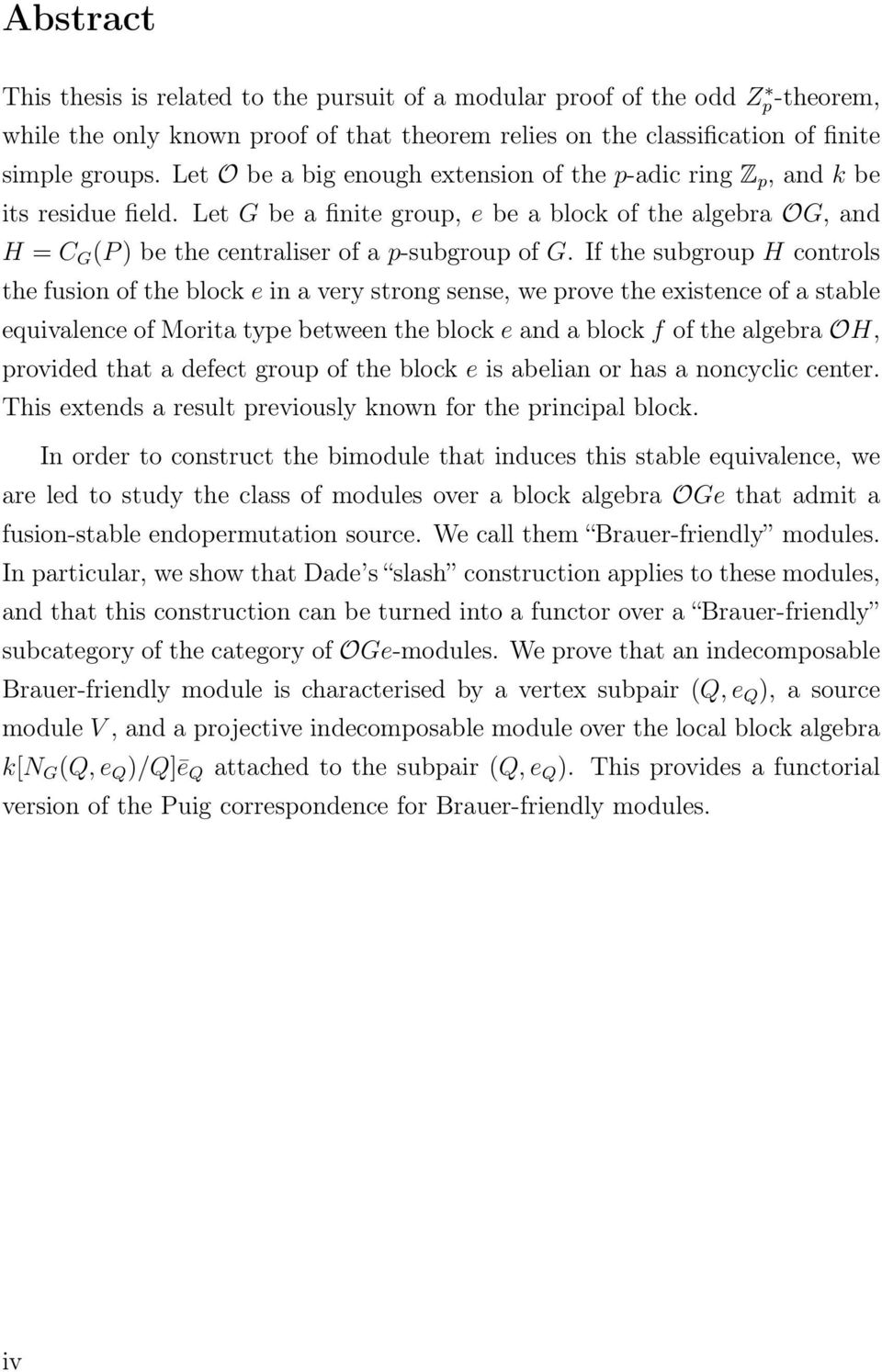
5 Dans la cabine spatiale, le centralisateur dicte ses ordres depuis le premier jour. A leur cinq-cent quatrième jour de vol, les servants s inquiètent et s insurgent comme jadis sur le Bounty : «La fusion est-elle sous contrôle? Ne menace-t-elle pas le vortex par ses modules projectifs? La fusion stable peut-elle calmer nos inquiétudes comme si, sous la fusion, la plage? Sa stabilité dans le temps et sous les latitudes extrêmes est-elle prouvée? Que faire des déchets? Le groupe ou le sous-groupe est-il vraiment fini, ne peut-on encore s en servir, réduisant l empreinte carbone? Non à l endopermutation! Oui à l endomutation qui refuse le libreéchange comme le troc, la monnaie. Quand nous endomuterons, alors la fusion s opérera dans la non-violence, sans déchet ni carbone, et nous atteindrons sans encombre l étoile α-h = C G (P )!» Georges Curinier, 14 février 2013 v
6 vi
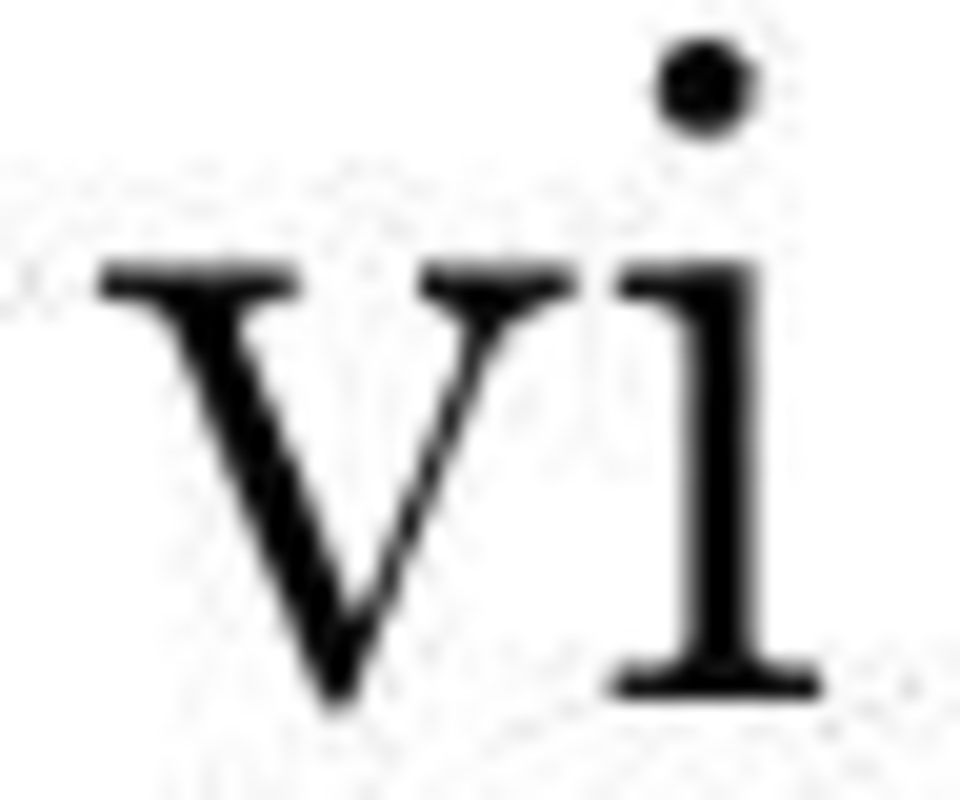
7 Remerciements Aknowledgement Je veux d abord remercier ici mon directeur Michel Broué, qui m a donné l envie de me lancer dans ce travail de thèse, et m a donné les moyens de le mener à bien. Cette thèse, commencée à Paris, s est terminée à Québec où j ai eu la chance de rencontrer mon second directeur, Claude Levesque, à qui je suis reconnaissant pour la générosité et la disponibilité avec lesquelles il m a accueilli et soutenu. Je remercie chaleureusement Cédric Bonnafé et Burkhard Külshammer, les deux rapporteurs de cette thèse, pour leur travail et la richesse de leurs commentaires. Pendant presque trois années à l Université Laval, j ai entretenu un dialogue à la fois mathématique et amical avec Hugo Chapdelaine, qui a été un grand soutien pour moi. Je le remercie d avoir accepté de prolonger ces échanges en siégeant dans mon jury de thèse. Je suis très honoré de la présence dans ce jury d un chercheur aussi éminent que Bernhard Keller, que je veux aussi remercier pour la gentillesse avec laquelle il a répondu à mes questions sur les catégories, au cours de ma recherche. Les travaux de Geoff Robinson ont joué un rôle fondamental dans cette recherche, et il s est toujours montré disponible pour répondre à mes sollicitations. Je suis très heureux qu il ait accepté de participer à ce jury. Je remercie du fond du cœur Serge Bouc et Markus Linckelmann pour le temps qu ils ont consacré à relire mon travail, et pour leurs suggestions d amélioration. Cette thèse ne serait pas ce qu elle est sans leur aide. Merci à Raphaël Rouquier qui m a accueilli à deux reprises à UCLA et m a fait bénéficier de conversations enrichissantes. J ai aussi une dette envers tous les chercheurs qui ont pris du temps pour discuter avec moi de ma recherche : Vincent Beck, vii
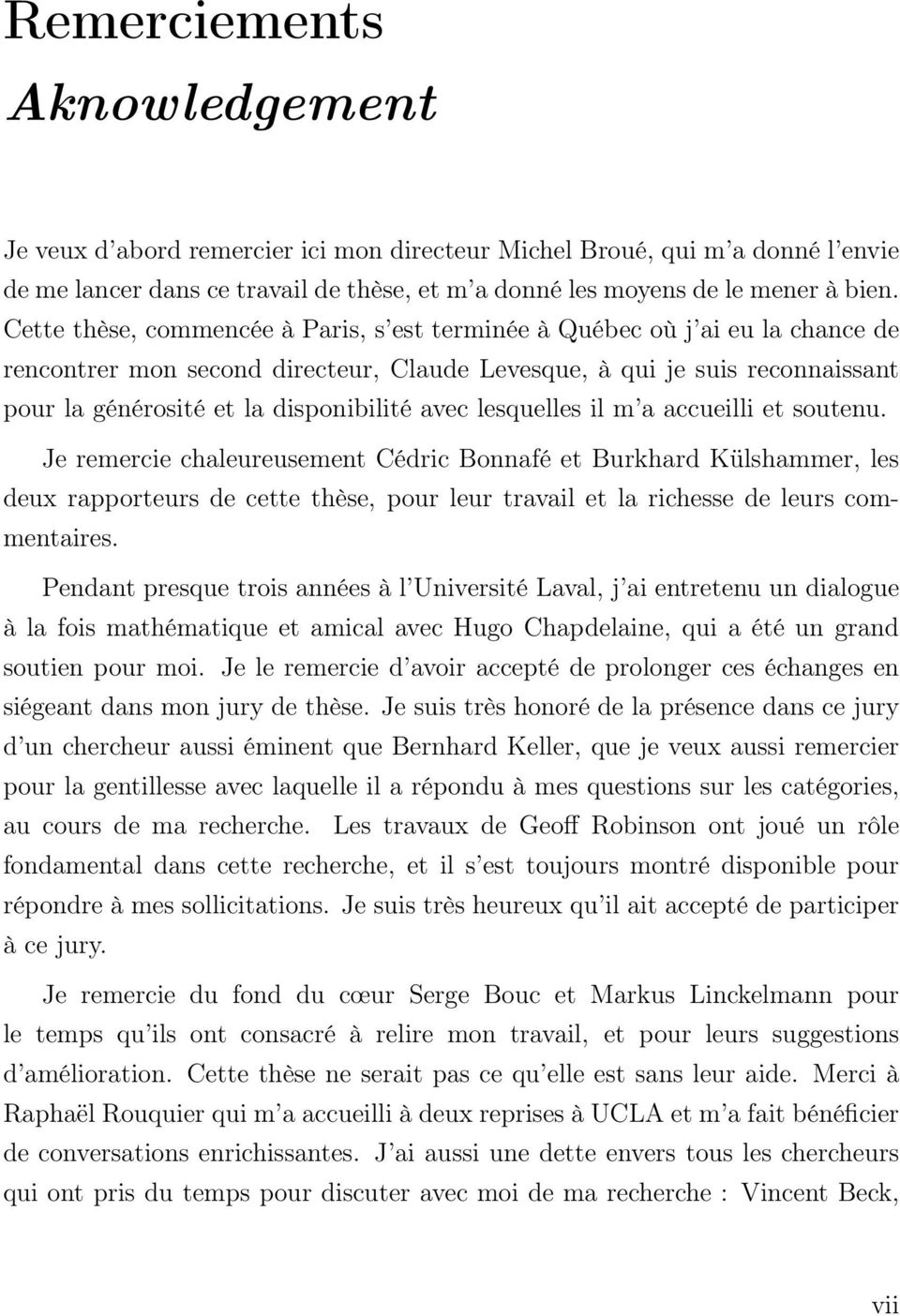
8 Marc Cabanes, Olivier Dudas, Morty Harris, Radha Kessar, Caroline Lassueur, Georges Maltsiniotis, Lluis Puig, Jacques Thévenaz... sans compter tous ceux que j oublie, et que je prie de m en excuser! On ne devient pas mathématicien sans une éducation au raisonnement mathématique qui doit commencer tôt. Aussi je tiens à remercier ici les enseignants qui ont participé à cette formation, notamment Mme Renaud qui m a appris à manier théorèmes et démonstrations, M. Dayon qui m a initié aux équations du second degré et à l analyse réelle, sans oublier ma mère Chantal Biland et sa passion de la pédagogie... J ai une pensée particulière pour Jean-Louis Liters, qui reste pour moi un modèle en matière d enseignement des mathématiques et du raisonnement rigoureux. Je remercie aussi chaleureusement tous les collègues et amis qui m ont soutenu, directement ou indirectement, depuis le début de cette thèse. Je n ose en dresser ici une liste nécessairement lacunaire. J espère qu ils se reconnaîtront, et que j aurai l occasion de leur manifester à chacun ma reconnaissance, sans qu il soit besoin de la coucher sur le papier. Enfin, je ne serais pas arrivé jusque là sans le soutien de tous mes proches, de la famille Biland et de la famille Curinier. Chacun d entre eux a joué un rôle essentiel, qui m a permis de me consacrer à cette recherche. Aziliz et Violette m ont aidé à garder les pieds sur terre. Émilie m a donné le bonheur d être deux, et bien plus encore. Merci. viii
9 Table des matières Introduction 1 Cadre théorique Organisation de la thèse et principaux résultats Summary of results Préliminaires Preliminaries Morita equivalences and stable equivalences Interior algebras Permutation and endopermutation modules The Brauer functor and the slash construction The local structure of finite groups and blocks Fusion control Indecomposable modules Équivalences de Morita et anneaux fortement gradués Morita equivalences and strongly graded rings Morita s theorem as a lax adjunction Strongly graded algebras and group actions Graded modules and invariant modules Morita equivalences Matrix algebras and Clifford extensions Dade algebras and the Brauer functor ix

10 3 Modules et catégories compatibles avec la localisation Brauer-friendly modules and categories Vertex subpairs and the Green correspondence Brauer-friendly modules The slash construction Localisation functors Lifting direct summands An approach with 2-categories Contrôle de la fusion forte et équivalences stables Strong fusion control and stable equivalences Classical facts related to the Z p-theorem The local case The global case Bibliographie - Bibliography 137 x
11 Introduction Ce travail s inscrit dans le cadre de la théorie des représentations, et plus précisément dans la branche de cette théorie qui traite des représentations des groupes finis en caractéristique positive, appelées représentations modulaires. Au cours des trente dernières années, l étude des représentations modulaires a connu des développements qui reposent sur l interaction entre des outils issus de la théorie des catégories (équivalences de Morita, équivalences dérivées, équivalences stables), mais aussi de l étude locale des groupes finis (systèmes de fusion). Cette interaction peut se révéler très féconde ; elle nous a permis d obtenir le résultat principal de cette thèse. La présente introduction se divise en trois parties. La première partie est un survol de l état des connaissances dans les domaines mathématiques concernés par notre travail (pour plus de détails et des références à la littérature, le lecteur pourra se reporter au premier chapitre qui vient ensuite). La seconde partie retrace le travail qui a mené à cette thèse de doctorat. La dernière partie, en anglais, en condense les principaux résultats. Cadre théorique Équivalences catégoriques entre algèbres de blocs Fixons un nombre premier p. Un système p-modulaire est un triplet (K, O, k), où O est un anneau de valuation discrète complet, K son corps des fractions de caractéristique nulle, et k son corps résiduel de caractéristique p. Pour éviter les problèmes de rationalité, nous supposerons que le corps K est toujours «suffisamment gros». Soit G un groupe fini, et RG son algèbre de groupe sur l anneau R, qui peut 1

12 INTRODUCTION être K, O ou k. Une représentation du groupe G sur l anneau R est un RGmodule, que nous supposerons toujours de type fini sur l anneau R. La théorie des représentations cherche à décrire la catégorie RG Mod des RG-modules et morphismes de RG-modules. Un bloc de l algèbre RG est un idempotent primitif du centre Z(RG). Pour R = K, ces blocs sont en correspondance bijective avec les caractères ordinaires irréductibles du groupe G. Ce cas est très bien connu, aussi nous ne l aborderons pas dans cette thèse. Pour R = O ou R = k, la structure des blocs est beaucoup plus riche. La réduction modulo l idéal maximal m de l anneau O induit une correspondance bijective entre les blocs de l algèbre OG et ceux de l algèbre kg. Autant que possible, nous travaillerons donc sur l anneau local O. Les blocs e 1,..., e n de l algèbre de groupe OG correspondent à une décomposition OG OGe 1 OGe n de l algèbre OG en un produit direct d algèbres indécomposables. Cette décomposition entraîne une décomposition de la catégorie des OG-modules sous la forme OGMod OGe1 Mod OGen Mod. Dorénavant, nous fixerons un bloc e et nous étudierons uniquement les OGemodules. Le résultat principal que nous visons dans cette thèse est une équivalence de nature catégorique entre deux blocs de groupes finis. Considérons donc G, H deux groupes finis, et e, f des blocs respectifs des algèbres OG, OH. Il existe trois types principaux d équivalences purement catégoriques entre les algèbres OGe et OHf, que nous énumérons ci-dessous du plus fort au moins fort. l équivalence de Morita, lorsque les catégories de modules OGe Mod et OHf Mod sont équivalentes ; l équivalence dérivée, lorsque les catégories dérivées bornées D b ( OGe Mod) et D b ( OHf Mod) sont équivalentes en tant que catégories triangulées. La catégorie dérivée D b ( OGe Mod) est obtenue en considérant la catégorie des complexes de OGe-modules cohomologiquement bornés, et en rendant inversibles les morphismes de cette catégorie qui induisent des isomorphismes en cohomologie (les quasi-isomorphismes). l équivalence stable, lorsque les catégories stables Stab( OGe Mod) et 2

13 CADRE THÉORIQUE Stab( OHf Mod) sont équivalentes en tant que catégories triangulées. La catégorie stable Stab( OGe Mod) est obtenue comme un quotient de la catégorie des OGe-modules, en annulant formellement les objets projectifs de cette catégorie. Un célèbre théorème, dû à Morita, affirme qu une équivalence de catégories OHfMod OGe Mod est nécessairement, à isomorphisme près, un foncteur du type M OHf, où M est un (OGe, OHf)-bimodule possédant certaines «bonnes» propriétés. Ce théorème a été généralisé par Rickard aux équivalences entre catégories dérivées. Bien qu il n admette pas de généralisation connue aux équivalences entre catégories stables, on se focalise généralement sur les équivalences stables «de type Morita», c est-à-dire définies grâce au produit tensoriel par un certain bimodule M, comme ci-dessus. Notre recherche adopte donc ce point de vue apparemment paradoxal : nous étudions des équivalences entre catégories de modules, ce qui semble indiquer que les modules, individuellement, nous intéressent peu ; mais ces équivalences catégoriques sont définies par des bimodules, c est-à-dire des modules d un type particulier, qui sont finalement les objets principaux de notre travail. Modules de permutation et d endopermutation Quels sont les types de modules qui vont nous intéresser? Considérons un groupe fini G et un OG-module M. On dit que M est un OG-module de permutation si c est un O-module libre qui admet une base stable par l action du groupe G. On dit que M est un OG-module de p-permutation s il est isomorphe à un facteur direct d un OG-module de permutation. La catégorie OG Perm des OG-modules de p-permutation est une sous-catégorie de OG Mod qui est stable par facteurs directs et par sommes directes. Les modules de p-permutation se comportent aussi très bien vis-à-vis de l induction et de la restriction. Par ailleurs, l algèbre d endomorphismes End O (M) est munie d une action du groupe G par automorphismes d algèbres. C est donc ce qu on appelle une G-algèbre, qu on peut aussi considérer comme un OG-module. On dit que M est un OG-module d endopermutation si l algèbre End O (M) est un OG-module de permutation, et que M est un OG-module d endo-p-permutation si l algèbre End O (M) est un OG-module de p-permutation. La catégorie des OG-modules d endo-p-permutation n est pas un objet très intéressant, car elle n est généralement pas stable par sommes directes. On dit que deux OG-modules d endo-p- 3
14 INTRODUCTION permutation M et N sont compatibles si la somme directe M N est encore un module d endo-p-permutation. Pour la même raison, les modules d endo-ppermutation se comportent mal vis-à-vis de l induction si l on n impose pas des conditions restrictives. Si P est un p-groupe, alors tout OP -module de p-permutation ou d endop-permutation, est en fait un module de permutation ou d endopermutation, respectivement. On sait classifier depuis longtemps les OP -modules de permutation. Plus récemment, on a obtenu une classification de tous les OP -modules d endopermutation. Ces objets jouent un rôle important dans la théorie des représentations modulaires. Pour paraphraser Dade, la famille des modules d endopermutation est à la fois suffisamment petite pour en permettre la classification et suffisamment large pour être utilisable. Le foncteur de Brauer et la construction slash Soit P un p-groupe fixé. Si X est un ensemble muni d une action du groupe P, on note X P le sous-ensemble des points de X fixés par P. Soit OX le OP - module de permutation associé à X. On dispose d une application naturelle br P : (OX) P k(x P ), définie par la troncature et la réduction modulo l idéal maximal m de l anneau local O. L application br P est même un morphisme d algèbres si X est un groupe muni d une action de P par automorphismes de groupes. Le foncteur de Brauer Br P : OP Mod k Mod est un foncteur additif qui généralise la construction précédente à un OP -module M quelconque. Si M = OX est un OP -module de permutation, on dispose d un isomorphisme naturel Br P (M) k(x P ). Dans le cas général, le k-espace vectoriel Br P (M) apparaît comme un quotient du module de points fixes M P, et la projection br M P : M P Br P (M) est appelée le morphisme de Brauer. Par convention, nous notons ce morphisme avec un b minuscule, pour le différencier du foncteur de Brauer qui est doté d un B majuscule. Si M est un OG-module et P un p-sous-groupe du groupe fini G, alors l application br M P induit une structure naturelle de kn G (P )-module sur le quotient de Brauer Br P (M). Si A est une O-algèbre sur laquelle le groupe P agit par automorphismes d algèbres, alors l application br A P induit une structure naturelle 4
15 CADRE THÉORIQUE de k-algèbre sur le quotient de Brauer Br P (A). Par construction, le foncteur de Brauer a de bonnes propriétés, notamment de transitivité, lorsqu on l applique à un module de permutation ou de p-permutation. Mais il se comporte assez mal vis-à-vis d un module M quelconque. Il est alors préférable de travailler avec l algèbre d endomorphismes End O (M). En particulier, si M est un OP -module d endopermutation, alors le quotient de Brauer Br P (End O (M)) est isomorphe à une algèbre de matrices sur le corps k. En d autres termes, il existe un k-espace vectoriel M(P ) tel que Br P (End O (M)) End k (M(P )). La correspondance M M(P ) ainsi définie s appelle la construction slash, ou déflation-restriction. Si M est un OG-module et P un p-sous-groupe de G tel que la restriction Res G P M est un module d endopermutation, alors le k-espace vectoriel M(P ) admet une structure de kn G (P )-module issue de l action du normalisateur N G (P ) sur l algèbre End OP (M). Cette structure n est cependant pas unique ; elle peut être «tordue» par un caractère linéaire du groupe N G (P )/P C G (P ). Surtout, la construction slash est a priori fonctorielle au niveau des algèbres d endomorphismes, mais pas des modules, ce qui pose des difficultés dans son utilisation. Structure locale des groupes finis et de leurs blocs Le nombre premier p étant toujours fixé, on appelle structure p-locale d un groupe fini G l action du groupe G par conjugaison sur l ensemble ordonné de ses p-sous-groupes. Si l on s intéresse à un bloc e de l algèbre de groupe OG, on est amené à remplacer les p-sous-groupes de G par des objets plus précis, les sous-paires, dont nous allons esquisser la construction. Si P est un p-sous-groupe du groupe G, le morphisme de Brauer relatif à la P -algèbre OG apparaît naturellement comme un morphisme d algèbres br P : OG kc G (P ). Une e-sous-paire du groupe G est alors un couple (P, e P ), où P est un p- sous-groupe de G et e P est un bloc de l algèbre OC G (P ) dont la réduction ē P kc G (P ) appartient à la sous-algèbre kc G (P ) br P (e). Le groupe G agit par 5

16 INTRODUCTION conjugaison sur l ensemble de ses e-sous-paires, lequel est muni par ailleurs d un ordre qui raffine l inclusion des p-sous-groupes de G. Cette information est ce qu on appelle la structure locale du bloc e. Elle est encodée dans une catégorie, la catégorie de Brauer Br(G, e), dont les objets sont les e-sous-paires de G et dont les flèches sont induites par la conjugaison dans G. Les théorèmes classiques de Sylow se généralisent aux e-sous-paires. Ainsi, les e-sous-paires maximales forment une orbite sous l action du groupe G par conjugaison. Un groupe de défaut du bloc e est un p-sous-groupe D de G tel qu il existe une e-sous-paire maximale de la forme (D, e D ). Si l on fixe un telle souspaire maximale (D, e D ), et un p-sous-groupe P du groupe de défaut D, il existe une unique sous-paire de la forme (P, e P ) qui est contenue dans la sous-paire (D, e D ). Nous avons parlé plus tôt de divers types d équivalences entre algèbres de blocs. Au delà de sa nature purement catégorique, on espère généralement qu une telle équivalence possède une certaine compatibilité avec les structures locales des blocs considérés. Nous allons maintenant préciser ce que peut signifier «compatibilité» dans la phrase précédente. Considérons deux groupes G et H qui possèdent un p-sous-groupe D en commun. Soient e et f des blocs respectifs des algèbres de groupes OG et OH. Supposons que ces deux blocs admettent le p-sous-groupe D comme groupe de défaut, et fixons des sous-paires maximales (D, e D ) et (D, f D ), relatives aux blocs e et f, respectivement. Pour tout sous-groupe P de D, notons (P, e P ) et (P, f P ) les sous-paires respectives de (D, e D ) et (D, f D ) associées au p-sous-groupes P. Si la correspondance bijective (P, e P ) (P, f P ) induit une équivalence entre les catégories de Brauer Br(G, e) et Br(H, f), on dit que les blocs e et f ont la même structure locale. Avec ces hypothèses, soit M un (OGe, OHf)-bimodule qui établit une équivalence de Morita, ou simplement une équivalence stable, entre les algèbres de blocs OGe et OHf. On s attend à obtenir, pour tout sous-groupe P de D, un bimodule M P qui induit une équivalence de Morita entre les algèbres de blocs «locales» ON G (P, e P )e P et ON H (P, f P )f P. La construction du bimodule M P, à l aide du foncteur de Brauer Br P, est bien connue si M est un O(G H)-module de p-permutation. Elle se généralise même à un complexe de bimodules de p- permutation qui induit une équivalence dérivée entre algèbres de blocs; on parle 6
17 CADRE THÉORIQUE alors d équivalence «splendides». Des outils plus généraux de localisation des bimodules existent. Ils font appel au langage des algèbres sources et définissent, par exemple, des équivalences de Puig. Réciproquement, si on dispose d une famille de bimodules «locaux» qui induisent des équivalences de Morita, on s attend à pouvoir construire, par recollement, un (OGe, OHf)-bimodule qui établit une équivalence stable de type Morita entre les algèbres de blocs OGe et OHf. En plus d outils pour localiser, une telle construction nécessite des outils pour construire un tel bimodules «global». Construction de modules indécomposables Un (OGe, OHf)-bimodule peut aussi être considéré comme un O(G H)(e f o )- module, où f o est l image du bloc f par l isomorphisme naturel entre l algèbre de groupe OH et son algèbre opposée (OH) op. Si l on souhaite que ce bimodule induise une équivalence de Morita ou une équivalence stable, il est nécessairement indécomposable. Nous pouvons donc, dans un premier temps, considérer un seul groupe fini G (qui joue le rôle du produit direct G H), choisir un bloc e de l algèbre de groupe OG, et étudier les propriétés d un OGe-module indécomposable M. La théorie de Green associe à ce module indécomposable un p-sous-groupe P de G appelé vortex de M et un OP -module indécomposable V appelé source de M. Le couple (P, V ) est bien défini, à conjugaison près dans le groupe G. On associe également à M un ON G (P )-module indécomposable M de vortex P et de source V, qu on appelle le correspondant de Green de M, et qui est bien défini à isomorphisme près. La correspondance M M est bijective, mais elle a l inconvénient de ne pas être fonctorielle. Un cas très favorable est celui où M est un OG-module de p-permutation, c est-à-dire où la source V est le OP -module trivial O. Dans ce cas, le quotient de Brauer Br P (M) est isomorphe à la réduction k O M du correspondant de Green M. Le module indécomposable M est donc caractérisé de façon unique par le triplet (P, O, M(P )), où le p-groupe P est un vortex de M, le OP - module trivial O est sa source, et le kn G (P )/P -module projectif indécomposable M(P ) = Br P (M) est son quotient de Brauer relativement au p-sous-groupe P. En particulier, ce troisième invariant dépend fonctoriellement du module M, ce qui le rend plus facile à manier que le correspondant de Green. 7
18 INTRODUCTION Plus généralement, la correspondance de Puig permet de caractériser un OGmodule indécomposable par un triplet (P, V, M), où P est un vortex de M, V une source de M, et M un certain kn G (P, V )/P -module projectif indécomposable. Pour construire, par recollement, un (OGe, OHf)-bimodule M qui a vocation à induire une équivalence stable entre les algèbres de blocs OGe et OHf, on s attend donc à procéder en trois temps. On identifie d abord un vortex de M, qui devrait être le sous-groupe diagonal D, où D est le groupe de défaut commun aux blocs e et f. On construit ensuite sa source V, qui devrait être un O D-module d endopermutation. Pour cela, on dispose d outils de recollement développés par Puig, Bouc et Thévenaz. Enfin, on doit caractériser le troisième invariant M et comprendre précisément ses liens avec le bimodule M. Le Zp-théorème Le 20 e siècle a été le cadre d une longue marche vers la classification des groupes finis simples, qui s est achevée au début des années Dans ce contexte, en 1966, Glauberman a démontré un résultat connu sous le nom de Z -théorème, qui porte sur la structure 2-locale des groupes finis. Soit G un groupe fini et H un sous-groupe de G. On dit que H contrôle la p-fusion dans le groupe G si les groupes G et H ont la même structure p-locale. Ceci revient à demander que les catégories de Brauer Br(G, e 0 ) et Br(H, f 0 ) soient équivalentes, où e 0 et f 0 sont des blocs particuliers des algèbres OG et OH, les blocs principaux. Par exemple, s il existe un sous-groupe S distingué dans G, dont l ordre n est pas un multiple de p (on dit que S est un p -groupe), et tel que G = SH, alors le sous-groupe H contrôle la p-fusion dans G. Le Z -théorème établit, dans le cas p = 2, une réciproque partielle de ce résultat. Z -théorème. Si P est un 2-sous-groupe de G dont le centralisateur C G (P ) contrôle la 2-fusion dans le groupe G, alors il existe un 2 -sous-groupe S distingué dans G tel que G = SC G (P ). Ce cas particulier H = C G (P ) est intéressant, car la factorisation G = SC G (P ) peut être caractérisée à l aide de la théorie des représentations modulaires. Comme nous le montrerons, le groupe G admet une telle factorisation si, et seulement si, le foncteur de restriction Res G C G (P ) induit une équivalence entre les catégories de modules OGe0 Mod et OHf0 Mod, ce qui revient à dire que la restriction Res G G G H OGe 0 est un (OGe 0, OHf 0 )-bimodule qui induit une 8

19 CADRE THÉORIQUE équivalence de Morita entre les algèbres de blocs principaux OGe 0 et OHf 0. C est justement la théorie des représentations modulaires qui a permis à Glauberman de prouver son Z -théorème, qui a ensuite joué un rôle important dans la classification des groupes finis simples. Grâce à cette classification, on a pu prouver que l énoncé du Z -théorème ci-dessus reste vrai si l on remplace le nombre 2 par un nombre premier p impair ; cette généralisation a été baptisée le Zp-théorème. Depuis lors, on espère obtenir une preuve de ce Zp-théorème, pour p impair, par des méthodes issues des représentations modulaires, et surtout indépendantes de la classification des groupes finis simples. Les efforts en ce sens, menés notamment par Robinson, sont pour l instant restés vains. Ils ont toutefois amené un certain nombre de résultats, qui sont à l origine de notre travail de thèse, et que nous allons maintenant évoquer. Fixons à présent un nombre premier p impair, et plaçons nous dans l optique d une preuve par induction du Zp-théorème. Pour cela, on considère un groupe fini G, muni d un p-sous-groupe P, qui est un contre-exemple minimal à ce théorème. Le centralisateur H = C G (P ) contrôle la p-fusion dans G, mais le groupe G n admet pas de factorisation sous la forme G = SC G (P ) pour un p - sous-groupe S distingué dans G. Par contre, une telle factorisation existe pour tout sous-groupe local de G. Dans ce cadre, Broué a démontré que le foncteur de restriction Res G H induit une équivalence stable entre les algèbres de blocs principaux OGe 0 et OHf 0. Plaçons-nous maintenant dans le cas d un groupe fini G qui admet une factorisation du type G = SH, où H = C G (P ) est le centralisateur d un p-sousgroupe, et S est un p -sous-groupe distingué de G. Comme nous l avons déjà dit, il existe alors une équivalence de Morita entre les algèbres de blocs principaux OGe 0 et OHf 0. Plus généralement, Külshammer et Robinson ont montré qu il existe une équivalence de Morita entre les algèbres de blocs OGe et OHf, dès lors que e est un bloc de l algèbre OG tel que br P (e) 0, et que f est l unique bloc de l algèbre OH tel que br P (e) = f kh. Revenons à la situation d un contre-exemple minimal au Zp-théorème décrite ci-dessus, en fixant un bloc non principal e de OG et son correspondant f dans OH. Nous disposons alors d une famille d équivalences de Morita locales, et nous nous attendons à pouvoir les recoller pour obtenir une équivalence stable entre les algèbres de blocs OGe et OHf. L existence de cette équivalence stable se 9

20 INTRODUCTION laisse deviner dans certains travaux de Robinson en rapport avec le Z p-théorème, et c est elle qui a motivé notre travail de thèse. Organisation de la thèse et principaux résultats Dans la première partie de cette introduction, nous avons brossé, à grands traits, le paysage mathématique dans lequel nous avons évolué au cours de notre doctorat. Nous allons maintenant retracer, de façon plus précise, le chemin que nous y avons parcouru, et les quelques cailloux que nous avons laissés derrière nous. Équivalences de Morita et algèbres fortement graduées Notre premier objectif était de comprendre les travaux de Robinson en lien avec le Z p-théorème pour p impair, et si possible de les prolonger pour tendre vers une preuve modulaire de ce théorème. Dans cet esprit, nous avons étudié entre autres deux articles, [Rb-1986] et [KR-1986], qui portent sur les propriétés d un groupe G muni d un p-sous-groupe P et d un p -sous-groupe S distingué dans G, tels que G = SC G (P ). Cette situation où un groupe G possède un sous-groupe distingué S est un classique de la théorie des représentations, étudié par ce que certains appellent la théorie de Clifford. Fixons un bloc b de l algèbre OS, notons b OS la somme des conjugués de b sous l action du groupe G, et G b le stabilisateur de b dans G. La catégorie OGb Mod des représentations du groupe G «au dessus» du bloc b est équivalente à la catégorie OGb bmod. L algèbre OG b b possède une graduation naturelle par le groupe quotient Ḡb = G b /S, qui en fait une algèbre fortement Ḡb-graduée. Plaçons-nous dans le cas où S est un p -groupe normal tel que G = SC G (P ). Si le p-groupe P fixe le bloc b, alors il existe un unique bloc b P de l algèbre OC S (P ) tel que br P (b) = b P dans l algèbre kc S (P ). Il s agit là d un cas particulier de la correspondance de Glauberman. Nous pouvons alors redire pour le bloc b P ce que nous venons de dire pour le bloc b. Le stabilisateur du bloc b P dans le groupe C G (P ) est le centralisateur C Gb (P ), et il y a un isomorphisme naturel C Gb (P )/C S (P ) Ḡb. Notons b P OC S(P ) la somme des conjugués de b P sous l action du groupe C G (P ). Les catégories OCG (P )b P Mod et OC Gb (P )b P Mod 10
21 ORGANISATION ET PRINCIPAUX RÉSULTATS sont équivalentes, et l algèbre OC Gb (P )b P est fortement Ḡb-graduée. Külshammer et Robinson démontrent que les algèbres OG b b et OC Gb (P )b P sont équivalentes au sens de Morita. Pour cela, ils utilisent de façon importante leurs structures d algèbres fortement Ḡb-graduées : ils leur associent des invariants cohomologiques, à savoir des éléments du groupe de cohomologie H 2 (Ḡb, O ), dont l égalité est la clé de leur preuve. L équivalence de Morita OG b b OC Gb (P )b P amène ensuite une équivalence de Morita OGb OC G (P )b P, puis des équivalences de Morita OGe OC G (P )e P, où e et e P sont des blocs des algèbres OGb et OC G (P )b P, respectivement. Rappelons que, dans l optique d un contre-exemple minimal au Zp-théorème, la factorisation G = SC G (P ) apparaît au niveau «local». Il est alors important de très bien comprendre ces équivalences de Morita locales, en vue de les recoller pour obtenir des équivalences stables au niveau «global». C est dans cette perspective que nous avons consacré un chapitre de cette thèse aux équivalences de Morita entre algèbres fortement graduées. La littérature sur le sujet des algèbres fortement graduées est extrêmement riche, avec notamment plusieurs articles de Dade, de Cohen et Montgomery, de Marcus, que nous citons en bibliographie. Les points de vue sur ces objets sont multiples. Dans notre deuxième chapitre, nous développons l approche qui consiste à voir une algèbre fortement G-graduée R = g G R g comme une algèbre A = R 1, munie d une action faible du groupe G sur la catégorie A Mod des A- modules. Cette approche repose sur des outils issus de la théorie des 2-catégories. Elle nous permet d expliciter complètement les isomorphismes naturels qui apparaissent en relation avec le théorème de Morita, et qui se ramènent tous, in fine, au fameux «isomorphisme cher à Cartan» (et à Broué). Nous utilisons cette approche fonctorielle des algèbres fortement graduées pour retrouver divers résultats plus ou moins classiques. Ce chapitre ne contient donc pas de résultat nouveau ; il vaut d abord par son point de vue, qui ne se trouve pas couramment dans la littérature. Cette approche fonctorielle nous permet surtout d obtenir une nouvelle démonstration du résultat de Külshammer et Robinson évoqué plus haut. Avec les notations ci-dessus, nous utilisons le foncteur de Brauer Br P pour construire un (kgē, kc G (P )ē P )-bimodule M qui induit une équivalence de Morita entre les algèbres de bloc kgē et kc G (P )ē P, où ē est un bloc de l algèbre kg dont 11
22 INTRODUCTION un groupe de défaut contient P, et ē P = br P (ē) est le bloc correspondant de l algèbre kc G (P ). Nous montrons essentiellement que le bimodule M, si on lui impose d induire une équivalence de Morita qui conserve la projectivité relative, est unique. Cette unicité très forte n est pas explicitée dans le texte (disons que nous prouvons que notre module M est aussi «naturel» que possible), mais c est bien elle qui va permettre ensuite le recollement. Modules et catégories compatibles à la localisation Après avoir bien compris les équivalences de Morita locales, il nous faudra construire un bimodule indécomposable au niveau «global», qui aura vocation à induire une équivalence stable entre deux algèbres de blocs, et dont la source sera un module d endopermutation. Ce bimodule devra aussi induire les bimodules locaux que nous avons évoqués dans le paragraphe précédent. Il lui faut donc être compatible avec un outil de localisation, qui ne peut pas être simplement le foncteur de Brauer, puisque celui-ci ne fonctionne bien que pour les modules de p-permutation, c est-à-dire les modules de source triviale. Nous consacrons un chapitre à la construction de cet outil de localisation, à la définition des catégories de modules sur lesquelles il trouve à s appliquer, et à l explicitation de la correspondance de Puig pour ces modules. Comme base de ces constructions, nous reprenons la notion de module d endopermutation «fusion-stable», développée par Linckelmann dans le langage des algèbres sources et des systèmes de fusion. Mais nous choisissons de nous placer systématiquement au niveau des algèbres de blocs, ce qui implique de travailler avec la catégorie de Brauer que nous avons définie plus haut. Considérons un groupe fini G et un bloc e de l algèbre OG. Soit (P, e P ) une e-sous-paire du groupe G, et V un OP -module d endopermutation. Nous disons que V est fusion-stable relativement à la sous-paire (P, e P ) si, pour toute e-sous-paire (Q, e Q ) et pour tout couple de flèches φ, ψ : (Q, e Q ) (P, e P ) dans la catégorie de Brauer Br(G, e), les OQ-modules d endopermutation Res φ V et Res ψ V sont compatibles. Si M est un OGe-module indécomposable, il existe une notion de e-sous-paire vortex de M, et de source associée. Nous disons que le OGe-module M est «Brauer-compatible» s il admet une sous-paire vortex (P, e P ), associée à une source V qui est un OP -module d endopermutation fusion-stable relativement à la sous-paire (P, e P ). Nous généralisons ainsi la notion de OG-module d endo-p-permutation. 12
23 ORGANISATION ET PRINCIPAUX RÉSULTATS Nous montrons ensuite que la construction slash, évoquée plus haut pour les modules d endopermutation sur des p-groupes, se généralise aux modules Brauer-compatible et aux sous-paires. Si M est un OGe-module Brauer-compatible et (Q, e Q ) une e-sous-paire du groupe G, il existe un kn G (Q, e Q )-module M(Q, e Q ), pas tout à fait unique mais presque, tel que Br Q (End O (e Q M)) End k (M(Q, e Q )). Cette construction possède plusieurs propriétés intéressantes du foncteur de Brauer, notamment la transitivité. Il lui manque toutefois l unicité, mais aussi, a priori, la fonctorialité. Pour obtenir cette fonctorialité, il nous faut d abord définir une catégorie de module sur laquelle celle-ci puisse s appliquer. En effet, nous avons déjà dit que la catégorie des OG-modules d endo-p-permutation n est pas stable par sommes directes. Le même phénomène se produit pour les modules Brauercompatibles. Pour le maîtriser, nous définissons la compatibilité de deux modules d endopermutation fusion-stables relativement à des e-sous-paires fixées du groupe G. Nous disons qu une sous-catégorie OGe M de la catégorie OGe Mod est «Brauer-compatible» si elle est stable par sommes directes, et si les sources de deux facteurs directs indécomposables d objets de OGe M sont toujours des modules d endopermutation fusion-stables et compatibles relativement aux souspaires vortex concernées. Un exemple de catégorie Brauer-compatible est la catégorie OGe Perm des OGe-modules de p-permutation, qui sont les modules de sources triviales. Mais il en existe bien d autres, associées par exemple à chacun des modules d endopermutation non triviaux qui sont fusion-stable relativement à une e-sous-paire maximale (D, e D ). Dès lors qu une catégorie Brauer-compatible OGe M est fixée, nous montrons que la construction slash décrite ci-dessus permet de construire, pour toute e-sous-paire (Q, e Q ) du groupe G, un «foncteur slash» Sl (Q,eQ ) : OGe M kng (Q,e Q )ē Q Mod, qui induit, pour tout couple d objets L, M de la catégorie OGe M, un isomorphisme Br Q (Hom O (e Q L, e Q M)) Hom k (Sl (Q,eQ )(L), Sl (Q,eQ )(M)). 13
24 INTRODUCTION Ce foncteur n est pas tout à fait unique ; il peut être tordu par un caractère linéaire du groupe N G (Q, e Q )/QC G (Q). À cette réserve près, il se comporte essentiellement comme le foncteur de Brauer pour les modules de p-permutation. En particulier, nous pouvons utiliser un foncteur slash Sl (P,eP ) en vue d expliciter la correspondance de Puig pour les modules Brauer-compatibles. Si M est un objet indécomposable de la catégorie Brauer-compatible OGe M, il est caractérisé par le quadruplet (P, e P, V, M(P, e P )), où (P, e P ) est une sous-paire vortex de M, V est la source de M relativement à cette sous-paire, et M(P, e P ) = Sl (P,eP )(M) est un kn G (P, e P )/P -module projectif indécomposable. Il faut toutefois noter que la correspondance que nous venons de décrire dépend du choix d un foncteur slash Sl (P,eP ) qui, nous l avons mentionné, n est pas tout à fait unique. Contrôle de la fusion forte et équivalences stables Au seuil de ce quatrième et dernier chapitre, nous avons tous les éléments en main pour démontrer notre résultat principal, qui est le suivant. Théorème. On suppose ici p impair. Soit G un groupe fini, et H = C G (P ) le centralisateur d un p-sous-groupe P de G. Soit e un bloc de l algèbre OG, et e P un bloc de l algèbre OH tel que ē P br P (e) 0. Supposons qu il existe une e-sous-paire maximale (D, e D ) du groupe G telle que (P, e P ) (D, e D ) et D H ; pour toute e-sous-paire non triviale (Q, e Q ) de (D, e D ), on a la factorisation N G (Q, e Q ) = O p (C G (Q)) C NG (Q,e Q )(P ) ; le groupe de défaut D est abélien, ou son centre n est pas cyclique. Alors il existe une équivalence stable de type Morita entre les algèbres de bloc OGe et OC G (P )e P. On notera que cet énoncé décrit la situation d un contre-exemple minimal au Zp-théorème, tout en la généralisant quelque peu, puisque les p-sous-groupes sont remplacés par des e-sous-paires. En fait, on suppose que le centralisateur C G (P ) contrôle la e-fusion (en un sens renforcé) dans le groupe G, et pas nécessairement la p-fusion. On notera aussi une hypothèse technique, portant sur le groupe de défaut D, dont nous expliquerons plus loin la justification. Pour démontrer ce théorème, il nous faut construire un (OGe, OC G (P )e P )- bimodule M, que nous considérerons comme un O(G C G (P ))(e e o P )-module 14
25 ORGANISATION ET PRINCIPAUX RÉSULTATS indécomposable. Nous utilisons pour cela la correspondance de Puig, telle que nous l avons explicitée au paragraphe précédent. Pour commencer, le module M admettra comme vortex la (e e o P )-sous-paire ( D, e D e o D ) du groupe G C G (P ). Il nous faut ensuite identifier la source de M relativement à cette sous-paire vortex. Pour chaque sous-paire non triviale (Q, e Q ) de la e-sous-paire maximale (D, e D ), nous disposons d une équivalence de Morita locale entre les algèbres de blocs kn G (Q, e Q )ē Q et kc NG (Q,e Q )(P ) br P (ē Q ). Cette équivalence a été brièvement étudiée au premier chapitre. Elle est induite par un bimodule M (Q,eQ ), qui est obtenu grâce à la construction slash. Nous revenons en détail sur cette construction, et caractérisons très précisément la source du bimodule M (Q,eQ ). En particulier, nous lui associons un kn D (Q)-module V Q, qui est fusion-stable relativement à la e-sous-paire (N D (Q), e ND (Q)). Nous obtenons alors une famille (V Q ) 1 Q D de modules d endopermutation, indexée par les sous-groupes non triviaux du groupe de défaut D. Grâce à la façon canonique dont elle a été obtenue, cette famille vérifie des conditions de compatibilité très précises, au regard de la conjugaison et de la construction slash. Nous utilisons alors des résultats sur le recollement des modules d endopermutation, dus à Puig dans le cas où D est abélien, à Bouc et Thévenaz dans le cas où le centre Z(D) n est pas cyclique. Nous en déduisons l existence d un OD-module d endopermutation V tel que, pour tout sous-groupe non trivial Q de D, on ait Br Q (End O (V )) End k (V Q ). De plus, ce OD-module d endopermutation est fusion-stable relativement à la e-sous-paire maximale (D, e D ). Après l avoir ramené sur le p-groupe diagonal D, nous ferons de V la source du module M relativement à la sous-paire vortex ( D, e D e o D ). Il nous reste à déterminer le troisième invariant associé au module M. Nous connaissons son vortex et sa source, nous pouvons donc situer M dans une catégorie Brauer-compatible O(G CG (P ))(e e o P ) M bien définie. Nous savons de plus que le module slash V (P ) associé à la source V est le kd-module trivial k. Ceci implique l existence d un unique foncteur slash Sl ( P,eP e o P ) : O(G C G (P ))e e o P M k(c G (P ) C G (P ))ē P ē o P Perm 15
26 INTRODUCTION Ceci nous permet d utiliser une version légèrement amendée de la correspondance de Puig, et de caractériser M comme l unique (OGe, OC G (P )e P )-bimodule indécomposable, de sous-paire vortex ( D, e D e o D ) et de source V, tel que Sl ( P,eP e o P ) (M) kc G (P )ē P. Si (Q, e Q ) est une sous-paire non triviale du groupe D, nous montrons ensuite que la construction slash, appliquée au bimodule M relativement à la souspaire ( Q, e Q e P Q ), permet de retrouver le bimodule M (Q,eQ ) qui induit une équivalence de Morita kn G (Q, e Q )ē Q kc NG (Q,e Q )ē P Q. Pour conclure, nous utilisons un théorème de Linckelmann établissant que le bimodule M, puisqu il induit des équivalences de Morita locales dans les conditions que nous venons brièvement de décrire, induit nécessairement une équivalence stable entre les algèbres de blocs OGe et OC G (P )e P. Summary of results In this summary, we fix a p-modular system (K, O, k), and we feel free to use the notations and definitions that will be set up in the subsequent chapters of this thesis. In Chapter 1, we review the preexisting material that we use in the rest of the thesis. The content of that chapter is scarcely original, except maybe the definition of the Brauer functor attached to a subpair of a finite group. Here is a brief account of the main definitions and theorems of the other three chapters. Chapter 2. Morita equivalences and strongly graded rings In Section 2.1, we give a thorough description of Morita s theory of bimodules and functors between module categories, in terms of adjoint functors between 2-categories. In the rest of Chapter 2, we use that description as a dictionary, in order to translate the theory of strongly group-graded algebras into a functorial language. The central result, which appears in Section 2.2, could be stated a follows. Theorem. Let G be a group. Let R = g G R g be a strongly G-graded algebra, with unit component R 1. Then the family of functors (R g R1 ) g G induces an action of the group G on the category R1 Mod of R 1 -modules. Conversely, let A be an O-algebra and be an action of the group G on the category A Mod. 16
27 SUMMARY OF RESULTS Then the O-module A G = g G g A admits a natural structure of strongly G-graded algebra, with a unit component 1 A that is isomorphic to the algebra A. These constructions induce an equivalence between the category SGAlg(G, O) of strongly G-graded O-algebras, and the category EqAlg(G, O) of G-equivariant algebras over the ring O, i.e., O-algebras endowed with an action of the group G on their categories of modules. This theorem suggests a functorial approach, which we use to review the classical theory of strongly group-graded algebras, and some of its applications to the modular representation theory. Chapter 3. Brauer-friendly modules and categories This chapter aims at defining a class of modules over block algebras and a construction that generalize the properties of the Brauer functor with respect to the class of p-permutation modules. In the first two sections, we define the vertex subpairs of an indecomposable module over a block algebra, following [Si-1990]. We adapt from [Li-2013] the definition of a fusion-stable endopermutation source module with respect to a given subpair, and we complete it with a relation of compatibility between such source modules. For a given block algebra OGe, we call an OGe-module Brauer-friendly if it is a direct sum of indecomposable modules with compatible fusion-stable endopermutation sources. If A is a source algebra of the block algebra OGe with respect to a defect group D and a source idempotent i, an OGe-module M is Brauer-friendly if, and only if, the corresponding A-module im is an endopermutation OD-module. We call a category of OGe-modules Brauer-friendly if the direct sum of any two objects of that category is a Brauer-friendly module (i.e., the two objects are Brauer-friendly and compatible). We give the following generalisation of both the Brauer functor and the slash construction, which is proven in Sections 3.3 and 3.4. Theorem. Let G be a finite group, and e be a block of the group algebra OG. Let OGe M be a Brauer-friendly category of OGe-modules. For any e-subpair (P, e P ) of the group G, there exists a Brauer-friendly category kng (P,e P )ē P M of kn G (P, e P )ē P -modules on which P acts trivially, and there exists a (P, e P )-slash 17
28 INTRODUCTION functor Sl (P,eP ) : OGe M kng (P,e P )ē P M, with the following features. Besides being a functor in the usual sense, Sl (P,eP ) maps any morphism of OP -modules between two objects L and M of the category OGe M to a k-linear map between the corresponding objects Sl (P,eP )(L) and Sl (P,eP )(M) of the category kng (P,e P )ē P M. This mapping is functorial and induces an isomorphism of k(c G (P ) C G (P )) N G (P, e P )-modules Br ( P,eP e o P ) (Hom O (L, M)) Hom k (Sl (P,eP )(L), Sl (P,eP )(M)). The (P, e P )-slash functor Sl (P,eP ) is unique up to twisting by a linear character of the group N G (P, e P )/P C G (P ) with values in k. Despite their non-unicity, the behaviour of slash functors over Brauer-friendly categories is quite similar to that of the Brauer functor over categories of p- permutation, especially with respect to composition and conjugacy. The most important application of these functors is the following parametrisation of indecomposable modules, which is proven in Section 3.5 and may be seen as an instance of the Puig correspondence defined in [Pu-1988a]. Theorem. Let G be a finite group, e be a block of the algebra OG, and (P, e P ) be an e-subpair of the group G. Let V be an indecomposable endopermutation OP - module that is fusion-stable in the group G with respect to the subpair (P, e P ). Let OGe M be a Brauer-friendly subcategory of OGe Mod such that every indecomposable OGe-module with source triple (P, e P, V ) is an object of OGe M. Let Sl (P,eP ) : kge M kng (P,e P )ē P Mod be a (P, e P )-slash functor. Then the mapping M Sl (P,eP )(M) induces a one-to-one correspondence between the isomorphism classes of indecomposable OGe-modules with source triple (P, e P, V ) and the isomorphism classes of indecomposable kn G (P, e P )ē P -modules with vertex P and trivial source, i.e., the isomorphism classes of projective indecomposable k(n G (P, e P )/P )ē P -modules. In this theorem, the choice of the Brauer-friendly category OGe M is unimportant once the source triple (P, e P, V ) has been fixed. Thus the indecomposable OGe-module M is characterised by the triple ((P, e P ), V, Sl (P,eP )(M)). Unfortunately, the slash functor Sl (P,eP ) is not uniquely defined, so this parametrisation of indecomposable Brauer-friendly modules needs to be handled with care. 18
29 SUMMARY OF RESULTS Chapter 4. Strong fusion control and stable equivalences The Zp-theorem may be seen as a statement that connects an assumption about p-fusion control to a conclusion about a Morita equivalence between principal blocks of finite groups. For an odd prime p, there is no modular proof of the Zp-theorem, but there is a modular proof of a weaker statement, which leads to a stable equivalence between principal blocks. In chapter 4, we generalise that result of Broué to nonprincipal blocks. The first section reviews classical results that are related to the Zp-theorem. The second section is devoted to a new proof of the main result of [KR-1986], i.e., a Morita equivalence between block algebras that arises from a factorisation of the form G = O p (G) C G (P ), where P is a p-subgroup of the finite group G. We obtain a great deal of new information about the bimodule that induces that Morita equivalence. The third section contains the proof of the following theorem, which may be suggestive of a generalisation of the Zp-theorem to nonprincipal blocks (but this generalisation, or even a precise conjecture, is out of the bounds of the present thesis). Theorem. We assume that the prime p is odd. Let G be a group, and e be a block of the algebra OG. Let H = C G (P ) be the centraliser of a p-subgroup P of G, and e P be a block of the algebra OH such that ē P br P (e) 0. Suppose that the group G admits a maximal e-subpair (D, e D ) such that (P, e P ) (D, e D ) and D H; N G (Q, e Q ) = O p (C G (Q)) N H (Q, e Q ) for any non-trivial e-subpair (Q, e Q ) (D, e D ). Suppose moreover that the defect group D is abelian, or that its center Z(D) is not cyclic. Then there exists a stable equivalence of Morita type between the block algebras OGe and OHe P. 19
30 INTRODUCTION 20
31 Chapitre 1 Préliminaires Chapter 1 Preliminaries This chapter gathers the general definitions and notations that we will use in the remaining of the thesis. Most of those are classical. We do not prove the results that we quote here, but we try to give precise references to the literature, where the reader can find more details and proofs. 21
32 CHAPTER 1. PRELIMINARIES Let p be a prime number. A p-modular system is a triple (K, O, k), where O is a complete discrete valuation ring, K is its fraction field, and k is its residue field of characteristic p. To avoid any rationality issue, we always assume that the fraction field K is «big enough». In general, this fraction field should be of characteristic zero, but we also allow the case K = O = k, so that every result that is proven over the ring O remains true over the field k. These notations will hold throughout the thesis. Notice, however, that most of the constructions and results of chapter 2 still hold when O is replaced by an arbitrary commutative unitary ring. A finite group G is a p-group if its order is a power of the prime p; it is a p -group if its order is not a multiple of the prime p. We denote by O p (G) the largest normal p -subgroup of G, which is a characteristic subgroup of G. The group G is said to be p-nilpotent if it is the semidirect product of a p-subgroup by a normal p -subgroup, i.e., if it admits the factorisation G = O p (G)P, where P is a Sylow p-subgroup of G. For any group G, we denote by OG the group algebra of the group G over the ring O, i.e., the free O-module over the set G, endowed with the multiplication law that bilinearly extends the group law of G. An O-algebra will always mean a unitary O-algebra (and a ring means a unitary ring). The unity of an O-algebra A will be denoted by 1 A, while the boldface 1 X will stand for the identity arrow of an object X in some category. An algebra morphism A B is an O-linear multiplicative map that sends 1 A to 1 B. We denote by A op the opposite algebra of an O-algebra A. For any integer d, we denote by M d (O) the O-algebra of matrices of size d d; this is the zero O-algebra if d = 0. An O-algebra A is said to be a matrix algebra if it is isomorphic to M d (O) for some integer d. Let A be an O-algebra. An idempotent of A is a non-zero element i A such that i 2 = i. The idempotent i is said to be decomposable in A if there exist idempotents i 1 and i 2 of A such that i 1 i 2 = i 2 i 1 = 0 and i = i 1 + i 2. The idempotent i is said to be primitive in A if it is not decomposable. A block of the algebra A is a primitive idempotent of the center Z(A). If e is a block of A, the corresponding block algebra is the algebra ea = Ae. If M and N are O-modules, the notation M N will always stand for the tensor product of M and N over the ring O. In particular, if A and B are two O-algebras, an (A, B)-bimodule will mean an A O B op -module, where B 22
33 1.1. MORITA EQUIVALENCES AND STABLE EQUIVALENCES is considered as acting on the right. If G is a group, we denote by G = {(g, g); g G} the diagonal subgroup of the direct product G G. For an element g of the group G and an object X, the notation g X stands for the object gxg 1 whenever this makes sense. For any element x = g G x gg OG, we denote by x o the element g G x gg 1 OG. For any two groups G and H, we identify the group algebra O(G H) with the tensor product OG O OH in the obvious way. As a consequence, an (OG, OH)- bimodule M may be considered as an O(G H)-bimodule by setting (x, y) m = x m y o for any x OG, y OH and m M. Whenever x is an element defined over the ring O (e.g., an element x OG), we denote by x its reduction to an element defined over the field k, via the natural projection map O k (e.g., x kg). For instance, it is well-known that the projection map OG kg induces a one-to-one correspondence between the blocks of the algebra OG and the blocks of the algebra kg. 1.1 Morita equivalences and stable equivalences Let A be an O-algebra that is a finitely generated free O-module. We denote by AMod the abelian category of finitely generated left A-modules and morphisms of left A-modules. From now on, an A-module will always be assumed to be on the left and finitely generated. An A-module P is said to be projective if it is a projective object of the category A Mod, i.e., if it is isomorphic to a direct summand of a free A-module. Let X and Y be two A-modules. A morphism of A-modules u : X Y is said to be projective if there exists a projective A-module P and a commutative diagram X u P Y. We denote by Hom pr A (X, Y ) the O-submodule of Hom A(X, Y ) consisting of the projective morphisms. A stable morphism of A-modules ũ : X Y is an 23
34 CHAPTER 1. PRELIMINARIES element of the quotient O-module Hom st A(X, Y ) = Hom A (X, Y )/ Hom pr A (X, Y ). The stable morphisms can be composed consistently. We denote by Stab( A Mod) the stable category of A-modules, i.e., the triangulated category of A-modules and stable morphisms of A-modules. Let B be a second O-algebra. An (A, B)-bimodule M is said to induce a Morita equivalence between the algebras A and B if, and only if, there exists a (B, A)-bimodule N and isomorphisms M B N A N A M B as (A, A)-bimodules; as (B, B)-bimodules. This is equivalent to requiring that the O-linear functor M B : B Mod AMod be an equivalence of categories. A classical theorem of Morita states that any O-linear equivalence of categories B Mod A Mod is isomorphic to a functor of the type M B for some (A, B)-bimodule M. An (A, B)-bimodule M is said to induce a stable equivalence of Morita type between the algebras A and B if, and only if, there exists a (B, A)-bimodule N, projective (A, A)-bimodules U and U, projective (B, B)-bimodules V and V, and isomorphisms (M B N) U A U as (A, A)-bimodules; (N A M) V B V as (B, B)-bimodules. This is equivalent to requiring that the O-linear triangulated functor M B : Stab( B Mod) Stab( A Mod) be an equivalence of categories. We will not be concerned with equivalences between stable categories of modules that are not of Morita type. More details about stable equivalences of Morita type can be found in [Rq-2001]. 24
35 1.2. INTERIOR ALGEBRAS 1.2 Interior algebras Let G be a group. A G-algebra over the ring O is a pair (A, γ), where A is an algebra over the ring O and γ : G Aut O-Alg (A) is a group morphism. Let S be a normal subgroup of G. An S-interior G-algebra over the ring O, as defined in [Pu-2002, 4.2], is a triple (A, ι, γ) where A is an O-algebra and ι : S A, γ : G Aut O Alg(A) are two group morphisms such that γ(s)(a) = ι(s)a ι(s) 1 and ι(gsg 1 ) = γ(g)(ι(s)) for any a A, s S and g G. When S = G, we say that A is a G-interior algebra, or an interior G-algebra. We consider the action of the group G on the O-module A as a diagonal action. Together with the left and right multiplication by elements of the form ι(s) for s S, this makes A an O(S S) G-module. Let A and B be two S-interior G-algebras. A map u : A B is a morphism of S- interior G-algebras if it is a multiplicative map and a morphism of O(S S) Gmodules. We may not require it to send the unity 1 A to the unity 1 B. The map u is said to be an embedding if it induces an isomorphism A u(1 A ) B u(1 A ). As an example, the group algebra OS of the normal subgroup S is naturally an S-interior G-algebra. More generally, if e OS is a G-invariant idempotent, then OSe is again an S-interior G-algebra, where the group G acts on the algebra OS by conjugation, and the group S is sent to the group of units (OSe) by the map s se. This example is a fundamental one. Indeed, for any S-interior G-algebra A over the ring O, the S-interior structure map ι : S A can be linearly extended to a unique map ι : OS A, which is a morphism of S-interior G-algebras. Puig s induction of interior algebras can be readily generalised to partially interior algebras. Let G be a group, and S be a normal subgroup of G; let G be a group that contains G, and S be a normal subgroup of G that contains S; let A be an S-interior G-algebra over the ring O. Then A is an O(S S op ) G-module. We consider the induced module A = Ind (S S ) G (S S) G A = O(S S ) G O(S S) G A. The O-module A is generated by elements of the form (g, h) a, for (g, h) 25
36 CHAPTER 1. PRELIMINARIES (S S ) G and a A. To stick to Puig s notations in the case of purely interior algebras, we denote the element (g, h) a by g a h 1. We define an O-bilinear multiplication law on A by setting, for any two elements (g, h) and (g, h ) of the group (S S ) G and any two elements a and a of the algebra A. (g a h 1 ) (g a h 1 g aγ(h 1 g )(a ) h 1 g h 1 if h 1 g G; ) = 0 if not. This makes A a unitary algebra, with 1 A = g G /G g 1 A g 1. Furthermore, the action of the group (S S ) G defines a unique structure of S -interior G -algebra on A. If S = G and S = G, the induced algebra Ind G G G G A is just denoted by Ind G G A. The context usually makes the notation unambiguous. There is one important example that we will use in Chapter 4. Let G be a finite group, let S T be two normal subgroups of G, and let b be a block of the group algebra OS. We denote by G b the stabiliser of the block b in the group G, and by b the sum of the distinct G-conjugates of the block b. The block algebra OSb has a natural structure of S-interior G b -algebra, and there is a natural isomorphism of T -interior G-algebras ι : OT b (T T ) G Ind (S S) G b OSb. As the notation suggests, the map ι is induced by the interior structure map ι : T ( (T T ) G Ind (S S) G b OSb ) (T T ) G of the T -interior G-algebra Ind (S S) G b OSb. 1.3 Permutation and endopermutation modules Let G be a finite group. Let X be a finite G-set, i.e., a finite set endowed with an action of the group G. We denote by OX the free O-module on the set X. The action of the group G on the set X has a unique extension to a linear action of G on the O-module OX, which makes OX an OG-module. A permutation OG-module is an OG-module that is isomorphic to OX for some finite G-set X. A p-permutation OG-module is an OG-module that is isomorphic to a direct summand of a permutation OG-module. We denote by OGPerm the category of p-permutation OG-modules and morphisms of OG- 26
37 1.3. PERMUTATION AND ENDOPERMUTATION MODULES module. This subcategory of OG Mod is closed under finite direct sums and direct summands. If H is a subgroup of H, then the restriction Res G H M of a p-permutation OG-module M is again a p-permutation OH-module, and the induction Ind G H L of a p-permutation OH-module L is again a p-permutation OG-module. Let L and M be OG-modules. The O-module Hom O (L, M) is endowed with a diagonal action of the group G, which is defined by setting g u(l) = g u(g 1 l) for any g G, u Hom O (L, M) and l L. This action makes Hom O (L, M) an OG-module. For L = M, it makes the endomorphism algebra End O (M) an OG-module, and a G-algebra over the ring O. An endopermutation (resp. endo-p-permutation) OG-module is an OGmodule M such that the endomorphism algebra End O (M) is a permutation (resp. p-permutation) OG-module. If P is a p-group and Q is a subgroup of P, then a classical theorem of Green [Gr-1959, Theorem 8] states that the induced OP -module Ind P Q V is indecomposable whenever V is an indecomposable OQ-module. This implies that any p-permutation (resp. endo-p-permutation) OP -module is necessarily a permutation (resp. endopermutation) module. More details on these types of modules can be found in [Br-1985] for p-permutation modules, in [Da-1978] for endopermutation modules over p-groups, and in [Ur-2006] for endo-p-permutation modules over general finite groups. Let G be a finite group (which might be a p-group). The category of endo-ppermutation OG-modules is not very interesting, because it is not closed under finite direct sums. Two endo-p-permutation OG-modules L and M are said to be compatible if their direct sum L M is an endo-p-permutation OGmodule or, equivalently, if the diagonal action of the group G on Hom O (L, M) makes it a p-permutation OG-module. If H is any subgroup of G, then the restriction Res G H M of an endo-p-permutation OG-module M is again an endop-permutation OH-module. However, this is not true for induction. The compatibility relation can be used to give a criterion for the induction Ind G H L of an endo-p-permutation OH-module L to be an endo-p-permutation OG-module. This is [Da-1978, Lemma 6.8] and [Ur-2006, Proposition 2.10]. Let P be a p-group. An OP -module V is said to be capped if it admits an 27
38 CHAPTER 1. PRELIMINARIES indecomposable direct summand with vertex P (see Section 1.7 for the definition of a vertex). If V is a capped endopermutation OP -module, then the reduction V = k O V is a capped endopermutation kp -module. A P -algebra over the field k is called a Dade P -algebra if it is isomorphic to the endomorphism algebra End k ( V ) of some capped endopermutation kp -module V. The compatibility relation is an equivalence relation on the set of capped endo-permutation kp -modules. We denote by [ V ] the equivalence class of a capped endopermutation kp -module V. The set of equivalences classes is denoted by D(P ). It is endowed with an operation denoted by +, and such that [ V ] + [ W ] := [ V k W ] for any two capped endopermutation kp -module V and W. This operation makes D(P ) an abelian group, which is known as the Dade group of the p-group P. This Dade group can also be seen as the set of compatibility classes of Dade P -algebras. The capped endopermutation kp -modules have been classified by Dade for an abelian p-group P, and by Bouc, Carlsson and Thévenaz for an arbitrary p- group P. A survey can be found in [Th-2007]. In particular, for any p-group P, and any capped endopermutation kp -module V, it follows from the classification that there exists a capped endopermutation OP -module V sur that V k O V. For a general finite group G, a generalisation of the Dade group has been defined in [La-2012, Section 7.5]. An element of the Dade group D(G) is an equivalence class of a strongly capped endo-p-permutation kg-module under the compatibility relation. 1.4 The Brauer functor and the slash construction Let G be a finite group, and let H < K be subgroups of the group G. Let M be an OG-module. The set M H of H-fixed points in M is an ON G (H)-submodule of M. The relative trace map Tr K H : M H M K is defined by Tr K H(m) = gm for any m M. g K/H 28
39 1.4. THE BRAUER FUNCTOR AND THE SLASH CONSTRUCTION The direct image MH K = TrK H(M H ) is an ON G (H, K)-submodule of the module M K of K-fixed points in M. If A is a G-algebra over the ring O, then the direct image A K H of the relative trace map TrK H : A H A K is an ideal of the subalgebra A K of K-fixed points in A. If S is a normal subgroup of G and A is an S-interior G-algebra, the subalgebra A K has a natural structure of C S (K)-interior N G (K)- algebra. Let P be a p-subgroup of the group G, and M be an OG-module. The Brauer quotient of M with respect to the p-subgroup P is defined by Br P (M) = M P / ( mm P + ) MQ P, Q<P where m is the maximal ideal of the local ring O. The projection map br M P : M P Br P (M) is called the Brauer map. We denote it with a lowercase b, while the Brauer quotient is denoted with a capital B. The quotient space Br P (M) admits a unique structure of kn G (P )-module such that the Brauer map br M P : M P Br P (M) is an epimorphism of ON G (P )-modules. If S is a normal subgroup of G and A is an S-interior G-algebra, then the Brauer quotient Br P (A) admits a unique structure of C S (P )-interior N G (P )-algebra such that the Brauer map br P : A P Br P (A) is an epimorphism of C S (P )-interior N G (P )-algebras. Let L and M be two OG-modules, and let u : L M be a morphism of OP -modules. Then u induces an O-linear map u P : L P M P, and there exists a unique k-linear map Br P (u) : Br P (L) Br P (M) such that the following diagram commutes. L P u P M P br L P Br P (L) Br P (u) br M P Br P (M) If u : L M is a morphism of OG-modules, then Br P (u) : Br P (L) Br P (M) is a morphism of kn G (P )-modules. If S is a normal subgroup of G and u : A B is a morphism of S-interior G-algebras, then Br P (u) : Br P (A) Br P (B) is a morphism of C S (P )-interior N G (P )-algebras. This defines a functor Br P : OG Mod kng (P )Mod, 29
40 CHAPTER 1. PRELIMINARIES and a similar functor Br P from the category of S-interior G-algebras to the category of C S (P )-interior N G (P )-algebras. Let X be a G-set, and let i : OC X (P ) OX be the inclusion map. The composition br OX P i : OC X (P ) Br P (OX) induces an isomorphism of ON G (P )- modules kc X (P ) Br P (OX). This makes the Brauer functor a very nice tool to deal with p-permutation modules, as appears for example in [Rq-1998]. In particular, there is a natural isomorphism of C G (P )-interior N G (P )-algebras kc G (P ) Br P (OG), so we identify the Brauer map br OG P with an epimorphism of C G (P )-interior N G (P )- algebras br P : (OG)P kc G (P ). The Brauer functor is not as nice with endopermutation modules as it is with permutation module. The right tool for endopermutation modules is the slash construction, a.k.a. deflation-restriction, that has been defined in [Da-1978, Theorem 4.15]. Let P be a p-subgroup of the finite group G, and let M be an OG-module such that the restriction Res G P M is an endopermutation OP - module. Then the Brauer quotient Br P (End O (M)) of the endomorphism algebra End O (M) is isomorphic to a (possibly zero) matrix algebra over the field k. In other words, there exists a k-vector space M and an isomorphism µ : Br P (End O (M)) End k (M ). The pair (M, µ) is unique up to an isomorphism that is itself unique up to scalar multiplication. We usually write M(P ) = M, and we call M(P ) a P - slashed module attached to M. The algebra Br P (End O (M)) is, by construction, a C G (P )-interior N G (P )-algebra over the field k. This makes M(P ) a kc G (P )- module. Furthermore, for any subgroup H of G such that C G (P ) H N G (P ), it follows from the main result of [Pu-1986] that the C G (P )-interior H-algebra Br P (End O (M)) may be extended to an H-interior algebra. This extends the P -slashed module M(P ) to a kh-module. However, such an extension is hardly ever unique, as it can be twisted by any linear character H/C G (P ) k. In general, there is no canonical choice among the possible extensions. Although the correspondence End O (M) End k (M(P )) is functorial, it 30
41 1.5. THE LOCAL STRUCTURE OF FINITE GROUPS AND BLOCKS should be remembered that the slash construction, that we denote by M M(P ), is not functorial in M. If the restriction Res G P M is a permutation OP - module, then there is a natural isomorphism Br P (End O (M)) End k (Br P (M)). In that case, the Brauer quotient Br P (M) is thus a P -slashed module attached to M. 1.5 The local structure of finite groups and blocks Let G be a finite group, and let e be a block of the algebra OG. A subpair of the group G is a pair (P, e P ), where P is a p-subgroup of G and e P is a block of the group algebra OC G (P ). The subpair (P, e P ) is an e-subpair if the reduction ē P kc G (P ) lies in the subalgebra kc G (P ) br P (e) Br P (OGe), i.e., if ē P br P (e) 0. An e-subpair (P, e P ) of the group G is said to be a normal subpair of an e- subpair (Q, e Q ) if P is a normal subgroup of the p-group Q and ē Q br Q (e P ) 0; we write (P, e P ) (Q, e Q ). An e-subpair (P, e P ) is contained in an e-subpair (Q, e Q ) if there is a chain of normal inclusions from the former to the latter; we write (P, e P ) (Q, e Q ). If (Q, e Q ) is an e-subpair of the group G and P is a subgroup of the p-group Q, then there is a unique block e P of the group algebra OC G (P ) such that (P, e P ) (Q, e Q ). The group G acts by conjugation on the set of e-subpairs of G. The set of maximal e-subpairs is an orbit under that action. A defect group of the block e is a p-subgroup D of G such that there exists a maximal e-subpair of the form (D, e D ). The set of defect groups of the block e is a conjugacy class of p-subgroups of G. More details on e-subpairs can be found in [AB-1979], which has settled the above definitions and notations. The action of the group G on the lattice of e-subpairs can be described by the Brauer category Br(G, e). An object in Br(G, e) is an e-subpair (P, e P ). An arrow φ : (P, e P ) (Q, e Q ) is a group morphism φ : P Q such that there exists an element g G that satisfies g (P, e P ) (Q, e Q ) and φ(x) = g x for any x P. The composition of arrows in Br(G, e) is the usual composition of group 31
42 CHAPTER 1. PRELIMINARIES morphisms. One case deserves to be singled out. The principal block e 0 of the group algebra OG is the unique block such that e 0 O = 0, where O stands for the principal OG-module, i.e., the free O-module of rank 1 with trivial action of the group G. For any p-subgroup P of the group G, Brauer s third main theorem states the principal block f 0 of the algebra OC G (P ) is the only one such that the pair (P, f 0 ) is an e-subpair. In particular, it follows that a defect group of the principal block e 0 is a Sylow p-subgroup of the group G. Thus the Brauer category Br(G, e 0 ) actually describes the action of the group G on the lattice of its p-subgroups. This special Brauer category is called the Frobenius category of the group G, and we denote it by Fr(G). Another approach is that of fusion systems and source algebras. For the next definitions and results, we follow [Li-2013]. Let (D, e D ) be a maximal e-subpair. A source idempotent of the block e with respect to the maximal subpair (D, e D ) is a primitive idempotent i of the algebra (OGe) D such that ē D br D (i) 0. The D-interior algebra A = iogi is called a source algebra of the block e. (A, OGe)-bimodule iog induces a Morita equivalence A OGe. The For any subgroup P of D, the unique block e P of the algebra OC G (P ) such that (P, e P ) (D, e D ) is characterised by the property ē Q br Q (i) 0. fusion system of the block e with respect to the maximal subpair (D, e D ) is the category F defined as follows. An object of F is a subgroup P of D. If P, Q are two subgroups of D, an arrow φ : P Q is a group morphism such that there exists an element g G that satisfies g (P, e P ) (Q, e Q ) and φ(x) = g x for any x P. There is an equivalence of categories F Br(G, e), which sends a subgroup P of D to the e-subpair (P, e P ) such that ē P br P (i) 0, and a map φ : P Q to the same map φ, considered as an arrow (P, e P ) (Q, e Q ). The The fusion system F can be read in the (OD, OD)-bimodule structure of the source A = iogi. For any two subgroups P and Q of the defect group D, and any group morphism φ : P Q, let φ OQ be the O-module OQ, considered as an (OP, OQ)-bimodule with the group P acting on the left via the map φ, and the group Q acting naturally on the right. The group morphism φ is an arrow in the fusion system F if, and only if, the (OP, OQ)-bimodule φ OQ is isomorphic to a direct summand of the restriction Res D D P Q A. The Brauer functor and the slash construction can easily be adapted to take 32
43 1.5. THE LOCAL STRUCTURE OF FINITE GROUPS AND BLOCKS subpairs into consideration. Let (P, e P ) be an e-subpair of the group G, and M be an OG-module. We define the Brauer quotient of M with respect to the subpair (P, e P ) by Br (P,eP )(M) = Br P (e P M). The Brauer quotient Br (P,eP )(M) admits a unique structure of kn G (P, e P )- module such that the Brauer map br M (P,e P ) : M P Br (P,eP )(M), m br e P M P (e P m), is an epimorphism of ON G (P, e P )-modules. Let S be a normal subgroup of G such that the block e P of the algebra OC G (P ) lies in the subalgebra OC S (P ). If A is an S-interior G-algebra, then we write Br (P,eP )(A) = Br P (e P Ae P ). This does not coincide with the Brauer quotient of the diagonal OG-module A with respect to the subpair (P, e P ), but the context will usually make the notation unambiguous. The Brauer quotient Br (P,eP )(A) admits a unique structure of C S (P )- interior N G (P, e P )-algebra such that the Brauer map br (P,eP ) : A P Br (P,eP )(A), a br e P Ae P P (e P ae P ) is an epimorphism of C S (P )-interior N G (P, e P )-algebras. Let L and M be two OG-modules, and let u : L M be a morphism of OP - modules. Then the map u induces a morphism of OP -modules e Q ue Q : e Q L e Q M, such that (e Q ue Q )(x) = e Q u(x) for any x e Q L. We set Br (P,eP )(u) = Br P (e P ue P ), a k-linear map from Br (P,eP )(L) to Br (P,eP )(M). If u : L M is a morphism of OG-modules, then Br (P,eP )(u) is a morphism of kn G (P, e P )- modules. This defines a functor Br (P,eP ) : OG Mod kng (P,e P )Mod. Similarly, we obtain a functor Br (P,eP ) from the category of S-interior G-algebras to the category of C S (P )-interior N G (P, e P )-algebras. Let M be an OG-module such that the direct summand e P Res G P M is an endopermutation OP -module. Then there exists a (P, e P )-slashed module attached to M, i.e. a k-vector space M(P, e P ) and an isomorphism µ : Br (P,eP )(End O (M)) End k (M(P, e P )). The pair (M(P, e P ), µ) is unique up to an isomorphism that is itself unique up to scalar multiplication. The algebra Br (P,eP )(End O (M)) is, by construction, a C G (P )-interior N G (P, e P )-algebra over the field k. This makes M(P, e P ) a kc G (P )-module. Furthermore, for any subgroup H of G such that C G (P ) 33
44 CHAPTER 1. PRELIMINARIES H N G (P, e P ), the Brauer quotient Br (P,eP )(End O (M)) may be extended to an H-interior algebra. This extends the (P, e P )-slashed module M(P, e P ) to a kh-module, in a way that is only unique up to twisting by a linear character H/C G (P ) k. If the restriction e P Res G P M is a permutation OP -module, then the Brauer quotient Br (P,eP )(M) naturally appears as a (P, e P )-slashed module attached to M. 1.6 Fusion control Let G be a finite group. Following [Pu-1976], we say that a subgroup H of G controls the p-fusion in the group G if the subgroup H has the same local structure as the group G, i.e., if the inclusion map H G induces an equivalence between the Frobenius categories Fr(H) and Fr(G). More explicitly, the subgroup H controls the p-fusion in the group G if there exists a Sylow p-subgroup D of G such that D H; for any p-subgroup P D and any element g G such that g P D, there exists h H such that h 1 g C G (P ). More generally, let e be a block of the group algebra OG, and (D, e D ) be a maximal e-subpair of G. We say that a subgroup H of G controls the e-fusion in the group G with respect to the maximal subpair (D, e D ) if D H; for any e-subpair (P, e P ) (D, e D ) and any element g G such that g (P, e P ) (D, e D ), there exists h H such that h 1 g C G (P ). Here, we need to specify the maximal e-subpair (D, e D ), because two maximal e-subpairs (D, e D ) and (D, e D ) might not be H-conjugate, even though the defect groups D and D are contained in H. In general, this definition cannot be rephrased in terms of Brauer categories, because there might not be a counterpart in the group algebra OH of the block e of the group algebra OG. In any case, if H is a subgroup that controls the p-fusion in the group G, then a fortiori the subgroup H controls the e-fusion in the group G, for any block e of the algebra OG. If H is the centralizer of some p-subgroup P of G, then the subgroup H = 34
45 1.6. FUSION CONTROL C G (P ) controls the e-fusion in the group G if, and only if, the inclusion map H G induces an equivalence between the Brauer categories Br(H, f) and Br(G, e), where f is any block of the algebra OH such that the pair (P, f) is an e-subpair. Alperin s fusion theorem, proven in [Al-1967] for the fusion of p-subgroups and generalised in [AB-1979] to the fusion of e-subpairs, states that any isomorphism in the Brauer category Br(G, e) can be obtained by composing a sequence of isomorphisms of the form φ : (P, e P ) (Q, e Q ), x P g x Q, where g is an element of the normaliser N G (R, e R ) of an e-subpair (R, e R ) that contains both (P, e P ) and (Q, e Q ). Since any arrow in the Brauer category Br(G, e) is an isomorphism composed with an inclusion map, it follows that a subgroup H of G controls the e-fusion if, and only if, there exists a maximal e-subpair (D, e D ) of the group G such that D H; N G (P, e P ) = C G (P ) N H (P, e P ) for any subpair (P, e P ) (D, e D ). Actually, there is a more precise result that restricts the second condition to the case where the subpair (P, e P ) is essential, as defined in [Pu-1976]. We will not need this stronger version in the present thesis. We now list a few classical results that give necessary or sufficient conditions for a subgroup to control fusion. Let G be a finite group that admits the factorisation G = O p (G) H for some subgroup H of the group G. Then the subgroup H controls the p-fusion in the group G (this will be proven as Fact 4.4). A fortiori, the subgroup H controls the e-fusion in the group G, for any block e of the algebra OG. There are at least two partial converses to the above result. The first one dates back to the beginning of the 20th century. If P is a p-subgroup of G that controls the p-fusion in the group G, then a theorem of Frobenius asserts that the group G admits the factorisation G = O p (G)P, i.e., the group G is p-nilpotent. We will mention in Chapter 4 the generalisation of that theorem to nonprincipal blocks (remember that any statement about the p-fusion in a group G refers implicitly to the principal block e 0 of the algebra OG). 35
46 CHAPTER 1. PRELIMINARIES A more recent result is the Zp-theorem, which may be stated as follows. Z p-theorem. Let G be a finite group, and P be a p-subgroup of G. If the centraliser C G (P ) controls the p-fusion in G, then the group G admits the factorisation G = O p (G) C G (P ). This theorem was first proven in [Gl-1966] for p = 2. Glauberman s so-called Z -theorem was an important tool in the classification of finite simple groups, which was completed in the early 1980 s. Then the classification made it possible to prove the Zp-theorem for an odd prime p; a proof of the odd Zp-theorem can be found in [Ar-1988, Theorem 1] or [GLS-1998, Remark 7.8.3]. The reader may find more information in the following references. [Br-1983] [GR-1998], [He-2004] and [Rw-1981] deal with the odd Zp-theorem. [Wa-2013] gives a proof of the Z -theorem for p = 2, avoiding modular representations. Some of her techniques have analogs for odd primes. The unpublished paper [KO-2000] deals with a situation where the centraliser of a p-subgroup controls the fusion of a block. We will say more on this subject in Chapter Indecomposable modules Let G be a finite group, and H be a subgroup of G. An OG-module M is said to be relatively H-projective if it isomorphic to a direct summand of the induced module Ind G H L for some OH-module L. Higman s criterion states that the OGmodule M is relatively H-projective if, and only if, the identity map 1 M belongs to the direct image End O (M) G H of the relative trace map TrG H : End OH (M) End OG (M). A very general version of that criterion can be found in [Br-2009]. Let M be an indecomposable OG-module. A vertex of M is a subgroup P of G that is minimal with respect to the condition that the OG-module M is relatively P -projective; in particular, the minimality assumption implies that P is a p-subgroup of G. An equivalent definition follows from Higman s criterion: a vertex of M is a p-subgroup P of G that is maximal with respect to the condition that the Brauer quotient Br P (End O (M)) is nonzero. A source of the indecomposable OG-module M with respect to a given vertex P is an indecomposable OP -module V such that M is isomorphic to a direct 36
47 1.7. INDECOMPOSABLE MODULES summand of the induced module Ind G P V. Equivalently, a source of M with respect to the vertex P is any capped indecomposable direct summand of the restriction Res G P M. The set of pairs (P, [V ]), where P is a vertex of M and [V ] is an isomorphism class of source of M with respect to P, is an orbit under the natural action of the group G. As an example, a p-permutation OG-module is a direct sum of indecomposable OG-modules with trivial sources. More details can be found in [Gr-1959], where Green also defines the following one-to-one correspondence. Let M be an indecomposable OG-module with vertex P and source V. A Green correspondent of M with respect to the vertex P is an indecomposable ON G (P )-module M with vertex P such that the OG-module M is isomorphic to a direct summand of the induced module Ind G N G (P ) M. Equivalently, a Green correspondent of M with respect to the vertex P is any indecomposable direct summand of the restriction Res G N G (P ) M that admits the p-group P as a vertex. The map M M induces a one-to-one correspondence between the isomorphism classes of indecomposable OG-modules with vertex P, and the isomorphism classes of indecomposable ON G (P )-modules with vertex P. indecomposable OG-module and its Green correspondent share the same set of sources with respect to their common vertex. As an example, let e be a block of the group algebra OG. Let (D, e D ) be a maximal e-subpair of the group G. The indecomposable p-permutation O(G G)-module OGe admits the diagonal p-subgroup D as a vertex. Its Green correspondent with respect to that vertex is the O(C G (D) C G (D)) N G (D)- module OC G (D)f, where f = Tr N G(D) N G (D,e D ) e D is the unique idempotent in Z(OC G (D)) such that f = br D (e) in kc G (D). We conclude this section with Nagao s theorem, which we take from [Be-1991, Theorem 6.3.1]. Let G be a finite group and e be a block of the algebra OG. Let P be a p-subgroup of G, and let H be a subgroup of G such that P H N G (P ). We denote by f the sum of the blocks e P of OC G (P ) such that (P, e P ) is an e-subpair of G, i.e., the unique idempotent in Z(OC G (P )) such that f = br P (e) in kc G (P ). Thus the idempotent f is H-stable. For any OGe-module M, the restriction Res G H M decomposes as An Res G H M = f M (1 f) M, 37
48 CHAPTER 1. PRELIMINARIES and no indecomposable direct summand of the OH-module (1 f)m admits a vertex that contains the p-group P. In particular, if M is an indecomposable OGe-module with vertex P, then its Green correspondent M, with respect to that vertex, is an ON G (P )f-module. 38
49 Chapitre 2 Équivalences de Morita et anneaux fortement gradués Chapter 2 Morita equivalences and strongly graded rings This chapter reviews the classical theory of Morita equivalences and strongly group-graded rings, with a slightly less classical approach based on the language of higher categories. We describe Morita s theory of bimodules and functors between module categories, in terms of adjoint functors between 2-categories. For a given group G, we show that a strongly G-graded ring R = g G R g may be considered as a ring A = R 1, endowed with an action of the group G on the category A Mod of A- modules. We use this approach to study G-equivariant Morita equivalences and G-graded Morita equivalences. We obtain a sufficient condition for a Morita equivalence between block algebras to preserve the vertices of indecomposable modules. As an example, we give a new proof of the existence of a family of Morita equivalences that will be studied in more details in Chapter 4. 39
50 CHAPTER 2. STRONGLY GRADED RINGS Throughout this chapter, we denote by O a commutative unitary ring. An O- algebra is always assumed to be unitary, and an algebra morphism sends the unity of an algebra onto the unity of another algebra. We allow the case O = Z, where an O-algebra is simply a unitary ring. When we need extra assumptions on the ring O, we will make it clear. Let R be an O-algebra and G be a finite or infinite group. A G-grading on R is a family of O-submodules (R g ) g G, such that R = g G R g and (g, h) G 2, R g R h R gh. If two O-algebras R and S admit G-gradings (R g ) g G and (S g ) g G, then a morphism of G-graded algebras f : R S is an algebra morphism such that f(r g ) S g for any g G. An O-algebra R with a G-grading (R g ) g G is strongly G-graded if moreover R g R h = R gh for any g, h in G. The notion of a strongly G-graded algebra should be seen as the counterpart, in the category of algebras, of the notion of an extension of the group G in the category of groups. We denote by SGAlg(G, O) the category of strongly G-graded O-algebras and graded algebra morphisms. The theory of strongly group-graded algebras has been explored extensively in the last thirty years. We will refer to the work of Dade [Da-1980, Da-1981, Da-1982], Cohen and Montgomery [CM-1984], Külshammer [Kü-1985], Marcus [Ma-1996], among many others. As appears in [Da-1980], strongly group-graded algebras are a natural framework for the so-called Clifford theory. This application is what brings them in this thesis. We have in mind a more specific application, a Morita equivalence which is proven in Section 2.6 and will appear again in Chapter 4. The present chapter is organised as follows. Section 2.1 deals with bimodules and functors between module categories. We define the bicategory Bimod O of O-algebras, bimodules, and morphisms of bimodules, and the strict 2-category ModCat O of modules categories on O-algebras, O-linear functors, and natural transformations. We define a lax adjoint pair (M, M ) of functors between those bicategories. The adjunction property gathers, in one statement, many naturality and compatibility properties that are related to Morita s classical theorem, and that are needed in the remaining of this chapter. This section 40
51 should be read as a dictionary, which we use to translate the theory of strongly group-graded algebras into a functorial language. In Section 2.2, we set up our functorial approach to strongly group-graded algebras. For a group G and a strongly G-graded algebra R = g G R g, we check that the unit component R 1 is a subalgebra of R, and we show that there is a natural weak action of the group G on the category R1 Mod of R 1 -modules. We define a G-equivariant algebra as a pair (A, ) where A is an O-algebra and is an O-linear weak action of the group G on the category A Mod. We prove that the category EqAlg(G, O) of G-equivariant algebras is equivalent to the category SGAlg(G, O) of strongly G-graded algebras. We illustrate with classical examples. Section 2.3 is devoted to the study of G-invariant modules (also called extendible modules) over a G-equivariant algebra, which may be considered as modules over the corresponding G-graded algebra. For any two modules X and Y over a strongly G-graded algebra R = g G R g, we define the natural action of the group G on the O-module of homomorphisms Hom R1 (X, Y ). As an application, we mention that relative traces and Higman s criterion can be used to deal with the relative projectivity of R-modules. Section 2.4 is concerned with Morita equivalences. We define equivariant Morita equivalences between G-equivariant algebras, which are the counterpart of graded equivalences between strongly G-graded algebras. As a consequence of the group action defined in the previous section, we prove that any strongly G-graded algebra is Morita equivalent to a G-interior G-graded algebra. We also check that G-equivariant Morita equivalences preserve that group action, and we use Higman s criterion to deduce a result on vertex-preserving Morita equivalences. The last two sections deal with examples. In Section 2.5, we use the second cohomology group H 2 (G, O ) to classify all G-equivariant matrix algebras over a local ring O, up to Morita equivalence. We deduce the classical theory of Clifford extensions for blocks of defect zero in normal subgroups. In Section 2.6, we give a new proof of the main result of [KR-1986], i.e. a Morita equivalence kge kc G (P ) br P (e) for a finite group G, a p-subgroup P of G such that G = O p (G)C G (P ), and a block e of the algebra kg such that br P (e) 0. 41
52 CHAPTER 2. STRONGLY GRADED RINGS 2.1 Morita s theorem as a lax adjunction For the definition of a bicategory, a 2-category and a lax functor, we follow [Le-2004]. We take the notion of a lax adjunction from [Bu-1974]. On the one hand, the bicategory Bimod O is defined as follows. An object is an O-algebra A. For any two objects A and B, the category Hom BimodO (A, B) is the category of (B, A)-bimodules and morphisms of bimodules. For any three objects A, B and C, the composition bifunctor is B : Hom BimodO (B, C) Hom BimodO (A, B) Hom BimodO (A, C). For any object A, the identity 1-arrow 1 A : A A is the bimodule A A A. For any 1-arrow B M A, there are obvious 2-arrows λ M : 1 B B M M and ρ M : M A 1 A M. For any three composable 1-arrows D N C, C M B and B L A, there is an obvious 2-arrow α L,M,N : (N C M) B L N C (M B L). The 2-arrows λ M, ρ M and α L,M,N are invertible and natural in L, M, N. They satisfy the triangle and pentagon axioms. On the other hand, we define a strict 2-category ModCat O as follows. An object is the O-linear category A Mod of left A-modules and morphisms of A- modules for some O-algebra A. For any two objects A Mod and B Mod, the category Hom ModCatO ( A Mod, B Mod) is the category of O-linear functors from AMod to B Mod. The composition of 1-arrows is the usual composition of functors, which is strictly associative and admits a strict identity 1 A Mod for any object A Mod. By construction, ModCat O is a full 2-subcategory of the strict 2-category Cat of categories, functors and natural transformations. We then consider the weak functor M : Bimod O ModCat O that sends an O-algebra A to the O-linear category A Mod, a bimodule B M A to the O- linear functor M A : A Mod B Mod, and a morphism u : B M A B M A to the natural transformation u A : M A M A. For any object A in Bimod O, there is an obvious natural map φ A : 1 A Mod A A, i.e., a 2-arrow 1 MA M1 A. For any composable 1-arrows C M B and B L A, there is an obvious natural map φ L,M : M B (L A ) (M B L) A, 42
53 2.1. MORITA S THEOREM AS A LAX ADJUNCTION i.e., a 2-arrow MM ML M(M L). The 2-arrows φ A and φ L,M are invertible. They satisfy the naturality and consistency axioms of [Le-2004]. Finally, we consider the lax functor M : ModCat O Bimod O that sends an O-linear category A Mod to the O-algebra A, an O-linear functor F : A Mod B Mod to the bimodule B F (A) A, and a natural transformation θ : F F between functors F, F : A Mod B Mod to the morphism of bimodules θ(a) : B F (A) A B F (A) A. For any object A Mod in ModCat O, the identity morphism φ AMod : AA A A A A is a 1-arrow 1 M A Mod M 1 A Mod. For any composable 1-arrows F : A Mod B Mod and G : B Mod C Mod, there is a morphism φ F,G : C [G(B) B F (A)] A C [G F (A)] A, i.e., a 2-arrow M G M F M (G F ). The 2-arrows φ AMod and φ F,G satisfy the same naturality and consistency axioms. However they are not invertible in general. The definition of the map φ F,G relies on the isomorphisme cher à Cartan. We will make it explicit below. It is quite clear that the weak functor M M is isomorphic to the identity in Bimod O. So the lax functor M behaves like a left inverse to the functor M, and the lax functor MM behaves like an idempotent in the 2-category ModCat O. Morita s classical theorem states that a 1-arrow F : A Mod BMod in ModCat O is in the essential image of the idempotent endofunctor MM if, and only if, F is a cocontinuous functor. This can be stated more precisely in terms of adjunctions. Theorem. The lax functor M is a (lax) right adjoint to the weak functor M. In other words, there is a lax adjunction (M, M, η, ε). The letter η stands for a natural transformation η : 1 BimodO M M. For each object A in Bimod O, the bimodule η A = A A A is a 1-arrow A M MA. For each 1-arrow B M A, there is an obvious morphism of bimodules η M : B [M A A] A B [B B (M A A)] A, i.e., a 2-arrow η B M M MM η A. The 1-arrow η A and the 2-arrow η M are (weakly) invertible and satisfy the three axioms of [Bu-1974, Definition 2.2]. The letter ε stands for a lax natural transformation ε : MM 1 ModCatO. 43
54 CHAPTER 2. STRONGLY GRADED RINGS For each object A Mod in ModCat O, the identity functor ε A Mod = 1 A Mod is a 1-arrow MM AMod A Mod. For each 1-arrow F : A Mod B Mod, there is a natural transformation ε F : F (A) A F ( ), i.e., a 2-arrow ε B Mod MM F F ε A Mod. The map ε F will be made explicit below. The 1-arrow ε A Mod and the 2-arrow ε F satisfy the same axioms as above. However the 2-arrow ε F : F (A) A F ( ) is not always invertible. Actually, ε F is a natural isomorphism if and only if the functor F : A Mod BMod is cocontinuous, i.e., commutes with small colimits. In particular, ε F is a natural isomorphism whenever the functor F is an equivalence of categories. Finally, the quadruple (M, M, η, ε) satisfies the axioms of [Bu-1974, Definition 3.1], which make it a lax adjunction. The proof of the above theorem is essentially a good deal of straightforward diagram chasing. We do not go into details here. The only nontrivial part is the definition of the morphism of B-modules ε F (X) : F (A) A X F (X) for a given functor F : A Mod B Mod and a given A-module X. For the convenience of the reader, we now explain this construction. On the one hand, there is an obvious morphism of A-modules u : X Hom A (A, X) which sends x X to the map a ax. On the other hand, the functor F induces a morphism of A-modules f : Hom A (A, X) Hom B (F (A), F (X)). Then there is the isomorphisme cher à Cartan c : Hom A (X, Hom B (F (A), F (X))) Hom B (F (A) A X, F (X)). We set ε F (X) = c(f u), a morphism of B-modules as required. As a by product, we obtain the definition of the morphism φ F,G : G(B) B F (A) G(F (A)) that appears in the definition of the lax functor M. For any two composable functors F : A Mod B Mod and G : B Mod C Mod, we set φ F,G = ε G(F (A)). 44
55 2.2. STRONGLY GRADED ALGEBRAS AND GROUP ACTIONS 2.2 Strongly graded algebras and group actions From this point on, we fix a group G. The bold letter G denotes the (strict) 2-category with one object where End G ( ) is the discrete category defined on the set G and the composition functor End G ( ) End G ( ) End G ( ) is derived from the group law in G. In other words, there is one object in the 2-category G; a 1-arrow is an element g of the group G, and the composition of 1-arrows is defined by g h = gh for any two elements g, h of G; the only 2- arrows are the identity 2-arrows attached to the 1-arrows, and the horizontal and vertical composition of 2-arrows are the only ones possible. Definition 2.1. Let C be any bicategory and let X be an object in C. A (weak) action of the group G on the object X is a (weak) functor A : G C such that A ( ) = X. More explicitly, the action is defined by (D1) a 1-arrow g : X X for each g G, (D2) an invertible 2-arrow θ 1 : 1 X 1, (D3) an invertible 2-arrow θ g,h : g h (gh) for each (g, h) G 2, such that the following two diagrams commute for any g, h, k in G: (A1) 1 X g θ 1 1g λ g ρ g g g 1 X 1 g θ 1,g θ g,1 g 1 1 g θ 1, (g h ) k α k,h,g g (h k ) (A2) θ g,h 1 k 1 g θ h,k. (gh) k θ gh,k (ghk) θ g,hk g (hk) Here the arrows λ g, ρ g, α k,h,g are the structure 2-arrows of the bicategory C (cf. the notations in the definition of the bicategory Bimod O in Section 2.1). If C were a strict 2-category, they would just be identity arrows. In particular, it follows from the definition that the 1-arrow g must be (weakly) invertible for any g G. 45
56 CHAPTER 2. STRONGLY GRADED RINGS Before we can describe a strongly G-graded algebras in terms of a weak group action, we need a lemma. Lemma 2.2. Let R = g G R g be a strongly G-graded algebra. Then R 1 is a subalgebra of R, and the multiplication map induces an isomorphism of (R 1, R 1 )- bimodules µ g,h : R g R1 R h R gh for any g, h in G. Proof. The first part of the statement is well known (one just needs to check that the unity 1 R lies in R 1 ). For the second part (which also appears in [Da-1980]), choose g, h in G. Setting µ g,h (x y) = xy R gh, for any x R g and y R h, clearly defines a morphism of (R 1, R 1 )-bimodules µ g,h : R g R1 R h R gh. By assumption, R g R h = R gh so this morphism is surjective. In particular R h 1R h = R 1 so there exists an element i a i b i in R h 1 R1 R h such that i a ib i = 1 in R 1. Define a map λ g,h : R gh R g R1 R h by setting λ g,h (z) = i (za i) b i for z R gh. For any z R gh, we have µ g,h λ g,h (z) = i za ib i = z i a ib i = z, so that µ g,h λ g,h = Id Rgh. For any x R g and y R h, we have λ g,h µ g,h (x y) = i (xya i) b i. Since ya i R 1, this brings λ g,h µ g,h (x y) = i x (ya ib i ) = x (y ) i a ib i = x y. So we get λ g,h µ g,h = Id Rg R1 R h, which implies that µ g,h is an isomorphism. Corollary 2.3. Let A be an O-algebra, and let R = g G R g be a strongly G- graded O-algebra endowed with an algebra isomorphism µ 1 : A R 1. Then the (A, A)-bimodule R g is a 1-arrow in Bimod O for any g G, µ 1 : 1 A R 1 is an invertible 2-arrow and µ g,h : R g A R h R gh is an invertible 2-arrow for any g, h G. Moreover these satisfy the axioms (A1) and (A2) of Definition 2.1. Thus they define a weak action of the group G on the object A of the bicategory Bimod O. Conversely, let be a weak action of the group G on the object A of the bicategory Bimod O. Write R g = A (g) for g G and let µ 1 : 1 A R 1, µ g,h : R g A R h R gh be the invertible 2-arrows associated with the action. Then the maps µ g,h define a multiplication law on the direct sum R := g G R g which makes R a strongly G-graded O-algebra. Moreover the map µ 1 is an algebra isomorphism from A onto the unit component R 1. This motivates the following definition. 46
57 2.2. STRONGLY GRADED ALGEBRAS AND GROUP ACTIONS Definition 2.4. A G-equivariant algebra over the ring O is a pair (A, ) where A is an O-algebra and is an O-linear weak action of the group G on the category A Mod. A morphism of G-equivariant algebras (A, ) (B, ) is a pair (f, ψ), where f : A B is a morphism of algebras and ψ is a family of natural isomorphisms ψ g : g Res f Res f g for g G (where Res f : B Mod A Mod is the functor defined by restriction through f), such that the following diagram commutes for any g, h G: 1 g ψ h ψ g h Res f g 1 h g Res f h Resf g h (A3) θ g,h 1 Res f 1 Resf θ g,h (gh) Res f ψ gh Res f (gh) We denote by EqAlg(G, O) the category of G-equivariant O-algebras and morphisms of G-equivariant O-algebras. Let (A, ) be a G-equivariant O-algebra. The action is defined by a weak functor A : G ModCat O such that A ( ) = A Mod. Then the weak functor M A : G Bimod O defines an action of the group G on the object A in Bimod O. By Corollary 2.3, this in turn defines a strongly G-graded algebra R = g G R g together with an algebra isomorphism A R 1. Explicitly, we have R g = g A for any g G, and the multiplication map R A R R is defined by linearity from the composed morphisms g A A h A φ h,g g (h A) θ g,h (gh) A. for g, h in G. We call R the twisted product of the algebra A by the group G relative to the action, and we denote it by A G. Let (f, ψ) : (A, ) (B, ) be a morphism of G-equivariant algebras. Then f : A Res B A B is a morphism of left A-modules. We define a map f g : g A g B by composing the morphisms of left A-modules g A g f g Res f B ψ g(b) Res B A g B. By linearity, the maps f g, g G, induce a map f : A G B G which is a morphism of G-graded algebras. Theorem 2.5. The correspondences (A, ) A G, (f, φ) f define an equiv- 47
58 CHAPTER 2. STRONGLY GRADED RINGS alence of categories G : EqAlg(G, O) SGAlg(G, O). Proof. The functoriality is straightforward. The functor G is essentially surjective because of the natural isomorphism η : 1 BimodO M M. Let (A, ) be a G-equivariant O-algebras. The functor g : A Mod A Mod is an equivalence of categories for any g G; in particular, it is cocontinuous. So the natural morphism ε g : g A A g of the Morita theorem is an isomorphism, and it follows that the functor G is fully faithful. A G-equivariant algebra should be seen as a generalisation of a (twisted) group action on an algebra. We give a few examples. Example 2.6. Let A be an O-algebra and γ : G Aut O-Alg (A) an action of the group G on the algebra A, so that the pair (A, γ) is a G-algebra. For g G and X an A-module, denote by g X the twisted module defined as follows. As an O-module, g X = X but it is endowed with the action of A defined by (a, x) γ(g 1 )(a) x. If u : X Y is a morphism of A-modules, the map u is also a morphism of A-modules from g X to g Y for any g G. By setting g u = u, we define an O-linear functor g : A Mod A Mod. We then have 1 = 1 A Mod and (gh) = g h for any g, h in G, so that we can choose θ1 = Id : 1 1 A Mod and θg,h = Id : g h (gh). These data define an O-linear action of the group G on the category A Mod, and make (A, ) a G-equivariant algebra. More generally, let S G be a normal subgroup, and let γ : G Aut O-Alg (A) and ι : S A be two group morphisms such that γ(s)(a) = ι(s)a ι(s) 1 and ι(gsg 1 ) = γ(g)(ι(s)) for any a A, s S and g G. The triple (A, γ, ι) is thus an S-interior G-algebra. Denote the quotient group G/S by Ḡ. For each element ḡ Ḡ, choose a preimage r ḡ G, and denote by ḡ the functor (rḡ), as defined above. For any two elements ḡ, h Ḡ, there is a unique s S such that rḡr h = rḡ hs. Then the multiplication by ι(s) A defines a natural isomorphism θ : ḡ ḡ, h h (ḡ h), and the multiplication by ι(r 1) defines a natural isomorphism θ1 : 1 Id A Mod. These data define an O-linear action of the group Ḡ on the category AMod. Up to natural isomorphism, this action does not depend on the choice of the preimages rḡ. 48
59 2.2. STRONGLY GRADED ALGEBRAS AND GROUP ACTIONS The S-interior G-algebra A is naturally an O(S S) G-module, where G denotes the diagonal subgroup of G G. There is a natural isomorphism A Ḡ Ind G G (S S) G A. In particular, the twisted product A Ḡ is a G-interior Ḡ-graded algebra. When S = 1, we recover the usual smash product A G of A by G. An important example is the following. Let G be a finite group, S be a normal subgroup of G and b be a G-stable block of the group algebra OS. Then the conjugation action of the group G makes OSb an S-interior G-algebra, hence a G/S-equivariant algebra. The twisted product (OSb) (G/S) is naturally isomorphic to the Ḡ-graded algebra OGb. Example 2.7. Let α : G G O be a 2-cocycle. For g G, let g α : O Mod OMod be the identity functor. For g, h in G, let θ α g,h : (gh) α g α h α be the multiplication by α(g, h) 1. Let θ α 1 : 1 α Id O Mod be the multiplication by α(1, 1) 1. These data define an O-linear action of the group G on the category OMod. With a slight abuse, we will denote the associated G-equivariant algebra by (O, α). The twisted product O α G is isomorphic to the usual twisted group algebra of G over the ring O associated with the 2-cocycle α. It is easily checked that two 2-cocycles α and β define isomorphic actions of G on O Mod if, and only if, they are cohomologous. So the isomorphism class of the G-equivariant algebra (O, α) depends only on the cohomology classes [α] in H 2 (G, O ). If moreover the ring O is local, then any O-linear equivalence from the category O Mod to itself is isomorphic to the identity functor. As a consequence, every G-equivariant structure on the algebra O derives from a 2-cocycle α, up to isomorphism. Thus we have defined a one-to-one correspondence between the cohomology classes [α] H 2 (G, O ) and the isomorphism classes of G-equivariant algebras (A, ) such that A O. 49
60 CHAPTER 2. STRONGLY GRADED RINGS 2.3 Graded modules and invariant modules Let R = g G R g be a G-graded algebra over the ring O, and let X be an R-module. A G-grading on X is a family of O-submodules (X g ) g G, such that X = X g and (g, h) G 2, R g X h X gh. g G If two R-modules X and Y admit G-gradings (X g ) g G and (Y g ) g G, then a morphism of G-graded R-modules u : X Y is an algebra morphism such that u(x g ) Y g for any g G. The following result is [Da-1980, Theorem 2.8]. Lemma 2.8. Let (A, ) be a G-equivariant O-algebra, and A G be the corresponding strongly G-graded O-algebra. For any A-module X, the induced A G-module X = A G X admits the G-grading X = g G X g, where X g = g A A X for g G. In particular, there is a natural isomorphism X 1 X. This construction defines an equivalence between the category A Mod of A-modules, and the category A GGrMod of G-graded A G-modules. We now introduce another important notion. A G-invariant A-module is a pair (X, χ), where X is an A-module and χ is a family of isomorphisms χ g : g X X for g G, such that the following diagram commutes for any g, h in G: (A4) g h X θ g,h (X) (gh) X g χ h g X χ g X χ gh. We may also say that the family χ = (χ g ) g G is a G-invariant structure on the A-module X. Let (X, χ) and (Y, ψ) be two G-invariant A-modules. A morphism of A-modules u : X Y is said to be G-invariant if u χ g = ψ g g u for any g G. By calling the pair (X, χ) a G-invariant module, we follow [Ta-2001]. the specific context of strongly graded algebras, [Da-1981] calls X a G-invariant A-module if there exists an isomorphism g X X for each g G, and an extendible A-module if there exists a consistent family of isomorphisms (χ g ) g G as above (the latter condition being clearly stronger than the former). The In 50
61 2.3. GRADED MODULES AND INVARIANT MODULES following result is [Da-1980, Theorem 2.8, Theorem 2.12]. It is also very close to [Ta-2001, Theorem 3.1], in a different context. Lemma 2.9. Let (A, ) be a G-equivariant algebra and (X, χ) be a G-invariant A-module. The A-module X extends naturally to an A G-module. This construction defines an equivalence between the category ( A Mod) G of G-invariant A-modules and G-invariant A-linear maps, and the category A GMod of all A G-modules. Proof. For the convenience of the reader, we explain the extension of X to an A G-module. If (X, χ) is a G-invariant A-module, then we have the isomorphism χ g : g X X. We compose it with the isomorphism ε g (X) : g A A X g X of Morita s theorem (cf. Section 2.1) to obtain a map g A A X X for any g G. Since A G = g G g A, these induce by linearity a map A G A X X. The naturality and compatibility conditions on the action and the invariant structure χ imply that the latter map makes X an A G-module. The equivalence of categories is proven in either of the above references. Let (A, ) be a G-equivariant algebra and (X, χ) be a G-invariant A-module. The G-invariant structure χ on the A-module X induces a structure of G-algebra on the endomorphism algebra End A (X). Indeed, for any element g of the group G and any endomorphism u of the A-modules X, we let γ g (u) be the unique endomorphism of the A-module X which makes the following diagram commutative; remember that χ g in an isomorphism of A-modules: g X g u g X χ g X γ g(u) χ g X The functoriality of g implies γ g (v u) = γ g (v) γ g (u) for any two endomorphisms u, v of X. Thus the map γ g is an automorphism of the O-algebra B. Moreover, it follows from the commutativity of Diagram (A4) that γ g γ h = γ gh for any two elements g, h in G. So the map g γ g is a group morphism G Aut Alg (End A (X)) and makes End A (X) a G-algebra. Lemma Let (A, ) be a G-equivariant algebra and X be an A G-module. By Lemma 2.9, there is a natural G-invariant structure on the A-module X which makes End A (X) a G-algebra. Moreover End A (X) G = End A G(X). 51
62 CHAPTER 2. STRONGLY GRADED RINGS Proof. By Lemma 2.9, an endomorphism of the A G-module X is a G-invariant endomorphism of the A-module X, i.e., precisely a fixed point of the action of the group G on the algebra End A (X) G. This also appears in [Da-1982, Theorem 2.1]. With the notations of Lemma 2.10, let H K be two subgroups of G. Then we can define a relative trace map Tr K H : End A H(X) End A K(X) by setting Tr K H(u) = g K/H γ g(u). Thus Higman s criterion may be used to deal with relative projectivity in the category of modules over a G-graded algebra, as appears in [Da-1982, Proposition 3.3]. 2.4 Morita equivalences Let (A, ) and (B, ) be two G-equivariant O-algebras. On the one hand, a G-invariant (or G-equivariant) functor A Mod B Mod is a pair (F, ψ) where F : A Mod B Mod is a functor and ψ is a family of natural isomorphisms ψ g : g F F g for g G, such that a diagram similar to (A3) commutes for any g, h G. On the other hand, we define a weak action of the group G on the category A BopMod of (A, B)-bimodules by considering the functor g = g B g 1 B for any g G, and the natural isomorphisms θ 1 = θ 1( ) B θ 1(B) and θ g,h = θ g,h ( ) B θ h 1,g 1 (B) for any g, h in G. This makes the pair (A B op, ) a G- equivariant algebra. We will identify the strongly G-graded algebra (A B op ) G to the subalgebra g G g A (g 1 B) op of the tensor product (A G) (B G) op. By Lemma 2.9, a G-invariant (A, B)-bimodule may be seen as an (A B op ) G- module. With these definitions, we can define a notion of G-equivariant Morita equivalence. Theorem Let (A, ), (B, ) be G-equivariant algebras over the ring O. The following three conditions are equivalent : (i) there is a G-invariant equivalence of categories B Mod A Mod; 52
63 2.4. MORITA EQUIVALENCES (ii) there are a G-invariant (A, B)-bimodule M and a (B, A)-bimodule N such that M B N A N A M B as (A, A)-bimodules, as (B, B)-bimodules; (iii) there are a G-graded (A G, B G)-bimodule M and a (B G, A G)-bimodule N such that M B G N A G as (A G, A G)-bimodules, N A G M B G as (B G, B G)-bimodules. If these conditions are satisfied, we say that there is a Morita equivalence (A, ) (B, ), or a G-equivariant Morita equivalence A B, or a G-graded Morita equivalence A G B G. Proof. Suppose that (F, ψ) : B Mod A Mod is a G-equivariant equivalence of categories. Choose a functor F : A Mod B Mod and natural isomorphisms α : F F 1 A Mod and β : F F 1 B Mod. Consider the (A, B)-bimodule M = F (B) = M (F ) and N = F (A) = M (F ) with their respective natural structure of (B, A)-bimodule. Since F and F are cocontinuous functors, the maps φ F,F : M B N F F (A) and φ F,F : N A M F F (B) defined in Section 2.1 are isomorphisms of bimodules. By composing them with the isomorphism α(a) : F F (A) A and β(b) : F F (B) B, we obtain the isomorphisms of (ii). We now focus on the (A, B)-bimodule g M = g M B g 1 B for some g G. We define an isomorphism of (A, B)-bimodules χ g : g M M by composing the isomorphisms g M = g (F (B)) B g 1 B φ g F,g 1 [g F g 1 ](B) χ g F (B) = M F (θ 1 (B)) [F 1 ](B) F (θ g,g 1 (B)) ψ g(g 1 B) [F g g 1 ](B) It follows from all the above naturality and compatibility conditions that the pair (M, χ) is a G-invariant A B op -module. This proves (i) (ii). The reverse 53
64 CHAPTER 2. STRONGLY GRADED RINGS implication is proven in the same way, by using the weak functor M instead of M. The implication (ii) (iii) is essentially [Ma-1996, Theorem 3.4]. Conversely, suppose that the statement in (ii) is satisfied, for a G-graded (A G, B G)- bimodule M = g G M g. As we know from Morita theory, we may suppose that N = Hom A G(M, A) is the A G-dual of M. Thus N = g G N g with N g Hom A (M g, A), and N is also a G-graded bimodule. Then the component M 1 is an (A B op ) G-module, i.e., a G equivariant (A, B)-bimodule. Moreover, the isomorphisms of Proposition (iii) induce isomorphisms of bimodules M 1 B N 1 A and N 1 A M 1 B. This proves (iii) (ii) and the theorem. The category of (A B op ) G-modules and the category of G-graded (A G B G)-modules are equivalent (the precise statement and its proof are very similar to those of Lemma 2.8). So the proof of the theorem defines an equivalence of categories between G-equivariant Morita equivalences A B and G-graded Morita equivalences A G A G. As an application, we can reduce the problem of classifying all strongly G- graded algebras up to graded Morita equivalence to that of classifying all G- algebras up to G-equivariant Morita equivalence. The following result is essentially a corollary of [CM-1984, Theorem 2.12]. Theorem For any strongly G-graded algebra R, there is a G-graded Morita equivalence R S, where S is a G-interior G-graded algebra. For any G-equivariant algebra (A, ), there is a G-equivariant Morita equivalence A B, where B is a G-algebra. Proof. The first statement follows immediately from the second one by Theorem So we consider a G-equivariant algebra (A, ). For any g G, the functor g : A Mod A Mod is an equivalence of categories, so the left A-module g A is a progenerator in the abelian category A Mod. As a consequence, the left A-module A G is a progenerator in A Mod. More generally, let X be a left A G-module whose restriction to A is a progenerator in A Mod. We know from Theorem 2.9 that there exists a G- invariant structure χ on the A-module X. From Section 2.3 we have an action of the group G on the algebra End A (X), hence on the opposite algebra B = 54
65 2.4. MORITA EQUIVALENCES End A (X) op. Denote by (B, ) the G-equivariant algebra associated with the G- algebra B as in Example 2.6. As X is a progenerator in the category A Mod, the (A, B)-bimodule X provides a Morita equivalence A B. For any g G, we have by definition g X = g X B g 1 B; remember that g 1 B is just B as a set. We define a map χ g : g X X by setting χ(x 1 B ) = χ g (x) for any x X. By construction of the maps γ g : B B, the maps χ g are isomorphisms of (A, B)-bimodules and satisfy the commutativity of a diagram similar to (A4). So the pair (X, χ) is a G-invariant (A, B)-bimodule and provides a Morita equivalence (A, ) (B, ). We now prove that G-equivariant Morita equivalences preserve the structure of G-algebra on the endomorphism algebras of G-invariant modules. Lemma Let (A, ) and (B, ) be two G-equivariant algebras, and let (F, ψ) be a G-invariant functor from the category A Mod to B Mod. Consider a G-invariant A-module (X, χ) and the corresponding G-invariant B-module (F (X), χ ). The functor F induces a morphism of G-algebras End A (X) End B (F (X)). Proof. Let us define explicitly the natural G-invariant structure on the B-module F (X). For g G, we define the map χ g : g F (X) F (X) by composing the isomorphisms of B-modules g F (X) ψ g(x) F (g X) F (χ g) F (X). This provides the pair (F (X), χ ). The rest of the proof is just diagram checking. As a consequence, G-graded Morita equivalences preserve a certain amount of relative projectivity. With additional hypotheses, we can obtain a more precise result. From now on, we let O be a complete discrete valuation ring with positive residual characteristic p. For i = 1, 2, we let G i be a finite group, S i be a normal subgroup of G i, and b i be a G i -stable block of the group algebra OS i. Moreover we consider a finite group G with a normal subgroup S, together with group morphisms f i : G G i such that f 1 i (S i ) = S and S i f i (G) = G i for i = 1, 2. We set Ḡ = G/S, so that the morphisms f 1, f 2 induce isomorphisms Ḡ G 1/S 1 G 2 /S 2. In particular, 55
66 CHAPTER 2. STRONGLY GRADED RINGS there are natural Ḡ-gradings on the algebras OG 1 b 1 and OG 2 b 2 which make them strongly Ḡ-graded algebras. Theorem In addition to the above notation, suppose that there exists a subgroup H of G such that S H = 1 and that f i (H) contains a defect group of the primitive G i -algebra OS i b i for i = 1, 2. Then any Ḡ-graded Morita equivalence OG 1 b 1 OG 2 b 2 preserves vertices in the following sense : for any indecomposable OG 1 b 1 -module X 1 with vertex Q 1 f 1 (H), the corresponding indecomposable OG 2 b 2 -module X 2 admits the vertex Q 2 = f 2 (H f 1 1 (Q 1 )). Proof. Let M = g Ḡ M g be a Ḡ-graded (OG 2b 2, OG 1 b 1 )-bimodule which provides a Morita equivalence OG 2 b 2 OG 1 b 1. The unit component M = M 1 is a Ḡ-invariant (OS 2b 2, OS 1 b 1 )-bimodule which provides a Morita equivalence OS 2 b 2 OS 1 b 1. Let X 1 be an OG 1 b 1 -module, hence a Ḡ-invariant OS 1b 1 - module. By Lemma 2.13, the OS 2 b 2 -module X 2 = M OS1 b 1 X 1 has a natural Ḡ-invariant structure, which also makes it a OG 2 b 2 -module. naturally isomorphic to M OG1 b 1 X 1. As such, X 2 is We now suppose that X 1 is indecomposable as an OG 1 b 1 -module and X 2 as an OG 2 b 2 -module, and we study their vertices. We set H i = f i (H) for i = 1, 2; we have in particular S i H i = 1. By hypothesis, the idempotent b 1 (OS 1 ) G 1 is relatively (H 1, G 1 )-projective so the indecomposable kg 1 b 1 - module X 1 is relatively D 1 -projective. As a consequence, it admits a vertex Q 1 which is contained in H 1. As Q 1 S 1 Q 1, we deduce from Higman s criterion the existence of an element u End O (X 1 ) S 1Q 1 such that Tr G S 1 Q 1 (u) = 1 X1. The Ḡ-invariant structure on the OS 1b 1 -module X 1 induces an action of the group Ḡ on the endomorphism algebra End OS 1 b 1 (X 1 ). Set Q = f 1 1 (S 1 Q 1 ) H, a p-subgroup of G that the map f 1 sends isomorphically onto Q 1, and set Q = SQ/S S 1 Q 1 /S 1, a p-subgroup of Ḡ. Then u is an element in End OS 1 b 1 (X 1 ) Q such that TrḠ Q(u) = 1 X1. We deduce from Lemma 2.13 that v = 1 M u is an element in End OS2 b 2 (X 2 ) Q such that TrḠ Q(v) = 1 X2. Set Q 2 = f 2 (Q); remember that Q H so that Q 2 H 2 and f 2 induces an isomorphism Q S 2 Q 2 /S 2. Then v is an element in End O (X 2 ) S 2Q 2 such that Tr G 2 S 2 Q 2 (v) = 1 X2. By hypothesis, the idempotent b 2 is relatively (H 2, G 2 )-projective. Let D 2 H 2 be a defect group of the primitive idempotent b 2 in the group G 2 ; then D 2 is 56
67 2.5. MATRIX ALGEBRAS AND CLIFFORD EXTENSIONS maximal among the Sylow p-subgroups of the centralisers in G 2 of the elements of S 2 which support b 2 (mod po). With this characterisation, it is clear that D 2 is again a defect group of the primitive idempotent b 2 in the group S 2 H 2 of the primitive idempotent b 2 (OS 2 b 2 ) S 2D 2. Thus b 2 is relatively (H 2, SH 2 )- projective: there exists an a (OS 2 b 2 ) H 2 such that b 2 = Tr S 2H 2 H 2 (a). We now apply the Mackey formula for relative traces, keeping in mind that there is only one double class in S 2 Q 2 \S 2 H 2 /H 2, and that S 2 Q 2 H 2 = Q 2. 1 X2 = b 2 Tr G 2 S 2 Q 2 (v) = Tr G 2 ( = Tr G 2 S 2 H 2 ( ) S 2 H 2 Tr S 2H 2 H 2 (a). Tr S 2H 2 S 2 Q 2 (v) ) Tr S2D2 S 2 Q 2 gh 2 g (gag 1.v) 1 g S 2 Q 2 \S 2 H 2 /H 2 = Tr G 2 Q 2 (av). Thus the indecomposable OG 2 b 2 -module X 2 is relatively (Q 2, G 2 )-projective, and it has a vertex contained in Q 2. Since the p-group Q 2 is isomorphic to Q 1, it follows in particular that the order of a vertex of X 2 is less than or equal to the order of a vertex of X 1. But the roles of X 1 and X 2 are symmetric here, so a vertex of X 2 must have the same order as a vertex of X 1. We conclude that Q 2 is a vertex of X 2. Notice that Theorem 2.14 still holds when the ring O is replaced by the field k. In the next two sections, we give examples of Morita equivalences which preserve vertices. 2.5 Matrix algebras and Clifford extensions The following proposition classifies all G-equivariant algebras (A, ) such that A is isomorphic to a matrix algebra over a local ring O. The correspondence that we obtain is essentially the classical theory of Clifford extensions. Proposition Suppose that O is a local ring, and consider a G-equivariant algebra (A, ) such that A is isomorphic to a matrix algebra over the ring O. Then (A, ) is Morita equivalent to (O, α) for a unique cohomology class [α] H 2 (G, O ), where (O, α) is the G-equivariant algebra defined in Example 2.7. Let (A, ) and (B, ) be G-equivariant matrix algebras over O, and let [α] and [β] be the associated with cohomology classes. There is a Morita equivalence (A, ) (B, ) if, and only if, one has [α] = [β] in the cohomology group 57
68 CHAPTER 2. STRONGLY GRADED RINGS H 2 (G, O ). Moreover, the tensor product (A B op, ) is a G-equivariant matrix algebra, and the associated cohomology class is [δ] = [α][β] 1. Proof. Since A is isomorphic with a matrix algebra M n (O), there exists an equivalence of categories F : O Mod A Mod. Then we can define by pullback an O-linear weak action of the group G on the category O Mod such that the functor F admits a G-invariant structure. When the O is local, we have proven in Example 2.7 that the G-equivariant algebra (O, ) must derive from a cohomology class [α] H 2 (G, O ). It remains to prove that the class [α] is uniquely defined. Let α, β : G G O be cocycles such that the G-equivariant algebras (O, α) and (O, β) are Morita equivalent. Any bimodule which provides a Morita equivalence O O is isomorphic to O itself, so the G-equivariant algebras (O, α) and (O, β) are actually isomorphic. It is then easy to check that the cocycles α and β are cohomologous, which proves the requested unicity. For the last statement, we choose a G-invariant (A, O)-bimodule M which provides a Morita equivalence (A, ) (O, α) and a G-invariant (O, B)-bimodule N which provides a Morita equivalence (O, β) (B, ). Thus M N is a G-invariant (A B op, O)-bimodule which provides a Morita equivalence (A B op, ) (O, δ). As a typical application, let O be a complete discrete valuation ring; we suppose that its residue field k has positive characteristic p, and that its fraction field K is big enough for the finite goups which we consider. Let G be a finite group, S be a normal subgroup, and b be a G-stable block of defect zero of the group algebra OS. Then, as in Example 2.6, the block algebra OSb is a G/Sequivariant algebra which corresponds to the strongly G/S-graded algebras kgb. Let [α] H 2 (G/S, O ) be the associated cohomology class. By Proposition 2.15, there is a Ḡ-equivariant Morita equivalence OSb (O, α). Thus by Theorem 2.11, there is a Ḡ-graded Morita equivalence OGb O α(g/s). We could apply Theorem 2.14 to prove that this Morita equivalence preserves vertices, a fact already proven in [Ha-2011]. 58
69 2.6. DADE ALGEBRAS AND THE BRAUER FUNCTOR 2.6 Dade algebras and the Brauer functor In this section, we replace the ring O with an algebraically closed field k of positive characteristic p. Let P be a p-group. Remember from Section 1.3 that a Dade P -algebra is a P -algebra A over the field k such that A is isomorphic to a matrix algebra and admits a P -stable basis with at least one element fixed by P (this element can actually be chosen to be the unity 1 A ). Lemma Let G be a finite group, P be a p-subgroup of G, and S be a normal subgroup of G such that S P = 1. Let A be an S-interior G-algebra over the field k such that Res G P (A) is a Dade P -algebra. Then the algebras A and Br P (A) are Morita equivalent as N G (P )/C S (P )-equivariant algebras. Proof. Since A is a Dade P -algebra and the field k is algebraically closed, we know from [Th-1995] that the Brauer quotient B = Br P (A) is a nonzero matrix algebra. Moreover, B has a natural structure of C S (P )-interior N G (P )-algebra. Notice that the condition S P = 1 implies that N S (P ) = C S (P ). By restriction, A is also a C S (P )-interior N G (P )-algebra. Thus both A and B have natural structures of Ḡ-equivariant algebras, where Ḡ = N G(P )/C S (P ). Since A and B are matrix algebra over k, the same is true for the tensor product F = A B op. Let M be a simple (A, B)-bimodule, so that the structure map F End k (M) is an isomorphism. Then M provides a Morita equivalence A B. To fit Condition (ii) of Theorem 2.11, all we need now is to extend the bimodule M to an (A B op ) Ḡ-module. The quotient SP/S is a p-group and A is a matrix algebra over the algebraically closed field k of characteristic p, so there is a unique extension of A to an SP -interior G-algebra (this follows from the Skolem-Noether theorem). Then, on the one hand, the SP -interior G-algebra A has a natural structure of k(sp SP ) G-module, which makes the endomorphism ring End k (A) an (SP SP ) G-interior algebra. On the other hand, the tensor product E = A A op is an (SP SP )-interior (G G)-algebra. Moreover A is a matrix algebra over k, so the structure map of the (A, A)-bimodule A is an isomorphism λ : E End k (A). Clearly λ is an isomorphism of SP SP -interior (SP SP ) G-algebras. By pullback, we extend E to an (SP SP ) G-interior algebra. We now consider the p-subgroup (1 P ) of (SP SP ) G. Its centraliser con- 59
70 CHAPTER 2. STRONGLY GRADED RINGS tains (C S (P ) C S (P )) C G (P ), and its normaliser contains (C S (P ) C S (P )) N G (P ). Thus the Brauer quotient Br 1 P (E) is naturally a (C S (P ) C S (P )) C G (P )- interior (C S (P ) C S (P )) N G (P )-algebra. By [Pu-1986, (d)], it can be extended to a (C S (P ) C S (P )) N G (P )-interior algebra. Moreover the obvious map F Br 1 P (E) is clearly an isomorphism of (C S (P ) C S (P ))-interior (C S (P ) C S (P )) N G (P )-algebras. By pullback, we can then extend F to a (C S (P ) C S (P )) N G (P )-algebra. We denote by ι : (C S (P ) C S (P )) N G (P ) F the interior structure map. The strongly graded algebra (A B op ) Ḡ also has a natural (C S (P ) C S (P )) N G (P )-interior structure; actually, it is even generated by A B op and the elements of N G (P ) (see Example 2.6). Thus the interior structure map ι enables us to extend the identity map A B op F to an algebra morphism (A B op ) Ḡ F. As a result, the F -module M is extended to a Ḡ-equivariant (A, B)-bimodule. This completes the proof. Theorem Let G be a finite group. Let S be a normal subgroup of G and P a p-subgroup of G such that S P = 1. Suppose that G = SN G (P ). Let b be a block of defect zero of the algebra ks such that P centralises b and br P (b) 0 (the latter condition is unnecessary if S is a p -group). Let b ks be the sum of all G-conjugates of b. Then the algebras kgb and kn G (P ) br P (b ) are Morita equivalent. In particular, if e is any block of kg that covers b, then the algebras kge and kn G (P ) br P (e) are Morita equivalent. Moreover, if X is an indecomposable kge-module and Y is the corresponding kn G (P ) br P (e)-module, then any vertex of Y is also a vertex of X. Proof. We denote by G b the stabiliser of b in the group G, and by Ḡ the quotient N Gb (P )/C S (P ); the condition G = SN G (P ) implies Ḡ G b/s. We consider the S-interior G b -algebra A = ksb, which restricts to a Dade P -algebra. By Lemma 2.16, there is a Ḡ-equivariant Morita equivalence A Br P (A), i.e., ksb kc S (P ) br P (b). By Theorem 2.11, this induces a Ḡ-graded Morita equivalence kg b b kn Gb (P ) br P (b). Let D be a defect group in G b of the primitive idempotent b (ks) G b. Since br P (b) 0, we may suppose that the p-group D contains P. The subgroup SP is normal in G, so D must normalise the intersection SP D = P. Thus D is also a defect group of the primitive idempotent br P (b) (kc S (P )) N G b (P ). Therefore 60
71 2.6. DADE ALGEBRAS AND THE BRAUER FUNCTOR we can apply Theorem 2.14 with H = D, and deduce that the Ḡ-graded Morita equivalence kg b b kn Gb (P ) br P (b) preserves vertices. It is then classic (see for instance [Ha-2007, Proposition 1.2]) that the induction/restriction functors induce vertex-preserving Morita equivalences kgb kg b b and kn Gb (P ) br P (b) kn G (P ) br P (b ). This completes the proof. Remark Theorem 2.17 is essentially the main theorem of [KR-1986]. We have slightly improved it by lifting the hypothesis that S is a p -group, and replacing C G (P ) by N G (P ). This improved version was already known to Dade, Puig and Harris, with proofs relying on Clifford extensions. We have stated and proven the theorem over a field k of characteristic p, but it is not very difficult to lift the result to a complete discrete valuation ring with residue field k. The main tool is [Ca-1987, Proposition 2]. However, we will not need this lifting in the present thesis. Corollary Let G be a finite group and e a block of G with defect group D. Suppose that there exist a normal subgroup S of G such that S D = 1, and a subgroup P of D such that G = SN G (P ). Then there is a vertex-preserving Morita equivalence kge kn G (P ) br P (e). Proof. This is straightforward from Theorem 2.17, thanks to [Kn-1976, Proposition 4.2]. 61
72 CHAPTER 2. STRONGLY GRADED RINGS 62
73 Chapitre 3 Modules et catégories compatibles avec la localisation Chapter 3 Brauer-friendly modules and categories The Brauer functor is a very nice tool to handle p-permutation modules, i.e., modules with trivial sources. In this chapter, we construct a similar tool that is fit for modules with endopermutation sources. We say that a category OGe M of modules over a block algebra OGe is Brauerfriendly if all indecomposable direct summands of objects in this category admit fusion-stable endopermutation sources that are compatible with one another. Given such a category, and an e-subpair (P, e P ) of the group G, we define a slash functor Sl (P,eP ) : OGe M kng (P,e P )ē P Mod, which satisfies most of the properties of the Brauer functor Br (P,eP ) : OGe Perm kng (P,e P )ē P Mod. In particular, we obtain a handy parametrisation of the indecomposable modules that belong to a given Brauer-friendly category. 63
74 CHAPTER 3. BRAUER-FRIENDLY MODULES Throughout this chapter, we fix a prime number p and a p-modular system (K, O, k). We remind the reader that we allow the case O = k, so that any statement that has been proven over the complete discrete valuation ring O remains true over the residue field k. The notations and definitions that we use have been set up in Chapter 1. Let us recall some of the very nice properties of the Brauer functor, when it is applied to p-permutation modules. The following statement gathers some of those properties, the proofs of which can be found in [Br-1985] and [Rq-1998]. Fact 3.1. Let G be a finite group. (i) For any p-subgroup P of G, and any two p-permutation OG-modules L and M, there is a natural isomorphism of k(c G (P ) C G (P )) N G (P )-modules Br P (Hom O (L, M)) Hom k (Br P (L), Br P (M)). (ii) For any two p-subgroups P and Q of G such that P Q, and any p- permutation OG-module M, there is a natural isomorphism of kn G (P, Q)- modules Br Q (M) Br Q Br P (M). (iii) For any p-subgroup P of G, any element g G, and any p-permutation OG-module M, there is a natural isomorphism of kn G (P )-modules Br P (M) g 1 Br g P (M). (iv) The map M Br P (M) induces a one-to-one correspondence between the isomorphism classes of indecomposable p-permutation OG-modules with vertex P and the isomorphism classes of projective indecomposable kn G (P )/P - modules. These properties usually fail as soon as the Brauer functor is used to deal with modules with non-trivial sources. In this chapter, we aim at defining a class of OG-modules and a construction relative to a p-subgroup P of the group G that satisfies all the properties listed above. When the group G is a p-group, this question has been partially answered in [Da-1978]. Dade s slash construction for endopermutation modules lacks functoriality, but it complies with Fact 3.1 (ii), (iii), and even (i) if L and M are compatible endopermutation modules. 64
75 A possible generalisation of endopermutation modules to an arbitrary finite group G is the class of endo-p-permutation OG-module, which have been studied by Urfer in his PhD thesis [Ur-2006]. The slash construction equally applies to those modules. However, endo-p-permutation modules do not seem to show up very often in the context of Morita or stable equivalences, except over the principal block. In any case, they are not enough for the application that we have in mind, i.e., the main result of Chapter 4. A further-reaching generalisation, due to Puig, needs to be formulated in terms of source algebras. Let G be a finite group, e be a block of the algebra OG, D be a defect group of the block e, and i (OG) D be a source idempotent for the block e with respect to the block e. Let A = iogi be the corresponding source algebra, which is by construction a D-interior algebra. The mapping M im induces an equivalence of categories OGe Mod A Mod, so that working over the source algebra A is essentially the same as working over the block algebra OGe. Let M be a OGe-module such that the A-module im is an endopermutation OD-module (via the D-interior structure of the source algebra A). Then the slash construction can be applied to the module im, with the same nice properties as above, and the same lack of functoriality. The purpose of this chapter is to bring back the slash construction to the level of the block algebra OGe, for the class of OGe-modules such that the corresponding A-modules are endopermutation OD-modules. We call those OGe-modules Brauer-friendly. Then we wish to make the slash construction functorial. This cannot happen on the category of all Brauer-friendly OGe-modules, because two such modules are not compatible in general (i.e., the corresponding A-modules are not compatible as endopermutation OD-modules). Thus we restrain to what we call Brauer-friendly subcategories of OGe Mod, one of which is the category OGePerm of p-permutation OGe-modules, and we define slash functors separately for each of these subcategories. This collection of subcategories might encourage one to go a step further, and define a Dade group of the block e, the elements of which would be compatibility classes of capped or strongly capped Brauer-friendly OGe-modules. This could be a way to generalise the results of [La-2012] on endo-p-permutation modules. Indeed, we will see that a Brauer-friendly module over the principal block of a finite group is necessarily an endo-p-permutation module, whereas this is no longer true for a nonprincipal block. 65
76 CHAPTER 3. BRAUER-FRIENDLY MODULES The functoriality of the slash construction could make it more comfortable to deal with complexes of modules with endopermutation sources, provided that these modules are Brauer-friendly and compatible with one another. However, the present thesis will only be concerned with single modules, in relation with Morita or stable equivalences between blocks. Let us now review the organisation of this chapter. Section 3.1 extends Green s theory of vertices and sources to take subpairs into consideration, following [Si-1990]. We study the behaviour of vertex subpairs and sources with respect to the restriction to a local subgroup. Then, in Section 3.2, we rephrase the notion of a fusion-stable source, which appears in [Li-2013], from the language of source algebras and fusion systems to the language of block algebras and Brauer categories. We define the Brauer-friendly OGe-modules, i.e. the direct sums of indecomposable modules that admit compatible fusion-stable endopermutation sources relative to their respective vertex subpairs. We prove that an OGe-module M is Brauer-friendly if, and only if, the corresponding module im over the source algebra A = iogi is an endopermutation OD-module. In section 3.3, we prove that the slash construction can be applied directly to a Brauer-friendly module, and that the result is again a Brauer-friendly module. We check that this construction satisfies some of the properties listed in Fact 3.1, and that it is compatible with the usual slash construction at the level of source algebras. Section 3.4 deals with the functoriality of the slash construction. We prove that the slash construction can be turned into a functor when it is restricted to a category of compatible endopermutation modules over a given p-group. Then we do the same for a category of compatible Brauer-friendly modules over a given block algebra. In section 3.5, we complete our survey of the properties of the slash construction by giving a parametrisation of the indecomposable modules in a given Brauer-friendly category, which generalises the one-to-one correspondence of Fact 3.1 (iv). This special case of the Puig correspondence will be an essential tool for the construction of a stable equivalence of Morita type in Chapter 4. Section 3.6 is more prospective, and contains more questions than we can answer yet. We go a little deeper into the properties of the Brauer functor, 66
77 3.1. VERTEX SUBPAIRS AND THE GREEN CORRESPONDENCE in connection with the Brauer category of a block, and we study a categorical structure that looks very much like a representation of a Brauer 2-category. Then we suggest a possible generalisation of these ideas to slash functors. 3.1 Vertex subpairs and the Green correspondence Let G be a finite group, and e be a block of the algebra OG. The following lemma extends Green s theory of vertices and sources, as well as the Green correspondence, to take e-subpairs into consideration. Lemma 3.2. Let M be an indecomposable OGe-module and (P, e P ) be an e- subpair of the group G. The following conditions are equivalent. (i) The p-subgroup P is contained in a vertex of M, and M is isomorphic to a direct summand of the OGe-module eoge P OP V for some indecomposable OP -module V. (ii) The p-subgroup P contains a vertex of M, and the OP -module e P M admits an indecomposable direct summand V with vertex P. (iii) The ON G (P, e P )-module e P M admits an indecomposable direct summand L with vertex P such that M is isomorphic to a direct summand of the induced module Ind G N G (P,e P ) L (iv) The p-group P is a vertex of M, and the Green correspondent of M with respect to this vertex is an ON G (P )-module M that belongs to the block e P = TrN G(P ) N G (P,e P ) e P of the algebra ON G (P ). If these conditions are satisfied, then the ON G (P, e P )-module L of (iii) and the ON G (P )-module M of (iv) satisfy the relations M Ind N G(P ) N G (P,e P ) L and L e P M. Proof. We suppose that (iv) is satisfied, and we consider the ON G (P, ep )- module L = e P M. Since M is a direct summand of the restriction Res G N G (P ) M, the ON G (P, e P )-module L is a direct summand of e P M. We know from [Ha-2007, Theorem 1.6] that the bimodules e P ON G (P ) and ON G (P )e P induce a Morita 67
78 CHAPTER 3. BRAUER-FRIENDLY MODULES equivalence ON G (P, e P )e P ON G (P )e P. The ON G(P )e P -module M is indecomposable, so the ON G (P, e P )e P -module L e P ON G (P ) ONG (P )e M is P indecomposable, and there is an isomorphism M ON G (P )e P ONG (P,e P )e P L Ind N G(P ) N G (P,e P ) L. Since M is isomorphic to a direct summand of the induced module Ind G N G (P ) M, it follows from the transitivity of the induction that M is isomorphic to a direct summand of the induced module Ind G N G (P,e P ) L. We have proven that the condition (iv) implies (iii). We now suppose that (iii) is satisfied. The restriction Res N G(P,e P ) P L admits a direct summand V with vertex P, so the OP -module e P M also admits V as a direct summand. The induced module Ind G N G (P,e P ) L is relatively P -projective, so the OG-module M is relatively P -projective. Since V is also a direct summand of M and admits P as a vertex, it follows that the p-group P is a vertex of M. Moreover, the OP -module V is a source of the indecomposable ON G (P, e P )e P - module L with respect to the vertex P. Thus L is isomorphic to a direct summand of the ON G (P, e P )e P -module ON G (P, e P )e P OP V, and M is isomorphic to a direct summand of the OGe-module ( ) e Ind G N G (P,e P ) ON G (P, e P )e P OP V eoge P OP V. We have proven that the condition in (iii) implies (i) and (ii). Next, we suppose that (i) is satisfied. The OG-module M is relatively P - projective and the p-group P is contained in a vertex of M, so P itself is a vertex of M. Moreover the OG-module M is isomorphic to a direct summand of the induced module OGe P OP V Ind G N G (P )( ONG (P )e P OP V ), so there exists an indecomposable direct summand M of the ON G (P )e P -module ON G (P )e P OP V such that M is isomorphic to a direct summand of Ind G N G (P ) M. The ON G (P )-module M is therefore a Green correspondent of M with respect to the vertex P, so that (i) implies (iv). Finally, we suppose that (ii) is satisfied. Then the restriction Res G P M admits an indecomposable direct summand with vertex P, and the p-group P contains 68
79 3.1. VERTEX SUBPAIRS AND THE GREEN CORRESPONDENCE a vertex of M, so P itself is a vertex of M. Let M be a Green correspondent of M with respect to this vertex, and let f be the block of the algebra ON G (P ) such that fm = M. Then the uniqueness of the Green correspondent implies that no indecomposable direct summand of the OP -module (1 f)m admits P as a vertex. Since e P M = fe P M (1 f)e P M, it follows that fe P 0, so that f = Tr N G(P ) N G (P,e P ) e P. This proves that (ii) implies (iv), so the four conditions are pairwise equivalent. The additional statement follows from the uniqueness of the Green correspondent M. We derive from the above lemma a few definitions and easy consequences. Let M be an indecomposable OGe-module. It follows from Nagao s theorem that there exists an e-subpair (P, e P ) of the the group G that satisfies the statement in Lemma 3.2 (iv), hence the statements in (i), (ii) and (iii). Such an e-subpair is called a vertex subpair of the indecomposable module M (this is consistent with [Si-1990, Definition 2.6]). A source of M with respect to the vertex subpair (P, e P ) is an OP -module V that satisfies any one of the equivalent conditions (i) and (ii). A source triple of M is a triple (P, e P, V ), where (P, e P ) is a vertex subpair of M and V is a source of M with respect to this vertex subpair. The source triples of M form an orbit under the action of the group G by conjugation. A Green correspondent of M with respect to the vertex subpair (P, e P ) is an ON G (P, e P )-module L that satisfies the condition in (iii). This is equivalent to requiring that L be an indecomposable ON G (P, e P )-module with vertex P such that the OG-module M is isomorphic to a direct summand of Ind G N G (P,e P ) L, or such that L is isomorphic to a direct summand of the ON G (P, e P )-module e P M. The map M L induces a one-to-one correspondence between the isomorphism classes of indecomposable OGe-modules with vertex subpair (P, e P ), and the isomorphism classes of indecomposable ON G (P, e P )e P -modules with vertex P. With these notations, a source of the indecomposable ON G (P, e P )e P -module L with respect to the vertex P is a source of the indecomposable OGe-module M with respect to the vertex subpair (P, e P ). We give additionnal characterisations of vertex subpairs and sources in terms of primitive idempotents and source idempotents. These are closer to the original approach of [Si-1990], and will be useful in subsequent proofs. 69
80 CHAPTER 3. BRAUER-FRIENDLY MODULES Lemma 3.3. Let M be an indecomposable OGe-module and (P, e P, V ) be a source triple of M. (i) There exists a primitive idempotent i of the algebra (OG) P such that ē P br P (i) 0 and such that M is isomorphic to a direct summand of the OGe-module OGi OP V. (ii) There exists a defect group D of the block e such that P D, there exists a primitive idempotent j of the algebra (OG) D such that br D (j) 0 and ē P br P (j) 0, and such that the OGe-module M is isomorphic to a direct summand of the OGe-module OGj OD Ind D P V. Proof. If (P, e P, V ) is a source triple of M, then by definition M is a direct summand of the OGe-module eoge P OP V. Consider a decomposition ee P = i i n of the idempotent ee P into mutually orthogonal primitive idempotents in the algebra (e P OGee P ) P. Then the OGe-module eoge P OP V decomposes as eoge P OP V = (OGi 1 V )... (OGi n V ). Since the OGe-module M is indecomposable, it follows from the Krull-Schmidt theorem that M is isomorphic to a direct summand of the OGe-module OGi l OP V for some integer l {1,..., n}. If br P (i l ) = 0, then we know from Rosenberg s lemma that the idempotent i l lies in Tr P Q((OG) Q ) for some proper subgroup Q of P. Then the O(G P )-module OGi l is a direct summand of the induced module Ind G P G Q OG OG OQ OP, and M is a direct summand of the OGmodule Ind G Q Res P Q V. Thus M cannot admit P as a vertex. This contradiction proves (i). Let α be the point of the algebra (OGe) P that contains the idempotent i = i l. Since br P (i) 0, the pointed group P α is local. Let D β be a maximal local pointed group on the algebra OGe such that P α D β. By [Th-1995], the p-group D is a defect group of the block e and there exists an idempotent j β such that ij = ji = i. Since the pointed group D β is local, we get br D (j) 0. Moreover ē P br P (j) br P (i) = ē P br P (i) 0, so we obtain ē P br P (j) 0. Finally, ji = i so the OGe-module OGi OP V is a direct summand of OGj OP V OGj OD Ind D P V. 70
81 3.1. VERTEX SUBPAIRS AND THE GREEN CORRESPONDENCE The following result gives some information on the behaviour of vertex subpairs and sources with respect to restriction. Theorem 3.4. Let M be an OGe-module, and H be a subgroup of G. Let (Q, e Q, W ) be a source triple of an indecomposable direct summand of the restriction Res G H M. Assume that the subgroup H contains the centraliser C G (Q). Then (Q, e Q ) is an e-subpair of the group G, and there exists a source triple (P, e P, V ) of an indecomposable direct summand of the OGe-module M such that (Q, e Q ) (P, e P ) and that the OQ-module W is a direct summand of the restriction Res P Q V. Proof. It is enough to prove the theorem when the OGe-module M is indecomposable. Thus, by Lemma 3.3, it is enough to consider the following situation. Let (P, e P ) be an e-subpair and V be an OP -module; let i (OGe) P be a primitive idempotent such that ē P br P (i) 0; let X be an indecomposable direct summand of the OH-module OGi OP V ; let (Q, e Q, W ) be a source triple of the indecomposable OH-module X. We assume that the centraliser C G (Q) is contained in H, and we prove that there exists a G-conjugate (P, e P, V ) of the triple (P, e P, V ) such that (Q, e Q ) (P, e P ) and that W is a direct summand of Res P Q V. Since C G (Q) H, the block e Q of OC H (Q) is also a block of the algebra OQC G (Q) = OQC H (Q). Let Y be a Green correspondent of the indecomposable OH-module X with respect to the vertex subpair (Q, e Q ). Then Y is an indecomposable ON H (Q, e Q )-module with source triple (Q, e Q, W ). As a consequence, there exists an indecomposable direct summand Z of the restriction Res N G(Q,e Q ) QC G (Q) Y with source triple (Q, e Q, W ). Up to replacing X by Z, we may now suppose that H = QC G (Q), and that X is an indecomposable direct summand of the OH-module L = e Q OGi OP V with vertex Q and source W. We consider the OH-module L 0 = OG OP V. The map u : L 0 L 0 defined by u(g v) = e Q gi v is an idempotent endomorphism of the OHmodule L 0. It satisfies u(l 0 ) = L, so that L is a direct summand of L 0. Let L 0 = X 0 X n be a Krull-Schmidt decomposition of the OH-module L 0 that refines the decomposition L 0 = L ker u. We may suppose that X 0 = X and that L = X 0 X m for some m {1,..., n}. Let R be a set of representatives in the group G for the double class set 71
82 CHAPTER 3. BRAUER-FRIENDLY MODULES H \ G/P. Then we have the decomposition L 0 = g R L g, where L g = OHgP OP V for any element g R. Let L 0 = Y 0 Y n be a Krull-Schmidt decomposition of the OH-module L 0 that refines the decomposition L 0 = g R L g. From the proof of the Krull-Schmidt theorem in [Be-1991], we know that there exists an integer l {1,..., n} such that the projection of Y l on X 0 along X 1 X n is an isomorphism. We may suppose l = 0. Then u(y 0 ) is a complement of the direct summand X 1 X m in the OH-module L. In particular, the OH-modules u(y 0 ) and X 0 are isomorphic, so we may suppose X 0 = u(y 0 ). By construction, there exists an element g R such that the OH-module Y 0 is a direct summand of L g. We have an isomorphism L g Ind H H g P Res g P H g P gv, so the OH-module L g, and its direct summand Y 0, are relatively H g P - projective. Since the vertex Q of the OH-module Y 0 X 0 is normal in H, it follows that Q g P. Assume for a moment that (Q, e Q ) g (P, e P ). For any h H, we have u(hgp OP V ) = e Q (hgp )i OP V = e Q ( hg i).(hgp ) OP V. The e-subpair (Q, e Q ) is normalised by the group H, so we have Q hg P but (Q, e Q ) hg (P, e P ). By definition, i is a primitive idempotent of (OGe) P such that ē P br P (i) 0. Thus hg i is a primitive idempotent in (OGe) Q, and it follows from [Th-1995, Lemma 40.1] that ē Q br Q ( hg i) = 0. Then we obtain u(hgp V ) J Q L 0, where J Q (OGe) Q is the kernel of the Brauer map br Q. This implies X 0 = u(y 0 ) u(l g ) J Q L 0. We know that X 0 is a direct summand of the OH-module L 0. Consider the endomorphism algebra A = End O (L 0 ), and let v A H be an idempotent such 72
83 3.1. VERTEX SUBPAIRS AND THE GREEN CORRESPONDENCE that X 0 = vl 0. Then there is an isomorphism End O (X 0 ) vav, which induces an isomorphism Br Q (End O (X 0 )) br A Q(vAv). The inclusion X 0 J Q L 0 yields vav J Q A, hence br A Q(vAv) = 0. We obtain Br Q (End O (X 0 )) = 0, a contradiction since Q is a vertex of X 0. This contradiction proves that (Q, e Q ) g (P, e P ). X = X 0 is isomorphic to a direct summand of the induced module L g Ind H H g P Res g P H g P gv. Then the OH-module As a consequence, the source W of X is isomorphic to a direct summand of the OQ-module Res hg P Q hgv for some h H. Since H = QC G (Q), we have Res hg P Q hgv Res g P Q gv. Then we set (P, e P, V ) = g (P, e P, V ), and the proof is complete. The typical application of Theorem 3.4 that we have in mind is as follows. Let M be an indecomposable OGe-module, and let (Q, e Q ) be an e-subpair of the group G. Let H be a subgroup of G such that QC G (Q) H N G (Q, e Q ). Let (R, e R, W ) be a source triple of an indecomposable direct summand of the OHmodule e Q M. If the vertex R contains the p-group Q, then we have C G (R) C G (Q) H. Thus the theorem applies: there exists a source triple (P, e P, V ) of M such that (R, e R ) (P, e P ) and that the OR-module W is a direct summand of the restriction Res P R V. This statement is unlikely to be true without the assumption Q R. However, we might try to replace the restriction e Q Res G H M with the restriction through a smaller (OHe Q, OGe)-bimodule. The following lemma is a straightforward generalisation of [ALR-2001, Theorem 5 (i)]. Lemma 3.5. Let (Q, e Q ) be an e-subpair of the group G, and H be a subgroup of G such that QC G (Q) H N G (Q, e Q ). Up to isomorphism, the O(H G)- module e Q OGe admits a unique indecomposable direct summand X with vertex R, where R is a defect group of the block e Q in the group N G (Q, e Q ). Proof. Let R be a defect group of the block e Q in the group H, and let R be the direct image of the p-group R by the diagonal embedding h (h, h) of the group H into the direct product H G. The O(H H)-module e Q OH is indecomposable with vertex R. Moreover, the normaliser N H G ( R) is 73
84 CHAPTER 3. BRAUER-FRIENDLY MODULES the subgroup (C H (R) C G (R)) N H (R), which is contained in H H since the defect group R contains the normal p-subgroup Q of H. Then it follows from the Green correspondence that the induced module Ind H G H H e QOH e Q OG admits a unique direct summand X with vertex R. Moreover the O(H H)-module e Q OH belongs to the block e Q e o Q, so we deduce from Nagao s theorem that the Green correspondent X belongs to the block e Q e o of the algebra O(H G), i.e., that X is actually a direct summand of the O(H G)-module e Q OGe. If R is another defect group of the block e Q, then R is H-conjugate to the defect group R, and the diagonal subgroup R is (H G)-conjugate to the vertex R. Hence R is another vertex of the O(H G)-module X. Thus the definition of X does not depend on the choice of the defect group R. Following [Rq-0000], we say that the (OHe Q, OGe)-bimodule X is the Green bimodule attached to the e-subpair (Q, e Q ) and the local subgroup H of G. We are led to ask the following question. We will not try to answer it here, since we are eventually interested in the slashed module M(Q, e Q ), which only depends on the direct summands of e Q Res G H M with a vertex that contains Q. Question 3.6. Let (Q, e Q ) be an e-subpair of the group G, and H be a subgroup of G such that QC G (Q) H N G (Q, e Q ). Let X be the corresponding Green bimodule. Let M be an indecomposable OGe-module and let (R, e R, W ) be a source triple of an indecomposable direct summand of the OH-module X OG M. Does there always exist a source triple (P, e P, V ) of M such that (R, e R ) (P, e P ) (in a sense that would need to be clarified) and such that the OR-module W is a direct summand of the restriction Res P R V? 3.2 Brauer-friendly modules In this section, we define and study a class of OGe-modules with endopermutation sources, where G is a finite group and e is a block of the algebra OG. The following definition is derived from [Li-2013]. Definition 3.7. Let (P, e P ) be an e-subpair of the group G, and let V be an endopermutation OP -module. We say that V is fusion-stable in the group G with respect to the subpair (P, e P ) if the endopermutation OQ-modules 74
85 3.2. BRAUER-FRIENDLY MODULES Res φ1 V and Res φ2 V are compatible for any e-subpair (Q, e Q ) and any two arrows φ 1, φ 2 : (Q, e Q ) (P, e P ) in the Brauer category Br(G, e). To make it shorter, we say that (P, e P, V ) is a fusion-stable endopermutation source triple in the group G if V is an indecomposable capped endopermutation OP -module that is fusion-stable in G with respect to the subpair (P, e P ). We say that two fusion-stable endopermutation source triples (P 1, e 1, V 1 ) and (P 2, e 2, V 2 ) are compatible if the endopermutation OQ-modules Res φ1 V 1 and Res φ2 V 2 are compatible for any e-subpair (Q, e Q ) and any two arrows φ 1 : (Q, e Q ) (P 1, e 1 ), φ 2 : (Q, e Q ) (P 2, e 2 ) in the Brauer category Br(G, e). In practice, if (P, e P ) is an e-subpair and V an endopermutation OP -module, checking that the endopermutation OQ-modules Res P Q V and Res g P Q gv are compatible, for any e-subpair (Q, e Q ) contained in (P, e P ) and any element g G such that (Q, e Q ) g (P, e P ), is enough to conclude that (P, e P, V ) is a fusionstable endopermutation source triple. Let us first consider a classical case. We assume that e is a nilpotent block of the group G, as defined in [BP-1980]. We let D be a defect group of the block e. By assumption, the subgroup D controls the e-fusion in the group G; in particular, any endopermutation OD-module is fusion-stable in G with respect to any subpair of the form (D, e D ). Let (P, e P ) be an e-subpair of the group G such that P D, and let V be a capped indecomposable OP -module. Then it follows from Dade s characterisation of endopermutation induced modules in [Da-1978, Proposition 2.15] that (P, e P, V ) is a fusion-stable endopermutation source triple if, and only if, the induced module Ind D P V is an endopermutation OD-module. The latter condition is always satisfied if the defect group D is abelian, or if the defect group D is a direct product R R and the vertex P is the diagonal subgroup R (this is the standard setting in the context of basic Morita equivalences, as defined in [Pu-1999]). Things are more complicated for an arbitrary block. The following lemma gives a few rules to deal with fusion-stable sources. Lemma 3.8. With the above notations, let (P 1, e 1, V 1 ) and (P 2, e 2, V 2 ) be two source triples in the group G with respect to the block e. (i) If (P 1, e 1, V 1 ) is a fusion-stable endopermutation source triple, then any G- conjugate of (P 1, e 1, V 1 ) is a fusion-stable endopermutation source triple. If 75
86 CHAPTER 3. BRAUER-FRIENDLY MODULES moreover (P 2, e 2, V 2 ) is a fusion-stable endopermutation source triple that is compatible with (P 1, e 1, V 1 ), then it is also compatible with any G-conjugate of (P 1, e 1, V 1 ). (ii) Let (R, e R ) be an e-subpair and ψ 1 : (P 1, e 1 ) (R, e R ), ψ 2 : (P 2, e 2 ) (R, e R ) be arrows in the Brauer category Br(G, e). Then (P 1, e 1, V 1 ) and (P 2, e 2, V 2 ) are compatible fusion-stable endopermutation source triples if, and only if, the direct sum Ind ψ1 V 1 Ind ψ2 V 2 is an endopermutation OR-module that is fusion-stable in the group G with respect to the subpair (R, e R ). (iii) For i = 1, 2, let (Q i, f i ) be a subpair of (P i, e i ), and let W i be a capped indecomposable direct summand of the restriction Res P i Q i V i. If (P 1, e 1, V 1 ) and (P 2, e 2, V 2 ) are compatible fusion-stable endopermutation source triples, then (Q 1, f 1, W 1 ) and (Q 2, f 2, W 2 ) are compatible fusion-stable endopermutation source triples. Proof. Let g be an element of the group G, and set (P 1, e 1, V 1) = g (P 1, e 1, V 1 ). Let α : (P 1, e 1) (P 1, e 1 ) be the arrow in the Brauer category Br(G, e) that is induced by the element g 1, so that V 1 = Res α V 1. Suppose that (P 1, e 1, V 1 ) is a fusion-stable endopermutation source triple. For any e-subpair (Q, e Q ) and any two arrows φ 1, φ 2 : (Q, e Q ) (P 1, e 1) in the Brauer category Br(G, e), we set φ 1 = α φ 1 and φ 2 = α φ 2. Then φ 1, φ 2 : (Q, e Q ) (P 1, e 1 ) are two arrows in the Brauer category Br(G, e). It follows that the endopermutation OQ-modules Res φ 1 V 1 = Res φ1 V 1 and Res φ 2 V 1 = Res φ2 V 1 are compatible. So (P 1, e 1, V 1) is a fusion-stable endopermutation source triple. If the source triples (P 1, e 1, V 1 ) and (P 2, e 2, V 2 ) are compatible, we prove similarly that the source triples (P 1, e 1, V 1) and (P 2, e 2, V 2 ) are compatible. This proves (i). Let (R, e R ) be an e-subpair and ψ 1 : (P 1, e 1 ) (R, e R ), ψ 2 : (P 2, e 2 ) (R, e R ) be arrows in the Brauer category Br(G, e). Suppose that (P 1, e 1, V 1 ) and (P 2, e 2, V 2 ) are compatible fusion-stable endopermutation source triples. Up to replacing these triples by conjugates, we may suppose that the e-subpairs (P 1, e 1 ) and (P 2, e 2 ) are contained in (R, e R ), and that the arrows ψ 1 and ψ 2 are the inclusion maps. We follow the lines of the proof of [Da-1978, Lemma 6.8]. The Mackey formula gives an isomorphism of O R-modules 76
87 Hom O (Ind R P 1 V 1, Ind R P 2 V 2 ) Res R R R 3.2. BRAUER-FRIENDLY MODULES IndR R P 2 P 1 Hom O (V 1, V 2 ) Ind R (P 2 x P 1 ) Res P 2 x P 1 (P 2 x P 1 ) Hom O(xV 1, V 2 ) x P 2 \R/P 1 Ind R Q Hom (x) O (Res (x) φ 1 x P 2 \R/P 1 V 1, Res φ (x) 1 where Q (x) = P 2 x P 1, the morphism φ (x) 1 : Q (x) P 1 sends an element y Q (x) to x 1 y P 1, and the morphism φ (x) 2 : Q (x) P 2 is the inclusion map. Let e (x) Q be the block of OC G (Q (x) ) such that (Q (x), e (x) Q ) (R, e R). Since the element x lies in the p-group R, we also have the inclusion x 1 (Q (x), e (x) Q ) (R, e R). By assumption, the subpair (P 2, e 2 ) is contained in (R, e R ), so the inclusion Q (x) P 2 implies (Q (x), e (x) Q ) (P 2, e 2 ). Similarly, the subpairs (P 1, e 1 ) is contained in (R, e R ), so the inclusion x 1 Q (x) P 2 implies x 1 (Q (x), e (x) Q ) (P 2, e 2 ). Thus φ (x) 1 : (Q (x), e (x) Q ) (P 1, e 1 ) and φ (x) 2 : (Q (x), e (x) Q ) (P 2, e 2 ) are arrows in the Brauer category Br(G, e). Since the triples (P 1, e 1, V 1 ) and (P 2, e 2, V 2 ) are compatible, we deduce that Hom O (Ind R P 1 V 1, Ind R P 2 V 2 ) is a permutation O Rmodule. Similarly, the endomorphism algebras End O (Ind R P 1 V 1 ) and End O (Ind R P 2 V 2 ) are permutation O R-module. Thus Ind R P 1 V 1 and Ind R P 2 V 2 are compatible endopermutation OR-modules. More generally, let (Q, e Q ) be an e-subpair that is contained in (R, e R ) and let g G be an element such that (Q, e Q ) g (R, e R ). The Mackey formula gives an isomorphism of O Q-modules Hom O (Res R Q Ind R P 1 V 1, Res g R Q g Ind R P 2 V 2 ) Res g R R Q (y,x) Q\ g R R/ g P 2 P 1 V 2 ), Indg R R g P 2 P 1 Hom O (V 1, gv 2 ) Ind Q Q (y,x) Hom O (Res φ (y,x) 1 V 1, Res φ (y,x) 2 where Q (y,x) = Q yg P 2 x P 1, the map φ (y,x) 1 : Q (y,x) P 1 sends an element z to x 1 z, and the map φ (y,x) 2 : Q (y,x) P 2 sends an element z to g 1 y 1 z. As above, we deduce that Hom O (Res R Q Ind R P 1 V 1, Res g R Q g Ind R P 2 V 2 ) is a permutation O Q-module. It follows that the restrictions Res R Q Ind R P 1 V 1 ; Res R Q Ind R P 2 V 2 ; Res g R Q g Ind R P 1 V 1 ; Res g R Q g Ind R P 2 V 2 V 2 ), 77
88 CHAPTER 3. BRAUER-FRIENDLY MODULES are compatible endopermutation OQ-modules. So the direct sum Ind R P 1 V 1 Ind R P 2 V 2 is an endopermutation OR-module that is fusion-stable with respect to the subpair (R, e R ). This proves one half of (ii). The proof of the converse statement in straightforward. The statement in (iii) can be deduced from (ii) and [Da-1978, Lemma 6.8], or proven directly along the same lines as (i). We know from Lemma 3.8 (i) that the notion of compatible fusion-stable endopermutation source triples is invariant by conjugation in the group G. Since the source triples of an indecomposable OGe-module are defined up to conjugation in G, the following definition is unambiguous. Definition 3.9. An OGe-module M is Brauer-friendly if it is a direct sum of indecomposable OGe-modules with compatible fusion-stable endopermutation source triples. A subcategory OGe M of the category OGe Mod is Brauer-friendly if OGe M is closed under (finite) direct sums and every object in OGe M is a Brauer-friendly OGe-module. It is clear that the triples (P, e P, O), where (P, e P ) runs into the set of e- subpairs of the group G and O is the trivial OP -module, are compatible fusionstable endopermutation source triples. Thus any p-permutation OGe-module is Brauer-friendly, and the category OGe Perm of p-permutation OGe-module is a Brauer-friendly subcategory of OGe Mod. More generally, let M be an endo-p-permutation OGe-module, as defined in [Ur-2006, Définition 2.2]. Let (P, e P, V ) be a source triple of an indecomposable direct summand of M. Then, by [Ur-2006, Théorème 2.11], the source V is an endopermutation OP -module and the restrictions Res P Q V and Res g P Q gv are compatible endopermutation OQ-modules for any subgroup Q of P and any element g G such that Q g P. This condition is only concerned with p- subgroups of G, and not with e-subpairs. A fortiori, the weaker condition of Definition 3.7 is satisfied, so (P, e P, V ) is a fusion-stable endopermutation source triple and M is a Brauer-friendly OGe-module. However, the category of endop-permutation OGe-modules is not a Brauer-friendly subcategory of OGe Mod, because it is not closed under direct sums (unless e is a block with defect zero). Conversely, let M be a Brauer-friendly OGe-module. If the block e is the principal block of the group G, then an e-subpair (P, e P ) is uniquely determined by the p-subgroup P of G. Thus we can deduce from [Ur-2006, Théorème 2.11] 78
89 3.2. BRAUER-FRIENDLY MODULES that M is an endo-p-permutation OGe-module. However, this does not hold for an arbitrary block. Let us give a more general example. Lemma Let (P, e P ) be an e-subpair, and let V be an endopermutation OP - module that is fusion-stable with respect to the subpair (P, e P ). Let i (OGe) P be an idempotent such that ē P br P (i) 0. Assume that, for any subgroup Q of P, the idempotent br Q (i) lies in a single block of the algebra kc G (Q). Then the OGe-module L = OGi OP V is Brauer-friendly. Proof. Let X be an indecomposable direct summand of the OGe-module L, with source triple (Q, e Q, W ). It appears from the proof of Theorem 3.4 that there exists a G-conjugate (P, e P, V ) of the triple (P, e P, V ) such that (Q, e Q ) (P, e P ) and W is a direct summand of the restriction ResP Q V. Then we deduce from Lemma 3.8 (i) and (iii) that L is a Brauer-friendly OGe-module. Notice that the compatibility of endopermutation modules is preserved by the reduction from the local ring O to the residue field k. For any Brauer-friendly OGe-module M, it follows that the reduction k O M is a Brauer-friendly kgemodule. The notion is also partially compatible with the restriction to a local subgroup, as appears in the following lemma. Lemma Let M be a Brauer-friendly OGe-module. Let (Q, e Q ) be an e- subpair of the group G, and H be a subgroup of G such that QC G (Q) H N G (Q, e Q ). (i) The OHe Q -module e Q M admits the decomposition e Q M = L L, where L is a Brauer-friendly OHe Q -module and L is a direct sum of indecomposable OHe Q -modules with vertices that do not contain the normal p-group Q. (ii) The restriction Res H Q L is an endopermutation OQ-module. Proof. The OH-module e Q M certainly admits the decomposition e Q M = L L, where L is a direct sum of indecomposable OH-modules with vertices that contain Q and L is a direct sum of indecomposable OH-modules with vertices that do not contain Q. Let (R, e R, W ) be a source triple of an indecomposable direct summand of the OH-module L. By Theorem 3.4, (R, e R ) is an e-subpair 79
90 CHAPTER 3. BRAUER-FRIENDLY MODULES of the group G and there exists a source triple (P, e P, V ) of the OGe-module M such that (R, e R ) (P, e P ) and W is isomorphic to a direct summand of Res P R V. In particular, (R, e R, W ) may be seen as a source triple of the group G with respect to the block e. By Lemma 3.8 (iii), the indecomposable direct summands of L have endopermutation source triples that are fusion-stable and compatible in the Brauer category Br(G, e). A fortiori, they are fusion-stable and compatible in the Brauer category Br(H, e Q ). Thus L is a Brauer-friendly OHe Q -module, and (i) is proven. Let X, X be indecomposable direct summands of the OH-module L, and let (R, f, W ), (R, f, W ) be respective source triples of these indecomposable modules. We know that these are compatible fusion-stable endopermutation source triples. Moreover we have (Q, e Q ) h (R, f) and (Q, e Q ) h (R, f ) for any two elements h, h of the group H. So the restrictions Res h R Q hw and Res h R Q h W are compatible endopermutation OQ-modules. Then it follows from the Mackey formula that the restrictions Res H Q Ind H R W and Res H Q Ind H R W are compatible endopermutation OQ-modules. Since the restriction Res H Q L is a direct sum of direct summands of modules of this kind, it is an endopermutation OQ-module. This proves (ii). Let M be a Brauer-friendly OGe-module, and (Q, e Q ) be an e-subpair of the group G. It follows from Lemma 3.11 that there is a unique isomorphism class of capped indecomposable direct summand of the OQ-module e Q M. In particular, if the OGe-module M is indecomposable and (Q, e Q ) is a vertex subpair of M, this means that the source of M with respect to this vertex subpair is unique up to isomorphism. We conclude this section with a lemma that connects our notion of Brauerfriendly module with Linckelmann s notion of module with fusion-stable endopermutation source, which appears in [Li-2013, Section 3]. Lemma Let G be a finite group and e be a block of the group algebra OG. Let D be a defect group of the block e and i be a primitive idempotent of the algebra (OGe) D such that br D (i) 0, i.e., a source idempotent of the block e. An OGe-module M is Brauer-friendly if, and only if, its direct summand im is an endopermutation OD-module. Proof. Let e D be the unique block of the algebra OC G (D) such that ē D br D (i) 80
91 3.2. BRAUER-FRIENDLY MODULES 0. Let A = ioi be the source algebra attached to the source idempotent i. Let M be an OGe-module, and let M = M 1 M n be a Krull-Schmidt decomposition of M. For each integer l {1,..., n}, let (P l, e l, V l ) be a source triple of the indecomposable OGe-module M l. By Lemma 3.3 (ii), there exists a defect group D l and a source idempotent j l of the block e with respect to the defect group D l such that P l D l and ē l br Pl (j l ) 0, and such that M l is isomorphic to a direct summand of the OGe-module OGj l ODl Ind D l P l V l. We know from [AB-1979] that any maximal e-subpairs of the group G is a conjugate of (D, e D ). Up to replacing the source triple (P l, e l, V l ) by a G- conjugate, we may therefore suppose that D l = D and ē D br D (j l ) 0. We know from [Th-1995, Proposition 40.13] that there is a unique conjugacy class in the algebra (OGe) D of primitive idempotents j such that ē D br D (j) 0. Thus there exists an invertible element u (OGe) D such that j l = u i, and there is an isomorphism OGj l OD Ind D P l V l OGi OD Ind D P l V l. If we set W = Ind D P 1 V 1 Ind D P n V n, it follows that M is isomorphic to a direct summand of the OG-module L = OGi OD W, and that im is isomorphic to a direct summand of the A-module il = A OD W. Suppose that the OGe-module M is Brauer-friendly. Then, by Lemma 3.8 (ii), the OD-module W is an endopermutation OD-module that is fusion-stable with respect to the subpair (D, e D ). By [Li-2013, Proposition 3.2 (i)], this implies that the A-module il is an endopermutation OD-module. It follows that im is an endopermutation OD-module. Conversely, suppose that im is an endopermutation OD-module. We know from [Th-1995, Section 47] or [Li-2013, Section 2] that the action of the group G on the lattice of subpairs of (D, e D ) can be read in the D-interior algebra A (cf. Section 1.5 of the present thesis). Since im is an A-module, it follows that the endopermutation OD-module im is fusion-stable in the group G with respect to the subpair (D, e D ). For any integer l {1,..., n}, the source V l is isomorphic to a capped indecomposable direct summand of the restriction Res D P l im. Thus, by Lemma 3.8 (iii), the (P l, e l, V l ), 1 l n, are compatible fusion-stable endopermutation source triples. So M is a Brauer-friendly OGe-module. 81
92 CHAPTER 3. BRAUER-FRIENDLY MODULES 3.3 The slash construction In this section, we prove that Dade s slash construction can be applied to a Brauer-friendly module, and that the result is again a Brauer-friendly module. We begin with a couple of lemmas on the relations between the slash construction and the induction of endopermutation modules. Lemma Let G be a finite group and Q be a normal p-subgroup of G. Let P be a p-subgroup of G that contains Q and V be an OP -module. Suppose that the restriction Res G Q Ind G P V is an endopermutation OQ-module. Then the C G (Q)-interior G-algebra Br Q (Ind G P End O (V )) admits a (non-unique) extension to a G-interior algebra. Once this extension has been chosen, there is a natural isomorphism of G-interior algebras Φ : Ind G P Br Q (End k (V )) Br Q (Ind G P End O (V )). Proof. The p-subgroup Q is normal in the group G, hence in the p-group P. Let us write S = End O (V ), a P -interior matrix algebra over the ring O which can also be considered as a O(P P )-module. The conclusion of the lemma is trivial if the p-subgroup Q is not contained in a vertex of an indecomposable direct summand of the OP -module V, so we will assume that Br Q (S) 0. On the one hand, we consider the G-interior algebra A = Ind G P S. O(G G)-module, we have As a A = OG OP S OP OG. The map φ : S A, s 1 G s 1 G is an embedding of algebras. It induces an isomorphism of P -algebras S αaα, where α = φ(1) is an idempotent of the algebra A P. For an element g G, the idempotent g α A only depends on the right coset gp. The decomposition 1 A = g G/P g α of the unity into mutually orthogonal idempotents brings a block decomposition of the matrix algebra A, which is also a decomposition of the O(P P )-module A: A = g,h G/P g α A h α = g,h G/P g(αaα)h 1. By [Pu-1986], the C G (Q)-interior G-algebra A Q = Br Q (A) admits an extension 82
93 3.3. THE SLASH CONSTRUCTION to a G-interior algebra, which makes A Q a k(g G)-module. Consider the idempotent α Q = br Q (α) (A Q ) P. The G-interior structure on the algebra A Q induces a P -interior structure on the subalgebra α Q A Q α Q. The decomposition 1 AQ = g G/P g α Q of the unity into mutually orthogonal idempotents brings a decomposition of the k(p P )-module A Q : A Q = g,h G/P g α Q A Q h α Q = g,h G/P g(α Q A Q α Q )h 1. On the other hand, we know from [Da-1978, Theorem 4.15] that the P -algebra Br Q (S) is a matrix algebra over the field k and extends uniquely to a P -interior algebra. Thus the Brauer quotient Br Q (S) can be considered as a k(p P )- module. We consider the G-interior algebra B = Ind G P Br Q (S). As a k(g G)- module, we have B = kg kp Br Q (S) kp kg. The map ψ : Br Q (S) B, s 1 G s 1 G is an embedding of algebras. It induces an isomorphism of P -algebras Br Q (S) βbβ, where β = ψ(1) is an idempotent of the algebra B P. For an element g G, the idempotent g β B only depends on the right coset gp. The decomposition 1 B = g G/P g β of the unity into mutually orthogonal idempotents brings a decomposition of the k(p P )-module B: B = g β B h β = g(βbβ)h 1. g,h G/P g,h G/P The Brauer functor Br Q sends the map φ : S A to a morphism of algebras φ Q = Br Q (φ) : Br Q (S) Br Q (A). Since the map φ induces an isomorphism of P -algebras S αaα, the map φ Q induces an isomorphism of P -algebras Br Q (S) α Q Aα Q. It follows from the uniqueness of the P -interior structure on Br Q (S) that this is an isomorphism of P -interior algebra, hence of k(p P )- module. Thus φ Q : Br Q (S) A Q is a morphism of k(p P )-modules. By the universal property of induced modules, there exists a unique morphism of k(g G)-modules Φ : B A Q such that Φ ψ = φ Q. By construction, we have Φ(β) = α Q and Φ induces an isomorphism of P -interior algebras βbβ α Q A Q α Q. Since Φ is a morphism of k(g G)- modules, this implies that Φ induces an isomorphism of k(p P )-modules 83
94 CHAPTER 3. BRAUER-FRIENDLY MODULES g(βbβ)h 1 g(α Q A Q α Q )h 1 for any two elements g, h in the group G. Therefore, it follows from the above decompositions that Φ : B A Q is an isomorphism of k(p P )-modules, hence an isomorphism of k(g G)-modules. Finally, the definition of the multiplication law in induced interior algebras implies that Φ is an isomorphism of algebras. This completes the proof of the lemma. Lemma With the notations and assumptions of Lemma 3.13, let i be an idempotent of the algebra (OG) P. Write i Q = br Q (i). The isomorphism Φ induces an isomorphism of G-interior algebras Φ i : kgi Q kp Br Q (End k (V )) kp i Q kg Br Q (OGi OP End k (V ) OP iog). Proof. We keep the notations of the proof of Lemma On the one hand, we consider the idempotent u = Tr G P (i 1 S i) = Tr G P (iαi) of the algebra A G, and the idempotent u Q = br Q (u) = Tr G P (i Q α Q i Q ) of the algebra (A Q ) G. A direct computation in the induced algebra A yields uau = OGi OP S OP iog, so that u Q A Q u Q Br Q (OGi OP S OP iog). On the other hand, we consider the idempotent v = Tr G P (i Q 1 BrQ (S) i Q ) = Tr G P (i Q βi Q ) of the algebra B G. The same computation brings vbv = kgi Q kp Br Q (S) kp i Q kg. We know that Φ(β) = α Q and Φ is a morphism of k(g G)-modules, so we have Φ(i Q βi Q ) = i Q α Q i Q. Moreover, Φ is a morphism of G-algebras, so it commutes with the relative trace map and we obtain Φ(v) = u Q. Finally, Φ : B A Q is an isomorphism of G-interior algebras, so it induces an isomorphism of G-interior algebras Φ i : vbv u Q A Q u Q. This proves the lemma. We are now ready to state the main result of this section. If P is a p- group, Q a subgroup of P and V an endopermutation OP -module, we denote by V (Q) a kn P (Q)-module such that there is an isomorphism of N P (Q)-algebras End k (V (Q)) Br Q (End O (V )), i.e., a Q-slashed module attached to V. 84
95 3.3. THE SLASH CONSTRUCTION Theorem Let G be a finite group and e be a block of the group algebra OG. Let M be a Brauer-friendly OGe-module. Let (Q, e Q ) be an e-subpair of the group G, and H be a subgroup of G such that C G (Q) H N G (Q, e Q ). (i) There exists a Brauer-friendly khē Q -module M(Q, e Q ) and an isomorphism of C G (Q)-interior H-algebras Br (Q,eQ )(End O (M)) End k (M(Q, e Q )). (ii) The isomorphism class of the khē Q -module M(Q, e Q ) is determined by the choice of an H-interior structure on the algebra Br (Q,eQ )(End O (M)). This choice is unique up to twisting by a linear character χ : H/C G (Q) k. (iii) If (R, ē R, W ) is a source triple of an indecomposable direct summand of the khē Q -module M(Q, e Q ), then there exists a source triple (P, e P, V ) of an indecomposable direct summand of the OGe-module M such that the subpair (P, e P ) contains both (Q, e Q ) and (R, e R ), and that the kr-module W is isomorphic to a direct summand of the restriction Res N P (Q) R V (Q). Proof. The Brauer quotient Br (Q,eQ )(End k (M)) Br Q (End k (e Q M)) is a C G (Q)- interior N G (Q, e Q )-algebra, hence a C H (Q)-interior H-algebra. We know from Lemma 3.11 (i) that the OH-module e Q M admits the decomposition e Q M = L L, where L is a Brauer-friendly OHe Q -module and L is a direct sum of indecomposable OH-modules with vertices that do not contain the normal p- subgroup Q. Thus the embedding of L into e Q M induces an isomorphism of C H (Q)-interior H-algebras Br Q (End O (L)) Br Q (End O (e Q M)). We know from Lemma 3.11 (ii) that the restriction Res H Q L is an endopermutation OQ-module. By [Da-1978, Theorem 4.15] and [Pu-1986], the C H (Q)- interior H-algebra Br Q (End k (L)) extends to an H-interior algebra, and there exists a khē Q -module L(Q) such that the H-interior algebra End k (L(Q)) is isomorphic to Br Q (End k (L)). The H-interior structure on the algebra Br Q (End k (L)) is unique up to twisting by a linear character χ : H/C H (Q) k. By construction, the p-subgroup Q of N G (Q, e Q ) acts trivially on the Brauer quotient Br (Q,eQ )(End k (M)). So we may extend L(Q) to a kqhē Q -module with a trivial action of Q. khē Q -module L(Q) is Brauer-friendly. This extension is Brauer-friendly if, and only if, the Thus, from now on, we may suppose 85
96 CHAPTER 3. BRAUER-FRIENDLY MODULES QC G (Q) H N G (Q, e Q ). Let (D, e D ) be a maximal e Q -subpair of the group H, and i be a source idempotent of the block e Q with respect to the maximal subpair (D, e D ). Write i Q = br Q (i). Since the OHe Q -module L is Brauer-friendly, there exists an endopermutation OD-module V that is fusion-stable in H with respect to the subpair (D, e D ), and such that L is isomorphic to a direct summand of the OGe-module X = OGi OD V. Let V (Q) be a kd-module such that there is an isomorphism of D-algebras Br Q (End O (V )) End k (V (Q)). The slashed module V (Q) is an endopermutation kd-module that is fusion stable in the group H with respect to the subpair (D, ē D ). Since the e Q -subpair (Q, e Q ) is normal in the group H, it appears from the proof of Lemma 3.11 (ii) that the restriction Res H Q Ind H D V is an endopermutation OQ-module. Thus we may apply Lemma 3.13 and Lemma 3.14, which essentially state that the slashed module X(Q) is isomorphic to the khē Q -module khi Q kd V (Q). We have ē D br D (i Q ) 0, and the idempotent br R (i Q ) lies in a single block of the algebra kc H (R) for any subgroup R of D. So, by Lemma 3.10, the khē Q -module X(Q) is Brauer-friendly. A fortiori, the direct summand L(Q) is Brauer-friendly. A more precise study of the proof of Lemma 3.10 brings the statement in (iii). We say that the khē Q -module M(Q, e Q ) of Theorem 3.15 is a (Q, e Q )-slashed module attached to the OGe-module M (with respect to the local subgroup H). The notation M(Q, e Q ) will always stand for a (Q, e Q )-slashed module attached to M. If χ : H/C G (Q) k is a linear character, then the twisted module χ M(Q, e Q ) is another (Q, e Q )-slashed module attached to M. Notice that this twisted module might be isomorphic to the khē Q -module M(Q, e Q ). In general, there is no canonical way of choosing among the various isomorphism classes of (Q, e Q )-slashed modules attached to the OGe-module M. The next lemma deals with the transitivity of the slash construction. Lemma Let M be a Brauer-friendly OGe-module, and let (Q, e Q ) be an e-subpair of the group G. (i) If (R, e R ) is an e-subpair such that (Q, e Q ) (R, e R ), then there is a natural 86
97 3.3. THE SLASH CONSTRUCTION isomorphism of C G (R)-interior N G (Q, R, e R )-algebras Br (R,eR )(End O (M)) Br (R,eR ) Br (Q,eQ )(End O (M)). Up to replacing one of the slashed modules M(R, e R ) and M(Q, e Q )(R, e R ) by a twisted form, there is an isomorphism of kn G (Q, R, e R )ē R -modules M(R, e R ) M(Q, e Q )(R, e R ). (ii) If g is an element of the group G, then there is a natural isomorphism of C G (Q)-interior N G (Q, e Q )-algebras Br (Q,eQ )(End O (M)) g 1 (Brg (Q,e Q )(End O (M))) Up to replacing one of the slashed modules M(Q, e Q ) and M( g (Q, e Q )) by a twisted form, there is an isomorphism of kn G (Q, e Q )ē Q -modules M(Q, e Q ) g 1 M( g (Q, e Q )). If g (Q, e Q ) = (Q, e Q ), then no twisting is needed to obtain this isomorphism. Proof. We need to compare the algebras Br R (End k (e R M)) and Br R Br Q (End k (e R M)). Up to replacing G by N G (Q, R, e R ) and M by e R M, we may suppose that the p-subgroups Q R are normal in the group G, and that e = e Q = e R. Let M = M 1 M n be a Krull-Schmidt decomposition of the kge-module M. For each integer l {1,..., n}, let (P l, e l, V l ) be a source triple of the indecomposable direct summand M l. If the vertex P l does not contain the normal p-subgroup R, then we have Br R (End k (M l )) = 0. Moreover, we know from the proof of Theorem 3.15 that any direct summand of a Q-slashed module M l (Q) admits a vertex that is contained in P l. So this vertex does not contain R, and we obtain Br R Br Q (End k (M l )) = 0. Let M be the direct sum of the direct summands M l such that R P l. Then the natural embeddings Br R (End k (M )) Br R (End k (M)) and Br R Br Q (End k (M )) Br R Br Q (End k (M)) are isomorphism. Moreover, by Lemma 3.11 (ii), the restriction Res G R M is an endopermutation kr-module, so the natural map Br R (End k (M )) Br R Br Q (End k (M )) is an isomorphism. This proves (i). 87
98 CHAPTER 3. BRAUER-FRIENDLY MODULES The proof of (ii) follows from the unicity statement in Theorem If g (Q, e Q ) = (Q, e Q ), then the element g lies in the normaliser N G (Q, e Q ). Since the slashed module M(Q, e Q ) is a kn G (Q, e Q )-module, the multiplication by g 1 is an isomorphism M(Q, e Q ) g 1 M(Q, e Q ). The transitivity of the slash construction brings the following straightforward consequence. Corollary Let M be an indecomposable Brauer-friendly OGe-module, and (Q, e Q ) be an e-subpair of the group G. A slashed module M(Q, e Q ) is nonzero if, and only if, the e-subpair (Q, e Q ) is contained in a vertex subpair of the indecomposable module M. Once again, it is interesting to compare the results of this section with those of [Li-2013, Section 3]. Let M be a Brauer-friendly OGe-module. Let D be a defect group of the block e and i (OGe) D be a source idempotent of the block e. Let A = iogi be the corresponding source algebra of the block e. Then the A-module im in an endopermutation OD-module. Let Q be a p-subgroup of D, and let e Q be the unique block of the algebra OC G (Q) such that ē Q i Q 0, where i Q = br Q (i). The Brauer quotient Br Q (A) is naturally isomorphic to the C D (Q)-interior algebra A Q = i Q kc G (Q)i Q. Consider a slashed module M(Q, e Q ) as a kc G (Q)ē Q -module. The slash construction is additive, so the direct summand i Q M(Q, e Q ) is isomorphic to the A Q - module that Linckelmann would denote by Defres D QC D (Q)/Q im. Suppose moreover that the subpair (Q, e Q ) is fully centralised in D, i.e., that the centraliser C D (Q) is a defect group of the block e Q in the group C G (Q). Then the algebra A Q is a source algebra of the block e Q, so the slashed module M(Q, e Q ) can be retrieved from Linckelmann s construction: we have M(Q, e Q ) kc G (Q)i Q AQ Defres D QC D (Q)/Q im. The fact that M(Q, e Q ) is a Brauer-friendly kc G (Q)ē Q - module is then a consequence of Lemma
99 3.4. LOCALISATION FUNCTORS 3.4 Localisation functors A priori, the slash construction is additive but not functorial. In this section, we show how this flaw can be partially mended. We define two types of slash functors. The first one deals with p-groups and endopermutation modules. The second one deals with general finite groups and Brauer-friendly modules. Definition Let Q be a finite p-group and OQ M be a full subcategory of the category OQ Mod. Let Sl : OQ M k Mod be a functor. We say that Sl is a Q-slash functor if the map Hom OQ (L, M) Hom k (Sl(L), Sl(M)), u Sl(u), factors through an isomorphism Br Q (Hom O (L, M)) Hom k (Sl(L), Sl(M)). for any two objects L, M in the category OQ M. Theorem Let Q be a finite p-group and OQ M be a full subcategory of the category OQ Mod. Suppose that the subcategory OQ M is closed under finite direct sums and that any object M of the category OQ M decomposes as M = M M, where M is an endopermutation OQ-module and M is a non-capped OQ-module. (i) There exists a Q-slash functor Sl Q : OQ M k Mod. (ii) If Sl : OQ M k Mod is another Q-slash functor, then there exists an isomorphism of functors Sl Q Sl, and this isomorphism is unique up to scalar multiplication. Proof. It may happen that no indecomposable direct summand of an object of OQM has vertex Q. Then Br Q (Hom O (L, M)) = 0 for any two objects L, M of OQ M, so we can take Sl Q to be a zero functor. In that case, the unicity statement is obvious. We now suppose that there exists a capped indecomposable OQ-module V such that V is a direct summand of an object of the category OQ M. fix the OQ-module V until the end of the proof. We Let M be an object of OQM. We consider Hom O (V, M) as an O Q-module and we set Sl Q (M) = Br Q (Hom O (V, M)). Let L, M be two object in OQ M and u : L M be a morphism of OQ-modules. Then the map Hom O (V, u) : Hom O (V, L) 89
100 CHAPTER 3. BRAUER-FRIENDLY MODULES Hom O (V, M) is a morphism of O Q-modules, and we set Sl Q (u) = Br Q (Hom O (V, u)) : Sl Q (L) Sl Q (M). This clearly defines a functor Sl Q : OQ M k Mod. To prove that Sl Q is a Q-slash functor, we consider two objects L, M in OQM. The functor Sl Q defines a O-linear map Sl L,M Q : (Hom O (L, M)) Q Hom k (Br Q (Hom O (V, L)), Br Q (Hom O (V, M))). which factors through a k-linear map Φ : Br Q (Hom O (L, M)) Hom k (Br Q (Hom O (V, L)), Br Q (Hom O (V, M))). We need to prove that Φ is an isomorphism. The category OQ M is closed under direct sums, and the capped indecomposable direct summands of any object in OQ M must be compatible endopermutation OQ-modules. Thus V is a capped indecomposable endopermutation OQ-module. The OQ-modules L and M decompose as L = L L and M = M M, where L, M are direct sums of copies of V and L, M are direct sums of non-capped indecomposable OQ-modules. This implies Br Q (Hom O (V, L )) = Br Q (Hom O (V, M )) = 0. Hence the above decompositions of L and M induce isomorphisms Br Q (Hom O (L, M )) Br Q (Hom O (L, M)) etc. As a consequence, we may now suppose L = L and M = M. Then L and M are finite direct sums of copies of V, so it is enough to prove that Φ is an isomorphism in the case L = M = V, which is trivial since Br Q (Hom O (V, V )) = Br Q (End O (V )) k. It follows that Sl Q is a Q-slash functor. We now consider another Q-slash functor Sl : OQ M k Mod. It may happen that the OQ-module V itself is not an object of the category OQ M. So we choose an object X of OQ M that admits V as a direct summand, and an idempotent i End OQ (X) such that V = ix. The functor Sl defines a map Sl X : End O (X) End k (Sl(X)). We set j = Sl X (i) End k (Sl(X)) and W = j Sl(X). The map Sl X induces an isomorphism Br Q (End O (X)) End k (Sl(X)), which sends the idempotent 90
101 3.4. LOCALISATION FUNCTORS br Q (i) to j. So the map Sl X induces an isomorphism Br Q (End O (V )) br Q (i) Br Q (End O (X)) br Q (i) End k (W ), which implies that W is a 1-dimensional vector space over the field k. Let M be an object of the category OQ M. The map Sl X,M : Hom O (X, M) Hom k (Sl(X), Sl(M)) induces an isomorphism φ M : Br Q (Hom O (V, M)) Hom k (W, Sl(M)), which is natural in M. We may now choose a non-zero element w W. This brings a natural isomorphism ζ M : Hom k (W, Sl(M)) Sl(M), u u(w). By definition, we have Sl Q (M) = Br Q (Hom O (V, M)). So we obtain a natural isomorphism ζ M φ M : Sl Q (M) Sl(M). We set i Q = Sl X Q(i) End k (Sl Q (X)) and V Q = i Q Sl Q (X), a 1-dimensional k-vector space. If ξ : Sl Q Sl is another isomorphism of functors, then the map ξ X : Sl Q (X) Sl(X) induces an isomorphism f : V Q W, which is unique up to scalar multiplication. The correspondence ξ f is one-to-one, so the natural isomorphism ξ is unique up to scalar multiplication. We now consider Q as a p-subgroup of a larger finite group, and we take subpairs into account. Definition Let G be a finite group, e be a block of the group G, and OGeM be a subcategory of the category OGe Mod. Let (Q, e Q ) be an e-subpair of the group G, and H be a subgroup of G such that C G (Q) H N G (Q, e Q ). A (Q, e Q )-slash functor Sl : OGe M khēq Mod is defined by the following data: for each object M of the category OGe M, a khē Q -module Sl(M); for each pair L, M of objects of the category OGe M, a map Sl L,M : Hom OQ (L, M) Hom k (Sl(L), Sl(M)); such that 91
102 CHAPTER 3. BRAUER-FRIENDLY MODULES for any two objects L, M of the category OGe M, the map Sl L,M factors through an isomorphism of k(c G (Q) C G (Q)) H-modules Br ( Q,eQ e o Q ) (Hom O (L, M)) Hom k (Sl(L), Sl(M)); Sl M,M (1 EndO (M)) = 1 Endk (Sl(M)) for any object M of the category OGe M; Sl L,N (v u) = Sl M,N (v) Sl L,M (u) for any three objects L, M, N of the category OGeM and any two morphisms of OQ-modules u : L M, v : M N. Notice that the (Q, e Q )-slash functor Sl is not really a functor from the category OGe M to the category khēq Mod. Actually, it is more than that. For any two objects L, M in OGe M, the morphism of O(C G (Q) C G (Q)) Hmodules Sl L,M : Hom OQ (L, M) Hom k (Sl(L), Sl(M)) induces a map Sl L,M : Hom OG (L, M) Hom kh (Sl(L), Sl(M)). Hence the (Q, e Q )-slash functor Sl induces an actual functor Sl : OGe M khēq Mod. Remember from Theorem 3.15 that a (Q, e Q )-slashed module is well-defined up to twisting by a linear character of the quotient group H/C G (Q). The same will be true for slash functors, so we need to define the twisted forms of a (Q, e Q )-slash functor. Let Sl : OGe M khēq Mod be a (Q, e Q )-slash functor, and let χ : H/C G (Q) k be a linear character. If M is an object of the category OGe M, then we set χ Sl(M) = Sl(M) as a k-vector space, and we endow χ Sl(M) with the action χ of the group H defined by h χm = h χ(h)m for any h H and m Sl(M), where the single dot stands for the preexisting action of the group H on the module Sl(M). If L, M are two objects of OGe M and u : L M is a morphism of OQ-modules, then we set χ Sl L,M (u) = Sl L,M (u), considered as a k-linear map χ Sl(L) χ Sl(M). This defines another (Q, e Q )- slash functor χ Sl : OGe M khēq Mod. Notice that the functors Sl and χ Sl might be isomorphic. In general, there is no canonical choice among the various twisted forms of a (Q, e Q )-slash functor. Theorem Let G be a finite group, e be a block of the group G, and OGe M be a Brauer-friendly subcategory of the category OGe Mod. Let (Q, e Q ) be an e-subpair of the group G, and H be a subgroup of G such that C G (Q) H N G (Q, e Q ). 92
103 3.4. LOCALISATION FUNCTORS (i) There exists a (Q, e Q )-slash functor Sl (Q,eQ ) : OGe M khēq Mod. (ii) If Sl : OGe M khēq Mod is another (Q, e Q )-slash functor, then there exists linear character χ : H/C G (Q) k and a natural isomorphism Sl χ Sl (Q,eQ ). Moreover this natural isomorphism is unique up to scalar multiplication. (iii) There exists a Brauer-friendly subcategory khēq M of the category khēq Mod that contains the image of every (Q, e Q )-slash functor Sl : OGe M khēq Mod. Proof. If no indecomposable direct summand of an object of the category OGe M admits a vertex subpair that contains the subpair (Q, e Q ), then we may take Sl (Q,eQ ) to be a zero functor. The theorem follows immediately. We now suppose that there exists an object X of OGe M such that Br (Q,eQ )(End O (X)) 0. Let OQ M be the full subcategory of OQ Mod over the essential image of the functor e Q Res G Q : OGe M OQ Mod. By Lemma 3.11, the category OQ M satisfies the assumptions of Theorem Thus there exists a Q-slash functor Sl Q : OQ M k Mod. For any two objects L, M in OQ M, the functor Sl Q induces a map Sl L,M Q : Hom OQ (L, M) Hom k (Sl Q (L), Sl Q (M)). For any OGe-module M, we denote by M the OHe Q -module e Q M (and accordingly for L, X etc.). By Theorem 3.15, the k-vector space Sl Q (X) admits a structure of khē Q - module such that the map Sl X Q : End OQ (X) End k (Sl Q (X)) is a morphism of C G (Q)-interior H-algebras. Let M be another object of the category OGe M. Let u : X X M and v : M X M be the inclusion maps. Once again, the k-vector space Sl Q (X M ) admits a structure of khē Q -module such that the map Sl X M Q : End OQ (X M ) End k (Sl Q (X M )) is a morphism of C G (Q)-interior H-algebras. There may be more than one such structure, but only one of them makes the embedding Sl Q (u) : Sl Q (X ) Sl Q (X M ) a morphism of kh-modules. Then pulling back via the embedding Sl Q (v) : Sl Q (M ) Sl Q (X M ) makes Sl Q (M ) a kh-module. This defines a structure of kh-module on Sl Q (M ) for any object M of the category OGe M. Let L, M be two objects of OGe M. By a similar argument on the endomorphism ring of the direct sum X L M, we check that the map Sl L,M Q : Hom OQ (L, M ) Hom k (Sl Q (L ), Sl Q (M )) a 93
104 CHAPTER 3. BRAUER-FRIENDLY MODULES is a morphism of O(C G (Q) C G (Q)) H-modules. For any object M of the category OGe M, we set Sl (Q,eQ )(M) = Sl Q (M ), endowed with the structure of khē Q -module that has been chosen. For any two objects L, M of OGe M and any morphism of OQ-modules u : L M, we define e Q ue Q : L M as in Section 1.5, and we set Sl L,M (Q,e Q ) (u) =,M SlL Q (e Q ue Q ) : Sl (Q,eQ )(L) Sl (Q,eQ )(M). This defines a (Q, e Q )-slash functor Sl (Q,eQ ) : OGe M khēq Mod, and proves (i). We now consider another (Q, e Q )-slash functor Sl : OGe M khēq Mod. For any two objects L, M of the category OGe M, there is a unique isomorphism Φ L,M that makes the following diagram commutative: Sl L,M (Q,e Q ) Hom k (Sl (Q,eQ )(L), Sl (Q,eQ )(M)) Hom OQ (L, M) Φ L,M Sl L,M Homk (Sl(L), Sl(M)). In particular, Φ L,M is an isomorphism of k(c G (Q) C G (Q)) H-modules. If L = M, then we write Φ M for Φ M,M, and this Φ M is an isomorphism of C G (Q)- interior H-algebras. It may happen that Φ X is not an isomorphism of H-interior algebras. In such a case, we remember that the H-interior structure on the algebra Br (Q,eQ )(End O (X)) is unique up to twisting by a linear character χ of the group H/C G (Q). Up to replacing the functor Sl (Q,eQ ) by the twisted form χ Sl (Q,eQ ), we may therefore suppose that Φ X is an isomorphism of H-interior algebras. Since we have Sl (Q,eQ )(X) 0, this is enough to ensure that Φ L,M is an isomorphism of k(h H)-modules for any two objects L, M of OGe M. In particular, Φ M is an isomorphism of H-interior algebras if L = M. Let φ X : Sl (Q,eQ )(X) Sl(X) be a k-linear isomorphism such that Φ X (u) = φ X u φ 1 X for any u End k(sl (Q,eQ )(X)). By the Skolem-Noether theorem, such a φ X exists, and it is unique up to multiplication by a scalar. Let M be another object of the category OGe M. There is an isomorphism ψ : Sl (Q,eQ )(X M) Sl(X M) such that Φ X M (u) = ψ u ψ 1 for any u End k (Sl (Q,eQ )(X M)). Once again, this ψ is unique up to scalar multiplication. Via the natural embeddings Sl (Q,eQ )(X) Sl (Q,eQ )(X M) and Sl(X) Sl(X M), the 94
105 3.5. LIFTING DIRECT SUMMANDS isomorphism ψ restricts to an isomorphism ψ X : Sl (Q,eQ )(X) Sl(X), which is a scalar multiple of φ X. Up to replacing ψ itself by a scalar multiple, we may suppose ψ X = φ X. With this assumption, the isomorphism ψ becomes unique. Then we let φ M : Sl (Q,eQ )(M) Sl(M) be the restriction of ψ via the natural embeddings Sl (Q,eQ )(M) Sl (Q,eQ )(X M) and Sl(M) Sl(X M). As a consequence, we have Φ L,M (u) = φ M u φ 1 L for any two objects L, M of the category OGe M and any u Hom k (Sl (Q,eQ )(X), Sl (Q,eQ )(M)). In other words, we have a commutative diagram Sl (Q,eQ )(L) Sl L,M (Q,e Q ) (v) Sl (Q,eQ )(M) φ L φ M Sl(L) Sl(M) Sl L,M (v) for any two objects L, M of the category OGe M and any morphism of OQmodules v : L M. Thus φ : Sl (Q,eQ ) Sl is exactly what we would like to call an isomorphism of (Q, e Q )-slash functors, and (ii) is proven. The statement in (iii) follows from Theorem 3.15 (iii). 3.5 Lifting direct summands In this section, we will need the following result, which we take from [BR-0000]. Fact Let π : A B be a morphism of O-algebras that are finitely generated as O-modules. Let a be an ideal of the algebra A. The map π induces a one-to-one correspondence between the conjugacy classes of primitive idempotents of the algebra A that lie in the ideal a but not in the kernel ker π and the conjugacy classes of primitive idempotents of the algebra π(a) that lie in the ideal π(a). Lemma Let G be a finite group and e be a block of the group algebra OG. Let OGe M be a Brauer-friendly subcategory of the category OGe Mod, and L be an object of the subcategory OGe M. Let (Q, e Q ) be an e-subpair of the group G and Sl (Q,eQ ) : kge M kng (Q,e Q )ē Q Mod be a (Q, e Q )-slash functor. If the kn G (Q, e Q )- module M = Sl (Q,eQ )(L) admits an indecomposable direct summand Y with vertex Q, then the OG-module L admits an indecomposable direct summand X with 95
106 CHAPTER 3. BRAUER-FRIENDLY MODULES vertex subpair (Q, e Q ) such that the slashed module Sl (Q,eQ )(X) is isomorphic to the kn G (Q, e Q )-module Y. Proof. For any element a End OQ (L), we have br (Q,eQ ) Tr G Q(e Q a e Q ) = g N G (Q,e Q )\G/Q = Tr N G(Q,e Q ) Q br (Q,eQ )(a) br Q Tr N G(Q,e Q ) Ng Q (Q,e Q ) (e Q g e g Q a g e Q e Q ) This computation proves that the Brauer morphism br (Q,eQ ) sends the ideal Tr G Q(End OQ (L)) of the algebra End OG (L) onto the ideal Tr N G(Q,e Q ) Q (End k (M)) of the algebra End kng (Q,e Q )(M). If Y is a indecomposable direct summand of the kn G (Q, e Q )-module M, then there is a primitive idempotent v of the algebra End kng (Q,e Q )(M) such that Y = vm. If moreover the direct summand Y has vertex Q, then the idempotent v lies in the ideal Tr N G(Q,e Q ) Q (End k (M)). By Lemma 3.22, this primitive idempotent can be lifted to a primitive idempotent u of the algebra End OG (L) such that u lies in the ideal Tr G Q(End OQ (L)). Then the submodule X = ul is a relatively Q-projective indecomposable direct summand of the OG-module L. Since v = br (Q,eQ )(u), we have Sl (Q,eQ )(X) v Sl (Q,eQ )(L) = vm = Y 0, so (Q, e Q ) is a vertex subpair of X. Theorem Let G be a finite group and e be a block of the group algebra OG. Let (P, e P, V ) be a fusion-stable endopermutation source triple of the group G with respect to the block e. Let OGe M be a Brauer-friendly subcategory of OGe Mod such that every indecomposable OGe-module with source triple (P, e P, V ) is an object of OGe M. Let Sl (P,eP ) : kge M kng (P,e P )ē P Mod be a (P, e P )-slash functor. The slash functor Sl (P,eP ) induces a one-to-one correspondence between the isomorphism classes of indecomposable OGe-modules with source triple (P, e P, V ) and the isomorphism classes of indecomposable kn G (P, e P )ē P -modules with vertex P and trivial source, i.e., the isomorphism classes of projective indecomposable k(n G (P, e P )/P )ē P -modules. Proof. Let X be an indecomposable OGe-module with source triple (P, e P, V ). By definition of a source triple, the indecomposable OGe-module X is isomorphic to a direct summand of the OGe-module L = eoge P OP V. Thanks to Lemma 3.2, we may write L = L 1 L 2, where L 1 is a direct sum of indecomposable OGemodules with source triple (P, e P, V ), and L 2 is a direct sum of indecomposable 96
107 3.5. LIFTING DIRECT SUMMANDS modules with vertices strictly contained in the p-group P. By assumption, L 1 is an object of the category OGe M. We have L = e Ind G N G (P,e P ) L, where L = ON G (P, e P )e P OP V is a direct sum of indecomposable ON G (P, e P )e P -modules with source triple (P, e P, V ). It follows from the definition of the Green correspondence that the restriction Res G N G (P,e P ) L 1 admits a decomposition Res G N G (P,e P ) L 1 L L, where L is a direct sum of indecomposable ON G (P, e P )-modules with vertices that do not contain the p-group P. This decomposition induces an embedding of N G (P, e P )-interior algebras φ : End O (L ) End O (L 1 ), which in turn induces an isomorphism of C G (P )-interior N G (P, e P )-algebras φ P : Br P (End O (L )) Br (P,eP )(End O (L 1 )) End k (Sl (P,eP )(L 1 )). The C G (P )-interior N G (P, e P )-algebra Br P (End O (L )) can be extended to an N G (P, e P )-interior algebra by pulling back the N G (P, e P )-interior structure of the algebra End k (Sl (P,eP )(L 1 )) through the isomorphism φ P. Moreover, by assumption, the endopermutation OP -module V is N G (P, e P )-stable, and Br P (End k (V )) k. Thus, by Lemma 3.14, there is an isomorphism of N G (P, e P )-interior algebras Br P (End O (L )) End k (kn G (P, e P )ē P kp k), hence, by the Skolem-Noether theorem, an isomorphism of kn G (P, e P )ē P -modules Sl (P,eP )(L 1 ) kn G (P, e P )ē P kp k. Let Y be an indecomposable kn G (P, e P )ē P -module with vertex P and trivial source. Then Y is isomorphic to an indecomposable direct summand of the kn G (P, e P )ē P -module kn G (P, e P )ē P kp k, i.e., of Sl (P,eP )(L 1 ). Let us set A = End O (L 1 ). As in the proof of Lemma 3.23, we know that the Brauer morphism br (P,eP ) sends the ideal Tr G P (A P ) of the algebra A G onto the ideal Tr N G(P,e P ) P (Br (P,eP )(A)) of the algebra Br (P,eP )(A) N G(P,e P ). Moreover, the 97
108 CHAPTER 3. BRAUER-FRIENDLY MODULES modules L 1 and Sl are relatively P -projective, so the Brauer morphism br (P,eP ) induces an epimorphism A G Br (P,eP )(A) N G(P,e P ). By Lemma 3.22, we conclude that the Brauer morphism br (P,eP ) induces a oneto-one correspondence between the conjugacy classes of primitive idempotents of the algebra A that are killed by br (P,eP ) and the conjugacy classes of primitive idempotents of the algebra Br (P,eP )(A). In other words, it induces a one-to-one correspondence between the isomorphism classes of indecomposable direct summands of L 1 and the isomorphism classes of indecomposable direct summands of Sl (P,eP )(L 1 ). This proves the theorem. The one-to-one correspondence of Theorem 3.24 may be seen as an instance of the Puig correspondence defined in [Pu-1988a]. With the notation of the lemma, notice that this correspondence depends on the isomorphism class of the slash functor Sl (P,eP ). This is consistent with what Thévenaz explains in [Th-1995, discussion before Example 26.5]. 3.6 An approach with 2-categories We have proven that the behaviour of the slash functors for Brauer-friendly modules is very similar to that of the Brauer functor for p-permutation modules, at least regarding the properties that we have listed in Fact 3.1. We now go a little deeper into the properties of the Brauer functor, following [Rq-1998]. We sketch a possible generalisation of these to the slash functors, which may motivate future research. To make the notations lighter, we now suppose that O = k. Let G be a finite group and e be a block of the algebra kg. The following 2-category is derived from the category that Rouquier uses in [Rq-1998]. Definition Let T(G, e) be the 2-category defined as follows (the T stands for transporter). An object in T(G, e) is an e-subpair (P, e P ). A 1-arrow φ : (P, e P ) (Q, e Q ) in T(G, e) is a triple ((P, e P ), (Q, e Q ), g), where g G is an element such that g (P, e P ) (Q, e Q ). If we have g (P, e P ) (Q, e Q ), we say that φ is a normal 1-arrow. The composition of two 1-arrows φ = ((P, e P ), (Q, e Q ), g) and ψ = ((Q, e Q ), (R, e R ), h) is the 1-arrow ψφ = ((P, e P ), (R, e R ), hg). By defi- 98
109 3.6. AN APPROACH WITH 2-CATEGORIES nition of the inclusion of e-subpairs, the set of 1-arrows in T(G, e) is generated by the subset of normal 1-arrows. If φ 1, φ 2 : (P, e P ) (Q, e Q ) are the 1-arrows defined respectively by elements g, h G, then a 2-arrow u : φ 1 φ 2 is an element c C G (P ) such that h = gc. In other words, there is at most one 2-arrow φ 1 φ 2, and there is one if, and only if, g 1 h C G (P ). If such a 2-arrow exists, then there exists a 2-arrow ψφ 1 ψφ 2 for any 1-arrow ψ such that ψφ 1 exists, and that there exists a 2-arrow φ 1 ψ φ 2 ψ for any 1-arrow ψ such that φ 1 ψ exists. If φ 3 : (P, e P ) (Q, e Q ) is a third 1-arrow, and if there exist 2-arrows φ 1 φ 2 and φ 2 φ 3, then there exists a 2-arrow φ 1 φ 3. Thus the vertical and horizontal compositions of 2-arrows are well-defined. Notice that the 2-arrows are always invertible. To show the relevance of the 2-category T(G, e), we need to consider the Brauer category Br(G, e) as a 2-category, which we denote by Br 2 (G, e) to avoid any confusion. An object in Br 2 (G, e) is an object in Br(G, e), a 1-arrow in Br 2 (G, e) is an arrow in Br(G, e), and the only 2-arrows in Br 2 (G, e) are the identity 2-arrows attached to every 1-arrow. We consider the map Π : T(G, e) Br 2 (G, e) defined as follows. The map Π sends an object (P, e P ) in T(G, e) to the same object in Br 2 (G, e). It sends a 1-arrow φ = ((P, e P ), (Q, e Q ), g) in T(G, e) to the 1-arrow φ : (P, e P ) (Q, e Q ) in Br 2 (G, e) defined by φ(x) = g x for any x P. For any two 1-arrows φ 1, φ 2 : (P, e P ) (Q, e Q ) in T(G, e), there is a 2-arrow φ 1 φ 2 in T(G, e) if, and only if, the 1-arrows φ 1 and φ 2 coincide in Br 2 (G, e). Then the map Π sends the unique 2-arrow φ 1 φ 2 in T(G, e) to the identity 2-arrow of φ 1 = φ 2 in Br 2 (G, e). The following lemma is straightforward. Lemma The map Π : T(G, e) Br 2 (G, e) is an equivalence of 2- categories. What we define now may be seen as some kind of representation of the 2- category T(G, e), hence of the Brauer 2-category Br 2 (G, e). For an e-subpair (P, e P ) of the group G and a subgroup H of G such that C G (P ) H N G (P, e P ), we denote by H the quotient group P H/P, and by k HeP Perm the category of p-permutation k He P -modules, which we consider as kp He P -modules on which the normal p-subgroup P acts trivially. Let φ : (P, e P ) (Q, e Q ) be a 99
110 CHAPTER 3. BRAUER-FRIENDLY MODULES normal 1-arrow in T(G, e), defined by an element g G. We write φ(p ) = g P and φ(p, e P ) = g (P, e P ). We define a functor Br φ : k NG (P,e P )e P Perm k NG (φ(p ),Q,e Q )e Q Perm, as follows. For any k N G (P, e P )e P -module M, we set Br φ (M) = Br (Q,eQ )(gm), where gm is the k N G ( g (P, e P )) g e P -module with the same underlying k-vector space as M and the group N G ( g (P, e P )) acting via the isomorphism N G ( g (P, e P )) N G (P, e P ), x g 1 x. For any two k N G (P, e P )e P -modules L, M, and any morphism of k( g 1 Q)-modules u : L M, we set Br φ (u) = Br (Q,eQ )(u), where u : gl gm is considered as a morphism of kq-modules. The map u Br φ (u) induces an isomorphism of k(c G (Q) C G (Q)) N G (φ(p ), Q, e Q )-modules Br ( Q,eQ e o Q ) ( g Hom k (L, M)) Hom k (Br φ (L), Br φ (M)). It is also clearly compatible with the composition of morphisms. Thus Br φ is exactly what we would like to call a φ-slash functor. When φ is an identity 1- arrow, Br φ is the corresponding identity functor. The following two lemmas are essentially proven in [Rq-1998]; we have only adapted the statements to replace the p-subgroups by e-subpairs. Lemma Let φ 1, φ 2 : (P, e P ) (Q, e Q ) be two normal 1-arrows in the 2-category T(G, e) such that there exists a 2-arrow φ 1 φ 2 in T(G, e). (i) There is a canonical isomorphism of functors η φ2,φ 1 (M) : Br φ1 Br φ2. (ii) For any normal 1-arrow φ 3 : (P, e P ) (Q, e Q ) such that there is 2-arrow φ 2 φ 3 in T(G, e), the following diagram is commutative. η φ2,φ 1 Sl φ2 η φ3,φ2 Sl φ1 η φ3,φ 1 Sl φ3 Lemma Let φ : (P, e P ) (Q, e Q ) and ψ : (Q, e Q ) (R, e R ) be two normal 1-arrows in the 2-category T(G, e), such that the composition ψφ : (P, e P ) 100
111 3.6. AN APPROACH WITH 2-CATEGORIES (R, e R ) is again a normal 1-arrow. (i) For any p-permutation k N G (P, e P )e P -module M, there exists a canonical isomorphism of kn(ψφ(p ), ψ(q), R, e R )-modules θ ψ,φ (M) : Br ψφ (M) Br ψ Br φ (M), which is natural in M. With a slight abuse, we will write θ ψ,φ as a natural isomorphism Br ψφ Br ψ Br φ. (ii) for any normal 1-arrow ξ : (R, e R ) (S, e S ) in T(G, e) such that the 1- arrows ξψ and ξψφ are also normal, the following diagram is commutative. θ ξ,ψφ Br ξψφ Br ξ Br ψφ θ ξψ,φ Br ξψ Br φ 1 Brξ θ ψ,φ θ ξ,ψ 1 Brφ Br ξ Br ψ Br φ (iii) For any 1-arrow φ : (P, e P ) (Q, e Q ) in T(G, e) such that there exists a 2-arrow φ φ (hence the composition ψφ is also normal and there is a 2-arrow ψφ ψφ ), the following diagram is commutative. Br ψφ η ψφ,ψφ θ ψ,φ Br ψφ θ ψ,φ Br ψ Br φ 1Brψ η φ,φ Br ψ Br φ The similar statement is true for composition on the other side. Notice that this is not really a representation of the 2-category T(G, e). Indeed, for a 1-arrow φ : (P, e P ) (Q, e Q ) in T(G, e), the codomain of the functor Br φ is the category k NG (φ(p ),Q,e Q )e Q Perm, and not k NG (Q,e Q )e Q Perm. A better approach might be to consider a representation of a biset 2-category, following [Bo-1996]. We do not know whether this idea has already been explored. We now give a partial generalisation of the above ideas to more general slash functors. In so doing, we raise more questions than answers... Let G be a finite group and e be a block of the group G. Let S be a set of compatible fusionstable endopermutation source triples of the group G with respect to the block 101
112 CHAPTER 3. BRAUER-FRIENDLY MODULES e. For any arrow φ : (Q, e Q ) (P, e P ) in the Brauer category Br(G, e), any triple (P, e P, V ) in the set S and any capped indecomposable direct summand W of the kq-module Res φ V, we suppose that the triple (Q, e Q, W ) lies in the set S. For any e-subpair (P, e P ) of the group G, we let S (P,eP ) be the set of triples of the form (Q, e Q, V (P )), where (Q, e Q, V ) is an element of the set S such that (P, e P ) (Q, e Q ), and V (P ) is a P -slashed module attached to the endopermutation kq-module V. Then S (P,eP ) is a set of compatible fusionstable source triples of the group N G (P, e P ) with respect to the block e P. For a subgroup H of G such that C G (P ) H N G (P, e P ), we denote by k HeP M the Brauer-friendly subcategory of the category k HeP Mod (where H = P H/P ) that admits, as objects, the direct sums of indecomposable kp He P -modules with source triples in S (P,eP ). If φ is a 1-arrow of the 2-category Br(G, e), the definition of a φ-slashed functor can easily be deduced from Definition 3.20 and the above remarks on the Brauer functor Br φ. Here is what we can prove about such objects. Lemma (i) For any normal 1-arrow φ : (P, e P ) (Q, e Q ) in Br(G, e), there exists a φ-slash functor Sl φ : k NG (P,e P )e P M k NG (φ(p ),Q,e Q )e Q M, which is unique up to isomorphism, up to twisting by a linear character χ : N G (φ(p ), Q, e Q )/C G (Q) k. (ii) Let φ 1, φ 2 : (P, e P ) (Q, e Q ) be two normal 1-arrows in the 2-category T(G, e) such that there exist a 2-arrow φ 1 φ 2 in T(G, e). Up to twisting one of Sl φ1 and Sl φ2 by a linear character χ : N G (φ(p ), Q, e Q )/C G (Q) k, there exists an isomorphism of functors η φ2,φ 1 : Sl φ1 Sl φ2, which is unique up to scalar multiplication (iii) Let φ : (P, e P ) (Q, e Q ) and ψ : (Q, e Q ) (R, e R ) be two normal 1- arrows in the 2-category T(G, e), such that the composition ψφ : (P, e P ) (R, e R ) is again a normal 1-arrow. Up to twisting one of the functors Res N G (ψ(q),r,e R ) N Sl G (ψφ(p ),ψ(q),r,e R ) ψ and Res N G (ψφ(p ),R,e R ) N Sl G (ψφ(p ),ψ(q),r,e R ) ψφ by a linear character χ : N G (ψφ(p ), φ(q), R, e R )/C G (R) k, there exists, for object M 102
113 3.6. AN APPROACH WITH 2-CATEGORIES of the category k NG (P,e P )e P M, an isomorphism of kn(ψφ(p ), ψ(q), R, e R )- modules θ ψ,φ (M) : Sl ψφ (M) Sl ψ Sl φ (M), which is natural in M. This natural isomorphism is unique up to scalar multiplication. Proof. This is straightforward from Theorem 3.21 and Lemma It would certainly be interesting to answer the following question. Question With the above notations, is it possible to choose simultaneously the slash functors Sl φ, for every 1-arrow φ in T(G, e), in such a way that, for every relevant pairs of 1-arrows φ 1, φ 2 or φ, ψ, there exist natural isomorphisms η φ2,φ 1, θ ψ,φ as in Lemma 3.29 (ii) and (iii)? Is it moreover possible to choose simultaneously the natural isomorphisms η φ2,φ 1, θ ψ,φ, for every relevant pairs of 1-arrows, in such a way that we obtain commutative diagrams similar to those of Lemma 3.27 (i) and Lemma 3.28 (ii) and (iii)? 103
114 CHAPTER 3. BRAUER-FRIENDLY MODULES 104
115 Chapitre 4 Contrôle de la fusion forte et équivalences stables Chapter 4 Strong fusion control and stable equivalences The Zp-theorem may be seen as a statement that connects an assumption about p-fusion control to a conclusion about a Morita equivalence between the principal blocks of two finite groups. For an odd prime p, no modular proof of the Zp-theorem has been found yet, but Broué gave a modular proof of a weaker statement, which leads to a stable equivalence between principal blocks. In this chapter, we generalise that statement to nonprincipal blocks. Let G be a finite group, and H = C G (P ) be the centraliser of a p-subgroup P of G; let e be a block of the algebra OG, and e P be a block of the algebra OH such that ē P br P (e) 0. Assuming that a defect group of the block e is abelian or has a noncyclic center, and that the centraliser H controls the e-fusion in the group G in a very strong sense, we prove that there exists a stable equivalence of Morita type between the block algebras OGe and OHe P. 105
116 CHAPTER 4. STABLE EQUIVALENCES Let G be a finite group, and H be a subgroup of G. If the group G admits the factorisation G = O p (G) H, then the subgroup H controls the p-fusion in the group G (this will be proven as Fact 4.4). A fortiori, the subgroup H controls the e-fusion in the group G, for any block e of the algebra OG. This results admits at least two partial converses, which we gather in the following statement. Theorem (Frobenius, Glauberman, classification). Let G be a finite group, and H be a subgroup that controls the p-fusion in G. Suppose that either of the following two assumptions is satisfied. H = P is a p-subgroup of G (Frobenius normal p-complement theorem). H = C G (P ) is the centraliser of a p-subgroup P of G (Zp-theorem). Then the group G admits the factorisation G = O p (G)H. The two cases H = P and H = C G (P ) share another property. For both of them, it is quite easy to prove that the group G admits the factorisation G = O p (G)H if, and only if, the restriction functor Res G H induces an equivalence of categories Res G H : OGe0 Mod OHf0 Mod, where e 0 and f 0 are the principal blocks of the group algebras OG and OH, respectively (this will be proven as Fact 4.5 for H = C G (P )). Thus the above theorem can be rephrased as a statement that connects an assumption about fusion control and a conclusion about modular representations. Theorem. Let G be a finite group, and H be a subgroup that controls the p- fusion in G. Suppose that either of the following two assumptions is satisfied. H = P is a p-subgroup of G (Frobenius normal p-complement theorem). H = C G (P ) is the centraliser of a p-subgroup P of G (Z p-theorem). Then the (OG, OH)-bimodule Res G G G H OGe 0, i.e., the restriction functor Res G H, induces a Morita equivalence between the principal block algebras OGe 0 and OHf 0. The normal p-complement theorem was proven by Frobenius in its second formulation, it admits the following generalisation to a non-principal In 106
117 block, which was proven in [BP-1980] for a block with abelian defect group, and in [Pu-1988b] in the general case. Theorem (Puig). Let G be a finite group, and e be a block of the algebra OG. Let D be a defect group of the block e. Suppose that the subgroup D controls the e-fusion in G, i.e., the block e is nilpotent. Then there exists a Morita equivalence between the principal block algebra OGe and the group algebra OD. The Zp-theorem was proven by Glauberman [Gl-1966] for p = 2. The original assumption was not clearly about fusion, but it is easily checked that our formulation is equivalent to the original one (we prove it in Fact 4.3). Glauberman s so-called Z -theorem was an important tool in the classification of finite simple group, which was completed in the early 1980 s. Then the classification made it possible to prove the Zp-theorem for an odd prime p; a proof of the odd Zp-theorem can be found in [Ar-1988, Theorem 1] or [GLS-1998, Remark 7.8.3]. As we have shown above, the Zp-theorem is a statement that essentially belongs to the modular representation theory. For p = 2, Glauberman s proof relies on the basic tools of this theory, such as Brauer s three main theorems. Therefore, it is quite unsatisfying that the only known proof of the Zp-theorem, for p odd, relies on the classification of finite simple groups. A lot of work has been done in the last thirty years in order to find a modular proof of the odd Zp-theorem, and a good deal oresults have been proven along the way. From now on, let p be an odd prime number. A usual method of proof, in the theory of finite groups, is induction. So we may forget about the classification of finite simple groups, consider a counter-example of minimal order to the Zp-theorem, and try to reach a contradiction. Let the group G be such a minimal counter-example. Let P be a non-trivial p-subgroup of G such that the centraliser H = C G (P ) controls the p-fusion in G. Then the group G admits a Sylow p-subgroup D such that P D H; N G (Q) = O p (C G (Q)) N H (Q) for any non-trivial p-subgroup Q D. (this will be proven as Fact 4.6). By Alperin s fusion theorem, these two conditions strengthen the assumption that the centraliser H = C G (P ) controls the p-fusion in the group G. As we have mentioned already, proving the Zp-theorem amounts to proving a Morita equivalence between principal blocks. The follow- 107
118 CHAPTER 4. STABLE EQUIVALENCES ing weaker statement is due to Broué. Theorem (Broué). Let G be a group, and let H = C G (P ) be the centraliser of a p-subgroup P. Suppose that the group G admits a Sylow p-subgroup D such that P D H; N G (Q) = O p (C G (Q)) N H (Q) for any non-trivial p-subgroup Q D. Then the (OG, OH)-bimodule Res G G G H OGe 0, i.e., the restriction functor Res G H, induces a stable equivalence of Morita type between the principal block algebras OGe 0 and OHf 0. The idea of Broué s proof is that a p-permutation bimodule that induces Morita equivalences between the principal blocks of the local subgroups must induce a stable equivalence between the principal blocks at the global level. A precise statement may be found in [Rq-2001, Theorem 5.6]. This stable equivalence has a consequence in terms of ordinary characters, the Reynolds isometry, which Robinson used in [Rb-1984] to prove character-theoretic results that point towards a modular proof of the odd Zp-theorem. Then a series of articles generalised those results about the principal block to similar results about non-principal blocks. In [Rb-1986] and [KR-1986], Külshammer and Robinson obtained Morita equivalences between nonprincipal block algebras of the groups G and H, whenever H = C G (P ) is the centraliser of a p-group and G = O p (G) H. In [Rb-2009], Robinson proved charactertheoretic results on nonprincipal blocks, as a consequence of what seemed to be the shadow of a stable equivalence between nonprincipal blocks. This generalisation was suggestive of the main result of this thesis, which we can now state. Theorem 4.1. We assume that the prime p is odd. Let G be a group, and e be a block of the algebra OG. Let H = C G (P ) be the centraliser of a p-subgroup P of G, and e P be a block of the algebra OH such that ē P br P (e) 0. Suppose that the group G admits a maximal e-subpair (D, e D ) such that (P, e P ) (D, e D ) and D H; N G (Q, e Q ) = O p (C G (Q)) N H (Q, e Q ) for any non-trivial e-subpair (Q, e Q ) (D, e D ). 108
119 Suppose moreover that the defect group D is abelian, or that its center Z(D) is noncyclic. Then there exists a stable equivalence of Morita type between the block algebras OGe and OHe P. As in Broué s theorem, the assumptions of Theorem 4.1 strengthen the condition that the centraliser C G (P ) controls the e-fusion in the group G. The restrictive assumption on the defect group D (i.e., that it should be abelian or have a non-cyclic center) is here for technical reasons; we need it to apply a theorem on the gluing of endopermutation modules. We believe that this assumption is not really necessary, and that it should be possible to get rid of it in the future. If Theorem 4.1 could be proven without any assumption on the defect group D, it would bring the following consequence in the context of a minimal counterexample to the odd Zp-theorem. Corollary 4.2 (of Theorem 4.1, if there were no assumption on the defect group). We assume that the prime p is odd. Let G be a group, and let H = C G (P ) be the centraliser of the p-subgroup P of G. Suppose that the group G admits a Sylow p-subgroup D such that P D H; N G (Q) = O p (C G (Q)) N H (Q) for any non-trivial p-subgroup Q D. Let f be the sum of the blocks e of the algebra OG such that br P (e) 0. Then there exists a stable equivalence of Morita type between the algebra OGf and the whole group algebra OH. Indeed, with the assumptions of Corollary 4.2, the centraliser H = C G (P ) contains the normaliser N G (Q) of any p-subgroup Q of G that contains P. Then it follows from Brauer s first main theorem that the Brauer map br P induces a one-to-one correspondence e e P between the set of blocks e of the algebra OG with a defect group that contains P, and the set of all blocks e P of the algebra OH. Actually, it is not clear whether Theorem 4.1 could be useful in order to find a modular proof of the Zp-theorem. Instead, it could be that Theorem 4.1 points towards a possible generalisation of the Zp-theorem for nonprincipal blocks. Such a generalisation might be stated in terms of Morita or derived 109
120 CHAPTER 4. STABLE EQUIVALENCES equivalences, like Puig s theorem on nilpotent blocks. But we have no precise statement to suggest. Let us now describe the organisation of this chapter. The general idea of our proof of Theorem 4.1 is to study a family of local Morita equivalences attached to the non-trivial e-subpairs (Q, e Q ) (D, e D ), and glue them together to obtain a stable equivalence of Morita type between the blocks e and e P. This plan of action was first used by Puig in [Pu-1991], in order to prove a stable equivalence relative to a block with abelian defect group. For the reader s convenience, Section 4.1 is devoted to a few facts that we have been stating in this introduction, in relation with the Zp-theorem. These results are well-known, but not all of them are easy to find in the literature. With the notations and assumptions of Theorem 4.1, let (Q, e Q ) (D, e D ) be a non-trivial e-subpair. Section 4.2 is devoted to the local N G (Q, e Q )/C G (Q)- equivariant Morita equivalence kc G (Q)ē Q kc H (Q) br P (ē Q ), which is essentially the main result of [KR-1986]. We prove that this Morita equivalence is induced by a Brauer-friendly k(c G (Q) C H (Q)) N H (Q, e Q )- module M Q. Our construction of the Morita module M Q makes a quite unexpected use of the class sums of the elements of the p-group P. This shows again the importance of these class sums in relation with the odd Zp-theorem, which was already apparent in [Rb-1986] and [Rb-2009]. The indecomposable module M Q admits a vertex subpair ( R, f f o ), in the group (C G (Q) C H (Q)) N H (Q, e Q ), that contains the normaliser subpair N ( D,eD e o D ) ( Q) = ( N D (Q), e ND (Q) e o N D (Q)). We consider a source of the indecomposable module M Q with respect to the vertex subpair ( R, f f o ), and we restrict it to a module V Q over the p-group N D (Q). We denote by v Q the class of the endopermutation k N D (Q)-module V Q in the Dade group D( N D (Q)) In Section 4.3, we get to the gluing work. More precisely, we check that the local construction of Section 4.1 leads to a well-defined and properly compatible family (v Q ) 1 Q D of classes of endopermutation modules. Then we use a result 110
121 4.1. CLASSICAL FACTS RELATED TO THE Z P -THEOREM of Puig [Pu-1991], when D is abelian, or its generalisation by Bouc and Thévenaz [BT-2008], when D has a non-cyclic center, to glue up the family (v Q ) 1 Q D, and obtain a class v in the Dade group D( D). Next, we use the correspondence of Theorem 3.24 to construct a Brauerfriendly O(G H)-module M with vertex subpair ( D, e D e o D ), and a fusionstable endopermutation source V that belongs to the class v D( D). We prove that the slash construction maps the global bimodule M, as expected, to the family of local bimodules (M Q ) 1 Q D of Section 4.2. This proof works by descending induction on the subpair (Q, e Q ), a method that we borrow from [Rq-0000], and which may have its own interest. We finally obtain a Brauer-friendly bimodule M that induces local Morita equivalences. Then it follows from a result of Linckelmann [Li-2013] that the bimodule M induces a stable equivalence between the block algebras OGe and OHe P. 4.1 Classical facts related to the Z p-theorem Fact 4.3. Let G be a finite group, and P be a p-subgroup of G. Let D be a Sylow p-subgroup of G that contains P. The centraliser C G (P ) controls the p-fusion in the group G if, and only if, no proper G-conjugate of an element of the p-group P lies in the Sylow p-subgroup D. Proof. Assume that the centraliser C G (P ) controls the p-fusion in the group G. Then the subgroup C G (P ) contains a Sylow p-subgroup D of G, which must in turn contain the central p-subgroup P of C G (P ). By Sylow s theorem, there exists an element g G such that g D = D, hence g P D. By the fusion control assumption, there exists an element h C G (P ) such that h 1 g C G (P ), i.e., the element g lies in C G (P ). Thus the original Sylow p-subgroup D lies in C G (P ). Let x P and g G be such that the conjugate g x lies in D, and apply the fusion control assumption to the p-subgroup Q = x. It follows that g x = h x for some h C G (P ), so that g x = x. We have proven that no proper G-conjugate of an element of P lies in D. Conversely, assume that no proper G-conjugate of an element of P lies in D. Then no element of P has a proper D-conjugate, i.e., the Sylow p-subgroup 111
122 CHAPTER 4. STABLE EQUIVALENCES D is contained in the centraliser C G (P ). Since the Sylow p-subgroups of C G (P ) are all conjugate in C G (P ), it follows that no proper G-conjugate of an element of P lies in C G (P ). Let Q be a p-subgroup of G that contains P. By Sylow s theorem, there exists g G such that g Q D. For any element x P, it follows that g x D, so that g x = x. Hence the element g centralises P, so that the p-subgroup Q g 1 D lies in C G (P ). Let Q be a subgroup of D and g be an element of D such that g Q D. Then the p-groups Q and g Q both lie in C G (P ) or, equivalently, the p-groups P and g 1 P both lie in C G (Q). By Sylow s theorem, there exists an element c C G (Q) such that the p-subgroups P and cg 1 P lie in the same Sylow p-subgroup R of C G (Q). We set h = gc 1, so that h 1 = cg 1. By the above arguments, we deduce that the p-subgroup R of G, which contains P, must lie in C G (P ), and that the p-subgroup h 1 P R C G (P ) cannot contain a proper G-conjugate of an element of P. This forces the element h to lie in the centraliser C G (P ). We have h 1 g = c C G (Q), so we have proven that the subgroup C G (P ) controls the p-fusion in the group G. Fact 4.4. Let G be a finite group, P be a p-subgroup of G, and S be a normal p -subgroup of G such that G = S C G (P ). (i) No proper G-conjugate of an element of P centralises P. (ii) The subgroup P is central in any p-subgroup of G that contains it. (iii) For any p-subgroup Q of the centraliser C G (P ), we have C G (Q) = C S (Q)C G (P Q) and N G (Q) = C S (Q)N CG (P )(Q). (iv) The centraliser C G (P ) controls the p-fusion in the group G. Proof. The key result is that no proper conjugate of an element of P lies in a p-subgroup of G which contains P. Indeed, let x P and g G be such that g x Q, with Q a p-subgroup of G which contains P. Write g = sc with s S and c C G (P ). Then [g, x] = ( g x)x 1 Q and [g, x] = [s, x] = s( x s) 1 S since S is a normal subgroup of G. Thus [g, x] S Q = 1, and g x = x. In particular, if x is a proper conjugate of an element x P and x centralises P, then x lies in the p-subgroup Q = P x, a contradiction which proves (i). If Q is a p-subgroup of G containing P, then we have g x Q for any g Q and any x P, so g x = x and (ii) is proven. 112
123 4.1. CLASSICAL FACTS RELATED TO THE Z P -THEOREM Next, let Q be any p-subgroup of the centraliser C G (P ), and choose g G such that g Q C G (P ). There exist s S and c C G (P ) such that g = c 1 s. Then cg Q = s Q is contained in C G (P ) and in SQ, hence in the intersection C G (P ) SQ = C S (P )Q. So cg Q is a Sylow p-subgroup of C S (P )Q and it is conjugate to Q in C S (P )Q: there exists z C S (P ) such that zcg Q = Q. By setting h = (zc) 1 C G (P ), we obtain h 1 g = zcg N S (Q) = C S (Q). This proves (iii). The factorisation G = SC G (P ), with S a normal p -subgroup of G, implies that the prime p does not divide the index [G : C G (P )]. Thus the subgroup C G (P ) contains a Sylow p-subgroup D of G. Then (iv) follows from the above proof of (iii). Alternatively, (iv) can be deduced from (i) through Fact 4.3. Fact 4.5. Let G be a finite group, and H = C G (P ) be the centraliser of an abelian p-subgroup P of G. Let e 0 be the principal block of the group algebra OG, and f 0 be the principal block of the group algebra OH. The group G admits the factorisation G = O p (G) H if, and only if, the restriction Res G G G H OGe 0 is an (OGe 0, OHf 0 )-bimodule that induces a Morita equivalence between the principal block algebras OGe 0 and OHf 0. Proof. We know from [Na-1998] that O p (G) is the kernel of the group morphism G (OGe 0 ), g ge 0. Assume that the group G admits the factorisation G = O p (G)H. For any element g G, there exists s O p (G) and h C G (P ) such that g = sh; since se 0 = e 0, we have ge 0 = he 0. On the one hand, this implies g(e 0 f 0 )g 1 = e 0 (hf 0 h 1 ) = e 0 f 0 since e 0 Z(OG) and f 0 Z(OH). Moreover br P (e 0 f 0 ) = br P (e 0 ) f 0 = f 0 0 by Brauer s third main theorem. Thus e 0 f 0 is a nonzero central idempotent of the block algebra OGe 0, which means that e 0 f 0 = e 0. On the other hand, the above computation implies OGe 0 = OHe 0. As a consequence, the map φ : OHf 0 OGe 0, x xe 0, is onto. Furthermore, the map br P : (kgē 0 ) P kh f 0 is also onto. Thus the free O-modules OGe 0 and OHf 0 must have the same O-rank, and the surjective map φ must be an isomorphism. It follows that the restriction Res G G G H OGe 0 is an (OGe 0, OHf 0 )- bimodule that induces a Morita equivalence OGe 0 OHf 0. Conversely, assume that the restriction Res G G G H OGe 0 is an (OGe 0, OHf 0 )- 113
124 CHAPTER 4. STABLE EQUIVALENCES bimodule that induces a Morita equivalence OGe 0 OHf 0. Then we have OHf 0 End OGe0 (OGe 0 ). In other words, the map φ : OHf 0 OGe 0, x xe 0, is an isomorphism of algebras. Since the subgroup P f 0 is central in (OHf 0 ), it follows that the subgroup P e 0 is central in (OGe 0 ), and that the subgroup P is central in G modulo the normal subgroup O p (G). Then, for any g G, the p-subgroup g P lies in O p (G)P. Hence g P is a Sylow p-subgroup of O p (G)P, and there exists s S such that the element h = sg lies in the normaliser N G (P ). Then we have [h, P ] P O p (G) = 1, so the element h lies in the centraliser C G (P ). We obtain G = O p (G)C G (P ). We have proven Fact 4.5 only for P abelian, since a p-subgroup P such that C G (P ) controls the p-fusion is necessarily abelian. It should be mentioned here that the statement in Fact 4.5 is no longer true when the centraliser C G (P ) is replaced with an arbitrary subgroup H of the group G. A counter-example may be derived from [Da-1977]. Let G be a finite group, D be a Sylow p-subgroup of G, and H be a normal subgroup of G such that D H and G = H C G (D). With the notations of Fact 4.5, Dade proves that the map φ : OHf 0 OGe 0, x xe 0, is an isomorphism. Thus the restriction Res G G G H OGe 0 is an (OGe 0, OHf 0 )-bimodule that induces a Morita equivalence between the principal block algebras OGe 0 and OHf 0. Now we choose p = 3 and we consider the symmetric group G = S 5, and the alternating subgroup H = A 5 of G. The group G admits a Sylow 3-subgroup D of order 3 such that D H and G = H.C G (D), so the above argument applies. But O 3 (G) is trivial, so G O 3 (G) H. Fact 4.6. Let the group G be a minimal counter-example to the odd Zp-theorem: the group G does not satisfy the theorem, but any proper subquotient of the group G satisfies it. Let P be a non-trivial p-subgroup of G such that the centraliser H = C G (P ) controls the p-fusion in G. Then the group G admits a Sylow p-subgroup D such that P D H; N G (Q) = O p (C G (Q)) N H (Q) for any non-trivial p-subgroup Q D. 114
125 4.2. THE LOCAL CASE Proof. Let D be a Sylow p-subgroup of C G (P ), hence of G by fusion control. Then D contains the central p-subgroup P of C G (P ). Let Q be any non-trivial subgroup of the Sylow p-subgroup D. We have Q C G (P ), hence P C G (Q). The centraliser C G (P Q) controls the p-fusion in C G (Q). We first assume that the p-subgroup Q is central in G, and we set Ḡ = G/Q. For any element g of G, write ḡ for the direct image of g by the projection map G Ḡ. The centraliser CḠ ( P ) contains the projection C G (P )/Q, so it controls the p-fusion in the quotient group Ḡ. Since G is a minimal counter-example to the Z p-theorem, we deduce that there exists a normal p -subgroup T of Ḡ such that Ḡ = T C Ḡ (P ). We denote by T the preimage of T in the group G, so that T = T/Q. If an element ḡ Ḡ centralises the sugroup P = P Q/Q of Ḡ, then the element g G normalises the subgroup P Q of G. For any x P, the conjugate g x lies in the p-group P Q, which contains P. Since the centraliser C G (P ) controls the p-fusion in G, this implies g x = x for any x P, so that the element g lies in the centraliser C G (P ). It follows that C Ḡ (P ) = C G (P )/Q, so we obtain G = T C G (P ). Moreover the p-group Q is a central Sylow p-subgroup of T, and we have H 2 (T/Q, Q) = 0 because T/Q = T is a p -group. direct product of the p-subgroup Q and a p -subgroup S. So T is the In particular, the p -subgroup S = O p (T ) is characteristic in T, hence normal in G. Since the subgroup Q centralises P, we obtain G = SQC G (P ) = SC G (P ), i.e., N G (Q) = O p (C G (Q)) N H (Q). We now assume that the centraliser C G (Q) is a proper subgroup of G. Since C G (Q) satisfies the assumptions of the Z p-theorem and G is a minimal counterexample, we obtain C G (Q) O p (C G (Q))C G (P ). For any element g of the normaliser N G (Q), we have g Q = Q D so there exists h C G (P ) such that h 1 g C G (Q). In other words, we have N G (Q) C G (Q)C G (P ), which implies N G (Q) O p (C G (Q))C G (P ). This completes the proof. 4.2 The local case In this section, we work over the residue field k, except for the statement and proof of Lemma We explore the Morita equivalence that was proven in [KR-1986]. In order to use it in the gluing procedure of the next section, we give 115
126 CHAPTER 4. STABLE EQUIVALENCES an equivariant version of this Morita equivalence, and bring more details about the bimodule M that induces it. Let us fix a few notations that will hold throughout this section. Let G be a finite group, and e be a block of the group G. Let (D, e D ) be a maximal e-subpair of the group G. Let H be a normal subgroup of G such that, for any e-subpair (Q, e Q ) of the group G such that (Q, e Q ) (D, e D ), the block e Q of the algebra kc G (Q) is also a block of the algebra kc H (Q). Let P be a subgroup of the defect group D such that G = O p (H) C G (P ). We know from Fact 4.4 that this factorisation implies N G (D) C G (P ). By Brauer s first main theorem, it follows that the idempotent e P = br P (e) is a block of the group C G (P ), so that (P, e P ) is an e-subpair of the group G. The main result of this section is the following Theorem 4.7. With the above notations, (i) Let S be any p -subgroup of H such that S G and G = SC G (P ); let b be any D-stable block of the group S such that e D br D (b) 0. The D-algebra ksb kc S (P ) br P (b) defines a class v of the Dade group D( D), which only depends on the maximal subpair (D, e D ) of the group G. Moreover, the class v is fusion-stable in the group G C G (P ) with respect to the maximal subpair ( D, e D e o D ). (ii) Let V be a capped indecomposable endopermutation k D-module that belongs to the class v. There exists a unique indecomposable k(h C H (P )) C G (P )- module M with source triple ( D, e D e o D, V ) such that the slashed module M( P ) is isomorphic to the k(c H (P ) C H (P )) C G (P )-module kc H (P )e P. (iii) The restriction of M to a k(h C H (P ))-module induces a Morita equivalence khe kc H (P )e P. We will reach the proof of this theorem through a series of lemmas. Firstly, we notice that the assumptions imply that the p-group P is abelian. We choose, once and for all, a normal p -subgroup S of H such that S G and G = SC G (P ). For example, we could choose S = O p (H). We know from Fact 4.4 that the 116
127 4.2. THE LOCAL CASE centraliser C G (P ) controls the p-fusion, and a fortiori the e-fusion, in the group G. We then choose a block b of the p -group S such that eb 0, i.e., the block e covers the block b (see for example [Da-1973] about covering blocks). We denote by G b and H b the stabilisers of b in the groups G and H respectively, and by b = Tr G G b (b) the sum of the G-conjugates of b. Then eb = e and e kgb ; moreover e b = eb is a block of the algebra kg b, and the (kge, kg b e b )-bimodule kge b induces a Morita equivalence kge kg b e b, as is proven for example in [Ha-2007]. If Q is a p-subgroup of G b, we may consider the idempotent b ks as a block of the p-nilpotent group SQ, with defect group Q. By Brauer s first Main Theorem, it follows that the idempotent b Q = br Q (b) is a block of the p-nilpotent group N SQ (Q) = C S (Q)Q with defect group Q, i.e., it is a block of the p -group C S (Q). More precisely, the Brauer map br Q induces a one-to-one correspondence between the set of Q-stable blocks of S and the set of all blocks of C S (Q). This is a special case of the Glauberman correspondence defined in [Gl-1968]. This correspondence commutes with the action of the normaliser N G (Q), so the stabiliser of the block b Q in N G (Q) is N Gb (Q). Lemma 4.8. (i) We may choose the block b of the group S to be D-stable and such that, for any subpair (Q, e Q ) (D, e D ), the block e Q of kc G (Q) covers the block b Q = br Q (b) of kc S (Q). (ii) A block b satisfying the condition in (i) is unique up to conjugation by an element of the centraliser C G (D). (iii) If the block b satisfies the condition in (i), then the subgroup C Gb (P ) controls the e-fusion in G with respect to the maximal subpair (D, e D ). Proof. For any subgroup Q of D, we denote by e Q the unique block of OC G (Q) such that (Q, e Q ) (D, e D ). The p -subgroup C S (D) is normal in C G (D), so there exists a block c of the group C S (D) such that the block e D of C G (D) covers c. Let b be the unique D-stable block of the p -group S such that br D (b) = c, i.e., b D = c. By construction, the block e D covers the block b D. We use descending induction to generalise this to any p-subgroup of D. Let Q be a proper subgroup of D. We assume that, for any p-group R with Q < R D, the block e R of 117
128 CHAPTER 4. STABLE EQUIVALENCES the group C G (R) covers the block b R of the normal subgroup C S (R). We set R = N D (Q). By assumption, we have e R b R 0. Since the p-group Q is normal in R, we also have e R br R (e Q ) = e R, which implies br R (e Q )b R 0. Then br R (e Q b Q ) = br R (e Q )b R 0, so e Q b Q 0 and the block e Q covers the block b Q. In particular, for Q = 1, we obtain that the block e covers the block b. This proves the statement in (i). Since e D is a block of the centraliser C G (D), a block c of C S (D) such that e D covers c is unique up to conjugation in C G (D). Moreover, the correspondence b c is one-to-one, so the statement in (ii) is proven. Finally, let (Q, e Q ) be a subpair of (D, e D ) and let g G be such that g (Q, e Q ) (D, e D ). By Fact 4.4 (iv), the centraliser C G (P ) controls the p-fusion in G, so we may suppose g C G (P ). Then we obtain g (P Q, e P Q ) (D, e D ), so we may suppose P Q. The inclusion g (Q, e Q ) (D, e D ) implies g e Q = eg Q. So the block g e Q of C G ( g Q) covers the block bg Q of C S ( g Q), and the block e Q of C G (Q) covers the block g 1 bg Q of C S (Q). As the blocks b Q and g 1 bg Q of C S (Q) are covered by the same block e Q of C G (Q), they must be conjugate in C G (Q): there exists k C G (Q) such that b Q = kg 1 bg Q. Then we get br Q (b) = b Q = kg 1 bg Q = kg 1 brg Q(b) = br Q ( kg 1 b). As we have already mentionned, the correspondence b br Q (b) is one-to-one, so we obtain b = kg 1 b. Hence the element h = gk 1 lies in G b. Notice that g and k both centralise the p-group P by assumption, so we have h C Gb (P ), and the statement in (iii) is proven. In [Rb-1986], with assumptions similar to ours, Robinson considered the central p-element K x e (kge), where K x stands for the sum of all G-conjugate of the element x. In [Rb-2009], he made great use of the same central unit to deal with a minimal counter-example to the odd Zp-theorem. The following lemmas will highlight once again the importance of the class sum K x, which we use to define the bimodule M of Theorem 4.7. In order to deal efficiently with this class sum, we will need more notations. We will consider the group G as a subgroup of the direct product G P, via the embedding g (g, 1). Since the p-group P is abelian, we can consider the 118
129 4.2. THE LOCAL CASE p-subgroup P 1 = {(x, x 1 ) ; x P } of G P. For an element x P, we will usually write x 1 = (x, x 1 ) P 1 ; conversely, for an element x 1 P 1, we will write x for the unique element of P such that x 1 = (x, x 1 ). We will see the group G P as the semi-direct product GP 1. Notice that any subgroup of G that is normalised by P is also normalised by P 1. Thus we can consider the subgroups HP 1, SP 1, G b P 1, etc. The group P 1 centralises the defect group D and stabilises the blocks e, e D, b, etc. We also need to clarify the notation K x for an element x P. By definition, we have K x = Tr G C G (x)(x). We have supposed G = SC G (P ) hence G = SC G (x). So, for any subgroup T of G that contains S, the natural map T/C T (x) G/C G (x) is a bijection and K x = Tr T C T (x)(x). We have in particular K x = Tr S C S (x)(x). Since the subgroup S is normal in G, it follows that the class sum K x lies in the subset ksx = xks of the algebra kg, and that the element xk x 1 lies in ks. The following lemma extends the usual structures of interior algebras of ksb, khb, and khe. Lemma 4.9. (i) The maps ι b : SP 1 (ksb) and γ b : G b P 1 Aut Alg (ksb) defined by ι b (sx 1 ) = sxk x 1b ; γ b (gx 1 )(a) = (gx) 1 a(gx) for s S, g G b, x 1 P 1, a ksb, make ksb an SP 1 -interior G b P 1 - algebra. (ii) The maps ι b : HP 1 (khb ) and γ b : GP 1 Aut Alg (khb ) defined by ι b (hx 1 ) = hxk x 1b ; γ b (gx 1 )(a) = (gx) 1 a(gx) for h H, g G, x 1 P 1, a khb, make khb an HP 1 -interior GP 1 -algebra. Moreover, there is a natural isomorphism of HP 1 -interior GP 1 -algebras khb Ind (HP 1 HP 1 ) G (SP 1 SP 1 ) G b ksb. (iii) The maps ι e : HP 1 (khe) and γ e : GP 1 Aut Alg (khe) defined by ι e (hx 1 ) = hxk x 1e ; γ e (gx 1 )(a) = (gx) 1 a(gx) for h H, g G, x 1 P 1, a khe, make khe an HP 1 -interior GP 1 - algebra. 119
130 CHAPTER 4. STABLE EQUIVALENCES Proof. We consider the idempotents b and b P = br P (b) as respective blocks of the p-nilpotent groups SP and C S (P )P, both with defect group P. It is well known that the block algebras ksp b and kc S (P )P b P are both Morita equivalent to kp, so the centers Z(kSP b) and Z(kC S (P )P b P ) are both isomorphic to Z(kP ) = kp ; in particular, they have the same dimension. The Brauer map br P induces an algebra morphism β : Z(kSP b) Z(kC S (P )P b P ). We have kp b P Z(kC S (P )P b P ). Moreover the natural map kc S (P ) kp kc S (P )P is an isomorphism, so dim k (kp b P ) = P = dim k Z(kC S (P )P b P ). Hence we have Z(kC S (P )P b P ) = kp b P. For an element x in P, we remember from Fact 4.4 (i) that no proper conjugate of x lies in C G (P ); so β(k x b) = br P (K x ) br P (b) = xb P. This proves that the morphism β is onto. have the same dimension over k, β is an isomorphism. Since its domain and codomain Thus the element K x b = β 1 (xb P ) is invertible in Z(kSP b) and the map x K x b is a group morphism P Z(kSP b). Since the group P is abelian, it follows that the map ι b : SP 1 (ksb) of (i) is indeed well-defined and a group morphism. The rest of the statement in (i) is straightforward. Furthermore, the algebra ksb is the direct product of the ksc where c runs over the set of G-conjugates of b, and xk x 1b = c xk x 1c for any x P. So xk x 1b is invertible in ksb and the map x 1 xk x 1b is a group morphism P 1 (ksb ), which extends to the group morphism ι b : HP 1 (khb ) of (ii). Notice that cutting off the central idempotent e cannot harm, so (iii) follows immediately from the first part of (ii). We move on to the second part of (ii). Section 1.2 an isomorphism of H-interior G-algebras On the one hand, we have from khb Ind (H H) G (S S) G b ksb. On the other hand, the natural map G/S GP 1 /SP 1 is a bijection so the natural map Ind (H H) G (S S) G b ksb Ind (HP 1 HP 1 ) G (SP 1 SP 1 ) G b ksb is an isomorphism of H-interior G-algebras. natural isomorphism of H-interior G-algebras As a consequence, we obtain a φ : khb Ind (HP 1 HP 1 ) G (SP 1 SP 1 ) G b ksb. 120
131 4.2. THE LOCAL CASE Since G = SC G (P ), we have b = Tr C G(P ) C Gb (P ) b, hence ι b (x 1) = Tr C G(P ) C Gb (P ) (ι b(x 1 )) for any x 1 P 1. Thus φ is also an isomorphism of P 1 -interior algebras. This completes the proof of (ii). We now consider the HP 1 -interior GP 1 -algebra khe as a k(hp 1 HP 1 ) Gmodule. Lemma (i) The restriction Res (SP 1 SP 1 ) G b (P 1 P 1 ) D ksb is a capped endopermutation k(p 1 P 1 ) D-module, which is fusion-stable in the group GP 1 GP 1 with respect to the e e o -subpair ((P 1 P 1 ) D, e D e o D ). We denote by w the corresponding class in the Dade group D((P 1 P 1 ) D). (ii) The indecomposable k(h b P 1 H b P 1 ) G b -module kh b e b is an endo-p-permutation module with vertex subpair ((P 1 P 1 ) D, e D b D e o D bo D ) and a source that belongs to the class w. (iii) The indecomposable k(hp 1 HP 1 ) G-module khe is Brauer-friendly with vertex subpair ((P 1 P 1 ) D, e D e o D ) and a source that belongs to the class w. Proof. The field k is algebraically closed and the group S is a p -group, so the block algebras ksb is a matrix algebra. It follows that the structure map of the (ksb, ksb)-bimodule ksb is an isomorphism of (SP 1 SP 1 ) G b -algebras ksb ksb o End k (ksb). In particular, this proves that ksb is an endo-p-permutation k(sp 1 SP 1 ) G b - module. We temporarily set A = (SP 1 SP 1 ) G b. For any element (g, h) of the group (H b P 1 H b P 1 ) G b, let R be a Sylow p-subgroup of the intersection A (g,h) A. The k(s S)R-module Res A (S S)R ksb is simple and belongs to the block b b o of the p-nilpotent group (S S)R. Since the pair (g, h) stabilises the block b b o, the k(s S)R-module Res (g,h) A (S S)R g(ksb)h 1 is still simple and belongs to the same block b b o. It is well-known that a block of a p-nilpotent group contains only one isomorphism class of simple modules (see for example [BP-1980]). Thus there is an isomorphism of k(s S)R-modules Res A (S S)R ksb Res (g,h) A (S S)R g(ksb)h
132 CHAPTER 4. STABLE EQUIVALENCES It follows that the restrictions Res A A (g,h) A ksb and Res(g,h) A A (g,h) A g(ksb)h 1 are compatible endo-p-permutation k(a (g,h) A)-modules. By Urfer s criterion [Ur-2006, Proposition 2.10] for the induction of endo-p-permutation modules, we deduce that the k(h b P 1 H b P 1 ) G b -module kh b b Ind (H bp 1 H b P 1 ) G b (SP 1 SP 1 ) G b is an endo-p-permutation module. Then its direct summand kh b e b is also an endo-p-permutation k(h b P 1 H b P 1 ) G b -module. We now determine a vertex subpair of this indecomposable module. ksb The commutation of induction and the Brauer functor brings an isomorphism of (C Hb (P )P 1 C Hb (P )P 1 ) C Gb (P )- interior algebras Br P1 P 1 (End k (kh b b)) Ind (C H b (P )P 1 C Hb (P )P 1 ) C Gb (P ) (C S (P )P 1 C S (P )P 1 ) C Gb (P ) Br P1 P 1 (End k (ksb)), where the induction functor must be read as the induction of interior algebras. The isomorphism End k (ksb) ksb ksb o brings an isomorphism of (C S (P )P 1 C S (P )P 1 ) C Gb (P )-interior algebras Br P1 P 1 (End k (ksb)) kc S (P )b P kc S (P )b o P End k (kc S (P )b P ). With Lemma 4.9 (ii), this brings an isomorphism of (C Hb (P )P 1 C Hb (P )P 1 ) C Gb (P )- interior algebras Br P1 P 1 (End k (kh b b)) End k (kc Hb (P )b P ). It follows that the slashed module kh b e b (P 1 P 1 ) is isomorphic to kc Hb (P ) br P (e b ). So a vertex of the indecomposable k(h b P 1 H b P 1 ) G b -module kh b e b contains the p-group P 1 P 1. Since kc Hb (P ) br P (e b ) is a p-permutation k(c Hb (P ) C Hb (P )) C Gb (P )-module, the slash construction may coincide with the Brauer functor from this point on. The images of the block algebra kc Hb (P ) br P (e b ) by Brauer functors are well-known, so we can use the transitivity of the slash construction for endo-p-permutation modules, and conclude that a vertex subpair of kc Hb (P ) br P (e b ) is ((P 1 P 1 ) D, e D b D e o D bo D ). We denote by W a source of the indecomposable k(h b P 1 H b P 1 ) G b -module kh b e b with respect to the above vertex subpair. Since kh b e b is an endo-ppermutation module, the source W is an endopermutation module, and it is 122
133 4.2. THE LOCAL CASE fusion-stable in the group (H b P 1 H b P 1 ) G b with respect to the p-subgroup (P 1 P 1 ) D. By Lemma 4.8 (iii), the subgroup (H b P 1 H b P 1 ) G b controls the e e o -fusion in the group (HP 1 HP 1 ) G with respect to a maximal subpair that contains the subpair ((P 1 P 1 ) D, e D e o D ). Thus the source W is fusion-stable in the group (HP 1 HP 1 ) G with respect to the e e o -subpair ((P 1 P 1 ) D, e D e o D ). As a consequence of the above argument and of the vertex-preserving Morita equivalence of [Ha-2007, Theorem 1.6], the induced module khe Ind (HP 1 HP 1 ) G (H b P 1 H b P 1 ) G b kh b e b is an indecomposable Brauer-friendly k(hp 1 HP 1 ) G-module with vertex subpair ((P 1 P 1 ) D, e D e o D ) and source W. Finally, since kh b b is an endo-p-permutation k(h b P 1 H b P 1 ) G b -module induced from the k(sp 1 SP 1 ) G b -module ksb, the source W is isomorphic to any capped indecomposable direct summand of the restriction Res (SP 1 SP 1 ) G b (P 1 P 1 ) D ksb. This completes the proof. Let khe(1 P 1 ) be a (1 P 1, e e o P )-slashed module attached to the Brauerfriendly k(hp 1 HP 1 ) G-module kge. From now on, we will restrict this slashed module to a k(h C H (P )) C G (P )-module. Lemma (i) The k(h C H (P )) C G (P )-module M = khe(1 P 1 ) induces a G/H-equivariant Morita equivalence khe kc H (P )e P. (ii) The indecomposable k(h C H (P )) C G (P )-module M is Brauer-friendly with vertex subpair ( D, e D e o D ). (iii) Let V be the source of M with respect to the vertex subpair ( D, e D e o D ). We identify V with a kd-module through the natural isomorphism D D. In the Dade group D(D), we have the equality [V ] = u u(p ), where u D(D) is the class defined by the Dade D-algebra ksb, and u(p ) D(D) is the class defined by the Brauer quotient Br P (ksb) kc S (P )b P. 123
134 CHAPTER 4. STABLE EQUIVALENCES Proof. We apply the slash construction to the k(sp 1 SP 1 ) G b -module ksb and the k(hp 1 HP 1 ) G-module khb to define a k(s C S (P )) G b -module L = ksb(1 P 1 ) and a k(h C H (P )) C G (P )-module L = khb (1 P 1 ). We know from Lemma 4.9 (ii) that there is an isomorphism of k(hp 1 HP 1 ) Gmodules khb Ind (HP 1 HP 1 ) G (SP 1 SP 1 ) G b ksb. Moreover G = SC G (P ), so the commutation of the induction and the Brauer functor brings an isomorphism of (HP 1 C H (P )P 1 ) C G (P )-interior algebras Ind (HP 1 C H (P )P 1 ) C G (P ) (SP 1 C S (P )P 1 ) C Gb (P ) Br 1 P 1 End k (ksb) Br 1 P1 Ind (HP 1 HP 1 ) G (SP 1 SP 1 ) G b End k (ksb). Notice that the p-subgroup P 1 can be omitted from the induction functors without changing the result. Thus we have an isomorphism of k(h C H (P )) C G (P )- modules Ind (H C H(P )) C G (P ) (S C S (P )) C Gb (P ) L L. Then we look closer at the definition of L. Since ksb is a matrix algebra, the structure map of the (ksb, ksb)-bimodule ksb is an isomorphism of (S S)- interior algebras ksb (ksb) op End k (ksb). Applying the Brauer functor Br 1 P1 turns this into an isomorphism of (S C S (P ))-interior algebras ksb (kc S (P )b P ) op End k (L). So we have an isomorphism of k(s C S (P ))-modules L X Y, where X is a simple module for the matrix algebra ksb and Y is the k-dual of a simple module for the matrix algebra kc S (P )b P. We deduce that the k(s C S (P ))-module L induces a Morita equivalence ksb kc S (P )b P. By [Ma-1996, Theorem 3.4], it follows that the induced module L induces a Morita equivalence khb kc H (P )b P. Finally, it is clear that M el e P. Since the module el e P is non-zero, it induces a Morita equivalence khe kc H (P )e P. This proves (i). The indecomposable k(hp 1 HP 1 ) G-module khe is Brauer-friendly with vertex subpair ((P 1 P 1 ) D, e D e o D ). On the one hand, Theorem 3.15 (i) shows that the slashed module M is Brauer-friendly. On the other hand, Lemma 3.16 shows that there is an isomorphism M(R, f) khe((1 P 1 )R, br 1 P1 (f)) for any subpair (R, f) in the group (H C H (P )) C G (P ) such that (R, f) (D D, e D e o D ). It follows that M(R, f) is non-zero if, and only if, the subpair 124
135 4.2. THE LOCAL CASE (R, f) is contained in ( D, e D e o D ) up to conjugation. Thus ( D, e D e o D ) is a vertex subpair of the indecomposable k(h C H (P )) C G (P )-module M. This proves (ii). Let V be the source of M with respect to the above vertex subpair. follows from Theorem 3.15 (iii) that the endopermutation k D-module V is compatible with the slashed module Res (P 1 P 1 ) D D W (1 P 1 ). Moreover, we know from Lemma 4.10 that W is a capped indecomposable direct summand of the k D-module ksb. We have End k (ksb) ksb ksb o, so Br 1 P1 (End k (ksb)) ksb kc S (P )b o P. Thus the k D-module V is isomorphic to a direct summand of a simple module for the matrix algebra ksb kc S (P )b o P. This proves (iii). We have now proven most of Theorem 4.7, except a part of (ii). We have obtained an indecomposable k(h C H (P )) C G (P )-module M with source triple ( D, e D e o D, V ). The fusion-stable endopermutation k D-module V belongs to the class v of Theorem 4.7 (i). Moreover we have M = khe(1 P 1 ) and khe is a Brauer-friendly k(hp 1 HP 1 ) G-module. By Lemma 3.16, it follows that the slashed module M( P ) is isomorphic to khe( P )(1 P 1 ). It is easily checked that the k(c H (P )P 1 C H (P )P 1 ) C G (P )-module khe( P ) is isomorphic to kc H (P )e P, with a trivial action of P 1 P 1. Thus we have an isomorphism of k(c H (P ) C H (P )) C G (P )-modules M( P ) kc H (P )e P. We conclude this section with a statement on the unicity of the bimodule M that completes the proof of Theorem 4.7 (ii). Actually, we prove a more general statement, which will also be used in the next section. For this lemma, we do not assume that O = k. Lemma Let G be a finite group, and e be a block of the group G. Let H be a normal subgroup of G such that, for any e-subpair (Q, e Q ) of the group G, the block e Q of the algebra kc G (Q) is also a block of the algebra kc H (Q). Assume that the group G admits an e-subpair (P, e P ) and a Sylow e-subpair (D, e D ) such that (P, e P ) (D, e D ) and D C G (P ); N G (Q, e Q ) = C G (Q) C NG (Q,e Q )(P ) for any e-subpair (Q, e Q ) (D, e D ). Let V be a capped indecomposable endopermutation OD-module that is fusionstable in the group G with respect to the subpair (D, e D ). It Assume moreover 125
136 CHAPTER 4. STABLE EQUIVALENCES that the slashed module V (P ) is isomorphic to the trivial kd-module k. identify V to an O D-module through the natural isomorphism D D. Then, up to isomorphism, there is a unique indecomposable O(H C H (P )) C G (P )- module M with source triple ( D, e D e o D, V ) such that the slashed module M( P, e P e o P ) admits the k(c H(P ) C H (P )) C G (P )-module kc H (P )ē P as a direct summand. Proof. Let M be an indecomposable O(H C H (P )) C G (P )-module with source triple ( D, e D e o D, V ). Since the source V is fusion-stable, the module M is Brauer-friendly, so we know from Theorem 3.15 (i) that M admits a slashed module M( P, e P e o P ). For the sake of shortness, whenever (Q, e Q ) is a subpair of (D, e D ), we write N(Q, e Q ) for the group (C H (Q) C H (Q)) N G (Q, e Q ) and M(Q, e Q ) for the slashed module M( Q, e Q e o Q ). Let the ON(D, e D)-module M be a Green correspondent of M with respect to the vertex subpair ( D, e D e o D ). kn(d, e D )-module kc H (D)ē D is a Green correspondent of the indecomposable kn(p, e P )-module kc H (P )e P with respect to the vertex subpair ( D, e D e o D ). Then we deduce from Theorem 3.15 (iii) that the slashed module M (P, e P ) admits the kn(d, e D )-module kc H (D)e D We The as a direct summand if, and only if, the slashed module M(P, e P ) admits the k-module kc H (P )e P summand. as a direct We consider the ON(D, e D )-module L = e D (Ind N(D,e D) D V )e D, which is an endo-p-permutation module since the source V is N(D, e D )-stable. The p- subgroup P is central in N(D, e D ), and the slashed module V (P ) is isomorphic to k. Thus the commutation of induction and the Brauer functor implies that there is an isomorphism of kn(d, e D )-modules L ( P ) ē D (Ind N(D,e D) D k)ē D. Let X be an indecomposable kn(d, e D )-module with source triple ( D, e D e o D, k), where k is the trivial k D-module. Then X is isomorphic to a direct summand of the kn(d, e D )-module ē D (Ind N(D,e D) D k)ē D, hence of the slashed module L (P, e P ). As a consequence, there exists a primitive idempotent j in the algebra End kn(d,ed )(L (P, e P )) such that X jl (P, e P ), and this idempotent is unique up to conjugation in the algebra End kn(d,ed )(L (P, e P )). Since L is an endo-p-permutation kn(d, e D )-module, the Brauer map induces an 126
137 4.3. THE GLOBAL CASE epimorphism β : End ON(D,eD )(L ) End kn(d,ed )(L (P, e P )). Thus, by the lifting theorem [Th-1995, Theorem 3.2], there exists a primitive idempotent j in the algebra End ON(D,eD )(L ) such that β(j ) = j, and this idempotent is unique up to conjugation in the algebra End kn(d,ed )(L ). Conversely, if X is an indecomposable ON(D, e D )-module with source triple ( D, e D e o D, V ), then there exists a primitive idempotent i in the algebra End ON(D,eD )(L ) such that X il, and this idempotent is unique up to conjugation; the direct image β(i) is a primitive idempotent of the algebra End kn(d,ed )(L (P, e P )). In other words, the mapping X X (P, e P ) defines a one-to-one correspondence between the isomorphism classes of indecomposable ON(D, e D )-modules with source triple ( D, e D e o D, V ) and the isomorphism classes of indecomposable kn(d, e D )-modules with source triple ( D, e D e o D, k). This is a special case of the Puig correspondence, which was defined in [Pu-1988a]. The kn(d, e D )-module kc H (D)e D is indecomposable with vertex subpair ( D, e D e o D ) and trivial source, so there exists a unique isomorphism class of indecomposable ON(D, e D )-module M with source triple ( D, e D e o D, V ) such that M (P, e P ) kc H (D)ē D. This proves the existence and uniqueness of the Green correspondent of M, i.e., the O(H C H (P )) N G (P )-module M. 4.3 The global case In the section, we assume that the prime number p is odd. We consider a finite group G, and a block e of the group algebra OG. We assume that the group G admits an e-subpair (P, e P ) and a Sylow e-subpair (D, e D ) such that (P, e P ) (D, e D ) and D C G (P ); N G (Q, e Q ) = O p (C G (Q)) C NG (Q,e Q )(P ) for any nontrivial e-subpair (Q, e Q ) (D, e D ). For any nontrivial subgroup Q of D, there is a unique block e Q of the centraliser C G (Q) such that (Q, e Q ) (D, e D ). We may consider the idempotent e Q as a block of the local subgroup N G (Q, e Q ). We denote by (N D (Q), e ND (Q)) the 127
138 CHAPTER 4. STABLE EQUIVALENCES normaliser subpair of the subgroup Q in the maximal e-subpair (D, e D ). Then (N D (Q), e ND (Q)) is an e Q -subpair of the group N G (Q, e Q ), although it needs not be maximal. We let S Q be a normal p -subgroup of N G (Q, e Q ) such that S Q C G (Q) and N G (Q, e Q ) = S Q N CG (P )(Q, e Q ). This might be O p (C G (Q)) or a smaller normal subgroup. We let b Q be an N D (Q)-stable block of the group algebra ks Q such that the block ē ND (Q) of the algebra kc G (N D (Q)) covers the block br ND (Q)( b Q ) of the algebra kc S (N D (Q)). We let u Q D(N D (Q)) be the class defined by the Dade N D (Q)-algebra ks Q bq, and u Q (P ) D(N D (Q)) be the class defined by the Brauer quotient Br P (ks Q bq ) ks Q br P (b Q ). We set v Q = u Q u Q (P ) D(N D (Q)), and we let V Q be an indecomposable capped endopermutation kn D (Q)-module that belongs to the class v Q. Lemma Let Q be a subgroup of the defect group D. (i) If R is a subgroup of D that normalises Q, then [ VQ (R) ] = [ Res N D(R) N D (Q,R) V ] R in the Dade group D(N D (Q, R)). (ii) If g is an element of the group G such that g (Q, e Q ) (D, e D ), then [ N Res D (Q) N D D g (Q) V ] [ N Q = Res D g (R) ] N D D g (Q) g 1Vg Q in the Dade group D(N D D g(r)). Proof. Let us fix a non-trivial p-subgroup Q of the defect group D. We set G Q = N G (Q, e Q ) and H Q = C G (Q). By assumption, we have the factorisation G Q = S Q C GQ (P ). Thus all the assumptions of Section 4.2 are satisfied. We choose a maximal e Q -subpair (D Q, f Q ) of the group G Q such that (N D (Q), e ND (Q)) (D Q, f Q ). We denote by M Q the indecomposable Brauerfriendly k(h Q C HQ (P )) C GQ (P )-module of Theorem 4.7. We denote by W Q the source of M Q relative to the vertex subpair ( D Q, f Q f o Q ); we consider W Q as a kd Q -module. Then it follows from Lemma 4.11 that the kn D (Q)-module V Q is isomorphic to a direct summand of the restriction Res D Q N D (Q) W Q. Since is Brauer-friendly, this restriction is uniquely defined by the e Q -subpair M Q (N D (Q), e ND (Q)). In particular, the class v Q is independent of the choice of the subgroup S Q and of the block b Q ; it only depends on the maximal subpair (D, e D ) and the p-group Q. 128
139 4.3. THE GLOBAL CASE We now suppose that Q is a normal subgroup of R. On the one hand, S Q is a normal p -subgroup of G Q such that S Q H Q and G Q = S Q H Q, and b Q is an N D (Q)-stable block of ks Q such that the block e ND (Q) covers br ND (Q)( b Q ). We set G Q,R = N G (Q, R, e R ), S Q,R = C SQ (R) and b Q,R = br R (b Q ). Then S Q,R is a normal p -subgroup of G Q,R such that S Q,R H R and G Q,R = S Q,R C GQ,R (P ), and b Q,R is an N D (Q, R)-stable block of S Q,R such that the block e ND (Q,R) covers br ND (Q,R)(b Q,R ). Let u Q,R D(N D (Q, R)) be the class defined by the Dade N D (Q, R)-algebra ks Q,R bq,r, and let V Q,R be an indecomposable capped endopermutation kn D (Q, R)-module that belongs to the class v Q,R = u Q,R u Q,R (P ). As above, the kn D (Q, R)-module V Q,R is isomorphic to a direct summand of the restriction of a source W Q,R of the Brauer-friendly module M Q,R with respect to a maximal e R -subpair that contains (N D (Q, R), e ND (Q,R)). By construction, we have [V Q,R ] = [V Q (R)] in the Dade group D(N D (Q, R)). On the other hand, let S R be a normal p -subgroup of G R such that S R H R and G R = S R C GR (P ), and b R be an N D (R)-stable block of S R such that the block ē ND (R) covers br ND (R)( b R ). Then S R is also a normal p -subgroup of G Q,R such that S R C G (R) and G Q,R = S R C GQ,R (P ), and b R is an N D (Q, R)-stable block of S R such that the block ē ND (Q,R) covers br ND (Q,R)( b R ). Since the class [V Q,R ] is independent of the choice of the subgroup S Q,R and of the block b Q,R, it follows that [V Q,R ] = [Res N D(R) N D (Q,R) V R], and (i) is proven. The proof of (ii) is essentially the same. For the rest of this section, we make the following assumption Assumption There exists an indecomposable endopermutation OD-module V that is fusion-stable in the group G with respect to the subpair (D, e D ) and that satisfies, for any non-trivial subgroup Q of D, [ V (Q) ] = [ VQ ] in the Dade group D(N D (Q)). We expect this assumption to be always true. We do know it to be true in several cases. Lemma Assumption 4.14 is true (i) if the defect group D is abelian ; (ii) if the defect group D contains an elementary central subgroup of rank 2; 129
140 CHAPTER 4. STABLE EQUIVALENCES (iii) if e is the principal block of the group G. Proof. If v is a class of the Dade group D(D), then, by [Th-2007, Theorem 14.2], there exists a unique isomorphism class of capped indecomposable endopermutation OD-module, with determinant 1, such that v = [k O V ]. Firstly, we suppose that the defect group D is abelian. Then we have N D (Q) = D for any subgroup Q of D. Following [Pu-1991], we consider the function µ on the set of non-trivial subgroups of D such that 1 R Q µ(r) = 1 for any non-trivial subgroup Q of D. We let V be a capped indecomposable endopermutation OD-module with determinant 1 that satisfies [ k O V ] = 1 Q D µ(q)v Q in the Dade group D(D). By Lemma 4.13, the family (V Q ) 1 Q D satisfies the assumptions of [Pu-1991, Proposition 3.6]. Thus the OD-module V is N G (D, e D )-stable and satisfies [ V (Q) ] = [ VQ ] in the Dade group D(N D (Q)) for any non-trivial subgroup Q of D. Since the defect group D is abelian, the normaliser N G (D, e D ) controls the e-fusion in the group G. Thus the endopermutation OD-module V is fusion-stable in the group G with respect to the subpair (D, e D ). Secondly, we suppose that the defect group D contains an elementary central subgroup of rank 2. For any subgroup Q of D, the class u Q D(N D (Q)) contains the source of a simple module for the block algebra ks Q N D (Q) b Q, where S Q N D (Q) is a p-nilpotent group. Thus we know from [BK-2006, Proposition 4.4] or [Pu-2008, Theorem 7.8] that the class u Q lies in the torsion part D t (N D (Q)) of the Dade group D(N D (Q)) (notice that the first reference relies on the classification of finite simple groups, whereas the second reference seems to be independent). By [BT-2008, Theorem 1.1], there is an exact sequence 0 D t (D) lim D t (N D (Q)) H 0 (A 2 (D)) 0. 1 Q D By lemma 4.13, the family (V Q ) 1 Q D lies in the direct limit lim 1 Q D D t (N D (Q)) of the above exact sequence. In the above exact sequence, A 2 (D) is the poset 130
141 4.3. THE GLOBAL CASE of elementary abelian subgroups of D of rank at least 2, and H 0 (A 2 (D), F 2 ) is the additive group of locally F 2 -valued functions on A 2 (D), quotiented by the subgroup of constant functions. We assume that the defect group D contains an elementary central subgroup of rank 2, so the poset A 2 (D) is connected. As a consequence, the obstruction group H 0 (A 2 (D), F 2 ) is trivial. Thus there exists a unique class v in the torsion Dade group D t (D) such that [ V (Q) ] = [ VQ ] in the Dade group D(N D (Q)) for any non-trivial subgroup Q of D, where V is a capped indecomposable endopermutation OD-module with determinant 1 such that the reduction k O V belongs to the class v. Let (R, e R ) be a subpair of (D, e D ) and let g G be an element such that g (R, e R ) (D, e D ). Set W = Res D R V and W = Res Dg R g 1 V. For any non-trivial subgroup Q of R, we have W (Q) Res N D(Q) N R (Q) V (Q) and W (Q) Res N D g (Q) N R (Q) g 1 (V ( g Q)). In terms of classes in the Dade group D(N R (Q)), Lemma 4.13 (ii) brings [ ] [ N W (Q) = Res D (Q) N R (Q) V ] [ N Q = Res D g (Q) [ N R (Q) g Q] 1 Vg = W (Q) ]. Then the injectivity of the natural map D t (R) lim 1 Q R D t (N R (Q)) implies that [W ] = [W ] in the Dade group D(R). It follows that the endopermutation OD-module V is fusion-stable in the group G with respect to the subpair (D, e D ). Thirdly, we suppose that e is the principal block of the group G. Then the block e Q covers the principal block b Q of the p -group S Q, and V Q is the trivial kn D (Q)-module for any non-trivial subgroup Q of the defect group D. Thus we can choose V to be the trivial OD-module. For a general defect group D, the obstruction group H 0 (A 2 (D), F 2 ) needs not be trivial. However, we know from the classification of finite simple groups that the Z p-theorem is always true. This implies that Assumption 4.14 is satisfied, at least when the centraliser C G (P ) controls the p-fusion in the group G (and not only the e-fusion). We do hope that a careful study of the direct image of the family (v Q ) 1 Q D in the obstruction group H 0 (A 2 (D), F 2 ) will show that this direct image is always trivial. This would allow one to prove Theorem 4.1 without any restriction on the defect group D. 131
142 CHAPTER 4. STABLE EQUIVALENCES We now suppose that Assumption 4.14 is satisfied. By Lemma 4.12, there exists a unique indecomposable Brauer-friendly O(G C G (P ))-module with source triple ( D, e D e o D, V ) such that the slashed module M( P, e P e o P ) admits the k(c G (P ) C G (P ))-module kc G (P )e P as a direct summand. Lemma With the above notations and assumptions, let Q be a non-trivial subgroup of the defect group D. Then the slashed module M( Q, e Q e P Q ) induces a Morita equivalence kc G (Q)e Q kc G (P Q)e P Q Proof. For the sake of shortness, when R is any subgroup of the defect group D, we write C(R) = (C G (R) C G (P R)) ; N(R) = C(R) N G (R, e R ) ; M(R) = M( R, e R e P R ). By Theorem 3.15, the slashed module M(Q) is a kc(q)-module, and it admits a non-unique extension to a kn(q)-module. Then the slashed module M(Q)(P ) is automatically a kn(p, Q)-module, where N(P, Q) = C(P ) N(Q). Similarly, the slashed module M(P ) is a kc(p )-module. Moreover, the kd-module V (P ) is trivial and V is a source of M, so we deduce from Theorem 3.15 (iii) that M(P ) is a p-permutation kc(p )-module. Thus we can choose the slashed module M(P )(Q) to be the Brauer quotient Br ( Q,eP Q e o P Q ) (M(P )). This automatically makes M(P )(Q) a kn(p, Q)-module. By Lemma 3.16 (i), there is an isomorphism of kc(p Q)-modules M(Q)(P ) M(P )(Q). Moreover, we may have chosen the extension of M(Q) to a kn(q)-module in such a way that there is an isomorphism of kn(p, Q)-modules M(Q)(P ) M(P )(Q). From now on, we endow the slashed module M(Q) with the unique structure of kn(q)-module that has this property. By construction of M, we know that the kc(p )-module M(P ) admits kc G (P )e P as a direct summand. As a consequence, the Brauer quotient M(P )(Q) admits the kn(p, Q)-module kc G (P Q)e P Q as a direct summand. The isomorphism M(Q)(P ) M(P )(Q) implies that the kn(p, Q)-module M(Q)(P ) also admits kc G (P Q)e P Q as a direct summand. Let MQ 0 be an indecomposable direct summand of the kn(q)-module M(Q) such that the slashed module MQ 0 (P ) admits the kn(p, Q)-module kc G (P Q)e P Q as a direct summand. 132
143 4.3. THE GLOBAL CASE Let (R, f) be a maximal e Q -subpair of the group N G (Q, e Q ). Then the Brauer quotient Br ( R,f f o )(kc G (P Q)e P Q ) kc G (R)f is non-zero. By Lemma 3.16, it follows that the slashed module MQ 0 ( R, f f o ) is non-zero. By Theorem 3.15 (iii), a vertex subpair of MQ 0 must be contained in a conjugate of the vertex subpair ( D, e D e o D ) of M. Thus ( R, f f o ) is a vertex subpair of MQ 0. If g is an element of the group G such that g (Q, e Q ) (D, e D ), then Lemma 3.16 (ii) and brings an isomorphism of kc(q)-modules M(Q) (g 1, g 1 ) M( g Q). This is even an isomorphism of kn(q)-module, thanks to the above choice of extensions of M(Q) to a kn(q)-module and M( g Q) to a kn( g Q)-module. Thus, up to replacing the subpair (Q, e Q ) by a conjugate, we may suppose that the normaliser subpair (N D (Q), e ND (Q)) of the subpair (Q, e Q ) in (D, e D ) is a maximal e Q -subpair of the group N G (Q, e Q ). Then we deduce from Theorem 3.15 (iii) that ( N D (Q), e ND (Q) e o N D (Q), V Q) is a source triple of the indecomposable kn(q)-module MQ 0. Now the unicity in Theorem 4.7 implies that the kn(q)- module MQ 0 induces an N G(Q, e Q )/C G (Q)-equivariant Morita equivalence kc G (Q)ē Q kc G (P Q)ē P Q. The next step uses descending induction on the group Q to prove that the kc(q)-module M(Q) is indecomposable, i.e., M(Q) = M 0 Q. Firstly, let the kn(d)-module M be a Green correspondent of M with respect to the vertex subpair ( D, e D e o D ). We know from the proof of Lemma 4.12 that the slashed module M (P ) is isomorphic to kc G (D)e D as a kc(d)-module. So the slashed module M(D) is also isomorphic to kc G (D)e D as a kc(d)-module. This proves that M(D) = M 0 D. Secondly, let Q be a proper subgroup of D and suppose that M(R) = M 0 R for any p-group R such that Q < R D. Once again, we may suppose that the normaliser subpair (N D (Q), e ND (Q)) is a maximal e Q -subpair of the group N G (Q, e Q ). We consider a Krull-Schmidt decomposition M(Q) = M 0 Q... M n Q, of the kn(q)-module M(Q), and we suppose that n 1. Let (R, f) be a 133
144 CHAPTER 4. STABLE EQUIVALENCES vertex subpair of the kn(q)-module MQ 1. We may suppose that (R, f) is contained in the maximal (e Q e o Q )-subpair ((C D(Q) C D (Q)) N D (Q), e ND (Q) e o N D (Q) ). On the one hand, by Theorem 3.15 (iii), the subpair (R, f) must be contained in a (G C G (P ))-conjugate of ( D, e D e o D ). Thus we have Br (R,f) (kge) 0. Since the subpair ( Q, e Q e o Q ) is normalised by (R, f) and Br ( Q,eQ e o Q ) (kgē) kc G (Q)ē Q, it follows that Br (R,f) (kc G (Q)ē Q ) 0. So the subpair (R, f) is contained in a (C G (Q) C G (Q)) N G (Q, e Q )-conjugate of the vertex subpair ( N D (Q), e ND (Q) e o N D (Q) ) of the indecomposable k(c G(Q) C G (Q)) N G (Q, e Q )-module kc G (Q)e Q. Moreover the subgroup N(P, Q) controls the (e Q e o Q )-fusion in the group (C G(Q) C G (Q)) N G (Q, e Q ). So (R, f) is contained in an N(P, Q)-conjugate of ( N D (Q), e ND (Q) e o N D (Q) ). We may choose (R, f) = ( R, e R e o P R ) for some subgroup R of N D (Q). If Q < R, then we obtain M(R ) M(Q)(R ) = M 0 Q(R )... M n Q(R ), where at least the direct summands M 0 Q (R ) and M 1 Q (R ) are non-zero. This contradicts the indecomposability of the kc(r )-module M(R ) = M 0 R. If Q = R, then Lemma 3.23 implies that the k(g C G (P ))-module M has an indecomposable direct summand with vertex subpair ( Q, e Q e o P Q ), another contradiction. So the lemma is proven. For the reader s convenience, we quote [Li-2013, Theorem 1.1], which is not published yet. We slightly adapt the notations to fit those of the present chapter. Theorem (Linckelmann). Let A, B be (almost) source algebras of blocks of finite group algebras over O having a common defect group D and the same fusion system F on D. Let V be an F-stable indecomposable endopermutation OD-module with vertex D, viewed as an O D-module through the canonical isomorphism D D. Let M be an indecomposable direct summand of the (A, B)-bimodule A OD Ind D D D V OD B Suppose that M B M 0. Then, for any nontrivial fully F-centralised subgroup Q of D, there is a canonical (Br Q (A), Br Q (B))-bimodule M( Q) satisfying End k (M( Q)) Br Q (End O (M)). Moreover, if for all nontrivial fully F-centralised subgroups Q of D the bimodule M( Q) induces a Morita equiv- 134
145 4.3. THE GLOBAL CASE alence between Br Q (A) and Br Q (B), then M and its dual M induce a stable equivalence of Morita type between A and B. We now have all the tools that we need to prove our main result. Proof of Theorem 4.1. Let i (OGe) P be a source idempotent of the block e such that ē D br D (i) 0, and let i P (OC G (P )e P ) D be a source idempotent of the block e P such that ē D br D (i P ) 0. Set A = iogi and B = i P OC G (P )i P. Ind D D D Then imi P is an indecomposable direct summand of the (A, B)-bimodule A kd V kd B, where V is an endopermutation OD-module that is fusionstable for the common fusion system of the source algebras A and B on the defect group D. Moreover, by Lemma 4.16, the slashed module imi P ( Q) induces a Morita equivalence A( Q) B( Q) for any subgroup Q of the defect group D. Then Linckelmann s theorem asserts that the (A, B)-bimodule imi P induces a stable equivalence A B. In terms of block algebras, this means exactly that the (OGe, OC G (P )e P )-bimodule M induces a stable equivalence OGe OC G (P )e P. 135
146 CHAPTER 4. STABLE EQUIVALENCES 136
147 Bibliographie Bibliography [Al-1967] J. Alperin, Sylow intersections and fusion. J. Algebra 6 (1967), [AB-1979] J. Alperin, M. Broué, Local methods in block theory. Ann. of Math. 110 (1979), [ALR-2001] J. Alperin, M. Linckelmann, R. Rouquier, Source algebras and source modules. J. Algebra 239 (2001), no. 1, [Ar-1988] O.D. Artemovich, Isolated elements of prime order in finite groups. Ukrainian Math. J. 40 (1988), no. 3, [Be-1991] D. Benson, Representations and cohomology I. Basic representation theory of finite groups and associative algebras. Cambridge Studies in Advanced Mathematics, 30. Cambridge University Press, Cambridge, [BK-2006] R. Boltje, B. Külshammer, The ring of modules with endopermutation source. Manuscripta Math. 120 (2006), no. 4, [Bo-1996] S. Bouc, Foncteurs d ensembles munis d une double action. J. Algebra 183 (1996), no. 3, [Bo-2009] S. Bouc, Gluing endo-permutation modules. J. Group Theory 12 (2009), no. 5, [BT-2008] S. Bouc, J. Thévenaz, Gluing torsion endo-permutation modules. J. Lond. Math. Soc. (2) 78 (2008), no. 2,
148 BIBLIOGRAPHY [Br-1983] [Br-1985] [Br-1990] M. Broué, La Zp-conjecture de Glauberman. In Séminaire sur les groupes finis, Tome 1, Publications de l?université Paris VII, 1983, M. Broué, On Scott modules and p-permutation modules: an approach through the Brauer morphism. Proc. Amer. Math. Soc. 93 (1985), no. 3, M. Broué, Isométries parfaites, types de blocs, catégories dérivées. Astérisque (1990), [Br-2009] M. Broué, Higman s criterion revisited. Michigan Math. J. 58 (2009), no. 1, [BP-1980] M. Broué, Ll. Puig, A Frobenius theorem for blocks. Invent. Math. 56 (1980), no. 2, [BR-0000] M. Broué, R. Rouquier, Introduction to Representation Theory of Finite Groups. Book in preparation. [Bu-1974] [Ca-1987] M. C. Bunge, Coherent extensions and relational algebras. Trans. Amer. Math. Soc. 197 (1974), M. Cabanes, Extensions of p-groups and construction of characters. Comm. Algebra 15 (1987), no. 6, [CM-1984] M. Cohen, S. Montgomery, Group-graded rings, smash products, and group actions. Trans. Amer. Math. Soc. 282 (1984), no. 1, [Da-1973] E.C. Dade, Block extensions. Illinois J. Math. 17 (1973), [Da-1977] E.C. Dade, Remarks on isomorphic blocks. J. Algebra 45 (1977), no. 1, [Da-1978] E.C. Dade, Endo-permutation modules over p-groups I. Ann. of Math. 107 (1978), no. 3, [Da-1980] E.C. Dade, Group-graded rings and modules. Math. Z. 174 (1980), no. 3,
149 BIBLIOGRAPHY [Da-1981] [Da-1982] E.C. Dade, Extending irreducible modules. J. Algebra 72 (1981), no. 2, E.C. Dade, The equivalence of various generalizations of group rings and modules. Math. Z. 181 (1982), no. 3, [Fe-1982] W. Feit, The representation theory of finite groups. North- Holland Mathematical Library, 25. North-Holland Publishing Co., Amsterdam-New York, [Gl-1966] G. Glauberman, Central elements in core-free groups. J. Algebra 4, 1966, [Gl-1968] G. Glauberman, Correspondences of characters for relatively prime operator groups. Canad. J. Math. 20, 1968, [GLS-1998] D. Gorenstein, R. Lyons, R. Solomon, The classification of the finite simple groups. Number 3. Part I. Almost simple K-groups. Mathematical Surveys and Monographs, American Mathematical Society, Providence, RI, [Gr-1959] J. A. Green, On the indecomposable representations of a finite group. Math. Z. 70 (1958/59), [GR-1998] R. Guralnick, G.R. Robinson, On extensions of the Baer-Suzuki theorem. Israel J. Math. 82 (1993), [Ha-2007] [Ha-2011] [HL-2002] [He-2004] M.E. Harris, Ordinary induction from a subgroup and finite group block theory. Osaka J. Math. 44 (2007), no. 1, M.E. Harris, Clifford Theory of a finite group that contains a defect 0 p-block of a normal subgroup. Preprint. M.E. Harris, M. Linckelmann, On the Glauberman and Watanabe correspondences for blocks of finite p-solvable groups. Trans. Amer. Math. Soc. 354 (2002), no. 9, (electronic). M. Hertweck, Contributions to the integral representation theory of finite groups. Habilitationsschrift, University of Stuttgart,
150 BIBLIOGRAPHY [KL-2005] S. Koshitani, M. Linckelmann, The indecomposability of a certain bimodule given by the Brauer construction. J. Algebra 285 (2005), no. 2, [Kn-1976] R. Knörr, Blocks, vertices and normal subgroups. Math. Z. 148 (1976), no. 1, [Kü-1985] B. Külshammer, Crossed products and blocks with normal defect groups. Comm. Algebra 13 (1985), no. 1, [KO-2000] B. Külshammer, T. Okuyama, On centrally controlled blocks. Preprint, approx [KR-1986] B. Külshammer, G. Robinson, On blocks of finite groups with a certain factorization. Arch. Math. (Basel) 46 (1986), no. 2, [La-2012] [Le-2004] [Li-2013] C. Lassueur, Relative Projectivity and Relative Endotrivial Modules. Thèse de Doctorat, EPFL Lausanne, T. Leinster, Higher operads, higher categories. London Mathematical Society Lecture Note Series, 298. Cambridge University Press, Cambridge, M. Linckelmann, On stable equivalences with endopermutation sources. Preprint. [Ma-1996] A. Marcus, On equivalences between blocks of group algebras: reduction to the simple components. J. Algebra 184 (1996), no. 2, [Na-1998] [Pu-1976] G. Navarro, Characters and blocks of finite groups. London Mathematical Society Lecture Note Series, 250. Cambridge University Press, Cambridge, Ll. Puig, Structure locale dans les groupes finis. Bull. Soc. Math. France Suppl. Mém. No. 47 (1976). [Pu-1981] Ll. Puig, Pointed groups and construction of characters. Math. Z. 176 (1981), no. 2,
151 BIBLIOGRAPHY [Pu-1986] Ll. Puig, Local extensions in endo-permutation modules split: a proof of Dade s theorem. Séminaire sur les groupes finis, Tome III, iii, , Publ. Math. Univ. Paris VII, 25, Univ. Paris VII, Paris, [Pu-1988a] Ll. Puig, Pointed groups and construction of modules. J. Algebra 116 (1988), no. 1, [Pu-1988b] Ll. Puig, Nilpotent blocks and their source algebras. Invent. Math. 93 (1988), no. 1, [Pu-1991] [Pu-1999] [Pu-2002] Ll. Puig, Une correspondance de modules pour les blocs à groupes de défaut abéliens. Geom. Dedicata 37 (1991), no. 1, Ll. Puig, On the local structure of Morita and Rickard equivalences between Brauer blocks. Progress in Mathematics, 178. Birkhäuser Verlag, Basel, Ll. Puig, Blocks of finite groups. The hyperfocal subalgebra of a block. Springer Monographs in Mathematics. Springer-Verlag, Berlin, [Pu-2008] Ll. Puig, Frobenius categories versus Brauer blocks. The Grothendieck group of the Frobenius category of a Brauer block. Progress in Mathematics, 274. Birkhäuser Verlag, Basel, [Rb-1984] [Rb-1986] G.R. Robinson, Remarks on coherence and the Reynolds isometry. J. Algebra 88 (1984), no. 2, G.R. Robinson, On Cartan matrices of finite groups with a certain factorization. Representation theory, II (Ottawa, Ont., 1984), , Lecture Notes in Math., 1178, Springer, Berlin, [Rb-2009] G.R. Robinson, Central units in blocks and the odd Z p-theorem. J. Algebra 321 (2009), [Ri-1996] J. Rickard, Splendid equivalences : derived categories and permutation modules. Proc. London Math. Soc. (3) 72 (1996), no. 2, [Rq-1998] R. Rouquier, Gluing p-permutation modules. Preprint,
152 BIBLIOGRAPHY [Rq-2001] [Rq-0000] R. Rouquier, Block theory via stable and Rickard equivalences. Modular representation theory of finite groups (Charlottesville, VA, 1998), , de Gruyter, Berlin, R. Rouquier, Local constructions in block theory. In preparation. [Rw-1981] P. Rowley, 3-locally central elements in finite groups. Proc. London Math. Soc. (3) 43 (1981), [Si-1990] D. Sibley, Vertices, blocks, and virtual characters. J. Algebra 132 (1990), no. 2, [Ta-2001] [Th-1995] [Th-2007] [Ur-2006] D. Tambara, Invariants and semi-direct products for finite group actions on tensor categories. J. Math. Soc. Japan 53 (2001), no. 2, J. Thévenaz, G-algebras and modular representation theory. Oxford Mathematical Monographs. Oxford Science Publications. The Clarendon Press, Oxford University Press, New York, J. Thévenaz, Endo-permutation modules, a guided tour. Group representation theory, , EPFL Press, Lausanne, J.-M. Urfer, Modules d endo-p-permutation. Thèse de Doctorat, EPFL Lausanne, [Wa-2013] R. Waldecker, Isolated involutions in finite groups. To appear in Memoirs of the AMS. 142
Méthodes ensemblistes pour une localisation robuste de robots sous-marins
 Méthodes ensemblistes pour une localisation robuste de robots sous-marins Jan Sliwka To cite this version: Jan Sliwka. Méthodes ensemblistes pour une localisation robuste de robots sous-marins. Automatique
Évariste Galois and Solvable Permutation Groups
 Évariste Galois and Solvable Permutation Groups David A. Cox Department of Mathematics Amherst College [email protected] Bilbao May 2012 Prologue Most mathematicians know about Galois: He introduced
General Certificate of Education Advanced Level Examination June 2012
 General Certificate of Education Advanced Level Examination June 2012 French Unit 4 Speaking Test Candidate s Material To be conducted by the teacher examiner between 7 March and 15 May 2012 (FRE4T) To
Note concernant votre accord de souscription au service «Trusted Certificate Service» (TCS)
 Note concernant votre accord de souscription au service «Trusted Certificate Service» (TCS) Veuillez vérifier les éléments suivants avant de nous soumettre votre accord : 1. Vous avez bien lu et paraphé
Introduction au BIM. ESEB 38170 Seyssinet-Pariset Economie de la construction email : [email protected]
 Quel est l objectif? 1 La France n est pas le seul pays impliqué 2 Une démarche obligatoire 3 Une organisation plus efficace 4 Le contexte 5 Risque d erreur INTERVENANTS : - Architecte - Économiste - Contrôleur
HEALTH CARE DIRECTIVES ACT
 A11 HEALTH CARE DIRECTIVES ACT Advances in medical research and treatments have, in many cases, enabled health care professionals to extend lives. Most of these advancements are welcomed, but some people
Langages Orientés Objet Java
 Langages Orientés Objet Java Exceptions Arnaud LANOIX Université Nancy 2 24 octobre 2006 Arnaud LANOIX (Université Nancy 2) Langages Orientés Objet Java 24 octobre 2006 1 / 32 Exemple public class Example
AP FRENCH LANGUAGE 2008 SCORING GUIDELINES
 AP FRENCH LANGUAGE 2008 SCORING GUIDELINES Part A (Essay): Question 31 9 Demonstrates STRONG CONTROL Excellence Ease of expression marked by a good sense of idiomatic French. Clarity of organization. Accuracy
EPREUVE D EXPRESSION ORALE. SAVOIR et SAVOIR-FAIRE
 EPREUVE D EXPRESSION ORALE SAVOIR et SAVOIR-FAIRE Pour présenter la notion -The notion I m going to deal with is The idea of progress / Myths and heroes Places and exchanges / Seats and forms of powers
Survey on Conference Services provided by the United Nations Office at Geneva
 Survey on Conference Services provided by the United Nations Office at Geneva Trade and Development Board, fifty-eighth session Geneva, 12-23 September 2011 Contents Survey contents Evaluation criteria
THÈSE. présentée. devant l Université de Rennes 1. pour obtenir. par
 N o d ordre: 3243 THÈSE présentée devant l Université de Rennes 1 pour obtenir le grade de : DOCTEUR DE L UNIVERSITÉ DE RENNES 1 Mention INFORMATIQUE par Martín VARELA RICO Équipe d accueil : ARMOR - IRISA
présentée pour obtenir le titre de DOCTEUR EN SCIENCES DE L UNIVERSITÉ DE PARIS 7 Spécialité : INFORMATIQUE présentée et soutenue publiquement par
 UNIVERSITÉ PARIS 7 - DENIS DIDEROT UFR INFORMATIQUE THÈSE présentée pour obtenir le titre de DOCTEUR EN SCIENCES DE L UNIVERSITÉ DE PARIS 7 Spécialité : INFORMATIQUE présentée et soutenue publiquement
FATMAS : A Methodology to Design Fault-tolerant Multi-agent Systems
 SEHL MELLOULI FATMAS : A Methodology to Design Fault-tolerant Multi-agent Systems Thèse présentée à la Faculté des études supérieures de l Université Laval dans le cadre du programme de doctorat en Informatique
TIMISKAMING FIRST NATION
 Post-Secondary Financial Assistance Forms TFN EDUCATION 2014-05-01 TIMISKAMING FIRST NATION 0 Education Dept. Application Check List Please enclose the following when applying: Form: Statement of Intent
I will explain to you in English why everything from now on will be in French
 I will explain to you in English why everything from now on will be in French Démarche et Outils REACHING OUT TO YOU I will explain to you in English why everything from now on will be in French All French
---------------------------------------------------------------------------------
 Hume Fogg Academic Magnet Summer Review for Students Entering AP French Language Student Name --------------------------------------------------------------------------------- Teacher: Jessica Sexton Email:
Bicultural child in the Dordogne English classroom to be French or not to be? NORAH LEROY ESPE D AQUITAINE - UNIVERSITÉ DE BORDEAUX
 Bicultural child in the Dordogne English classroom to be French or not to be? NORAH LEROY ESPE D AQUITAINE - UNIVERSITÉ DE BORDEAUX The Context The Dordogne has experienced an escalating number of British
Office of the Auditor General / Bureau du vérificateur général FOLLOW-UP TO THE 2010 AUDIT OF COMPRESSED WORK WEEK AGREEMENTS 2012 SUIVI DE LA
 Office of the Auditor General / Bureau du vérificateur général FOLLOW-UP TO THE 2010 AUDIT OF COMPRESSED WORK WEEK AGREEMENTS 2012 SUIVI DE LA VÉRIFICATION DES ENTENTES DE SEMAINE DE TRAVAIL COMPRIMÉE
POB-JAVA Documentation
 POB-JAVA Documentation 1 INTRODUCTION... 4 2 INSTALLING POB-JAVA... 5 Installation of the GNUARM compiler... 5 Installing the Java Development Kit... 7 Installing of POB-Java... 8 3 CONFIGURATION... 9
Archived Content. Contenu archivé
 ARCHIVED - Archiving Content ARCHIVÉE - Contenu archivé Archived Content Contenu archivé Information identified as archived is provided for reference, research or recordkeeping purposes. It is not subject
ACP-EU Cooperation Programme in Science and Technology (S&T II) / Programme de Coopération ACP-UE pour la Science et la Technologie
 ACP Science and Technologie Programme Programme Management Unit ACP-EU Cooperation Programme in Science and Technology (S&T II) / Programme de Coopération ACP-UE pour la Science et la Technologie EuropeAid/133437/D/ACT/ACPTPS
High performance traffic monitoring for network security and management
 N o d ordre : 2014telb0316 Sous le sceau de l Université européenne de Bretagne Télécom Bretagne En accréditation conjointe avec l école Doctorale Sicma High performance traffic monitoring for network
Marks Communication /10 Range and Accuracy of Language /10 Pronunciation and Intonation /5 Interaction and Fluency /5 TOTAL /30
 Controlled Speaking Assessment Preparation Once you have prepared your answers to the questions record your answers and listen back to them as you listen, complete the check sheet below : Time it to ensure
In-Home Caregivers Teleconference with Canadian Bar Association September 17, 2015
 In-Home Caregivers Teleconference with Canadian Bar Association September 17, 2015 QUESTIONS FOR ESDC Temporary Foreign Worker Program -- Mr. Steve WEST *Answers have been updated following the conference
Archived Content. Contenu archivé
 ARCHIVED - Archiving Content ARCHIVÉE - Contenu archivé Archived Content Contenu archivé Information identified as archived is provided for reference, research or recordkeeping purposes. It is not subject
Sun Management Center Change Manager 1.0.1 Release Notes
 Sun Management Center Change Manager 1.0.1 Release Notes Sun Microsystems, Inc. 4150 Network Circle Santa Clara, CA 95054 U.S.A. Part No: 817 0891 10 May 2003 Copyright 2003 Sun Microsystems, Inc. 4150
Archived Content. Contenu archivé
 ARCHIVED - Archiving Content ARCHIVÉE - Contenu archivé Archived Content Contenu archivé Information identified as archived is provided for reference, research or recordkeeping purposes. It is not subject
How To Become A Foreign Language Teacher
 Université d Artois U.F.R. de Langues Etrangères MASTER A DISTANCE Master Arts, Lettres et Langues Spécialité «CLE/ CLS en milieu scolaire» Voie Professionnelle ou Voie Recherche University of Artois Faculty
Archived Content. Contenu archivé
 ARCHIVED - Archiving Content ARCHIVÉE - Contenu archivé Archived Content Contenu archivé Information identified as archived is provided for reference, research or recordkeeping purposes. It is not subject
Archived Content. Contenu archivé
 ARCHIVED - Archiving Content ARCHIVÉE - Contenu archivé Archived Content Contenu archivé Information identified as archived is provided for reference, research or recordkeeping purposes. It is not subject
Finance immobilière Essais sur la gestion de portefeuille et des risques
 UNIVERSITÉ DE CERGY-PONTOISE E.D. ÉCONOMIE, MANAGEMENT, MATHÉMATIQUES CERGY LABORATOIRE DE RECHERCHE THEMA Thèse pour obtenir le grade de Docteur en Sciences de Gestion de l Université de Cergy-Pontoise
Measuring Policing Complexity: A Research Based Agenda
 ARCHIVED - Archiving Content ARCHIVÉE - Contenu archivé Archived Content Contenu archivé Information identified as archived is provided for reference, research or recordkeeping purposes. It is not subject
Steve Woloz & Assoc. Inc.
 Consultants en Génie industriel et en Gestion Consultants En Certification ISO Certifiés par le Gouvernement Steve Woloz & Assoc. Inc. www.swaassoc.com TEL: (514) 944-8241 E-MAIL: [email protected]
Open call for tenders n SCIC C4 2014/01
 EUROPEAN COMMISSION DIRECTORATE GENERAL FOR INTERPRETATION RESOURCES AND SUPPORT DIRECTORATE Open call for tenders n SCIC C4 2014/01 Accident and sickness insurance for Conference Interpreting Agents Questions
BILL C-665 PROJET DE LOI C-665 C-665 C-665 HOUSE OF COMMONS OF CANADA CHAMBRE DES COMMUNES DU CANADA
 C-665 C-665 Second Session, Forty-first Parliament, Deuxième session, quarante et unième législature, HOUSE OF COMMONS OF CANADA CHAMBRE DES COMMUNES DU CANADA BILL C-665 PROJET DE LOI C-665 An Act to
FOR TEACHERS ONLY The University of the State of New York
 FOR TEACHERS ONLY The University of the State of New York REGENTS HIGH SCHOOL EXAMINATION F COMPREHENSIVE EXAMINATION IN FRENCH Friday, June 16, 2006 1:15 to 4:15 p.m., only SCORING KEY Updated information
AP FRENCH LANGUAGE AND CULTURE 2013 SCORING GUIDELINES
 AP FRENCH LANGUAGE AND CULTURE 2013 SCORING GUIDELINES Interpersonal Writing: E-mail Reply 5: STRONG performance in Interpersonal Writing Maintains the exchange with a response that is clearly appropriate
Doctorat ParisTech T H E S E. TELECOM ParisTech. Algorithmes de classification répartis. sur le cloud
 2012-ENST-055 EDITE - ED 130 Doctorat ParisTech T H E S E pour obtenir le grade de docteur délivré par TELECOM ParisTech Spécialité «Informatique» présentée et soutenue publiquement par Matthieu DURUT
Archived Content. Contenu archivé
 ARCHIVED - Archiving Content ARCHIVÉE - Contenu archivé Archived Content Contenu archivé Information identified as archived is provided for reference, research or recordkeeping purposes. It is not subject
Processus de Lévy en Finance: Modélisation de Dépendance
 Thèse présentée pour obtenir le titre de DOCTEUR DE L ECOLE POLYTECHNIQUE specialité: Mathématiques Appliquées par Peter TANKOV Processus de Lévy en Finance: Problèmes Inverses et Modélisation de Dépendance
ARE NEW OIL PIPELINES AND TANKER FACILITIES VIABLE IN CANADA?
 ARE NEW OIL PIPELINES AND TANKER FACILITIES VIABLE IN CANADA? Research Report June 11, 2013 Innovative Research Group, Inc. www.innovativeresearch.ca Toronto : Calgary : Vancouver Toronto 56 The Esplanade
2013 Languages: French GA 3: Examination
 2013 Languages: French GA 3: Written component GENERAL COMMENTS Most students responded well to the 2013 French examination. Students made an effort to incorporate complex grammatical structures such as
Personnalisez votre intérieur avec les revêtements imprimés ALYOS design
 Plafond tendu à froid ALYOS technology ALYOS technology vous propose un ensemble de solutions techniques pour vos intérieurs. Spécialiste dans le domaine du plafond tendu, nous avons conçu et développé
Future Entreprise. Jean-Dominique Meunier NEM Executive Director www.nem-initiative.org. Nov. 23, 2009 FIA Stockholm
 Future Entreprise Jean-Dominique Meunier NEM Executive Director www.nem-initiative.org Nov. 23, 2009 FIA Stockholm 1 Nov. 23, 2009 FIA Stockholm Source : @JDM 2 Nov. 23, 2009 FIA Stockholm Source : @JDM
Office of the Auditor General / Bureau du vérificateur général FOLLOW-UP TO THE 2007 AUDIT OF THE ENVIRONMENTAL COMMITMENTS IN THE OTTAWA 20/20
 Office of the Auditor General / Bureau du vérificateur général FOLLOW-UP TO THE 2007 AUDIT OF THE ENVIRONMENTAL COMMITMENTS IN THE OTTAWA 20/20 GROWTH MANAGEMENT STRATEGY 2009 SUIVI DE LA VÉRIFICATION
Technical Service Bulletin
 Technical Service Bulletin FILE CONTROL CREATED DATE MODIFIED DATE FOLDER OpenDrive 02/05/2005 662-02-25008 Rev. : A Installation Licence SCO sur PC de remplacement English version follows. Lors du changement
«Object-Oriented Multi-Methods in Cecil» Craig Chambers (Cours IFT6310, H08)
 «Object-Oriented Multi-Methods in Cecil» Craig Chambers (Cours IFT6310, H08) Mathieu Lemoine 2008/02/25 Craig Chambers : Professeur à l Université de Washington au département de Computer Science and Engineering,
AgroMarketDay. Research Application Summary pp: 371-375. Abstract
 Fourth RUFORUM Biennial Regional Conference 21-25 July 2014, Maputo, Mozambique 371 Research Application Summary pp: 371-375 AgroMarketDay Katusiime, L. 1 & Omiat, I. 1 1 Kampala, Uganda Corresponding
UNIVERSITÉ DE MONTRÉAL A DELAY-CONSTRAINED MIDDLEWARE ARCHITECTURE FOR DISSEMINATING INFORMATION IN WIRELESS SENSOR NETWORKS JHON-FREDY LLANO-RUIZ
 UNIVERSITÉ DE MONTRÉAL A DELAY-CONSTRAINED MIDDLEWARE ARCHITECTURE FOR DISSEMINATING INFORMATION IN WIRELESS SENSOR NETWORKS JHON-FREDY LLANO-RUIZ DÉPARTEMENT DE GÉNIE INFORMATIQUE ET GÉNIE LOGICIEL ÉCOLE
Percentage Ladder French Unit 1: Qu est-ce que tu aimes regarder? Year 8 Reading and Speaking
 Percentage Ladder French Unit 1: Qu est-ce que tu aimes regarder? Year 8 and Percentage I can Prove it! 80% I can understand authentic spoken texts and material from a range of voices. I can paraphrase
IMPROVING EFFICIENCY AND PRODUCTIVITY IN THE CONSTRUCTION SECTOR THROUGH THE USE OF INFORMATION TECHNOLOGIES
 IMPROVING EFFICIENCY AND PRODUCTIVITY IN THE CONSTRUCTION SECTOR THROUGH THE USE OF INFORMATION TECHNOLOGIES SEPTEMBER 2011 CEFRIO is the centre that facilitates organizational research and innovation
COLLABORATIVE LCA. Rachel Arnould and Thomas Albisser. Hop-Cube, France
 COLLABORATIVE LCA Rachel Arnould and Thomas Albisser Hop-Cube, France Abstract Ecolabels, standards, environmental labeling: product category rules supporting the desire for transparency on products environmental
Laurent Hubert. Foundations and Implementation of a Tool Bench for Static Analysis of Java Bytecode Programs
 N o d ordre : 4243 ANNÉE 2010 THÈSE / UNIVERSITÉ DE RENNES 1 sous le sceau de l Université Européenne de Bretagne pour le grade de DOCTEUR DE L UNIVERSITÉ DE RENNES 1 Mention : Informatique École doctorale
ENABLING OBJECTIVE AND TEACHING POINTS. DRILL: 401.02 5. TIME: One 30 minutes period. 6. METHOD/APPROACH: a. demonstration; and. b. performance.
 CHAPTER 4: LESSON SPECIFICATIONS COURSE TITLE: GREEN STAR COURSE ENABLING OBJECTIVE AND TEACHING POINTS CTS NUMBER: A-CR-CCP-116/PC-001 TRAINING DETAILS DRILL: 401.02 5. TIME: One 30 minutes period. 1.
Archived Content. Contenu archivé
 ARCHIVED - Archiving Content ARCHIVÉE - Contenu archivé Archived Content Contenu archivé Information identified as archived is provided for reference, research or recordkeeping purposes. It is not subject
This document is a preview generated by EVS
 INTERNATIONAL STANDARD NORME INTERNATIONALE IEC 62313 Edition 1.0 2009-04 Railway applications Power supply and rolling stock Technical criteria for the coordination between power supply (substation) and
Importance Sampling of Realistic Light Sources
 Importance Sampling of Realistic Light Sources Heqi Lu To cite this version: Heqi Lu. Importance Sampling of Realistic Light Sources. Graphics [cs.gr]. Université de Bordeaux, 2014. English. .
Formation à l ED STIC ED STIC Doctoral education. Hanna Klaudel
 Formation à l ED STIC ED STIC Doctoral education Hanna Klaudel Texte de référence / Text of low L arrêté de 7 août 2006 : «Les écoles doctorales proposent aux doctorants les formations utiles à leur projet
Mise à jour du document Propriété intellectuelle Lignes directrices pour l application de la Loi
 Mise à jour du document Propriété intellectuelle Lignes directrices pour l application de la Loi SECTION NATIONALE DU DROIT DE LA CONCURRENCE ASSOCIATION DU BARREAU CANADIEN Juin 2014 500-865 Carling Avenue,
PEDECIBA Informática Instituto de Computación Facultad de Ingeniería Universidad de la República Montevideo, Uruguay. Tesis de Doctorado
 PEDECIBA Informática Instituto de Computación Facultad de Ingeniería Universidad de la República Montevideo, Uruguay Tesis de Doctorado en Informática Propiedades y métodos de cálculo de la confiabilidad
Study on Foreign Language Proficiency and Employability. Final Report
 7 Study on Foreign Language Proficiency and Employability Final Report EUROPEAN COMMISSION Directorate-General for Employment, Social Affairs and Inclusion Directorate E Skills Unit E.2 Skills and qualifications
 Rio de Janeiro. Tout simplement, HISTORIQUE! RESULTATS SPORTIFS Christophe PINNA NICE ELITE SPORT 21, bd Carnot 06300 Nice Tél. : +33 (0)6 08 45 80 07 Fax : +33 (0)4 93 56 78 77 Email : [email protected]
SunFDDI 6.0 on the Sun Enterprise 10000 Server
 SunFDDI 6.0 on the Sun Enterprise 10000 Server Sun Microsystems, Inc. 901 San Antonio Road Palo Alto, CA 94303-4900 USA 650 960-1300 Fax 650 969-9131 Part No.: 806-3610-11 November 1999, Revision A Send
Fundraising (Donations Gifts- Wills -Sponsorship)
 Fundraising (Donations Gifts- Wills -Sponsorship) Active since 2004, granted «charitable status» on January 6, 2009 in the cantons of Geneva and Vaud. What really matters is not to live like others but
L enseignement de la langue anglaise en Algérie; Evaluation de certains aspects de la réforme scolaire de 2003
 REPUBLIQUE ALGERIENNE DEMOCRATIQUE ET POPULAIRE MINISTERE DE L EDUCATION NATIONALE Institut National de Recherche en Education L Institut National de la Recherche en Education Journée d étude sur L enseignement
Calcul parallèle avec R
 Calcul parallèle avec R ANF R Vincent Miele CNRS 07/10/2015 Pour chaque exercice, il est nécessaire d ouvrir une fenètre de visualisation des processes (Terminal + top sous Linux et Mac OS X, Gestionnaire
ریغلا راقعل يلوضفلا لیجستلا
 خالصة محتويات العدد 134 و 135 لمجلة كانون الشهرية صدر العدد 134 و 135 لمجلة كانون الشهرية لشهري اكتوبر و نوفمبر 2012. و نقرا في قسم رؤية بقلم المديرالمسؤول السيد محمد رضا دشتي اردكاني مقاال يشدد على ضرورة
Machine de Soufflage defibre
 Machine de Soufflage CABLE-JET Tube: 25 à 63 mm Câble Fibre Optique: 6 à 32 mm Description générale: La machine de soufflage parfois connu sous le nom de «câble jet», comprend une chambre d air pressurisé
Coimisiún na Scrúduithe Stáit State Examinations Commission LEAVING CERTIFICATE 2008 MARKING SCHEME FRENCH ORDINARY LEVEL
 Coimisiún na Scrúduithe Stáit State Examinations Commission LEAVING CERTIFICATE 2008 MARKING SCHEME FRENCH ORDINARY LEVEL LEAVING CERTIFICATE 2008 MARKING SCHEME FRENCH ORDINARY LEVEL Leaving Certificate
DIRECTIVE ON ACCOUNTABILITY IN CONTRACT MANAGEMENT FOR PUBLIC BODIES. An Act respecting contracting by public bodies (chapter C-65.1, a.
 DIRECTIVE ON ACCOUNTABILITY IN CONTRACT MANAGEMENT FOR PUBLIC BODIES An Act respecting contracting by public bodies (chapter C-65.1, a. 26) SUBJECT 1. The purpose of this directive is to establish the
at à 02 :00 PM on le 2016-01-25
 RETURN BIDS TO : Shared Services Canada / Services partagés Canada C/O Andrew Nimmo (Contracting Authority) [email protected] 180 Kent St.,13th Floor, Ottawa, ON, K1G 4A8 REQUEST FOR PROPOSAL DEMANDE
A STUDY OF THE SENSITIVITY, STABILITY AND SPECIFICITY OF PHENOLPHTHALEIN AS AN INDICATOR TEST FOR BLOOD R. S. HIGAKI 1 and W. M. S.
 Can.Soc.Forens.Sci.J.Vol.9,No.3(1976) Recieved June 14, 1976 A STUDY OF THE SENSITIVITY, STABILITY AND SPECIFICITY OF PHENOLPHTHALEIN AS AN INDICATOR TEST FOR BLOOD R. S. HIGAKI 1 and W. M. S. PHIILP 1
BALVIN SERVICE. and THE MINISTER OF CITIZENSHIP AND IMMIGRATION REASONS FOR JUDGMENT AND JUDGMENT
 Federal Court Cour fédérale Date: 20100118 Docket: IMM-2816-09 Citation: 2010 FC 47 Ottawa, Ontario, January 18, 2010 PRESENT: The Honourable Madam Justice Heneghan BETWEEN: BALVIN SERVICE Applicant and
Solaris 10 Documentation README
 Solaris 10 Documentation README Sun Microsystems, Inc. 4150 Network Circle Santa Clara, CA 95054 U.S.A. Part No: 817 0550 10 January 2005 Copyright 2005 Sun Microsystems, Inc. 4150 Network Circle, Santa
Level 2 French, 2014
 91121 911210 2SUPERVISOR S Level 2 French, 2014 91121 Demonstrate understanding of a variety of written and / or visual French text(s) on familiar matters 9.30 am Wednesday 26 November 2014 Credits: Five
Altiris Patch Management Solution for Windows 7.6 from Symantec Third-Party Legal Notices
 Appendix A Altiris Patch Management Solution for Windows 7.6 from Symantec Third-Party Legal Notices This appendix includes the following topics: Third-Party Legal Attributions CabDotNet MICROSOFT PLATFORM
Formulaire de Modification de Données de l Emploi/Job Data Change Form France
 Formulaire de Modification de Données de l Emploi/Job Data Change Form France Instructions du Formulaire de Modification de données de l emploi / JOB DATA CHANGE FORM INSTRUCTIONS Ce formulaire est à l'usage
VETERINARY HEALTH CERTIFICATE EXPORT OF MAMMALS (except Rodents and Lagomorpha) TO JAPAN
 NAME OF GOVERNMENT AUTHORITIES: I. ORIGIN OF ANIMALS II. III. IV. Name of consignor: DESTINATION OF ANIMALS Name of Consignee : VETERINARY HEALTH CERTIFICATE EXPORT OF MAMMALS (except Rodents and Lagomorpha)
76,000. Administrative Monetary Penalty / Sanction administrative pécuniaire NOTICE OF VIOLATION / AVIS D'INFRACTION. Plains Midstream Canada ULC
 Administrative Monetary Penalty / Sanction administrative pécuniaire NOTICE OF VIOLATION / AVIS D'INFRACTION REFERENCE NUMBER / N o DE REFERENCE: AMP-003-2015 Information for Pipeline Company / Third Party
CERN EUROPEAN ORGANIZATION FOR NUCLEAR RESEARCH
 CERN/FC/5738 Original: anglais 14 juin 2013 ORGANISATION EUROPEENNE POUR LA RECHERCHE NUCLÉAIRE CERN EUROPEAN ORGANIZATION FOR NUCLEAR RESEARCH Suite à donner Procédure de vote Discussion COMITÉ DES FINANCES
Council of Europe Family Policy Database
 2. GOVERNMENT FINANCIAL POLICIES TOWARDS FAMILIES 2.2 Fiscal Policies ii) major changes which have taken place, over the last few years in tax deductions, tax benefits or tax allowances for children, other
Classification automatique d images par arbres de décision
 Classification automatique d images par arbres de décision Raphaël Marée Thèse de Doctorat en Informatique Institut Montefiore, Université de Liège 8 février 2005 Raphaël Marée Classification d images
Modeling and simulation of wireless sensor networks
 Modeling and simulation of wireless sensor networks Wan Du To cite this version: Wan Du. Modeling and simulation of wireless sensor networks. Other. Ecole Centrale de Lyon, 2011. English. .
Audit de sécurité avec Backtrack 5
 Audit de sécurité avec Backtrack 5 DUMITRESCU Andrei EL RAOUSTI Habib Université de Versailles Saint-Quentin-En-Yvelines 24-05-2012 UVSQ - Audit de sécurité avec Backtrack 5 DUMITRESCU Andrei EL RAOUSTI
Consultation on a possible European Private Company Statute
 COOPERATIVES EUROPE ASBL EUROPEAN REGION OF ICA EUCC LEGAL WORKING GROUP Consultation on a possible European Private Company Statute 1. Context In February 2007 the European Parliament adopted a resolution
Short Form Description / Sommaire: Carrying on a prescribed activity without or contrary to a licence
 NOTICE OF VIOLATION (Corporation) AVIS DE VIOLATION (Société) Date of Notice / Date de l avis: August 29, 214 AMP Number / Numéro de SAP: 214-AMP-6 Violation committed by / Violation commise par : Canadian