
Any additional readings will be available as pdf documents on our course website.
|
|
|
- Grace Copeland
- 10 years ago
- Views:
Transcription
1 Speech 225: Small Group Communication Autumn 2007 M-F 11:30am-12:20pm; Room A228 Instructor: Whitney Anspach Office Hours: T & R 12:30-1:30 in R230, and by appointment Phone: ext # [email protected] Required Readings Rothwell, J. D. (2004). In mixed company: Communicating in small groups and teams (5 th ed.). Belmont, CA: Wadsworth / Thomson Leaning. Any additional readings will be available as pdf documents on our course website. Note: The assigned readings are critical to your understanding and appreciation of course concepts. I have tried to select a textbook and supplementary reading that will introduce you to important theoretical concepts and provide concrete examples of issues related to small group communication. In some cases, the readings will provide valuable background for issues we will discuss further in class. At other times, the readings will supplement what we discuss in class by addressing issues and concepts that we do not have time to cover in class sessions. Please complete the day s listed readings prior to coming to class. Course Description The focus of this course is exploring how to effectively communicate in small groups. Throughout the quarter we will examine aspects of group process, including leadership, conflict management, decision-making, conformity, and critical thinking. At the end of the course you will be able to do the following: Define small group communication. Identify types and functions of groups. Describe the phases of group development. Explain the "group think theory" and develop strategies for responding to its symptoms. Demonstrate the ability to communicate effectively in a group context. Demonstrate the ability to conduct an effective meeting. Demonstrate the ability to think critically and stimulate critical thinking in a group. Define and demonstrate group leadership. Course Format and Expectations Format: One of the major goals of this course is provide you with the tools and experiences needed to succeed in small group settings. As such, you may find that we do many more small group exercises and activities during class than you have done in previous courses. Furthermore, almost all of the assignments for this course have a group component. In other words, most of the assignments you pass in - including exams - will be done in cooperation with members of your assigned group. Descriptions of these assignments are provided below.

2 Expectations: Your active participation in the learning process is expected and valued. We will address a variety of topics, many involving controversies that touch upon our personal values and beliefs. I encourage you to share your thoughts, concerns, and opinions in class we will have a stimulating learning environment and a richer learning experience if we can discuss a wide range of perspectives. At the same time, the issues we will address can be highly emotional ones and we won t always agree with one another. It is vital that everyone feels safe to air her or his ideas and opinions. Please be sensitive and respectful to other viewpoints when making comments and contributing to discussion. Learning Assessment In order to earn a passing grade in this course you will need to submit all of the assignments listed below and take all exams. Submission of all assignments and exams constitutes a necessary, but insufficient condition for passing the course. In other words, you need to submit all assignments and exams and need to earn 63% of the total possible points in order to pass the course. Unfortunately, I am unable to offer incompletes for this course. Cooperative Exams (3 X 100 pts each) 300 Symposiums (2 x 100 pts each) 200 Final Essay Exam 150 In-Class Participation 100 Group Participation 75 Total: 825 Grading Scale: = A = C = A = C = B = D = B = D = B = F = C+ Assignment Descriptions (More detail will be provided for each of these assignments in class and on the course website.) 3 Cooperative Exams You will work with members of your assigned group on each of the three cooperative exams. Together you will be able to check your individual knowledge of key concepts and points presented in the text. Study guides for each exam will be distributed at least one week prior to the exam. Cooperative Exam #1 This exam will cover material introduced in the first three chapters of the text. The format will be multiple-choice and true-false. Multiple-choice questions will have four possible answers. You will choose all answers deemed correct (more than one may be correct, even all four). True-false questions will follow standard form. I encourage you all to use the self-quizzes for each chapter that are available on the In Mixed Company s companion website:

3 Cooperative Exam #2 This exam will cover material introduced in Chapters 4 through 6. The same procedure used for Exam #1 will be used for this test except that any FALSE answer on the True/False will require a reason to explain the false answer. Cooperative Exam #3 This exam will cover material introduced in Chapters 7 through 11. The same procedure used for Exam #2 will be used for this exam. You may be asking these questions right about now. How will individuals be held accountable for their knowledge? Couldn t we all just ace our exams if there is a nerd in our group? The answer? Individual Accountability Exams. General Exam Procedure Here is how this works. Every exam will begin the same. You and the other members of your group will take the exam together without using your notes or the textbook. Note: Each group member will be given a copy of the test, one copy will serve as the group's final answer sheet. After your group has completed this group exam, you will all have to take a shorter, individual exam without any assistance from anyone else. The individual test is composed of multiple-choice and true-false questions covering exactly the same material as the group test. Grading the Cooperative Exam All members of the group will receive the score on the group test unless individuals earn an insufficient score on the individual accountability measure. Failure to score 80% or above on the individual test will result in the reduction of that individual group member s test score as follows: Between 70 and 79 Between 60 and 69 Between 50 and 59 Below 50 = loss of 5 points from group score = loss of 10 points = loss of 20 points = loss of 30 points Thus, if the group score is 87 and the individual group member scores 65 on the individual test, that individual will receive a 77 for the test (87 minus 10 points). Please Note: Any group member scoring a perfect 100 on the individual test will receive a bonus of 5 points. 2 Symposiums The symposium format is a public discussion forum in which you and the other members of your assigned group will present short prepared speeches on a central discussion question or topic. The audience (your classmates) will participate in a question-and-answer session following the formal presentation of speeches. There will be two symposiums during this class. Symposium #1 Your group needs to work as a team to do one (1) of the following. Option 1: promote a new product and advertise it Option 2: present a creative solution to a problem on our campus Option 3: address a problem facing the local community.

4 Symposium #2 Your group must critique an art form (e.g., special effects in movies, black-and-white photography, comic books, types of music videos, body building, body art, impressionist paintings, etc.). Research the history of the art form, searching for specific criteria central to an evaluation of that form. Establish a list of criteria for evaluating the chosen art form. Document the relevance of the criteria by citing testimony of experts. Explain the criteria, then as a group, choose good, bad, and mediocre examples of the art form and justify the evaluation in terms of the criteria. General Requirements 1. 3-minute speech per group member. 2. Group time limit is 3 minutes multiplied by the number of group members. 3. Each group must submit a detailed, written outline of your presentation with appropriate citations. Grading the Symposiusms: Group Grade for Presentation Group Grade for Written Outline Individual Grade Total = 40pts = 20pts = 40pts = 100pts Final Essay Exam Similar to the previous exams in this course, your final exam will have both a group and an individual component. We will view a film in class that illustrates concepts and theories we will have studied throughout the entire quarter. (The film will also be made available on library reserve in case your group would like to refer back to portions of the text.) Your assignment in this final essay exam will be to choose three (3) of six possible essay questions to answer as a group. You will be given further details and guidance on how best to write essays in a small group setting. You will also be given time in class to work as a group on these questions. The last question of this exam must be answered individually. Participation - Course and Group Your participation in this course is evaluated in two ways - one by me and one by the members of your assigned group. I assess your general level of participation (worth 100 pts) in the course by tracking both your attendance throughout the quarter and your engagement with the activities and discussions that take place during class. For example, you will be expected to hand in worksheets from in-class activities throughout the quarter. Please see the Attendance Policy below for more details on absences and tardiness. Group Participation (75 pts) A third of your group participation grade (25 pts) is earned through the evaluation of all of the other members of your group. You will be asked at two (2) points throughout the quarter to assess each member of your group using a multiple choice style grading sheet provided for you. Your evaluations of each member will remain anonymous. (Due dates will be announced in class.) The other two-thirds of your group participation grade (50pts) will be based in large part upon the evaluations created by your fellow group members. This participation component is intended to provide another way to reward those group members who actively and consistently contribute to the success of their groups.

5 General Policies Attendance Policy: Class attendance is essential for participation and will be checked at the beginning of each meeting. If you come in late, it is your responsibility to make sure that you are counted as present. Students more than 5 minutes late will receive an absence for the class. If you are unable to make it to class, please contact me via so that this information is recorded. Students with 10 or more absences will not receive credit for the course. Late Written Assignments: For purposes of equity and fairness for all students, you will be given a reasonable amount of time to complete all written assignments. Deadlines for all assignments will be announced in class and are listed in the syllabus. An assignment is on time when it is delivered to me at the beginning of class on the day it is due. (Any assignment passed in after that time will be considered a day late.) If you know you will be absent on the day an assignment is due or there is an activity planned, make arrangements with me prior to this. In the event that you do not turn in your assignment on the day/time it is due, you will be assessed the following academic penalty: late written assignments will receive a one point grade reduction for every day they are late (i.e. B+ to C+). Statement on Academic Integrity: You should know that plagiarism is a serious violation of your contract as a student and will be treated severely. It is important for you to understand that plagiarism is any representation of another person s words or ideas in a manner that makes it seem as if they were your own, in either oral or written form. Obviously, this means that you may not copy another person s papers. Students caught cheating on an exam or assignment will not receive any credit for that portion of the class and will be reported to the Dean of Student Programs. Special Needs: Please contact the DSS at or go in person to the DSS reception area of the Student Services Building if you have special needs. If you have a documented disability and need a type of accommodation, please meet with me as soon as possible. Classroom Conduct: When engaged in your role as a student, please be constructive in your comments both in the classroom and online. Always treat your classmates with respect. Please consult with to review the Arts and Humanities Division statement of Student Procedures and Expectations and/or contact your instructor should you have any questions or concerns.

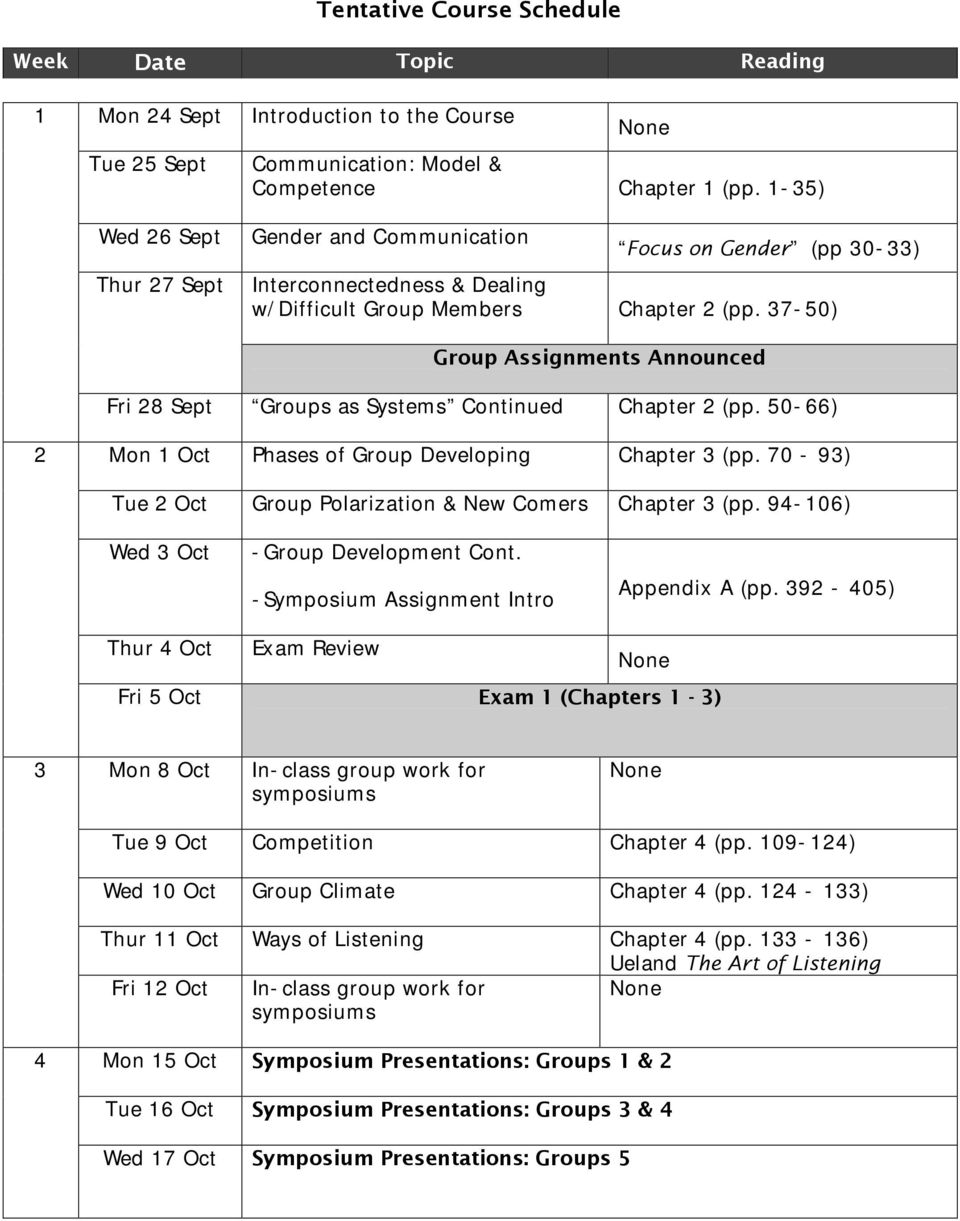
6 Tentative Course Schedule Week Date Topic Reading 1 Mon 24 Sept Tue 25 Sept Wed 26 Sept Thur 27 Sept Introduction to the Course Communication: Model & Competence Chapter 1 (pp. 1-35) Gender and Communication Focus on Gender (pp 30-33) Interconnectedness & Dealing w/difficult Group Members Chapter 2 (pp ) Group Assignments Announced Fri 28 Sept Groups as Systems Continued Chapter 2 (pp ) 2 Mon 1 Oct Phases of Group Developing Chapter 3 (pp ) Tue 2 Oct Group Polarization & New Comers Chapter 3 (pp ) Wed 3 Oct -Group Development Cont. -Symposium Assignment Intro Appendix A (pp ) Thur 4 Oct Exam Review Fri 5 Oct Exam 1 (Chapters 1-3) 3 Mon 8 Oct In-class group work for symposiums Tue 9 Oct Competition Chapter 4 (pp ) Wed 10 Oct Group Climate Chapter 4 (pp ) Thur 11 Oct Ways of Listening Chapter 4 (pp ) Ueland The Art of Listening Fri 12 Oct In-class group work for symposiums 4 Mon 15 Oct Symposium Presentations: Groups 1 & 2 Tue 16 Oct Symposium Presentations: Groups 3 & 4 Wed 17 Oct Symposium Presentations: Groups 5
7 4 Date Topic Reading Thurs 18 Oct -Roles in Groups Chapter 5 (pp ) -Discuss Symposium 2 Fri 19 Oct NO CLASS: College Issues Day 5 Mon 22 Oct Roles in Groups Continued Tue 23 Oct Leadership Chapter 5 (pp ) Wed 24 Oct Defining Teams Chapter 6 (pp ) Thur 25 Oct A Good Working Team Chapter 6 (pp ) Fri 26 Oct Exam Review 6 Mon 29 Oct Exam 2 (Chapters 4-6) Tue 30 Oct NO CLASS: Faculty Professional Development Day Wed 31 Oct -In-class group work for symposiums -Review Appropriate Citation Appendix B (pp ) Chapter 8 (pp ) Thur 1 Nov Ways of Thinking Chapter 7 (pp ) Fri 2 Nov Ways of Thinking Continued 7 Mon 5 Nov Group Think Chapter 7 (pp ) Tue 6 Nov Discussion Procedures Chapter 8 (pp ) Wed 7 Nov Conducting Effective Meetings Chapter 8 (pp ) Thur 8 Nov Creative Problem Solving Chapter 8 (pp ) Fri 9 Nov Information and Expertise Chapter 9 (pp ) 8 Mon 12 Nov NO CLASS: Staff Professional Development Day Tue 13 Nov Addressing Power Imbalances Chapter 9 (pp ) Wed 14 Nov Assertive Communication Chapter 9 (pp ) Thur 15 Nov In-class group work for symposiums Fri 16 Nov Symposium Presentations: Groups 1 & 2

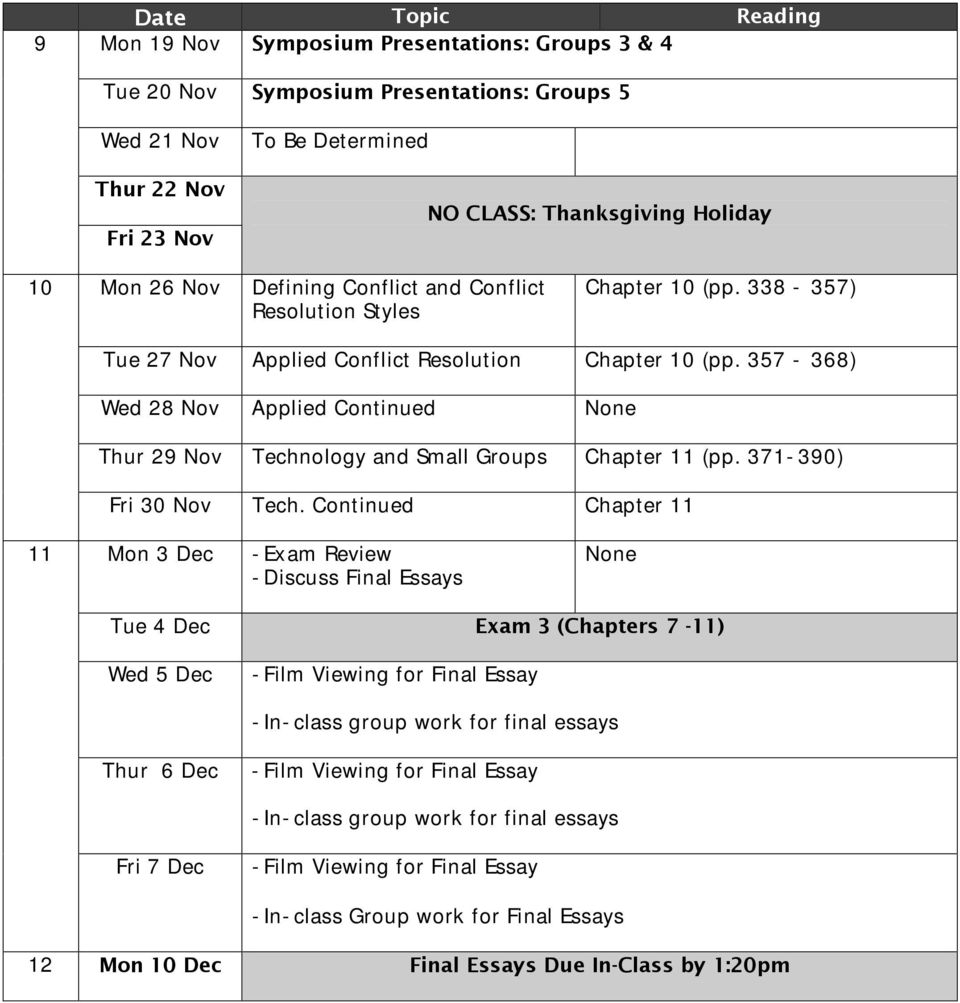
8 9 Date Topic Reading Mon 19 Nov Symposium Presentations: Groups 3 & 4 Tue 20 Nov Symposium Presentations: Groups 5 Wed 21 Nov Thur 22 Nov Fri 23 Nov To Be Determined NO CLASS: Thanksgiving Holiday 10 Mon 26 Nov Defining Conflict and Conflict Resolution Styles Chapter 10 (pp ) Tue 27 Nov Applied Conflict Resolution Chapter 10 (pp ) Wed 28 Nov Applied Continued Thur 29 Nov Technology and Small Groups Chapter 11 (pp ) Fri 30 Nov Tech. Continued Chapter Mon 3 Dec -Exam Review -Discuss Final Essays Tue 4 Dec Exam 3 (Chapters 7-11) Wed 5 Dec -Film Viewing for Final Essay -In-class group work for final essays Thur 6 Dec -Film Viewing for Final Essay -In-class group work for final essays Fri 7 Dec -Film Viewing for Final Essay -In-class Group work for Final Essays 12 Mon 10 Dec Final Essays Due In-Class by 1:20pm
General Psychology. Course Syllabus
 COURSE TITLE General Psychology General Psychology Course Syllabus COURSE NUMBER PSY 2012 PREREQUISITES English Composition I with a grade of C, or ACT Reading 018 and ACT English 017, or CPT-R 083 and
COURSE NUMBER AND TITLE: Management Information Systems Concepts
 (IS213ZA) (Management Information Systems Concepts) Page 1 EMPORIA STATE UNIVERSITY SCHOOL OF BUSINESS DEPARTMENT OF ACCOUNTING AND INFORMATION SYSTEMS Course Syllabus Fall 2012 MISSION STATEMENT: The
INTRODUCTION TO CRIMINAL JUSTICE CRIM 100, Section 001 Fall 2015
 INTRODUCTION TO CRIMINAL JUSTICE CRIM 100, Section 001 Fall 2015 INSTRUCTOR LECTURE Devon Johnson, Ph.D. Tues and Thurs, 10:30am-11:45am Office: 363 Aquia until Sept 10 th Innovation Hall 105 340 Enterprise
Introduction to Organizational Behavior (Business 260)
 Introduction to Organizational Behavior (Business 260) Faculty of Business Administration University of Regina Professor Dr. Sandeep Mishra Faculty of Business Administration E-mail: [email protected] Office
Syllabus for Accounting 300 Applied Managerial Accounting California State University Channel Islands Fall 2004
 Syllabus for Accounting 300 Applied Managerial Accounting California State University Channel Islands Fall 2004 Professor: Dr. M. Cathy Claiborne Office Hours: TTH 2:30 4:00 or Office: Professional Bldg
Agricultural Accounting AECO 2200 Course Outline. : 229 391-4796 Email: [email protected] Other times by appointment
 Abraham Baldwin Agricultural College Department of Agriculture Agricultural Accounting AECO 2200 Course Outline Instructor Office hours Dr. Renata Elad Mon, Wed, Fri : 8:30am - 9:50am Office: 113 Ag Sciences
Psychological Testing (PSYCH 149) Syllabus
 Psychological Testing (PSYCH 149) Syllabus Psychological Testing (PSYCH 149) is held on Mondays, Wednesdays, and Fridays from 11:45 a.m. 12:50 p.m., in Science 2, Room 107. This 4-unit course is designed
CEDAR CREST COLLEGE Psychological Assessment, PSY - 312 Spring 2010. Dr. Diane M. Moyer [email protected] Office: Curtis 123
 CEDAR CREST COLLEGE Psychological Assessment, PSY - 312 Spring 2010 Dr. Diane M. Moyer [email protected] Office: Curtis 123 Course Description: The goal of this course is to expose students to the
JOU4700: Problems and Ethics in Journalism Course Syllabus, Spring 2015 Mondays, 3-6 p.m. Florida Gym, Room 260
 JOU4700: Problems and Ethics in Journalism Course Syllabus, Spring 2015 Mondays, 3-6 p.m. Florida Gym, Room 260 Instructor: Michael Stone Office hours: 12:30 to 2:30 p.m., Mondays in Weimer G035; or by
SPE 102: Interpersonal Communication Spring 2007 / Jan. 14 - April 29
 SPE 102: Interpersonal Communication Spring 2007 / Jan. 14 - April 29 SPE 102 Spring 07 1 Instructor: Jen Almjeld Class schedule & location: Sun. 3-6:20 p.m. College Hall 114 Credit hours: 3 Prerequisites:
General Psychology PSY-1000-100 Fall 2010 Internet Course
 General Psychology PSY-1000-100 Fall 2010 Internet Course INSTRUCTOR: Lauren Schmidt, MA, LPC Email: [email protected] No office hours: Meet by appointment if needed TEXT: Psychology. 9 th Edition. Wade
Upon completion of COMM 7, Interpersonal Communication, students will be able to:
 Syllabus for: COMM-7, Interpersonal Communication - Online Semester & Year: Fall 2015 Course ID and Section Number: COMM-7 V8968 Number of Credits/Units: 3 Day/Time: Sept 8 Dec. 12 Location: Canvas (https://redwoods.instructure.com/login)
CALIFORNIA STATE UNIVERSITY CHANNEL ISLANDS PSY494 POSITIVE PSYCHOLOGY RESEARCH FALL 2015 SYLLABUS DR. CHRISTY TERANISHI MARTINEZ
 Ψ CALIFORNIA STATE UNIVERSITY CHANNEL ISLANDS PSY494 POSITIVE PSYCHOLOGY RESEARCH FALL 2015 SYLLABUS DR. CHRISTY TERANISHI MARTINEZ PSY494 Meetings: Thursdays 3 4:30 p.m. OFFICE: Madera 2723 PHONE: (805)437-3311
PSYC 2145:200 Introduction to Cognitive Psychology
 PSYC 2145:200 Introduction to Cognitive Psychology Instructor: Matt Mollison, M.A. Office: Muenzinger D434 (fourth floor, by the elevator) Office Hours: Monday: 11am 12pm, Thursday: 11am 12pm, or by appointment
Clinical Psychology Syllabus 1
 Key Information about this Class Clinical Psychology Syllabus 1 (400:166) Fall 2008 Classroom Location: 315 Baker Hours: 3 hours Time: Tues, Thurs 12:30 1:45 p.m. University of Northern Iowa Instructor
ABNORMAL PSYCHOLOGY (PSYCH 238) Psychology Building, Rm.31 Spring, 2010: Section K. Tues, Thurs 1:45-2:45pm and by appointment (schedule via email)
 ABNORMAL PSYCHOLOGY (PSYCH 238) Psychology Building, Rm.31 Spring, 2010: Section K Instructor: Mikhail Lyubansky, Ph.D. Email: [email protected] Office: 723 Psychology Building Phone: 333-7740 Mailbox:
DFST 2313-001 Courtship and Marriage Fall 2014
 DFST 2313-001 Courtship and Marriage Fall 2014 Instructor Kelly M Roberts, PhD, LMFT Assistant Professor, Educational Psychology at UNT Email: [email protected] Office: Matthews Hall, Room 316K Office
Social Psychology Syllabus
 Social Psychology Syllabus PSYC 307/001 Spring 2014 Lecture: MWF 12:00-12:50 p.m. in Wham 105 Instructor: Rebecca Kietlinski. M.A. Office Location: Life Science II Rm. 275F Office Hours: 10:00 a.m. to
How To Pass A Management Course At Anciento State University
 MGT 3303 Human Resource Management (HRM) Information contained in this syllabus is subject to change at the discretion of the instructor. Every attempt will be made to provide students with adequate notice
Pol Sci 3510 Topics in American Politics: The Supreme Court
 Pol Sci 3510 Topics in American Politics: The Supreme Court Fall 2011 TTh 4:00p.m. 5:30p.m., Seigle Hall L002 Instructor Susanne Schorpp Seigle Hall 250 314-935-9010 [email protected] Office Hours TWTh
Austin Community College Marketing Research Marketing 2348.01 Fall 2009 Distance Learning
 Austin Community College Marketing Research Marketing 2348.01 Fall 2009 Distance Learning Professor: Allan W. Hanson, MBA Office: CYP #2204.7 Office Telephone: 223-1790 ext. 26433 Cell Number: 417-5713
BCM 247 BUSINESS COMMUNICATION Course Syllabus Fall 2012
 BCM 247 BUSINESS COMMUNICATION Course Syllabus Fall 2012 Course Title: Business Communication Course Number and Section: 247 020 Name: Keith R. New Email: [email protected] Phone: 936-468-1729 Office: BU
Speech 120: Human Communication Spring 2015 Tentative Course Syllabus and Schedule
 Speech 120: Human Communication Spring 2015 Tentative Course Syllabus and Schedule Instructor: Dewi Hokett Email: [email protected] Phone: 760-744-1150 x2794 Office: H 201 P Office Hours: Tue / Thurs.:
Los Angeles Pierce College. SYLLABUS Math 227: Elementary Statistics. Fall 2011 T Th 4:45 6:50 pm Section #3307 Room: MATH 1400
 Los Angeles Pierce College SYLLABUS Math 227: Elementary Statistics Fall 2011 T Th 4:45 6:50 pm Section #3307 Room: MATH 1400 Instructor: Pauline Pham Office hours: T Th: 4:00 4:35 PM, Room Math 1409X
Managerial Communication (CIS 605) Fall, 2004
 Managerial Communication (CIS 605) Fall, 2004 Instructor Gary H. Jones Office: Forsyth 230 Phone & Voicemail, 828.227.3615 E-Mail: [email protected] Hours: Monday 1:00 5:00 Tuesday 1:00-2:00; 3:15-4:00
CIS 287 World Wide Web Development Fall 2010 - Blended
 CIS 287 World Wide Web Development Fall 2010 - Blended Instructor: Jeni Patton Class Day: Tuesdays 515-5328 office LCC 1241 Class Time: 12:115 1:30 PM [email protected] Room: LCC 1203 IM [email protected]
PHIL 103-001: CRITICAL THINKING
 PHIL103-001 Critical Thinking Dr. R. England - Syllabus subject to revision at instructor s discretion 1 PHIL 103-001: CRITICAL THINKING Dr. Richard England Philosophy House, Room 106 410-677-3718 Office
George Washington University Department of Psychology PSYC 001: General Psychology
 George Washington University Department of Psychology PSYC 001: General Psychology Course Syllabus Fall 2006 Times & Place Section 14 (CRN #70754) Tues & Thurs: 11:10am 12:25pm: Corcoran #302 Section 15
FACULTY: Instructor: Linda Eligh Classroom: SSC 3006. Campus Phone: 661-2111 Ext. 81098 Office Hours: Tuesdays 2:00 p.m. 5:00 p.m.
 The University of Western Ontario Management and Organizational Studies MOS 3343a - 001 TRAINING AND DEVELOPMENT FAll 2008 COURSE OUTLINE FACULTY: Instructor: Linda Eligh Classroom: SSC 3006 E-mail address:
Management 540-001 Financial Accounting I Fall 2015. Intermediate Accounting by Spiceland, Sepe, and Nelson, 8th edition.
 Management 540-001 Financial Accounting I Fall 2015 Instructor: Shihong Li Office: ASM 2114 Phone: 277-6176 Office Hours: M/W, 2:45-3:45 pm, and by appointment. E-mail: [email protected] Required Text: Intermediate
General Psychology. Professor. Course Description. Course Objectives. Accommodations. PSY 201 (10544, 10545) Fall 2013 M/W 4:00 5:50 ITC 211
 General Psychology PSY 201 (10544, 10545) Fall 2013 M/W 4:00 5:50 ITC 211 Professor Jaime Cloud, Ph.D. Office: Todd Hall 318 Email: [email protected] Phone: x89211 Website: www.jaimemcloud.com Office hours
T/Th 10:05-11:40 Creative Arts 113
 Syllabus for: PSYCH 1 -- General Psychology Semester & Year: Spring 2015 Course ID and Section Number: PSYCH 1: E7093 Number of Credits/Units: 3 Day/Time: Location: Instructor s Name: Contact Information:
MIS 4343.010 Systems Analysis & Design
 MIS 4343.010 Systems Analysis & Design Course Description/Overview Provides an understanding of the system development and modification process. Emphasizes the factors for effective communication and integration
Psychology 125- Psychology of Aging ONLINE Saddleback College Fall 2011. Course Description and Objectives
 Professor Michelle Worley, M. A. Email: [email protected] Psychology 125- Psychology of Aging ONLINE Saddleback College Fall 2011 Course Description and Objectives This is a lower division developmental
Course Title: Minorities and the Criminal Justice System Course Prefix: CRJS Course No.: 3933 Section No.: PO1
 Course Title: Minorities and the Criminal Justice System Course Prefix: CRJS Course No.: 3933 Section No.: PO1 Department of Justice Studies College of Juvenile Justice & Psychology Instructor Name: Martha
University of Texas at San Antonio English 2413: Technical Writing Fall 2011
 University of Texas at San Antonio English 2413: Technical Writing Fall 2011 Instructor: Kristina Gutierrez Office Hours: MW 9:30am -10:30am or by appointment Office location: MB 2.308 Email: [email protected]
SPC Common Course Syllabus for PSYC 2316 Psychology of Personality
 SPC Common Course Syllabus for PSYC 2316 Psychology of Personality Department: Behavioral Sciences Discipline: Psychology Course Number: PSYC 2301 Course Title: Psychology of Personality Credit: 3 Lecture,
THE UNIVERSITY OF NORTH CAROLINA AT GREENSBORO Joseph M. Bryan School of Business and Economics Department of Business Administration
 THE UNIVERSITY OF NORTH CAROLINA AT GREENSBORO Joseph M. Bryan School of Business and Economics Department of Business Administration BUS/ENT 470.01 Entrepreneurial Small Business Management Fall Semester,
BUS 1950-002-008 Computer Concepts and Applications for Business Fall 2012
 BUS 1950-002-008 Computer Concepts and Applications for Business Fall 2012 Instructor: Contact Information: Susan Kling Office: 4505 Lumpkin Hall Phone: 217-581-8547 Email: [email protected] Course Website:
Introduction to General Psychology Spring 2014 PSY 1101-03, 30013 Mon. & Wed.: 6-7:15
 Introduction to General Psychology Spring 2014 PSY 1101-03, 30013 Mon. & Wed.: 6-7:15 Instructor: Jen Wallin-Ruschman Office Hours in Bowen 216: Mon., Wed., & Fri. 1-2; Mon. & Wed. 3:15-5; Tues. & Thur.
11:709:255:90/91 Nutrition & Health (3 credit hours) Fall 2015 Online Online ecollege (http://onlinelearning.rutgers.edu/ecollege) Index # 07233/10724
 11:709:255:90/91 Nutrition & Health (3 credit hours) Fall 2015 Online Online ecollege (http://onlinelearning.rutgers.edu/ecollege) Index # 07233/10724 Department of Nutritional Sciences SEBS Rutgers University
SAM HOUSTON STATE UNIVERSITY College of Business Administration Department of General Business and Finance
 Professor: Lucia S. Sigmar, Ph.D. Office: SHB 200-L Tel.: 936-294-4904 E-mail: [email protected] SAM HOUSTON STATE UNIVERSITY College of Business Administration Department of General Business and Finance
HEALTH PSYCHOLOGY AND BEHAVIORAL MEDICINE PSYC 515.001 - FALL 2015 3:30 4:45 MW - KINA 101
 HEALTH PSYCHOLOGY AND BEHAVIORAL MEDICINE PSYC 515.001 - FALL 2015 3:30 4:45 MW - KINA 101 Instructor: Sarah Reiland, Ph.D. Ph: 803-323 - 2634 (on-campus office) Office: 126 Kinard e-mail: [email protected]
ANT 2330: Cross-Cultural Communication. Tues / Thurs 6:30pm 7:45pm in WC 230
 ANT 2330: Cross-Cultural Communication Tues / Thurs 6:30pm 7:45pm in WC 230 Joshua Raclaw ([email protected]) Office hours by appointment (CN 106) The goal of this course is to introduce you to anthropological
CMST 210 INTERPERSONAL COMMUNICATION COURSE SYLLABUS
 CMST 210 INTERPERSONAL COMMUNICATION COURSE SYLLABUS INSTRUCTOR/FACILITATOR: Laura Nudelman Contact: Website Email or office phone 425-564-2358. If Canvas is down, please feel free to email me at: [email protected]
Business Computer Applications CGS 1100 Course Syllabus. Course Title:
 Business Computer Applications CGS 10 Course Syllabus This course is offered in the online format for the required content, assessment submissions and attendance. Course / Prefix Number CGS 10 Course Title:
Heartland Community College Humanities & Fine Arts Course Syllabus for Students
 Heartland Community College Humanities & Fine Arts Course Syllabus for Students Course Prefix and Number: HUMA 101-03 (Fall 2013) Course Title: Introduction to the Humanities Credit Hours: 3 Lecture Hours:
AAF Ad Campaign I MCM 478.001 Name: Dr. Linda Bond Email: [email protected] Phone: 936-468-1265 Office: Boynton 301
 AAF Ad Campaign I MCM 478.001 Name: Dr. Linda Bond Email: [email protected] Phone: 936-468-1265 Office: Boynton 301 Office hours 8-9 a.m. MWF 1-3 p.m. WF 8-9:30 & 1:30-2:30 TR And by appointment Department:
Vanguard University of Southern California PSYC 332: Abnormal Psychology Section 1 Fall 2015 Time: Monday and Wednesday 4pm-5:15pm Location: Heath 105
 Vanguard University of Southern California PSYC 332: Abnormal Psychology Section 1 Fall 2015 Time: Monday and Wednesday 4pm-5:15pm Location: Heath 105 Instructor: Elizabeth S. Powell, Psy.D. Contact Dr.
Econ 110 (Sec. 1), Principles of Microeconomics
 Econ 110 (Sec. 1), Principles of Microeconomics Martin V. Smith School of Business and Economics California State University Channel Islands Course Syllabus, Spring 2015 Course: Econ 110, Principles of
English 103: Composition and Critical Thinking Fall 2013 Section 1019 (Tuesday/Thursday, 9:35 11 a.m. in GC 160)
 English 103: Composition and Critical Thinking Fall 2013 Section 1019 (Tuesday/Thursday, 9:35 11 a.m. in GC 160) Dr. Kimberly Manner Email: [email protected] Office Phone: (310) 287-4551 Student Drop-In
ASU College of Education - Teacher Education Department EPSY 3303 Child and Adolescent Development Course Syllabus Fall 2009
 ASU College of Education - Teacher Education Department EPSY 3303 Child and Adolescent Development Course Syllabus Fall 2009 Professor: Dr. Linda N. Lucksinger Telephone: 325-942-2052 ext. 257 Email: [email protected]
REHB 461. Fall 2014. Introduction to Alcoholism and Drug Abuse. Mondays, 6:00-9:00 pm
 REHB 461 REHB 461 Fall 2014 Introduction to Alcoholism and Drug Abuse Mondays, 6:00-9:00 pm Instructor: Jane L. Nichols, PhD, CRC Office: Rehn Hall, 329A E mail: [email protected] Phone: 618-453-8291 Office
PROFESSOR: Dr. Marlene Kahla, Associate Professor, Assistant Department Chair, Director of Internships and Special Problems
 MARKETING 352 002 ADVERTISING AND PROMOTION SYLLABUS DEPARTMENT OF MANAGEMENT, MARKETING, AND INTERNATIONAL BUSINESS NELSON RUSCHE COLLEGE OF BUSINESS Fall 2011 PROFESSOR: Dr. Marlene Kahla, Associate
ISM 4113: SYSTEMS ANALYSIS & DESIGN
 GENERAL INFORMATION: ISM 4113: SYSTEMS ANALYSIS & DESIGN COURSE SYLLABUS Class Times: Tuesday, Thursday 9:35 11:30 AM Class Location: HVNR 240 Professor: Dr. Aditi Mukherjee Office; Phone: STZ 360, 39-20648
Introduction to Psychology 100 On-Campus Fall 2014 Syllabus
 Introduction to Psychology 100 On-Campus Fall 2014 Syllabus Contact Information Professor: Dr. Deborah Maher Office: C&L (Classrooms and Labs) 119 Office phone #: (714) 432-0202, x21190 (best to email
SYLLABUS. 44PROVIDENCE UNIVERSITY COLLEGE 473.32 Corporate Finance 3 credit hours. [email protected]. http://buller.prov.ca/cf
 44PROVIDENCE UNIVERSITY COLLEGE 473.32 Corporate Finance 3 credit hours Professor: Office: Website: Bruce Duggan, MBA [email protected] 2H20 http://buller.prov.ca/cf Classes: Tue 12:40 1:55 Fri 12:40
Math 830- Elementary Algebra
 Math 830- Elementary Algebra Tue, Thur: 1:00pm-2:45pm Instructor: Dr. Lemee Nakamura Room: 3507 Office: 3621 Section 1979 Phone: 760-757-2121 ext.6219 Spring 2010 Email: [email protected] Office
General Psychology Psychology 150 (102 & 302) Fall 2009
 General Psychology Psychology 150 (102 & 302) Fall 2009 Heather Kirby Instructor of Psychology Class Meetings: Office: HEC-104C Mon. & Wed. Ph: (410) 822-5400 EXT 347 1:00pm -2:15pm Email: [email protected]
Online Course Syllabus. POL 1113: American National Government. Fall 2015
 Online Course Syllabus POL 1113: American National Government Fall 2015 Instructor Information Name & contact: Marija Naumoski (MA, University of Central Oklahoma). All inquiries must be sent via UCO's
El Camino College/Compton Education Center Childhood Education Department http://www.elcamino.edu/academics/behavioralsocial/childhooded/index.
 El Camino College/Compton Education Center Childhood Education Department http://www.elcamino.edu/academics/behavioralsocial/childhooded/index.asp Preparing Childhood Education Professionals and Life-long
INSC 102 Technologies for Information Retrieval FALL 2014 SECTION 002 Delivered online via Asynchronous Distance Education (ADE)
 INSC 102 Technologies for Information Retrieval FALL 2014 SECTION 002 Delivered online via Asynchronous Distance Education (ADE) Instructor: Rebecca Davis Email: [email protected] Office: 103 Communications
Technology and Online Computer Access Requirements: Lake-Sumter State College Course Syllabus
 Lake-Sumter State College Course Syllabus Course / Prefix Number CTS1832 Course Title: Web Authoring II CRN: 10009 Credit: 3 Term: Fall 2015 This course is a continuation of skills and concepts introduced
Learning and Memory Adult Development. Lifespan Development Applied Psychology. Multi-Cultural Psychology Child Development
 GENERAL PSYCHOLOGY 201 FALL 2010 Instructor: Eric Kim MWF: 9:00-9:50 / DTC 302 Office Hours: TuTh 12:00-12:50 (main campus) TuTh 1:00-2:20 / CEN 402 MWF 10:00-10:50 (Downtown Center) TuTh 3:00-4:20 / DTC
Mgt 2020Y - Marketing Fall 2013 Wednesday: 6:00 8:50pm, S4037. Wednesdays 9:00-10:00pm or by appointment.
 Mgt 2020Y - Marketing Fall 2013 Wednesday: 6:00 8:50pm, S4037 INSTRUCTOR OFFICE HOURS Don Haidey [email protected] Phone : 403.440.7013 Wednesdays 9:00-10:00pm or by appointment. COURSE MATERIALS Required
AEC 3073 INTERCULTURAL COMMUNICATION Ms. Mary Rodriguez
 Spring 2015 AEC 3073 - Section 2D38 General Education Categories: Social & Behavioral Sciences (S) and International (N) or S and Diversity (D) Three (3) Credit Hours Tuesday (5 th and 6 th period) 11:45-1:40pm
Abuse and Illness in Families
 Abuse Illness in Families HDFS 367xw: Spring 2013 *Syllabus is subject to change without notice* Instructor: Sarah Bickelhaupt M.S. Office Location: 51B LeBaron E-mail: [email protected] Office Hours:
VANGUARD UNIVERSITY S EDUCATIONAL TARGETS AND COURSE GOALS:
 Vanguard University of Southern California PSYC 420: Behavior Modification Fall Semester 2004 Instructor: Bridgette Brooks, M.S. Teaching Assistant: Kristin Lawrence Class Meetings: M,W,F 9-9:50 a.m. Email
AEE 460: Foundations of Leadership Development Fall 2006 M/W/F, 11:15 12:05 p.m. 301 Ag Administration Bldg.
 AEE 460: Foundations of Leadership Development Fall 2006 M/W/F, 11:15 12:05 p.m. 301 Ag Administration Bldg. Instructor: Kristina G. Ricketts, Ph. D. Office: 439 Ag. Administration Bldg. Office Hours:
General Psychology - Course Syllabus
 General Psychology - Course Syllabus PSY-001-4 Location: Murchison Gymnasium, Room 4 Fall Semester 2015 Time: MWF 8:00 9:05 a.m. Professor: Ronald E. See, PhD Office: Winter Hall 338 Phone: 805-565-7062
School of Kinesiology Faculty of Health Sciences Western University. KIN 2032b Research Design in Human Movement Science January to April 2016
 1 School of Kinesiology Faculty of Health Sciences Western University KIN 2032b Research Design in Human Movement Science January to April 2016 Instructor: Lindsay Nagamatsu, PhD Location: Natural Sciences
Course Name: Sociology 101, Introduction to Sociology Section # 9214 Ms. Haynes, [email protected], 310-900-1600 ext. 2075/2076
 El Camino College Compton Center 1111 E. Artesia Blvd. Compton Ca. 90221 Division of Behavioral and Social Sciences Course Syllabus-Fall 2015 Course Name: Sociology 101, Introduction to Sociology Section
General Psychology (PSY 101A) Spring 2013. MWF 8:30-9:20am, Sloan 201
 General Psychology (PSY 101A) Spring 2013 MWF 8:30-9:20am, Sloan 201 Dr. Jessica Good E-mail: [email protected] Office: Watson 205 Phone: 704-894-2131 Office Hours: Mon, Wed 9:30am 11:30pm, Tues 2pm-4pm,
Financial Analysis FIN 513, Fall A 2011 University of Michigan, Ross School of Business
 Ing-Haw Cheng Assistant Professor of Finance University of Michigan 701 Tappan Street, Room R5466 Ann Arbor, Michigan 48109 [email protected] webuser.bus.umich.edu/ingcheng Financial Analysis FIN 513,
Date approved or revised 8-21-15 Angelina College Business Division BUSI-1301 Business Principles Instructional Syllabus I. BASIC COURSE INFORMATION
 I. BASIC COURSE INFORMATION Date approved or revised 8-21-15 Angelina College Business Division BUSI-1301 Business Principles Instructional Syllabus A. Course Description: (as stated in the bulletin, including
PSYCHOLOGY 310-001: INDUSTRIAL/ORGANIZATIONAL PSYCHOLOGY STEPHEN F. AUSTIN STATE UNIVERITY COURSE SYLLABUS & CALENDAR FALL 2011
 PSYCHOLOGY 310-001: INDUSTRIAL/ORGANIZATIONAL PSYCHOLOGY STEPHEN F. AUSTIN STATE UNIVERITY COURSE SYLLABUS & CALENDAR FALL 2011 INSTRUCTOR INFORMATION Meeting Time: Tuesdays & Thursdays Location: Education
Department of Business BUS 3000 Human Resources Management Fall 2012
 Department of Business BUS 3000 Human Resources Management Fall 2012 Mondays, Wednesdays, Fridays: 1:30 pm 2:20 pm Professor: Rhonda Gordon Office: J.D. MacLachlan Building, Room 205 Email: Office Hours:
Digital Communication Southwest College
 Digital Communication Southwest College ARTC 1317 0080 Design Communication I CRN 76410 Fall 2015 West Loop Center - Room 131 5:30 pm - 9:45 pm Monday 2 hrs. Lecture (32 hrs.) / 3 hrs. External (48 hrs.)
REL 3148: RELIGION AND VIOLENCE, Fall 2015 Tues. 5th-6th periods and Thurs. 6 th period Matherly 108
 REL 3148: RELIGION AND VIOLENCE, Fall 2015 Tues. 5th-6th periods and Thurs. 6 th period Matherly 108 Instructor: Anna Peterson Office: 105 Anderson (Mailbox in 107 Anderson) Tel. 392-1625, ext. 226; fax
ISQS 3358 BUSINESS INTELLIGENCE FALL 2014
 ISQS 3358 BUSINESS INTELLIGENCE FALL 2014 Instructor: Dr. Miguel. I. Aguirre-Urreta, Ph.D. Office: BA E322 Phone: 806.834.0765 Email: [email protected] Office Hours Tuesdays and Thursdays from
PSYCHOLOGY 1215 - Fundamentals of Psychology II. Mixed Mode COURSE OUTLINE
 PSYCHOLOGY 1215 - Fundamentals of Psychology II Instructor Mixed Mode Powered by Blackboard CE COURSE OUTLINE Dr. Ross M. Woolley. E-mail address: [email protected]. Office B252N. Phone: (604) 323-5866.
CI 161 SE Methods and Materials in Secondary Teaching
 CI 161 SE Methods and Materials in Secondary Teaching Dr. Steven J. Rocca Office: Ag 112 Office Hours: Mon. 10-12 & Wed. 9-12 Telephone: (559) 278-5088 Email: [email protected] Introduction and Course
More precisely, upon successful completion of this course you can expect to be able to:
 ANTH 432: Fall 2011, Coastal Carolina University Class meeting times: Tu/Th, 1:40-2:55pm Location: Smith Science Bldg. 106 Instructor: Dr. Carolyn Dillian Office: 114 Sands Building Office Hours: Tuesday/Thursday
COURSE DESCRIPTION. Required Course Materials COURSE REQUIREMENTS
 Communication Studies 2061 Business and Professional Communication Instructor: Emily Graves Email: [email protected] Office Phone: 225-578-???? Office Location: Coates 144 Class Meeting Times and Locations:
PSY 3250: Abnormal Child Psychology Spring 2010 Tuesday 6:00 to 9:00 pm, BEHS 115
 Psych. 3250, Spring 2010, p. 1 PSY 3250: Abnormal Child Psychology Spring 2010 Tuesday 6:00 to 9:00 pm, BEHS 115 Instructor: Sheryl R. Schindler Office: Department of Psychology, University of Utah, BEHS
CRIM 200: Introduction to Criminal Justice
 CRIM 200: Introduction to Criminal Justice Catalog Description: This course will provide an overview of the criminal justice system, its history, its philosophical development, and its contemporary configurations.
This is offered in a blended format in which 2/3 of course time is in-class face-toface (F2F) meetings and 1/3 of course time is online.
 1 HPCH 203 Fall 2013 Health Communication (interpersonal communication) - 3 credits Course Instructor Mayada Kanj Room 306, Van Dyke Email: [email protected] Office hours: students are welcome anytime;
UNIVERSITY OF WISCONSIN-EAU CLAIRE COLLEGE OF ARTS AND SCIENCES Department of Political Science Criminal Justice Program
 UNIVERSITY OF WISCONSIN-EAU CLAIRE COLLEGE OF ARTS AND SCIENCES Department of Political Science Criminal Justice Program CRIMINAL JUSTICE 103/SOCIOLOGY 103 SURVEY OF THE CRIMINAL JUSTICE SYSTEM Tuesday
22-MGMT-3080 (003) Management Lindner College of Business University of Cincinnati Fall 2015
 22-MGMT-3080 (003) Management Lindner College of Business University of Cincinnati Fall 2015 Instructor Phone E-mail Elaine Hollensbe, Ph.D. 518 Lindner Hall (513) 556-7122 (office) [email protected]
HRM 200 - Human Resources Management (Spring 2013) Rachel Morrison [email protected] Nea Powell [email protected]
 HRM 200 - Human Resources Management (Spring 2013) Instructor: Teaching Assistants: Katrina Di Gravio Email Contact: via the D2L HRM200 course site Office Hour: TBA Justin Brienza [email protected]
Fundamentals of Business Administration and Management
 Fundamentals of Business Administration and Management Instructor: Maria Vitale, MA Office Hours: By appointment Location: Online Instructor Phone: 909.652.7171 Instructor E-mail: [email protected]