
THE MINING ASSOCIATION OF CANADA
|
|
|
- Ophelia Johnston
- 10 years ago
- Views:
Transcription
1
2 THE MINING ASSOCIATION OF CANADA The Mining Association of Canada (MAC) is the national organization of the Canadian mining industry. We represent companies involved in mineral exploration, mining, smelting, refining and semi-fabrication. Our member companies account for most of Canada s output of metals and minerals. MAC s functions include advocacy, stewardship and collaboration. Our goals are to promote the industry s interests nationally and internationally, to work with governments on policies affecting minerals, to inform the public and to encourage member firms to cooperate to solve common problems. We work closely with provincial and territorial mining associations, other industries, and environmental and community groups in Canada and around the world. DATA AND SOURCES This annual report reflects currently available data, the majority from 2013, though some from prior years and some from Dollar amounts are expressed in Canadian dollars unless noted otherwise. Author: Brendan Marshall, Director, Economic Affairs, MAC Editing/Design: West Coast Editorial Associates / Wet Frog Studios Acknowledgements: This report could not have been prepared without the significant assistance of Patrick Pearce and the dedicated staff of the Minerals and Metals Sector at Natural Resources Canada. Special thanks are also extended to Jessica Draker and Monique Lafleche from MAC. FACTS & FIGURES
3 MINING.CA Ni Nickel Si Silicon Zn Zinc Cu Copper C Carbon Zn Zinc Cu Copper Si Silicon Zn Zinc C Carbon A SYMBOL OF canadian democracy since Canada s democracy is about the will of the people, the skills of leaders, and the work of many committed Canadians. Canada s minerals and metals are pleased to help in the background. A SYMBOL OF canadian democracy since Canada s democracy is about the will of the people, the skills of leaders, and the work of many committed Canadians. Canada s minerals and metals are pleased to help in the background. A SYMBOL OF canadian democracy since Canada s democracy is about the will of the people, the skills of leaders, and the work of many committed Canadians. Canada s minerals and metals are pleased to help in the background. MINING.CA MINING.CA MINING.CA A message from the Mining Association of Canada. Part of just about everything. A message from the Mining Association of Canada. Part of just about everything. A message from the Mining Association of Canada. Part of just about everything Li Lithium Si Silicon Au Gold Cu Copper Au Gold Cu Copper Ni Nickel Mo Molybdenum Ni Nickel C Carbon we ll help candidates connect with canadians. With an election on the horizon, Canada s minerals and metals are standing by to play a part. Canada is one of the world s top mining countries, and our minerals and metals are part of products of all kinds. we ll show up at every big event and debate. With an election on the horizon, Canada s minerals and metals are standing by to play a part. Canada is one of the world s top mining countries, and our minerals and metals are part of products of all kinds. WE ARE IN EVERY community. With an election on the horizon, Canada s minerals and metals are standing by to play a part. Canada is one of the world s top mining countries, and our minerals and metals are part of products of all kinds. MINING.CA MINING.CA MINING.CA A message from the Mining Association of Canada. Part of just about everything. A message from the Mining Association of Canada. Part of just about everything. A message from the Mining Association of Canada. Part of just about everything C Carbon Fe Iron Cu Copper 92 (238.0) U Uranium WE ll make our mark in every RIDING. With an election on the horizon, Canada s minerals and metals are standing by to play a part. Canada is one of the world s top mining countries, and our minerals and metals are part of products of all kinds. Global. Local. CANADIAN. Modern aircraft design is about strength, durability and weight. Minerals and metals allow next generation planes to save fuel, Canada is one of the world s top mining countries, and our minerals and metals are found in products of all kinds. Reliable. Clean. CANADIAN. Electricity is such a common part of our lives, it can be easy to take it for granted. Canada is a major producer of uranium, an essential ingredient in carbon-free nuclear energy. Canada is one of the world s top mining countries, and our minerals and metals are found in products of all kinds. MINING.CA MINING.CA A message from the Mining Association of Canada. Part of just about everything. A message from the Mining Association of Canada. A message from the Mining Association of Canada.

4 TABLE OF CONTENTS LIST OF FIGURES LIST OF ANNEXES SUMMARY OF ECONOMIC CONTRIBUTION AND KEY ISSUES MINING: ONE INDUSTRY, MANY APPLICATIONS 1 MINING AND THE CANADIAN ECONOMY Global Economic Trends Mining s Contribution to the Canadian Economy Mining in the Provinces and Territories Taxes and Other Payments to Governments Indirect Contributions to Mining Industry Suppliers 2 THE ACTIVITIES: PRODUCTION, PROCESSING AND TRANSPORTATION Production of Key Minerals Processing of Minerals Transportation of Mining Products 3 THE MONEY: RESERVES, PRICES, FINANCING, EXPLORATION AND INVESTMENT Canadian Reserves Mineral and Metal Prices Financing Exploration Investment 4 THE PEOPLE: EMPLOYMENT, COSTS AND INNOVATION Mining Industry Employment Workplace Safety and Health Key Costs Innovation 5 THE ENVIRONMENT: SUSTAINABLE DEVELOPMENT AND SOCIAL RESPONSIBILITY Environmental Stewardship Energy Efficiency and GHG Emissions The Clean Energy Economy Aboriginal Relations and Benefit Agreements Regulatory Environment 6 THE WORLD: INTERNATIONAL MARKET ACTIVITIES AND DEVELOPMENTS Canadian Mining s International Presence The Canadian Trade Regime The Canadian Investment Regime Recent Canadian Trade Developments International Market and Policy Developments Global Trade and Investment Policy ANNEXES THE CANADIAN MINING INDUSTRY AT A GLANCE FACTS & FIGURES
5 LIST OF FIGURES Figure 1: Canada s Real Gross Domestic Product by Industry, Figure 2: Real Gross Domestic Product, Mining and Mineral Manufacturing, Figure 3: Canadian Mining Industry Clusters Figure 4: Value of Canadian Mineral Production by Province and Territory, 2003 and 2013 Figure 5: Total Capital Expenditures for Mineral Resource Development, by Province and Territory, 2013 Figure 6: Direct Revenues to Canadian Governments from the Mineral Sector, Figure 7: Value of Canadian Mineral Production, Figure 8: Canada s Top Ten Metallic and Non-Metallic Mineral Products by Value of Mineral Production, 2003 and 2013 Figure 9: Production of Synthetic Crude Oil by Oil Sands Mining Plants, Alberta and Canada, by Quantity and Value, Figure 10: Non-Ferrous Smelters and Refineries, 2013 Figure 11: Canadian Production of Selected Refined Metals, Figure 12: Crude Minerals and Processed Mineral Products Transported by Canadian Railways, Figure 13: Canadian Reserves of Selected Major Metals, Figure 14: Metal Prices, 2000 to August 2014 Figure 15: Mining Equity Raised Toronto Stock Exchange, Figure 16: Global Mining Financing, 2013 Figure 17: Geographic Reach of TSX-Listed Companies, December 2013 Figure 18: Mineral Exploration and Deposit Appraisal Expenditures by Province and Territory, Figure 19: Mineral Exploration and Deposit Appraisal Expenditures by Type of Company, Figure 20: Canadian Exploration and Deposit Appraisal Spending by Target, 2003 and 2013 Figure 21: Top Countries/Regions by Non-Ferrous Exploration Budgets, 2013 Figure 22: Capital Expenditures in the Canadian Mining Industry, Figure 23: Employment in the Canadian Mining and Mineral Manufacturing Industries, Figure 24: Employment in the Mineral Extraction Stage, Figure 25: Canadian Mining Industry Employment and Hiring Forecast Scenarios, Figure 26: Selected Costs of Production in the Mineral Industry, 2012 Figure 27: R&D Expenditures by Mining and Selected Industries, Figure 28: Number of Persons Engaged in R&D, 2012 Figure 29: Mining Industry Release of Substances to the Environment, Base Year to 2012 Figure 30: MAC Member Company Application of International Standards and Programs Figure 31: TSM Tailings Management Figure 32: TSM Biodiversity Conservation Management Figure 33: TSM Energy Use and GHG Emissions Management Figure 34: Mining Industry Energy and GHG Emissions Data, 1990 and 2012 Figure 35: Active Environmental Assessments Under the Canadian Environmental Assessment Act 2012 Figure 36: Geographical Distribution of Canada s Mining Assets, 2012 Figure 37: Metallic Minerals and Metal Products Direct Investment Stocks, Figure 38: Balance of Canada s Mineral Trade, 2013 Figure 39: Value of Canada s Mining and Mineral Processing Industry Trade, Figure 40: Mineral and Mineral Product Imports and Exports, FACTS & FIGURES 2014
6 LIST OF ANNEXES Annex 1: Producing Mines in Canada, 2013 Annex 2: Mining Establishments in Canada by Mineral, Province or Territory, 2013 Annex 3: Canadian Production of Leading Minerals by Province and Territory, 2013 Annex 4: Canada s World Role as a Producer of Certain Important Minerals, 2013 Annex 5: Mineral Production of Canada, Annex 6: Canadian Reserves of Selected Major Metals, Annex 7: Annex 8: Proposed Capital Investments by the Canadian Mining Industry Employment Count and Annual Compensation in the Canadian Mining, Smelting and Refining Industries, Annex 9: Average Weekly Earnings by Canadian Industrial Sector, Annex 10: Strikes and Lockouts in Canadian Mining and Mineral Manufacturing Industries, Annex 11: Total Exports of Minerals and Mineral Products by Commodity and Country of Destination, 2013 Annex 12: Total Imports of Minerals and Mineral Products by Commodity and Country of Origin, FACTS & FIGURES
7 SUMMARY OF ECONOMIC CONTRIBUTION AND KEY ISSUES ECONOMIC CONTRIBUTION The mining industry contributes greatly to Canada s economic strength. The industry employs more than 380,000 workers across the country in mineral extraction, smelting, fabrication and manufacturing. Proportionally, the mining industry is also the largest private sector employer of Aboriginal peoples in Canada and employment is poised to increase. The industry s $54 billion contribution to Canada s gross domestic product in 2013 included $22 billion in mineral extraction, and $32 billion in mineral processing and manufacturing. Internationally, Canada is one of the leading mining countries and one of the largest producers of minerals and metals. The industry accounted for 19.6% of the value of Canadian goods exports in 2013, selling a diversified array of minerals abroad. Exports of aluminum, copper, gold, iron and steel, iron ore, nickel, silver, uranium, zinc, diamonds, potash and coal ranged from $1.5 billion to $17.7 billion each. Edmonton has become a global centre for oil sands expertise and Saskatoon for uranium and potash. Other evidence of the industry s vast economic reach is that mining accounts for over one-half of all rail freight revenues of Canada s major railways, CN and CP. As well, more than 3,400 suppliers provide expertise to the industry, making significant indirect economic contributions across Canada. A recent survey commissioned by the Canadian Association of Mining Equipment and Services for Export indicates that 913 companies in Ontario alone identify as mining suppliers. Together, they provide 68,000 additional jobs across the province, and generate 1% of provincial GDP and $1.5 billion in government tax revenue. Canada slipped from the world s top destination for exploration spending in 2012 to the second spot behind Australia in Canada s percentage of global mineral investment dropped from 18% in 2011 to 13% in 2013, which is indicative of the fierce competition for global mineral investment. Canadian exploration spending is focused in many regions, with a strong interest in the North. More than 800 Canadian companies are also very active exploring outside of Canada in over 100 countries. While mining is important to Canada at the local community level, it also contributes to the economies of large cities. Toronto, for example, is the global hub for mining finance. The Toronto Stock Exchange (TSX) and TSX Venture Exchange were home to 57% of the world s publicly-listed mining companies and traded more than $200 billion of mining stock in Together, the two exchanges handled 48% of global mining equity transactions in 2013, and accounted for 46% of global mining equity capital that year. Vancouver features the world s leading cluster of exploration companies, while Montreal is home to major aluminum and iron ore firms. Photo: New Gold, New Afton Mine, British Columbia Mining and its related industries are important contributors to federal, provincial and territorial coffers. According to a recent MAC study, the industry s payments to governments totalled $71 billion in taxes and royalties over the decade leading through to Beyond contributions to governments, the average annual pay for a mining worker in 2013 exceeded $110,000, which surpassed the average annual earnings of workers in forestry, manufacturing, finance and construction by a range of $31,000 to $46, FACTS & FIGURES 2014

8 SUMMARY OF ECONOMIC CONTRIBUTION AND KEY ISSUES In 2013, Canadian mining companies invested $522 million in research and development (R&D). Mining s investment surpassed that of the motor vehicles and parts sector, and the wood products and paper sector. In 2012, the most recent year for which data is available, the industry employed over 4,700 people in R&D. This is more than the pharmaceutical and forestry sectors, both of which receive extensive financial and policy support from the government. KEY ISSUES FOR THE CANADIAN MINING INDUSTRY According to recent MAC research, there are upwards of $160 billion in potential mineral project investments over the next decade in Canada. This would translate into multiple billions worth of investments in most of Canada s provinces and territories, namely British Columbia, Alberta, Saskatchewan, Ontario, Quebec, Newfoundland and Labrador, Nunavut and the Northwest Territories. These projects may face obstacles and delays, but the figure does suggest the scale of mining-related jobs, supply contracts and tax revenues if these projects come to production. The future of these projects is shaped by many issues, domestic and global, of which five are particularly relevant. State of the global mining economy. Like our nation s economy, the Canadian mining industry is not immune to global economic trends. The profitability of companies depends in part on the performance of commodity prices, which are subject to market volatility and are driven by global supply and demand. At the outset of the economic recovery, mineral prices increased and remained at favourable levels, despite volatility, through to Recent uncertainty over the short-term global economic outlook such as concerns over Eurozone contagion, the softening of Chinese growth, uncertainty over the strength of the US economic recovery, and increased supply for some commodities caused the buoyant mineral prices of some mined goods to decline in Despite challenges, the prevailing view is that the Canadian mining sector s economic prospects remain strong over the medium to longer term. Given the long-term growth projections for China, India and other emerging countries, and assuming a positive investment environment, demand for minerals and metals is likely to remain strong. This is especially true as the consumption patterns of middle classes of developing economies continue to more closely resemble those of industrialized countries. Canadian investment competitiveness. While elements of Canada s mining tax regime are attractive, recent changes from the 2012 and 2013 federal budgets will make it more costly for companies to both develop projects and expand existing mines. This is particularly true for remote and northern regions. Innovation and productivity also impact Canadian competitiveness, and the industry faces several challenges in this regard. Challenges discovering new deposits, operating deeper mines, rising energy costs and increasing regulatory requirements are all obstacles that need to be addressed. The OECD has indicated that lagging productivity is one of Canada s most significant economic hurdles. In response to these challenges, the Canadian Mining Innovation Council (CMIC) was formed with the aim of investing mining industry R&D dollars more strategically. The Canadian government can help the industry overcome these challenges by ensuring that Canada remains attractive for new mining investment, and that CMIC receives the funding it needs to build a portfolio of projects that reflects the industry s innovation needs. Photo: Agnico Eagle Mines, Meadowbank Mine, Nunavut Canadian regulatory burden. New mines and major expansions must undergo federal reviews and approvals in addition to the review and permitting requirements of their provincial or territorial jurisdiction. Most major mining projects in provinces are subject to the Canadian Environmental Assessment Act (CEAA) as well as parallel provincial assessments and, depending on the details of the project and the mine site, they may require approvals under other federal legislation, such as the Fisheries Act and the Navigation Protection Act. All three federal Acts were amended in 2012, and amendments have come into force at varying times in the years that followed. A review of the Metal Mining Effluent Regulations (MMER) was also announced in 2012 and is FACTS & FIGURES

9 SUMMARY OF ECONOMIC CONTRIBUTION AND KEY ISSUES still ongoing. The full impact of these legislative changes and their consequences remain unknown. It is expected that once fully implemented, there will be an increase in the number of federal approvals required and in the number of mining projects subject to federal environmental assessments. In addition to the uncertainty created by these legislative changes, industry is concerned about inadequate coordination within the federal government and between federal and provincial processes. The Canadian Environmental Assessment Agency and key departments, such as Environment Canada, Fisheries and Oceans Canada and Transport Canada, must work together to ensure mining projects are reviewed once, and that the various federal requirements, along with Aboriginal and public considerations, are integrated into a unified, robust and timely process with meaningful consultation. 53,000 employees will retire from the sector. As Canada s largest private sector employer of Aboriginal people on a proportional basis, the industry is in a good position to increase Aboriginal employment if the right training and skills programs are developed and maintained. Approximately 1,200 Aboriginal communities are located within 200 kilometres of some 180 producing mines and more than 2,500 active exploration properties. Addressing the human resources challenge will take a large and coordinated effort by the industry, educational institutions and all levels of government in the coming years. Need for strategic infrastructure investment. The mining industry is the largest customer group of Canada s transportation sector. It is, therefore, important that the sector moves products to market efficiently, at competitive prices and on modern infrastructure such as ports, highways and railways. Capital spending opens up new regions for development by enhancing the economic viability of a host of projects. Conversely, Canada s vast geography, and the substantial cost required to overcome it, can be a barrier to developing remote and northern mining projects. To better understand these costs, MAC undertook a study that compared the costs of operating in a remote and northern region to a comparable mine in a centrally-located area. The study determined that for base and precious metals, the premium associated with developing and operating a remote and northern mine ranges from times the cost compared to a similar mine in a southern region. Further, MAC ascertained that 60% of this cost increase is related directly to infrastructure investment. Mineral investment can help governments and communities achieve public social and economic policy objectives for these regions. As such, MAC recommends the government seriously consider the means at its disposal to advance this nation-building opportunity, specifically tax incentives, infrastructure investments, and public-private partnerships. The human resources challenge. According to the Mining Industry Human Resources Council (MiHR), the Canadian mining industry will require 121,000 new workers over the next decade. This deficit is compounded by the approaching retirement of the industry s skilled core of workers. By 2024, MiHR forecasts more than Photo: De Beers, Gahcho Kué Project, Northwest Territories 8 FACTS & FIGURES 2014

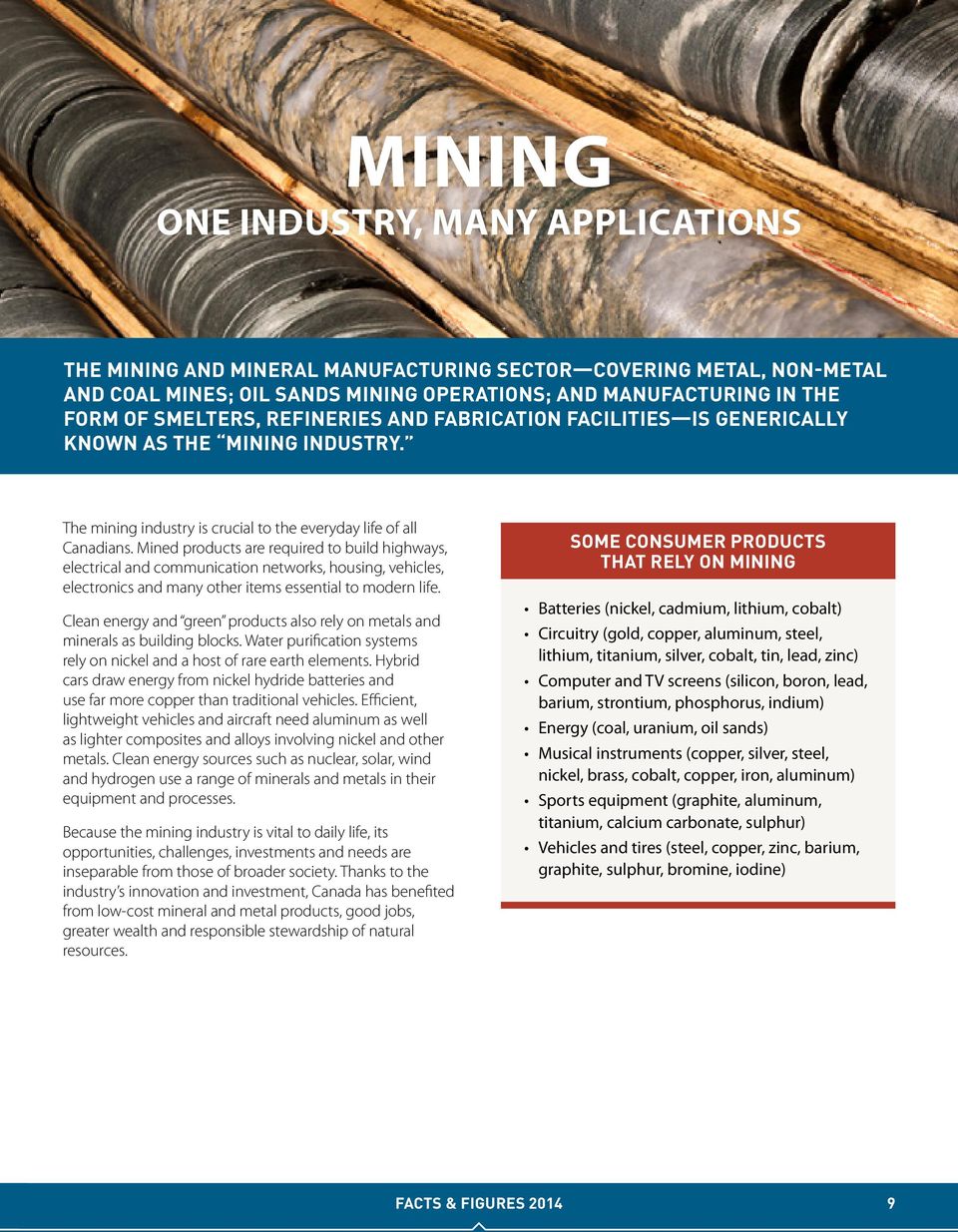
10 MINING ONE INDUSTRY, MANY APPLICATIONS THE MINING AND MINERAL MANUFACTURING SECTOR COVERING METAL, NON-METAL AND COAL MINES; OIL SANDS MINING OPERATIONS; AND MANUFACTURING IN THE FORM OF SMELTERS, REFINERIES AND FABRICATION FACILITIES IS GENERICALLY KNOWN AS THE MINING INDUSTRY. The mining industry is crucial to the everyday life of all Canadians. Mined products are required to build highways, electrical and communication networks, housing, vehicles, electronics and many other items essential to modern life. Clean energy and green products also rely on metals and minerals as building blocks. Water purification systems rely on nickel and a host of rare earth elements. Hybrid cars draw energy from nickel hydride batteries and use far more copper than traditional vehicles. Efficient, lightweight vehicles and aircraft need aluminum as well as lighter composites and alloys involving nickel and other metals. Clean energy sources such as nuclear, solar, wind and hydrogen use a range of minerals and metals in their equipment and processes. Because the mining industry is vital to daily life, its opportunities, challenges, investments and needs are inseparable from those of broader society. Thanks to the industry s innovation and investment, Canada has benefited from low-cost mineral and metal products, good jobs, greater wealth and responsible stewardship of natural resources. SOME CONSUMER PRODUCTS THAT RELY ON MINING Batteries (nickel, cadmium, lithium, cobalt) Circuitry (gold, copper, aluminum, steel, lithium, titanium, silver, cobalt, tin, lead, zinc) Computer and TV screens (silicon, boron, lead, barium, strontium, phosphorus, indium) Energy (coal, uranium, oil sands) Musical instruments (copper, silver, steel, nickel, brass, cobalt, copper, iron, aluminum) Sports equipment (graphite, aluminum, titanium, calcium carbonate, sulphur) Vehicles and tires (steel, copper, zinc, barium, graphite, sulphur, bromine, iodine) FACTS & FIGURES
11 SECTION 1 MINING AND THE CANADIAN ECONOMY Like our nation s economy, the Canadian mining industry is not immune to global economic trends. The profitability of companies depends in part on the performance of commodity prices, which are subject to market volatility and driven by global supply and demand. In turn, the extent to which mining companies contribute to the Canadian economy, be it through direct and indirect employment or taxes and royalties, depends on their ability to operate profitably. Economic forecasts help companies plan their business activities. GLOBAL ECONOMIC TRENDS The Bank of Canada downgraded its 2014 global economic growth forecast, from 3.3% in April to 2.9% in July, due to a widespread slowdown in economic activity, investment and trade in the first quarter. Looking forward, the Bank of Canada anticipates growth to rebound at 3.6% and 3.7%, respectively, for 2015 and 2016, which is consistent with earlier projections. Comparable trends are also forecast by the World Bank, while the International Monetary Fund (IMF) projects a rosier picture of global growth in 2014 at 3.4%. Some analysts interpret this as an indication that the global economy is transitioning towards a period of slower and more stable but uneven growth. EMERGING ECONOMIES Emerging market demand has continued to slide, but performance has been uneven across countries. From 2010 through 2013, GDP growth from the IMF s Emerging Market and Developing Economies has fallen significantly from 7.6% to 4.7%. Looking forward through 2014, Brazilian and Russian GDP growth is forecast to shrink to 1.3% and 0.2%, respectively, with Russia s forecast reduced significantly in light of recent sanctions. Meanwhile, China s growth, forecast to shrink consecutively through 2015, from 7.7% to 7.1%, remains strong despite settling; while India is forecast to grow from 5.0% to 6.4% over the same period. Notwithstanding mixed economic growth from economies in transition, mineral prices and the corresponding demand for many mining products have demonstrated staying power, despite volatility and downward pressure in some areas. Some mining executives have been outspoken over the continued strength of the commodity cycle, attributing volatility to oversupply and not to a softening of demand for mining products. This is largely due to the strength of China s growth and the fact that it accounts for approximately 45% of global base metal demand. China also shows comparable percentages for a host of other commodities. However, as their economic growth slows, emerging economies will become less able to pick up the slack in global economic growth resulting from underperforming advanced economies. Without broader economic revitalization in other leading countries and regions, the slower pace of global economic growth is likely to persist. PERFORMANCE OF ADVANCED ECONOMIES Uncertainty over the performance of several of the world s advanced economies continues, affecting the short-term global economic outlook. Concerns over the length of the recession in Europe, mixed views on the effectiveness of Japanese economic reforms, and uncertainty over the strength of the US economic recovery have contributed to weak market confidence and investor hesitancy. Modest indicators of incremental yet uneven economic improvement have continued year-over-year in the European Union. Eurostat the European Commission s statistics office reported growth of 0.3% and 0.2% for the first and second quarters of 2014 for the 28-country union. While still high, improvement was also seen in Europe s unemployment rate, dropping from 12.1% in June 2013 to 11.5% year-over-year. On both measures, however, large discrepancies exist across member states. For example, the 10 FACTS & FIGURES 2014

12 MINING AND THE CANADIAN ECONOMY lowest unemployment rates were recorded in Austria (5.0%), Germany (5.1%) and Malta (5.6 %), and the highest rates in Greece (27.3%) and Spain (24.5%). Despite challenges, the above trends are seen by some as important if small steps towards broader economic recovery and stability. Japan, the world s third-largest economy, revised its 2014 growth projections downward in July, from 1.4% to 1.2% in the fiscal year ending March As the country adopts globally booked record impairments of $57 billion in 2013, driving aggregate net profits down 72% to their lowest level in a decade. While net profits from emerging market companies were $24 billion in aggregate in 2013, companies headquartered in developed countries operated at an aggregate net loss of $4 billion. On the discovery side of the business, access to capital has been particularly challenging for junior mining companies. (See Section 3 of this report for more information.) Of the top 40 companies globally, eight are Canadian-listed companies, and 11 are members of the Mining Association of Canada. With a shift in focus, many mining companies are re-evaluating their stated positions on the development of new projects, both at home and abroad, and are adopting strategies to reduce costs and maximize cash flows. Despite these adjustments, and downward trends in certain commodities, the prices of many mined products remain above historical averages, enabling companies to operate profitably. Photo: Vale, Coleman Mine, Sudbury, Ontario Abenomics Japanese Prime Minister Shinzo Abe s policy mix of aggressive monetary easing, fiscal spending and structural reforms analysts remain uncertain as to the plan s likelihood for long-term success. While it has raised expectations for better times ahead, a ballooning debt of more than 200% of GDP, and serious demographic issues, means Japan s challenges remain significant. Meanwhile, economic performance in the United States remains turbulent. Recent political gridlock, the slowdown in inventory investment, and the expiration of fiscal measures have contributed to US projected growth being revised downward from 2.8% to 1.6% for The economy seems, however, to have bounced back from a dismal 2.1% decrease in first quarter GDP growth with a robust 4.2% increase in the second quarter. Recent reports of increased wages and business and consumer spending are held by some analysts to be cause for optimism. IMPACTS ON THE MINING INDUSTRY Given the market-driven nature of mineral and metal pricing, both global and Canadian mining industries are affected by ongoing global economic uncertainty. According to PwC, the 40 largest mining companies Looking forward, the Canadian mining industry s economic prospects will likely be strong over the medium and long term. The prevailing view is that the longer-term fundamentals are solid, and that the current period of heightened volatility will pass. As the middle classes of the world s most populous countries continue to emerge, and as their consumption patterns more closely resemble those of western industrialized countries, growth is likely to return. This opportunity cannot be taken for granted, however. Decisions regarding regulatory, tax and mineral policy made now will significantly affect Canada s readiness to capitalize and benefit from these opportunities when they arrive. MINING S CONTRIBUTION TO THE CANADIAN ECONOMY Mining contributes significantly to the Canadian economy. The wages and employment of approximately 383,000 people across the country, taxes and royalties collected by governments, and the capital expenditures required for project development and operation are only some examples of its contribution. Beyond its direct economic impact, the industry also supports many firms and sectors that supply mining with the goods and services it needs to function. CONTRIBUTION TO CANADA S GDP Historically, the value of minerals and metals to Canada s economy has ranged between 2.7% and 4.5% of the country s GDP. In 2013, the industry s contribution remained within this range at 3.4%. FACTS & FIGURES
13 MINING AND THE CANADIAN ECONOMY 2013 CONTRIBUTION The extractive industry, which combines mineral extraction with oil and gas extraction, contributed $113.5 billion, or nearly 7.2%, to Canada s GDP in 2013 (see Figure 1). By this measure, the extractive industry is the fourth largest of Canada s 18 industries, surpassed only by the services, real estate and manufacturing sectors, which rank first, second and third, respectively. The mining industry as a whole goes beyond extraction to include mineral manufacturing. The mining industry s 2013 contribution to GDP is detailed in Figure 2, which divides industry activity into four stages: Stage 1, extraction of minerals (metals, non-metals and coal): $22 billion Stage 2, primary metal manufacturing (smelting, refining, rolling, extruding, alloying and casting of primary metals): $14.2 billion Stage 3, non-metallic mineral product manufacturing (abrasives, lime, cement, glass, ceramics): $5.2 billion Stage 4, fabricated metal product manufacturing (forging, stamping and heat-treating to produce reinforcing bars, fabricated wire, cutlery, tools, hardware): $12.6 billion CANADIAN MINES IN 2013 Total mining establishments: 1,262 Metals: 75 Non-metals: 1,187 PROVINCES WITH THE MOST METAL MINES Quebec: 24 Ontario: 19 British Columbia: 9 MAIN TYPES OF NON-METAL MINES Sand and gravel quarries: 793 Stone quarries: 275 Peat mines: 73 MINING IN THE PROVINCES AND TERRITORIES Mineral production values were down in nine of Canada s 13 provinces and territories. For example, the 2013 value of mineral production in Saskatchewan was $7.2 billion. Although a decrease of approximately $1 billion over 2011, this value represents a threefold increase over the last decade, indicating significant growth over time, despite year-over-year fluctuations. Similar growth over the last decade was experienced by Ontario, Saskatchewan, British Columbia, Quebec and Newfoundland and Labrador. Photo: Shell Albian Sands, Muskeg River Mine, Alberta The output of these four stages in 2013 totalled $54 billion. By comparison, according to Statistics Canada, the oil and gas extraction sector contributed $91.5 billion to the GDP. The Canadian Association of Petroleum Producers indicated that on a barrel-per-day basis, approximately 54% of oil extracted in 2013 was from oil sands, the extractive process for which is essentially a surface mining operation at many sites. Support activities for mining and oil and gas contribute an additional $11 billion to the GDP. REGIONAL DISTRIBUTION OF MINING Figure 3 illustrates the geographical location of Canada s mining expertise (details in Annex 1). The Northwest Territories is the country s dominant source of diamonds. Leading in the production of gold are Ontario and Quebec. Saskatchewan produces all of Canada s uranium, and has world-class potash reserves. British Columbia is prominent in metallurgical coal production. Newfoundland and Labrador and Quebec produce virtually all of Canada s iron ore. Several provinces have strong copper and nickel production. (For detailed mineral production by province and territory, see Annex 2 and Annex 3.) Mining also has significant ties to Canada s major cities. Some of the largest Canadian and international mining companies are headquartered or have significant presence in urban centres such as Vancouver (Goldcorp, Teck), Saskatoon (Cameco, PotashCorp), Toronto (Barrick, Vale, Glencore) and Montreal (ArcelorMittal, Iron Ore Company of Canada, Rio Tinto Alcan). 12 FACTS & FIGURES 2014

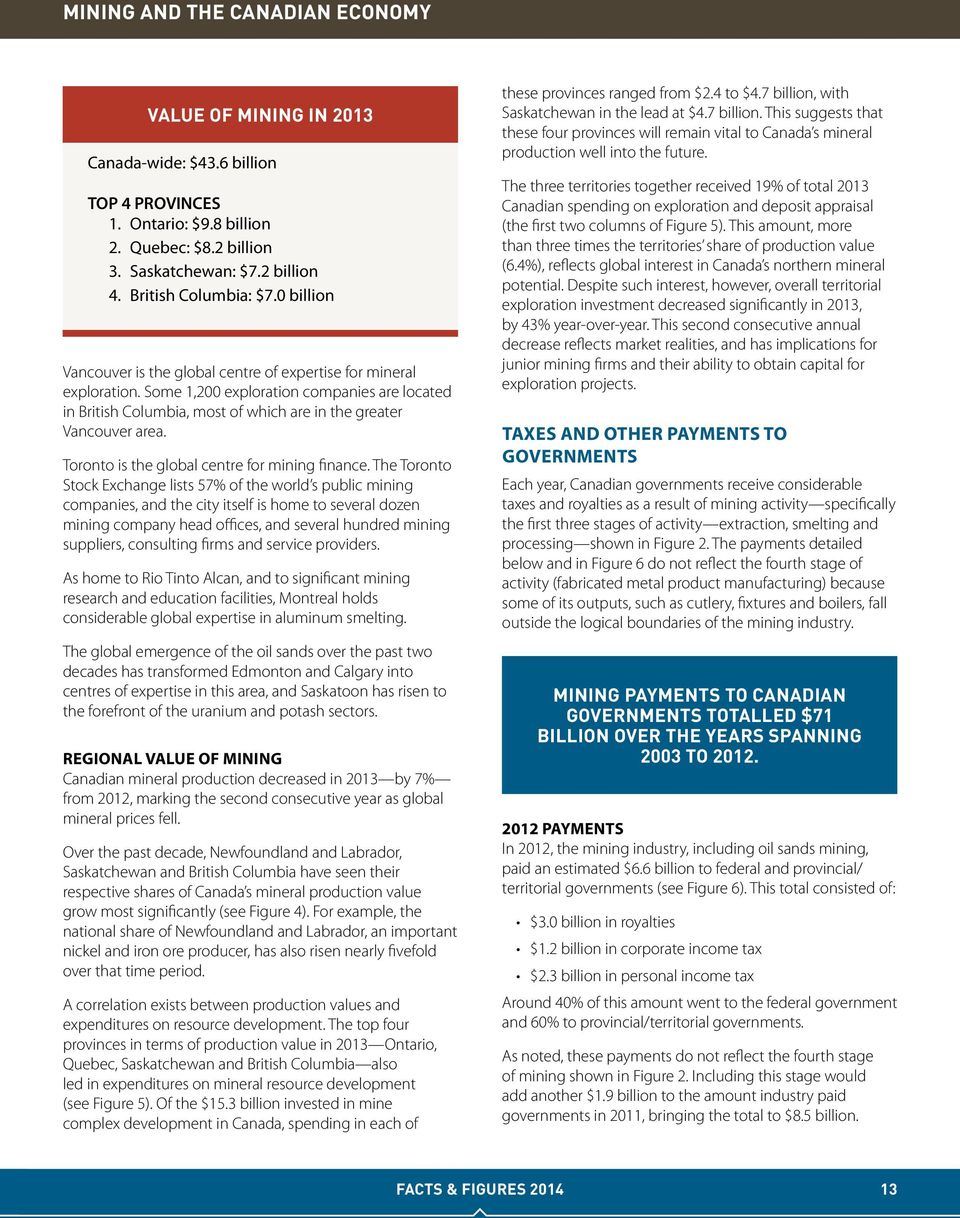
14 MINING AND THE CANADIAN ECONOMY VALUE OF MINING IN 2013 Canada-wide: $43.6 billion TOP 4 PROVINCES 1. Ontario: $9.8 billion 2. Quebec: $8.2 billion 3. Saskatchewan: $7.2 billion 4. British Columbia: $7.0 billion Vancouver is the global centre of expertise for mineral exploration. Some 1,200 exploration companies are located in British Columbia, most of which are in the greater Vancouver area. Toronto is the global centre for mining finance. The Toronto Stock Exchange lists 57% of the world s public mining companies, and the city itself is home to several dozen mining company head offices, and several hundred mining suppliers, consulting firms and service providers. As home to Rio Tinto Alcan, and to significant mining research and education facilities, Montreal holds considerable global expertise in aluminum smelting. The global emergence of the oil sands over the past two decades has transformed Edmonton and Calgary into centres of expertise in this area, and Saskatoon has risen to the forefront of the uranium and potash sectors. REGIONAL VALUE OF MINING Canadian mineral production decreased in 2013 by 7% from 2012, marking the second consecutive year as global mineral prices fell. Over the past decade, Newfoundland and Labrador, Saskatchewan and British Columbia have seen their respective shares of Canada s mineral production value grow most significantly (see Figure 4). For example, the national share of Newfoundland and Labrador, an important nickel and iron ore producer, has also risen nearly fivefold over that time period. A correlation exists between production values and expenditures on resource development. The top four provinces in terms of production value in 2013 Ontario, Quebec, Saskatchewan and British Columbia also led in expenditures on mineral resource development (see Figure 5). Of the $15.3 billion invested in mine complex development in Canada, spending in each of these provinces ranged from $2.4 to $4.7 billion, with Saskatchewan in the lead at $4.7 billion. This suggests that these four provinces will remain vital to Canada s mineral production well into the future. The three territories together received 19% of total 2013 Canadian spending on exploration and deposit appraisal (the first two columns of Figure 5). This amount, more than three times the territories share of production value (6.4%), reflects global interest in Canada s northern mineral potential. Despite such interest, however, overall territorial exploration investment decreased significantly in 2013, by 43% year-over-year. This second consecutive annual decrease reflects market realities, and has implications for junior mining firms and their ability to obtain capital for exploration projects. TAXES AND OTHER PAYMENTS TO GOVERNMENTS Each year, Canadian governments receive considerable taxes and royalties as a result of mining activity specifically the first three stages of activity extraction, smelting and processing shown in Figure 2. The payments detailed below and in Figure 6 do not reflect the fourth stage of activity (fabricated metal product manufacturing) because some of its outputs, such as cutlery, fixtures and boilers, fall outside the logical boundaries of the mining industry. MINING PAYMENTS TO CANADIAN GOVERNMENTS TOTALLED $71 BILLION OVER THE YEARS SPANNING 2003 TO PAYMENTS In 2012, the mining industry, including oil sands mining, paid an estimated $6.6 billion to federal and provincial/ territorial governments (see Figure 6). This total consisted of: $3.0 billion in royalties $1.2 billion in corporate income tax $2.3 billion in personal income tax Around 40% of this amount went to the federal government and 60% to provincial/territorial governments. As noted, these payments do not reflect the fourth stage of mining shown in Figure 2. Including this stage would add another $1.9 billion to the amount industry paid governments in 2011, bringing the total to $8.5 billion. FACTS & FIGURES
15 MINING AND THE CANADIAN ECONOMY It is also worth noting that the oil sands industry pays the Alberta government large sums, as high as $2 billion in some years, in the form of land sales payments. These sums are not included in Figure 6. Finally, these payments do not include the significant revenues that governments receive from mining suppliers. By some estimates, adding these suppliers would multiply payments by as much as 2.5. in Alberta as a result of the growing price discount on bitumen. (See Section 2 of this report for more discussion.) Another factor affecting payments to governments from oil sands mining has been the increased spending on new and expanded oil sands projects. Company investments generally reduce corporate income taxes and provincial royalties when capital deductions and allowances are claimed. The Canadian Association of Petroleum Producers estimated that overall spending on oil sands mining projects increased by more than 30% in 2012 to a total of almost $11 billion. While these expenditures will eventually generate additional revenues and additional payments to both levels of governments in future years, they can reduce payments in the near term. British Columbia, Quebec and Ontario also experienced large percentage reductions in mining and royalty payments. Photo: IAMGOLD, Westwood Mine, Quebec PAYMENT TRENDS Total mineral sector payments to governments peaked in 2008, reaching $10.5 billion. This was 2.6 times the level in In 2009, the situation changed dramatically. As a result of the US financial crisis, and reduced metals, oil and potash prices, revenues to governments plummeted by more than one-half, to $4.9 billion. Total payments to governments recovered to $7.5 billion in 2010 and continued to increase to more than $8.3 billion in The primary reasons for the increase in 2011 were economic. Buoyed by generally higher metals prices and increased production, the value of non-oil sands mineral production rose about 21% in Corporate pre-tax profits correspondingly increased about 24%. This recovery trend was broken in Overall payments to governments fell by 20.7%, or $1.7 billion, from $8.3 billion in 2011 to $6.6 billion in Most of the loss in corporate income tax revenue appears to be concentrated in the extractive components of the sector: mining and quarrying and oil sands mining. Royalties and mining taxes were lower by 21%, or $820 million. About half of the decrease occurred INDIRECT CONTRIBUTIONS TO MINING INDUSTRY SUPPLIERS The mining industry s economic impact goes far beyond its direct contribution to GDP. For instance, mining accounts for approximately half of Canada s rail-freight revenues and tonnage annually (details in Section 2). Organizations such as CN Rail, CP Rail, and the Ports of Montreal, Quebec and Vancouver depend on a vibrant mining industry. Supply relationships like these create mutual synergies. For instance, supplier companies play a crucial role in introducing and spreading innovative technologies and ideas within the mining industry. InfoMine, a mining database, reported in 2013 that more than 3,400 firms in Canada provide technical, legal, financial, accounting, environmental and other expertise to the mining industry. Most of these suppliers are located in Ontario and British Columbia, followed by Alberta, Quebec, Saskatchewan and Manitoba. NUMBER OF MINING SUPPLIERS IN LEADING COUNTRIES United States: 5,504 Canada: 3,464 Brazil: 3,375 Australia: 2,364 Chile: 1,853 Source: InfoMine 14 FACTS & FIGURES 2014

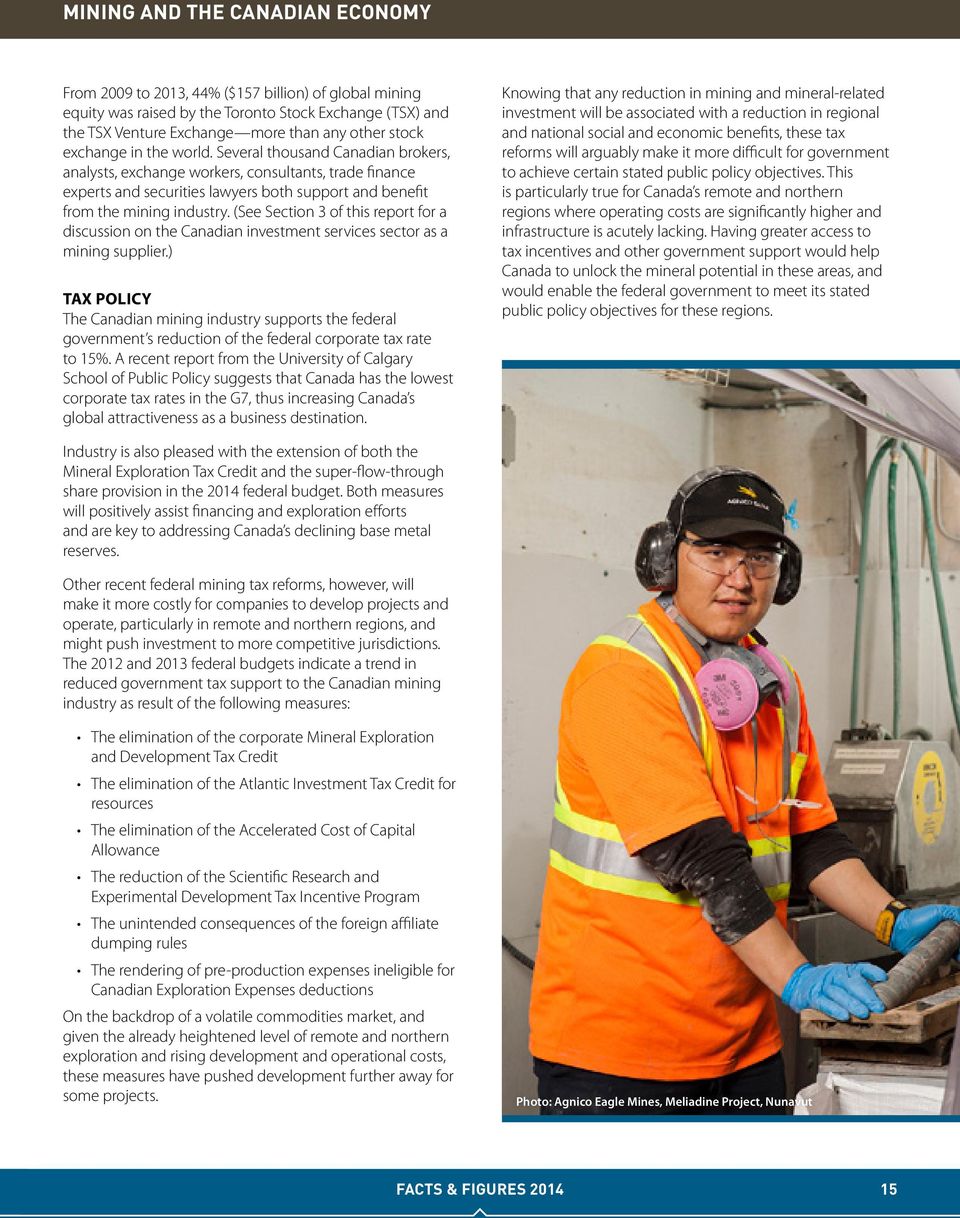
16 MINING AND THE CANADIAN ECONOMY From 2009 to 2013, 44% ($157 billion) of global mining equity was raised by the Toronto Stock Exchange (TSX) and the TSX Venture Exchange more than any other stock exchange in the world. Several thousand Canadian brokers, analysts, exchange workers, consultants, trade finance experts and securities lawyers both support and benefit from the mining industry. (See Section 3 of this report for a discussion on the Canadian investment services sector as a mining supplier.) TAX POLICY The Canadian mining industry supports the federal government s reduction of the federal corporate tax rate to 15%. A recent report from the University of Calgary School of Public Policy suggests that Canada has the lowest corporate tax rates in the G7, thus increasing Canada s global attractiveness as a business destination. Knowing that any reduction in mining and mineral-related investment will be associated with a reduction in regional and national social and economic benefits, these tax reforms will arguably make it more difficult for government to achieve certain stated public policy objectives. This is particularly true for Canada s remote and northern regions where operating costs are significantly higher and infrastructure is acutely lacking. Having greater access to tax incentives and other government support would help Canada to unlock the mineral potential in these areas, and would enable the federal government to meet its stated public policy objectives for these regions. Industry is also pleased with the extension of both the Mineral Exploration Tax Credit and the super-flow-through share provision in the 2014 federal budget. Both measures will positively assist financing and exploration efforts and are key to addressing Canada s declining base metal reserves. Other recent federal mining tax reforms, however, will make it more costly for companies to develop projects and operate, particularly in remote and northern regions, and might push investment to more competitive jurisdictions. The 2012 and 2013 federal budgets indicate a trend in reduced government tax support to the Canadian mining industry as result of the following measures: The elimination of the corporate Mineral Exploration and Development Tax Credit The elimination of the Atlantic Investment Tax Credit for resources The elimination of the Accelerated Cost of Capital Allowance The reduction of the Scientific Research and Experimental Development Tax Incentive Program The unintended consequences of the foreign affiliate dumping rules The rendering of pre-production expenses ineligible for Canadian Exploration Expenses deductions On the backdrop of a volatile commodities market, and given the already heightened level of remote and northern exploration and rising development and operational costs, these measures have pushed development further away for some projects. Photo: Agnico Eagle Mines, Meliadine Project, Nunavut FACTS & FIGURES
17 FIGURE 1 CANADA S REAL GROSS DOMESTIC PRODUCT BY INDUSTRY, ($ millions) All industries 1,480,703 1,436,282 1,483,155 1,523,730 1,551,539 1,582,178 Agriculture 19,954 18,927 18,730 19,241 19,385 21,856 Forestry and logging 3,950 3,124 3,608 3,844 3,773 3,935 Fishing, hunting and trapping 1,087 1,066 1,131 1,060 1,128 1,095 Mining (including milling) and quarrying, 108,856 99, , , , ,566 and oil and gas extraction Support activities for mining 11,487 8,361 10,328 12,147 11,062 10,962 and oil and gas extraction Electric power, gas and water utilities 37,064 35,999 36,851 37,813 37,947 39,407 Construction 98,958 95, , , , ,322 Manufacturing 176, , , , , ,138 Trade, wholesale 79,124 74,028 79,555 83,738 84,987 86,380 Trade, retail 80,415 78,503 81,032 82,744 84,282 86,884 Transportation and warehousing 62,560 59,693 61,990 63,880 65,220 66,047 Information and cultural industries 49,325 49,352 50,351 51,272 52,020 52,524 Finance and insurance 97,211 95,881 98,394 99, , ,858 Real estate and rental and leasing 172, , , , , ,401 Community, business and personal services 203, , , , , ,620 Public administration 99, , , , , ,094 Health care and social assistance 99, , , , , ,392 Educational services 78,000 79,491 81,265 81,894 83,130 84,697 Source: Statistics Canada. Note: Values at basic prices in 2007 constant dollars. In all figures, dollar amounts are expressed in Canadian dollars unless noted otherwise. 16 FACTS & FIGURES 2014

18 FIGURE 2 REAL GROSS DOMESTIC PRODUCT, MINING AND MINERAL MANUFACTURING, ($ millions) Metal mines 16,999 13,187 13,876 15,377 14,925 15,817 Non-metal mines 5,036 3,473 4,477 4,678 4,326 4,490 Coal mines 1,704 1,432 1,627 1,590 1,617 1,716 Total Mining 23,739 18,092 19,980 21,645 20,868 22,023 Primary metal manufacturing 15,096 11,433 13,266 13,741 13,834 14,185 Fabricated metal product manufacturing 13,084 11,182 11,611 12,504 13,106 12,625 Non-metallic mineral product manufacturing 6,206 5,150 5,275 5,442 5,406 5,193 Total Mineral Manufacturing 34,386 27,765 30,152 31,687 32,346 32,003 Oil and gas extraction 85,117 81,448 83,604 86,222 88,345 91,543 Petroleum and coal products manufacturing 6,994 7,410 6,955 6,685 6,845 6,862 Support activities for mining and oil & gas 11,487 8,361 10,328 12,147 11,062 10,962 Total Oil & Gas and 103,598 97, , , , ,367 Associated Manufacturing Source: Statistics Canada. Note: Values at Basic Prices in 2007 Constant Dollars. FACTS & FIGURES

19 FIGURE 3 CANADIAN MINING INDUSTRY CLUSTERS Yellowknife (diamonds) NWT (tungsten) Yukon (copper, gold, silver) Fort McMurray (oil sand, allied industries) Athabasca (uranium) Flin Flon (gold, copper, zinc) Nunavut (gold) Thompson (nickel, cobalt) Raglan (nickel, copper) Rouyn-Noranda (copper, allied industries) Val-d Or (gold, copper, zinc, allied industries) Attawapiskat (diamonds) Happy Valley/Goose Bay (copper, nickel) Kitimat (aluminum) Kamloops (copper, gold, molybdenum) Vancouver (allied industries, junior exploration / mine financing) Trail (lead, zinc) Elk Valley (steelmaking coal) Fort Saskatchewan (nickel) Saskatoon / Esterhazy (potash, salt) Red Lake / Hemlo (gold) Timmins (zinc, copper, lead, gold) Sudbury (nickel, copper, cobalt, gold, pgm, allied industries) Toronto (allied industries, senior exploration / mine financing) Montréal (allied industries, head offices,research) Labrador City / Sept-Îles (iron, aluminum) Saguenay (aluminum, niobium) Windsor (gypsum) Grand Falls-Windsor (copper, zinc) Bathurst (zinc, lead) Thetford Mines (chrysolite) Bécancour (aluminum, magnesium) Source: Natural Resources Canada Source: Natural Resources Canada. 18 FACTS & FIGURES 2014

20 FIGURE 4 VALUE OF CANADIAN MINERAL PRODUCTION BY PROVINCE AND TERRITORY, 2003 AND p Province/Territory ($ millions) (%) Rank ($ millions) (%) Rank Ontario 5, , Quebec 3, , Saskatchewan 2, , British Columbia 2, , Newfoundland and Labrador , Alberta 1, , Northwest Territories 1, , Manitoba , New Brunswick Nunavut Yukon Nova Scotia Prince Edward Island Total Canada 20, , Sources: Natural Resources Canada; Statistics Canada. p Preliminary;... Amount too small to be expressed. Note: This table includes the production of coal but excludes the production of petroleum and natural gas. Numbers may not add to totals due to rounding. FACTS & FIGURES

21 FIGURE 5 TOTAL CAPITAL EXPENDITURES FOR MINERAL RESOURCE DEVELOPMENT, BY PROVINCE AND TERRITORY, 2013 P Province/Territory / ($) Exploration Deposit Appraisal Mine Complex Development Total Expenditures Newfoundland and Labrador 44,810,996 59,150, ,437, ,398,958 Nova Scotia 7,951,185 4,009,000 10,240,019 22,200,204 New Brunswick 19,708,547 8,652, ,119, ,480,253 Quebec 192,345, ,565,053 2,379,545,614 2,707,455,969 Ontario 308,958, ,234,720 1,800,822,431 2,401,015,639 Manitoba 57,199, , ,833, ,519,399 Saskatchewan 147,767,254 63,723,806 4,453,730,509 4,665,221,569 Alberta 6,582,652 13,636, ,930, ,150,110 British Columbia 163,847, ,226,239 1,947,031,573 2,447,105,543 Yukon 67,189,591 22,710,845 89,923, ,823,912 Northwest Territories 30,067,663 59,919, ,444, ,431,430 Nunavut 158,999, ,222, ,573, ,794,462 CANADA 1,205,428,123 1,106,536,606 12,977,632,719 15,289,597,448 Source: Natural Resources Canada, based on the Federal-Provincial-Territorial Survey of Mineral Exploration, Deposit Appraisal and Mine Complex Development Expenditures. p Preliminary. Note: Includes on-mine-site and off-mine-site activities. Includes field work, overhead costs, engineering, economic, pre-feasibility, feasibility, and environmental studies, and land access costs. Expenditures for mine complex development include machinery and equipment and non-residential construction. 20 FACTS & FIGURES 2014
22 FIGURE 6 DIRECT REVENUES TO CANADIAN GOVERNMENTS FROM THE MINERAL SECTOR, Revenues ($ millions) Total Royalties/Mining Taxes 586 1,336 1,576 2,640 3,967 5,279 2,187 3,176 3,880 3,060 27,687 Corporate Income Tax 1,773 1,943 2,393 4,005 4,213 3,204 1,083 2,408 2,437 1,244 24,702 Personal Income Tax 1,732 1,732 1,731 1,784 1,970 2,047 1,687 1,861 1,987 2,277 18,808 TOTAL 4,090 5,011 5,700 8,429 10,150 10,529 4,957 7,445 8,304 6,581 71,197 -of which federal 2,609 2,760 2,799 3,707 4,005 3,547 1,905 2,963 3,045 2,471 29,811 -of which provincial 1,481 2,251 2,901 4,722 6,145 6,982 3,052 4,482 5,259 4,110 41,385 Provincial share (%) Source: ENTRANS Policy Research Group study for the Mining Association of Canada. Note: Most royalty estimates are provided on a fiscal year basis, while the estimates for corporate and personal income taxes are for calendar (taxation) years. The federal share includes federal corporate income and capital taxes, federal personal income taxes paid by mining employees and mining royalties generated in the Northwest Territories and Nunavut. The provincial share includes all royalties and mining taxes to provinces and to the Yukon, provincial corporate income and provincial personal income taxes paid by mining employees. FACTS & FIGURES
23 SECTION 2 THE ACTIVITIES PRODUCTION, PROCESSING AND TRANSPORTATION CANADA S STRENGTH IN MINING RESTS ON THE ABILITY TO PRODUCE AND PROCESS MINERALS COMPETITIVELY AND TO TRANSPORT PRODUCTS EFFICIENTLY TO DOMESTIC AND INTERNATIONAL MARKETS. THESE PRODUCTION, PROCESSING AND TRANSPORTATION ACTIVITIES FORM THE BASE THAT ALLOWS THE INDUSTRY TO STAY GLOBALLY COMPETITIVE AND EXPAND ITS CANADIAN INVESTMENTS. PRODUCTION OF KEY MINERALS Richly endowed with natural resources, Canada ranks among the top five countries in the global production of 11 major minerals and metals (details in Annex 4): First in potash Second in uranium and cobalt Third in aluminum and tungsten Fourth in platinum group metals, sulphur and titanium Fifth in nickel and diamonds Canada no longer holds a top five position in the production of gold, silver, zinc, copper, molybdenum, or cadmium, having been surpassed by other countries, including Australia, Russia, the United States, China, Mexico and Peru. However, for these and other major minerals and metals, Canada still remains in the top 10 countries in global production. PRODUCTION VALUES In 2013, the value of Canadian mineral production retreated for the second consecutive year, down from its record high of $50.9 billion in 2011, and decreasing by 5% to $43.6 billion year-over-year (see Figure 7). Metal, non-metal and coal production values all dropped by 1.7%, 4.2% and 22%, respectively. At $23.2 billion and $15.8 billion for metal and non-metal production, respectively, the 2013 totals mark a two-fold increase over the past decade. Canada s top 10 minerals and metals (see Figure 8) each had production values of more than $1.4 billion in 2013, with five (potash, coal, gold, iron ore and copper) over $4 billion. Values for all 10 commodities fell year-over-year, with potash, copper, coal, nickel and diamonds falling for the third consecutive year. This trend suggests a recent drop in demand for both industrial and non-industrial mineral products, or a global supply glut for certain commodities that is pushing prices down, or some combination of the two (details in Annex 5). Together, the top 10 minerals and metals represent $37 billion a $2 billion dollar decrease year-over-year and 85% of Canada s total mineral production value in The following paragraphs discuss market developments surrounding a few key minerals. CANADIAN MINERAL PRODUCTION IN 2013 Metals: $23.2 billion Non-metals: $15.8 billion Coal: $4.6 billion TOTAL: $46.9 billion URANIUM In September 2014, Japan s Nuclear Regulation Authority (NRA) gave the go-ahead for two reactors at the Sendai plant in southern Japan to resume operation. These 22 FACTS & FIGURES 2014
24 THE ACTIVITIES: PRODUCTION, PROCESSING AND TRANSPORTATION reactors along with the majority of Japan s other 46 nuclear reactors have been idle since the 2011 earthquake and tsunami. This catastrophic event damaged the Fukushima Daiichi nuclear plant and resulted in a meltdown. The extent to which the NRA s decision signals a softening in Japanese anti-nuclear sentiment remains uncertain. However, the NRA s green light to the Sendai plant indicates the country is taking steps to resume nuclear power generation. Kyushu, the operator of the two Sendai reactors, is required to gain the consent of local communities before the restart can begin. This consultation process, likely to be required for the future restarts of all other Japanese reactors, will provide a better picture of how willing the Japanese are to re-embrace nuclear power generation. Following the Fukushima incident, global sentiment about nuclear energy shifted, with several countries indicating their intentions to phase out nuclear power generation. Despite these policy shifts in some countries, others continue to pursue the expansion of their nuclear power generating capacity. As of August 2014, 29 countries were safely operating 435 nuclear power reactors, while 14 countries were constructing an additional 72 new nuclear plants, of which 29 are in China and 10 are in Russia. Some analysts have suggested that 260 new reactors could be built worldwide by This trend is reinforced by concern over air pollution, the carbon friendly nature of nuclear power, and concerns over energy security. The New Policies Scenario, in the OECD s World Energy Outlook 2013, forecasts a 66% increase in global nuclear power generation contribution from 2011 to 2035, with the nuclear share of global electricity supply holding steady at 12%. This indicates that nuclear energy is forecast to grow consistently with overall demand for electricity. The largest gross capacity additions are in China, where the country is forecast to add 114 GWe (gigawatt electrical) during the projection period. This increase represents 38% of global new nuclear capacity and signals a steadily growing demand for uranium in the years to come. Canada, notably Saskatchewan, is a major player in the world uranium industry. Cameco s McArthur River mine in northern Saskatchewan is the world s largest and highestgrade uranium deposit, with an average ore grade of 21% and annual production of around 8,200 tonnes of uranium oxide. A positive outlook in world uranium demand bodes well for Canada s prominence in this mining sector. Recent bi-lateral trade agreements, including the Canada-India Nuclear Cooperation Agreement, and the Canada-European Union Comprehensive Economic and Trade Agreement (CETA) will open new markets in Canada and abroad for uranium miners. CETA, if ratified, would see the elimination of trade regulations on European companies that restrict foreign ownership in any Canadian uranium project from exceeding 49%. (See Section 6 of this report for more discussion.) OIL SANDS The development of the western Canadian oil sands is one of the world s biggest economic stories in recent decades. Technological advances, combined with elevated crude oil prices, made the oil sands economically viable to develop, boosting production from 100,000 barrels a day in 1980 to over 1.9 million barrels a day in Canada has the third-largest oil reserves in the world, and 97% (168 billion barrels) of Canada s reserves (173 billion barrels) are in the oil sands. The majority (81%) of world oil reserves are owned or controlled by national governments. OIL SANDS PROJECTIONS Alberta s deposits are believed to contain two trillion barrels of bitumen up to four times more than the conventional oil reserves in Saudi Arabia. With current technologies, that would yield 315 billion barrels of synthetic crude. Alberta ranks third, after Venezuela and Saudi Arabia, in terms of proven global crude oil reserves. Twenty percent of oil sands reserves are close enough to the surface to be mined (above 70 metres or 200 feet). Oil sands investment will generate $2.1 trillion in economic activity across Canada over the next 25 years (2010 to 2035). Alberta s oil sands production is projected to increase from some 1.9 million barrels a day in 2012 to 4.8 million barrels a day in New oil sands investment is expected to grow employment from 75,000 jobs in 2010 to 905,000 in For each oil sands-related job created in Alberta, approximately one indirect job and one induced job will be created in the rest of Canada. FACTS & FIGURES
25 THE ACTIVITIES: PRODUCTION, PROCESSING AND TRANSPORTATION Only 20% of total world oil reserves are accessible for private sector investment, 56% of which are found in Canada s oil sands. Given this ratio, foreign direct investment in this sector has been increasing and foreign interest is anticipated to continue in the coming years. According to a recent IHS report, jobs from the oil sands are expected to grow by 58% from 2014 through 2025, representing a total of 753,000 jobs. The contribution of the oil sands to the Canadian GDP is expected to nearly double to $171 billion in 2025, and is comparable to adding an economy the size of Saskatchewan s to Canada. This represents an increase of more than 100% in government revenues from the total effect of oil sands investment in Canada: from $28 billion in 2012 to $61 billion in Synthetic crude oil accounted for nearly 27% of Canada s crude oil production volume (32% by value) in 2013, up from 10% a decade earlier (see Figure 9). The absolute value of this increase is considerable: from $6.7 billion in 2003 to $32.5 billion in Currently, all of this crude oil production is in Alberta, though reserves in Saskatchewan have attracted interest in recent years with the issue of special exploratory permits for provincial Crown land. POTASH Potash plays a central role in helping feed the world s growing population, as approximately 95% of world potash production is used as fertilizer. According to the Food and Agriculture Organization of the United Nations, agricultural production needs to increase by 60% by 2050 to meet the rising demand for food. This rising food demand is linked to projections of global population reaching 9.6 billion by 2050, according to a recent UN study. These trends indicate that fertilizer made from potash will play an even greater role in increasing crop yields to meet this demand. Since Russia s Uralkali quit the Belarusian Potash partnership in July 2013, uncertainty in the global trade of potash has increased, causing speculation about what market impacts may result. Recent reports suggest that Uralkali, the world s biggest potash producer, will continue prioritizing volumes over price. Uralkali CEO, Dmitry Osipov, is reported to see no urgent need to re-enter the trading partnership with rival Belaruskali, the breaking of which led to an oversupplied market that pushed prices down. At the time of writing, year-over-year monthly average prices had dropped over $100 per tonne, from $393 per tonne to $287 per tonne for the month of August With 10 world-class potash mines in production, Saskatchewan is the world s second largest producer and exporter of the product. Saskatchewan s position as a world leader will likely be reinforced by the emergence of BHP Billiton as a major player in the province, which is moving into the second of a three-year commitment to invest US$2.6 billion to develop the Jansen Potash Project. Analysts estimate that after $3.8 billion is spent by the end of 2016, another $10 to $11 billion will be required for construction. Robust mining investments such as this contribute significantly to the local, provincial and national economies. PROCESSING OF MINERALS Canada has a large mineral-processing industry, with 30 non-ferrous metal smelters, refineries and conversion facilities in six provinces (see Figure 10). Some of these facilities contain both a smelter and a refinery. CANADA S MINERAL-PROCESSING FACILITIES New Brunswick: 1 smelter Quebec: 10 smelters, 3 refineries, 1 refinery/ secondary smelter Ontario: 2 secondary smelters, 3 refineries, 2 smelter/refineries, 1 smelter/processor, 1 conversion facility Manitoba: 1 smelter/refinery Alberta: 1 refinery British Columbia: 1 smelter, 1 secondary smelter, 1 smelter/refinery, 1 processing plant Canada s integrated smelters and refineries were built in proximity to world-class mines, located inland, without access to low-cost marine transport. As local ore reserves increasingly become depleted (discussed in Section 3) and the production of base metal concentrate declines, smelters and refineries are transitioning from integrated production to the more expensive custom treatment of concentrates imported from other countries. Additionally, they are also using more secondary raw materials and scrap feed. The quantity and value of refined metal production in Canada have become irregular due to the depletion of reserves and greater dependence on imported concentrates. Figure 11 shows the production volumes for refined metals over the past 10 years: lead has held steady; aluminum has increased; and copper, nickel, cobalt, cadmium and zinc have decreased. 24 FACTS & FIGURES 2014
26 THE ACTIVITIES: PRODUCTION, PROCESSING AND TRANSPORTATION The competitiveness of Canada s mineral-processing industry depends largely on the ability to secure reliable sources of feedstock from domestic mines a supply that, in recent years, has gone into decline. Importing feedstock from abroad greatly influences the cost and profitability of domestic refining and smelting operations. If the industry is to remain competitive, enhancing domestic levels of mineral production through requisite investment in exploration is essential. Other factors influence the competitiveness of Canada s mineral-processing industry. Canada s processing facilities operate in a global arena, where China and other countries are expanding their capacity and competing fiercely for raw materials. The cost of electricity is also a factor in some Canadian jurisdictions. Given the energy-intensive nature of these value-added processes, high-cost power jurisdictions dampen the competitiveness of existing operations and can deter future investment. Finally, the age of some Canadian operations, and their ability to meet potential regulatory requirements, also affects viability. In the face of these combined factors, the downstream Canadian mining industry risks being left behind unless strategic actions are taken to ensure its longevity. TRANSPORTATION OF MINING PRODUCTS Canada s logistics supply chain is critical to the flow of mined and refined products to both domestic and international markets. The mining industry is the largest industrial customer group of Canada s transportation sector, providing it with considerable tonnage, especially in select bulk commodities such as iron ore, coal, potash and sulphur. The fallout of the Lac-Mégantic disaster has been a watershed in rail management and regulation. The response to the derailment has resulted in additional restrictions on the transportation of dangerous goods, which affect both railways and shippers. Additionally, Transport Canada, the Canadian Transportation Agency and the House of Commons Standing Committee on Transportation, Infrastructure and Communities have undertaken policy, regulatory and legislative reviews and consultations on the adequacy of Canada s third-party liability and dangerous goods regimes. The mining industry recognizes that it has a role to play in ensuring the accurate classification and stewardship of its products. The industry and MAC members, notably through commitments made in the Towards Sustainable Mining initiative, invest considerably in emergency response, crisis management and material stewardship. The industry has responsibilities beyond classification, however. Mining companies are responsible for ensuring mineral products are securely loaded on rail cars while the cars are in their custody. This requires companies to undertake appropriate loading procedures to ensure the cargoes are safe for transit when a railway takes over the care, custody and control of the cars for transport. TOP COMMODITIES CARRIED BY CANADIAN RAIL IN 2013 (BY VOLUME) 1. Minerals and metals: 46% 2. Grain: 11% 3. Forest products: 10% 4. Chemicals: 6% Source: Transport Canada, Transportation in Canada: An Overview (2013). The Canadian mining industry prides itself on its safety culture, and has participated in the reviews and consultations mentioned above. While consultations remain ongoing at the time of writing, MAC has advocated for a fact-based and historical analysis to ensure that any reforms undertaken are proportional to risk. RAIL As the largest shipper by both freight revenue and volume shipped, the mining industry is the Canadian rail system s most significant customer. In 2013, shipments of coal, iron ore and other minerals and metals represented 52% of total Canadian rail freight revenue (see Figure 12). In terms of volume, the mining industry accounted for 46% of total tonnage moved in 2013, which is the largest single volume share of all industries that ship by rail. Canada s rail freight system operates primarily as a dual monopoly, shared by CN and CP Canada s only Class I railways. Communities and businesses are often served by only one of these companies, which gives rail customers little competitive choice. Mining operations are frequently captive to only one railway given the remoteness of their locations. In 2008, the Canada Transportation Act was amended to better protect shippers from potential abuse of market power by railways. The changes, supported by MAC and the Canadian mining industry, improved the balance between rail customers interests (lower rates, better service) with those of rail companies (higher rates, more profit) FACTS & FIGURES
27 THE ACTIVITIES: PRODUCTION, PROCESSING AND TRANSPORTATION by strengthening the ability to arbitrate disputes over rail fees and ancillary charges. While these measures were an improvement, challenges persisted in the relationship between railways and rail customers. As a follow-up to these legislative changes, the federal government reviewed rail service by CN and CP in 2010, aiming to identify service problems, examine best practices, and recommend remedies to improve service. Despite the Rail Freight Service Review panel s recommendations, the federal government s commitment to table legislation to enact a shipper s right to a service-level agreement fell short, as specific service provisions were not legislated in Bill C-52, the Fair Rail Freight Service Act. The inadequacy of Bill C-52 which passed into law in June 2013 resulted in continued rail service failures later in 2013 and into These service failures, experienced across all rail-shipping sectors, resulted in Bill C-30, the Fair Rail for Grain Farmers Act, which enacted narrow grain-sectorspecific legislative measures without any consultation. While miners remain sympathetic to the plight of the grain industry, this fragmented approach to addressing a systemic issue could further exacerbate long-standing service issues. As the largest single-customer group of Canada s Class I railways, and accounting for over 20% of Canada s export value, miners require a reliable logistics supply chain to compete internationally. One of the challenges of the preferential measures enacted in Bill C-30 is that volume commitments to one sector result in an allocation of rail capacity at the expense of all other sectors a robbing-peter-to-pay-paul scenario that does not address the systemic nature of rail service challenges experienced by all shipping sectors. A large obstacle for rail customers and public policy makers is the inability to adequately assess the nature of rail service and capacity challenges due to a lack of transparency and availability of railway performance data. Collecting and publishing railway data, as permitted under sections 50 and 51 of the Canada Transportation Act is already done to some degree for the agriculture sector. Making this information available to all parties would not only enhance transparency in the transportation system, but would also improve relations between shippers and transportation service providers, avoid unnecessary and costly disputes, and provide government with the tools necessary to identify, assess, and resolve existing challenges. In response to the rail service failures that occurred over 2013 and 2014, the government launched the 2015 statutory review of the Canada Transportation Act earlier than required in June This gives MAC another opportunity to engage on this important issue. While the rail component of the mandate focused on the shipment of grain by rail, MAC will engage in the review and communicate the real need for a rebalancing of the commercial relationship between shippers and railways. Photo: Rio Tinto/Iron Ore Company of Canada, Labrador City, Newfoundland and Labrador TRUCKING Trucking plays a smaller yet important role in moving mining products. This, for the most part, has to do with the sheer volume of mined materials needing shipment, the remote location of many mining operations, and the factors that determine the economic viability of freight shipment by rail versus truck. According to the federal government s report, Transportation in Canada (2013), trucks carried $162 billion in Canadian exports in 2013, 11% of which ($17.1 billion) were mining-related products. Trucks carried $250 billion in imports to Canada, 8% of which ($21 billion) were miningrelated products. Another key role trucking plays in the mining industry is the delivery of mining supply inputs to mine sites, such as fuel for operations. Mining sites that do not have access to rail rely on truck and ship for these materials. Note: There is no detailed information about domestic truck shipments by commodity. MARINE Mining is also a leading customer of Canadian ports. In 2013, the Port of Montreal handled large volumes of iron ore 26 FACTS & FIGURES 2014
28 THE ACTIVITIES: PRODUCTION, PROCESSING AND TRANSPORTATION and salt, among other mineral products, such as fertilizer, gypsum and scrap metal. Total mined products accounted for 3.2 million tonnes, or 48%, of the port s dry bulk cargo shipments for the year. Generally, these arrive by ship as inbound cargo and are then transported by rail or truck to the region s smelting and refining facilities. Beyond Montreal, the mining industry is a major contributor to Canada s St. Lawrence Seaway. According to the 2013 Traffic Report, prepared jointly by the Seaway s management and development corporations, shipments of iron ore, coke and coal represented 42.8% of total seaway traffic in 2013, with total mining products accounting for nearly 54% of total volume. Coal accounted for 41% of the total volume handled at the Port of Vancouver in 2013, which moves shipments to China, Japan and other Asian markets. Fertilizer/potash represents another 10% of the port s volume, and minerals and ores another 9%. All told, mining products account for 57 million metric tonnes, or nearly 62%, of the port s volume. This shift in demand presents a challenge for Canadian oil companies, as existing oil transportation infrastructure does not offer opportunities to access global markets. There are costs associated with the inadequacy of Canada s existing pipeline network to meet the global demand shift to Asia. Declining US demand together with insufficient pipeline capacity and transportation bottlenecks in the US Midwest are driving down the price for Canadian crude oils relative to other crude oils. A 2013 Canada West Foundation report estimates that this crude oil discount is costing the Canadian economy between $30 and $70 million a day in foregone economic activity. To address this situation, Canada must develop new pipeline and port infrastructure to reach markets in Asia, the US Gulf Coast, eastern Canada, and the US seaboard markets. Mining also accounts for a sizeable amount of the value of Canadian exports moved by ship to international markets. According to Transportation in Canada (2011), Canada transported $60.5 billion in industrial exports by ship to non-us countries in Of that, non-ferrous products and alloys ($7.3 billion), coal ($5.7 billion), iron ore ($2.7 billion), non-ferrous metals ($2.1 billion) and potash ($2 billion) were the most valuable mining products. Internationally, the International Maritime Organization (IMO) regulates conventions that govern pollution and safety practices at sea. Recent changes to the IMO s MARPOL Convention and the International Maritime Solid Bulk Cargoes Code will have implications for the way mining companies ship their products. PIPELINE The North American energy landscape is changing rapidly. Historically, Canadian oil companies have shipped the majority of their product to the United States, which was reliant on imports to meet oil demand. Using hydraulic fracturing to produce oil and gas from shale and tight rock formations is transforming the United States from a net energy importer to a self-sufficient energy producer, with a rapidly declining import burden. Meanwhile, growth in global oil demand has shifted to Asia, with China surpassing the United States as the world s largest oil importer. Photo: ArcelorMittal Mines Canada, Port-Cartier Industrial Complex, Quebec FACTS & FIGURES
29 FIGURE 7 VALUE OF CANADIAN MINERAL PRODUCTION, P ($ billions) p Metals Non-metals Coal Total Mineral Production Sources: Natural Resources Canada; Statistics Canada. p Preliminary. Note: This table includes the production of coal but excludes the production of petroleum and natural gas. Numbers may not add to totals due to rounding. FIGURE 8 CANADA S TOP TEN METALLIC AND NON-METALLIC MINERAL PRODUCTS BY VALUE OF MINERAL PRODUCTION, 2003 AND 2013 p p Unit of Measure Quantity $ Value Quantity $ Value (millions) (millions) (millions) (millions) Potash (K 2 0) 1 t 9.2 1, ,103 Coal t , ,636 Gold g , ,899 Iron ore t , ,334 Copper kg , ,630 Nickel kg , ,357 Diamonds ct , ,964 Cement 2 t , ,556 Sand and Gravel t , ,748 Stone t , ,467 Sources: Natural Resources Canada; Statistics Canada. p Preliminary. 1 Shipments of potash to Canadian potassium sulphate plants are not included in this table. 2 Includes exported clinker minus imported clinker. Data include shipments by producers regardless of their industrial classification. 28 FACTS & FIGURES 2014
30 FIGURE 9 PRODUCTION OF SYNTHETIC CRUDE OIL BY OIL SANDS MINING PLANTS, ALBERTA AND CANADA, BY QUANTITY AND VALUE, ALBERTA Total Crude Total Crude Synthetic Oil and Synthetic Synthetic Oil and Synthetic Crude Oil Equivalents Crude as Crude Oil Equivalents Crude as (000 s of m 3 ) (000 s of m 3 ) % of Total ($000) ($000) % of Total , , ,313,518 9,734, , , ,252,547 13,727, , , ,188,916 21,687, , , ,995,003 17,734, , , ,455,743 19,778, , , ,777,342 22,187, , , ,570,468 27,767, , , ,213,624 33,282, , , ,831,145 38,498, , , ,012,945 42,130, , , ,214,415 62,941, , , ,043,537 43,934, , , ,375,070 55,028, , , ,930,600 69,572, , , ,588,084 69,346, , , ,382,129 78,942, CANADA , , ,313,518 12,940, , , ,252,547 18,698, , , ,188,916 30,523, , , ,995,003 24,911, , , ,455,743 29,956, , , ,777,342 33,610, , , ,570,468 40,639, , , ,213,624 49,159, , , ,831,145 63,649, , , ,012,945 62,919, , , ,214,415 91,757, , , ,043,537 61,558, , , ,375,070 76,165, , , ,930,600 95,686, , , ,588,084 94,074, , , ,382, ,938, Source: Statistics Canada. FACTS & FIGURES
31 FIGURE 10 NON-FERROUS SMELTERS AND REFINERIES IN CANADA, 2013 Owner Operation Type of facility Location Outputs New Brunswick Glencore plc Brunswick (Sm.) Belledune Pb, Ag, Bi Quebec Rio Tinto Alcan Inc./Aluminium Austria Alouette (Sm.) Sept-Îles Al Metall Québec/Hydro Aluminum a.s./société générale de financement du Québec/Marubeni Québec Inc. (Alouette) Alcoa Inc. Baie-Comeau (Sm.) Baie-Comeau Al Rio Tinto Alcan Inc. Grande-Baie (Sm.) Grande-Baie Al Rio Tinto Alcan Inc. Laterrière (Sm.) Laterrière Al Rio Tinto Alcan Inc. Vaudreuil Works (Ref.) Jonquière Alumina Rio Tinto Alcan Inc. Arvida (Sm.) Arvida Al Rio Tinto Alcan Inc. Alma (Sm.) Alma Al Alcoa Inc. Deschambault (Sm.) Deschambault Al Alcoa Inc./Rio Tinto Alcan Inc. Bécancour (Sm.) Bécancour Al Glencore plc CCR (Ref.) Montréal-Est Cu, Au, Ag, Se, Te, Ni, PGM Newalta Income Fund Sainte-Catherine (Ref.), (Sec. Sm.) Sainte-Catherine Recycled Pb Glencore plc General Smelting Company of Canada (Sec. Sm.) Lachine Recycled Pb Glencore plc/noranda Income Fund Canadian Electrolytic Zinc Limited (CEZinc) (Ref.) Valleyfield Zn, Cd, S* Glencore plc Horne (Sm.) Noranda Cu, Au, Ag Ontario Royal Canadian Mint Ottawa (Ref.) Ottawa Au, Ag, Cu, PGM Cameco Corporation Port Hope (Con. Fac.) Port Hope U Vale SA Port Colborne (Ref.) Port Colborne Electrolytic Co, PGM, Co oxide Tonolli Canada Ltd. Mississauga (Sec. Sm.) Mississauga Recycled Pb Aleris International, Inc. Mississauga (Sec. Sm.) Mississauga Recycled Zn Johnson Matthey Limited Brampton (Sm.), (Ref.) Brampton Au, Ag, Recycled Pb Glencore plc Sudbury (Sm.), (Pl.) Sudbury Ni, Cu, Co, Au, Ag, PGM Vale SA Copper Cliff complex (Sm.), (Ref.), (Pl.) Sudbury Ni, Cu, Au, Ag, Se, Te, PGM, S* Cameco Corporation Blind River (Ref.) Blind River U 30 FACTS & FIGURES 2014
32 FIGURE 10 NON-FERROUS SMELTERS AND REFINERIES IN CANADA, 2013 Owner Operation Type of facility Location Outputs Manitoba Vale SA Manitoba (Sm.), (Ref.) Thompson Ni, Cu, Co Alberta Sherritt International The Cobalt Refinery Company Inc. (Ref.) Fort Saskatchewan Ni, Co, Cu sulphide, Corporation/General ammonium sulphate Nickel Company S.A. (The Cobalt Refinery Company Inc.) British Columbia Teck Resources Limited Trail (Sm.), (Ref.), (Pl.) Trail Zn, Pb, Bi, Cd, In, Ge, Au, Ag, S* Metalex Products Ltd. Richmond (Sec. Sm.) Burnaby Recycled Pb Thompson Creek Mining Endako (Pl.) Fraser Lake Mo trioxide Limited/Sojitz Moly Resources Inc. (Endako) Rio Tinto Alcan Inc. Kitimat (Sm.) Kitimat Al Source: Natural Resources Canada. Note: Included are operations that produced in (Sm.) Smelter (Ref.) Refinery (Sec. Sm.) Secondary smelter (Pl.) Plant (Con. Fac) Conversion facility S* Sulphuric acid FACTS & FIGURES
33 FIGURE 11 CANADIAN PRODUCTION OF SELECTED REFINED METALS, p Metals p Aluminum 2,592,160 2,894,204 3,051,128 3,082,625 3,120,148 3,030,269 2,963,210 2,987,964 2,780,556 2,967,364 Cadmium 1,880 1,727 2,090 1,388 1,409 1,299 1,357 1,240 1,286 1,313 Cobalt 4,673 4,618 4,555 4,883 4,899 4,358 4,145 5,317 5,322 4,068 Copper 526, , , , , , , , , ,511 Lead 241, , , , , , , , , ,351 Nickel 151, , , , , , , , , ,991 Zinc 805, , , , , , , , , ,634 Sources: Natural Resources Canada; Statistics Canada. p Preliminary. FIGURE 12 CRUDE MINERALS AND PROCESSED MINERAL PRODUCTS TRANSPORTED BY CANADIAN RAILWAYS, (million tonnes) Total Freight Volume Total Crude Minerals Total Processed Mineral Products Total Crude and Processed Minerals (%) Crude Minerals and Processed Mineral Products as a Percentage of Revenue Freight Source: Statistics Canada. 1 Total freight volume reflects revenue freight, which refers to a local or interline shipment from which earnings accrue to a carrier. Total crude minerals include coal, but not oil and gas. Totals may not add due to rounding. 32 FACTS & FIGURES 2014
34 SECTION 3 THE MONEY RESERVES, PRICES, FINANCING, EXPLORATION AND INVESTMENT THE FIVE MAIN MONETARY ASPECTS OF THE CANADIAN MINING INDUSTRY RESERVES, PRICES, FINANCING, EXPLORATION AND CAPITAL INVESTMENT ARE BY NATURE INTERRELATED. GLOBAL PRICES INFLUENCE COMPANY CONFIDENCE AND, THEREFORE, EXPLORATION AND CAPITAL INVESTMENT. COMPANIES NEED SUITABLE FINANCING TO BACK THEIR EXPLORATION AND INVESTMENT PROGRAMS. GOVERNMENT INVESTMENTS IN GEOLOGICAL MAPPING ARE CLOSELY LINKED TO MINERAL EXPLORATION AND, THEREFORE, TO RESERVE LEVELS. CANADIAN RESERVES The past 30 years have seen a marked decline in proven and probable Canadian mineral reserves in all major base metals (see Figure 13 and Annex 6). Since 1980, the most dramatic decline has been in lead (97%), zinc (83%) and silver (79%) reserves, while copper (37%) and nickel (65%) reserves have fallen significantly as well. While the long-term trend marks a significant decline for many commodities, recent years have shown positive growth for certain commodities. Since 2009, gold, silver, zinc and copper reserves have increased, with copper levels not seen since the early 1990s and gold at record levels. The recent recovery in proven and probable gold, silver, zinc and copper reserves correlates to an increase in buoyant metal prices for certain commodities in recent years, and the corresponding increases in targeted exploration for these metals. While improvement in reserve levels of certain metals is a welcome change, it is unlikely that this is the beginning of a longer-term trend that will broaden to include a greater variety of metals and minerals. Recent commodity price fluctuations, and the corresponding difficulties junior miners are facing in raising capital, indicate continued concern over the depletion of proven and probable reserves for the majority of Canada s deposits will remain. Consistent investment over time is needed to reverse the long-term decline in proven and probable reserves for a variety of key metals. To ensure the Canadian mining industry maintains its competitive advantage in this crucial area, the federal government should continue to invest in geosciences and strengthen policies that provide incentives for exploration spending. MINERAL AND METAL PRICES Mineral and metal prices are affected daily by global economic events. Prices for mined products are driven largely by the strength and performance of major economies. China, in particular, buys approximately 45% of the world s base metals, up from just 5% in the 1980s. As well, as a means of controlling exports of key commodities, China stockpiles iron ore, aluminum, copper, nickel, tin, zinc and oil when prices are low, making it difficult for analysts to forecast prices for minerals. Figure 14 illustrates the strong growth in mineral prices from 2000 to 2007, the dramatic decline for most metals in late 2008 and the robust rebound of prices through Recent pricing trends for some commodities reflect market volatility, and have been trending downward, while others have trended upward. As of August 2014, for example, the prices of iron ore, gold and uranium have dropped nearly $61 per tonne, $275 per ounce, and $26 per pound, FACTS & FIGURES
35 THE MONEY: RESERVES, PRICES, FINANCING, EXPLORATION AND INVESTMENT respectively, since On the other hand, zinc, nickel and aluminum have risen year-over-year. The general consensus is that demand for mineral products should be favourable over the medium to long term. Rising incomes and increased prosperity in developing countries associated with industrialization and urbanization will continue to drive global demand. With the gradual emergence of India and its demand for minerals and metals which some speculate will overtake China by 2050 the mining industry should generally enjoy favourable commodity prices despite anticipated periods of market volatility. FINANCING Canada is the leading global centre for mining finance. The Toronto Stock Exchange (TSX) is home to 57% of the world s public mining companies and traded more than $200 billion of mining stock in Of the firms listed on the TSX, 331 are mining companies. These firms, together valued at $229.6 billion, raised $5.6 billion in equity capital in TSX-listed mining companies mainly deal in gold, uranium, copper, silver, nickel, iron ore, zinc, and molybdenum. The TSX is also home to the Venture Exchange (TSX-V), which gives emerging companies efficient access to capital while offering investors a regulated market for venture COMMODITY-SPECIFIC PRICE TRENDS Gold. After 11 consecutive years of strong performance, and a one-day high of US$1,923 per ounce in September 2011, the price of gold has steadily declined over the last two years. From a monthly average of $1,744 per ounce in September 2012, to $1,295 per ounce in August 2014, gold has decreased 25%. Contributing to this downward pressure is persistent anticipation among investors that the US Federal Reserve will taper its quantitative easing stimulus program. This event will result in increased interest rates, enhancing the competitiveness of other investment options relative to gold. To date, however, the stimulus program continues despite the price of gold having fallen. Nickel. The price of nickel has been volatile in recent years. From a monthly average of $12.88 per pound in February 2011, the price of the base metal dropped more than half to $6.20 per pound in November From this recent low, nickel rallied back to a monthly average of $8.43 per pound in August 2014, only to retreat again to $7 per pound toward the end of October. Several factors contribute to this volatility. Indonesia, accounting for 25% of the global nickel supply, implemented a ban on exports of mineral ore in January 2014 that pushed prices upward. To counteract rising prices, China likely shifted consumption to pre-existing domestic stock piles of the base metal, reducing global demand, causing downward pressure on prices. Looking forward, however, as global stock piles of nickel shrink and export bans persist, upward price pressure on nickel is likely to resume in the short term. Potash. Since Russia s Uralkali quit the Belarusian Potash partnership in July 2013, uncertainty in the global trade of potash has increased, causing speculation about what market impacts may result. Spot prices of potash bound for overseas markets have fallen from US$ per pound (prior to Uralkali s exit from its marketing partnership with the Belarusian Potash Company) to $287 per tonne for the month of August Recent reports suggest that Uralkali, the world s biggest potash producer, will continue prioritizing volumes over price. Uralkali CEO, Dmitry Osipov, is reported to see no urgent need to re-enter the trading partnership with rival Belaruskali, the breaking of which led to an over-supplied market that pushed prices down. Belarus would like to restore the marketing arrangement with Uralkali, which would bode well for global potash prices in the future. Zinc. Year-over-year average monthly zinc prices have increased 24% from $0.86 per pound to $1.06 per pound in August Part of this increase can be attributed to a reduction in global supply of the metal resulting from the closure of Glencore s world class Brunswick mine. The closure of additional zinc mines, scheduled for the middle of 2015, may drive prices up further. Another factor is increased demand for construction materials, which zinc s galvanising capability renders stronger and longer lasting. The International Lead and Zinc Study Group estimates that Chinese apparent demand rose 7.6% last year versus 3.4% in the US and 4% in Japan. With buoyant consumption forecast to outstrip supply, zinc prices are being forecast to increase in coming years. 34 FACTS & FIGURES 2014
36 THE MONEY: RESERVES, PRICES, FINANCING, EXPLORATION AND INVESTMENT LISTED MINING COMPANIES (END OF 2013) On the TSX Toronto: 1,618 Senior TSX companies: 331 Venture Exchange companies: 1,287 On the ASX Australia: 782 On the LSE-AIM London: 180 investments. The 1,287 mining companies listed on the TSX-V in 2013 were valued at $10.8 billion, and together they raised $1.3 billion in equity capital in the same year under one-fifth of the overall total of equity raised. This represents a significant decline year-over-year, when the value of junior mining companies was $19.8 billion, and the capital raised was $2.8 billion. Junior mining companies are currently facing challenges in raising capital, which is further discussed below. GLOBAL FINANCING The global mining industry raised $15.1 billion in equity in While less than half of the $31.7 billion raised worldwide in 2011, and less than a quarter of the sum raised at the height of the economic boom, the amount represents a five-fold increase over the $3.1 billion raised in 2000, and a slight increase year-over-year (see Figure 15). Although the recession s effects on the global mining industry were relatively short-lived in many respects, recent volatility has presented challenges for some miners. From 2008 through 2012, the TSX and the TSX-V accounted for 39% of the value of global mining equity financings, raising nearly $72 billion. In 2013, 48% of all global mining equity financings were done on the two exchanges, and together, these comprised 46% of the equity capital raised globally for the same year (see Figure 16). The large proportion of public financings conducted on the TSX reflects the exchange s appeal to both junior and senior business players. The TSX-V s unique ability to efficiently handle equity financings in the $1 million to $5 million range is one reason why Canadian companies lead the exploration business. TSX-listed mining companies have a strong global focus. As of December 2013, TSX and TSX-V companies were involved in 8,269 mineral projects worldwide (see Figure 17), about half of them in Canada and half elsewhere. Most of the projects involve exploration, and very few will turn into operating mines. However, the locations do illustrate the prime areas of mining interest. EXPLORATION The goal of exploration is to locate large, high-grade reserves with minimal disturbance to the ground and the environment. Technological advances, including GPS surveying, airborne technologies and down-hole seismic imaging, have enabled companies to locate new deposits previously beyond discovery using traditional methods. Like research and development, exploration requires healthy levels of investment over the long term for success. Exploration and subsequent mine development are required to maintain healthy reserve levels. If this does not happen, the value-added aspects of Canada s mining industry including smelting, refining and manufacturing will diminish over time, and national and regional economies that benefit from strength in these sectors will weaken. EXPLORATION AND DEPOSIT APPRAISAL IN CANADA The financial health of the mineral exploration sector can be measured by spending on exploration and deposit appraisal. Gauging spending levels also assists in predicting the future of Canada s mineral production. Natural Resources Canada, which provides the numbers below, defines the two kinds of spending as follows: Exploration expenditures: Spending on activities up to and including the first delineation of a previously unknown mineral deposit. Deposit appraisal expenditures: Spending on activities that bring a delineated deposit to the stage of detailed knowledge required for a production feasibility study. The two expenditures combined are generically called exploration spending. BREAKDOWN OF TSX AND TSX-V MINING PROJECTS BY LOCATION Canada: 52% 4,310 projects Latin America: 18% 1,471 projects United States: 13% 1,058 projects Africa: 7% 575 projects Australia: 4% 293 projects Asia: 3% 281 projects UK and Europe: 3% 281 projects Sources: InfoMine, TSX/TSX-V Market Intelligence Group FACTS & FIGURES
37 THE MONEY: RESERVES, PRICES, FINANCING, EXPLORATION AND INVESTMENT In 2013, exploration investment fell year-over-year by 41% to $2.3 billion (see Figure 18). Spending intentions for 2014 anticipate investment levels to drop even further to $2.1 billion for the year, approaching the low of $1.9 billion seen in 2009 during the financial crisis. Significantly lower than the sector s spending intentions reported earlier in the year, investor confidence was adversely influenced by the steep decline in the price of gold and the sharp focus of major miners on improving their balance sheets. Another major issue is the persistent challenges that junior mining companies face in raising capital. According to SNL Metals Economic Group (SNL), 2013 global mineral exploration budgets dropped by 30%. Research undertaken by the Prospectors and Developers Association of Canada indicates that the limited amount of financing that did take place on the TSX-V in 2013 was primarily for very small amounts. Over 50% of all financings in 2013 were for $500,000 or less (compared to 13% in 2010). A significant portion of all financings was barely enough for companies to remain solvent 12% of financings in 2013 were for $100,000 or less, compared to only 0.5% in According to PwC, the total cash generated from junior financing activities in Canada fell by 34% in 2013, after a 52% drop in Almost 60% of Canadian-listed juniors had working capital balances under $200,000 as of May Photo: Canadian Zinc Corporation, Prairie Creek Mine, Northwest Territories One consequence of these financing challenges is exploration s share of the pie is shrinking relative to deposit appraisal, indicating a shift toward defining known deposits and away from the riskier discovery of new ones. Until recently, exploration has historically occupied a larger share of total spending. Spending intentions for 2014 indicate the continued reversal of this trend with the largest spread yet between the two types of spending, with exploration accounting for 36% of total exploration budgets, and deposit appraisal the other 63% (see Figure 19). ALLOCATION OF INVESTMENT BY MINERALS AND METALS Precious metals attracted the lion s share of Canadian exploration spending again in 2013, accounting for 48% overall (see Figure 20). Year-over-year, however, the amount allocated to precious metals exploration dropped over 40%, largely due to significant price fluctuations for gold, which began in late Between 2002 and 2012, iron ore saw the most dramatic jump in exploration spending, rising 85-fold over the decade, with many projects located in Newfoundland and Labrador and northern Canada. Base metal exploration s share of total investment edged up year-over-year from 17.4% in 2012 to 18.3% in 2013, despite the amount invested having dropped year-overyear from $630 million to $423.8 million. This trend reflects the depletion of Canadian base metal reserves already discussed. Currently, the replenishment of reserves is not keeping pace with global demand for these highly important metals. Without sustained and effective exploration, Canadian base metal production will outstrip reserve additions. This will have profound implications for the communities and people who benefit from the economic opportunities the industry directly and indirectly generates. Coal exploration has also seen dramatic increases over the past decade, a large percentage of which has taken place in British Columbia, with its high-quality metallurgical coal deposits. The Ring of Fire region in northern Ontario, west of James Bay, is attracting large exploration investment for a variety of minerals and metals. In Quebec, the revived Plan Nord aims to attract billions of new mineral investment in the northern regions of the province. Such development would enhance the economic viability of significant nickel, cobalt, platinum group metals, zinc and iron ore developments. INTERNATIONAL EXPLORATION Globally, Canada has been a top destination for mineral exploration investment for the last 35 years. Canada dropped to second place in 1992, surpassed by Australia, but regained the top position in 2004 and remained there until Australia has once again overtaken Canada as the world s leading destination for mineral investment. SNL has tracked world mineral exploration since Based on data from nearly 3,500 companies, SNL 36 FACTS & FIGURES 2014
38 THE MONEY: RESERVES, PRICES, FINANCING, EXPLORATION AND INVESTMENT determined that worldwide exploration investment in 2013 fell to US$15.2 billion a 29% decrease from Exploration figures for iron ore are excluded from the above figures, and would have increased the 2013 total by an estimated US$1.74 billion. In 2013, Canada experienced a 41% decrease in allocations over This was the largest decrease experienced by any of the regions tracked by SNL for the second year in a row. With iron ore exploration budgets included, Australia has taken over the top spot, with 16.5% of worldwide exploration budgets as opposed to Canada s 12.5%. Australia s attractiveness as a destination for investment has increased recently with its introduction of a flow-through share mechanism to bolster investment in early stage exploration in Australia. This, combined with decreases in Fraser Institute rankings for many Canadian jurisdictions, should sound a warning for Canadian policy makers that all may not be well for Canadian exploration. CANADA S ROLE IN GLOBAL EXPLORATION SPENDING IN 2013 More than 800 Canadian companies are actively exploring outside Canada in over 100 countries. Canadian-headquartered companies accounted for nearly one-third of global exploration budgets in Sources: SNL Metals Economic Group, Natural Resources Canada. Only a handful of major discoveries and projects will come into production within the next five years. The industry is still paying for the period of low exploration spending in the 1990s and early 2000s. The dramatic rise in this spending during the 2000s was offset to some extent by the rising costs of drilling, assaying, geosciences expertise, fuel and other inputs. As well, regulatory and infrastructure challenges are lengthening the time it takes for new discoveries to develop into producing mines. The decrease in global exploration spending in recent years will further decrease the rate at which major discoveries are made. This gap is slowly closing, however, as a strong cohort of Canadian projects, from the start of a pre-feasibility study to a production commitment, are in the pipeline. More than 100 advanced stage exploration projects have been identified over the period These projects and others contribute to the $160 billion in potential mining investment Canada could see over the next five to 10 years. INVESTMENT CAPITAL SPENDING Capital spending is a barometer of how confident managers and investors are about current production capacity and future demand. Capital spending enables improvements such as: New mine construction and increases to existing mine capacity Process and technology improvements Modernization and expansion of smelters and refineries New product lines Mill improvements Energy retrofits Environmental improvements Government and business capital spending also opens up new regions for development. The ongoing extension of the Highway 37 transmission line in northeast British Columbia is a good example of long-term strategic infrastructure investment. Notably, this capital cost of $400 million will enhance the economics of an estimated $15 billion in mineral projects, with one project already built the $450 million, 300-person Red Chris mine owned by Imperial Metals. Similarly, the extension of the Monts Otish Highway in northern Quebec would improve future prospects for the development of gold, diamond and copper projects in the surrounding region. In 2013, capital spending in the Canadian mining industry totalled $18.3 billion, down 23% from the previous year (see Figure 22). More than $15 billion in capital investment is projected for 2014, partially reflecting weakening prices for several commodities. Although capital spending covers all four stages of the industry, some 90% is typically invested in the first two stages, extraction and smelting/refining. Within Stage 1, around two-thirds of capital spending goes towards construction and one-third towards machinery and equipment. Within Stage 2, the ratio is reversed, with about one-fifth of spending directed to construction and the rest to machinery and equipment. Spending on repairs, most of which falls into the machinery and equipment category, is not included in Figure 22. The data available for expenditures on repairs also lags capital expenditure data by one year. As an approximation, adding repair costs (which in 2012 were about $4.1 billion) to the above capital ($18.3 billion) and exploration ($2.3 billion) FACTS & FIGURES
39 THE MONEY: RESERVES, PRICES, FINANCING, EXPLORATION AND INVESTMENT spending produces roughly $24.7 billion in Canadian mineral development investment in Figure 22 also shows capital investment in the oil sands, where spending was $32.6 billion in 2013 and is projected to reach $33.4 billion in These levels of investment surpass pre-recession peaks. One interpretation is that some of the announced oil sands projects and expansions that were affected by the recession have come back online. Inadequate pipeline capacity for the movement of both oil and diluents to and from the oil sands may, however, inhibit planned expansions of bitumen production. (See Section 2 of this report for more discussion.) Combining hard rock and oil sands mining capital investments, the Canadian mining industry invested $62.6 billion in capital and repair expenditures in Photo: Syncrude Canada, Oil Sands Facility, Alberta CURRENT AND FUTURE INVESTMENTS Saskatchewan produces one-third of the world s potash, drawing on mines that are over 40 years old. Several new projects, however, are either in development or have been identified for future development. Vale Potash Canada s $3 billion Kronau project advanced to final feasibility stage in August The Kronau Project is Vale s first potash project in Canada. In August 2013, BHP Billiton announced that it would invest US$2.6 billion in its Jansen project over the next three years, signalling a stronger project development commitment. In northern Saskatchewan, Cameco s Cigar Lake project is the world s second largest high-grade uranium deposit, with grades 100 times the world average. With proven and probable reserves of more than million pounds of U 3 0 8, at an average grade of 18.3%, the mine began production in summer Production is expected to reach up to one million pounds of uranium concentrate this year and increase to its full production rate of 18 million pounds by There is still potential in the Canadian diamonds sector, despite the decline in exploration spending in recent years. Stornoway s Renard Diamond Project, located near the Otish Mountains in north-central Quebec is well on track to becoming Quebec s first diamond mine with construction having begun in July The Chidliak project on Baffin Island offers promise, while the Gahcho Kué project in the Northwest Territories recently received environmental assessment approval with construction anticipated to begin in (See Section 5 of this report for more discussion on Canada s regulatory regime.) Recent mine openings in Canada include Vale s Totten Mine in Sudbury, Ontario and Baffinland s Mary River Mine in Nunavut. The Totten Mine began production in February 2014, with full production expected in 2016 at which point the mine should produce 2,200 tonnes per day of copper, nickel and precious metals for 20 years. The Mary River operation, one of the world s richest and largest iron ore deposits, contains roughly 365 million metric tonnes of high-grade ore that can be shipped directly without requiring processing that produces tailings. All together, nearly $160 billion worth of mining-related projects have been proposed for Canada in the coming years (see Annex 7). These include billions of dollars in proposed projects for British Columbia, Alberta, Saskatchewan, Ontario, Quebec, Newfoundland and Labrador, Nunavut and the Northwest Territories. Of particular note is the high interest in northern Canada. Several gold and iron ore projects are proposed for Nunavut, and gold, diamond and rare earth projects are in the works for the Northwest Territories. In New Brunswick, Atlantic Potash Corp. continues to explore the Millstream potash deposit, with findings justifying further exploration and deposit appraisal. The company estimates upwards of $3.8 billion will be needed to bring the mine into commercial production. Canada holds 50% of the world s known potash reserves, and only New Brunswick and Saskatchewan currently produce it. 38 FACTS & FIGURES 2014
40 FIGURE 13 CANADIAN RESERVES OF SELECTED MAJOR METALS, Metal Contained in Proven and Probable Mineable Ore 1 in Operating Mines 2 and Deposits Committed to Production 3 Copper Nickel Lead Zinc Molybdenum Silver Gold Year (000 t) (000 t) (000 t) (000 t) (000 t) (t) (t) ,714 8,348 9,637 27, , ,201 7,041 8,503 24, ,442 1, ,261 5,776 5,643 17, ,102 1, ,250 5,832 3,660 14, ,073 1, ,419 4,782 1,315 8, ,919 1, ,037 4, , ,245 1, ,546 3, , , ,589 3, , , ,923 3, , ,873 1, ,565 3, , , ,456 3, , , ,290 3, , , ,747 3, , ,916 1, ,668 2, , ,953 2,044 Source: Natural Resources Canada, based on company reports and the federal-provincial/territorial survey of mines and concentrators. 1 No allowance is made for losses in milling, smelting and refining. Excludes material classified as resources. 2 Includes metal in mines where production has been suspended temporarily. 3 Excludes metal in placer deposits because reserves data are generally unavailable. Note: One tonne (t) = short tons = troy oz. FIGURE 14 METAL PRICES, 2000 TO AUGUST 2014 Metal Prices Aug Aug 14 (%) Aluminum ($/lb) Copper ($/lb) Gold ($/oz) ,230 1,568 1,410 1, Uranium ($/lb) Nickel ($/lb) Zinc ($/lb) Iron Ore Source: Index Mundi Note: Table denotes yearly prices as well as actual price as of August The final column indicates percentage growth in prices between FACTS & FIGURES
41 FIGURE 15 MINING EQUITY RAISED TORONTO STOCK EXCHANGE, (value in US$ billions) Equity Raised Worldwide TSX exchanges Percentage of worldwide total on TSX Source: Gamah International, compiled by Toronto Stock Exchange. Note: All values as at December 31, FIGURE 16 GLOBAL MINING FINANCING, 2013 Exchange TSX Venture Toronto LSE AIM London ASX Australia JSE Japan HKEx Hong Kong NYSE New York Mining equity financings 1, , Capital raised (C$ billions) Market value (C$ billions) New listings Mining issuers listed 1, Source: Gamah International, compiled by the Toronto Stock Exchange. Note: All values as at December 31, FACTS & FIGURES 2014
42 FIGURE 17 GEOGRAPHIC REACH OF TSX-LISTED COMPANIES, DECEMBER 2013 Location of Mineral Projects Number Percent Canada 4, Latin America 1, United States 1, Africa Australia Asia United Kingdom and Europe Total 8, Sources: InfoMine, TSX/TSXV Market Intelligence Group, compiled by the Toronto Stock Exchange. FIGURE 18 MINERAL EXPLORATION AND DEPOSIT APPRAISAL EXPENDITURES BY PROVINCE AND TERRITORY, i % Change From 2013 Province / Territory / ($ millions) p 2014 i to 2014 Newfoundland and Labrador Nova Scotia New Brunswick Quebec Ontario , Manitoba Saskatchewan Alberta British Columbia Yukon Northwest Territories Nunavut Total 1, , , , , , , , , Source: Natural Resources Canada, based on the Federal-Provincial-Territorial Surveys of Mineral Exploration, Deposit Appraisal and Mine Complex Development Expenditures. p Preliminary; i Intentions. Notes: Includes on-mine-site and off-mine-site activities. Includes field work, overhead costs, engineering, economic and pre- or production feasibility studies, environment, and land access costs. Numbers may not add to totals due to rounding. FACTS & FIGURES
43 FIGURE 19 MINERAL EXPLORATION AND DEPOSIT APPRAISAL EXPENDITURES BY TYPE OF COMPANY, i Type of Co % 2007 % 2008 % 2009 % 2010 % 2011 % 2012 % 2013 p % 2014 i % Junior 1, , , , , , , Senior , , , , , , Total 1, , , , , , , , ,146.8 Source: Natural Resources Canada, based on the Federal-Provincial-Territorial Surveys of Mineral Exploration, Deposit Appraisal and Mine Complex Development Expenditures. p Preliminary; i Intentions Note: Includes on-mine-site and off-mine-site activities. Includes field work, overhead costs, engineering, economic and pre- or production feasibility studies, environment, and land access costs. Totals may not add due to rounding. FIGURE 20 CANADIAN EXPLORATION AND DEPOSIT APPRAISAL SPENDING BY TARGET, 2003 AND 2013 P p $ millions % of Total $ millions % of Total Precious metals , Base metals Iron Ore Non-metals (excluding diamonds) Other metals Uranium Coal Diamonds Total , Source: Natural Resources Canada, based on the Federal-Provincial-Territorial Surveys of Mineral Exploration, Deposit Appraisal and Mine Complex Development Expenditures. p Preliminary Note: Includes on-mine-site and off-mine-site activities. Includes field work, overhead costs, engineering, economic and pre- or production feasibility studies, environment, and land access costs. Totals may not add due to rounding. 42 FACTS & FIGURES 2014
44 FIGURE 21 TOP COUNTRIES/REGIONS BY NON-FERROUS EXPLORATION BUDGETS, 2013 Country/Region % Canada 13 Australia 13 Sub-Saharan Africa 8 United States 7 West Africa 6 Mexico 6 Pacific Islands 6 Chile 6 Peru 5 Russia 5 China 4 Europe 4 Brazil 3 Former Soviet Union/Mongolia 2 Rest of the world 12 Total 100 Source: Metals Economic Group. FACTS & FIGURES
45 FIGURE 22 CAPITAL EXPENDITURES IN THE CANADIAN MINING INDUSTRY, i ($ millions) p 2014 i Stage 1 - Total Mineral Extraction 8,587 7,078 10,015 13,566 18,213 13,452 11,456 Metal ore mineral extraction 5,244 4,204 6,260 9,246 11,872 7,978 6,319 Non-metallic mineral extraction 2,533 2,453 2,985 3,232 5,108 4,715 4,367 Coal mining ,088 1, Stage 2 - Primary Metal Manufacturing 1,918 1,176 2,087 3,221 4,202 3,700 2,902 Stage 3 - Non-Metallic Mineral Product Manufacturing Stage 4 - Fabricated Metal Product Manufacturing Total Mining and Mineral Processing 12,138 9,821 13,690 18,375 23,729 18,388 15,693 Non-conventional oil extraction (oil sands) 20,663 10,551 17,155 22,591 27,152 32,677 33,436 Source: Statistics Canada. p Preliminary i Intentions Note: Totals may not add due to rounding. 44 FACTS & FIGURES 2014
46 SECTION 4 THE PEOPLE EMPLOYMENT, COSTS AND INNOVATION THE CANADIAN MINING INDUSTRY IS A GLOBAL LEADER IN CAPITAL INVESTMENT, FINANCING AND INNOVATION. THOUGH CAPITAL IS EASIER TO ALLOCATE IN BOOM TIMES, THE INDUSTRY HAS ALSO INVESTED DURING LESS PROSPEROUS PERIODS. IN THE 1990S, FOR EXAMPLE, MINING INVESTED IN NEW, AUTOMATED TECHNOLOGIES THAT ENHANCED THE ECONOMIC VIABILITY OF PROJECTS BY LOWERING PRODUCTION COSTS. THE KEY TO MAXIMIZING INVESTMENTS LIKE THESE IS A READY SUPPLY OF SKILLED INDUSTRY WORKERS. MINING INDUSTRY EMPLOYMENT According to Natural Resources Canada definitions and data from Statistics Canada, the mining industry employed 383,140 people in 2013, accounting for 1 in every 47 Canadian jobs (see Figure 23). As of 2012, Statistics Canada has published a more comprehensive measure of employment that includes self-employment and employment in the territories. This change results in a truer reflection of the number of Canadians employed in the mining industry. OVERALL EMPLOYMENT NUMBERS In 2012, 63,775 of the 383,140 people directly employed in mining worked in Stage 1, mineral extraction (see Figure 23). Including approximately 33,000 in metal mining, 22,000 in non-metal mining and 8,000 in coal mining (see Figure 24), the overall number of people employed in Stage 1 has increased by more than 20% since Since 2007, the number of Stage 2 jobs in primary metal manufacturing, also known as smelting and refining, has decreased by 18% (see Figure 23). This is due to technological advancements, the aging and closure of Canadian facilities and more foreign competition for feedstock to process. STUDY FINDS ONTARIO S MINING SUPPLY SECTOR IS TWICE THE SIZE THAN PREVIOUSLY THOUGHT A new economic impact survey uncovered new employment information for the mining supply and services industry, which the Conference Board of Canada has called a hidden sector. The study, conducted by PwC for the Canadian Association of Mining Equipment and Services for Export is based on the activities of 913 companies that considered themselves mining suppliers in This industrial sector provides equipment, supplies and services to the global mining industry. Its economic impacts are significant, representing 68,000 jobs across Ontario, and contributing 1% to Ontario s GDP and $1.5 billion in government tax revenues. These jobs are estimated to have generated nearly $4.6 billion in salaries and wages. FACTS & FIGURES
47 THE PEOPLE: EMPLOYMENT, COSTS AND INNOVATION In the oil sands extraction sector (not shown in Figures 23 or 24), data for 2012 show that Suncor and Syncrude directly employed more than 14,000 and 5,000 people, respectively, in mining and oil and gas activities. Additionally, available figures for 2013 indicate that Shell s oil sands operations mining and upgrading business employs more than 3,000 people. These figures do not include indirect employees, which number in the thousands. Employment statistics for mining and oil sands change rapidly because of industry growth, globalization and other trends. Recent mergers and acquisitions have changed the landscape of Canadian mining; some companies have been acquired or no longer report separate employment figures. As noted in Section 1 of this report, more than 3,400 companies in Canada supply goods and services to the mining industry, adding many more indirect jobs. According to Statistics Canada definitions, support activities for mining employed 20,870 people across Canada in This figure does not paint a true picture of mining supply employment as it does not reflect the many mining support services that are crucial to the mining sector. WOMEN IN MINING A 2014 report by the Mining Industry Human Resources (MiHR) Council found that while female participation in mining grew by 70% from 1996 to 2011, women only account for 17% of the mining workforce. These numbers are well below women s current labour force participation rate, which is 48%. Still, mining outperforms other resource sectors in the employment of women. In 2012, women represented just 7% of the forestry sector workforce and 14% of the fishing industry workforce. However, mining continues to lag behind other resource sectors in this respect, with women representing 30% of the total workforce in the oil and gas sector and 24% in the utilities sector. MiHR is currently undertaking research to further understand the contributions and barriers to entry of women and Aboriginal people in the mining industry. This research, funded in part by Employment and Social Development Canada, will help identify human resources challenges to fostering a more diverse workforce, as well as solutions for mining stakeholders as they develop strategies to increase employment rates among underrepresented groups. EMPLOYMENT OF ABORIGINAL PEOPLE Proportionally, the mining industry is the largest private sector employer of Aboriginal Canadians. According to Statistics Canada, the number of Aboriginal people employed in the mining sector increased by 14% to 10,300 people from 2007 to There are also significant opportunities for Aboriginal workers in the oil sands. According to the Oil Sands Developers Group, as of 2010, more than 1,700 Aboriginal people held permanent jobs in oil sands operations in northeast Alberta a number that excludes Aboriginal employment in the construction sector on which oil sands projects heavily rely. From 2002 to 2011, Aboriginal companies earned more than $6 billion through business development with the oil sands industry. As an example, the Fort McKay Group of six companies completely owned by the Fort McKay First Nations works extensively with oil sands companies, and earns more than $100 million in annual revenue. Potential for increased Aboriginal employment remains strong. Approximately 1,200 Aboriginal communities are located within 200 kilometres of some 180 producing mines and more than 2,500 active exploration properties. Aboriginal people across the country are, therefore, ideally situated to access employment opportunities in the mining industry. Further, approximately half of all Aboriginal people are under the age of 25. By 2017, the number of Aboriginal men and women aged 20 to 29 is expected to increase by more than 40% four times higher than the growth rate for the same age group in the general population. Training to develop the requisite skills is critical to access well-paying mining jobs. NEED FOR WORKERS AND SKILLS The mining industry, both in Canada and abroad, faces a number of human resources challenges in the next decade. MiHR s 2014 report, Canadian Mining Industry Employment and Hiring Forecasts, estimates that the Canadian mining industry will need to hire 121,000 new workers over the next decade to These hiring requirements represent more than half of the current workforce, according to MiHR s definitions, and stem from the need to replace retirees and fill new positions to meet baseline production targets (see Figure 25). This shortage is compounded by the wave of the industry s skilled core of workers who are retiring. By 2024, MiHR forecasts more than 53,100 employees will retire from the sector, which represents nearly 25% of the industry s current workforce. This will result in a significant loss of industry knowledge and experience. Updated data from Statistics Canada s 2011 National Household Survey indicates that the mining industry s 46 FACTS & FIGURES 2014
48 THE PEOPLE: EMPLOYMENT, COSTS AND INNOVATION workforce is attracting an increased share of young professionals. For example, the age group makes up approximately 25% of the mining workforce compared to only 20% in the Canadian workforce. This shift in demographics will lead to an entirely new set of challenges, with relatively inexperienced workers replacing seasoned workers, particularly in the high turn-over trades and production occupations. This places additional onus on industry to work collaboratively with government and educational institutions to ensure that new entrants to the industry have the skills required in the high-demand jobs within mining. In addition, companies need to ensure that THE HUMAN RESOURCES CHALLENGES OF THE CANADIAN MINING INDUSTRY ARE REACHING A POINT OF CRISIS. TO ADDRESS THIS CRITICAL ISSUE, A LARGE AND COORDINATED EFFORT BY THE INDUSTRY, EDUCATIONAL INSTITUTIONS AND ALL LEVELS OF GOVERNMENT IS NEEDED. new employees have the opportunity to learn from more experienced employees during training programs and on the job to gain valuable workplace experience. The mining industry comprises 66 core mining occupations, and needs new workers for all of them. Among those required are geoscientists, metallurgists, mining engineers and geologists, as well as workers skilled in computer technology, information management, mechanical repair, heavy equipment operation and other areas. Because today s mining industry relies on advanced technologies, much of the demand is for highly educated and skilled workers. It is also important to note that competition for skilled workers is fierce both within Canada and beyond. In fact, companies in other countries are actively recruiting Canadian graduates and workers, making retention challenging and recruitment highly competitive. Various actions have been proposed to address the mining skills shortage in Canada: Promote the industry to youth, Aboriginal people and non-traditional worker groups. Develop programs that bring back retired workers, retain older workers and increase mentoring. Improve education programs and employer-provided training. Introduce standards for key occupations to facilitate domestic worker mobility and skills recognition. The federal government has taken some steps to help address this problem. Recent measures include the introduction of the Canada Job Grant program to help meet training needs in high-demand fields. On the immigration front, the government has introduced an expression of interest system for the Federal Skilled Worker category and has moved to a just-in-time approach for recruiting and fast-tracking the applications of skilled workers. This year, Employment and Social Development Canada (ESDC) provided $3.5 million in funding to MiHR to enhance its Labour Market Information program, which tracks the industry s hiring needs. The funding will also support MiHR in its research into underrepresented groups in the industry, and in its efforts to make mining career information more widely available to job seekers. ESDC has also recently provided new funding for MiHR to help connect new Canadians and immigrants with careers in the mining sector. MiHR has also been expanding its suite of National Occupational Standards for mining and further enhancing the Canadian Mining Certification Program. WORKPLACE SAFETY AND HEALTH In mining, safety comes first. As a core industry value and practice, Canadian mining companies invest significant time and effort in developing and maintaining a positive safety culture in all aspects of their operations, diligently working with their employees and safety inspectors to reach the goal of zero harm. All mine sites have on-site professionals dedicated to safety and health in the workplace. Larger mines have numerous specialized safety trainers on site; smaller mines often contract out safety training to specialist companies. Labour unions and industry associations have played a key role in improving worker safety and health by encouraging the sharing of best practices, developing industry standards and providing third-party verification of safety programs. MAC members, through the Towards Sustainable Mining (TSM) initiative, for example, make commitments in both safety and health management and crisis management. (See Section 5 for more on TSM). FACTS & FIGURES
49 THE PEOPLE: EMPLOYMENT, COSTS AND INNOVATION Canada Trophy for Metal Mines: MAC MEMBERS WIN 2014 JOHN T. RYAN NATIONAL TROPHIES Barrick Gold Corporation, Hemlo Operations (Williams Mine), Marathon, Ontario Since 1985, Barrick has been extracting and producing gold at its world class Williams mine. The site is part of Barrick s Hemlo mining complex located 40 kilometres east of Marathon, Ontario. Since the start of production, the mine has produced 11 million ounces of gold. The site employs 455 people and has built a reputation for safe operation. Williams mine has received the John T. Ryan Regional Award Trophy in previous years, but this year marks the first time the site has received the National Award. At Barrick s Williams mine, the intention is to continue operating in the safest possible manner, with passion, commitment and strong leadership, ensuring zero harm. Cameco Corporation, McArthur River Mine, Northern Saskatchewan The McArthur River mine site is located in northern Saskatchewan on the southeastern portion of the Athabasca Basin, approximately 620 kilometres north of Saskatoon. It is an underground uranium mine that contains the world s largest known high-grade uranium deposit. The McArthur River operation is extremely proud to have been recognized for its safety performance, which is made possible by people at all levels of the operation working together to create a workplace culture that values safe execution of its work plans. Canada Trophy for Coal Mines: Teck Resources Limited, Greenhills Operation, Elkford, British Columbia A team of approximately 650 employees work together to make the Greenhills operation successful. Greenhills safety culture depends upon the spirit of openness, cooperation and personal commitment to safety performance of all its employees. Safety is a value that is deeply embedded in the operation. As a result, Greenhills has consistently been among one of the safest mines in British Columbia. This is the third John T. Ryan Trophy for the Greenhills operation. Source: Canadian Institute of Mining, Metallurgy and Petroleum. THE JOHN T. RYAN TROPHIES Mining Safety Appliances (MSA) Canada began sponsoring a mine safety trophy in Named the John T. Ryan Trophies in honour of the company s co-founder, the trophies have since become the most prestigious safety awards in the Canadian mining industry. They are still sponsored by MSA Canada and are presented nationally and regionally in three mining categories: metal mines, coal mines and select mines. The trophies are awarded annually by the Canadian Institute of Mining, Metallurgy and Petroleum to the Canadian metalliferous mine, coal mine and select mines that had the lowest accident frequency per 200,000 hours worked during the previous year. Mining safety statistics can be an invaluable tool for tracking the effectiveness of safety programs and driving improvements, whether for a safety manager working on site or for industry discussions on safety regulations. Ensuring that safety statistics are useful requires not only that existing figures and analyses are made easily accessible, but that the people and organizations compiling the statistics understand the information needs of safety professionals. KEY COSTS Mining companies have limited control over the revenue side of their statement of return because mineral prices are generally set through international trading and exchanges. To remain competitive, companies rigorously work to control their costs. WAGES The Canadian mining industry boasts the highest wages and salaries of all industrial sectors in Canada (see Annexes 8 and 9 for details). The average annual pay for a mining worker in 2013 exceeded $110,000, which surpassed 48 FACTS & FIGURES 2014
50 THE PEOPLE: EMPLOYMENT, COSTS AND INNOVATION the average annual earnings of workers in forestry, manufacturing, finance and construction by a range of $31,000 to $46,000 for those sectors. This wage gap has remained relatively consistent in recent years. In remote regions or in situations where workers rotate, higher wages help to attract and retain the required workforce. WORK STOPPAGES A total of two strikes and lockouts affected the mining industry in 2013 (see Annex 10). This was down by seven over 2012, and marks a 99% reduction in lost person days over Miners are pleased to see the reduction in labour interruptions, signalling better workplace relations with their employees and unions, as well as unaffected productivity of their operations. jurisdictions generally do not incur. With better access to a mode of transportation for mining re-supply and bringing product to market, a community where a workforce can live, and access to the power grid, the mining cost differential between jurisdictions with these attributes and those without can be significant. A company s requirement to build infrastructure in the north that would already be built and accessible in the south accounts for a large portion of the increased costs. OVERALL PRODUCTION COSTS Mining operations incur significant production costs. To put them into perspective, Leighton Holdings notes that a single mining truck tire on the spot market costs more than a Porsche or a Miami condo. The industry s three main production costs wages, energy (fuel and electricity), and materials and supplies totalled $3.8 billion, $2.4 billion and $6.9 billion, respectively, in 2012, the most recent year for which data are available (see Figure 26). Together, these figures constitute a 10% increase (over $1.3 billion) in the cost of mining in Canada yearover-year. Further, it is worth noting that these numbers do not include the costs for coal mining, valued at $6.7 billion in 2011, for which Statistics Canada did not report data in Wages accounted for 11% of the industry s total 2012 production value, while energy accounted for 7% and materials and supplies represented 19% of the total value. REMOTE AND NORTHERN REGIONS Lack of infrastructure, sparse or no population, and often extreme seasonal temperatures make remote and northern regions in Canada high-cost jurisdictions in which to build and operate a mine. Frequently, companies that seek to develop mining projects in remote and northern regions are required to build the infrastructure they require for operation. Historically, this infrastructure has included: power generation such as hydroelectric dams and transmission; transportation infrastructure such as ports, road and railways; and airstrips and on-site accommodation for fly-in fly-out employees. These additional costs constitute a northern premium that companies and industries operating in centrally-located Photo: Diavik Diamond Mines Inc., Northwest Territories To better understand these costs, MAC undertook a study that compared the costs of operating in a remote and northern region relative to the costs of operating a comparable mine in a centrally-located jurisdiction. MAC determined that for base and precious metals, the premium associated with developing and operating a remote and northern mine ranges from 2 to 2.5 times the cost relative to a comparable mine in a southern region. Further, MAC determined that 60% of this cost increase is related directly to infrastructure investment. Acknowledging that the future of mining lies increasingly in remote and northern Canada, and the natural synergy that resource development has with governments stated social and economic policy objectives, there is significant potential to work together for the benefit of Canadians. To support this goal, MAC has recommended that the federal government support northern mining investment by providing investment and infrastructure-related tax relief. INNOVATION Innovation is a broad theme, and relevant statistics are not always current or easy to compare. The information presented below indicates that Canadian mining embraces FACTS & FIGURES
51 THE PEOPLE: EMPLOYMENT, COSTS AND INNOVATION innovation, but that Canada faces a challenge in facilitating a robust environment in which to foster innovation and enhance research and development (R&D). While the industry invests millions each year in R&D, Canada underperforms compared to its peers. At risk is Canada s ability to attract new investment as other jurisdictions offer more attractive innovation environments. PRODUCTIVITY The industry believes that government research funding mechanisms are not aligned and do not provide support commensurate with the industry s innovation needs, priorities and contributions. With approximately 7,000 government programs involved in the assessment of projects and distribution of funds, it is easy to see how strategic innovation investments could be lost in the delivery process. Recent reporting on Canada s overall performance affirms this view. The Conference Board of Canada maintains that, despite a decade or so of innovation agendas and prosperity reports, Canada remains near the bottom of its peer group on innovation, ranking 13 th among the 16 peer countries. Further findings conclude that more innovative countries are passing Canada on measures such as income per capita, productivity and the quality of social programs. The OECD has indicated that lagging productivity is one of Canada s most significant economic hurdles. Specifically, a recent study explains that Canada s multifactor productivity (MFP) has been stagnant for decades, and has been declining since MFP infers technological advancement by holding that innovation improvements account for the increase in output from a fixed level of labour and capital inputs. Since 1980, the United States has improved its MFP by 40%, while Canada s has decreased by 4%. TECHNOLOGY The various stages of mining require different levels and types of technology: Exploration. The main challenge is to locate large, high-grade reserves while limiting disturbance to the ground and the environment. Technologies such as GPS surveying, three-dimensional data maps, airborne technologies and down-hole seismic imaging are enabling companies to find deposits they could not have discovered using traditional methods. Together with the Canadian Mining Innovation Council, a number of companies and researchers have adopted an innovation strategy dedicated to improving exploration technologies. Extraction. Much of Canada s remaining base metals are likely located two kilometres or more beneath the surface. This situation presents cost and operational challenges. In response, the industry has invested in remote-operated equipment, automated loading and transportation systems, robotics and seismic mapping. With these technologies, companies can mine at a greater depth and keep mines open that would otherwise close. Tailings management is another vital technological area for oil sands companies, and for base metal miners and processors (discussed in Section 5). Smelting and refining. There have been no transformative technological advances in this area over the past 20 years. Traditional pyrometallurgical operations, which draw on thermal treatment, and newer hydrometallurgical operations, which draw on electricity and chemistry, continue to be adjusted and improved. The aim is to extract the most metal using the least energy and producing the fewest emissions possible. Similar gradual improvements have occurred in iron ore pelletizing. As for particulate matter emissions, established technologies such as baghouses and electrostatic precipitators are still being used. In the coming years, the industry will continue to focus on energy management and carbon emissions. This trend will be driven by higher energy costs and by the potential introduction of new greenhouse gas regulations for the industry by the federal government. New regulations could affect the viability of some older processing facilities in Canada. RESEARCH AND DEVELOPMENT In 2013, Canadian mining and metals companies invested $522 million in R&D (see Figure 27). Mining s investment surpassed that of the motor vehicles and parts sector, the pharmaceutical sector, and the wood products and paper sector. In 2012, the most recent year in which data is available, the industry employed 4,736 people in R&D (see Figure 28). This is more than the pharmaceutical and forestry sectors, which both receive extensive financial and policy support from the government. Canadian mining must address a number of challenges if it is to remain a world leader in innovation and research. First, the mechanisms currently employed primarily fund research at academic institutions that do not necessarily have bearing on industry-generated innovation needs and priorities. This push versus pull scenario can lead to good science, but not always relevant innovation and commercialization. Second, Canada s minerals sector innovation continuum is fragmented due to a lack of 50 FACTS & FIGURES 2014
52 THE PEOPLE: EMPLOYMENT, COSTS AND INNOVATION WHO IS INVESTING IN R&D? RE$EARCH Infosource, a corporate R&D database, ranked seven mining and oil sands companies among the top 100 private sector R&D investors in Canada in 2013: No. 18: Syncrude Canada $157.2 million No. 20: Vale Canada $132 million No. 50: Novelis Inc. $43 million No. 69: Molycorp Canada $22.9 million No. 78: Teck Resources Limited $19 million No. 83: Rio Tinto Iron & Titanium $17 million No. 85: ArcelorMittal Dofasco $19.9 million national scale coordination of government and industry research and development and innovation (RDI) funding. As well, the sector lacks the ability to effectively network and focus Canada s minerals RDI community and integrate mineral industry service providers into its innovation continuum. In response to these challenges, the Canadian Mining Innovation Council (CMIC) was formed with the aim of investing mining industry R&D dollars more strategically. A non-profit organization comprising representatives from industry, academia and government, CMIC is Canada s national mining innovation ecosystem. With more than 80 members, CMIC is designed to enhance industry s global competitiveness through collaboration and alignment of resources in education, research, innovation and commercialization, and recognizes the mining industry s need to compete more intelligently in the global market. CMIC is in discussions with government agencies on how best to support the industry s innovation priorities, especially in the areas of tailings management, energy efficiency and effective exploration. CMIC recently received funding from the Natural Sciences and Engineering Research Council. These funds, in addition to industry contributions, will help facilitate crucial exploration research. The organization is also seeking funding from the federal government to help build projects that more fully reflect the industry s needs. Photo: Vale Acton Refinery, London, United Kingdom FACTS & FIGURES
53 FIGURE 23 EMPLOYMENT IN THE CANADIAN MINING AND MINERAL MANUFACTURING INDUSTRIES, (Number of Employees) Year Mining and Quarrying NAICS 212 Support Activities for Mining NAICS 21311B Non-metallic Mineral Product Manufacturing NAICS 327 Primary Metal Manufacturing NAICS 331 Fabricated Metal Product Manufacturing NAICS 332 Total Mining, Support Activities, and Mineral Processing ,870 18,665 58,845 87, , , ,120 21,435 56,155 87, , , ,135 17,790 53,145 68, , , ,495 20,300 56,120 73, , , ,955 22,770 56,965 74, , , ,140 21,210 57,090 73, , , ,775 20,870 57,440 71, , ,140 Source: Statistics Canada, System of National Accounts Labour Statistics. NAICS: North American Industry Classification System. Note: Prior to 2012, Natural Resources Canada relied on Statistics Canada s Survey of Employment, Payrolls and Hours (SEPH) for employment data. Statistics Canada now publishes a more comprehensive measure of employment that includes self-employment and employment in the territories. Part of the System of National Accounts Labour Statistics, this value is based on raw data from SEPH, the Labour Force Survey (LFS), and Administrative Databases (T-4, Five-year census). FIGURE 24 EMPLOYMENT IN THE MINERAL EXTRACTION STAGE, Year Metal Mines Non-metal Mines Coal Total ,035 18,740 5,095 51, ,935 21,500 5,685 55, ,185 19,700 5,250 49, ,415 20,945 6,135 53, ,580 21,255 7,120 58, ,410 22,890 8,840 64, ,230 22,310 8,235 63,775 Source: Statistics Canada, System of National Accounts Labour Statistics. NAICS: North American Industry Classification System. Note: Prior to 2012, Natural Resources Canada relied on Statistics Canada s Survey of Employment, Payrolls and Hours (SEPH) for employment data. Statistics Canada now publishes a more comprehensive measure of employment that includes self-employment and employment in the territories. Part of the System of National Accounts Labour Statistics, this value is based on raw data from SEPH, the Labour Force Survey (LFS), and Administrative Databases (T-4, Five-year census). 52 FACTS & FIGURES 2014
54 FIGURE 25 CANADIAN MINING INDUSTRY EMPLOYMENT AND HIRING FORECAST SCENARIOS, Net Change in Non-Retirement Cumulative Employment Retirement Separation Hiring Requirements Contractionary 2,980 50,730 46,000 99,685 Baseline 19,130 53,100 48, ,150 Expansionary 29,973 55,170 50, ,910 Sources: Mining Industry Human Resources Council; Canadian Mining Industry Employment and Hiring Forecasts, FIGURE 26 SELECTED COSTS OF PRODUCTION IN THE MINERAL INDUSTRY 1, 2012 By Industry Establishments Wages for Production Fuel and Electricity Materials and Supplies Value of Production Surveyed and Related Workers (number) ($000) ($000) ($000) ($000) Metal Ore Mining 76 2,592,097 1,560,116 4,985,128 23,019,462 Non-metallic Mining and Quarrying 1,172 1,201, ,318 1,874,755 12,384,379 Coal Total Mineral Industry 1,248 3,793,115 2,359,434 6,859,883 35,403,841 ¹ Excludes the oil and gas extraction industry. Note: Coal statistics are not available for Statistics Canada did not collect coal data. -.. Numbers may not add due to rounding. Value of Production vs. Mineral Production: Value of Production is for mining activity only and wouldn t include all costs related to shipping etc. that are included in Value of Shipments (or Mineral Production). Sources: Natural Resources Canada; Statistics Canada - Cat. No X FACTS & FIGURES
55 FIGURE 27 R&D EXPENDITURES BY MINING AND SELECTED INDUSTRIES, ($ millions) 2011 p 2012 p 2013 p Industry Mining and related support activities Primary metals ferrous Primary metals non-ferrous Fabricated metal products Non-metallic mineral products Total Other sectors Oil and gas extraction 909 1, Motor vehicles and parts Wood products and paper F Machinery Aerospace products and parts 1,308 1,455 1,393 Pharmaceutical and medicine Total manufacturing 7,577 7,434 7,159 Total all industries 16,545 16,153 15,353 Source: Statistics Canada, Catalogue no X. Note: The projected figures in the Catalogue are revised annually by Statistics Canada and can therefore differ year-over-year. F denotes too unreliable to be published. P Preliminary 54 FACTS & FIGURES 2014
56 FIGURE 28 NUMBER OF PERSONS ENGAGED IN R&D, 2012 P Industry Professionals Technicians Other Total Mining extraction Primary metals ferrous 218 x x 278 Primary metals non-ferrous Fabricated metal products 1,503 1, ,945 Non-metallic mineral products Total 2,572 1, ,736 Other sectors Oil and gas extraction F Motor vehicles and parts 1, ,975 Wood products and paper Machinery 3,864 2, ,841 Aerospace products and parts 3,547 X X 7,294 Pharmaceutical and medicine 1, ,332 Total manufacturing 35,211 15,154 6,081 56,445 Total all industries 88,959 32,954 10, ,156 Source: Statistics Canada, Catalogue no X. p Preliminary F denotes too unreliable to be published. X denotes suppressed to meet the confidentiality requirements of the Statistics Act FACTS & FIGURES
57 SECTION 5 THE ENVIRONMENT SUSTAINABLE DEVELOPMENT AND SOCIAL RESPONSIBILITY REMOVING ORE FROM ROCK AND PROCESSING AND REFINING IT INTO PURE METAL POSES SIGNIFICANT TECHNICAL AND ENVIRONMENTAL CHALLENGES. THE CANADIAN MINING INDUSTRY IS COMMITTED TO RESPONSIBLE ENVIRONMENTAL STEWARDSHIP, AND CONTINUALLY SEEKS METHODS TO IMPROVE PROCESSES, REDUCE FOOTPRINTS AND ENHANCE SOCIAL AND ENVIRONMENTALLY RESPONSIBLE PRACTICES. Environmental and social considerations are increasingly well integrated into mine planning and management. Furthermore, resource development and environmental conservation are not mutually exclusive, but can be achieved by effective regulation and responsible resource management. For example, a mine built today is obligated by Canadian law to provide financial assurance that it can be reclaimed when operations cease, and mine closure plans must be prepared and accepted by government authorities before construction. While mining has a relatively small, localized footprint, the impacts on the local area can be significant and should be managed responsibly over the life of the mine. MAC s Towards Sustainable Mining (TSM) initiative is an example of how resource development can co-exist with environmental conservation, and how partnerships can be fostered between mining companies and communities. In recent decades, the industry has made great strides in reducing mining s environmental impacts through the actions of individual companies, government regulations and stewardship initiatives like TSM. Together, corporate social responsibility, progressive regulations and the adherence to a host of voluntary standards have earned Canadian mining a global reputation for leading social and environmental practices. ENVIRONMENTAL STEWARDSHIP The Canadian mining industry has made significant progress in its environmental performance by participating in a host of domestic and international initiatives. MAC member companies, which account for the majority of Canada s mining production, have dramatically reduced their releases to the environment over the past 15 to 20 years (see Figure 29). Releases of major substances such as mercury, nickel and copper have dropped more than 99%, a result of companies investing in cleaner processes in response to voluntary initiatives and regulations. Internationally, an array of sustainability and social licence initiatives affect the Canadian mining industry. Companies seeking project financing are now required to apply rigorous environmental and social standards set by organizations such as the International Finance Corporation, Export Development Canada, the World Bank and commercial banks that have adopted the Equator Principles. Firms dealing in dangerous substances abide by the Basel Convention and the International Cyanide Management Code (as well as Canada s own Transportation of Dangerous Goods Act). The practices of many companies are guided by the United Nations Global Compact, the Extractive Industries Transparency Initiative, the Kimberley Process, ISO certification and other sustainability programs. For a more detailed overview of how MAC member companies apply international standards and programs, see Figure FACTS & FIGURES 2014
58 THE ENVIRONMENT: SUSTAINABLE DEVELOPMENT AND SOCIAL RESPONSIBILITY Domestically, companies are engaged in a variety of stewardship programs, including TSM, the Mine Environment Neutral Drainage Program (MEND) and the National Orphaned/Abandoned Mines Initiative (NOAMI). TOWARDS SUSTAINABLE MINING TSM is an award-winning performance system that helps mining companies evaluate and manage their environmental and social responsibilities. TSM is MAC s commitment to responsible mining and every member company commits to implementing it as a condition of membership for their Canadian facilities. Many companies have voluntarily applied it at their international sites as well. Since its establishment in 2004, participation in TSM has grown steadily and, recently, the Mining Association of British Columbia and the Quebec Mining Association have adopted the initiatve for their members. Biodiversity conservation management Safety and health Each year, MAC produces a TSM Progress Report detailing the facility-level performance of participating companies. TSM assessments take place at the facility level to ensure that management systems are in place, with results externally verified every three years. In 2014, 62 facilities were assessed. Below is a summary of results for three areas that pertain to environmental stewardship: tailings management, biodiversity conservation management, and energy use and greenhouse gas emissions management. For a more complete overview of industry performance, please refer to the 2014 TSM Progress Report, which is available on the MAC website. TSM includes a set of tools and indicators to drive performance and ensure that key mining risks are managed responsibly at mining facilities. By adhering to the principles of TSM, mining companies demonstrate leadership through: Engaging with and supporting local communities Driving world-leading environmental practices Committing the resources and leadership to promote the safety and health of employees TSM s main objective is to enable mining companies to meet society s needs for minerals, metals and energy products in the most socially, economically and environmentally responsible way. The program s core strengths are: Accountability TSM reporting at the facility level of their Canadian operations is mandatory for members. Transparency Annual reporting is conducted against 23 indicators with independent verification. Credibility TSM includes ongoing consultation with a national Community of Interest Advisory Panel to improve industry performance and shape TSM for continual advancement. Currently, TSM sets out performance indicators and targets in six areas: Tailings management Energy use and greenhouse gas emissions management Aboriginal and community outreach Crisis management planning Photo: Teck Resources Limited, Greenhills Operation, British Columbia TAILINGS MANAGEMENT Tailings impoundments are necessary components of mining activity, and it is crucial that they be managed responsibly to protect human safety and the environment. TSM s tailings management protocol goes beyond adherence to technical standards and contains five performance indicators. These indicators are designed to confirm whether a facility has implemented a system for responsible tailings management. This protocol seeks to ensure that facilities have a formal policy in place, have developed and implemented a tailings management system, have assigned accountability to the company s CEO or COO, and have developed operation, maintenance and surveillance manuals for all tailings impoundments. Facilities must also conduct annual reviews of their management systems and report the results of this evaluation to their accountable executive officer to meet the requirements of this protocol. FACTS & FIGURES
59 THE ENVIRONMENT: SUSTAINABLE DEVELOPMENT AND SOCIAL RESPONSIBILITY Since 2006, significant improvement has been made across all indicators (see Figure 31). With our members, MAC developed guides that are used around the world. These guides outline how mining companies can safely operate tailings facilities by adhering to best practices in tailings management. While the Canadian mining industry is recognized as a global leader in tailings management, the breach of the Mount Polley tailings dam indicates there is still work to do. At the time of writing, investigations into the cause of the breach remained ongoing. MAC will ensure that findings from these investigations are taken into account with its tailings guidance, and that any applicable lessons are incorporated to strengthen TSM where appropriate. Beyond TSM, oil sands operators are making measured progress in tailings management. The Oil Sands Tailings Consortium (OSTC) was founded in 2010 when seven of Canada s largest oil sands mining companies agreed to share tailings research and technology in a unified effort to advance tailings management. In March 2012, the OSTC became part of Canada s Oil Sands Innovation Alliance (COSIA), which is discussed in more detail below. BIODIVERSITY CONSERVATION MANAGEMENT Mining conducted in consultation with communities of interest can co-exist with biodiversity conservation. Conserving biodiversity through all stages of a mine s life cycle is an industry priority and helps to maintain a company s privilege to operate. PROMISING TECHNOLOGY FOR OIL SANDS TAILINGS Managing tailings in the oil sands is a key environmental concern for the mining industry. Oil sands operators are working hard, using technology to reduce reclamation times. TRO TM, developed by Suncor Energy, involves adding a polymer flocculent to fine tailings, which allows water to be released and tailings to dry more quickly. The technology has been in use at Suncor since mid-2010, and other firms are now partnering with Suncor in this area. The TRO TM process is expected to accelerate the rate of land and tailings reclamation and, in the years ahead, reduce the number of tailings ponds at Suncor s present mine site. Suncor is sharing proprietary rights to its TRO TM process through its collaboration with member companies in Canada s Oil Sands Innovation Alliance. The TSM biodiversity conservation management protocol consists of three indicators that set out expectations for mining companies with respect to conserving biodiversity. The protocol seeks to confirm that mining facilities have made formal commitments to manage biodiversity at their sites, that action plans for significant biodiversity aspects are implemented, and that biodiversity conservation reporting systems are in place to inform decision making and to communicate the performance of facilities publicly. MAC members started reporting on this protocol in 2012 on an aggregate basis and, in 2013, facility-level reporting on this protocol began. While 2013 aggregate results indicate improvement across all three indicators year-over-year, it is clear there is still work to be done to improve performance going forward (see Figure 32), as is typically the case with a new protocol. The number of facilities assessed at a Level A or higher for demonstrating commitment and executive-level accountability for managing biodiversity conservation nearly doubled year-over-year, increasing to 60% in 2013 from just 33% in ENERGY USE AND GREENHOUSE GAS (GHG) EMISSIONS MANAGEMENT Improving energy efficiency and reducing GHG emissions are priorities for the Canadian mining industry to limit impacts on the environment and to help reduce operational costs at mine sites. The energy use and GHG emissions management protocol has three indicators that seek to confirm whether a facility has established a comprehensive system for energy use and GHG emissions. For this protocol, a facility must show its management system includes assigned accountability from senior management, and that it has a process in place to ensure energy data are reviewed regularly and are well integrated into operator actions. Facilities are also expected to provide energy awareness training, and have systems in place to track and report energy use and GHG emissions data for both internal and external reporting. Finally, in TSM s spirit of continuous improvement, this protocol seeks to confirm that facilities establish and meet targets for their energy use and GHG emissions performance. Recently, MAC commissioned an independent consultant to review the TSM results for energy use and GHG emissions management to understand why performance results were improving more slowly than expected. As a result of this review, MAC revised the protocol to ensure that it was better at driving performance improvements. This condensed the indicators to three versus the original six. 58 FACTS & FIGURES 2014
60 THE ENVIRONMENT: SUSTAINABLE DEVELOPMENT AND SOCIAL RESPONSIBILITY For this reason, 2013 serves as a new base year for the revised protocols (see Figure 33). ENERGY EFFICIENCY AND GHG EMISSIONS Energy and GHG emissions policy issues are visible and important to Canadians. Dramatic climate events and the extensive media coverage that follows them have made this issue top of mind for many people around the world. The following offers a whole-of-industry perspective on energy use and GHG emissions that extends beyond TSM reporting. IN 2013, 85% OF FACILITIES REPORTED A LEVEL A OR HIGHER FOR IMPLEMENTING COMPREHENSIVE ENERGY USE AND GHG EMISSIONS TRACKING AND REPORTING SYSTEMS FOR INTERNAL AND PUBLIC REPORTING. MINERAL EXTRACTION According to the Canadian Industrial Energy End-Use Data and Analysis Centre, direct emissions from Canada s operating metal and non-metal mines accounted for just 0.91% of the country s total GHG emissions in 2012 (see Figure 34). Despite having no federally regulated targets, many extraction operations are improving their capabilities in compressed air, ventilation, metering and energy management. Canadian mining companies are also actively involved in innovation initiatives to find fuel efficiencies for large mobile equipment, such as a project currently being undertaken by Shell Canada and Caterpillar to develop a liquefied natural gas engine for haul trucks. Investment in these areas is a priority for the industry as older and deeper mines require more energy to access and extract the same amount of ore. Mines in northern Canada face a special energy challenge because of the lack of electrical grid capacity, making them more reliant on more expensive fossil fuel than their centrally located counterparts. As a result, some mines are less able to lower their carbon emissions due to the remoteness of their locations and the infrastructure challenges they face. METAL SMELTING AND REFINING Processing minerals and metals is an energy-intensive activity. The industry s base metal smelters, iron ore pellet plants and oil sands operations have generally been categorized as large emitters in past federal policies. The most energy-intensive players in the mining sector, smelting and refining facilities, have greatly improved their energy use and GHG intensity over the past two decades. Despite volatility, the primary metal smelting and refining sector brought down the energy required per unit produced from 50.4 terajoules per kilotonne of output in 1990 to 40.7 in 2012 a 19% improvement (see Figure 34). The sector cut its total direct GHG emissions from three megatonnes of CO 2 e in 1990 to 2.3 megatonnes in 2012, a 23% reduction. OIL SANDS About 20% of the oil sands reserves are close enough to the surface to be mined, while about 80% are accessible through in-situ treatment. While mining causes a larger land disturbance, in-situ methods are generally more energy intensive. According to a 2012 IHS CERA report, well-to-wheels GHG emissions from oil sands crude oil average 11% higher than the average crude oil refined in the United States, with oil sands mining in the lower range and in-situ processes in the higher emissions range. Well-towheels emissions include those produced during crude oil extraction, processing, distribution and combustion in an engine. Despite the higher GHG emissions per barrel, direct emissions from the oil sands themselves contribute a relatively small amount to global anthropogenic GHG emissions. According to the Canadian Energy Research Institute, the most recent estimate of global GHG emissions in the Intergovernmental Panel on Climate Changes 5th Assessment Report is for 2010, where approximately 49 gigatonnes of CO 2 were emitted. Canada s 2014 National Inventory Report stated that 699 megatonnes were emitted in Of this, 52 megatonnes came from oil sands activity and accounted for 8.7% of Canada s GHG emissions. While this is a sizeable contribution to Canada s GHG emissions, Canada is a small contributor to total global emissions, accounting for approximately 1.4%. At approximately 0.1% of total global emissions in 2010, even a drastic decrease in the emissions from the oil sands sector will do relatively little to reduce world GHG emissions in the absence of significant reduction efforts from other countries and industries. Oil sands production has a track record of continuous improvement in emissions reduction. Between 1990 and 2012, GHG emissions associated with every barrel of oil sands crude produced have been reduced by 28%. For oil sands mining, GHG emissions reductions have been driven through innovations such as hydrotransport and efficiency improvements in bitumen extraction, upgrading, FACTS & FIGURES
61 THE ENVIRONMENT: SUSTAINABLE DEVELOPMENT AND SOCIAL RESPONSIBILITY CANADA S OIL SANDS INNOVATION ALLIANCE The recent formation of Canada s Oil Sands Innovation Alliance (COSIA) is a good example of industry collaboration on environmental issues. COSIA brings together 13 of the largest companies involved in Canada s oil sands, representing almost 90% of oil sands production, and focuses on performance improvements for four key environmental challenges: tailings, water, land and greenhouse gas emissions. Member companies have agreed to break down some of the barriers of funding, intellectual property and human resources that sometimes impede the discovery and implementation of breakthrough technologies in these areas. COSIA is building and expanding on the progress made in recent years by several industry research and development organizations. By setting clear environmental goals, and working together to achieve real solutions, this new and larger alliance is taking collaboration and sustainable development to the next level. and natural gas-fired cogeneration for electricity and steam. With the advancement of steam-assisted gravity drainage about a decade ago, technical improvements have continually enhanced the steam-to-oil ratio, increasing the efficiency of this process. Despite reductions in the energy intensity of each barrel of oil produced, the absolute level of GHG emissions has grown as oil sands production volumes have increased. Other options for lowering emissions include the potential application of nuclear power to supply electricity and steam and the implementation of large-scale carbon capture and sequestration (CCS). While benefits from each of these options could significantly reduce GHG emissions, there are challenges with their implementation. Alberta has no experience with nuclear power and has no nuclear infrastructure, and the oil sands projects are located far away from each other, making it difficult to transport steam from a central location. CCS technology is still maturing with only a couple of operations in the world. Views of the technology are also mixed. In Alberta this year, Premier Jim Prentice called into question the merits of the technology. Meanwhile, Saskatchewan made history in October 2014 by launching the world s first commercial-scale carbon- capture and storage operation at a coal-fired power plant. The success and functionality of Saskatchewan s CCS operation in the coming years could affect future carbon sequestration investment decisions the world over. Technology improvements and efforts to find alternative power will continue into the future as individual companies and the industry as a whole focus on reducing their environmental footprint. MINING AND NATURAL GAS Recent developments in natural gas have caught the attention of miners. Technological advances in gas extraction have boosted supply through new finds and increased access to known deposits. Due to market developments in North America, gas prices remain low compared to Europe and Asia. As a cleaner fuel, it also has a smaller GHG footprint than diesel. This places natural gas in a good position to help miners reduce both their energy costs and carbon and other emissions when it is viable to switch. In the North American market, the price of natural gas had an average monthly price in 2013 of US$3.72 per million BTU based on Henry Hub, which is less than when the fuel opened in 2000 at US$4 per million BTU. By comparison, diesel had an average monthly price of US$21.80 per million BTU in 2013, a near six-fold increase over the price of natural gas. To appreciate this price increase, consider a mine that consumes an average of 2.2 million litres of diesel each month. On a strict price comparison, given approximately 36,500 BTU per litre of diesel, by switching to natural gas the energy cost savings for this one operation would near $1.5 million per month (approximately $18 million annually) at 2013 average prices. Stornoway Diamond Corporation s Renard Diamond Project is a recent example of a mining company embracing the natural gas opportunity. In October 2013, the company announced positive results from a feasibility study on the viability of a power plant fuelled by liquefied natural gas, demonstrating substantial benefits in terms of annual operating costs and environmental emissions compared to a diesel genset option. Highlights of the study include: Annual operating cost reductions of between $8 million and $10 million over the initial 11-year mine life, representing a mine-life cost savings of $89 million, or 6.6% Incremental capital cost of only $2.6 million over the cost of diesel gensets, representing a net payback of four months 60 FACTS & FIGURES 2014
62 THE ENVIRONMENT: SUSTAINABLE DEVELOPMENT AND SOCIAL RESPONSIBILITY An estimated reduction in GHG emissions of 43%, with significant reductions in NO 2 and SO 2 For many mines, however, there are other considerations. Given that natural gas prices are subject to volatility such as winter price spikes questions over the viability of switching require detailed analysis. In many situations, miners face similar challenges in accessing natural gas as they do with other diesel-replacing alternatives. In remote areas, particularly in the North, no direct transmission or distribution pipeline network exists and building one would be a capital-intensive investment. Maritime transportation of natural gas is also expensive as it requires ships and unloading and storage facilities a compounded challenge as very little port infrastructure currently exists and all-weather road systems are scarce. enhancing their competitiveness, particularly for off-grid generation. A recent International Renewable Energy Agency report noted that the average LCOE for wind, solar and biomass technologies in North America was $0.08, $0.16 and $0.08 per kilowatt hour, respectively. While attractive, these average prices do not account for additional capital costs associated with remote development. They also vary based on the quality of the renewable resource. Just as miners need to go where the viable deposits are located, renewable generation is contingent on the strength and reliability of the renewable asset. This restriction prevents renewable generation from becoming an industry-wide energy solution, no matter how improved the technology is. Natural gas technologies, however, continue to improve, and incrementally enhance the fuel s usability for miners. Some natural gas generation technologies have been designed to retrofit existing diesel systems, making a fuel switch less capital intensive. From an end-use perspective, progress has been made towards the development of liquid natural gas engines for heavy vehicles. As well, partnerships have formed to co-develop natural gas technology for off-road equipment, such as mining trucks, enhancing the viability of fuel switching for a mining fleet. MINING AND RENEWABLE ENERGY Renewable energy technologies and their economics continue to improve. Renewable power is appealing to miners because it has the potential to reduce energy costs and environmental impacts while enhancing energy security and strengthening a company s privilege to operate. From 1999 to 2011, the annual bill for energy required for mining processes more than doubled, costing Canadian miners $2.4 billion in This cost increase can largely be explained by the remote location of many Canadian mines, the lack of regional energy infrastructure, and the resulting dependence on diesel. From 1999 to 2013, the average price of oil increased tenfold, from roughly US$10 to more than US$100 per barrel. Heightened transportation costs have also increased the price per unit of delivered fuel, pushing the cost of generation for some remote mines up to $0.30 per kilowatt hour. Given the heightened cost of powering mining operations, miners are giving the benefits of renewable technologies greater consideration. The levelized cost of electricity (LCOE) for wind, solar photovoltaic, concentrated solar power and some biomass technologies has steadily decreased, Photo: Glencore, Wind Turbine at the Raglan Mine, Quebec But for mines that have access to a viable renewable asset, diversifying energy portfolios with a reliable intermittent power source that simultaneously offsets their reliance on diesel has benefits that may merit the investment. Recent examples include Diavik Diamond Mine, IAMGOLD s Rosebel Mine in Suriname, and Glencore s Raglan Mine in Quebec. GHG EMISSIONS TRENDS AND POLICIES According to a recent report by the Intergovernmental Panel on Climate Change, global GHG emissions have continued to increase over the past four decades despite a growing number of climate change mitigation policies. The report also states that emissions have increased more rapidly in recent years than at the beginning of this time period. In fact, total GHG emissions were the highest in human history from 2000 to 2010, reaching 49 gigatonnes of carbon dioxide equivalent. FACTS & FIGURES
63 THE ENVIRONMENT: SUSTAINABLE DEVELOPMENT AND SOCIAL RESPONSIBILITY MINERS PUT ENERGY INTO RENEWABLE POWER In the summer of 2014, after five years of research and preparation, Glencore had a pilot 3-megawatt wind turbine installed at its Raglan Mine. The mine is located on the Ungava Peninsula in Nunavik, Quebec, roughly 1,800 kilometres north of Montreal and historically was 100% reliant on diesel generation. The 3-megawatt turbine is expected to offset diesel dependence by 5%, or approximately 2.4 million litres annually. The project holds the promise of significant cost savings and emissions reduction. At Raglan Mine, energy typically accounts for approximately 20% of total operating costs. If the wind turbine pilot proves successful, Glencore will consider installing additional turbines that could generate a total of 9 to 12 megawatts of energy, reducing the mine s overall diesel consumption by up to 40%. This project is another example of industry innovation, as it incorporates three storage technologies a flywheel, batteries, and a hydrogen storage loop with an electrolyzer and fuel cells in addition to the wind turbine. As a result wind penetration will increase from 15 to 25% to an anticipated 35 to 55%. These measures enhance the turbine s generation capacity, enabling the company to better leverage the power of wind at the mine site. As inscribed in the Copenhagen Accord, Canada s current GHG emissions reduction targets are aligned with the United States, and commit Canada to an economywide target of a 17% reduction in emissions from 2005 levels. A recent audit report by the Commissioner of the Environment found that Canada is unlikely to meet this target. Given Canada s turbulent history with climate change policy, it is questionable whether a price will eventually be attached to carbon emissions in Canada and the United States, either through a cap and trade program or through a carbon tax, even though there has been a great deal of talk about the merits and demerits of both approaches. Recently, however, a climate change deal was signed between the United States and China, committing both countries to unique country-specific targets. The deal marks the first time that China acknowledges that it must cap and eventually reverse its emissions a significant statement for the world s largest GHG emitter. Some believe this deal represents a challenge to Canada. Given that Canada s two largest trading partners have reached this agreement leads some analysts to suggest there may be greater impetus for Canada to follow suit. Recent examples of measures the Canadian government has taken to tackle climate change include steps to reduce GHG emissions from heavy-duty vehicles, regulations to reduce carbon dioxide emissions from the coal-fired generation of electricity, and, most recently, regulations governing the use of industrial boilers. As a component of these targeted actions, it is expected that regulations will be developed for both the oil and gas sector and the mining sector. Regardless of the scope of the Canadian climate change policies being implemented, or the shape they may take, it is important for any federal policy on GHG emissions to engage all Canadians in the solution and avoid overlap with existing or developing provincial policies. Otherwise, complicated regulatory and reporting systems could result, causing unnecessary duplication. Industry needs clear and consistent regulatory processes if it is to make the right investments in abatement technologies and emissions management systems. The federal government should also avoid a one size fits all approach, and should focus on the facilities and regions that will deliver real environmental benefits. THE CLEAN ENERGY ECONOMY Around the world, demand for environmental goods and services is on the rise, reflecting concerns over climate change. Promising technology areas include low-carbon energy, energy storage, carbon capture and storage, green buildings and materials, clean vehicles and renewable energy. This cleaner society depends on metals and minerals as building blocks. Hybrid vehicles, for example, draw energy from nickel hydride batteries. Catalytic converters, which reduce air pollution from vehicles, require platinum, rhodium and cerium. Rechargeable batteries are made from lithium, and solar cells require gallium, indium and germanium. Water purification systems rely on nickel and rare earth elements. The fuel efficiency of aircraft has improved by 70% over the past 40 years because of materials like aluminum, and next-generation technologies will be based on even lighter composites. 62 FACTS & FIGURES 2014
64 THE ENVIRONMENT: SUSTAINABLE DEVELOPMENT AND SOCIAL RESPONSIBILITY Minerals and metals are essential for developing clean energy, whether the source is nuclear, wind or hydrogen. Wind turbines, for example, are made from nickel alloys. So are the gas turbines, shafts and fuel injectors used in small biogas projects (including some Clean Development Mechanism projects in India). Because nickel is strong and resists corrosion, it is well suited to air pollution reduction hardware and renewable energy infrastructure. Despite debates over the scale of global oil supply ranging from peak oil at one end of the spectrum to abundant supply at the other projections for coal and shale gas supply extend centuries into the future. As for oil shale, there are hundreds of known deposits across dozens of countries, and estimated reserves are in the trillions of barrels. Therefore, while the world may well move towards cleaner energy in the coming decades, the change will not necessarily be driven by lack of traditional energy supply. COAL S ROLE IN A SUSTAINABLE SOCIETY Coal is required to make steel. About 770 kilograms of steelmaking coal are required to produce 1 tonne of steel, and more than 700 million tonnes of steelmaking coal are used each year in global steel production. Steel is used to create the infrastructure and other materials Canadians use every day. For example, steel is crucial for: Public transportation Approximately 30,000 tonnes of steelmaking coal was required to build Vancouver s Canada Line. This 19-kilometre rapid transit line currently accommodates more than three million passenger trips through Vancouver per month. Personal recreation Approximately 1.1 kilograms of steelmaking coal are required to build the average bicycle frame. Alternative energy Approximately 100 tonnes of steelmaking coal is necessary to produce the steel to build the average wind turbine. Source: Teck Resources Limited. RECYCLING AND E-WASTE E-waste is one of the fastest-growing waste streams in the world and includes items such as mobile devices, computers, monitors, televisions and DVD players, among other electronic equipment. The lifespan of computers in developing countries, for example, has dropped significantly in recent years, and mobile devices frequently have a lifespan of less than two years. As consumers and businesses favour disposable technology and a shorter life cycle for electronics, the amount of e-waste generated is increasing. In 2011, for example, Canadians possessed over 31 million electronic devices. A large portion of e-waste can be recycled, components of which can be recovered as urban ore. E-waste recycling involves reprocessing obsolete or unwanted electronics that have exhausted their re-use potential and would otherwise be disposed of in landfills. From 50,000 mobile phones, Electronics Product Stewardship Canada estimates that approximately 1 kilogram of gold, 400 grams of palladium, 10 kilograms of silver, and 420 kilograms of copper can be recycled. By recycling these items, valuable materials are kept out of landfills and can produce new products using resources that do not need to be mined. It is estimated that the world s supply of end-of-life electronics offers a material resource of 40 million tonnes annually, from which a variety of component materials can be recycled. Propelling these efforts internationally is the Basel Convention, which controls the export of hazardous waste and requires e-waste to be treated as close to its origins as possible. The Convention, which entered into force on May 5, 1992, now has 181 parties, 53 of which are signatories, including Canada and the European Union. While e-waste recycling programs have increased across Canada in recent years, more awareness is needed among Canadians of the options available for recycling old electronics. As well, the future of metal and e-waste recycling in Canada depends partly on how far government regulations go in requiring manufacturers and consumers to take responsibility for the life cycle of the products they use. ABORIGINAL RELATIONS AND BENEFIT AGREEMENTS Mining companies have developed progressive relationships with many Aboriginal communities. Given the proximity of many Aboriginal communities to mining operations, and the large number of Aboriginal youth, there is significant potential to create stronger and mutually beneficial partnerships between Aboriginal Canadians and the mining industry. Proportionally, the mining industry is the largest private sector employer of Aboriginal people in Canada. FACTS & FIGURES
65 THE ENVIRONMENT: SUSTAINABLE DEVELOPMENT AND SOCIAL RESPONSIBILITY E-WASTE RECYCLING IN CANADA RECYCLABLES: Electronic waste TVs, desktop and portable computers, mobile phones and devices, certain medical and monitoring devices, stereos, printers, DVD players, cameras, and audio and video game consoles. URBAN ORE: Metals Zinc, lead, germanium, indium, cadmium, arsenic, mercury, copper, gold and silver. COMPANY IN THE FOREFRONT: Glencore s Horne smelter in Rouyn-Noranda, Quebec, is Canada s only remaining copper smelter. The operation processed more than 127,000 tonnes of recycled material in 2010, yielding over 35,000 tonnes of metals. The smelter uses precious metal-bearing recyclables as feedstock to make 99% anode copper. The Horne smelter recently doubled its e-waste recycling capacity. This can be partly attributed to the nearness of 1,200 Aboriginal communities to mining operations. Most of these communities are located within 200 kilometres of approximately 180 producing mines and more than 2,500 active exploration properties. This geographical proximity makes for strong connections, but more can be done to enhance relationships between industry and Aboriginal communities. (See Section 4 of this report for more discussion.) Over the past decade, the Canadian mining industry has increasingly embraced the signing of impact benefit agreements (IBAs) or other agreements (such as community and impact benefit agreements, community benefit agreements, and community participation agreements) between mining companies and Aboriginal peoples. Such agreements have helped proponents garner local support for their projects. While earlier agreements typically contained provisions for employment and training, more recent ones have also tended to address business opportunities through set-aside contracts and joint ventures, social and cultural considerations, environmental monitoring, funding arrangements, dispute resolution mechanisms, and direct payment and resource-sharing provisions, among other arrangements. Since the groundbreaking 1974 Strathcona Agreement, Natural Resources Canada estimates that 335 bilateral agreements (IBAs or other agreements at the exploration stage) have been signed for 198 mining projects in Canada, and that 265 of them remain active. Progressive agreements, such as the EKATI mine project agreement in the Northwest Territories and the Raglan agreement in Quebec, can provide Aboriginal communities with jobs, skills training, profit sharing and environmental benefits. Agreements between Vale and Labrador s Innu and Inuit people include sections on training, employment, contracting, financial benefits, environmental matters and dispute settlement. The partnership between the Government of British Columbia and the Stk emlupsemc of the Secwepemc Nation (SSN) sees the provincial government sharing revenues from New Gold s New Afton mine directly with the SSN, in addition to New Afton s separate agreement with the same bands. This government-to-government agreement broke new ground in Aboriginal and natural resources public policy, providing the confidence and mutual benefit needed for mining projects to move forward. Since then, other revenue-sharing agreements have been struck between the Government of British Columbia and First Nations communities across the province. While the relationship between mining companies and Aboriginal Canadians has largely been positive, several public policy issues currently create uncertainty for both groups. Mining companies operating in Canada have seen an increasing level of complexity related to the Crown s duty to consult. This complexity is largely reflected in the different policy responses by federal, provincial and territorial governments as to what the actual trigger is for consultation, how the consultation process will unfold, who will lead the process, what procedural aspects are delegated to companies, and what support exists for the parties involved. Added to this is the frequent duplication and lack of coordination of effort by both levels of government on consultation activities for the same project. The Canadian mining industry believes that the Supreme Court of Canada s June 2014 decision regarding the Tsilhqot'in First Nation provides some additional clarity on how Aboriginal land title is established and reaffirms the Crown s right of infringement of titled land when compelling public objectives exist. 64 FACTS & FIGURES 2014
66 THE ENVIRONMENT: SUSTAINABLE DEVELOPMENT AND SOCIAL RESPONSIBILITY ABORIGINAL PERSPECTIVE ON BENEFIT AGREEMENTS Aboriginal economic development corporations (EDCs) are the economic and business development arm of a First Nations, Métis or Inuit government, and are a major economic driver in Aboriginal communities. In 2011, the Canadian Council for Aboriginal Business published a survey of 50 EDCs across Canada. Of those surveyed, 32% of respondents stated they had benefited from IBAs through communitynegotiated provisions for contracting and subcontracting to local Aboriginal businesses. Participants in the survey noted that IBAs ensured that members of their communities could gain access to employment and training opportunities, and that EDCs gained first access to all contracting opportunities. REGULATORY ENVIRONMENT Developing and operating a mine in Canada requires compliance with a multitude of federal and provincial or territorial legislative and regulatory requirements. Some of these requirements are specific to mining, while many more apply generally to environmental protection and the health and safety of workers and the public. To deal with this complexity, Canadian companies, as well as domestic and foreign investors, rely on governments to provide clear information about requirements, approval processes, timelines and responsibilities. New mines and major expansions must undergo federal reviews and approvals in addition to the review and permitting requirements of their provincial jurisdiction. Most major mining projects are subject to the Canadian Environmental Assessment Act (CEAA) and, depending on the details of the project and the mine site, they may require approvals under other federal legislation, such as the Fisheries Act and the Navigation Protection Act. All three federal Acts were amended in A review of the Metal Mining Effluent Regulations (MMER) was announced at the same time and is ongoing. The CEAA 2012 came into force in July 2012, and its Regulations Designating Physical Activities were amended in October Amendments to the Fisheries Act came into force in November Amendments to the Navigable Waters Protection Act, changing it to the Navigation Protection Act, came into force in April Several key aspects of these legislative changes and their consequences remain unknown. It is expected that once fully implemented, there will be an increase in the number of federal approvals required and in the number of mining projects subject to federal environmental assessments. A recent review of the CEAA registry indicates the number of mining projects requiring review relative to other industrial sectors is significant (see Figure 35). In addition to the uncertainty created by the legislative changes, industry continues to be concerned about inadequate coordination within the federal government and between federal and provincial processes. The Canadian Environmental Assessment Agency and key departments, such as Environment Canada, Fisheries and Oceans Canada and Transport Canada, must work together to ensure mining projects are reviewed once, and that the various federal requirements, along with Aboriginal and public considerations, are integrated into a unified, robust and timely process with meaningful consultation To assist in all aspects of this process, departments must have the capacity and expertise to work with the mining industry to expeditiously and clearly interpret the new regulations, and provide effective guidance on the implementation of the new requirements in a reasonable and timely way. To ensure the intended outcomes are achieved, officials within relevant federal, provincial and territorial government departments must work closely together and, where applicable, with industry and stakeholders. Better collaboration among these parties will ensure a smooth, efficient and effective transition to the new regulatory model. The Major Projects Management Office (MPMO) was set up to coordinate the many agencies and departments that review major resource projects. Funding for the MPMO was renewed at $54 million over two years in the 2012 federal budget, with an additional $13.6 million over two years to support consultations with Aboriginal peoples. The funding is up for renewal, and MAC strongly supports its renewal to ensure that the coordination of project approvals can both continue and improve. FACTS & FIGURES
67 FIGURE 29 MINING INDUSTRY RELEASE OF SUBSTANCES TO THE ENVIRONMENT, BASE YEAR TO 2012 Base Year % Change Base Cadmium % Arsenic % Copper % Lead 1, % Mercury % Nickel 1, % Zinc 3, % Sources: MAC Member Companies, TSM Progress Report Note: The air/water pollutant releases are tonnes per year and are primarily associated with the operation of metal smelters and oil sands upgraders. Data is drawn from industry submissions to the federal government s National Pollutant Release Inventory (NPRI). Base year varies by company though it is generally around FACTS & FIGURES 2014
68 FIGURE 30 MAC MEMBER COMPANY APPLICATION OF INTERNATIONAL STANDARDS AND PROGRAMS Sources: MAC Member Companies, TSM Progress Report FACTS & FIGURES
69 FIGURE 31 TSM TAILINGS MANAGEMENT Sources: MAC Member Companies, TSM Progress Report FACTS & FIGURES 2014
70 FIGURE 32 TSM BIODIVERSITY CONSERVATION MANAGEMENT Sources: MAC Member Companies, TSM Progress Report FACTS & FIGURES
71 FIGURE 33 TSM ENERGY USE & GHG EMISSIONS MANAGEMENT Sources: MAC Member Companies, TSM Progress Report FACTS & FIGURES 2014
72 FIGURE 34 MINING INDUSTRY ENERGY AND GHG EMISSIONS DATA, 1990 AND 2012 Canadian economy Canadian energy use (PJ) 9,608 11,500 Energy used by broader industry (PJ) 2,400 3,279 Canadian GHG emissions (mt) Direct GHG emissions by all industries (mt) Metal and non-metal mining Total energy use (PJ) Share of Canadian energy use (%) Direct GHG emissions (Mt CO2e) Direct share of Canadian GHG emissions (%) Primary metal smelting and refining Total energy use (PJ) Share of Canadian energy use (%) Energy per unit (TJ/kt) Direct GHG emissions (Mt CO2e) Direct share of Canadian GHG emissions (%) Source: Canadian Industrial Energy End-Use Data Analysis Centre (CIEEDAC) Report, Note: Smelting and refining data are for non-ferrous metals. Also does not include aluminum. FACTS & FIGURES
73 FIGURE 35 ACTIVE ENVIRONMENTAL ASSESSMENTS UNDER CEAA Project Category Active Environmental Assessments Under CEAA 2012 Defence 0 Electrical Generating & Transmission 3 Industrial Facilities 0 Mines and Mineral Processing 51 Nuclear and Related Facilities 1 Oil and Gas Projects 16 Projects in Protected Areas 0 Transportation 10 Waste Management 1 Water Excl. Hydroelectric 1 Other 1 Total Active Environment Assessments Under CEAA 2012 Defence Electrical Industrial Mines & Nuclear & Oil & Gas Projects in Transportation Waste Generating & Facilities Mineral Prelated Projects Protected Management Transmission Processing Facilities Areas Water Excel. Hydroelectric Other Source: Canadian Environmental Assessment Agency Note: 1 The Canadian Environmental Assessment Act, 2012, came into force in July The above is accurate as at October, FACTS & FIGURES 2014
74 SECTION 6 THE WORLD INTERNATIONAL MARKET ACTIVITIES AND DEVELOPMENTS CANADIAN EXPLORATION AND MINING COMPANIES ABROAD HAVE A SIGNIFICANT PRESENCE BEYOND CANADA S BORDERS. WORLD MARKET CONDITIONS SHAPE THE INDUSTRY, AS DO GLOBAL TRADE AND INVESTMENT POLICIES. CANADIAN MINING S INTERNATIONAL PRESENCE Canadian mining companies operate in more than 100 countries around the world. According to Natural Resources Canada, the value of Canadian mining assets abroad reached $144.2 billion in 2012, accounting for almost 65% of total Canadian mining assets (see Figure 36). By comparison, this figure is nearly double that of Canadian mining assets at home, which amounted to $76.1 billion. As a geographic indicator, five of the top 10 locations for Canada s international assets were Latin American countries, and three were African countries. While some countries attract more mining investment than others, in 2012, Canadian companies were active in 43 of Africa s 55 countries, and in every Latin American country. There are significant annual investments associated with these assets. In fact, companies listed on the Toronto Stock Exchange (TSX) and the Venture Exchange (TSX-V) raised $969 million in equity capital for Latin American mining projects in 2013, and $801 million for African mining projects for the same year. Despite these investments, Canadian mining companies are facing increasing competition from other mining jurisdictions operating internationally, such as Australia and China. CANADIAN DIRECT INVESTMENT ABROAD Canadian direct investment abroad (CDIA), and mining s share of that, is an indicator of the industry s international CANADIAN MINING ASSETS ABROAD IN 2012 In 2012, of the 1,786 companies researched: 1,699 (95%) were identified as having mining assets in (2%) had mining assets with a value in excess of $1 billion 164 (10%) had revenues 875 (52%) had interests outside of Canada 646 (38%) had mining assets in at least two countries Source: Natural Resources Canada. presence. CDIA totalled $779 billion in 2013, a 10% increase over 2012 (see Figure 37). Of that, the metallic minerals and metal products sector accounted for $81.4 billion, or 10%. It is noteworthy that the annual outward flow of the metallic minerals and metal products sector is comparable to the value of domestic Canadian mining assets. The sector s share of CDIA has held steady at about 10% over the past decade, down from 15% in the 1990s. In the last three years, the percentage has dropped below the 10% threshold. Given the fairly consistent level of CDIA from the metallic minerals and metal products FACTS & FIGURES
75 THE WORLD: INTERNATIONAL MARKET ACTIVITIES AND DEVELOPMENTS sector over the past decade, the relative decline can be attributed to large CDIA increases by other sectors. HOST COUNTRY INVESTMENT Beyond measuring inflows and outflows of industry capital, the impact of a mine s horizontal value chain on local communities and host countries national GDP is considerable. This value chain significantly exceeds the taxes and royalties paid to governments, and could help reshape the dialogue around resource nationalism by more clearly identifying mining s economic contributions (see below for more discussion on resource nationalism). It has been estimated that between 60% and 80% of all money spent in building and operating a mine remains in the host country through wages and local procurement. This estimate is supported by a 2013 World Gold Council report, Responsible Gold Mining and Value Distribution, which found similarly high levels of spending remaining in the country. The report surveyed almost 100 gold mines around the world, including several from Canada, and found that out of $55.6 billion in total expenditures, at least $44.7 billion (or 80%) was paid out in the country where the operation was situated. Further research into the nature and extent of horizontal flows would be valuable. INTERNATIONAL TRADE STATISTICS Despite showing a trade deficit in the third and fourth stages of mining in 2013, the sector as a whole maintained a surplus of $17 billion. A near fivefold increase from a decade earlier, this surplus indicates a healthy global demand for Canadian mineral products (see Figures 38 and 39). The mining sector in Canada is one of the few sectors that consistently makes a positive contribution to Canada s balance of trade, totalling $154 billion since EXPORT The value of Canada s mineral and metal exports increased by 3% between 2007 and Despite falling nearly 10% over the previous year, exports of mineral products for the first three stages of mining remained robust in 2013, at $75 billion, which is on par with prerecession levels. Stage 4 exports totalled $11.7 billion, nearly unchanged from All told, exports reached $86.9 billion for all four stages, or 20%, of the total value of Canada s exports (see Figure 40). Approximately half of Canada s mineral and metal exports by value were destined for the United States in 2013, with iron and steel, aluminum, gold, silver, potash, copper, zinc CANADIAN MINING INDUSTRY EXPORTS AT A GLANCE IN 2013 Total industry exports: $86.9 billion Metals: $67.9 billion Non-metals: $13.1 billion Coal: $5.8 billion Percentage of total Canadian goods exported: 19.6% Top Five Mineral Exports 1998 ($billions) Iron and steel 10.0 Aluminum 7.1 Gold 3.4 Coal 2.5 Copper 2.5 Top Five Mineral Exports 2013 ($billions) Gold 17.7 Iron and steel 12.1 Aluminum 8.8 Coal, thermal and metallurgical 6.1 Potash and potassium 5.8 Source: Natural Resources Canada. More information in Annex 11. and nickel holding the largest values (see Annex 11). The European Union is a leading destination for Canadian gold, iron ore, nickel, uranium and diamonds. Other destinations, including China, buy significant volumes of copper, iron ore, coal and potash. IMPORTS Imports for all four stages of mining remained high in 2013, totalling $72.9 billion, down only slightly from 2011 s record high of $76.6 billion. Stages 1, 2 and 3 moved slightly downward, while Stage 4 inched upward. Of Canada s total mineral imports by value in 2013, approximately 50% came from the United States, which equalized the balance of trade between the two countries for minerals and metals. Other regions such as South America and Africa accounted for upward of 30% of imports (see Annex 12). THE CANADIAN TRADE REGIME The Canadian mining industry boasts a significant international presence. Its reliance on international market demand for many of its products makes the 74 FACTS & FIGURES 2014
76 THE WORLD: INTERNATIONAL MARKET ACTIVITIES AND DEVELOPMENTS industry a major stakeholder in the programs and services that Canada s Department of Foreign Affairs, Trade and Development offers to companies operating abroad. But Canadian mining operations also require a consistent and predictable domestic investment regime so they can plan their business strategies and finance their projects. Canada remains among the world s most open countries in terms of trade and investment in mining, and has no notable barriers except for some foreign ownership restrictions in uranium, which have typically been waived in cases where reciprocal openness is seen. When it comes to minerals and metals, Canada has one of the most open markets in the world. THE CANADIAN TRADE AGENDA The Canadian trade regime is expanding aggressively, giving Canadian miners greater flexibility to expand into BEHRE DOLBEAR S RANKING OF COUNTRIES FOR MINING INVESTMENT IN 2014 Behre Dolbear highlights countries whose policies and business conditions promote investment growth in the mining sector. Ranking is based on seven criteria: The country s economic system The country s political system The degree of social issues affecting mining in the country Delays in receiving permits due to bureaucratic and other issues The degree of corruption prevalent in the country The stability of the country s currency The competitiveness of the country s tax policy The top five countries in 2014 are: Ranking Rating Rating Difference 1. Canada Australia United States Chile Mexico new and emerging markets, or export their products more freely to an increasing number of destinations. MAC and the mining industry support the following policy developments and, where appropriate, provide input to Canadian policy makers and negotiators. Comprehensive Economic and Trade Agreement (CETA) with the European Union. In August 2014, Canada and the European Union completed the text of the agreement, which allowed translation and the final legal review to begin. Upon implementation, the new agreement will eliminate 98% of Canadian and EU tariffs and phase out most remaining tariffs over time. Of specific interest to the Canadian mining industry is the elimination of the following tariffs: Aluminum and aluminum products, from rates averaging 6.3%, with peaks of 10% Nickel and nickel products, from rates of up to 3.3% Non-ferrous metals, including copper, zinc, lead and tin, from rates averaging 3.1%, with peaks of 9% Iron and steel and iron or steel products, from rates of up to 7% The agreement also expands into areas of investment, labour mobility and enhanced regulatory cooperation, as well as lifts ownership restrictions on uranium. CETA is the first bilateral trade agreement in which Canada has included provisions on regulatory cooperation. By fostering cooperation earlier in the regulatory process, differences in approaches between Canada and the European Union may be reduced, resulting in fewer barriers to trade once regulations are in place. Canada-Korea Free Trade Agreement. On March 11, 2014, the governments of Canada and South Korea signed a new free trade agreement; Canada s first with a south pacific country. Of specific interest to the Canadian mining industry is the agreement s reduction in tariffs, which are currently upward of 8% for metals including iron, aluminum and nickel. In 2012, the total value of Canadian mineral exports to South Korea exceeded $1.8 billion. By value, coal is the most significant mining product exported, amounting to more than $1.1 billion in 2012, followed by aluminum, copper, nickel and zinc. Freer trade with Central and South America. Canadian mining s presence in this region is one reason why Canada is moving towards more liberal trade relations. Since 2006, free trade agreements with Peru (2009), Panama (2013), Colombia (2011), and Honduras (2014) have come into force, while negotiations are ongoing FACTS & FIGURES
77 THE WORLD: INTERNATIONAL MARKET ACTIVITIES AND DEVELOPMENTS with Guatemala, Nicaragua, El Salvador and the Dominican Republic. Strategic Free Trade Agreements. Canada has entered into three bilateral or multilateral free trade negotiations with India, Japan and the Trans-Pacific Partnership (TPP), which have the potential to significantly augment the Canadian trade landscape. If successfully concluded, these three agreements combined would connect Canada in a trade and investment capacity with approximately two billion people. Given the scope of the TPP, the size of Japan s economy, and the long-term growth projected for India, these partnerships will help diversify Canada s current heavy reliance on US markets. THE CANADIAN INVESTMENT REGIME Foreign investment gives Canadian businesses easier access to new technologies and ideas, and enhances connectivity to larger markets and production chains. Ensuring that two-way flows of capital remain fair and open is essential. Negotiating safeguards for industry investment abroad, while enabling foreign investment into Canada, are key. stock of Canadian direct investment in China was valued at $4.9 billion at the end of The stock of FDI into Canada from China was $16.6 billion at the end of INVESTMENT IN AFRICA Since 2010, the Canadian government has concluded, signed or brought 19 FIPA negotiations into force, 12 of which are with African countries. A further three of the 10 FIPA negotiations currently in negotiation are with African countries. In recent years, many African countries have been seeking to benefit from their natural resource endowments, and have become more open to new mining investments and the expansion of existing mining projects. Some of the major resources mined in Africa are iron ore, diamonds, gold, platinum, uranium, copper and coal. FOREIGN INVESTMENT PROMOTION AND PROTECTION AGREEMENTS A Foreign Investment Promotion and Protection Agreement (FIPA) is a bilateral agreement aimed at protecting and promoting foreign investment through legally binding rights and obligations. At the time of writing, Canada has 28 FIPAs in place, has concluded negotiations with eight additional countries, and remains engaged in ongoing negotiations with 11 other countries. While the enforcement components of FIPAs are rarely used, the mere existence of a FIPA provides foreign governments with a set of rules and expectations for fairness and transparency, and gives investors additional confidence. The speed with which the government has negotiated these agreements has helped facilitate industry investment in key destinations. CANADA-CHINA FIPA On September 9, 2012, Canada s Minister of International Trade and Minister for the Asia-Pacific Gateway, Ed Fast, and China s Minister of Commerce, Chen Deming, signed a FIPA between the two nations. Given China s rapidly expanding economy and increasing opportunities for foreign direct investment (FDI), China as a destination for Canadian investment is likely to be significant. The Photo: IAMGOLD s Village Market Gardening Initiative, near the Essakane Mine, Burkina Faso While significant opportunities for strong partnerships exist between mining companies and their host countries, challenges must be overcome to ensure projects can develop in ways that enable the host community, country and company to benefit (for more discussion, see Corporate Social Responsibility below). FOREIGN DIRECT INVESTMENT The amount of foreign direct investment in Canada (FDIC) in the metallic minerals and metals products sector leaped from $21.1 billion in 2006 to $60.6 billion in 2008 and has stayed in that range ever since (see Figure 38). In 2013, the sector s share of FDIC bumped upward to $66.4 billion. This figure represents 10% of the Canadian total, which is up from the 5 7% seen during the 1990s, reflecting recent foreign acquisitions and Canada s openness to foreign direct investment. 76 FACTS & FIGURES 2014
78 THE WORLD: INTERNATIONAL MARKET ACTIVITIES AND DEVELOPMENTS RECENT CANADIAN TRADE DEVELOPMENTS THE GLOBAL MARKETS ACTION PLAN EXTRACTIVE SECTOR TRADE STRATEGY & RENEWED CSR STRATEGY In November 2014, the federal government announced the Extractive Sector Trade Strategy and renewed the Corporate Social Responsibility (CSR) Strategy, now called Doing Business the Canadian Way, as part of the Global Markets Action Plan. Taken together, these two strategies signal that Canada supports and promotes a strong and vibrant Canadian mining sector both at home and abroad. With these strategies, the Government of Canada is also setting a high bar for corporate responsibility performance. EXTRACTIVE SECTOR TRADE STRATEGY This new strategy focuses on removing trade barriers through negotiating trade agreements, increasing the knowledge of trade commissioners to better connect Canadian companies with opportunities in other countries, and positioning Canada as a partner of choice for investing abroad. The Extractive Sector Trade Strategy recognizes that Canadian companies that are strong and successful abroad create jobs and opportunities throughout Canada. Moreover, Canada s technical expertise in the natural resources sector positions it well in helping developing nations effectively manage their resource development and wealth. Building capacity is critical to ensuring countries and their citizens can realize the economic and social benefits that flow from responsible resource development. CSR STRATEGY: DOING BUSINESS THE CANADIAN WAY With the release of the updated CSR Strategy, the federal government has re-committed its efforts to ensure that Canadian companies adopt the highest CSR standards and practices while operating abroad. The strategy includes a number of elements that help Canadian mining companies apply best practices to ensure they are managing environmental impacts and engaging with local communities. Additionally, the Government of Canada has taken steps to strengthen the Office of the Extractive Sector CSR Counsellor and the OECD National Contact Point to help resolve disputes that may arise between communities and Canadian mining companies. By setting high expectations of companies for their social and environmental practices and strengthening Canada s international dispute resolution mechanisms, the CSR Strategy enhances Canada s position as a global leader in the extractive sector. It will help guide Canadian mining companies in their work with communities to better realize the economic and social benefits of natural resource development, such as local procurement opportunities. The strategy will also provide host governments and investors with the confidence they need to make Canadian mining companies partners of choice in developing mineral resources. CORPORATE SOCIAL RESPONSIBILITY Over the past few decades, developing countries have opened up their economies to mineral exploration and development. In the process, Canadian mining companies have often encountered challenging circumstances, such as weak national and local governments, corruption and poverty. Healthy dialogue continues over the need for more effort to ensure that mining projects in the developing world respect human rights, the environment, and public health and safety. As one of the world s most successful mining countries, Canada has an important role to play in this area. The Canadian mining industry has actively sought new skills and developed new partnerships in order to improve its performance in the face of these challenges. The result is a very different industry now than existed 20 years ago. By acknowledging its challenges and devoting resources to learning how to address them, the industry is changing the way it does business. TRANSPARENCY OF MINING PAYMENTS MAC, in partnership with governments and other stakeholders, has made important contributions to global mining practices. The most notable contribution in 2014 comes from the work of the Resource Revenue Transparency Working Group (RRTWG), a collaboration between MAC, Publish What You Pay-Canada, the Natural Resources Governance Institute, and the Prospectors and Developers Association of Canada. Over a period of two years, the group developed recommendations for Canada s adoption of legislation that would require the mandatory disclosure of payments to governments from mining activities. FACTS & FIGURES
79 THE WORLD: INTERNATIONAL MARKET ACTIVITIES AND DEVELOPMENTS POLICY ENVIRONMENTS FOR MINING INVESTMENT An annual Fraser Institute survey, released in March 2014, asked 690 mineral exploration and development companies which regions (of 112 listed) have the best policy environments for mining investment. Here are some of the results: Canadian jurisdictions placed among the world leaders with political stability and security being important variables. The top 10 jurisdictions were Sweden, Finland, Alberta, Ireland, Wyoming, Western Australia, New Brunswick, Nevada, Newfoundland and Labrador and Norway. Saskatchewan (12) and Yukon (19) were in the top 20 spots. The bottom 10 scorers were Kyrgyzstan, Venezuela, Philippines, Mendoza and La Rioja in Argentina, Angola, Zimbabwe, Ivory Coast, Indonesia and Madagascar. Many of the RRTWG s recommendations are reflected in the recently-introduced Extractive Sector Transparency Measures Act, tabled by the Government of Canada in October The legislation brings Canada in line with other jurisdictions like the United States and the European Union. It enables Canada to better contribute to the global fight against corruption in resource rich countries that are producing minerals, but may not be sharing that wealth with their citizens. Through the legislation, Canadian mining companies will be required to disclose payments made to host governments, resulting in a credible source of data that citizens can use to hold their governments accountable. The goal is to ensure local communities are benefitting from the mining activities taking place in their region. The Act does present a few key challenges that need to be addressed. The most prominent concern for industry relates to equivalency, the practice of allowing companies to submit a report to a Canadian regulator that was prepared and filed for another jurisdiction, such as the United States. As currently written, the Act does not provide enough assurance that equivalency will be fully incorporated. The RRTWG felt strongly that equivalency must be a core principal of Canada s transparency regime to not only ease the reporting burden on companies, but to ensure that the reporting remains consistent in the cases where companies are required to report in multiple jurisdictions. Similar to the issue with equivalency, the Act also does not provide enough assurance that reporting will be required at the project level. Although not a silver bullet in ending all instances of corruption, the transparency legislation is an important step towards it. But Canada needs to get the new Act right so that it works for all parties involved, especially the companies filing the reports and the citizens using that information to hold their governments accountable for the management of revenues from the mining sector. As such, MAC will continue to work with the federal government in addressing its concerns to ensure the Extractive Sector Transparency Measures Act can achieve its goals. TOWARDS SUSTAINABLE MINING MAC s Towards Sustainable Mining (TSM) initiative has also attracted international attention recently (see Section 5 of this report for more information). While participation in TSM is mandatory for all MAC members for their Canadian operations, several of our member companies have proactively adopted the program for their international operations. Specifically, IAMGOLD Corporation, First Quantum Minerals, and Agnico Eagle Mines are publicly reporting their TSM performance at their sites overseas. Furthermore, individual countries are expressing interest in TSM as a means of enhancing the responsible mining practices of their respective national mining industries. Beyond TSM, MAC members subscribe to as many as 17 different international standards, addressing issues such as human rights, climate change, labour, environment, anti-corruption and community development (see Figure 30). These include the United Nations Global Compact, Voluntary Principles on Security and Human Rights, the International Finance Corporation s Performance Standards on Environmental and Social Sustainability, the Global Reporting Initiative and the Extractive Industries Transparency Initiative. Each of these standards requires public reporting and independent assurance to verify that what the company reports is accurate. INTERNATIONAL MARKET AND POLICY DEVELOPMENTS Mineral products are strategically important to countries with large or growing infrastructure and manufacturing 78 FACTS & FIGURES 2014
80 THE WORLD: INTERNATIONAL MARKET ACTIVITIES AND DEVELOPMENTS sectors. Many countries and governments earn needed revenues from the industry. Recent years have brought some interesting developments in the world market for mining and its products. STRONG GLOBAL DEMAND, WITH CYCLICAL REALITIES The cyclical nature of the mining industry is never far from the surface, even during strong economic times. Companies try to even out the cycles by seeking quality properties, managing their risks and keeping a balanced mix of opportunities to provide some flexibility in the face of market fluctuations. Ups and downs in market demand, despite being perennial in the world of mining, present challenges for mining companies trying to decide where, when, how much and how quickly to invest in exploration, project development or mine expansions. Cyclical realities aside, demand for metals and minerals is expected to grow in the medium and long term. China and India are the most populous nations in the world, and the second and ninth largest economies globally by nominal GDP. They are also among the top three largest economies based on purchasing power parity. Even though their growth has moderated in recent years, it has remained strong in both countries, despite volatility. They continue to have an appetite for minerals and metals that will only increase, especially because their per capita usage of many metal-intensive products is still relatively low. Automobile consumption, for example, serves as a measure of demand for mining products because of its metal intensity. According to the most recently available World Bank data (2010), there are only 58 motor vehicles (including cars, buses and freight vehicles) for every 1,000 people in China, and only 18 for every 1,000 people in India. By comparison, the United States has 797 motor vehicles for every 1,000 people, with comparable numbers for other western industrialized countries. In 2012, the populations of China and India were 1.35 billion and 1.24 billion, respectively. Using the above indicator as an approximation, both China and India combined possess million motor vehicles, compared to the 250 million vehicles in the United States. Should China and India approach US vehicle density, an additional 1.87 billion vehicles would be required between the two countries. Ducker Worldwide observes that the average light vehicle in 2010 weighed 3,863 pounds, and was composed of 65.5% (2,530 pounds) ferrous metal, 8.5% (328 pounds) aluminum, 4% (154 pounds) other metals and 22% (849 pounds) non-metallic materials. By this benchmark, if China and India reached one-third of the vehicle density of the United States, their automobile manufacturing sectors would need 1.57 trillion pounds of ferrous metal, 204 billion pounds of aluminum, and 95 billion pounds of other metals such as lead, zinc, tin and nickel. According to a recent McKinsey report, in 2010, China became the largest automotive market in the world, and is poised to surpass both North American and European markets by 2020, with annual sales forecast to reach 22 million units. A CHALLENGING CAPITAL ENVIRONMENT Productivity and capital allocation and access were the top business risks facing mining and metals companies in 2014, according to Ernst & Young. Threatening the long-term growth prospects of major companies and the short-term survival of junior firms, this capital dilemma affects both ends of the mining spectrum. According to PwC, over the course of 2013, the 40 largest mining companies globally booked record impairments of $57 billion. These, in addition to the $40 billion in impairments recorded in 2012, drove aggregate net profits down 72% to their lowest level in a decade, and lowered the companies collective market capitalization by 23%, or $280 billion. While net profits from emerging market companies were $24 billion in aggregate in 2013, companies headquartered in developed countries operated at an aggregate net loss of $4 billion. Simultaneously, the expectations of both shareholders and host jurisdictions have increased, with greater focus placed on returns to shareholders and value extraction from mineral development for host jurisdictions. Companies have also made substantial changes in direction. Nearly half of the top 40 companies have replaced their CEOs in the last two years. Mining companies have largely turned to cost control through productivity enhancements and other measures. There is a strong desire to regain lost productivity to achieve long-term profitability and an adequate return on capital employed. These goals require a whole-ofbusiness response. Meanwhile, juniors are crunched for cash. Since the economic downturn, investors have generally sought low-risk, short-term yields, rejecting the higher risk nature of exploration investment. These capital challenges have resulted in juniors being restricted from accessing capital, FACTS & FIGURES
81 THE WORLD: INTERNATIONAL MARKET ACTIVITIES AND DEVELOPMENTS whereas majors have a significantly reduced appetite to deploy it. GLOBAL TRADE AND INVESTMENT POLICY In December 2013, after more than a decade of tradeliberalization negotiations, the World Trade Organization (WTO) experienced a breakthrough when trade ministers clinched a deal in Bali. The full Bali package comprises 10 documents that cover issues designed to streamline trade, provide developing countries with more options on food security, and boost trade and development for developing countries. It s estimated that this will inject US$1 trillion a year into the world economy, a figure equivalent to the GDP of Indonesia, according to Director-General Roberto Azevêdo. Officials were unanimous in claiming the Bali package had restored some confidence to the WTO s multilateral trade system and the Doha Round, especially at a time of burgeoning plans for regional or bilateral free trade agreements outside the WTO framework, such as the Trans-Pacific Partnership and the Transatlantic Trade and Investment Partnership. CARBON TARIFFS One trade policy measure under discussion is the carbon tariff, where a country applies the tariff against imports from other countries with allegedly weaker greenhouse gas (GHG) emission requirements. Such measures would impose import tariffs or bans on fuels with higher carbon footprints (oil from oil sands being cited most frequently). One glaring example is the European Union s attempt, as part of its ambitious efforts to cut carbon emissions, to classify crude produced from oil sands as much dirtier than other fuels. The European Union s Fuel Quality Directive (FQD) aims to reduce GHG emissions of fuels by 6% by 2020, compared to 2010 levels. The FQD treats unconventional crudes as higher GHG intensity feedstocks, with separate GHG values for oil sands crude oil and select other sources. All other crude oils, including heavy crude, are bundled together as conventional crude oil. Oil sands natural bitumen feedstock is assigned a GHG value 22% higher than conventional crude oils. In 2013, ICF International released a report challenging aspects of the methodology that underlie the FQD s categorization of fuels relative to GHG intensity. Specifically, the report states that some light and heavy conventional crudes have GHG intensities that are similar or even higher than those of crudes derived from natural bitumen, or oil sands oil. The report s conclusions do not support the current FQD categorization of feedstock by conventional, natural bitumen and oil shale crude oils. In October 2014, the European Commission, seen to be softening its approach, released a proposal that would require petroleum marketers in the 28-nation European Union to reduce the carbon intensity of their fuels, but would not target the oil sands with a specific designation. This adjusted proposal was voted down by a committee of European parliamentarians in December 2014, but remains subject to a full session of the European Parliament in order to pass. It is widely held that getting plenary agreement will be much harder than clearing a committee, meaning the October proposal is likely to pass. SOVEREIGN WEALTH FUNDS Arguably the biggest investment policy trend in recent years is the massive spread of sovereign wealth funds (SWFs), investment funds that are owned by governments. Fuelled by natural resource earnings, SWFs have become critical sources of investment funding. According to the Sovereign Wealth Fund Institute, more than 60 countries now have SWFs. As of December 2014, those assets were valued at more than $7 trillion a near $1 trillion increase year-over-year from Some SWFs, such as the Alberta Heritage Savings Trust Fund, which is currently valued at $17.5 billion, are at the sub-national level. There is considerable policy debate over SWFs. Some analysts are concerned about the funds transparency and political orientation, while others support their ability to provide the global economy with liquidity and stability. The Santiago Principles were developed in 2008 to guide SWF practice, although they have been called weak and ineffective. SOVEREIGN WEALTH FUNDS The Sovereign Wealth Fund Institute ranks SWFs in its regular analysis. The largest in terms of assets are: Norway Pension Fund: $893 billion Abu Dhabi Investment Authority: $773 billion Saudi Arabia s SAMA: $757.5 billion China Investment Corporation: $652.7 billion China s SAFE: $567.9 billion 80 FACTS & FIGURES 2014
82 FIGURE 36 THE GEOGRAPHICAL DISTRIBUTION OF CANADA S MINING ASSETS, 2012 MINING ASSET VALUE $0 M $ M CANADA (1379 Companies) $67.8 B $76.1 B (309 Companies) $17.0 B $17.8 B $ M $ ,000 M $ ,000 M > $10,000 M MEXICO (169 Companies) $20.3 B $20.5 B EUROPE UNITED STATES SOUTH AMERICA (243 Companies) $44.5 B $49.8 B CENTRAL AMERICA AND THE CARIBBEAN (30 Companies) $8.4 B $10.9 B (79 Companies) $6.7 B $9.7 B AFRICA (155 Companies) $30.5 B $22.3 B ASIA (80 Companies) $15.6B $11.7 B OCEANIA (46 Companies) $5.5 B $6.0 B Sources: Minerals and Metals Sector, Natural Resources Canada. Notes: M Millions; B Billions. All amounts are in Canadian dollars. Company counts are for the 2012 reference year and do not add to totals since companies can be active in multiple jurisdictions. FACTS & FIGURES
83 FIGURE 37 METALLIC MINERALS AND METAL PRODUCTS DIRECT INVESTMENT STOCKS, P Direct Investment ($ millions) All industries Canadian direct 98, , , , , , , , , , ,292 investment abroad Foreign direct 130, , , , , , , , , , ,256 investment in Canada Metallic minerals and metal products Canadian direct investment abroad 13,524 24,466 42,436 56,384 60,831 66,692 73,907 60,420 58,616 62,747 81,453 Foreign direct investment in Canada 9,829 9,553 17,425 21,174 60,672 65,114 59,400 57,681 60,930 58,546 66,422 Percentage of total Canadian direct investment abroad 14% 15% 12% 12% 12% 10% 12% 9% 9% 9% 10% Foreign direct investment in Canada 8% 6% 5% 5% 12% 12% 10% 10% 10% 9% 10% Source: Statistics Canada, CANSIM Table Note: The table denotes the amount of outward and inward foreign direct investment in the metallic minerals and metal products sector and the portion this represents of the Canadian total. P Preliminary FIGURE 38 BALANCE OF CANADA S MINERAL TRADE, 2013 Stage Domestic Exports Total Exports Total Imports Balance of Trade ($) ($) ($) ($) Stage I 27,360,438,285 27,397,092,934 7,231,210,821 20,165,882,113 Stage II 32,780,109,819 33,064,577,849 13,728,820,092 19,335,757,757 Stage III 14,967,739,553 16,169,976,127 20,466,680,658-4,296,704,531 Stage IV 11,750,474,427 13,460,222,014 31,565,988,708-18,105,766,694 Total 86,858,762,084 90,091,868,924 72,992,700,279 17,099,168,645 Sources: Natural Resouces Canada; Statistics Canada. As of 2014, Natural Resources Canada no longer includes nitrogen within the minerals and metals trade statistics. Historical data have been revised to reflect this change. 82 FACTS & FIGURES 2014
84 FIGURE 39 VALUE OF CANADA S MINING AND MINERAL PROCESSING INDUSTY TRADE, Year Domestic Exports Total Exports Imports Balance of Trade ($ billions) ($ billions) ($ billions) ($ billions) Source: Natural Resouces Canada; Statistics Canada. As of 2014, Natural Resources Canada no longer includes nitrogen within the minerals and metals trade statistics. Historical data have been revised to reflect this change. FACTS & FIGURES
85 FIGURE 40 MINERAL AND MINERAL PRODUCT IMPORTS AND EXPORTS, Percentage ($ millions) of Total Mineral and Metal Imports Stage I 7,778 9,147 6,984 7,709 8,964 8,308 7, Stage II 7,674 9,362 7,742 12,379 15,719 14,266 13, Stage III 19,195 21,389 14,994 18,358 21,393 21,340 20, Stage IV 27,598 28,784 25,020 27,668 30,614 31,189 31, Stage I - IV 62,246 68,682 54,739 66,113 76,690 75,103 72, Metals 52,511 57,379 45,412 55,894 65,750 63,856 61, Non-metals 8,403 9,380 8,116 8,858 9,742 10,034 10, Coal & Coke 1,332 1,924 1,212 1,361 1,198 1, Total Imports of Goods 407, , , , , , , Mineral and Metal Domestic Exports Stage I 18,092 28,700 19,747 24,533 32,424 29,207 27, Stage II 32,395 30,861 21,876 31,810 36,674 32,303 32, Stage III 16,351 17,264 10,984 13,268 15,534 14,706 14, Stage IV 13,221 13,347 10,084 10,441 11,170 11,534 11, Stage I - IV 80,060 90,173 62,689 80,052 95,802 87,749 86, Metals 66,263 67,119 47,285 61,315 72,680 67,189 67, Non-metals 10,633 16,689 10,324 12,509 14,756 13,793 13, Coal & Coke 3,163 6,365 5,080 6,227 8,366 6,767 5, Total Domestic Exports of Goods 419, , , , , , , Sources: Natural Resouces Canada; Statistics Canada. As of 2014, Natural Resources Canada no longer includes nitrogen within the minerals and metals trade statistics. Historical data have been revised to reflect this change. 84 FACTS & FIGURES 2014
86 ANNEX 1 PRODUCING MINES IN CANADA, 2013 COMPANY MINE SITE ACTIVITY TYPE LOCATION COMMODITY Newfoundland & Labrador Beaver Brook Antimony Mine Inc. Beaver Brook (U., C.) Glenwood Sb Rambler Metals and Mining PLC Nugget Pond (C.) Snook s Arm Au Rambler Metals and Mining PLC Ming (U) Baie Verte Cu, Au Anaconda Mining Inc. Pine Cove (P., C.) Baie Verte Au Teck Resources Limited Duck Pond (U., C.) Millertown Cu, Zn Vale Newfoundland and Labrador Limited Voisey s Bay (P., C.) Voisey s Bay Ni, Cu, Co Labrador Iron Mines Holdings Limited James (P., C.) Schefferville Fe Wabush Mines (Cliffs Natural Resources Inc.) Scully (P., C.) Wabush Fe Iron Ore Company of Canada (IOC) Carol Lake (P., C.) Labrador City Fe Tata Steel Minerals Canada DSO (Timmins) (P.) Schefferville Fe Atlantic Minerals Limited Lower Cove (P.) Lower Cove Limestone, dolomite Iron Ore Company of Canada (IOC) Plateau Dolomite (P.) Labrador City Dolomite Nova Scotia Nova Scotia Power Inc. Glen Morrison (P.) Cape Breton Limestone Scotia Limestone Limited New Campbellton (P.) New Campbellton Limestone CGC Inc. Little Narrows (P.) Little Narrows Gypsum Antigonish Limestone Ltd. Southside Antigonish Harbour (P.) Southside Antigonish Harbour Limestone Mosher Limestone Company Limited Upper Musquodoboit (P.) Upper Musquodoboit Limestone, gypsum Lafarge Canada Inc. Brookfield (P., Plant) Brookfield Limestone National Gypsum (Canada) Ltd. East Milford (P.) Milford Gypsum The Canadian Salt Company Limited Pugwash (U.) Pugwash Salt Sifto Canada Inc. Amherst (Solution mining) Nappan Salt Pioneer Coal Ltd. Point Aconi (P.) Point Aconi Coal (thermal) Pioneer Coal Ltd. Stellarton (P.) Stellarton Coal (thermal) New Brunswick Glencore Canada Corporation Brunswick (U., C.) Bathurst Pb, Zn, Cu, Ag Le Groupe Berger Ltée Baie-Sainte-Anne (P.) Baie-Sainte-Anne Vermiculite, perlite Graymont Inc. Havelock (P., Plant) Havelock Lime, limestone Potash Corporation of Saskatchewan Inc. New Brunswick (U., Plant) Sussex Potash, salt Brookville Manufacturing Company Brookville (P., Plant) Saint John Dolomitic lime Elmtree Resources Ltd. Sormany (P., Plant) Sormany Limestone Quebec Cliffs Natural Resources Inc. Bloom Lake (P., C.) Labrador City Fe ArcelorMittal Mines Canada Inc. Mont-Wright (P., C.) Fermont Fe ArcelorMittal Mines Canada Inc. Fire Lake (P.) Fermont Fe IAMGOLD Corporation Niobec (U., C.) Saint-Honoré-de-Chicoutimi Nb Glencore Canada Corporation Raglan (P., U., C.) Katinniq Ni, Cu, Co, PGM Metanor Resources Inc. Bachelor Lake (U., C.) Desmaraisville Au, Ag Nystar NV Langlois (U., C.) Lebel-sur-Quévillon Zn, Cu, Au, Ag FACTS & FIGURES
87 ANNEX 1 PRODUCING MINES IN CANADA, 2013 COMPANY MINE SITE ACTIVITY TYPE LOCATION COMMODITY Richmont Mines Inc. Monique (P.) Val-d Or Au Richmont Mines Inc. Beaufor (U.) Val-d Or Au, Ag QMX Gold Corporation Lac Herbin (U., C.) Val-d Or Au, Ag Glencore Canada Corporation Bracemac-McLeod (U., C.) Matagami Zn, Cu, Au, Ag Glencore Canada Corporation Perseverance (U., C.) Matagami Zn, Cu, Au, Ag Agnico Eagle Mines Limited Goldex (U., C.) Val-d Or Au, Ag Wesdome Gold Mines Ltd. Kiena (U., C.) Val-d Or Au, Ag Maudore Minerals Ltd. Sleeping Giant (C.) north of Amos Au, Ag Richmont Mines Inc. Camflo (C.) Malartic Au, Ag Osisko Mining Corporation Canadian Malartic (P., C.) Malartic Au, Ag Agnico Eagle Mines Limited Lapa (U.) Rivière-Héva Au Agnico Eagle Mines Limited LaRonde (U., C.) Preissac Au, Zn, Cu, Pb, Ag IAMGOLD Corporation Mouska (U.) Cadillac Au, Cu, Ag Hecla Mining Company Casa Berardi (U., C.) North of La Sarre, Casa Berardi Twp. Au, Ag The Canadian Salt Company Limited Seleine (U.) Îles-de-la-Madeleine Salt QIT-Fer et Titane inc. Tio (P.) Havre-Saint-Pierre Ilmenite Le Groupe Berger Ltée Saint-Modeste (P.) Saint-Modeste Vermiculite, perlite Elkem Metal Canada Inc. Sitec Inc. (P.) Petit lac Malbaie Silica, silicon carbide Graymont Inc. Marbleton (P., Plant) Marbleton Limestone, lime Junex inc. Bécancour (solution mining) Bécancour Salt Graymont Inc. Bedford (P., Plant) Bedford Limestone, lime OMYA (Canada) Inc. Saint-Armand (P., Plant) Saint-Armand Calcium carbonate Holcim (Canada) Inc. Joliette (P.) Joliette Limestone Graymont Inc. Joliette (P., Plant) Joliette Lime, limestone Silco Sands Inc. Sainte-Clotilde (P.) Sainte-Clotilde-de-Châteauguay Silica, ferrosilicon IMERYS Mica Suzorite, Inc. Letondal (P.) Parent, Suzor Twp. Mica Timcal Canada Inc. Saint-Aimé-du-Lac-des-Îles (P., Plant) Saint-Aimé-du-Lac-des-Îles Graphite Ontario Detour Gold Corporation Detour Lake (P., U., C.) Matagami Au St Andrew Goldfields Ltd. Holt (U., C.) Timmins Au, Ag St Andrew Goldfields Ltd. Holloway (U.) Timmins Au, Ag Kirkland Lake Gold Inc. Macassa (U., C.) Kirkland Lake area Au, Ag St Andrew Goldfields Ltd. Hislop (P., U.) Matheson Au Brigus Gold Corp. Black Fox (P., U., C.) Matheson Au Aurico Gold Inc. Young-Davidson (P., U., C.) Kirkland Lake area Au Glencore Canada Corporation Nickel Rim South (U.) Sudbury Ni, Cu, Co, PGM, Au Vale Garson (U.) Sudbury Ni, Cu, Co, PGM, Au, Ag, Se, Te KGHM Polska Miedz S.A. Podolsky (U.) Norman Twp. Cu, Ni Vale Stobie (U.) Sudbury Ni, Cu, Co, PGM, Au, Ag, Se, Te Vale Clarabelle (C.) Sudbury Ni, Cu, Co, PGM, Au, Ag, Se, Te Vale Copper Cliff North (U.) Sudbury Ni, Cu, Co, PGM, Au, Ag, Se, Te Goldcorp Inc. Hoyle Pond (U.) south of Porcupine Au, Ag Lake Shore Gold Corp. Bell Creek (U., C.) Timmins Au Vale Creighton (U.) Sudbury Ni, Cu, Co, PGM, Au, Ag, Se, Te Goldcorp Inc. Dome (U., C.) Timmins Au 86 FACTS & FIGURES 2014
88 ANNEX 1 PRODUCING MINES IN CANADA, 2013 COMPANY MINE SITE ACTIVITY TYPE LOCATION COMMODITY Vale Ellen (P., U.) Sudbury Cu, Ni First Nickel Inc. Lockerby (U.) Sudbury Ni, Cu, Co, PGM, Au, Ag, Se, Te Vale Coleman/McCreedy East (U.) Sudbury Ni, Cu, Co, PGM, Au, Ag, Se, Te Glencore Canada Corporation Fraser (U.) Sudbury Ni, Cu, Co, PGM Glencore Canada Corporation Strathcona (C.) Sudbury Ni, Cu, Co, PGM, Au, Ag, Se, Te Glencore Canada Corporation Kidd Creek (U., C.) Timmins Cu, Zn, Ag, Se, Te, In, Cd KGHM Polska Miedz S.A. Levack/Morrison (U.) Sudbury Cu, Ni KGHM Polska Miedz S.A. McCreedy West (U.) Sudbury Cu, PGM, Au, Ag Lake Shore Gold Corp. Timmins (U.) Timmins Au Richmont Mines Inc. Island Gold (U., C.) Dubreuilville Au Wesdome Gold Mines Ltd. Eagle River (U., C.) Wawa Au Barrick Gold Corporation David Bell (U., C.) Marathon Au Barrick Gold Corporation Williams (U., P., C.) Marathon Au North American Palladium Ltd. Lac des Iles (P., U., C.) Thunder Bay PGM, Ni, Au, Cu, Co Goldcorp Inc. Musselwhite (U., C.) Thunder Bay Au, Ag Goldcorp Inc. Red Lake (U., C.) Balmertown Au, Ag OMYA (Canada) Inc. Tatlock (P.) Tatlock Calcium carbonate Lafarge Canada Inc. Bath (P.) Bath Limestone ESSROC Canada Inc. Picton (P.) Picton Limestone (cement) Holcim (Canada) Inc. Ogden Point (P.) Ogden Point Limestone (cement) Unimin Canada Ltd. Blue Mountain (P., Plant) Blue Mountain Nepheline syenite Unimin Canada Ltd. Nephton (P., Plant) Toronto Nepheline syenite St. Marys CBM (Canada) Inc. Bowmanville (P.) Bowmanville Limestone CGC Inc. Hagersville (P.) Hagersville Gypsum E.C. King Contracting Ltd. Owen Sound (P.) Owen Sound Dolomitic lime Lafarge Canada Inc. Woodstock (P.) Woodstock Limestone Extender Minerals of Canada Limited North Williams (U.) North Williams Barite St Marys CBM (Canada) Inc. St Marys (P.) St. Marys Limestone (cement) Sifto Canada Inc. Goderich (U.) Goderich Salt IMERYS Talc Penhorwood (P.) Penhorwood Talc Agrium Inc. Kapuskasing (P.) Kapuskasing Phosphate The Canadian Salt Company Limited Windsor (solution mining) Windsor Salt The Canadian Salt Company Limited Ojibway (U.) Windsor Salt De Beers Canada Inc. Victor (P., Plant) James Bay Lowlands Diamonds Manitoba Tantalum Mining Corporation of Canada Limited Tanco (U., C.) Lac-du-Bonnet Cs San Gold Corporation Hinge (U., C.) Rice Lake Au San Gold Corporation Rice Lake (U., C.) Bissett Au Vale Thompson (U., P., C.) Thompson Ni, Cu, Co, PGM Vale Birchtree (U.) Thompson Ni, Cu, Co, PGM HudBay Minerals Inc. Snow Lake (C.) Snow Lake Cu, Zn HudBay Minerals Inc. Lalor Lake (U.) Snow Lake Cu, Zn, Au, Ag HudBay Minerals Inc. 777 (U.) Flin Flon Cu, Zn, Au, Ag Graymont Inc. Faulkner (P., Plant) Faulkner Limestone, lime CertainTeed Gypsum Canada, Inc. Amaranth (P.) Harcus Gypsum FACTS & FIGURES
89 ANNEX 1 PRODUCING MINES IN CANADA, 2013 COMPANY MINE SITE ACTIVITY TYPE LOCATION COMMODITY ERCO Worldwide Hargrave (U., Plant) Hargrave Sodium Chlorate Lehigh Cement Company Mafeking (P.) Mafeking Limestone Saskatchewan Claude Resources Inc. Santoy 8 (U.) Naolin Lake Au Claude Resources Inc. Seabee (U., C.) Naolin Lake Au, Ag Cameco Corporation Rabbit Lake (U., C.) Rabbit Lake U Golden Band Resources Inc. Jolu (C.) Brabant Lake Au Golden Band Resources Inc. Roy Lloyd/Bingo (U.) Brabant Lake Au Cameco Corporation McArthur River (U.) north of Key Lake U Cameco Corporation Key Lake (C.) north of Highrock Lake U Potash Corporation of Saskatchewan Inc. Rocanville (U., Plant) Rocanville Potash The Mosaic Company Esterhazy (K-1 and K-2) (U., Plant) Esterhazy Potash, salt Big Quill Resources Inc. Wynyard (P., U., Plant) Wynyard Potassium sulphate Canadian Clay Products Inc. Wilcox (P.) Wilcox Clay, bentonite The Mosaic Company Belle Plaine (U., Plant) Belle Plaine Potash, salt Potash Corporation of Saskatchewan Inc. Lanigan (U.) Lanigan Potash The Mosaic Company Colonsay (U., Plant) Colonsay Potash, salt Potash Corporation of Saskatchewan Inc. Allan (U., Plant) Allan Potash Potash Corporation of Saskatchewan Inc. Patience Lake (U., Plant) Blucher Potash Saskatchewan Minerals Inc. Chaplin Lake (P., Plant) Chaplin Sodium sulphate Potash Corporation of Saskatchewan Inc. Cory (U., Plant) Cory Potash Agrium Inc. Vanscoy (U., Plant) Vanscoy Potash, salt Sifto Canada Inc. Unity (U., Plant) Unity Salt Prairie Mines & Royalty Limited Bienfait (P.) Bienfait Coal (thermal) Prairie Mines & Royalty Limited Boundary Dam (P.) Estevan Coal (thermal) Prairie Mines & Royalty Limited Poplar River (P.) Coronach Coal (thermal) Alberta The Canadian Salt Company Limited Lindbergh (solution mining) Elk Point Salt Hammerstone Corporation Steepbank (P.) north of Fort McMurray Limestone Hammerstone Corporation Aurora (P.) Fort McMurray Limestone Hammerstone Corporation Muskeg Valley (P.) north of Fort McMurray Limestone Rio Petro Ltd. Sunnynook (solution mining) Cessford Salt Suncor Energy Inc. Fort McMurray West (P.) Fort McMurray Limestone Canexus Chemicals Canada Ltd. Bruderheim (solution mining) Bruderheim Salt Calcium Incorporated Calling Lake (solution mining) Calling Lake Salt Tiger Calcium Services Inc. Mitsue (solution mining) Slave Lake Salt Graymont Inc. Summit (P., Plant) Coleman Limestone, lime Graymont Inc. Exshaw (P., Plant) Exshaw Limestone, lime Prairie Creek Quarries Ltd. Cougar Ridge (P., Plant) Rocky Mountain House Limestone Lafarge Canada Inc. Exshaw (P., Plant) Exshaw Limestone Burnco Rock Products Ltd. Clearwater (P., Plant) Clearwater River Limestone Graymont Inc. Fish Creek (P., Plant) Nordegg Limestone Lehigh Cement Company Mcleod (P.) Cadomin Limestone Prairie Mines & Royalty Limited Sheerness (P.) Hanna Coal (thermal) 88 FACTS & FIGURES 2014
90 ANNEX 1 PRODUCING MINES IN CANADA, 2013 COMPANY MINE SITE ACTIVITY TYPE LOCATION COMMODITY Prairie Mines & Royalty Limited Vesta (P.) Cordel Coal (thermal) Prairie Mines & Royalty Limited Paintearth (P.) Forestburg Coal (thermal) Prairie Mines & Royalty Limited Genesee (P.) Genesee Coal (thermal) Keephills Aggregate Company Ltd. Burtonsville (P.) Burtonsville Coal (thermal) Transalta Corporation Highvale (P.) Seba Beach Coal (thermal) Sherritt International Corporation Coal Valley (P.) Edson Coal (thermal) Teck Resources Limited Cardinal River (P.) Hinton Coal (metallurgical) Grande Cache Coal Corporation Grande Cache (P., U.) Grande Cache Coal (metallurgical) Suncor Energy Inc. Millennium and Steepbank (P.) Fort McMurray Upgraded crude oil Shell Canada Energy Jackpine (P.) Fort MacKay Upgraded crude oil Syncrude Canada Ltd. Aurora North and South (P.) Fort MacKay Upgraded crude oil Syncrude Canada Ltd. Mildred Lake (P.) Fort MacKay Upgraded crude oil Shell Canada Energy Muskeg River (P.) Fort MacKay Upgraded crude oil Canadian Natural Resources Ltd. Horizon (P.) Fort MacKay Upgraded crude oil British Columbia New Gold Inc. New Afton (U., C.) Kamloops Au, Ag, Cu Copper Mountain Mining Corporation Copper Mountain (P., C.) Princeton Cu, Au, Ag Huldra Silver Inc. Merritt (C.) Merritt Ag, Pb, Zn Teck Resources Limited Highland Valley Copper (P., C.) Logan Lake Cu, Mo Imperial Metals Corporation Mount Polley (P., C.) northeast of Williams Lake Au, Cu Taseko Mines Limited Gibraltar (P., C.) north of Williams Lake Cu, Mo Bralorne Gold Mines Ltd. Bralorne-Pioneer (C.) Whistler Au Thompson Creek Mining Limited Endako (P., C.) Fraser Lake Mo Nystar NV Myra Falls (U., C.) Buttle Lake Zn, Cu, Au, Ag Huckleberry Mines Ltd. Huckleberry (P., C.) Houston Cu, Mo, Au Georgia-Pacific Canada, Inc. 4J (P.) Canal Flats Gypsum Baymag Inc. Mount Brussilof (P.) Mount Brussilof Magnesite (fused), magnesia (products) CertainTeed Gypsum Canada, Inc. Elkhorn (P.) Windermere Gypsum Imasco Minerals Inc. Crawford Bay (U.) Crawford Bay Dolomite, limestone Imasco Minerals Inc. Lime Creek (U.) Lost Creek Limestone Mighty White Dolomite Ltd. Rock Creek (P., Plant) Rock Creek Dolomite Lafarge Canada Inc. Falkland (P., Plant) Falkland Gypsum Lafarge Canada Inc. Harper Ranch (P., Plant) Kamloops Limestone Absorbent Products Ltd. Bud (P.) Princeton Calcium, clay Heemskirk Canada Limited Bromley Creek/Zeo (P.) Bromley Creek Zeolite Absorbent Products Ltd. Red Lake (P.) Kamloops Diatomite, bentonite, leonardite Industrial Mineral Processors Z-2 (P.) Cache Creek Zeolite Graymont Inc. Pavilion Lake (P., Plant) Pavilion Lake Limestone, lime Lightweight Advanced Volcanic Aggregates Inc. Nazko (P.) Quesnel Pumice Imperial Limestone Co. Ltd. Van Anda (P.) Texada Island Limestone Texada Quarrying Ltd. (Lafarge Canada Inc.) Gillies Bay (P.) Texada Island Limestone Ash Grove Cement Company Blubber Bay (P.) Texada Island Limestone Fireside Minerals Ltd. Fireside (P.) Fireside Barite Imasco Minerals Inc. Benson Lake (P.) Benson Lake Limestone Teck Resources Limited Coal Mountain (P.) Sparwood Coal (metallurgical, thermal) FACTS & FIGURES
91 ANNEX 1 PRODUCING MINES IN CANADA, 2013 COMPANY MINE SITE ACTIVITY TYPE LOCATION COMMODITY Teck Resources Limited Line Creek (P.) Sparwood Coal (metallurgical, thermal) Teck Resources Limited Elkview (P.) Sparwood Coal (metallurgical) Teck Resources Limited Fording River (P.) Elkford Coal (metallurgical) Teck Resources Limited Greenhills (P.) Sparwood Coal (metallurgical) Peace River Coal Partnership Trend (P.) Tumbler Ridge Coal (metallurgical) Walter Energy, Inc. Wolverine-Perry Creek (P., U.) Tumbler Ridge Coal (metallurgical) Walter Energy, Inc. Brule (P.) Tumbler Ridge Coal (metallurgical) Walter Energy, Inc. Willow Creek (P.) Tumbler Ridge Coal (metallurgical) Hillsbourough Resources Limited Quinsam (U.) Campbell River Coal (thermal) Yukon Yukon Zinc Corp. Wolverine (U., C) Ross River, Watson Lake Zn, Ag, Cu, Pb, Au Alexco Resource Corp. Bellekeno (U., C.) Keno Hill Ag, Pb, Zn, Au Capstone Mining Corporation Minto (P., C.) Pelly Crossing Cu, Au, Ag Northwest Territories North American Tungsten Corporation Ltd. CanTung (U., C.) Cantung W Diavik Diamond Mines Inc. Diavik (U., Plant) Lac de Gras Diamonds Dominion Diamond Corporation Ekati (U., Plant) Lac de Gras Diamonds De Beers Canada Inc. Snap Lake (U., Plant) Snap Lake Diamonds Nunavut Agnico Eagle Mines Ltd. Meadowbank (P., C.) Baker Lake Au Source: Natural Resources Canada. (P.) Open-Pit, (U.) Underground, (C.) Concentrator Note: Excluded operations are clay products, peat, and most construction materials (most stone, sand and gravel). Included are operations that produced during FACTS & FIGURES 2014
92 ANNEX 2 MINING ESTABLISHMENTS IN CANADA, BY MINERAL, PROVINCE OR TERRITORY, 2013 P NL PE NS NB QC ON MB SK AB BC YT NT NV TOTAL Metals Iron Ore Gold & Silver Ore Lead-zinc ore Nickel-copper ore Copper, copper-zinc ore Molybdenum Uranium Other Metals TOTAL METALS Non-Metals Chrysotile Diamonds Gypsum Peat Potash Salt Sand and gravel Stone Shale, Clay and other refractory minerals Other nonmetals TOTAL NON-METALS ,187 Sources: Natural Resources Canada; Statistics Canada. - Nil p Preliminary FACTS & FIGURES
93 ANNEX 3 CANADIAN PRODUCTION OF LEADING MINERALS BY PROVINCE AND TERRITORY, 2013 p POTASH (K 2 O) 1 GOLD IRON ORE COAL COPPER KILOTONNES $000 TONNES $000 KILOTONNES $000 KILOTONNES $000 KILOTONNES $000 Newfoundland ,954 19,842 x , ,362 Prince Edward Island Nova Scotia New Brunswick x x 70 3, ,187 24,054 Quebec ,046 1,666,485 22,928 x , ,643 Ontario ,217 2,815, ,165 1,601,211 Manitoba - - 4, , , ,744 Saskatchewan x x 2, , x x 857 6,469 Alberta , x x - - British Columbia - - 6, , ,419 3,594, ,924 2,014,477 Yukon - - 2, , , ,690 Northwest Territories ,213 Nunavut , , Canada 10,140 6,102, ,054 5,898,903 42,770 5,333,922 68,331 4,363, ,471 4,629,863 NICKEL DIAMONDS SAND AND GRAVEL 3 CEMENT 2 STONE 4 KILOTONNES $ S OF CARATS $000 KILOTONNES $000 KILOTONNES $000 KILOTONNES $000 Newfoundland 60, , ,440 14, ,766 48,138 Prince Edward Island x x Nova Scotia ,387 33,932 x x 8,984 86,137 New Brunswick ,694 14, ,370 59,753 Quebec 32, , , ,268 2, ,752 41, ,542 Ontario 95,333 1,490, ,288 81, ,303 5, ,966 55, ,772 Manitoba 27, , ,964 83, ,629 80,430 Saskatchewan ,323 98, Alberta , ,475 x x 5,401 58,849 British Columbia , ,114 x x 14, ,933 Yukon ,371 10, x x Northwest Territories - - 9,909 1,561, , x x Nunavut Canada 214,679 3,356,935 10,562 1,963, ,208 1,639,303 11,757 1,556, ,512 1,466,856 Sources: Natural Resources Canada; Statistics Canada. p Preliminary; - Nil; x Confidential 1 Excludes shipments to Canadian potassium sulphate plants. 2 Mineral production of sand and gravel for Nunavut is included in totals for the Northwest Territories. 3 Includes exported clinker minus imported clinker. 4 Shipments of stone to Canadian cement, lime and clay plants are not included. 92 FACTS & FIGURES 2014
94 ANNEX 4 CANADA S WORLD ROLE AS A PRODUCER OF CERTAIN IMPORTANT MINERALS, 2013 p Rank of Five Leading Countries World Canada Russia Belarus China Germany Potash (K2O equivalent) 000 t 34,600 10,500 5,300 4,900 4,300 3,000 (mine production) % of world total Kazakhstan Canada Australia Niger Namibia Uranium (metal content) t 58,394 21,317 8,999 6,991 4,667 4,495 (mine production) (for 2012) % of world total Congo Canada China Russia Australia Cobalt (mine production) t 120,000 57,000 8,000 7,100 6,700 6,500 % of world total China Russia Canada United States UAE Aluminum (primary metal) 000 t 47,300 21,500 3,950 2,900 1,950 1,800 % of world total China Russia Canada Bolivia Austria Tungsten (mine production) t 71,000 60,000 2,500 2,200 1, % of world total South Africa Russia Zimbabwe Canada United States Platinum group metals kg 403, , ,000 21,000 20,000 16,200 (metal content) % of world total China United States Russia Canada Saudi Arabia Sulphur, elemental 000 t 69,000 10,000 9,100 7,300 6,000 4,100 (mine production) % of world total South Africa China Australia Canada Vietnam Titanium concentrate 000 t 6,790 1, (Ilmenite) % of world total FACTS & FIGURES
95 ANNEX 4 CANADA S WORLD ROLE AS A PRODUCER OF CERTAIN IMPORTANT MINERALS, 2013 p Rank of Five Leading Countries World Russia Botswana D.R.C. Australia Canada Diamonds (precious) carats 130,482 37,884 23,188 15,682 11,729 10,562 % of world total Philippines Indonesia Russia Australia Canada Nickel (mine production) 000 t 2, % of world total China United States Germany India Canada Salt (mine production) t 280,000 71,000 40,100 18,000 12,000 11,000 % of world total China United States Chile Peru Mexico Molybdenum (Mo content) 3 t 270, ,000 61,000 36,500 16,900 11,000 (mine production) % of world total China South Korea Japan Mexico Kazakhstan Cadmium (metal) 4 t 21,800 7,400 3,900 1,900 1,630 1,400 % of world total China Australia United States Russia Peru Gold (mine production) 4 t 2, % of world total China Australia Peru United States India Zinc (mine production) t 13,500 5,000 1,400 1, % of world total Chile China Peru United States Australia Copper (mine production) t 17,900 5,700 1,650 1,300 1, % of world total FACTS & FIGURES 2014
96 ANNEX 4 CANADA S WORLD ROLE AS A PRODUCER OF CERTAIN IMPORTANT MINERALS, 2013 p Rank of Five Leading Countries World China Australia Brazil India Russia Iron ore (mine production) t 2,950 1, % of world total Mexico China Peru Australia Russia Silver 6 t 26,000 5,400 4,000 3,500 1,700 1,700 % of world total China Australia United States Peru Mexico Lead (mine production) 000 t 5,400 3, % of world total China United States India Indonesia Australia Coal (primary) 000 t 8,694,754 4,025,377 1,016, , , ,783 % of world total China United States Iran Thailand Spain Gypsum (mine production) 000 t 160,000 50,000 16,300 14,000 9,000 7,100 % of world total Russia China Brazil Kazakhstan Canada Chrysotile (asbestos) 000 t 2,000 1, (mine production) % of world total Sources: U.S. Geological Survey (USGS); U.S. Energy Information Administration (USEIA); World Nuclear Association; Kimberley Process Notes: P Preliminary n.a. Not applicable. 1 Canada ranked 3 rd by value 2 Canada tied for 5 th 3 Canada ranked 6 th 4 Canada ranked 7 th 5 Canada ranked 9 th 6 Canada ranked 10 th FACTS & FIGURES
97 ANNEX 5 MINERAL PRODUCTION OF CANADA, P METALLIC MINERALS p Unit (quantity) ($000) (quantity) ($000) (quantity) ($000) (quantity) ($000) (quantity) ($000) Antimony t x x x x x x Bismuth t 87 1, , , , Cadmium t 322 1,055 2,403 9,644 1,516 4, Calcium t Cesium t x x x x x x x x x x Cobalt t 2, ,241 2, ,144 3, ,768 3, ,604 4, ,372 Copper t 470,347 2,766, ,883 3,941, ,725 4,831, ,476 4,453, ,471 4,629,863 Gold kg 96,573 3,448, ,147 4,143, ,975 5,087, ,373 5,704, ,054 5,898,903 Ilmenite 000 t x x x x x x x x x x Indium kg x x x x x x x x x x Iron ore 000 t 31,728 2,673,757 36,178 5,314,154 35,705 5,505,772 38,892 4,875,068 42,770 5,333,922 Iron, remelt 000 t x x x x x x x x x x Lead t 71, ,041 62, ,022 62, ,003 62, ,438 22,267 49,009 Lithium t x x x x x x x x x x Magnesium t Molybdenum t 9,116 x 8,524 x 8,543 x 8,936 x 7,618 x Nickel t 132,471 2,213, ,270 3,509, ,417 4,787, ,970 3,546, ,679 3,356,935 Niobium (Columbium) t 4,169 x 4,298 x 4,551 x 4,705 x 4,910 x Platinum group kg 10, ,242 9, ,304 22, ,572 22, ,195 25, ,892 Selenium t 131 7, , , , ,185 Silver t , , , , ,297 Tantalum t 29 x ,379 Tellurium t 16 2, , , , ,329 Tungsten t 2,506 48, ,370 2,466 73,707 2,554 88,436 2,762 99,832 Uranium t 10,133 1,358,144 9,927 1,230,182 9,017 1,307,174 9,520 1,197,441 7, ,528 Zinc t 669,879 1,265, ,567 1,356, ,004 1,281, ,514 1,171, ,039 TOTAL, METALLIC MINERALS.. 15,474, ,358, ,569, ,558, ,170,135 NON-METALLIC MINERALS p Unit (quantity) ($000) (quantity) ($000) (quantity) ($000) (quantity) ($000) (quantity) ($000) Barite 000 t 16 4, ,500 x x x x x x Carbonatite 000 t x x x x x x x x x x Cement ¹ 000 t 10,831 1,413,826 11,523 1,512,624 11,914 1,587,136 12,553 1,621,476 11,757 1,556,466 Chrysotile 000 t x x x x x x x x - - Clay products ² 000 t.. 132, , , , ,881 Diamonds 000 ct 10,946 1,684,304 11,804 2,377,147 10,752 2,509,232 10,529 2,005,764 10,562 1,963,515 Gemstones t 22 2, , , , , FACTS & FIGURES 2014
98 ANNEX 5 MINERAL PRODUCTION OF CANADA, P NON-METALLIC MINERALS p Unit (quantity) ($000) (quantity) ($000) (quantity) ($000) (quantity) ($000) (quantity) ($000) Graphite 000 t x x x x x x x x x x Gypsum ³ 000 t 3,568 55,749 3,046 47,771 2,449 34,632 1,832 24,987 2,654 38,267 Lime 000 t 1, ,508 1, ,787 1, ,909 1, ,322 1, ,682 Magnesite 000 t x x x x x x x x x x Marl 000 t x x x x Mica 000 t x x x x x x x x x x Nepheline syenite 000 t , , , , ,110 Peat 000 t 1, ,634 1, ,664 1, ,359 1, ,018 1, ,700 Phosphate 000 t x x x x x x x x x x Potash (K 2 O) t 4,297 3,431,147 9,700 5,061,927 10,686 7,569,282 8,976 6,342,562 10,140 6,102,907 Potassium sulphate 000 t x x x x x x x x x x Pumice 000 t x x x x x x x x x x Quartz (silica) ³ 000 t 1,192 47,661 1,503 66,372 1,620 84,280 1,517 85,256 1,690 79,186 Salt 000 t 14, ,618 10, ,607 12, ,404 10, ,686 12, ,899 Sand and gravel 000 t 201,678 1,361, ,342 1,573, ,288 1,560, ,307 1,822, ,010 1,747,527 Serpentine 000 t Soapstone, talc, pyrophyllite 000 t 56 19, , , , ,403 Sodium sulphate 000 t x x x x x x x x x x Stone ³ 000 t 153,038 1,503, ,664 1,637, ,729 1,591, ,977 1,559, ,512 1,466,856 Sulphur, elemental 000 t 6,435 16,499 6, ,990 5, ,250 5, ,611 5, ,739 Sulphur, in smelter gas 000 t , , , , ,176 Titanium dioxide 000 t x x x x x x x x x x Tremolite 000 t Zeolite 000 t x x x x x x x x x x TOTAL, NON-METALLIC MINERALS.. 11,552, ,699, ,839, ,471, ,794,280 MINERALS FUELS p Unit (quantity) ($000) (quantity) ($000) (quantity) ($000) (quantity) ($000) (quantity) ($000) Coal 000 t 62,935 4,406,365 68,152 5,540,967 67,113 7,471,408 66,471 5,880,836 68,331 4,636,099 TOTAL MINERAL FUELS 62,935 4,406,365 68,152 5,540,967 67,113 7,471,408 66,471 5,880,836 68,331 4,636,099 TOTAL MINERAL PRODUCTION.. 31,433, ,599, ,880, ,910, ,600,514 Sources: Natural Resources Canada; Statistics Canada. Note: p Preliminary; x Confidential; ( ) Nil;.. Not available 1 Includes exported clinker. 2 Production values for bentonite and diatomite have been included in clay products. 3 Shipments of gypsum, silica and stone to Canadian cement, lime and clay plants are not included in this table. 4 Shipments of potash to Canadian potassium sulphate plants are not included in this table. Numbers may not add due to rounding. FACTS & FIGURES
99 ANNEX 6 CANADIAN RESERVES OF SELECTED MAJOR METALS, Metal Contained in Proven and Probable Mineable Ore ¹ in Operating Mines ² and Deposits Committed to Production Copper Nickel Lead Zinc Molybdenum Silver Gold 3 Year (000 t) (000 t) (000 t) (000 t) (000 t) (t) (t) ,184 7,843 8,930 26, , ,721 7,947 8,992 26, , ,714 8,348 9,637 27, , ,511 7,781 9,380 26, , ,889 7,546 9,139 26, , ,214 7,393 9,081 26, ,425 1, ,530 7,191 9,180 26, ,757 1, ,201 7,041 8,503 24, ,442 1, ,918 6,780 7,599 22, ,914 1, ,927 6,562 7,129 21, ,103 1, ,485 6,286 6,811 20, ,122 1, ,082 6,092 6,717 20, ,393 1, ,261 5,776 5,643 17, ,102 1, ,040 5,691 4,957 16, ,859 1, ,755 5,605 4,328 14, ,974 1, ,740 5,409 4,149 14, ,576 1, ,533 5,334 3,861 14, ,146 1, ,250 5,832 3,660 14, ,073 1, ,667 5,623 3,450 13, ,911 1, ,032 5,122 2,344 10, ,697 1, ,402 5,683 1,845 10, ,738 1, ,761 4,983 1,586 10, ,368 1, ,419 4,782 1,315 8, ,919 1, ,666 4, , ,593 1, ,774 4, , ,230 1, ,037 4, , ,245 1, ,546 3, , , ,589 3, , , ,923 3, , ,873 1, ,565 3, , , ,456 3, , , ,290 3, , , ,851 3, , ,480 1, ,668 2, , ,953 2,044 Source: Natural Resources Canada, based on company reports and the federal-provincial/territorial survey of mines and concentrators. Note: One tonne (t) = short tons = troy oz. ¹ No allowance is made for losses in milling, smelting and refining. Excludes material classified as resources. ² Includes metal in mines where production has been suspended temporarily. ³ Excludes metal in placer deposits because reserves data are generally unavailable. 98 FACTS & FIGURES 2014
100 ANNEX 7 PROPOSED CAPITAL INVESTMENTS BY THE CANADIAN MINING INDUSTRY ($ millions) Company Project Province Capital Investment Coal Valley Resources Inc. Robb Trend Coal Mine Expansion AB 85 MAXIM Power Corp. Development of #14 Coal Mine AB 50 Coalspur Mines Ltd. Vista Thermal Coal Mine AB 500 Grande Cache Coal Corporation Development of #8 Surface Mine and #12 South B2 Underground Mine AB 180 Canadian Natural Resources Ltd. (CNRL) Kirby Expansion Phase 1 Oil Sands Project AB 1,200 Canadian Natural Resources Ltd. (CNRL) Project Horizon AB 1,080 Fort Hills Energy Corp. (Suncor Energy Inc. / Total SA / Teck) Fort Hills Oil Sands Mine AB 9,600 Imperial Oil Resources / ExxonMobil Canada Kearl Lake Oil Sands Mine Phase 1 AB 8,900 Shell Canada Athabasca Oil Sands Project Debottleneck Phase 1 AB 2,000 (withouth Pierre River Mine Cap Cost) SilverBirch Energy/Teck Resources Equinox Oil Sands Mine (Lease 14) AB 2,500 SilverBirch Energy/Teck Resources Frontier Oil Sands Mine Phase 1 AB 14,500 Suncor Energy Inc. / Total SA Voyageur AB 11,600 Syncrude Canada Ltd. Mildred Lake AB 3,600 Syncrude Canada Ltd. Aurora AB 2,335 Total E&P Canada Ltd. / Suncor Energy Inc. Joslyn North Mine AB 6,000 KGHM Ajax Mining Inc. Ajax Copper-Gold Mine BC 795 Skyline Gold Corporation Bronson Slope Metal Mine BC 258 TTM Resources Inc. Chu Molybdenum Mine BC 1,180 Burnco Aggregate Project BC 60 Pretivim Bruce Jack Gold-Silver Mine BC 664 Canadian Dehua Gething Coal BC 1,360 Cardero Carbon Creek BC 839 Centremount Coal Bingay Main Coal Proejct BC 480 New Gold Blackwater Gold BC 1,800 Yellowhead Mining Inc. Harper Creek Copper-Gold-Silver Mine BC 759 AuRico Gold Kemess Underground Project BC 683 Avanti Mining Inc. Kitsault Molybdenum Mine BC 794 Seabridge Gold Inc. KSM (Kerr-Sulphurets-Mitchell) Copper-Gold Mine BC 5,310 Capstone Mining Corp. Kutcho Copper-Zinc-Silver-Gold BC 187 Teck Coal Ltd. Line Creek Coal Mine Expansion BC 140 Pacific Booker Minerals Inc. Morrison Copper-Gold Mine BC 517 Fortune Minerals Arctos Anthracite Project (formerly known as BC 788 Mount Klappan Anthracite Metallurgical Coal Project) HD Mining Murray River Underground Coal Mine BC 400 Taseko Mines Ltd. New Prosperity Gold-Copper Mine BC 1,000 Teck Coal Ltd. Quintette Coal Mine BC 858 Compliance Coal Corp. Raven Underground Coal Mine BC 219 Imperial Metals Corp. Red Chris BC 320 Anglo American Peace River Coal BC 320 Imperial Metals Corp. Ruddock Creek Zinc Lead Mine BC 100 FACTS & FIGURES
101 ANNEX 7 PROPOSED CAPITAL INVESTMENTS BY THE CANADIAN MINING INDUSTRY ($ millions) Company Project Province Capital Investment Copper Fox Metals Schaft Creek BC 3,256 Pan Pacific Aggregates Ltd. Sechelt Carbonate Mine BC 100 Spanish Mountain Gold Ltd. Spanish Mountain BC 756 Columbia Yukon Explorations Storie molybdenum Mine BC 390 Hard Creek Nickel Turnagain Nickel Project BC 1,357 Western Coal Corp. Willow Creek Expansion BC 294 Cline Mining Corporation Crown Mountain Coal Project BC 100 Mustang Minerals Corp Makwa Project MB 123 Victory Nickel Minago Nickel Mine MB 596 HudBay Minerals Lalor MB 704 Winston Resources Inc. Elmtree Property Gold Mine NB 8 Trevali Halfmile Mine NB 338 Northcliff Resources Ltd. Sisson Tungsten-Molybdenum Mine NB 579 Vale Long Harbour Hydromet Plant NL 2,800 IOC (Rio Tinto operator) Carol Expansion, phase 1 and 2 only NL 677 Labrador Iron Mines Holdings Schefferville area DSO project NL 140 Rambler Metals and Mining Ming mine NL 231 New Millennium/Tata Steel Schefferville area DSO project NL 300 Canada Fluorspar St. Lawrence fluorspar mine reactivation NL 100 Alderon Resources Corp. Kami Iron Ore Project NL 1,270 Glencore Donkin Coal Project NS 500 Baffinland Iron Mines Mary River NU 750 Mountain Province Diamonds Inc. and De Beers Gahcho Kue NWT 550 Canadian Zinc Corporation Prairie Creek NWT 160 Avalon Rare Metals Thor Lake - Nechalacho NWT 1,200 Fortune Minerals Nico NWT 441 Tyhee Resources Yellowknife Gold NWT 174 Osisko Hammond Reef Gold Mine ON 881 Noront Resources Inc. Eagle s Nest Multi-metals Mine ON 609 Vale Sudbury ON 3,400 Vale Clarabelle Mill ON 200 Vale Totten Mine ON 360 Cliffs chromite mine/smelter ON 3,300 Kirkland Lake Gold Expansion ON 250 Bending Lake Iron Ore Josephine Cone Mine ON 900 Rubicon Gold Lake ON 214 New Gold Rainy River Gold Mine ON 713 Goldcorp Red Lake ON 420 Goldcorp Porcupine ON 335 Goldcorp Musselwhite ON 390 Treasury Metals Goliath Gold Project ON 190 Lake Shore Timmins West gold mine ON FACTS & FIGURES 2014
102 ANNEX 7 PROPOSED CAPITAL INVESTMENTS BY THE CANADIAN MINING INDUSTRY ($ millions) Company Project Province Capital Investment Northern Iron Griffith Iron ON 900 Glencore Fraser Morgan Project ON 119 Glencore Nickel Rim South ON 920 Glencore Errington and Vermillion ON 350 KGHM International Victoria Mine ON 750 North American Palladium Lac des Iles Mine expansion ON 100 Stillwater Mining Company Marathon PGM-Cu Project ON 351 Goldcorp Éléonore QC 1,750 Adriana Resources Inc. Lac Otelnuk Iron Mine QC 8,500 Matamec Kipawa QC 316 Arriane Resources Lac à Paul QC 814 Critical Elements Corp Rose Tantalum Mine QC 287 Canada Lithium Corp Quebec Lithium Mine QC 202 Mines Aurizon Ltée Joanna Gold Mine QC 154 Royal Nickel Corp. Dumont Nickel Project QC 1,200 Agnico Eagle Mines Limited Lapa expansion QC 6 Stornoway Diamond Corporation Renard Diamond Mine QC 752 Champion Iron Mines Fire Lake North QC 1,600 Ungava Hopes Advance Iron Mine QC 2,850 Mine Arnaud Inc. Arnaud Apatite Mine QC 750 Western Troy Capital Resources Inc. MacLeod Lake Molybdenum-Copper QC 210 Strateco Resources Inc. Matoush Project QC 342 Métaux BlackRock Inc. BlackRock Vanadium Iron Titanium Mine QC 600 BHP Billiton Jansen Potash Mine SK 14,000 AREVA Resources Canada Inc. Midwest Uranium Mining and Milling SK 435 First Potash Ventures Muskowekwan Potash Mine SK 2,418 Shore Gold Inc. Star-Orion South Diamond Mine SK 2,500 Total 157,281 Note: The information in this table refers to investments proposed over the coming decade and is drawn from government web sites, company sites and press releases, and is accuate as of July The progress that will be made on these projects will be affected by market forces. Some will likely be delayed or cancelled, and others perhaps accelerated. Therefore, this list is a work in progress. FACTS & FIGURES
103 ANNEX 8 EMPLOYMENT COUNT AND ANNUAL COMPENSATION IN THE CANADIAN MINING, SMELTING AND REFINING INDUSTRIES, Number of Employees (000) Compensation per Job 1 ($) Metal Mines ,035 98, , , , , , , , , , , , ,629 Non-metal Mines ,740 72, ,500 77, ,700 78, ,945 82, ,255 88, , , , ,086 Coal Mines , , , , , , , , , , , , , ,739 Smelting & Refining ,670 83, ,655 80, ,310 84, ,970 86, ,075 88, ,105 92, ,555 91, FACTS & FIGURES 2014
104 ANNEX 8 EMPLOYMENT COUNT AND ANNUAL COMPENSATION IN THE CANADIAN MINING, SMELTING AND REFINING INDUSTRIES, Number of Employees (000) Average Weekly Earnings ($) Total Mining, Smelting and Refining ,540 85, ,775 87, ,445 93, ,465 94, ,030 99, , , , ,691 Source: Statistics Canada. 1 Compensation for Smelting and Refining based on weighted average. 2 Comprised of NAICS 3311, NAICS 3313, and NAICS ANNEX 9 AVERAGE WEEKLY EARNINGS, BY CANADIAN INDUSTRIAL SECTOR, ($) Forestry Mining, Smelting and Refining 1 Manufacturing Construction Finance & Insurance ,729 85,904 59,192 54,787 77, ,853 87,272 60,475 56,718 74, ,671 93,679 60,732 56,410 70, ,489 94,459 61,255 57,707 69, ,433 99,704 63,966 59,042 71, , ,224 66,461 62,076 74, , ,691 67,867 64,311 74,999 Source: Statistics Canada. 1 Based on a weighted average of NAICS 212, 3311, 3313, and FACTS & FIGURES
105 ANNEX 10 STRIKES AND LOCKOUTS IN CANADIAN MINING AND MINERAL MANUFACTURING INDUSTRIES, Work Stoppages Workers (Maximum) Person Days Not Worked Work Days , , Mining - Total , Mineral Fuel.... Metal , Non-Metal.... Support Activities.... Mineral Extraction - Total 10 4, , Non-Metallic Mineral Products , Primary Metals , , , Mining - Total , Mineral Fuel Metal , Non-Metal Support Activities.... Mineral Extraction - Total 14 5, , Non-Metallic Mineral Products , Primary Metals , , , Mining - Total , Mineral Fuel.... Metal , Non-Metal.... Support Activities.... Mineral Extraction - Total 9 1, , Non-Metallic Mineral Products , Primary Metals , , , Mining - Total , Mineral Fuel.... Metal.... Non-Metal Support Activities.... Mineral Extraction - Total 8 1, , Non-Metallic Mineral Products.... Primary Metals , Mining - Total Mineral Fuel.... Metal.... Non-Metal Support Activities.... Mineral Extraction - Total Non-Metallic Mineral Products.... Primary Metals Source: Workplace Information Division, Labour Program, ESDC, November 14, 2013 Note: (.) Nil 104 FACTS & FIGURES 2014
106 ANNEX 11 TOTAL EXPORTS OF MINERALS AND MINERAL PRODUCTS, BY COMMODITY AND COUNTRY OF DESTINATION, 2013 ($) United States European Union China Japan Other Countries Total METALS Aluminum 7,160,813, ,800, ,806, ,759, ,652,810 8,751,832,052 Antimony 337, ,334 17, ,554 Barium 6,793 6,793 Beryllium 12, ,618 Bismuth 748, ,829 Cadmium 379,652 1,763, ,389 12,170 60,836 3,057,810 Calcium metals 422,503 9,112 13, , ,219 Chromium 9,014,321 24,018 1,700,103 10,738,442 Cobalt 33,379,077 54,025,617 5,522,091 49,020, ,920, ,867,614 Copper 2,981,740, ,869,015 1,096,353, ,232, ,380,230 6,094,576,202 Gold 4,604,733,165 7,604,736, ,963, ,992,093 4,805,266,651 17,746,691,956 Iron and steel 10,291,071, ,692, ,948,771 14,939,815 1,451,294,049 12,128,947,065 Iron ore 288,602,002 1,484,267,396 1,974,952, ,588, ,319,739 4,558,729,655 Lead 628,349,997 27,986,440 36,738,028 14,087,053 11,216, ,377,865 Lithium 25, ,784 39,752 8, ,643 Magnesium and magnesium compounds 43,658,984 1,831,848 5,529,434 35, ,100 51,162,620 Manganese 915,723 12,388 52, ,469 1,249,694 Mercury 101, ,912 Molybdenum 165,494,919 38,207,145 2,046,216 4,019,396 13,720, ,488,145 Nickel 1,085,431,154 1,258,320, ,162, ,251,208 1,839,879,895 4,722,044,878 Niobium 58,352,030 99,990,209 23,545,710 6,535,479 15,809, ,233,106 Platinum group metals 299,429, ,027,219 57,930 3,070, ,585,858 Rare earth metals 8,644, ,135 1, ,094 9,678,515 Selenium 2,073,980 17,076,110 11,544,992 4,729,571 35,424,653 Silicon 112,012,818 16,697,983 17,264 65,000 12,231, ,024,076 Silver 2,073,371,451 41,117,481 34,672,925 28,287,172 76,900,311 2,254,349,340 Tantalum 942, ,634 68,403 1,232,748 Tellurium 1,366,726 17,896,347 2,204, ,754 1,987,708 24,014,494 Tin 51,727,840 3,514, , ,934 56,444,687 Titanium metal 35,760,806 4,850, , ,517 6,105,689 46,993,774 Tungsten 47,579,684 27,973,887 26,125,652 19,134 1,117, ,815,439 Uranium and thorium 636,761,948 1,106,748, ,122,603 18,608,710 83,456,319 1,974,698,009 Vanadium 159,911, ,131,380 69,408,472 41,390,615 91,936, ,778,534 Zinc 1,192,823, ,358,539 30,935,636 10,460, ,900,276 1,486,478,356 Zirconium 4,273,126 2,272,460 1,155,985 7,701,571 Other metals 3,662,501, ,081,980 82,716,010 59,397, ,161,201 5,406,858,387 Grand Total 35,642,767,064 14,424,690,152 4,405,119,478 2,300,379,762 11,157,292,657 67,930,249,113 NON-METALS Abrasives 235,664,386 13,649,461 14,400,294 4,741,368 21,535, ,990,817 Barite and witherite 41,746 41,746 FACTS & FIGURES
107 ANNEX 11 TOTAL EXPORTS OF MINERALS AND MINERAL PRODUCTS, BY COMMODITY AND COUNTRY OF DESTINATION, 2013 ($) United States European Union China Japan Other Countries Total Boron 712, , ,487 7,458 1,579,565 2,677,243 Bromine 1,338 2,213 3,551 Cement 539,723,835 3,982,948 1,301, ,062 12,209, ,544,668 Chlorine and chlorine compounds 154,199, ,046 3,938 11,198, ,839,905 Chrysotile (Asbestos) 2,499,880 31,891 4,444 47,038 1,290,744 3,873,997 Clay and clay products 44,371,559 16,452, ,098 76,748 21,357,410 82,954,799 Diamonds 75,205,136 1,515,924, , , ,628,606 2,115,478,072 Dolomite 13,276,279 3,851,057 17,127,336 Feldspar 160,000 5, ,245 Fluorspar 40,976,026 3,890, ,140 2,459,320 47,584,610 Glass and glassware products 390,581,566 22,160,464 4,968,683 1,237,288 21,672, ,620,123 Granite 27,330, ,509 3,133,796 59,305 1,193,257 31,884,356 Graphite 141,808,312 8,651, , ,283 8,334, ,639,329 Gypsum 64,767, , ,678 2,323,594 67,730,708 Iodine 3,722,478 1,005,255 1,449,649 6,177,382 Lime 55,105, ,741 1, ,327 55,312,700 Limestone flux and other limestone 16,615,414 1,144,600 55,668 12,468,829 30,284,511 Marble, travertine and other calcareous stones 19,494, , , ,738 20,744,551 Mica 7,739, , ,170 2,234,474 1,016,451 12,019,906 Mineral pigments 130,337,265 2,610,401 1,416, ,070 8,586, ,643,841 Nepheline syenite 81,135,125 6,634, , ,064 2,366,499 91,794,286 Pearls 601,639 8, , ,033 Peat 270,476,698 1,211, ,914 10,713,614 20,860, ,629,880 Phosphate and phosphate compounds 69,368, , , ,727 7,250,280 77,854,707 Potash and potassium compounds 3,204,728,284 23,364, ,175, ,953 2,226,777,116 5,849,157,462 Salt and sodium compounds 609,144,044 3,190,419 4,989,830 25,633,960 65,663, ,621,472 Sand and gravel 47,892,734 26,981 1,825 3,019,226 50,940,766 Sandstone 92,411 2,496 94,907 Silica and silica compounds 53,554,794 1,062, , ,197 3,568,323 58,790,045 Slate 4,163,248 6,139,611 32, ,309 10,501,064 Sulphur and sulphur compounds 307,167,059 31,610 80,614, ,628, ,441,840 Talc, soapstone and pyrophyllite 30,288,332 50,079 46,811 89,130 41,008 30,515,360 Titanium oxides 208,769,442 2,129, ,810 36,436 3,942, ,694,412 Other non-metals 572,469,666 39,256,113 7,751,175 2,738,372 33,602, ,818,086 Other structurals 137,945,338 7,471,800 2,680, ,531 18,227, ,528,037 TOTAL NON-METALS 7,561,971,360 1,683,372, ,454,023 51,608,506 3,305,259,406 13,122,665,753 MINERAL FUELS Coal 405,166, ,713,350 1,454,704,947 1,505,449,692 1,943,710,583 5,800,745,121 Coke 4,675, ,200 5,102,097 TOTAL MINERAL FUELS 409,842, ,713,350 1,454,704,947 1,505,449,692 1,944,136,783 5,805,847,218 TOTAL MINING EXPORTS 43,614,580,870 16,599,775,960 6,380,278,448 3,857,437,960 16,406,688,846 86,858,762,084 Sources: Natural Resouces Canada; Statistics Canada. Note: ( - ) Nil As of 2014, Natural Resources Canada no longer includes nitrogen within the minerals and metals trade statistics. Historical data have been revised to reflect this change. 106 FACTS & FIGURES 2014
108 ANNEX 12 TOTAL IMPORTS OF MINERALS AND MINERAL PRODUCTS, BY COMMODITY AND COUNTRY OF ORIGIN, 2013 ($) United States European Union China Japan Other Countries Total METALS Aluminum 3,144,002, ,179, ,814,344 33,381,079 1,465,227,714 5,352,604,526 Antimony 1,234, ,413 15,695,528 82,798 45,414 17,358,242 Barium 3,070,605 1,963,048 1,638,000 95,040 6,766,693 Beryllium 575,274 9,567 3, ,768 Bismuth 1,645, , , ,166 2,985,710 Cadmium 4,470,923 5,776,639 13,709,139 21, ,807 24,092,732 Calcium metals 55,923,977 2,336, ,883 78, ,505 59,551,604 Chromium 6,277,301 12,684,051 3,771, ,850 50,657,688 73,956,287 Cobalt 16,176,610 6,146,758 29, ,971,413 33,324,987 Copper 2,011,162, ,038, ,119,037 35,763, ,463,103 3,045,547,521 Gallium 22, , ,156 1, ,286 Germanium 11,006, ,178 1,082, ,045,082 18,605,039 Gold 1,993,679, ,754,665 2,490, ,121,312 7,718,423,125 10,691,469,101 Hafnium 12,064 6,067 17,743 35,874 Indium 455,543 62,116 1,098,614 1,616,273 Iron and steel 14,062,248,533 2,065,797,306 2,477,566, ,003,472 3,035,644,513 22,551,260,144 Iron ore 906,717,179 1,751,346 10, , ,490,144 Lead 433,063,343 30,698,982 46,901,698 34,487, ,050, ,202,093 Lithium 26,024,076 6,082,359 11,261, ,769 38,517,557 82,144,835 Magnesium and magnesium compounds 36,970,052 8,280, ,953, ,051 12,844, ,528,592 Manganese 141,492,909 5,717,283 19,489,192 7,183, ,309, ,192,849 Mercury 2,382,497 7,838,175 1,076,471 22,798,080 4,757,982 38,853,205 Molybdenum 70,005,874 3,287, , ,019 8,893,248 83,813,765 Nickel 214,231, ,783,227 10,370, , ,573, ,294,504 Niobium 6,446,889 2,587, ,125 46,169,592 55,458,811 Platinum group metals 132,863,679 76,890,682 3,274 41, ,823, ,622,020 Rare earth metals 426, ,957 2,907,277 2,054 3,509,837 Rhenium 21,848 21,848 Selenium 2,044,354 3,430, ,456 63,425 3,066,536 8,916,649 Silicon 11,262,950 5,744,585 48,107,341 29,801,070 94,915,946 Silver 708,382, ,082,328 41,221, ,140,682 1,042,280,875 2,193,108,127 Strontium 34, , ,568 1, ,016 Tantalum 1,150,703 60,685 79, ,069 1,301,333 Tellurium 1,272, ,929 2,631,271 4,000,248 8,540,580 Thallium 7,814 7,814 Tin 20,479, ,472 5,316,172 1,293,625 58,676,830 86,601,288 Titanium metal 88,844,759 37,531,825 11,496, ,388 92,001, ,086,011 Tungsten 16,896,498 1,489,281 2,708,921 23,349 1,514,018 22,632,067 Uranium and thorium 162,278,060 18,910, ,517 1, ,483, ,868,902 Vanadium 4,075,359 6,651,910 4,648,822 8,742,594 24,118,685 Zinc 301,337,064 17,209,482 3,753,300 62,118, ,903, ,322,255 FACTS & FIGURES
109 ANNEX 12 TOTAL IMPORTS OF MINERALS AND MINERAL PRODUCTS, BY COMMODITY AND COUNTRY OF ORIGIN, 2013 ($) United States European Union China Japan Other Countries Total Zirconium 39,605,809 2,390, ,429 1,534,784 43,906,192 Other metals 5,410,932,511 1,236,182,837 2,065,405,600 1,362,882,442 1,993,342,970 12,068,746,360 Grand Total 30,051,214,879 4,836,635,533 5,532,074,969 3,232,586,636 17,879,707,498 61,532,219,515 NON-METALS Abrasives 206,713, ,053,212 40,801,116 7,633, ,473, ,673,908 Arsenic 26,149 11,728 77,548 22, ,222 Barite and witherite 17,101, ,054 13,198, ,423,885 33,290,309 Boron 18,607, ,213 3,047,067 16,010,544 38,150,189 Calcium (Industrial minerals) 2,928,027 9, , ,974 3,394,226 Cement 451,974,502 46,715,372 49,714,085 4,474,549 83,065, ,944,367 Chlorine and chlorine compounds 71,794,689 4,607,336 5,477,949 1,715,656 1,556,321 85,151,951 Chrysotile (Asbestos) 96,556,901 4,481,235 8,044,100 3,941,940 12,982, ,006,346 Clay and clay products 320,468, ,160, ,277,150 65,574, ,543,830 1,218,024,641 Diamonds 106,090,406 63,618,105 3,452,773 2, ,389, ,552,995 Dolomite 13,547,288 33,620 33,335 47,597 13,661,840 Feldspar 715, ,643 Fluorspar 12,270,538 9,875,288 18,585,129 26,804, ,266 68,037,834 Glass and glassware products 1,685,316, ,264, ,144, ,519, ,930,530 2,514,176,106 Granite 20,705,382 26,893,069 29,084,168 9,497 80,319, ,011,447 Graphite 246,535, ,212,290 86,533,846 2,311,607 56,940, ,534,111 Gypsum 160,963,444 1,957, ,676 2,183,779 1,786, ,228,301 Iodine 5,926,534 16,028 1, ,090,235 27,034,379 Lime 27,548, ,097 7,564 4,912 27,739,204 Limestone flux and other limestone 30,221, ,110 1,030, ,033 32,087,813 Marble, travertine and other calcareous stones 11,686,791 42,600,142 29,191,763 1,616,549 48,648, ,743,848 Mica 5,024,160 2,315, , ,184 8,232,278 Mineral pigments 125,323,318 32,313,182 4,257,136 1,101,597 13,934, ,929,827 Nepheline syenite 130,269 10, ,623 Olivine 586, ,625 18,513 2, ,420 1,472,343 Pearls 9,352,231 1,397,807 14,932,011 28,673 5,667,312 31,378,034 Peat 5,984, ,213 76, ,417,716 10,062,504 Perlite 15,458,343 3,237, ,696,435 Phosphate and phosphate compounds 617,688,740 12,660,311 7,526,116 2,792,410 77,540, ,208,237 Potash and potassium compounds 77,947,014 6,936,216 4,571, ,858 10,190,705 99,837,866 Salt and sodium compounds 407,033,216 31,519,696 36,717,590 19,447,586 92,274, ,992,721 Sand and gravel 18,544,101 82, ,359 75, ,015 19,639,858 Sandstone 1,566, , ,241 7,171 5,033,302 7,242,483 Silica and silica compounds 237,715,086 17,542,272 9,989, ,842 11,348, ,735,824 Slate 2,261, ,526 5,394, ,549,129 10,386,604 Sulphur and sulphur compounds 26,356, ,274 1,158, ,196 29,008,351 Talc, soapstone and pyrophyllite 12,085, ,105 75, ,314 13,145,871 Titanium oxides 191,820,399 44,500,737 10,151,956 4,237,653 14,609, ,319,757 Vermiculite 1,001, ,414 3,196,491 4,236, FACTS & FIGURES 2014
110 ANNEX 12 TOTAL IMPORTS OF MINERALS AND MINERAL PRODUCTS, BY COMMODITY AND COUNTRY OF ORIGIN, 2013 ($) United States European Union China Japan Other Countries Total Other non-metals 986,935,553 92,174,707 34,230,687 12,200,080 77,223,062 1,202,764,089 Other structurals 76,741,661 17,958,693 35,632,030 3,086,478 23,094, ,513,480 TOTAL NON-METALS 6,327,254,922 1,157,373,138 1,206,675, ,102,900 1,554,834,259 10,557,241,144 MINERAL FUELS Coal 641,362,618 1,784,829 9,275, , ,096, ,301,553 Coke 57,649,178 1,214,356 50,067 1,024,466 59,938,067 TOTAL MINERAL FUELS 699,011,796 2,999,185 9,325, , ,121, ,239,620 TOTAL MINING IMPORTS 37,077,481,597 5,997,007,856 6,748,076,776 3,544,471,047 19,625,663,003 72,992,700,279 Source: Natural Resouces Canada; Statistics Canada. - Nil As of 2014, Natural Resources Canada no longer includes nitrogen within the minerals and metals trade statistics. Historical data have been revised to reflect this change. FACTS & FIGURES
111 THE CANADIAN MINING INDUSTRY AT A GLANCE Mining industry GDP ($ billion) Percentage of total Canadian GDP (%) Value of mineral production ($ billion) Synthetic crude production value ($ billion) n/a 34.4 Synthetic crude production (million cubic metres) n/a 54.3 Number of mining establishments Mineral extraction employment (thousand) Total mining/mineral industry employment (thousand) Mineral exploration/appraisal spending ($ billion) Mining industry capital expenditures ($ billion) Oil sands capital expenditures ($ billion) Stock of foreign direct investment ($ billion) Stock of Canadian direct investment abroad ($ billion) n/a not available 110 FACTS & FIGURES 2014
112
LABRADOR IRON MINES REPORTS QUARTERLY RESULTS
 LABRADOR IRON MINES REPORTS QUARTERLY RESULTS Toronto, Ontario, August 28, 2015. Labrador Iron Mines Holdings Limited ( LIM or the Company ) today reports its operating and financial results for its first
Siemens Canada Ltd Dr. Donald Wilson Industry DT Large Drives Mining and Minerals
 History of Siemens in Canada and Mining Outlook according to Siemens Canadian German Chamber of Industry and Commerce Inc. German Business Delegation to Canada November 12-16, 2012, Toronto, Canada Siemens
THE ECONOMIC IMPACT OF CORPORATE TAX RATE REDUCTIONS
 THE ECONOMIC IMPACT OF CORPORATE TAX RATE REDUCTIONS Leadership makes the difference January 211 The Economic Impact of Corporate Tax Rate Reductions January 211 Canadian Manufacturers & Exporters Author:
ENGINEERING LABOUR MARKET
 ENGINEERING LABOUR MARKET in Canada Projections to 2025 JUNE 2015 ENGINEERING LABOUR MARKET in Canada Projections to 2025 Prepared by: MESSAGE FROM THE CHIEF EXECUTIVE OFFICER Dear colleagues: Engineers
4.0 Health Expenditure in the Provinces and Territories
 4.0 Health Expenditure in the Provinces and Territories Health expenditure per capita varies among provinces/territories because of different age distributions. xii Population density and geography also
Canadian Consumer Credit Trends. Q3 2015 Prepared by: Equifax Analytical Services
 Canadian Consumer Credit Trends Q3 2015 Prepared by: Equifax Analytical Services About Equifax Inc. Equifax is a global leader in consumer, commercial and workforce information solutions that provide businesses
2015 Annual Alberta Labour Market Review. Employment. Unemployment. Economic Regions. Migration. Indigenous People. Industries
 2015 Annual Alberta Labour Market Review Employment. Unemployment. Economic Regions Migration. Indigenous People. Industries Occupations. Education. Demographics Employment Despite the economic downturn,
The Number of Businesses in Alberta is Gaining Momentum
 ECONOMIC COMMENTARY The Number of Businesses in Alberta is Gaining Momentum Highlights: The number of businesses in Alberta reached record-levels in 2012, with over 154,000 now having at least one employee.
The Economic Impacts of Reducing. Natural Gas and Electricity Use in Ontario
 The Economic Impacts of Reducing Natural Gas and Electricity Use in Ontario Prepared for Blue Green Canada July 2013 Table of Contents Executive Summary... i Key Findings... i Introduction...1 Secondary
2013 global economic outlook: Are promising growth trends sustainable? Timothy Hopper, Ph.D., Chief Economist, TIAA-CREF January 24, 2013
 2013 global economic outlook: Are promising growth trends sustainable? Timothy Hopper, Ph.D., Chief Economist, TIAA-CREF January 24, 2013 U.S. stock market performance in 2012 * +12.59% total return +6.35%
Saskatchewan Small Business Profile 2015
 Saskatchewan Small Business Profile 2015 October 2015 Ministry of the Economy Performance and Strategic Initiatives Division economy.gov.sk.ca Table of Contents INTRODUCTION... 1 KEY FACTS... 3 1. SMALL
Canada s Energy Sector in a Changing Global Market. Kristi Varangu Director, International Energy Division March 10, 2014
 Canada s Energy Sector in a Changing Global Market Kristi Varangu Director, International Energy Division March 10, 2014 2 Purpose Illustrate the profound changes that are taking place in global and North
Energy White Paper at a glance
 and Science Energy White Paper at a glance WWW. i Energy White Paper at a glance The Australian Government made an election commitment to deliver an Energy White Paper to give industry and consumers certainty
Electricity Demand Forecast: Do We Need the Power?
 Electricity Demand Forecast: Do We Need the Power? Department of Natural Resources November 2012 Key Findings Electricity demand is strongly linked to economic growth. Since 2002, Newfoundland and Labrador
PROVINCIAL OUTLOOK UPDATE February 6, 2015
 PROVINCIAL OUTLOOK UPDATE February 6, 2015 Real GDP growth 2015 Annual % change CANADA B.C. 2.4 2.7 2.9 3.1 Several developments have occurred since the publication of our most recent Provincial Outlook
Survey of Innovation and Business Strategy, 2012 Released at 8:30 a.m. Eastern time in The Daily, Monday, March 10, 2014
 Survey of Innovation and Business Strategy, 2012 Released at 8:30 a.m. Eastern time in The Daily, Monday, March 10, 2014 Global value chains Business activities performed outside of Canada In 2012, 13.7
HR TRENDS AND INSIGHTS: FALLING OIL PRICES AND DECREASED INDUSTRY SPENDING - EMPLOYMENT IMPACTS
 HR TRENDS AND INSIGHTS: FALLING OIL PRICES AND DECREASED INDUSTRY SPENDING - EMPLOYMENT IMPACTS This project is funded by Government Canada s Sectoral Initiatives Program FOREWORD Over Over last two last
2013 2014e 2015f. www.economics.gov.nl.ca. Real GDP Growth (%)
 The global economy recorded modest growth in 2014. Real GDP rose by 3.4%, however, economic performance varied by country and region (see table). Several regions turned in a lackluster performance. The
Global Investment Trends Survey May 2015. A study into global investment trends and saver intentions in 2015
 May 2015 A study into global investment trends and saver intentions in 2015 Global highlights Schroders at a glance Schroders at a glance At Schroders, asset management is our only business and our goals
Statement by. Janet L. Yellen. Chair. Board of Governors of the Federal Reserve System. before the. Committee on Financial Services
 For release at 8:30 a.m. EST February 10, 2016 Statement by Janet L. Yellen Chair Board of Governors of the Federal Reserve System before the Committee on Financial Services U.S. House of Representatives
THE COMPOSITION OF BUSINESS ESTABLISHMENTS IN SMALLER AND LARGER COMMUNITIES IN CANADA
 Rural and Small Town Canada Analysis Bulletin Vol. 1, No. 3 (February 1999) Catalogue no. 21-006-XIE THE COMPOSITION OF BUSINESS ESTABLISHMENTS IN SMALLER AND LARGER COMMUNITIES IN CANADA Robert Mendelson
Trading Symbol: TSX: SVM February 17, 2011 NYSE: SVM
 PRESS RELEASE Trading Symbol: TSX: SVM February 17, 2011 NYSE: SVM SILVERCORP ANNOUNCES POSITIVE PRELIMINARY ASSESSMENT FOR THE SILVERTIP SILVER-LEAD-ZINC PROJECT, BRITISH COLUMBIA, CANADA VANCOUVER, British
Table 1: Resource Exports Per cent of total nominal exports; selected years
 Australia and the Global market for Bulk Commodities Introduction The share of Australia s export earnings derived from bulk commodities coking coal, thermal coal and iron ore has increased over recent
Global Markets Update Signature Global Advisors
 SIGNATURE GLOBAL ADVISORS MARKETS UPDATE AUGUST 3, 2011 The following comments come from an internal interview with Chief Investment Officer, Eric Bushell. They represent Signature s current market views
Forecasts of Macroeconomic Developments, State Revenues from Taxes and Revenue from Other Sources, 2013-2014
 Ministry of Finance Chief Economist - Research, State Revenue and International Affairs June 2013 Forecasts of Macroeconomic Developments, State Revenues from Taxes and Revenue from Other Sources, 2013-2014
Canadian Spirit Resources Inc.
 This management discussion and analysis ( MD&A ) of the financial conditions and results of operations should be read in conjunction with the audited financial statements for the year ended December 31,
Sprott Flow-Through Limited Partnerships. Sprott Tax-Assisted Investments
 Sprott Flow-Through Limited Partnerships Sprott Tax-Assisted Investments sprott asset management lp Natural resources an essential element of a well-structured investment portfolio Adding natural resource
(April 1, 2015 June 30, 2015)
 Financial Results Summary of Consolidated Financial Results For the Three-month Period Ended June 30, 2015 (IFRS basis) (April 1, 2015 June 30, 2015) *This document is an English translation of materials
Engineering Labour Market Conditions 2011-2020
 Engineering Labour Market Conditions 2011-2020 Table of Contents Executive Summary... 4 Part 1 Introduction and Methodology... 12 Part 2 National Overview... 19 Part 3 Risks and Alternative Scenarios...
Control and sale of alcoholic beverages, for the year ending March 31, 2013 Released at 8:30 a.m. Eastern time in The Daily, Thursday, April 10, 2014
 Control and sale of alcoholic beverages, for the year ending March 31, 2013 Released at 8:30 a.m. Eastern time in The Daily, Thursday, April 10, 2014 Beer and liquor stores and agencies sold $21.4 billion
Forward-Looking Statements
 Forward-Looking Statements Except for historical information, this presentation may contain certain forward-looking statements. These statements may involve a number of known and unknown risks and uncertainties
X. INTERNATIONAL ECONOMIC DEVELOPMENT 1/
 1/ X. INTERNATIONAL ECONOMIC DEVELOPMENT 1/ 10.1 Overview of World Economy Latest indicators are increasingly suggesting that the significant contraction in economic activity has come to an end, notably
2015 Third Quarter Results Webcast October 29, 2015
 2015 Third Quarter Results Webcast October 29, 2015 Speaker Randall Oliphant Executive Chairman 2 Cautionary statements ALL AMOUNTS IN U.S. DOLLARS UNLESS OTHERWISE STATED CAUTIONARY NOTE REGARDING FORWARD-LOOKING
How To Rank Canadian Engineers
 THE ENGINEERING LABOUR MARKET IN CANADA: PROJECTIONS TO 2020 FINAL REPORT, OCTOBER, 2012 Prepared By: Prism Economics and Analysis October, 2012 Monitoring the pulse of the ENGINEERING* profession Table
Main trends in industry in 2014 and thoughts on future developments. (April 2015)
 Main trends in industry in 2014 and thoughts on future developments (April 2015) Development of the industrial sector in 2014 After two years of recession, industrial production returned to growth in 2014.
e-brief Equipping Ourselves in Tough Times: Canada s Improved Business Investment Performance By Colin Busby and William B.P.
 e-brief July 9, 2009 I N D E P E N D E N T R E A S O N E D R E L E V A N T ECONOMIC GROWTH AND INNOVATION Equipping Ourselves in Tough Times: Canada s Improved Business Investment Performance By Colin
The Canadian Petroleum Products Institute Tony Macerollo, Vice President, Public and Government Affairs. June 2007
 Presentation to the Standing Committee on Industry, Science, and Technology On Gas pricing and Refining Margins By The Canadian Petroleum Products Institute Tony Macerollo, Vice President, Public and Government
Economic Impacts of MLS Home Sales and Purchases in Canada and the Provinces
 Economic Impacts of MLS Home Sales and Purchases in Canada and the Provinces Economic Impacts of MLS Home Sales and Purchases in Canada and the Provinces Prepared for: The Canadian Real Estate Association
CMHC Mortgage Loan Insurance Overview
 CMHC Mortgage Loan Insurance view Mortgage loan insurance is typically required when homebuyers make a down payment of less than 2% of the purchase price. Mortgage loan insurance helps protect lenders
Canadian Natural Resources Limited Suite 2100, 855 2nd Street SW, Calgary, Alberta, T2P 4J8 T 403.517.6700 F 403.514.7677 www.cnrl.
 October 30, 2015 Alberta Royalty Review Panel 2015 8 th Floor, North Petroleum Plaza 9945 108 Street Edmonton, Alberta T5K 2G6 Sent via email: [email protected] RE: Canadian Natural Resources
RHI AG. May 12, 2016
 RHI AG Results 1Q/16 May 12, 2016 Highlights & Lowlights Highlights Positiv Steel Division operating EBIT margin of 7.8% in 1Q/16 driven by Europe and North America as a result of an improved product mix
Internet Connectivity Among Aboriginal Communities in Canada
 Internet Connectivity Among Aboriginal Communities in Canada Since its inception the Internet has been the fastest growing and most convenient means to access timely information on just about everything.
Organization of the health care system and the recent/evolving human resource agenda in Canada
 Organization of the health care system and the recent/evolving human resource agenda in Canada 1. Organization - the structural provision of health care. Canada has a predominantly publicly financed health
WORLD ENERGY INVESTMENT OUTLOOK 2014 FACTSHEET OVERVIEW
 OVERVIEW More than $1.6 trillion was invested in 2013 in energy supply, a figure that has more than doubled in real terms since 2000, and a further $130 billion to improve energy efficiency. Renewables
The Exploration & Mining Industry in Canada. Mining is a strategic industry for Canada
 1 The Exploration & Mining Industry in Canada Mining is a strategic industry for Canada It generates revenue and stimulates growth across the length and breadth of the country, from Vancouver Island to
Canada A Global Leader in Renewable Energy Enhancing Collaboration on Renewable Energy Technologies
 Canada A Global Leader in Renewable Energy Enhancing Collaboration on Renewable Energy Technologies Energy and Mines Ministers Conference Yellowknife, Northwest Territories August 2013 Canada A Global
Canadian Rail: Gearing Up in the West
 Canadian Rail: Gearing Up in the West WCWGA 42 nd Annual Convention January 6, 2012 Moose Jaw, Saskatchewan Bruce R. Burrows V.P., Public and Corporate Affairs Outline 1. Who we are 2. How Railways Do
National Retail Report Canada FALL 2015 EDITION. Accelerating success.
 National Retail Report Canada FALL 2015 EDITION Accelerating success. Report prepared by Colliers International Consulting James Smerdon Vice President and Director, Retail Consulting DIRECT +1 604 685
Yukon Economic Overview and Outlook. Derrick Hynes, Business & Economic Research
 Yukon Economic Overview and Outlook Derrick Hynes, Business & Economic Research February 2015 Presentation Overview > About Forecasting > Economic Overview > Key Indicators > Sector Perspective About Forecasting
Employment Change Due to Carbon Pricing, 2035 Policy Scenario Vs Baseline Industry Name North American Industrial Classification System # (NAICS)
 Employment Change Due to Carbon Pricing, 2035 Policy Scenario Vs Baseline Industry Name North American Industrial Classification System # (NAICS) 2035 (Net Jobs) Construction - 23 4774 1.21% Scientific
FINANCIAL RESULTS FOR THE THREE MONTH ENDED JUNE 2013
 FINANCIAL RESULTS FOR THE THREE MONTH ENDED JUNE 2013 Based on US GAAP Mitsubishi Corporation 2-3-1 Marunouchi, Chiyoda-ku, Tokyo, JAPAN 100-8086 http://www.mitsubishicorp.com/ Mitsubishi Corporation and
Control and sale of alcoholic beverages, for the year ending March 31, 2012 Released at 8:30 a.m. Eastern time in The Daily, Thursday, April 11, 2013
 Control and sale of alcoholic beverages, for the year ending March 31, 2012 Released at 8:30 a.m. Eastern time in The Daily, Thursday, April 11, 2013 Beer and liquor stores and agencies sold $20.9 billion
Fifty years of Australia s trade
 Fifty years of Australia s trade Introduction This edition of Australia s Composition of Trade marks the publication s 50th anniversary. In recognition of this milestone, this article analyses changes
Mineral Deposits and their Global Strategic Supply. Group Executive and Chief Executive Non-Ferrous 14 December 2011
 Mineral Deposits and their Global Strategic Supply Andrew Mackenzie Andrew Mackenzie Group Executive and Chief Executive Non-Ferrous 14 December 2011 Disclaimer Reliance on Third Party Information The
Investments at a glance
 Investments at a glance Canadian Securities Administrators Securities regulators from each province and territory have teamed up to form the Canadian Securities Administrators, or CSA for short. The CSA
Otázka: Canada. Jazyk: Angličtina. Přidal(a): Tomdog3 BASIC FACTS. Capital. o Ottawa. Official languages. o English. o French. Area = 9.970.
 Otázka: Canada Jazyk: Angličtina Přidal(a): Tomdog3 BASIC FACTS Capital o Ottawa Official languages o English o French Area = 9.970.610 km 2 Largem cities o Montreal, Calgary o Toronto, Vancouver Metropolitan
Leith Wheeler Canadian Equity Fund
 Leith Wheeler Canadian Equity Fund ANNUAL MANAGEMENT REPORT OF FUND PERFORMANCE December 31, 2014 This annual management report of fund performance contains financial highlights, but does not contain complete
5. Price and Wage Developments
 . Price and Wage Developments Recent Developments in Inflation Inflation rose in the December quarter, following a low September quarter outcome (Table.; Graph.). Indicators of underlying inflation increased
CANADIAN STRATEGY. July 2015
 CANADIAN STRATEGY July 2015 MESSAGE FROM THE CO-CHAIR PREMIERS OF THE CANADIAN ENERGY STRATEGY WORKING GROUP At the 2012 Council of the Federation meeting, in recognition of the diverse pan-canadian energy
CONTENTS. Executive Summary... 3 BC Labour Market. Credentials. Employment Outcomes
 CONTENTS Executive Summary... 3 BC Labour Market Skills Deficit 2016 to 2020. 5 Labour Market Outlook 2010 to 2020. 6 Employment by Sector..... 7 Job Openings 2010 to 2020..... 8 Regional Job Openings
LIST OF MAJOR LEADING & LAGGING ECONOMIC INDICATORS
 APRIL 2014 LIST OF MAJOR LEADING & LAGGING ECONOMIC INDICATORS Most economists talk about where the economy is headed it s what they do. Paying attention to economic indicators can give you an idea of
Doing business with Canada
 Doing business with Canada Opportunities for Italian companies Presented by: Sandra Marchesi Embassy of Canada AGENDA AGENDA 1. Canada s entrepreneurial climate 2. Canada-Italy Trade & Investment 3. Opportunities
Main Economic & Financial Indicators Russian Federation
 Main Economic & Financial Indicators Russian Federation 02 NOVEMBER 201 NAOKO ISHIHARA ECONOMIST ECONOMIC RESEARCH OFFICE (LONDON) T +44-(0)20-777-2179 E [email protected] Overview The Bank of
World Manufacturing Production
 Quarterly Report World Manufacturing Production Statistics for Quarter III, 2013 Statistics Unit www.unido.org/statistics Report on world manufacturing production, Quarter III, 2013 UNIDO Statistics presents
THIS REPORT CONTAINS ASSESSMENTS OF COMMODITY AND TRADE ISSUES MADE BY USDA STAFF AND NOT NECESSARILY STATEMENTS OF OFFICIAL U.S.
 THIS REPORT CONTAINS ASSESSMENTS OF COMMODITY AND TRADE ISSUES MADE BY USDA STAFF AND NOT NECESSARILY STATEMENTS OF OFFICIAL U.S. GOVERNMENT POLICY Voluntary - Public Date: 5/6/2015 GAIN Report Number:
DIGITAL ECONOMY ANNUAL REVIEW
 DIGITAL ECONOMY ANNUAL REVIEW LABOUR MARKET DIGITAL ECONOMY TALENT ICT 2 0 1 4 THE INFORMATION AND COMMUNICATIONS TECHNOLOGY COUNCIL (ICTC) RESEARCH BY: THE INFORMATION AND COMMUNICATIONS TECHNOLOGY COUNCIL
Business. Small. Banking
 26 Public Accountability Statement CIBC has been an important part of the Keelan family business for more than 50 years. For third-generation business owner Joyce Keelan, pictured with CIBC Branch Manager
Consulting Services. Service bulletin. Highlights. Catalogue no. 63-259-X
 Catalogue no. 63-259-X. Service bulletin Consulting Services 2010. Highlights revenues for the consulting services industry in Canada increased by 1.6% in 2010 to $12.8 billion, up from $12.6 billion in
Dimensions of core housing need in Canada
 C O O P E R A T I V E H O U S I N G F E D E R A T I O N O F C A N A D A Dimensions of core housing need in Canada Completed by Will Dunning Inc. for Co-operative Housing Federation of Canada July 2007
Why a Floating Exchange Rate Regime Makes Sense for Canada
 Remarks by Gordon Thiessen Governor of the Bank of Canada to the Chambre de commerce du Montréal métropolitain Montreal, Quebec 4 December 2000 Why a Floating Exchange Rate Regime Makes Sense for Canada
SUMMARY OF SERVICES WWW.WHRELOCATIONS.COM
 SUMMARY OF SERVICES WWW.WHRELOCATIONS.COM Features of our Service CUSTOMIZED EXPERT ASSISTANCE FOR ALL YOUR NEEDS National coverage we have an established network of specialists in many major centers in
Process Automation Markets 2010
 PRESS RELEASE Important Findings of the New Market, Strategy, and Technology Report Process Automation Markets 2010 Development of the automation world market for the process industries until 2010 World