
This page intentionally blank for two-sided printing purposes.
|
|
|
- Stewart Ellis
- 10 years ago
- Views:
Transcription
1

2 This page intentionally blank for two-sided printing purposes.

3 Tabs3 Trust Accounting Software Version 16.2 Manual

4 Copyright Software Technology, Inc Cushman Drive Lincoln, NE (402) Tabs3, PracticeMaster, and the pinwheel symbol ( ) are registered trademarks of Software Technology, Inc. Portions copyright Microsoft Corporation Version 16.2 (September 2012)

5 Table of Contents Chapter 1 - Introduction & Getting Started... 1 Software Technology, Inc TAS Overview... 1 Computer Requirements... 1 Conventions Used in this Manual... 1 Conventions Used in the Program Installing the Software... 2 Starting TAS... 2 Logon Dialog Box Main Application Window... 3 Task Folders... 3 Toolbar... 4 Application Toolbar... 4 Status Bar... 4 Open Windows Maximized Active User List... 5 Resetting Users... 5 Exiting TAS... 6 Access Rights... 6 Multi-User Functionality Lock Out All Users... 7 Help Menu... 7 Log Files... 9 Backing Up... 9 Back Up Data Files Restore Data Files HotBackup and Restore HotBackup TAS Data Files Platinum Version TAS Menu Bar Chapter 2 - Using & Setting Up TAS...13 TAS Overview Trust Account Key Type & Decimal Places Trust ID Ranges Initial File Setup Attorney File Payee File Bank Account File Trust Account File Contact File Trust Transaction File Transferring Balances Verification of Initial File Setup Checklist for New Installations TAS System Flow Frequently Asked Questions Table of Contents i

6 Chapter 3 - Data Entry...21 Toolbar Buttons Data Entry Keystrokes Text Editing Keystrokes General Windows Keystrokes Date Fields Calendar Window QuickDate Calculator Window Calculator Lookup Windows Data Entry Programs Miscellaneous Files Attorney File Payee File Bank Account File Trust Account Contact File Trust Transaction File Copy from List Deleting Records Chapter 4 - Printing Default Windows Printer Printer Setup Check Setup Advanced Printing Features Print Dialog Box Print Control Window Preview Window Drill-Down Capabilities DropBox Window DropBox Overview Chapter 5 - Checks...45 Printing Checks in TAS Print Checks Quick Print Checks Reprocessing Interrupted Check Runs Print Check Test Pattern Void Checks Bank Account Reconciliation Chapter 6 - Reports Overview Trust Accounts Tab Transactions Tab Options Tab Sort Tab Report Definitions Loading Report Definitions Saving Report Definitions Date Conventions Used in Report Definitions Attorney List Bank Account List Payee List Trust Account List Trust Transaction Entry List ii TAS Version 16

7 Trust Transaction Verification List Check Register By Check Number Check Register By Payee Check Register By Trust Account Client Trust Ledger Credit Card Authorization List Reconciliation Reports Voided Check List Report Forms Chapter 7 - Integration...59 Overview Integration with Tabs3 (and GLS) Setting Up Integration with Tabs3 (and GLS) Integration with GLS (no Tabs3) Setting Up GLS Integration (no Tabs3) APS Integration Setting Up APS Integration Create APS 1099 Merge File Chapter 8 - Maintenance & Utilities...65 Overview Import Transactions Change Key Type Renumber Attorney Rename Payee Renumber Trust Account Rename Contact TAS Customization Data File Integrity Check Initialize TAS ODBC Purge Trust Transactions Reindex Files Select Trust Transactions to Save/Purge Diagnostic Utilities Network Test Network Settings Appendixes...73 APPENDIX A - Technical Support APPENDIX B - Glossary APPENDIX C - Forms TAS Attorney Setup Form TAS Payee Setup Form TAS Bank Account Setup Form TAS Trust Account Setup Form APPENDIX D - Startup Options Table of Contents iii

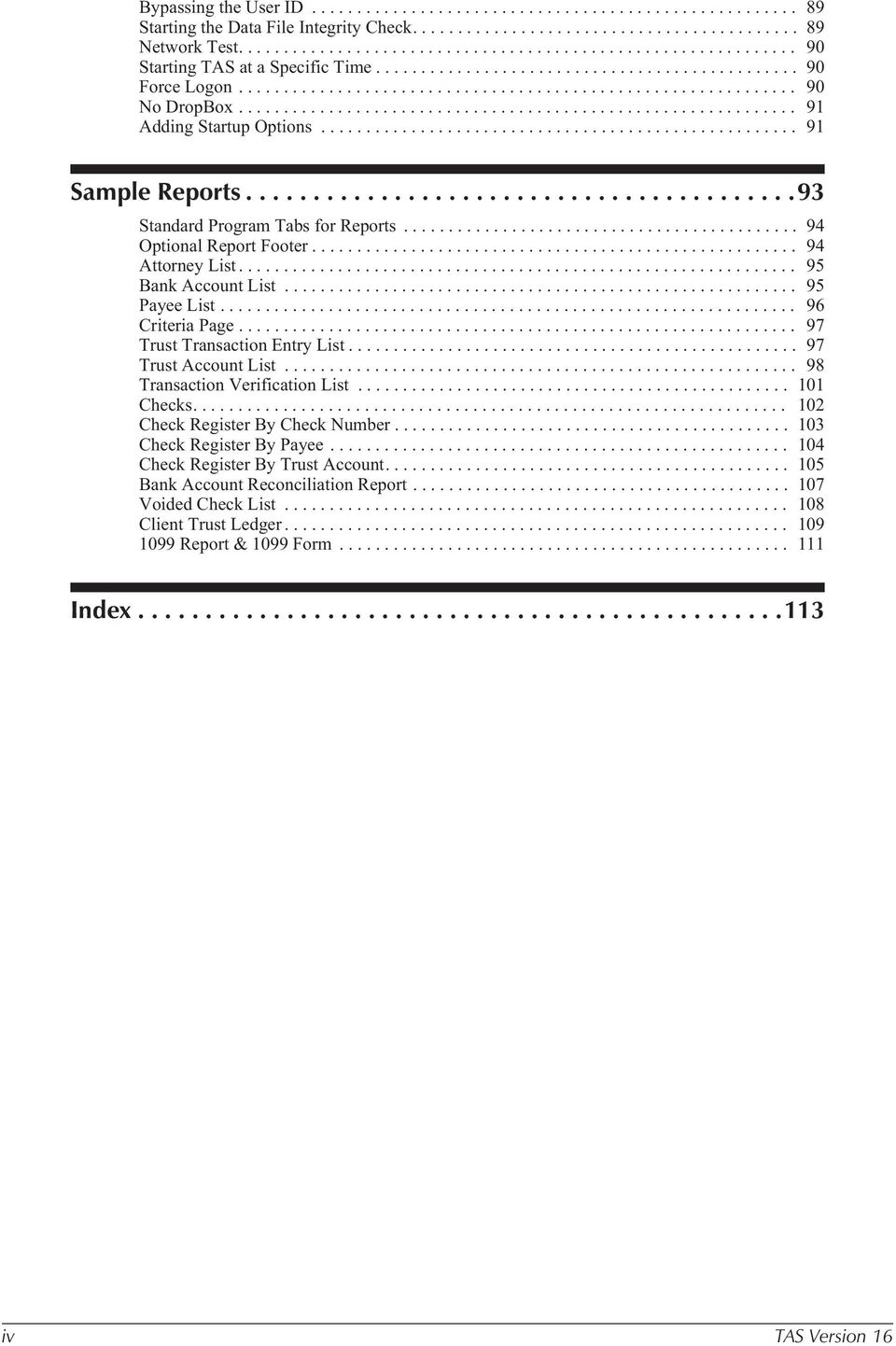
8 Bypassing the User ID Starting the Data File Integrity Check Network Test Starting TAS at a Specific Time Force Logon No DropBox Adding Startup Options Sample Reports...93 Standard Program Tabs for Reports Optional Report Footer Attorney List Bank Account List Payee List Criteria Page Trust Transaction Entry List Trust Account List Transaction Verification List Checks Check Register By Check Number Check Register By Payee Check Register By Trust Account Bank Account Reconciliation Report Voided Check List Client Trust Ledger Report & 1099 Form Index iv TAS Version 16
9 Chapter 1 Introduction & Getting Started 1 Introduction & Getting Started Software Technology, Inc. Since 1979, Software Technology, Inc. has been developing, selling and supporting billing, practice management and financial software for law firms from solos to 50+ attorney firms. Our software is backed by our professional staff, which has extensive experience in accounting, program development and customer support. We are committed to providing our customers with user-proven, reliable software. TAS Overview Tabs3 Trust Accounting Software (TAS) was created as a tool to help law firms keep track of trust accounts that they manage. Checks written out of the trust check book, electronic funds transfers and deposits made to the trust checking account are entered into the system providing current balance information for each individual trust account. Check registers can be printed for individual trusts, or for individual trust checking accounts in 99 different bank accounts. TAS will help you keep the strict control you need over trust accounts. Computer Requirements To use TAS, the following system hardware is required: Windows 7/Vista/XP. Minimum processor speed and system memory requirements are the same as your operating system requirements. 17 MB of free hard disk space. 52 MB of free hard disk space for the System Configuration program. The System Configuration program must be installed in order to use TAS. Minimum 800 x 600 screen resolution using 96 DPI. Recommended 1024 x 768 or higher. 32-bit color is recommended. A CD drive for installing the programs onto the hard disk. High speed wired network recommended for multi-user versions. Wireless networks are not recommended due to performance and reliability issues. Training videos require Adobe Flash Player 10 or later for Internet Explorer. Conventions Used in this Manual The term click or clicking means to select the specified item by clicking the primary mouse button once (usually the left mouse button). The term double-click means to select the specified item by clicking the primary mouse button twice. The term right-click means to select the specified item by clicking the secondary Chapter 1 Introduction & Getting Started 1
10 mouse button once (usually the right mouse button). If desired, the keyboard method can be used to select the specified item. Details regarding keystrokes can be found on page 22. This manual shows button labels in bold face type. Menu options and Task Folder options are shown in bold face italics separated by the pipe character. For example, File Open Trust Account is shown to indicate the order of the menu options selected to access the Trust Account data entry program. As an alternative, Task Folder options are also shown in bold face italics, but are noted as Task Folder options. Conventions Used in the Program The software uses a Multiple Document Interface. This interface allows multiple program windows to be open at the same time. For example, you can have a trust account window open, two trust transaction windows open and a client trust ledger window open all at the same time. All of these tasks can be accomplished without logging in as another user. Keep in mind that certain tasks require exclusive use of the software. Detailed information about these tasks can be found on page 6. Windows can be repositioned and resized as well as minimized and maximized. However, certain dialog boxes are non-interruptible, thus allowing no other task in the program to be accessed until that dialog box is closed. The sizes and positions of the main application window and lookup windows are stored from session to session for each workstation. Installing the Software The software is provided on a CD and must be installed to a hard disk. Detailed installation instructions are provided with the software as well as on the CD. Network Installation Note: Separate server and workstation installation procedures are required when running the software in a networking environment. These procedures can be found in the installation instructions provided on the CD. Starting TAS The software can be started via a shortcut on the Windows desktop or via the Windows taskbar. Desktop Shortcut Windows Taskbar During installation, if you elected to create icons on the desktop, you can double-click the TAS desktop icon. TAS can be started via the Windows taskbar. Click the Start button, and then point to Programs. Point to the Tabs3 & PracticeMaster folder and then click Trust Accounting. Note: Startup options can be found in Appendix D on page 89. After starting TAS, the Logon dialog box will be displayed. Note: If TAS is being started for the first time, the TAS Customization window will automatically be opened. Details regarding Customization can be found on page TAS Version 16

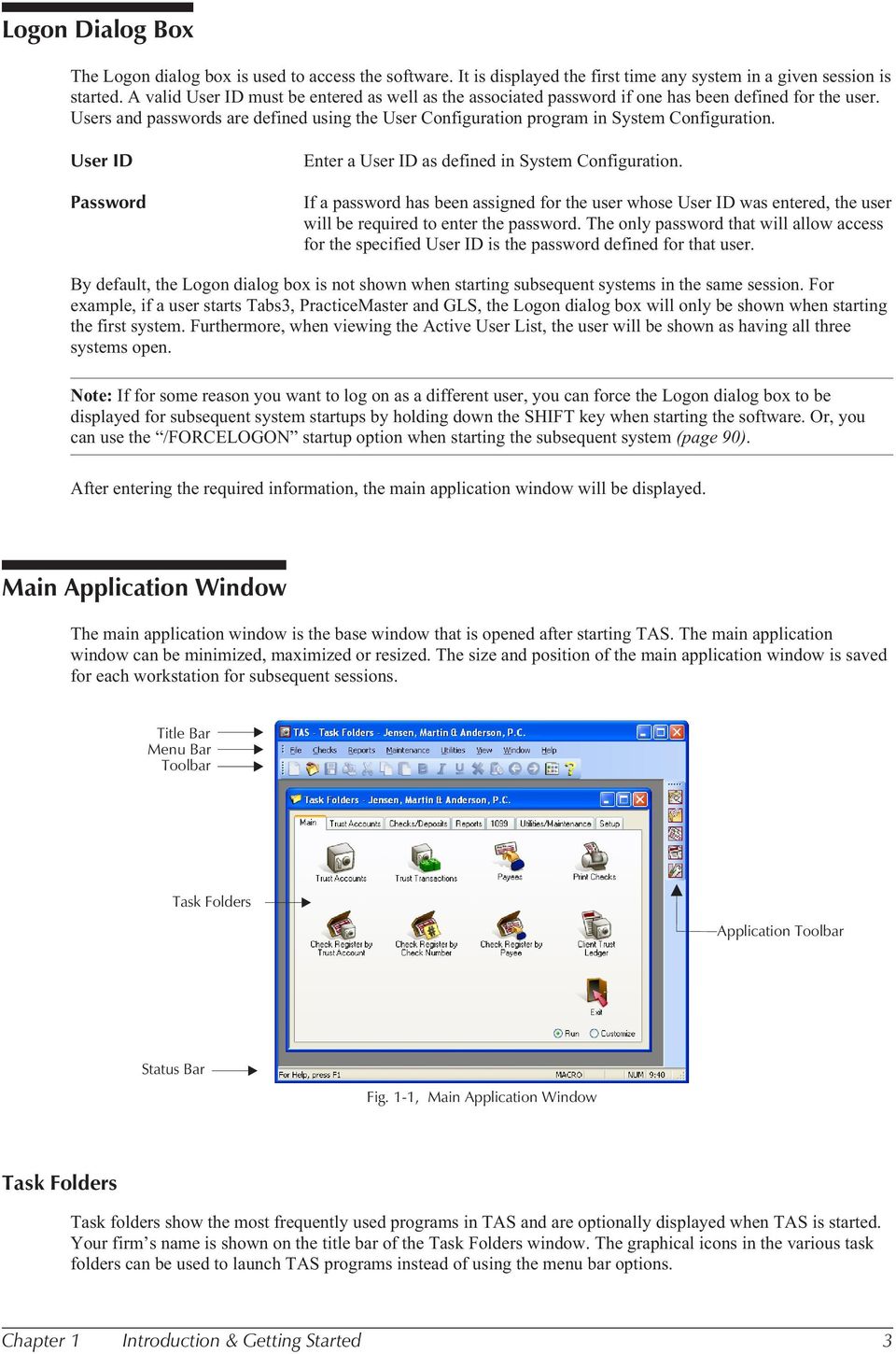
11 Logon Dialog Box The Logon dialog box is used to access the software. It is displayed the first time any system in a given session is started. A valid User ID must be entered as well as the associated password if one has been defined for the user. Users and passwords are defined using the User Configuration program in System Configuration. User ID Password Enter a User ID as defined in System Configuration. If a password has been assigned for the user whose User ID was entered, the user will be required to enter the password. The only password that will allow access for the specified User ID is the password defined for that user. By default, the Logon dialog box is not shown when starting subsequent systems in the same session. For example, if a user starts Tabs3, PracticeMaster and GLS, the Logon dialog box will only be shown when starting the first system. Furthermore, when viewing the Active User List, the user will be shown as having all three systems open. Note: If for some reason you want to log on as a different user, you can force the Logon dialog box to be displayed for subsequent system startups by holding down the SHIFT key when starting the software. Or, you can use the /FORCELOGON startup option when starting the subsequent system (page 90). After entering the required information, the main application window will be displayed. Main Application Window The main application window is the base window that is opened after starting TAS. The main application window can be minimized, maximized or resized. The size and position of the main application window is saved for each workstation for subsequent sessions. Title Bar Menu Bar Toolbar Task Folders Application Toolbar Status Bar Fig. 1-1, Main Application Window Task Folders Task folders show the most frequently used programs in TAS and are optionally displayed when TAS is started. Your firm s name is shown on the title bar of the Task Folders window. The graphical icons in the various task folders can be used to launch TAS programs instead of using the menu bar options. Chapter 1 Introduction & Getting Started 3
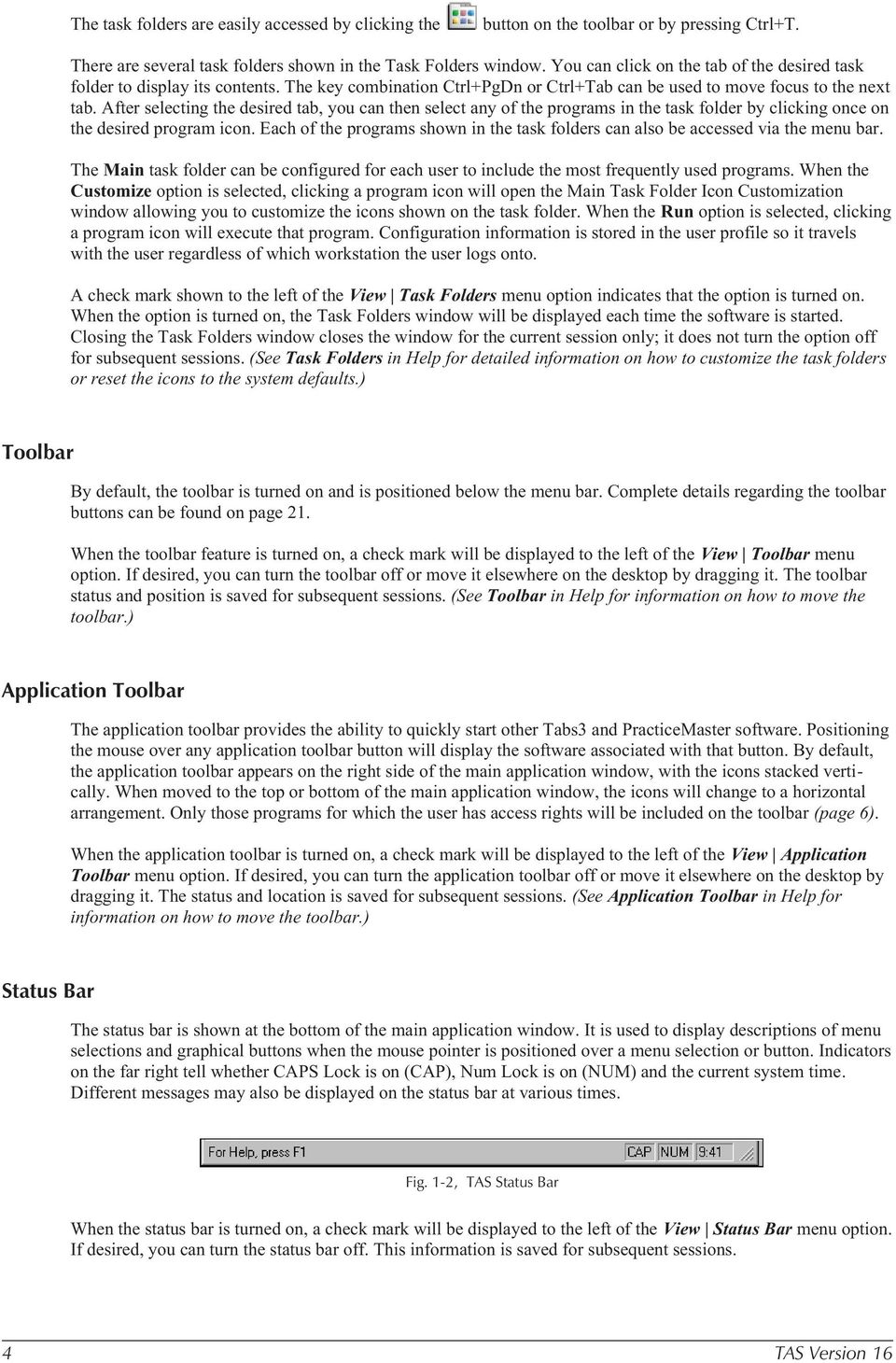
12 The task folders are easily accessed by clicking the button on the toolbar or by pressing Ctrl+T. There are several task folders shown in the Task Folders window. You can click on the tab of the desired task folder to display its contents. The key combination Ctrl+PgDn or Ctrl+Tab can be used to move focus to the next tab. After selecting the desired tab, you can then select any of the programs in the task folder by clicking once on the desired program icon. Each of the programs shown in the task folders can also be accessed via the menu bar. The Main task folder can be configured for each user to include the most frequently used programs. When the Customize option is selected, clicking a program icon will open the Main Task Folder Icon Customization window allowing you to customize the icons shown on the task folder. When the Run option is selected, clicking a program icon will execute that program. Configuration information is stored in the user profile so it travels with the user regardless of which workstation the user logs onto. A check mark shown to the left of the View Task Folders menu option indicates that the option is turned on. When the option is turned on, the Task Folders window will be displayed each time the software is started. Closing the Task Folders window closes the window for the current session only; it does not turn the option off for subsequent sessions. (See Task Folders in Help for detailed information on how to customize the task folders or reset the icons to the system defaults.) Toolbar By default, the toolbar is turned on and is positioned below the menu bar. Complete details regarding the toolbar buttons can be found on page 21. When the toolbar feature is turned on, a check mark will be displayed to the left of the View Toolbar menu option. If desired, you can turn the toolbar off or move it elsewhere on the desktop by dragging it. The toolbar status and position is saved for subsequent sessions. (See Toolbar in Help for information on how to move the toolbar.) Application Toolbar The application toolbar provides the ability to quickly start other Tabs3 and PracticeMaster software. Positioning the mouse over any application toolbar button will display the software associated with that button. By default, the application toolbar appears on the right side of the main application window, with the icons stacked vertically. When moved to the top or bottom of the main application window, the icons will change to a horizontal arrangement. Only those programs for which the user has access rights will be included on the toolbar (page 6). When the application toolbar is turned on, a check mark will be displayed to the left of the View Application Toolbar menu option. If desired, you can turn the application toolbar off or move it elsewhere on the desktop by dragging it. The status and location is saved for subsequent sessions. (See Application Toolbar in Help for information on how to move the toolbar.) Status Bar The status bar is shown at the bottom of the main application window. It is used to display descriptions of menu selections and graphical buttons when the mouse pointer is positioned over a menu selection or button. Indicators on the far right tell whether CAPS Lock is on (CAP), Num Lock is on (NUM) and the current system time. Different messages may also be displayed on the status bar at various times. Fig. 1-2, TAS Status Bar When the status bar is turned on, a check mark will be displayed to the left of the View Status Bar menu option. If desired, you can turn the status bar off. This information is saved for subsequent sessions. 4 TAS Version 16
13 Open Windows Maximized When this option is turned on, a check mark will be displayed to the left of the View Open Windows Maximized menu option. This option determines how the various program windows within the main application window are opened. Select this option if you always want windows opened in a maximized state. Using this option allows only one window at a time to be shown in the main application window. Turn this option off if you want to view multiple windows in the main application window at the same time. Typically, users with large monitors and high resolutions will keep this option turned off. When this option is turned off, new windows will be opened in a windowed state, allowing you to reposition them within the main application window and in many cases, resize them as well. This information is saved for subsequent sessions. Active User List The Active User List shows the users who are currently accessing TAS as well as which tasks are being performed. An All Systems check box is shown when the logged in user is a manager. Managers can optionally view all users in all of the software as well as reset one or more users. The User ID, User Name, and computer name of each user accessing the software is shown in the Active User List. Also shown is the software being accessed along with the task being performed. Before you make a backup or perform a function that requires exclusive control over the data files, the Active User List can be used to determine if any users are accessing the software. An asterisk is shown to the left of the User ID of the user accessing the Active User List. Detail and Summary options determine whether or not individual tasks will be displayed. When Detail is selected, each task for every active user will be displayed in a separate row. When Summary is selected, a single row for each login user will be displayed per program. The Active User List also allows you to reset users in TAS (see Resetting Users below). Resetting Users All users should exit TAS properly so that the Active User List is correctly updated. If a user does not exit the software properly, then the user must be reset. When the Active User List is accessed by a user who is a Manager, a Reset button is displayed. Clicking the Reset button will reset the highlighted user(s) (with the exception of the user who is performing the reset). You will be asked to confirm that you want to reset the specified users. Caution: Users that are in the software should never be reset. Resetting users that are in the software can cause data loss, data corruption, and fatal errors. DO NOT reset users unless you are absolutely sure they are not using the software. Users should always exit the software properly. The reset option should only be used when a user is unable to exit the software properly due to a computer problem, such as a lockup or power failure. Network Caution: Resetting a user resets the user in the software only. If you are running on a network, you may also need to reset the user on the network in order to close files that may have been left open on the network. Therefore, if you are running on a network and have reset a user, make sure the user who was reset does the following: 1) logs off the network; and 2) logs back on the network. Doing this ensures that any files that were left open by the network are closed, thus eliminating potential Fatal Errors in the software. Single User Note: If a non-manager user is locked out of the software as a result of networking or hardware issues, that same user can restart the software using the same User ID and password. A Duplicate User IDs message will be displayed and the user can simply be reset. However, if any other user (managers included) attempts to access the same system, the Active user limit has been reached. Access Denied. error message will be displayed. If the user who was locked out cannot access the software again or is not available, a manager can start the System Configuration program and reset all users via the Active User List. Chapter 1 Introduction & Getting Started 5
14 Note: Information regarding all resets is written to a log file named RESET.LOG. This file includes the system the reset was performed in, the date and time that the system was reset, which user performed the reset, which user was reset and the system that the reset user was in. The RESET.LOG file can be accessed via the View Log Files Reset Log menus or can be accessed via any text editor such as Microsoft Notepad or WordPad. Platinum Note: In Platinum versions of the software, resetting a user first attempts to log off the user. If the user cannot be remotely logged off, the user will be reset. Users that are logged off will receive a log off notification, and will be noted in the RESET.LOG and SUPPORT.LOG. This prevents active users from being reset, and thus helps reduce the possibility of data loss or errors. Exiting TAS To exit TAS, you can use any of the following methods: From the File menu, click Exit. Click the Close button (last button on the right side of the title bar) or double-click the program icon shown on the left side of the title bar. Press Alt + F4. Customize your Main Task Folder to include the EXIT icon. Click the EXIT icon. Access Rights System security is implemented by defining access rights and passwords using the System Configuration program. System security consists of defining user records and access profiles, then assigning one or more access profiles to each user. Access rights are defined for each access profile level whereas passwords are optionally defined for each user. Members of the Manager access profile have access rights to all programs in the software. Multi-User Functionality The multi-user version of the software allows multiple users to simultaneously perform data entry, generate reports and view information. However, not all functions can be accessed at the same time. This is because different functions require different levels of control over the program s data files. There are five levels of control that a function can have over the data files: Exclusive Single Access Multi-Access An Exclusive function requires exclusive control of the specific system s data files. Only one user will be allowed to access the program if such a function is started. For example, when using the Bank Account Reconciliation program in TAS, no other users are allowed to access any other TAS program. A Single Access function can only be accessed by one user at a time. Other users can access other functions of the software. For example, when using the Print Checks program in TAS, no other users can access that program. However, other users will be able to use other TAS functions. A Multi-Access function can be accessed by multiple users simultaneously. Also, other Multi-Access functions can be accessed at the same time by other users. A single user can have more than one Multi-Access function open at the same time. For example, when one user is accessing the Trust Transactions program in TAS, other users can also access the Trust Transactions program at the same time. 6 TAS Version 16
15 Function that Prohibits Access to Other Functions Super Exclusive This type of function restricts functions in other programs from being performed. For example, when accessing the Void Checks program in TAS, other users will not be allowed to access the Renumber GLS Accounts program in GLS if TAS and GLS are integrated. A Super Exclusive function requires exclusive control of all systems data files. Only one user will be allowed to access the system with a program that requires super exclusive control. For example, when using the Restore Data Files program in System Configuration, no other systems can be open. Detailed lists of each program s functionality can be found in our Knowledge Base under the keyword multi-user functionality ( A Conflicting Activities window displays information regarding which users and activities are currently preventing a requested task from being started. When this window is displayed, other users will be prevented from starting tasks that would interfere with the one you are currently attempting to start. Detailed information can be found in our Knowledge Base under the keyword conflicting activities ( Platinum Note: In Platinum versions of the software, a Log Off Users button in the Conflicting Activities window can be used to display a Log Off Users window. This allows you to safely log off each user who is listed in the Conflicting Activities window after a selected amount of time, while notifying them of the reason for them being logged off. Lock Out All Users Menu File Lock Out All Users The Lock Out All Users menu option allows any manager to lock all other users out of the Tabs3 and PracticeMaster software. This feature makes it easier for the manager to perform exclusive tasks. This menu option is available in all Tabs3 and PracticeMaster software products. Only managers can access this menu option. When this menu option is selected, a Lock Out All Users window will be displayed indicating that you have locked out all users. As long as this window is open, the software is locked. The Active User List can be used to show the manager which users are still in the software. When the software is locked, all other users will be prevented from starting any other Tabs3 or PracticeMaster software product. Users who are already using the software will be allowed to finish their current tasks but cannot start any new tasks. The Unlock button can be used to close the Lock Out All Users window thus unlocking the software and allowing other users normal access to all Tabs3 and PracticeMaster software products. Alternatively, the manager can close the Lock Out All Users window or exit the software in which the lock was implemented to unlock the software. Help Menu The Help Menu consists of the following menu selections: Help Topics What s New Tip of the Day The Help Topics menu selection displays the Help Topics window. Selecting the What s New menu option will open your default Internet browser to the What s New page on our Web site, allowing you to view or download the What s New List(s) for the current software version. The Tip of the Day menu selection displays a Tip of the Day window. When this option is selected, a Tip of the Day window will be displayed each time a Chapter 1 Introduction & Getting Started 7
16 user starts TAS. The Tip of the Day window contains a series of tips with How To and Did You Know? information that help familiarize you with TAS features. A new tip will be displayed each time TAS is started. The tips will be displayed sequentially. After the last available tip has been displayed, the tips will be repeated starting at the beginning. Whether this option is turned on or off is saved in the user profile for each individual user. Reset Optional Messages The Reset Optional Messages menu is used to set all optional messages back to the default setting. By default, the optional message settings are enabled. The optional message settings are stored in the user profile. An example of an optional message is the message that is displayed when printing checks asking if you want to print a check test pattern. Selecting the Do not show again check box in the message box turns the message off. The Reset Optional Messages menu will only reset the TAS optional messages. Using the Reset Profile button in the User Configuration program in System Configuration will reset the entire user profile including the optional messages. Internet Resources The Internet Resources menu consists of the following menu selections: Web Site Our Web site can be found on the Internet at: Selecting the Web Site menu option will open your default Internet browser to the above Web page. Knowledge Base The Knowledge Base includes information regarding Tabs3 and PracticeMaster software products and is provided for resellers, consultants, end-users and other third parties who work with Tabs3 and PracticeMaster software. It contains extensive information on Error Troubleshooting, Networking & Windows Issues, How To articles, product-related articles, and frequently asked questions. The Knowledge Base requires Internet access and can be found on the Internet at: Selecting the Knowledge Base menu option will open your default Internet browser to the above Web page. User Newsletter Our user newsletter is an informative newsletter that helps you better utilize the features of Tabs3 and PracticeMaster software. In addition to feature articles and notices informing you of new software releases, the newsletter consists of questions and answers about the software. The newsletter is published on the Internet for maintenance users and can be accessed in the Newsletter Archive area on our Web site at: Software Update Register Software The Software Update menu option opens your default Internet browser to a page on our Web site. This page provides a link that allows you to download the most current compile of your version of the software. The Register Software menu option opens your default Internet browser to the software registration page on our Web site. This page provides a form that allows you to register your software license online and can be accessed at: 8 TAS Version 16
17 Submit Log Files You can use the Submit Log Files menu option to provide log file information to Technical Support for troubleshooting purposes via the Internet. You will be required to enter an Incident ID before submitting information. Incident IDs are provided by a Technical Support Representative. Diagnostics The Diagnostics menu consists of the following menu selections: Network Test Network Settings The Network Test diagnostic utility (page 70) tests basic network reliability for the current workstation. The Network Settings utility (page 70) allows the firm to configure network settings for the current workstation. About TAS The About TAS menu selection displays pertinent information about TAS including the version number, serial number, User ID, current working directory, release date, firm name, whether the user has manager rights, active user limit, maximum attorney limit, Decimal Places and integration status. The lower portion of the window includes information about the workstation including the total amount of computer memory, available physical memory, amount of free disk space, type of processor, Windows Version, Windows Directory, Internet Explorer version, screen resolution, color quality, redirector information, display driver information, and printer driver information. The Print button displays a Print dialog box, allowing you to print a report of the information shown in the About TAS window (page 76). A detailed list of the information located in the About TAS window can be found in Knowledge Base Article R11385, Information in the Help About Window ( License Notice The License Notice is a reminder that the software is protected by federal copyright law and is provided based on the provisions of a License Agreement that restrict usage and distribution of the software. The most current License Agreement can be found in our Knowledge Base Article R10348, Software License Agreements. Log Files The following log files are maintained in the software for troubleshooting purposes and can be accessed via the View menu by pointing to the Log Files menu option. Support Log Error Log Reset Log The Support Log tracks various activities performed in the software. The Error Log tracks information on any errors that may have occurred while using the software. The Reset Log tracks information regarding when users are reset using the Active User List program. Backing Up To guard against loss of data, backup copies of your data should be made and stored in a safe location. It is your responsibility to establish adequate and frequent backup procedures. Your reseller or computer dealer can assist you with this task. Chapter 1 Introduction & Getting Started 9
18 In addition to your regularly scheduled backups, there are a few programs in TAS that caution you to back up your data files. A temporary backup should be made prior to running one of these programs in the event the program is aborted abnormally (i.e., power failure, network problems, General Protection Faults, etc.). Do not ignore these warnings. These programs are: Renumber Trust Account Renumber Attorney Rename Payee Rename Contact Change Key Type Import Transactions Purge Trust Transactions Void Checks Reindex Files Caution: Run the Data File Integrity Check program for all programs before backing up. This will ensure that the data being backed up is valid data. Platinum Note: When using the Platinum Version of TAS, it is not necessary to make a backup before running the Void Checks program. This is because the Transaction Processing feature will automatically roll back the data in the event the process is interrupted. Back Up Data Files Menu Selections Purpose File Back Up Data Files To make a temporary backup of the data files before running programs where you are cautioned to make a temporary backup. Caution: This backup procedure is a temporary backup and is not intended to replace your regular backup procedures. It is important to make sure that regular backups are kept off site in case of hardware failure, theft, flood, etc. Keep in mind that every time this program is run, the second prior backup is overwritten. Integration Note: All System Configuration, Tabs3, PracticeMaster, GLS, APS, and TAS data files are backed up when the Back Up Data Files program is run. For your reference, the date and time of the last backup file, the User ID used to create the backup file, the type of backup, and the description entered for the prior backup are displayed in the window. You can enter a new description or accept the default description. For complete information regarding this program, refer to Back Up Data Files in Help. Restore Data Files Menu Selections Purpose Files Restore Data Files To restore one of three prior backups made using the Back Up Data Files program. Caution: Restoring data files will overwrite your current data files. If you restore data files, run a Data File Integrity Check for all programs immediately after restoring to verify there are no errors. Integration Note: Restoring data files will restore ALL System Configuration, Tabs3, PracticeMaster, GLS, APS, and TAS data files. Tasks performed in any Tabs3 and PracticeMaster software since the backup file was created will need to be redone. 10 TAS Version 16

19 You can select the backup you want to restore. Then, for your reference, the date and time of the last backup file, the User ID used to create the backup file, the type of backup, and the description that was entered for the selected backup will be displayed in the window. For complete information regarding this program, refer to Restore Data Files in Help. HotBackup and Restore HotBackup Menu Selections Purpose File HotBackup File Restore HotBackup To make a temporary backup of all data files before running a program where you are cautioned to make a temporary backup. The HotBackup and Restore HotBackup features are available only in the Platinum version of the software. When using the Platinum version of the software, the HotBackup and Restore HotBackup menu options replace the Back Up Data Files and Restore Data Files menu options. HotBackup allows you to create backups while other users are using the software, schedule automatic recurring backups, configure how many HotBackups you want to keep and where to keep them, and lets you send optional notifications to designated recipients when a HotBackup completes (or fails). Additional details on HotBackup can be found in the Help provided with the software. TAS Data Files A detailed list of the data files can be found in Knowledge Base article R11352, Version 16 Data File Names ( Platinum Version Tabs3 and PracticeMaster Platinum are the top of the line products offered by Software Technology, Inc. These programs utilize state of the art database technology to ensure the fastest performance and lowest network impact possible. They also include advanced reporting options, administrative tools, and mobile access to your Tabs3 and PracticeMaster data. Auto-Recovery, HotBackup, Accelerators, and the Log Off Users features all work together to enhance the overall usability, performance, and reliability of the software. Tabs3 Connect provides access to Tabs3 and PracticeMaster anywhere you can connect to the Internet. PracticeMaster Platinum also includes enote, an intra-office messaging feature, and an Exchange Connector, which allows you to synchronize PracticeMaster calendars and contacts with Outlook via Microsoft Exchange without logging into PracticeMaster. As your firm grows, Platinum will scale with you, limiting degradation in performance caused by processing increasing amounts of data. For more information on the Platinum version of the software, contact the reseller from which you purchased the software or our Sales Department at (402) Additional information can be found in Knowledge Base Article R11379, Platinum Software Overview ( Chapter 1 Introduction & Getting Started 11
20 TAS Menu Bar File Open Trust Account Contact Transaction Miscellaneous Attorney Payee Bank Account Back Up Data Files / HotBackup Restore Data Files / Restore HotBackup Print Setup Print Check Test Pattern Lock Out All Users Exit Checks Print Checks Check Registers By Check Number By Payee By Trust Account Void Checks Bank Account Reconciliation Reports Client Trust Ledger Credit Card Authorization List Miscellaneous Attorney List Bank Account List Payee List Reconciliation Reports Trust Account List Voided Check List 1099 Information 1099 Report 1099 Forms Create APS 1099 Merge File Maintenance Import Transactions Renumber Trust Account Attorney Rename Payee Rename Contact Change Key Type View Customization Data File Integrity Check Initialize TAS ODBC Purge Transactions Reindex Files Select Trust Transactions to Save/Purge Active User List Open Windows Maximized Log Files Support Log Error Log Reset Log Status Bar Task Folders Toolbar Application Toolbar Window Cascade Tile Horizontally Tile Vertically Arrange Icons Minimize All Close All Help Help Topics What s New Tip of the Day Reset Optional Messages Internet Resources Web Site Knowledge Base User Newsletter Software Update Register Software Submit Log Files Diagnostics Network Test Network Settings About TAS License Notice 12 TAS Version 16
21 Chapter 2 Using & Setting Up TAS 2 Using TAS Overview The following is a brief overview of using TAS. This overview is included to give you a brief understanding and feel for the order of events during a month. Add a Trust Account Record File Open Trust Account Once a trust account record has been added to the trust account file, checks, deposits and EFTs (electronic funds transfers) can be added for that trust account. & Setting Up TAS Add a Contact Record Add Payees Enter Checks, Deposits & EFTs File Open Contact Contact records are added when trust accounts are added. File Open Miscellaneous Payee Add payee records to the payee file as required. File Open Transaction Checks, deposits and EFTs can be added to TAS for a trust account. If you want TAS to print the check, enter 0 for the check number. Integration Note: When an EFT or check is made out to a payee of FIRM, then GLS journal entry information and Tabs3 payment information is entered at this time as well as posted. However, if the check has a check number of 0, the journal entries and Tabs3 payments are not posted until the check is printed using the Print Checks program. Print Checks Print Reports Reconcile Bank Accounts Print 1099 Forms Data File Integrity Check Checks Print Checks File Open Transaction Print checks as required. You can print batches of checks or you can use the Quick Print feature to print a check at the time of data entry. Checks Check Registers By Check Number Checks Check Registers By Payee Checks Check Registers By Trust Account Reports Client Trust Ledger Print reports as required. Checks Bank Account Reconciliation Reconcile the bank account statement. Reports 1099 Information 1099 Forms Print 1099 Forms as needed. Utilities Data File Integrity Check The Data File Integrity Check program ensures that your data files contain no errors induced by hardware or power failures. It is recommended that the Data Chapter 2 Using & Setting Up TAS 13
22 File Integrity Check be run prior to all backups. This will ensure that the data being backed up is valid data. Trust Account Key Type & Decimal Places Trust IDs refer to Trust Accounts. The type of Trust ID that can be used in your TAS installation is determined by the Key Type and Decimal Places specified in TAS Customization. There are three varieties of Key Type: Numeric Mixed Alpha The Numeric option allows for a maximum of 12 numeric characters in a Trust ID including the decimal. Only numbers will be allowed for Trust IDs when the Numeric option is selected. The number of digits following the decimal is determined by the Decimal Places field. TAS can automatically assign new Trust IDs when using the Numeric Key Type. The Mixed option allows for a maximum of 12 alphanumeric characters in a Trust ID including the decimal. The characters to the left of the decimal point in the Trust ID can be any combination of letters and numbers. The characters to the right of the decimal must be numbers. The number of digits following the decimal is determined by the Decimal Places field. TAS cannot automatically assign new Trust IDs when using the Mixed Key Type; however, it can automatically assign new trust account files. The Alpha option allows for a maximum of 12 alphanumeric characters in a Trust ID. Any combination of letters and numbers can be used before and after the decimal point as long as the overall number of characters does not exceed 12. The Decimal Places field is not available when using an Alpha Key Type. TAS cannot automatically assign new Trust IDs when using the Alpha Key Type. The Decimal Places field is used to determine the number of digits in the file portion of the Trust ID (i.e., the number of digits to the right of the decimal point). The Decimal Places field can only be defined when using a Key Type of Numeric or Mixed. Trust ID Ranges All Trust IDs can have a maximum of 12 characters including an optional decimal point. Typically the portion of the Trust ID to the left of the decimal represents the client and the portion to the right of the decimal represents an individual file for the trust account. The Decimal Places field determines the number of digits allowed to the right of the decimal in the Trust ID. The default Decimal Places is 2. Once the Decimal Places and Key Type have been defined in TAS Customization, they can only be changed using the Change Key Type program (page 65). Note: If you are integrating with Tabs3 and PracticeMaster, the Key Type and Decimal Places must be identical in TAS, Tabs3 and PracticeMaster. The following table includes a few sample Trust IDs for some of the available Key Types and Decimal Places. Lines that show more than one sample Trust ID indicate multiple files for the same trust account. Keep in mind that all Trust IDs have a maximum of 12 characters including the optional decimal point. 14 TAS Version 16
23 Sample Trust ID Ranges Key Type Decimal Places Sample Trust ID Numeric 2 Numeric 5 Numeric 0 Mixed 2 Mixed (minimum) , , (maximum) (minimum) , , (maximum) 1 (minimum) (maximum) (Note: Firms that have multiple files for a single trust account should not specify a value of 0 for the Decimal Places field.) 1.00 (minimum) CR25.00, 98CR25.01, 98CR25.02 Zelco.01, Zelco.02, Zelco.03 ZZZZZZZZZ.99(maximum) (minimum) CR , 98CR , 98CR Zelco.00001, Zelco.00002, Zelco ZZZZZZ (maximum) Alpha n/a 1. (Minimum) CR , 98CR , 98CR Zelco.CR1, Zelco.CR2, Zelco.P11 ZZZZZZZZZZZZ(maximum) Note: When using the Mixed or Alpha Key Types, a period must be entered after the new Trust ID when adding a new trust account. This allows TAS to treat it as a new Trust ID instead of criteria for an alpha lookup. Initial File Setup Hint: A comprehensive checklist for new installations can be found on page 18. Prior to making any check, deposit or EFT transactions, you must create the following files. Appendix C contains forms that can be used for worksheets prior to performing data entry. Attorney File File Open Miscellaneous Attorney Assign a number to all attorneys who are responsible for trust accounts. After the desired entries have been made, print an Attorney List for verification of the file (Reports Miscellaneous Attorney List). Chapter 2 Using & Setting Up TAS 15
24 Integration Note: The TAS attorney information is stored in a shared data file with the Tabs3 timekeeper information. As a result, adding, changing or deleting attorneys must be performed in the Tabs3 timekeeper file (or the PracticeMaster timekeeper file if PracticeMaster is being used without Tabs3). Payee File File Open Miscellaneous Payee Enter all payee names and addresses for whom trust account checks will be printed. Enter the Federal ID # if you will be providing the payee with a Form 1099-MISC. Payees can be added to this file at any time. After the desired entries have been made, print a Payee List to verify the information entered (Reports Miscellaneous Payee List). Tabs3/GLS Integration Note: If you will be integrating with Tabs3 and/or GLS, be sure to enter a payee of FIRM (page 28). Bank Account File File Open Miscellaneous Bank Account Trust checks can be written from up to 99 different bank accounts. Each bank account can have multiple trust accounts with no limit to the number of trust accounts. Assign a number from 1 to 99 for each bank account that you want to use. The Current Balance field in the bank account file is typically not edited. This balance should be left at a zero balance when starting to use TAS. This is because this balance will be automatically updated when initial deposits for the trust accounts are entered. After the desired bank accounts have been set up, print a Bank Account List for verification of the file (Reports Miscellaneous Bank Account List). Trust Account File File Open Trust Account A unique Trust ID must be assigned to each individual trust account. Each trust account must be assigned a bank account number. Each trust account may be assigned up to 99 different bank accounts if needed. After the desired entries have been made, print a Trust Account List to verify your entries (Reports Trust Account List). Tabs3/PracticeMaster Integration Note: The TAS trust account information is stored in a shared file with Tabs3 and PracticeMaster client information. As a result, adding trust accounts in TAS adds the client information in Tabs3 and PracticeMaster. Likewise, adding client information in Tabs3 or PracticeMaster will add trust account information in the TAS Trust Account File. Contact File File Open Contact A unique Contact ID, usually the contact s name in Last/First format, must be assigned to each contact. A contact record stores the address, phone, , and other contact information for a trust account record. Each contact may be used in any number of trust account records in the Client Name field, Contact Name field, or both. Tabs3/PracticeMaster Integration Note: The TAS contact information is stored in a shared file with Tabs3 and PracticeMaster contact information. As a result, adding contacts in TAS adds the contact information in Tabs3 and PracticeMaster. Likewise, adding contact information in Tabs3 or PracticeMaster will add contact information in the TAS Contact file. Trust Transaction File File Open Transaction The Trust Transaction program is used to enter check, deposit and electronic funds transfer (EFT) transactions. 16 TAS Version 16
25 When first starting to use TAS, this program can be used to enter a deposit for a trust account s balance. A discussion regarding how to transfer historical balances can be found beginning on page 17. Note: Check or EFT trust transactions must be present for any amounts you want included on a 1099 form. Transferring Balances Trust Accounting Software stores a balance for each trust account and a balance for each bank account. The bank account balance does not include any unpaid checks (i.e., check number = 0 ) whereas the trust account balance does include unpaid checks. If there are no unpaid checks, the sum total of all trust account balances for a single bank account will equal the bank account balance shown in the Bank Account file. The Current Balance field in the bank account file and the Current Trust Balance field in the trust account file are typically not edited. These balances are automatically updated whenever a deposit, check or EFT transaction is entered (with the exception that unpaid check transactions do not update the bank account balance until the check is printed). When first starting to use TAS, trust account balances can be transferred using the following method. Enter an initial deposit Use the Trust Transactions program to enter a deposit for the beginning balance. This deposit can represent 1) the original deposit used to open the trust account; or 2) it can represent the trust account s current balance. Original Deposit: If you elect to enter the amount of the original deposit used to open the trust account, you must also enter trust transactions for all subsequent activity. This method gives you the most detail but also requires the most time for data entry. Current Balance: If you elect to enter the current balance as the initial deposit instead of all history, you can enter the historical activity at a later time. If and when you decide to enter the historical activity, either delete the deposit transaction used to post the initial balance or enter a negative deposit for the same amount Note: Check or EFT transactions must be present for any amounts you want included in 1099 totals. These transactions can be entered at a later time (but prior to processing 1099 information). Bank Account Reconciliation Note: Keep in mind the Bank Account Reconciliation program when deciding how much history to enter. For example, let s say it is May 15 and you are just starting to use Trust Accounting Software. You ve decided you do not want to enter all of the historical activity for all trust accounts at this time. However, you would like to start using the Bank Account Reconciliation program for the month of May. The bank account has been reconciled with the April bank statement. Therefore, instead of entering a deposit for the trust account s May 15 balance, enter a deposit for the April 30th balance (i.e., the closing balance from the April 30th bank statement). Then, enter trust transactions for all transactions that haven t cleared as of the April 30th balance. Note: Although a balance can be entered in the trust account s Current Trust Balance field, we do not recommend using this method because it requires that corresponding changes be manually made to the bank account s Current Balance field. Furthermore, no audit trail will be shown for the beginning balance. Verification of Initial File Setup After the initial files have been created, the information entered should be verified for accuracy. Any discrepancies found should be corrected immediately. Chapter 2 Using & Setting Up TAS 17
26 Attorney File Payee File Bank Account File Trust Account File Reports Miscellaneous Attorney List Print the Attorney List to verify the information entered in the Attorney File. Reports Miscellaneous Payee List Print the Payee List to verify the information entered in the Payee File. Reports Miscellaneous Bank Account List Print the Bank Account List to verify the information entered in the Bank Account File. Reports Trust Account List To verify the accuracy of the trust account and contact information, print a Detail Trust Account List. From the Sort tab, specify a Primary Report Order of Bank Account. After the report is printed, verify that the total trust account balance for each bank account matches the balance for that bank account on the Bank Account List. Verify that these totals match before continuing to use TAS. Checklist for New Installations The following is a checklist of the steps that should be completed in order to get TAS up and running. Each step has a corresponding chapter or page number in the TAS or System Configuration manual. We recommend following these procedures to prepare your accounting and bookkeeping departments for the conversion to TAS. You can put a check mark in the Completed column as each step is performed. Step # Description Chapter/Page # Completed Fill out and send in the Software Registration Cards that came with the software or complete online registration. Familiarize key personnel with the TAS and System Configuration manuals. Review Chapter 1, Introduction & Getting Started in both manuals and also Chapter 2, Using TAS in the TAS manual. Familiarize key personnel with other available documentation. Knowledge Base Article R TAS Frequently Asked Questions Read the Installation Instructions Install the software: System Configuration and TAS. Start up System Configuration. Set up users and groups. Define firm information. Print the corresponding lists. Included with software TAS page 8 System Config Chapter 1 TAS Chapters 1&2 TAS page 8 Included on CD 6 Start up TAS. TAS page 2 System Config Chapter 1 System Config Chapter 2 System Config Chapter 2 System Config Chapter 4 7 Customize TAS. TAS Help - press F1 (Customization) 8 Determine backup routine. TAS page 9 Set up the following files: Attorney File Payee File Bank Account File 9 Trust Account File Contact File Trust Transaction File Print the corresponding lists. 10 You are now ready to use TAS! TAS page 27 TAS page 27 TAS page 28 TAS page 29 TAS page 31 TAS page 31 TAS page TAS Version 16
27 TAS System Flow Task Description Add payees as required. Add contacts as required. Add trust accounts as required. Enter new checks, deposits and electronic funds transfers. Print the verification lists. Make corrections to existing checks, deposits and electronic funds transfers if needed. Print Checks as required. Void checks as required. Print check registers and trust lists as needed. Run the Data File Integrity Check program. Back up the data files. Daily/Weekly Functions Help Index Payees: adding a payee Contacts: adding a contact Trust Accounts: adding a trust account Trust Transactions: adding a trust transaction Verification Lists Trust Transactions: changing a trust transaction Print Checks Voiding Checks: program Reports Data File Integrity Check Back Up: Back Up Data Files Monthly/Annual Functions Task Description Reconcile each bank account. Print check registers. If integrating with APS, create the APS 1099 Merge File. Print 1099 Report. Print 1099 Forms. Use the Select Trust Transactions to Save/Purge program to designate which trust transactions should be purged (optional). Run the Data File Integrity Check program. Back up the data files. Optionally purge trust transactions. Reconciliation Registers Help Index 1099s: Create APS 1099 Merge File 1099s: 1099 Report 1099s: 1099 Forms Select Trust Transactions to Save/Purge Data File Integrity Check Back Up: Back Up Data Files Purge Trust Transactions Frequently Asked Questions Our Knowledge Base ( contains extensive frequently asked questions in article R11106, Frequently Asked Questions in Trust Accounting Software. When convenient, we recommend that you look at this information on the Internet and provide it to the appropriate personnel in your firm. Chapter 2 Using & Setting Up TAS 19
28 20 TAS Version 16
29 Chapter 3 Data Entry Toolbar Buttons The following is a list of toolbar buttons found in TAS. Buttons that are dimmed on the toolbar indicate that they are not available in the current window. New Close Save Print Cut Copy The New button or Ctrl+N allows you to enter a new record in a file by clearing the information shown in the data entry window. Also, when adding a record that has a numeric ID (e.g., trust account, bank account or attorney), the next available number is automatically assigned. The Close button or the ESC key closes the current window. If changes have been made, you will be asked if you want to save the changes. The Save button or Ctrl+S saves the changes made in the data entry window to the appropriate data files. The Print button or Ctrl+P allows you to output a report regarding the current file to a printer, screen or disk file. The Cut button or Ctrl+X deletes the selected text and places it in the Windows Clipboard. The Copy button or Ctrl+C copies the selected text to the Windows Clipboard. 3 Data Entry Paste Bold Italic Underline Cancel The Paste button or Ctrl+V inserts the text from the Windows Clipboard at the current cursor position in the active window. The Bold button or Ctrl+B turns the bold attribute on or off for the selected text or at the cursor position. The Italic button or Ctrl+I turns the italic attribute on or off for the selected text or at the cursor position. The Underline button or Ctrl+U turns the underline attribute on or off for the selected text or at the cursor position. The Cancel button cancels any changes and returns a record to its original state. Delete Prev The Delete button deletes the currently displayed record. You will be asked to confirm that you want to delete the record. The Previous button or F3 displays the previous record in a file. Chapter 3 Data Entry 21
30 Next The Next button or F4 displays the next record in a file. Task Folders The Task Folders button or Ctrl+T displays the Task Folders window (page 3). Help The Help button or F1 displays Help for the current window. Data Entry Keystrokes Text Editing Keystrokes Left-Arrow Right-Arrow Ctrl + Left-Arrow Ctrl + Right-Arrow Home End Ctrl + Home Ctrl + End Tab Enter Shift + Tab Shift + Enter Del Backspace Ctrl + Del Moves the cursor left one character. Moves the cursor right one character. Moves the cursor left one word. Moves the cursor right one word. Moves the cursor to the beginning of a field or line. Moves the cursor to the end of a field or line. Moves the cursor to the beginning of a field. Moves the cursor to the end of a field. Moves the cursor to the next field. Moves the cursor to the next field (data entry windows only). Moves the cursor to the previous field. Moves the cursor to the previous field (data entry windows only). Deletes the character to the right of the cursor or deletes selected text. Deletes the character to the left of the cursor or deletes selected text. Deletes all characters to the right of the cursor on the current line. General Windows Keystrokes Ctrl+F4 Alt+F4 Ctrl+F6 Ctrl+Shift+F6 Alt+Tab Closes the current window (not the main application window). Closes the main application window. Switch to the next window within the main application window. Switches to the previous window within the main application window. Switch to the next application in Windows. 22 TAS Version 16
31 Ctrl+Tab or Ctrl+PgDn Ctrl+Shift+Tab or Ctrl+PgUp Alt + Down-Arrow Move forward through program tabs in a window. Move backward through program tabs in a window. Displays drop-down lists and lookup windows where applicable. Date Fields The Date field allows for two optional separator characters ( /, \, -, and ) and eight numerical digits. Dates can be entered using various formats, such as the following: MM/DD/YYYY M/DD/YY MM/DD MDDYYYY MM-DD-YYYY MM-DD-YY MM-DD MDDYY MM DD YYYY MM DD YY MM DD MDD MMDDYYYY MMDDYY MMDD DD For example, to enter December 1, 2011, you could enter 12/01/11, 12/1/11, 12/1/2011, , , , , , , , 12/01, 12-01, 1201, 12 01, or Leading zeros are not required when using the slash, dash or space separator. Entering one or two digits will display the number(s) in the day segment, using the current system date to determine the current month and year. For example, with the date field highlighted, entering 7 when the current date is 12/01/2011 will change the date to 12/07/2011. This feature is available only when the date field, or day segment of the date field, is entirely highlighted, or is cleared. The allowable date range in the software is January 1, 0100 (01/01/0100) through December 31, 9999 (12/31/9999). When entering two-digit years for any of the software, if the year is between 00 and 69, the software will assume the year is in the 21st century (i.e., ). If the year is between 70 and 99, the software will assume the year is in the 20th century (i.e., ). Entering three, five, or seven digits will assume the month is one character (e.g., entering 121 will indicate January 21, not December 1). Entering four, six, or eight digits will assume the month is two characters. Clicking the drop-down button or pressing Alt + Down-Arrow in any date field will display a Calendar window, allowing you to select the desired date. The following keystrokes can be used in any date field. Right-clicking in a date field displays a shortcut menu that also lists the available options. TorD QorM C PgDn Pressing T (Today) or D (Date) in a date field will enter the computer s system date (even if a date is already present in the field). Pressing Q (QuickDate) or M (Date Math) in a date field will display a QuickDate Calculator window allowing you to calculate a date. For date fields that allow a value of mm/dd/yyyy, pressing C (Clear) will replace the current date with mm/dd/yyyy. If the date field is highlighted, pressing Del or Backspace will remove the current date and leave the date field blank. Pressing PgDn in a date field will decrease the current month value by one. For example, pressing PgDn when the date reads 12/01/2011 will change the date to 11/01/2011. Chapter 3 Data Entry 23
32 PgUp Pressing PgUp in a date field will increase the current month value by one. For example, pressing PgUp when the date reads 11/01/2011 will change the date to 12/01/ The + key can be used in the date field to increase the day of the month. For example, pressing + when the date reads 12/15/2011 will change the date to 12/16/2011. Clicking the month, day, or year will highlight the selected segment. Pressing + when a segment is highlighted will increase the current value of that segment by one. For example, pressing + when 2011 is highlighted will increase the year to The - key can be used in the date field to decrease the day of the month. For example, pressing - when the date reads 12/16/2011 will change the date to 12/15/2011. Clicking the month, day, or year will highlight the selected segment. Pressing - when a segment is highlighted will decrease the current value of that segment by one. For example, pressing - when 2012 is highlighted will decrease the year to Up-Arrow, >, or. Down-Arrow, <, or, Pressing the Up-Arrow, >, or. (period) key in a date field will increase the current day value by one. For example, pressing the Up-Arrow, >, or. (period) key when the date reads 12/15/2011 will change the date to 12/16/2011. Pressing the Down-Arrow, <, or, (comma) key in a date field will decrease the current day value by one. For example, pressing the Down-Arrow, <, or, (comma) key when the date reads 12/16/2011 will change the date to 12/15/2011. Calendar Window A Calendar window can be accessed by clicking the drop-down button when the cursor is in a Date field or by pressing Alt + Down-Arrow. An example of the Calendar window is displayed in Fig The Calendar window can be used to select any date. Fig. 3-1, Date Calendar Window Change Date Change Month Change Year You can click the desired date or use the arrow keys to move the cursor to a different date. You can click the arrows surrounding the month or use the PgUp and PgDn keys to scroll to previous and subsequent months. You can click the arrows surrounding the year or use the Ctrl-PgUp and Ctrl-PgDn keys to scroll to previous and subsequent years. The OK button will select the date where the cursor is located. The Clear button will close the Calendar Window without selecting a date. It will also reset the date to MM/DD/YYYY. The Today button will change the Calendar Window to the current month and select the current date. 24 TAS Version 16
33 The QuickDate Calculator button will display a QuickDate Calculator window as shown in Fig QuickDate Calculator Window The QuickDate Calculator window can be used to calculate a single past or future date based on a specific date. The settings used to calculate a date can be saved in folders and reused for subsequent date adjustments. Saved QuickDates are available in all software. The QuickDate Calculator window is opened when Q (QuickDate Calculator) or M (Date Math) is pressed in a date field or by right-clicking in a date field and selecting the QuickDate Calculator menu option. An example of the QuickDate Calculator window is displayed in Fig Fig. 3-2, QuickDate Calculator Window Original Date Calendar Calculated Date Calendar QuickDate The Original Date Calendar is shown on the left side of the window and includes the date that is used as the basis for the calculation. The Original Date defaults to the date specified in the date field. The Calculated Date Calendar is shown on the right side of the window and includes the calculated date based on the original date and the QuickDate settings. The Calculated Date will replace the Original Date in the date field when the QuickDate Calculator window is closed with the OK button. The QuickDate field is used to select a previously saved QuickDate formula. Clicking the drop-down arrow next to the QuickDate field displays a QuickDate Selector window. Calculator When editing number or amount fields in Trust Accounting Software, a popup calculator is available. The popup calculator is opened when M (Math) or any mathematical operator (+, -, *, /, or =) is pressed in a number field. When activated, the popup calculator is graphically displayed as calculator tape that extends above the field. Fig. 3-3, Popup Calculator This feature is available in numeric fields, such as Amount and Check # fields. It is not available in date fields, nor fields that have a lookup button (such as Trust ID, Bank #, Reference #, etc.). An example of the Popup Calculator is displayed in Fig Chapter 3 Data Entry 25
34 Lookup Windows A lookup window is indicated by a button. Clicking this button or pressing Alt + Down-Arrow will display a lookup window for the associated field. Lookup windows are used to select a specific record. Every other row is lightly shaded making it easy to read across the row. The colors in lookup windows cannot be changed. While in a lookup window, you can use the PgUp, PgDn, Up-Arrow, Down-Arrow, Home and End keys to scroll through existing records (provided focus is on the list portion of the window). Scroll bars can also be used to scroll through the list of records. The OK button or the Enter key is used to select a highlighted record, and the Cancel button or the ESC key can be used to close the window. Double-clicking can also be used to select a record and close the window. In the Trust ID and Contact Lookup windows, a Filter button makes it easy to filter which Trust IDs or Contacts should be shown in the window. You can filter Trust IDs based on specified text found anywhere in the trust account name or work description. You can filter all Trust IDs or just the files for the current Trust ID. You can filter Contacts based on specific text found anywhere in the Full Name field. Lookup windows can be repositioned and resized but must be closed before switching to any other TAS task. The size and position of each lookup window is saved each time the lookup window is closed. Column widths in the lookup window can also be resized and are saved. To resize a column, move the mouse pointer between the desired column headings, then click and drag the right side of the column to the desired size. In most lookup windows, you can change the sorting order of the records by clicking a column heading. An ascending sort indicator will be shown in the column heading indicating the sorting order. Clicking the same column heading again will reverse the sort order and change the sort indicator to a descending sort indicator. In most instances, the secondary sort is entry order. Incremental Searching Autofill Incremental searching capabilities are available in all lookup windows based on the sorted column. After typing a letter or number when a lookup window is displayed, a small incremental search window will open allowing you to type more characters. As each character is typed, the next record in the sorted column that matches the character entered will be highlighted. All fields with lookup windows have autofill capabilities. As you enter characters into a lookup field, the field will autofill based on the information entered. Also, a list of possible choices matching the characters entered will be displayed, allowing you to easily select the entry you want to complete the field. This feature can be disabled by selecting the Disable Autofill for all lookup fields check box in the User Configuration program in System Configuration. Data Entry Programs Virtually all files in the software use the same data entry conventions. Each file discussed in this chapter includes information on how to access the file, the purpose of the file, a brief summary of the fields in that file, any other pertinent information and a screen shot of the window. In TAS, the data files are: Miscellaneous Files (Initial Setup Files) Attorney File Payee File Bank Account File Trust Account File Contact File Trust Transaction File All of these files can be accessed via the Open menu selection or via the Task Folders. 26 TAS Version 16
35 The Help provided with the software has complete information regarding each field in each file and includes detailed procedures for adding, changing and deleting a record. Miscellaneous Files Menu Selections Task Folders Purpose File Open Miscellaneous Setup The Miscellaneous menu option includes program tabs for the three files that should be set up before using TAS on a regular basis. These files consist of the Attorney File, the Payee File and the Bank Account File. Attorney File Menu Selections Task Folders Help Purpose Summary of Fields File Open Miscellaneous Attorney Setup Attorneys Attorneys Each trust account is assigned a responsible attorney. The information stored in this file can be used for sorting trust accounts by attorney when printing reports. Each attorney record is assigned a number, initials (3 characters) and a name (up to 35 characters). Tabs3 Integration Note: The TAS attorney information is stored in a shared data file with the Tabs3 timekeeper information. As a result, adding timekeepers to Tabs3 adds them to the attorney file in TAS. Timekeepers must be added in Tabs3 from the Timekeeper tab by selecting File Open Miscellaneous. Fig. 3-4, Attorney File Fig. 3-5, Payee File Payee File Menu Selections Task Folders Help File Open Miscellaneous Payee Setup Payees Payees Chapter 3 Data Entry 27
36 Purpose This program allows you to add, change or delete individual payee records. IRS 1099-MISC forms can be printed for payees in the payee file. When entering trust transactions (checks and electronic fund transfers), the operator can select a payee from the payee file or simply enter the payee name. By selecting payees that are in the payee file, the operator will save time by not having to enter the same payee name and address repeatedly. Payees that do not exist in the payee file and are typed in when entering the trust transaction can be added to the Payee file by selecting the Add Payee check box forms cannot be printed for payees who do not exist in the payee file. However, you can add the payee to the payee file later if you want to print a 1099 form with accurate amounts as long as you enter the Payee Name exactly as it was used for the trust transactions. A warning message will be displayed if a payee is added that has the same Federal ID number as an existing payee. Summary of Fields Each payee is assigned a Name (up to 35 characters), three address lines (up to 35 characters each), a Federal ID number and a 1099 Information field that indicates which box the year-to-date amount paid should print in when 1099 Forms are generated. Special Payee of FIRM Create a special payee with a name of FIRM and enter the firm s address. Then, when entering checks or EFTs, you can enter FIRM in the Payee field. When FIRM is used, TAS will automatically retrieve the firm s name from System Configuration and the firm s address from the payee file. The payee of FIRM must be used when integrating with GLS and/or Tabs3. When entering a check or EFT with a payee of FIRM, GLS journal entries and Tabs3 payment transactions will be created and posted at the time the check/eft is entered. However, if the check number is 0, then the GLS journal entries and Tabs3 payment transactions will be created and posted when the check is printed. Fig. 3-6, Payee File - Firm Payee Bank Account File Menu Selections Task Folders Help Purpose File Open Miscellaneous Bank Account Setup Bank Accounts Bank Accounts This program allows you to add, change or delete individual bank accounts. If your firm handles all trust account activity through one bank account, then only 28 TAS Version 16
37 one bank account will need to be set up. Each bank account can have multiple trust accounts. Summary of Fields Up to 99 separate bank accounts can be defined. Each bank account is assigned a bank account number (1-99), a description (up to 30 characters), the last check number used for the account, and a current balance. You can specify whether a negative trust account balance is allowed. If you are integrating with Tabs3 billing software, you have the ability to specify the labels used for the client s trust account balance on the Tabs3 billing statements as well as the Tabs3 payment transaction codes for payments to the FIRM. When integrating with Tabs3 and Tabs3 General Ledger Software (GLS), the GLS accounts that are posted to for payments to FIRM are defined in Tabs3 (Fig. 3-7a). However, in the event you are integrating with GLS but not Tabs3, you must define the GLS posting information in this program (Fig. 3-7b). All firms integrating with GLS can use the GLS Accrual Information button to open an Accrual Posting Information window allowing you to specify the GLS debit and credit account numbers, GLS journal number, and description for posting trust account balance information to GLS (Fig. 3-8). Fig. 3-7a, Bank Account File when Integrating with GLS and Tabs3 Fig. 3-7b, Bank Account File when Integrating with GLS but not Tabs3 Fig. 3-8, TAS/GLS Accrual Posting Information Window Trust Account Menu Selections Task Folders File Open Trust Account Trust Accounts Trust Accounts Chapter 3 Data Entry 29
38 Help Purpose Trust Accounts This program allows you to add, change or delete individual trust accounts. Each trust account is assigned a bank account. Unlimited trust accounts can be defined. Integration Note: The secure client feature found in Tabs3 and PracticeMaster applies to TAS trust accounts. Trust account information for clients designated as secure clients in Tabs3 or in PracticeMaster are not accessible by any user who does not have access rights to the Tabs3 or PracticeMaster client. Summary of Fields The Trust Account file consists of two program tabs the Address tab and the Balances tab. Address Tab: Each trust account is assigned a Trust ID, bank account number, and work description (50 characters). The Client Name and Contact Name fields provide a link to the Contact file, where trust account contact information is stored. Three read-only addresses are available in the address block. Use the address selector to choose which address is displayed. Trust account addresses are edited by clicking the Client Name link and changing information stored in the Contact file. Nineteen (19) phone numbers are available in four phone number fields. Use the phone selectors to choose which phone numbers are displayed. Phone numbers can be edited by clicking the Contact Name link and changing information stored in the Contact file. A Name Search field is used to assign alphabetical sorting. If you want to generate IRS 1099-Misc Forms for a trust account s disbursements, a Federal ID number can be assigned. The Federal ID number can represent either the trust account or your law firm whichever will be the payer on the 1099 form. Balances Tab: The date the trust account was opened is shown on this tab along with the responsible attorney. The current trust balance which includes unpaid check transactions is also shown. An optional desired minimum balance may be specified which is used when printing lists of trust accounts whose balances are below their desired minimum balance. If you are integrating with Tabs3 billing software, you can specify an amount to bill and a target balance. These amounts are used when billing statements are generated to determine if replenishment funds should be billed and if so, how much. Fig. 3-9, Address Tab in the Trust Account File Fig. 3-10, Balances Tab in the Trust Account File 30 TAS Version 16
39 Activity Button: The Activity button shows a snapshot of the trust account s activity including the amount and date of the last check, deposit and EFT as well as to-date totals. Fig. 3-11, Trust Account Activity Window Contact File Menu Selections Task Folders Help Purpose Summary of Fields File Open Contact Trust Accounts Contact Contacts This program allows you to add, change or delete contacts. Unlimited contacts can be defined. Contacts are referenced in the Client Name and Contact Name fields in the Trust Account file. Each contact is assigned a Contact ID (i.e., the contact s name in Last/First format) and Full Name. Each contact can be designated as an individual, organization, or as a member of an organization. Each contact can be assigned up to three (3) addresses, nineteen (19) phone numbers (31 characters), three (3) addresses (100 characters), and a Web page (1,023 characters). A Comments field (45,000 characters) is also available to keep notes related to a specific contact. Fig. 3-12, Contact File Fig. 3-13, Contact Address Details Window Trust Transaction File Menu Selections Task Folders Help File Open Transaction Checks/Deposits Trust Transactions Trust Transactions Chapter 3 Data Entry 31
40 Purpose Summary of Fields This program allows you to add new check, deposit, and EFT trust transactions and change or delete existing transactions. Deposits are classified as Deposits or Credit Card deposits. An EFT is an electronic funds transfer. A Quick Print feature lets you print a check for the transaction by clicking the button on the data entry toolbar. Unlimited trust transactions are allowed in TAS. After specifying the trust account and bank account numbers, the trust account s balance is shown in the window. This balance is correspondingly adjusted after specifying the type and amount of the transaction. Each trust transaction has an associated reference number, which is used for editing purposes. The transaction type consists of check, credit card, deposit, EFT, or voided. Checks and EFTs reduce the trust account balance, whereas deposits and credit card transactions increase the trust account balances. Negative check and negative credit card amounts are not allowed. Negative EFTs and negative deposits are allowed. When entering checks, the next available check number can be specified using the F2 key. A check # of 0 (zero) indicates you will be using the Print Checks program or the Quick Print feature to print the check (page 45). The Save/Purge field determines whether the invoice is retained for historical purposes. Each transaction is assigned a date, an amount, an optional description of up to 180 characters, and an optional memo of up to 35 characters. The memo field can optionally print on a check to the left of the signature line. The date entered and User ID that entered the transaction is tracked. When entering checks or EFTs, a payee can be selected from the payee file or entered on the fly. A payee entered on the fly can optionally be added to the payee file by selecting the Add Payee check box. The button (List) or Alt+G can be used to toggle between displaying a Trust Transaction Entry List and removing the list from the data entry window. Double-clicking a record in the list automatically retrieves that record in the data entry window allowing you to review, edit or delete the record. Totals for various columns are shown at the bottom of the list. You can resize the list by moving the mouse pointer over the top edge of the list. The list includes all records entered for various filters. The button (View Options) at the top of the Entry List or Alt+O can be used to open the Trust Transaction Entry View Options window (Fig. 3-15). This window contains options for determining which records are shown the Trust Transaction Entry List. The button (Print List) at the top of the Entry List can be used to print the current Entry List to a printer, screen or disk file. Alternatively, pressing Ctrl+D will print the Trust Transaction Entry List directly to the DropBox as a PDF file, or pressing Ctrl+E will preview the Trust Transaction Entry List to the screen (page 55). The button (Select Date) at the top of the Entry List or Alt+L can be used to open a date selector window. The Select Date button is available when using a date Filter option. 32 TAS Version 16
41 Fig. 3-15, Trust Transaction Entry List View Options TAS has the ability to accept credit card deposit transactions. Complete details can be found in help or the Tabs3 Credit Card Guide in the /DOCS folder of your current working directory. If integrating with General Ledger Software without Tabs3, journal entry information can be entered on the GLS tab (Fig. 3-16) when a check or EFT is entered with a payee of FIRM. The GLS information must be reviewed before the record can be saved. Journal entries will be posted to GLS when the check/eft is Fig. 3-14, Transaction Tab of Trust Transaction File saved. However, if the check number is 0, then the journal entries will be created and posted when the check is printed. If you are integrating with Tabs3, payment information can be entered on the Tabs3 tab (Fig. 3-17) when a check or EFT is entered with a payee of FIRM. The Tabs3 information must be reviewed before the record can be saved. Payment transactions will be posted to Tabs3 when the check/eft is saved. However, if the check number is 0, then the payment transactions will be created and posted when the check is printed. Additionally, if Tabs3 is integrated with GLS, Tabs3 will post GLS journal entries when the payment in Tabs3 is created according to the payment posting method and payment allocation in Tabs3. Fig. 3-16, GLS Tab of Trust Transaction File Fig. 3-17, Tabs3 Tab of Trust Transaction File Copy from List When selecting an item from a list, you can copy the selected item to the Windows clipboard using Ctrl+C or the button. When pasting the selection into a word processing program, such as Microsoft Word, headings will be bolded and background colors (if selected) will be applied. Rich text field attributes such as bold and italics are retained. All data will be separated by tabs. Chapter 3 Data Entry 33
42 When pasting into a spreadsheet program, such as Microsoft Excel, each column will be separated into cells. Rich text field attributes are not retained. Formulas and calculated fields are not included. When pasting into any other program, the text will be separated by tabs, but without any formatting. If you want to copy multiple entries from the data entry list in the Trust Transaction Entry window, use the Print List button (page 32) in the data entry list and save it to a file. Deleting Records To delete a record, first open the desired file and display the record you want to delete. Then, click the button or select the Delete menu option from the Edit menu. You will be asked to confirm that you want to delete the record. Caution: Before deleting a record, refer to the appropriate Deleting a topic in Help so you are aware of any recommendations and consequences regarding the deletion of that information. 34 TAS Version 16
43 Chapter 4 Printing Default Windows Printer The software can print to any installed Windows printer. Each time a report is generated, the Windows printer selected is saved as the default Windows report printer. Likewise, each time a check is generated, the Windows printer selected is saved as the default TAS check printer. Printer Setup Menu Selections File Print Setup The Print Setup menu option displays the Printer Setup window as shown in the following figures. The Printer Setup window can also be accessed by clicking the Setup button in the Print dialog box (page 17). 4 Printing Fig. 4-1, Printer Setup Window with Automatic Font Selection Fig. 4-2, Printer Setup Window with Manual Font Selection This window can be used to configure the various Windows printers that will be used by the workstation. Configuration includes specifying the default fonts, page margins, and advanced printing features for each Windows printer that will be used. Note: The same fonts are used for both printing and previewing. The software supports proportional fonts and fixed pitch fonts. Setup Clicking the Setup button in the Printer Setup window displays the standard Windows Print Setup dialog box for the specified Windows printer. Use this Chapter 4 Printing 35
44 dialog box to change the paper size, source, orientation and properties (or options) for the printer. The options available in the Print Setup dialog box are determined by the version of Windows being used and the printer software driver installed. Page Setup The Page Setup dialog box allows you to specify page margins for the selected printer. All margins are specified in inches. Fig. 4-3, Page Setup Window Note: Complete details regarding the various settings can be found in Help or the System Configuration manual. Check Setup Menu Selections File Print Setup Check Setup The Check Setup dialog box is accessed via the Check Setup button in the Printer Setup window in TAS. Although the Printer Setup window is accessible in all the software, the Check Setup button for TAS checks is only accessible via TAS. Each Windows printer has its own settings for Check Setup. The selected Windows printer is shown on the title bar. To change the printer, you must return to the Printer Setup window. Note: You can print a check test pattern by using the Print Check Test Pattern program (page 46). You will also be given the option to print a test pattern when printing checks. Spell Out Check Amount The Spell Out Check Amount check box is used to determine whether the check amount is spelled out in words on the Pay line of the printed check. Select the Spell Out Check Amount check box if you want the amount spelled out. For example, the amount of **$5, would also be printed out as: *** FIVE THOUSAND FIVE HUNDRED TEN & 50/100 DOLLARS Clear the Spell Out Check Amount check box if you do not want the amount spelled out. For example, the amount of **$5, would be printed; however, the Pay line would be left blank. Check Numbers Preprinted on Check The Check Numbers Preprinted on Check check box tells TAS whether or not to use a check number when a test pattern is printed. Most firms use checks with preprinted check numbers. Select the Check Numbers Preprinted on Check check box if check numbers are preprinted on your check forms. TAS will void a check number when a test pattern is printed. 36 TAS Version 16
45 Clear the Check Numbers Preprinted on Check check box if check numbers are not preprinted on your check forms. No check number will be used when a test pattern is printed. Fig. 4-4, TAS Check Printer Setup Print Check Number The Print Check Number check box determines whether a check number will be printed on the check portion of the check form. Select the Print Check Number check box if you want a check number to print on the check. The check number prints on the same line as the check date and check amount. Clear the Print Check Number check box if you do not want a check number to print on the check portion of the check form. Some firms may prefer that a check number not print on the check form if a check number is preprinted on the form. However, most firms print a check number on the check even if a check number is preprinted on the checks. Note: The Check Number prints on the check stub regardless of this option (unless the Check Number Preprinted on Check check box is cleared and the check printed is a test pattern). Print Duplicate Stub The Print Duplicate Stub check box can be used when printing checks on laser check forms to print a copy of the check stub on the blank portion of the check form. Laser check forms (8 ½" x 11") are divided into three sections. On TAS laser checks, the actual check prints in the top third of the form and the check stub prints in the middle third of the form. The bottom portion of the form can be left blank or you can print a duplicate check stub on that section of the check form. Select the Print Duplicate Stub check box if you use laser check forms and you want the information on the check stub to be duplicated on the bottom third of the laser check form. Clear the Print Duplicate Stub check box if you do not want the check stub information to print twice. Note: Do not select this option if you print checks on continuous check forms. Print Trust ID on Check Stub The Print Trust ID on Check Stub check box determines whether the assigned Trust ID will print on the check stub. The trust name always prints on the check stub. Chapter 4 Printing 37
46 Select the Print Trust ID on Check Stub check box if you want both the Trust ID and name to print on the check stub. The bank account number also prints on the stub of the check if you elect to print the Trust ID. Clear the Print Trust ID on Check Stub check box if you want the trust name to print on the check stub without the Trust ID or the bank account number. Print Trust Account Name on Checks The Print Trust Account Name on Checks check box determines whether the trust account name will be printed on the check portion of the check form. Select the Print Trust Account Name on Checks check box if you want the trust account name to print on the check. The trust account name prints below the address on the check. Clear the Print Trust Account Name on Checks check box if you do not want the trust account name to print on the check portion of the check form. Print Memo on Checks The Print Memo on Checks check box determines whether the Memo field will be printed on the check portion of the check form. Select the Print Memo on Checks check box if you want the information in the Memo field to print on the check. The Memo field prints to the left of the signature line on the check. Clear the Print Memo on Checks check box if you do not want the information in the Memo field to print on the check portion of the check form. Paper The options available in the Paper field are determined by the Windows printer you are using. Use this field to specify the paper size that will be used for checks. Laser Check Forms Tractor Fed Check Forms If you are using laser check forms, select standard letter size paper (8 ½ in. x 11 in.). If you are using tractor fed check forms, you must select a paper size that is 8 ½ in. x 7 in. If your Windows printer does not have this paper size listed, you must define a custom paper size. (See Custom Paper Size in the TAS Help for details on how to define a custom paper size.) Source The options available for the Source field are determined by the Windows printer you are using. Use this field to specify the paper tray, sheet feeder or tractor feed that will be used for checks. Advanced Printing Features The Advanced Printing Features window allows you to specify how you want the various advanced printing features for reports handled by the specified printer. Keep in mind that these settings affect the Preview window output as well as the printed output. 38 TAS Version 16
47 Fig. 4-5, Advanced Printing Features Window Note: These settings apply to all reports in APS and all other Tabs3 and PracticeMaster software products with the following exceptions. These settings do not apply to Tabs3 statements, Tabs3 Report Writer, or GLS Report Writer. Complete details regarding the various features can be found in Help or the System Configuration manual. Print Dialog Box The Print dialog box is displayed prior to printing any report. and allows you to choose the desired output device. The report s name will be displayed on the title bar of the dialog box. The default output option is the last output option selected by the workstation in any of the software. Fig. 4-6, Print Dialog Box Selected Printer Printer DropBox Displays the printer last used in the Tabs3 & PracticeMaster software by the workstation. If you want to select a different Windows printer, click the drop-down button to display the available Windows printers. The Setup button displays the Printer Setup window (page 13), allowing you to specify the font and other options for the selected printer. Allows you to print a report to the printer designated in the Selected Printer field. Allows you to save any printed report or statement in Tabs3 & PracticeMaster software as a PDF file in the DropBox window (page 43). The settings of the printer designated in the Selected Printer field will be used. PDF files in the DropBox window can then be ed, saved, dragged or copied to another location. The DropBox acts as a temporary holding location while the software is open until you decide what you want to do with a file. Chapter 4 Printing 39
48 File Allows you to save a report to a specified file in a PDF format, Excel format, HTML format, or ASCII text format. Saving a report allows you to display it or print it at a later time using other software such as a word processor, text editor, browser, or Microsoft Excel. You can also reports that have been saved as a file. The settings of the printer designated in the Selected Printer field will be used. Note: We recommend setting up a separate printer that can be used when saving reports in TXT or HTML format to a disk file. The standard Windows Print To File dialog box will be displayed allowing you to specify the file name and location. The Save as type field includes the following options: PDF Files (*.pdf) Excel Files (*.xlsx) Excel Files (*.xls) Select this file type if you want to save the file as a PDF file. All output is based on the selected printer s page size, margins, and font. (Note: PDF files can also be created by using the DropBox option.) Select this file type if you want to save the file as an Excel file. Excel files can be viewed and edited in Microsoft Excel. Note: You can simplify the output by selecting the Remove Formatting when Saving to Excel check box in the Advanced Printing Features window (page 39). Note: When selecting the Excel File option from the Print dialog box, the generated file will be output without page breaks, page numbers, and continuation page headings, thereby making it easier to work with the file in Excel. However, this information is included when selecting to print to an Excel file from the Print Preview window. Text Files (*.*) HTML Files (*.htm, *.html) Select this file type if you want to save the file as a text file. All output is based on the selected printer s page size, margins, and font. This option can also be used to show all files present in the folder. Select this file type if you want to save the file as an HTML file. HTML files can be viewed in any Web browser and are easily attached to s. Horizontal ruling lines are inserted between pages and at the end of the file. The Open File after Save check box opens the saved file once it is created. When this check box is selected, the file will open in the default viewer for that file type immediately after it is saved. If this check box is cleared, the file will not open, but will be saved and can be opened at a later time. Long file names are allowed. Note: If the specified file already exists, you will be asked if you want to replace the existing file. Saving the information to a file that already exists will cause the original information saved in the file to be erased, with one exception. When saving an Excel file to the same file name, instead of overwriting the file, the new report will be saved to a new worksheet in the same Excel file. This makes it easy to save monthly reports to the same Excel file in different worksheets. Once the desired output option has been selected, click OK or Preview to continue. The Preview button allows you to display a report in the Preview window (page 40) as it would appear if it were printed on the specified Windows printer. 40 TAS Version 16
49 Note: Keep in mind that changing the font for preview purposes also changes the font for printing purposes. The Print Control window will be opened and the information will be sent to the desired output device. Print Control Window When first opened, the Print Control window is either hidden (if the Open Windows Maximized option is turned on) or immediately minimized. It shows all active print jobs for the workstation in the current software system (i.e., each software system has a separate Print Control window). Each print job shown includes a job number, status, number of pages and description. Fig. 4-7, Print Control Window Printing Note: Once a complete or partial print job has been sent to the printer, the software no longer has control over that print job (or portion thereof). If you want to cancel a print job that has already been sent to the printer, you will have to abort the print job at the printer level or Windows print queue level. Preview Window The Preview window is displayed when the Preview option is specified in the Print dialog box (page 17). The Preview window allows you to display a report as it would appear if it were printed using the specified Windows printer. The same fonts used for printing are used for previewing as well. Fig. 4-8, Preview Window While a report is being processed, the page number of each page being processed will be displayed in the lower left-hand corner of the Preview window (as well as in the Print Control window). The report name will be shown on the title bar of the Preview window. The report width can be seen by clicking the Control menu on the title bar of the Preview window and then selecting the Report Info menu option. If no information is selected for the report, a blank Preview window is opened. The message Nothing Printed will be shown in the lower left-hand corner of the window, making it easy to see that no information was selected. Chapter 4 Printing 41
50 You can use the scroll bars to reposition the report in the Preview window. Various keystrokes are also available to reposition the report within the window when focus is on the body of the report. To place focus on the body of the report, click anywhere on it. Multiple Preview windows can be open or minimized at the same time. Search The Search button or Ctrl+F opens a search toolbar allowing you to search forward or backward for specified text. Fig. 4-9, Search Toolbar Zoom Controls The Zoom feature lets you control how large or small a report appears in the Preview window. You can enlarge the display to make the report easier to read, or reduce the display in order to view the entire report width. You can use the Zoom button to display the following window; or you can use the keyboard and scroll function of your mouse to zoom reports instantly. Fig. 4-10, Zoom Window To enlarge the display in 5 percent increments Press the Ctrl key while scrolling up Press Ctrl + = Press Ctrl + + (on the number keypad) To reduce the display by 5 percent increments Press the Ctrl key while scrolling down Press Ctrl + To toggle between 100 percent and Fit to Window Press Ctrl + Double-click mouse wheel Press Ctrl + 0 (zero) Press Ctrl + Insert Refresh The Refresh button or the F5 key reprocesses the report and redisplays it in the same position within the Preview window. This feature is particularly useful after editing a transaction via the drill-down feature. Pressing Refresh will reprocess the report and reflect any edits made. (Note: This function is not available for all reports.) 42 TAS Version 16
51 Drill-Down Capabilities Many reports in the software have drill-down editing capabilities when displayed in a Preview window. When you mouse over a drill-down field, it will be highlighted in yellow. Clicking this field will open the appropriate data entry window for that field allowing you to edit the record. For example, if you preview a Check Register by Payee and want to edit a transaction, simply click on the transaction. After saving the change and closing the data entry window, you will be returned to the Preview window. Clicking the Refresh button (or pressing F5) will update the report to reflect the change you just made. For a complete list of reports that have drill-down fields, refer to article R10646 Drill-Down Features in the Software in our Knowledge Base ( DropBox Window Whenever a Print dialog is displayed in Tabs3/PracticeMaster software (page 39), you can select one of the following options: Print, DropBox, File, orpreview. Selecting the DropBox option from a Print dialog box automatically saves the report or statement as a PDF file in the DropBox window. Fig. 4-11, DropBox Window DropBox Overview The DropBox window serves as a temporary holding area for Tabs3/PracticeMaster reports and statements that are output as PDF files via the DropBox output option. The DropBox window can also be used as a temporary holding area for any type of file on your computer, such as Word documents, text files, graphics files, video files, audio files, etc. Files in the DropBox can then be ed, saved, as well as dragged or copied to another location. The DropBox is automatically started after starting and logging into any Tabs3 or PracticeMaster software product. A icon will be shown in the system tray of the taskbar. Clicking the icon displays the DropBox window. Clicking the in the title bar of the DropBox window will minimize the DropBox window as opposed to closing it. A toolbar, menu bar, and right-click menu options are available with commonly used functions, such as cutting, copying, pasting, printing, attaching files to messages, and more. The DropBox window will close when the last Tabs3 or PracticeMaster software product is closed. However, if files are present in the DropBox, a message will be displayed indicating that files are present in the DropBox and will be removed. You will be asked to confirm that you want to exit. This message box includes a Do Not Show Again check box, which when selected eliminates the message from being displayed for the user. The warning message can be reinstated by running the Reset Optional Messages program. Chapter 4 Printing 43
52 All files in the DropBox are deleted when the DropBox window is closed. If you want to retain files that are in the DropBox, make sure you move them or save them to another location before exiting the software. By default, the DropBox window is opened in the lower right-hand corner of the screen. It can be moved to a different location if desired. The new location will be saved and used for subsequent sessions. 44 TAS Version 16
53 Chapter 5 Checks Note: The Check Register By Check Number, Check Register By Payee and Check Register By Trust Account reports are discussed in the Reports chapter (Chapter 6). Printing Checks in TAS Once unpaid check transactions have been entered using the Trust Transactions data entry program, checks can be printed from TAS at any time. The Print Checks program allows you to specify ranges of trust accounts, bank accounts, responsible attorneys, open dates and transaction dates so that only the desired checks are printed. A Quick Print feature allows you to immediately print a check without leaving the Trust Transactions program. Test patterns can be optionally printed prior to printing checks. TAS checks can be printed on forms from Nelco. These forms can be ordered via Nelco s Web site at: A brochure and order form for Nelco checks has been included with this manual. The information included on the TAS checks depends on the options selected in the TAS Check Printer Setup program (page 36). The Check Printer Setup program allows you to specify whether the check amount on the check should be spelled out, whether the check numbers are preprinted on the check, whether the check number should print on the check, whether a duplicate check stub should print, whether the Trust ID should be included on the check stub, whether the trust account name should print on the check, and whether the memo field should print on the check. Print Checks Menu Selections Purpose Benefit Frequency Checks Print Checks The Print Checks program is used to print trust checks for selected trust accounts. This program allows you to print a batch of checks for the unpaid check transactions that have been entered using the Trust Transactions program. As needed. 5 Checks Important: Checks are only processed when the Print option is selected in the Print dialog box. If the Preview or File option is selected, checks will be displayed or saved to a file but they will not be processed. The DropBox option is not available in the Print dialog box when printing checks. If displayed using the Preview option, you can drill down to individual trust transactions allowing you to edit data directly from the Preview window. Chapter 5 Checks 45
54 Quick Print Checks The Quick Print feature is available when using the Trust Transactions program allowing you to print a check without leaving the Trust Transactions program. When a check transaction is entered with an amount and a check number of 0 (zero), clicking the button on the toolbar opens a Print dialog box allowing you to immediately print a check for the transaction. You will be asked to save the trust transaction before it can be printed. Reprocessing Interrupted Check Runs If the Print Checks program or your printer is interrupted for any reason while checks are printing, it will be necessary to reprocess the checks that were interrupted. You must first determine where the processing was interrupted. For example, if the printer was interrupted during check #5009, depending on your printer buffer and hardware, processing of checks could have been completed through a different check number, such as #5015. To determine where the processing was interrupted, print a Check Register By Check Number without a running balance for the bank account from which the checks were being printed. The last check number on the Check Register By Check Number will indicate the last processed check number. Using the previous example, check numbers were processed, but due to the interruption, printed checks are not present. If a check form is damaged by the printer and is unusable, you must void the check, reenter the check transaction and print another check for the transaction. For check forms that were not printed and are no longer present in the printer buffer, it may be easiest to write the checks manually using the check numbers assigned on the Check Register By Check Number. Otherwise, you must void each check, reenter the transactions and then reprint the checks. Furthermore, if you do not want to retain a record of the voided check numbers, you must delete each voided check transaction using the Trust Transactions program. Tabs3 & GLS Integration Note: If integrating with GLS, voiding a check creates reversing GLS journal entries. If integrating with Tabs3 and GLS, any payment transactions that were entered in Tabs3 due to payments to firm are deleted (unless they have been included on a final statement and updated), and Tabs3 will create reversing GLS journal entries. Print Check Test Pattern Menu Selections Purpose Frequency File Print Check Test Pattern The Print Check Test Pattern program is used to print a check test pattern without having to use the Print Checks program. As needed. Note: If the Check Numbers Preprinted on Check check box in TAS Check Printer Setup is selected and you print a test pattern, the check number used for the test pattern will automatically be voided and will be included on the Check Register and Voided Check List. The voided check number will be printed on the test pattern. The last check number printed is saved in the Last Check # field in the respective Bank Account file. This check number plus 1 is used as the default check number the next time you print checks or add a manual check for the same bank account. 46 TAS Version 16
55 Void Checks Menu Selections Purpose Benefit Checks Void Checks The Void Checks program allows you to void a single check or a range of checks. This program will back out a paid check transaction. Voiding a check will change the Type field on the check transaction from Check to Voided. If you are integrating with GLS (without Tabs3), reversing General Ledger journal entries are automatically created and posted to GLS for checks with a payee of Firm. Complete details regarding journal entries posted can be found in TAS Help. If you are integrating with Tabs3 (and GLS), the associated work-in-process payment will be deleted in Tabs3, and Tabs3 will create the associated reversing GLS journal entries (provided a journal entry has not been modified, is not reconciled, cleared or part of a deposit). If the payment has already been run on a final statement and updated in Tabs3, the payment will not be affected and no GLS reversing journal entries will be created. Manual payment adjustments and/or GLS adjusting journal entries may be required. Frequency As needed. Caution: Make a backup before running this program. If this program is interrupted for any reason, you must restore from the backup. You will be given the opportunity to make a backup immediately after selecting this program. Platinum Note: When using the Platinum version of the software, you will not be asked to make a backup before running this process, nor is it necessary due to the Auto-Recovery feature. Bank Account Reconciliation Menu Selections Purpose Benefit Frequency Checks Bank Account Reconciliation The Bank Account Reconciliation program is used to reconcile your bank statement to your TAS account balance. Using this program ensures that all entries on your bank account statement are reflected in TAS. Monthly after you receive your bank statement. Chapter 5 Checks 47
56 48 TAS Version 16
57 Chapter 6 Reports Overview The reports included with TAS are designed to meet the trust accounting needs of most law offices. Each report includes selection criteria to specify the information to include on the report. This gives firms the ability to include as much or as little detail as desired on a report. The selection criteria are broken down into program tabs for most reports. Program tabs include the Trust Accounts tab, Transactions tab, Options tab and Sort tab. The program tabs provide a way to categorize the selection criteria so it is in a consistent format for each report, making it easy for the operator to select the desired options. Each report discussed in this chapter includes how to access the report, a brief summary of the purpose and benefits of the report and how often the report is normally run. Also, a page number is given for the Sample Reports chapter which includes an example of the report with detailed explanations. Detailed information regarding each of the options for each report can be found in TAS Help. Note: Reports can be run at any time without affecting the data files. Note: The Create APS 1099 Merge File program found on the Reports 1099 Information menu is discussed in the Integration chapter (Chapter 7). Trust Accounts Tab The Trust Accounts tab allows you to select trust accounts by specifying ranges of Trust IDs, trust account names, bank accounts, responsible attorneys and open dates. This tab includes the same options for all reports that use it. The following is an example of the Trust Accounts tab. Fig. 6-1, Trust Accounts Tab 6 Reports Chapter 6 Reports 49
58 Transactions Tab The Transactions tab allows you to select trust transactions by specifying ranges of transaction dates and check numbers. It allows you to select whether to include transactions set to save, purge or both. It also allows you to select the types of transactions to include (i.e., checks, deposits and/or EFTs). This tab includes the same options for all reports that use it; however, not all options on the Transactions tab are available for all reports. The following is an example of the Transactions tab. Fig. 6-2, Transactions Tab Options Tab The Options tab allows you to select additional options available for the report. This tab is different for each report that uses it. The following is an example of the Options tab for the Check Register By Check Number report. Fig. 6-3, Options Tab 50 TAS Version 16
59 Sort Tab The Sort tab allows you to select the order in which the information should appear on reports. With the exception of the Trust Account List, this tab shows the same options for all reports that use it; however, not all options on the Sort tab are available for all reports. The following is an example of the Sort tab. Fig. 6-4, Sort Tab Report Definitions TAS allows you to save all of the parameters specified for individual reports and check runs as report definitions. These report definitions can be retrieved at a later time as needed. This feature saves time when running reports on a regular basis by streamlining the process of selecting the options. You can also save your own report settings as the defaults for a report. When saving a report definition, TAS also allows you to specify that the report definition should be used as the default for the report. The next time any user selects the report, the options from the report definition will be used by default. Report definitions saved for one type of report can be used for other types of reports; however, only the parameters specified on the Trust Accounts, Transactions and Sort program tabs will be used. Parameters specified on the Options program tab apply only for the type of report for which the definition was originally saved. The reports that allow you to create and use report definitions include two buttons in the report window: the Load button and the Save button. Load Save The Load button can be used to retrieve a previously saved report definition for a report. The Report Definition List (Fig. 6-5) will be displayed, allowing you to select a report definition. This list can optionally include report definitions for the current report or all reports. Likewise, it can include report definitions for the current user or all users. The Save button can be used to save the specified options as a report definition. The Save Report Definition window (Fig. 6-6) will be displayed, allowing you to specify a report definition name and description. Chapter 6 Reports 51
60 Loading Report Definitions After clicking the Load button in a report window, the Report Definition List window will be displayed. This window allows you to select a report definition to use. The following is an example of a Report Definition List window: Fig. 6-5, Report Definition List The following options are available in the Report Definition List window: Show All Report Types Show Other Users Reports Delete Rebuild This option determines whether the report definitions for all reports will be included in the Report Definition List instead of just the report definitions for the selected report. For example, if you are generating a Check Register By Check Number, the report definitions for all reports will be displayed in the Report Definition List not just the report definitions for the Check Register By Check Number. This option determines whether the report definitions that have been defined by other users will be included in the Report Definition List. The Delete button can be used to delete the highlighted report definition. The Rebuild button can be used to rebuild the table of contents file that stores the report definition information. The table of contents file (WTRREP.TOC) is updated to reflect the report definition files (*.TRD) found in the TAS current working directory. Saving Report Definitions After clicking the Save button in a report window, the Save Report Definition window will be displayed. The Save Report Definition window is used to save the options selected for the current report as a report definition. The following is an example of a Save Report Definition window: Fig. 6-6, Save Report Definition Window The following fields are available in the Save Report Definition window: Definition Name Definition name for the report definition. Maximum of eight characters. The Definition Name is displayed in the Report Definition List. 52 TAS Version 16
61 Description Display Description in report header Make this definition the default Description for the report definition. Maximum of 50 characters. The Description is displayed in the Report Definition List and can optionally be used as an additional line in the report header when the Display Description in Report Header check box is selected. This option determines whether you want the report definition Description to appear as a custom report header. When selected, the Description will print as the second line of the report header (i.e., under the first line of the report header, but above the third line with the firm name). This option determines whether you want the report definition to be the default for the firm. If selected, the next time any user selects the report, the options from this report definition will be used by default. Date Conventions Used in Report Definitions When a report definition is saved, TAS treats date fields as follows: When the current system date is specified in a date field, TAS saves a variable rather than the actual date. This allows a report definition to always use the current date rather than you having to manually adjust dates each time a report definition is used. Likewise, TAS saves a variable in place of a date when the date specified is the first day of the current month, the last day of the current month, the first day of the current year or the last day of the current year. TAS Help contains examples and additional details regarding date fields in report definitions. Attorney List Menu Selections Purpose Benefit Frequency Reports Miscellaneous Attorney List The Attorney List shows the information in the attorney file. This list can be printed in alphabetical or numerical order and includes each attorney s number, name and initials. This list can be used to verify the information entered for each attorney. This report has drill-down editing capabilities. As needed. Report Detail Page 95. Bank Account List Menu Selections Purpose Reports Miscellaneous Bank Account List The Bank Account List shows the bank accounts that have been set up using the Bank Account program. This list includes the bank account number, description, balance, last check number used and whether the individual trust accounts for the bank account can have negative balances. The GLS accounts and Tabs3 payment transaction codes are also included if the firm is integrating with GLS and Tabs3. Chapter 6 Reports 53
62 Benefit Frequency This list can be used to verify the information entered for each bank account and also provides a quick method to check the bank account balances. This report has drill-down editing capabilities. As needed. Report Detail Page 95. Payee List Menu Selections Purpose Benefit Frequency Reports Miscellaneous Payee List The Payee List shows the payees that have been set up using the Payee program. This list includes the payee name, address, Federal ID # and 1099 box number for each payee. This list can optionally be printed in Federal ID # order. This list can be used to verify the information entered for each payee. It is particularly helpful to confirm payee information prior to printing 1099 forms. This report has drill-down editing capabilities. As needed. Report Detail Page 96. Trust Account List Menu Selections Purpose Benefit Frequency Reports Trust Account List The Trust Account List allows you to print a list of trust accounts that can be sorted and totaled by bank account, attorney or with no order. You can specify whether to print a current balance or the balance of a specified date; zero balance trust accounts can be omitted; you can select to print only trust accounts that have a balance below a desired minimum balance; and you can print the date of the last deposit, the last check date and check number, and last EFT date. The trust accounts can be printed in alphabetical or numerical order. Individual trust account balances can be printed or a totals only list can be printed. This list can be used to verify the information entered for each trust account. It provides a quick method to determine current trust account balances and to find which trust accounts are below their desired minimum balance. This report has drill-down editing capabilities. As needed. Report Detail Page TAS Version 16
63 Trust Transaction Entry List Menu Selections Purpose Benefit Frequency File Open Transaction Click the button (or Alt+G) to toggle the Entry List. Click the button at the top of the Entry List. The Trust Transaction Entry List is used to generate a list of transactions from the Entry List of the Trust Transactions program. The button (or Alt+O) at the top of the Entry List can be used to specify the view options. The list will be sorted based on the sort column selected in the list. The Trust Transaction Entry List lets you easily print a list of trust transaction for a specific trust account, specific transaction date, or entry date. You can include transactions entered by a specific user or range of users. Entry lists have drill-down editing capabilities. As necessary. Report Detail Page 97. Trust Transaction Verification List Menu Selections Purpose Benefit Frequency Upon exiting the Trust Transactions data entry program, the operator will be prompted to print a verification list. Verification lists are used to verify transactions that have been added, changed or deleted. Separate verification lists are maintained for each User ID. Verification lists are maintained until they are deleted by the user. Verification lists can serve as an audit trail for accounting purposes. They also allow data entry operators to check their work after each data entry session. Verification lists have drill-down editing capabilities. Usually after each data entry session, daily or weekly. Report Detail Page Check Register By Check Number Menu Selections Purpose Checks Check Registers By Check Number The Check Register By Check Number prints a list of checks, deposits and EFTs in bank order for a specified date range for selected bank accounts. When the Check Register by Check Number is printed without a running balance, check transactions are printed in check number order for a selected range of dates, check numbers and bank accounts. Deposit and EFT transactions can optionally be included and are printed in a separate section following the checks section. When the Check Register by Check Number is printed with a running balance, check transactions are printed in date order for a selected range of dates, check Chapter 6 Reports 55
64 numbers and bank accounts. Deposit and EFT transactions can optionally be included and are intermingled in date order with the check transactions. Benefit Frequency By specifying a beginning and ending check number of zero (i.e., only unpaid check transactions), this report can be used as a pre-check register prior to printing checks to determine which checks will be printed. This report can also be printed for reconciled transactions, outstanding transactions, transactions set to save or purge, or all transactions, therefore making it particularly helpful when reconciling your bank statement. When printed without a running balance, gaps in the check number sequence are denoted with asterisks, making it easy to spot missing check numbers. This report has drill-down editing capabilities. Usually after printing checks. Also annually and as needed. Report Detail Page 103. Check Register By Payee Menu Selections Purpose Benefit Frequency Checks Check Registers By Payee The Check Register By Payee includes checks in alphabetical order by payee for a selected range of dates and check numbers. The report will also include EFTs and can include voided checks for the selected dates and payees. This report can provide a list of all checks or EFTs written to each payee in your system. This report can optionally include voided checks and include only transactions with no payee. This report has drill-down editing capabilities. Usually after printing checks. Also annually and as needed. Report Detail Page 104. Check Register By Trust Account Menu Selections Purpose Benefit Frequency Checks Check Registers By Trust Account The Check Register By Trust Account includes trust activity by individual trust account for a selected range of trust accounts, bank accounts, dates and attorneys. Totals for each selected bank account are included at the end of the report. Voided checks are included as well as the payee for all checks and EFTs. This report can be printed by responsible attorney and provided to the attorneys as a record of trust activity for the accounts they are responsible for. This report can be printed for transactions set to save, purge or both and can optionally include trust accounts with no activity. This report has drill-down editing capabilities. Monthly and as needed. Report Detail Page TAS Version 16
65 Client Trust Ledger Menu Selections Purpose Benefit Frequency Reports Client Trust Ledger The Client Trust Ledger includes trust activity by individual trust account for a selected range of trust accounts, bank accounts, dates and attorneys. Totals for each selected bank account are included at the end of the report. This report includes a running balance due for each trust account making it easy to find the balance as of a particular point in time. This report can be printed for transactions set to save, purge or both and can optionally include voided checks. This report has drill-down editing capabilities. Monthly and as needed. Report Detail Page 109. Credit Card Authorization List Menu Selections Purpose Benefit Frequency Report Detail Reports Credit Card Authorization List The Credit Card Authorization List shows a list of credit card transactions authorized for a specified time period. You can include charges, voids, credits, or any combination thereof. Used to verify credit card transactions entered in TAS. This report includes TAS trust account information and can be used to balance with your Settlement Reports on the PayFuse Web site. Usually daily, or as needed. Tabs3 Credit Card Authorization Manual Reconciliation Reports Menu Selections Purpose Benefit Frequency Reports Reconciliation Reports The Reconciliation Reports window allows you to view bank reconciliations that were finalized in the past. You can choose which report to view based off of the bank statement date. The Reconciliation Report details all trust transactions included on the selected reconciliation. This includes both reconciled as well as outstanding transactions. Used to view and reprint Reconciliation Reports that have been finalized in the past. Monthly, or as needed. Report Detail Page 107 Chapter 6 Reports 57
66 Voided Check List Menu Selections Purpose Benefit Frequency Reports Voided Check List The Voided Check List shows the checks that have been voided since the last time the Purge Trust Transactions program was run. It also includes checks that were voided automatically by TAS due to test patterns. This list provides an audit trail of voided checks in check number order that includes the date the check was voided. Annually and as needed. Report Detail Page Report Menu Selections Purpose Benefit Frequency Reports 1099 Information 1099 Report The 1099 Report shows accumulated paid amounts for each payee. Only payees who have been paid more than a user specified YTD amount will be included. The payer shown on the form can either be the trust account or the firm. This is determined by the Federal ID number entered for the trust account. If the trust account s Federal ID number matches the firm s Federal ID number, the firm will be the payer. If the trust account s Federal ID Number does not match the firm s Federal ID number, then the trust account will be the payer. This report allows you to verify 1099 information prior to printing 1099 forms. This report has drill-down editing capabilities. Prior to printing 1099 forms. Report Detail Page Forms Menu Selections Purpose Benefit Frequency Reports 1099 Information 1099 Forms The 1099 forms printed from TAS include accumulated paid amounts for each payee. Only payees who have been paid more than a specified YTD amount will be included. Printing 1099 forms fulfills IRS reporting requirements. Using TAS to print the forms eliminates manual preparation of forms and streamlines this mandatory annual chore. Usually annually. Report Detail Page TAS Version 16
67 Chapter 7 Integration 7 Integration Overview TAS integrates with the following software: Tabs3 and PracticeMaster Tabs3 General Ledger Software (GLS) Tabs3 Accounts Payable Software (APS) Integration with Tabs3 (and GLS) TAS integrates with Tabs3 billing software and PracticeMaster case management software when installed in the same directory. Information that is used by TAS and Tabs3 is stored in shared data files. Integration between Tabs3 and TAS consists of the following: The TAS trust account information and the Tabs3/PracticeMaster client information is stored in a shared data file. After a client is added using Tabs3 or PracticeMaster, the client information will automatically be available in the TAS Trust Account file. However, a bank account must be associated with the trust account before trust transactions can be entered. The Trust ID Lookup window in the TAS Trust Accounts program will show these clients with TABS in the bank account column. After a bank account has been associated with the trust account using the TAS Trust Accounts program, the trust account will then be available in all other Trust ID Lookup windows. Once a bank account has been associated with the trust account, you cannot delete the client in Tabs3 or PracticeMaster; it must be deleted in TAS before it can be deleted in Tabs3 or PracticeMaster. When a trust account is added using TAS, the trust account will automatically appear as a client in Tabs3 and PracticeMaster. Additional client information such as statement templates, billing rates and client notes can then be added in Tabs3. The TAS contact information and the Tabs3/PracticeMaster contact information is stored in a shared data file. After a contact is added using Tabs3 or PracticeMaster, the contact information will automatically be available in the TAS Contact file. Contact records can be edited and deleted in TAS, but cannot be deleted if they are used as the Client Name or Contact Name in the Trust Account file. Changing contact information for a contact that is set up to receive statements in Tabs3 may change where a statement is sent. Therefore, it is important to be aware of which address is selected in the Trust Account file before editing a contact address in the Contact file. The attorney information in TAS and the timekeeper information in Tabs3 is stored in a shared data file. Any changes made to the timekeeper file in Tabs3 will also be made to the attorney information in TAS. However, any additions, changes or deletions to the attorney file must be performed in the Chapter 7 Integration 59
68 Tabs3 timekeeper file (or the PracticeMaster timekeeper file if PracticeMaster is being used without Tabs3). TAS will automatically post payment entries to a Tabs3 client when a check or electronic funds transfer is added with a payee of FIRM. The Trust Transactions data entry program in TAS allows you to enter EFTs and checks using a payee of FIRM. When an EFT or check transaction is added with a payee of FIRM, a Tabs3 program tab is available. This program tab allows you to specify the amount of the Tabs3 regular, fee, expense or advance payment(s) that should be created for the check/eft. The payment transaction codes used are those that were specified for the TAS Bank Account. When a check with a check number greater than zero or an EFT is entered with a payee of FIRM, then payment transaction(s) are created and posted to Tabs3 at the same time the transaction is added to the trust data file. When a check with a check number equal to zero (i.e., an unpaid check) is entered with a payee of FIRM, then the payment transactions are created and posted to Tabs3 when the check is printed using the TAS Print Checks program. Like all Tabs3 payments, the payment is applied at the time of entry, provided there are amounts due. Tabs3 will post GLS journal entries based on the settings in the GLS Integration Setup program and the payment allocation in Tabs3. When Tabs3 is configured to integrate with GLS, TAS payments to FIRM will post GLS journal entries based on the payment posting method and payment allocation defined in Tabs3. Journal entries will be posted to GLS as a Receipt with a Receipt Type of Check (for checks) or Other (for EFTs). When an EFT or a check with a check number greater than zero is entered with a payee of FIRM, then GLS journal entries are created and posted to GLS when the transaction is added to the Tabs3 data file. When a check with a check number equal to zero is entered with a payee of FIRM, then GLS journal entries (and Tabs3 payment entries) are created and posted when the check is printed using the TAS Print Checks program. When a check to FIRM is voided in TAS, the associated work-in-process payment will be deleted in Tabs3. When a check to FIRM is voided in TAS, the associated work-in-process payment will be deleted in Tabs3, and Tabs3 will create the associated reversing GLS journal entries. (provided a journal entry has not been modified, is not reconciled, cleared or part of a deposit). If the payment has already been run on a final statement and updated in Tabs3, the payment will not be affected and no GLS reversing journal entries will be created. Manual payment adjustments and/or GLS adjusting journal entries may be required. Tabs3 will include a client s trust account balance(s) on the Detail and Summary Work-In-Process Reports. When printing the Detail Work-In-Process Report and Summary Work-In-Process Report in Tabs3, a client s trust account balance(s) will be included on the report. When printing the reports, you have the option to include only clients with a trust account balance. You also have the ability to customize Tabs3 to include clients on these reports that have a trust account balance but no previous balance or work-in-process. This option is set on the Other Systems tab of Tabs3 Customization. Note: Trust accounts that have a balance of zero will not have information printed on work-in-process reports or statements. Tabs3 will print either detail or summary trust information at the end of a statement. Each Tabs3 client can be set up to include either detail, summary or no trust account information on their statement. The Trust Integration option is set on the Statement Options tab of the Client data entry program. If the Trust Integration option is set to Detail, then trust transactions that are dated after the client s last statement date through the current statement date will print at the end of the client s statement along with the client s prior and current trust account balance. If the trust integration 60 TAS Version 16
69 option is set to Summary, then only the current trust account balance will be printed. You also have the ability to customize Tabs3 to print statements for clients with a trust account balance but no previous balance or work-in-process. This option is set on the Other Systems tab of Tabs3 Customization. Tabs3 can print a message on a billing statement indicating that the client should remit an amount to replenish the trust account. If a client s trust account balance falls below the trust account s Desired Minimum Balance, you can bill the client either the amount shown in the Amount to Bill field or the difference between the Current Trust Balance and the Target Balance. These amounts are specified in TAS on the Balances tab of the Trust Account data entry program. The terminology used in the trust section of the statement can be changed in TAS in the Bank Account data entry program in the Tabs3 Statement/WIP Terminology fields. Journal entries can be posted to GLS based on TAS bank account balances. The Post Tabs3/TAS Accrual Balances program in GLS can be used to post journal entries for TAS bank account balances to GLS. Each time the posting program is run, GLS journal entries are posted to the GLS accounts configured for the TAS bank account. The journal entry amounts are for the net change in position since the last posting. Setting Up Integration with Tabs3 (and GLS) Note: When integrating TAS and GLS without Tabs3, setting up of GLS is handled differently as explained in the following section. In order to set up the integration between Tabs3 and TAS, you must first select the Integrate with Tabs3 Trust Accounting option on the Other Systems tab of Tabs3 Customization. Also on the Other Systems tab, you can indicate whether you want clients with only a trust balance to have statements printed and whether these clients should be included on Work-In-Process Reports. In TAS Customization, the Integrate with Tabs3 (and GLS) check box must be selected. The TAS Key Type and Decimal Places must be identical to the Tabs3 Key Type and Decimal Places (page 67). In order for trust information to print on Tabs3 statements, a Tabs3 client must have its Trust Integration option set to Summary or Detail on the Statement Options tab in the Tabs3 Client Information program. The trust transactions that will appear on the statement for the Detail option are the transactions that have a date greater than the client s last statement date through the current Tabs3 statement date. The client must have a trust account set up in TAS using the Trust Account data entry program. In order for TAS to generate and automatically post a payment to Tabs3, payment transaction code numbers must be entered in the appropriate transaction code fields in the TAS Bank Account data entry program. Separate payment transaction codes can be entered for regular payments, fee payments, expense payments and advance payments (page 28). In order for journal entries to be posted to GLS when TAS is integrated with Tabs3, GLS integration must be configured in Tabs3 via the GLS Integration Setup program. In order for the Tabs3 billing statement to include a message indicating that an amount should be remitted to replenish the client s trust account, the trust account s Amount to Bill field or Target Balance field in the Trust Account data entry program must contain an amount greater than zero. Also, the trust account s Current Trust Balance must be less than the Desired Minimum Balance. In order for the Post Tabs3/TAS Accrual Balances program in GLS to be able to post TAS bank account balances to GLS, the GLS debit account, credit account and journal number must be specified for each bank account for which you want balances posted. This information is configured in the TAS Bank Account data entry program via the GLS Accrual Information button (page 29). Chapter 7 Integration 61
70 Integration with GLS (no Tabs3) TAS can be configured to integrate directly with General Ledger Software (GLS) when Tabs3 is not installed. When Tabs3 is installed, integration with GLS occurs via Tabs3. Integration between TAS and GLS without Tabs3 is handled differently and consists of the following: GLS journal entries are created when a check or electronic funds transfer is created with a payee of FIRM. The Trust Transactions data entry program in TAS allows you to enter EFTs and check transactions using a payee of FIRM. When a transaction is added with a payee of FIRM, a GLS program tab will be available. This program tab allows you to allocate the amount of the check or EFT amongst the GLS credit accounts that were specified for the selected bank account. When the GLS journal entries are created, the debit entry will use the GLS debit account specified in the TAS Bank Account program and will be posted to GLS as a Receipt with a Receipt Type of Check (for Checks) or Other (for EFTs). When an EFT or a check with a check number greater than zero is entered with a payee of FIRM, then GLS journal entries are created and posted to GLS when the transaction is added to the TAS data file. When a check with a check number equal to zero is entered with a payee of FIRM, then GLS journal entries are created and posted when the check is printed using the TAS Print Checks program. When a check to the FIRM is voided, reversing GLS journal entries are automatically created. When a check with a payee of FIRM is voided using the Void Checks program in TAS, reversing journal entries will automatically be created in GLS. Journal entries can be posted to GLS based on TAS bank account balances. The Post Tabs3/TAS Accrual Balances program in GLS can be used to post journal entries for TAS bank account balances to GLS. Each time the posting program is run, GLS journal entries are posted to the GLS accounts configured for the TAS bank account. The journal entry amounts are for the net change in position since the last posting. Setting Up GLS Integration (no Tabs3) In order for integration between TAS and GLS to work, the Integrate with GLS (no Tabs3) check box in TAS Customization must be selected (page 67). (Note: If TAS and Tabs3 are integrated, the settings in Tabs3 will be used instead of the GLS integration settings in TAS.) In order for TAS to generate and automatically post journal entries to GLS, the bank account that the check or EFT is being drawn from must have GLS account numbers entered in the GLS Debit Account and GLS Credit Account fields. Separate credit account numbers can be specified for regular payments, fee payments, expense payments and advance payments. A GLS journal number must also be entered in the GLS Journal Number field. These options are all specified in the Bank Account window (page 28). In order for the Post Tabs3/TAS Accrual Balances program in GLS to be able to post TAS bank account balances to GLS, the GLS debit account, credit account and journal number must be specified for each bank account for which you want balances posted. This information is configured in the TAS Bank Account data entry program via the GLS Accrual Information button (page 29). There are no options that must be set up in GLS in order to integrate GLS and TAS. APS Integration TAS integrates with Accounts Payable Software (APS). Integration with APS is optional. Using the Create APS 1099 Merge File program, TAS can create a merge file with 1099 information for payees. APS can then include 62 TAS Version 16
71 this TAS 1099 information on the APS 1099 Report, 1099 Forms and in the 1099 Disk File generated through APS. This feature is particularly useful if you have common vendors and payees in both APS and TAS. TAS allows you to specify whether each trust account should use the firm or the trust account as the payer on 1099 forms. This is determined by the Federal ID number entered for the trust account. The Federal ID # specified for each trust account should match the firm s Federal ID # if you want the firm to be designated as the payer for the trust account s 1099 information. At year-end, the 1099 information for trust accounts that are set up to use the firm as the payer can be sent to a merge file using the Create APS 1099 Merge File program in TAS. After TAS determines which checks and EFTs should be included, it subtotals the amounts by payee and writes a record to the file for each payee. This record includes the Payee Name, Address, Federal ID, Box Number and Total Amount Paid for the Reporting Year specified. Before each 1099 is generated in APS, the merge file will be searched for a payee Federal ID number and 1099 box number that matches the vendor s Federal ID number and 1099 box number. If a match is found, the amount will be added to the APS total and the total amount will be compared to the APS Minimum YTD Amount specified. Any payees in the merge file who weren t combined with an APS vendor will have a 1099 generated provided the amount is greater than or equal to the APS Minimum YTD Amount specified. When amounts are found in both TAS and APS, APS will use the name, address and box number specified in the APS vendor record. The name, address and box number in the merge file is used when a vendor with the same Federal ID number does not exist in APS. The paid information for the APS vendors is not affected if you include 1099 information from TAS. Setting Up APS Integration As trust accounts are added, the Federal ID # specified for each trust account should match the firm s Federal ID # if you want the firm to be designated as the payer for the trust account s 1099 information. Before the Create APS 1099 Merge File program is run, print a 1099 Report to verify that the Federal ID numbers for the trust accounts that will use the firm as the payer match the firm s Federal ID #. There are no other options in APS that must be set up in order to integrate APS and TAS. When the Create APS 1099 merge file is run, the merge file (T4AP1099.DAT) is written to the current working directory. Each time 1099 information is generated in APS, the software automatically checks the current working directory for the presence of the merge file. Create APS 1099 Merge File Menu Selections Purpose Benefit Frequency Reports 1099 Information Create APS 1099 Merge File This program will generate a merge file that can be used by the 1099 programs in Accounts Payable Software. APS will combine amounts from the merge file with the APS information so that a single 1099 can be generated for common entities. By combining paid amounts with APS, there is no need to total the amounts paid for vendors and payees manually. Usually annually. Chapter 7 Integration 63
72 64 TAS Version 16
73 Chapter 8 Maintenance & Utilities 8 Maintenance Overview The programs found on the Maintenance and Utilities menus include programs that are typically not used on a daily basis. These include a number of programs designed to save you time (such as the Select Trust Transactions to Save/Purge program) and utility programs (such as the Renumber Trust Account and Data File Integrity Check programs). You should familiarize yourself with the purposes of these programs so that you know they are available when a specific need arises. & Utilities Import Transactions Menu Selections Purpose Benefit Frequency Maintenance Import Transactions The Import Transactions program allows you to import data into TAS that is in a specified ASCII text file named T4IMPORT.DAT. This program essentially allows you to import invoices from other software packages provided the data is in the specified format. As needed Caution: Make a backup before running this program. If this program is interrupted for any reason, you must restore from the backup. You will be given the opportunity to make a backup immediately after selecting this program. Change Key Type Menu Selections Purpose Benefit Frequency Maintenance Renumber Change Key Type The Change Key Type program allows you to change the Trust Account Key Type and Decimal Places once it has been assigned in TAS Customization. Changing the Trust Account Key Type and/or Decimal Places will affect all trust accounts. This program is used to increase the Decimal Places thereby allowing for a larger range of file numbers in the Trust ID. This program is also used to change the Trust ID format so that alpha numeric characters (i.e., both letters and numbers) can be used in the client or file portion of the Trust ID. As needed. Chapter 8 Maintenance & Utilities 65
74 Caution: Make a backup before running this program. If this program is interrupted for any reason, you must restore from the backup. You will be given the opportunity to make a backup immediately after selecting this program. Integration Note: Changing the Key Type or Decimal Places in TAS will automatically change the Key Type and Decimal Places in Tabs3 and PracticeMaster. Tabs3 Integration Note: If you plan to integrate a cost recovery system with Tabs3, you may need an updated interface program if you change the Key Type to Alpha or Mixed. Renumber Attorney Menu Selections Purpose Benefit Frequency Maintenance Renumber Attorney The Renumber Attorney program gives you the ability to assign new numbers to existing attorneys. Information in the attorney file and trust account file is renumbered. Allows you to rearrange the order of your attorneys and optionally combine information for multiple attorneys. This program is commonly used as a result of personnel turnover. As needed. Caution: Make a backup before running this program. If this program is interrupted for any reason, you must restore from the backup. You will be given the opportunity to make a backup immediately after selecting this program. Integration Note: Renumbering an attorney in TAS will also renumber the timekeeper in Tabs3 and PracticeMaster. Rename Payee Menu Selections Purpose Benefit Frequency Maintenance Renumber Rename Payee The Rename Payee program is used to change a payee s name. Payees for existing check and EFT transactions can optionally be renamed. Allows you to edit the name of a payee that already exists in the payee file. Payees are renamed in situations where a payee name was entered incorrectly or a payee s name changed. As needed. Caution: Make a backup before running this program. If this program is interrupted for any reason, you must restore from the backup. You will be given the opportunity to make a backup immediately after selecting this program. 66 TAS Version 16
75 Renumber Trust Account Menu Selections Purpose Benefit Frequency Maintenance Renumber Trust Account The Renumber Trust Account program gives you the ability to assign new Trust IDs and/or bank account numbers to existing trust accounts. All checks, deposits, EFTs and voided checks are affected. Allows you to move a trust account within your trust account numbering system. As needed. Caution: Make a backup before running this program. If this program is interrupted for any reason, you must restore from the backup. You will be given the opportunity to make a backup immediately after selecting this program. Integration Note: When integrating TAS with Tabs3 or PracticeMaster, you can renumber an existing trust account to a different bank account. However, renumbering a trust account to a new Trust ID must be performed using the Tabs3 Renumber Client program or the PracticeMaster Renumber Client program. Rename Contact Menu Selections Purpose Benefit Frequency Maintenance Renumber Rename Contact The Rename Contact program is used to change a contact s Contact ID and full name. All references to these fields will be updated to the new value. Allows you to edit the name of a contact that already exists in the Contact file. Contacts are renamed in situations where a Contact ID was entered incorrectly or a contact s name changed. Renaming a contact in TAS will also rename the contact in Tabs3 and PracticeMaster. As needed. TAS Customization Menu Selections Purpose Benefit Frequency Utilities Customization TAS Customization is used to define various parameters to customize TAS for your firm. TAS Customization is automatically invoked the first time TAS is started. The Main and Merchant Services tabs that make up TAS Customization contain options that affect checks, integration and the configuration of TAS. You should familiarize yourself with the information in TAS Customization so that you are aware of the options available to you. Information regarding the Merchant Services tab is provided in the Credit Card Authorization Manual. As needed. Chapter 8 Maintenance & Utilities 67
76 Fig. 8-1, TAS Customization Fig. 8-2, TAS Customization Data File Integrity Check Menu Selections Purpose Benefit Frequency Utilities Data File Integrity Check This program is used to test TAS data files for valid information and structure. It ensures that there is no data corruption in the TAS data files. Weekly and prior to all backups. In addition, this program should be run if a hardware failure occurs while using TAS (i.e., power failure, power surge, etc.) to ensure the integrity of your data. Initialize TAS ODBC Menu Selections Purpose Benefit Frequency Utilities Initialize TAS ODBC The Initialize TAS ODBC program is used to create a data dictionary file that is used by an ODBC driver. This data dictionary file is named TAS.DB. This program must be run prior to using the ODBC to ensure data accuracy. ODBC is an abbreviation for Open Database Connectivity. The ODBC standard was designed by Microsoft Corporation. Computer data files that are ODBC compliant are stored using a standard data file structure and can be accessed by various third-party software programs in conjunction with an ODBC driver. TAS data files are ODBC capable. This means that the information in the TAS data files can be accessed with an ODBC driver. This program is used by firms who want to export TAS data via an ODBC driver and use it with a third-party software program. This program is typically run only once. Note: The standard ODBC driver allows access to all data files in all of the Tabs3 and PracticeMaster software. Be aware that anyone who uses the ODBC driver has access to all records in all files in all Tabs3 and PracticeMaster software, including secure clients, private calendar records, and clients restricted by assigned timekeepers. 68 TAS Version 16
77 Note: The ODBC driver is written by FairCom Corporation, the manufacturer of the C-tree file storage method used by TAS. Software Technology, Inc. provides limited technical support for ODBC drivers. All support for ODBC drivers is billable. Software Technology, Inc. cannot provide technical support for third-party software that uses ODBC drivers. Purge Trust Transactions Menu Selections Purpose Utilities Purge Transactions This program is used to purge transactions that have the Save/Purge field set to purge. Transactions will be removed from the data files if they meet both of the following conditions: The Save/Purge field on the transaction is set to Purge. The Date on the transaction falls on or before the Purge Date specified when the Purge Trust Transactions program is run. Benefit Frequency It reduces the size of the data files and decreases processing times. Most firms retain their TAS data for as long as possible. Purging transactions is done annually or less often. (Factors to weigh when deciding if transactions should be purged include need for historical detail, IRS requirements, ABA recommendations, disk space available, time required to back up files and security.) Note: Check transactions that have been purged cannot be voided. Caution: Make a backup before running this program. If this program is interrupted for any reason, you must restore from the backup. You will be given the opportunity to make a backup immediately after selecting this program. Note: If you want to maintain transactions for the Check Registers, Client Trust Ledger, 1099s, Voided Check List and Bank Reconciliation do not purge transactions. Reindex Files Menu Selections Purpose Benefit Frequency Utilities Reindex Files The Reindex Files program is used to recreate the index files used by TAS to locate the position of specific records within a data file. This program is typically used only after certain errors have been encountered by the Data File Integrity Check. Allows you to resolve certain errors reported by the Data File Integrity Check program without having to restore from a backup. The ability to recreate index files gives you the capability of salvaging data if the index data files (i.e., *.idx) are missing or become corrupted due to hardware failure. As needed. You may want to consider running this program at year-end with the Compact Select Files check box selected to reset the transaction reference numbers. Caution: Make a backup before running this program. If this program is interrupted for any reason, you must restore from a backup. You will be given the opportunity to make a backup immediately after selecting this program. Chapter 8 Maintenance & Utilities 69
78 Select Trust Transactions to Save/Purge Menu Selections Purpose Benefit Frequency Utilities Select Trust Transactions to Save/Purge The Select Trust Transactions to Save/Purge program is used to change the Save/Purge field for selected trust transactions. Trust transactions that have their Save/Purge field set to Purge will be deleted from the data files when the Purge Trust Transactions program is run (provided the Date is on or before the Purge Date specified when the Purge Trust Transactions program is run). This program allows you to change the Save/Purge field for a range of transactions rather than changing each one individually. Most firms retain their TAS data for as long as possible. Purging transactions is done annually or less often. This program is typically used just before purging transactions via the Purge Transactions program. Caution: Purging transactions eliminates the ability to run complete Check Registers or Client Trust Ledgers with all transactions. Note: The Select Trust Transactions to Save/Purge program does not purge entries from the trust transaction file. It only allows you to set the Save/Purge field for selected transactions. The purging occurs when the Purge Trust Transactions program is run. Diagnostic Utilities The network diagnostic utilities can be found in the Diagnostics group of the Help menu, and include programs to help configure network settings and test for basic network reliability on the local workstation. These utilities should only be used when directed by a network technician or Technical Support representative. Network Test Menu Selections Help Purpose Help Diagnostics Network Test Network Test The Network Test program is designed to test for basic network reliability (i.e., reading and writing across the network) as well as provide a basic idea of read/write speed. It is recommended that the Network Test be run if the firm experiences network-related issues to help determine whether a hardware issue exists. This test will help determine your network s reliability. However, this is not a conclusive test, and other tests may need to be run. Note: At least two workstations must select to start the Network Test before the test will begin. The test will more accurately assess your network as more computers join the test. Starting the Network Test will generate a significant amount of network traffic; therefore, we do not recommend running this test during peak working hours of the day. Network Settings Menu Selections Help Help Diagnostics Network Settings Network Settings 70 TAS Version 16
79 Purpose This window is designed to check current network settings, as well as allow the firm to configure network settings for the current workstation. Caution: This program is used to make registry changes to the local workstation. Do not change network settings unless you have consulted with a network administrator. Improperly configuring your Network Settings might have detrimental effects, including speed issues, fatal errors, and possible data corruption. Note: Only managers can apply changes in the Network Settings window. All other users can open the Network Settings window and view the current settings, but cannot apply changes. Chapter 8 Maintenance & Utilities 71
80 72 TAS Version 16
81 Appendixes Page # Appendix A Technical Support Appendix B Glossary Appendix C Forms Appendix D Startup Options Appendixes Appendixes 73
82 74 TAS Version 16
83 Appendix A Technical Support We understand that customer support is an important part of customer satisfaction. When you purchase a Tabs3 or PracticeMaster product, you have our assurance of customer service and product support. Product support plays a key role in our customer service philosophy. Our Technical Support staff is dedicated to helping you get the most from the software by answering technical questions about the product and how it works. When you invest in software that has been refined and upgraded over a period of years and field proven in thousands of installations, you will find that it doesn t require a lot of support during installation, or in everyday operation. Nevertheless, before you invest you want to be sure that quality, reliable support is available if and when you need it. With our software, you get the best support in the business. During working hours you can always get immediate assistance from qualified technicians who have been specifically trained to answer your questions. Technical Support Phone: (402) Hours: 8:00 a.m. to 5:00 p.m. (Central Time) Monday through Friday As a new user, technical support is available at no charge during the first year. After that period, if you have not signed up for a Maintenance Plan, there will be a charge for technical support. If you have a question or problem concerning the software, we recommend the following steps: 1. Check the product documentation including the Help provided with the software. Often, you ll find the answer to your question there. A Technical Support 2. Refer to our Knowledge Base on the Internet. Our Knowledge Base contains extensive information on Error Troubleshooting, Networking & Windows Issues, How To Articles and Product-Related Articles. Our Knowledge Base can be launched from the Help Internet Resources Knowledge Base menu options or found at: 3. Consult your reseller. If you can t find the answer in the product documentation, your reseller may be able to assist you. 4. Call our Technical Support Department. If you need to call Technical Support, do the following before calling: a. Have the program s Serial Number, Version and Release Date available. This information is displayed by selecting Help from the menu bar and then choosing About TAS (Fig. A-1). b. Be at your computer. c. If you are receiving an error message, write down the complete error message and the steps you performed before the error occurred. d. Determine if the problem occurs repeatedly after a particular series of steps or if it appears to be random. If the problem occurs repeatedly, be able to describe in detail the series of steps that generate the problem. Appendix A Technical Support 75
84 Having this information immediately available allows our Technical Support staff to evaluate and diagnose your situation more effectively and quickly. Fig. A-1, About TAS Window 76 TAS Version 16
85 Appendix B Glossary 1099-MISC An IRS form that is filed annually for certain payees. Consult your accountant to determine if you have any payees who will need an IRS 1099-MISC Form. Besides printing 1099 Forms, TAS can print a 1099 Report that includes 1099 information and also create a file used by Accounts Payable Software so that information for common entities can be combined on APS 1099 Forms. access profile Access profiles are used for specifying access rights to the software. Access profiles are defined using the Access Profile program in System Configuration. A user is granted the access rights of a specific access profile via the User Configuration program. access rights Access rights can be assigned to grant permission to use particular functions. You must belong to an access profile that has access rights to the program you want to use before you will be allowed to access the program. account number format See Trust ID format. Active User List The Active User List shows the User ID, User Name, and computer name of all users who are accessing the software. For each user shown, the program being accessed will be displayed along with the function being accessed (i.e., User Configuration, Data File Integrity Check, etc.). Additionally, if the Detail format is selected, each function being accessed will also be displayed. application toolbar The application toolbar provides the ability to quickly start other Tabs3 and PracticeMaster software. APS APS is an abbreviation for Accounts Payable Software. APS automates payables, keeps track of vendor discounts and recurring payables, accumulates amounts for IRS Form 1099, and allows computer check writing and manual checks from as many as 99 checking accounts. APS integrates with Tabs3, GLS and TAS. ASCII ASCII is an acronym for American Standard Code for Information Interchange. An ASCII text file contains recognizable characters that can be found on any keyboard and can be displayed on the screen or printed on a printer. attorney See responsible attorney. back up To back up is the process of making a copy of data files and/or program files to insure against loss of the originals. The copy of data files and/or program files is also called a backup. It is your responsibility to establish adequate and frequent backup procedures. Your reseller or computer dealer can assist you with this task. bank account # Number assigned to each bank account you will be using to track trust accounts. Checks and reports can be printed by bank account number. byte A bit (binary digit) is one piece of information. It takes eight bits to store one character; one character is one byte. clipboard An area of computer memory where text that has been cut or copied is temporarily stored. Text remains in the clipboard until you cut or copy any additional information to the clipboard or exit Windows. comma quote delimited file A text file where each field of information is contained within quotes and separated from the next field by a comma. Records within the file are separated by hard carriage returns (i.e., forced carriage returns). contact A contact is a person or business entity. Contacts are classified as individual or organization contacts. An organization contact can have multiple individual contacts associated with it. Contacts are used in PracticeMaster, Tabs3, and TAS. Tabs3 and PracticeMaster clients and TAS trust accounts are contacts and are shared across systems. In PracticeMaster, contacts can synchronize to Outlook. criteria page A criteria page is an optional page that can be printed at the end of any report or check run. This separate page lists all of the options and criteria used for the generation of the report or checks. cursor A cursor is used as a position indicator on the screen. The cursor appearance will vary depending on the action being performed. It may resemble a vertical bar, pointer or hourglass. B Glossary Appendix C 77
86 Decimal Places The Decimal Places determines the number of digits in the file portion of the Trust ID (i.e., the number of digits to the right of the decimal point). The Decimal Places field can only be defined when using a Key Type of Numeric or Mixed. default A value that is automatically assigned to data entry fields and options. Defaults can be accepted or overridden. DropBox When printing reports, you can select Printer, DropBox, File or Preview. Selecting the DropBox option saves the report as a PDF file in the DropBox, which is a temporary holding area from which you can the file, save it, or drag and copy it to another location. EFT An abbreviation for Electronic Funds Transfer. An EFT transaction is similar to a check transaction except that no check number is entered. exclusive function An exclusive function requires exclusive control of the specific system s data files. Only one user will be allowed to access the program if such a function is implemented. Federal ID # The payee s Federal Identification Number or Social Security #. This number will be printed on IRS Form 1099-MISC. field A data file consists of a group of records, such as a trust account record in the trust account data file. Each trust account record consists of a group of fields. Examples of fields in the trust account data file include Trust ID, work description and date opened. Firm Federal ID # Your firm s Federal Identification Number. This number is entered using the Firm Information program in the System Configuration module. This number can be printed on IRS Form 1099-MISC when the payer is the firm. FIRM payee The name of a special payee that is used to integrate with Tabs3 and GLS. When a check transaction or EFT is made out to the payee of FIRM, payment transactions can be posted to Tabs3 and journal entries can be posted to GLS. focus In Windows, the mouse or keyboard can be used to select elements within a window. When using a mouse, the focus is always where the pointer is clicked. However, when using the keyboard, focus is shown in a variety of ways. Focus can be indicated by an insertion point, highlighting or a dotted box. Different keystrokes may behave differently depending on where the focus is in a window. GLS GLS is an abbreviation for Tabs3 General Ledger Software. GLS lets you use your existing chart of accounts and select the financial statement formats you desire. It includes a Reconciliation program to help you balance GLS with your bank statement. Financial statements can be run for any period in the current year or the last two years. GLS has multiple client capability. GLS integrates with Tabs3, APS and TAS. GLS client In GLS, a client is a business entity for which books are kept. group A group is composed of various users. Groups are defined in System Configuration and are used primarily for calendaring and scheduling purposes in PracticeMaster. Help represents the Help files that are provided with the software. It includes the detailed information about all programs within the software. Help is automatically installed when the software is installed. It can be accessed by: pressing F1 selecting the Help Help Topics menus clicking the Help toolbar button HotBackup HotBackup is a feature unique to the Platinum version of the software that allows all data files to be backed up while they are in use. In database terminology, data is considered hot when it is live and accessible to all users. Therefore, backing up data in this state is considered a hot backup. inactive client A client whose Inactive check box is selected on the Address tab of the client data entry program in Tabs3 or PracticeMaster. K (Kilobyte) Abbreviation for kilobytes one thousand bytes (actually 1,024). Used to refer to memory or disk storage space. long file names Long file names allow up to 255 characters for a file name or folder. The software supports long file names. Long file names may be used in a path. lookup window A lookup window is indicated by a down-arrow button. Lookup windows are used in various fields of the data entry programs for selecting specific records. main application window The main application window is the base window that is opened after starting the software. Task Folders are optionally shown in the main application window. The main application window can be minimized, maximized and resized. The size and position of the main application window is saved in the STI.INI file for subsequent sessions. Manager Access Profile The Manager access profile is an access profile that is predefined in the System Configuration program. The Manager access profile allows access rights to all functions in all systems and cannot be edited or deleted. Users who are assigned the Manager access profile are considered system managers in Tabs3 and PracticeMaster software. 78 TAS Version 16
87 multi-access function A multi-access function can be accessed by multiple users simultaneously. Other multi-access functions can be accessed at the same time by other users. A single user can have more than one multi-access function open on the same computer. name search A field in a trust account record. This field is used when printing reports and checks in alphabetical order. It is also used to access a trust account alphabetically when entering transactions. When a new trust account is added, the default for this field is the first sixteen characters of the trust account s Name field. ODBC ODBC is an abbreviation for Open Database Connectivity. The ODBC standard was designed by Microsoft Corporation. Computer data files that are ODBC compliant are stored using a standard data file structure and can be accessed by various third-party software programs in conjunction with an ODBC driver. TAS data files are ODBC capable. path A specific drive and directory where data files are to be stored. An example of a path is: C:\TABS3\ payee A business entity or person to whom a check or EFT is paid. PDF file A PDF (Portable Document Format) file is a file format developed by Adobe Systems, Inc. that preserves the appearance and format of a document including fonts, margins, and bitmap images. PDF files are compact and can be viewed or printed by anybody who has the free Adobe Reader software. PDF files are independent of the environment and platform in which they are created. You can download a current version of Adobe Reader from the Internet at Platinum The Platinum Version of Tabs3 and PracticeMaster is designed specifically to meet the needs of firms with multiple users accessing the software at the same time. Although similar to standard multi-user Tabs3 and PracticeMaster software, the Platinum version of the software offers additional features including Tabs3 Connect, Auto-Recovery, HotBackup, Accelerators, and Log Off Users; all of which work together to enhance the overall usability, performance and reliability of the software. PracticeMaster Platinum also includes enote, an intra-office messaging feature, and an Exchange Connector, which allows you to synchronize PracticeMaster calendars and contacts with Outlook via Microsoft Exchange without logging into PracticeMaster. PracticeMaster PracticeMaster, sometimes abbreviated as PM, is a complete system designed to streamline and automate many of the client related functions which many firms currently perform on paper and with manual filing systems. It provides a convenient method of tracking all client information, with powerful calendaring, database, conflict of interest, reporting, document assembly features, and more. print job Print jobs may consist of reports, lists, checks or forms that are being previewed, saved to a disk file or sent to a Windows printer. purge The optional process of deleting specified trust transactions when the Purge Trust Transactions program is run. QuickDates QuickDates are saved settings that are used to determine a calculated date based on an original date. QuickDates are created using the QuickDate Calculator. reconciled A reconciled transaction is one that has been reconciled by the Bank Account Reconciliation program. A reconciled transaction can be identified by the label Reconciled shown to the right of the Reference field in the Trust Transactions program. Check transactions that have been reconciled cannot be voided. record A record consists of multiple fields of information. A data file consists of a group of records, such as a trust account record in the trust account data file. Each trust account record consists of fields such as Trust ID, work description and date opened. reference number A reference number is automatically assigned to each trust transaction by the data entry program when a new trust transaction is added. The reference number is used for editing purposes. If you want to edit or delete a trust transaction, you must access it by the reference number. report definition TAS allows you to save parameters specified for reports or check runs as a report definition. Report definitions can be retrieved at a later time as needed. This feature saves time when running reports on a regular basis by streamlining the process of selecting the report options. TAS also allows you to save your own report settings as the defaults for a report. responsible attorney Each trust account is assigned a responsible attorney who is in charge of the trust account. The responsible attorney is selected from the timekeeper/attorney file. See also timekeeper. restore The procedure used to restore backed up data files to a hard disk. The method of backing up and restoring will vary depending on hardware, software, manufacturer s recommendations and dealer recommendations. Tabs3, PracticeMaster, GLS, APS and TAS include a restore function for the temporary Backup Data Files function built into the software. save/purge A field in each trust transaction that is used to determine if the trust transaction will be saved for future reference or purged (i.e., deleted) from the data files when the Purge Trust Transactions program is run. Transactions with Save in the Save/Purge field will be retained in the data files and can be retrieved by reports such as the Check Register By Check Number. Transactions that have Purge in the Save/Purge field will Appendix C 79
88 be deleted when the Purge Trust Transactions program is run, provided the date on the transaction falls on or before the Purge Date entered. The Select Trust Transactions to Save/Purge program can be used to globally change the Save/Purge field for selected transactions. secure client A client whose Secure Client check box on the Address tab in the client data entry program of Tabs3 or PracticeMaster has been selected. A client can be designated as a secure client if you want to restrict access to the client to specific users only. Any user who is a member of the manager access profile has access to all secure clients. Only managers can designate a client as a secure client and specify which users will have access to a secure client. shared data file Shared data files are data files that are used by more than one Tabs3 or PracticeMaster software product. single access function A single access function can only be accessed by one user at a time. Other users can access other functions of the software. STI.INI file The STI.INI file is used by the software to store default window sizes, window positions and other settings. It is also used to store the default printer and font information. This file is maintained for each workstation. System Configuration The System Configuration program is used to configure common elements including users and passwords, access profiles with access rights, groups, and firm information. This configuration information is used by Tabs3, GLS, TAS, APS, and PracticeMaster software. The System Configuration software is provided at no charge with the software. system date The system date refers to your computer s system date. This date can be changed via the Windows Control Panel. system tray The system tray is located on the Windows taskbar and contains small icons for access to various programs and functions such as volume control, system resources, , etc. Tabs3 Tabs3 is an acronym for the Time Accounting and Billing Software. In addition to allowing you to issue accurate and timely billing statements to clients, Tabs3 improves cash flow and tracking of attorney and staff productivity, prompts partners to bill on time and reduces unbilled work-in-process, measures and analyzes billable and non-billable time, minimizes unreported time, provides reports to analyze staff performance and reduces manual and clerical effort in the billing process. Tabs3 Connect Tabs3 Connect is a web-based application that allows Platinum users of Tabs3 and PracticeMaster software to access their client and contact information, fee and cost entry, personal and firm-wide calendar, and more from anywhere that can access the Internet. Tabs3 Connect works on computers and devices with a current Internet browser your iphone, Android device, ipad, laptop, PC at home, or even an Apple computer. Tabs3 Financial Software Tabs3 Financial Software refers collectively to the Tabs3 General Ledger Software (GLS), Tabs3 Accounts Payable Software (APS), and Tabs3 Trust Accounting Software (TAS). TAS TAS is an abbreviation for the Tabs3 Trust Accounting Software. TAS is designed to help your firm keep track of the trusts you manage. Allows computer check writing from 9 different bank accounts as well as manually written checks. A bank account reconciliation program is included. IRS Form 1099 information can be printed in TAS or combined with APS 1099 information. TAS integrates with Tabs3, GLS and APS. timekeeper Timekeeper is a generic label used by Tabs3 and PracticeMaster for personnel whose time is billed to clients. Timekeepers are set up using the Tabs3 or PracticeMaster software whereas users are set up using the System Configuration program. Each timekeeper is assigned a number and initials for data entry purposes. The timekeeper label can be changed in Tabs3 Customization. Timekeepers and users are not necessarily the same. For example, a firm that has 3 attorneys (or timekeepers) and 3 secretaries may have 3 timekeepers and 6 users. See also responsible attorney. TrueType fonts TrueType fonts are scalable fonts that can be sized to any point size. The printed output of TrueType fonts is identical to what appears on the screen. Trust ID Format The Trust ID represents a unique identifier used to store and retrieve information for a specific trust account. The Trust ID can use all numeric characters, all alphanumeric characters or mixed (alphanumeric characters for the client number and numeric characters for the file number). The type of Trust ID allowed is determined by the Key Type specified in TAS Customization. (Tabs3 Note: The Trust ID is referred to as the Client ID in Tabs3.) TSYS Merchant Solutions Provider of merchant accounts for credit card processing in Tabs3. TSYS Merchant Solutions SM (formerly First National Merchant Solutions ) is a top 10 payment processor with more than 50 years of experience providing first-rate service and solutions to businesses across the nation. Tabs3 uses the PayFuse payment processing solution provided by TSYS Merchant Solutions SM. type A field in the trust transaction record that determines whether the transaction is a check transaction, a deposit transaction or an electronic funds transfer transaction. 80 TAS Version 16
89 UNC Universal naming convention (UNC) is a standard method of naming files and other resources on a network. UNC names typically begin with the characters \\ such as \\SERVER\TABS3. unpaid check transactions An unpaid check transaction is a check transaction that has been entered with a Check # of 0 (zero). TAS can print checks for these transactions using the Print Checks program. When a check is printed, the Check # is automatically changed to the check number shown on the check. User ID The User ID is a unique eight-character identifier assigned to each user who will be using the software. A User ID must be entered to gain access to the software. User IDs and passwords are defined using User Configuration in the System Configuration program. user profile The user profile is stored in the User ID record in System Configuration. The user profile includes various settings such as window sizes, Task Folder customization, default directories, optional message box settings, etc. Settings saved in the user profile are available to the user regardless of which workstation is being used whereas information saved in the STI.INI file is available for any user who uses the workstation. The user profile can be reset to the factory settings using the Reset Profile button in the User Configuration program in System Configuration. verification lists Lists used to verify transactions that have been added, changed or deleted in TAS using the Trust Transactions program. Verification lists can serve as an audit trail for accounting purposes. Separate verification lists are maintained for each User ID. void The process of backing out a paid check transaction. If TAS is integrated with GLS, reversing entries are automatically created in GLS. If TAS is integrated with Tabs3, you must manually make the adjustments in Tabs3. voided check A voided check is a check transaction that has the word Voided in its Type field. Checks that are automatically voided for test patterns cannot be accessed via the Trust Transactions data entry programs but are included on the Check Register By Check Number. Appendix C 81
90 82 TAS Version 16
91 Appendix C Forms The following is a list of forms that are included in this appendix: TAS Attorney Setup Form TAS Payee Setup Form TAS Bank Account Setup Form TAS Trust Account Setup Form C Forms Appendix C Forms 83
92 84 TAS Version 16
93 TAS Attorney Setup Form Number Name Initials
94 TAS Payee Setup Form Name Address Information Federal ID # 1099 Info 1099 Info Options: Box 1 - Rents Box 3 - Prizes, awards, punitive damages, etc. Box 6 - Medical and health care payments Box 7 - Nonemployee Compensation Box 14 - Gross proceeds paid to attorneys No 1099
95 TAS Bank Account Setup Form Bank Account Information Bank Account Number: Last Check Number Used: Bank Account Description: Allow Negative Trust Balance: Current Balance: Tabs3 Statement/WIP Terminology Balance Text: Your trust account #1 balance is Opening Balance Text: Closing Balance Text: Opening Balance Closing Balance Bill Remittance Text: Please remit Target Remittance Text: Please remit Tabs3 Payment Transaction Code Information Regular Payment Tcode #: Expense Payment Tcode #: Fee Payment Tcode #: Advance Payment Tcode #: GLS Account Information for Payments to FIRM (used only when integrating with GLS but not with Tabs3) Debit Account #: Journal Number: Regular Payment Credit Account #: Fee Payment Credit Account #: Expense Payment Credit Account #: Advance Payment Credit Account #: GLS Accrual Information for TAS Bank Account Balances Post GLS Accrual Balances for this Bank Account? Yes No Debit Account: Credit Account: Journal: Description:
96 TAS Trust Account Setup Form Initials: Date: New Account: Change Account: Delete Account: Trust Account Information Trust ID: Bank Account #: Federal ID #: *Client Name (Last/First): *Work Description: *Name Search: *Business Address: *Home Address: *Other Address: *Contact Name (Last/First): *Phone 1: *Phone 2: *Phone 3: *Phone 4: *Date Opened: Current Trust Balance: *Responsible Attorney: Desired Minimum Balance: Tabs3 Integration Amount to Bill: Target Balance: * If TAS is integrated with Tabs3, these fields will default to the fields from the Tabs3 client file when a trust account is added.
97 Appendix D Startup Options D Startup Options There are several startup options available for TAS. Startup options are added to the icon or shortcut used to start TAS. If multiple users will be accessing TAS, the startup options will need to be changed for each user s icon or shortcut. Bypassing the User ID As an option, the software lets you specify the User ID as a startup option. Using this option will automatically enter the User ID in the Logon dialog box that is displayed when the software is first started. If the User ID specified is for a user who has been set up with no password, then the Logon dialog box will be bypassed entirely and the main application window will be the first window displayed. However, if a password has been set up for the user, the User ID will be filled in and a password will be required. The User ID must be a valid User ID in the User Configuration file. The User Configuration file is set up in System Configuration. An example of the startup option is as follows: C:\Program Files\Tabs3\TAS.EXE ALICE Note: A blank User ID can be specified with quotation marks similar to the following example: C:\Program Files\Tabs3\TAS.EXE Starting the Data File Integrity Check As an option, the software allows a /DFIC startup parameter. This allows you to start TAS and automatically run the Data File Integrity Check program. This feature is particularly useful because the Data File Integrity Check can require a lot of time to complete. The /DFIC startup option along with the startup option to automatically start TAS at a specified time, can be used as part of a batch file to start a tape backup. When this option is used and the Data File Integrity Check has completed, TAS will automatically be closed if no errors were encountered. If errors were encountered, a message will be displayed showing the number of errors. After clicking OK to clear this message, the Print dialog box will be displayed, allowing you to generate an Error Report showing information about the error(s). Note: The normal sign in routine is used when TAS is started with the /DFIC option. If you have not specified a User ID on the command line, you will be required to enter the User ID. If password security has been defined, you will also be required to enter the password before the Data File Integrity Check will proceed. Note: When using the /DFIC startup parameter, the Data File Integrity Check is automatically run with the Read Only check box cleared. Note: The Tip of the Day window will not be displayed when using the /DFIC options. Appendix D Startup Options 89
98 Network Test As an option, the software allows a /NWTEST startup parameter. This allows you to start TAS and automatically run the Network Test program. This feature is particularly useful because the Network Test needs to be run over an extended period of time. If the Network Test is run after business hours, the program may interfere with your backup schedule and prevent an external backup from being created successfully. The /NWTEST startup option, along with the startup option to automatically start TAS at a specified time, can be used to start the Network Test at a specified time. At minimum, two workstations must start the test in order for the Network Test to run successfully. When this startup option is used and the Network Test is started, the Network Test will run until manually stopped using the Stop button in the Network Test window, or until the test encounters an error from which it cannot recover. An example of the Network Test startup option follows: C:\Program Files\Tabs3\TAS.EXE /NWTEST /T 11:30p Starting TAS at a Specific Time As an option, the software allows a /T startup parameter. This allows you to start TAS at a specified time. This option can be used only in conjunction with the /DFIC or /NWTEST startup options. When the software is started with the /T option, TAS is started and a Start Time Countdown window will be displayed. This window includes the time remaining until the task will be started, the current date and time, the specified start time and the task selected to be performed (Data File Integrity Check or Network Test). An example of the startup option is as follows: C:\Program Files\Tabs3\TAS.EXE /DFIC /T 11:30p In this example, the software would be automatically start the Data File Integrity Check at 11:30 p.m. Note: The normal sign in routine is used when TAS is started with the /DFIC option. If you have not specified a User ID on the command line, you will be required to enter the User ID. If password security has been defined, you will also be required to enter the password before the Data File Integrity Check will proceed. Force Logon By default, the Logon dialog box is not shown when starting subsequent systems in the same session. If you want the Logon dialog box to always be displayed when a system is started, you can use the /FORCELOGON startup parameter. An example of the Force Logon startup option follows: C:\Program Files\Tabs3\TAS.EXE /FORCELOGON Note: Alternatively, you can force the Logon dialog box to be displayed for subsequent system startups by holding down the shift key when starting the subsequent system. If a program is already running on the current computer and another instance of the same program is called, the current session will be called to the foreground. To start a second session, you must either set up the /FORCELOGON startup parameter or hold down the shift key while starting the subsequent program. 90 TAS Version 16
99 No DropBox By default, the DropBox window is always shown when a Tabs3/PracticeMaster application is started (page 43). If you want to suppress the DropBox window from being loaded on a workstation when a Tabs3/PracticeMaster application is started, you can use the /NO_DROPBOX startup parameter. An example of the No DropBox startup option follows: C:\Program Files\Tabs3\TAS.EXE /NO_DROPBOX Adding Startup Options To add a startup option 1. Right-click the desktop icon (or menu) used to start TAS and select Properties. 2. From the Properties window, click the Shortcut tab. The startup option can be entered following the program file name in the Target field. An example of the Target field when using the User ID startup option is: C:\Program Files\Tabs3\TAS.EXE ALICE Multiple startup options can be specified in the Target field if desired. Options must be separated by a space. An example of the Target field when using the option to start the Data File Integrity Check at a specified time is: 3. Click OK. C:\Program Files\Tabs3\TAS.EXE ALICE /DFIC /T 11:30p Appendix D Startup Options 91
100 92 TAS Version 16
101 Sample Reports Table of Contents Sample Reports 1099 Form Report Attorney List Bank Account List Bank Account Reconciliation Report Check Check List, Voided Check Register By Check Number Check Register By Payee Check Register By Trust Account Client Trust Ledger Criteria Page Detail Reconciliation Report Ledger, TAS Client Trust Payee List Reconciliation Report TAS Client Trust Ledger TAS Transaction Verification List Trust 1099 Report Trust Account List Trust Ledger Trust Transaction Entry List Trust Transaction Verification List Verification List Voided Check List Sample Reports 93
102 Standard Trust Accounts Tab Standard Transactions Tab Standard Sort Tab Standard Program Tabs for Reports The selection criteria for many reports are broken down into program tabs. Program tabs include the Trust Accounts tab, Transactions tab, Options tab and Sort tab. The program tabs classify the selection criteria in a consistent format, making it easy for the operator to select the desired options. The information on the Trust Accounts, Transactions and Sort tabs is the same for all reports that use these tabs. The exception to this is the Trust Account List which has a unique Sort tab. Examples of the three standard program tabs are shown above. The information on the Options tab is unique for each report that uses it. The following descriptions of each report include the program tabs that are used by the report. If the report uses the Options tab, then the parameters that can be selected on this unique program tab are listed. Optional Report Footer The software can be configured to include an optional footer on the reports. The footer includes the day of the week, date, and time the report is printed. You can optionally include a horizontal ruling line and the initials of the User ID who prints the report. The footer is configured at the printer level for each workstation in the Advanced Printing Options window (File Print Setup Advanced Printing Options). The following is an example of a footer with the user initials and horizontal ruling line. DKH Thursday 10/15/2011 1:55pm 94 TAS Version 16
103 Attorney List The list shown below is an Attorney List. It shows the information in the attorney file. Each line of the report consists of the attorney number, initials and name. An * next to the Attorney s name indicates the Attorney is marked inactive. A Responsible Attorney is assigned to each trust account thereby allowing reports to be printed by attorney. The list can be sorted alphabetically by attorney initials or numerically by attorney number. Date: 11/17/2011 TAS Attorney List Page: 1 Burns, Jensen & Powers, P.C. Attorney 1 RJB Robert J. Burns 2 MLJ Michael L. Jensen 3 PAM Paula A. Madison 4 DHB Daniel H. Brady 5 JPP Julie P. Powers Bank Account List The Bank Account List shown below displays the information in the bank account file. Date: 11/14/2011 TAS Bank Account List Page: 1 Jensen, Martin, Hilde & Anderson, P.C. Bank Current Last Allow Account Description Balance Check # Neg 1 First Bank IOLTA Account N Example of information shown when integrating with GLS and Tabs3 Tabs3 Statement/WIP Terminology Balance: Opening Balance: Closing Balance: Bill Remit Amount: Target Remit Amount: Your retainer balance is Opening retainer balance Closing retainer balance As per our agreement please remit: To meet your minimum retainer balance, please remit: Reg Pymt Fee Pymt Exp Pymt Adv Pymt Tabs3 Tcodes: 900 GLS Accrual Information Debit Credit Jrnl Description Accrual Posting Date: 11/14/2011 TAS Bank Account List Page: 1 Jensen, Martin, Hilde & Anderson, P.C. Bank Current Last Allow Account Description Balance Check # Neg 1 First Bank IOLTA Account N Example of information shown when integrating with GLS without Tabs3 Tabs3 Statement/WIP Terminology Balance: Opening Balance: Closing Balance: Bill Remit Amount: Target Remit Amount: Your retainer balance is Opening retainer balance Closing retainer balance As per our agreement please remit: To meet your minimum retainer balance, please remit: Debit Reg Pymt Fee Pymt Exp Pymt Adv Pymt Jrnl GLS Accounts: Definitions Bank Acct Current Balance Last Check # Allow Neg GLS Accrual Information Debit Credit Jrnl Description Accrual Posting Bank account number defined in TAS. Up to 99 different bank accounts can be defined. Current balance of all trust accounts in the bank account. The current balance does not include unpaid check transactions. The last check number used. This field is used to determine the default check number when printing checks or adding a check that has already been printed. The default check number is determined by adding 1 to the number in this field. This field determines whether a negative balance is allowed for the individual trust accounts in the bank account. Note: The following information prints only if you are integrating with Tabs3 General Ledger Software (GLS) and/or Tabs3. Debit GLS Account Jrnl Reg Pymt, Fee Pymt, Exp Pymt and Adv Pymt GLS Accounts Reg Pymt, Fee Pymt, Exp Pymt and Adv Pymt Tabs3 Tcodes The Debit GLS Account represents the GLS account that is debited for the transaction (typically a GLS cash account). GLS journal number. All GLS journal entries are posted to this GLS journal. These account numbers represent the GLS accounts that can be credited for the check or EFT to the payee of FIRM. These Tabs3 transaction code numbers represent the Tabs3 payment transactions that can be posted for the check or EFT to the payee of FIRM. Sample Reports 95
104 Date: 11/17/2011 TAS Payee List Page: 1 Burns, Jensen & Powers, P.C. Payee Name & Address Federal ID # 1099 Box Cass County Treasurer N 145 North 4th Plattsmouth, NE Lancaster County Clerk 555 South 10th Street Lincoln, NE Lancaster County Court 555 South 10th Street Lincoln, NE Lancaster County Treasurer 555 South 10th Street Lincoln, NE N N N Firm Cushman Drive Lincoln, NE Dawson/Charles L Cottonwood Drive San Bernadino, CA Able/Paul South 20th Street, Apt. #12 Lincoln, NE Smith/David P 'O' Street, Suite 420 Lincoln, NE Bryan/LGH East Medical Center South 48th Street Lincoln, NE D & B Real Estate Management Co Van Gogh Street P.O. Box Lincoln, NE Banks, McCobe & Heins South 70th Street Suite 102 Lincoln, NE Noble/Lori Medical Records Department 1823 South Street Lincoln, NE Payee List The list shown above represents the information in the payee file. The payee file saves you time by allowing you not to have to enter the same payee name and address repeatedly. A special payee called FIRM allows General Ledger Software journal entries and Tabs3 payments to be created and posted automatically when integrating with GLS and Tabs3. When using FIRM as a payee, the firm s name is retrieved from the Firm Information file in System Configuration and is printed on checks and reports. You have the ability to select a beginning and ending payee when printing this list. You can optionally print the list in Federal ID # order. Definitions Federal ID # This number represents the Federal ID Number or Social Security Number of the payee if an IRS Form 1099-MISC is desired for the payee Box Indicates whether the payee will have a 1099-MISC form printed and the box in which the information will print. N No form will be printed. 1 The information will print in Box 1 (rents) on the 1099 form. 3 The information will print in Box 3 (prizes, awards, etc.) on the 1099 Form. 6 The information will print in Box 6 (medical and health care payments) on the 1099 Form. 7 The information will print in Box 7 (nonemployee compensation) on the 1099 Form. 14 The information will print in Box 14 (gross proceeds paid to attorneys) on the 1099 Form. 96 TAS Version 16
105 Date: 11/17/2011 TAS Client Trust Ledger Page: 1 Burns, Jensen & Powers, P.C. System Date: 11/17/2011 Time: 09:40 AM User ID: MLJ Trust Account Selection Criteria: Trust Account Number: Thru: Name Search Key: Thru: Z Bank Number: 2 Thru: 2 Responsible Attorney: 1 Thru: 99 Open Date: mm/dd/yyyy Thru: mm/dd/yyyy Transaction Selection Criteria: Date: mm/dd/yy Thru: mm/dd/yy Save/Purge: Both Client Trust Ledger Options: Include Zero Balance Trusts: Yes Include Only Active Trusts: No Include Voided Checks: No Print Subtotals Only: No Start Account on New Page: Yes Sort Options: Trust Account Order: Numeric Print Trust Subtotals: Yes Sort by Responsible Attorney: Yes Criteria Page The report shown above is an example of a Criteria Page. A Criteria Page is an optional page that can be printed at the end of most reports. This separate page lists all options and criteria used for generation of the report. The options listed on the Criteria Page are broken down by program tabs where applicable. The Criteria Page shown above is for a Client Trust Ledger. Date: 11/14/2011 Trust Entry List by Trust ID Page: 1 Jensen, Martin & Anderson, P.C Williams/John State v. Williams Bank Ref # Date Check # Amount Description Payee /22/2011 Deposit 2, Initial Deposit -- Check /29/ Payment of August Invoice FIRM /14/ Payment of September Invoice FIRM /04/2011 Deposit Retainer Payment Received, Thank You! Checks Deposits 2, EFTs 0.00 Total 2, Trust Transaction Entry List The report shown above is an example of an Trust Transaction Entry List. This list can be printed from within the Trust Transactions data entry window. The contents of this list depends on the options specified in the associated View Options window. The sort order of the records is based on the sort column selected in the list. Sample Reports 97
106 Date: 11/17/2011 TAS Trust Account List Page: 1 Burns, Jensen & Powers, P.C. Bank Account: 1 First National Bank - Trust #1 Minimum Current Trust Name/Description Attorney Contact/Phone Balance Balance Jefferson Insurance Co. 001 RJB Mike Johnson 1, , Re: Acquisition of Mid-State Insurance Last Deposit: 09/26/2011 Last Check: 10/16/2011 Check #: 1005 Last EFT: (none) First National Bank - Trust #1 Total: 2, Date: 11/17/2011 TAS Trust Account List Page: 1 Burns, Jensen & Powers, P.C. Bank Account: 2 First National Bank - Trust #2 Minimum Current Trust Name/Description Attorney Contact/Phone Balance Balance Dawson/Charles L. 005 JPP Chuck Dawson , Re: Estate Last Deposit: 10/10/2011 Last Check: 10/12/2011 Check #: 2017 Last EFT: 05/11/ Able/Paul & Mary 001 RJB Paul Able , Re: Parent's Estate Last Deposit: 05/15/2011 Last Check: 10/26/2011 Check #: 2018 Last EFT: (none) First National Bank - Trust #2 Total: 82, Trust Account List The Trust Account List can be printed in detail or summary format. You can elect to print totals only. Examples of trust account lists are shown above and on the following page. The program tabs for this report include the standard Trust Account tab (page 94) as well as the Options tab and a unique Sort tab. The Options tab allows you to select whether the report should be printed in detail or summary format; whether to print a current balance or the balance on a specified date; whether only trust accounts with balances below the desired minimum balance should be selected; whether zero balance trust accounts should be included; and whether to print the last transaction dates. The Sort tab allows you to select a primary and secondary order of bank account, attorney or none; print a totals only report; subtotal by trust account; and print trust accounts in alphabetical or numerical order. The Trust Account List shown at the top of the following page is a detail list printed in alphabetical order with a primary sort order of bank account and no secondary sort order. The remaining Trust Account Lists on the following page are totals only reports with various sort orders selected. The two-page Trust Account List shown above is a summary list printed in numerical order using a primary sort of bank account and no secondary sort order. The Totals Only check box is cleared. Zero balance trust accounts are included. Last transaction dates are included. Definitions Trust # Attorney Desired Minimum Bal Current Balance or mm/dd/yyyy Balance Tabs3 Target Balance Tabs3 Amt to Bill Name Search Last Deposit, Last Check, Last Check #, Last EFT Trust ID. The bank account number is shown following the Trust ID and a dash character. The responsible attorney number and initials. You can select to include only trust accounts whose current balance is less than the desired minimum balance. The trust account balances include unpaid check transactions. This balance can represent the current balance or the balance as of a certain date. This field will be included on the detail report if you are integrating with Tabs3 and an amount greater than zero has been entered. This field will not be shown or used if the Tabs3 Amount to Bill field has an amount greater than zero. (Not shown on the sample report.) This field will be included on the detail report if you are integrating with Tabs3 and an amount greater than zero has been entered. The Name Search field is used for alphabetical sorting. The date of the last deposit, last check date and check number, and last EFT date. This information is shown only if the Print Last Transaction Dates check box is selected. Although a trust balance can be printed as of a specified date, all trust transactions are used when determining the last transaction dates. 98 TAS Version 16
107 Date: 11/17/2011 TAS Trust Account List Page: 1 Burns, Jensen & Powers, P.C Carter/Arthur J. 002 MLJ Re: Business Consulting 4920 Everett Date Opened: 03/14/2011 Lincoln NE Fed ID: Contact: Art Carter Business: Desired Minimum Bal: Current Balance: 2, Name Search: CARTER/ARTHUR J. Detail Alphabetical List Totals Only Primary Order=Bank Account Jefferson Insurance Co. 001 RJB Re: Acquisition of Mid-State Insurance American Charter Building Date Opened: 04/15/2011 9th & West 'O' Streets Suite 220 Lincoln NE Fed ID: Contact: Mike Johnson Business: Desired Minimum Bal: Current Balance: 3, Tabs3 Amt to Bill: Name Search: JEFFERSON INSURA Lutz/Jody 005 JPP Re: Manage trust account for Jody Rural Route #3 Date Opened: 03/04/2011 Box 57 Greenwood NE Fed ID: Contact: Jody Lutz Mobile: Desired Minimum Bal: 0.00 Current Balance: 10, Name Search: LUTZ/JODY First Federal - Trust Account Total: 16, Totals Only Subtotal by Trust Account Primary Order = None Secondary Order = None Date: 11/17/2011 TAS Trust Account List Page: 1 Burns, Jensen & Powers, P.C. Trust Subtotal: 50, Trust Subtotal: 5, Trust Subtotal: 2, Trust Subtotal: 10, Trust Subtotal: 31, Grand Total: 101, Date: 11/17/2011 TAS Trust Account List Page: 1 Burns, Jensen & Powers, P.C. Totals Only Subtotal by Trust Account Primary Order = Bank Account Secondary Order = None Trust Subtotal: 2, First National Bank - Trust #1 Total: 2, Trust Subtotal: 50, Trust Subtotal: 31, First National Bank - Trust #2 Total: 82, Trust Subtotal: 3, Trust Subtotal: 2, Trust Subtotal: 10, First Federal - Trust Account Total: 16, Grand Total: 101, Date: 11/17/2011 TAS Trust Account List Page: 1 Burns, Jensen & Powers, P.C. Totals Only Subtotal by Trust Account Primary Order = Attorney Secondary Order = None Trust Subtotal: 5, Trust Subtotal: 31, Robert J. Burns Total: 37, Trust Subtotal: 2, Michael L. Jensen Total: 2, Trust Subtotal: 50, Trust Subtotal: 10, Julie P. Powers Total: 61, Grand Total: 101, Sample Reports 99
108 Date: 11/17/2011 TAS Transaction Entry Verification List Page: 1 Burns, Jensen & Powers, P.C. User: MLJ Michael L. Jensen Trans Date Trust Bank Ref # Type Check # Date Entered S/P Amount Description Payee Dep 08/30/ /06/2011 S 25, Initial Deposit Dawson/Charles L Chk /07/ /07/2011 S 1, Expense money for Dawson Dawson/Charles L Cottonwood Drive San Bernadino, CA Dawson/Charles L Dep 09/07/ /07/2011 S 4, Sale of stocks Carter/Arthur J EFT 09/19/ /19/2011 S Attorney fees Burns, Jensen & Powers, P.C Cushman Drive Lincoln, NE Carter/Arthur J Chk /19/ /19/2011 S 1, Accountant fees Banks, McCobe & Heins 2031 South 70th Street Suite 102 Lincoln, NE Able/Paul & Mary Chk /21/ /21/2011 S 1, Real estate taxes Lancaster County Treasurer 555 South 10th Street Lincoln, NE Dawson/Charles L Chk 0 09/28/ /28/2011 D 0.00 Management fees D & B Real Estate Management Co Van Gogh Street P.O. Box Lincoln, NE Dawson/Charles L Chk /10/ /10/2011 S Filing fee for petition Lancaster County Clerk 555 South 10th Street Lincoln, NE Jefferson Insurance Co. Trust Checksum = Checks: 3, Deposits: 29, EFTs: Changed Entries New Dep 09/07/ /07/2011 S 4, Sale of stocks Carter/Arthur J. Old Dep 09/07/ /07/2011 S 4, New Dep 08/30/ /30/2011 S 25, Initial Deposit Dawson/Charles L. Old Dep 08/30/ /06/2011 S 52, Deleted Entries Chk 0 09/28/ /29/2011 S Management fees D & B Real Estate Management Co Van Gogh Street P.O. Box Lincoln, NE Dawson/Charles L. Total Transaction Count = 11 (Description and definitions on page 101.) 100 TAS Version 16
109 Transaction Verification List The TAS Transaction Verification List is a listing of all trust transactions (checks, electronic funds transfers and deposits) that have been added, changed or deleted since the last time the list was printed. This list is optional and is provided so you can verify the accuracy of the transactions that were entered. The list can be printed in either entry order or bank account order. Every user has their own verification list. The Transaction Verification List shown on the previous page was printed in entry order. Definitions Date Trust Bank Ref # Type Check # Trans Date Date Entered S/P Description Payee Trust Checksum Changed Entries Deleted Entries Total Transaction Count The date in the heading represents the date the verification list was printed. Trust ID. Bank account number. Reference number identifying the transaction for editing purposes. Indicates whether the transaction was a check, deposit or EFT. Chk = check transaction, Dep = deposit transaction and EFT = electronic funds transfer transaction. Check number. If this field is blank, then the transaction is a deposit or EFT. If this field = 0, then the check is an unpaid check transaction (i.e., the transaction was entered with a check number of 0 indicating that the check will be printed later using the Print Checks program). Date of the transaction. Date the transaction was entered. Save/Purge field. S = save the transaction. P 1 = purge the transaction when the Purge Trust Transactions program is run with the appropriate purge date. D = deleted transaction. The trust account description. The trust account name is printed underneath the description. Name and address of the party being paid. Payees are included only on check and EFT transactions. If the check or EFT was made out to the payee of FIRM, the firm s name is retrieved from the Firm Information file in System Configuration and is printed on the report. Total of the Trust IDs (the decimal is not used in the addition, i.e., etc.). The purpose of this number is to provide a cross-total for batched entries. By manually totaling the Trust IDs from the checks, deposits and EFTs entered, and comparing the total to the checksum, you can ensure that all trust transactions have been entered and assigned to the proper trust account. Any transactions that are edited will be listed under the Changed Entries section. The record under the New heading reflects the changes. The record under the Old heading reflects the record before the changes. Any trust transactions that are deleted will be listed under the Deleted Entries section. Total number of transactions on the list including changes and deletions. Each changed transaction (i.e., both old and new) counts as one transaction. 1 Not shown on the sample report. Sample Reports 101
110 Optional check number. Amount line can be optionally spelled out. Optional trust account name. Optional memo field. Optional trust account number and bank account number. Up to 87 character check description allowed. Optional duplicate check stub (laser forms only). Checks TAS gives you the option to print checks using TAS or print checks outside of TAS. A Quick Print feature is available when using the Trust Transactions program allowing you to print a check without leaving the Trust Transactions program. The check shown above was printed by TAS. Checks can be printed by a laser printer or a printer that uses continuous form checks. The program tabs for the Print Checks program include the standard Trust Accounts and Transactions tabs (page 94). Before printing checks, you may be given the option to print unlimited test patterns. If a test pattern is printed and you are using checks with preprinted check numbers, the check number used for the test pattern(s) will automatically be voided. Batches of checks can be printed in trust account order or entry order. The order is a system-wide setting that is specified in TAS Customization. The check shown above was printed on a laser printer. The information on the check stub is duplicated on the third part of the laser check form (optional). The check number is printed on the check along with a spelled out amount. The Trust ID is printed on the check stub. These options are defined in the TAS Check Printer Setup window. Settings for a TAS Check printer can be configured in the Print Setup program. The TAS Print Checks program was designed to print checks using a 12 point font (i.e., 10 characters per inch) on forms from Nelco. The date used for the check is the trust transaction date. 102 TAS Version 16
111 Date: 11/17/2011 TAS Check Register by Check Number Page: 1 Burns, Jensen & Powers, P.C. Bank Account: 2 First National Bank - Trust #2 Check # Date Recon Trust ID Trust Name/Check Description Payee Deposits Withdrawals Balance Beginning Balance: Deposit 08/25/ Able/Paul & Mary 3, , Retainer Deposit Deposit 08/30/ Dawson/Charles L. 52, , Initial Deposit Deposit 09/06/ Jefferson Insurance Co. 1, , Prepayment for services Deposit 09/08/ Dawson/Charles L. 4, , Sale of stocks /08/ Dawson/Charles L. Dawson/Charles L. 1, , Expense money for Dawson /19/ Able/Paul & Mary Banks, McCobe & Heins 1, , Accountant fees /19/2011 Y P Check Test Pattern Void 58, /22/ Dawson/Charles L. Lancaster County Treasurer 1, , Real estate taxes EFT 09/30/ Dawson/Charles L. Burns, Jensen & Powers, P.C. 1, , Payment from trust /29/ Able/Paul & Mary Burns, Jensen & Powers, P.C , Quarterly attorney fee /29/ Jefferson Insurance Co. Smith/David P , Expert witness fee Total Calculated Balance: 61, , , Deposits for Bank Acct 2 61, EFTs for Bank Acct , Checks for Bank Acct 2 5, Check Register By Check Number The Check Register By Check Number prints a list of checks, deposits and EFTs in bank order for a specified date range for selected bank accounts. When printed without a running balance, checks are printed in check number order. Deposits and EFTs are combined in one section following the checks and are printed in date order and then entry order. A separate total for checks, deposits and EFTs is printed for each bank account following the deposits and EFTs section. When printed with a running balance, the transactions are printed in date order with deposits, EFTs and checks intermingled. Additionally, transactions with the same date are sorted by type (deposits, negative EFTs, positive EFTs, checks) and then by check number and entry order. The program tabs for this report include the standard Transactions tab (page 94) as well as the Options tab. The Options tab allows you to specify a range of bank accounts; whether to include totals only or a running balance on the report; whether voided checks or only voided checks should be included; and whether outstanding transactions, reconciled transactions or both outstanding and reconciled transactions should be included. Unpaid check transactions are only included when the check number range uses a beginning check number of 0. Definitions Date (report heading) Check # Represents the Report Date entered when the report was printed. The date range of the report (if selected) is shown in the heading below the page number. Check number. This field can also show Deposit or EFT transactions. Date (column heading) Date of the transaction. Recon Void Balance Reconciled during the Bank Account Reconciliation program. This field is left blank if the transaction has not been tagged as reconciled. Y indicates the transaction has been tagged as a reconciled transaction. P indicates the Save/Purge field is set to Purge. The word Void is printed in the Withdrawals column for checks that have been voided. Check numbers that have been voided as test patterns include the text Check Test Pattern in the Payee column. This column prints only if the Include Running Balance check box was selected. *** 1 When the report is printed without a running balance, indicates the check number is out of sequence. 1 Not shown on the sample report. Sample Reports 103
112 Date: 11/17/2011 TAS Check Register by Payee Page: 1 Burns, Jensen & Powers, P.C. Payee Check # Date Amount Trust Check Description Banks, McCobe & Heins /19/2011 1, Accountant fees Banks, McCobe & Heins Totals Checks: 1, D & B Real Estate Management Co /28/ Management consultation fee D & B Real Estate Management Co. Totals Checks: Dawson/Charles L /07/2011 1, Expense money for Dawson Dawson/Charles L. Totals Checks: 1, Burns, Jensen & Powers, P.C. EFT 09/19/ Attorney fees /28/ Quarterly attorney fee EFT 09/28/2011 1, Payment from trust Burns, Jensen & Powers, P.C. Totals Checks: EFTs: 1, Lancaster County Clerk /11/ Filing fee for petition /12/2011 Void Annual property tax Lancaster County Clerk Totals Checks: Lancaster County Treasurer /21/2011 1, Real estate taxes Lancaster County Treasurer Totals Checks: 1, Smith/David P /28/ Expert witness fee Smith/David P. Totals Checks: Grand Totals Checks: 5, EFTs: 1, Check Register By Payee The Check Register By Payee prints a check register by payee for a selected range of payees. Grand totals are included at the end of the report as well as totals by payee. The program tabs for this report include the standard Trust Transactions tab (page 94) as well as the Options tab. The Options tab allows you to specify a report date, a range of payees, whether to print a criteria page, include voided checks, and to start each payee on a new page. You also have the option to only include transactions with no Payee. Definitions Date (report heading) Payee Represents the Report Date entered when the report was printed. The date range of the report (if selected) is shown in the heading below the page number. Payee name for the check and EFT transactions. If the check or EFT was written to a payee of FIRM, then the firm s name from the Firm Information entered in the System Configuration is printed on the report. Check # Check number. The text EFT prints in this field for EFT transaction. The text Unpaid prints in this field for the unpaid check transactions (i.e., transactions with a check number of 0 ). Date (column heading) Date of the transaction. Trust Total Checks and EFTs Grand Totals Void The Trust ID that the check or EFT was written from. Total checks or EFTs in the transaction file within the reports date range for the payee. The total checks or EFTs within the date range selected for all payees included on the report. The word Void is printed left justified in the amount column for checks that have been voided. 104 TAS Version 16
113 Check Register By Trust Account The Check Register By Trust Account prints a check register by individual trust account for a selected range of trust accounts. Grand totals are included at the end of the report as well as totals by bank account. The program tabs for this report include the standard Trust Accounts, Transactions and Sort tabs (page 94) as well as the Options tab. The Options tab allows you to specify a report date, whether to print a criteria page and whether to include trust accounts with no activity. (continued on the following page) Sample Reports 105
114 Definitions (continued from the previous page) Date (report heading) Represents the Report Date entered when the report was printed. The date range of the report (if selected) is shown in the heading below the page number. Date (column heading) Date of the transaction. Check # Ref # Amount Payee Void Opening Balance Total Deposits, Checks and EFTs Closing Balance Grand Totals Bank Account Totals Debits Credits Check number. The text Deposit prints in this field for deposit transactions. The text EFT prints in this field for EFT transactions. The text Unpaid prints in this field for unpaid check transactions (i.e., transactions with a check number of 0 ). Reference number identifying the transaction for editing purposes. Amount of transaction. Payee name for check and EFT transactions. If the transaction was entered with a payee of FIRM, then the firm s name from the Firm Information entered in System Configuration is printed on the report. The word Void is printed left justified in the Amount column for checks that have been voided. A calculated amount: Closing Balance + Total Checks + EFTs Total Deposits = Opening Balance. Total deposits, checks or EFTs in the transaction file within the report s date range. A calculated figure. The trust account balance from the trust account is retrieved. This figure is used if no ending date is selected. If an ending date is selected, all deposits after the ending date are deducted from the trust account balance and all checks and EFTs after the ending date are added to the trust account balance. These figures are simply added for each trust account on the report. For example, the Grand Total Opening Balance = Opening Balance + Opening Balance + Opening Balance, etc. Totals of each bank account s trust accounts are also included on the report. The Bank Account totals do not include unpaid check transactions. Total Checks + Total EFTs Unpaid Checks for all trust accounts for each bank account on the report. Total deposits for all trust accounts for each bank account on the report. 106 TAS Version 16
115 Date: 11/17/2011 TAS Detail Reconciliation Report Page: 1 Burns, Jensen & Powers, P.C. Bank Account: 2 First National Bank - Trust #2 Reconciled Transactions Date Check # Trust Name/Description Payee Amount Beginning Statement Balance: 85, /07/ Dawson/Charles L. Dawson/Charles L. 1, Expense money for Dawson 09/19/ Able/Paul & Mary Banks, McCobe & Heins 1, Accountant fees 09/22/ Dawson/Charles L. Lancaster County Treasurer 1, Real estate taxes 09/28/ Able/Paul & Mary Burns, Jensen & Powers, P.C Quarterly attorney fee 09/28/ Jefferson Insurance Co. Smith/David P Expert witness fee (-) Total Reconciled Checks 5 Items: 5, /30/2011 Deposit Dawson/Charles L. 52, Initial Deposit 09/06/2011 Deposit Jefferson Insurance Co. 1, Prepayment for services 09/07/2011 Deposit Dawson/Charles L. 4, Sale of stocks 09/28/2011 EFT Dawson/Charles L. Burns, Jensen & Powers, P.C. 1, Payment from trust The transaction cut-off date is 09/30/2011. (+) Total Reconciled Deposits 3 Items: 57, (-) Total Reconciled EFTs 1 Items: 1, Cleared Balance: 137, Ending Statement Balance: 137, Difference: In Balance Date: 11/17/2011 TAS Detail Reconciliation Report Page: 2 Burns, Jensen & Powers, P.C. Bank Account: 2 First National Bank - Trust #2 Outstanding Transactions Date Check # Trust Name/Description Payee Amount Cleared Balance: 137, /28/ Dawson/Charles L. D & B Real Estate Management Co Management consultation fee The transaction cut-off date is 09/30/2011. (-) Total Outstanding Checks 1 Items: (+) Total Outstanding Deposits 0 Items: 0.00 (-) Total Outstanding EFTs 0 Items: 0.00 Calculated Bank Balance: 137, Current Bank Balance: 137, Discrepancy: 0.00 Bank Account Reconciliation Report The Bank Account Reconciliation Report can be printed for outstanding transactions, reconciled transactions or both. You can select to include checks, deposits, EFTs or all transactions. You can print a detailed report with each transaction or a summary report with only the calculations. The calculations used by the Bank Account Reconciliation are included only when checks, deposits and EFTs are included as well as reconciled transactions. A reprinted Reconciliation Report will include all information in a detailed report: reconciled as well as outstanding checks, deposits and EFTs. The Bank Account Reconciliation Report shown above consists of two pages. The report shown is for both reconciled and outstanding transactions and includes checks, deposits and EFTs. The first page consists of reconciled transactions whereas the second page consists of outstanding transactions. Checks are printed in check order followed by a total. Deposits and EFTs are combined in one section and printed in date order followed by totals for both. Counts for reconciled checks, deposits and EFTs are shown as well as for outstanding checks, deposits and EFTs. The Current Bank Balance is compared to the Calculated Bank Balance to determine if any discrepancies exist. This information is included only when both reconciled and outstanding entries are included as well as checks, deposits and EFTs. (continued on the following page) Sample Reports 107
116 (continued from the previous page) Definitions Date Beginning Statement Balance and Ending Statement Balance Cleared Balance Difference Calculated Bank Balance The system date when the report was printed. Entered by the operator at the beginning of the Bank Account Reconciliation. Cleared Balance = Beginning Statement Balance Total Reconciled Checks + Total Reconciled Deposits Total Reconciled EFTs. Difference = Cleared Balance Ending Statement Balance. In Balance indicates the reconciliation can be finalized. Calculated Bank Balance = Cleared Balance Total Outstanding Checks + Total Outstanding Deposits Total Outstanding EFTs. Current Bank Balance Retrieved from the Bank Account file. If a Cut-Off Date was specified, the Current Bank Balance is adjusted as follows to exclude any transactions after the Cut-Off Date. Any deposits after the Cut-Off Date are subtracted and any paid checks or EFTs after the Cut-Off Date are added to the Current Bank Balance. Unpaid checks are not included in this figure. Discrepancy Discrepancy = Calculated Bank Balance Current Bank Balance. This figure is used only for comparison purposes the Reconciliation can still balance if the Discrepancy does not equal Not shown on the sample report. Voided Check List The Voided Check List provides an audit trail of voided checks that includes the date the check was voided. Checks can be voided by using the Void Checks program or when a test pattern is printed before printing checks (provided the check printer is configured so that the check number is preprinted on checks). This list only includes checks that have been voided since the last time transactions were purged when the Purge Trust Transactions program was run. If you want a list of all voided checks, print a Check Register By Check Number for voided checks only. The Voided Check List can be printed for a range of dates and bank accounts. Date: 11/17/2011 TAS Voided Check List Page: 1 Burns, Jensen & Powers, P.C. Bank Acct #: 1 First National Bank - Trust #1 Void Check # Trust Date User ID Amount /22/2011 MLJ Pattern 09/06/2011 MLJ 0.00 Bank Account Total: Definitions Date Void Date User ID Pattern Report Date entered when the list was printed. The date specified in the Void Date field when the check was voided. User ID of the operator who voided the check. Indicates the check number was automatically voided by TAS when a test pattern was printed. 108 TAS Version 16
117 Date: 11/17/2011 TAS Client Trust Ledger Page: 1 Burns, Jensen & Powers, P.C. Attorney: 1 Robert J. Burns From 09/01/2011 Thru 09/30/ Dawson/Charles L. Estate Date Check # Description Amount Balance Payee Opening Balance: $52, /07/ Expense money for Dawson 1,200.00DB 50, Dawson/Charles L. 09/07/2011 Deposit Sale of stocks 4,255.75CR 55, /21/ Real estate taxes 1,450.00DB 53, Lancaster County Treasurer 09/27/ Management consultation fee 35.00DB 53, D & B Real Estate Management Co. 09/28/2011 EFT Payment from trust 1,250.00DB 52, Burns, Jensen & Powers, P.C Jefferson Insurance Co. Acquisition of Mid-State Insurance Total Deposits: 4,255.75CR Total Checks: 2,685.00DB Total EFTs: 1,250.00DB Closing Balance: $52, Date Check # Description Amount Balance Payee Opening Balance: $5, /06/2011 EFT Attorney fees DB 4, Burns, Jensen & Powers, P.C. 09/12/2011 Void Annual property tax 0.00CR 4, Lancaster County Clerk Jefferson Insurance Co. Acquisition of Mid-State Insurance Total EFTs: DB Closing Balance: $4, Date Check # Description Amount Balance Payee Opening Balance: $ /21/2011 Unpaid Processing fee 25.00DB Lancaster County Court Total Checks: 25.00DB Closing Balance: $ Opening Balance: $5, Total Checks: 25.00DB Total EFTs: DB Closing Balance: $5, Grand Totals: Opening Balance: $57, Total Deposits: 4,255.75CR Total Checks: 2,710.00DB Total EFTs: 1,500.00DB Closing Balance: $57, Bank Account Opening Balance Debits Credits Closing Balance 1 First National Bank - Trust #1 5, , First National Bank - Trust #2 52, , , , First Federal - Trust Account The Bank Account totals do not include unpaid check transactions. Client Trust Ledger The Client Trust Ledger shows all activity for selected trust accounts within a selected date range including a running balance. Voided checks are not included. The program tabs for this report include the standard Trust Accounts, Transactions and Sort tabs (page 94) as well as the Options tab. The Options tab allows you to exclude zero balance trusts, include only active trusts, print subtotals only, and to select whether each trust account should begin on a new page of the report. The Client Trust Ledger shown above includes detail transactions; whereas, the Client Trust Ledger shown on the following page includes subtotals only. Definitions Date Check # Represents the Report Date entered when the report was printed. The date range of the report (if selected) is shown in the heading below the page number. Check number. The word Deposit prints in this field for deposit transactions. The word EFT prints in this field for EFT transactions. The word Unpaid prints for unpaid check transactions (i.e., transactions with a check number of 0 ). (continued on the following page) Sample Reports 109
118 Date: 11/17/2011 TAS Client Trust Ledger Page: 1 Burns, Jensen & Powers, P.C. Attorney: 1 Robert J. Burns From 09/01/2011 Thru 09/30/ Dawson/Charles L. Estate Opening Balance: $52, Total Deposits: 4,255.75CR Total Checks: 2,685.00DB Total EFTs: 1,250.00DB Closing Balance: $52, Jefferson Insurance Co. Acquisition of Mid-State Insurance Opening Balance: $5, Total EFTs: DB Closing Balance: $4, Jefferson Insurance Co. Acquisition of Mid-State Insurance Opening Balance: $ Total Checks: 25.00DB Closing Balance: $ Opening Balance: $5, Total Checks: 25.00DB Total EFTs: DB Closing Balance: $5, Grand Totals: Opening Balance: $57, Total Deposits: 4,255.75CR Total Checks: 2,710.00DB Total EFTs: 1,500.00DB Closing Balance: $57, Bank Account Opening Balance Debits Credits Closing Balance 1 First National Bank - Trust #1 5, , First National Bank - Trust #2 52, , , , First Federal - Trust Account The Bank Account totals do not include unpaid check transactions. (continued from the previous page) Amount Payee Opening Balance Total Deposits, Checks and EFTs Closing Balance Grand Totals Bank Account Totals Debits Credits Transaction amount. CR indicates the amount is being credited (added) to the trust account and is shown for all deposit transactions. DB indicates the amount is being debited (deducted) from the trust account and is shown for all check and EFT transactions. Payee name for check and EFT transactions. If the transaction was entered with a payee of FIRM, then the firm s name from the Firm Information entered in System Configuration is printed on the report. A calculated amount: Closing Balance + Total Checks + Total EFTs Total Deposits = Opening Balance. Total deposits, checks or EFTs in the transaction file within the report s date range. A calculated figure. The trust account balance from the trust account is retrieved. This figure is used if no ending date is selected. If an ending date is selected, all deposits after the ending date are deducted from the trust account balance and all checks and EFTs after the ending date are added to the trust account balance. These figures are simply added for each trust account on the report. For example, the Grand Total Opening Balance = Opening Balance + Opening Balance + Opening Balance, etc. Totals of each bank account s trust accounts are also included on the report. The Bank Account totals do not include unpaid check transactions. Total Checks + Total EFTs Unpaid Checks for all trust accounts for each bank account on the report. Total Deposits for all trust accounts for each bank account on the report. 110 TAS Version 16
119 Date: 11/17/2011 Trust 1099 Report Page: 1 Burns, Jensen & Powers, P.C. Reporting Year: 2011 Trust Trust Name Federal ID Box YTD Paid Firm Burns, Jensen & Powers, P.C Payee: Banks, McCobe & Heins , Payee: D & B Real Estate Management Co Total for Firm: 1, Jefferson Insurance Co Payee: Burns, Jensen & Powers, P.C , Payee: Smith/David P Total for : 2, Carter/Arthur J Payee: Burns, Jensen & Powers, P.C Total for : Able/Paul & Mary Date: 11/17/2011 Trust 1099 Report Page: 1 Burns, Jensen & Powers, P.C. Reporting Year: 2011 Trust Trust Name Federal ID Box YTD Paid Jefferson Insurance Co Payee: Burns, Jensen & Powers, P.C Date Check # Description 09/02/ Attorney fees 1, Total for Firm: 1, Payee: Smith/David P Date Check # Description 09/20/ Expert witness fee Total for Smith/David P.: Total for : 2, Grand Total: 2, Payee: Burns, Jensen & Powers, P.C , Total for : 1, Grand Total: 6, Summary 1099 Report Detail 1099 Report 1099 Report & 1099 Form The TAS 1099 programs offer you the ability to print a 1099 report, 1099 forms or create a merge file to be used to integrate with APS. The reports shown above are summary and detail Trust 1099 Reports, respectively. The Summary 1099 Report shows a total of all check and EFT transactions for each payee. The Detail 1099 Report lists multiple check and EFT transactions, for each payee, in date order. The following page shows examples of 1099-MISC forms. The TAS 1099 Forms program was designed to print using a 12 point font (10 characters per inch). The paid information will print on the form in Box 1, Box 3, Box 6, Box 7 or Box 14 depending on the 1099 Info option in the payee file. Unpaid checks (i.e., check transactions with a check number of zero) will not be included in the totals. The program tabs for the 1099 Report and 1099 Forms programs include the standard Trust Accounts tab (page 94) as well as the Options tab. The Options tab includes a detail or summary report option, a payee range, a field to specify the reporting year and a minimum year-to-date amount paid. The Options tab for the 1099 Report program also allows you to specify whether each trust account should begin on a new page of the report. The Options tab for the 1099 Forms program also allows you to specify whether the trust account or the firm should be the payer on the 1099 forms. TAS allows you to print 1099 forms using your firm or the trust account as the payer. If the Federal ID number for the trust account is the same as the Federal ID number specified for the firm in Firm Information of System Configuration, then the payer will be the law firm. The 1099 Report prints the 1099 information for the firm first. Definitions Date YTD Paid Box The Report Date entered when the report was printed. This amount is calculated based on the check and EFT transactions that have a date within the specified reporting year. Indicates the box on the 1099-MISC Form that the 1099 information will print in. This information is stored in the payee file. 1 The information will print in Box 1 (rents) on the 1099 Form. 3 The information will print in Box 3 (prizes, awards, etc.) on the 1099 Form. 6 The information will print in Box 6 (medical and health care payments) on the 1099 Form. 7 The information will print in Box 7 (nonemployee compensation) on the 1099 Form. 14 The information will print in Box 14 (gross proceeds paid to attorneys) on the 1099 Form. Sample Reports 111
120 (Description and definitions are on the previous page.) 112 TAS Version 16
121 Index! B 1099s Forms... 58, Report ,111 Create APS 1099 Merge File...63 boxes available on form definition setting up payees setting up trust accounts A APS See Accounts Payable Software ASCII About TAS... 9,76 Accelerator Keys Access Profile... 6 definition Access Rights... 6 See also Security definition Accounts Payable Software definition integration overview Accrual Integration... 29,61-62 Active User Limit... 9 Active User List... 5 definition Advanced Printing Features Application Toolbar... 4 Attorney List... 53,95 Attorneys Attorney List... 53,95 file initial file setup renumbering responsible attorney setup form timekeeper definition Autofill Automatic Font Selection Back Up... 9 Back Up Data Files HotBackup definition overview... 9 Balances, Transferring Bank Account List... 53,95 Bank Account Reconciliation Bank Account Reconciliation Report Bank Accounts Bank Account List... 53,95 Reconciliation Report file initial file setup reconciliation setup form Base Font Bottom Margin Buttons, Toolbar Byte C Calculator See also QuickDate Calculator Calendar Change Key Type Check Number print on check zero Check Printer Check Registers by check number... 55,103 by payee... 56,104 by trust account... 56,105 Checklist for New Installations Checks See also Check Registers Voided Check List... 58,108 check stub configuring check printers...36 example check laser printer check forms ordering check forms Index Can t find your topic? Try the TAS Help Index or the System Configuration Help Index. Index 113
122 preprinted numbers print check number on checks print trust account name on checks...38 printing printing a test pattern quick print reconciliation reprocessing interrupted batches...46 specifying paper source specifying paper type spell out amount on checks...36 tractor feed check forms voided voiding Client Trust Ledger... 57,109 Clipboard definition Comma Delimited File (CSV) Command Line Options Commas on Reports Configuration Contacts definition file initial file setup renaming Conventions... 1 manual program Create APS 1099 Merge File Credit Card See also Credit Card Authorization Guide See Trust Transactions Criteria Page definition Current Working Directory Custom Paper Size Customer Support Customization D Data Entry Program Data File Integrity Check... 10,68 Data Files Date Fields Date Range Allowed Decimal Places... 9,14 Default Printer Deleting Records Deposits See Trust Transactions Diagnostics Network Settings Network Test Disk Space Requirements... 1 See System Requirements Displaying a Report Drill-Down Capabilities DropBox definition ,78 overview toolbar Duplicate Check Stub... 37,102 E Electronic Funds Transfer (EFT)...78 See Trust Transactions Error Log... 9 Excel file type Exclusive Function... 6 Exiting the Software... 6 F FAQs FIRM Payee... 28,78 Federal ID # definition firm payee File data files saving a report to a file Firm Name... 3 Folder... 2 See also Program Directory Fonts Font Selection Mode base font used for reports Footer on Reports... 38,94 Forms attorney setup bank account setup payee setup trust account setup Frequently Asked Questions G GLS See General Ledger Software General Ledger Software Customization tab definition integration overview Glossary Gray Text and Shading on Reports...38 Can t find your topic? Try the TAS Help Index or the System Configuration Help Index. 114 TAS Version 16
123 H Hard Disk Space... 1 See System Requirements Hardware Requirements... 1 See System Requirements Help... 7 definition menu... 7 Historical Information HotBackup See also Back Up definition Hypertext Markup (HTML) File saving a report as HTML saving output as HTML I Icons Import Transactions Inactive Client Incident ID... 9 Initial File Setup Initialize TAS ODBC Installing TAS... 2 checklist for new installations Integration APS GLS Tabs accrual overview setting up K Key Type changing Keystrokes shortcuts text editing Knowledge Base... 8 L Last Check # Used Lawyers See Attorneys Ledger See Client Trust Ledger Left Margin License Notice... 9 Lock Out All Users... 7 Log Files... 9 Error Log... 9 Reset Log... 9 Support Log... 9 Logging into the Software... 3 Logon Dialog Box... 3 Lookup Window definition M Main Application Window... 3 definition Maintenance Plan Manager confirming rights definition resetting Manual Font Selection Margins Maximized Windows... 5 Maximum Attorney Limit Memory.... 9,76 Menu Microsoft Excel Microsoft Word Miscellaneous Files Mouse... 1 Multi-Access Function... 6 Multi-User Version... 6 N Name Search Negative Balance Network... 2 Network Settings Network Test installation Newsletter... 8 O Offset Adjustment Open Database Connectivity (ODBC)...68 definition Open Windows Maximized... 5 Orientation, Paper Can t find your topic? Try the TAS Help Index or the System Configuration Help Index. Index 115
124 P PDF File... 40,43 See Adobe Portable Document Format definition PM79 See PracticeMaster Page Setup See also Printer Setup Paper Size Password See also Users Payee List... 54,96 Payees FIRM payee... 28,78 Payee List... 54,96 definition file initial file setup renaming setup form Platinum definition overview Popup Calculator PracticeMaster Preferences... 3 Task Folders... 3 open windows maximized print setup status bar... 4 toolbar Preprinted Check Numbers Preview option window Print Checks See Quick Print print test pattern Print Control Window Print Window previewing a report printing a report saving a report to a file Printer Offset Adjustment Printer Setup customizing report appearance...38 overview printing report footer Printers check printers configuring default printer duplicate stub option troubleshooting Printing Print Control window Print window a report previewing a report print job definition print setup queue saving a report to a file Program Directory Purging definition trust transactions Q Queue, Print Quick Print QuickDate Calculator definition Quitting the Software... 6 R Rebuild Table of Contents, Report Definitions Reconciliation, Check setup note Red Negative Numbers on Reports Redirector... 9 Reference Number... 32,101 definition Registering the Software Registers by check number... 55,103 by payee... 56,104 by trust account... 56,105 Reindex Files Release Date... 9 Renumber Attorney Rename Contact Rename Payee Trust Account Report Definitions definition Report Width Reports... 49, Forms... 58, Report ,111 Attorney List... 53,95 Bank Account List... 53,95 Bank Account Reconciliation Report Check Register by Check Number...55,103 Check Register by Payee....56,104 Check Register by Trust Account...56,105 Client Trust Ledger... 57,109 Criteria Page Options tab Payee List... 54,96 Sort tab Transactions tab Trust Account List...54,98-99 Trust Accounts tab Verification List....55, Voided Check List... 58,108 standard program tabs Can t find your topic? Try the TAS Help Index or the System Configuration Help Index. 116 TAS Version 16
125 Requirements... 1 See System Requirements Reset Log... 9 Reset Optional Messages... 8 Resetting Users... 5 Resolution... 1 See System Requirements Responsible Attorney Restoring Restore Data Files Restore HotBackup definition Right Margin Rights... 6 See also Security definition S STI.INI File Save/Purge See also Purging definition Saving a Report to a File Screen Resolution... 1,9 See System Requirements Searching in Preview Window...42 Second Session... 3 Secure Client definition Security access... 6 overview... 6 user password... 3 Select Trust Transactions to Save/Purge Serial Number where to find... 9,76 Setup, Printer Single Access Function Software... 2 registering... 8 starting the software... 2 updating... 8 Spell Out Check Amount Startup Options... 89,91 adding a startup option always display Logon window...90 bypassing the User ID starting TAS at a specific time...90 starting the Data File Integrity Check...89 starting the Network Test suppress DropBox Status Bar... 4 Stub, Check Submit Log Files Support Support Log... 9 System Configuration System Date System Requirements... 1 System Security... 6 See also Security System Time... 4 System Tray T TAS See Trust Accounting Software TSYS Merchant Solutions TXT File See Text File Table of Contents, Report Definitions...52 Tabs Customization tab definition integration Tabs3 Connect Tabs3 Financial Software Task Folders... 3 Technical Support Test Pattern, Check Text Editing Keystrokes Text File Time... 4 Timekeeper See also Attorneys TipoftheDay... 7 Toolbar... 4 Application Toolbar... 4 buttons overview... 4 Top Margin Transferring Initial Balances TrueType Fonts See Fonts Trust Account List... 54,98-99 Trust Accounting Software... 1 Customization data files definition menu overview... 1,13 Trust Accounts ID format Trust Account List...54,98-99 balances file initial file setup renumbering setup form Trust ID Format definition overview Trust Ledger See Client Trust Ledger Trust Transactions See also Checks EFT credit card deposit entry list... 55,97 Can t find your topic? Try the TAS Help Index or the System Configuration Help Index. Index 117
126 file importing purging reconciled unpaid U Universal Naming Convention (UNC)...81 Updating the Software... 8 User Newsletter Users... 3 current user ID password... 3,6 profile definition resetting user ID... 3 user ID definition V Vendors See Payees Verification List , definition Version Number... 9,76 Viewing a Report... 39,41 Voided Check List... 58,108 Voiding Checks definition W Web Site... 8 Width, Report Windows Microsoft Excel Microsoft Word Windows 7/Vista clipboard directory... 9,76 keystrokes printer version.... 9,76 Working Directory... 9 X XLSX (XLS) saving a report as XLSX (XLS)...40 Y Year-End Procedures Z Zoom Controls Can t find your topic? Try the TAS Help Index or the System Configuration Help Index. 118 TAS Version 16
127 This page intentionally blank for two-sided printing purposes.
128 Software Technology, Inc Cushman Drive Lincoln, NE
Tabs3, PracticeMaster, and the pinwheel symbol ( trademarks of Software Technology, Inc. Portions copyright Microsoft Corporation
 Tabs3 Trust Accounting Software Reseller/User Tutorial Version 16 for November 2011 Sample Data Copyright 1983-2013 Software Technology, Inc. 1621 Cushman Drive Lincoln, NE 68512 (402) 423-1440 http://www.tabs3.com
Copyright 2008 Software Technology, Inc. 1621 Cushman Drive Lincoln, NE 68512 (402) 423-1440 http://www.tabs3.com
 Copyright 2008 Software Technology, Inc. 1621 Cushman Drive Lincoln, NE 68512 (402) 423-1440 http://www.tabs3.com Portions copyright Microsoft Corporation The Sentry Spelling-Checker Engine Copyright 1996
What s New List for Version 16 of Tabs3, PracticeMaster, and Tabs3 Financial Software
 What s New List for Version 16 of Tabs3, PracticeMaster, and Tabs3 Financial Software All Software Version 16 Highlights E-mail Batches of Statements (Tabs3) Deliver PDF statements to your clients inbox
Getting Started with Vision 6
 Getting Started with Vision 6 Version 6.9 Notice Copyright 1981-2009 Netop Business Solutions A/S. All Rights Reserved. Portions used under license from third parties. Please send any comments to: Netop
13 Managing Devices. Your computer is an assembly of many components from different manufacturers. LESSON OBJECTIVES
 LESSON 13 Managing Devices OBJECTIVES After completing this lesson, you will be able to: 1. Open System Properties. 2. Use Device Manager. 3. Understand hardware profiles. 4. Set performance options. Estimated
Centran Version 4 Getting Started Guide KABA MAS. Table Of Contents
 Page 1 Centran Version 4 Getting Started Guide KABA MAS Kaba Mas Welcome Kaba Mas, part of the world-wide Kaba group, is the world's leading manufacturer and supplier of high security, electronic safe
NDA-30141 ISSUE 1 STOCK # 200893. CallCenterWorX-Enterprise IMX MAT Quick Reference Guide MAY, 2000. NEC America, Inc.
 NDA-30141 ISSUE 1 STOCK # 200893 CallCenterWorX-Enterprise IMX MAT Quick Reference Guide MAY, 2000 NEC America, Inc. LIABILITY DISCLAIMER NEC America, Inc. reserves the right to change the specifications,
You can find the installer for the +Cloud Application on your SanDisk flash drive.
 Installation You can find the installer for the +Cloud Application on your SanDisk flash drive. Make sure that your computer is connected to the internet. Next plug in the flash drive and double click
Integrated Accounting System for Mac OS X and Windows
 Integrated Accounting System for Mac OS X and Windows Program version: 6.2 110111 2011 HansaWorld Ireland Limited, Dublin, Ireland Preface Books by HansaWorld is a powerful accounting system for the Mac
Personal Call Manager User Guide. BCM Business Communications Manager
 Personal Call Manager User Guide BCM Business Communications Manager Document Status: Standard Document Version: 04.01 Document Number: NN40010-104 Date: August 2008 Copyright Nortel Networks 2005 2008
AFN-AccountsPayableGuide-111506
 111506 2006 Blackbaud, Inc. This publication, or any part thereof, may not be reproduced or transmitted in any form or by any means, electronic, or mechanical, including photocopying, recording, storage
Magaya Software Installation Guide
 Magaya Software Installation Guide MAGAYA SOFTWARE INSTALLATION GUIDE INTRODUCTION Introduction This installation guide explains the system requirements for installing any Magaya software, the steps to
Multicurrency Bank Reconciliation 9.0
 Multicurrency Bank Reconciliation 9.0 An application for Microsoft Dynamics ΤΜ GP 9.0 Furthering your success through innovative business solutions Copyright Manual copyright 2006 Encore Business Solutions,
Using Windows XP and File Management Handout (Staff)
 Using Windows XP and File Management Handout (Staff) The XP Interface Logging on to your computer. Logging in on campus. Analogy of a safe. Login screen Domains - FFLDU, Fairfield, Local Machine, Prep
Bank Reconciliation User s Guide
 Bank Reconciliation User s Guide Version 7.5 2210.BR75 2008 Open Systems Holdings Corp. All rights reserved. Document Number 2210.BR75 No part of this manual may be reproduced by any means without the
Novell ZENworks Asset Management
 Novell ZENworks Asset Management Administrative Best Practices and Troubleshooting www.novell.com APRIL 19, 2005 2 GETTING THE MOST OUT OF NOVELL ZENWORKS ASSET MANAGEMENT The award-winning asset tracking
TimeValue Software Due Date Tracking and Task Management Software
 User s Guide TM TimeValue Software Due Date Tracking and Task Management Software File In Time Software User s Guide Copyright TimeValue Software, Inc. (a California Corporation) 1992-2010. All rights
Blackbaud FundWare Accounts Receivable Guide VOLUME 1 SETTING UP ACCOUNTS RECEIVABLE
 Blackbaud FundWare Accounts Receivable Guide VOLUME 1 SETTING UP ACCOUNTS RECEIVABLE VERSION 7.50, JULY 2008 Blackbaud FundWare Accounts Receivable Guide Volume 1 USER GUIDE HISTORY Date Changes June 2000
Horizon Debt Collect. User s and Administrator s Guide
 Horizon Debt Collect User s and Administrator s Guide Microsoft, Windows, Windows NT, Windows 2000, Windows XP, and SQL Server are registered trademarks of Microsoft Corporation. Sybase is a registered
ChromQuest 5.0 Chromatography Data System
 ChromQuest 5.0 Chromatography Data System Administrator Guide CHROM-97251 Revision A March 2008 2008 Thermo Fisher Scientific Inc. All rights reserved. Surveyor is a registered trademark of Thermo Fisher
Diamond II v2.3 Service Pack 4 Installation Manual
 Diamond II v2.3 Service Pack 4 Installation Manual P/N 460987001B ISS 26APR11 Copyright Disclaimer Trademarks and patents Intended use Software license agreement FCC compliance Certification and compliance
Microsoft Dynamics GP. Cashbook Bank Management
 Microsoft Dynamics GP Cashbook Bank Management Copyright Copyright 2010 Microsoft. All rights reserved. Limitation of liability This document is provided as-is. Information and views expressed in this
Horizon Inventory. User s and Administrator s Guide
 Horizon Inventory User s and Administrator s Guide Windows is a trademark of the Microsoft Corporation. Percon, PT 2000, PT Dock, and TopGun are trademarks or registered trademarks of PSC, Inc. Telxon
Hosting Users Guide 2011
 Hosting Users Guide 2011 eofficemgr technology support for small business Celebrating a decade of providing innovative cloud computing services to small business. Table of Contents Overview... 3 Configure
PCLaw 11.0. Administration Guide
 PCLaw 11.0 Administration Guide About this guide This guide provides a list of tasks for installing PCLaw Practice Management Software. If you need additional information, refer to the PCLaw Support Center.
MAS 90. Installation and System Administrator's Guide 4WIN1010-02/04
 MAS 90 Installation and System Administrator's Guide 4WIN1010-02/04 Copyright 1998-2004 Best Software, Inc. All rights reserved. Rev 02 Contents Chapter 1 Introduction 1 How to Use This Manual 1 Graphic
Kaspersky Password Manager USER GUIDE
 Kaspersky Password Manager USER GUIDE Dear User! Thank you for choosing our product. We hope that this documentation helps you in your work and provides answers you may need. Any type of reproduction or
2002 Blackbaud, Inc. This publication, or any part thereof, may not be reproduced or transmitted in any form or by any means, electronic, or
 041902 2002 Blackbaud, Inc. This publication, or any part thereof, may not be reproduced or transmitted in any form or by any means, electronic, or mechanical, including photocopying, recording, storage
Juris User Guide. Version 2.7. 2015 LexisNexis. All rights reserved.
 Juris User Guide Version 2.7 2015 LexisNexis. All rights reserved. Copyright and Trademark LexisNexis, Lexis, and the Knowledge Burst logo are registered trademarks of Reed Elsevier Properties Inc., used
Quick Start Using DASYLab with your Measurement Computing USB device
 Quick Start Using DASYLab with your Measurement Computing USB device Thank you for purchasing a USB data acquisition device from Measurement Computing Corporation (MCC). This Quick Start document contains
Nortel Networks Call Center Reporting Set Up and Operation Guide
 Nortel Networks Call Center Reporting Set Up and Operation Guide www.nortelnetworks.com 2001 Nortel Networks P0919439 Issue 07 (24) Table of contents How to use this guide... 5 Introduction...5 How this
VERITAS Backup Exec 9.1 for Windows Servers Quick Installation Guide
 VERITAS Backup Exec 9.1 for Windows Servers Quick Installation Guide N109548 Disclaimer The information contained in this publication is subject to change without notice. VERITAS Software Corporation makes
Introduction to MS WINDOWS XP
 Introduction to MS WINDOWS XP Mouse Desktop Windows Applications File handling Introduction to MS Windows XP 2 Table of Contents What is Windows XP?... 3 Windows within Windows... 3 The Desktop... 3 The
Windows XP Pro: Basics 1
 NORTHWEST MISSOURI STATE UNIVERSITY ONLINE USER S GUIDE 2004 Windows XP Pro: Basics 1 Getting on the Northwest Network Getting on the Northwest network is easy with a university-provided PC, which has
Tabs3 Accounts Payable Guide
 Tabs3 Accounts Payable Guide Tabs3 Accounts Payable Guide Copyright 2013-2015 Software Technology, Inc. 1621 Cushman Drive Lincoln, NE 68512 (402) 423-1440 Tabs3.com Tabs3, PracticeMaster, and the "pinwheel"
Legal Notes. Regarding Trademarks. 2012 KYOCERA Document Solutions Inc.
 Legal Notes Unauthorized reproduction of all or part of this guide is prohibited. The information in this guide is subject to change without notice. We cannot be held liable for any problems arising from
Kaspersky Password Manager
 Kaspersky Password Manager User Guide Dear User, Thank you for choosing our product. We hope that you will find this documentation useful and that it will provide answers to most questions that may arise.
Module One: Getting Started... 6. Opening Outlook... 6. Setting Up Outlook for the First Time... 7. Understanding the Interface...
 2 CONTENTS Module One: Getting Started... 6 Opening Outlook... 6 Setting Up Outlook for the First Time... 7 Understanding the Interface...12 Using Backstage View...14 Viewing Your Inbox...15 Closing Outlook...17
Sage 100 ERP. Installation and System Administrator s Guide
 Sage 100 ERP Installation and System Administrator s Guide This is a publication of Sage Software, Inc. Version 2014 Copyright 2013 Sage Software, Inc. All rights reserved. Sage, the Sage logos, and the
How To Set Up Total Recall Web On A Microsoft Memorybook 2.5.2.2 (For A Microtron)
 Total Recall Web Web Module Manual and Customer Quick Reference Guides COPYRIGHT NOTICE Copyright 1994-2009 by DHS Associates, Inc. All Rights Reserved. All TOTAL RECALL, TOTAL RECALL SQL, TOTAL RECALL
Accounts Payable User s Guide. Version 7.6 2210.AP76
 Accounts Payable User s Guide Version 7.6 2210.AP76 1995, 1997, 2000, 2003 2010 by Open Systems Holdings Corp. All rights reserved. No part of this manual may be reproduced by any means without the written
Dell Statistica 13.0. Statistica Enterprise Installation Instructions
 Dell Statistica 13.0 2015 Dell Inc. ALL RIGHTS RESERVED. This guide contains proprietary information protected by copyright. The software described in this guide is furnished under a software license or
WebEx Remote Access User s Guide
 About This Guide This guide introduces you to WebEx Remote Access and its features. This guide assumes that you have a user account for your Remote Access service. Note To obtain a user account, contact
CLIENT BOOKKEEPING SOLUTION. Tutorial. version 2007.x.x
 CLIENT BOOKKEEPING SOLUTION Tutorial version 2007.x.x TL 22537 (06/09/09) Copyright Information Text copyright 1997-2009 by Thomson Reuters/Tax & Accounting. All rights reserved. Video display images copyright
Outlook Email. User Guide IS TRAINING CENTER. 833 Chestnut St, Suite 600. Philadelphia, PA 19107 215-503-7500
 Outlook Email User Guide IS TRAINING CENTER 833 Chestnut St, Suite 600 Philadelphia, PA 19107 215-503-7500 This page intentionally left blank. TABLE OF CONTENTS Getting Started... 3 Opening Outlook...
Event Record Monitoring and Analysis Software. Software Rev. 3.0 and Up. User s Guide
 Event Record Monitoring and Analysis Software Software Rev. 3.0 and Up User s Guide 2 Contents Contents Chapter 1: About ERMAWin 4 Chapter 2: Overview 5 About this Manual 5 System Requirements 5 Installing
How To Use Senior Systems Cloud Services
 Senior Systems Cloud Services In this guide... Senior Systems Cloud Services 1 Cloud Services User Guide 2 Working In Your Cloud Environment 3 Cloud Profile Management Tool 6 How To Save Files 8 How To
Integrated Invoicing and Debt Management System for Mac OS X
 Integrated Invoicing and Debt Management System for Mac OS X Program version: 6.3 110401 2011 HansaWorld Ireland Limited, Dublin, Ireland Preface Standard Invoicing is a powerful invoicing and debt management
Results CRM 2012 User Manual
 Results CRM 2012 User Manual A Guide to Using Results CRM Standard, Results CRM Plus, & Results CRM Business Suite Table of Contents Installation Instructions... 1 Single User & Evaluation Installation
Amicus Attorney - PCLaw Link Guide
 Amicus Attorney - PCLaw Link Guide Applies to: Amicus Attorney Small Firm Edition 2012/2011/2010/2009/2008 (or Amicus Small Firm) Contents About the Link... 2 What you need... 2 What is Exchanged in the
800-02577-TC 3/10 Rev. A
 800-02577-TC 3/10 Rev. A Total Connect Online Help Guide TRADEMARKS Honeywell is a registered trademark of Honeywell International Inc. Windows and Windows Vista are trademarks, or registered trademarks
TAMUS Terminal Server Setup BPP SQL/Alva
 We have a new method of connecting to the databases that does not involve using the Texas A&M campus VPN. The new way of gaining access is via Remote Desktop software to a terminal server running here
BIGPOND ONLINE STORAGE USER GUIDE Issue 1.1.0-18 August 2005
 BIGPOND ONLINE STORAGE USER GUIDE Issue 1.1.0-18 August 2005 PLEASE NOTE: The contents of this publication, and any associated documentation provided to you, must not be disclosed to any third party without
Xcalibur. Foundation. Administrator Guide. Software Version 3.0
 Xcalibur Foundation Administrator Guide Software Version 3.0 XCALI-97520 Revision A May 2013 2013 Thermo Fisher Scientific Inc. All rights reserved. LCquan, Watson LIMS, and Web Access are trademarks,
Topaz Installation Sheet
 Topaz Installation Sheet P/N 460924001E ISS 08FEB12 Content Introduction... 3 Recommended minimum requirements... 3 Setup for Internet Explorer:... 4 Topaz installation... 10 Technical support... 14 Copyright
email-lead Grabber Business 2010 User Guide
 email-lead Grabber Business 2010 User Guide Copyright and Trademark Information in this documentation is subject to change without notice. The software described in this manual is furnished under a license
MGC WebCommander Web Server Manager
 MGC WebCommander Web Server Manager Installation and Configuration Guide Version 8.0 Copyright 2006 Polycom, Inc. All Rights Reserved Catalog No. DOC2138B Version 8.0 Proprietary and Confidential The information
Using Microsoft Windows 7 Professional
 Unit 2 Using Microsoft Windows 7 Professional Unit Objectives This unit includes the knowledge and skills required to familiarize you with the most frequently used functions of an operating system. Elements
STATISTICA VERSION 9 STATISTICA ENTERPRISE INSTALLATION INSTRUCTIONS FOR USE WITH TERMINAL SERVER
 Notes: STATISTICA VERSION 9 STATISTICA ENTERPRISE INSTALLATION INSTRUCTIONS FOR USE WITH TERMINAL SERVER 1. These instructions focus on installation on Windows Terminal Server (WTS), but are applicable
Accounts Receivable System Administration Manual
 Accounts Receivable System Administration Manual Confidential Information This document contains proprietary and valuable, confidential trade secret information of APPX Software, Inc., Richmond, Virginia
NETWORK PRINT MONITOR User Guide
 NETWORK PRINT MONITOR User Guide Legal Notes Unauthorized reproduction of all or part of this guide is prohibited. The information in this guide is subject to change without notice. We cannot be held liable
Online File Folder. Getting Started Guide. Become an Expert at Managing Your Files Online. wind. Online File Folder // Getting Started Guide
 Getting Started Guide Online File Folder Become an Expert at Managing Your Files Online Getting Started Guide Page 1 Getting Started Guide: Online File Folder Version 2.1 (2.22.11) Copyright 2010. All
Installation Instruction STATISTICA Enterprise Small Business
 Installation Instruction STATISTICA Enterprise Small Business Notes: ❶ The installation of STATISTICA Enterprise Small Business entails two parts: a) a server installation, and b) workstation installations
Seagate Manager. User Guide. For Use With Your FreeAgent TM Drive. Seagate Manager User Guide for Use With Your FreeAgent Drive 1
 Seagate Manager User Guide For Use With Your FreeAgent TM Drive Seagate Manager User Guide for Use With Your FreeAgent Drive 1 Seagate Manager User Guide for Use With Your FreeAgent Drive Revision 1 2008
User Guide. Laplink Software, Inc. User Guide MN-LLE-EN-05 (REV. 2/2010) h t t p : / / w w w. l a p l i n k. c o m / h e l p
 1 Laplink Software, Inc. Customer Service/Technical Support: Web: http://www.laplink.com/help E-mail: [email protected] User Guide Laplink Software, Inc. 14335 NE 24th Street, Suite 201 Bellevue,
SmartSync Monitor Help
 1.0 (Build 15) 2 Table of Contents Foreword 0 Part I Welcome to SmartSync Monitor 3 Part II Getting Started 4 1 Copyright... 4 2 System... requirements and installation 4 3 Uninstalling... 5 6 Part III
Table of Contents. Welcome... 2. Login... 3. Password Assistance... 4. Self Registration... 5. Secure Mail... 7. Compose... 8. Drafts...
 Table of Contents Welcome... 2 Login... 3 Password Assistance... 4 Self Registration... 5 Secure Mail... 7 Compose... 8 Drafts... 10 Outbox... 11 Sent Items... 12 View Package Details... 12 File Manager...
Outlook 2007 - Exchange
 Information Technology MS Office Outlook 2007 Users Guide Outlook 2007 - Exchange Mail, Calendar, Contacts, Notes & Tasks Folders IT Training & Development 677-1700 [email protected] TABLE OF CONTENTS
INSTALL/UPGRADE GUIDE: Amicus Small Firm Accounting
 INSTALL/UPGRADE GUIDE: Amicus Small Firm Accounting Contents Basics...2 Single-User Install...4 Multi-User Network Install...5 Getting Started (first time install)...7 Updating Templates (if upgrading)...9
Getting Started with IntelleView POS Administrator Software
 Getting Started with IntelleView POS Administrator Software Administrator s Guide for Software Version 1.2 About this Guide This administrator s guide explains how to start using your IntelleView POS (IntelleView)
Web Intelligence User Guide
 Web Intelligence User Guide Office of Financial Management - Enterprise Reporting Services 4/11/2011 Table of Contents Chapter 1 - Overview... 1 Purpose... 1 Chapter 2 Logon Procedure... 3 Web Intelligence
Integrated Accounting System for Mac OS X
 Integrated Accounting System for Mac OS X Program version: 6.3 110401 2011 HansaWorld Ireland Limited, Dublin, Ireland Preface Standard Accounts is a powerful accounting system for Mac OS X. Text in square
Copyright 2012-2013 Software Technology, Inc. 1621 Cushman Drive Lincoln, NE 68512 (402) 423-1440 www.practicemaster.com
 Copyright 2012-2013 Software Technology, Inc. 1621 Cushman Drive Lincoln, NE 68512 (402) 423-1440 www.practicemaster.com Tabs3, PracticeMaster, and the pinwheel symbol ( ) are registered trademarks of
Version 15.3 (October 2009)
 Copyright 2008-2010 Software Technology, Inc. 1621 Cushman Drive Lincoln, NE 68512 (402) 423-1440 www.tabs3.com Portions copyright Microsoft Corporation Tabs3, PracticeMaster, and the pinwheel symbol (
Juris Year-End Checklist 2009
 Juris Year-End Checklist 2009 Table of Contents Checklist for 2009... 1 Make a Backup!... 1 Performing the Year-end... 1 Before you begin... 1 Closing the Accounting Year... 3 Juris Disbursements... 8
Sage ERP MAS 90 Sage ERP MAS 200 Sage ERP MAS 200 SQL. Installation and System Administrator's Guide 4MASIN450-08
 Sage ERP MAS 90 Sage ERP MAS 200 Sage ERP MAS 200 SQL Installation and System Administrator's Guide 4MASIN450-08 2011 Sage Software, Inc. All rights reserved. Sage, the Sage logos and the Sage product
Accounts Payable System Administration Manual
 Accounts Payable System Administration Manual Confidential Information This document contains proprietary and valuable, confidential trade secret information of APPX Software, Inc., Richmond, Virginia
AccXES Account Management Tool Administrator s Guide Version 10.0
 AccXES Account Management Tool Administrator s Guide Version 10.0 701P41531 May 2004 Trademark Acknowledgments XEROX, AccXES, The Document Company, and the identifying product names and numbers herein
FOR WINDOWS FILE SERVERS
 Quest ChangeAuditor FOR WINDOWS FILE SERVERS 5.1 User Guide Copyright Quest Software, Inc. 2010. All rights reserved. This guide contains proprietary information protected by copyright. The software described
How to use SURA in three simple steps:
 How to use SURA in three simple steps: Most of SURA s functionality can be accessed through these three steps. 1) Download SURA to your computer Go to the SU Downloads page to obtain the SURA utility.
GoldKey Software. User s Manual. Revision 7.12. WideBand Corporation www.goldkey.com. Copyright 2007-2014 WideBand Corporation. All Rights Reserved.
 GoldKey Software User s Manual Revision 7.12 WideBand Corporation www.goldkey.com 1 Table of Contents GoldKey Installation and Quick Start... 5 Initial Personalization... 5 Creating a Primary Secure Drive...
How To Create A Document On A Pc Or Macbook
 ApplicationXtender 6.5 Document Manager User Guide (version 1.0) CCS Computing and Communications Service June 2013 Table of Contents OVERVIEW... 3 Logging in to AppXtender Document Manager... 4 Changing
SYSTEM REQUIREMENTS...
 Contents INTRODUCTION... 1 BillQuick HR Setup Checklist... 2 SYSTEM REQUIREMENTS... 3 HARDWARE REQUIREMENTS... 3 SOFTWARE REQUIREMENTS... 3 Operating System Requirements... 3 Other System Requirements...
Time & Expense Entry WalkThrough
 PRACTICE CS Time & Expense Entry WalkThrough Version 2014.x.x TL 27573a (01/16/2015) Copyright Information Text copyright 2004-2015 by Thomson Reuters. All rights reserved. Video display images copyright
Microsoft Dynamics GP. Cashbook Bank Management
 Microsoft Dynamics GP Cashbook Bank Management Copyright Copyright 2007 Microsoft Corporation. All rights reserved. Complying with all applicable copyright laws is the responsibility of the user. Without
3 Setting up Databases on a Microsoft SQL 7.0 Server
 3 Setting up Databases on a Microsoft SQL 7.0 Server Overview of the Installation Process To set up GoldMine properly, you must follow a sequence of steps to install GoldMine s program files, and the other
Profit Developers, Inc. (PDI) 2015 SAXTAX Software Installation Guide
 2015 SAXTAX Software Installation Guide 1. Installation: Installing from a Link: Please click on the link provided in the setup email received. Some email accounts will not allow access to executable links
Outlook 2010. Mail, Calendar, Contacts, Notes & Tasks. User Guide
 User Guide Outlook 2010 Mail, Calendar, Contacts, Notes & Tasks IT Training (818) 677-1700 [email protected] www.csun.edu/it/training CSUN IT Training YouTube Channel http://www.youtube.com/user/csuninfotech
HP LaserJet MFP Analog Fax Accessory 300 Send Fax Driver Guide
 HP LaserJet MFP Analog Fax Accessory 300 Send Fax Driver Guide Copyright and License 2008 Copyright Hewlett-Packard Development Company, L.P. Reproduction, adaptation, or translation without prior written
POS-X Stock Manager User s Guide
 POS-X Stock Manager User s Guide Version 1.3 Copyright 2005 POS-X Inc. All rights reserved. POS-X.com 1-800-790-8657 1 POS-X Stock Manager User s Guide Stock Manager Version 1.1.67 POS-X Inc. Telephone:
Amicus Link Guide: Outlook/Exchange E-mail
 Amicus Link Guide: Outlook/Exchange E-mail Applies to: Amicus Premium 2015 Synchronize your Amicus and Outlook e-mail. Choose a client-side link with your local Microsoft Outlook or a Server-side link
Index ScaleNet v1.0 Installation (Windows 95, 98) 1 ScaleNet v1.0 Installation (Windows XP) 3 ScaleNet v1.0 Configuration 6 Initiating Session 7
 Index ScaleNet v1.0 Installation (Windows 95, 98) 1 ScaleNet v1.0 Installation (Windows XP) 3 ScaleNet v1.0 Configuration 6 Initiating Session 7 Working with a single PLS-40L scale 7 Working with more
Comodo Cloud Drive Software Version 1.0
 2 Comodo Cloud Drive Software Version 1.0 User Guide Guide Version 1.0.101414 Comodo Security Solutions 1255 Broad Street STE 100 Clifton, NJ 07013 Table of Contents 1. Introduction to Comodo Cloud Drive...
TOPS v3.2.1 Calendar/Scheduler User Guide. By TOPS Software, LLC Clearwater, Florida
 TOPS v3.2.1 Calendar/Scheduler User Guide By TOPS Software, LLC Clearwater, Florida Document History Version Edition Date Document Software Trademark Copyright First Edition Second Edition 02 2007 09-2007
Microsoft Dynamics GP. Bank Reconciliation
 Microsoft Dynamics GP Bank Reconciliation Copyright Copyright 2007 Microsoft Corporation. All rights reserved. Complying with all applicable copyright laws is the responsibility of the user. Without limiting
Microsoft Dynamics GP. Receivables Management
 Microsoft Dynamics GP Receivables Management Copyright Copyright 2010 Microsoft. All rights reserved. Limitation of liability This document is provided as-is. Information and views expressed in this document,
Baylor Secure Messaging. For Non-Baylor Users
 Baylor Secure Messaging For Non-Baylor Users TABLE OF CONTENTS SECTION ONE: GETTING STARTED...4 Receiving a Secure Message for the First Time...4 Password Configuration...5 Logging into Baylor Secure Messaging...7
User Guide Win7Zilla
 User Guide Win7Zilla Table of contents Section 1: Installation... 3 1.1 System Requirements... 3 1.2 Software Installation... 3 1.3 Uninstalling Win7Zilla software... 3 Section 2: Navigation... 4 2.1 Main