
LCS High School Program of Studies
|
|
|
- Melanie Williamson
- 10 years ago
- Views:
Transcription
1 LCS High School Program of Studies Every child, by name, and by need, to graduation Lynchburg City Schools Mission Statement Adopted August 7, 2012 School Board Approved:
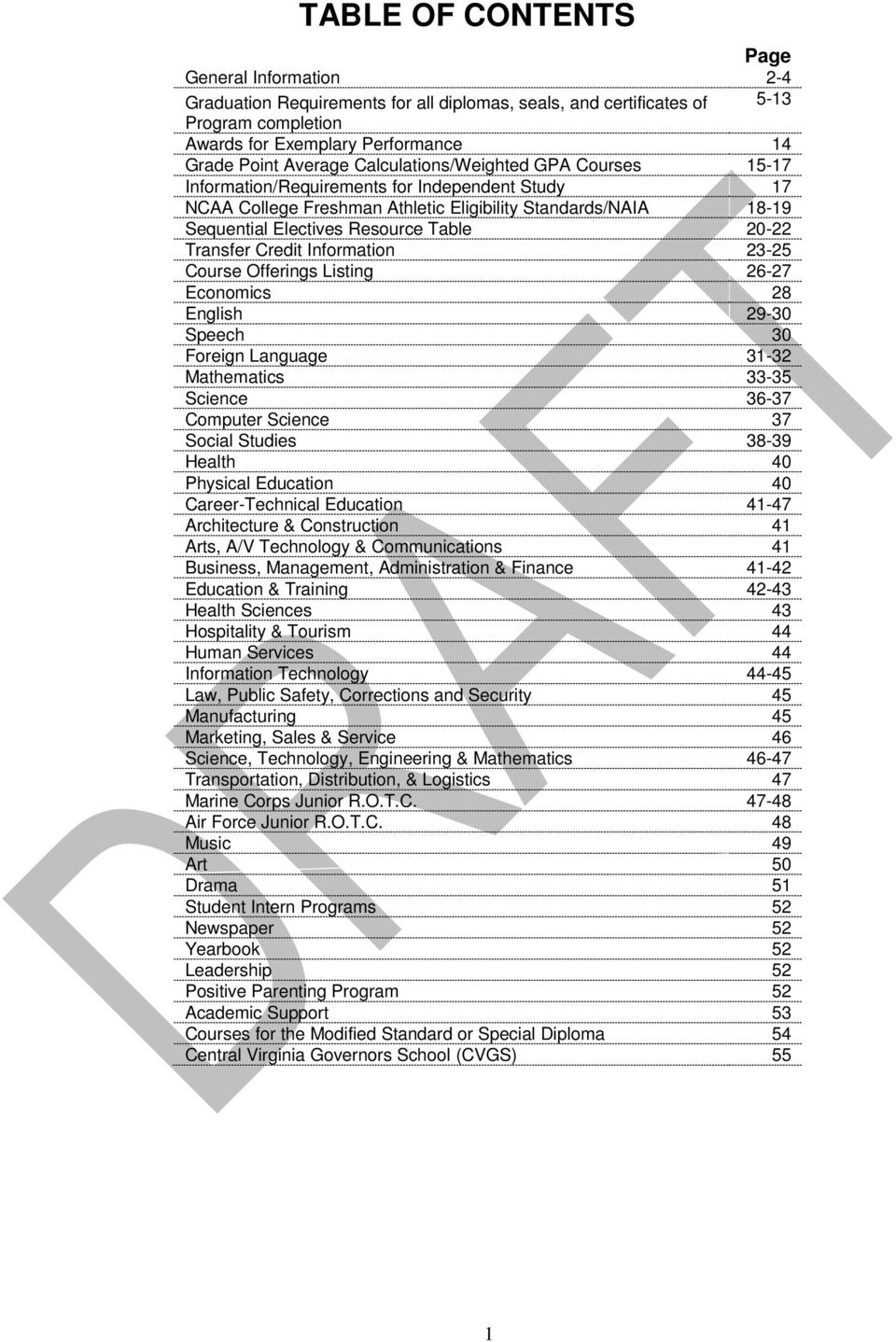
2 TABLE OF CONTENTS Page General Information 2-4 Graduation Requirements for all diplomas, seals, and certificates of 5-13 Program completion Awards for Exemplary Performance 14 Grade Point Average Calculations/Weighted GPA Courses Information/Requirements for Independent Study 17 NCAA College Freshman Athletic Eligibility Standards/NAIA Sequential Electives Resource Table Transfer Credit Information Course Offerings Listing Economics 28 English Speech 30 Foreign Language Mathematics Science Computer Science 37 Social Studies Health 40 Physical Education 40 Career-Technical Education Architecture & Construction 41 Arts, A/V Technology & Communications 41 Business, Management, Administration & Finance Education & Training Health Sciences 43 Hospitality & Tourism 44 Human Services 44 Information Technology Law, Public Safety, Corrections and Security 45 Manufacturing 45 Marketing, Sales & Service 46 Science, Technology, Engineering & Mathematics Transportation, Distribution, & Logistics 47 Marine Corps Junior R.O.T.C Air Force Junior R.O.T.C. 48 Music 49 Art 50 Drama 51 Student Intern Programs 52 Newspaper 52 Yearbook 52 Leadership 52 Positive Parenting Program 52 Academic Support 53 Courses for the Modified Standard or Special Diploma 54 Central Virginia Governors School (CVGS) 55 1
3 GENERAL INFORMATION INTRODUCTION The following pages contain the school division s graduation requirements and a listing of all courses in the high school curriculum. This listing contains course titles, course numbers, grade(s) in which students may select a particular course, the semester(s) each course will be taught, course credit value, prerequisites, and a brief description of each course. Except for several career-technical courses, the same courses are available in both schools. Whether or not a particular course is actually taught, however, depends upon the number of students enrolling in that course. All students who have successfully completed high school courses in middle school receive credit toward graduation as well as credit toward satisfying particular subject area requirements. The courses falling into this category in Lynchburg City Schools are advanced and regular Algebra I, advanced earth science, and the foreign languages. These courses, as well as any other traditional high school courses that may be taken for credit in middle school, are included in a student s high school Grade Point Average (GPA). GIFTED EDUCATION The high school program for gifted education is designed to serve those students who are gifted in the area of specific academic aptitude. The program is provided through course offerings listed in the program of studies under the heading of Advanced and Advanced Placement Courses. These courses offer students an opportunity to accelerate their program as well as provide an enriched and indepth classroom experience. Any interested student may enroll in one or more of these courses as long as he or she has successfully completed any prerequisites. The Lynchburg City Schools also participates in the regional Central Virginia Governor s School (CVGS) for Science and Technology and the state-sponsored Summer Governor s School programs. These programs provide unique opportunities for gifted students to pursue special areas of interest. Students and their parents are encouraged to contact their counselor to learn more about these programs and the opportunities they provide. Course offerings for CVGS are included in another section of this program of studies. EARLY COLLEGE PROGRAM The Early College Program is designed for juniors and seniors who have exhibited the dedication to academics necessary to complete a college curriculum while also completing their secondary education requirements. Students accepted into the program will have the opportunity to receive their high school diploma and their Associate of Arts and Science degree in General Studies from Central Virginia Community College in two years. Each year s cohort class will consist of 24 students. Of the 24 students, eight (8) slots will be reserved for the top eight (8) applicants from each high school (16 total). The final eight (8) slots will be filled by the remaining top eight (8) applicants regardless of high school. A selection rubric based on current high school G.P.A., scores on the CVCC Compass assessment in mathematics and English, teacher recommendations, attendance history, and the general quality of the application packet will be used to rank all applicants. CVCC officials will assess and rank the applications. Parents/Families will be responsible for tuition fees to CVCC. Lynchburg City Schools will provide transportation to and from the student s high school to CVCC, the campus on which all classes will be held. The school division will also pay textbook costs. All students will complete the same courses, and all students daily schedules will be the same. CVCC classes will begin at 8:00 a.m. and conclude by 1:00 p.m. A shuttle bus will return students to their high school campus in time for 7 th period and after-school activities. All Early College students are eligible to participate in any extra-curricular sports and activities at their high schools. The Early College Program will follow the CVCC calendar for all Early College courses, including observing the same holidays and academic breaks (fall, semester, and spring). CVCC staff will use the 10-point LCS grading scale. Junior Year CVCC Course Number LCS Course Number Course Title Credits First Sem. Credits Second Sem. Course Weight English AS/BS College Composition History AS/BS United States History I-II Math AS Pre-Calculus I Math BS Applied Calculus I Biology BS General Biology I-II Comm. Studies AS Principles of Public Speaking Health BS Concepts of Personal and Comm. Health Student Dev AS College Success Skills Senior Year CVCC Course Number LCS Course Number Course Title Credits First Sem. Credits Second Sem. Course Weight English AS/BS Survey of American Literature I-II Political Science AS U. S. Government I-II Inform. Technology AS/BS Intro. to Computer Apps and Concepts Math AS Pre-Calculus II Math BS Statistics Psychology AS/BS Developmental Psychology Spanish AS/BS Beginning Spanish I-II LYNCHBURG REGIONAL GOVERNOR S STEM ACADEMY 2

4 The Lynchburg Regional Governor s STEM Academy, located at Central Virginia Community College in the AREVA Technology Center, focuses on Science, Technology, Engineering and Math, thus the name STEM. This regional program for accepted high school juniors and seniors is supported by Region 2000 Technology Council; Future Focus Foundation; Central Virginia Community College; the Region 2000 Workforce Investment Board; area business partners including AMTI, AREVA, The Babcock and Wilcox Company, Centra Health and Delta Star; and the school divisions of Amherst, Appomattox, Bedford, Campbell and Lynchburg. The goal of this program is to close the gap between education and industry, thereby furthering the economic vitality of this region. The STEM Academy differs from the Central Virginia Governor s School in that the courses will have a career and technical educational focus. The curriculum will be driven by needs and projected growth of regional industry. Currently, the two identified student pathways offered at the Academy will be Health Care Technologies and Mechatronics the blending of mechanical and electrical engineering disciplines. Graduates of this program will be workforce-ready to further the economic growth in Region Junior Year CVCC STEM Course Number LCS Course Number Course Title Credits First Sem. Credits Second Sem. Course Weight EGR AX/BX Intro. to Engineering Design IND160/EGR AX/BX Principles of Engineering MTH AX/BX App. Tech. Mathematics/Elem Statistics CHM AX/BX/3378 Applied Chemistry I & II SDV AS College Success Skills Senior Year CVCC STEM Course Number LCS Course Number Course Title Credits First Sem. Credits Second Sem. Course Weight IND AX Computer Integrated Manufacturing ETR AX Digital Electronics MTH AX/BX Engineering Math I & II PHY AX/BX Applied Physics I & II EGR BX Senior Internship BIO AX Biotechnical Engineering ETR BX Digital Electronics MTH AX/BX Engineering Math I & II BIO AX/BX Human Anatomy & Physiology I & II EGR BX Senior Internship OTHER CVCC OPPORTUNITIES CVCC has created an opportunity for rising seniors who are interested in getting a head start on their career in the fields of RN, EMT, HVAC, Welding, or Machinist. Seniors will take required high school courses at their base schools and their college courses at CVCC. The courses taken at CVCC will count for both college and high school credit. Transportation will be provided, but tuition costs will be the responsibility of the students and their families. See your school s career or guidance counselor for more information. CVCC TRANSITION PROGRAM The CVCC College for Living plus program provides high school students with disabilities the opportunity to acquire skills leading to independent living, employment and self-advocacy. This program is available to high school students identified with disabilities through the Individual Education Plan (IEP). For additional information on this program please contact your child s IEP casemanager. DUAL ENROLLMENT COURSES The dual enrollment program with Central Virginia Community College allows students who are enrolled in certain high school courses to receive both high school and college credit. All dual enrollment core content courses (Advanced Composition; Advanced Pre- Calculus/Applied Calculus; and Advanced College Biology) are weighted at 5.0 quality points. Student interest defines which courses will be taught on a yearly basis. Students enrolled in these courses may earn college credit from CVCC by fulfilling course requirements and completed the course with a grade of C or better. Students must qualify for enrollment for these courses by taking the CVCC placement test or by ACT or SAT qualifying scores. The costs for required textbooks for dual enrollment courses will remain the responsibility of the school division. There is no tuition charged for dual enrollment classes taught in high schools. For more information, please contact the appropriate counselor at your child s school. 3

5 AP CAPSTONE AP Capstone is an innovative diploma program from the College Board that equips students with the independent research, collaborative teamwork, and communication skills that are increasingly valued by colleges. AP Capstone is built on the foundation of two AP courses AP Seminar and AP Research and is designed to complement and enhance the in-depth, discipline-specific study experienced in other AP courses. In AP Seminar, students investigate real-world issues from multiple perspectives, gathering and analyzing information from various sources in order to develop credible and valid evidence-based arguments. In AP Research, students cultivate the skills and discipline necessary to conduct independent research in order to produce and defend a scholarly academic thesis. Students who earn scores of 3 or higher in AP Seminar and AP Research and on four additional AP Exams of their choosing will receive the AP Capstone Diploma. Students who earn scores of 3 or higher in AP Seminar and AP Research but not on four additional AP Exams will receive the AP Seminar and Research Certificate. AP Seminar may also be taken as a stand-alone option SPECIAL EDUCATION Special education programs and services are available to students with disabilities. The special education services are provided based on an individualized education plan which is developed by a student s parent(s) and a school-based instructional team. When a parent, teacher, or counselor suspects a student is disabled, a referral is processed through the building principal to the school-based child study committee. Upon receipt of a referral, the child study committee meets within 10 working days. If the child study committee suspects the child may have a disability, a comprehensive evaluation is completed after securing parent written permission to evaluate. Placement in a special education program or class is contingent on the results of extensive diagnostic testing and assessment as well as the decision of a school-based eligibility committee s review of the assessment results and the eligibility criteria set forth in the Regulations Governing Special Education Programs in Virginia. Students with disabilities shall be eligible to receive a Standard Diploma, Advanced Studies Diploma or Advanced Studies Diploma with Lynchburg Honors Seal upon earning the units of credit prescribed and by passing the Standards of Learning Tests. In addition, students entering the ninth grade between may earn the Modified Standard Diploma. Beginning with the Freshman class, the Modified Standard Diploma will be folded into the Standard Diploma, and the Board of Education will establish, through guidelines, credit accommodations for students with disabilities. The Special Diploma is also an option for students with disabilities. Requirements for these diplomas are described in a later section of this program of studies. ALTERNATIVE AND ADULT EDUCATION PROGRAM INFORMATION Lynchburg City Schools offers a variety of alternative programs available to students on an individual basis. These programs include the Fort Hill Community School which also houses the homebound program, the Amelia Pride Center, RODEO (Reach Out to Develop Educational Opportunities) and other pre-general Educational Development (GED) certificate programs. Students in an alternative program completing requirements for a diploma will only be eligible to participate in the Pride Center graduation. 4
6 GRADUATION REQUIREMENTS The Regulations for Establishing Standards for Accrediting Public Schools in Virginia specifies the standards that all students must meet in order to earn the Special Diploma, the Modified Standard Diploma, the Standard Diploma, and the Advanced Studies Diploma. These standards can be changed from one year to another, and each student must meet the requirements in place the year he or she first entered the ninth grade. There are additional local requirements to earn the Advanced Studies Diploma with a Lynchburg Honors Seal. VERIFIED CREDITS To receive a standard diploma, students must pass six Standards of Learning (SOL) tests. Students entering ninth grade after must pass English: Reading/Literature/Research, English: Writing, one math, one science, one history/social studies, and one other SOL test or substitute test. All students seeking an advanced studies diploma must pass nine Standards of Learning (SOL) tests including the 2 English, 2 math, 2 science, 2 history, and one other. LOCALLY AWARDED VERIFIED CREDIT OPTION The current Regulations for Establishing Standards for Accrediting Public Schools in Virginia provide for locally awarded verified credits in science and history/social studies for students in the ninth grade class of and beyond who are working toward a standard diploma (8 VAC B.3). A verified credit is received when a student passes a high school credit course and the associated Standards of Learning (SOL) end-ofcourse state test. A locally awarded verified credit is an option available for some students who pass a science or history/social studies class but do not pass the associated SOL end-of-course test and do not have enough verified credits to graduate with a standard diploma. Locally awarded verified credits apply only to the standard diploma. No locally awarded verified credit may be used for the advanced studies diploma. Locally awarded verified credits apply only to science and history/social studies. No locally awarded verified credits are available for math, reading, or writing. To be eligible to earn a local verified credit in science or history/social studies, a student must: pass the high school course but not pass the associated state SOL end-of-course test, score at least 375 on any administration of the SOL test having taken the test at least twice, be working toward a standard diploma, and demonstrate achievement in the academic content through a local appeal process. The appeal process in Lynchburg includes the following: A school-based panel will review semester grades of students eligible for a local verified credit. A local verified credit will be awarded if a student has achieved a final grade of "C" or better for both semesters of the science or history course. Students eligible for a local verified credit who receive a "D" for one or both semesters of the science or history course will receive a local verified credit if they receive a grade of "C" or higher on the exam for the semester or semesters in which they made a "D." Students not meeting one of the above criteria may review course content and complete a released SOL test. Once they receive a perfect score on the released test, they are eligible for a locally verified credit. Students may use notes when completing the released test. This option is available until the student scores 100%. The school-based panel has final authority in determining whether to (a) award the verified credit, (b) deny the verified credit, or (c) suggest participation in a remedial program followed by retesting. Any appeals regarding locally awarded verified credits should be directed to the assistant superintendent of curriculum and instruction. NOTE: Students with disabilities who qualify for credit accommodations may be awarded local verified credits in any subject area if they meet the criteria above. 5

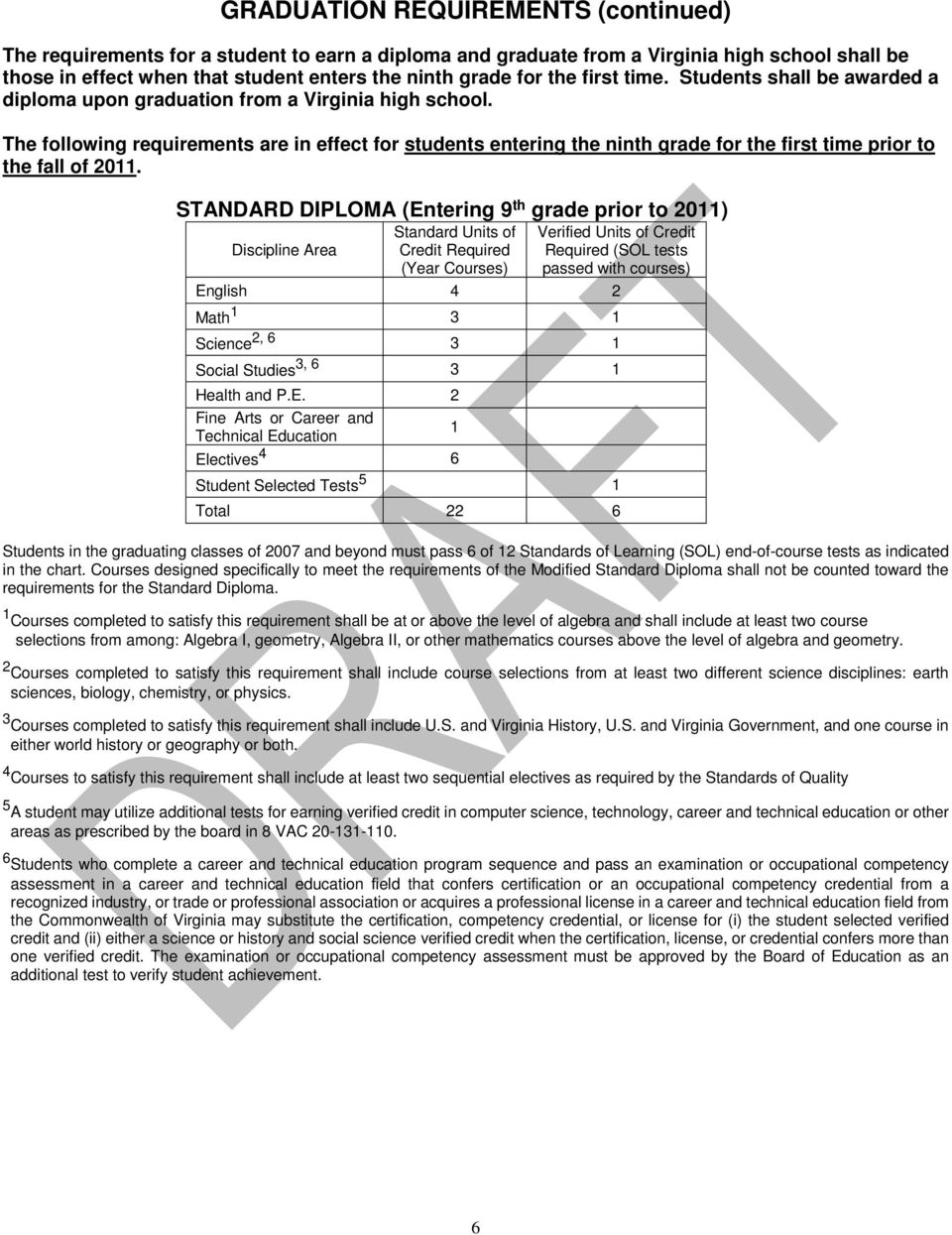
7 GRADUATION REQUIREMENTS (continued) The requirements for a student to earn a diploma and graduate from a Virginia high school shall be those in effect when that student enters the ninth grade for the first time. Students shall be awarded a diploma upon graduation from a Virginia high school. The following requirements are in effect for students entering the ninth grade for the first time prior to the fall of STANDARD DIPLOMA (Entering 9 th grade prior to 2011) Discipline Area Standard Units of Credit Required (Year Courses) Verified Units of Credit Required (SOL tests passed with courses) English 4 2 Math Science 2, Social Studies 3, Health and P.E. 2 Fine Arts or Career and Technical Education 1 Electives 4 6 Student Selected Tests 5 1 Total 22 6 Students in the graduating classes of 2007 and beyond must pass 6 of 12 Standards of Learning (SOL) end-of-course tests as indicated in the chart. Courses designed specifically to meet the requirements of the Modified Standard Diploma shall not be counted toward the requirements for the Standard Diploma. 1 Courses completed to satisfy this requirement shall be at or above the level of algebra and shall include at least two course selections from among: Algebra I, geometry, Algebra II, or other mathematics courses above the level of algebra and geometry. 2 Courses completed to satisfy this requirement shall include course selections from at least two different science disciplines: earth sciences, biology, chemistry, or physics. 3 Courses completed to satisfy this requirement shall include U.S. and Virginia History, U.S. and Virginia Government, and one course in either world history or geography or both. 4 Courses to satisfy this requirement shall include at least two sequential electives as required by the Standards of Quality 5 A student may utilize additional tests for earning verified credit in computer science, technology, career and technical education or other areas as prescribed by the board in 8 VAC Students who complete a career and technical education program sequence and pass an examination or occupational competency assessment in a career and technical education field that confers certification or an occupational competency credential from a recognized industry, or trade or professional association or acquires a professional license in a career and technical education field from the Commonwealth of Virginia may substitute the certification, competency credential, or license for (i) the student selected verified credit and (ii) either a science or history and social science verified credit when the certification, license, or credential confers more than one verified credit. The examination or occupational competency assessment must be approved by the Board of Education as an additional test to verify student achievement. 6
8 GRADUATION REQUIREMENTS (continued) The following Requirements are in effect for students entering ninth grade for the first time in the fall of 2011 through the fall of STANDARD DIPLOMA (Entering 9 th grade in the fall of 2011 or the fall of 2012) Discipline Area Standard Units of Credit Required Verified Credits Required English 4 2 Mathematics Laboratory Science 2, History and Social Sciences 3, Health and Physical Education 2 Foreign Language, Fine Arts or Career and Technical Education 7 2 Economics and Personal Finance 1 Electives 4 4 Student Selected Test 5 1 Total Courses completed to satisfy this requirement shall include at least two different course selections from among: Algebra 1, Geometry, Algebra, Functions, and Data Analysis, Algebra 2, or other mathematics courses above the level of Algebra Courses completed to satisfy this requirement shall include course selections from at least two different science disciplines: earth sciences, biology, chemistry, or physics. 3. Courses completed to satisfy this requirement shall include U.S. and Virginia History, U.S. and Virginia Government, and one course in either world history or geography or both. 4. Courses to satisfy this requirement shall include at least two sequential electives as required by the Standards of Quality. 5. A student may utilize additional tests for earning verified credit in computer science, technology, career and technical education, economics, or other areas as prescribed by the board in 8 VAC Students who complete a career and technical education program sequence and pass an examination or occupational competency assessment in a career and technical education field that confers certification or an occupational competency credential from a recognized industry, or trade or professional association or acquires a professional license in a career and technical education field from the Commonwealth of Virginia may substitute the certification, competency credential, or license for (i) the student selected verified credit and (ii) either a science or history and social science verified credit when the certification, license, or credential confers more than one verified credit. The examination or occupational competency assessment must be approved by the Board of Education as an additional test to verify student achievement. 7. Pursuant to Section :4, Code of Virginia, credits earned for this requirement shall include one credit in fine or performing arts or career and technical education. 7

9 GRADUATION REQUIREMENTS (continued) The following Requirements are in effect for students entering ninth grade for the first time in the fall of 2013 and beyond. STANDARD DIPLOMA (Entering 9 th Grade for first time in the fall of 2013 or beyond) Discipline Area Standard Units of Credit Required Verified Credits Required English 4 2 Mathematics Laboratory Science 2,6 3 1 History and 3 1 Social Sciences 3,6 Health and Physical 2 Education Foreign Language, Fine Arts or Career and Technical Education 7 2 Economics and Personal 1 Finance Electives 4 4 Student Selected Tests 5 1 Career and Technical Education Credential 8 Total 9, Courses completed to satisfy this requirement shall include at least two different course selections from among: Algebra I, Geometry, Algebra, Functions, and Data Analysis, Algebra II, or other mathematics courses above the level of Algebra II. The board shall approve courses to satisfy this requirement. 2 Courses completed to satisfy this requirement shall include course selections from at least two different science disciplines: earth sciences, biology, chemistry, or physics, or completion of the sequence of science courses required for the International Baccalaureate Diploma. The board shall approve courses to satisfy this requirement. 3 Courses completed to satisfy this requirement shall include U.S. and Virginia History, U.S. and Virginia Government, and one course in either world history or geography or both. The board shall approve courses to satisfy this requirement. 4 Courses to satisfy this requirement shall include at least two sequential electives as required by the Standards of Quality. 5 A student may utilize additional tests for earning verified credit in computer science, technology, career and technical education, economics or other areas as prescribed by the board in 8VAC Students who complete a career and technical education program sequence and pass an examination or occupational competency assessment in a career and technical education field that confers certification or an occupational competency credential from a recognized industry, or trade or professional association, or acquires a professional license in a career and technical education field from the Commonwealth of Virginia may substitute the certification, competency credential, or license for (i) the student-selected verified credit and (ii) either a science or history and social science verified credit when the certification, license, or credential confers more than one verified credit. The examination or occupational competency assessment must be approved by the Board of Education as an additional test to verify student achievement. 7 Pursuant to :4 of the Code of Virginia, credits earned for this requirement shall include one credit in fine or performing arts or career and technical education. (Continued on next page) 8
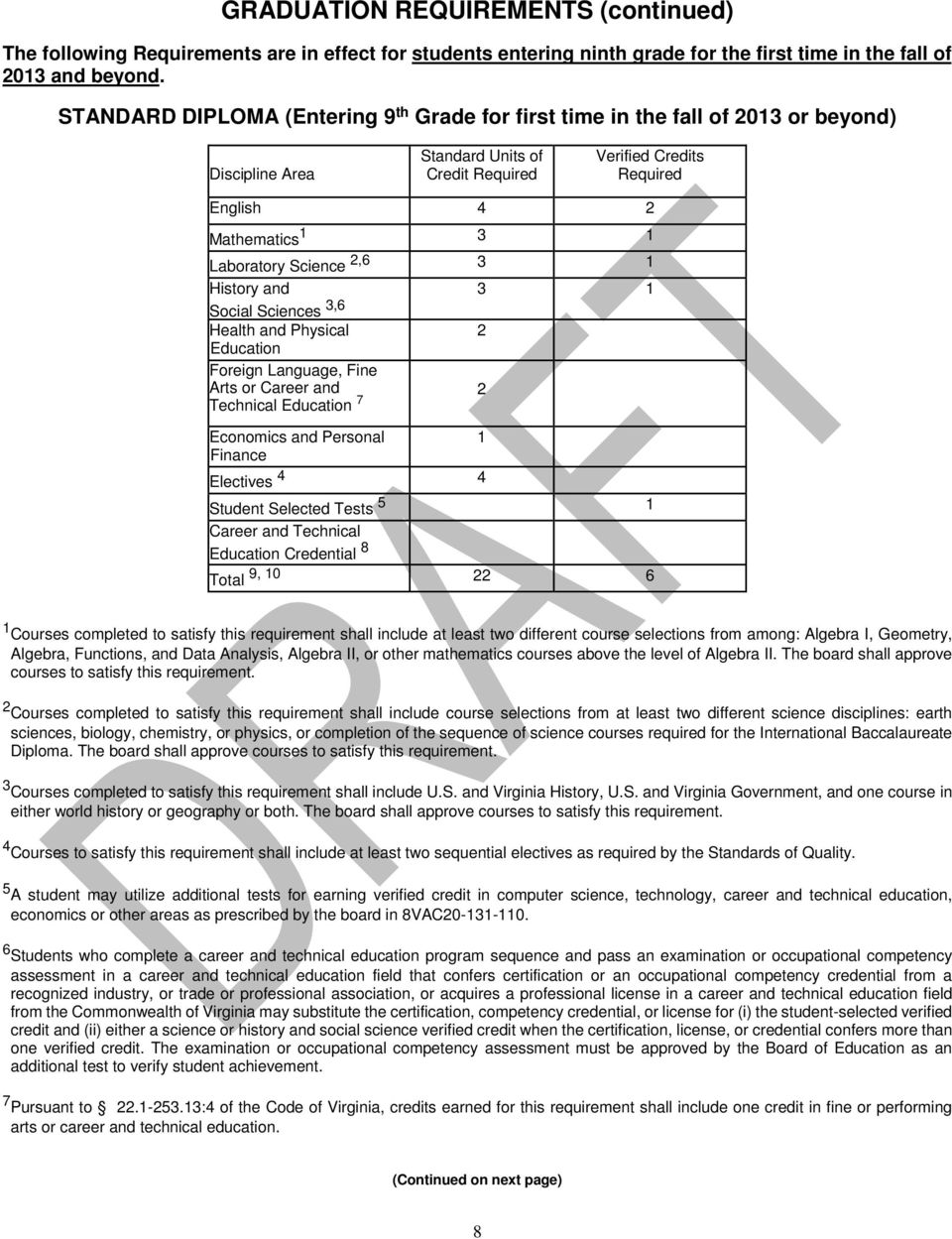
10 GRADUATION REQUIREMENTS (continued) 8 Students shall earn a career and technical education credential approved by the Board of Education that could include, but not be limited to, the successful completion of an industry certification, a state licensure examination, a national occupational competency assessment, or the Virginia workplace readiness assessment. 9 Students shall successfully complete one virtual course, which may be a noncredit-bearing course or a required or elective credit-bearing course that is offered online. 10 For students with IEPs or 504 Plans, the Board of Education shall establish, through guidelines, credit accommodations to the standard and verified credit requirements for a Standard Diploma. The student s Individual Education Program (IEP) or 504 Plan would specify any credit accommodations that would be applicable for the student. SEQUENTIAL ELECTIVES REQUIREMENT Students earning the Standard or Modified Standard Diploma must successfully complete two sequential electives to satisfy graduation requirements. Courses used to satisfy this requirement may be in any discipline as long as the courses are not specifically required for graduation. Courses used to satisfy the one-credit requirement in the fine arts or career and technical education may also be used to partially satisfy this requirement. For example, if a student selects Art I to satisfy the fine arts or career and technical education requirement, then Art I and a second course in the art sequence may also be used to satisfy the sequential electives requirement. The second course could then also count toward the six other required elective credits. Courses to satisfy the sequential elective requirement do not have to be completed in consecutive years, and they may be semester or year-long courses. Exploratory courses may not be used to meet the sequential elective requirement, but introductory courses may be used. Specifically approved sequences of courses meeting this requirement can be found on pp of this document. Questions regarding sequential electives may be directed to the counselor of your child s school. 9
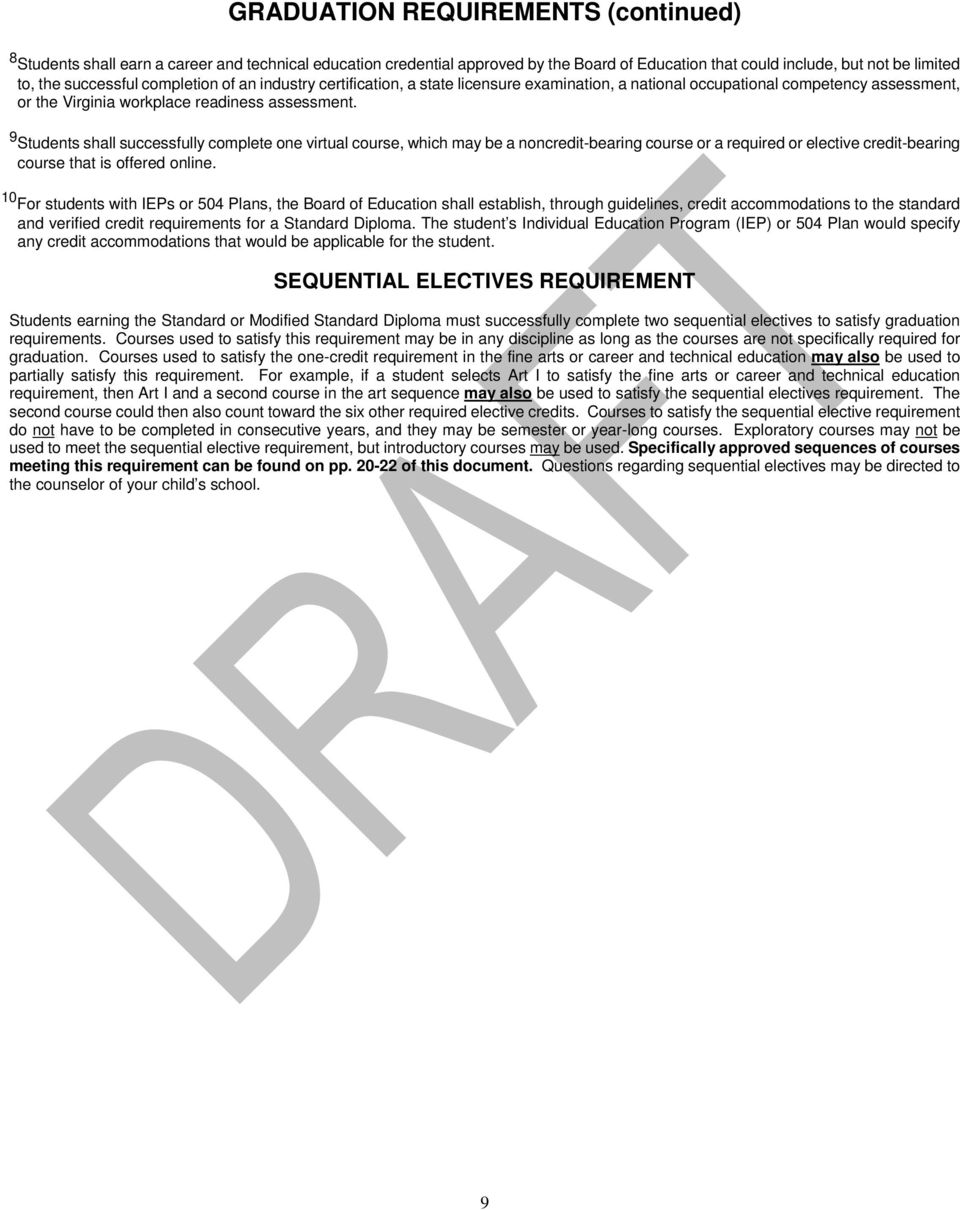
11 GRADUATION REQUIREMENTS (continued) ADVANCED STUDIES DIPLOMA (Entering 9 th grade prior to 2011) Discipline Area Standard Units of Credit Required (Year Courses) Verified Units of Credit Required (SOL tests passed w/courses) English 4 2 Math Science History/Social Studies Foreign Language 4 3 Health & P.E. 2 Fine Arts or Career Technical Education 5 1 Electives 2 Student Selected Tests 6 1 Total 24 9 Students must pass 9 Standards of Learning (SOL) end-of-course tests as indicated in the chart above. 1 Courses completed to satisfy this requirement shall be at or above the level of algebra and shall include at least three different course selections from among: Algebra I, Geometry, Algebra II, or other mathematics courses above the level of Algebra II. 2 Courses from at least three different science disciplines from among: earth sciences, biology, chemistry, or physics. 3 Courses completed to satisfy this requirement shall include U.S. and Virginia History, U.S. and Virginia Government, and two courses in either world history or geography or both. 4 Courses completed to satisfy this requirement shall include three years of one language or two years of two languages. 5 A student who successfully completes a full credit of one of the courses listed under Computer Science, CVGS Senior Technology Seminar, or CVGS College Computer Science in the High School Program of Studies will meet the requirement for a credit for CTE content under the CTE content option. 6 A student may utilize additional tests for earning verified credit in computer science, technology, career or technical education or other areas as prescribed by the board in 8 VAC
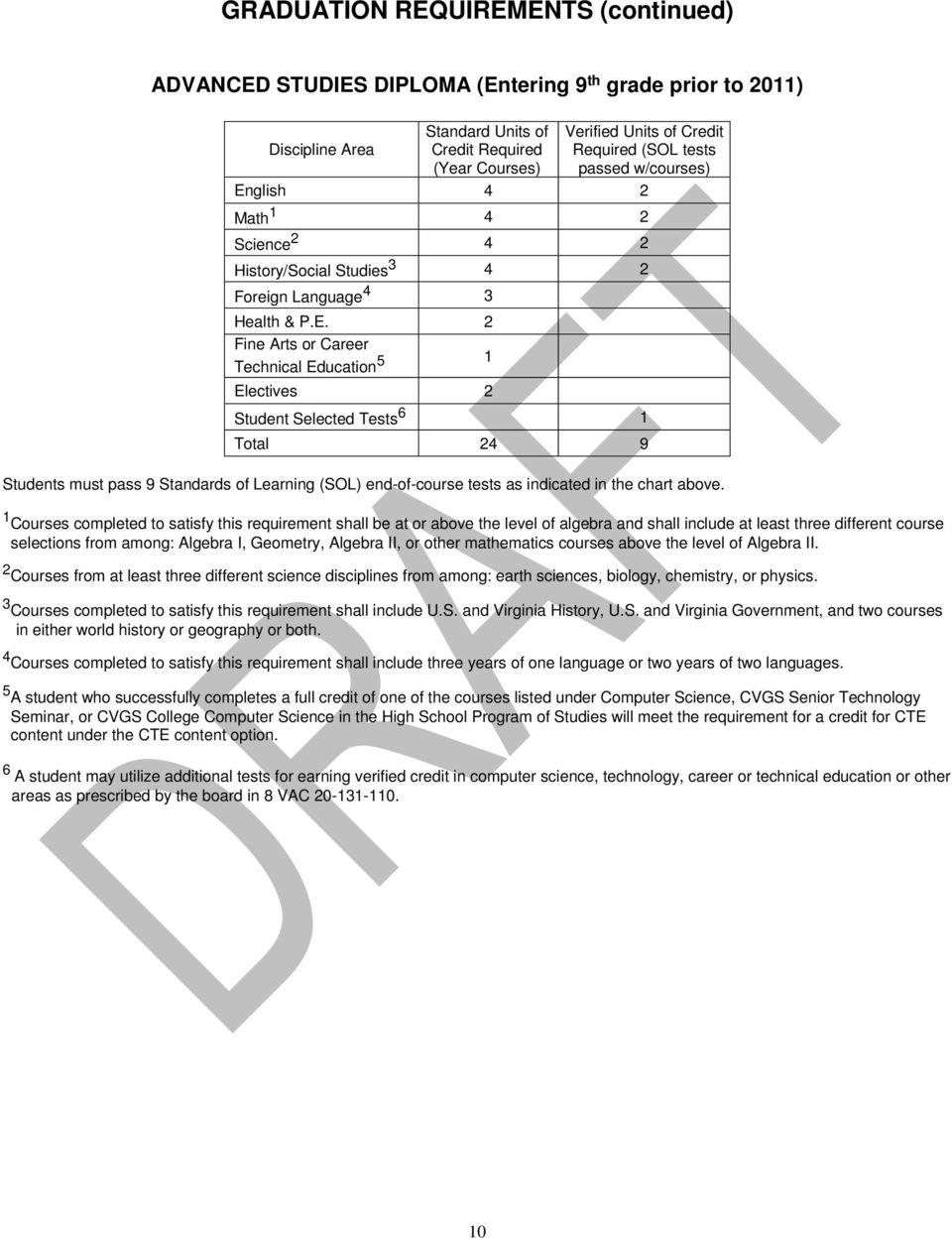
12 GRADUATION REQUIREMENTS (continued) ADVANCED STUDIES DIPLOMA (Entering 9 th grade in fall of 2011 or later) Discipline Area Standard Units of Credit Required Verified Credits Required English 4 2 Mathematics Laboratory Science History and Social Sciences Foreign Language 4 3 Health and Physical Education 2 Fine Arts or Career and Technical Education 1 Economics and Personal Finance 1 Electives 3 Student Selected Test 5 1 Total Courses completed to satisfy this requirement shall include at least three different course selections from among: Algebra I, Geometry, Algebra II, or other mathematics courses above the level of Algebra II. 2. Courses completed to satisfy this requirement shall include course selections from at least three different science disciplines from among: earth sciences, biology, chemistry, or physics. 3. Courses completed to satisfy this requirement shall include U.S. and Virginia History, U.S. and Virginia Government, and two courses in either world history or geography or both. 4. Courses completed to satisfy this requirement shall include three years of one language or two years of two languages. 5. A student may utilize additional tests for earning verified credit in computer science, technology, career or technical education, economics, or other areas as prescribed by the board in 8 VAC Beginning with the ninth grade class of , students shall successfully complete one virtual course, which may be a noncredit-bearing course, or may be a course required to earn this diploma that is offered online. ADVANCED STUDIES DIPLOMA WITH LYNCHBURG HONORS SEAL (all students) Students who wish to earn the Advanced Studies Diploma with Lynchburg Honors Seal must meet all the course and verified credit requirements for the Advanced Studies Diploma. In addition, they must meet the following additional criteria: 1) English must include a minimum of six semesters in courses designed for students with above average skills in reading and writing. Four of these semester courses must be taken during the junior and senior years. 2) The four math credits must include Algebra 1 and three credits above the level of Algebra I. The minimum must include progress through trigonometry/functions. 3) Science credits must include choices from Earth Science, Biology I, Biology II, Anatomy and Physiology, Biology II, Ecology, chemistry, physics, AP Chemistry, AP Physics, AP Biology, and Dual Enrollment Biology. 4) Social studies credits must include Advanced World History and Geography I (to 1500 AD), Advanced World History and Geography II (1500 AD to Present) or AP World History, Advanced American History, AP American History, Advanced U.S. Government or AP Government, AP European History, and AP Microeconomics and Macroeconomics. 5) Students must take and pass at least two advanced placement or dual enrollment courses (or one of each) in different content areas during the senior year. These courses may be in English, Math, Science, or Social Studies. 11

13 GRADUATION REQUIREMENTS (continued) MODIFIED STANDARD DIPLOMA (Entering 9 th grade prior to 2013) 1. Every student shall be expected to pursue a Standard Diploma or Advanced Studies Diploma. The Modified Standard Diploma program is intended for certain students at the secondary level who have a disability and are unlikely to meet the credit requirements for a Standard Diploma. Eligibility and participation in the Modified Standard Diploma program shall be determined by the student's Individualized Education Program (IEP) team (including the student, as appropriate) at any point after the student's eighth grade year. 2. The school must secure the informed written consent of the parent/guardian and the student to choose this diploma program. Such a choice occurs only after review of the student's academic history and the full disclosure of the student's options. 3. The student who has chosen to pursue a Modified Standard Diploma shall also be allowed to pursue the Standard or Advanced Studies Diploma at any time throughout that student's high school career, and the student must not be excluded from courses and tests required to earn a Standard or Advanced Studies Diploma. 4. Students pursuing the Modified Standard Diploma shall pass literacy and numeracy competency assessments prescribed by the state Board of Education. 5. Courses designed to satisfy the requirements of the Modified Standard Diploma are listed in a section near the end of the Program of Studies. Credits required for a Modified Standard Diploma for students (Entering 9 th grade prior to 2013) Discipline Area Standard Units of Credit Required (Year Courses) English 4 Math 1 3 Science 2 2 Social Studies 3 2 Health and P.E. 2 Fine or Career Technical Education 1 Electives 4 6 Total 20 1 Courses completed shall include content from among algebra, geometry, personal finance, and statistics in courses that have been approved by the State Board of Education. 2 Courses completed shall include content from at least two of the following: earth science, biology, chemistry, or physics in courses approved by the State Board of Education. 3 Courses completed shall include one unit of credit in U.S. and Virginia History and one unit of credit in U.S. and Virginia Government in courses approved by the state Board of Education. 4 Courses completed shall include at least two sequential electives as required for the Standard Diploma. SPECIAL DIPLOMA (all students) Students identified with disabilities who complete the requirements of their individualized education programs shall be awarded special diplomas by local school boards if they do not fulfill any other diploma requirements. CERTIFICATE OF PROGRAM COMPLETION (all students) Students who have completed a prescribed course of study as defined by the local school board shall be awarded certificates by local school boards if the students do not qualify for diplomas. GENERAL ACHIEVEMENT DIPLOMA (all students) Students who exit high school without a diploma but then plan to pursue a General Achievement Diploma (GAD) must meet both the course credit and testing requirements of this program. Additional information on these programs is available by contacting the Amelia Pride Adult Learning Center at

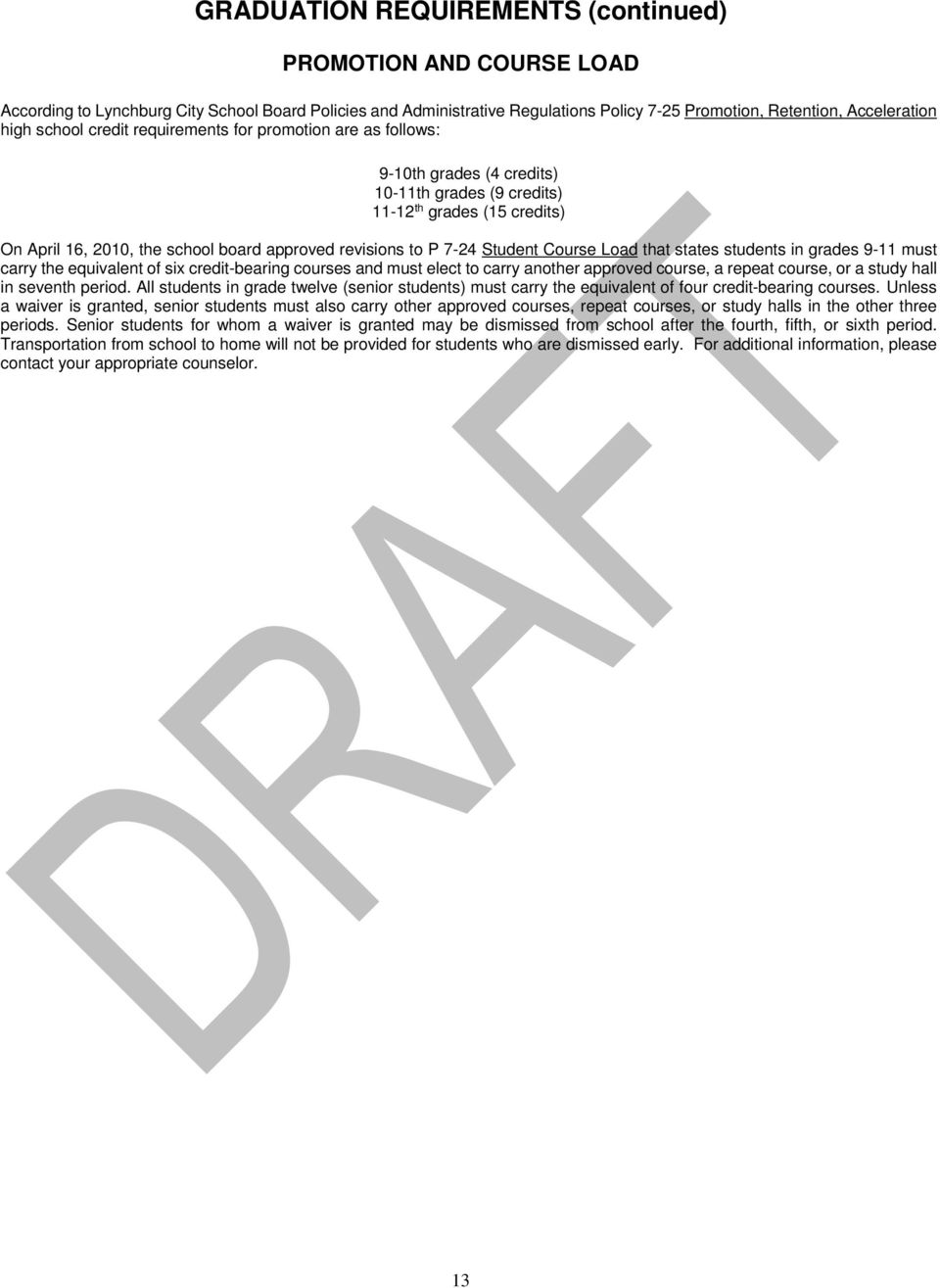
14 GRADUATION REQUIREMENTS (continued) PROMOTION AND COURSE LOAD According to Lynchburg City School Board Policies and Administrative Regulations Policy 7-25 Promotion, Retention, Acceleration high school credit requirements for promotion are as follows: 9-10th grades (4 credits) 10-11th grades (9 credits) th grades (15 credits) On April 16, 2010, the school board approved revisions to P 7-24 Student Course Load that states students in grades 9-11 must carry the equivalent of six credit-bearing courses and must elect to carry another approved course, a repeat course, or a study hall in seventh period. All students in grade twelve (senior students) must carry the equivalent of four credit-bearing courses. Unless a waiver is granted, senior students must also carry other approved courses, repeat courses, or study halls in the other three periods. Senior students for whom a waiver is granted may be dismissed from school after the fourth, fifth, or sixth period. Transportation from school to home will not be provided for students who are dismissed early. For additional information, please contact your appropriate counselor. 13
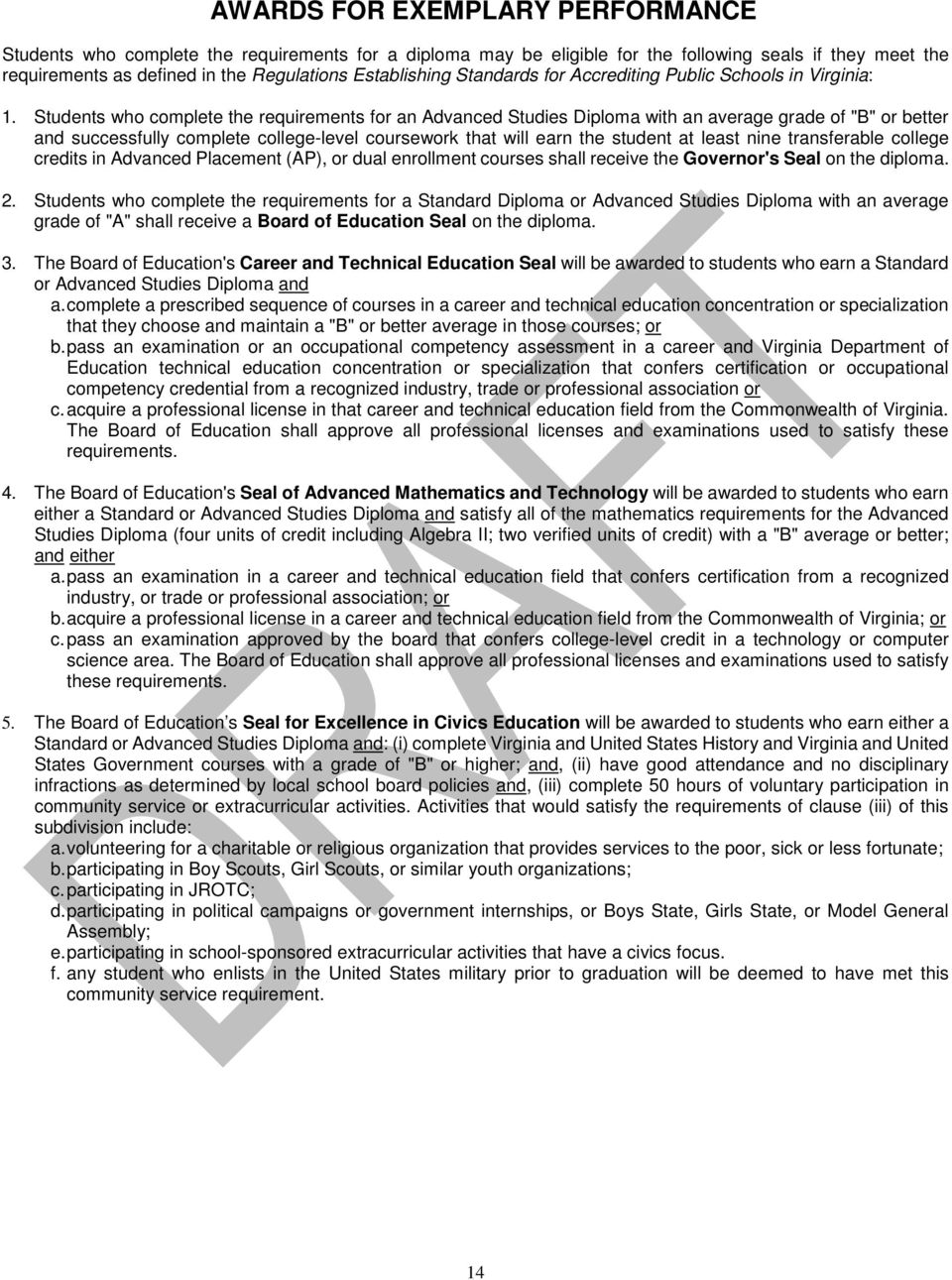
15 AWARDS FOR EXEMPLARY PERFORMANCE Students who complete the requirements for a diploma may be eligible for the following seals if they meet the requirements as defined in the Regulations Establishing Standards for Accrediting Public Schools in Virginia: 1. Students who complete the requirements for an Advanced Studies Diploma with an average grade of "B" or better and successfully complete college-level coursework that will earn the student at least nine transferable college credits in Advanced Placement (AP), or dual enrollment courses shall receive the Governor's Seal on the diploma. 2. Students who complete the requirements for a Standard Diploma or Advanced Studies Diploma with an average grade of "A" shall receive a Board of Education Seal on the diploma. 3. The Board of Education's Career and Technical Education Seal will be awarded to students who earn a Standard or Advanced Studies Diploma and a. complete a prescribed sequence of courses in a career and technical education concentration or specialization that they choose and maintain a "B" or better average in those courses; or b. pass an examination or an occupational competency assessment in a career and Virginia Department of Education technical education concentration or specialization that confers certification or occupational competency credential from a recognized industry, trade or professional association or c. acquire a professional license in that career and technical education field from the Commonwealth of Virginia. The Board of Education shall approve all professional licenses and examinations used to satisfy these requirements. 4. The Board of Education's Seal of Advanced Mathematics and Technology will be awarded to students who earn either a Standard or Advanced Studies Diploma and satisfy all of the mathematics requirements for the Advanced Studies Diploma (four units of credit including Algebra II; two verified units of credit) with a "B" average or better; and either a. pass an examination in a career and technical education field that confers certification from a recognized industry, or trade or professional association; or b. acquire a professional license in a career and technical education field from the Commonwealth of Virginia; or c. pass an examination approved by the board that confers college-level credit in a technology or computer science area. The Board of Education shall approve all professional licenses and examinations used to satisfy these requirements. 5. The Board of Education s Seal for Excellence in Civics Education will be awarded to students who earn either a Standard or Advanced Studies Diploma and: (i) complete Virginia and United States History and Virginia and United States Government courses with a grade of "B" or higher; and, (ii) have good attendance and no disciplinary infractions as determined by local school board policies and, (iii) complete 50 hours of voluntary participation in community service or extracurricular activities. Activities that would satisfy the requirements of clause (iii) of this subdivision include: a. volunteering for a charitable or religious organization that provides services to the poor, sick or less fortunate; b. participating in Boy Scouts, Girl Scouts, or similar youth organizations; c. participating in JROTC; d. participating in political campaigns or government internships, or Boys State, Girls State, or Model General Assembly; e. participating in school-sponsored extracurricular activities that have a civics focus. f. any student who enlists in the United States military prior to graduation will be deemed to have met this community service requirement. 14
16 GRADE POINT AVERAGE (GPA) CALCULATIONS The Grade Point Average (GPA) calculation is a way to quantify the overall academic achievement of a student in a single number. The GPA calculation is used for ranking graduating students and is often requested on applications for awards, recognitions, certain memberships or positions, and on college applications. This value is determined by the grades a student earns and by the level of difficulty of the courses taken. In the Lynchburg City Schools, there are three levels of courses, and each allocates a different number of quality points for a given grade. For most classes, an A is worth 4 points, a B is worth 3 points, a C is worth 2 points, a D is worth 1 point, and an F is worth zero points. If a student takes an advanced level course, an additional 0.5 points is added to any grade earned above an F. If a student takes an Advanced Placement (AP) course, an additional full point is added to any grade earned above an F. Advanced Placement, CVGS, and Dual Enrollment Courses in Core Content Areas Points Per Semester Credit Advanced Courses and Specified Dual Enrollment Courses All Other A 5 A 4.5 A 4 B 4 B 3.5 B 3 C 3 C 2.5 C 2 D 2 D 1.5 D 1 F 0 F 0 F 0 Calculating the Semester GPA To calculate the GPA for a given semester, total the Quality Points (QP) earned for the grade in each class. Divide this sum by the number of classes taken. For example, if a student had 6 graded classes and earned three A s and three B s, the calculation would be = 21 Total Quality Points which, when divided by six total classes, yields a semester GPA of 3.5. If a student takes an advanced level or Advanced Placement (AP) course, each grade is worth more QP. The calculation of the semester GPA follows the same process, however. Using the previous example, if the first A was in an advanced course and the last B was in an AP course, the calculation would be = 22.5 Total Quality Points. When divided by six classes, this total yields a semester GPA of If you would like additional explanation about these calculations, please contact the guidance department at your child s school. Grading Scale All courses follow a nine-week grading period. Credits are earned on a semester basis. The following grading scale will be used in grade levels 9-12 for all students: A = B = C = D = F = 59 and below 15

17 WEIGHTED GPA CLASSES ADVANCED PLACEMENT (AP) COURSES As mentioned previously, due to the rigor and work load, all of these AP courses are weighted at 5.0 quality points for an A. All students completing Advanced Placement (AP) courses must take the associated AP exams in May. If a student is unable to participate in the AP exam for a course, that course will be recognized on the student s transcript as an advanced level course (weighted at 4.5 rather than 5.0 quality points) for the second semester, and the student must sit for the corresponding final exam (unless a senior exam exemption applies) and that exam will constitute 10% of the student s second semester grade for the course. In the case of extreme extenuating circumstances, appeals to this practice may be submitted to the assistant superintendent of curriculum and instruction. All Governor s School courses Any dual enrollment courses in math, science, social studies, and English Advanced Placement Language/Composition Advanced Placement Literature Advanced Placement American History Advanced Placement World History Advanced Placement European History Advanced Placement Micro and Macro Economics Advanced Placement Calculus AB Advanced Placement Calculus BC Advanced Placement Statistics Advanced Placement Latin (Vergil) Advanced Placement Spanish Language V Advanced Placement French Language V Advanced Placement German Language V Advanced Placement American Government Advanced Placement Comparative Government Advanced Placement Human Geography Advanced Placement Chemistry Advanced Placement Physics Advanced Placement Biology Advanced Placement Art History Advanced Placement Portfolio Art Advanced Placement Music Theory Advanced Placement Psychology Advanced Placement Computer Science Advanced Placement Environmental Science Other courses as noted in Edgenuity and in the current Virtual Virginia On-Line Program brochure Advanced Placement Seminar Advanced Placement Research VIRTUAL VIRGINIA COURSES In addition to the AP courses offered locally, the Lynchburg City Schools high schools recognize and participate in Virginia s VIRTUAL AP SCHOOL. Students may participate in these distance learning courses if students meet all prerequisite and eligibility criteria, including prior approval by the high school principal. If students are enrolled in AP virtual courses, then students must take the associated exams in May. These virtual AP courses are graded and weighted at a 5.0 for an A (just as other AP courses are), and they are equivalent in rigor and work load to on-site AP courses, however, not all virtual courses are at the advanced placement level. There are non-weighted courses available as well. Students who are most successful in online or televised courses are those who can work independently with minimum supervision, have good time management skills, and a strong desire to learn. A successful online student can stay on task and maintain a regular schedule of logging on and keeping up with the readings, course assignments, homework, and other expectations. Interested students should contact their counselor for more information. Criteria for Participation 1. Only juniors or seniors will be scheduled into Virtual AP courses. Students below the junior grade level may enroll in a Virtual course, including AP courses, with permission from the guidance counselor and principal. 2. Only students who have successfully completed an AP level course in the past will be scheduled into Virtual AP courses. 3. Only students who have completed any and all prerequisites listed for the course in the Lynchburg City Schools High School Program of Studies will be scheduled into a Virtual AP course. 4. Students will only be scheduled into Virtual AP courses for which a section of that same course is not being offered in the high school that year. Exceptions due to rare scheduling conflicts (i.e., VSA or CVGS schedules must be approved by the assistant superintendent of curriculum and instruction.) 5. Students will be scheduled into only one Virtual AP course during a period. 6. Students will only be scheduled into Virtual AP courses during the seven defined periods during the regular school day. 7. Students will not be scheduled into any Virtual AP courses if it would cause them to then have more than seven courses in a given semester. 8. The student must obtain prior approval by the high school principal for any Virtual Virginia course. 9. Students who enroll in Virtual Virginia courses and withdraw after 21 calendar days must pay the State administrative withdrawal fee of $ Additional Information After three weeks from the start of the course, students will only be allowed to drop the course per the Virtual Virginia guidelines. They will complete the course and the grade that they earn will be transcribed and included in their GPA calculation. The counselor at each school will provide the parents of students being scheduled into a Virtual course with all the information noted in this section. In addition, both the student and the parent will be required to sign a form indicating that they understand the rigor of the courses, the nature of the instruction, the need for the student to be self-motivated and self-monitoring, and the specifics of the drop/withdrawal 16

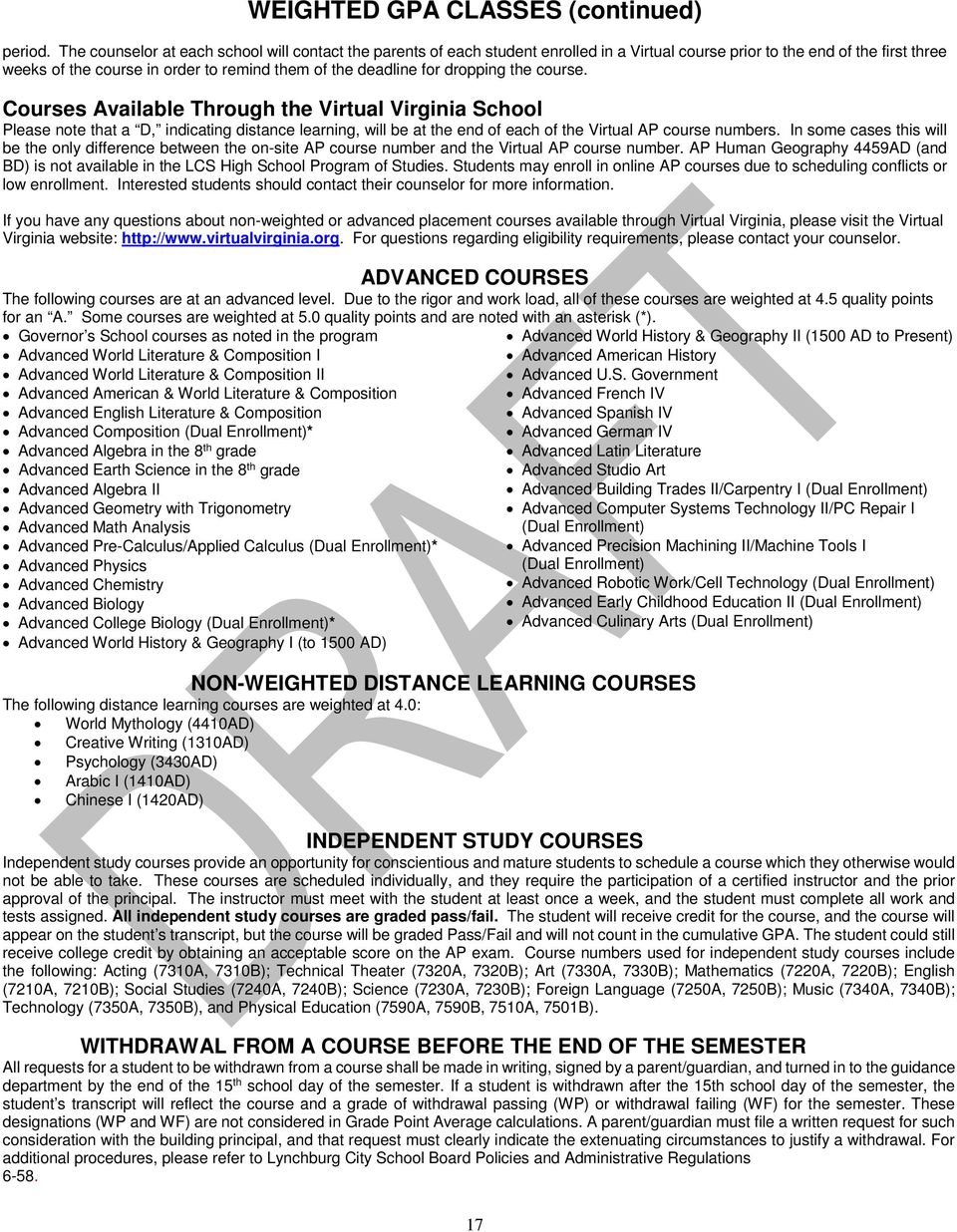
18 WEIGHTED GPA CLASSES (continued) period. The counselor at each school will contact the parents of each student enrolled in a Virtual course prior to the end of the first three weeks of the course in order to remind them of the deadline for dropping the course. Courses Available Through the Virtual Virginia School Please note that a D, indicating distance learning, will be at the end of each of the Virtual AP course numbers. In some cases this will be the only difference between the on-site AP course number and the Virtual AP course number. AP Human Geography 4459AD (and BD) is not available in the LCS High School Program of Studies. Students may enroll in online AP courses due to scheduling conflicts or low enrollment. Interested students should contact their counselor for more information. If you have any questions about non-weighted or advanced placement courses available through Virtual Virginia, please visit the Virtual Virginia website: For questions regarding eligibility requirements, please contact your counselor. ADVANCED COURSES The following courses are at an advanced level. Due to the rigor and work load, all of these courses are weighted at 4.5 quality points for an A. Some courses are weighted at 5.0 quality points and are noted with an asterisk (*). Governor s School courses as noted in the program Advanced World Literature & Composition I Advanced World Literature & Composition II Advanced American & World Literature & Composition Advanced English Literature & Composition Advanced Composition (Dual Enrollment)* Advanced Algebra in the 8 th grade Advanced Earth Science in the 8 th grade Advanced Algebra II Advanced Geometry with Trigonometry Advanced Math Analysis Advanced Pre-Calculus/Applied Calculus (Dual Enrollment)* Advanced Physics Advanced Chemistry Advanced Biology Advanced College Biology (Dual Enrollment)* Advanced World History & Geography I (to 1500 AD) NON-WEIGHTED DISTANCE LEARNING COURSES The following distance learning courses are weighted at 4.0: World Mythology (4410AD) Creative Writing (1310AD) Psychology (3430AD) Arabic I (1410AD) Chinese I (1420AD) Advanced World History & Geography II (1500 AD to Present) Advanced American History Advanced U.S. Government Advanced French IV Advanced Spanish IV Advanced German IV Advanced Latin Literature Advanced Studio Art Advanced Building Trades II/Carpentry I (Dual Enrollment) Advanced Computer Systems Technology II/PC Repair I (Dual Enrollment) Advanced Precision Machining II/Machine Tools I (Dual Enrollment) Advanced Robotic Work/Cell Technology (Dual Enrollment) Advanced Early Childhood Education II (Dual Enrollment) Advanced Culinary Arts (Dual Enrollment) INDEPENDENT STUDY COURSES Independent study courses provide an opportunity for conscientious and mature students to schedule a course which they otherwise would not be able to take. These courses are scheduled individually, and they require the participation of a certified instructor and the prior approval of the principal. The instructor must meet with the student at least once a week, and the student must complete all work and tests assigned. All independent study courses are graded pass/fail. The student will receive credit for the course, and the course will appear on the student s transcript, but the course will be graded Pass/Fail and will not count in the cumulative GPA. The student could still receive college credit by obtaining an acceptable score on the AP exam. Course numbers used for independent study courses include the following: Acting (7310A, 7310B); Technical Theater (7320A, 7320B); Art (7330A, 7330B); Mathematics (7220A, 7220B); English (7210A, 7210B); Social Studies (7240A, 7240B); Science (7230A, 7230B); Foreign Language (7250A, 7250B); Music (7340A, 7340B); Technology (7350A, 7350B), and Physical Education (7590A, 7590B, 7510A, 7501B). WITHDRAWAL FROM A COURSE BEFORE THE END OF THE SEMESTER All requests for a student to be withdrawn from a course shall be made in writing, signed by a parent/guardian, and turned in to the guidance department by the end of the 15 th school day of the semester. If a student is withdrawn after the 15th school day of the semester, the student s transcript will reflect the course and a grade of withdrawal passing (WP) or withdrawal failing (WF) for the semester. These designations (WP and WF) are not considered in Grade Point Average calculations. A parent/guardian must file a written request for such consideration with the building principal, and that request must clearly indicate the extenuating circumstances to justify a withdrawal. For additional procedures, please refer to Lynchburg City School Board Policies and Administrative Regulations
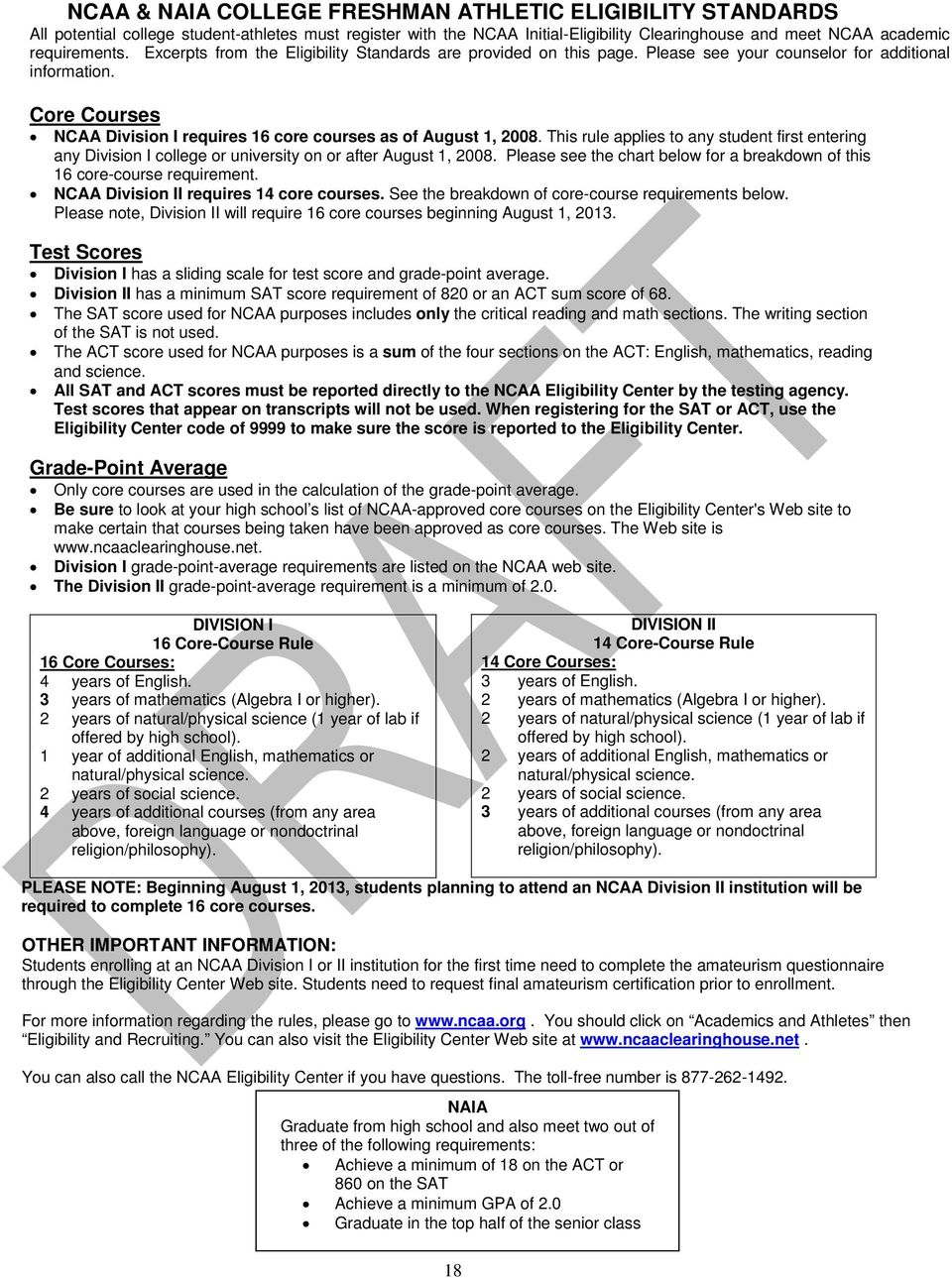
19 NCAA & NAIA COLLEGE FRESHMAN ATHLETIC ELIGIBILITY STANDARDS All potential college student-athletes must register with the NCAA Initial-Eligibility Clearinghouse and meet NCAA academic requirements. Excerpts from the Eligibility Standards are provided on this page. Please see your counselor for additional information. Core Courses NCAA Division I requires 16 core courses as of August 1, This rule applies to any student first entering any Division I college or university on or after August 1, Please see the chart below for a breakdown of this 16 core-course requirement. NCAA Division II requires 14 core courses. See the breakdown of core-course requirements below. Please note, Division II will require 16 core courses beginning August 1, Test Scores Division I has a sliding scale for test score and grade-point average. Division II has a minimum SAT score requirement of 820 or an ACT sum score of 68. The SAT score used for NCAA purposes includes only the critical reading and math sections. The writing section of the SAT is not used. The ACT score used for NCAA purposes is a sum of the four sections on the ACT: English, mathematics, reading and science. All SAT and ACT scores must be reported directly to the NCAA Eligibility Center by the testing agency. Test scores that appear on transcripts will not be used. When registering for the SAT or ACT, use the Eligibility Center code of 9999 to make sure the score is reported to the Eligibility Center. Grade-Point Average Only core courses are used in the calculation of the grade-point average. Be sure to look at your high school s list of NCAA-approved core courses on the Eligibility Center's Web site to make certain that courses being taken have been approved as core courses. The Web site is Division I grade-point-average requirements are listed on the NCAA web site. The Division II grade-point-average requirement is a minimum of 2.0. DIVISION I 16 Core-Course Rule 16 Core Courses: 4 years of English. 3 years of mathematics (Algebra I or higher). 2 years of natural/physical science (1 year of lab if offered by high school). 1 year of additional English, mathematics or natural/physical science. 2 years of social science. 4 years of additional courses (from any area above, foreign language or nondoctrinal religion/philosophy). DIVISION II 14 Core-Course Rule 14 Core Courses: 3 years of English. 2 years of mathematics (Algebra I or higher). 2 years of natural/physical science (1 year of lab if offered by high school). 2 years of additional English, mathematics or natural/physical science. 2 years of social science. 3 years of additional courses (from any area above, foreign language or nondoctrinal religion/philosophy). PLEASE NOTE: Beginning August 1, 2013, students planning to attend an NCAA Division II institution will be required to complete 16 core courses. OTHER IMPORTANT INFORMATION: Students enrolling at an NCAA Division I or II institution for the first time need to complete the amateurism questionnaire through the Eligibility Center Web site. Students need to request final amateurism certification prior to enrollment. For more information regarding the rules, please go to You should click on Academics and Athletes then Eligibility and Recruiting. You can also visit the Eligibility Center Web site at You can also call the NCAA Eligibility Center if you have questions. The toll-free number is NAIA Graduate from high school and also meet two out of three of the following requirements: Achieve a minimum of 18 on the ACT or 860 on the SAT Achieve a minimum GPA of 2.0 Graduate in the top half of the senior class 18
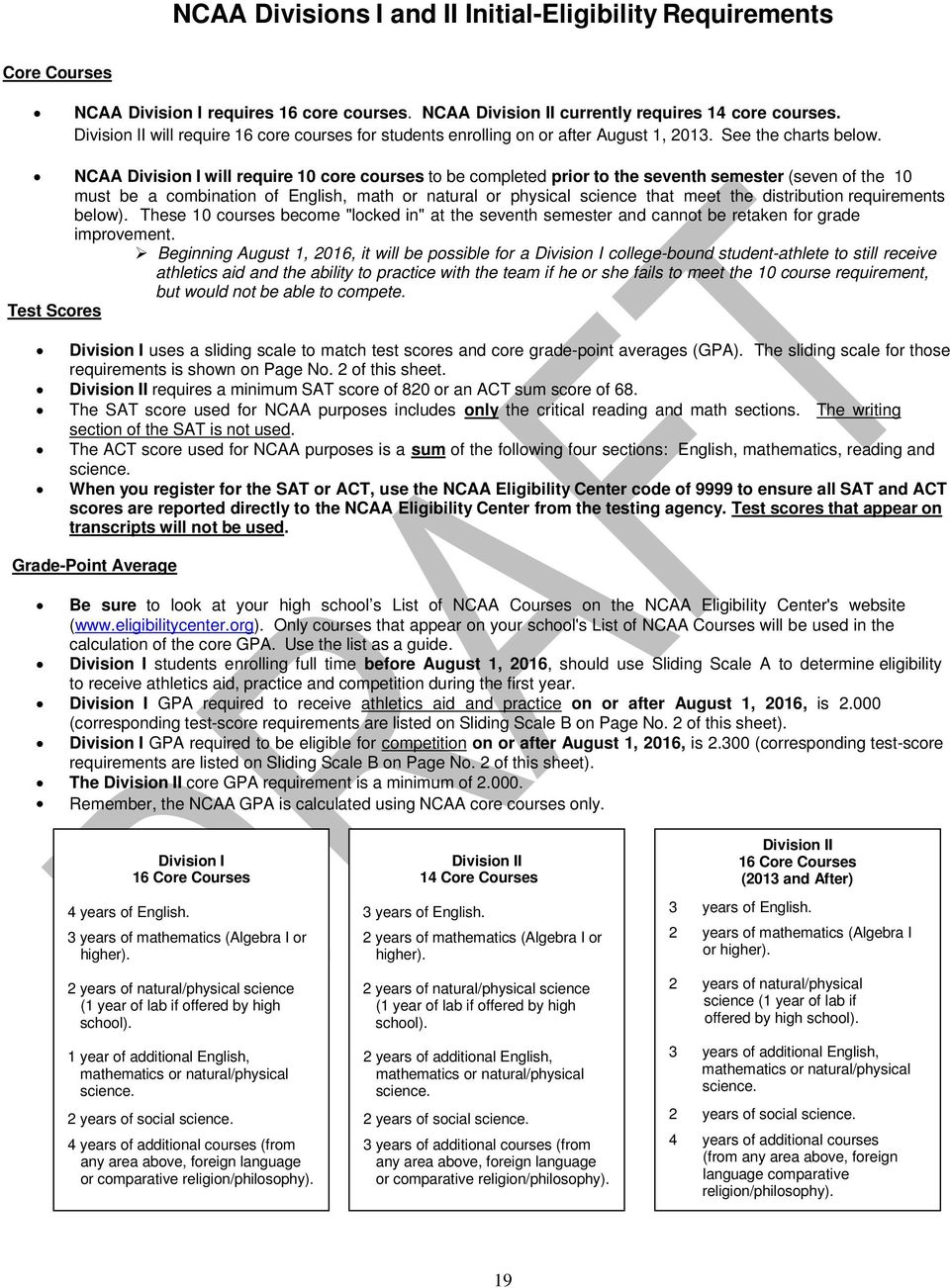
20 NCAA Divisions I and II Initial-Eligibility Requirements Core Courses NCAA Division I requires 16 core courses. NCAA Division II currently requires 14 core courses. Division II will require 16 core courses for students enrolling on or after August 1, See the charts below. NCAA Division I will require 10 core courses to be completed prior to the seventh semester (seven of the 10 must be a combination of English, math or natural or physical science that meet the distribution requirements below). These 10 courses become "locked in" at the seventh semester and cannot be retaken for grade improvement. Beginning August 1, 2016, it will be possible for a Division I college-bound student-athlete to still receive athletics aid and the ability to practice with the team if he or she fails to meet the 10 course requirement, but would not be able to compete. Test Scores Division I uses a sliding scale to match test scores and core grade-point averages (GPA). The sliding scale for those requirements is shown on Page No. 2 of this sheet. Division II requires a minimum SAT score of 820 or an ACT sum score of 68. The SAT score used for NCAA purposes includes only the critical reading and math sections. The writing section of the SAT is not used. The ACT score used for NCAA purposes is a sum of the following four sections: English, mathematics, reading and science. When you register for the SAT or ACT, use the NCAA Eligibility Center code of 9999 to ensure all SAT and ACT scores are reported directly to the NCAA Eligibility Center from the testing agency. Test scores that appear on transcripts will not be used. Grade-Point Average Be sure to look at your high school s List of NCAA Courses on the NCAA Eligibility Center's website ( Only courses that appear on your school's List of NCAA Courses will be used in the calculation of the core GPA. Use the list as a guide. Division I students enrolling full time before August 1, 2016, should use Sliding Scale A to determine eligibility to receive athletics aid, practice and competition during the first year. Division I GPA required to receive athletics aid and practice on or after August 1, 2016, is (corresponding test-score requirements are listed on Sliding Scale B on Page No. 2 of this sheet). Division I GPA required to be eligible for competition on or after August 1, 2016, is (corresponding test-score requirements are listed on Sliding Scale B on Page No. 2 of this sheet). The Division II core GPA requirement is a minimum of Remember, the NCAA GPA is calculated using NCAA core courses only. Division I 16 Core Courses 4 years of English. 3 years of mathematics (Algebra I or higher). 2 years of natural/physical science (1 year of lab if offered by high school). 1 year of additional English, mathematics or natural/physical science. 2 years of social science. 4 years of additional courses (from any area above, foreign language or comparative religion/philosophy). Division II 14 Core Courses 3 years of English. 2 years of mathematics (Algebra I or higher). 2 years of natural/physical science (1 year of lab if offered by high school). 2 years of additional English, mathematics or natural/physical science. 2 years of social science. 3 years of additional courses (from any area above, foreign language or comparative religion/philosophy). Division II 16 Core Courses (2013 and After) 3 years of English. 2 years of mathematics (Algebra I or higher). 2 years of natural/physical science (1 year of lab if offered by high school). 3 years of additional English, mathematics or natural/physical science. 2 years of social science. 4 years of additional courses (from any area above, foreign language comparative religion/philosophy). 19
21 Sequential Electives The following sequences are approved to meet the sequential electives requirement of the Standard Diploma or Modified Standard Diploma. Business Management and Marketing Course sequences: Business Law Business Management Computer Applications Followed by Keyboarding Keyboarding Applications Personal Finance & Economics Accounting I Computer Applications Followed by Personal Finance & Economics Business Law Business Management Computer Applications Followed by Keyboarding Keyboarding Applications Computer Applications Computer Information Systems Followed by Keyboarding Keyboarding Applications Business Law Business Management Followed by Computer Applications Business Law Business Management Followed by Computer Applications Keyboarding Followed by Accounting I Accounting II Computer Information Systems Design, Multimedia & Web Technologies Principles of Business & Marketing Personal Finance & Economics Computer Applications Keyboarding Applications Keyboarding Followed by Keyboarding Applications Business Management Personal Finance & Economics Principles of Business and Marketing Sports, Entertainment & Recreation Marketing Sports, Entertainment & Recreation Marketing Marketing I Followed by Followed by Marketing I Marketing II Personal Finance & Economics Sports, Entertainment & Recreation Followed by Principles of Business & Marketing Marketing Coop Tech Education I Followed by Coop Tech Education II Public Speaking I Followed by Public Speaking II Accelerated Reading I Followed by Accelerated Reading II Communication & Information Systems Sequences: Communication Systems Followed by Video & Media Technology Introduction to Information Technology Followed by Computer Systems Technology I Computer Systems Technology I Followed by Computer Systems Technology II Intro to Information Technology Computer Systems Technology I Followed by Computer Systems Technology II Introduction to Computer Science Followed by Advanced Computer Science 20
22 Sequential Electives (continued) Cultural Arts Orchestra I Followed by Orchestra II Concert Band I Followed by Symphonic Band I Concert Band I Symphonic Band I Followed by Chorus I Followed by Chorus II Chorus I Followed by Chorus III Chorus II Followed by Chorus III Art I Followed by Jazz Ensemble Wind Ensemble Percussion Ensemble Painting I Followed by Painting II Sculpture I Followed by Sculpture II Introduction To Theater Followed by Drawing Painting I Sculpture I Digital Photography and Printmaking Photography Commercial Art Musical Theatre Dance Acting I Applied Theatre Tech I Technical Theatre I Design Technical Theatre I Production Acting I Followed by Acting II Applied Theatre Tech I Followed by Applied Theatre Tech II Technical Theatre I Design Technical Theatre II Followed by Costuming Technical Theatre I Production Technical Theatre II Followed by Costuming Creative Writing Followed by Playwriting and Directing Note: Taking Orchestra II, Concert Band I, or Chorus I twice for elective credit may fulfill the sequential elective requirement as long as the student is progressing through a set of skills outlined in the curriculum. Foreign Languages French I Followed by French II German I Followed by German II Latin I Followed by Latin II Spanish I Followed by Spanish II Health Sciences Dental Careers I Followed by Dental Careers II Medical Assistant I Followed by Medical Assistant II Athletic Training I Followed by Athletic Training II Nurse Aide I Followed by Nurse Aide II Note: Health and Medical Sciences Exploratory may not be used to partially fulfill the sequential elective requirement. Human Services & Resources Intro to Culinary Arts Followed by Culinary Arts I Culinary Arts I Followed by Culinary Arts II Cosmetology I Followed by Cosmetology II Followed by Early Childhood I Teachers for Tomorrow Intro to Early Childhood Early Childhood I Followed by Early Childhood II Any JROTC Courses Followed by Any other JROTC Courses 21
23 Sequential Electives (continued) Industrial, Manufacturing & Engineering Systems Architectural Drawing Followed by Engineering Drawing Basic Technical Drawing Nuclear Technology Architectural Drawing Engineering Drawing Followed by Nuclear Technology Intro to Building Trades Followed by Building Trades I Building Trades I Followed by Building Trades II Precision Machining I Followed by Precision Machining II Intro To Auto Service Technology Followed by Auto Service Technology I Auto Service Technology I Followed by Auto Service Technology II Technology Foundations Followed by Technology Transfer Note: Newspaper, Yearbook, Leadership Training, and SOL Review courses may not be used to partially fulfill the sequential elective requirement. Additional Options for the Modified Standard Diploma Sequential Elective Requirement Any two of the Writing Skills courses Any two of the Life Skills courses Any two of the Work Skills courses Education for Employment followed by Work Experience I Work Experience I followed by Work Experience II Reading I followed by Reading II Note: Resource classes do not meet the requirement for sequential electives. 22
24 TRANSFER CREDITS The following information is taken from the Regulations for Establishing Standards for Accrediting Public Schools in Virginia: 8 VAC A summary table of the graduation requirements for transfer students is provided at the end of this document. A. The provisions of this section pertain generally to students who transfer into Virginia high schools. Students transferring in grades K-8 from Virginia public schools or nonpublic schools accredited by one of the approved accrediting constituent members of the Virginia Council for Private Education shall be given recognition for all grade-level work completed. The academic record of students transferring from all other schools shall be evaluated to determine appropriate grade placement in accordance with policies adopted by the local school board. B. For the purposes of this section, the term "beginning" means within the first 20 hours of instruction per course. The term "during" means after the first 20 hours of instruction per course. C. Standard or verified units of credit earned by a student in a Virginia public school shall be transferable without limitation regardless of the accreditation status of the Virginia public school in which the credits were earned. Virginia public schools shall accept standard and verified units of credit from other Virginia public schools and state operated programs. Standard units of credit also shall be accepted for courses satisfactorily completed in accredited colleges and universities when prior written approval of the principal has been granted or the student has been given credit by the previous school attended. D. A secondary school shall accept credits toward graduation received from Virginia nonpublic schools accredited by one of the approved accrediting constituent members of the Virginia Council for Private Education (VCPE). The Board of Education will maintain contact with the VCPE and may periodically review its accrediting procedures and policies as part of its policies under this section. Nothing in these standards shall prohibit a public school from accepting standard units of credit toward graduation awarded to students who transfer from all other schools when the courses for which the student receives credit generally match the description of or can be substituted for courses for which the receiving school gives standard credit, and the school from which the child transfers certifies that the courses for which credit is given meet the requirements of 8 VAC A. Students transferring into a Virginia public school shall be required to meet the requirements prescribed in 8 VAC to receive a Standard, Advanced Studies, or Modified Standard Diploma, except as provided by subsection G of this section. To receive a Special Diploma or Certificate of Program Completion, a student must meet the requirements prescribed by the Standards of Quality. E. The academic record of a student transferring from other Virginia public schools shall be sent directly to the school receiving the student upon request of the receiving school in accordance with the provisions of the 8 VAC , Management of the Student's Scholastic Records in the Public Schools of Virginia. 23 TRANSFER CREDITS (continued) F. The academic record of a student transferring into Virginia public schools from other than a Virginia public school shall be evaluated to determine the number of standard units of credit that have been earned, including credit from schools outside the United States, and the number of verified units of credit needed to graduate in accordance with subsection G of this section. Standard units of credit also shall be accepted for courses satisfactorily completed in accredited colleges and universities when the student has been given credit by the previous school attended. Students transferring above the tenth grade from schools or other education programs that do not require or give credit for health and physical education shall not be required to take these courses to meet graduation requirements. G. Students entering a Virginia public high school for the first time after the tenth grade shall earn as many credits as possible toward the graduation requirements prescribed in 8 VAC However, schools may substitute courses required in other states in the same content area if the student is unable to meet the specific content requirements of 8 VAC without taking a heavier than normal course load in any semester, by taking summer school, or by taking courses after the time when he otherwise would have graduated. In any event, no such student shall earn fewer than the following number of verified units, nor shall such students be required to take SOL tests or additional tests as defined in 8 VAC for verified units of credit in courses previously completed at another school or program of study, unless necessary to meet the requirements listed in subdivisions 1 and 2 of this subsection: 1. For a Standard Diploma: a. Students entering a Virginia high school for the first time during the ninth grade or at the beginning of the tenth grade shall earn credit as prescribed in 8 VAC ; b. Students entering a Virginia high school for the first time during the tenth grade or at the beginning of the eleventh grade shall earn a minimum of four verified units of credit: one each in English, mathematics, history, and science. Students who complete a career and technical education program sequence may substitute a certificate, occupational competency credential or license for either a science or history and social science verified credit pursuant to 8 VAC ; and c. Students entering a Virginia high school for the first time during the eleventh grade or at the beginning of the twelfth grade shall earn a minimum of two verified units of credit: one in English and one of the student's own choosing. 2. For an Advanced Studies Diploma: a. Students entering a Virginia high school for the first time during the ninth grade or at the beginning of the tenth grade shall earn credit as prescribed in 8 VAC ; b. Students entering a Virginia high school for the first time during the tenth grade or at the beginning of the eleventh grade shall earn a minimum of six verified units of credit: two in English and one each in mathematics, history, and science and one of the student's own choosing; and TRANSFER CREDITS (continued) c. Students entering a Virginia high school for the first time during the eleventh grade or at the beginning of the twelfth
25 grade shall earn a minimum of four verified units of credit: one in English and three of the student's own choosing. H. Students entering a Virginia high school for the first time after the first semester of their eleventh grade year must meet the requirements of subdivision G 1 c or G 2 c of this section. Students transferring after 20 instructional hours per course of their senior or twelfth grade year shall be given every opportunity to earn a Standard, Advanced Studies, or Modified Standard Diploma. If it is not possible for the student to meet the requirements for a diploma, arrangements should be made for the student's previous school to award the diploma. If these arrangements cannot be made, a waiver of the verified unit of credit requirements may be available to the student. The Department of Education may grant such waivers upon request by the local school board in accordance with guidelines prescribed by the Board of Education. I. Any local school division receiving approval to increase its course credit requirements for a diploma may not deny either the Standard, Advanced Studies, or Modified Standard Diploma to any transfer student who has otherwise met the requirements contained in these standards if the transfer student can only meet the division's additional requirements by taking a heavier than normal course load in any semester, by taking summer school, or by taking courses after the time when he otherwise would have graduated. J. The transcript of a student who graduates or transfers from a Virginia secondary school shall conform to the requirements of 8 VAC , Regulations Governing Secondary School Transcripts. K. The accreditation status of a high school shall not be included on the student transcript provided to colleges, universities, or employers. The board expressly states that any student who has met the graduation requirements established in 8 VAC and has received a Virginia diploma holds a diploma that should be recognized as equal to any other Virginia diploma of the same type, regardless of the accreditation status of the student's high school. It is the express policy of the board that no student shall be affected by the accreditation status of the student's school. TRANSFER CREDITS (continued) The following information is taken from the Lynchburg City Schools School Board Regulation : 1. If a particular grade is weighted at the school from which a student transfers and this Division weights the grade for the same course, the transferred grade will be weighted. 2. If a particular grade is weighted at the school from which a student transfers and this Division does not weight the grade for the same course, the transferred grade will not be weighted. 3. If [particular courses are] noted as honors program courses and are weighted in this Division, the grades will be weighted even if the other division did not weight [them]. 4. If [particular courses are] not weighted [and are not] noted as honors courses elsewhere, the grades will not be weighted. Course Numbers for Transfer Courses When possible, transfer courses should be equated to corresponding courses in the Program of Studies, and those courses should be transcribed with a T appended to the course number. However, in some cases courses approved for credit in other states might not have an equivalent match in this Program of Studies. In those cases, a generic course number indicating the grade and content area can be used. All such courses are weighted at 4.0 for an A. The course numbers in the table below represent the first semester courses. By placing a B where the A is, the second semester course numbers can be derived. Subject Area Grade 9 Grade 10 Grade 11 Grade 12 English 1190AT 1100AT 1110AT 1120AT Math 2190AT 2100AT 2110AT 2120AT Science 3190AT 3100AT 3110AT 3120AT History 4190AT 4100AT 4110AT 4120AT Elective 5190AT 5100AT 5110AT 5120AT 24
26 First-time Transfers to a Virginia Public School NOTE: This information is relevant for students transferring into a Virginia public school for the first time. Beginning = Within the first 20 hours of instruction and During = After the first 20 hours of instruction During 9th Grade OR Beginning of 10th Grade: During 10th Grade OR Beginning of 11th Grade: During 11th Grade OR Beginning of 12th Grade: During 12th Grade: Standard Diploma for 9 th Graders in and beyond Advanced Studies Diploma 9 th Graders in and beyond English 2 2 Mathematics 1 2 Science 1 2 History & Social Science 1 2 Student Selected 1 1 Must Earn 6 Verified Credits 9 Verified Credits: Standard Diploma for 9 th Graders in and beyond Advanced Studies Diploma 9 th Graders in and beyond English 1 2 Mathematics 1 1 Science 1 1 History & Social Science 1 1 Student Selected 0 1 Must Earn 4 Verified Credits 6 Verified Credits: Standard Diploma for 9 th Graders in and beyond Advanced Studies Diploma 9 th Graders in and beyond English 1 1 Student Selected 1 3 Must Earn 2 Verified Credits 4 Verified Credits: Students should be given every opportunity to earn a diploma; if this is not possible, arrange to have the previous school award the diploma; or seek a waiver of the verified credit requirement from the VDOE. 25
27 COURSE OFFERINGS LISTED IN THE PROGRAM OF STUDIES (DE=Dual Enrollment) *Courses for the Modified Standard Diploma or Special Diploma are contained on page 54 Art - pg Art I 5520 Drawing 5530 Painting I 5540 Painting II 5550 Sculpture I 5551 Sculpture II 5560 Photography 5570 Digital Photography & Printmaking 5580 Commercial Art 5517 Adv. Studio Art 5519 AP Portfolio Art 5529 AP Art History Architecture & Construction - pg Drafting III 8241 Intro to Building Trades 8240 Building Trades I 8250 Building Trades II Arts, A/V Technology & Communications - pg Communication System 7450 Video & Media Technology Business, Management, Administration & Finance-pgs Accounting I 6170 Accounting II 6140 Business Management 6150 Business Law 3740 Computer Applications 6340 Computer Information Systems 6260 Design, Multimedia & Web Technologies 6240 Keyboarding 6250 Keyboarding Applications 6370 Principles of Business & Marketing Computer Science - pg Intro to Computer Science 3760 Computer Science II 3729 AP Computer Science Drama - pg Intro to Theatre 5611 Musical Theatre Dance 5620 Acting I 5630 Acting II 5621 History of Musical Theatre 5622 Playwriting 5623 Directing 5640 App Tech Theatre I Drama (cont) pg Tech Theatre I Design 5360 Jazz Ensemble 5642 Tech Theatre I Production 5650 App Tech Theatre II 5651 Tech Theatre II 5652 Costuming Economics - pg Personal Finance & Economics 4439A AP Microeconomics 4449B AP Macroeconomics Education & Training - pgs Intro to Early Childhood Ed 6541 Early Childhood Ed I 6542 Early Childhood Ed II 6550 Teachers for Tomorrow English/Speech- pgs World Lit & Comp I 1297 Adv. World Lit & Comp 1100 World Lit & Comp II 1207 Adv. World Lit & Comp II 1110 American Lit & Comp 1217 Adv. American & World Lit & Comp 1319 AP Language & Comp 1120 English Lit & Comp 1227 Adv. English Lit & Comp 1328 Adv. College Comp (DE) 1329 AP Lit & Comp 5850 Public Speaking I 5860 Public Speaking II 1310 Creative Writing 1429 AP Seminar 1419 AP Research Foreign Language - pgs French I 1500 French II 1510 French III 1527 Adv. French IV 1529 AP French V 1690 German I 1600 German II 1610 German III 1627 Adv. German IV 1629 AP German V 1790 Latin I 1700 Latin II 1710 Latin III 1737 Adv. Latin Literature 1729 AP Latin Vergil 1890 Spanish I 1800 Spanish II 1810 Spanish III 26 Foreign Language - pgs Adv. Spanish IV 1829 AP Spanish V Health pg Driver s Ed & Personal Health 5250 Health & Family Living Health Sciences pg Health & Medical Sciences Exp 6810 Dental Careers I 6820 Dental Careers II 8360 Nurse Aide I 8362 Nurse Aide II 5260 Athletic Training I 5261 Athletic Training II Hospitality & Tourism - pg Intro to Culinary Arts 6441 Culinary Arts I 6442 Culinary Arts II Human Services - pg Cosmetology I 8350 Cosmetology II Information Technology - pgs Computer Systems Tech I 8550 Computer Systems Tech II 8553 Cyber Security 7140 Information Tech Assistant I 7150 Information Tech Assistant II Law, Public Safety, Corrections and Security pg Criminal Justice I 8703 Criminal Justice II Leadership - pg Leadership Training Manufacturing - pg Manufacturing Systems 8450 Precision Machine Tech I 8460 Precision Machine Tech II/Intro to Machine Tools Marketing Sales & Service-pg Sports, Entertainment, & Rec 6951 Marketing I 6960 Marketing II Mathematics - pgs Algebra, Functions, & Data Analysis 2290 Algebra I 2387 Adv. Algebra I (gr. 8) 2200 Algebra II 2397 Adv. Algebra II 2210 Geometry
28 COURSE OFFERINGS LISTED IN THE PROGRAM OF STUDIES (continued) (DE=Dual Enrollment) *Courses for the Modified Standard Diploma or Special Diploma are contained on page 54 Mathematics (cont) pgs AP Algebra I PETAL 2397BP Adv Algebra II PETAL 2307 Adv/ Geometry/Trig 2220 Trig/Functions 2328AC Adv. Pre-Calc (DE) 2338BC App Calc (DE) 2317 Adv. Math Analysis 2429 AP Statistics 2329 AP Calculus AB 2339 AP Calculus AB/BC Music - pg Concert Band I 5350 Symphonic Band I 5370 Wind Ensemble 5380 Percussion Ensemble 5460 Chorus I 5470 Chorus II - Concert Choir 5480 Chorus III 5410 Orchestra I 5420 Orchestra II 5430 Beginning Midi & Computer Applications in Music 5439 AP Music Theory Newspaper & Yearbook - pg Newspaper 7420 Yearbook Physical Education - pg Physical Ed Drill 5190 Physical Ed Physical Ed Weight Training I 5152 Weight Training II 5161 Fitness for Life Positive Parenting Program- pg Family Health & Social Dev Child Development & Care 7481 Nutrition & Food Preparation Reserve Officer Training Corps (ROTC) - pgs MCJROTC Leadership Ed I 5720 MCJROTC Leadership Ed II 5730 MCJROTC Leadership Ed III 5740 MCJROTC Leadership Ed IV 5750 AFJROTC Leadership Ed I 5760 AFJROTC Leadership Ed II 5770 AFJROTC Leadership Ed III 5780 AFJROTC Leadership Ed IV Science - pgs Earth Science 3387 Adv. Earth Science (gr. 8) 3200 Biology I 3397 Adv. Biology I 3210 Biology II Anatomy & Phys Biology II Ecology 3220 Chemistry 3307 Adv. Chemistry 3317 Adv. Physics 3459 AP Chemistry 3469 AP Physics 3328 Adv. College Biology (DE) 3439 AP Psychology 3449 AP Biology Science, Technology, Engineering & Math - pgs Drafting I 6750 Drafting II 6760 Drafting III 6770 Adv. Robotic Work/Cell Tech 6640 Tech Foundations 6650 Tech Transfer Social Studies - pgs World Geo 4290 World History & Geo I 4397 Adv. World History & Geo I 4200 World History & Geo II 4307 Adv. World History & Geo II 4469 AP World History 4210 American History 4317 Adv. American History 4419 AP American History 4220 US Govt 4327 Adv. US Govt 4429 AP American Govt Politics & Comparative Govt Politics 4409 AP European History 4740 African-American Studies 4459 AP Human Geography Student Intern Programs pg Teacher/Office Intern 7130 Elem./Middle Student Intern 7131 General Student Intern Transportation, Distribution & Logistics pg Intro to Auto Service Tech 8140 Auto Service Tech I 8150 Auto Service Tech II Academic Support - pg SOL Review English 7212 SOL Review Writing 7221 SOL Review Math 7231 SOL Review Science 7241 SOL Review Soc. Stud SAT Prep 1930 ELL Support 1192 Accelerating Reading I 1130 Accelerating Reading II 7222 Math Lab STUDYA & B Study Hall (These courses can be taken repeatedly for elective credit) Central Va. Governor s School pgs Research Course 3219 Physics 2317 Math Analysis/Pre-Calculus (DE) 3329 College Anatomy & Phys (DE) 3227 Senior Tech Seminar 3729 College Comp Science (DE) 2329 Calculus-Single Variable I & II (DE) 2228 Connections in Math 2429 Linear Alg./Vector Calc (DE) 3339 Human Anat. & Physiology (DE) 27
29 ***Any prerequisite listed for a course in any content area may be waived pending principal s approval. Please contact your child s counselor for any questions regarding prerequisites for courses. ECONOMICS PERSONAL FINANCE & ECONOMICS (6151A, 6151B), Grades 10-12, 1 st & 2 nd Sem., One-half Credit per Sem. Prerequisite: None Students explore many facets of financial decision-making involved in daily life. Skills in money management, record keeping, and banking are enhanced through the study of basic concepts of economics, insurance, credit, and other related topics. Students need to take the W!SE Financial literacy exam to meet diploma requirements. See page 16 for sequential elective options with career-technical courses. ADVANCED PLACEMENT (AP) MICROECONOMICS & MACROECONOMICS (4439A, 4449B), Grades 11-12, 1 st and 2 nd Sem. One-half Credit Per Sem. The first semester of this course (microeconomics) aims to provide a thorough understanding of the principles of economics that apply to the functions of individual decision makers, both consumers and producers, within the economic system. It places primary emphasis on the nature and functions of product markets and includes the study of factor markets and of the role of government in promoting greater efficiency and equity in the economy. The second semester (macroeconomics) explores the principles of economics that apply to an economic system as a whole. Particular emphasis will be placed on the study of national income and price-level determination, economic performance measures, the financial sector, stabilization policies, economic growth, and international economics. All students are required to take both advanced placement examinations in May. 28
30 ENGLISH WORLD LITERATURE & COMPOSITION I A & B (1190A, 1190B), Grade 9, 1 st & 2 nd Sem. One-half Credit Per Sem. These classes emphasize reading comprehension, vocabulary, study skills, oral communication, and composition skills, including grammar, usage, and mechanics, through the study of world literature. Students will read widely and think, speak, and write about what they have read. Emphasis is on enabling students to develop strategies for future academic success. ADVANCED WORLD LITERATURE & COMPOSITION I A & B (1297A, 1297B), Grade 9, 1 st & 2 nd Sem. One-half Credit Per Sem. Designed for students in the advanced diploma program, these classes emphasize reading, thinking, oral communication, and composition skills, including grammar, usage, and mechanics, through the study of world literature. Students must read and write extensively and participate in in-depth literature study. Vocabulary development, study and test-taking skills, and organization skills necessary to meet the demands of the advanced program are integral parts of these classes. WORLD LITERATURE & COMPOSITION II A & B (1100A, 1100B), Grade 10, 1 st & 2 nd Sem. One-half Credit Per Sem. With world literature as the vehicle, these classes will follow an integrated approach to language arts, combining reading, writing, grammar, and vocabulary study. Experiences in the classes will reflect the needs of literate adults in the community and stress the processes for writing, speaking, and reading effectively and correctly. ADVANCED WORLD LITERATURE & COMPOSITION II A & B (1207A, 1207B), Grade 10, 1 st & 2 nd Sem. One-half Credit Per Sem. First semester emphasizes writing instruction through a thematic approach to expository and creative composition genres. Through the study of models and extensive opportunities to write, students improve their writing styles and ability to write different types of compositions. Literature study is used as inspiration for many writing activities. During second semester while continuing to improve writing skills, students engage in an in-depth study of literary works organized in thematic units. Vocabulary development, grammar, usage, and mechanics are stressed in both semesters. AMERICAN LITERATURE & COMPOSITION A & B (1110A, 1110B), Grade 11, 1 st & 2 nd Sem. One-half Credit Per Sem. These classes combine a study of the development of American literature with instruction in communication skills. Vocabulary study, oral reporting, and frequent writing assignments are based on representative selections from each literary period. Near the end of the school year, students will take the 11th grade Standards of Learning tests in literature and writing. ADVANCED AMERICAN & WORLD LITERATURE & COMPOSITION A & B (1217A, 1217B), Grade 11, 1 st & 2 nd Sem. One-half Credit Per Sem. During first semester students analyze pieces of literature considered landmarks of American literature while in second semester the emphasis shifts to landmarks in world literature (e.g. Plato s Republic, Shakespeare s King Lear, ENGLISH (continued) and Hugo s Les Miserables). In both semesters students do independent research, read and write extensively, and make oral reports on what they have read and researched. Near the end of the school year, students will take the 11th grade Standards of Learning tests in literature and writing. ADVANCED PLACEMENT (AP) LANGUAGE & COMPOSITION A & B (1319A, 1319B), Grade 11, 1 st & 2 nd Sem. One-half Credit Per Sem. These classes prepare students to take the College Entrance Examination Board Advanced Placement Language and Composition Test. Emphases of the classes are rhetoric and the structure of language as they relate to effective composition. Students will also cover the 11 th grade Virginia Standards of Learning in preparation for the required Standards of Learning tests in literature and writing administered near the end of the school year. Students enrolling should be competent in composition and able to work independently on a variety of writing assignments and projects. All students are required to take the advanced placement examination in May. ENGLISH LITERATURE & COMPOSITION A & B (1120A, 1120B), Grade 12, 1 st & 2 nd Sem. One-half Credit Per Sem. These classes combine a study of English literature, culture, and language development with instruction in communication skills. Instruction in writing a variety of multiparagraph themes is provided along with the usual activities involving vocabulary study, sentence structure, paragraph development, oral reporting, and research. ADVANCED ENGLISH LITERATURE & COMPOSITION A & B (1227A, 1227B), Grade 12, 1 st & 2 nd Sem. One-half Credit Per Sem. These classes are an in-depth study of major authors in all literary periods of English literature. Instruction in formal organizational patterns in writing and advanced research skills is integral. Students must do independent research, parallel reading, and oral reporting as well as frequent writing assignments and a research paper. The emphasis during second semester is on error-free writing. ADVANCED COLLEGE COMPOSITION A & B (1328AC, 1328BC), Dual Enrollment English, Grades 11-12, 1 st & 2 nd Sem., One-half Credit Per Sem. (5.0 GPA for A) These classes offer students achieving a grade of C or better the opportunity to earn six hours of college credit through the dual enrollment program with Central Virginia Community College. A comprehensive survey of major authors in English literature, these classes emphasize the development of writing skills and writing as process, including instruction in formal organizational patterns and style. Students work toward error-free writing and receive instruction in advanced research skills. Students who have completed the course with a grade of C or better receive 6 semester hours of credit from CVCC for English 111 and 112. Students must qualify for enrollment for this course by taking the CVCC placement test or by ACT or SAT qualifying scores. Because this course is a dual enrollment course, certain fees may apply. (see page 2 for details) 29
31 ENGLISH (continued) ADVANCED PLACEMENT (AP) LITERATURE & COMPOSITION A & B (1329A, 1329B), Grade 12, 1 st & 2 nd Sem., One-half Credit Per Sem. These classes prepare students to take the College Entrance Examination Board Advanced Placement Literature and Composition Test. Emphases are the analytic reading of fiction and poetry and the writing of critical essays. Students enrolling should be competent in composition, experienced in literary interpretation, and able to think abstractly. Students must also be able to work independently on a variety of reading and writing projects. All students are required to take the advanced placement examination in May. CREATIVE WRITING (1310A, 1310B), Grades 9-12, 1 st & 2 nd Sem., One-half Credit Per Sem. This course will expose students to many aspects of the writing process, including generating ideas, writing and revising drafts, and editing. Students will write extensively and participate in helpful critiques of their own work and that of their peers. This course will be designed to allow teachers to work individually with students during conferences. Through frequent writing exercises, students will study voice, imagery, characterization, dialogue, and narration. Students will work in free verse poetry, prose poetry, fiction, and creative nonfiction. ADVANCED PLACEMENT (AP) SEMINAR (1429A, 1429B), Grades 9-12, 1 st & 2 nd Sem., One-half Credit Per Sem. AP Seminar is a foundational course that engages students in cross-curricular conversations that explore the complexities of academic and real-world topics and issues by analyzing divergent perspectives. Using an inquiry framework, students practice reading and analyzing articles, research studies, and foundational, literary, and philosophical texts; listening to and viewing speeches, broadcasts, and personal accounts; and experiencing artistic works and performances. Students learn to synthesize information from multiple sources, develop their own perspectives in research-based written essays, and design and deliver oral and visual presentations, both individually and as part of a team. Ultimately, the course aims to equip students with the power to analyze and evaluate information with accuracy and precision in order to craft and communicate evidence-based arguments. There are no prerequisites for the AP Seminar course. The course culminates in an Individual research-based essay of approximately 2,000 words and a presentation, performance, or exhibition with an oral defense; where the student answers 3-4 questions from a panel of trained evaluators and an end-of-course exam (3 hours). Course satisfies Social Studies graduation requirements. ENGLISH (continued) ADVANCED PLACEMENT (AP) RESEARCH (1419A, 1419B), Grades 9-12, 1 st & 2 nd Sem., One-half Credit Per Sem. Prerequisite: AP Seminar The second course in the AP Capstone program. AP Seminar is a prerequisite for AP Research. If you earn scores of 3 or higher in both AP Seminar and AP Research as well as on four additional AP Exams of your choosing, you will receive the AP Capstone Diploma. This signifies outstanding academic achievement and attainment of core academic and research skills. Alternatively, if you earn scores of 3 or higher on the AP Seminar and AP Research Exams only, you will receive the AP Seminar and Research Certificate signifying your attainment of college-level academic and research skills. AP Research allows students to deeply explore an academic topic, problem, or issue of individual interest. Through this exploration, students design, plan, and conduct a yearlong mentored, research-based investigation to address a research question. In the AP Research course, students further their skills acquired in the AP Seminar course by understanding research methods; employing ethical research practices; and accessing, analyzing, and synthesizing information as they address a research question. The course culminates in an academic thesis paper of approximately 5,000 words and a presentation, performance, or exhibition with an oral defense. SPEECH PUBLIC SPEAKING I (5850A, 5850B), Grades 9-12, 1 st or 2nd Sem., One-half Credit. Content includes instruction and practice in clarity of oral expression, logical reasoning, and proper organization of material. The student will learn to prepare speeches to inform, convince, persuade, demonstrate and entertain. PUBLIC SPEAKING II (5860A, 5860B), Grades 9-12, 1 st or 2 nd Sem., One-half Credit. Prerequisite: Public Speaking I In Public Speaking II, students will refine oral interpretation skills, expand persuasive speaking skills, perform impromptu speeches, deliver special occasion speeches, and develop expertise in at least one major speech category. FOREIGN LANGUAGE 30
32 The secondary schools offer a sequential program in French, Spanish, German, and Latin. First-year study for high school credit is available to 8 th grade students in French, Spanish, and Latin at all three middle schools. Each language in the foreign language offerings is designed for any student who has demonstrated a reasonable proficiency in his or her native language and wishes to develop facility in another language. To obtain full benefit of the language program, students are encouraged to begin study in the 8 th or 9 th grade. College-bound students are advised to investigate the specific foreign language requirements of colleges in which they have interest. All students should work closely with their counselors in planning their foreign language programs. In all cases, the prerequisite for a second semester course is the corresponding first semester course. FRENCH I A & B (1590A, 1590B), Grades 8-12, 1 st & 2 nd Sem. One-half Credit Per Sem. Prerequisite: None Communicating in French is the highlight of these beginning semesters of language study. Students become involved immediately in using the language to simulate daily life situations. Activities include speaking, listening, writing, reading, and learning about French culture. Correlated audio-visuals serve as stimuli to involve students in conversations of interest to teenagers. FRENCH II A & B (1500A, 1500B), Grades 9-12, 1 st & 2 nd Sem. One-half Credit Per Sem. Prerequisite: French I A & B Emphasis on the four basic skills of speaking, listening, reading, and writing is continued during second year study. Oral discussions in French based on themes of contemporary interest provide the basis for student involvement. Study of the geography and culture of Frenchspeaking countries is an integral part of the language study. Students' use of concepts and vocabulary is cumulative. FRENCH III A (1510A, 1510B), Grades 10-12, 1 st & 2 nd Sem. One-half Credit Per Sem. Prerequisite: French II A & B This course builds on the vocabulary and grammar bases acquired in levels I and II. Audio-lingual experiences continue to help students develop both aural and oral competency as they listen to more extensive passages and participate in more complex speaking exercises. The focus on reading and writing also increases at this level as students read excerpts from current literature and read and write about the culture of francophone countries. ADVANCED FRENCH IV A & B (1527A, 1527B), Grade 11 or 12, 1 st & 2 nd Sem. One-half Credit Per Sem. Prerequisite: French III A & B This course focuses on the use of all concepts and vocabulary from previous study in addition to new vocabulary and idioms. Culture-based readings from periodicals and selections from literature are the basis for refining composition and reading skills and provide the topics for conversation. Experience in listening to extended passages develops students' comprehension skills and provides practice in using higher level thinking skills. FOREIGN LANGUAGE (continued) ADVANCED PLACEMENT (AP) FRENCH V A & B (1529A, 1529B), Grade 12, 1 st & 2 nd Sem. One-half Credit Per Sem. Prerequisite: French IV A & B (May be waived by recommendation of instructor.) This Advanced Placement Language course is equivalent in content and skills developed to the third year college level. Students engage in intensive drills of extemporaneous speaking, grammar review, analyses of reading material and listening to many types of selections to develop a high level of listening comprehension. All students are required to take the advanced placement examination in May. GERMAN I A & B (1690A, 1690B), Grades 9-12, Grade 8, Paul Laurence Dunbar Middle School for Innovation Only 1 st & 2 nd Sem. One-half Credit Per Sem. Prerequisite: None In this introductory course, students become involved with the German language through conversations and readings relating to everyday chores, school, family, leisure-time activities, foods, weather, travel, parties, and shopping. During the second semester, students read longer narratives in the target language about important cities, states, German-speaking regions, and holidays. Authentic audiovisual aids reinforce aural-oral skills while lending authentic cultural insights. GERMAN II A & B (1600A, 1600B), Grades 9-12, 1 st & 2 nd Sem. One-half Credit Per Sem. Prerequisite: German I A & B German II students continue to build facility with the language through conversations and reading/writing activities. Topics first semester include vacations, school, health, home, employment, and clothing. During second semester, students discuss leisure time activities, cars, famous Germans, and selected German-speaking cities. GERMAN III A & B (1610A, 1610B), Grades 10-12, 1 st & 2 nd Sem. One-half Credit Per Sem. Prerequisite: German II A & B The refinement of oral and written communication skills through conversational practice and the reading of selections by modern German authors constitute the major portion of third-year study. Students read and discuss German children's literature, poetry, current events from newspaper and magazine articles, and short stories. During discussions, students learn about levels of language and the appropriateness of each in various situations. ADVANCED GERMAN IV A & B (1627A, 1627B), Grades 11 & 12, 1 st & 2 nd Sem. One-half Credit Per Sem. Prerequisite: German III A & B At this level of language study, students are expected to have achieved facility in the German language, which is now used in instruction, conversation, reading, and discussion. Students continue to discuss German literature and everyday topics of conversation. In addition, frequent writing assignments enhance skills in grammar and serve to increase vocabulary. FOREIGN LANGUAGE (continued) 31
33 ADVANCED PLACEMENT (AP) GERMAN V A & B (1629A, 1629B), Grade 12, 1 st & 2 nd Sem. One-half Credit Per Sem. Prerequisite: German IV A & B (may be waived by recommendation of instructor) This Advanced Placement Language course is equivalent in content and skills developed to the third year college level. Students engage in intensive drills of extemporaneous speaking, grammar review, analyses of reading material and listening to many types of selections to develop a high level of listening comprehension. All students are required to take the advanced placement examination in May. LATIN I A & B (1790A, 1790B), Grades 8-12, 1 st & 2 nd Sem. One-half Credit Per Sem. Prerequisite: None The first-year Latin course provides the foundation for understanding Latin and the basis for learning any foreign language. Students enlarge their vocabulary, refine grammar in English, and learn about the origins of many of our traditions and institutions while reading the history, myths, and legends of the ancient Romans. LATIN II A & B (1700A, 1700B), Grades 9-12, 1 st & 2 nd Sem. One-half Credit Per Sem. Prerequisite: Latin I A & B Latin II begins with a thorough grammar review based on readings from Roman history and continues to develop the vocabulary and reading comprehension necessary to read Latin. During the second semester, readings from Julius Caesar and other celebrated authors help students learn more about their own traditions and develop reading skills and concepts applicable to Latin or any other language. LATIN III A & B (1710A, 1710B), Grades 10-12, 1 st & 2 nd Sem. One-half Credit Per Sem. Prerequisite: Latin II A & B Latin III is a general introduction to the politics and government of Rome. During first semester, students study the political, environmental, and economic problems of Rome in the 1st century BC through readings from Sallust and Cicero, among others. In second semester, students read selections from Ovid, Seneca, Catullus, Tacitus, Pliny, and other writers as they explore Latin literature from the 1st century AD through the Middle Ages. ADVANCED LATIN LITERATURE A & B (1737A, 1737B), Grades 11 or 12, 1 st & 2 nd Sem. One-half Credit Per Sem. Prerequisite: Latin III A & B Students will read and study a variety of prose and poetry selections from a wide range of Latin authors, excluding Vergil. Catullus, Ovid, Cicero, and Horace will be the subjects of study along with other writers of their eras. Advanced Latin Literature with its inclusion of both prose and poetry and its breadth of authors offers the student a broader preparation for college study and a deeper understanding of classical literature than Advanced Placement Latin Vergil alone. Taught alternate years with Advanced Placement Latin Vergil A & B. ADVANCED PLACEMENT (AP) LATIN VERGIL A & B (1729A, 1729B), Grades 11 or 12, 1 st & 2 nd Sem. One-half Credit Per Sem. Prerequisite: Latin III A & B Students will read selected books and individual passages from Vergil's Aeneid to learn about the epic tradition, the legend of the founding of Rome, and the basic precepts of literature. In addition, students will study parallel themes in Classical and English literature. All students are required to take the advanced placement examination in May. Taught alternate years with Advanced Latin Literature A & B. SPANISH I A & B (1890A, 1890B), Grades 8-12, 1 st & 2 nd Sem. One-half Credit Per Sem. Prerequisite: None This introductory course is an initiation into language as a means of active communication for which a reasonable proficiency in understanding, speaking, reading, and writing Spanish is the overall goal. Frequent conversational activities, projects, and dramatizations involve students actively in the language. SPANISH II A & B (1800A, 1800B), Grades 9-12, 1 st & 2 nd Sem. One-half Credit Per Sem. Prerequisite: Spanish I A & B All fundamental structures of the beginning course are reinforced during second-year study with an increased emphasis on the development of oral skills in active conversation. However, this course expands to encompass more comprehensive materials and structures so that by the end of the two-year sequence, students should be able to use effectively the four linguistic tools. SPANISH III A & B (1810A, 1810B), Grades 10-12, 1 st & 2 nd Sem. One-half Credit Per Sem. Prerequisite: Spanish II A & B At this level, the Spanish language is used in the classroom for conversational and instructional purposes. Emphasis is placed on increasing the scope of vocabulary, verb tenses, and grammatical structures relating to thematic units. During second semester topics of spontaneous interest and comparative cultures are increasingly emphasized. ADVANCED SPANISH IV A & B (1827A, 1827B), Grades 11 or 12, 1 st & 2 nd Sem. One-half Credit Per Sem. Prerequisite: Spanish III A & B Conversation and composition are stressed as students converse about daily occurrences in addition to reading and reacting to literature and historical/cultural accounts. ADVANCED PLACEMENT (AP) SPANISH V A & B (1829A, 1829B), Grade 12, 1st & 2 nd Sem. One-half Credit Per Sem. Prerequisite: Spanish IV A & B (May be waived by recommendation of instructor) Students will read extensively, take notes from lectures, listen to taped lectures, describe series of pictures, and refine grammatical structures. In addition, students will spontaneously initiate, respond to, and discuss themes related to literature. Throughout both semesters of the course, students will learn to develop a main idea in composition and to draw conclusions from what they see, read, or hear. All students are required to take the advanced placement examination in May. FOREIGN LANGUAGE (continued) 32
34 Mathematics Instructional Sequence Options Classes at the Central Virginia Governor s School (CVGS) are available for students who meet the eligibility requirements and have been selected for the program. Please refer to the section on the CVGS program near the end of this document for more information. 12 AP Calculus AP Statistics Dual Enrollment Precalc./Applied Calc. Adv. Math Analysis Trigonometry with Functions Algebra II 11 Adv. Math Analysis Trigonometry with Functions Algebra II Algebra, Functions and Data Analysis 10 Adv. Geometry w/trigonometry Algebra II Geometry 9 Adv. Algebra II Geometry Algebra I and Adv.Alg.II Block (PETAL) Algebra I 8 Advanced Algebra I Algebra I Foundations of Algebra 7 Math 7A (Pre-Algebra) Math 7 and Math 7A Block Math 7 6 Math 6A (Accelerated) Math 6 and Math 6A Block (PETAL) Math 6 Note: Dotted lines indicate possible, yet infrequently chosen, options 33
35 MATHEMATICS ALGEBRA, FUNCTIONS, AND DATA ANALYSIS A & B (2110A, 2110B), Grades 10-12, 1 st & 2 nd Sem. One-half Credit per Sem. Prerequisite: Algebra I A & B or Algebra I, Part II A & B Students in this one year course will study functions and their behaviors, systems of inequalities, probability, data analysis and statistics, and simple experimental design. More specifically, the behavior of common function families and the connections between data tables and graphs will be used to interpret data, draw conclusions, and make predictions. In addition, students will learn to calculate basic probabilities in a real-world context and to analyze data in a normal distribution. Topics in the course will be presented with data generated from practical applications. During second semester students will design a simple survey or experiment and then collect, analyze, and present their data and conclusions. ALGEBRA I A & B (2290A, 2290B), Grades 8 or 9, 1 st & 2 nd Sem. One-half Credit Per Sem. Prerequisite: Pre-Algebra and teacher recommendation or Foundations in Algebra. This one year algebra program includes instruction in properties and basic operations of rational numbers, their algebraic and graphical representation, linear equations, inequalities and systems of linear equations and inequalities. The second semester includes the study of polynomials, radical equations, quadratic equations with real solutions, and the concept of functions. Near the end of the school year, students will take the Algebra I Standards of Learning test. ADVANCED ALGEBRA I A & B (2387A, 2387B), Grade 8, 1 st & 2 nd Sem. One-half Credit Per Sem. Prerequisite: Pre-Algebra and teacher recommendation. This advanced one year algebra program is only available in the 8 th grade. It includes instruction in greater depth than the traditional algebra course. Students will attach meaning to the abstract concepts of algebra by using tables and graphs to interpret equations and inequalities and to analyze functions. Matrices will be used to organize and manipulate data. Calculators, computers, spreadsheets, and graphing calculators or computer graphing simulators will be used to solve problems. Near the end of the school year, students will take the Algebra I Standards of Learning test. ALGEBRA II A & B (2200A, 2200B), Grades 9-11, 1 st & 2 nd Sem. One-half Credit Per Sem. Prerequisite: Algebra 1 A & B or Algebra I, Part II A & B and teacher recommendation. This course includes the study of real numbers and matrices, equations including rational and radical expressions, relations and systems and how they are used in mathematical modeling. The second semester of Algebra 2 will include the study of complex numbers, polynomials and rational functions, an introduction to statistics and probability, as well as connections with geometry, physics, chemistry, business, and consumer problems. Near the end of the school year, students will take the Algebra 2 Standards of Learning test. ADVANCED ALGEBRA II (2397A, 2397B), Grade 9, 1 st & 2 nd Sem. One-half Credit Per Sem. Prerequisite: Advanced Algebra I A & B The first semester includes the study of equations, inequalities, relations, functions, systems of equations, matrices, polynomials, irrational numbers, complex numbers, and conic sections. The second semester of this course includes the study of higher degree polynomials, rational and exponential functions, and statistics and probability. Near the end of the school year, students will take the Algebra II Standards of Learning test. GEOMETRY A & B (2210A, 2210B), Grades 10-12, 1 st & 2 nd Sem. One-half Credit Per Sem. Prerequisite: Algebra I A & B This plane geometry course includes the study of perpendicular and parallel lines, angles and their relationships, congruent triangles and parallelograms and other polygonal regions. Also included are similar figures, the Pythagorean Theorem, circles, their tangents and secants, and three-dimensional geometry and transformational geometry. Near the end of the school year, students will take the geometry Standards of Learning test. ALGEBRA I A & B; ADVANCED ALGEBRA II A & B (2290AP, 2397BP), Grade 9, 1 st & 2 nd Sem. One Credit Per Sem. Prerequisite: Teacher recommendation and Foundations in Algebra or Pre-Algebra This is a two-year math program taught in one year during a two-period block. Algebra is taught first semester. Instruction includes the properties and basic operations of natural numbers, their algebraic and graphical representation, and linear equations. Also included is the study of inequalities and systems of linear equations and inequalities. Advanced Algebra 2 is taught during the second semester. This course includes the study of equations, inequalities, relations, functions, systems of equations, matrices, polynomials, irrational numbers, complex numbers, and conic sections. The course also includes the study of higher degree polynomial functions, rational functions, exponential and logarithmic functions, statistics and probability. Near the end of second semester students will take the Algebra II Standards of Learning test. ADVANCED GEOMETRY WITH TRIGONOMETRY (2307A, 2307B), Grade 10, 1 st & 2 nd Sem. One-half Credit Per Sem. Prerequisite: Advanced Algebra 2/Geometry A & B The first semester of this course includes the study of polynomial regions and their areas with special emphasis on right triangles. It also includes the concepts of similarity, volume, coordinate and transformational geometry and construction of plane figures. The second semester emphasizes the study of the basic trigonometric functions, the inverse trigonometric functions, trigonometric identities, analytic trigonometry, solving triangles, analytic geometry, and the trigonometry of complex numbers. Graphing calculators will supplement the classroom portion of the course. Near the end of the school year, students will take the geometry Standards of Learning test. MATHEMATICS (continued) MATHEMATICS (continued) 34
36 TRIGONOMETRY/FUNCTIONS A & B (2220A, 2220B), Grades 11 or 12, 1 st & 2 nd Sem. One-half Credit Per Sem. Prerequisite: Algebra 2 A & B and Geometry A & B This course includes the study of trigonometric functions, their inverses and their graphs, solving triangles, trigonometric identities, trigonometric equations, and mathematical modeling using trigonometric functions with applications. Also included is the study of matrices, sequences and series, probability and statistics, as well as an introduction to pre-calculus. ADVANCED MATH ANALYSIS A & B (2317A, 2317B), Grades 11 or 12, 1 st & 2 nd Sem. One-half Credit Per Sem. Prerequisite: Trigonometry A & B This course includes the study of relations, functions, equations, inequalities, polynomial and rational functions, and a review and extension of trigonometry. Also included are vectors and parametric equations, polar coordinates and complex numbers, conic sections, exponential and logarithmic functions, sequences and series, probability and statistics. Optional topics include iteration, fractals and discrete mathematics graph theory. Graphing calculator techniques are stressed. ADVANCED PRE-CALCULUS & APPLIED CALCULUS (2328AC, 2338BC), Grades 11-12, Dual Enrollment Math, 1st & 2 nd Sem. One-half Credit Per Sem. (5.0 GPA for A) Prerequisite: Trigonometry/Functions A & B or Math Analysis A & B This course is a study of college algebra, matrices, and algebraic, exponential, and logarithmic functions. The course also presents the trigonometric functions, essentials of analytic geometry, and the concepts of sequences and series necessary for the study of calculus. The second semester presents limits, continuity, differentiation of algebraic and transcendental functions with applications, and an introduction to integration. Students who have completed the course with a grade of C or better receive 6 semester hours of credit from CVCC for Math 163 and 171. Students must qualify for enrollment for this course by taking the CVCC placement test or by ACT or SAT qualifying scores. Because this course is a dual enrollment course, certain fees may apply. (see page 2 for details) ADVANCED PLACEMENT (AP) CALCULUS AB A & B (2329A, 2329B), Grade 12, 1 st & 2 nd Sem. One-half Credit Per Sem. Prerequisite: Math Analysis A & B This rigorous treatment of calculus will include the study of limits, continuity, derivatives, applications of the derivative and integrals. The course will emphasize integration techniques and the calculus of transcendental functions. Extensive graphing calculator techniques will be taught. All students are required to take the AP Calculus AB examination in May. Other calculus topics, including more integration techniques, arc length and surface area as well as the calculus of parametric equations, will be taught after the Advanced Placement exam. Note: With sufficient student and faculty interest, AP Calculus BC can be offered (2339A, 2339B). The course will be graded and weighted at 5.0. ADVANCED PLACEMENT (AP) CALCULUS AB/BC (2339AP, 2339BP), Grade 12, 1 st & 2 nd Sem. One Credit Per Sem. Prerequisite: Math Analysis A & B This is a double-period course. During the first semester students learn the AP Calculus AB content and that content is expanded upon and extended during the second semester. All students are required to take the AP Calculus BC examination in May. *The Board of Education s Guidelines on Credit Accommodations allow students with disabilities who are eligible for credit accommodations in mathematics to use each part of Algebra I, Parts I and II, and Geometry, Parts I and II, to earn a standard credit towards the three mathematics credits required for the Standard Diploma only. A student with disabilities who chooses to earn standard credits by taking both Algebra I and Geometry in two parts must complete both parts of both courses to meet the minimum course requirements, and would earn three standard credits in mathematics plus one additional elective credit. Two-part courses may also be combined with full-year courses in other Board-approved mathematics courses to meet the requirements for students with disabilities. ADVANCED PLACEMENT (AP) STATISTICS A & B (2429A, 2429B), Grade 12, 1 st & 2 nd Sem. One-half Credit Per Sem. Prerequisite: Trig/Functions A & B or Math Analysis A & B Advanced Placement statistics includes exploratory analysis of data using graphical and numerical techniques to study patterns and departures from patterns. Students will plan a study that will include identifying important variables related to the conjecture and ways to measure the variables. Students will also anticipate patterns using probability and simulation and work with concepts of statistical inference such as: confidence intervals, tests of significance, and special case of normally distributed data. All students are required to take the advanced placement examination in May. MATHEMATICS (continued) SCIENCE 35
37 EARTH SCIENCE A & B (3290A, 3290B), Grades 9-12, 1 st & 2 nd Sem. One-half Credit Per Sem. Prerequisite: None This laboratory science course teaches foundation skills needed for the study and understanding of all sciences. Topics include maps and landforms, meteorology, geology, oceanography, environmental studies, and astronomy. Also included is the study of the earth s composition, weathering, deposition, earthquakes, volcanoes, plate tectonics, and geologic time. Near the end of the school year, students will take the earth science Standards of Learning test. ADVANCED EARTH SCIENCE A & B (3387A, 3387B), Grade 8, 1 st & 2 nd Sem. One-half Credit Per Sem. Prerequisite: None This advanced earth science course is available only in the 8 th grade. Additional topics and supplemental activities supporting the earth science SOL are included in the course. Near the end of the school year, students will take the earth science Standards of Learning test. BIOLOGY I A & B (3200A, 3200B), Grades 9-12, 1 st & 2 nd Sem. One-half Credit Per Sem. Prerequisite: None- It is preferable that students have completed Earth Science A & B. This course includes the study of scientific processes and problem solving, ecology, biochemistry, and cytology (structure, function and reproduction of cells). Also included are human endocrinology, reproduction, genetics, evolution, behavior and taxonomy (classification). Near the end of the school year, students will take the biology Standards of Learning test. ADVANCED BIOLOGY I A & B (3397A, 3397B), Grades 9 & 10, 1 st & 2 nd Sem., One-half Credit Per Sem. Prerequisite: It is preferable that students have completed Earth Science A & B. The course content closely parallels that described in Biology A and B. A more quantitative approach may be utilized in dealing with specific problem areas, with additional emphasis placed on the underlying chemical principles for the biological sciences. Students will have an opportunity to conduct original research. Near the end of the school year, students will take the biology Standards of Learning test. BIOLOGY II ANATOMY AND PHYSIOLOGY A & B (3210A, 3210B), Grades 10-12, 1 st & 2 nd Sem. One-half Credit Per Sem. Prerequisite: Biology I A & B This year-long course follows Biology 1 and is a study of human anatomy and physiology. BIOLOGY II ECOLOGY A & B (3211A, 3211B), Grades 10-12, 1 st & 2 nd Sem., One-half Credit Per Sem. Prerequisite: Biology 1 A & B This year-long course follows Biology I and is a study of the environment and man s impact on it. CHEMISTRY A & B (3220A, 3220B), Grades 10-12, 1 st & 2 nd Sem., One-half Credit Per Sem. Prerequisite: Biology A & B, Algebra I A & B and Algebra II completed, currently taking Algebra II, or with principal permission This course provides an introduction to basic chemical principles and their application. Topics include atomic structure, the periodic table, bonding, chemical equations and reactions, stoichiometry, states of matter, and thermochemistry. A solid knowledge of algebra is necessary for the calculations in this class. Near the end of the school year, students will take the chemistry Standards of Learning test. ADVANCED CHEMISTRY A & B (3307A, 3307B), Grade 10-12, 1 st & 2 nd Sem., One-half Credit Per Sem. Prerequisite: Biology A & B, Algebra I A & B and Algebra II completed, currently taking Algebra II, or with principal permission The course content is closely aligned with that of general Chemistry. However, a more rigorous quantitative approach requires students to investigate, analyze, and summarize chemical reactions, molecular behaviors, and uses of substances. Hands-on experiments with high level math and thinking skills are included. Students will have an opportunity to conduct original research. Near the end of the school year, students will take the chemistry Standards of Learning test. ADVANCED PHYSICS A & B (3317A, 3317B), Grades 11 or 12, 1 st & 2 nd Sem., One-half Credit Per Sem. Prerequisite: Algebra II and Geometry; Trigonometry/Functions This course deals with mechanics, motion and waves with emphasis on problem solving and the use of a computer. Also included is the study of light, electricity, magnetism, the atom and nuclear forces. Students will have an opportunity to conduct original research. ADVANCED PLACEMENT (AP) CHEMISTRY A & B (3459A, 3459B), Grades 11 or 12, 1 st & 2 nd Sem. One-half Credit per Sem. Prerequisite: Biology A & B; Chemistry A & B This course is the equivalent of a first-year college general chemistry course. Topics include the structure of matter, kinetic theory of gases, chemical equilibria, chemical kinetics and the basic concepts of thermodynamics. Students will spend considerable time in individual study and in laboratory work. All students are required to take the advanced placement examination in May. ADVANCED PLACEMENT (AP) PHYSICS A & B (3469A, 3469B), Grade 12, 1 st & 2 nd Sem., One-half Credit per Sem. Prerequisite: Physics A & B and Math Analysis A & B To be successful in this rigorous college-level course, students must be able to work both independently and collaboratively in the classroom and laboratory. Among the topics studied in this course are mechanics, dynamics, kinematics, nuclear physics, and the properties of matter, light, and electricity. All students are required to take the advanced placement examination in May. SCIENCE (continued) SCIENCE (continued) 36
38 ADVANCED COLLEGE BIOLOGY A & B (3328AC, 3328BC), Dual Enrollment, Grade 12, 1 st & 2 nd Sem. One-half Credit per Sem. (5.0 GPA for A) Prerequisites: Biology A & B, Chemistry A & B; Geometry A & B This college level course deals with the fundamental characteristics of living matter from the molecular level to the ecological community with emphasis on general biological principles. Topics addressed include the organization and biochemical functions of cells, genetics, animal and plant physiology, continuity of life and ecological relationships. Appropriate applications of technology will allow for in-depth exploration of selected topics and opportunities for independent student research. Students will be expected to attend, in addition to the five class periods a week, two additional periods to meet the required lecture and laboratory time to receive college credit. Students who have completed the course with a grade of C or better receive 8 semester hours of credit from CVCC for Biology 101 and 102. Students must qualify for enrollment for this course by taking the CVCC placement test or by ACT or SAT qualifying scores. Because this course is a dual enrollment course, certain fees may apply. (see page 2 for details) Maximum number of students per class 23. ADVANCED PLACEMENT (AP) BIOLOGY A & B (3449A, 3449B), Grades 11 or 12, 1 st & 2 nd Sem., One-half Credit per Sem. Prerequisites: Biology A & B, Chemistry A & B; Geometry A & B This course includes the study of the structure and biochemical functions of cells and cellular components, animal and plant physiology, principles of genetics, and the interdependence of organisms in ecosystems. Students will spend considerable time in unsupervised individual study and in laboratory work. All students are required to take the advanced placement examination in May. ADVANCED PLACEMENT (AP) ENVIRONMENTAL SCIENCE A & B (3429A, 3429B), Grades 11 or 12, 1 st & 2 nd Sem., Onehalf Credit Per Sem. Prerequisite: Two years of lab science; one year life science; one year physical science; and one year of Algebra. This course provides students with the scientific principles, concepts, and methodologies required to understand the interrelationships of the natural world, to identify and analyze environmental problems both natural and human-made, to evaluate the relative risks associated with these problems, and to examine alternative solutions for resolving or preventing them. All students are required to take the advanced placement examination in May. INTRO COMPUTER SCIENCE (3750A, 3750B), Grades 9-12, 1 st & 2 nd Sem. One-half Credit per Sem. Prerequisite: Algebra 1 A & B, Computer Applications A & B, or teacher recommendation Students explore computer concepts, apply logic procedures, and implement programming procedures with one or more languages, such as Visual Basic.Net, Java, C#, and C++. Graphical User interfaces, such as Scratch, Game Maker, and Flash may be used as students design and develop interactive multimedia applications. In addition, HTML or JavaScript may be employed to create Web pages. COMPUTER SCIENCE II (3760A, 3760B), Grades 11 or 12, 1 st & 2 nd Sem. One-half Credit per Sem. Prerequisite: Computer Programming I A & B, Algebra 2 A & B, or teacher recommendation Building on a foundation of programming skills, students will use object-oriented programming to develop applications for Windows, database, multimedia, games, mobile, and/or Web environments. Graphical User Interfaces, such as Alice may be used as students design and develop interactive multimedia applications. Students will have the opportunity to explore and create applications related to the information technology and game design industries. ADVANCED PLACEMENT (AP) COMPUTER SCIENCE A & B (3729A, 3729B), Grades 11-12, 1 st & 2 nd Sem. One-half Credit per Sem. Prerequisite: Computer Programming 1 or Teacher Recommendation A large part of the course is built around the development of computer programs that correctly solve a given problem. At the same time, the design and implementation of computer programs is used as a context for introducing other important aspects of computer science, including the development and analysis of algorithms, the development and use of fundamental data structures, the study of standard algorithms and typical applications, and the use of logic and formal methods. All students are required to take the advanced placement examination in May. ADVANCED PLACEMENT (AP) PSYCHOLOGY A & B (3439A, 3439B) Grades 11 or 12, 1 st & 2 nd Sem., One-half Credit per Sem. The purpose of the course itself is to introduce the systematic and scientific study of the behavior and mental processes of human beings and other animals. Included is a consideration of the psychological facts, principles, and phenomena associated with each of the major subfields within psychology. Students also learn about the ethics and methods psychologists use in their science and practice. All students are required to take the advanced placement examination in May. COMPUTER SCIENCE SOCIAL STUDIES WORLD GEOGRAPHY A & B (4690A, 4690B), Grade 9, 1 st & 2 nd Sem. One-half Credit per Sem. 37
39 The focus of these classes is the study of the world s peoples, places, and environments, with an emphasis on world regions. This course is designed primarily for students seeking the standard high school diploma. Near the end of the school year, the students will take the Virginia World Geography Standards of Learning test. WORLD HISTORY & GEOGRAPHY I (to 1500 AD) A & B (4290A, 4290B), Grade 9, 1 st & 2 nd Sem. One-half Credit per Sem. These classes cover the historical development of people, places, and patterns of life from early times until about 1500 AD. Geography is emphasized in the study of each civilization. These classes are designed primarily for students seeking the standard high school diploma. Near the end of the school year, students will take the World History and Geography I Standards of Learning test. ADVANCED WORLD HISTORY & GEOGRAPHY I (to 1500 AD) A & B (4397A, 4397B), Grade 9, 1 st & 2 nd Sem. One-half Credit per Sem. These classes cover the historical development of people, places, and patterns of life from early times until about 1500 AD. Geographic influences on history are emphasized in the study of each civilization. In these advanced-level classes students must complete in-depth projects and writing assignments, as well as additional reading assignments and research. Near the end of the school year, students will take the World History and Geography I Standards of Learning test. WORLD HISTORY & GEOGRAPHY II (1500 AD to PRESENT) A & B (4200A, 4200B), Grade 9 or 10, 1 st & 2 nd Sem. Onehalf Credit per Sem. These classes cover history and geography from the late Middle Ages to the present. Other points of focus are the political boundaries that developed with the evolution of nation-states; the ways in which scientific and technological revolutions produced economic, social and political change; and the people and events of the 19 th and 20 th centuries as they relate to contemporary issues. Near the end of the school year, students will take the World History and Geography 2 Standards of Learning test. ADVANCED WORLD HISTORY & GEOGRAPHY II (1500 AD to PRESENT) A & B (4307A, 4307B), Grade 10, 1 st & 2 nd Sem. One-half Credit Per Sem. These classes cover history and geography from the late Middle Ages to the present. Other points of focus are the political boundaries that developed with the evolution of nation-states; the ways in which scientific and technological revolutions produced economic, social and political change; and the people and events of the 19 th and 20 th centuries as they relate to contemporary issues. Projects, writing assignments, additional reading assignments, and research are requirements of these classes. Near the end of the school year, students will take the World History and Geography II Standards of Learning test. This course is designed for students with a keen interest in history and a desire to earn college credit in high school. Requiring extensive independent reading and writing assignments, this course has as its chronological frame the period from approximately 8000 B.C.E. to the present. Course work focuses on continuity and change across historical periods as students analyze the processes and causes involved in these continuities and changes. Included in the course are the major civilizations in Africa, the Americas, Asia, and Europe. All students are required to take the advanced placement examination in May. Note: These classes may be taken at the 10 th grade level for social studies credit in lieu of Advanced World History & Geography II (1500 AD to Present).Tenth grade students choosing this option will take the World History and Geography II Standards of Learning test near the end of the school year. Eleventh and 12 th grade students may take the class for elective credit. AMERICAN HISTORY A & B (4210A, 4210B), Grade 11, 1 st & 2 nd Sem. One-half Credit Per Sem. These classes are a chronological study of American history from the Age of Discovery to the present. Although emphasis is placed on political and economic history, content also includes the major issues, movements, people, and events that shaped American culture. Near the end of the school year, students will take the Virginia/U.S. History Standards of Learning test. ADVANCED AMERICAN HISTORY A & B (4317A, 4317B), Grade 11, 1 st & 2 nd Sem. One-half Credit Per Sem. These advanced-level classes provide a comprehensive, indepth study of American history from the Age of Discovery to the present. Although emphasis is placed on political and economic history, content also includes the major issues, movements, people, and events that shaped American culture. Independent reading and writing assignments, as well as individual research projects, are required. Near the end of the school year, students will take the Virginia/U.S. History Standards of Learning test. ADVANCED PLACEMENT (AP) AMERICAN HISTORY (4419A, 4419B), Grade 11, 1 st & 2 nd Sem. One-half Credit Per Sem. These classes are geared to the student who has a keen interest in history and who wishes to receive college credit while in high school. During 1 st semester, emphasis is on the American Revolution, the Jacksonian period, the Civil War, Reconstruction, and the Gilded Age. Second semester focuses on the politics of the Gilded Age, the Populist- Progressive era, World War I, the Depression and the New Deal, World War II, and domestic and foreign policy from Post World War II to the 1980s. Course requirements include basic text and supplementary readings, class lectures and discussions, and writing assignments (including open-ended and document-based questions). All students are required to take the advanced placement examination in May. In addition, near the end of the school year, students will take the Virginia/U.S. History Standards of Learning test. SOCIAL STUDIES (continued) ADVANCED PLACEMENT (AP) WORLD HISTORY A & B (4469A, 4469B), Grades 10-12, 1 st & 2 nd Sem. One-half Credit Per Sem. 38
40 SOCIAL STUDIES (continued) UNITED STATES GOVERNMENT A & B (4220A, 4220B), Grade 12, 1 st & 2 nd Sem. One-half Credit Per Sem. These classes provide students with an understanding of the American and Virginia political systems. Included in this study are the United States and Virginia Constitutions; the structure and operation of the legislative, executive, and judicial departments of the U.S. and Virginia governments; the process of policy-making in economics, foreign affairs, and civil rights issues; and the influence of the public, interest groups, political parties, and the media on decisionmaking. Other points of focus are a comparison of the U.S. political and economic systems to those of other nations and the role of the government in the economy. In addition, special emphasis is given to a unit on individual voting behavior, incorporating current elections. ADVANCED UNITED STATES GOVERNMENT A & B (4327A, 4327B), Grade 12, 1 st & 2 nd Sem. One-half Credit Per Sem. This advanced-level government course focuses on the theory and practice of leadership and political behavior from the social scientist point of view as students study topics such as theories of government, federalism, state and local government, and decision-making at the national level. Additional units of study include the American Free Enterprise System, the law and society, and the involvement of the United States in foreign affairs. As in all advancedlevel classes, students must be prepared to complete independent reading, writing, and research assignments. ADVANCED PLACEMENT (AP) AMERICAN GOVERNMENT POLITICS & COMPARATIVE GOVERNMENT POLITICS (4429A, 4429B), Grade 12, 1 st & 2 nd Sem. One-half Credit Per Sem. These classes are geared to those students with a keen interest in government and the desire to earn college credit in high school. First semester gives students a critical perspective on politics and government in the United States, involving both the study of general concepts to interpret American politics and the analysis of specific case studies. In 2 nd semester, students gain knowledge of the world s diverse political structures and practices as they study five specific countries and compare their key political relationships. Both 1 st and 2 nd semester classes require student research and analysis. All students are required to take both advanced placement examinations in May. ADVANCED PLACEMENT (AP) EUROPEAN HISTORY A & B (4409A, 4409B), Grades 11-12, 1 st & 2 nd Sem. One-half Credit Per Sem. These elective classes are designed for students with a keen interest in history and a desire to earn college credit in high school. Requiring extensive independent reading and writing assignments, course work includes an in-depth study during 1 st semester of the major events and trends in Europe from approximately 1450 to the Napoleonic Period with significant emphasis placed on intellectual, cultural, and socialeconomic history. Study 2 nd semester continues from the Napoleonic Period to the present. All students are required to take the advanced placement examination in May. AFRICAN-AMERICAN STUDIES (4740A, 4740B), Grades 9-12, 1 st & 2 nd Sem. One-half Credit Per Sem. This elective course in African American Studies provides a thematic study of African American History from African origins to the present. Students will study the history and culture of African Americans and their contributions and roles in American History. An emphasis throughout the course is on how African American culture has impacted United States History. This course is taught through a variety of literature and with multiple opportunities for class discussion, expository writing, and collaborative projects. ADVANCED PLACEMENT (AP) HUMAN GEOGRAPHY Grades 9-12, 1 st & 2 nd Sem. One-half Credit Per Sem. The AP Human Geography course is equivalent to an introductory college-level course in human geography. The course introduces students to the systematic study of patterns and processes that have shaped human understanding, use, and alteration of Earth s surface. Students employ spatial concepts and landscape analysis to examine socioeconomic organization and its environmental consequences. They also learn about the methods and tools geographers use in their research and applications. The curriculum reflects the goals of the National Geography Standards (2012). Near the end of the school year, students will take the World Geography Standards of Learning test. SOCIAL STUDIES (continued) 39
41 HEALTH DRIVER EDUCATION AND PERSONAL HEALTH & SOCIAL DEVELOPMENT (5240A, 5240B) Grades 9-12, 1 st or 2 nd Sem., One-half Credit. Prerequisite: None The Driver Education portion will provide the in-class preparation for behind-the-wheel driver training. Personal health and social development fulfills the family life education requirement for grade ten. HEALTH AND FAMILY LIVING (5250A, 5250B), Grades st or 2 nd Sem., One-half Credit. Prerequisite: None This course fulfills the family life education requirement for students in grade nine. The course includes instruction in disease prevention, first-aid techniques, human growth and development, personal health and wellness, substance abuse, consumer health, and topics related to family living. Attitudes, morality and responsible decision making are discussed in relation to developing a healthy and productive lifestyle from adolescence to old age. PHYSICAL EDUCATION The Physical Education Program offers a variety of courses designed to meet individual needs and interests; however, the underlying purpose in all courses is to promote the concept of fitness and wellness for life. All courses will include aerobic exercises and strength training in addition to skills development in the specified sports and/or recreational activities. Two semesters of physical education are required for graduation. These courses may be taken repeatedly for elective credit. WEIGHT TRAINING I (5151A, 5151B) Grades 9-12, 1 st or 2 nd Sem., One-half Credit. Prerequisite: None This introductory course is designed to give students the opportunity to learn weight training concepts and techniques used for obtaining optimal physical fitness. Students will benefit from comprehensive weight training and cardiorespiratory endurance activities. Students will learn the basic fundamentals of weight training, strength training, aerobic training, and overall fitness training and conditioning. Course includes both lecture and activity sessions. Students will be empowered to make wise choices, meet challenges, and develop positive behaviors in fitness, wellness, and movement activity for a lifetime. PHYSICAL EDUCATION (continued) PHYSICAL EDUCATION DRILL (5140A, 5140B), Grades 9-12, 1 st or 2 nd Sem., One-half Credit. Prerequisite: Enrollment in ROTC 1 or completion of ROTC 1. This course is designed to develop knowledge and skills related to flexibility, strength training, personal fitness, and drill activities. PHYSICAL EDUCATION 9 (5190A, 5190B), Grades 9-12, 2 nd Sem., One-half Credit. Prerequisite: None This course is designed to develop intermediate and advanced skills in activities selected from among the following: floor or field hockey, lacrosse, softball, volleyball and basketball. PHYSICAL EDUCATION 10 (5191A, 5191B), Grades 9-12, 1 st Sem., One-half Credit. Prerequisite: None This course is designed to develop intermediate and advanced skills in activities selected from among the following: flag football, soccer, basketball, tennis, and track and field. FITNESS FOR LIFE (5161A, 5161B) Grades 9-12, 1 st or 2 nd Sem., One-half Credit. Prerequisite: None This course will enable students to obtain the knowledge and skills necessary to develop and maintain a health-enhancing level of fitness and to increase physical competence, self esteem and the motivation to pursue lifelong physical activity. Students will gain an understanding of the components of health-related fitness, training principles, and the benefits of being physically active. Students will participate in activities that will increase physical fitness levels and develop health practices that value physical activity and its contribution to lifelong fitness. Students will exhibit a physically active lifestyle through participation in one or more lifetime sports or activities of their own choosing. WEIGHT TRAINING II (5152A, 5152B) Grades 9-12, 1 st or 2 nd Sem., One-half Credit. Prerequisite: None This intermediate course is designed to give students the opportunity to learn weight training concepts and techniques used for obtaining optimal physical fitness. Students will benefit from comprehensive weight training and cardiorespiratory endurance activities. Students will learn the basic fundamentals of weight training, strength training, aerobic training, and overall fitness training and conditioning. Course includes both lecture and activity sessions. Students will be empowered to make wise choices, meet challenges, and develop positive behaviors in fitness, wellness, and movement activity for a lifetime. 40
42 CAREER-TECHNICAL EDUCATION Career-Technical Education is an essential part of the school division's total educational program specifically designed to prepare students for gainful employment and/or post-secondary education or training. Career and Technical Education provides sequences of career-related courses designed to help students develop skills needed for entry-level employment, advanced technical training programs, and continuing education on the college and university level. Elective courses in each program area focus on helping students develop twenty-first century job skills, such as, proficiency in computer technology, information acquisition and processing, problem solving, teamwork, and effective communication skills. Career and Technical Education courses are designed to enhance and support the academic curriculum - reinforcing the Standards of Learning established for English, mathematics, science, and history & social science. ARCHITECTURE & CONSTRUCTION Courses in this area can prepare students for careers in designing, planning, managing, building and maintaining the built environment. DRAFTING III A & B (6760A, 6760B), (formerly Architectural Drawing) Grades 10-12, 1 st & 2 nd Sem., One-half Credit per Sem. Prerequisite: Drafting 1 (6740 A & B) & it is preferable that students have complete Algebra I This upper-level course begins with the basics of residential design and progresses through an entire set of house plans. The students will learn architectural CAD software, as a tool for creating professional, three-dimensional architectural designs and drawings. The students will design and build model displays as projects. The students will also be given the opportunity to compete in regional and state competitions in architectural design and modeling. INTRODUCTION TO BUILDING TRADES A & B (8241A, 8241B), Grade 10, Heritage High, 1 st or 2 nd Sem., One-half Credit. Prerequisite: None Students will be introduced to three general areas of study including carpentry, electrical wiring, and plumbing in this course. Students will design, build, and test scale model structures and work with projects that help them to understand the jobs of architects, carpenters, electricians, plumbers, surveyors, contractors, design engineers, and a variety of other construction careers. Maximum number of students per class 20. BUILDING TRADES I A & B (8240A, 8240B), Grade 11, Heritage High, 1 st & 2 nd Sem., One Credit per Sem. Prerequisite: Approved Application This is a double-period course. This course is designed to prepare individuals to erect, install, maintain and repair buildings and other structures. Carpentry, masonry, electricity, and plumbing will be emphasized. Also included is instruction in cost estimating, cutting, fastening, and fitting various materials, using hand and power tools and following technical specifications and blueprints. Maximum number of students per class ARCHITECTURE & CONSTRUCTION (cont.) BUILDING TRADES II A & B (8250A, 8250B) Grade 12, Heritage High, 1 st & 2 nd Sem., One Credit per Sem., Prerequisite: Building Trades I (8240 A & B) This is a double-period course. Course content includes construction, customer relations, job pricing, custom construction, and installing interior millwork. Building Codes will be stressed in carpentry, painting, electrical, plumbing and masonry. The course also includes special emphasis on job opportunities, project management, and job integrity in the construction trades. Maximum number of students per class 20. This course may be taken as a dual- enrollment course earning 6 college credits from Central Virginia Community College under the course numbers 8258AC, 8258BC (CVCC course numbers are BLD 149 (3 credits) and BLD 249 (3 credits). ARTS, A/V TECHNOLOGY & COMMUNICATIONS Courses in this area can prepare students for careers in designing, producing, exhibiting, performing, writing, and publishing multimedia content including visual and performing arts and design, journalism, and entertainment services. COMMUNICATION SYSTEMS A & B (8561A, 8561B) Grades 10-12, Heritage High, 1 st or 2 nd Sem. One-half Credit. Prerequisite: None This is an introduction class for students preparing for jobs as advertising artists, and illustrators. Students learn both hand and computer generated layout and illustration used for brochures, posters, catalogues, advertisements and logos. Students learn skills in the areas of advertising design, illustration, printing advertisements, digital photography, and digital imaging VIDEO AND MEDIA TECHNOLOGY (7450A & 7450B) Grades 10-12, Heritage High, 1 st & 2 nd Sem., One-half Credit per Sem. Prerequisite: None This course offers students an opportunity to study all aspects of video and media production, from planning and writing for production to operating studio and editing equipment. Students practice various methods of gathering news and information from individuals, research, and online resources. In addition, students are introduced to analog and digital principles of film production. BUSINESS, MANAGEMENT, ADMINISTRATION & FINANCE Courses in this area can prepare students for careers in Business Management and Administration and Finance, careers that encompass planning, organizing, directing and evaluating business functions essential to efficient and productive business operations. Business Management and Administration and Finance career opportunities are available in every sector of the economy. ACCOUNTING I A & B (6160A & 6160B), Grades 10-12, 1 st & 2 nd Sem., One-half Credit per Sem. Prerequisite: None Content includes theory of basic bookkeeping, use of journals and ledgers, worksheets, and income statements. Also included is the preparation of financial records, taxes and payroll projects; special problems related to sales and purchases. Students learn fundamental accounting procedures using a manual system.
43 BUSINESS, MANAGEMENT, ADMINISTRATION & FINANCE (continued) ACCOUNTING II A & B (6170A& 6170B), Grades 11 or 12, 1 st & 2 nd Sem., One-half Credit per Sem. Prerequisite: Accounting I (6160 A & B) and Keyboarding (6240) Content includes management of financial records through various business activities, partnership accounting, and general ledger. Students use manual accounting skills to analyze and interpret accounting transactions. Also included is the study of corporate and cost accounting and budgetary controls. BUSINESS MANAGEMENT (6140A) Grades 11 or 12, 1 st Sem., One-half Credit. Prerequisite: None This one-semester course includes an overview of American business and the social and economic environments in which it operates. Main topics of study are economics, business finance, and personnel administration. Members of the class start and operate a corporation through Junior Achievement. BUSINESS LAW (6150B) Grades 11 or 12, 2 nd Sem., Onehalf Credit. Prerequisite: None This course is focused on personal law, the law of contracts and the rights and responsibilities of individuals in our society. Laws affecting daily business contracts and employment are emphasized. COMPUTER APPLICATIONS A & B (3740A, 3740B), Grades 9-12, 1 st & 2 nd Sem. One-half Credit per Sem. Prerequisite: None. Keyboarding skills recommended. This course develops skills and provides experience with major computer applications. These applications include word processing (using both text and graphics-based programs), spreadsheet, database, and integration of applications. Students use these applications for problem solving and file and disk management. Keyboarding and general computer understanding are addressed as needed. Also included is work with multi-media research, the Internet, presentations, desktop-publishing, video conferencing and digital cameras, computer graphics, and computer communications. COMPUTER INFORMATION SYSTEMS A & B (6340A, 6340B) Grades 11 or 12, Heritage High, 1 st & 2 nd Sem., Onehalf Credit per Sem. Prerequisite: Keyboarding (6240) This course develops skills and provides experience with the major business applications of the microcomputer. These include Microsoft Windows and word processing using Microsoft Office. Also included are business computer terminology, systems and procedures, spreadsheets, database management, desktop publishing, and presentation graphics using Microsoft Office. Students will attempt the Internet and Computing Core Certification (lc3) exam. The lc3 exam is offered through Certiport. DESIGN, MULTIMEDIA, & WEB TECHNOLOGIES (6260A, 6260B), Grades 9-12, 1 st or 2 nd Sem., One-half Credit Prerequisite: Keyboarding (6240) or equivalent skills Students develop proficiency in creating desktop publications, multimedia presentations/projects, and web sites using industry standard application software. Students incorporate principles of layout and design in completing publications and projects. Students design portfolios that may include business cards, newsletters, mini-pages, web pages, multimedia presentations, and projects, calendars, and graphics. Completion of this course may prepare students for industry certifications. 42 BUSINESS, MANAGEMENT, ADMINISTRATION & FINANCE (continued) KEYBOARDING (6240A, 6240B) Grades 9-12, 1 st or 2 nd Sem., One-half Credit. Prerequisite: None Students develop and enhance touch skills for entering alphabetic, numeric, and symbol information on a keyboard. Students compose and produce a variety of personal, educational, and professional documents. KEYBOARDING APPLICATIONS (6250A, 6250B), Grades 9-12, 1 st or 2 nd Sem., One-half Credit. Prerequisite: Keyboarding (6240) or mastery of touch typing Students enhance touch skills for entering alphabetic, numeric, and symbol information on a keyboard. Students compose and produce a variety of personal, educational, and professional documents. PRINCIPLES OF BUSINESS AND MARKETING A & B (6370A, 6370B), Heritage High, Grades 9-12, 1 st or 2 nd Sem., One-half Credit. Prerequisite: None Students explore the role of business and marketing in the free enterprise system and the global economy. They study how the American economy operates as they prepare to make decisions as consumers, wage earners, and citizens. EDUCATION & TRAINING Courses in this area can prepare students for careers in planning, managing and providing education and training services or related learning support services. INTRODUCTION TO EARLY CHILDHOOD EDUCATION (6540B), Grade 9-10, 2 nd Sem., One-half Credit. Prerequisite: None This course presents all aspects of growth and development of children from birth to 5 years. The responsibilities of childcare and parenting are discussed, and emphasis is placed on the importance of a nurturing relationship between parents, adults and children. This course helps students understand their own development, to recognize the importance of a healthy family unit in today's society, and to gain familiarity with several career pathways within the child development area. Maximum number of students per class 20. EARLY CHILDHOOD EDUCATION I (6541A & 6541B) Grade 11, Heritage High, 1 st & 2 nd Sem., One Credit per Sem. Prerequisite: Approved Application This is a double-period course. Students prepare to be primary providers of home-, family-, or institution-based child care services by focusing their study on the planning, organizing, and conducting of meaningful play and learning activities; child monitoring and supervision; record keeping; and referral procedures. Teachers highlight the basic skills of math, science, and communication when appropriate. Maximum number of students per class 20. EDUCATION & TRAINING (continued)
44 EARLY CHILDHOOD EDUCATION II (6542A, 6542B), Grade 12, Heritage High, 1 st & 2 nd Sem., One Credit per Sem. Prerequisite: Early Childhood Education I (6541A & 6541B) This is a double-period course. Students prepare for positions in child care centers as child care attendants, kindergarten aides, or child care assistants; as foster parents; or as entrepreneurs. Opportunities for mentorship under the supervision of the instructor will be a part of the class curriculum. Teachers highlight the basic skills of math, science, and communication when appropriate in the content. Completion of this sequence may prepare students for the Child Development Associate (CDA) National Credential by the Council for Professional Recognition. Maximum number of students per class 20. This course may be taken as a dual- enrollment course for 6 college credits from Central Virginia Community College under numbers 6548AC, 6548BC. CVCC course numbers CHD 120 (3 credits) and CHD 165 (3 credits). TEACHERS FOR TOMORROW (6550A, 6550B), Grades 11 & 12, 1 st & 2 nd Sem., One-half Credit per Sem. Prerequisite: Approved Application Virginia's Teachers for Tomorrow Program is offered to high school juniors and seniors interested in pursuing a career in teaching and education. Students will experience the profession as they are guided through the history of education and the functions of schools and school divisions. Additionally, the students will experience the classroom as they become acquainted with teachers and teaching on a personal and professional level, including a brief internship in a classroom setting. This course may be taken as a dual-enrollment course earning 4 college credits from Lynchburg College under course numbers 6558AC and 6558BC. The LC course numbers are EDUC 101 (3 credits) and EDUC 202 (1 credit). HEALTH SCIENCES Courses in this area can prepare students for careers in planning, managing, and providing therapeutic services, diagnostic services, health information science, support services, and biotechnology research and development. HEALTH AND MEDICAL SCIENCES EXPLORATORY (6840A, 6840B), Grades 10-12, E. C. Glass High, 1 st or 2 nd Sem., One-half Credit. Prerequisite: None This is an exploratory course which is recommended as a prerequisite to Dental Careers. Students will focus on careers in the health field by exploring their own interest, values, and abilities. They will learn basic first-aid skills and develop an understanding of the characteristics and makeup of a variety of health careers. Students will gain knowledge necessary to make an informed career choice. DENTAL CAREERS I A & B (6810A, 6810B) Grade 11, E. C. Glass High, 1 st & 2 nd Sem., One Credit per Sem. Prerequisite: Approved application (Health and Medical Sciences Exploratory (6840) is recommended) This is a double-period course. This is a double period health occupational preparatory course. Students learn dental anatomy, care and sterilization of instruments, and basic oral hygiene skills. Topics include: clinical skills necessary to assist the dentist in the routine function of a dental office, chair-side dental procedures, instrument set- up, and basic laboratory procedures including material manipulation. Maximum number of students per class 20. HEALTH SCIENCES (continued) DENTAL CAREERS II A & B (6820A, 6820B) Grade 12, E. C. Glass High, 1 st & 2 nd Sem., One Credit per Sem. Prerequisite: Dental Careers I (6810 A & 6810B ) This is a double-period course. Students continue developing their skills and mastering competencies through classroom instruction and simulated clinical experiences. Topics include: taking and processing dental x-rays, laboratory procedures, and identification of instruments and material manipulation. Students receive Dental Radiation Safety and Hygiene certification upon satisfactory completion of the unit test. The final part of the Dental Careers program combines classroom instruction with actual hands-on training with area dentist, assistants, hygienist, and laboratory technicians. The clinical training will take place during the regular school hours and will be graded but not necessarily for pay. Classroom instruction will include entry level clerical skills as well as clinical skills. Maximum number of students per class 20. NURSE AIDE I A & B (8360A, 8360B), Grades 11 & 12, Heritage High School, 1 st and 2 nd Semester, One-half Credit per Sem. Prerequisite: Approved Application; Health and Medical Sciences Exploratory (6840) is recommended. This is a double-period class. Virginia Board of Nursing approved course to qualify for the Certified Nurse Aide Exam. This course features a dual focus on theory and practical skills. The theory component includes basic anatomy and physiology, ethics, health care systems, medical terminology, and professionalism. The skills are taught in the nursing lab and include transfer techniques, assessment of vital signs, assisting with patient hygiene and grooming, and infection control procedures. This class will meet on Monday and Wednesday each week during 6 th and 7 th periods. NURSE AIDE II A & B (8362A, 8362B), Grade 12, Heritage High School, 1 st & 2 nd Semester, One-half Credit per Sem. Prerequisite: Nurse Aide 1 (8360A & 8360B) This is a double-period course. Virginia Board of Nursing approved course to qualify for the Certified Nurse Aide Exam. This course integrates the principles and skills introduced in Nurse Aide I. Students practice skills and concepts from the course in a closely supervised clinical setting. The course also includes preparation for the Virginia certification exam. This class will meet on Tuesday and Thursday each week during 6 th and 7 th periods. ATHLETIC TRAINING I A & B (5260A, 5260B), Grades 10-12, 1 st & 2 nd Sem., One-half Credit Per Sem. Prerequisite: Interest in athletic training and permission of the instructor Students interested in athletic training as a career, physical therapy, or medicine should consider these courses. Sports medicine will be covered from three aspects: recognition of injuries; prevention of injuries; and rehabilitation of injuries. Some lab work with athletic teams may be required. ATHLETIC TRAINING II A & B (5261A, 5261B), Grades 10-12, 1 st & 2 nd Sem., One-half Credit Per Sem. Prerequisite: Athletic Training I (5260A and 5260B) and permission of the instructor Students continue their study of sports medicine topics from three aspects: recognition of injuries; prevention of injuries; and rehabilitation of injuries. Some lab work with athletic teams may be required. HOSPITALITY & TOURISM 43
45 Hospitality & Tourism encompasses the management, marketing and operations of restaurants and other food services, lodging, attractions, recreation events and travel related services. INTRODUCTION TO CULINARY ARTS (6440A), Grade 10, 1 st Sem., One-half Credit. Prerequisite: None This course teaches the skills necessary to succeed in food service careers and to ensure proper personal nutrition and wellness. Students study units on nutrition, safety and sanitation, food preparation skills, management of food dollars, and careers in the food service area. Maximum number of students per class 20. CULINARY ARTS I (6441A, 6441B), Grade 11, E.C. Glass High, 1 st & 2 nd Sem., One Credit per Sem. Prerequisite: Approved Application This is a double-period course. Students are taught the managerial, production, and service knowledge and skills used in government, commercial, or independently owned institutional food establishments and related food industry occupations. This course includes planning, selecting, storing, purchasing, preparing, and serving food and food products; basic nutrition, sanitation, and food safety; the use and care of commercial equipment; serving techniques; and the operation of institutional food establishments. Critical thinking, practical problem solving, and entrepreneurship opportunities within the field of culinary arts are emphasized. Maximum number of students per class 20. CULINARY ARTS II (6442A, 6442B), Grade 12, E. C. Glass High, 1 st & 2 nd Sem. One Credit per Sem. Prerequisite: Culinary Arts I (6441A & 6441B) This is a double-period course. Students extend and expand skills learned in Culinary Arts I, preparing for occupations such as chef/cook, baker/pastry helper, pastry decorator, hospitality worker, dietetic aide/assistant, food demonstrator, mixologist, and entrepreneur. Opportunities for mentorships under the supervision of the instructor will be a part of the class curriculum. Critical thinking, practical problem solving, and entrepreneurship opportunities within the field of culinary arts are emphasized. Teachers highlight the basic skills of math, science, and communication when appropriate in content. Maximum number of students per class 20. This course may be taken as a dual enrollment course for six college credits from CVCC under numbers 6448AC and 6448BC. CVCC course are HRI 106 (3 credits) and HRI 158 (3 credits). HUMAN SERVICES Preparing individuals for employment in career pathways that relate to families and human needs. COSMETOLOGY I A & B (8340A, 8340B), Grade 11, Heritage High, 1 st & 2 nd Sem., One Credit per Sem. Prerequisite: Approved Application This is a double-period course. The course includes professional ethics, hygiene, good grooming, manicuring, and hair shaping and styling. This course also includes student practice in scalp and hair treatments, the care and styling of wigs, permanent waving and hair removal. Related topics also include skin, scalp and hair disorders. HUMAN SERVICES (continued) COSMETOLOGY II A & B (8350A, 8350B), Grade 12, Heritage High, 1 st & 2 nd Sem., One & One-half Credits Per Sem. Prerequisite: Cosmetology 1 (8340 A & B) 44 This is a triple-period course. The course includes beauty salon management and operation, additional work developing competencies in electricity and light therapy, chemistry, anatomy and physiology, chemical hair relaxing and hair coloring. Students will complete final preparation for taking the state license cosmetology examination. INFORMATION TECHNOLOGY Courses in this area can prepare students for entry level, technical, and professional careers related to the design, development, support and management of hardware, software, multimedia, and systems integration services. INFORMATION TECHNOLOGY SYSTEMS I A & B (8540A, 8540B), Grades 9-11, Heritage High, 1 st & 2 nd Sem., One-half Credit per Sem. Prerequisite: Approved Application by Instructor This course focuses on the soft and technical skills needed to obtain entry-level positions as network, computer, or helpdesk technicians. It provides a basic overview of networking concepts, such as LANS, WANS, networking design, setup, and software. Students will study the impact of MMO and LAN gaming on networks, including designing, building, and securing a LAN gaming network. All students will complete the (IC³ ) exam by Certiport. Students will service microcomputer hardware and support peripherals; build a computer from parts; diagnose, troubleshoot, and resolve personal computer basic hardware and software issues. This course may be taken as a dual enrollment course earning 3 college credits from Central Virginia Community College under the course numbers 8548AC, 8548BC. The CVCC course number is ETR 149. INFORMATION TECHNOLOGY SYSTEMS II (8550A, 8550B), Grades 10-12, Heritage High, 1 st & 2 nd Sem., One Credit per Sem. Prerequisite: Information Technology Systems 1 (8540 A & 8540B) Prerequisite may be waived by instructor if sufficient technical knowledge is proven. This is a double period course. This course equips students with the advanced knowledge, skills, and understanding that will enable them to install, troubleshoot and maintain computers and their associated networks. Students diagnose, troubleshoot, and resolve advanced hardware and basic networking issues. Numerous hands-on exercises, including configuring, installing, and troubleshooting operating systems, third party software, and hardware will reinforce student learning and understanding. Creating accounts, configuring wireless technologies, appropriate use of social media are part of the course work. All students will complete the CompTIA A+ Essentials and A+ Specialization exams. Students may be eligible to participate in a number of certification exams offered through CISCO and CompTIA. This course may be taken as a dual enrollment course earning 4 college credits from Central Virginia Community College under the course numbers 8558AC, 8558BC. The CVCC course number is ITE 221. INFORMATION TECHNOLOGY (continued) CYBER SECURITY (8553A, 8553B), Grades 9-12, Heritage High School, 1 st and 2 nd Sem. One Credit per Sem. Prerequisite: Approved Application
46 This is a double period course. This course prepares students for entrance into the career of cyber security, data loss prevention, and network security. The cyber security field is the fastest growing field in the IT industry, and by 2016 will be the most needed profession in the United States. Students will be prepared to take and pass the CompTIA Network+ and Security+ examinations and be able to enter the IT security field directly from high school, if they choose. Topics of study include: Linux Operating Systems; OSI model; TCP model; Local and WAN security; ethical hacking (white hat); security careers and penetration testing. INFORMATION TECHNOLOGY ASSISTANT I A & B (7140A, 7140B), Grades 10-12, 1 st & 2 nd Sem., One Credit per Sem. This course is designed to develop students understanding of technical support as an assistant to the Instructor, a trained Help Desk professional. Students will learn how to diagnose, troubleshoot, and resolve computer and tablet hardware and software problems. Students will develop an understanding of the logistics of properly documenting problems and solution. Students will develop technical problem solving skills through hands-on, supervised experience. INFORMATION TECHNOLOGY ASSISTANT II A & B (7150A, 7150B), Grades 10-12, 1 st & 2 nd Sem., One Credit per Sem. Prerequisite: Information Technology Assistant I This course is designed to further develop students technical support skills while providing an opportunity for students to step into a leadership role. Students who have completed the first semester course will be challenged with increasingly difficult hardware and software problems. Students will also assist the instructor with prioritizing, planning, and scheduling tasks to IT Assistant I students and ensure work is completed correctly and in a timely manner. LAW, PUBLIC SAFETY, CORRECTIONS AND SECURITY Courses in this area prepare students for careers in planning, managing, and providing legal, public safety, protective services, and homeland security, including professional and technical support services. CRIMINAL JUSTICE I A & B (8702A, 8702B), Grades 11-12, E.C. Glass High School, 1 st and 2 nd Sem., One-half Credit per sem. Prerequisite: Approved Application This course presents an overview of the criminal justice system and introduces the major components in law enforcement, judiciary, and corrections. Students learn theory, principles, and techniques of developing/managing services for the safety and protection of people and property. Students will participate in lessons on and off campus and in activities that take place after-school hours. Students enrolled in this course are expected to join and participate in SkillsUSA. LAW, PUBLIC SAFETY, CORRECTIONS AND SECURITY (continued) CRIMINAL JUSTICE II A & B (8703A, 8703B), Grades 11-12, E.C. Glass High School, 1 st and 2 nd Sem., One-half Credit per sem. Prerequisite: Approved Application This course covers the complex responsibilities of criminal investigation. Students will learn the principles and techniques of conducting specific investigations such as homicide, assault, and robbery. Students will also learn the principles of crime scene investigation including photography, sketching, and the securing of evidence. Students enrolled in this course are expected to join and participate in SkillsUSA. MANUFACTURING Courses in this area can prepare students for careers in planning, managing and performing the processing of materials into intermediate or final products and related professional and technical support activities such as production planning and control, maintenance and manufacturing/process engineering. MANUFACTURING SYSTEMS (8440A, 8440B), Grade 10, E. C. Glass High, 1 st or 2 nd Sem. One-half Credit. Prerequisite: None This is an exploratory course designed to provide an orientation to careers in various fields of manufacturing. Emphasis will be placed on automated machining techniques, blueprint reading, and material identification, fundamental machining operations, welding, construction, plumbing, electricity, building, masonry and safety. Students will work together as well as individually to manufacture and produce useful products. Maximum number of students per class 20. PRECISION MACHINE TECHNOLOGY I A & B (8450A & 8450B), Grade 11, E.C. Glass High, 1 st & 2 nd Sem. One Credit per Sem. Prerequisite: Approved Application This is a double-period course. Content includes safety, hand tools, bench work, layout work, blueprint reading, drilling and tapping, machine shop math, and introduction to the trade. The course also includes precision measuring tools, use of charts and tables, an introduction to the CNC mill and lathe, tool grinding, and surface grinding. Maximum number of students per class 20. PRECISION MACHINE TECHNOLOGY II INTRODUCTION TO MACHINE TOOLS (8460A. 8460B), Grade 12, E.C. Glass High, 1 st & 2 nd Sem., One Credit per Sem. Prerequisite: Precision Machine Technology I (8450 A & 8450B) This is a double-period course. Course content includes metal lathe work, drilling, milling machine, and speed and feed calculations. Drill press work includes drilling and countersinking. Also included is an introduction to computerized vertical milling machine and lathe. Qualified seniors are eligible to participate in a work experience program with local machining companies. Maximum number of students per class 20. This course may be taken as a dual-enrollment course earning 6 college credits from Central Virginia Community College under the course numbers 8468AC, 8468BC. The CVCC course numbers are MAC 161 (3 credits) and 162 (3 credits). MARKETING, SALES & SERVICE Courses in this area can prepare students for careers in planning, managing, and performing marketing activities to reach organizational objectives. SPORTS, ENTERTAINMENT, AND RECREATION MARKETING A & B (6942A, 6942B) Grades 10-12, Heritage 45
47 High, 1 st & 2 nd Sem., One-half Credit per Sem. Prerequisite: Approved Application Sports, Entertainment and Recreation Marketing (SER) is an entry level course offered in the two-year marketing program. This course is designed to develop an understanding of sports, entertainment and recreation marketing and its importance. Students develop fundamental skills for SER event planning, implementing, and evaluating. Students will learn market research, advertising, public relations, professional communications, effective selling, licensing and merchandising, branding, and event safety and security. Students learn career options available in the SER industries as well as develop skills necessary for successful initial employment experiences. MARKETING I A & B (6951A, 6951B), Grades 10-12, Heritage High, 1 st & 2 nd Sem., One-half Credit per Sem. Prerequisite: Approved Application. Continuous part-time employment and/or project plan and DECA membership are required. Content includes risk management, product planning, communicating effectively and selling techniques. In special situations, a project plan may be substituted for the work experience requirement. This option must be teacher approved in advance. Content also includes relationships with employers, co-workers, and customers, advertising, inventory, safety, ad layout, display, free enterprise system, pricing, and economics. MARKETING II A & B (6960A, 6960B), Grade 10-12, Heritage High, 1 St & 2 nd Sem., One Credit per Sem. Prerequisite: Marketing 1(6950A &6950B) or Sports, Entertainment and Recreation Marketing (6942A & 6942B). Continuous part-time employment and/or project plan and DECA membership are required. Students earn one-half credit per semester for the classroom component of this course and another onehalf credit per semester for the required 360 hours of onthe-job training each semester. Content includes human resource, marketing research, creative selling, payroll, merchandising, determining profit, and purchasing. In special situations, a project plan may be substituted for the work experience requirement. This option must be teacher approved in advance. Content also includes supervisory communications, personnel management, leadership styles, supervision of sales promotion, supervision of product transportation, and responsibilities of supervisory and midmanagement personnel. If, in an exceptional case, a student is only able to participate in the classroom component, one-half credit per semester can be earned under the course numbers 6961A or 6961B. SCIENCE, TECHNOLOGY, ENGINEERING & MATHEMATICS Courses in this area can prepare students for careers in planning, managing, and providing scientific research and professional and technical services (e.g., physical science, social science, engineering) including laboratory and testing services, and research and development services. SCIENCE, TECHNOLOGY, ENGINEERING & MATHEMATICS (continued) DRAFTING I A & B (6740A, 6740B), (formerly Basic Technical Drawing) Grades 9-12, 1 st & 2 nd Sem., One-half Credit per Sem. Prerequisite: It is preferable that students have completed Algebra I. This entry-level course is designed with an emphasis on the basic principles of drafting and sketching techniques, object 46 visualization, the application of math concepts, and basic through intermediate computer assisted drawing (CAD) applications. Although 2D CAD techniques are emphasized, students also learn 3D modeling techniques at the end of the course. Students may be given the opportunity to compete in regional and state CAD competitions. DRAFTING II A & B (6750A, 6750B), (formerly Engineering Drawing) Grades 10-12, 1 st & 2 nd Sem., One-half Credit per Sem. Prerequisite: Drafting 1 (6740 A & B) & it is preferable that students have completed Algebra I This advanced-level course begins with sharpening skills learned in Basic Technical Drawing on the Computer Assisted Drafting (CAD) software. Students will be able to construct three-dimensional and solids drawings, as well as assembly drawings. As students' skills progress, CAD will be used as a tool to assist in completing design projects of increasing difficulty. Engineering principles are introduced and explored through the design projects. Emphasis will be on the development and honing of problem-solving skills and assembling professional design portfolios. The students will also be given the opportunity to compete in regional and state competitions in CAD and engineering design. DRAFTING III A & B (6760A, 6760B), (formerly Architectural Drawing) Grades 10-12, 1 st & 2 nd Sem., One-half Credit per Sem. Prerequisite: Drafting 1 (6740 A & B) & it is preferable that students have complete Algebra I This upper-level course begins with the basics of residential design and progresses through an entire set of house plans. The students will learn architectural CAD software, as a tool for creating professional, three-dimensional architectural designs and drawings. The students will design and build model displays as projects. The students will also be given the opportunity to compete in regional and state competitions in architectural design and modeling. ADVANCED ROBOTIC WORK/CELL TECHNLOGY (6770A, 6770B), (Nuclear Technology) Grades 11 or 12, 1 st & 2 nd Sem., One-half Credit per Sem. Prerequisites: Approved Application & it is preferable that students have completed Algebra I The first semester includes study of the evolution and history of robotics with an emphasis on automated and flexible manufacturing. Topics covered will include: machining, welding, electronics, pneumatics/hydraulics, design and mechanics, sensors and controls programming. Students will apply concepts learned in class to mechanical construction with LEG0 and the FIRST Tech Challenge. During the second semester students study nondestructive examination and testing methods in order to examine an object, material, or system without impairing its future usefulness. Students will use visual and optical testing (VT), liquid penetrant testing (PT), magnetic particle testing (MT), radiographic testing (RT), ultrasonic testing (UT), and eddy current testing (ET) to assess various parameters. Students will also cover the basic fundamentals and SCIENCE, TECHNOLOGY, ENGINEERING & MATHEMATICS (continued) application of radiation. This course may be taken as a dual-enrollment course for 3 college credits from Central Virginia Community College under the course numbers 6778AC and 6778BC. The CVCC course number is IND 195.
48 TECHNOLOGY FOUNDATIONS A & B (6640A, 6640B), Grades 9-12, Heritage High, 1 st or 2 nd Sem., One-half Credit. Prerequisite: None Technology Foundations is a modular approach to an academic and technology integrated curriculum. The topics include alternative energy, astronomy, computer- aided drafting, computer graphic design, computer problemsolving, construction technology, desktop publishing, residential modeling, satellite communications, video communications, and weather and meteorology. Presentations, field trips, and guest speakers will complement the modular concept. TECHNOLOGY TRANSFER A & B (6650A, 6650B), Grades 10-12, Heritage High, 1 st or 2 nd Sem., One-half Credit. Prerequisite: Technology Foundations (6640) or Teacher Approval Technology Transfer is a course developed around a modular approach. The topics are animation, biotechnology, fiber optics, forensic technology, the Internet, and virtual reality. When the students complete these modules, they will be introduced to advanced levels of the modules they completed in Technology Foundations. This course will assist students in developing problem-solving techniques, using resources and developing critical thinking skills. TRANSPORTATION, DISTRIBUTION & LOGISTICS Courses in this area can prepare students for careers in planning, management, and movement of people, materials, and goods by road, pipeline, air, rail and water and related professional and technical support services such as transportation infrastructure planning and management, logistics services, mobile equipment and facility maintenance. INTRODUCTION TO AUTO SERVICE TECHNOLOGY (8141A, 8141B), Grade 10, E. C. Glass High, 1 st or 2 nd Sem., One-half Credit. Prerequisite: None Students learn fundamental skills associated with engine tune-up, electrical diagnosis and repair, lubrication and cooling system diagnosis and repair, brake system diagnosis and repair, basic fuel system diagnosis and repair, basic suspension system diagnosis and repair, and basic routine maintenance of automobiles. Maximum number of students per class 20. AUTOMOTIVE SERVICE TECHNOLOGY I A & B (8140A, 8140B), Grade 11, E.C. Glass High, 1 st & 2 nd Sem., One Credit per Sem. Prerequisite: Approved Application This is a double-period course. Content includes instruction in the safe operation of laboratory power equipment, hand tools, and testing devices. Students learn to access technical data through electronic media and paper manuals. Instruction in proper wheel and brake operation is included. Also included is instruction in diagnostic procedures regarding automotive steering systems and components. Students will learn to assess TRANSPORTATION, DISTRIBUTION & LOGISTICS (continued) and repair problems relating to wheels, alignment, suspension, shocks, struts, and axles. Maximum number of students per class 20. AUTOMOTIVE SERVICE TECHNOLOGY II A & B (8150A, 8150B), Grade 12, E.C. Glass High, 1 st & 2 nd Sem., One Credit per Sem. Prerequisite: Automotive Service Technology 1 (8140A & 8140B) This is a double-period course. Content includes instruction in diagnostic procedures regarding automotive electrical systems and components and engine performance. Students will learn to assess and repair problems relating to circuits, battery systems, gauges, accessories, and lights. Students will learn to assess and repair problems relating to ignition, fuel, exhaust, and emission control systems. Instructional topics include pumps, carburetors, and associated electronics. Students learn to use testing and scanning equipment to analyze computer and mechanically controlled systems. Instruction will also include reading and interpreting electrical schematics. The second semester of this course provides an opportunity for students to enroll in a work-study program. Students are eligible to take the state A.S.E. Certification test upon completion of this program. MARINE CORPS JUNIOR R.O.T.C. LEADERSHIP PROGRAM Heritage High School Only This leadership program is a three-year progression of academic courses that can be selected by anyone regardless of grade level. Participation as a fourth year student is limited to very few individuals who are subjectively selected by the leadership department chair as exceptional candidates to fill student leadership positions within the organization of the classes. (It is possible to be qualified but not selected due to limited availability of positions.) This program of instruction is designed to emphasize development of positive character traits, selfdiscipline, responsibility for self and others, and leadership skills. This program is not intended to recruit students for military service; rather, it is intended to develop productive responsible citizens using the military as a role model for teaching these positive lessons. Instructional goals are reached through training in subjects such as close order drill, marksmanship, physical fitness, leadership traits/principles, and first aid/cpr. Course Prerequisites: 1. Students must have a completed school physical and be able to participate in physical fitness activities such as calisthenics, running, hiking, climbing, and jumping. Inability to participate must be temporary and documented by appropriate medical authority. 2. Students must conform to U. S. Marine Corps standards regarding wearing of the uniform, haircuts/hairstyle/color, make-up/jewelry, body piercing, tattoos, shave and fingernail polish. Military uniforms are worn in this class simply because they are provided free of charge to the students. 3. Students must be willing to follow the direction given by the teacher and students in leadership positions acting in accordance with the rules and articles governing the program. 4. Students must be willing to participate in community service activities as extracurricular events necessary for attainment of points required for promotion to higher position within the program. (Simply attending class during the school day will not be sufficient to earn advancement and continuance in the program.) MARINE CORPS JUNIOR R.O.T.C. LEADERSHIP PROGRAM (continued) Heritage High School Only MCJROTC LEADERSHIP EDUCATION I A & B (5710A, 5710B), All Grades, Heritage High only, 1 st & 2 nd Sem., Onehalf Credit Per Sem., 1 st Sem. Prerequisite: listed above; 2 nd Sem. Prerequisite: Completion of 5710 with a course average of 70% or higher. 47
49 This is an introductory course designed to provide basic knowledge in leadership training and self-discipline through close order drill, physical fitness, marksmanship, professional personal appearance through care and wearing of uniforms, and professional courtesy. Emphasis on this level is placed on personal goal setting, self-discipline and following direction. MCJROTC LEADERSHIP EDUCATION II A & B (5720A, 5720B), All Grades, Heritage High only, 1 st & 2 nd Sem., Onehalf Credit Per Sem., 1 st Sem. Prerequisite: Completion of 5710B with a course average of 70% or higher & attainment of the rank of Cadet Lance Corporal. (Promotion requirement worksheets detailing promotion requirements available upon request). 2 nd Sem. Prerequisite: Completion of 5720 with a course average of 70% or higher. The level of this course is more advanced than 1A&B and provides general study within each major area listed in 1A. Emphasis is placed on setting group goals, teamwork, individual responsibility, and accountability. MCJROTC LEADERSHIP EDUCATION III A & B (5730A, 5730B), All Grades, Heritage High only, 1 st & 2 nd Sem., Onehalf Credit Per Sem., 1 st Sem. Prerequisite: Completion of 5720 with a course average of 70% or higher & attainment of the rank of Cadet Sergeant. (Promotion requirement worksheets detailing promotion requirements available upon request). 2 nd Sem. Prerequisite: Completion of 5730 with a course average of 70% or higher. The level of this course is more advanced than 2A&B with emphasis on attainment of group goals, personal initiative, responsibility for others, and accountability. Student leaders are normally selected from the second semester of this class. MCJROTC LEADERSHIP EDUCATION IV A & B (5740A, 5740B), Selected Students, Heritage High only, 1 st & 2 nd Sem., One-half Credit Per Sem., 1 st Sem. Prerequisite: Selection by the leadership department chair as well as completion of 5730B with a course average of 70% or higher & attainment of the rank of Cadet Gunnery Sergeant. 2 nd Sem Prerequisite: Selection by the SMI and MI as well as completion of 5740 with a course average of 70% or higher This course, the final year of the four-year MCJROTC LEADERSHIP EDUCATION program, focuses on demonstrating mastery of leadership skills through practical application as a student leader. Students must be prepared to complete independent reading, writing, and research assignments/special projects. in aviation and space careers, such as the social and physical sciences, navigation, propulsion systems, and the history and theory of flight. No obligation to the military services or college ROTC programs is incurred; however, advanced standing can be earned. A uniform is provided by the Air Force to be worn one day per week and at special functions. AFJROTC I A & B (5750A, 5750B), Grades 9-12, E.C. Glass High only, 1 st & 2 nd Sem., One-half Credit Per Sem., Prerequisite: None This course includes study of the history of aviation and space exploration, customs and courtesies of military service, and introduction to basic drill procedures. This course also includes study of aviation weather in the aerospace environment, aerospace careers, and drill and ceremonial procedures of the squad and flight. AFJROTC II A & B (5760A, 5760B), Grades 9-12, E.C. Glass High only, 1 st & 2 nd Sem., One-half Credit Per Sem., Prerequisite: 5750 Content includes theory of flight, aircraft propulsion systems, air navigation, introduction to military justice, and a review of drill and ceremonies at the flight level. Also included is study of aerospace vehicles; aircraft, rockets and missiles, techniques of managing squadron size drill formation, and methods of military instruction. AFJROTC III A & B (5770A, 5770B), Grades 10-12, E.C. Glass High only, 1 st & 2 nd Sem., One-half Credit Per Sem., Prerequisite: 5760 The course includes study of rocketing and spacecraft fundamentals, review of drill and ceremonies at squadron level; introduction to leadership principles and methods. Also included is the aerospace community, leadership qualities and techniques needed in the space age, vocational and educational opportunities available in aerospace enterprises, and an introduction to military management. AFJROTC IV A & B (5780A, 5780B), Grades 11 & 12, E.C. Glass High only, 1 st & 2 nd Sem., One-half Credit Per Sem., Prerequisite: 5770 Content includes study of geopolitics, psychological foundation of leadership, military management, review of drill and ceremonies. Also included is the influence of human behavior in leadership, responsibilities and techniques of leadership, student planning and execution of instructional and co-curricular activity, introduction of survival training, and a study of Career Officer and Enlisted programs in the military services. AIR FORCE JUNIOR R.O.T.C. LEADERSHIP PROGRAM E.C. Glass High School only AFJROTC is available at two levels, basic and advanced. The program teaches respect for both constituted authority and parents, and self-respect. It teaches orderliness, patriotism, personal honor, and self-reliance. It provides information on aerospace and develops a background that many find valuable 48 MUSIC Band classes at the high school level are performance oriented and require the recommendation of the instructor for admission. Participation in performances and rehearsals outside school hours are required. Students will be recommended for the most appropriate program. Marching Band is an after-school activity that begins two weeks before school starts and continues through the fall season. It is extracurricular and carries no academic credit. Marching Band may be activated periodically in the spring and summer. Concerts are performed during the winter and spring. Although all band students are encouraged to perform in
50 the Marching Band, it is not an absolute requirement. Non-band students are also eligible to try out for Marching Band as either musicians or flag and rifle corps members. Chorus classes at the high school include both introductory and performance oriented programs. All require placement by or recommendation of the instructor. Both the Concert Choir (Chorus II) and the Ensemble (Chorus III) require participation in performances and rehearsals during and outside school hours. Orchestra instruction at the high school level is performance oriented and some afternoons and evenings are required for rehearsals and performances. In all cases the prerequisite for a second semester course is the corresponding first semester course. CONCERT BAND I A & B (5340A, 5340B), Grades 9-12, 1 st & 2 nd Sem., One-half Credit Per Sem., Prerequisite: Staff Recommendation Topics include developing competency in sight-reading, dynamics, rhythm interpretation, balance, and intonation. SYMPHONIC BAND I A & B (5350A, 5350B), Grades 9-12, 1 st & 2 nd Sem., One-half Credit Per Sem., Prerequisite: Director s Approval Content includes the development of individual competency in sight reading, dynamics, rhythmic interpretation, intonation, and the concepts of ensemble performance. JAZZ ENSEMBLE A & B (5360A, 5360B), Grades 9-12, 1 st & 2 nd Sem., One-half Credit Per Sem., Prerequisite: Director s Approval A study of the jazz idiom and the techniques related to playing the different styles with an introduction to basic improvisational skills. Content includes development of individual competency in sight reading, dynamics, rhythm interpretation, balance, and intonation. WIND ENSEMBLE A & B (5370A, 5370B), Grades 9-12, 1 st & 2 nd Sem., One-half Credit Per Sem., Prerequisite: Director s Approval & audition Content includes a continuing development of skills with a focus on performance at the highest possible level. PERCUSSION ENSEMBLE A & B (5380A, 5380B), Grades 9-12, 1 st & 2 nd Sem., One-half Credit Per Sem., Prerequisite: Director s Approval & audition Content includes the development of skills on drums, xylophone, timpani, bells, and music literature. CHORUS I (5460A, 5460B), Grades 9-12, 1 st & 2 nd Sem., One-half Credit Per Sem., Prerequisite: None - Placement by Instructor (no audition required) Content includes instruction in music fundamentals, three and four part singing, and correct vocal techniques. Placement will be according to vocal range. MUSIC (continued) CHORUS II A & B CONCERT CHOIR (5470A, 5470B), Grades 9-12, 1 st & 2 nd Sem., One-half Credit Per Sem., Prerequisite: Staff Recommendation (vocal audition required) Content includes more difficult part work and public performances. CHORUS III A & B ENSEMBLE (5480A, 5480B), Grades 9-12, 1 st & 2 nd Sem., One-half Credit Per Sem., Prerequisite: Staff Recommendation Content includes a more extensive variety of music, both for reading skills and public performance, and a particular emphasis on the development of individual skills. Afternoon and evening practices are required in preparation for performances. Choreography and showmanship are included. ORCHESTRA I A & B (5410A, 5410B), Grades 9-12, 1 st & 2 nd Sem., One-half Credit Per Sem., Prerequisite: Staff Recommendation Content includes opportunity for string players to develop greater facility in sight reading, bowing and articulation. ORCHESTRA II A & B (5420A, 5420B), Grades 9-12, 1 st & 2 nd Sem., One-half Credit Per Sem., Prerequisite: Director s Approval (audition required) Content includes advanced positions, bowings, and interpretations using standard orchestra and string ensemble music. It is intended for students who have reached a high degree of performance proficiency. BEGINNING MIDI & COMPUTER APPLICATIONS IN MUSIC (5430A, 5430B), Grades 10-12, Heritage High Only, 1 st & 2 nd Sem., One-half Credit Per Sem., Prerequisite: Some music background required This course is an introduction to computer applications currently being used by composers, performers, and music educators. Topics to be covered include music notation and sequencing software, live MIDI performance techniques, educational software, CD ROM interactive applications, Internet resources, and a history of music technology. ADVANCED PLACEMENT (AP) MUSIC THEORY A & B (5439A, 5439B), Grades 10-12, 1 st & 2 nd Sem., One-half Credit Per Sem. Prerequisite: Staff Recommendation based on the ability to read and write musical notation. Also recommended: concurrent enrollment in a music course. This course introduces the student to musicianship, theory, musical materials and procedures. Integrates aspects of melody, harmony, texture, rhythm, form, musical analysis, elementary composition and, to some extent, history and style. Musicianship skills such as dictation and other listening skills, sight-singing, and keyboard harmony may be taught as a part of the course. All students are required to take the advanced placement examination in May. ART Two semesters of Art I are prerequisite to most other art courses. Although instructional materials are provided, the student is often required to provide materials for individual projects that he/she retains. In addition, a lab fee is often required to cover the costs of consumable materials. Several advanced placement courses are available in the curriculum. ART I A & B (5510A, 5510B), Grades 9-12, 1 st & 2 nd Sem., One-half Credit Per Sem., Prerequisite: None The first semester of this course is an exploration of a variety of media with the elements of art and the development of basic studio skills as the central focus. The second semester content includes additional media exploration and 49
51 studio skills development with a central focus on composition through the study of the principles of design. DRAWING (5520A, 5520B), Grades 10-12, 1 st or 2 nd Sem., One-half Credit. Prerequisite: Art 1 A & B or Art I A and Staff Recommendation This course is an exploration of drawing media. Content includes the interpretation of the three-dimensional environment to a two-dimensional surface. Realistic, naturalistic, and contemporary drawing is part of the course of study. Subject matter will include still life, figure drawing, perspective studies, and nature. PAINTING I (5530A), Grades 9-12, 1 st Sem., One-half Credit. Prerequisite: Art 1 A& B This course is an introduction to the basic techniques in opaque and transparent media, such as acrylics, oils, and watercolor. Brush and media control in both hard edge and blended edge technique will be explored. Students will need to purchase items or pay a fee for consumable materials. PAINTING II (5540B), Grades 9-12, 2 nd Sem., One-half Credit. Prerequisite: Painting 1 This course focuses on the study of composition in painting and the exploration of various painting styles. The further advancement of specific painting skills and the use of color will be a large part of the course of study. The development of an individualized direction will be a major focus. Students will need to purchase items or pay a fee for consumable materials. SCULPTURE I (5550A, 5550B), Grades 10-12, 1 st or 2 nd Sem., One-half Credit. Prerequisite: Art 1 A & B or Art I A and Staff Recommendation Sculpture is an exploration of a variety of three-dimensional media. Techniques will include both traditional and contemporary expression. The concepts of relief and in-theround, in functional and non-functional directions will be explored. SCULPTURE II (5551B), Grades 10-12, 2 nd Sem. Only. Onehalf Credit. Prerequisite: Sculpture 1. This course allows a student to focus on finding a concentration in sculpture in order to develop additional skill with a specific media or subject matter. This course builds on sculpture 1 as students develop pieces to be used in a 3- dimensional portfolio. Computer Graphics, and Fine Art Photography. Students learn to effectively compose their photos through assignments that may include candid shots, group shots, portraits, still life, abstracts, and action shots. Assignments will utilize special camera effects and computer software techniques. COMMERCIAL ART (5580A, 5580B), Grades 10-12, 1 st or 2 nd Sem., One-half Credit. Prerequisite: Art 1 or Recommendation. This course covers art as it issued in careers. An exploration of various careers and skills and techniques will be the central focus. Visual design and communication will be explored in various media. Vocabulary, technical skills, and creative direction will be major elements of evaluation. Comfort with computer technology is recommended. ADVANCED STUDIO ART A & B (5517A, 5517B), Grades 11 & 12, 1 st & 2 nd Sem., One-half Credit Per Sem., Prerequisite: Two Credits in Art and Staff Recommendation This advanced level course expands on the content presented in the introductory course and allows students to explore areas of interest in greater depth. ADVANCED PLACEMENT (AP) PORTFOLIO ART A & B (5519A, 5519B), Grades 11 & 12, 1 st & 2 nd Sem., One-half Credit Per Sem., Prerequisite: Two Credits in Art and Staff Recommendation This college-level course is structured around the portfolio requirements set by the College Board evaluation program. Students may develop a drawing portfolio (using a variety of 2-D media), a two-dimensional portfolio (using a variety of 2- D media with a design and graphics focus), or a three dimensional portfolio (using a variety of 3-D media). Students must submit a portfolio. ADVANCED PLACEMENT (AP) ART HISTORY A & B (5529A, 5529B), Grades 11 & 12, 1 st & 2 nd Sem., One-half Credit Per Sem., Prerequisite: Previous experience in advanced placement. This course is geared to students with a strong desire to explore, read about, and write about the history of art. All course activities are in preparation for the AP exam. All students are required to take the advanced placement examination in May. ART (continued) DIGITAL PHOTOGRAPHY AND PRINTMAKING (5570A, 5570B), Grades 10-12, 1 st & 2 nd Sem., One-half Credit Per Sem., Prerequisite: Art 1 A & B or Recommendation. Course content includes study of traditional printing processes such as relief, monoprinting, lithography, intaglio, and serigraphy with an emphasis on design and composition. Digital photography and computer enhancement techniques will be explored. Comfort with computer technology is recommended. PHOTOGRAPHY (5560A, 5560B), Grades 9-12, 1 st & 2 nd Sem., One-half Credit Per Sem. Prerequisite: None This course is designed so that students explore such fields as Photo Journalism, Commercial Digital Photography, 50 DRAMA Several opportunities are offered for students to develop their knowledge and skills in the dramatic arts, both behind the scenes and on stage. An active Drama Club and public performances are important parts of the program. Additional drama courses may be taken through Independent Study. INTRODUCTION TO THEATRE (5610A, 5610B), Grades 9-12, 1 st or 2 nd Sem. One-half Credit. Prerequisite: none. This course is a basic introduction to acting and other theatre skills. Course content includes units in Theatre Games, Improvisation, Stagecraft, Theatre Vocabulary and Terminology, and Theatre History.
52 MUSICAL THEATRE DANCE (5611A, 5611B) Grades 9-12, 1 st or 2 nd Sem. One-half Credit. Prerequisite: Introduction to Theatre or Staff Recommendation. This course focuses on the various styles of dance prevalent in the musical theatre. Students will work in each dance style while learning how it has been used to develop and advance musical theatre. This course may be taken repeatedly for elective credit. ACTING I (5620A, 5620B), Grades 9-12, 1 st or 2 nd Sem. Onehalf Credit. Prerequisite: Introduction to Theatre or Staff Recommendation. This course includes the study of specific acting techniques and the practical application of those techniques in graded scene performances in class. The course is intended for students with a serious interest in acting as a career or hobby. This course may be taken repeatedly for elective credit. ACTING II (5630A, 5630B), Grades 11 & 12, 1 st & 2 nd Sem. One-half Credit per Sem. Prerequisite: Acting 1 and Staff Recommendation. This course is performance-oriented and includes public performances involving all class members during the year. This course may be taken repeatedly for elective credit. HISTORY OF MUSICAL THEATRE (5621A) Grades 11 & 12, 1 st Sem. Only. One-half Credit. Prerequisite: Acting 1 or Staff Recommendation. This course introduces the student to the musical theatre genre including a history of musical theatre, the development of the genre with focus on each major advancement, reading and viewing major musical theatre works, and studying the contributions of important people in the development of the musical theatre. PLAYWRITING (5622A) Grades 11 & 12, 1 st Sem. Only. Onehalf Credit. Prerequisite: Acting 1 or Staff Recommendation. This course will focus on the analysis of dramatic form and style; examination of plot, character, and thought; and expression through dialogue. It will include the practical application of theory by writing one-page plays and will culminate in the creation of a ten-minute play. DIRECTING (5623B) Grades 11 & 12, 2 nd Sem. Only. One-half Credit. Prerequisite: Acting 1 or Staff Recommendation. This course offers students an opportunity to learn the techniques of directing a play. Each student will be required to direct two graded scenes in public performance during the semester. This course introduces students to the principles of design as they apply to performance and the design process. This is primarily a project-based class in which students will deal with the basic principles of scenic, costume, sound, and lighting design. TECHNICAL THEATRE I PRODUCTION (5642B) Grades 9-12, 2 nd Sem. Only. One-half Credit. Prerequisite: Introduction to Theatre and Staff Recommendation. This course is an introduction to scenic construction, lighting, sound, stage organization, and terminology. Students will study the methods and materials of set construction and the methods of implementing lighting, costumes, props and sound within a production. APPLIED TECHNICAL THEATRE II (5650A, 5650B), Grades 9-12, 1 st & 2 nd Sem., One-half Credit Per Sem. Prerequisite: Applied Technical Theatre 1 and Staff Recommendation This is an advanced course that will focus on the design elements of the theatre. Students receive instruction in set, lighting and sound design and are required to complete design projects in class and out. The course includes a study of different design techniques, methods of presenting design effectively, and an emphasis on using design as a tool to further express the drama. This course may be taken repeatedly for elective credit. TECHNICAL THEATRE II (5651A, 5651B) Grades 10-12, 1 st & 2 nd Sem. Prerequisite: Technical Theatre 1 Design, Technical Theatre 1 Production or Staff Recommendation. This course will focus on advanced design and implementation of elements in the theatre. As part of this course, students will be involved in the backstage aspects of school productions. This course may be taken repeatedly for elective credit. COSTUMING (5652B) Grades 11 & 12, 2 nd Sem. Only. Onehalf Credit. Prerequisite: Technical Theatre 1 Design, Technical Theatre 1 Production, or Staff Recommendation. This course introduces the art of design with specific emphasis on its relation to costuming for the theatre. Students will explore the use of various media and techniques used for the creation of costume design. A variety of rendering techniques may be explored including collage, watercolor, and transfer drawing. This course may be taken repeatedly for elective credit. DRAMA (continued) APPLIED TECHNICAL THEATRE I (5640A, 5640B), Grades 9-12, 1 st & 2 nd Sem., One-half Credit Per Sem. Prerequisite: Prerequisite: Introduction to Theatre or Staff Recommendation. The course is designed to give students a working knowledge of the many aspects of backstage work. The course includes an overview of theatre history, safety, set construction, scene painting, electrics, sound stage rigging, backstage management and some design. The course includes classroom instruction, supplemental reading assignments, and practical hands-on work. TECHNICAL THEATRE I DESIGN (5641A, 5641B) Grades 9-12, 1 st or 2 nd Sem. One-half Credit. Prerequisite: Introduction to Theatre or Staff Recommendation. STUDENT INTERN PROGRAMS ELEMENTARY OR MIDDLE SCHOOL STUDENT INTERN A & B (7130A, 7130B), Grades 11 & 12, 1 st & 2 nd Sem., Onehalf Credit Per Sem. Prerequisite: Staff Recommendation Content includes assignment to an elementary or middle school teacher one period daily. Students may tutor, help with projects, read stories, or perform clerical duties. In addition, middle school student interns may work in lab settings. Seminars are presented by educators in various fields during the semester. This course offers a career exploration opportunity for students considering elementary education or a child related field. Students must have their own transportation or be assigned to a school within walking distance. 51
53 GENERAL STUDENT CAREER INTERN (7131A, 7131B) Grade 12 ONLY, 1 st & 2 nd Sem., One-half Credit. Prerequisite: Staff Recommended and Approved application. This course is ONLY available to Seniors who want to gain experience in a career field which they are interested in pursuing after high school. Students must submit an application for acceptance in the program to their counselor during the registration process in Grade 11. Students will choose their internship placement from the list of cooperating businesses. Examples of cooperating businesses include Areva, Architectural Partners, Virginia s Region 2000 Local Government Council, Delegate Scott Garrett, Blue Ridge Therapy Associates, Orthopedic Center of Central Virginia, Lynchburg City Schools, and various dental offices. During the first five weeks of the course, students will complete the Workplace Readiness Skills curriculum. Topics include initiative, work ethic, teamwork, confidentiality, independence, communications, problem solving, decision making, computer applications, and employment issues. Students will be required to serve three hours a week in their internship. Students will be responsible for their own transportation. TEACHER/OFFICE INTERN (7110A, 7110B) Grades 10-12, 1 st or 2 nd Sem., One-fourth Credit. Prerequisite: Staff Recommended Course includes opportunities to assist a staff member one period daily. This course is graded as pass or fail. This course may be taken repeatedly for elective credit. NEWSPAPER & YEARBOOK NEWSPAPER A & B (7410A, 7410B), Grades 10-12, 1 st & 2 nd Sem., One-half Credit Per Sem. Prerequisite: Staff Recommendation Content includes preparation, editing and publication of school newspaper. This course meets daily, just as other credit-bearing courses. This course may be taken repeatedly for elective credit. Program, they will be enrolled in semester elective courses in child development and care, family health and development, or nutrition and food preparation in addition to their regular classes. Transportation is provided for Heritage High School students who participate in this program. Homebound instruction will be provided for pregnant middle school students and for both middle and high school students immediately following childbirth. FAMILY HEALTH & SOCIAL DEVELOPMENT (5241A, 5241B), Grades 9 or 10, 1st or 2nd Sem., One-half Credit. Prerequisite: None This course fulfills the health and family life education requirement for students in grade ten. The course includes lessons related to prenatal personal health, substance abuse, dietary choices, self-control, goal setting, family health habits, violence prevention, and community health services. An extended study of caring for infants and toddlers is provided and early childhood nutrition, safety, and preventive health topics are presented. CHILD DEVELOPMENT AND CARE (7480A, 7480B), Grades 9-12, 1st & 2nd Sem., One-half Credit Per Sem. Prerequisite: None Students learn the basics of the development of children from birth through toddler age. Expectations for postnatal parental responsibility are presented with an emphasis on building a nurturing relationship between parents and children. The course also focuses on the importance of early childhood education. NUTRITION AND FOOD PREPARATION (7481A, 7481 B), Grades 9-12, 1st & 2nd Sem., One-half Credit Per Sem. Prerequisite: None Students learn the skills necessary to prepare nutritious foods in a safe manner. Students study units on nutrition, cost effective food preparation, safety and sanitation, and other food preparation skills. YEARBOOK A & B (7420A, 7420B), Grades 10-12, 1 st & 2 nd Sem., One-half Credit Per Sem. Prerequisite: Staff Recommendation Content includes preparation, editing and publication of school yearbook. This course meets daily, just as other credit-bearing courses. This course may be taken repeatedly for elective credit. LEADERSHIP LEADERSHIP TRAINING (7770A, 7770B), Grades 9-12, 1 st or 2 nd Sem., One-half Credit. Prerequisite: Student interest and staff recommendation This is a one semester elective credit course that provides opportunities for students to learn about and engage in leadership activities. This course may be taken repeatedly for elective credit. POSITIVE PARENTING PROGRAM Pregnant high school students may enroll in the Positive Parenting Program (P3) or they may continue to attend their base school. If they elect to participate in the Positive Parenting 52
54 ACADEMIC SUPPORT (These courses can be taken repeatedly for elective credit) SOL REVIEW FOR ENGLISH: R/L/R 11 (7211A, 7211B), Grade 12, 1 st or 2 nd Sem., One-half Credit. Prerequisite: Passed English 11 but failed English: Reading SOL test A one semester elective credit course including a review of the standards covered on the English: Reading/Literature/Research SOL test for 11 th grade. This course will focus on the content of the test and on study and testing-taking strategies. Specific diagnostic information from practice SOL testing will guide direct teaching and computer-assisted instruction targeting each student s knowledge and skill deficits. SOL REVIEW FOR ENGLISH: WRITING 11 (7212A, 7212B), Grade 12, 1 st Sem., One-half Credit. Prerequisite: Passed English 11 but failed English: Writing SOL test A one semester elective credit course including a review of the standards covered on the English: Writing SOL test for 11 th grade. This course will focus on the content of the test and on study and testing-taking strategies. Specific diagnostic information from practice SOL testing will guide direct teaching and computer-assisted instruction targeting each student s knowledge and skill deficits. SOL REVIEW FOR MATH (7221A, 7221B), Grades 10-12, 1 st or 2 nd Sem., One-half Credit. Prerequisite: Passed a math course (Algebra 1, Geometry, or Algebra 2) but failed the associated SOL test A one semester elective credit course including a review of the math standards covered on the appropriate math SOL test. This course will focus on the content of the test and on study and testing-taking strategies. Specific diagnostic information from practice SOL testing will guide direct teaching and computer-assisted instruction targeting each student s knowledge and skill deficits. SOL REVIEW FOR SCIENCE (7231A, 7231B), Grades 10-12, 1 st or 2 nd Sem., One-half Credit. Prerequisite: Passed a science course (Earth Science or Biology) but failed the associated SOL test A one semester elective credit course including a review of the science standards covered on the appropriate science SOL test. This course will focus on the content of the test and on study and testing-taking strategies. Specific diagnostic information from practice SOL testing will guide direct teaching and computer-assisted instruction targeting each student s knowledge and skill deficits. ACADEMIC SUPPORT (continued) (These courses can be taken repeatedly for elective credit) SAT PREPARATION (7610A, 7610B), Grades 11 or 12, 1 st or 2 nd Sem., One-half Credit. Prerequisite: None This is a one semester elective credit course that provides a review of the content of the critical reading, mathematics, and writing components of the Scholastic Aptitude Test (SAT) I. ENGLISH AS A SECOND LANGUAGE (ESL) SUPPORT (1930A, 1930B), Grades 9-12, 1 st or 2 nd Sem., One-half Credit. Prerequisite: Identified ESL students only This is a one semester elective credit course that provides additional support to assist students with Limited English Proficiency (LEP) in their acquisition of English language knowledge and skills. ACCELERATING READING I (1192A, 1192B), Grade 9, 1 st & 2 nd Sem., One-half Credit Per Sem. Prerequisite: Identified students only This is an elective credit course that provides additional strategies and skills for students who are working to improve their vocabulary, reading fluency and comprehension. ACCELERATING READING II (1130A, 1130B), Grades 10-12, 1 st & 2 nd Sem., One-half Credit Per Sem. Prerequisite: Identified students only This is an elective credit course that provides additional strategies and skills for students who are working to improve their vocabulary, reading fluency and comprehension. MATH LAB (7222A, 7222B), Grades 9-10, 1 st and 2 nd Sem. One-half Credit Per Sem. Prerequisite: Identified students only This course is designed to strengthen essential computational, pre-algebraic, and algebraic skills while the student is concurrently enrolled in Algebra 1. The course is provided using a research-based, computer-assisted instructional program with topics aligned with the content in the core Algebra 1 course. This course awards elective credit. STUDY HALL (STUDYA, STUDYB), Grades 9-12, 1 st or 2 nd Sem. No Credit Prerequisite: Identified students only. SOL REVIEW FOR SOCIAL STUDIES (7241A, 7241B), Grades 10-12, 1 st or 2 nd Sem., One-half Credit. Prerequisite: Passed a social studies course (World History and Geography 1, World History and Geography 2, Geography, or U.S. History) but failed the associated SOL test A one semester elective credit course including a review of the social studies standards covered on the appropriate social studies SOL test. This course will focus on the content of the test and on study and testing-taking strategies. Specific diagnostic information from practice SOL testing will guide direct teaching and computer-assisted instruction targeting each student s knowledge and skill deficits. COURSES FOR THE MODIFIED STANDARD OR SPECIAL DIPLOMA 53
55 The following courses are designed to provide students with identified disabilities the knowledge and skills necessary to qualify for a Modified Standard or a Special Diploma. Information on the specific course requirements and SOL test requirements is listed in this program of studies on page 6. ENGLISH 9 (1090A, 1090B), Grade 9, 1 st & 2 nd Sem., Onehalf Credit Per Sem., Prerequisite: None ENGLISH 10 (1000A, 1000B), Grade 10, 1 st & 2 nd Sem., Onehalf Credit Per Sem., Prerequisite: English 9 AMER LIT Pt I (1010A, 1010B), Grade 11, 1 st & 2 nd Sem., One-half Credit Per Sem., Prerequisite: English 10 ENGLISH 12 (1020A, 1020B), Grade 12, 1 st & 2 nd Sem., Onehalf Credit Per Sem., Prerequisite: English 11 WRITING SKILLS 9 (1093A, 1093B), Grade 9, 1 st & 2 nd Sem., One-half Credit Per Sem., Prerequisite: None WRITING SKILLS 10 (1003A, 1003B), Grade 10, 1 st & 2 nd Sem., One-half Credit Per Sem., Prerequisite: Writing Skills 9 WRITING SKILLS 11 (1013A, 1013B), Grade 11, 1 st & 2 nd Sem., One-half Credit Per Sem., Prerequisite: Writing Skills 10 WRITING SKILLS 12 (1023A, 1023B), Grade 12, 1 st & 2 nd Sem., One-half Credit Per Sem., Prerequisite: Writing Skills 11 READING I (1040A, 1040B), Grades 9-12, 1 st or 2 nd Sem., One-half Credit. Prerequisite: None READING II (1041A, 1041B) Grades 9-12, 1 st or 2 nd Sem., One-half Credit. Prerequisite: Reading 1 READING III (1042A, 1042B) Grades 9-12, 1 st or 2 nd Sem., One-half Credit. Prerequisite: Reading 2 & 3 ALGEBRA I Pt 1 (2090A, 2090B), Grade 9, 1 st & 2 nd Sem., One-half Credit Per Sem., Prerequisite: None GEOMETRY Pt I (2000A, 2000B), Grade 10, 1 st & 2 nd Sem., One-half Credit Per Sem., Prerequisite: Algebra 1 Pt 1 PERSONAL FINANCE (2010, 2011 both A & B), Grade 11 or 12, 1 st & 2 nd Sem., One-half Credit Per Sem., Prerequisite: two credits of math US/VA HISTORY Pt I (4090A, 4090B), Grades 9-11, 1 st & 2 nd Sem., One-half Credit Per Sem., Prerequisite: None GOVERNMENT (4000A, 4000B), Grades 10 & 12, 1 st & 2 nd Sem., One-half Credit Per Sem., Prerequisite: US/VA History Pt 1 EARTH SCIENCE Pt I (3090A, 3090B), Grade 9, 1 st or 2 nd Sem., One-half Credit Per Sem., Prerequisite: None BIOLOGY Pt I (3000A, 3000B), Grade 10, 1 st or 2 nd Sem., Onehalf Credit Per Sem., Prerequisite: Erth Science Pt. 1 LIFE SKILLS 9 (5090 A & B), Grade 9, 1 st or 2 nd Sem., One-half Credit Per Sem., Prerequisite: None LIFE SKILLS 10 (5000 A & B), Grade 10, 1 st or 2 nd Sem., One-half Credit Per Sem., Prerequisite: Life Skills 9 LIFE SKILLS 11 (5010 A & B), Grade 11, 1 st or 2 nd Sem., One-half Credit Per Sem., Prerequisite: Life Skills 10 LIFE SKILLS 12 (5020 A & B), Grade 12, 1 st or 2 nd Sem., One One-half Credit Per Sem., Prerequisite: Life Skills 11 WORK SKILLS 9 (5091 A & B), Grade 9, 1 st or 2 nd Sem., One-half Credit Per Sem., Prerequisite: None WORK SKILLS 10 (5001 A & B), Grade 10, 1 st or 2 nd Sem., One-half Credit Per Sem., Prerequisite: Work Skills 9 WORK SKILLS 11 (5011 A & B), Grade 11, 1 st or 2 nd Sem., One-half Credit Per Sem., Prerequisite: Work Skills 10 WORK SKILLS 12 (5021) A & B, Grade 12, 1 st or 2 nd Sem., One-half Credit Per Sem., Prerequisite: Work Skills 11 EDUCATION FOR EMPLOYMENT (6030 A & B), Grades 9-12, 1 st or 2 nd Sem., One-half Credit Per Sem., Prerequisite: None WORK EXPERIENCE 1 (6040 A & B), Grades 9-12, 1 st or 2 nd Sem., One Credit Per Sem., Prerequisite: Education for Employment. This is a double-period course. This same course is available in a single period for one-half credit per semester under course number 6041 A&B. WORK EXPERIENCE 2 (6050 A & B), Grades 9-12, 1 st or 2 nd Sem., One Credit Per Sem., Prerequisite: Work Experience 1. This is a double-period course. This same course is available in a single period for one-half credit per semester under course number 6051 A&B. INTERPERSONAL SKILLS (5050 A & B), Grades 9-12, 1 st or 2 nd Sem., One-half Credit Per Sem., Prerequisite: None OCCUPATIONAL SKILLS (5051 A & B), Grades 9-12, 1 st or 2 nd Sem., One-half Credit Per Sem., Prerequisite: None RECREATION AND LEISURE SKILLS (5052 A & B), Grades 9-12, 1 st or 2 nd Sem., One-half Credit Per Sem., Prerequisite: None FUNCTIONAL ACADEMICS (5053 A & B), Grades 9-12, 1 st or 2 nd Sem., One-half Credit Per Sem., Prerequisite: None DAILY LIVING SKILLS (5070 A & B), Grades 9-12, 1 st or 2 nd Sem., One-half Credit Per Sem., Prerequisite: None ADAPTIVE PHYSICAL EDUCATION (5071 A & B), Grades 9-12, 1 st or 2 nd Sem., One-half Credit Per Sem., Prerequisite: None CAREER BASED JOB TRAINING (5072 A & B), Grade 9-12, 1 st or 2 nd Sem., One-half Credit Per Sem., Prerequisite: None DRIVER S EDUCATION AND FAMILY RELATIONSHIPS (5096 A & B), Grade 9-12, 1 st or 2 nd Sem., One-half Credit Per Sem., Prerequisite: None GENERAL RESOURCE (5040 A & B), Grade 9-12, 1 st or 2 nd Sem., One-half Credit Per Sem., Prerequisite: None This course can be taken repeatedly for elective credit. SUPPORT RESOURCE I (5041 A & B), Grades 9-12, 1 st or 2 nd Sem., One-half Credit Per Sem., Prerequisite: None SUPPORT RESOURCE II (5042 A & B), Grades 9-12, 1 st or 2 nd Sem., One-half Credit Per Sem., Prerequisite: None SUPPORT RESOURCE III (5043 A & B), Grades 9-12, 1 st or 2 nd Sem., One-half Credit Per Sem., Prerequisite: None For additional information about these courses or the modified or special diploma options, please contact the counselor or special education teacher at either high school 54
56 CENTRAL VIRGINIA GOVERNOR S SCHOOL (CVGS) The Lynchburg City Schools partners with the Central Virginia Governor's School for Science & Technology ( to provide opportunities beyond the scope of normal high school curricula to gifted students interested in mathematics, science and technology. CVGS students pursue an innovative curriculum, which allows them to cultivate their special talents in mathematics and science through an individual research program, in-depth laboratory experiences and extensive integration of technology into all courses. Instruction is designed to meet the needs of the gifted learner in a challenging independent learning environment that stimulates critical thinking and creative problem solving and emphasizes the development of time management and collaboration skills. CVGS is one of 15 academic year Governor's Schools across the state approved by the Virginia Board of Education and sponsored and evaluated by the Virginia Department of Education. LCS students, who have a 3.0 unweighted GPA in high school science and mathematics courses, are eligible to apply for admission to the program in February of their sophomore year. Students who do not have an unweighted 3.0 GPA in these courses may apply if they have a PSAT score in math greater than 65 or SAT score in math that is greater than 650. Students must complete an application and must demonstrate an interest in math, science, and technology as well as the ability to work independently. Selection is competitive, and successful applicants from the Lynchburg City Schools must maintain a high GPA in order to remain in the program. Students from Amherst County, Appomattox County, Bedford County, Campbell County and Lynchburg City Schools attend the Governor's School. Each school division has an identified number of spots for students. The selection of students is based on procedures and policies developed within each school division. Successful applicants from the Lynchburg City Schools have been students who have received high grades in the most rigorous math and science courses available, who have been extremely successful in other academic areas, and who have strong standardized test scores. The average SAT scores for recent Governor s School students are verbal-662, math-658. The following courses are offered at the Central Virginia Governor s School. In all cases the prerequisite for a course is admission to the Central VA Governor s School. For more information contact your child s counselor or Dr. April Bruce, Director of Testing, Guidance, and Gifted Education at or via at [email protected]. CVGS RESEARCH COURSE A & B (3217AG, 3217BG),Grade 11, 1 st & 2 nd Sem., One-half Credit Per Sem. (5.0 GPA for A). CVGS PHYSICS A & B (3219AG, 3219BG), Grade 11, 1 st & 2 nd Sem., One-half Credit Per Sem. (5.0 GPA for A) CVGS MATH ANALYSIS DUAL ENROLLMENT A & B (2317AG, 2317BG), Grade 11, 1 st & 2 nd Sem., One-half Credit Per Sem. (5.0 GPA for A) CVGS SENIOR TECHNOLOGY SEMINAR A & B (3227AG, 3227BG), Grade 12, 1 st & 2 nd Sem., One-half Credit Per Sem. (5.0 GPA for A) CVGS COLLEGE COMPUTER SCIENCE, DUAL ENROLLMENT A & B (3729AG, 3729BG) Grade 12, 1 st & 2 nd Sem., One-half Credit Per Sem. (5.0 GPA for A) CVGS CALCULUS OF A SINGLE VARIABLE I & II, DUAL ENROLLMENT A & B (2329AG, 2329BG), Grade 12, 1 st & 2 nd Sem., One-half Credit Per Sem. (5.0 GPA for A) CVGS CONNECTIONS IN MATHEMATICS A & B (2228AG, 2228BG), Grade 12, 1 st & 2 nd Sem., One-half Credit Per Sem. (5.0 GPA for A) CVGS LINEAR ALGEBRA/VECTOR CALCULUS, DUAL ENROLLMENT A & B (2429AG, 2429BG) Grade 12, 1 st & 2 nd Sem., One-half Credit Per Sem. (5.0 GPA for A) COLLEGE HUMAN ANATOMY AND PHYSIOLOGY FOR THE HEALTH SCIENCES dual enrollment A & B (3339AG, 3339BG), Grade 12, 1 st & 2 nd Sem., One-half Credit Per Sem. (5.0 GPA for A) Please visit the Central Virginia Governor s School website at: for course descriptions and any additional information regarding the Central Virginia Governor s School. The Lynchburg City School Division does not discriminate in admission to, or access to, or treatment or employment in its educational programs, services, or activities based on race, color, national origin, sex, disability, or age in accordance with state and federal laws. Inquiries regarding this policy may be directed to the Director of Personnel Services, 915 Court Street, P.O. Box 2497, Lynchburg, Virginia ; telephone number (434)
Graduation & Promotion
 NOTICE OF Graduation & Promotion Hampton City Schools School Year 2015-2016 REQUIREMENTS Updated August 2015 Penny W. Petersen Director of School Counseling One Franklin Street Hampton, Virginia 23669
GRADUATION REQUIREMENTS
 GRADUATION REQUIREMENTS The Virginia Board of Education of the Commonwealth of Virginia establishes graduation requirements for all Virginia public schools. The Board of Education of the Chesapeake Public
SECONDARY CHESAPEAKE PUBLIC SCHOOLS CATALOG A STUDENT HANDBOOK & COURSE OF STUDY GUIDE. Secondary Student Catalog 1
 CHESAPEAKE PUBLIC SCHOOLS A STUDENT HANDBOOK & COURSE OF STUDY GUIDE SECONDARY CATALOG 2013 REVISED 2/2013 Secondary Student Catalog 1 Secondary Student Catalog 2 The most current revisions to this publication
Appomattox County Public Schools
 Appomattox County Public Schools STUDENT COURSE RESOURCE GUIDE FOR ACADEMIC AND CAREER PLANNING www.appomattox.k12.va.us APPOMATTOX COUNTY PUBLIC SCHOOLS 316 Court Street Appomattox, Virginia 24522 (434)
THE MISSION OF CHESAPEAKE PUBLIC SCHOOLS TABLE OF CONTENTS
 The most current revisions to this publication may be located on the Chesapeake Public Schools website www.cpschools.com. The copy may be found under the handbook/guidelines tab. THE MISSION OF CHESAPEAKE
OFFERINGS GUIDE HIGH SCHOOL COURSE SPOTSYLVANIA COUNTY PUBLIC SCHOOLS CHANCELLOR HIGH 2014-2015 COURTLAND HIGH MASSAPONAX HIGH RIVERBEND HIGH
 SPOTSYLVANIA COUNTY PUBLIC SCHOOLS HIGH SCHOOL COURSE 2014-2015 OFFERINGS GUIDE CHANCELLOR HIGH COURTLAND HIGH MASSAPONAX HIGH RIVERBEND HIGH SPOTSYLVANIA HIGH CAREER & TECH CENTER WWW.SPOTSYLVANIA.K12.VA.US
Dear Oakton Parents and Students,
 OAKTON HIGH SCHOOL FAIRFAX COUNTY 2900 Sutton Road PUBLIC SCHOOLS Vienna, VA 22181-6199 Telephone: (703) 319-2700 Fax: (703) 319-2797 Dear Oakton Parents and Students, The Oakton Cougars comprise an exceptional
2015-16 COURSE STANDARD OFFERINGS. ALSO INCLUDED INSIDE: Graduation Requirements, Advanced Academic Programs, and Academy Information
 2015-16 STANDARD COURSE OFFERINGS ALSO INCLUDED INSIDE: Graduation Requirements, Advanced Academic Programs, and Academy Information Table of Contents Graduation Requirements for Students Who Entered the
Planning Guide for Students and Parents
 Planning Guide for Students and Parents A Program of Studies Grades 6-12 2015-2016 HENRICO COUNTY PUBLIC SCHOOLS DR. PATRICK KINLAW SUPERINTENDENT POST OFFICE BOX 23120 HENRICO, VIRGINIA 23223-0420 (804)
OFFERINGS GUIDE HIGH SCHOOL COURSE SPOTSYLVANIA COUNTY PUBLIC SCHOOLS CHANCELLOR HIGH 2015-2016 COURTLAND HIGH MASSAPONAX HIGH RIVERBEND HIGH
 SPOTSYLVANIA COUNTY PUBLIC SCHOOLS HIGH SCHOOL COURSE 2015-2016 OFFERINGS GUIDE CHANCELLOR HIGH COURTLAND HIGH MASSAPONAX HIGH RIVERBEND HIGH SPOTSYLVANIA HIGH CAREER & TECH CENTER WWW.SPOTSYLVANIA.K12.VA.US
Course Description Guide 2011-2012
 Course Description Guide 2011-2012 George C. Marshall High School Home of the Statesmen 7731 Leesburg Pike Falls Church, VA 22043 703-714-5400 Web Site: www.fcps.edu/marshallhs PRINCIPAL S MESSAGE I am
High School Program of Studies
 Albemarle High School Monticello High School Western Albemarle High School High School Program of Studies 2009-10 School Year Our Vision: All learners believe in their power to embrace learning, to excel,
T.C. WILLIAMS HIGH SCHOOL SCHOOL COUNSELOR S HANDBOOK 2011-2012 FULFILL THE PROMISE.
 T.C. WILLIAMS HIGH SCHOOL SCHOOL COUNSELOR S HANDBOOK 2011-2012 FULFILL THE PROMISE. T.C. Williams High School 3330 King Street Alexandria, VA 22302-3099 (703) 824-6800 Non-Discrimination Compliance The
J.E.B. Stuart High School 2015-2016 Course Catalog
 J.E.B. Stuart High School 2015-2016 Course Catalog Our Vision: Empower our school Embrace our community Educate to build positive futures as global citizens together J.E.B. Stuart High School 3301 Peace
PATRICK COUNTY HIGH SCHOOL PROGRAM OF STUDIES 2014-2015
 PATRICK COUNTY HIGH SCHOOL PROGRAM OF STUDIES 2014-2015 The mission of Patrick County High School is to build a foundation for lifelong learning that prepares students for responsible citizenship. Patrick
Diploma Requirements Procedure (up to the Class of 2016) Hoover City Schools September 2013
 Note: These requirements apply to students who enrolled in the ninth (9 th ) grade before the 2013-14 school year. Graduation Credential Options The following sections describe the various options for
INDIANA S NEW HIGH SCHOOL COURSE AND CREDIT REQUIREMENTS
 Updated 6/15/06 Indiana State Board of Education FREQUENTLY ASKED QUESTIONS REGARDING INDIANA S NEW HIGH SCHOOL COURSE AND CREDIT REQUIREMENTS June 2006 TABLE OF CONTENTS General Information and Brief
Additional Graduation Requirements for Later Classes Begin on Page 6 Modified Standard Diploma Begins Phase-Out in 2013-2014 - See Page 8
 Board of Education Approved Courses to Satisfy Graduation Requirements for the Standard, Advanced Studies, and Modified Standard Diplomas in Public Schools Approved Courses Effective with Ninth-Grade Class
High School Registration Graduation Requirements
 High School Registration Graduation Requirements Beginning with the class of 2013, students will complete the Future-Ready course of study. These courses are designed so that all students graduate prepared
GRADUATION REQUIREMENTS FOR THE ALABAMA OCCUPATIONAL DIPLOMA
 GRADUATION REQUIREMENTS FOR THE ALABAMA OCCUPATIONAL DIPLOMA This diploma is available for student with disabilities as defined by the Individuals with Disabilities Education Act (Public Law 101-576).
8 th Grade Parent Meeting
 8 th Grade Parent Meeting Indiana s Graduation Requirements (Class of 2016 & Beyond) Rigorous Preparation Core 40 with Academic Honors Core 40 Core 40 with Technical Honors Postsecondary Success College
Course Catalog 2014-2015. Pulaski County High School Home of the Cougars 540-643-0747
 Course Catalog 2014-2015 Pulaski County High School Home of the Cougars 540-643-0747 All course offerings are contingent upon available resources including instructional personnel, student interest, funding
COURSE SELECTION PROCESS
 COURSE SELECTION PROCESS Franklin Central High School Our vision is to have the most sought after graduates by colleges, universities, and the world of work! Diploma Options Class of 2016+ Core 40 Requirements
Your guide for a... Better Tomorrow!
 Course Offerings and Graduation Guide Learners Community Challenge Growth Your guide for a... Better Tomorrow! Arcadia High Chincoteague Combined Nandua High Tangier Combined As required by Federal laws
TENNESSEE STATE BOARD OF EDUCATION
 TENNESSEE STATE BOARD OF EDUCATION HIGH SCHOOL POLICY 2.103 ELEMENTS OF SCHOOL-WIDE REFORM The following policy will be effective beginning with the ninth grade class entering high school during the 2009-2010
ARTICLE IV: Student Classification and Academic Requirements
 ARTICLE IV: Student Classification and Academic Requirements Table of Contents 6-4.1 Grade Placement 6-4.2 Grouping for Instruction 6-4.3 Promotion AND Retention 6-4.4 Graduation And SOL Requirements 6-4.5
Arlington Public Schools High School Program of Studies 2011-2012
 Arlington Public Schools High School Program of Studies 2011-2012 Comprehensive High Schools and High School Programs Wakefield High School 4901 S. Chesterfield Road Arlington, VA 22206 (703)228-6700 Career
Waynesboro High School Program of Studies 2014-2015
 Waynesboro High School Program of Studies 2014-2015 Waynesboro High School 1200 West Main Street Waynesboro, VA 22980 540-946-4616 School Counseling Department 540-946-4620 1 TABLE OF CONTENTS Letter from
Miami-Dade County Public Schools
 Please note that the information included in this document may be revised, pending legislative changes resulting from the 2016 legislative session. The changes would be in effect for the 2016-2017 school
High School Course Selection Guide
 Pittsylvania County Schools High School Course Selection Guide 2015-2016 Tunstall Pictured: 2014-2015 Pittsylvania County School Board Student Representatives PITTSYLVANIA COUNTY SCHOOLS P.O. Box 232 39
House Bill 5 and High School Graduation Requirements
 House Bill 5 and High School Graduation Requirements Foundation High School Program HB 5 gives the SBOE decision-making authority in a number of areas related to the new high school graduation requirements.
IKF Administrative Regulation
 IKF GRADUATION REQUIREMENTS Section A. GRADUATION STANDARDS CORE 40 1. In order to be eligible to graduate from high school with a Core 40 Diploma, a student shall satisfy the following requirements: English/Language
Indiana s. Requirements (Class of 2016 & Beyond)
 Indiana s Graduation Requirements (Class of 2016 & Beyond) The Importance of Academic Rigor A rigorous high school academic curriculum is the singlemost significant factor determining a student s success
McLean High School Course Selection 2014-2015
 McLean High School Course Selection 2014-2015 McLean High School 1633 Davidson Road McLean, Virginia 22101 (703) 714-5700 FAX (703) 714-5797 ADMINISTRATIVE STAFF 2013-2014 Ms. Ellen Reilly... Principal
Annandale High School
 Annandale High School 2014 2015 Course Offering Catalog FROM THE PRINCIPAL'S DESK Dear Annandale Students and Families: Please use this catalog and the valuable services of our student services department
Shelby County Board of Education GRADUATION REQUIREMENTS
 Shelby County Board of Education GRADUATION REQUIREMENTS 5004 Issued Date: 08/26/10 Revised: 05/28/13 Effective: 07/01/13 I. PURPOSE To identify requirements for graduation for Shelby County Schools. II.
WARREN COUNTY PUBLIC SCHOOLS
 WARREN COUNTY PUBLIC SCHOOLS PROGRAM OF STUDIES Grades 6-12 This Program of Studies booklet has been prepared to provide you with pertinent information related to scheduling guidelines and available course
Virtual School Option TWO RIVERS VIRTUAL SCHOOL HANDBOOK
 Virtual School Option TWO RIVERS VIRTUAL SCHOOL HANDBOOK 2014-2015 Overview The Two Rivers Virtual School Option was implemented in the 2011-2012 school year for students in grades 9-12. Providing students
Admissions Standards for the Massachusetts State University System and the University of Massachusetts. Guidance Document. Updated April 2015
 Admissions Standards for the Massachusetts State University System and the University of Massachusetts Guidance Document Updated April 2015 Massachusetts Department of Higher Education One Ashburton Place,
THE WORLD IS YOUR CLASSROOM.
 THE WORLD IS YOUR CLASSROOM. GO AHEAD. WHAT IS FLVS? Florida Virtual School (FLVS ) is a fully accredited public school district with an established history of successfully educating students. An award-winning,
Earning College Credit in High School Katy ISD offers three methods by which students may obtain college credit while in high school.
 Earning in High School Katy ISD offers three methods by which students may obtain college credit while in high school. The Advanced Placement Program (page 18) The Program (page 19) Articulated Credit
CMCSS Academic Catalog 2012-2013 Table of Contents
 CMCSS Academic Catalog 2012-2013 Table of Contents Planning for High School and Future Careers Introduction..ii EXPLORE, PLAN, ACT Readiness Benchmark Scores.......ii Graduation Requirements.....iii Focused
PATRICK COUNTY HIGH SCHOOL PROGRAM OF STUDIES 2015-2016
 PATRICK COUNTY HIGH SCHOOL PROGRAM OF STUDIES 2015-2016 The mission of Patrick County High School is to build a foundation for lifelong learning that prepares students for responsible citizenship. Patrick
EDEN PRAIRIE HIGH SCHOOL REGISTRATION GUIDE. 2015-2016 School Year
 EDEN PRAIRIE HIGH SCHOOL REGISTRATION GUIDE 2015-2016 School Year INTRODUCTION This registration packet and the annual Course Offerings Guide have been prepared to assist students with making important
Michigan s High School Graduation requirements Guide for Parents
 D i c k i n s o n - I r o n I n t e r m e d i a t e S c h o o l D i s t r i c t Michigan s High School Graduation requirements Guide for Parents Important Notice Information is subject to change. For the
HB5 Foundation High School Programs
 HB5 Foundation High School Programs Foundation High School Program 22 Credits 4 English Credits: English I, II, III, one advanced English course 3 Math Credits: Algebra I, Geometry, one credit in any authorized
Graduation Toolkit. Texas Education Agency. Foundation High School Program. Information for Planning Your High School Years & Beyond
 Texas Education Agency Graduation Toolkit Information for Planning Your High School Years & Beyond including information about the new Foundation High School Program Overview Benefits Choices Checklists
Colorado s Postsecondary and Workforce Readiness (PWR) High School Diploma Endorsement Criteria
 Colorado s Postsecondary and Workforce Readiness (PWR) High School Diploma Endorsement Criteria THE FOUR READINESS INDICATORS HIGH SCHOOL STUDENTS NEED TO MEET IN ORDER TO EARN A HIGH SCHOOL DIPLOMA ENDORSEMENT
Coastal Carolina University Catalog 2004/2005 ADMISSIONS
 ADMISSIONS 25 ADMISSION INFORMATION The Office of Admissions is committed to marketing the University and attracting students who seek to attend a comprehensive liberal arts institution. As a team, we
Course Selection for 2016-17
 Course Selection for 2016-17 You can access Course Planner through the district website www.slcs.us select South Lyon East High School. The link Career Cruising/Course Planner is under Career Cruising
High School Academic Guide. 2015-16 Shelby County Schools. updated 12-16-15
 High School Academic Guide 2015-16 Shelby County Schools updated 12-16-15 FOREWORD This publication is designed as a guide for parents, students, counselors, teachers and administrators to assist in planning
Auburn Junior High School. What you need to know
 Auburn Junior High School What you need to know 9 th Grade Facts 9 th grade is considered high school! Credits are earned for all courses! Grades count/gpa begins! 9 th Grade Facts Grade Point Average
WELCOME TO WASHINGTON HIGH SCHOOL
 WELCOME TO WASHINGTON HIGH SCHOOL CLASS OF 2019 [email protected] remember to update parent email info 1 Choices Are you ready for all of the choices that you have to make? The things you do in high
Joint School District No. 2, Meridian. EDUCATIONAL PROGRAM Series 600. Policy Title: High School Credits & Graduation Code No. 603.
 1 2 3 4 5 6 7 8 9 10 11 12 13 14 15 16 17 18 19 20 21 22 23 24 25 26 27 28 29 30 31 32 33 34 35 36 37 38 39 40 41 42 43 44 45 46 47 48 49 50 51 52 53 Joint School District No. 2, Meridian EDUCATIONAL PROGRAM
SHAWNEE HIGH SCHOOL COLLEGE CREDIT PLUS PROGRAM GUIDELINES 2015-2016
 SHAWNEE HIGH SCHOOL COLLEGE CREDIT PLUS PROGRAM GUIDELINES 2015-2016 Prepared by: The Shawnee High School College Credit Plus Committee The Shawnee High School Guidance Department The Shawnee High School
How To Help Your Child With College Preparation
 DMS Preparing for College Parent Meeting What are some of the program options at DCHS? November 18, 2014 Welcome Thank you for coming tonight. We have several things on our agenda to accomplish tonight.
EDEN PRAIRIE HIGH SCHOOL REGISTRATION GUIDE for the 2013-2014 School Year
 EDEN PRAIRIE HIGH SCHOOL REGISTRATION GUIDE for the 2013-2014 School Year Class of 2015/2016/2017 INTRODUCTION This registration packet and the annual Course Offerings Guide have been prepared to assist
Admission to the College
 Admission to the College Admission of Curriculum Students College of The Albemarle follows the open door admissions policy of the State Board of Community Colleges. This policy provides for the admission
CURRICULUM PROCEDURES REFERENCE MANUAL. Section 14. Career and College Promise
 CURRICULUM PROCEDURES REFERENCE MANUAL Section 14 Career and College Promise Operating Procedures approved by State Board of Community Colleges on 10/12/11; SBCC revised 03/16/12; SBCC revised 07/19/13;
Byne Christian School 2014-15
 Byne Christian School 2014-15 Guidance Manual 2013-14 A Year of Excellence at Byne Christian School 2832 Ledo Road, Albany, GA 31707 www.bcssaints.org (229) 436-0173 Guidance Department Byne Christian
CURRICULUM FRAMEWORK,
 ` CURRICULUM FRAMEWORK, SCHOOLS OF STUDY, AND MAJORS SMAJORS Wando High School 1000 Warrior Way Mount Pleasant, South Carolina 29466 (843) 881-8200 www.wandohigh.com Sherry M. Eppelsheimer, Interim Principal
Approved Electives. Approved Humanities Transfer Electives. Educational Information. Minimum Requirements for Associate Degrees in the VCCS
 Educational Information General Education Minimum Requirements for Associate Degrees in the VCCS AA AS AA&S AAA/AAS Communication (a) 6 6 6 3 Humanities / Fine Arts 6 6 6 3 Foreign Language 6 0 0 0 (Intermediate
Indiana s Graduation Requirements. (Class of 2016 & Beyond)
 Indiana s Graduation Requirements (Class of 2016 & Beyond) Education in the US The national average high school graduation rate is 70% 1/3 of students are dropping out 1/3 are graduating but are unprepared
2005-2007. Admission. View from main gate
 Admission View from main gate 23 Wofford College admits, on a competitive basis, men and women of good character who demonstrate the potential for successful academic work at Wofford. The college seeks
10 Different State Diploma Structures from Across the Country. October 28, 2014
 10 Different State Diploma Structures from Across the Country October 28, 2014 Guiding Questions How do other states compare on issues of rigor, complexity of course requirements, and college and career
Boonville R-I High School. Senior Enrollment Presentation
 Boonville R-I High School Senior Enrollment Presentation Enrollment Form Unit of Credit Course Selection Teacher Approval Teacher Comments Communication Arts Elective Elective Elective Elective Elective
Katy ISD/HCC Dual Credit Program. A cooperative effort between Katy ISD and Houston Community College SPRING 2015
 Katy ISD/HCC Dual Credit Program A cooperative effort between Katy ISD and Houston Community College SPRING 2015 This presentation will be posted on the Katy ISD website. www.katyisd.org Departments GT
Graduation Toolkit. Graduation Program - Overview. Distinguished Level of Achievement - Benefits. Texas High School Diploma - Steps
 Texas Education Agency Graduation Toolkit Graduation Program - Overview Distinguished Level of Achievement - Benefits Texas High School Diploma - Steps Endorsements - Choices Graduation Program - Checklists
Texas Private High School Certification. Admission to a Texas Public University Top 10 Percent Scholarship
 Texas Private High School Certification Admission to a Texas Public University Top 10 Percent Scholarship UPDATED 4-2014 - EFFECTIVE FALL 2014 Certification of Course Completion Equivalent BACKGROUND INFORMATION
Regents Scholarship Program Guide for the 2013-14 Academic Year
 Regents Scholarship Program Guide for the 2013-14 Academic Year Scholarship Introduction The Regents' Scholarship is a voluntary statewide scholarship aligned with the Utah Scholars Curriculum. The courses
2012-13 Indian Creek High School Curriculum Guide
 2012-13 Indian Creek High School Curriculum Guide March 1, 2012 Prepared for Indian Creek High School Students, Parents, and Family by Mr. Steve N. Cowser, Principal Table of Contents A Letter to Parents...
South Brunswick High School PATHWAYS TO GRADUATION. Understanding Option II: A Guide for Students and Parents
 South Brunswick High School PATHWAYS TO GRADUATION Understanding Option II: A Guide for Students and Parents Table of Contents Graduation Requirements. Page 2 Options. Page 2 Option II: Course Registration.
Michigan Merit Curriculum
 Michigan Merit Curriculum East Grand Rapids Public Schools Educating and inspiring each student to navigate successfully in a global community East Grand Rapids Public Schools 2915 Hall Street SE Grand
Chapter 3 Admissions. Application Deadlines. Admission Standards. Standards for Freshmen. Table 3.1 Idaho College Admission Core
 The Admissions Office responds to prospective and newly admitted students. The primary functions are: To provide information about Boise State To host campus tours and other on-campus events To conduct
Review your plan of study each year after adjusting to the current course schedule.
 Develop a Four-Year Plan of Study Your School Counselor will help you plan your four years of high school in such a manner that your course selections will meet graduation requirements and help you in
Engaging Families: Answering K-12 Family Questions About College To Career Readiness
 Engaging Families: Answering K-12 Family Questions About College To Career Readiness AUGUST 12, 2015 1 Key Topic Endorsements/ New Grad Plans/ 2015 Legislative Update Career Exploration Advanced Academics
QUESTIONS AND ANSWERS MassCore Updated October 16, 2015
 GENERAL QUESTIONS 1. What is? is a recommended, rigorous course of study based on standards in Massachusetts s curriculum frameworks that aligns high school coursework with college and career expectations.
The BCHS Advanced Academics Options. For current 10 th graders as they prepare to select courses for 2016-2017
 The BCHS Advanced Academics Options For current 10 th graders as they prepare to select courses for 2016-2017 Why: Why Are You Here and What Is Our Objective Today? You are selected to be here because
Joint School District No. 2, Meridian. EDUCATIONAL PROGRAM Series 600. Policy Title: High School Credits & Graduation Code No. 603.
 1 2 3 4 5 6 7 8 9 10 11 12 13 14 15 16 17 18 19 20 21 22 23 24 25 26 27 28 29 30 31 32 33 34 35 36 37 38 39 40 41 42 43 44 45 46 47 48 49 50 51 52 53 54 55 Joint School District No. 2, Meridian EDUCATIONAL
Zachary High School Class of 2018 Parent Meeting. February 3, 2015
 Zachary High School Class of 2018 Parent Meeting February 3, 2015 Objectives for Tonight s Meeting To share information regarding academic resources for ZHS students and parents To review Graduation Requirements
Within the context of this policy, the following definitions apply:
 GRADUATION REQUIREMENTS BOARD OF EDUCATION Effective: July 1, 2015 I. Policy Statement The Board of Education is committed to ensuring that each student in the Howard County Public School System (HCPSS)
Class of 2016. Finding Success at Hellgate
 Class of 2016 Finding Success at Hellgate Learning Goals Understand graduation requirements and number of credits needed Learn about classes offered through Hellgate Learn about Q (formerly Zangle) Understand
COLLEGE OF LIBERAL ARTS
 COLLEGE OF LIBERAL ARTS Pre-matriculation Credits Pre-matriculation credits are defined as credits earned from certain scores on Advanced Placement and SATII examinations, scores on examinations of certain
SCHEDULING PRESENTATION
 SCHEDULING PRESENTATION Class of 2017 Credits Earn 1 credit for every semester class you pass. Passing is a D- Should have 20 by end of soph. year to be on track for Core 40 Need to make up credits? Summer
+ + = Memorial Ridge Shore MHS WELCOME! Mentor High School Class of
 + + = Memorial Ridge Shore MHS WELCOME! Mentor High School Class of 2019 Welcome & Introductions High School Principal Mr. Wade 9 th Grade Unit Principal Mrs. Chin School Counselors Mr. Nemunaitis A-L
Sullivan Central High School 131 Shipley Ferry Road Blountville, TN 37617. Student Registration 2015-2016
 Sullivan Central High School 131 Shipley Ferry Road Blountville, TN 37617 Student Registration 2015-2016 Main Office (423) 354-1200 Attendance (423) 354-1231 Counseling (423) 354-1226 Principal Mr. Loren
Admission Standards 2011-2012 FIRST-TIME ENTERING STUDENTS
 FIRST-TIME ENTERING STUDENTS Minimum High School Performance Criteria for Admission of First-Time-Entering Students Option 2 Option 3 Option 1 Minimum GPA and Minimum GPA 1 in the Minimum ACT/ SAT Class
Menomonie Virtual School Handbook 2015-2016 School Year
 Menomonie Virtual School Handbook 2015-2016 School Year School District of the Menomonie Area Table of Contents Overview Page 3 List of Available Courses Page 4 What Is Virtual Education Page 5 Local Resident
SOUTH HARDIN HIGH SCHOOL
 SOUTH HARDIN HIGH SCHOOL GRADUATION REQUIREMENTS There are minimum requirements* established by the State of Iowa and the local Board of Education. South Hardin requires a minimum* of 50 credits for graduation.
2014 2016 STANLEY Z. KOPLIK CERTIFICATE OF MASTERY WITH DISTINCTION APPLICATION
 2014 2016 STANLEY Z. KOPLIK CERTIFICATE OF MASTERY WITH DISTINCTION APPLICATION Deadline: May 1, 2016* The purposes of the Certificate of Mastery are to: Recognize high academic achievement on MCAS and
Bexley High School College Credit Plus 2015-16
 Dear Parent/Guardian, I hope you are having a wonderful spring. It s difficult to believe that we are more than 75% through this school year, and before we know it, your student will be a senior at BHS!
High School Graduation Requirements
 High School Graduation Requirements Procedure No. 2410A A student graduating from a Longview high school shall receive a diploma indicating essential skills competency and exit outcomes proficiency. In
GLOUCESTER ONLINE ACADEMY OF LEARNING (GOAL)
 GLOUCESTER ONLINE ACADEMY OF LEARNING (GOAL) Gloucester County Public Schools STUDENT HANDBOOK Page 1 Table of Contents Welcome Letter...3 Site Information...4 Admission and Enrollment...5 Mission, Model,
GRADUATION REQUIREMENTS EARNING A HIGH SCHOOL DIPLOMA!
 Welcome Parents! GRADUATION REQUIREMENTS EARNING A HIGH SCHOOL DIPLOMA! Earning Credits What is a credit? - a unit earned per class passed - determined by hours in class 1 = full year ½ = semester ¼ =