
Arlington Public Schools High School Program of Studies
|
|
|
- Everett McDonald
- 10 years ago
- Views:
Transcription
1 Arlington Public Schools High School Program of Studies Comprehensive High Schools and High School Programs Wakefield High School 4901 S. Chesterfield Road Arlington, VA (703) Career Center 816 Walter Reed Drive Arlington, VA (703) Arlington Mill 4600 Fairfax Drive Arlington, VA Washington-Lee High School 1301 N. Stafford Street Arlington, VA (703) New Directions 2847 Wilson Boulevard Arlington, VA (703) High School Continuation Langston 2121 N. Culpeper Street Arlington, VA (703) (703) Yorktown High School 5201 N. 28 th Street Arlington, VA (703)
2 Arlington Public Schools High School Program of Studies The cover artwork, Passing Hour Yorktown High School Qin Tan Comprehensive High Schools and High School Programs Wakefield High School 4901 S. Chesterfield Road Arlington, VA (703) Career Center 816 Walter Reed Drive Arlington, VA (703) Washington-Lee High School 1301 N. Stafford Street Arlington, VA (703) New Directions 2847 Wilson Boulevard Arlington, VA (703) High School Continuation Arlington Mill 4600 Fairfax Drive Arlington, VA Langston 2121 N. Culpeper Street Arlington, VA (703) (703) Yorktown High School 5201 N. 28 th Street Arlington, VA (703)

3 PROGRAM OF STUDIES Letter from Dr. Mark A. Johnston, Assistant Superintendent, Instruction ii Purpose, Philosophy.. 1 Program Planning Special Program Arrangements... 4 Counseling Graduation Requirements.. 5 Student Services Library Media Services Alternative Programs Opportunities for Students Who Receive Gifted Services 18 Career Center/Governor s Career & Technical Academy Programs and Courses Courses Offered at Wakefield, Washington-Lee, and Yorktown 35 Arts Education 35 Business & Information Technology.. 40 Computer Sciences.. 43 Driver Education and Safety 44 English Language Arts.. 44 Family and Consumer Sciences 48 Health and Physical Education.. 49 High Intensity Language Training 50 Mathematics. 51 Science. 57 Social Studies. 62 Special Education.. 66 Technology Education. 70 Volunteer Services. 70 World Languages. 71 Supplemental Courses. 80 Wakefield High School-Special Program for All Students Washington-Lee High School-International Baccalaureate Program 91 Yorktown High School-Program of Studies Addendum 106 Family Center-Program of Studies Addendum 109 Courses Offered in Program of Studies Appendix A. 115 Part 1, Sequence of Career & Technical Education Courses for program completion Part 2, Practical Arts Courses. 117 Part 3, Courses which satisfy requirement for credit in fine arts 119 Appendix B 120 i

4 January 2011 Dear Arlington Family: Welcome to the high school program of the Arlington Public Schools! We hope you will use this document as a reference and a guide as you plan your high school sequence of courses. We intend to provide students and parents both general and specific information about curricular offerings and services at the high schools, the Career Center, and in alternative programs. In our efforts to achieve clarity and conciseness, we have written brief, objective descriptions of the many elements of the high schools. You can obtain more information on most of the topics by calling your high school counseling services office: Wakefield High School 703 / Washington Lee High School 703 / Yorktown High School 703 / Career Center 703 / Students have many choices as they pursue their interests and expand their experiences. The student, the parents, and the counselor should work together to plan the four years of high school and to make appropriate revisions along the way. The student s long-range goals and interests as well as the very important requirements for graduation should guide the decision-making. The Program of Studies supports that process. Contact with the Offices of Counseling Services will reveal many other supports. For example, the schools provide small-group tutorial assistance in many departments in which students are preparing for end-of-course tests. At the conclusion of this booklet, you will find listings of courses offered at individual high schools. These courses reflect the unique directions that high schools have taken in meeting the specific needs of their students and in capitalizing on the strengths and interests of their staffs. All of the other courses are offered at all three high schools. We encourage you to maintain communication with your school through orientations, Back-to-School Night, and other scheduled opportunities. You may also call and schedule an individual appointment. We hope you take advantage of the many opportunities available to you during your years in high school. Sincerely, Dr. Mark A. Johnston Assistant Superintendent, Instruction ii

5 HIGH SCHOOL PROGRAM OF STUDIES Purpose The Program of Studies is written for students and parents to outline general and specific information regarding curricular offerings and services at the high schools, the Career Center, and in alternative programs. The course offerings, including prerequisites and descriptions, are listed by curriculum areas. You can also visit our website at Statement of Philosophy The Arlington School Board believes that the continuation of our democracy is dependent upon an educated citizenry. The Board also believes that the schools should maximize the strengths and potential of all students so they may become self-confident, well-rounded, responsible and productive citizens. The goal of the Arlington Public Schools is to teach all students a broad body of knowledge, effective communication skills, a rational system of thought, and use of their creativity. The education process in the Arlington Public Schools involves the cultivation of an inquiring mind, respect for learning, ethical behavior, understanding of the rights and responsibilities of citizenship, appreciation of our national culture as well as other cultures, and the concept that each individual has merit. 1

6 PROGRAM PLANNING A careful review of the Program of Studies will familiarize parents and students with curriculum offerings and school services and facilitate planning of comprehensive programs to meet both graduation and personal requirements. The Department of Counseling Services can assist in answering questions related to planning programs. Counselors will meet with students (middle school counselors will meet with rising ninth graders; high school counselors will meet with rising tenth, eleventh, and twelfth graders) during February and March to develop program plans and will schedule parent conferences upon request. Some guidelines to assist in program planning follow. Seven Period Day Course Selections Alternative Course Selections Preparation for Rigorous Courses All students must enroll in seven periods which may include courses taught at the Career Center. In extraordinary circumstances, the student may receive a waiver to allow an abbreviated attendance schedule. Selecting a course of study is a cooperative venture which requires careful consideration by parents, teachers, counselors, and the student. When selecting a course of study, consider graduation requirements and future interests. It is our intent to not limit students post high school choices which may include permanent employment immediately after high school, a career in the armed services, a business or technical school, and/or additional education at a two-or four-year college. Therefore, you will find a rich set or courses and opportunities from which to choose. Courses with insufficient enrollment will either be combined or canceled. Therefore, proper planning also includes consideration of alternative course selections. Scheduling conflicts may necessitate scheduling alternative courses. If a course is canceled at the home school, a student may enroll in the course at another school in the county provided space is available. Transportation may need to be provided by the parent. Every effort will be made to accommodate student interests and needs when courses are canceled or conflicts occur. In some cases, courses with insufficient enrollment may be offered through distance learning. Arlington Public Schools encourages all students to enroll and succeed in advanced courses. Successful participation in advanced courses instills in students a sense of accomplishment, increased self-esteem, improved study skills, and a greater foundation for success in subsequent advanced courses and for life beyond school. It is not however, enough for students to simply desire to enroll in advanced courses. A solid foundation of knowledge and skills is imperative and is a great predictor of success in advanced courses. Therefore, it is important that students strive to do their very best in all courses in order to build a solid foundation for academic success. This includes developing effective study habits, completing assignments, meeting deadlines, asking for help or putting in extra time when it is needed, and being successful in fundamental and prerequisite courses that serve as the foundation for advanced courses. Doing one s best also includes doing more than the minimal requirements for classes by completing projects or other enriching or skill building activities. Students and parents are encouraged to work closely with teachers and counselors to build, support, and promote these skills in order to maximize, opportunities for enrolling in and being successful in advanced courses. All Grade 9 students in consultation with counselors and parents are required to complete a four-year plan and to update and refine that plan as they progress through high school. Advanced courses in high school are enriched or accelerated courses, which might be labeled intensified or other such label or might lead to an industry certification. The table below presents three such examples of how rigorous course selections in Grade 9 or Grade 10 might impact the course options and opportunities for students in Grades 11 or 12. 2

7 Course: Geometry Spanish II Implication: The sequence of mathematics courses is Algebra I, Geometry, Algebra II, and beyond. A student interested in Advanced Placement science courses in Grade 11 or 12 would take Intensified Chemistry in Grade 10. (Advanced Placement courses allow students to earn college credits while in high school.) Algebra II is a co-requisite for Intensified Chemistry. Therefore, a student who did not take Geometry in grade nine would need to take it in summer school as New Work for Credit in order to enroll in Intensified Chemistry in Grade 10 and an advanced placement science class in Grade 11 or 12. Taking Spanish II in Grade 9 enables a student to take Spanish III, IV, and even V in Grades 10, 11, and/or 12 or to take at least two years of another language in high school. Note that for an advanced studies diploma, a diploma more favorable for college admission, three years of one or two years each of two different foreign languages is required. Industry Certification Students who complete Automotive Technology I, II, and III with a B or better can earn associate degree credits and may take the National Institute for Automotive Service Excellence (ASE) certification exam for obtaining industry certification. Students and parents should work closely with counselors to insure that the four-year plan includes the prerequisites and subsequent advanced courses. Such participation improves opportunities for students by keeping post high school choices available. Course Changes The student benefits from a well-planned schedule which addresses individual needs and does not require later adjustments that might disrupt the learning process. Commitments for staff, textbooks, and supplies are made based upon the courses selected, and, therefore, schedule changes are discouraged. If there are extenuating circumstances, requests for schedule changes are carefully reviewed, based on the following: student has successfully completed course in summer school. scheduling error has occurred, e.g., requested Spanish III, scheduled for French III. student has changed career goal, as confirmed by counselor. student has been scheduled for the same teacher as previous year and desires change. student has been scheduled for a course which is not compatible with abilities, e.g., geometry to principles of geometry or vice versa. 3

8 Exceptions to Course Prerequisites Students have the opportunity to enroll in advanced courses that may have suggested course prerequisites. The prerequisites are listed to help communicate to students and families what skills or experience may be needed to ensure a student s success in a course. Parents may still enroll their students in these courses. Parents should discuss their preferences with members of the school staff, especially with their child's counselor. The purpose of soliciting this feedback is to ensure student success and help parents be aware of the academic rigor and requirements of these courses. If a parent decides to enroll a student in a course that was not initially recommended for the student, the parent should notify the school staff of this decision before the end of the school year. SPECIAL PROGRAM ARRANGEMENTS Acceleration Through School Acceleration Through Content Concurrent Enrollment Dual Enrollment Independent Study Learning experiences may be arranged to permit students who learn more rapidly to accelerate their progress through school. Summer school offerings, cross-grade level groupings, electives, or any combination thereof may be used to accelerate progress. Students are encouraged to move to advanced levels of study or to more extensive studies through individualized instruction, cross-grade level groupings, competency testing and placement, electives, and extended course offerings. Concurrent enrollment in high school and High School Continuation is permitted with appropriate authorization for the purpose of accelerating and/or enriching the high school program and on a space available basis. Dual enrollment courses are rigorous courses that result in the award of both high school and college credit. Students must meet entrance requirements established by the college. College credits earned may be transferable to other colleges. Independent study allows highly able and highly motivated students to explore an area of intense interest which is not offered in the high school program of study. Independent study, including research, self-directed courses, internships, and volunteer or paid work experience, may be approved for high school credit by the high school principal under conditions specified in advance. In general, independent study is comparable to the scope of a correspondence course and meets the standard 140 clock hours of instruction. Students may apply for an Independent Study by completing the application process available through the Department of Counseling Services during the spring preceding the year in which the Independent Study will occur. COUNSELING School counselors, in conjunction with parents, assist students to develop self-understanding in order to determine the best use of their individual abilities. In either individual or group settings, counselors encourage students to examine available educational and career opportunities and to make realistic plans and decisions for the future. Educational and career planning is reviewed with each student annually. Both individual and group counseling services are available to assist students who are experiencing social, emotional, or academic difficulties. Parents are encouraged to meet with counselors if they have concerns about their child s progress and to attend school meetings relating to educational planning and the instructional programs offered in the school. The Department of Counseling Services also provides new student orientation, assistance with attendance concerns, class scheduling, standardized testing, job placement, college and career counseling, and record keeping. 4

9 GRADUATION REQUIREMENTS The requirements for a student to earn a diploma and graduate from a Virginia high school shall be those in effect when that student enters Grade 9 for the first time. Students shall be awarded a diploma upon graduation from a Virginia high school. When students below Grade 9 successfully complete courses offered for credit in grades 9 through 12, credit shall be counted toward meeting the standard units required for graduation. To earn a verified unit of credit for these courses, students must meet the requirements of the Virginia Standards of Quality (8VAC ). The following requirements shall be the only requirements for a diploma, unless a local school board has prescribed additional requirements that have been approved by the Board of Education. All additional requirements prescribed by local school boards that have been approved by the Board of Education remain in effect until such time as the local school board submits a request to the board to amend or discontinue them. 5
10 Requirements for a Standard Diploma. To graduate with a Standard Diploma, a student must earn at least 22 standard units of credit by passing required courses and electives, and earn at least six verified credits by passing end-of-course SOL tests or other assessments approved by the Board of Education. Discipline Area Standard Diploma Course Requirements (8 VAC B) Standard Credits Effective with ninth grade classes of through Standard Credits Revised Standard Diploma Effective with ninth graders Verified Credits-Effective for ninth graders: through and beyond English Mathematics [Note 1] Laboratory Science [Notes 2 & 6] History & Social Sciences [Notes 3 & 6] Health & Physical Education 2 2 Fine Arts or Career & Technical Education 1 Foreign Language, Fine Arts or Career & Technical Education [Note 2 7] Economics and Personal Finance 1 Electives [Note 4] 6 4 Student Selected Test [ Note 5] 4 1 Total NOTE 1: For the academic year only: Courses completed to satisfy this requirement shall be at or above the level of algebra and shall include at least two course selections from among: Algebra I, Geometry, Algebra II, or other mathematics courses above the level of algebra and geometry. The Board may approve additional courses to satisfy this requirement. Effective with the academic year and beyond: Courses completed to satisfy this requirement shall include at least two different course selections from among: Algebra I, Geometry, Algebra, Functions, and Data Analysis, Algebra II, or other mathematics courses above the level of Algebra II. The board shall approve courses to satisfy this requirement. NOTE 2: For the academic year only: Courses completed to satisfy this requirement shall include course selections from at least two different science disciplines: earth sciences, biology, chemistry, or physics. The Board may approve additional courses to satisfy this requirement. Effective with the academic year and beyond: Courses completed to satisfy this requirement shall include course selections from at least two different science disciplines: earth sciences, biology, chemistry, or physics or completion of the sequence of science courses required for the International Baccalaureate Diploma. The board shall approve courses to satisfy this requirement. NOTE 3: For the academic year only: Courses completed to satisfy this requirement shall include U.S. and Virginia History, U.S. and Virginia Government, and one course in either world history or geography or both. The Board may approve additional courses to satisfy this requirement. Effective with the academic year and beyond: Courses completed to satisfy this requirement shall include U.S. and Virginia History, U.S. and Virginia Government, and one course in either world history or geography or both. The board shall approve courses to satisfy this requirement. NOTE 4: For the academic year and beyond: Courses to satisfy this requirement shall include at least two sequential electives as required by the Standards of Quality. NOTE 5: For the academic year only: A student may utilize additional tests for earning verified credit in computer science, technology, career and technical education or other areas as prescribed by the Board in 8 VAC Effective with the academic year and beyond: A student may utilize additional tests for earning verified credit in computer science, technology, career and technical education, economics, or other areas as prescribed by the board in 8 VAC

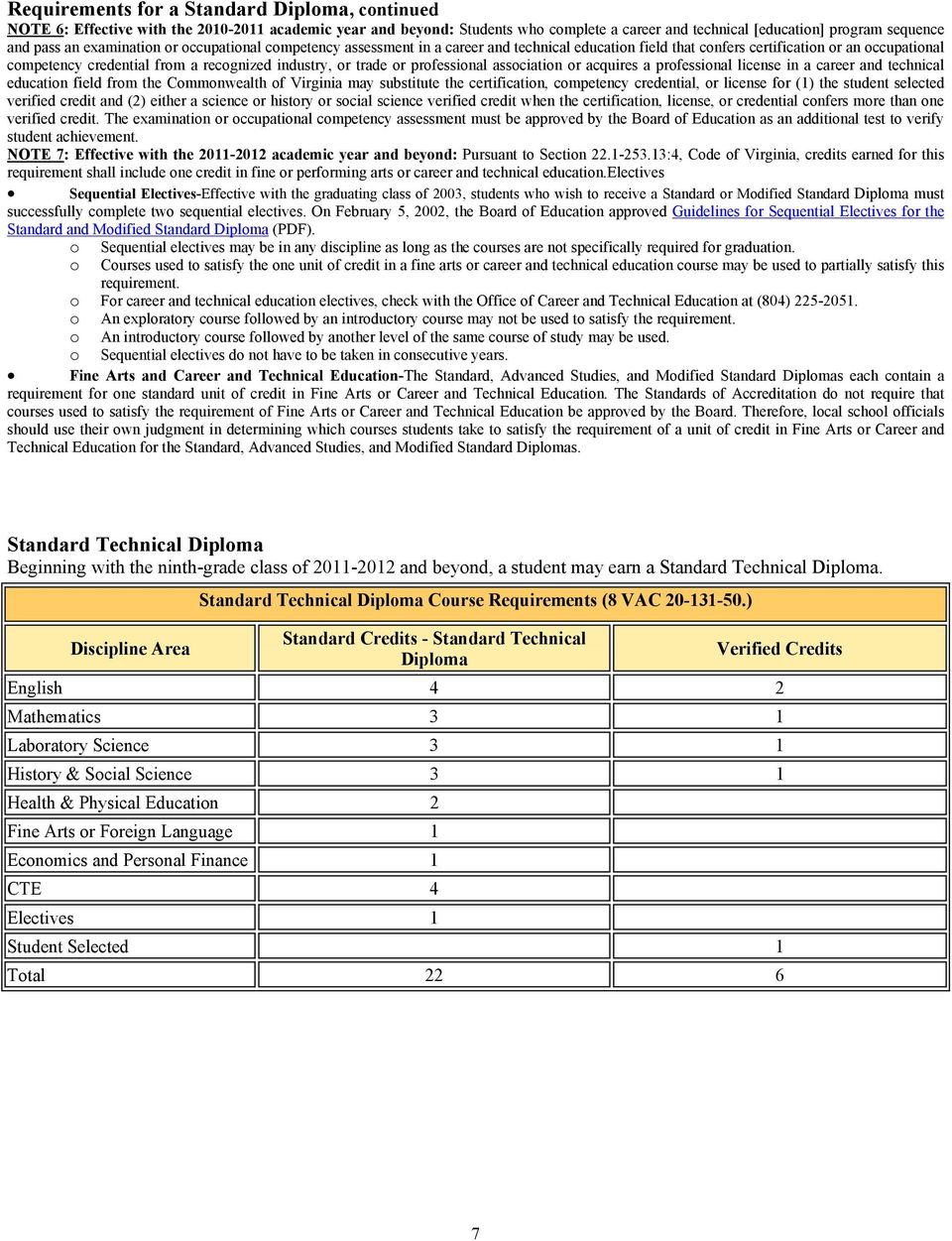
11 Requirements for a Standard Diploma, continued NOTE 6: Effective with the academic year and beyond: Students who complete a career and technical [education] program sequence and pass an examination or occupational competency assessment in a career and technical education field that confers certification or an occupational competency credential from a recognized industry, or trade or professional association or acquires a professional license in a career and technical education field from the Commonwealth of Virginia may substitute the certification, competency credential, or license for (1) the student selected verified credit and (2) either a science or history or social science verified credit when the certification, license, or credential confers more than one verified credit. The examination or occupational competency assessment must be approved by the Board of Education as an additional test to verify student achievement. NOTE 7: Effective with the academic year and beyond: Pursuant to Section :4, Code of Virginia, credits earned for this requirement shall include one credit in fine or performing arts or career and technical education.electives Sequential Electives-Effective with the graduating class of 2003, students who wish to receive a Standard or Modified Standard Diploma must successfully complete two sequential electives. On February 5, 2002, the Board of Education approved Guidelines for Sequential Electives for the Standard and Modified Standard Diploma (PDF). o Sequential electives may be in any discipline as long as the courses are not specifically required for graduation. o Courses used to satisfy the one unit of credit in a fine arts or career and technical education course may be used to partially satisfy this requirement. o For career and technical education electives, check with the Office of Career and Technical Education at (804) o An exploratory course followed by an introductory course may not be used to satisfy the requirement. o An introductory course followed by another level of the same course of study may be used. o Sequential electives do not have to be taken in consecutive years. Fine Arts and Career and Technical Education-The Standard, Advanced Studies, and Modified Standard Diplomas each contain a requirement for one standard unit of credit in Fine Arts or Career and Technical Education. The Standards of Accreditation do not require that courses used to satisfy the requirement of Fine Arts or Career and Technical Education be approved by the Board. Therefore, local school officials should use their own judgment in determining which courses students take to satisfy the requirement of a unit of credit in Fine Arts or Career and Technical Education for the Standard, Advanced Studies, and Modified Standard Diplomas. Standard Technical Diploma Beginning with the ninth-grade class of and beyond, a student may earn a Standard Technical Diploma. Standard Technical Diploma Course Requirements (8 VAC ) Discipline Area Standard Credits - Standard Technical Diploma Verified Credits English 4 2 Mathematics 3 1 Laboratory Science 3 1 History & Social Science 3 1 Health & Physical Education 2 Fine Arts or Foreign Language 1 Economics and Personal Finance 1 CTE 4 Electives 1 Student Selected 1 Total
12 Requirements for an Advanced Studies Diploma. To graduate with an Advanced Studies Diploma, a student must earn at least 24 standard units of credit and at least nine verified units of credit. Discipline Area Advanced Studies Diploma Course Requirements (8 VAC C) Standard Credits Effective with ninth grade classes of through Standard Credits Revised Advanced Studies Diploma Effective with ninth graders in Verified Credits-Effective with ninth graders in and later English Mathematics [Note 1] Laboratory Science [Note 2] History & Social Sciences [Note 3] Foreign Languages [Note 4] 3 3 Health & Physical Education 2 2 Fine Arts or Career & Technical 1 1 Education Economics and Personal Finance 1 Electives 2 3 Student Selected Test [ Note 5] 1 Total NOTE 1: For the academic year only: Courses completed to satisfy this requirement shall be at or above the level of algebra and shall include at least three different course selections from among: Algebra I, Geometry, Algebra II, or other mathematics courses above the level of Algebra II. The Board may approve additional courses to satisfy this requirement. Effective with the academic year and beyond: Courses completed to satisfy this requirement shall include at least three different course selections from among: Algebra I, Geometry, Algebra II, or other mathematics courses above the level of Algebra II. The board shall approve courses to satisfy this requirement. NOTE 2: For the academic year only: Courses completed to satisfy this requirement shall include course selections from at least three different science disciplines from among: earth sciences, biology, chemistry, or physics or completion of the sequence of science courses required for the International Baccalaureate Diploma. The Board may approve additional courses to satisfy this requirement. Effective with the academic year and beyond: Courses completed to satisfy this requirement shall include course selections from at least three different science disciplines from among: earth sciences, biology, chemistry, or physics or completion of the sequence of science courses required for the International Baccalaureate Diploma. The board shall approve courses to satisfy this requirement. NOTE 3: For the academic year only: Courses completed to satisfy this requirement shall include U.S. and Virginia History, U.S. and Virginia Government, and two courses in either world history or geography or both. The Board may approve additional courses to satisfy this requirement. Effective with the academic year and beyond: Courses completed to satisfy this requirement shall include U.S. and Virginia History, U.S. and Virginia Government, and two courses in either world history or geography or both. The board shall approve courses to satisfy this requirement. NOTE 4: For the academic year only: Courses completed to satisfy this requirement shall include three years of one language or two years of two languages. NOTE 5: For the academic year only: A student may utilize additional tests for earning verified credit in computer science, technology, career or technical education or other areas as prescribed by the Board in 8 VAC Effective with the academic year and beyond: A student may utilize additional tests for earning verified credit in computer science, technology, career or technical education, economics, or other areas as prescribed by the board in 8 VAC Electives Fine Arts and Career and Technical Education-The Standard, Advanced Studies, and Modified Standard Diplomas each contain a requirement for one standard unit of credit in Fine Arts or Career and Technical Education. The Standards of Accreditation do not require that courses used to satisfy the requirement of Fine Arts or Career and Technical Education be approved by the Board. Therefore, local school officials should use their own judgment in determining which courses students take to satisfy the requirement of a unit of credit in Fine Arts or Career and Technical Education for the Standard, Advanced Studies, and Modified Standard Diplomas. Foreign Language-The Advanced Studies Diploma contains a requirement for either three years of one foreign language or two years of two languages. In March 1998, the Board of Education approved the provision of three years of instruction in American Sign Language (ASL) for foreign language credit toward an Advanced Studies Diploma; other foreign languages will satisfy this requirement as well. Details of this action are available in: Superintendent's Memo, Interpretive, #1, June 12,

13 Advanced Technical Diploma Beginning with the ninth-grade class of and beyond. a student may earn an Advanced Technical Diploma. Discipline Area Advanced Technical Diploma Course Requirements (8 VAC ) Standard Units Advanced Technical Diploma Verified Credits English 4 2 Mathematics 4 2 Laboratory Science 4 2 History & Social Science 4 2 Health & Physical Education 2 Foreign Language 3 Fine Arts or CTE 1 Economics and Personal Finance 1 CTE 3 Electives Student Selected 1 Total

14 Modified Standard Diploma The Modified Standard Diploma is intended for certain students at the secondary level who have a disability and are unlikely to meet the credit requirements for a Standard Diploma. Eligibility and participation in the program are determined by the student's IEP team and the student, when appropriate. Decisions of eligibility and participation may be made at any point after the student's eighth grade year. Written consent from parent/guardian must be obtained for a student to choose this diploma program. The student must: be allowed to pursue a Standard or Advanced Studies Diploma at any time throughout his or her high school career; not be excluded from courses and tests required to earn a Standard or Advanced Studies Diploma; and pass literacy and numeracy competency assessments as prescribed by the Board: o For students who entered the ninth grade prior to , the literacy and numeracy competency assessments were the reading and mathematics subtests of the LPT. o For students who entered the ninth grade in and beyond, the literacy and numeracy competency assessments are the eighth-grade English Reading test and the eighth-grade Mathematics SOL test (Board action-november 30, 2000). o The Board also approved four additional substitute assessments to satisfy the literacy and numeracy requirements for students pursuing a Modified Standard Diploma. Modified Standard Diploma Course Requirements (8 VAC D) Discipline Area Standard Credits English 4 Mathematics [Note 1] 3 Laboratory Science [Note 2] 2 History & Social Sciences [Note 3] 2 Health & Physical Education 2 Fine Arts or Career & Technical Education 1 Electives [Note 4] 6 Total 20 NOTE 1: Courses completed to satisfy this requirement shall include content from among applications of algebra, geometry, personal finance and statistics in courses that have been approved by the Board. NOTE 2: Courses complete shall include content from at least two of the following: applications of earth science, biology, chemistry, or physics in courses approved by the Board. NOTE 3: Courses completed to satisfy this requirement shall include one unit of credit in U.S. and Virginia History and one unit of credit in U.S. and Virginia Government in courses approved by the Board. NOTE 4: Courses to satisfy this requirement shall include a least two sequential electives in the same manner required for the Standard Diploma. Electives Sequential Electives-Effective with the graduating class of 2003, students who wish to receive a Standard or Modified Standard Diploma must successfully complete two sequential electives. On February 5, 2002, the Board of Education approved Guidelines for Sequential Electives for the Standard and Modified Standard Diploma (PDF). o Sequential electives may be in any discipline as long as the courses are not specifically required for graduation. o Courses used to satisfy the one unit of credit in a fine arts or career and technical education course may be used to partially satisfy this requirement. o For career and technical education electives, check with the Office of Career and Technical Education at (804) o An exploratory course followed by an introductory course may not be used to satisfy the requirement. o An introductory course followed by another level of the same course of study may be used. o Sequential electives do not have to be taken in consecutive years. Fine Arts and Career and Technical Education-The Standard, Advanced Studies, and Modified Standard Diplomas each contain a requirement for one standard unit of credit in Fine Arts or Career and Technical Education. The Standards of Accreditation do not require that courses used to satisfy the requirement of Fine Arts or Career and Technical Education be approved by the Board. Therefore, local school officials should use their own judgment in determining which courses students take to satisfy the requirement of a unit of credit in Fine Arts or Career and Technical Education for the Standard, Advanced Studies, and Modified Standard Diplomas. 10

15 Sequential Elective Guidelines Diplomas Students must take at least two sequential electives to receive a Standard High School Diploma or Modified Standard Diploma. Sequential electives are courses in which the content increases or expands in scope and sequence as students move through the various levels of the courses. These courses may be in any discipline as long as the courses are not specifically required for graduation. Courses used to satisfy one unit of credit in a fine or practical art may be used to partially satisfy this requirement. A sequence that includes an exploratory course followed by an introductory course cannot be used to satisfy this requirement; however, an introductory course followed by another level of the same course of study can be used. Students may take the focused sequence of elective courses in consecutive years or any two years of high school. Counselors will assist students to select courses to meet this requirement. Awards for exemplary student performance. Students who demonstrate academic excellence and/or outstanding achievement may be eligible for one or more of the following awards: Students who complete the requirements for an Advanced Studies Diploma or Advanced Technical Diploma with an average grade of "B" or better, and successfully complete collegelevel coursework that will earn the student at least nine transferable college credits in Advanced Placement (AP), International Baccalaureate (IB), Cambridge, or dual enrollment courses shall receive the Governor's Seal on the diploma. Students who complete the requirements for a Standard Diploma, Standard Technical Diploma, Advanced Studies Diploma or Advanced Technical Diploma with an average grade of "A" shall receive a Board of Education Seal on the diploma. The Board of Education's Career and Technical Education Seal will be awarded to students who earn a Standard Diploma, Standard Technical Diploma, Advanced Studies Diploma or Advanced Technical Diploma and complete a prescribed sequence of courses in a career and technical education concentration or specialization that they choose and maintain a "B" or better average in those courses; or (i) pass an examination or an occupational competency assessment in a career and technical education concentration or specialization that confers certification or occupational competency credential from a recognized industry, trade or professional association or (ii) acquire a professional license in that career and technical education field from the Commonwealth of Virginia. The Board of Education shall approve all professional licenses and examinations used to satisfy these requirements. The Board of Education's Seal of Advanced Mathematics and Technology will be awarded to students who earn either a Standard Diploma, Standard Technical Diploma, Advanced Studies Diploma or Advanced Technical Diploma and (i) satisfy Virginia Board of Education 19 all of the mathematics requirements for the Advanced Studies Diploma or Advanced Technical Diploma (four units of credit including Algebra II; two verified units of credit) with a "B" average or better; and (ii) either (a) pass an examination in a career and technical education field that confers certification from a recognized industry, or trade or professional association; (b) acquire a professional license in a career and technical education field from the Commonwealth of Virginia; or (c) pass an examination approved by the board that confers college-level credit in a technology or computer science area. The Board of Education shall approve all professional licenses and examinations used to satisfy these requirements. 11
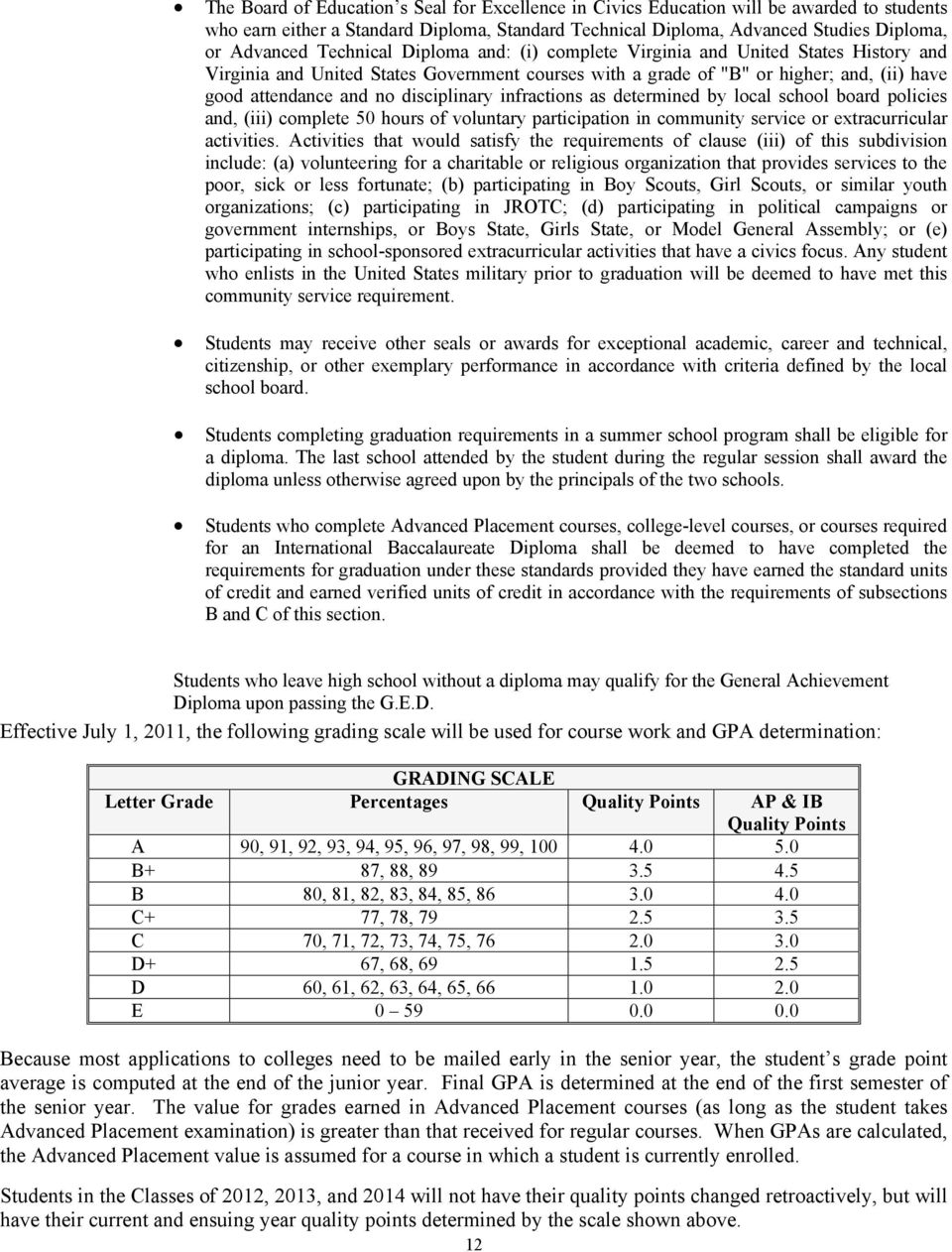
16 The Board of Education s Seal for Excellence in Civics Education will be awarded to students who earn either a Standard Diploma, Standard Technical Diploma, Advanced Studies Diploma, or Advanced Technical Diploma and: (i) complete Virginia and United States History and Virginia and United States Government courses with a grade of "B" or higher; and, (ii) have good attendance and no disciplinary infractions as determined by local school board policies and, (iii) complete 50 hours of voluntary participation in community service or extracurricular activities. Activities that would satisfy the requirements of clause (iii) of this subdivision include: (a) volunteering for a charitable or religious organization that provides services to the poor, sick or less fortunate; (b) participating in Boy Scouts, Girl Scouts, or similar youth organizations; (c) participating in JROTC; (d) participating in political campaigns or government internships, or Boys State, Girls State, or Model General Assembly; or (e) participating in school-sponsored extracurricular activities that have a civics focus. Any student who enlists in the United States military prior to graduation will be deemed to have met this community service requirement. Students may receive other seals or awards for exceptional academic, career and technical, citizenship, or other exemplary performance in accordance with criteria defined by the local school board. Students completing graduation requirements in a summer school program shall be eligible for a diploma. The last school attended by the student during the regular session shall award the diploma unless otherwise agreed upon by the principals of the two schools. Students who complete Advanced Placement courses, college-level courses, or courses required for an International Baccalaureate Diploma shall be deemed to have completed the requirements for graduation under these standards provided they have earned the standard units of credit and earned verified units of credit in accordance with the requirements of subsections B and C of this section. Students who leave high school without a diploma may qualify for the General Achievement Diploma upon passing the G.E.D. Effective July 1, 2011, the following grading scale will be used for course work and GPA determination: GRADING SCALE Letter Grade Percentages Quality Points AP & IB Quality Points A 90, 91, 92, 93, 94, 95, 96, 97, 98, 99, B+ 87, 88, B 80, 81, 82, 83, 84, 85, C+ 77, 78, C 70, 71, 72, 73, 74, 75, D+ 67, 68, D 60, 61, 62, 63, 64, 65, E Because most applications to colleges need to be mailed early in the senior year, the student s grade point average is computed at the end of the junior year. Final GPA is determined at the end of the first semester of the senior year. The value for grades earned in Advanced Placement courses (as long as the student takes Advanced Placement examination) is greater than that received for regular courses. When GPAs are calculated, the Advanced Placement value is assumed for a course in which a student is currently enrolled. Students in the Classes of 2012, 2013, and 2014 will not have their quality points changed retroactively, but will have their current and ensuing year quality points determined by the scale shown above. 12
17 Advanced Placement Students enrolled in Advanced Placement courses must take the Advanced Placement Examinations. By taking these exams, students have the benefit of possible college credit and consequent advanced standing if qualifying grades are earned. Fees for Advanced Placement tests are paid by the Arlington Public Schools as long as the student has been enrolled in the class. Standards of Learning Tests based on Virginia s Standards of Learning (SOLs) are given throughout the state Assessments at the end of the school year. All students take SOL assessments at the end of Grades 3, 4, 5, 6, 7, and 8. In addition, all students enrolled in the following courses must take SOL assessments at the end of the course: English 11: Reading English 11: Writing World History to 1500 AD World History after 1500 AD World Geography U.S. History Algebra I Geometry Algebra II Earth Science Biology Chemistry All students are required to pass six End-of-course (EOC) tests to qualify for a Standard Diploma and nine to qualify for an Advanced Studies Diploma. See above. If students who are required to pass tests for a diploma fail any of those tests, they will be given additional opportunities to take the test again. Tests will be offered in January, June, and August. The Virginia Board of Education has approved a list of tests and cut off scores that may be substituted to establish a verified credit. The list of substitute tests is available at or from the Director of Counseling Services in each high school. A student who needs verified credits for graduation has an option to appeal a failed End-of- Course test in Science and Social Studies, if the student has passed the course in school. Information on the appeal process can be obtained from the Department of Counseling Services. Assessment Results Promotion Guidelines Results from tests taken by students will be mailed to parents after each test administration period. Advanced Placement test results only will be sent directly to the student. Overall results for schools and Arlington will be posted on the APS web site at Generally, the high school English course a student is taking establishes his/her grade level. Thus, a student who is enrolled in English 9 is considered to be a Grade 9 student. For a student to be considered a senior or Grade 12 student, he/she must be able to include in his/her program for the year those courses that would permit graduation by the end of the regular school year or by the end of summer school. Note: If a student finishes Grade 10 without earning at least four verified credits and that student is seeking a standard diploma, the student will be required to attend either a summer school course in make-up and strengthening if the student failed a course and the associated SOL test or an SOL strengthening course if the student passed the course but failed the associated SOL test. If the student does not enroll in the required summer school course, then the student may be required to substitute an SOL strengthening course for an elective in Grade
18 Fees Some courses require a fee for materials not provided by Arlington Public Schools. Where applicable the fee is noted with the course description. In cases where students/families are unable to pay the applicable fee, a request to reduce or waive the fee can be made to school. Please contact the high school counseling office for more information. 14

19 STUDENT SERVICES Homebound Instruction Students who are unable to attend school because of an extended illness or other health, emotional or behavioral problems for which medical or contracted services are required may receive homebound instruction at no cost. Requests for services are made through the school nurse. In extenuating cases, homebound services may be recommended for students with disabilities on a temporary basis. In such cases eligibility determination is made by the IEP Committee in consultation with the Supervisor of Special Programs. Pupil Services Psychological services are available in schools on a regular basis. School psychologists consult with both parents and teachers about the intellectual, social and emotional development of students when need is indicated. They may also provide individual psychological evaluations. Visiting teachers/school social workers serve as liaison between school and the home or community. They identify resources to assist students and families with social or emotional problems, financial needs, attendance concerns or other problems that may impede academic performance. Both psychologists and visiting teachers/social workers may provide short-term individual and group counseling services, with parental consent. Psychologists and social workers maintain a close relationship with community agencies such as mental health. Health The School Health Division, Department of Human Services, seeks to provide students and their families with preventive and early intervention health services so that students are able to learn to the best of their potential. Section 504 Section 504 of the Rehabilitation Act of 1973 prohibits discrimination against persons with a disability in any program receiving federal financial assistance. The Arlington Public Schools are committed to a policy of avoidance and correction of any educational discrimination, assuring that students with disabilities have educational opportunities and benefits equal to those without disabilities. Under Section 504, a person is considered a person with disability if they (a) have a physical or mental impairment which substantially limits one or more major life activities (such as caring for one s self, performing manual tasks, walking, seeing, hearing, speaking, breathing, learning or working), (b) have a record of such an impairment, or (c) are regarded as having such impairment. Arlington Public Schools will evaluate and provide a free, appropriate education to all students with disabilities. Parents are notified and encouraged to participate in all meetings pertaining to their students eligibility under Section 504. (Students who are eligible for special education services under the Individuals with Disabilities Education Act are automatically eligible for protection under Section 504.) Parents should address questions and concerns about Section 504 to the Director of Counseling Services or to the principal of the school. Parents may appeal decisions by contacting the 504 Compliance Officer in the Department of Student Service at Substance Abuse Counseling Arlington Public Schools provides information to students on substance abuse through the Health Program. The Department of Student Services works cooperatively with the Department of Human Services to provide substance abuse prevention and early intervention services to the students in Arlington Schools. Confidential substance abuse assessment is available in certain circumstances. Students and parents receive assistance with referrals to appropriate agencies for treatment services. 15

20 LIBRARY MEDIA SERVICES The Library manages and provides instructional resources for learning and fosters the intellectual and social development of students. Students are taught information literacy skills to become independent learners and problem-solvers. The Library maintains a collection of on-site and online resources that takes into consideration subject content, developmental needs, broad perspectives, and cultural and ethnic diversity. Students use library materials in a wide variety of formats to retrieve, organize, document, analyze, evaluate, synthesize and present information in order to enhance their learning. Students also adhere to the Code of Ethics and Acceptable Use Policy for the appropriate use of information in print, multimedia, and online formats. School Librarians instruct students in finding, using and integrating information into their curricular assignments. Collaborating with teachers, librarians also work to provide students with both instructional resources and the information literacy skills to enhance their learning experiences. Students are encouraged to use the resources of the Library at their school (according to schedules provided at each individual school) and to use the various online resources available via remote access by using Blackboard. ALTERNATIVE PROGRAMS H-B Woodlawn Secondary Program The H-B Woodlawn Program is a countywide program designed for students who can benefit from having more control over their education than that provided in the neighborhood middle and high schools. By grade nine, these students have the option of leaving the school grounds at any time (with parental permission). They have one to two hours per day of unscheduled time. Students do not have continuous adult supervision and are expected to monitor their own behavior and class attendance. They also participate in setting their own educational goals and in school governance through the Town Meeting. The Town Meeting is the official governing body of the school, and all students and staff participate in making decisions. Parents also are welcome to attend and vote. The H-B Woodlawn Program is not an independent school, so high school students are part of their neighborhood schools as well and may participate in interscholastic sports there. About 25 percent of high school students participate in some form of home school activity. Because the H-B Woodlawn Program is a countywide alternative school, families must apply for admission during the application period. Should more students apply than there are openings available, a lottery will be held, and families will be informed whether their children will be admitted. For more details on the selection process, contact the school at or the Public Information Specialist at Bus transportation is provided for enrolled students who live more than 1½ miles from the school. Teenage Parenting Programs The Teenage Parenting Programs are alternative programs designed to meet the unique needs of pregnant and parenting teens in Arlington County. The Family Education Center (FEC) provides pregnant teens enrolled in Arlington Public Schools the opportunity to earn high school credits in a nurturing, family-focused setting. Students maintain course schedules similar to those in their base schools, and work to complete requirements for a high school diploma. For more information, call

21 Alternatives for Parenting Teens (APT) is a year-round alternative school program for teenage mothers and their children. This program includes academic and vocational courses, comprehensive health services, transportation, instruction in parenting education, and a developmental licensed infant care center. Students may remain in the program for up to two years and maintain enrollment through their base school. For more information, call Outreach for Parenting Teens (OPT) reaches out to pregnant and parenting teens not enrolled in school. Teens are provided assistance to enroll in school, access community services, and acquire parenting and life management skills through after-school weekly support sessions at the Career Center. For more information, call or High School Continuation Program The High School Continuation Program at Arlington Mill and Langston offers students age 16 and older the opportunity to earn high school credits in a small and supportive environment. Students may elect to enter the program for many reasons. The program allows students to take one, two, or three block classes each semester. Taking three classes a semester enables students to earn 6 credits a year. Additionally, students are able to receive credit for work experience, service learning, summer school classes, and/or independent study. Students may also take classes at the Career Center, and students may take classes in the late afternoon and evening Monday through Thursday. The Arlington Career Center See page 21. International Baccalaureate Program The International Baccalaureate Program, commonly referred to as the IB Program, is an internationally recognized program of studies available to highly motivated college bound grade 11 and 12 students at Washington-Lee High School. Any Arlington student may apply for the program by following the school system s transfer policy and process. This program provides the rigor, the structure, and the experience necessary to challenge academically motivated students. The IB Program comprises a holistic philosophy of learning that seeks to address the intellectual, philosophical, and social development of the student. The IB Program is a two-year program of studies across the disciplines. The components of the program are successful completion of six academic courses in different subject areas, completion of an external examination in each area, participation in the CAS (creativity, action, and service), enrollment in the special Theory of Knowledge course and the writing and submission of an independent research paper in an area of interest to the student. Students may select certain IB courses without earning the full IB Diploma. Students who earn an IB diploma are also considered to have met the requirements for an Advanced Studies Diploma. Otherwise, see page 8 for requirements for earning an Advanced Studies Diploma. For more information about this program, families should contact the IB Program Office at New Directions High School Program The New Directions High School Program provides at-risk court-involved students, age 14 and over, with academic and career opportunities and counseling in a small and nurturing environment. It s highly structured, and supportive academic setting offers academically unsuccessful students the possibility of earning the high school credits needed for graduation. The program administration and staff are committed to providing the academic, behavioral, and family support that will allow students to progress, families to work together toward success, and students to become contributing members of society. The staff works closely with court officials to increase the opportunity for success. 17
22 OPPORTUNITIES FOR STUDENTS WHO RECEIVE GIFTED SERVICES A comprehensive curriculum at the high school level offers students identified for gifted services many and varied opportunities to fulfill their academic requirements. The suggested courses of study listed herein provide the breadth and depth of instructional experience, which correspond to the learning characteristics of the gifted. These courses are designed for those students who demonstrate ability, achievement, and interest in the specified subject area and who meet the prerequisites for the courses. It is suggested that a tentative four-year sequence of courses be considered in the preliminary planning for the high school program. Counselors are available for consultation when making course selection. Other sources of information include teachers, resource teachers for the gifted, and curriculum supervisors of the various disciplines. This Program of Studies gives detailed descriptions of the various levels of courses available to students identified for gifted services. Additionally, students who are identified for gifted services may choose to enroll in the International Baccalaureate program offered at Washington-Lee High School or apply for admission to the regional academic year Governor s School, Thomas Jefferson High School for Science and Technology. Art The following sequence of courses in the high school art program is suggested for students identified for gifted services in art. Art I (29120) Grade 9 Photography I/II/III (29193) (29194) (29195) Grades 9-12 Art II (29130) Grade 10 AP Art History (39151) Grades Art III (29140) Grade 11 Advanced Placement Studio Art (39149) Grade 12 Art electives such as ceramics, computer graphics and sculpture, are available for students interested in more selections in the visual arts. Music The following sequence of courses in the high school music program is suggested for students identified for gifted services in music. Intermediate or Advanced Band/ Marching Band (29233) (29234) (29254) Grade 9-12 String Orchestra (29244) Grade 9 Music Theory (29225) Grades 9-12 Advanced Choir (29289) Grade 10 Advanced Band/Marching Band (29234) (29254) Grade 10 String Orchestra (29244) Grade 10 Madrigals (29252) Grades Advanced Band/Marching Band (29234) (29254) Grades String Orchestra (29244) Grades Music Theory (AP) (39226) Grades A variety of ensemble offerings is available at each high school including Jazz Ensemble, Jazz Singers, and All County Orchestra. Serious students of string, wind, brass, and percussion instruments or vocal music should avail themselves of these each year by checking with the music directors. A variety of opportunities exist in the drama departments. A number of theater arts classes are available to students. 18
23 Fine Arts Apprentice Program Fine Arts Apprentice I Full year, one-half credit (29290) Fine Arts Apprentice II Full year, one-half credit (29291) Fine Arts Apprentice III Full year, one-half credit (29292) Grades The Arts Education Office administers the Fine Arts Apprentice Program for students in grades who are exceptionally talented and committed to visual arts, music, theatre or dance. Individual and small group arts experiences are arranged for these identified students. Students are selected in the spring through written application, interview, and audition/portfolio. Applications are available through high school art and music staff, counselors, and the Arts Education Office. Mathematics The following sequence of courses in the high school mathematics program is suggested for students gifted in mathematics. This sequence presupposes the completion of Algebra I at the middle school level. Geometry, Intensified (23141) Grades 9-12 Algebra II, Intensified (23136) Grades 9-2 Precalculus, Intensified (23164) Grades 9-12 Calculus AB, AP (33177) Grades Calculus BC, AP (33179) Grades Multivariable Calculus (33178) Grades Alternatives Computer Science, AP (33185) Grades Statistics, AP (33192) Grades Science The following sequence of courses in the high school science program is suggested for students gifted in science. Intensified Biology, (24315) and/or Grade 9 Intensified Earth Science (24215), and/or Grade 9 or 10 Intensified Chemistry (24415) Grade 10 Intensified Physics (24515) Grade 11 Biology, AP (34370) and Selected Science/Topics (34371) Grade 12 Chemistry, AP (34470) and Selected Grade 12 Science/Topics (34471) Physics C: Mechanics and Electricity & Magnetism (34570) and Selected Science/Topics (34571) Grade 12 Physics B, AP (34572) and Selected Science/Topics (34573) Grade 12 Environmental Science AP (34270) and Selected Topics (34271) Grade 12 Social Studies The following sequence of courses in the high school social studies program is suggested for students gifted in social studies. World History, AP (32400) Grade 9 English 9 (22343) and World History, Intensified (21132) Grade 9 Macroeconomics, AP (32803) Grade Microeconomics, AP (32805) Grade Virginia and U.S. History, AP (32319) Grade 11 Virginia and U.S. Government, AP (32445) Grade 12 19
24 Alternatives World History & Geography: Beginnings to 1500 AD (22215) Grade 10 World History & Geography: Beginnings to 1500 AD, Intensified (22219) Grade 10, 11, or 12 American Civilization, English and European History, AP (32399) Grade 10, 11 or 12 Psychology, AP (32902) Grade 11 or 12 Sociology (22500) Grade 11 or 12 Economics (22800)/U.S. & World Affairs (l semester each) (22388) Grade 11 or 12 English The following sequence of courses in the high school English program is suggested for students gifted in verbal areas. English 9 (21132) and World History, Intensified (22343) Grade 9 English 10 Intensified (21142) Grade 10 English Language and Composition, AP (31196) Grade 11 English Literature and Composition, AP (31195) Grade 12 World Languages Arlington Public Schools students have the opportunity of studying world languages at the secondary level beginning in Grade 7. Students pursuing an Advanced Studies Diploma are required to complete 3 credits of study of world languages. These 3 credits can be obtained by studying 3 years of a world language, or two years of study in each of two languages. It is recommended that students identified as gifted study at least one world language through the Advanced Placement level. Students identified for Gifted services may also wish to consider studying a second world language while in high school. If students begin to study a world language, and plan to continue its study in college, it is recommended that they study this language through their senior year. This is particularly important if students plan to take the SAT II test in the language. It is recommended that SAT II tests be taken by only those studying at level IV and above. The following languages are offered to the Advanced Placement level at Arlington high schools: l. French I, II, III, IV, V, VI, V-AP, VI-AP 2. German I, II, III, IV, IV-AP, V-AP 3. Latin I, II, III, IV, IV-AP, V AP 4. Spanish I, II, III, IV, V, VI, V-AP, VI-AP 5. Spanish for Fluent Speakers I, II, III, AP Language, AP Literature, Part I, AP Literature, Part II In addition, Arabic I, II, III, and IV Chinese I, II, III, and IV are offered. Career Center Courses Academically gifted students may be interested in the following courses available at the Career Center. Enrichment Programs Grades 9-12 PRIME (Professional Related Intern-Mentorship Grades Experience) Engineering III (26672) Grades Engineering IV (26671) Grades Aviation Technology (28731) Grades Advanced Topics in IT (26645) Grades Physical Therapy/Sports Medicine (28332) Grades Emergency Medical Technician (28334) Grades
25 CAREER CENTER/GOVERNOR S CAREER & TECHNICAL ACADEMY PROGRAMS AND COURSES The Arlington Career Center serves all high school students in Arlington Public Schools by offering academic programs, Career and Technical Education (CTE) programs, and now dual-enrolled college courses through the Governor s Career & Technical Academy. The mission of the Career Center is to prepare students to realize their potential in a changing technological society. In addition, the Career Center provides enhanced opportunities in four areas: 1) Hands-on skills; 2) industry certifications; 3) college credit; and, 4) career experiences such as internships and client projects. The emphasis of the Governor s Career and Technical Academy is to build programs around "Relationships, Relevance and Rigor", with opportunities for highlevel, real-world projects and entrée into Northern Virginia Community College (NOVA). Once students are enrolled in NOVA, usually as a high school junior, they earn college credit in their junior and senior years through dual-enrollment courses. They also may take NOVA s one-credit orientation course (SDV100) on the Career Center campus. For more information about the Career Center and its programs, please call ACADEMIC PROGRAMS The Academic Academy Prerequisite(s): Admission to the Academic Academy is made by the Program s Coordinator. The Academic Academy is a program designed for students as an alternative to the comprehensive high school. Students in grades 10 through 12 are served, as well as 9 th grade students who have not yet completed the requisite coursework for admission to high school in Arlington Public Schools. classes, or students may choose to spend the entire academic day at the Career Center. Ninth grade students enrolled in the Academy spend one year in a transition schedule allowing them to move from the middle school setting, and after successful completion of coursework, return to a 10 th grade placement in the comprehensive high schools. This includes a schedule of classes designed to meet the 9 th grade curriculum, while at the same time scheduling 8 th grade coursework not yet successfully completed. The Academic Academy is located at the Arlington Career Center, 816 South Walter Reed Drive, Arlington, Virginia. The Program Coordinator can be reached at High School credit: Students earn credits in all Academy courses, which are applied toward a high school diploma. Institute for Career Development and Academic Achievement Prerequisite(s): Admission to the HILT Institute is made by the Program s Coordinator. The Institute program is designed for the older HILT or HILT-EX students (ages 16-21) who would benefit most from a small and structured academic environment, integrated with a career and technical component. Students who are selected for the Institute enroll in a two-period integrated block of language instruction in reading, writing and grammar. They also take three additional credits in math, science, and social studies. Finally, students enroll in a two-period Career & Technical Education (CTE) elective class at the Career Center. Students who attend the program benefit by working toward their high school diplomas while obtaining certifications or licenses in their selected professional areas, and/or receiving college credits for their technical classes. High School credit: Students earn credits in all Institute courses, which may be applied toward a standard or advanced high school diploma. This program, formerly known as Project CRAM, is designed with small class settings, low teacher/ student ratio, individualized teacher mentoring, and structured academics. Curriculum areas include English, math, social studies, and science. In addition to academics, students have the option of enrolling in one the many Career and Technical Education (CTE) elective classes offered at the Career Center. Students may attend the Academy for five periods and return to the comprehensive high school for an additional two 21
26 Experience-Based Career Education (EBCE) Full year, all day program; 6-8 credits Grades Prerequisite(s): The referral process must begin with the transition coordinator at the comprehensive high school. Besides having a current Individual Education Program (IEP), EBCE students must be in 11 th or 12 th grade and/or finishing the last one or two years of their high school education; be able to function independently in the community at career exploration sites; and, be capable of taking public transportation independently after minimal training. EBCE provides students with a combination of academic instruction and unpaid career exploration at work sites in the community. A typical student s schedule includes two full days of academic classes at the Career Center and three four-hour days at an experience site. Most students will explore three or four different careers during the school year. EBCE students earn academic credits required for a high school diploma or certificate, as well as elective credits for work experience and career exploration. Supported Work and Transition Criteria (SWAT) (29085) Elective credit possible Full year, all day Prerequisite(s): This is a program for students with disabilities. The referral process must begin with the transition coordinator at the comprehensive high school. The SWAT Program Coordinator then reviews all transition coordinator referrals, taking into account student age, year in school, and prior job training experience. SWAT is a community-based class for supported work experience, supported travel training, and independent living training. All academic skills are applied within community settings and are tailored to meet individual student needs. Elective credits are available. The participant in expected to work and travel within the Arlington Community. The SWAT program operates on a non-paid supported work model for employment training. Supervision is provided on the work sites; however, students are expected to be able to reach a certain degree of independence with training. Students are required to travel to and from the work sites using public transportation with training and support from the SWAT staff. CAREER ASSESSMENT SERVICES Eligibility and referral: The assessment program is available to all high school students with an Individualized Education Program (IEP). Students are usually referred for assessment services through the Transition Office of each secondary school. Recommendations can come from school counselors, special education staff, family, or through self-referral. Career & Technical Assessment Services is designed to provide a comprehensive picture of a student's career interests, aptitudes, employability behaviors, and career decision-making skills. Each assessment is established by the evaluator and the referral source, and is individualized according to each student s needs. Following the assessment, a report is prepared which outlines the results of the student's evaluation and provides both short-term and long-term recommendations for career and technical preparation programs. INTERNSHIP PROGRAMS PRIME (Professional Related Intern-Mentorship Experience) (29060) Grades Prerequisite(s): Students must be 16 years of age and able to provide their own transportation. PRIME, an internship program for high school students who have been identified for gifted services, is designed to provide students with an opportunity to be placed as interns in professional organizations that relate to their fields of interest. Students are assigned a mentor with whom they spend 140 hours during the year. PRIME also is available in the summer for credit. Please check the Career Center website for more information and forms. 22
27 School to Work Transition/Internship (29828) Full year, two periods, two credits Grades Prerequisite(s): Minimum 16 years of age; completion of Career Center CTE program (full program series) with a grade of C or better; plus, a written recommendation from CTE Skills teacher. This course is designed for students who have completed a Career & Technical Education (CTE) program sequence and wish to further their education and skills by either working in a job related to their career choice or continuing their training through mastery of advanced skills in their chosen skill area. Students will receive internship referral assistance from the CTE instructor and the internship coordinator. Students must be at the internship site a minimum of 280 hours per school year in order to earn two credits. Students are evaluated by the internship supervisor twice per quarter in order to determine the quarter grade. Occupational Training/Education for Employment (20976) Full year, two periods, two credits. May be repeated for two additional elective credits. Prerequisite(s): Students must have either a current Individualized Education Plan (IEP), or a referral from a teacher or counselor. Students participate in both classroom activities and career and technical skill exercises designed to develop and strengthen employability behaviors, positive attitudes toward work, interpersonal and coworker relationships, and social and independent living skills. Structured work experiences are also available for students enrolled in the program. 23
28 PATHWAYS OF THE CAREER & TECHNICAL EDUCATION (CTE) COURSES AT THE ARLINGTON CAREER CENTER All courses fulfill the Fine/Practical Arts requirement for high school graduation; in addition, some courses provide: high school science credit (S); high school verified credit (V); high school physical education credit (PE); college validated credit (CV); college dual-enrolled credit (DE) for students 16 or older ONLY; licensure (L); and, certification (C). PROGRAM AREA CLUSTER COURSE SEQUENCE I COURSE SEQUENCE II I. BUSINESS & COMMUNICATION II. INDUSTRY & ENGINEERING III. HEALTH & HUMAN SERVICES IV. EDUCATION & GOVERNMENT 1. Arts, A/V Technology & Communications 2. Finance Digital Photography I (28608) DE Digital Photography II (28609) DE Television Production I (28689) Television & Multimedia Production II (28690) V Computer Graphics for the Web (28635) Digital Visualization: Animation & Virtual Worlds (28459) Banking, Finance, and Investments (28181) V/C (although requires 28181, both courses are taken Marketing Coop Education Work Experience (28122) together in the same year) Computer Programming (26647) DE Advanced Topics Information Technology (26645) DE Automotive Technology I (28509) Auto Tech II (28507) V/DE Auto Tech III (28508) DE DE Auto Body Repair I (28677) Auto Body Repair II (28678) V/DE Aviation Technology (28731) C Carpentry I (28519) Carpentry II (28520) V 3. Information Technology Introduction to Information Technology (28483) 4. Transportation, Distribution & Logistics 5. Architecture & Construction Electricity I (28534) Electricity II (28535) V/C Comp-Assisted/Engineering Drawing (28436) DE 6. Science, Technology, Comp-Assisted/Architectural Drawing (28435) DE Digital Visualization: Animation & Virtual Worlds (28459) Engineering & Mathematics Comp-Assisted/Engineering Drawing (28436) DE Digital Visualization: Animation & Virtual Worlds (28459) Engineering III (26672) CV Engineering IV: Digital Electronics (26671) CV 7. Agriculture, Food & Animal Science Technical/Biology I&II (28083) S/C Animal Science Adv/Bio Investigations I&II (28084) S/C Natural Resources Animal Science Adv/Bio Investigations I&II (28084) S/C Health & Medical Sciences (28302) Pharmacy Technician (28305) 8. Health Science Biotechnology Techniques and Applications (28467) S Physical Therapy/Sports Medicine Tech (28332) S 9. Hospitality & Tourism Culinary Arts & Sciences I (28522) Culinary Arts & Sciences II (28523) 10. Human Services Early Childhood Education I (28235) Early Childhood Education II (28236) V/DE Cosmetology I (28528) Cosmetology II (28529) V/L 11. Gov t & Public Admin. Air Force Junior ROTC I & II (28735) CV Air Force Junior ROTC III & IV (28736) CV 12. Law, Public Safety, Forensic Technology w/apps. in Biotech (28325) Corrections & Security EMT/Human Anatomy & Physiology (28334) S/CV/C 24
29 I. BUSINESS & COMMUNICATION CLUSTER #1: Arts, A/V & Communications All courses qualify for the Practical/Fine Arts credit. Computer Graphics for the Web (28635) Full year, two periods, two credits Prerequisite(s): None. Computer Graphics for the Web focuses on creating computer graphic images for display on the World Wide Web using a Windows platform. Students acquire knowledge regarding the differences between Web graphics and print graphics. Through class projects, students create work using a variety of image-making software and hardware. Students will use high end graphics and animation software. By developing quality art images and gaining an appreciation of their value in the communication process, students increase their ability to communicate visually, a useful skill in any career field. Students create a digital portfolio of completed work. Digital Visualization: Animation & Virtual Worlds (28459) Full year, two periods, two credits Prerequisite(s): Computer Graphics for the Web; OR, Computer-Assisted Technical Drawing; OR, permission of the instructor. Students will gain experience related to computer animation by solving problems involving 2D and 3D object manipulation, storyboarding, texture mapping, lighting concepts and environmental geometry. They will produce animations that include interdisciplinary projects related to science, engineering, information technology and the entertainment industry. A major emphasis will be placed on the production of a digital portfolio that showcases original student work. Digital Photography I (28608) Full year, two periods, two credits Prerequisite(s): None. Digital Photography I teaches basic film and digital skills for processing and uploading images. Students develop a portfolio that can be used for college admission, and entry level employment within the field of photography. The class prepares students who are pursuing professional photography careers focusing on architecture, commercial, fine arts, photo journalism, medical, scientific, museum, portraiture, printing, sales, and teaching. Each student photographs specific assignments that correlate to the Virginia Standards of Learning. Students have opportunity to photograph in professionally equipped classroom studios. This is a complete digital photo class and the darkroom is not used in this class. Students also explore the possibilities of color computer manipulation of their digital images through the classroom computer lab. The history of Photography will be explored by the students through research, and also by handling 19 th century cameras and photographs. Digital Photography II (28609) Full year, two periods, two credits Prerequisite(s): Photography I or permission of instructor. Digital Photography II is an advanced course in which students will have an opportunity to expand his/her portfolio of photography using digital camera, in conjunction with multiple electronic flash. The computer is stressed through computer manipulation using Adobe Photoshop. The Virginia State Competency List and Standards of Learning are also used to create assignments. College credit: Dual-enrolled at Northern Virginia Community College as PHT100, earning students three college credits. Television Production I (28689) Full year, two periods, two credits Prerequisite(s): None. Television Production I covers the theory and practice of digital media production. Students develop skills through hands-on projects in the Career Center s Digital Media Production Facility, one of the best of its kind in Virginia. Production assignments range across the fields of television, radio and the internet, and include public service announcements (PSAs), music videos, independent short films, radio spots, websites and animation. Television Production students routinely earn local, state and even national prizes through many opportunities for competitions and client work afforded by this course. Students work individually and in groups to produce original pieces, which they take with them as professional digital portfolios at the end of the class. Television & Multimedia Production II (28690) Full year, two periods, two credits Prerequisite(s): Television I or permission of instructor. Television & Multimedia Production II is an intense, hands-on course that prepares students to function as professional media producers. The class models a commercial production company, giving students multiple opportunities to produce creative projects in the Career Center s impressive Digital Media Production Facility. Projects may be produced for competitions, clients and community partners. Students also are given the opportunity to produce 25
30 independent projects, such as original short films or documentaries. These projects teach students the media production business while helping them to build professional portfolios that will set them apart form their peers. This advantage leads to awards, internships, scholarships, and successful higher education and career paths. Additional high school credit: Completion of Television I coupled with a passing score on the NOCTI Television Broadcast exam, given as a part of the course, provides a verified credit. successful completion of the related course and continuous employment in a job that is approved by the coop coordinator and that averages between 11 and 15 hours a week. It is recommended that students schedule their work release time during their last period(s) of the school day, so as not to interfere with other classes and school work. A credit earned in this course will fulfill the Fine/Practical Arts requirement for graduation. Credit earned is based on the number of hours completed. One credit is earned for 376 hours of internship, and two credits for 752 hours. CLUSTER #2: Finance All courses qualify for the Practical/Fine Arts credit. Banking, Finance and Investments (28181) Full year, two periods, two credits or four credits with Coop Work Experience (28122) Prerequisite(s): Students be at least 16 years of age. This course is designed for students interested in obtaining an understanding of the financial industry, the stock market and banking systems. Students have the opportunity to gain practical experience from our Arlington Virginia Federal Credit Union in school branch. Students should have good written and oral communication skills and a sound background in consumer mathematics plus some computer operation skills. Due to the unique structure of this program, excellent attendance is required. While enrolled in the course, the student is an active member of DECA, an association of marketing students. Additional high school credit: Students successfully completing this course will satisfy the sequential elective requirement for the standard or modified standard diploma, and will be program completers for the Technical Seal on the high school diploma. Marketing Cooperative Education Work Experience (28122) Full year, two credits Prerequisite(s): Students must be concurrently enrolled in any Marketing course (such as Banking, Finance and Investments ); and, must be interviewed and selected by the school s coop coordinator before enrolling in the program. This course is designed to allow marketing students who are currently enrolled in a marketing class to receive two elective credits for working at an afterschool job that is related to their marketing coursework. Students are awarded coop credit upon 26 CLUSTER #3: Information Technology Introduction to Information Technology (28483) Full year, two periods, two credits Prerequisite(s): None. This course is an essential foundation class for all students interested in computers, networking, and web -based application and programming. Students who like computers and want to know more about set-up, troubleshooting, and how they work should consider this course. Included technologies are computer solutions for home, school and business. This course prepares students for upper level study and certifications in PC platforms (A+, Net+), network hardware and operating systems (Cisco/Novell) and web-based programming (Java). Computer Programming (26647) Full year, two credits Prerequisite(s): Introduction to IT or instructor approval. Students learn to use the JAVA programming language to code and compile programs in an open source or Windows environment. Course content includes program design and problem solving, control structures, functions, parameter passing, data structures, arrays, and file processing. Emphasis is on program design and structured programming style. College Credit: This course is dualenrolled with NOVA s ITP120 for three college credits towards an Associate s Degree in Information Technology.
31 Advanced Topics in Information Technology (26645) Full Year, two credits Prerequisite(s): Introduction to IT or instructor approval. Advanced topics in information technology provides students choice in developing expertise among specific information technology career pathways. These include such areas as computer programming, network administration, database management and administration, digital multimedia, web page design, graphic design, game design and programming, technical support or system options. The requirements for the course can be satisfied through individual or team projects, mentorship, or independent study. Students can prepare multiple it industry certifications. This course integrates science, technology, engineering, and mathematics principles and concepts and is a career pathway course in Information Technology. College Credit: This course is dualenrolled with ITN170 at NOVA for three college credits towards an Associate s Degree in Information Technology. II. TRADE & INDUSTRIAL EDUCATION CLUSTER #4: Transportation All courses qualify for the Practical/Fine Arts credit. Automotive Technology I (28509) Full year, two periods, two credits Prerequisite(s): None. Automotive Technology I is the beginning courses in the Advanced Automotive Technology program sequence at the Career Center. It may also be taken as a general interest course. Students are introduced to career opportunities in the automotive field and how the Automotive Youth Education System (AYES) can help them find employment in an automotive career path. Students will develop competencies in many of the ASE certified areas of automotive technology including brakes and engine repair. Students also will learn how to work with tools and perform vehicle maintenance. The majority of this course is hands-on, and allows students to work on cars, including their own. Automotive Technology II (28507) Full year, two periods, two credits Prerequisite(s): Automotive Technology I. Automotive Technology II involves "real world training" in an on-the-job type facility. Training in the most up-to-date technologies enables a student to gain experience in this exciting and fast growing industry. Use of modern specialized equipment with emphasis on "hands-on" training makes this course beneficial to future technicians, as well as automobile owners. This course is a prerequisite for Automotive Technology III. College credit: This course is dualenrolled at NOVA as AUTO100 and AUTO267 for a total of six credits toward an Automotive Technology Associate of Applied Science Degree. Certification: ASE/AYES/SkillsUSA Automotive Technician End-of-Program Examinations Automotive Technology III (28508) Full year, two periods, two credits Grades Prerequisite(s): Automotive Technology II. Automotive Technology III is the culmination of the three-year sequence in Advanced Automotive Technology. Students continue to build competencies in ASE-certified areas of automotive technology, including specialized areas such as computer controlled systems, fuel injection and front wheel alignment. Use of sophisticated testing devices and other modern equipment prepares students with job skills required for success in the automotive industry. In the spring semester, students can participate in the Career Center s nationally-recognized internship program, where students interview for paid internships at local automotive dealerships and independent service facilities. During the summer, most of these internships turn into full-time, paid positions. College credit: This course is dualenrolled at Northern Virginia Community College (NOVA) as AUTO241 and AUTO266 for a total of eight credits toward an Automotive Technology Associate of Applied Science Degree. Certification: ASE/AYES/SkillsUSA Automotive Technician End-of-Program Examinations Auto Body Repair I (28677) Full year, two periods, two credits Prerequisite(s): None. In the global automotive repair industry, there is a growing demand for qualified auto body technicians. In this course, students are taught non-structural analysis, damage repair, and welding. Students work with a variety of materials, using metal finishing and body filling techniques to prepare surfaces and repair panels. In addition, students practice shop safety and gain career skills. 27
32 Auto Body Repair II (28678) Full year, two periods, two credits Prerequisite(s): Auto Body Repair I. This program is designed to prepare students for employment in the auto body field. There are two areas of specialization: auto painting and collision work. Although students obtain experience in both, it is possible to specialize in one particular area. The majority of time is spent in practical "hands-on" experience. Certification: Upon successful completion of level II, students can take the Automotive Service Excellence (ASE) test for paint and refinishing. College credit: Auto Body Repair II is dual-enrolled with AUB106 for three college credits at Northern VA Community College. CLUSTER #5: Construction Trades All courses qualify for the Practical/Fine Arts credit. Carpentry I (28519) Full year, two periods, two credits Prerequisite(s): None. Carpentry I introduces students to paths for career success in the construction industry, which include hidemand jobs such as carpenter, drywall hanger, homebuilder and green construction supervisor. Students are taught basic safety techniques before they are allowed to use power tools and equipment., preparing them for OSHA-10 Safety Credential. The cabinet-making portion of the course allows students to construct custom made projects such as bookcases, stereo cabinets, and furniture. Students are also taught how to select wood, read blueprints, and estimate costs of building materials. Aviation Technology (28731) Full year, two periods, two credits Prerequisite(s): Students must be fifteen years old prior to completion of the course. Aviation Technology provides an introduction to the world of aviation and the aerospace industry. It is designed for students who intend to pursue either pilot training or aviation related career fields. This is one of only four course in the Commonwealth of Virginia in which students get to fly real airplanes. Course content includes careers in aviation and aerospace, aviation history, principles of flight, aircraft systems and performance, meteorology for pilots, interpreting weather data, basic navigation, electronic navigation, aviation physiology, flight planning and decision making. Students receive flight training in full motion and stationary flight simulators and participate in two actual aircraft flights at a local airport. The curriculum is enriched with field trips to the Smithsonian Air and Space Museum, Reagan National Airport and Lockheed Martin s Flight Demonstration Center. Certification: Students will take the Federal Aviation Administration (FAA) aeronautical knowledge written examination for a private pilot license. Carpentry II (28520) Full year, two periods, two credits Prerequisite(s): Carpentry I. Carpentry II affords second-year carpentry students the opportunity to continue building the skills that are essential for success in the construction industry. Students erect wood and metal frameworks including studding, floor joists, rafters, sheathing, subflooring, and partitions. In addition, students learn to install finish molding, trim, hardware, and flooring. All of these skills come together when students undertake culminating stretch projects, which instill an understanding of how to guide a project from plans to finished product. The Career Center s job internship program allows advanced carpentry students to spend a third year fine-tuning their skills on real job sites. Additional High School Credit: Completion of Carpentry I and Carpentry II coupled with a passing score on the NOCTI Carpentry Exam, given as part of the course, provides a verified credit. Electricity I (28534) Full year, two periods, two credits Prerequisite(s): None. Electricity I enables students to develop electrical skills in working in residential (home) construction. Students are taught the proper use of common electrical tools, wiring techniques, the building and analyzing of electrical circuits, reading of electrical plans, and electrical problem-solving. Students are introduced to commercial new construction and communication wiring. Instruction is based on the National Electric Code. Most of the instruction is practical and hands-on. Safety and good work habits are emphasized. 28
33 Electricity II (28535) Full year, two periods, two credits Prerequisite(s): Electricity I. Electricity II provides instruction in the wiring methods of commercial construction and communications cabling, including telephone wiring, cable television wiring, BICSI/RBT Systems Copper based Network Cabling and Fiber Optic Network Cabling. The Occupational Safety and Health Administration (OSHA) Construction is also offered. Seniors may be eligible for a work-study program in the electrical supplies distribution field. The commercial wiring is taught to the standards of the National Electrical Code. The network cabling is taught to the BICSI/RBT Systems standard and meets the TIA/EIA 568A standard. Students will study communications wiring standards, wiring methods and techniques, network and cabling history and terminology. Those students who complete all network cabling instruction and meet all state, local, and instructor requirements will have an opportunity to take the exam for the BICSI/RBT certification, which is nationally-recognized by the telecommunications industry. College credit: Dual-enrolled with ARC121 at Northern Virginia Community College for three college credits. Computer Assisted Technical/Engineering Drawing (28436) Full year, two periods, two credits Prerequisite(s): None. This is a drawing course which focuses on the practices of the fields of architecture and construction. Students prepare working drawings necessary in residential construction through the use of mechanical drafting and computer assisted drawing. These documents include floor plans, electrical plans, wall sections, elevations, and renderings. Students build scale models and prepare presentations on various architectural related subjects. Students also study building materials and their individual properties. This class provides information helpful for the homeowner and is especially beneficial to the future architect, interior designer, or homebuilder, including students involved in the construction trade skill classes. Computer aided drafting using auto cad is a component of this course. Additional high school credit: Students who pass both the course and the BICSI/RBT certification exams earn a Virginia Verified credit. Certifications: OSHA-10 Construction Safety card; BICSI/RBT Systems Copper-based Network Cabling and Fiber Optic Network Cabling Certifications (given in English only). CLUSTER #6: Engineering & Leadership All courses qualify for the Practical/Fine Arts credit. Computer Assisted Technical/Architectural Drawing (28435) Full year, two periods, two credits Prerequisite(s): None. This is a drawing course which focuses on the practices of the fields of architecture and construction. Students prepare working drawings necessary in residential construction through the use of mechanical drafting and computer assisted drawing. These documents include floor plans, electrical plans, wall sections, elevations, and renderings. Students build scale models and prepare presentations on various architectural related subjects. Students also study building materials and their individual properties. This class provides information helpful for the homeowner and is especially beneficial to the future architect, interior designer, or homebuilder, including students involved in the construction trade skill classes. Computer aided drafting using auto cad is a component of this course. 29 College credit: Dual-enrolled with ARC121 at Northern Virginia Community College for three college credits. Engineering-Project Lead the Way (PLTW) Project Lead the Way is a nationally-recognized sequence of courses for orienting students to engineering and preparing them for success in college engineering programs. Students entering this program of study must be enrolled in a college prep sequence of math and science. The entire sequence of four, year-long courses begins at the comprehensive high schools and culminates at the Career Center with Engineering III and IV: Engineering III: Computer Integrated Production/Engineering Development and Implementation (26672) Full year, two credits at Arlington Career Center Prerequisite(s): Successful completion of Engineering I and Engineering II (at comprehensive high schools). This course builds upon the computer solid modeling design skills developed in Engineering I: Introduction to Engineering and Engineering Design. Students are presented with design problems that require the use of Autodesk s Inventor software to develop solutions. They evaluate the solutions, make appropriate modifications and use prototyping equipment to produce three-dimensional models. Students work in teams to design and test a solution. Problems involve a wide range of engineering applications (e.g., a
34 school robo-mascot, an automated solar water heater, and a remote control hovercraft). Students will maintain a journal as part of a portfolio of their work. Each team is responsible for delivering progress reports and making final presentations of their project for an outside review panel. The completed portfolio will be invaluable as students apply to college. Engineering IV: Digital Electronics (26671) Full year, two periods, two credits at Arlington Career Center Prerequisite(s): Successful completion of Engineering I and Engineering II (at comprehensive high schools). Digital Electronics is a course of study in applied digital logic. The course is patterned after the first semester course in Digital Electronics taught in twoand four-year colleges. Students will study the application of electronic logic circuits and devices and apply Boolean logic to the solution of problems. Such circuits are found in watches, calculators, video games, computers, and thousands of other devices. The use of smart circuits is present in virtually all aspects of our lives and its use is increasing rapidly, making digital electronics an important course of study for a student exploring a career in engineering/ engineering technology. Using Circuit Maker, the industry standard, students will test and analyze simple and complex digital circuitry. Students will design circuits using Circuit Maker, export their designs to a printed circuit auto routing program that generates printed circuit boards, and construct the design using chips and other components. III. HEALTH & HUMAN SERVICES CLUSTER #7: Resources Agriculture, Food & Natural All courses qualify for the Practical/Fine Arts credit. Animal Science Technical/Biology I & II (28083) Full year, two periods, two credits Prerequisite(s): None. This course is designed to give students a solid background in biology with an emphasis on animals. Students will have the opportunity to study a wide variety of animal life using hands-on approach. This course is designed to allow students to investigate the many animal related career options available today. This program has developed strong alliances and outreach with local animal care professionals. Students are provided with an opportunity to develop some of the most important skills necessary for success in animal related career fields. Students will gain experience working with the wide variety of domestic and exotic animals housed at the Career Center 30 including goats, chickens, parrots, snakes, iguanas, turtles, ferrets, and rabbits. This course is recommended for students wishing to pursue a career working with animals, whether it is immediately following high school or after attending a technical school, community college or a four-year University. Additional high school credit: A credit earned in this course will satisfy the third lab science credit for the standard diploma or the fourth lab science credit for the advanced diploma. In addition to the science credit, students will receive a second credit for fine/practical arts. This also counts as a sequence for the modified standard diploma. Certification: American Red Cross Pet First Aid & CPR. Advanced Animal Science/Biological Investigations I & II (28084) Full year, two periods, two credits Prerequisite(s): Successful completion of Biology or Technical Animal Science. Advanced Animal Science/Biological Investigations is designed as an advanced biology course with an emphasis on animal biology (zoology). This course will prepare students for further education in many animal-related fields such as animal science, wildlife biology, veterinary science, zoology or animal behavior. Students study and apply their knowledge in the fields of comparative anatomy, physiology, disease transmission, genetics, behavior and pet first aid. Students will receive hands-on experience with a wide variety of animals housed at the Career Center Animal Science Laboratory including dogs, cats, rabbits, mice, goats, parakeets, cockatoos, snakes, lizards, turtles, frogs, fish, and anthropoids. This course allows students to earn American Red Cross Pet First Aid & CPR certification. Through this program s strong partnerships with local animalrelated businesses, successful students have the opportunity to participate in internships. Additional high school credit: A credit earned in this course will satisfy the third lab science credit for the standard diploma or the fourth lab science credit for the advanced diploma. In addition to the science credit, students will receive a second credit for fine/practical arts. This course also counts as a sequence for the modified standard diploma. Certifications: American Red Cross Pet First Aid & CPR
35 CLUSTER #8: Health Science All courses qualify for the Practical/Fine Arts credit. Health and Medical Sciences (28302) Full year, two credits Prerequisite(s):None This is a one-year, two-credit introduction to the field of Health & Medical Sciences, and its terminology. It is designed to help students understand the key elements of the U.S. health care system and to learn basic health care terminology, anatomy and physiology for each body system, pathologies, diagnostic and clinical procedures, therapeutic interventions, and the fundamentals of traumatic and medical emergency care. Throughout the course, instruction emphasizes safety, cleanliness, professionalism, accountability, and efficiency within the health care environment. Students also begin gaining job-seeking skills for entry into the field of health and medical sciences. In addition, instruction may include the basics of medical laboratory procedures, pharmacology fundamentals, biotechnology concepts, communication skills essential for providing quality patient care. Biotechnology Techniques and Applications (28467) Full year, two credits Prerequisite(s): Biology with a C or better, or approval of the instructor. This course addresses the principles, techniques and applications of biotechnology. Students will examine biotechnology procedures and protocols while applying them to problems commonly addressed in the major biotech career paths of forensic science, agriculture, medicine, environmental science and genetic engineering. Specific techniques include sterile techniques, micropipetting, bacteria culturing, Polymerase Chain Reaction (PCR), DNA extraction, use of DNA vectors, and protein analysis. This course is recommended for students who like science. Additional high school credit: A credit earned in this course will satisfy the third lab science credit for the standard diploma or the fourth lab science credit for the advanced diploma. In addition to the science credit, students will receive a second credit for fine/practical arts. This also counts as a sequence for the modified standard diploma. Pharmacy Technician (28305) Full year, two credits Grade Prerequisite(s): None This certificate program is designed to provide students with the basic skills and knowledge to begin work as a pharmacy technician. The coursework will fulfill the requirements of the Board of Pharmacy and prepare students to take either the state examination or the national examination administered by the Pharmacy Technician Certification Board. Trained, experienced pharmacy technicians who can demonstrate the right skills and knowledge would be able to pursue many exciting and respected career options or postsecondary study in the pharmacy field. Certifications: Pharmacy Technician Certification Board (PTCB) Examination Physical Therapy/Sports Medicine Technology (28332) Full year, two periods, two credits (Optional: 105 clinical hours for three credits) Prerequisite(s): A chest X-ray or tuberculin skin test is required if participating in the optional 3 rd credit- Clinical Observation. Physical Therapy/Sports Medicine Technology is designed for students interested in all aspects of rehabilitative medicine such as physical therapy, athletic training, exercise physiology, occupational therapy, and sports medicine. It is a very challenging course because of the substantial amount of collegelevel material and competency-based curriculum. Students will study anatomy and physiology, cardiovascular stress testing, therapeutic exercise, body composition, ambulation, effects of ultrasound/ electrical stimulation, hydrotherapy, and goniometry. They become skilled in the evaluation of athletic injuries, initial emergency medical assessment and care, modality application, formation of rehabilitative exercise programs and taping. In addition, students will receive certification in American Red Cross CPR/AED and Standard First Aide for healthcare providers. An integral part of the program is the hands-on experience students can earn while assisting and treating patients under the supervision of licensed physical therapists, certified athletic trainers, orthopedic physicians, and exercise physiologists during clinical internships. Additional high school credit: A credit earned in this course will satisfy the third lab science credit for the standard diploma or the fourth lab science credit for the advanced diploma. 31
36 CLUSTER #9: Hospitality & Tourism All courses qualify for the Practical/Fine Arts credit. Cosmetology I (28528) Full year, two credits Prerequisite(s): None. Cosmetology I is designed for students interested in becoming licensed cosmetologists. Students learn the science and art of being a professional cosmetologist by investigating the past, analyzing the present and concluding with a total beauty result. Students gain knowledge in the foundations of professional ethics, bacteriology, anatomy/physiology, basic chemistry/electricity, properties of hair and scalp, principles of hair design, shampooing/conditioning, haircutting, hairstyling, facials, manicuring and pedicuring. Instruction is designed to prepare students to meet the qualifications for Cosmetology II. Cosmetology kits are provided for student use, or they may purchase their own (approximate cost $170). Certifications: Virginia State Board of Barbers and Cosmetology Examination (once students have completed both Cosmetology I & II). Cosmetology II (28529) Full year, two periods, two credits Prerequisite(s): Cosmetology I. Students build on Cosmetology I by learning through a scientific approach to the art of cosmetology. Students learn how to braid with extensions, make wigs, permanent waving, chemical hair relaxers, soft curl-perms, theory and application of color, skin care, hair removal, facial makeup, nail care, advanced nail techniques, and the business of cosmetology. As part of their training, students also will work in the lab on clients to gain real salon experience, attend beauty shows, and work with senior citizens at various local community centers. Cosmetology kits are provided for student use, or they may purchase their own (approximate cost $170). Certifications: Virginia State Board of Barbers and Cosmetology Examination (once students have completed both Cosmetology I & II). Culinary Arts & Sciences I (28522) Full year, two periods, two credits Prerequisite(s): Students must submit a chest x-ray or negative TB skin test. In this course, students will begin learning the knowledge, skills, and work habits required for success in the food services industry. Using the Career Center s commercial kitchen and dining room, 32 students will learn basic safety and sanitation, as well as fundamental cooking techniques such as frying, sautéing and roasting of meats and vegetables. In addition, students will gain an introduction to baking, and an understanding of how to properly prepare rice, pasta, and fresh salads. Students will be exposed to real-life industry scenarios which will assist them in career decision-making. Culinary Arts & Sciences II (28523) Full year, two credits Prerequisite(s): Culinary Arts & Sciences I and Submission of a chest x-ray or negative TB skin test. Culinary Arts & Sciences II presents an intense curriculum designed to prepare students for postsecondary education or entry-level employment in the food service industry. This course focuses on the following: cook-to-order entrées; corrent cooking of meats, fish and vegetables; pizza and bread making; business entrepreneurship; and, food sciences and nutrition. Students work in a real-world kitchen environment preparing meals for real customers. In addition, advanced baking skills are taught with an emphasis on production costs, profits and loss, scaling formulas, and successfully running a small business. Qualified students may compete in the SkillsUSA competitions, where they can win scholarships and other valuable awards. Culinary Arts and Sciences II covers the fundamental chemistry, mathematics and technologies required of the successful culinarian. Students will practice scaling formulas and recipes; extrapolating service requirements for banquets; as well as varying essential combinations of ingredients (acids, bases, proteins, and fats) to control their effects on the final products. CLUSTER #10: Human Services All courses qualify for the Practical/Fine Arts credit. Early Childhood Education I (28235) Full year, two periods, two credits Prerequisite(s): A tuberculin skin test and/or a chest x-ray may be required. Early Childhood Education I is designed for students interested in preparing to be early childhood teachers in child care occupations and elementary education. Students receive classroom instruction and practical experience working with infant, toddler, preschool, elementary and special needs children. Students learn basic principles of child growth and development, explore the characteristics of early childhood programs and implementation of early childhood curriculum.
37 Early Childhood Education II (28236) Full year, two periods, two credits Grades Prerequisite(s): Early Childhood Education I, or Child Development & Parenting I/II; also, a tuberculin skin test and/or a chest x-ray maybe required. This course continues to improve students skills in teaching young children. Students become familiar with the full range of occupational opportunities in the Early Childhood Education field and focus on specialneeds children. Students implement a variety of Early Childhood curriculum activities through field work placements. High School credit: Completion of Early Childhood I and Early Childhood II coupled with a passing score on the NOCTI Early childhood Care and Education assessment, given as part of the course, provides a verified credit. College credit: This is dual-enrolled with Northern Virginia Community College courses CHD120 and CHD165 for up to six college credits. Certifications: Completion of Early Childhood Education I & II will assist students in achieving the Child Development Associate (CDA) National Credential. IV. GOVERNMENT & PUBLIC SAFETY CLUSTER #11: Government & Public Administration Air Force Junior ROTC I & II (28735) Full year, two periods, two credits Prerequisite(s): Students must be least 14 years of age and comply with USAF grooming standards. This course of study includes the history of aviation, and either study of the universe, to include basic space maneuvering and the various elements of the space program and related hardware, or an introduction to astronomy. The AFJROTC program also includes leadership development, including leadership styles and principles, goal setting, and written and oral communications. Cadets also participate in the Extreme Excellence Challenge, a program which fosters healthy lifestyles and encourages participation in activities leading to improved physical fitness. Students participate in drill teams, field trips, parades, Color Guards, and other program activities. All uniforms, including uniform shoes, are provided by the Air Force. Enrollment in AFJROTC does not obligate a student to any military service. However, if a student decides to enlist, successful completion of two semesters of the program (including AFJROTC III and IV) may entitle the student to advanced rank upon completion of basic training. Extra consideration when applying for AFROTC scholarships at colleges, and/or nomination to the service academies will also accrue to students completing JROTC. Additional high school credit: Successful completion of this course leads to the award of 1½ Fine and Practical Arts credits. College credit: A cooperative agreement with Adams State College, Colorado offers the cadet successfully completing the requirements of AFJROTC I/II and the Summer Leadership Program the opportunity to earn up to six (6) total college elective credits. Air Force Junior ROTC III & IV (28736) Full year, two periods, two credits Prerequisite(s): Completion of AFJROTC I & II, and compliance with USAF grooming standards. This course of study covers principles of flight, meteorology, navigation and flight physiology. In addition, the course includes either study of the universe, basic space maneuvering and the various elements of the space program and related hardware, or an introduction to astronomy. Drill and leadership are included as an integral part of the program with an emphasis on leadership and management of the Cadet Corps. AFJROTC III and IV students fill leadership positions in the cadet organization and are responsible for a large portion of cadet activities. Cadets are also instructed in the basics of budgeting and financial management, job search techniques, and careers opportunities after high school. Students participate in drill teams, field trips, parades, Color Guards, and other program activities. Cadets also participate in the Extreme Excellence Challenge, a program which fosters healthy lifestyles and encourages participation in activities leading to improved physical fitness. Enrollment in AFJROTC does not obligate a student to any military service. However, if a student decides to enlist, successful completion of two semesters of the program (including AFJROTC I and II) may entitle the student to advanced rank upon completion of basic training. Extra consideration when applying for AFROTC scholarships at colleges and/or nomination to the service academies will also accrue to students completing JROTC. Non-graduating students completing the AFJROTC III & IV year (usually 10 th and 11 th grade program completers) may be selected to continue participating in the non-academic, extra-curricular activities of the cadet corps in the following school year. They also may be selected to attend the Summer Leadership Program (SLP) as a mentor/peer leader. 33
38 College credit: A cooperative agreement with the Adams State College, Colorado offers the cadet successfully completing the requirements of AFJROTC III/IV the opportunity to earn five (5) total college elective credits. CLUSTER #12: Law, Public Safety, Corrections & Security Emergency Medical Technician/Human Anatomy and Physiology (28334) Full year, two periods, two credits Grades Prerequisite(s): Students must meet all Virginia Department of Health, Office of Emergency Medical Services regulatory eligibility requirements to attend an EMT program, including: Be at least 16 years of age at the start of the course; have parental permission if under age 18; be proficient in reading, writing, speaking and understanding the English language as determined by Arlington Public Schools. This program is a college-level course taught to the National Highway Transportation Safety Agency/US Department of Transportation 1994 Emergency Medical Technician-Basic (EMT-B) National Standard curriculum. This program is ideal for the student interested in the medical field or any career requiring First Aid certification. Students will study anatomy, physiology, introduction to emergency medical care, airway management, patient assessment, medical emergencies, obstetrical/gynecological emergencies, care of the trauma patient, pediatric emergencies, and ambulance operations. Students will also complete an America Heart Association Basic Life Support for the healthcare provider and a first aid course. Students will also be provided the opportunity to assist and observe in a hospital emergency department or ride-a-long on an emergency ambulance. allows a pathway for the student to obtain an AAS degree in EMS with an automatic acceptance to George Washington University s on-line Bachelors in Health Sciences degree program at reduced tuition. Forensic Technology with application in Biotechnology (28325) Full year, two credits Prerequisite(s): Successful completion of Biology or permission of instructor. Forensic Technology with application in Biotechnology is designed for students seriously interested in any of the forensic sciences as a career field, particularly ones involving biotechnology. It is a challenging course because of the amount of college-level material. Students will learn how to process crime scenes, perform DNA analysis, complete refractive index tests on glass samples, analyze blood spatter patterns, and participate in seminars which are designed to discuss case studies. Students will be required to perform standard laboratory protocols, and follow the scientific method in all analyses. Students will learn various techniques used in the different forensic sciences, for example, entomology, osteology, anthropology, forensic botany, toxicology, and DNA analysis. This course is especially recommended for students who have a strong science background Additional high school credit: A credit earned in this course satisfies the third lab science credit for the standard diploma or the fourth lab science credit for the advanced diploma. Students receive one credit for laboratory science and a second credit for fine/practical arts. College credit: Through a partnership agreement with Northern Virginia Community College, all students enroll and take NOVA s reading, writing and math placement tests on the Career Center campus. Upon eligibility of enrollment, students take NOVA s one-credit college orientation course, SDV-100. Students who pass the EMT certification test can then receive seven more college credits. This 34
39 COURSES OFFERED AT WAKEFIELD, WASHINGTON-LEE, AND YORKTOWN ARTS EDUCATION The Arts Education program in the high schools is designed to provide students with the opportunity to participate in a sequential course of study in the disciplines of music, visual arts, and theatre arts. Generalized experiences as well as highly advanced and specialized opportunities are available in all arts areas. Students are provided training in the technical skills necessary to develop their individual capacities to construct and experience the creative process. A credit earned in any of these courses fulfills the Fine/Practical Arts requirement. Attendance at numerous school, community, and traveling performance engagements is required. Intermediate Band (29233) Prerequisite: Consent of or audition by band director The Intermediate Band class is open to any student who has previous experience (school and/or private study) on a wind or percussion instrument of the modern concert band. Training includes continued development of basic playing skills using music of moderate difficulty and different styles. Sightreading and music theory are also introduced. Participation in the marching band as well as performance at concerts scheduled by the band director can be required. A limited number of schoolowned instruments are available for rent. Music High School Chorus (29260) Prerequisite: None This course is designed to develop musicianship and healthy vocal production, and to provide experiences in ensemble signing and sight-reading. A wide range of music is offered, including popular, sacred, and secular, from various styles and periods. Students are required to attend all performances. Advanced Choir (29289) Prerequisite: Previous choral experience in school or community choir is preferred, but not required. Audition and/or approval of the director is required The choir rehearses and performs choral literature representative of a variety of styles, including sacred and popular music of moderate to advanced difficulty. Advanced training in sight-reading, vocal production and technique, and basic music theory is provided. There are school performances and performances at community functions, as well as district festivals and other adjudicated performances. Attendance at performances is required. Madrigal Singers (29252) Prerequisite: Previous choral experience and audition by choral director The Madrigal Singers ensemble provides an accelerated chamber music experience for highly proficient and developed vocalists. Literature studied is of an advanced level and spans various eras and genres. Extensive training in vocal production, music theory, and sight-reading is included in rehearsals. 35 Advanced Band (29234) Prerequisite: Previous band experience and audition by band director The advance band rehearses and performs music of moderate to difficult repertoire of symphonic band literature, as determined by the band director. Public performances at school and community functions, concerts, district festivals, possible band trips, marching in preparation for football games, contests, and parades, may also be included. Marching Band is a required extension of this class. Attendance at performances and other band functions can be required at the discretion of the director. Marching Band (29254) Half year, one-half credit Prerequisite: None Regularly scheduled after school hours at Wakefield, Yorktown, and Washington-Lee. Attendance is required at rehearsals and performances. Students receive training in corps style marching techniques for football half-time shows and parades. Use of precision drills, formations, dance steps, and skits is taught with emphasis on musicianship and showmanship. Auxiliary units to the Marching Band may include the Drill Team, Majorettes, Flags, Color Guard, Rifles, and Silks as interest warrants. Attendance at performances is required.
40 Ensembles (29250) Half year, one-half credit Prerequisite: Consent of or audition by band, orchestra, or choral director Regularly scheduled after school or evening rehearsals for special interest ensembles, i.e. All County Orchestra, jazz ensembles, trios, quartets, Winter Guard etc., for wind, string, brass, percussion, and/or vocal students. Attendance is required. Beginning Instrumental Music (29200) Grade 9-12 Prerequisite: None This course is designed for students with no or minimal previous instruction on an orchestral musical instrument (string, brass, woodwind, percussion, keyboard). Playing techniques are emphasized with no performance expectation. The choice of instrument should be discussed with either the band or orchestra instructor. A limited number of schoolowned instruments are available for rental. String Orchestra (29244) Prerequisite: Previous experience on a string instrument and the approval of the orchestra director Students are challenged both technically and musically through the use of a variety of literature in string, chamber, studio, and symphonic music in classical and popular styles. Public performances at school and community functions, concerts, and district festivals are required. A possible orchestra trip may be scheduled. A limited number of school-owned instruments are available for rent. Guitar I (29245) Prerequisite: None This course is designed for the beginning through intermediate guitar student. Method books, printed sheet music, and guitar ensemble music are used to teach note reading, melodic and chord structures through a variety of technical styles, and musical literature. A limited number of school owned instruments are available for rental. Students taking this course may be eligible for the Performing Guitar Ensemble per consent of the instructor. Guitar II (29247) Prerequisite: Guitar I or consent of the instructor This course is designed for the intermediate through advanced guitar student. Method books, sheet music 36 and guitar ensemble music will be used to further the instruction of note reading, melodic and chord structures, stylistic considerations, and musical literature. Students taking this course will be encouraged to participate in the Performing Guitar Ensemble. Music Theory (29225) Prerequisite: Some background in vocal or instrumental music Music Theory is a course designed to study the structure of music. It includes ear training, sight singing, and voice leading. Emphasis is placed on practical application of theory and student creativity in original musical compositions. Music Theory, AP (39226) quality point Prerequisite: Strong background in vocal or instrumental music, including piano. The AP Music Theory course is taught at a pace and depth equal to a college level music theory class. The course develops a student s ability to recognize, understand, and describe the basic materials and processes of music that are heard or presented in a musical score. The curriculum covers a wide range of analytical and compositional skills as well as ear training and sight singing. The course also includes creative tasks, such as the harmonizing of a melody by selecting the voicing for appropriate chords, composing a musical bass line to provide two-voice counterpoint, or the realization of figured-bass notation. This course will prepare students for successful completion of the AP Music Theory examination. Students who take AP Music Theory are required to take the AP exam at the end of the year. Students not taking the exam will not earn the additional quality point.(29225) Jazz Instrumental Lab/Ensemble (29251) Prerequisite: Students are selected from symphonic or concert bands by audition The Jazz Instrumental Lab/Ensemble provides working experience in advanced jazz performance in a studio ensemble setting. Emphasis will be on ensemble sound, blend, musicianship, and stylistic aspects of the jazz and pop idioms. Opportunities for solo work, improvisation, and occasional performances with local jazz artists will be provided. Attendance at numerous school, community, and traveling performance engagements is required.
41 Jazz/Pop Vocal Lab/Ensemble (29280) Prerequisite: Previous choral experience and schoolwide audition by choral director The Jazz/Pop Vocal Lab/Ensemble provides working experience in advanced jazz/pop in a studio setting. Emphasis will be on ensemble sound, blend, musicianship, and stylistic aspects of the jazz and pop idioms. Opportunities for solo work, improvisation, and occasional performances with local jazz artists will be provided. Attendance at numerous school, community, and traveling performance engagements is required. Visual Arts Art I (29120) Prerequisite: None Using the elements of art principles of design and creative problem-solving skills, students explore the technical processes of drawing, painting, graphics, and 3-D art forms. Art projects are kept in portfolios with student reflections on their working process and final products. This course is a pre-requisite for Art II, III and AP. Art II (29130) Prerequisite: Art I or permission of Visual Arts Instructor This course builds on the concepts and techniques learned in Art I. Students learn advanced techniques in drawing, painting, printmaking, and sculpture. Students continue to research and relate works of major artists to their own work. Art III (29140) Grades Prerequisite: Art II or permission of Visual Arts Instructor This course is intended for highly motivated students committed to serious study of studio art. The students will create a body of work that will include but is not limited to painting, drawing, graphics, and sculpture. Emphasis is placed on quality of work, concentration in a particular artistic concept, and breadth of expression. Art History, AP (39151) quality point Prerequisite: None This is an introductory college course in art history that gives students an understanding of works of art within their historical context by examining issues such as politics, religion, patronage, gender, function, and ethnicity. The course also teaches students visual analysis of works of art. The course covers architecture, sculpture, paining, and other art forms, and students learn to view these art works critically, with intelligence and sensitivity, to analyze what they see. The course prepares students for the successful completion of the AP Art History examination. Students who take AP Art History are required to take the AP exam at the end of the year. Students not taking the exam will not earn the additional quality point.(29151) Studio Art, AP (39149) quality point Prerequisite: Art III and/or recommendation of teacher AP Studio Art is based on the serious practice of art, and students are required to submit a complete portfolio to earn the additional quality point. The course addresses three major areas: High quality in the student s art products; concentration on a particular visual interest or problem; and breadth of experience in the formal, technical, and expressive means of producing art. The students will engage in the creative and systematic investigation of formal and conceptual issues, understand the making of art as an ongoing process that requires informed and critical decision making, and develop technical skills and familiarity with the functions of the visual elements. Students are required to submit a complete portfolio to earn the additional quality point. (29149) Ceramics I (29167) Prerequisite: None This course will address 3D clay forms in both functional and decorative forms. Students will use various techniques of hand-building, and wheel throwing. This course will allow students to experience clay for the first time or enable more advanced students to develop their skills. Students will be encouraged to experiment with different glazes and finishing techniques. 37
42 Ceramics II (29168) Prerequisite: Ceramics I or permission of the instructor This course will continue to address 3D clay forms in both functional and decorative forms. This course will allow students to hone their skill in hand-building and wheel throwing. It will allow the student to further investigate the possibilities that clay has to offer the 3D artist. Students will learn other glazing, finishing, and firing techniques. Included will be the study of clay artists and their works Ceramics III (29169) Prerequisite: Ceramics II or permission of the instructor This course is intended for highly motivated students who are committed to the serious study of ceramics. Students will build on skills learned in Ceramics I and II and concentrate on breadth and depth. Introduction to Crafts (29160) One semester, one-half credit Prerequisite: None Students create pottery, weaving, jewelry, masks, etc., from a variety of cultural perspectives and styles which may include Native American, Guatemalan, Mexican, Asian, and Colonial American. Crafts (29162) Prerequisite: None In this year-long course, students will deal with the rich cultural heritage of crafts which combine function with artistic design. Multicultural craft exemplars will serve to inspire responses to assignments involving clay, fiber, wood, etc. Knowledge necessary to work intelligently, skillfully, and creatively with craft media will be developed. Elements and principles of design and aesthetics, written and/or oral critiques, and the historical heritage of the crafts produced will be stressed. Painting and Drawing (29163) One semester, one-half credit Prerequisite: None The student learns basic approaches to drawing and painting a variety of subject matter, including still life, landscape, figure, and fantasy. Problems presented stress perception and stylistic organization of line, space, value, texture, and color. A variety of media is used. Works of major artists in these media are studied. Computer Graphics (29152) Prerequisite: None Students apply creative problem solving skills to commercial design problems that may include product image, logo design, product display, story illustration, page and publication layout. Students may use computer-generated graphics to produce completed works. Photography I (29193) Prerequisite: None Students approach photography as an art form. They will learn to use a single lens reflex camera, producing prints through various processes to include digital technology. Topics covered include history of photography, elements and principles of design, lighting and camera functions. A lab fee of $50.00 is charged for printing costs. See page 14 for fee reduction/waiver information. Students are requested to supply their own camera if possible and are required to provide their own photo paper. A limited number of cameras are available based on need. Students are responsible for lost, stolen, or significantly damaged cameras. Photography II (29194) Prerequisite: Photography I or permission of photography instructor In this advanced course, emphasis is placed on artistic and expressive solutions to a variety of photography problems that expand the basic concepts and techniques learned in Photography I. Works of major photographic artists are studied as they relate to photographic problems explored. A lab fee of $50.00 is charged for printing costs. See page 14 for fee reduction/waiver information Students are requested to supply their own camera if possible and are required to provide their own photo paper. A limited number of cameras are available based on need. Students are responsible for lost, stolen, or significantly damaged cameras. 38
43 Photography III (29195) Grades Prerequisite: Photography I and Photography II This is an advanced photography course for the serious photo student. Students will spend a year building their professional photography portfolio and advancing the skills learned in Photography I and II. A lab fee of $50.00 is charged for printing costs. See page 14 for fee reduction/waiver information Students are requested to supply their own camera if possible and are required to provide their own photo paper. A limited number of cameras are available based on need. Students are responsible for lost, stolen, or significantly damaged cameras. Introduction to Sculpture (29165) One semester, one-half credit Prerequisite: None This class is designed for students interested in threedimensional art. Students will learn the principles of sculptural processes and gain fundamental knowledge of materials, tools, and safety procedures. Students will build several sculptures, and learn various techniques used in clay and plaster. The historical significance of sculpture will be explored. Sculpture (29166) Prerequisite: Introduction to Sculpture /Crafts/Art I or permission of the visual art teacher. This course is designed for students interested in creating self-expressive sculptural objects, through a variety of materials and techniques, including but not limited to clay, plaster, wood, and wire. Subject matter is approached through realistic, abstract, and non-objective interpretation. Exemplars of contemporary sculptors are examined. Theatre Arts Theatre Arts I (21400) Prerequisite: None This course is an introduction to drama and theater techniques, designed for the student who wishes to explore the various fields of drama and the theater as a medium of communication. Participants learn basic acting techniques through pantomime, improvisation, and scene study. Voice improvement, problemsolving abilities, play reading, and acting talents are practiced by working in groups. Activities include a study of the history of the theater, technical aspects of theater production, analyses of dramatic structures, and the design and production of a one-act play. Theatre Arts II (21415) Prerequisite: Theatre Arts I or permission of Theatre Arts Teacher This course is designed to continue the study of dramatic techniques and performance skills gained in Theatre Arts I. Emphasis is on character development, make-up, costuming, acting theories, and stage techniques. Students write, produce, and perform shows and plays for various audiences. The study of the history of theater continues. Out-of-class rehearsals may be necessary to complete these activities. Theatre Arts III (21425) Grades Prerequisite: Theatre Arts II or permission of Theatre Arts Teacher This course is a dramatic arts workshop course requiring active participation in productions. Students experience the areas of study and production of a drama as members of a production company, culminating in a full-length production. Each student is required to complete two detailed projects related to class production work, including assignments in at least two of the following three categories: (1) performance; (2) production/directing, management, history, and research; or (3) design/lights, costumes, sets, and props. The study of the history of theater continues. Out-of-class rehearsals may be necessary to complete these activities. Theatre Arts IV (21430) Grades Prerequisite: Theatre Arts III or permission of Theatre Arts teacher In Theatre Arts IV, students conceptualize and oversee the entire production process for several theatrical events. By directing, producing, and managing plays or shows, Theatre Arts IV students synthesize and apply all previously learned technical elements, acting and directing techniques, and group dynamic skills. Out-of-class rehearsals may be necessary to complete these activities. Technical Theatre (21435) Prerequisite: Theatre Arts I or permission of Theatre Arts Teacher Students learn the basic elements of lighting, set construction, costume, make-up, and props by being actively engaged in providing the technical support for 39
44 a variety of theatrical events each term. Each student is required to complete two detailed projects related to production needs in the areas of lighting, sets, costumes, make-up, or props. Some after school participation is necessary. Special Considerations Students who are interested in baccalaureate study in the arts are advised to take the sequence of study noted (i.e. Art I, II, III, AP; Theatre Arts I, II, III, IV). With instructor approval, students may work on the AP Visual Arts portfolio requirement over a two-year period by enrolling in Art III in the junior year and AP Arts in the senior year. Students interested in further music study after graduation is strongly advised to take the Music Theory course offering. Apprentice, Fine Arts I (29290), II (29291), III (29292) Full year, one-half credit Prerequisite: See description The Arts Education Office provides the Apprentice Program for students in grades who are exceptionally talented and committed to visual arts, music, theatre or dance. Individual and small group arts experiences are arranged for these identified students. Students are selected in the spring through written application, interview, and audition/portfolio. Applications are available through high school art and music staff, counselors, and the Resource Teachers for Gifted. BUSINESS & INFORMATION TECHNOLOGY All courses qualify for the Practical/Fine Arts credit. Any equivalent of two full year courses satisfy the sequential elective requirement. KEYBOARDING RECOMMENDATIONS FOR RISING 9TH GRADE STUDENTS If a student has completed 8th Grade Keyboarding/Word Processing and a prior semester of keyboarding, he/she should register for Desktop, Multimedia and Web Technologies, Computer Applications, Business Computer Application I/II, and/or Introduction to Information Technology for 9th grade. Students who had both 6th and 7th grade keyboarding should register for Keyboarding II. If a student had only one semester of keyboarding in either 6th or 7th grade, the student should register for the Keyboarding I course at the high school level. Computer Keyboarding I (26151) One semester, one-half credit This course is recommended for students with no high school credit in keyboarding or for the beginning keyboarding student. Also recommended for students needing to improve typing proficiency or refine skills prior to college. Keyboarding is a recommended prerequisite for all business and computer-related courses. Skill in composing at the keyboard is stressed. Computer Keyboarding II (26152) One semester, one-half credit Prerequisite: Computer Keyboarding I course or demonstrated keyboarding skill This course builds keyboarding speed and accuracy skills learned in Keyboarding I class. It introduces proper formatting of business and personal documents, such as letters, envelopes, and term papers. It enables students to practice writing projects from other academic classes under direction of the keyboarding teacher. The Business and Information Technology program provide students with industry based skills in Business, Information Technology, Database Administration, Computer Networking, Finance, Administration, Economics, Entrepreneurship, Management, Computer Applications and International Business. The courses are designed to benefit students that are planning further college study, planning a combination of college and employment, or planning full-time employment immediately after high school. Selected courses offer students industry certifications, paid internships (coop), or college credit. 40 Business and Information Technology Cooperative Education Work Experience/Internship (26155) Full year, (Grades 10, 11, 12) Students must be concurrently enrolled in any Business & Information Technology course. Students are awarded coop credit upon successful completion of the related course and continuous employment through out the school year in a related work experience job averaging between 11 and 15 hours a week. Students will need to schedule their work release time during their last period(s) of the school day. Students must be interviewed and selected by the school s coop coordinator before enrolling in the work experience program.
45 Business Computer Applications I (26612) Microsoft Office Specialist Training One semester, one-half credit Prerequisite: Keyboarding or demonstrated proficiency This course introduces students to a variety of computer applications useful in high school, college, or workplace. Students will practice using an integrated software program which includes word processing, spreadsheet, database, presentation software, and graphics. Students will practice computer file management through the use of Windows software. Legal and ethical issues related to computer use and electronic data transmission are addressed. Business Computer Applications II (26613) Microsoft Office Specialist Training One semester, one-half credit Prerequisite: Business Computer Applications I Students work with advanced applications of desktop publishing, graphics, file management, data bases, and other business software. They develop an understanding of how computer-related technology is used in the workplace, including related legal and ethical issues. The Internet is used to access information and communicate. The concept of structured programming will be introduced through use of a current programming language. Computer Networking & Internet Applications (29800) Prerequisite: None This course covers the first two semesters of a foursemester sequence in computer networking technology. The course is designed to provide students with classroom and laboratory experience that will empower them to enter employment and/or further education and training in the computer networking field. Instruction topics include terminology, safety, networking models, TCP/IP addressing protocol, router programming, cabling and cabling tools, related codes and regulations, and the network administrator s role and function. Particular emphasis is given to problem-solving techniques. Students use curriculum designed for professionals in the networking industry and take a sequence of exams leading to industry certification upon passing the exams. Design, Multimedia, and Web Technologies (26630) One semester, one-half credit Prerequisite: None Students develop proficiency in creating desktop publications, multimedia presentations/projects, and Web sites using industry standard application software such as Adobe Dreamweaver, Flash, and HTML. Students incorporate principles of layout and design in completing publications and projects. Students design portfolios that may include business cards, newsletters, mini-pages, Web pages, multimedia presentations/projects, calendars, and graphics. The cooperative education method is available for this course. Students combine classroom instruction and supervised on-the-job training in an approved position with continuing supervision throughout the school year. Entrepreneurship (29094) Arlington Student Enterprise Program Prerequisite: None Students explore qualities of individual enterprise. They develop skills needed to advance in an everchanging work environment. Specifically, students develop competencies in decision making, long-range planning, effective communication, accountability, responsibility, and continuing education. This course is designed for students who wish to concentrate on strategies for career development through ownership/management of their own businesses. Although individual skills are emphasized, the focus of the course is on development of a business plan, including the following: determination of the type of business enterprise, legal considerations, location selection, financing, steps in getting the enterprise started, marketing strategy, and interaction with successful entrepreneurs. As part of the entrepreneurship course, students may apply for the Arlington Student Enterprise (ASE) program. Students are selected to work on client projects based on their expertise in an information technology area. Student will need to demonstrate that they are highly qualified and can work independently on ASE client projects. 41
46 Introduction to Information Technology (26116), Prerequisite: None Students are offered a hands-on introduction to the various information technology studies available through APS including multimedia production and presentation skills, computer software applications, network administration, programming languages, operating systems, and computer hardware. They will explore IT as a career area and will be able to make an informed choice of advanced IT study, particularly for the IT sequences that lead to industry certification such as A+, NA, and the Cisco Academy. With successful completion of the course, students are prepared to pursue further study in the information technology that leads to dual enrolled college courses at Northern Virginia Community College that apply toward the Associates of Science in Information Technology or the Associates of Applied Science in Information Technology at NOVA. Advanced Topics in Information Technology (26645) Full Year, one credit Prerequisite: None This course is designed to encourage students to develop expertise in specific Information Technology areas. Students may study such topics as: advanced programming, network administration, computer imaging, computer 2D/3D animation, web page design, desktop systems, advanced software applications and other topics with instructor approval. The requirements for the course can be satisfied through individual or team projects, mentorship, or independent study during class periods. Students may be able to obtain NOVA dual-enrollment credit. *College Credit: This course is dual-enrolled with a number of different three and four credit NOVA courses towards an Associate s Degree in Information Technology. Personal Finance/Money Management (26120) One semester, one-half credit Prerequisite: None This course covers information that will allow students to be financially literate and knowledgeable about personal financial planning and money management. The course teaches all the major areas in financial planning-investment planning, stock market, annuities, return on investments, retirement and estate planning, consumer credit and money management, budgeting, financial statements, insurance and risk management, home ownership, planning for a college education, payroll, taxes, consumer protection laws and financial responsibilities. Students will prepare financial portfolios, discover effective career choices in finance, and learn ways to maximize earnings potential, develop strategies for managing financial investing. Students will practice and apply skills to begin a lifelong journey on personal financial planning. Accounting Principles (26320) Prerequisite: None Accounting is the study of basic accounting principles. Students learn to prepare, interpret, and analyze business papers, records, and transactions. Instruction includes use of computerized accounting simulations. This course is recommended for students with an interest in accounting, computer technology, business administration, law, or business management. MARKETING All courses qualify for the Practical/Fine Arts credit. Visual Basic Programming (26642) Prerequisite: None Students learn Visual Basic, a business-oriented programming language. Instruction is focused on use of programming to design, animate, customize and modify common business computer applications. This class is particularly appropriate for students who plan to study business management, finance, computer science, or engineering in college. 42 The Marketing program is designed for students interested in various marketing career clusters such as marketing management, marketing research, financial services, sports and entertainment marketing, promotion and distribution of goods and services, economics, customer service, Internet marketing, international trade, entrepreneurship, retail, fashion merchandising, business operations, professional sales and sales management, hospitality marketing, and advertising. Students acquire a solid foundation in preparing for post-secondary studies and employment. Students can elect to participate in the cooperative education work experience and internship programs. Students are also prepared to take the National Customer Service Exam for a selected studentverified credit.
47 Marketing Cooperative Education Work Experience/Internship (28122) Students must be concurrently enrolled in any Marketing course. Students are awarded coop credit upon successful completion of the related course and continuous employment through out the school year in a related work experience job averaging between 11 and 15 hours a week. Students will need to schedule their work release time during their last period(s) of the school day. Students must be interviewed and selected by the school s coop coordinator before enrolling in the work experience program. Introduction to Business and Marketing (26112) Prerequisite: None Introduction to Business and Marketing is recommended as a foundation course to a Business & Information Technology sequence. Students learn the functions of American and international business organizations in the global economy. Activities emphasize the roles of the consumer, marketer, and producer. Students learn basics of the private enterprise system and are introduced to careers in business, including the opportunities of entrepreneurship and world trade. Marketing (28120) Full year, three credits (cooperative work with 28122) Prerequisite: None This course explores a career in the marketing field. It combines classroom instruction with 540 hours of supervised, on-the-job training monitored by the teacher/coordinator. Students work an average of hours per week. This is accomplished by early release, after school, or weekend work hours. Competencies are developed in the areas of selling, merchandising, advertising, product technology, and retail store operations. Fashion Merchandising (classroom experience only) (28141); three credits with marketing coop/internship (28122) Prerequisite: None This course is designed for students interested in fashion and wishing to receive specialized, on-the-job training by specialists in this field. Students concentrate on developing skills in the areas of color coordination, display, fashion shows, fashion trends, designers, accessories, and textiles. Two major activities are the New York Fashion Market tour and a fashion show production. Students wishing 43 supervised, on-the-job training receive an average of hours per week for 36 weeks in a fashionrelated job. COMPUTER SCIENCE All courses qualify for the Fine/Practical Arts credit. Computer Science is a program of study that prepares students for post-secondary education and careers in programming, information technology, mathematics, science and engineering fields. Students receive a mathematics credit for advanced computer science courses. Selected courses offer students industry certifications, paid internships (coop), college credit, and can satisfy the Fine/Practical Arts and verified credit requirements for graduation. Computer Science I (26640) One semester, one-half credit; Computer Science II (26641) One semester, one-half credit (Students are to sign up for both semesters) Prerequisite: Successful completion of Algebra I In Computer Science, students are introduced to object-oriented programming language control structures, procedures, functions, parameter passing, records, arrays, files, and sets. Emphasis is placed on modularization and programming style. Computer Science, AP (33185) Full year, one mathematics credit quality point Prerequisite: Completion of Computer Science ( ) or course in Java Programming with a grade of "B" or better or permission of the instructor Advanced Placement Computer Science is a rigorous course emphasizing programming methodology, algorithms, and data structures. Emphasis is placed on applications involving arrays, linked lists, trees, and sorting techniques. Many projects involve outside-of-class practice, study, and reading. Students entering this course must have a solid knowledge of C++ or Java programming language. This course meets the requirements for AP Computer Science as outlined in the syllabus published by the College Entrance Examination Board. Students are required to take the AP exam offered by the College Entrance Examination Board. Students not taking the exam will not earn the additional quality point (23185). Note: This course may be presented using distance learning technologies. The instructional presentations will be transmitted via television with interactive audio and video capabilities.
48 DRIVER EDUCATION AND SAFETY Applicants for an operator's or chauffeur's license who are under nineteen years of age must possess a Driver Education Authorization Card (DEC-1) which certifies completion of a driver education program which includes a parent/student driver education component ( ). Failure to successfully complete the classroom component necessitates waiting until the age of nineteen before applying for a license. Driver Education and Safety (27010) First semester, one-half credit Driver Education and Safety (27011) Second semester, one-half credit Prerequisite: Virginia Learner's Permit, parent permission form, minimum age of fifteen and a half years, as of the first day of the semester for which enrolled. (Students will be selected for Driver's Education with preference given to the oldest students). A fee of $400 ($200/$100 for reduced/free lunch eligible) is charged for the behind-thewheel instruction program. See page 14 for fee reduction/waiver information. The fee must be paid by the first week of classroom instruction. Students and their parents guardians are required by state law ( ; HB1782) to attend the parent/student driver education component meeting (90 minutes) at the beginning of the course. The Driver Education course consists of periods of instruction divided between classroom and in-car education, including student experiences in simulators. Successful completion entitles the student to ½ credit, a Driver Education Certificate (DEC-1), and completion of the 45 hours of guided practice (parent log). as well as a suggested ten percent insurance reduction certificate. Students and their parents/guardians are required by state law (HB1782) to attend the parent student driver education component meeting (90 minutes) at the beginning of the course. The parent/student component meeting will start promptly at the advertised time and those arriving late will not be admitted. This course is also available during secondary summer school sessions. ENGLISH LANGUAGE ARTS The English Language Arts Program in Arlington Public Schools focuses on the oral language, reading, and writing that students will need for success beyond high school. Courses are built on the study of literature, and students read and write both fiction and non-fiction. Four English credits are required for graduation from high school in Virginia. Students select from a full range of courses. These courses include, but are not limited to, Transitional English, English, Intensified courses, Advanced Placement for grades 11 and 12, and electives. Curriculum at all grade levels is aligned with the Virginia Standards of Learning. English 9 (21130) Identity is the central theme at Grade 9. Oral language focuses on valuing both formal and informal classroom discourse as an important means of learning. Through group presentations and spoken interactions with teachers and classmates, students will improve their oral language skills. Grammar instruction focuses on the basic conventions in sentences, phrases, and clauses. Literature focuses on the structures and literary frameworks of various genres. In addition, students will learn the structures of common forms of technical writing in the marketplace. Reading focuses on students taking more control of their reading processes, making decisions about how well they understand their reading and using strategies to help them improve their comprehension. Writing focuses on students improving their basic skills of organization, coherency, and grammar. Students will use the writing process to draft and revise writing. They will use writing to learn as a basis for learning content and for developing pieces of writing. Vocabulary focuses on reviewing the basic structures of words and learning specialized language associated with genre study. Research and technology study focuses on students learning the conventions of documenting primary and secondary sources. 44
49 The following alternative course uses the basic structure and content of this course but offers more rigorous study for the particular group of students in the class. English 9 (21132) and World History (22343), Intensified Full year, two periods, two credits (one credit in English and one credit in World History) Prerequisite: High academic achievement in both English and Social Studies. Teacher and/or counselor recommendation. This course is designed for the needs of advanced students, and requires: extensive reading and writing, intensive grammar and vocabulary, rigorous study of fiction and nonfiction literature, and high-level performance in all strands of English Language Arts beyond that required in English 9. Through an interdisciplinary thematic approach, English and World History are taught together. Through the study of various genres of literature and nonfiction, students explore World History s thematic concepts of identity, culture, and conflict. This course is coordinated with gifted services within each school. The course is aligned with, but goes beyond the Virginia Standards of Learning for Grade 9. Students will take the World History SOL test at the end of this course. English 10 (21140) Community is the central theme of Grade 10. Oral language focuses on developing a more critical stance toward interactions with others. Grammar continues to be reviewed, taught, and utilized in student work. Usage (written grammar) is a focal area of instruction and assessment of student writing. Literature focuses on students understanding the universality of human experience across cultures and time periods. (This coordinates with the Virginia Standards of Learning for history.) Writing focuses on students writing informatively about literature. Students will use the writing process to draft and revise writing. They will use writing to learn as a basis for learning content and for developing pieces of writing. Vocabulary is taught through reading, writing, and direct instruction. Vocabulary preparation for the PSAT/SAT is emphasized. Research and technology study focuses on students applying the conventions of documenting primary and secondary sources. Students access, organize, and present information as part of a class presentation. They apply standards for documenting sources. This course is aligned with the Virginia Standards of Learning for Grade 10. During this course, students also learn how advertisers package information in a variety of media to influence consumers. Students write in a technical format to present consumer information. The following alternative course uses the basic structure and content of the above course but offers more rigorous study for the particular group of students in the class. English 10 Intensified (21142) Prerequisite: High academic achievement in previous English classes. Teacher and/or counselor recommendation. Community is the central theme of Grade 10. This course is designed for the needs of gifted and advanced students, and requires extensive reading, intensive grammar, advanced vocabulary, rigorous study, and high-level performance beyond that required in English 10. Students prepare for the PSAT/SAT. Students read a survey of world literature from ancient times to the present in order to compare communities from different places and times. This course is coordinated with gifted services within each school. English 11 There are two end-of-course (EOC) SOL examinations taken during Grade 11 for English. These tests are cumulative, and cover grades 9, 10 and 11. Passing both SOL tests and the course earns two verified credits: End of Course Tests in English include Reading, Literature and Research (May) and Writing (March) English 11 (21150) National Perspectives is the central theme at Grade 11. Oral language focuses on improving techniques for formal presentations and supporting ideas with appropriate documentation. 45
50 Grammar focuses on students reviewing basic grammar conventions related to parallel structures and style in paragraph and multiparagraph writing Literature focuses on students learning the general framework of American literature, both genres and themes. Students will also make connections within and across different disciplines, experiences, and cultures. Reading process at Grade 11 focuses on students applying inferential skills to interpret their reading, particularly in relation to literary genres. Writing focuses on students writing persuasively about literature. Students will write technical forms common to business. Students will use the writing process to draft and revise writing. They will use writing to learn as a basis for learning content and for developing pieces of writing. Vocabulary is taught through reading, writing, and direct instruction. One focus is specialized language associated with American literature. Personal and reading vocabularies are expanded. Research and technology study focuses on students using the conventions of documenting primary and secondary sources to support a research paper. The following alternative course uses the basic structure and content of this course but intensifies the student work for this particular group of students. English Language and Composition, AP (31196) quality point Grade 11 Prerequisite: High academic achievement in previous English classes. Teacher/counselor recommendation. The English Language and Composition, AP course is designed to help students become skilled readers of prose written in a variety of periods, disciplines, and rhetorical contexts and to become skilled writers who can compose for a variety of purposes. Students will become aware of the interactions among a writer s purposes, audience expectations, and subjects, as well as the way generic conventions and the resources of language contribute to effective writing. Students who take English Language and Composition, AP are required to take the AP exam at the end of the year. Students not taking the exam will not earn the additional quality point (21196). Remedial Independent Self-Paced Education (RISE) Writing (20201) (RISE) Reading (20202) One semester, one-half elective credit Grades Prerequisite: None. Students study/do remedial work in the academic areas in which they have passed the class but failed the SOL assessment, using instructional software and/or on-line programs. Although study will be teacher assisted, the majority of student work will be completed on an independent study basis. Courses offered for remediation include: English (writing), English (reading/literature and research), Algebra I, geometry, biology, earth science, world geography, and world history. Note: Students will take this class on a pass/fail basis. English 12 (21160) Prerequisite: None Power is the central theme at Grade 12. Oral language focuses on students planning and delivering extended oral presentations reflecting standards for the workplace and higher education. Grammar focuses on students reviewing basic grammar conventions related to formal documentation. Literature focuses on students learning the general framework of both British and World literature, both genres and themes. Reading process at Grade 12 focuses on students making connections among texts of various cultures, time periods, and genres. Students should bring to their reading a range of knowledge and experience with which to enrich their analyses and interpretation. Writing focuses on students writing analytically about fiction and nonfiction literature. Students will use the writing process to draft and revise writing. They will use writing to learn as a basis for learning content and for developing pieces of writing. Vocabulary is taught through reading, writing, and direct instruction. One focus is specialized language associated with British literature. Personal and reading vocabularies are expanded. Research and technology study focuses on students using the conventions of documenting primary and secondary sources to support a research paper. 46
51 English Literature and Composition, AP (31195) quality point Grade 12 Prerequisite: High academic achievement in previous English classes. Teacher/counselor recommendation. The English Literature and Composition, AP course is designed to engage students in the careful reading and critical analysis of imaginative literature. Through the close reading of selected texts, students can deepen their understanding of the ways writers use language to provide both meaning and pleasure for their reader. As they read, students should consider a work s structure, style, and themes, as well as such smallerscale elements as the use of figurative language, imagery, symbolism, and tone. Students who take this course are required to take the, AP exam at the end of the year (21195). Students not taking the exam will not earn the additional quality point (21195). English 9 HILTEX (20796) Prerequisite: English language proficiency placement test, or successful completion of HILT B This course is designed for English language learners who are identified as HILTEX (WIDA level 3 or 4). This course follows the English 9 Standards of Learning. English 10 HILTEX (20799) Prerequisite: English language proficiency placement test, or successful completion of English 9 HILTEX This course is designed for English language learners who are identified as HILTEX (WIDA level 3 or 4). This course follows the English 10 Standards of Learning. ELECTIVE ENGLISH LANGUAGE ARTS COURSES To enrich their studies, increase their achievement, or to pursue their interests, students may take the courses listed below in addition to their required Major English Language Arts course. Please note that fullyear courses are listed first, followed by half-year (semester) courses. Elements and Strategies of Reading (21180) Grade 9 Prerequisites: None This course is highly recommended for students who are in need of additional reading support and strategies to prepare for SOL exams. Students who will be retaking the grade 8 SOL test in reading 47 should take this course. The course includes fiction and nonfiction literature that will be new to the students, short passages appropriate for test preparation, and critical reading to enhance understanding. The course will be very focused on the improvement of reading and will use materials that will help students with reading in their other courses. Film Study (21446) One semester, one-half credit Grades TBD by school Prerequisite: Current English teacher recommendation This course will provide students with grounding in film appreciation, production and history. Students will be introduced to the major concepts and techniques filmmakers employ in producing a motion picture. After introducing the technical aspects of film, students will also be exposed to classic movies and will evaluate their importance as works of art. The course will also hone students oral and written communication skills as these are the keys to film analysis. A credit earned in this course will fulfill the Fine/Practical Arts requirement for graduation. Dynamic Communication (21517) One semester, one-half credit This course emphasizes the dynamics of the communication process: speaking, listening, and interacting. Voice development, use of gestures, and audience awareness are stressed as important components of this process. Students will learn techniques to develop confidence in effective discussions, presentations, speeches, interviews, and other social/business speech experiences. Journalism (21205) Prerequisite: Teacher recommendation plus interview with Newspaper instructor. Expository writing is the main emphasis of this course. The writing includes but is not limited to news, features, editorials, sports, column and critique writing. Interview and research techniques are constantly used to prepare the writing. The mechanics of newspaper production, including copy-editing, layout and design, typography, headline writing, photography and picture cropping, and various printing techniques are presented. Class size is determined at the school level.
52 Literary Magazine (21207) Prerequisite: Teacher recommendation plus interview with literary magazine instructor. Students in this class produce a magazine of student literary writings. Exact course description varies by high school. Please see your high school s description for details. Yearbook (21209) Prerequisite: Teacher Recommendation for excellence in writing, completion of yearbook application, and an interview with the yearbook sponsor. Students in this class are responsible for the publication of the school yearbook. Students use their expository writing skills in most aspects of the work, including feature, headline, and caption writing. Students learn and use the mechanics of magazine production: layout styles, central theme, copy editing, typography, photography, picture cropping, using art with print, and printing techniques. FAMILY AND CONSUMER SCIENCES All courses qualify for the Practical/Fine Arts credit (full year-one credit, half-year-half credit) Teachers for Tomorrow (29062) Grade: 12 Prerequisite: None The Teachers for Tomorrow course introduces juniors and seniors to a career in teaching and education. The primary components of the curriculum are the learner, the school, and the teacher and teaching. The components are intentionally broad in scope and provide a great deal of flexibility based on the career interest of a student. All students are required to observe and participate in an internship outside the Teachers for Tomorrow classroom. The internship may be done from the pre-school level through 12 th grade. Note: Students with a grade of B or better may earn four credits at Shenandoah University. 48 Child Development and Parenting I (28230) One semester, one-half credit Prerequisite: Tuberculin skin test This course is designed for the student to learn about quality care for children and good parenting skills. It starts with decision-making steps toward having a family and insights into careers involving children. The course includes nutrition and prenatal development, how to take care of a baby, child growth and development, why children behave the way they do, how play is children's work, how to discipline children, communication techniques, and planning activities for children of various ages. Part of the course work includes guided observations of children with participation in the early childhood setting. Child Development and Parenting II (28231) One semester, one-half credit Prerequisite: Child Development and Parenting I This course is an advanced, in-depth study of children. The course covers genetic and environmental effects on the development of children. It also includes the study of adoption, childhood diseases and immunizations, day care options, establishment of routines, sibling rivalry, toy selection, and play activities. The course includes exposure to community resources and observation/participation in the nursery laboratory. This course fulfills.5 of the Fine/Practical Arts requirement. Students who complete Child Development and Parenting I and II plus Early Childhood Education II ( at the Career Center) with a grade of B or better may earn seven credits at Northern Virginia Community College. Interior and Fashion Design I (28287) Explore career opportunities in the industries of fashion design and interior design. This course includes the principles of design, color coordination, textiles, utilization of space, garment design and construction, furnishings and equipment selection, and decorating. Food and Fitness I (28272) One semester, one-half credit Prerequisite: None This course offers students the opportunity to further their knowledge of the relationship of diet and exercise to a healthy lifestyle. It includes the management of time, energy, and money to provide adequate food for the individual and family. Nutritional needs, safety and sanitation practices, and use and care of kitchen equipment provide a framework for the laboratory experiences in basic food preparation.
53 Food and Fitness II (28273) One semester, one-half credit Prerequisite: Food and Fitness I This course provides advanced, in-depth experiences in working with food. Content includes preparing foods for special diets, creating meals with time to spare, learning about foods for entertaining, preparing various ethnic dishes, and exposure to various foodrelated careers. HEALTH AND PHYSICAL EDUCATION Two years of health and physical education are required for graduation. To meet this requirement, students generally are scheduled for health and physical education classes in grades 9 and 10. In grades 11 and 12 physical education courses may be elected for a semester or a full year. A program of adaptive physical education is also available in grades 9 through 12. Health I (27320) One semester, half credit Grade 9 This course will integrate a variety of health concepts, skills, and behaviors to assist students as they plan for their personal health goals. These include prevention of disease and knowledge of chemical addiction for the promotion of a healthy lifestyle. Students will see themselves as having a role in creating a healthy lifestyle as individuals, for their families, and for the larger community. Health education includes Family Life Education and HIV/AIDS education. Physical Education I (27310) One semester, half credit Grade 9 This course emphasizes lifetime physical fitness through individual and group activities. It also focuses on the development, maintenance and assessment of a personal fitness plan aimed at lifetime participation in physical activity. Health and Physical Education (27330) Washington-Lee and Wakefield only Grade 9 Prerequisite: Concurrent enrollment in HILT This course is designed to enable the student with limited English-speaking ability to participate in a positive physical fitness/health education program. This course corresponds to Health and Physical Education I. Health and Physical Education II (27400) Grade 10 Prerequisite: Health and Physical Education I This course emphasizes lifetime physical fitness through individual, group, dance and recreational pursuits. It emphasizes personal fitness by designing, implementing, self assessing, and modifying a personal fitness plan. The health education instruction includes FLE and alcohol, tobacco, and other drugs and AIDS education. Adaptive Physical Education (27670) Grade 9 Adaptive Physical Education (27680) Grade 10 Adaptive Physical Education (27690) Grade 11 Adaptive Physical Education (27700) Grade 12 Students may be enrolled in Adaptive Physical Education by the school nurse upon recommendation by parents, occupational and/or physical therapist, or the family physician. The physical activities of each individual are developed with the aid and cooperation of the parent, school nurse, family physician, and instructor. The family physician should identify activities which are contraindicated for the disability of the student. ELECTIVE PHYSICAL EDUCATION COURSES Physical Education III (27510) First semester; (27515) Second semester One semester, one-half credit Grades Physical Education IV (27610) First semester; (27615) Second semester One semester, one-half credit Grades Prerequisite: Physical Education I, II This course provides students with the opportunity to participate in physical activities for specific purposes. Options for offering specialized movement courses can be configured by the students' needs. Students will self select areas of concentration to study from the following examples: Aerobics Aquatics (swimming, kayaking, life guarding) Dance Individual sports/activities Outdoor pursuits Advanced Weight Training & Conditioning Skating Self-Defense 49
54 Physical Education V (27640) First semester, (27645) Second semester One semester, one-half credit Grades Prerequisite: Physical Education I, II This is an elective physical education program open to students in Grades 11 and 12. Students participate in a variety of activities with a strong emphasis on dance (Modern, Jazz, Ballet, Ethnic, Line, Square, etc.), physical fitness, and individual conditioning. HIGH INTENSITY LANGUAGE TRAINING The high school High Intensity Language Training (HILT) Program provides intensive English and content instruction for identified students in grades Students are placed in HILT A (WIDA Level 1) or HILT B (WIDA Level 2) based upon language proficiency assessments. HILT students are taught by an endorsed ESL or content teacher. Students may be recommended for HILT A Accelerated Literacy based on Intake Center assessments or limited prior schooling. The HILT/HILTEX curriculum has been aligned with the state English Language Proficiency Standards (WIDA) and state Standards of Learning. HILT students study integrated language arts, social studies, and science for four class periods. Students are eligible for either mainstream mathematics or HILT mathematics and take other elective classes. Students earn both required English and elective credit in the HILT Program. English credit is marked after the courses entitled HILT A and HILT B English, and this partially fulfills the English requirement for graduation. HILT students may earn two English credits while they are in the HILT Program. All other HILT classes, including the HILT A Accelerated Literacy classes, carry elective credit. Credit is awarded at the end of the year based upon satisfactory performance on criterion-referenced proficiency tests, writing samples, class performance, portfolio reviews, Degrees of Reading Power (DRP) scores and the state approved English Language Proficiency Assessment. Not all HILT students study in HILT classes for the same length of time. This course is intended for students with interrupted schooling. Students will work on consolidating their understanding of whole numbers, and learning estimation and computation strategies for each operation HILT A English (English credit) HILT A Reading (elective credit) HILT A Speaking/Writing (elective credit) HILT A Social Studies (elective credit) HILT A Accelerated Literacy Language Development (elective credit). Native language support may be provided as needed HILT A Accelerated Literacy Reading (elective credit) HILT B English (English credit) HILT B Reading (elective credit) HILT B Social Studies (elective credit) HIGH INTENSITY LANGUAGE TRAINING EXTENSION (HILTEX) The high school High Intensity Language Training Extension (HILTEX) Program provides instruction for identified students in grades 9-12 who have completed the HILT Program or for new students who are recommended to the program based on placement scores. HILT Extension curricula (WIDA Levels 3 and 4) consist of two class periods of integrated language arts. Students are taught by an endorsed ESL teacher or content endorsed teacher. HILTEX social studies may be offered for students who need additional language support. Students are also enrolled in mainstream content classes. Credit is awarded at the end of the year based upon satisfactory performance of criterion-referenced proficiency tests, writing samples, recommended Degrees of Reading Power (DRP) scores, class performance, and the State approved English Language Proficiency Assessment. Not all HILTEX students study in the HILTEX program for the same length of time. Grade level English credit is earned for English 9 HILTEX and English 10 HILTEX. The other HILTEX courses carry elective credit. Students may earn two English credits while they are in the HILTEX program. High Intensity Language Training (HILT) ( ) Full year, up to five credits Grades 9-11 Prerequisite: English Language proficiency assessments HILT A Science (elective credit: does not meet science requirement for graduation) HILT B Science (elective credit: does not meet science requirement for graduation) HILT Mathematics (elective credit: does not meet mathematics requirement for graduation) 50 High Intensity Language Training Extension (HILTEX) ( ) Full year, up to three credits Prerequisite: English Language proficiency assessments Reading 9 HILTEX (elective credit) HILTEX A Social Studies (elective credit) English 9 HILTEX (English credit) Reading 10 HILTEX (elective credit) English 10 HILTEX (English credit)
55 MATHEMATICS The mathematics program in Arlington emphasizes the mathematics students will need for study beyond high school, for careers, and for effective citizenship. All students are encouraged to study mathematics each year they are in school. Course offerings make it possible for students to progress as far as their achievement allows. Students and families interested in exceptions to course prerequisites or dual enrollment in mathematics courses should see page four under Exceptions to Course Prerequisites. These students need to speak with their mathematics teacher. General Mathematics I (23115) Full year, one elective credit Prerequisite: Grade "C" or better in HILT Mathematics (20785) or teacher recommendation This course is designed for HILT students and is intended to provide the opportunity to master the basic skills of estimating and computing with whole numbers, fractions, decimals, and percents. Practical problem solving and applied geometry skills motivate the need for the computational skills. This course will not fulfill the mathematics credits requirement; it does provide an elective credit. High School General Mathematics (23120) Full year, one elective credit Prerequisite: Math 8 This course is intended to provide the opportunity to master the basic mathematical skills, using whole numbers, fractions, decimals, and percents. An emphasis is placed on the application of these skills. Please note: This course will not fulfill the mathematics credits requirement; it does provide an elective credit. Algebra I Block (23133/23134) 2 periods Full year, 2 credits See Algebra I for course description. Algebra I, Part I (23131) after successful completion of or This course includes properties of the real number system, linear equations and inequalities, problem solving, and graphing linear equations in the coordinate plan. Beginning with the ninth grade class of , students will receive an elective credit for Algebra I, Part I. Students seeking a Modified Standard Diploma will receive credit for Algebra I, Part I regardless of whether or not they take Algebra I, Part II. Algebra I, Part II (23132) Grades 9-11 Prerequisite: Grade C or better in the previous mathematics course and teacher recommendation This sequence can be taken over one or two years. The one-year sequence is offered as a two period block course, one credit first semester for Part I (23133) and one credit second semester for Part II (23134). The two-year sequence is offered as oneperiod course for two consecutive years, the first year for Part I (23131) and the second year for Part II (23132). Students who entered ninth grade before and who complete Part I and Part II of this sequence earn two mathematics credits toward graduation. Beginning with the ninth grade class of students will receive one elective credit and one mathematics credit for a Part I and Part II Algebra course. Algebra I (23130) can be substituted for Part II (23132). Students who complete Part I and Part II of this sequence earn two mathematics credits toward graduation. Algebra I (23130) can be substituted for Part II (23132). The content of the Algebra I course (23130) is covered with the Algebra SOL test given upon completion of Part II. Passing the SOL test and the course earns a verified credit. Algebra I (23130) Prerequisite: Grade "C" or better in the previous mathematics course and teacher recommendation This course includes properties of the real number system, operations with exponents and polynomials, linear equations and inequalities, problem solving, factoring, rational expressions and equations, radicals, quadratic equations, and graphing in the coordinate plane. There is an Algebra I end-of-course SOL test. Passing the SOL test and the course earns a verified credit. Algebra, Functions & Data Analysis (23145) Full Year, 1.0 Credit Grade Prerequisite: Geometry This course is intended to be an extension of Algebra I concepts toward a conceptual overview of Algebra II topics with the context of mathematical modeling and data analysis. Using a discovery approach to learning, students will study the broad characteristics of functions and their behaviors and solve problems that require the formulation of linear, quadratic, exponential, logarithmic equations or a system of 51
56 equations or inequalities. Students will develop a global understanding of these functions which will aid a more detailed study in subsequent courses. Probability, experimental design and implementation, and analysis of data will be incorporated into the study of functions, and data will be generated by practical applications arising from real life scenarios. Geometry (23143) Prerequisite: Grade C or better in Algebra I, Algebra I Block, or Algebra I Part II. Geometry involves the student in the study of mathematical structure through the use of deductive reasoning and the application of direct and indirect proof. This course covers the concepts of transformations, congruence, parallelism, similarity, and perpendicularity, as well as the properties of circles, polygons, and solids. Algebra I concepts are reviewed and applied to coordinate geometry. There is a Geometry end-of-course SOL test. Passing the SOL test and the course earns a verified credit. Geometry, Intensified (23141) Prerequisite: Grade "B" or better in middle school Intensified Algebra I or Grade "A" in high school Algebra I and teacher recommendation Intensified Geometry is a rigorous study of logical reasoning through the use of plane and solid figures and the concepts of Algebra I. The student is expected to demonstrate deductive thinking within a postulational system by constructing original direct, indirect, and coordinate proofs. This course is designed for students who intend to matriculate in the Advanced Placement Program. There is a Geometry end-of-course SOL test. Passing the SOL test and the course earns a verified credit. Geometry, Principles (23142) Prerequisite: Grade "C" or better in Algebra I or Algebra I part II or Grade "D" or better Algebra I or Algebra I part II if student has completed and passed the course a second time. Geometry, Principles is a course designed to enable the student to view geometry through applications. The unity of mathematics is demonstrated through the appropriate use of algebra in developing geometric principles. Such topics as angles, congruence, similarity, parallelism, triangles, transformations, quadrilaterals and circles are included. The requirements, with respect to coordinate and deductive proof, are less demanding than those of regular geometry. There is a Geometry end-of-course SOL 52 test. Passing the SOL test and the course earns a verified credit. Algebra II (23135) Prerequisite: Grade "C" or better in Algebra I and Geometry This course is an extension of Algebra I and Geometry. The Algebra II curriculum includes a thorough treatment of quadratics, polynomials, powers, roots, radicals, rationals, and the functions associated with these topics. The study of conics, logarithms, exponential functions, complex numbers, sequences, series, and permutations, combinations, and probability and statistics is included. The uses of technology and applications are integral parts of this course. There is an end-of-course SOL test in Algebra II. Passing the SOL test and the course earns a verified credit. Algebra II, Intensified (23136) Prerequisite: Grade "B" or better in Geometry, Intensified and teacher recommendation or "A" in both Algebra I and Geometry and teacher recommendation In addition to a more in-depth study of the content of Algebra II (23135) the following topics are included in this advanced course: trigonometry and trigonometric functions. The uses of technology and applications are integral parts of this course. There is an end-of-course SOL test in Algebra II. Passing the SOL test and the course earns a verified credit. Algebra II, Principles (23139) Grades Prerequisite: Grade "C" or better in Algebra I and a grade of "D" or better in Geometry or Geometry, Principles Algebra II, Principles is a review and extension of Algebra I and Geometry. It includes a study of polynomial, exponential, and logarithmic functions and their graphs. Additional topics include systems of equations and inequalities, sequences and series, complex numbers, matrices, and conics. The uses of technology and applications are integral parts of this course. There is an end-of-course SOL test in Algebra II. Passing the SOL test and the course earns a verified credit.
57 Remedial Independent Self-Paced Education (RISE) Algebra (20203) (RISE) Geometry (20204) One semester, one-half elective credit Grades Prerequisite: Students have passed the class(es) but failed the SOL assessment(s) and are lacking the necessary verified credits to graduate. Students study/do remedial work in the academic areas in which they have passed the class but failed the SOL assessment, using instructional software and/or on-line programs. Although study will be teacher assisted, the majority of student work will be completed on an independent study basis. Courses offered for remediation include: English (writing), English (reading/literature and research), Algebra I, Geometry, Biology, Earth Science, World Geography, and World History. Note: Students will take this class on a pass/fail basis. Mathematical Analysis-Trigonometry (23155) Prerequisite: Grade "A" and teacher recommendation in Algebra II, Principles or grade C or better in Algebra II or grade "D" or better in Algebra II, Intensified and teacher recommendation This course is an in-depth study of trigonometry and advanced algebra topics. The week study of trigonometry will include triangle and unit circle trigonometry and trigonometric functions and their applications. Advanced algebra topics will include an extension of previous algebra skills, exponential and logarithmic functions, and rational expressions. Additional topics may include probability, sequences and series, and discrete mathematics. The uses of technology and applications are integral parts of this course. Precalculus (23162) Grades Prerequisite: Grade "C" or better in Mathematical Analysis - Trigonometry or Algebra II, Intensified This course consists of an integrated review of elementary functions: polynomial, linear, exponential, logarithmic, and trigonometric. Other major areas include a study of analytic geometry, parametric equations, polar coordinates, sequences and series, discrete mathematics, vectors, matrices, and an introduction to limits and derivatives. The uses of technology and applications are integral parts of this course. Precalculus, Intensified (23164) Prerequisite: Grade "B" or better in Algebra II, Intensified and teacher recommendation This course offers the student a study of the same topics as those in Precalculus (23162), but the material is covered in greater depth and enriched with more emphasis on abstract concepts and mathematical structure. It provides the student with the necessary skills and concepts for the study of calculus the following year. In addition, the following topics may be included: vectors, analytic geometry of lines and planes in space, transformations of the plane, development of the concept of the limit of a sequence, and completeness of the real number system. The uses of technology and applications are integral parts of this course. Probability and Statistics (23190) Prerequisite: Grade "C" or better in Algebra II, Principles or Algebra II This course offers an introduction to modern statistics and probability. Students learn the fundamental ideas of probability, some of which are applied to developing statistical methods in the next part of the course. The study of statistics includes the construction and interpretation of statistical graphs, measures of central tendency and variation, methods of sampling, binomial and normal distributions, and hypothesis testing, confidence intervals, regression, correlation, probability, permutations and combinations. Applications are emphasized and computers may be used to simulate probability experiments, illustrate statistical concepts, and perform statistical analyses. Statistics, AP (33192) quality point Grades Prerequisite: Grade "B" or better in Algebra II and teacher recommendation or grade "B" or better in Algebra II, Intensified, and teacher recommendation This course provides the advanced mathematics student the opportunity to study the topics included in the Advanced Placement Statistics syllabus as provided by the College Entrance Examination Board. Topics include the study of probability and probability distributions, descriptive statistics such as measure of central tendency and dispersion, random numbers and simulation, confidence intervals, hypothesis testing for one and two sample data, contingency tables, correlation, and regression analysis. The uses of technology and computer software to analyze data are emphasized. The AP Statistics Examination is 53
58 required. Students not taking the exam will not earn the additional quality point (22192). Calculus AB, AP (33177) quality point Prerequisite: Grade "C" or better in Precalculus, Intensified, and teacher recommendation. Grade "B" or better in Precalculus and teacher recommendation or grade "A" in Mathematical Analysis-Trigonometry and teacher recommendation. A review of those topics needed for the study of calculus; theory of limits, differential calculus and its applications; integral calculus and its applications, problem solving at the calculus level; and those topics which are contained in the Advanced Placement Calculus AB syllabus as given by the College Entrance Examination Board. The AP Calculus AB Examination is required. Students taking the exam will not earn the additional quality point (23177). Calculus BC, AP (33179) quality point Prerequisite: Grade "B" or better in Precalculus, Intensified, and teacher recommendation or grade "A" in Precalculus and teacher recommendation. In addition to the topics in Calculus AB, vector functions, polar areas, volumes, sequences, and series are covered. Limits and proofs are given more stress than in Calculus AB. Details may be found in the syllabus for Calculus BC published by the College Entrance Examination Board. The AP Calculus BC Examination (or AB Examination) is required. Students not taking the exam will not earn the additional quality point (23179). Multivariable Calculus (33178) quality point Prerequisite: Successful completion of Calculus BC and passing score on the Northern Virginia Community College English Placement Test. Multivariable Calculus is offered for those students who have completed the Calculus BC prior to their senior year. Some of the topics the course will cover are: graphing three dimensional surfaces, integration and differentiation of vector valued functions, limits and continuity of functions of two or more variables, partial derivatives, multiple integrals, directional derivatives and gradients, vector fields, Green s Theorem, and Stoke s Theorem. 54
59 SUGGESTED MATHEMATICS COURSE SEQUENCES Courses taken prior to high school Middle School Mathematics Courses Grades 6-8 Algebra I (23130) in Middle School Algebra I, Intensified (13140) and Geometry, Intensified (23141) in Middle School 9th Grade Freshman Year HILT Mathematics* (20785) General Math I* (23115) Or High School General Math* (23120) Or Algebra I, Part I (23131)** Algebra I (23130) or Algebra I Block (23133) Geometry (23143) or Geometry, Intensified (23141) Algebra II, Intensified, (23136) 10th Grade Sophomore Year General Mathematics I* (23115) Or Algebra I, Part I (23131) Algebra I Block (23133) Or Algebra I (23130) Or Algebra II, Part II (23132) Geometry (23143) or Geometry, Principles (23142) or Geometry, Intensified (23141) Algebra II (23135) or Algebra II, Intensified (23136) 11th Grade Junior Year Algebra I Block (23133) or Algebra I (23130) Or Algebra I, Part I (23131) Geometry, Principles (23142) Or Geometry (23143) Algebra II, Principles (23139) Or Algebra II (23135) Or Algebra II, Intensified, (23136) See sequence for courses following second year algebra on the next page 12th Grade Senior Year NOTES: Geometry, Principles (23142) or Geometry (23143) Or Algebra I, Part II (23132) Algebra II, Principles (23139) Or Algebra II (23135) Or Algebra II, Intensified (23136) Other disciplines may have mathematics requirements that affect course sequences. For example, some science courses require completion or concurrent enrollment in specific mathematics courses. See Science course descriptions. * Elective credit - does not meet mathematics requirement for graduation. **Students who earn a mathematics unit of credit for Algebra I, Part I prior to entering the ninth grade in the academic year may complete the Algebra I graduation requirement by completing an Algebra I or an Algebra I, Part II course. Beginning with the ninth-grade class of , only one unit of credit each may be used to satisfy the mathematics graduation requirements by completing Algebra I or Geometry. Students receiving a Modified Diploma will continue to receive a math credit for Algebra I, Part I
60 MATHEMATICS SEQUENCE Assume Completion of Algebra I and Geometry Algebra II, Principles (Grades 11-12) Prob / Stat Mathematical Analysis - Trigonometry Prob / Stat Mathematical Analysis - Trigonometry Calculus AB, AP Algebra II Mathematical Analysis - Precalculus () Trigonometry Prob / Stat or Statistics, AP Statistics, AP Calculus BC, AP Precalculus, Intensified Calculus AB, AP Statistics, AP Calculus AB, AP Algebra II, Intensified Precalculus Calculus BC, AP* () Prob / Stat or Statistics, AP Precalculus Mathematical Analysis - Trigonometry Prob / Stat or Statistics, AP Calculus AB, AP Statistics, AP * Students may take Multivariable Calculus following completion of Calculus BC, AP
61 SCIENCE The Arlington Public Schools is committed to providing a comprehensive science program. The ideal science curriculum engages all students while providing opportunities for those students demonstrating a heightened science interest and aptitude. A full range of science offerings is available to all students. In addition, enhanced science opportunities are provided through an intensified science sequence and advanced placement programs. Note: It is important to note the math prerequisites at each course level to ensure sequential progress within the intensified science sequence and advanced placement programs. HILTEX Biology (24317) Laboratory course Prerequisite: HILT or placement test at the Intake Center This course consists of a basic study of the cell, plants, animals, and human biology. Students work both independently and cooperatively on laboratory investigations and textbook materials. There is an end-of-course SOL Examination. Passing the SOL test and the course earns a verified credit. Biology (24310) Laboratory course Prerequisite: Reading at or above the ninth grade level. This course covers the development of biological concepts applicable to everyday living. Content includes the use of various methods of science and a study of cells, microbiology, plants, animals, genetics, physiology, and ecology. Emphasis is placed on laboratory work to encourage critical thinking. A variety of supplementary materials is used to stimulate and encourage students of varying abilities. There is an end-of-course SOL Examination. Passing the SOL test and the course earns a verified credit. Intensified Biology (24315) Laboratory course Grade 9 This course is designed for the capable and motivated student seeking a rigorous and comprehensive secondary science experience. Topics covered include molecular biology, cytology, genetics, cell physiology, ecology, and a survey of the biological kingdoms. Extensive laboratory technique, experimentation, and analysis are emphasized. There is an end-of-course SOL Examination. Passing the SOL test and the course earns a verified credit. Biology, AP (34370) Laboratory course quality point per credit upon completion of both credits and AP exam, double periods, concurrent enrollment with (34371) Grades Prerequisite: Successful completion of Intensified Science sequence or first level courses in biology and chemistry and permission of the instructor Advanced Placement Biology is a college level biology course which presents students with an indepth study of all of the major areas of biology. The course outline has been developed by the College Entrance Examination Board based on a recent survey of college biology courses. Through this course students are prepared to take the Advanced Placement Biology examination for which college credit may be awarded. Course content reflects the following three major topics: Molecules and Cells, Heredity and Evolution, and Organisms and Populations. A rigorous laboratory program is based on the laboratory activities required in the Advanced Placement Biology syllabus. Students are required to take the AP exam. Students not taking the exam will not earn the additional quality point (24370). Selected Topics in Biology (34371), double periods Grades Prerequisite: Concurrent enrollment in Advanced Placement Biology (34370) Laboratory experience is an essential element of aspect of the course. The recommended biology laboratory topics include: diffusion and osmosis, enzyme catalysis, mitosis and meiosis, plant pigments and photosynthesis, cell respiration, molecular biology, genetics of organisms, population genetics and evolution, transpiration, physiology of the circulatory system, animal behavior, dissolved oxygen and aquatic primary productivity
62 Chemistry (24410) Laboratory course Prerequisite: Satisfactory completion of Algebra I or equivalent course The primary goal is to give students a broad introduction to the fundamental aspects of chemistry, which could be applied to future studies in chemistry or to daily life. Concepts are reinforced through numerous laboratory activities. There is an end-ofcourse SOL Examination. Passing the SOL test and the course earns a verified credit. Intensified Chemistry (24415) Laboratory course Grades Prerequisite: Satisfactory completion of Intensified Biology or Intensified Earth Science and completion or concurrent enrollment in Algebra II or permission of the instructor. This course aims to prepare students for college-level work in chemistry. The course provides a thorough introduction to the structure and behavior of atoms and molecules and the principles governing chemical reactions. Laboratory work, stressing analysis of quantitative data, is emphasized. There is an end-ofcourse SOL Examination. Passing the SOL test and the course earns a verified credit. Chemistry, AP (34470) Laboratory course, quality point per credit upon completion of both credits and AP exam, double periods, concurrent enrollment with (34471) Grades Prerequisite: Successful completion of Intensified Science sequence or first level course in Chemistry and permission of the instructor Advanced Placement Chemistry is a college level course designed to develop an in-depth understanding of the major areas of chemistry. The curriculum is based on the topics included in the Advanced Placement Chemistry syllabus provided by the College Entrance Examination Board. Emphasis is placed on chemical calculation, mathematical formulation of principles, and laboratory work. Students are required to take the AP exam. Students not taking the exam will not earn the additional quality point (24470). investigations. Topics of study include, but are not limited to, atomic theory and atomic structure, chemical bonding, nuclear chemistry, gases, liquids and solids, solutions, reaction types, stoichiometry, equilibrium, kinetics, and thermodynamics. Earth Science (24210) Laboratory course Prerequisite: Reading on or above ninth grade level Earth Science is an introduction to geology, oceanography, meteorology, and astronomy. The course includes the formation of rocks and minerals, land forms and changes, interrelationships of the earth's interior, surface and land features, a study of the solar system, and cosmic phenomena. Laboratory experiences within these areas of study are provided. There is an end-of-course SOL Examination. Passing the SOL test and the course earns a verified credit. Intensified Earth Science (24215) Laboratory course, This course is designed for the capable and motivated student seeking a rigorous and comprehensive secondary science experience in geology, oceanography, meteorology, and astronomy. The course includes the formation of rocks and minerals; landforms and changes; interrelationships of the earth s interior, surface, and land features; a study of the solar system; and the life and death of stars. Laboratory technique, experimentation, and analysis are emphasized. There is an end-of-course SOL Examination. Passing the SOL test and the course earns a verified credit. Physics, Principles of (24500) Laboratory course, Prerequisite: None The course is designed to be an introduction to the important ideas in physics. Topics will be dealt with on a conceptual level. The first semester emphasizes the study of motion and forces. The second semester emphasizes the study of light, electricity, magnetism, and nuclear physics. Selected Topics in Chemistry (34471), double periods Prerequisite: Concurrent enrollment in Advanced Placement Chemistry (34470) The focus of the Selected Topics class will be lab work that allows the students to gain experience with traditional laboratory exercises and to have opportunities to design and carry out their own
63 Physics (24510) Laboratory course Prerequisite: Satisfactory completion of or concurrent enrollment in Algebra II or an equivalent course The primary goal of the course is to give a broad introduction to the fundamental topics/ideas in physics. Emphasis will be placed on the use of mathematical skills in solving problems involving motion, forces, momentum, energy, heat, light, electricity, and magnetism. Intensified Physics (24515) Laboratory course Grades Prerequisite: Satisfactory completion of Intensified Biology and Intensified Chemistry and satisfactory completion of or concurrent enrollment in Algebra II or an equivalent course. This course, as part of the Science Initiatives Program, is designed for highly capable and motivated students. Intensified Physics is a thorough and rigorous introduction to classical mechanics, thermodynamics, waves, light, electromagnetism, quantum mechanics, relativity, and nuclear physics on the high school level. The course emphasizes the development of mathematical and other problem-solving skills. Laboratory work involving quantitative data collection and analysis will be stressed. Physics C: Mechanics and Electricity & Magnetism, AP (34570) Laboratory course, quality point per credit upon completion of both credits and AP exam, double periods, concurrent enrollment with (34571) Grade 12 Prerequisite: Successful completion of Intensified Science sequence or first level course in Physics and permission of the instructor. Satisfactory completion of or concurrent enrollment in Calculus AB, AP or BC, AP. Physics C, AP represents the first part of a universitylevel sequence in physics. Calculus is used to derive physical principles and to solve problems. A rigorous laboratory program is conducted that complements the advanced placement syllabus. The first semester is an in-depth study of Newtonian Mechanics and the second semester is concerned entirely with Electricity and Magnetism. Students are prepared for and must take the Advanced Placement C Physics Exam. Students not taking the exam will not earn the additional quality point (24570). Selected Topics in Physics C (34571), double periods Prerequisite: Concurrent enrollment in Advanced Placement Physics C: Mechanics and Electricity & Magnetism (34570) Selected Topics in Physics provides students the opportunity to extend laboratory experiences in mechanics and electricity and magnetism. In addition, students have the opportunity to study other areas of physics. These topics emphasize laboratory explorations, critical thinking, and represent the opportunity to engage in independent research. Topics include, but are not limited to, relativity, waves, alternating current circuits, and energy conversions. Astronomy (24700) Laboratory course Grades Prerequisite: Successful completion of a first level course in both the areas of physical and biological sciences and geometry. Astronomy is an introductory study of the universe, its contents and physical laws. Content includes solar system physics, celestial navigation, constellation study, and cosmology. Laboratory activities provide exercises in celestial mechanics and observations and predictions of astronomical events. Remedial Independent Self-Paced Education (RISE) Biology (20205) (RISE) Earth Science (20206) One semester, one-half elective credit Grades Prerequisite: Students have passed the class(es) but failed the SOL assessment(s) and are lacking the necessary verified credits to graduate. Students study/do remedial work in the academic areas in which they have passed the class but failed the SOL assessment, using instructional software and/or on-line programs. Although study will be teacher assisted, the majority of student work will be completed on an independent study basis. Note: Students will take this class on a pass/fail basis
64 FULL YEAR SCIENCE PROGRAMS (CAREER CENTER) Animal Science Technical I/II (Biology) (28083) Full year, two periods, two credits See page 30 for description of this course. Advanced Animal Science/Biological Investigations I/II (28084) Full year, two periods, two credits See page 30 for description of this course. Biotechnology Techniques and Applications (28467) Full year, two credits See page 31 for description of this course. Emergency Medical Technician/Basic Human Anatomy and Physiology (28334) Full year, two periods, two credits See page 34 for description of this course. Physical Therapy/Sports Medicine Technology (28332) Full year, two periods, two credits (Optional: 105 clinical hours for three credits) See page 31 for description of this course
65 Courses taken prior to high school 9th Grade Freshman Year 10th Grade Sophomore Year ++ Standard Biology (24312) HILTEX Biology (24317) Earth Science (24210) Biology (24310) SUGGESTED SCIENCE COURSE SEQUENCES Middle School Courses Grades 6-8 Suggestion: Ninth grade course selection will determine subsequent year course selections. Minimally Algebra I (23130) or Algebra I Intensified (13140) Standard Biology (24312) HILTEX Biology (24317) Earth Science (24210) Biology (24310) Intensified Biology (24315) Intensified Earth Science (24215) Earth Science (24210) *Chemistry (24410) Earth Science (24210) *Chemistry (24410) Biology (24310) Earth Science (24210) *Chemistry (24410) *Intensified Chemistry (24415) Intensified Earth Science (24215) *Chemistry (24410) *Intensified Chemistry (24415) Intensified Earth Science (24215) Intensified Biology (24315) 11th Grade Junior Year++ Standard Biology (24312) HILTEX Biology (24317) Earth Science (24210) Biology (24310) *Chemistry (24410) Earth Science (24210) *Chemistry (24410) Principles of Physics (24500) *Physics (24510) Earth Science (24210) *Chemistry (24410) Principles of Physics (24500) *Physics (24510) *Chemistry (24410) *Intensified Chemistry (24415) Principles of Physics (24500) *Physics (24510) *Intensified Physics (24515) Astronomy (24700) Earth Science (24210) *Chemistry (24410) *Intensified Chemistry (24415) Principles of Physics (24500) *Physics (24510) *Intensified Physics (24515) Astronomy (24700) Intensified Earth (24215) *Physics (24510) *Intensified Physics (24515) **Biology, AP (34370) **Chemistry, AP (34470) Intensified Earth Science (24215) 12th Grade Senior Year++ Intensified Earth Science (24215) Biology (24310) *Chemistry (24410) Principles of Physics (24500) *Physics (24510) Earth Science (24210) *Chemistry (24410) Principles of Physics (24500) *Physics (24510) **Biology, AP (34370) **Chemistry, AP (34470) **Physics C, AP (34570) Physics B, AP (34572) Environmental Science, AP (34270) Earth Science (24210) *Chemistry (24410) Principles of Physics (24500) *Physics (24510) **Biology, AP (34370) **Chemistry, AP (34470) **Physics C, AP (34570) Physics B, AP (34572) Environmental Science, AP (34270) *Chemistry (24410) *Intensified Chemistry (24415) Principles of Physics (24500) *Physics (24510) *Intensified Physics (24515) Astronomy (24700) **Biology, AP (34370) **Chemistry, AP (34470) **Physics C, AP (34570) Physics B, AP (34572) Environmental Science, AP (34270) Earth Science (24210) *Chemistry (24410) *Intensified Chemistry (24415) Principles of Physics (24500) *Physics (24510) *Intensified Physics (24515) Astronomy (24700) **Biology, AP (34370) **Chemistry, AP(34470) **Physics C, AP (34570) Intensified Earth Science (24215) Physics B, AP (34572) Environmental Science, AP (34270) *Physics (24510) *Intensified Physics (24515) **Biology, AP (34370) **Chemistry, AP (34470) **Physics C, AP (34570) Intensified Earth Science (24215) Physics B, AP (34752) Environmental Science, AP (34270) NOTES: This chart outlines the recommended course sequences for students who are to complete three or more science courses for graduation. Students may select one or more courses from each block, thus varying the sequence of or year of enrollment in some courses. *Requires completion or concurrent enrollment in specific mathematics courses. See the Science course descriptions. **Requires successful completion of Intensified Science Sequence or first level courses in Biology and Chemistry or permission of the instructor. ++ Additional science courses offered at the Career Center that may fulfill science graduation requirements include: Advanced Animal Science (28084), Biotechnology Techniques and Applications (28467), Emergency Medical Technician (28334), Physical Therapy (28332), and Technical Animal Science (28083),
66 SOCIAL STUDIES The Arlington Public Schools offer a comprehensive social studies program that develops essential knowledge, skills and values that enable students to become informed, responsible and reasoned citizens of a democratic society and an interdependent world. A full range of offerings is available to all students, including intensified and advanced placement courses. World History and Geography This is one of the courses required for high school graduation. It is generally taken in grade 9, but may be taken in other grades after consultation with a counselor. Credit for World History may be taken in several forms as follows. English 9 (21132) and World History (22343), Intensified (22345) World History & Geography: 1500 AD to the present, HILTEX (22216) World History & Geography: 1500 AD to the Present (22215) World History & Geography: Beginnings to 1500 AD English 9 (21132) and World History (22343), Intensified Full year, two periods, two credits (one credit in English and one credit in World History) Prerequisite: High academic achievement in both English and Social Studies. Teacher and/or counselor recommendation. This course is designed for the needs of advanced students, and requires: extensive reading and writing, intensive grammar and vocabulary, rigorous study of fiction and nonfiction literature, and high-level performance in all strands of English Language Arts beyond that required in English 9. Through an interdisciplinary thematic approach, English and World History are taught together. Through the study of various genres of literature and nonfiction, students explore World History s thematic concepts of identity, culture, and conflict. This course is coordinated with gifted services within each school. The course is aligned with, but goes beyond the Virginia Standards of Learning for Grade 9. Students will take the World History SOL test at the end of this course. World History & Geography: 1500 AD to the present HILTEX (22345) Grade 9 Prerequisite: Assignment by Department of Counseling Services in conjunction with Social Studies/HILT Departments This course is especially designed to meet the graduation requirement in World History for limited English speaking students. The course parallels the content offered in the regular World History course, but uses materials more suited to their reading and skill development levels. The course relates the subject matter in World History to student experiences and learning styles and follows a more conceptual framework than the traditional chronological approaches. An SOL Examination is required. Passing the SOL test and the course earns a verified credit. World History & Geography: 1500 AD to the Present (22216) Grade 9 Prerequisite: None This course will focus on the significant events, people, and ideas of western and non-western civilizations from 1500 AD to the present. The concept of "identity" will be the organizing theme for this course of study. Students will view themselves relative to the changes in political, economic, social, cultural, and geographic developments of contemporary history since 1500 AD. A brief review of ancient civilizations will take place at the beginning of the course. Students will study four eras of history: expansion of world populations around 1500 AD, encounters and exchanges of exploration, the age of revolutions, and the world since World War I. Passing the SOL test and the course earns a verified credit. World History & Geography: Beginnings to 1500 AD (22215) Prerequisite: None This fast-paced, challenging course will focus on an interdisciplinary study of ancient western and nonwestern civilizations from the beginnings of humankind to about 1500 AD. Students will read literature, compare and contrast philosophies and religions, investigate archaeological findings, research the beginnings of written language, analyze works of art, music, and dance, examine patterns of human and environmental interaction, and investigate historical and legal documents that describe cultures of this time period. This course will prepare students to take the World History & Geography: Beginnings to 1500 AD SOL exam. This course, with a prerequisite of the
67 post-1500 AD world history geography course, fulfills a requirement for the Advanced Studies Diploma candidates or is counted as an elective for Standard Diploma candidates. Passing the SOL test and the course earns a verified credit. World History & Geography: Beginnings to 1500 AD (22219), Intensified Prerequisite: None This course, designed for advanced students, is a rigorous study of ancient world history from the dawn of humanity to about 1500 AD. An emphasis on integrating the humanities-literature, art, drama, and philosophy-will provide students a broad perspective of human development in the western and nonwestern worlds. From the earliest human settlements to the most advanced civilizations of the ancient world, students will learn the origins and growth of community, the focus of the course. As a result, this course will provide students with an excellent foundation for the understanding of the nature of our modern global community in terms of security, institutions, values and beliefs, culture, and the interaction with other communities. Specifically, students will study the Stone Age, early river valley civilizations, Ancient Greece and Rome, the Byzantine Empire, the rise of Christianity and Islam, the early Middle Ages, and the development of civilization in East Asia, India, Africa, and Mesoamerica. This course will prepare students to take World History & Geography: Beginnings to 1500 AD SOL exam. This course fulfills a requirement for the Advanced Studies Diploma and serves as an elective for the Standard Diploma. Economics (22800) One semester, one-half credit Prerequisite: None This course explores the general scope of economics. Students review the American enterprise system and its relation to land, people, innovation, technology, organization, and government. The course explores economic principles, laws, economics of supply/demand, business behavior of corporations, labor and industry, the Federal Reserve System, and governmental fiscal policies. Economic systems of major countries and economic philosophies are compared to develop an understanding of the impact of global trade. United States and Virginia History This is one of the courses required for high school graduation. It is generally taken in grade 11, but may be taken in other grades after consultation with a counselor. Credit for Virginia and United States History may be taken in several forms. (22360) United States and Virginia History (32319) United States and Virginia History (Advance Placement) (22375) American Civilization (combined with English) Note: See additional courses listed for Wakefield, Washington-Lee, and Yorktown. United States and Virginia History (22360) Grade 11 Prerequisite: None This course is organized around the theme of perspectives. The course objectives focus on the significant people, places, and events in American and Virginia history whose influence, position, and point of view have affected geography and environment, the democratization process, the development of enterprise, the evolution of global interaction, the impact of scientific and technological developments, and the meaning of the American Dream. There is an end-of-course SOL Examination. Passing the SOL test and the course earns a verified credit. United States and Virginia History, AP (32319) quality point Grade 11 Prerequisite: Teacher recommendations; "B" or better in previous high school social studies and English courses This course is part of the Advanced Placement Program of the College Entrance Examination Board which makes demands on students equivalent to those of an introductory college course. Students electing this course in place of the regular Virginia and United States History course are expected to read extensively, give time to abstract concepts and thoughts, and deal with various topics in American History. The Advanced Placement syllabus gives a complete course description. Students electing this course are expected to work with materials and texts on an advanced level. There are both an SOL Examination and an AP Exam at the end of the course. Passing the SOL test and the course earns a verified credit. Students not taking the AP exam will not earn the additional quality point (22360)
68 United States and Virginia Government Virginia and United States Government are required for high school graduation. Students may elect from among two different types of Virginia and United States Government. (22440) United States and Virginia Government (32445) United States and Virginia Government, AP United States and Virginia Government (22440) Grade 12 This course is organized around the theme of power. The objectives focus on the sources from which American governmental institutions derive their authority to function, and the applications of this authority to critical processes, procedures, and systems. The influence of various groups and the patterns of other world governments are also studied. The key concepts for study are the foundations of government, rights, responsibilities, liberties, institutions, political processes, public programs, policy making, and comparative political and economic systems. United States and Virginia Government, AP (32445) quality point Grade 12 Prerequisite: Recommendation of eleventh grade Virginia and U.S. History teacher. This course is part of the Advanced Placement Program of the College Entrance Examination Board, which makes demands on students equivalent to those of an introductory year in political science at the college freshman level. The course is designed for the serious student who is willing to meet the demands of an in-depth analysis of both American Government and Politics and Comparative Government and Politics. In addition, course emphasis will be given to political theory and local and state government. Much emphasis is placed on writing and the student is expected to read extensively. Two AP exams will be available; students must take one or both examinations in American Government and Politics and in Comparative Government and Politics. Students not taking the exam will not earn the additional quality point (22445). World Geography (22210) Prerequisite: None This course will focus on the interactions of people and their environment in such regions of the world as Africa, Asia, Australia, Central America, the Caribbean, Europe, the Middle East, North America, South America, and areas of the former Soviet Union. The five themes of geography, location, place, human and environmental relationships, movement, and regions will be used to study physical, cultural, political, economic, and other types of geography. This course fulfills requirements for both the Advanced and Standard Studies Diplomas if the course as well as the SOL Examination are passed. Note: This course is identical to the World Geography course offered in the middle schools at grade eight. Remedial Independent Self-Paced Education (RISE) World Geography (20208) (RISE) World History II (20207) (RISE) United States/Virginia History (20209) One semester, one-half elective credit Grades Prerequisite: Students have passed the class(es) but failed the SOL assessment(s) and are lacking the necessary verified credits to graduate. Students study/do remedial work in the academic areas in which they have passed the class but failed the SOL assessment, using instructional software and/or on-line programs. Although study will be teacher assisted, the majority of student work will be completed on an independent study basis. Courses offered for remediation include: English (writing), English (reading/literature and research), Algebra I, geometry, biology, earth science, world geography, and world history. Note: Students will take this class on a pass/fail basis. World History, AP (32400) quality point * Prerequisite: Teacher recommendations; B or better in previous social studies course. This course is part of the Advanced Placement Program of the College Entrance Examination Board that makes demands on students equivalent to those of an introductory college course. AP World History is a rigorous course that offers a balanced global coverage of Africa, the Americas, Asia and Europe. The scope of the course is from 8000 B.C. to the present taught in five major time periods of history. Knowledge of year-to-year political events is not emphasized. Instead, knowledge of major developments of civilization in Africa, the Americas, Asia and Europe that illustrate six thematic areas is taught. The Advance Placement syllabus gives a complete course description. Students must take the AP exam to earn the additional quality point. Students not taking the exam will not earn the additional quality point (22400). * Yorktown High School offers this course in only.
69 SOCIAL STUDIES ELECTIVE COURSES European History, AP (32399) quality point Prerequisite: Reading at least two years above grade level and recommendation of ninth grade social studies teacher This course is part of the Advanced Placement Program of the College Entrance Examination Board which makes demands on students equivalent to those of an introductory college course. Students are expected to demonstrate knowledge of the basic chronology and major events and trends in European history covering the years 1450 through the 1980's. The course stresses thinking skills, including conceptual thinking, which are applied to writing thesis-based essays in class and research papers. A reflective approach is utilized near the end of the course. The Advanced Placement syllabus gives a complete course description. Students are required to take the AP exam. Students not taking the exam will not earn the additional quality point (22399). Leadership Skills for Diversity Peer Trainers (22700) Prerequisite: None This course is designed to train students to facilitate workshops for their peers that address diversity issues and promote tolerance and mutual respect. Students will develop awareness and understanding of (1) prejudice, discrimination, stereotyping, and (2) the means by which they can become more directly involved in the school and community. Psychology (22900) Prerequisite: None This course introduces the student to the general field of psychology. Study includes the physiological basis of behavior, child growth and development, learning, personality, social psychology, abnormal psychology, and the adolescence and general psychological development of the human organism. beings and other animals. Major topics in the AP course include the following: I. methods, approaches, and history. II. biological bases of behavior. III. sensation and perception. IV. states of consciousness. V. learning. VI. cognition. VII. motivation and emotion. VIII. developmental psychology. IX. personality. X. testing and individual differences. XI. psychological disorders. XII. treatment of psychological disorders. XIII. social psychology. Students are required to take the AP exam. Students not taking the exam will not earn the additional quality point (22902). Sociology (22500) Prerequisite: None Sociology is the scientific study of groups of people and their impact on our individual lives. Emphasis is placed on an understanding of the "social facts" in each person's life. From parents to school teachers to our peers, groups of people impact who we are, what we value and who we will become. In-depth attention is also given to societal problems such as racism, and poverty and crime. The essential goal of Sociology is to help the student better understand society's impact on the individual and one's role within that society. United States in World Affairs (22388) One semester, one-half credit Prerequisite: None This course reviews the role of the United States in world affairs in broad perspective. Study includes the major developments in American foreign policy since our nation's beginning as well as an in-depth look at how foreign policy decisions are made. Emphasis will be placed on current events in world affairs including the study of global issues Psychology, AP (32902) quality point Grades Prerequisite: Successful completion of the standard psychology course recommendation of two teachers. The science of behavior is psychology. The purpose of the Advanced Placement Psychology course is to introduce students to the systematic and scientific study of the behavior and mental processes of human
70 SPECIAL EDUCATION Special Education consists of a sequence of programs for students who have an identified special need. Instruction is individualized to meet the needs of the student. An Individualized Education Program (IEP) is developed for each student in accordance with federal law and Virginia regulations. For additional information concerning Special Education policies and procedures, contact individual schools. English 9 (20001) Prerequisite: Student must be identified as in need of Special Education services This course is a highly structured program designed to meet the needs identified in each student's IEP. Course work focuses on reading comprehension, spelling, vocabulary usage, sentence structure, paragraph development, and literature study through the short story, poetry, and the novel. Materials and textbooks are selected in accordance with the instructional level of the individual student. English 10 (20002) Prerequisite: Student must be identified as in need of Special Education services This course is a highly structured program designed to meet the needs identified in each student's IEP. Course work focuses on reading comprehension, vocabulary development, sentence mastery and paragraph development, review of basic grammar and mechanics, and literature study through the short story, poetry, and the novel. Materials and textbooks are selected in accordance with the student's instructional level. Literature and Composition (20003) Prerequisite: Student must be identified as in need of Special Education services This course is a highly structured program designed to meet the needs identified in each student's IEP. Course work focuses on reading comprehension, vocabulary development, composition writing which could include a research paper, study of grammar and mechanics, and literature study through the short story, poetry, and the novel. Materials and textbooks are selected in accordance with the student's instructional level. Students working toward a modified standard diploma will earn English credit upon successful completion of this course. Students in this class will not be required to take an end-of-course SOL test. English 12 (20004) Prerequisite: Student must be identified as in need of Special Education services This course is a highly structured program designed to meet the needs identified in each student's IEP. Content includes reading fiction and non-fiction, language usage, vocabulary study, and expository writing. Functional skills may also be included. Materials and textbooks are selected in accordance with the student's instructional level. Reading (20015) ; (20006) Semester, one-half credit Prerequisite: Student must be identified as in need of Special Education services and must need to pass the 8 th grade SOL Reading Assessment. This Course focuses on remediation of reading skills. It will include fiction and non-fiction literature, short passages appropriate for test preparation and critical reading to enhance understanding. Algebra I Part I (20008) Prerequisite: Student must be identified as in need of Special Education services This course includes properties of the real number system, first-degree equations and inequalities, problem solving, graphing in the coordinate plane, and linear modeling. Students who are working toward a modified standard diploma will receive a mathematics credit upon successful completion of this course. Students who are seeking a standard diploma must go on to complete Algebra Part II in order to receive a mathematics credit for this course. Completion of Part 1 and Part II of this sequence earns two mathematics credits toward graduation. The content of the Algebra I course (23130) is covered with the Algebra SOL test given upon completion of Part II. Passing the SOL test earns verified credit. Integrated Algebra and Geometry (20007) Full year, one elective credit Prerequisite: Student must be identified as in need of Special Education services This course will cover properties of the real number system, algebraic expressions and equations, graphing and interpretation of data, geometric measurement, plane and solid figures, ratios/proportions/percents, discussion as a means of developing understanding of the topics and increasing communication and higher level thinking skills. Students who are working toward a modified standard diploma will receive an elective credit upon successful completion of this course
71 Selected Topics in Geometry (20054) Prerequisite: Student must be identified as in need of Special Education services and have earned a grade of "D" or better in Algebra, Part I. This course is designed to enable the student to view geometry through applications with an emphasis on two and three-dimensional reasoning skills, and coordination in geometry and the use of geometric models to solve problems. Such topics as angles, congruence, similarity, parallelism, triangles, quadrilaterals, and circles are included. Students who are working toward a modified standard diploma will receive mathematics credit upon successful completion of this course. There is no end -of-course SOL examination. Personal Living and Finances (20055) Prerequisite: Student must be identified as in need of Special Education services. This course is designed to provide students with those skills necessary to handle personal business and finances. There is an emphasis on problem solving in areas such as banking and checking, wage-earning, loans and credit, and budgeting. Students who are working toward a modified standard diploma will receive mathematics credit upon successful completion of this course. Science (20038) Prerequisite: Living Skills This course will focus on basic personal health and awareness of the world. The concept of how one s personal health and grooming affect one s immediate environment is emphasized. Many different types of materials are used. All concepts relate to everyday experiences. the course and the SOL Examination are passed. (This course is identical to the course offered in the middle schools in eighth grade.) World History and Geography, 1500 AD to the Present, Part I (20051) Prerequisite: Student must be identified as in need of Special Education services. The course focuses on the chronology of significant events, peoples and ideas of Western Europe from 1500 AD to the present. Geography influences on history will be explored with increasing attention given to the political, social, and economic changes affecting contemporary societies. The course parallels the content offered in the regular World History course, but uses materials and teaching/learning strategies suited to the needs of students with disabilities. Students who are working toward a modified standard diploma will receive a social studies credit upon successful completion of this course. Students who are seeking a Standard or Advanced Studies Diploma must go on to complete World History and Geography 1500 AD to the Present, Part II in order to receive a social studies credit for this course. There is no end-of-course SOL examination. World History and Geography, 1500 AD to the Present, Part II (20052) Prerequisite: Successful completion of World History and Geography, 1500 AD to the Present, Part I. The course focuses on the regional perspective of significant events, peoples, and ideals of Western Europe for 1500 AD to the present. Students will review content from Part I and then learn in-depth content for each world region during the established periods of history. Students may earn Social Studies credit for this course. An end-of-course SOL Examination is required. World Geography (20040) US History, Applications (20053) Prerequisite: Student must be identified as in need of Grade 11 Special Education services Prerequisite: Student must be identified as in need of This course will focus on the interactions of people Special Education services and their environment in such regions of the world as This course spans the time periods from America s Africa, Asia, Australia, Central America, the discovery through the period of Reconstruction. The Caribbean, Europe, the Middle East, North America, course objectives focus on the influence of geography South America, and areas of the former Soviet Union. on American culture, politics, and economy; the The five themes of geography, location, place, development of American government in meeting the human and environmental relationships, needs of an evolving society; the impact of movement, and regions will be used to study immigration and population movements on American physical, cultural, political, economic and other types society; the ways that technological and scientific of geography. This course fulfills requirements for advancements have affected the life in America; and both the Advanced and Standard Studies diplomas if
72 the role of America as a global power. Materials and teaching/learning strategies suited to students reading skill development will be used. Students who are working toward a modified standard diploma will earn credit in Social Studies upon successful completion of this course. This course counts as a science credit for students seeking a Modified Standard Diploma. There is no end-of-course SOL Examination. Virginia and U. S. History (20017) Prerequisite: Student must be in the eleventh grade and have been identified as in need of Special Education services This course is a highly structured program to meet the needs identified in each student's IEP. The student follows the historical development of society from its beginnings to the present. Emphasis is given to major issues and events in a chronological survey of Virginia and United States history. An end-of-course SOL Examination is required. Virginia and U. S. Government (20018) Prerequisite: Student must be in the twelfth grade and have been identified as in need of Special Education services The course emphasizes practical aspects of government, citizenship, and skill development. Attention is given to basic American documents, state and local government, the functioning of the American political system, and understanding how politics work on the local level. Applications in Earth and Space Science (24211) Prerequisite; Student must be identified as in need of Special Education services This course is a study of the fundamental concepts common to earth space science to include geology, oceanography, meteorology, and astronomy. This is the first course of a two part sequence and will include strategies to help students develop their skill in reading in the content area, study and organization, and interdependence of various forms of data. This course counts as a science credit for students seeking a Modified Standard Diploma. There is no end-ofcourse SOL examination. Biology, Part I (20020) Prerequisite: Student must be identified as in need of Special Education services This course is a study of the fundamental concepts common to Biology to include the cell; heredity and evolution; interdependence of organisms; matter, energy, and organization in living systems; and behavior of organisms. This is the first course of a two-part sequence and will include strategies to help students develop their skill in reading in the content area, study and organization, and interdependence of various forms of data. This course counts as a science credit for students seeking a Modified Standard Diploma. There is no end-of-course SOL examination. Biology, Part II (20021) Prerequisite: Student must be identified as in need of Special Education services and must have successful completed Biology, Part I. This course is a continued study of the fundamental concepts common to Biology to include greater depth of study of the cell; heredity and evolution; interdependence of organisms; matter; energy, and organization in living systems; and behavior of organisms. This is the second of a two-course sequence and will include strategies to help students continue to develop their skills in reading in the content area, study and organization, and interpretation of various forms of data. There is an end-of-course SOL Examination. Students who complete this course and pass the Biology end-ofcourse SOL Examination will earn one verified science credit. Principles of Physics (20049) Prerequisite: Students must be identified as in need of Special Education services This course is a study of the fundamental concepts of physics, motion, forces, light, electricity, magnetism, and nuclear physics. This course will include strategies to help students develop their skills in reading in the content area, study and organization, and interpretation of various forms of data
73 Instructional Studies (20028) ; (20030) Semester, one-half credit Prerequisite: Student must be identified as in need of Special Education services Course work is individualized based on the student's IEP and reinforces the needs of each student's general education courses. In addition, listening skills, writing skills, organizational and general study skills are emphasized. FUNCTIONAL ACADEMICS The following classes are offered in a setting called Functional Life Skills. The curriculum content is in accordance with the student s instructional needs as delineated by an Individual Education Plan (IEP), and the Aligned Standards of Learning which supports the Virginia Alternative Assessment Program (VAAP). Curriculum focuses on developing functional life skills in the areas of communication, self-help, social skills, pre-vocational skills, and functional academic skills. Instruction takes place in a variety of natural settings within the school and community at large. English (20035) This course is a highly structured program designed to meet the needs identified in each student's IEP. Course work focuses on reading comprehension, spelling, vocabulary usage, sentence structure, paragraph development, and literature study through the short story, poetry, and the novel. Materials and textbooks are selected in accordance with the student's reading level. Reading (20014) This course is a highly structured program designed to meet the needs identified in each student's IEP. Course work is designed to meet specific reading deficiencies as demonstrated by the student. In addition, reading for enjoyment and comprehension for specific skills that are necessary in utilizing other classroom materials are stressed. Writing (20005) One semester, one-half credit This course is designed to improve and refine paragraph development. Construction, editing, and proofreading skills are emphasized through descriptive, narrative, and expository writing. Students progress to multi-paragraph reports. Correct sentence structure and a basic knowledge of paragraph form is required. Living Skills (20026) Prerequisite: Student must be participating in the Life Centered Career Education Curriculum This course will focus on four core areas including Health and Nutrition, Occupational Preparation, Home Maintenance, and Community Exploration. Concepts to be covered include but are not limited to basic personal health and awareness of the world, strengthening employment behaviors, menu planning, food preparation and establishing social relationships. This course may be taken more than one time for credit. Mathematics (20036) This course is a highly structured program designed to meet the needs identified in each student's IEP. Course work focuses on operations with whole numbers, fractions, decimals, integers, ratios and proportions, percents, and measurement. Social Studies (20039) This course is a highly structured program designed to meet the needs identified in each student's IEP. The student follows the historical development of society from its beginnings to the present. Emphasis is given to major issues and events in a chronological survey of Virginia and United States History
74 TECHNOLOGY EDUCATION Technical Education courses are designed to offer an orientation to industry and technology and provide exploratory experiences with the tools, equipment, materials, processes, and products of society. Courses may be elected to assist students in making informed and meaningful career and technical education choices and to prepare them for further training. All courses qualify for the Practical/Fine Arts credit. Computer Assisted Technical Drawing (28439) This is a beginning level mechanical drawing class which introduces the skills required to communicate effectively through the use of graphic language. Students use three methods of graphic representation: freehand sketching, mechanical drafting, and computer-assisted drawing. The course content includes career opportunities in the field of technical drawing, freehand sketching, lettering techniques, line types, geometric constructions, multi-view drawings, dimensioning, sectional views, and auxiliary views. This course is especially recommended for future engineers, architects, or home builders, including students involved in the construction trades. Engineering I: Introduction to Engineering Design (28491) Prerequisite: none Engineering I emphasizes the development of engineering design. Students use computer software to produce, analyze and evaluate models of project solutions. They study the design concepts of form and function, and then use state-of-the-art technology to translate conceptual design into reproducible products. This course teaches students to understand and apply the design process, apply adaptive design concepts in developing sketches, solve design problems while they develop, create and analyze product models using solid modeling computer design software. topics covered will be an overview and perspective of engineering, the design process, communication and documentation, engineering systems, statics, materials and materials testing, and thermodynamics. VOLUNTEER SERVICES Volunteer Service (20155) Full year, (20156) one semester Credit earned as a volunteer is not counted toward total credits to fulfill graduation requirements. The purpose of this program is to afford students pertinent learning experiences which increase their knowledge of the professional working responsibilities of the staff and many of the operational activities of the school. Close staff supervision is maintained for each student working with teachers, secretaries, and administrators. In addition, a job description by the adult supervisor which outlines specific responsibilities for volunteer service students is submitted to the administrative staff for approval. Many staff members and offices effectively utilize volunteer aides for a variety of clerical and non-clerical responsibilities which provide a wide range of learning experiences for students. Engineering II: Principles of Engineering (28492) Prerequisite: Engineering I This course provides an overview of engineering technology. Students develop problem-solving skills by tackling real-world engineering problems. Through theory and practical hands-on experiences, students address the emerging social and political consequences of technological change. Some of the
75 WORLD LANGUAGES Students entering the Arlington Public Schools in grades 8-12 may receive world language credit for native language study and for the study of world languages. To receive world language credit, the following requirements must be met: A transcript verifying a minimum of 140 hours of formal language study for each credit must be submitted. The student must have earned a passing grade. A student s native language credits count as world language credit if the above requirements are met. A grade of C or better in the course must be verified if the student is to continue with the language in the Arlington Public Schools. Spanish-dominant speakers who may not have transcripts to verify formal Spanish language study should select Spanish for Fluent Speakers I in order to be scheduled for placement testing. Speakers of other languages taught in the Arlington Public Schools should consult with counselors for placement testing. Students seeking the Advanced Studies diploma will meet the world language requirements by completing three years of study in one language or two years of study in each of two languages. Successful completion of each world language course results in one credit toward the Advanced Studies Diploma. One or more levels of Arabic, Chinese, German, Japanese, and Latin may be delivered through distance learning technologies. In some locations, Latin may be available only through online courses by outside providers. Courses offered by online distance-learning providers elsewhere in the state or in the country have policies for grading, homework and attendance that may differ from those of APS. One or more levels of Arabic may be delivered through distance learning technologies. In some locations, Arabic may only be available via distance learning. Arabic I (25800) Full Year, one credit This level introduces students to the Arabic alphabet and sound system. It is very rich in cultural and historical information. The history of the Arabic language, family tree of Arabic language and script are given. The importance of the art of calligraphy is highlighted. In addition to the intial focus on the sound and writing systems, students learn and reproduce sounds, stress patterns and intonation of the language. Basic grammatical structures and vocabulary are introduced so that students can produce very basic formulaic speech in simple sentences and conversations in contexts appropriate to the level. Students will be able to write words and sentences accurately from dictation, read previously learned words and sentences, greet and introduce others, form simple questions and answers, engage in basic social interactions, talk about themselves, family members and others and exchange basic personal information. The principal topic around which language is developed is personal and family life. Arabic II (25822) Full Year, one credit Prerequisite: Successful completion of Arabic I. This course continues the development of listening, speaking, reading and writing at a novice proficiency level and revolves around daily life situations high school students in the Middle East encounter. Students increase vocabulary building and continue to learn more about basic Arabic sentence structure and to apply basic grammatical structures for engaging in functional language. By the completion of Arabic II, students will be able to initiate social interactions, and be aware of basic cultural perspectives. Students will be able to understand and respond to simple questions, short statements, and high frequency commands, especially on familiar topics. Using previously practiced or memorized sentences and phrases, students will be able to describe people, talk about how they look and feel, exchange information about hobbies and will be able to read and compose simple sentences and short paragraphs using previously learned material. They will also be familiar with some of the differences between formal and spoken Arabic. Topics include school and home life, social life and personal interests and community life, including shopping, restaurants and food
76 Arabic III (25830) Full Year, one credit Prerequisite: Successful completion of Arabic II. Students continue to develop their listening, speaking, reading and writing skills at the Novice High proficiency level. The content is focused on issues and challenges that relate to the lives of high school students. Themes and topics go beyond daily life situations into social issues related to the world around them. As part of the curriculum, students will be able to read and understand simplified texts that relate to issues that are of interest to Arabs as manifested in pop songs and poetry. They will expand speech beyond the self. Students will comprehend simple to more complex songs and video texts that revolve around familiar topics and be able to express views in simple terms about issues that rotate around the self and the people around you. Students will handle a number of uncomplicated communicative tasks relating to social situations and be able to read and understand basic instructions and standard messages and expressions such as those found on menus, maps and road signs. They will also understand main ideas in texts that are highly contextualized. Topics include additional and more sophisticated aspects of personal and family life, teen culture, future plans and choices and the environment. Arabic IV (25840) Full Year, one credit Prerequisite: Successful completion of Arabic III. This course continues the refinement of linguistic functions identified in the level III curriculum and develops more sophisticated communicative skills with emphasis on the oral and written language. Themes focus on future plans and choices, current and historic events and the environment and include topics on careers, jobs and educational plans, national holidays and the arts, nature, ecology, conservation and eco-tourism. Students will be able to summarize, ask and answer questions related to themes and topics studied. In addition, students will be able to demonstrate an understanding of the practices, products and perspectives of the Arabic cultures and how they compare and contrast with their own culture One or more levels of Chinese may be delivered through distance learning technologies. In some locations, Chinese may only be available via distance learning. Chinese I (25615) Full Year, one credit Students develop the ability to communicate about themselves and their immediate environment using simple sentences containing basic language structures. This communication is evidenced in all four language skills-listening, speaking, reading and writing-with emphasis on the ability to communicate orally and in writing. Students begin to explore and study the themes of Personal and Family Life, School Life, Social Life, and Community Life. Students will be required to take a nationally recognized examination as part of this course. Student work will be required outside of class time. Chinese II (25625) Full Year, one credit Prerequisite: Successful completion of Chinese I Students continue to develop the ability to communicate about themselves and their immediate environment using simple sentences containing basic language structures. This communication is evidenced in all four language skills-listening, speaking, reading and writing-with emphasis on the ability to communicate orally and in writing. At Intermediate-Low proficiency level, students begin to expand their study on new themes of Personal and Family Life, School Life, Social Life, and Community Life while some familiar themes and topics form level I may reoccur at the same time. However, the spiral character of the theme-based instruction requires students to demonstrate their communicative skills and sophistication at a new developmental level. Students will be required to take a nationally recognized examination as part of this course. Student work will be required outside of class time. Chinese III (25630) Prerequisite: Successful completion of Chinese II. Students continue to develop and refine their proficiency in all four language skills-listening, speaking, reading and writing-with emphasis on the ability to interact orally and in writing. They communicate using more complex language structures on a variety of topics, moving from concrete to more abstract concepts. At this level, students comprehend the main ideas of the authentic materials that they read
77 and hear, and they are able to identify significant details when the topics are familiar. Students gain a deeper understanding of the world around them while studying Rights and Responsibilities, Future Plans and Choices, Teen Culture, Environment, and Humanities while some familiar themes and topics from levels I and II may reoccur at the same time. However, the spiral character of the theme-based instruction requires students to demonstrate their communicative skills and sophistication at a new developmental level. Students will be required to take a nationally recognized examination as part of this course. Student work will be required outside of class time. understand announcements and messages connected to daily activities. Students present reports orally and/or in writing on topics being studied. They can write descriptions of people and objects present in the every day environment and in school. Students also acquire information from a variety of sources written about a topic being studied. Chinese IV (25640) Prerequisite: Successful completion of Chinese III. Students continue to develop and refine their proficiency in all four language skills-listening, speaking, reading, and writing-with emphasis on the ability to interact orally and in writing. They communicate using more complex language structures on a variety of topics, focusing on abstract concepts. At this level, students comprehend the main ideas of the authentic materials that they read and hear, and they are able to identify significant details when the topics are familiar. Students gain a deeper understanding of the world around them while studying Beijing, facets of China s traditional culture, social life, hobbies, the environment, work and college while some familiar themes and topics from levels I, II, and III may reoccur at the same time. However, the spiral character of the theme-based instruction requires students to demonstrate their communicative skills and sophistication at a new developmental level. Students will be introduced to the Advanced Placement Chinese Language course and the College Board examination. Students will be required to take a nationally recognized examination as part of this course. Student work will be required outside of class time. French I (25110) Prerequisite: None Students learn sounds, stress patterns, and intonation of the language. Basic structures and vocabulary are learned through practice in listening, speaking, reading, and writing with emphasis on using language to communicate orally. Students express themselves both orally and in writing by recombining the vocabulary and language structures creatively. Students comprehend and read simple questions and statements about daily activities and interests. Students also learn basic information about the geography, customs and culture of the French speaking countries. French II (25120) Prerequisite: Satisfactory completion of Level I or equivalent proficiency in the language Students continue to develop their skills listening, speaking, reading and writing with an emphasis on oral communication. They participate in simple conversations about familiar topics using the vocabulary and grammatical patterns they learn. They read familiar material and write short, guided compositions on topics within their vocabulary and grammatical control. They expand their knowledge of the customs and culture of the French speaking countries to include social patterns, activities, and roles. French III (25130) Prerequisite: Satisfactory completion of level II or equivalent proficiency in the language Students continue to develop their proficiency in the target language in all four skills: listening, speaking, reading, and writing. They understand short conversations and can be understood by natives accustomed to dealing with foreigners. Emphasis is on consistent use of the language for classroom activities. Students recount uncomplicated events and experiences orally, read short authentic material for main idea, and write about familiar topics using more complex grammatical structures. A deeper insight into the target culture is developed. French IV (25140) Prerequisite: Satisfactory completion of Level III or equivalent proficiency in the language Level IV students focus on increased accuracy and appropriateness of speech in formal presentations and spontaneous conversations when narrating, describing, seeking and giving information. Students read authentic material, particularly on familiar subjects, and discuss contemporary subjects. They also write about these topics in some detail. A broader knowledge of cultural contributions in the arts, historical and current events in the francophone culture is developed
78 French V, (25150) (course may be combined with French V, AP or other appropriate level) The curricula of levels V and VI alternate. Students are able to discuss current events and to understand authentic material (media, educated native speakers, etc.). They read, write, and converse with some depth about selected topics on the culture, history, and literature of the target language and begin to extend comprehension beyond the literal level. The course also includes some analysis of literature in the target language. French V, AP (35155) quality point Prerequisite: Grade of "B" or better in the preceding level or teacher recommendation The curricula of levels V and VI alternate. Students are able to discuss current events and to understand authentic material (media, educated native speakers, etc.). They read, write, and converse with some depth about selected topics on the culture, history, and literature of the language and begin to extend comprehension beyond the literal level. The course also includes some analysis of literature in the target language. In addition, Advanced Placement students prepare for the College Board Advanced Placement French Language Examination. (This course may be combined with French V and/or other appropriate levels.) In alignment with the College Board Rules, students have the option to take both French V Advanced Placement (35155) and French VI Advanced Placement (35165), but will not receive Advanced Placement credit for both levels. Students not taking the exam will not earn the additional quality point (25155). French VI, (25160) (course may be combined with French VI, AP or other appropriate level) The curricula of levels V and VI alternate. Students are able to discuss current events and to understand authentic material (media, educated native speakers, etc.). They read, write, and converse with some depth about selected topics on the culture, history, and literature of the language, and begin to extend comprehension beyond the literal level. The course also includes some analysis of literature in the target language. French VI, AP (35165) quality point Prerequisite: Grade of "B" or better in the preceding level or teacher recommendation The curricula of levels V and VI alternate. Students are able to discuss current events and to understand authentic material (media, educated native speakers, etc.). They read, write, and converse with some depth about selected topics on the culture, history, and literature of the language, and begin to extend comprehension beyond the literal level. The course also includes some analysis of literature in the target language. In addition, Advanced Placement students prepare for the College Board Advanced Placement French Language Examination. (This course may be combined with French VI and/or other appropriate levels.) In alignment with the College Board Rules, students have the option to take both French V Advanced Placement (35155) and French VI Advanced Placement (35165), but will not receive Advanced Placement credit for both levels. Students not taking the exam will not earn the additional quality point (25165). One or more levels of German may be delivered through distance learning technologies. In some locations, German may only be available via distance learning. German I (25210) Prerequisite: None Students learn sounds, stress patterns, and intonation of the language. Basic structures and vocabulary are learned through practice in listening, speaking, reading, and writing with emphasis on using language to communicate orally. Students express themselves both orally and in writing by recombining vocabulary and language structures creatively. Students comprehend and read simple questions and statements about daily activities and interests. Students also learn basic information about the geography, customs, and culture of the German speaking countries. German II (25220) Prerequisite: Satisfactory completion of Level I or equivalent proficiency in the language Students continue to develop their skills listening, speaking, reading, and writing with an emphasis on oral communication. They participate in simple conversations about familiar topics using the vocabulary and grammatical patterns they learn. They read familiar material and write short, guided compositions on topics within their vocabulary and grammatical control. They expand their knowledge of the customs and culture of the German speaking countries.
79 German III (25230) Prerequisite: Satisfactory completion of level II or equivalent proficiency in the language Students continue to develop their proficiency in the language in all four skills: listening, speaking, reading and writing. They understand short conversations and can be understood by native speakers accustomed to dealing with foreigners. Emphasis is on consistent use of the language for classroom activities. Students recount uncomplicated events and experiences orally, read short authentic material for main idea, and write about familiar topics using more complex grammatical structures. Cultural information is expanded. German IV (25240) Prerequisite: Grade of C or better in the preceding level or teacher recommendation Students continue to develop their proficiency in the language focusing on increased accuracy and appropriateness of speech in formal presentations and spontaneous conversations. They read authentic material and discuss contemporary subjects. They also write about these topics in some detail. A broader knowledge of the practices and perspectives of the German culture is developed. German IV, AP (35235) quality point Prerequisite: Grade of "B" or better in the preceding level or teacher recommendation Students continue to develop their proficiency in the language focusing on increased accuracy and appropriateness of speech in formal presentations and spontaneous conversations. They read authentic material and discuss contemporary subjects. They also write about these topics in greater detail. In addition, students prepare for the College Board Advanced Placement German Language Examination. (This course may be combined with German IV and/or other appropriate levels.) In alignment with College Board rules, students have the option to take both German IV Advanced Placement (35235) and German V Advanced Placement (35270) but will not receive Advanced Placement credit for both levels. Students not taking the exam will not earn the additional quality point (25235) German V, AP (35270) quality point Prerequisite: Grade of "B" or better in the preceding level or teacher recommendation Students are able to discuss current events and to understand authentic material. They read, write, and converse with some depth about selected topics on the culture, history, and literature of the language and begin to extend comprehension beyond the literal level. The course also includes some analysis of literature in the target language. In addition, students prepare for the College Board Advanced Placement German Language Examination. (This course may be combined with German IV and/or other appropriate levels.) In alignment with College Board rules, students have the option to take both German IV Advanced Placement (35235) and German V Advanced Placement (35270) but will not receive Advanced Placement credit for both levels. Students not taking the exam will not earn the additional quality point (25270). One or more levels of Japanese may be delivered through distance learning technologies. In some locations, Japanese may only be available via distance learning. Japanese I (25910) Online Provider: Henrico County Public Schools Full Year, one credit Prerequisite: None Students begin to acquire skills in understanding and speaking the Japanese language. Basic grammar and vocabulary used in daily living, practical conversations, and discussions of Japanese culture are studied. Hiragana, the Japanese syllabary writing system, and Katakana, the Japanese syllabary for foreign words are taught. A limited number of Kanji, Chinese characters, are also introduced. Through the language, students study history, geography, culture and customs of Japan. Japanese II (25920) Online Provider: Henrico County Public Schools Full Year, one credit Prerequisite: Satisfactory completion of level II or equivalent proficiency Students continue to increase their skills in understanding, speaking, reading and writing Japanese. About 100 kanji characters are taught. Students are introduced to additional vocabulary and grammar in order to engage in more complex conversations. History, geography, culture and customs of Japan are emphasized.
80 Japanese III (25930) Online Provider: Henrico County Public Schools Full Year, one credit Prerequisite: Satisfactory completion of level II or equivalent proficiency Japanese III is designed to further enhance students speaking, reading, and writing skills. The course will teach new skills through the use of topics related to contemporary life in Japan. Ninety-eight new kanji characteristics will be introduced. Students will be able to discuss and express opinions and feelings in various speech styles by the end of the course. Japanese IV (25940) Online Provider: Nihongo Web, University of Alabama Full Year, one credit Prerequisite: Successful completion of level III or equivalent proficiency The content focuses on regional culture, literature, dialect, and travel. The student will virtually explore Japan through its geography, and practice tasks such as reading maps, (Kanji), traveling by hiking and personal vehicle (car, motorcycle, and bicycle), and requesting lodging in unconventional places (temples, youth hostels, camping). During the virtual travels, the student will learn unique aspects of each region and its characteristics, all using the Japanese language. Embedded within each module are review grammar points so the student will emerge with a well rounded repertoire of grammar and vocabulary. Each module requires 10 new kanji to write, and many more to read. One or more levels of Latin may be delivered through distance learning technologies. In some locations, Latin may only be available via distance learning. Latin I (25310) Prerequisite: None In this first Latin course, students are introduced to the language and life of the ancient Romans. A basic Latin vocabulary and the primary elements of grammar are learned, and students learn to read aloud with expression and enjoyment. Roman culture is introduced, especially family life, and Greek and Roman mythology. A special emphasis is placed on English word formation and vocabulary building from Latin roots. Latin II (25320) Prerequisite: Satisfactory completion of Latin I This course continues the program set forth in Latin I. The Latin readings become gradually longer and more complex as students work into the reading of real Latin texts. Roman culture, history, and mythology are studied in depth to round out students' knowledge of the Classical World. Grammatical principles are reviewed and consolidated as students are introduced to Latin prose and poetry. Latin III (25330) Prerequisite: Satisfactory completion of Latin II Students complete the study of Latin grammar and enlarge their vocabularies, exhibiting increased knowledge of derivatives. They can identify and interpret syntax common to each author read. They continue to read Latin aloud and interpret selected passages through critical analysis, responding to the work as an art form. Latin IV (25340) Prerequisite: Grade of C or better in the preceding level or teacher recommendation Students review grammar in the context of the work, read, and continue to enlarge their vocabularies and knowledge of derivatives. They identify and interpret the syntax of each author with increased facility, and practice the skill of critical analysis. Students synthesize the cultural and historical contexts of the work read. (This course may be combined with Latin IV A.P.) Latin IV, Advanced Placement Vergil (35345) quality point Prerequisite: Grade of "B" or better in the preceding level or teacher recommendation Students review grammar in the context of the work read and continue to enlarge their vocabularies and knowledge of derivatives. They identify and interpret the syntax of Vergil s Aneid with increased facility, expanding their skills of critical analysis. Students synthesize the cultural and historical contexts of the work read. Students also prepare for the College Board Advanced Placement Latin Examination. (This course may be combined with Latin IV.) Students are encouraged to enroll in Latin IV and Latin V Vergil, in alignment with College Board Rules. Students may take the Advanced Placement exam at the end of one course or at the end of both courses. An additional quality point will be awarded for each course after successful completion of each course and after the
81 exam has been taken. Students not taking the exam will not earn the additional quality point for either course if both courses are taken. Students not taking the exam will not receive the quality point (25345). comprehend and read simple questions and statements about daily activities and interests. Students also learn about the geography, customs, and culture of the Spanish speaking countries. Latin V (25350) Prerequisite: Grade of B or better in the preceding course or teacher recommendation. Students review grammar in the context of the work, read, and continue to enlarge their vocabularies and knowledge of derivatives. They identify and interpret the syntax of each author with increased facility, and practice the skill of critical analysis. Students synthesize the cultural and historical contexts of the work read. May be combined with Latin V Advanced Placement, but students do not take the AP Exam and do not earn the AP quality points. Latin V Advanced Placement Vergil (35350) quality point Prerequisite: Grade of B or better in the preceding course or teacher recommendation. Students review grammar in the context of the work, read, and continue to enlarge their vocabularies and knowledge of derivatives. Students identify and interpret the syntax of Vergil s author with increased facility, and practice the skill of critical analysis. Students synthesize the cultural and historical contexts of the work read. Students also prepare for the College Board Advanced Placement Latin Language Examination. (This course may be combined with Latin V.) Students are encouraged to enroll in Latin IV and Latin V Vergil, in alignment with College Board Rules. Students may take the Advanced Placement exam at the end of one course or at the end of both courses. An additional quality point will be awarded for each course after successful completion of each course and after the exam has been taken. Students not taking the exam will not earn the additional quality point for either course if both courses are taken. Students not taking the exam will not receive the quality point (25350). Spanish I (25510) Prerequisite: None Students learn sounds, stress patterns, and intonation of the language. Basic structures and vocabulary are learned through practice in listening, speaking, reading, and writing with emphasis on using language to communicate orally. Students express themselves both orally and in writing by recombining vocabulary and language structures creatively. Students Spanish for Fluent Speakers I (25517) Prerequisite: Demonstrated oral fluency in Spanish as determined by the department chair or designee This course is designed for students who have oral fluency in Spanish but have not mastered basic reading and writing skills. Students develop communication skills in reading, writing, and speaking and begin the study of Spanish grammar. Students develop a deeper understanding of perspectives and practices of the Hispanic culture. Spanish II (25520) Prerequisite: Satisfactory completion of Level I or equivalent proficiency in the language. Students continue to develop their skills in listening, speaking, reading, and writing with an emphasis on oral communication. They participate in simple conversations about familiar topics using the vocabulary and grammatical patterns they learn. They read familiar material and write short, guided compositions on topics within their vocabulary and grammatical control. They expand their knowledge of cultural perspectives and practices. Spanish for Fluent Speakers II (25527) Prerequisite: Satisfactory completion of Spanish for Fluent Speakers Level I or equivalent proficiency in the language This course is designed for students who already know how to read and write in Spanish at a basic level. Students improve spelling and mechanics and write basic compositions. They read original works and begin to interpret and/or analyze narratives and poetry. The study of grammar is continued. Students improve their oral communication skills through class presentations. Cultural perspectives and practices are shared and a deeper understanding is developed through the context of literature.
82 Spanish III (25530) Prerequisite: Satisfactory completion of level II or equivalent proficiency in the language Students continue to develop their proficiency in the language in all four skills: listening, speaking, reading, and writing. They understand short conversations and can be understood by native speakers accustomed to dealing with foreigners. Emphasis is on consistent use of the language for classroom activities. Students recount uncomplicated events and experiences orally, read short authentic material for main idea, and write about familiar topics using more complex grammatical structures. Knowledge of cultural perspectives and practices is expanded. Spanish for Fluent Speakers III (25537) Prerequisite: Satisfactory completion of Spanish for Fluent Speakers Level II or equivalent proficiency in the language This course is designed for students who know how to read and write at a more advanced level. Students will be able to write letters, compositions, and reports, and interpret and/or analyze more complex and longer narratives. In addition, students will give reports on a variety of topics. Cultural perspectives and practices are shared and a deeper understanding is developed through the context of literature. Spanish IV (25540) Prerequisite: Satisfactory completion of Level III or equivalent proficiency in the language Level IV students focus on increased accuracy and appropriateness of speech in formal presentations and spontaneous conversations when narrating, describing, seeking and giving information. Students read authentic material, particularly on familiar subjects, and discuss contemporary subjects within a cultural context. They also write about these topics in some detail. A deeper understanding of cultural perspectives and practices is developed through literature and authentic materials. Spanish for Fluent Speakers IV, AP Language (35548) quality point Prerequisite: Satisfactory completion of Spanish for Fluent Speakers Level III or equivalent proficiency in the language This course is designed for students who demonstrate a high level of fluency and can understand material on concrete and abstract topics. Students will write coherent summaries, descriptions, narrations, and essays. They will read, analyze, and discuss literary works, and continue to refine syntax and mechanics of Spanish. In alignment with College Board rules, students have the option to take both Spanish for Fluent Speakers IV Advanced Placement (35548) and Spanish V Advanced Placement (35555) but will not receive advanced placement credit for both levels. Students will be required to take the Advanced Placement Spanish Language Examination. Students not taking the exam will not earn the additional quality point (25548). Spanish V, (25550) (Course may be combined with Spanish V, AP or other appropriate level) The curricula of levels V and VI alternate. Students are able to discuss current events and to understand authentic material (media, educated native speakers, etc.). They read, write, and converse with some depth about selected topics on the culture, history, and literature of the language, and begin to extend comprehension beyond the literal level. The course also includes some analysis of literature in the target language. Spanish V, AP (35555) quality point Prerequisite: Grade of "B" or better in the preceding level or teacher recommendation The curricula of levels V and VI alternate. Students are able to discuss current events and to understand authentic material (media, educated native speakers, etc.). They read, write, and converse with some depth about selected topics on the culture, history, and literature of the language, and begin to extend comprehension beyond the literal level. The course also includes some analysis of literature in the target language. In addition, Advanced Placement students prepare for the College Board Advanced Placement Spanish Language Examination. (This course may be combined with Spanish V or other appropriate levels.) Students are encouraged to enroll in Spanish V AP and Spanish VI AP, in alignment with College Board Rules. Students may take the Advanced Placement exam at the end of one course or at the end of both courses. An additional quality point will be awarded for each course after successful completion of each course and after the exam has been taken. Students not taking the exam will not earn the additional quality point for either course if both courses are taken. Students not taking the exam will not earn the additional quality point (25555).
83 Spanish for Fluent Speakers V, AP Literature, Part I (35558) quality point Prerequisite: Grade of "B" or better in the preceding level or teacher recommendation The curricula of part I and II alternate. Students will continue the study of literature and civilization in greater depth. Students will be required to take the College Board Advanced Placement Spanish Literature Examination unless they are enrolling in Part II. (This course may be combined with Spanish V or other appropriate levels.) Students are encouraged to enroll in Spanish for Fluent Speakers V, AP Literature and Spanish for Fluent Speakers VI, AP Literature, in alignment with College Board Rules. Students may take the Advanced Placement exam at the end of one course or at the end of both courses. An additional quality point will be awarded for each course after successful completion of each course and after the exam has been taken. Students not taking the exam will not earn the additional quality point for either course if both courses are taken. Students not taking the exam will not earn the additional quality point (25558). Spanish VI (25560) (Course may be combined with Spanish VI, AP or other appropriate level) Prerequisite: Grade of C or better in the preceding level or teacher recommendation. The curricula of levels V and VI alternate. Students are able to discuss current events and to understand authentic material (media, educated native speakers, etc.). They read, write, and converse with some depth about selected topics on the culture, history, and literature of the language, and begin to extend comprehension beyond the literal level. The course also includes some analysis of literature in the target language. levels.) Students are encouraged to enroll in Spanish for Fluent Speakers V AP and Spanish for Fluent Speakers VI AP, in alignment with College Board Rules. Students may take the Advanced Placement exam at the end of one course or at the end of both courses. An additional quality point will be awarded for each course after successful completion of each course and after the exam has been taken. Students not taking the exam will not earn the additional quality point for either course if both courses are taken. Students not taking the exam will not earn the additional quality point (25565). Spanish for Fluent Speakers VI, AP Literature, Part II (35568) quality point Prerequisite: Grade of "B" or better in the preceding level or teacher recommendation The curricula of levels I and II alternate. Students will continue the study of literature and civilization in greater depth. Students will be required to take the College Board Advanced Placement Spanish Literature Examination. Students are encouraged to enroll in Spanish for Fluent Speakers V, AP Literature and Spanish for Fluent Speakers VI, AP Literature, in alignment with College Board Rules. Students may take the Advanced Placement exam at the end of one course or at the end of both courses. An additional quality point will be awarded for each course after successful completion of each course and after the exam has been taken. Students not taking the exam will not earn the additional quality point for either course if both courses are taken. Students not taking the exam will not earn the additional quality point (25568). Spanish VI, AP (35565) quality point Prerequisite: Grade of "B" or better in the preceding level or teacher recommendation The curricula of levels V and VI alternate. Students are able to discuss current events and to understand authentic material (media, educated native speakers, etc.). They read, write, and converse with some depth about selected topics on the culture, history, and literature of the language, and begin to extend comprehension beyond the literal level. The course also includes some analysis of literature in the target language. In addition, Advanced Placement students prepare for the College Board Advanced Placement Spanish Language Examination. (This course may be combined with Spanish VI or other appropriate
84 WAKEFIELD HIGH SCHOOL Special Programs for All Students FOUNDATION PROGRAM for ACADEMIC EXCELLENCE (Grade Nine) IMMERSION PROGRAM SENIOR PROJECT COMPUTER INFORMATION SYSTEMS SEQUENCE ADVANCED PLACEMENT NETWORK W Wakefield Arlington, VA Arlington, VA
85 FOUNDATION PROGRAM FOR ACADEMIC EXCELLENCE GRADE 9 Grade nine students come to high school ready for the important challenge of passing through adolescence to adulthood, preparing themselves for a successful entrance into the post-high school world of higher education, job and career commitment, and social maturity. Our high school program is designed to prepare students for success in the intellectual, social, and physical domains of adulthood. In our Foundation for Academic Excellence Program, we provide ninth grade youngsters who have just exited the middle school at age thirteen, fourteen or fifteen, with what we consider the fundamental intellectual and learning tools to succeed academically in all of the high school years. They will acquire skills, content knowledge, and intellectual acumen to master intensive blocks of advanced level subject area instruction. The FOUNDATION PROGRAM FOR ACADEMIC EXCELLENCE consists of a five-period block of core studies (English, World History, Mathematics, Biology, and Technology). Personalized Instruction PROGRAM CHARACTERISTICS Students are grouped into academic houses for the equivalent of five periods in the day. They are taught by a small team of teachers who know each student and differentiate instruction, providing enrichment, acceleration, remediation, and sustained progress according to the need. Interdisciplinary Learning Instruction in the core areas of English 9 for Intensified Students, World History, for Intensified Students, Mathematics, and Biology or Intensified Biology are integrated to assist students to see connections and transfer learning within these basic subject areas. Technology is taught as a tool for learning in all areas. Student Responsibility for Learning Students acquire the skills and intellectual tools to learn to take responsibility for their own learning, to develop confidence in their own growing abilities to set personal goals, to manage time and commitments to meet these goals, and to begin to establish long-term goals in career and higher education areas. STUDENT ASSESSMENT All students are required to demonstrate mastery of the five core areas as specified by the curriculum objectives for each subject based on Arlington curricula and Virginia Standards of Learning. Forms of assessment include traditional tests, daily assignments, exhibitions, group projects, and interdisciplinary multi-media presentations. Student progress is monitored on a continual basis by each teacher in the house and reviewed with the student individually twice a quarter. At the end of the first semester, each student is assigned a parent - student-teacher conference appointment during the Foundation Program conference day. This provides parents and students with an overview of achievement during the first semester, goals for the second semester, and answers to questions concerning course selection for the tenth grade. Additional opportunities for conferences are provided during the year as needed
86 INSTRUCTION Curriculum The county-approved curriculum is followed in the core subjects of Biology, Intensified Biology, Algebra I, Part I, Algebra I. Geometry, Intensified Geometry, English 9, English 9 for Intensified, World History and World History for Intensified Students. Technology Core Subject ( Foundation Technology-23105) The use of software applications is taught through core content. Most written assignments are completed using computer technology. Increased teacher and student uses of audio, visual, and video technology are incorporated into all core subjects. Each house has a technology teacher who teaches the following skills while strengthening and enriching the core curricula: information retrieval, word processing, spreadsheets, databases, desktop publishing, graphics, web page creation, graphic organizers, and visual basic programming. Gifted Instruction The gifted curriculum in English 9 and World History for Intensified Students, Intensified Biology, Intensified Technology and upper level Mathematics courses includes explicit and extended instruction in creative and critical thinking, problem solving, seminar discussion skills and research methods. The pacing of instruction and the expectations of performance are aimed to meet the intellectual aptitude of the gifted student. Acceleration/Remediation Each house operates in a flexible and differentiated manner, which facilitates varied levels of learning. Opportunities for advanced learning are available to students who need this. Grouping within the house exists to accommodate students who demonstrate their readiness for an accelerated program. The house structure provides opportunities for individual strengthening when necessary as well as intensified classes for gifted students. Special Education and HILTEX teachers are a resource within the house for mainstreamed students. Students who do not meet the curriculum objectives by June are given another opportunity in the Summer Institute. Inclusion of Special Education and Advanced HILTEX Students Special Education students whose IEPs indicate that success can be achieved in an inclusion-type program are integrated into the Foundation Program with the necessary support and services stated in the IEP. Advanced HILTEX students are also integrated into the Foundation Program and are provided with the necessary support and services. ORGANIZATION AND SCHEDULE Houses of approximately 100 students each for five periods of the day. House groups include: a substantial group of gifted or advanced students, students at grade level, students needing remediation, Special Education students, and advanced HILTEX students. Instructional teams of six teachers who maintain the integrity of each individual discipline and provide interdisciplinary instruction Two periods reserved for electives such as world language, health and physical education, and the fine and practical arts
87 ADDITIONAL ADVANCED PLACEMENT COURSES OFFERED AT WAKEFIELD Environmental Science, AP (34270) quality point per credit upon completion of both credits and AP exam, double periods, concurrent enrollment with (34271) Grades: Prerequisite: Successful completion of two lab sciences or concurrent enrollment in chemistry, completion of Algebra I, concurrent enrollment in Selected Topics in Environmental Science and permission of the instructor. Advanced Placement Environmental Science is a college level course designed to provide students with the scientific principles, concepts and methodologies required to understand the interrelationships of the natural world, to identify and analyze environmental problems both natural and human-made, to evaluate the relative risks associated with these problems, and to examine alternative solutions for resolving and/or preventing them. Students who take AP Environmental Science are required to take the AP exam at the end of the year. Students not taking the exam will not earn the additional quality point (24270). Selected Topics in Environmental Science (34271) Full year, double period, one credit Grades: Prerequisite: Concurrent enrollment in AP Environmental Science These topics will provide students with the opportunity to conduct extensive laboratory investigations in several areas on environmental science. Field experiences combined with laboratory research will allow the students to learn about the environment through first hand observations. Interdependence of earth systems, population dynamics, and renewable/nonrenewable resources will be covered the first semester. Environmental quality, global change, and environment and society will be covered the second semester. This course will count as a general elective credit. In addition, design and completion of an individual or small -group research project is required. Macroeconomics, AP (32803) Full year, one semester, one-half credit, quality point This course gives students a through understanding of the principles of economics that apply to an economic system as a whole. The course emphasizes the study of national income and price-level determination, and develops students familiarity with economic performance measures, the financial sector, stabilization policies, economic growth, and international economics. This course is part of the advanced placement program of the college entrance examination board. Students not taking the exam will not earn the additional quality point. Successful completion of this course will meet the requirement for students entering Grade 9 in for Personal Finance. Microeconomics, AP (32805) Full year, one Semester, one-half credit, quality point This course gives students an understanding of the principles of economics that apply to the functions of individual decision makers, both consumers and producers, within the economic system. It places primary emphasis on the nature and functions of product markets, and includes the study of factor markets and of the role of government in promoting greater efficiency and equity in the economy. This course is part of the advanced placement of the college entrance examination board. Students not taking the exam will not earn the additional quality point. Successful completion of this course will meet the requirement for students entering Grade 9 in for Economics
88 Physics B, AP (34572) quality point per credit upon completion of both credits and AP exam, double periods, concurrent enrollment with (34573) Grades Prerequisites: Successful completion of intensified physics or physics, concurrent enrollment in selected topics in AP physics B, and permission of the instructor. The AP Physics B course describes mathematically and conceptually, the world around us. It represents a full year, algebra based college physics course. The topics include Newtonian mechanics, fluid mechanics, thermal physics, electricity, and magnetism, waves and optics, and atomic and nuclear physics. Students who take AP Physics B are required to take the AP exam at the end of the year. Students not taking the exam will not earn the additional quality point (24572). Selected Topics in Physics B (34573), double periods Grades Prerequisite: concurrent enrollment in AP Physics B The predominant focus of the Selected Topics class will be lab work that challenges the student to apply physics knowledge to real life. Topics of study include, but are not limited to, air resistance, fluid flow, Bernoulli s principle in relation to flight, relativity, AC current, semiconductors, and physical optical systems. This course will count as a general elective credit. In addition, design and completion of an individual or smallgroup research project is required. AP Study Seminar Full year, one period, no credit Grades Prerequisites: students enrolled in 2 or more AP courses and who are also on track to earn an advanced diploma. Reading, Quiet Study Tutoring/Individual Help in AP Subject Matter Homework, Make-Up Work Study Group Formation AP Test Review Sessions PSAT/SAT Workshops AP Coping Workshops (e.g., time-management, organizational skills, stress management) College Planning Workshops
89 ADDITIONAL Non-AP COURSES OFFERED AT WAKEFIELD American Civilization: English (21176) and Social Studies, Intensified (22376) Full year, two periods, two credits (one credit in English and one credit in United States and Virginia History) This course is designed to parallel the literature, language, and composition study of eleventh grade English. Greater attention is given to the development of practical and fine arts, as well as the social and intellectual history of the United States. Correlations are drawn between literary and historical periods of United States history. There are three end-of-course SOL examinations: reading, writing; Virginia and US History. Passing the SOL tests and the course earns two verified credits. Automotive Technology I (28506) Prerequisite: None Note: Small Engine Repair would be beneficial but not required. Automotive Technology I is the beginning course in the vocational sequence and is a prerequisite to the Advanced Automotive Technology program at the Career Center. It may also be taken as a general interest course. Students are provided the opportunity to develop competencies in all eight of the ASE certified areas of automotive technology, including fuel injection and computer controlled operations. This is a "hands-on" course in which students will have the opportunity to work on cars, including their own. Note: The student earns college credit through the Northern Virginia Community College articulation agreement if the student decides to pursue education in this field at Northern Virginia Community College. Car Care and Maintenance (28708) One semester, one-half credit Prerequisite: None Car Care and Maintenance is designed to be a companion course to Driver Education or taken separately. In this course students will cover the basic systems and learn maintenance schedules and safety checks necessary to prolong the useful life of the automobile. Students will learn how to perform minor repairs, recognizing small inexpensive problems before they become large expensive problems. Students will be taught how to select a competent automotive technician and learn technical terminology necessary to communicate with a technician when complex repairs are required. This is a "hands - on" course in which students will have the opportunity to repair cars, including their own. Film Study II (21447) One semester, one-half credit Grades Prerequisite: Completion of Film Study I or permission of instructor Film Study II will continue to expand upon the concepts taught in Film Study I. Students will more completely sample the genre, and sample film making as a part of understanding film viewing. In addition to practicing oral and written communication skills, Film Study II will explore director studies, actor studies, ethnic film, screenwriting, filmmaking practice, mysteries and film noir. World Literature, (21518) Grade 12 Prerequisite: Teacher recommendation World Literature is designed to parallel English 12 in language and composition. Studies include extensive reading in comparative literature from Europe, Africa, Asia, South and Central America, focusing, on the development of modern thought. Students initiate independent study projects to present to the class, participate in panel discussions and seminars, and write many short papers. Recommended for the highly motivated, disciplined student
90 WAKEFIELD IMMERSION Wakefield High School offers two Spanish Immersion courses for students. The Immersion courses at Wakefield are designed to continue and expand on the study of Spanish language and culture begun in the middle school and increase the study of Spanish literature. The program will be adjusted to meet the needs of individual students and will culminate in the study of Advanced Placement Spanish Language and Literature. Grades 9 & 10 SPANISH IMMERSION LANGUAGE AND LITERATURE Created especially for Immersion students, courses will focus on continued development of oral, reading, writing, and grammar skills and teach literature in preparation for students taking either the Advanced Placement Spanish Language exam or the Advanced Placement Spanish Literature exam or both. Grades 11 & 12 ADVANCED PLACEMENT SEQUENCE Students may be able to begin the Advanced Placement sequence of courses offered by the foreign language department. By the time of their graduation, Immersion students could qualify to take both the Advanced Placement Spanish Language and the Advanced Placement Spanish Literature Exams. Spanish Immersion I (25511) Grade 9 Prerequisite: Satisfactory completion of grade 8 immersion program or equivalent proficiency in oral and written Spanish. Students continue developing Spanish language skills in an experiential setting. A focus on reading and writing skills prepares students for upper level Spanish courses such as AP Language and AP Literature. Students relate the study of the Spanish language to experiences in other curricular areas and make interdisciplinary connections. They continue the development of cultural knowledge of the Spanish - speaking world and apply their knowledge beyond the classroom. Spanish Immersion II (25521) Prerequisite: Satisfactory completion of Spanish Immersion 1 (25511) or satisfactory completion of Spanish Immersion in 8 th grade and AP Spanish in 9 th grade. Students continue their study of the Spanish language and the culture of the Spanish-speaking world. Emphasis on reading, writing, listening and speaking skills through the study of literature and thematic content area units. TRAVEL ENRICHMENT SUMMER PROGRAM Immersion OR SCHOOL YEAR students may elect to study in a Spanish speaking country for approximately three weeks during the summer. This experience will include boarding with Spanish-speaking family as well as studying Spanish at a local language school. Course possibilities for summer study may include the following: Spanish language courses tailored to the students proficiency level Hispanic Cultural practices and perspectives History of Central and South America History of Spain and Spanish Colonies Art Appreciation: Visual and dramatic arts from Central and South America / Spain
91 SENIOR PROJECT, 1.0 credit (20190) The Senior Project is an independently researched and prepared product completed by each 12th grader on a topic of his/her choice. The Senior Project is an opportunity for the student to demonstrate his/her ability to select, research, write and produce a significant product which is presented to an assessment panel including a faculty member, a peer, an expert consultant, and another adult. The Senior Project includes a proposal, an authentic journal of progress over time, an expository essay and an oral presentation with visual aids. Each senior works under the guidance of a faculty advisor and a consultant in the preparation and presentation of this project. The Senior Project can serve as a piece for review by future employers, as well as for review by college and university personnel, and may also serve as a basis for continued research beyond high school. Because this represents a capstone experience for our Wakefield students, a challenge for which they have been prepared in 9th, 10th and 11 th grades, Senior Project is a graduation requirement. Students will receive one credit upon satisfactory completion of the Senior Project. Students may complete the Senior Project as an independent study (20190) or by enrolling in a Senior Project Seminar class (20191). SENIOR PROJECT,.5 credit (21095) The Semester Senior Project is an independently researched and prepared product, completed by every 12 th grader who has not enrolled in the full year option, on a topic of his/her choice. This course, which can be taken in either the first or second semester, provides an opportunity for each student to demonstrate his/her ability to select, research, write and produce a significant product which is presented to an assessment team upon its completion. The Senior Project includes a proposal, an authentic journal of progress over time and a combination of various presentation tools pertinent to the nature of the project. This project can serve as a work sample for review by future employers, as well as for review by college and university personnel, and may also serve as a basis for continued research beyond high school. Because this represents a capstone experience for Wakefield students, a challenge for which they have been prepared in 9 th, 10 th, and 11 th grades, Senior Project is a graduation requirement
92 INFORMATION TECHNOLOGY PATHWAY Course Sequence The Information Technology course sequence builds on the core Grade 9 Foundation Technology course and is designed for students who wish to pursue future college study and/or a career in the computer field, and for students who have an interest in learning the use of computer technology to enhance their lives. Students will learn computer programming, networking, and computer applications including multimedia and graphic design. Students will also have the opportunity to work in the community and participate in internships using the knowledge they have gained. After completing this program students will have the computer skills necessary to make informed decisions and choices about their education and careers in computer technology. Information Technology Sample Sequences: 9 th Grade Foundation Technology (23105) 10 th Grade Introduction to Information Technology (26116) 11 th Grade Computer Science I (26640) one semester, one-half credit and Computer Science II (26641) one semester, one-half credit 12 th Grade AP Computer Science (33185) 9 th Grade Foundation Technology (23105) 10 th Grade Design, Multimedia and Web Technologies (26630) 11 th Grade Introduction to Information Technology (26116) 12 th Grade Advanced Topics in Information Technology (26645)
93 The Advanced Placement (AP ) Network Building Bridges to Your Student s Future Wakefield High School, Arlington, VA What Is Advanced Placement (AP )? The Advanced Placement Program (AP ), sponsored by the College Board (i.e, the SAT people ) offers high school students the opportunity to take college-level courses in high school and receive credit, advanced placement, or both when they enter college. Currently, AP exams are offered in 38 subjects. When the Advanced Placement (AP ) Program began in 1955, 1,229 students took AP exams. In the school year, approximately 1.2 million students took more than 2.1 million exams, and over 2,000 universities worldwide use the AP Program to some extent. What Is The Wakefield High School Advanced Placement (AP ) Network? Stemming from Wakefield s commitment to the notion that AP courses are designed for prepared and not just gifted students, the Wakefield AP Network began as an Exemplary Project approved by the Arlington County School Board in the spring of The Wakefield Advanced Placement network is a county - wide program where the faculty and staff at Wakefield have been working to network a variety of academic and counseling programs (see facing page) to facilitate greater numbers of students, representing the cultural, gender, and socioeconomic diversity of the school, into Pre-AP and AP courses. So far, the results of this school-wide initiative have been encouraging and have earned Wakefield national acclaim. In 2005, the College Board recognized Wakefield as one of three high schools in the United States deserving of its Inspiration Award, for its "exemplary work in improving the academic environment and helping students achieve the promise of higher education...despite the social, cultural, and economic barriers that stand in the way of their students". Last spring, in June 2007, Newsweek magazine profiled Doris Jackson, Wakefield s principal, in an article entitled, The Principal Principle, for her stewardship of the nationally acclaimed revitalization of her mostly minority high school. The positive feedback and results generated by the AP Network serve to inspire the Wakefield staff to improve existing programs and develop new initiatives that better meet the needs of Wakefield students and their parents. The programs depicted on the facing diagram were all borne from this spirit, and this ethos has also produced the following programmatic goals and objectives: College-bound students will select gifted, advanced, or intensified courses in preparation for AP course enrollment. College-bound seniors will enroll in at least one AP course. 1 st -time AP students, as well as AP veteran students, will attend the Wakefield AP Summer Bridge Program to prepare for AP courses they will be taking in the coming school year. Students taking AP courses will be given the opportunity to take part in student network groups during and/or after school. Faculty will identify students who have the potential to succeed in advanced, intensified and AP level courses and encourage these students to enroll in these challenging course options Families will be offered workshops to learn about the existence and advantages of gifted, advanced, intensified, and AP classes and how they can support their children in these classes. Faculty will increase expertise and knowledge of AP model through participation in AP vertical team training and AP content course training As part of its effort to address the achievement gap between white and non-white students, faculty will increase their understanding of the connection between cultural and gender dimensions and student achievement. Advanced Placement Coordinators will monitor and facilitate student access to the program, parent workshops and teacher training
94 The Wakefield High School AP Network Content Courses (AP and Pre-AP Advanced & Intensified Courses) WHS Foundations Pre-AP & WACM Program WHS Academic Cohort Program WHS Spanish Immersion Program WHS Double Math Initiative WHS AP Summer Bridge WHS Pre-AP Bridge Program WHS Steppin Up Program WHS United Minority Girls Program WHS AP Study Seminar College Summit Partnershi p Program These programs intend to provide students with the academic skills and support necessary for success in both Pre-AP and AP courses
95 The International Baccalaureate Program at Washington-Lee High School The International Baccalaureate (IB) program is an internationally recognized program of studies available at Washington-Lee to highly motivated 11th and 12th grade students. This program provides the rigor, the structure, and the experience necessary to challenge academically talented and motivated students. The IB program comprises a holistic philosophy of learning that seeks to address the intellectual, philosophical, and social development of the student. The IB is a two-year program of studies across the disciplines. The components of the program are as follows: Successful completion of six academic courses in different subject areas Completion of an external examination in each area Participation in the CAS (Creativity, Action, and Service) Enrollment in the Theory of Knowledge course The writing and submission of an Extended Essay in an area of interest to the student The International Baccalaureate Organization of Geneva, Switzerland awards an IB Diploma to students who complete all of the above components and perform successfully on the six external examinations. Frequently, the diploma serves as an academic passport to universities around the world. Many U.S. colleges and universities have also extended official recognition to the diploma and/or to the subject certificates earned in the partial fulfillment of it. (A complete listing of such recognition policies is available from the guidance department and the IB Coordinator or by Internet at Students may choose to select certain IB courses without earning the full IB Diploma. Students who earn an IB diploma are also considered to have met the requirements for an Advanced Studies Diploma. Otherwise, see page 6 for requirements for earning an Advanced Studies Diploma. The prerequisites for all courses are listed in this addendum to the Program of Studies. COMPONENTS OF THE IB DIPLOMA PROGRAM Areas of study are grouped according to the following Group 1: Language A-English including the study of selections from world literature Group 2: Language B-the student s second or classroom-learned language (French, Latin or Spanish) (also includes Spanish A2 for fluent speakers) Group 3: Individuals and Societies-History of the Americas, Topics in Twentieth Century World History; Psychology; Philosophy, Social Anthropology, Economics, Geography, and Information Technology in a Global Society. Group 4: Experimental Sciences-Biology, Chemistry, Physics, Environmental Systems and Societies, and Designs Technology. Group 5: Mathematics (Math Studies, Mathematics, Computer Science) Group 6 Options: Music, Theater, Visual Arts, an additional language A or B or a second subject from Group 3 or
96 The IB learner profile The aim of all IB programmes is to develop internationally minded people who, recognizing their common humanity and shared guardianship of the planet, help to create a better and more peaceful world. IB learners strive to be: Inquirers Knowledgeable Thinkers Communicators Principled Open-minded Caring Risk-takers Balanced They develop their natural curiosity. They acquire the skills necessary to conduct inquiry and research and show independence in learning. They actively enjoy learning and this love of learning will be sustained throughout their lives. They explore concepts, ideas and issues that have local and global significance. In so doing, they acquire in-depth knowledge and develop understanding across a broad and balanced range of disciplines. They exercise initiative in applying thinking skills critically and creatively to recognize and approach complex problems, and make reasoned, ethical decisions. They understand and express ideas and information confidently and creatively in more than one language and in a variety of modes of communication. They work effectively and willingly in collaboration with others. They act with integrity and honesty, with a strong sense of fairness, justice and respect for the dignity of the individual, groups and communities. They take responsibility for their own actions and the consequences that accompany them. They understand and appreciate their own cultures and personal histories, and are open to the perspectives, values and traditions of other individuals and communities. They are accustomed to seeking and evaluating a range of points of view, and are willing to grow from the experience. They show empathy, compassion and respect towards the needs and feelings of others. They have a personal commitment to service, and act to make a positive difference to the lives of others and to the environment. They approach unfamiliar situations and uncertainty with courage and forethought, and have the independence of spirit to explore new roles, ideas and strategies. They are brave and articulate in defending their beliefs. They understand the importance of intellectual, physical and emotional balance to achieve personal well-being for themselves and others. Reflective They give thoughtful consideration to their own learning and experience. They are able to assess and understand their strengths and limitations in order to support their learning and personal development. The IB learner profile International Baccalaureate Organization
97 The International Baccalaureate Curriculum A suggested general sequence and a specific math sequence of courses for students who seek to earn an International Baccalaureate Diploma are listed for your reference. Students and parents should plan a sequence of courses well in advance of the junior year. Eighth Grade Ninth Grade Algebra 1 Geometry *or Algebra 1 Spanish 2 or French 2 or Latin 1 Spanish 3 or French 3 or Latin 2 English English * Eighth Grade Science Biology * Geography World History ** Health/Physical Education Health/Physical Education Tenth Grade 11th Grade Pre-IB/AP Government for Sophomores IB History of the Americas English* IB English Part 1 Alg. II or Alg. II, Intensified or Precalculus IB Math. Studies (SL Exam) or Spanish 4 or French 4 or Latin 3 IB Math SL (1 or) Chemistry* IB Spanish Part 1, IB French Part I Health/Physical Education IB Physics SL Part I or IB Biology HL Part I or IB Chemistry HL Part I Theory of Knowledge or IB Computer Science Part 1 or IB Art (SL Studio) Twelfth Grade IB Twentieth Century World Topics (HL Exam) IB English Part 2 (HL Exam) or IB Spanish for Fluent Speakers (HL Exam) IB Math SL Part 2 (SL Exam) or BC Calculus or Multi-Variable Calculus IB Spanish Part 2, IB French Part 2 or IB Latin Part 2 (SL Exam) IB Physics SL Part II or IB Biology HL Part II or IB Chemistry HL Part II Theory of Knowledge or IB Computer Science Part 2 (HL Exam) or IB Art or Elective *Intensified **Intensified or AP World History recommended Note: SL means Standard Level and requires 150 hours of contact time between student and instructor. HL means High Level and requires 240 hours of contact time between student and instructor. Specific schedules in Grades 11 and 12 will reflect each student s personal options. Examinations are taken by students in May and are evaluated externally. All students, whether attempting to earn the full diploma or certificates in selected courses of study, must take the examinations. For diploma candidates three of these exams are taken at the standard level (SL) and three at the higher level (HL). Generally speaking, the HL exams test more knowledge and are more difficult than the SL exams. Students may take one or two SL exams at the end of the junior year. Like the advanced placement program, many American colleges give course credit or advanced standing to a student who earns a satisfactory score on the IB examinations. As in all academic pursuits, participation in the IB program is a collaborative effort among student, teacher, parent, counselor and advisor. It is a rigorous course of study which requires a strong commitment on the part of the student. Effective time management is an essential component of this commitment
98 CREATIVITY, ACTION, SERVICE, PROGRAM While the Creativity and Action component of CAS can be largely met through curricular and extracurricular programs, the Service component is the responsibility of the student. Each diploma candidate must complete approximately 150 hours, at least 50 of which should be community service, during the last two years (and summer) of high school. The services may be rendered individually or in groups. Information about service opportunities is available from the CAS Supervisor or the IB Office at W-L. The candidate must submit plans for these important projects to the CAS Supervisor for approval prior to undertaking them. THEORY OF KNOWLEDGE Theory of Knowledge (TOK) is a year long course taken during either the junior or senior year. The TOK student examines the philosophical framework of each academic discipline while learning to reflect critically and logically on ideas originating in the other courses. EXTENDED ESSAY The extended essay (about 4,000) words, is defined as an in-depth study of a limited topic chosen from one of the six groups of the IB curriculum. It is designed to provide the candidate the opportunity to engage in independent research. Students are encouraged to pursue an area of special interest to them. In the second semester of the junior year, the student decides on a topic and seeks the sponsorship of a faculty mentor. Students are expected to begin work on the project during the junior year and continue during the following summer under the supervision of a mentor. The mentor and student will create a timetable for the essay s completion, which takes into account the rising senior s academic load, college application process and other time constraints. The extended essay is submitted at the end of the first semester of the senior year. IB English (HL) Part 1 (31197) Grades INTERNATIONAL BACCALAUREATE COURSE OFFERINGS Part 2 (31198) Group 1 Language A (+ 1.0 quality point upon completion of both years) (+1.0 quality point) Open to all Grade 11 and 12 W-L students who meet the prerequisites. Prerequisite: English 10 Advanced or recommendation of the Instructor The IB English HL course is a two-year course of study, which meets the requirements of the IB program as well as those of the State of Virginia and the Arlington Public Schools. Within the context of the IB English HL course, students focus on the study of language and literature according to the prescribed IB guidelines. At the same time, students develop their creative and critical thinking abilities, increasing the skills and knowledge necessary for contributing world citizens and life-long learners. This course prepares students for the required High Level IB examination in English to be taken at the end of the senior year. Students not taking the exam will not earn the additional quality point (21197) (21198). This IB course is weighted by applying an additional 1.0 quality point value assigned to the final grade upon completion of the course. Successful completion of this course and an additional Language A course qualifies the student for a Bilingual IB Diploma. There is a SOL examination at the end of Part 1. Passing the SOL test plus the course earns a verified credit
99 Group 2 Language A2 IB Spanish for Fluent Speakers (HL) Part 1 (35577) Two years, 2 credits Part 2 (35587) ( quality point Grades each year upon completion of both years) Open to all Grade 11 and 12 W-L students who meet the prerequisites. Prerequisite: Spanish for Fluent Speakers, level 3 The IB Spanish for Fluent Speakers HL course is a two-year course of study which meets the requirements of the IB program. Within the context of the IB Spanish for Fluent Speakers HL course, students focus on the study of language and literature according to the prescribed IB guidelines. At the same time, students further develop their creative and critical thinking abilities, increasing skills and knowledge necessary for them to be contributing world citizens and life-long learners. This course prepares students for the required High Level IB examination in Spanish to be taken at the end of the senior year. Students not taking the exam will not earn the additional quality point (25577) (25587). This IB course is weighted by applying an additional 1.0 quality point value assigned to the final grade upon completion of the course. Successful completion of this course and an additional Language A course qualifies the student for a Bilingual IB Diploma. Language B IB French B (SL) Part 1 (35157) Two years, 2 credits Part 2 (35167) (+1.0 quality point Grades each year upon completion of both years) Open to all Grade 11 and 12 W-L students who meet the prerequisites. Prerequisites: French level 4 recommended. Students continue to develop proficiency in speaking, listening, reading, and writing, all with increasing accuracy. Grammatical structures are reviewed and refined, and emphasis is placed on vocabulary development and enrichment. Students draw their language and cultural knowledge from a variety of sources, including newspapers, magazines, recordings from radio and television programs and from literature (fiction and nonfiction), all built around the three major themes: change, groups, and leisure. This course prepares students for the required Standard Level IB examination in French, which will be taken at the end of the 5 th year of the language study. Students not taking the exam will not earn the additional quality point (25157) (25167). This IB course is weighted by applying an additional 1.0 quality point value assigned to the final grade upon completion of the course. IB Spanish B (SL) Part 1 (35575) Two years, 2 credits Part 2 (35585) (+1.0 quality point Grades each year upon completion of both years) Open to all Grade 11 and 12 W-L students who meet the prerequisites. Prerequisites: Spanish level 4 recommended. This two year sequence of the IB Spanish Language Course will prepare students for the required Standard Level IB examination given at the end of the 5th year of the language study. Students not taking the exam will not earn the additional quality point (25575) (25585). Emphasis will be placed on developing speaking skills for communication as well as proficiency in listening, reading and writing. A variety of resources, such as the media, theater, and notable Hispanic professionals in the community, are drawn upon to enrich students language acquisition. The three major themes: change, groups, and leisure are focal points for curriculum planning. This IB course is weighted by applying an additional 1.0 quality point value assigned to the final grade upon completion of the course
100 French B (HL) Part 1 (35158) Two years, two credits French B (HL) Part 2 (35168) (+1.0 quality point) Grades Open to all Grade 11 and 12 W-L students who meet the prerequisites. Prerequisite: French Level IV At the end of the Language B course, Higher Level candidates are expected to demonstrate an ability to communicate clearly and effectively in a wide range of situations; show accuracy in the use and understanding of all essential oral and written forms of the language required in a range of styles and situations; understand a wide range of vocabulary and use a substantial part of it; select register and style which are generally appropriate to the situation, express ideas with general clarity and fluency; structure arguments in a clear, coherent and convincing way; understand and analyze fairly complex spoken and written material; assess subtleties of the language; and show an awareness of the culture (s) related to the language studied. This course prepares students for the Higher Level IB examination in French to be taken at the end of the senior year. This IB course is weighted by applying an additional 1.0 quality point value assigned to the final grade upon completion of the course. Students not taking the exam will not earn the additional quality point (25158), (25168). Spanish B (HL) Part 1 (35578) Two years, two credits Spanish B (HL) Part 2 (35588) (+1.0 quality point) Grades Open to all Grade 11 and 12 W-L students who meet the prerequisites. Prerequisite: Spanish Level IV At the end of the Language B course, Higher Level candidates are expected to demonstrate an ability to communicate clearly and effectively in a wide range of situations; show accuracy in the use and understanding of all essential oral and written forms of the language required in a range of styles and situations; understand a wide range of vocabulary and use a substantial part of it; select register and style which are generally appropriate to the situation, express ideas with general clarity and fluency; structure arguments in a clear, coherent and convincing way; understand and analyze fairly complex spoken and written material; assess subtleties of the language; and show an awareness of the culture (s) related to the language studied. This course prepares students for the Higher Level IB examination in Spanish to be taken at the end of the senior year. This IB course is weighted by applying an additional 1.0 quality point value assigned to the final grade upon completion of the course. Students not taking the exam will not earn the additional quality point (25578) (25588). IB Latin (SL) Part 1 (35357) Part 2 (35367) Two years, 2 credits (+1.0 quality point each year upon completion of both years) Grades Open to all Grade 11 and 12 W-L students who meet the prerequisites. Prerequisites: Latin 3 or recommendation of the Instructor This two-year course of study aims to give candidates the basic linguistic skills they require to understand standard classical authors in the original language, to enable candidates to appreciate classical texts and to make a personal response to them, to encourage candidates to read a wider range of literature in translation as a complement to the study of texts in the original, to encourage the ability to collect and analyze relevant information, to bring candidates through their reading to some understanding of classical civilization and some awareness of its essential differences from and similarities to their own. The two year course will cover Ovid and two of the following five authors; Vergil s Aenid, Taciticus Annals, Cicero s pro Caelio, Horace and Catullus - love poetry and Juvenal s Satire 4 & 5. This course prepares students for the required standard level IB examination in Latin, which will be taken at the end of the 5th year of the language study or with the recommendation of the teacher. Students not taking the exam will not earn the additional quality point (25357) (25367). This IB course is weighted by applying an additional 1.0 quality point value assigned to the final grade upon completion of the course
101 History of the Americas (HL) Part 1 (32385) Grade Group 3 Individuals and Societies (+ 1.0 quality point upon completion of both years and HL IB examination) Open to all Grade 11 W-L students who meet the prerequisites. Prerequisites: World History (Intensified recommended) & Completion of U.S. and Va. Govt. before the 11th grade. (AP Govt. for sophomores recommended) History of the Americas provides students with an in-depth thematic study of the Americas. This course introduces students to history as a discipline, and helps students understand the processes of historical inquiry. History of the Americas is a detailed study of the political, social, economic, and cultural history of the nations of the Americas, with emphasis placed on the history of the United States. Students are introduced to history as part science in its approach to evidence and part art in recording and communicating its findings. History is the attempt made by professional historians to record and reconstruct the past through the study of evidence derived from a variety of sources. It is concerned with individuals and societies in the widest context: political, social, economic, and cultural. Students understand the nature of history and are able to manipulate primary sources to interpret and make sense of the historical record. This course, along with Topics in Twentieth Century World History, satisfies the Virginia State requirement in American History and prepares students for the required High Level IB examination in History taken at the end of the senior year. Students not taking the exam will not earn the additional quality point (22385). This IB course is weighted by applying an additional 1.0 quality point value assigned to the final grade upon completion of the course. Students choosing not to continue on to Topics in Twentieth Century World History, who have passed the History of the Americas course and the US/VA SOL exam will receive credit for US/VA History if they have completed the Internal Assessment and all of the requirements of the course; however, they will forfeit the quality point and their transcript will be changed to read US and Virginia History (regular). IB Topics in 20th Century World History (HL) (HL) Part 2 (32386) Grade 12 (+1.0 quality point upon completion of both years and HL IB Examination) Open to all Grade 11 and 12 W-L students who meet the prerequisites. Prerequisite: IB History of the Americas (HL) Part 1 This course gives students an opportunity to study selected topics in Twentieth Century World History while concentrating on the History of the Americas as the regional emphasis. Major events and issues of Twentieth Century history as they happened and/or influenced the Americas are explored through the study of individual case histories. This course along with History of the Americas, satisfies the Virginia State requirement in American History and prepares students for the required High Level IB examination in history to be taken at the end of the senior year. Students not taking the exam will not earn the additional quality point (22386). This IB course is weighted by applying an additional 1.0 quality point value assigned to the final grade upon completion of the course. IB Geography (32210) Grades 11 and 12 Open to all Grade 11 and 12 W-L students who meet the prerequisites. Prerequisites: Recommendation from the Social Studies Teacher or IB Coordinator This course is thematic in organization, human in focus, and comprehensive in coverage. At its core are the interrelated themes of population, resources and development including economic and quality of life principles. Accompanying the core is a series of options in physical geography, each stressing issues of human management and response. Strongly skill oriented, and highlighting the distinctive use of mapping and similar techniques by geographers, the options seek to integrate the human and physical aspects of the subject through topographical maps, other maps and images. This course prepares students for the required standard level IB examination in Geography at the end of the course study. Students not taking the exam will not earn the additional quality point (22210).
102 IB Psychology (HL) Part 1 (32903) Part 2 (32904) Two years, 2 credits (+1.0 quality point each year upon completion of both years) Open to all Grade 11 and 12 W-L students who meet the prerequisites. Prerequisite: Written recommendation of the previous social studies teacher or permission of the Instructor The IB Psychology course is a two-year course of study which meets the aims of the IB program. Students will study all four Psychological Perspectives: Biological, Cognitive, Humanistic and the Learning Perspectives. Students will also study two optional subject areas and undertake three research studies: an experimental study, a survey and an observational study. This course prepares students for the required High Level examination in Psychology at the end of the course of study. Students not taking the exam will not earn the additional quality point (22903) (22904). This IB course is weighted by applying an additional 1.0 quality point value assigned to the final grade upon completion of the two year course. This course earns 2 social studies credits. IB Psychology (SL) (32901) Grade 11 or 12 (+1.0 quality point) Open to all Grade 11 and 12 W-L students who meet the prerequisites. Prerequisite: Written recommendation of the previous social studies teacher or permission of the Instructor This IB Psychology course is a one-year course of study which meets the requirements of the IB program. After studying the IB psychology program at Standard level, students will be able to describe, compare, contrast and evaluate the key ideas of the three major perspectives of psychology: biological, cognitive, and the learning perspective. Students are required to complete one scientific experiment which leads to a research paper of words. Students will develop critical thinking skills and gain knowledge necessary for contributing world citizens and life long learners. This course prepares students for the required standard level examination in Psychology at the end of the course of study. Students not taking the exam will not earn the additional quality point (22901). This IB course is weighted by applying an additional 1.0 quality point value assigned to the final grade upon completion of the course. IB Philosophy (SL) (32600) Grade 11 or 12 (+1.0 quality point) Open to all Grade 11 and 12 W-L students who meet the prerequisites. Prerequisite: Written recommendation of a previous English or social studies teacher or permission of the Instructor. The IB Philosophy course is a one-year course of study which meets the requirements of the IB program. Students will investigate fundamental questions about human existence: What am I? What am I here for? What is happiness? What is the meaning of life? Does life have a meaning? Do human beings have a responsibility towards the environment? Should we always obey the law, even if we believe it is a bad law? Students will be expected to show their understanding of philosophical statements and texts, to develop an argumentative strategy, to achieve sensitivity to the plurality of philosophical traditions, and to use concise, appropriate and coherent language in such a way that the intended meaning is clearly conveyed. This course prepares the students for the required Standard Level IB examination in Philosophy at the end of the course of study. Students not taking the exam will not earn the additional quality point (22600). This IB course is weighted by applying an additional 1.0 quality point value assigned to the final grade upon completion of the course
103 IB Social Anthropology (SL) (32372) Grade 11 or 12 (+1.0 quality point) Open to all Grade 11 and 12 W-L students who meet the prerequisites. Prerequisite: Written recommendation of the previous English or social studies teacher or permission of the Instructor. IB Social Anthropology, a one-year course that meets the requirements of the IB program, is the comparative study of culture and society with a focus on ordinary people. Students explore the general principles of social and cultural life and apply these principles to specific societies and cultures. The course uses both a local and global perspective and is concerned with urban and rural society. Among subjects of inquiry are kinship relations, symbolism, language, ethnicity, gender and power relations. Social Anthropology contributes to the understanding of such critical contemporary issues as war and conflict, the environment, poverty, injustice, inequality and human rights. This course prepares the students for the required Standard Level IB examination in Social Anthropology at the end of the course of study. Students not taking the exam will not earn the additional quality point (22372). This IB course is weighted by applying an additional 1.0 quality point value assigned to the final grade upon completion of the course. IB Economics (SL) (32802) Grades (+1.0 quality point) Open to all Grade 11 and 12 W-L students who meet the prerequisites. Prerequisite: Written recommendation of the previous social studies teacher or permission of the Instructor. Economics is a dynamic social science that looks at how and why resources are distributed the way they are. It combines elements of history, geography, psychology, sociology, politics, math, and science into an interesting and relevant study of how individuals, organizations, and nations organize themselves in pursuit of economic objectives. The focus of the class will be on applying theories to practical, real word problems. Major topic areas include microeconomics, macroeconomics, international trade, and economic development. A number of the issues to be considered are: Should taxes be raised or lowered? Does a trade deficit matter? Is it possible to reduce unemployment? Can a future government afford to pay social security and should it put a price tag on the environment? What are the arguments for the cancellation of developing countries debt? Should Britain adopt the Euro? Should the U. S. continue in NAFTA? This course prepares students for the required Standard Level IB examination in Economics at the end of the course of study. Students not taking the examination will not earn the additional quality point. (22802) IB Information Technology in a Global Society (36613) Grade 11 or 12 (weighted +1.0 quality point at completion of the course) Open to all Grade 11 and 12 W-L students who meet the prerequisites. Prerequisite: None The Diploma Programme information technology in a global society (ITGS) course is the study and evaluation of the impact of information technology (IT) on individuals and society. It explores the advantages and disadvantages of the use of digitized information at the local and global level. ITGS provides a framework for the student to make informed judgments and decisions about the use of IT
104 Group 4 Experimental Sciences IB Physics (SL) Two years, 2 credits Laboratory Class (+1.0 quality point each year Part I (34576) upon completion of both years) Part II (34577) Grade Open to all Grade 11 and 12 W-L students who meet the prerequisites. Prerequisite: Algebra II with a grade of B or better, or Algebra II, Intensified with a grade of C or better. Physics, the fundamental science on which all the other sciences are based, is designed to enable students to recognize the mathematical expression of the physical world around them - physics is the mathematical description of the universe. This course is a two-year course of study that meets the aims of the IBO program. Through the use of all mathematics studied throughout their school careers, students investigate such core topics as classical mechanics, thermal physics, electricity and magnetism, wave and simple harmonic motion (including sound and light), atomic and nuclear physics, and relativity. The course will conclude with two optional topics, wave phenomena and astrophysics, which will require considerable use of the core topics to complete. IB Physics emphasizes the use of laboratory experiences, the collection and interpretation of data, and their presentation, to develop mathematical models of physical systems. Students are required to carry out an interdisciplinary Group 4 Project in conjunction with other IB Sciences classes at W-L. IB Physics students will take a comprehensive exam at the end of Year 1 over the core topics completed. In May of Year 2, students will take the required Standard Level IB examination in Physics given to students worldwide. Students not taking the exam will not earn the additional quality point (24575). This course is weighted by applying an additional 1.0 quality point value assigned to the final grade upon completion of the course. IB Biology (HL) Two years, 2 credits Laboratory Class (+1.0 quality point each year Part I (34376) upon completion of both years) Part II (34377) Grade Open to all Grade 11 and 12 W-L students who meet the prerequisites. Prerequisite: Biology 1 and Chemistry. IB Biology HL is an investigation-based science class that studies life at its varied levels, with an emphasis on written communications. Living systems are explored from the molecular level to the global level, including the biochemical processes for life, cellular structure and function, homeostasis, genetics and genetic engineering, evolution, taxonomy and comparative anataomy, reproduction and development, environment and ecosystems, population studies and the structure and function of human systems. Labs and an independent research project are required for this class. Using the first year as its foundation, the second year provides a greater in-depth study and application of the principles presented in Part I. Living systems continue to be explored form the molecular level to the global level. Investigations for the second year of the two-year course cover the biochemical processes for life, homeostasis, plant biology, evolution, taxonomy and comparative anatomy, reproduction and development, and the structure and function of human systems. Formal lab reports, to include statistical analysis and independent research, are required for this course. This course prepares students for the required Higher Level IB examination in Biology to be taken at the end of the senior year. Students not taking the exam will not earn the additional quality point (24375). This IB course is weighted by applying an additional 1.0 quality point value assigned to the final grade upon completion of the course and exam.,
105 IB Chemistry (HL) Two years, 2 credits Laboratory Class (+1.0 quality point each year Part I (34476) upon completion of both years) Part II (34477) Grade Open to all 11 th and 12th grade W-L students who meet the prerequisites. Prerequisites: Grade of B or better in regular or Intensified Chemistry; Grade of B or better in Algebra II or equivalent) and/or permission of the Instructor. Completion of the summer assignment by the beginning of Part I. Chemistry, the central science, is an experimental science that combines academic study with the acquisition of practical and investigational skills. This course is a two year course of study which meets the aims of the IB program. It is designed for highly disciplined and curious students to provide them with ample opportunities to develop experimental skills and to analyze and evaluate scientific information. Topics of study include atomic theory, periodicity, bonding, energetics, kinetics, equilibrium, acids and bases, electrochemistry, organic chemistry, quantitative chemistry and data processing. This course will include two additional topics such as Medicine and Drugs, Analytical Chemistry, Environmental Chemistry, Industrial Chemistry, Human Biochemistry, Food Chemistry or Further Organic Chemistry. Students are required to carry out an interdisciplinary Group 4 Project and an independent research project. During Part 2 of IB Chemistry (HL), students will study additional higher level material on each of the chemistry topics and complete the International Baccalaurete Organization requirements. The two parts of this course prepare the student for the required High Level IB examination in chemistry, which is taken at the end of the senior year. Students not taking the exam will not earn the additional quality point (24475). This IB course is weighted by applying an additional 1.0 quality point value assigned to the final grade upon completion of the course and the IB Chemistry exam. Students not taking the exam will not earn the additional quality point. IB Environmental Systems and Societies (SL) (34275) Full year, double block period, two credits Laboratory Course (+1.0 quality point) Grade 11 or 12 Open to all Grade 11 and 12 W-L students who meet the prerequisites. Prerequisites: B average in previous science courses, teacher recommendation and permission of the Instructor. The Environmental Systems and Societies course is a transdisciplinary (groups 3 and 4) Standard Level course. The purpose of this course is to provide students with a coherent perspective of the interrelationships between environmental systems and societies. Topics of study include systems and models, the ecosystem, human population, carrying capacity and resource use, conservation and biodiversity, pollution management, the issue of global warming, and environmental value systems. This course seeks to promote an understanding of environmental processes at a variety of scales, from local to global, provide a body of knowledge, methodologies and skills that can be used in the analysis of environmental issues at local and global levels, and enable students to apply the knowledge, methodologies and skills gained. Because the course is transdisciplinary it offers students requirements for both hexagon groups 3 and 4, leaving students the opportunity to study another subject from any group of hexagon including another subject from groups 3 or 4. This course prepares students for the required Standard Level IB examination in Environmental Systems and Societies, which is taken at the end of the course of study. Students not taking the exam will not earn the additional quality point (24275). This IB course is weighted by applying an additional 1.0 quality point value assigned to the final grade upon completion of the course
106 IB Design Technology SL (38495) Full year, One credit (weighted +1.0 quality point at completion of the course) Open to all Grade 11 and 12 W-L students who meet the prerequisites Prerequisite: B average in previous math and science courses To design can be defined as to conceive a mental plan for something. Design consists of gathering information about the world around us, processing that information, and developing a plan to modify what is already there or introducing something new. The designer must be knowledgeable on material environment and also have an understanding of the political, social, and economical impact, which affect people s priorities. Design technology is based on a model of learning which incorporates knowledge, skills, and design principles in problem solving contexts, while at the same time, maximizing the use of local and readily available resources. It assumes no previous experience in either design technology or designing. The design cycle is at the core of the course and it is expected that students will use this process in the practical investigative work as well as theory. Students will be required to complete a design project, practical activities, and a logbook. This course prepares students for the required standard level IB examination in Design Technology. Students not taking the exam will not earn the additional quality point (28495). Group 5 Mathematics IB Mathematical Studies (SL) (33170) Grade 11 or 12 (+1.0 quality point) Open to all Grade 11 and 12 W-L students who meet the prerequisites Prerequisites: Algebra I, Geometry, Algebra II and Math Analysis or teacher recommendation and a grade point average of B or better in previous math courses. IB Mathematical Studies is a course designed to allow students to study and investigate the following mathematical topics: number theory and algebra, sets and logic, geometry and trigonometry, statistics and probability, functions, and financial mathematics. At least one of the following optional topics will also be discussed: mathematics and graph theory, further statistics and probability, or introductory differential calculus. In addition, an individual project must be completed by each student during the course, which involves the collection and/or generation of data, and the analysis and evaluation of that data. This course will prepare the student for the required Standard Level IB examination in Mathematical Studies. Students not taking the exam will not earn the additional quality point (23170). This IB course is weighted by applying an additional 1.0 quality point value assigned to the final grade upon completion of the course. IB Mathematics (SL) Part I (33171) Full Year, one credit Grade 10 or 11 (+1.0 quality point) Open to all Grade 10 and 11 W-L students who meet the prerequisites Prerequisites: Algebra I, Intensified Geometry, Algebra II, Intensified or teacher recommendation and a B cumulative average or better in previous math courses. IB Mathematical Methods (SL) is a course designed to allow students to study and investigate the following mathematical topics: number theory and related topics, algebra, geometry and trigonometry topics, vectors, matrices, probability, statistics, functions, and an introduction to derivatives, theory of limits and calculus. As a required internal assessment, a portfolio will be started containing three mini projects based on assigned topics covered in class. The portfolio will be completed next year in IB Methods II (33172)
107 IB Mathematics (SL) Part II (33172) Grade 11 or 12 (+1.0 quality point) Open to all Grade 11 and 12 W-L students who meet the prerequisites Prerequisites: Algebra I, Intensified Geometry, Algebra II, Intensified, Math Methods I. Student must have a B cumulative average or better in previous math courses. This course must be preceded by Math Methods I for the student to qualify for the required IB examination in Mathematical Methods (SL). The course content includes a study of the concepts of calculus of one variable and will cover the AP Calculus objectives as well as review for the IB Mathematical Methods exam. The internal portfolio assessment started during Math Methods I will be turned in for evaluation as part of the IB overall assessment. This IB course is weighted by applying an additional 1.0 quality point value assigned to the final grade upon completion of this course and the IB Methods exam. Students not taking the exam will not earn the additional quality point (23171) (23172). IB Computer Science (HL) Part 1 (36560) Grades Part 2 (36570) (+ 1.0 quality point upon completion of both years) (+1.0 quality point) Open to all Grade 11 and 12 W-L students who meet the prerequisites. Prerequisite: Completion of Algebra II with a grade of B or better before the junior year. IB Computer Science is a two-year course designed to cover the beginning college level curriculum (CSI and CS2) recommended by the Association for Computer Machinery (ACM) and other societies in the American Federation of Information Processing Societies (AFIPS). The computer programming language Java is used to explore the curriculum. This course prepares students for the required High Level IB examination in Computer Science to be taken at the end of the senior year. Students not taking the exam will not earn the additional quality point (26560) (26570). This IB course is weighted by applying an additional 1.0 quality point value assigned to the final grade upon completion of the two-year course of study. This course earns a fine/practical arts credit. Group 6 Electives IB Visual Art (SL) (39144) Grade 11 or 12 (+1.0 quality point) Open to all Grade 11 and 12 W-L students who meet the prerequisites. Prerequisite: Art 1 or permission of the Instructor. Students engage in advanced research of art processes, aesthetic issues, art criticism, and art history and culture. They exhibit in verbal, written and graphic forms how their research has led them to an understanding of selected topics. A research workbook which evidences critical research in an area agreed upon by the teacher and the student is required. This IB course is weighted by applying an additional 1.0 quality value assigned to the final grade upon completion of the course. This course earns a fine arts credit. There is an internal assessment; in addition the student must prepare an exhibition to be assessed externally. Students who do not exhibit will not earn the additional quality point (29144)
108 IB Visual Art (HL) Part 1 (39146) Two years, 2 credits Part 2 (39148) (+ 1.0 quality point each year Grades 11 and 12 upon completion of both years) Open to all Grade 11 and 12 W-L students who meet the prerequisites. Prerequisites: Permission of the Instructor upon evaluation and examination of a body of work which demonstrates ability commensurate with IB expectations. This course is a 240 hour (two years or equivalent) course of study which includes as one-half of its requirement, maintaining a research workbook which evidences critical research in an area agreed upon by the teacher and the student. The other half of the course is the production in studio of a body of work using various mediums and techniques. At the culmination of this 240 hours course of study, a display or exhibit is required. Students wishing continuity in their IB Art program need to understand that this is a two-year commitment. The sketch book/journal and studio art are interrelated in this course. This IB course is weighted by applying an additional 1.0 quality value assigned to the final grade upon completion of the course. This course earns Fine Arts credit. There is an internal assessment as well as a required externally assessed exhibition of work. Students who do not exhibit will not earn the additional quality point (29146) (29145). IB Music (SL) (39227) Grade 11 or 12 (+1.0 quality point) Open to all Grade 11 and 12 W-L students who meet the prerequisites. Prerequisite: One year of any high school music course and/or permission of the Instructor. Students must have a good working knowledge of music fundamentals and be able to read music in at least one clef to enroll in the class. They will study music of many cultures and time periods to understand fully its musical construction and societal connections. Students will compose and/or perform significant works. Supplemental private lessons are recommended but not required. Students will use M.I.D.I. computer work stations to facilitate their composition skills. A culminating performance or demonstration of the students compositions is required in addition to the written exam. Students not taking the exam will not earn the additional quality point (29227). The IB course is weighted by applying an additional 1.0 quality point value assigned to the final grade upon completion of the course. This course earns one Fine Arts credit. IB Theater Arts (HL) Part 1 (39142) Two years, 2 credits Part 2 (39143) (+ 1.0 quality point each year upon Grades 11 and 12 completion of both years) Open to all Grade 11 and 12 W-L students who meet the prerequisites. Prerequisite: Any drama course (may include tech theater) and/or recommendation of the Instructor. The aims of the program in Theater Arts are to help students understand the nature of the theater, to understand it by making it as well as by studying it, to understand it not only with their minds but with their senses, their bodies and their emotions, to understand the forms it takes in cultures other than their own and through this understanding better to understand themselves, their society and their world. The syllabus at Higher Level consists of five compulsory parts: Performance Skills, World Theater Studies, Practical Play Analysis, Theater Production, and an Individual Project. This course prepares students for the required High Level IB assessment at the end of the two year course of study and consists of a research paper of 2500 words, an oral presentation (20-30 minutes maximum) on a practical play analysis, a portfolio of approximately 4500 words reflecting on the candidates learning and development in the theater and an Individual Project. Students who do not complete the assessment will not earn the additional quality point (29142) (29143). This course is weighted by applying an additional 1.0 quality value assigned to the final grade upon completion of the course. This course earns 2 Fine Arts credits
109 IB Theater Arts (SL) (39141) Full Year, one credit Grade 11 or 12 (+1.0 quality point) Open to all Grade 11 and 12 W-L students who meet the prerequisites. Prerequisite: Any drama course (may include tech theater) and/or recommendation of the Instructor The aims of the program in Theater Arts are to help students understand the nature of the theater, to understand it by making it as well as by studying it, to understand it not only with their minds but with their senses, their bodies and their emotions, to understand the forms it takes in cultures other than their own and through this understanding better to understand themselves, their society and their world. The syllabus at Standard Level consists of four compulsory parts: Performance Skills, World Theater Studies, Practical Play Analysis and Theater Production. This course prepares students for the required Standard Level IB Assessment at the end of the course of study and consists of a research paper of 1750 words and an oral presentation (15 to 20 minutes maximum) and a Portfolio of approximately 3000 words reflecting on the candidate s learning and development in Theater Arts. Students who do not complete the assessment will not earn the additional quality point (29141). This course is weighted by applying an additional 1.0 quality value assigned to the final grade upon completion of the course. This course earns one Fine Arts credit. ADDITIONAL IB DIPLOMA REQUIREMENT Theory of Knowledge (22605) Grade 11 or 12 Open to all Grade 11 and 12 W-L students who meet the prerequisites. Prerequisites: Diploma candidates: None. Non - IB students must have the permission of the Instructor. The Theory of Knowledge (TOK) course is the key element in the educational philosophy of the IB. Its purpose is to stimulate critical reflection upon the knowledge and experiences acquired both inside and outside the classroom, to evaluate the bases of knowledge and experience, and to develop a personal mode of thought based on critical examination of evidence and argument. Unlike other IB courses, Theory of Knowledge is not assessed by external examination. Course grades are determined by the teacher and include a variety of internal assessments. ADDITIONAL COURSES OFFERED AT W-L Geospatial Tools and Techniques (28423) Full year, 3-6 College credits and 1 High School credit Grades 11 and 12 Prerequisite: Earth and Space Science This course is part of the James Madison University Geospatial Semester program and provides students with a research experience applying geospatial technologies, such as geographic information systems (GIS), global positions systems (GPS), and remote sensing to a problem of interest. This course will allow students to design and execute an extended research project. Students will work to identify a problem of interest, define the stakeholders for the problem, evaluate the data and geospatial tools needed to solve the problem, analyze the data, and propose and communicate possible solutions to stakeholders. Upon successful completion, students will earn college credit from James Madison University
110 ADDITIONAL COURSES OFFERED AT YORKTOWN American Civilization: American History (22375) and Literature (21175) Full year, two periods, two credits (one credit in United States and Virginia History and one credit in English) Grade 11 This course parallels the literature, language, and composition study of 11th grade English. Students collaborate to recognize interconnections between and among various historical aspects of American society and relate them to experiences in the present. Students will demonstrate their knowledge of a general chronology of American history and its relation to literature, art, music, science, mathematics, economics, politics, religion, and philosophy. There is an end-of-course SOL Examination. Passing the SOL test and the course earns a verified credit. Chemistry, Principles of (24400) Laboratory course Prerequisite: None The primary goal is to acquaint students with those aspects of chemistry relevant to everyday life. Classroom activities and laboratory experiments are emphasized. There is an end-of-course SOL Examination. Passing the SOL test and the course earns a verified credit. English 9 and World History Block Full year, two credits, two periods (21334 and 22334) Prerequisite: None This course offers students the opportunity to engage in an interactive and intensified study of English and Modern World History. Students participate in discussions, seminars, simulations and research tied to themes in both subject areas. The class enables students to engage their peers and teachers of the course in a collaborative learning environment. Passing the SOL test in Modern World History and the course earns a verified credit. Film Study II (21447) One semester, one-half credit Grades Prerequisite: Completion of Film Study I or permission of Instructor Film Study II will continue to expand upon the concepts taught in Film Study I. Students will more completely sample the genre, and sample film making as a part of understanding film viewing. In addition to practicing oral and written communication skills, Film Study II will explore director studies, actor studies, ethnic film, screenwriting, filmmaking practice, mysteries and film noir. SOAR (Success, Opportunity and Results) (20152) Grade 9 Prerequisite: Past academic achievement and/or scores at the 80% percentile or above on various tests administered in middle school, middle school recommendation. SOAR is a unique program designed for a selected group of minority grade nine students. The SOAR class fosters an environment with a foundation of empowerment, achievement, independence, involvement and respect. It is the intent of the program to have a strong academic, social and emotional impact on the SOAR students within a small, supportive, learning cohort
111 ADDITIONAL COURSES OFFERED AT YORKTOWN, continued Standard Biology (24312) Laboratory course Prerequisite: None This course consists of a study of the cell, plants, animals, and human biology. Students work both independently and cooperatively on laboratory investigations and textbook materials. There is an end-of-course SOL Examination. Passing the SOL test and the course earns a verified credit. World Literature (21518) Grade 12 Prerequisite: Teacher recommendation World Literature is designed to parallel English 12 in language and composition. Studies include extensive reading in comparative literature from Europe, Africa, Asia, South and Central America, focusing, on the development of modern thought. Students initiate independent study projects to present to the class, participate in panel discussions and seminars, and write many short papers. Recommended for the highly motivated, disciplined student. Intermediate and Advanced Band A lab fee of $10 will be charged to percussionists. See page 14 for fee reduction/waiver information
112 ADDITIONAL ADVANCE PLACEMENT COURSES OFFERED AT YORKTOWN Environmental Science, AP (34270) quality point per credit upon completion of both credits and AP exam, double periods, concurrent enrollment with (34271) Grades: Prerequisite: Successful completion of two lab sciences or concurrent enrollment in chemistry, completion of Algebra I, concurrent enrollment in Selected Topics in Environmental Science and permission of the instructor. Advanced Placement Environmental Science is a college level course designed to provide students with the scientific principles, concepts and methodologies required to understand the interrelationships of the natural world, to identify and analyze environmental problems both natural and human-made, to evaluate the relative risks associated with these problems, and to examine alternative solutions for resolving and/or preventing them. Students who take AP Environmental Science are required to take the AP exam at the end of the year. Students not taking the exam will not earn the additional quality point (24270). Selected Topics in Environmental Science (34271) Full year, double period, one credit Grades: Prerequisite: Concurrent enrollment in AP Environmental Science These topics will provide students with the opportunity to conduct extensive laboratory investigations in several areas on environmental science. Field experiences combined with laboratory research will allow the students to learn about the environment through first hand observations. Interdependence of earth systems, population dynamics, and renewable/nonrenewable resources will be covered the first semester. Environmental quality, global change, and environment and society will be covered the second semester. This course will count as a general elective credit. In addition, design and completion of an individual or smallgroup research project is required. Macroeconomics, AP (32803) Full year, one semester, one-half credit, +1.0 quality point This course gives students a through understanding of the principles of economics that apply to an economic system as a whole. The course emphasizes the study of national income and price-level determination, and develops students familiarity with economic performance measures, the financial sector, stabilization policies, economic growth, and international economics. This course is part of the advanced placement program of the college entrance examination board. Students not taking the exam will not earn the additional quality point. Successful completion of this course will meet the requirement for students entering Grade 9 in for Personal Finance. Microeconomics, AP (32805) Full year, one Semester, one-half credit, +1.0 quality point This course gives students an understanding of the principles of economics that apply to the functions of individual decision makers, both consumers and producers, within the economic system. It places primary emphasis on the nature and functions of product markets, and includes the study of factor markets and of the role of government in promoting greater efficiency and equity in the economy. This course is part of the advanced placement of the college entrance examination board. Students not taking the exam will not earn the additional quality point. Successful completion of this course will meet the requirement for students entering Grade 9 in for Economics
113 Physics B, AP (34572) quality point per credit upon completion of both credits and AP exam, double periods, concurrent enrollment with (34573) Grades Prerequisites: Successful completion of intensified physics or physics, concurrent enrollment in selected topics in AP physics B, and permission of the instructor. The AP Physics B course describes mathematically and conceptually, the world around us. It represents a full year, algebra based college physics course. The topics include Newtonian mechanics, fluid mechanics, thermal physics, electricity, and magnetism, waves and optics, and atomic and nuclear physics. Students who take AP Physics B are required to take the AP exam at the end of the year. Students not taking the exam will not earn the additional quality point (24572). Selected Topics in Physics B (34573), double periods Grades Prerequisite: concurrent enrollment in AP Physics B The predominant focus of the Selected Topics class will be lab work that challenges the student to apply physics knowledge to real life. Topics of study include, but are not limited to, air resistance, fluid flow, Bernoulli s principle in relation to flight, relativity, AC current, semiconductors, and physical optical systems. This course will count as a general elective credit. In addition, design and completion of an individual or smallgroup research project is required. ADDITIONAL COURSES OFFERED AT THE FAMILY CENTER Independent and Family Living (28225) One semester, one-half credit; (28209) One semester, one-half credit (Students may sign up for both semesters) Grades This course helps prepare students for "living on their own" and successfully balancing work and family responsibilities after graduation. Content will focus on identifying personal strengths, presenting a positive image, developing and maintaining personal and family relationships, learning coping skills to handle conflicts and stress, handling money to meet needs and wants, making a living space comfortable and attractive, and managing resources to plan and prepare nutritious meals. The overall theme involves preparing students for a lifetime of wise decision making in dealing with the complex issues of adult life. Each course fulfills.5 of the Fine/Practical Arts requirement. Life Planning (28227) Grades 9-10 Prerequisite: None This course provides an opportunity for students to encounter simulations of real world issues and demands. Students learn techniques in areas which affect everyday living. The course includes developing consumer skills; managing time, energy and finances wisely; planning and cooking food for a healthful life; selecting and caring for a wardrobe; and managing diverse relationships through good communication skills. The overall theme involves making choices to reach everyday and long-term career goals. This course fulfills the Fine/Practical Arts requirement. Family Management (28279) Prerequisite: None This course is specifically designed for teenage parents to address their unique problems and provide a firm support system to assist them in completing their secondary education. Daily class instruction will include various life management skills such as parenting, child development, nutrition, health, careers, gender equity, job preparation, resource management, and relationships. This course fulfills the Fine/Practical Arts requirement
114 COURSES OFFERED IN THE PROGRAM OF STUDIES CAREER CENTER/GOVERNOR S CAREER & TECHNCIAL ACADEMY PROGRAMS AND COURSES The Academic Academy (Pages 21-22) HILT: Institute for Career Development and Academic Achievement EBCE: Experience-Based Career Education SWAT: Supported Work and Transition Criteria Career Assessment Services Internship Programs (Pages 22-23) PRIME: Professional Related Intern-Mentorship Experience School-to-Work Transition/Internship Occupational Training/Education for Employment Cluster 1: Arts, A/V & Communication (Pages 25-26) Computer Graphics for the Web Digital Visualization: Animation Digital Photography I Digital Photography II Television Production I Television and Multimedia Production II Cluster 2: Finance (Page 26) Banking, Finance, and Investments Marketing Cooperative Education Work Cluster 3: Information Technology (Pages 26-27) Introduction to Information Technology Computer Programming Advanced Topics in Information Technology Cluster 4: Transportation (Pages 27-28) Automotive Technology I Automotive Technology II Automotive Technology III Auto Body Repair I Auto Body Repair II Aviation Technology Cluster 5: Construction Trades (Pages 28-29) Carpentry I Carpentry II Electricity I Electricity II
115 Cluster 6: Engineering & Leadership (Pages 29-30) Computer Assisted Technical/Architectural Drawing Computer Assisted Technical/ Engineering Drawing Engineering III: Computer Integrated Production/Engineering Development Engineering IV: Digital Electronics Cluster 7: Agriculture, Food & Natural Resources (Pages 30-31) Animal Science Technical/Biology Advanced Animal Science/Biological Investigations Cluster 8: Health Science (Page 31) Health and Medical Sciences Biotechnology Techniques and Applications Pharmacy Technician Physical Therapy/Sports Medicine Technology Cluster 9: Hospitality & Tourism (Page 32) Cosmetology I Cosmetology II Culinary Arts & Sciences I Culinary Arts & Sciences II Cluster 10: Human Services (Pages 32-33) Early Childhood Education I Early Childhood Education II Cluster 11: Government & Public Administration (Pages 33-34) Air Force Junior ROTC I and II Air Force Junior ROTC III and IV Cluster 12: Law, Public Safety, Corrections & Security (Page 34) Emergency Medical Technician/Basic Human Anatomy and Physiology Forensic Technology with Application in Biotechnology
116 COURSES OFFERED AT WAKEFIELD, WASHINGTON-LEE, AND YORKTOWN Arts Education (Pages 35-37) Music (Pages 35-37) High School Chorus Advanced Choir Madrigal Singers Intermediate Band Advanced Band * Marching Band * Ensembles Beginning Instrumental Music String Orchestra Guitar I Guitar II Music Theory Music Theory, AP Jazz Instrumental Lab/Ensemble Jazz/Pop Vocal Lab/Ensemble Visual Arts (Pages 37-39) Art I Art II Art III Art History, AP Studio Art, AP Ceramics I Ceramics II Ceramics III * Introduction to Crafts Crafts * Painting and Drawing Computer Graphics Photography I Photography II Photography III * Introduction to Sculpture Sculpture Theatre Arts (Pages 39-40) Theatre Arts I Theatre Arts II Theatre Arts III Theatre Arts IV Technical Theatre Additional Arts Education Offerings (Page 40) Fine Arts Apprentice Program I Fine Arts Apprentice Program II Fine Arts Apprentice Program III Business and Information Technology (Pages 40-42) * Computer Keyboarding I * Computer Keyboarding II Business & Information Technology Cooperative Education work Experience/ Internship * Business Computer Applications I * Business Computer Applications II Computer Networking and Internet App Design, Multimedia, and Web Technologies Entrepreneurship Introduction to Information Technology Advanced Topics in Information Technology Visual Basic Programming Personal Financial/Money Management Accounting Principles Marketing (Pages 42-43) Marketing Cooperative Education Work Experience/Internship Intro to Business and Marketing Marketing Fashion Merchandising Computer Sciences (Page 43) * Computer Science I * Computer Science II Computer Science, AP Driver Education and Safety (Page 44) * Driver Education and Safety * Driver Education and Safety English Language Arts (Pages 44-47) English English 9, & World History, Intensified English English 10, Intensified English English Language and Composition, AP Grade Remedial Independent Self-Paced Education-Writing Remedial Independent Self-Paced Education- Reading English English Literature and Composition, AP Grade English 9 HILTEX English 10 HILTEX Elective English Language Arts Courses (Pages 47-48) Elements and Strategies of Reading * Film Study *Semester Course
117 Elective English Language Arts Courses continued (Pages 47-48) * Dynamic Communication Journalism Literary Magazine Yearbook Family And Consumer Sciences (Pages 48-49) Teachers for Tomorrow * Child Development and Parenting I * Child Development and Parenting II Interior and Fashion Design * Food and Fitness I * Food and Fitness II Health and Physical Education (Pages 49) Health I Physical Education I Health and Physical Education Health and Physical Education II Adaptive Physical Education Adaptive Physical Education Adaptive Physical Education Adaptive Physical Education Elective Physical Education Courses (Pages 49-50) * Physical Education III * Physical Education III * Physical Education IV * Physical Education IV * Physical Education V * Physical Education V High Intensity Language Training (HILT) (Page 50) HILT A Science HILT B Science HILT Mathematics HILT A English HILT A Reading HILT A Speaking/Writing HILT A Social Studies HILT A Accelerated Lit. Language Development HILT A Accelerated Lit. Reading Development HILT B English HILT B Reading HILT B Social Studies High Intensity Language Training Extension (HILTEX) (Page 50) Reading 9 HILTEX HILTEX A Social Studies English 9 HILTEX Reading 10 HILTEX English 10 HILTEX Mathematics (Pages 51-56) General Mathematics I High School General Mathematics 23133/23134 Algebra I, Block * Algebra I, Part I * Algebra I, Part II Algebra I, Part I Algebra I, Part II Algebra I Algebra, Functions, and Data Analysis Geometry Geometry, Intensified Geometry, Principles Algebra II Algebra II, Intensified Algebra II, Principles Remedial Independent Self-Paced Education- Algebra Remedial Independent Self-Paced Education- Geometry Mathematical Analysis-Trigonometry Precalculus Precalculus, Intensified Probability and Statistics Statistics, AP Calculus AB, AP Calculus BC, AP Multivariable Calculus Science (Pages 57-59) HILTEX Biology Biology Intensified Biology Biology, AP Selected Topics in Biology Chemistry Intensified Chemistry Chemistry, AP Selected Topics in Chemistry Earth and Space Science Intensified Earth Science Physics, Principles of Physics Intensified Physics Advanced Placement C: Mechanics and Electricity & Magnetism Selected Topics in Physics Astronomy Remedial Independent Self-Paced Education- Biology Remedial Independent Self-Paced Education- Earth Science *Semester Course
118 Full-Year Science Programs (Career Center) (Page 60) Technical Animal Science I/II Advanced Animal Science/Biology Investigations I/II Biotechnology Techniques and Applications Emergency Medical Technology/Basic Human Anatomy and Physiology Physical Therapy/Sports Medicine Technology Social Studies (Pages 62-64) 22343, World History & English 9, Intensified World History and Geography, 1500 AD to the present, HILTEX World History & Geography, 1500 A.D. to the Present World History & Geography: Beginning to 1500 AD World History & Geography: Beginnings to 1500 AD, Intensified * Economics United States and Virginia History United States and Virginia History, AP United States and Virginia Government United States and Virginia Government, AP World Geography Remedial Independent Self-Paced Education World Geography Remedial Independent Self-Paced Education World History II Remedial Independent Self-Paced Education United States/Virginia Government World History, AP Social Studies Elective Courses (Page 65) European History, AP Leadership Skills for Diversity Peer Trainers Psychology Psychology, AP Sociology * United States in World Affairs Special Education (Pages 66-69) English English Literature and Composition English Reading Algebra I, Part I Integrated Algebra and Geometry Selected Topics in Geometry Personal Living and Finances Science World Geography World History and Geography, Part I World History and Geography to the Present, Part II US History Applications Virginia and U.S. History Virginia and U.S. Government Applications in Earth and Space Science Biology, Part I Biology, Part II Principles of Physics Instructional Studies Functional Academics (Page 69) English Mathematics Social Studies Reading * Writing Living Skills Technology Education (Page 70) Computer Assisted Technical Drawing Engineering I: Introduction to Engineering Design Engineering II: Principles of Engineering Volunteer Services (Page 70) Volunteer Service * Volunteer Service World Languages (Pages 71-79) Arabic I Arabic II Arabic III Arabic IV Chinese I Chinese II Chinese III Chinese IV French I French II French III French IV French V French V, AP French VI French VI, AP German I German II German III German IV German IV, AP German V, AP Japanese I Japanese II Japanese III Japanese IV Latin I Latin II *Semester Course
119 World Languages continued (Pages 71-79) Latin III Latin IV Latin IV, AP Vergil Latin V Latin V, AP Vergil Spanish I Spanish for Fluent Speakers I Spanish II Spanish for Fluent Speakers II Spanish III Spanish for Fluent Speakers III Spanish IV Spanish for Fluent Speakers, Advanced Placement Language Spanish V Spanish V, Advanced Placement Spanish for Fluent Speakers V, Advanced Placement Literature, Part I Spanish VI Spanish VI, Advanced Placement Spanish for Fluent Speakers VI Advanced Placement Literature, Part II COURSES OFFERED AT WAKEFIELD (Pages 80-90) Environmental Science, AP Selected Topics in Environmental Science * Macroeconomics, AP * Microeconomics, AP Physics B, AP Selected Topics in Physics B AP Study Seminar 21176, American Civilization: English and Social Studies Intensified Automotive Technology I * Car Care and Maintenance * Film Study II World Literature Spanish Immersion I Spanish Immersion II Senior Project * Senior Project COURSES OFFERED AT WASHINGTON-LEE (Pages ) IB English (HL) Part IB English (HL) Part IB Spanish for Fluent Speakers (HL) Part IB Spanish for Fluent Speakers (HL) Part IB French B (SL) Part IB French B (SL) Part IB Spanish B (SL) Part IB Spanish B (SL) Part IB French B (HL) Part I IB French B (HL) Part IB Spanish B (HL) Part I IB Spanish B (HL) Part IB Latin (SL) Part IB Latin (SL) Part History of the Americas (HL) Part History of the Americas (HL) Part IB Geography IB Psychology (HL) Part IB Psychology (HL) Part IB Psychology (SL) IB Philosophy (SL) IB Social Anthropology (SL) IB Economics (SL) IB Information Technology IB Physics (SL) Part IB Physics (SL) Part IB Biology (HL) Part IB Biology (HL) Part IB Chemistry (HL) Part IB Chemistry (HL) Part IB Environmental Systems (SL) IB Design Technology (SL) IB Mathematical Studies (SL) IB Mathematical Methods (SL) Part IB Mathematical Methods (SL) Part IB Computer Science (HL) Part IB Computer Science (HL) Part IB Visual Arts (SL) IB Visual Arts (HL) Part IB Visual Arts (HL) Part IB Music (SL) IB Theatre Arts (HL) Part IB Theatre Arts (HL) Part IB Theatre Arts (SL) Theory of Knowledge Geospatial Tools and Techniques (non-ib) COURSES OFFERED AT YORKTOWN (Pages ) 22375/21175 American Civilization: American History and Literature Principles of Chemistry 21334/22334 English 9 and World History Block * Film Study II SOAR Standard Biology World Literature Intermediate and Advance Band (lab fee) Environmental Science, AP Selected Topics in Environmental Science Macroeconomics, AP Microeconomics, AP Physics B, AP Selected Topics in Physics B COURSES OFFERED AT THE FAMILY CENTER (Page 109) 28225/28209 Independent and Family Living Life Planning Family Management (F) *Semester Course
120 APPENDIX A PART 1 Sequence of Career and Technical Education classes for program completion (skill level needed for entry-level employment in industry) SEQUENTIAL ELECTIVES IN BUSINESS & INFORMATION TECHNOLOGY Business and Information Technology, Marketing, and Computer Science Programs Minimum requirement for sequence completion consists of successful completion of the following combination of courses in either option A or B below: A) 1. A semester-long keyboarding course for credit or demonstration of touch keyboarding skill of 40 wpm with 3 or fewer errors on a 3-minute timed writing (to be verified by a business teacher and any two additional 36-week or semester equivalent Business & Information Technology courses Business and Information Technology courses Accounting Principles (26320) Business Computer Applications I (S) (26612) Business Computer Applications II (S) (26613) Computer Keyboarding I (S) (26151) Computer Keyboarding II (S) (26152) Computer Networking & Internet Applications (29800) Computer Science I (S) (26640) Computer Science II (S) (26641) Computer Science, Advanced Placement (33185) Design and Multimedia and Web Technologies (S) (26630) Introduction to Business and Marketing (26112) Introduction to Information Technology (S) (26116) Introduction to Information Technology (28483) Keyboarding/Applications (20032) Visual Basic Programming (26642) SEQUENTIAL ELECTIVES IN MARKETING Sequential electives in Marketing can be satisfied with the completion of any two, full-year Marketing courses, or a two credit Marketing course at the Career Center. Marketing Banking, Finance, and Investments (28181) (Career Center) Fashion Merchandising (28141) Marketing-Cooperative Experience (28120) Note: Introduction to Business and Marketing (26112) is a recommended prerequisite to the Business & Information Technology sequence but is not part of the requirement
121 APPENDIX A PART 1, continued Technical Education Completion of two, year-long courses in a sequence or completion of a year-long course and two semester courses constitute a career and technical education program completed. Automotive Technology I (28506) (Wakefield) (28509) (Career Center) and Automotive Technology II (28507) (Career Center) and Automotive Technology III (28508) (Career Center) Car Maintenance (S) (28708) (Wakefield) Engineering I: Introduction to Engineering Design (28491) (Wakefield, Washington-Lee, Yorktown) and Engineering II: Principles of Engineering (28492) (Wakefield, Washington-Lee, Yorktown) or Engineering III: Computer Integrated Production/Engineering Development and Implementation (26672) (Career Center) or Engineering IV: Digital Electronics (26671) Computer Assisted Technical Drawing (28439) (Wakefield, Washington-Lee, Yorktown) Family and Consumer Sciences Completion of any two, year-long courses or completion of a year-long course and two semester courses, or completion of four semester courses constitute a career and technical education program completed. Option 1 Any two of the following year-long courses: Early Childhood Education I (28235) and II (28236) Family Management (28279) Interior and Fashion Design (28287) Teachers for Tomorrow (29062) Option 2 Any year-long course plus two semester courses from different content areas. See Appendix A-Part 2 for complete list. Option 3 Four-semester courses from at least three different content areas. See Appendix A-Part 2 for complete list. Career Center Option 1 - One year in the following courses: Emergency Medical Technician/Basic Human Anatomy and Physiology (28334) Physical Therapy/Sports Medicine Technology (28332) Computer Graphics for the Web (28635) Banking, Finance and Investments (28181) Introduction to Information Technology (28483) Advanced Topics in Information Technology (26645) Computer Programming (26647) Computer Assisted Architectural Drawing (28435) Computer Assisted Engineering Drawing (28436)
122 APPENDIX A PART 1, continued Option 2 - Both years of any of the following programs: Air Force Junior ROTC I and II (28735) plus Air Force Junior ROTC III and IV (28736) Auto Body Repair I (28677) plus Auto Body Repair II (28678) Automotive Technology I (28506/28509) plus Automotive Technology II (28507) plus Automotive Technology III (28508) Carpentry I (28519) plus Carpentry II (28520) Culinary Arts & Sciences I (28522) plus Culinary Arts & Sciences II (28523) Cosmetology I (28528) plus Cosmetology II (28529) Early Childhood Education I (28235) plus Early Childhood Education II (28236) Electricity I (28534) plus Electricity II (28535) Automotive Technology I (28506) in home school Digital Photography I (28608) plus Digital Photography II (28609) Television Production I (28689) plus Television II and Multimedia Production (28690) Option 3 - Any two 36-week courses in Marketing Banking, Finance, and Investments (28181) (Career Center) Introduction to Business and Marketing (26112) Marketing (28120) Fashion Merchandising (28140) APPENDIX A PART 2 PRACTICAL ARTS COURSES The following courses meet the Virginia Department of Education graduation requirement for practical arts credit. Semester courses may be taken in combinations of two or more for one unit of credit. BUSINESS & INFORMATION TECHNOLOGY Advanced Topics in Information Technology (26645) Introduction to Business and Marketing (26112) Computer Keyboarding I (S) (26151) Computer Keyboarding II (S) (26152) Computer Programming in JAVA (26647) Visual Basic Programming (26642) Design and Multimedia and Web Technologies (S) (26630) Introduction to Information Technology (S) (26116) Introduction to Information Technology (28483) (Career Center) Accounting Principles (26320) Personal Finance/Money Management (26120)
123 APPENDIX A PART 2, continued COMPUTER SCIENCE Computer Science I (S) (26640) Computer Science II (S) (26641) Computer Science Advanced Placement (33185) IB Computer Science I (36560) IB Computer Science II (36570) MARKETING Banking, Finance, and Investments (28181) Fashion Merchandising (28141) Marketing Coop Work Experience/Internship (28120) FAMILY AND CONSUMER SCIENCES Child Development and Parenting I (S) (28230) Child Development and Parenting II (S) (28231) Early Childhood Education I (28235) (Career Center) Early Childhood Education II (28236) (Career Center) Food and Fitness I (S) (28272) Food and Fitness II (S) (28273) Interior and Fashion Design (28287) Living Skills (Special Education) (20026) Teachers for Tomorrow (29062) Family Management (28279) (Family Center) Independent and Family Living (28225/28209) (Family Center) Life Planning (28227) (Family Center) TECHNICAL EDUCATION Automotive Technology I (28506) (Wakefield) Car Care and Maintenance (S) (28708) (Wakefield) Computer Assisted Technical Drawing (28473) Computer Assisted Drawing/Architectural Drawing (28435) Computer Assisted Drawing/Engineering Drawing (28436) Engineering I: Introduction to Engineering Design (28491) (Wakefield, Washington-Lee, Yorktown) Engineering II: Principles of Engineering (28492) (Wakefield, Washington-Lee, Yorktown) Engineering III: Computer Integrated Production/Engineering Development and Implementation (26672) (Career Center) Engineering IV: Digital Electronics (26671) CAREER CENTER Any career and technical course at the Career Center which awards one or more credits meets the definition of practical arts
124 APPENDIX A PART 3 The following courses meet the current definition of fine arts. Semester courses may be taken provided two or more are completed for one unit of credit. Visual Arts Art I (29120) Art II (29130) Art III (29140) AP Studio Art (39149) AP Art History (39151) IB Visual Art (39146) (39148) IB Art Workbook (39144) Ceramics I (29167) Ceramics II (29168) Ceramics III (29169) Introduction to Crafts (S) (29160) Crafts (29162) Painting and Drawing (S) (29163) Computer Graphics (29152) Photography I (29193) Photography II (29194) Photography II I (29195) Introduction to Sculpture (S) (29165) Sculpture (29166) Digital Photography I (28608) Digital Photography II (28609) Television Production I (28689) Television II and Multimedia Production (28690) Theatre Arts Theatre Arts I (21400) Theatre Arts II (21415) Theatre Arts III (21425) Theatre Arts IV (21430) Technical Theatre (21435) IB Technical Arts (39141) (39142) (39143) Film Study (21446) Dance Health & Physical Education V (S) (27640), First Semester; (S) (27645), Second Semester Fine Arts Apprentice Program Fine Arts Apprentice Program I (29291) Fine Arts Apprentice Program II (29290) Fine Arts Apprentice Program III (29292 Music High School Chorus (29260) Advanced Choir (29289) Intermediate Band (29233) Advanced Band (29234) Marching Band (S) (29254) Ensembles (S) (29250) Beginning Instrumental Music (29200) String Orchestra (29244) Guitar I (29245) Guitar II (29247) Music Theory (29225) Madrigal Singers (29252) Jazz Instrumental Lab/Ensemble (29251) Jazz/Pop Vocal Lab/Ensemble (29280)
125 APPENDIX B Arlington Public Schools Career and Technical Education Courses at a Glance Course Offerings Career Center Wakefield W-Lee Yorktown Business & Information Technology Accounting Principles (26320) X X X Advanced Topics in Information Technology (26645) X X X X Business Computer Applications I(S) (26612) X X X Business Computer Applications II(S) (26613) X X X Business and Information Technology Cooperative Education Work Experience/Internship (26155) X X X Computer Programming in JAVA (26647) X Computer Programming in Visual Basic (26642) X X X Computer Keyboarding I (26151) X X X Computer Keyboarding II (26152) X X X Computer Networking & Internet Applications (29800) X X X X Design and Multimedia and Web Technologies (26630) X X X Introduction to Business and Marketing (26112) X X X Introduction to Information Technology (26116) X X X X Job Internship (29830) X X X X Visual Basic Programming (26642) X X X Computer Science Advanced Placement Computer Science (33185) X X X Computer Science I (26640) X X X Computer Science II (26641) X X X IB Computer Science, Part 1 (36560) X IB Computer Science, Part 2 (36570) X IB Information Technology in a Global Society (36613) X Marketing Banking, Finance, and Investments (28181) X Entrepreneurship (29094) X X X Fashion Merchandising (28141) X X X Marketing - Cooperative Work Experience (28120) X X X Family and Consumer Sciences Child Development and Parenting I (28230) X X X Child Development and Parenting II (28231) X X X Early Childhood Education I (28235) X Early Childhood Education II (28236) X Food and Fitness I (28272) X X X Food and Fitness II (28273) X X X Interior and Fashion Design I (28287) X X X Teachers for Tomorrow (29062) X X X
126 Course Offerings Technical Education/Trade and Industrial Programs Career Center Wakefield W-Lee Yorktown Advanced Animal Science/Biological Investigations I/II(28084) X Auto Body Repair I (28677) X Auto Body Repair II (28678) X Automotive Technology I (28506) X X Automotive Technology II (28507) X Automotive Technology III (28508) X Aviation Technology (28731) X Biotechnology Techniques and Applications (28467) X Car Care and Maintenance (28708) X Carpentry I (28519) X Carpentry II (28520) X Computer Assisted Drawing/Architectural Drawing (28435) X Computer Assisted Drawing/Engineering Drawing (28436) X Computer Assisted Technical Drawing (28439) X X X *Computer Graphics for the Web (28635) X Cosmetology I (28528) X Cosmetology II (28529) X Culinary Arts I & Sciences I (28522) X Culinary Arts & Sciences II (28523) X Digital Photography I (28608) X Digital Photography II (28609) X Electricity I (28534) X Electricity II (28535) X EMT/Basic Human Anatomy and Physiology (28334) X Engineering I: Introduction to Engineering Design (28491) X X X Engineering II: Principles of Engineering (28492) X X X Engineering III: Computer Integrated Production/Engineering X Development & Implementation (26672) Engineering IV: Digital Electronics (26671) X Forensic Technology with Application in Biotechnology (28325) X Health and Medical Science (28302) X IB Design Technology (38495) X Pharmacy Technician (28305) X Physical Therapy/Sports Medicine Technology (28332) X School to Work Transition Internship (29828) X Technical Animal Science I/II/Biology (28083) X Television Production I (28689) X Television Production II and Multimedia (28690) X
127 !"#$%%&'""&!"#$%%&'(("
Graduation & Promotion
 NOTICE OF Graduation & Promotion Hampton City Schools School Year 2015-2016 REQUIREMENTS Updated August 2015 Penny W. Petersen Director of School Counseling One Franklin Street Hampton, Virginia 23669
GRADUATION REQUIREMENTS
 GRADUATION REQUIREMENTS The Virginia Board of Education of the Commonwealth of Virginia establishes graduation requirements for all Virginia public schools. The Board of Education of the Chesapeake Public
Dear Oakton Parents and Students,
 OAKTON HIGH SCHOOL FAIRFAX COUNTY 2900 Sutton Road PUBLIC SCHOOLS Vienna, VA 22181-6199 Telephone: (703) 319-2700 Fax: (703) 319-2797 Dear Oakton Parents and Students, The Oakton Cougars comprise an exceptional
SECONDARY CHESAPEAKE PUBLIC SCHOOLS CATALOG A STUDENT HANDBOOK & COURSE OF STUDY GUIDE. Secondary Student Catalog 1
 CHESAPEAKE PUBLIC SCHOOLS A STUDENT HANDBOOK & COURSE OF STUDY GUIDE SECONDARY CATALOG 2013 REVISED 2/2013 Secondary Student Catalog 1 Secondary Student Catalog 2 The most current revisions to this publication
2015-16 COURSE STANDARD OFFERINGS. ALSO INCLUDED INSIDE: Graduation Requirements, Advanced Academic Programs, and Academy Information
 2015-16 STANDARD COURSE OFFERINGS ALSO INCLUDED INSIDE: Graduation Requirements, Advanced Academic Programs, and Academy Information Table of Contents Graduation Requirements for Students Who Entered the
Planning Guide for Students and Parents
 Planning Guide for Students and Parents A Program of Studies Grades 6-12 2015-2016 HENRICO COUNTY PUBLIC SCHOOLS DR. PATRICK KINLAW SUPERINTENDENT POST OFFICE BOX 23120 HENRICO, VIRGINIA 23223-0420 (804)
Course Description Guide 2011-2012
 Course Description Guide 2011-2012 George C. Marshall High School Home of the Statesmen 7731 Leesburg Pike Falls Church, VA 22043 703-714-5400 Web Site: www.fcps.edu/marshallhs PRINCIPAL S MESSAGE I am
J.E.B. Stuart High School 2015-2016 Course Catalog
 J.E.B. Stuart High School 2015-2016 Course Catalog Our Vision: Empower our school Embrace our community Educate to build positive futures as global citizens together J.E.B. Stuart High School 3301 Peace
Appomattox County Public Schools
 Appomattox County Public Schools STUDENT COURSE RESOURCE GUIDE FOR ACADEMIC AND CAREER PLANNING www.appomattox.k12.va.us APPOMATTOX COUNTY PUBLIC SCHOOLS 316 Court Street Appomattox, Virginia 24522 (434)
OFFERINGS GUIDE HIGH SCHOOL COURSE SPOTSYLVANIA COUNTY PUBLIC SCHOOLS CHANCELLOR HIGH 2015-2016 COURTLAND HIGH MASSAPONAX HIGH RIVERBEND HIGH
 SPOTSYLVANIA COUNTY PUBLIC SCHOOLS HIGH SCHOOL COURSE 2015-2016 OFFERINGS GUIDE CHANCELLOR HIGH COURTLAND HIGH MASSAPONAX HIGH RIVERBEND HIGH SPOTSYLVANIA HIGH CAREER & TECH CENTER WWW.SPOTSYLVANIA.K12.VA.US
OFFERINGS GUIDE HIGH SCHOOL COURSE SPOTSYLVANIA COUNTY PUBLIC SCHOOLS CHANCELLOR HIGH 2014-2015 COURTLAND HIGH MASSAPONAX HIGH RIVERBEND HIGH
 SPOTSYLVANIA COUNTY PUBLIC SCHOOLS HIGH SCHOOL COURSE 2014-2015 OFFERINGS GUIDE CHANCELLOR HIGH COURTLAND HIGH MASSAPONAX HIGH RIVERBEND HIGH SPOTSYLVANIA HIGH CAREER & TECH CENTER WWW.SPOTSYLVANIA.K12.VA.US
Additional Graduation Requirements for Later Classes Begin on Page 6 Modified Standard Diploma Begins Phase-Out in 2013-2014 - See Page 8
 Board of Education Approved Courses to Satisfy Graduation Requirements for the Standard, Advanced Studies, and Modified Standard Diplomas in Public Schools Approved Courses Effective with Ninth-Grade Class
TENNESSEE STATE BOARD OF EDUCATION
 TENNESSEE STATE BOARD OF EDUCATION HIGH SCHOOL POLICY 2.103 ELEMENTS OF SCHOOL-WIDE REFORM The following policy will be effective beginning with the ninth grade class entering high school during the 2009-2010
THE MISSION OF CHESAPEAKE PUBLIC SCHOOLS TABLE OF CONTENTS
 The most current revisions to this publication may be located on the Chesapeake Public Schools website www.cpschools.com. The copy may be found under the handbook/guidelines tab. THE MISSION OF CHESAPEAKE
GLOUCESTER ONLINE ACADEMY OF LEARNING (GOAL)
 GLOUCESTER ONLINE ACADEMY OF LEARNING (GOAL) Gloucester County Public Schools STUDENT HANDBOOK Page 1 Table of Contents Welcome Letter...3 Site Information...4 Admission and Enrollment...5 Mission, Model,
High School Program of Studies
 Albemarle High School Monticello High School Western Albemarle High School High School Program of Studies 2009-10 School Year Our Vision: All learners believe in their power to embrace learning, to excel,
Annandale High School
 Annandale High School 2014 2015 Course Offering Catalog FROM THE PRINCIPAL'S DESK Dear Annandale Students and Families: Please use this catalog and the valuable services of our student services department
LCS High School Program of Studies 2015 2016
 LCS High School Program of Studies 2015 2016 Every child, by name, and by need, to graduation Lynchburg City Schools Mission Statement Adopted August 7, 2012 School Board Approved: TABLE OF CONTENTS Page
McLean High School Course Selection 2014-2015
 McLean High School Course Selection 2014-2015 McLean High School 1633 Davidson Road McLean, Virginia 22101 (703) 714-5700 FAX (703) 714-5797 ADMINISTRATIVE STAFF 2013-2014 Ms. Ellen Reilly... Principal
Diploma Requirements Procedure (up to the Class of 2016) Hoover City Schools September 2013
 Note: These requirements apply to students who enrolled in the ninth (9 th ) grade before the 2013-14 school year. Graduation Credential Options The following sections describe the various options for
Your guide for a... Better Tomorrow!
 Course Offerings and Graduation Guide Learners Community Challenge Growth Your guide for a... Better Tomorrow! Arcadia High Chincoteague Combined Nandua High Tangier Combined As required by Federal laws
High School Course Selection Guide
 Pittsylvania County Schools High School Course Selection Guide 2015-2016 Tunstall Pictured: 2014-2015 Pittsylvania County School Board Student Representatives PITTSYLVANIA COUNTY SCHOOLS P.O. Box 232 39
High School Graduation Requirements
 High School Graduation Requirements Procedure No. 2410A A student graduating from a Longview high school shall receive a diploma indicating essential skills competency and exit outcomes proficiency. In
Community Service GRADUATION REQUIREMENT
 7/23/15 Community Service GRADUATION REQUIREMENT Beginning with Students Entering Grade 9 in 2013-2014 and Beyond Community Service Graduation Requirement Beginning with Students Entering Grade 9 in 2013-2014
PATRICK COUNTY HIGH SCHOOL PROGRAM OF STUDIES 2014-2015
 PATRICK COUNTY HIGH SCHOOL PROGRAM OF STUDIES 2014-2015 The mission of Patrick County High School is to build a foundation for lifelong learning that prepares students for responsible citizenship. Patrick
Coastal Carolina University Catalog 2004/2005 ADMISSIONS
 ADMISSIONS 25 ADMISSION INFORMATION The Office of Admissions is committed to marketing the University and attracting students who seek to attend a comprehensive liberal arts institution. As a team, we
ARTICLE IV: Student Classification and Academic Requirements
 ARTICLE IV: Student Classification and Academic Requirements Table of Contents 6-4.1 Grade Placement 6-4.2 Grouping for Instruction 6-4.3 Promotion AND Retention 6-4.4 Graduation And SOL Requirements 6-4.5
Miami-Dade County Public Schools
 Please note that the information included in this document may be revised, pending legislative changes resulting from the 2016 legislative session. The changes would be in effect for the 2016-2017 school
Within the context of this policy, the following definitions apply:
 GRADUATION REQUIREMENTS BOARD OF EDUCATION Effective: July 1, 2015 I. Policy Statement The Board of Education is committed to ensuring that each student in the Howard County Public School System (HCPSS)
Shelby County Board of Education GRADUATION REQUIREMENTS
 Shelby County Board of Education GRADUATION REQUIREMENTS 5004 Issued Date: 08/26/10 Revised: 05/28/13 Effective: 07/01/13 I. PURPOSE To identify requirements for graduation for Shelby County Schools. II.
GRADUATION REQUIREMENTS FOR THE ALABAMA OCCUPATIONAL DIPLOMA
 GRADUATION REQUIREMENTS FOR THE ALABAMA OCCUPATIONAL DIPLOMA This diploma is available for student with disabilities as defined by the Individuals with Disabilities Education Act (Public Law 101-576).
How To Get A College Degree In North Carolina
 HIGH SCHOOL OPTIONS FAQ s High School Options - Quick Glance: pg 1 International Baccalaureate Program: pg 2 Health Sciences Academy: pg 3 Phoenix STEM Academy: pg 4 Rockingham Early College High: pg 5
HB5 Foundation High School Programs
 HB5 Foundation High School Programs Foundation High School Program 22 Credits 4 English Credits: English I, II, III, one advanced English course 3 Math Credits: Algebra I, Geometry, one credit in any authorized
CLARK COUNTY SCHOOL DISTRICT REGULATION HIGH SCHOOL GRADUATION REQUIREMENTS R-5127
 CLARK COUNTY SCHOOL DISTRICT REGULATION HIGH SCHOOL GRADUATION REQUIREMENTS R-5127 I. Graduation Requirements To receive a diploma signifying graduation from a Clark County School District high school,
GRADUATION REQUIREMENTS
 SOUTH LYON COMMUNITY SCHOOLS 5460/page 1 of 8 GRADUATION REQUIREMENTS Credits Twenty-three (23) credits in grades 9-12 are required for graduation. One-half (1/2) credit will be awarded for successful
Michigan s High School Graduation requirements Guide for Parents
 D i c k i n s o n - I r o n I n t e r m e d i a t e S c h o o l D i s t r i c t Michigan s High School Graduation requirements Guide for Parents Important Notice Information is subject to change. For the
Who is eligible to provide home schooling in Virginia?
 Home School Frequently Asked Questions Revised September 2012 Note: This document was adapted from the frequently asked questions developed by the Virginia Department of Education. I want to home school
Dual Credit in Indiana Q & A. Version 7.8 October 30, 2012
 Dual Credit in Indiana Q & A Version 7.8 October 30, 2012 Dual Credit in Indiana Q&A GENERAL INFORMATION 1. What is dual credit? In Indiana, dual credit is the term given to courses in which high school
POLICY 8030 GRADUATION REQUIREMENTS. I. Policy Statement
 GRADUATION REQUIREMENTS BOARD OF EDUCATION Effective: July 1, 2014 I. Policy Statement The Board of Education is committed to ensuring that each student in the Howard County Public School System meets
CURRICULUM. Texas Association of School Administrators
 HB 5 Aycock Accountability, Assessment, and Curriculum Requirements Due to the dense content of HB 5, the following summary is organized into four broad categories: (1) curriculum, (2) assessment, (3)
CLARK COUNTY SCHOOL DISTRICT REGULATION HIGH SCHOOL GRADUATION REQUIREMENTS R-5127
 CLARK COUNTY SCHOOL DISTRICT REGULATION HIGH SCHOOL GRADUATION REQUIREMENTS R-5127 I. Graduation Requirements To receive a diploma signifying graduation from a Clark County School District high school,
Graduation Toolkit. Texas Education Agency. Foundation High School Program. Information for Planning Your High School Years & Beyond
 Texas Education Agency Graduation Toolkit Information for Planning Your High School Years & Beyond including information about the new Foundation High School Program Overview Benefits Choices Checklists
LOS ANGELES UNIFIED SCHOOL DISTRICT Policy Bulletin
 TITLE: NUMBER: ISSUER: Graduation Requirements for the Graduating Classes of 2014 and 2015 BUL-5186.0 DATE: February 11, 2011 Judy Elliott, Chief Academic Officer Office of Curriculum, Instruction, and
INDIANA S NEW HIGH SCHOOL COURSE AND CREDIT REQUIREMENTS
 Updated 6/15/06 Indiana State Board of Education FREQUENTLY ASKED QUESTIONS REGARDING INDIANA S NEW HIGH SCHOOL COURSE AND CREDIT REQUIREMENTS June 2006 TABLE OF CONTENTS General Information and Brief
T.C. WILLIAMS HIGH SCHOOL SCHOOL COUNSELOR S HANDBOOK 2011-2012 FULFILL THE PROMISE.
 T.C. WILLIAMS HIGH SCHOOL SCHOOL COUNSELOR S HANDBOOK 2011-2012 FULFILL THE PROMISE. T.C. Williams High School 3330 King Street Alexandria, VA 22302-3099 (703) 824-6800 Non-Discrimination Compliance The
Requirements for Admission
 Requirements for Admission 25 Requirements for Admission Admissions Office Cope Administration Building 208 Application Filing Deadlines The deadline for Fall Semester applications is July 1. The deadline
Regulation of Florida A&M University
 Regulation of Florida A&M University 2.015 Admissions. (1) General Policies. (a) Florida A&M University (FAMU) uses the common application form for undergraduate admission to any one of the state universities.
10 Different State Diploma Structures from Across the Country. October 28, 2014
 10 Different State Diploma Structures from Across the Country October 28, 2014 Guiding Questions How do other states compare on issues of rigor, complexity of course requirements, and college and career
Graduation Toolkit. Graduation Program - Overview. Distinguished Level of Achievement - Benefits. Texas High School Diploma - Steps
 Texas Education Agency Graduation Toolkit Graduation Program - Overview Distinguished Level of Achievement - Benefits Texas High School Diploma - Steps Endorsements - Choices Graduation Program - Checklists
Michigan Merit Curriculum High School Graduation Requirements
 Michigan Merit Curriculum High School Graduation Requirements 45 Understanding Michigan s graduation requirements will enable you to help your child obtain a high school diploma and ultimately succeed
WARREN COUNTY PUBLIC SCHOOLS
 WARREN COUNTY PUBLIC SCHOOLS PROGRAM OF STUDIES Grades 6-12 This Program of Studies booklet has been prepared to provide you with pertinent information related to scheduling guidelines and available course
PROGRAM OF STUDIES High School
 PROGRAM OF STUDIES High School Academic Year 2015 2016 Loudoun County Public Schools 21000 Education Court n Ashburn, Virginia 20148 LOUDOUN COUNTY PUBLIC SCHOOLS II ERIC D. HORNBERGER, Chairman Ashburn
STUDENT-ATHLETES: ADMISSIONS
 502B:1 STUDENT-ATHLETES: ADMISSIONS The Department of Athletics adheres to the University's admission policy, as defined in the current LSU General Catalog. Entering freshmen and transfer student-athletes
New. High School Graduation. Michigan s. Requirements
 Michigan s New High School Graduation Requirements a guide for parents of 7th and 8th grade students. Monroe County Intermediate School District 1101 South Raisinville Road Monroe, MI 48161 www.misd.k12.mi.us
Dual Enrollment. Frequently Asked Questions. General
 Dual Enrollment Dual enrollment is an acceleration mechanism that allows students to pursue an advanced curriculum relevant to their individual postsecondary interests. Each year, over 50,000 students
6.002 Admission of Undergraduate First-Time-in-College, Degree-Seeking Freshmen
 6.002 Admission of Undergraduate First-Time-in-College, Degree-Seeking Freshmen (1) FTIC Undergraduate Admission - General. This regulation outlines minimum eligibility requirements for first-time-in-college
Dual Enrollment. Frequently Asked Questions. General. 1. What is dual enrollment?
 Dual Enrollment Dual enrollment is an acceleration mechanism that allows students to pursue an advanced curriculum relevant to their individual postsecondary interests. Each year, more than 50,000 students
Performance Based Credit Policy
 Performance Based Credit Policy In addition to Carnegie Units, Madison Southern students may earn credit toward graduation through the following methods consistent with Madison County Schools Policy 08.113
THE DISTRICT SCHOOL BOARD OF COLLIER COUNTY. HIGH SCHOOL Course Information Book
 THE DISTRICT SCHOOL BOARD OF COLLIER CONTY 2014 2015 HIGH SCHOOL Course Information Book 1 www.collierschools.com Dr. Kamela Patton Superintendent of Schools THE DISTRICT SCHOOL BOARD OF COLLIER CONTY
FAIRFIELD HIGH SCHOOL ACADEMIC HANDBOOK
 FAIRFIELD HIGH SCHOOL ACADEMIC HANDBOOK It is the policy of Fairfield High School not to discriminate on the basis of race, color, national origin, sex, age, or handicap in all courses and programs as
60% - Summative Test, labs, DIA. 40% - Formatives Reading logs, Class work, Home work
 60% - Summative Test, labs, DIA 40% - Formatives Reading logs, Class work, Home work 3 Language Arts 3 Math 3 Science 3 Social Studies Reading is a district requirement Student s must pass 5 out of 7 classes
Florida s Guide to Public High School Graduation
 Florida s Guide to Public High School Graduation It s a Major Opportunity! For Students Entering Ninth Grade in 2008-2009 Florida Department of Education 2008 1 High School Graduation Programs Overview
Licensure Regulations for School Personnel Effective September 21, 2007
 Licensure Regulations for School Personnel Effective September 21, 2007 State Board of Education 8VAC20-22-10 et. seq. Virginia Department of Education Division of Teacher Education and Licensure P.O.
Undergraduate Admissions Policy
 Undergraduate Admissions Policy STATEMENT OF POLICY: Winston-Salem State University (WSSU) is committed to equality of educational opportunity. Admission to the university is based on merit and there is
Twelfth Grade Student Intervention and Support Courses AP Courses: AP Independent Study: Concurrent Enrollment Courses GTI Career Courses
 Cyprus High School As a 12 th grade student, you are almost ready to graduate! It s time to review your first three years and make sure you are online to graduate and prepared for college and/or a career
THE SCHOOL BOARD OF MIAMI-DADE COUNTY, FLORIDA
 Miami-Dade County Public Schools CURRICULUM BULLETIN 2013-2014 THE SCHOOL BOARD OF MIAMI-DADE COUNTY, FLORIDA Ms. Perla Tabares Hantman, Chair Dr. Martin Karp, Vice Chair Dr. Dorothy Bendross-Mindingall
High School Graduation
 Genesee Intermediate School District Michigan s High School Graduation requirements Guide for Parents IMPORTANT NOTICE Information is subject to change. For the most current information, go to www.geneseeisd.org.
DISTRICT ADMINISTRATIVE RULE
 DISTRICT ADMINISTRATIVE RULE IHF-R Graduation Requirements 7/3/14 The District complies with all State Board Rules and policies regarding graduation requirements, credit transfers, and awarding of credits
A. Supervised work experience or other outside school experience in accordance with Education Code 51760.3 and 5 CCR 1635.
 INSTRUCTION CORONA-NORCO UNIFIED SCHOOL DISTRICT 6522 PROMOTION AND GRADUATION REQUIREMENTS HIGH SCHOOL GRADUATION REQUIREMENTS ALTERNATIVE CREDITS TOWARD GRADUATION In order to meet individual student
6.002 Admission of Undergraduate First-Time-in-College, Degree-Seeking Freshmen
 6.002 Admission of Undergraduate First-Time-in-College, Degree-Seeking Freshmen (1) FTIC Undergraduate Admission - General. This regulation outlines minimum eligibility requirements for first-time-in-college
Bedford County Public Schools Program of Studies
 Bedford County Public Schools Program of Studies 2016-2017 Bedford County Public Schools Mission and Vision Statements The mission of Bedford County Public Schools is to prepare our students to be productive
Engaging Families: Answering K-12 Family Questions About College To Career Readiness
 Engaging Families: Answering K-12 Family Questions About College To Career Readiness AUGUST 12, 2015 1 Key Topic Endorsements/ New Grad Plans/ 2015 Legislative Update Career Exploration Advanced Academics
Looking Forward. High School Registration for 8th graders
 Looking Forward High School Registration for 8th graders Website https://sites.google.com/a/gaston.k12.nc. us/high-school-curriculum-guide/ Course of Study Students follow the Future Ready Course of Study
COATESVILLE AREA SCHOOL DISTRICT
 No. 137 SECTION: PROGRAMS COATESVILLE AREA SCHOOL DISTRICT TITLE: HOME-SCHOOLING PROGRAM ADOPTED: October 24, 2001 REVISED: 137. HOME-SCHOOLING PROGRAM 1. Purpose SC 1327, 1327.1 The Board shall approve
Updated Frequently Asked Questions for Oregon Diploma Options, 2014
 Updated Frequently Asked Questions for Oregon Diploma Options, 2014 This document is organized into topic areas: General: Definition and general implementation information Eligibility: Eligibility criteria
CMCSS Academic Catalog 2012-2013 Table of Contents
 CMCSS Academic Catalog 2012-2013 Table of Contents Planning for High School and Future Careers Introduction..ii EXPLORE, PLAN, ACT Readiness Benchmark Scores.......ii Graduation Requirements.....iii Focused
Accelerated and Flexible Learning Opportunities. Accelerated Learning Opportunities
 Accelerated and Flexible Learning Opportunities Accelerated Learning Opportunities Dual Enrollment Early Admission Advanced Placement CLEP International Baccalaureate Tech Prep The College Academy Experiential
The Ohio Core. Purpose of the Ohio Core The stated purposes of the Ohio Core are:
 Purpose of the Ohio Core The stated purposes of the Ohio Core are: The Ohio Core To establish the Ohio Core as the standard expectation for all students graduating from high school; To prepare Ohioans
High School Registration Graduation Requirements
 High School Registration Graduation Requirements Beginning with the class of 2013, students will complete the Future-Ready course of study. These courses are designed so that all students graduate prepared
2015-2016 Articulation Manual
 2015-2016 Articulation Manual Ringling College of Art and Design For more information please visit: www.ringling.edu Mission Ringling College of Art and Design recognizes that artists and designers play
Section 4 GRADUATION AND DEGREE REqUIREMENTS
 Section 4 GRADUATION and DEGREE Requirements 42 Catalog Rights marin.edu Catalog Rights The catalog sets forth graduation requirements for achieving an associate degree, and these requirements may change
Virtual School Option TWO RIVERS VIRTUAL SCHOOL HANDBOOK
 Virtual School Option TWO RIVERS VIRTUAL SCHOOL HANDBOOK 2014-2015 Overview The Two Rivers Virtual School Option was implemented in the 2011-2012 school year for students in grades 9-12. Providing students
SECTION 4: MASTER OF EDUCATION DEGREE
 SECTION 4: MASTER OF EDUCATION DEGREE Beginning with the summer session in 1954, a fifthyear program of teacher education leading to the degree Master of Teaching was instituted at Northwestern Oklahoma
Accelerated Credit Earning Programs for Land O Lakes High School Students
 Accelerated Credit Earning Programs for Land O Lakes High School Students February 2013 Land O Lakes High School Presented by Jeff Morgenstein, IB Coordinator and Rebecca Gleaton, School Counselor Essential
Florida s Guide to Public High School Graduation
 Florida s Guide to Public High School Graduation It s a Major Opportunity! For Students Entering Ninth Grade in 2007-2008 Florida Department of Education 2007 High School Graduation Programs Overview If
2005-2007. Admission. View from main gate
 Admission View from main gate 23 Wofford College admits, on a competitive basis, men and women of good character who demonstrate the potential for successful academic work at Wofford. The college seeks
Oh, that explains it. Michigan Merit Curriculum High School Graduation Requirements
 Oh, that explains it Michigan Merit Curriculum High School Graduation Requirements November 2006 Table of Contents Introduction... 1 Overview... 2 Non-Public and Home School Requirements... 4 Earning Credit...
Admissions Standards for the Massachusetts State University System and the University of Massachusetts. Guidance Document. Updated April 2015
 Admissions Standards for the Massachusetts State University System and the University of Massachusetts Guidance Document Updated April 2015 Massachusetts Department of Higher Education One Ashburton Place,
Glossary of College Terms
 Glossary of College Terms Academic Advisor: Member of student services who helps and advises students on what classes to take, what major to pursue, etc. He or she also assists students during the registration
MISSISSIPPI LEGISLATURE REGULAR SESSION 2015
 MISSISSIPPI LEGISLATURE REGULAR SESSION 2015 By: Representatives Dixon, Turner, Campbell, Coleman (65th), Arnold, Currie, DeBar, Monsour, Haney To: Education HOUSE BILL NO. 665 (As Passed the House) 1
Admission Standards 2015-2016 FIRST-TIME ENTERING STUDENTS
 Oklahoma State University Oklahoma State Regents for Higher Education FIRST-TIME ENTERING STUDENTS Minimum High School Performance Criteria for Admission of First-Time-Entering Students Minimum ACT/ SAT
Prince George. Secondary
 Prince George County Secondary Schools Registration guide 2015-2016 i SCHOOL BOARD Mr. Lewis Stevenson, Chairman Mr. Jerry Warren, Vice-Chairman Mr. Bobby Cox Mr. Kevin Foster Mr. Roger Franklin ADMINISTRATION
Admission Standards 2011-2012 FIRST-TIME ENTERING STUDENTS
 FIRST-TIME ENTERING STUDENTS Minimum High School Performance Criteria for Admission of First-Time-Entering Students Option 2 Option 3 Option 1 Minimum GPA and Minimum GPA 1 in the Minimum ACT/ SAT Class