
Chapter 4 Measuring GDP and Economic Growth
|
|
|
- Henry Fox
- 10 years ago
- Views:
Transcription
1 Chapter 4 Measuring GDP and Economic Growth 1 Gross Domestic Product 1) Gross domestic product is the total produced within a country in a given time period. A) market value of all final and intermediate goods and services B) market value of all goods and services C) amount of final and intermediate goods and services D) market value of all final goods and services Topic: GDP 2) Gross domestic product A) includes all the goods and none of the services produced in an economy in a given time period. B) measures the value of the aggregate production of goods and services in a country during a given time period. C) measures the value of labor payments generated in an economy in a given time period. D) is generally less than federal expenditure in any time period. Topic: GDP 3) Gross domestic product is a measure of the total value of all A) sales in an economy over a period of time. B) consumer income in an economy over a period of time. C) capital accumulation in an economy over a period of time. D) final goods and services produced in an economy over a period of time. Topic: GDP
2 Chapter 4 Measuring GDP and Economic Growth 493 4) Gross domestic product (GDP) is the in a given time period. A) value of personal consumption expenditures, gross private domestic investment, and federal government expenditures B) sum of wage and salary compensation of employees and corporate profits C) value of all final and intermediate goods and services produced by the economy excluding those goods exported to foreign nations D) market value of final goods and services produced by the economy Topic: GDP 5) Gross domestic product (GDP) measures the A) number of final goods and services produced in the economy in a given time period. B) number of final goods and services sold in the economy in a given time period. C) market value of old and new final goods and services sold in the economy in a given time period. D) market value of final goods and services produced in the economy in a given time period. Topic: GDP 6) GDP is defined as the market value of all in a given time period. A) final goods produced in a country B) final goods and services produced by citizens of a particular country regardless of where in the world they are located C) final goods and services produced in a country by only the citizens of the country D) final goods and services produced in a country Topic: GDP 7) In the definition of GDP, ʺmarket valueʺ refers to A) valuing production in production units. B) not counting intermediate products. C) valuing production according to the market price. D) when the production took place. Topic: Market Value Question history: Modified 10th edition
3 494 Parkin Macroeconomics, Tenth Edition 8) In the United States, GDP is typically measured A) monthly. B) quarterly. C) daily. D) weekly. Topic: Time Period 9) If Nike, an American corporation, produces sneakers in Thailand this would A) count as part of U.S. GDP since it is a U.S. corporation. B) count for both Thailandʹs GDP and U.S. GDP. C) add to Thailandʹs GDP but not to U.S. GDP. D) add to neither U.S. GDP nor Thailandʹs GDP. Topic: Production 10) If Frito Lay, an American snack company, opens a new manufacturing facility in Mexico and produces snacks which are distributed in South America, then Mexicoʹs GDP and U.S. GDP. A) increases; does not change B) does not change; increases C) increases; decreases D) increases; increases Topic: Production Question history: New 10th edition 11) The word ʺfinalʺ in the definition of GDP refers to A) not counting intermediate goods or services. B) the time period when production took place. C) valuing production at market prices. D) counting the intermediate goods and services used to produce GDP. Topic: Final Good
4 Chapter 4 Measuring GDP and Economic Growth ) A loaf of bread purchased by one of your instructors would be best described as A) an intermediate good. B) a financial asset. C) a used good. D) a final good. Topic: Final Good 13) Which of the following is a final good? A) the memory chips in your new smart phone B) a share of IBM stock C) flour purchased at the store to bake cookies D) flour used by the bakery to bake cookies Topic: Final Good Question history: New 10th edition 14) In 2011, Ozzie purchased a 2008 Ford Escort from his neighbor for his son, purchased a 2007 ʺone ownerʺ Camry from Larchmont Toyota for his wife, bought a 2011 new Ford for himself, and sold his 2000 Dodge Caravan to his teenage nephew. Which, if any, of these transactions will be included in GDP in 2011? A) all four transactions B) all three purchases but not the sale C) the purchase of the Ford and the Caravan D) only the purchase of the Ford Topic: Final Good Question history: Modified 10th edition 15) Which of the following expenditures associated with the production of a new high -performance SUV will be directly included in GDP? A) the sale of bonds to finance the construction of the assembly plant B) the purchase of used welding robots to assemble to vehicles C) the purchase of new tires to be installed on the new vehicles D) the purchase of new machine tools to manufacture the engines Topic: Final Good

5 496 Parkin Macroeconomics, Tenth Edition 16) Intermediate goods are excluded from GDP because A) their inclusion would involve double counting. B) they represent goods that have never been purchased so they cannot be counted. C) their inclusion would understate GDP D) the premise of the question is incorrect because intermediate goods are directly included in calculating GDP. Topic: Intermediate Goods and Services 17) A ton of coal purchased by your local utility to burn to make electricity would be best described as A) an intermediate good. B) a financial asset. C) a used good. D) a final product. Topic: Intermediate Goods and Services 18) Which of the following expenditures is for an intermediate good? A) The government buys new tires for its military vehicles. B) A U.S. tire firm sells new tires to Canada. C) General Motors buys new tires to put on the cars itʹs building. D) You buy new tires for your used car. Topic: Intermediate Goods and Services 19) GDP does not directly include intermediate goods because A) intermediate goods are not valuable. B) intermediate goods are not useful to consumers. C) that would count the intermediate goods twice. D) that would understate the true size of GDP. Topic: Intermediate Goods and Services

6 Chapter 4 Measuring GDP and Economic Growth ) The calculation of the final goods and services sold in an economy would NOT include A) the purchase of a lawnmower by a household. B) General Motorsʹ purchases of tires for new automobiles. C) Ford Motor Companyʹs purchase of a new industrial robot to be used to produce cars. D) the purchase of a service by a household. Topic: Intermediate Goods and Services 21) In computing GDP, it is essential to A) avoid double counting. B) include government transfer payments. C) include government tax revenues. D) count all intermediate products directly as they are produced. Topic: Intermediate Goods and Services 22) Double counting (counting the same thing twice) in GDP accounting is avoided by not including A) net exports. B) intermediate goods. C) illegal activities. D) depreciation. Topic: Intermediate Goods and Services 23) GDP counts only final goods and services because this A) method avoids including any goods that are produced this year and sold next year. B) method avoids double counting of goods going through several stages of production. C) amount can be more easily determined in the marketplace. D) method avoids understating the value of GDP produced during a given year. Topic: Final Goods and Intermediate Goods
7 498 Parkin Macroeconomics, Tenth Edition 24) The circular flow model shows that consumer goods and services produced by business firms are sold in the A) goods market. B) factor market. C) labor market. D) financial market. Topic: Circular Flow 25) The factor market can best be described as where A) households buy goods and services. B) firms buy goods and services. C) firms buy the services of labor, land and capital. D) governments sell goods and services. Topic: Circular Flow 26) In the circular flow of income A) households demand goods and services that are supplied by firms, and the firms demand factors that are supplied by intermediate firms. B) households demand goods and services that are supplied by firms, while supplying factors that are demanded by firms. C) households sell goods and services while firms sell factors. D) households buy goods and services while firms sell goods and services. Firms obtain labor from households, capital from government, and raw materials from other firms. Topic: Circular Flow 27) The circular flow shows that the household sector earns its income by A) selling factors of production. B) buying factors of production. C) selling goods and services. D) selling financial assets. Topic: Circular Flow

8 Chapter 4 Measuring GDP and Economic Growth ) The circular flow of income shows that A) households transact only in the goods market. B) governments purchase goods and services. C) firms generally are the demanders in the goods markets and suppliers in the factor markets. D) None of the above answers is correct. Topic: Circular Flow 29) Which of the following is true regarding the circular flow diagram? I. ʺAggregate incomeʺ is the flow of income earned by firms. II. Retained earnings are considered income earned by firms rather than part of householdsʹ income. III. The government, households, and firms all have transactions in the goods market. A) I only B) I and II C) I and III D) III only Topic: Circular Flow Question history: Modified 10th edition 30) If we compare the four sources of spending in the economy we see that A) household consumption is the smallest. B) government expenditure is the largest. C) business investment is the largest. D) household consumption is the largest. Topic: Circular Flow 31) Compared to the other sources of spending, net exports is A) large and negative. B) small and negative. C) large and positive. D) small and positive. Topic: Circular Flow
9 500 Parkin Macroeconomics, Tenth Edition 32) The circular flow diagram shows that A) the flow of payments to the factors used to produce goods and services exceeds the flow of payments for final goods and services. B) goods and factor markets are independent. C) the total amount of income generated by the economy equals the total purchases of final goods and services. D) consumption expenditure equals saving. Topic: Circular Flow 33) The circular flow diagram shows A) how nominal GDP is distinct from real GDP. B) how the prices of factors are determined. C) the effects of inflation in a simple economy. D) the flows between different sectors of the economy. Topic: Circular Flows 34) The circular flow diagram indicates that A) households sell the services of factors of production to firms. B) firms buy the services of factors of production from the government. C) households sell goods and services to the government. D) firms buy goods and services from households. Topic: Circular Flows 35) In the circular flow model of an economy, households A) receive income from buyers of goods and services. B) receive income from the sale of factors in the goods markets. C) pay firms for the use of their factors. D) receive income from producers for the use of factors in the factor markets. Topic: Circular Flows Question history: Modified 10th edition
10 Chapter 4 Measuring GDP and Economic Growth ) In the circular flow diagram, aggregate expenditure includes the sum of A) saving and investment. B) consumption and investment. C) consumption, investment, and saving. D) income and saving. Topic: Circular Flow, Aggregate Expenditures 37) In the circular flow of economic activity A) aggregate expenditure measures the dollar value of purchases of factors. B) aggregate expenditure measures the dollar value of purchases of final goods and services. C) aggregate income measures the dollar value of labor resources only. D) aggregate expenditure is measured as it moves through the financial markets. Topic: Circular Flow, Aggregate Expenditures 38) In the circular flow diagram, aggregate expenditure includes A) consumption expenditure, saving, investment and government expenditure B) consumption expenditure, saving, investment and net exports C) consumption expenditure, investment, government expenditure and net exports D) consumption expenditure, saving, government expenditure and net exports Topic: Circular Flow, Aggregate Expenditures Question history: New 10th edition
11 502 Parkin Macroeconomics, Tenth Edition 39) In the above figure, flow B represents. A) household purchases of goods and services B) household borrowing C) household income D) firmsʹ payments for labor services Topic: Circular Flow 40) In the above figure, flow B represents householdsʹ. A) income B) consumption expenditures C) saving D) investment Topic: Circular Flow
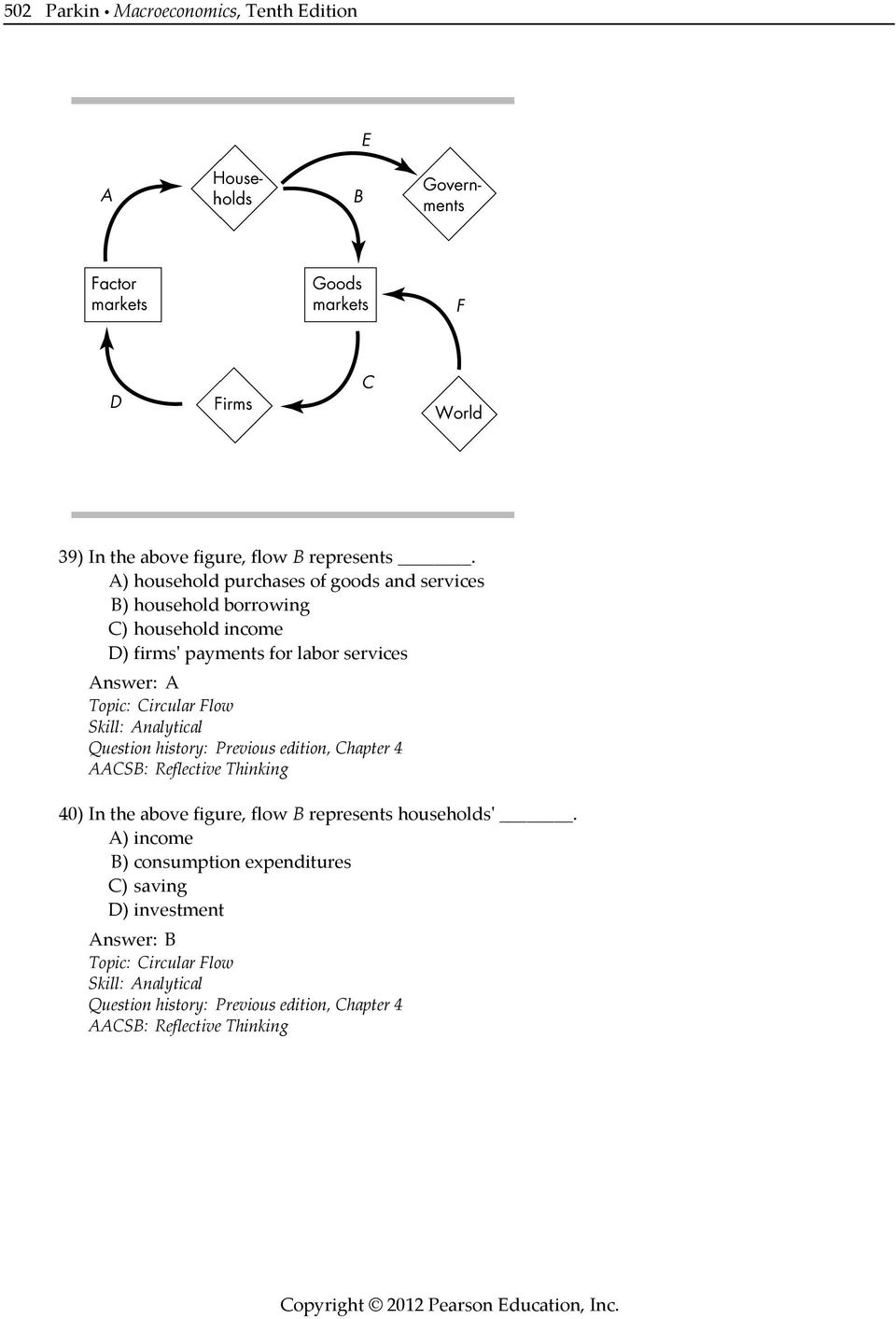
12 Chapter 4 Measuring GDP and Economic Growth ) In the above figure, household income is shown by flow A) A. B) B. C) C. D) F. Topic: Circular Flow 42) In the above figure, consumption expenditure is shown by flow A) A. B) B. C) C. D) F. Topic: Circular Flow 43) Which of the following are equal to one another? I. aggregate production II. aggregate expenditure III. aggregate income A) I equals II, but not III. B) I equals III, but not II. C) II equals III, but not I. D) I equals II equals III. Topic: Expenditure Equals Income 44) Choose the best statement. A) GDP equals aggregate expenditure and equals aggregate income. B) An increase in government purchases increases aggregate expenditure but does not change GDP. C) An increase in compensation of employees increases aggregate income but does not change GDP. D) GDP always equals aggregate expenditure and sometimes equals aggregate income. Topic: Expenditure Equals Income

13 504 Parkin Macroeconomics, Tenth Edition 45) According to the circular flow diagram, the dollar value of a nationʹs output is equal to A) profits. B) total income. C) net income minus taxes. D) wages. Topic: Expenditure Equals Income 46) Total output and total income in the circular flow model A) are measures of the economyʹs level of savings. B) include only intermediate goods. C) are equal to each other. D) are related because national income is less than national product. Topic: Expenditure Equals Income 47) The circular flow shows that A) aggregate production equals aggregate expenditure. B) aggregate expenditure is less than aggregate income. C) GDP equals aggregate income. D) Both answers A and C are correct. Topic: Expenditure Equals Income 48) Comparing aggregate expenditure and aggregate incomes shows that A) aggregate expenditure is usually greater than aggregate income. B) aggregate income is usually greater than aggregate expenditure. C) they are equal. D) aggregate income can not equal aggregate expenditure if we have any savings. Topic: Expenditure Equals Income

14 Chapter 4 Measuring GDP and Economic Growth ) Gross domestic product (GDP) is A) the value of all final goods and services produced in a country during a year. B) the sum of consumption expenditure, investment, government expenditure on goods and services, and net exports. C) the sum of compensation of employees, proprietorsʹ income, net interest, rental income, corporate profits, depreciation, and indirect business taxes minus subsidies. D) all of the above Topic: Expenditure Equals Income 50) Gross domestic product can be calculated A) either by valuing the nationʹs output of goods and services or by valuing the income generated in the production process. B) by adding up the personal consumption of all members of the society. C) by adding up the value of all intermediate goods used in the economy. D) by adding up the income tax returns of all members of the society. Topic: Expenditure Equals Income 51) Gross domestic product is the A) value of the final goods and services produced in a country during a specific time. B) total amount that buyers spent on the final goods and services produced in a country during a specific time. C) total amount of income earned in producing the final goods and services in a country during a specific time. D) All of the above answers are correct. Topic: Expenditure Equals Income 52) Which of the following is correct? A) Aggregate expenditure equals GDP but is less than aggregate income. B) Aggregate income is greater than GDP but equal to aggregate expenditure. C) Aggregate income is greater than aggregate expenditure but equal to GDP. D) Aggregate income, aggregate expenditure and GDP are all equal. Topic: Expenditure Equals Income

15 506 Parkin Macroeconomics, Tenth Edition 53) GDP equals A) C+S+G+(X-M) B) C+I+G+(X+M) C) C+I+G+(X-M) D) C+S+G+(X-M) Topic: Expenditure Equals Income Question history: New 10th edition 54) Depreciation is defined as the A) decrease in the stock of capital due to wear and tear. B) increase in the stock of capital due to investment by firms. C) increase in the stock of capital due to wear and tear. D) decrease in the stock of capital due to investment by firms. Topic: Depreciation 55) Suppose Mail Boxes Etc. buys a new copier for its store for $1000. A year later, when the firm wants to upgrade to a new copier, it finds that the old copier is only worth $750. Over the year the copier was used, has occurred. A) replacement investment B) gross investment C) depreciation D) net investment Topic: Depreciation 56) Net investment equals A) capital stock minus depreciation. B) gross investment minus depreciation. C) the total quantity of plant, equipment and buildings. D) gross investment/depreciation. Topic: Net Investment and Gross Investment

16 Chapter 4 Measuring GDP and Economic Growth ) Which of the following relationships is correct? A) Net Investment = Gross Investment + Depreciation B) Consumption expenditure = Net Investment - Depreciation C) Gross Investment = Net Investment + Depreciation D) Depreciation = Gross Investment - Consumption expenditure Topic: Net Investment and Gross Investment Question history: Modified 10th edition 58) Gross investment equals net investment plus A) capital. B) capital gains. C) depreciation. D) dividends paid to the owners of the company. Topic: Net Investment and Gross Investment 59) Gross investment is equal to A) depreciation minus net investment. B) net investment plus capital stock. C) depreciation plus net investment. D) net investment minus capital stock. Topic: Net Investment and Gross Investment 60) Gross investment equals A) net investment - depreciation + change in inventories. B) net investment + depreciation. C) net investment + change in inventories. D) depreciation + change in inventories. Topic: Net Investment and Gross Investment

17 508 Parkin Macroeconomics, Tenth Edition 61) is gross investment minus. A) The capital stock; net investment B) The capital stock; depreciation C) Depreciation; replacement investment D) Net investment; depreciation Topic: Net Investment and Gross Investment 62) The difference between gross investment and net investment is A) the capital stock. B) depreciation. C) the real interest rate. D) equal to saving. Topic: Net Investment and Gross Investment Question history: Modified 10th edition 63) If depreciation is less than gross investment, then net investment is A) positive. B) negative. C) zero. D) This situation could never occur because it is impossible for depreciation to be less than gross investment. Topic: Net Investment and Gross Investment 64) Net investment A) equals gross investment plus depreciation. B) is the only measure of investment used to calculate GDP. C) equals gross investment minus depreciation. D) is equivalent to the existing capital stock in the economy. Topic: Net Investment and Gross Investment
18 Chapter 4 Measuring GDP and Economic Growth ) Net investment equals A) gross investment + depreciation. B) depreciation + addition to inventories. C) savings - depreciation. D) gross investment - depreciation. Topic: Net Investment and Gross Investment 66) Net investment is the A) total amount of gross investment minus depreciation. B) value of software and other network related products. C) profit or loss in the stock market. D) value of the depreciated capital multiplied by the changes in the price level. Topic: Net Investment and Gross Investment 67) Which of the following is NOT a final good? A) a new computer sold to an NYU student B) a new car sold to Avis for use in their fleet of rental cars C) a purse sold to a foreign visitor D) a hot dog sold to a spectator at a Chicago Bears football game Topic: Study Guide Question, GDP 68) GDP equals A) aggregate expenditure. B) aggregate income. C) the value of the aggregate production in a country during a given time period. D) all of the above Topic: Study Guide Question, Expenditure Equals Income
19 510 Parkin Macroeconomics, Tenth Edition 2 Measuring U.S. GDP 1) Two methods of measuring GDP are A) the income approach and the expenditure approach. B) the income approach and the receipts approach. C) the goods approach and the services approach. D) the saving approach and the investment approach. Topic: Measuring U.S. GDP 2) GDP can be computed as the sum of A) all sales that have taken place in an economy over a period of time. B) the total expenditures of consumers and business over a period of time. C) the total expenditures of consumption, investment, and government expenditure on goods and services over a period of time. D) the total expenditures of consumption, investment, government expenditure on goods and services, and net exports over a period of time. Topic: Expenditure Approach 3) GDP using the expenditure approach equals the sum of personal consumption expenditures plus A) gross private investment. B) gross private investment plus government expenditure on goods and services. C) gross private investment plus government expenditure on goods and services minus imports of goods and services. D) gross private investment plus government expenditure on goods and services plus net exports of goods and services. Topic: Expenditure Approach
20 Chapter 4 Measuring GDP and Economic Growth 511 4) The expenditure approach measures GDP by adding A) compensation of employees, rental income, corporate profits, net interest, and proprietorsʹ income. B) compensation of employees, rental income, corporate profits, net interest, proprietorsʹ income, subsidies paid by the government, indirect taxes paid, and depreciation. C) compensation of employees, rental income, corporate profits, net interest, proprietorsʹ income, indirect taxes paid, and depreciation and subtracting subsidies paid by the government. D) consumption expenditure, gross private domestic investment, net exports of goods and services, and government expenditure on goods and services. Topic: Expenditure Approach 5) The four categories of expenditure used by the expenditure approach method to calculate GDP are A) consumption expenditure, taxes, saving and investment. B) consumption expenditure, investment, net imports and saving. C) saving, taxes, government expenditure and investment. D) consumption expenditure, investment, government expenditure and net exports. Topic: Expenditure Approach 6) In the equation, GDP = C + I + G + X - M, G refers to A) federal government expenditures plus all transfer payments. B) local, state, and federal government spending for all purposes. C) the taxes and expenditures of all government units. D) local, state, and federal government expenditure on goods and services, but does not include transfer payments. Topic: Expenditure Approach 7) The components of the expenditure approach to measuring GDP include all of the following EXCEPT A) net exports. B) government expenditure on goods and services. C) investment. D) the implicit payments for unpaid household work. Topic: Expenditure Approach

21 512 Parkin Macroeconomics, Tenth Edition 8) All of the following are components of the expenditure approach to measuring GDP EXCEPT A) Shaniqʹs purchase of a meal at the Olive Garden in Atlanta. B) a Senator from Iowa being paid the monthly salary. C) the army buying new M1 Abram tanks. D) Ford Motor Company buying new Dell computers for use in its marketing department in Dearborn, Michigan. Topic: Expenditure Approach Question history: New 10th edition 9) The largest component of GDP in the expenditure approach is A) personal consumption expenditures. B) gross private domestic investment. C) government expenditure on goods and services. D) net exports. Topic: Expenditure Approach, Consumption Expenditures 10) Of the following, the largest component of GDP is A) personal consumption expenditure. B) gross private domestic investment. C) government expenditure on goods and services. D) net exports of goods and services. Topic: Expenditure Approach, Consumption Expenditures 11) Which of the following is NOT part of the expenditure approach to measuring GDP? A) gross private domestic investment B) net exports of goods and services C) net interest D) personal consumption expenditures Topic: Expenditure Approach
22 Chapter 4 Measuring GDP and Economic Growth ) To measure GDP using the expenditure approach you must collect data on A) inflation. B) exports. C) wages. D) saving. Topic: Expenditure Approach 13) Aggregate expenditures include all of the following EXCEPT A) consumption of food. B) purchases of intermediate goods. C) purchases of a piece of capital equipment. D) purchases of guns by the government. Topic: Expenditure Approach 14) Gross Domestic Product is equal to the sum of consumption expenditure, investment, net exports, and. A) government expenditures on goods and services B) saving C) profits D) net taxes Topic: Expenditure Approach 15) Which of the following items is not a component of the expenditure approach to measuring U.S. GDP? A) purchases of food made by families B) social security payments made by the government C) purchases of U.S.-made movies by Europeans D) purchases of new homes made by families Topic: Expenditure Approach
23 514 Parkin Macroeconomics, Tenth Edition 16) In the expenditure approach to GDP, the largest component is A) government expenditure on goods and services. B) personal consumption expenditures. C) gross private domestic investment. D) net exports. Topic: Expenditure Approach 17) Let C represent consumption expenditure, S saving, I gross private domestic investment, G government expenditure on goods and services, and X - M net exports of goods and services. Then GDP equals A) C + S + G + X - M. B) C + S + G - X - M. C) C + I + G + X - M. D) C + I + G - X - M. Topic: Expenditure Approach 18) Consumption expenditure is the payment by households for consumption of A) goods but not services. B) services but not goods. C) goods and services. D) services and for saving. Topic: Expenditure Approach, Consumption Expenditures 19) The largest component of GDP is A) gross private domestic investment. B) personal consumption expenditures. C) net exports of goods and services. D) government expenditure on goods and services. Topic: Expenditure Approach, Consumption Expenditures
24 Chapter 4 Measuring GDP and Economic Growth ) Personal consumption expenditures include A) expenditures by households on goods and services produced only in the United States. B) expenditures by households on goods and services produced in the United States and the rest of the world. C) the purchase of new homes. D) the purchase of used goods and new goods. Topic: Expenditure Approach, Consumption Expenditures 21) Which of the following purchases is included in personal consumption expenditures when determining gross domestic product? A) purchase of a new house because of the arrival of a new baby B) purchase of a new office building C) vacation expenses for a spring trip to Fort Lauderdale D) purchases of jeans to add to a storeʹs inventory Topic: Expenditure Approach, Consumption Expenditures 22) Personal consumption expenditures include all of the following EXCEPT spending on A) consumer durable goods. B) consumer nondurable goods. C) consumer services. D) new housing. Topic: Expenditure Approach, Consumption Expenditures 23) All of the following household expenditures are included in consumption expenditure EXCEPT A) payment to a dentist for filling a tooth. B) purchase of corporate stock. C) purchase of a new purse. D) purchase of hair styling. Topic: Expenditure Approach, Consumption Expenditures
25 516 Parkin Macroeconomics, Tenth Edition 24) Gross private domestic investment is all purchases of newly produced business capital goods and buildings A) minus the change in business inventories. B) plus the change in business inventories plus residential construction. C) plus fixed investment minus inventory investment. D) plus purchases of capital goods produced in previous years to replace any depreciated capital goods. Topic: Expenditure Approach, Investment 25) The difference between gross investment and net investment is A) inflation. B) depreciation. C) initial capital. D) consumption. Topic: Expenditure Approach, Investment 26) Goods that are produced this year, stored in inventories, and then sold to consumers next year A) count in this yearʹs GDP. B) count in next yearʹs GDP. C) count in both this yearʹs and next yearʹs GDP. D) are not counted as a part of GDP. Topic: Expenditure Approach, Investment 27) A new 2010 Honda Civic produced in 2010 and purchased in 2011 is A) part of GDP in B) part of GDP in C) not part of GDP in either year because it was produced in one year and sold in another year. D) part of GDP in both 2010 and Topic: Expenditure Approach, Consumption Expenditures Question history: New 10th edition
26 Chapter 4 Measuring GDP and Economic Growth ) Which of the following are examples of the gross private domestic investment component of GDP? I. the purchase of production machinery by IBM II. an increase in the finished goods inventory at Intel A) I only B) II only C) both I and II D) neither I nor II Topic: Expenditure Approach, Investment 29) In the calculation of gross domestic product by the expenditure approach, the ʺinvestmentʺ component is A) net investment. B) gross investment minus depreciation. C) gross investment plus depreciation. D) gross investment. Topic: Expenditure Approach, Investment 30) An example of ʺinvestmentʺ in computing real GDP using the expenditure approach is the purchase of A) a new set of tools by an auto mechanic, for use in repairing cars. B) 100 shares of IBM stock. C) a 100 year old house by a married couple. D) computer chips by Dell to put in their personal computers. Topic: Expenditure Approach, Investment 31) An example of ʺinvestmentʺ in the national income accounts is the purchase of A) a new van by a potter, who packs it with his wares and travels to art shows. B) 100 shares of Canadian stock on the New York Stock Exchange. C) a 100-year-old house that was just put on the protected historic sites list in the year in question. D) a U.S. government bond. Topic: Expenditure Approach, Investment
27 518 Parkin Macroeconomics, Tenth Edition 32) In the national income accounts, the purchase of a new house counts as A) consumption expenditure. B) investment. C) a transfer. D) an addition to inventory. Topic: Expenditure Approach, Investment 33) All of the following are included in gross private domestic investment expenditure EXCEPT a A) businessʹs purchase of a fleet of cars. B) householdʹs purchase of a new house. C) businessʹs purchase of another companyʹs stock. D) a retail storeʹs purchase of shoes to add to its inventory. Topic: Expenditure Approach, Investment 34) In the national income accounts, government expenditure on goods and services refer to those purchases made by A) federal and state governments only. B) the federal government only. C) state and local governments only. D) all levels of government. Topic: Expenditure Approach, Government Expenditure 35) In the national income accounts, government expenditure on goods and services exclude A) transfer payments. B) state and local government purchases. C) local government purchases but include state government purchases. D) spending on national defense. Topic: Expenditure Approach, Government Expenditure
28 Chapter 4 Measuring GDP and Economic Growth ) Which of the following is included in the government expenditure component of the expenditure approach to GDP? A) state government expenditure on local schools B) transfer payments C) changes in inventories D) taxes Topic: The Expenditure Approach, Government Purchases 37) Which one of the following transactions in a particular year is included in gross domestic product for that year? A) Social Security payments to retirees B) The government pays a computer services company that assisted in the delivery of Social Security payments to retirees. C) A car is produced in the previous year and remains in inventory for the entire year under consideration. D) A stay-at-home parent performs housework that the family would otherwise have paid a maid $20,000 a year to perform. Topic: The Expenditure Approach, Government Purchases 38) Which of the following is included in government expenditures when measuring GDP? A) Social Security payments B) unemployment compensation payments C) pension payment made to past presidents D) the current presidentʹs salary Topic: Expenditure Approach, Government Expenditure 39) Transfer payments A) are included in the government expenditure category in gross domestic product. B) refer to all payments made to households by governments. C) refer to payments made by the government that are not made to purchase a good or service. D) are made by households to firms in exchange for goods and services. Topic: Expenditure Approach, Government Expenditure
29 520 Parkin Macroeconomics, Tenth Edition 40) In the computation of GDP, social security payments count as A) transfer payments and are included in GDP. B) transfer payments and are not included in GDP. C) government expenditure on goods and services and are included in GDP. D) government expenditure on goods and services and are not included in GDP. Topic: The Expenditure Approach, Government Purchases 41) Which of the following items is NOT part of government expenditure on goods and services in the GDP accounts? A) gasoline purchases for government car pools B) Social Security expenditures C) new computer hardware for use by the IRS D) drapes to brighten up the presidentʹs office Topic: Expenditure Approach, Government Expenditure 42) Transfer payments are not included in GDP because A) their market value cannot be accurately determined. B) they do not generate additional income. C) they are not purchases of goods or services. D) their value is included in government expenditure. Topic: Expenditure Approach, Government Expenditure 43) Which of the following transfer payments is included in GDP? A) Social Security payments B) welfare payments C) veteranʹs benefits D) none of the above Topic: Expenditure Approach, Government Expenditure
30 Chapter 4 Measuring GDP and Economic Growth ) Which of the following is NOT part of GDP calculated using the expenditure approach? A) General Motorsʹ purchases of new capital equipment B) expenditures by the federal government for national defense C) social security payments made to the elderly D) the purchase of new homes by consumers Topic: The Expenditure Approach, Government Purchases 45) Transfer payments are not part of government expenditure on goods and services because transfer payments A) are not predictable given the nature of their appropriation and allocation. B) do not represent the purchase of a final good or service. C) are not always spent on goods produced in the U.S. D) The premise of the question is incorrect because transfer payments are part of government purchases of goods and services. Topic: Expenditure Approach, Government Expenditure 46) Government expenditures included in the expenditure approach to GDP include. A) social security and education B) net exports C) buying a new bomber D) Both answers A and C are correct Topic: Expenditure Approach, Government Expenditure 47) Net exports of goods and services equal the A) exports of goods and services divided by the imports of goods and services. B) exports of goods and services plus the imports of goods and services. C) exports of goods and services minus the imports of goods and services. D) imports of goods and services minus the exports of goods and services. Topic: Expenditure Approach, Net Exports
31 522 Parkin Macroeconomics, Tenth Edition 48) Net exports is negative if A) the value of exports exceeds the value of imports. B) the value of imports exceeds the value of exports. C) the tariff payments are included in the value of imported and exported items. D) too much production occurs in the exporting country during the year. Topic: Expenditure Approach, Net Exports 49) In 2010, net exports in the United States were A) zero. B) positive. C) negative. D) greater than personal consumption expenditures. Topic: Expenditure Approach, Net Exports Question history: Modified 10th edition 50) To calculate GDP using the expenditure approach, in part it is necessary to A) add imports and exports. B) add imports and subtract exports. C) add exports and subtract imports. D) subtract both exports and imports. Topic: Expenditure Approach, Net Exports 51) An increase in exports of goods or services with no change in imports of goods or services A) decreases GDP. B) increases GDP. C) may increase or decrease GDP depending on whether it is the export of goods or the export of services that increased. D) has no effect on GDP. Topic: Expenditure Approach, Net Exports
32 Chapter 4 Measuring GDP and Economic Growth ) By itself, an increase in exports A) increases GDP. B) decreases GDP. C) means imports decrease by the same amount. D) can either increase or decrease GDP, depending on whether the exports are durable or nondurable. Topic: Expenditure Approach, Net Exports 53) If Ford sells 200 Explorers for a total of $400,000 to Germany, while the United States imports 100 BMWs for a total of $500,000 from Germany, A) U.S. GDP increases because it sells more Explorers. B) U.S. GDP decreases because net exports are negative. C) Germanyʹs GDP decreases. D) U.S. net exports is positive. Topic: Expenditure Approach, Net Exports 54) An U.S. firm buys a new industrial sewing machine from a company located in France. Which of the following is true? I. U.S. net exports decrease. II. U.S. investment increases. A) only I B) only II C) both I and II D) neither I nor II Topic: The Expenditure Approach, Net Exports 55) If an American firm produces goods that are sold to a German household, then A) German GDP increases but not U.S. GDP. B) U.S. GDP increases. C) the transaction is considered an export in the German GDP accounts. D) net exports in the United States will not change because an export immediately generates an offsetting import. Topic: Expenditure Approach, Net Exports
33 524 Parkin Macroeconomics, Tenth Edition 56) In the calculation of GDP by the expenditure approach, exports from the United States must be A) subtracted because they are included in the consumption of a foreign country. B) ignored because they are not bought by U.S. citizens. C) subtracted if they are bought by foreign firms for investment purposes. D) added. Topic: Expenditure Approach, Net Exports Item Millions of dollars Personal consumption expenditure 80 Government expenditure on goods and services 30 Net taxes 35 Gross private domestic investment 20 Imports of goods and services 10 Exports of goods and services 20 57) Using the information in the table above, calculate the value of GDP. A) $185 million B) $145 million C) $195 million D) $140 million Topic: Expenditure Approach 58) Use the information in the table above to calculate the value of net exports. A) $10 million B) $0 C) -$10 million D) $30 million Topic: Expenditure Approach, Net Exports
34 Chapter 4 Measuring GDP and Economic Growth ) Last year in the country of Nerf imports equaled exports. Nerfʹs GDP was $500 million, its consumer expenditure was $380 million, and its investment was $20 million. Nerfʹs government expenditure on goods and services were. A) $100 million B) $900 million C) $500 million D) zero Topic: Expenditure Approach Question history: Modified 10th edition Item Billions of dollars Government expenditure on goods and services 250 Compensation of employees 1,675 Gross private domestic investment 325 Rental income 20 Personal consumption expenditures 1425 Net interest 40 Net exports of goods and services 100 Indirect business taxes and depreciation ) The above table shows some (but not all) national income accounting data for a hypothetical country. According to these data, the value of GDP is billion. A) $2100 B) $1850 C) $2000 D) $2050 Topic: Expenditure Approach
35 526 Parkin Macroeconomics, Tenth Edition Item Dollars Personal consumption expenditure 1500 Gross private domestic investment 355 Government expenditure on goods and services 590 Exports of goods and services 70 Imports of goods and services 50 Depreciation 200 Indirect business taxes 75 61) Based on the data in the above table, gross domestic product equals A) $2,190. B) $2,840. C) $2,465. D) $2,750. Topic: Expenditure Approach Item Billions of dollars Personal consumption expenditure 100 Gross private domestic investment 10 Government expenditure on goods and services 50 Exports of goods and services 30 Imports of goods and services 30 Net taxes 50 62) The above table shows data from the GDP accounts of Hypothetica. Hypotheticaʹs GDP is billion. A) $270 B) $210 C) $190 D) $160 Topic: Expenditure Approach
36 Chapter 4 Measuring GDP and Economic Growth ) If imports are $100 million less than exports, government expenditures are $500 million, consumer expenditures are $1 billion, and gross investment spending is $500 million, then GDP is A) $1 billion. B) $1.9 billion. C) $2 billion. D) $2.1 billion. Topic: Expenditure Approach 64) If consumption expenditures are $500 million, net investment is $100 million, depreciation equals $5 million, imports are $50 million, exports are $55 million, government expenditure on goods and services is $220 million, and government transfer payments are $20 million, then GDP is A) $790 million. B) $800 million. C) $830 million. D) $850 million. Topic: Expenditure Approach Component Amount (billions of dollars) Net taxes 1,635 Personal consumption expenditure 5,566 Depreciation 622 Government expenditure 1,784 Gross investment 1,234 Exports 957 Imports 1,138 Household saving 1,202 65) Using the data in the table above, what is the value of GDP? A) $13,516 billion B) $10,679 billion C) $9,541 billion D) $8,403 billion Topic: Expenditure Approach
37 528 Parkin Macroeconomics, Tenth Edition 66) Using the data in the above table, what is the value of net exports? A) -$181 billion B) $181 billion C) $957 billion D) -$957 billion Topic: Expenditure Approach 67) Using the data in the above table, what is the value of national saving? A) $1,202 billion B) $2,837 billion C) $1,053 billion D) -$85 billion Topic: National Saving Component Amount (dollars) Net taxes 10 Personal consumption expenditure 50 Depreciation 8 Government expenditure 20 Gross investment 26 Net exports -10 Compensation of employees 65 68) Using the information in the table above, calculate gross domestic product. A) $118 B) $108 C) $86 D) $78 Topic: Expenditure Approach
38 Chapter 4 Measuring GDP and Economic Growth ) Using the information in the table above, calculate the governmentʹs budget deficit or surplus. A) $2 B) -$4 C) -$10 D) $4 Topic: Expenditure Approach Amount Component (billions of dollars) Personal consumption expenditure 3,720 Government expenditure 430 Gross investment 610 Net investment 520 Exports 650 Imports ) Using the information in the table above, calculate gross domestic product. A) $5,130 billion B) $5,320 billion C) $4,760 billion D) $4,690 billion Topic: Expenditure Approach 71) Using the information in the table above, net exports equals A) $1,370 billion. B) $650 billion. C) $20 billion. D) -$70 billion. Topic: Net Exports
39 530 Parkin Macroeconomics, Tenth Edition 72) Using the information in the table above, depreciation equals A) -$90 billion. B) $90 billion. C) -$70 billion. D) some amount that cannot be determined. Topic: Depreciation Government purchases of goods and services $240 Depreciation 240 Gross private domestic investment 400 Personal income taxes 140 Net taxes 120 Net exports of goods and services 80 Personal consumption expenditures 640 Net interest ) From the data in the above table, GDP equals A) $1,120. B) $1,280. C) $1,290. D) $1,360. Topic: Expenditure Approach 74) The approach to GDP that sums compensation of employees, rental income, corporate profits, net interest, proprietorsʹ income, depreciation, and indirect taxes and subtracts subsidies is the A) opportunity cost approach. B) expenditure approach. C) added cost approach. D) income approach. Topic: Income Approach
40 Chapter 4 Measuring GDP and Economic Growth ) The income approach to measuring GDP sums together A) compensation of employees, rental income, corporate profits, net interest, proprietorsʹ income, subsidies paid by the government, indirect taxes paid, and depreciation. B) compensation of employees, rental income, corporate profits, net interest, proprietorsʹ income, indirect taxes paid, and depreciation and subtracts subsidies paid by the government. C) the sales of each firm in the economy. D) the costs of each firm in the economy and then subtracts indirect business taxes and depreciation. Topic: Income Approach 76) Proprietorsʹ income is a component of which approach to measuring GDP? A) incomes approach B) expenditure approach C) cost approach D) output approach Topic: Income Approach 77) The income approach to measuring GDP A) determines the cost of production, then adjusts it to equal the market value of production. B) sums all incomes earned in the United States and makes no other adjustments because other adjustments are not necessary. C) measures the cost of producing GDP rather than the market value. D) sums the value at each stage of production plus the value of depreciation. Topic: Income Approach 78) The five categories of income used in the income approach to the measurement of GDP are A) consumption, saving, rental income, corporate profits, and investment. B) employee compensation, net interest, rental income, corporate profits, and proprietorʹs income. C) employee compensation, consumption, rental income, corporate profits, and proprietorʹs income. D) employee compensation, saving, rental income, corporate profits, and investment. Topic: Income Approach
41 532 Parkin Macroeconomics, Tenth Edition 79) Which of the following expressions equals GDP? A) compensation of employees + consumption + depreciation + net investment B) compensation of employees + net interest + rental income + depreciation + corporate profits + proprietorsʹ income + indirect taxes - subsidies C) compensation of employees + net exports + depreciation + corporate profits D) compensation of employees + gross investment + rental income + depreciation + corporate profits + indirect taxes - subsidies Topic: Income Approach 80) Which of the following is a component of the incomes approach to GDP? A) consumption expenditure B) wages and salaries C) investment D) government expenditure on goods and services Topic: Income Approach 81) The income approach measures GDP by adding together compensation of employees, proprietorsʹ income,. A) net investment, saving, and farmersʹ income B) net interest, rental income, and corporate profits C) net investment, rental income, and corporate profits D) net saving, investment income, and profits Topic: Income Approach 82) Which of the following items is NOT a component of the income approach to measuring U.S. GDP? A) interest earned on savings deposits B) profits made by businesses C) income earned by businesses that export goods D) investment Topic: Income Approach
42 Chapter 4 Measuring GDP and Economic Growth ) Which of the following is NOT a part of the income approach to determining GDP? A) rental income B) gross private domestic investment C) net interest D) indirect business taxes Topic: Income Approach 84) Which of the following is NOT one of the components for computing GDP based upon the income approach? A) investment B) corporate profits C) compensation of employees D) net interest Topic: Income Approach 85) Which of the following is NOT included in the income approach to measuring GDP? A) net interest B) net exports C) corporate profits D) compensation of employees Topic: Income Approach 86) In the country of Darrowby, net domestic income at factor cost is $2.0 million. Gross domestic product is $3.0 million, and depreciation is $0.5 million. Indirect taxes less subsidies. A) are $1 million B) are $0.5 million C) cannot be calculated D) are -$0.5 million Topic: Income Approach
43 534 Parkin Macroeconomics, Tenth Edition Item Billions of dollars Compensation of employees 80 Net interest and rental income 30 Corporate profits 10 Proprietorʹs income 20 87) Use the information in the table above plus the fact that indirect taxes less subsidies are $10 billion and depreciation is $30 billion to calculate the value of GDP. A) $180 billion B) $150 billion C) $140 billion D) $130 billion Topic: Income Approach 88) The largest component of national income is A) compensation of employees. B) rental income. C) corporate profits. D) proprietorsʹ income. Topic: Income Approach, Compensation of Employees 89) Looking at the components of the income approach we see that A) compensation of employees is the largest category. B) consumption is the largest category. C) profits are the largest category. D) rental income is the largest category. Topic: Income Approach, Compensation of Employees
44 Chapter 4 Measuring GDP and Economic Growth ) Compensation paid to employees represented of GDP for the United States in A) about 5 percent B) approximately 15 percent C) 35 percent D) more than 50 percent Topic: Income Approach, Compensation of Employees 91) Which of the following is included in ʺcompensation of employeesʺ part of the income approach to measuring GDP? I. Wages and salaries. II. Pension fund contributions. III. Social security contributions. A) I only B) I and II C) I and III D) I, II and III Topic: Income Approach, Compensation of Employees 92) When calculating the compensation of employees part of GDP, A) social security contributions must be included. B) fringe benefits are not included. C) taxes withheld on earnings are not included. D) the value of vacation time must be included. Topic: Income Approach, Compensation of Employees 93) In the national income accounts, net interest is the total interest payments received by households on loans made by them minus A) interest received from householdsʹ ownership of government bonds. B) interest payments made by households on their own borrowing. C) interest payments made by households to foreign lenders. D) taxes paid by households on their interest income. Topic: Income Approach, Net Interest
45 536 Parkin Macroeconomics, Tenth Edition 94) Rental income includes A) the payment for the use of land. B) the payment for the use of all rented inputs. C) no income from rental housing because most houses are occupied by their owners. D) Both answers A and B are correct. Topic: Income Approach, Rental Income 95) Which of the following is included in the category of corporate profits when measuring GDP? I. Profits paid as dividends. II. Undistributed profits. III. Income received by owners and operators of businesses. A) I only B) I and II C) I and III D) I, II and III Topic: Income Approach, Corporate Profits 96) An indirect tax is a tax paid by consumers A) to a state or local government. B) when they purchase goods and services. C) on unearned income (as opposed to wages and salaries). D) that is a percentage of the value of their real property. Topic: Indirect Tax 97) An indirect tax is exemplified by A) an income tax. B) a sales tax. C) a subsidy. D) None of the above answers is correct. Topic: Indirect Tax
46 Chapter 4 Measuring GDP and Economic Growth ) Which of the following best represents an indirect tax? A) federal income tax B) state income tax C) local property tax D) sales taxes paid on goods and services Topic: Indirect Tax Question history: New 10th edition 99) The presence of creates a difference in the value between the market price and the factor cost of a product. A) indirect taxes and consumption B) subsidies and direct taxes C) corporate profits and subsidies D) indirect taxes and subsidies Topic: Indirect Tax 100) The sum of compensation to employees, rental income, corporate profits, net interest, and proprietorsʹ income is A) gross domestic product. B) gross domestic income. C) net domestic income at factor cost. D) net domestic product. Topic: Net Domestic Income at Factor Cost 101) Two reasons why valuing goods at their market prices is different than valuing them at their factor costs include A) depreciation and investment. B) exports and imports. C) personal taxes and corporate taxes. D) indirect taxes and subsidies. Topic: Net Domestic Income at Factor Cost
47 538 Parkin Macroeconomics, Tenth Edition Corporate profits $200 Net interest 150 Indirect taxes less subsidies 230 Depreciation 250 Compensation of employees 1,350 Proprietorʹs income 150 Rental income 70 Personal consumption expenditures 1,400 Government expenditure on goods and services 500 Net exports of goods and services ) Using the data in the table above, gross domestic product equals A) $1,920. B) $1,940. C) $2,150. D) $2,400. Topic: Income Approach 103) Using the data in the above table, gross private domestic investment equals A) $250. B) $260. C) $460. D) some amount that cannot be determined without more information. Topic: Expenditure Approach 104) Using the data in the above table, net private domestic investment equals A) $210. B) $260. C) $510. D) some amount that cannot be determined without more information. Topic: Expenditure Approach
48 Chapter 4 Measuring GDP and Economic Growth 539 Item Billions of dollars Personal income 1,200 Net domestic income at factor cost 2,100 Government expenditure on goods and services 400 Depreciation 200 Gross private domestic investment 100 Indirect taxes 600 Subsidies ) The above table shows some national income accounting data for a nation. In this nation, gross domestic product is equal to billion. A) $2,000 B) $2,300 C) $2,500 D) $2,800 Topic: Income Approach
49 540 Parkin Macroeconomics, Tenth Edition Item Dollars Net interest 239 Government expenditure on goods and services 136 Compensation of employees 1,735 Rental income 37 Proprietorsʹ income 128 Indirect taxes minus subsidies 259 Corporate profits 194 Exports of goods and services 249 Imports of goods and services 289 Depreciation ) Using the data in the above table, gross domestic product as calculated by the income approach equals. A) $2,333 B) $2,592 C) $2,925 D) $2,205 Topic: Income Approach
50 Chapter 4 Measuring GDP and Economic Growth 541 Amount Component (billions of dollars) Gross investment 1300 Personal consumption expenditure 1475 Depreciation 25 Government expenditure on goods and services 1315 U.S. imports 260 U.S. exports 249 Compensation of employees ) The above table gives data for a hypothetical nation. Gross domestic product is A) $4,049 billion. B) $4,079 billion. C) $4,054 billion. D) $4,339 billion. Topic: Expenditure Approach 108) Nominal GDP is A) real GDP adjusted for price changes. B) GDP valued at prices of that year. C) GDP valued at constant prices. D) real GDP valued at base year prices. Topic: Nominal GDP 109) Nominal GDP is the value of final goods and services A) at the prices of that year. B) at the prices of the immediately previous year. C) at the prices of a base year. D) produced in foreign countries but consumed in the domestic country. Topic: Nominal GDP Question history: New 10th edition
51 542 Parkin Macroeconomics, Tenth Edition 110) Normally in the United States the relationship between nominal and real GDP for a given year is A) real GDP is greater than nominal GDP because of price increases. B) nominal GDP is greater than real GDP because of price increases. C) nominal GDP equals real GDP. D) nominal GDP is greater than real GDP because of price decreases. Topic: Nominal GDP 111) Of the following, which is correct? A) Nominal GDP does not change when the production of goods and services increases. B) Nominal GDP is not affected by changes in prices of goods and services. C) Nominal GDP increases when the prices of goods and services increase. D) Real GDP changes only when the prices of goods and services really change. Topic: Real and Nominal GDP 112) Real GDP is A) an increase in the average level of prices. B) the value of total production when the unemployment rate is 6 percent. C) the value of total production of all the nationʹs farms, factories, shops and offices measured in the prices of a single year. D) the value of total production of all the nationʹs farms, factories, shops and offices measured at the prices of the year it was produced. Topic: Real GDP 113) Real GDP measures the A) total profits earned by all businesses valued using prices from a single year. B) changes in the prices of output measured in dollars. C) general upward drift in prices. D) value of total production linked to prices of a single year. Topic: Real GDP
52 Chapter 4 Measuring GDP and Economic Growth ) gross domestic product is the value of linked back to the prices of a single year. A) Real; total production B) Real; production possibilities C) Productivity; the consumer price index D) Nominal; total production Topic: Real GDP 115) Real Gross Domestic Product is A) the amount of people unemployed divided by the total labor force. B) the productivity of labor. C) the most that can be produced when the economyʹs resources are fully employed. D) the value of total production linked back to the prices of a single year. Topic: Real GDP 116) Which of the following is TRUE regarding real GDP? I. Real GDP is the value of the total production of the countryʹs farms, factories, shops, and offices. II. Real GDP rises whenever inflation occurs. III. Real GDP does not measure all that is produced. A) I and II B) I and III C) II and III D) I, II and III Topic: Real GDP 117) In years with inflation, nominal GDP increases real GDP. A) faster than B) slower than C) at the same rate as D) sometimes faster, sometimes slower, and sometimes at the same rate as Topic: Real and Nominal GDP
53 544 Parkin Macroeconomics, Tenth Edition 118) Suppose an economy has some inflation. Then, after a base year, the value of real GDP will A) be less than nominal GDP. B) not be different from nominal GDP. C) be greater than nominal GDP. D) will be approximately half the value of nominal GDP. Topic: Real and Nominal GDP 119) Gross private domestic investment is a component of which approach to measuring GDP? A) incomes approach B) expenditure approach C) linking approach D) output approach Topic: Study Guide Question, Expenditure Approach, Investment 120) Which of the following is NOT a component of the incomes approach to GDP? A) net exports B) wages and salaries C) corporate profits D) proprietorsʹ income Topic: Study Guide Question, Incomes Approach 3 The Uses and Limitations of Real GDP 1) The maximum amount of production that can be produced while avoiding shortages of labor, capital, land, and entrepreneurship that would bring rising inflation is called A) real GDP. B) nominal GDP. C) actual GDP. D) potential GDP. Topic: Potential GDP Question history: Modified 10th edition
54 Chapter 4 Measuring GDP and Economic Growth 545 2) Potential GDP is A) another name for real GDP. B) always different from real GDP. C) the level of GDP not adjusted for price changes. D) the maximum amount of GDP that can be produced while avoiding shortages of labor, capital, land, and entrepreneurship that would bring rising inflation. Topic: Potential GDP Question history: Modified 10th edition 3) Potential GDP is A) the maximum GDP that an economy actually achieves throughout its entire history. B) the level of GDP achieved during periods when 100 percent of the labor force is employed. C) a goal that can never be achieved by the economy. D) the maximum amount of GDP that can be produced while avoiding shortages of labor, capital, land, and entrepreneurship that would bring rising inflation. Topic: Potential GDP Question history: Modified 10th edition 4) Potential GDP is the A) the maximum amount of production that can be produced while avoiding shortages of labor, capital, land, and entrepreneurship that would bring rising inflation. B) current value of production in the economy. C) value of production when the economy is in a recession. D) value of production when the economy is at a peak. Topic: Potential GDP Question history: Modified 10th edition 5) Potential GDP A) measures the actual production from year to year. B) measures the maximum amount of production that can be produced while avoiding shortages of labor, capital, land, and entrepreneurship that would bring rising inflation. C) is cyclical. D) Both answers A and C are correct Topic: Potential GDP Question history: Modified 10th edition
55 546 Parkin Macroeconomics, Tenth Edition 6) In any year, real GDP A) must always be less than potential GDP. B) might be greater or less than potential GDP. C) will always be greater than potential GDP because of the tendency of nations to incur inflation. D) always equals potential GDP. Topic: Potential GDP 7) The relationship between real GDP and potential GDP is that A) real GDP always equals potential GDP. B) real GDP never equals potential GDP. C) real GDP fluctuates about potential GDP. D) real GDP is always below potential GDP. Topic: Potential GDP 8) In any year, real GDP A) must always be less than potential GDP. B) might be greater or less than potential GDP. C) will be greater than potential GDP if the inflation rate is positive. D) always equals potential GDP. Topic: Potential GDP Question history: Modified 10th edition 9) refers to a period when the decreases. A) Recession; growth rate of nominal GDP B) Recession; growth rate of output per person C) Productivity growth slowdown; growth rate of real GDP D) Productivity growth slowdown; growth rate of output per person Topic: Productivity Growth Slowdown
56 Chapter 4 Measuring GDP and Economic Growth ) The series of ups and downs the economy tends to move in is called A) the business cycle. B) a recession. C) a depression. D) economic growth. Topic: Business Cycle 11) The business cycle refers to A) fluctuations in the level of real GDP around potential GDP. B) changes in the level of nominal GDP. C) changes in the level of the stock market. D) changes in the level of employment. Topic: Business Cycle 12) A business cycle is A) the pattern of short-run upward and downward movements in total output. B) the increase in consumer spending that accompanies an increase in disposable income. C) the cyclical change in the nationʹs balance of trade. D) the cyclical movement in the interest rates. Topic: Business Cycle 13) The business cycle is the A) regular growth rate of the real GDP. B) regular fluctuations of real GDP below potential GDP. C) irregular fluctuations of prices around real GDP. D) irregular fluctuations of real GDP around potential GDP. Topic: Business Cycle Question history: Modified 10th edition
57 548 Parkin Macroeconomics, Tenth Edition 14) Business cycles are A) irregular, with some having two recessions and no expansion. B) predictable, with a recession following a trough. C) unpredictable, but always have two phases and two turning points. D) unpredictable, and donʹt always have two phases and two turning points. Topic: Business Cycle 15) Business cycles A) are more volatile during a Republican administration. B) are unpredictable due to political upheavals and global markets. C) follow a pattern of trough, expansion, peak and recession. D) are all identical in duration over the last century. Topic: Business Cycle 16) Which of the following statements is true? A) Real GDP fluctuates around potential GDP. B) Potential GDP fluctuates around real GDP. C) Potential GDP is the same as real GDP. D) When all of the economyʹs resources are fully employed, the value of production is called real GDP. Topic: Business Cycle 17) Real GDP A) fluctuates from year to year but is always below potential GDP. B) fluctuates around potential GDP. C) grows at a constant 3 to 4 percent per year. D) can be called potential GDP when it is adjusted for price changes. Topic: Business Cycle
58 Chapter 4 Measuring GDP and Economic Growth ) The term ʺbusiness cycleʺ most closely refers to the A) fluctuating profits of firms. B) fiscal year. C) accounting period used by firms. D) alternating periods of expansions and recessions. Topic: Business Cycle 19) Which of the following is not a phase or turning point of the business cycle? A) recession B) expansion C) shutdown D) trough Topic: Business Cycle 20) The four parts of the business cycle occur in the following order: A) recession, trough, peak, expansion. B) expansion, trough, peak, recession. C) recession, trough, expansion, peak. D) expansion, trough, recession, peak. Topic: Business Cycle 21) Which of the following are parts of the business cycles? A) peak and potential GDP B) real GDP and potential GDP C) recession and expansion D) inflation and recession Topic: Business Cycle
59 550 Parkin Macroeconomics, Tenth Edition 22) Which of the following is TRUE regarding business cycles? I. Cycles are predictable. II. In each cycle, a peak follows an expansion. III. Potential GDP fluctuates around real GDP. A) I and II B) I and III C) II and III D) II only Topic: Business Cycle 23) A common definition of a recession is a time with A) a decline in the price level. B) a decline in interest rates. C) a decrease in real GDP for two or more successive quarters. D) a decrease in real GDP for two or more successive years. Topic: Business Cycle Question history: Modified 10th edition 24) A recession is commonly defined as a period with A) negative growth rate in real GDP that lasts at least one quarter. B) positive growth rate in real GDP that lasts at least one quarter. C) positive growth rate in real GDP that lasts at least two quarters. D) negative growth rate in real GDP that lasts at least two quarters. Topic: Business Cycle 25) A common definition of a recession is a period of time A) of at least 6 months during which real GDP decreases. B) with an increase in real economic output from the previous period. C) with no change in real GDP. D) with no change in the dollar (money) value of economic output. Topic: Business Cycle
60 Chapter 4 Measuring GDP and Economic Growth ) A recession is commonly defined as occurring when A) real GDP decreases for a period of 12 or more months. B) real GDP decreases for a period of 6 or more months. C) the unemployment rate rises above 7.5 percent for 6 or more months. D) the unemployment rate rises above 5.0 percent for 12 or more months. Topic: Business Cycle 27) By common definition, a recession occurs when A) the international deficit worsens for at least two successive quarters. B) the government budget deficit exceeds the national debt. C) the inflation rate exceeds 3.5 percent. D) real GDP decreases for at least two successive quarters. Topic: Business Cycle 28) Recessions are commonly defined to occur A) whenever unemployment increases. B) when growth in real GDP decreases for two consecutive quarters. C) when growth in real GDP is negative for two consecutive quarters. D) when the unemployment rate exceeds 6 percent. Topic: Business Cycle 29) Real GDP decreases during A) the movement from trough to peak. B) the movement from below potential GDP back to potential GDP. C) the movement from peak to trough. D) a decrease in unemployment. Topic: Business Cycle Question history: Modified 10th edition
61 552 Parkin Macroeconomics, Tenth Edition 30) When a recession ends, the turning point that immediately follows is called a A) trough. B) peak. C) depression. D) None of the above answers is correct. Topic: Business Cycle 31) The low point of economic activity during a business cycle is called the A) trough. B) recession. C) peak. D) failure. Topic: Business Cycle Question history: New 10th edition 32) What term is used to describe the lowest point of a business cycle? A) peak B) trough C) expansion D) recession Topic: Business Cycle 33) A trough is the A) lower turning point of a business cycle when an expansion begins. B) lower turning point of a business cycle when a recession begins. C) upper turning point of a business cycle when an expansion begins. D) upper turning point of a business cycle when a recession begins. Topic: Business Cycle
62 Chapter 4 Measuring GDP and Economic Growth ) An expansion occurs when the level of real GDP is A) increasing. B) decreasing. C) at a cyclical peak. D) at a cyclical trough. Topic: Business Cycle 35) An expansion A) follows a peak. B) is defined as a period of negative real GDP growth. C) comes just before a trough. D) is defined as a period of real GDP increases. Topic: Business Cycle 36) An expansion ends when the economy A) hits a trough and then enters a recession. B) hits a peak and then enters a recession. C) begins to grow following a peak. D) has grown for two quarters in a row. Topic: Business Cycle 37) The times during which real GDP increases are referred to as A) contractions. B) expansions. C) anti-cycles. D) corrections. Topic: Business Cycle
63 554 Parkin Macroeconomics, Tenth Edition 38) Suppose the country of Dingo experienced an economic trough in January We can conclude that A) real GDP in Dingo was increasing in January B) an expansion occurred after January C) Dingo did not experience a recession in D) Dingoʹs potential GDP fell in Topic: Business Cycle Question history: Previous edition, Chapter 10 39) An economy recovering from a recession A) moves up from its trough to a period of expansion. B) moves up from its peak to a period of expansion. C) moves down from its trough to a period of depression. D) moves down from its peak to a period of expansion. Topic: Business Cycle 40) An economic expansion rather than a recession occurs A) when the federal budget is balanced. B) when the unemployment rate falls below 5 percent. C) when growth in real GDP is positive. D) when the unemployment rate is not changing. Topic: Business Cycle Question history: Modified 10th edition 41) A peak is the A) lower turning point of a business cycle when an expansion ends. B) lower turning point of a business cycle when a recession ends. C) upper turning point of a business cycle when an expansion ends. D) upper turning point of a business cycle when a recession ends. Topic: Business Cycle
64 Chapter 4 Measuring GDP and Economic Growth ) In the above figure, the distance between points S and T represents A) an expansion. B) a trough. C) a peak. D) a recession. Topic: Business Cycle 43) In the above figure, the distance between points T and U represents A) an expansion. B) a trough. C) a peak. D) a recession. Topic: Business Cycle
65 556 Parkin Macroeconomics, Tenth Edition 44) In the above figure, a recession begins at point and an expansion begins at point. A) a; b B) b; c C) b; a D) d; c Topic: Business Cycle 45) In the above figure, a trough is at point and a peak is at point. A) a; b B) b; c C) b; a D) d; c Topic: Business Cycle
66 Chapter 4 Measuring GDP and Economic Growth ) In the above figure, which point represents the under use of resources? A) point F B) point G C) point H D) point K Topic: Business Cycle 47) In the above figure, which point represents a situation with significant shortages of labor, capital, and other resources? A) point F B) point G C) point I D) point K Topic: Business Cycle Question history: Modified 10th edition
67 558 Parkin Macroeconomics, Tenth Edition 48) In the above figure, which point represents an economy which is at the peak part of a business cycle? A) point F B) point G C) point I D) point K Topic: Business Cycle 49) In the above figure, the letters A, B, and C represent which positions in the business cycle? A) peak, expansion, and recession, respectively B) recession, expansion, and peak, respectively C) expansion, peak, and recession, respectively D) peak, recession, and expansion, respectively Topic: Business Cycle
68 Chapter 4 Measuring GDP and Economic Growth ) Real GDP is not a perfect indicator of economic welfare because. A) it includes the underground economy B) it includes a direct measure of health and life expectancy C) it underestimates inflation D) economic welfare depends on many factors not measured or not measured accurately by real GDP Topic: GDP and Economic Welfare Comparisons 51) Real GDP does not show the state of economic welfare in a country in part because GDP omits I. household production. II. leisure time available. III. the quality of the environment. A) I only B) I and III C) II and III D) I, II and III Topic: GDP and Economic Welfare Comparisons 52) Real GDP can be criticized as a measure of economic welfare because it A) does not include the value of products produced in the household. B) does not take account of the degradation of environmental quality. C) does not include leisure time available to a society. D) All of the above answers are correct. Topic: Economic Welfare Comparisons 53) A country that has a large real GDP per person might not necessarily have a high level of economic welfare because it may have A) very little political freedom. B) environmental problems. C) little leisure time. D) All of the above answers are correct. Topic: GDP and Economic Welfare Comparisons
69 560 Parkin Macroeconomics, Tenth Edition 54) Which, if any, of the following causes reported GDP to be less than total economic production? A) the exclusion of household production B) the exclusion of government transfers C) the inclusion of government expenditures D) None of the above cause reported GDP to be less than total production. Topic: Household Production Question history: Modified 10th edition 55) In calculating GDP, household production is A) included as part of consumption. B) ignored because it is not a large amount. C) not included because there is no market transaction. D) included under employee compensation. Topic: Household Production 56) Which of the following is NOT included in real GDP? A) production of services, such as the services of doctors B) production of goods that last more than one year, such as television sets C) production of goods that do not last more than one year, such as gasoline D) production in the home Topic: Household Production 57) If a larger fraction of the adult population is working in the marketplace, household production A) counted in real GDP increases. B) not counted in real GDP increases. C) counted in real GDP decreases. D) not counted in real GDP decreases. Topic: Household Production
70 Chapter 4 Measuring GDP and Economic Growth ) Reported GDP increases when, in fact, total production is unchanged when i. there is a shift from household production to market production. ii. a previously illegal activity is legalized. A) i only B) ii only C) Neither i nor ii D) Both i and ii. Topic: Household Production, Underground Economic Activity Question history: Modified 10th edition 59) When calculating GDP, underground economic activity is A) the production of goods and services in the home. B) that portion of the time when we are enjoying leisure activities and not producing marketable goods. C) the part of the economy purposely hidden. D) an aspect of the quality of life, such as health and life expectancy. Topic: Underground Economic Activity 60) In part, the underground economy exists because of the A) irrationality of people who choose to evade taxes. B) high tax rates. C) ease of entry into the occupations that compose it. D) greater efficiency of barter transactions compared to monetary ones. Topic: Underground Economic Activity 61) Which of the following is NOT included in real GDP? A) production of services, such as the services of hair dressers B) production of goods that last less than a year, such as production of hot dogs C) production that takes place in the underground economy D) production of goods that last more than a year, such as a pair of roller blades Topic: Underground Economic Activity
71 562 Parkin Macroeconomics, Tenth Edition 62) The underground economy exists for all of the following reasons EXCEPT the A) production of illegal goods. B) avoidance of taxes. C) desire to maintain accurate records of economic transactions. D) avoidance of government regulation. Topic: Underground Economic Activity 63) Because pollution reduces economic welfare, on this count real GDP as measured A) decreases as pollution increases. B) increases to take into account the expenditures that will be made in the future to clean up the pollution. C) overstates economic welfare. D) understates economic welfare. Topic: Environmental Quality Question history: Modified 10th edition 64) In the post World War II period, considerable growth in total production took place in the United States. But at the same time, businesses were dumping their waste into the Great Lakes with minimal cost to themselves, significantly polluting the bodies of water as a result. This occurrence is an example where A) real GDP gives an overly positive view of economic welfare. B) real GDP gives an overly negative view of economic welfare. C) investment would have been a better measure of total production. D) the pollution counts as a final good. Topic: Environmental Quality Question history: Modified 10th edition 65) Which of the following would lead GDP to overstate economic welfare? A) the existence of home-cooked meals B) restaurant workers that under-report tip income C) a self-employed CPA who takes a longer than normal vacation D) electric utilities that switch to burning coal because of higher natural gas prices and thereby create more acid rain pollution Topic: Environmental Quality
72 Chapter 4 Measuring GDP and Economic Growth ) Purchasing power parity prices are used to construct GDP data that A) do not omit the underground economy. B) can be used to make more valid comparisons between one country and another. C) is a proper measure of economic welfare. D) adjust for differences in population. Topic: Purchasing Power Parity Prices 67) If we compare the U.S. GDP and the Chinese GDP, A) real GDP per person is about the same in the two countries. B) U.S. real GDP per person is less than Chinaʹs real GDP per person once we adjust for currency differences. C) Chinaʹs real GDP per person is less than real GDP per person in the United States. D) real U.S. GDP per person was much larger than Chinaʹs real GDP per person when purchasing power parity prices are used but is less than Chinaʹs real GDP per person when exchange rate prices are used. Topic: Purchasing Power Parity Prices 68) The use of purchasing power parity prices A) decreases the real GDP per person statistics published by the International Monetary Fund. B) weakens the validity of cross country comparisons of economic welfare. C) increases the amount by which U.S. GDP is larger than that of any other nation. D) accounts for differences in the prices of the same goods in different countries when measuring real GDP. Topic: Purchasing Power Parity Prices 69) Pollution is a by-product of some production processes, so on this count real GDP as measured A) is adjusted downward to take into account the pollution. B) is adjusted upward to take into account the expenditures that will be made in the future to clean up the pollution. C) tends to overstate economic welfare. D) tends to understate economic welfare. Topic: Study Guide Question, Environmental Quality
73 564 Parkin Macroeconomics, Tenth Edition 70) Which of the following is NOT a reason that real GDP is a poor measure of a nationʹs economic welfare? A) Real GDP omits measures of political freedom. B) Real GDP does not take into account the value of peopleʹs leisure time. C) Real GDP does not include the underground economy. D) Real GDP overvalues household production. Topic: Study Guide Question, Household Production 71) Which of the following statements about the comparison between GDP in China and in the United States is correct? A) Using the exchange rate to value Chinaʹs GDP in dollars shows that Chinaʹs GDP per person exceeds the GDP per person in the United States. B) Using purchasing power parity prices to value Chinaʹs GDP in dollars shows that Chinaʹs GDP per person exceeds the GDP per person in the United States. C) Chinaʹs GDP per person is higher using purchasing power parity prices rather than the exchange rate when valuing Chinaʹs GDP in dollars. D) None of the above answers are correct because they are all false statements. Topic: Study Guide Question, International Comparisons 72) What we produce during our working time is as part of GDP and the enjoyment we gain from our leisure time is as part of GDP. A) included; not included B) included; included C) not included; included D) not included; not included Topic: GDP and Economic Welfare Comparisons
74 Chapter 4 Measuring GDP and Economic Growth News Based Questions ʺAs the credit crisis unfolded over the past year, one of the few certainties in the global economy seemed to be Chinaʹs ability to plough on regardless of double-digit growth rates...the...crisis has also focused...on the need to update a growth model that...is still dependent on assembling goods for export without adding much value and on heavy industries that create pollution. Chinese companies have continued to find new foreign markets for their products...several other factors point to a slowing property market...production of steel, cement and air conditioners was down... Retail sales have risen by 23 per cent in each of the last two monthsʺ. Beijingʹs Burden, by Geoff Dyer, Sept. 23, ) According to the article, are expected to contribute to Chinaʹs real GDP in A) exports and consumption; positively B) consumption and government spending; negatively C) exports and investment; negatively D) rental income and investment; negatively Topic: GDP AACSB: Communication 2) According to the article, can be expected to this year. A) exports; increase B) consumption; decrease C) imports; decrease D) net interest income; decrease Topic: GDP AACSB: Communication 3) According to the article, is expected to increase and add to Chinaʹs component of GDP. A) retail sales; consumption B) retail sales; investment C) rental income; investment D) rental income; exports Topic: GDP AACSB: Communication
75 566 Parkin Macroeconomics, Tenth Edition Canadaʹs economy expanded by percent in the second quarter...further evidence that the economy has stalled...following a first quarter slip in gross domestic product. The second quarter figures fell well below forecasts of a 0.7 per cent growth in real GDP. Exports...fell for the fourth consecutive quarter. The accumulating gloom is increasingly discouraging business investment. Consumer spending remains strong and corporate profits were at their highest since ʺThe sources of strength in the second quarter are clearly unsustainable,ʺ said Sal Gautieri, senior economist at BMO capital markets. Canada Avoids Fall into Recession, by Christopher Mason, August 30, ) According to the article, the best description of Canadaʹs position in the business cycle is A) at a peak B) at a trough C) in an expansion D) in a recession Topic: Business Cycle AACSB: Communication 5) According to the article, in have contributed to Canadaʹs change in real GDP. A) increases; consumption and exports; expected B) decreases; exports and investment; unexpected C) increases; consumption and investment; unexpected D) decreases; exports and government spending; expected Topic: GDP AACSB: Communication 6) It is estimated that in 2007, Mexico had a population of 110 million and Brazil had a population of 190 million. At the same time, Mexicoʹs GDP was $1 trillion while Brazilʹs was $1.31 trillion. These data show that A) Brazil had a healthier economy than did Mexico. B) Mexicoʹs GDP per person was lower than was Brazilʹs GDP per person in C) Mexicoʹs GDP per person was $9090 in D) Brazilʹs GDP per person was $5300 in Topic: GDP Growth Rate
76 Chapter 4 Measuring GDP and Economic Growth 567 7) It is estimated that in 2007, Mexico had a population of 110 million and GDP of $1 trillion. In 2006, Mexicoʹs population was 104 million and GDP was $839 billion. Per GDP person by between 2006 and 2007 in Mexico. A) increased; $1038 B) increased; 5 percent C) decreased; $2013 D) decreased; 5 percent Topic: GDP Growth Rate 8) The following data describe Mexicoʹs economy in Government spending $210 billion Investment $210 billion Exports $272 billion Imports $283 billion GDP 1 trillion Population 110 million From the data, we can conclude that in Mexico in A) Consumption totaled $591 billion B) Net exports totaled -$11 billion. C) GDP per person equalled $2000 D) Imports were the largest component of GDP Topic: GDP 9) The following data describe Franceʹs economy in Consumption 234 billion euros Government expenditure 93 billion euros Investment 88 billion euros Exports 128 billion euros Imports 137 billion euros From the data, we can conclude that in France A) net exports totaled -11 billion euros. B) GDP equaled 424 billion euros. C) GDP equaled 680 billion euros. D) Net exports totaled 265 billion euros. Topic: GDP
77 568 Parkin Macroeconomics, Tenth Edition 10) The following data are estimates describing Irelandʹs economy in 2006 and 2007 (in millions of euros, in constant prices): Consumption 84,000 89,000 Government expenditure 24,000 26,000 Investment 48,000 48,000 Exports 142, ,000 Imports 123, ,000 Subsidies 1,800 1,900 Taxes Irelandʹs real GDP in 2007 was million euros. A) 442,000 B) 186,000 C) 188,400 D) 163,000 Topic: GDP 11) The following data are estimates describing Irelandʹs economy in 2006 and 2007 (in millions of euros, in constant prices): Consumption 84,000 89,000 Government expenditure 24,000 26,000 Investment 48,000 48,000 Exports 142, ,000 Imports 123, ,000 Subsidies 1,800 1,900 Taxes In 2007, Irelandʹs net exports was million euros. A) 23,000 B) -23,000 C) 279,000 D) 149,100 Topic: GDP
78 Chapter 4 Measuring GDP and Economic Growth ) The following data are estimates describing Irelandʹs economy in 2006 and 2007 (in millions of euros, in constant prices): Consumption 84,000 89,000 Government expenditure 24,000 26,000 Investment 48,000 48,000 Exports 142, ,000 Imports 123, ,000 Subsidies 1,800 1,900 Taxes Which of the following is true regarding Irelandʹs economy? A) The change in GDP from 2006 to 2007 represented a peak in the business cycle. B) GDP decreased from 2006 to C) Net exports decreased from 2006 to D) Consumption was 48 percent of Irelandʹs GDP in Topic: GDP ʺLife expectancy is exceptionally high in Japan. Scores for political freedom and civil liberties approach those of peer countries in Europe...equality of opportunity is extremely weak. The country also possesses one of the longer working weeks.ʺ Japanʹs GDP was estimated to be $4.2 trillion (purchasing power parity) and the population was million. ʺDriven by its attractive climate, Brazil performs substantially better on Life Satisfaction than Material Wealth. High international demand for Brazilʹs commodities and raw materials has produced a sustained economic expansion since 2004, which in turn has led to job creation, wage growth and relatively low inflation. Brazilians report that they control their own lives to a substantial degree.ʺ Brazilʹs GDP was estimated to be $1.7 trillion (purchasing power parity) and 190 million in ) According to the article, we can conclude that the standard of living A) is higher in Brazil because its citizens feel more control over their lives and have experienced job and wage growth. B) is higher in Japan because their life expectancy is longer. C) is higher in Japan because its GDP is higher. D) might be higher in Japan because it has a higher per capita real GDP but other factors such as Braziliansʹ satisfaction with their lives and economic growth should be considered when determining economic well being. Topic: GDP and Economic Welfare Comparisons AACSB: Communication
79 570 Parkin Macroeconomics, Tenth Edition 14) According to the information, Japanʹs real GDP per person A) is higher than Brazilʹs and therefore we can definitely conclude that economic well-being is higher in Japan. B) is $33,000. C) is lower than Brazilʹs, but its real GDP is higher which makes standard of living higher in Japan. D) cannot be expected to change much given the other factors affecting GDP growth including political freedom and life expectancy. Topic: GDP and Economic Welfare Comparisons 15) The United Nationʹs Human Development Report (2006) ranked Norway first in its Human Development Index with GDP per person equal to $38,454. The United States, with GDP per person of $39,676, is ranked eighth. Which of the following could explain this ranking? A) Other factors, like life expectancy and education are higher in Norway. B) Norway has a lower GDP than the United State. C) The United States has a lower unemployment rate than does Norway. D) The United States has a higher population growth rate. Topic: GDP and Economic Welfare Comparisons 16) ʺGerman economic growth slowed... Economic growth slowed to 0.3 percent from 0.5 percent. Expansion was driven by exports... (and) household consumption added...to growth. As unemployment declines and disposable incomes increase, household spending may also gain momentum. August 23, 2007 We can conclude that the German economy A) is at the peak of the business cycle. B) has entered the expansion phase of the business cycle. C) has slowed due to a decline in investment or government spending. D) is in the recession phase of the business cycle. Topic: GDP AACSB: Communication
80 Chapter 4 Measuring GDP and Economic Growth ) The data show Argentinaʹs GDP (using purchasing power parity) in billions of dollars. Year GDP($) The data show that A) Argentinaʹs economy was in a recession from 2004 through B) Argentinaʹs economy was in a recession in 2001 and C) GDP per person more than doubled between 1990 and D) Argentinaʹs economy reached a peak in Topic: Business Cycle 18) The data show Argentinaʹs GDP (using purchasing power parity) in billions of dollars. Year GDP($) The data show that A) Argentinaʹs economy reached a peak in B) GDP per person increased between 1990 and C) Argentinaʹs potential GDP doubled between 1990 and D) Argentinaʹs economy entered a recession in Topic: Business Cycle 19) The following data show Uruguayʹs GDP using purchasing power parity in billions of dollars. Year GDP($) Using the data, we can conclude that A) Uruguayʹs economy reached a peak in B) GDP per person in Uruguay almost doubled between 2000 and C) potential GDP in Uruguay doubled between 2000 and D) Uruguayʹs economy was entered a recession in Topic: Business Cycle
81 572 Parkin Macroeconomics, Tenth Edition 20) The following data show Uruguayʹs GDP using purchasing power parity in billions of dollars. Year GDP($) Using the data, we can conclude that A) the standard of living did not change in Uruguay between 2000 and B) Uruguay entered a recession in C) potential GDP decreased in D) Uruguayʹs economy reached a peak in Topic: Business Cycle 21) The following data show Uruguayʹs GDP using purchasing power parity in billions of dollars. Year GDP($) Using the data, we can conclude that A) Uruguayʹs economy entered a recession in B) Uruguayʹs standard of living increased steadily between 2000 and C) potential GDP more than doubled between 2000 and D) Uruguayʹs economy reached a trough in Topic: Business Cycle 5 Essay Questions 1) Define and discuss GDP. Answer: GDP is the market value of all final goods and services produced within a country in a given time period. Only final goods and services are included. Goods produced as intermediate goods are excluded. The goods and services must be produced within the time period under consideration and so sales of used goods are excluded. The goods and services also are those produced within the country, so production by the countryʹs firms that takes place in a foreign nation is not included. Topic: Gross Domestic Product AACSB: Communication
82 Chapter 4 Measuring GDP and Economic Growth 573 2) How does the production of a U.S. firm located in France affect U.S. GDP? How does the production of a French firm located in Ohio affect U.S. GDP? Answer: U.S. GDP includes all production in the United States, regardless of who owns the factors of production used. Therefore, the production by the U.S. firm in France wonʹt be counted in U.S. GDP because the production does not take place in the United States. However, the production by the French firm in the United States will be counted as part of U.S. GDP because the production has taken place in the United States. Topic: Gross Domestic Product AACSB: Communication 3) Why are only final goods and services included in measuring GDP? Give examples to complete your answer. Answer: We purposely leave intermediate goods or services out of our calculation of GDP so we donʹt double count. Examples of this are not counting the tires produced by Firestone that are then sold to Ford to be placed on their new cars. If we counted the tires when they were produced by Firestone and then also counted them when they were part of the Ford, we would be double counting them. Topic: Final Good 4) Is every product produced in the United States included in U.S. gross domestic product? Answer: No, not every product produced is included in U.S. GDP. For instance, goods produced as intermediate goods are excluded. Only final goods and services are included. In addition, GDP counts only goods traded in markets, so goods and services that people produce for their own use are excluded. Topic: Final Good 5) Define and distinguish between final goods and intermediate goods. Answer: Final goods are those goods that are purchased by their final user. Essentially, these goods (and services) have been completed and do not need to go through further processes of completion. Examples of final goods include restaurant meals, lamps, railroad engines, and books. Intermediate goods and services are goods or services produced by one firm, bought by another, and then used as a component in the manufacture of another good or service. Basically, intermediate goods and services are used as a part of another good or service. Lumber used by a carpenter to build a table or paper used by a publisher to publish a book are examples of intermediate goods. Topic: Intermediate Goods and Services
83 574 Parkin Macroeconomics, Tenth Edition 6) Neither intermediate goods nor used goods are included in GDP. Explain why these expenditures are not included in GDP. Answer: Intermediate goods and used goods are not included in the measurement of GDP because they do not represent final expenditures on goods and services produced within the relevant time period. Intermediate goods are inputs used in the production of final goods and services. To count them twice would be double counting and inflate the level of GDP. Used goods already have been counted in GDP during the year in which they were produced. They were not produced in the current time period and therefore are not included in GDP. Topic: Intermediate Goods and Used Goods 7) What are the categories of total expenditure? Answer: There are four categories: Consumption expenditure, spending by households; investment, spending by firms to buy new capital equipment or add to inventories; government expenditures on goods and services, spending by all levels of the government to buy goods and services; and net exports of goods and services, which equals the exports of goods and services minus the imports of goods and services. Topic: Total Expenditure 8) How do firms and households interact within the context of the circular flow model? Answer: Households are the owners of the factors of production. Firms purchase these factors in the factor market. They use these factors to produce goods and services which are sold to households in the goods market. Households are paid for the services of the factors of production and use this income to pay for the goods and services. Topic: Circular Flow 9) What is the relationship shown by the circular flow among income, total expenditure, and GDP? Answer: They are all equal. The value of production, which is GDP, equals income because firms pay factors (as income) all the revenue they receive from selling the goods and services they produce (GDP). Next, the revenue that firms receive from selling the goods and services they produce (GDP) is equal to what is spent as expenditures on the goods and services. (total expenditure). Topic: Circular Flow
84 Chapter 4 Measuring GDP and Economic Growth ) Use the idea of the circular flow diagram to explain why the value of production equals total income equals total expenditure. Answer: The basic point is that nothing escapes the system. Firms receive the value of their production in the form of revenue. With this revenue, they pay for the factors of production they hire and what is left over after paying their costs is profit, which is paid to the households that own the firms. Thus the value of production equals total income. These incomes flow from firms to households. Households then allocate their income to taxes, saving, and consumption. Taxes are collected and spent by the government. Saving by households is spent as investment by firms after being cycled through the banking system. Thus total expenditure equals the value of total income, which equals the value of production by firms. Topic: Circular Flow AACSB: Communication 11) What is the distinction between gross investment and net investment? Answer: Gross investment is the total spending on capital goods. Net investment equals gross investment minus depreciation. From one year to the next, the capital stock increases by the amount of net investment. Topic: Capital and Investment 12) Explain how gross investment, depreciation, net investment, and the capital stock are related. Answer: The change in the capital stock equals net investment and net investment equals gross investment minus depreciation. Topic: Capital and Investment 13) What is the relationship between gross investment, net investment, and depreciation? Which measures the change in the capital stock? Answer: Gross investment minus depreciation equals net investment. Gross investment is all the investment made during the year. Depreciation is the wear and tear on capital from its use and obsolescence. The ʺdepreciation partʺ of gross investment goes to replace old, worn out capital and so net investment is the change in the capital stock. Topic: Capital and Investment
85 576 Parkin Macroeconomics, Tenth Edition 14) Explain the relationship among the capital stock, gross investment, net investment, and depreciation. Answer: The capital stock is the total quantity of plant, equipment, buildings and inventories. Some of this capital stock is always depreciating or wearing out. During a year a firm will purchase new capital. The amount of capital purchased is gross investment. The amount of gross investment minus the amount of depreciation during a year is net investment. So net investment is the change in the capital stock from one period to the next. Topic: Capital Stock and Investment 15) Explain the difference between the capital stock, gross investment, depreciation, and net investment. Answer: The capital stock is the total quantity of plant, equipment, buildings, and inventories. Gross investment is the purchase of new capital. Depreciation is the wearing out and scrapping of capital. Net investment equals gross investment minus depreciation. The change in the capital stock from one period to the next equals net investment. Topic: Capital and Investment 16) Define gross investment and net investment. Discuss the relationship between gross investment and net investment. Answer: Gross investment is the total amount spent on new capital goods to increase the quantity of capital and replace the depreciated capital. Net investment is the amount spent on new capital that exceeds the value of the depreciated capital or, in other words, net investment equals gross investment minus depreciation. Net investment is equal to the change in the capital stock. Topic: Investment 17) ʺWhen a companyʹs depreciation is larger than its gross investment, net investment becomes negative and the firmʹs capital stock decreases.ʺ Is the previous statement correct or incorrect? Explain your answer. Answer: The statement is correct. Net investment equals gross investment minus depreciation. If depreciation is larger than gross investment, net investment will be negative. Net investment is the change in the capital stock, and so the companyʹs capital stock decreases. Essentially, because depreciation is larger than the companyʹs gross investment, the company is not buying enough capital to replace the capital that depreciated. As a result, the total amount of the companyʹs capital decreases. Topic: Investment
86 Chapter 4 Measuring GDP and Economic Growth ) Investment, as included in GDP, consists of what? Answer: Investment is the purchase of new capital goods such as tools, instruments, machines, buildings, and additions to inventories. Investment does not include the purchase or sale of stocks and bonds. Topic: Investment Question history: Modified 10th edition 19) How are changes in inventory treated in GDP? hanges in inventory are part of the investment component of GDP. So, if Dell produces 100,000 computers this year and sells 95,000, the 5,000 unsold computers that are added to Dellʹs inventory are part of the investment component of GDP for this year. Topic: Expenditure Approach, Investment 20) ʺTo calculate GDP, economists begin with total income earned and then subtract total expenditure by the four sectors of the economy.ʺ Is the previous sentence true or false? Explain your answer. Answer: The sentence is false. To calculate GDP, economists can begin with total income and then make a few adjustments but they do not subtract total expenditure. Alternatively, economists can sum total expenditure by the economyʹs four sectors, but this summation is GDP. Topic: Measuring GDP 21) List the components of the expenditure approach to measuring GDP. Answer: The expenditure approach measures GDP by adding final expenditures, so the components are personal consumption expenditure, gross private investment, government expenditures on goods and services, and net exports. Topic: Expenditure Approach
87 578 Parkin Macroeconomics, Tenth Edition 22) List and compare the four components of the expenditure approach to calculating GDP. Answer: The 4 parts can be summarized according to the formula GDP = C + I + G + (X - M). The first part, C, is consumption expenditure, which measures household spending and is the largest component accounting for around 70 percent of GDP. The next category, I, is investment and refers to the purchase of new capital, the purchase of new homes and changes in inventories. This fluctuates a great deal but generally accounts for 15 to 20 percent of GDP. Next is G, which government expenditure on goods and services. This component includes purchases by all levels of government on new goods and services and is about 20 percent of GDP. The final category, (X - M), is net exports. In it, exports are added and imports are subtracted. This component is typically negative in the United States because we typically run a trade deficit. It is generally around -1 to -5 percent or so of GDP. Topic: Expenditure Approach to GDP 23) Explain how GDP is measured according to the expenditure and income approaches. Answer: GDP is measured using the expenditure approach and the income approach. The expenditure approach uses the streams of spending and adds together the total expenditure, or spending, on final goods and services. Thus the expenditure approach calculates the sum of consumption expenditure, investment, government expenditure on goods and services, and net exports. The income approach uses another of the circular flows to calculate GDP. The income approach adds together all sources of income and then incorporates a few additional adjustments. Thus the income approach calculates the sum of compensation of employees, net interest, rental income of persons, corporate profits, and proprietorsʹ income. The sum is ʺnet domestic product at factor cost.ʺ To change this sum to GDP, which is calculated at market prices rather than factor costs, and which is the gross product rather than net product, indirect taxes are added and subsidies subtracted and then depreciation is added. Any statistical discrepancy is added to (or subtracted from) GDP calculated using the income approach. Topic: Expenditure Approach and Income Approach Question history: Modified 10th edition AACSB: Communication 24) How does the income approach measure GDP? Answer: The incomes approach adds the compensation of employees, net interest, rental income, corporate profits and proprietorsʹ income to give net domestic income at factor cost. Then indirect taxes and depreciation are added. Finally, subsidies are subtracted to obtain GDP. Topic: Income Approach
88 Chapter 4 Measuring GDP and Economic Growth ) What must be done to net domestic product at factor cost in order to transform it to gross domestic product? Explain why these adjustments are necessary. Answer: Several adjustments must be made to net domestic product at factor cost in order to set it equal to GDP. First, indirect taxes must be added and subsidies must be subtracted. These changes are necessary because GDP is measured using market prices whereas net domestic product at factor cost measures what the goods and services cost to produce. The price can be different than the cost when there are taxes and subsidies present. Thus taxes must be added to the cost and subsidies subtracted in order to determine the price that was actually paid. (For instance, a DVD might cost $20 but a $1 sales tax makes the price $21.) Then, the second adjustment is that depreciation also needs to be added. Depreciation is the wear and tear on capital when it is used and when it becomes obsolete. GDP includes expenditure on investment and some investment is used to replace the capital stock that has depreciated. So, when calculating GDP using the income approach, depreciation must be included. But depreciation is not included in net domestic product at factor cost because that amount includes only payments made (as income) to the inputs that helped produce the products and no payment is made for the depreciation of capital. So the addition of depreciation (as well as the adjustments for taxes and subsidies) is necessary in order to convert net domestic product at factor cost into GDP. Topic: Income Approach, Adjustments 26) Several adjustments must be made to net domestic product at factor cost in order to calculate GDP. One of these adjustments is adding depreciation. What is depreciation and why must it be added? epreciation is the wear and tear of capital when it is used and when it becomes obsolete. GDP includes expenditure on investment and some investment is used to replace the capital stock that has depreciated. So, when calculating GDP using the income approach, depreciation must be included. But depreciation is not included in net domestic product at factor cost because that includes only payments made (as income) to the inputs that helped produce the products and no payment is made for the depreciation of capital. Hence depreciation must be added to net domestic product at factor cost in order to calculate GDP. Topic: Income Approach, Depreciation
89 580 Parkin Macroeconomics, Tenth Edition 27) What is the difference between real and nominal GDP and why do economists make this distinction? Answer: Real GDP is a measure of the final goods and services produced in a year valued at constant prices. Nominal GDP is the final goods and services produced in a year valued at the prices that existed during the year. Economists make the distinction between real GDP and nominal GDP because nominal GDP changes for two reasons: When the production of goods and services changes and when the prices of the goods and services change. Economists want to be able to distinguish between changes brought about by production changes and changes brought about by price changes. Real GDP allows economists to make this distinction. In particular, by using prices that are constant, a change in real GDP represents a change in the production of goods and services and factors out the change in prices. Thus real GDP removes the effect from changes in prices and thereby reveals the change in the underlying production of goods and services. Topic: Real and Nominal GDP 28) Is it possible for nominal GDP to increase while real GDP does not change? Answer: Yes, it is possible for nominal GDP to increase while real GDP does not change. Nominal GDP changes if either prices or production change, while real GDP changes only if production changes. If production does not change while the prices of the goods and services increase, real GDP does not change while nominal GDP increases. Topic: Real and Nominal GDP 29) Can nominal GDP ever be less than real GDP? Answer: Yes, nominal GDP can be less than real GDP. If prices generally fall from one period to the next, then nominal GDP is less than real GDP. However, in the U.S. economy, because prices generally rise, nominal GDP typically is greater than real GDP (except in the base period.) But, there is no economic law that states that prices must generally rise and so there is no necessity for nominal GDP to be larger than real GDP. Topic: Real and Nominal GDP 30) What is the relationship between actual and potential real GDP? Answer: Real GDP equals potential GDP when all resources are fully employed and there are no shortages that lead to inflation. Real GDP can be greater than potential GDP and can be less than potential GDP. During a business cycle, real GDP cycles around potential GDP. During an expansion, real GDP rises above potential GDP and during a recession real GDP falls below potential GDP. Topic: Actual and Potential GDP Question history: Modified 10th edition
90 Chapter 4 Measuring GDP and Economic Growth ) Explain the relationship between real GDP and potential GDP during the two phases of the business cycle. uring an expansion the level of real GDP eventually surpasses potential GDP, reaches a peak and subsequently falls below potential GDP during a recession eventually reaching a trough. Topic: Actual and Potential GDP 32) Explain the relationship between potential GDP and real GDP in the United States since the early 1960s. You do not need to tell what happened during any specific year; just describe the general relationship. Answer: Potential GDP has grown over the period, albeit at a slower rate over the past 3 decades, while the level of real GDP has fluctuated around potential GDP throughout. Topic: Actual and Potential GDP 33) What is a business cycle? Answer: The business cycle is the recurrent but irregular upward and downward movements in production and jobs. A downward movement is called a recession and an upward movement is called an expansion. At the top of the cycle, when an expansion gives way to a recession, is a peak. At the bottom of the cycle, when a recession gives way to an expansion, is a trough. Topic: Business Cycle 34) List and explain the two phases and two turning points of the business cycle. Answer: The economy is defined as being an expansion when real GDP is increasing and in a recession when real GDP decreases for at least two consecutive quarters. Between expansion and recession the economy reaches a peak defined as a local maximum in the level of real GDP. A trough is the opposite of a peak where real GDP hits a local minimum as the economy goes from being in a recession to being in an expansion. Topic: Business Cycle 35) What is a recession? recession is a period of time during which real GDP decreases, so that the growth rate of real GDP is negative, for at least two successive quarters. A recession occurs starts after a peak in the business cycle and ends before a trough in the business cycle. During a recession, real GDP falls below potential GDP. Topic: Business Cycle
91 582 Parkin Macroeconomics, Tenth Edition 36) Explain the business cycle by describing the phases and turning points. Answer: The business cycle has two phases, the expansion where GDP is increasing and the recession where GDP is declining for at least two consecutive quarters. There are two turning points, the peak, where an expansion ends and a recession begins, and the trough, where a recession ends and an expansion begins. Topic: Business Cycle 37) Why does real GDP have limitations in determining economic welfare? Answer: First economic welfare is a broad concept of economic well-being that entails all goods and services not just those measured by GDP. These include production in the home and within the underground economy. Secondly, items such as good health, long life expectancy and leisure time are all aspects that are highly desirable and count for economic welfare yet are not measured by GDP. Lastly, environmental quality is highly desired yet real GDP growth could actually reduce the quality of the environment. So for all these reasons, economic growth is not totally determined by real GDP. Topic: Economic Welfare Comparisons 38) Explain how our economic welfare depends upon our level of real GDP per person but there might not be a one-to-one relationship between economic welfare and real GDP per person. Give examples of things that can effect one but not the other. lthough GDP has a significant impact on our economic welfare, it is not a perfect measure of economic welfare. GDP omits some factors that affect our economic welfare. GDP does not include household production, all the tasks performed around the house. It omits underground production, the part of the economy hidden from the government. Real GDP does not include the value of peopleʹs leisure time. And, GDP does not make allowances for environmental quality, health and life expectancy, or political freedom and social justice. All of these factors influence the quality of our life and hence our economic welfare. Indeed, occasionally a change will affect GDP and economic welfare in different directions. For instance, if people decide they want more leisure and hence retire early, GDP will decrease because fewer people are working, but economic welfare will increase. Or, if there is an increase in production that creates massive amounts of pollution, GDP increases even though economic welfare likely decreases. Topic: Economic Welfare Comparisons AACSB: Communication
92 Chapter 4 Measuring GDP and Economic Growth ) ʺIf country A has a higher level of real GDP per person than country B, then people in Country A must enjoy a higher standard of economic welfare than people in Country B.ʺ Is this statement true or false and explain your answer. Answer: The statement is false. Factors other than real GDP per person affect economic welfare. For instance, factors such as household production, underground production, leisure time, and environmental quality all affect economic welfare and all are omitted from real GDP per person. In addition, economic welfare is influenced by health and life expectancy as well as by the nationʹs political freedom and social justice, none of which is measured by real GDP per person. Although real GDP per person is an important factor in determining a countryʹs economic welfare, it is not the only factor. Topic: Economic Welfare Comparisons AACSB: Communication 40) List and discuss various types of goods and services omitted from measured GDP. Answer: Household production, such as preparing meals and taking care of children, are productive activities but do not involve market transactions. Therefore, household production is omitted as part of GDP. Underground production, such as working for cash to avoid taxes or engaging in illegal activities, are not reported to the government and hence are not counted as part of GDP. Leisure time and preserving and improving the natural environment are not production per se but are clearly economic goods. They are not counted as part of GDP because it is hard to quantify and put a monetary value on them. Topic: Omissions from GDP AACSB: Communication 41) What would happen to measured GDP if more people started hiring workers to do house chores such as cooking and cleaning? Answer: GDP is the value of the final goods and services that are produced in an economy over a specified time period. However, GDP, as measured, does not include the value of household production people do for themselves around their homes. Therefore if you wash your car at your home or apartment, the value of the car washing is not included in GDP. However if you hired someone to wash your car at your home or apartment, the value of the car washing would be included in GDP. Thus if more people started hiring workers to do household chores, measured GDP would increase. Topic: Household Production AACSB: Communication
93 584 Parkin Macroeconomics, Tenth Edition 42) What is ʺunderground productionʺ? Is it included in GDP? Answer: Underground production is the production of goods and services that remain hidden from the government. Underground production includes the production of illegal goods and services and the production of legal goods and services but in a way that avoids taxes or regulations. Underground production is not included in GDP. Topic: GDP and Underground Economic Activity 43) Explain how underground economic activity affects measurement of GDP. Answer: The underground economy are transactions hidden from the government, either because they are illegal or to avoid taxes. Because the underground economy is hidden from the government, it is not included in GDP and so GDP is smaller than it otherwise would be. Topic: GDP and Underground Economic Activity 44) While studying with your friend, your friend states, ʺOur leisure time increases GDP but lowers our economic welfare because it reduces the amount of goods and services we can consume.ʺ Is your friendʹs statement correct? Answer: Your friendʹs assertion is incorrect on two counts. First, leisure time does not increase GDP. Indeed, by taking time away from production, leisure time decreases GDP. Second, leisure time increases our economic welfare. People enjoy their leisure time and therefore having more leisure time raises their economic welfare. Topic: GDP and Leisure Time 45) If you buy a new water skis and other new equipment for $2,500 and take a week off of your job, where you earn $1,000 a week, to go water skiing. The equipment you purchased was all produced in the United States. You think that the week was worth $4,000. As a result of your vacation, GDP changes by how much? Answer: GDP changes by only the $2,500 you spent on the water skis and other equipment. Topic: GDP and Leisure Time
94 Chapter 4 Measuring GDP and Economic Growth Numeric and Graphing Questions 1) Assume a small nation has the following statistics: its consumption expenditure is $15 million, investment is $2 million, government purchases of goods and services is $1 million, exports of goods and services to foreigners is $1 million, and imports of goods and services from foreigners is $1.5 million. Calculate this nationʹs GDP. Answer: The nationʹs GDP equals the sum of consumption expenditure, investment, government purchases of goods and services, and net exports of goods and services, where net exports of goods and services equals of goods and services exports minus imports of goods and services. So, GDP = $15 million + $2 million + $1 million + $1 million - $1.5 million = $17.5 million. Topic: Expenditure Approach Item Billions of dollars Consumption expenditure 6,258 Investment 1,623 Government expenditure on goods and services 1,630 Exports of goods and services 998 Imports of goods and services 1,252 2) The table above gives the values of different expenditures in the United States during Answer the following questions about the United States. a) What was the value of net exports of goods and services in 1999? b) What was (nominal) GDP equal to in 1999? c) What was the (nominal) value of total production equal to in 1999? Answer: a) Net exports of goods and services equals the value of exports of goods and services, $998 billion, minus the value of imports of goods and services, $1,252 billion, or -$254 billion. b) GDP equals the sum of consumption expenditure, $6,258, plus investment, $1,623, plus government expenditure on goods and services, $1,630, plus net exports, -$254, or $9,257 billion. c) The value of total production equals the value of GDP, so total production was $9,257 billion in Topic: Expenditure Approach
95 586 Parkin Macroeconomics, Tenth Edition 3) On January 1, 2010, United Delivery had trucks valued at $1.3 million. During 2010, United Delivery purchased new trucks valued at $500,000. If the value of the trucks on December 31, 2010 was $1.5 million, what is the amount of its net investment and its depreciation during 2010? Answer: Net investment is the change in the capital stock from one period to the next. For United Delivery, net investment equals $1.5 million - $1.3 million = $200,000. Net investment also equals gross investment minus depreciation, so depreciation equals gross investment minus net investment. Gross investment, the total amount spent on new capital equipment, was $500,000. Net investment was calculated to be $200,000. Therefore depreciation equals $500,000 - $200,000 = $300,000. Topic: Capital Stock and Investment Question history: Modified 10th edition 4) Using a graph, draw and label the phases and turning points of the business cycle. Answer: 7 True or False The figure shows a business cycle. Topic: Business Cycle 1) When IBM, an American firm, produces computer chips in another country, this production is not included in U.S. GDP because the production did not take place in the United States. Answer: TRUE Topic: Gross Domestic Product
96 Chapter 4 Measuring GDP and Economic Growth 587 2) The circular flow diagram shows that the flow of payments to the factors used to produce goods and services exceeds the flow of payments for final goods and services. Answer: FALSE Topic: Circular Flow 3) The circular flow diagram shows only the aggregate expenditures measure of GDP. Answer: FALSE Topic: Circular Flow, Aggregate Expenditures 4) The circular flow shows that aggregate spending is larger than aggregate income because people save. Answer: FALSE Topic: Expenditure Equals Income Question history: Modified 10th edition 5) When gross investment is greater than depreciation, then the nationʹs capital stock increased. Answer: TRUE Topic: Capital and Investment 6) Net investment equals gross investment minus depreciation. Answer: TRUE Topic: Net Investment 7) If depreciation exceeds gross investment, net investment is negative. Answer: TRUE Topic: Net Investment 8) The expenditure approach to measuring GDP includes firmsʹ spending on wages. Answer: FALSE Topic: Expenditure Approach
97 588 Parkin Macroeconomics, Tenth Edition 9) Intermediate goods and services are one of the largest components of the expenditure approach to measuring GDP. Answer: FALSE Topic: Expenditure Approach 10) To calculate GDP using the expenditure approach, in part it is necessary to add exports and subtract imports. Answer: TRUE Topic: Expenditure Approach, Net Exports 11) To calculate GDP when using the income approach, you must add indirect business taxes and depreciation. Answer: TRUE Topic: Income Approach 12) The largest component of income is proprietorsʹ income. Answer: FALSE Topic: Income Approach, Compensation of Employees 13) A productivity growth slowdown can be shown as year-to-year fluctuations of real GDP around potential GDP. Answer: FALSE Topic: Productivity Growth Slowdown 14) Real GDP fluctuates from year to year but is always below potential GDP. Answer: FALSE Topic: Real and Potential GDP
98 Chapter 4 Measuring GDP and Economic Growth ) A business cycle is the pattern of short-run upward and downward movements in production and jobs. Answer: TRUE Topic: Business Cycle 16) Phases and turning points of the business cycle are expansion, peak, recession and trough. Answer: TRUE Topic: Business Cycle 17) The business cycle progresses from an expansion to a peak to a recession and then to a trough. Answer: TRUE Topic: Business Cycle 18) A recession occurs when real GDP decreases for at least 6 months. Answer: TRUE Topic: Business Cycle 19) An expansion ends when the economy hits a trough and then enters a recession. Answer: FALSE Topic: Business Cycle 20) To measure economic welfare, one needs only to measure real GDP. Answer: FALSE Topic: Economic Welfare 21) The omission of household production causes actual economic production to be underestimated. Answer: TRUE Topic: GDP and Household Production
99 590 Parkin Macroeconomics, Tenth Edition 22) Household production is not measured in the GDP. Answer: TRUE Topic: Household Production 23) All economic activity in the underground economy represents the production of illegal goods and services. Answer: FALSE Topic: GDP and Underground Economic Activity 24) The underground economy means that GDP will overstate the actual level of economic welfare. Answer: FALSE Topic: GDP and Underground Economic Activity 25) If a measure of real GDP could include the value of leisure time, measured real GDP would increase. Answer: TRUE Topic: GDP and Leisure Time 26) The fact that prices for similar goods differ across nations complicates comparisons of real GDP across countries. Answer: TRUE Topic: GDP and Purchasing Power Parity Prices
100 Chapter 4 Measuring GDP and Economic Growth Extended Problems Amount Item (millions of dollars) Wages paid 100 Consumption expenditure 120 Taxes 40 Transfer payments 15 Profits 35 Investment 30 Government expenditure 50 Exports 30 Imports 40 1) The table above shows the transaction in Pinkland last year: a) Calculate Pinklandʹs GDP. b) What approach did you use to make this calculation? Answer: a) GDP = C + I + G + (X - M) = $120 + $30 + $50 + ($30 - $40) = $190 million. b) The expenditure approach is used, which measures GDP as C + I + G + (X - M). Topic: Expenditure Approach Year Real GDP (trillions of yen) ) The table above shows Japanʹs real GDP between 1991 to a) Draw a figure with Japanʹs real GDP from 1991 to b) In the previous 30 years, the growth rate of Japanʹs potential GDP was 6 percent a year. On your graph, show the path that potential GDP would have followed if its GDP in 1991 was equal to potential GDP and the growth rate of potential GDP had been maintained in c) Show the Lucas wedge on your figure.
101 592 Parkin Macroeconomics, Tenth Edition Answer: a) See the figure above. b) Potential GDP is illustrated in the figure above. Potential GDP in 1991 is assumed to equal real GDP in Then, projected GDP levels for subsequent years are calculated by multiplying potential GDP in the previous year by For example, in 1992, potential GDP equals 478 trillion yen 1.06 = 507 trillion yen; potential GDP in 1993 equals 507 trillion yen 1.06 = 537 trillion yen; and so on. c) The figure above shows the Lucas wedge as the darkened area. The Lucas wedge shows that the loss of output accumulated in Japan in that resulted from a slowdown in the growth rate of real GDP was 1,575 trillion yen. Topic: Lucas Wedge 9 Appendix: Graphs in Macroeconomics 1) To see how variables evolve over time we use A) a scatter graph. B) an evolution plot. C) a cross-section plot. D) a time-series graph. Topic: Time-Series Graphs Question history: Previous edition, Chapter 1
102 Chapter 4 Measuring GDP and Economic Growth 593 2) The figure above shows a A) two-variable time-series graph. B) time-series graph. C) scatter diagram. D) regression. Topic: Time-Series Graphs Question history: Previous edition, Chapter 1 3) On a time-series graph, time is typically shown A) as an area. B) along the x-axis. C) along the y-axis. D) as an implicit variable held constant. Topic: Time-Series Graphs Question history: Previous edition, Chapter 1
103 594 Parkin Macroeconomics, Tenth Edition 4) The horizontal axis on a time-series graph A) measures the variable being graphed. B) measures units of time such as years. C) runs parallel to the y-axis. D) measures how the variable being graphed changes. Topic: Time-Series Graphs Question history: Previous edition, Chapter 1 5) The figure above shows a time-series graph. The horizontal axis measures and the vertical axis measures. A) time; x-values B) time; the variable of interest C) the variable of interest; time D) y-values; the variable of interest Topic: Time-Series Graphs Question history: Previous edition, Chapter 1
104 Chapter 4 Measuring GDP and Economic Growth 595 6) A trend is A) a measure of closeness on a scatter diagram. B) a general tendency for a variable to rise or fall. C) the maximum value of a variable. D) the minimum value of a variable. Topic: Time-Series Graphs Question history: Previous edition, Chapter 1 7) A trend shows A) the degree of correlation between two variables. B) the general tendency for a variable to rise or fall. C) the scale used to measure to variables. D) the increases in one variable. Topic: Time-Series Graphs Question history: Previous edition, Chapter 1 8) Trend refers to A) the scale used on the x- and y-coordinates. B) increases but not decreases of a variable. C) decreases but not increases of a variable. D) a general tendency for a variable to rise or fall. Topic: Time-Series Graphs Question history: Previous edition, Chapter 1 9) Which of the following is TRUE regarding a trend? I. A cross section graph shows trends. II. A time-series graph shows trends. III. A scatter plot shows trends over time. A) I B) II C) I and II D) II and III Topic: Time-Series Graphs Question history: Previous edition, Chapter 1
105 596 Parkin Macroeconomics, Tenth Edition 10) Which type of graph is used to identify trends? A) time-series B) scatter diagram C) cross-section D) None of the above answers is correct. Topic: Time-Series Graphs Question history: Previous edition, Chapter 1 11) Which of the following is correct about a time-series graph? I. The x-axis measures time. II. A time-series graph can reveal if there is a trend in the variable. A) only I B) only II C) both I and II D) neither I nor II Topic: Time-Series Graphs Question history: Previous edition, Chapter 1 12) A time-series graph reveals whether there is a which represents. A) trend in a variable; a general tendency for the variable to rise or fall B) relationship between two variables; a cross-section graph C) trend in a variable; unrelated variables D) relationship between two variables; a trend in a variable Topic: Time-Series Graphs Question history: Previous edition, Chapter 1 13) A time-series graph showing total production in Japan from 1960 to 2010 shows a positive trend. It is the case that total production A) fell every year between 1960 and B) rose every year between 1960 and C) was lower in 2010 than in D) was higher in 2010 than in Topic: Time-Series Graphs Question history: Modified 10th edition
106 Chapter 4 Measuring GDP and Economic Growth ) Using the above figure, during which month was the price for crude oil the highest? A) July B) December C) May D) October Topic: Time-Series Graphs Question history: Previous edition, Chapter 1 15) Using the above figure, during which of the following periods does the price of crude oil have a downward trend? A) May to July B) May to November C) July to October D) October to December Topic: Time-Series Graphs Question history: Previous edition, Chapter 1
107 598 Parkin Macroeconomics, Tenth Edition 16) Using the above figure, during which of the following periods does the price of crude oil shows an upward trend? A) May to November B) May to July and October to December C) July to October D) April to November Topic: Time-Series Graphs Question history: Previous edition, Chapter 1 17) According to the graph in the figure above, which year experienced the most rapid change in employment? A) Year 2 B) Year 3 C) Year 4 D) Year 5 Topic: Time-Series Graphs Question history: Previous edition, Chapter 1
108 Chapter 4 Measuring GDP and Economic Growth ) In the above figure, the diagram shows A) a downward trend in x. B) an upward trend in x. C) a scatter diagram. D) a two-variable scatter diagram. Topic: Time-Series Graphs Question history: Previous edition, Chapter 1 19) Inflation climbed steadily from 1952 to A time-series graph with inflation on the vertical axis and time (in years) on the horizontal axis would show A) the rate of inflation as a horizontal line. B) that inflation was following a decreasing trend line. C) that inflation had a positive trend. D) that inflation had a negative trend. Topic: Time-Series Graphs Question history: Previous edition, Chapter 1
109 600 Parkin Macroeconomics, Tenth Edition 20) A time-series graph displays the price of copper. The slope of the line is negative for periods when the A) price of copper is falling. B) price of copper is rising. C) quantity of copper is falling. D) price of copper is low and not changing. Topic: Time-Series Graphs Question history: Previous edition, Chapter 1 21) A graph shows the wages of factory workers. The slope of the line is positive for periods when the wage rate is A) falling. B) rising. C) high but not rising any higher. D) low. Topic: Time-Series Graphs Question history: Previous edition, Chapter 1 22) On a time-series graph with a ratio scale, A) the slope of the line is negative when the level of the variable is rising. B) the same distance along the vertical axis measures different amounts of the variable. C) time is plotted on the vertical axis rather than the horizontal axis. D) it is impossible to determine a trend. Topic: Ratio Scale Question history: New 10th edition 23) You believe that the total amount of goods produced in the United States has generally increased over the years. In a time-series graph illustrating the total amount produced, you expect to find A) an upward trend. B) no relationship between time and the amount of goods produced. C) an inverse relationship between time and the amount of goods produced. D) a linear relationship. Topic: Study Guide Question, Time-Series Graphs Question history: Previous edition, Chapter 1
110 Chapter 4 Measuring GDP and Economic Growth Appendix: Essay Questions 1) What kind of information is conveyed in a time-series graph? time series graph reveals four types of information. First, it shows the actual value of the variable(s) at each point in time. Second, it shows whether the variable(s) is rising or falling as time passes. Third, it shows the speed with which the variable(s) is changing. Finally, it shows the presence or absence of a trend. Topic: Time Series Question history: Previous edition, Chapter 1 AACSB: Communication 11 Appendix: Numeric and Graphing Questions 1) The figure above shows the price of a DVD player from 2003 to a) What type of graph is illustrated above? b) What is the trend in the price of a DVD player? Answer: a) The graph is a time-series graph because it plots time along the horizontal axis and the price of a DVD player along the vertical axis. b) The trend in the price of a DVD player is negative, that is, the price of a DVD player has generally decreased from one year to the next. Topic: Time Series Question history: Previous edition, Chapter 1
111 602 Parkin Macroeconomics, Tenth Edition 12 Appendix: True or False 1) A time series graph can show both the level of a variable and the speed with which the variable changes over time. Answer: TRUE Topic: Graphing Data Question history: Previous edition, Chapter 1 2) A trend is a general tendency for a variable to increase or decrease over time. Answer: TRUE Topic: Graphing Data Question history: Previous edition, Chapter 1 13 Mathematical Note: Chained-Dollar Real GDP 1) Valuing the quantities of goods produced in consecutive years using prices in both years and then averaging the percentage changes in the value of output is part of the method of calculating real GDP. A) base-year B) moving-base-year C) chain-weighted output index D) fixed quantities/variable prices Topic: Real GDP 2) The chain-weighted output index method. A) is used to calculate the value of nominal GDP B) values the quantities produced in a year at the prices of the base year C) shows that real GDP increases every year D) uses the prices of two adjacent years to calculate the real GDP growth rate Topic: Chain-Weighted Growth Rate
112 Chapter 4 Measuring GDP and Economic Growth 603 3) Which of the following is TRUE regarding the chain-weighted output index method? I. It is the method used to measure the growth rate of nominal GDP. II. It uses data from the current year and from the previous year. III. It is a method of measuring the growth rate of real GDP. A) I and II B) II and III C) I and III D) I, II and III Topic: Chain-Weighted Growth Rate 4) The chain-weighted output index A) uses only the current yearʹs prices to calculate growth in real GDP. B) uses prices for the current year and the previous year to calculate growth in real GDP. C) must be calculated only every other year. D) is an inaccurate way to measure growth in real GDP and so has been replaced by the ʺnominal-to-realʺ index. Topic: Chain-Weighted Growth Rate 5) The chain-weighted output index method of calculating real GDP compares A) compares the quantities of goods produced in consecutive years using prices in both years and averaging the percentage changes in the value of output. B) quantities produced in different years using prices from a year chosen as a reference period. C) quantities produced in different years with the prices that prevailed during the year in which the output was produced. D) prices at different points in time using a sample of goods that is representative of goods purchased by households. Topic: Chain-Weighted Growth Rate
113 604 Parkin Macroeconomics, Tenth Edition 6) The chain-weighted output index method of measuring real GDP is based on A) using current prices rather than base year prices B) averaging the market value of the expenditures over a two year period and then comparing with a base period. C) using the prices of two adjacent years to calculate the growth rate of real GDP. D) averaging the nominal and real measures of GDP to come up with a more accurate figure. Topic: Chain-Weighted Growth Rate 7) At 2010 prices, the value of production in 2011 was 6 percentage points higher than in At 2011 prices, the value of production in 2011 was 4 percentage points higher than in Using the chain-weighted output index, real GDP is in 2011 than in A) 10 percent greater B) 5 percent greater C) 7.5 percent greater D) 4 percent smaller Topic: Chain-Weighted Growth Rate Question history: Modified 10th edition 8) Real GDP in 2010 is $10 trillion. Between 2010 and 2011, using 2010 prices, GDP grew 3 percent and using 2011 prices real GDP grew 7 percent. Using the chain-weighted output index method, real GDP in 2011 is trillion. A) $10.5 B) $11 C) $10.1 D) $12.72 Topic: Chain-Weighted Growth Rate Question history: Modified 10th edition
MEASURING GDP AND ECONOMIC GROWTH*
 Chapter 5 MEASURING GDP AND ECONOMIC GROWTH* Gross Domestic Product Topic: GDP 1) Gross domestic product is the total produced within a country in a given time period. A) market value of all final and
ECONOMIC GROWTH* Chapter. Key Concepts
 Chapter 5 MEASURING GDP AND ECONOMIC GROWTH* Key Concepts Gross Domestic Product Gross domestic product, GDP, is the market value of all the final goods and services produced within in a country in a given
MEASURING GDP AND ECONOMIC GROWTH CHAPTER
 MEASURING GDP AND ECONOMIC GROWTH CHAPTER Objectives After studying this chapter, you will able to Define GDP and use the circular flow model to explain why GDP equals aggregate expenditure and aggregate
Macroeconomics Instructor Miller GDP Practice Problems
 Macroeconomics Instructor Miller GDP Practice Problems 1. Gross domestic product in the economy is measured by the A) total number of goods and services produced in the economy. B) dollar value of all
University of Lethbridge Department of Economics ECON 1012 Introduction to Microeconomics Instructor: Michael G. Lanyi. Chapter 20 Measuring GDP
 University of Lethbridge Department of Economics ECON 1012 Introduction to Microeconomics Instructor: Michael G. Lanyi Chapter 20 Measuring GDP 1) Gross domestic product is A) the market value of all the
CHAPTER 5: MEASURING GDP AND ECONOMIC GROWTH
 CHAPTER 5: MEASURING GDP AND ECONOMIC GROWTH Learning Goals for this Chapter: To know what we mean by GDP and to use the circular flow model to explain why GDP equals aggregate expenditure and aggregate
Macroeconomics: GDP, GDP Deflator, CPI, & Inflation
 HOSP 2207 (Economics) Learning Centre Macroeconomics: GDP, GDP Deflator, CPI, & Inflation Macroeconomics is the big picture view of an economy. Microeconomics looks at the market for a specific good, like
INTRODUCTION TO MACROECONOMICS MIDTERM- SAMPLE QUESTIONS
 INTRODUCTION TO MACROECONOMICS MIDTERM- SAMPLE QUESTIONS MULTIPLE CHOICE. Choose the one alternative that best completes the statement or answers the question. 1) In May 2009, Ford Motor Company's sales
GDP: Measuring Total Production and Income
 Chapter 7 (19) GDP: Measuring Total Production and Income Chapter Summary While microeconomics is the study of how households and firms make choices, how they interact in markets, and how the government
Cosumnes River College Principles of Macroeconomics Problem Set 3 Due September 17, 2015
 Cosumnes River College Principles of Macroeconomics Problem Set 3 Due September 17, 2015 Name: Solutions Fall 2015 Prof. Dowell Instructions: Write the answers clearly and concisely on these sheets in
HW 2 Macroeconomics 102 Due on 06/12
 HW 2 Macroeconomics 102 Due on 06/12 1.What are the three important macroeconomic goals about which most economists, and society at large, agree? a. economic growth, full employment, and low interest rates
Exam 1 Review. 3. A severe recession is called a(n): A) depression. B) deflation. C) exogenous event. D) market-clearing assumption.
 Exam 1 Review 1. Macroeconomics does not try to answer the question of: A) why do some countries experience rapid growth. B) what is the rate of return on education. C) why do some countries have high
Big Concepts. Measuring U.S. GDP. The Expenditure Approach. Economics 202 Principles Of Macroeconomics
 Lecture 6 Economics 202 Principles Of Macroeconomics Measuring GDP Professor Yamin Ahmad Real GDP and the Price Level Economic Growth and Welfare Big Concepts Ways to Measure GDP Expenditure Approach Income
Reference: Gregory Mankiw s Principles of Macroeconomics, 2 nd edition, Chapters 10 and 11. Gross Domestic Product
 Macroeconomics Topic 1: Define and calculate GDP. Understand the difference between real and nominal variables (e.g., GDP, wages, interest rates) and know how to construct a price index. Reference: Gregory
The National Accounts and the Public Sector by Casey B. Mulligan Fall 2010
 The National Accounts and the Public Sector by Casey B. Mulligan Fall 2010 Factors of production help interpret the national accounts. The factors are broadly classified as labor or (real) capital. The
Chapter 5 Macroeconomic Measurement: The Current Approach Macroeconomics In Context (Goodwin, et al.)
 Chapter 5 Macroeconomic Measurement: The Current Approach Macroeconomics In Context (Goodwin, et al.) Chapter Overview In this chapter, you will be introduced to a fairly standard examination of the National
11.1 Estimating Gross Domestic Product (GDP) Objectives
 11.1 Estimating Gross Domestic Product (GDP) Objectives Describe what the gross domestic product measures. Learn two ways to calculate the gross domestic product, and explain why they are equivalent. 11.1
Economics 212 Principles of Macroeconomics Study Guide. David L. Kelly
 Economics 212 Principles of Macroeconomics Study Guide David L. Kelly Department of Economics University of Miami Box 248126 Coral Gables, FL 33134 [email protected] First Version: Spring, 2006 Current
Unit 4: Measuring GDP and Prices
 Unit 4: Measuring GDP and Prices ECO 120 Global Macroeconomics 1 1.1 Reading Reading Module 10 - pages 106-110 Module 11 1.2 Goals Goals Specific Goals: Understand how to measure a country s output. Learn
Chapter 20. The Measurement of National Income. In this chapter you will learn to. National Output and Value Added
 Chapter 20 The Measurement of National Income In this chapter you will learn to 1. Use the concept of value added to solve the problem of double counting when measuring national income. 2. Describe the
Problem Set for Chapter 10(Multiple choices)
 Problem Set for Chapter 10(Multiple choices) 1. Because every transaction has a buyer and a seller, a. GDP is more closely associated with an economy s income than it is with an economy s expenditure.
Chapter 24. What will you learn in this chapter? Valuing an economy. Measuring the Wealth of Nations
 Chapter 24 Measuring the Wealth of Nations 2014 by McGraw-Hill Education 1 What will you learn in this chapter? How to calculate gross domestic product (GDP). Why each component of GDP is important. What
Measuring the Aggregate Economy
 CHAPTER 25 Measuring the Aggregate Economy The government is very keen on amassing statistics... They collect them, add them, raise them to the n th power, take the cube root and prepare wonderful diagrams.
National Income Accounting and the Balance of Payments
 National Income Accounting and the Balance of Payments Graciela L. Kaminsky Department of Economics George Washington University Lecture Notes 1 Questions The US current account deficit is about 7 percent
Chapter 8. GDP : Measuring Total Production and Income
 Chapter 8. GDP : Measuring Total Production and Income Instructor: JINKOOK LEE Department of Economics / Texas A&M University ECON 203 502 Principles of Macroeconomics Related Economic Terms Macroeconomics:
Measuring GDP and Economic Growth
 20 Measuring GDP and Economic Growth After studying this chapter you will be able to Define GDP and explain why GDP equals aggregate expenditure and aggregate income Explain how Statistics Canada measures
Econ 202 Section 2 Final Exam
 Douglas, Fall 2009 December 17, 2009 A: Special Code 0000 PLEDGE: I have neither given nor received unauthorized help on this exam. SIGNED: PRINT NAME: Econ 202 Section 2 Final Exam 1. The present value
National Income Accounting
 : A set of rules and definitions for measuring economic activity in the aggregate economy (The economy as a whole.) As we noted earlier, the main measure of aggregate economic activity are GDP and GNP
The Data of Macroeconomics
 CHAPTER 2 The Data of Macroeconomics Modified for ECON 2204 by Bob Murphy 2016 Worth Publishers, all rights reserved IN THIS CHAPTER, YOU WILL LEARN:... the meaning and measurement of the most important
MULTIPLE CHOICE. Choose the one alternative that best completes the statement or answers the question.
 Suvey of Macroeconomics, MBA 641 Fall 2006, Final Exam Name MULTIPLE CHOICE. Choose the one alternative that best completes the statement or answers the question. 1) Modern macroeconomics emerged from
Chapter 15: Spending, Income and GDP
 Chapter 15: Spending, Income and GDP By the end of this chapter, you will be able to: Define GDP Calculate GDP by: adding up value added of production. adding up expenditure. adding up income. Distinguish
Tracking the Macroeconomy
 chapter 7(23) Tracking the Macroeconomy Chapter Objectives Students will learn in this chapter: How economists use aggregate measures to track the performance of the economy. What gross domestic product,
Households Wages, profit, interest, rent = $750. Factor markets. Wages, profit, interest, rent = $750
 KrugmanMacro_SM_Ch07.qxp 11/9/05 4:47 PM Page 87 Tracking the Macroeconomy 1. Below is a simplified circular-flow diagram for the economy of Micronia. a. What is the value of GDP in Micronia? b. What is
ANSWERS TO END-OF-CHAPTER QUESTIONS
 ANSWERS TO END-OF-CHAPTER QUESTIONS 7-1 In what ways are national income statistics useful? National income accounting does for the economy as a whole what private accounting does for businesses. Firms
I. Measuring Output: GDP
 University of California-Davis Economics 1B-Intro to Macro Handout 3 TA: Jason Lee Email: [email protected] I. Measuring Output: GDP As was mentioned earlier, the ability to estimate the amount of production
UNIT I NATIONAL INCOME AND MACROECONOMICS
 UNIT I NATIONAL INCOME AND MACROECONOMICS 1 National Income National Income is defined as the sum total of all the goods and services produced in a country, in a particular period of time. Normally this
Chapter 12. Aggregate Expenditure and Output in the Short Run
 Chapter 12. Aggregate Expenditure and Output in the Short Run Instructor: JINKOOK LEE Department of Economics / Texas A&M University ECON 203 502 Principles of Macroeconomics Aggregate Expenditure (AE)
13. If Y = AK 0.5 L 0.5 and A, K, and L are all 100, the marginal product of capital is: A) 50. B) 100. C) 200. D) 1,000.
 Name: Date: 1. In the long run, the level of national income in an economy is determined by its: A) factors of production and production function. B) real and nominal interest rate. C) government budget
Chapter 12. National Income Accounting and the Balance of Payments. Slides prepared by Thomas Bishop
 Chapter 12 National Income Accounting and the Balance of Payments Slides prepared by Thomas Bishop Preview National income accounts measures of national income measures of value of production measures
Chapter 11: Activity
 Economics for Managers by Paul Farnham Chapter 11: Measuring Macroeconomic Activity 11.1 Measuring Gross Domestic Product (GDP) GDP: the market value of all currently yproduced final goods and services
Multiple Choice Identify the choice that best completes the statement or answers the question.
 Unit 2 review Multiple Choice Identify the choice that best completes the statement or answers the question. 1. Which of the following is false about the circular-flow diagram? A. Households are the primary
Workshop 6 The Building Blocks of Macroeconomics
 Workshop 6 The Building Blocks of Macroeconomics Description Macroeconomics is the study of the behavior of the economy as a whole and the whole often behaves differently than the individual parts. This
Lecture 3: National Income Accounting Reference - Chapter 5. 3) The Income Approach
 Lecture 3: National Income Accounting Reference - Chapter 5 3) The Income Approach The income approach defines GDP in terms of the income derived or created from producing final goods and services. Net
CHAPTER 15 EXCHANGE-RATE ADJUSTMENTS AND THE BALANCE OF PAYMENTS
 CHAPTER 15 EXCHANGE-RATE ADJUSTMENTS AND THE BALANCE OF PAYMENTS MULTIPLE-CHOICE QUESTIONS 1. According to the absorption approach, the economic circumstances that best warrant a currency devaluation is
MEASURING A NATION S INCOME
 10 MEASURING A NATION S INCOME WHAT S NEW IN THE FIFTH EDITION: There is more clarification on the GDP deflator. The Case Study on Who Wins at the Olympics? is now an FYI box. LEARNING OBJECTIVES: By the
2 0 0 0 E D I T I O N CLEP O F F I C I A L S T U D Y G U I D E. The College Board. College Level Examination Program
 2 0 0 0 E D I T I O N CLEP O F F I C I A L S T U D Y G U I D E College Level Examination Program The College Board Principles of Macroeconomics Description of the Examination The Subject Examination in
GDP: Does It Measure Up? May 2013. Classroom Edition. An informative and accessible economic essay with a classroom application.
 PAGE ONE Economics the back story on front page economics NEWSLETTER GDP: Does It Measure Up? May 2013 Classroom Edition An informative and accessible economic essay with a classroom application. Includes
Chapter 2 The Measurement and Structure of the National Economy
 Chapter 2 The Measurement and Structure of the National Economy Multiple Choice Questions 1. The three approaches to measuring economic activity are the (a) cost, income, and expenditure approaches. (b)
Measuring the Economy
 Measuring the Economy A Primer on GDP and the National Income and Product Accounts Concepts Framework Measures Interactive Access October 2014 Measuring the Economy A Primer on GDP and the National Income
Answers to Text Questions and Problems. Chapter 22. Answers to Review Questions
 Answers to Text Questions and Problems Chapter 22 Answers to Review Questions 3. In general, producers of durable goods are affected most by recessions while producers of nondurables (like food) and services
Big Concepts. Balance of Payments Accounts. Financing International Trade. Economics 202 Principles Of Macroeconomics. Lecture 12
 Economics 202 Principles Of Macroeconomics Professor Yamin Ahmad Big Concepts Balance of Payments Equilibrium The relationship between the current account, capital account and official settlements balance
2 Macroeconomics LESSON 2 ACTIVITY 11 Answer
 2 Macroeconomics LESSON 2 ACTIVITY 11 Answer Measuring Broad Economic Goals Part A Measuring Employment The unemployment rate (UR) is defined as number of unemployed UR = x 100 labor force The labor force
Lesson 3 - National Income Accounting
 Lesson 3 - National Income Accounting Acknowledgement: Ed Sexton and Kerry Webb were the primary authors of the material contained in this lesson. Section 1 - National Income Accounting History of National
NATIONAL INCOME AND PRODUCT ACCOUNTING MEASURING THE MACROECONOMY
 NATIONAL INCOME AND PRODUCT ACCOUNTING MEASURING THE MACROECONOMY 1. NIPA: GNP and GDP 2. Saving and Wealth 3. Prices and Inflation 4. Unemployment 5. Problems with Measuring the Macroeconomy There are
The level of price and inflation Real GDP: the values of goods and services measured using a constant set of prices
 Chapter 2: Key Macroeconomics Variables ECON2 (Spring 20) 2 & 4.3.20 (Tutorial ) National income accounting Gross domestic product (GDP): The market value of all final goods and services produced within
Econ 102 Measuring National Income and Prices Solutions
 Econ 102 Measuring National Income and Prices Solutions 1. Measurement of National Income and Decomposing GDP This question is designed to see if you understand how Gross Domestic Product (GDP) is measured.
Chapter 12: Gross Domestic Product and Growth Section 1
 Chapter 12: Gross Domestic Product and Growth Section 1 Key Terms national income accounting: a system economists use to collect and organize macroeconomic statistics on production, income, investment,
An Introduction to System of National Accounts - Basic Concepts
 Lesson-IV-2: Printable Lesson: IV Part -2 Economic Flows and Stocks An Introduction to System of National Accounts - Basic Concepts Fourth e-learning Course on the 2008 System of National Accounts October
MULTIPLE CHOICE. Choose the one alternative that best completes the statement or answers the question.
 Chatper 34 International Finance - Test Bank MULTIPLE CHOICE. Choose the one alternative that best completes the statement or answers the question. 1) The currency used to buy imported goods is A) the
Lecture 1: Gross Domestic Product
 Lecture 1: Gross Domestic Product August 28, 2014 Prof. Wyatt Brooks MEASURING A NATION S INCOME 0 Structure of the Course First Part of the Class: The macroeconomy in the long run Why are countries rich
AGGREGATE DEMAND AND AGGREGATE SUPPLY The Influence of Monetary and Fiscal Policy on Aggregate Demand
 AGGREGATE DEMAND AND AGGREGATE SUPPLY The Influence of Monetary and Fiscal Policy on Aggregate Demand Suppose that the economy is undergoing a recession because of a fall in aggregate demand. a. Using
STATE COUNCIL OF EDUCATIONAL RESEARCH &TRAINING VARUN MARG, DEFENCE COLONY, NEW DELHI. Teaching- Learning Material
 STATE COUNCIL OF EDUCATIONAL RESEARCH &TRAINING VARUN MARG, DEFENCE COLONY, NEW DELHI Teaching- Learning Material (On the basis of weekly syllabus for the Month of August 2011) For Class XII PGT (Economics)
Chapter 5 The Circular Flow of Income and Product
 Chapter 5 The Circular Flow of Income and Product After reading this chapter, you will understand: 1. How households and firms are linked by incomes and expenditures. 2. How income is related to money.
Week 4 Tutorial Question Solutions (Ch2 & 3)
 Chapter 2: Q1: Macroeconomics P.52 Numerical Problems #3 part (a) Q2: Macroeconomics P.52 Numerical Problems #5 Chapter 3: Q3: Macroeconomics P.101 Numerical Problems #5 Q4: Macroeconomics P102 Analytical
Econ 202 Final Exam. Douglas, Spring 2006 PLEDGE: I have neither given nor received unauthorized help on this exam.
 , Spring 2006 PLEDGE: I have neither given nor received unauthorized help on this exam. SIGNED: PRINT NAME: Econ 202 Final Exam 1. When the government spends more, the initial effect is that a. aggregate
Balance of Payments Accounting. (guidelines recommended by the IMF International Monetary Fund )
 Balance of Payments Accounting (guidelines recommended by the IMF International Monetary Fund ) To understand the factors that affect international trade and lending first requires basic knowledge of Balance
Topic 4: Different approaches to GDP
 Topic 4: Different approaches to GDP PRINCIPLES OF MACROECONOMICS Dr. Fidel Gonzalez Department of Economics and Intl. Business Sam Houston State University Three different approaches to measure the GDP
Cosumnes River College Principles of Macroeconomics Problem Set 11 Will Not Be Collected
 Name: Solutions Cosumnes River College Principles of Macroeconomics Problem Set 11 Will Not Be Collected Fall 2015 Prof. Dowell Instructions: This problem set will not be collected. You should still work
Practice Problems on Current Account
 Practice Problems on Current Account 1- List de categories of credit items and debit items that appear in a country s current account. What is the current account balance? What is the relationship between
Macroeconomia Capitolo 7. Seguire l andamento della macroeconomia. What you will learn in this chapter:
 Macroeconomia Capitolo 7 Seguire l andamento della macroeconomia PowerPoint Slides by Can Erbil 2006 Worth Publishers, all rights reserved What you will learn in this chapter: How economists use aggregate
THE MANUFACTURING VALUE CHAIN Is Much Bigger Than You Think!
 THE MANUFACTURING VALUE CHAIN Is Much Bigger Than You Think! Coal mined for making domestic steel Sheet steel manufactured for auto production Electricity, water, and gas used by manufacturing and distribution
Douglas, Spring 2008 February 21, 2008 PLEDGE: I have neither given nor received unauthorized help on this exam.
 , Spring 2008 February 21, 2008 PLEDGE: I have neither given nor received unauthorized help on this exam. SIGNED: PRINT NAME: Econ 202 Midterm 1 1. What will happen to the equilibrium price of hamburgers
ASSIGNMENT 1 ST SEMESTER : MACROECONOMICS (MAC) ECONOMICS 1 (ECO101) STUDY UNITS COVERED : STUDY UNITS 1 AND 2. DUE DATE : 3:00 p.m.
 Page 1 of 13 ASSIGNMENT 1 ST SEMESTER : MACROECONOMICS (MAC) ECONOMICS 1 (ECO101) STUDY UNITS COVERED : STUDY UNITS 1 AND 2 DUE DATE : 3:00 p.m. 19 MARCH 2013 TOTAL MARKS : 100 INSTRUCTIONS TO CANDIDATES
Econ 202 Section 4 Final Exam
 Douglas, Fall 2009 December 15, 2009 A: Special Code 00004 PLEDGE: I have neither given nor received unauthorized help on this exam. SIGNED: PRINT NAME: Econ 202 Section 4 Final Exam 1. Oceania buys $40
Chapter 5: GDP and Economic Growth
 Chapter 5: GDP and Economic Growth Be Mean Green! Please consider the environment before printing this Chapter Outline. It ll be available online throughout the semester. For Firms private accounting measures
University of Lethbridge Department of Economics ECON 1012 Introduction to Macroeconomics Instructor: Michael G. Lanyi
 University of Lethbridge Department of Economics ECON 1012 Introduction to Macroeconomics Instructor: Michael G. Lanyi CH 25 Exch Rate & BofP 1) Foreign currency is A) the market for foreign exchange.
PRACTICE- Unit 6 AP Economics
 PRACTICE- Unit 6 AP Economics Multiple Choice Identify the choice that best completes the statement or answers the question. 1. The term liquid asset means: A. that the asset is used in a barter exchange.
Finance, Saving, and Investment
 23 Finance, Saving, and Investment Learning Objectives The flows of funds through financial markets and the financial institutions Borrowing and lending decisions in financial markets Effects of government
Measuring GDP. A Precise Definition of GDP
 Measuring GDP 131 the U.S. economy. BEA releases are eagerly awaited throughout the economy. Top officials at the White House (including the president) find these data so important that they ensure that
This guide is designed to provide additional information for completing the questionnaire.
 Unified Enterprise Survey Annual Reporting Guide: 2003 Annual Retail Store Survey Si vous préférez recevoir ce document en français, veuillez téléphoner au numéro sans frais suivant : 1 888 881-3666. This
Chapter 10 Keynes and the Multiplier
 Page 42 Chapter 10 Keynes and the Multiplier Economists, supposedly, are able to make accurate forecasts, and give valuable advice on dealing with economic problems. When Presidents have problems with
A. GDP, Economic Growth, and Business Cycles
 ECON 3023 Hany Fahmy FAll, 2009 Lecture Note: Introduction and Basic Concepts A. GDP, Economic Growth, and Business Cycles A.1. Gross Domestic Product (GDP) de nition and measurement The Gross Domestic
Assessment Schedule 2014 Economics: Demonstrate understanding of macro-economic influences on the New Zealand economy (91403)
 NCEA Level 3 Economics (91403) 2014 page 1 of 10 Assessment Schedule 2014 Economics: Demonstrate understanding of macro-economic influences on the New Zealand economy (91403) Assessment criteria with Merit
Refer to Figure 17-1
 Chapter 17 1. Inflation can be measured by the a. change in the consumer price index. b. percentage change in the consumer price index. c. percentage change in the price of a specific commodity. d. change
1 Multiple Choice - 50 Points
 Econ 201 Final Winter 2008 SOLUTIONS 1 Multiple Choice - 50 Points (In this section each question is worth 1 point) 1. Suppose a waiter deposits his cash tips into his savings account. As a result of only
These are some practice questions for CHAPTER 23. Each question should have a single answer. But be careful. There may be errors in the answer key!
 These are some practice questions for CHAPTER 23. Each question should have a single answer. But be careful. There may be errors in the answer key! 67. Public saving is equal to a. net tax revenues minus
Politics, Surpluses, Deficits, and Debt
 Defining Surpluses and Debt Politics, Surpluses,, and Debt Chapter 11 A surplus is an excess of revenues over payments. A deficit is a shortfall of revenues relative to payments. 2 Introduction After having
What three main functions do they have? Reducing transaction costs, reducing financial risk, providing liquidity
 Unit 4 Test Review KEY Savings, Investment and the Financial System 1. What is a financial intermediary? Explain how each of the following fulfills that role: Financial Intermediary: Transforms funds into
2.5 Monetary policy: Interest rates
 2.5 Monetary policy: Interest rates Learning Outcomes Describe the role of central banks as regulators of commercial banks and bankers to governments. Explain that central banks are usually made responsible
Chapter: Practice Exam for Macro Indicators. Instruction: Name: Date: Multiple Choice
 Chapter: Practice Exam for Macro Indicators Instruction: Name: Date: Multiple Choice 1. GDP does not include A) vegetables grown and consumed by a nonfarm family. B) the purchase of a new Porsche. C) the
Made In America: Computer and Electronic Products
 U.S. Department of Commerce Economics and Statistics Administration Made In America: Computer and Electronic Products By Adji Fatou Diagne, Pathways Economist Edited by Jane Callen In 2012, shipments from
Macroeconomics Series 2: Money Demand, Money Supply and Quantity Theory of Money
 Macroeconomics Series 2: Money Demand, Money Supply and Quantity Theory of Money by Dr. Charles Kwong School of Arts and Social Sciences The Open University of Hong Kong 1 Lecture Outline 2. Determination
Chapter 6 Economic Growth
 Chapter 6 Economic Growth 1 The Basics of Economic Growth 1) The best definition for economic growth is A) a sustained expansion of production possibilities measured as the increase in real GDP over a
Econ 202 Final Exam. Douglas, Fall 2007 Version A Special Codes 00000. PLEDGE: I have neither given nor received unauthorized help on this exam.
 , Fall 2007 Version A Special Codes 00000 PLEDGE: I have neither given nor received unauthorized help on this exam. SIGNED: PRINT NAME: Econ 202 Final Exam 1. On average over the past 50 years, the U.S.
Tax Return Questionnaire - 2013 Tax Year
 Print this form out, take some time to fill it out, and bring it with you when you come to the office. This will save you time and money, and help us help you more effectively. Tax Return Questionnaire
3. If you received any interest from a "Seller Financed" mortgage, provide: Name and Address of Payer Social Security Number Amount
 Print this form out, take some time to fill it out, and bring it with you when you come to the office. This will save you time and money, and help us help you more effectively. Tax Return Questionnaire