
Design Philosophy Metrum Acoustics NOS DACs
|
|
|
- Archibald Oliver
- 10 years ago
- Views:
Transcription
1 Metrum Acoustics Digital/Analogue-Converters (DACs) are praised in the international hifi-community and press for their musical presentation ( ). Especially the purity of the sound, due to the absence of digital artefacts ( rubbish ), the natural sounding voices and instruments, the beautiful stereo image and the noticeably good separation of the instruments are consistently praised. Because of the unique qualities that define the DACs of Metrum Acoustics the listener is intimately included with the music. Therefore the music transforms from something which is happening in the background to a compelling and realistic experience. Another aspect that should not remain unmentioned is the highly competitive quality-price-ratio. The DACs from Metrum Acoustics do not cower from the competition. In truth, they can easily compete with significantly more expensive DACs! The question remains: what makes the DACs from Metrum Acoustics so unique? To answer this question, the designer Cees Ruijtenberg has written the following text, where he explains his design philosophy and why his DACs are different from normal DACs. Design Philosophy Metrum Acoustics NOS DACs Introduction In 2008 I decided to start an investigation in order to map the sound characteristics of different DACs. The performance of these DACs was largely unconvincing, though I could not yet tell what the underlying causes were. My dissatisfaction was fed by my frequent visits to concerts and the seeming impossibility to bridge the gap between the live performances and digital recordings. For many years already I had been interested in the technical side of recording music and I had from time to time made some. Due to that I was in the possession of a decent set of microphones, a mixer and a studio-tape recorder. Despite the barely acceptable signal-to-noise ratio and the limited dynamics ( 60dB) that the recording equipment could handle back then, the experience felt real and involved you in the music. That is why I understand vinyl-lovers, despite the pops, noise and scratches that are inherent to this medium. I wanted to recreate this sense of realism and feeling with digital equipment en I started my investigation in the hope of recreating it. Because of my work and experience in the field of electrostatic loudspeakers I have many contacts there and they gave me the opportunity to listen to a so-called NOS (NonOverSampling) homemade DAC. Despite its easily apparent shortcomings I heard something there which had been missing all along in other DACs: the emotion, the involvement with music and the experience was suddenly back. I wondered, was this the road I should take? From that moment on I shifted my investigation to studying the defects of contemporary digital equipment, which is generally based on the widely used method of oversampling. As a designer of electronics I possess advanced measuring equipment and with my roughly 35 years of experience I should be able to pursue this. Despite this, it kept surprising me that in a system, as a direct consequence of oversampling, many artefacts are shown that really should not be in the audible range. Ryohei Kusunoki Because I was cautiously optimistic about the sound characteristics of NOS DACs, I actively started searching for any knowledge which was available on this subject. At various fora, it soon became apparent that I was not alone in searching for the real music experience. I also came across an article from Ryohei Kusonoki ( ) who explains the often used oversampling methods in a comprehensive manner. The article shows that, when ones vision is based on experiencing live music, it seems odd to rely on oversampling. This is why I set aside all of

2 my knowledge concerning digital registration and imaging and decided to follow my heart. Modern Techniques Both hobbyists and professionals who are convinced of the NOS-principle have to make do with old DACchips, that were once developed by Philips and which hit the market in the 80 s. For the time, they were truly amazing DAC-chips. Companies such as 47 Labs, Zanden, Audio Note and Abbington Music Research, who are all convinced of the validity of the NOS-principle, are, due to the lack of more modern components, forced to use old chips such as the TDA1543 or the TDA1541. They are right in doing so, for the more modern chips on the market have grown increasingly complicated and are burdened in most cases with FIR-filters that, though they make oversampling techniques possible, make it impossible not to use them. Because I had, as an electronics-designer, often developed products for industrial purposes I had gained much knowledge of industrial components. Especially in the fields of process and medical engineering, DACchips are used without the earlier mentioned FIR-filters. Would it be possible to utilize these chips for audioproducts? Which characteristics should I focus on in order to improve on the old TDA1543 or TDA1541? It was clear to me, that modern DAC-chips offered several advantages compared with the old DAC-chips. Since the 80 s great headway has been made regarding switching noise, the speed and conduction of MOSFET-switches, which are used in so called R2R-ladder circuits and finally the linearity of earlier mentioned circuits was improved. Outside of these improvements little changed. However, it seems that these characteristics are important for, among others, the ease and naturalness with which the music is portrayed, improving the desired real feel of the music. Speed and bandwidth are features which are also of importance in amplifiers. This is also why op-amps seem to cause many problems in audio circuits. Terms such as slew rate and open loop gain apparently weigh far heavier here than Harmonic distortion does. It makes sense that the electronics that can portray music well are generally derived from radio frequency engineering, where the frequencies can be as high as 500 megahertz. When using components that allow such a bandwidth, completely different design techniques are required in order to build a product that is both good and stable. Examples of these are the designs made by Nelson Pass. Despite the general availability of many measuring instruments in the past few years, it has only become apparent that measurements alone will rarely show if a product will be pleasant to listen to. Are the methods used then insufficient? No, absolutely not. In the design phase many problems can be solved by using relevant tests. But, for example, when you are testing for the spaciousness of the sound stage, current tests fall short. Then our own ears can be used as an additional instrument. Bandwidth and speed are important factors in electronic circuits in the field of audio. This stems from the fact that signals which run through old-fashioned semi-conductor circuits can become distorted when tainted with high-frequent components. The technical term for this phenomenon is a slewing-induced distortion. The circuit is in such a case not able to adequately follow the input signal. Our own hearing appears to be very sensitive to this: it often leads to a sound stage which is experienced as flat. Limited slewing rate. The green line (output signal) shows the inability of the amplifier to follow the input signal (red)

3 The current output of a DAC-chip is one where a variety of audio- and highferquent signals are prevalent. The switches that control the R2R-laddercircuit in the DAC-chip, create highfrequent switching noise. This noise, no matter how low, is present in the audiosignal as an extra component and makes that standard components, such as op-amps, no longer function correctly. Despite that, many manufacturers use op-amps as a current/voltage converter, even though they are not suited for the job. It is important that the electronics that are used to convert the current (from the DAC-chip) to voltage, are both swift and have sufficient bandwidth. Open-loop-bandwidth of the NE5534 audio op-amp which stops, without feedback, at 1kHz already. From 2008 to mid-2010 I sought a DAC-chip which had the characteristics which I described earlier. Eventually I found the correct DAC-chips and used them in the Quad, Octave, and the Hex DACs. That this choice was the correct one was made clear from the number of positive reviews we have received worldwide. Perception It is still remarkable, that though a sinus-shaped signal with a sampling rate of 44.1 khz looks relatively choppy, our hearing does not experience it as such. Sinus of 1 khz with a sampling rate of 44.1 khz. Some things will be enhanced because (assuming CD-quality) in one second merely analogue values can be presented; so this does not add to the accuracy.

4 When looking at an oversampling DAC the values in between will, due to the FIR-filter, be calculated and filled in. A FIR-filter should (theoretically) give a better result, in practice however, it turns out it that there are no audible differences. Below: the NOS-signal, Above: the signal after passing a FIR-filter A fun experiment: let a NOS DAC (through an amplifier and loudspeakers) generate a sinus. Then record it with a microphone en show the result with the help of an oscilloscope. The picture below shows the result. Sinus from NOS DAC to a loudspeaker, recorded with a measurement microphone The choppiness that was originally present in the signal has completely disappeared. The reason for this, is that the signal has already passed several filters before it reaches the microphone. In the case of the Metrum Acoustics DAC there is a mild 70kHz (first-order) filter just before the signal is sent to the output-terminal. The pre-amplifier has, in order to prevent slewing-issues, also got a mild filter. This is generally a 100kHz with 6dB per Octave filter. Then the signal goes to the power amplifier where this is repeated once more. At this point the signal has already passed 3 filters. Even if the filtering is taking place at a relatively high frequency, the sharp edges of the sinus shaped wave will have vanished by now. That is not the end of it though! The signal is now offered to the loudspeakers. A loudspeaker is, in and of itself, a filter and will, at it s best, pass through the signals from the amplifier in the frequency area between 20 Hz and 35 khz after which the curve drops dramatically. Depending on the characteristics of the tweeter the signal wil eventually detoriate with about 12 to 24 db per octave. Where the first filters were mild and combined filtered away about 18 db per octave, the tweeter alone nearly doubles the amount of filtering. Even then we have not finished. The measurement microphone that we used to record the signal kan register, at most, 35 khz. The question now is, of course, wether this experiment was fair. If we are only testing a DAC, then that is justified. We are, however, testing for listening experience. Truthfully, the filtering used by the microphone is not quite sharp enough to simulate our ears. This deserves some explanation.

5 Cochlea with the basilar membrane Pictured above is a part of our ears. It concerns the cochlea with is located in the inner ear. Every spot in the cochlea is sensitive to a certain specific frequency. The highest frequencies are registered at the front whil the lowest are registered at the end of the cochlea. The basilar membrame, which is part of the cochlea, functions as a base for 15 to 20 thousand hair cells. Each of these hair cells are connected to a nerve which is connected to the brain. This is only a (very) short summary of the working of the ear because in truth, the ear is infinitely more complex. We however will limit ourself to the sensory cells (hair cells) that each have describe a limited range of frequencies in such a way that they all overlap. The sum of all of these determines the range of our hearing, which on average is between 20 Hz and Hz. With hair cells their bandwith is very small and thus very selective. This means that for one specific hair cell, excepticing the specific frequency that it is tuned to, a signal gets filtered out at 40 db per octave. This means that our hearing on this level behaves much like a band-pass filter, comparable to the filters found in CD-players. Implementing filters of this level in a CD-player can thus be described as overkill. Applied testing methods NOS DACs seem to score badly on tests, when you look purely at test results. This is partially correct, because the signal passes fewer filters before it is present at the output-terminal (see the above mentioned). Introducing a sharp filter at the output-terminal of a NOS DAC should improve the test results when it comes to harmonic distortion ans noise characteristics. As a footnote, these are tests that are prescribed and generally agreed on by the industry. The problem with these distortion tests though, is that when measuring the amplitude-domain only static signals are used, such as sinus-signals. As soon as an impulse is used for testing this, the results are vastly different. At the bottom of this page is the transient response of a NOS DAC. The faint rounding at the top of the signal is due to the earlier mentioned mild filter at 70 khz. On the next page is the exact same impulse, but now passed through a DAC that utilizes oversampling.

6 Because our hearing naturally functions as a strong filter, our brains tend to interpret the signal from the NOS DAC as if it has passed through a FIR-filter. This is due to the limited bandwidth of our hearing. Looking at the picture on the top of this page, we can wonder how the eventual picture will look if another equivalent filter is added by our hearing. It is well-documented by both musicians and authorities in the field of audio, that especially percussion instruments suffer from this effect. It is therefore not unfounded when NOS DACs are claimed to sound the most natural of all the alternatives. Because at the same time the testresults for all NOS DACs fall short, the question can be raised wether the correct tests are being done to accurately gauge their quality. All measurements are, after all, performed without the benefit of any filter. The FIR filter gives an extra link in the chain and contributes, aside from a strong filter, extra oscillation with impulses Jitter Jitter has been a point of interest for quite a while. Reducing jitter to extremely low levels is seen as essential for an improved sound stage. Without starting the discussion about how much jitter can still be percieved, it should be mentioned that there are different types of jitter. Because it remains large unclear in what way jitter is measured a short explanation is useful. The jitter in question is nothing more then a deviation in the time domain. You can compare this with the length of seconds for a clockwork: sometimes these are 0.9 and sometimes they are 1,1 seconds long. On average they are about one socond long but the individual seconds differ in length. This is comparable to a DAC, where music consists of a series of (digital) samples. The samples enter the DAC-chip and are synchronised by the clock. The accuracy of the clock is therefore essential. Not only over longer periods of time, but each pulse shoul be exact in length.

7 At the top of this page we have magnified two clockpulses, that jump from a low to a high level. The pulses have been observed over a longer period of time, and were stacked on top of one another. The bottom clock jumps at almost the exact same moment, while the top clock shows more random behaviour. Sometimes the jump is early, sometimes late. This behaviour is known as jitter. Aside from the fact that jitter can turn up at many points in the audio chain, the detectibility of the jitter is key to the performance of the DAC. The picture clearly shouws the easily measurable faults in the upper signal. Suppose each square stands for 100 picoseconds (ps), than the upper signal shows a deviation of at max 5 squares x 100 picoseconds = 500 picoseconds. The more stable the measuring equipment, the more reliable the results from the test will be. However, even measuring equipment will have inherent flaws which might negatively influence the results. When the results are very important the measuring equipment becomes as expensive as a midsize car The are also other techniques for measuring jitter, like spectral measurement. A stipulation for a good spectral measurement is, that a clearly defined signal must be used to measure by. Because the theoretical contents of a signal generate fairly low jitterrates, the jitter, that is directly caused by the hardware will show deviations in the spectrum. Results of a jitter test from a spectrum analyzer The image above show two spectra. The left image is a signal without jitter: the signal is visible as a vertical needle. The image to the right shows a signal with a broad base, which is directly caused by jitter. Because jitter is a time-based deviation the spectrum analyser will show jitter as higher and lower frequencies. This swinging signal causes the broad base and shows that a certain amount of jitter is present in the signal. It is difficult to determine how much jitter is truly present. Julian Dunn ( 2003), who was an important researcher in this field created a method in order to better map jitter. He designed a stimulus where the contests are chosen in such a way that in and of itself it should not give any jitter. Because the DAC has to reproduce the signal the effects of jitter that are caused by the hardware will be immediately visible in the

8 spectral measurement.the method that Julian Dunn developed is called the Jtest The image below shows the Jtest applied testing a DAC. Jtest performed on a DAC In an ideal situation the results would exclusively show the vertical needle. Because of jitter though on both sides of the needle many smaller needles are visible. By measuring the height (amplitude) of these little needles the amount of jitter can be calculated. As I mentioned earlier, NOS DACs don t test well. The jtest is not different in this regard. On the internet the results of many jtests for NOS DACs which have been made under similar conditions can be found. Similar conditions are key if any comparisons between products need to be made. Miller Labs are often asked to perform the tests for reviews and such. These tests are always performed in the same way under similar circumstances. It is remarkable that every single NOS DAC performes poorly under the Jtest. Is every single NOS DAC designer using inferieur techniques, or are measurement errors the problem here? The next test has been performed in our own lab. We regularely investigate the characteristics of DAC-chips that could potentially be used in hifi-equipment. The research design tends to be highly experimental and multiple components are connected and replaced by others. This type of research is often aimed at linearity, distortion, switching noise and sound quality. We mentioned earlier that relatively swift electronics tend to sound much better then their more sluggish counterparts. This effect could be observed with current/voltage converters and other components. Surprisingly, Jtest results turn out far worse when the components become swifter (with deviations as large as 2 nanoseconds). When we measure the Jitter in the time domain however, we can see that in the earlier mentioned test the results stay under 30 picoseconds. The hypothesis that the result might be distorted by components in the signal that come from outside the audiorange was eventually confirmed. When utilizing a current/voltage converter having a very limited open loop bandwidth and ditto slew rate the results drastically changed. The Jtest now gave almost the same result as the time domain test did. When listening to the music though, the sound stage had turned flat and lacklustre. When using the spectrum analyser for jitter tests it is striking that not just time deviations, but also amplitude deviations lead to a broadened base. Also signals from outside the audio range, or a 50 Hz hum caused by an inferiour powersupply, can give a distorted view. So can an (inaudible) signal of 88 khz and a (equally inaudible) signal of 91 khz give a difference frequency of 3 khz, which in its turn modulates the measurement signal. That is why the Jtest can only be used on a DAC which utilizes sharp filters. On the next page is a Jtest-result which shows a NOS DAC. The needles on both sides of the main signal show the amount of jitter. These are, by current standards, far to high but because they are caused by the lack of sharp filtering the result is negatively influenced. The same DAC shows an error in the time domain of only 20 picoseconds, which truly does not show in the result.

9 Because the basilair membrane behaves as a sharp filter for our hearing, it has become, in a certain way, part of the DAC. The measurements on a NOS DAC are therefore not measured at its logical end-point, but before the filter (our hearing). Herein lies the problem, which exists when comparing the actual time domain results and the way in which the Jtest interprets and shows results. Conclusion NOS DACS have been gaining in popularity for the past few years, mostly based on listening reviews. Especially people who regulary experience live music, appear to have a strong preference for this type of DAC. As Kusunoki had mentioned in his article, it is primarily the behaviour in the time domain which gives oversampling DACs their unnatural quality. This shows in the way that percussion instruments sound too lacklustre and a sort of excessive detailing, which causes certain instruments to lose their timbre and warmth. The question wether we should follow our ears or the results of tests remains on the table. The development of digital audiosystems has not reached its zenith yet and we will certainly be confronted with new developments in the future. Certain is, that due to High Definition recordings the need for oversampling and sharp filters has lessened. How to approach the massive variety of CD s, with their low sampling rate of 44.1 khz remains the question. To oversample or not to Oversample? Not oversampling seems to be the preference of musicians and audio-professionals, despite their limitations. Let your ears decide! Cees Ruijtenberg Metrum Acoustics

Timing Errors and Jitter
 Timing Errors and Jitter Background Mike Story In a sampled (digital) system, samples have to be accurate in level and time. The digital system uses the two bits of information the signal was this big
Jitter in (Digital) Audio
 Jitter in (Digital) Audio 1. Summary Jitter is not different from phase noise. Jitter is defined in the time domain and phase noise in the frequency domain. They can't be related to each other directly
Introduction to Digital Audio
 Introduction to Digital Audio Before the development of high-speed, low-cost digital computers and analog-to-digital conversion circuits, all recording and manipulation of sound was done using analog techniques.
Basics of Digital Recording
 Basics of Digital Recording CONVERTING SOUND INTO NUMBERS In a digital recording system, sound is stored and manipulated as a stream of discrete numbers, each number representing the air pressure at a
Trigonometric functions and sound
 Trigonometric functions and sound The sounds we hear are caused by vibrations that send pressure waves through the air. Our ears respond to these pressure waves and signal the brain about their amplitude
Loop Bandwidth and Clock Data Recovery (CDR) in Oscilloscope Measurements. Application Note 1304-6
 Loop Bandwidth and Clock Data Recovery (CDR) in Oscilloscope Measurements Application Note 1304-6 Abstract Time domain measurements are only as accurate as the trigger signal used to acquire them. Often
Yamaha Power Amplifier. White Paper
 Yamaha Power Amplifier White Paper August 2008 Table of Contents 1. About EEEngine...2 1.1. Introduction...2 1.2. Explanation of different amplifier topologies...2 2. Yamaha technology...5 2.1. Dual mono-amplifier
W a d i a D i g i t a l
 Wadia Decoding Computer Overview A Definition What is a Decoding Computer? The Wadia Decoding Computer is a small form factor digital-to-analog converter with digital pre-amplifier capabilities. It is
Welcome to the United States Patent and TradeMark Office
 Welcome to the United States Patent and TradeMark Office an Agency of the United States Department of Commerce United States Patent 5,159,703 Lowery October 27, 1992 Silent subliminal presentation system
ANALYZER BASICS WHAT IS AN FFT SPECTRUM ANALYZER? 2-1
 WHAT IS AN FFT SPECTRUM ANALYZER? ANALYZER BASICS The SR760 FFT Spectrum Analyzer takes a time varying input signal, like you would see on an oscilloscope trace, and computes its frequency spectrum. Fourier's
Convention Paper Presented at the 112th Convention 2002 May 10 13 Munich, Germany
 Audio Engineering Society Convention Paper Presented at the 112th Convention 2002 May 10 13 Munich, Germany This convention paper has been reproduced from the author's advance manuscript, without editing,
Whisky. Product-Description
 Whisky Product-Description Low-Midrange: SEAS Excel W16-NX001 Tweeter: Mundorf AMT 2540 Frequency response: Characteristic Sensitivity (2,83 V, 1m): Nominal Impedance: Long Term Power Handling: Dimensions
DeNoiser Plug-In. for USER S MANUAL
 DeNoiser Plug-In for USER S MANUAL 2001 Algorithmix All rights reserved Algorithmix DeNoiser User s Manual MT Version 1.1 7/2001 De-NOISER MANUAL CONTENTS INTRODUCTION TO NOISE REMOVAL...2 Encode/Decode
Electronic Communications Committee (ECC) within the European Conference of Postal and Telecommunications Administrations (CEPT)
 Page 1 Electronic Communications Committee (ECC) within the European Conference of Postal and Telecommunications Administrations (CEPT) ECC RECOMMENDATION (06)01 Bandwidth measurements using FFT techniques
Any Time, Anywhere Audio
 Any Time, Anywhere Audio Bill Boldt, Sr. Business Development Manager, Fairchild Semiconductor With cell phone companies using merchant chip sets, they must find new ways to differentiate how their products
Analog Representations of Sound
 Analog Representations of Sound Magnified phonograph grooves, viewed from above: The shape of the grooves encodes the continuously varying audio signal. Analog to Digital Recording Chain ADC Microphone
Sound Pressure Measurement
 Objectives: Sound Pressure Measurement 1. Become familiar with hardware and techniques to measure sound pressure 2. Measure the sound level of various sizes of fan modules 3. Calculate the signal-to-noise
Lecture 4: Jan 12, 2005
 EE516 Computer Speech Processing Winter 2005 Lecture 4: Jan 12, 2005 Lecturer: Prof: J. Bilmes University of Washington Dept. of Electrical Engineering Scribe: Scott Philips
LEVERAGING FPGA AND CPLD DIGITAL LOGIC TO IMPLEMENT ANALOG TO DIGITAL CONVERTERS
 LEVERAGING FPGA AND CPLD DIGITAL LOGIC TO IMPLEMENT ANALOG TO DIGITAL CONVERTERS March 2010 Lattice Semiconductor 5555 Northeast Moore Ct. Hillsboro, Oregon 97124 USA Telephone: (503) 268-8000 www.latticesemi.com
Tuning Subwoofers - Calibrating Subwoofers
 Tuning Subwoofers - Calibrating Subwoofers WHY The purpose of a subwoofer is to fill in the bottom octaves below the capabilities of the mains speakers. There are many reasons to use a subwoofer to do
MUSC 1327 Audio Engineering I Syllabus Addendum McLennan Community College, Waco, TX
 MUSC 1327 Audio Engineering I Syllabus Addendum McLennan Community College, Waco, TX Instructor Brian Konzelman Office PAC 124 Phone 299-8231 WHAT IS THIS COURSE? AUDIO ENGINEERING I is the first semester
Kit 106. 50 Watt Audio Amplifier
 Kit 106 50 Watt Audio Amplifier T his kit is based on an amazing IC amplifier module from ST Electronics, the TDA7294 It is intended for use as a high quality audio class AB amplifier in hi-fi applications
5th Congress of Alps-Adria Acoustics Association NOISE-INDUCED HEARING LOSS
 5th Congress of Alps-Adria Acoustics Association 12-14 September 2012, Petrčane, Croatia NOISE-INDUCED HEARING LOSS Davor Šušković, mag. ing. el. techn. inf. [email protected] Abstract: One of
Digital to Analog Converter. Raghu Tumati
 Digital to Analog Converter Raghu Tumati May 11, 2006 Contents 1) Introduction............................... 3 2) DAC types................................... 4 3) DAC Presented.............................
Lecture 1-6: Noise and Filters
 Lecture 1-6: Noise and Filters Overview 1. Periodic and Aperiodic Signals Review: by periodic signals, we mean signals that have a waveform shape that repeats. The time taken for the waveform to repeat
Computer Networks and Internets, 5e Chapter 6 Information Sources and Signals. Introduction
 Computer Networks and Internets, 5e Chapter 6 Information Sources and Signals Modified from the lecture slides of Lami Kaya ([email protected]) for use CECS 474, Fall 2008. 2009 Pearson Education Inc., Upper
Agilent AN 1315 Optimizing RF and Microwave Spectrum Analyzer Dynamic Range. Application Note
 Agilent AN 1315 Optimizing RF and Microwave Spectrum Analyzer Dynamic Range Application Note Table of Contents 3 3 3 4 4 4 5 6 7 7 7 7 9 10 10 11 11 12 12 13 13 14 15 1. Introduction What is dynamic range?
RF Network Analyzer Basics
 RF Network Analyzer Basics A tutorial, information and overview about the basics of the RF Network Analyzer. What is a Network Analyzer and how to use them, to include the Scalar Network Analyzer (SNA),
FREQUENCY RESPONSE OF AN AUDIO AMPLIFIER
 2014 Amplifier - 1 FREQUENCY RESPONSE OF AN AUDIO AMPLIFIER The objectives of this experiment are: To understand the concept of HI-FI audio equipment To generate a frequency response curve for an audio
Voltage. Oscillator. Voltage. Oscillator
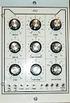 fpa 147 Week 6 Synthesis Basics In the early 1960s, inventors & entrepreneurs (Robert Moog, Don Buchla, Harold Bode, etc.) began assembling various modules into a single chassis, coupled with a user interface
Harmonics and Noise in Photovoltaic (PV) Inverter and the Mitigation Strategies
 Soonwook Hong, Ph. D. Michael Zuercher Martinson Harmonics and Noise in Photovoltaic (PV) Inverter and the Mitigation Strategies 1. Introduction PV inverters use semiconductor devices to transform the
EVALUATING WAVE FILES TO DETERMINE THE SEVERITY OF THE ULTRASONIC EMISSIONS
 EVALUATING WAVE FILES TO DETERMINE THE SEVERITY OF THE ULTRASONIC EMISSIONS We are often asked at which voltages and on what type of equipment is ultrasound most effective. The answer is not simple since
The front end of the receiver performs the frequency translation, channel selection and amplification of the signal.
 Many receivers must be capable of handling a very wide range of signal powers at the input while still producing the correct output. This must be done in the presence of noise and interference which occasionally
Application Note Noise Frequently Asked Questions
 : What is? is a random signal inherent in all physical components. It directly limits the detection and processing of all information. The common form of noise is white Gaussian due to the many random
11: AUDIO AMPLIFIER I. INTRODUCTION
 11: AUDIO AMPLIFIER I. INTRODUCTION The properties of an amplifying circuit using an op-amp depend primarily on the characteristics of the feedback network rather than on those of the op-amp itself. A
Two year Claritycap research programme finally answers an audio capacitors influence on sound quality.
 Two year Claritycap research programme finally answers an audio capacitors influence on sound quality. ClarityCap have been supplying high-quality audio capacitors to some of the world s top HiFi and loudspeaker
Agilent AN 1316 Optimizing Spectrum Analyzer Amplitude Accuracy
 Agilent AN 1316 Optimizing Spectrum Analyzer Amplitude Accuracy Application Note RF & Microwave Spectrum Analyzers Table of Contents 3 3 4 4 5 7 8 8 13 13 14 16 16 Introduction Absolute versus relative
Frequency Response of Filters
 School of Engineering Department of Electrical and Computer Engineering 332:224 Principles of Electrical Engineering II Laboratory Experiment 2 Frequency Response of Filters 1 Introduction Objectives To
6.101 Final Project Report Class G Audio Amplifier
 6.101 Final Project Report Class G Audio Amplifier Mark Spatz 4/3/2014 1 1 Introduction For my final project, I designed and built a 150 Watt audio amplifier to replace the underpowered and unreliable
TDA2040. 20W Hi-Fi AUDIO POWER AMPLIFIER
 20W Hi-Fi AUDIO POWER AMPLIFIER DESCRIPTION The TDA2040 is a monolithic integrated circuit in Pentawatt package, intended for use as an audio class AB amplifier. Typically it provides 22W output power
Sampling Theorem Notes. Recall: That a time sampled signal is like taking a snap shot or picture of signal periodically.
 Sampling Theorem We will show that a band limited signal can be reconstructed exactly from its discrete time samples. Recall: That a time sampled signal is like taking a snap shot or picture of signal
Ultrasound Distance Measurement
 Final Project Report E3390 Electronic Circuits Design Lab Ultrasound Distance Measurement Yiting Feng Izel Niyage Asif Quyyum Submitted in partial fulfillment of the requirements for the Bachelor of Science
Noise Specs Confusing
 Noise Specs Confusing It s really all very simple once you understand it Then here s the inside story on noise for those of us who haven t been designing low noise amplifiers for ten years You hear all
Direct Digital Amplification (DDX ) The Evolution of Digital Amplification
 Direct Digital Amplification (DDX ) The Evolution of Digital Amplification Tempo Semiconductor 2013 Table of Contents Table of Contents... 2 Table of Figures... 2 1. DDX Technology Overview... 3 2. Comparison
Workshop Perceptual Effects of Filtering and Masking Introduction to Filtering and Masking
 Workshop Perceptual Effects of Filtering and Masking Introduction to Filtering and Masking The perception and correct identification of speech sounds as phonemes depends on the listener extracting various
The world s first Acoustic Power Equalization Technology Perfect Acoustic Power Equalization. Perfect Time/Phase Alignment.
 Consumer Electronics Applications The world s first Acoustic Power Equalization Technology Perfect Acoustic Power Equalization. Perfect Time/Phase Alignment. Acoustic Power Equalization Technology For
PCM Encoding and Decoding:
 PCM Encoding and Decoding: Aim: Introduction to PCM encoding and decoding. Introduction: PCM Encoding: The input to the PCM ENCODER module is an analog message. This must be constrained to a defined bandwidth
Tx/Rx A high-performance FM receiver for audio and digital applicatons
 Tx/Rx A high-performance FM receiver for audio and digital applicatons This receiver design offers high sensitivity and low distortion for today s demanding high-signal environments. By Wayne C. Ryder
OPERATING MANUAL FOR REK-O-KUT DE-HISSER PRICE: $5.00 INTRODUCTION:
 OPERATING MANUAL FOR REK-O-KUT DE-HISSER INTRODUCTION: PRICE: $5.00 The Rek-O-Kut De-Hisser is designed to remove annoying hiss and noise from both old and new phonograph records as well as tape recordings
Taking the Mystery out of the Infamous Formula, "SNR = 6.02N + 1.76dB," and Why You Should Care. by Walt Kester
 ITRODUCTIO Taking the Mystery out of the Infamous Formula, "SR = 6.0 + 1.76dB," and Why You Should Care by Walt Kester MT-001 TUTORIAL You don't have to deal with ADCs or DACs for long before running across
The Problem with Faxing over VoIP Channels
 The Problem with Faxing over VoIP Channels Lower your phone bill! is one of many slogans used today by popular Voice over IP (VoIP) providers. Indeed, you may certainly save money by leveraging an existing
RECOMMENDATION ITU-R BS.644-1 *,** Audio quality parameters for the performance of a high-quality sound-programme transmission chain
 Rec. ITU-R BS.644-1 1 RECOMMENDATION ITU-R BS.644-1 *,** Audio quality parameters for the performance of a high-quality sound-programme transmission chain (1986-1990) The ITU Radiocommunication Assembly,
What will I learn as an Electrical Engineering student?
 What will I learn as an Electrical Engineering student? Department of Electrical and Computer Engineering Tu5s School of Engineering Trying to decide on a major? Most college course descrip>ons are full
Clock Jitter Definitions and Measurement Methods
 January 2014 Clock Jitter Definitions and Measurement Methods 1 Introduction Jitter is the timing variations of a set of signal edges from their ideal values. Jitters in clock signals are typically caused
Spectrum Level and Band Level
 Spectrum Level and Band Level ntensity, ntensity Level, and ntensity Spectrum Level As a review, earlier we talked about the intensity of a sound wave. We related the intensity of a sound wave to the acoustic
Your Hearing ILLUMINATED
 Your Hearing ILLUMINATED INFORMATION FROM YOUR HEARING CARE PROFESSIONAL REDISCOVER your hearing and reconnect 1 with the important things you might have been missing. Your sense of hearing is a vital
The Design and Implementation of Multimedia Software
 Chapter 10 Auditory Content The Design and Implementation of Multimedia Software David Bernstein Jones and Bartlett Publishers www.jbpub.com David Bernstein (jbpub.com) Multimedia Software Jones and Bartlett
MICROPHONE SPECIFICATIONS EXPLAINED
 Application Note AN-1112 MICROPHONE SPECIFICATIONS EXPLAINED INTRODUCTION A MEMS microphone IC is unique among InvenSense, Inc., products in that its input is an acoustic pressure wave. For this reason,
CLOCK AND SYNCHRONIZATION IN SYSTEM 6000
 By Christian G. Frandsen Introduction This document will discuss the clock, synchronization and interface design of TC System 6000 and deal with several of the factors that must be considered when using
The Sonometer The Resonant String and Timbre Change after plucking
 The Sonometer The Resonant String and Timbre Change after plucking EQUIPMENT Pasco sonometers (pick up 5 from teaching lab) and 5 kits to go with them BK Precision function generators and Tenma oscilloscopes
Figure1. Acoustic feedback in packet based video conferencing system
 Real-Time Howling Detection for Hands-Free Video Conferencing System Mi Suk Lee and Do Young Kim Future Internet Research Department ETRI, Daejeon, Korea {lms, dyk}@etri.re.kr Abstract: This paper presents
Department of Electrical and Computer Engineering Ben-Gurion University of the Negev. LAB 1 - Introduction to USRP
 Department of Electrical and Computer Engineering Ben-Gurion University of the Negev LAB 1 - Introduction to USRP - 1-1 Introduction In this lab you will use software reconfigurable RF hardware from National
Clock Recovery in Serial-Data Systems Ransom Stephens, Ph.D.
 Clock Recovery in Serial-Data Systems Ransom Stephens, Ph.D. Abstract: The definition of a bit period, or unit interval, is much more complicated than it looks. If it were just the reciprocal of the data
Interference to Hearing Aids by Digital Mobile Telephones Operating in the 1800 MHz Band.
 Interference to Hearing Aids by Digital Mobile Telephones Operating in the 1800 MHz Band. Reference: EB968 Date: January 2008 Author: Eric Burwood (National Acoustic Laboratories) Collaborator: Walter
RECORDING AND CAPTURING SOUND
 12 RECORDING AND CAPTURING SOUND 12.1 INTRODUCTION Recording and capturing sound is a complex process with a lot of considerations to be made prior to the recording itself. For example, there is the need
What Audio Engineers Should Know About Human Sound Perception. Part 2. Binaural Effects and Spatial Hearing
 What Audio Engineers Should Know About Human Sound Perception Part 2. Binaural Effects and Spatial Hearing AES 112 th Convention, Munich AES 113 th Convention, Los Angeles Durand R. Begault Human Factors
TESTS OF 1 MHZ SIGNAL SOURCE FOR SPECTRUM ANALYZER CALIBRATION 7/8/08 Sam Wetterlin
 TESTS OF 1 MHZ SIGNAL SOURCE FOR SPECTRUM ANALYZER CALIBRATION 7/8/08 Sam Wetterlin (Updated 7/19/08 to delete sine wave output) I constructed the 1 MHz square wave generator shown in the Appendix. This
MAINTENANCE & ADJUSTMENT
 MAINTENANCE & ADJUSTMENT Circuit Theory The concept of PLL system frequency synthesization is not of recent development, however, it has not been a long age since the digital theory has been couplet with
QAM Demodulation. Performance Conclusion. o o o o o. (Nyquist shaping, Clock & Carrier Recovery, AGC, Adaptive Equaliser) o o. Wireless Communications
 0 QAM Demodulation o o o o o Application area What is QAM? What are QAM Demodulation Functions? General block diagram of QAM demodulator Explanation of the main function (Nyquist shaping, Clock & Carrier
DIGITAL MUSIC DAY 1 WHAT IS SOUND? ANALOG AND DIGITAL EARLY RECORDING WAX FOR YOUR EARS ROUND BUT FLAT WIRE AND TAPE PURE SOUND
 DIGITAL MUSIC DAY 1 WHAT IS SOUND? 1. Making a sound playing a musical instrument, moves the surrounding the instrument. 2. Making a sound sends out air which hit your ears. 3. Waves of changing air pressure
Tutorial www.loudsoft.com
 Tutorial www.loudsoft.com In this tutorial we show several examples of simple and advanced X-over designs, using FINE X- over. In the first example we create the x-over for two drivers we have previously
Optimizing IP3 and ACPR Measurements
 Optimizing IP3 and ACPR Measurements Table of Contents 1. Overview... 2 2. Theory of Intermodulation Distortion... 2 3. Optimizing IP3 Measurements... 4 4. Theory of Adjacent Channel Power Ratio... 9 5.
User Manual. Please read this manual carefully before using the Phoenix Octopus
 User Manual Please read this manual carefully before using the Phoenix Octopus For additional help and updates, refer to our website To contact Phoenix Audio for support, please send a detailed e-mail
www.fmtalkinghouse.com
 www.fmtalkinghouse.com 24x7 FM Announcement System (Talking Sign) 2009 FM TALKING HOUSE All rights reserved Talking Sign 24x7 FM Announcement System Description: The 24x7 FM Announcement System or Talking
The Phase Modulator In NBFM Voice Communication Systems
 The Phase Modulator In NBFM Voice Communication Systems Virgil Leenerts 8 March 5 The phase modulator has been a point of discussion as to why it is used and not a frequency modulator in what are called
AC 2012-3923: MEASUREMENT OF OP-AMP PARAMETERS USING VEC- TOR SIGNAL ANALYZERS IN UNDERGRADUATE LINEAR CIRCUITS LABORATORY
 AC 212-3923: MEASUREMENT OF OP-AMP PARAMETERS USING VEC- TOR SIGNAL ANALYZERS IN UNDERGRADUATE LINEAR CIRCUITS LABORATORY Dr. Tooran Emami, U.S. Coast Guard Academy Tooran Emami received her M.S. and Ph.D.
LM 358 Op Amp. If you have small signals and need a more useful reading we could amplify it using the op amp, this is commonly used in sensors.
 LM 358 Op Amp S k i l l L e v e l : I n t e r m e d i a t e OVERVIEW The LM 358 is a duel single supply operational amplifier. As it is a single supply it eliminates the need for a duel power supply, thus
Sound absorption and acoustic surface impedance
 Sound absorption and acoustic surface impedance CHRISTER HEED SD2165 Stockholm October 2008 Marcus Wallenberg Laboratoriet för Ljud- och Vibrationsforskning Sound absorption and acoustic surface impedance
DTS Enhance : Smart EQ and Bandwidth Extension Brings Audio to Life
 DTS Enhance : Smart EQ and Bandwidth Extension Brings Audio to Life White Paper Document No. 9302K05100 Revision A Effective Date: May 2011 DTS, Inc. 5220 Las Virgenes Road Calabasas, CA 91302 USA www.dts.com
www.holmacoustics.com
 www.holmacoustics.com great sound will awaken your emotions The HOLM Acoustics company vision is to improve quality in music reproduction. Leading edge technology and Scandinavian craftsmanship is brought
100V - 100W DMOS AUDIO AMPLIFIER WITH MUTE/ST-BY THERMAL SHUTDOWN STBY-GND
 TDA7294 100V - 100W DMOS AUDIO AMPLIFIER WITH MUTE/ST-BY VERY HIGH OPERATING VOLTAGE RANGE (±40V) DMOS POWER STAGE HIGH OUTPUT POWER (UP TO 100W MU- SIC POWER) MUTING/STAND-BY FUNCTIONS NO SWITCH ON/OFF
MODEL 2202IQ (1991-MSRP $549.00)
 F O R T H E L O V E O F M U S I C F O R T H E L O V E O F M U S I C MODEL 2202IQ (1991-MSRP $549.00) OWNER'S MANUAL AND INSTALLATION GUIDE INTRODUCTION Congratulations on your decision to purchase a LINEAR
User Guide FFFA001106. www.focusrite.com
 User Guide FFFA001106 www.focusrite.com TABLE OF CONTENTS OVERVIEW.... 3 Introduction...3 Features.................................................................... 3 Box Contents...3 System Requirements....4
SR2000 FREQUENCY MONITOR
 SR2000 FREQUENCY MONITOR THE FFT SEARCH FUNCTION IN DETAILS FFT Search is a signal search using FFT (Fast Fourier Transform) technology. The FFT search function first appeared with the SR2000 Frequency
Routinely DIYers opt to make themselves a passive preamp - just an input selector and a volume control.
 The First Watt B1 Buffer Preamp Nelson Pass, June 2008 Side A So here we are in the New Millennium, and thanks to Tom Holman and THX we ve got lots of gain in our electronics. More gain than some of us
A Microphone Array for Hearing Aids
 A Microphone Array for Hearing Aids by Bernard Widrow 1531-636X/06/$10.00 2001IEEE 0.00 26 Abstract A directional acoustic receiving system is constructed in the form of a necklace including an array of
Dithering in Analog-to-digital Conversion
 Application Note 1. Introduction 2. What is Dither High-speed ADCs today offer higher dynamic performances and every effort is made to push these state-of-the art performances through design improvements
Graham s Guide to Synthesizers (part 1) Analogue Synthesis
 Graham s Guide to Synthesizers (part ) Analogue Synthesis Synthesizers were originally developed to imitate or synthesise the sounds of acoustic instruments electronically. Early synthesizers used analogue
Mozart Grand. The elaborate spiked feet assemblies improve both the performance and appearance of this speaker worthy of its namesake.
 General The immediate appeal of the elegantly moving melodic lines of Mozart s music is grounded on subtly sophisticated musical structures. Similarly, while the elegant lines of the Mozart Grand cabinets
PS 29M DUAL CHANNEL BELTPACK IN METAL CASE
 PS 29M DUAL CHANNEL BELTPACK IN METAL CASE USER MANUAL October 2013 This product is designed and manufactured by: ASL Intercom BV Zonnebaan 42 3542 EG Utrecht The Netherlands Phone: +31 (0)30 2411901 Fax:
isim ACTIVE FILTER DESIGNER NEW, VERY CAPABLE, MULTI-STAGE ACTIVE FILTER DESIGN TOOL
 isim ACTIVE FILTER DESIGNER NEW, VERY CAPABLE, MULTI-STAGE ACTIVE FILTER DESIGN TOOL Michael Steffes Sr. Applications Manager 12/15/2010 SIMPLY SMARTER Introduction to the New Active Filter Designer Scope
Tonal Detection in Noise: An Auditory Neuroscience Insight
 Image: http://physics.ust.hk/dusw/ Tonal Detection in Noise: An Auditory Neuroscience Insight Buddhika Karunarathne 1 and Richard H.Y. So 1,2 1 Dept. of IELM, Hong Kong University of Science & Technology,
TECHNICAL LISTENING TRAINING: IMPROVEMENT OF SOUND SENSITIVITY FOR ACOUSTIC ENGINEERS AND SOUND DESIGNERS
 TECHNICAL LISTENING TRAINING: IMPROVEMENT OF SOUND SENSITIVITY FOR ACOUSTIC ENGINEERS AND SOUND DESIGNERS PACS: 43.10.Sv Shin-ichiro Iwamiya, Yoshitaka Nakajima, Kazuo Ueda, Kazuhiko Kawahara and Masayuki
USER GUIDE PRO-EQ PLATINUM
 USER GUIDE PRO-EQ PLATINUM Welcome Thank you for making Fishman a part of your acoustic experience. We are proud to offer the finest acoustic amplification products available: high-quality professional-grade
Understand the effects of clock jitter and phase noise on sampled systems A s higher resolution data converters that can
 designfeature By Brad Brannon, Analog Devices Inc MUCH OF YOUR SYSTEM S PERFORMANCE DEPENDS ON JITTER SPECIFICATIONS, SO CAREFUL ASSESSMENT IS CRITICAL. Understand the effects of clock jitter and phase
Physics in Entertainment and the Arts
 Physics in Entertainment and the Arts Chapter VII Wave Transfer and Waves incident on a rigid boundary almost completely reflect Almost all the wave s energy is reflected back the way it came Waves incident
Hearing and Deafness 1. Anatomy & physiology
 Hearing and Deafness 1. Anatomy & physiology Chris Darwin Web site for lectures, lecture notes and filtering lab: http://www.lifesci.susx.ac.uk/home/chris_darwin/ safari 1 Outer, middle & inner ear Capture;
6 Output With 1 kω in Series Between the Output and Analyzer... 7 7 Output With RC Low-Pass Filter (1 kω and 4.7 nf) in Series Between the Output
 Application Report SLAA313 December 26 Out-of-Band Noise Measurement Issues for Audio Codecs Greg Hupp... Data Acquisition Products ABSTRACT This report discusses the phenomenon of out-of-band noise, and
Aircraft cabin noise synthesis for noise subjective analysis
 Aircraft cabin noise synthesis for noise subjective analysis Bruno Arantes Caldeira da Silva Instituto Tecnológico de Aeronáutica São José dos Campos - SP [email protected] Cristiane Aparecida Martins