
LifeSize Passport Connect TM User and Administrator Guide
|
|
|
- Curtis Davis
- 10 years ago
- Views:
Transcription
1 LifeSize Passport Connect TM User and Administrator Guide September 2011

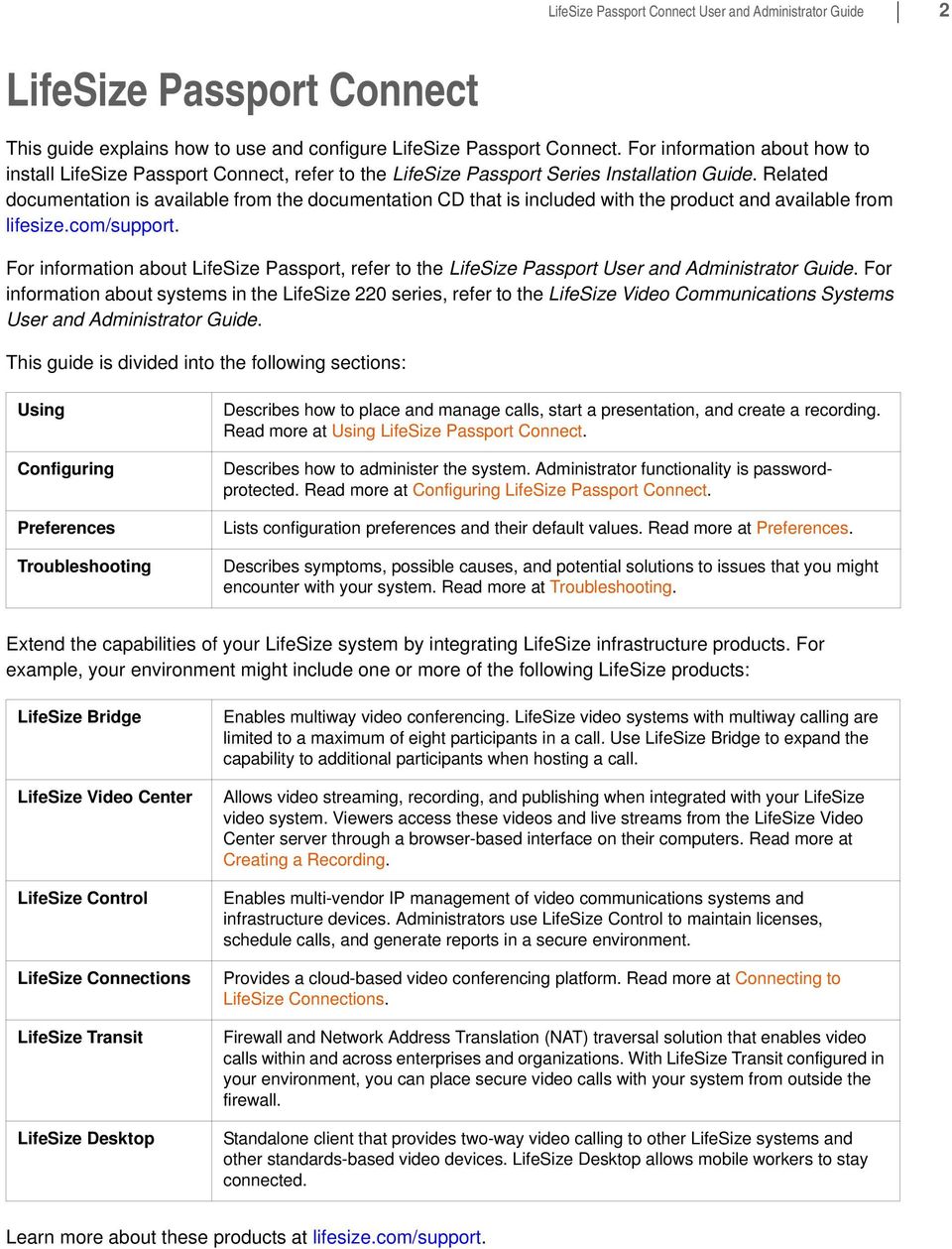
2 LifeSize Passport Connect User and Administrator Guide 2 LifeSize Passport Connect This guide explains how to use and configure LifeSize Passport Connect. For information about how to install LifeSize Passport Connect, refer to the LifeSize Passport Series Installation Guide. Related documentation is available from the documentation CD that is included with the product and available from lifesize.com/support. For information about LifeSize Passport, refer to the LifeSize Passport User and Administrator Guide. For information about systems in the LifeSize 220 series, refer to the LifeSize Video Communications Systems User and Administrator Guide. This guide is divided into the following sections: Using Configuring Troubleshooting Describes how to place and manage calls, start a presentation, and create a recording. Read more at Using LifeSize Passport Connect. Describes how to administer the system. Administrator functionality is passwordprotected. Read more at Configuring LifeSize Passport Connect. Lists configuration preferences and their default values. Read more at. Describes symptoms, possible causes, and potential solutions to issues that you might encounter with your system. Read more at Troubleshooting. Extend the capabilities of your LifeSize system by integrating LifeSize infrastructure products. For example, your environment might include one or more of the following LifeSize products: LifeSize Bridge LifeSize Video Center LifeSize Control LifeSize Connections LifeSize Transit LifeSize Desktop Enables multiway video conferencing. LifeSize video systems with multiway calling are limited to a maximum of eight participants in a call. Use LifeSize Bridge to expand the capability to additional participants when hosting a call. Allows video streaming, recording, and publishing when integrated with your LifeSize video system. Viewers access these videos and live streams from the LifeSize Video Center server through a browser-based interface on their computers. Read more at Creating a Recording. Enables multi-vendor IP management of video communications systems and infrastructure devices. Administrators use LifeSize Control to maintain licenses, schedule calls, and generate reports in a secure environment. Provides a cloud-based video conferencing platform. Read more at Connecting to LifeSize Connections. Firewall and Network Address Translation (NAT) traversal solution that enables video calls within and across enterprises and organizations. With LifeSize Transit configured in your environment, you can place secure video calls with your system from outside the firewall. Standalone client that provides two-way video calling to other LifeSize systems and other standards-based video devices. LifeSize Desktop allows mobile workers to stay connected. Learn more about these products at lifesize.com/support.
3 LifeSize Passport Connect User and Administrator Guide 3 Section 1: Using LifeSize Passport Connect Getting Started When your LifeSize system is idle, either the screen is black or a screen saver appears. An incoming call or pressing any button on the remote control automatically activates the system. Do not point the remote control at the screen to activate the system. Instead, point the remote control at the IR receiver, located on the codec. The navigation bar at the bottom of the LifeSize system s main screen contains icons that correspond to buttons on the remote control. Depending on available actions, the icons change as you use the arrow keys on the remote control to navigate to different parts of the screen. Use the remote control to perform the following tasks: Place, answer, or end a call Control a near or far end camera To place a call, select a directory and the appropriate entry and then press OK. Select Manual Dial to place a call manually. Press OK to answer a call and to end a call. Read more at Placing a Call, Placing a Call ManuallyAutomatically Answering Calls, and Managing a Call. To adjust a USB or PTZ camera during a call, press the near/far camera button to switch between near and far end cameras. Read more at Controlling a Far End Camera. Select a screen layout Press Layouts. to change the screen layout during a call. Read more at Managing Video Initiate a presentation through LifeSize Virtual Link Create a recording With LifeSize Virtual Link installed on your laptop, your LifeSize system can share IPbased presentation data during a call. Read more in the LifeSize Virtual Link Installation Guide. Download LifeSize Virtual Link from lifesize.com/support. With LifeSize Video Center configured, you can create an out-of-call recording. Read more at Creating a Recording.

4 LifeSize Passport Connect User and Administrator Guide 4 Placing a Call Use the arrow keys on the remote control to select Contacts, Directory, or Redial and to select the appropriate entry, and then press OK. For information about conducting a search, see Searching for an Entry. The following table identifies additional tasks that you can complete from your contacts, the directory, and the redial list. Before placing a call from... You can... Your contacts Press to add a new entry or press to edit or remove an existing entry. The directory Press to copy a selected entry to your list of contacts. The redial list Press to remove or lock an entry or to copy an entry to your list of contacts. By default, the system information, status bar, and navigation bar are hidden after a call has been connected for 10 seconds. These items reappear after interaction with the system. Adjust the fade out interval in User : Appearance : Fade Out Timeout. To hide or show user interface elements during a call, press. Searching for an Entry When viewing your contacts or the directory, press the numeric keys on the remote control to search for a particular entry. Press a key only once to activate the number or any of the letters that are associated with it. For example, a single press of the 5 key searches for the number 5 and the letters J, K, and L. Do not press the 5 key twice to activate the letter K. If your directory contains entries for Adam Larson and Karen Bean, the numeric sequence returns both entries because it corresponds equally to Adam and Bean, as the following table shows. Numeric Key Associated Letters Relevant Letter in Adam Relevant Letter in Bean 2 A, B, C A B 3 D, E, F D E 2 A, B, C A A 6 M, N, O M N

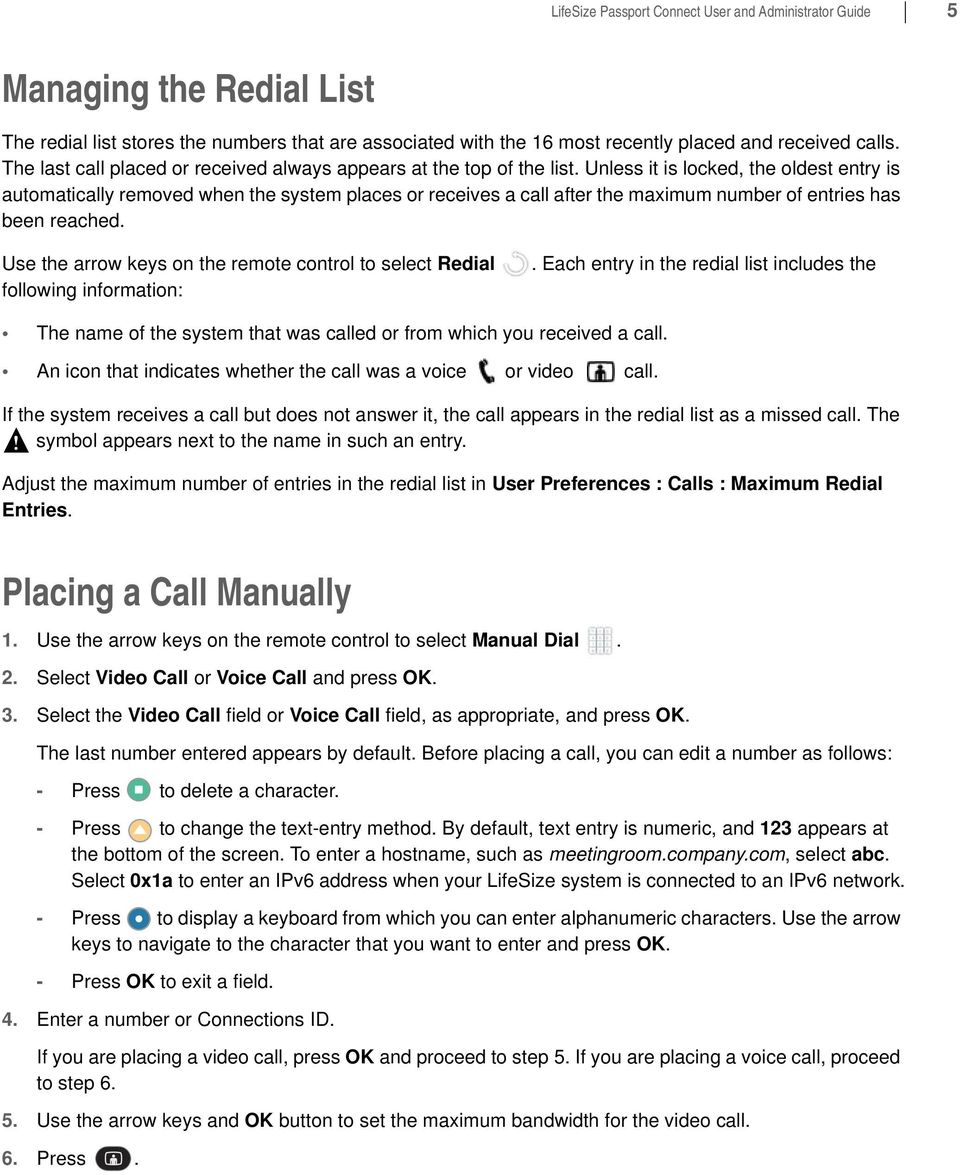
5 LifeSize Passport Connect User and Administrator Guide 5 Managing the Redial List The redial list stores the numbers that are associated with the 16 most recently placed and received calls. The last call placed or received always appears at the top of the list. Unless it is locked, the oldest entry is automatically removed when the system places or receives a call after the maximum number of entries has been reached. Use the arrow keys on the remote control to select Redial following information:. Each entry in the redial list includes the The name of the system that was called or from which you received a call. An icon that indicates whether the call was a voice or video call. If the system receives a call but does not answer it, the call appears in the redial list as a missed call. The symbol appears next to the name in such an entry. Adjust the maximum number of entries in the redial list in User : Calls : Maximum Redial Entries. Placing a Call Manually 1. Use the arrow keys on the remote control to select Manual Dial. 2. Select Video Call or Voice Call and press OK. 3. Select the Video Call field or Voice Call field, as appropriate, and press OK. The last number entered appears by default. Before placing a call, you can edit a number as follows: - Press to delete a character. - Press to change the text-entry method. By default, text entry is numeric, and 123 appears at the bottom of the screen. To enter a hostname, such as meetingroom.company.com, select abc. Select 0x1a to enter an IPv6 address when your LifeSize system is connected to an IPv6 network. - Press to display a keyboard from which you can enter alphanumeric characters. Use the arrow keys to navigate to the character that you want to enter and press OK. - Press OK to exit a field. 4. Enter a number or Connections ID. If you are placing a video call, press OK and proceed to step 5. If you are placing a voice call, proceed to step Use the arrow keys and OK button to set the maximum bandwidth for the video call. 6. Press.
6 LifeSize Passport Connect User and Administrator Guide 6 Automatically Answering Calls Configure your system to automatically answer incoming calls in User : Calls: Call Preference Description Default Value Auto Answer If set to Disabled, you must manually answer or ignore incoming calls. Disabled Auto Answer Mute Auto Answer Multiway Call If set to Enabled while Auto Answer is also set to Enabled, the system is muted when a call connects. If set to Enabled, the system automatically answers an incoming audio call after the first call has connected. The system beeps to indicate when a new call connects. The name and number of the added voice caller appear. Select Hang Up and press OK to hang up the call. If you ignore the dialog box, the system accepts the call. Enabled Enabled Enabling Do Not Disturb During Calls If you receive an incoming call during a call and Auto Answer Multiway Call is set to Disabled, you can choose Do Not Disturb to ignore the incoming call and prevent other calls from interrupting the current call. When the do not disturb feature is enabled, callers hear a busy signal. Calls that are missed while the do not disturb feature is enabled appear in the redial list on the main screen. Access the do not disturb feature from the Call Manager. Using System Do Not Disturb Enable the system do not disturb feature to show only the background image of the main screen and a system do not disturb message. The system responds only to the volume control buttons and the OK button on the remote control. When the system do not disturb feature is enabled, callers hear a busy signal, and missed calls appear in the redial list. Consider using this feature if you are using a meeting room for a purpose other than a video conference and do not want to be disturbed by incoming calls. Press to access the system menu and set the system do not disturb feature. Managing a Call You can complete the following tasks during a call: View the status of the call. Manage audio output and video layouts. Control a far end PTZ camera. To view call statistics during a call, press. Statistics include transmission and reception data for both audio and video, such as bandwidth and packet loss, and commonly indicate the cause of problems that you might experience during a call. Statistics automatically refresh every five seconds and disappear from view after five minutes.

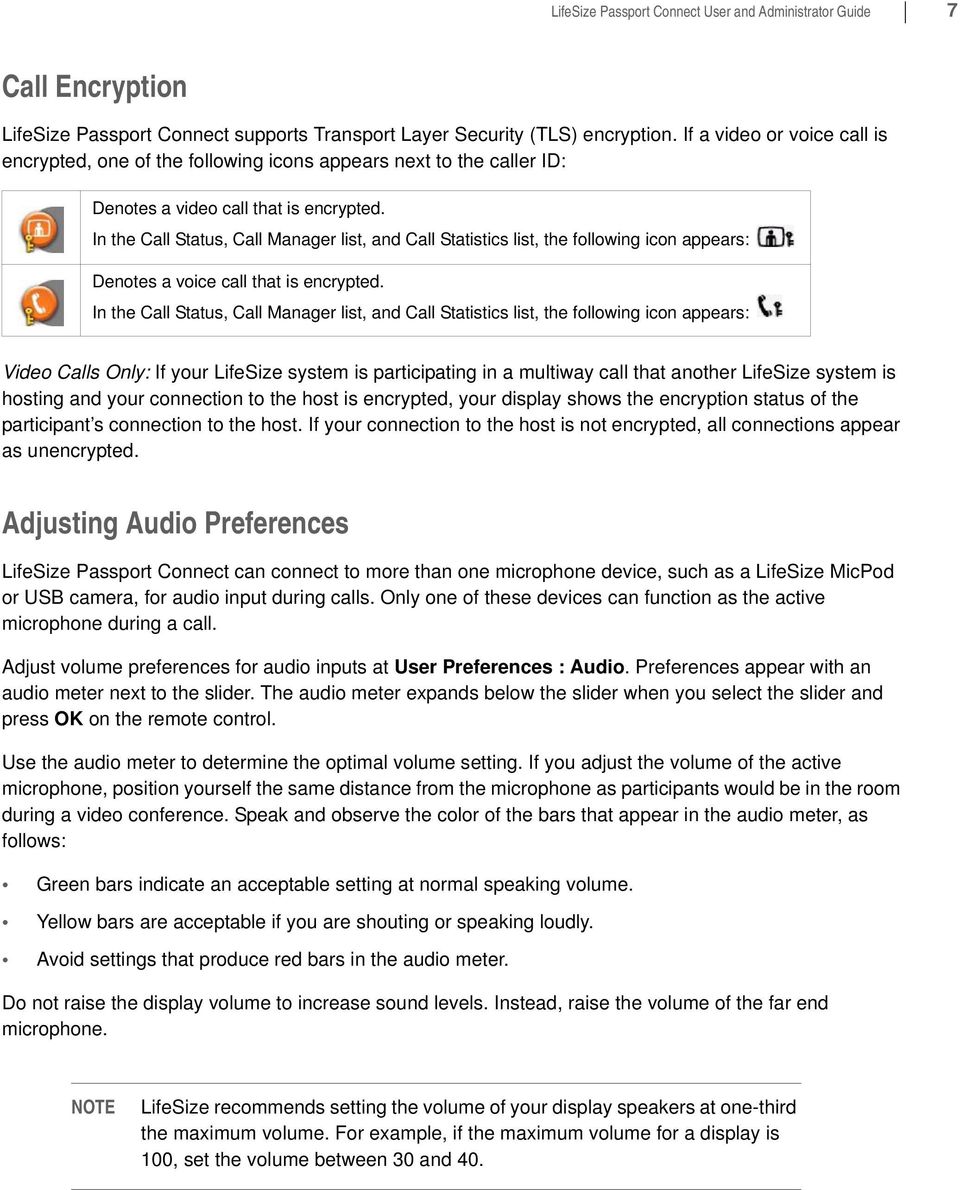
7 LifeSize Passport Connect User and Administrator Guide 7 Call Encryption LifeSize Passport Connect supports Transport Layer Security (TLS) encryption. If a video or voice call is encrypted, one of the following icons appears next to the caller ID: Denotes a video call that is encrypted. In the Call Status, Call Manager list, and Call Statistics list, the following icon appears: Denotes a voice call that is encrypted. In the Call Status, Call Manager list, and Call Statistics list, the following icon appears: Video Calls Only: If your LifeSize system is participating in a multiway call that another LifeSize system is hosting and your connection to the host is encrypted, your display shows the encryption status of the participant s connection to the host. If your connection to the host is not encrypted, all connections appear as unencrypted. Adjusting Audio LifeSize Passport Connect can connect to more than one microphone device, such as a LifeSize MicPod or USB camera, for audio input during calls. Only one of these devices can function as the active microphone during a call. Adjust volume preferences for audio inputs at User : Audio. appear with an audio meter next to the slider. The audio meter expands below the slider when you select the slider and press OK on the remote control. Use the audio meter to determine the optimal volume setting. If you adjust the volume of the active microphone, position yourself the same distance from the microphone as participants would be in the room during a video conference. Speak and observe the color of the bars that appear in the audio meter, as follows: Green bars indicate an acceptable setting at normal speaking volume. Yellow bars are acceptable if you are shouting or speaking loudly. Avoid settings that produce red bars in the audio meter. Do not raise the display volume to increase sound levels. Instead, raise the volume of the far end microphone. NOTE LifeSize recommends setting the volume of your display speakers at one-third the maximum volume. For example, if the maximum volume for a display is 100, set the volume between 30 and 40.
8 LifeSize Passport Connect User and Administrator Guide 8 Managing Video Layouts To change the screen layout of near and far end video images, press at any time during a call. NOTE If you place a call with LifeSize Connections, you cannot change the screen layout of the far end video image. Read more at Connecting to LifeSize Connections. The number of the selected screen layout (x) and the total number of available screen layouts (y) appear in the center of the screen above the status bar as x/y. Screen layouts appear as one of the following types: A far end participant or a presentation, when in progress, appears as the largest video image. Your site, the near end participant, appears as the largest video image. Both video images are the same size.

9 LifeSize Passport Connect User and Administrator Guide 9 Two-way Call Layouts 1/3 and 2/3 Layout 3/3 Far video Layout 2/3: Far and near video swap positions Near video (disappears) Far video Near video Two-way Call with Presentation Layouts 1/6 and 2/6 Layout 3/6 Presentation Layout 2/6: Presentation and near video swap positions Near video (disappears) Presentation Near video Layouts 4/6 and 5/6 Layout 6/6 Far video Layout 5/6: Far and near video swap positions Near video (disappears) Far video Near video Controlling a Far End Camera Control an appropriately enabled far end PTZ camera during a video conference in the same manner that you control a near end camera. Read more at Advanced Camera Functions. During a video call, a camera icon appears in the video image of the participant whose camera you are controlling. An orange camera icon indicates control of the primary (near) input. A blue camera icon in a far end video image indicates control of the far end camera. By default, the near camera is selected.

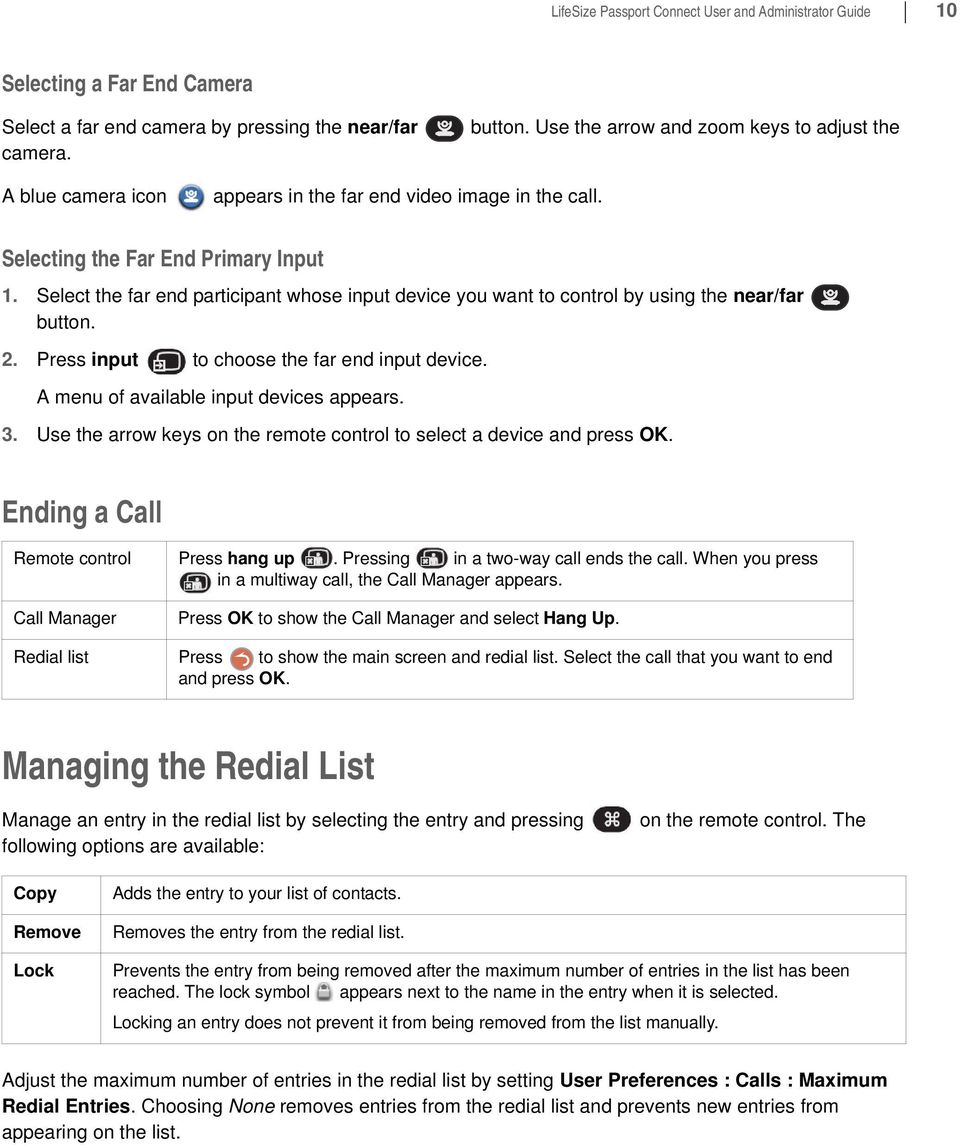
10 LifeSize Passport Connect User and Administrator Guide 10 Selecting a Far End Camera Select a far end camera by pressing the near/far camera. button. Use the arrow and zoom keys to adjust the A blue camera icon appears in the far end video image in the call. Selecting the Far End Primary Input 1. Select the far end participant whose input device you want to control by using the near/far button. 2. Press input to choose the far end input device. A menu of available input devices appears. 3. Use the arrow keys on the remote control to select a device and press OK. Ending a Call Remote control Press hang up. Pressing in a two-way call ends the call. When you press in a multiway call, the Call Manager appears. Call Manager Press OK to show the Call Manager and select Hang Up. Redial list Press to show the main screen and redial list. Select the call that you want to end and press OK. Managing the Redial List Manage an entry in the redial list by selecting the entry and pressing following options are available: on the remote control. The Copy Remove Lock Adds the entry to your list of contacts. Removes the entry from the redial list. Prevents the entry from being removed after the maximum number of entries in the list has been reached. The lock symbol appears next to the name in the entry when it is selected. Locking an entry does not prevent it from being removed from the list manually. Adjust the maximum number of entries in the redial list by setting User : Calls : Maximum Redial Entries. Choosing None removes entries from the redial list and prevents new entries from appearing on the list.
11 LifeSize Passport Connect User and Administrator Guide 11 Creating a Recording With LifeSize Video Center configured in your environment, you can initiate an out-of-call recording. Read more in the LifeSize Video Center Administrator Guide. 1. From the main screen, press. 2. Press. NOTE You might be prompted to a valid recording key. If successful, the recording begins, and the recording icon appears. 3. To end the recording, press. Advanced Camera Functions This section describes how to configure, use, and lock camera presets and how to make digital adjustments. Configuring Camera Presets A camera preset is a predefined camera position that is associated with a numeric key on the remote control. Camera presets enable you to quickly change the position of the near end USB camera during a call by pressing a single key on the remote control instead of using the arrow and zoom keys. Far end participants view the video image without the delay that is associated with using more than one key to position the camera. You can save nine presets through the remote control. When presets are available for use, icons for the numeric keys (0 through 9) appear in the navigation bar, followed by the word Presets. Configure and use presets in the Primary Input screen before placing a call, as follows: 1. Press to select the near end camera and adjust its position. LifeSize Passport Connect makes only digital adjustments to the position of a USB camera. Read more at Making Digital Adjustments. 2. Press and hold a numeric key (1 through 9) on the remote control until Preset x saved appears above the status bar. The current position of the camera is associated with the numeric key. If you choose a numeric key that is already associated with a preset, the preset is overwritten. If an existing preset is locked, the message Preset x locked appears. When the 0 key is used as a preset, it always moves the selected camera to the default position and cannot be overwritten. 3. To test the preset, use the arrow keys to move the camera to a different position and press the numeric key associated with the preset to move the camera to the preset position. The message Preset x appears above the status bar.

12 LifeSize Passport Connect User and Administrator Guide 12 Using Camera Presets During a Call 1. If the near camera is not already selected, press near/far to select it. 2. Ensure that Presets appears to the right of the numeric keys icons in the navigation bar of any call screen. If Touch Tones appears instead, change the function of the keys to Presets by pressing. 3. Press the numeric key on the remote control that represents the preset that you want to use. Preset x appears on the screen. If you configured a preset for a far end camera in the call, you must select the far end camera to use the preset. Refer to Controlling a Far End Camera. NOTE During a call, the numeric keys work as presets only from a call screen. Making Digital Adjustments LifeSize Passport Connect makes only digital adjustments to the position of a USB camera. Perform the following steps to make digital adjustments: 1. Press to select the camera that you want to control. During a call, the near camera is selected by default. An orange camera icon appears in the near video image when the user interface is visible and the near end camera is selected. 2. Press the zoom in button on the remote control. Digital zoom electronically crops an area of the video image that appears in the display and, by using the same aspect ratio as the original image, scales the cropped image to the dimensions of the original image. 3. Press the arrow keys on the remote control to digitally pan and tilt the camera. Digital pan and tilt are available only after you activate digital zoom by pressing the zoom in button. If you exit digital zoom by using the zoom out button to return to the camera s original fixed focal length, digital pan and tilt are not available. 4. Press the zoom out button to view the image from farther away or to exit digital zoom. To disable digital zoom, set Administrator : Video : Video Control : Digital Zoom to Disabled. Locking Camera Presets By default, all users can configure camera presets. To prevent near end users and far end users from configuring camera presets, administrators can set Administrator : Video : Video Control : Camera Presets Lock to Locked. To prevent only far end users from configuring camera presets, set Far Control of Near Camera or Far Set of Camera Presets to Disabled.

13 LifeSize Passport Connect User and Administrator Guide 13 Working with Directories LifeSize Passport Connect provides the following directories: Contacts Directory Redial Each entry contains dialing information for a single device. Each prepopulated, read-only entry contains dialing information for a single device. Each entry contains dialing information for a recently dialed device. Read about placing calls from these directories at Placing a Call. Adding an Entry to Your Contacts Create up to 1000 entries in your list of contacts. 1. Use the arrow keys on the remote control to select. 2. Press to open the New Directory Entry dialog box. 3. Enter a system name, video and voice numbers, and IP address: a. Use the arrow keys to select the appropriate field. b. Press OK to activate the field. c. Enter the appropriate value. Optionally, press to change the method of text entry for text fields or press to access the keyboard. d. Press OK to exit the field. 4. Press to return to your contacts. Copying, Removing, and Editing Entries Copy, remove, or edit an entry by accessing your contacts or the directory, selecting the appropriate entry, and pressing. Depending on the entry, the following options are available: Copy to Contacts Remove When you access the directory, you can copy an entry to your contacts. Selecting this option removes the entry from your list of contacts. Edit Modify values on the Edit Directory Entry dialog box. Optionally, press to change the method of text entry for text fields. Read more at Adding an Entry to Your Contacts.

14 LifeSize Passport Connect User and Administrator Guide 14 Section 2: Configuring LifeSize Passport Connect This section describes how to administer your LifeSize video communications system. Initial configuration Passwords System management Network Appearance Calls Communications Audio Video Security Directories Maintenance and upgrade At installation, your LifeSize system prompts you to configure basic required settings. Initial configuration screens also appear after you restore the system to default settings. Read more at Initial Configuration. Manage user and administrator passwords. Read more at Administrator and User Passwords. Manage your system with MIBs, the remote control, or LifeSize Control or through a web browser, SSH, or Telnet session. Read more at Managing Your System. Configure network preferences. Read more at Configuring Network Usage and Configuring Your LifeSize System for Firewall Traversal. Configure video layout and display preferences. Read more at Configuring Appearance. Manage call bandwidth and set a maximum call time. Read more at Configuring Call. Control the protocols that the system uses during calls. Read more at Configuring Communications. Select the active microphone and adjust audio levels. Read more at Configuring Audio Behaviors. Control cameras and video quality. Read more at Configuring Video Behaviors. Enable FIPS security. Read more at Enabling FIPS Security. Manage your contacts, directory, and the redial list. Read more at Managing Directories. Upgrade system software, update license keys, and restore a system to its default settings. Read more at Maintaining Your System. NOTE Administrator functionality is password-protected by default.

15 LifeSize Passport Connect User and Administrator Guide 15 Initial Configuration At the end of the installation process, your LifeSize system prompts you to configure preferences that are required for the system to start. Initial configuration screens also appear when you perform a system reset. Read more at Restoring Default Settings. Language Passwords System identification Communications Network LifeSize Connections Audio Select the language to appear in the user interface. The default language is English. Manage the administrator and user passwords. Read more at Administrator and User Passwords. Set the location, time zone, system name, video number, and voice number. Select the video and voice protocols. Read more at Configuring Dialing Options. By default, DHCP is enabled on LifeSize systems. If you disable DHCP, specify the system s IP address, subnet mask, and default gateway. Read more at Specifying a Locally Configured IP Address. If you do not have a DHCP server that automatically sets a DNS server, enter the hostname of the system and the IP addresses necessary to configure DNS servers. Read more at Specifying the Hostname and DNS Servers. If you set the network speed, ensure that the option matches the speed and duplex values that are configured on your network switch. Read more at Specifying Network Speed. The system shows the date and time automatically with DHCP enabled or when you specify the hostname or IP address of an NTP server. Read more at Specifying an NTP Server. Provides a cloud-based video conferencing platform. Read more at Connecting to LifeSize Connections. By default, the system detects attached audio input devices and selects the active microphone. Refer to the following content to adjust audio preferences: Selecting the Active Microphone Adjusting the Active Microphone Volume Testing Primary Audio Output NOTE After initial configuration, manage these preferences from the user interface, through the web administration interface, or from the command line. Read more at Managing Your System.

16 LifeSize Passport Connect User and Administrator Guide 16 Administrator and User Passwords Change the user and administrator passwords during initial configuration or in Administrator : Security : Passwords. Passwords can be up to 16 characters in length and can contain any combination of the numbers 0-9 and the symbols * (star) and # (pound). The default administrator password is LifeSize recommends that you protect the administrator preferences with a custom password. Set a user password to control access to User screens. By default, the user password is not set. If you set a user password, you can also access the User screens with the administrator password. Enabling Communication with Other Systems After you install your system but before you use it, you might need to make the following additional adjustments to the configuration of your network and LifeSize system: Static NAT Firewall SIP If you choose to place your video communications systems in a private LAN, use NAT to communicate with outside systems. This adjustment might include enabling static NAT on your LifeSize system. Read more at Using LifeSize Systems in a Private LAN with NAT and Enabling NAT. If your LifeSize system communicates with other devices through a firewall, configure your firewall to allow incoming and outgoing traffic to the LifeSize system through reserved and required ports. Users who place calls through a firewall to systems with IP addresses might experience one-way audio or video if the firewall is not configured appropriately to allow video and audio traffic. Read more at Configuring Your LifeSize System for Firewall Traversal. Use the information in Configuring SIP Settings to configure the Session Initiation Protocol (SIP) servers in your environment to place calls by using the SIP protocol. Placing a Test Call to LifeSize Systems LifeSize Demo (demo.lifesize.com) appears as a default entry in the redial list and local directory for the following system types: A new system. A system that is restored to default settings. Use this entry to place a test call from your LifeSize system. To use this entry, either specify a DNS server in Administrator : Network : General or use a DHCP option that automatically sets a DNS server. If a DNS server is not configured, a call cannot resolve to the IP address, and calls to this entry show the call status as unavailable.

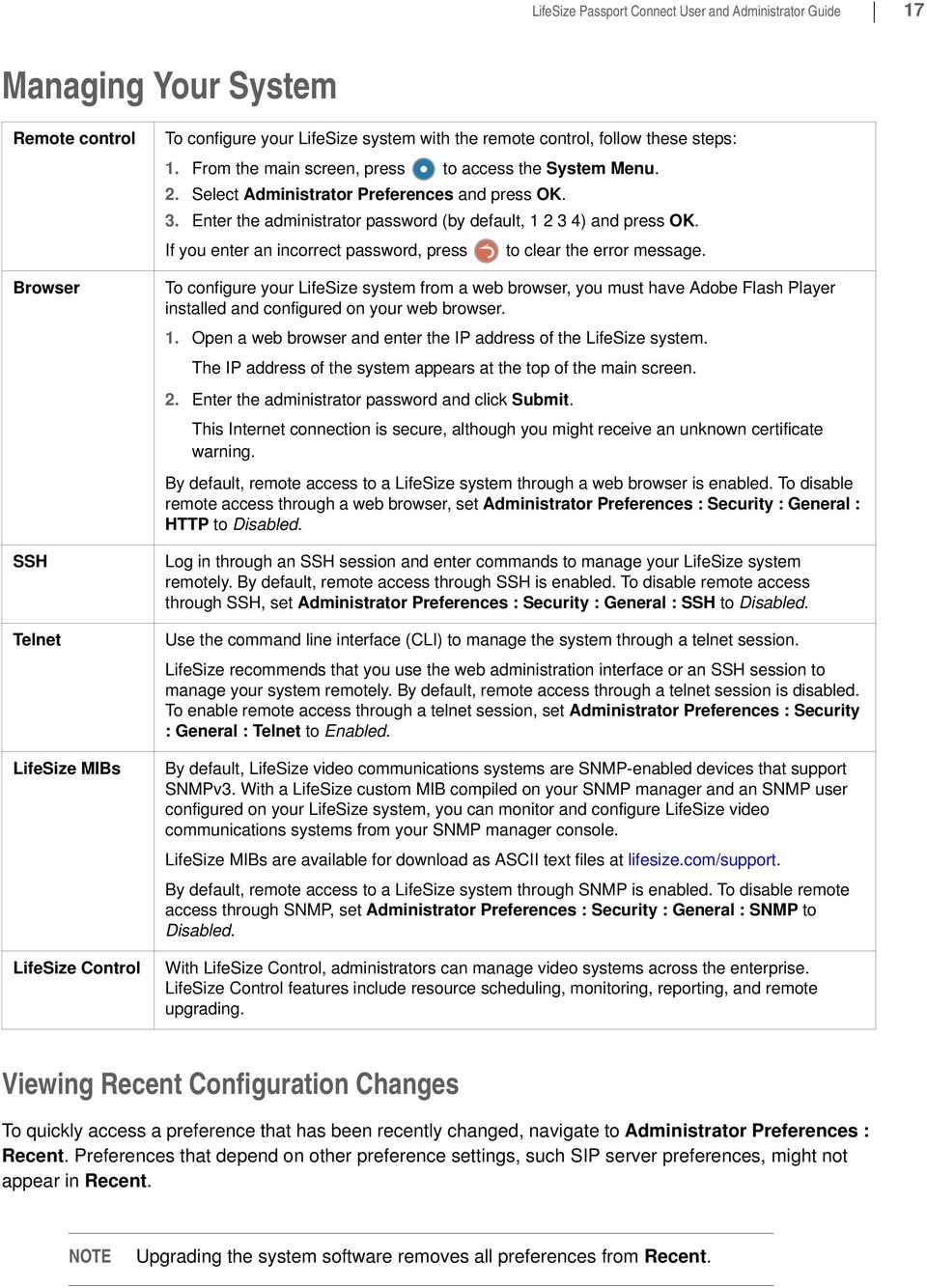
17 LifeSize Passport Connect User and Administrator Guide 17 Managing Your System Remote control Browser SSH Telnet LifeSize MIBs LifeSize Control To configure your LifeSize system with the remote control, follow these steps: 1. From the main screen, press to access the System Menu. 2. Select Administrator and press OK. 3. Enter the administrator password (by default, ) and press OK. If you enter an incorrect password, press to clear the error message. To configure your LifeSize system from a web browser, you must have Adobe Flash Player installed and configured on your web browser. 1. Open a web browser and enter the IP address of the LifeSize system. The IP address of the system appears at the top of the main screen. 2. Enter the administrator password and click Submit. This Internet connection is secure, although you might receive an unknown certificate warning. By default, remote access to a LifeSize system through a web browser is enabled. To disable remote access through a web browser, set Administrator : Security : General : HTTP to Disabled. Log in through an SSH session and enter commands to manage your LifeSize system remotely. By default, remote access through SSH is enabled. To disable remote access through SSH, set Administrator : Security : General : SSH to Disabled. Use the command line interface (CLI) to manage the system through a telnet session. LifeSize recommends that you use the web administration interface or an SSH session to manage your system remotely. By default, remote access through a telnet session is disabled. To enable remote access through a telnet session, set Administrator : Security : General : Telnet to Enabled. By default, LifeSize video communications systems are SNMP-enabled devices that support SNMPv3. With a LifeSize custom MIB compiled on your SNMP manager and an SNMP user configured on your LifeSize system, you can monitor and configure LifeSize video communications systems from your SNMP manager console. LifeSize MIBs are available for download as ASCII text files at lifesize.com/support. By default, remote access to a LifeSize system through SNMP is enabled. To disable remote access through SNMP, set Administrator : Security : General : SNMP to Disabled. With LifeSize Control, administrators can manage video systems across the enterprise. LifeSize Control features include resource scheduling, monitoring, reporting, and remote upgrading. Viewing Recent Configuration Changes To quickly access a preference that has been recently changed, navigate to Administrator : Recent. that depend on other preference settings, such SIP server preferences, might not appear in Recent. NOTE Upgrading the system software removes all preferences from Recent.
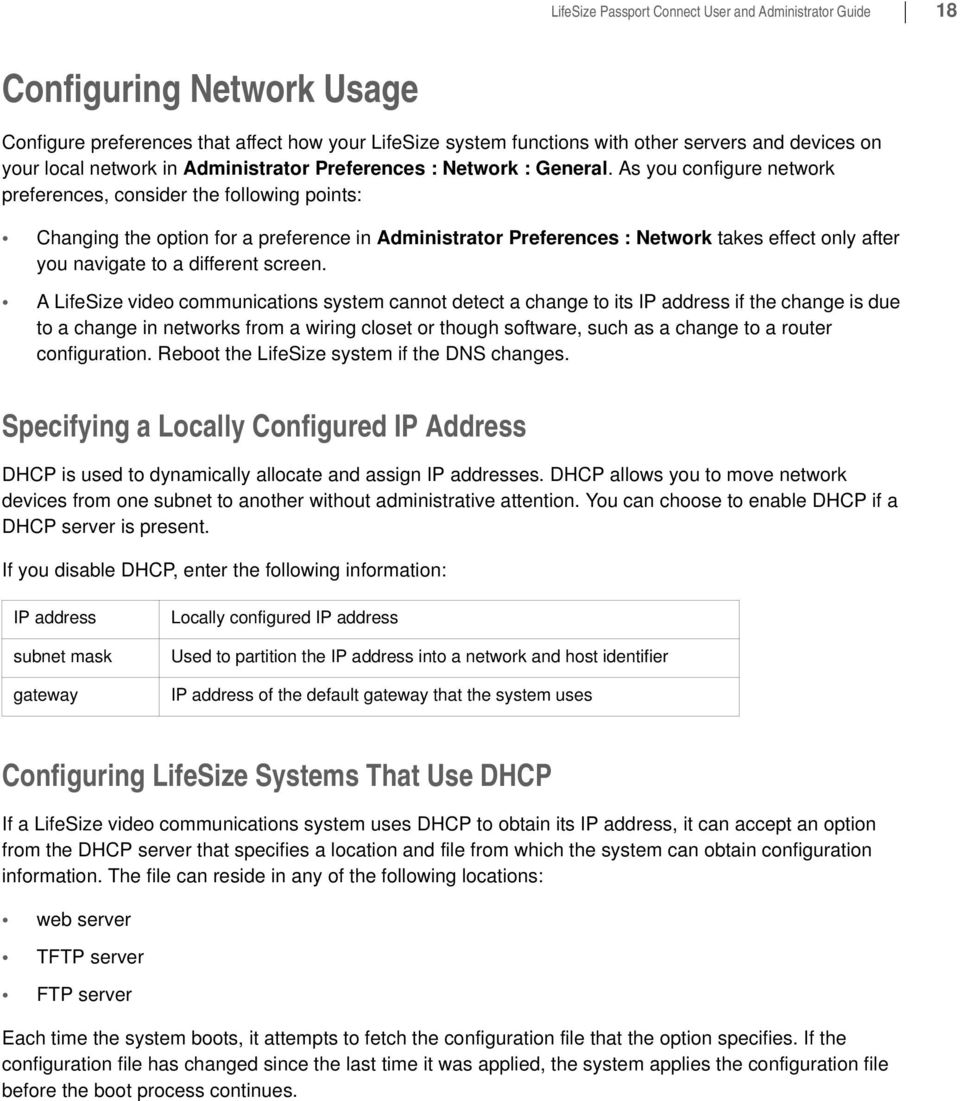
18 LifeSize Passport Connect User and Administrator Guide 18 Configuring Network Usage Configure preferences that affect how your LifeSize system functions with other servers and devices on your local network in Administrator : Network : General. As you configure network preferences, consider the following points: Changing the option for a preference in Administrator : Network takes effect only after you navigate to a different screen. A LifeSize video communications system cannot detect a change to its IP address if the change is due to a change in networks from a wiring closet or though software, such as a change to a router configuration. Reboot the LifeSize system if the DNS changes. Specifying a Locally Configured IP Address DHCP is used to dynamically allocate and assign IP addresses. DHCP allows you to move network devices from one subnet to another without administrative attention. You can choose to enable DHCP if a DHCP server is present. If you disable DHCP, enter the following information: IP address subnet mask gateway Locally configured IP address Used to partition the IP address into a network and host identifier IP address of the default gateway that the system uses Configuring LifeSize Systems That Use DHCP If a LifeSize video communications system uses DHCP to obtain its IP address, it can accept an option from the DHCP server that specifies a location and file from which the system can obtain configuration information. The file can reside in any of the following locations: web server TFTP server FTP server Each time the system boots, it attempts to fetch the configuration file that the option specifies. If the configuration file has changed since the last time it was applied, the system applies the configuration file before the boot process continues.
19 LifeSize Passport Connect User and Administrator Guide 19 The following prerequisites must be met to enable this feature: The DHCP preference in Administrator : Network : General on the LifeSize system must be set to Enabled. A LifeSize system accepts site-specific option 157 for this feature. You must configure this option on the DHCP server. NOTE If you configure a system that uses DHCP option 157 and you specify a TFTP server as the source from which to obtain the configuration file, the system accepts the download through port Ensure that firewalls between the system and the TFTP server are configured to allow the download through this port. A configuration file that contains LifeSize CLI commands must exist at the location that the DHCP option specifies. Read more at Saving and Restoring a System Configuration. Configuring the DHCP Option Specific configuration details of DHCP servers for use with this feature depend on the DHCP server and your environment. A LifeSize system can accept site-specific option 157 from the DHCP server if you configure the option as a string with the following format: LifeSize: server=<path> where <path> is a URL that specifies the configuration file location. Separate multiple URLs with a semicolon. Supported protocols include TFTP, FTP, and HTTP. If the path contains more than one URL, the LifeSize system tries the URLs in the specified order and uses the first file that exists. In the following example, the system attempts to obtain the configuration file fishtank.cfg from the web server at If the file does not exist at that location, the system attempts to obtain the configuration from the FTP server at ftp://example/other/fishtank.cfg. If the server requires a username and password to access the file (for example, to log in to an FTP server), you can include the username and password in the URL, as the following example shows: ftp://<username>:<password>@example/other/fishtank.cfg In this example, <username> and <password> are the login credentials. The username and password must not contain a semicolon.

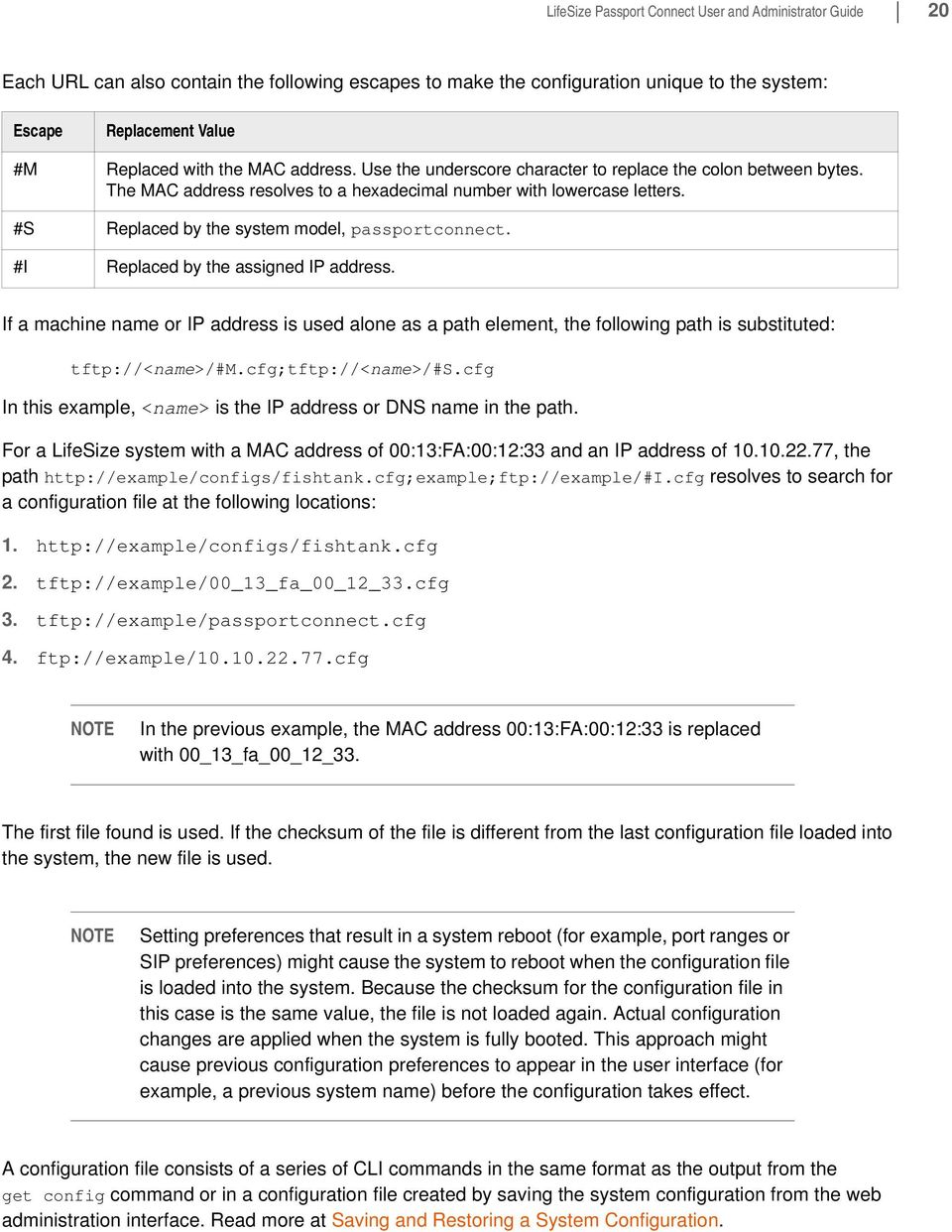
20 LifeSize Passport Connect User and Administrator Guide 20 Each URL can also contain the following escapes to make the configuration unique to the system: Escape Replacement Value #M Replaced with the MAC address. Use the underscore character to replace the colon between bytes. The MAC address resolves to a hexadecimal number with lowercase letters. #S Replaced by the system model, passportconnect. #I Replaced by the assigned IP address. If a machine name or IP address is used alone as a path element, the following path is substituted: tftp://<name>/#m.cfg;tftp://<name>/#s.cfg In this example, <name> is the IP address or DNS name in the path. For a LifeSize system with a MAC address of 00:13:FA:00:12:33 and an IP address of , the path resolves to search for a configuration file at the following locations: tftp://example/00_13_fa_00_12_33.cfg 3. tftp://example/passportconnect.cfg 4. ftp://example/ cfg NOTE In the previous example, the MAC address 00:13:FA:00:12:33 is replaced with 00_13_fa_00_12_33. The first file found is used. If the checksum of the file is different from the last configuration file loaded into the system, the new file is used. NOTE Setting preferences that result in a system reboot (for example, port ranges or SIP preferences) might cause the system to reboot when the configuration file is loaded into the system. Because the checksum for the configuration file in this case is the same value, the file is not loaded again. Actual configuration changes are applied when the system is fully booted. This approach might cause previous configuration preferences to appear in the user interface (for example, a previous system name) before the configuration takes effect. A configuration file consists of a series of CLI commands in the same format as the output from the get config command or in a configuration file created by saving the system configuration from the web administration interface. Read more at Saving and Restoring a System Configuration.
21 LifeSize Passport Connect User and Administrator Guide 21 Specifying the Hostname and DNS Servers Enter the hostname of the system and the IP addresses to configure DNS servers in Administrator : Network : General : Hostname and DNS Servers, respectively. DNS translates the names of network nodes into addresses. Specify this preference to use DNS to resolve the hostnames of devices to IP addresses. You can also enter the domain names to search when resolving hostnames in Name Search Domains. Specifying Network Speed If you choose an option other than Auto for Administrator : Network : Network Speed, ensure that it matches the speed and duplex values that are configured on your network switch. If your Ethernet switch is configured for half duplex, you might experience poor quality video when placing calls that are greater than 512 kb/s. Change your Ethernet switch configuration to a setting other than half duplex when using Auto for Network Speed. Specifying a VLAN Tag If you have static virtual local area networks (VLANs) configured in your environment, configure your LifeSize system to apply a VLAN tag to outgoing packets and to accept only incoming tagged packets that feature the same VLAN identifier. Specify the VLAN identifier of the VLAN to which the system is assigned in Administrator : Network : General : VLAN Tag. The value is a number in the range 1 through If you set or modify VLAN Tag, the system reboots when you navigate to another screen. Configuring 802.1X Authentication LifeSize video communications systems support port-based mutual authentication based on the IEEE 802.1X standard using the EAP-TLS subprotocol. By default, 802.1X authentication is disabled on a LifeSize system. Before you enable this feature in Administrator : Network : General : 802.1x Authentication, ensure that your environment satisfies the following prerequisites: An authentication server is installed with the certificate authority (CA) certificate, the server certificate, and the server certificate private key. The authenticator is configured to access the authentication server and to allow one or more of its ports to provide 802.1X access control.
22 LifeSize Passport Connect User and Administrator Guide 22 You have installed the following items, which are produced by the CA, on the LifeSize system: - CA certificate - client certificate - client key - client key passphrase NOTE If you do not install the CA certificate, client certificate, client key, and client key passphrase on the LifeSize system from the CLI before enabling 802.1x, the LifeSize system fails to connect to the network when you enable 802.1x. In this case, access the system through the user interface to disable the feature. Specifying an NTP Server The system date and time that appear in the user interface are automatically set if one of the following conditions exists: Administrator : Network : General : DHCP is enabled and the DHCP server can pass an NTP server address to your system. Administrator : Network : General : NTP Server Hostname specifies the hostname or IP address of an NTP server. NOTE An NTP server address that a DHCP server passes to your system overrides an NTP server hostname or address that is specified in NTP Server Hostname. The System Information page shows the IP address of the NTP server that the system uses. The time zone is not set automatically. If you did not specify the time zone for your system during the initial configuration, the time that appears in the user interface might not be correct. Specify the time zone in Administrator : System : Date and Time. Configuring Quality of Service Specify network Quality of Service (QoS) settings in the Administrator : Network : Network QoS preferences. Set these preferences according to the settings that are used in your network.
23 LifeSize Passport Connect User and Administrator Guide 23 Configuring Your LifeSize System for Firewall Traversal This section explains how to configure your LifeSize video communications systems for firewall traversal. Additionally, this section assumes that you are not using such firewall traversal products as LifeSize Transit. Refer to the LifeSize Transit Deployment Guide if you are using LifeSize Transit. Placement Behind a Firewall LifeSize recommends that you place your system behind a firewall. Use one of the following options: DMZ with public IP address Private LAN with NAT Placing your video systems in the DMZ allows you to assign public IP addresses. This configuration makes it easier for your system to connect with public video communications devices on the Internet. Placing your video systems in the private LAN with NAT obscures their private IP addresses but complicates calls with systems that reside outside your network. Firewall Settings for Ports At a minimum, block external or inbound access to the following ports: 22 (SSH) 23 (telnet) 80 (HTTP) 443 (HTTPS) LifeSize recommends that these ports remain open for internal administrator access. Ensure that you change the default administrator and CLI passwords to be secure, as follows: Change the administrator password in Administrator : Security : Passwords. Read more at Administrator and User Passwords. Use the set password command to change the CLI password. The default CLI password is lifesize. You can disable SSH and web access on the system. Telnet access is disabled by default. Read more at Managing Your System. Call Setup and Media Ports To place calls to other systems through your firewall, configure it to allow incoming and outgoing traffic to the system through the following ports: UDP port 5060 TCP port 5060 TCP port 5061 Required TCP and UDP ports SIP call negotiation. SIP call negotiation if TCP signaling is enabled for SIP calls. Read more at Configuring SIP Settings. TLS signaling in SIP calls if TLS signaling is enabled. Read more at Configuring SIP Settings. Range specified in Administrator : Network : Reserved Ports.
24 LifeSize Passport Connect User and Administrator Guide 24 Restricting Reserved Ports To place calls to other devices through a firewall, configure it to allow incoming and outgoing traffic to the LifeSize system through the reserved ports. Users who place calls through a firewall to systems with public IP addresses might experience one-way audio or video if the firewall is not configured to allow two-way video and audio traffic. By default, LifeSize systems communicate through TCP and UDP ports in the range for video, voice, presentations, and camera control. LifeSize systems use only a small number of these ports during a call. The exact number depends on the number of participants in the call, the protocol used, and the number of required ports. To minimize the number of UDP and TCP ports that are available for communication, restrict the range by changing the appropriate values in Administrator : Network : Reserved Ports. LifeSize recommends that the range you choose, if other than a subset of the default range, begins with a port number greater than The UDP range must start with an even number and end with an odd number to include an even number of total ports. For a range that starts at 62000, for example, set the lower end to and the upper end to to allocate a range of 56 ports. NOTE Changing the TCP range causes an automatic reboot of the system. The following table identifies the number of ports that are required for a SIP two-way call. Call Type Video a Voice Number of Required UDP Ports 8 UDP ports, 6 if presentations are disabled 2 UDP ports a. Dual video with third party devices requires one additional port. Use the following information as a guide when determining the range of port numbers to enter in Reserved Ports. Maximum Connections Required Ports for a SIP call Two-way video call and a presentation 8 UDP Two-way video call with a presentation and an audio call 10 UDP
25 LifeSize Passport Connect User and Administrator Guide 25 Using LifeSize Systems in a Private LAN with NAT If you choose to place your video communications systems in a private LAN, use NAT to communicate with outside systems. This approach might include enabling static NAT on your LifeSize system. Complete one of the following tasks on your firewall, regardless of whether it is a standalone model or is built into your router: Use one-to-one NAT and open the Call Setup and Media Ports over that connection bidirectionally with an access list. Forward the Call Setup and Media Ports to your LifeSize system. Refer to Restricting Reserved Ports and your firewall vendor's documentation for more information. Enabling NAT NAT enables communication between devices on your LAN that have private IP addresses and devices that are accessed through a public IP network. Static NAT ensures that the same public IP address always maps to a system s private IP address so that data from the public network intended for the private system can be routed to the system reliably. If you are using static NAT to associate a public IP address with the private IP address of your LifeSize system, configure your LifeSize system to work with your static NAT server. Set Administrator : Network : NAT : Static NAT to Enabled. Enter the public IP address, hostname, or fully qualified domain name of your system in NAT Public IP Address. The default entry method for this preference is numeric. To enter text, press to change the entry method to text. The following functions are not supported if your system is accessed from a web browser outside a firewall and static NAT is enabled: system upgrade directory import background image import Instead, execute these functions from within the firewall.
26 LifeSize Passport Connect User and Administrator Guide 26 Testing your NAT Environment If your firewall does not employ a feature set that performs SIP NAT, enable NAT on your private LifeSize system. 1. Place a call from a system on the Internet to your system in the private LAN. If your private system connects within the first two seconds after answering, your NAT configuration is functioning appropriately. If the call does not connect after answering and disconnects after 30 to 50 seconds, the reserved port settings on your codec do not match the settings on your firewall. Ensure that the system and firewall settings for the UDP and TCP ports match. 2. If you still cannot place a successful call, you might need to disable the stateful packet inspection feature on the firewall. Some firewall vendors might identify this feature as dynamic packet filtering. Refer to your firewall vendor's documentation for more information. Configuring Appearance Configure how to display information on your system in Administrator : Appearance. Picture in Picture With Picture In Picture (PIP) enabled, the primary input always appears. Change the default setting so that PIP never or always appears in Administrator : Appearance : Layout. Display Specify display types, resolutions, and energy management options in Administrator : Appearance : Displays. Typically, you configure display resolutions when you install your system or change a display and when you troubleshoot display issues. Refer to the LifeSize Passport Series Installation Guide for more information. Set Display Energy Saver to Enabled for connected displays to turn off the signal that the LifeSize system sends to the display when the system goes to sleep. LifeSize recommends that you test this feature for compatibility with your display before using it in your environment. Some displays might appear black when the signal from the system is no longer received but are not in an energy-saving state. Other displays might recognize the loss of the signal and show text that indicates this state. Consequently, the text image might burn into the screen. Some displays might recognize the loss of the signal and power off but not wake up when the LifeSize system later wakes up.
27 LifeSize Passport Connect User and Administrator Guide 27 Hiding User Interface Elements Hide the following user interface elements in Administrator : Appearance : General: Preference Description Default Value Company Logo Clear Last Number Dialed Choose None to hide the LifeSize logo in the user interface and screen saver. The Default option shows the logo. When enabled, clears the last number that is dialed manually. Default Disabled To hide all IP addresses in the user interface, enable Clear Last Number Dialed. Custom Backgrounds Manage the system s background from the user interface and the web administration interface. Specifying a Background Color 1. Navigate to Administrator : Appearance : Backgrounds. 2. Set Background Image to None. 3. Set Display Background Color to the desired color. Adding a Custom Background Image You can add or remove custom background images only from the web administration interface. 1. Open a web browser and enter the system s IP address to log in to the web administration interface. 2. Access : Appearance : Backgrounds. 3. Click Add and browse to the image file. Images must be 1280 x 720 JPGs with unique display names. 4. To apply the new image, select it and click the desired display. Choosing a Background Color from the Interface You can choose a custom background color only from the web administration interface. 1. Open a web browser and enter the system s IP address to log in to the web administration interface. 2. Access : Appearance : Backgrounds. 3. Click the color swatch next to the current background for the display. 4. Use the eye dropper to choose a color from the web administration interface. 5. Click the display to apply the color.
28 LifeSize Passport Connect User and Administrator Guide 28 Defining a Custom Color You can define a custom color only from the web administration interface. 1. Open a web browser and enter the system s IP address to log in to the web administration interface. 2. Access : Appearance : Backgrounds. 3. Click the color wheel to access the color editor. 4. Specify a custom color by supplying RGB values or a hexadecimal value. -or- Choose a predefined color by clicking a color swatch from the color editor. 5. Click Save Changes. 6. Click the display to apply the color. Configuring Call All users can set auto answer options for calls and specify the maximum number of entries to appear in the redial list. Read more at Automatically Answering Calls and Managing the Redial List. Administrators configure additional call preferences in Administrator : Calls. Managing Bandwidth Specify the maximum bandwidth that an outgoing or incoming call uses by setting Outgoing Call Bandwidth or Incoming Call Bandwidth in Administrator : Calls. The value for Outgoing Call Bandwidth becomes the maximum value that users can choose when manually placing a call or when specifying a bandwidth in a directory entry. If a user specifies Auto for the bandwidth when placing a call, the outgoing bandwidth becomes the starting point for negotiating bandwidth when the call connects. Additionally, the system uses the appropriate bandwidth based on the following information: display resolution and frame rate of the device (720p60) capability of the input device Outgoing Total Bandwidth and Incoming Total Bandwidth set the maximum amount of network bandwidth to use for all outgoing and incoming calls. Auto Bandwidth addresses how the system responds to packet loss during a call. When set to the default of Enabled, the system attempts to use the best available bandwidth after the call connects. Selecting a Maximum Call Time Control the amount of time that a call stays connected at Administrator : Calls : Maximum Call Time. When this preference is set and the time expires, the call stops without an option to extend.
29 LifeSize Passport Connect User and Administrator Guide 29 Admission Control Admission control rejects calls to multiway capable systems under a heavy call load. Enable or disable this preference in Administrator : Calls : Admission Control. Configuring Communications Specify protocols the system uses during calls in Administrator : Communications. Disabling Multiway Calling Disable multiway calling by setting Administrator : Communications : General : Multiway Calls to Disabled. You can configure this preference only when the system is not in a call. Choosing Disabled allows only one call, voice or video, to connect to the system. Configuring Dialing Options Choose video and voice dialing options during initial configuration: Dialing Option Preference Default Value Video Auto (enables the system to determine the best method to use to place calls) IP Voice VoIP (uses SIP) SIP When voice dialing is set to VoIP, you can dial IP addresses and phone numbers. Auto VoIP Enabling Presentations LifeSize Passport Connect can share data during a call with the following preferences enabled in Administrator : Communications : General. With LifeSize Virtual Link installed on the presenter's laptop, LifeSize Passport Connect can initiate presentations by sharing data over IP during a call. By default, support for network presentations is enabled. Read more in the LifeSize Virtual Link Installation Guide.
30 LifeSize Passport Connect User and Administrator Guide 30 Connecting to LifeSize Connections LifeSize Connections provides a cloud-based video conferencing platform that delivers the following benefits: 720p30 video nine-way calling data sharing built-in firewall traversal automatic configuration of system hardware Connect to LifeSize Connections by setting Administrator : Communications : LifeSize Connections: Connections to Enabled and clicking Connect. If the serial number of your LifeSize Passport Connect system is included in the Connections registry, the LifeSize Connections service recognizes the number and establishes a connection to your system. If the Connections registry does not include the serial number, specify a valid Connections ID and registration key and click Connect. Read more at Registering with LifeSize Connections. If an attempt to connect to LifeSize Connections is unsuccessful, a message identifies the condition that prevented the connection. Read more at LifeSize Connections Issues. The following table identifies icons and other indicators that show your LifeSize Connections status. Status Icon on Status Bar User ID in Upper Right Corner of Screen Connected None Yes Not connected None No Unable to connect to LifeSize Connections Can connect to LifeSize Connections but unable to log in No No Further, a Connections icon that appears next to an entry in your contacts, the directory, or the redial list indicates that the system is logged in to LifeSize Connections. The color of the icon indicates the status of the system s connection to LifeSize Connections, as follows: Green Available Orange In a call Red Do not disturb Silver Inactive Gray Offline Gray crosshatch Away Black No presence-related information is available
31 LifeSize Passport Connect User and Administrator Guide 31 Registering with LifeSize Connections You must add a LifeSize Passport Connect system to the Connections registry before it can use LifeSize Connections to place or receive a call. Use the Connections Administrator Console to register systems individually or as a group, depending on the level of system information to which you have access. To access the Administrator Console, open a web browser and enter the URL that was provided with your authentication credentials when you purchased LifeSize Connections. Enter the administrator username and password and click Login. Registering Systems Individually If you know the serial numbers of your LifeSize Passport Connect systems, use them to add your systems to the Connections registry. If you do not know the serial numbers of your systems, create Connections IDs and obtain registration keys for each of them. 1. In the Administrator Console, click the Rooms tab. 2. Click Add Rooms Individually. If you do not know the serial number of your system, proceed to step 3. If you know the serial number of your system, proceed to step Click Provision Manually. The Registration Key text box populates with a numeric value. Use this key, along with the Connections ID that you specify in the next step, to connect to LifeSize Connections. 4. Specify the following information: - A name that describes the location or function of the system. - The serial number of the system, if applicable. - A unique Connections ID that is associated with the system. 5. Click Add. A valid Connections ID is between 4 and 32 alphanumeric characters in length and begins with a lowercase letter that is followed by any combination of the following characters: lowercase letters (a-z) numbers (0-9) periods (.) underscores (_) Dashes can be used after the fourth character in a Connections ID. The registered system appears in the Room List and can connect to LifeSize Connections. Read more at Connecting to LifeSize Connections. Repeat the previous four steps as necessary to register your remaining systems.
32 LifeSize Passport Connect User and Administrator Guide 32 Importing a CSV File to Register Multiple Systems To register multiple LifeSize Passport Connect systems whose serial numbers are known, import them by way of a comma-separated values (CSV) file. 1. In the Administrator Console, click the Rooms tab. 2. Click Import Rooms. 3. Click Download the CSV template and save rooms_import.xls as a CSV file to the location of your choice. 4. For each system that you want to register, specify the following information in the appropriate column in rooms_import.xls: - A name that describes the location or function of the system. - A unique Connections ID that is associated with the system. For information about requirements and restrictions, see Registering Systems Individually. 5. After you specify the appropriate information for each system, save and close rooms_import.xls. 6. On the Import Rooms page, click Browse to open the Choose File to Upload dialog box. 7. Select rooms_import.xls and click Open. 8. Click Import. The imported systems appear in the Room List. Systems that were imported but did not successfully register, possibly because they violated the Connections ID requirements or were already registered, appear in red. Systems that were successfully registered can connect to LifeSize Connections. Read more at Connecting to LifeSize Connections. Configuring SIP Settings By default, LifeSize systems support SIP. Disable support for SIP calls in Administrator : Communications : SIP when the system is not in a call. NOTE If SIP is disabled, a warning message indicates that you cannot place or receive calls. Preference Description Default Value SIP When enabled, allows you to specify a SIP name to use when placing a call. Enabled SIP Username SIP username for the device. LifeSize Authorization Name Authorization Password SIP server authorization username. Set a value only if required by the registrar or proxy. SIP server authorization password. Set a value only if required by the registrar or proxy.
33 LifeSize Passport Connect User and Administrator Guide 33 Preference Description Default Value SIP Server Type SIP Registration Type of SIP registrar and proxy servers. If you plan to use Microsoft Office Communications Server 2007 or Microsoft Lync Server for SIP calls with your LifeSize system, choose Microsoft OCS. Refer to the release notes for information about supported Microsoft Office Communications Server 2007 and Microsoft Lync Server versions. Refer to the LifeSize technical note Using LifeSize Systems with Microsoft Office Communications Server and Microsoft Lync Server for configuration information. Communication path to use when registering with a SIP registrar. SIP devices use register settings to dynamically register their current location. Auto Through Proxy SIP Proxy When enabled, uses a SIP proxy server. Disabled Proxy Hostname Hostname or IP address of the SIP proxy server. SIP Registrar When enabled, uses a SIP registrar server. Disabled Registrar Hostname Hostname or IP address of the SIP registrar server. Internal Server Hostname or IP address of the Microsoft OCS internal server. External Server Hostname or IP address of the Microsoft OCS external server. SIP Signaling Preferred SIP signaling protocol. To specify the signaling protocol, a SIP registrar must be enabled. Signaling protocols are mutually exclusive;. As a result, enabling one protocol disables the other protocols. Disabling the SIP registrar automatically sets the signaling protocol to Auto. Auto UDP Signaling Port TCP Signaling Port UDP port number of the SIP configuration TCP port number of the SIP configuration TLS Signaling Port TLS port number of the SIP configuration. If you enable TLS signaling, the system attempts to use Secure Realtime Transport Protocol (SRTP) for media encryption in SIP calls. If the far side supports SRTP, the media is encrypted, and encryption icons appear in the caller ID, Call Manager list, and Call Statistics list during a call. Read more at Call Encryption. If the far end does not support SRTP, the media is not encrypted, and call encryption icons do not appear in the user interface When you select Register and press OK, icons in the status bar indicate the status of the registration process with the SIP server. The yellow SIP icon appears when your LifeSize system is trying to register with the SIP server. If the registration fails, the red SIP icon appears. NOTE The system reboots if you change the signaling port or if you enable or disable signaling.
34 LifeSize Passport Connect User and Administrator Guide 34 Configuring Audio Behaviors Adjust audio behaviors in Administrator : Audio by Selecting the Active Microphone and Adjusting Audio Volume. Additional audio settings include the following options: Microphone Status Testing Primary Audio Output Configuring Audio Codec Order The Active Microphone field on the System Information page identifies the device that functions as the active microphone. When the value is None, appears in the status bar. The Microphone In field appears on the System Information page for systems that have a microphone in connector on the codec and indicates the connection status of a device for the input: None, Ready, or Error. Test audio output to speakers connected to the codec as the primary audio output device during initial configuration or in Administrator : Audio : Primary Audio Output Test. Select a channel to test or select Auto. The Auto option cycles through available channels and plays the test tone for five seconds before moving to the next available channel. To end the test, choose Off or navigate to another preference or screen. Change the order of audio codecs that the system uses when placing calls in Administrator : Audio : Audio Codec Order. Selecting the Active Microphone Select a device to serve as the active microphone during initial configuration or in Administrator : Audio : Active Microphone. The following options are available for the Active Microphone: Auto (default) Specifies your MicPod as the active microphone, if one is connected. If a MicPod is not connected to your system, your USB camera is specified as the active microphone. Microphone In Specifies your MicPod as the active microphone. Camera 1 Specifies your USB camera as the active microphone. Selecting the Audio Output Select an audio output device for video and voice calls either during initial configuration or from Administrator : Audio : Video (or Voice) Call Audio Output The following output options are available for both types of calls: Auto (default) Selects Line Out if speakers are plugged in; otherwise, selects HD Out (display speakers). Line Out and HD Out Specifies both Line Out and HD Out as your audio output devices. Line Out only Specifies Line Out as the only output device. HD Out only Specifies HD Out as the only output device.
35 LifeSize Passport Connect User and Administrator Guide 35 Adjusting Audio Volume Adjusting the Active Microphone Volume If you have plugged a third party microphone into the micpod port, adjust Active Microphone Volume in User or Administrator : Audio. Volume preferences for audio inputs appear with a bar graph audio meter next to the slider. The audio meter expands below the slider when you select the slider and press OK. Read more at Adjusting Audio. Adjusting Audio Levels Line Out Treble (db) Line Out Bass (db) Ring Tone Volume DTMF Tone Volume Status Tone Volume System Ringer Volume System Ringer Tone Adjust the higher frequencies in the sound range for the audio output. Adjust the lower frequencies in the sound range for the audio output. Select the volume level of the ring and busy tones. Select the volume level of the DTMF and key click tones. Select the volume level of status tones. Select the volume level of the system ringer. Select one of five preset system ringer tones. Configuring Video Behaviors Administrators control cameras and video quality in Administrator : Video. Controlling Camera Use by Far End Users To prevent far end users from controlling your near end camera, including configuring and controlling camera presets, disable Administrator : Video : Video Control : Far Control of Near Camera. If you choose Enabled, you can still prevent far end users from configuring and using near end camera presets by disabling Far Set of Camera Presets and Far Move to Camera Presets. Controlling Camera Pan Direction Define the camera s pan direction relative to the physical arrangement of the camera by setting Administrator : Video : Video Control : Camera Pan Direction. Select Perceived for the camera to pan left or right from the user s perspective when facing the camera. Select Reversed for the camera to pan to the camera s actual left or right.
36 LifeSize Passport Connect User and Administrator Guide 36 Adaptive Motion Control Adaptive motion control improves video reproduction by minimizing video problems that are caused by minor packet loss. For packet loss of five percent or less, this feature eliminates or greatly reduces video artifacts. This feature is enabled by default in Administrator : Video : Video Quality : Adaptive Motion Control. Customizing Input Device Names Define a custom input name by changing the default value for HD Camera 1 Name in Administrator : Video : Video Control. Customized names are limited to 16 characters. The default name is HD Camera 1. Selecting Priority of Quality Metrics for Source Video You can favor sharpness or motion for the quality of primary video that your LifeSize system sends to the far end during a call. If you favor sharpness by selecting a smaller number in Administrator : Video : Video Quality : Primary Video Motion, in lower bandwidth calls the system sends the primary video at a lower frame rate and a higher resolution. The default value of 10 favors motion. Consider adjusting this preference if bandwidth is limited. Adjusting Video Encoder Quality Adjust the quality of the video image that is sent to the far end during a call by specifying a relatively lower or higher resolution in Administrator : Video : Video Quality : Video Encoder Quality. Move the slider to the right to improve the quality of the video image. Adjusting the MTU of Video Packets Video packets that exceed the maximum transmission unit (MTU) size for any router or segment along the network path might be fragmented or dropped, resulting in poor quality video at the receiving device. Set the MTU of video packets that your LifeSize system sends in Administrator : Video : Video Quality : Video MTU. The allowed range is bytes, and the default value is 1440 bytes. Refer to the technical note Troubleshooting Packet Loss for strategies to address packet loss.
37 LifeSize Passport Connect User and Administrator Guide 37 Configuring LifeSize Video Communications Systems to Record With LifeSize Video Center in your environment, LifeSize video systems can initiate an out-of-call recording to LifeSize Video Center. By default, the recording capability is disabled. Perform the following steps to enable recording: 1. On the LifeSize video communications system, navigate to Administrator : Video : Record and Stream. 2. Set Recorder to Enabled. 3. In Recorder Hostname, enter the IP address or DNS address of the recording and streaming server. In most cases, you can accept the default Recorder Port value of 443. NOTE If your network uses NAT with port forwarding rules that remap port 443 between the video communications system and the server, Recorder Port must reflect the remapped port number. 4. To provide a default key to use for server authorization for all recordings from this system, enter it in Recording Key. If you leave this setting blank, the system prompts users to enter a key for each recording. Enabling FIPS Security LifeSize video communications systems support the Federal Information Processing Standard (FIPS) 140-2, (Level 1), a U.S. government computer security standard. By default, FIPS is disabled. When you set FIPS to Enabled in Administrator : Security : General, the following actions occur: HTTP, Telnet, and SNMP in Administrator : Security : General are automatically set to Disabled and unavailable for configuration. Login access to the CLI through SSH is disabled. NOTE The current value for the SSH preference does not change x Authentication in Administrator : Network : General is automatically set to Disabled and unavailable for configuration. The License Keys button on the Administrator : System screen is unavailable. SIP Signaling in Administrator : Communications : SIP is set to Auto. The system reboots after you exit the Administrator : Security : General screen.
38 LifeSize Passport Connect User and Administrator Guide 38 A red icon appears in the status bar on the main page until the system completes the configuration changes to enable FIPS security. FIPS Security Enabled appears above the Security button on the Administrator screen after the system reboots. When FIPS is set to Enabled, you cannot upgrade the system software. Instead, you must first set FIPS to Disabled. Ensure that HTTP and SSH are set to Enabled before attempting to perform an upgrade. If you change FIPS from Enabled to Disabled, the following actions occur: that were unavailable for configuration as a result of enabling this preference become available. Login access to the CLI through SSH is enabled. NOTE The current value for the SSH preference does not change. HTTP and SNMP are set to Enabled. NOTE other than HTTP and SNMP that were modified as a result of setting FIPS to Enabled do not change. The system reboots after you exit the Administrator : Security : General page. Managing Directories Your LifeSize Passport Connect system includes the following directories: your contacts the corporate directory a redial list You can add entries to your list of contacts and can place calls from all directories. Read more at Working with Directories.
39 LifeSize Passport Connect User and Administrator Guide 39 Disabling Access to a Directory Disable access to a directory by setting the appropriate directory to Disabled in Administrator : Directory : General. Use Call Button Order to specify the sequence in which enabled directories appear on the Home page. Disabling access to your contacts prevents users from completing the following tasks: Saving entries from the redial list to your contacts Copying entries from the corporate directory to your contacts If access to your contacts is disabled from the user interface, you can still access them through the Directory page in the web administration interface. Read more at Managing Directories from the Web Administration Interface. Populating the Corporate Directory Users can place calls from the corporate directory by selecting a number to dial from a list of stored numbers. This directory can store up to 1000 entries in alphabetical format. All users can manage entries in their lists of contacts, but only administrators can manage entries in the directory. Populate the directory by configuring Auto Discovery preferences or Lightweight Directory Access Protocol (LDAP) preferences in Administrator : Directory. By default, auto discovery is enabled, and LDAP is disabled. You can enable only one of these methods. The system automatically disables the other method to prevent duplicate entries from appearing in the corporate directory. The status, enabled or disabled, appears in Administrator : Directory. The connection status of the LDAP installation also appears on this page and on the System Information page. Connection status can appear as one of the following values: LDAP Connection Status Unregistered Registered Unreachable Unauthorized Invalid Syntax Failed Description LDAP preferences are not configured. LDAP preferences are configured. The last attempt by the LifeSize system to contact the LDAP server and receive data was successful. LDAP preferences are configured, but the LDAP hostname is invalid or the service does not exist. LDAP preferences are configured, but the username or password is invalid. LDAP preferences are configured, but the base Distinguished Name (DN) is invalid. LDAP preferences are configured, but an unexpected failure occurred. This directory is also populated when a system connects to LifeSize Connections.
40 LifeSize Passport Connect User and Administrator Guide 40 Configuring Auto Discovery Auto discovery enables LifeSize systems on your network to pass address information to other LifeSize systems automatically. When a LifeSize system joins a network, it sends a broadcast packet to the local subnet by default to announce its presence. Any LifeSize system on the local subnet that receives the packet and has Auto Discovery set to Enabled replies by sending address information about itself and a list of IP addresses of other LifeSize systems that it discovered. The LifeSize system creates an entry in its corporate directory for every system on the local subnet from which it received a response. It then queries the list of other IP addresses that it received and the IP addresses that are stored in its own redial list, but only if those addresses are allowed by the filters that you specify in Auto Discovery Subnets and Auto Discovery Ignored Subnets. By default, the system replies and sends queries to other LifeSize systems in the local subnet only. Configure Auto Discovery Subnets and Auto Discovery Ignored Subnets to enable the system to discover other LifeSize systems outside the local subnet and to share that information with other LifeSize systems. Specify subnet filters, separated by spaces, in Auto Discovery Subnets to identify the subnets where the LifeSize system can send queries and replies. By default, the preference is empty, and the system sends queries and replies to other LifeSize systems on the local subnet only. To exclude subnets from auto discovery, specify subnet filters in Auto Discovery Ignored Subnets. If a destination address does not match one of the filters in Auto Discovery Subnets, or if it matches one of the filters in Auto Discovery Ignored Subnets, the LifeSize system does not query or reply to the LifeSize system at that address. Configure Auto Discovery Subnets to include a large subnet, and configure Auto Discovery Ignored Subnets to exclude a subset of the subnet. For example, a network might contain several subnets with the IP address 10.* and a slow network connection to devices that have a * address. If you enter 10.* in Auto Discovery Subnets and * in Auto Discovery Ignored Subnets, the LifeSize system queries and replies to all LifeSize systems with a 10.* address, except those systems with a * address. If you set Auto Discovery to Disabled, the LifeSize system does not send a broadcast message to the local subnet and cannot discover or be discovered by other LifeSize systems. Reading from an LDAP Server When you enable and configure LDAP preferences to populate the corporate directory, specify the hostname, login and query parameters, and the refresh interval for reading data from a preconfigured LDAP server.
41 LifeSize Passport Connect User and Administrator Guide 41 Managing Directories from the Web Administration Interface Advanced usage of the corporate directory is available only from the web administration interface. On the Directory tab, click the name of the directory that you want to access. List All retrieves the current directory data. When viewing your contacts, click the following buttons to manage entries: Clear All deletes all entries. Import adds multiple entries. Export exports the entries in CSV format. Add New adds a single entry. When viewing the directory, click Export to export the entries in CSV format. NOTE When importing and exporting directory entries from the web administration interface, use a text editor that supports UTF-8 encoding to view or edit the data. Double-byte characters are not supported in directory entries that are imported through the web administration interface. Maintaining Your System Upgrading System Software This section describes how to apply software updates to your system. Use the same process to downgrade your system to a previous version. Before performing an upgrade or downgrade, consider saving your configuration. Read more at Saving and Restoring a System Configuration. NOTE After performing a downgrade, reset the system to the factory defaults. Before you upgrade your LifeSize system software, ensure that the system meets the following prerequisites: The camera that you intend to use with the system is connected to the codec. A camera that is not connected to a LifeSize system before an upgrade might not function appropriately after an upgrade. An upgrade fails if a current license key does not exist on the system. The expiration date for the upgrade license appears on the System Information page. Read more at Updating License Keys. Contact your LifeSize Partner to renew your maintenance agreement. The renewal process generally requires 24 to 48 hours to complete.
42 LifeSize Passport Connect User and Administrator Guide 42 Perform the following steps to upgrade the software for your system: 1. From lifesize.com/support, click Download Software. NOTE Access updates directly at lifesize.com/support/software_updates.aspx. 2. Enter your serial number, which is located on the bottom or back of your LifeSize system codec and on the System Information page. 3. Click the link for the software version that you want to download. 4. Download the upgrade to a local directory on your system. 5. Access the web administration interface by entering the IP address of your system in a supported web browser and logging in. 6. Click the Maintenance tab. 7. Click System Upgrade. 8. If your upgrade requires you to reset the system to the original default settings, select Reset to Default State. 9. Browse for the upgrade file you downloaded in step Click Upgrade. NOTE If calls are connected to the system, a dialog box prompts you to continue or cancel the upgrade. Click Yes to continue with the upgrade and disconnect the active calls. The upgrade might take several minutes to complete. Do not disrupt the upgrade process. During an upgrade, a status screen appears, users cannot cancel the screen, and the system rejects incoming calls. 11. A system upgrade status message appears when the upgrade is complete. Close the status and the administrator configuration windows. 12. If you selected Reset to Default State in step 8, reconfigure your system. Read more at Initial Configuration. 13. To access all web administration options after an upgrade or downgrade, close your web browser, clear the browser cache, and reopen your web browser.
43 LifeSize Passport Connect User and Administrator Guide 43 Troubleshooting Upgrade Failures Perform the following steps if attempts to upgrade software for your LifeSize system fail: 1. Ensure that you have a valid upgrade image. 2. Reboot the system. 3. Attempt the upgrade again. 4. If a second attempt fails, note the error code that is returned. 5. If problems persist, contact your LifeSize Partner or LifeSize Technical Services. Upgrade Error Codes Code Problem Description 1 Internal error The system is missing critical files. 2 Switch to upgrade failed The command to set the active partition failed. 3 Write failed A write failure occurred while copying the image to the upgrade partition. This error typically occurs when you use an upgrade image for another LifeSize product. 4 Read failed Reading incoming data failed during the image upload. This error typically occurs if the connection is broken during the upload. 5 Upgrade script failed After the image successfully uploads, the system runs an upgrade script for final processing. This error indicates a failure in the script and typically occurs when you use an upgrade image for another LifeSize product. 6 Unable to run upgrade script 7 Unable to mount upgrade partition The system was unable to run the upgrade script. This error typically occurs when you use an upgrade image for another LifeSize product. After the image was copied to the system, the system failed to mount the image. This error typically occurs if the upgrade image is corrupt or when you use an upgrade image for another LifeSize product. 8 No permission The system failed to read the upgrade partition. 9 Corrupt image The upgrade image is corrupt and unusable. This error typically occurs because of a corrupted image or errors upload to the device. 10 Bad argument An invalid argument was submitted to the upgrade process. This error typically occurs when you use an upgrade image for another LifeSize product. 11 Invalid signature The encryption signature is invalid. This error typically occurs if the image is corrupt or compromised. 12 Decrypt failed The system was unable to decrypt the upgrade image. This error typically occurs if the image is corrupt or compromised. 13 Developer system The system is configured for development and can only be upgraded by a LifeSize representative. 14 Upgrade in progress An upgrade is already in progress. The system supports only one upgrade at a time.
44 LifeSize Passport Connect User and Administrator Guide 44 Code Problem Description 15 Upgrade license expired A current license key for upgrading the system software does not exist on the device. Contact your LifeSize Partner to renew your maintenance agreement. Updating License Keys A system software upgrade fails if a current license key does not exist. A current license key for upgrades is available when a maintenance agreement for the device is in effect. The Upgrade License field on the System Information page shows the expiration date of an upgrade license key installed on the system, if a key exists. NOTE You can install a patch to a software release with an expired license key if the key was current when the software was released. The third digit of the threedigit version number identifies a patch. For example, is patch 1 to release v If a license key is not installed on a system during an upgrade or if the installed key is expired, the system attempts to check the status of the license key. Check for updates to license keys in the user interface or the web administration interface (if your LifeSize system has HTTP access through port 80). If your system does not have HTTP access through this port, refer to Installing a License Key Manually. Checking for License Key Updates Check for license key updates from the user or the web administration interface. 1. From the user interface, navigate to Administrator : System : License Keys. -or- From the web administration interface, navigate to : System : License Keys. 2. Select Update Keys. 3. Press OK. If the update is successful, Success appears in the Update Key Status box, and the current license key and its expiration date appear in the Upgrade License box.
45 LifeSize Passport Connect User and Administrator Guide 45 If an update to a license key fails in the user or web administration interfaces, one of the following messages appears in the Update Key Status box: Status Message No Contract Service Unavailable Invalid Key Description A current maintenance agreement for the device does not exist. Contact your LifeSize Partner to renew your maintenance agreement. The renewal process generally requires 24 to 48 hours to complete. The system failed to connect. The server might be down, or your system might not have HTTP access. Contact LifeSize Technical Services if this condition persists and you have HTTP access, or install a key manually by performing the steps in Installing a License Key Manually. A license key exists but is invalid. Contact LifeSize Technical Services for additional information. Installing a License Key Manually If you cannot obtain a license key by using the license key update feature in the user or web administration interface, you can install a key manually from the web administration interface. 1. From lifesize.com/support, click Download Software. 2. Log in to the LifeSize software download site. 3. Enter the serial number of your LifeSize video communications system. 4. Click Submit. 5. Copy the license key from the software download page to your operating system clipboard. 6. Open a separate web browser and access the web administration interface of your LifeSize system. 7. Navigate to : System : License Keys. 8. In the Enter New Key box, paste the license key that you copied in step Click Add Key. NOTE Add Key is available only after you copy a key in the Enter New Key box. The key and its expiration date appear in the Upgrade License box.
46 LifeSize Passport Connect User and Administrator Guide 46 Restoring Default Settings Administrator preferences contain the system configuration settings. You might need to reset the system to its default state to correct problems or to return to a known configuration. Reset the system from the user interface or manually with the Reset button on the back of the codec. Resetting a System from the User Interface 1. From the System Menu, access Administrator : System : System Reset. 2. Enter the administrator password. The system automatically reboots, and the administrator password is reset to the default value ( ). The user password also resets to a blank password. Users can then access User without a password. The system prompts you to complete the Initial Configuration. NOTE If you reset the system by using a remote access method, complete the reset from the user interface by navigating through the initial configuration screens and pressing OK when prompted to save the configuration. Resetting a System Using the Reset Button Use the Reset button that is located on the back of the codec to reset the system manually. You can also reset the system to default settings by using the alternate software image that is installed on the system. Typically, the alternate software image is the version that the system used before the most recent software upgrade. NOTE You can use the reset button without removing power to the system.
47 LifeSize Passport Connect User and Administrator Guide 47 Press and hold the reset button. The blue LED on the front of the codec changes color or behavior approximately every five seconds until the LED turns solid blue. The following table indicates the sequence of color and behavior changes of the LED and the corresponding system behavior when you release the reset button: When the LED is This Color: blue and red NOTE: The LED might remain in this state for more than 5 seconds. Depending on your viewing angle, the LED might appear purple. solid red flashing blue (longer duration on than off) flashing blue (shorter duration on than off) solid blue Release the Reset Button for This Result: The system reboots without changes to the configuration. The system reboots without changes to the configuration. The system reboots and resets preferences to default settings. The system reboots by using the alternate software image that is installed on the system and resets preferences to the default settings. The system reboots without changes to the configuration. Rebooting the System The system reboots when you perform any of the following actions: Reboot the system. Reset the system to its default state. Restore a system configuration. Change the VLAN Tag preference. Change TCP reserved ports. Change the UDP signaling port; enable or disable TCP or TLS signaling; or change the TCP or TLS signaling ports. Enable or disable FIPS Upgrade system software. Initiate changes that result in fragmented memory and prevent the user interface from being successfully reloaded. Administrator : Diagnostics : System Reboot User : Diagnostics : System Reboot Administrator : System : System Reset Web administration interface: : System : System Reset : System Restore Administrator : Network : General Administrator : Network : Reserved Ports Administrator : Communications : SIP Administrator : Security : General Web administration interface: Maintenance : System Upgrade Repeatedly change the language that appears in the user interface or the display connected to a LifeSize system to a resolution that requires the user interface to be reloaded into memory (for example, from 720 to 1080). If the user interface is not responding and you are unable to reboot the system, you can reboot the system by pressing the reset button on the back of the codec as described in Restoring Default Settings. LifeSize recommends that you do not unplug power from the codec to reboot it.
48 LifeSize Passport Connect User and Administrator Guide 48 Saving and Restoring a System Configuration System Save in the web administration interface creates a text file that contains CLI commands to restore a saved configuration. The saved configuration includes preferences that can be set through the CLI (except the CLI password and the password for the default SNMP user). Consider using System Save as part of your regular system maintenance. System Restore uses the saved configuration file to restore a system configuration. To customize a configuration, edit the file manually before restoring it. If you use a system configuration file for multiple systems, ensure that you edit unique settings, such as the system name or other credentials. NOTE Configuration preferences and options vary across LifeSize system models and software releases. Restoring a system configuration by using a file that is saved from a different model or software release might produce unexpected results. LifeSize recommends that you restore a configuration that was saved from the same system or the same system model and software release. Saving a System Configuration 1. In the web administration interface, navigate to : System : System Reset. To save system passwords in the file, select Save passwords. Passwords that are saved with this option are not encrypted. 2. Click System Save. 3. In the Download file dialog box, click Yes. 4. When prompted, choose a location in which to save the configuration file and then click Save. Restoring a System Configuration NOTE Ensure that a saved configuration file exists before performing a restore. 1. If you choose not to save passwords when you save the configuration file, passwords appear in the file as tokens surrounded by ### characters and FIX: precedes the command in the configuration file, as the following example shows: FIX: set admin password ###Password### To replace these tokens with passwords before using the file to restore a system, delete FIX: and replace ###token### with the password. If you do not edit these lines, error 09 (invalid command) appears in the command output when you restore the system, the FIX: lines are ignored, and values previously set for the passwords remain unchanged. 2. Hang up all calls connected to the system. If calls are connected when you perform a restore, a dialog box prompts you to continue or cancel the restore. If you continue, the system restore process terminates the calls.
49 LifeSize Passport Connect User and Administrator Guide In the web administration interface, navigate to : System : System Reset. 4. Click System Restore. 5. If an error dialog box opens, examine the errors. You might want to copy and paste the errors into a text editing program for analysis and troubleshooting. Errors that are due to the presence of FIX: lines identify commands with token passwords that were not manually edited. Other errors might indicate a problem with restoring a specified preference or restoring the entire configuration. 6. Click Continue. The LifeSize system reboots, and a message indicates that the restore succeeded. Identifying the System Change the system name, dialing numbers, and geographic location specified for the system in Administrator : System : Identification. Setting System Date and Time Set the system time zone or manually set the date and time in Administrator : System : Date and Time.
50 LifeSize Passport Connect User and Administrator Guide 50 Section 3: This section lists configuration preferences as they are grouped in the interface. As you work with preferences, consider the following information: Administrators have access to all of the preferences, while users have access only to a subset. Default values are the same for administrators and users. Changing a value in Administrator also changes the value in User. Likewise, changing a value in User changes the value in Administrator. Perform the following steps to access preferences: 1. From the main screen, press to access the System Menu. 2. Select one of the following options: - User - Administrator 3. Press OK. 4. If prompted, enter the password and press OK. By default, the administrator password is , and the user password is not set. Calls Administrator : Calls User : Calls Outgoing Call Bandwidth Incoming Call Bandwidth Outgoing Total Bandwidth Incoming Total Bandwidth Auto Bandwidth Maximum Call Time Default Value Auto Auto Auto Auto Enabled 8 hours Available in User Maximum Redial Entries 10 X Dominant Speaker Icon Enabled Auto Answer Disabled X Auto Answer Mute Enabled X Auto Answer Multiway Call Enabled X Admission Control Enabled
51 LifeSize Passport Connect User and Administrator Guide 51 Audio Administrator : Audio User : Audio Audio Codec Order: 1. AAC-LC 2. G.722.1C, licensed from Polycom (48 kb/s) 3. G.722.1C, licensed from Polycom (32 kb/s) 4. G.722.1C, licensed from Polycom (24 kb/s) 5. G722.1, licensed from Polycom (24 kb/s) 6. G G G.711 (μ-law) 9. G.711 (A-Law) Active Microphone Default Value N/A Auto Available in User Active Microphone Volume 5 X Primary Audio Output Test Video Call Audio Output Voice Call Audio Output Off Auto Auto Line Out Treble 0 db X Line Out Bass 0 db X Ring Tone Volume 5 X DTMF Tone Volume 5 X Status Tone Volume 5 X System Ringer Enabled System Ringer Volume 5 X System Ringer Tone Tone 1 Video Administrator : Video : Video Control Default Value Available in User Far Control of Near Camera Far Set of Camera Presets Far Move to Camera Presets Camera Presets Lock Digital Zoom Camera Pan Direction Enabled Disabled Enabled Unlocked Enabled Perceived
52 LifeSize Passport Connect User and Administrator Guide 52 Administrator : Video : Video Control Default Value Available in User HD Camera 1 Name HD Camera 1 Administrator : Video : Video Quality Default Value Available in User Video Bandwidth Balance 90%/10% Primary Video Motion 10 Video Encoder Quality -2 Video MTU Adaptive Motion Control 1440 bytes Enabled Administrator : Video : Record and Stream Default Value Available in User Recorder Recorder Hostname Disabled Recorder Port 443 Recording Key Security Administrator : Security : General Default Value Available in User FIPS HTTP SSH Telnet SNMP Disabled Enabled Enabled Disabled Enabled Administrator : Security : Passwords Default Value Available in User Administrator Password 1234 User Password not set
53 LifeSize Passport Connect User and Administrator Guide 53 Network Administrator : Network : General Default Value Available in User DHCP IP Address Enabled Subnet Mask Default Gateway Hostname DNS Servers Name Search Domains Network Speed VLAN Tag NTP Server Hostname LifeSize Auto 802.1x Authentication Disabled IPv6 IPv6 Configuration IPv6 Address IPv6 Router Disabled Auto Administrator : Network : NAT Default Value Available in User Static NAT NAT Public IP Address Disabled Administrator : Network : Reserved Ports Default Value Available in User UDP Lowest Value UDP Highest Value TCP Lowest Value TCP Highest Value 64999
54 LifeSize Passport Connect User and Administrator Guide 54 Administrator : Network : Network QoS Default Value Available in User Network QoS None DiffServ Audio Priority 46 DiffServ Video Priority 34 DiffServ Data Priority 46 IntServ Audio Priority 5 IntServ Video Priority 4 IntServ Data Priority 5 IntServ ToS None Administrator : Network : LifeSize Transit Default Value Available in User LifeSize Transit Transit Hostname Transit Username Transit Password Transit ICE Transit Signaling Web Proxy URL Web Proxy Username Web Proxy Password Disabled Enabled TCP Only
55 LifeSize Passport Connect User and Administrator Guide 55 Communications Administrator : Communications : General Default Value Available in User Multiway Calls Network Presentations Enabled Enabled Administrator : Communications : LifeSize Connections Default Value Available in User Connections User ID Registration Key Disabled. Administrator : Communications : SIP Default Value Available in User SIP SIP Username Authorization Name Authorization Password SIP Server Type SIP Registration SIP Proxy Proxy Hostname SIP Registrar Registrar Hostname Internal Server External Server SIP Signaling Enabled LifeSize Auto Through Proxy Disabled Disabled Auto UDP Signaling Port 5060 TCP Signaling Port 5060 TLS Signaling Port 5061
56 LifeSize Passport Connect User and Administrator Guide 56 System Administrator : System : General Default Value Available in User Auto Reboot No Administrator : System : Identification Default Value Available in User System Name Video Number Voice Number Location Conference Room United States Administrator : System : Date and Time Default Value Available in User Time Zone Day, Month, Year, Hour, Minutes, Seconds GMT (Greenwich Mean Time) GMT values Administrator : System : Serial Ports Default Value Available in User USB Serial Shell USB Serial VISCA Input None None USB Serial Baud Rate USB Serial Erase Character USB Serial Flow Control Backspace (Ctrl-H, ASCII 10) None Administrator : System : License Keys Default Value Available in User Update Keys Not configurable; checks for updates to license keys
57 LifeSize Passport Connect User and Administrator Guide 57 Administrator : System : System Reset Default Value Available in User System Reset prompt for administrator password Recent Administrator : Recent Default Value Available in User Fields reflect recent changes Directory Administrator : Directory : General Default Value Available in User Contacts Directory Redial List Manual Dial Call Button Order Enabled Enabled Enabled Enabled Contacts, Directory, Redial, Manual Dial Administrator : Directory : Auto Discovery Default Value Available in User Auto Discovery Auto Discovery Subnets Auto Discovery Ignored Subnets Enabled ; discovers local subnet only if left blank
58 LifeSize Passport Connect User and Administrator Guide 58 Administrator : Directory : LDAP Default Value Available in User LDAP LDAP Hostname LDAP Username LDAP Password LDAP Base LDAP Filter LDAP Refresh Disabled Never Appearance Administrator : Appearance : General User : Appearance Default Value Available in User Language English (US) X Fade Out Timeout 10 seconds X Caller ID Timeout 1 minute X Company Logo Default Screen Saver Logo X Screen Saver Timeout 10 minutes X Sleep Timeout 10 minutes X Clear Last Number Dialed Disabled Administrator : Appearance : Backgrounds User : Backgrounds Default Value Available in User Display 1 Background Image Default X Display 1 Background Color Sky Blue X Administrator : Appearance : Layout User : Appearance Default Value Available in User Picture In Picture Auto X
59 LifeSize Passport Connect User and Administrator Guide 59 Administrator : Appearance : Displays Default Value Available in User Display 1 Display 1 Resolution Display 1 Energy Saver ; information field Auto Disabled Diagnostics Administrator : Diagnostics : High Definition Camera 1 User : Diagnostics : High Definition Camera 1 Default Value Available in User HD Camera 1 Brightness 0 X HD Camera 1 White Balance Auto X HD Camera 1 Color Temperature 0 X HD Camera 1 Saturation 50 X HD Camera 1 Contrast 50 X Camera Anti-Flicker Auto X Administrator : Diagnostics : Color Bars Default Value Available in User Color Bars Not configurable; used to calibrate display Administrator : Diagnostics : Call Counters Value Available in User Since System Reset: Total Calls Connected Video Calls Connected Voice Calls Connected Last Call Time Total Call Time Longest Call Time ; information fields
60 LifeSize Passport Connect User and Administrator Guide 60 Administrator : Diagnostics : Call Counters Value Available in User Since System Reboot: Total Calls Connected Video Calls Connected Voice Calls Connected Total Call Time Longest Call Time ; information fields Administrator : Diagnostics : Network Utilities Default Value Available in User Command IP Address Start/Stop Ping Start Administrator : Diagnostics : System Reboot Default Value Available in User Dialog Prompt Yes/(No) X
61 LifeSize Passport Connect User and Administrator Guide 61 Section 4: Troubleshooting The following sections describe symptoms, possible causes, and potential solutions for common problems that you might encounter with your LifeSize system. Visually inspect the unit when you experience a problem. Ensure that the system has not been exposed to water or heat sources or was physically damaged. Loose or improperly connected cables are common problems with hardware units. When investigating a system problem, first inspect the external controls and cable connections. Ensure that the connections are correct and secure and that nothing is obstructing the cables. Contact your administrator for information about appropriate cabling. Search the LifeSize Knowledge Base for online troubleshooting topics. From lifesize.com/support, click Knowledge Base. Initialization As your system initializes, one or more of the following icons might appear in the user interface: Icon Condition Indicates that the communication subsystem is initializing. If this icon reappears after the system has booted, a problem has occurred. Reboot the system. Indicates that the system is initializing, that functionality on the main screen is disabled, and that no entries appear in the redial list. This icon also appears when a new device is connected to the system after the system boots, and it disappears when the device is ready. If this icon persists, a problem has occurred, and rebooting the system is necessary. Indicates that the system is enabling FIPS security. Adjusting Room Lighting Ensure that the system maintains the best possible image quality by altering the lighting and background colors of your environment. If light levels are too low, consider adding artificial lighting. Indirect light from shaded sources or reflected light from pale walls often produces excellent results. Avoid the following situations: Direct sunlight on the subject matter, the background, or the camera lens, which creates harsh contrasts Direct illumination of the subject matter and camera lens Colored lighting Harsh side lighting or strong light from above Improve dim scenes by Adjusting Camera Brightness.
62 LifeSize Passport Connect User and Administrator Guide 62 Camera Issues If you are unable to pan, tilt, or zoom a camera that features these capabilities, ensure that the remote control contains three AAA batteries that are in working condition. Verify that no objects are obstructing the sensor on the front of the camera. If the camera does not display video, ensure that the camera is connected to the LifeSize system with a camera cable to the appropriate camera input. If the camera is connected to the system but still does not display video, contact your administrator. Verify that the blue LEDs on the front of the camera, which indicate that power is active, are lit. Reboot the system if necessary to verify that the camera turns on. To reboot the system, access User : Diagnostics : System Reboot. Read more at Using Camera Diagnostic. Packet Loss Packet loss can result in noticeable video or audio performance issues and can be caused by Signal degradation over the network medium Oversaturated network links Corrupted packets rejected in transit Faulty networking hardware Misconfigured system drivers or network applications Refer to the technical note Troubleshooting Packet Loss for steps that you can perform to address packet loss. Display Issues This section describes issues that are related to the user interface or the display. Display Failures If data does not appear on the display, ensure that the cables are properly connected to the display and that the display cable is connected to the HD output on the codec. If the video image and user interface appear washed out or too bright, examine your HDTV input settings to ensure that the appropriate resolution is set for the HDTV. Some HDTVs, particularly plasma displays, allow you to configure the native resolution of the input device from the HDTV administration interface.
63 LifeSize Passport Connect User and Administrator Guide 63 Poor Quality Display If the colors on the display appear incorrect, verify that the display cable is properly connected to the display. Poor Quality Far End Video During a call, the LifeSize system automatically selects the best video algorithm for the video source and the capabilities of the remote system. Contact your administrator if you experience poor motion handling or visible tiling in the far end picture during a video call. Audio Issues A LifeSize system automatically selects the best audio algorithm for the call rate and the remote system s capabilities. This section describes issues that are related to the audio quality. Problematic Sound Quality If you are unable to hear the ringer when an incoming call arrives, adjust System Ringer Volume in User : Audio. Muffled audio reception from the far side might be caused by highly reverberant rooms. If you are experiencing poor audio reception, add more sound absorbency to the room and speak in close proximity to the microphone. Degradation in the audio quality can also be caused by faulty microphones or dust and debris on the microphones. Do not use any kind of liquid or aerosol cleaner on LifeSize devices that include microphones. A soft, slightly damp cloth is sufficient to clean the top surface of the units. Eliminate echoes on the far side of a call by decreasing the volume of the far end display or microphone. Distorted Audio Ensure that speakers are not obscured or damaged at either end of the call and that both ends are not muted. Verify that the audio out cables are connected to the display and that external speaker systems are powered and configured appropriately. Power and Connectivity Issues If a call does not successfully connect, verify that you dialed a working number and that the far end is powered on and available. Verify that the network is ready and available. Network status is indicated at all times in the status bar. If the LifeSize system is connected to the local network, a green network status icon appears. A yellow or red network status icon indicates a problem with the network connection. You might need to reboot a system that is not responding to commands from the remote control.
64 LifeSize Passport Connect User and Administrator Guide 64 LifeSize Connections Issues The following table lists the messages that might appear if you are unable to connect to LifeSize Connections. Message Description Recommendation Authentication Unnecessary You do not need a Connections ID or registration key to access LifeSize Connections. Enable Connections and click Connect. Conferencing Unavailable Conferencing is temporarily unavailable. Try again later. Conflicting Call You might be trying to place a Connections call while a call that was not placed through Connections is in progress. Conversely, you might be trying to place a call through a means other than Connections while a Connections call is in progress. Disconnect the responsible call and try again. Invalid Connections ID The Connections ID is invalid. Contact your administrator. Invalid Registration Key The registration key is invalid. Contact your administrator. Server Unavailable Server Unreachable LifeSize Connections is temporarily unavailable. LifeSize Connections is temporarily unavailable. Try again later. Check your network connection and try again later. SIP Disabled SIP is disabled. Enable SIP and try again. Subscription Expired You do not have permission to access LifeSize Connections. Contact your administrator. Transit Conflict The system is connected to LifeSize Transit. Disable Transit and try again. Unregistered System The system is not registered with LifeSize Connections. Contact your administrator. Using Diagnostic and Tools Diagnostic preferences and tools that are available to all users include high-definition camera preferences and a system reboot option. Administrators can access these preferences and tools through User or Administrator : Diagnostics. Read more at. NOTE Web administration interface: To view the effect of changes made to camera diagnostic preferences on the Diagnostics : Cameras page, click Save Changes and then Refresh. Diagnostic preferences and tools that are available only to administrators in Administrator : Diagnostics include call counter statistics, color bar settings, and network utilities.
65 LifeSize Passport Connect User and Administrator Guide 65 Using Network Utilities Troubleshoot network connection issues with your system by using the ping and traceroute utilities in Administrator : Diagnostics: Network Utilities. The ping command tests responsiveness between two devices. The traceroute command tests responsiveness and traces the path of a packet from one device to the other. Using Camera Diagnostic Use the camera diagnostic preferences in Administrator or User : Diagnostics to adjust camera brightness and white balance and to correct some types of flicker that might appear in the video. Diagnostic camera preferences for camera brightness and white balance are available only if the selected camera is connected to the codec and if Ready appears as the status for the camera on the System Information page. Adjusting Camera Brightness Camera brightness refers to the amount of light that is received through the lens of the camera. Improve dim scenes by adjusting room lighting and by manually adjusting the camera brightness. To adjust camera brightness, set HD Camera Brightness in User : Diagnostics : High Definition Camera. Adjusting Camera White Balance Camera white balance refers to the manner in which a camera references the color white, which is a mixture of all colors. Adjust the white balance when video color appears to be unbalanced. White balance is affected by the type of light source. To adjust the camera white balance, set HD Camera White Balance in User : Diagnostics : High Definition Camera. By default, your LifeSize system determines the appropriate value for the camera s white balance by testing the initial lighting mix in the room. The video system does not continuously or periodically retest the room lighting to adjust the white balance. If you change the lighting during a call, allow the video system to adjust to the new lighting as follows: 1. Navigate to Administrator : Diagnostics : High Definition Camera 1 : HD Camera 1 White Balance and select a value other than Auto. 2. Return the setting to Auto. Adjusting Camera Anti-Flicker Lights powered by a 50 Hz power source can produce a flicker that the camera captures and transmits to the system. If you are using lights powered by a 50 Hz power source and observe a flicker in the video, select the 50 Hz option in User : Diagnostics : High Definition Camera : Camera Anti- Flicker. The default option is Auto. Some camera exposure settings that are designed for use in rooms lit by sunlight might result in a flicker. To remove the flicker, increase the HD Camera Brightness setting in User : Diagnostics : High Definition Camera.
66 LifeSize Passport Connect User and Administrator Guide 66 Adjusting Camera Color Temperature With Camera White Balance set to a value other than Auto, adjust Color Temperature to favor red or blue. Adjust the slider to the left to favor red and to the right to favor blue. Adjusting Camera Saturation The following properties collectively determine the saturation of a color: The intensity of the light that produces the color The distribution of the light across different wavelengths As a result, a high-intensity light of a single wavelength produces a more saturated color than a lowintensity light that spans multiple wavelengths. To adjust the camera saturation, set HD Camera Saturation in User : Diagnostics : High Definition Camera. Adjust the slider to the left to make the colors less intense. Adjust the slider to the right to make colors more intense. Adjusting Camera Contrast The term contrast indicates the difference in brightness between the lightest and darkest areas of an image. To adjust the camera contrast, set HD Camera Contrast in User : Diagnostics : High Definition Camera. Adjust the slider to the left to decrease the difference between the lightest and darkest areas. Adjust the slider to the right to increase this difference. Downloading Call History Download call history as a comma separated value (CSV) file from the Diagnostics page in the web administration interface. Click Call History and then click Download Call History. When prompted, choose a location to which to save the file. Downloading call history from the web administration interface retrieves a maximum of 26 records. Copying Screen Text to the Clipboard The web administration interface supports the copying of data from most pages to the operating system clipboard. This feature facilitates troubleshooting by enabling you to paste configuration information into an or text editor. If a page supports this feature, a Copy button appears in the lower right corner of the screen. Click Copy to copy the data on the screen to the clipboard.
67 Copyright Notice Logitech, and its licensors. All rights reserved. LifeSize Communications, a division of Logitech, has made every effort to ensure that the information contained in this document is accurate and reliable, but assumes no responsibility for errors or omissions. Information in this document is subject to change without notice. Companies, names, and data used in examples herein are fictitious unless noted. This document contains copyrighted and proprietary information which is protected by United States copyright laws and international treaty provisions. No part of the document may be reproduced or transmitted, in any form or by any means, electronic or mechanical, for any purpose, without the express written permission from LifeSize Communications. Trademark Acknowledgments LifeSize, the LifeSize logo and other LifeSize marks, are registered trademarks or trademarks of Logitech. All other trademarks are the property of their respective owners. Patent Notice For patents covering LifeSize products, refer to lifesize.com/support/legal. Contacting Technical Services LifeSize Communications welcomes your comments regarding our products and services. If you have feedback about this or any LifeSize product, please send it to [email protected]. Refer to lifesize.com/support for additional ways to contact LifeSize Technical Services.
LifeSize Passport TM User and Administrator Guide
 LifeSize Passport TM User and Administrator Guide February 2011 LifeSize Passport User and Administrator Guide 2 LifeSize Passport This guide explains how to use and configure LifeSize Passport. For information
LifeSize Video Communications Systems User and Administrator Guide February 2011
 LifeSize Video Communications Systems User and Administrator Guide February 2011 LifeSize Room 220 LifeSize Team 220 LifeSize Express 220 LifeSize Video Communications Systems User and Administrator Guide
LifeSize Video Communications Systems Administrator Guide
 LifeSize Video Communications Systems Administrator Guide November 2009 Copyright Notice 2005-2009 LifeSize Communications Inc, and its licensors. All rights reserved. LifeSize Communications has made
LifeSize Video Communications Systems User Guide
 LifeSize Video Communications Systems User Guide September 2008 Copyright Notice 2005-2008 LifeSize Communications Inc, and its licensors. All rights reserved. LifeSize Communications has made every effort
Lifesize Icon Table of Contents
 Table of Contents Let's get started Configuration overview System access and passwords System name, date, and time Language and dual displays System options Using your system Placing a call Joining a meeting
LifeSize Icon 600 Video System Guide
 LifeSize Icon 600 Video System Guide January 2013 LifeSize Icon Video System Guide 2 LifeSize Icon Video Systems This guide explains how to use and configure LifeSize Icon video systems. For installation
LifeSize Bridge 2200 Deployment Guide
 LifeSize Bridge 2200 Deployment Guide August 2013 LifeSize Bridge 2200 Deployment Guide 2 LifeSize Bridge 2200 LifeSize Bridge 2200 is a fixed capacity multipoint control unit (MCU) optimized for HD conferences
LifeSize UVC Multipoint Deployment Guide
 LifeSize UVC Multipoint Deployment Guide May 2014 LifeSize UVC Multipoint Deployment Guide 2 LifeSize UVC Multipoint LifeSize UVC Multipoint is a software MCU optimized for conferences that mix high definition
P160S SIP Phone Quick User Guide
 P160S SIP Phone Quick User Guide Version 2.2 TABLE OF CONTENTS 1.0 INTRODUCTION... 1 2.0 PACKAGE CONTENT... 1 3.0 LIST OF FIGURES... 2 4.0 SUMMARY OF KEY FUNCTIONS... 3 5.0 CONNECTING THE IP PHONE... 4
LifeSize Networker Installation Guide
 LifeSize Networker Installation Guide November 2008 Copyright Notice 2006-2008 LifeSize Communications Inc, and its licensors. All rights reserved. LifeSize Communications has made every effort to ensure
DPH-140S SIP Phone Quick User Guide
 DPH-140S SIP Phone Quick User Guide Version 1.0 TABLE OF CONTENTS 1.0 INTRODUCTION... 1 2.0 PACKAGE CONTENT... 1 3.0 LIST OF FIGURES... 2 4.0 SUMMARY OF KEY FUNCTIONS... 3 5.0 CONNECTING THE IP PHONE...
LifeSize Phone User Guide
 LifeSize Phone User Guide April 2008 Copyright Notice 2005-2008 LifeSize Communications Inc, and its licensors. All rights reserved. LifeSize Communications has made every effort to ensure that the information
LifeSize Transit Deployment Guide June 2011
 LifeSize Transit Deployment Guide June 2011 LifeSize Tranist Server LifeSize Transit Client LifeSize Transit Deployment Guide 2 Firewall and NAT Traversal with LifeSize Transit Firewalls and Network Address
Polycom Converged Management Application (CMA ) Desktop for Mac OS X. Help Book. Version 5.1.0
 Polycom Converged Management Application (CMA ) Desktop for Mac OS X Help Book Version 5.1.0 Copyright 2010 Polycom, Inc. Polycom and the Polycom logo are registered trademarks and Polycom CMA Desktop
LifeSize UVC Manager TM Deployment Guide
 LifeSize UVC Manager TM Deployment Guide May 2014 LifeSize UVC Manager Deployment Guide 2 LifeSize UVC Manager Network administrators who use UVC Manager to manage video and voice communications systems
Barracuda Link Balancer Administrator s Guide
 Barracuda Link Balancer Administrator s Guide Version 1.0 Barracuda Networks Inc. 3175 S. Winchester Blvd. Campbell, CA 95008 http://www.barracuda.com Copyright Notice Copyright 2008, Barracuda Networks
User Manual. Onsight Management Suite Version 5.1. Another Innovation by Librestream
 User Manual Onsight Management Suite Version 5.1 Another Innovation by Librestream Doc #: 400075-06 May 2012 Information in this document is subject to change without notice. Reproduction in any manner
Setting Up Scan to SMB on TaskALFA series MFP s.
 Setting Up Scan to SMB on TaskALFA series MFP s. There are three steps necessary to set up a new Scan to SMB function button on the TaskALFA series color MFP. 1. A folder must be created on the PC and
Note: these functions are available if service provider supports them.
 Key Feature New Feature Remote Maintenance: phone can be diagnosed and configured by remote. Zero Config: automated provisioning and software upgrading even through firewall/nat. Centralized Management:
BigConnect v1.x. Software Guide 009-1525-00
 BigConnect v1.x Software Guide 009-1525-00 Contents Overview...3 Installation...3 Launch BigConnect...7 Minimize BigConnect...7 Exit BigConnect...7 BigConnect Home Page...8 Call Management...11 Make a
NetComm V90 VoIP Phone Quick Start Guide Draft Release 0.1
 NetComm V90 VoIP Phone Quick Start Guide Draft Release 0.1 Copyright NetComm Ltd Overview NetComm V90 SIP VoIP Phone User Guide Table of Contents Overview... 3 V90 VoIP Phone Specification...4 Shipping
LifeSize UVC Access Deployment Guide
 LifeSize UVC Access Deployment Guide November 2013 LifeSize UVC Access Deployment Guide 2 LifeSize UVC Access LifeSize UVC Access is a standalone H.323 gatekeeper that provides services such as address
UIP1868P User Interface Guide
 UIP1868P User Interface Guide (Firmware version 0.13.4 and later) V1.1 Monday, July 8, 2005 Table of Contents Opening the UIP1868P's Configuration Utility... 3 Connecting to Your Broadband Modem... 4 Setting
LifeSize Desktop Installation Guide
 LifeSize Desktop Installation Guide October 2010 October 2010 Copyright Notice 2005-2010 Logitech, and its licensors. All rights reserved. LifeSize Communications, a division of Logitech has made every
emerge 50P emerge 5000P
 emerge 50P emerge 5000P Initial Software Setup Guide May 2013 Linear LLC 1950 Camino Vida Roble Suite 150 Carlsbad, CA 92008 www.linearcorp.com Copyright Linear LLC. All rights reserved. This guide is
Broadband Phone Gateway BPG510 Technical Users Guide
 Broadband Phone Gateway BPG510 Technical Users Guide (Firmware version 0.14.1 and later) Revision 1.0 2006, 8x8 Inc. Table of Contents About your Broadband Phone Gateway (BPG510)... 4 Opening the BPG510's
Configuring PA Firewalls for a Layer 3 Deployment
 Configuring PA Firewalls for a Layer 3 Deployment Configuring PAN Firewalls for a Layer 3 Deployment Configuration Guide January 2009 Introduction The following document provides detailed step-by-step
Networking Guide Redwood Manager 3.0 August 2013
 Networking Guide Redwood Manager 3.0 August 2013 Table of Contents 1 Introduction... 3 1.1 IP Addresses... 3 1.1.1 Static vs. DHCP... 3 1.2 Required Ports... 4 2 Adding the Redwood Engine to the Network...
Management Software. Web Browser User s Guide AT-S106. For the AT-GS950/48 Gigabit Ethernet Smart Switch. Version 1.0.0. 613-001339 Rev.
 Management Software AT-S106 Web Browser User s Guide For the AT-GS950/48 Gigabit Ethernet Smart Switch Version 1.0.0 613-001339 Rev. A Copyright 2010 Allied Telesis, Inc. All rights reserved. No part of
Polycom RealPresence Desktop for Windows
 3.1 January 2014 3725-69930-002A Polycom RealPresence Desktop for Windows Trademark Information POLYCOM and the names and marks associated with Polycom's products are trademarks and/or service marks of
Application Note. IP8000 Conference Phone Configuration Guide. Table of Contents. Overview. Requirements. ST-10010 October 25, 2007
 Application Note ST-10010 October 25, 2007 IP8000 Conference Phone Configuration Guide This application note provides the details on adding the IP8000 conference phone to the ShoreTel IP phone system.
User s Guide for Polycom HDX Room Systems
 product pic here User s Guide for Polycom HDX Room Systems Version 2.5 December 2008 Edition 3725-23978-005/A Version 2.5 Trademark Information Polycom, the Polycom logo design, SoundStation, ViewStation,
video systems Getting started guide
 Cisco TelePresence Video Systems Contents Introduction User interfaces Configuration Appendices Contacts video systems Getting started guide Codec C Series Software version TC6.0 FEBRUARY 2013 MX Series
Wireless VoIP Phone User s Manual
 Wireless VoIP Phone User s Manual Table of Contents Chapter 1 Overview of the WiFi phone... 5 1.1 Front Panel and Keypad...5 1.2 Removing and Installing the Battery...7 1.3 Charging the WIFI PHONE...8
Hands-on MESH Network Exercise Workbook
 Hands-on MESH Network Exercise Workbook Santa Clara County RACES Date: 18 March 2015 Version: 1.0 scco_wifi_intro_exonly_v150318.docx 1 Table of Contents HANDS ON! Exercise #1: Looking at your Network
MN-700 Base Station Configuration Guide
 MN-700 Base Station Configuration Guide Contents pen the Base Station Management Tool...3 Log ff the Base Station Management Tool...3 Navigate the Base Station Management Tool...4 Current Base Station
CPEi 800/825 Series. User Manual. * Please see the Introduction Section
 CPEi 800/825 Series User Manual * Please see the Introduction Section Contents Introduction...iii Chapter 1: CPEi 800/825 User Guide Overview... 1-1 Powerful Features in a Single Unit... 1-2 Front of the
Getting Started Guide for the VSX Series
 product pic here Getting Started Guide for the VSX Series Version 9.0.6 March 2010 Edition 3725-21286-011/A Trademark Information Polycom, the Polycom logo design, SoundStation VTX 1000, and ViewStation
LifeSize Control TM Deployment Guide
 LifeSize Control TM Deployment Guide July 2011 LifeSize Control Deployment Guide 2 LifeSize Control This guide is for network administrators who use LifeSize Control to manage video and voice communications
Broadband Router ESG-103. User s Guide
 Broadband Router ESG-103 User s Guide FCC Warning This equipment has been tested and found to comply with the limits for Class A & Class B digital device, pursuant to Part 15 of the FCC rules. These limits
Chapter 8 Router and Network Management
 Chapter 8 Router and Network Management This chapter describes how to use the network management features of your ProSafe Dual WAN Gigabit Firewall with SSL & IPsec VPN. These features can be found by
Polycom Telepresence m100. Help Book. Version 1.0
 Polycom Telepresence m100 Help Book Version 1.0 Copyright 2011 Polycom, Inc. Polycom and the Polycom logo are registered trademarks and Polycom Telepresence m100 is a trademark of Polycom, Inc. 3725-82807-001/A
Application Note Configuring the Synapse SB67070 SIP Gateway for Broadvox GO! SIP Trunking
 Configuring the Synapse SB67070 SIP Gateway for Broadvox GO! SIP Trunking 2012 Advanced American Telephones. All Rights Reserved. AT&T and the AT&T logo are trademarks of AT&T Intellectual Property licensed
Using Avaya Flare Experience for Windows
 Using Avaya Flare Experience for Windows Release 9.0 Issue 02.01 September 2013 Contents Chapter 1: About Flare Experience... 5 About Flare Experience... 5 Main window... 6 Button descriptions... 10 Chapter
LifeSize UVC Video Center Deployment Guide
 LifeSize UVC Video Center Deployment Guide November 2013 LifeSize UVC Video Center Deployment Guide 2 LifeSize UVC Video Center LifeSize UVC Video Center records and streams video sent by LifeSize video
Using Advanced Phone Features
 Using Advanced Phone Features This chapter describes how to configure advanced features on your IP Phone. It contains the following sections: Configuring Privacy and Security, page 9 Enabling and Using
SonicWALL SSL VPN 3.5: Virtual Assist
 SonicWALL SSL VPN 3.5: Virtual Assist Document Scope This document describes how to use the SonicWALL Virtual Assist add-on for SonicWALL SSL VPN security appliances. This document contains the following
LifeSize ClearSea Administrator Guide
 LifeSize ClearSea Administrator Guide August 2012 LifeSize ClearSea Administrator Guide 2 LifeSize ClearSea Server LifeSize ClearSea is a client/server solution for desktop and mobile video collaboration.
VIP-102B IP Solutions Setup Tool Reference Manual
 VIP-102B IP Solutions Setup Tool Reference Manual Table of Contents Overview...5 System Requirements for Managed VoIP Products...6 Term Definitions...7 Main Application Window...8 Legend Description...9
PLANET is a registered trademark of PLANET Technology Corp. All other trademarks belong to their respective owners.
 Trademarks Copyright PLANET Technology Corp. 2004 Contents subject to revise without prior notice. PLANET is a registered trademark of PLANET Technology Corp. All other trademarks belong to their respective
NEFSIS DEDICATED SERVER
 NEFSIS TRAINING SERIES Nefsis Dedicated Server version 5.2.0.XXX (DRAFT Document) Requirements and Implementation Guide (Rev5-113009) REQUIREMENTS AND INSTALLATION OF THE NEFSIS DEDICATED SERVER Nefsis
SIP Proxy Server. Administrator Installation and Configuration Guide. V2.31b. 09SIPXM.SY2.31b.EN3
 SIP Proxy Server Administrator Installation and Configuration Guide V2.31b 09SIPXM.SY2.31b.EN3 DSG, DSG logo, InterPBX, InterServer, Blaze Series, VG5000, VG7000, IP590, IP580, IP500, IP510, InterConsole,
ProSafe Plus Switch Utility
 ProSafe Plus Switch Utility User Guide 350 East Plumeria Drive San Jose, CA 95134 USA September 2010 202-10524-03 v1.0 ProSafe Plus Switch Utility User Guide 2010 NETGEAR, Inc. All rights reserved. No
MAX Communication Server Release 7.5
 MAX Communication Server Release 7.5 Polycom IP Phone Configuration Guide Intended audience: AltiGen Authorized Partners September 30, 2014 Contents Introduction... 3 Prerequisites... 3 Supported Polycom
your Gateway Windows network installationguide 802.11b wireless series Router model WBR-100 Configuring Installing
 your Gateway Windows network installationguide 802.11b wireless series Router model WBR-100 Installing Configuring Contents 1 Introduction...................................................... 1 Features...........................................................
Zed One Hosted VoIP Telephony User Guide. A document to provide end user guidance on enterprise-class Hosted VoIP Telephony solution.
 Zed One Hosted VoIP Telephony User Guide A document to provide end user guidance on enterprise-class Hosted VoIP Telephony solution. Contents Unity Desktop Client Quick Start User Guide... 3 Broadworks
Quick-Start Guide. Remote Surveillance & Playback SUPER DVR MONITORING SOFTWARE. For use on Q-See s QSDT series of PC Securitiy Surveillance Cards
 Quick-Start Guide SUPER DVR MONITORING SOFTWARE Remote Surveillance & Playback For use on Q-See s QSDT series of PC Securitiy Surveillance Cards 2 CONFIGURING ROUTER FOR REMOTE ACCESS REMOTE SURVEILLANCE
Initial Access and Basic IPv4 Internet Configuration
 Initial Access and Basic IPv4 Internet Configuration This quick start guide provides initial and basic Internet (WAN) configuration information for the ProSafe Wireless-N 8-Port Gigabit VPN Firewall FVS318N
V310 Support Note Version 1.0 November, 2011
 1 V310 Support Note Version 1.0 November, 2011 2 Index How to Register V310 to Your SIP server... 3 Register Your V310 through Auto-Provision... 4 Phone Book and Firmware Upgrade... 5 Auto Upgrade... 6
AUDIO l VIDEO END-USER GUIDE. Fernwood 3E02 Conference Room System New Touch Panel
 AUDIO l VIDEO END-USER GUIDE Fernwood 3E02 Conference Room System New Touch Panel Conference Room 3E02 is equipped to provide: Audio Teleconferencing Video Conferencing (with Room Support assistance).
Avaya Video Conferencing Manager Deployment Guide
 Avaya Video Conferencing Manager Deployment Guide August 2011 Avaya Video Conferencing Manager Deployment Guide 2 Avaya Video Conferencing Manager This guide is for network administrators who use Avaya
Getting started guide
 Software version TC4.0 NOVEMBER 2010 For Cisco TelePresence System Profile Series, Codec C Series and Quick Set C20 / C20 Plus 1 TA - ToC - Hidden Thank you for choosing Cisco! text anchor Your Cisco product
IPPBX FAQ. For Firmware Version: V2.0/V3.0 2013-12-11
 For Firmware Version: V2.0/V3.0 2013-12-11 Contents 1. IPPBX Access... 3 1.1 How to access IPPBX via SSH?... 3 1.2 How to access IPPBX if I forget the IP of WAN?... 4 1.3 How to retrieve WEB password via
Movie Cube. User s Guide to Wireless Function
 Movie Cube User s Guide to Wireless Function Table of Contents 1. WLAN USB Adapter Connection...3 2. Wireless Setup...4 2.1 Infrastructure (AP)...5 2.2 Peer to Peer (Ad Hoc)...7 2.3 Settings for PC...8
IP Phone Configuration and Troubleshooting Guide
 IP Phone Configuration and Troubleshooting Guide NetVanta 7000 Series and IP 700 Series Phones Overview The purpose of this guide: Explain the default configuration. Explain how to configure the NetVanta
TENVIS Technology Co., Ltd. User Manual. For H.264 Cameras. Version 2.0.0
 TENVIS Technology Co., Ltd User Manual For H.264 Cameras Version 2.0.0 Catalogue Basic Operation... 3 Hardware Installation... 3 Search Camera... 3 Get live video... 5 Camera Settings... 8 System... 8
ACP ThinManager Tech Notes Troubleshooting Guide
 ACP ThinManager Tech Notes Troubleshooting Guide Use the F1 button on any page of a ThinManager wizard to launch Help for that page. Visit www.thinmanager.com/technotes/ to download the manual, manual
Chapter 6 Virtual Private Networking Using SSL Connections
 Chapter 6 Virtual Private Networking Using SSL Connections The FVS336G ProSafe Dual WAN Gigabit Firewall with SSL & IPsec VPN provides a hardwarebased SSL VPN solution designed specifically to provide
VIP-102B IP Solutions Setup Tool Reference Manual
 VIP-102B IP Solutions Setup Tool Reference Manual Table of Contents Overview... 5 System Requirements for Managed VoIP Products... 6 Term Definitions... 7 Main Application Window... 8 Legend Description...
Chapter 6 Using Network Monitoring Tools
 Chapter 6 Using Network Monitoring Tools This chapter describes how to use the maintenance features of your Wireless-G Router Model WGR614v9. You can access these features by selecting the items under
VOIP-211RS/210RS/220RS/440S. SIP VoIP Router. User s Guide
 VOIP-211RS/210RS/220RS/440S SIP VoIP Router User s Guide Trademarks Contents are subject to revise without prior notice. All trademarks belong to their respective owners. FCC Warning This equipment has
LifeSize Team 200 TM Installation Guide
 LifeSize Team 200 TM Installation Guide November 2009 Copyright Notice 2005-2009 LifeSize Communications Inc, and its licensors. All rights reserved. LifeSize Communications has made every effort to ensure
Multi-Homing Security Gateway
 Multi-Homing Security Gateway MH-5000 Quick Installation Guide 1 Before You Begin It s best to use a computer with an Ethernet adapter for configuring the MH-5000. The default IP address for the MH-5000
F-Secure Messaging Security Gateway. Deployment Guide
 F-Secure Messaging Security Gateway Deployment Guide TOC F-Secure Messaging Security Gateway Contents Chapter 1: Deploying F-Secure Messaging Security Gateway...3 1.1 The typical product deployment model...4
AVer EVC. Quick Installation Guide. Package Contents. 8. Mini Din 8 pin MIC Cable. 1. Main System. 9. HDMI Cable. 2. Camera. 10.
 AVer EVC Quick Installation Guide Package Contents 1 2 3 4 5 6 7 8 9 10 11 12 13 14 15 2013 AVer Information Inc. All Rights Reserved. 1. Main System 2. Camera 3. Microphone 4. Remote Control 5. Power
Linksys WAP300N. User Guide
 User Guide Contents Contents Overview Package contents 1 Back view 1 Bottom view 2 How to expand your home network 3 What is a network? 3 How to expand your home network 3 Where to find more help 3 Operating
User Manual V1.0. Remote Software
 User Manual V1.0 Notice: The information in this manual was current when published. The manufacturer reserves the right to revise and improve its products. All specifications are therefore subject to change
How To Set Up An Ipa Ez On A Pc Or Mac Or Macbook Or Ipa Or Ipamorade
 Iomega EZ Media and Backup Center User Guide Table of Contents Setting up Your Device... 1 Setup Overview... 1 Set up My Iomega StorCenter If It's Not Discovered... 2 Discovering with Iomega Storage Manager...
Dominion KX II-101-V2
 Dominion KX II-101-V2 Quick Setup Guide Thank you for your purchase of the Dominion KX II-101-V2, the economical, full-featured, single-port digital KVM-over-IP device. For details on using the KX II-101-V2,
Welcome. Unleash Your Phone
 User Manual Welcome Unleash Your Phone For assistance with installation or troubleshooting common problems, please refer to this User Manual or Quick Installation Guide. Please visit www.vonage.com/vta
61200796L1-31B February 2008. NetVanta 7100 Administrator s Guide
 61200796L1-31B February 2008 NetVanta 7100 Administrator s Guide NetVanta 7100 Administrator s Guide Conventions Notes provide additional useful information. Cautions signify information that could prevent
TI IS-1007 v1.0. TeamConnect. Network and IT configuration
 TI IS-1007 v1.0 TeamConnect Network and IT configuration Contents Contents Introduction...3 Configuration and connection possibilities...4 System configuration...5 Network information...7 Core network
How To Program A Talkswitch Phone On A Cell Phone On An Ip Phone On Your Ip Phone (For A Sim Sim) On A Pc Or Ip Phone For A Sim Phone On Iphone Or Ipro (For An Ipro) On
 TALKSWITCH DOCUMENTATION ADDING IP PHONES TO TALKSWITCH RELEASE 6.50 CT.TS005.008104 ANSWERS WITH INTELLIGENCE COPYRIGHT INFORMATION Copyright 2011 Fortinet, Inc. All rights reserved. Fortinet, FortiGate,
SOYO G668 VOIP IP PHONE USER MANUAL
 SOYO G668 VOIP IP PHONE USER MANUAL Inglos Networks Industrial Global Solutions Teléfono: +1 (585) 217-9864, Fax: + 1 (585) 872-9627, Email: [email protected] Table of Content SAFETY INFORMATION... 1 INTRODUCTION...
Remote Management Reference
 www.novell.com/documentation Remote Management Reference ZENworks 11 Support Pack 2 October 2013 Legal Notices Novell, Inc., makes no representations or warranties with respect to the contents or use of
Voice Gateway with Router
 Voice User Guide Model No. SPA3102 Copyright and Trademarks Specifications are subject to change without notice. Linksys is a registered trademark or trademark of Cisco Systems, Inc. and/or its affiliates
Installation of the On Site Server (OSS)
 Installation of the On Site Server (OSS) rev 1.1 Step #1 - Initial Connection to the OSS Having plugged in power and an ethernet cable in the eth0 interface (see diagram below) you can connect to the unit
TW100-BRF114 Firewall Router. User's Guide. Cable/DSL Internet Access. 4-Port Switching Hub
 TW100-BRF114 Firewall Router Cable/DSL Internet Access 4-Port Switching Hub User's Guide Table of Contents CHAPTER 1 INTRODUCTION...1 TW100-BRF114 Features...1 Package Contents...3 Physical Details...
User Manual. 3CX VOIP client / Soft phone Version 6.0
 User Manual 3CX VOIP client / Soft phone Version 6.0 Copyright 2006-2008, 3CX ltd. http:// E-mail: [email protected] Information in this document is subject to change without notice. Companies names and data
Networking. General networking. Networking overview. Common home network configurations. Wired network example. Wireless network examples
 Networking General networking Networking overview A network is a collection of devices such as computers, printers, Ethernet hubs, wireless access points, and routers connected together for communication
Remote Client Program... 3. Web Client... 39
 Remote Client / Web Client USER MANUAL T Series Digital Video Recorder Remote Client Program... 3 Remote Client Program Installation... 4 Remote Client... 6 Main Window... 6 Site Registration... 7 Group
May 2006 Edition 3725-21286-008/A. Getting Started Guide for the VSX Series Version 8.5
 May 2006 Edition 3725-21286-008/A Getting Started Guide for the VSX Series Version 8.5 GETTING STARTED GUIDE FOR THE VSX SERIES Trademark Information Polycom, the Polycom logo design, and ViewStation are
Yealink VCS Network Deployment Solution
 Yealink VCS Network Deployment Solution Feb. 2015 V10.15 Yealink Network Deployment Solution Table of Contents Table of Contents... iii Network Requirements Overview... 1 Bandwidth Requirements... 1 Bandwidth
6.40A AudioCodes Mediant 800 MSBG
 AudioCodes Mediant 800 MSBG Page 1 of 66 6.40A AudioCodes Mediant 800 MSBG 1. Important Notes Check the SIP 3 rd Party Validation Website for current validation status. The SIP 3 rd party Validation Website
REQUIREMENTS AND INSTALLATION OF THE NEFSIS DEDICATED SERVER
 NEFSIS TRAINING SERIES Nefsis Dedicated Server version 5.1.0.XXX Requirements and Implementation Guide (Rev 4-10209) REQUIREMENTS AND INSTALLATION OF THE NEFSIS DEDICATED SERVER Nefsis Training Series
How to Remotely View Security Cameras Using the Internet
 How to Remotely View Security Cameras Using the Internet Introduction: The ability to remotely view security cameras is one of the most useful features of your EZWatch Pro system. It provides the ability
Plesk 11 Manual. Fasthosts Customer Support
 Fasthosts Customer Support Plesk 11 Manual This guide covers everything you need to know in order to get started with the Parallels Plesk 11 control panel. Contents Introduction... 3 Before you begin...
System Area Manager. Remote Management
 System Area Manager Remote Management Remote Management System Area Manager provides remote management functions for its managed systems, including Wake on LAN, Shutdown, Restart, Remote Console and for
The PostBase Connectivity Wizard
 The PostBase Connectivity Wizard The PostBase Connectivity Wizard allows you to easily set up your PostBase postage machine to suit your organization s arrangements. This document will guide you through
Barracuda Link Balancer
 Barracuda Networks Technical Documentation Barracuda Link Balancer Administrator s Guide Version 2.2 RECLAIM YOUR NETWORK Copyright Notice Copyright 2004-2011, Barracuda Networks www.barracuda.com v2.2-110503-01-0503