
The Internet. On October 24, 1995, the FNC unanimously passed a resolution defining the term Internet.
|
|
|
- Shonda Bruce
- 10 years ago
- Views:
Transcription
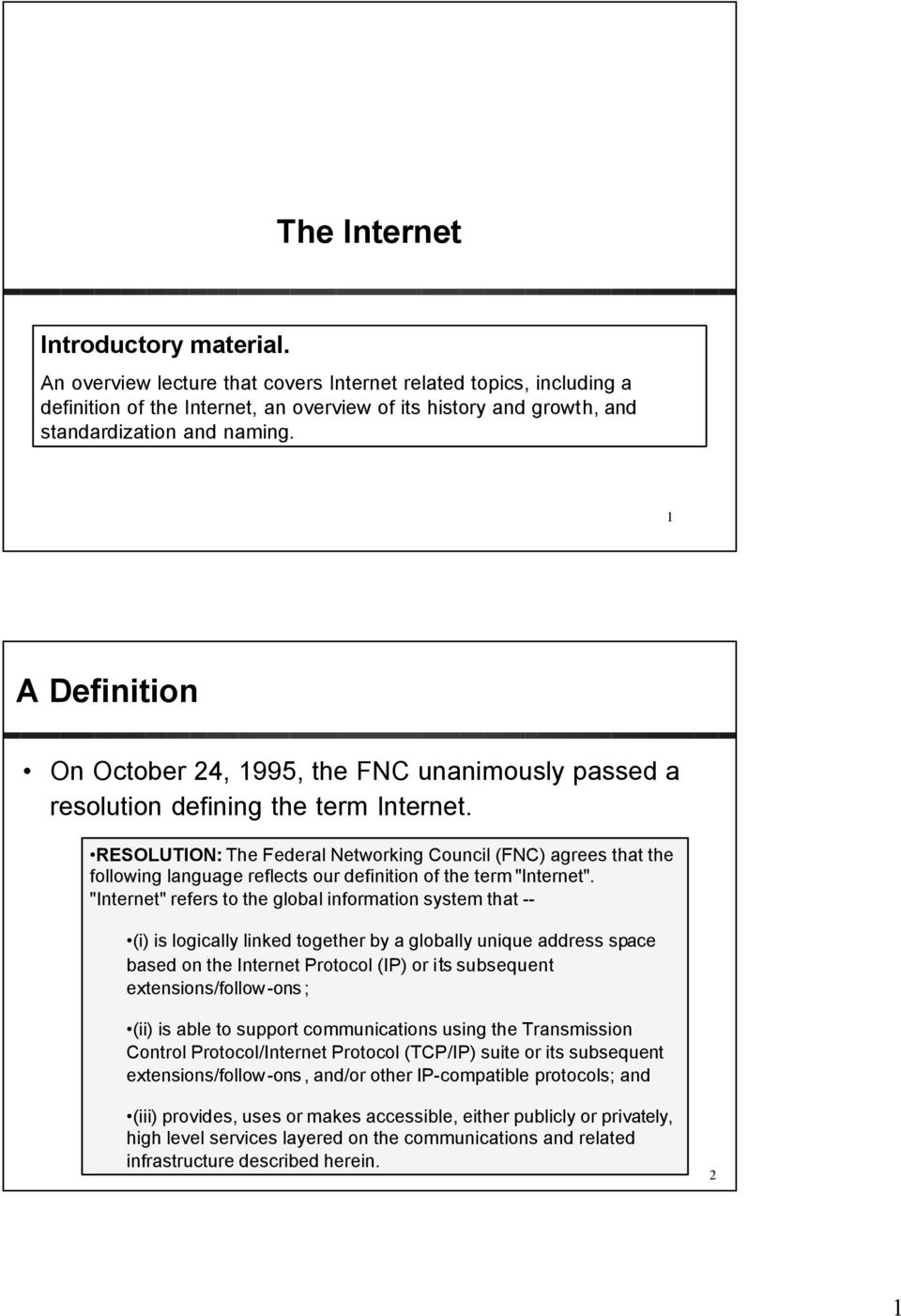
1 The Internet Introductory material. An overview lecture that covers Internet related topics, including a definition of the Internet, an overview of its history and growth, and standardization and naming. 1 A Definition On October 24, 1995, the FNC unanimously passed a resolution defining the term Internet. RESOLUTION: The Federal Networking Council (FNC) agrees that the following language reflects our definition of the term "Internet". "Internet" refers to the global information system that -- (i) is logically linked together by a globally unique address space based on the Internet Protocol (IP) or its subsequent extensions/follow-ons ; (ii) is able to support communications using the Transmission Control Protocol/Internet Protocol (TCP/IP) suite or its subsequent extensions/follow-ons, and/or other IP-compatible protocols; and (iii) provides, uses or makes accessible, either publicly or privately, high level services layered on the communications and related infrastructure described herein. 2 1
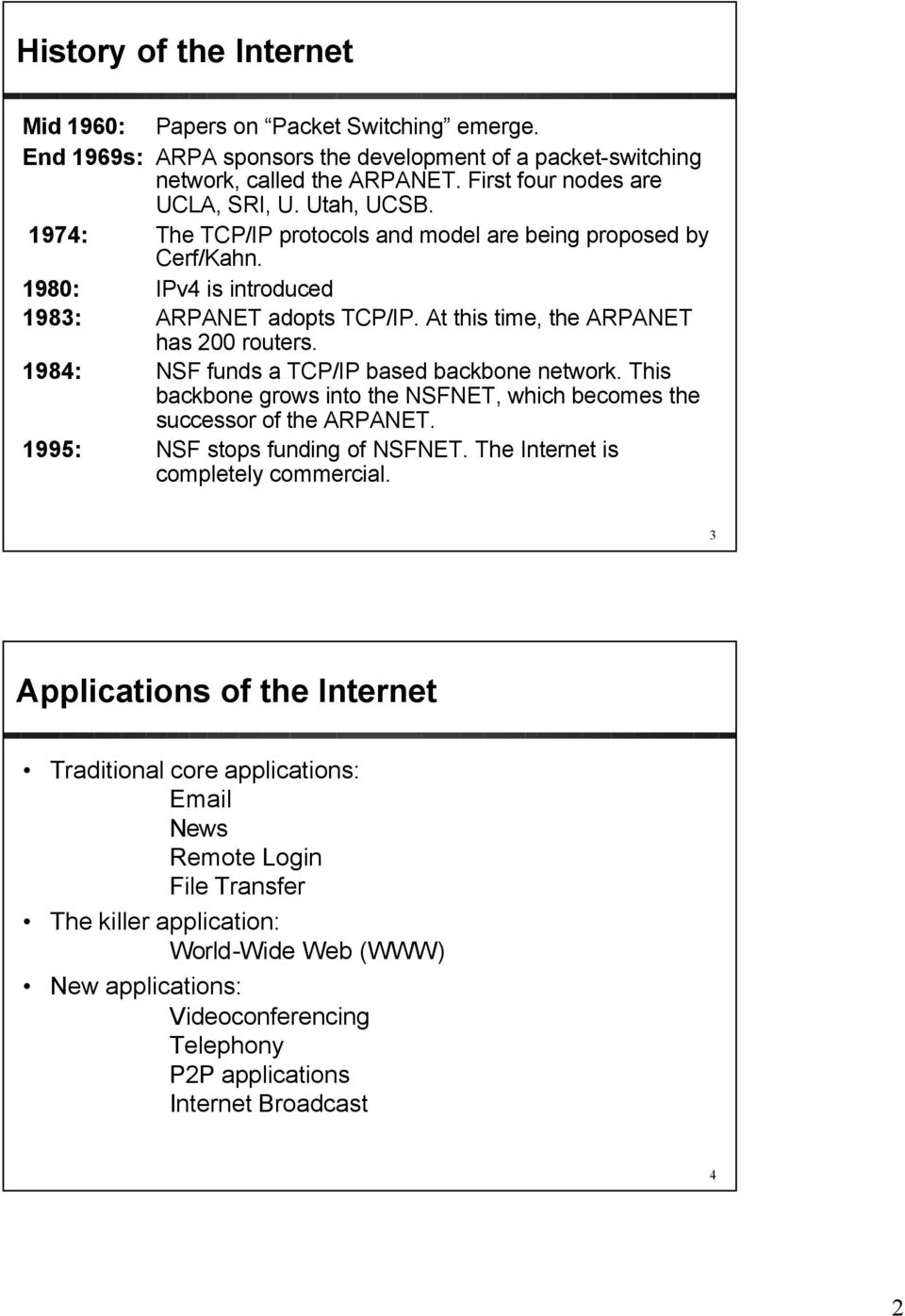
2 History of the Internet Mid 1960: Papers on Packet Switching emerge. End 1969s: ARPA sponsors the development of a packet-switching network, called the ARPANET. First four nodes are UCLA, SRI, U. Utah, UCSB. 1974: The TCP/IP protocols and model are being proposed by Cerf/Kahn. 1980: IPv4 is introduced 1983: ARPANET adopts TCP/IP. At this time, the ARPANET has 200 routers. 1984: NSF funds a TCP/IP based backbone network. This backbone grows into the NSFNET, which becomes the successor of the ARPANET. 1995: NSF stops funding of NSFNET. The Internet is completely commercial. 3 Applications of the Internet Traditional core applications: News Remote Login File Transfer The killer application: World-Wide Web (WWW) New applications: Videoconferencing Telephony P2P applications Internet Broadcast 4 2
3 Time Line of the Internet Source: Internet Society 5 Growth of the Internet Aug-81 Aug-83 Aug-85 Aug-87 Aug-89 Number of Hosts on the Internet Aug-91 Aug-93 Aug-95 Aug-97 Aug-99 Aug-01 Source: Internet Software Consortium 6 3

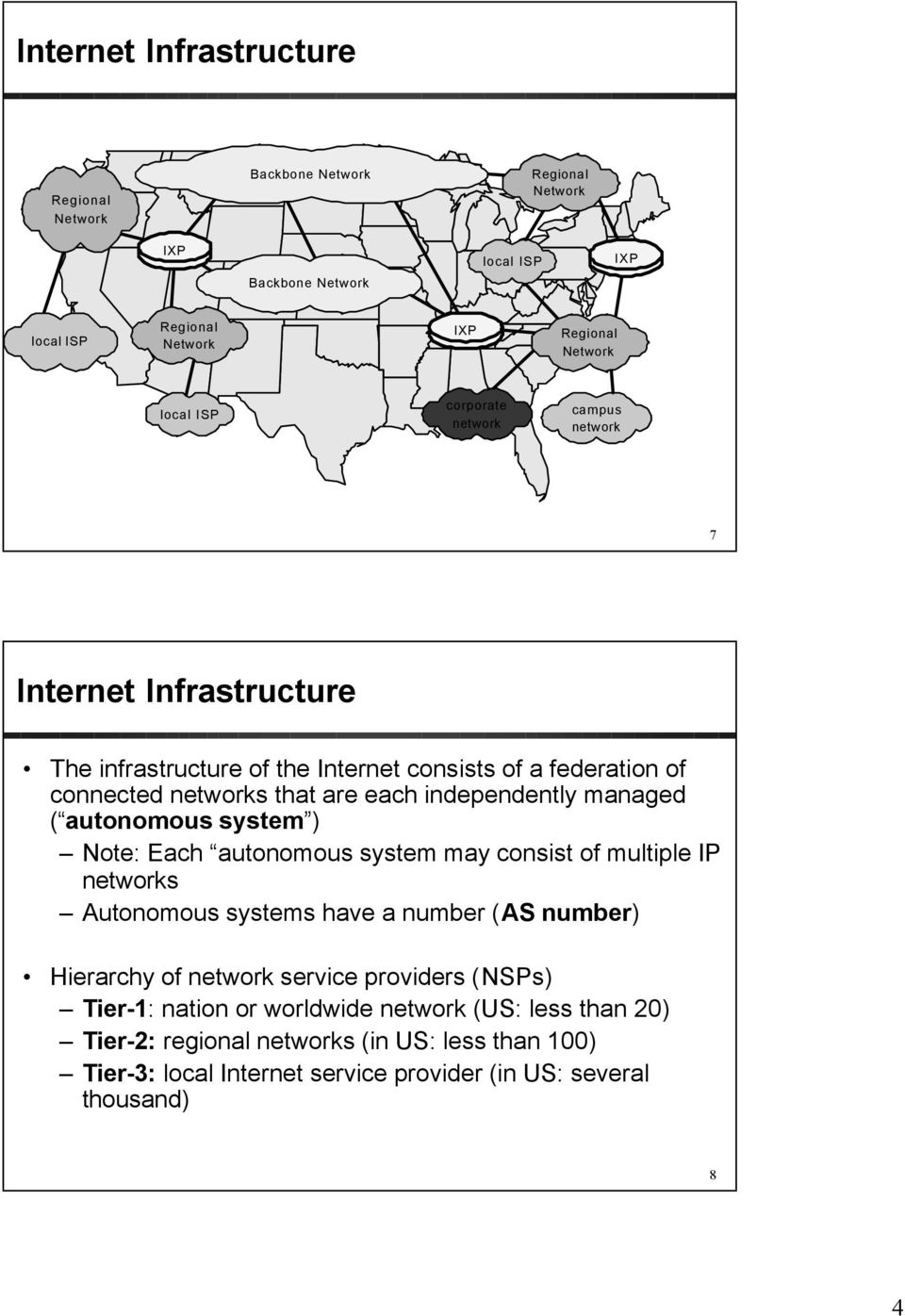
4 Internet Infrastructure Regional Network Backbone Network Regional Network IXP Backbone Network local ISP IXP local ISP Regional Network IXP Regional Network local ISP corporate network campus network 7 Internet Infrastructure The infrastructure of the Internet consists of a federation of connected networks that are each independently managed ( autonomous system ) Note: Each autonomous system may consist of multiple IP networks Autonomous systems have a number (AS number) Hierarchy of network service providers (NSPs) Tier-1: nation or worldwide network (US: less than 20) Tier-2: regional networks (in US: less than 100) Tier-3: local Internet service provider (in US: several thousand) 8 4
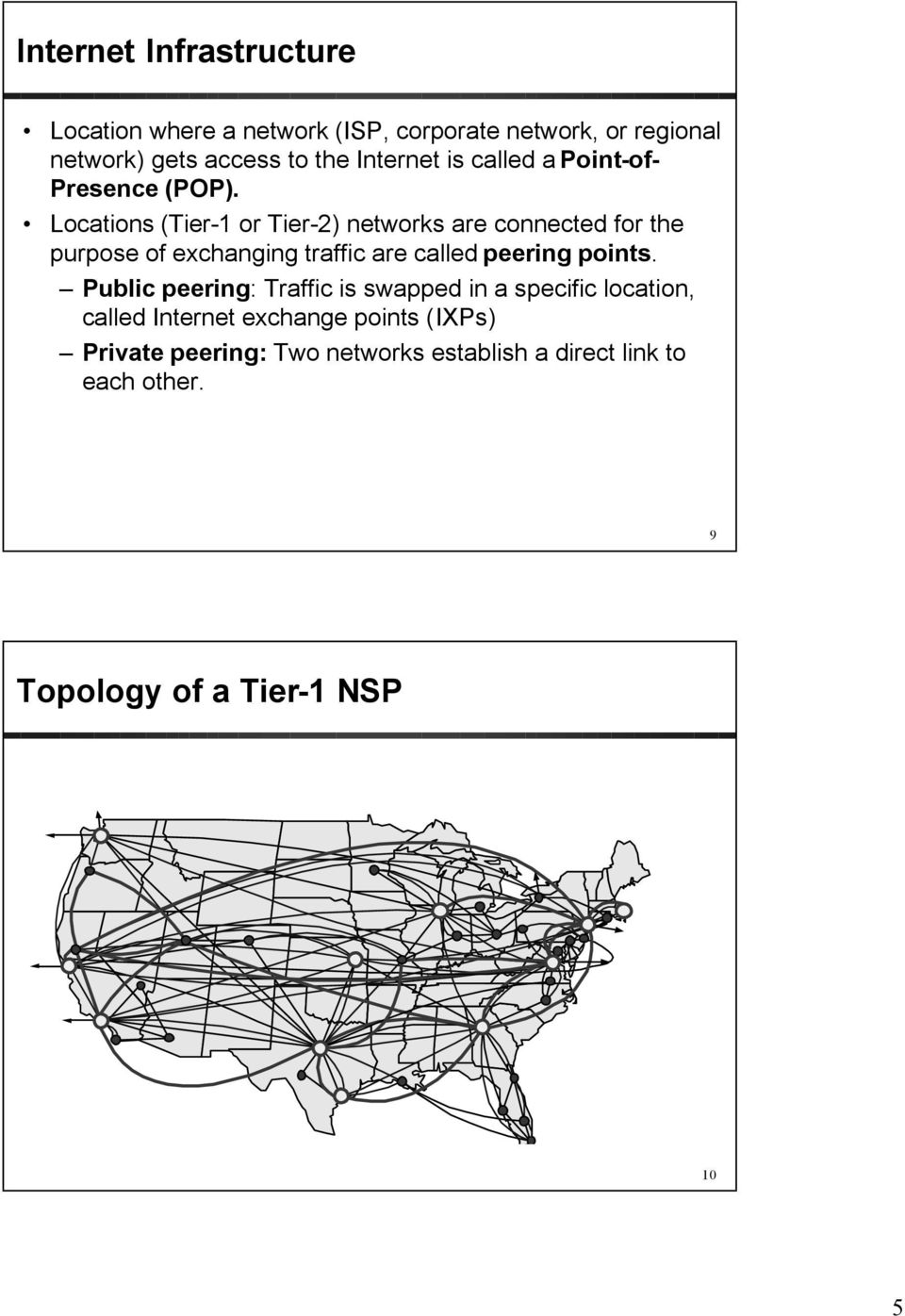
5 Internet Infrastructure Location where a network (ISP, corporate network, or regional network) gets access to the Internet is called a Point-of- Presence (POP). Locations (Tier-1 or Tier-2) networks are connected for the purpose of exchanging traffic are called peering points. Public peering: Traffic is swapped in a specific location, called Internet exchange points (IXPs) Private peering: Two networks establish a direct link to each other. 9 Topology of a Tier-1 NSP 10 5
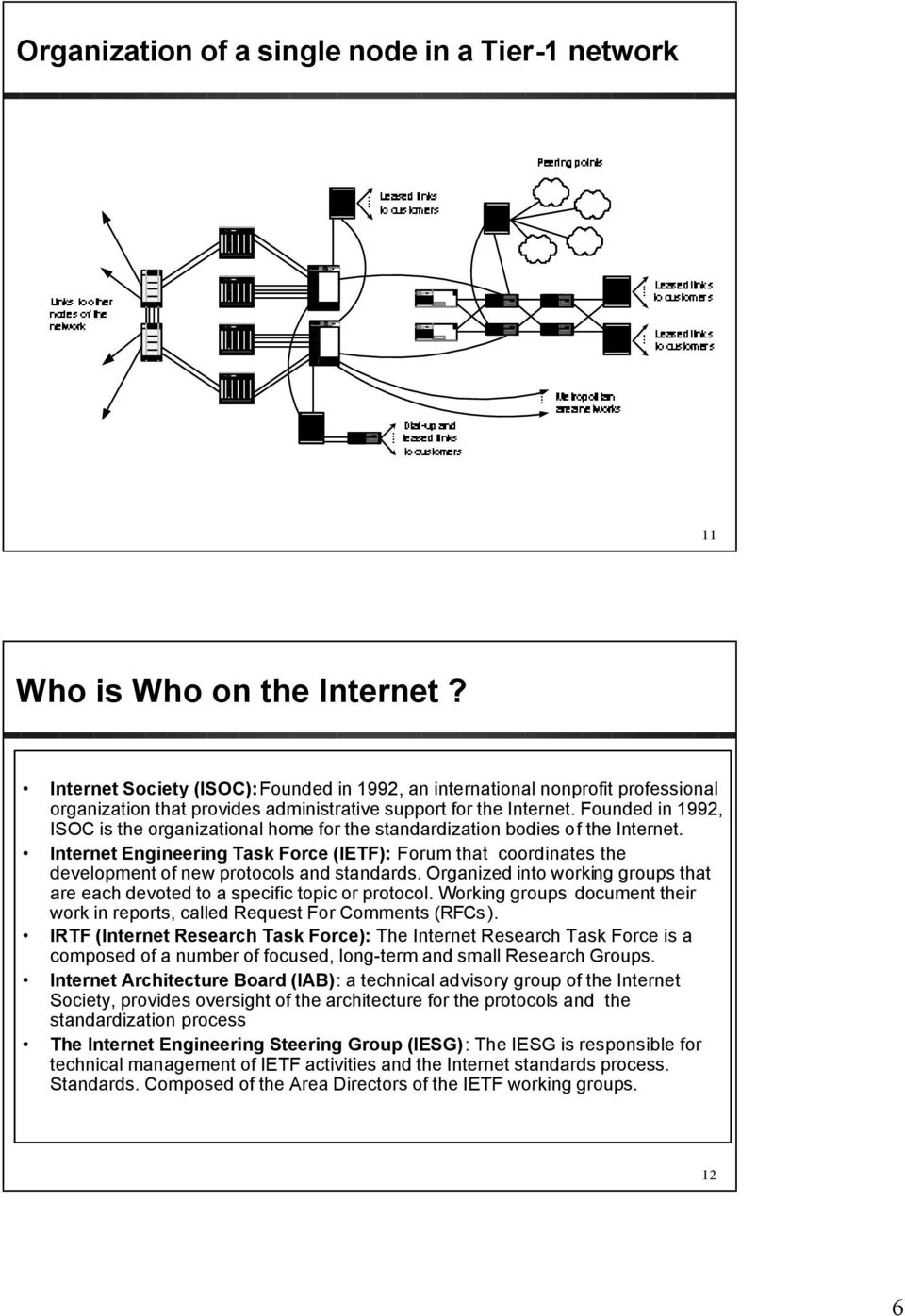
6 Co 3 Co 3 Co 3 Co 3 m m m m Bay Netwo rks Bay Netwo rks M odemb ank M odemb ank M odemb ank M odemb ank M odemb ank Organization of a single node in a Tier-1 network 11 Who is Who on the Internet? Internet Society (ISOC):Founded in 1992, an international nonprofit professional organization that provides administrative support for the Internet. Founded in 1992, ISOC is the organizational home for the standardization bodies of the Internet. Internet Engineering Task Force (IETF): Forum that coordinates the development of new protocols and standards. Organized into working groups that are each devoted to a specific topic or protocol. Working groups document their work in reports, called Request For Comments (RFCs ). IRTF (Internet Research Task Force): The Internet Research Task Force is a composed of a number of focused, long-term and small Research Groups. Internet Architecture Board (IAB): a technical advisory group of the Internet Society, provides oversight of the architecture for the protocols and the standardization process The Internet Engineering Steering Group (IESG): The IESG is responsible for technical management of IETF activities and the Internet standards process. Standards. Composed of the Area Directors of the IETF working groups. 12 6
7 Internet Standardization Process Working groups present their work i of the Internet are published as RFC (Request for Comments). RFCs are the basis for Internet standards. Not all RFCs become Internet Standards! (There are >3000 RFCs and less than 70 Internet standards) A typical (but not only) way of standardization is: Internet Drafts RFC Proposed Standard Draft Standard (requires 2 working implementation) Internet Standard (declared by IAB) 13 Assigning Identifiers for the Internet Who gives the university the domain name virginia.edu Who assigns it the network prefix /16? Who assigns port 80 as the default port for web servers? The functions associated with the assignment of numbers is referred to as Internet Assigned Number Authority (IANA). IANA used to be managed by Jon Postel at ISI Since the 1990s, IP addresses and domain name allocation are delegated to independent organizations. Different organizations are responsible for allocating domain names and IP addresses 14 7

8 The IANA Function The functions associated with the assignment of numbers in the Internet is referred to as Internet Assigned Number Authority (IANA). IANA serves as a registry that keeps records of assigned numbers: IP addresses Protocol numbers Domain names (until 1992) There is no charge for allocation. 15 Regional Internet Registries (RIRs) Registration and management of IP address is done by Regional Internet Registries (RIRs) Where do RIRs get their addresses from: IANA maintains a high-level registry that distributes large blocks to RIRs RIR are administer allocation of: IPv4 address blocks IPv6 address blocks Autonomous system (AS) numbers There are currently 4 RIRs worldwide: APNIC (Asia/Pacific Region), ARIN (North America and Sub-Sahara Africa), LACNIC (Latin America and some Caribbean Islands) RIPE NCC (Europe, the Middle East, Central Asia, and African countries located north of the equator). A fifth regional registry (AfriNIC) is in formation for Africa. 16 8
9 Transitioning of Domain Name Registration Until 1992: Domain name registration done as part of IANA 1992: IANA and NSF jointly created InterNIC, a quasi-governmental body mandated to organize and maintain the growing DNS registry and services. 1995: InterNIC started charging for domain names ($100 for 2 years) 1997: President Clinton directs the Secretary of Commerce to privatize the management of the domain name system (DNS) in a manner that increases competition and facilitates international participation in its management. 1998: ICANN was created in response to a policy statement issued by the US Department of Commerce that called for the formation of a private sector not-for-profit Internet stakeholder to administer policy for the Internet name and address system. ICANN operates under a renewable 3- year contract with the US Department of the Commerce. ICANN accredits domain-name registrar for.com,.org.,.net (and other domain) 17 ICANN The Internet Corporation for Assigned Names and Numbers (ICANN) is an internationally organized, non-profit corporation that has responsibility for Internet Protocol (IP) address space allocation, protocol identifier assignment, Top-Level Domain name system management, and root server system management functions. ICANN performs the IANA functions ICANN accredits domain-name registrar for.com,.org.,.net (and other domain) Since ICANN performs the IANA functions, it is in charge for allocating all numbers. However, the main concern is the allocation of domain names. ICANN role is to oversee the domain-name registration system's transition from government hands to private hands and to coordinate its decentralization and the integration into a global community. 18 9

The Internet Introductory material.
 The Internet Introductory material. An overview lecture that covers Internet related topics, including a definition of the Internet, an overview of its history and growth, and standardization and naming.
Internet Structure and Organization
 Internet Structure and Organization Resources management and allocation [email protected] Introduction What s the Internet? Why organizations / bodies are needed? Define protocol specifications Agree
INTERNET ORGANIZATION OVERVIEW OF THE INTERNET'S ORGANIZATION AND MAIN STANDARD BODIES. Internet Organization. Peter R. Egli INDIGOO.COM. indigoo.
 INTERNET ORGANIZATION OVERVIEW OF THE INTERNET'S ORGANIZATION AND MAIN STANDARD BODIES Peter R. Egli INDIGOO.COM 1/17 Contents 1. Internet Organizations 2. Why the Internet is called Inter-Net 3. Internet
Introduction to The Internet. ISP/IXP Workshops
 Introduction to The Internet ISP/IXP Workshops 1 Introduction to the Internet Topologies and Definitions IP Addressing Internet Hierarchy Gluing it all together 2 Topologies and Definitions What does all
Introduction to The Internet
 Introduction to The Internet ISP Workshops Last updated 5 September 2014 1 Introduction to the Internet p Topologies and Definitions p IP Addressing p Internet Hierarchy p Gluing it all together 2 Topologies
Internet Bodies. [email protected]
 Internet Bodies [email protected] Agenda Names, Acronyms in the Internet IETF organisation IESG, IAB, ISOC ICANN & IANA Standardisation process Standardisation compliance Internet Registries Requesting
The IANA Functions. An Introduction to the Internet Assigned Numbers Authority (IANA) Functions
 The IANA Functions An Introduction to the Internet Assigned Numbers Authority (IANA) Functions Contents SECTION 1: INTRODUCTION 4 SECTION 2: POLICY, STAKEHOLDERS AND STEWARDSHIP IMPLEMENTATION 6 SECTION
CHAPTER 0 INTRODUCTION TO TCP/IP
 CHAPTER 0 INTRODUCTION TO TCP/IP This chapter gives an overview of TCP/IP networking principles that form the basis of discussion for many of the laboratories that are covered in this text. Using the example
Topic 1: Internet Architecture & Addressing
 Topic 1: Internet Architecture & Addressing Objectives Understand the general architecture of Internet Identify the main actors in the Internet architecture Identify the main organizations implied in Internet
What's inside the cloud?!
 What's inside the cloud?! Initial Arpanet Initial Arpanet Interface Message Processors - DDP-516 mini-computers - 24 Kbyte of Core memory - Store-and-forward packet switching - Predecessors of present
IPv6 Address Planning
 eip604_v1.0 APNIC elearning: IPv6 Address Planning Contact: [email protected] Overview Where to Get IPv6 Addresses Addressing Plans ISP Infrastructure Addressing Plans Customer Example Address Plan Addressing
Ref: A. Leon Garcia and I. Widjaja, Communication Networks, 2 nd Ed. McGraw Hill, 2006 Latest update of this lecture was on 16 10 2010
 IPv4 Addressing There are several non-profit organizations in the world that have the authority for assigning IP addresses to institutions that need access to the Internet. These organizations are (for
Network Technologies
 Network Technologies Telephone Networks IP Networks ATM Networks Three Network Technologies Telephone Network The largest worldwide computer network, specialized for voice ing technique: Circuit-switching
IPv6 Addressing. ISP Training Workshops
 IPv6 Addressing ISP Training Workshops 1 Where to get IPv6 addresses p Your upstream ISP p Africa n AfriNIC http://www.afrinic.net p Asia and the Pacific n APNIC http://www.apnic.net p North America n
Internet Operations and the RIRs
 Internet Operations and the RIRs Overview ARIN and the Regional Internet Registry (RIR) System IP Number Resources, DNS and Routing IP Address Management Whois ARIN and the RIR System About ARIN One of
Chapter 9. Internet. Copyright 2011 John Wiley & Sons, Inc 10-1
 Chapter 9 Internet Copyright 2011 John Wiley & Sons, Inc 10-1 Outline 9.2 - How the Internet Works - Basic Architecture - Connecting to an ISP - Internet Today 9.3 - Internet Access Technologies - DSL
Domain Names and their Role for the Net
 Domain Names and their Role for the Net Hans Peter Dittler Karlsruhe 2000 H.P. Dittler - BRAINTEC Netzwerk-Consulting 27.6.2002 1 History 1962 first idea 1967 early planning for a real network 1969 ARPANET
Introduction to IP Numbers vs. Domain names. Adiel A. Akplogan CEO, AFRINIC. 2014
 Introduction to IP Numbers vs. Domain names Adiel A. Akplogan CEO, AFRINIC. 2014 Identifying an IP address Internet identifiers including information about how to reach a network location (via the Internet
The Internet Ecosystem
 The Internet Ecosystem 15 October 2010 Internet Society InternetSociety.org [email protected] Galerie Jean-Malbuisson, 15 CH-1204 Geneva Switzerland Tel: +41 22 807 1444 Fax: +41 22 807 1445 1775 Wiehle Ave.
Internet Technical Governance: Orange s view
 Internet Technical Governance: Orange s view 1 Internet Technical Governance: Orange s view With the increasing use of IP technologies in the electronic communication networks and services, Internet Technical
Draft WGIG Issue Paper on the Administration of Internet Names and IP Addresses
 Draft WGIG Issue Paper on the Administration of Internet Names and IP Addresses This paper is a 'draft working paper' reflecting the preliminary findings of the drafting team. It has been subject to review
What is TCP/IP. Introduction to TCP/IP &216</ &216</ z Transmission Control Protocol/Internet Protocol
 Introduction to TCP/IP 4/11/40 page 1 What is TCP/IP Transmission Control Protocol/Internet Protocol TCP/IP refers to an entire suite of networking protocols, developed for use on the Internet TCP and
Law Enforcement and Internet Governance: An Ounce of Prevention Is Worth a Pound of Cure
 Law Enforcement and Internet Governance: An Ounce of Prevention Is Worth a Pound of Cure Supervisory Special Agent Robert Flaim Federal Bureau of Investigation (FBI) Operational Technology Division Global
Summary - ENUM functions that maps telephone numbers to Internet based addresses - A description and the possible introduction to Sweden
 DATE REFERENCE NO. 30 March 2001 01-9734 Summary - ENUM functions that maps telephone numbers to Internet based addresses - A description and the possible introduction to Sweden AUTHOR Joakim Strålmark
CA106 Web Design. Dr. Dónal Fitzpatrick, School of Computing Room l2.48, Extension 8929, [email protected]
 CA106 Web Design Dr. Dónal Fitzpatrick, School of Computing Room l2.48, Extension 8929, [email protected] History of the Internet Terminals attached to mainframe computer From mid 1960 s packet-switching
An introduction to IANA Presentation Notes
 An introduction to IANA Presentation Notes Date 29 September 2008 Contact Kim Davies, Manager of Root Zone Services [email protected] While the Internet is renowned for being a worldwide network free
Distributed Systems. 09. Naming. Paul Krzyzanowski. Rutgers University. Fall 2015
 Distributed Systems 09. Naming Paul Krzyzanowski Rutgers University Fall 2015 October 7, 2015 2014-2015 Paul Krzyzanowski 1 Naming things Naming: map names to objects Helps with using, sharing, and communicating
Draft WGIG issue paper on Network and Information Security
 Draft WGIG issue paper on Network and Information Security This paper is a 'draft working paper' reflecting the preliminary findings of the drafting team. It has been subject to review by all WGIG members,
BGP. 1. Internet Routing
 BGP 1. Internet Routing (C) Herbert Haas 2005/03/11 1 Internet Routing Interior Gateway Protocols (IGPs) not suitable for Inter-ISP routing Technical metrics only No policy features Inter-ISP routing is
TECHNICAL REPORT Network Technologies (NTECH); Description of the DNS protocol usage in IP based operators networks
 TR 184 012 V1.1.1 (2015-05) TECHNICAL REPORT Network Technologies (NTECH); Description of the DNS protocol usage in IP based operators networks 2 TR 184 012 V1.1.1 (2015-05) Reference DTR/NTECH-00003-NNAR-DNS
1. History of TCP/IP TCP/IP was initially designed to meet the data communication needs of the U.S. Department of Defence (DOD).
 1. History of TCP/IP TCP/IP was initially designed to meet the data communication needs of the U.S. Department of Defence (DOD). In the late 1960s the Advanced Research Projects Agency (ARPA, now called
IPv6 The Big Picture. Rob Evans, Janet [email protected]
 IPv6 The Big Picture Rob Evans, Janet [email protected] Where are we? IPv4 32 bit addresses 4,294,967,296 possible addresses In practice much less than this. History of large allocations /8s Inefficiency
Introduction to Web Technology. Content of the course. What is the Internet? Diana Inkpen
 Introduction to Web Technology Content of the course Diana Inkpen The Internet and the WWW. Internet Connectivity. Basic Internet Services. University of Ottawa School of Information Technology and Engineering
How To Get An Ipv6 Allocation On Ipv4 (Ipv4) From Ipv5) From The Ipvripe Ncc (Ip6) From A Ipvv6 Ipv2 (Ip4) To Ip
 What s hot at the RIPE NCC PLNOG6, March 2011 Sandra Brás Trainer, RIPE NCC [email protected] Hot topics - overview The registry system IPv4 depletion IPv6 policy update Independent resources 2 The five RIRs
IPv6 Around the World
 IPv6 Around the World IPv6 deployment is increasing its momentum globally, and IPv4 address exhaustion is approaching rapidly. Many parts of the world are engaged in efforts to increase broadband penetration,
Glossary of Technical Terms Related to IPv6
 AAAA Record An AAAA record stores a 128-bit Internet Protocol version 6 (IPv6) address, which does not fit the standard A record format. For example, 2007:0db6:85a3:0000:0000:6a2e:0371:7234 is a valid
MINISTRY OF INFORMATION AND COMMUNICATIONS TECHNOLOGY
 GOVERNMENT OF UGANDA MINISTRY OF INFORMATION AND COMMUNICATIONS TECHNOLOGY POLICY POLICY FRAMEWORK FRAMEWORK FOR MANAGEMENT FOR MANAGEMENT OF.UG OF country.ug code Top country Level Domain code Top) (cctld)
Introduction to Routing
 Introduction to Routing How traffic flows on the Internet Philip Smith [email protected] RIPE NCC Regional Meeting, Moscow, 16-18 18 June 2004 1 Abstract Presentation introduces some of the terminologies used,
architecture: what the pieces are and how they fit together names and addresses: what's your name and number?
 Communications and networking history and background telephone system local area networks Internet architecture: what the pieces are and how they fit together names and addresses: what's your name and
Address Scheme Planning for an ISP backbone Network
 Address Scheme Planning for an ISP backbone Network Philip Smith Consulting Engineering, Office of the CTO Version 0.1 (draft) LIST OF FIGURES 2 INTRODUCTION 3 BACKGROUND 3 BUSINESS MODEL 3 ADDRESS PLAN
Subnetting and Network Management Omer F. Rana. Networks and Data Communications 1
 Subnetting and Network Management Omer F. Rana Networks and Data Communications 1 Subnetting Subnetting is an important concept in establishing TCP/IP based networks important in integrating small Local
Overview of TCP/IP. TCP/IP and Internet
 Overview of TCP/IP System Administrators and network administrators Why networking - communication Why TCP/IP Provides interoperable communications between all types of hardware and all kinds of operating
IPv6 Addressing. John Rullan Cisco Certified Instructor Trainer Thomas A. Edison CTE HS
 IPv6 Addressing John Rullan Cisco Certified Instructor Trainer Thomas A. Edison CTE HS Stephen Lynch Network Architect, CCIE #36243 ABS Technology Architects 128-bit hexadecimal format (0-9, A-F) Uses
CHAPTER 10 THE INTERNET
 CHAPTER 10 THE INTERNET Chapter Summary This chapter examines the Internet in more detail to explain how it works and why it is a network of networks. The chapter also examines Internet access technologies,
DNS Root NameServers
 DNS Root NameServers An Overview Dr. Farid Farahmand Updated: 9/24/12 Who- is- Who! Over half million networks are connected to the Internet 5 billion users by 2015! Network numbers are managed by ICANN
256 4 = 4,294,967,296 ten billion. 256 16 = 18,446,744,073,709,551,616 ten quintillion. IP Addressing. IPv4 Address Classes
 IP Addressing With the exception of multicast addresses, Internet addresses consist of a network portion and a host portion. The network portion identifies a logical network to which the address refers,
Introduction Chapter 1. Uses of Computer Networks
 Introduction Chapter 1 Uses of Computer Networks Network Hardware Network Software Reference Models Example Networks Network Standardization Metric Units Revised: August 2011 Uses of Computer Networks
Chapter 7: Computer Networks, the Internet, and the World Wide Web. Invitation to Computer Science, C++ Version, Third Edition
 Chapter 7: Computer Networks, the Internet, and the World Wide Web Invitation to Computer Science, C++ Version, Third Edition Objectives In this chapter, you will learn about: Basic networking concepts
Industry Automation White Paper Januar 2013 IPv6 in automation technology
 Table of contents: 1 Why another White Paper IPv6?... 3 2 IPv6 for automation technology... 3 3 Basics of IPv6... 3 3.1 Turning point/initial situation... 3 3.2 Standardization... 4 3.2.1 IPv6 address
192.0.2.1 192.0.2.119. 2001:0db8:2004:f000:20d:60ff: Continuing cooperation The NRO and Internet Governance. The. Number
 Continuing cooperation The NRO and Internet Governance fc1:1 192.0.2.119 192.0 Resource 01:0db Number 8:371:2:2c0:9ff The 01:0d Organization (NRO) represents db8:112::2 49 the five Regional Internet Registries
IPv6 Fundamentals Ch t ap 1 er I : ntroducti ti t on I o P IPv6 Copyright Cisco Academy Yannis Xydas
 IPv6 Fundamentals Chapter 1: Introduction ti to IPv6 Copyright Cisco Academy Yannis Xydas The Network Today The Internet of today is much different that it was 30, 15 or 5 years ago. 2 Technology Tomorrow
ICANN: achievements and challenges of a multi-stakeholder, bottom up, transparent model
 ICANN: achievements and challenges of a multi-stakeholder, bottom up, transparent model Anne Rachel Inné, Giovanni Seppia Regional Liaisons Aurelio Peccei Lecture 4 April 2007 1 Presentation overview The
National Internet Exchange of India (NIXI)
 National Internet Exchange of India (NIXI) APRICOT (Feb 2009) 14 TH Edition SOFITEL PHILIPPINE PLAZA MANILA Presentation done by: Amitabh Singhal Founder, Board Member & Former CEO Sharad Sanghi Board
BT Internet Connect Global - Annex to the General Service Schedule
 1. Definitions The following definitions apply, in addition to those in the General Terms and Conditions and the General Services Schedule. ARP means Address Resolution Protocol. Border Gateway Protocol
Internet History. Why are we here?
 Internet History Why are we here? (C) Herbert Haas 2005/03/11 1 ARPAnet is a network of computers. The Internet is a network of networks. An interplanetary net would be a network of Internets. The sky
Connecting with Computer Science, 2e. Chapter 5 The Internet
 Connecting with Computer Science, 2e Chapter 5 The Internet Objectives In this chapter you will: Learn what the Internet really is Become familiar with the architecture of the Internet Become familiar
This Lecture. The Internet and Sockets. The Start 1969. If everyone just sends a small packet of data, they can all use the line at the same.
 This Lecture The Internet and Sockets Computer Security Tom Chothia How the Internet works. Some History TCP/IP Some useful network tools: Nmap, WireShark Some common attacks: The attacker controls the
8/27/2014. What is a computer network? Introduction. Business Applications (1) Uses of Computer Networks. Business Applications (2)
 What is a computer network? Introduction Chapter 1 A number of separate but interconnected computers A collection of autonomous computers interconnected by a single technology COURSE FOCUS: design and
UAEnic at a Glance. Abdulla A. Hashim UAEnic Manager [email protected]. inet MEA Regional Conference. Cairo, Egypt, 8 May 2005
 UAEnic at a Glance inet MEA Regional Conference Cairo, Egypt, 8 May 2005 Abdulla A. Hashim UAEnic Manager [email protected] Agenda Who is UAEnic? The Objectives UAEnic Time Lines Internet in the UAE Domain
IPv6 and IPv4 Update from the RIPE NCC. Sandra Brás, Ferenc Csorba
 IPv6 and IPv4 Update from the RIPE NCC Sandra Brás, Ferenc Csorba RIPE NCC IPv6 Kongress - Frankfurt 22 May 2014 Schedule IPv6 Kongress 2 RIPE/RIPE NCC. Who are we? IPv4 exhaustion IPv4 transfers IPv6
Fireware How To Dynamic Routing
 Fireware How To Dynamic Routing How do I configure my Firebox to use BGP? Introduction A routing protocol is the language a router speaks with other routers to share information about the status of network
Internet Engineering Task Force (IETF) Request for Comments: 6761. Category: Standards Track February 2013 ISSN: 2070-1721
 Internet Engineering Task Force (IETF) S. Cheshire Request for Comments: 6761 M. Krochmal Updates: 1918, 2606 Apple Inc. Category: Standards Track February 2013 ISSN: 2070-1721 Abstract Special-Use Domain
Chapter 3. TCP/IP Networks. 3.1 Internet Protocol version 4 (IPv4)
 Chapter 3 TCP/IP Networks 3.1 Internet Protocol version 4 (IPv4) Internet Protocol version 4 is the fourth iteration of the Internet Protocol (IP) and it is the first version of the protocol to be widely
Internet Protocol version 4 Part I
 Internet Protocol version 4 Part I Claudio Cicconetti International Master on Information Technology International Master on Communication Networks Engineering Table of Contents
Terminology. Internet Addressing System
 Terminology A local area network (LAN) is a computer network covering a small physical area, like a home, office, or small group of buildings, such as a school, or an airport. The defining characteristics
BGP Terminology, Concepts, and Operation. Chapter 6 2007 2010, Cisco Systems, Inc. All rights reserved. Cisco Public
 BGP Terminology, Concepts, and Operation 1 IGP versus EGP Interior gateway protocol (IGP) A routing protocol operating within an Autonomous System (AS). RIP, OSPF, and EIGRP are IGPs. Exterior gateway
Regional Internet Registries. Statistics & Activities. Prepared By APNIC, ARIN, LACNIC, RIPE NCC
 Regional Internet Registries Statistics & Activities Prepared By APNIC, ARIN, LACNIC, RIPE NCC IPv4 /8 Address Space Status Experimental 16 6.3% ARIN 16 6.3% LACNIC 1 0.4% APNIC 11 4.3% RIPE NCC 10 3.9%
IT 3202 Internet Working (New)
 [All Rights Reserved] SLIATE SRI LANKA INSTITUTE OF ADVANCED TECHNOLOGICAL EDUCATION (Established in the Ministry of Higher Education, vide in Act No. 29 of 1995) Instructions for Candidates: Answer any
The Internet Ecosystem and ICANN!! Steve Sheng @ Stanford University, Center for Information and Society! 29 April 2013!
 The Internet Ecosystem and ICANN!! Steve Sheng @ Stanford University, Center for Information and Society! 29 April 2013! Ecosystem! + A network of interactions among organisms, and between organisms and
CS 43: Computer Networks Naming and DNS. Kevin Webb Swarthmore College September 17, 2015
 CS 43: Computer Networks Naming and DNS Kevin Webb Swarthmore College September 17, 2015 Agenda Identifiers and addressing Domain Name System History Query sequences Record types Load balancing Recall:
How to use the UNIX commands for incident handling. June 12, 2013 Koichiro (Sparky) Komiyama Sam Sasaki JPCERT Coordination Center, Japan
 How to use the UNIX commands for incident handling June 12, 2013 Koichiro (Sparky) Komiyama Sam Sasaki JPCERT Coordination Center, Japan Agenda Training Environment Commands for incident handling network