
IEP Goals and Objectives Bank (Redmond, Oregon)
|
|
|
- Claude Hawkins
- 10 years ago
- Views:
Transcription
1 IEP Goals and Objectives Bank (Redmond, Oregon) Content Area English Functional Academics Independent Living Mathematics Mathematics Readiness Motor Recreation and Leisure Self-management and Daily Living Social Emotional Speech and Language Study Skills Vocational/Career Education The Goal Bank has been designed to allow users to locate specific goals as used in the esis SPED Full software. Click on a Content Area to proceed to specific Content Strands. From there, locate the specific strand and click to locate the Individual Goals. To search the contents of the Goal Bank for a specific item, press Ctrl + F.

2 Content Strands Table Of Contents Table Of Contents English E1 Comprehension (readiness) E2 Decoding and Word Recognition (readiness) E3 Literature E4 Phonemic Awareness (readiness) E5 Print Awareness And Letter Knowledge (readiness) E6 Reading Accuracy And Fluency E7 Reading Comprehension E8 Writing E9 Writing E10 Writing E11 Writing E12 Writing E13 Writing E14 Writing E15 Writing E16 Writing (readiness) Functional Academics FA1 Communication FA2 Communication FA3 Communication FA4 Communication FA5 Communication FA6 Communication FA7 Finance FA8 Finance FA9 Finance FA10 Finance FA11 Mathematics

3 Table Of Contents FA12 Mathematics FA13 Mathematics FA14 Mathematics FA15 Mathematics FA16 Reading FA17 Reading FA18 Reading FA19 Time Management FA20 Time Management FA21 Writing Independent Living IL1 Community Safety IL2 Community Safety IL3 Community Safety IL4 Community Safety IL5 Community Safety IL6 Community Safety IL7 Eating Out IL8 Eating Out IL9 General Shopping IL10 General Shopping IL11 Grocery Shopping IL12 Grocery Shopping IL13 Grocery Shopping IL14 Grocery Shopping IL15 Mobility IL16 Travel IL17 Travel IL18 Travel IL19 Travel IL20 Using Community Services

4 Table Of Contents Table Of Contents Table Of Contents IL21 Using Community Services IL22 Using Community Services IL23 Using Community Services IL24 Using Community Services IL25 Using Community Services IL26 Using Community Services Mathematics M1 Algebraic relationships M2 Geometry and spatial sense M3 Mathematical problem solving M4 Measurement M5 Number sense and calculation M6 Statistics and probability Mathematics Readiness MR1 Algebraic Relations (readiness) MR2 Geometry And Spatial Sense (readiness) MR3 Mathematical Problem Solving (readiness) MR4 Measurement (readiness) MR5 Number Sense And Calculation (readiness) MR6 Number Sense And Calculation (readiness) MR7 Number Sense And Calculation (readiness) MR8 Number Sense And Calculation (readiness) MR9 Statistics And Probability (readiness) Motor Mo1 Basic Gross Motor Mo2 Basic Gross Motor Mo3 Basic Gross Motor Mo4 Basic Gross Motor Mo5 Basic Gross Motor Mo6 Basic Gross Motor Mo7 Basic Gross Motor

5 Mo8 Mo9 Mo10 Mo11 Mo12 Mo13 Mo14 Mo15 Mo16 Mo17 Mo18 Mo19 Mo20 Mo21 Mo22 Mo23 Mo24 Mo25 Mo26 Mo27 Mo28 Mo29 Mo30 Mo31 Mo32 Mo33 Mo34 Mo35 Mo36 Mo37 Mo38 Mo39 Basic Gross Motor Fine Motor Fine Motor Fine Motor Intermediate Gross Motor-Balance Intermediate Gross Motor-locomotor-galloping Intermediate Gross Motor-locomotor-hopping Intermediate Gross Motor-locomotor-jumping Intermediate Gross Motor-locomotor-leaping Intermediate Gross Motor-locomotor-running Intermediate Gross Motor-locomotor-skipping Intermediate Gross Motor-object control-catching Intermediate Gross Motor-object control-dribbling Intermediate Gross Motor-object control-kicking Intermediate Gross Motor-object control-push/hit Intermediate Gross Motor-object control-striking Intermediate Gross Motor-object control-throw/propel Intermediate Gross Motor-object control-throwing Intermediate Gross Motor-playground skills Intermediate Gross Motor-swinging Intermediate Gross Motor-tricycle or bicycle riding Perception Perception Perception Perception Perception Perception Physical Fitness-agility Physical Fitness-cardio-respiratory

6 Table Of Contents Mo40 Physical Fitness-flexibility Mo41 Physical Fitness-strength Mo42 Physical Fitness-strength Mo43 Sensory Motor Mo44 Sensory Motor Mo45 Sensory Motor Mo46 Sensory Motor Mo47 Sensory Motor Mo48 Sensory Motor Mo49 Sensory Motor Mo50 Visual Motor Mo51 Visual Motor Mo52 Visual Motor Mo53 Visual Motor Mo54 Visual Motor Mo55 Visual Motor Mo56 Visual Motor Mo57 Visual Motor Mo58 Visual Motor Mo59 Visual Motor Recreation and Leisure RL1 Adaptations & Modifications RL2 Play And Games RL3 Play And Games RL4 Play And Games RL5 Play And Games RL6 Play And Games RL7 Play And Games RL8 Play And Games RL9 Blank

7 RL10 RL11 RL12 RL13 RL14 RL15 RL16 RL17 RL18 RL19 RL20 RL21 RL22 RL23 RL24 RL25 RL26 RL27 RL28 RL29 RL30 RL31 RL32 RL33 RL34 RL35 RL36 RL37 RL38 RL39 RL40 Sports And Physical Development-swimming Sports And Physical Development-archery Sports And Physical Development-badminton Sports And Physical Development-basketball Sports And Physical Development-bowling Sports And Physical Development-condition skills Sports And Physical Development-cycling Sports And Physical Development-dance-aerobic dance Sports And Physical Development-darts Sports And Physical Development-folk dance Sports And Physical Development-football Sports And Physical Development-frisbee golf Sports And Physical Development-frisbee skills Sports And Physical Development-golf Sports And Physical Development-gymnastics Sports And Physical Development-hockey Sports And Physical Development-horseshoes Sports And Physical Development-kite flying Sports And Physical Development-Low Organized Games Sports And Physical Development-Oregon Disability Sports Sports And Physical Development-pickleball Sports And Physical Development-shuffleboard Sports And Physical Development-skating Sports And Physical Development-soccer Sports And Physical Development-social dance Sports And Physical Development-social/behavior Sports And Physical Development-softball Sports And Physical Development-Special Olympics Sports And Physical Development-square dance Sports And Physical Development-table tennis Sports And Physical Development-tennis

8 Table Of Contents RL41 Sports And Physical Development-track & field RL42 Sports And Physical Development-Use Park & Recreation Facilities RL43 Sports And Physical Development-volleyball RL44 Sports And Physical Development-walking Self-management and Daily Living SD1 Dressing SD2 Dressing SD3 Dressing SD4 Dressing SD5 Dressing SD6 Dressing SD7 Dressing SD8 Dressing SD9 Dressing SD10 Dressing SD11 Dressing SD12 Dressing SD13 Dressing SD14 Dressing SD15 Dressing SD16 Dressing SD17 Dressing SD18 Dressing SD19 Eating SD20 Eating SD21 Eating SD22 Eating SD23 Food Preparation SD24 Food Preparation SD25 Food Preparation SD26 Food Preparation

9 SD27 SD28 SD29 SD30 SD31 SD32 SD33 SD34 SD35 SD36 SD37 SD38 SD39 SD40 SD41 SD42 SD43 SD44 SD45 SD46 SD47 SD48 SD49 SD50 SD51 SD52 SD53 SD54 SD55 SD56 SD57 Food Preparation Food Preparation Food Preparation Food Preparation Food Preparation Food Preparation Food Preparation Food Preparation Food Preparation Grooming And Hygiene Grooming And Hygiene Grooming And Hygiene Grooming And Hygiene Grooming And Hygiene Grooming And Hygiene Grooming And Hygiene Grooming And Hygiene Grooming And Hygiene Grooming And Hygiene Grooming And Hygiene Grooming And Hygiene Grooming And Hygiene Grooming And Hygiene Housekeeping Housekeeping Housekeeping Housekeeping Housekeeping Housekeeping Housekeeping Housekeeping

10 Table Of Contents SD58 Housekeeping SD59 Housekeeping SD60 Housekeeping SD61 Housekeeping SD62 Housekeeping SD63 Housekeeping SD64 Housekeeping SD65 Physical Maintenance SD66 Physical Maintenance SD67 Physical Maintenance SD68 Physical Maintenance SD69 Physical Maintenance SD70 Physical Maintenance SD71 Toileting SD72 Toileting SD73 Toileting Social Emotional SE1 Alternatives To Conflict SE2 Classroom/School Skills SE3 Classroom/School Skills SE4 Classroom/School Skills SE5 Classroom/School Skills SE6 Classroom/School Skills SE7 Classroom/School Skills SE8 Classroom/School Skills SE9 Classroom/School Skills SE10 Classroom/School Skills SE11 Dealing With Feelings/Self-awareness SE12 Dealing With Feelings/Self-awareness SE13 Interpersonal Skills SE14 Interpersonal Skills

11 Table Of Contents Table Of Contents Table Of Contents SE15 Problem Solving Skills SE16 Transportation And Public Conduct Speech and Language SL1 Articulation - Intelligibility SL2 Articulation - Oral Motor Skills SL3 Articulation - Phonemic Awareness SL4 Articulation - Phonological Processes SL5 Articulation - Traditional SL6 Fluency SL7 Fluency SL8 Fluency SL9 Morphology/Syntax (Words/Sentence Forms) SL10 Morphology/Syntax (Words/Sentence Forms) SL11 Morphology/Syntax (Words/Sentence Forms) SL12 Pragmatics-Conversation Rules Behaviors SL13 Pragmatics-Language Function/intents SL14 Pragmatics-Para-linguistic Behaviors SL15 Pragmatics-Topic Related Behavior SL16 Semantics (Word Meaning) SL17 Semantics (Word Meaning) SL18 Semantics (Word Meaning) SL19 Voice SL20 Voice SL21 Voice SL22 Voice SL23 Voice SL24 Voice Study Skills SS1 Strategies For Learning Vocational/Career Education VC1 Career Development VC2 Career Development

12 VC3 VC4 VC5 VC6 VC7 VC8 VC9 VC10 VC11 VC12 VC13 VC14 VC15 VC16 VC17 VC18 VC19 VC20 VC21 VC22 VC23 VC24 VC25 VC26 Career Development Career Development Communication Communication Employment Foundations Employment Foundations Employment Foundations Employment Foundations Employment Foundations Employment Foundations Employment Foundations Employment Foundations Employment Foundations Employment Foundations Personal Management Personal Management Personal Management Personal Management Personal Management Personal Management Personal Management Problem Solving Problem Solving Teamwork

13 Table Of Contents Annual Goal #1 0 1 Annual Goal #2 0 English Comprehension (readiness) will increase reading readiness skills in the area(s) of (phonemics, print awareness, letter knowledge, decoding, word recognition, comprehension) to as measured by (running records, probes, anecdotal records, work samples, etc.) Use background knowledge and prior experience to interpret stories. Discriminate between fact and fiction. Recognize that stories have a beginning, middle, and end. Predict what happens next in a story. Make predictions and discuss stories that have been read. Tell a story from pictures (to match illustrations). Retell stories that have been read aloud (e.g., character identification, setting, problem, solutions, and sequence of events). Identify sequence of events, main ideas, and details or facts in literary and informational text. Respond to readings in many ways (e.g., story mappings, topic webbings, etc.) Reads (or memorizes) books with simple repetitive language patterns. Identify and use reference materials and nonfiction sources (e.g., library, picture dictionary, and wall charts to locate information). Decoding and Word Recognition (readiness) will increase reading readiness skills in the area(s) of (phonemics, print awareness, letter knowledge, decoding, word recognition, comprehension) to - as measured by (running records, probes, anecdotal records, work samples, etc.) Demonstrate awareness of letter/sound relationships by identifying a minimum of letter/sound correspondences. Demonstrate awareness of letter/sound relationships by identifying a minimum of letter/sound correspondences. Read/write a minimum of high freguency words. Use beginning, redial and ending letter cues to predict unknown words. Locate specific words, phrases, word patterns, and sight words in familiar text. Read predictable pattern books. Read dictated or self-written texts. Demonstrate understanding of basic letter/sound correspondence in all consonants and most blends, digraphs, and vowels in beginning, medial, and final position. Demonstrate an understanding of basic word families and patterns. Read 150 high frequency sight words from district list.

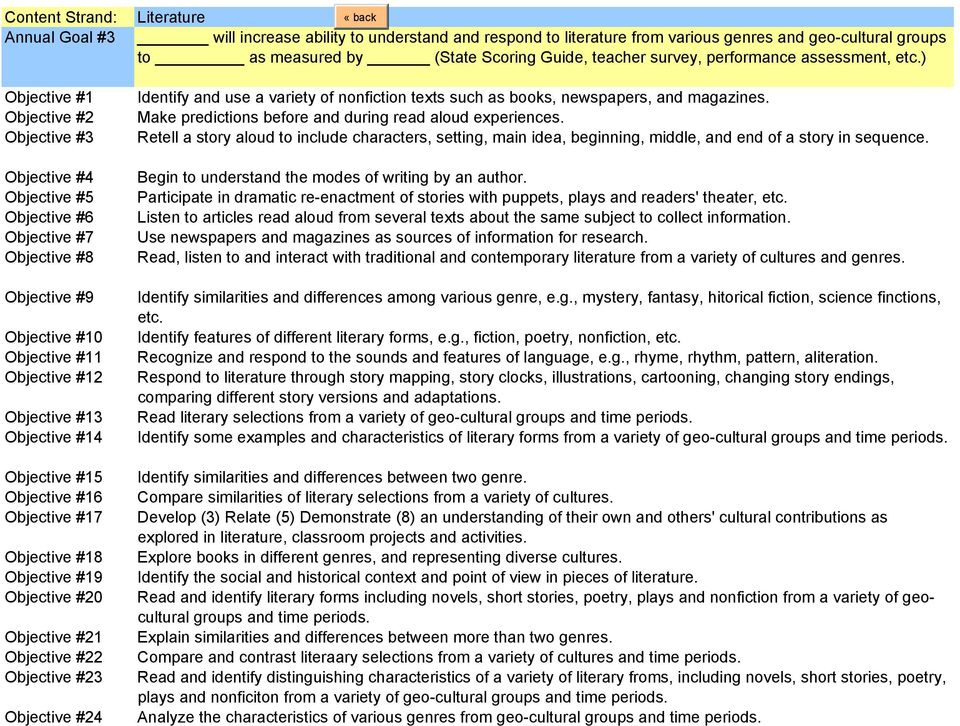
14 Annual Goal # Literature will increase ability to understand and respond to literature from various genres and geo-cultural groups to as measured by (State Scoring Guide, teacher survey, performance assessment, etc.) Identify and use a variety of nonfiction texts such as books, newspapers, and magazines. Make predictions before and during read aloud experiences. Retell a story aloud to include characters, setting, main idea, beginning, middle, and end of a story in sequence. Begin to understand the modes of writing by an author. Participate in dramatic re-enactment of stories with puppets, plays and readers' theater, etc. Listen to articles read aloud from several texts about the same subject to collect information. Use newspapers and magazines as sources of information for research. Read, listen to and interact with traditional and contemporary literature from a variety of cultures and genres. Identify similarities and differences among various genre, e.g., mystery, fantasy, hitorical fiction, science finctions, etc. Identify features of different literary forms, e.g., fiction, poetry, nonfiction, etc. Recognize and respond to the sounds and features of language, e.g., rhyme, rhythm, pattern, aliteration. Respond to literature through story mapping, story clocks, illustrations, cartooning, changing story endings, comparing different story versions and adaptations. Read literary selections from a variety of geo-cultural groups and time periods. Identify some examples and characteristics of literary forms from a variety of geo-cultural groups and time periods. Identify similarities and differences between two genre. Compare similarities of literary selections from a variety of cultures. Develop (3) Relate (5) Demonstrate (8) an understanding of their own and others' cultural contributions as explored in literature, classroom projects and activities. Explore books in different genres, and representing diverse cultures. Identify the social and historical context and point of view in pieces of literature. Read and identify literary forms including novels, short stories, poetry, plays and nonfiction from a variety of geocultural groups and time periods. Explain similarities and differences between more than two genres. Compare and contrast literaary selections from a variety of cultures and time periods. Read and identify distinguishing characteristics of a variety of literary froms, including novels, short stories, poetry, plays and nonficiton from a variety of geo-cultural groups and time periods. Analyze the characteristics of various genres from geo-cultural groups and time periods.
15 Make comparisons and geralizations of literary forms and genres from various clutures and time periods. Extend understandings of own and others' cultural heritage as revealed in diverse literature. Make comparisons, generalizations, and connections between texts. Retell a story, read aloud, to include characters, setting, events in a sequence, and main idea. Recognize and respond to the sounds and features of language, e.g., rhyme, pattern, alliteration. Orally predict/form inferrences about story characters and events during read alouds. Identify some of the actions and motivation of characters givent he context of the literature. Begin to identify the point of view of the writer, and how it impacts the literature. Distinguish between facts and opinions in texts. Identify some traits of stereotypical and/or realistic characters. Make inferences and draw conclusions about how the development of character, plot, and setting contribute to the overall impact of the selection. Identify literary devices such a rhyme, figurative language, dialogues, similes, metaphors, and flashbacks. Analyze how the effect of the author's choice of literary devices, structure, and word choice impact the selection. Identify if a plot is imaginative or realistic. Describe (5) /identify and compare (8) traits of stereotypical characters and realistic characters. Critique the degree to which a plot is contrived or realistic, and how it affects the story. Analyze the reasons for a character's actions, taking into acount the situation and basic motivation of the character. Analyze the authro's purpose and examine how typlistic decisions (e.g., structure, point of view, word choices, and exaggeration) contribute to it. Recognize and analyze persuasive and manipulative language (e.g., advertising, propaganda, coercive talk). Begin to analyze the use of literary devices such as similes, metaphores, flashbacks, rhyme and dialogue. Analyze the effect or purpose of literary devices such as figurative language, allusion, fiction, dialogue, transitions, paraphrasing and description in literary works. Demonstate an understanding of linguistic differences among varied regional, social, and cultural groups. Support or challenge authors' assumptions, perspectives, claims, or conclusions with reasons. Develop more than one interpretation of work of literature, all supported with relevant information from the text. Interpret ambiguities, subleties, contradictions, ironies, and nuances. Discuss elements of literary works using the vocabulary of literary study (characters, setting, plot, them, voice, tone, and rhetorical devices). Analyze spoken and written language for literary effect (point of view and mood). Analyze text for effect (e.g., language used to inform or entertain, for control, propaganda, to label, persuade, coerce or stereotype).

16 Analyze literary devices such as word play, styles, dialects, rhythm, flashbacks, etc. Compare fables/folktales from two or more geo-cultural groups. Compare and contrast similar stories from several geo-cultural groups. Identify the historical context (time/place) of a book. Identify the social and historical context of a book. Identify reasons for a character's actions and motivations as they relate to the story's historical context. Analyze written material for accuracy, bias, cultural sensitivity, and historical perspective. Analyze how an author's culture affects his/her point of view. Make inferences and draw conclusions about literary elements in relationship to the historical, cultural and social context of literary works. Identify (3)/ analyze (5) persuasive and manipulative language in written material. Identify linguistic differences in United States English (e.g., variations in vocabulary, speaking style, accent, and dialect) among various regional, social, and cultural groups. Analyze the development and treatment of themes in a literary work. Identify themes in literary works. Identify/analyze similar themes across literary works. Make connections between literary themes or messages and historical, social, and cultural issues or events. Annual Goal #4 0 1 Phonemic Awareness (readiness) will increase reading readiness skills in the area(s) of (phonemics, print awareness, letter knowledge, decoding, word recognition, comprehension) to as measured by (running records, probes, anecdotal records, work samples, etc.) Hear (count) syllables in works. Match like sounds in words at the beginning and end of words. Identify and generate rhyming words. Blend phonemes orally. Hear and segment initial, medial and final phonemes. Identify sounds heard within the environment. Hear and identify sounds in words including rhyming words, simple syllable segmentation and beginning sounds. Identify/utilize rhyming words in a variety of literature (e.g. poems, verses, pattern stories, personal creative composition.) Hear and manipulate the separate sounds in spoken words. Identify syllables in words using rhythm patterns/ clapping to count the number of syllables. Identify the initial/ending sound in a word.

17 Annual Goal # Annual Goal #6 Print Awareness And Letter Knowledge (readiness) will increase reading readiness skills in the area(s) of - (phonemics, print awareness, letter knowledge, decoding, word recognition, comprehension) to as measured by (running records, probes, anecdotal records, work samples, etc. Demonstate orientation to a book (e.g., front to back, top to bottom, left to right). Demonstrate by pointing to pictures that pictures provide information. Follow words left to right and top to bottom with return sweep. Demonstrate by pointing that the print and picture give meaning to the book. Demonstrate an understanding of the concepts of words by matching, pairing words with pictures and identifying common environmental words. Recognize symbols and words in the classroom, school and community (e.g., classroom labels, outdoor labels such as STOP). Recognize name and words that begin with the same letter symbol as own name. Distinguish between letters, words and numerals in a line of print. Match familiar words age-appropriate test (e.g., one-to-one). Recognize own name in print. Recognize the meaning of language, prior knowledge of word order, and/or punctuation to give meaning to reading. Follow words left to right and top to bottom with return sweep. Identify upper and lower case letters of the alphabet. Identify names of upper and lowercase letters (PK: few, K: 40, 1st Grade: all). Spell words/names by identifying the letters in the name or word. Distinguish letters from words. Recognize beginning and ending of a sentence. Reading Accuracy And Fluency will increase reading accuracy and fluency to (grade/proficiency level) as measured by (running records, probe, anecdotal records, work samples, etc.) Use beginning and ending consonants, vowel patterns and blends to predict unknown words. Track words in a one-to-one voice/word match on familiar text. Use framing to assist in decoding isolated letters or words. Use punctuation to gain meaning in context of reading. Read aloud accurately (90% to 100%) material from the grade level sample reading list. Use phonetic generalizations (e.g., sound-symbol relationships, blends, word families, affixes, and syllabication) to gain meaning from print. Use a balance of the cueing strategies to construct meaning with new text (e.g., lettersound/graphophonemic, context/semantic, language structure/syntax).

18 Use known words to decode unknown words. Apply knowledge of blending to decode CVC words in text. Apply knowledge of syllabication to decide words in text. Use a variety of strategies: rereading, reading on, monitoring, cross checking, predicting, confirming, searching and self-correcting. Read using a balance of phonetic, semantic, and syntactic cues. Use knowledge of phonics to blend sounds for more complex words (e.g., digraphs, blends, vowels, word families, consonants). Self-correct consistently when reading using phonics, language structure, contextual clues, illustrations and text organizers. Read familiar material with natural phrasing, expression, and appropriate pacing to engage listeners. Identify sound/symbol relationship for consonant sounds. Read words containing short and long vowel sounds in context. Read words containg digraph sounds (e.g., dish, chip). Read words that contain "y" used as a consonant or vowel in context. Read words with diphthongs in context (e.g., cow, soup). Read words with vowel combinations followed by r, w and 1, in context (e.g., start, saw, all). Read words with silent letters in context (e.g., sight, wrap). Read words that contain the hard and soft "c" and "g" sounds in context. Use conventions of print, e.g., comma, period, question mark, quotation marks, to facilitate oral reading. Develop automatically when reading high frequency words in text. Read familiar or predictable texts at natural spoken rate. Read familiar material with natural rhythm, phrasing, expression, and appropriate pacing. Read multi-syllabic words in context. Read compound words-in context. Recognize base words, prefixes, and suffixes in context. Read words based on common word families/patterns in context. State component parts of contractions in context. Read sigh words in context. Read high frequency sight words (1: 150 words, 2: 250 words). Read complex word structures (e.g., compound words, contractions, affixes, roots and plurals). Recognize and determine meanings of words using contextual clues, phonics, and illustrations. Recognize and determine meanings of words using contextual and phonetic clues, and syntax (structure). Recognize high frequency words when reading grade appropriate text. Identify and read new vocabulary when encountering difficult text. Recognize that words have more than one meaning.

19 Annual Goal # Reading Comprehension will increase comprehension of a variety of printed materials to - as measured by (running records, IRI, anecdotal data, observation, performance assessment, etc.) Locate information and clarify meaning by skimming, scanning, reading carefully, and using other reading strategies. Clarigy meaning by skimming, scanning, and reading carefully. Review text to locate information and clarify meaning by skimming, scanning, reading carefully, and using other reading strategies. Apply various prereading strategies (e.g., preview, skimming). Apply reading strategies (e.g., slowing down, saying "blank", reading on, consulting a reference, or asking for help). Use word attack strategies to locate specific words, phrases, word patterns and recognize sight words when returning to familiar text. Recognize and adjust reading strategies to accomodate the difficulty, purpose, and interest of different texts. Return to text to locate information, support conclusions and answer questions. Develop strategies for locating words and their definitions in the dictionary and locating information in reference materials. Use information from illustrations, tables of contents, glossaries, indexes, headings, graphs, charts, diagrams, and/or tables to assist in comprehension of text. Develop an understanding of text organization and structure to assist in comprehension (e.g., cause-effect, time order, order of importance). Use visual information in texts to locate answers and/or assist in understanding. Identify and address text-based sources of reading difficulty (e.g., unfamiliar organization, difficult vocabulary, too much information) when doing coursework. Adjust their reading and monitor comprehension strategies to accomodate the content, for, purpose and difficulty of the material. Use a variety of strategies: Rereading, reading on, monitoring, cross checking, predicting, confirming, searching and self-correcting. Identify the beginning, middle, and end of a story. Identify the sequence of events in a reading selection. Retell story events, repeated patterns or information from a reading. Recall main ideas and supporting details in a reading selection. Identify sequence of events, main ideas, and details or facts in literary and informational text. Identify story elements such as character, setting, plot, main idea, and mood in stories read. Ask questions, make observations and draw conclusions from a story. Retell, summarize, and paraphrase when reading or listening to others.

20 Return to text and illustrations to locate information, support conclusions, and answer questions. Respond to readings in many ways (e.g., learning logs, topic webbings, etc). Identify reference materials and nonfiction sources (e.g., library, dictionary to locate information). Recall details and the main idea after reading a selection. Retell a story independently to include character, setting, beginning, middle and end of story. Develop strategies for locating informatin in reference materials. Restate, paraphrase and summarize what is read to monitor understanding when reading or listening to others read in a variety of texts. Use paraphrasing to monitor understanding when reading or listening to others read. Identify any information that is extraneous or missing (e.g., story elements, directions, math problems). Identify in functional documents the sequence of activities needed to carry out a procedure in functional documents. Identify any information that is extraneous or missing (e.g., story elements, directions, math problems). Summarize or retell to demonstrate understanding of the central ideas and significant details of the material. Relate new information to personal experiences and previous knowledge. Make simple predictions before, during or after reading. Write or share new endings for additional events for stories read. Identify cause and effect relationships. Ask purposeful questions about the material being read. Draw conclusions when reading literary and informational text. Analyze the information and ideas presented in the text to make predictions and infer cause and effect. Identify relationships, images, repeated actions, patterns, or symbols, and draw conclusions about their meaning in the text. Form and support opinions and conclusions with specific evidence from the text. Recognize and analyze the use of emotionally laden words and imagery. Use information from one source or two sources to answer a question or discuss a topic. Extend ideas presented in text with opinion, conclusions, and judgements. Identify persuasive language within texts. Identify author's writing style, plot, conclusion, storyline, point of view, and word choice. Evaluate author's writing style, plot, conclusion, storyline, and point of view and word choice. Analyze and evaluate information and form conclusions, opinions, and judgements reasonable about the text. Analyze and evaluate from two sources or several sources to answer a question or express knowledge on a subject. Evaluate stylistic devices and story elements chosen by author (e.g., plot, resolutions, word choice, foreshadowing and flashbacks).

21 Identify the use of argument, persuasive, and manipulative language, (e.g., advertising, propaganda, coercive talk). Analyze and evaluate whether a conclusion is validated by the evidence in a reading selection. Identify common persuasive techniques used in a variety of texts, including public documents. Compare, contrast or relate similar stories to other stories or to personal experiences. Read and compare at least two texts about one topic, or from one genre. Make comparisons, generalizations, and connections among texts. Analyze text by relating it to ideas, events, situations, and/or opinions. Examine the source, the author's purpose, point of view and bias in a variety of texts including public documents. 2 Read and compare at least two texts about one topic, or from one genre. 3 Read and compare three texts on an issue or topic, or by a single writer. 4 Read and compare ideas and concerns from four pieces of written text about an issue or topic by a single author in one genre. 5 Extend and expand comprehension by relating the text to other texts, experiences, and events as directed by the teacher. 6 Extend the texts by relating them to ideas, events, situations, and/or opinions. 7 Analyze issues, connections, events by connecting a variety of texts on a topic or genre. 8 Analyze the arguments and positions advanced in a variety of texts inluding public documents and put information together from several sources to answer questions. 9 Read daily for minutes. 0 Identify and use a variety of nonfiction texts such as books, newspapers, and magazines. 1 Maintain a personal reading record (e.g., log of books, list of tests to be read, reflective journal). 2 Identify favorite books, authors, reading topics and genres from a variety of geo-cultural groups. (3: 2 books, 5: 3 books, 8: 10/several books). 3 Choose to read for enjoyment and/or information. 4 Listen to articles read aloud from several texts about the same subject to collect information. 5 Use newspapers and magazines as sources of information for research. Annual Goal #8 Writing will increase writing skills to (grade/proficiency level) in the area(s) of (Ideas and Content, Organization, Voice, Word Choice, Sentence Fluency and Conventions) as measured by (State Scoring Guide, analysis of writing samples, diagnostic survey, spelling inventory). Write a main idea with some supporting details on a topic. Research and write to convey understanding of a topic using at least one resource. Write clear, focused main ideas and supporting details on a topic.
22 0 1 2 Annual Goal # Write a multiparagraph passage to develop a topic using details, examples, and illustrations. Revise writing for development of main idea with supporting details. Research using verifiable sources to develop and support topic. Research and write to convey a thorough understanding of a topic using two or more resources. Include some relevant facts and details on a chosen topic. Convey clear, focused main ideas and supporting details on a topic for a variety of audiences and purposes. Include appropriate facts and details on a chosen topic. Use writing to generate a learning log and journals to record new information. Use writing to generate diagrams, learning logs, journals, note taking, outlines, and summaries. Writing will increase writing skills to (grade/proficiency level) in the area(s) of (Ideas and Content, Organization, Voice, Word Choice, Sentence Fluency and Conventions) as measured by (State Scoring Guide, analysis of writing samples, diagnostic survey, spelling inventory). Organize writing to address audience and purpose in chronological and logical sequences (e.g., sequence, place, importance). Write sentence which connect related ideas that maintain a topic. Research using verifiable sources to develop and support a topic. Write stories with a beginning, middle, and end. Demonstrate organization by developing a beginning, middle, and ending using some transition words (e.g., first, next, then). Demonstrate organization by developing an introduction, body of text and conclusion with clear sequencing of ideas and use of transitional words and phrases. Select appropriate organizational strategy (e.g., outlining, identifying, and supporting topic, following a model, maps, and charts). Organize with paragraphs when writing from a prompt or on a topic. Use paragraphs to organize structure within text for a specific purpose of content. Write paragraphs in which sentences are related to the topic. Write paragraphs containing a stated main idea and closing sentence. Write multi-paragraph passages (e.g., stories, reports). Revise writing by adding or deleting text. Change some text to improve clarity. Revise writing to improve clarity and effectiveness by adding relevant details and changing or rearranging text. Edit writing to organize sentences into paragraphs.
23 Annual Goal #10 Annual Goal #11 Edit writing to use transitional words and phrases to connect ideas in sentences and paragraphs (e.g., therefore, on the other hand). Revise writing so it has a sequence (e.g., beginning, middle, end). Revise writing so the paper has an order that makes sense, including details, ideas sentences, time sequence and paragraphs. Classify words and topics into organizational scheme. Writing will increase writing skills to (grade/proficiency level) in the area(s) of (Ideas and Content, Organization, Voice, Word Choice, Sentence Fluency and Conventions) as measured by (State Scoring Guide, analysis of writing samples, diagnostic survey, spelling inventory). Include sensory details, personal thoughts, and feelings in developing topic or plot and character. Engage the reader by establishing a context, creating a personal, and developing audience interest. Use a range of appropriate strategies, such as dialogue, tension or suspense, naming and specific action (e.g., movement, gestures, expressions, nuances, etc.). Use descriptive terms to emphasize facts and feeling expressed in writing. Write to express voice, mood, and point of view. Revise writing to show originality, liveliness, excitement, humor or suspense. Writing will increase writing skills to (grade/proficiency level) in the area(s) of (ideas and Content, Organization, Voice, Word Choice, Sentence Fluency and Conventions) as measured by (State Scoring Guide, analysis of writing samples, diagnostic survey, spelling inventory). Use descriptive words for more colorful writing. Use descriptive phrases to create a picture in writing. Use descriptive language appropriate for text and reader interest. Use more than one resource to increase written vocabulary (e.g., charts, Thesaurus, etc.). Use many resources to improve clarity and effectiveness of writing for classmates and teachers. Edit writing to include using new words, familiar words in a differenct way, and colorful expressions, to paint a picture in the reader's mind. Edit writing to use powerful, active verbs. Select appropriate language, approach, form and style for purpose and audience.
24 Annual Goal #12 will increase writing skills to (grade/proficiency level) in the area(s) of (Ideas and Content, Organization, Voice, Word Choice, Sentence Fluency and Conventions) as measured by (State Scoring Guide, analysis of writing samples, diagnostic survey, spelling inventory). Write sentences that flow and vary in length. Use resources such as peers, adults, and references to improve sentence structure and word choice. Edit writing to vary sentence patterns and lengths (e.g., statements, questions, commands, compound, complex, impertive, and exclamatory). Edit writing to use sentence-combing techniques to create and express more complex concepts. Edit writing to use transitional words and phrases to connect ideas in sentences and paragraphs. Annual Goal # Writing will increase writing skills to (grade/proficiency level) in the area(s) of (Ideas and Content, Organization, Voice, Word Choice, Sentence Fluency and Conventions) as measured by (State Scoring Guide, analysis of writing samples, diagnostic survey, spelling inventory. Use knowledge of phonics, word patterns, and sight words to improve spelling when writing. Use knowledge of phonics, complex word patterns (prefixes, compound words, root words), and sight words to improve spelling when writing. Use correct spelling in final draft. Progress through the developmental stages of spelling from transitional spelling to correct spelling in the context of writing. Write words that follow spelling patterns i the context of writing. Spell 100 high-frequency words in the context of writing. Correct spelling errors in context of writing using a variety of sources (e.g., dictionary, adults, other written work, peers, Franklin Speller, word processing, etc.). Edit writing to use correct captilization and ending punctuation. Mark grammer errors in context of writing. Correct grammar errors in context of writing, using a variety of sources (e.g., peers, adults, other written material, etc.). Edit writing to correct some punctuation, grammer, and most spelling. Demonstrate correct use of grammer and punctuation in writing. Edit writing for correct use of commas and quotation marks. Edit writing for correct punctuation, pronoun use, subject-verb agreement, and apostrophe placement. Use various strategies and resources during editing to correct errors (e.g., rewrites, dictionaries, word banks, peers, spell check, etc.). Edit writing to use paragraph form (e.g., indentation, time sequence, main idea, and details. Take responsibility for proofreading and editing written work to a standard on the final draft.
25 9 0 1 Annual Goal # Annual Goal #15 Recognize and demonstrate control over conventions of written English (e.g., capitalization, spelling, grammer, punctuation, and paragraphing). Independently use appropriate conventions of English language on a final draft. Use and cite references and/or sources for documentation in written text using a standard format. Writing will increase writing skills to (grade/proficiency level) in the area(s) of (Ideas and Content, Organization, Voice, Word Choice, Sentence Fluency and Conventions) as measured by (State Scoring Guide, analysis of writing samples, diagnostic survey, spelling inventory. Write a narrative piece based on a personal experience. Write a narrative with character, plot, setting, conflict, dialogue, and sequence of events based on a personal experience. Write a narrative piece that establishes character, a situation, plot, point of view, setting and conflict using a range of stragegies to create dialogue, tension, and/or suspense. Write an imaginative piece that includes characters, plot and conclusion. Write an imaginative piece that includes the development of characters, setting, plot, and conclusion. Write an imaginative piece that includes the development of complex characters, detailed setting, engaging plot, and a conclusion. Write an expository piece to develop reports, explanations, directions and understandings of a topic, providing facts details, or analyzing the information. Write an expository piece that provides facts and details, describes or analyzes a topic, and contains transitions between steps and includes structures such as headings. Write a persuasive piece to present an opinion on an issue, concern, or idea and provide some support from personal knowledge, media, or an expert. Write a persuasive piece to present a point of view, or a carefully considered opinion, evaluation, or reflection, that is supported with references. Write formally (a speech) and informally (a letter) to create projects, presentations, or publications. Use a variety of written forms (e.g., journals, essays, poems) to express ideas. Use multiple media to create presentations, projects and publications. Conference with others about progress as a writer by discussing strengths, needs, and changes. Write in different modes, narrative, imaginative, descriptive, perseverance, and expository. Writing will increase writing skills to (grade/proficiency level) in the area(s) of (Ideas and Content, Organization, Voice, Word Choice, Sentence Fluency and Conventions) as measured by (State Scoring Guide, analysis of writing samples, diagnostic survey, spelling inventory. Use prewriting skills as part of the writing process.
26 Annual Goal #16 Use prewriting activities appropriate to the task (e.g., mapping listing, clustering, outlining, and charting). Generate own writing topics (e.g., listing, brainstorming, clustering, discussion with others, drawing). Make list of interesting words and ideas to use while writing about topic. Use the elements of the writing process: planning, drafting, revising, editing, and publishing. Use rough drafts. Write fluently and independently for sustained periods of time. Write simple sentences in a variety of forms (e.g., statements, questions and commands). Revise writing based on input from self, peers, and adults. Read own story to an audience. Edit writing to correct print conventions and mechanics. Revise writing for increased clarity, cohesiveness, or effectiveness based on input from self, peers and adults. Edit and proofread writing. Use word processing to create a draft, revise and edit. Use technology to create a published written task. Produce a finished written product using appropriate support tools, (spell checker, word processor, peer editor, etc.). Use pencil and paper or assistive technology to independently develop a completed writing assignment. Produce a final draft appropriate to grade level for a variety of purposes and geo-cultural audiences. Evaluate one's own writing based on appropriate criteria such as a class-generated or State scoring guide. Use the State scoring guide and set personal goals for growth as a writer, which identify areas of accomplishment as well as places for improvement. Discuss own writing strengths, strategies, history and progress as a writer, reflecting on how to go about making changes in one's own writing. Maintain a writing folder with a variety of written texts and written forms (e.g., poetry, essay). Compile a portfolio of representative works of writing. Compile and evaluate a portfolio of representative works of writing. Writing (readiness) will increase (printed, symbols, number of letters/words written, use of sentences to express ideas, use of appropriate spelling and punctuation) to a level/proficiency as measured by (assessment tool, work samples, sentence dictation, spelling inventory). Use writing/scribbling/representation with a variety of classroom tools (e.g., markers, computer, pencils, crayons, chalk). Verbally label own scribbling/writing/representation. Communicate by drawing a picture or scribbling a linear messae with symbols.
27 Trace/copy/draw shapes (e.g., circle, triangle, square, cross, diamond, rectangle, and other identified shape forms). Trace/copy/print upper and lower case letters with correct letter formation. Form most letters correctly when writing independently. Trace/copy/print first and last name. Copy printed material (e.g., dictated stories, signs, books, names). Label all classroom work with first or first and last name written and spelled correctly. 0 Use appropriate conventions of print when writing (e.g., directionality, top to bottom). 1 Print recognizable words with appropriate spacing. 2 Write date using various forms (e.g., , March 2, 1998). 3 Recognize that writing has meaning and is a form of communication as evidenced by messages, ideas and stories Dictate ideas/story that reflect personal experiences. Dictate and or write informally to express ideas in a variety of curriculum areas (e.g., journals, Author's chair, individual books, class books). Contribute ideas for group writing (e.g., stories, poems, letters). Participate in the writing process (e.g., interactive writing, class book experience). Develop a personal dictionary of correctly spelled words (e.g., sight words, familiar words, names). Use classroom resources to find correct spelling (e.g., personal dictionary, class dictionary, peers, adults). Use phonemic strategies when spelling words. Use prior knowledge of common sight words in spelling. Progress through the developmental states of spelling from pre-phonemic to early phonemic in the context of writing. Progress through the developmental stages of spelling from early phonemic to letter name in the context of writing. Organize information in a clear sequence, making connections and transitions among ideas. Identify different forms of written communication (e.g., story, list, letter, fictional writing, report). Organize information gathered into meaningful forms such as class books, charts, lists, etc. Make books by combining various pages of writing and illustrations. Identify structure in written materials (e.g., beginning, middle, and end). Sequence information from a known story. Use a wide range of materials and tools to express ideas (e.g., computer developed film strips, pencil drawn books, posters, signs, etc.). Use beginning editing skills through the interactive writing process. Engage in classroom prewriting activities appropriate to the task (e.g., mapping, writing lists, clustering, webbing). Write sentences using a repetitive sentence pattern.
28 Write stories using one or more simple sentences. Write dictated passages. Write words which approximate correct spelling. Begin to develop a vocabulary of words consistently spelled correctly. Write complete sentences using capital and lowercase letters appropriately with spaces between words and correct ending punctuation. Write stories with beginning, middle, and end. Use the elements of the writing process: planning, drafting, revising, editing, and publishing. Begin to write in different modes: narrative, imaginative, descriptive, persuasive, expository. Begin to write in different modes: narrative, imaginative, descriptive, persuasive, expository.
29 Table Of Contents Annual Goal #1 Annual Goal # Annual Goal #3 Functional Academics Communication will protest/reject/refuse an item/action/person at level out of opportunities as measured by. Avert glaze. Turn head away. Exhibit negative facial expression (frown). Push item/person away in a socially appropriate way. Sign/gesture/point to picture of "no" or "stop". Say "no" or "stop". Increase length of utterance to protest/refuse. Give reason for refusal. Communication will request attention/assistance at level out of opportunities as measured by. Make/maintain eye contact. Wait for a pause in conversation before attempting to gain attention. Gain attention in a socially appropriate manner. Use verb/noun phrase (want play). Increase vocabulary (spoken or signed). Increase length of utterance. Increase number of signs in combination. Use sentence (I want to play with you). Use polite phrases, e.g., thank you, excuse me. State reason for need of attention. Wait appropriately for others' attention/assistance. Respond when name is called. Indicate what type of assistance is needed. Accept appropriate level of assistance. Communication will label objects, people or activities and indicate choice by picture/words/sign at level out of opportunities as measured by. Say one word utterance ("finished"). Repeat stereotyped phrase ("all gone").
30 0 1 2 Annual Goal # Annual Goal #5 Use increased length of utterance to comment on events or topic. Focus gaze/point/reach toward chosen object. Point eye/gaze at picture representing choice. Indicate affirmation or negation to questions. Name objects. Name people. Name activities. Indicate choice. Produce phrase/word indicating choice. Produce sentence indicating choice. Communication will give information by using words/pictures/sign at level out of opportunities as measured by. Indicate first name. Indicate full name. Indicate age. Indicate birthday. Indicate phone number. Provide additional information as requested. Leave message on an answering maching. Answer general information questions. Indicate a lack of knowledge appropriately. Express personal feelings in a socially acceptable manner. Compliment appropriately. Express appreciation appropriately. Apologize appropriately. Console another. Communication will seek/respond to information/questions at level out of opportunities as measured by. Use sign/words/augmentative communication to ask questions. Use one word utterance with correct inflection to ask a question. Use phrase or sentence with correct inflection to ask question. Wait for response. Respond appropriately with yes/no to question.
31 Annual Goal # Respond to "wh" questions. Seek out appropriate reference/person. Request clarification. Follow simple commands. Follow 1 part directions. Follow part directions. Paraphrase oral message. Communication will initiate and maintain an interactive communication at level out of opportunities as measured by. Remain in proximity of other. Make/maintain eye contact with other. Listen and respond alternately with other in conversation. Use words/sign to answer and ask follow-up questions. Ask/answer/comment and stay on topic. Appropriately initiate and close interaction. Verbalize about people, objects and events not present. Engage in verbal turn-taking on specific topic. Recognize when a conversation is terminated. Finish/close a conversation. Identify appropriate and inappropriate times to talk. Use volumne/rate appropriate to situation. Identify appropriate and inappropriate words/topics. Greet others and respond to greeting. Bid or respond to farewell. Use appropriate tone and facial expression. Use age appropriate speech and language. Maintain appropriate social distance. Wait for pause in conversation before speaking. Limit perseverative speech. Relate a sequence of events. Describe an experience or process.
32 Annual Goal #7 Annual Goal #8 Annual Goal #9 0 1 will read a variety of billing statements correctly with/without assistance with percent accuracy as measured by. Identify account number, sender and receiver. Identify billing date, billing period and due date. Identify total amount and minimum balance due. Identify additional notations, e.g., insurance company beign simultaneously billed, and explain what to do in event of same. List three ways to pay bills and at least one pro and one con for each method of payment. Explain the difference between cash payment and time payments with interest. Finance will fill out, prepare to send, and endorse checks with 100% accuracy as measured by. Read and define date, pay to the order of, $, dollars, signature line, memo. Fill in date, pay to the order of, money amount, and signature correctly and legibly. Endorse a check correctly, legibly and in the designated space. Complete envelopes with own name and address and bill sender's name and address written correctly and legibly. Identify section of bill to return with payment and place it in billing envelope correctly. Finance will prepare and maintain a budget and identify budget problems and ways to prevent/sove them during simulated activities without assistance as measured by. Explain the need for a budget. Define income and expenses and give examples of each. Sequence expenses in order of payment priority. Define needs and wants and give examples of each. Complete a bills and income record sheet. Complete a weekly and monthly budget sheet. Prepare and maintain a personal budget for a specified period of time. Compose a savings plan for a big ticket item. Identify realistic prices for common household items/expenses. Identify when a budget problem occurs, how to prevent one and how to solve one that has already occurred. Demonstrate the procedures necessary when applying for a credit card.
33 Annual Goal #10 will explain and conduct a common banking transaction during simulated activities without assistance as measured by. Define common banking terms. Identify similarites and differences between checking and savings accounts. Write a check. Cash a check. Fill out a checking and savings deposit slip correctly and legibly. Fill out a savings withdrawal slip correctly and legibly. Gather/prepare necessary items in advance and go to teller's window and complete a transaction. Fill out a checking or savings register. Interpret a checking or savings bank statement. 0 Reconcile a bank statement with own register and canceled checks. 1 Use ATM machine. Mathematics Annual Goal #11 count, recognize numerals and find appropriate quantities at level with percent/frequency as measured by. Print/write own name. Rote count to. Count objects with 1: 1 correspondence up to. Count on from a given number. Skip count by 2's, 5's, 10's, 25 to 100. Select/give "one", "none", or "all" items. Match numerals to a corresponding set of objects up to. Select specified sets of items (e.g., "Find all the sets of 3"). Identify numerals in print to. 0 Copy numerals from a model to. 1 Sequence numerals from to. Mathematics Annual Goal #12 will perform simple computation problems at a level with percent accuracy as measured by. Identify which operation(s) to use. Perform addition and subtraction operations using a calculator. Perform addition and subtraction operations using manipulatives. Perform addition and subtraction operations using pencil and paper. Choose and apply mental, manual, and calculator processes to problem solving strategies.
34 0 Solve step word problems. Use a calculator to compute the answer to math problems. Solve problems using data presented in graphs, tables and charts. Extrapolate relevant information from practical math scenarios. Identify which operations to use and in what order to use them. Mathematics Annual Goal #13 will name and give values to units of money at level with percent accuracy as measured by. Match like coins. State names of coins, e.g., penny, nickel, dime, quarter, half dollar, and Susan B. Anthony dollar. Point to correct coin given a pile of coins. State value of U.S. coins such as penny, nickel, dime, quarter, and half dollar. Match like bills. State names of currency. Point to correct bill given various combinations of currency. Mathematics Annual Goal #14 will count and compute units of money at level with percent accuracy as measured by. Point to correct bill given various combinations of currency. Count coins of 1 denomination for specified amounts up to. Count by 1's, 5's, 10's, 25's to 100. Count and total assorted coin combinations up to. Count various combinations of currency for specified amounts up to. Match and order by value using U.S. currency. Count various combinations of coins and currency for specified amounts up to. Count coins to equal a specified amount. Count currency to equal a specified amount. 0 Count coin and currency to equal a specified amount. Mathematics Annual Goal #15 will use money accurately in a money simulation/situation at a level with percent accuracy as measured by. Keep money in a safe place. Determine if given amount is sufficient to cover a purchase. Count coin and/or currency to equal a purchase price.
35 Determine amount needed when more than one item is purchased. Count change from a purchase (coins, currency, combination) and determine if correct. Use a calculator to solve money problems. Reading Annual Goal #16 will read international symbols and survival words at level with percent accuracy as measured by. Identify name, address, personal data, phone number, and social security number when written. Read personal data words, e.g., name, address, date of birth, phone number. Match printed personal information to requested information found on forms. Read days of week and months of year. Read money amounts in dollars and cents. Read and respond appropriately to information found on street signs. Identify international symbols. Respond verbally or by action to indicate comprehension of international symbols. Read warning, safety and informational signs. 0 Respond verbally or by action to indicate comprehension of warning, safety, and informational signs. 1 Identify abbreviations found on warning, safety, and informational signs. 2 Read and follow cooking and storing information found on food containers. (See Self Management: Food Preparation) 3 Read key words related to self-care instructions on labels and tags. 4 Follow instructions found on labels and tags. (see Self Management: Housekeeping) 5 Identify contents of given container from information found on labels. 6 Read and follow storage and cleaning instructions found on packages of household cleaning and laundry items. Reading Annual Goal #17 will follow written directions at level with percent accuracy as measured by. Read and follow one step written directions. Read and follow step written directions. Read and follow written information found on notes and lists. Use a shopping list of pictures/labels/printed words. Read and follow recipes. Identify abbreviations on directions, e.g., recipes, shopping, maps. Read and follow written direction for recreational games.
36 Reading Annual Goal #18 will read and locate key information with charts, directories, maps, menus and schedules with/without assistance at percent accuracy as measured by. Read and follow one step written directions. Read and choose items from a picture/written menu. Read and choose a meal from a school cafeteria menu. Read and respond to key information found on building directories. Read and respond to key information found on store directories and aisle/department signs. Read and interpret key information found on public transportation schedules. Read and fill out the space provided for signature. Respond to requests for previous employment records and personal references. Identify and respond to abbreviations found on employment and other forms. Time Management Annual Goal #19 will use an analog/digital clock appropriately at level with percent accuracy as measured by. Tell time to the hour. Tell time to the half hour. Tell time to 5 minute intervals. Tell time to 1 minute intervals. Add and subtract time to solve a problem. Time Management Annual Goal #20 will use and demonstrate time management skills at level with/without assistance with percent accuracy as measured by. Use cues to anticipate upcoming activities. Use cues to anticipate closure of activities. Identify pictures/words/objects on a schedule. Identify sequence of activities on a picture/word/object schedule. Identify activities that occur in the morning, afternoon, evening and nighttime. Name/read/write days of the week in sequence. Name/read/write the months of the year in sequence. Read/write word abbreviations for days/months. Read/write a complete date e.g., 1/12/199, Jan. 12, 1999, January 12, Name equivalences for days, weeks, months, and year, e.g., days in week, months in year. 1 Participate and respond to daily calendar activities. 2 Identify activities with seasons of the year and holidays.
37 Use TV schedules. Use public transportation schedules. Use a personal calendar to keep track of birthdays, holidays and special events. Schedule and keep appointments. Include due dates on calendar. Return videos/books when due. Set timer/alarm to keep track of timed activities. Estimate required time for an activity. Plan/carry out a daily timetable. Use terms yesterday, today and tomorrow. Determine when you have to leave in order to arrive on time. Determine how much time will elapse before an event occurs. Writing Annual Goal #21 will use writing in a functional context with/without assistance with criteria as measured by. Print/write first name. Print/write first and last name. Write numerals from to. Copy commonly used words. Write commonly used words. Fill in personal information on a form. (See Goal in Functional Reading). Write a list. Write complete sentences. Write notes or messages to friends, family and/or teachers. 0 Write letters to friends, family and/or teachers. 1 Write . 2 Write events/reminders on a personal calendar. 3 Address envelopes suitable for mailing. 4 Write a journal/diary entry. 5 Write money amounts in dollars and cents up to amount.
38 Table Of Contents Annual Goal #1 Annual Goal #2 Annual Goal #3 Independent Living Community Safety will increase community safety to a level (increased proficiency, independent; adult/peer assisted) as measured by (observational data, anecdotal records, pre/post comparison, etc.). Refuse advances from strangers. Recognize danger. Solve problems. Observe rules of personal safety. Demonstrate appropriate behavior. Use emergency procedures within the school and community. State and follow procedures for legal services. Community Safety will refuse advances from strangers and recognize danger at a level 100% of the time as measured by (evaluation tool). Refuse rides from strangers. Refuse gifts/money/food from strangers. Refuse requests for personal belongings from strangers. Refuse to give out personal information to strangers. Refuse physical advances/inappropriate touching. Report physical advances/inappropriate touching to adults. Refrain from initiating contact with strangers. Community Safety will state problem solving strategies to be used when lost at level with percent accuracy as measured by (evaluation tool). Recognize when lost. Recognize and use "block home" when lost. Locate a phone. Phone for assistance when lost. Seek help from appropriate person when lost. Carry ID/emergency money/valuables safely.
39 Annual Goal #4 Annual Goal #5 Annual Goal #6 Annual Goal #7 will state and observe rules of personal safety at level with percent accuracy as measured by (evaluation tool). Avoid isolated/poorly lighted areas when in the community. Avoid animals unaccompanied by persons. Avoid touching animals without owner's approval. Avoid environmental dangers (e.g., construction, wiring, etc.). Show care with sharp, electrical, hot or breakable objects. Show care with utensils, appliances, and tools. Read warning signs when in the community (e.g., no trespassing, danger, etc.). Role play responses to physical threats (e.g., robbery, assault). Community Safety will state and demonstrate appropriate behavior in school/community with percent accuracy as measured by (evaluation tool). Refrain from inappropriate sexual behavior in public. Refrain from threatening others. Refrain from carrying weapons. Refrain from carrying alcohol or drugs. Community Safety will state the emergency procedures within the school and community settings with percent accuracy as measured by (evaluation tool). Participate in school evacuation/emergency drills. Explain emergency procedures at school and in the community as listed, e.g., fire drills, earthquake drills, stranger danger. Use emergency mobility procedures in school and the community, e.g., fire drills, earthquake drills, stranger danger. Know and follow safety rules. State the consequences regarding theft, sexual abuse, harassment, weapons, and assault. Recognize and report illegal activity to approriate adult. Eating Out will demonstrate appropriate public eating skills to a level (increased proficiency, independent, peer/adult assisted, etc.) as measured by (observational data, anecdotal records, pre/post comparison, checklist data). Eat at a fast food, sit down, or cafeteria style restaurant. Identify place to eat (fast food, sit down, or cafeteria style restaurant).
40 Annual Goal #8 Annual Goal #9 Call restaurant to make reservations. Transport self to restaurant. Read menu at fast food, sit down, or cafeteria style restaurant. Make selections within budget at fast food, sit down, or cafeteria style restaurant. Order food choices at fast food, sit down, or cafeteria style restaurant. Obtain tray, silverware, napkin, etc. at onset of traveling through a buffet line. Travel though a buffet line taking appropriate portions. use buffet dispenser at fast food or cafeteria style restaurant. Create salad from salad bar at fast food, sit down, or cafeterial style restaurant. Request assistance from restaurant personnel, if needed. Pay for food at fast food, sit down, or cafeteria style restaurant. Calculate and leave appropriate amount for tip. Clear table and empty tray at fast food restaurant. Locate and use appropriate (men/women) restroom at fast food, sit down, or cafeteria style restaurant. Demonstrate appropriate behavior in a restaurant setting. Eating Out will use vending machines with/without assistance out of opportunities as measured by (evaluation tool). Locate vending machines. Make selections from vending machines. Select and deposit coins in vending machines. Retrieve item and change from vending machines. Use dollar/change machines. General Shopping will stae and/or demonstrate shopping skills to level (increased proficiency, independent, adult/peer assisted, etc.) as measured by (observational data, anecdotal records, pre/post comparison, etc.). Determine items to purchase at specialty, department, and thrift stores. Read newspaper ads to compare prices. Read newspaper ads to generate a shopping list. Select store in which to shop. Identify departments within stores. Locate items to purchase at specialty, department, and thrift stores. Read price tags to determine costs. Read labels to acquire information about products.
41 Check quality of items to be purchased. Identify sale items in specialty, department, and thrift stores. Request assistance from sales person in specialty, department, and thrift stores. Try on clothing in designated (women/men) fitting room. Select clothing by size, style, and amount of care required. Determine affordability by using cumulative subtraction strategy. Purchase items at specialty, department, and thrift stores. Return faulty or unwanted items to cashier or customer service at specialty, department, and thrift stores. General Shopping Annual Goal #10 will state and/or demonstrate garage/yard sales shopping skills to level (increased proficiency, independent, adult/peer assisted, etc.) as measured by (observational data, anecdotal records, pre/post comparison, etc.). Locate garage/yard sales by using newspaper ads and community signs. Transport self to garage/yard sales. Browse through merchandise on display at yard/garage sales. Behave socially appropriately when shopping at garage/yard sales. Select usable items that are in good condition when shopping at garage/yard sales. Negotiate price and determine affordability when shopping at garage/yard sales. Grocery Shopping Annual Goal #11 will state and demonstrate grocery shopping skills to level (increased proficiency, independent, adult/peer assisted, etc.) as measured by (observational data, anecdotal records, checklist records, etc.). Prepare to shop. Access the correct sections of the store. Determine total cost of items using a calculator. Purchase items on a shopping list. Select, measure and package grocery items. Shop at specialty stores. Have film developed. Grocery Shopping Annual Goal #12 will make preparations to shop with/without assistance and criteria as measured by (evaluation tool). Check menuslfood in house prior to shopping. Compose a pictorial shopping list (e.g., snacks, few items, househoid groceries, and supplies).
42 Compose a written shopping list (e.g., snacks, few items, household groceries, and supplies). Check ads/clip coupons prior to shopping. Assemble items for shopping trip (e.g., list. money, coupons, etc.). Arrange transportation for shopping (i.e., bus schedule, etc.). Grocery Shopping Annual Goal #13 will negotiate the grocery store and successfully purchase items with/without assistance at criteria as measured by (evaluation tool). Locate sections of the grocery store. Locate specific items in the grocery store. Read/compare a variety of price tags when shopping. Request assistance when needed while shopping. Navigate a shopping cart. Demonstrate appropriate behavior (appropriate touching of items, appropriate pace, line formation at cashier, etc.). Determine total cost of items using a calculator. Use cumulative subtraction on a calculator to stay within budget. Purchase items on a shopping list. 0 Count out closest dollar amount equal to or above total cost of items purchased. 1 Collect change from cashier. 2 Give correct currency/coins or combinations of coins to cashier to cover purchase price. 3 Purchase appropriate amounts of items for reasonable transport home. 4 Transport purchases to home/school. Grocery Shopping Annual Goal #14 will select, measure, and package grocery items with/without assistance at criteria as measured by (evaluation tool). Weigh grocery items on scale to determine cost. Open/fill plastic bags when shopping. Secure plastic bags with fasteners (tie, clip) when shopping. Check freshness date on perishable items when shopping. Check far leakage of liquid items when shopping. Read labels (e.g., price/lb., weight, total price) on grocery items.
43 Transition from desk to classroom line. Transition between rooms. Transition between school and bus. Transition between classroom and playground. Transition between locations in building. Access/carry personal belongings during transitions. Open door (accessing knobs, handles, bars, electric door button). Close doors. Move through automatic/revolving doors. Move up and down ramps. Negotiate curbs. Ride up and down escalator. Move into/out of elevators. Operate elevators. Move through turnstiles. Negotiate stairs up and down. Locate appropriate public restrooms. Navigate barriers in environment. Locate barrier free routes and barriers within a building in the community. Follow familiar routes. Ask and follow directions. Read and follow building directory. Use adaptive equipment safely. Travel Annual Goal #16 will increase skills in walking safely within the community to (criteria) as measured by (evaluation tool). Walk/travel to desired location with adaptive equipment. Walk/travel to desired location without adaptive equipment. Respond to commands: walk with me, stop, hands down. look, wait, when walking next to teacher. Stay with group with traveling. Use safety techniques when moving about the community. Maintain pace on sidewalk. Follow familiar routes. Respond to walk/don't walk signs. Activate crosswalk signal. 0 Respond to traffic light.
44 Look left, right, behind, and left again for vehicles. Cross safely at intersection in absence of traffic sign or light. Cross at crosswalks. Check for vehicles at driveways and parking lots. Recognize malfunction of signal and cross safely. Read street map to determine new route. Travel Annual Goal #17 will increase ability to ride a bicycle safely in the community (condition), to (criteria) as measured by. Follow familiar routes. Respond To walk and don't walk signs. Activate crosswalk signal. Respond to traffic light. Look left right, behind and left again for vehicles. Cross safely at intersection in absence of traffic sign or light. Check for vehicles at driveways and parking lots. Recognize malfunction of signal and cross safely. Read street map to determine new route. 0 List rules of the road. 1 Maintain bike in good working order. 2 Secure bike safely. 3 Use proper safety attire for bike riding, e.g. helmet 4 Recognize breakdown of bike and how to get it fixed, e.g. flat tire, chain off, etc. 5 Ride bike with traffic or on sidewalk. 6 Use bike lane/follows bike route. Travel Annual Goal #18 will increase appropriate and safe use of wheelchair van/taxi/car/bus (condition), to (criteria) as measured by (evaluation tool). Transfer in/out by:. Transfer on/off by:. Manage equipment on the vehicle by:. Seat self safely on vehicle by:. Identify how to contact services. Contact services. Give information (e.g. address of origin/destination, times. return trip, physical constraints).
45 0 Be ready on time. Pay for services. Ensure correct use of safety equipment, e.g. headrest. harness, seatbelt, etc. Travel Annual Goal #19 will increase ability to access public transportation to (criteria), as measured by (evaluation tool). Transfer on/off by:. Manage equipment on the vehicle by:. Seat self safely on vehicle by:. Obtain star card or bus pass. Identify correct bus and stop. Get on/off bus safely. Present star card or bus pass to driver. Identify correct change and pay driver. Pull cord/push button to get off at stop. 0 Save receipt for return trip/transfer. 1 Demonstrate appropriate behavior during bus trip. 2 Arrange special transportation (e-g., obtain lift number). 3 Access lift and secure chair. 4 Transfer buses. 5 Plan bus trip and ride. 6 Call 238-RIDE. Using Community Services Annual Goal #20 will demonstrate proficiency in accessing and using community services to a level (independent, adult/peer assisted, etc.) as measured by (observational data, checklist data, anecdotal records, etc.). Determine location of library. Prepare to go to library (library card, books to return). Travel to and from library. Request assistance from librarian, as needed. Respect quiet library atmosphere. Obtain and carry library card. Use card catalog at library. Locate library materials using computer. Locate sections of the library.
46 Browse/select library materials. Check out/return library materials by due date. Renew library materials. Operate library copy machine. Locate the nearest post office. Determine type of service needed (purchase stamps, money order, mail package, etc.). Prepare to go to post office (take money. wrap and address packages/letters). Travel to and from the post office. Request assistance from postal employees, when needed. Save receipts for certified/registered mail. Demonstrate socially appropriate post office behavior. Ask for services needed. Pay for postal services. Mail letter or package. Access individual post office boxes. Obtain undelivered mail from post office. Locate designated bank. Determine type of service needed (e.g. cash check, make deposit, etc.). Identify location of bank. Prepare lo go lo bank (e.g. checkbook, checks lo cash, deposits, identification). Travel to and from the bank. Request assistance from bank employees when needed. Request services from a teller. Save banking receipts. Demonstrate socially appropriate banking behavior. Make a deposit. Make a bank/atm withdrawal. Use a name stamp for banking purposes. Write and use signature when banking. Open checking/savings account. Record transaction in checkbook and compute balance. Use automatic bank machine. Reorder checks for banking. Using Community Services Annual Goal #21 will identify and access public health services utility companies, newspaper service, etc. with/without assistance out of opportunities as measured by (evaluation tool).
47 Determine type of service needed (dental, vision, MD. etc.). Identify location of health facility. Prepare to go to health facility (e.g., insurance card, money, identification). Travel to and from health facility. Demonstrate socially appropriate behavior while at health facility. Prepare health-related questions to ask/information to give. Make an appointment with health provider. Arrive on time for medical appointments. Fill out forms for health services. Pay for health services. Save receipts from health providers. Have prescriptions filled at pharmacy. Order/discontinue newspapers. Determine utility services required. Contact newspaper service. Contact utility provider for service. Prepare questions to ask/information to give when ordering/discontinuing. Pay for services. Save receipts from servers. Using Community Services Annual Goal #22 will access and use the dry cleaners/shoe repair shop for appropriate services with/without assistance out of opportunities as measured by (evaluation tool). Determine when item needs to be cleaned or repaired. Determine location of dry cleaning and shoe repair shops. Prepare to go to dry cleaners/shoe repair shops. Travel to and from dry cleaners/shoe repair shops. Pay for dry cleaning and shoe repair services. Demonstrate socially appropriate behavior in dry cleaners/shoe repair shops. Pick up item when ready at dry cleaners and shoe repair shops. Save receipts from dry cleaners/shoe repair shops. Using Community Services Annual Goal #23 will access and use the Laundromat appropriately with/without assistance out of opportunities as measured by (evaluation tool). Determine location of Laundromat.
48 0 1 2 Prepare to go lo Laundromat (soap, laundry basket, money). Travel to and from the Laundromat. Request assistance from Laundromat employees, when needed. Demonstrate socially appropriate public behavior at Laundromat. Sort clothes (e.g., clean/dirty. white/colored, according to label). Operate washing machines/dryers at Laundromat. Operate vending machine at Laundromat (e.g.. soap/bleach dispenser, coin changer, snacks). Remove clothes from dryer when dry. Fold clean clothes. Transport clothes to and from Laundromat. Using Community Services Annual Goal #24 will access and use the hair dresser/barber shop appropriately with/without assistance out of opportunities as measured by (evaluation tool). Determine type of service needed (perm, shampoo, cut, shave, etc.). Determine location of beauty/barber shop. Make appointment at beauty/barber shop. Arrive on time for hair dresser/barber appointment. Prepare to go to hair dresser/barber shop (e.g., money, checkbook, bus schedule). Travel to and from beauty/barber shop. Demonstrate socially appropriate public behavior while in beauty/barber shop. Prepare questions to ask/information to give to barber/hairdresser. Pay for hairdresser/barber services. Using Community Services Annual Goal #25 will access and use a pay phone appropriately with/without assistance out of opportunities as measured by (evaluation tool). Locate a pay phone. Locate phone numbers in a phone directory. Follow directions for using a pay phone. Request operator assistance, when needed. Using Community Services Annual Goal #26 will identify, access and use community services (fire, police, ambulance) and support services (vocational rehab, welfare, SSI, MRDD) appropriately with/without assistance out of opportunities as measured by (evaluation tool). Determine type of service needed when accessing support services.
49 Locate support service center. Make appointment with support service provider. Prepare to go l o support service provider, e.g. appropriate identification, money, information. Travel to and from support service provider. Be on time for appointments with support service provider. Fill out forms as needed at support service provider. Ask for assistance. when needed, from personnel at support service provider. Use socially appropriate public behavior a! support service center. 0 Follow recommendations of support service provider and report back. 1 Determine community agency needed, e.g., police, fire department. 2 Express needs/information to police/fire department. 3 Contact police/fire department using Follow instructions given by police/fire department.
50 Table Of Contents Annual Goal # Mathematics Algebraic relationships will increase the ability to describe and make generalizations through patterns and functions and represent them in multiple ways to as measured by (slate scoring guide, performance assessment, teacher survey, probe, etc. ). Use patterns, functions and algebraic operations lo represent and solve problems. Sort and classify objects by one or more than one attribute. Describe how objects are the same and/or different. Create own categories for classification based on observation of common attributes. Identify, describe, extend and create numerical, geometric, and visual patterns, including repeating patterns and "growing" patterns. Build and extend math patterns correctly using pictures and/or rules. Identify. Describe, and create linear and simple exponential patterns such as doubling. Identify, describe. And create and analyze patterns and sequences (arithmetic and geometric). Discover, describe, and generalize patterns including linear, exponential and quadratic relationships. Continue a pattern when the first three or four terms of the pattern are given. Describe the 10th or 100th figure in the series. Identify patterns in simple situations that lead to generalizations that can be used to solve more complex problems. Describe a simple rule that generates a pattern. Identify and use classification and patterns lo make predictions and solve problems (classify, sod, copy, extend. Verbalize). Model situations and solve problems using linear, quadratic and exponential functions. Identify problems that involve patterns and use patterns to solve these problems. Recognize equivalence of two different rules for describing the same pattern. Investigate and solve linear and nonlinear equations and inequalities using concrete, informal and formal methods. Demonstrate an understanding of properties of functions such as slope, evaluation, and solutions. Use physical models, pictures and reasoning lo solve equations representing word problems. Use physical and visual models, and equations to solve problems. Represent and solve problems using recursive relationships and/or matrices. Represent and describe mathematical relationships between two quantities using pictures, words, objects, and/or symbols (3) and/or manipulatives. Use and analyze simple relationships shown on graphs and tables. Recognize and use relationships and logical thinking skills to make predictions and solve problems.
51 Annual Goal # Represent mathematical relationships using tables, graphs, patterns, generalizations, variables, and equations. Represent and analyze discrete structures and continuous functions using tables, graphs, matrices, and/or equations to make generalizations. Describe a pattern or relationship using a table, graph, and algebraic expressions (e. G., write a formula to express variation relationships). Explain how one quantity determines another in a pattern. Represent how a change in one quantity can result in a change in another. Describe patterns using arithmetic and geometric sequences. Plot integers on a number line and plot position on the coordinate grid. Recognize that the relationships between two quantities remains the same as long as the same change is made to both quantities. Recognize proportional and non-proportional relationships between quantities. Express algebraic relationships using variables and open sentences. Analyze relationships to explain how a change in one quantity results in a change in another. Explain how a change in one quantity produces a change in another algebraically and in applied situations. Geometry and spatial sense will increase the ability to reason about geometric figures and properties and use models, coordinates, and transformational geometry to solve problems to as measured by (state scoring guide, teacher survey, performance assessment, etc. ). Apply concepts and properties of geometric figures to solve problems. Match/classify/identify, name simple geometric objects according to attributes. Fit manipulatives together and take them apart (e.g., legos. Puzzles, shape boxes, etc.). Explore spatial relationships using manipulatives (e.g., pattern blocks, tiles, or blacks to build various shapes). Identify and describe shapes; square, rectangle, rhombus, trapezoid. Parallelogram, triangle, circle, oval, cube, cylinder, and sphere. Identify properties of geometric figures (e. G., a triangle has three sides, a square has four equal sides, etc.). Identify similarities and differences of two or more geometric figures by attributes. Describe people. Places and things from various spatial viewpoints (e. G.. Verbally, drawing, clay). Compare figures of like shape by size. Identify figures of like shape and size (congruent figures). Identify basic geometric shapes and relate them lo objects in the physical world. Sort, describe and compare geometric shapes, including polygons such as triangles and quadrilaterals, circles, and three dimensional shapes.
52 Sort, identify. Describe and compare geometric shapes, including polygons, all types of triangles, circles, and three dimensional figures (sphere, cylinder, cone, prisms, pyramids). Copy/create two or three dimensional designs. Copy or extend patterns using concrete models and drawing pictures. Sketch and identify points/lines/segments/rays/congruent, parallel. Perpendicular, and intersecting lines and segments. Locate and plot coordinate points on graph paper. Locate and connect points on a graph given ordered pair of numbers. Graph or name coordinates of points on graph paper, maps, globes, and other charts. Use geometric terms correctly, including side, edge, angle, face, vertex, point, line, line segment. And polygon (triangle, ail quadrilaterals, pentagon, hexagon, octagon), circle, perimeter, area, circumference, volume, etc. Use geometric terms correctly, including points, lines, planes, rays, vertices, segments, faces: types of angles, polygons, solids. Features of circles. (radius. Chord, diameter, tangent line), and properties of parallel and perpendicular. Demonstrate an understanding of perimeter, area, and volume using concrete objects. Demonstrate ways of finding perimeter and area of triangles, circles, parallelograms, trapezoids, and rectangles. Calculate the surface areas of regularly-shaped solids (e. G., cubes, and other rectangles or prisms). Demonstrate, sketch, and identify angles [right, acute, obtuse and straight angles). Classify two- and three-dimensional objects by geometric properties. Construct various geometric figures using appropriate tools including protractors, compasses and geometric software of computers. Identify conditions under which two figures are symmetrical. Recognize figures formed when shapes are combined. Identify and predict the effects of combing and dividing shapes. Sort and compare similarities and differences in simple polygons using properties such as the number of sides and corners, congruence. or symmetry. Identify properties of congruence and symmetry in triangles and quadrilaterals. Classify and compare polygons and polyhedra according to properties, including such properties as congruence, rotational and reflective symmetry, and similarity. Recognize that shape change appearance, but retain characteristics when turned, flipped or moved. Recognize congruence of shapes as they are rotated or flipped. Represent two- and three-dimensional figures with concrete objects. Represent (5) or draw (8) two- and three-dimensional figures. Draw and describe two- and three-dimensional objects including circumference their area, surface area and volume.
53 Annual Goal #3 Identify (3) recognize and describe ( 5 ) geometric shapes in natural and constructed environments. Solve problems using geometric models and properties of figures (i.e., Pythagorean Theorem). Recognize geometric shapes and their properties and prove relationships between them. Make and test simple conjectures about geometric shapes and their properties, incorporating technology where appropriate. Form and explore conjectures about geometric properties of quadrilaterals using concrete objects, drawings, and computer programs (e.g., symmetry, congruence, and number of parallel sides). Make conjectures to discover or verify properties of geometric figures using given assumptions. Recognize translations, rotation, reflections and dilations of geometric figures, including effects of size and transformations (e.g., recognize properties which remain the same under transformations). Predict and justify the effect of transformations on geometric figures. Solve problems using properties of similar triangles and ratios of right triangles (including three basic trigonometric). Justify or generalize relationships between properties of figures using given assumptions. Write informal arguments to prove properties of figures. Apply geometric concepts in the physical world. Identify and locate points on simple grids. Identity and locate positive points on a coordinate grid. Identify and locate points by coordinates. Using four quadrants. Represent geometric figures and properties using coordinate systems. Solve problems in one, two, and three dimensions using distance and midpoint formulas. Recognize slopes of parallel and perpendicular lines. Demonstrate an understanding of geometric terms including side, edge, angle, face, point, line segment, and polygon. Mathematical problem solving will increase ability to design, use and communicate a variety of mathematical strategies to solve problems to as measured by (state scoring guide, teacher survey, performance assessment, etc. ). Review solutions to see if they are accurate and reasonable. Accurately compute and/or apply models to solve problems. Identify problems that need a solution. Use pictures. Models, diagrams, and symbols to show main mathematical concepts in the problem. Clarify a problem using questions. Select and use relevant information in a problem to solve it. Identify multiple approaches to solve problems. Solve one step/multiple step word problems.
54 Annual Goal # Solve problems using manipulative/role playing/guess and check/drawing. Solve problems using strategies (e.g., guessing and checking, looking for a pattern, making systematic lists, making a drawing or model. Eliminating possible answers, or solving a simpler related problem). Solve one step/multiple step word problems involving money, measurement, and data presented in graphs, tables, and charts. Create word problems to match additions, subtraction, multiplication. And division algorithms. Create and solve word problems to match whole number, fraction and decimal number sentences. Select and use mathematical strategies to solve problems (e.g., guess and check, patterns, systematic lists. Drawing, etc. Select. Use, and complete appropriate mathematical strategies. Use ration and proportion to identify, invent, or create problems that can be solved. Apply graphic and/or numeric and/or abstract models to solve the problem. Review/check the process and strategy to solve problems. Present the problem's main idea clearly with supporting details to show reasoning. Present the problem in an organized manner with clear reasoning applicable to the problem. Use appropriate mathematical terminology. Describe in simple math terms how a solution was reached and any obstacles encountered. Review/check the work and support the reasonableness of problem solutions. Measurement will increase the ability to select and use units and tools of measurements to as measured by (state scoring guide, teacher survey, performance assessment). Develop understanding of measurement and apply appropriate units and tools. Name and explore scales, rulers. Measuring cups. Money thermometers and clocks. Identify the function of scales, rulers. Measuring cups, money, thermometers, and clocks. Use appropriate terminology when comparing size, quantity, height, length, weight, area, volume, time, temperature, money and angle using appropriate units of measure for each. Demonstrate an understanding of measurement and concepts related to length. Perimeter. Weight area, volume. Time, temperature, money and angle using appropriate units of measure far each. Count. Name, give values of, and compute with units of money. Identify/name/state value for coins (e.g., penny, nickel, dime, and quarter. Add like coins totaling up to. Count and total assorted coin combinations up to. Add and subtract coin/bills. Count change/currency/change and currency to equal a purchase price (store. Vending machine, telephone). Read/write prices in dollar and cent amounts.
55 Solve money problems with a calculator (e.g., purchasing, making change). Open and use a simulate/real savings account. Write checks and maintain a balanced account (simulated or real). Prepare and maintain a personal budget :or a specified period of me. Mark events on a time line. Identify a sequence of activities of the day using a picture/concrete calendar. Predict upcoming events using environmental cues (e. G.. Bells. Scheduled activities. Programs, TV programs, picture/concrete calendar.). Locate the day, month and year on a calendar. Identify activities that occur in the morning, afternoon. Evening. And nighttime. Use terms relative to the time sequences (e.g., before, after, first, next, last). Explain a.m. and p.m. Use terms yesterday, today and tomorrow. Explain common time expressions (e.g., till, after, before). Name/read/write the days week/months/seasons of the year in sequence. Use temperature terms as they occur in daily situations (e.g., hot, cold, warm). Read temperature on a thermometer. Use standard measurement systems, both metric and customary, including derived units. Unit conversions, and dimensional analysis. Select and use appropriate units and tools to measure to the degree of accuracy required in particular situations. Tell time to the minute/nearest 5 minutes/hour/half hour/quarter hour. Add and subtract time to solve a problem. Interpret time using a digital clock. Determine time in another time zone and compute difference between zones. Identify measurement tools and symbols. Weigh objects in grams/kilograms/ounce/pounds using appropriate stales. Know and use relationship among units in bath the metric system and in the customary systems. Identify length on a ruler. Measure the length of a line. Measure ounce/cup/pint quart/gallon. Measure using measuring spoons, cups and fractions of cups Carry out simple unit conversions, such as between cm and m. And between hours and minutes. Convert ounces/cups/pints/quarts/gallons. Convent with ease between like units within customary and within metric systems. Know and use physical references for both metric and customary measurements. Identify which metric unit of measurement would be used to measure weight of an object.
56 Annual Goal #5 Measure length. Weight, area, time and temperature, volume and angle, pen-meter and distance using standard and nonstandard units of measurement. Order real objects by a single relationship (i.e., length-taller, tallest, shorter, shortest; weigt-heavier, lighter; volumemore, less). Explore the concepts of weight [mass using a balance scale and common classroom objects by using terms such as: lighter, heavier, same, etc.. Take and read body temperature. Measure length. Weight. Area, temperature. Volume. Angle and distance of regular and irregular shapes using standard and nonstandard units of measurement. Estimate measurement of length and weight. Make and use estimates of length. Weight. Capacity, angle, money and time (51, perimeter. Area, volume. And temperature using standard and nonstandard units. Measure length and distance to scale on a map. Demonstrate money-management skills. Anticipate upcoming events using environmental cues (e. G., bells, scheduled activities. TV programs). Estimate required time for an activity. Estimate, read and record temperature in degrees Celsius/Fahrenheit. Put objects in order by length, weight. And volume, first by estimating and then by measuring exactly with standard or nonstandard units. Construct, read and use number lines. Graphs, and simple scales various types of scales on maps. Determine the change in surface area and volume when linear measurements are changed. Determine areas of figures on geoboards and graph paper, including right mangles. Calculate length. Right. Angle. Volume. Distance. Area. Perimeter and speed using tools, scale drawing, rations. proportions, models and formulas. Measure areas of large shapes using unit shapes (i.e., square pieces of paper). Make and use a scale drawing (i.e., rough sketches. Diagrams, or precise scale diagrams) to move between actual size and scaled representations. Make predictions and comparisons based on interpretation of scales. Number sense and calculation will increase the ability to select and apply mathematical operations in a variety of contexts to as measured by (state scoring guide, teacher survey, performance assessments, etc.). Compute with whole numbers. fractions, decimals and integers using paper and pencil, calculators, and computers. Read, write, order and compare numbers to 9,000, numbers to 1,000,000, rational numbers, real numbers. Rote count to.
57 Identify number of objects in a set to. Identify numerals in print to. Match sets to. Match/copy/write numerals to. Match a numeral to a set of objects. Write numbers in numerals and/or words to. 0 "Count on" from to. 1 Count by 5's/lo's to Demonstrate an understanding of magnitude and relationships of numbers up to 7. W (3). Numbers up to 1,000,wo (5). Very large/very small numbers in the physical world. 3 Demonstrate numbers of different magnitude using order relations, differences, ratios. Proportions, percents, proportional change and location on the number line. 4 Indicate position in number sequence using ordinal number names. 5 Use models to demonstrate meaning and relative size of commonly used fractions. 6 Demonswate an understanding of and apply place value to ten-thousands, including the use of physical models Represent number real numbers using graphs, sketches. diagrams, and manipulatives. Recognize. Apply and convert among equivalent farms of rational numbers. Interpret percent as a part of 700 and as means of comparing quantities of different sizes of changing sizes. Order, compare. Rename, and represent numbers written as percents. Solve percent problems. Demonstrate an understanding of integers through applications. Identify, name and use models m demonstrate meaning and relative size of commonly used fractions (wholes. Halves. thirds. fourths, eighths). Demonstrate an understanding of equivalent fractions. Order and compare fractions with like or unlike denominators. Solve problems involving equivalent fractions or equal ratios using proportional reasoning. Demonstrate an understanding of the relationship between improper fractions and mixed numbers. Add and subtract commonly-used fractions with like/unlike denominators and/or mixed-numbers. Demonstrate an understanding of the relationships between commonly used decimals and fractions. Order, compare, rename and represent numbers written as decimal fractions. Represent numbers in decimal or fraction form and if scientific notation. Demonstrate fractional and decimal concepts in a variety of contexts including linear measures, areas, sets, and money. Add and subtract dollars and cents. Multiply and divide dollars and cents by a whole number.
58 Add and subtract decimals involving tenths/hundredths/thousandths. Multiply and divide decimals to thousandths by decimals and whole numbers. Demonstrate an understanding of the relationship between common fractions and simple percents. Apply concepts of ratio, proportion and percent in a wide variety of practical and other mathematical situations. 9 Recognize and use concepts related to multiples, factors, primes, and composites. 0 Use manipulatives to combine two sets and identify a sum. 1 Use appropriate terminology when adding two sets. 2 Use manipulatives to demonstrate 1 digit addition to 10/18. 3 Use rnanipulatives to remove objects in a set and identify the difference. 4 Use appropriate terminology when subtracting (e.g., minus, equals, difference, subtract). 5 Use manipulative to demonstrate single digit subtraction. 6 Perform whole number calculations using paper and pencil and calculators (including counting on, doubles, neighbors, and properties). 7 Know and use addition and subtraction fads to Add columns of single digits using a variety of computational strategies. 9 Add and subtract multi-digit numbers. Using a variety of computation strategies including algorithms such as regrouping. 0 Explain and use mental math strategies to compute 2 and 3 digit addition and subtraction problems. 1 Demonstrate concepts of addition. Subtraction, multiplication and division with and without calculators, using models or diagrams. 2 Multiply single digit numbers using a variety of strategies. 3 Multiply by 2's through 5's. 4 Multiply by 6 s through 10's. 5 Know and use the multiplication facts through 10's. 6 Solve multiplication problems (i.e., jumps on a number, counting squares on a grid, combing rods to indicate products) using a variety of strategies.. 7 Relate basic division facts to inverse of the basic multiplication facts. 8 Know and use the division facts through 10's. 9 Divide whole numbers with/without remainders, with 2-digit divisor, and with/without concrete objects. 0 Perform calculations on whole numbers, fractions, decimals, percents and integers using paper and pencil, calculators and/or computers. 1 Show place value to using concrete models. 2 Apply concepts of place value and grouping in whale number operations, using concrete models. 3 Solve simulated and real-life problems using number and numeration skills. 4 Compute and estimate factors to 700 using knowledge of multiples and factors.
59 Select and use appropriate operations such as addition, subtraction, multiplication and division to solve problems of rational numbers. Know when and how to use calculators to solve problems. Explain and use strategies to mentally add, subtract, multiply and divide. Model, explain and calculate addition. subtraction and simple multiplication with commonly used fractions and decimals using paper and pencil and calculators. Add. subtract, multiply and divide rational numbers using mental arithmetic. Paper and pencil and calculators. 0 Use correct order of operations. 1 Compute the values of powers and roots. 2 Demonstrate meaning of the four basic operations using diagrams. grid paper, base 10 or other base pieces. Tiles of other manipulates. 3 Check/verify that results are accurate for a problem. 4 Perform numeric and algebraic calculations on real numbers using paper and pencil. Calculators, and computer programs. 5 Demonstrate an understanding of and use a variety of models for operations on real numbers. 6 Estimate number of objects by matching approximate quantities. 7 Represent approximate quantities with a symbol. 8 Estimate the number of objects in a container that holds less than 20/50/100 objects. 9 Estimate solutions to problems and determine if the results are accurate. 0 Estimate and check answers using place-value concepts like rounding off and front-end. 1 Estimate addition and subtraction problems by using a variety of strategies. 2 Estimate whole number and fraction operations and determine the accuracy of solutions using a variety of strategies. 3 Estimate solutions to problems involving rational numbers real numbers and determine if the results are accurate and reasonable using a variety of strategies. 4 Use estimation and/or approximation to make reasonable estimates of quantities to 1, Round one, two or three-digit numbers to nearest 10, 100, and 1,000 for addition and subtraction problems. 6 Round numbers from nearest hundredth to nearest ten thousands place. 7 Round numbers from the nearest thousandths to nearest millions place and determine when to round up, when to truncate and to which place rounding would be most useful. 8 Demonstrate an understanding of concept of odd and even. 9 Apply concepts of primes, factors and multiples in whole number and fractions. 0 Find, identify and sort numbers by their properties (i.e., odd, even, greater than lesser than, prime, composite, factors, and multiples). 1 Represent numbers in different forms using: prime factorization, expanded and scientific notation, different bases, exponential notation.
60 Annual Goal # Demonstrate an understanding of properties of commutativity, distributivity and associativity to calculate mentally. Demonstrate an understanding of properties of rational numbers, e.g., commutativity and associativity (short of formal statements). Model the relationships among whole numbers, decimal, fraction, percent, exponent and integer operations to solve problems including the relationships involving ratio and proportions. Solve problems using matrices. Form and work with algebraic expressions using the properties of addition, subtraction, multiplication, division, exponentiation and root-extraction. Identify properties of sent of numbers and of patterns using number theory concepts. Statistics and probability will increase the ability to collect, organize, display, interpret and analyze facts, figures and other data to as measured by (state scoring guide, teacher survey, performance assessment, etc. ). Create charts, tables. Graphs and use statistics to summarize data. Draw inferences and make predictions. Collect and record data using tallies, lists, charts and graph paper. Draw conclusions from picture graphs/bar graphs/circle graphs/charts. Construct a bar graph graph/circle graph/chart and make a prediction based upon the graph using actual objects/pictures. Collect, record, organize, interpret, display and describe data using number lines, bar graphs, line graph, circle graphs and picture graphs. Construct interpret and analyze displays summarizing collected data in tables, graphs and plots. (include: number lines. Bar graphs, circle graphs, stem and leaf plots. Histograms. And scatter plots). Create. Interpret and analyze charts, tables and graphs to draw inferences. Make predictions and solve problems. Use appropriate measures of central tendency and measures of variability. Organize outcomes of an experiment using charts, tables, and lists. Design and conduct a statistical experiment to study a problem, using simulation, modeling and sampling Collect and organize data to answer a question. Draw conclusions based on data collected and communicate results (survey, table, etc.). Analyze the relationship between ma sets of data collected and organized to answer a question or test a hypothesis. Draw conclusions and communicate results based on-the collected data taking into account confidence in sample siz, distribution of data, measures of central tendency, variability and dispersion.
61 Analyze data using concrete materials for most frequent/least frequent and range measures of tendency (mean, median) and variability range. Collect, organize, develop and analyze two variable data using scatter plots, estimated and computer generated regression lines, and correlation coefficients. Interpret data to determine the reasonableness of statements about the data. Determine range, mean, median, and mode from meaningful data. Analyze data using appropriate technology. Such as spreadsheets and graphing calculators. Collect data and estimate probability (frequency of outcome) by using devices (dice, coins, spinners, calculators, computers, and random number generators) to simulate experiments Estimate probability based on the frequency of outcomes using random number generators. Carry out simple experiments and simulations and compare the predicted and actual outcomes. Compare experimental data to predicted theoretical outcomes based on experiments and simulations Express concepts of probability, including ratios. Build theoretical probability models to determine simple probability outcomes (e.g., rectangular arrays). Build theoretical probability models to assign probabilities to outcomes, (e.g., tree diagrams, rectangular arrays). Make predictions and inferences from experiments, simulations and probability models. Determine the confidence in predictions made about experiments, simulations and probability models. Find all possible ways to match a limited number of variables. Compare experimental data to predicted theoretical outcomes. Estimate and calculate the likelihood of event5 occurring by analyzing a variety of situations that: require combinations and permutations. Analyze a variety of situations that require combinations and permutation to determine the likelihood of events using appropriate technology.
62 Table Of Contents Annual Goal #1 Mathematics Readiness Algebraic Relations (readiness) will increase their recognition/use of classification and patterns to make predictions and solve problems to as measured by (analysis of work samples, teacher observations, probes, etc.). Sort and classify objects by one or more than one attribute. Describe how objects are the same and/or different. Create own categories for classification based on observation of common attributes. Copy/extend/verbalize a pattern using a sequence of objects/numbers (e.g., simple AB pattern, MBB pattern, ABC pattern using beads, cereal, pattern blocks, etc.). Copy/create simple designs using a variety of math materials such as qeoboards, pattern blocks,. Unifix cubes, tiles, etc. Geometry And Spatial Sense (readiness) Annual Goal #2 will increase their ability to explore and identify shapes, spatial relationships, and attributes to as measured by (analysis of work samples, teacher observation, anecdotal records, etc.). Identify figures of like shape and size (congruent figures). Match/classify/identify/name simple geometric objects according to attributes. Fit manipulatives together and take them apart (e.g.. Legos. puzzles, shape boxes, etc.). Describe people. places and things from various spatial viewpoints (e.g.. verbally, drawing, clay). Copy/create two or three dimensional designs using pattern blocks, tiles, or blocks. Compare figures of like shape by size. Identify properties of geometric figures (e. G., a triangle has three sides, a square has four equal sides, etc. ). Annual Goal #3 Identify similarities and differences of two or more geometric figures by attributes. Mathematical Problem Solving (readiness) will increase their ability to demonstrate the concept of problem solving by following a set of systematic strategies to as measured by (analysis of work samples, probes, anecdotal records, etc.). Identify problems that need a solution. Define a problem, choose information to solve the problem and gather additional information, if needed. Clarify a problem using questions. Solve problems using manipulative/role playing/guess and check/drawing.
63 Annual Goal # Annual Goal #5 Solve problems using strategies (e.g., guessing and checking, looking for a pattern, making systematic lists, making a drawing or model, eliminating possible answers, or solving a simpler related problem. Describe in simple math terms how a solution was reached and any obstacles encountered. Report how a problem was solved using manipulatives/oral reporting (first state problem, strategy and procedures, and end with solution and verification. Measurement (readiness) will increase their use of measurement to compare, represent and describe relationships to objects to as measured by (analysis of work samples, teacher survey, math probes, etc.). Use manipulatives as measurement tools to explore measurement Name and explore scales, rulers, measuring cups, money, thermometers and clocks. Identify the function of scales, rulers, measuring cups, money. Thermometers and clocks. Fit one ordered set of objects to another through trial and error (e.g.. small cup-small saucer, medium cup medium saucer, big cup-big saucer). Use appropriate terminology when comparing size, quantity, height/length, weight, and volume (e.g., tall-taller, tallest, large-larger-largest, short-shorter-shortest, heavy-heavier, heaviest, more, most, all some, full, empty, etc.). Measure height, weight, length, time. and money using comparisons of "greater than, less than, equal to.' Match/identify/name similar coins(e.g., penny, nickel, dime, quarter, dollar). Organize and order similar objects from small to large. Start and stop an action on signal (e.g., toy car races, running races, freeze tag). Identify sequence of daily activities using a picture/concrete calendar, identify activities that occur in the morning, afternoon. evening, and nighttime. Predict upcoming events using environmental cues (e.g.. bells, scheduled activities, TV programs, picture/concrete calendar). Use terms relative to time sequences (e.g., before, after, first, next, last, yesterday, today, tomorrow, etc.). Number Sense And Calculation (readiness) will increase their understanding of quantity by identifying, ordering, comparing and labeling different objects to as measured by (analysis of work samples, teacher survey, probes, etc.). Explore quantities by manipulating objects in groups/sets. Role count to. Match sets to in one-to-one correspondence. Identify the quantity of a set. Identify numbers in print to.
64 Match numerals to the corresponding set of objects. Match/copy/write numerals to. Count by 5's/10's/to 100. Demonstrate the ability to match quantity to symbol using school experiences (e.g., count the number of students that need a pencil - then write the number, count and write the number of items needed when making a list). Number Sense And Calculation (readiness) Annual Goal #6 will use manipulatives to demonstrate an increased understanding of the concept of addition and subtraction to as measured by (analysis of work samples, teacher survey, probes, etc.). Use manipulatives to combine two sets and identify a sum. Use appropriate terminology when adding two sets (e.g., plus, equals, add, sum] Use manipulatives to demonstrate 1 digit addition to 10 to 18 Use manipulatives to remove objects from a set and identify the difference. Use appropriate terminology when subtracting (e.g.,,, minus, equals, difference, subtract} Use manipulatives to demonstrate single digit subtraction Demonstrate addition/subtraction using school/community experiences (e.g.. number of girls plus the number of boys in a group, number of trucks in a parking lot plus the number of-cars). Annual Goal #7 Number Sense And Calculation (readiness) will use guess-and-check procedures to demonstrate an increased understanding of estimation skills to as measured by (analysis of work samples, teacher observation, probes, etc.). Estimate number of objects by matching approximate quantities. Represent approximate quantities with a symbol. Estimate the number of objects in a container that holds less than 20/30l100 objects. Demonstrate methods of checking estimation (e.g.. counting, comparing sets. one-to-one correspondence). Annual Goal #8 Number Sense And Calculation (readiness) will use number-numeral and computation skills to relate real experiences to as measured by (assessment tool). Demonstrate the ability to match quantity to symbol using school experiences (e.g., count the number of students that need a pencil -then write the number, count and write the number of napkins needed when making a list).
65 Annual Goal #9 Demonstrate addition/subtraction using school/community experiences (e.g., number of girls plus the number of boys in group, number of trucks in a parking lot plus the number of cards). Statistics And Probability (readiness) will collect, record and draw conclusions from observations using different methods to an increased understanding at as measured by (analysis of work samples, teacher data, probes, etc.). Collect and record data using tallies, lists, charts, and graph paper. Organize all possible outcomes of an experiment or observation using charts, tables, and lists Draw conclusions from picture graphs/bar graphs/circle graphs/charts. Construct a bar graph/line graph/circle graph/chart and make a prediction based upon the graph using actual objects/pictures.
66 Table Of Contents Annual Goal # Annual Goal #2 Annual Goal #3 Motor Basic Gross Motor will increase ability to assume and/or maintain appropriate posture during school activities, to (criteria), as measured by (evaluation tool.). Maintain head in midline in the following position. Assume prone position. Assume a supine position. Assume an all four's position. Assume a tail kneeling position. Assume an appropriate sitting position. Assume a standing position. Maintain a prone position. Maintain a supine position. Maintain a kneeling position. Maintain a sitting position Maintain a standing position. Maintain a prone position and reach for an object. Maintain a supine position and reach for an object. Maintain an all four's position. Maintain a tall kneeling position and reach for an object. Maintain a sitting position and reach for an object. Maintain a standing position and reach for an object. Maintain appropriate posture during locomotion. Basic Gross Motor will increase ability to roll out of opportunities, as measured by (evaluation tool). Roll prone to side. Roll supine to side. Roll prone to supine. Roll supine to prone. Roll consecutive rolls. Basic Gross Motor will increase ability to move about the classroom environment to get to desired location to (criteria) as measured by (evaluation tool).
67 Annual Goal #4 Annual Goal # Roll to desired location. Crawl on stomach to desired location. Creep on hands and knees to desired location. Knee walk to desired location. Cruise to desired location. Walk to desired location. Basic Gross Motor will increase ability to use safety techniques (condition), when moving about the school environment to (criteria) as measured by (evaluation tool). Use appropriate speed. Use caution in opening and closing doors. Attend visually to environment. Maintain safe distance from others. Use correct side of hallways and stairs. Use caution around corners. Use caution while backing-up. Negotiate stairs with/without equipment. Basic Gross Motor will increase transfer skills used during the school day to (criteria), as measured by (evaluation tool). Transfer to and from floor to classroom chair. Transfer to and from floor to wheelchair. Transfer to and from bench to wheelchair. Transfer to and from bench to chair. Transfer to and from wheelchair to toilet. Transfer to and from standing position to toilet. Transfer to and from standing to chair. Transfer to and from standing to wheelchair. Transfer to and from standing to bench. Transfer to and from standing to stander. Transfer lo and from wheelchair to stander. Transfer to and from classroom chair to wheelchair. Use safety techniques during transfers by (locking brakes, turning power off/on power wc. swinging controls out of the way, positioning footplates, etc.). Position wheelchair optimally for transfers.
68 Annual Goal #6 0 Annual Goal #7 Annual Goal #8 Basic Gross Motor will increase ability to use manual/power wheelchair to (criteria) as measured by (evaluation tool). Access switch. Release switch/stop appropriately. Turn controls on/off appropriately. Move forward for feet. Turn right. Turn left. Move backwards. Go up/down a curb. Go up/down a ramp. Perform a "wheelie". Basic Gross Motor will increase ability to move about the school environment to get desired location to (criteria), as measured by (evaluation tool). Walk to desired location by:. Move to desired location using the following adaptive equipment: Maintain pace with peers when moving between locations in the building. Maintain pace with classmates when moving in a group. Move up stairs by: Move down stairs by: Basic Gross Motor will increase skills in wheelchair mobility when moving about the physical education environment out of opportunities as measured by (evaluation tool). Negotiate cone obstacle course. Slow down and step safely. Move safely in group activities. Negotiate barriers. Assume and/or maintain safe posture during physical education activities. Perform twenty-five-yard dash. Exhibit correct wheeling strokes for speed/endurance. Execute a turn with precision.
69 Annual Goal # Fine Motor will increase ability to grasp/pick up/release inch object % of time as measured by (evaluation tool). Grasp object with dominant hand. Grasp object with non-dominant hand. Grasp object with both hands together. Grasp object using a gross grasp (object held in palm with four fingers and thumb). Grasp object using fingers and thumb in opposition. Grasp object with pincer grasp (held with tips of index finger and thumb) and arm supported on surface. Grasp object with pincer grasp with hand and arm up off surface. Use dominant hand. Use non-dominant hand. Use both hands together. Pick up from a flat surface. Pick up from inside a container. Release an object onto a surface. Release an object into a container. Fine Motor Annual Goal #10 will improve grasp-release pattern to adequately use classroom materials % of time as measured by (evaluation tool). Use dominant hand. Use non dominant hand. Use both hands together. Grasp, hold, and release larger classroom objects (such as books). Grasp. hold, and release smaller classroom objects such as pencils or crayons. Fine Motor Annual Goal #11 will increase ability to manipulate classroom objects, grasp pencil and hold scissors and pencil % of time as measured by (evaluation tool). Transfer an object from one hand to the other. Manipulate objects and materials on a working surface (desk, table) to position for functional use. Manipulate containers to access materials (open and close a jar, open glue bottle, open crayon box, use pencil sharpener, etc.). Turn pages independently. Use an assistive device to turn pages. Pick up, position, and use writing and art tools.
70 Pick up, position, and use cutting materials. Pick up, position, and carry educational materials from one site to another. Hold pencil in a quadruped grasp (index and middle fingers opposed to thumb). Hold pencil in a mature tripod grasp (index finger opposed to thumb). Hold pencil in adapted tripod grasp (with pencil between index and middle fingers). Use an adapter to maintain a functional pencil grasp. Hold scissors in dominant hand with wrists extended and with hands in "thumbs up" position. Hold paper in non-dominant hand with hand in "thumbs up" position. Rotate paper with non-dominant hand. Intermediate Gross Motor-Balance Annual Goal #12 will balance seconds while performing (#) standing and (#) non-standing balance tasks as measured by (evaluation tool). Maintain balance, face down, in the following position(s): Maintain balance, face up, in the following position(s): Maintain kneeling balance in the following position(s): Maintain balance while standing in the following position(s): Maintain balance on unstable or uneven surface in the school environment in the following position(s): Speed up, slow down, or change direction of movement as needed to keep up with others and/or meet requirements of school activities such as: Move quickly when appropriate/necessary, including stopping/starting and changing directions during the following activity: Maintain balance to perform school activities such as: Travel on 2" wide line steps walking either forward or backward. 0 Travel on a 4" wide lo' long balance beam steps in the following directions: forward, backward, crossover to right, crossover to left. Intermediate Gross Motor-locomotor-galloping Annual Goal #13 will repeat consecutive gallops for a distance of 30 feet using mature form (or to a score of) as measured by the Test of Gross Motor Development). Gallop taking a step forward with the lead foot followed by a step with the trailing foot to a position adjacent to or behind the lead foot. Gallop with a brief period where both feet are off the ground Gallop while arms are bent and lifted to the waist level Gallop feet with the foot. Gallop and lead with the right or left foot. Gallop feet changing lead foot on command.
71 Intermediate Gross Motor-locomotor-hopping Annual Goal #14 will hop consecutively for a distance of 15 feet using mature form (or to a score of ) as measured by the Test of Gross Motor Development. Hop by bending the knee of the non-support leg and keeping the non-support foot behind the body. Hop with non-support leg swinging in pendular fashion to produce force. Hop with arms bent at the elbows and swinging forward on take-off. Hop on the right and left foot. Hop consecutive times Hop more than times on each foot. Annual Goal #15 Intermediate Gross Motor-locomotor-jumping Annual Goal #16 will jump (#) of times using mature form (or to a score of ) as measured by the Test of Gross Motor Development. Jump with a two-foot take-off with both feet clearing the floor. Jump down inches. Jump up inches. Jump with a preparatory movement which includes flexion of both knees with arms extended behind the body. Jump with arms extended forcefully forward and upward, reaching full extension above the head. Take off and land on both feet simultaneously. Arms are brought downward during landing. Jump a long rope turned by others consecutive times. Jump rope consecutive times. Intermediate Gross Motor-locomotor-leaping Annual Goal #17 will repeat consecutive leaps for a distance of 30 feet using mature form (or to a score of) as measured by the Test of Gross Motor Development. Take off on one foot and land on the opposite foot. Leap maintaining a period where both feet are off the ground (longer than running). Leap reaching forward with arm opposite the lead foot.
72 Annual Goal #18 will run smoothly for a distance of 30 feet using mature form (or to a score ) as measured by the Test of Gross Motor Development. Run with a brief period where both feet are off the ground. Run while arms move in opposition to legs, elbows bent. Run with foot placement on or near a line (not flat footed). Run with nonsupport leg bent (approximately 90 degrees) and moving in line with hips. Run smoothly with changes in speed (starting/stopping on command and in control). Intermediate Gross Motor-locomotor-skipping Annual Goal #19 will skip using a rhythmical, alternate skipping pattern a distance of 30 feet using mature form (or to a score ) as measured by the Test of Gross Motor Development. Skip using a step-hop on one side of the body. Skip using a rhythmical repetition of the step-hop on alternate feet. Skip using a step-hop on alternate feet, arms alternately moving in opposition to legs at about waist level. Skip using a rhythmical repetition of the step-hop on alternate feet. Annual Goal #20 Intermediate Gross Motor-object control-catching Annual Goal #21 will catch using a mature form (or to a score ) as measured by (evaluation tool, e.g., TGMD, etc.). Catch a tossed ball. Bounce and catch a rubber playground ball. Catch, bending the elbows, to scoop the ball into the body. Catch, using the hands to trap the ball (vice-squeeze). Catch and control the bail using hands only, with elbows bending to absorb force. Catch a ball tossed from feet using a mature form. Move to catch a playground ball/tennis ball that is tossed feet to the left or right. Keep head down and eyes on the ball as it approaches. Trap the ball on his/her lap with arms. 0 Catch using assistive devices. Intermediate Gross Motor-object control-dribbling Annual Goal #22 will dribble a ball using a mature form (or to a score of ) as measured by (evaluation tool, e.g., TGMD, etc.). Bounce and catch a ball.
73 Dribble with two hands using a playground ball/basketball while stationary. Dribble with one hand. Dribble by alternating hands. Dribble with one hand while walking. Dribble with one hand while jogging. Dribble with mature form while walking or jogging. Intermediate Gross Motor-object control-kicking Annual Goal #23 will kick using a mature form (or to a score of ) as measured by (evaluation tool, e.g., TGMD, etc.). Kick a ball. Kick from a sitting position, using a knee action kick. Propel the bail on the ground using a push stick. Kick using a knee action kick. Kick using a knee action kick with trunk inclined backward during ball contact. Kick using a forward swing of the arm opposite the kicking leg, and following through by hopping on nonkicking fool. Kick a rolled playground/soccer ball towards a target using mature form. Intermediate Gross Motor-object control-push/hit Annual Goal #24 will push/hit a ball times in # activities as measured by (performance data, teacher observations, etc.). Place a hand on a bowling ball (hand-over-hand assistance) that is on a ramp in preparation to push the ball times. Push a bowling ball (hand-over-hand assistance) down a bowling ramp on the count of times. Hit a large balloon (hand-over-hand or head assistance) times in a volleyball game. Push a golf ball (hand-over-hand assistance) down a tube onto the putting green on the count of (#) times f o r (#) holes. Push/drop a Velcro dart (hand-over-hand assistance) off of lap/tray onto a dart board that is laying on the floor times. Push a boccia ball (hand-over-hand assistance) down a ramp on the count of times. Intermediate Gross Motor-object control-striking Annual Goal #25 will strike a ball using a mature form (or to a score of ) as measured by (evaluation too, e.g., TGMD, etc.). Swing a bat and hit a pitched ball. Swing a bat and hit ball off a batting "T."
74 Grip the bat with dominant hand above non-dominant hand, side of body facing the tosser and feet parallel. Rotate hip and spine on the back swing and transfer weight to the front foot on the follow-through. Intermediate Gross Motor-object control-throw/propel Annual Goal #26 will throw/propel a (ball, bean bag) (# trials) for a distance of (inches/feet) as measured by (performance data, teacher observations, etc.). Push a ball off lap/tray. Push a ball down a tube. Push a hall down a tube in the direction of a target. Throw a bean bag. Throw a bean bag with a downward arc of the throwing arm. Release bean bag at appropriate point in the arm motion. Throw a bean bag in the direction of a target. Intermediate Gross Motor-object control-throwing Annual Goal #27 will throw overhand using a mature form (or to a score ) as measured by (evaluation tool, e.g., TGMD). Throw a ball. Throw with a downward arc of the throwing arm initiating the windup, and a rotation of hip and shoulder to a point where the nondominant side faces an imaginary target. Throw with one foot forward. Throw, transferring weight by stepping with the foot opposite the throwing hand (bilateral throw). Throw using a mature bilateral throw with throwing arm following through diagonally across the body. Throw a tennis ball feet using a mature form. Intermediate Gross Motor-playground skills Annual Goal #28 will increase the time (condition, e.g., independently playing on playground equipment) to minutes as measured by a (evaluation, e.g., timed sample of recess activity in a teacher log, etc.). Get on/off safely by. Position self and maintain grasp. Push playground equipment. Slow equipment down in preparation to stop. Tolerate rotations. Will use a teeter totter. Get on/off safely. Assume and maintain grasp.
75 Assume and maintain posture. Push off with feet. Move up stairs by:. Move down stairs by:. Use equipment according to school rules. Intermediate Gross Motor-swinging Annual Goal #29 will increase playground skills in the area of swinging in out of opportunities as measured by (pre-post comparison, performance assessment, teacher-made probe, etc.) Get on/off swing safely by. Assume/maintain grasp. Pump. Slow down in preparation to stop. Swing safely (e.g., not too high, watch for others). Tolerate minutes of swinging. Intermediate Gross Motor-tricycle or bicycle riding Annual Goal #30 will safely and successfully ride a tricycle or bicycle for a distance of yards, performing (#) of turns as measured by (teacher checklist, teacher-made probe, performance assessment, etc.) Assume and/or maintain safe posture. Use reciprocal movements to turn wheels. Steer on course. Negotiate barriers. Slow down and stop. Use safety regulations. Exhibit correct pedaling techniques. Negotiate a cone obstacle course. Ride safely in group activities. Perform a twenty-five-yard dash in seconds. Execute a turn with precision. Push off with feet. Perception Annual Goal #31 will increase ability to identify body parts to the level as measured by (evaluation tool). Point to or move the following body parts when asked (name specific body park).
76 Give the name of (specific body parts) when someone points to it/them. Move the body in the following body planes (top, bottom, side, front, back). Perception Annual Goal #32 will increase ability to execute body actions as measured by (evaluation tool). Imitate, model, or mirror the following body actions (bend, straighten, swing, sway, twist, turn). Independently perform the following body actions (bend, straighten, swing, sway, twist, turn). Move body in the following directions (forward, backward, up, down, sideways, right/left, diagonally). Move the body into each of the following positions: (in front of, behind, beside, between. toward. away from, near, far, over, under, through, around, inside outside.) Perception Annual Goal #33 will increase ability to rhythmically move to various tempos as measured by. Move body to music. Move in time to a rhythmic beat. Bounce and catch a ball in time to a rhythmic beat. Clap to a rhythmic patterned beat. Play an instrument to a rhythmic beat. Perception Annual Goal #34 will increase ability to complete age appropriate puzzles/blocks/patterns % of time as measured by (evaluation tool). Complete piece interlocking puzzles. Complete piece non-interlocking puzzles. Copy a simple block pattern using 2 to 5 blocks. Copy a complex block pattern using 6 to 10 blocks. Create a simple block pattern using 2 to 5 blocks. Create a complex block pattern using 6 to 10 blocks. Perception Annual Goal #35 will increase ability to locate classroom materials and areas within the school environment % of time as measured by (evaluation tool). Locate items within notebook or folder. Locate items within a backpack. Locate items within a desk. Locate items within a locker. Locate items within a classroom.
77 Locate items within the school environment. Perception Annual Goal #36 will increase organization of written work so that it is legible % of time as measured by (evaluation tool). Write with left to right. top to bottom flow. Write with correct formation of letters and numbers. Write with correct orientation lo the lines. Write with correct size and proportion of letters and numbers. Write with no reversals or rotations. Leave appropriate spacing between letters and words. Slay within guidelines of the paper (margins, etc.). Annual Goal #37 Physical Fitness-agility Annual Goal #38 will increase agility by performing (#) motor coordination activities in (time-minute, second) as measured by (performance data, observational data, weekly checklist, etc.). Perform a 15-yard shuttle run. Perform a 20-second agility run in and out o f 4 cones placed 5 feet apart. Lie face down with feet touching wall, stand quickly and touch above mark on wall, and repeal as many times as possible in 20 seconds. Execute consecutive jumping jacks. Execute consecutive mountain climbers. Physical Fitness-cardio-respiratory Annual Goal #39 will increase cardio-respiratory endurance by continuously (walk, jog, wheel) (distance) in (time, minute, seconds) as measured by (performance data, observational data, etc.). Jog/walk/wheel continuously. Jog/walk/wheel continuously for minutes. Ride or row continuously. Use a therapy ball for aerobic exercises for minutes. Use rowing machine or exercycle for minutes. Achieve a target heart rate during aerobic exercise.
78 0 1 Maintain a target heart rate during aerobic exercise. Sustain a target heart rate in an aerobic activity over a week period. Walk/wheel/jog a mile. Perform a 3-minute step-up test. Perform breathing exercises to maintain/improve function in the school setting week period. Physical Fitness-flexibility Annual Goal #40 will increase flexibility by performing (#) stretches for the (upper, lower) body in (time-seconds, inches) as measured by (performance data, observational data, weekly checklist, etc.). Achieve a stretch of inches on the sit-and-reach test. Maintain/increase flexibility of (body part, muscle group) by performing (name the flexibility exercise). Perform a back/hamstring stretch of inches. Perform arms needed for independent mobility at school. inches on the sit-and-reach test (#) stretching exercises times to maintain/increase flexibility in legs, trunks. and arms needed for independent mobility at school. Physical Fitness-strength Annual Goal #41 will increase posture control strength by performing (#) exercises in (timeminute, second) as measured by (performance data, observational data, weekly checklist, etc.). Perform 60-second flexed-leg sit-up lest. Hold a total (supine) flexion pattern with a degree of effort. Raise head and shoulders off floor (arms crossed over chest) and hold. Hold a V-sit position. Execute back strengthening exercises such as: balancing on one hand and opposite knee, arching back in hands/knees position, back extension to horizontal. Lift weighted object such as under the following conditions:. Physical Fitness-strength Annual Goal #42 will increase muscular strength and endurance by performing (# exercises, sets, lifts) in (time - minute, second) as measured by (performance data, observational data, weekly checklist, etc.). Perform strengthening activities such as:. Perform hand strengthening exercises by:. Execute (#) bent-knee push-ups, using correct form.
79 Execute (#) straight-knee push-ups, using correct form. Execute wheelchair push-ups, using correct form. Hold a flexed-arm hang position seconds. Jump forward with two feet inches. Perform a right-arm bicep curl using a lb. dumbbell/weight cuff. Perform a left-arm bicep curl using a lb. dumbbell/weight cuff. Perform a right-arm tricep extension using a lb. dumbbell/weight cuff. Perform a left-arm tricep extension using a lb. dumbbell/weight cuff. Perform a front-am raise with the left arm using a Ib. dumbbell weight cuff. Perform a front-am raise with the left arm using a Ib. dumbbell weight cuff. Execute prone flys with Ib. dumbbell/weight cuff. Perform a prone dumbbell press with the right arm using a lb. dumbbell/weight cuff. Perform a prone dumbbell press with the left arm using a Ib. dumbbell/weight cuff. Perform a right-arm lateral raise with a Ib. dumbbell/weight cuff. Perform a left-arm lateral raise with a Ib. dumbbell/weight cuff. Perform a Ib. bench press. Perform a Ib. leg press. Perform a lb. leg curl using the right leg. Perform a lb. leg curl using the left leg. Perform a Ib. leg extension using the right leg. Perform a Ib. leg extension using the left leg. Execute a lb. lat pull down. Execute a lb. low lat row. Execute (#) theraputty exercises. Execute (#)theraband exercises. Execute (#) upper extremity strengthening exercises. Walk with AFO's and walker regularly to maintain/improve leg strength, flexibility, and functional skills needed for independent mobility. Sensory Motor Annual Goal #43 will increase ability to transition from one activity to another % of time as measured by (evaluation tool). Use a visual to transition. Use a concrete object to transition. Use a sensory motor activity prior to transition. Use a sensory motor activity/technique during the transition. Complete the transition within the time specified by the teacher.
80 Sensory Motor Annual Goal #44 will increase ability to tolerate tactile/auditory stimuli % of time as measured by (evaluation tool). Stand in line. Hold hands with others. Handle materials of various textures and temperatures. Tolerate music during classroom activities. Tolerate predictable bells in school environment. Tolerate unpredictable bells in school environment. Sensory Motor Annual Goal #45 will improve ability to gain information from tactile cues % of time as measured by (evaluation tool). Identify materials using tactile cues. Manipulate materials using tactile cues. Navigate within a room using tactile cues. Navigate within a building using tactile cues. Navigate on the playground using tactile cues. Sensory Motor Annual Goal #46 will increase awareness of his/her body within the school environment % of time as measured by (evaluation tool). Sit safely in seat. Navigate within the classroom safely. Transition within the school building safely. Transition from school building to playground safely. Transition to and from bus safely. Sensory Motor Annual Goal #47 will increase participation in playground/recess/physical education programs % of the time as measured by (evaluation tool). Perform motor planning activities. Play on playground/gym equipment. Play interactive games with peers. Participate in musical games.
81 Sensory Motor Annual Goal #48 will increase ability to calm self when anxious or frustrated % of the time as measured by (evaluation tool). Take a rest break. Use relaxation techniques. Use sensory motor techniques/activities. Demonstrate appropriate emotions during difficult tasks. Demonstrate appropriate emotions during transitions. Demonstrate appropriate emotions during group activities. Demonstrate appropriate emotions during changes in routine (substitutes, altered bell schedule, etc.). Sensory Motor Annual Goal #49 will increase ability to focus attention % of the time as measured by (evaluation tool). Attend to teacher while sitting at desk or in circle. Attend to small group activity. Focus on a task for the time requested by the teacher. Focus on the overhead or other visuals. Attend to a student presentation. Visual Motor Annual Goal #50 will increase ability to visually track a moving object to % of the time as measured by (evaluation tool). Write with left to right, top to bottom flow. Maintain eye contact with an object moving toward him/her. Maintain eye contact with an object moving across field of vision (left to right or right to left) Visual Motor Annual Goal #51 will increase writing skills by tracing/imitating/copying with % accuracy as measured by (evaluation tool). Trace simple geometric shapes (name the shapes). Trace name (first/last). Trace (upper/lower) manuscript letters of the alphabet. Trace numbers Imitate simple geometric shapes (name shapes). Imitate name (first/last). Imitate (upper/lower) manuscript letters of the alphabet.
82 Imitate (upper/lower) cursive letters of the alphabet. Imitate numbers Copy simple geometric shapes (name the shapes). 1 Copy name (first/last). 2 Copy (upper/lower) manuscript fetters of the alphabet. 3 Copy (upper/lower) cursive letters of the alphabet. 4 Copy numbers. 5 Copy simple sentences. Visual Motor Annual Goal #52 will write from memory with % accuracy as measured by (evaluation tool). Draw simple geometric shapes (name the shapes). Print/write name (first/last). Print upper/lower manuscript letters of the alphabet. Print upper/lower cursive letters of the alphabet. Print the numerals to. Print/write complete sentences. Visual Motor Annual Goal #53 will write with correct size, spacing, and orientation to the line with % accuracy as measured by (evaluation tool). Print/write name (first/last). Print upper/lower manuscript letters of the alphabet Write upper/lower cursive letters of the alphabet. Print the numerals to. Print/write complete sentences. Visual Motor Annual Goal #54 will increase use of educational materials to (grade or ability level) to complete classroom art projects as measured by (evaluation tool). Color with crayons. Apply glue or paste to materials. Draw with markers on paper. Apply paint to paper. Show beginning cutting skills by snipping. Cut a inch piece of paper into two parts. Cut along a inch straight line.
83 0 Cut basic shapes (name the shape). Cut complex shapes (name the shapes). Cut any shape. Visual Motor Annual Goal #55 will increase basic eye-hand coordination skills necessary to produce % of written assignments as measured by (evaluation tool). Scan with lett/right, top to bottom flow. Copy assignments from desk level. Copy assignments from the blackboard. Write with correct spacing and orientation to the line. Visual Motor Annual Goal #56 will increase ability to operate a computer to perform a variety of functions (name functions) a measured by (evaluation tool). Operate on/off switch. Insert/remove disk/cd. Open programs. Save information to disk/hard drive/desktop. Print hard copy. Use safety rules for operating equipment. Visual Motor Annual Goal #57 will increase ability to perform a variety of functions within a word processing program as measured by (evaluation tool). Operate delete key. Operate caps-lock key. Operate arrow keys. Operate miscellaneous keys for various functions. Operate peripheral equipment under the following conditions. Operate spell check. Change font or print size. Use cut/copy/paste. Move text. 0 Use keyboard "hunt and peck" style. 1 Use correct placement of fingers on home row keys. 2 Use correct placement of fingers on keyboard.
84 3 4 Use modified keyboard style. Type without looking at fingers. Visual Motor Annual Goal #58 will increase keyboarding skills to write % of classroom assignments as measured by (evaluation tool). Write name. Write letters of the alphabet. Write words. Write sentences. Write paragraphs. Write numbers. Write punctuation marks. Make program choices from menu. Use appropriate word or gesture for help when needed. 0 Visually attend to computer monitor. Visual Motor Annual Goal #59 will increase ability to activate and de-activate a (name type of switch, i.e., computer, toy) switch to perform as measured by (evaluation tool). Operate with whole hand Operate with palmer surface of hand. Operate with ulnar surface of hand Operate with isolated finger movements. Operate with the use of adaptive equipment (e.g.. head stick, sip and puff. Complete operation within (seconds/minutes) of the stimulus.
85 Table Of Contents Recreation and Leisure Adaptations & Modifications Annual Goal #1 will participate in a physical education class and execute necessary skills by making (3) adaptations and naming (3) modifications of the equipment and rules as measured by (student verbal report, observational data, etc.). State modifications in equipment that will assist with participation in physical education activities. State adaptations in the rules of sports/games that will assist with participation in physical education activities. Annual Goal #2 Annual Goal #3 Annual Goal #4 Use equipment that will assist with participation in physical education class. Perform modifications of warm-up exercises that are incorporated into the physical education program. Perform an alternate physical activity when the regular physical education program is inappropriate and/or unsafe. Demonstrate two game modifications within the regular physical education program. Play And Games will increase ability to grasp hand-sized object with either hand using ends of thumb, index and second fingers % of time as measured by. Grasp hand-sued object with either hand using the palm with object placed toward the thumb and index finger. Grasp cylindrical object with either hand by closing fingers around it. Grasp hand-sized object with either hand using whole hand. Play And Games will increase ability to grasp pea-sized object with either hand using tip of index fingers and thumb with hand and/or arm supported/unsupported % of time as measured by. Grasp pea sired object with either hand using tip of the index finger and thumb with hand and/or arm resting on the surface for support. Grasp pea-sized object with either hand using side of the index finger and thumb. Grasp pea-sized object with either hand using fingers in a raking and/or scratching movement. Play And Games will increase ability to simultaneously bring hands or two objects to midline % of time as measured by. Make directed batting and/or swiping movements with each hand. Make non-directed movements with each arm. Transfer object from one hand to the other
86 Annual Goal #5 Annual Goal #6 Annual Goal #7 Annual Goal #8 Annual Goal #9 Hold an object in each hand. Reach toward and touch object with each hand. Play And Games will increase ability to place and release object balanced on top of another object with either hand % of time measured by. Place and release an object onto another object of the same size. Release hand-held object onto and/or into a larger target with either hand. Release hand-held object with each hand. Play And Games will increase ability to rotate either wrist on horizontal plane % of time as measured by. Turn object over using wrist and arm rotation with each hand. Carry object in palm of hand with palm facing up. Play And Games will increase ability to assemble toy and/or object that requires putting pieces together % of time as measured by. Fit a variety of shapes into corresponding spaces. Fit objects into defined spaces. Complete a part puzzle. Build a Lego object with pieces. Play And Games will increase ability to use either index finger to activate objects % of time as measured by. Use isolated index finger movement to activate a toy. Use either hand to activate objects. Correctly activate a simple toy. Push button lo activate a simple toy. Push switch lo activate a simple toy. Sports And Physical Development
87 Sports And Physical Development-Swimming Annual Goal #10 will increase knowledge and skill in swimming in of components of the sport (e.g., list specific skills being emphasized) as measured by (performance data, teacher made probes, etc.) List pool safety/etiquette rules. Transfer to and from pool safely by: (walk-up stairs, use hoyer lift). Dress/undress. Don/remove life vest. Shower before and after swimming. Enter waist-deep water, move through the water for 30 feet, and exit from the pool. Stand in waist-deep water, move through the water for 30 feet, and exit from the pool. Recover to standing position in waist-deep water after losing balance. Stand in waist-deep water, place face in the water (water touching ears), and hold breath for ten seconds. Bob independently in chest-deep water in a rhythmical manner. Stand in chest-deep water, turn head to side and inhale, turn head back into water and exhale (rhythmic breathing.). Walk/jog in waist deep water using a jogging belt. Jellyfish float in chest-deep water with head at least 2/3 submerged and arms and legs dangling vertically for seconds, and then recover to a standing position. Independently perform a prone-float position in waist-deep water. Push off and glide in prone-float position. Perform a stationary back float in chest-deep water for----- seconds, then recover to a stand. Roll from front to back. Push off from side of pool and glide on back, in chest-deep water. Flutter kick on back, with arms at side, in chest-deep water. Flutter kick on stomach, using kickboard, in chest deep water. Flutter kick on stomach, with arms extended. using rhythmic breathing in chest-deep water. Perform a wedge kick on back in chest-deep water. Perform the crawl arm stroke in waist-deep water. Perform a front crawl arm stroke with rhythmic breathing. Perform a front crawl. with rhythmic breathing, in chest-deep water. Perform a back crawl. using a smoothly-coordinated flutter kick and back crawl arm stroke. in chest deep. Swim, using an elementary backstroke, using arms only. Swim, using an elementary backstroke, alternating arms and legs. Swim, using an elementary backstroke, in chest deep water. Perform a breaststroke using a smoothly coordinated arm pull and glide, in chest-deep water.
88 Perform a breast stroke. using a smoothly coordinated arm pull and glide, with rhythmic breathing in chest-deep water. Perform a breaststroke, using a smoothly coordinated kick, in chest-deep water. Perform a breaststroke, using a smoothly coordinated kick, arm pull, glide, and rhythmic breathing, In chest-deep water. Swim to edge of pool, without panic, as part of a deep-water recovery. Tread water by using the sculling action to keep head above the water. Perform a survival float using a wedge of flutter kick. Independently perform a stationary back float in chest-deep water for 10 seconds and then recover to a stand. Swim a minimum of yards without stopping. Swim a minimum of minutes without stopping. Propel an object under, on, or above the waters surface. Hit a target with an object. Recover an object from the bottom of the pool in water. Move an object along the bottom of the pool using one or more extremities. Hold objects of varying sizes and weights while treading water. Receive a pass and throw object to a teammate. Play organized aquatic games (e.g., Water Tag, Catfish and Minnow, Water Polo, Water Baseball, Treasure Hunt). Sports And Physical Development-archery Annual Goal #11 will increase skills in archery by demonstrating (condition or number) skills on (criteria) as measured by (evaluation). Verbally list rules of the sport. Name the parts and features of an archery range and tackle. Verbally list etiquette and safety considerations. Name essential archery equipment. Position body in a square stance by straddling the shooting line with both feet parallel to each other and toes lined up with center of target. Position body in an open stance by turning the body at a 45 degree angle to the target. Nock the arrow, upon command, by using proper bow grip and slipping nock onto string at 90-degree angle with string. Set the hook using three fingers of archer's dominant hand. Establish a proper bow hold. 0 Hold head in a natural position, turned to look directly at center of target.
89 Raise bow, upon command, with nocked arrow to shoulder height, bow arm extended toward target, and drawing arm forming an extension of the arrow. Draw the bowstring into shooting position upon command. Anchor the bowstring by placing index finger of drawing hand under the tip of the jawbone with thumb relaxed against neck. Anchor the bowstring from a seated position by consistently drawing to same point of torso. Shoot, upon command, using a bow sight. Shoot. upon command, aiming at a spot with the point of the arrow. Shoot, upon command. from a seated position by focusing on the center of the target. Release the arrow by letting string roll off fingers while maintaining anchor point. Follow through by maintaining focus on target and keeping the tension of the upper back muscles. Retrieve arrows, upon command, using correct retrieval technique. Hit target from yards. Score a round of shooting. Verbally define archery terminology (e.g., address the target, round, hold, end, release). Sports And Physical Development-badminton Annual Goal #12 will increase skills in badminton by demonstrating (condition or number) skills on (criteria) as measured by (evaluation). Verbally list rules of the game. Name the parts and features of a badminton court. Name essential badminton equipment. Execute a correct forehand grip. Hit a balloon using a correct forehand grip. Execute a correct backhand grip. Hit a balloon using a correct backhand grip. Perform a forehand underhand serve. Perform a legal forehand underhand serve. 0 Perform an overhand clear. 1 Execute an overhand smash. 2 Perform a drop shot. 3 Keep score during a game. 4 Stand in the correct location on the court for serving or receiving upon command. 5 Verbally list etiquette and safety considerations. 6 Play a single's game. 7 Play a double's game. 8 Verbally define badminton terminology (i.e.., ace, let, deuce, rally, side-out).
90 Sports And Physical Development-basketball Annual Goal #13 will increase basketball skills and knowledge of rules in of components of the sport (e.g., list specific skills being emphasized) as measured by (performance data, teacher make probes, etc.). Pass the ball using a two-handed chest pass/bounce pass. Pass the ball using a two-handed chest pass/bounce pass and positioning one loot ahead of the other. Pass the bail using a one or two-handed bounce pass. Catch the ball with fingers spread and relaxed and elbows bent. Shoot a ball into a basket of modified height. Shoot a beach ball into a basket of modified height, using the head. Shoot a one-handed jump shot with the jump in a vertical plane. Dribble the bail waist high, or lower. with a cupped hand by using fingertips and a relaxed wrist to push the ball Dribble from a wheelchair taking a maximum of three pushes between bounces. Shoot a lay-up using a two-step approach and taking off with the left foot from the right side of the basket (reverse from left). Shoot a lay-up using an eight-step approach while dribbling. Guard an opponent with knees slightly bent and hands up. Play a modified game of basketball with rules and equipment adapted as needed. State (#) rules of the game of basketball. Sports And Physical Development-bowling Annual Goal #14 will increase bowling skills and knowledge of rules in of components of the game (e.g., list specific skills being emphasized) as measured by (performance data, monthly log, etc.). 0 1 Locate shoes and bowling balls in a bowling alley. Select ball with appropriate weight and finger-size. Exhibit appropriate bowling etiquette. Hold ball on bowling ramp. Hold ball with two hands under control. Properly grip ball, supported by nonbowling hand with elbow in. Identify foul line. Assume proper stance at foul line (feet together, knees bent). Perform entire approach sequence (feet together and knees bent, stepping forward as dominant arm swings back). Release the ball by:. Count pins knocked down.
91 Count and record pins knocked down. Recognize strikes and spares. Record strikes and spares correctly. Keep own score far entire game. State (#) rules of the game. Sports And Physical Development-condition skills Annual Goal #15 will increase condition skills by developing own exercise program with (#) of exercises and performing it (#) times per week as measured by (observational data, checklist, student log, etc.). Dress appropriately for exercising. Use and identify equipment as each exercise is named. Use proper form while exercising. Use proper breathing techniques for weight lining. Exercise on a regular basis. Name exercises that are part of his/her conditioning program. Name exercises that are contraindicated for his/her disability. Consistently use warm-up and cool-down exercises. Consistently perform a variety of exercises that improve strength/tone in all areas. 0 Identify the muscle or muscle groups that each exercise benefits. 1 Increase work of routine by adjusting the number of repetitions or the amount of weights at appropriate intervals Develop and use a balanced conditioning program. Record workouts in a journal or log. Use and develop a list of accessible exercise/conditioning facilities in the community. Sports And Physical Development-cycling Annual Goal #16 will increase skills in cycling by demonstrating (condition or number) skills on (criteria) as measured by (evaluation). Describe how to correctly select appropriate cycle size, handlebar, and saddle height. Secure cycle for protection. Utilize appropriate cycling attire. Identify basic parts of a cycle. Mount, dismount, and use kickstand or brake. Ride a cycle with assistive devices or assistance. Ride a cycle independently. Employ safe steering techniques.
92 Use safe braking techniques. Ride a cycle independently using appropriate gear selection. Utilize proper hand signals. Observe and employ traffic safety techniques and rules of the road. Name safest conditions in which to ride (time of day, traffic conditions, weather, route). Negotiate various surfaces while cycling. Maintain bike in working order (tire pressure, brake pads, oiling chain, changing a tire. Plan a cycling trip. Sports And Physical Development-dance-aerobic dance Annual Goal #17 will increase skills in dance by performing (condition) (#) components of types of dances on (criteria) opportunities as measured by (evaluation). Name basic steps. Verbally list basic aerobic principles. Dress appropriately for aerobic dance. Perform proper warm-up and cool-down. Perform a march step upon command. Perform a grape vine upon command. Perform a rest step upon command. Perform a side step upon command. Perform a two-step upon command. 0 Perform heel and toe touches upon command. 1 Perform a rocking horse upon command. 2 Jog forward and back upon command. 3 Jog with a kick on four. 4 Perform a lindy step upon command. 5 Dance a pony upon command. 6 Perform an aerobic dance routine to music. 7 Monitor heart rate periodically during aerobic dance. 8 Verbally define aerobic dance terminology (e.g., two-step, head rate, rocking horse, etc.). Sports And Physical Development-darts Annual Goal #18 will increase skills in darts by demonstrating (condition or number) skills on (criteria) as measured by (evaluation). Verbally list rules of the game. Name the parts and features of a dart board. Verbally list etiquette and safety considerations.
93 Name essential dart equipment. Hold dart correctly. Throw the dart from behind the throw line with sufficient force to reach the target area. Throw the dart from behind the throw line with sufficient accuracy to hit the target. Play regulation game (e.!.. double to enter, descending score, exit strategy). Verbally define dart terminology (e-g., double ring, triple ring, bull's-eye). Sports And Physical Development-folk dance Annual Goal #19 will increase skills in dance by performing (condition) (#) components of types of dances on (criteria) opportunities as measured by (evaluation). Dance a two-step rhythm upon command. Dance a schottische step upon command. Dance a polka step upon command. Dance a mazurka step upon command. Dance a waltz upon command. Verbally define folk dance terminology (e.g.. two-step. closing step, clockwise, counterclockwise). Sports And Physical Development-football Annual Goal #20 will increase football skills and knowledge of rules in of components of the game (e.g., list specific skills being emphasized) as measured by (performance data, observational, etc.). Grip the ball lightly behind the middle with the fingers relaxed and on the lace. Pass the ball by pointing the off foot in the direction of the pass, with body turned sideways and ball raised up and over the shoulders. Pass the ball, while sitting in wheelchair, in the direction of a target. Catch the ball in hands with a slight giving movement and tucking into arm. Carry the bail with the arm on the outside and the end of the bail into the notch formed by the elbow and arm. Punt, by holding ball in both hands, waist-high in front of body directly over kicking leg, releasing ball and swinging kicking leg forward and upward. Move, carrying the bail and dodging in and out of opponents. Play a modified game of football with rules and adapted equipment: State (#} rules to the game.
94 Annual Goal #21 will increase frisbee golf skills and knowledge of rules in of components of the game (e.g., list specific skills being emphasized) as measured by (performance data, observational data, etc.). Name the parts and features of a frisbee golf course. Execute a proper frisbee grip and throwing stance. Keep score during a round of frisbee golf. State (#) rules of the game. State etiquette and safety considerations of the game. Sports And Physical Development-frisbee skills Annual Goal #22 will increase frisbee skills by playing catch with a friend in of components of the sport (e.g., list specific skills being emphasized) as measured by (performance data, observational data, etc.). Grip the frisbee correctly. Throw the frisbee with throwing-arm side facing the target. Throw the frisbee for distance. Throw the frisbee directly at the receiver/target. Visually trace the path of the frisbee through the air before catching it. Catch the frisbee with two hands. Move to catch the frisbee on the run. Employ safety skills by being visually aware of obstacles when preparing to throw or run for the frisbee. Estimate appropriate amount of force when throwing varying distances. Sports And Physical Development-golf Annual Goal #23 will increase golf skills, knowledge of rules, and etiquette in of components of the game (e.g., list specific skills being emphasized) as measured by (performance data, observational data, etc.). 0 Name the parts and features of a golf course. Identify the various clubs. Name the function of the various clubs. Execute a proper grip and stance for (putting, driving, chipping, sand shot). Execute a proper swing for (putting, driving, chipping, sand shot). Keep score during a round of golf. Keep score during a round of miniature golf. State rules of the game. State (#) etiquette and safety considerations of the game. Define golf terminology (e.g., eagle, drive, ship. boggie. etc.).
95 Sports And Physical Development-gymnastics Annual Goal #24 will increase skills in gymnastics by demonstrating (condition or number) skills on (criteria) as measured by (evaluation. Verbally list rules of events. Verbally explain breakdown of scoring. Name pieces of gymnastics equipment. Verbally list - etiquette and safety considerations. Swing on the horizontal bar. Swing to a dismount from the horizontal bar. Perform a front-hip circle on the horizontal bar. Hang from the parallel bars. Sit on the parallel bars. 0 Perform a skin-the-cat move on the parallel bars. 1 Perform a dismount from the parallel bars. 2 Jump off the side horse from a squatting position. 3 Vault to a squatting position on the side horse. 4 Perform a squat vault from the side horse. 5 Mount the uneven parallel bars. 6 Perform a forward stride circle on the uneven parallel bars. 7 Dismount from the uneven parallel bars. 8 Mount balance beam. 9 Perform a scale on the balance beam. 0 Perform a pirouette on the balance beam. 1 Dismount from the balance beam. 2 Perform a handstand. 3 Perform a handstand to a forward roll. 4 Perform a bridge. 5 Perform a back walkover. 6 Perform a cartwheel. Sports And Physical Development-hockey Annual Goal #25 will increase hockey skills and knowledge of rules in of components of the game (e.g., list specific skills being emphasized) as measured by (performance data, observational, etc.). Perform a bridge. Dribble a ball using the legs while sitting in a wheelchair.
96 Dribble a bail using a hockey stick that is attached to the body or chair. Grip the hockey stick with the left hand at the top and the right hand eight to twelve inches below the left (reverse for left handers). Dribble by pushing the puck 10 or 15 feet in front and then moving to the puck and giving it another push, and repeating the sequence. Dribble in a controlled manner by using a series of short laps in the desired direction for feet. Dribble the puck within feet of the goal and shoot the puck into the goal. Dribble a ball/puck, using a hockey stick, and stop the puck upon command by placing the stick in front Of the puck. Dribble a puck and pass it to a partner who is feet away. Pass the puck feet to a partner. Quickly hit the puck by keeping the hands apart and using a short follow-through in a forward motion after contact with the puck. Drive the puck by bringing the hands together at the end of the stick and using a short follow-through in a forward motion after contact with the puck. Tackle (intercept) the puck by moving toward an opponent and placing the stick against the puck when it is off the opponent's stick. Face-off with an opponent by facing your goal line. hitting the ground, and then the opponent's stick over the puck alternately three times, and then playing the puck. Play a modified game of hockey with rules and equipment adapted as needed. State (#) rules to the game. Sports And Physical Development-horseshoes Annual Goal #26 will increase horseshoe skills and knowledge of rules in of components of the game (e.g., list specific skills being emphasized) as measured by (performance data, observational data, etc.). Hold horseshoes correctly (thumb on top of horseshoe, open end of horseshoe away from body). Assume correct body position for throwing. Throw with sufficient force to reach stake from a designated distance. Throw with sufficient accuracy to get a "ringer". identify point values of various throws (ringer, miss, leaner). Keep an ongoing point tally. State (#) rules of the game. Sports And Physical Development-kite flying Annual Goal #27 will increase skills in kite flying by demonstrating (condition or number) skills on (criteria) as measured by (evaluation).
97 0 1 2 Identify appropriate kite flying locations. Identify the direction of the wind. Identify the force of the wind. Select correct string weight for wind conditions. Launch a kite with assistance. Launch a kite independently. Fly a kite with assistance. fly a kite independently. Reel in line in preparation for a landing. Land a kite without crashing the kite. Properly store kite. Verbally define kite-flying terminology (e.g., winch launch. high-start launch, figure eight. loop-d-loop). Sports And Physical Development-Low Organized Games Annual Goal #28 will increase recreation/leisure activity skills knowledge of rules in of components of the activities (e.g., list specific skills being emphasized as measured by (performance data, monthly log, etc.). Correct grip of (dart, ball, horseshoe, bean bag, stick). Throw/push object (underhand, overhand) with the opposite foot moving forward. State (#) rules of velcro darts. State (#) rules of Boccia. State (#) rules of horseshoes. State (#) rules of shuffleboard. State (#) rules of Toss A Cross (Tic Tac Toe). Play (#) games of velcro darts. Play (#)games of Boccia. 0 Play (#) games of horseshoes. 1 Play (#) games of shuffleboard. 2 Play (#) games of Toss A Cross (Tic Tac Toe). Sports And Physical Development-Oregon Disability Sports Annual Goal #29 will increase skills in activities sponsored be Oregon Disability Sports by performing (criteria) as measured by (evaluation). Verbally list rules to selected events. Fill out and mail registration form. Perform warm-up and cool-down exercises. Practice events.
98 Attend competition. Participate in competition. Sports And Physical Development-pickleball Annual Goal #30 will increase skills in pickleball by demonstrating (condition or number) skills on (criteria) as measured by (evaluation). Verbally list rules of the game. Name the parts and features of a pickle-ball court. Verbally list (#) etiquette and safety considerations. Name essential pickle-ball equipment. Execute a correct forehand grip. Hit a balloon using a correct forehand grip. Execute a correct backhand grip. Hit a balloon using a correct backhand grip. Perform a forehand underhand serve. 0 Perform a legal forehand underhand serve. 1 Perform a forehand drive. Sports And Physical Development-shuffleboard Annual Goal #31 will increase skills in shuffleboard by demonstrating (condition or number) skills on (criteria) as measured by (evaluation). Grip cue (stick) at the end of the handle with weight forward on the feel, body slightly leaning forward. Place cue against the disc before the pushing action begins. Push disc by straightening out elbow. stepping forward with the apposite foot, straightening arms and following through toward the target with knees flexed. Push disc feet. Push disc feet to a target. Keep score during a game. Verbally define shuffleboard terminology (e.g., cue, disk, hesitation shot). Sports And Physical Development-skating Annual Goal #32 will increase skating skills by skating outside or at a roller rink in of components of the sport (e.g., list specific skills being emphasized) as measured by (performance data, observational data, etc.). Select appropriate skating clothing and equipment. State (#) etiquette and safety considerations of skating. Stand on skates.
99 Walk on skates. Recover properly from a fall. Skate forward without falling. Glide forward on both skates. Glide forward on one skate. Glide forward using alternate skating strokes. Stop, using a barrier. Stop, using toe slop. Turn while skating forward. Skate In and out of cones. Skate backward. Identify safe and unsafe skating areas. Sports And Physical Development-soccer Annual Goal #33 will increase soccer skills and knowledge of rules in of components of the game (e.g., list specific skills being emphasized) as measured by (performance data, observational, etc.). Kick using the inside of the fool with the toe turned out and the sole of the foot parallel to the ground. Move the ball with the wheelchair using adaptive equipment. Trap by using the inside of the foot and giving with the ball. Dribble by using a series of taps with the foot to cover ground and still retain control of the ball Pass on the dribble to a teammate by using an inside or outside of the foot kick Kick a goal off the dribble from a distance of twelve to fifteen feet from the goal line, Block a ball at the goal line by moving the wheelchair parallel to the goal. Play a modified game of soccer with rules and adapted equipment:. State rules to the game. Sports And Physical Development-social dance Annual Goal #34 will increase skills in dance by performing (condition) (#) components of types of dances on (criteria) opportunities as measured by (evaluation). Verbally list rules of etiquette. Assume a specific dance position upon command (i.e.-e., closed, semi-open, open, reverse open). Lead or follow using appropriate hand positions. Perform a box step upon command. Dance a foxtrot upon command. Dance a waltz upon command. Perform a dance currently popular with youth.
100 Verbally define social dance terminology (e.g., closed position, turn under, cross light over left, box step). Sports And Physical Development-social/behavior Annual Goal #35 will increase appropriate behavior in a physical education setting by performing (#) mature behaviors expected of all students as measured by (observational data, teacher-made probe, etc.) Take turns. Wait for turn. Keep hands to self. Initiate cooperative play. Communicate appropriately with peers. Stay on task for (time-minutes). Exhibit good sportsmanship, e.g., acceptance of win/loss situations, acceptance of own/others abilities, puts forth best effort). Follow teachers' verbal/visual directions. Recognize inability to understand directions and seek clarification before proceeding with task. Ask appropriate questions to gain understanding of the activity (e.g., how far away is the net, how high is the basket, where are the boundaries). Ask for, and/or accept, assistance when needed. Dress down for physical education class. Arrive on time for physical education class. Exhibit good social etiquette in physical education class ( e.g., please, thank you, will you please help me). Sports And Physical Development-softball Annual Goal #36 will increase softball skills and knowledge of rules in of components of the game (e.g., list specific skills being emphasized) as measured by (performance data, observational, etc.). Throw, using a mature bilateral throw with throwing arm. following through diagonally across the body. Throw the ball, while in a wheelchair, in the direction of a target. Catch a low ball keeping little fingers together and forming a basket with the hands (fingers down). Catch a high ball keeping the thumbs together and catching the ball in front of the chin (fingers up). Field a ground ball with the feet spread, seat down, and hands carried low and in front of the body. Rotate hip and spine on the backswing and transfer weight to the front foot on the follow-through. Hit a ball off a batting tee. Run the base path from first base to home plate. Play a modified game of softball with rules and adapted equipment:.
101 0 State (#) rules of the game. Sports And Physical Development-Special Olympics Annual Goal #37 will increase skills in (#) activities sponsored by Special Olympics by performing (criteria) as measured by (evaluation). Select events in which to participate. Fill out and mail registration form. Utilize appropriate exercise and competition attire. Perform warm-up and cool-down exercises. Practice events. Attend training sessions. Attend competition. Participate in competition. Follow rules of etiquette for the specific event. Sports And Physical Development-square dance Annual Goal #38 will increase skills in dance by performing (condition) (#) components of types of dances on (criteria) opportunities as measured by (evaluation). Circle right and circle left upon command during a dance. Swing your partner upon command during a dance. Promenade upon command during a dance. Star left/right upon command during a dance. Do-sa-do upon command during a dance. Grand right and left upon command during a dance. Dance an entire square dance. following all of the calls. Verbally define square dance terminology (e.g.. circle left, promenade, swing your partner, head and side coupled, caller). Sports And Physical Development-table tennis Annual Goal #39 will increase skills in table tennis by demonstrating (condition or number) skills on (criteria) as measured by (evaluation). Verbally list rules of the game. Name the parts and features of a table tennis table. Grip paddle correctly. Assume ready position. Execute forehand push shot. Execute backhand push shot.
102 Serve the bail over the net. Serve the ball over the net to the correct quadrant of the table. Return serve to opponent's side of the table. Keep score during a game. Play a singles game. Play a doubles game. Verbally define table tennis terminology (i.e., ace, let, deuce, volley). Sports And Physical Development-tennis Annual Goal #40 will increase skills in tennis by demonstrating (condition or number) skills on (criteria) as measured by (evaluation). Name the parts and features of a tennis court. Verbally list (#) etiquette and safety considerations. Name essential tennis equipment. Execute a correct forehand grip. Hit a balloon using a correct forehand grip. Execute a correct backhand grip. Hit a balloon using a correct backhand grip. Perform a forehand underhand serve. Perform a forehand overhand serve. 0 Perform a legal forehand serve. 1 Perform a forehand drive. 2 Perform a backhand drive. 3 Perform a forehand volley. 4 Perform a backhand volley. 5 Perform a lob shot. 6 Execute an overhead smash. 7 Perform a drop shot. 8 Keep score during a game. 9 Stand in the correct location on the court for serving or receiving upon command. 0 Play a single's game. 1 Play a double's game. 2 Verbally define tennis terminology (e.g., ace, let, serve, deuce, volley, cross-court. foot fault).
103 Annual Goal #41 will increase track and field skills and knowledge of rules in of components of the game (e.g., list specific skills being emphasized) as measured by (performance data, observational, etc.). 0 Start in a half-stride standing position with the body leaning forward, weight on the toes, and arms hanging slightly back. Start in a sprinter's position with the front foot four to twelve inches behind starting line, thumb and first finger just behind line. and knee of rear leg opposite front foot. Run a distance of meters/yards. Start in a wheelchair so the buttocks press against the lower part of the chair back, leaning forward and grasping the wheels at the eleven o'clock position with the thumbs inside and ringers outside. Utilize (#) warm-up and cool-down techniques for track and field. Pass the baton to the hand of the teammate ahead. Jump forward flexing both knees with arms, extended behind body, swinging arms forcefully forward and upward reaching full extension above head, taking off and landing on both feet simultaneously with arms swinging downward during landing. Run and jump taking off on one foot and landing on both feet. Jump over a high jump bar using a flop or scissors-style jump. Grip the shot so the weight is centered at the base of the three middle fingers with thumb and fingers to the sides and hand flexed back and put shot using a standing, drop-back, side-hop, or glide-put style. Sports And Physical Development-Use Park & Recreation Facilities Annual Goal #42 will use park and recreational/leisure facilities by going to a park and using the facilities (#) times as measured by (performance data, student written report, parent written report, etc.). Determine type of service needed. Determine location of service needed. Prepare to go. Travel to and from. Request schedule of activities and times. State information gained from schedule Register for services. Demonstrate appropriate behavior. Prepare questions to ask/information to give. 0 Pay for services.
104 Annual Goal #43 will increase volleyball skills and knowledge of rules in of components of the game (e.g., list specific skills being emphasized) as measured by (performance data, observational, etc.). Serve (right handed) with left foot forward, ball in left hand, swinging right hand palm up in partial fist across the body. Serve the bail over the net from a specified distance. Set so the thumbs and forefingers form a triangle with the other fingers spread and contacting ball above forehead. Bump by clasping the hands together so forearms are parallel, knees bent. contacting the ball in front of body, below. waist level. Play a modified game of volleyball with rules and adapted equipment:. State (#) rules to the game. Sports And Physical Development-walking Annual Goal #44 will increase walking skills by walking times per week for (minutes, miles, etc.) as measured by (performance data, checklist, teacher-make probes, etc.). Walk on familiar surface indoors. Identify correct shoes for walking Choose appropriate clothing for walking in various weather conditions Walk prescribed distance with head up. Walk using appropriate posture, arm swing, and stride Identify best home of day far walking (e.g., cold versus warm weather, between meals, daylight). Walk continuously. Utilize warm-up and cool-down techniques far walking. Use proper breathing techniques 0 Recognize signs of fatigue. 1 Monitor heart rate. 2 Determine and maintain target heart rate. 3 Utilize race walking techniques to enhance fitness. 4 Follow a directed walking program. 5 Choose a partner or group for walking. 6 Follow own walking plan on a weekly basis. 7 Walk safely in the community.
105 Table Of Contents Annual Goal #1 Annual Goal # Self-Management and Daily Living Dressing will cooperate and assist with dressing procedures at level with percent frequency as measured by. Cooperate, by not resisting, being dressed. Indicate need for change of dirty clothing. Assist with dressing by holding out arm, lifting leg, etc. Assist with putting on/taking off: coat, hat. gloves, shoes. Pull up/push down pants. Manipulate clothing fasteners successfully: buttons, snaps, zippers, shoelaces, Velcro. Put clothes on with intended orientation (right side out, on correct hand/foot, front on front of body). Change clothing when soiled. Consider weather, activity and social group in clothing choice. Dressing will put on and remove own clothing with/without assistance out of opportunities as measured by. Cooperate and assist with dressing procedures. Put on/remove socks. Put on/remove shoes. Tie and untie shoe laces, bows and aprons. Engage and unzip the zipper. Button and unbutton clothing. Put on/remove pants. Put on/remove tee-shin or pullover. Put on/remove front buttoning shirt or cardigan sweater Put on/remove coat or jacket. Put on/remove dress or skirt. Put on/remove underwear. Put on/remove bra. Put on/remove belt. Put on/take off hat, gloves, etc. Manage clothing fasteners.
106 Annual Goal #3 Annual Goal #4 0 Annual Goal #5 will put on and remove socks with/without assistance out of opportunities as measured by. Remove socks by pulling off with hand. Hold sock open. Get toes into sock. Pull sock up over heal and leg. Adjust socks so heel is correct. Dressing will put on and remove shoes with/without assistance out of opportunities as measured by. Untie shoes. Unfasten Velcro. Loosen shoestrings, Velcro strap. Pull off shoes. Position shoe in hand(s) to put on foot. Put foot in shoe. Put shoes on correct feet. Tighten shoestrings, straps. Fasten Velcro. Lace/tie shoestrings correctly. Dressing will put on and remove pants appropriately with/without assistance out of opportunities as measured by. Push down pants. Pull cuffs or bottoms down over feet. Remove pants completely. Hold pants by waist with proper alignment (front, back). Put foot into correct hole. Pull pants up so foot is out at bottom. Put second foot in. Pull ail the way up to the waist. Fasten closed.
107 Annual Goal #6 Annual Goal #7 0 1 Annual Goal #8 put on and remove tee-shirt or pullover appropriately with/without assistance out of opportunities as measured by. Identify front and back. Lay out so back side is up. Grasp bottom sides of shirt. Pull over head. Put arms through sleeves. Pull arms out of sleeves. Pull shirt off over head. Dressing will put on and remove front buttoning shirt, cardigan sweater, coat, or jacket appropriately with/without assistance out of opportunities as measured by. Grasp cuff of sleeve. Flex second arm back and down. Finish removing first arm from sleeve. Grasp the cuff and pull on remaining sleeve to remove item. Place hand on opening near neckline. Put opposite arm into sleeve. Pull item up to shoulder. Reach second arm around in back. Insert second arm and shove arm through sleeve. Pull clothing up onto both shoulders. Pull or fold cuffs up over hands. Dressing will put on and remove dress with/without assistance out of opportunities as measured by. Undo fasteners in front. Reach behind and undo fasteners. Request assistance if fasteners in back cannot be reached. Slip off straps/sleeves. Push down dress. Step out of dress. Open fasteners. Step into dress. Pull up dress.
108 0 1 2 Annual Goal #9 0 Annual Goal #10 Annual Goal #11 Slip on straps/sleeves. Do up fasteners in front. Reach behind and do up fasteners. Dressing will put on and remove skirt with/without assistance out of opportunities as measured by. Turn skirt around so fastener is reachable. Request assistance if skirt cannot be turned to reach fastener. Undo button hook/zipper. Push skirt down. Step out of skirt. Open button hook/ zipper. Step into skirt. Pull up skirt. Do up button/hook zipper. Turn skirt around so the fastener is in the appropriate spot. Dressing will put on and remove underwear appropriately with/without assistance out of opportunities as measured by. Pull underwear down. Pull feet out of leg holes of underwear. Identify front/back of underwear. Grasp sides of underwear, positioned correctly. Put first foot through correct hole. Put second foot through remaining hole. Pull underwear up to waist. Dressing will put on and remove belt with/without assistance out of opportunities as measured by. Find correct loop to begin. Pull belt through loops, one at a time. Put belt through buckle. Insert buckle pin into hole in belt. Put end of belt through loop(s).
109 Annual Goal #12 Dressing will manage (fasten/unfasten) clothing fasteners with/without assistance out of opportunities as measured by. Fasten/unfasten buttons. Fasten/ unfasten snaps. Position snaps correctly. Position button and hole correctly. Fasten/unfasten Velcro fasteners. Fasten/unfasten hooks and eyes. Zip zippers. Tie and untie shoe laces, bows and aprons. Dressing Annual Goal #13 will tie and untie shoe laces, bows and aprons using double know method with/without assistance for opportunities as measured by. Pull up and tighten laces. Pick up first lace and cross lace to opposite side. Pick up second lace and cross over first creating an X. Pick up first and second lace in separate hands. Pull each lace in opposite directions. Form loops with both laces. Cross loops to form an X. Push right loop under X and pull it out. Pull each loop in opposite directions until tight. Annual Goal #14 Dressing will tie and untie shoelaces, bows and aprons using single loop method with/without assistance for opportunities as measured by. Pull up and tighten laces. Complete first knot in tying. Make a loop and hold with one hand. Wrap other shoelace around loop once. Poke wrapped shoe lace through and grasp with other hand. Pull shoelaces tight.
110 Annual Goal #15 Annual Goal #16 Annual Goal #17 will put on and remove bra appropriately with/without assistance out of opportunities as measured by. Slip off straps. Turn bra around so fasteners are in front. Undo fasteners. Wrap bra around body with right side out. Wrap bra around body so fasteners are in front. Do up fasteners. Turn bra around so fasteners are in back. Pull bra up over breasts. Pull straps over shoulders. Dressing will engage and zip the zipper appropriately with/without assistance for number of trials as measured by. Grasp tab with thumb. Push tab down until it locks at bottom of zipper. Hold tab down. Grasp bottom edge with other fingers. Insert prong into tab until it locks. Maintain hold on bottom lock near tab. Pull tab up and fasten at top. Dressing will button and unbutton clothing appropriately with/without assistance for number of opportunities as measured by. Button/unbutton large barrel shaped buttons. Button/unbutton large flat buttons. Button/unbutton small buttons. Select button and locale corresponding hole. Grasp button between thumb and first finger of hand. Grasp other side of shirt with thumb and first finger of second hand. Push open button hole and push one side of button through hole. Grasp button as it comes through hole. Pull button through hole.
111 Annual Goal #18 Annual Goal # will plan an appropriate wardrobe with/without assistance in out of opportunities as measured by. Select clothes based on personal tastes. Select clothes that are clean and mended. Select clothes of the proper size. Select clothes that match/coordinate in color or design. Select clothes that are appropriate for the occasion or activity. Select clothes for weather conditions. Select age appropriate clothes. Eating will eat food safely and appropriately with (percent, frequency) as measured by (checklists, anecdotal records, probes, observation, etc.). Discriminate between edible and nonedible items. Tolerate oral stimulation in preparation for feeding. Take appropriate amounts of food into mouth. Maintain lip closure around utensil. Bite OH pieces of food with front teeth. Pick up and bite through layered food. Chew food with molars. Chew food with rotary movements. Transfer food laterally in mouth with tongue. Chew with mouth closed. Chew food sufficiently before swallowing. Eat at an appropriate rate. Eat and drink in a socially acceptable manner. Refrain from talking with food in mouth. Tolerate a variety of textures, temperatures, colors and flavors of foods. Identify foods which are not safe to eat: allergies, special diets, etc. Take appropriate amounts of food. Refrain from touching others' food. Accept and pass eating items. Refrain form making undue noises. Refrain from playing with own food. Keep food in mouth. Differentiate finger foods and non finger foods. Eat finger foods.
112 Annual Goal # Annual Goal #21 Select and eat nutritious snacks and meals. Eat with utensils. Hold utensil appropriately. Initiate movement of utensil to mouth. Scoop. Jab or spear pieces of food with a utensil. Cut pieces of soft food with a utensil. Cut pieces of hard food with a utensil. identify when to use a napkin to clean face and hands. Wipe face and hands thoroughly with napkin. Use adapted utensils/feeding equipment. Clean up after eating. Eating will drink safely and appropriately with (percent, frequency) as measured by. Hold a container. Drink at an appropriate rate. Drink sips from a cup Drink sips from a straw. Maintain lip closure around cup or straw. Swallow multiple sips. Open a bottle or can. Pour liquids from a container into a cup. Activate a drinking fountain. Drink from a drinking fountain. Insert straw in drinking container. Eating will open food items with level of assistance/percent of time/frequency as measured by. Open milk or juice container. Open plastic envelope and remove fork, straw and napkin. Open condiment packages. Apply condiments. Open food packages, e.g., chips, cookies. Peel fruit.
113 Annual Goal #22 Annual Goal # Eating will follow cafeteria routine with level of assistance/percent of time/frequency as measured by. Obtain and carry a tray and utensils. Locate and sit in a seat within designated eating area. Dispose of a tray, carton, and utensils in designated receptacle. Select a variety of foods. Choose foods to maintain health. weight, and well-being. Make food choices that are appropriate for the time of day. Food Preparation will prepare food appropriately with/without assistance at with frequency as measured by. Wash hands before handling food. Wash and clean food. Use potholders/oven mitts. Use hot pads/trivet. Stir food. Slice food. Grate food. Pour on liquid. Peel food. Spread food. Chop food. Measure food. Use a spatula and turn food. Wrap and unwrap food. Open and close lids/twist ties/ziplock bags/clothespins. Operate/use a refrigerator. Operate/use a mixer. Operate/use an egg beater. Operate/use a blender. Operate/use a toaster/toaster oven. Operate/use a microwave oven. Operate/use a bread maker. Operate/use a popcorn popper.
114 Annual Goal #24 Operate an electric/manual can opener. Operate/use a range and oven. Operate/use an electric frying pan/wok. Operate/use an electric coffee pot. Operate/use a crockpot. Use a cheese slicer. Use a potato masher. Use a colander. Use a ladle. Use a spoon for stirring. Use a knife for spreading. Use a knife for chopping. Use a knife for slicing. Use a pizza cutter. Use a bottle opener. Use and refill an ice cube tray. Operate/use a timer. Use a cutting board. Select an appropriate appliance for task. Use a variety of utensils. Use foil. plastic wrap and wax paper. Initiate and complete a clean-up routine after cooking. Set a table. Follow a recipe in sequence. Demonstrate good hygiene practices in the kitchen. Food Preparation will create balanced daily/weekly meal plans (independently, with guidance) out of times as measured by. Identify/name basic food groups. Identify to which food group a given food item belongs. Identity how many servings from each food group are necessary to balance a daily meal plan. Create/state nutritious, balanced daily meal plans. Create/state nutritious, balanced weekly meal plans. Create weekly meal plans that account for food waste/conservation. Create weekly meal plans that are within weekly food budget.
115 Annual Goal #25 Choose foods to maintain health, weight and well-being. Food Preparation will operate a timer with/without assistance with 100% accuracy as measured by. Initiate setting of timer within 10 seconds of putting food in oven. Set timer to 5 minute intervals. Set timer lo 1 minute intervals. For time under 15 minutes, set timer correctly. Set timer to first number when given a range, e.g., 9-11 minutes. Identify when items need to cook longer than designated time and set timer for "reasonable " additional time. Food Preparation Annual Goal #26 will use single-measure cups and spoons to accurately measure quantities with percent accuracy as measured by. State correct names for 1/4c, 1/3c, 1/2, Ic, IT, 1 teas., 1/2 t, 1/4 t. Locate cup or spoon to match items designated on recipe. Fill cup or spoon level to top. Fill liquid cup lo appropriate level. Measure correctly when recipe calls for multiple amounts. Measure correctly when recipe calls for multiple amounts with factions. Measure correctly when recipe calls for amounts with mixed numbers. Annual Goal #27 Annual Goal #28 Food Preparation will operate a range and oven independently percent of the time as measured by. Locate correct dial for burner. Set burner dial as indicated on recipe. Set oven temperature as indicated on recipe. Turn off dial or gauge when item removed from oven or stove within 5 seconds of removal. Food Preparation will operate a toaster oven and microwave independently percent of the time as measured by. Identify whether recipe calls for microwave or toaster oven. Set darkness dial and press down toaster lever. Put items in/take items out of toaster oven.
116 Annual Goal #29 Annual Goal #30 Annual Goal #31 0 Put items in/take items out of microwave. Punch in words/numbers on microwave as indicated on recipe. Food Preparation will initiate and complete a clean up routine after cooking out of opportunities as measured by. Carry items between table and sink without tipping, spilling or dropping. Put used items away or in sink without prompts. Select appropriate scrubber, water temperature and amount of dish snap. Thoroughly scrub dishes/pots/utensils/silverware appliances. Thoroughly rinse dishes/pots/utensils/silverware/appliances. Wash and dry all work areas including table top/counter/stove top. Wipe off hands and face. Food Preparation will set a table appropriately out of opportunities as measured by. Assemble materials for a complete place setting e.g., knife, fork, spoon, plate, glass, napkin. Arrange place setting appropriately on table. Assemble materials for (number) complete place settings. Space settings for multiple people around the table. Food Preparation will follow a recipe in sequence left to right and top to bottom (independently, with verbal prompts only) out of opportunities as measured by. Identify pictures of foods, utensils and operations. Point to steps in sequence (picture, combination picture-written or simplified written). Follow a simple pictorial recipe. Fallow a complex pictorial recipe. Read/describe each step for a recipe. Identify by name pictures of ingredients and utensils on cover sheets. Identify and operate utensils as required in recipes. Read names of foods, utensils and operations. Follow a simple written recipe. Follow a complex written recipe.
117 Annual Goal #32 Annual Goal #33 Annual Goal #34 Annual Goal #35 will negotiate a variety of jar lids, twist ties, ziplock bags out of opportunities as measured by. Open/close lids. Open/close twist ties. Open/close ziplock bags. Open/close ctolhespins. Open/close bread bag clips. Food Preparation will carry items between table and refrigerator, microwave or toaster oven without tipping, spilling or dropping out of opportunities as measured by. Carry one solid item, e.g., plate, bread bag. Carry one solid item on top of another, e.g., bowl on tray, toast on plate. Carry one solid item containing a liquid, e.g.,, bowl of water, glass of juice. Carry hot item with potholders oven mitts. Food Preparation will demonstrate good hygiene practices in the kitchen percent/frequency as measured by. Wash hands before handling food. Wash and clean food Refrain from touching face while cooking e.g., rub nose, lick finger. Wash hands after sneezing Throw away food that drops on the floor Wash utensil or container that drops on the floor before using. Wipe or clean up spills. Food Preparation will identify and use a variety of utensils and appliances appropriately at level with percent accuracy/frequency as measured by. Name a variety of utensils. Select appropriate utensil/appliance for the task. Use potholders/oven mitts. Use hot pads/trivet. Use a spatula. Use an egg beater. Use a cheese slicer.
118 Annual Goal # Use a potato masher. Use a cutting board. Use a colander. Use a manual can opener. Use an electric can opener. Use a ladle. Use spoon for stirring. Use knife for spreading. Use knife for chopping. Use knife for slicing. Use a pizza cutter. Use a bottle opener. Use an ice cube tray. Use an electric mixer. Use a blender. Use a popcorn popper. Use an electric fry pan/wok. Use an electric coffee pot. Use a crockpot. Use a bottle opener. Use foil, plastic wrap and wax paper. Grooming And Hygiene will maintain cleanliness/hygiene with/without assistance with percent/frequency as measured by. Identify throughout the day/week when grooming activities need to be done. Complete grooming activities as needed. Wash and dry hands after toileting or when soiled. Wipe/blow nose and dispose of tissue. Manage saliva appropriately (drooling, spitting). Brush/comb hair. Wash hair. Bathe frequently and use a deodorant. Shower after physical activity or as needed. Check appearance in mirror several times daily and make corrections to clothing or grooming as needed. Wash face and hands as needed. Apply make-up and skin care products.
119 Annual Goal #37 Annual Goal #38 Annual Goal #39 Brush and maintain teeth. Clean and care for nails. Use an electric razor. Maintain dental appliance. Care for self during menstruation. Grooming And Hygiene will wash and dry hands thoroughly at a level with percent frequency as measured by. Identify when hands need to be washed. Turn on/off faucet. Wet hands. Use soap dispenser or bar of soap and form lather. Wash palms and backs of hands. Rinse hands. Dry hands. Throw away paper towel/hang up towel. Grooming And Hygiene will wash face appropriately with/without assistance at a level with percent frequency as measured by. identify when face needs to be washed. Turn on/off faucet. Wet face. Rub to form a lather. Apply soap to cheeks, nose, chin, forehead. Rinse face. Dry face. Throw away paper towel or hang up towel. Grooming And Hygiene will blow and wipe nose as needed at percent frequency as measured by. Identify when nose needs to be wiped and or blown. Get tissue. Blow nose, holding tissue around it. Squeeze tissue together under nostrils to remove nasal discharge.
120 Annual Goal #40 Annual Goal # Annual Goal #42 Throw tissue in trash. Grooming And Hygiene will clean and care for nails appropriately at percent frequency as measured by. Identify when nails need cleaning/cutting/filing. Clean nails. Use nail scissors appropriately. Use nail clippers. Use nail file. Apply nail polish. Remove nail polish. Grooming And Hygiene will comb/brush hair appropriately at percent frequency as measured by. Identify when hair needs to be combed/brushed. Get comb/brush. Look at self in mirror. Place comb where part starts. Pull comb toward face to make pad. Separate hair on each side of part. Comb/brush back hair starting at crown. Comb/brush sides. Comb/brush bangs. Accessorize hair. Put comb/brush away. Grooming And Hygiene will wash hair appropriately with/without assistance for out of opportunities as measured by. Identify when hair needs washing. Get appropriate materials. Wet hair. Apply appropriate amount of shampoo. Work shampoo through hair. Rinse hair. Apply conditioner.
121 0 Annual Goal # Annual Goal #44 Annual Goal #45 Dry hair with towel. Dry hair with blow dryer. Style hair. Grooming And Hygiene will brush and maintain teeth appropriately at level with percent/frequency as measured by. Turn on water and wet brush. Open tooth paste and put appropriate amount on brush. Close the tooth paste tube. Brush front teeth. Brush left/right outside top and bottom teeth. Brush left/right inside top and bottom teeth. Spit into sink. Rinse mouth and spit into sink. Rinse tooth brush. Put items away in appropriate place. Use dental floss. Use mouthwash as appropriate. Grooming And Hygiene will control/manage drooling to an appropriate level out of opportunities as measured by. Identity when drooling occurs. Swallow when drooling begins. Wipe drool with wristband/bandanna/handkerchief. Wipe drool with bandanna around neck. Wipe drool with handkerchief. Identify when wristband/bandanna/handkerchief is too wet. Change wristband/bandanna/handkerchief. Put wristband/bandanna/hankerchief in ziplock bag/backpack. Grooming And Hygiene will use deodorant as needed at level at criteria as measured by. State frequency that deodorant Is needed. Get deodorant as part of morning routine.
122 Annual Goal #46 Annual Goal #47 Annual Goal #48 Open deodorant. Apply deodorant. Close deodorant. Put deodorant away. Grooming And Hygiene will apply makeup appropriately at level at criteria as measured by. Apply lipstick. Apply mascara. Apply eyeliner. Apply eye shadow. Apply blusher. Apply nail polish. Grooming And Hygiene will apply skin-care products as needed at level at criteria as measured by. Identify when skin care treatment needed. Select appropriate skin care product. Apply hand lotion. Apply sun block. Apply chapstick. Apply body/facial lotion. Apply blackhead/pimple cream. Grooming And Hygiene will use an electric razor appropriately and will shave face completely on consecutive probes. Take off safety lid. Place plug in razor. Place cord in outlet. Turn on razor. Shave left cheek. Shave right cheek. Shave under nose. Shave chin. Shave neck.
123 Annual Goal # Annual Goal # Check in the mirror for missed spots and shave them. Turn razor off. Unplug cord from wall and from razor. Open razor head and blow whiskers into basket. Get brush and clean razor head. Close head and put on safety lid. Grooming And Hygiene will care for self during menstruation as needed at level at criteria as measured by. Identify time/need to check pad. Ensure privacy. Pull down clothing. Identify if pad is clean of dirty. Remove dirty pad. Place in appropriate receptacle. Purchase/obtain appropriate menstrual product. Open new package, extract pad, and remove paper strip. Pull panties out flat. Lay pad on panties and press to adhere. Fold wings under pad and press to adhere. Pull up panties without dislodging pad. Housekeeping will demonstrate adequate housekeeping skills with/without assistance at percent/frequency as measured by. Keep own room neat. Pick up and put away possessions. Tidy up room. Clean bathroom. Clean kitchen counters and table top. Sweep/mop the floor. Vacuum rugs/carpets. Dust flat/nonflat surfaces. Make a bed. Empty trash/ wastebaskets. Take care of clothing.
124 2 Annual Goal #51 Annual Goal #52 Annual Goal #53 Annual Goal #54 Use a washer and dryer. Housekeeping will pick up toys and keep the room neat at level/percent for out of opportunities as measured by. Pick up toys when prompted. Put toys in assigned places. Identify when toys are out of place. Initiate picking up toys without prompting. Housekeeping will clean glass (windows and mirrors) appropriately at level/percent for out of opportunities as measured by. Identify when surface needs cleaning. Get materials. Squeeze/spray appropriate amount of cleaner onto surface. Rub top to bottom and side to side and around edges. Dry the surface. Put the materials away. Housekeeping will sweep the floor appropriately at a level/percent for out of opportunities as measured by. identify when the floor needs sweeping. Assemble materials. Hold broom with two hands. Sweep central floor area. Sweep edges, corners and under counters. Sweep dirt into a pile. Sweep dirt into the dust pan and empty pan into basket. Put materials away. Housekeeping will mop the floor appropriately at a level/percent for out of opportunities as measured by. Identify when the floor is dirty. Assemble materials.
125 Annual Goal #55 Annual Goal #56 Annual Goal #57 Fill the bucket and add cleaner. Insert and squeeze mop. Mop the central floor area. Mop edges. corners and under counters. Rinse and squeeze out mop as needed. Empty bucket when through. Rinse mop and bucket and put materials away. Housekeeping will vacuum the rugs/carpets appropriately at a level/percent for out of opportunities as measured by. Identify When Rug/Carpet Needs Vacuuming. Get vacuum, unwrap cord, and plug it in. Adjust settings and turn on vacuum. Vacuum central floor area, edges and corners. Avoid tripping on cord while vacuuming. Turn off vacuum and unplug cord. Wrap cord on vacuum and put it away. Housekeeping will dust flat and non-flat surfaces appropriately with/without assistance out of opportunities as measured by. Identify when surface needs dusting. Assemble supplies. Dampen one rag slightly. Remove objects from surface. Rub surface thoroughly. Replace objects. Shake or rinse cloth and hang up or put in dirty clothes container. Put supplies away. Housekeeping will make a bed appropriately with/without assistance for out of opportunities as measured by. Remove pillow. Pull top sheet and blanket down to the end of the bed. Smooth bottom sheet.
126 0 1 Annual Goal # Annual Goal #59 Annual Goal #60 Pull up top sheet. Adjust sheet so lop and sides are straight and even. Pull up blanket and adjust so sides are straight and even. Smooth blanket. Fold top edge of sheet over blanket. Tuck in blanket at bottom of bed. Replace bedspread and smooth it down. Replace pillow. Housekeeping will clean bathroom and kitchen appropriately with/without assistance for out of opportunities as measured by. Identify when room/surface needs cleaning. Get supplies. Wet sponge and apply cleanser. Clean toilet. Clean sink with cleanser. Clean tub/shower with cleanser. Clean counter by removing all items and wiping with cleanser. Clean outside of stove and top of range. Clean cupboard doors. Rinse out sponge and apply more cleanser as needed. Replace items that were removed for cleaning. Put supplies away. Housekeeping will empty trash and replace liner appropriately with/without assistance for opportunities as measured by. Identify when trash can waste basket is full. Lift out liner and tie it shut. Take liner to garbage can and place in the can. Place a fresh liner in the trash can/waste basket. Housekeeping will take appropriate care of clothing with/without assistance for opportunities as measured by. Put dirty clothes in hamper.
127 Annual Goal # Annual Goal #62 Sort clothes (e.g., clean/dirty, white/colored, and according to label instructions). Keep clothing in good repair. Identify the need to mend clothes. Sew on buttons and or snaps. Thread the needle in order to sew. Hem clothing as needed. Housekeeping will wash clothing by hand as appropriate at level/percent for out of opportunities as measured by. Identify when clothing is dirty. Select appropriate water temperature. Put stopper in sink. Fill sink halfway. Add appropriate amount of detergent/soap. Submerge clothing item in water and resubmerge as needed. Rub clothing between fists. Reposition hands on clothing as needed to ensure all parts are scrubbed. Remove scrubber. Allow sink to drain fully. Rinse clothing. squeezing and repositioning under water as needed. Squeeze out clothing item. Hang up clothing item lo dry. Clean sink and surrounding countertop. Sort clothes into light and dark piles. Housekeeping will clean clothing by loading, setting and unloading a washing machine with/without assistance for opportunities as measured by. Identify when clothing is dirty. Add soap to washer. Place appropriate amount of clothing into washer. Set dials on washer and turn on. Keep lid closed while washer is in use. Identify when cycle is done. Remove wet clothes and hang up or place in dryer.
128 Annual Goal #63 Annual Goal #64 Annual Goal # Annual Goal #66 Housekeeping will take care of clothing by loading, setting and unloading the dryer with/without assistance for opportunities as measured by. Place appropriate amount of damp clothing in dryer and shut door. Set dial and turn on dryer. Identify when cycle is done and clothes are dry. Remove clothes. Fold or hang up clothes appropriately. Clean lint tray. Housekeeping will put clothes away appropriately, e.g., drawers, shelves, and hangers with/without assistance for opportunities as measured by. Identity where clothes belong. Fold clothing appropriately and neatly. Hang clothing appropriately and neatly. Physical Maintenance will increase ability to care for personal needs to (criteria) as measured by (evaluation tool). Use and care for eyeglasses/contact lenses. Use and care for hearing aides. Use and care for dental appliances. Use and care for orthopedic appliances. Use and care for mobility equipment. Use and care for personal-hygiene equipment. Take medications. Complete exercise program. Manage weight. Manage seizures. Appropriately request help to complete personal needs. Physical Maintenance will increase management of personal safety and medical emergencies to (criteria), as measured by (evaluation tool). Wear/carry medic alert information. List responses to phone calls when home alone.
129 Annual Goal # List responses to caller at door when home alone. Exit building in case of fire/emergency. Name exiting routes from all appropriate areas of the school. Explain how 10 disengage/engage power wheelchair to allow helper to push wheelchair for emergency evacuation. Verbalize and/or demonstrate the procedures during an earthquake drill. List responses for fire safety. Discuss emergency evacuation procedures from upper floors of a school building (Evac-U-Trac, "bumping" manual wheelchair down the stairs, carrying student down the stairs, etc.). Care for minor injuries (e.g., cuts, burns, nosebleed. blister, splinter). Recognize major injuries. Cat1 911 as needed. Inform adult if sick or injured. Report abuse. Physical Maintenance will increase ability to identify, prevent, and terminate safety hazards, to (criteria), as measured by (evaluation tool). Recognize and dispose of spoiled food. List how fires start. Use matches/candles safely. Use and store sharp objects safely. Dispose of broken glass safely. Unplug/turn off electrical appliances. Keep stairways, hallways, and parches lighted. Pickup and store clutter. Read labels of poisonous substances. Label poisonous substances. Use sturdy chair or ladder to reach items. Use bath mat to avoid slipping in tub. Walk safely on wet surfaces. List safety rules for use of electrical outlets and cords. Turn off major utilities. Store hazardous materials safely. Use fire extinguishers. Keep pot handles toward center of range. Demonstrate when and how to call poison control.
130 0 Annual Goal #68 Annual Goal #69 0 Annual Goal #70 Tell the reasons for needing assistance. Physical Maintenance will increase management of adaptive equipment and self-care program to (criteria), as measured by (evaluation tool). Use equipment appropriately under the following conditions: Perform skin care routine under the following conditions: Discuss personal care as related to his/her diagnosis and school functions under the following conditions: Perform wheelchair maintenance procedures by: Discuss appropriate fit/maintenance of prosthesis/orthosis. Use a helmet when appropriate. Ask for assistance when appropriate. Physical Maintenance will increase management of wheelchair adaptations required for transfers to (criteria), as measured by (evaluation tool). Move control. Put on/take off harness. Position abductor. Move footplates. Fasten/unfasten seat belt. Turn power off/on for power wheelchair. Put on/take off tray. Engage/disengage brakes. Inform helper of equipment needs for transfers. Use a helmet when appropriate. Physical Maintenance will operate wheelchair in a safe manner at a level as measured by (teacher observation/data). Go forward and backward. Go to the right and left. Stop at hazards, steps, etc. Adjust speed to accommodate diverse conditions. Look behind before backing up. Negotiate doorways, obstacles, etc. Turn off switch and put on the brake.
131 Annual Goal #71 Annual Goal # Annual Goal #73 Toileting will increase periods of remaining dry to (criteria) as measured by (evaluation tool). Indicate when wet or soiled. Sit on a toilet when held or cued to stay. Will urinate in a toilet/urinal. Will have a bowel movement in a toilet. Use a toilet on a trip-trained schedule. Request a toilet when needed. Obtain and cooperate with assistance for toileting as needed. Toileting will increase ability to manage toilet facilities to (criteria) as measured by (evaluation tool). Transport self to and from bathroom. Manage a bathroom door. Manage a stall door. Manage clothing before and after toileting/urinal. Position self on toilet. Position self in front of urinal. Manage a hand-held urinal. Manage catherization material. Use and dispose of personal sanitary products. Wipe self. Flush a toilet. Wash and dry hands after toileting. Manage adapted toileting equipment. e.g. reducer ring. Drain urine collection bag. Inform helper of the assistance needed for toileting. Ask for assistance appropriately. Request a toilet when needed. Toileting will increase appropriate behavior in the school bathroom to (criteria) as measured by (evaluation tool). Keep hands out of toilet bowl.
132 Will flush once or as needed. Get up from toilet when finished. Use only amount of paper towels/toilet paper needed and dispose appropriately. Insure own privacy and observe the privacy of others. Use water for personal hygiene only. Refrain from sexual behavior in the school bathroom.
133 Table Of Contents Annual Goal # Annual Goal #2 Social Emotional Alternatives To Conflict will manage conflicts on a daily basis with frequency, independent of teacher support, with teacher support as measured by (teacher observation, checklist, anecdotal records, behavior checklist, self evaluation, etc.). Identify situations may lead to conflict (e.g.. hurtful teasing. name calling). Respond appropriately to peer pressure. Constructively deal with situations mat may lead to conflict. Identify appropriate ways of dealing with confict. Name types of behaviors and language that are acceptable and unacceptable. Name personal behaviors that may contribute to a conflict. Walk away /seek help in physical confrontations or set-ups. Lake provocative situations (name calling, teasing, pushing) to avoid involvement in the situation. Approach another person for explanation-when perceived-to be unjustly criticized. Resolve conflicts without physical contact or abrasive language (e.g., stating emotions/desire, or walking away). Ignore peers when cued by teacher {verbal or sign). Seek assistance to resolve conflict after independent attempt. Compromise in conflict situations by changing his/her own ideas to reach agreement. Follow through on making commitments involved in a decision. Ignore classroom conflict by remaining in seat. not getting verbally involved and practicing self management. Cooperate with group decisions in which the student is not in agreement. Appropriately state angry feelings to omen involved in the situation. Take a time out without physical assist by teacher(s). Participate in competitive game until the end of the period, regardless of outcome (be a good sport). Accept feedback appropriately. Control temper in conflict situations with peer and/or adult. Classroom/School Skills will display productive school behavior on a daily basis with frequency as measured by. Arrive at class with all materials required for daily assignments. e.g. paper, pen, pencil, text, homework, evaluation sheet. Identify and follow school/building rules. Attend school consistently.
134 Arrive at school/class on time. Identify and follow rules in lunchroom, bathroom, halls, bus. Identify and follow rules as specified in each class. Report to all classes in timely manner (before the bell rings). When in class, will not leave without permission of staff. Participate in small group activities. Attend all scheduled appointments regularly and promptly (e.g. meetings with counselor, speech therapist and other support staff. Deliver messages appropriately when asked by adult. Sit in assigned seat. Work quietly in me classroom. Keep work area neat. Complete assigned work on a daily basis. Demonstrate on-task behavior, as specified during the class. Ask for help when needed. Adapt effectively to change (e.g. assemblies, fire drills, schedule changes, seat assignments, new students or exiting students). Demonstrate knowledge of personal behavior. Demonstrate ability to generalize classroom/school rules in various situations (e.g. with other teachers, substitutes. mainstream classroom). Remain in seat unless given permission to get out of seat. Make up all missed assignments when absent from school. Ask for help in positive manner. Wait one's turn. Keep accurate record of classroom and homework assignments. Finish a given academic task on time. Appropriateiy seek teachers help, when needed. Finish a given academic task on time. Attempt tasks that may be considered challenging and be willing to take a risk with new material. Leave desirable activity on request without losing control. Work consistently without verbal or physical disruption of other students. Produce work that is neat (e.g. uncrumpled paper, unsmudged writing and form, etc.). Check over work for errors. Accept correction appropriately. Produce wark with stated required information. Answer or attempt to answer questions when called on by the teacher. State that she/he does not know the answer when appropriate.
135 Annual Goal #3 Annual Goal # Volunteer an answer to the teachers question in a voice tone, volume and physical manner appropriate to the situation. Use appropriate language. Follow direct/building rule concerning selection of food. Use utensils in a proper manner. Follow dassroom, building rules concerning unwanted food. Deposit refuse in proper place. Remain in designated area until excused. Classroom/School Skills will display productive school behavior on a daily basis with frequency as measured by. Keep materials organized in work area. Classroom/School Skills will follow directions given by teacher or staff or other adults with frequency as measured by. Follow verbal directions and complete requested task, assignment, etc., in a timely manner and with cooperation. Read and follow written directions in a timely manner and with cooperation. Recognize inability to understand directions and seek clarification or assistance before proceeding with task. Follow directions promptly without the need for verbal reminders or verbal reminders. Comply with teacher requests within reasonable time span. Comply with requests from adults (e.g., teachers, principals, substitutes, and support staff). Demonstrate knowledge of class rules by complying with rules during class time. Follow classroom rules when lead teacher is not present. Appropriately discuss questions regarding rules with staff. Comply with requests of peers placed in positions of authority (e.g., class monitors, school safety, hall monitors). Follow the verbal direction in a timely manner. Comply with time out request near or at own desk. Comply with time out request within own classroom in a designated area. Comply with time out request when outside the classroom in designated area. Comply with procedures to re-enter classroom (i.e., processing, hassle logs, or any re-entry form). Remain in designated area until excused.
136 Annual Goal # Annual Goal #6 Annual Goal #7 Classroom/School Skills will remain on task and work independently with frequency as measured by. Sit on own chair at own desk (or remain in own space, e.g., carpet square, designated area, etc.) with appropriate posture (e.g. uptight and facing front) with chair legs on the floor and with feet in front. Ignore distractions in environment by continuing to focus on own work. Work quietly when given an assignment to completion. Work steadily with attention focused on task. Work steadily on task for length of time required by the teacher when given an assignment or activity. Stay on task when adults enter or leave the classroom. Attend to lectures and discussions using eye contact, head nodding, hand raising, verbal participant. Independently begin task from a prearranged schedule. Attempt to independently resolve problems with an assignment before asking for help. Engage in productive activity while waiting for the teacher's assistance Engage in prearranged free time activities upon completion of assigned task. Ignore distractions while completing independent work. Classroom/School Skills will transition effectively between classes, between activities, from bus to school, from class to mainstream class, etc. with frequency as measured by. Line up appropriately. Walk in line with other students keeping pace of the leader without making physical contact. Change promptly from one activity/assignment to another without excessive hesitation or complaining. Move directly from one location to another without disruption (e.g., classroom to classroom, playground to classroom, classroom to library, etc.). Keep hands and feet to self. Classroom/School Skills will engage in appropriate group activity (play, academics, classroom discussion, etc.) with frequency as measured by. Accept group activity as defined by staff or majority of students. Share materials willingly. Work with others by exhibiting examples of behaviors: e.g., dividing and completing assigned responsibilities, exchanging opinio Participate cooperatively with small group of students. Participate cooperatively in large structured group. Participate cooperatively in non-structured group activities. Lead or present to group (e.g., present oral reports, initiate group activity).
137 Annual Goal #8 Annual Goal #9 0 Take action to carry out the group plans or decisions. Follow designated group discussion rules. Participate in a discussion led by the teacher by listening, raising hand and waiting to be recognized. Make remarks relevant to the topic of conversation. Make remarks to others that will be courteous and be constructive. Wait quietly and respectfully while others are speaking. Raise hand and wait quietly to be called upon. Use appropriate phrases (i.e., "please, and thank-you, and excuse me"). Approach teachers and/or other adults appropriately. Use appropriate body language in gaining attention. Ask for assistance only when needed. Ask permission if wanting to give or receive physical contact, e.g., hug. Wait quietly and appropriately until adult can respond. Classroom/School Skills will control impulsive behavior with frequency as measured by. Verbalize difference between impulsive and self-controlled behavior. Demonstrate difference between impulsrve and self-controlled behavior. Identify impulsive behaviors and potential consequences in real and/or simulated situations. Practice self controlled behaviors in real or simulated situations. Increase rate of self-controlled behaviors. Self monitor rate of self-monitor behaviors. Classroom/School Skills will respect property of others and school property according to classroom and/or school rules with frequency as measured by. Distinguish someone else's property from own. Demonstrate recognition of property ownership by using only those materials and objects for which permission has been given. Ask permission to use another's property. (i.e., do not use/distrub/remove another person's property). Return borrowed material at or before the previous/agreed upon time. Use and return borrowed items to the owner in original condition. Make restitution and be responsible for taking something without permission. Demonstrate appropriate use of building and surroundings. Demonstrate correct use of classroom equipment and materials. Demonstrate safe use of playground equipment in such a way as not lo endanger self or others. Return all equipment to the proper storage place.
138 Annual Goal # Annual Goal # Classroom/School Skills will maintain and improve appropriate school skills in the mainstream setting with frequency as measured by. Generalize appropriate behavior to mainstream settings. Utilize behavioral checklist or other communication to mainstream teachers and return to designated teacher. Respect classroom rules and expectations in each mainstream setting. Adapt to differences in various settings. Transition to mainstream class appropriately and on time. Bring necessary materials to mainstream class. Maintain appropriate hall behavior with escort to rnainstream class. Maintain appropriate hall behavior independently. Relate appropriately to mainstream peers in classroom. Function successfully in mainstream with one to one adult support. Function successfully and independently in mainstream setting. Dealing With Feelings/Self-awareness will identify and manage feelings (i.e., anger, anxiety, stress, frustration) on a daily basis with frequency as measured by. Identify behaviors that cause others to become angry (i.e., calling others names, tattling, making unkind remarks and discussing others). Express anger appropriately by using words to state feelings. Ask adult for help or move away to a quiet play (voluntary time out). Follow the direction to take a time out when asked by teacher. Respond to teasing from peers appropriately. Control temper in conflict situations with adults. Receive feedback appropriately. Listen to the opinion of a peer without interrupting or walking away. Seek help appropriately. State how his/her behavior affects others. Identify way(s) to ease frustration in hypothetical situations. Identify signs of frustration in self. Name ways people show approval/disapproval. Describe situation's) in which student experiences a given emotion. Describe condition(s) which make the student feel angry. Distinguish between fact, rational belief and irrational belief. Manage unreasonable fears.
139 Annual Goal #12 Annual Goal #13 Name alternative, appropriate ways to express emotions (pleasure, anger, and/or frustration). Express emotions appropriate to given situations. Describe feelings or mood when asked. Correctly identify emotions (happy, scared, angry, sad) from a set of pictures. Continue to maintain appropriate behavior even when frustrated. Identify signs of anxiety and stress in self and others. Practice methods to reduce anxiety and stress in real and simulated situations. Use appropriate methods to reduce anxiety and stress in real and simulated situations. Demonstrate self-control as directed by the teacher in role playing situation. Identify situations which lead to stress. Name alternative ways to handle frustration. Identify behaviors which demonstrate self-control. State a complaint appropriately. Answer a complaint appropriately. Respond to persuasion appropriately. Respond to failure appropriately. Respond to accusation appropriately. Accept NO for an answer. Say NO in inappropriate/unreasonable request(s). Dealing With Feelings/Self-awareness will identify and express feelings/strengths about self and others with frequency, (independent of teacher prompts and redirections) as measured by. State feelings by using affective vocabulary and non-verbal cues. Make positive self-affirmations. Identify/state the accomplishments of others. Make positive statement about the qualities and accomplishments of self. Make positive statement about the qualities and accomplishments of others. Identify areas of improvement. Act respectfully toward an individual with different qualities and characteristics (i.e., accepting the person without derogatory comment, hurtful teasing or actions). Show understanding of another's feelings. Name things the student likes and dislikes about self. Interpersonal Skills will demonstrate appropriate play skills, peer relations, cooperative learning and assertiveness with (frequency) as measured by.
140 Play without disrupting others. Join in a game or activity when invited by another student. Appropriately ask another student or students to play during classroom and free-play activities already in progress. Share toys and/or school equipment upon request with other students in a play situation. Engage in cooperative play with at least one other peer. Learn and follow the rules when playing an organized game. Wait for turn when playing in a game. Use a voice tone and volume appropriate to the game and the setting. Display effort in a competitive game situations (e.g., listen to rules of the game, pay attention to action of game, and take an active part). Handle defeat in a competitive game situation by congratulating the winner without grumbling or engaging in other negative behaviors. Handle winning in a competitive game situation by supporting the loser, (e.g., without verbally attacking, degrading, making fun of, or engaging in other negative behaviors). Play as a member of any team game, carrying out the strategies and rules of the game. Identify appropriate behavior when presented with real or simulated situations involving peer pressure. Engage in appropriate behavior when confronted with inappropriate behavior. Recognize when peer pressure may be harmful. Use assertive behavior in resisting harmful peer pressure. Offer to help a peer at an appropriate time. Offer help to the teacher at appropriate times. Express verbal support (e.g., give constructive feedback to a peer). Take appropriate action in supporting a person whose rights are being violated. Let others borrow school material at appropriate times. Maintain a reasonable distance from others during conversation. Make introductions. Initiate conversation with peers. Join in a conversation. Refrain from interrupting others in conversation. Stay on same subject as others. Use socially acceptable means when necessary to interrupt, such as excuse me, etc. Use an appropriate voice and words when interacting with peers or adults. Invite others to join in activities. Acknowledge others when praised for good deeds or accomplishments. Accept peer's ideas for group activities. Cooperate with peers without prompting.
141 Annual Goal #14 Wait his/her turn in games or activities. Ask permission of others to borrow. Return borrowed items in a timely manner. Return items in same condition as borrowed. Respond appropriately when told she/he cannot borrow an item. Identify aggressive, assertive, and passive behavior and styles. Identify non-verbal cues e.g. voice tone, facial expressions, and body languages. Practice assertiveness skills in real and simulated situations. Appropriately question rules that are unfair. Appropriately express feeling when wronged. Appropriately question rules which may be unfair. Seek guidance prior to making certain decisions. Accept responsibility for changing own behaviors. Identify actions needed to improve interpersonal situations (e.g., decrease behaviors which provoke negative reactions, offer to help person who is experiencing stress. Ignore teasing by walking away or not responding. Wait for turn in social situation without adult supervision. Wait his/her turn. Engage in rules of good sportsmanship. Engage in minutes of free play or social situation without tattling, without supervision. Be an equal participant in play or conversation. Maintain appropriate space and boundaries. Interpersonal Skills will use age appropriate social-sexual behavior (frequency) as measured by. Dress and groom appropriately according to school standards (e.g., buttons buttoned and zippers zipped, clothing covering private body parts). Identify appropriate means to gain attention or affection (e.g., avoid using sexual and/or seductive body language, suggestive verbalizations). Select appropriate means to gain attention or affection. Demonstrate an awareness of appropriate place and time to engage in self-stimulating behavior. Respect others physical space and personal rights by not touching. Use appropriate movements, touching and/or gestures.
142 Annual Goal # will make appropriate decisions on a daily basis with frequency as measured by (teacher observation, checklist, anecdotal records, behavior checklist, self-evaluation, etc.). Gather necessary information to make decisions. Make simple decisions at teacher's suggestions. Make simple decisions independently. Describe steps in making a decision. Identify a situation requiring a decision. Identify options available in making a decision. Describe possible consequences of a decision. Select option(s) which best meet own needs. Seek guidance prior to making certain decisions. Follow through on making commitments involved in a decision. Make decisions based on own abilities. Set realistic personal goal(s). Arrange problems by importance. Participate in developing a plan to meet personal and academic goals. Follow through with plan or modify plan to meet goal. State own strengths and weaknesses in general school behavior. Label examples of peer behaviors as cooperative or uncooperative. State those behaviors which lead to production of positive school work. State possible comprosmise(s) to end a disagreement. Identify examples of behavior which impede a group discussion. Identify possible ways to resolve the conflict in a hypothetical situation. Identify the conflict in simulated situations. Identify the conflict in real situations. Voluntarily accept responsibility for own behavior without making excuses. Accept consequences of a wrong doing without excessive complaining. Apologize/make restitution when own actions have injured or infringed upon another. Follow redirection to a time-out area. Take a voluntary time out. Follow classroom behavior consequence plan Accept feedback appropriately. Accurately recount the details of an event in which student was involved. Voluntarily report violation of rules (accidental or intentional) to a teacher. Say "no" to inappropriate/unreasonable request(s).
143 Annual Goal # will use appropriate behaviors while riding the bus, Max, taxi or in public setting with frequency as measured by. Demonstrate knowledge of bus rules by reciting or writing the rule. Demonstrate knowledge of bus rules by complying with rules. Comply with bus driver's directions. Enter and exit bus in an orderly manner. Transition from bus to classroom and classroom to bus in an orderly manner. Speak in appropriate language, volume, tone or voice. Remain in seat with seat belt fastened while bus is in motion. Respect rights and property of others on the bus. Board bus in a timely manner. Keep hands and feet to self and inside the bus. Sit in assigned seat. Maintain safe behavior on Tri-Met, Max or taxi company. Demonstrate appropriate social skills by complying with them. Stay in designate area.
144 Table Of Contents Annual Goal #1 Annual Goal #2 Speech and Language Articulation - Intelligibility will increase speech intelligibility to % by using appropriate as measured by. Use appropriate rate in sentence production. Use appropriate rate in conversation. Use appropriate phrasing in sentence production (pitch. volume, rate, stress). Use appropriate phrasing in conversation. Use appropriate intonation in sentence production. Use appropriate intonation in conversation. Use correct sequencing of syllables in multisyllabic words. Use appropriate jaw excursion in sentence production. Use appropriate jaw excursion in conversation. Articulation - Oral Motor Skills will increase speech intelligibility to % through use of oral-motor characteristics as measured by, will achieve appropriate (awareness of oral mechanism, oral sensitivity, movement of the oral mechanism, differentiation of oral movements) for speech sound production to (level) as measured by. Normalize oral-facial sensitivity and proprioception by tolerating oral mechanism stroking. Normalize oral-facial sensitivity and proprioception through chewing food with various textures and/or textures. Differentiate the lips, jaw, and tongue through movement exercises. Access and regulate tongue tension through resistance. Access and regulate tongue tension through tightening. Achieve appropriate tongue resting posture.
145 Annual Goal #3 Annual Goal # Articulation - Phonemic Awareness will increase sound discrimination through phonemic awareness to (level of accuracy) as measured by. Identify like sounds. Identify sounds contained in spoken words. Identify syllables in spoken words. Match like sounds in words (beginning, ending). Recognize words that rhyme. Identify and segment initial, medial and final phonemes. Substitute initial sounds to create new words, i.e., can, fat, mat, etc. Substitue final vowels to create new words i.e., man, match, mad, etc. Articulation - Phonological Processes will increase intelligibility to % through the use of correct phonological patterns as measured by (language sample, conversational sample, probes, structured sentences). Reduce deletion of final consonants (e.g., cu/cup). Reduce voicing errors (e.g.. gup/cup). Reduce syllable simplification (e.g., tephone/telephone). Reduce palatal fronting (e.g., sovel/shovel). Reduce deaffrication (e.g., shicken/chicken). Reduce singleton omissions (e.g., up/cup). Reduce use of the intrusive schwa (e.g., balack/black). Reduce reduplication (e.g., wawa/water). Reduce velar fronting (e.g., tup/cup). Reduce assimilation (a sound or word influenced by another sound, such as gog/dog). Reduce stridency deletion (e.g., bu/bous). Reduce backing (e.g., kog/dog). Reduce denasalization (e.g., dut/nut). Reduce stopping of fricatives and affricatives (e.g., tun/sun). Reduce cluster simplification (e.g., bock/block). Reduce devoicing (e.g., dife/dive). Reduce liquid simplification (e.g., wamp/lamp). Reduce vowel deviations (e.g., seet/sit).
146 Annual Goal #5 Annual Goal #6 Annual Goal #7 Articulation - Traditional will correctly produce (target sounds) to (level of accuracy) as measured by (language sample, conversational sample, probes). Discriminate correct and incorrect production of target phoneme(s). Produce target sound in isolation. Imitate target sound(s) in position in words. Produce target sound(s) in position in words. Produce target sound(s) in position in structured sentences. Produce target sound(s) in position in spontaneous sentences. Produce target sound(s) in oral reading. Produce target sound(s) in conversation with clinician. Produce target sound(s) in conversation across a variety of situations. Fluency will relax body and speech musculature with specific emphasis on for minutes, as measured by. Discriminate degrees of tension in specific muscle groups. Demonstrate the ability to identify points of tension in the vocal tract and to relax those specific muscle groups. Alternately tense and relax large muscle groups following demonstration and instruction. Alternately tense and relax small muscle groups first without accompanying speech and then with tense and relaxed production of individual speech sounds. Identify inappropriate tension and relax during (specific activities). Fluency [Student] will increase awareness of speech production by describing characteristics of fluent and dysfluent speech with % accuracy during a minute language sample. Evaluate speech of self and others. Identify and count dysfluencies. Develop a hierarchy of speech situations, relative to people, activities, and settings from least to most stressful. Use descriptive language when discussing own speech. Describe what he/she does in respiration, phonation, articulation, rate and continuity to produce fluent and dysfluent speech.
147 Annual Goal #8 Annual Goal # Fluency will speak fluently characterized by with no more than dysfluencies during a minute language sample. Speak fluently during: automatic responses, phrases, sentences, responses to questions, reading, monologue, conversation. Demonstrate the use of fluent speech in at least low stress situations. Demonstrate the use of fluent speech conversing with a friend in at least 2 occurrences. Demonstrate the use of fluent speech in low, middle and high stress Situations in the classroom and at home. Call, answer, and converse for minutes with no stuttered words during telephone activities. Morphology/Syntax (Words/Sentence Forms) will increase the complexity of morphology/syntax forms (word/sentence forms) by producing to % above baseline or % of the time as measured by (observations, teacher/slp-made probes, pre/post test, an oral language sample, story retelling, and/or written work). Use regular/irregular plural forms in conversation and written work. Demonstrate understanding of the plural/singular concept by pointing to pictures and/or objects depicting both plural and singular concepts when asked to, "Show me noun." or "Show me nouns." Use (number) + (plural forms), when asked, "What do you see?" Use regular and irregular plural forms during speaking tasks at the sentence and conversation levels. Use singular and plural forms in written work. Use possessive forms in conversation and written work. Use possessive forms (Mary's) when modeled or asked by the clinician, "Whose is this?" Use possessive forms with an article (the dog's) when asked by the clinician. Express the possessive relationship between two nouns in a sentence format ("The coat's zipper is broken." or "Mary's book is lost.") Use possessives in a negative sentence to indicate non-possession ("It's not Mary's.") Use possessives during speaking tasks at the sentence and conversational levels. Use the possessive for in written work. Use the definite article "the" and the indefinite article "a" in conversation and written work. Use comparison (er) and superlative (est) forms in conversation/written work. Point to the appropriate picture indicating the concepts of comparisons and superlative of 2/3 objects, persons, events, or ideas, when requested to do such actions as, "Show me the bigger apple.") Compare 2/3 objects, persons, events. or ideas Using identical qualities or attributes, such as: size. color, width, age, taste, odor, attractiveness, affect, height, temperature, speed, texture, temperament such as, "Spring is cooler than summer."
148 Compare 213 objects, persons, events, or ideas using irregular comparative and superlative forms which change their forms such as, good/better/best. Use regular/irregular past tense verb forms, such as "jumped", "went" to describe a past event or tell a story in conversation and written work. Say (I + verbed) when describing a recently-completed action u p n being asked, "What did you do?" Say the past tense regular verbs in sentences when describing actions. Use irregular past tense verb forms (i.e. ran, ate) Use regular and irregular past tense verb forms at the sentence and conversational levels Use past tense regular/irregular verbs in written work. Use regular/irregular third person singular verb forms, such as "jumps", '"goes" when describing recurring or habitual action in conversation and written work. Use regular/irregular third person singular verb forms in 2-words, such as "She/He/It + verbs" when asked. "What does she/he/it do?' Use regular/irregular third person singular verb forms at the sentence and conversational levels Use regular/irregular third person singular verb forms in written work. Use the present/past copula (verb to be) verb forms such as (am/is/are was/were) when describing objects. people, ideas, and events in conversation and written work. Use the present tense copula verb forms in a two-word phrase such as, (I am. You are. He/She is. We are. They are.) when asked a question such as, "Who is hungry?" or "Who is running?" Use present tense copula verb forms (am, is, are) when identifying/labeling objects or people such as, "It is a dog." Use present tense copula verb forms (am, is, are) when describing nouns in sentences (I am // You are / I He/She/lt is + adjective). Use past tense copula verb forms (was, were) when describing nouns in sentences (I was ii You were // He/She/It was + adjective.) Use present and past tense copula verb forms at the Sentence and conversation levels Use present and past tense copula verb forms in written work Use present/past auxiliary verbs 'You be" such as, (am running) when asked to describe an ongoing action in conversation and written work Use have auxiliary verb forms + the past participate in conversation and written work Use singular and plural subjective personal pronouns (I/you/he/she/we/ you/they) in conversation and written work. Use singular and plural objective personal pronouns (me/you/him/her/ us/you/them) in conversation and written work. Differentiate gender for the objective third person singular pronouns "him/her"'. Differentiate singular (me/you/him/her) and plural (us/you/them] objective personal pronouns.
149 Determine if a sentence, which contains an objective personal pronoun (me/you/him/her/us/them) correctly refers to the previous sentence, such as: "1 gave the pencils to Bill. The pencils belong to her.'' Use objective personal pronouns at the sentence and conversational levels. Use objective personal pronouns in written work Use singular and plural possessive personal pronouns (mine/yours/his/hers/ours/yours/theirs) in conversation and written work Differentiate gender for the possessive third person personal singular pronouns "his/hers" Differentiate singular (mine/yours/his/hers) and plural (ours/yours/theirs) possessive personal pronouns Determine if a sentence, which contains a possessive personal pronoun (mine/yours/his/hers/ours/theirs) correctly refers to the previous sentence, such as: "The apple belongs to me. The apple is yours." Use possessive personal pronouns at the sentence and conversational levels. Use possessive personal pronouns in written work. Use singular and plural reflexive personal pronouns (myself/yourself/himself/herself/ourselves/yourselves/themselves) in conversation and written work. Differentiate gender for the reflexive third person personal singular pronouns "himself/herself." Differentiate singular (myself/yourself/himself/herself) and plural (ourselves/yourselves/themselves) reflexive personal pronouns Use reflexive personal pronouns at the sentence and conversational levels. Use reflexive personal pronouns in written work Use indefinite pronouns (all, another. any, anybody, anyone, anything, both, each, either, everybody, everyone, everything. few. many, most, neither, nobody, none, nothing, no one, one, other, several, some, somebody, someone, something, such) in conversation and written work. Use demonstrative pronouns (it, this, that, these, those) in conversation and written work. Determine if a demonstrative pronoun is used correctly in a sentence presented by the clinicians, such as: "I want a red pen." I want these." Request an object or objects that were placed near and far using the following format, "May I have (this/that/these/those) + object(s)?" Use demonstrative pronouns at the sentence and conversational levels. Use demonstrative pronouns in written work. Use future tense by combining "will + verb in conversation and written work. Use prepositional phrases in sentences during conversation and written work Direct the behavior of others using imperative sentences, such as: (Sit Answer/Ask questions which require a "yes/no" response by using interrogative sentences in conversation and written work. Nod "yes" or "no" when asked simple yes/no questions.
150 Answer the following types of simple yes/no questions: "Do you want --?" Is your name (name) here?" "Do you want/have/see/etc.. ---?" "Are you (adjective)?" "Can you (verb)?" "Can I have it?" "Are you ready?" "Have you finished?" Ask a yes/no question by using rising intonation on the end of a word, phrase, or sentence such as, "Go?' "That's your car?" Ask a yes/no question by beginning a sentence with an auxiliary verb such as, "Can you do it?" "Should we go?" "Is it gone?" Ask a yes/no question by beginning a sentence with a "do" auxiliary form: "Do you want to play?" "Did you play?" Make a statement that is presumed to be true and then request verification by using an auxiliary verb at the beginning of a Tag Question: "You will go, won't you?" I' You can't go, can you?" "You saw it, didn't you?" Respond to polite requests: "Can I have some candy?"
151 Annual Goal # Morphology/Syntax (Words/Sentence Forms) will increase the appropriate use of answer/ask questions using interrogative sentences in conversation and written work to % above baseline or % accuracy as measured by. Match "wh" forms to words and phrases when asked such questions as: "Do the following phrases tell "who" or"what? (my mom, Beth. the vase). Match a "wh" question form to an answer: "John went to the park." Which question does that answer: '"Where did John go"? or "When did John go?" Create a "wh" question. when the declarative sentence and first word of the question are given, in sentences such as, Next week we are going to the zoo. Finish this question: When -_-? Dad will take us to the zoo. Finish this question: Who-_-? Create a "wh" question designed to gather specific information during an elicitation activity such as, "Ask her where she lives." The student will ask "wh" questions: (What is it? Where? Who? What + doing? Whose? What is it? What does? How many? Why? How much? How long (duration) How far? How often? When?): The student will answer the following type of "wh" questions: (What is it? Where? Who? What + doing? Whose? What is it? What does? How many? Why? How much? How long (duration?) How far? How often? When?). The student will answer questions presented in the curriculum by finding evidence in written material that supports the answer. Ask and respond appropriately to a rhetorical question mat does not require a response nor request action. Identify which questions ask for information, which request action. and which make a comment and are considered rhetorical (What did you do last weekend? Could you feed my dog? How can it rain for so many days in a row?). Use modals (can/could/may/shall/should/will/would/must) to refer to slates of obligation, possibility, doubt, necessity, wishes, promises, and conditions contrary to fact in conversation and written work Use the modal can to express permission, ability to, and knowledge of how to do something in sentences ("Mom says I can go with you? She can drive the car.") Use the modal could to express choice, a shade of doubt, or permission in sentences. {Could you write this Use the modal may to express permission or likelihood in sentences ("You may go to the zoo. It may snow."). The student will use the modal shall to express futurity in first person questions and in formal writing in sentences ("shall i help you? we shall expect you for dinner. ") The student will use the modal should to express appropriateness, expectations, and obligations in sentences ("Children should be seen and not heard. Should we go to the beach this weekend?)
152 The student will use the modal will to express futurity, and refer to intention, willingness. And capability in sentences ("I promise they will meet you at the library I'll treat you to a cup of coffee.). The student will use the modal would to express conditions contrary to fact or to request in sentences ["1 would love to have some hot chocolate. I would have liked the dance."). The student will use the modal must to express necessity and obligations in sentences ("He must pay the bookfine. He must return the book now.) Use negative sentences to stop an action, protest, confirm/disconfirm, and complain in conversation and written work. Answer with a single answer, "no" when asked a question Use negative sentence which expresses the student's desire for the listener to stop an action in sentences ("Don't drop it."). Use negative sentences to serve as a protest of the listener's belief system in sentences ("It's not broken. He can't play.). Use negative sentences to express he does not want to do something in sentences ("I don't want to go. I won't.) 4 Use negative sentences to confirm or disconfirm a statement in sentences ["no, i didn't. He is not. This isn't mine. "). 5 Use a negative sentence when asked to do something, but is not provided with the materials needed to do it, or when confronted with an unexpected difficulty or condition that is not working ("I don't have it." "There isn't any." "I can't open it.). 6 Use negative forms in sentences and conversation. 7 Use negative forms in written work. 8 lnterpret/use/answer passive sentences in conversation and written work. 9 Interpret the meaning of a passive sentence by explaining how the meaning changes in sentences (The girl read the book. The book was read by the boy.) 0 Listen to a sentence and answer a question determining the agent and the recipient: (The book was bought by the teacher. Who did the buying?). 1 Interpret the meaning of a passive sentence by paraphrasing a declarative1 passive sentence (The bone was eaten by the dog. Say it another way. Start with 'The dog."). 2 Answer passive sentences in conversation and written wok. 3 Use passive sentences in conversation and written work. 4 Use compound and complex sentences in conversation and written work. 5 Use coordinated conjunctions (and, but, or) to connect two independent sentences. 6 Use subordinated conjunctions (after, although, as, as much as, as if, as soon as, because, before, for, how, if, i f... then. in order that, inasmuch as, provided, since, so, so that, than, that, though. till. unless, until, when, whenever, where, whether) to initiate and connect adverbial clauses in complex sentences.
153 Create two base sentences from one longer complex/compound sentence (Thai man, who is teaching the class, is the principal. or That man is teaching the class. He is the principal.). Combine two sentences into one longer, complex/compound sentence (The dog came home. He was hungry. or The dog, that was hungry, came home). Use coordinated and complex sentences in conversation. Use coordinated and complex sentences in written work. Morphology/Syntax (Words/Sentence Forms) Annual Goal #11 increase the appropriate use of classroom discourse skills to % above baseline or % accuracy as measured by. Answer literal comprehension questions about a narrative that describes the character(s), setting, main idea/theme/primary goal or problem, and major events in the story, including a beginning, middle and end. Answer interpretive comprehension questions about a narrative such as: '"What do you think will happen next in the story? Why? How did the characters feel about one another? What lesson could be learned from this story?" Understand/use cohesive markers in order to link ideas throughout a story by using linguistic markers whose meaning cannot be understood without information found in other parts of the story or with proper inferential skills. Understand a story utilizing inferential comprehension skills as demonstrated when he answers questions about: why characters behaved as they did, stating the characters' goals and motivations. explain the feelings of characters at certain points of the story, predicting outcomes, drawing conclusions. Answer evaluative comprehension questions about a narrative such as: "Do you think this story could really happen? If you could change the end of the story, how would you do it? Why did the author select the point of view that was chosen?" Retell a story giving the following information: an introduction, time and place of story, main character, names of other characters, primary story problem, major events, story order, how problem was solved, story ending. Tell a narrative story using the complete elements of a story: initiating event, explanation of characters feelings, goal oriented behavior, evidence of a plan, planned attempts, direct consequence, beginning of a resolution. Tell a narrative story using 8 story parts: description of characters, when story took place, where story took place, story problem, goals of the characters, 14 sequence of events to achieve goals, ending, and reaction and feelings of characters. Create a narrative writing sample, recounting a personal experience based on something that really happened that includes: identifiable storyline with a beginning, middle, and an end, and a focus illustrated by the author:
154 Annual Goal # Create an imaginative writing sample, which is not based on a personal experience but on the writer's imagination or fiction, in which the author creates a scene, situation, or storyline with characters. Present an oral presentation representing expository information which provides factual information explanations, clarifications, or definitions based on research. Create an expository writing sample which provides factual information, explanations, clarifications, or definitions based on research. Present a persuasive oral presentation in order to convince the listener to agree with a particular point of view or to persuade the listener to take a special action. Create a persuasive writing sample in order to convince the reader to agree with a particular point of view or to persuade the reader to take a specific action. Read an expository text and summarize what was read. Draw conclusions from what was read. Explain the process to appropriately answer test taking vocabulary. Pragmatics-Conversation Rules Behaviors wil/use the conversational rules of at % of the opportunity as measured by. Initiate conversation. Use contingent queries and responses. Make clarification requests. Respond to clarification requests. Give appropriate verbal feedback. Give appropriate non-verbal feedback. Allow appropriate pause time between interchanges. Does not interrupt and/or overlap partner. Give appropriate amount of information, not too much or too little. Make comments, ask questions that are relevant. Send clear, concise messages. Use polite/friendly form as appropriate. Accurately judge listener's background knowledge and available referents and provide appropriate information. Use indirectives and hints when appropriate.
155 Annual Goal # Pragmatics-Language Function/intents will correctly use language for a variety of functions/intents (statements, questions) to % of occurrences as measured by. Use statements to direct the behaviors of others. Use statements to identify/label objects. actions, events. Use statements to describe objects, actions, events. Use statements to compare objects, actions, events. Use statements to discuss incongruities. Use statements to discuss cause I effect. Use statements to inform others. Use statements to share problems. Use statements to discuss solutions. Use statements to list alternatives. Use statements to predict an outcome. Use statements to express feelings for others. Use statements to describe anticipated reactions of others. Use statements to create a context. Use statements to tell a story. Use statements to pretend. Use statements to speculate. Use statements to express personal needs. Use statements to complain/criticize/justify. Use statements to persuade/dissuade. Use statements to express views/disagree. Use statements to emphasize self. Use statements to recognize/compliment others. Use statements to express humor/entertain. Use statements to express support/console. Use statements to suggest/offer help. Use questions to request information. Use questions to request repetition. Use questions to request clarification. Use questions to request permission. Use questions to request a favor/help. Use questions to ask about feelings of others.
156 Annual Goal #14 Annual Goal #15 Pragmatics-Para-linguistic Behaviors will increase the number of appropriate para-linguistic behaviors to % of opportunity and/or as appropriate to the situation as measured by. Use appropriate eye contact. Use appropriate posture. Use appropriate facial expression. Use appropriate distance between speaker and listener. Use appropriate gestures. Use appropriate volume/intonation. Pragmatics-Topic Related Behavior will use appropriate topic behavior at % of opportunity as measured by. Select a topic appropriate to context. Introduce a topic Maintain a topic. Change a topic. Close a topic.
157 Annual Goal #16 0 Semantics (Word Meaning) will increase semantic skills (word meaning) in the area(s) of to % above baseline or % accuracy as measured by (observations, teacher/slp-made probes, pre/post tests, language sampling, story retelling, and/or written work). Identify and use words that express personal information of self and others in conversation and written work. Identify/state basic personal information using (first and last name, age, date of birth, grade, school). Identify/state family members by name and relationship. Identify/state personal address and phone number. Identify/state body parts and give their functions. Identify/state emotions/feelings and needs of self and others. Identify/state interests of self and others. Identify/label words in conversation/written work. Understand/use/define words (homographs, homonyms, and their meaning in conversation and written work. Understand and use words lo describe, categorize, classify, and compare during conversation and written work. 1 Sort and classify objects by the attribute that is/are the same or not the same. 2 Answer an either/or question that questions whether an object belongs to a category, such as "Is a lion an animal or a bird?" 3 Identify/explain which item does not belong to a semantic category. such as "Which of these do not belong? apple - pear - shoe - banana." 4 identify the category of specific objects and determine why they belong to a category. 5 Describe the likenesses and differences of objects and events. 6 Describe objects using adjectiveslatlributes, such as (color, shape, size, composition, functions, location. length, temperature. height, width, age, taste, odor, attractiveness, time, speed, texture, distance). 7 Use adjective sequences such as, 'The small. scaly, white dog." 8 Point to the appropriate picture indicating the concepts of comparisons and superlatives of 213 objects, persons, events, or ideas. ("Which apple is bigger?" "Point to which is the biggest - the mouse, baby, or the man?"). 9 0 Use regular comparatives and superlatives when comparing 2/3 objects. Persons, events, or ideas which express identical qualities or attributes, such as: size, color, temperature, width, age, taste, odor, attractiveness, affect, height, speed, texture, temperament, such as 'the car is bigger than the motorcycle.. " Compare 2/3 objects, persons, events, or ideas using irregular comparative and superlative forms which change their forms (goodlbetterlbest).
158 identifylstate the logical relafionship in analogies such as '"Apple is to red as Elephant is to." Understand the words to express spatial, temporal, sequential, and quantitative concepts in conversation and written work. Answer questions and describe objects using spatial, temporal (time), sequential and quantitative relationships. Follow instructions andlor respond to questions that require interpretation of spatial, temporal, sequential, quantitative, and comparative relationships. Use time relationship such as, (days, week, months, year, seasons, holidays, times of day). Sequence and explain the proper order of events to complete a project (e.g. "making a sandwich). Identify and retell the proper order of actions that occur in a story. Understand/use figurative language in conversation/and written work. Understand/use figurative/nonliteral forms such as, (metaphors, similes, idioms, and proverbs). Translate literal meaning into figurative language or figurative language into literal meaning. Analyze absurd sentences and determine why the sentence is absurd and how it can be corrected.
159 Annual Goal # Semantics (Word Meaning) will increase semantic skills (word meaning) by using classroom discourse skills to % above baseline or % accuracy as measured by. Answer literal comprehension questions about a narrative that describes the character(s), setting, main idea/theme/primary goal or problem, and major events in the story, including a beginning, middle and end. Answer interpretive comprehension questions about a narrative such as: What do you think will happen next in the story? Why? How did the characters feel about one another? What lesson could be learned from this story? Understand/use cohesive markers in order lo link ideas throughout a story by using linguistic markers whose meaning cannot be understood without information found in other parts of the story or with proper inferential skills. Understand a story utilizing inferential comprehension skills as demonstrated when he answers questions about: why characters behaved as they did, stating the characters goals and motivations, explain the feelings of characters at certain points of the story, predicting outcomes, drawing conclusions. Answer evaluative comprehension questions about a narrative such as: Do you think this story could really happen? If you could change the end of the story, how would you do it? Why did the author select the point of view that was chosen? Retell a story giving the following information: an introduction, time and place of story. Main character, names of other characters, primary story problem, major events, story order. How problem was solved, story ending. Tell a narrative story using the complete elements of a story: initiating event, explanation of character s feelings, goal oriented behavior, evidence of a plan, planned attempts, direct consequence. beginning of a resolution. Tell a narrative story using 8 story parts description of characters, when story took place, where story took place, story problem. goals of the characters, 1-4 sequence of events to achieve goals, ending, and reaction and feelings of characters. Create a narrative writing sample, recounting a personal experience based on something that really happened that includes: identifiable storyline with a beginning, middle, and an end, and a focus illustrated by the author. Create an imaginative writing Sample, which is not based on a personal experience but on the writer's imagination or fiction, in which the author creates a scene. situation, or storyline with characters. Present an oral presentation representing expository information which provides factual information, explanations. clarifications, or definitions based on research. Create an expository writing sample which provides factual information, explanations. clarifications, or definitions based on research.
160 Present a persuasive oral presentation in order to convince the listener to agree with a particular point of view or to persuade the listener to take a specific action. Create a persuasive writing sample in order to convince the reader to agree with a particular point of view 01 to persuade the reader to take a specific action. Read an expository text and summarize what was read. Draw conclusions from what was read. Explain the process to appropriately answer test-taking vocabulary. Semantics (Word Meaning) Annual Goal #18 will increase semantic skills (word meaning) by using math vocabulary to % above baseline or % accuracy as measured by. Count by rote to. Count objects from (# - #). Answer correctly the question "How many are there?" after counting a set. Match like numerals. Identity numerals to a set. Understand/use numerical concepts: number vs. digit, ones, tens, hundreds. Understand/use vocabulary of mathematical operations such as, (addition. subtraction, multiplication, division. equals). Understand/use quantitative concepts (as many as, more, less, most. least) in relation to math instruction. Understand/use comparison terms related to math such as, (longest, shortest, most, least). 0 Understand/use vocabulary related to shapes such as, (square. circle, triangle. rectangle, parallelogram, trapezoid, polygon. angles, sides) 1 Understand/use vocabulary of measurement such as, (length, weight, capacity, area, perimeter, metric terms) Understand/use analytical concepts (estimate, observe, draw conclusions). Understand/uses vocabulary related to money concepts such as, (dollars, change, quarters, nickels, dimes, pennies, etc.). Understand/use vocabulary related lo mathematical formulas such as, (volume. perimeter, surface area, Pythagorean Theorem, circumference, Pi). Understand/use vocabulary related to math.
161 Annual Goal #19 Annual Goal #20 Annual Goal #21 Voice will demonstrate an understanding of the voice and vocal mechanisms by identifying general anatomy and describing how the voice is produces in of opportunities as measured by SLP data. Identify basic anatomical features (larynx [voice box], throat, tongue. etc.) given a diagram. Describe basic features of voice (quality, volume, pitch, nasality). Describe how voice is produced to include phonation, resonation and respiration. Differentiate between an appropriate voice and an inappropriate voice when given in self and others. Voice will reduce the frequency of abusive vocal behaviors by % below baseline data (or of opportunities) as measured by (pre and post testing, parent/others' report, etc.). Identify own abusive vocal behaviors. Identify frequency/situations of own abusive behaviors. Describe/use other behaviors which can replace vocal abuse (gentle vocal onset. reduce volume, appropriate respiration). Identify frequency and situations where vocal abuse occurs. Voice will use appropriate vocal behaviors % of the time in of environments as measured by a 10 minute speech sample. Describe/use other behaviors which can replace vocal abuse (gentle vocal onset, reduce volume, appropriate respiration). Use appropriate vocal behaviors in structured setting for minutes. Use appropriate vocal behaviors in class for minutes in a structured situation. Identify frequency and situations where vocal abuse occurs. Use appropriate vocal behaviors in structured setting at home for minutes as outlined by home contract.
162 Annual Goal # Annual Goal #23 Voice will use appropriate volume, nasal resonance and/or optimum pitch in conversation across two or more environments % of the time as measured by minute speech sample. Identify appropriate/inappropriate volume for different settings ( such as Small group, Classroom. playground). Imitate appropriate volume in words, phrases and sentences. Use appropriate volume in words. phrases, sentences. Use appropriate volume in reading and structured conversation. Use appropriate volume in a variety of settings (such as classroom, playground, small group). Identify appropriate/inappropriate nasal resonance in self and others. Imitate appropriate nasal resonance in Syllables, words, phrases and sentences. Use appropriate nasal resonance in words, phrases and sentences. Use appropriate nasal resonance in reading and structured conversation. Use appropriate nasal resonance across two environments (such as small group, classroom, playground). Identify appropriate/inappropriate pitch in self and others. Imitate optimum pitch in syllables, words. phrases and sentences. Use optimum pitch in syllables, words, phrases, and sentences. Use optimum pitch in reading and structured conversation. Use optimum pitch in conversational speech across two environments. Voice will independently use relaxation techniques to facilitate appropriate volume, pitch or quality in of opportunities as measured by (data collection, observations, etc.). Identify tension/relaxation in large muscle groups in order to understand the relationship between tension and voice. Identify and release inappropriate tension in body/speech muscles. Use specific relaxation techniques (such as progressive relaxation techniques).
163 Annual Goal #24 Voice will use appropriate vocal variety in conversation % of the time across environment(s) as measured by a minute speech sample. Identify appropriate/inappropriate vocal variety in self and others. Imitate appropriate vocal variety in words, phrases and sentences. Use appropriate vocal variety in words, phrases and sentences. Use appropriate vocal variety in reading and structured conversation. Use appropriate vocal variety in conversation across two environments. Monitor vocal variety in different environments.
164 Table Of Contents Annual Goal #1 Study Skills Strategies For Learning will use appropriate strategies for learning in (academic area(s)) with (percent, frequency) as measured by (teacher observation, anecdotal records, checklist, self evaluation, student data) Read and follow directions for completing assignments. Take notes from a variety of sources. Preview a selection in content area ten using titles. topic headings. pictures and questions and identify a purpose for reading. Locate, read and interpret maps. illustrations. tables, and graphs. Use a dictionary to find word spelling, syllabication, pronunciation, and/or meaning. Use word-(earning strategies such as context clues and/or Structural cues (root words, suffixes, prefixes, etc.). Use library reference systems. Use reference materials and resources (e.g., dictionary, thesaurus, encyclopedia, and internet). Use information found in parts of a book (e.g., title page, table of contents, footnotes, glossary, bibliography, appendices, and index). Find the main idea or topic sentence of a selection. Organize information in a visual graphic (i.e., mapping, graphs, charts, etc.). Use prereading strategies such as making predictions, using prior knowledge, skimming for organization, locating difficult or unfamiliar vocabulary, etc. Summarize in writing the main ideas of a selection. Use the QAR (question, answer. relationship) for locating and summarizing information. Use RCRC {read. cover, recite and check) when reading or studying information. Use SQ3R (survey. question. read, recite, review) for reading and studying expository text. Use visual/organizational reading strategies such as when reading difficult material. Paraphrase written passage in own words. Summarize information presented orally. Reread a section to locate the answer to a question. Use study skills for test preparation (e.g., mnemonics, visual organizers, rehearsing, categorizing, etc.). Use various test taking strategies related to the format of the test. Read the test questions watching for key words (e.g., always. never, all, every. often, only or usually). Check work for completeness, accuracy, and mechanical errors. Use Reciprocal Teaching strategies of clarifying, questioning, summarizing and predicting to increase comprehension of text. Adjust reading rate when reading a variety of material when reading difficult material.
165 Table Of Contents Annual Goal #1 0 Annual Goal #2 0 1 Vocational Career Education Career Development will analyze and explore his/her characteristics related to personal, educational and career planning with out of opportunities as measured by (evaluation tool). Evaluate interests, abilities and skills. Reflect and draw conclusions from individual assessment processes. Identify personal, educational and work goals. Relate abilities and desires to a specific job, e.g., directing others, working alone, having specific responsibilities. Relate needs to a specific occupational environment. Describe the characteristics of occupations consistent with interests. Identify one or more occupations/jobs that is interesting to pursue. Describe ways that an occupation relates to future goals. identify personal and social needs met through work. identify status needs met through work, e.g., respect, role within community. Career Development will research, analyze and explore career options with out of opportunities as measured by (evaluation tool). Use a variety of resources. including electronic media to explore career information and options. Describe the jobs associated with a selected career cluster. Obtain specific information about jobs of interest, e.g., qualifications, salary, age requirements. Describe entry-level skills associated within a given career cluster. Describe higher level work skills associated within a given career duster. Identify job opportunities related to a given career cluster. Describe differences and employment opportunities in varying localities. Describe training requirements and wages relating to common job classifications. Use a variety of methods, e.g., job shadowing. internship, community job placement, etc. to explore career options. Assess career opportunities. e.g., employment. Industry and economic trends: working conditions, benefits and opportunities for change and growth. State whether identified jobs are commensurate with abilities. interests. physical and psychological needs.
166 Annual Goal # Annual Goal #4 Career Development will develop an appropriate plan to achieve vocational goals as measured by a completed plan. Identify occupational interests. Identify occupational aptitude. Identify requirements of appropriate and desirable jobs. Make realistic occupational choices. Describe how skills developed in school relate to employment. Describe the need for lifelong learning in career development. Recognize skills to be gained through assigned work experiences. Identify criteria he/she would use in selecting an occupation, e.g., salary, type of environment. kind of responsibilities. Use in-school and community work experience to help develop a vocational goal. Use a variety of methods, e.g., job shadowing, internship, community job placement. volunteerism. Select a vocational goal. List steps in achieving the vocational goal. Use appropriate school assistance in attaining a vocational goal. Identify need and access to occupational and/or physical therapist in order to reach a vocational goal. Use community vocational guidance services in reaching a vocational goal. Explain how recommendations influence future job placement and employment. Identify sources and methods of assessing continuing education and training necessary for career/occupational development. Explain how to terminate employment without adversely affecting career development. Career Development will identify and apply for adult service providers with out of opportunities as measured by (evaluation tool). Identify appropriate adult vocational service providers (Vocational Rehabilitation, MCDD. State of Oregon Employment Dept, private agencies, etc..). Locate and select appropriate adult service providers. Access appropriate adult service providers Identify agencies that provide SSI, Food stamps. low income housing, etc. Locate and complete an application for SSI, food stamps, low income housing. etc.
167 Annual Goal #5 0 1 Annual Goal # Communication will apply the principles of effective communication when giving and receiving information (speaking, writing, reading, listening) out of opportunities as measured by (evaluation tool). Select and use communication methods that are appropriate and effective for an identified situation, purpose, and audience. Communicate information clearly and effectively by speaking and/or writing to fit an identified situation. Receive information accurately by listening and checking for understanding. Use technology to enhance and deliver written. spoken, visual and multi-media communications. Speak clearly, give directions and relay information. Demonstrate telephone etiquette. Write deafly and accurately, e.g., letters. memoranda. forms, instructions brief descriptive accounts. Listen actively and ask for clarification when necessary. Use computers to process and communicate information. Notify employer in advance of a planned absence. Promptly notify employer in event of emergency absence. Communication Demonstrate appropriate communication/social skills at the work site with out of opportunities as measured by (evaluation tool). Greet people. Demonstrate mention to others appropriately. Ask for assistance appropriately. Contact supervise only when necessity. Follow directions. request clarification as necessary. Cooperate with others as necessary to complete works. Interact with co-workers without diminishing productivity. Cooperate with group procedures and directions. Accept supervision. Seek assistance on the job for problem solving. Wait appropriately for assistance. Accept appropriate level of assistance. Use gesture/sign/picture to indicate need for assistance. Use please and thank you with request for assistance. Indicate what type of assistance is needed. Anticipate need for assistance by monitoring environment.
168 Annual Goal #7 Accept compliments. Accept criticism from others. Accept responsibility for mistakes. Attempt new tasks. Discriminate between public and private places/items/actions. Provide positive/appropriate reinforcement to others. Respond appropriately to negative behavior of others. Reject inappropriate behavior/ proximity of others. Report inappropriate behavior! proximity of others. Respond to relevant social cues. Offer assistance to others. Tolerate proximity. Discriminate between personal and general information. Provide additional information requested. Answer general information questions. State lack of knowledge. Make eye contact. Shake hands on introduction. Introduce self and others. Close social contact appropriately and leave area. Employment Foundations will identify number of personal values met through work as measured by (evaluation tool). Describe how employment is necessary to obtain economical independence. identify the role of employment in building personal and social relationships. List personal needs met through work (self-concept. esteem. role clarification. security. socialization.) Describe how work is related to one's self-esteem.
169 Employment Foundations Annual Goal #8 will identify number of societal values met through work as measured by (evaluation tool). Identify ways in which individual workers help society (contribute goods and services, pay taxes. Etc. ) Identify ways in which members of a specific occupation contribute to society. Identify ways in which workers on different jobs are interdependent Describe rewards for development of skills for different occupations (income, esteem, etc. ). Annual Goal #9 Annual Goal #10 Employment Foundations will identify remunerative aspects of work with percent accuracy as measured by (evaluation tool). Identify reasons why people are paid for working [they are earning money to live, they meet a production need). Identify reasons why some jobs pay better than others (more training involved, higher level of skill). Explain how personal needs are met through wages (purchasing clothe% load. shelter, etc.). Explain the positive and negative aspect of different kinds of wages (piece rate, hourly wage, monthly salary, etc.). Explain the basic steps in getting a raise or promotion in an entry level job. Identify basic benefits that some jobs offer (vacation, overtime. health benefits). Employment Foundations will identify and use employment resources available to assist in finding a job as measured by (evaluation tool). Identify the steps involved in searching for a job. Identify friends. relatives. and neighbors who can assist in finding a job. Utilize newspaper want ads and yellow pages as a resource for finding a job. Identify work experience coordinator as a resource in finding a job. Identify Vocational Rehabilitation and the Employment Division as a resource for finding a job. Describe the advantages and disadvantages of private employment agencies.
170 Annual Goal # Annual Goal #12 Employment Foundations will complete job applications and interview for jobs out of opportunities as measured by (evaluation tool). identify appropriate job application procedures. Collect personal data to be utilized for a job application to meet 1-9 regulation, i.e., birth certificate, Social security card, photo I.D. Complete a real or simulated job application. Complete a formal resume. Identify appropriate interview behaviors (dress appropriately, arrive punctually, sit and speak appropriately, etc.). Schedule interview by telephone or personal contact. Obtain transportation to and from the interview. Demonstrate confidence and proficiency in job interview situations. Inquire about employment benefits (medical/dental insurance, retirement, etc.). Complete a real or simulated job interview. Voluntarily follow through by contacting employer when appropriate. Complete W-4 form. with assistance if needed. Complete insurance forms. Employment Foundations will be able to identify and list number of positive and negative behaviors related to continued employment as measured by (evaluation tool). List reasons for dismissal. List behaviors which lead to continued employment. List behavior which may lead lo dismissal. List reasons for pay raises/promotion. List appropriate way to approach a supervisor.
171 Annual Goal #13 Annual Goal #14 Annual Goal #15 Employment Foundations will identify and list number of causes and consequences of unemployment as measured by (evaluation tool). List possible causes of unemployment. Describe some of the consequences of unemployment. Identify and locate the agencies which assist people who are unemployed. Identify and describe eligibility for unemployment benefits. Apply for unemployment benefits when appropriate. Employment Foundations will list and describe safety procedures in various/specific work settings with percent accuracy as measured by (evaluation tool). Identify appropriate safety procedures. State the meaning of common danger labels and signs. Practice appropriate safety procedures. Recognize that an injury has occurred. Report any accident immediately to supervisor. Attend to own injuries as appropriate. Seek attention appropriately for more involved injuries. Participate in completing accident forms accurately. Demonstrate ability to use 91 1 correctly in a simulation. Employment Foundations will review paycheck for accuracy out of opportunities as measured by (evaluation tool). State pay rate. Monitor time worked, including overtime. Account for deductions from payroll. Identify gross pay and take home- pay. State the process for resolving paycheck concerns (hours worked. overtime hours/pay. etc.)
172 Employment Foundations Annual Goal #16 will seek assistance to complete tax documents in a timely manner out of opportunities as measured by (evaluation tool). Complete W-4 correctly. Look for W-2 forms in mail. Collect tax statements, receipts. Collect tax forms. Seek assistance. Make an appointment to complete tax forms. Mail forms before April 15. Annual Goal #17 0 Personal Management will plan, organize and complete assigned tasks appropriately in the workplace with percent/frequency as measured by (work, evaluation form, checklist, employer report, observation, etc.). Describe steps in tasks to be completed. Ask for clarification before proceeding with a task. Complete regularly assigned work tasks. Complete tasks based on one oral direction. Complete tasks based on multiple oral directions. Complete task based on one written direction. Complete task based on multiple written directions. Perform tasks with supervision. Perform tasks without supervision. Maintain work station in good order.
173 Annual Goal #18 Annual Goal #19 Annual Goal #20 Personal Management will maintain regular attendance and be on time percent of the time as measured by (evaluation tool). Arrive on time. Leave on time. Use time cards or time clock. Observe scheduled work breaks. Take breaks at prescribed intervals and return to job site on time. Maintain employer's standards for attendance. Notify employer in advance of a planned absence. e.g.. medical appointment, family leave. Demonstrate an awareness of quitting time and leave when scheduled. Notify employer if unable to report to work, e.g., sickness, emergency, personal. Personal Management will meet supervisor's criteria for quality of work with percent/frequency as measured by (evaluation tool). ldentify/state criteria for acceptable performance. Perform tasks at an acceptable rate and or condition. Check work for acceptable performance. Maintain a high level of performance. Work until the task is completed or it is time to quit. Use time and resources productively and efficiently.
174 Personal Management Annual Goal #21 will transport self to and from work appropriately and effectively percent of the time as measured by (evaluation tool). Demonstrate pedestrian safety in the community by observing and obeying signs. Demonstrate appropriate behaviors during a bus trip. Obtain a star card or bus pass. Present star card or bus pass to driver. Identify correct change and pay the bus driver. Arrange special transportation. e.g., obtain lift number, etc. Carry and maintain money and 10. Carry emergency phone numbers and information. Carry bus route, bus numbers and bus transfer information. 0 Transfer busses independently. 1 Plan the bus trip and tide a bus independently to and from work. Annual Goal #22 Personal Management will demonstrate health and safety issues within the workplace by maintaining employer's standards for grooming and hygiene percent/frequency as measured by (evaluation tool). Identify appropriate/inappropriate dress for in-school work. Identify appropriate/inappropriate dress far the workplace. Dress appropriately for work tasks. Meet employer's standards for grooming and cleanliness. Use materials, tools, equipment properly and safely. Follow safety and hygiene rules. Keep work area clean. Avoid substances or activities during and prior to work period that can diminish job performance and jeopardize safety.
175 Annual Goal # Annual Goal # Personal Management will demonstrate appropriate work habits and behaviors at the work site with percent/frequency as measured by (evaluation tool). Report to and remain in work area. Gather materials/supplies. Set up work area. Begin work independently. Keep work area dean and organized. Recognize and avoid hazards. Demonstrate stamina and work endurance by staying on task. Adapt to changes in routine. Use good judgment and demonstrate problem solving skills. Indicate completion. Check work for quality. Meet demands for quality work. Acknowledge and connect mistakes. Eat at assigned time and with appropriate manners. Use restrooms appropriately. Act and manage self appropriately during break time. Problem Solving will apply decision making and problem solving techniques in workplace situations with percent/frequency as measured by (evaluation tool). Make decisions and select alternatives for a given situation. Consult with appropriate person. Identify problems and seek solutions. Identify alternatives. Identify cause and effect relationships to solve problems. Evaluate consequences or alternatives. Use problem solving strategies to reach solutions to a work related problem. Develop a plan. Use the chosen strategies (plan) to resolve the work-related problem. Evaluate results. Demonstrate problem solving skills.
176 Problem Solving Annual Goal #25 will maintain supervisor's criteria for adaptability on at the job with percent/frequency as measured by (evaluation tool). Perform tasks related to this job but not of primary responsibilities as requested by supervisor. Take initiative to perform related or non-assigned tasks. Identify non-assigned tasks that one is able to perform. Perform non-assigned tasks during appropriate times. Follow required work routine changes. Follow procedures for unexpected downtime or breaks in a the work day. Accept changes in routines without extreme behavior. Make required schedule changes. Recognize work problems that need reporting to the supervisor. 0 Identify supply depletions or equipment breakdowns (tools, materials, etc.) 1 Respond appropriately to supply depletion or equipment breakdowns, e-g., follow required procedures, take... the appropriate action, etc. Annual Goal #26 0 Teamwork will demonstrate effective teamwork out of opportunities as measured by (evaluation tool). Identify roles in a team and behaviors that contribute to team effectiveness. Explain haw teams work. Recognize effects of individual differences. Contribute positively to the success of a team project. Interact cooperatively, courteously and professionally with others. Demonstrate effective team skills e.g., negotiation, compromise, consensus building, conflict management decision making and goal setting). Cooperate wlth others as necessary to complete work. Cdoperate with group procedures and directions. Demonstrate consideration for individual differences of team members. Use strategies for problem solving within the team.
177 Objectives Totals English 384 FunctionalAcademics 236 IndependentLiving 304 Mathematics 310 MathematicsReadiness 59 Motor 434 RecreationAndLeisure 493 Self-ManagementAndDailyLiving 710 SocialEmotional 298 SpeechAndLanguage 350 StudySkills 26 VocationalCareerEducation 247 Total: 3851
Minnesota K-12 Academic Standards in Language Arts Curriculum and Assessment Alignment Form Rewards Intermediate Grades 4-6
 Minnesota K-12 Academic Standards in Language Arts Curriculum and Assessment Alignment Form Rewards Intermediate Grades 4-6 4 I. READING AND LITERATURE A. Word Recognition, Analysis, and Fluency The student
Grade 1 LA. 1. 1. 1. 1. Subject Grade Strand Standard Benchmark. Florida K-12 Reading and Language Arts Standards 27
 Grade 1 LA. 1. 1. 1. 1 Subject Grade Strand Standard Benchmark Florida K-12 Reading and Language Arts Standards 27 Grade 1: Reading Process Concepts of Print Standard: The student demonstrates knowledge
LANGUAGE! 4 th Edition, Levels A C, correlated to the South Carolina College and Career Readiness Standards, Grades 3 5
 Page 1 of 57 Grade 3 Reading Literary Text Principles of Reading (P) Standard 1: Demonstrate understanding of the organization and basic features of print. Standard 2: Demonstrate understanding of spoken
ENGLISH LANGUAGE ARTS
 ENGLISH LANGUAGE ARTS INTRODUCTION Clear student learning outcomes and high learning standards in the program of studies are designed to prepare students for present and future language requirements. Changes
Indiana Department of Education
 GRADE 1 READING Guiding Principle: Students read a wide range of fiction, nonfiction, classic, and contemporary works, to build an understanding of texts, of themselves, and of the cultures of the United
Language Arts Literacy Areas of Focus: Grade 5
 Language Arts Literacy : Grade 5 Mission: Learning to read, write, speak, listen, and view critically, strategically and creatively enables students to discover personal and shared meaning throughout their
Teacher's Guide to Meeting the Common Core State Standards* with Scott Foresman Reading Street 2008
 Implementing the Common Core State StandArds Teacher's Guide to Meeting the Common Core State Standards* with Scott Foresman Reading Street 2008 Table of Contents Grade 5 Introduction................................................
Ms Juliani -Syllabus Special Education-Language/ Writing
 Ms Juliani -Syllabus Special Education-Language/ Writing * As a teacher, I have high expectations for my students and believe that they need to be encouraged, nurtured, and rewarded for their efforts.
Language Arts Literacy Areas of Focus: Grade 6
 Language Arts Literacy : Grade 6 Mission: Learning to read, write, speak, listen, and view critically, strategically and creatively enables students to discover personal and shared meaning throughout their
Academic Standards for Reading, Writing, Speaking, and Listening
 Academic Standards for Reading, Writing, Speaking, and Listening Pre-K - 3 REVISED May 18, 2010 Pennsylvania Department of Education These standards are offered as a voluntary resource for Pennsylvania
KINDGERGARTEN. Listen to a story for a particular reason
 KINDGERGARTEN READING FOUNDATIONAL SKILLS Print Concepts Follow words from left to right in a text Follow words from top to bottom in a text Know when to turn the page in a book Show spaces between words
As Approved by State Board 4/2/09
 Improving students' ability to learn, communicate, and collaborate through literacy education As Approved by State Board 4/2/09 Nebraska Language Arts Standards As approved by State Board 4/2/09 Table
Academic Standards for Reading, Writing, Speaking, and Listening June 1, 2009 FINAL Elementary Standards Grades 3-8
 Academic Standards for Reading, Writing, Speaking, and Listening June 1, 2009 FINAL Elementary Standards Grades 3-8 Pennsylvania Department of Education These standards are offered as a voluntary resource
OCPS Curriculum, Instruction, Assessment Alignment
 OCPS Curriculum, Instruction, Assessment Alignment Subject Area: Grade: Strand 1: Standard 1: Reading and Language Arts Kindergarten Reading Process The student demonstrates knowledge of the concept of
Grading Benchmarks FIRST GRADE. Trimester 4 3 2 1 1 st Student has achieved reading success at. Trimester 4 3 2 1 1st In above grade-level books, the
 READING 1.) Reads at grade level. 1 st Student has achieved reading success at Level 14-H or above. Student has achieved reading success at Level 10-F or 12-G. Student has achieved reading success at Level
Common Core Progress English Language Arts
 [ SADLIER Common Core Progress English Language Arts Aligned to the [ Florida Next Generation GRADE 6 Sunshine State (Common Core) Standards for English Language Arts Contents 2 Strand: Reading Standards
Year 1 reading expectations (New Curriculum) Year 1 writing expectations (New Curriculum)
 Year 1 reading expectations Year 1 writing expectations Responds speedily with the correct sound to graphemes (letters or groups of letters) for all 40+ phonemes, including, where applicable, alternative
Words Their Way TM. Word Study in Action. Correlated to: North Carolina STANDARD COURSE OF STUDY Language Arts for Third Grade
 TM Word Study in Action Correlated to: North Carolina STANDARD COURSE OF STUDY Language Arts for Third Grade For More Information Contact Debbie Owens, Sales Representative 1-800-435-3499 Ext. 8092 www.pearsonlearning.com
How To Read With A Book
 Behaviors to Notice Teach Level A/B (Fountas and Pinnell) - DRA 1/2 - NYC ECLAS 2 Solving Words - Locates known word(s) in. Analyzes words from left to right, using knowledge of sound/letter relationships
Strand: Reading Literature Topics Standard I can statements Vocabulary Key Ideas and Details
 Strand: Reading Literature Key Ideas and Details Craft and Structure RL.3.1 Ask and answer questions to demonstrate understanding of a text, referring explicitly to the text as the basis for the answers.
Grade 3 LA. 3. 1. 1. 1. Subject Grade Strand Standard Benchmark. Florida K-12 Reading and Language Arts Standards 55
 Grade 3 LA. 3. 1. 1. 1 Subject Grade Strand Standard Benchmark Florida K-12 Reading and Language Arts Standards 55 Grade 3: Reading Process Phonics/Word Analysis Standard: The student demonstrates knowledge
READING KINDERGARTEN
 READING KINDERGARTEN Concepts about print Identify the front cover, back cover, and title page of a book. Follow words from left to right and from top to bottom on the printed page. Understand that printed
Performance Indicators-Language Arts Reading and Writing 3 rd Grade
 Learning Standards 1 st Narrative Performance Indicators 2 nd Informational 3 rd Persuasive 4 th Response to Lit Possible Evidence Fluency, Vocabulary, and Comprehension Reads orally with Applies letter-sound
Create stories, songs, plays, and rhymes in play activities. Act out familiar stories, songs, rhymes, plays in play activities
 PRESCHOOL Language Arts Literacy Expectation 1 Children listen and respond to environmental sounds, directions, and conversations. NJCCC K-12 Standard 3.4 Listening Strand A: Active Listening Strand B:
McDougal Littell Bridges to Literature Level III. Alaska Reading and Writing Performance Standards Grade 8
 McDougal Littell Bridges to Literature Level III correlated to the Alaska Reading and Writing Performance Standards Grade 8 Reading Performance Standards (Grade Level Expectations) Grade 8 R3.1 Apply knowledge
Strand: Reading Literature Topics Standard I can statements Vocabulary Key Ideas and Details
 Strand: Reading Literature Key Ideas and Craft and Structure Integration of Knowledge and Ideas RL.K.1. With prompting and support, ask and answer questions about key details in a text RL.K.2. With prompting
Kindergarten Common Core State Standards: English Language Arts
 Kindergarten Common Core State Standards: English Language Arts Reading: Foundational Print Concepts RF.K.1. Demonstrate understanding of the organization and basic features of print. o Follow words from
Virginia English Standards of Learning Grade 8
 A Correlation of Prentice Hall Writing Coach 2012 To the Virginia English Standards of Learning A Correlation of, 2012, Introduction This document demonstrates how, 2012, meets the objectives of the. Correlation
AK + ASD Writing Grade Level Expectations For Grades 3-6
 Revised ASD June 2004 AK + ASD Writing For Grades 3-6 The first row of each table includes a heading that summarizes the performance standards, and the second row includes the complete performance standards.
Strand: Reading Literature Topics Standard I can statements Vocabulary Key Ideas and Details
 Strand: Reading Literature Topics Standard I can statements Vocabulary Key Ideas and Details Craft and Structure RL.5.1 Quote accurately from a text when explaining what the text says explicitly and when
Advice for Class Teachers. Moderating pupils reading at P 4 NC Level 1
 Advice for Class Teachers Moderating pupils reading at P 4 NC Level 1 Exemplars of writing at P Scales and into National Curriculum levels. The purpose of this document is to provide guidance for class
Grade 4 Writing Curriculum Map
 Curriculum Map BOE Approval November 2013 CURRICULUM MAP WRITING GRADE 4 SEPTEMBER OCTOBER NOVEMBER DECEMBER JANUARY Creating a Buzz About : It s All About Me! Tell Me A Story Realistic Fiction Tell Me
Massachusetts Tests for Educator Licensure
 Massachusetts Tests for Educator Licensure FIELD 90: FOUNDATIONS OF READING TEST OBJECTIVES Subarea Multiple-Choice Range of Objectives Approximate Test Weighting I. Foundations of Reading Development
Alignment of the National Standards for Learning Languages with the Common Core State Standards
 Alignment of the National with the Common Core State Standards Performance Expectations The Common Core State Standards for English Language Arts (ELA) and Literacy in History/Social Studies, Science,
Child-speak Reading Level 1 APP AF1 AF2 AF3 AF4 AF5 AF6 AF7 Use a range of strategies, including accurate decoding text, to read for meaning
 Child-speak Reading Level 1 APP In some usually I can break down and blend consonant vowel consonant words e.g. cat (1c) I can recognise some familiar words in the I read. (1c) When aloud, I know the sentences
Reading VIII Grade Level 8
 Reading VIII Reading VIII introduces students to a variety of topics to enrich their reading experience including: understanding common misspellings using prefixes, suffixes, root words, and forming compounds
New Jersey Core Curriculum Content Standards: For Language Arts Literacy
 For STANDARD 3.1 (READING) ALL STUDENTS WILL UNDERSTAND AND APPLY THE KNOWLEDGE OF SOUNDS, LETTERS, AND WORDS IN WRITTEN ENGLISH TO BECOME INDEPENDENT AND FLUENT READERS AND WILL READ A VARIETY OF MATERIALS
Table of Contents. Introduction 12 Standard Organization 18. K-5 Reading 20 Enduring Understandings 20 Essential Questions 21
 Table of Contents Introduction 12 Standard Organization 18 K-5 Reading 20 Enduring Understandings 20 Essential Questions 21 Reading Literature (RL) 21 RL 1 21 RL 2 22 RL 3 22 RL 4 23 RL 5 23 RL 6 24 RL
READING SPECIALIST STANDARDS
 READING SPECIALIST STANDARDS Standard I. Standard II. Standard III. Standard IV. Components of Reading: The Reading Specialist applies knowledge of the interrelated components of reading across all developmental
DRA2 Word Analysis. correlated to. Virginia Learning Standards Grade 1
 DRA2 Word Analysis correlated to Virginia Learning Standards Grade 1 Quickly identify and generate words that rhyme with given words. Quickly identify and generate words that begin with the same sound.
5 th Grade Language Arts Curriculum Map 1 st Nine Weeks. Resources. Practices. Standards & Elements Essential Questions Assessments Best
 5 th Grade Language Arts Curriculum Map 1 st Nine Weeks Standards & Elements Essential Questions Assessments Best Practices Writing ELA5W1 a.selects a focus, and organizational structure, and a point of
High School Communications Curriculum Indicators tested/taught indicator
 Freshman Sophomore Junior Senior adjusts reading rate to support comprehension when reading HS.1.2.1 narrative, and persuasive texts. determines meaning of words or phrases using context clues (e.g., definitions,
ELAGSEKRI7: With prompting and support, describe the relationship between illustrations and the text (how the illustrations support the text).
 READING LITERARY (RL) Key Ideas and Details ELAGSEKRL1: With prompting and support, ask and answer questions about key details in a text. ELAGSEKRL2: With prompting and support, retell familiar stories,
Prentice Hall Literature Grade 8 2010 Correlated to: Kansas Reading Education Standards for Grade 8 (Grade 8)
 Standard 1: Reading EIGHTH GRADE Reading: The student reads and comprehends text across the curriculum. Benchmark 1: The student uses skills in alphabetics to construct meaning from text. No standards
SIXTH GRADE UNIT 1. Reading: Literature
 Reading: Literature Writing: Narrative RL.6.1 RL.6.2 RL.6.3 RL.6.4 RL.6.5 RL.6.6 RL.6.7 W.6.3 SIXTH GRADE UNIT 1 Key Ideas and Details Cite textual evidence to support analysis of what the text says explicitly
Contextual Understanding, Conceptual Understanding, Structural Understanding, and Tools and Resources
 Prentice Hall Writing and Grammar: Communication In Action 2004, Gold Level Ohio Academic Content Standards, Grade-Level Indicators, English Language Arts (Grade 9) Grade Nine Phonemic Awareness, Word
Michigan High School Content Expectations for English Language Arts correlated to EDGE Fundamentals National Geographic School
 Michigan High School Content Expectations for English Language Arts correlated to EDGE Fundamentals National Geographic School Publishing/Hampton-Brown Michigan High School Content Expectations for English
FSD Grade 2 READING. Ask and answer such questions as who, what, where, when, why, and how to demonstrate understanding of key details in a text.
 College and Career Readiness Anchor Standards for Reading Read closely to determine what the text says explicitly and to make logical inferences from it; cite specific textual evidence when writing or
(by Level) Characteristics of Text. Students Names. Behaviours to Notice and Support
 Level E Level E books are generally longer than books at previous levels, either with more pages or more lines of text on a page. Some have sentences that carry over several pages and have a full range
CRCT Content Descriptions based on the Georgia Performance Standards. Reading Grades 1-8
 CRCT Content Descriptions based on the Georgia Performance Standards Reading Grades 1-8 Kathy Cox State Superintendent of Schools June 2007 Criterion-Referenced Competency Tests (CRCT) Content Descriptions
Common Core Progress English Language Arts. Grade 3
 [ SADLIER Common Core Progress English Language Arts Aligned to the Florida [ GRADE 6 Next Generation Sunshine State (Common Core) Standards for English Language Arts Contents 2 Strand: Reading Standards
Support for Standards-Based Individualized Education Programs: English Language Arts K-12. Guidance for West Virginia Schools and Districts
 Support for Standards-Based Individualized Education Programs: English Language Arts K-12 Guidance for West Virginia Schools and Districts Office of Special Programs West Virginia Department of Education
Test Blueprint. Grade 3 Reading. 2010 English Standards of Learning
 Test Blueprint Grade 3 Reading 2010 English Standards of Learning This revised test blueprint will be effective with the administration of the 2012-2013 English Standards of Learning (SOL) tests. Notice
Reading IV Grade Level 4
 Reading IV Reading IV introduces students to a variety of topics to enrich their reading experience including: a review of consonant and vowel sounds using phonetic clues and diacritical marks to identify
Using Leveled Text to Teach and Support Reading Strategies
 Using Leveled Text to Teach and Support Reading Strategies The text structures of leveled text support the teaching of strategies along a developmental continuum. As the levels increase, the demands on
Units of Study 9th Grade
 Units of Study 9th Grade First Semester Theme: The Journey Second Semester Theme: Choices The Big Ideas in English Language Arts that drive instruction: Independent thinkers construct meaning through language.
Dynamic Learning Maps Essential Elements English Language Arts. Version 2 Comparison Document
 Dynamic Learning Maps Essential Elements English Language Arts Version 2 Comparison Document COMMON CORE ESSENTIAL ELEMENTS AND ACHIEVEMENT DESCRIPTORS FOR KINDERGARTEN Kindergarten English Language Arts
Grade 1 Overview ------------------------------------------------------------------------------------------------------------
 Grade 1 Overview ------------------------------------------------------------------------------------------------------------ What are the 6 themes we will be looking at during PYP? The framework, called
Third Grade Language Arts Learning Targets - Common Core
 Third Grade Language Arts Learning Targets - Common Core Strand Standard Statement Learning Target Reading: 1 I can ask and answer questions, using the text for support, to show my understanding. RL 1-1
Standards and progression point examples
 English Progressing towards Foundation Progression Point 0.5 At 0.5, a student progressing towards the standard at Foundation may, for example: explain the directionality of printed texts (ACELA1433 Concepts
Inspiration Standards Match: Virginia
 Inspiration Standards Match: Virginia Standards of Learning: English Language Arts Middle School Meeting curriculum standards is a major focus in education today. This document highlights the correlation
California. www.heinemann.com Phone: 800.225.5800
 California Preschool Learning Foundations, Vol. 1 (Foundations in Language and Literacy) and The Continuum of Literacy Learning, Grades PreK 8: A Guide to Teaching by Gay Su Pinnell and Irene C. Fountas
Common Core Standards Pacing Guide Fourth Grade English/Language Arts Pacing Guide 1 st Nine Weeks
 Common Core Standards Pacing Guide Fourth Grade English/Language Arts Pacing Guide 1 st Nine Weeks Key: Objectives in bold to be assessed after the current nine weeks Objectives in italics to be assessed
CCSS English/Language Arts Standards Reading: Foundational Skills Kindergarten
 Reading: Foundational Skills Print Concepts CCSS.ELA-Literacy.RF.K.1 Demonstrate understanding of the organization and basic features of print. CCSS.ELA-Literacy.RF.K.1.A Follow words from left to right,
Report Card Comments
 Assessment Report Card Comments Here and on the next six pages are a variety of comments you can use to help complete your report cards each term. It is sometimes difficult to find the words you need.
Date Re-Assessed. Indicator. CCSS.ELA-Literacy.RF.5.3 Know and apply grade-level phonics and word analysis skills in decoding words.
 CCSS English/Language Arts Standards Reading: Foundational Skills Fifth Grade Retaught Reviewed Assessed Phonics and Word Recognition CCSS.ELA-Literacy.RF.5.3 Know and apply grade-level phonics and word
GRADE 4. Curriculum Package. (September 2010)
 GRADE 4 Curriculum Package (September 2010) For ease of reference, this Grade 4 Curriculum Package compiles all Prescribed Learning Outcomes and from within each subject-based Integrated Resource Package
Houghton Mifflin Harcourt StoryTown Grade 1. correlated to the. Common Core State Standards Initiative English Language Arts (2010) Grade 1
 Houghton Mifflin Harcourt StoryTown Grade 1 correlated to the Common Core State Standards Initiative English Language Arts (2010) Grade 1 Reading: Literature Key Ideas and details RL.1.1 Ask and answer
READING. Common Core Standards-Based. Graphic Organizers for GRADES 9-10. In-Depth Analysis. Created by Tracee Orman
 Graphic Organizers for Common Core Standards-Based READING In-Depth Analysis GRADES 9-10 Created by Tracee Orman www.traceeorman.com www.teacherspayteachers.com/store/tracee-orman CCS RL Graphic Organizers
PENNSYLVANIA COMMON CORE STANDARDS English Language Arts Grades 9-12
 1.2 Reading Informational Text Students read, understand, and respond to informational text with emphasis on comprehension, making connections among ideas and between texts with focus on textual evidence.
Reading for Success : A Novel Study for Stuart Little by E.B. White. Common Core Standards Grades 5, 6, 7
 Common Core Standards Copyright 2010. National Governors Association Center for Best Practices and Council of Chief State School Officers. All rights reserved. LESSON 1 2 3 4 5 6 7 8 9 Speaking and Listening:
ENGLISH AS AN ADDITIONAL LANGUAGE (EAL) COMPANION TO AusVELS
 ENGLISH AS AN ADDITIONAL LANGUAGE (EAL) COMPANION TO AusVELS For implementation in 2013 Contents English as an Additional Language... 3 Introduction... 3 Structure of the EAL Companion... 4 A Stages Lower
Grades 6 8. correlated to the. Oregon English/Language Arts Grade-Level Standards. Grades 6 8
 Grades 6 8 correlated to the Oregon English/Language Arts Grade-Level Standards Grades 6 8 McDougal Littell Grade 6 correlated to the Oregon English/Language Arts Grade-level Standards Grade 6 READING
PTE Academic Preparation Course Outline
 PTE Academic Preparation Course Outline August 2011 V2 Pearson Education Ltd 2011. No part of this publication may be reproduced without the prior permission of Pearson Education Ltd. Introduction The
Pre K Kindergarten Students will be able to:
 Pre K Kindergarten Students will be able to: Handle book appropriately, holding right side up and turning pages one at a time. Recognize that English is written from left to right, top to bottom. Identify
by Learning Area Achievement Objectives The New Zealand Curriculum Set of 8 charts
 The New Zealand Curriculum Achievement Objectives by Learning Area Set of 8 charts Published for the Ministry of Education by Learning Media Limited, Box 3293, Wellington, New Zealand. www.learningmedia.co.nz
Sing, Spell, Read & Write
 Sing, Spell, Read & Write Correlated to Head Start DOMAIN: LANGUAGE DEVELOPMENT Element: Listening & Understanding Demonstrates increasing ability to attend to and understand conversations, stories, songs,
Adult General Education Standards and Curriculum Frameworks 2016-2017
 Adult General Education Standards and Curriculum Frameworks 2016-2017 Division of Career and Adult Education Florida Department of Education Rule 6A-6.0571 Effective July, 2016 Florida Department of Education
CST and CAHSEE Academic Vocabulary
 CST and CAHSEE Academic Vocabulary Grades K 12 Math and ELA This document references Academic Language used in the Released Test Questions from the 2008 posted CAHSEE Released Test Questions (RTQs) and
Literacy. Work Stations. Source: Diller, D.(2003) Literacy Work Stations, Making Centers Work
 Literacy Work Stations Source: Diller, D.(2003) Literacy Work Stations, Making Centers Work Kyrene Reading Instruction Focus: Improve student achievement through implementation of curriculum and adopted
APPENDIX B CHECKLISTS
 APPENDIX B CHECKLISTS Kindergarten First Grade Second Grade Third Grade 69 70 Teacher Visit 1 By: Date / / Time - WG SG Visit 2 By: Date / / Time - WG SG Visit 3 By: Date / / Time - WG SG VISITS 1 2 3
English Scope and Sequence: Foundation to Year 6
 English Scope and Sequence: Foundation to Year 6 Foundation Year Year 1 Year 2 Year 3 Year 4 Year 5 Year 6 Language Variation and Change Language variation and change How English varies according to context
Reading K 10 Grade Level Expectations: A New Level of Specificity
 Reading K 10 Grade Level Expectations: A New Level of Specificity Washington State s Essential Academic Learning Requirements Introduction Contents Introduction................................... 1 Overview..................................
LiteracyPlanet & the Australian Curriculum: Pre-School
 LiteracyPlanet & the Australian Curriculum: Pre-School We look at learning differently. LiteracyPlanet & the Australian Curriculum Welcome to LiteracyPlanet & the Australian Curriculum. LiteracyPlanet
TAKU RIVER TLINGIT FIRST NATION LESSONS FOR LANGUAGE ARTS GRADE 4-6
 TAKU RIVER TLINGIT FIRST NATION LESSONS FOR LANGUAGE ARTS GRADE 4-6 In each grade in elementary and secondary school, the Ministry of Education prescribes skills for reading, writing, and oral expression
LANGUAGE ARTS 2016 17 K 12 SUBJECT BOOKLET
 LANGUAGE ARTS 2016 17 K 12 SUBJECT BOOKLET Gwinnett s curriculum for grades K 12 is called the Academic Knowledge and Skills (AKS). The AKS for each grade level spell out the essential things students
Determine two or more main ideas of a text and use details from the text to support the answer
 Strand: Reading Nonfiction Topic (INCCR): Main Idea 5.RN.2.2 In addition to, in-depth inferences and applications that go beyond 3.5 In addition to score performance, in-depth inferences and applications
Interpreting areading Scaled Scores for Instruction
 Interpreting areading Scaled Scores for Instruction Individual scaled scores do not have natural meaning associated to them. The descriptions below provide information for how each scaled score range should
Writing Emphasis by Grade Level Based on State Standards. K 5.1 Draw pictures and write words for specific reasons.
 Writing Emphasis by Grade Level Based on State Standards Grade K K 5.1 Draw pictures and write words for specific reasons. Grade 1 1.5.1 Write brief narratives describing an experience. Grade 2 2.5.2 Write
English 2 - Journalism Mitch Martin: [email protected]
 Mission English 2 - Journalism Mitch Martin: [email protected] To educate students to be self-directed learners, collaborative workers, complex thinkers, quality producers, and community contributors
Meeting the Standard in North Carolina
 KINDERGARTEN 1.02 Demonstrate understanding of the sounds of letters and understanding that words begin and end alike (onsets and rhymes). 1.03 Recognize and name upper and lower case letters of the alphabet.
Alburnett Community Schools. Theme 1 Finding My Place/ Six Weeks. Phonics: Apply knowledge of letter/sound correspondence.
 3 rd Grade Reading District Curriculum Map Theme 1 Finding My Place/ Six Weeks Apply knowledge of letter/sound correspondence. Learnings or Understandings (ICC) Use a variety of strategies to develop and
Grade: 9 (1) Students will build a framework for high school level academic writing by understanding the what of language, including:
 Introduction: The following document is a draft of standards-designed, comprehensive Pacing Guide for high school English Grade 9. This document will evolve as feedback is accumulated. The Pacing Guide
Students will know Vocabulary: claims evidence reasons relevant accurate phrases/clauses credible source (inc. oral) formal style clarify
 Sixth Grade Writing : Text Types and Purposes Essential Questions: 1. How do writers select the genre of writing for a specific purpose and audience? 2. How do essential components of the writing process
Ohio Early Learning and Development Standards Domain: Language and Literacy Development
 Ohio Early Learning and Development Standards Domain: Language and Literacy Development Strand: Listening and Speaking Topic: Receptive Language and Comprehension Infants Young Toddlers (Birth - 8 months)
SOUTH DAKOTA Reading and Communication Arts Standards Grade 9 Literature: The Reader s Choice Course 4 2002
 SOUTH DAKOTA Reading and Communication Arts Standards Literature: The Reader s Choice Course 4 2002 OBJECTIVES Reading Goals and Indicators Ninth Grade Reading Goal 1: Students are able to read at increasing
Possibilities For Wording Of IEP Goals and Objectives For Alignment Charts
 Motivation and Interest Maintain attention to a literacy-related activity for minutes. Literacy Interactions Print and Book Awareness will stay with the adult while they look at or read the book for at
Unit 2 Title: Word Work Grade Level: 1 st Grade Timeframe: 6 Weeks
 Unit 2 Title: Grade Level: 1 st Grade Timeframe: 6 Weeks Unit Overview: This unit of word work will focus on the student s ability to identify and pronounce the initial, medial vowel, and final sounds.
GRADE 11 English Language Arts Standards Pacing Guide. 1 st Nine Weeks
 1 st Nine Weeks A. Verify meanings of words by the author s use of definition, restatement, example, comparison, contrast and cause and effect. B. Distinguish the relationship of word meanings between
Unit: Fever, Fire and Fashion Term: Spring 1 Year: 5
 Unit: Fever, Fire and Fashion Term: Spring 1 Year: 5 English Fever, Fire and Fashion Unit Summary In this historical Unit pupils learn about everyday life in London during the 17 th Century. Frost fairs,