
Workforce Development Catalog. Creating a plan to fill workforce skill gaps
|
|
|
- Shona Higgins
- 10 years ago
- Views:
Transcription
1 Workforce Development Catalog Creating a plan to fill workforce skill gaps

2 Not Just a Catalog of Classes A Holistic Approach to Workforce Development The cost of unscheduled downtime, safety compliance and new technology integration can significantly impact productivity. However, many of these issues can be minimized with proper workforce training and development. The demands of your business are increasing and the supply of skilled employees is decreasing. Do you have a plan to address these issues and bring together all the necessary steps to create a comprehensive workforce development solution? With well-thought out plans and a strategy, you can not only reap the benefits of a more satisfied and more productive workforce, but you will be able to measure it with key metrics to show your return on investment. Rockwell Automation developed a lifecycle to show how the process of creating a highly-skilled workforce is a disciplined process, rather than just a one-time event. There are four key steps to the process that our team of experts will walk you through when deciding how to execute on your plan. Assess: This step enables you to gauge the current abilities of your employees and better create individualized development plans. Train: Using data from your assessment, you can leverage specific, flexible and customizable approaches to not only fit your employees learning needs, but also fit your business production goals. Scan this code to visit Rockwell Automation Training Services on the web.

3 Apply: After your training is completed, Rockwell Automation has developed job aids and refresher tools so employees can continuously improve their skills and practice in an offline environment. Measure: Using essential manufacturing metrics, you can leverage assessment data both pre and post training to ensure the effectiveness of your training plan Rockwell Automation, Inc. All rights reserved. 1

4 ControlLogix/ PLC-5/ 5 SLC 500/ 500 Safety Networks Visualization Motion Control Drives Process Control Condition Monitoring Software Managing Industrial Networks with Cisco Networking Technologies (IMINS) Over the past century, global manufacturing systems have evolved from manual, linear processes to high-powered, efficient automated systems through landmark advances to automation technology and production methods. Your commitment to blend information technology into your traditional operations business practices is crucial to keep pace with your competition and continue to find paths to improvement. While technology plays a key role in this evolution, have you considered the value of a properly developed workforce? Because of the changes in technology, a maintenance staff that understands the interplay between the operational and IT technology is key to the ongoing health of your operation. Rockwell Automation, in collaboration with Strategic Alliance partner Cisco, now offers the Managing Industrial Networks with Cisco Networking Technologies (IMINS) class. This class is designed for IT and operations technology professionals who are responsible for the implementation, operation, and support of networked industrial infrastructure. The course helps students prepare for the Cisco Industrial Networking Specialist Certification exam (exam ID ) and achieve their Cisco Industrial Networking Specialist Certification. Through this course, you will: Achieve competency and skills to install, configure, maintain, and troubleshoot industrial network systems Interpret design and drawings to recognize industrial topologies and access reference materials Help ensure network availability, reliability, and cyber security Take the first step in a portfolio of educational products toward a career in industrial networks Become a certified network specialist Why Rockwell Automation? Rockwell Automation is in a unique position to offer this certification course because of our collaboration with Cisco, leveraging our combined experience in the operations and IT spaces. Our instructors use this balanced approach between both disciplines, and have the proper skills and experience to teach these concepts to provide exceptional value to all students. Enroll Today! Due to high anticipated enrollment, we encourage you to visit our website for information on pricing, class locations, dates, and enrollment information. Visit Scan this code to select your country and access the Training Services website. 2

5 Table of Contents Top 20 Classes 4 Four Easy Ways to Enroll 5 How to Use the Curriculum Maps 6 Instructor-Led Courses ControlLogix /Studio 5000 Logix Designer 7 Micro Controllers and Connected Components 25 PLC-5 / 5 33 SLC 500/ Safety 47 Networks 63 Visualization/HMI 75 Motion Control 85 Power Controls (Drives and Motor Control Centers) 95 Process Control 113 Condition Monitoring 125 Software 133 Virtual Classroom 141 Craft Skills and Mechanical Concepts 151 Industrial Leadership Skills 185 Silver Courses 195 Self-Paced e-learning Computer-Based Training 197 Web-Based Training 211 Mobile 227 Workstations 231 Job Aids 257 Savings Options 263 Certificate Programs 269 Assessment Services 279 Enrollment 285 Index Rockwell Automation, Inc. All rights reserved. 3 Software Condition Monitoring Process Control Drives Motion Control Visualization Networks Safety SLC 500/ 500 PLC-5/ 5 ControlLogix/
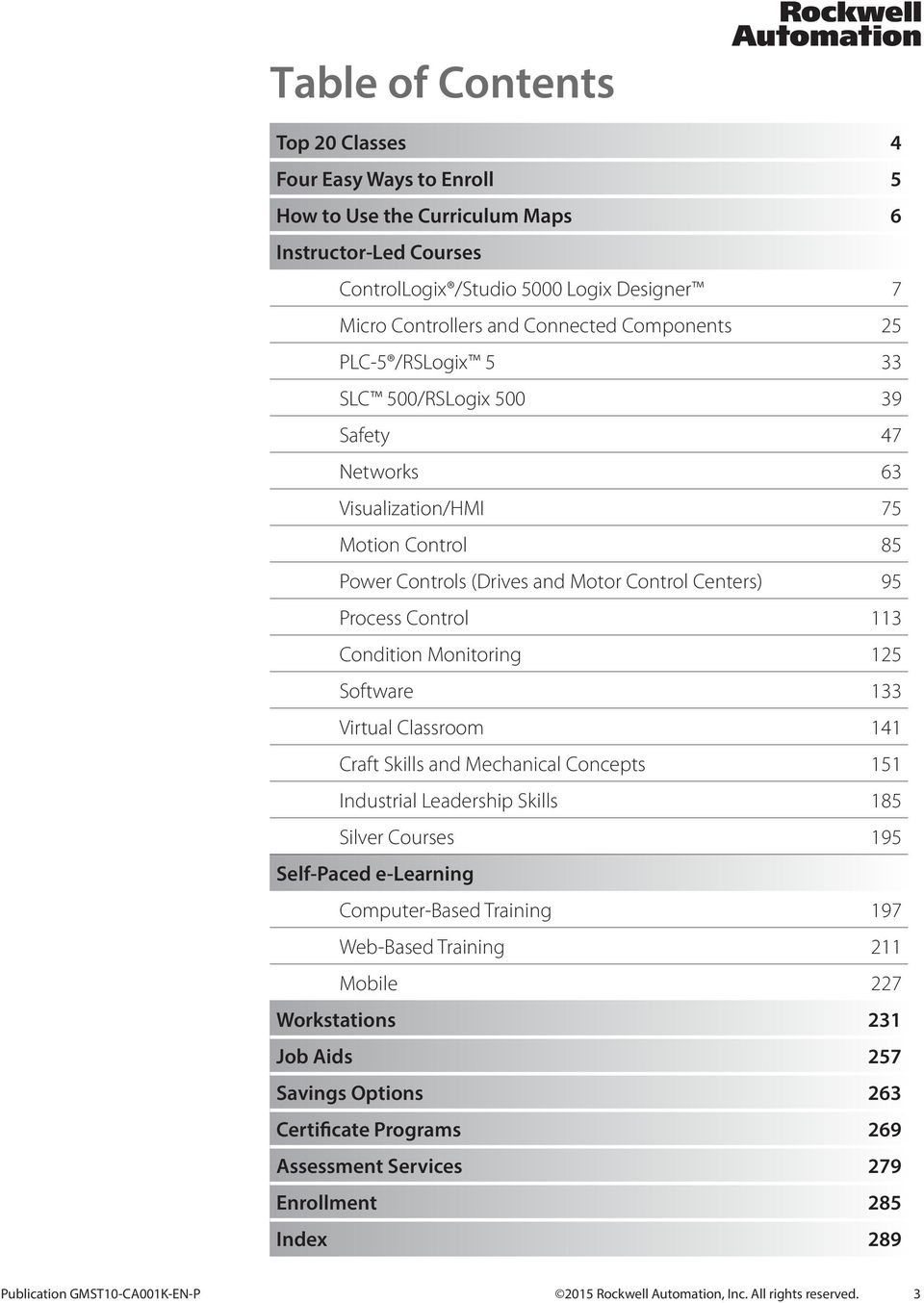
6 ControlLogix/ PLC-5/ 5 SLC 500/ 500 Safety Networks Visualization Motion Control Drives Process Control Condition Monitoring Software 20 Rockwell Automation Courses Top Course Number Course Title 1 CCP299 Studio 5000 Logix Designer Level 1: ControlLogix Fundamentals and Troubleshooting 2 CCP146 Studio 5000 Logix Designer Level 1: ControlLogix System Fundamentals 3 CCP143 Studio 5000 Logix Designer Level 3: Project Development 4 CCP153 Studio 5000 Logix Designer Level 2: ControlLogix Maintenance and Troubleshooting 5 CCP151 Studio 5000 Logix Designer Level 2: Basic Ladder Logic Programming 6 CCV204 FactoryTalk View ME and PanelView Plus Programming 7 CCV207 FactoryTalk View SE Programming 8 CCPS43 SLC 500 and 500 Maintenance and Troubleshooting 9 CCP122 PLC-5/SLC 500 and Fundamentals 10 CCN145 Studio 5000 Logix Designer Level 4: Kinetix 6000 (SERCOS) Programming 11 CCA183 PowerFlex 750-Series Maintenance and Troubleshooting 12 CCPS41 SLC 500 and 500 Programming 13 CCP298 Studio 5000 Logix Designer Level 1: CompactLogix Fundamentals and Troubleshooting 14 CCA182 PowerFlex 750-Series Configuration and Startup 15 CCCL21 Studio 5000 Logix Designer Level 3: Basic Ladder Logic Interpretation 16 CCN130 Motion Control Fundamentals 17 CCP164 DeviceNet and RSNetWorx Configuration and Troubleshooting 18 CCN200 Kinetix 6000 Troubleshooting and Project Interpretation 19 SAF-LOG101 GuardLogix Application Development 20 CCV209 FactoryTalk View ME and Panelview Plus Maintenance and Troubleshooting The Right Training Makes All the Difference 4
7 4 Easy Ways to Enroll General Information Training Schedules and Pricing Refer to the Training Services website for current schedules and course tuition. Cancellation Policy Cancellation of registration for a Rockwell Automation course less than 14 days prior to the start date is subject to a cancellation fee of 50% of the tuition. If a student fails to appear for a scheduled course, full tuition will be charged. Rockwell Automation strongly suggests that students only make refundable travel and lodging arrangements. Rockwell Automation reserves the right to alter course schedules, content, limit class size, reschedule, discontinue, or cancel courses. Continuing Education Units (CEUs) Rockwell Automation awards Continuing Education Units (CEUs) for attendance in its courses. It demonstrates our commitment to quality standards and practices. Refer to the course description, which can be found in the training catalog or training schedule: Terms and Conditions Printed materials provided in Rockwell Automation training courses are copyrighted and may not be reproduced. No audio or visual recording of Rockwell Automation training courses, or Rockwell Automation personnel teaching such courses, may be taken or reproduced electronically. Phone: Call your local Allen-Bradley distributor or (option 7) Web: Rockwell Automation Training Offices Rockwell Automation training is conducted in several cities across the United States and in Canada. Call (option 7) to be routed to the nearest Rockwell Automation training coordinator in one of these locations: United States Fax: Send completed Training Enrollment Form in the back of this catalog to your local Allen-Bradley distributor or Rockwell Automation Training office Send completed Training Enrollment Form in the back of this catalog to [email protected] Scan this code to access the Training Services website and online enrollment. Canada Atlanta Little Rock Brampton Boston Los Angeles Calgary Charlotte Milwaukee Cambridge Chicago Minneapolis Dartmouth Cincinnati Nashville Edmonton Cleveland New York City Montreal Dallas Philadelphia Vancouver Davenport Richmond Denver Rochester Detroit San Francisco Houston Seattle Indianapolis St. Louis Kalamazoo Tampa Call (option 7) or [email protected] with questions Rockwell Automation, Inc. All rights reserved. 5 Software Condition Monitoring Process Control Drives Motion Control Visualization Networks Safety SLC 500/ 500 PLC-5/ 5 ControlLogix/

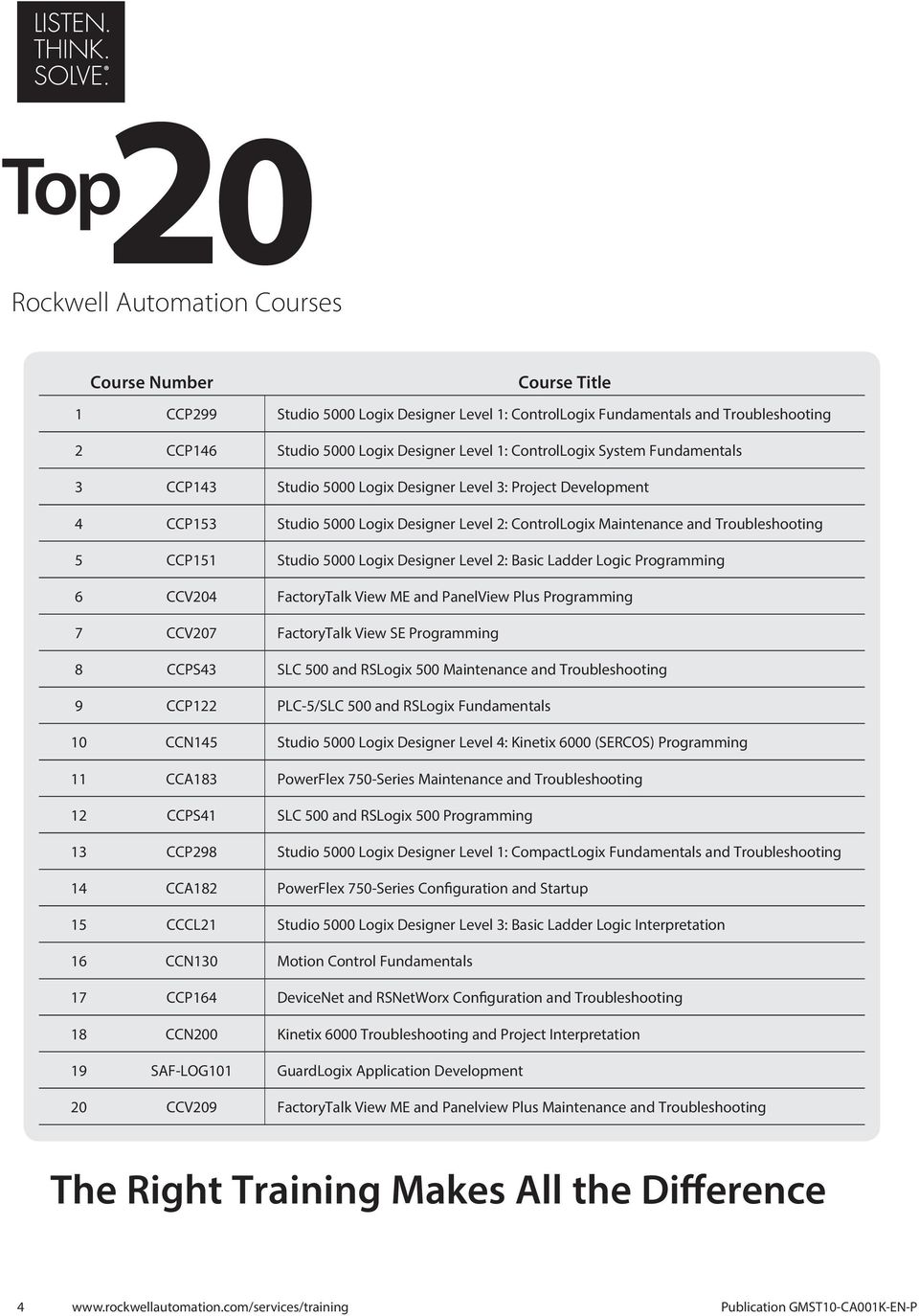
8 ControlLogix/ PLC-5/ 5 SLC 500/ 500 Safety Networks Visualization Motion Control Drives Process Control Condition Monitoring Software How to Use the Curriculum Map Curriculum maps show a recommended path based on your job responsibilities within a technology area. For example, the courses in the maintain section are designed for and instruct students on maintenance-related responsibilities. 1. Locate the start icon. This is the beginning of the Understand section. Courses with a START icon are required prerequisites. If there is no start icon, identify the recommended courses in the Understand section. Courses in the Understand section apply to all students and provide the prerequisite knowledge required to successfully complete courses in both the Maintain or Troubleshoot and Program or Design sections. It is highly recommended you complete the courses in the Understand track before progressing to the other tracks in the curriculum. 2. Select the course that best fits your job responsibilities in either the Maintain or Troubleshoot and Program or Design. Note that some curriculum maps offer additional sections and courses related to Safety Standards, Integrate or Design, and Application-Specific Courses. Courses with an arrow represent a progression in the content covered. Be sure to consult the course descriptions because some courses may require additional prerequisites. NOTE: When presented with a choice of two courses, select the most appropriate one by reviewing the course description or using the Course Selection Tool ( to assess your knowledge on the course. 3. Review related products that are available for prerequisite, refresher, or supplemental courses in the e-learning section of the curriculum map. e-learning options include web-based training, computer-based training, mobile app, and ibooks. 4. Use the legend in each map to identify and locate additional information. Optional Exam Last Half Day of Class Course is taught virtually with a live-instructor. Refer to the Virtual Classroom section of the catalog for more information. Optional exam can be completed to receive certification. Combination Understand and Maintain or Troubleshoot Level Course. Combination Program or Design and Maintain or Troubleshoot Level Course. 6 On-Site Only Course Core Requirement for Certificate Program for the specific technology. Refer to the Certificate Program section of the catalog for more information. Hardware is included with the purchase of the course. Course is delivered on-site at the customer s facility.
9 ControlLogix/Studio 5000 Logix Designer ControlLogix/Studio 5000 Logix Designer

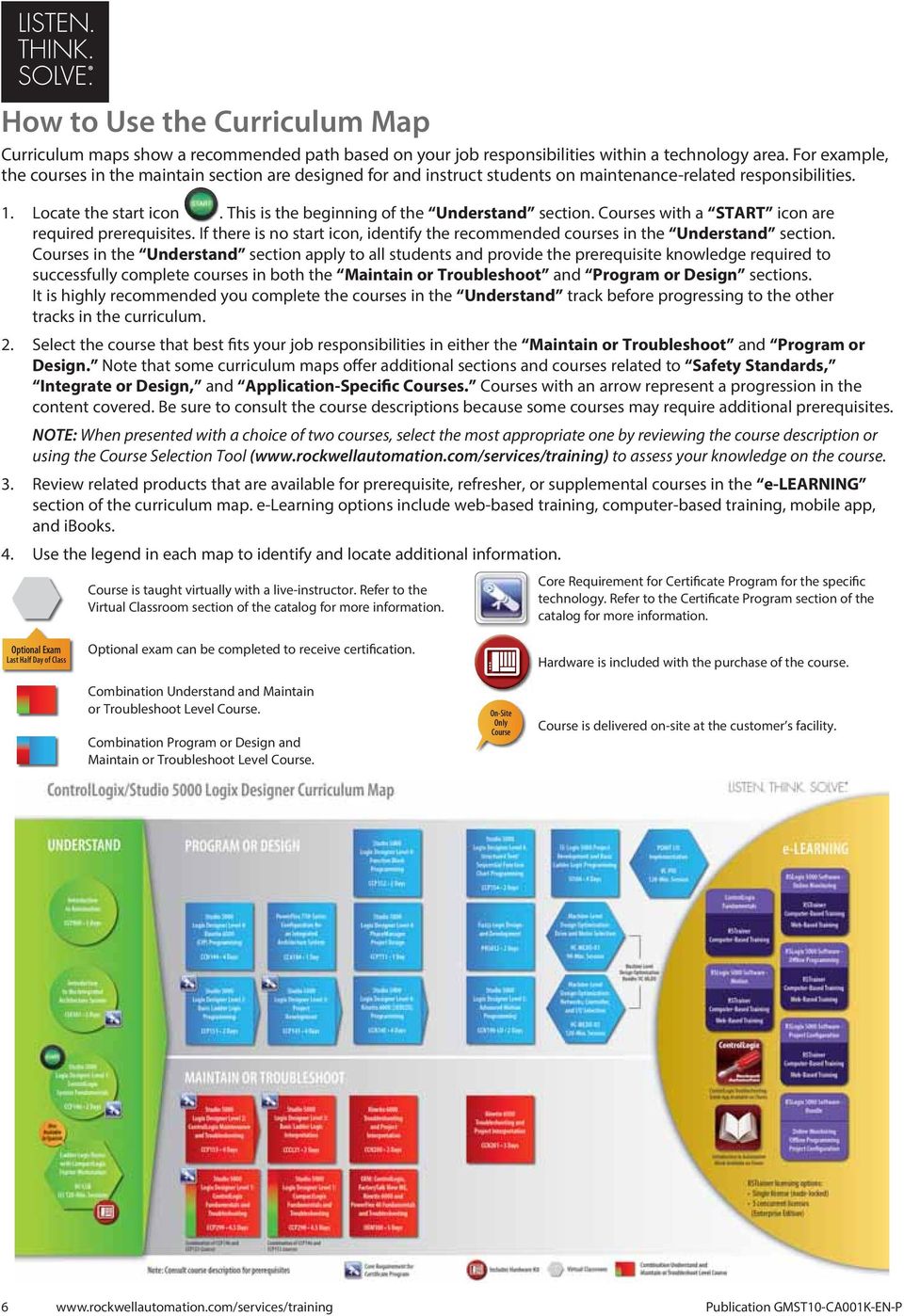
10 ControlLogix/Studio 5000 Logix Designer Curriculum Map UNDERSTAND PROGRAM OR DESIGN Studio 5000 Logix Designer Level 4: Function Block Programming CCP152 2 Days Introduction to Automation CCP800 3 Days Studio 5000 Logix Designer Level 4: Kinetix 6500 (CIP) Programming PowerFlex 750-Series Configuration for an Integrated Architecture System Studio 5000 Logix Designer Level 4: PhaseManager Project Design CCN144 4 Days CCA184 1 Day CCP711 1 Day Introduction to the Integrated Architecture System CIA101 2 Days Studio 5000 Logix Designer Level 2: Basic Ladder Logic Programming Studio 5000 Logix Designer Level 3: Project Development Studio 5000 Logix Designer Level 4: Kinetix 6000 (SERCOS) Programming CCP151 2 Days CCP143 4 Days CCN145 4 Days Studio 5000 Logix Designer Level 1: ControlLogix System Fundamentals MAINTAIN OR TROUBLESHOOT Also Available in Spanish CCP146 2 Days Studio 5000 Logix Designer Level 2: ControlLogix Maintenance and Troubleshooting Studio 5000 Logix Designer Level 3: Basic Ladder Logic Interpretation Kinetix 6000 Troubleshooting and Project Interpretation Ladder Logic Basics with CompactLogix Starter Workstation VC-LLB (5) 120-min. Sessions CCP153 4 Days Studio 5000 Logix Designer Level 1: ControlLogix Fundamentals and Troubleshooting CCCL21 2 Days Studio 5000 Logix Designer Level 1: CompactLogix Fundamentals and Troubleshooting CCN200 2 Days OEM: ControlLogix, FactoryTalk View ME, Kinetix 6000 and PowerFlex 40 Fundamentals and Troubleshooting CCP Days CCP Days OEM100 5 Days Combination of CCP146 and CCP153 Courses Combination of CCP146 and CCP153 Courses Note: Consult course description for prerequisites Core Requirement for Certificate Program 8

11 Studio 5000 Logix Designer Level 4: Structured Text/ Sequential Function Chart Programming SI: Logix 5000 Project Development and Basic Ladder Logic Programming SI100 4 Days e-learning POINT I/O Implementation VC-PIO 120-min. Session 5000 Software Online Monitoring CCP154 2 Days ControlLogix Fundamentals Fuzzy Logic Design and Development PRS012 2 Days Studio 5000 Logix Designer Level 5: Advanced Motion Programming CCN190-LD 2 Days Machine-Level Design Optimization: Drive and Motor Selection RSTrainer Computer-Based Training VC-MLDO min. Session Machine-Level Design Optimization: Networks, Controller, and I/O Selection VC-MLDO min. Session RSTrainer Computer-Based Training Web-Based Training 5000 Software Offline Programming Machine Level Design Optimization Bundle: VC-MLDO 5000 Software Motion RSTrainer Computer-Based Training Web-Based Training RSTrainer Computer-Based Training Web-Based Training 5000 Software Project Configuration ControlLogix RSTrainer Computer-Based Training Web-Based Training t ll i TTroubleshooting bl h ti ControlLogix Guide App Available on itunes Kinetix 6500 Troubleshooting and Project Interpretation 5000 Software Bundle Online Monitoring Offline Programming Project Configuration CCN201 3 Days Introduction d i to Automation A i ibook Available on itunes RSTrainer licensing options: Single license (node-locked) 5 concurrent licenses (Enterprise Edition) Includes Hardware Kit Virtual Classroom Combination mbination Understand and ntain or Troubleshoot Level Course Maintain 2015 Rockwell Automation, Inc. All rights reserved. 9

12 ControlLogix/Studio 5000 Logix Designer PLC-5/ 5 SLC 500/ 500 Safety Networks Visualization Motion Control Drives Process Control Condition Monitoring Software Training + Starter Workstation with Build Your Own workstation option Attend ControlLogix courses and maintain your skills with our Starter Workstation The workstation can be used for: Providing opportunities for realistic and safe practice Refreshing skills Reinforcing and practicing maintenance and troubleshooting skills CompactLogix Starter Workstation Your CompactLogix Starter Workstation will include the following: Assembled workstation or a build your own workstation that includes a kit and an instruction guide 1 CompactLogix L30ER processor 1 CompactLogix AC power supply 1 digital combo, 6 digital in/4 digital out 4 momentary push buttons 2 selector switches 1 Compactbus end cap AmeriPak shipping case Note: Software is not included with the starter workstation. Dimensions Width - 14 in. (36 cm) Height - 10 in. (25 cm) Depth - 6 in. (15 cm) Weight - 15 lb (7 kg) 10 Take Your Classroom Training Back to Your Job Six Rockwell Automation ControlLogix courses are bundled with a CompactLogix Starter Workstation to provide an opportunity for ongoing practice. This offer is optional; however, the CompactLogix Starter Workstation allows you to reinforce the skills acquired from any of the ControlLogix training classes. With this offer you can elect to build your own starter workstation or receive a pre-assembled workstation. ControlLogix/Studio 5000 Logix Designer Curriculum Map For a schedule of ControlLogix classes in your area and detailed course descriptions, go to:

13 After completing this course, students should have a broad and fundamental understanding of industrial automation. Topics range from an overview of common automation industries to an introduction of basic automated system components, such as controllers, I/O, drives, and Human Machine Interfaces (HMI). In addition, students will learn common automation terminology, what tools are used with industrial automation, and what careers may be available to students within this field. INTRODUCTION TO AUTOMATION Identify: Understand: - Common industries and - Industrial automation careers applications in industrial - Basic mechanical components automation - Automation control systems - Industrial automation standards - Controllers and regulations - Networks - I/O devices and modules - Safety in automation - System documentation - Process control - HMI Recognize logic and basic - AC and DC motors and drives programming concepts INTRODUCTION TO THE INTEGRATED ARCHITECTURE SYSTEM This course will assist students in developing and building a solid foundation of Integrated Architecture and automation system knowledge. Students will learn about and interact with a variety of automation hardware. They will have an opportunity to use Rockwell Automation software to perform basic system configuration tasks. While performing these tasks, students will gain an understanding of how controllers, drives, motors, networks, and human-machine interface (HMI) products function together within Integrated Architecture. Identify components of the integrated architecture system Establish communications in an integrated system Program a basic Logix Designer project for an integrated system Program with tag-based addressing in an integrated system Identify programming languages in an integrated system Understand Logix5000 multi-discipline control Understand NetLinx-enabled networks Understand the visualization development environment of an integrated system Understand HMI direct tag referencing in an integrated system Individuals who: Have little or no experience with automation systems Are interested in gaining a broad understanding of automation systems Basic training in electricity and electrical safety CCP800 3 Days CEUs 2.1 CIA101 2 Days CEUs 1.4 Individuals who: Have little or no working experience with automation systems Are interested in gaining a broad understanding of automation and the Integrated Architecture System Experience operating a computer within a Microsoft Windows environment 2015 Rockwell Automation, Inc. All rights reserved. 11 Software Condition Monitoring Process Control Drives Motion Control Visualization Networks Safety SLC 500/ 500 PLC-5/ 5 ControlLogix/Studio 5000 Logix Designer

14 ControlLogix/Studio 5000 Logix Designer PLC-5/ 5 SLC 500/ 500 Safety Networks Visualization Motion Control Drives Process Control Condition Monitoring Software STUDIO 5000 LOGIX DESIGNER LEVEL 1: CONTROLLOGIX SYSTEM FUNDAMENTALS This course will assist students in developing and building a solid foundation with a fundamental knowledge of Logix5000 systems. Students will be introduced to Logix5000 system components and functionality and will have an opportunity to use Studio 5000 Logix Designer application to perform basic system configuration tasks. Understand ControlLogix system components Select and connect to industrial networks in a Logix5000 system Download and go online to a Logix5000 controller Operate the Logix Designer application Configure local 1756-I/O modules Create tags and monitor data in a Logix Designer project Draft basic ladder logic for a Logix Designer routine Select basic ladder logic instructions for a Logix Designer routine Enter ladder logic components in a Logix Designer routine Locate ControlLogix system components, I/O Tags, and devices in a Logix5000 system This course is intended for maintainers or programmers. Some topics may be similar to topics covered in course CCP299. LADDER LOGIC BASICS WITH COMPACTLOGIX STARTER WORKSTATION CCP146 2 Days CEUs 1.4 Individuals who have little or no working experience with Logix5000 systems or other programmable controllers Experience operating a computer within a Microsoft Windows environment JOB AIDS INCLUDED CATALOG # Logix5000 Documentation Reference Guide Logix5000 Systems Glossary Studio 5000 Logix Designer and Logix5000 Fundamentals Procedures Guide ABT-1756-DRG70 ABT-1756-TSG10 ABT-1756-TSJ53 This course will teach students how to write and test basic ladder logic code and how to employ common programming strategies and best practices. Students will learn how to select and program bit, timer, counter, compare, and move instructions. Examples and labs will use the Studio 5000 Logix Designer application and a CompactLogix controller; however, the general ladder logic concepts covered in this course are applicable to most common programmable controllers. Review basic logic flow Convert scenarios to if then statements Convert if then statements to simple rungs Enter ladder logic into software Download a project Monitor the ladder logic Tie the alias to an existing address Apply bit instructions and common ladder logic strategies Select a class of instruction categories Select and integrate timers and counters Select and integrate compare and move instructions Combine compare with move instructions VC-LLB (5) 120-min. Sessions CEUs 1.0 Beginning programmers or individuals who are required to edit ladder logic A general knowledge of automation, including the general purpose of a controller, data, and I/O; and the purpose of common devices like push buttons, pilot lights, limit switches, relays, contractors, and solenoids is required TECHNICAL REQUIREMENTS A computer and phone Studio 5000 Logix Designer (version 21) must be installed and activated. The virtual classroom invitation will provide details on how to obtain a temporary installation of the software if students do not have it. CompactLogix Starter Workstation (shipped prior to class) 12 Virtual Classroom

15 Upon completion of this course, students should be able to troubleshoot a previously operational ControlLogix system and restore normal operation. Students will have the opportunity to develop and practice these skills by learning basic concepts and terminology, practicing a systematic strategy for diagnosing and troubleshooting problems, and performing hands-on exercises. Upon completion of this course, students should be able to troubleshoot a previously operational ControlLogix system and restore normal operation. Students will develop and practice these skills by learning basic concepts and terminology used, practicing a systematic strategy for diagnosing and troubleshooting problems, and performing hands-on exercises. STUDIO 5000 LOGIX DESIGNER LEVEL 1: CONTROLLOGIX FUNDAMENTALS AND TROUBLESHOOTING Locate CompactLogix Interpret arrays system components Interpret tags of user defined Navigate through the Logix data types Designer application Search for project components Connect a computer to a Force I/O and toggle bits communications network Troubleshoot digital I/O, analog I/O, Download and go online remote I/O, controller, power supply, Locate I/O tags and devices and noise related problems Interpret Logix Designer project Update Logix5000 firmware organization and execution Analyze and troubleshoot a system Interpret ladder logic structure using a trend chart Locate and edit tag values Edit ladder logic online Interpret bit and frequently Manage Logix Designer project files used instructions Document and print components STUDIO 5000 LOGIX DESIGNER LEVEL 1: COMPACTLOGIX FUNDAMENTALS AND TROUBLESHOOTING Locate CompactLogix Interpret tags of user defined system components data types Navigate through the Logix Search for project components Designer application Force I/O and toggle bits Connect a computer to a Troubleshoot digital I/O, analog I/O, communications network banked local I/O, distributed I/O, Download and go online controller, power supply, and noise Locate I/O tags and devices related problems Interpret Logix Designer project Update Logix5000 firmware organization and execution Analyze and troubleshoot a system Interpret ladder logic structure using a trend chart Locate and edit tag values Edit ladder logic online Interpret bit and frequently Manage Logix Designer project files used instructions Document and print components Interpret arrays Individuals who need to maintain and troubleshoot a ControlLogix or other Logix5000 system, but have no current working experience with Logix5000 systems JOB AIDS INCLUDED CATALOG # Logix5000 Systems Glossary 5000 and Logix5000 Procedures Guide ControlLogix Troubleshooting Guide Logix5000 Documentation Reference Guide This course is intended for individuals who need to maintain and troubleshoot a CompactLogix system but have no or little current working experience with CompactLogix systems Ability to perform basic Microsoft Windows tasks Previous experience with common industrial control system concepts JOB AIDS INCLUDED CATALOG # Studio 5000 Logix Designer Procedures Guide Logix5000 Systems Glossary CCP Days CEUs 3.2 Experience operating a computer within a Microsoft Windows environment Experience with common industrial control system concepts ABT-1756-TSG10 ABT-1756-TSJ50 ABT-1756-TSJ20 ABT-1756-DRG70 This course is intended for maintainers. Some topics may be similar to topics covered in course CCP146, CCP153, and CCP298. CCP Days CEUs 3.2 ABT-1756-TSJ50 ABT-1756-TSG10 This course is intended for maintainers. Some topics may be similar to topics covered in course CCP146, CCP153, and CCP Rockwell Automation, Inc. All rights reserved. 13 Software Condition Monitoring Process Control Drives Motion Control Visualization Networks Safety SLC 500/ 500 PLC-5/ 5 ControlLogix/Studio 5000 Logix Designer

16 ControlLogix/Studio 5000 Logix Designer PLC-5/ 5 SLC 500/ 500 Safety Networks Visualization Motion Control Drives Process Control Condition Monitoring Software STUDIO 5000 LOGIX DESIGNER LEVEL 3: BASIC LADDER LOGIC INTERPRETATION This course is a skill-building course that provides maintainers with a more detailed understanding of Studio 5000 Logix Designer ladder logic instructions and terminology. It also provides the resources and hands-on practice required to interpret ladder logic instructions for any Logix5000 controller. Students will have the opportunity to use the Logix Designer application to perform basic software tasks to meet the requirements of a given functional specification. In addition to using ladder logic, students will be introduced to ladder logic techniques, established standards, and common rules for interpretation ladder logic. STUDIO 5000 LOGIX DESIGNER LEVEL 2: CONTROLLOGIX MAINTENANCE AND TROUBLESHOOTING This course provides students with the necessary resources and hands-on practice to efficiently troubleshoot a previously operational ControlLogix system and restore normal operation. This course adds to students skill sets by introducing new tasks, such as connecting to a network, interpreting project execution, and editing ladder logic online. After practicing such skills, students will be presented with a systematic strategy for diagnosing and troubleshooting a variety of system errors, such as controller, I/O, and other hardware problems, noise-related problems, and software configuration problems. Optional: Locate ControlLogix system components Interpret project organization and execution, frequently used instructions, arrays, and tags of user-defined data types Locate and edit tag values Force I/O and toggle bits Troubleshoot digital, analog, and remote I/O Update Logix5000 firmware Troubleshoot controller, power supply, noise related, and digital I/O module problems Analyze and troubleshoot a system using trend chart Edit ladder logic online Optional: Edit FDB s online Document, print, and search project components This course is intended for maintainers. Some topics may be similar to topics covered in course CCP299. Review basic ladder logic Interpret move instructions Document and search ladder logic Interpret math instructions Interpret timer and counter Interpret expression handling instructions instructions Interpret program control instructions Interpret copy and file fill instructions Interpret compare instructions JOB AIDS INCLUDED CATALOG # Studio 5000 Logix Designer and Logix5000 Procedures Guide Logix5000 Documentation Reference Guide CD ABT-1756-TSJ50 ABT-1756-DRG70 Individuals who need to maintain and troubleshoot a ControlLogix or other Logix 5000 system JOB AIDS INCLUDED CATALOG # Studio 5000 Logix Designer and Logix5000 Procedures Guide ControlLogix Troubleshooting Guide CCP153 4 Days CEUs 2.8 Completion of the Studio 5000 Logix Designer Level 1: ControlLogix System Fundamentals course (CCP146) or equivalent experience Knowledge of basic ladder logic instructions ABT-1756-TSJ50 ABT-1756-TSJ20 CCCL21 2 Days CEUs 1.4 Maintainers who need to interpret ladder logic using the Logix Designer application Experience operating a computer within a Microsoft Windows environment Completion of the Studio 5000 Logix Designer Level 1: ControlLogix System Fundamentals course (CCP146) or equivalent experience Completion of the Studio 5000 Logix Designer Level 2: ControlLogix Maintenance and Troubleshooting course (CCP153) or equivalent experience This course is intended for maintainers. Some topics may be similar to topics covered in course CCP

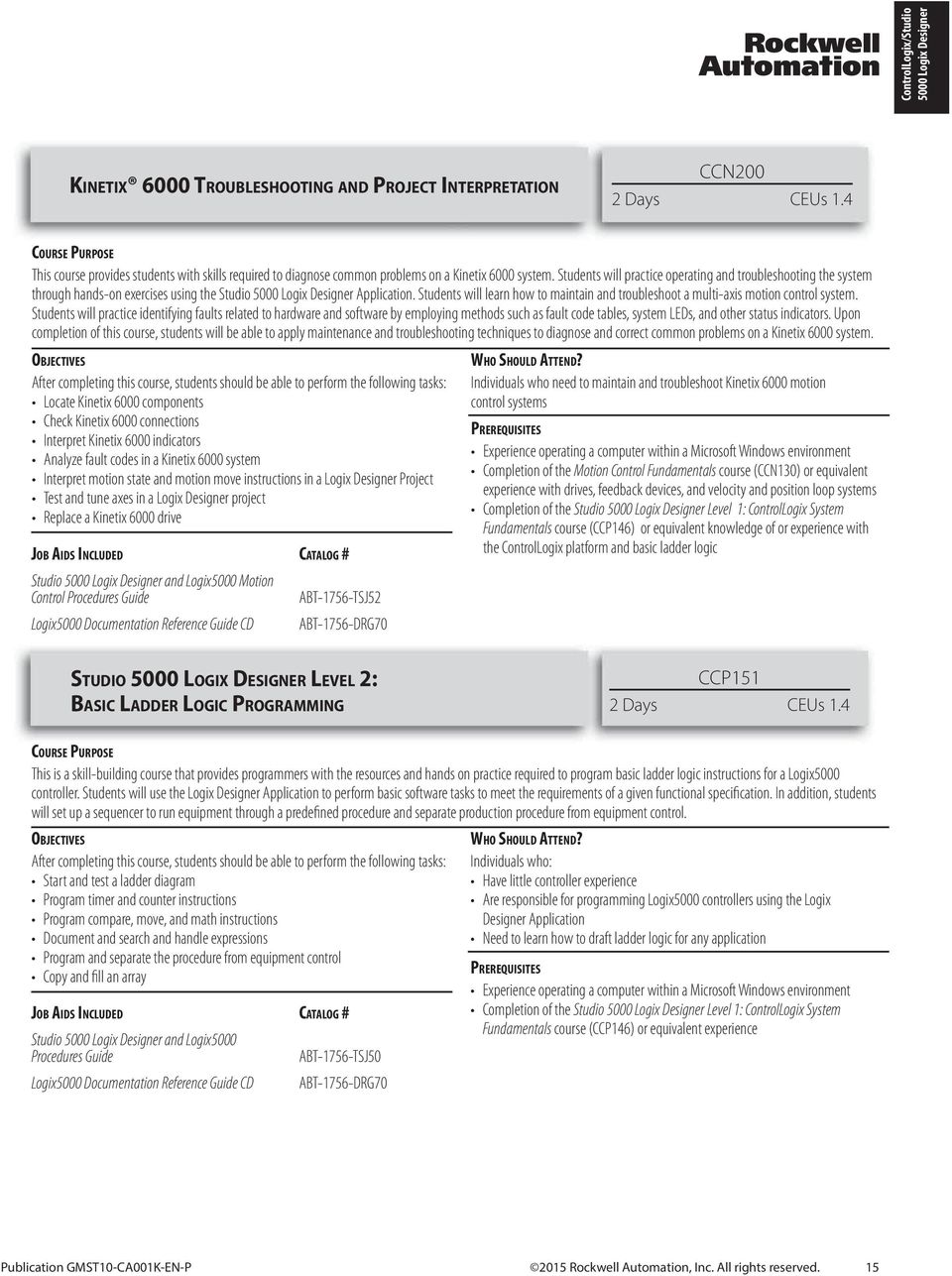
17 KINETIX 6000 TROUBLESHOOTING AND PROJECT INTERPRETATION This course provides students with skills required to diagnose common problems on a Kinetix 6000 system. Students will practice operating and troubleshooting the system through hands-on exercises using the Studio 5000 Logix Designer Application. Students will learn how to maintain and troubleshoot a multi-axis motion control system. Students will practice identifying faults related to hardware and software by employing methods such as fault code tables, system LEDs, and other status indicators. Upon completion of this course, students will be able to apply maintenance and troubleshooting techniques to diagnose and correct common problems on a Kinetix 6000 system. Locate Kinetix 6000 components Check Kinetix 6000 connections Interpret Kinetix 6000 indicators Analyze fault codes in a Kinetix 6000 system Interpret motion state and motion move instructions in a Logix Designer Project Test and tune axes in a Logix Designer project Replace a Kinetix 6000 drive JOB AIDS INCLUDED CATALOG # Studio 5000 Logix Designer and Logix5000 Motion Control Procedures Guide Logix5000 Documentation Reference Guide CD This is a skill-building course that provides programmers with the resources and hands on practice required to program basic ladder logic instructions for a Logix5000 controller. Students will use the Logix Designer Application to perform basic software tasks to meet the requirements of a given functional specification. In addition, students will set up a sequencer to run equipment through a predefined procedure and separate production procedure from equipment control. Start and test a ladder diagram Program timer and counter instructions Program compare, move, and math instructions Document and search and handle expressions Program and separate the procedure from equipment control Copy and fill an array JOB AIDS INCLUDED CATALOG # Studio 5000 Logix Designer and Logix5000 Procedures Guide Logix5000 Documentation Reference Guide CD ABT-1756-TSJ52 ABT-1756-DRG70 STUDIO 5000 LOGIX DESIGNER LEVEL 2: BASIC LADDER LOGIC PROGRAMMING ABT-1756-TSJ50 ABT-1756-DRG70 CCN200 2 Days CEUs 1.4 Individuals who need to maintain and troubleshoot Kinetix 6000 motion control systems Experience operating a computer within a Microsoft Windows environment Completion of the Motion Control Fundamentals course (CCN130) or equivalent experience with drives, feedback devices, and velocity and position loop systems Completion of the Studio 5000 Logix Designer Level 1: ControlLogix System Fundamentals course (CCP146) or equivalent knowledge of or experience with the ControlLogix platform and basic ladder logic CCP151 2 Days CEUs 1.4 Individuals who: Have little controller experience Are responsible for programming Logix5000 controllers using the Logix Designer Application Need to learn how to draft ladder logic for any application Experience operating a computer within a Microsoft Windows environment Completion of the Studio 5000 Logix Designer Level 1: ControlLogix System Fundamentals course (CCP146) or equivalent experience 2015 Rockwell Automation, Inc. All rights reserved. 15 Software Condition Monitoring Process Control Drives Motion Control Visualization Networks Safety SLC 500/ 500 PLC-5/ 5 ControlLogix/Studio 5000 Logix Designer
18 ControlLogix/Studio 5000 Logix Designer PLC-5/ 5 SLC 500/ 500 Safety Networks Visualization Motion Control Drives Process Control Condition Monitoring Software Given a functional specification for a Logix5000 application, students will be able to develop a project during the course to meet the specification requirements. This course covers tasks common to all controllers that use the Logix5000 control engine or operating system, including ControlLogix, CompactLogix, and SoftLogix controllers. This course presents a deeper understanding of project development tasks, such as organizing tasks and routines, organizing controller data, configuring modules, and sharing data. Students will use Producer/Consumer technology to multicast input and output devices, share data between controllers, and control remote I/O. STUDIO 5000 LOGIX DESIGNER LEVEL 3: PROJECT DEVELOPMENT Create and organize a project Communicate with a local Create periodic and event tasks I/O module and over an EtherNet/IP Develop an add-on instruction in network ladder diagram Configure a message Organize arrays Allocate connections Create a user-defined data type Retrieve and set controller status Import components values with GSV/SSV instructions Enter, edit, and verify ladder logic Program a BTD instruction Configure a controller to produce and Handle a major fault consume data Manage project files Configure controllers to share data Update firmware over EtherNet/IP STUDIO 5000 LOGIX DESIGNER LEVEL 4: FUNCTION BLOCK PROGRAMMING This course provides students with an understanding of Logix Designer function block diagrams and terminology. Resources and hands on practice are provided to program a Logix5000 controller using function block diagrams. Students will perform parameter modifications to individual function block instructions and create and develop function block diagram programs and routines. Create a function block diagram Program logical function block instructions Program timer and counter function block instructions Program analog function block instructions Program device driver function block instructions Select timing modes in a function block instruction Program a totalizer function block instruction Program and monitor an RMPS (ramp/soak) function block instruction Control program flow using function block instructions Program a PID loop using function block diagram Tune a PID loop using ActiveX controls Develop an add-on instruction in function block diagram Individuals who need to develop Logix Designer projects for any Logix5000 controller JOB AIDS INCLUDED CATALOG # Studio 5000 Logix Designer and Logix5000 Procedures Guide Logix5000 Documentation Reference Guide CD Individuals who: Are responsible for developing, debugging, and programming Logix5000 controllers using Logix Designer application with function block diagrams Use ActiveX controls in an operator interface such as FactoryTalk View ME software Experience operating a computer within a Microsoft Windows environment Understanding of basic measurement and control theory, including basic loop control Completion of the Studio 5000 Logix Designer Level 3: Project Developing course (CCP143) or equivalent experience JOB AIDS INCLUDED CATALOG # Studio 5000 Logix Designer and Logix5000 Procedures Guide CCP143 4 Days CEUs 2.8 Experience operating a computer within a Microsoft Windows environment Knowledge of common controller terms and operation through experience or completion of the Studio 5000 Logix Designer Level 1: ControlLogix System Fundamentals course (CCP146) or completion of the RSTrainer for ControlLogix Fundamentals computer-based training (9393-RSTCLX) Ability to write basic ladder logic with common instructions or through completion of the Studio 5000 Logix Designer Level 2: Basic Ladder Logic Programming course (CCP151) ABT-1756-TSJ50 ABT-1756-DRG70 CCP152 2 Days CEUs 1.4 ABT-1756-TSJ

19 STUDIO 5000 LOGIX DESIGNER LEVEL 4: KINETIX 6000 (SERCOS) PROGRAMMING After completing this course, students should be able to configure, test, tune, and program SERCOS motion axes in the Studio 5000 Logix Designer programming environment. Building upon the skills gained in the Studio 5000 Logix Designer Level 3: Project Development course (CCP143), students will learn how to apply the Logix5000 architecture to a multi-axis SERCOS motion control system. Students will also practice project planning and efficient programming skills necessary for translating a machine specification into reliable ladder logic code. Because all Logix5000 products share common features and a common operating system, students will be able to apply the configuring and programming motion control skills they learn in this course to any of the Logix5000 controllers that are capable of motion control. Create a Studio 5000 Logix Designer project for a SERCOS motion application Add drives and configure SERCOS axes Test SERCOS hardware Autotune SERCOS axes Plan a motion project Create user-defined data types, an axis-level program shell, and axis-level tags Program: - Axis-level dispatch and power up routines - Axis-level command routine - Axis-level waiting routine - Aborting routine - Clearing routine STUDIO 5000 LOGIX DESIGNER LEVEL 5: ADVANCED MOTION PROGRAMMING This course is intended to provide students with the skills to configure and program Logix5000 applications specifically for integrated motion control functionality using ladder logic including SERCOS motion control technology. Students will learn how to apply advanced programming skills including tuning with motion analyzer software, advanced camming techniques, coordinated motion, and add-on instructions for motion applications. Tune a servo axis with motion analyzer software Program event driven tasks Program output cam instructions Calculate a cam profile Program coordinate and motion add-on instructions Develop a motion control project using the power programming state model Program coordinated move transform instructions in a pick and place application JOB AIDS INCLUDED CATALOG # Studio 5000 Logix Designer and Logix5000 Motion Procedures Guide Logix5000 Documentation Reference Guide CD - Stopping routine - Resetting routine - Starting routine - Execute routine - Electronic gearing - Electronic camming Replicate the axis program and application-level program Add a virtual axis ABT-1756-TSJ52 ABT-1756-DRG70 Individuals who need to configure and program Logix5000 motion control systems JOB AIDS INCLUDED CATALOG # Studio 5000 Logix Designer and Logix5000 Motion Procedures Guide Logix5000 Documentation Reference Guide CD CCN145 4 Days CEUs 2.8 Experience operating a computer within a Microsoft Windows environment Completion of the Motion Control Fundamentals course (CCN130) or equivalent experience with drives, feedback devices, and servo motion systems Completion of the Studio 5000 Logix Designer Level 3: Project Development course (CCP143) or equivalent experience Experience with entering and debugging ladder logic ABT-1756-TSJ52 ABT-1756-DRG70 CCN190-LD 2 Days CEUs 1.4 Individuals who need to program advanced Logix5000 motion control systems Experience operating a computer within a Microsoft Windows environment Completion of the Studio 5000 Logix Designer Level 3: Project Development course (CCP143) or equivalent experience with basic ladder logic programming Completion of the Studio 5000 Logix Designer Level 4: Kinetix 6000 (SERCOS) Programming course (CCN145) or equivalent experience 2015 Rockwell Automation, Inc. All rights reserved. 17 Software Condition Monitoring Process Control Drives Motion Control Visualization Networks Safety SLC 500/ 500 PLC-5/ 5 ControlLogix/Studio 5000 Logix Designer

20 ControlLogix/Studio 5000 Logix Designer PLC-5/ 5 SLC 500/ 500 Safety Networks Visualization Motion Control Drives Process Control Condition Monitoring Software STUDIO 5000 LOGIX DESIGNER LEVEL 4: STRUCTURED TEXT/ SEQUENTIAL FUNCTION CHART PROGRAMMING This course provides students with the skills and knowledge to program using the structured text and sequential function chart programming languages. Students will learn how to select instructions, expressions, and constructs, and then enter these elements and more into a routine. Students will also learn how to test sequential function chart logic using forces and step throughs. Program assignments, expressions, and instructions in structured text Program constructs and comments in structured text Design a sequential function chart Program and test a sequential function chart Store, pause, and reset sequential function chart data STUDIO 5000 LOGIX DESIGNER LEVEL 4: PHASEMANAGER PROJECT DESIGN This course is intended to provide students with the skills to configure and program Logix5000 applications in accordance with the S88 state model using the PhaseManager feature. This course presents a tool that will help students effectively organize and structure batch applications. Students will organize a Studio 5000 Logix Designer project by identifying control and equipment modules within application code. They will separate equipment code from equipment phase code, test an equipment phase, and configure a sequential function chart as an internal sequencer. Define equipment phases and state models in a Logix Designer project Separate equipment phrase code from equipment code Test an equipment phase Configure a sequential function chart as an internal sequencer Individuals who need to program structured text and sequential function chart routines in Logix Designer projects for any Logix5000 controller JOB AIDS INCLUDED CATALOG # Studio 5000 Logix Designer and Logix5000 Procedures Guide CCP154 2 Days CEUs 1.4 Experience operating a computer within a Microsoft Windows environment Completion of the Studio 5000 Logix Designer Level 3: Project Development course (CCP143) or experience with basic Logix Designer projects (navigating the software, creating tags, creating routines, etc.) ABT-1756-TSJ50 CCP711 1 Days CEUs 0.7 Individuals who need to apply the S88 state model to Logix Designer projects for any Logix5000 controller Experience operating a computer within a Microsoft Windows environment Completion of the Studio 5000 Logix Designer Level 3: Project Development course (CCP143) or advanced programming experience using the Logic Designer Application Familiarity with sequential function chart programming language 18

21 FUZZY LOGIC DESIGN AND DEVELOPMENT This course provides students with the skills to produce a fuzzy control system for a continuous process application. It introduces the range of options for fuzzy systems but focuses on using fuzzy logic to adjust the gains of a PID loop to meet specific control requirements. Starting with a description of a process, students will decide whether fuzzy logic is the best control method, and then will design a fuzzy system, develop it in FuzzyDesigner software, and implement it in a Logix5000 controller. Students will use FuzzyDesigner s simulation, graphing, and online monitoring tools to validate the system against control requirements. Decide when to use fuzzy logic Chose a fuzzy control scheme Identify input and output variables, terms, and membership parameters Write rules Chose a defuzzification method Create FuzzyDesigner project Create ports and variables Enter terms and rules Chain rules Simulate a fuzzy system execution Graph inputs and outputs Create, import, monitor, and change add-on instruction STUDIO 5000 LOGIX DESIGNER LEVEL 4: KINETIX 6500 (CIP) PROGRAMMING PRS012 2 Days CEUs 1.4 Individuals who need to design, develop, or implement advanced process control applications Ability to perform these Logix Designer Application skills: - Enter and edit logic - Download and go online - Monitor and edit data Completion of the Studio 5000 Logix Designer Level 1: ControlLogix System Fundamentals course (CCP146) After completing this course, students should be able to configure, test, tune, and program CIP motion axes in the Studio 5000 Logix Designer programming environment. Building upon the skills gained in the Studio 5000 Logix Designer Level 3: Project Development course (CCP143), students will learn how to apply the Logix5000 architecture to a multi-axis CIP motion control system. Students will practice project planning and efficient programming skills necessary for translating a machine specification into reliable ladder logic code. Because all Logix5000 products share common features and a common operating system, students will be able to apply the configuring and programming motion control skills they learn in this course to any of the Logix5000 controllers that are capable of motion control. Create a Studio 5000 Logix Designer project for a CIP motion application Add drives and configure CIP motion axes Test CIP motion hardware Autotune CIP motion axes Plan a motion project Create user-defined data types, axis-level program shell, and axis-level tags Program the: - Axis-level dispatch and power up routines - Axis-level command routine - Axis-level waiting routine - Aborting, clearing, stopping, resetting, and starting routine Replicate the axis program Replicate an application-level program and the execute routines Add a virtual axis Program electronic gearing and camming Individuals who need to configure and program Logix5000 motion control systems JOB AIDS INCLUDED CATALOG # Studio 5000 Logix Designer and Logix5000 Motion Procedures Guide Logix5000 Documentation Reference Guide CD CCN144 4 Days CEUs 2.8 Experience operating a computer within a Microsoft Windows environment Completion of the Motion Control Fundamentals course (CCN130) or equivalent knowledge of general motion control, drives, feedback devices, and servo motion systems Completion of the Studio 5000 Logix Designer Level 3: Project Development course (CCP143) or equivalent experience ABT-1756-TSJ52 ABT-1756-DRG Rockwell Automation, Inc. All rights reserved. 19 Software Condition Monitoring Process Control Drives Motion Control Visualization Networks Safety SLC 500/ 500 PLC-5/ 5 ControlLogix/Studio 5000 Logix Designer
22 ControlLogix/Studio 5000 Logix Designer PLC-5/ 5 SLC 500/ 500 Safety Networks Visualization Motion Control Drives Process Control Condition Monitoring Software POWERFLEX 750-SERIES CONFIGURATION FOR AN INTEGRATED ARCHITECTURE SYSTEM Upon completion of this course, given a PowerFlex 750-Series drive (PowerFlex 753 or PowerFlex 755) that has been successfully started up, students will be able to integrate their drive into a system that includes Logix5000 controllers and PanelView Plus terminals running FactoryTalk View ME software. Throughout the course, students will have the chance to use a variety of hardware and software tools, including the A6 LCD HIM, Logix Designer software, and FactoryTalk View ME software. After each demonstration, students will be given exercises that offer extensive hands-on practice using a PowerFlex 753 or PowerFlex 755 drive. Add a PowerFlex 750-Series drive to a Logix Designer project Locate and modify PowerFlex 750-Series data using Logix Designer software Integrate a PowerFlex 750-Series drive with a Logix5000 controller Add PowerFlex 750-Series faceplates to a FactoryTalk View ME application Operate a PowerFlex 750-Series drive in an Integrated Architecture system JOB AIDS INCLUDED CATALOG # PowerFlex 750-Series AC Drives Documentation Reference Guide CD Studio 5000 Logix Designer and Logix5000 Procedures Guide ABT-20G-DRG70 ABT-1756-TSJ50 MACHINE-LEVEL DESIGN OPTIMIZATION: DRIVE AND MOTOR SELECTION CCA184 1 Day CEUs 0.7 Individuals who need to add PowerFlex 750-Series drives to an Integrated Architecture system Experience operating a computer within a Microsoft Windows environment Working knowledge of electricity and knowledge of electrical/industrial safety (including PPE requirements and safe practices) Completion of the PowerFlex 750-Series Startup & Configuration course (CCA182) Knowledge of Logix5000 system fundamentals and basic programming skills through one or more of the following methods:: - Completion of the Studio 5000 Logix Designer Level 1: ControlLogix System Fundamentals course (CCP146) - Logix 5000 software computer-based and/or web-based training - Equivalent experience programming Logix5000 control systems Previous experience with FactoryTalk View ME software is suggested, but not required This course covers best practices for architecting control solutions for machines. The instructor will show students how to size and select drives and motors and then they will practice these tasks with an application. The design tools and best practices covered in the course aim to optimize and reduce build time with machine-level design. Configure a motion profile, a mechanism, and transmissions Select a motor and drive VC-MLDO Minutes CEUs 0.15 Control engineers and OEMs who design machine-level control applications There are no prerequisites for this course; however, experience with designing machine-level control applications is helpful TECHNICAL REQUIREMENTS A computer and phone Motion Analyzer software, version 6.1, must be installed and activated. The virtual classroom invitation will provide details on how to obtain a temporary installation of the software if students do not have it Virtual Classroom
23 MACHINE-LEVEL DESIGN OPTIMIZATION: NETWORKS, CONTROLLER, AND I/O SELECTION This course covers best practices for architecting control solutions for machines. The instructor will show students how to size and select control platforms and machine-level networks and then they will practice these tasks with an application. The design tools and best practices covered in the course aim to optimize and reduce build time with machine-level design. Select network topology/components and a controller and I/O Add devices to the network Verify network loading VC-MLDO Minutes CEUs 0.2 Control engineers and OEMs who design machine-level control applications There are no prerequisites for this course; however, experience with designing machine-level control applications is helpful TECHNICAL REQUIREMENTS A computer and phone Integrated Architecture Builder software, version 9.1, must be installed and activated. The virtual classroom invitation will provide details on how to obtain a temporary installation of the software if students do not have it. This course is a skill-building course that provides students with the resources and hands-on practice required to develop a project and program basic ladder logic instructions for any Logix5000 controller. Students will have an opportunity to use the 5000 application to perform basic software tasks to meet the requirements of a given functional specification. In addition, students will be introduced to basic Logix5000 concepts and terminology. SI: LOGIX5000 PROJECT DEVELOPMENT AND BASIC LADDER LOGIC PROGRAMMING Locate control system components Document and search ladder logic Create and modify a project Configure produce/consume Organize project and arrays messaging and message instructions Connect a computer to a Configure controllers to share date communication network over an EtherNet/IP network Download and go online Create a periodic and event task Communicate with local and remote Develop an add-on instruction I/O modules Test a ladder diagram Update Logix5000 firmware Handle a major fault Start a ladder diagram Import Logix Designer components Create tags and monitor data Optional: Enter ladder logic components - Understand control systems Create UDTs - Manage Logix Designer Select basic ladder logic instructions project files Program timer, counter, move, math, and compare instructions Virtual Classroom SI100 4 Days CEUs 2.8 System integrator programmers who have little or no working experience with Logix5000 controllers, and are responsible for programming Logix5000 controllers using the 5000 application. Experience operating a computer within a Microsoft Windows environment Read wiring diagrams This course contains many of the lessons in courses CCP143, CCP146, and CCP151 in a consolidated format. Do not take all 4 courses Rockwell Automation, Inc. All rights reserved. 21 Software Condition Monitoring Process Control Drives Motion Control Visualization Networks Safety SLC 500/ 500 PLC-5/ 5 ControlLogix/Studio 5000 Logix Designer
24 ControlLogix/Studio 5000 Logix Designer PLC-5/ 5 SLC 500/ 500 Safety Networks Visualization Motion Control Drives Process Control Condition Monitoring Software OEM: CONTROLLOGIX, FACTORYTALK VIEW ME, KINETIX 6000, AND POWERFLEX 40 FUNDAMENTALS AND TROUBLESHOOTING This course provides students with the skills necessary to maintain and troubleshoot: Studio 5000 applications that operate on a ControlLogix-based machine; FactoryTalk View Machine Edition (ME) applications that run on PanelView Plus terminals; Kinetix 6000 motion systems; and PowerFlex 40 drives. Students will have the opportunity to develop and practice these skills by learning basic concepts and terminology used with: ControlLogix hardware, PanelView Plus terminal, Kinetix 6000 systems, and PowerFlex 40 drives; Studio 5000 Logix Designer application; and FactoryTalk View ME application. Students will also learn to diagnose and troubleshoot problems with controller, I/O or other hardware issues. Assign an IP address to a computer Configure produced/consumed data Connect a computer to a network Tune a PID loop Configure EtherNet/IP addresses Manage project files Download and go online Configure a trend chart Update firmware Test a ladder diagram Locate I/O tags and devices Troubleshoot digital and analog Locate and edit tag values I/O modules Create and modify project Modify application communications Draft basic ladder logic Download runtime files Select ladder logic instructions Configure display security, graphic Edit ladder logic online displays, and interactive controls Program timer, counter, math, Troubleshoot workstation problems compare, and move instructions Interpret motion instructions Search for project components and indicators Force I/O and toggle bits Modify drive parameters POINT I/O IMPLEMENTATION OEMs who need to maintain and troubleshoot a ControlLogix-based machine, but have little to no working experience with ControlLogix systems Experience operating a computer within a Microsoft Windows environment Perform basic voltage and current checks Read wiring diagrams JOB AIDS INCLUDED CATALOG # Studio 5000 Logix Designer and Logix5000 Procedures Guide FactoryTalk View ME and PanelView Plus Procedures Guide EtherNet/IP Procedures Guide Logix5000 Documentation Reference Guide CD ControlLogix Troubleshooting Guide OEM100 5 Days CEUs 3.5 ABT-1756-TSJ50 ABT-2711P-TSJ50 ABT-N300-TSJ50 ABT-1756-DRG70 ABT-1756-TSJ20 This course will teach students how to implement a POINT I/O system from determining the quantity and type of I/O needed to testing your system. This course will also show students how to calculate power requirements and decide whether an expansion power supply will be needed. Students will also add and configure an Ethernet adapter and I/O modules in a Studio 5000 Logix Designer project. Size a POINT I/O control system Configure POINT I/O control system components in a Studio 5000 Logix Designer project TECHNICAL REQUIREMENTS A computer and phone The Studio 5000 Logix Designer application (version 21) must be installed and activated. The virtual classroom invitation will provide details on how to obtain a temporary installation of the software if students do not have it. VC-PIO 120 Minutes CEUs 0.2 Control engineers who design and develop control applications and who will be working with POINT I/O system components over an EtherNet/IP network Studio 5000 Logix Designer experience or one of the following courses: - Studio 5000 Logix Designer Level 1: ControlLogix Fundamentals and Troubleshooting (CCP299) - Studio 5000 Logix Designer Level 1: CompactLogix Fundamentals and Troubleshooting (CCP298) Knowledge of Ethernet fundamentals Knowledge of safe electrical practices Knowledge of electrical principles such as voltage, current, and power 22 Virtual Classroom
25 KINETIX 6500 TROUBLESHOOTING AND PROJECT INTERPRETATION This course is intended to provide students with the skills required to diagnose common problems on a Kinetix 6500 servo drive system. During class, students will practice operating and troubleshooting the system through hands-on exercises using the Studio 5000 Logix Designer application. Building upon the skills developed in the Fundamentals of Motion Control course (CCN130), students will learn how to maintain and troubleshoot a multi-axis motion control system. Students will practice identifying faults related to hardware, software, and motion networks by leveraging tools such as web pages, system LEDs, and Logix Designer status indicators. Upon completion of this course, students will be able to apply maintenance and troubleshooting techniques to diagnose and correct common problems on a Kinetix 6500 servo drive system. Identify the physical components and wiring of a Kinetix 6500 servo drive Interpret Kinetix 6500 servo drive status indicators Using the Studio 5000 Logix Designer application: - Determine the status of a drive and its associated axis - Test wiring and signals for a Kinetix 6500 servo drive axis - Trend status information for a Kinetix 6500 servo drive axis - Tune a Kinetix 6500 servo drive axis In a Studio 5000 Logix Designer project: - Verify a Kinetix 6500 servo drive and drive axis configuration - Interpret motion state instructions for a Kinetix 6500 servo drive axis - Interpret motion move instructions for a Kinetix 6500 servo drive axis - Troubleshoot ladder logic for a Kinetix 6500 servo drive axis Troubleshoot failed communications for a Kinetix 6500 servo drive control module Access a Kinetix 6500 servo drive web page Remove and replace a Kinetix 6500 servo drive CCN201 3 Days CEUs 2.1 Individuals who need to maintain and troubleshoot Kinetix 6500 motion control systems Experience operating a computer within a Microsoft Windows environment Completion of the Motion Control Fundamentals course (CCN130) or equivalent knowledge of or experience with drives, feedback devices, and velocity and position loop systems Completion of the Studio 5000 Logix Designer Level 1: ControlLogix System Fundamentals course (CCP146) or equivalent knowledge of or experience with the ControlLogix platform and basic ladder logic JOB AIDS INCLUDED CATALOG # Studio 5000 Logix Designer and Logix5000 Motion Control Procedures Guide Motion Control Documentation Reference Guide CD ABT-1756-TSJ52 ABT-M100-DRG Rockwell Automation, Inc. All rights reserved. 23 Software Condition Monitoring Process Control Drives Motion Control Visualization Networks Safety SLC 500/ 500 PLC-5/ 5 ControlLogix/Studio 5000 Logix Designer
26 ControlLogix/Studio 5000 Logix Designer PLC-5/ 5 SLC 500/ 500 Safety Networks Visualization Motion Control Drives Process Control Condition Monitoring Software Fundamentals Training + One Attend a Rockwell Automation Fundamentals class and receive a 20% discount on your next training class! Fundamentals Training + One is a great way to extend your learning experience beyond just the basics and save money in the process. Enroll in any Rockwell Automation Fundamentals class and receive a discount on your second class. After attending a Fundamentals class, you have thirty days to enroll in a second class to receive the discount. Rockwell Automation will automatically reduce your second class tuition by 20% off the list price How to Enroll To enroll in a Rockwell Automation training class, contact your local Allen-Bradley distributor, Rockwell Automation sales office or dial (option 7) and mention promotional code TAS0702. This offer is not valid with other promotions.
27 Micro Controllers and Connected Components Micro Controllers & Conn. Components
28 Micro Controllers and Connected Components Curriculum Map UNDERSTAND PROGRAM OR DESIGN MicroLogix 1400 Processor Installation and Data Monitoring CCPM41 1 Day MicroLogix 1400 Processor Embedded Web Server Management CCPM43 1 Day MicroLogix 1400 Processor Installation, Data Monitoring and Embedded Web Server Management CCPM44 2 Days Combination of CCPM41 and CCPM43 Courses Introduction to Automation CCP800 3 Days Introduction to the Integrated Architecture System MAINTAIN OR TROUBLESHOOT CIA101 2 Days Micro850 Installation, Wiring, and Troubleshooting with Micro850 Workstation VC-M850 (5) 120-min. Sessions Note: Consult course description for prerequisites 26
29 Micro850 Programming M850P 2 Days PowerFlex 523/525 Drives with PowerFlex 525 Drive Kit: Communications and Programming VC-PF523P (2) 90-min. Sessions e-learning Introduction to Automation ibook Available on itunes Includes Hardware Kit Virtual Classroom 2015 Rockwell Automation, Inc. All rights reserved. 27
30 ControlLogix/ Micro Controllers & Conn. Components INTRODUCTION TO AUTOMATION CCP800 3 Days CEUs 2.1 SLC 500/ 500 Safety Mobile Visualization Motion Control Drives Process Control Condition Monitoring Software After completing this course, students should have a broad and fundamental understanding of industrial automation. Topics range from an overview of common automation industries to an introduction of basic automated system components, such as controllers, I/O, drives, and Human Machine Interfaces (HMI). In addition, students will learn common automation terminology, what tools are used with industrial automation, and what careers may be available to you within this field. Identify: Understand: - Common industries and - Industrial automation careers applications in industrial - Basic mechanical components automation - Automation control systems - Industrial automation standards - Controllers and regulations - Networks - I/O devices and modules - Safety in automation - System documentation - Process control - HMI Recognize logic and basic - AC and DC motors and drives programming concepts INTRODUCTION TO THE INTEGRATED ARCHITECTURE SYSTEM This course will assist students in developing and building a solid foundation of Integrated Architecture and automation system knowledge. Students will learn about and interact with a variety of automation hardware. They will also have an opportunity to use Rockwell Automation software to perform basic system configuration tasks. While performing these tasks, students will gain an understanding of how controllers, drives, motors, networks, and human-machine interface (HMI) products function together within Integrated Architecture. Identify components of the integrated architecture system Establish communications in an integrated system Program a basic Logix Designer project for an integrated system Program with tag-based addressing in an integrated system Identify programming languages in an integrated system Understand Logix5000 multi-discipline control Understand NetLinx-enabled networks Understand the visualization development environment of an integrated system Understand HMI direct tag referencing in an integrated system Individuals who: Have little or no experience with automation systems Are interested in gaining a broad understanding of automation systems Basic training in electricity and electrical safety CIA101 2 Days CEUs 1.4 Individuals who: Have little or no working experience with automation systems Are interested in gaining a broad understanding of automation and the Integrated Architecture System Experience operating a computer within a Microsoft Windows environment 28
31 ControlLogix/ MICROLOGIX 1400 PROCESSOR INSTALLATION AND DATA MONITORING This course provides students with the resources and hands-on practice required to efficiently install a MicroLogix 1400 processor and monitor data. Each lesson in this course is devoted to a step in the installation and data monitoring sequence. Students will begin by learning about the hardware features of the MicroLogix 1400 processor. Next, students will install their own MicroLogix processor on a DIN Rail. Students will then learn a step-by-step procedure on how to monitor data using the LCD and keypad. Students will be given an opportunity to apply what they have learned by monitoring data in their MicroLogix 1400 processor. Students keep the installed and programmed MicroLogix processor for additional practice. Install the processor Use the LCD and keypad Monitor user defined target files Use the mode switch and user defined LCD Configure the Ethernet port on the processor MICROLOGIX 1400 PROCESSOR EMBEDDED WEB SERVER MANAGEMENT CCPM41 1 Day CEUs 0.7 Individuals who need to install and monitor data on a MicroLogix 1400 processor Completion of the PLC-5/SLC 500 and Fundamentals course (CCP122) OR Basic experience with MicroLogix processors or SLC processors (including the ability to go online and program basic ladder logic) This course provides students with the resources and hands-on practice required to efficiently monitor data for their MicroLogix1400 processor remotely over an Ethernet/IP network. Each lesson in the course is devoted to a step in the process of accessing processor and control systems data with remote access applications. After each procedure has been demonstrated, students will be given an opportunity to apply what they have learned by accessing a simple web page view and the custom designed user-provided page views. Students will receive a kit of hardware in this course. Students keep the installed and programmed MicroLogix processor for additional practice. Understand the embedded web server Monitor processor diagnostics Configure server settings and user accounts Understand simple web pages Generate user-provided web pages Optional: Configure an Ethernet network CCPM43 1 Day CEUs 0.7 Individuals who need to remotely access processor and control system data for MicroLogix 1400 processor Completion of the PLC-5/SLC 500 and Fundamentals course (CCP122) OR Basic experience with MicroLogix processors or SLC processors (including the ability to go online and program basic ladder logic) 2015 Rockwell Automation, Inc. All rights reserved. 29 Software Condition Monitoring Process Control Drives Motion Control Visualization Mobile Safety SLC 500/ 500 Micro Controllers & Conn. Components
32 ControlLogix/ Micro Controllers & Conn. Components MICROLOGIX 1400 PROCESSOR INSTALLATION, DATA MONITORING, AND EMBEDDED WEB SERVER MANAGEMENT CCPM44 * 2 Days CEUs 1.4 SLC 500/ 500 Safety Mobile Visualization Motion Control Drives Process Control Condition Monitoring Software This course provides students with the resources and hands-on practice required to efficiently install a MicroLogix 1400 processor and monitor data. Students will begin by learning about the hardware features of the MicroLogix 1400 processor. Next, students will install their own MicroLogix processor on a DIN Rail. Students will learn a step-by-step procedure on how to monitor data using the LCD and keypad. Students will be given the resources and hands-on practice required to efficiently monitor data for their MicroLogix 1400 processor remotely over an Ethernet network. Students will learn to access control systems data with remote access applications. Students will be given an opportunity to access a simple web page view and the custom user-provided page views. Students keep the installed and programmed MicroLogix system for additional practice. Install the processor Use the LCD and keypad Monitor user defined target files Use the mode switch and user defined LCD Configure the Ethernet port on the processor Understand the embedded web server Monitor processor diagnostics Configure server settings and user accounts Understand simple web pages Generate user-provided web pages MICRO850 PROGRAMMING Individuals who need to install a MicroLogix 1400 processor, monitor data, and work with the embedded web server Completion of the PLC-5/SLC 500 and Fundamentals course (CCP122) OR Basic experience with MicroLogix processors or SLC processors (including the ability to go online and program basic ladder logic) * Course CCPM44 is a combination class of courses CCPM41 and CCPM43. After completing this course, students should be able to program Micro850 controllers using ladder diagram, function block diagram, and structured text programming languages. The instructor will demonstrate and students will practice programming multiple example applications using programming best practices in each of the programming languages. Establish EtherNet/IP communications and validate Micro850 controller firmware Create a new Connected Components Workbench project Configure plug-in and expansion I/O modules for Micro850 controllers Organize functional specifications for Micro850 controllers Program Micro850 controllers using: - Basic ladder diagrams - Ladder diagrams with boolean instructions - Ladder diagrams with data conversion, arithmetic, and comparator instructions - Ladder diagrams with counter and timer instructions - Function block diagrams - Structured text M850P 2 Days CEUs 1.4 Individuals who need to learn how to program Micro850 controllers Experience operating a computer within a Microsoft Windows environment Working knowledge of electricity, and knowledge of electrical/industrial safety 30
33 ControlLogix/ MICRO850 INSTALLATION, WIRING, AND TROUBLESHOOTING WITH MICRO850 WORKSTATION After completing this course, students should be able to install and wire Micro850 controllers, plug-in and expansion I/O modules, power supplies, and I/O devices. This course will also teach students how to troubleshoot basic controller and power supply problems. Throughout this course, the instructor will cover a range of topics from understanding the basics of control systems and wiring, to installing I/O devices and identifying common Micro850 problems. Install a Micro850 controller, a power supply, I/O devices, and plug-in and expansion I/O modules Wire a Micro850 controller and a power supply Wire I/O devices to a Micro850 controller Ensure proper electrical connection of I/O devices Isolate the cause of a fault or failure condition Troubleshoot a Micro850 controller and power supply Resolve common controller and power supply faults TECHNICAL REQUIREMENTS A computer and phone Micro850 workstation (shipped unassembled, prior to class) POWERFLEX 523/525 DRIVES WITH POWERFLEX 525 DRIVE KIT: COMMUNICATIONS AND PROGRAMMING VC-M850 (5) 120-min. Sessions CEUs 1.0 Individuals who are new to controllers and need to install and wire Micro850 system components Basic working knowledge of safe electrical practices including but not limited to: Understanding electricity, how it works, and the dangers involved in working with electricity Identifying hazardous conditions Adhering to all safety regulations After completing this course, students should be able to program drive parameters for a drive application. This course will teach students how to create a custom parameter group based upon drive applications. Throughout this course, the instructor will cover a range of topics from establishing communications with a PowerFlex 523/525 drive via a USB connection and EtherNet/IP network to testing parameters of a PowerFlex 523/525 drive using the HIM. Establish communications with a PowerFlex 523/525 drive via a USB connection Establish communications with a PowerFlex 525 drive via an EtherNet/IP network Configure a PowerFlex 523/525 drive using the Startup Wizard in Connected Components Workbench software Create a CustomView parameter group Edit and test parameters using the HIM Virtual Classroom Virtual Classroom VC-PF523P (2) 90-min Sessions CEUs 0.3 Individuals who have drive programming experience but are new to PowerFlex component-class drives Knowledge of AC/DC drive fundamentals and drives programming experience Basic working knowledge of safe electrical practices including, but not limited to: - Understanding electricity, how it works, and the dangers involved in working with electricity - Identifying hazardous conditions - Adhering to all safety regulations TECHNICAL REQUIREMENTS PowerFlex 525 drive kit (shipped prior to class) A computer and phone Connected Components Workbench software must be installed and activated. The virtual classroom invitation will provide details on how to obtain a temporary installation of the software if students do not have it Rockwell Automation, Inc. All rights reserved. 31 Software Condition Monitoring Process Control Drives Motion Control Visualization Mobile Safety SLC 500/ 500 Micro Controllers & Conn. Components
34 ControlLogix/ Micro Controllers & Conn. Components Stay Ahead of the Technology Curve Industry-Recognized Curriculum and Cutting-Edge Lab Equipment SLC 500/ 500 Safety Mobile Visualization Motion Control Drives Process Control Condition Monitoring Software 32 Micro850 Programmable Controller Rapid changes in manufacturing and automation technology can make it difficult for educators with technical programs to stay up to date on the latest information. Rockwell Automation provides an affordable educational support program for schools interested in advancing their technical curriculums. Rockwell Automation offers a Micro850 Configuration, Programming, and Troubleshooting curriculum and lab workstation, to help you achieve current industry standards. These resources will help you stay ahead of the technology curve: Micro850 Classroom Curriculum (TCT-M850-TIP and TCT-M850-TSP) Micro850 Workstation and Wiring Kit (ABT-TDM850 and ABT-TDM850KIT) An assembled workstation and optional case are also available for purchase. Students assemble and build their own workstation and learn about Micro850 controllers and system components. Wiring kits are available so workstations can be dismantled and used for the next class. Hands-on lab exercises provided in the curriculum materials allow students to practice the following skills: Fully wire, install, and configure a Micro850 workstation Program the Micro850 controller using the free downloadable Connected Components Workbench software. Students learn to program Ladder Logic, Function Block Diagrams, and Structured Text. Develop troubleshooting skills needed to assess abnormal conditions in a working system For information about other education resources and partnership opportunities with Rockwell Automation, please us at [email protected] or call , select option 7.
35 PLC-5/ 5 PLC-5/ 5
36 PLC-5/ 5 Curriculum Map UNDERSTAND PROGRAM OR DESIGN SLC 500 and PLC-5 Communications CCPS65 1 Day PLC-5 and 5 Programming CCP410 4 Days PLC-5 and 5 Advanced Programming CCP Days PLC-5/SLC 500 and Fundamentals CCP122 2 Days MAINTAIN OR TROUBLESHOOT PLC-5 and 5 Maintenance and Troubleshooting CCP412 4 Days PLC-5 and 5 Advanced Maintenance and Troubleshooting CCP409 4 Days Note: Consult course description for prerequisites 34
37 e-learning 5 Software RSTrainer Computer-Based Training RSLinx Software RSTrainer Computer-Based Training PLC Fundamentals Web-Based Training RSTrainer licensing options: Single license (node-locked) 5 concurrent licenses (Enterprise Edition) 2015 Rockwell Automation, Inc. All rights reserved. 35
38 ControlLogix/ PLC-5/SLC 500 AND RSLOGIX FUNDAMENTALS CCP122 2 Days CEUs 1.4 PLC-5/ 5 Safety Networks Visualization Motion Control Drives Process Control Condition Monitoring Software This course is an introduction to programmable controller systems. Students will identify the main components of programmable controller systems and describe their functions and describe the flow of information through a programmable controller system. They will receive a thorough introduction to 5 or 500 software, and will learn how to transfer, monitor, and run projects on a PLC-5 or SLC 500 processor and how to interpret simple ladder logic. Understand programmable controller systems Identify common hardware components of processors Identify hardware components of I/O systems Identify I/O configurations Get started with programming systems Change the radix (base) of a number Set up communications between a programming system and a processor Identify PLC-5 and SLC 500 system addresses Interpret ladder logic Interpret Timer On-Delay (TON) and Count Up (CTU) instructions PLC-5 AND RSLOGIX 5 MAINTENANCE AND TROUBLESHOOTING Individuals who: Have little or no working experience with programmable controller systems Are preparing for the following courses: PLC-5 and 5 Programming (CCP410), SLC 500 and 500 Programming (CCPS41), PLC-5 and 5 Maintenance and Troubleshooting (CCP412), and SLC 500 and 500 Maintenance and Troubleshooting (CCPS43) Experience operating a computer within a Microsoft Windows environment This skill-building course provides students with the knowledge and the practice needed to interpret, isolate, and diagnose common hardware problems related to noise, power, and discrete and analog I/O. In troubleshooting scenarios, students are introduced to basic ladder logic interpretation, which is applied to diagnostic tasks. Students practice these diagnostic skills by tracing through ladder logic instructions in an 5 project. Communicate with a PLC-5 processor Monitor and enter data Interpret bit instructions Edit and search ladder logic Document a project Force inputs and outputs Configure and preview a project report Create a histogram and trend chart Troubleshoot noise, discrete and analog I/O, I/O channel and chassis, and processor/power supply problems Interpret and edit counter and timer instructions Search and interpret basic ladder logic Interpret and edit compare, data manipulation, and program control instructions Maintain and troubleshoot a PLC-5 system CCP412 4 Days CEUs 2.8 Individuals who are responsible for troubleshooting and maintaining PLC-5 systems using 5 software Experience operating a computer within a Microsoft Windows environment Experience maintaining electrically controlled systems Working knowledge of programmable controllers or completion of the PLC-5/SLC 500 and Fundamentals course (CCP122) JOB AIDS INCLUDED CATALOG # PLC-5 and 5 Troubleshooting Guide 5 and PLC-5 Procedures Guide PLC-5 Documentation Reference Guide CD ABT-1785-TSJ22 ABT-1785-TSJ53 ABT-1785-DRG
39 PLC-5 AND RSLOGIX 5 ADVANCED MAINTENANCE AND TROUBLESHOOTING This course builds upon students knowledge of basic maintenance and troubleshooting techniques and provides the practice needed to interpret, isolate, and diagnose problems found in advanced PLC-5 applications. Students will interpret and modify advanced ladder logic instructions in troubleshooting scenarios. In addition, students will practice diagnostic skills by tracing through ladder logic instructions and troubleshooting communications problems with Data Highway Plus (DH+ ) and remote I/O networks. Communicate with a PLC-5 processor on a DH+ network Interpret program flow and interrupt routines Troubleshoot: - Sequential function charts - Multiple main control programs - Fault, STI, and PII routines - FSC, immediate I/O update, shift register, and sequencer instructions - Indexed and indirect addressing - Message and PID instructions - Analog data transfers - Data transfers between scanner and adapter Apply preventative maintenance and troubleshooting strategies to a PLC-5 system PLC-5 AND RSLOGIX 5 PROGRAMMING CCP409 4 Days CEUs 2.8 Individuals who are responsible for maintaining and troubleshooting advanced PLC-5 applications using 5 software Experience operating a computer within a Microsoft Windows environment Experience maintaining electrically controlled systems Completion of the PLC-5 and 5 Maintenance and Troubleshooting course (CCP412) JOB AIDS INCLUDED CATALOG # PLC-5 and 5 Troubleshooting Guide 5 and PLC-5 Procedures Guide PLC-5 Documentation Reference Guide CD ABT-1785-TSJ22 ABT-1785-TSJ53 ABT-1785-DRG70 This course introduces students to programming techniques and instructions to configure and program a 1785 PLC-5 system. The instructor will demonstrate how to use programming instructions and techniques to create a ladder logic project. Students will be given exercises that provide them with hands-on practice using 5 software to program a PLC-5 processor. Establish communications Configure channels Identify addresses and organize the data table Draft ladder logic Program bit instructions Enter, edit, and verify ladder logic Select and program timer and counter instructions Control program flow Enter documentation Search ladder logic Convert integer values to and from binary coded decimal values Select and program mathematical, compare, and manipulation instructions Configure and preview a project printout CCP410 4 Days CEUs 2.8 Individuals who have to write ladder logic projects for 1785 PLC-5 processors Experience with basic control and electrical principles Completion of the PLC-5/SLC 500 and Fundamentals course (CCP122) or equivalent experience JOB AIDS INCLUDED CATALOG # 5 and PLC-5 Procedures Guide PLC-5 Documentation Reference Guide CD ABT-1785-TSJ53 ABT-1785-DRG Rockwell Automation, Inc. All rights reserved. 37 Software Condition Monitoring Process Control Drives Motion Control Visualization Networks Safety PLC-5/ 5 ControlLogix/
40 ControlLogix/ PLC-5 AND RSLOGIX 5 ADVANCED PROGRAMMING CCP Days CEUs 3.2 PLC-5/ 5 Safety Networks Visualization Motion Control Drives Process Control Condition Monitoring Software This course will help provide students with the skills needed to program PLC-5 processors using 5 software. Students will practice using advanced programming techniques and instructions. The instructor will demonstrate all relevant procedures, then provide students with realistic situations in which to practice those procedures. Set up a PLC-5 system on a DH+ network Plan program flow strategies Program SFCs, MCPs, and advanced routines Program various advanced instructions Apply indirect and indexed addressing Transfer data between processors and analog modules Transfer data between scanner and adapter processors Program a message (MSG) instruction for DH+ communications Program Proportional Integral Derivative (PID) and ASCII instructions SLC 500 AND PLC-5 COMMUNICATIONS Individuals who need to write or interpret ladder logic projects using advanced programming techniques and instructions for PLC-5 processors Experience operating a computer within a Microsoft Windows environment Completion of the PLC-5 and 5 Programming course (CCP410) or equivalent experience JOB AIDS INCLUDED CATALOG # 5 and PLC-5 Procedures Guide PLC-5 Documentation Reference Guide CD ABT-1785-TSJ53 ABT-1785-DRG70 This course introduces students to the communication capabilities of RSLinx software. This course gives students the needed skills required to configure and manage various communications options between RSLinx software and 500 or 5 software. Using features built into RSLinx software, students will learn how to monitor, optimize, and diagnose industrial network communications. Configure a Data Highway Plus (DH+) communications and serial driver in RSLinx software Navigate RSLinx software Download and upload a project Go online to an SLC 500 or PLC-5 processor Change the processor operating mode Determine available system resources on RSLinx software Apply diagnostic tools and utilities Configure client application communications CCPS65 1 Day CEUs 0.7 Individuals who are responsible for programming or maintaining and troubleshooting SLC 500 or PLC-5 applications using 500 or 5 software Experience operating a computer within a Microsoft Windows environment Experience maintaining electrically controlled systems Completion of the Fundamentals of Programmable Controller Systems Using 5 or 500 Software course (CCP122) or a fundamental knowledge of programmable controllers JOB AIDS INCLUDED CATALOG # 500 and SLC 500 Procedures Guide 5 and PLC-5 Procedures Guide SLC 500 Documentation Reference Guide CD ABT-1747-TSJ52 ABT-1785-TSJ53 ABT-1747-DRG
41 SLC 500/ 500 SLC 500/ 500
42 SLC 500/ 500 Curriculum Map UNDERSTAND PROGRAM OR DESIGN SLC 500 and PLC-5 Communications CCPS65 1 Day SLC 500 and 500 Programming CCPS41 4 Days SLC 500 and 500 Advanced Programming CCPS42 4 Days PLC-5/SLC 500 and Fundamentals CCP122 2 Days MAINTAIN OR TROUBLESHOOT SLC 500 and 500 Maintenance and Troubleshooting CCPS43 4 Days SLC 500 and 500 Advanced Maintenance and Troubleshooting CCPS45 4 Days OEM: SLC 500 and 500 Fundamentals and Troubleshooting OEM Days Note: Consult course description for prerequisites 40
43 e-learning Also Available in Spanish 500 Software - Offline Programming RSTrainer Computer-Based Training Web-Based Training 500 Software - Online Monitoring RSTrainer Computer-Based Training Web-Based Training 500 Software - Documenting and Searching RSTrainer Computer-Based Training Web-Based Training Software Bundle Offline Programming Online Monitoring Documenting and Searching RSLinx Software RSTrainer Computer-Based Training SLC Hardware Fundamentals RSTrainer Computer-Based Training Web-Based Training SLC Programming Fundamentals RSTrainer Computer-Based Training Web-Based Training SLC Fundamentals Bundle Hardware Fundamentals Programming Fundamentals RSTrainer licensing options: Single license (node-locked) 5 concurrent licenses (Enterprise Edition) 2015 Rockwell Automation, Inc. All rights reserved. 41
44 ControlLogix/ PLC-5/ 5 SLC 500/ 500 Networks Visualization Motion Control Drives Process Control Condition Monitoring Software PLC-5/SLC 500 AND RSLOGIX FUNDAMENTALS This course is an introduction to programmable controller systems. Students will learn how to describe the flow of information and functions of a programmable controller system. Students will learn how to navigate through 5 or 500 software. Students will learn how to transfer, monitor, and run projects on a PLC-5 or SLC 500 processor and how to interpret simple ladder logic. Understand programmable controller systems Identify common hardware components of processors Identify hardware components of I/O systems Identify I/O configurations Change the radix (base) of a number Set up communications between a programming system and a processor Identify PLC-5 and SLC 500 system addresses Interpret ladder logic Interpret Timer-On Delay (TON) and Count Up (CTU) instructions SLC 500 AND RSLOGIX 500 MAINTENANCE AND TROUBLESHOOTING CCP122 2 Days CEUs 1.4 Individuals who have little or no working experience with programmable controller systems Experience operating a computer within a Microsoft Windows environment This skill-building course provides the necessary practice needed to interpret, isolate, and diagnose common hardware problems related to noise, power, and discrete and analog I/O. In troubleshooting scenarios, students will be introduced to basic ladder logic interpretation, which is applied to diagnostic tasks. Students practice these diagnostic skills by tracing through ladder logic instructions in an 500 project. Communicate with an SLC 500 processor Identify memory layout and SLC 500 system addresses Monitor and enter data Search, document, and edit ladder logic Interpret various ladder logic instructions Configure and preview a project report Troubleshoot processor, power supply, and noise-related problems Troubleshoot discrete and analog I/O problems Create a histogram Force inputs and outputs Maintain and troubleshoot an SLC 500 system Individuals who need to troubleshoot and maintain SLC 500 systems using 500 software JOB AIDS INCLUDED CATALOG # 500 and SLC 500 Procedures Guide SLC 500 and 500 Troubleshooting Guide SLC 500 Documentation Reference Guide CD CCPS43 4 Days CEUs 2.8 Experience operating a computer within a Microsoft Windows environment Experience maintaining electrically controlled systems Working knowledge of programmable controllers or completion of the PLC-5/SLC 500 and Fundamentals course (CCP122) ABT-1747-TSJ52 ABT-1747-TSJ22 ABT-1747-DRG
45 SLC 500 AND RSLOGIX 500 ADVANCED MAINTENANCE AND TROUBLESHOOTING This course provides the practice needed to interpret, isolate, and diagnose problems found in advanced SLC 500 applications. In troubleshooting scenarios, students will interpret and modify advanced ladder logic instructions by operating a variety of simulation devices and software HMI applications, such as PanelView terminals, and RSView 32 software applications. Students will practice these diagnostic skills by tracing through ladder logic instructions and troubleshooting communication problems with DH+ and remote I/O networks. Setup an SLC 500 system on a DH+ network Troubleshoot 500 projects containing the following: - STI, DII, program flow/interrupt, and fault routines - Immediate I/O update, shift register, sequencer, and PID instructions - Indexed and indirect addressing - Message instructions for DH+ communications - Remote I/O addressing - Discrete data transfers on a remote I/O link - Block transfers on a remote I/O link Apply preventative maintenance and troubleshooting strategies SLC 500 AND RSLOGIX 500 PROGRAMMING CCPS45 4 Days CEUs 2.8 Individuals who are responsible for maintaining and troubleshooting advanced SLC 500 applications using 500 software Experience operating a computer within a Microsoft Windows environment Experience maintaining electrically controlled systems Completion of the SLC 500 and 500 Maintenance and Troubleshooting course (CCPS43) JOB AIDS INCLUDED CATALOG # 500 and SLC 500 Procedures Guide SLC 500 and 500 Troubleshooting Guide SLC 500 Documentation Reference Guide CD ABT-1747-TSJ52 ABT-1747-TSJ22 ABT-1747-DRG70 This course provides students with the resources and hands-on practice to program an SLC 500 processor. Students will create a program, step-by-step, to meet the requirements of a given functional specification. As each section of the program is built, students will gain experience that can be applied to more advanced 500 projects. Communicate with an SLC 500 processor Create a new project and draft ladder logic Determine addresses and assign symbols Determine program flow and create subroutines Select and program timer, counter, math, data handling, and comparison instructions Enter and search for documentation Organize the data table Enter, edit, and verify ladder logic Test a project Configure and preview a project report CCPS41 4 Days CEUs 2.8 Individuals who are responsible for programming SLC 500 applications using 500 software Experience operating a computer within a Microsoft Windows environment Experience with basic control and electrical principles Working knowledge of programmable controllers OR Completion of the PLC-5/SLC 500 and Fundamentals course (CCP122) JOB AIDS INCLUDED CATALOG # 500 and SLC 500 Procedures Guide SLC 500 Documentation Reference Guide CD ABT-1747-TSJ52 ABT-1747-DRG Rockwell Automation, Inc. All rights reserved. 43 Software Condition Monitoring Process Control Drives Motion Control Visualization Networks SLC 500/ 500 PLC-5/ 5 ControlLogix/
46 ControlLogix/ PLC-5/ 5 SLC 500/ 500 Networks Visualization Motion Control Drives Process Control Condition Monitoring Software SLC 500 AND RSLOGIX 500 ADVANCED PROGRAMMING This course provides programmers with skills to develop advanced ladder logic projects for SLC 500 systems using 500 software. This course covers several networking options, particularly Data Highway Plus (DH+) and remote I/O communications. Students will be introduced to DH+ and remote I/O communications configurations and will have the opportunity to program advanced instructions for data transfer over a DH+ network and a remote I/O link. Setup an SLC 500 system on a DH+ network Plan program flow strategies Program STI, DII, and fault routines Apply immediate I/O update instructions Program shift register, sequencer, and PID instructions Assign remote I/O addresses Configure an SLC 500 system for discrete data transfers and block transfers on a remote I/O link Apply indirect and indexed addressing Program a message instruction for DH+ communications SLC 500 AND PLC-5 COMMUNICATIONS CCPS42 4 Days CEUs 2.8 Individuals who: Need to program advanced ladder logic instructions or Set up and configure SLC 500 systems for DH+ and/or remote I/O communications Experience operating a computer within a Microsoft Windows environment Experience with basic control and electrical principles Completion of the SLC 500 and 500 Programming course (CCPS41) JOB AIDS INCLUDED CATALOG # 500 and SLC 500 Procedures Guide SLC 500 Documentation Reference Guide CD ABT-1747-TSJ52 ABT-1747-DRG70 This course introduces students to the communication capabilities of RSLinx software. This course gives students the needed skills required to configure and manage various communications options between RSLinx software and 500 or 5 software. Using features built into RSLinx software, students will learn how to monitor, optimize, and diagnose industrial network communications. Configure a Data Highway Plus (DH+) communications and serial driver in RSLinx software Navigate RSLinx software Download and upload a project Go online to an SLC 500 or PLC-5 processor Change the processor operating mode Determine available system resources on RSLinx software Apply diagnostic tools and utilities Configure client application communications CCPS65 1 Day CEUs 0.7 Individuals who are responsible for programming or maintaining and troubleshooting SLC 500 or PLC-5 applications using 500 or 5 software Experience operating a computer within a Microsoft Windows environment Experience maintaining electrically controlled systems Completion of the PLC-5/SLC 500 and Fundamentals course (CCP122) or a fundamental knowledge of programmable controllers JOB AIDS INCLUDED CATALOG # 500 and SLC 500 Procedures Guide 5 and PLC-5 Procedures Guide SLC 500 Documentation Reference Guide CD ABT-1747-TSJ52 ABT-1785-TSJ53 ABT-1747-DRG
47 OEM: SLC 500 AND RSLOGIX 500 FUNDAMENTALS AND TROUBLESHOOTING This course provides students with the resources and hands-on practice required to maintain and troubleshoot an 500 application on a SLC 500-based machine. Students will have the opportunity to develop and practice these skills by learning basic concepts and terminology used with SLC 500 hardware and 500 software. Students will also practice diagnosing and troubleshooting problems with Controller, I/O, or other hardware issues. Communicate with a processor Determine addresses Draft basic ladder logic Program bit, timer, counter, math, and compare instructions Search ladder logic Force I/O and toggle bits Configure a histogram Curriculum Note: This course contains many of the lessons in courses CCP122 and CCPS43 in an accelerated format. Do not take this course with the other two courses. OEMs who need to maintain and troubleshoot SLC 500 applications using 500 software Experience operating a computer within a Microsoft Windows environment Perform basic voltage and current checks Read wiring diagrams JOB AIDS INCLUDED CATALOG # 500 and SLC 500 Procedures Guide SLC 500 Documentation Reference Guide CD SLC 500 and 500 Troubleshooting Guide OEM101 2 Days CEUs 1.4 ABT-1747-TSJ52 ABT-1747-DRG70 ABT-1747-TSJ Rockwell Automation, Inc. All rights reserved. 45 Software Condition Monitoring Process Control Drives Motion Control Visualization Networks SLC 500/ 500 PLC-5/ 5 ControlLogix/
48 ControlLogix/ PLC-5/ 5 SLC 500/ 500 SLC 500/ 500 Networks Visualization Motion Control Drives Process Control Condition Monitoring Software Global Workforce Solutions Global Workforce Solutions collaborates with thought-leading companies focused on driving consistent global training programs and creating employee development roadmaps. By partnering with our clients as their single source training provider, together we achieve consistent results in their electrical, mechanical, and automation controls training programs. Global Workforce Solutions designs and implements future-proof, sustainable, flexible solutions that result in retained performance, while continuously measuring the value of each solution through ongoing alignment and investment analysis. Custom Hands-on Courses Native Language Local Delivery Time-Proven Methods of Learning Effectiveness Factory Developed Instructors Certificate Programs Skills and Knowledge Assessments 46 Mastery Level Maximum Business Impact Creation of Proactive Workforce System-Level Courses Train-the-Trainer Intermediate Skills Speed of Execution Adaptation of New Technologies Increased Workforce Flexibility Enhanced Problem Solving Optimized Skills for First Responders Foundation Skills Focus on Installed Base Baseline Skills Hands-on Experience Standard Operating Procedures Risk-free Practice Safety Compliant During the assessment stage, we can identify and align the right role with the right set of knowledge or skills.
49 Safety Safety
50 Safety Curriculum Map UNDERSTAND SAFETY STANDARDS Functional Safety for Machinery Introduction SAF-TUV1 3 Days Functional Safety for Machinery Engineer Certification (TÜV Rheinland) SAF-TUV2 4 Days Exam SAF-TUVT 0.5 Day Functional Safety for Machinery Technician Certification (TÜV Rheinland) SAF-TUV3 2.5 Days Exam SAF-TUV3T 60 Mins. GuardPLC 1600/1800 Controller Systems Fundamentals Electrical Safety and Lockout/Tagout SAF Day Mechanical Safety and Lockout/Tagout SAF Day Electrical Safety for Non-Electrical Personnel SAF Day SAF-PLC101 1 Day On-Site Only Course On-Site Only Course On-Site Only Course 2030 ElectroGuard Safety Isolation System Maintenance and Troubleshooting Fundamentals SAF-ELE101-LD 1 Day PROGRAM OR DESIGN Studio 5000 Logix Designer Level 3: Project Development CCP143 4 Days GuardLogix Application Development SAF-LOG101 2 Days GuardPLC 1600/1800 Controller Systems Programming SAF-PLC103 1 Day MAINTAIN OR TROUBLESHOOT GuardLogix Fundamentals and Troubleshooting SAF-LOG103 1 Day GuardPLC 1600/1800 Controller Systems Maintenance and Troubleshooting SAF-PLC102 1 Day 2030 ElectroGuard Safety Isolation System Authorized Maintenance and Troubleshooting SAF-ELE102-LD 2 Days Note: Consult course description for prerequisites 48
51 NFPA 70E Arc Flash Awareness NFPA 70E Electrical Safety and Arc Flash Compliance Machine Functional Safety and ISO System Design: Risk Assessment NFPA 70E Arc Flash Awareness VC-SFT10615 SAF-SFT Day SAF-SFT Days VC-MFSISO-01 (4) 90-min. Sessions 120-min. Session US STANDARD US STANDARD US STANDARD e-learning 2014 National Electrical Code (NEC): Update Awareness SAF-SFT2014A 2 Days US STANDARD 2014 National Electrical Code (NEC): Comprehensive Awareness SAF-SFT2014C 4 Days US STANDARD Electrical Safety and Arc Flash Awareness CA-SAF-SFT Day CANADA STANDARD Industrial Safety Web-Based Training AADvance Comprehensive System Training PRST9063LD 3 Days AADvance Operation, Maintenance, and Troubleshooting Safety Relays and Devices Maintenance and Troubleshooting PRST9064LD 2 Days SAF-COM101 2 Days Core Requirement for Certificate Program Virtual Classroom Combination Understand and Maintain or Troubleshoot Level Course 2015 Rockwell Automation, Inc. All rights reserved. 49
52 ControlLogix/ PLC-5/ 5 SLC 500/ 500 Safety Visualization Motion Control Drives Process Control Condition Monitoring Software GUARDPLC 1600/1800 CONTROLLER SYSTEMS FUNDAMENTALS This course is a skill-building opportunity for students who want to develop a fundamental knowledge of GuardPLC 1600/1800 systems and Guard PLUS software. Students will be introduced to GuardPLC safety standards, functionality and controller circuitry, controller components, and distributed I/O modules. Students will have hands-on opportunities to use Guard PLUS software to establish communications with a controller. This course provides students with the resources and hands-on practice required to download a project to a GuardPLC 1600 controller and start a routine. Understand the safety principles of a GuardPLC system Understand the functionality of a GuardPLC system Identify GuardPLC 1600/1800 system components Get started with Guard PLUS software Configure communications for a GuardPLC 1600/1800 controller Download and start the Guard PLUS project 2030 ELECTROGUARD SAFETY ISOLATION SYSTEM MAINTENANCE AND TROUBLESHOOTING FUNDAMENTALS This course will help provide students with the fundamental skills needed to operate, start up, maintain, and troubleshoot an ElectroGuard Safety Isolation System. The instructor will describe and demonstrate basic system functionality and procedures for checkout, troubleshooting, and preventive maintenance. Students will then practice these procedures using ElectroGuard Safety Isolation System modules. Highlights of this course include working on an ElectroGuard system equipped with expansion, communication, and pneumatic isolation modules. Understand workplace practices for using the ElectroGuard system Perform system checkout Troubleshoot an ElectroGuard system Interpret the status indicator lights Replace ElectroGuard modules Create a service log Perform preventive maintenance This course is intended for maintainers or programmers. Some topics may be similar to topics covered in course SAF-ELE102-LD. Individuals who have no or little experience using GuardPLC 1600/1800 controllers JOB AIDS INCLUDED CATALOG # Guard PLUS and GuardPLC Procedures Guide GuardPLC Documentation Reference Guide CD SAF-PLC101 1 Days CEUs 0.7 Experience operating a computer within a Microsoft Windows environment Experience with industrial control applications is recommended ABT-1753-TSJ50 ABT-1753-DRG70 SAF-ELE101-LD 1 Day CEUs 0.7 Individuals who need to maintain and troubleshoot an ElectroGuard Safety Isolation System General knowledge of electrical principles, circuits, and safety practices Ability to perform lockout/tagout procedures Experience using a multimeter and reading an electrical schematic Ability to interpret an electrical schematic 50
53 GUARDLOGIX FUNDAMENTALS AND TROUBLESHOOTING This course will assist students in developing and building a solid foundation with a fundamental knowledge of a GuardLogix system. Upon completion of this course, students should be able to efficiently troubleshoot a previously operational GuardLogix system. Students will have the opportunity to develop and practice these skills by learning basic GuardLogix concepts and terminology and troubleshooting a GuardLogix project. Understand GuardLogix controller safety operation Identify GuardLogix system hardware and project components Download and upload a GuardLogix project Troubleshoot GuardLogix controller components Troubleshoot and replace GuardLogix CompactBlock guard I/O safety modules GUARDPLC 1600/1800 CONTROLLER SYSTEMS MAINTENANCE AND TROUBLESHOOTING Individuals who need to monitor and troubleshoot Logix Designer projects and hardware for GuardLogix controllers Experience operating a computer within a Microsoft Windows environment Completion of the Studio 5000 Logix Designer Level 1: ControlLogix Systems Fundamentals course (CCP146) and Studio 5000 Logix Designer Level 2: ControlLogix Maintenance and Troubleshooting course (CCP153) or equivalent experience with Logix Designer application General experience with industrial controls JOB AIDS INCLUDED CATALOG # GuardLogix Documentation Reference Guide CD SAF-LOG103 1 Day CEUs 0.7 ABT-GRDLX-DRG70 This course provides students with the necessary resources and hands-on practice to efficiently maintain an Guard PLUS project and troubleshoot a GuardPLC controller. It builds upon students fundamental knowledge of common controller terms and operation, and students ability to save, compile code, and download a project. This course adds to students skill sets by introducing new tasks, such as creating and connecting signals, modifying a function block program, and troubleshooting problems with the controller. Students will learn offline and online monitoring, testing of a routine, forcing project signals, and configuring and exporting diagnostic logs for locating errors and simulating test conditions that do not occur in normal operation. Modify and download an Guard PLUS project Configure and export GuardPLC diagnostic logs Troubleshoot GuardPLC 1600/1800 controller errors Monitor and test an Guard PLUS routine Force an Guard PLUS project signal Archive and restore an Guard PLUS project JOB AIDS INCLUDED CATALOG # Guard PLUS and GuardPLC Procedures Guide GuardPLC Documentation Reference Guide CD ABT-1753-TSJ50 ABT-1753-DRG70 Individuals who: Need to maintain Guard PLUS projects Troubleshoot GuardPLC controllers SAF-PLC102 1 Day CEUs 0.7 Experience operating a computer within a Microsoft Windows environment Completion of the GuardPLC 1600/1800 Controller Systems Fundamentals course (SAF-PLC101) Experience with industrial control applications is recommended 2015 Rockwell Automation, Inc. All rights reserved. 51 Software Condition Monitoring Process Control Drives Motion Control Visualization Safety SLC 500/ 500 PLC-5/ 5 ControlLogix/
54 ControlLogix/ PLC-5/ 5 SLC 500/ 500 Safety Visualization Motion Control Drives Process Control Condition Monitoring Software 2030 ELECTROGUARD SAFETY ISOLATION SYSTEM AUTHORIZED MAINTENANCE AND TROUBLESHOOTING This course will help provide students with the skills and authorization level needed to maintain and troubleshoot the factory-sealed modules of a 2030 ElectroGuard Safety Isolation System. The instructor will describe and demonstrate procedures for module checkout, troubleshooting, and preventative maintenance. Students will then practice these procedures using ElectroGuard Safety Isolation System modules. Highlights of this course include working on an ElectroGuard system equipped with expansion, communication, and pneumatic isolation modules. This course will provide students with opportunities to practice troubleshooting module faults. Understand functional specifications of ElectroGuard modules, including power panel, control module, expansion module, remote lockout station, and pneumatic isolation module Perform module checkout Break the factory seal of an ElectroGuard module Troubleshoot within the module Interpret status indicator lights Replace the module seal Create a service log Perform preventive maintenance Troubleshoot an ElectroGuard system to the component level This course is intended for maintainers. Some topics may be similar to topics covered in course SAF-ELE101-LD. AADVANCE OPERATION, MAINTENANCE, AND TROUBLESHOOTING SAF-ELE102-LD 2 Days CEUs 1.4 Individuals who: Need to maintain and troubleshoot an ElectroGuard System Require authorization to repair sealed modules General knowledge of electrical principles, circuits, and safety practices Ability to perform lockout/tagout procedures Experience using a multimeter Ability to interpret an electrical schematic Completion of the 2030 ElectroGuard Safety Isolation System Maintenance and Troubleshooting Fundamentals course (SAF-ELE101-LD) or equivalent experience This course provides an overview of AADvance hardware, software, and troubleshooting. The course consists of a mixture of lecture and hands-on lessons. Upon successful completion of this course, students should be able to understand how AADvance operates as a fail-safe or fault tolerant controller; understand the configuration limits of the system; navigate the workbench; monitor programs; lock/force I/O points; isolate faults to the module level by interpreting automatic fault indications; and hot-replace failed modules without disrupting the systems or process. Recognize system architectures Identify components Install and wire a system Develop a program Download and monitor a project Update a running project Manage version source control Troubleshoot a system Curriculum Note: Do not take both PRST9063LD and PRST9064LD because they share similar content. If you are responsible for designing, building, or programming an AADvance system, take this course instead: AADvance Comprehensive System Training (PRST9063LD) PRST9064LD 2 Days CEUs 1.4 Individuals responsible for maintaining and troubleshooting the AADvance system General knowledge of programmable logic controllers (PLCs) Background in industrial electronic control principles and practices 52
55 Given a functional specification for a Logix5000 application, students will be able to develop a project during the course to meet the specification requirements. This course covers tasks common to all controllers that use the Logix5000 control engine or operating system, including ControlLogix, CompactLogix, and SoftLogix controllers. This course presents a deeper understanding of project development tasks, such as organizing tasks and routines, organizing controller data, configuring modules, and sharing data. Students will use Producer/Consumer technology to multicast input and output devices, share data between controllers, and control remote I/O. SAFETY RELAYS AND DEVICES MAINTENANCE AND TROUBLESHOOTING This course will assist students in maintaining and troubleshooting safety relays and devices in relay-based machine functional safety systems. Students will be introduced to safety relays and input and output devices used to configure safety systems according to industry standards for functional safety of machinery. Students will have the opportunity for hands-on experience with Rockwell Automation safety products, including safety relays; opto-electronic presence sensing devices (light curtains and sensors); pressure sensing devices (safety mats); operator interface devices (grip enabling switches and E-stop push buttons); electromechanical switches (interlock); and electronic switches (non-contact RFID). Maintain relay-based machine functional safety systems Interpret and clear faults: - At the safety relay - For E-stop push buttons and grip enabling switches - For interlock and non-contact switches - For light curtains and safety sensors - For safety mats - For safety outputs - For wiring in safety systems STUDIO 5000 LOGIX DESIGNER LEVEL 3: PROJECT DEVELOPMENT Create and organize a project Communicate with a local Create periodic and event tasks 1756-I/O module and over an Develop an add-on instruction in EtherNet/IP network ladder diagram Configure a message Organize arrays Allocate connections Create a user-defined data type Retrieve and set controller status Import components values with GSV/SSV instructions Enter, edit, and verify ladder logic Program a BTD instruction Configure a controller to produce and Handle a major fault consume data Manage project files Configure controllers to share data Update firmware over EtherNet/IP SAF-COM101 2 Days CEUs 1.4 Individuals who maintain and troubleshoot electric circuits or machine systems and need to learn more about how to apply their skills to relay-based machine functional safety systems Experience: Interpreting industrial electrical circuit schematics Maintaining industrial electrical circuits or machine systems CCP143 4 Days CEUs 2.8 Individuals who need to develop Logix Designer projects for any Logix5000 controller Experience operating a computer within a Microsoft Windows environment Knowledge of common controller terms and operation through experience or completion of the Studio 5000 Logix Designer Level 1: ControlLogix System Fundamentals course (CCP146) or completion of the RSTrainer for ControlLogix Fundamentals computer-based training (9393-RSTCLX) Ability to write basic ladder logic with common instructions or through completion of the Studio 5000 Logix Designer Level 2: Basic Ladder Logic Programming course (CCP151) JOB AIDS INCLUDED CATALOG # Studio 5000 Logix Designer and Logix5000 Procedures Guide ABT-1756-TSJ50 Logix5000 Documentation Reference Guide CD ABT-1756-DRG Rockwell Automation, Inc. All rights reserved. 53 Software Condition Monitoring Process Control Drives Motion Control Visualization Safety SLC 500/ 500 PLC-5/ 5 ControlLogix/
56 ControlLogix/ PLC-5/ 5 SLC 500/ 500 Safety Visualization Motion Control Drives Process Control Condition Monitoring Software GUARDLOGIX APPLICATION DEVELOPMENT Upon completion of this course, students will be able to create a Logix Designer project for a GuardLogix system and maintain the system. Students will have the opportunity to develop and practice these skills by: adding and configuring CompactBlock Guard I/O safety modules; creating and configuring a GuardLogix project; generating safety signatures and lock/unlock a GuardLogix controller; and programming safety instructions. Create a new GuardLogix project using the Logix Designer application Configure CompactBlock Guard I/O safety modules for a GuardLogix project using the Logix Designer application Get CompactBlock Guard I/O point status information via explicit messaging using the Logix Designer application Configure a GuardLogix controller to produce and consume safety data over EtherNet/IP Configure GuardLogix controller safety option Program a dual-channel input stop instruction and dual-channel input stop with test and mute instruction Program a configurable redundant output instruction Program a five position mode selector instruction Program a safety mat instruction GUARDPLC 1600/1800 CONTROLLER SYSTEMS PROGRAMMING This course provides students with the necessary resources and hands-on practice to effectively program an Guard PLUS project for GuardPLC controller communications with other devices, such as an OPC server and another controller. This course adds to students skill set by introducing new tasks, such as creating user-defined function blocks, configuring a distributed I/O module, and configuring OPC and peer-to-peer communications. Students will learn how to configure user accounts for restricting access to windows of an Guard PLUS project and for performing certain tasks on a GuardPLC controller. Create an Guard PLUS function block routine Configure a GuardPLC distributed I/O module Create Guard PLUS project user accounts Configure a GuardPLC OPC server Configure GuardPLC peer-to-peer communications JOB AIDS INCLUDED CATALOG # Guard PLUS and GuardPLC Procedures Guide GuardPLC Documentation Reference Guide CD ABT-1753-TSJ50 ABT-1753-DRG70 Individuals who need to develop Logix Designer projects for GuardLogix controllers JOB AIDS INCLUDED CATALOG # GuardLogix Documentation Reference Guide CD SAF-LOG101 2 Days CEUs 1.4 Experience operating a computer within a Microsoft Windows environment Completion of the Studio 5000 Logix Designer Level 3: Project Development course (CCP143) and GuardLogix Fundamentals and Troubleshooting course (SAF -LOG103). General experience with industrial controls ABT-GRDLX-DRG70 SAF-PLC103 1 Day CEUs 0.7 Individuals who: Need to program an Guard PLUS project Configure a GuardPLC controller to communicate with other devices Experience operating a computer within a Microsoft Windows environment Completion of the GuardPLC 1600/1800 Controller Systems Fundamentals course (SAF-PLC101) Completion of the GuardPLC 1600/1800 Controller Systems Maintenance and Troubleshooting course (SAF-PLC102) Experience with industrial control applications is recommended 54
57 This course provides a comprehensive overview of AADvance hardware, software, and troubleshooting. Upon successful completion of this course, students should be able to understand how AADvance operates as a fail-safe or fault tolerant controller; understand the configuration limits of the system; examine process I/O requirements and select the appropriate hardware; design and assemble a complete system; use the Workbench to configure and program the system, including communication with external devices; develop functions, function blocks and programs using standard IEC programming languages; make hardware expansions to an existing system; and isolate faults to the module level by interpreting automatic fault indications. AADVANCE COMPREHENSIVE SYSTEM TRAINING Recognize system architectures Map a binding between controllers Identify components Manage version source control Install and wire a system Protect a project Develop a program Import and export elements Simulate and test a project Archive and restore a project Download and monitor a project Configure OPC communication Create and use functions and Troubleshoot a system function blocks Develop a project Update a running project ELECTRICAL SAFETY AND LOCKOUT/TAGOUT (AVAILABLE ON-SITE ONLY) This course provides students with information about potential safety hazards, safety precautions, personnel protection equipment, general emergency response, and the local lockout/tag-out program. List electrical shock effects Describe general safety practices Use locks and tags Work around energized equipment Explain the purpose of preventive maintenance Describe arc flash Explain multiple personnel safety requirements Use and maintain personal protective equipment (PPE) and electrical safety equipment Follow good housekeeping Perform a controlled restoration of power Maintenance technicians There are no prerequisites for this course. PRST9063LD 3 Days CEUs 2.1 Individuals who are responsible for designing, building, programming, and troubleshooting an AADvance system General knowledge of programmable logic controllers (PLCs) Background in industrial electronic control principles and practices Curriculum Note: Do not take both PRST9063LD and PRST9064LD because they share similar content. If your responsibilities are limited to maintaining and troubleshooting the AADvance system, take this course instead: AADvance Operation, Maintenance, & Troubleshooting (PRST9064LD) SAF Day CEUs Rockwell Automation, Inc. All rights reserved. 55 Software Condition Monitoring Process Control Drives Motion Control Visualization Safety SLC 500/ 500 PLC-5/ 5 ControlLogix/
58 ControlLogix/ PLC-5/ 5 SLC 500/ 500 Safety Visualization Motion Control Drives Process Control Condition Monitoring Software MECHANICAL SAFETY AND LOCKOUT/TAGOUT (AVAILABLE ON-SITE ONLY) This course provides students with information potential safety hazards, safety precautions, personnel protection equipment, general emergency response, and the local lockout/tag-out program. List general safety practices Use locks and tags Maintain and using personal protective equipment (PPE) Use fall protection Interpret material data safety sheets (MSDS) Read chemical labeling Perform hot work Follow fire prevention guidelines Use and maintaining fire extinguishers ELECTRICAL SAFETY FOR NON-ELECTRICAL PERSONNEL (AVAILABLE ON-SITE ONLY) This course provides students with an overview for compliance with OSHA and NFPA 70E electrical safety regulations including arc flash protection. List applicable policies and regulations Define a qualified person Follow general safety precautions Define the voltage level convention Follow tool and equipment safety guidelines Control hazardous energy Work on energized equipment (OSHA requirements) Follow arc flash protection Use and care for personal protective equipment Avoid specific electrical hazards Mechanical maintenance technicians There are no prerequisites for this course. Facility non-electrical and non-technical personnel There are no prerequisites for this course. SAF Day CEUs 0.7 SAF Day CEUs
59 2014 NATIONAL ELECTRICAL CODE (NEC ): UPDATE AWARENESS This course builds on a student s working knowledge of the National Electrical Code and provides a detailed review of the 2014 NEC changes. After completing this course, students should be able to identify changes in the following chapters of the 2014 National Electrical Code: - Chapter 1 Article Chapter 2 Article Chapter 3 Article Chapter 4 Article Chapter 5 Article Chapter 6 Article Chapter 7 Article Chapter 8 Article NATIONAL ELECTRICAL CODE (NEC): COMPREHENSIVE AWARENESS Electricians and other individuals working with electrical equipment or enrolled in an up-grader or apprentice program Familiarity with fundamentals of electricity A working knowledge of NEC JOB AIDS INCLUDED 2014 NEC Paperback edition This course builds on a student s working knowledge of the National Electric Code and provides a detailed review of the 2014 NEC changes. Review of the NFPA 70 NEC for 2014 will follow the following agenda: - General Requirements Art Grounding Vs. Bonding Art Wiring Methods Art Equipment for General Use Art Special Occupancies Art Special Equipment Art Limited Energy and Communication Systems Art SAF-SFT2014A 2 Days CEUs 1.4 New electricians and other individuals working with electrical equipment or enrolled in an up-grader or apprentice program Familiarity with fundamentals of electricity JOB AIDS INCLUDED 2014 NEC Paperback edition SAF-SFT2014C 4 Days CEUs Rockwell Automation, Inc. All rights reserved. 57 Software Condition Monitoring Process Control Drives Motion Control Visualization Safety SLC 500/ 500 PLC-5/ 5 ControlLogix/
60 ControlLogix/ PLC-5/ 5 SLC 500/ 500 Safety Visualization Motion Control Drives Process Control Condition Monitoring Software FUNCTIONAL SAFETY FOR MACHINERY INTRODUCTION This is an introduction to the Rockwell Automation/TÜV Rheinland certification course in functional safety for machinery. This course will define the design and proof requirements for functional safety of machines, according to current standards and guidelines. Practical examples will demonstrate possible techniques for machine guarding and protection. This course will introduce organizational measures that can be instituted to protect employees and equipment. The organizational measures include quality assurance techniques and documentation for life-cycle design and validation. After completing this course, students should understand how safety devices and components are assembled and applied to reduce hazards from machinery so the necessary safety for people and the environment is achieved. After completing this course, students should be knowledgeable about the following topics and tasks: Understand the Functional Safety for Machinery Certification (TÜV Rheinland) Define: - European and OSHA guidelines and requirements - Risk analysis and processes (ISO 12100:2010) - ISO , ISO /2, and IEC New standards regarding safety of machinery - Basic electrical safety principles (IEC ) Identify: - Safety devices - Safety functions of machines - Circuits, schematics, and examples Perform ISO 13849/IEC calculations FUNCTIONAL SAFETY FOR MACHINERY ENGINEER CERTIFICATION (TÜV RHEINLAND) SAF-TUV2 (Exam: SAF-TUVT) 4 Days* CEUs 2.8 In this course, students will learn how current standards dictate the design and proof of functional safety for machines. The participant will learn how safety devices and components are assembled and applied to reduce hazards from machinery so the necessary safety for people and environment is achieved. Practical examples will demonstrate possibilities regarding machine protection. In addition to the technical requirements, students will learn about organizational measures, quality assurance techniques, and documentation for lifecycle design and validation. After completing this course, students should understand and be able to use IEC , IEC 62061, ISO 12100, ISO , -2, and other relevant machine functional safety standards. The exam is optional for students who would like to attend the training, but do not want certification. After completing this course, students should be knowledgeable about the following topics and tasks: Understand the Functional Safety for Machinery Engineer Certification (TÜV Rheinland) Define: - Legal guidelines and standards - Risk analysis and processes (ISO 12100:2010) - Basic electrical safety principles (IEC ) - New standards regarding safety of machinery - ISO , ISO , and IEC Identify: - Safety devices - Safety functions of machines - Circuits, schematics, and examples Perform ISO 13849/IEC calculations *additional 0.5 days for exam SAF-TUV1 3 Days CEUs 2.1 Application engineers, system integrators, developers, safety specialists, and authorized experts in machinery It is highly recommended that training participants have professional experience in the field of Functional Safety or have attended another introduction course on Functional Safety Application engineers, system integrators, developers, safety specialists and authorized experts in machinery Recommended completion of the Functional Safety for Machinery Introduction course (SAF-TUV1), but not mandatory A completed and approved Functional Safety Technician eligibility form from TÜV Rheinland is required for admittance to the exam EXAM AND ELIGIBILITY REQUIREMENTS FOR TÜV FUNCTIONAL SAFETY ENGINEER The following requirements must be met in order to receive the TÜV Functional Safety Engineer certificate: A completed and approved eligibility form from TÜV Rheinland proving: - Minimum of 3-5 years experience in the field of Functional Safety - University engineering degree (master s or bachelor s) or equivalent engineer level responsibilities and status certified by employer Completion of eligibility form from Rockwell Automation/TÜV Rheinland A passing grade of 70% or higher on Functional Safety for Machinery Engineer Certification (TÜV Rheinland) exam (SAF-TUVT) 58
61 FUNCTIONAL SAFETY FOR MACHINERY TECHNICIAN CERTIFICATION (TÜV RHEINLAND) In this course, students will learn how the current standards dictate the selection, assembly, installation, validation, and maintenance of safety devices and components to reduce hazards from machinery and ensure the safety of people and the environment. Practical examples will demonstrate possibilities regarding machine protection. This training will cover safety topics, such as: redundancy, testing, distance calculations, assigning required level of risk reduction as PL, monitoring moveable guard positions, and fault avoidance for relevant life cycle phases. Students who want Functional Safety for Machinery Technician Certification (TÜV Rheinland) must register for and pass the exam (SAF-TUVT3). The exam is optional for students who would like to attend the training, but do not want certification. Understand the Functional Safety Technician certification (TÜV Rheinland) Define: - Legal guidelines and standards - Risk analysis and processes (ISO 12100:2010) - Basic electrical safety principles (IEC ) - Basic safety principles - Machine guarding principles - New standards regarding safety of machinery Identify: - Safety functions - Safety devices - Circuits, schematics, and examples Evaluate machine safety using a practical example **additional 60 min. for exam SAF-TUV3 (Exam: SAF-TUVT3) 2.5 Days** CEUs 3.2 Machine technicians, application engineers, safety specialists and those responsible for repairing and maintaining machine safety Basic working knowledge of electrical and electronic control functions for machinery is recommended Awareness of basic safety principles is recommended A completed and approved Functional Safety Technician eligibility form from TÜV Rheinland is required for admittance to the exam EXAM AND ELIGIBILITY REQUIREMENTS FOR TÜV FUNCTIONAL SAFETY TECHNICIAN The following requirements must be met in order to receive the TÜV Functional Safety Technician certificate: A completed and approved eligibility form from TÜV Rheinland proving: - Minimum of 1-2 years of experience working on industrial machinery - Experience in machinery maintenance and operation, verified by employer Proof of eligibility form (see Prerequisites) Successful completion of Functional Safety for Machinery Technician Certification (TÜV Rheinland) (SAF-TUV3) A passing grade of 70% or higher on Functional Safety for Machinery Technician Certification Exam (TÜV Rheinland) (SAF-TUVT3) The purpose of this course is to provide the student with an overall understanding of the current requirements of NFPA 70E Standard for Electrical Safety in the Workplace. A complete review of the standard will be provided, along with a review of the tables used to determine the limited and restricted approach boundaries and tables and calculation methods used to determine the arc flash boundary and for determining proper personal protective equipment (PPE). NFPA 70E 2015 ARC FLASH AWARENESS After completing this course, students should understand the following topics: OSHA final rule Electrical safety terminology Arc flash hazards, statistics, and - Arc flash boundary and arc rating considerations - Electrically safe work condition Protecting the electrical worker - Incident energy - Safety-related work practices - Overcurrent protective devices - Electrical safety program - Shock protection (limited and - OSHA general duty clause restricted approach) boundaries - OSHA 29 CFR 1910 Subpart S - Qualified person requirements Arc flash calculations overview - NFPA 70E 2015 requirements (NFPA 70E 2015) NEC Article Arc Flash - PPE selection per Article 130 tables Hazard Warning - Arc flash boundary calculation - Introduction to PPE selection based on incident energy calculations Individuals that require access to or will be exposed to the work area designated by the arc flash or limited approach boundaries Familiarity with basic electricity Proficiency in student s respective classification OR Enrolled in an up-grader or apprentice program SAF-SFT Day CEUs 0.7 JOB AIDS INCLUDED NFPA 70E: Standard for Electrical Safety in the Workplace, 2015 Edition 2015 Rockwell Automation, Inc. All rights reserved. 59 Software Condition Monitoring Process Control Drives Motion Control Visualization Safety SLC 500/ 500 PLC-5/ 5 ControlLogix/
62 ControlLogix/ PLC-5/ 5 SLC 500/ 500 Safety Visualization Motion Control Drives Process Control Condition Monitoring Software The purpose of this course is to provide the student with an in-depth understanding of the current requirements of NFPA 70E A complete presentation of the standard will be provided, along with the examples and exercises covering the tables and calculation methods used in the standard for determining approach boundaries and selecting proper Personal Protective Equipment (PPE). NFPA 70E 2015 ELECTRICAL SAFETY AND ARC FLASH COMPLIANCE After completing this course, students should understand the following topics: Arc flash ruling - Arc flash, limited approach, and Arc flash hazards restricted approach boundary - Facts, statistics, and requirements Energized electrical work permit - Thermal intensity, pressure, PPE selection auditory, projectile and inhalation - Using Article 130 tables Protecting the electrical worker - Based on incident energy - Company/electrical safety calculations programs and enforcement Arc flash calculations (NFPA 70E) - OSHA general industry regulations - Short-circuit current - OSHA 29 CFR , - Power in the arc CFR , and CFR Arc flash boundary (two methods) Applicable standards - Arc in open air incident energy - Electrically safe work conditions - Arc in a cubic box incident energy - Qualified person - Calculation limitations NEC Article Flash - Intro to IEEE 1584 methodology Protection Labeling - IEEE 1584 Arcing Current - NFPA 70E 2015 labeling - IEEE 1584 Incident Energy Approach boundary terms - IEEE 1584 Curable Burn Distance MACHINE FUNCTIONAL SAFETY AND ISO SYSTEM DESIGN: RISK ASSESSMENT This course teaches students to use a structured risk assessment process based on ISO Students will learn how to identify the hazards of a machine, estimate the level of risk, and choose risk reduction techniques. During the exercises, students will make their decisions using the terms and rating system from ISO As students work through the process, they will build documentation that they can use throughout the lifecycle of their machines. Define the scope of the risk assessment Identify the hazards Determine the risk level of each hazard Identify potential risk reduction techniques Choose risk reduction techniques Write a risk assessment report Other topics: - Maintenance - Mitigation - A turnkey solution - Arc flash study benefits Individuals who: Are responsible for ensuring compliance with, developing training on, or supervising employees who are required to work in accordance with NFPA 70E 2015 Will be exposed to work areas designated by the approach boundaries Familiarity with basic electricity Proficiency in student s respective classification OR Enrolled in an upgrader or apprentice program JOB AIDS INCLUDED NFPA 70E: Standard for Electrical Safety in the Workplace, 2015 Edition VC-MFSISO Min. Session CEUs 0.2 Design engineers, maintenance managers, or people in health and safety roles Experience with the design, development, maintenance, or supervision of industrial automation systems is required TECHNOLOGY REQUIREMENTS A computer and phone are required 60 Virtual Classroom SAF-SFT Days CEUs Typical third-party vendor arc flash study - Overcurrent protective devices - Trip coordination
63 NFPA 70E 2015 ARC FLASH AWARENESS This course will teach students to assess arc flash hazards and act to mitigate them by selecting appropriate PPE and determining shock protection and arc flash boundaries. Students will learn how to use NFPA 70E 2015 and approach boundary calculation methods to determine approach boundaries. This course provides some of the key requirements necessary to become a qualified person as defined in OSHA , 332, 333, and NFPA 70E, such as: determining approach distances; being capable of using special precautionary techniques, PPE, insulating and shielding materials, and insulated tools; receiving safety training to recognize and avoid hazards. Determine appropriate PPE Determine thermal and shock boundaries Perform bolted fault arc flash calculations Perform arc fault calculations TECHNOLOGY REQUIREMENTS A computer and phone A calculator must be available for Session 2 A scientific calculator must be available for Session 3 and Session 4 Students can use the calculator found in Microsoft Windows>Programs>Accessories for all sessions. ELECTRICAL SAFETY AND ARC FLASH AWARENESS Virtual Classroom VC-SFT10615 (4) 90 Min. Sessions CEUs 0.15 each Individuals required to work in accordance with NFPA 70E or who will be exposed to work areas designated by an arc flash boundary Experience distinguishing exposed live parts from other parts of electrical equipment Determining nominal system voltage of exposed live parts Skills and knowledge related to the construction and operation of electrical equipment and installations This course provides information potential safety hazards, safety precautions, personnel protection equipment, and safe electrical practices. Individuals that require access to, or will be exposed to the work area designated by the flash protection boundary After completing this course, students should understand the following topics: NFPA 70E/CSA Z462 workplace electrical safety standards Canadian regulations Shock, arc flash, arc blast hazards Electrocution Using the appropriate tools Qualified verses unqualified Approach boundaries Appropriate safety related work practices Lock-out tag-out of electrical devices Personal protection equipment (PPE) Arc resistant clothing required by NFPA 70E and CSA Z462 Protective device coordination (fuses, breakers, grounding, GFI, etc.) There are no prerequisites for this course. CA-SAF-SFT Days CEUs Rockwell Automation, Inc. All rights reserved. 61 Software Condition Monitoring Process Control Drives Motion Control Visualization Safety SLC 500/ 500 PLC-5/ 5 ControlLogix/
64 ControlLogix/ PLC-5/ 5 SLC 500/ 500 Safety Visualization Motion Control Drives Process Control Condition Monitoring Software Deploy Expert Training Without Travel Expenses Instructor-Led and Web-Delivered Virtual Classes Rockwell Automation offers interactive Virtual Classroom training, which are short, one or two-hour training sessions conducted by a knowledgeable instructor via the Internet. What is it? Travel-free alternative to traditional classroom courses Blended learning mode, combining instructor presentations, demonstrations, exercises, check knowledge and white board interactivity Dynamic question and answer sessions Desktop sharing between instructor and student Global solution for customer participants worldwide Modular Allowing the student to concentrate on the content they need What it is not? Not a conference call, webinar, or webcast Not a recorded substitute for traditional classroom training Not a click-through PowerPoint presentation For more information Contact your local authorized Allen-Bradley distributor, Rockwell Automation sales office, or call (option 7) Course Number For Enrollment VC-LLB VC-PIO VC-SFT10615 VC-MFSISO-01 VC-FTVIEW-01 VC-CCN300B VC-MLDO VC-PF755H-01 VC-M850 VC-PF523P Course Name Ladder Logic Basics Available in Spanish (VC-LLB-ES) POINT I/O Implementation NFPA 70E Arc Flash Awareness Machine Functional Safety & ISO System Design: Risk Assessment FactoryTalk ViewPoint Implementation Available in Spanish (VC-FTVIEW-01-ES) Integrated Motion on EtherNet/IP Machine-Level Design Optimization: Drive and Motor Selection & Networks, Controller, and I/O Selection PowerFlex 755 Floor Mounted Drives: Pre- Installation Planning Micro850 Installation, Wiring, and Troubleshooting PowerFlex 523/525 Drives with PowerFlex 525 Drive Kit: Communications and Programming Description Session 1: 120 min. Session 2: 120 min. Session 3: 120 min. Session 4: 120 min. Session 5: 120 min. Bundled with a CompactLogix starter workstation Session 1: 120 min. Session 1: 90 min. Session 2: 90 min. Session 3: 90 min. Session 4: 90 min. Session 1: 120 min. Session 1: 90 min. Session 1: 120 min. Session 2: 120 min. Session 3: 120 min. Session 1: 90 min. Session 2: 120 min. Session 1: 120 min. Session 1: 120 min. Session 2: 120 min. Session 3: 120 min. Session 4: 120 min. Session 5: 120 min. Bundled with an unassembled Micro850 workstation Session 1: 90 min. Session 2: 90 min. Bundled with a PowerFlex 525 drive kit
65 Networks Networks
66 Networks Curriculum Map UNDERSTAND PROGRAM OR DESIGN Stratix 5700 Switch Configuration for an EtherNet/IP Network CCP179 2 Days PowerFlex 700 Vector Control Communications on DeviceNet CCA162 1 Day PowerFlex 700 Vector Control Communications on ControlNet CCA164 2 Days Introduction to Automation CCP800 3 Days DeviceNet and RSNetWorx Configuration and Troubleshooting CCP164 3 Days ControlNet and RSNetWorx Configuration and Troubleshooting CCP173 3 Days Studio 5000 Logix Designer Level 4: Kinetix 6500 (CIP) Programming CCN144 4 Days Introduction to the Integrated Architecture System CIA101 2 Days SLC 500 and PLC-5 Communications CCPS65 1 Day MAINTAIN OR TROUBLESHOOT EtherNet/IP Fundamentals and Troubleshooting CCP180 1 Day NetLinx System Maintenance and Troubleshooting CCP177 4 Days Combination of DeviceNet, ControlNet and EtherNet/IP Maintenance Topics Note: Consult course description for prerequisites Core Requirement for Certificate Program 64
67 PowerFlex 700 Vector Control Communications over EtherNet/IP CCA165 1 Day CENTERLINE MCC with IntelliCENTER Software Commissioning on an EtherNet/IP Network CCI108 3 Days e-learning RSLinx Software RSTrainer Computer-Based Training Data Highway/Ethernet Peer-to-Peer Communications CCP310-LD 4.5 Days Managing Industrial Networks with Cisco Networking Technologies IMINS 5 Days EtherNet/IP - Hardware and IP Addressing RSTrainer Computer-Based Training Web-Based Training Introduction to Automation ibook Available on itunes EtherNet/IP - Communications and Diagnostics RSTrainer Computer-Based Training Web-Based Training EtherNet/IP Bundle Hardware and IP Addressing Communications and Diagnostics RSTrainer licensing options: Single license (node-locked) 5 concurrent licenses (Enterprise Edition) Combination Program or Design and Maintain or Troubleshoot Level Course Combination Understand and Maintain or Troubleshoot Level Course 2015 Rockwell Automation, Inc. All rights reserved. 65
68 ControlLogix/ PLC-5/ 5 SLC 500/ 500 Safety Networks Motion Control Drives Process Control Condition Monitoring Software After completing this course, students should have a broad and fundamental understanding of industrial automation. Topics range from an overview of common automation industries to an introduction of basic automated system components, such as controllers, I/O, drives, and Human Machine Interfaces (HMI). In addition, students will learn common automation terminology, what tools are used with industrial automation, and what careers may be available to you within this field. INTRODUCTION TO AUTOMATION Identify: Understand: - Common industries and - Industrial automation careers applications in industrial - Basic mechanical components automation - Automation control systems - Industrial automation standards - Controllers and regulations - Networks - I/O devices and modules - Safety in automation - System documentation - Process control - HMI Recognize logic and basic - AC and DC motors and drives programming concepts INTRODUCTION TO THE INTEGRATED ARCHITECTURE SYSTEM This course will assist students in developing and building a solid foundation of Integrated Architecture and automation system knowledge. Students will learn about and interact with a variety of automation hardware. They will have an opportunity to use Rockwell Automation software to perform basic system configuration tasks. While performing these tasks, students will gain an understanding of how controllers, drives, motors, networks, and human-machine interface (HMI) products function together within Integrated Architecture. Identify components of the integrated architecture system Establish communications in an integrated system Program a basic Logix Designer project for an integrated system Program with tag-based addressing in an integrated system Identify programming languages in an integrated system Understand Logix5000 multi-discipline control Understand NetLinx-enabled networks Understand the visualization development environment of an integrated system Understand HMI direct tag referencing in an integrated system Individuals who: Have little or no experience with automation systems Are interested in gaining a broad understanding of automation systems Basic training in electricity and electrical safety CCP800 3 Days CEUs 2.1 CIA101 2 Days CEUs 1.4 Individuals who: Have little or no working experience with automation systems Are interested in gaining a broad understanding of automation and the Integrated Architecture System Experience operating a computer within a Microsoft Windows environment 66
69 SLC 500 AND PLC-5 COMMUNICATIONS This blended-media course introduces students to the communication capabilities of RSLinx software. This course gives students the needed skills required to configure and manage various communication options between RSLinx software and 500 or 5 software. Using features built into RSLinx software, students will learn how to monitor, optimize, and diagnose industrial network communications. Configure a Data Highway Plus (DH+) communications and serial driver in RSLinx software Navigate RSLinx software Download and upload a project Go online to an SLC 500 or PLC-5 processor Change the processor operating mode Determine available system resources on RSLinx software NETLINX SYSTEM MAINTENANCE AND TROUBLESHOOTING This course is designed to provide students with the necessary skills to effectively maintain and troubleshoot DeviceNet, ControlNet, and EtherNet/IP hardware and software. Students will build their skills by using troubleshooting best practices and network troubleshooting tools; gain experience troubleshooting DeviceNet, ControlNet, and EtherNet/IP networks by maintaining connectivity to the networks; and learn a variety of software packages and hardware indicators to ensure that the Logix5000 controllers and devices on the networks maintain communications to sustain optimal performance. Identify NetLinx networks and hardware components of an EtherNet/IP system Connect a computer to a Logix5000 system over an EtherNet/IP network Troubleshoot EtherNet/IP network media components Monitor/troubleshoot EtherNet/IP media components Identify ControlNet media components/signal measuring equipment Connect to a ControlNet network using RSLinx classic software Troubleshoot a scheduled ControlNet data connection for a ControlLogix controller Troubleshoot a ControlNet network using RSNetWorx for ControlNet software Identify DeviceNet network components Commission nodes on, and troubleshoot, a DeviceNet network Troubleshoot a DeviceNet network using RSNetWorx for DeviceNet software Experience operating a computer within a Microsoft Windows environment Completion of the Studio 5000 Logix Designer Level 1: ControlLogix System Fundamentals course (CCP146) or equivalent experience Curriculum Note: This course is intended for maintainers. Some topics may be similar to topics covered in courses CCP164, CCP173, and CCP180. Individuals who are responsible for programming or maintaining and troubleshooting SLC 500 or PLC-5 applications using 500 or 5 software JOB AIDS INCLUDED CATALOG # 500 and SLC 500 Procedures Guide 5 and PLC-5 Procedures Guide SLC 500 Documentation Reference Guide CD Individuals who are responsible for maintaining and troubleshooting existing DeviceNet, ControlNet, and EtherNet/IP networks JOB AIDS INCLUDED CATALOG # ControlNet and RSNetWorx Troubleshooting Guide ControlNet and RSNetWorx Procedures Guide ControlNet Documentation Reference Guide CD DeviceNet and RSNetWorx Troubleshooting Guide DeviceNet and RSNetWorx Procedures Guide DeviceNet Documentation Reference Guide CD EtherNet/IP Procedures Guide EtherNet/IP Documentation Reference Guide CD Studio 5000 Logix Designer and Logix 5000 Procedures Guide Logix 5000 Documentation Reference Guide CCPS65 1 Day CEUs 0.7 Experience operating a computer within a Microsoft Windows environment Experience maintaining electrically controlled systems Completion of the PLC-5/SLC 500 and Fundamentals course (CCP122) or a fundamental knowledge of programmable controllers ABT-1747-TSJ52 ABT-1785-TSJ53 ABT-1747-DRG70 CCP177 * 4 Days CEUs 2.8 ABT-N200-TSJ20 ABT-N200-TSJ50 ABT-N200-DRG70 ABT-N100-TSJ20 ABT-N100-TSJ50 ABT-N100-DRG70 ABT-N300-TSJ50 ABT-N300-DRG70 ABT-1756-TSJ50 ABT-1756-DRG70 *Combination of DeviceNet, ControlNet, and EtherNet maintenance topics 2015 Rockwell Automation, Inc. All rights reserved. 67 Software Condition Monitoring Process Control Drives Motion Control Networks Safety SLC 500/ 500 PLC-5/ 5 ControlLogix/
70 ControlLogix/ PLC-5/ 5 SLC 500/ 500 Safety Networks Motion Control Drives Process Control Condition Monitoring Software DEVICENET AND RSNETWORX CONFIGURATION AND TROUBLESHOOTING This course prepares students to successfully design and configure an efficient DeviceNet network using components for the ControlLogix platform. To meet this objective, students begin by designing a cable system, and then configure a driver, a 1756-DNB scanner module, and network devices. This course prepares students to troubleshoot a malfunctioning DeviceNet network and return it to normal operation with minimum downtime. Students will verify proper network installation and perform both hardware and software-based tasks used to isolate DeviceNet problems, as well as practice the tasks necessary to add and replace network devices. Identify DeviceNet network components and design a DeviceNet cable system Create a DeviceNet network configuration Commission nodes on a DeviceNet network Configure a 1756-DNB DeviceNet scanner module Map inputs and outputs on a DeviceNet network Manage DeviceNet EDS files Configure Automatic Device Recovery (ADR) on a DeviceNet network Communicate on a DeviceNet network using explicit messaging Troubleshoot a DeviceNet network using: - RSNetWorx for DeviceNet software software - DeviceNet and ControlLogix hardware indicators Troubleshoot duplicate node addresses on a DeviceNet network Restore a malfunctioning DeviceNet network to normal operation CONTROLNET AND RSNETWORX CONFIGURATION AND TROUBLESHOOTING This course provides students with the skills necessary to efficiently design and configure a ControlNet network. Students will gain these skills from the ground up, practicing each step in the design and configure process from choosing the correct cable to configuring the connections that will transmit data from ControlLogix (Logix5000) controllers and other devices across that cable. This course provides students with the skills needed to safely and efficiently return a malfunctioning network to normal operation. The instructor will introduce a logical process for troubleshooting ControlNet and RSNetWorx components and demonstrate how to identify problems with communications cards, cabling, and other network hardware. Design and troubleshoot a ControlNet media system Go online to a ControlNet network Enter scheduled ControlNet I/O data connections for Logix5000 controllers Enter ControlNet messages for Logix5000 controllers Isolate faulty ControlNet and RSNetWorx media using signal measurement equipment Isolate ControlNet and RSNetWorx network malfunctions using LEDs and mnemonic displays Identify a ControlNet and RSNetWorx network malfunction using RSLinx software Troubleshoot a ControlNet and RSNetWorx network using RSNetWorx for ControlNet software Individuals who are: Responsible for designing and configuring a new DeviceNet network Responsible for isolating and correcting problems or performing basic maintenance on a DeviceNet network JOB AIDS INCLUDED CATALOG # DeviceNet and RSNetWorx Troubleshooting Guide DeviceNet and RSNetWorx Procedures Guide DeviceNet Documentation Reference Guide CD Individuals who are: Responsible for designing/configuring a new ControlNet &RSNetWorx network Managing/modifying an existing ControlNet & RSNetWorx network Experience operating a computer within a Microsoft Windows environment Experience with Windows-based programming software (Studio 5000 Logix Designer) JOB AIDS INCLUDED CATALOG # ControlNet and RSNetWorx Procedures Guide ControlNet and RSNetWorx Troubleshooting Guide ControlNet Documentation Reference Guide CD CCP164 3 Days CEUs 2.1 Experience operating a computer within a Microsoft Windows environment Completion of the 5000 Level 1: ControlLogix System Fundamentals course (CCP146) OR Knowledge of common ControlLogix terminology and the ability to program and interpret basic ladder logic instructions in 5000 software ABT-N100-TSJ20 ABT-N100-TSJ50 ABT-N100-DRG70 CCP173 3 Days CEUs 2.1 ABT-N200-TSJ50 ABT-N200-TSJ20 ABT-N200-DRG
71 DATA HIGHWAY/ETHERNET PEER-TO-PEER COMMUNICATIONS This course provides students with an overall systems approach of how Data Highway Plus (DH+) and Ethernet networks relate to both programmable controllers and computers. General network architectures are discussed along with system interconnections, cabling, and installation. Students will be introduced to programming for controllers relative to the DH+ and EtherNet networks. Students will learn about the structure of DH+ and EtherNet communication protocols. After completing this course, students should understand the following topics: DH+ and Ethernet topologies Token passing protocol Channel diagnostics PLC-5 channel buffers PC-PLC-5 communications PLC-5-to-PLC-5 remote communications Ethernet protocols PLC-5, SLC-5/05, and ControlLogix CIP Ethernet messages SLC-5/04 and ControlLogix DH+ messages POWERFLEX 700 VECTOR CONTROL COMMUNICATIONS ON DEVICENET CCP310-LD 4.5 Days CEUs 3.2 Individuals who: Are responsible for designing, developing, or system programming programmable logic controllers Senior level maintenance personnel who will be involved in specifying, installing, programming, or planning PLC-5, SLC-500, or ControlLogix peer-to-peer communications over DH+ or Ethernet networks Experience operating a computer within a Microsoft Windows environment Completion of the PLC-5 Programming course (CCP410) Completion of the SLC-500 Programming course (CCPS41) Completion of the ControlLogix Project Development course (CCP143) This skill-building course introduces techniques and instructions that will assist students in successfully configuring a PowerFlex 700 vector control drive to communicate on an existing DeviceNet network. Throughout the course, students will learn how to use RSNetWorx for DeviceNet software to perform tasks, such as browsing the network, commissioning the PowerFlex 700 node, and configuring drive parameters. The students will learn scanner module configuration and input and output mapping. Students will be given an application-based exercise that offers extensive hands-on practice using the PowerFlex 700 vector control drive and RSNetWorx for DeviceNet software. Connect a drive to a DeviceNet network Commission a PowerFlex 700 node on a DeviceNet network Configure drive and adapter parameters using RSNetWorx for DeviceNet software Manage DeviceNet EDS files for the PowerFlex 700 vector control drive Configure a 1756-DNB module to communicate with a PowerFlex 700 vector control drive using RSNetWorx for DeviceNet software Map PowerFlex 700 vector control drive inputs and outputs to a 1756-DNB module using RSNetWorx for DeviceNet software JOB AIDS INCLUDED CATALOG # PowerFlex 700 Standard and Vector Control Procedures Guide DeviceNet and RSNetWorx Procedures Guide PowerFlex 700 Standard and Vector Control Documentation Reference Guide CD ABT-20B-TSJ50 ABT-N100-TSJ50 ABT-20B-DRG70 CCA162 1 Day CEUs 0.7 Individuals who are responsible for configuring PowerFlex 700 vector control drives to communicate on a DeviceNet network Experience operating a computer within a Microsoft Windows environment Completion of the AC/DC Motors and Drives Fundamentals course (CCA101) or equivalent experience Completion of the PowerFlex 700 Vector Control Configuration and Startup course (CCA161) is recommended but not required 2015 Rockwell Automation, Inc. All rights reserved. 69 Software Condition Monitoring Process Control Drives Motion Control Networks Safety SLC 500/ 500 PLC-5/ 5 ControlLogix/
72 ControlLogix/ PLC-5/ 5 SLC 500/ 500 Safety Networks Motion Control Drives Process Control Condition Monitoring Software POWERFLEX 700 VECTOR CONTROL COMMUNICATIONS ON CONTROLNET This skill-building course introduces techniques and instructions that will assist students in successfully starting up a PowerFlex 700 vector control AC drive and commissioning it on a ControlNet network. Students will learn how to configure PowerFlex 700 vector control drive parameters and install and commission a ControlNet communications adapter and learn to configure a ControlNet network and create network connections for Logix5000 controllers. Configure PowerFlex 700 vector control drive parameters using the LCD HIM, DriveExplorer software, and DriveExecutive software Upload and download PowerFlex 700 vector control drive data Start up a PowerFlex 700 vector control drive Install and configure a PowerFlex 700 vector control drive ControlNet communications adapter Configure an offline ControlNet network Enter scheduled ControlNet I/O data connections for Logix5000 controllers Enter ControlNet messages for Logix5000 controllers Control PowerFlex 700 vector control drive operation ETHERNET/IP FUNDAMENTALS AND TROUBLESHOOTING This course will assist students in developing fundamental knowledge of industrial communications over an EtherNet/IP network. Students will learn basic concepts and learn how to use various tools to assign IP addresses to EtherNet/IP devices. This course prepares students to effectively resolve issues with communications between a controller and the devices it is controlling. Students will troubleshoot EtherNet/IP network media and components, including a Stratix 5700 switch. Students will have an opportunity to monitor diagnostic information using web-based technologies and modify web server module data views and tag values. Assign an IP address to a computer Ping a module IP address Assign IP addresses using: - RSLinx classic software and rotary switches - BOOTP-DHCP server software Isolate an EtherNet/IP network problem Diagnose problems with EtherNet/IP modules and network components Monitor an EtherNet/IP network using web-enabled technologies Individuals responsible for configuring parameters and starting up PowerFlex 700 vector control drives Experience operating a computer within a Microsoft Window environment Working knowledge of electricity, and knowledge of electrical/industrial safety Completion of the AC/DC Motors and Drives Fundamentals course (CCA101) or Fundamentals of AC and DC Motors and Drives web-based training (epass/ WBT1PACK) or equivalent experience JOB AIDS INCLUDED CATALOG # PowerFlex 700 Standard and Vector Control Procedures Guide PowerFlex 700 Standard and Vector Control Documentation Reference Guide CD PowerFlex 700 Standard and Vector Control Quick Reference Guide ControlNet and RSNetWorx Procedures Guide Individuals who are responsible for maintaining and troubleshooting devices on an EtherNet/IP network Completion of the Studio 5000 Logix Designer Level 1: ControlLogix Systems Fundamentals course (CCP146) or equivalent experience JOB AIDS INCLUDED CATALOG # EtherNet/IP Procedures Guide EtherNet/IP Documentation Reference Guide CD CCA164 2 Days CEUs 1.4 ABT-20B-TSJ50 ABT-20B-DRG70 ABT-20AB-TQR90 ABT-N200-TSJ50 CCP180 1 Day CEUs 0.7 ABT-N300-TSJ50 ABT-N300-DRG
73 STRATIX 5700 SWITCH CONFIGURATION FOR AN ETHERNET/IP NETWORK This course will assist students in configuring a Stratix 5700 switch for industrial communications over an EtherNet/IP network. Students will learn how to use the Device Manager Web Interface, a graphical device management tool, and Studio 5000 Logix Designer software to configure and monitor the switch. Students will learn to effectively secure and limit access to the switch. This course covers one-to-one IP address translation (referred to as Network Address Translation) for segmenting machine-level network devices from the plant network. Students will have an opportunity to run diagnostic tests to help resolve system and port issues on the switch as well as perform common functions such as resetting the switch. Configure: - Stratix 5700 switch settings - DHCP persistence - Network address translation - Security and traffic monitoring parameters Monitor Stratix 5700 switch status and performance Troubleshoot the Stratix 5700 switch Update the Stratix 5700 switch firmware Manage the Stratix 5700 switch using Studio 5000 Logix Designer software Create and assign VLANs STUDIO 5000 LOGIX DESIGNER LEVEL 4: KINETIX 6500 (CIP) PROGRAMMING After completing this course, students should be able to configure, test, tune, and program CIP motion axes in the Studio 5000 Logix Designer programming environment. Building upon the skills gained in the Studio 5000 Logix Designer Level 3: Project Development course (CCP143), students will learn how to apply the Logix5000 architecture to a multi-axis CIP motion control system. Students will practice project planning and efficient programming skills necessary for translating a machine specification into reliable ladder logic code. Because all Logix5000 products share common features and a common operating system, students will be able to apply the configuring and programming motion control skills they learn in this course to any of the Logix5000 controllers that are capable of motion control. Create a Studio 5000 Logix Designer project for a CIP motion application Add drives and configure CIP motion axes Test CIP motion hardware Autotune CIP motion axes Plan a motion project Create user-defined data types, axis-level program shell, and axis-level tags Program the: - Axis-level dispatch and power up routines - Axis-level command routine - Axis-level waiting routine - Aborting, clearing, stopping, resetting, and starting routine Replicate the axis program Replicate an application-level program and the execute routines Add a virtual axis Program electronic gearing and camming Individuals who need to configure and program Logix5000 motion control systems should attend this course. In addition, only students who are already familiar with Logix5000 systems and general motion control Experience operating a computer within a Microsoft Windows environment Completion of the Motion Control Fundamentals course (CCN130) or equivalent knowledge of drives, feedback devices, and servo motion systems Completion of the Studio 5000 Logix Designer Level 3: Project Development course (CCP143) or equivalent experience JOB AIDS INCLUDED CATALOG # Studio 5000 Logix Designer and Logix5000 Motion Procedures Guide Logix5000 Documentation Reference Guide CD CCP179 2 Days CEUs 1.4 Individuals responsible for configuring a Stratix 5700 switch for an EtherNet/IP network Completion of the EtherNet/IP Fundamentals and Troubleshooting course (CCP180) or equivalent experience JOB AIDS INCLUDED CATALOG # EtherNet/IP Procedures Guide EtherNet/IP Documentation Reference Guide CD ABT-N300-TSJ50 ABT-N300-DRG70 CCN144 4 Days CEUs 2.8 ABT-1756-TSJ52 ABT-1756-DRG Rockwell Automation, Inc. All rights reserved. 71 Software Condition Monitoring Process Control Drives Motion Control Networks Safety SLC 500/ 500 PLC-5/ 5 ControlLogix/
74 ControlLogix/ PLC-5/ 5 SLC 500/ 500 Safety Networks Motion Control Drives Process Control Condition Monitoring Software POWERFLEX 700 VECTOR CONTROL COMMUNICATIONS OVER ETHERNET/IP After completing this course, given a PowerFlex 700 vector control drive that has been successfully started up and configured, students should be able to add their drive to an EtherNet/IP network that includes Logix5000 controllers or PanelView Plus terminals running FactoryTalk View ME software. Throughout the course, students will have the chance to use a variety of hardware and software tools, including: A3 LCD HIM; Studio 5000 Logix Designer application; and drive configuration software (DriveExecutive, Connected Components Workbench). After each demonstration, students will be given exercises that offer extensive hands-on practice using a PowerFlex 700 vector control drive in tandem with a CompactLogix controller and/or PanelView Plus terminal. Add a PowerFlex 700 vector control drive to a Studio 5000 Logix Designer project Import PowerFlex 700 vector control drive control code into a Studio 5000 Logix Designer project Create new PowerFlex 700 vector control drive control code in a Studio 5000 Logix Designer project Synchronize data and test PowerFlex 700 vector control drive operating modes Configure PowerFlex 700 vector control drive peer-to-peer communications JOB AIDS INCLUDED CATALOG # PowerFlex 700 Standard and Vector Control Procedures Guide PowerFlex 700 Standard and Vector Control Documentation Reference Guide CD Studio 5000 Logix Designer and Logix5000 Procedures Guide ABT-20B-TSJ50 ABT-20B-DRG70 ABT-1756-TSJ50 CENTERLINE MCC WITH INTELLICENTER SOFTWARE COMMISSIONING ON AN ETHERNET/IP NETWORK After completing this course, given a newly installed CENTERLINE MCC with IntelliCENTER software, students should be able to produce an operational motor control system over an EtherNet/IP network. Throughout the course, students will work with a number of hardware and software products, including IntelliCENTER software; E300 and E3 Plus electronic overload relays; PowerFlex 525 and PowerFlex 40 variable speed drives; Stratix 5700 industrial Ethernet switches; Logix5000 controllers and the Studio 5000 Logix Designer application; and FactoryTalk View software. Students will be introduced to a variety of tools they can use to ensure proper functioning of a motor control system. This course also shows how CENTERLINE MCCs interact with other parts of a control system. Verify connections between CENTERLINE MCC sections Implement an EtherNet/IP network topology for an MCC Configure: - Stratix 5700 EtherNet/IP switch settings - IntelliCENTER software preferences - E300 and E3 Plus electronic overload relays - PowerFlex 525 and PowerFlex 40 drive parameters Install IntelliCENTER software and data disks Modify CENTERLINE MCC lineup properties using IntelliCENTER software Add MCC components to a Studio 5000 Logix Designer application Enable automatic device configuration for a PowerFlex 525 drive in a CENTERLINE MCC Add IntelliCENTER ActiveX controls to a FactoryTalk View application Configure and view IntelliCENTER energy software data Add documentation to an IntelliCENTER software database Modify MCC component spare parts lists in IntelliCENTER software Manage IntelliCENTER software databases Individuals responsible for commissioning PowerFlex 700 vector control drives on an EtherNet/IP network Working knowledge of electricity, and knowledge of electrical/industrial safety Completion of the PowerFlex 700 Vector Control Configuration and Startup course (CCA161) or equivalent experience Knowledge of Logix5000 system fundamentals and basic programming skills through one of the following methods: - Completion of the Studio 5000 Logix Designer Level 2: Basic Ladder Logic Programming course (CCP151) - Completion of available 5000/Studio 5000 software computer-based and/or web-based training - Equivalent on-the-job experience CCI108 3 Days CEUs 2.1 System engineers and/or other individuals responsible for starting the operation of a CENTERLINE motor control center Working knowledge of electricity, and knowledge of electrical and industrial safety (including PPE requirements and safe practices) Completion of the Studio 5000 Logix Designer Level 1: ControlLogix System Fundamentals course (CCP146) or equivalent experience JOB AIDS INCLUDED CATALOG # IntelliCENTER Software Procedures Guide CENTERLINE MCC and IntelliCENTER Software Documentation Reference Guide CCA165 1 Day CEUs 0.7 ABT-MCC-TSJ50 ABT-MCC-DRG
75 MANAGING INDUSTRIAL NETWORKS WITH CISCO NETWORKING TECHNOLOGIES Managing Industrial Networks with Cisco Networking Technologies (IMINS)Version 1.0 is a hands-on lab-based course, which helps students with the foundational skills needed for the management and administration of networked industrial control systems. The IMINS course, developed in conjunction with Rockwell Automation, helps plant administrators, control system engineers, and traditional network engineers understand networking technologies that are needed in today s connected plants and enterprises. This course also helps students prepare for the Cisco Industrial Networking Specialist Certification exam (exam ID ) and qualify for the Cisco Industrial Networking Specialist certification. The goal of this course is to enable students to achieve competency and skills to install, configure, maintain, and troubleshoot industrial network systems while helping to ensure network availability, reliability, and Internet security throughout your company. Describe Cisco Industrial Ethernet (IE) switches, Cisco Connected Grid switches and routers, and Rockwell Automation Stratix switches Interpret designs and drawings, recognize industrial topologies, and access reference materials Install industrial network components Deploy industrial network components Perform basic maintenance tasks Troubleshoot network and control issues Web-Based Training Try it for Free! Sign up for a free five-day trial of our web-based training and visit Rockwell Automation University Online! Go to: IMINS 5 Days CEUs 3.5 IT and operations technology (OT) professionals and control engineers who will be involved with the implementation, operation, and support of networked industrial products and solutions for the manufacturing, process control, and oil and gas industries The knowledge and skills that you must have before attending this course include a college degree or non-degreed qualified technician with 2-3 years experience. Also, it is recommended you take the following Cisco Electronic Learning and Training (ELT) courses to achieve a basic understanding of networking and industrial protocols: Networking Fundamentals for Industrial Control Systems (INICS) Industrial Control Systems Fundamentals for Network Engineers (ICINS) 2015 Rockwell Automation, Inc. All rights reserved. 73 Software Condition Monitoring Process Control Drives Motion Control Networks Safety SLC 500/ 500 PLC-5/ 5 ControlLogix/
76 ControlLogix/ PLC-5/ 5 SLC 500/ 500 Safety Networks Networks Motion Control Drives Process Control Condition Monitoring Software Instructor-Led Training Bring Expert Instructors to Your Location with Rockwell Automation On-Site Training! Training cost can quickly rise when one or more individuals are sent to a remote location to attend a training course. It is often tempting to allow employees to learn through trial and error, but this is also a waste of time and money. A simple solution to such a logistical problem is the Rockwell Automation on-site training services. On-site training can work in a typical classroom environment or one-on-one on the plant floor. Certain factors will dictate whether classroom or individual training is best, such as the number of students, current skill levels, and desired skill levels. You Choose... Flexibility Content Location Shift Schedules Standard Your Classroom Training time frames Tailored On the plant floor Days of the week Custom Other site Class size Contact your local Rockwell Automation sales office or Allen-Bradley distributor, (option 7) to initiate a discussion about our on-site training courses Standard, on-site training courses provide these benefits: Flexible location at your facility, in your training center, on the plant floor Flexible schedule (any date, time, or shift) that works best for your employees Free! pre- and posttests that measure your students knowledge gain and demonstrate the value of Rockwell Automation training solutions Dedicated instructor emphasizing hands-on, job related training relevant to your employees skill and knowledge needs, as well as your requirements Adjustment of training content based on students prerequisite and current skill levels Overall training cost-savings eliminate expenses associated with employees traveling to off-site training Consistent instruction employees that attend the same training and learn the same information from the same instructor Personal Trainer Our Rockwell Automation instructor can help you create automation expertise with one-on-one training. The Personal Trainer is an experienced instructor and technical expert who develops and implements an individualized training plan for one to two individuals on-site at your facility. The Personal Trainer can provide in-depth technical experience or help mentor newly hired employees. Custom On-Site Training Rockwell Automation provides custom on-site, classroom training to meet your industry, application, and system-level training needs. This type of instructor-led instruction is available for companies who want to ensure their employees are highly skilled in certain applications or systems, or within certain industries. The training content focuses not only on the Rockwell Automation technology but the integration of the technology in your specific application and industry.
77 Visualization/HMI Visualization/HMI
78 Visualization/HMI Curriculum Map UNDERSTAND PROGRAM OR DESIGN FactoryTalk View ME and PanelView Plus Programming CCV204 4 Days FactoryTalk View SE Programming CCV Days FactoryTalk View SE Architecture CCV205-LD 2 Days Introduction to Automation CCP800 3 Days Microsoft VBA Configuration with FactoryTalk View SE Applications VBAFTVSE 4 Days RSView32 Project Development CCV Days PanelView 300/550/ 600/900/1000/1400 and PanelBuilder32 Application Development CCP196 2 Days Introduction to the Integrated Architecture System MAINTAIN OR TROUBLESHOOT CIA101 2 Days FactoryTalk View ME and PanelView Plus Maintenance and Troubleshooting CCV209 2 Days FactoryTalk View SE Maintenance and Troubleshooting CCV206-LD 2 Days RSView32 Project Maintenance CCP200 4 Days Note: Consult course description for prerequisites 76
79 Also Available in Spanish FactoryTalk ViewPoint Implementation VC-FTVIEW min. Session e-learning FactoryTalk View Machine Edition - Applications and Displays RSTrainer Computer-Based Training Web-Based Training SI: FactoryTalk View SE Configuration SI101 3 Days FactoryTalk View Machine Edition - Drawing Objects RSTrainer Computer-Based Training Web-Based Training Introduction to Automation ibook Available on itunes FactoryTalk View Machine Edition - Interactive Objects RSTrainer Computer-Based Training Web-Based Training OEM: ControlLogix, FactoryTalk View ME, Kinetix 6000 and PowerFlex 40 Fundamentals and Troubleshooting OEM100 5 Days FactoryTalk View Machine Edition - Bundle Applications and Displays Drawing Objects Interactive Objects RSTrainer licensing options: Single license (node-locked) 5 concurrent licenses (Enterprise Edition) Virtual Classroom 2015 Rockwell Automation, Inc. All rights reserved. 77
80 ControlLogix/ PLC-5/ 5 SLC 500/ 500 Safety Networks Visualization/HMI Drives Process Control Condition Monitoring Software After completing this course, students should have a broad and fundamental understanding of industrial automation. Topics range from an overview of common automation industries to an introduction of basic automated system components, such as controllers, I/O, drives, and Human Machine Interfaces (HMI). In addition, students will learn common automation terminology, what tools are used with industrial automation, and what careers may be available to you within this field. INTRODUCTION TO AUTOMATION Identify Understand - Common industries and - Industrial automation careers applications in industrial - Basic mechanical components automation - Automation control systems - Industrial automation standards - Controllers and regulations - Networks - I/O devices and modules - Safety in automation - System documentation - Process control - HMI Recognize logic and basic - AC and DC motors and drives programming concepts INTRODUCTION TO THE INTEGRATED ARCHITECTURE SYSTEM This course will assist students in developing and building a solid foundation of Integrated Architecture and automation system knowledge. Students will learn about and interact with a variety of automation hardware. They will have an opportunity to use Rockwell Automation software to perform basic system configuration tasks. While performing these tasks, students will gain an understanding of how controllers, drives, motors, networks, and human-machine interface (HMI) products function together within Integrated Architecture. Identify components of the integrated architecture system Establish communications in an integrated system Program a basic Logix Designer project for an integrated system Program with tag-based addressing in an integrated system Identify programming languages in an integrated system Understand Logix5000 multi-discipline control Understand NetLinx-enabled networks Understand the visualization development environment of an integrated system Understand HMI direct tag referencing in an integrated system Individuals who: Have little or no experience with automation systems Are interested in gaining a broad understanding of automation systems Basic training in electricity and electrical safety CCP800 3 Days CEUs 2.1 CIA101 2 Days CEUs 1.4 Individuals who: Have little or no working experience with automation systems Are interested in gaining a broad understanding of automation and the Integrated Architecture System Experience operating a computer within a Microsoft Windows environment 78
81 FACTORYTALK VIEW ME AND PANELVIEW PLUS MAINTENANCE AND TROUBLESHOOTING This course provides students with the skills necessary to maintain and troubleshoot FactoryTalk View Machine Edition (ME) applications that run on PanelView Plus terminals. This course provides opportunities to work with both the hardware and software. Students will gain the hands-on skills required to prepare a PanelView Plus terminal for operation. Students will work with FactoryTalk View ME software and RSLinx Enterprise software and will practice downloading FactoryTalk View ME applications to a PanelView Plus terminal. Replace components on a PanelView Plus terminal Set options on a PanelView Plus terminal Manage runtime files on a PanelView Plus terminal Manage development files using the application manager Modify RSLinx Enterprise communications in a FactoryTalk View ME application Download and upload FactoryTalk View ME runtime files Troubleshoot a PanelView Plus terminal Create tags and test data in a FactoryTalk View ME application Modify graphic displays in a FactoryTalk View ME application View and print FactoryTalk View ME components using the application documenter FACTORYTALK VIEW SE MAINTENANCE AND TROUBLESHOOTING This course is intended to provide students with the skills required to diagnose common problems on a FactoryTalk View SE system. Students will practice operating and troubleshooting the system through hands-on exercises using FactoryTalk View SE software. In the class, students will practice troubleshooting methods such as alarming, diagnostics logging, data logging, and trending. Students will learn how to configure communications with a processor and the functions of redundancy. Understand FactoryTalk View SE software Establish and maintain communications Monitor and interact with alarms Utilize diagnostics/data logging and trending Configure redundancy Development and operating tips Individuals who need to maintain FactoryTalk ME applications and troubleshoot PanelView Plus terminals JOB AIDS INCLUDED CATALOG # FactoryTalk View ME and PanelView Plus Procedures Guide CCV209 2 Days CEUs 1.4 Experience operating a computer within a Microsoft Windows environment Completion of the Studio 5000 Logix Designer Level 1: ControlLogix System Fundamentals course (CCP146) or basic experience with ControlLogix tags and architecture CCV206-LD 2 Days CEUs 1.4 Individuals who maintain FactoryTalk View SE projects ABT-2711P-TSJ50 Experience operating a computer within a Microsoft Windows environment JOB AIDS INCLUDED CATALOG # FactoryTalk View SE Procedures Guide ABT-9701SE-TSJ Rockwell Automation, Inc. All rights reserved. 79 Software Condition Monitoring Process Control Drives Visualization/HMI Networks Safety SLC 500/ 500 PLC-5/ 5 ControlLogix/
82 ControlLogix/ PLC-5/ 5 SLC 500/ 500 Safety Networks Visualization/HMI Drives Process Control Condition Monitoring Software RSVIEW32 PROJECT MAINTENANCE This course is designed to provide students with the skills needed to maintain and modify an RSView32 human-machine interface (HMI) automation project used to control and monitor an operation. Students will use RSView32 software to practice the tasks associated with maintaining an existing RSView32 project by modifying functionality and features. Students will demonstrate the proper operation of the project by interacting with a computer and a Logix5000 controller, PLC-5 processor, or SLC 500 processor. Students will learn how to track real-time plant activity to reduce maintenance costs and optimize productivity. Configure direct driver, DDE, and OPC communications Modify the tag database and a tag monitor Create and modify graphic displays and objects Configure and run activity log files Configure trends, security, and startup settings Create macros and symbols Configure and run alarms Create and modify key definition control Create, modify, and download recipe files Modify and run derived tag, parameter, and event files and data log models This course is intended for maintainers. Some topics may be similar to topics covered in course CCV201. OEM: CONTROLLOGIX, FACTORYTALK VIEW ME, KINETIX 6000 AND POWERFLEX 40 FUNDAMENTALS AND TROUBLESHOOTING CCP200 4 Days CEUs 2.8 Individuals who: Need to maintain and modify an existing RSView32 project Need to control and monitor an operation using RSView32 software Experience operating a computer within a Microsoft Windows environment Completion of the PLC-5/SLC 500 and Fundamentals course (CCP122) or the Studio 5000 Logix Designer Level 1: ControlLogix System Fundamentals course (CCP146) or equivalent experience JOB AIDS INCLUDED CATALOG # RSView32 Procedures Guide ABT-9301-TSJ50 OEM100 5 Days CEUs 3.5 This course provides students with the skills necessary to maintain and troubleshoot Studio 5000 applications that operate on a ControlLogix-based machine, FactoryTalk View Machine Edition (ME) applications that run on PanelView Plus terminals, Kinetix 6000 motion systems, and PowerFlex 40 drives. Students will have the opportunity to develop and practice these skills by learning basic concepts and terminology used with ControlLogix hardware, PanelView Plus terminal, Kinetix 6000 systems, and PowerFlex 40 drives; Studio 5000 Logix Designer application; and FactoryTalk View ME application. Students will also learn to diagnose and troubleshoot problems with controller, I/O or other hardware issues Assign an IP address to a computer Tune a PID loop Connect a computer to a network Manage project files Configure Ethernet/IP addresses Configure a trend chart Download and go online Test a ladder diagram Update firmware Troubleshoot digital and analog Locate I/O tags and devices I/O modules Locate and editing tag values Modify application communications Create and modifying project Download runtime files Draft basic ladder logic Configure display security, graphic Select ladder logic instructions displays, and interactive controls Edit ladder logic online Troubleshoot workstation problems Program timer, counter, math, Interpret motion instructions compare, and move instructions and indicators Search for project components Modify drive parameters Force I/O and toggling bits Configure produced and consumed data OEMs who need to maintain and troubleshoot a ControlLogix-based machine, but have little to no working experience with ControlLogix systems. Experience operating a computer within a Microsoft Windows environment Perform basic voltage and current checks Read wiring diagrams JOB AIDS INCLUDED CATALOG # Studio 5000 Logix Designer and Logix5000 Procedures Guide FactoryTalk View ME and PanelView Plus Procedures Guide EtherNet/IP Procedures Guide Logix5000 Documentation Reference Guide CD ControlLogix Troubleshooting Guide ABT-1756-TSJ50 ABT-2711P-TSJ50 ABT-N300-TSJ50 ABT-1756-DRG70 ABT-1756-TSJ20 Curriculum Note: This course contains many of the lessons in courses CCP299, CCP151, and CCV204 in an accelerated format. Do not take this course with the other three courses. 80
83 FACTORYTALK VIEW ME AND PANELVIEW PLUS PROGRAMMING This course is a skill-building course that provides students with the skills necessary to develop FactoryTalk View Machine Edition (ME) applications that run on the next-generation PanelView Plus terminals. During class, students will gain hands-on skills, like preparing a PanelView Plus terminal for operation, creating a new application and run it on a terminal, creating/configuring/animating graphic objects on graphic displays, configuring security for granting/restricting access to certain graphic displays or for rights to perform certain actions, and creating/configuring messages and alarms for alerting operators to changes in a process. Configure a PanelView Plus terminal, RSLinx enterprise communications, FactoryTalk security, and display security Create and customize a FactoryTalk View ME application Create and modify tags and graphic objects Add and configure graphic display Create and manipulate graphic objects Create and configure interactive controls, information messages, alarms, and macros Create and manage FactoryTalk View ME runtime files Configure basic animation for FactoryTalk View ME objects, recipes with the RecipePlus system, and language switching Create data logs and trends, tag placeholders, and parameter files Add global objects Insert faceplates FACTORYTALK VIEWPOINT IMPLEMENTATION Individuals who need to create FactoryTalk View ME applications for use on a PanelView Plus terminal Experience operating a computer within a Microsoft Windows environment Completion of the Studio 5000 Logix Designer Level 1: ControlLogix System Fundamentals course (CCP146) OR Basic experience with ControlLogix tags and architecture JOB AIDS INCLUDED CATALOG # FactoryTalk ME and PanelView Plus Procedures Guide CCV204 4 Days CEUs 2.8 ABT-2711P-TSJ50 This course will teach students how to monitor their FactoryTalk View ME projects in a web browser. This course will show students how to create a new FactoryTalk View ME web application and connect to an existing FactoryTalk View ME web application via Ethernet from a PanelView Plus. Verify client requirements Verify server requirements Create a new ME web application Connect to an existing ME web application Troubleshoot common integration problems Virtual Classroom Individuals who need to monitor installations from any remote location with Internet access, but without FactoryTalk View ME software Experience using FactoryTalk View ME software and PanelView Plus programming is required. Specifically, students must know how to create.apa files and download files to PanelView Plus terminals TECHNOLOGY REQUIREMENTS A computer and phone VC-FTVIEW Minutes CEUs Rockwell Automation, Inc. All rights reserved. 81 Software Condition Monitoring Process Control Drives Visualization/HMI Networks Safety SLC 500/ 500 PLC-5/ 5 ControlLogix/
84 ControlLogix/ PLC-5/ 5 SLC 500/ 500 Safety Networks Visualization/HMI Drives Process Control Condition Monitoring Software FACTORYTALK VIEW SE PROGRAMMING This course will aid students in developing FactoryTalk View Site Edition (SE) applications. All aspects of the FactoryTalk View SE software are presented, followed by interactive hands-on lab assignments emphasizing application of the concepts in an industrial setting. Students will have the opportunity to create an application and build graphic displays. Students will work with RSLinx Enterprise communications software and the FactoryTalk diagnostics system. Configure RSLinx enterprise communications Configure OPC communications Create a network FactoryTalk View SE application Create graphic displays Build and animate an interactive graphic display Configure global objects Configure HMI tag-based alarms and FactoryTalk alarms/events Create and configure a trend Create macros, symbols, and keys Create an HMI tag database Use tag placeholders and create a FactoryTalk View SE client Create and view a data log model Create a derived tag tile and an event file Optional: Add VBA display code FACTORYTALK VIEW SE ARCHITECTURE This course will allow students to successfully deploy a finished FactoryTalk View SE distributed application. Building on students knowledge of HMI (human-machine interface) application development and their experience with operating these systems, this course covers: review of Windows domains and Windows 2003 security; Windows networking basics; FactoryTalk View SE distributed application architecture guidelines; deployment of components for a distributed application; terminal server and remote desktop connection configuration; and troubleshooting. Identify network/windows considerations for a Distributed FactoryTalk View SE Application Design a FactoryTalk View SE network (distributed) application Evaluate FactoryTalk View SE system design using the reference system Add terminal services to a FactoryTalk View SE network system Implement FactoryTalk Security Install FactoryTalk View SE software Deploy a FactoryTalk View SE network application Implement redundancy in a FactoryTalk View SE Network Application Use remote desktop connection and terminal services to view remote FactoryTalk View SE clients CCV Days CEUs 3.2 Individuals who need to develop FactoryTalk View SE local (stand-alone) or network (distributed) applications Experience operating a computer within a Microsoft Windows environment JOB AIDS INCLUDED CATALOG # FactoryTalk View SE Procedures Guide ABT-9701SE-TSJ50 CCV205-LD 2 Days CEUs 1.4 Individuals who need to move a distributed FactoryTalk View SE application from an engineering environment to the plant floor Experience operating a computer within a Microsoft Windows environment Familiarity with Windows 2003 Server and Windows networking concepts Completion of the FactoryTalk View SE Programming course (CCV207) OR Previous experience working with FactoryTalk View SE software or similar HMI/SCADA (Supervisory Control and Data Acquisition) products 82
85 MICROSOFT VBA CONFIGURATION WITH FACTORYTALK VIEW SE APPLICATIONS In this course, students will learn to develop and implement Visual Basic for Applications (VBA) procedures or subroutines within a FactoryTalk View SE project. The course covers VBA concepts, an overview of the VBA language, FactoryTalk View SE software s Object Model and the creation, modification and execution of VBA procedures from within FactoryTalk View SE software. Students will learn the fundamentals of Microsoft Excel, Word, and Access Object Models. Interacting with these Object Models from within their FactoryTalk View SE VBA procedures will allow students to create applications that perform such tasks as creating and printing Word documents or Excel spreadsheets with charts, and reading and writing to Access database files. Configure VBA within an FactoryTalk View SE project Configure UserForms and events in FactoryTalk View SE VBA Debug tools and error handling in VBA Triggering a command on a client from an HMI server Access the FactoryTalk View SE object model from an external automation controller Control Microsoft Excel, Word, and Access with VBA Configure OPC automation with VBA Configure trend object RSVIEW32 PROJECT DEVELOPMENT VBAFTVSE 4 Days CEUs 2.8 Individuals who wish to implement VBA procedures within their FactoryTalk View SE projects to meet application requirements Familiarity with the Windows XP user interface and FactoryTalk View SE software Familiarity with processors This course is designed to provide students with the skills needed to create an RSView32 human-machine interface (HMI) automation project used to control and monitor an operation. Students will use RSView32 software to practice the tasks associated with creating an RSView32 project, including using Microsoft OLE, ActiveX, and DDE technologies. Students will demonstrate the proper operation of the project by interacting with a computer and either a ControlLogix controller or software that simulates ControlLogix or SLC hardware. Students will learn how to track real-time plant activity to reduce maintenance costs and optimize productivity. Create RSView32 projects, derived tag & event files, ActiveX objects, and graphic displays Configure direct driver communications, OPC/DDE communications, trends & pens, and security Create and monitor tags, alarms, and activities Configure and run data log models Add animation to graphic displays Create and run parameter files, macros, and symbols Create RAD server, client connections, key definition control, and OLE objects Enter and run VBA code This course is intended for programmers. Some topics may be similar to topics covered in course CCP200. CCV Days CEUs 3.2 Individuals who: Need to create an RSView32 project to control Need to monitor an operation using RSView32 software Experience operating a computer within a Microsoft Windows environment Completion of the PLC-5/SLC 500 and Fundamentals course (CCP122) or the Studio 5000 Logix Designer Level 1: ControlLogix System Fundamentals course (CCP146) or equivalent experience JOB AIDS INCLUDED CATALOG # RSView32 Procedures Guide ABT-9301-TSJ Rockwell Automation, Inc. All rights reserved. 83 Software Condition Monitoring Process Control Drives Visualization/HMI Networks Safety SLC 500/ 500 PLC-5/ 5 ControlLogix/
86 ControlLogix/ PLC-5/ 5 SLC 500/ 500 Safety Networks Visualization/HMI Drives Process Control Condition Monitoring Software PANELVIEW 300/550/600/900/1000/1400 AND PANELBUILDER 32 APPLICATION DEVELOPMENT This course prepares students to successfully design and configure a control panel application for a PanelView standard terminal that is used to control and monitor an operation. Students will use PanelBuilder32 software to practice the tasks associated with creating the operator interface screens and they will demonstrate proper operation of the screens by interacting with the terminal and the processor. Students will learn how to troubleshoot a terminal and PanelBuilder32 application to help decrease downtime of equipment. Prepare a standard PanelView terminal for operation Connect communications cables Create an application, a tag database, and background text Define network communication parameters Download an application Create control objects and displays Create messages and reports Add bitmap graphic images Troubleshoot a PanelView standard terminal and a PanelBuilder32 application SI: FACTORYTALK VIEW SE CONFIGURATION Individuals who: Need to diagnose and correct application and/or terminal problems Need to create a PanelBuilder32 application Need to control and monitor an operation using a PanelView standard terminal Experience operating a computer within a Microsoft Windows environment Experience creating ladder logic using 500 software Completion of the PLC-5/SLC 500 and Fundamentals course (CCP122) or equivalent experience JOB AIDS INCLUDED CATALOG # PanelView 300/550/600/900/1000/1400 and PanelBuilder32 Procedures Guide CCP196 2 Days CEUs 1.4 ABT-2711-TSJ50 Upon completion of this course, students should be able to organize and develop FactoryTalk View Site Edition (SE) applications. This course provides opportunities for students to organize and develop FactoryTalk View SE applications. During class, students will have the opportunity to practice the skills used to create build graphic displays. Students will learn how to configure alarms and security, trend data, and test their application using FactoryTalk View SE Client. Students will also work with RSLinx Enterprise communications software. Get started with FactoryTalk View SE Configure: - RSLinx Enterprise communications in a new FactoryTalk View SE application - Global objects - HMI tag-based alarms - FactoryTalk alarms and events Create a graphic display and an HMI tag database Build an interactive graphic display Animate a graphic display Use tag placeholders and create a FactoryTalk View SE client Create and configure a trend Create a derived tag file and an event file Configure security SI101 3 Days CEUs 2.1 System Integrator Programmers who have little or no working experience with developing FactoryTalk View SE local (stand-alone) or network (distributed) applications Experience operating a computer within a Microsoft Windows environment Read wiring diagrams JOB AIDS INCLUDED CATALOG # FactoryTalk View SE Procedures Guide ABT-9701SE-TSJ50 Curriculum Note: This course contains many of the lessons in courses CCV207 in a consolidated format. Do not take both courses. 84
87 Motion Control Motion Control
88 Motion Control Curriculum Map UNDERSTAND PROGRAM OR DESIGN Studio 5000 Logix Designer Studio 5000 Logix Designer Studio 5000 Logix Designer Level 4: Kinetix 6500 Level 4: Kinetix 6000 Level 5: Advanced Motion (CIP) Programming (SERCOS) Programming Programming CCN144 4 Days CCN145 4 Days CCN190-LD 2 Days Introduction to Automation CCP800 3 Days Motion Control Fundamentals CCN130 2 Days MAINTAIN OR TROUBLESHOOT Introduction to the Integrated Architecture System CIA101 2 Days Kinetix 6000 Troubleshooting and Project Interpretation CCN200 2 Days OEM: ControlLogix, FactoryTalk View ME, Kinetix 6000 and PowerFlex 40 Fundamentals and Troubleshooting OEM100 5 Days Kinetix 6500 Troubleshooting and Project Interpretation CCN201 3 Days Note: Consult course description for prerequisites Core Requirement for Certificate Program 86
89 Choosing an EtherNet/IP Network Topology and Configuring the Network in a Studio 5000 Logix Designer Project VC-CCN min. Session Integrated Motion on EtherNet/IP Bundle: VC-CCN300B Commissioning Axes for Control Over an EtherNet/IP Network Using the Studio 5000 Logix Designer Application VC-CCN min. Session Adding Drives and Configuring Axes for Control Over an EtherNet/IP Network in a Studio 5000 Logix Designer Project VC-CCN min. Session e-learning 5000 Software - Motion RSTrainer Computer-Based Training Web-Based Training Introduction to Automation ibook Available on itunes RSTrainer licensing options: Single license (node-locked) 5 concurrent licenses (Enterprise Edition) Virtual Classroom 2015 Rockwell Automation, Inc. All rights reserved. 87
90 ControlLogix/ PLC-5/ 5 SLC 500/ 500 Safety Networks Visualization Motion Control Process Control Condition Monitoring Software After completing this course, students should have a broad and fundamental understanding of industrial automation. Topics range from an overview of common automation industries to an introduction of basic automated system components, such as controllers, I/O, drives, and Human Machine Interfaces (HMI). In addition, students will learn common automation terminology, what tools are used with industrial automation, and what careers may be available to you within this field. INTRODUCTION TO AUTOMATION Identify Understand - Common industries and - Industrial automation careers applications in industrial - Basic mechanical components automation - Automation control systems - Industrial automation standards - Controllers and regulations - Networks - I/O devices and modules - Safety in automation - System documentation - Process control - HMI Recognize logic and basic - AC and DC motors and drives programming concepts INTRODUCTION TO THE INTEGRATED ARCHITECTURE SYSTEM This course will assist students in developing and building a solid foundation of Integrated Architecture and automation system knowledge. Students will learn about and interact with a variety of automation hardware. They will have an opportunity to use Rockwell Automation software to perform basic system configuration tasks. While performing these tasks, students will gain an understanding of how controllers, drives, motors, networks, and human-machine interface (HMI) products function together within Integrated Architecture. Establish communications in an integrated system Program a basic Logix Designer project for an integrated system Program with tag-based addressing in an integrated system Understand Logix5000 multi-discipline control Understand NetLinx-enabled networks Understand the visualization development environment of an integrated system Understand HMI direct tag referencing in an integrated system Individuals who: Have little or no experience with automation systems Are interested in gaining a broad understanding of automation systems Basic training in electricity and electrical safety CCP800 3 Days CEUs 2.1 CIA101 2 Days CEUs 1.4 Individuals who: Have little or no working experience with automation systems Are interested in gaining a broad understanding of automation and the Integrated Architecture System Experience operating a computer within a Microsoft Windows environment 88
91 MOTION CONTROL FUNDAMENTALS This course provides students with an overview of motion control concepts, terminology, functionality, and applications. In addition, students will learn how motion control applications function using the concepts and principles discussed in each lesson. This course allows students to establish the strong essential foundation needed to maintain and program motion control systems. Identify: - Servo motion elements - Motion drive elements - Motor types and components - Feedback devices Trace the power supply circuit Create a motion profile Identify and apply a reference Trace signal flow through the drive control module Identify and scale loads KINETIX 6000 TROUBLESHOOTING AND PROJECT INTERPRETATION This course provides students with skills required to diagnose common problems on a Kinetix 6000 system. Students will practice operating and troubleshooting the system through hands-on exercises using the Studio 5000 Logix Designer application. Students will learn how to maintain and troubleshoot a multi-axis motion control system. Students will practice identifying faults related to hardware and software by employing methods such as fault code tables, system LEDs, and other status indicators. Upon completion of this course, students will be able to apply maintenance and troubleshooting techniques to diagnose and correct common problems on a Kinetix 6000 system. Locate Kinetix 6000 system components Check Kinetix 6000 connections Interpret Kinetix 6000 indicators Analyze fault codes in a Kinetix 6000 system Interpret motion state and move instructions in a Logix Designer project Test and tune axes in a Logix Designer project Replace a Kinetix 6000 drive JOB AIDS INCLUDED CATALOG # Studio 5000 Logix Designer and Logix5000 Motion Control Procedures Guide Logix5000 Documentation Reference Guide CD ABT-1756-TSJ52 ABT-1756-DRG70 Individuals who: Need to learn basic motion control concepts for their job Need a prerequisite for attending other motion control courses JOB AIDS INCLUDED CATALOG # Motion Control Fundamentals Procedures Guide Motion Control Documentation Reference Guide CD CCN130 2 Days CEUs 1.4 Background in basic electricity, electronics, controllers operation, and computer concepts is helpful ABT-M100-TSJ50 ABT-M100-DRG70 CCN200 2 Days CEUs 1.4 Individuals who need to maintain and troubleshoot Kinetix 6000 motion control systems Experience operating a computer within a Microsoft Windows environment Completion of the Motion Control Fundamentals course (CCN130) or equivalent experience with drives, feedback devices, and velocity and position loop systems Completion of the Studio 5000 Logix Designer Level 1: ControlLogix System Fundamentals course (CCP146) or equivalent experience with the ControlLogix platform and basic ladder logic 2015 Rockwell Automation, Inc. All rights reserved. 89 Software Condition Monitoring Process Control Motion Control Visualization Networks Safety SLC 500/ 500 PLC-5/ 5 ControlLogix/
92 ControlLogix/Studio 5000 Logix Designer PLC-5/ 5 SLC 500/ 500 Safety Networks Visualization Motion Control Motion Control Process Control Condition Monitoring Software STUDIO 5000 LOGIX DESIGNER LEVEL 4: KINETIX 6000 (SERCOS) PROGRAMMING After completing this course, students should be able to configure, test, tune, and program SERCOS motion axes in the Studio 5000 Logix Designer programming environment. Building upon the skills gained in the Studio 5000 Logix Designer Level 3: Project Development course (CCP143), students will learn how to apply the Logix5000 architecture to a multi-axis SERCOS motion control system. Students will also practice project planning and efficient programming skills necessary for translating a machine specification into reliable ladder logic code. Because all Logix5000 products share common features and a common operating system, students will be able to apply the configuring and programming motion control skills they learn in this course to any of the Logix5000 controllers that are capable of motion control. Create a Studio 5000 Logix Designer project for a SERCOS motion application Add drives and configure SERCOS axes Test SERCOS hardware Autotune SERCOS axes Plan a motion project Create user-defined data types, an axis-level program shell, and axis-level tags Program: - Axis-level dispatch and power up routines - Axis-level command routine - Axis-level waiting routine - Aborting routine - Clearing routine STUDIO 5000 LOGIX DESIGNER LEVEL 5: ADVANCED MOTION PROGRAMMING This course is intended to provide students with the skills to configure and program Logix5000 applications specifically for integrated motion control functionality using ladder logic, including SERCOS motion control technology. Students will learn how to apply advanced programming skills including tuning with Motion Analyzer software, advanced camming techniques, coordinated motion, and add-on instructions for motion applications. Tune a servo axis with Motion Analyzer software Program event driven tasks Program output cam instructions Calculate a cam profile Program coordinate and motion add-on instructions Develop a motion control project using the power programming state model Programming coordinated move transform instructions in a pick and place application JOB AIDS INCLUDED CATALOG # Studio 5000 Logix Designer and Logix5000 Motion Procedures Guide Logix5000 Documentation Reference Guide CD - Stopping routine - Resetting routine - Starting routine - Execute routine - Electronic gearing - Electronic camming Replicate the axis program and application-level program Add a virtual axis ABT-1756-TSJ52 ABT-1756-DRG70 Individuals who need to configure and program Logix5000 motion control systems Experience operating a computer within a Microsoft Windows environment Completion of the Motion Control Fundamentals course (CCN130) or equivalent experience with general motion control, drives, feedback devices, and servo motion systems Completion of the Studio 5000 Logix Designer Level 3: Project Development course (CCP143) or equivalent experience JOB AIDS INCLUDED CATALOG # Studio 5000 Logix Designer and Logix5000 Motion Procedures Guide Logix5000 Documentation Reference Guide CD CCN145 4 Days CEUs 2.8 ABT-1756-TSJ52 ABT-1756-DRG70 CCN190-LD 2 Days CEUs 1.4 Individuals who need to configure and program advanced Logix5000 motion control systems Experience operating a computer within a Microsoft Windows environment Completion of the Studio 5000 Logix Designer Level 3: Project Development course (CCP143) or equivalent knowledge or experience with basic ladder logic programming Completion of the Studio 5000 Logix Designer Level 4: Kinetix 6000 (SERCOS) Programming course (CCN145) or equivalent experience Completion of the Motion Control Fundamentals course (CCN130) or equivalent experience with general motion control 90
93 CHOOSING AN ETHERNET/IP NETWORK TOPOLOGY AND CONFIGURING THE NETWORK IN A STUDIO 5000 LOGIX DESIGNER PROJECT This course will teach students how to choose an EtherNet/IP network topology and components, configure controllers and axes, and add Kinetix 6500 and PowerFlex 755 drives for control over an Ethernet/IP network. This course will also show students how to start up the network, run hook up tests, autotune axes, and test axes with motion direct commands. Choose a network topology Choose network components Configure a network Add the motion group and axes ADDING DRIVES AND CONFIGURING AXES FOR CONTROL OVER AN ETHERNET/IP NETWORK IN A STUDIO 5000 LOGIX DESIGNER PROJECT Virtual Classroom VC-CCN Minutes CEUs 0.2 Individuals who design and develop motion control applications and who will be working with drives controlled over an EtherNet/IP networks Experience developing motion control applications and working with Studio 5000 Logix Designer software TECHNOLOGY REQUIREMENTS A computer and phone Studio 5000 Logix Designer software (version 21) must be installed and activated. The virtual classroom invitation will provide details on how to obtain a temporary installation of the software if students do not have it. This course will teach students how to choose an EtherNet/IP network topology and components, configure controllers and axes, and add Kinetix 6500 and PowerFlex 755 drives for control over an Ethernet/IP network. This course will also show students how to start up the network, run hook up tests, autotune axes, and test axes with motion direct commands. Add drives Configure axes Virtual Classroom VC-CCN Minutes CEUs 0.2 Individuals who design and develop motion control applications and who will be working with drives controlled over an EtherNet/IP networks Experience developing motion control applications and working with Studio 5000 Logix Designer software TECHNOLOGY REQUIREMENTS A computer and phone Studio 5000 Logix Designer software (version 21) must be installed and activated. The virtual classroom invitation will provide details on how to obtain a temporary installation of the software if students do not have it Rockwell Automation, Inc. All rights reserved. 91 Software Condition Monitoring Process Control Motion Control Visualization Networks Safety SLC 500/ 500 PLC-5/ 5 ControlLogix/
94 ControlLogix/ PLC-5/ 5 SLC 500/ 500 Safety Networks Visualization Motion Control Process Control Condition Monitoring Software COMMISSIONING AXES FOR CONTROL OVER AN ETHERNET/IP NETWORK USING THE STUDIO 5000 LOGIX DESIGNER APPLICATION This course will teach students how to choose an EtherNet/IP network topology and components, configure controllers and axes, and add Kinetix 6500 and PowerFlex 755 drives for control over an EtherNet/IP network. This course will also show students how to start up the network, run hook up tests, autotune axes, and test axes with motion direct commands. Start up an EtherNet/IP network Test hardware Autotune axes Test axis performance STUDIO 5000 LOGIX DESIGNER LEVEL 4: KINETIX 6500 (CIP) PROGRAMMING VC-CCN Minutes CEUs 0.2 Individuals who design and develop motion control applications and who will be working with drives controlled over an EtherNet/IP networks Experience developing motion control applications and working with Studio 5000 Logix Designer software TECHNOLOGY REQUIREMENTS A computer and phone Studio 5000 Logix Designer software (version 21) must be installed and activated. The virtual classroom invitation will provide details on how to obtain a temporary installation of the software if students do not have it. After completing this course, students should be able to configure, test, tune, and program CIP motion axes in the Studio 5000 Logix Designer programming environment. Building upon the skills gained in the Studio 5000 Logix Designer Level 3: Project Development course (CCP143), students will learn how to apply the Logix5000 architecture to a multi-axis CIP motion control system. Students will practice project planning and efficient programming skills necessary for translating a machine specification into reliable ladder logic code. Because all Logix5000 products share common features and a common operating system, students will be able to apply the configuring and programming motion control skills they learn in this course to any of the Logix5000 controllers that are capable of motion control. Create a Studio 5000 Logix Designer project for a CIP motion application Add drives and configure CIP motion axes Test CIP motion hardware Autotune CIP motion axes Plan a motion project Create user-defined data types, axis-level program shell, and axis-level tags Program the: - Axis-level dispatch and power up routines - Axis-level command routine - Axis-level waiting routine - Aborting, clearing, stopping, resetting, and starting routines Replicate the axis program Replicate an application-level program and the execute routines Add a virtual axis Program electronic gearing and camming 92 Virtual Classroom Individuals who need to configure and program Logix5000 motion control systems Experience operating a computer within a Microsoft Windows environment Completion of the Motion Control Fundamentals course (CCN130) or equivalent knowledge of general motion control, drives, feedback devices, and servo motion systems Completion of the Studio 5000 Logix Designer Level 3: Project Development course (CCP143) or equivalent experience JOB AIDS INCLUDED CATALOG # Studio 5000 Logix Designer and Logix5000 Motion Procedures Guide Logix5000 Documentation Reference Guide CD CCN144 4 Days CEUs 2.8 ABT-1756-TSJ52 ABT-1756-DRG70
95 OEM: CONTROLLOGIX, FACTORYTALK VIEW ME, KINETIX 6000, AND POWERFLEX 40 FUNDAMENTALS AND TROUBLESHOOTING OEM100 5 Days CEUs 3.5 This course provides students with the skills necessary to maintain and troubleshoot Studio 5000 applications that operate on a ControlLogix-based machine, FactoryTalk View Machine Edition (ME) applications that run on PanelView Plus terminals, Kinetix 6000 motion systems, and PowerFlex 40 drives. Students will have the opportunity to develop and practice these skills by learning basic concepts and terminology used with ControlLogix hardware, PanelView Plus terminal, Kinetix 6000 systems, and PowerFlex 40 drives; Studio 5000 Logix Designer application; and FactoryTalk View ME application. Students will also learn to diagnose and troubleshoot problems with controller, I/O or other hardware issues Assign an IP address to a computer Tune a PID loop Connect a computer to a network Manage project files Configure Ethernet/IP addresses Configure a trend chart Download and go online Test a ladder diagram Update firmware Troubleshoot digital and analog Locate I/O tags and devices I/O modules Locate and editing tag values Modify application communications Create and modifying project Download runtime files Draft basic ladder logic Configure display security, graphic Select ladder logic instructions displays, and interactive controls Edit ladder logic online Troubleshoot workstation problems Program timer, counter, math, Interpret motion instructions compare, and move instructions and indicators Search for project components Modify drive parameters Force I/O and toggling bits Configure produced and consumed data OEMs who need to maintain and troubleshoot a ControlLogix-based machine, but have little to no working experience with ControlLogix systems. Experience operating a computer within a Microsoft Windows environment Perform basic voltage and current checks Read wiring diagrams JOB AIDS INCLUDED CATALOG # Studio 5000 Logix Designer and Logix5000 Procedures Guide FactoryTalk View ME and PanelView Plus Procedures Guide EtherNet/IP Procedures Guide Logix5000 Documentation Reference Guide CD ControlLogix Troubleshooting Guide ABT-1756-TSJ50 ABT-2711P-TSJ50 ABT-N300-TSJ50 ABT-1756-DRG70 ABT-1756-TSJ20 Curriculum Note: This course contains many of the lessons in courses CCP299, CCP151, and CCV204 in an accelerated format. Do not take this course with the other three courses Rockwell Automation, Inc. All rights reserved. 93 Software Condition Monitoring Process Control Motion Control Visualization Networks Safety SLC 500/ 500 PLC-5/ 5 ControlLogix/
96 ControlLogix/ PLC-5/ 5 SLC 500/ 500 Safety Networks Visualization Motion Control Process Control Condition Monitoring Software KINETIX 6500 TROUBLESHOOTING AND PROJECT INTERPRETATION This course is intended to provide students with the skills required to diagnose common problems on a Kinetix 6500 servo drive system. During class, students will practice operating and troubleshooting the system through hands-on exercises using the Studio 5000 Logix Designer application. Building upon the skills developed in the Fundamentals of Motion Control course (CCN130), students will learn how to maintain and troubleshoot a multi-axis motion control system. Students will practice identifying faults related to hardware, software, and motion networks by leveraging tools such as web pages, system LEDs, and Logix Designer status indicators. Upon completion of this course, students will be able to apply maintenance and troubleshooting techniques to diagnose and correct common problems on a Kinetix 6500 servo drive system. Identify the physical components and wiring of a Kinetix 6500 servo drive Interpret Kinetix 6500 servo drive status indicators Using the Studio 5000 Logix Designer application: - Determine the status of a drive and its associated axis - Test wiring and signals for a Kinetix 6500 servo drive axis - Trend status information for a Kinetix 6500 servo drive axis - Tune a Kinetix 6500 servo drive axis In a Studio 5000 Logix Designer project: - Verify a Kinetix 6500 servo drive and drive axis configuration - Interpret motion state instructions for a Kinetix 6500 servo drive axis - Interpret motion move instructions for a Kinetix 6500 servo drive axis - Troubleshoot ladder logic for a Kinetix 6500 servo drive axis Troubleshoot failed communications for a Kinetix 6500 servo drive control module Access a Kinetix 6500 servo drive web page Remove and replace a Kinetix 6500 servo drive Bring Training to Your Organization with On-Site Training Services! Rockwell Automation on-site training can work in a typical classroom environment or on the plant floor. Receive these benefits with standard, on-site training: Flexible location - At your facility, in your training center, or at distributor location. Flexible schedule - Any date, time, or shift that works best for your employees. Free pre- and posttests that measure your employees knowledge gain and demonstrate the value of Rockwell Automation training solutions. Dedicated instructor emphasizing hands-on, job-related training relevant to your employees needs. Training content adjusted according to employee skill levels. Training cost savings - No travel expenses. Standardized training - Employees attend the same training and learn the same information. CCN201 3 Days CEUs 2.1 Individuals who need to maintain and troubleshoot Kinetix 6500 motion control systems Experience operating a computer within a Microsoft Windows environment Completion of the Motion Control Fundamentals course (CCN130) or equivalent knowledge of or experience with drives, feedback devices, and velocity and position loop systems Completion of the Studio 5000 Logix Designer Level 1: ControlLogix System Fundamentals course (CCP146) or equivalent knowledge of or experience with the ControlLogix platform and basic ladder logic JOB AIDS INCLUDED CATALOG # Studio 5000 Logix Designer and Logix5000 Motion Control Procedures Guide Motion Control Documentation Reference Guide CD ABT-1756-TSJ52 ABT-M100-DRG70 To start your on-site training program, call (option 7) or contact your local Rockwell Automation sales office or Allen-Bradley distributor. 94
97 Power Controls (Drives and Motor Control Centers) Power Controls (Drives & MCC)
98 Power Control (Drives and Motor Control Centers) Curriculum Map UNDERSTAND APPLICATION-SPECIFIC COURSES PowerFlex 400 AC Drive Field Startup for HVAC Applications PowerFlex 400/70/700/753 AC Drive Field Startup for Water Wastewater Applications CCA171-LD 1 Day CCA177 2 Days Introduction to Automation CCP800 3 Days PROGRAM OR DESIGN PowerFlex 700 Vector Control Communications on DeviceNet CCA162 1 Day PowerFlex 700 Vector Control Communications on ControlNet CCA164 2 Days PowerFlex 700 Vector Control Communications over EtherNet/IP CCA165 1 Day AC/DC Motors and Drives Fundamentals CCA101 2 Days PowerFlex 700 Vector Control Configuration and Startup CCA161 1 Day PowerFlex 750-Series Configuration and Startup CCA182 2 Days PowerFlex 750-Series Configuration for an Integrated Architecture System CCA184 1 Day Motor Theory EM Days On-Site Only Course MAINTAIN OR TROUBLESHOOT PowerFlex 70 Maintenance and Troubleshooting AutoMax Maintenance and Troubleshooting PowerFlex 700S Phase ll Maintenance and Troubleshooting CCA159LD 1 Day RE Days PFX700S2-LD 3 Days PowerFlex 700 Vector Control Maintenance and Troubleshooting CCA163 1 Day PowerFlex 750-Series Maintenance and Troubleshooting CCA183 2 Days 1336 PLUS ll Maintenance and Troubleshooting CCA137 3 Days Note: Consult course description for prerequisites 96
99 e-learning Fundamentals of AC/DC Motors and Drives IntelliCENTER and DeviceNet Configuration CCI106-LD 2 Days PowerFlex DC Drive Configuration and Startup CDD161 2 Days On-Site Only Course CENTERLINE MCC with IntelliCENTER Software Commissioning on an EtherNet/IP Network CCI108 3 Days PowerFlex 523/525 Drives with PowerFlex 525 Drive Kit: Communications and Programming VC-PF523P (2) 90-min. Sessions Web-Based Training AC and DC Drives ibook Available on itunes PowerFlex 700S Phase ll HiHP Maintenance and Troubleshooting PFX700S2-HIHP-LD 3 Days On-Site Only Course PowerFlex DC Drive Troubleshooting CDD163 2 Days On-Site Only Course Motor Control EM Days On-Site Only Course Introduction to Automation ibook Available on itunes PowerFlex 755 Floor Mounted Drives: Pre-Installation Planning VC-PF755H min. Session OEM: ControlLogix, FactoryTalk View ME, Kinetix 6000 and PowerFlex 40 Fundamentals and Troubleshooting OEM100 5 Days PowerFlex 7000C Liquid Cooled Medium Voltage Drive Operation and Maintenance CAN7000C 4 Days PowerFlex 7000 Medium Voltage Drive Operation and Maintenance CAN Days Includes Hardware Kit Core Requirement for Certificate Program Virtual Classroom 2015 Rockwell Automation, Inc. All rights reserved. 97
100 ControlLogix/ PLC-5/ 5 SLC 500/ 500 Safety Networks Visualization Motion Control Power Controls (Drives & MCC) Condition Monitoring Software After completing this course, students should have a broad and fundamental understanding of industrial automation. Topics range from an overview of common automation industries to an introduction of basic automated system components, such as controllers, I/O, drives, and Human Machine Interfaces (HMI). In addition, students will learn common automation terminology, what tools are used with industrial automation, and what careers may be available to you within this field. INTRODUCTION TO AUTOMATION Identify Understand - Common industries and - Industrial automation careers applications in industrial - Basic mechanical components automation - Automation control systems - Industrial automation standards - Controllers and regulations - Networks - I/O devices and modules - Safety in automation - System documentation - Process control - HMI Recognize logic and basic - AC and DC motors and drives programming concepts AC/DC MOTORS AND DRIVES FUNDAMENTALS This skill-building course provides students with a basic understanding of AC and DC motor and drive concepts and terminology. At the completion of this course, students will have the necessary fundamental knowledge and skills required to attend other Rockwell Automation AC and DC drives courses. Students will gain the hands-on skills required to build a miniature DC motor and investigate how a variable-speed drive controls the speed and direction of an attached motor. Students will become familiar with the drive Human Interface Module (HIM), which allows programmers, maintainers, and troubleshooters access to information stored within the drive. Identify electromechanical system components and concepts Recognize AC/DC motor drive hardware and operation Select a replacement motor Recognize line protection and filtering device hardware and functions Prevent electrostatic damage Recognize AC/DC drive hardware and functions Recognize AC/DC motor braking methods Test a drive using electrical measuring tools Preform pre-power and power-on checks Monitor and control a drive using the HIM Select a drive for basic applications Individuals who: Have little or no experience with automation systems Are interested in gaining a broad understanding of automation systems Basic training in electricity and electrical safety Individuals who need to gain a fundamental understanding of motor and drive concepts before they learn to program, maintain, and troubleshoot AC and DC drives Experience operating a computer within a Microsoft Windows environment General knowledge of electricity and electrical/industrial safety Familiarity with electrical measuring tools is helpful, but not required JOB AIDS INCLUDED CATALOG # AC and DC Motor and Drive Glossary CCP800 3 Days CEUs 2.1 CCA101 2 Days CEUs 1.4 ABT-D100-TSG
101 POWERFLEX 700 VECTOR CONTROL MAINTENANCE AND TROUBLESHOOTING This skill-building course introduces concepts and techniques that will assist students in successfully maintaining and troubleshooting a PowerFlex 700 vector control drive. Students will learn how to recognize PowerFlex 700 drive hardware and properly wire the drive. Students will learn to diagnose specific load-related, environmental, and equipment faults. Throughout the course, students will use the LCD HIM, DriveExplorer, and DriveExecutive software to clear faults and alarms. Replace and rewire drive hardware Configure drive parameters using LCD HIM, DriveExplorer, and DriveExecutive software Upload and download drive data Troubleshoot and clear drive alarms Clear drive faults Troubleshoot drive load and environmental faults Troubleshoot drive equipment malfunctions This course is intended for maintainers. Some topics may be similar to topics covered in course CCA161. POWERFLEX DC DRIVE TROUBLESHOOTING (AVAILABLE ON-SITE ONLY) This skill-building course is delivered at your facility and requires 230V, 3-phase power to operate the workstations. This course introduces concepts and techniques that will assist students in successfully troubleshooting a PowerFlex DC drive. Students will learn how to recognize PowerFlex DC drive hardware and properly rewire the drive. Students will learn to diagnose and correct specific faults. Throughout this course, students will have the chance to use a variety of troubleshooting tools, including: LCD HIM, DriveExplorer software, and DriveExecutive software. After each demonstration, students will be given exercises that offer extensive hands-on practice using the PowerFlex DC drive. This course can be taken as a stand-alone course, or it can be taken in conjunction with other courses in the PowerFlex AC and DC drives curriculum for further skills development. Identify PowerFlex DC drive hardware Locate and modify PowerFlex DC drive parameters using the A3 LCD HIM, the A6 LCD HIM (optional), and DriveExplorer software Clear PowerFlex DC drive alarms and faults Troubleshoot PowerFlex DC load, environmental faults, and drive equipment malfunctions Troubleshoot a PowerFlex DC drive Apply DC drive and motor fundamentals (optional review) Prepare for PowerFlex DC drive troubleshooting CCA163 1 Days CEUs 0.7 Individuals responsible for maintaining and troubleshooting PowerFlex 700 vector control drives Experience operating a computer within a Microsoft Windows environment Working knowledge of electricity and electrical/industrial safety Completion of the Fundamentals of AC and DC Motors and Drives web-based training (epass/wbt1pack), or equivalent experience JOB AIDS INCLUDED CATALOG # PowerFlex 700 Standard and Vector Control Troubleshooting Guide ABT-20B-TSJ20 PowerFlex 700 Standard and Vector Control Procedures Guide ABT-20B-TSJ50 PowerFlex 700 Standard and Vector Control Quick Reference Guide ABT-20AB-TQR90 PowerFlex 700 Standard and Vector Control Documentation Reference Guide CD ABT-20B-DRG70 CDD163 2 Days CEUs 1.4 Individuals responsible for troubleshooting PowerFlex DC drives Experience operating a computer within a Microsoft Windows environment Knowledge of basic DC motor and drive fundamentals through the completion of the AC/DC Motors and Drives Fundamentals course (CCA101), Fundamentals of AC and DC Motors and Drives web-based training (epass/wbt1pack), or equivalent experience JOB AIDS INCLUDED CATALOG # PowerFlex DC Drives Documentation Reference Guide CD ABT-20P-DRG Rockwell Automation, Inc. All rights reserved. 99 Motion Control Visualization Networks Safety SLC 500/ 500 PLC-5/ 5 ControlLogix/ Software Condition Monitoring Power Controls (Drives & MCC)
102 ControlLogix/ PLC-5/ 5 SLC 500/ 500 Safety Networks Visualization Motion Control Power Controls (Drives & MCC) Condition Monitoring Software AUTOMAX MAINTENANCE AND TROUBLESHOOTING This course is designed to provide students with a general understanding of AutoMax hardware and to acquire the necessary skills to interrogate the AutoMax processors for information needed to troubleshoot the system. Students will be provided an opportunity to monitor and load an AutoMax processor and to locate the necessary points for voltage measurements. After completing this course, students will understand AutoMax hardware in order to perform basic troubleshooting. After completing this course, students should understand the following topics: AutoMax concepts Hardware discussion AutoMax executive Configuration PC task Basic language Control block language POWERFLEX 700S PHASE II MAINTENANCE AND TROUBLESHOOTING This skill-building course introduces concepts and techniques that will assist students in successfully maintaining and troubleshooting a PowerFlex 700S Phase II AC drive. Students will learn how to recognize PowerFlex 700S Phase II drive hardware and properly wire the drive. Students will learn to diagnose specific load-related, environmental, and equipment faults. Throughout the course, students will use the LCD HIM, DriveExplorer software, and DriveExecutive software to clear faults and alarms. After each demonstration, students will be given an application-based exercise that offers extensive hands-on practice using the PowerFlex 700S drive. Understand PowerFlex 700S Phase II high-performance AC drive hardware Configure parameters using the LCD HIM Configure drive parameters using DriveExecutive and DriveExplorer software Configure motor control options Select speed feedback options Upgrade communications module firmware Configure a gear-in application Configure Synchlink communications Troubleshoot a PowerFlex 700S Phase II high-performance AC drive Install and configure a ControlNet communications adapter Install and configure an EtherNet communications adapter Individuals responsible for starting up, configuring, maintaining, and troubleshooting PowerFlex 700S Phase II drives Experience operating a computer within a Microsoft Windows environment Working knowledge of electricity and knowledge of electrical/industrial safety Completion of the AC/DC Motors and Drives Fundamentals course (CCA101) Fundamentals of AC and DC Motors and Drives web-based training (epass/ WBT1PACK) or equivalent experience JOB AIDS INCLUDED CATALOG # PowerFlex 700S Phase II Documentation Reference Guide CD RE Days CEUs 2.8 Individuals who are responsible for the installation, maintenance, and repair of AutoMax systems Experience operating a computer within a Microsoft Windows environment Familiarity with test equipment and drive systems Working knowledge of electricity and knowledge of electrical/industrial safety (including PPE requirements and safe practices) Knowledge of basic DC motor and drive fundamentals through the completion of the AC/DC Motors and Drives Fundamentals course (CCA101), Fundamentals of AC and DC Motors and Drives web-based training (epass/wbt1pack), or equivalent experience PFX700S2-LD 3 Days CEUs 2.1 ABT-20D-DRG
103 POWERFLEX 750-SERIES MAINTENANCE AND TROUBLESHOOTING This skill-building course introduces concepts and techniques that will assist students in successfully maintaining and troubleshooting a PowerFlex 750-Series (PowerFlex 753 or PowerFlex 755) drive. Students will learn how to recognize PowerFlex 750-Series drive hardware and properly wire the drive. Students will learn to diagnose specific faults. Throughout the course, students will have the chance to use a variety of maintenance and troubleshooting tools, including the A6 LCD HIM, DriveExplorer software, and DriveExecutive software. After each demonstration, students will be given exercises that offer extensive hands-on practice using a PowerFlex 753 or PowerFlex 755 drive. Locate PowerFlex 750-Series drive hardware Locate and modify PowerFlex 750-Series drive data using the A6 HIM and drive software Clear PowerFlex 750-Series drive alarms and faults Perform predictive maintenance using PowerFlex 750-Series parameters Troubleshoot PowerFlex 750-Series load/environmental faults and equipment malfunctions 1336 PLUS II MAINTENANCE AND TROUBLESHOOTING This course prepares students to re-install 1336 PLUS II drive hardware components, make changes to the setup, and troubleshoot drive malfunctions. Students will troubleshoot and repair a 1336 PLUS II drive, learning how to help decrease the downtime of equipment. Students will have the opportunity to maximize 1336 PLUS II drive investments by taking advantage of the vast networking options and learning how to configure a 1336 PLUS II drive to communicate on various networks. Prevent electrostatic damage to drive components Replace and wire drive hardware Test a drive using electrical measuring tools Perform drive pre-power and power-on checks Modify drive parameters using the Human Interface Module (HIM) Locate, monitor, and modify drive parameters using DriveTools and DriveExplorer software Startup, troubleshoot, and repair a drive Configure communications Identify and monitor drive malfunctions JOB AIDS INCLUDED CATALOG # DriveTools32 Software Procedures Guide ABT-D500-TSJ50 DriveExplorer Software Procedures Guide ABT-D500-TSJ PLUS II AC Drive Troubleshooting Guide ABT-1336F-TSJ PLUS and PLUS II AC Drive Parameters Quick Reference Guide ABT-1336SF-TQR PLUS and PLUS II AC Drive Documentation Reference Guide CD ABT-1336SF-DRG70 Individuals responsible for maintaining and troubleshooting PowerFlex 750-Series drives JOB AIDS INCLUDED CATALOG # PowerFlex 750-Series AC Drives Documentation Reference Guide CD CCA183 2 Days CEUs 1.4 Experience operating a computer within a Microsoft Windows environment Working knowledge of electricity and safety practices Completion of the AC/DC Motors and Drives Fundamentals course (CCA101), Fundamentals of AC and DC Motors and Drives web-based training (epass/ WBT1PACK), or equivalent experience ABT-20G-DRG70 CCA137 3 Days CEUs 2.1 Individuals who need to replace, startup, maintain, and troubleshoot a 1336 PLUS II drive Experience operating a computer within a Microsoft Windows environment General knowledge of electrical principles, circuits, and safety practices Experience using electrical measuring tools (e.g., multimeter, megger, oscilloscope, etc.) Completion of the AC/DC Motors and Drives Fundamentals course (CCA101), Fundamentals of AC and DC Motors and Drives web-based training course (epass/wbt1pack), or equivalent experience 2015 Rockwell Automation, Inc. All rights reserved. 101 Motion Control Visualization Networks Safety SLC 500/ 500 PLC-5/ 5 ControlLogix/ Software Condition Monitoring Power Controls (Drives & MCC)
104 ControlLogix/ PLC-5/ 5 SLC 500/ 500 Safety Networks Visualization Motion Control Power Controls (Drives & MCC) Condition Monitoring Software POWERFLEX 700 VECTOR CONTROL CONFIGURATION AND STARTUP This skill-building course introduces techniques and instructions that will assist students in successfully configuring and starting up a PowerFlex 700 vector control drive. Throughout the course, the instructor will demonstrate how to configure PowerFlex 700 drive parameters. The instructor will demonstrate how to install and commission one or more of the following communications adapters: remote I/O, DeviceNet, EtherNet/IP, and ControlNet. Then, students will practice these tasks during hands-on exercises using the LCD HIM, DriveExplorer software, and DriveExecutive software. This course is designed as a stand-alone course, or it can be taken in conjunction with other PowerFlex 700 courses for further skill development. Configure drive parameters using DriveExplorer and DriveExecutive software Configure drive parameters using an LCD HIM Startup a drive, upload and download drive data Control drive operation Install and configure a EtherNet/IP communications adapter Optional: Install and configure a DeviceNet, ControlNet, and remote I/O communications adapter JOB AIDS INCLUDED CATALOG # PowerFlex 700 Standard and Vector Control Procedures Guide ABT-20B-TSJ50 PowerFlex 700 Standard and Vector Control Quick Reference Guide ABT-20AB-TQR90 PowerFlex 700 Standard and Vector Control Documentation Reference Guide CD ABT-20B-DRG70 POWERFLEX 700 VECTOR CONTROL COMMUNICATIONS ON CONTROLNET CCA161 1 Day CEUs 0.7 Individuals responsible for configuring parameters and starting up PowerFlex 700 vector control drives Experience operating a computer within a Microsoft Windows environment Working knowledge of electricity and safety practices Completion of the AC/DC Motor and Drive Fundamentals course (CCA101), Fundamentals of AC and DC Motors and Drives web-based training course (epass/wbt1pack), or equivalent experience This course introduces students to techniques and instructions that will assist them in starting up a PowerFlex 700 AC drive and commissioning it on a ControlNet network. Students will learn how to configure PowerFlex 700 drive parameters and install and commission a ControlNet communications adapter. Students will learn to configure a ControlNet network and create network connections for Logix5000 controllers. Configure Vector Control drive parameters using an LCD HIM Configure Vector Control drive parameters using DriveExplorer and DriveExecutive software Upload and download PowerFlex 700 Vector Control drive data Startup a PowerFlex 700 Vector Control drive Install and configure a PowerFlex 700 Vector Control drive ControlNet communications adapter Configure an offline ControlNet network Go online to a ControlNet network Enter scheduled ControlNet I/O data connections for Logix5000 controllers Enter ControlNet messages for Logix5000 controllers Control PowerFlex 700 Vector Control drive operation This course is intended for programmers. Some topics may be similar to topics covered in course CCP173. Individuals responsible for configuring parameters and starting up PowerFlex 700 Vector Control drives JOB AIDS INCLUDED CATALOG # PowerFlex 700 Standard and Vector Control Quick Reference Guide PowerFlex 700 Standard and Vector Control Procedures Guide PowerFlex 700 Standard and Vector Control Documentation Reference Guide CD ControlNet and RSNetWorx Procedures Guide CCA164 2 Days CEUs 1.4 Experience operating a computer within a Microsoft Windows environment Working knowledge of electricity and safety practices Completion of the AC/DC Motors and Drives Fundamentals course (CCA101), Fundamentals of AC and DC Motors and Drives web-based training course (epass/wbt1pack), or equivalent experience ABT-20AB-TQR90 ABT-20B-TSJ50 ABT-20B-DRG70 ABT-N200-TSJ
105 POWERFLEX 750-SERIES CONFIGURATION AND STARTUP CCA182 2 Days CEUs 1.4 Upon completion of this course, given a wired PowerFlex 750-Series drive (PowerFlex 753 or PowerFlex 755) and AC motor, students will be able to startup the drive and configure drive parameters to meet application needs. Throughout the course, students will have the chance to use a variety of hardware and software tools, including the A6 LCD HIM, DriveExecutive software, and DriveExplorer software. After each demonstration, students will be given exercises that offer extensive hands-on practice using a PowerFlex 753 or PowerFlex 755 drive. Verify PowerFlex 750-Series drive installation Locate and modify PowerFlex 750-Series drive data using the A6 HIM and drive software Configure EtherNet/IP communications adapter for a PowerFlex 750-Series drive Startup a PowerFlex 750-Series drive Interpret PowerFlex 750-Series control block diagrams Control PowerFlex 750-Series drive operation Create a DeviceLogix program in a PowerFlex 750-Series drive This course is intended for programmers. Some topics may be similar to topics covered in course CCA183. POWERFLEX 750-SERIES CONFIGURATION FOR AN INTEGRATED ARCHITECTURE SYSTEM Individuals who need to configure and startup PowerFlex 750-Series drives Experience operating a computer within a Microsoft Windows environment Working knowledge of electricity and safety practices Completion of the AC/DC Motors and Drives Fundamentals course (CCA101), Fundamentals of AC and DC Motors and Drives web-based training (epass/wbt1pack), or equivalent experience JOB AIDS INCLUDED CATALOG # PowerFlex 750-Series AC Drives Documentation Reference Guide CD ABT-20G-DRG70 Upon completion of this course, given a PowerFlex 750-Series drive (PowerFlex 753 or PowerFlex 755) that has been successfully started up, students will be able to integrate their drive into a system that includes Logix5000 controllers and PanelView Plus terminals running FactoryTalk View ME software. Throughout the course, students will have the chance to use a variety of hardware and software tools, including the A6 LCD HIM, Logix Designer software, and FactoryTalk View ME software. After each demonstration, students will be given exercises that offer extensive hands-on practice using a PowerFlex 753 or PowerFlex 755 drive. Add a PowerFlex 750-Series drive to a Logix Designer project Locate and modify PowerFlex 750-Series data using Logix Designer software Integrate a PowerFlex 750-Series drive with a Logix5000 controller Add PowerFlex 750-Series faceplates to a FactoryTalk View ME application Operate a PowerFlex 750-Series drive in an Integrated Architecture system JOB AIDS INCLUDED CATALOG # PowerFlex 750-Series AC Drives Documentation Reference Guide CD Studio 5000 Logix Designer and Logix5000 Procedures Guide ABT-20G-DRG70 ABT-1756-TSJ50 CCA184 1 Day CEUs 0.7 Individuals who need to add PowerFlex 750-Series drives to an Integrated Architecture system Experience operating a computer within a Microsoft Windows environment Working knowledge of electricity and knowledge of electrical/industrial safety (including PPE requirements and safe practices) Completion of the PowerFlex 750-Series Startup & Configuration course (CCA182) Knowledge of Logix5000 system fundamentals and basic programming skills through one or more of the following methods:: - Completion of the Studio 5000 Logix Designer Level 1: ControlLogix System Fundamentals course (CCP146) - Logix 5000 software computer-based and/or web-based training - Equivalent experience programming Logix5000 control systems Previous experience with FactoryTalk View ME software is suggested, but not required 2015 Rockwell Automation, Inc. All rights reserved. 103 Motion Control Visualization Networks Safety SLC 500/ 500 PLC-5/ 5 ControlLogix/ Software Condition Monitoring Power Controls (Drives & MCC)
106 ControlLogix/ PLC-5/ 5 SLC 500/ 500 Safety Networks Visualization Motion Control Power Controls (Drives & MCC) Condition Monitoring Software POWERFLEX 700 VECTOR CONTROL COMMUNICATIONS ON DEVICENET This skill-building course introduces techniques and instructions that will assist students in successfully configuring a PowerFlex 700 vector control drive to communicate on an existing DeviceNet network. Throughout the course, the instructor will demonstrate how to use RSNetWorx for DeviceNet software to perform tasks, such as browsing the network, commissioning the PowerFlex 700 node, and configuring drive parameters. Students will learn about scanner module configuration and input and output mapping. This course is designed as a stand-alone course or it can be taken in conjunction with other PowerFlex 700 courses for further skill development. Connect a drive to a DeviceNet network Commission a node on a DeviceNet network Configure drive and adapter parameters using RSNetWorx for DeviceNet software Manage DeviceNet EDS files for the PowerFlex 700 vector control drive Configure a 1756-DNB module to communicate with a PowerFlex 700 vector control drive using RSNetWorx for DeviceNet software Map PowerFlex 700 vector control drive inputs and outputs to a 1756-DNB module using RSNetWorx for DeviceNet software JOB AIDS INCLUDED CATALOG # PowerFlex 700 Standard and Vector Control Procedures Guide DeviceNet and RSNetWorx Procedures Guide PowerFlex 700 Standard and Vector Control Documentation Reference Guide CD POWERFLEX DC DRIVE CONFIGURATION AND STARTUP (AVAILABLE ON-SITE ONLY) ABT-20B-TSJ50 ABT-N100-TSJ50 ABT-20B-DRG70 This skill-building course is delivered at your facility and requires 230V, 3-phase power to operate the workstations. This course introduces concepts and techniques that will assist students in successfully starting up and configuring a PowerFlex DC drive. Students will learn how to recognize PowerFlex DC drive hardware and verify proper drive wiring. Students will learn to perform startup tasks. Throughout this course, students will have the chance to use a variety of startup and configuration tools, including: LCD HIM, DriveExplorer software, and DriveExecutive software. After each demonstration, students will be given exercises that offer extensive hands-on practice using the PowerFlex DC drive. This course can be taken as a stand-alone course, or it can be taken in conjunction with other courses in the PowerFlex AC and DC drives curriculum for further skills development. Identify PowerFlex DC drive hardware Configure PowerFlex DC drive parameters using the A3 LCD HIM, the A6 LCD HIM (optional), and DriveExplorer and DriveExecutive software Prepare for a PowerFlex DC drive startup Apply power to a PowerFlex DC drive Tune the PowerFlex DC drive current regulator and speed regulator Commission a PowerFlex DC drive using drive software Install and Commission an EtherNet/IP adapter Control PowerFlex DC drive operation Apply DC drive and motor fundamentals (optional) CCA162 1 Day CEUs 0.7 Individuals responsible for configuring PowerFlex 700 vector control drives to communicate on a DeviceNet network Experience operating a computer within a Microsoft Windows environment Working knowledge of electricity and safety practices Completion of the AC/DC Motors and Drives Fundamentals course (CCA101), Fundamentals of AC and DC Motors and Drives web-based training course (epass/wbt1pack), or equivalent experience Completion of the PowerFlex 700 Vector Control Configuration and Startup course (CCA161) is recommended, but not required CDD161 2 Days CEUs 1.4 Individuals responsible for starting up and configuring PowerFlex DC drives Experience operating a computer within a Microsoft Windows environment Working knowledge of electricity and knowledge of electrical/industrial safety Knowledge of basic DC motor and drive fundamentals through the completion of the AC/DC Motors and Drives Fundamentals course (CCA101), Fundamentals of AC and DC Motors and Drives web-based training (epass/wbt1pack), or equivalent experience JOB AIDS INCLUDED CATALOG # PowerFlex DC Drives Documentation Reference Guide CD ABT-20P-DRG
107 INTELLICENTER AND DEVICENET CONFIGURATION This course provides the concepts, knowledge, and tools necessary to design, specify, install, troubleshoot, and use an IntelliCENTER MCC or DeviceNet MCC. During the course, students will employ control and communication architectures by solving sample architecture problems presented in class. Students will learn to use various software tools associated with DeviceNet MCCs, such as RSLinx and RSNetWorx for DeviceNet software in addition to MCC start-up, maintenance, and replacement. The last day focuses on network configuration, mapping of scanners, and PLC programming in a DeviceNet MCC system. Understand basics of DeviceNet and NetLinx RSLinx and RSNetWorx for DeviceNet, EDS files Search for EDS files DeviceNet media in CENTERLINE MCCs Add MCC units and sections to IntelliCENTER software Replace a device/auto-device and node recovery options IntelliCENTER support services Setup a ControlLogix chassis with DeviceNet and Ethernet Map devices to a DeviceNet scanner PLC Programs for IntelliCENTER POWERFLEX 400 AC DRIVE FIELD STARTUP FOR HVAC APPLICATIONS CCI106-LD 2 Days CEUs 1.4 Control engineers, electrical technicians, and system integrators who will be involved in designing, installing, and using IntelliCENTER/DeviceNet MCCs Experience operating a computer within a Microsoft Windows environment Familiarity with PLC programming software Working knowledge of electricity and knowledge of electrical/industrial safety This course provides fundamental concepts of AC/DC drive and motor operation to enable effective startup of PowerFlex 400 drives within the HVAC market. This course provides students with information related to applications, proper drive selection, and sizing as well as various installation considerations. Students will learn how to recognize PowerFlex 400 drive hardware and properly program and troubleshoot the drive as part of a typical startup service. Throughout this course, students will use the LCD HIM and DriveExplorer software to program and monitor various drive parameters. After each demonstration, students will be given an application-based exercise that offers extensive hands-on practice using the PowerFlex 400 drive. After completing this course, students should be knowledgeable about the following topics and tasks: Basic drive and motor technology PowerFlex 400 and configured product overview General programming and bypass lab Application specific features overview and labs Installation and application considerations DriveExplorer software overview Network communications overview Start up registration procedure Relate product features to application needs Verify proper installation of the drive Effectively program the drive CCA171-LD 1 Day CEUs 0.7 Individuals who will be conducting startup of PowerFlex 400 drives for HVAC applications Experience operating a computer within a Microsoft Windows environment Previous experience working with AC Drive technology Working knowledge of electricity, and knowledge of electrical/industrial safety Completion of the AC/DC Motors and Drives Fundamentals course (CCA101) or Fundamentals of AC and DC Motors and Drives web-based training (epass/wbt1pack) or equivalent experience 2015 Rockwell Automation, Inc. All rights reserved. 105 Motion Control Visualization Networks Safety SLC 500/ 500 PLC-5/ 5 ControlLogix/ Software Condition Monitoring Power Controls (Drives & MCC)
108 ControlLogix/ PLC-5/ 5 SLC 500/ 500 Safety Networks Visualization Motion Control Power Controls (Drives & MCC) Condition Monitoring Software POWERFLEX 400/70/700/753 AC DRIVE FIELD STARTUP FOR WATER WASTEWATER APPLICATIONS This skill-building course provides students with fundamental concepts of AC drive and motor operation to enable effective startup of PowerFlex 400, PowerFlex 70 EC (enhanced control), PowerFlex 700 VC (vector control), and PowerFlex 753 drives for Water Wastewater applications. The course provides information related to applications, proper drive selection, and sizing as well as various installation considerations and troubleshooting practices. Students will learn how to recognize PowerFlex 400, 70, 700, and 753 drive hardware and properly program and troubleshoot the drive as part of a typical startup. Throughout the course, students will use the various LCD HIMs, DriveExplorer software, DriveExecutive software, and DriveObserver software to program and monitor various drive parameters. After each demonstration, students will be given an exercise that offers hands-on practice using PowerFlex 400, PowerFlex 700 VC, and/or PowerFlex 753 drives. After completing this course, students should understand the following topics: Basics of drive and motor control theory (review) PowerFlex 400/70/700/753 product overview Students should also be able to perform the following tasks: Apply drive installation best practices Monitor and modify PowerFlex drive parameters using the HIM and software Program PowerFlex drives Set up a PowerFlex drive to communicate over Ethernet Troubleshoot a PowerFlex drive over Ethernet POWERFLEX 700S PHASE II HIHP MAINTENANCE AND TROUBLESHOOTING (AVAILABLE ON-SITE ONLY) CCA177 2 Days CEUs 1.4 Individuals responsible for starting up PowerFlex drives in Water Wastewater applications Experience operating a computer within a Microsoft Windows environment Working knowledge of electricity, and knowledge of electrical/industrial safety Completion of the AC/DC Motors and Drives Fundamentals course (CCA101) or Fundamentals of AC and DC Motors and Drives web-based training (epass/wbt1pack) or equivalent experience This skill-building course introduces concepts and techniques that will assist students in successfully maintaining and troubleshooting a PowerFlex 700S Phase II HiHP AC drive. Students will learn installation, start-up, maintenance and troubleshooting skills as well as how to recognize PowerFlex 700S Phase II HiHP drive hardware for frame sizes 9 12, and the concepts of HiHP drives. Students will completely disassemble and then reassemble a Frame 9 and Frame 10 drive. Understand - AC motors - Drive basics - Types of motor control - AC characteristics & rectification Invert DC to AC power Identify PowerFlex 700S phase II HiHP AC drive hardware Configure parameters using the LCD HIM Understand high horsepower drive concepts Recognize Frame 9, Frame 10, Frame 11, and Frame 12 power structures Disassemble and reassemble PowerFlex 700S Phase II HiHP Frame 9 and Frame 10 AC drives Install and start a PowerFlex 700S Phase II HiHP AC drive Maintain and troubleshoot the PowerFlex 700S Phase II HiHP AC drive PFX700S2-HIHP-LD 3 Days CEUs 2.1 Individuals responsible for starting up, configuring, maintaining, and troubleshooting PowerFlex 700S Phase II HiHP drives Experience operating a computer within a Microsoft Windows environment Completion of the AC and DC Motors and Drives Fundamentals course (CCA101) or equivalent experience 106
109 POWERFLEX 70 MAINTENANCE AND TROUBLESHOOTING This skill-building course introduces concepts and techniques that will assist students in successfully maintaining and troubleshooting a PowerFlex 70 AC drive. Students will learn how to recognize PowerFlex 70 drive hardware and properly wire the drive. Students will learn to diagnose specific load-related, environmental, and equipment faults. Throughout the course, students will use the LCD HIM, DriveExplorer software, and DriveExecutive software to clear faults and alarms. After each demonstration, students will be given an application-based exercise that offers extensive hands-on practice using a PowerFlex 70 drive. Replace and rewire drive hardware Configure drive parameters using the LCD HIM, DriveExplorer & DriveExecutive software Upload and download drive data Troubleshoot and clear drive alarms Clear drive faults Troubleshoot drive load and environmental faults Troubleshoot drive equipment malfunctions Maintain and troubleshooting a PowerFlex 70 drive JOB AIDS INCLUDED CATALOG # PowerFlex 70 Enhanced Control Documentation Reference Guide CD ABT-20A-DRG70 POWERFLEX 700 VECTOR CONTROL COMMUNICATIONS OVER ETHERNET/IP CCA159LD 1 Day CEUs 0.7 Individuals responsible for maintaining and troubleshooting PowerFlex 70 drives Experience operating a computer within a Microsoft Windows environment Working knowledge of electricity and knowledge of electrical/industrial safety Completion of the AC/DC Motors and Drives Fundamentals course (CCA101) or Fundamentals of AC and DC Motors and Drives web-based training (epass/ WBT1PACK) or equivalent experience After completing this course, given a PowerFlex 700 vector control drive that has been successfully started up and configured, students should be able to add their drive to an EtherNet/IP network that includes Logix5000 controllers or PanelView Plus terminals running FactoryTalk View ME software. Throughout the course, students will have the chance to use a variety of hardware and software tools, including: A3 LCD HIM; Studio 5000 Logix Designer application; and drive configuration software (DriveExecutive, Connected Components Workbench). After each demonstration, students will be given exercises that offer extensive hands-on practice using a PowerFlex 700 vector control drive in tandem with a CompactLogix controller and/or PanelView Plus terminal. Add a PowerFlex 700 vector control drive to a Studio 5000 Logix Designer project Import PowerFlex 700 vector control drive control code into a Studio 5000 Logix Designer project Create new PowerFlex 700 vector control drive control code in a Studio 5000 Logix Designer project Synchronize data and test PowerFlex 700 vector control drive operating modes Configure PowerFlex 700 vector control drive peer-to-peer communications JOB AIDS INCLUDED CATALOG # PowerFlex 700 Standard and Vector Control Procedures Guide PowerFlex 700 Standard and Vector Control Documentation Reference Guide CD Studio 5000 Logix Designer and Logix5000 Procedures Guide ABT-20B-TSJ50 ABT-20B-DRG70 ABT-1756-TSJ50 CCA165 1 Day CEUs 0.7 Individuals responsible for commissioning PowerFlex 700 vector control drives on an EtherNet/IP network Working knowledge of electricity, and knowledge of electrical/industrial safety Completion of the PowerFlex 700 Vector Control Configuration and Startup course (CCA161) or equivalent experience Knowledge of Logix5000 system fundamentals and basic programming skills through one of the following methods: - Completion of the Studio 5000 Logix Designer Level 2: Basic Ladder Logic Programming course (CCP151) - Completion of available 5000/Studio 5000 software computer-based and/or web-based training - Equivalent on-the-job experience 2015 Rockwell Automation, Inc. All rights reserved. 107 Motion Control Visualization Networks Safety SLC 500/ 500 PLC-5/ 5 ControlLogix/ Software Condition Monitoring Power Controls (Drives & MCC)
110 ControlLogix/ PLC-5/ 5 SLC 500/ 500 Safety Networks Visualization Motion Control Power Controls (Drives & MCC) Condition Monitoring Software POWERFLEX 755 FLOOR MOUNTED DRIVES: PRE-INSTALLATION PLANNING This course will help students plan for the successful installation of PowerFlex 755 floor-mounted, frame 8 and larger (300 Hp (200 kw) and above) drives. Students will explore common drive pre-installation topics including specific wiring, mounting, fusing, and option card installation considerations for floor-mounted PowerFlex 755 units. During this course, students will use a variety of available technical documents and tools to help them prepare for installation situations unique to these drives. Interpret and verify floor mounted drive catalog numbers Prepare for frame 8 and larger drive mounting Verify drive option card locations Plan for floor mounted drive Fusing and wiring Plan floor mounted drive integration with a motor control center POWERFLEX 523/525 DRIVES WITH POWERFLEX 525 DRIVE KIT: COMMUNICATIONS AND PROGRAMMING VC-PF755H Minutes CEUs 0.2 Individuals responsible for installing Frame 8 and larger PowerFlex 755 drives Knowledge of safe electrical practices Prior experience working with AC drives Experience with wall-mounted (frame 1 7) PowerFlex 750-series drives is helpful, but not required TECHNICAL REQUIREMENTS A computer and phone After completing this course, students should be able to program drive parameters for a drive application. This course will teach students how to create a custom parameter group based upon drive applications. Throughout this course, the instructor will cover a range of topics from establishing communications with a PowerFlex 523/525 drive via a USB connection and EtherNet/IP network to testing parameters of a PowerFlex 523/525 drive using the HIM. Establish communications with a PowerFlex 523/525 drive via a USB connection Establish communications with a PowerFlex 525 drive via an EtherNet/IP network Configure a PowerFlex 523/525 drive using the Startup Wizard in Connected Components Workbench software Create a CustomView parameter group Edit and test parameters using the HIM Virtual Classroom Virtual Classroom VC-PF523P (2) 90-min Sessions CEUs 0.3 Individuals who have drive programming experience but are new to PowerFlex component-class drives Knowledge of AC/DC drive fundamentals and drives programming experience Basic working knowledge of safe electrical practices including, but not limited to: - Understanding electricity, how it works, and the dangers involved in working with electricity - Identifying hazardous conditions - Adhering to all safety regulations TECHNICAL REQUIREMENTS PowerFlex 525 drive kit (shipped prior to class) A computer and phone Connected Components Workbench software must be installed and activated. The virtual classroom invitation will provide details on how to obtain a temporary installation of the software if students do not have it.
111 POWERFLEX 7000 MEDIUM VOLTAGE DRIVE OPERATION AND MAINTENANCE This course will provide students with techniques needed to facilitate operation and maintenance of the medium voltage (MV) PowerFlex 7000 Drive. Emphasis is on hardware familiarity, programming procedures, and troubleshooting. Upon completion of this course, students should be able to adopt proper safety measures while working on MV equipment, recognize proper drive and motor operation, understand the significance of all the key parameters, and troubleshoot drive malfunctions. Students should also be able to remove and replace power components of the PowerFlex 7000 adjustable frequency AC drive. After completing this course, students should be knowledgeable about the following topics: MV products overview PF7000 drive topology Power components Safety training (LOTO) Power supplies (classic and ForGe) PF7000 classic and ForGe control boards Voltage and current monitoring (classic and ForGe) Drive cooling system and operation Maintenance and troubleshooting Labs: - Device replacement - Resistance checks - Control voltage checks - Classic and ForGe control board checks - Review classic and ForGe drawings - HMI PV550 / PV Uploading drive setup and control data - Downloading firmware POWERFLEX 7000C LIQUID-COOLED MEDIUM VOLTAGE DRIVE OPERATION AND MAINTENANCE CAN Days CEUs 2.5 Engineers, technicians, and electrical maintenance persons engaged in the operation and maintenance of PowerFlex 7000 drives (frames A and B). Working knowledge of electricity, and knowledge of electrical and industrial safety (including PPE requirements and safe practices). Comprehensive knowledge of electrical principles and circuits Practical experience using a multimeter, ammeter and oscilloscope Curriculum Note: This course covers PowerFlex 7000 drives frame A and B. For PowerFlex 7000C drives, take course CAN7000C which covers everything in this course plus liquid-cooled drives (frame C). This course provides students with techniques needed to facilitate operation and maintenance of the medium voltage (MV) PowerFlex 7000C drive. Emphasis is on hardware familiarity, programming procedures, and troubleshooting. Upon completion of this course, students should be able to adopt proper safety measures while working on MV equipment, recognize proper drive and motor operation, understand the significance of all the key parameters, and troubleshoot drive malfunctions. Students should also be able to remove and replace power components of the PowerFlex 7000C adjustable frequency AC drive. After completing this course, students should be knowledgeable about the following topics: MV products and liquid-cooled system overview PF7000 drive topology Power components Safety training (LOTO) Power supplies (classic and ForGe) PF7000 classic and ForGe control boards Voltage and current monitoring (classic and ForGe) Drive cooling system and operation Maintenance and troubleshooting PF7000C features and parameters Heat exchangers Chill block and thermostatic valve replacement Labs: - Device replacement - Resistance checks - Control voltage checks - Classic and ForGe control board checks - Review classic and ForGe drawings - HMI PV550 / PV Uploading drive setup and control data - Downloading firmware CAN7000C 4 Days CEUs 2.8 Engineers, technicians, and electrical maintenance persons engaged in the operation and maintenance of PowerFlex 7000C drives. Working knowledge of electricity, and knowledge of electrical and industrial safety (including PPE requirements and safe practices) Comprehensive knowledge of electrical principles and circuits Practical experience using a multimeter, ammeter and oscilloscope Curriculum Note: Do not take this course and course CAN7000. The first 3.5 days are the same Rockwell Automation, Inc. All rights reserved. 109 Motion Control Visualization Networks Safety SLC 500/ 500 PLC-5/ 5 ControlLogix/ Software Condition Monitoring Power Controls (Drives & MCC)
112 ControlLogix/Studio 5000 Designer PLC-5/ 5 SLC 500/ 500 Safety Networks Visualization Motion Control Drives Power Controls (Drives & MCC) CENTERLINE MCC WITH INTELLICENTER SOFTWARE COMMISSIONING ON AN ETHERNET/IP NETWORK After completing this course, given a newly installed CENTERLINE MCC with IntelliCENTER software, students should be able to produce an operational motor control system over an EtherNet/IP network. Throughout the course, students will work with a number of hardware and software products, including IntelliCENTER software; E300 and E3 Plus electronic overload relays; PowerFlex 525 and PowerFlex 40 variable speed drives; Stratix 5700 industrial Ethernet switches; Logix5000 controllers and the Studio 5000 Logix Designer application; and FactoryTalk View software. Students will be introduced to a variety of tools they can use to ensure proper functioning of a motor control system. This course also shows how CENTERLINE MCCs interact with other parts of a control system. Verify connections between CENTERLINE MCC sections Implement an EtherNet/IP network topology for an MCC Configure: - Stratix 5700 EtherNet/IP switch settings - IntelliCENTER software preferences - E300 and E3 Plus electronic overload relays - PowerFlex 525 and PowerFlex 40 drive parameters Install IntelliCENTER software and data disks Modify CENTERLINE MCC lineup properties using IntelliCENTER software Add MCC components to a Studio 5000 Logix Designer application Enable automatic device configuration for a PowerFlex 525 drive in a CENTERLINE MCC Add IntelliCENTER ActiveX controls to a FactoryTalk View application Configure and view IntelliCENTER energy software data Add documentation to an IntelliCENTER software database Modify MCC component spare parts lists in IntelliCENTER software Manage IntelliCENTER software databases CCI108 3 Days CEUs 2.1 System engineers and/or other individuals responsible for starting the operation of a CENTERLINE motor control center Working knowledge of electricity, and knowledge of electrical and industrial safety (including PPE requirements and safe practices) Completion of the Studio 5000 Logix Designer Level 1: ControlLogix System Fundamentals course (CCP146) or equivalent experience JOB AIDS INCLUDED CATALOG # IntelliCENTER Software Procedures Guide CENTERLINE MCC and IntelliCENTER Software Documentation Reference Guide EtherNet/IP Procedures Guide ABT-MCC-TSJ50 ABT-MCC-DRG70 ABT-N300-TSJ50 Condition Monitoring Software 110
113 OEM: CONTROLLOGIX, FACTORYTALK VIEW ME, KINETIX 6000, AND POWERFLEX 40 FUNDAMENTALS AND TROUBLESHOOTING OEM100 5 Days CEUs 3.5 This course provides students with the skills necessary to maintain and troubleshoot Studio 5000 applications that operate on a ControlLogix-based machine, FactoryTalk View Machine Edition (ME) applications that run on PanelView Plus terminals, Kinetix 6000 motion systems, and PowerFlex 40 drives. Students will have the opportunity to develop and practice these skills by learning basic concepts and terminology used with ControlLogix hardware, PanelView Plus terminal, Kinetix 6000 systems, and PowerFlex 40 drives; Studio 5000 Logix Designer application; and FactoryTalk View ME application. Students will also learn to diagnose and troubleshoot problems with controller, I/O or other hardware issues Assign an IP address to a computer Tune a PID loop Connect a computer to a network Manage project files Configure Ethernet/IP addresses Configure a trend chart Download and go online Test a ladder diagram Update firmware Troubleshoot digital and analog Locate I/O tags and devices I/O modules Locate and editing tag values Modify application communications Create and modifying project Download runtime files Draft basic ladder logic Configure display security, graphic Select ladder logic instructions displays, and interactive controls Edit ladder logic online Troubleshoot workstation problems Program timer, counter, math, Interpret motion instructions compare, and move instructions and indicators Search for project components Modify drive parameters Force I/O and toggling bits Configure produced and consumed data OEMs who need to maintain and troubleshoot a ControlLogix-based machine, but have little to no working experience with ControlLogix systems. Experience operating a computer within a Microsoft Windows environment Perform basic voltage and current checks Read wiring diagrams JOB AIDS INCLUDED CATALOG # Studio 5000 Logix Designer and Logix5000 Procedures Guide FactoryTalk View ME and PanelView Plus Procedures Guide EtherNet/IP Procedures Guide Logix5000 Documentation Reference Guide CD ControlLogix Troubleshooting Guide ABT-1756-TSJ50 ABT-2711P-TSJ50 ABT-N300-TSJ50 ABT-1756-DRG70 ABT-1756-TSJ20 Curriculum Note: This course contains many of the lessons in courses CCP299, CCP151, and CCV204 in an accelerated format. Do not take this course with the other three courses. Motion Control Visualization Networks Safety SLC 500/ 500 PLC-5/ 5 ControlLogix/ 2015 Rockwell Automation, Inc. All rights reserved. 111 Software Condition Monitoring Power Controls (Drives & MCC)
114 ControlLogix/ PLC-5/ 5 SLC 500/ 500 Safety Networks Visualization Motion Control Power Controls (Drives & MCC) Condition Monitoring Software Rockwell Automation RSTrainer CD-ROM Courses Computer-Based Training Benefits Eliminate travel costs Lower overall training costs Better knowledge retention Improved performance On-going access to instruction Training is offered for the following products: 5, 500, and 5000 SLC 500 RSLinx Hydraulics ControlLogix FactoryTalk View Machine Edition EtherNet/IP Minimum System Requirements RSTrainer on a PC: Pentium III-processor (or better) Windows 98SE, NT4, 2000, XP, Vista or 7 operating system 20 MB of available hard drive space 800 x 600 video resolution CD-ROM drive Windows compatible pointing device Sound card with speakers Note: RSTrainer is not operable on a MAC system Saving Time and Money with Computer-Based Training Self-paced, self-directed, computer-based training courses will help employees acquire and retain new skills at an accelerated rate, giving them more time on the plant floor and less time in a classroom. Two purchasing options are available with RSTrainer computer-based training: Single-User Option RSTrainer offers a single-user license and a single software activation. This computer-based training product is designed so that one person can use the program on one computer at one time. With this option, the RSTrainer software can be installed and activated on only one computer and not on a network. Multi-User Option Referred to as RSTrainer Enterprise Edition, this version can be installed on a network and shared concurrently with multiple users. RSTrainer Enterprise Edition ships with five user licenses and software activation that permits five users to concurrently access and use the RSTrainer software at any given time. This computer-based training product is meant to be installed and activated on a network server and it is designed to provide greater flexibility with managing multiple users over a network. RSTrainer Enterprise Edition is ideal for companies with a large number of people to train.
115 Process Control Process Control
116 Process Control Curriculum Map PlantPAx Process Automation System UNDERSTAND Process Control Fundamentals EM Days On-Site Only Course On-Site Only Course INTEGRATE OR DESIGN PlantPAx Process System Integration PRS018 5 Days PROGRAM OR DESIGN Fuzzy Logic Design and Development PRS012 2 Days Instrumentation I EM-400A 1 Day On-Site Only Course Instrumentation II EM-400B 2 Days PID Loop Development and Tuning PRS010 1 Day PlantPAx System Configuration Fundamentals PRS Days Life Sciences Application Suite Configuration PRS016 2 Days Pulp and Paper Application Suite Configuration Studio 5000 Logix Designer Level 4: Function Block Programming CCP152 2 Days Studio 5000 Logix Designer Level 3: Project Development PRS017 2 Days CCP143 4 Days Vibration Analysis Fundamentals EK-ICM101 3 Days MAINTAIN OR TROUBLESHOOT Vibration Analysis: Level I EK-ICM Days PlantPAx Process System Troubleshooting PRS015 4 Days FactoryTalk View SE Maintenance and Troubleshooting CCV206-LD 2 Days Studio 5000 Logix Designer Level 1: ControlLogix Fundamentals and Troubleshooting CCP Days Note: Consult course description for prerequisites 114
117 AADvance Comprehensive System Training PRST9063LD 3 Days Stratix 5700 Switch Configuration for an EtherNet/IP Network CCP179 2 Days Pavilion8 Modeling and Analysis PRS802 2 Days Pavilion8 Integration PRS803 2 Days Pavilion8 Control and Visualization PRS804 4 Days FactoryTalk View SE Programming CCV Days FactoryTalk View SE Architecture CCV205-LD 2 Days FactoryTalk Historian Site Edition Configuration and Data Collection RS-FTHSEC 3.5 Days FactoryTalk VantagePoint Configuration and Reporting FTVP 3 Days FOUNDATION Fieldbus Basics PRS005-LD 2 Days Studio 5000 Logix Designer Level 4: Structured Text/ Sequential Function Chart Programming CCP154 2 Days Studio 5000 Logix Designer Level 4: PhaseManager Project Design CCP711 1 Day FactoryTalk Batch Project Design and Implementation PRS101-LD 5 Days Pavilion8 Basic Model Predictive Control Operations PRS801 2 Days AADvance Operation, Maintenance, and Troubleshooting PRST9064LD 2 Days EtherNet/IP Fundamentals and Troubleshooting CCP180 1 Day NetLinx System Maintenance and Troubleshooting CCP177 4 Days Analytical Measurement EM Day On-Site Only Course Combination of DeviceNet, ControlNet and EtherNet/IP Maintenance Topics Combination Understand and Maintain or Troubleshoot Level Course 2015 Rockwell Automation, Inc. All rights reserved. 115
118 ControlLogix/ PLC-5/ 5 SLC 500/ 500 Safety Networks Visualization Motion Control Drives Process Control Software PID LOOP DEVELOPMENT AND TUNING This course enables students to develop an understanding of process control by allowing them to practice PID control methods. This course prepares students for further process control classes with more specialized applications and design involvement. This course provides students with the skills needed to obtain a tuned process control loop for typical applications. Students will create and develop a process model; calculate proportional, integral, and derivative gains; verify gains using ladder diagram; practice PID programming in function block diagram and learn how to autotune typical PID loops. Create a process reaction curve Develop a process model Determine the control action Configure program timing Program simple PID loop using function block diagram Calculate and verify PID gains Autotune a PID loop JOB AIDS INCLUDED CATALOG # Studio 5000 Logix Designer and Logix5000 Procedures Guide ABT-1756-TSJ50 PLANTPAX PROCESS SYSTEM TROUBLESHOOTING PRS010 1 Day CEUs 0.7 Individuals who need to learn: How to make basic PID design decisions How to program and configure PIDE instructions using function block diagram How to tune basic PID loops using manual methods and ladder diagram How to autotune Completion of the Studio 5000 Logix Designer Level 1: ControlLogix System Fundamentals course (CCP146) or equivalent experience ISA Process Control Fundamentals training or equivalent experience is recommended but not required Knowledge of automation systems and experience using function block diagram programming language or attending training (CCP152) is helpful but not required In this course, students will learn to troubleshoot equipment problems and failures in a PlantPAx process control system. Students will focus on these core areas: controller applications and associated PlantPAx add-on instructions; HMI applications and associated PlantPAx faceplates. During the course, students will use the PlantPAx library of add-on instructions and faceplates to isolate and diagnose problems with field devices, such as valves and motors, 4 20 ma analog instruments, HART and EtherNet/IP networks, drives, motor control centers, redundant controller chassis, and client-server communication. Prepare equipment for restart Isolate an HMI problem, a problem with a server, an I/O fault, a problem with a field device, an alarm condition, or a non-alarm problem Find Logix data online and I/O channel data Trace through function blocks Find I/O terminals for a device Diagnose a discrete output or input problem Diagnose a problem with permissives, interlocks, and a device mode problem Bypass a device Diagnose an analog input or output problem Diagnose a module or EtherNet/IP problem Diagnose cause of a controller switchover Check the server status Ping a server or workstation PRS015 4 Days CEUs 2.8 Technicians who have a background in process control but are new to PlantPAx Basic knowledge of common process industry terms and components Hands-on experience with other process control systems JOB AIDS INCLUDED CATALOG # PlantPAx Process System Troubleshooting Guide ABT-P100-TSJ
119 STUDIO 5000 LOGIX DESIGNER LEVEL 4: FUNCTION BLOCK PROGRAMMING This course provides students with an understanding of Logix Designer function block diagrams and terminology. Resources and hands-on practice are provided to program a Logix5000 controller using function block diagrams. Students will perform parameter modifications to function block instructions and create and develop function block diagram programs and routines. Create a function block diagram Program logical function block instructions Program timer and counter function block instructions Program analog function block instructions Program device driver function block instructions Select timing modes in a function block instruction Program and monitor an RMPS (ramp/soak) function block instruction Control program flow using function block instructions Program a PID loop using function block diagram Develop an add-on instruction in function block diagram Program a totalizer function block instruction Tune a PID loop using ActiveX controls FUZZY LOGIC DESIGN AND DEVELOPMENT This course provides students with the skills to produce a fuzzy control system for a continuous process application. It introduces the range of options for fuzzy systems but focuses on using fuzzy logic to adjust the gains of a PID loop to meet specific control requirements. Starting with a description of a process, students will decide if fuzzy logic is the best control method. Students will design the fuzzy system, develop it in FuzzyDesigner software, and implement it in a Logix5000 controller. Students will use FuzzyDesigner s simulation, graphing, and online monitoring tools to validate the system against control requirements. Decide when to use fuzzy logic Choose a fuzzy control scheme Identify input and output variables, terms, and membership parameters Write rules Choose a defuzzification method Create a FuzzyDesigner project Create ports and variables Enter terms and rules Chain rules Simulate execution of a fuzzy system Graph inputs and outputs Create, import, monitor, and change a fuzzy add-on instruction Individuals who: Are responsible for developing, debugging, and programming Logix5000 controllers using function block diagrams Use ActiveX controls in an operator interface, such as FactoryTalk View ME software JOB AIDS INCLUDED CATALOG # Studio 5000 Logix Designer and Logix5000 Procedures Guide CCP152 2 Days CEUs 1.4 Experience operating a computer within a Microsoft Windows environment Understanding of basic measurement and control theory, including basic loop control Completion of the Studio 5000 Logix Designer Level 3: Project Development course (CCP143)or equivalent experience ABT-1756-TSJ50 PRS012 2 Days CEUs 1.4 Individuals who need to design, develop, or implement advanced process control applications Ability to perform these Studio 5000 Logix Designer software skills: Entering and editing logic Downloading and going online Monitoring and editing data Prospective students can complete the Studio 5000 Logix Designer Level 1: ControlLogix Systems Fundamentals course (CCP146) to acquire the prerequisite skills Rockwell Automation, Inc. All rights reserved. 117 Software Process Control Drives Motion Control Visualization Networks Safety SLC 500/ 500 PLC-5/ 5 ControlLogix/
120 ControlLogix/ PLC-5/ 5 SLC 500/ 500 Safety Networks Visualization Motion Control Drives Process Control Software FOUNDATION FIELDBUS BASICS This skill and knowledge building course provides students with the necessary foundation to configure the 1788-EN2FFR linking device using the Studio 5000 Logix Designer application. During this course students will be presented with FOUNDATION Fieldbus technology that incorporates the Rockwell Automation 1788-EN2FFR linking device (EtherNet/IP to FOUNDATION Fieldbus H1 device-level network). Students will gain hands-on experience in the tasks required to produce a functioning FOUNDATION Fieldbus network, such as setting up and configuring the 1788-EN2FFR linking device using an add-on profile and the Logix Designer application; configuring and monitoring devices; adding device description (DD) files; initializing a cascaded control loop; and integrating devices into a PlantPAx process control system. Additional material on function block theory, device replacement, and test equipment will also be covered in this course. After completing this course, students should be knowledgeable about the following topics and tasks: Introduction to FOUNDATION Fieldbus Fieldbus basics Wire and install devices Recognize media components Configure a 1788 EN2FFR linking device Configure and monitoring devices STUDIO 5000 LOGIX DESIGNER LEVEL 4: PHASEMANAGER PROJECT DESIGN Interpret Fieldbus function blocks Initialize a cascaded control loop Integrate devices into a PlantPAx process control system Replace a device Gather diagnostic data This course is intended to provide students with the skills to configure and program Logix5000 applications in accordance with the S88 state model using the PhaseManager feature. This course presents a tool that will help students effectively organize and structure batch applications. Students will organize a Logix Designer project by identifying control and equipment modules within application code. Define equipment phases and state models in a Logix Designer project Separate equipment phase code from equipment phase code Test an equipment phase Configure a sequential function chart as an internal sequencer PRS005-LD 2 Days CEUs 1.4 Individuals who have little or no working experience with smart instrumentation or FOUNDATION Fieldbus Experience operating a computer within a Microsoft Windows environment Completion of the Studio 5000 Logix Designer Level 2: Basic Ladder Logic Programming course (CCP151) and/or Completion of the Studio 5000 Logix Designer Level 3: Project Development course (CCP143) A basic understanding of process instruments and function block programming is helpful, but not required CCP711 1 Day CEUs 0.7 Individuals who need to apply the S88 state model to Logix Designer projects for any Logix5000 controller Experience operating a computer within a Microsoft Windows environment Completion of the Studio 5000 Logix Designer Level 3: Project Development course (CCP143) or advanced programming experience using Logix Designer software Familiarity with sequential function chart programming language 118
121 FACTORYTALK BATCH PROJECT DESIGN AND IMPLEMENTATION This course is designed to provide students with a complete overview of the design and implementation of a batch project using FactoryTalk Batch software. This includes an introduction to batch processing and to the ANSI/ISA S88.01 Standard. FactoryTalk Batch system architecture, system operation, and system configuration are covered in detail. Define batching and the S88 Standard Work in FactoryTalk Batch and FactoryTalk View Define an area model from a P&ID Use FactoryTalk Equipment Editor Translate a product definition into a recipe Configure the Factory Talk Recipe Editor including the basic mechanics, divergent flow, class-based recipes, and enhanced unit binding Configure Batch Archiver and enhanced batch reporting Interface with the FactoryTalk Batch API and ActiveX controls Perform system administration tasks related to file structure, project folder, and security Equipment Phase FactoryTalk Batch Communications (phase design and equipment phase instructions) Integrate manual phases and FactoryTalk Batch eprocedure Integrate material-based phases and the FactoryTalk Batch Material Manager PLANTPAX SYSTEM CONFIGURATION FUNDAMENTALS This course is intended for control engineers who have a background in process control but are new to Rockwell Automation. This course introduces new students to the core components of a PlantPAx process control system, including controllers, HMI, networks, and instrumentation devices. Students will look at the individual components and see their relationships to the complete system. Identify a PlantPAx system Locate ControlLogix components and organize ControlLogix data Create and organize a new project Configure device-level ring Program a function block diagram Configure PlantPAx AOI and devices using HART Use tag placeholders Configure global objects and PlantPAx faceplates Create a graphic display, tag database, alarm, data log model, and trend Set up reporting Configure security Program and tune a PID loop Program considerations for applications and structured text Design an SFC Determine workstation layout Configure redundancy Individuals who have a background in process control applications who are new to Rockwell Automation Basic knowledge of process control JOB AIDS INCLUDED CATALOG # Studio 5000 Logix Designer and Logix5000 Procedures Guide FactoryTalk View SE Procedures Guide PRS101-LD 5 Days CEUs 3.5 Supervisors, operators, formulators, and engineers who will be involved with the installation, setup, and operation of a FactoryTalk Batch system Experience operating a computer within a Microsoft Windows environment Familiarity with S88 Batch Standard is helpful PRS Days CEUs 3.2 ABT-1756-TSJ50 ABT-9701SE-TSJ Rockwell Automation, Inc. All rights reserved. 119 Software Process Control Drives Motion Control Visualization Networks Safety SLC 500/ 500 PLC-5/ 5 ControlLogix/
122 ControlLogix/ PLC-5/ 5 SLC 500/ 500 Safety Networks Visualization Motion Control Drives Process Control Software LIFE SCIENCES APPLICATION SUITE CONFIGURATION Upon completion of this course, students will be able to use a Rockwell Automation application suite to develop effective control applications for a PlantPAx process automation system. The focus of this course will be on the life science industry and applications, including topics such as electronic signatures, alarming, audit logs, and GAMP documentation. In this course, students will have the opportunity to create, configure, and develop working code to address a variety of application scenarios. Students will experience the benefits of using a Rockwell Automation application suite through a combination of instruction and hands-on experience, which emphasize concepts, common features, and functions. Locate components of the application suite Recognize common functions/configuration options in the application suite Program and configure Logix Designer and FactoryTalk View SE systems Recognize industry-specific functions Select functions through configuration Operate and troubleshoot Locate reference material and access ongoing support Analyze and interpret application requirements Identify the repeatable portions of an application Determine the optimum use of the application suite for control applications Modify an application Coordinate, sequence, and manage equipment PULP AND PAPER APPLICATION SUITE CONFIGURATION PRS016 2 Days CEUs 1.4 Individuals who need to maintain and/or troubleshoot a system which utilizes a Rockwell Automation application suite Completion of the PlantPAx Process System Configuration course (PRS013) or Personal experience with process applications, ControlLogix systems and programming, including basic ladder logic instructions, and FactoryTalk View SE applications Upon completion of this course, students will be able to use a Rockwell Automation application suite to develop effective control applications for a PlantPAx process automation system. The focus of this course will be on the pulp and paper industry and applications. In this course, students will have the opportunity to create, configure, and develop working code to address a variety of application scenarios. Students will realize the benefits of using a Rockwell Automation application suite through a combination of instruction and hands-on experience, which emphasize concepts, common features, and functions. Locate components of the application suite Recognize common functions and configuration options in the application suite Program and configure Logix Designer and FactoryTalk View SE systems Recognize industry-specific functions Select functions through configuration Operate and troubleshoot Locate reference material and access ongoing support Analyze and interpret application requirements Identify the repeatable portions of an application Determine the optimum use of the application suite for control applications Modifying an application Coordinate, sequence, and manage equipment PRS017 2 Days CEUs 1.4 Individuals who need to maintain and/or troubleshoot a system which utilizes a Rockwell Automation application suite Completion of the PlantPAx Process System Configuration course (PRS013) or Personal experience with process applications, ControlLogix systems and programming, including basic ladder logic instructions, and FactoryTalk View SE applications 120
123 PLANTPAX PROCESS SYSTEM INTEGRATION This course introduces students to the core components of a PlantPAx process control system, including system sizing, process automation controllers, engineering and operator workstations and process communication networks. During this course, students will focus on designing a PlantPAx system and learn to: architect and size a PlantPAx system, develop standard process control and advanced process control strategies, create process control applications with the PlantPAx library of add-on instructions and faceplates, and create new interactive displays for operator workstations including configuring alarming and security. This course includes the basic concepts of the following components: software (Studio 5000 Logix Designer, Process System Estimator, FactoryTalk View SE, FactoryTalk AssetCentre, FactoryTalk Historian SE, FactoryTalk VantagePoint, and Fuzzy Designer), networks (EtherNet/IP, HART, foundation Fieldbus, and Profibus PA), and modules (Controller, EtherNet, and Analog HART). Define system size with PlantPAx tools Monitor system loading Configure PlantPAx process objects, Logix batch sequence manager, advanced process control blocks, fuzzy logic, HART messaging, and HART faceplates Manage and configure process devices Record and report process information PAVILION8 BASIC MODEL PREDICTIVE CONTROL OPERATIONS Upon completion of this course, students will be able to interact, use, and maintain their process control projects using the Pavilion8 Model Predictive Control (MPC) system. Topics covered in this course are: managing MPC system applications; creating, modifying, and using Pavilion8 console views; interacting with Pavilion8 controllers (adjusting objectives and tuning); maintaining and troubleshooting Pavilion8 controllers; interacting with and troubleshooting Pavilion8 RAE applications; and administering the Pavilion8 console system. Introduce Pavilion8 MPC projects and solutions Use views Tune and troubleshoot a controller Review maintenance Introduce and troubleshoot Runtime Application Engine (RAE) Edit and build views Configure Key Performance Indicators (KPIs) and their views Administer the console Manage applications PRS018 5 Days CEUs 3.5 System Integrators who have a background in automated process control and Rockwell Automation products Completion of the PlantPAx Process System Configuration course (PRS013) or Personal experience with process applications, ControlLogix systems and programming, including basic ladder logic instructions, and FactoryTalk View SE applications PRS801 2 Days CEUs 1.4 Operators, supervisors, plant managers, and engineers who are frequent users of an installed Pavilion8 MPC system Exposure to the Pavilion8 MPC system through an existing MPC project, and experience in process control is beneficial 2015 Rockwell Automation, Inc. All rights reserved. 121 Software Process Control Drives Motion Control Visualization Networks Safety SLC 500/ 500 PLC-5/ 5 ControlLogix/
124 ControlLogix/ PLC-5/ 5 SLC 500/ 500 Safety Networks Visualization Motion Control Drives Process Control Software PAVILION8 MODELING AND ANALYSIS Upon completion of this course, students should be able to develop inferential models and perform unit optimization using neural-network models. This course is usually attended in conjunction with the Pavilion8 Integration course (PRS803). Topics covered in this course are: planning the project; collecting an appropriate set of historical data; preconditioning the data (cut down times, filter, and create new variables); modeling physical systems using neural-networks; building a property predictor; optimizing unit operations; and building sensor validation models. Outline modeling techniques and environment Process raw data Analyze data Create the dataset Build a nonlinear model Analyze and improve models Use the setpoints and what-ifs feature Build a sensor validation model and virtual online analyzer (VOA) PAVILION8 INTEGRATION PRS802 2 Days CEUs 1.4 Process engineers who are responsible for running steady-state VOA applications online or modifying and extending existing models in online applications Completion of the Pavilion8 Basic Model Predictive Control Operations course (PRS801) Upon completion of this course, students should be able to deploy Pavilion8-based models and supporting calculations on-line. This course is usually attended in conjunction with the Pavilion8 Modeling and Analysis course (PRS802). Topics covered in this course are: overview of the Runtime Application Engine (RAE); creating an on-line application; configuring a project with the RAE project builder; implementing the RAE client-server architecture; performing detailed testing of communication links; and connecting a RAE to a Distributed Control System (DCS). Outline Runtime Application Environment (RAE) Understand the Pavilion Data Interface (PDI) Use the application launcher Edit taglists Develop an online dataset Create an RAE project Configure and testing the project Run the project online Implement a Virtual Online Analyzer (VOA) PRS803 2 Days CEUs 1.4 Process engineers who are responsible for developing new steady-state VOA applications or modifying and extending existing steady-state VOA applications Completion of the Pavilion8 Modeling and Analysis course (PRS802) Basic knowledge of data historians and distributed control systems 122
125 Upon completion of this course, students should be able to develop and deploy model predictive control projects using the Pavilion8 Controller. Topics covered in this course are: planning the Model Predictive Control (MPC) project; building a Virtual Online Analyzer (VOA) for control variable prediction; creating steady-state models for optimization; planning and executing plant tests; conducting SISO and MIMO dynamic identification; tuning a non-linear dynamic controller; deploying the Pavilion8 controller using client-server architecture; performing detailed testing of communication links; and commissioning the MPC project. PAVILION8 CONTROL AND VISUALIZATION Outline model predictive control Prepare the controller for online Review data requirements deployment Get and evaluate step test data Run the controller online Identify linear dynamics Put an example application online Build nonlinear control models Overview of visualizing controller Combine steady state and dynamic data and trends models Review Pavilion8 engine and console Assemble the controller model architecture Handle integrating models Configure an application in the Examine the objective function console Tune the controller Troubleshoot an existing application Use the simulator AADVANCE OPERATION, MAINTENANCE, AND TROUBLESHOOTING This course provides an overview of AADvance hardware, software, and troubleshooting. The course consists of a mixture of lecture and hands-on lessons. Upon successful completion of this course, students should be able to understand how AADvance operates as a fail-safe or fault tolerant controller; understand the configuration limits of the system; navigate the workbench; monitor programs; lock/force I/O points; isolate faults to the module level by interpreting automatic fault indications; and hot-replace failed modules without disrupting the systems or process. Recognize system architectures Identify components Install and wire a system Develop a program Download and monitor a project Update a running project Manage version source control Troubleshoot a system Curriculum Note: Do not take both PRST9063LD and PRST9064LD because they share similar content. If you are responsible for designing, building, or programming an AADvance system, take this course instead: AADvance Comprehensive System Training (PRST9063LD) PRS804 4 Days CEUs 2.8 Engineers who are responsible for developing MPC applications or modifying and extending existing MPC applications Completion of the Pavilion8 Integration course (PRS803) PRST9064LD 2 Days CEUs 1.4 Individuals responsible for maintaining and troubleshooting the AADvance system General knowledge of programmable logic controllers (PLCs) Background in industrial electronic control principles and practices 2015 Rockwell Automation, Inc. All rights reserved. 123 Software Process Control Drives Motion Control Visualization Networks Safety SLC 500/ 500 PLC-5/ 5 ControlLogix/
126 ControlLogix/ PLC-5/ 5 SLC 500/ 500 Safety Networks Visualization Motion Control Drives Process Control Software This course provides a comprehensive overview of AADvance hardware, software, and troubleshooting. Upon successful completion of this course, students should be able to understand how AADvance operates as a fail-safe or fault tolerant controller; understand the configuration limits of the system; examine process I/O requirements and select the appropriate hardware; design and assemble a complete system; use the Workbench to configure and program the system, including communication with external devices; develop functions, function blocks and programs using standard IEC programming languages; make hardware expansions to an existing system; and isolate faults to the module level by interpreting automatic fault indications. AADVANCE COMPREHENSIVE SYSTEM TRAINING Recognize system architectures Map a binding between controllers Identify components Manage version source control Install and wire a system Protect a project Develop a program Import and export elements Simulate and test a project Archive and restore a project Download and monitor a project Configure OPC communication Create and use functions and Troubleshoot a system function blocks Develop a project Update a running project No Time for Class? Learn Any Time, Any Place, and at Any Pace! Self-paced training courses are delivered via the web at Rockwell Automation University Online. Your benefits include: Unlimited refresher training opportunities for one year from date of purchase. You can repeat courses as many times as needed. Easy budgeting and purchasing with package offerings. Call (option 7) or contact your local Rockwell Automation sales office or Allen-Bradley distributor for more information. PRST9063LD 3 Days CEUs 2.1 Individuals who are responsible for designing, building, programming, and troubleshooting an AADvance system General knowledge of programmable logic controllers (PLCs) Background in industrial electronic control principles and practices Curriculum Note: Do not take both PRST9063LD and PRST9064LD because they share similar content. If your responsibilities are limited to maintaining and troubleshooting the AADvance system, take this course instead: AADvance Operation, Maintenance, & Troubleshooting (PRST9064LD) Rockwell Automation University Online
127 Condition Monitoring Condition Monitoring
128 Condition Monitoring Curriculum Map UNDERSTAND CERTIFICATIONS Vibration Analysis: Level l Vibration Analysis: Level ll Vibration Analysis: Level lll EK-ICM Days EK-ICM Days EK-ICM Days Vibration Analysis Fundamentals Optional Exam Last Half Day of Class Optional Exam Last Half Day of Class Optional Exam Last Half Day of Class EK-ICM101 3 Days Time Waveform Analysis EK-ICM281 2 Days PROGRAM OR DESIGN XM System Fundamentals EK-ICM165 2 Days Emonitor Basic EK-ICM141 4 Days Enpac Applications EK-ICM162 3 Days Emonitor Advanced EK-ICM221 4 Days Note: Consult course description for prerequisites 126
129 Dynamic Balancing EK-ICM121 3 Days Optional Exam Last Half Day of Class 2015 Rockwell Automation, Inc. All rights reserved. 127
130 ControlLogix/ PLC-5/ 5 SLC 500/ 500 Safety Networks Visualization Motion Control Drives Process Control Condition Monitoring VIBRATION ANALYSIS FUNDAMENTALS This course is designed for the new user of vibration analysis or predictive maintenance instrumentation or for the individual that desires to become more familiar with the basics of vibration. The relationship between the mechanical condition of machinery and vibration is presented. This background helps show how vibration detection and analysis can be used in a cost-effective program to identify machinery problems and schedule repairs to avoid costly machine downtime. After completing this course, students should understand the following topics and tasks: Introduction to vibration technology, vibration analysis, and dynamic balancing Characteristics of vibration Relate vibration frequency, amplitude, and phase to machine condition Review of severity charts Differences between displacement, velocity, and acceleration Instruments for vibration detection and analysis Transducer selection and mounting methods Calculate trial and correction weights Identify the most common machinery problems Implement a predictive maintenance program VIBRATION ANALYSIS: LEVEL I Maintenance supervisors, mechanics, technicians, engineers or analysts involved in the maintenance or operation of plant machinery There are no prerequisites for this course EK-ICM101 3 Days CEUs 2.1 The fundamental information necessary to implement and operate a successful predictive maintenance program is presented in this seminar. Vibration basics and the relationship between vibration and machinery condition are reviewed. Proven techniques for specifying meaningful overall and spectrum band alarm limits for a wide variety of machinery are presented. The material in this course is applicable to all vendors vibration data collection or analysis equipment. Case histories are used extensively throughout the course to emphasize the practical application of the material. An optional certification test is administered during the last half day of this course. After completing this course, students should understand the following topics: Characteristics of vibration and review of severity charts Relate time waveform and vibration frequency Digital vs. analog overall vibration measurement Vibration transducer overview and selection criteria Role of spike energy, HFD, and shock pulse and alarm levels Vibration signature analysis to diagnose machine problems How to track rolling element bearing health Methods for specifying spectral alarm band levels and frequencies Common pitfalls in vibration measurements EK-ICM Days CEUs 2.5 Mechanics, technicians, engineers, or analysts involved in the maintenance or operation of plant machinery 6 months or more of field experience Completion of the Vibration Analysis Fundamentals (EK-ICM101), or similar, course 128
131 VIBRATION ANALYSIS: LEVEL II This course is designed to advance the knowledge base of vibration analysts having one to three years of experience. The course begins with a brief review of Vibration Analysis: Level I course (EK-ICM201) topics and then moves to more in-depth applications of the illustrated vibration diagnostic chart. Advanced alarm setting techniques based on statistical analysis are explained for both overall and band alarms. Advanced measurement techniques including natural frequency testing and high frequency envelope signal analysis are covered. An optional certification test is administered during the last half day of this course. The material in this course is applicable to all vendors vibration data collection or analysis equipment. After completing this course, students should understand the following topics: Data acquisition and FFT processing for reliable spectral analysis Introduction to natural frequency test methods Vibration diagnostics using phase analysis and cascade diagrams Vibration signature analysis using the illustrated vibration diagnostic chart Introduction to Narrowband Envelope (statistical) alarms Introduction to isolation and damping Refine overall and band alarm levels using proven statistical methods VIBRATION ANALYSIS: LEVEL III EK-ICM Days CEUs 2.5 Mechanics, technicians, engineers, or analysts involved in the maintenance or operation of plant machinery 12 months or more of field experience Completion of the Vibration Analysis: Level 1 (EK-ICM201), or similar, course More in depth coverage and focused demonstration of many of the techniques presented in the Vibration Analysis: Levels I and II courses (EK-ICM201 & EK-ICM261) are presented in this advanced course. In this advanced course, several powerful techniques, including high frequency envelope signal analysis, time waveform, and deflection shape analysis, are presented to increase the effectiveness of experienced vibration analysts. The analysis of high speed, low speed, and variable speed machinery is presented with consideration of the special transducer and instrumentation requirements of these applications. An optional certification test is administered during the last half day of this course. The material in this course is applicable to all vendors vibration data collection or analysis equipment. After completing this course, students should understand the following topics: Introduction to motor current spectral analysis Time waveform analysis How to analyze low, high, and variable speed machines How to evaluate and communicate the achievements of your plant s condition monitoring program How to, and how not to, create effective narrow-band spectral alarm envelopes Proper use of high-frequency demodulated and enveloped spectra Analysis of DC motors and Operating Deflection Shape (ODS) EK-ICM Days CEUs 2.5 Mechanics, technicians, engineers, or analysts involved in the maintenance or operation of plant machinery 18 months or more of field experience Completion of the Vibration Analysis: Level II (EK-ICM261), or similar, course is recommended 2015 Rockwell Automation, Inc. All rights reserved. 129 Condition Monitoring Process Control Drives Motion Control Visualization Networks Safety SLC 500/ 500 PLC-5/ 5 ControlLogix/
132 ControlLogix/ PLC-5/ 5 SLC 500/ 500 Safety Networks Visualization Motion Control Drives Process Control Condition Monitoring DYNAMIC BALANCING Identifying and effectively correcting balance problems are the focus of this course. The course begins by defining unbalance and explaining the benefits of properly balanced rotating machinery. Various methods of solving unbalance problems including single-plane, two-plane, and multi-plane techniques are presented. Each of these solution methods is taught for both in place field balancing and balancing machine applications. Balancing tolerances and setting specifications for rotor balance are also presented. An optional certification test is administered during the last half day of this course. After completing this course, students should understand the following topics: Introduction to dynamic balancing Use of phase to determine the difference between unbalance and problems that resemble unbalance Rigid vs. flexible rotors Critical speed/resonance Single-plane balancing Two-plane and multi-plane balancing techniques Dividing and combining correction weights Balancing overhung rotors Factors affecting field balancing Recommended tolerances Use balancing machines Weight removal and flat stock conversion charts TIME WAVEFORM ANALYSIS EK-ICM121 3 Days CEUs 2.1 Individuals who: Have involvement in balancing and machine reliability Need to learn how to balance or currently do balancing work either on a balancing stand or in the field Specify balancing tolerances or design machines Are involved in any way with the maintenance of machinery There are no prerequisites for this course, but previous balancing experience is helpful and completion of the Vibration Analysis Fundamentals (EK-ICM101), or similar, course is recommended This course emphasizes the use of time waveform data to accurately identify a wide range of vibration phenomena not easily detected using spectral data. Real-world case histories are used to demonstrate how time waveform analysis can identify problems likely missed by standard spectral analysis, as well as to confirm results of spectral analysis. The material in this course is applicable to all vendors vibration data collection or analysis equipment. After completing this course, students should understand the following topics: Introduction to Time Waveform Analysis (TWA) Time Waveform benefits and fundamentals Setup parameters for TWA Interpretation of Time Waveform data Natural frequency testing Time synchronous averaging Case histories utilizing Time Waveform Analysis EK-ICM281 2 Days CEUs 1.4 Experienced analysts who have a thorough understanding of vibration fundamentals and want to better use this important diagnostic tool Completion of the Vibration Analysis: Level ll (EK-ICM261), or similar, course 9 to 12 months of experience with vibration spectral analysis is recommended 130
133 XM SYSTEM FUNDAMENTALS This course is a skill-building course that provides students with a basic understanding of XM systems and terminology. This course introduces students to XM system components and functionality. Students will have an opportunity to use the XM Serial Configuration Utility and RSMACC software to perform various software tasks. In addition, students will be introduced to vibration fundamentals and will have an opportunity to configure proximity probes and accelerometers connected to XM modules. Connecting non-vibration measurement devices to the appropriate XM module will be discussed. After completing this course, students should understand the following topics and tasks: Introduction to vibration technology Characteristics of vibration Overview of RSLinx Introduction to RSMACC Configure XM modules through RSMACC and XM serial configuration utility Set-up measurements and alarms for XM systems Overview of each XM module Use of the XM440 master relay module Communicate through the XM500 EMONITOR BASIC EK-ICM165 2 Days CEUs 1.4 Individuals who have little or no working experience with XM systems Experience operating a computer within a Microsoft Windows environment Completion of the Vibration Analysis Fundamentals course (EK-ICM101) is recommended This course is geared towards those users of Emonitor who have been using it for less than one year and is designed to put students on the fast track to success using Emonitor. Students will become familiar with the features and operation of Microsoft Windows and Emonitor. Instruction on the basics of installation, database set-up, and loading/ unloading data collectors guide students through the process of gathering machinery information. Interpreting this information using a variety of plots and reports is then covered, helping students put their system to work solving machinery problems. Building a database Adding machines, locations, and measurements Creating, saving, and using lists Using templates and editing existing databases Loading and unloading Importing data Creating custom plots Using plots and reports with word processors Overview of Windows and Emonitor Plot overview and options Create reports Alarm setup and options Overview of frequency items EK-ICM141 4 Days CEUs 2.8 Anyone who is new to Emonitor and must use it either daily to complete their duties or only occasionally to look up data, run reports, or act as a system administrator Experience operating a computer within a Microsoft Windows environment Completion of the Vibration Analysis Fundamentals (EK-ICM101), or similar, course 2015 Rockwell Automation, Inc. All rights reserved. 131 Condition Monitoring Process Control Drives Motion Control Visualization Networks Safety SLC 500/ 500 PLC-5/ 5 ControlLogix/
134 ControlLogix/ PLC-5/ 5 SLC 500/ 500 Safety Networks Visualization Motion Control Drives Process Control Condition Monitoring EMONITOR ADVANCED This course helps the established user increase their efficiency and their overall program effectiveness using Emonitor Odyssey/Enshare. In-depth coverage of the program provides students with the information they need to customize operations for specific machine applications. Set-up of advanced measurements and custom templates tailor the database to fit difficult machine applications. Customized reporting and plotting allows students to design program output that is most readily understood within their plant. The statistical alarming capabilities are covered thoroughly in this course, providing students with the most powerful tool for efficient use of overall, band, and narrow-band spectral alarms. After completing this course, students should understand the following topics: Measurement options and advanced list options Special measurements Load/unload and data import review Detailed plotting Custom reports and plots Overlay, linking and locking Statistical alarms and outlier detection Spectral band and narrow-band alarming Configuration and use frequency items ENPAC APPLICATIONS EK-ICM221 4 Days CEUs 2.8 Established users of Emonitor Odyssey/Enshare who have one or more years of experience using the product Experience operating a computer within a Microsoft Windows environment One year or more experience with Emonitor Odyssey/Enshare Completion of the Vibration Analysis: Level 1 (EK-ICM201), or similar, course This course covers the full range of operations of the Enpac 1200 and Enpac 2500, from basic to advanced, providing excellent information for beginning or experienced Enpac users. Basic operations including loading, unloading, and collecting overall and spectrum data are presented, as well as advanced measurement techniques, such as time waveform collection, time synchronous averaging, phase measurement, and spike energy spectrum collection. The Enpac two-plane balancing and two-channel applications are covered in this course. After completing this course, students should understand the following topics: Enpac operating program and setup options Route configuration and data collection options Transfer of data between the Enpac and Emonitor Off route data collection and transfer to Emonitor Time Synchronous measurements Cross channel phase Two-channel measurements ESP and spike energy overview Phase measurements Balancing with the Enpac EK-ICM162 3 Days CEUs 2.1 Individuals who use the Enpac and would like to learn more about the instrument s data collection and vibration analysis capabilities Completion of the Vibration Analysis Fundamentals (EK-ICM101), or similar, course Completion of the Emonitor Basic course (EK-ICM141) is recommended 3 to 6 months of experience with the Enpac 1200 or Enpac 2500 is recommended 132
135 Software Software
136 Software PLC-5/ 5 SLC 500/ 500 Safety Networks Visualization Motion Control Drives Process Control Condition Monitoring Software Rockwell Automation software courses address today s diverse plant information needs, such as: Production management real-time coordination across plant-wide production processes Data management tools and methods used for collecting, transforming, and integrating production information Asset management optimizing maintenance and plant operations to improve resource availability Performance and visibility offering a window into the process so plant personnel can make better decisions Real-time exchange of information between manufacturing and the rest of your company is critical for making business decisions that improve responsiveness, increase productivity, and reduce costs. With Rockwell Automation software courses, you can learn how to integrate your factory floor. COURSE NUMBER COURSE NAME COURSE LENGTH FTAC FactoryTalk AssetCentre System Design and Implementation 3 Days RS-MSSQLB Microsoft SQL Server for FactoryTalk Introduction 2 Days FTM FactoryTalk Metrics Configuration 3 Days RS-RSMACC RSMACC Installation and Configuration 3 Days RS-FTTM FactoryTalk Transaction Manager 3 Days RS-RSTS101-LD RSTestStand Enterprise Project Development 2 Days RS-FTHSEC FactoryTalk Historian Site Edition Configuration and Data Collection 3.5 Days FTVP FactoryTalk VantagePoint Configuration and Reporting 3 Days VBAFTVSE FTEM Microsoft VBA Configuration with FactoryTalk View SE Applications FactoryTalk Energy Metrixs Software Configuration in an Energy Monitoring System 4 Days 2 Days 134
137 FACTORYTALK ASSETCENTRE SYSTEM DESIGN AND IMPLEMENTATION This course provides students with the skills required to use FactoryTalk AssetCentre software to maximize their control system investment and manage assets effectively. Throughout the course, students will learn how to design a FactoryTalk AssetCentre system, install and configure the software, secure access to the control system, track users actions, manage asset configuration files, provide backup and recovery of operating asset configurations, and troubleshoot their system using FactoryTalk AssetCentre. The instructor will demonstrate how to perform all of the tasks covered in this course. Students will then be given an opportunity to practice these tasks using a procedures guide and a VMware image designed to imitate a real production facility. Establish a FactoryTalk AssetCentre system architecture Identify: - Assets, files, and an organization scheme for a FactoryTalk AssetCentre system - Basic additional software requirements for a FactoryTalk AssetCentre system Install the required software for a FactoryTalk AssetCentre system Configure asset tree organization in FactoryTalk AssetCentre software Add and configure assets Backup and restore critical files Archive files and manage archive files Configure disaster recovery Find a system event using FactoryTalk AssetCentre software Plan security for a FactoryTalk AssetCentre system Configure basic FactoryTalk security in the FactoryTalk directory Configure system and product policy security in the FactoryTalk directory Configure security within FactoryTalk AssetCentre software Troubleshoot a system using FactoryTalk AssetCentre software MICROSOFT SQL SERVER FOR FACTORYTALK INTRODUCTION FTAC 3 Days CEUs 2.1 Individuals who need to securely and centrally manage automation production environments using FactoryTalk AssetCentre software Experience operating a computer within a Microsoft Windows environment Knowledge of your production environment This course provides students with the technical skills required to implement a database solution with Microsoft SQL Server client/server database management system. Describe the elements of Microsoft SQL server and the Transact-SQL language Describe and configure the data storage architecture of SQL server Create and manage files, file groups, databases, tables, and transaction logs Enforce data integrity using constraints, defaults, and rules Create and maintain indexes Write queries that retrieve and modify data using joins and subqueries Create views of data RS-MSSQLB 2 Days CEUs 2.1 Individuals who will use FactoryTalk software as the database solution for projects used in conjunction with Microsoft SQL Server client/server database management system Experience using the Microsoft Windows NT server network operating system Completion of a basic programmable controller course 2015 Rockwell Automation, Inc. All rights reserved. 135 Software Condition Monitoring Drives/MCC Drives Motion Control Visualization Networks Safety SLC 500/ 500 PLC-5/ 5 Software
138 Software PLC-5/ 5 SLC 500/ 500 Safety Networks Visualization Motion Control Drives Process Control Condition Monitoring FACTORYTALK METRICS CONFIGURATION FactoryTalk Metrics is a complete, windows-based solution for the analysis of time-series process and production data. FactoryTalk Metrics provides a set of tools to analyze the performance of production assets. FactoryTalk Metrics provides a performance rating, based on the widely used Overall Equipment Effectiveness (OEE) model, for every production asset. The OEE metric provides a simple way to quickly determine if a production asset is performing adequately. In this course, students will learn to use the reporting, graphing, and querying functionality that make FactoryTalk a complete and very easy-to-use solution for data collection and analysis. After completing this course, students should be knowledgeable about the following topics and tasks: Introduction to MSSQL for FactoryTalk Metrics Create a FactoryTalk Metrics database and user Configure a system DSN Install FactoryTalk Metrics software Administrate FactoryTalk Metrics Create FactoryTalk Metrics plant model Configure FactoryTalk Metrics - Workcell - Workcell schedules - Reports Create FactoryTalk Metrics reports and filters Use FactoryTalk Metrics import/export Using report expert - Performance parameter events - Fault metrics RSMACC INSTALLATION AND CONFIGURATION FTM 3 Days CEUs 2.1 Engineers and plant managers who need to collect, analyze, and report PLC data Experience operating a computer within a Microsoft Windows environment Basic understanding of Allen-Bradley PLC processors Knowledge of basic client/server database concepts is recommended, but not required Familiarity with basic networking concepts is strongly recommended, but not required Knowledge or experience with Microsoft SQL Server is helpful The purpose of this course is to provide students with fundamental information on the RSMACC software package, to include planning an RSMACC system, installation, configuration, and change management. This course provides information on installation and configuration of network health server components and network health diagnostic scheduler components. Students will receive hands-on practice using the various RSMACC components in live lab networked environments. Plan an RSMACC system Install RSMACC server components on server machine Configure RSMACC server Start and complete RSMACC server configuration Install RSMACC client components on client machine Configure RSMACC client machine Plan, install, and configure RSMACC change management Plan, install, and configure RSMACC network health components Install and configure network health diagnostic scheduler components RS-RSMACC 3 Days CEUs 2.1 Individuals who: Have recently purchased an RSMACC system Have systems installed and wish to upgrade their knowledge of Change Management, Network Health, Condition Monitoring, or AAM Components Experience operating a computer within a Microsoft Windows environment Basic understanding of databases 136
139 FACTORYTALK TRANSACTION MANAGER In this course, students will learn about configuring FactoryTalk Transaction Manager in a Microsoft SQL Server environment. Students will also work with FactoryTalk Services Platform and Transaction Manager components. Students will bind processor datapoints to SQL database fields using the FactoryTalk graphic interface. Upon completion of this course, students will be able to: create, modify, save, restore, and delete single-computer and distributed FactoryTalk configurations; edit a running transaction that use the bind transaction result option; understand the concepts for creating transactions; understand the reasons for handshaking with the control system; and configure and use the update object. Edit a running FactoryTalk Transaction Manager application Configure a unidirectional transaction with bind transaction result Understand handshaking errors and data/loss results Recognize FactoryTalk Transaction Manager built-in functions Configure math functions minimum maximum and average Configure advance functions Configure FactoryTalk Transaction Manager - Update object - Trigger and storage options - On high scan trigger - Stored procedures Move a FactoryTalk Transaction Manager application - Insert stored procedures - XML import/export - Error logging RSTESTSTAND ENTERPRISE PROJECT DEVELOPMENT RS-FTTM 3 Days CEUs 2.1 Engineers, plant managers, and maintenance personnel who use PLC data to manage or maintain plant processes Experience operating a computer within a Microsoft Windows environment Experience with SQL database software This course provides students with a working knowledge of the RSTestStand Enterprise control systems simulation software. Upon completion of this course, students will gain the skills to create, validate, troubleshoot, and tune RSTestStand Enterprise Projects using RSTestStand simulation software. This course provides hands-on practices to reinforce the tasks involved in designing, testing, and implementing an effective simulation model of a machine and/or process. From creating and running project models and run-time scenarios to animating scenes and binding actions to resources, students will have the opportunity to fully understand the capabilities of RSTestStand Enterprise simulations and the benefits of this virtual modeling process with regard to start-up time, design flaw identification, problem resolution, and end-user training. Create a project model Create and modify resources Build operator consoles and create a connection diagram Simulate and validate a project model Create run-time scenarios Create, animate, and control scenes Create and run a Part Flow Model and bind actions to resources Build logical views Troubleshoot and tune RSTestStand Enterprise projects using productivity tools RS-RSTS101-LD 2 Days CEUs 1.4 Individuals who are responsible for designing, starting up, installing, and troubleshooting automation control systems and equipment Experience operating a computer within a Microsoft Windows environment Basic understanding of PLC processors or completion of the PLC-5/SLC 500 and Fundamentals course (CCP122) Knowledge of basic VB scripting concepts Familiarity with basic OPC and detailed understanding of RSLinx software is recommended Condition Monitoring Process Control Drives Motion Control Visualization Networks Safety SLC 500/ 500 PLC-5/ 5 Software 2015 Rockwell Automation, Inc. All rights reserved. 137
140 Software PLC-5/ 5 SLC 500/ 500 Safety Networks Visualization Motion Control Drives Process Control Condition Monitoring FACTORYTALK HISTORIAN SITE EDITION CONFIGURATION AND DATA COLLECTION This course will provide students with an overview of the various FactoryTalk Historian tools for collecting data. Students will learn how to configure a FactoryTalk Historian Site Edition system and how to use Microsoft Excel to create and modify FactoryTalk Historian tags. During the course, students will learn how to apply exception and compression to filter data to be archived. Students will be given an opportunity to compare the use of Polled versus Advised data collection modes and learn about data buffering, layers/ methods of redundancy, archive management and backup. Upon completion of the course, students will have gained exposure to the many aspects of the FactoryTalk Historian system and be able to install and configure FactoryTalk Historian to collect data. After completing this course, students should be knowledgeable about the following topics and tasks: FactoryTalk Historian tag types Work with digital states Backfill data into FactoryTalk Historian server Understand Historian tags and use Excel tag configurator, exception & compression Buffer disturbed FTLD interface data Configure event trigger, event framing, performance equations/totalizers, interface redundancy, and buffering Use BatchView Use and display audit information Schedule backups of Historian data Use FactoryTalk VantagePoint, health points, performance monitor tags, archive management tools, FactoryTalk View SE to display Historian data and server collective FACTORYTALK VANTAGEPOINT CONFIGURATION AND REPORTING RS-FTHSEC 3.5 Days CEUs 2.5 Field engineers, MPS, pre-sales consultants, and support individuals who need to install and configure FactoryTalk Historian Site Edition for data collection Experience operating a computer within a Microsoft Windows environment Completion of the Studio 5000 Logix Designer Level 1: ControlLogix System Fundamentals course (CCP146) or knowledge of common ControlLogix terminology and the ability to program and interpret basic ladder logic instructions in Logix Designer software In this course, students will learn various tools to analyze and display data using FactoryTalk VantagePoint and/or VantagePoint EMI. The course covers how to use the analysis and reporting tools to create trends, Excel reports, and dashboards. Students will have an opportunity to use the Portal and configure it to display content in various ways. The course also focuses on extending the model in the product and configuring security. Upon completion of the course, students will be able to utilize many tools and techniques for the display, analysis and reporting of data using FactoryTalk VantagePoint EMI. Create a FactoryTalk connector Create and publish trends and VantagePoint Excel reports Create and use types and type reports in VantagePoint Pass parameters to reports using hyperlinks Create composite and dashboard reports Use incuity tags for data entry, calculated tags, and status indicators Customize the VantagePoint portal Create and use a Microsoft SQL server database connector Use VantagePoint security Import ControlLogix structures FTVP 3 Days CEUs 2.1 Developers or engineers who will work with FactoryTalk VantagePoint EMI applications and need to view, analyze, and create reports Experience with: Microsoft SQL Server 2008 Microsoft Office Excel 2010 ControlLogix and FactoryTalk products and terminology 138
141 MICROSOFT VBA CONFIGURATION WITH FACTORYTALK VIEW SE APPLICATIONS In this course, students will learn to develop and implement Visual Basic for Applications (VBA) procedures or subroutines within a FactoryTalk View SE project. The course covers VBA concepts, an overview of the VBA language, the FactoryTalk View SE software object model, and the creation, modification, and execution of VBA procedures from within FactoryTalk View SE software. Students will learn the fundamentals of Microsoft Excel, Word, and Access object models. Interacting with these object models from within the FactoryTalk View SE VBA procedures will allow students to create applications that perform such tasks as creating and printing Word documents or Excel spreadsheets with charts, and reading and writing to Access database files. Configure VBA within a FactoryTalk View SE project Configure UserForms and events in FactoryTalk View SE VBA Debug tools and error handling in VBA Trigger a command on a client from an HMI server Access the FactoryTalk View SE object model from an external automation controller Control Microsoft Excel, Word, and Access with VBA Configure OPC automation with VBA Configure a trend object VBAFTVSE 4 Days CEUs 2.8 Engineers who wish to implement VBA procedures within their FactoryTalk View SE projects to meet application requirements Familiarity with the Windows XP user interface and FactoryTalk View SE software Familiarity with processors With FactoryTalk EnergyMetrix, students can capture, analyze, store, and share energy data across their entire enterprise using a simple Web browser. This makes it easy to distribute the knowledge they need to optimize energy consumption, which can help improve productivity while lowering energy costs. This course provides students with an understanding of FactoryTalk EnergyMetrix. This course also shows students how to navigate the FactoryTalk EnergyMetrix Web interface and understand the information it contains; use FactoryTalk EnergyMetrix software to provide standard and customized reports of energy usage and costs; and configure all the components of an EnergyMetrix software installation. FACTORYTALK ENERGYMETRIX SOFTWARE CONFIGURATION IN AN ENERGY MONITORING SYSTEM Log in Load profiles View standard reports Generate billing reports Configure an application and a derived tag Create a new domain and group Create: - A multipurpose report using grid & charts - Reports - Billing reports - A system configuration Set up a: - Device - Meter and meter tags - Simple rate schedule - Role and privileges - Manual meter - Alarm - Custom page - Personalized start page Use ChartsPlus and ReportsPlus Back up EnergyMetrix database Shrink a transaction log Run reports automatically Copy devices and meters FTEM 2 Days CEUs 1.4 Managers, engineers, and technical specialists who need to configure FactoryTalk EnergyMetrix software in order to solve on-going, energy-related challenges Basic understanding of three-phase electric power Basic understanding of Rockwell Automation Integrated Architecture products, networks, and software Basic understanding of PowerMonitor products Basic understanding of internet server applications, Microsoft SQL Server and.net scripting Condition Monitoring Process Control Drives Motion Control Visualization Networks Safety SLC 500/ 500 PLC-5/ 5 Software 2015 Rockwell Automation, Inc. All rights reserved. 139
142 Software PLC-5/ 5 SLC 500/ 500 Safety Networks Visualization Motion Control Drives Process Control Condition Monitoring Instructor-Led Training In a World of Technology, Your People Make the Difference Improving human performance and overall profitability begins with your investment in instructor-led training Achieving your peak manufacturing performance requires a blend of technologies and processes driven by highly trained employees. Rockwell Automation instructor-led training delivers just that. Factory-trained instructors understand your production issues and bring a broad range of hands-on experience and product expertise from a variety of industries and manufacturing environments. Because our instructors are well-versed in implementing products across various environments, you can be certain that the crucial knowledge will transfer to your plant floor. Rockwell Automation ensures that your employees receive training that is job task relevant for your needs students are trained on what they need to accomplish and be able to perform. Task based training requires active participation in the classroom because tasks build upon each other and increase in complexity, resulting in practice that guarantees effective job performance after the training is completed. Take Advantage of the Rockwell Automation Difference Subject-Matter Expertise our technologies, our curriculum Experienced Technical Instructors real-world experience and product expertise Course Materials award-winning, student materials for classroom use and ongoing review Pre- and Posttesting testing to quantify knowledge transfer and to demonstrate a return on investment Workstations factory simulation tools for experiential learning Job Aids procedures and troubleshooting tools for quicker and accurate performance and problem-resolution of the plant floor International Association for Continuing Education and Training authorized provider status offers valuable CEUs for professional development 140
143 Virtual Classroom Virtual Classroom
144 Virtual Classroom Curriculum Map UNDERSTAND SAFETY STANDARDS Machine Functional Safety and ISO System Design: Risk Assessment VC-MFSISO min. Session NFPA 70E Arc Flash Awareness VC-SFT10615 (4) 90-min. Sessions Also Available in Spanish Ladder Logic Basics with CompactLogix Starter Workstation VC-LLB (5) 120-min. Sessions PROGRAM OR DESIGN Also Available in Spanish FactoryTalk ViewPoint Implementation VC-FTVIEW min. Session Machine-Level Design Optimization: Drive and Motor Selection VC-MLDO min. Session Machine-Level Design Optimization: Networks, Controller, and I/O Selection VC-MLDO min. Session Machine Level Design Optimization Bundle: VC-MLDO MAINTAIN OR TROUBLESHOOT PowerFlex 755 Floor Mounted Drives: Pre-Installation Planning VC-PF755H min. Session Micro850 Installation, Wiring, and Troubleshooting with Micro850 Workstation VC-M850 (5) 120-min. Sessions Note: Consult course description for prerequisites 142
145 POINT I/O Implementation Choosing an EtherNet/IP Network Topology and Configuring the Network in a Studio 5000 Logix Designer Project VC-CCN min. Session Adding Drives and Configuring Axes for Control Over an EtherNet/IP Network in a Studio 5000 Logix Designer Project VC-CCN min. Session Integrated Motion on EtherNet/IP Bundle: VC-CCN300B Commissioning Axes for Control Over an EtherNet/IP Network Using the Studio 5000 Logix Designer Application VC-CCN min. Session VC-PIO 120-min. Session PowerFlex 523/525 Drives with PowerFlex 525 Drive Kit: Communications and Programming VC-PF523P (2) 90-min. Sessions Includes Hardware Kit 2015 Rockwell Automation, Inc. All rights reserved. 143
146 ControlLogix/ Virtual Classroom SLC 500/ 500 Safety Networks Visualization Motion Control Drives Process Control Condition Monitoring Software LADDER LOGIC BASICS WITH COMPACTLOGIX STARTER WORKSTATION This course will teach students how to write and test basic ladder logic code and how to employ common programming strategies and best practices. Students will learn how to select and program bit, timer, counter, compare, and move instructions. Examples and labs will use Studio 5000 Logix Designer and a CompactLogix controller; however, the general ladder logic concepts covered in this course are applicable to most common programmable controllers. Review basic logic flow Convert scenarios to if then statements Convert if then statements to simple rungs Enter ladder logic into software Download a project Monitor the ladder logic Tie the alias to an existing address Apply bit instructions and common ladder logic strategies Select a class of instruction categories Select and integrate timers and counters Select and integrate compare and move instructions Combine compare with move instructions MACHINE FUNCTIONAL SAFETY AND ISO SYSTEM DESIGN: RISK ASSESSMENT VC-LLB (5) 120-min. Sessions CEUs 1.0 Beginning programmers or individuals who are required to edit ladder logic A general knowledge of automation, including the general purpose of a controller, data, and I/O; and the purpose of common devices like push buttons, pilot lights, limit switches, relays, contractors, and solenoids is required TECHNICAL REQUIREMENTS A computer and phone Studio 5000 Logix Designer (version 21) must be installed and activated. The virtual classroom invitation will provide details on how to obtain a temporary installation of the software if students do not have it. CompactLogix starter workstation (shipped prior to class) This course teaches students to use a structured risk assessment process based on ISO Students will learn how to identify the hazards of a machine, estimate the level of risk, and choose risk reduction techniques. During the exercises, students will make their decisions using the terms and rating system from ISO As students work through the process, they will build documentation that they can use throughout the lifecycle of their machines. Define the scope of the risk assessment Identify the hazards Determine the risk level of each hazard Identify potential risk reduction techniques Choose risk reduction techniques Write a risk assessment report Virtual Classroom Virtual Classroom VC-MFSISO Min. Session CEUs 0.2 Design engineers, maintenance managers, or people in health and safety roles Experience with the design, development, maintenance, or supervision of industrial automation systems is required TECHNOLOGY REQUIREMENTS A computer and phone
147 NFPA 70E 2015 ARC FLASH AWARENESS This course will teach students to assess arc flash hazards and act to mitigate them by selecting appropriate PPE and determining shock protection and arc flash boundaries. Students will learn how to use NFPA 70E 2015 and approach boundary calculation methods to determine approach boundaries. This course provides some of the key requirements necessary to become a qualified person as defined in OSHA , 332, 333, and NFPA 70E, such as: determining approach distances; being capable of using special precautionary techniques, PPE, insulating and shielding materials, and insulated tools; receiving safety training to recognize and avoid hazards. Determine appropriate PPE Determine thermal and shock boundaries Perform bolted fault arc flash calculations Perform arc fault calculations TECHNOLOGY REQUIREMENTS A computer and phone A calculator must be available for Session 2 A scientific calculator must be available for Session 3 and Session 4 Students can use the calculator found in Microsoft Windows>Programs>Accessories for all sessions. MACHINE-LEVEL DESIGN OPTIMIZATION: DRIVE AND MOTOR SELECTION VC-SFT10615 (4) 90 Min. Sessions CEUs 0.15 each Individuals required to work in accordance with NFPA 70E or who will be exposed to work areas designated by an arc flash boundary Experience distinguishing exposed live parts from other parts of electrical equipment Determining nominal system voltage of exposed live parts Skills and knowledge related to the construction and operation of electrical equipment and installations This course covers best practices for architecting control solutions for machines. The instructor will show students how to size and select drives and motors and then they will practice these tasks with an example application. The design tools and best practices covered in the course aim to optimize and reduce build time with machine-level design. Configure a motion profile, a mechanism, and transmissions Select a motor and drive Virtual Classroom Virtual Classroom VC-MLDO Minutes CEUs 0.15 Control engineers and OEMs who design machine-level control applications There are no prerequisites for this course; however, experience with designing machine-level control applications is helpful TECHNICAL REQUIREMENTS A computer and phone Motion Analyzer software, version 6.1, must be installed and activated. The virtual classroom invitation will provide details on how to obtain a temporary installation of the software if students do not have it Rockwell Automation, Inc. All rights reserved. 145 Software Condition Monitoring Process Control Drives Motion Control Visualization Networks Safety SLC 500/ 500 Virtual Classroom ControlLogix/
148 ControlLogix/ Virtual Classroom SLC 500/ 500 Safety Networks Visualization Motion Control Drives Process Control Condition Monitoring Software MACHINE-LEVEL DESIGN OPTIMIZATION: NETWORKS, CONTROLLER, AND I/O SELECTION This course covers best practices for architecting control solutions for machines. The instructor will show students how to size and select control platforms and machine-level networks and then they will practice these tasks with an example application. The design tools and best practices covered in the course aim to optimize and reduce build time with machine-level design. Select network topology/components and a controller and I/O Add devices to the network Verify network loading FACTORYTALK VIEWPOINT IMPLEMENTATION VC-MLDO Minutes CEUs 0.2 Control engineers and OEMs who design machine-level control applications There are no prerequisites for this course; however, experience with designing machine-level control applications is helpful TECHNICAL REQUIREMENTS A computer and phone Integrated Architecture Builder software, version 9.1, must be installed and activated. The virtual classroom invitation will provide details on how to obtain a temporary installation of the software if students do not have it. This course will teach students how to monitor their FactoryTalk View ME projects in a web browser. This course will also show students how to create a new FactoryTalk View ME web application and connect to an existing FactoryTalk View ME web application via Ethernet from a PanelView Plus. Verify client requirements Verify server requirements Create a new ME web application Connect to an existing ME web application Troubleshoot common integration problems Virtual Classroom Virtual Classroom VC-FTVIEW Minutes CEUs 0.15 Individuals who need to monitor installations from any remote location with Internet access, but without FactoryTalk View ME software Experience using FactoryTalk View ME software and PanelView Plus programming is required. Specifically, students must know how to create.apa files and download files to PanelView Plus terminals TECHNOLOGY REQUIREMENTS A computer and phone
149 CHOOSING AN ETHERNET/IP NETWORK TOPOLOGY AND CONFIGURING THE NETWORK IN A STUDIO 5000 LOGIX DESIGNER PROJECT This course will teach students how to choose an EtherNet/IP network topology and components, configure controllers and axes, and add Kinetix 6500 and PowerFlex 755 drives for control over an Ethernet/IP network. This course will also show students how to start up the network, run hook up tests, autotune axes, and test axes with motion direct commands. Choose a network topology Choose network components Configure a network Add the motion group and axes ADDING DRIVES AND CONFIGURING AXES FOR CONTROL OVER AN ETHERNET/IP NETWORK IN A STUDIO 5000 LOGIX DESIGNER PROJECT VC-CCN Minutes CEUs 0.2 Individuals who design and develop motion control applications and who will be working with drives controlled over an EtherNet/IP networks Experience developing motion control applications and working with Studio 5000 Logix Designer software TECHNOLOGY REQUIREMENTS A computer and phone Studio 5000 Logix Designer software (version 21) must be installed and activated. The virtual classroom invitation will provide details on how to obtain a temporary installation of the software if students do not have it. This course will teach students how to choose an EtherNet/IP network topology and components, configure controllers and axes, and add Kinetix 6500 and PowerFlex 755 drives for control over an Ethernet/IP network. This course will also show students how to start up the network, run hook up tests, autotune axes, and test axes with motion direct commands. Add drives Configure axes Virtual Classroom Virtual Classroom VC-CCN Minutes CEUs 0.2 Individuals who design and develop motion control applications and who will be working with drives controlled over an EtherNet/IP networks Experience developing motion control applications and working with Studio 5000 Logix Designer software TECHNOLOGY REQUIREMENTS A computer and phone Studio 5000 Logix Designer software (version 21) must be installed and activated. The virtual classroom invitation will provide details on how to obtain a temporary installation of the software if students do not have it Rockwell Automation, Inc. All rights reserved. 147 Software Condition Monitoring Process Control Drives Motion Control Visualization Networks Safety SLC 500/ 500 Virtual Classroom ControlLogix/
150 ControlLogix/ Virtual Classroom SLC 500/ 500 Safety Networks Visualization Motion Control Drives Process Control Condition Monitoring Software COMMISSIONING AXES FOR CONTROL OVER AN ETHERNET/IP NETWORK USING THE STUDIO 5000 LOGIX DESIGNER APPLICATION This course will teach students how to choose an EtherNet/IP network topology and components, configure controllers and axes, and add Kinetix 6500 and PowerFlex 755 drives for control over an Ethernet/IP network. This course will also show students how to start up the network, run hook up tests, autotune axes, and test axes with motion direct commands. Start up an EtherNet/IP network Test hardware Autotune axes Test axis performance POWERFLEX 523/525 DRIVES WITH POWERFLEX 525 DRIVE KIT: COMMUNICATIONS AND PROGRAMMING VC-CCN Minutes CEUs 0.2 Individuals who design and develop motion control applications and who will be working with drives controlled over an EtherNet/IP networks Experience developing motion control applications and working with Studio 5000 Logix Designer software TECHNOLOGY REQUIREMENTS A computer and phone Studio 5000 Logix Designer software (version 21) must be installed and activated. The virtual classroom invitation will provide details on how to obtain a temporary installation of the software if students do not have it. After completing this course, students should be able to program drive parameters for a drive application. This course will teach students how to create a custom parameter group based upon drive applications. Throughout this course, the instructor will cover a range of topics from establishing communications with a PowerFlex 523/525 drive via a USB connection and EtherNet/IP network to testing parameters of a PowerFlex 523/525 drive using the HIM. Establish communications with a PowerFlex 523/525 drive via a USB connection Establish communications with a PowerFlex 525 drive via an EtherNet/IP network Configure a PowerFlex 523/525 drive using the Startup Wizard in Connected Components Workbench software Create a CustomView parameter group Edit and test parameters using the HIM Virtual Classroom Virtual Classroom VC-PF523P (2) 90-min Sessions CEUs 0.3 Individuals who have drive programming experience but are new to PowerFlex component-class drives Knowledge of AC/DC drive fundamentals and drives programming experience Basic working knowledge of safe electrical practices including, but not limited to: - Understanding electricity, how it works, and the dangers involved in working with electricity - Identifying hazardous conditions - Adhering to all safety regulations TECHNICAL REQUIREMENTS PowerFlex 525 drive kit (shipped prior to class) A computer and phone Connected Components Workbench software must be installed and activated. The virtual classroom invitation will provide details on how to obtain a temporary installation of the software if students do not have it.
151 POWERFLEX 755 FLOOR MOUNTED DRIVES: PRE-INSTALLATION PLANNING This course will help students plan for the successful installation of PowerFlex 755 floor-mounted, frame 8 and larger (300 Hp (200 kw) and above) drives. Students will explore common drive pre-installation topics including specific wiring, mounting, fusing, and option card installation considerations for floor-mounted PowerFlex 755 units. During this course, students will use a variety of available technical documents and tools to help them prepare for installation situations unique to these drives. Interpret and verify floor mounted drive catalog numbers Prepare for frame 8 and larger drive mounting Verify drive option card locations Plan for floor mounted drive Fuse and wire Plan floor mounted drive integration with a motor control center MICRO850 INSTALLATION, WIRING, AND TROUBLESHOOTING WITH MICRO850 WORKSTATION VC-PF755H Minutes CEUs 0.2 Individuals responsible for installing Frame 8 and larger PowerFlex 755 drives Knowledge of safe electrical practices Prior experience working with AC drives Experience with wall-mounted (frame 1 7) PowerFlex 750-series drives is helpful, but not required TECHNICAL REQUIREMENTS A computer and phone After completing this course, students should be able to install and wire Micro850 controllers, plug-in and expansion I/O modules, power supplies, and I/O devices. This course will teach students how to troubleshoot basic controller and power supply problems. Throughout this course, the instructor will cover a range of topics from understanding the basics of control systems and wiring, to installing I/O devices and identifying common Micro850 problems. Install a Micro850 controller, a power supply, I/O devices, and plug-in and expansion I/O modules Wire a Micro850 controller and a power supply Wire I/O devices to a Micro850 controller Ensure proper electrical connection of I/O devices Isolate the cause of a fault or failure condition Troubleshoot a Micro850 controller and power supply Resolve common controller and power supply faults Virtual Classroom Virtual Classroom VC-M850 (5) 120-Min. Sessions CEUs 1.0 Individuals who are new to controllers and need to install and wire Micro850 system components Basic working knowledge of safe electrical practices including but not limited to: Understanding electricity, how it works, and the dangers involved in working with electricity Identifying hazardous conditions Adhering to all safety regulations TECHNICAL REQUIREMENTS A computer and phone Micro850 workstation (shipped unassembled, prior to class) 2015 Rockwell Automation, Inc. All rights reserved. 149 Software Condition Monitoring Process Control Drives Motion Control Visualization Networks Safety SLC 500/ 500 Virtual Classroom ControlLogix/
152 ControlLogix/ Virtual Classroom SLC 500/ 500 Safety Networks Visualization Motion Control Drives Process Control Condition Monitoring Software POINT I/O IMPLEMENTATION This course will teach students how to implement a POINT I/O system from determining the quantity and type of I/O needed to testing your system. This course will also show students how to calculate power requirements and decide whether an expansion power supply will be needed. Students will also add and configure an Ethernet adapter and I/O modules in a Studio 5000 Logix Designer project. Size a POINT I/O control system Set the EtherNet/IP address of an Ethernet adapter Configure POINT I/O control system components in a Studio 5000 Logix Designer project Test POINT I/O control system components TECHNICAL REQUIREMENTS A computer and phone The Studio 5000 Logix Designer application (version 21) must be installed and activated. The virtual classroom invitation will provide details on how to obtain a temporary installation of the software if students do not have it. Self-Paced Course! Modular Programming for Machine Applications In this self-paced course, you are guided by a technical expert who will provide you with knowledge to produce a software design specification for a machine or line of machines. The specification will follow modular programming guidelines and you will follow the technical expert through video and audio instructions. By using a modular approach to your software design, your software becomes much easier to reuse from project to project. As your base of modular code increases, your development time decreases. And, the quality of the code increases each time you refine and re-use it. Student kit includes: Training DVD Modular programming design guide PackML state model worksheet Related job aids and technical documentation on disk to assist you with modular programming VC-PIO 120 Minutes CEUs 0.2 Control engineers who design and develop control applications and who will be working with POINT I/O system components over an EtherNet/IP network Studio 5000 Logix Designer experience or one of the following courses: - Studio 5000 Logix Designer Level 1: ControlLogix Fundamentals and Troubleshooting (CCP299) - Studio 5000 Logix Designer Level 1: CompactLogix Fundamentals and Troubleshooting (CCP298) Knowledge of Ethernet fundamentals Knowledge of safe electrical practices Knowledge of electrical principles such as voltage, current, and power Virtual Classroom To purchase: Catalog #ABTMODPROG Contact your local Allen-Bradley distributor or Rockwell Automation sales office, or call (option 7).
153 Craft Skills and Mechanical Concepts Craft Skills & Mechanical Concepts
154 CRAFT SKILLS AND MECHANICAL CONCEPTS Craft skills and mechanical courses are available only as private, on-site classes, unless otherwise noted. ELECTRICAL MAINTAIN Basic Electricity - DC EM Days Basic AC/DC Concepts EM-101A 5 Days Basic Electricity- AC EM Days Electrical Print Reading EM Days Industrial Electronics EM Days Transformers EM Days Motor Theory EM Days AC and DC Generator Theory EM Days Instrumentation I EM-400A 1 Day Instrumentation II EM-400B 2 Days Valves and Valve Actuators EM Days Analytical Measurement EM Day Note: Consult course description for prerequisites Offered as Open Enrollment Course in US Offered as Open Enrollment Course in Canada 152
155 Test Equipment Wiring Batteries Conduit Bending EM Days EM Days EM Day EM Days Motor Control EM Days DC Cranes and Controls EM Days Electrical Troubleshooting and Motor Control EM Days Basic Digital Circuits EM Days Process Control Fundamentals EM Days Industrial Electrical Controls Fundamentals MFG213 4 Days Fundamentals of Electricity MFG244 1 Day Basic Mathematics GEN Days 2015 Rockwell Automation, Inc. All rights reserved. 153
156 ELECTRICAL TRACKS MOTORS - DC MOTORS - AC INSTRUMENTATION Electric Safety and Lockout SAF Day Electric Safety and Lockout SAF Day Electric Safety and Lockout SAF Day Basic Electricity - DC EM Days Basic Electricity- AC EM Days Electrical Print Reading EM Days Electrical Print Reading EM Days Electrical Print Reading EM Days Test Equipment EM Days Test Equipment EM Days Test Equipment EM Days Instrumentation I EM-400A 1 Day Wiring EM Days Wiring EM Days Instrumentation II EM-400B 2 Days Motor Theory EM Days Motor Theory EM Days Valves and Valve Actuators EM Days AC and DC Generator Theory EM Days Electrical Troubleshooting and Motor t Control l EM Days Analytical Measurement EM Day Electrical Troubleshooting EM Days Process Control Fundamentals EM Days Offered as Open Enrollment Course in US Offered as Open Enrollment Course in Canada 154
157 The Electrical Tracks are specialty areas that you can study within the Craft Skills and Mechanical Concepts Curriculum Rockwell Automation, Inc. All rights reserved. 155
158 ControlLogix/ INDUSTRIAL ELECTRICAL CONTROLS FUNDAMENTALS MFG213 4 Days CEUs 2.8 Craft Skills & Mechanical Concepts Safety Networks Visualization Motion Control Drives Process Control Condition Monitoring Software This course provides students with the knowledge and skills required to install, maintain and troubleshoot machine controls. At the completion of this course, students will be able to: define the safety considerations that must be observed when installing, checking, or locking out electrical equipment; define uses and functions of input and output devices, relays, and motors; demonstrate the reading of schematic diagrams and logic; define an open and short condition and perform voltage and current measurements; demonstrate the proper use of the following test equipment in lab to measure voltage, current, resistance and continuity: VOM, DVM, Multi-meters, continuity tester, and amp probe; approximate secondary voltage, secondary current, and primary current of a transformer when given its turns ratio, primary voltage and secondary load; identify the proper wiring configurations of a control transformer s primary current for 240V and 480V operation; and approximate a transformer s maximum primary current for 480V operation, using the nameplate information. After completing this course, students should understand the following topics: Electrical fundamentals and safety Basic machine control systems and Input and output devices build circuits Disconnect devices Distribution Contactors Circuit troubleshooting Multimeter use Grounded and ungrounded Logic devices control circuits Schematic, logic and ladder diagrams BASIC ELECTRICITY DC (AVAILABLE ON-SITE ONLY) Define electrical terms and basic circuit constructs (resistance, voltage, and current) List electrical safety requirements Distinguish conductors and insulators Explain electrical energy production and how electricity is derived from atoms Construct simple circuits State, define, and apply Ohm s Law to electrical circuits Calculate and measure electrical quantities in simple circuits and electrical power in series and parallel resistive circuits Apply Kirchhoff s Law to electrical circuits and scientific notation and prefixes to electrical quantities Construct series and parallel circuits, and measure applicable electrical quantities Apply the properties of magnetism and electromagnetism to electrical components Calculate voltage, current, resistance, and power in voltage dividers Describe the properties of conduction in liquids and gasses Individuals who are responsible for installing, maintaining, and troubleshooting of electromechanical machine controls Familiarity with basic electricity This course provides information on the basic concepts of DC electricity and magnetism, including electrostatics, basic circuit concepts, and measurement of electrical quantities and associated numerical concepts, Ohm s Law, practical circuits, electromagnetism, and electrical measurements. There are hands-on exercises for device operation and simple circuit construction and analysis. Electrical maintenance technicians There are no prerequisites for this course EM Days CEUs 3.5 Curriculum Note: Many of the lessons in this course are consolidated in course EM-101A in a condensed format. Do not take both courses
159 ControlLogix/ BASIC AC/DC CONCEPTS EM-101A 5 Days CEUs 3.5 This course provides information on the basic concepts of electricity and magnetism, including basic circuit concepts, and measurement of electrical quantities and associated numerical concepts, Ohm s Law, practical circuits,electromagnetism, and electrical measurements. There are hands-on exercises for device operation and simple circuit construction and analysis. Distinguish conductors and insulators Observe electrical safety precautions Define electromotive force/voltage, basic electrical laws, frequency, period, and wavelength Explain current flow Describe the properties of resistance Construct series circuits, parallel circuits, and resistive circuits Generate sine waves Calculate sine wave voltage, current values, and power/resistance in AC circuits Observe AC phase relationships Use inductance and capacitance in AC circuits BASIC ELECTRICITY AC (AVAILABLE ON-SITE ONLY) This course provides information on the basic concepts of AC electricity, including AC waveforms, electrical measurements, resistance, inductance, capacitance, impedance, multi-phase circuits, and transformer action. There are extensive hands-on exercises to construct, evaluate, and troubleshoot AC circuits. Differentiate AC components Generate sine waves and power for distribution Determine peak, average, and RMS values Locate peak, average, and RMS values on waveforms Apply resistors to AC circuits Determine voltage and current relationships in AC circuits and complex reactive circuits Determine characteristics of inductors, inductive circuits, capacitors, and capacitive circuits Explain voltage and current transients in inductive and capacitive circuits Apply transformers to circuits Transmit power Distribute power Determine Delta and Wye transformer and electrical systems I&C technicians, electricians, and electrical technicians There are no prerequisites for this course Curriculum Note: This course contains many of the lessons in courses EM-101 and EM-102 in a consolidated five-day format. Do not take all three courses. Electrical maintenance technicians There are no prerequisites for this course EM Days CEUs 7 Curriculum Note: Many of the lessons in this course are consolidated in course EM-101A in a condensed format. Do not take both courses Rockwell Automation, Inc. All rights reserved. 157 Software Condition Monitoring Process Control Drives Motion Control Visualization Networks Safety Craft Skills & Mechanical Concepts
160 ControlLogix/ ELECTRICAL PRINT READING (AVAILABLE ON-SITE ONLY) EM Days CEUs 2.1 Craft Skills & Mechanical Concepts Safety Networks Visualization Motion Control Drives Process Control Condition Monitoring Software This course provides students with the basic understanding of electrical prints and components associated with electrical print reading, and the ability to interpret simple ladder logic diagrams used for PLC programming. There are hands-on exercises for print reading. Distinguish electrical print types and uses Recognize print organization and layout Interpret print symbology and conventions, block diagrams, loop diagrams, and ladder logic layout Outline one-line diagrams Analyze circuits and logic circuits Read P&ID drawings Recognize and diagram ladder logic symbols TEST EQUIPMENT (AVAILABLE ON-SITE ONLY) Electrical maintenance technicians, but is also used for cross-training of mechanical maintenance technicians There are no prerequisites for this course This course provides students with information on the four categories of testing, safety precautions associated with testing, and the use and care of different test equipment to include Doble test sets, megohmmeter function and operation, and various applications for thermography and infrared scanning. There are hands-on exercises for inspection and use of given test equipment. Categorize electrical tests Recognize test equipment types Interpret ammeter readings Use oscilloscopes, megohmmeters, and Doble testers Evaluate waveforms with an oscilloscope and infrared images Measure insulation resistance Perform high potential tests, thermography, and infrared testing Apply predictive maintenance basics Electrical maintenance technicians There are no prerequisites for this course EM Days CEUs
161 ControlLogix/ WIRING (AVAILABLE ON-SITE ONLY) EM Days CEUs 2.1 This course provides students with information on the wiring requirements, material identification, and the installation and splicing of wiring. There are hands-on exercises for wiring installation. Describe the electrical characteristics of conductors, semiconductors, and insulators Differentiate construction material characteristics Select cable jackets Recognize cable types and characteristics Utilize proper installation methods Pull wire and cable Splice low and medium voltage wires Apply cable and wire terminations Install and connect terminal board BATTERIES (AVAILABLE ON-SITE ONLY) Electrical maintenance technicians There are no prerequisites for this course This course provides students with information on the concepts associated with industrial batteries, Universal Power Supplies (UPS), battery and UPS function, battery and UPS design, battery maintenance, storage and transportation, installation and removal, and potential faults. Define battery characteristics Distinguish primary and secondary batteries List types of lead-acid batteries and battery applications Interpret battery system terminology Follow standards and code requirements Apply charging and discharging methods Use maintenance-free batteries Recognize overcharging Prevent thermal runaway Electrical maintenance technicians There are no prerequisites for this course EM Day CEUs Rockwell Automation, Inc. All rights reserved. 159 Software Condition Monitoring Process Control Drives Motion Control Visualization Networks Safety Craft Skills & Mechanical Concepts
162 ControlLogix/ CONDUIT BENDING (AVAILABLE ON-SITE ONLY) EM Days CEUs 2.1 Craft Skills & Mechanical Concepts Safety Networks Visualization Motion Control Drives Process Control Condition Monitoring Software This course provides students with information on the calculating and making conduit bends. There are hands-on exercises for bending and installing conduit. Distinguish conduit types and functions Recognize materials and their uses in conduit application Interpret conduit data Bend rigid conduit (IMC) Use liquid tight flexible metal conduit Follow fill and spacing requirements Apply conduit cutting methods Ream and thread conduit Calculate bend radius Follow support requirements Offset bending INDUSTRIAL ELECTRONICS (AVAILABLE ON-SITE ONLY) Electrical maintenance technicians There are no prerequisites for this course This course provides students with information on the function and circuit analysis of power supplies, amplifiers, integrators, comparators, and oscillators. There are hands-on exercises for wiring, and analyzing the various circuits. Explain diode operations and LED operation methods Use diodes in circuits Compare diode types Differentiate NPN and PNP bipolar transistors and rectifier types Filter rectified waveforms using capacitive, choke, multiple section, pi, and RC input filters Divide voltage using series and parallel voltage dividers Use Zener diodes as regulators, current dividers, and opto-electronic devices Regulate and multiply voltage Apply SCRs to circuits, varistors, and integrated circuits Bias and test transistors Wire transistor circuits for amplification Electrical maintenance technicians, electronic technicians, and I&C technicians There are no prerequisites for this course EM Days CEUs
163 ControlLogix/ TRANSFORMERS (AVAILABLE ON-SITE ONLY) EM Days CEUs 2.1 This course provides students with information on the concepts associated with transformers (transformer function, design, maintenance, faults, and inspecting/testing). There are hands-on exercises for transformer wiring and installation. Explain induction and transformer action Distinguish transformer types Describe transformer components Detail three-phase circuits Wire single-phase and three-phase configurations Interpret nameplate data Follow safety precautions Change taps Size transformers Perform maintenance and inspections Identify transformer malfunctions Troubleshoot and repair transformers MOTOR THEORY (AVAILABLE ON-SITE ONLY) Electrical maintenance technicians There are no prerequisites for this course This course provides students with information on the principles of operation associated with motors and motor components, including AC/DC theory of operation (torque, pullout torque, and slip). Explain motor theory Define motor terminology Wire motor connections Apply motor control methods Test direction and speed controls Identify replacement considerations Recognize special maintenance requirements Perform rotating machinery maintenance and testing Troubleshoot and repair Electrical maintenance technicians There are no prerequisites for this course EM Days CEUs Rockwell Automation, Inc. All rights reserved. 161 Software Condition Monitoring Process Control Drives Motion Control Visualization Networks Safety Craft Skills & Mechanical Concepts
164 ControlLogix/ AC AND DC GENERATOR THEORY (AVAILABLE ON-SITE ONLY) EM Days CEUs 1.4 Craft Skills & Mechanical Concepts Safety Networks Visualization Motion Control Drives Process Control Condition Monitoring Software This course provides students with information on the concepts associated with generators, generator function, generator design, three phase voltage, and load sharing. Define generator terms Explain generator theory Describe AC and DC generator construction and operation Apply the effects of armature reaction to generator operation Share loads between generators Differentiate between stationary and rotating armature generators Perform generator maintenance MOTOR CONTROL Electrical maintenance technicians There are no prerequisites for this course This course provides students with information on the concepts associated with AC and DC motor fundamentals, motor control fundamentals, control of motor starting, and motors and motor controllers. The lessons cover a wide range of topics such as motor enclosures, nameplate data, AC motors, DC motors, magnetic contactors, control circuits, Wye-Delta starters, speed controllers, AC/ DC machine maintenance, and motor control circuit maintenance. Explain AC motor theory Describe contacts Distinguish relays, contactors, and motor starters Identify pilot devices Interpret motor control device symbols Construct basic, reversing, and advanced motor control circuits Troubleshoot acceleration circuits and basic, reversing, time delay, soft-start, and advanced motor control circuits Accelerate motors using motor controllers Perform maintenance inspections Use time delays in motor control circuits Electrical maintenance technicians EM Days CEUs 3.5 Understanding of electrical theory and electrical systems Curriculum Note: Many of the lessons in this course are consolidated in course EM-206 in a condensed format. Do not take both courses
165 ControlLogix/ DC CRANES AND CONTROLS (AVAILABLE ON-SITE ONLY) EM Days CEUs 2.1 This course provides students with information on the function and troubleshooting of DC crane controls. Detail power circuits Trace control circuits and reversing-plugging control Operate series and shunt motors List crane hoist controls Describe hoist points 1-5 and off-position dynamic braking Troubleshoot hoist direction Explain crane lowering and limit switch controls, time limit acceleration, and condenser timing Define lowering principles and dynamic lowering Identify collector bars and shoes Troubleshoot lowering direction and bridge control, trolley control, and bridge/trolley circuits Utilize knife switches Use voltage drop acceleration ELECTRICAL TROUBLESHOOTING AND MOTOR CONTROLS Electrical maintenance technicians Understanding of electrical theory and electrical systems This course provides students with information on the concepts associated with systematic troubleshooting of instrumentation systems. Students will use practical application of troubleshooting techniques in exercise scenarios. Explain troubleshooting philosophy Apply basic troubleshooting methods, motor controls fundamentals, and root cause analysis Use the 7 step troubleshooting method Distinguish contactors, switches, and contacts Determine motor controls diagnosis and repair Control AC motors Inspect rotating AC machinery Use customized troubleshooting techniques Troubleshoot motor control circuits and intermittent failures Electrical maintenance technicians EM Days CEUs 3.5 Understanding of electrical theory and electrical systems Curriculum Note: This course contains many of the lessons in courses EM-204 and GEN-003 in a consolidated five-day format. Do not take all three courses Rockwell Automation, Inc. All rights reserved. 163 Software Condition Monitoring Process Control Drives Motion Control Visualization Networks Safety Craft Skills & Mechanical Concepts
166 ControlLogix/ BASIC DIGITAL CIRCUITS (AVAILABLE ON-SITE ONLY) EM Days CEUs 3.5 Craft Skills & Mechanical Concepts Safety Networks Visualization Motion Control Drives Process Control Condition Monitoring Software This course provides students with information on basic digital electronics concepts, gates, circuits, flip-flop based circuits, and troubleshooting techniques. There are hands-on exercises for circuit construction. After completing this course, students should understand the following topics: Use alternative number systems, integrated circuit families, and counters Interpret boolean expressions Read digital signal diagrams Express binary data Apply logic gates Create truth tables Derive logic equations Detail flip-flop circuits Wire encoders and decoders Address registers Explain RAM characteristics Troubleshoot digital circuits INSTRUMENTATION I (AVAILABLE ON-SITE ONLY) Electrical maintenance technicians, electronic technicians, or I&C technicians Understanding of electrical theory and electrical systems This course serves as introductory to provide students with a basic understanding of the fundamentals of measurement. The course will explain the various methods used to measure: pressure, temperature, flow, and ph. Upon completion of this course, students will be able to explain these functions and how they can be used in process control. Explain the characteristics of a process Define measurement Differentiate direct and inferred measurements Determine accuracy and calibration Apply pressure, temperature, flow, and ph measurement methods Use consistency measurement methods EM-400A 1 Day CEUs 0.7 Electrical maintenance technicians, electronic technicians, or I&C technicians Understanding of electrical theory and electrical systems 164
167 ControlLogix/ INSTRUMENTATION II (AVAILABLE ON-SITE ONLY) EM-400B 2 Days CEUs 1.4 This course provides students with fundamental information on the concepts associated with the various measurement instruments used in process control. The lessons cover a wide range of topics such as measurement methods, pressure measurement devices, temperature measurement devices, flow measurement devices, level measurement devices. Upon completion of this course, the participants will be able to explain the function, design, and operation of these instruments and they function in process control. Explain instrument loop basics Use temperature, level, flow, pressure, weight and force, and conductivity and ph Devices Apply actuators VALVES AND VALVE ACTUATORS (AVAILABLE ON-SITE ONLY) Instrument technicians Understanding of electrical theory and electrical systems This course provides students with information on the types of valves and actuator used as control elements, valve components, and valve applications. There are hands-on exercises for equipment setup and evaluation. Describe valve functions and actuator construction List valve parts and positioner types and construction Explain valve construction Differentiate valve types List advantages and disadvantages of valve types Discuss valve actuators Troubleshoot actuators and positioners Use position feedback Perform process troubleshooting EM Days CEUs 3.5 Electrical maintenance technicians, electronic technicians, or I&C technicians Understanding of electrical theory and electrical systems 2015 Rockwell Automation, Inc. All rights reserved. 165 Software Condition Monitoring Process Control Drives Motion Control Visualization Networks Safety Craft Skills & Mechanical Concepts
168 ControlLogix/ ANALYTICAL MEASUREMENT (AVAILABLE ON-SITE ONLY) EM Day CEUs 0.7 Craft Skills & Mechanical Concepts Safety Networks Visualization Motion Control Drives Process Control Condition Monitoring Software This course provides students with information on the concepts associated the operation and calibration of analytical sensors. Upon completion of this course, students will be able to explain the function, and calibration of sensors and instruments for conductivity, ph, ORP (Oxidation Reduction Potential), and selected optical and combustion product measuring equipment. After completing this course, students should understand the following topics: Describe properties of matter and electrodes Define electrolytes Explain ph definition and properties Use ph measurement methods Differentiate acids and bases Make ORB measurements Perform conductivity measurements List factors affecting fluid chemistry PROCESS CONTROL FUNDAMENTALS (AVAILABLE ON-SITE ONLY) Electrical maintenance technicians, electronic technicians, or I&C technicians Understanding of electrical theory and electrical systems This course provides students with information on the fundamentals of process control and PID loop tuning. Lessons include characteristics of process, criteria for loop response, and controller tuning methods. This course introduces advanced control methods including cascade and feed forward control methods. There are extensive hands-on exercises for process measurements, controller setup, and process tuning. Define characteristics of the process Differentiate manual versus automatic control Use two position control Apply proportional control Explain integral (reset) control Use derivative (rate) control Apply proportional plus integral plus derivative control schemes Use controller tuning methods Apply advanced control methods EM Days CEUs 3.5 Electrical maintenance technicians, electronic technicians, or I&C technicians Understanding of electrical theory and electrical systems 166
169 ControlLogix/ 2015 Rockwell Automation, Inc. All rights reserved. 167 Software Condition Monitoring Process Control Drives Motion Control Visualization Networks Safety Craft Skills & Mechanical Concepts
170 CRAFT SKILLS AND MECHANICAL CONCEPTS Craft skills and mechanical courses are available only as private, on-site classes, unless otherwise noted. MECHANICAL MAINTAIN Basic Mathematics GEN Days Scaffolding GEN Days System Problem Solving and Troubleshooting GEN Day Measurement and Tools MM Days Power Transmission - Clutches Power Transmission - Belt Drives Power Transmission - Chain Drives Power Transmission - Gearing MM Day MM Day MM Day MM Day Shaft and Coupling Alignment MM Days Pipefitting MM Days Seals and Packing MM Day Pumps and Pump Repair MM Days Pipe Welding WE Days Note: Consult course description for prerequisites Offered as Open Enrollment Course in US Offered as Open Enrollment Course in Canada 168
171 Rigging MM Days Introduction to Bearings and Lubrication MM Days Mechanical Print Reading MM Days Combustion MM Days Lubrication MM Days Bearings MM Days Mechanical Crane Inspections MM Days Fans, Blowers and Compressors MM Days Hydraulics and Pneumatics MM Days Industrial Electricity and Electronics for Mechanics MM Days Mechanical Concepts MM Days Structural Welding WE Days 2015 Rockwell Automation, Inc. All rights reserved. 169
172 MECHANICAL TRACKS LUBRICATION AND BEARINGS PUMPS POWER TRANSMISSON Introduction to Bearings and Lubricationi Introduction to Bearings and Lubricationi Introduction to Bearings and Lubricationi MM Days MM Days MM Days Lubrication MM Days Bearings MM Days Power Transmission - Clutches MM Day Bearings MM Days Shaft and Coupling Alignment MM Days Power Transmission - Belt Drives MM Day Mechanical Concepts MM Days Seals and Packing MM Day Power Transmission - Chain Drives MM Day Pumps and Pump Repair MM Days Power Transmission - Gearing MM Day Mechanical Concepts MM Days Bearings MM Days Shaft and Coupling Alignment MM Days Mechanical Concepts MM Days Offered as Open Enrollment Course in US Offered as Open Enrollment Course in Canada 170
173 HYDRAULICS AND PNEUMATICS TROUBLESHOOTING Mechanical Print Reading MM Days Mechanical Print Reading MM Days Pumps and Pump Repair MM Days Electrical Print Reading EM Days Hydraulics and Pneumatics MM Days System Problem Solving and Troubleshooting GEN Day The Mechanical Tracks are specialty areas that you can study within the Craft Skills and Mechanical Concepts Curriculum Rockwell Automation, Inc. All rights reserved. 171
174 ControlLogix/ BASIC MATHEMATICS (AVAILABLE ON-SITE ONLY) GEN Days CEUs 3.5 Craft Skills & Mechanical Concepts Safety Networks Visualization Motion Control Drives Process Control Condition Monitoring Software This course provides students with information on the concepts associated with basic algebra, basic geometry, measurements, and basic trigonometry. Explain numbers and number systems Perform whole number operations and algebraic operations Calculate fractions and mixed numbers Use polynomials, percentages, measurements and conversions, trigonometry functions, and square roots Calculate with exponents and bases Measure angles and polygons Calculate perimeter, area, and volume Apply geometry SCAFFOLDING (AVAILABLE ON-SITE ONLY) Mechanical and electrical maintenance technicians There are no prerequisites for this course This course provides students with information on the concepts associated with procedures, precautions, and limitations for safely erecting and/or dismantling fabricated frame scaffolding. There are hands-on exercises for erecting scaffolding. Setup base section Build support structure Utilize access Use fall protection Install platform Use falling object protection Keep it upright Avoid electrical hazards Discuss case reports Mechanical maintenance technicians There are no prerequisites for this course GEN Days CEUs
175 ControlLogix/ SYSTEM PROBLEM SOLVING AND TROUBLESHOOTING (AVAILABLE ON-SITE ONLY) GEN Day CEUs 0.7 This course provides students with information on the concepts associated with systematic troubleshooting. Maintenance technicians After completing this course, students should understand the following topics: Explain troubleshooting philosophy Use documentation Apply the 7 step and 5 step method Use, modify, and create, flowcharts Effect diagnosis and repair List common I&C problems Shop and field testing Create customized troubleshooting Troubleshoot intermittent failures Perform root cause analysis Utilize cause and effect diagrams Explore troubleshooting scenarios MEASUREMENT AND TOOLS (AVAILABLE ON-SITE ONLY) There are no prerequisites for this course Curriculum Note: Many of the lessons in this course are consolidated in course EM-206 in a condensed format. Do not take both courses. This course provides students with information on the proper use of measuring tools to make basic linear and angular measurements, hand tools, and power tools. Define applicable terminology Specify accuracy and tolerances Utilize standards Apply proper vernier scale use and torque techniques Use sensors and transducers, dial calipers, micrometers, mechanical indicators, torque wrenches and extensions, hand tools, and portable power tools Explain torque theory Identify proper torque values Mechanical technicians There are no prerequisites for this course MM Days CEUs 2.1 Curriculum Note: Many of the lessons in this course are consolidated in course MM-500 in a condensed format. Do not take both courses Rockwell Automation, Inc. All rights reserved. 173 Software Condition Monitoring Process Control Drives Motion Control Visualization Networks Safety Craft Skills & Mechanical Concepts
176 ControlLogix/ RIGGING (AVAILABLE ON-SITE ONLY) MM Days CEUs 1.4 Craft Skills & Mechanical Concepts Safety Networks Visualization Motion Control Drives Process Control Condition Monitoring Software This course provides students with information on the concepts and principles associated with rigging equipment, its use, inspection, planning and proper selection of rigging equipment. There are hands-on exercises used to familiarize students with equipment selection and safety when tasked with rigging a given load. Define rigging terms Recognize rigging hazards Use wire rope Proper sling usage Perform sling inspections Use hoists properly Utilize beans and clamps Apply lightning protection Use rigging hardware, winches, jacks, rollers, and skids Plan and inspect rigging equipment Interpret and using hand signals Estimate weight INTRODUCTION TO BEARINGS AND LUBRICATION (AVAILABLE ON-SITE ONLY) Mechanical technicians There are no prerequisites for this course This course provides students with information on the concepts associated with bearings, bearing function, bearing design, bearing maintenance, installation and removal, expected load and wear patterns, bearing faults, and lubrication. There are hands-on exercises for bearing removal and installation. Explain the basic principles of lubrication and concepts behind forces and stress Understand bearing design List the basic requirements of any bearing Perform various clearance checks on anti-friction and friction bearings Check interference fits Heat bearings Cold mount roller bearings Describe the basic lubricant and the makeup of lubricants Define viscosity and use of viscosity terms Use boundary/thin film lubrication Apply bearing grease Recognize lubricant contaminants Grease bearings Mechanical technicians There are no prerequisites for this course MM Days CEUs 1.4 Curriculum Note: This course contains many of the lessons in courses MM-206 and MM-207 in a consolidated two-day format. Do not take all three courses
177 ControlLogix/ MECHANICAL PRINT READING (AVAILABLE ON-SITE ONLY) MM Days CEUs 2.1 This course provides students with an understanding of information found on mechanical drawings and prints, provides the participant with the ability to understand and identify components, and how to identify dimensions of tapered and machined surfaces. There are hands-on exercises for print reading. Interpret title block information, drawing properties, and dimensions Recognize line types Read screw heads and fastener information Identify surface types Use numbering systems Check revision control Locate drawings COMBUSTION (AVAILABLE ON-SITE ONLY) Mechanical technicians There are no prerequisites for this course This course provides students with information on the theory of combustion, associated equipment applied to combustion, safety, and related safety issues associated with combustion. There are hands-on exercises for inspection and identification of equipment. Explain the theory of combustion and coal preheating Break down flame structure Correlate the relationship between heat, temperature, and specific heat Apply the concept of fuel/air ratio Measure percent CO 2, O 2, and combustibles List general types of burners and the various control valves, blowers, regulators, and switches associated with various burners Differentiate the three modes of heat transfer State the heat transfer rates Mechanical technicians There are no prerequisites for this course MM Days CEUs Rockwell Automation, Inc. All rights reserved. 175 Software Condition Monitoring Process Control Drives Motion Control Visualization Networks Safety Craft Skills & Mechanical Concepts
178 ControlLogix/ POWER TRANSMISSION CLUTCHES (AVAILABLE ON-SITE ONLY) MM Day CEUs 1.4 Craft Skills & Mechanical Concepts Safety Networks Visualization Motion Control Drives Process Control Condition Monitoring Software This course provides students with information on the concepts associated with clutches, clutch function, clutch design, clutch maintenance, installation and removal, and basic clutch faults. Describe clutch functions Explain torque transfer List clutch types Identify overrunning clutches Understand centrifugal clutches Install and inspect clutches Perform clutch maintenance Apply repair and replacement considerations POWER TRANSMISSION BELT DRIVES (AVAILABLE ON-SITE ONLY) Mechanical technicians There are no prerequisites for this course This course provides students with information on the concepts associated with belt drives, belt drive function, belt drive design, belt drive maintenance, installation and removal, and belt drive faults. Explain pulley functions and positive drives Describe torque transfer, flat belts, and v-belts List pulley types Compare belt drives Distinguish variable speed methods List advantages and disadvantages of different types of belt arrangements Apply belt inspection methods Demonstrate alignment checks Perform pulley maintenance and belt installation and setup Mechanical technicians There are no prerequisites for this course MM Day CEUs 0.7 Curriculum Note: Many of the lessons in this course are consolidated in course MM-500 in a condensed format. Do not take both courses
179 ControlLogix/ POWER TRANSMISSION CHAIN DRIVES (AVAILABLE ON-SITE ONLY) MM Day CEUs 0.7 This course provides students with information on the concepts associated with chain drives, chain drive function, chain drive design, chain drive maintenance, installation and removal, and chain drive faults. List chain drive functions Describe power transfer Distinguish chain drive types Perform chain drive alignment and inspection Install and setup chain drives POWER TRANSMISSION GEARING (AVAILABLE ON-SITE ONLY) This course provides students with information on the concepts associated with gears, gear function, gear backlash, gear lubrication, and gear ratios. Mechanical technicians List gear functions Define gear terminology Describe gear arrangements and gear backlash List gear arrangement advantages and disadvantages Explain shaft orientation and power transfer Demonstrate inspection methods Calculate gear ratios Perform lubrication of gears and gear setup and measurement Mechanical technicians There are no prerequisites for this course Curriculum Note: Many of the lessons in this course are consolidated in course MM-500 in a condensed format. Do not take both courses. There are no prerequisites for this course MM Day CEUs 0.7 Curriculum Note: Many of the lessons in this course are consolidated in course MM-500 in a condensed format. Do not take both courses Rockwell Automation, Inc. All rights reserved. 177 Software Condition Monitoring Process Control Drives Motion Control Visualization Networks Safety Craft Skills & Mechanical Concepts
180 ControlLogix/ LUBRICATION (AVAILABLE ON-SITE ONLY) MM Days CEUs 2.1 Craft Skills & Mechanical Concepts Safety Networks Visualization Motion Control Drives Process Control Condition Monitoring Software This course provides students with information on the concepts associated with lubrication, lubrication properties, lubrication testing, lubricant contaminants, and gear lubrication. Describe the principle of lubrication Explain lubricant characteristics Lubricate transmissions, engines, gears, and gearboxes Select bearing lubricants Apply lubricant application methods Perform coupling lubrication and lubricant testing Identify equivalent lubricants Handle new and used lubricants Follow lubrication analysis programs BEARINGS (AVAILABLE ON-SITE ONLY) Mechanical technicians There are no prerequisites for this course Curriculum Note: Many of the lessons in this course are consolidated in course MM-103 in a condensed format. Do not take both courses. This course provides students with information on the concepts associated with bearings, bearing function, bearing design, bearing maintenance, installation and removal, expected load and wear patterns, and bearing faults. There are hands-on exercises for bearing removal and installation. Define force, stress, and friction Explain bearing terminology and bearing design Describe bearing materials Distinguish friction and anti-friction bearings Apply lubrication methods and preload considerations Perform clearance checks, wear analysis, and failure analysis Demonstrate bearing mounting Set tapered roller bearings Use fixed and float bearings Remove roller bearings Reduce bearing failures Mechanical technicians There are no prerequisites for this course MM Days CEUs 2.1 Curriculum Note: Many of the lessons in this course are consolidated in course MM-103 in a condensed format. Do not take both courses
181 ControlLogix/ MECHANICAL CRANE INSPECTIONS (AVAILABLE ON-SITE ONLY) MM Days CEUs 1.4 This course provides students with information on the mechanical inspection of Electrical Overhead Travel (EOT) Cranes. Define EOT crane terms List EOT crane hazards Operate cranes safely Determine inspection frequency Perform daily, monthly, and new crane inspections Repair EOT crane Use remote control cranes FANS, BLOWERS, AND COMPRESSORS (AVAILABLE ON-SITE ONLY) Mechanical technicians Knowledge of Electrical Overhead Travel (EOT) crane operations This course provides students with information on the concepts associated with air systems, air system functions, air system design, air system maintenance, installation and removal, and air system faults. List the principles of operation Apply fan laws and routine maintenance practices Differentiate fan types and operation Describe the design of blowers Use positive displacement and axial flow blowers Perform blower inspection and maintenance Define compressibility Distinguish compressor types and operating characteristics Perform compressor inspection and maintenance Mechanical technicians There are no prerequisites for this course MM Days CEUs Rockwell Automation, Inc. All rights reserved. 179 Software Condition Monitoring Process Control Drives Motion Control Visualization Networks Safety Craft Skills & Mechanical Concepts
182 ControlLogix/ SHAFT AND COUPLING ALIGNMENT (AVAILABLE ON-SITE ONLY) MM Days CEUs 3.5 Craft Skills & Mechanical Concepts Safety Networks Visualization Motion Control Drives Process Control Condition Monitoring Software This course provides students with information on the importance of proper alignment and alignment methods, cause of misalignment and how to correct for error such as soft foot and thermal growth using dial indicators, and coupling alignment using dial indicators and lasers where applicable. There are hands-on exercises for shaft and equipment alignments. Recognize symptoms of misalignment Identify causes of misalignment List effects of misalignment and advantages/disadvantages of alignment methods Use alignment tools, alignment methods, dial indicators, and jackshafts Identify and correct soft foot Perform elevation and horizontal moves Recognize and compensate for thermal growth Align with multiple feet and couplings PIPEFITTING (AVAILABLE ON-SITE ONLY) This course provides students with information on the codes and standards, types of piping and associated components, specifications, and fitting and supporting techniques. There are hands-on exercises for bending fitting and installing pipe. Interpret codes and standards Define terminology Use safe work practices, basic pipefitting tools, welded connections, flanges, and pipe hangers Read piping drawings Apply bending techniques and tubing joints Distinguish metal piping types and tubing versus piping Recognize non-metallic piping Bend tube Make threaded connections Prepare and fit joints Mechanical technicians There are no prerequisites for this course Curriculum Note: Many of the lessons in this course are consolidated in course MM-500 in a condensed format. Do not take both courses. Mechanical technicians There are no prerequisites for this course MM Days CEUs 3.5 Curriculum Note: Many of the lessons in this course are consolidated in course MM-500 in a condensed format. Do not take both courses
183 ControlLogix/ SEALS AND PACKING (AVAILABLE ON-SITE ONLY) MM Day CEUs 0.7 This course provides students with information on identification and installation of packing and mechanical seals and their applications. There are hands-on exercises for removing and installing packing and mechanical seals. Explain the functions of packing Describe packing glands Perform packing replacement Distinguish mechanical seal types List advantages and disadvantages of mechanical seals Inspect seals and packing Troubleshoot causes of seal and packing failure PUMPS AND PUMP REPAIR (AVAILABLE ON-SITE ONLY) Mechanical technicians Understanding of mechanical theory and mechanical systems This course provides students with information on the concepts associated with pumps and pump application, operation, hazards, troubleshooting and repair common problems, and explains how to draw and label simple pump curves. There are hands-on exercises for inspection and repair of pumps and its associated equipment. Define pump terminology Explain centrifugal pump laws List rotating equipment and pump hazards Explain centrifugal pump and positive displacement pump operation Describe centrifugal pump components Distinguish pump classifications Recognize cavitation and net positive suction head Troubleshoot a centrifugal and positive displacement pump Perform a pump inspection Mechanical technicians MM Days CEUs 2.1 Understanding of mechanical theory and mechanical systems Curriculum Note: Many of the lessons in this course are consolidated in course MM-500 in a condensed format. Do not take both courses Rockwell Automation, Inc. All rights reserved. 181 Software Condition Monitoring Process Control Drives Motion Control Visualization Networks Safety Craft Skills & Mechanical Concepts
184 ControlLogix/ HYDRAULICS AND PNEUMATICS MM Days CEUs 3.5 Craft Skills & Mechanical Concepts Safety Networks Visualization Motion Control Drives Process Control Condition Monitoring Software This course provides students with information on the concepts associated with pneumatics and hydraulic systems, fluid principles, system design, and schematic symbology. List the advantages of hydraulics and pneumatics Discuss hydraulic and pneumatic components Disassemble, clean, inspect, and reassemble a hydraulic and/or pneumatic control valve Operate a hydraulic and/or pneumatic cylinder using a given medium Operate multiple hydraulic cylinders using a hydraulic medium Operate a pneumatic cylinder or multiple pneumatic cylinders using a pneumatic medium INDUSTRIAL ELECTRICITY AND ELECTRONICS FOR MECHANICS (AVAILABLE ON-SITE ONLY) This course provides students with information on basic electricity and electronic concepts and devices. There are hands-on exercises for component and circuit operation. Describe electrical basics and 3-phase systems Distinguish conductors and insulators Explain the properties of magnetism Define electromotive force Calculate current, resistance and voltage Describe the effects of capacitors and inductors on circuits Calculate values for resistors, capacitors, and inductors in AC and DC circuits Construct AC and DC circuits Describe the effects of diodes, transistors, and SCRs on solid-state circuitry Connect PLC inputs and outputs Interpret PLC program instructions Mechanical technicians Understanding of mechanical theory and mechanical systems Curriculum Note: Many of the lessons in this course are consolidated in course MM-500 in a condensed format. Do not take both courses. Mechanical technicians There are no prerequisites for this course MM Days CEUs
185 ControlLogix/ MECHANICAL CONCEPTS MM Days CEUs 3.5 This course provides students with information on the concepts associated with plant maintenance, operation, hazards, troubleshooting and repair common problems. There are hands-on exercises for inspection and repair of equipment associated with this program. List safety precautions Use precision measurement tools Fasten and torque Explain the proper use and maintenance of bearings Describe power transmission and Hyd/Pne systems Perform belt and chain drive, gear/gearbox, and pump maintenance Describe pump construction and operation Describe conveyor system maintenance Explain fan and blower maintenance Perform shaft and coupling alignments STRUCTURAL WELDING (AVAILABLE ON-SITE ONLY) This course provides students with information on basic welding and welding techniques. There are hands-on exercises and bend test to verify competency. Use fusion welding, resistance welding, filler rods, and electrodes Use oxyfuel and arc welding processes, SMAW, GMAW, and GTAW Perform different kinds of welds: groove, fillet, plug, slot, spot, and seam Use two methods of protecting yourself against the fumes and gases associated with welding List personal protective equipment required when welding Prep for bend test Mechanical technicians Understanding of mechanical theory and mechanical systems Curriculum Note: This course contains many of the lessons in courses MM-101, MM-103, MM-202, MM-203, MM-204, MM-205, MM-207, MM-301, MM-302, MM-304, and MM-400 in a consolidated five-day format. Do not take all courses. Mechanical technicians WE Days CEUs 17.5 Understanding of mechanical theory and mechanical systems 2015 Rockwell Automation, Inc. All rights reserved. 183 Software Condition Monitoring Process Control Drives Motion Control Visualization Networks Safety Craft Skills & Mechanical Concepts
186 ControlLogix/ PIPE WELDING (AVAILABLE ON-SITE ONLY) WE Days CEUs 17.5 Craft Skills & Mechanical Concepts Safety Networks Visualization Motion Control Drives Process Control Condition Monitoring Software This course provides students with information on SMAW pipe welding. There are extensive hands-on exercises for welding. Use fusion welding, resistance welding, filler rods, and electrodes Detail oxyfuel and arc welding processes: SMAW, GMAW, and GTAW Use different kinds of welds: groove, fillet, plug, slot, spot, and seam Apply two methods of protecting yourself against the fumes and gases associated with welding Use the personal protective equipment required when welding List advantages of welded pipe joints to bolted or screwed connections Discuss examples of the uses of preheating and post-heating in pipe welding Prep for bend test Mechanical maintenance technicians There are no prerequisites for this course This course provides basic electricity knowledge to the novice. Basic electricity theory is explored identifying component operations in energized and de-energized states. The course includes safety fundamentals and safe operation awareness. FUNDAMENTALS OF ELECTRICITY After completing this course, students should understand the following topics: Fundamental concepts and terms Input Devices - Atoms, charge, valence electrons - Sensors - What is electrical current? - Switches - Voltage, resistance/impedance - Mechanical operators - Ohm s & Kirchoff s laws - Electronic operators - Conductors, insulators Output devices - Semi-conductors - Lamps, pilot lights Sources of electricity - Solenoids - DC & AC electricity - Electromechanical relays - AC power generations & - Electric motors distribution - Disconnect devices - Electrical power consumption costs Use of multimeter - Transformers & power supplies Arc flash hazards Wiring devices Government regulations - Switches - OSHA - Terminal strips - NEC - Connectors Personal protective equipment (PPE) - Circuit breakers - Fuses - GFCIs All personnel needing to know basic electricity theory There are no prerequisites for this course MFG244 1 Day CEUs
187 Industrial Leadership Skills Industrial Leadership Skills
188 Industrial Leadership Individual and Bundled Courses Accountability and Delegation ILEAD Day Communicate with Clarity ILEAD Day Feedback: Giving and Receiving ILEAD Day Coaching for Performance ILEAD Day Problem Solving and Decision Making ILEAD Day Conflict Management ILEAD Day Leading T.E.A.M.work ILEAD Day Hiring: Right Person Right Job ILEAD Day Mentoring ILEAD Day Project Management ILEAD Day Foundational Leadership Skills Bundle ILEAD Days Accountability and Delegation ILEAD Day Communicate with Clarity ILEAD Day Feedback: Giving and Receiving ILEAD Day Coaching for Performance ILEAD Day Enhanced Leadership Skills Bundle ILEAD Days Problem Solving and Decision Making ILEAD Day Conflict Management ILEAD Day Leading T.E.A.M.work ILEAD Day Hiring: Right Person Right Job ILEAD Day 186
189 ControlLogix/ ACCOUNTABILITY & DELEGATION (AVAILABLE ON-SITE ONLY) ILEAD Day CEUs 0.7 This course teaches the skills and explains the attitude that is necessary for creating an accountable organization while also providing managers with the skills to effectively delegate work to others. In today s business climate, it is more important than ever for team members to hold themselves accountable; organizations depend on individuals and teams to implement actions that align with the values, competencies, and strategies of the organization. These values, competencies, and strategies must be demonstrated by every member on a daily basis. While the term accountability is commonly heard, there is often a great deal of confusion about what this word means and to whom it applies. Delegation is an overlooked and undervalued tool that managers can use to complete an ever-increasing list of work responsibilities. There is often confusion about the true meaning and nature of delegation. In discussing the definition, students begin to realize that delegation is about assigning meaningful tasks that can challenge employees and provide them with opportunities to build their skills. They recognize many benefits to delegation. However, there are many barriers as well. Certain patterns in thoughts and beliefs may hinder managers from delegating as often as they should. After completing the Accountability portion of the course, students will be able to: Define accountability, responsibility, and empowerment Rate yourself and your team on the Power Meter Discuss the Account-Able Choice Identify obstacles to being accountable Apply a three-step model to ask self-accountability questions Speak the language of empowerment and accountability Apply a five-step model to create accountability in others COMMUNICATE WITH CLARITY (AVAILABLE ON-SITE ONLY) After completing the Delegation portion this course, students will be able to: Define delegation Break your personal barriers to delegation Apply situational leadership to delegation Decide the tasks to delegate and the tasks to keep Determine the right person to whom to delegate the task Plan and conduct a four-step delegation meeting Follow up on a delegated task Obtain the results you expect from a delegated ILEAD Day CEUs 0.7 Every function and activity that takes place in an organization involves some form of direct or indirect communication. The success of these functions and activities directly depends on the ability of the people in the organization to communicate effectively. This course focuses on the process of creating open communication that increases rapport and productivity. Most people in organizations take steps to work toward being a better communicator. In this course, students will identify concrete steps and processes that will truly help them improve their communications skills. Once these concepts are identified, they will then practice these skills during several role-play and group activities, which will add more depth and solidify their learning. The course begins with an activity where participants work in groups to identify both effective and ineffective communication elements. They will also consider and discuss the impacts of both. It is during this activity that students gain a better understanding of the need to communicate effectively during every interaction. They then are introduced to a five-step process for creating open and effective communication. This process is the foundation for the course, as students will be working through each of the five steps for the rest of the session. Students begin by working in small groups to identify barriers in the workplace that prevent the communication process from flowing smoothly. At the end of the session, students will revisit these barriers with solutions gained through the course content and learning. Next, they will each take a communication assessment that will help pinpoint both areas of strength and improvement in their personal communication skills. After taking a personal look at skills, students will then examine their communication as a group by working through a difficult challenge as a large group. Effective communication is required for success in this challenge. Students gain experiential insight as to where the gaps in skills hurt their opportunity for success and where their strengths in communication as a group helped to move them forward. In the second half of the course, students explore concepts to improve their communication skills, and then immediately apply those concepts through small-group activities and role plays. Through these activities, students learn to identify the goal of a message, create assertive statements, ask for and receive feedback, and utilize strong questioning and listening skills. They will apply their newly acquired skills and concepts to an actual message they need to deliver. Writing effective messages and delivering messages upwards to leadership is included. After completing this course, students will be able to: Describe the five steps to creating open communication Assess communication skills and identify areas of strength and development Determine the most appropriate method for sharing messages Demonstrate the appropriate nonverbal skills to enhance communication with others Create assertive statements Apply open-ended questioning techniques to increase two-way communication Use active listening skills to improve rapport and productivity in the working environment Respond effectively when receiving feedback 2015 Rockwell Automation, Inc. All rights reserved. 187 Software Condition Monitoring Process Control Drives Motion Control Visualization Networks Industrial Leadership Skills
190 ControlLogix/ FEEDBACK: GIVING AND RECEIVING (AVAILABLE ON-SITE ONLY) ILEAD Day CEUs 0.7 Industrial Leadership Skills Networks Visualization Motion Control Drives Process Control Condition Monitoring Software This course teaches the skills that are necessary to both give and receive constructive and positive feedback in a way that maintains relationships and increases performance. Feedback opens the door to discussion and problem solving, and it is essential to personal growth and development. When feedback is given constructively, the receiver of the feedback is more likely to listen non-defensively and take appropriate action. It is important for learners to discover that the receiver of feedback has equal responsibility in creating a comfortable interaction between the giver and receiver. Students begin the course by defining feedback and identifying why it is so hard to give. The answer identified in class will be a surprise and will begin to develop the learners awareness of how to provide feedback. Next, students become involved in a role play using a realistic scenario. During this scenario, students are assigned roles and will then provide feedback as either supervisor to employee, or peer to peer. The objective is to explore how to approach individuals when giving feedback; it is a fun but significant learning exercise about what style of feedback people most want from others. An important influence technique in giving feedback of any kind is the ability to speak from the standpoint of observation versus judgment, and use effective language that reflects the appropriate standpoint. Students will learn this important technique using lecture, video, and practice. Two models are provided in the material for students to use as they begin to learn and practice the skills. One model provides a four-step process for giving constructive feedback; a three-step model is also demonstrated and used for providing positive feedback. After these models are taught, students engage in a robust skills practice activity. One of the most challenging aspects of giving constructive feedback is anticipating and responding to the reaction of the receiver. In this activity, students learn methods and techniques for handling situations when the receiver gives a negative response. Students conclude the session by learning the equally important, but sometimes forgotten, skill of effectively receiving feedback. During the What Would You Say? activity, students explore appropriate responses to a variety of feedback scenarios. After completing this course, students will be able to: Define feedback Identify guidelines for giving feedback Demonstrate the ability to use observation versus judgment COACHING FOR PERFORMANCE (AVAILABLE ON-SITE ONLY) ILEAD Day CEUs 0.7 Have you ever wondered how to increase the effectiveness of your team? How to attract and retain the best talent? How to fully engage your employees? Successful organizations create environments in which people can achieve their potential through guidance, assistance, and support. Coaching is a skill that can be utilized to create that environment and to support team members in ways that allow them to contribute to their fullest. When coaching becomes an integral part of doing business, employees are engaged; this results in greater productivity and the retention of top talent. This course provides students with the tools to coach effectively, and it enables the performance improvement of all team members. Coaching is often confused with teaching or giving feedback. Students start the course by exploring the true definition of coaching and how it differs from other forms of communication. Coaching is an investment of time and effort; students discuss the many benefits that can be achieved from using this skill in the workplace. They also identify several opportunities to coach in their work environment. Questioning and listening skills are central to effective coaching, so time will be spent learning and practicing these skills. This course allows for several practice opportunities. Students engage in mini-coaching sessions, using actual coaching opportunities that they have identified. They learn and use a four-step process to help them plan and structure their coaching sessions for maximum benefit. Some coaching opportunities are difficult, so students discuss and practice effective techniques to overcome difficult situations that may arise. Students end the session by developing a strategy for personal continuous coaching development, which they then share with a partner. This strategy will help ensure that their coaching skills continue to grow, thereby increasing the skills and productivity of their team members. After completing this course, students will be able to: Identify the benefits of coaching Follow a three-stage Leader as Coach Model Identify coaching opportunities with direct reports and peers Solicit the ideas of others using effective questioning skills Apply active listening skills Apply steps to giving constructive feedback Apply steps to giving positive feedback Apply guidelines for receiving feedback Apply the four-step GROW Model to coach direct reports and peers Respond effectively to difficult situations using one of five techniques Implement an action plan for formal and informal follow-up Provide reinforcement and developmental feedback to direct reports and peers on a day-to-day basis 188
191 ControlLogix/ PROBLEM SOLVING AND DECISION MAKING (AVAILABLE ON-SITE ONLY) ILEAD Day CEUs 0.7 Employees in any organization find themselves solving problems on a daily basis. The ability to identify the problem, pinpoint the true cause and identify a workable solution is essential for personal, professional, and organizational success. In this course, students will learn to identify problems proactively, correctly state identified problems, identify the most likely cause, and determine innovative solutions. They are also asked to bring a current work problem to class and to be prepared to have fun with problem solving! Students begin the course by working in small groups to solve a problem. During the debrief, they discuss challenges and successes in the process they used to resolve the problem. In this discussion, they identify a problem as being the gap between the current state and the desired state. They also discuss and identify barriers to effective problem solving and their role in overcoming those barriers. Similar small problems are introduced periodically during the day to challenge students thinking and keep it fresh. In the next segment of the course, students are introduced to a six-step problem-solving process. Using a case study based on an actual problem, they will work step-by step in small groups and apply the process to the case study. While working through these steps, they will learn multiple tools that they can use to identify causes and solutions in an efficient and effective manner back in the workplace. Once they have had an opportunity to use the tools and the six-step process, students will then apply their learning and the tools to an actual problem that they need to solve. Engaging in this activity allows them to see how powerful and practical the process and tools can be in helping them resolve real issues. Students conclude the session by engaging in individual action planning After completing this course, students will be able to: Define your role in problem solving Identify barriers to effective problem solving Apply a six-step problem-solving process CONFLICT MANAGEMENT (AVAILABLE ON-SITE ONLY) Select appropriate tools to effectively problem-solve Coach mistakes without commanding or criticizing ILEAD Day CEUs 0.7 Conflict is an inevitable dynamic in the work environment. Unfortunately, it usually carries a negative connotation. Conflict, in and of itself, is neither good nor bad. What makes a conflict situation productive or destructive is the way in which issues and information are analyzed, approached, and communicated. Successful teams and managers have the ability to not only address but utilize differences in a way that increases the overall strength of the team. This course teaches the skills and perspectives that are necessary to effectively manage conflict. Most people view conflict as being highly personal in nature. In this course, students will explore the true definition of conflict, and how this definition can help them better analyze and understand a challenging situation or person. They will also examine the role of personal power and how it influences the level and outcome of a conflict. Next, students complete the Thomas-Kilmann Conflict Mode Instrument. Through this instrument, they will gain insight into their preferred mode of conflict management. They will also gain exposure to, and a better understanding of, the preferred approaches of others in a conflict situation. Working in small groups, they will then explore the best approaches to different types of conflicts, and discuss how their preferred approach can be adapted to best manage the situation. Next, students will be introduced to the Stop, Yield Go Model for conflict resolution. This is a three-step process that they can use to keep their approach and communication focused and on track so that the conflict is resolved in a productive manner. Students will identify a conflict situation that they are currently experiencing or anticipate experiencing in the near future. They will then work through the conflict using the three steps. In each step, students will be engaging in activities and discussions regarding the following topics: assertive language techniques, the power of inquiry and advocacy, and how to effectively manage difficult responses. Students will view a video that demonstrates assertive language techniques. Working with a partner, students will obtain additional feedback and insight into the management of their conflict situation. This will provide students with a detailed and complete action plan that they can implement immediately. After completing this course, students will be able to: Define conflict Recognize the five styles of conflict resolution and how to best adapt your style and approach to a conflict situation Understand your preferred style of conflict resolution Apply the Stop, Yield, Go Model to collaborative conflict resolution Apply techniques to managing emotions during conflict Explain assumptions and their effect on conflict Use active-listening skills to improve the working environment Apply assertive language techniques to express your needs and respect the needs of others 2015 Rockwell Automation, Inc. All rights reserved. 189 Software Condition Monitoring Process Control Drives Motion Control Visualization Networks Industrial Leadership Skills
192 ControlLogix/ LEADING T.E.A.M.WORK (AVAILABLE ON-SITE ONLY) ILEAD Day CEUs 0.7 Most of the time when you hear the term team, it s about a group of people who get together to complete a special project. This course is about creating a team environment with the people with whom you work with each day. The team environment that you create can and will contribute to a positive and productive work group. In this course, participants will learn techniques for translating team goals into individual goals, empowering all team members to participate, encouraging collaboration amongst team members, and monitoring the team s progress using structured tools and process. Industrial Leadership Skills After completing this course, students will be able to: Identify telltale signs that the T.E.A.M.work within your team needs attention Apply techniques to translate goals to individual team members Apply techniques to empower all team members to participate Apply techniques to encourage collaboration amongst all team members Discuss techniques to monitor the team s environment and to make adjustments Describe how stereotyping of team members affects the team environment Networks Visualization Motion Control Drives Process Control Condition Monitoring Software HIRING: RIGHT PERSON RIGHT JOB (AVAILABLE ON-SITE ONLY) ILEAD Day CEUs 0.7 Given today s business realities, it is more important than ever for organizations to utilize their resources wisely. In any organization, selecting the right person for the right job is a challenge. When the challenge is met, turnover is low, morale and productivity are high, and great customer service is provided. This course is designed to provide information and skills to assess, build, and conduct high-quality selection interviews in order to decide on the right person for the right job. Participants begin the course by discussing the impact of poor hiring decisions, including the cost of turnover. They then are introduced to a four-step interviewing process that consists of assessing the job requirements, building the interview questions, conducting the interview, and deciding on the right candidate. Throughout this process, participants will utilize their own organization s hiring practices, competencies, and value behaviors, which will allow for greater transfer of the skills when the participant needs to apply them in their work environment. The building of questions is a key skill that participants gain from this course. They explore different types of questions, from traditional to behavior-based, and learn which questions elicit specific responses. Participants then learn to create behavior-based questions that are directly relevant to the job requirements. They also learn and practice how to ask important follow-up questions. Participants will be able to witness these skills and behaviors demonstrated in the video, More Than a Gut Feeling. Participants then discuss what needs to happen during the actual interview, including the need to maintain a legal line of questioning. They also examine common interview errors and ways to avoid them. Finally, participants have a chance to practice their new skills by preparing and conducting a mock interview for a position that they may actually need to fill. After completing this course, students will be able to: Recognize the importance of selecting the right candidate Calculate the cost of turnover Explain the organization s hiring process Apply a four-step interviewing process Identify job competencies and value behaviors for an open position Create behavior-based interview questions Conduct an effective selection interview Decide on the best candidate 190
193 ControlLogix/ MENTORING (AVAILABLE ON-SITE ONLY) ILEAD Day CEUs 0.4 Mentoring is one way in which to transfer expertise and knowledge to new workers. Mentoring has been proven to reduce turnover and increase employee satisfaction. This course provides an opportunity for a mentor and their protégé to work together, and learn about each other and how to work effectively together. Worksheets are provided to allow mentors and protégés to learn about one another, identify interaction guidelines, and set mentoring goals. Participants will discuss and practice the components of being an effective mentor and protégé. After completing this course, students will be able to: Define your role and responsibilities as a mentor or protégé in the mentoring process Understand the phases of mentoring and the activities in each phase Understand your mentor s or protégé s interaction style PROJECT MANAGEMENT (AVAILABLE ON-SITE ONLY) Set and manage expectations for the mentoring relationship Listen with openness and understanding Provide supportive feedback Coach mistakes without commanding or criticizing ILEAD Day CEUs 0.7 Effective management of projects is essential in today s ever-changing business environment. This one-day program will help participants gain a broad understanding of the basic core concepts of the project management process. Each stage of the project life cycle will be explored. Approaches that aid the project manager to complete the project on time and within budget will be identified and discussed. All the elements of project management, as prescribed by the Project Management Institute, will be reviewed using interactive lecture and class exercise. After completing this course, students will be able to: Describe the definition of a project Explain the difference between Program Management and Project Management Apply project selection and portfolio management techniques to align projects with an organization s business strategy Define the quadruple constraints of Project Management Manage customer requirements, develop project boundaries and define project success criteria Understand all aspects of project planning including scope development and planning, scheduling, staffing, budgeting, communication management, risk management, quality management and vendor/ procurement management Apply interpersonal and communication skills that are critical to project execution and stakeholder/team management including conflict management, team motivation and techniques to effectively lead a cross functional; cross organizational team Monitor and control projects including managing integrated change control and obtaining project status Implement a formal project closing process including project reports and lessons learned 2015 Rockwell Automation, Inc. All rights reserved. 191 Software Condition Monitoring Process Control Drives Motion Control Visualization Networks Industrial Leadership Skills
194 ControlLogix/ FOUNDATIONAL LEADERSHIP SKILLS ILEAD Days CEUs 2.8 Craft Skills & Mechanical Concepts Industrial Leadership Skills Networks Visualization Motion Control Drives Process Control Condition Monitoring Software Sound leadership skills are the foundation for success in industrial manufacturing environments. The exercise of effective leadership practices has been found to enhance work environments that contribute to engaged employees and high performance. This course offers five foundational leadership skills that new supervisors must develop in order to successfully build and maintain strong relationships with employees, which in turn increases employee productivity. The course combines the concepts of communication, feedback, coaching, accountability and delegation to create a 4-day foundational leadership skills course for new and emerging supervisors and managers. The first element of the course, communication, focuses on the process of creating open communication that increases rapport and productivity. Most people in organizations take steps to work toward being a better communicator. In this course, participants will identify concrete steps and processes that will truly help them improve their communications skills. Once these concepts are identified, they will then practice these skills during several role-play and group activities, which will add more depth and solidify their learning. This course element, feedback, teaches the skills that are necessary to both give and receive constructive and positive feedback in a way that maintains relationships and increases performance. Feedback opens the door to discussion and problem solving, and it is essential to personal growth and development. When feedback is given constructively, the receiver of the feedback is more likely to listen non-defensively and take appropriate action. Coaching is a skill that can be used to create an environment in which people can achieve their potential through guidance, assistance, and support and to support team members in ways that allow them to contribute to their fullest. When coaching becomes an integral part of doing business, employees are engaged; this results in greater productivity and the retention of top talent. This course provides participants with the tool to coach effectively, and it enables the performance improvement of all team members. The accountability portion of the course teaches the skills and explains the attitude that is necessary for creating an accountable organization. In today s business climate, it is more important than ever for team members to hold themselves accountable; organizations depend on individuals and teams to implement actions that align with the values, competencies, and strategies of the organization. These values, competencies, and strategies must be demonstrated by every member on a daily basis. Delegation is an overlooked and undervalued tool that managers can use to complete an ever-increasing list of work responsibilities. This course provides managers with the skills to effectively delegate work to others. There is often confusion about the true meaning and nature of delegation. In discussing the definition, participants begin to realize that delegation is about assigning meaningful tasks that can challenge employees and provide them with opportunities to build their skills. They recognize many benefits to delegation. After completing Communication portion of course, students will be able to: Describe the five steps to creating open communication Assess communication skills and identify areas of strength and development Determine the most appropriate method for sharing messages Demonstrate the appropriate nonverbal skills to enhance communication with others After completing the Feedback portion of the course, students will be able to: Define feedback Identify guidelines for giving feedback Demonstrate the ability to use observation versus judgment After completing the Coaching portion of the course, students will be able to: Identify the benefits of coaching Follow a three-stage Leader as Coach Model Identify coaching opportunities with direct reports and peers Solicit the ideas of others during a coaching session using effective questioning skills Apply active listening skills during a coaching session After completing the Accountability portion this course, students will be able to: Define accountability, responsibility, and empowerment Rate yourself and your team on the Power Meter Discuss the Account-Able Choice Identify obstacles to being accountable After completing the Delegation portion this course, students will be able to: Define delegation Break your personal barriers to delegation Apply situational leadership to delegation Decide the tasks to delegate and the tasks to keep Create assertive statements Apply open-ended questioning techniques to increase two-way communication Use active listening skills to improve rapport and productivity in the working environment Respond effectively when receiving feedback Apply steps to giving constructive and positive feedback Apply guidelines for receiving feedback Apply the four-step GROW Model to coach direct reports and peers Respond effectively to difficult situations using one of five techniques Implement an action plan for formal and informal follow-up Provide reinforcement and developmental feedback to direct reports and peers on a day-to-day basis Apply a three-step model to ask self-accountability questions Speak the language of empowerment and accountability Apply a five-step model to create accountability in others Determine the right person to whom to delegate the task Plan and conduct a four-step delegation meeting Follow up on a delegated task Obtain the results you expect from a delegated 192
195 ControlLogix/ ENHANCED LEADERSHIP SKILLS ILEAD Days CEUs 2.8 Effective leaders consistently seek to learn, change and grow by enhancing their leadership skills. In fact, leading in organizations requires learning, changing and the ability to adapt to and address the dynamic trends that often affect our internal and external environments. Strong leadership requires the agility to enhance their leadership skills and work environments in order to engage employees and produce high performance. This course offers five enhanced leadership skills that new supervisors must develop to successfully build and maintain strong relationships with employees generating synergy between employees. This, in turn, increases employee productivity. The course combines the concepts of hiring, teamwork, conflict management, and problem solving & decision making to create a 4-day enhanced leadership skills course for new and emerging supervisors and managers. Given today s business realities, it is more important than ever for organizations to utilize their resources wisely. In any organization, selecting the right person for the right job is a challenge. When the challenge is met, turnover is low, morale and productivity are high, and great customer service is provided. This course is designed to provide information and skills to assess, build, and conduct high-quality selection interviews in order to decide on the right person for the right job. Most of the time when you hear the term team, it s about a group of people who get together to complete a special project. This course is about creating a team environment with the people with whom you work with each day. The team environment that you create can and will contribute to a positive and productive work group. In this course, participants will learn techniques for translating team goals into individual goals, empowering all team members to participate, encouraging collaboration amongst team members, and monitoring the team s progress using structured tools and process. Conflict is an inevitable dynamic in the work environment. Unfortunately, it usually carries a negative connotation. Conflict, in and of itself, is neither good nor bad. What makes a conflict situation productive or destructive is the way in which issues and information are analyzed, approached, and communicated. Successful teams and managers have the ability to not only address but utilize differences in a way that increases the overall strength of the team. This course teaches the skills and perspectives that are necessary to effectively manage conflict. Most people view conflict as being highly personal in nature. In this course, participants will explore the true definition of conflict, and how this definition can help them better analyze and understand a challenging situation or person. They will also examine the role of personal power and how it influences the level and outcome of a conflict. Employees in any organization find themselves solving problems on a daily basis. The ability to identify the problem, pinpoint the true cause and identify a workable solution is essential for personal, professional, and organizational success. In this course, participants will learn to identify problems proactively, correctly state identified problems, identify the most likely cause, and determine innovative solutions. They are also asked to bring a current work problem to class and to be prepared to have fun with problem solving! After completing Hiring portion of course, students should be able to: Recognize the importance of selecting the right candidate Calculate the cost of turnover Explain the organization s hiring process Apply a four-step interviewing process After completing the Teamwork portion of the course, students should be able to: Identify telltale signs that the TEAMwork within your team needs attention Apply techniques to translate goals to individual team members Apply techniques to empower all team members to participate Identify job competencies and value behaviors for an open position Create behavior-based interview questions Conduct an effective selection interview Decide on the best candidate Apply techniques to encourage collaboration amongst all team members Discuss techniques to monitor the team s environment and to make adjustments Describe how stereotyping of team members affects the team environment. After completing the Conflict Management portion of the course, students should be able to: Define conflict Apply techniques to managing emotions during conflict Recognize the five styles of conflict resolution and how to best adapt your style Explain assumptions and their effect on conflict and approach to a conflict situation Use active-listening skills to improve the working environment Understand your preferred style of conflict resolution Apply assertive language techniques to express your needs and respect the Apply the Stop, Yield, Go Model to collaborative conflict resolution needs of others After completing the Problem Solving and Decision Making portion this course, students should be able to: Define your role in problem solving Select appropriate tools to effectively problem-solve Identify barriers to effective problem solving Coach mistakes without commanding or criticizing Apply a six-step problem-solving process 2015 Rockwell Automation, Inc. All rights reserved. 193 Craft Skills & Mechanical Concepts Software Condition Monitoring Process Control Drives Motion Control Visualization Networks Industrial Leadership Skills
196 Training Services Don t Delay Getting the Training You Need. Enroll Now! Call (option 7) training requests to: [email protected] To view course schedules, go to: w.ro tion.com ervi ces/ training Publication io GMST10-CA001K-EN-P
197 Silver Courses Silver Courses
198 Silver Courses SLC 500/ 500 Silver Courses Silver Courses Visualization Motion Control Drives Process Control Condition Monitoring Software Silver Courses Rockwell Automation silver courses provide training for legacy or specialized automation products that are not typically included in the Rockwell Automation Training Services national course schedule. As private classes held either at a Rockwell Automation training facility or on-site at your own facility, you can schedule these courses by contacting your local Rockwell Automation sales office or Allen-Bradley distributor. Minimum class size is eight students and the maximum is twelve students COURSE NUMBER CAN801 COURSE NAME Medium Voltage Starter/SMC Flex/ Synchronous Starter Operation & Maintenance COURSE LENGTH 3.5 Days CCA FORCE Maintenance & Troubleshooting 3 Days CCA IMPACT Troubleshooting 1 Day CCA IMPACT Start-Up 1 Day CCA FORCE Start-Up 3 Days CCA IMPACT Communications 1 Day CCA IMPACT Programming 1 Day CCA156 Medium Voltage 1557 Drive Maintenance 3.5 Days CCA190 ArmorStart Distributed Motor Controller Maintenance and Troubleshooting 1 Day CDD Drive Maintenance and Troubleshooting 3 Days CCN and GML Commander Maintenance and Troubleshooting 4 Days CCN and GML Commander Programming 4.5 Days CCP710 PLC-5 to ControlLogix Troubleshooting 2 Days CCPS66 CCV202 SLC 500 to PanelView 550/600 Terminal Communications FactoryTalk View ME and PanelView Plus Conversion 2 Days 1 Day CCN191-LD Ultra 3000 Programming 1 Day EK-ICM161 Datapac Applications 3 Days REO521 AutoMax DC Drive Distributed Power System 4 Days RS-FTHMEC FactoryTalk Historian ME Configuration and Data Collection 2 Days SAF-SEM Machine Safety Seminar 1 Day
199 Computer-Based Training Computer-Based Training
200 Computer-Based Training Curriculum CONTROLLOGIX/RSLOGIX 5000 RSTrainer for 5000 Software - Project Configuration RSTrainer for 5000 Software - Offline Programming RSTrainer for 5000 Software - Online Monitoring RSTrainer for 5000 Software - Bundle 9393-RSTL5KENE / 9393-RSTL5KENF 9393-RSTLX5KPRJ 9393-RSTLKPRJENF 9393-RSTLX5KOFF 9393-RSTLKOFFENF 9393-RSTLX5KON 9393-RSTLKONENF Project Configuration Offline Programming Online Monitoring RSTrainer for 5000 Software - Motion RSTrainer for ControlLogix Fundamentals 9393-RSTLX5KMOT 9393-RSTLKMOTENF 9393-RSTCLX 9393-RSTCLXENF NETWORKS RSTrainer for EtherNet/IP - Hardware and IP Addressing 9393-RSTENET1ENE 9393-RSTENET1ENF RSTrainer for EtherNet/IP - Communications and Diagnostics 9393-RSTENET2ENE 9393-RSTENET2ENF RSTrainer for EtherNet/IP Bundle 9393-RSTENETAENE / 9393-RSTENETAENF Hardware and IP Addressing Communications and Diagnostics RSTrainer for RSLinx Software 9393-RSTLINX 9393-RSTLINXENF VISUALIZATION RSTrainer for FactoryTalk View Machine Edition - Applications and Displays 9393-RSTVMEPT RSTMEPT1ENF RSTrainer for FactoryTalk View Machine Edition - Drawing Objects 9393-RSTVMEPT RSTMEPT2ENF RSTrainer for FactoryTalk View Machine Edition - Interactive Objects 9393-RSTVMEPT RSTMEPT3ENF RSTrainer for FactoryTalk View Machine Edition Bundle 9393-RSTVMEALL / 9393-RSTMEALLENF Applications and Displays Drawing Objects Interactive Objects Note: Consult course description for prerequisites 198
201 SLC/RSLOGIX 500 RSTrainer for SLC Hardware Fundamentals 9393-RSTSLCHENE 9393-RSTSLCHENF RSTrainer for 500 Software - Offline Programming 9393-RST500OFENE 9393-RST500OFENF Also Available in Spanish *FESE/*FESF RSTrainer for SLC Programming Fundamentals 9393-RSTSLCPENE 9393-RSTSLCPENF RSTrainer for 500 Software - Online Monitoring 9393-RST500ONENE 9393-RST500ONENF RSTrainer for SLC 500 Fundamentals Bundle 9393-RSTSLCALENE / 9393-RSTSLCALENF Hardware Fundamentals Programming Fundamentals RSTrainer for 500 Software - Documenting and Searching 9393-RST500DSENE 9393-RST500DSENF RSTrainer for 500 Software Bundle 9393-RST500ALENE / 9393-RST500ALENF Offline Programming Online Monitoring Documenting and Searching PLC/RSLOGIX 5 HYDRAULICS RSTrainer for 5 Software RSTrainer for Hydraulics 9393-RSTLX RSTLX5ENF 9393-RSTHYD 9393-RSTHYDENF ADDITIONAL PRODUCTS RSTrainer Enterprise Edition for Student Manager 9393-RSTSMGRENF Modular Programming for Machine Applications Self-Study Training Kit 9393-MODPROG RSTrainer licensing options: Single license (node-locked) 5 concurrent licenses (Enterprise Edition) Self-Study Training Kit 2015 Rockwell Automation, Inc. All rights reserved. 199
202 ControlLogix/ PLC-5/ 5 Computer-Based Training RSTRAINER FOR ETHERNET/IP HARDWARE AND IP ADDRESSING This computer-based training course covers the fundamentals of Ethernet Industrial Protocol (EtherNet/IP) hardware and IP addressing. During this course, students will learn how to design and optimize an EtherNet/IP network and configure an EtherNet/IP driver and IP addresses for EtherNet/IP devices. Helpful animations, background information, answers to frequently asked questions, and links to other reference materials provide students with a variety of knowledge and learning tools. After completing this computer-based training course, students should be knowledgeable about the following tasks: Design EtherNet/IP networks Configure an EtherNet/IP communications driver using RSLinx Ping an IP address Configure and modify EtherNet/IP addresses using BOOTP-DHCP server and RSLinx software Configure and modify EtherNet/IP addresses using 5000 software * RSTrainer Enterprise Edition product INTENDED AUDIENCE Individuals who: Are responsible for designing EtherNet/IP networks Are interested in optimizing EtherNet/IP networks, configuring communications, and configuring EtherNet/IP addresses Experience operating a computer within a Microsoft Windows environment RELATED JOB AIDS AVAILABLE FOR PURCHASE CATALOG # EtherNet/IP Procedures Guide EtherNet/IP Documentation Reference Guide CD 9393-RSTENET1ENE 9393-RSTENET1ENF* 5 Hours ABT-N300-TSJ50 ABT-N300-DRG70 Computer-Based Training RSTRAINER FOR ETHERNET/IP COMMUNICATIONS AND DIAGNOSTICS 9393-RSTENET2ENE 9393-RSTENET2ENF* 5 Hours Motion Control Drives Process Control Condition Monitoring Software This computer-based training course explains the concepts of Ethernet Industrial Protocol (EtherNet/IP) communications and diagnostics. During this course, students will learn how to establish EtherNet/IP connections, send messages, and perform basic networking diagnostics. Helpful animations, background information, answers to frequently asked questions, and links to other reference materials provide students with a variety of knowledge and learning tools. After completing this computer-based training course, students should be knowledgeable about the following tasks: Configure an Ethernet/IP module in a local and remote chassis Configure digital and analog I/O modules in a chassis Modify module parameters Add a controller to an I/O configuration Produce and consume data over an Ethernet/IP network Communicate between multiple controllers on an Ethernet/IP network using an MSG instruction Configure the EDM Ethernet diagnostic module Obtain computer IP addresses Access diagnostic information using a web browser * RSTrainer Enterprise Edition product INTENDED AUDIENCE Individuals who: Are responsible for setting up communications over an EtherNet/IP network Are interested in understanding how to send messages over an EtherNet/IP network, and perform basic networking diagnostics Experience operating a computer within a Microsoft Windows environment RELATED JOB AIDS AVAILABLE FOR PURCHASE CATALOG # EtherNet/IP Procedures Guide EtherNet/IP Documentation Reference Guide CD ABT-N300-TSJ50 ABT-N300-DRG
203 RSTRAINER FOR FACTORYTALK VIEW MACHINE EDITION (ME) APPLICATIONS AND DISPLAYS 9393-RSTVMEPT RSTMEPT1ENF* 5 Hours PLC-5/ 5 ControlLogix/ This interactive, self-paced training course provides information about creating FactoryTalk View Machine Edition applications and displays. This course is part of a series of e-learning courses designed to teach FactoryTalk View ME. Students will learn how to work with default graphic displays, configure application-wide settings, configure RSLinx Enterprise, and work with tags in an application. Helpful animations, background information, answers to frequently asked questions, and links to other reference materials provide students with a variety of knowledge and learning tools. After completing this computer-based training course, students should be knowledgeable about the following tasks: Work with applications Identify main window components Use the application explorer and default graphic displays Create a new display Use the startup editor Define project settings Configure security and language options Use direct-reference tags in an application Create new HMI tags Use HMI tags * RSTrainer Enterprise Edition product RSTRAINER FOR FACTORYTALK VIEW MACHINE EDITION (ME) DRAWING OBJECTS INTENDED AUDIENCE Individuals who: Are responsible for designing FactoryTalk View ME applications Are interested in configuring application-wide settings, configuring RSLinx Enterprise software, and working with tags in an application Experience operating a computer within a Microsoft Windows environment RELATED JOB AIDS AVAILABLE FOR PURCHASE CATALOG # FactoryTalk View ME and PanelView Plus Procedures Guide ABT-2711P-TSJ50 This interactive, self-paced training course provides information about creating FactoryTalk View Machine Edition drawing objects in graphic displays. This course is part of a series of e-learning courses designed to teach FactoryTalk View ME. Students will be introduced to a variety of basic graphic objects and learn how to modify their properties, animate them, and arrange them on the displays. Students will learn how to use objects from the Graphic Library. Helpful animations, background information, answers to frequently asked questions, and links to other reference materials provide students with a variety of knowledge and learning tools. After completing this computer-based training course, students should be knowledgeable about the following tasks: Understand drawing objects Understand object properties Arrange objects Add objects from the graphic library Use the object explorer Animate drawing objects * RSTrainer Enterprise Edition product INTENDED AUDIENCE Individuals who: Are responsible for designing FactoryTalk View ME applications Are interested in learning about basic drawing objects RELATED JOB AIDS AVAILABLE FOR PURCHASE CATALOG # FactoryTalk View ME and PanelView Plus Procedures Guide 9393-RSTVMEPT RSTMEPT2ENF* 5 Hours Experience operating a computer within a Microsoft Windows environment ABT-2711P-TSJ Rockwell Automation, Inc. All rights reserved. 201 Computer-Based Training Software Condition Monitoring Process Control Drives Motion Control Computer-Based Training
204 ControlLogix/ PLC-5/ 5 Computer-Based Training Computer-Based Training Motion Control Drives Process Control Condition Monitoring Software RSTRAINER FOR FACTORYTALK VIEW MACHINE EDITION (ME) INTERACTIVE OBJECTS This interactive training course provides information about creating FactoryTalk View Machine Edition interactive objects. This course is part of a series of e-learning courses designed to teach FactoryTalk View ME. Students will learn how to work interactive and advanced objects in graphic displays as well as create and configure data logs, trends, and alarms. Helpful animations, background information, answers to frequently asked questions, and links to other reference materials provide students with a variety of knowledge and learning tools. After completing this computer-based training course, students should be knowledgeable about the following tasks: Create and configure: - Push buttons - Indicators - Display objects - Control list selectors, gauges, and graph objects - Display navigation objects - Local message displays - Data logs - Trends - Alarms * RSTrainer Enterprise Edition product Add advanced features to interactive objects Create parameter files and tag placeholders Test displays and applications Use faceplates in an application RSTRAINER FOR CONTROLLOGIX FUNDAMENTALS 9393-RSTVMEPT RSTMEPT3ENF* 5 Hours INTENDED AUDIENCE Individuals who: Are responsible for designing FactoryTalk View ME applications Are interested in learning about interactive objects Experience operating a computer within a Microsoft Windows environment RELATED JOB AIDS AVAILABLE FOR PURCHASE CATALOG # FactoryTalk View ME and PanelView Plus Procedures Guide ABT-2711P-TSJ50 This interactive computer-based training course teaches students the core tasks required when working with a ControlLogix control system. This course provides an overview of the Logix5550, Logix5555, and Logix5563 controllers, I/O modules, communications modules, and motion modules. Students will learn how to navigate through 5000 software and learn about the four 5000 programming languages. Through demonstrations, students will learn about the various settings and options in the software and see how to perform the required tasks for example control applications. After completing this computer-based training course, students should be knowledgeable about the following topics: ControlLogix overview 5000 software overview Chassis and power supplies Controllers I/O, communications, and motion modules Module configuration (connections, module configuration) Tag structures (digital, analog, DeviceNet, DH/RIO) Programming (languages, project file, numbering systems) * RSTrainer Enterprise Edition product INTENDED AUDIENCE Individuals who: Are users of the Rockwell Automation ControlLogix family of programmable controllers who need refresher training Are interested in the features and capabilities of the Rockwell Automation ControlLogix family of programmable controllers and 5000 software Experience operating a computer within a Microsoft Windows environment RELATED JOB AIDS AVAILABLE FOR PURCHASE CATALOG # Logix5000 System Glossary Logix5000 Documentation Reference Guide CD 9393-RSTCLX 9393-RSTCLXENF* 20 Hours ABT-1756-TSG10 ABT-1756-DRG
205 RSTRAINER FOR RSLOGIX 5000 SOFTWARE PROJECT CONFIGURATION 9393-RSTLX5KPRJ 9393-RSTLKPRJENF* 5 Hours PLC-5/ 5 ControlLogix/ This interactive, self-paced training course teaches the core tasks required to effectively create and configure automation control projects. This course is part of a series of e-learning courses designed to teach 5000 software. Students will learn how to install and navigate through the software, create and configure a new project, and produce and consume tags through step-by-step demonstrations. Students will learn about the various settings and options in the software and see how to perform the required tasks for example automation control applications. After completing this computer-based training course, students should be knowledgeable about the following tasks: Identify main window components Configure the display Navigate through the software Create and manage project files Configure a controller Organize tasks, programs, and routines Configure a local I/O module Produce and consume tags Export and import tags * RSTrainer Enterprise Edition product RSTRAINER FOR RSLOGIX 5000 SOFTWARE OFFLINE PROGRAMMING INTENDED AUDIENCE Individuals who: Are users of Rockwell Automation 5000 control systems who need refresher training Are interested in the features and capabilities of 5000 software Experience operating a computer within a Microsoft Windows environment RELATED JOB AIDS AVAILABLE FOR PURCHASE CATALOG # Logix5000 System Glossary Studio 5000 and Logix5000 Procedures Guide Logix5000 Documentation Reference Guide CD ABT-1756-TSG10 ABT-1756-TSJ50 ABT-1756-DRG70 This interactive, self-paced training course teaches the core tasks required to effectively create and configure automation control projects. This course is part of a series of e-learning courses designed to teach 5000 software. Students will learn how to install and navigate through the software, create and configure a new project, and produce and consume tags through step-by-step demonstrations. Through the demonstrations, students will learn about the various settings and options in the software and see how to perform the required tasks for example automation control applications. After completing this computer-based training course, students should be knowledgeable about the following tasks: Enter and edit ladder logic elements Configure ladder logic display options Enter and edit function block diagrams Configure function block diagram display options Enter and edit structured text Configure the structured text display Create, deploy, and manage an add-on instruction Verify project components Search and replace text Create a cross reference list * RSTrainer Enterprise Edition product INTENDED AUDIENCE Individuals who: Are users of Rockwell Automation 5000 control systems who need refresher training Are interested in the features and capabilities of 5000 software RELATED JOB AIDS AVAILABLE FOR PURCHASE CATALOG # Logix5000 System Glossary Studio 5000 Logix Designer and Logix5000 Procedures Guide Logix5000 Documentation Reference Guide CD 9393-RSTLX5KOFF 9393-RSTLKOFFENF* 5 Hours Experience operating a computer within a Microsoft Windows environment Completion of the RSTrainer for 5000 Software Project Configuration (9393-RSTLX5KPRJ/9393-RSTLKPRJENF or WBT1PACK) e-learning training course or equivalent experience with 5000 software is recommended ABT-1756-TSG10 ABT-1756-TSJ50 ABT-1756-DRG Rockwell Automation, Inc. All rights reserved. 203 Computer-Based Training Software Condition Monitoring Process Control Drives Motion Control Computer-Based Training
206 ControlLogix/ PLC-5/ 5 Computer-Based Training Computer-Based Training Motion Control Drives Process Control Condition Monitoring Software RSTRAINER FOR RSLOGIX 5000 SOFTWARE ONLINE MONITORING This interactive, self-paced training course teaches the core tasks required to effectively monitor and edit industrial control projects. This course is part of a series of e-learning courses designed to teach 5000 software. Students will learn how to establish communications, monitor the status of a project, program ladder logic online, and identify and correct faults through step-by-step demonstrations. Students will learn about the various settings and options in the software and see how to perform the required tasks for example automation control applications. After completing this computer-based training course, students should be knowledgeable about the following tasks: Establish communications Monitor status Identify and correct faults Program ladder logic online RELATED JOB AIDS AVAILABLE FOR PURCHASE CATALOG # Logix5000 System Glossary Studio 5000 Logix Designer and Logix5000 Procedures Guide ControlLogix Troubleshooting Guide Logix5000 Documentation Reference Guide CD ABT-1756-TSG10 ABT-1756-TSJ50 ABT-1756-TSJ20 ABT-1756-DRG70 RSTRAINER FOR RSLOGIX 5000 SOFTWARE MOTION 9393-RSTLX5KON 9393-RSTLKONENF* 5 Hours INTENDED AUDIENCE Individuals who: Are users of Rockwell Automation 5000 control systems who need refresher training Are interested in the features and capabilities of 5000 software Experience operating a computer within a Microsoft Windows environment Completion of the following e-learning training courses or equivalent experience with 5000 software is recommended: - RSTrainer for 5000 Software Project Configuration (9393-RSTLX5KPRJ/9393-RSTLKPRJENF or WBT1PACK) - RSTrainer for 5000 Software Offline Programming (9393-RSTLX5KOFF/9393-RSTLKOFFENF or WBT1PACK) * RSTrainer Enterprise Edition product This interactive, self-paced training course teaches the core tasks required to effectively program motion control applications. This course is part of a series of e-learning courses designed to teach 5000 software. Students will learn how to configure servo modules, program motion instructions, and test and tune axes through step-bystep demonstrations. Students will learn about the various settings and options in the software and see how to perform the required tasks for example motion applications. After completing this computer-based training course, students should be knowledgeable about the following tasks: Define a typical 5000 motion control system Compare axis control modules Configure the servo modules Configure the controller Add and configure a SERCOS servo drive axis Add and configure an analog servo drive axis Understand the motion instruction tag structure Compare immediate and synchronous instructions Test and tune an axis Use motion direct commands RELATED JOB AIDS AVAILABLE FOR PURCHASE CATALOG # Logix5000 System Glossary Studio 5000 Logix Designer and Logix5000 Motion Control Procedures Guide ABT-1756-TSG10 ABT-1756-TSJ RSTLX5KMOT 9393-RSTLKMOTENF* 5 Hours INTENDED AUDIENCE Individuals who: Are users of Rockwell Automation 5000 control systems who need refresher training Are interested in the features and capabilities of 5000 software Experience operating a computer within a Microsoft Windows environment Completion of the following e-learning training courses or equivalent experience with 5000 software is recommended: - RSTrainer for 5000 Software Project Configuration (9393-RSTLX5KPRJ/9393-RSTLKPRJENF or WBT1PACK) - RSTrainer for 5000 Software Offline Programming (9393-RSTLX5KOFF/9393-RSTLKOFFENF or WBT1PACK) - RSTrainer for 5000 Software Online Monitoring (9393-RSTLX5KON/9393-RSTLKONENF or WBT1PACK) * RSTrainer Enterprise Edition product 204
207 RSTRAINER FOR RSLOGIX 5 SOFTWARE 9393-RSTLX RSTLX5ENF* 20 Hours PLC-5/ 5 ControlLogix/ This interactive, self-paced training course teaches the core tasks required for programming an 5 project. This course provides information on how to install, configure, and navigate through 5 software. Students will learn how to transfer an 5 project from a computer to the processor, document ladder logic, and monitor data. Students will learn about the various settings and options in the software and see how to perform the required tasks for example automation control applications. After completing this computer-based training course, students should be knowledgeable about the following topics and tasks: Work with RSTrainer software Install 5 software Screen layout, navigation, and help Offline programming (new project, ladder logic editing, database documentation, reports, backup utilities) Online programming (communications, diagnostics: searching and data table monitoring) Upload/download and go online * RSTrainer Enterprise Edition product INTENDED AUDIENCE Individuals who: Are users of Rockwell Automation 5 Software who need refresher training Are interested in the features and capabilities of 5 software Experience operating a computer within a Microsoft Windows environment RELATED JOB AIDS AVAILABLE FOR PURCHASE CATALOG # 5 and PLC-5 Procedures Guide PLC-5 and 5 Troubleshooting Guide PLC-5 Documentation Reference Guide CD ABT-1785-TSJ53 ABT-1785-TSJ22 ABT-1785-DRG70 Computer-Based Training RSTRAINER FOR SLC HARDWARE FUNDAMENTALS This interactive, self-paced training course teaches the core hardware of SLC 500 control systems. The course provides an overview of the SLC 5/01, SLC 5/02, SLC 5/03, and SLC 5/04 programmable controllers, concepts, and terminology. Students will learn about chassis, power supplies, and processors. This course presents information about the SLC 500 communication options, discrete and analog I/O modules, and hardware configuration. After completing this computer-based training course, students should be knowledgeable about the following topics: SLC 500 family Chassis Power supplies Processor overview Status indicators Keyswitch Channel 1 * RSTrainer Enterprise Edition product Channel 0 Battery Memory module Communication options Discrete and analog I/O modules Hardware configuration INTENDED AUDIENCE Individuals who: Are users of Rockwell Automation SLC 500 processors who need refresher training Are interested in the features and capabilities of the SLC family of processors and 500 software RELATED JOB AIDS AVAILABLE FOR PURCHASE CATALOG # SLC 500 Documentation Reference Guide CD 9393-RSTSLCHENE 9393-RSTSLCHENF* 5 Hours Experience operating a computer within a Microsoft Windows environment ABT-1747-DRG Rockwell Automation, Inc. All rights reserved. 205 Software Condition Monitoring Process Control Drives Motion Control Computer-Based Training
208 ControlLogix/ PLC-5/ 5 Computer-Based Training RSTRAINER FOR SLC PROGRAMMING FUNDAMENTALS This interactive, self-paced training course teaches students the core programming concepts of SLC 500 control systems. Students will learn about memory organization, addressing, ladder logic concepts, and the SLC 500 operating cycle. Students will learn about memory organization, addressing, ladder logic concepts, and the SLC 500 operating cycle. This course provides an overview of 500 software. This course is available in both computer-based and web-based delivery formats. After completing this computer-based training course, students should be knowledgeable about the following topics: Memory organization Addressing (address types, indexed and indirect addressing) 500 software overview Numbering systems Ladder logic programs Operating cycles Status file * RSTrainer Enterprise Edition product INTENDED AUDIENCE Individuals who: Are users of Rockwell Automation SLC 500 processors who need refresher training Are interested in the features and capabilities of the SLC family of processors and 500 software Experience operating a computer within a Microsoft Windows environment RELATED JOB AIDS AVAILABLE FOR PURCHASE CATALOG # 500 and SLC 500 Procedures Guide SLC 500 Documentation Reference Guide CD 9393-RSTSLCPENE 9393-RSTSLCPENF* 7 Hours ABT-1747-TSJ52 ABT-1747-DRG70 Computer-Based Training RSTRAINER FOR RSLOGIX 500 SOFTWARE OFFLINE PROGRAMMING (ALSO AVAILABLE IN SPANISH) 9393-RST500OFENE 9393-RST500OFENF* 5 Hours Motion Control Drives Process Control Condition Monitoring Software This interactive, self-paced training course teaches students the core tasks required for programming an 500 project offline. Students will learn how to create and navigate through an 500 project, configure I/O modules, and create program and data files. Students will learn how to enter ladder logic using a variety of methods and verify a project so it will be ready to download. Helpful animations, background information, and links to other reference materials provide students with a variety of knowledge and learning tools. Students will have the opportunity to practice performing software tasks through interactive simulations. After completing this computer-based training course, students should be knowledgeable about the following tasks: Configure the display Navigate through the menus, ladder view, and project view Create a new project Configure I/O modules in a project Create program and data files Enter ladder logic Assign addresses to ladder logic Verify a project Copy, paste, and move rungs Edit with.slc library files * RSTrainer Enterprise Edition product INTENDED AUDIENCE Individuals who: Are users of Rockwell Automation 500 Software who need refresher training Need to configure and navigate through 500 software Are interested in the features and capabilities of 500 software Experience operating a computer within a Microsoft Windows environment Knowledge of common processor and ladder logic terms and operation is suggested RELATED JOB AIDS AVAILABLE FOR PURCHASE CATALOG # 500 and SLC 500 Procedures Guide SLC 500 Documentation Reference Guide CD ABT-1747-TSJ52 ABT-1747-DRG
209 RSTRAINER FOR RSLOGIX 500 SOFTWARE ONLINE MONITORING 9393-RST500ONENE 9393-RST500ONENF* 5 Hours PLC-5/ 5 ControlLogix/ This interactive, self-paced training course teaches students the core tasks required for communicating with and monitoring an online 500 project. Students will learn how to configure communication drivers and upload, download, and go online with an 500 project. Students will learn how to go online and use Emulator 500 software, which will allow students to test their project in a non-production environment. This course covers how to enter ladder logic online and use a variety of data monitoring tools, such as histograms and trends. Helpful animations, background information, and links to other reference materials provide students with a variety of knowledge and learning tools. Students will have the opportunity to practice performing software tasks through interactive simulations. After completing this computer-based training course, students should be knowledgeable about the following tasks: Configure communications software Transfer an 500 project file between a computer and a processor Use Emulator 500 software Edit ladder logic while online with an 500 project Create and interpret data table monitors Create and configure trends and histograms Use workspace manager Force inputs and outputs RELATED JOB AIDS AVAILABLE FOR PURCHASE CATALOG # 500 and SLC 500 Procedures Guide SLC 500 Documentation Reference Guide CD ABT-1747-TSJ52 ABT-1747-DRG70 RSTRAINER FOR RSLOGIX 500 SOFTWARE DOCUMENTING AND SEARCHING INTENDED AUDIENCE Individuals who: Are users of Rockwell Automation 500 Software who need refresher training Need to configure and navigate through 500 software Are interested in the features and capabilities of 500 software Experience operating a computer within a Microsoft Windows environment Knowledge of common processor and ladder logic terms and operation is suggested * RSTrainer Enterprise Edition product This interactive, computer-based training course teaches the core tasks required for documenting and searching an 500 project. Students will learn to enter a variety of project documentation, such as rung comments and page titles, that students can use to improve their own 500 projects. Students will learn how to import and export 500 databases and how to backup their 500 projects. Helpful animations, background information, and links to other reference materials provide students with a variety of knowledge and learning tools. Students will have the opportunity to practice performing software tasks through interactive simulations. After completing this computer-based training course, students should be knowledgeable about the following tasks: Use 500 backup utilities Add symbols, address descriptions, instruction, rung comments, and page titles Use database tools and import/export a database Reporting Search an 500 project RELATED JOB AIDS AVAILABLE FOR PURCHASE CATALOG # 500 and SLC 500 Procedures Guide SLC 500 Documentation Reference Guide CD * RSTrainer Enterprise Edition product ABT-1747-TSJ52 ABT-1747-DRG RST500DSENE 9393-RST500DSENF* 5 Hours INTENDED AUDIENCE Individuals who: Are users of Rockwell Automation 500 Software who need refresher training Need to configure and navigate through 500 software Are interested in the features and capabilities of 500 software Experience operating a computer within a Microsoft Windows environment Knowledge of common processor and ladder logic terms and operation is suggested 2015 Rockwell Automation, Inc. All rights reserved. 207 Computer-Based Training Software Condition Monitoring Process Control Drives Motion Control Computer-Based Training
210 ControlLogix/ PLC-5/ 5 Computer-Based Training RSTRAINER FOR HYDRAULICS This computer-based training course is designed to teach students the fundamental concepts, principles, and equipment used in hydraulic systems. Students gain knowledge about pumps, valves, actuators, and fluids that comprise hydraulic systems through example hydraulic simulations. Problem-solving simulations and troubleshooting situations help students learn about the operation and characteristics of various types of hydraulic equipment. After completing this computer-based training course, students should be knowledgeable about the following topics: Basic functions and principles of hydraulic systems Pumps (gear, vane, piston) Valves (pressure control, flow control, check, directional control) Actuators (linear, rotary, hydraulic motors) Fluids (hydraulic fluid oil additives, auxiliary equipment, contaminants and filtration, conductors and fittings) * RSTrainer Enterprise Edition product 9393-RSTHYD 9393-RSTHYDENF* 20 Hours INTENDED AUDIENCE Individuals who: Are users of hydraulic systems who need refresher training Need to know components, functions, and basic operation of hydraulic systems that include pumping, conducting, filtering, controlling, and actuating Experience operating a computer within a Microsoft Windows environment Computer-Based Training RSTRAINER FOR RSLINX SOFTWARE 9393-RSTLINX 9393-RSTLINXENF* 20 Hours Motion Control Drives Process Control Condition Monitoring Software This interactive, self-paced training course provides students with a basic understanding of the powerful monitoring, configuration, communication, and diagnostic capabilities of RSLinx software. The skills students will learn will enable them to use RSLinx software for the acquisition of PLC data and to integrate the display, archiving, and management of critical data. Students will learn to use RSLinx software to exchange data between Rockwell Automation hardware and software and commercial software applications. After completing this computer-based training course, students should be knowledgeable about the following topics: Driver configuration Diagnostic tools and utilities (network monitoring tools, configuration tools and security, utilities: backup, restore, EDS hardware installation tools, etc.) Client application communications (DDE/OPC topics, Alias topics, DDE/OPC diagnostics) * RSTrainer Enterprise Edition product INTENDED AUDIENCE Individuals who: Are users of RSLinx software who need refresher training Are interested in RSLinx software Have a fundamental knowledge of programmable controllers Experience operating a computer within a Microsoft Windows environment Working knowledge of programmable controllers 208
211 RSTRAINER ENTERPRISE EDITION FOR STUDENT MANAGER 9393-RSTSMGRENF* PLC-5/ 5 ControlLogix/ PURPOSE This software is a student tracking and reporting utility for use with the RSTrainer series of computer-based training courses. It provides similar functionality to a learning management system by maintaining, recording, and managing student information for the RSTrainer computer-based training courses. This advanced system maintains every student s progress, scores, and personal information in an easy-to-use interface and database system that eliminates the burden of manually documenting employee training information. This software will allow the following information to be tracked for each student completing the RSTrainer computer-based training courses: Passwords and log-on information Account and program access Progress Scores * RSTrainer Enterprise Edition product INTENDED AUDIENCE Training professionals, managers, or supervisors who maintain several students records and progress in a training program Experience operating a computer within a Microsoft Windows environment RELATED PRODUCTS All RSTrainer series of computer-based training courses Computer-Based Training MODULAR PROGRAMMING FOR MACHINE APPLICATIONS This computer-based training course provides students with the skills and knowledge to produce a software design specification for a machine or line of machines. The modular programming concepts in this course are derived from the ISA industry standard and include the OMAC PackML state and data models as defined in the ISA-TR technical report. The specification will follow modular programming guidelines and describe: equipment and control modules for controlling the machine s I/O devices, procedures for supervising and coordinating the modules, data structures for interfacing procedures with modules, state model for machine s overall operation, and naming conventions for software components. By using a modular approach to software design, software becomes much easier to reuse from project to project. As the base of modular code increases, development time decreases. Additionally, the quality of the code increases because students will be able to refine it each time they reuse it. After completing this computer-based training course, students should be knowledgeable about the following tasks: Introduce modular programming Select modes and states Break down states and equipment modules into steps Identify equipment and control modules Organize unit procedures Define interfaces for procedures and modules Implement modular programming tools and modular programming into 5000 software 9393-MODPROG Control engineers who want to improve the efficiency of their software development process Plant engineers who need to integrate and maintain lines of machines Technicians and other maintenance individuals who need to interpret and maintain modular software programs First-hand knowledge of how your machines operate Able to organize data into programs and routines and create user-defined data types in 5000 software Able to write and program ladder diagrams in 5000 software Students can use these courses to get the prerequisite 5000 skills: Level 2: Basic Ladder Logic Programming (CCP151) Level 3: Project Development (CCP143) 2015 Rockwell Automation, Inc. All rights reserved. 209 Software Condition Monitoring Process Control Drives Motion Control Computer-Based Training
212 ControlLogix/ PLC-5/ 5 Computer-Based Training Computer-Based Training Personal Trainer Create automation expertise with one-on-one training This highly-focused, on-the-job training lays the foundation for successful skill and knowledge transfer. Use the Personal Trainer to provide in-depth technical experience or to mentor newly hired employees. Benefits Access to an automation expert Job-relevant training adjusted according to the individual s needs and skill levels Documented best practices to minimize production errors Increased employee competency through extensive training, hands-on practice and experience with your installed equipment, systems and applications Reduced training expenses associated with off-site training Flexible schedule daily and weekly options available Automation Expertise Software/Hardware Installation and configuration Quick Start assistance Communication setup Reporting Motion Control Drives Process Control Condition Monitoring Software The Personal Trainer is an experienced Rockwell Automation instructor and technical expert who develops and implements an individualized training plan for one to two individuals on-site at your facility. The Personal Trainer mentors individuals throughout the hands-on experience to improve skills and knowledge. Training Deliverables A dedicated on-site instructor for one-on-one or two-on-one training for a pre-determined time period Training materials to facilitate learning and knowledge transfer Hands-on activity and experience performing job tasks with installed equipment Identification and implementation of best practices including troubleshooting and/or programming techniques that use critical-thinking skills and job aids Improved confidence in job skills as a result of the training occurring in the real-world environment For more information Contact your local authorized Allen-Bradley distributor, Rockwell Automation sales office, or call (option 7). Catalog #: PTRAINER Integrated Architecture Integration Communication setup Programming languages and power programming techniques Legacy Products Migration paths Configuration Communications Application Various uses and integration of Rockwell Automation products Conversions
213 Web-Based Training Web-Based Training
214 Web-Based Training Curriculum AUTOMATION FUNDAMENTALS Fundamentals of AC/DC Motors and Drives PLC Fundamentals VISUALIZATION FactoryTalk View Machine Edition - Applications and Displays FactoryTalk View Machine Edition - Drawing Objects FactoryTalk View Machine Edition - Interactive Objects CONTROLLOGIX/RSLOGIX Software - Project Configuration 5000 Software - Offline Programming 5000 Software - Online Monitoring 5000 Software - Motion NETWORKS EtherNet/IP - Hardware and IP Addressing EtherNet/IP - Communications and Diagnostics Note: Consult course description for prerequisites 212
215 SLC 500/RSLOGIX 500 Also Available in Spanish SLC Hardware Fundamentals SLC Programming Fundamentals 500 Software - Offline Programming 500 Software - Online Monitoring 500 Software - Documenting and Searching GENERAL INDUSTRIAL Electrical Theory Industrial Electrical Industrial Safety Industrial Mechanical Also Available in Spanish Also Available in Spanish Industrial Hydraulics Industrial Pneumatics Mobile Hydraulics Mobile Electrical Web-based training is accessed via Rockwell Automation University Online. One epass is needed to activate a single web-based training course. epasses are valid one year from the date of purchase. Product Description Web-based Training Single epass Web-based Training epass 5 Pack Web-based Training epass 20 Pack Web-based Training epass 50 Pack Web-based Training epass 100 Pack Product ID WBT-1PACK WBT-5PACK WBT-20PACK WBT-50PACK WBT-100PACK 2015 Rockwell Automation, Inc. All rights reserved. 213
216 ControlLogix/ PLC-5/ 5 SLC 500/ 500 Web-Based Training Web-Based Training Drives Process Control Condition Monitoring Software FUNDAMENTALS OF AC/DC MOTORS AND DRIVES This interactive, self-paced, training course is a knowledge-building course that provides students with a basic understanding of AC and DC motor and drive concepts and terminology. Through animated simulations, students will learn the various components and functions of drives and motors. Students will learn to recognize AC and DC drive and motor hardware and functions through example drive applications. After completing this web-based training course, students should be knowledgeable about the following tasks: Recognize AC and DC motor hardware and operation Select a replacement motor Recognize line protection and filtering device hardware and functions Prevent electrostatic damage to drive components Recognize AC and DC drive hardware and functions Recognize AC and DC motor braking methods Test a drive using electrical measuring tools Preform pre-power and power-on checks Monitor and control a drive using a HIM Select a drive for basic applications PLC FUNDAMENTALS epass/wbt1pack 20 Hours Individuals who: Are users of Rockwell Automation AC and DC drives or drive software who need refresher training Are interested in the capabilities of AC and DC drive hardware and software Experience operating a computer within a Microsoft Windows environment Understanding of basic electrical and electronic concepts RELATED JOB AIDS AVAILABLE FOR PURCHASE CATALOG # AC and DC Motor and Drive Glossary ABT-D100-TSG10 This interactive, self-paced, training course delivers a broad-based understanding of important PLC principles and concepts. Students will understand how to connect to PLC hardware and how they function in various control systems. Students will study the various programming conventions, as well as practical issues about automation controls and components. After completing this web-based training course, students should be knowledgeable about the following topics: What is a PLC? PLC hardware PLC numbering systems How is a PLC structured How to program a PLC Devices connected to a PLC How to use timers How to use counters Data handling instructions Comparison instructions Math instructions Sequencing instructions Specialty instructions Practical issues Product support epass/wbt1pack 20 Hours Individuals who need to understand the basics of programmable logic controllers There are no prerequisites for this web-based training course RELATED JOB AIDS AVAILABLE FOR PURCHASE CATALOG # 5 and PLC-5 Procedures Guide PLC-5 Documentation Reference Guide CD ABT-1785-TSJ53 ABT-1785-DRG
217 ETHERNET/IP HARDWARE AND IP ADDRESSING This interactive, self-paced training course covers the fundamentals of Ethernet Industrial Protocol (EtherNet/IP) hardware and IP addressing. During this course, students will learn how to design and optimize an EtherNet/IP network and configure an EtherNet/IP driver and IP addresses for EtherNet/IP devices. Helpful animations, background information, answers to frequently asked questions, and links to other reference materials provide students with a variety of knowledge and learning tools. After completing this web-based training course, students should be knowledgeable about the following tasks: Design and optimize EtherNet/IP networks Configure an EtherNet/IP communications driver using RSLinx Ping an IP address Configure and modify EtherNet/IP addresses using: - BOOTP-DHCP server software - RSLinx software software ETHERNET/IP COMMUNICATIONS AND DIAGNOSTICS epass/wbt1pack 5 Hours Individuals who: Are responsible for designing EtherNet/IP networks Are interested in optimizing EtherNet/IP networks, configuring communications, and configuring EtherNet/IP addresses Experience operating a computer within a Microsoft Windows environment RELATED JOB AIDS AVAILABLE FOR PURCHASE CATALOG # EtherNet/IP Procedures Guide EtherNet/IP Documentation Reference Guide CD ABT-N300-TSJ50 ABT-N300-DRG70 This interactive, self-paced training course teaches the concepts of Ethernet Industrial Protocol (EtherNet/IP) communications and diagnostics. During this course, students will learn how to establish EtherNet/IP connections, send messages, and perform basic networking diagnostics. Helpful animations, background information, answers to frequently asked questions, and links to other reference materials provide students with a variety of knowledge and learning tools. After completing this web-based training course, students should be knowledgeable about the following tasks: Configure an Ethernet/IP module in a local and remote chassis Configure a digital and analog I/O module in a chassis Modify EtherNet/IP module parameters Add a controller to an I/O configuration Produce and consume data over an EtherNet/IP network Communicate between multiple controllers on an EtherNet/IP network using an MSG instruction Configure the EDM Ethernet diagnostic module Obtain computer IP addresses Access diagnostic information using a web browser epass/wbt1pack 5 Hours Individuals who: Are responsible for setting up communications over an EtherNet/IP network Are interested in understanding how to send messages over an EtherNet/IP network, and perform basic networking diagnostics Experience operating a computer within a Microsoft Windows environment RELATED JOB AIDS AVAILABLE FOR PURCHASE CATALOG # EtherNet/IP Procedures Guide EtherNet/IP Documentation Reference Guide CD ABT-N300-TSJ50 ABT-N300-DRG Rockwell Automation, Inc. All rights reserved. 215 Software Condition Monitoring Process Control Drives Web-Based Training Web-Based Training SLC 500/ 500 PLC-5/ 5 ControlLogix/
218 ControlLogix/ PLC-5/ 5 SLC 500/ 500 Web-Based Training Web-Based Training Drives Process Control Condition Monitoring Software FACTORYTALK VIEW MACHINE EDITION APPLICATIONS AND DISPLAYS This interactive, self-paced training course provides information about creating FactoryTalk View Machine Edition (ME) applications and displays. This course is part of a series of e-learning courses designed to teach FactoryTalk View ME software. During this course, students will learn how to work with default graphic displays, configure application-wide settings, configure RSLinx Enterprise, and work with tags in an application. After completing this web-based training course, students should be knowledgeable about the following tasks: Use the application explorer Use default graphic displays Create a new display Use the startup editor Define project settings Configure security and language options Use direct-reference tags in an application Create and use new HMI tags FACTORYTALK VIEW MACHINE EDITION DRAWING OBJECTS epass/wbt1pack 5 Hours Individuals who: Are responsible for designing FactoryTalk View ME applications Are interested in configuring application-wide settings, configuring RSLinx Enterprise software, and working with tags in an application Experience operating a computer within a Microsoft Windows environment RELATED JOB AIDS AVAILABLE FOR PURCHASE CATALOG # FactoryTalk View ME & PanelView Plus Procedures Guide ABT-2711P-TSJ50 This interactive, self-paced training course provides information about creating FactoryTalk View Machine Edition (ME) drawing objects in graphic displays. This course is part of a series of e-learning courses designed to teach FactoryTalk View ME software. During this course, students will be introduced to a variety of basic graphic objects and learn how to modify their properties, animate them, and arrange them on the displays. Students will learn how to use objects from the graphic library. After completing this web-based training course, students should be knowledgeable about the following tasks: Understand drawing objects Understand object properties Arrange objects Add objects from the graphic library Use the object explorer Animate drawing objects epass/wbt1pack 5 Hours Individuals who: Are responsible for designing FactoryTalk View ME displays Are interested in learning about basic drawing objects Experience operating a computer within a Microsoft Windows environment RELATED JOB AIDS AVAILABLE FOR PURCHASE CATALOG # FactoryTalk View ME & PanelView Plus Procedures Guide ABT-2711P-TSJ
219 FACTORYTALK VIEW MACHINE EDITION INTERACTIVE OBJECTS This interactive, self-paced, training course provides information about creating FactoryTalk View Machine Edition (ME) interactive objects. This course is part of a series of e-learning courses designed to teach FactoryTalk View ME software. During this course, students will learn how to work interactive and advanced objects in graphic displays as well as create and configure data logs, trends, and alarms. After completing this web-based training course, students should be knowledgeable about the following tasks: Create and configure: - Push buttons - Indicators - Display objects - Control list selectors - Gauges - Graph objects - Display navigation objects - Local message displays - Data logs - Trends - Alarms Add advanced features to interactive objects Create parameter files and tag placeholders SLC 500 HARDWARE FUNDAMENTALS epass/wbt1pack 5 Hours Individuals who: Are responsible for designing FactoryTalk View ME displays Are interested in learning about interactive objects Experience operating a computer within a Microsoft Windows environment RELATED JOB AIDS AVAILABLE FOR PURCHASE CATALOG # FactoryTalk View ME & PanelView Plus Procedures Guide ABT-2711P-TSJ50 This web-based training course teaches students the core hardware of SLC 500 control systems. This course provides an overview of the SLC 5/01, SLC 5/02, SLC 5/03, and SLC 5/04 programmable controllers, concepts, and terminology. During this course, students will learn about chassis, power supplies, and processors. This course presents information about the SLC 500 communication options, discrete and analog I/O modules, and hardware configuration. After completing this web-based training course, students should be knowledgeable about the following topics: SLC 500 family Chassis Power supplies Processors (status indicators, keyswitch, channel 1, channel 0, battery, and memory module) Communication options Discrete and analog I/O modules Hardware configuration epass/wbt1pack 5 Hours Individuals who: Are users of Rockwell Automation SLC 500 processors who need refresher training Are interested in the features and capabilities of the SLC family of processors and 500 software Experience operating a computer within a Microsoft Windows environment RELATED JOB AIDS AVAILABLE FOR PURCHASE CATALOG # SLC 500 Documentation Reference Guide CD ABT-1747-DRG Rockwell Automation, Inc. All rights reserved. 217 Software Condition Monitoring Process Control Drives Web-Based Training Web-Based Training SLC 500/ 500 PLC-5/ 5 ControlLogix/
220 ControlLogix/ PLC-5/ 5 SLC 500/ 500 Web-Based Training Web-Based Training Drives Process Control Condition Monitoring Software SLC 500 PROGRAMMING FUNDAMENTALS This web-based training course teaches students the core programming concepts of SLC 500 control systems. During this course, students will learn about memory organization, addressing, ladder logic concepts, and the SLC 500 operating cycle. Students will be provided with an overview of 500 software. Individuals who: Are users of Rockwell Automation SLC 500 processors who need refresher training Are interested in the features and capabilities of the SLC family of processors and 500 software After completing this web-based training course, students should be knowledgeable about the following topics: Memory organization Addressing (address types, indexed and indirect addressing) 500 software overview Numbering systems Ladder programs Operating cycle Status file RSLOGIX 500 SOFTWARE OFFLINE PROGRAMMING (ALSO AVAILABLE IN SPANISH) epass/wbt1pack 7 Hours Experience operating a computer within a Microsoft Windows environment RELATED JOB AIDS AVAILABLE FOR PURCHASE CATALOG # 500 and SLC 500 Procedures Guide SLC 500 Documentation Reference Guide CD ABT-1747-TSJ52 ABT-1747-DRG70 This interactive, self-paced, training course teaches the core tasks required for programming an 500 project. During this course, students will learn how to create and navigate through an 500 project, configure I/O modules, and create program and data files. Students will learn how to enter ladder logic using a variety of methods and verify a project so it will be ready to download. Helpful animations, background information, and links to other reference materials provide students with a variety of knowledge and learning tools. Students will have the opportunity to practice performing software tasks through interactive simulations. After completing this web-based training course, students should be knowledgeable about the following tasks: Navigate through the 500 software Configure the display Create a new project Configure I/O modules in a project Create program and data files Enter ladder logic Assign addresses to ladder logic Verify a project Copy, paste, and move rungs Edit with.slc library files epass/wbt1pack 5 Hours Individuals who: Are users of Rockwell Automation 500 Software who need refresher training Need to configure and navigate through 500 software Are interested in the features and capabilities of 500 software Experience operating a computer within a Microsoft Windows environment Knowledge of common processor and ladder logic terms and operation is suggested RELATED JOB AIDS AVAILABLE FOR PURCHASE CATALOG # 500 and SLC 500 Procedures Guide SLC 500 Documentation Reference Guide CD ABT-1747-TSJ52 ABT-1747-DRG
221 RSLOGIX 500 SOFTWARE ONLINE MONITORING This interactive, self-paced, training course teaches the core tasks required for communicating with and monitoring an 500 project online. During this course, students will learn how to configure communication drivers and upload, download, and go online with an 500 project. Students will learn how to go online and use Emulator 500 software, which will allow students to test their project in a non-production environment. This course covers how to enter ladder logic online and use a variety of data monitoring tools, such as histograms and trends. After completing this web-based training course, students should be knowledgeable about the following tasks: Configure communications Transfer an 500 project file Edit ladder logic online Monitor data Force inputs and outputs RELATED JOB AIDS AVAILABLE FOR PURCHASE CATALOG # 500 and SLC 500 Procedures Guide SLC 500 Documentation Reference Guide CD ABT-1747-TSJ52 ABT-1747-DRG70 RSLOGIX 500 SOFTWARE DOCUMENTING AND SEARCHING epass/wbt1pack 5 Hours Individuals who: Are users of Rockwell Automation 500 Software who need refresher training Need to configure and navigate through 500 software Are interested in the features and capabilities of 500 software Experience operating a computer within a Microsoft Windows environment Knowledge of common processor and ladder logic terms and operation is suggested This interactive, self-paced, training course teaches the core tasks required for documenting and searching an 500 project. Students will learn to enter a variety of project documentation, such as rung comments and page titles, that students can use to improve their own 500 projects. Students will learn how to import and export 500 databases and how to backup their 500 projects. After completing this web-based training course, students should be knowledgeable about the following tasks: Use 500 backup utilities Add symbols and address descriptions Add instruction comments, rung comments, and page titles Use database tools Import and export a database Print reports Search an 500 project RELATED JOB AIDS AVAILABLE FOR PURCHASE CATALOG # 500 and SLC 500 Procedures Guide SLC 500 Documentation Reference Guide CD ABT-1747-TSJ52 ABT-1747-DRG70 epass/wbt1pack 5 Hours Individuals who: Are users of Rockwell Automation 500 software who need refresher training Need to configure and navigate through 500 software Are interested in the features and capabilities of 500 software Experience operating a computer within a Microsoft Windows environment Knowledge of common processor and ladder logic terms and operation is suggested 2015 Rockwell Automation, Inc. All rights reserved. 219 Software Condition Monitoring Process Control Drives Web-Based Training Web-Based Training SLC 500/ 500 PLC-5/ 5 ControlLogix/
222 ControlLogix/ PLC-5/ 5 SLC 500/ 500 Web-Based Training Web-Based Training Drives Process Control Condition Monitoring Software RSLOGIX 5000 SOFTWARE PROJECT CONFIGURATION This interactive, self-paced, training course teaches the core tasks required to effectively create and configure automation control projects. This course is part of a series of e-learning courses designed to teach 5000 software. Students will learn how to install and navigate through the software, create and configure a new project, and produce and consume tags through step-by-step demonstrations. Students will learn about the various settings and options in the software and see how to perform the required tasks for example automation control applications. After completing this web-based training course, students should be knowledgeable about the following tasks: Install 5000 software Identify main window components Configure the display Navigate through the software Create and manage project files Configure a controller Organize tasks, programs, and routines Configure a local I/O module Organize data Produce and consume tags Export and import tags RSLOGIX 5000 SOFTWARE OFFLINE PROGRAMMING epass/wbt1pack 5 Hours Individuals who: Are users of 5000 control systems who need refresher training Are interested in the features and capabilities of 5000 software Experience operating a computer within a Microsoft Windows environment RELATED JOB AIDS AVAILABLE FOR PURCHASE CATALOG # Logix5000 System Glossary Studio 5000 Logix Designer and Logix5000 Procedures Guide Logix5000 Documentation Reference Guide CD ABT-1756-TSG10 ABT-1756-TSJ50 ABT-1756-DRG70 This interactive, self-paced, training course teaches the core tasks required to effectively create and configure automation control projects. This course is part of a series of e-learning courses designed to teach 5000 software. Students will learn how to install and navigate through the software, create and configure a new project, and produce and consume tags through step-by-step demonstrations. Through the demonstrations, students will learn about the various settings and options in the software and see how to perform the required tasks for example automation control applications. After completing this web-based training course, students should be knowledgeable about the following tasks: Enter and edit ladder logic elements Configure ladder logic display options Print a ladder logic routine Enter and edit function block diagrams Configure function block diagram display options Print a function block diagram Enter and edit structured text Configure the structured text display Print a structured text routine Verify project components Search and replace text Create a cross reference list epass/wbt1pack 5 Hours Individuals who: Are users of 5000 software who need refresher training Are interested in the features and capabilities of 5000 software Experience operating a computer within a Microsoft Windows environment Completion of the 5000 Software Project Configuration web-based training course (epass/wbt1pack) or equivalent experience with 5000 software is recommended RELATED JOB AIDS AVAILABLE FOR PURCHASE CATALOG # Logix5000 System Glossary Studio 5000 Logix Designer and Logix5000 Procedures Guide Logix5000 Documentation Reference Guide CD ABT-1756-TSG10 ABT-1756-TSJ50 ABT-1756-DRG
223 RSLOGIX 5000 SOFTWARE ONLINE MONITORING This interactive, self-paced, training course teaches the core tasks required to effectively monitor and edit industrial control projects. This course is part of a series of e-learning courses designed to teach 5000 software. Students will learn how to establish communications, monitor the status of a project, program ladder logic online, and identify and correct faults through step-by-step demonstrations. Students will learn about the various settings and options in the software and see how to perform the required tasks for example automation control applications. After completing this web-based training course, students should be knowledgeable about the following tasks: Establish communications Monitor status Print a ladder logic routine Identify and correct faults Program ladder logic online Print a function block diagram RELATED JOB AIDS AVAILABLE FOR PURCHASE CATALOG # Logix5000 System Glossary Studio 5000 Logix Designer and Logix5000 Procedures Guide ControlLogix Troubleshooting Guide Logix5000 Documentation Reference Guide CD RSLOGIX 5000 SOFTWARE MOTION ABT-1756-TSG10 ABT-1756-TSJ50 ABT-1756-TSJ20 ABT-1756-DRG70 epass/wbt1pack 5 Hours Individuals who: Are users of 5000 software who need refresher training Are interested in the features and capabilities of 5000 software Experience operating a computer within a Microsoft Windows environment Completion of the following web-based training courses or equivalent experience with 5000 software is recommended: Software Project Configuration Software Offline Programming This interactive, self-paced, training course teaches the core tasks required to effectively program motion control applications. This course is part of a series of e-learning courses designed to teach 5000 software. Students will learn how to configure servo modules, program motion instructions, and test and tune axes through step-by-step demonstrations. Students will learn the various settings and options in the software and see how to perform the required tasks for example motion applications. After completing this web-based training course, students should be knowledgeable about the following tasks: Define a typical 5000 motion control system Compare axis control modules Configure the servo modules Configure the controller Add and configure a SERCOS servo drive axis Add and configure an analog servo drive axis Understand the motion instruction tag structure Compare immediate and synchronous instructions Test and tune an axis Use motion direct commands epass/wbt1pack 5 Hours Individuals who: Are users of 5000 motion control systems who need refresher training Are interested in the features and capabilities of 5000 motion control software Experience operating a computer within a Microsoft Windows environment Completion of the following web-based training courses or equivalent experience with 5000 software is recommended: Software Project Configuration Software Offline Programming Software Online Monitoring RELATED JOB AIDS AVAILABLE FOR PURCHASE CATALOG # Logix5000 System Glossary Studio 5000 Logix Designer and Logix5000 Motion Control Procedures Guide ABT-1756-TSG10 ABT-1756-TSJ Rockwell Automation, Inc. All rights reserved. 221 Software Condition Monitoring Process Control Drives Web-Based Training Web-Based Training SLC 500/ 500 PLC-5/ 5 ControlLogix/
224 ControlLogix/ PLC-5/ 5 SLC 500/ 500 Web-Based Training Web-Based Training Drives Process Control Condition Monitoring Software ELECTRICAL THEORY This interactive, self-paced, training course begins with the basics the atom, electrical charge, voltage, current, and more. The basics are followed by an in-depth, theoretical approach to circuit analysis, basic magnetism, magnetic induction, and single- and poly-phase AC circuits. After completing this web-based training course, students should be knowledgeable about the following topics: Electrical fundamentals Basic physics Circuit fundamentals Circuit analysis Basic magnetism Magnetic circuits Single-pass AC circuits Magnetic induction Poly-phase AC circuits INDUSTRIAL ELECTRICAL epass/wbt1pack 15 Hours Individuals who need to understand electrical theory systems There are no prerequisites for this web-based training course This interactive, self-paced, training course delivers a broad-based understanding of the most important electrical concepts. Students will understand basic physics laws as they apply to electricity and basic electrical circuits. Students will study the various components of electrical systems and how they function and interact with each other. After completing this web-based training course, students should be knowledgeable about the following topics: Electrical fundamentals Circuit fundamentals Circuit analysis Basic magnetism Circuit components Electrical testers Schematics epass/wbt1pack 5 Hours Individuals who need to understand basic electrical concepts There are no prerequisites for this web-based training course 222
225 INDUSTRIAL SAFETY This interactive, self-paced, training course covers the ten common safety concerns in industrial, manufacturing, and construction environments. It delivers an interactive training experience focused on safety from an employee perspective. After completing this web-based training course, students should be knowledgeable about the following topics: Introduction to safety Walking and working surfaces Prevention and protection plans Personal protective equipment Electrical safety Machine guarding Chemical safety Powered industrial trucks Industrial hygiene Ergonomics INDUSTRIAL MECHANICAL epass/wbt1pack 15 Hours Individuals who need to understand basic industrial safety standards and procedures There are no prerequisites for this web-based training course This interactive, self-paced, training course delivers a broad-based understanding of the most important mechanical concepts. Students will understand basic physics laws as they apply to mechanical power and the systems in which they can be used. Students will study the various components of mechanical systems and how they function and interact with each other. After completing this web-based training course, students should be knowledgeable about the following topics: Basic physics Linear actuators Clutches Brakes Clutch/brake combinations Bearings Gears Drives Couplings epass/wbt1pack 5 Hours Individuals who need to understand basic mechanical concepts There are no prerequisites for this web-based training course 2015 Rockwell Automation, Inc. All rights reserved. 223 Software Condition Monitoring Process Control Drives Web-Based Training Web-Based Training SLC 500/ 500 PLC-5/ 5 ControlLogix/
226 ControlLogix/ PLC-5/ 5 SLC 500/ 500 Web-Based Training Web-Based Training Drives Process Control Condition Monitoring Software INDUSTRIAL HYDRAULICS This interactive, self-paced, training course delivers a broad-based understanding of the most important hydraulic concepts. Students will understand basic physics laws as they apply to hydraulic power and the systems in which they can be used. Students will study the various components of hydraulic systems and how they function and interact with each other. After completing this web-based training course, students should be knowledgeable about the following topics: Basic hydraulic physics Pumps Actuators Pressure control Directional control Flow control valves Modular control valves INDUSTRIAL PNEUMATICS Fluid conditioning Check valves Accessory components Fluid conductors Schematics Basic system design epass/wbt1pack 5 Hours Individuals who need to understand basic hydraulic concepts There are no prerequisites for this web-based training course This interactive, self-paced, training course delivers a broad-based understanding of the most important pneumatic concepts. Students will understand basic physics laws as they apply to pneumatics, as well as understand schematics and system design. Students will study the various components of pneumatic systems and how they function and interact with each other. After completing this web-based training course, students should be knowledgeable about the following topics: Electrical physics Compressors Air dryers Air preparation Air distribution Actuators Directional control valves Accessories Air line conductors Vacuum Schematics epass/wbt1pack 5 Hours Individuals who need to understand basic pneumatic concepts There are no prerequisites for this web-based training course 224
227 MOBILE HYDRAULICS (ALSO AVAILABLE IN SPANISH) This course delivers an interactive training experience covering the concepts needed to understand and work with the hydraulic systems of mobile equipment. Students will learn various physics laws related to hydraulic power, as well as the hydraulic components and circuits associated with these systems. Students will study the basics of hydrostatic transmissions, as well as valves and maintenance systems common to almost all combustion engine vehicles. Students will study the symbols and language of hydraulic schematics, helping them better understand their systems. After completing this web-based training course, students should be knowledgeable about the following topics: Fluid power physics Pumps Actuators Hydraulic transmissions Pressure control Directional control valves Flow control valves Modular control valves Fluid conditioning Check valves Accessory components Fluid conductors Schematics MOBILE ELECTRICAL (ALSO AVAILABLE IN SPANISH) epass/wbt1pack 5 Hours Individuals who need a better understanding of mobile hydraulics equipment There are no prerequisites for this web-based training course This course delivers an interactive training experience to assist students in working with electrical systems of mobile equipment. Students will learn the various physics laws related to electric power, as well as the electric components and circuits associated with these systems. After completing this web-based training course, students should be knowledgeable about the following topics: Electrical fundamentals Circuit fundamentals Circuit analysis Basic magnetism Circuit components Electrical testers Charging and starting systems epass/wbt1pack 5 Hours Individuals who need a better understanding of mobile electrical equipment There are no prerequisites for this web-based training course 2015 Rockwell Automation, Inc. All rights reserved. 225 Software Condition Monitoring Process Control Drives Web-Based Training Web-Based Training SLC 500/ 500 PLC-5/ 5 ControlLogix/
228 ControlLogix/ PLC-5/ 5 SLC 500/ 500 Web-Based Training Web-Based Training Drives Process Control Condition Monitoring Software Job Aids Your Training is Over. Back on the Job. Now What? Job Aids Provide Convenient On-the-Job Performance Support Inevitably, no matter how effective training is, as more time passes, information that s not used frequently will be forgotten. Yet, as industrial technologies continue to increase in complexity, recalling each critical piece of information becomes essential to your company s success. We ve got you covered: Rockwell Automation job aids provide on-the-job support at a glance. Our extensive selection of job aids, including procedures guides, troubleshooting guides, and reference guides, cover a diverse range of technologies and job functions. Available in a variety of languages and complemented by a compact, easy-to-use design, job aids are ready to go to work with you for the long haul. Procedures Guides Procedures guides help ensure that your employees always follow best practices and perform within established guidelines. Covering the gamut of pertinent software related tasks in programming and troubleshooting, our procedures guides provide easy-to-follow, step-by-step instructions that result in more productive employees. First time, every time. Troubleshooting Guides Put away those cumbersome technical manuals! Rockwell Automation troubleshooting guides provide an essential just-in-time resource when you need it most. With quick access to product-specific, bestpractice information, users can quickly navigate through a series of flow chart questions, checks, and actions to help identify equipment problems and their appropriate resolutions. Reference Guides Reference guides provide users the information they need, the moment they need it by organizing critical, frequently used information in a straightforward, intuitive format. Reference guides come in four different types: Document Reference Guides provide the most frequently used information found in a full technical manual. Quick Reference Guides define parameters for a specific device or system. Quick Reference Cards are the ultimate in portability. Glossaries organize and define standard terminology Custom Job Aids Custom job aids from Rockwell Automation provide you with a proven source for technical documentation customized for your specific facility and application. Not only can you get a cost-effective, tailored solution covering the ins and outs of our extensive product lines, but we can cover non-rockwell Automation equipment. From step-by-step troubleshooting procedures, to quality-inspection sheets, recipe setup sheets and more; you ll find maintenance and systems engineers spending more time doing what they do best. Rockwell Automation custom job aids: Your specific information when and where you need it most. For More Information For more information about Rockwell Automation Training Services go to: When Should You Consider Job Aids Employees need refresher training. Complex routines are not performed frequently enough to commit to memory. Your manufacturing environment demands straightforward access to a large knowledge base. Current documentation is unorganized, inaccessible, and is not circulated. Employees perform similar job functions, but have widely varying skills. Employee turnover creates need for on-the-job support.
229 Mobile Mobile
230 ControlLogix/ PLC-5/ 5 SLC 500/ 500 Safety Mobile Mobile Process Control Condition Monitoring Software Rockwell Automation Interactive ibooks! Not just a textbook but a new and exciting way to read and learn about industrial automation concepts straight from your ipad. Rockwell Automation ibooks are highly engaging and include diverse learning activities: Videos/Animations a wide variety of videos and animations world examples Podcasts listen to interviews with automation workers that and industries Web links access to supplemental information instantly Check Knowledge relevant questions will test your understanding of concepts Availability To purchase Rockwell Automation ibooks, visit the itunes Store to enhance concepts and provide real- offer unique perspectives of various jobs Introduction to Automation ibook The Introduction to Automation ibook will provide you with a broad and fundamental understanding of industrial automation. Topics range from an overview of common automation industries to an introduction of basic automated system components, such as controllers, I/O, drives, and HMI (Human Machine Interface). In addition, you will learn common automation terminology, what tools are used with industrial automation, and what careers may be available to them within this field. The variety of learning resources integrated in this ibook will give you a solid foundation with automated systems and prepare you for more advanced automation-related topics. Introduction to Automation Chapters: Identifying Common Industries and Applications in Industrial Automation Understanding Industrial Automation Careers Identifying Industrial Automation Standards and Regulations Understanding Basic Mechanical Components Understanding Automation Control Systems Understanding Controllers Identifying I/O Devices and Modules Understanding Networks Recognizing Logic Recognizing Basic Programming Concepts Identifying System Documentation Identifying Human Machine Interfaces Identifying AC and DC Motors and Drives Understanding Safety in Automation Understanding Process Control Audience This book is intended for individuals who have little or no experience with automation systems.
231 AC and DC Drives ibook The AC and DC Drives ibook will provide you with an understanding of AC and DC drives, including basic configuring, operating, maintaining, and troubleshooting using a HIM or HMI. You will identify basic components common to industrial drive applications. You will also learn the characteristics of AC and DC drives in various examples of real-world applications. This book includes key concepts, definitions, links to multimedia examples and more to give you an interactive learning experience. AC and DC Drives Chapters: Identifying Drive System Components and Concepts Identifying Line Protection and Filtering Methods for AC and DC Drive Systems Recognizing DC Motor Functions Controlled by DC Drives Identifying DC Drive Hardware and Functions Recognizing AC Motor Functions Controlled by AC Drives Identifying AC Drive Hardware and Functions Identifying Braking Methods for AC and DC Drive Systems Comparing AC and DC Drive Systems for Basic Applications Preventing Electrostatic Damage to Drive Components Identifying Electrical Measuring Tools and Functions Identifying Basic Startup Procedures for AC and DC Drives Using a HIM to Configure, Control, and Monitor a Drive Performing Preventative Maintenance and Basic Troubleshooting for Drives Audience This book is intended for individuals who have some experience with electric motors and are interested in understanding AC and DC drives Rockwell Automation, Inc. All rights reserved. 229 Software Condition Monitoring Process Control Mobile Mobile Safety SLC 500/ 500 PLC-5/ 5 ControlLogix/
232 ControlLogix/ PLC-5/ 5 SLC 500/ 500 Safety Mobile Mobile Process Control Condition Monitoring Software ControlLogix Troubleshooting With a New Mobile Learning App Troubleshooting on-demand when and where you need it The ControlLogix Troubleshooting Guide mobile app contains electronic paths that walk you through faults that can occur on a system. This interactive mobile app is specifically designed for use on the plant floor. The troubleshooting guide is filled with procedures, error code information, and status indicator listings with recommended actions, reference charts, and hardware/software diagrams. Mobile App Features: Detailed illustrations with pertinent troubleshooting information Consistent starting point from which to logically begin troubleshooting Important safety considerations, precautions, and general warnings Logical progression of questions, causes, and actions to determine the problem Easy and fast navigation from screen to screen Search and bookmark functionality Animations of LED lights, hardware views, software procedures Embedded videos, user manuals, diagrams, PDF documents Definition hot-spots, links to embedded glossary, and ability to look up terms via web Ability to add, access, and delete user notes User-friendly, high-resolution interface Compatibility Apple ios 5.0 and above iphone and ipad Windows XP Windows 7 Mac 10.7 Availability The ControlLogix Troubleshooting App can be found in itunes
233 Workstations Workstations
234 ControlLogix/ PLC-5/ 5 SLC 500/ 500 Safety Networks Workstations Workstations Condition Monitoring Software Training Workstations Practice and Reinforce Your Job Skills Superior tools and technology are the most obvious building blocks of success in today s manufacturing operations. Those with the best tools coupled with strategic innovation tend to get the best results. But this isn t the whole equation because even automated tools are essentially enablers extensions of a machine user whose knowledge, skill, and productivity are the ultimate drivers of your success. Rockwell Automation understands this, which is why we build training workstations to optimize the productivity of both your manufacturing and human assets. Built from the same proven Rockwell Automation technologies you use every day, our training workstations precisely mirror your manufacturing processes for the most realistic experience possible. Whether you re introducing new skills, bringing skills up-to-date or conducting pre-deployment testing on a new process before going live, our training workstations effectively get employees up-to-speed, while supporting manufacturing s human dimension for the best results Hands-on Training Workstations provide ideal practice for: New hires New technologies System upgrades New production processes Transitioning employees Competency assessments Training workstations can now be added to Rockwell Automation Parts Management Agreements, thereby giving you greater flexibility and value. Ask your local Rockwell Automation sales office or Allen-Bradley distributor for more details. Top 10 Workstations Workstation Automation Ferris Wheel Workstation PowerFlex 755 Workstation ControlLogix Workstation No Motion and No Controller (7-slot chassis) CompactLogix Workstation Kinetix 6500 Workstation Kinetix 6000 Servo Drive Workstation ControlLogix Workstation No Motion (10-slot chassis) ControlLogix Workstation No Motion and No Controller (10-slot chassis) SLC 500 Workstation - SLC 5/03 Processor (7-Slot Chassis) PlantPAx Process System Workstation Part Number ABT-TDFW100 ABT-TDPF755 ABT-TDCLX2NP ABT-TDIALITE-A ABT-TDK6500 ABT-TD20941 ABT-TDCLX3 ABT-TDCLX3NP ABT-TDSLCN2 ABT-TDPAX
235 Lab Books For practice exercises related to training workstations, these self-paced lab books are available with a workstation purchase. Note: Lab books must be purchased in conjunction with a workstation. Previously purchased workstations apply. Workstation Lab Books Part Number Integrated Architecture Workstation (ABT-TDIA-A) PowerFlex 700 AC Drive Workstation (ABT-TDPF700) Introduction to Automation and Integrated Architecture PowerFlex 700 Vector Control Configuration and Startup PowerFlex 700 Vector Control Communications on DeviceNet PowerFlex 700 Vector Control Maintenance and Troubleshooting ABT-CIA101TLB ABT-CCA161TLB ABT-CCA162TLB ABT-CCA163TLB Kinetix 6000 Servo Drive Workstation (ABT-TD20941) Motion Programming Using Ladder Logic ABT-CCN142TLB ControlLogix 10-Slot Workstations (ABT-TDCLX3-B, ABT-TDCLX3NP) DeviceNet Workstation (ABT-TDDNET2-A) Studio 5000 Logix Designer: ControlLogix System Fundamentals (requires a 10-slot ControlLogix chassis) Studio 5000 Logix Designer: Basic Ladder Logic Programming (requires a 10-slot ControlLogix chassis) Studio 5000 Logix Designer: Maintenance and Troubleshooting (requires a 10-slot ControlLogix chassis) DeviceNet and RSNetWorx Configuration and Troubleshooting ABT-CCP146TLB ABT-CCP151TLB ABT-CCP153TLB ABT-CCP164TLB EtherNet/IP Workstation (ABT-TDENET5700) EtherNet/IP Design and Troubleshooting ABT-CCP180TLB CompactLogix Workstation (ABT-TDIALITE-A) CompactLogix Fundamentals and Troubleshooting ABT-CCP298TLB ControlLogix 10-Slot Workstations (ABT-TDCLX3-B, ABT-TDCLX3NP) ControlLogix Workstation No Motion (10-slot) (ABT-TDCLX3-B) SLC 500 Workstation (10 Slot Chassis) (ABT-TDSLC1 120V AC) PanelView Plus 6 Workstation GuardLogix Controller Workstation (ABT-TDGRDLX1-B) Studio 5000 Logix Designer: Fundamentals (requires a 10-slot ControlLogix chassis) (Note: This lab book combines information from both the ABT-CCP153TLB and ABT-CCP146TLB lab books.) PhaseManager Project Design (requires a 10-slot ControlLogix chassis) SLC500 and 5000 Maintenance and Troubleshooting FactoryTalk View ME and PanelView Plus Programming FactoryTalk View SE Maintenance and Troubleshooting GuardLogix Application Development GuardLogix Fundamentals and Maintenance ABT-CCP299TLB ABT-CCP711TLB ABT-CCPS43TLB ABT-CCV204TLB ABT-CCV206TLB ABT-SAFLOG101TLB ABT-CCPS43TLB 2015 Rockwell Automation, Inc. All rights reserved. 233 Software Condition Monitoring Workstations Workstations Networks Safety SLC 500/ 500 PLC-5/ 5 ControlLogix/
236 ControlLogix/ PLC-5/ 5 SLC 500/ 500 Safety Networks Workstations Workstations Condition Monitoring Software AUTOMATION FERRIS WHEEL WORKSTATION MAJOR COMPONENTS Control hardware: - (1) 24V power supply - (1) 1769-PA2 power supply - 1 CompactLogix controller - (1) 1769-IQ16 DC input module - (1) 1769 OB16 DC output module - 1 PowerFlex 40P AC drive with remote HIM Network hardware: - (1) 1783-US08T 8-port unmanaged Ethernet switch - 5 Ethernet cables Operator interface panel: - 1 illuminated E-stop - 7 push buttons - 5 pilot lights - 1 dual push button / pilot light - (1) 3-position switch - (2) 2-position switches (1 with key) - PanelView Plus 600 color terminal Ferris wheel assembly: - 1 plastic Ferris wheel with 6 seats - (1) 230V motor - 1 encoder - 1 photo-eye - (1) 2-color stack light - 1 plastic safety cube to cover the Ferris wheel assembly DIMENSIONS Automation Workstation Width: 25 in. (64 cm) Height: 28 in. (71 cm) Depth: 18 in. (46 cm) Weight: 90 lb (41 kg) INTEGRATED ARCHITECTURE WORKSTATION MAJOR COMPONENTS 0.5 Hp PowerFlex 40 AC drive Network hardware: - 1 ControlNet-to-DeviceNet linking device - 1 ControlNet Flex I/O adapter - 1 NETGEAR 5-port Ethernet switch - 1 RightSight photoeye - 1 tower light ControlLogix hardware: - (1) 10-slot I/O chassis - (1) 1756 system power supply - 1 ControlLogix controller - 1 DC input module - 1 DC output module - 1 analog input module - 1 analog output module - 1 ControlNet bridge module - 1 EtherNet/IP bridge module - 1 DeviceNet scanner module Flex I/O hardware: - 1 DC input/output combo module - 1 analog input/output combo module Motion control hardware - 1 M08SE SERCOS interface module - 1 Kinetix Integrated IAM Drive PanelView Plus 600 terminal Ferris Wheel Assembly Width: 20 in. (51 cm) Height: 9.5 in. (24 cm) Depth: 8 in. (20 cm) Weight: 20 lb (9 kg) DIMENSIONS Box 1 Width: 31 in. (79 cm) Height: 22 in. (56 cm) Depth: 12 in. (30 cm) Weight: 70 lb (32 kg) Box 2 Width: 29 in. (74 cm) Height: 21 in. (53 cm) Depth: 12 in. (30 cm) Weight: 35 lb (16 kg) RELATED PRODUCTS Introduction to Automation and Integrated Architecture Lab Book (ABT-CIA101TLB) Catalog #: ABT-TDFW100 Catalog #: ABT-TDFW100C (with case) * Contact your local Rockwell Automation sales office or Allen-Bradley distributor to check availability for immediate shipment. Catalog #: ABT-TDIA-A Note: Lead Time = 9 weeks* For the size with an optional shipping case, add 3 in. (8 cm) to the width and depth, and 8 in. (20 cm) to the height. Lead Time = 7 weeks* * Contact your local Rockwell Automation sales office or Allen-Bradley distributor to check availability for immediate shipment.
237 COMPACTLOGIX WORKSTATION MAJOR COMPONENTS 0.5 Hp PowerFlex 40 AC drive Operator interface panel: - 2 dual input and output push buttons - 4 digital output pilot lights - 1 analog input - 1 analog meter CompactLogix hardware: - 1 DIN Rail - 1 system power supply - 1 CompactLogix controller - 1 digital output module - 1 analog output module Point I/O hardware: - 1 Ethernet adapter - 1 digital input/output module - 1 digital input/output module - 2 dual input and output push buttons PanelView Plus 600 terminal Stratix 8-port switch DIMENSIONS Height: 24 in. (61 cm) Width: 20 in. (51 cm) Depth: 13 in. (33 cm) Weight: 40 lb (18 kg) RELATED PRODUCTS CompactLogix System Fundamentals & Troubleshooting Lab Book (ABT-CCP298TLB) INTEGRATED ARCHITECTURE BASIC WORKSTATION MAJOR COMPONENTS 0.5 Hp PowerFlex 40 AC drive CompactLogix hardware: - 1 DIN Rail - 1 system power supply - 1 CompactLogix controller 1 PanelView Plus 6, 600 terminal 1 Stratix 8-port switch DIMENSIONS Width: 15 in. (38 cm) Height: 18 in. (46 cm) Depth: 12 in. (31 cm) Catalog #: ABT-TDIALITE-A Lead Time = 7 weeks* * Contact your local Rockwell Automation sales office or Allen-Bradley distributor to check availability for immediate shipment. Catalog #: ABT-TDCMPX Lead Time = 7 weeks* * Contact your local Rockwell Automation sales office or Allen-Bradley distributor to check availability for immediate shipment Rockwell Automation, Inc. All rights reserved. 235 Software Condition Monitoring Workstations Workstations Networks Safety SLC 500/ 500 PLC-5/ 5 ControlLogix/
238 ControlLogix/ PLC-5/ 5 SLC 500/ 500 Safety Networks Workstations Workstations Condition Monitoring Software CONNECTED COMPONENTS WORKSTATION MAJOR COMPONENTS 1 MicroLogix PowerFlex 4M AC drive 1 PanelView C600 terminal 1 Stratix Ethernet switch Dual discrete inputs/outputs 3 selector switches 4 push buttons 1 analog output meter 2 photo eyes Ethernet cables MAJOR COMPONENTS Network hardware: - 1 ControlNet bridge module - 2 ControlNet taps - 2 terminators Control hardware: - (1) 7-slot I/O chassis - (1) 1756 system power supply - 1 ControlLogix controller - 1 DC input module - 1 DC output module - 1 analog input module - 1 analog output module Operator interface panel: - 12 illuminated push buttons - 2 potentiometers - 2 analog voltmeters DIMENSIONS Width: 20 in. (51 cm) Height: 29 in. (74 cm) CONTROLLOGIX WORKSTATION NO MOTION DIMENSIONS Width: 20 in. (51 cm) Height: 16 in. (41 cm) Depth: 9 in. (23 cm) Weight: 90 lb (41 kg) RELATED PRODUCTS All Studio 5000 Logix Designer software procedures guides ControlLogix Troubleshooting Guide (ABT-1756-TSJ20) Logix5000 Systems Glossary (ABT-1756-TSG10) Logix5000 Documentation Reference Guide CD (ABT-1756-DRG70) Catalog #: ABT-TDCONNCOMP Lead Time = 7 weeks* * Contact your local Rockwell Automation sales office or Allen-Bradley distributor to check availability for immediate shipment. Catalog #: ABT-TDCLX2-A Lead Time = 7 weeks* * Contact your local Rockwell Automation sales office or Allen-Bradley distributor to check availability for immediate shipment
239 CONTROLLOGIX WORKSTATION NO MOTION AND NO CONTROLLER (7-SLOT CHASSIS) MAJOR COMPONENTS Network hardware: - 1 ControlNet bridge module - 2 ControlNet taps - 2 terminators Control hardware: - (1) 7-slot I/O chassis - (1) 1756 system power supply - 1 DC input module - 1 DC output module - 1 analog input module - 1 analog output module Programming cable Operator interface panel: - 12 illuminated push buttons - 2 potentiometers - 2 analog voltmeters DIMENSIONS Width: 20 in. (51 cm) Height: 16 in. (41 cm) Depth: 9 in. (23 cm) Weight: 90 lb (41 kg) RELATED PRODUCTS All Studio 5000 Logix Designer software procedures guides ControlLogix Troubleshooting Guide (ABT-1756-TSJ20) Logix5000 Systems Glossary (ABT-1756-TSG10) Logix5000 Documentation Reference Guide CD (ABT-1756-DRG70) CONTROLLOGIX WORKSTATION NO MOTION (10-SLOT CHASSIS) MAJOR COMPONENTS Network hardware: - 1 EtherNet module - 1 ControlNet bridge module - 2 ControlNet taps - 2 terminators Control hardware: - (1) 10-slot I/O chassis - (1) 1756 system power supply - 1 ControlLogix controller - 1 DC input module - 2 DC output module - 1 analog input module - 1 analog output module Operator interface panel: - 12 illuminated push buttons - 2 potentiometers - 2 analog voltmeters DIMENSIONS Width: 20 in. (51 cm) Height: 16 in. (41 cm) Depth: 9 in. (23 cm) Weight: 70 lb (33 kg) RELATED PRODUCTS All Studio 5000 Logix Designer software procedures guides ControlLogix Troubleshooting Guide (ABT-1756-TSJ20) Logix5000 Systems Glossary (ABT-1756-TSG10) Logix5000 Documentation Reference Guide CD (ABT-1756-DRG70) Labs books associated with the ControlLogix/Studio 5000 curriculum. Catalog #: ABT-TDCLX2NP Lead Time = 7 weeks* * Contact your local Rockwell Automation sales office or Allen-Bradley distributor to check availability for immediate shipment. Catalog #: ABT-TDCLX3-B Lead Time = 7 weeks* * Contact your local Rockwell Automation sales office or Allen-Bradley distributor to check availability for immediate shipment Rockwell Automation, Inc. All rights reserved. 237 Software Condition Monitoring Workstations Workstations Networks Safety SLC 500/ 500 PLC-5/ 5 ControlLogix/
240 ControlLogix/ PLC-5/ 5 SLC 500/ 500 Safety Networks Workstations Workstations Condition Monitoring Software CONTROLLOGIX WORKSTATION NO MOTION AND NO CONTROLLER (10-SLOT CHASSIS) MAJOR COMPONENTS Network hardware: - 1 EtherNet module - 1 ControlNet bridge module - 2 ControlNet taps - 2 terminators Control hardware: - (1) 10-slot I/O chassis - (1) 1756 system power supply - 1 DC input module - 2 DC output modules - 1 analog input module - 1 analog output module Programming cable Operator interface panel: - 12 illuminated push buttons - 2 potentiometers - 2 analog voltmeters AADVANCE CONTROL SYSTEMS WORKSTATION MAJOR COMPONENTS Network hardware: - 2 Stratix 5700 industrial Ethernet switches Control hardware: - 2 controllers - 2 digital input modules - 2 digital output modules - 1 analog input module - 1 analog output module Operator interface panel: - 5 digital inputs - 5 digital outputs - 3 analog inputs - 2 analog outputs - 33 wire off or short simulation switches DIMENSIONS Width: 20 in. (51 cm) Height: 16 in. (41 cm) Depth: 9 in. (23 cm) Weight: 70 lb (33 kg) RELATED PRODUCTS All Studio 5000 Logix Designer software procedures guides ControlLogix Troubleshooting Guide (ABT-1756-TSJ20) Logix5000 Systems Glossary (ABT-1756-TSG10) Logix5000 Documentation Reference Guide CD (ABT-1756-DRG70) DIMENSIONS Width: 29 in. (74 cm) Height: 21 in. (54 cm) Depth: 10 in. (26 cm) Catalog #: ABT-TDCLX3NP Lead Time = 7 weeks* * Contact your local Rockwell Automation sales office or Allen-Bradley distributor to check availability for immediate shipment. Catalog #: ABT-TDAADV ** Lead Time = 12 weeks* * Contact your local Rockwell Automation sales office or Allen-Bradley distributor to check availability for immediate shipment. ** AADvance Controls Systems workstations are available for order by qualified System Integrators and customers. Please call to ensure you meet this requirement
241 GUARDLOGIX CONTROLLER WORKSTATION MAJOR COMPONENTS GuardLogix primary controller GuardLogix safety partner 7-slot ControlLogix chassis ControlLogix power supply 8 dual discrete inputs/outputs 1 selector switch CompactBlock I/O safety modules: ES-IB16 EtherNet/IP module with 16 safety inputs and 16 pulse test outputs DS-IB8XOB8 DeviceNet module with 8 safety inputs, 8 safety solid-state outputs Communication modules: - EtherNet/IP bridge module - DeviceNet bridge module Light curtain E-stop push button Patch connectors Stratix port Ethernet switch MatGuard safety mat GUARDPLC WORKSTATION MAJOR COMPONENTS GuardPLC 1600 controller Distributed I/O expansion module Power switch 120V / 220V plug receptacle E-stop push button 6 dual discrete inputs/outputs Patch connectors DIMENSIONS Width: 24 in. (61 cm) Height: 20 in. (51 cm) Depth: 12 in. (30 cm) Weight: 58 lb (27 kg) RELATED PRODUCTS GuardLogix Documentation Reference Guide CD (ABT-GRDLX-DRG70) GuardLogix Fundamentals and Maintenance Lab Book (ABT-SAF-LOG101TLB) GuardLogix Application Development Lab Book (ABT-SAF-LOG103TLB) DIMENSIONS Width: 19 in. (48 cm) Height: 15 in. (38 cm) Depth: 8 in. (20 cm) Weight: 20 lb (9 kg) RELATED PRODUCTS Guard PLUS and GuardPLC Procedures Guide (ABT-1753-TSJ50) GuardPLC Documentation Reference Guide CD (ABT-1753-DRG70) Catalog #: ABT-TDGRDLX1-B Lead Time = 7 weeks* * Contact your local Rockwell Automation sales office or Allen-Bradley distributor to check availability for immediate shipment. Catalog #: ABT-TDGRDPLC1 Lead Time = 7 weeks* * Contact your local Rockwell Automation sales office or Allen-Bradley distributor to check availability for immediate shipment Rockwell Automation, Inc. All rights reserved. 239 Software Condition Monitoring Workstations Workstations Networks Safety SLC 500/ 500 PLC-5/ 5 ControlLogix/
242 ControlLogix/ PLC-5/ 5 SLC 500/ 500 Safety Networks Workstations Workstations Condition Monitoring Software POWERFLEX DC DRIVE WORKSTATION MAJOR COMPONENTS 3 Hp PowerFlex Digital DC drive EtherNet/IP communications 230V 3-phase AC operation Drive operator panel that includes: - Emergency stop button - Programmable digital outputs - User-configurable digital inputs V speed reference V analog output Digital programming keypad Optional: Enhanced digital programming keypad 3 Hp DC motor with encoder feedback and speed switch User-accessible wiring terminals Hinged covers for drive access DIMENSIONS (DRIVE UNIT) Width: 23 in. (59 cm) Height: 20 in. (51 cm) Depth: 16 in. (41 cm) Weight: 65 lb (30 kg) DIMENSIONS (MOTOR) Width: 38 in. (96 cm) Height: 20 in. (51 cm) Depth: 24 in. (60 cm) Weight: 100 lb (45 kg) POWERFLEX 700 AC DRIVE WORKSTATION MAJOR COMPONENTS 1 Hp PowerFlex 700 AC drive EtherNet communications 120V AC operation Drive operator panel that includes: - Programmable digital output - User-configurable digital inputs V speed reference V analog output Human interface module 1 Hp AC motor with encoder feedback Fault simulation switches User-accessible wiring terminals COMPATIBILITY The PowerFlex 700 workstation can be used with the Fan Demo Unit (ABT-TDPF700FAN). RELATED PRODUCTS PowerFlex DC Documentation Reference Guide CD (ABT-20P-DRG70) DIMENSIONS (DRIVE UNIT) Width: 25 in. (64 cm) Height: 20 in. (51 cm) Depth: 17 in. (43 cm) Weight: 57 lb(26 kg) DIMENSIONS (MOTOR) Width: 25 in. (64 cm) Height: 20 in. (51 cm) Depth: 12 in. (30 cm) Weight: 67 lb (30 kg) RELATED PRODUCTS PowerFlex 700 Standard and Vector Control Troubleshooting Guide (ABT-20B-TSJ20) PowerFlex 700 Standard and Vector Control Procedures Guide (ABT-20B-TSJ50) PowerFlex 700 Standard and Vector Control Documentation Reference Guide CD (ABT-20B-DRG70) Lab books associated with the PowerFlex 700 curriculum Catalog #: ABT-TDPFDC Lead Time = 7 weeks* * Contact your local Rockwell Automation sales office or Allen-Bradley distributor to check availability for immediate shipment. Catalog #: ABT-TDPF700 * Contact your local Rockwell Automation sales office or Allen-Bradley distributor to check availability for immediate shipment Note: Lead Time = 7 weeks* For the size with an optional shipping case, add 3 in. (8 cm) to the width and depth, and 8 in. (20 cm) to the height.
243 POWERFLEX 700S PHASE II AC DRIVE WORKSTATION MAJOR COMPONENTS Digital inputs: - (4) 24V DC inputs - 3 programmable - 1 enable input Digital outputs: - 2 open collector, max load 25 ma - 1 relay, 24V DC (2) ±10V DC / ±1V DC differential analog input, 13 bit + sign (2) ±10V DC differential analog outputs, 11 bit + sign (2) 5V/12V encoder inputs quadrature/differential DriveLogix compact I/O up to 1 rack (8) modules 1 Hp motor, 230V/460V 1 PowerFlex 700S Phase II drive, 115V/23V 3-phase input DIMENSIONS (DRIVE UNIT) Width: 28 in. (71 cm) Height: 20 in. (52 cm) Depth: 17 in. (43 cm) Weight: 98 lb (45 kg) DIMENSIONS (MOTOR) Width: 26 in. (66 cm) Height: 20 in. (51 cm) Depth: 12 in. (30 cm) Weight: 68 lb (31 kg) POWERFLEX 753/755 COMBO WORKSTATION MAJOR COMPONENTS 1 Hp PowerFlex 753 AC drive: - EtherNet/IP comms via carrier card - Encoder card 1 Hp PowerFlex 755 AC drive: - Embedded EtherNet/IP - Safe speed monitor card - Dual encoder card - Universal feedback card - Auxiliary power supply I/O cards 120V AC operation 1/30 Hp 230V induction motor with optical incremental encoder (for the PowerFlex 755 drive only) 1 Hp motor with encoder Human interface modules Drive selector switch RELATED PRODUCTS PowerFlex 750-Series AC Drives Documentation Reference Guide CD (ABT-20G-DRG70) Drive operator panel: - Digital inputs and outputs V speed reference V analog output - User-configurable analog input - User-configurable analog output - Safe-speed relay with switch - Safe-off 24V LED module DIMENSIONS Width: 48 in. (122 cm) Height: 55 in. (140 cm) Depth: 26 in. (66 cm) Weight: 400 lb (181 kg) RELATED PRODUCTS PowerFlex 750-Series AC Drives Documentation Reference Guide CD (ABT-20G-DRG70) Catalog #: ABT-TDPF700S Lead Time = 7 weeks* * Contact your local Rockwell Automation sales office or Allen-Bradley distributor to check availability for immediate shipment. Catalog #: ABT-TDPF750COMBO Lead Time = 9 weeks* * Contact your local Rockwell Automation sales office or Allen-Bradley distributor to check availability for immediate shipment Rockwell Automation, Inc. All rights reserved. 241 Software Condition Monitoring Workstations Workstations Networks Safety SLC 500/ 500 PLC-5/ 5 ControlLogix/
244 ControlLogix/ PLC-5/ 5 SLC 500/ 500 Safety Networks Workstations Workstations Condition Monitoring Software POWERFLEX 753 WORKSTATION MAJOR COMPONENTS 1 Hp PowerFlex 753 AC drive Communications carrier card with EtherNet/IP adapter 120V AC operation Drive operator panel that includes: - Programmable digital outputs - Programmable digital inputs V speed references V analog outputs - User-configurable analog inputs - User-configurable analog outputs Human interface module 1 Hp AC motor with encoder feedback POWERFLEX 755 WORKSTATION MAJOR COMPONENTS 1 Hp PowerFlex 755 AC drive: - Embedded EtherNet/IP communications - Communications carrier card 120V AC operation 1/30 Hp 230V induction motor with optical incremental encoder Human interface module Drive operator panel that includes: - Programmable digital outputs - Programmable digital inputs V speed reference V analog output - User-configurable analog input - User-configurable analog output - Safe-speed relay with switch - Safe-off 24V LED module DIMENSIONS (DRIVE UNIT) Width: 25 in. (64 cm) Height: 20 in. (51 cm) Depth: 16.9 in. (43 cm) Weight: 150 lb (26 kg) DIMENSIONS (MOTOR WITH CASE) Width: 25 in. (64 cm) Height: 20 in. (51 cm) Depth: 14 in. (36 cm) Weight: 67 lb (30 kg) Note: For the size with shipping case, add 3 in. (8 cm) to the width and depth, and 8 in. (20 cm) to the height. RELATED PRODUCTS PowerFlex 750-Series AC Drives Documentation Reference Guide CD (ABT-20G-DRG70) COMPATIBILITY The PowerFlex 700 workstation can be used with the Fan Demo Unit (ABT-TDPF700FAN). DIMENSIONS Width: 25 in. (61 cm) Height: 20 in. (51 cm) Depth: 13 in. (41 cm) Weight: 70 lb (32 kg) Note: This unit comes with a case. For the size with shipping case, add 3 in. (8 cm) to the width and depth, and 8 in. (20 cm) to the height. Catalog #: ABT-TDPF753 Lead Time = 7 weeks* * Contact your local Rockwell Automation sales office or Allen-Bradley distributor to check availability for immediate shipment. Catalog #: ABT-TDPF755 Lead Time = 7 weeks* * Contact your local Rockwell Automation sales office or Allen-Bradley distributor to check availability for immediate shipment
245 FAN DEMO UNIT WORKSTATION MAJOR COMPONENTS Vertical-mounted fan 230V AC motor Manual pressure damper Upstream air pressure transducer Motor connector and cable I/O connector and cable AC power cord 2 A fuse 4 20 ma output COMPATIBILITY The Fan Demo can be used with the PowerFlex 700 (ABT-TDPF700) and PowerFlex 755 (ABT-TDPF755) workstations. DIMENSIONS Width: 14 in. (36 cm) Height: 20 in. (51 cm) Depth: 15 in. (38 cm) Weight: 25 lb (11 kg) KINETIX 6000 SERVO DRIVE WORKSTATION MAJOR COMPONENTS 2-axis power rail 120V AC operation Integrated axis module MP-series motors SERCOS communication card Illuminated mushroom E-stop push button Integral surge suppression Auxiliary encoder Cable package: - Universal feedback cable - Universal motor power cable - Lo-profile I/O connector kit - Lo-profile feedback connector kit - Lo-profile auxiliary feedback connector kit DIMENSIONS Width: 25 in. (64 cm) Height: 19 in. (48 cm) Depth: 10 in. (25 cm) Weight: 70 lb (32 kg) RELATED PRODUCTS Studio 5000 Logix Designer and Logix5000 Motion Control Procedures Guide (ABT-1756-TSJ52) Motion Programming Using Ladder Logic Lab Book (ABT-CCN142TLB) Catalog #: ABT-TDPF700FAN Lead Time = 7 weeks* * Contact your local Rockwell Automation sales office or Allen-Bradley distributor to check availability for immediate shipment. Catalog #: ABT-TD20941 (120V AC), Catalog #: ABT-TD20942 (230V AC, 20 A) Lead Time = 7 weeks* * Contact your local Rockwell Automation sales office or Allen-Bradley distributor to check availability for immediate shipment Rockwell Automation, Inc. All rights reserved. 243 Software Condition Monitoring Workstations Workstations Networks Safety SLC 500/ 500 PLC-5/ 5 ControlLogix/
246 ControlLogix/ PLC-5/ 5 SLC 500/ 500 Safety Networks Workstations Workstations Condition Monitoring Software KINETIX 6000 SERVO DRIVE WITH SAFE OFF WORKSTATION MAJOR COMPONENTS 2-axis power rail 120V AC operation Integrated axis module TLY motor SERCOS card Safety I/O card Fiber optic communication option Illuminated mushroom E-stop push button Integral surge suppression Auxiliary encoder Cable package: - Universal feedback cable - Universal motor power cable - Lo-profile I/O connector kit - Lo-profile feedback connector kit - Lo-profile auxiliary feedback connector kit KINETIX 6500 WORKSTATION MAJOR COMPONENTS Kinetix 6500 integrated axis module (460V AC) Kinetix 6500 axis module (460V AC) 2 Ethernet safe speed monitoring control modules 2 MPL motors 5-port Stratix Ethernet switch ETAP TLS-3-GD2 guard locking switch Power supply 24V, 5 A Safe-off button 2-position selector switch 2 photo switches IMPORTANT: This unit requires a controller and connecting modules. Please see the Important Ordering Information. DIMENSIONS Width: 25 in. (64 cm) Height: 19 in. (48 cm) Depth: 10 in. (25 cm) Weight: 80 lb (32 kg) RELATED PRODUCTS Motion Control Glossary (ABT-M100-TSG10) Studio 5000 Logix Designer and Logix5000 Motion Control Procedures Guide (ABT-1756-TSJ52) DIMENSIONS Width: 28 in. (71 cm) Height: 20 in. (51 cm) Depth: 17 in. (43 cm) Weight: 113 lb (51 kg) ** IMPORTANT ORDERING INFORMATION This unit must have the following additional equipment to operate: A 10/100 Mbps Ethernet bridge: - Order ABT-TDK6500EN2TR for a unit with a bridge - Order ABT-TDK6500 for a unit without a bridge (provide your own) A ControlLogix controller to - Order ABT-TDCLX3-B (complete ControlLogix workstation) - If you chose to buy the Kinetix unit without the ControlLogix workstation, you will need your own controller, I/O, and interface. Catalog #: ABT-TD2094SO Lead Time = 7 weeks* * Contact your local Rockwell Automation sales office or Allen-Bradley distributor to check availability for immediate shipment. Catalog #: ABT-TDK6500 ** Catalog #: ABT-TDK6500EN2TR (with EN2TR) ** Lead Time = 7 weeks* * Contact your local Rockwell Automation sales office or Allen-Bradley distributor to check availability for immediate shipment
247 ARMORSTART DISTRIBUTED MOTOR CONTROLLER WORKSTATION MAJOR COMPONENTS VFD ArmorStart distributed motor controller: - DeviceNet communications and 24V control Local CB disconnect DeviceNet configuration terminal I/O capabilities: - 4 DC inputs (sourced from DeviceNet power 24V DC) - 2 relay outputs (sourced from control power) MAJOR COMPONENTS SLC 5/04 processor 10-slot I/O chassis Power supply (5 A) Digital I/O modules: - 3 DC input modules (16 pt.) - sink 10 30V DC - 3 DC output modules (16 pt.) - source 10 50V DC Intelligent I/O modules: - 2 analog combo modules Advanced interface converter Bulletin 800T E-stop push button Covered empty chassis slot ACCESSORIES (OPTIONAL SOLD SEPARATELY) 1746 PID Simulation Kit: - Catalog number ABT-TDSLCPID Universal I/O Simulator Workstation: - Catalog number ABT-TDUIO or ABT-TDUIO2 DIMENSIONS Width: 23 in. (58 cm) Height: 19 in. (48 cm) Depth: 15 in. (38 cm) Weight: 89 lb (40 kg) RELATED PRODUCTS DeviceNet and RSNetWorx Procedures Guide (ABT-N100-TSJ50) SLC 500 WORKSTATION - SLC 5/04 PROCESSOR (10-SLOT CHASSIS) DIMENSIONS Width: 24 in. (61 cm) Height: 19 in. (41 cm) Depth: 13 in. (32 cm) Weight: 50 lb (23 kg) RELATED PRODUCTS All SLC 500 processors, procedures, troubleshooting, and documentation reference guides SLC 500 & 5000 Maintenance & Troubleshooting Lab Book (ABT-CCPS43TLB) Lab books associated with the SLC 500/ 500 curriculum ** IMPORTANT ORDERING INFORMATION This unit does not contain onboard I/O simulation. The Universal I/O Simulator workstation (ABT-TDUIO1 or ABT-TDUIO2) is sold separately. Catalog #: ABT-TDARMORDMC Lead Time = 7 weeks* * Contact your local Rockwell Automation sales office or Allen-Bradley distributor to check availability for immediate shipment. Catalog #: ABT-TDSLC1 (120V AC) ** Catalog #: ABT-TDSLC2 (220V AC) ** Lead Time = 7 weeks* * Contact your local Rockwell Automation sales office or Allen-Bradley distributor to check availability for immediate shipment Rockwell Automation, Inc. All rights reserved. 245 Software Condition Monitoring Workstations Workstations Networks Safety SLC 500/ 500 PLC-5/ 5 ControlLogix/
248 ControlLogix/ PLC-5/ 5 SLC 500/ 500 Safety Networks Workstations Workstations Condition Monitoring Software SLC 500 WORKSTATION - SLC 5/05 PROCESSOR (7-SLOT CHASSIS) MAJOR COMPONENTS SLC 5/05 processor 7-slot I/O chassis Power supply (5 A) Discrete modules - (2) 32-point input modules (24V DC) - (2) 32-point output modules (24V DC) Analog modules - 1 input module - 1 output module 1 AIC isolated link coupler 2 remote BCD displays with 12V DC input 2 DC volt meters (0 10V DC) 2 bar graph meters (Texmate) 4 Potentiometers (10K Ohm) (8) 3-series thumbwheel switches (BCD/Hexadecimal) 1 volt regulator (12V) Hard-shell enclosure DIMENSIONS Width: 28 in. (71 cm) Height: 20 in. (51 cm) Depth: 9 in. (23 cm) Weight: 50 lb (23 kg) RELATED PRODUCTS All SLC 500 processors, procedures, troubleshooting, and documentation reference guides SLC 500 WORKSTATION - SLC 5/03 PROCESSOR (7-SLOT CHASSIS) MAJOR COMPONENTS SLC 5/03 processor 7-slot I/O chassis Power supply (rack mount) Digital I/O - 1 DC input module (16 pt.) - 1 DC output module (16 pt.) Analog I/O - 1 analog input/output combo module 2 panel meters (0 10V) (2) 1K pots 4 selector switches DIMENSIONS Width: 19 in. (48 cm) Height: 14 in. (36 cm) Depth: 7 in. (18 cm) Weight: 32 lb (15 kg) RELATED PRODUCTS All SLC 500 processors, procedures, troubleshooting, and documentation reference guides Catalog #: ABT-TDSLCN Lead Time = 7 weeks* * Contact your local Rockwell Automation sales office or Allen-Bradley distributor to check availability for immediate shipment. Catalog #: ABT-TDSLCN2 Lead Time = 7 weeks* * Contact your local Rockwell Automation sales office or Allen-Bradley distributor to check availability for immediate shipment
249 UNIVERSAL I/O SIMULATOR WORKSTATION MAJOR COMPONENTS Digital Inputs: - 12 Bul. 800B NO/NC maintained push buttons - 3 Bul. 800B NO/NC momentary push buttons - 1 Bul. 800B NO/NC momentary push button Digital outputs: - 16 Bul. 800B push-to-test pilot lights Bul. 800T E-stop push button Intelligent inputs: - 4 Bul. 800T 10KW potentiometers Intelligent outputs: - 2 DC analog meters (0 10V) - 2 DC digital bar graph meters (0 5V) BCD inputs: - 1 four-digit BCD thumbwheel input switch (0 9) - 1 four-digit BCD thumbwheel input switch (0 F) BCD outputs: - 2 four-digit BCD LED output displays 4 Interface cables DEVICENET WORKSTATION MAJOR COMPONENTS Drive system: - 1 PowerFlex 40 drive - 1 PowerFlex 40 DeviceNet adapter - 1 AC motor ControlLogix system: - 4-slot chassis - 1 power supply - ControlLogix controller - EtherNet I/P bridge module - DeviceNet bridge scanner module Absolute multi-turn encoder 1734-ADN Point I/O DeviceNet adapter: - 3 Point I/O 4-pt. input modules - 3 Point I/O 4-pt. output modules PanelView terminal 2 terminators 2 open QuikLink taps 2 micro QuikLink taps 4 DeviceNet drop lines DeviceNet flat media DIMENSIONS Width: 25 in. (64 cm) Height: 21 in. (53 cm) Depth: 10 in. (25 cm) Weight: 70 lb (32 kg) RELATED PRODUCTS All available PLC-5/5 job aids All available SLC 500/ 500 job aids Lab books associated with the SLC 500/ 500 curriculum (when used with a processor rack system) ** IMPORTANT ORDERING INFORMATION These units are sold separate from the processor rack systems: 1746 I/O Rack System (ABT-TDSLC1 or ABT-TDSLC2) ArmorBlock MaXum input module ArmorBlock MaXum base 2 DeviceNet proximity sensors E3 overload relay: - Phase and load simulators DIMENSIONS Width: 29 in. (74 cm) Height: 20 in. (51 cm) Depth: 10 in. (25 cm) Weight: 45 lb (20 kg) RELATED PRODUCTS DeviceNet and RSNetWorx Troubleshooting Guide (ABT-N100-TSJ20) DeviceNet and RSNetWorx Procedures Guide (ABT-N100-TSJ50) DeviceNet and RSNetWorx Configuration and Troubleshooting Lab Book (ABT-CCP164TLB) Catalog #: ABT-TDUIO1 (120V AC) ** Catalog #: ABT-TDUIO2 (220V AC) ** Lead Time = 7 weeks* * Contact your local Rockwell Automation sales office or Allen-Bradley distributor to check availability for immediate shipment. Catalog #: ABT-TDDNET2-A Lead Time = 7 weeks* * Contact your local Rockwell Automation sales office or Allen-Bradley distributor to check availability for immediate shipment Rockwell Automation, Inc. All rights reserved. 247 Software Condition Monitoring Workstations Workstations Networks Safety SLC 500/ 500 PLC-5/ 5 ControlLogix/
250 ControlLogix/ PLC-5/ 5 SLC 500/ 500 Safety Networks Workstations Workstations Condition Monitoring Software ETHERNET/IP WORKSTATION MAJOR COMPONENTS 7-slot ControlLogix chassis with the following modules: - ControlLogix Controller - EtherNet/IP bridge module - EtherNet/IP web server module - Digital input module - Digital output module ControlLogix power supply CompactLogix chassis with the following modules: - CompactLogix controller digital input module digital output module 1794-AENT EtherNet/IP adapter module with a four channel non-isolated analog output module PanelView Plus 600 terminal Stratix switch (select 6000 or 5700) 18 dual discrete inputs/outputs 6 selector switches 1 analog output meter 1 photoeye DIMENSIONS Width: 30 in. (76 cm) Height: 21 in. (53 cm) Depth: 13 in. (33 cm) Weight: 45 lb (20 kg) INTELLIGENT MOTOR CONTROL WORKSTATION MAJOR COMPONENTS (CONTROL AND I/O WORKSTATION) 4-slot ControlLogix chassis with the following modules: - ControlLogix controller - DeviceNet bridge module - EtherNet/IP module - Slot filler PanelView Plus 700 terminal Stratix 2000 Ethernet switch DeviceNet analog limit switch and limit switch lever 24V DeviceNet I/O block, 8-input N.O. selector switch, 2-position RELATED PRODUCTS EtherNet/IP Procedures Guide (ABT-N300-TSJ50) EtherNet/IP Documentation Reference Guide CD (ABT-N300-DRG70) EtherNet/IP Design and Troubleshooting Lab Book (ABT-CCP178TLB) ** IMPORTANT ORDERING INFORMATION This unit is available with different switches: For a unit with a Stratix 5700 switch, order ABT-TDENET5700. Catalog #: ABT-TDENET5700 ** Lead Time = 7 weeks* * Contact your local Rockwell Automation sales office or Allen-Bradley distributor to check availability for immediate shipment. For a unit with a Stratix 8000 switch, DeviceNet scanner, and DeviceNet photo-eye, order ABT-TDENETS8K-A. For a unit with a Stratix 6000 switch, DeviceNet scanner, and DeviceNet photo-eye, order ABT-TDENETIP-A MAJOR COMPONENTS (MOTOR CONTROL/DRIVE WORKSTATION) E1 Plus DeviceNet module PowerFlex 700 Vector Control AC drive with LCD HIM 24V AC/DC SMC Flex controller SMC Flex DeviceNet module 2 N.O. selector switches, 2-position 3 multi-function LEDs, 2-position DIMENSIONS (CONTROL AND I/O WORKSTATION) Width: 24 in. (61 cm) Height: 20 in. (51 cm) Depth: 13 in. (33 cm) Weight: 44 lb (20 kg) DIMENSIONS (MOTOR CONTROL/DRIVE WORKSTATION) Width: 28 in. (71 cm) Height: 20 in. (51 cm) Depth: 15 in. (38 cm) Weight: 104 lb (47 kg) Catalog #: ABT-TDIMC Lead Time = 7 weeks* * Contact your local Rockwell Automation sales office or Allen-Bradley distributor to check availability for immediate shipment
251 INTELLICENTER WORKSTATION MAJOR COMPONENTS Flywheel and protective cover Load rheostat with knob Simpson 1257 analog load meter 2-position selector, NEMA/MCS NEMA starter with E3 overload relay MCC operator station with Hand/Off/Auto selector, red RUN lamp and Start/Stop push buttons MCC disconnect handle simulator with 802A-C33P4-S7 limit switch IEC contactor with 193 overload relay DeviceNet contactor interface 3-position Hand/Off/Auto selector Red run lamp Surface mount DeviceNet connectors MAJOR COMPONENTS (HART WORKSTATION) 4-slot ControlLogix chassis: - ControlLogix controller - EtherNet/IP bridge module - HART module - ControlNet redundant module Endress & Hauser temperature transmitter Stratix Ethernet switch, 5-port Flex I/O - Flex I/O adapter - Flex I/O digital combo module - Flex I/O analog combo module MAJOR COMPONENTS (FIELDBUS WORKSTATION) Endress & Hauser pressure transmitter FOUNDATION Fieldbus linking device DIMENSIONS Width: 30 in. (76 cm) Height: 20 in. (51 cm) Depth: 13 in. (41 cm) Weight: 70 lb (33 kg) PROCESS WORKSTATION (FOUNDATION FIELDBUS AND HART UNITS) DIMENSIONS (HART WORKSTATION) Width: 32 in. (81 cm) Height: 26 in. (66 cm) Depth: 16 in. (41 cm) Weight: 35 lb (156 kg) DIMENSIONS (FIELDBUS WORKSTATION) Width: 19 in. (48 cm) Height: 14 in. (36 cm) Depth: 7 in. (18 cm) Weight: 31 lb (14 kg) RELATED PRODUCTS Studio 5000 Logix Designer and Logix5000 Procedures Guide (ABT-1756-TSJ50) Catalog #: ABT-TDINTCENTER Lead Time = 7 weeks* * Contact your local Rockwell Automation sales office or Allen-Bradley distributor to check availability for immediate shipment. Catalog #: ABT-TDPROCESS-B Lead Time = 7 weeks* * Contact your local Rockwell Automation sales office or Allen-Bradley distributor to check availability for immediate shipment Rockwell Automation, Inc. All rights reserved. 249 Software Condition Monitoring Workstations Workstations Networks Safety SLC 500/ 500 PLC-5/ 5 ControlLogix/
252 ControlLogix/ PLC-5/ 5 SLC 500/ 500 Safety Networks Workstations Workstations Condition Monitoring Software PLANTPAX PROCESS SYSTEM WORKSTATION MAJOR COMPONENTS (CONTROL WORKSTATION) Redundant controller chassis Redundant Stratix 8000 switches 15 in. VersaView with touch screen MAJOR COMPONENTS (I/O WORKSTATION) Remote ControlLogix digital and HART I/O modules 3 simulated valves with open and closed feedback 7 hand switches 2 HART potentiometers 4 20 ma potentiometer 4 20 ma digital ammeter 24V DC motor with HOA switch 3-color stack light Fluke 87 multimeter MAJOR COMPONENTS (MCC WORKSTATION) PowerFlex 40 drive E1 Plus overload relay with EtherNet/IP module Stratix 6000 switch 220V AC motor with hand brake 115V AC motor with hand brake and Hand/Off/Auto switch PANELVIEW PLUS 6 WORKSTATION MAJOR COMPONENTS PanelView Plus 6 terminal with touch screen operation Ethernet cable Swing stand Hard-shell enclosure COMPATIBILITY The PanelView Plus 6 workstation can be used with the ControlLogix Workstation No Motion (ABT-TDCLX3-B). DIMENSIONS (CONTROL WORKSTATION) Width: 39 in. (97 cm) Height: 22 in. (56 cm) Depth: 14 in. (36 cm) Weight: 177 lb (80 kg) DIMENSIONS (I/O WORKSTATION) Width: 29 in. (73 cm) Height: 22 in. (56 cm) Depth: 14 in. (36 cm) Weight: 139 lb (63 kg) DIMENSIONS (MCC WORKSTATION) Width: 22 in. (55 cm) Height: 22 in. (56 cm) Depth: 14 in. (36 cm) Weight: 124 lb (56 kg) RELATED PRODUCTS PlantPAx Process System Troubleshooting Guide (ABT-P100-TSJ20) DIMENSIONS Width: 13 in. (33 cm) Height: 10 in. (25 cm) Depth: 3 in. (6 cm) Weight: 6 lb (3 kg) RELATED PRODUCTS FactoryTalk View ME and PanelView Plus Procedures Guide (ABT-2711P-TSJ50) FactoryTalk View ME & PanelView Plus Programming Lab Book (ABT-CCV204TLB) Catalog #: ABT-TDPAX * Contact your local Rockwell Automation sales office or Allen-Bradley distributor to check availability for immediate shipment Note: Lead Time = 9 weeks* Units come with shipping cases which add 3 in. (8 cm) to width/depth and 8 in. (20 cm) to height for the given dimensions. Catalog #: ABT-TDPV61000 (1000 terminal) Catalog #: ABT-TDPV6700 (700 terminal) Lead Time = 7 weeks* * Contact your local Rockwell Automation sales office or Allen-Bradley distributor to check availability for immediate shipment.
253 PUMP AND POWER TRANSMISSION WORKSTATION MAJOR COMPONENTS Centrifugal pump Mechanical seal Coupling Drive motor Component hardware: - 2 sets of Starrett dial indicators with bases - 2 sets of Starrett universal clamps - 1 dial caliper - Drive socket sets (3/8 in. and 1/2 in.) - 1 set of belt sheaves (1 at 7 in. with bushings and 1 at 4 in. with bushings) - 1 set of chain sprockets (1 at 6 in. and 1 at 3 in. with bushings) - 1 sheave gauge - 1 belt tension gauge - 1 V-belt B47-1 set of open end wrenches - 1 set of crow s feet wrenches (3/8 7/8 in.) - 1 torque wrench POWER TRANSMISSION WORKSTATION MAJOR COMPONENTS Gear box Coupling Drive motor Component hardware: 2 sets of Starrett dial indicators with bases 2 sets of Starrett universal clamps 1 dial caliper Drive socket sets (3/8 in. and 1/2 in.) 1 set of belt sheaves (1 at 7 in. with bushings and 1 at 4 in. with bushings) 1 set of chain sprockets (1 at 6 in. and 1 at 3 in. with bushings) 1 sheave gauge 1 belt tension gauge 1 V-belt B47 1 set of open end wrenches 1 set of crow s feet wrenches (3/8 7/8 in.) 1 torque wrench 10 foot #40 single roller chain 1 box of stainless shims 1 spanner wrench 2 stub shafts with withdrawal sleeves 2 bearings (6210, 22213EK) - 10 foot #40 single roller chain - 1 box of stainless shims - 1 spanner wrench - 2 stub shafts with withdrawal sleeves - 2 bearings (6210, 22213EK) DIMENSIONS Width: 45 in. (114.3 cm) Height: 55 in. (139.7 cm) Depth: 18 in. (45.7 cm) Weight: 600 lb (272 kg) DIMENSIONS Width: 45 in. (114.3 cm) Height: 55 in. (139.7 cm) Depth: 18 in. (45.7 cm) Weight: 600 lb (272 kg) Catalog #: ABT-TDMET Lead Time = 12 weeks* * Contact your local Rockwell Automation sales office or Allen-Bradley distributor to check availability for immediate shipment. Catalog #: ABT-TDMET2 Lead Time = 12 weeks* * Contact your local Rockwell Automation sales office or Allen-Bradley distributor to check availability for immediate shipment Rockwell Automation, Inc. All rights reserved. 251 Software Condition Monitoring Workstations Workstations Networks Safety SLC 500/ 500 PLC-5/ 5 ControlLogix/
254 ControlLogix/ PLC-5/ 5 SLC 500/ 500 Safety Networks Workstations Workstations Condition Monitoring Software PACKAGE SORTING SIMULATOR WORKSTATION MAJOR COMPONENTS 8 proximity switches 2 E-stop push buttons 2 start/stop push buttons 20 contacts for push buttons 1 encoder 1 encoder cable 1 encoder coupling (1) 2-hole push button enclosures (1) 3-hole push button enclosures 3 photo-eyes 1 selector switch DIMENSIONS Width: 40 in. (102 cm) Height: 18 in. (46 cm) Depth: 16 in. (41 cm) Weight: 125 lb (57 kg) Note: CONVEYOR ASSEMBLY SIMULATOR WORKSTATION MAJOR COMPONENTS 2200 Series drive flat belt end drive Power supply 24 28V DC Push buttons: - 1 push-pull illuminated - (1) 2-position momentary multifunction Switch and photo eye hardware: - 3 proximity sensors - 7 toggle switches, round actuator - 9 photo eyes - (1) 2-position selector switch For the size with an optional shipping case, add 3 in. (8 cm) to width/depth and 8 in. (20 cm) to height for the given dimensions. ** IMPORTANT ORDERING INFORMATION For a complete workstation inside a shipping case, add a C to the end of the catalog number. Example: ABT-TDSORTER becomes ABT-TDSORTERC. DIMENSIONS Width: 35 in. (88.9 cm) Height: 16 in. (41 cm) Depth: 20 in. (52 cm) Weight: 92 lb (42 kg) ** IMPORTANT ORDERING INFORMATION This unit can be ordered in a variety of controller and conveyor configurations detailed below. To order any unit with a case, please add C to the end of the part number: 2 conveyors - No controller: ABT-TDAST - ControlLogix controller: ABT-TDASTCLX - CompactLogix controller: ABT-TDASTCMPX 1 conveyor - No controller: ABT-TDASTLITE - ControlLogix controller: ABT-TDASTLITECLX - CompactLogix controller: ABT-TDASTLITECMPX Catalog #: ABT-TDSORTERCLX ** Catalog #: ABT-TDSORTERCMPX ** Catalog #: ABT-TDSORTER ** Lead Time = 9 weeks* * Contact your local Rockwell Automation sales office or Allen-Bradley distributor to check availability for immediate shipment. Catalog #: ABT-TDAST ** Lead Time = 9 weeks* * Contact your local Rockwell Automation sales office or Allen-Bradley distributor to check availability for immediate shipment
255 POSITIONING FAULT SIMULATOR WORKSTATION MAJOR COMPONENTS 2 Kinetix 300 drives Flex I/O hardware: - 1 Ethernet adapter - 2 digital input module - 1 digital output module Switch and photo eye hardware: - 6 proximity sensors - 5 photo sensors - 2 color sensors 1 vacuum pressure pump 1 encoder cable 20 fault simulations 2 actuators 4 puzzle graphics Plexiglass enclosed case PANELVIEW PLUS 1000 WORKSTATION MAJOR COMPONENTS PanelView Plus terminal keypad and touch operation DH+, DH-485 Serial Interface cable Hard-shell enclosure DIMENSIONS Width: 13 in. (33 cm) Height: 10 in. (25 cm) Depth: 3 in. (6 cm) Weight: 6 lb (3 kg) DIMENSIONS Width: 44 in. (112 cm) Height: 24 in. (61 cm) Depth: 28 in. (71 cm) Weight: 213 lb (97 kg) For the size of each shipping case, add 3 in. (8 cm) to width and depth, and 8 in. (20 cm) to height. ** IMPORTANT ORDERING INFORMATION The simulator contains the mechanical pieces only. To control the unit you must combine it with a CompactLogix workstation, catalog number: ABT-TDIALITE or a CompactLogix Basic workstation, catalog number: ABT-TDCMPX. If you chose to buy the simulator without one of these workstations you will need your own controller, HMI, drive, and network. You will also need to complete your own setup, configuration, and programming. Catalog #: ABT-TDPOSITION ** Lead Time = 9 weeks* * Contact your local Rockwell Automation sales office or Allen-Bradley distributor to check availability for immediate shipment. For a complete workstation with a shipping case, order ABT-TDPOSITIONC. Catalog #: ABT-TDPVPLUSTC02 Lead Time = 7 weeks* * Contact your local Rockwell Automation sales office or Allen-Bradley distributor to check availability for immediate shipment Rockwell Automation, Inc. All rights reserved. 253 Software Condition Monitoring Workstations Workstations Networks Safety SLC 500/ 500 PLC-5/ 5 ControlLogix/
256 ControlLogix/ PLC-5/ 5 SLC 500/ 500 Safety Networks Workstations Workstations Condition Monitoring Software CENTERLINE MCC ON ETHERNET/IP WORKSTATION MAJOR COMPONENTS Network hardware: - Stratix port Ethernet switch ENET Ethernet adapter Control hardware: - PowerFlex 525 AC drive - (2) E300 electronic overload relays - (1) E3 Plus overload relay Flywheel with manual brake 871TM proximity sensor Operator panel: - E-stop - 6 illuminated push buttons - 7 selector switches DIMENSIONS Width: 29 in. (74 cm) Height: 21 in. (54 cm) Depth: 13 in. (33 cm) Weight: 83 lb (38 kg) Note: SAFETY COMPONENTS WORKSTATION MAJOR COMPONENTS Guardmaster safety relay with one dual-channel input 2 Guardmaster safety relays with two dual-channel inputs Guardmaster EMD safety relay expansion module with time delay Safety-wired 4-port distribution box 4 safety-wired shorting plugs GuardShield safety light curtain Guardmaster safety sensor MatGuard safety mat Guardmaster grip enabling switch Guardmaster guard locking switch Guardmaster safety limit switch Cadet tongue interlock switch 3 SensaGuard non-contact safety switches Allen-Bradley E-stop push button Allen-Bradley power supply Stackable banana jacks Patchcord connectors For the approximate dimensions with an optional shipping case, add 5 in. (13 cm) to the width, 6 in. (15 cm) to the height, 3 in. (8 cm) to the depth, and 50 lbs. (23 kg) to the weight. DIMENSIONS Width: 24.5 in. (62 cm) Height: 20.5 in. (52 cm) Depth: 13 in. (33 cm) Weight: 65 lb (30 kg) without shipping case 111 lb (51 kg) with shipping case Catalog #: ABT-TDMCCENET Lead Time = 7 weeks* * Contact your local Rockwell Automation sales office or Allen-Bradley distributor to check availability for immediate shipment. Catalog #: ABT-TDSAFCOMP Lead Time = 7 weeks* * Contact your local Rockwell Automation sales office or Allen-Bradley distributor to check availability for immediate shipment
257 New Industrial Automation Curriculum and Workstation for Educational Institutions Do you need an industry-recognized curriculum with cutting-edge lab equipment to build a foundation to help students succeed in technical industrial, engineering, or automation-related educational programs? Do your students have little or no experience with automation systems? Rockwell Automation Training Services offers a new Industrial Automation curriculum package with a real-world and application-relevant lab workstation to help you achieve industry standards. These resources will help you stay ahead of the technology curve. Automation Ferris Wheel Workstation (ABT-TDFW100) Introduction to Automation curriculum kit (TCT-IA-TIP and TCT-IA-TSP) AC and DC Drives curriculum kit (TCT-ADD-TIP and TCT-ADD-TSP) Engaging, Multimedia, Learning Environment The new Industrial Automation curriculum and workstation offers a unique way to combine hands-on skills with interactive, media-rich technical content for an outstanding learning experience. The curriculum offers an introductory level of study, starting with basics of industrial automation, and builds to more advanced topics like AC and DC drives technology. Comprehensive student and instructor kits include engaging videos, animations, podcasts, and more. Interactive and Hands-On The programmed workstation has a small, fully-functional Ferris wheel that allows students to operate and maintain an example automated system, yet also offers expanded capabilities to program your own operations and faults. The workstation is equipped with the latest Rockwell Automation and industry standard technologies, including a CompactLogix controller, PowerFlex drive, HMI touchscreen, and more. To inquire about other Rockwell Automation college training kits and workstations contact your local Allen-Bradley distributor or Rockwell Automation sales office, or call , select option Rockwell Automation, Inc. All rights reserved. 255 Software Condition Monitoring Workstations Workstations Networks Safety SLC 500/ 500 PLC-5/ 5 ControlLogix/
258 ControlLogix/ PLC-5/ 5 SLC 500/ 500 Safety Networks Workstations Workstations Condition Monitoring Software 256
259 Job Aids Job Aids
260 ControlLogix/ PLC-5/ 5 SLC 500/ 500 Safety Networks Visualization Job Aids Job Aids Software Job Aids Rockwell Automation recognizes that one of the keys to superior performance on-the-job is the ability to become efficient and highly effective using support resources. Rockwell Automation award-winning job aids provide essential job task information, thereby minimizing errors that can occur at the most inopportune moments. Job aids provide immediate hardware and software information when it is needed so production is not impacted. Our job aids are written at a level of detail to ensure that you are consistently using best practices. The right job aid can make the difference between productive time and downtime and between maximum performance and minimum operation. Standard Guides Standard job aids are designed to assist individuals with software and hardware job tasks. While these tools are very good at covering tasks associated with Rockwell Automation hardware components, they are not designed to take into consideration every possible custom system configuration or state. Custom Guides Custom guides are designed and developed to work with plant-specific systems and applications. Common operator-related hardware and software errors can be eliminated by using custom designed procedures and guides. Rockwell Automation can assist you with the design and creation of the guides you need to achieve maximum efficiency and minimize operator-related errors. Contact your local Rockwell Automation sales office or Allen-Bradley distributor to discuss creating custom guides for your needs Glossaries Glossaries provide an alphabetized listing of common terminology and definitions as it relates to a specific technology. Glossaries help users become more familiar with technical terms and concepts needed to understand a technology. JOB AID AC and DC Motor and Drive Glossary Logix5000 Systems Glossary Motion Control Glossary CATALOG NUMBER ABT-D100-TSG10 ABT-1756-TSG10 ABT-M100-TSG10
261 Procedures Guides Procedures guides provide detailed stepby-step instructions on the most common software and hardware-related job tasks that help users to program, configure, troubleshoot, and test Rockwell Automation control equipment. JOB AID CATALOG NUMBER 1395 Drive Installation Guide ABT-1395-TSH50 ControlNet and RSNetWorx Procedures Guide ABT-N200-TSJ50 ControlNet and RSNetWorx Procedures Guide - Spanish ABT-N200-TSJ50ES DeviceNet and RSNetWorx Procedures Guide ABT-N100-TSJ50 DriveExplorer Software Procedures Guide ABT-D500-TSJ51 DriveTools32 Software Procedures Guide ABT-D500-TSJ50 EtherNet/IP Procedures Guide ABT-N300-TSJ50 FactoryTalk AssetCentre Procedures Guide ABT-9515-TSJ50 FactoryTalk View ME and PanelView Plus Procedures Guide ABT-2711P-TSJ50 FactoryTalk View ME and PanelView Plus Procedures Guide - Spanish ABT-2711P-TSJ50ES FactoryTalk View SE Procedures Guide ABT-9701SE-TSJ50 FactoryTalk View SE Procedures Guide - Spanish ABT-9701SE-TSJ50ES GML Commander and 1394 Procedures Guide ABT-4100-TSJ51 IntelliCENTER Software Procedures Guide ABT-MCC-TSJ50 Motion Control Fundamentals Procedures Guide ABT-M100-TSJ50 FEATURES Step-by-step procedures for job-specific tasks Best practices and standard guidelines Tips on software-related shortcuts and special features Safety reminders and warnings Glossary of key software and hardware terms Appendices of basic Microsoft Windows operations JOB AID PanelView 300/550/600/900/1000/1400 and PanelBuilder32 Procedures Guide PanelView 1000e/1200e/1400e and PanelBuilder 1400e Configuration Procedures Guide PowerFlex 700 Standard and Vector Control Procedures Guide 5 and PLC-5 Procedures Guide 5 and PLC-5 Procedures Guide - Spanish 500 and SLC 500 Procedures Guide 500 and SLC 500 Procedures Guide - Spanish Studio 5000 Logix Designer and Logix5000 Motion Control Procedures Guide Studio 5000 Logix Designer and Logix5000 Procedures Guide Studio 5000 Logix Designer and Logix5000 Procedures Guide - Spanish Guard PLUS and GuardPLC Procedures Guide RSView32 Procedures Guide CATALOG NUMBER ABT-2711-TSJ50 ABT-2711E-TSJ50 ABT-20B-TSJ50 ABT-1785-TSJ53 ABT-1785-TSJ53ES ABT-1747-TSJ52 ABT-1747-TSJ52ES ABT-1756-TSJ52 ABT-1756-TSJ50 ABT-1756-TSJ50ES ABT-1753-TSJ50 ABT-9301-TSJ Rockwell Automation, Inc. All rights reserved. 259 Software Job Aids Job Aids Visualization Networks Safety SLC 500/ 500 PLC-5/ 5 ControlLogix/
262 ControlLogix/ PLC-5/ 5 SLC 500/ 500 Safety Networks Visualization Job Aids Job Aids Software Troubleshooting Guides Rockwell Automation troubleshooting guides contain flowcharts that walk you through faults that can occur on a system. These guides are specifically designed for use on the plant floor and their pocket-size design allows for easy portability. Troubleshooting guides are filled with procedures, error code information, and status indicator listings with recommended actions, reference charts, and hardware/ software diagrams. JOB AID CATALOG NUMBER 1336 PLUS II AC Drive Troubleshooting Guide ABT-1336F-TSJ and GML Commander Troubleshooting Guide ABT-1394-TSJ21 ControlLogix Troubleshooting Guide ABT-1756-TSJ20 ControlLogix Troubleshooting Guide - Spanish ABT-1756-TSJ20ES ControlNet and RSNetWorx Troubleshooting Guide ABT-N200-TSJ20 ControlNet and RSNetWorx Troubleshooting Guide - Spanish ABT-N200-TSJ20ES FEATURES Detailed illustrations with pertinent troubleshooting information Location indicators where action is needed or where possible problems exist Consistent starting point from which to logically begin troubleshooting Logical progression of questions, causes, and actions to determine the problem Important safety considerations, precautions, and general warnings JOB AID DeviceNet and RSNetWorx Troubleshooting Guide PlantPAx Process System Troubleshooting Guide PLC-5 and 5 Troubleshooting Guide PowerFlex 700 Standard and Vector Control Troubleshooting Guide SLC 500 and 500 Troubleshooting Guide SLC 500 and 500 Troubleshooting Guide - Spanish CATALOG NUMBER ABT-N100-TSJ20 ABT-P100-TSJ20 ABT-1785-TSJ22 ABT-20B-TSJ20 ABT-1747-TSJ22 ABT-1747-TSJ22ES
263 Documentation Reference Guide CDs Documentation reference guide CDs contain excerpts of the most frequently used product information from several technical manuals. By consolidating technical product content on one CD, users can find important information faster. Quick Reference Guides Quick reference guides provide hardware and software specific information that users can quickly reference when configuring Rockwell Automation equipment. Parameter-specific information can typically be found in a quick reference guide. JOB AID CATALOG NUMBER 1336 IMPACT Documentation Reference Guide CD ABT-1336E-DRG PLUS and PLUS II AC Drive Documentation Reference Guide CD ABT-1336SF-DRG Drive Documentation Reference Guide CD ABT-1397-DRG70 CENTERLINE MCC and IntelliCENTER Software Documentation Reference Guide CD ABT-MCC-DRG70 ControlNet Documentation Reference Guide CD ABT-N200-DRG70 DeviceNet Documentation Reference Guide CD ABT-N100-DRG70 EtherNet/IP Documentation Reference Guide CD ABT-N300-DRG70 GuardLogix Documentation Reference Guide CD ABT-GRDLX-DRG70 GuardPLC Documentation Reference Guide CD ABT-1753-DRG70 Logix5000 Documentation Reference Guide CD ABT-1756-DRG70 Motion Control Documentation Reference Guide CD ABT-M100-DRG70 PLC-5 Documentation Reference Guide CD ABT-1785-DRG70 PowerFlex DC Drives Documentation Reference Guide CD ABT-20P-DRG70 PowerFlex 700S Documentation Reference Guide CD ABT-20D-DRG70 PowerFlex 700S Phase II Documentation Reference Guide CD ABT-20D-DRG71 PowerFlex 70 Standard and Vector Control Documentation Reference Guide CD ABT-20A-DRG70 PowerFlex 700 Standard and Vector Control Documentation Reference Guide CD ABT-20B-DRG70 PowerFlex 750-Series AC Drives Documentation Reference Guide CD ABT-20G-DRG70 SLC 500 Documentation Reference Guide CD ABT-1747-DRG70 JOB AID CATALOG NUMBER 1336 IMPACT Quick Reference Guide ABT-1336E-TQR PLUS and PLUS II AC Drive Parameters Quick Reference Guide ABT-1336SF-TQR90 PowerFlex 700 Standard and Vector Control Quick Reference Guide ABT-20AB-TQR Rockwell Automation, Inc. All rights reserved. 261 Software Job Aids Job Aids Visualization Networks Safety SLC 500/ 500 PLC-5/ 5 ControlLogix/
264 ControlLogix/ PLC-5/ 5 SLC 500/ 500 Safety Networks Visualization Job Aids Job Aids Software Refresh Improve Job Skills Through Self-Study Self-Paced Learning Do you find it difficult to schedule training for your staff? Are you trying to cut down on the additional expenses associated with training? Delivered via the Web or CD-ROM, we have the e-learning course for your needs. From basic industrial to Rockwell Automation specific content, the RSTrainer and Rockwell Automation University Online courses provide introductory and refresher training. Courses are available in these areas: General Industrial Automation Fundamentals Controllers - ControlLogix, SLC and PLC Communications Motion Visualization (Human Machine Interface) Sign up now for a free 5-day trial of our web-based training at: training/self-paced To download a demo of computer-based training, go to: training/self-paced
265 Savings Options Savings Options
266 ControlLogix/ PLC-5/ 5 SLC 500/ 500 Safety Networks Visualization Motion Control Savings Program Savings Options Training + Starter Workstation with Build Your Own workstation option Attend ControlLogix courses and maintain your skills with our Starter Workstation The workstation can be used for: Providing opportunities for realistic and safe practice Refreshing skills Reinforcing and practicing maintenance and troubleshooting skills CompactLogix Starter Workstation Your CompactLogix Starter Workstation will include the following: Assembled workstation or a build your own workstation that includes a kit and an instruction guide 1 CompactLogix L30ER processor 1 CompactLogix AC power supply 1 digital combo, 6 digital in/4 digital out 4 momentary push buttons 2 selector switches 1 Compactbus end cap AmeriPak shipping case Note: Software is not included with the starter workstation. Dimensions Width - 14 in. (36 cm) Height - 10 in. (25 cm) Depth - 6 in. (15 cm) Weight - 15 lb (7 kg) Take Your Classroom Training Back to Your Job Six Rockwell Automation ControlLogix courses are bundled with a CompactLogix Starter Workstation to provide an opportunity for ongoing practice. This offer is optional; however, the CompactLogix Starter Workstation allows you to reinforce the skills acquired from any of the ControlLogix training classes. With this offer you can elect to build your own starter workstation or receive a pre-assembled workstation. ControlLogix/Studio 5000 Logix Designer Curriculum Map For a schedule of ControlLogix classes in your area and detailed course descriptions, go to:
267 ControlLogix Courses Starter Workstation Catalog Number Studio 5000 Logix Designer Level 1: ControlLogix System Fundamentals 2 Days Studio 5000 Logix Designer Level 1: ControlLogix Fundamentals and Troubleshooting 4.5 Days Studio 5000 Logix Designer Level 1: CompactLogix Fundamentals and Troubleshooting 4.5 Days Studio 5000 Logix Designer Level 3: Basic Ladder Logic Interpretation 2 Days Studio 5000 Logix Designer Level 2: Basic Ladder Logic Programming 2 Days Studio 5000 Logix Designer Level 2: ControlLogix Maintenance and Troubleshooting 4 Days Studio 5000 Logix Designer Level 1: ControlLogix System Fundamentals Studio 5000 Logix Designer Level 1: ControlLogix Fundamentals and Troubleshooting Studio 5000 Logix Designer Level 1: CompactLogix Fundamentals and Troubleshooting Studio 5000 Logix Designer Level 3: Basic Ladder Logic Interpretation Studio 5000 Logix Designer Level 2: Basic Ladder Logic Programming Studio 5000 Logix Designer Level 2: ControlLogix Maintenance and Troubleshooting CompactLogix Starter Assembled CCP146ER Workstation with Ethernet Build Your Own CCP146ERB CompactLogix Starter Assembled CCP299ER Workstation with Ethernet Build Your Own CCP299ERB CompactLogix Starter Assembled CCP298ER Workstation with Ethernet Build Your Own CCP298ERB CompactLogix Starter Assembled CCCL21ER Workstation with Ethernet Build Your Own CCCL21ERB CompactLogix Starter Assembled CCP151ER Workstation with Ethernet Build Your Own CCP151ERB CompactLogix Starter Assembled CCP153ER Workstation with Ethernet Build Your Own CCP153ERB To enroll in a Rockwell Automation training class: Contact an authorized Allen-Bradley distributor, a Rockwell Automation local sales/support office or call (440) , select option 7. For more information about ControlLogix courses and other training products and services, visit Rockwell Automation, Inc. All rights reserved. 265 Savings Options Savings Program Motion Control Visualization Networks Safety SLC 500/ 500 PLC-5/ 5 ControlLogix/
268 ControlLogix/ PLC-5/ 5 SLC 500/ 500 Safety Networks Visualization Motion Control Savings Program Savings Options Fundamentals Training + One Attend a Rockwell Automation Fundamentals class and receive a discount on your next training class! Fundamentals Training + One is a great way to extend your learning experience beyond just the basics and save money in the process. Enroll in any Rockwell Automation Fundamentals class and receive a discount on your second class. After attending a Fundamentals class, you have thirty days to enroll in a second class to receive the discount. Rockwell Automation will automatically reduce your second class tuition by 20% off the list price. Create a Complete Training Plan with Rockwell Automation Curriculum Maps While Fundamentals + One provides a great foundation to obtain the latest technical knowledge, you need a comprehensive training plan to achieve true domain expertise. Rockwell Automation curriculum maps will help you determine the best overall training path for a specific technology or industry. A sample curriculum map for ControlLogix/Studio 5000 Logix Designer is shown below To view all curriculum maps online, see the Rockwell Automation Training Services website: How to Enroll To Enroll in a Rockwell Automation training class, contact an authorized Allen-Bradley distributor, a Rockwell Automation local sales/support office, or call (440) , select option 7 and mention Promotion Code TAS0702. This offer is not valid with other promotions. ControlLogix/Studio 5000 Logix Designer Curriculum Map
269 Take Advantage of Rockwell Automation Self-Paced Training with these Special Offers Web-based Training With the purchase of Web-based Training epasses, your benefits include: Significant cost savings when purchasing a 20, 50, or 100 pack of epasses Easy budgeting and purchasing with package offerings Easy redemption because only one epass is needed to activate a single course - every course is priced the same Unlimited refresher training opportunities for one year from the time of purchase you can repeat courses as many times as needed without using additional epasses! Pricing Information One epass is needed to activate a single web-based training course from Rockwell Automation University Online. epasses are valid for one year from the date of purchase. Product Description Catalog # Approximate Savings Web-based Training Single epass WBT-1PACK Web-Based Training 5 Pack WBT-5PACK Web-Based Training 20 Pack WBT-20PACK 22% Web-Based Training 50 Pack WBT-50PACK 34% Web-Based Training 100 Pack WBT-100PACK 42% 2015 Rockwell Automation, Inc. All rights reserved. 267 Savings Options Savings Program Motion Control Visualization Networks Safety SLC 500/ 0/RS 500 PLC-5/ 5 ControlLogix/
270 ControlLogix/ PLC-5/ 5 SLC 500/ 500 Safety Networks Visualization Motion Control Savings Program Savings Options Computer-Based Training Web-only offer Save 25% on two or more RSTrainer computer-based training courses. To qualify, your order must be submitted online. This offer excludes RSTrainer bundles. Computer-based bundles Save with the purchase of a series of CBT courses: Computer-based Training Catalog # RSTrainer for EtherNet/IP Bundle (Includes two EtherNet/IP CBTs) RSTrainer Enterprise Edition for EtherNet/IP Bundle (Includes two EtherNet/IP CBTs) RSTrainer for 5000 Software Bundle (Includes three 5000 CBTs) RSTrainer Enterprise Edition for 5000 Bundle (Includes three 5000 CBTs) RSTrainer for SLC 500 Fundamentals Bundle (Includes two SLC 500 CBTs) RSTrainer Enterprise Edition for SLC 500 Fundamentals Bundle (Includes two SLC 500 CBTs) RSTrainer for 500 Software Bundle (Includes three 500 CBTs) RSTrainer Enterprise Edition for 500 Software Bundle (Includes three 500 CBTs) RSTrainer for FactoryTalk View Machine Edition Bundle (Includes three FactoryTalk View ME CBTs) RSTrainer Enterprise Edition for FactoryTalk View Machine Edition Bundle (Includes three FactoryTalk View ME CBTs) RSTENETAENE 9393-RSTENETAENF 9393-RSTL5KENE 9393-RSTL5KENF 9393-RSTSLCALENE 9393-RSTSLCALENF 9393-RST500ALENE 9393-RST500ALENF 9393-RSTVMEALL 9393-RSTMEALLENF
271 Certificate Programs Certificate Programs
272 Certificate Programs PLC-5/ 5 SLC 500/ 500 Safety Networks Visualization Motion Control Savings Program Certificate Program Certificate Program ControlLogix, Drives, and Motion Certificate Programs Apply ControlLogix, Drives, and Motion technology to help improve the quality, efficiency, and productivity of your plant systems. The ControlLogix, Drives, and Motion Certificate Programs are intended for maintenance and programming professionals who want to develop their knowledge and skills using the latest technology. This program combines a number of up-to-date training courses. You can choose to complete one or both of the Certificate Programs. As a certificate candidate, you will follow a series of Rockwell Automation training courses offering practical, hands-on exercises and take a final assessment. Participants will be trained on ControlLogix, Drives, or Motion skills and competencies. They will understand theoretical concepts, and learn to maintain and/or program ControlLogix, Drives, or Motion equipment. Depending on the combination of training courses followed, it will lead you to the desired level and type of certificate. Upon completion of the program requirements, please contact your local Rockwell Automation training coordinator to review your training record. Once approved, you can enroll for the assessment through your local Allen-Bradley distributor or Rockwell Automation training coordinator. You will be given access to the online, web-based assessment (fee requirement), the final step leading to your Certificate of Achievement. A passing score on the assessment will entitle you to the rewards and benefits of the Certificate Program you completed Program Rewards Recognition Award - Certificate of Achievement Custom Rockwell Automation polo shirt with certificate logo Program Value-Add Job aids Continuing education units Tools to maintain skills and knowledge: - CompactLogix starter workstation (available with specific ControlLogix courses) - e-learning discount coupon (available with ControlLogix certificate program course only) - ControlLogix, Drives, or Motion training discount coupon Benefits Competency Recognition Knowledge assessment Competitive edge Education credits Improved on-the-job skills Declare yourself a certificate candidate at our Training Services website and receive a schedule of courses in your area and a Rockwell Automation hat. You will receive a study guide at the time you enroll for the final assessment.
273 ControlLogix Maintainer Certificate Curriculum Option 1 Core Courses Studio 5000 Logix Designer Level 1: ControlLogix System Fundamentals CCP146 2 Days 1.4 CEUs Studio 5000 Logix Designer Level 2: ControlLogix Maintenance and Troubleshooting CCP153 4 Days 2.8 CEUs Studio 5000 Logix Designer Level 3: Basic Ladder Logic Interpretation CCCL21 2 Days 1.4 CEUs Choose 1 ControlLogix Elective Course Assessment Note: CCP146 or CCP299 may be replaced with CIA101 if you have already completed the Fundamentals course. No other substitutions are permitted. Core Courses (Option 1 or 2) Elective Courses Option 2 Core Courses Introduction to the Integrated Architecture System CIA101 2 Days 1.4 CEUs Studio 5000 Logix Designer Level 1: ControlLogix Fundamentals and Troubleshooting CCP Days 3.2 CEUs Studio 5000 Logix Designer Level 3: Basic Ladder Logic Interpretation CCCL21 2 Days 1.4 CEUs Choose 1 ControlLogix Elective Course Assessment Elective Courses (Choose 1 Course) Introduction to the Integrated Architecture System CIA101 2 Days 1.4 CEUs Motion Control Fundamentals CCN130 3 Days 1.4 CEUs Kinetix 6000 Troubleshooting and Project Interpretation CCN200 2 Days 1.4 CEUs GuardLogix Fundamentals and Maintenance SAF-LOG103 1 Day 0.7 CEUs 2015 Rockwell Automation, Inc. All rights reserved. 271 Certificate Program Savings Program Motion Control Visualization Networks Safety SLC 500/ 500 PLC-5/ 5 Certificate Programs
274 Certificate Programs PLC-5/ 5 SLC 500/ 500 Safety Networks Visualization Motion Control Savings Program Certificate Program ControlLogix Programmer Certificate Curriculum Core Courses Studio 5000 Logix Designer Level 1: ControlLogix System Fundamentals CCP146 2 Days 1.4 CEUs Studio 5000 Logix Designer Level 2: Basic Ladder Logic Programming CCP151 2 Days 1.4 CEUs Studio 5000 Logix Designer Level 3: Project Development CCP143 4 Days 2.8 CEUs Choose 1 ControlLogix Elective Course Assessment Note: CCP146 or CCP299 may be replaced with CIA101 if you have already completed the Fundamentals course. No other substitutions are permitted. Core Courses Elective Courses Studio 5000 Logix Designer Level 1: ControlLogix Fundamentals and Troubleshooting CCP Days 3.2 CEUs Studio 5000 Logix Designer Level 4: PhaseManager Project Design CCP711 1 Day 0.7 CEUs Motion Control Fundamentals CCN130 2 Days 1.4 CEUs Studio 5000 Logix Designer Level 4: Kinetix 6000 (SERCOS) Programming CCN145 4 Days 2.8 CEUs Studio 5000 Logix Designer Level 5: Advanced Motion Programming CCN190-LD 2 Days 1.4 CEUs Elective Courses (Choose 1 Course) Introduction to the Integrated Architecture System CIA101 2 Days 1.4 CEUs GuardLogix Application Development SAF-LOG101 2 Days 1.4 CEUs Studio 5000 Logix Designer Level 4: Function Block Programming CCP152 2 Days 1.4 CEUs Studio 5000 Logix Designer Level 4: Structured Text/ Sequential Function Chart Programming CCP154 2 Days 1.4 CEUs Studio 5000 Logix Designer Level 4: Kinetix 6500 (CIP) Programming CCN144 4 Days 2.8 CEUs
275 Motion Control Kinetix 6000/6500 Maintainer Certificate Curriculum Kinetix 6000 Troubleshooting and Project Interpretation CCN200 2 Days 1.4 CEUs Introduction to the Integrated Architecture System Core Courses (Option 1 or 2) CIA101 2 Days 1.4 CEUs Note: CCP146 or CCP299 may be replaced with CIA101 if you have already completed the Fundamentals course. No other substitutions are permitted. Elective Courses Core Courses Studio 5000 Logix Designer Level 1: ControlLogix System Fundamentals CCP146 2 Days 1.4 CEUs Motion Control Fundamentals CCN130 2 Days 1.4 CEUs OR Choose 1 ControlLogix Elective Course Studio 5000 Logix Designer Level 2: ControlLogix Maintenance and Troubleshooting CCP153 4 Days 2.8 CEUs Assessment Kinetix 6500 Troubleshooting and Project Interpretation CCN201 3 Days 2.1 CEUs Studio 5000 Logix Designer Level 3: Basic Ladder Logic Interpretation CCCL21 2 Days 1.4 CEUs 2015 Rockwell Automation, Inc. All rights reserved. 273 Certificate Program Savings Program Motion Control Visualization Networks Safety SLC 500/ 500 PLC-5/ 5 Certificate Programs
276 Certificate Programs PLC-5/ 5 SLC 500/ 500 Safety Networks Visualization Motion Control Savings Program Certificate Program Core Courses Motion Control Kinetix 6000/6500 Programmer Certificate Curriculum Studio 5000 Logix Designer Level 4: Kinetix 6500 (CIP) Programming CCN144 4 Days 2.8 CEUs Note: CCP146 or CCP299 may be replaced with CIA101 if you have already completed the Fundamentals course. No other substitutions are permitted Core Courses Studio 5000 Logix Designer Level 1: ControlLogix System Fundamentals CCP146 2 Days 1.4 CEUs Studio 5000 Logix Designer Level 2: Basic Ladder Logic Programming CCP151 2 Days 1.4 CEUs Studio 5000 Logix Designer Level 3: Project Development CCP143 4 Days 2.8 CEUs Motion Control Fundamentals CCN130 2 Days 1.4 CEUs OR Studio 5000 Logix Designer Level 5: Advanced Motion Programming CCN190-LD 2 Days 1.4 CEUs Assessment Studio 5000 Logix Designer Level 4: Kinetix 6000 (SERCOS) Programming CCN145 4 Days 2.8 CEUs
277 PowerFlex 750-Series Maintenance and Troubleshooting CCA183 2 Days 1.4 CEUs PowerFlex 700S Phase ll Maintenance and Troubleshooting PFX700S2-LD 3 Days PowerFlex 700 Drives Certificate Curriculum DeviceNet Option AC/DC Motors and Drives Fundamentals CCA101 2 Days 1.4 CEUs PowerFlex 700 Vector Control Configuration and Startup CCA161 1 Day 0.7 CEUs PowerFlex 700 Vector Control Communications on DeviceNet CCA162 1 Day 0.7 CEUs PowerFlex 70 Maintenance and Troubleshooting CCA159LD 1 Day 0.7 CEUs PowerFlex DC Drive Configuration and Startup CDD161 2 Days 1.4 CEUs DeviceNet and RSNetWorx Configuration and Troubleshooting CCP164 3 Days 2.1 CEUs ControlNet Option All three options begin by choosing one of the following courses On-Site Only Course PowerFlex 750-Series Configuration and Startup CCA182 2 Days 1.4 CEUs OR PowerFlex 700 Vector Control Communications on ControlNet CCA164 2 Days 1.4 CEUs Choose 2 Drives Elective Courses PowerFlex DC Drive Troubleshooting CDD163 2 Days 1.4 CEUs ControlNet and RSNetWorx Configuration and Troubleshooting CCP173 3 Days 2.1 CEUs Assessment On-Site Only Course PowerFlex 750-Series Configuration for an Integrated Architecture System CCA184 1 Day 0.7 CEUs PowerFlex 400 AC Drive Field Startup for HVAC Applications CCA171-LD 1 Day 0.7 CEUs EtherNet/IP Fundamentals and Troubleshooting CCP180 1 Day 0.7 CEUs EtherNet Option PowerFlex 700 Vector Control Maintenance and Troubleshooting CCA163 1 Day 0.7 CEUs PowerFlex 700 Vector Control Configuration and Startup CCA161 1 Day 0.7 CEUs PowerFlex 700 Vector Control Communications over EtherNet/IP CCA165 1 Day 0.7 CEUs PowerFlex 700S Phase ll HiHP Maintenance and Troubleshooting PFX700S2-HIHP-LD 3 Days DeviceNet Option ControlNet Option EtherNet Option Elective Courses PowerFlex 400/70/700/753 AC Drive Field Startup for Water/ Wastewater Applications CCA177 2 Days 1.4 CEUs Studio 5000 Logix Designer: ControlLogix System Fundamentals CCP146 2 Days 1.4 CEUs On-Site Only Course 2015 Rockwell Automation, Inc. All rights reserved. 275 Certificate Program Savings Program Motion Control Visualization Networks Safety SLC 500/ 500 PLC-5/ 5 Certificate Programs
278 Certificate Programs PLC-5/ 5 SLC 500/ 500 Safety Networks Visualization Motion Control Savings Program Certificate Program PowerFlex 400 AC Drive Field Startup for HVAC Applications CCA171-LD 1 Day 0.7 CEUs PowerFlex 750 Drives Certificate Curriculum PowerFlex 700S Phase II HiHP Maintenance and Troubleshooting PFX700S2-HIHP-LD 3 Days DeviceNet Option Studio 5000 Logix Designer Level 2: ControlLogix System Fundamentals CCP146 2 Days 1.4 CEUs PowerFlex 70 Maintenance and Troubleshooting CCA159LD 1 Day 0.7 CEUs PowerFlex DC Drive Configuration and Startup CCD161 2 Days 1.4 CEUs Elective Courses AC/DC Motors and Drives Fundamentals CCA101 2 Days 1.4 CEUs PowerFlex 750-Series Configuration and Startup CCA182 2 Days 1.4 CEUs PowerFlex 750-Series Maintenance and Troubleshooting CCA183 2 Days 1.4 CEUs PowerFlex 750-Series Configuration for an Integrated Architecture System CCA184 1 Day 0.7 CEUs Choose 2 Drives Elective Courses PowerFLex 700 Vector Control Maintenance and Troubleshooting CCA163 1 Day 0.7 CEUs PowerFlex 700 Vector Control Configuration and Startup CCA161 1 Day 0.7 CEUs Assessment PowerFlex DC Drive Troubleshooting CDD163 2 Days 1.4 CEUs PowerFlex 700S Phase II Maintenance and Troubleshooting PFX700S2-LD 3 Days PowerFlex 700 Vector Control Communications over EtherNet/IP CCA165 1 Day 0.7 CEUs EtherNet/IP Fundamentals and Troubleshooting CCP180 1 Day 0.7 CEUs PowerFlex 400/70/700/753 AC Drive Field Startup for Water/Wastewater Applications CCA177 2 Days 1.4 CEUs
279 Certificate Program Vibration Analysis Certification Options Vibration analysis courses provide professional education and certification to help you implement and operate a successful predictive maintenance program. Courses are intended for mechanics, technicians, engineers or analysts involved in the maintenance or operation of plant machinery. Course completion and the certification exam procedure allow individuals to receive certified recognition for the expertise achieved in either Vibration Analysis Level I, Level II, Level III, or Dynamic Balancing areas. The certification test is administered during the last half day of the course (fee requirement). To obtain certification in Vibration Analysis or Dynamic Balancing, call your local Allen-Bradley distributor to enroll in one of the following courses. Benefits Competency Recognition Knowledge assessment Competitive edge Improved on-the-job skills Vibration Analysis Certification Curriculum Level 1 Vibration Analysis: Level I EK-ICM Days Certification Assessment Level 2 Level 3 Vibration Analysis: Level II EK-ICM Days Certification Assessment Vibration Analysis: Level III EK-ICM Days Certification Assessment Dynamic Balancing Dynamic Balancing EK-ICM121 3 Days Certification Assessment 2015 Rockwell Automation, Inc. All rights reserved. 277 Certificate Program Savings Program Motion Control Visualization Networks Safety SLC 500/ 500 PLC-5/ 5 Certificate Programs
280 Certificate Programs PLC-5/ 5 SLC 500/ 500 Safety Networks Visualization Motion Control Savings Program Certificate Program Certificate Programs TÜV Functional Safety Certification Rockwell Automation offers this certification program in cooperation with TÜV Rheinland. New standards regarding Functional Safety and relevant laws and directives demand that people and organizations perform responsible and accountable tasks during all life cycle phases of a machine and they have to achieve and prove required competencies. Within this program, the defined requirements regarding the design and the proof of functional safety of machines in respect to the current standards and guidelines are covered in detail. Functional Safety Technician Certification (TÜV Rheinland) Requirements Minimum of 1 to 2 years of experience working on industrial machinery Experience in machinery maintenance and operation, verified by employer Completion of Functional Safety Technician Eligibility Form and approval from TÜV Rheinland Completion of the Functional Safety for Machinery Technician Certification (TÜV Rheinland) course (SAF-TUV3) A passing grade on the Functional Safety for Machinery Technician Certification (TÜV Rheinland) (SAF-TUVT3) exam 278 Functional Safety for Machinery Introduction SAF-TUV1 3 Days - Optional - Functional Safety for Machinery Engineer Certification (TÜV Rheinland) SAF-TUV2 4 Days Functional Safety Engineer Certification (TÜV Rheinland) Requirements To successfully complete the engineer certification program, the following requirements must be met: Minimum 3 to 5 years of professional experience in the field of Functional Safety University engineering degree or equivalent engineer level responsibilities status certified by employer Completion of Functional Safety Engineer Eligibility Form and approval from TÜV Rheinland Recommended completion of the Functional Safety for Machinery Introduction course (SAF-TUV1). Refer to the Safety section of this catalog for course description information. Completion of the Functional Safety for Machinery Engineer Certification (TÜV Rheinland) course (SAF-TUV2). Refer to the Safety section of this catalog for course description information. Successful completion of the certification exam (SAF-TUVT) with a passing score Enrollment Call your local Allen-Bradley distributor to enroll. The certification exam is administered during the last day of the course. This training can also be completed, however, without taking the exam. TÜV Functional Safety Certification Curriculum Certification Assessment SAF-TUVT 0.5 Day Functional Safety for Machinery Technician Certification (TÜV Rheinland) SAF-TUV3 2.5 Days Certification Assessment SAF-TUVT3 60 Mins.
281 Assessment Services Assessment Services
282 Assessment Services Assessment Services SLC 500/ 500 Safety Networks Visualization Motion Control Savings Program Certificate Program Integrated Performance Assessment How do you determine workforce readiness for new technology? What refresher training does your workforce need? How can you determine and address skill gaps? When you schedule an on-site assessment, a Rockwell Automation training analyst visits your facility to evaluate your employees skills and knowledge of automation and control equipment for specific jobs and tasks (maintenance, programming, etc.). Rockwell Automation provides you with supporting information and recommendations to improve employee performance while remaining closely aligned to your company s business goals. Deliverables Rockwell Automation provides a written report that offers these specific deliverables: Detailed job task analysis Skill gap identification In-depth assessment of employee training needs Customized curriculum map and course descriptions (for your group of employees) Training implementation recommendations Training prioritization and rankings Job performance support tools ROI forecasts To start an Integrated Performance Assessment, contact your local Rockwell Automation sales office or Allen-Bradley distributor. Value Where It Counts Rockwell Automation Integrated Performance Assessments can help boost plant productivity, positively impact plant metrics, and reduce total training time and cost by focusing your workforce training investment where it counts on specific performance improvement and job requirements. It is the most systematic and comprehensive consulting service available in the industry. Our process is comprehensive: 1. Your employees participate in one-on-one interviews with the training analyst to discuss training needs. 2. Your employees complete a skills assessment related to their specific job tasks. 3. The Rockwell Automation training analyst interviews direct supervisors and managers to clarify and enhance data collected during the assessment. 4. Rockwell Automation analyst presents the results and submits a written report summarizing the findings and recommendations for training
283 Training Advisor Unlock improved job performance potential with the Rockwell Automation online knowledge assessment tool. Training Advisor helps you determine a custom training path for your workforce to obtain the knowledge required to successfully improve on-the-job performance. Training Advisor helps you identify skill and knowledge gaps hindering production performance and develop a training strategy that will maximize job performance and effectiveness. Training Advisor offers you the ability to customize online assessments in the following areas based on job tasks that your workforce performs: Controllers Networks Motion Control Drives Control Safety Visualization Process Control General Industrial (Electrical and Pneumatic) Control Craft Skills OEM SI Benefits Experience the many benefits of Training Advisor: Language switching capabilities (English/Chinese) Customize knowledge assessments based on specific equipment and job tasks Capture a snapshot of current knowledge levels prior to investing in training Create individual and group training plans Prioritize training based on your installed equipment, job tasks, and the training needs identified from knowledge assessments Eliminate unnecessary expenses of training your workforce Justify training costs that will help improve production performance View a demo of Training Advisor by visiting or scan this code. Certificate Program Savings Program ram Motion on Control ol Visualization Networks Safety SLC 500/ 500 Assessment Services Assessment Services 2015 Rockwell Automation, Inc. All rights reserved. 281
284 Assessment Services Assessment Services SLC 500/ 500 Safety Networks Visualization Motion Control Savings Program Certificate Program Pre- and Posttest Allow us to demonstrate the value of our Training Solutions! Free Service with On-Site Training Rockwell Automation offers pre- and posttest assessments with all standard, on-site, training courses. Pre- and posttests are value-added assessments used to measure students knowledge at the beginning and end of training. Measurable Value Our pre- and posttest services provide you with a measurable return on your training investment by capturing data that quantifies students knowledge increase as a result of completing Rockwell Automation training. Training Justification If you are not certain your employees need a particular course, allow Rockwell Automation to administer a pretest assessment. The results can help you determine whether your employees will benefit from the training. Benefits Measures students knowledge Provides quantitative training data Offers students constructive feedback on technical skills and knowledge at the beginning and end of class Offers a benchmark against which to measure growth and training value-add 282
285 Course Selection Tool Not sure if a course is right for you? The Rockwell Automation Course Selection Tool helps you answer this question and make confident decisions about enrolling in Rockwell Automation training courses. The Course Selection Tool offers you free short course assessments used to measure your knowledge of technical topics covered in Rockwell Automation training courses. Results from the assessments help you determine whether you should enroll in a course or consider enrolling in another course that will better meet your skill and knowledge needs. All course assessments are free and results are confidential. If you are looking for justification or confirmation that Rockwell Automation training is necessary, then the Course Selection Tool is an invaluable resource. Access the Course Selection Tool at: Assessments are available for courses in these technologies: Programmable controllers Drives Visualization Condition monitoring Process Certificate Program Savings Program Motion Control Visualization Networks Safety SLC 500/ 500 Assessment Services Assessment Services 2015 Rockwell Automation, Inc. All rights reserved. 283
286 Assessment Services Assessment Services SLC 500/ 500 Safety Networks Visualization Motion Control Savings Program Certificate Program The Rockwell Automation Difference Award-Winning, Performance-Based Training Your employees are your greatest asset. To achieve peak manufacturing performance, you need technologies and processes driven by highly trained employees. Ongoing training is an important component of a strategic approach to maintenance, and constantly improving human and process performance consistently translates into increased job productivity and overall plant profitability. Skilled operators, maintenance personnel, and engineers, who maximize machinery and processes, increase the availability, rate, and quality of your production environment and boost your Overall Equipment Effectiveness (OEE). Rockwell Automation Offers the Following Instructor-Led Training Options: Standard Open Enrollment Courses Over 250 are available to help you utilize all capabilities of Rockwell Automation technologies. Classes are designed for specific job functions and focus on the tasks to be performed to do a particular job. Found on the national schedule, these classes are conducted at Rockwell Automation and partner locations. Tailored Training Courses Developed in a modular format you can build a specific course based on job tasks pertinent to your products and job functions. Select lessons from our standard courses to create a unique course for your training needs. Tailored Training creates a course tailored to your hardware or software requirements. Whether introductory, prerequisite, refresher or mastery level courses, you can select from more than 1,600 job task related lessons. Custom Courses Often, customers have a unique need and require custom training courses. Rockwell Automation is an expert in delivering custom training that meets your specifications and uses your applications throughout the content. A Rockwell Automation specialized course can be designed to meet your employees needs and delivered with your automation equipment, software, and system configuration incorporated into the course. This highly effective training solution is often required for your critical plant areas or applications. On-site and Private Training Courses Any instructor-led course can be conducted on-site, at your plant or private location, with the convenience and savings of not having to travel. In addition, our free pre- and posttest services are only available with on-site courses. They benchmark an incoming student s knowledge and measure the knowledge transfer after training. The data captured from pre- and posttests enables you to examine your ROI and justify your investment. Embedded Instructors In large production environments with ongoing and diverse professional development needs, special arrangements can be made for an embedded Rockwell Automation instructor to meet continuous on-site employee development needs. These professionals deliver standard and tailored courses, as well as develop custom materials for courses. The level of immediacy and responsiveness associated with your own in-house trainer is unparalleled. Virtual Classroom Rockwell Automation now offers interactive Virtual Classroom training, which are short, one- or two-hour training sessions conducted by a knowledgeable instructor via the Internet
287 Enrollment Enrollment
288 Enrollment Enrollment Safety Networks Visualization Motion Control Drives Process Control Condition Monitoring 286
289 Training Enrollment Form Customer Information - Print Clearly! Payment Option (Circle One): Payment Reference Number: Date: Purchase Order Check (corresponds to the Payment Option selected) First Name: Last Name: Middle Initial: Title/Position: Company: Company Address: City: State/Province: Zip Code: Telephone Number: Fax Number: Address: (Please complete, if other than course attendee) Contact Name: Telephone Number: Fax Number: Course Information Course Code Course Title Course Date Course Location/City Distributor Information Distributor s Purchase Order Number: Distributor Name & Address: Distributor Telephone Number: Distributor Business Partner ID Number: Contact Name: Distributor Fax Number: Customer Business Partner ID Number: Terms and Conditions for Rockwell Automation Training Services: Payment must be secured by one of the above methods before enrollment can be confirmed. If paying by purchase order, credit card, or check, please register through your local Allen-Bradley distributor. Registration cancellation less than 14 days prior to the course start date is subject to a fee equal to 50% of the course tuition. Rockwell Automation strongly suggests that you only make refundable travel & lodging arrangements. Rockwell Automation reserves the right to alter course schedules, content, limit class size, reschedule, discontinue, or cancel courses. For Distributor Use Only or fax this form to your local authorized distributor to register. Call (440) (option 7) or [email protected] with questions. Condition Monitoring Process Control Drives Motion Control Visualization Networks Safety Enrollment Enrollment 2015 Rockwell Automation, Inc. All rights reserved. 287
290 Enrollment Enrollment Safety Networks Visualization Motion Control Drives Process Control Condition Monitoring 288
291 Index ControlLogix/ 5000 Introduction to Automation CCP Introduction to the Integrated Architecture System CIA Studio 5000 Logix Designer Level 1: ControlLogix System Fundamentals CCP Ladder Logic Basics with CompactLogix Starter Workstation VC-LLB 12 Studio 5000 Logix Designer Level 1: ControlLogix Fundamentals and Troubleshooting CCP Studio 5000 Logix Designer Level 1: CompactLogix Fundamentals and Troubleshooting CCP Studio 5000 Logix Designer Level 2: ControlLogix Maintenance and Troubleshooting CCP Studio 5000 Logix Designer Level 3: Basic Ladder Logic Interpretation CCCL21 14 Kinetix 6000 Troubleshooting and Project Interpretation CCN Studio 5000 Logix Designer Level 2: Basic Ladder Logic Programming CCP Studio 5000 Logix Designer Level 3: Project Development CCP Studio 5000 Logix Designer Level 4: Function Block Programming CCP Studio 5000 Logix Designer Level 4: Kinetix 6000 (SERCOS) Programming CCN Studio 5000 Logix Designer Level 5: Advanced Motion Programming CCN190-LD 17 Studio 5000 Logix Designer Level 4: Structured Text/ Sequential Function Chart Programming CCP Studio 5000 Logix Designer Level 4: PhaseManager Project Design CCP Fuzzy Logic Design and Development PRS Studio 5000 Logix Designer Level 4: Kinetix 6500 (CIP) Programming CCN PowerFlex 750-Series Configuration for an Integrated Architecture System CCA Machine-Level Design Optimization: Drive and Motor Selection VC-MLDO Machine-Level Design Optimization: Networks, Controller, and I/O Selection VC-MLDO SI: Logix5000 Project Development and Basic Ladder Logic Programming SI ControlLogix/ 5000, Continued OEM: ControlLogix, FactoryTalk View ME, Kinetix 6000, and PowerFlex 40 Fundamentals and Troubleshooting OEM POINT I/O Implementation VC-PIO 22 Kinetix 6500 Troubleshooting and Project Interpretation CCN Micro Controllers & Connected Components Introduction to Automation CCP Introduction to the Integrated Architecture System CIA MicroLogix 1400 Processor Installation and Data Monitoring CCPM41 29 MicroLogix 1400 Processor Embedded Web Server Management CCPM43 29 MicroLogix 1400 Processor Installation, Data Monitoring, and Embedded Web Server Management CCPM44 30 Micro850 Programming M850P 30 Micro850 Installation, Wiring, and Troubleshooting with Micro850 Workstation VC-M PowerFlex 523/525 Drives with PowerFlex 525 Drive Kit: Communications and Programming VC-PF523P 31 PLC-5/ 5 PLC-5/SLC 500 and Fundamentals CCP PLC-5 and 5 Maintenance and Troubleshooting CCP PLC-5 and 5 Advanced Maintenance and Troubleshooting CCP PLC-5 and 5 Programming CCP PLC-5 and 5 Advanced Programming CCP SLC 500 and PLC-5 Communications CCPS Rockwell Automation, Inc. All rights reserved. 289 Enrollment Condition Monitoring Process Control Drives Motion Control Visualization Networks Index Index
292 Index Networks Visualization Motion Control Drives Process Control Condition Monitoring Enrollment Index (cont d) SLC 500/ 500 PLC-5/SLC 500 and Fundamentals CCP SLC 500 and 500 Maintenance and Troubleshooting CCPS43 42 SLC 500 and 500 Advanced Maintenance and Troubleshooting CCPS45 43 SLC 500 and 500 Programming CCPS41 43 SLC 500 and 500 Advanced Programming CCPS42 44 SLC 500 and PLC-5 Communications CCPS65 44 OEM: SLC 500 and 500 Fundamentals and Troubleshooting OEM Safety GuardPLC 1600/1800 Controller Systems Fundamentals SAF-PLC ElectroGuard Safety Isolation System Maintenance and Troubleshooting Fundamentals SAF-ELE101-LD 50 GuardLogix Fundamentals and Troubleshooting SAF-LOG GuardPLC 1600/1800 Controller Systems Maintenance and Troubleshooting SAF-PLC ElectroGuard Safety Isolation System Authorized Maintenance and Troubleshooting SAF-ELE102-LD 52 AADvance Operation, Maintenance, and Troubleshooting PRST9064LD 52 Safety Relays and Devices Maintenance and Troubleshooting SAF-COM Studio 5000 Logix Designer Level 3: Project Development CCP GuardLogix Application Development SAF-LOG GuardPLC 1600/1800 Controller Systems Programming SAF-PLC AADvance Comprehensive System Training PRST9063LD 55 Electrical Safety and Lockout/Tagout SAF Mechanical Safety and Lockout/Tagout SAF Electrical Safety for Non-Electrical Personnel SAF National Electrical Code (NEC): Update Awareness SAF-SFT2014A National Electrical Code (NEC): Comprehensive Awareness SAF-SFT2014C 57 Functional Safety for Machinery Introduction SAF-TUV Safety, Continued Functional Safety for Machinery Engineer Certification (TÜV Rheinland) Functional Safety for Machinery Technician Certification (TÜV Rheinland) SAF-TUV2 SAF-TUVT (EXAM) 58 SAF-TUV3 SAF-TUVT3 (EXAM) 59 NFPA 70E 2015 Arc Flash Awareness SAF-SFT NFPA 70E 2015 Electrical Safety and Arc Flash Compliance SAF-SFT Machine Functional Safety and ISO System Design: Risk Assessment VC-MFSISO NFPA 70E 2015 Arc Flash Awareness VC-SFT Electrical Safety and Arc Flash Awareness CA-SAF-SFT Networks Introduction to Automation CCP Introduction to the Integrated Architecture System CIA SLC 500 and PLC-5 Communications CCPS65 67 NetLinx System Maintenance and Troubleshooting CCP DeviceNet and RSNetWorx Configuration and Troubleshooting CCP ControlNet and RSNetWorx Configuration and Troubleshooting CCP Data Highway/EtherNet Peer-to-Peer Communications CCP310-LD 69 PowerFlex 700 Vector Control Communications on DeviceNet CCA PowerFlex 700 Vector Control Communications on ControlNet CCA EtherNet/IP Fundamentals and Troubleshooting CCP Stratix 5700 Switch Configuration for an EtherNet/IP Network CCP Studio 5000 Logix Designer Level 4: Kinetix 6500 (CIP) Programming CCN PowerFlex 700 Vector Control Communications over EtherNet/IP CCA CENTERLINE MCC with IntelliCENTER Software Commissioning on an EtherNet/IP Network CCI Managing Industrial Network with Cisco Networking Technologies IMINS 73
293 Visualization/HMI Introduction to Automation CCP Introduction to the Integrated Architecture System CIA FactoryTalk View ME and PanelView Plus Maintenance and Troubleshooting CCV FactoryTalk View SE Maintenance and Troubleshooting CCV206-LD 79 RSView32 Project Maintenance CCP OEM: ControlLogix, FactoryTalk View ME, Kinetix 6000 and PowerFlex 40 Fundamentals and Troubleshooting OEM FactoryTalk View ME and PanelView Plus Programming CCV FactoryTalk ViewPoint Implementation VC-FTVIEW FactoryTalk View SE Programming CCV FactoryTalk View SE Architecture CCV205-LD 82 Microsoft VBA Configuration with FactoryTalk View SE Applications VBAFTVSE 83 RSView32 Project Development CCV PanelView 300/550/600/900/1000/1400 and PanelBuilder32 Application Development CCP SI: FactoryTalk View SE Configuration SI Motion Control Introduction to Automation CCP Introduction to the Integrated Architecture System CIA Motion Control Fundamentals CCN Kinetix 6000 Troubleshooting and Project Interpretation CCN Studio 5000 Logix Designer Level 4: Kinetix 6000 (SERCOS) Programming CCN Studio 5000 Logix Designer Level 5: Advanced Motion Programming CCN190-LD 90 Choosing an EtherNet/IP Network Topology and Configuring the Network in a Studio 5000 Logix Designer Project VC-CCN Adding Drives and Configuring Axes for Control over an EtherNet/IP Network in a Studio 5000 Logix Designer Project VC-CCN Commissioning Axes for Control over an EtherNet/IP Network Using the Studio 5000 Logix Designer Application VC-CCN Motion Control, Continued Studio 5000 Logix Designer Level 4: Kinetix 6500 (CIP) Programming CCN OEM: ControlLogix, FactoryTalk View ME, Kinetix 6000, and PowerFlex 40 Fundamentals and Troubleshooting OEM Kinetix 6500 Troubleshooting and Project Interpretation CCN Power Controls (Drives & MCCs) Introduction to Automation CCP AC/DC Motors and Drives Fundamentals CCA PowerFlex 700 Vector Control Maintenance and Troubleshooting CCA PowerFlex DC Drive Troubleshooting CDD AutoMax Maintenance and Troubleshooting RE PowerFlex 700S Phase II Maintenance and Troubleshooting PFX700S2-LD 100 PowerFlex 750-Series Maintenance and Troubleshooting CCA PLUS II Maintenance and Troubleshooting CCA PowerFlex 700 Vector Control Configuration and Startup CCA PowerFlex 700 Vector Control Communications on ControlNet CCA PowerFlex 750-Series Configuration & Startup CCA PowerFlex 750-Series Configuration for an Integrated Architecture System CCA PowerFlex 700 Vector Control Communications on DeviceNet CCA PowerFlex DC Drive Configuration and Startup CDD IntelliCENTER and DeviceNet Configuration CCI106-LD 105 PowerFlex 400 AC Drive Field Startup for HVAC Applications CCA171-LD 105 PowerFlex 400/70/700/753 AC Drive Field Startup for Water Wastewater Applications CCA PowerFlex 700S Phase II HiHP Maintenance and Troubleshooting PFX700S2- HIHP-LD 106 PowerFlex 70 Maintenance & Troubleshooting CCA159LD 107 PowerFlex 700 Vector Control Communications over EtherNet/IP CCA Rockwell Automation, Inc. All rights reserved. 291 Enrollment Condition Monitoring Process Control Drives Motion Control Visualization Networks Index Index
294 Index Networks Visualization Motion Control Drives Process Control Condition Monitoring Enrollment Index (cont d) Power Controls (Drives & MCCs), Continued PowerFlex 755 Floor Mounted Drives: Pre-Installation Planning VC-PF755H PowerFlex 523/525 Drives with PowerFlex 525 Drive Kit: Communications and Programming VC-PF523P 108 PowerFlex 7000 Medium Voltage Drive Operation and Maintenance CAN PowerFlex 7000C Liquid-cooled Medium Voltage Drive Operation and Maintenance CAN7000C 109 CENTERLINE MCC with IntelliCENTER Software Commissioning on an EtherNet/IP Network CCI OEM: ControlLogix, FactoryTalk View ME, Kinetix 6000, and PowerFlex 40 Fundamentals and Troubleshooting OEM Process Control PID Loop Development and Tuning PRS PlantPAx Process System Troubleshooting PRS Studio 5000 Logix Designer Level 4: Function Block Programming CCP Fuzzy Logic Design and Development PRS FOUNDATION Fieldbus Basics PRS005-LD 118 Studio 5000 Logix Designer Level 4: PhaseManager Project Design CCP FactoryTalk Batch Project Design and Implementation PRS101-LD 119 PlantPAx System Configuration Fundamentals PRS Life Sciences Application Suite Configuration PRS Pulp and Paper Application Suite Configuration PRS PlantPAx Process System Integration PRS Pavilion8 Basic Model Predictive Control Operations PRS Pavilion8 Modeling and Analysis PRS Pavilion8 Integration PRS Pavilion8 Control and Visualization PRS AADvance Operation, Maintenance, and Troubleshooting PRST9064LD 123 AADvance Comprehensive System Training PRST9063LD Condition Monitoring Vibration Analysis Fundamentals EK-ICM Vibration Analysis: Level I EK-ICM Vibration Analysis: Level ll EK-ICM Vibration Analysis: Level III EK-ICM Dynamic Balancing EK-ICM Time Waveform Analysis EK-ICM XM System Fundamentals EK-ICM Emonitor Basic EK-ICM Emonitor Advanced EK-ICM Enpac Applications EK-ICM Software FactoryTalk AssetCentre System Design and Implementation FTAC 135 Microsoft SQL Server for FactoryTalk Introduction RS-MSSQLB 135 FactoryTalk Metrics Configuration FTM 136 RSMACC Installation and Configuration RS-RSMACC 136 FactoryTalk Transaction Manager RS-FTTM 137 RSTestStand Enterprise Project Development RS-RSTS101-LD 137 FactoryTalk Historian Site Edition Configuration and Data Collection RS-FTHSEC 138 FactoryTalk VantagePoint Configuration and Reporting FTVP 138 Microsoft VBA Configuration with FactoryTalk View SE Applications VBAFTVSE 139 FactoryTalk EnergyMetrix Software Configuration in an Energy Monitoring System FTEM 139
295 Virtual Classroom Ladder Logic Basics with CompactLogix Starter Workstation VC-LLB 144 Machine Functional Safety and ISO System Design: Risk Assessment VC-MFSISO NFPA 70E 2015 Arc Flash Awareness VC-SFT Machine-Level Design Optimization: Drive and Motor Selection VC-MLDO Machine-Level Design Optimization: Networks, Controller, and I/O Selection VC-MLDO FactoryTalk ViewPoint Implementation VC-FTVIEW Choosing an EtherNet/IP Network Topology and Configuring the Network in a Studio 5000 Logix Designer Project VC-CCN Adding Drives and Configuring Axes for Control over an EtherNet/IP Network in a Studio 5000 Logix Designer Project VC-CCN Commissioning Axes for Control over an EtherNet/IP Network Using the Studio 5000 Logix Designer Application VC-CCN PowerFlex 523/525 Drives with PowerFlex 525 Drive Kit: Communications and Programming VC-PF523P 148 PowerFlex 755 Floor Mounted Drives: Pre-Installation Planning VC-PF755H Micro850 Installation, Wiring, and Troubleshooting with Micro850 Workstation VC-M POINT I/O Implementation VC-PIO 150 Craft Skills & Mechanical Concepts Industrial Electrical Controls Fundamentals MFG Basic Electricity DC EM Basic AC/DC Concepts EM-101A 157 Basic Electricity AC EM Electrical Print Reading EM Test Equipment EM Wiring EM Batteries EM Conduit Bending EM Industrial Electronics EM Transformers EM Motor Theory EM Craft Skills & Mechanical Concepts, Continued AC and DC Generator Theory EM Motor Control EM DC Cranes and Controls EM Electrical Troubleshooting and Motor Controls EM Basic Digital Circuits EM Instrumentation I EM-400A 164 Instrumentation II EM-400B 165 Valves and Valve Actuators EM Analytical Measurement EM Process Control Fundamentals EM Basic Mathematics GEN Scaffolding GEN System Problem Solving and Troubleshooting GEN Measurement and Tools MM Rigging MM Introduction to Bearings and Lubrication MM Mechanical Print Reading MM Combustion MM Power Transmission Clutches MM Power Transmission Belt Drives MM Power Transmission Chain Drives MM Power Transmission Gearing MM Lubrication MM Bearings MM Mechanical Crane Inspections MM Fans, Blowers, and Compressors MM Shaft and Coupling Alignment MM Pipefitting MM Seals and Packing MM Pumps and Pump Repair MM Hydraulics and Pneumatics MM Industrial Electricity and Electronics for Mechanics MM Mechanical Concepts MM Structural Welding WE Pipe Welding WE Fundamentals of Electricity MFG Rockwell Automation, Inc. All rights reserved. 293 Enrollment Condition Monitoring Process Control Drives Motion Control Visualization Networks Index Index
296 Index Networks Visualization Motion Control Drives Process Control Condition Monitoring Enrollment Index (cont d) Industrial Leadership Skills Accountability & Delegation ILEAD Communicate with Clarity ILEAD Feedback: Giving and Receiving ILEAD Coaching for Performance ILEAD Problem Solving and Decision Making ILEAD Conflict Management ILEAD LEADING T.E.A.M.work ILEAD Hiring: Right Person Right Job ILEAD Mentoring ILEAD Project Management ILEAD Foundational Leadership Skills ILEAD Enhanced Leadership Skills ILEAD Silver Courses Silver Courses Computer-Based Training RSTrainer for EtherNet/IP Hardware and IP Addressing RSTrainer for EtherNet/IP Communications and Diagnostics RSTrainer for FactoryTalk View ME Applications and Displays RSTrainer for FactoryTalk View ME Drawing Objects RSTrainer for FactoryTalk View ME Interactive Objects RSTrainer for ControlLogix Fundamentals RSTrainer for 5000 Software Project Configuration RSTrainer for 5000 Software Offline Programming RSTrainer for 5000 Software Online Monitoring RSTrainer for 5000 Software Motion RSTrainer for 5 Software RSTrainer for SLC Hardware Fundamentals RSTrainer for SLC Programming Fundamentals RSTrainer for 500 Software Offline Programming RSTrainer for 500 Software Online Monitoring RSTrainer for 500 Software Documenting and Searching RSTrainer for Hydraulics RSTrainer for RSLinx Software 9393-RSTENET1ENE 9393-RSTENET1ENF* RSTENET2ENE 9393-RSTENET2ENF* RSTVMEPT RSTMEPT1ENF* RSTVMEPT RSTMEPT2ENF* RSTVMEPT RSTMEPT3ENF* RSTCLX 9393-RSTCLXENF* RSTLX5KPRJ 9393-RSTLKPRJENF* RSTLX5KOFF 9393-RSTLKOFFENF* RSTLX5KON 9393-RSTLKONENF* RSTLX5KMOT 9393-RSTLKMOTENF* RSTLX RSTLX5ENF* RSTSLCHENE 9393-RSTSLCHENF* RSTSLCPENE 9393-RSTSLCPENF* RST500OFENE 9393-RST500OFENF* RST500ONENE 9393-RST500ONENF* RST500DSENE 9393-RST500DSENF* RSTHYD 9393-RSTHYDENF* RSTLINX 9393-RSTLINXENF* 208 RSTrainer Enterprise Edition for Student Manager 9393-RSTSMGRENF* 209 Modular Programming for Machine Applications 9393-MODPROG 209 * RSTrainer Enterprise Edition product
297 Web-Based Training (epass/wbt1pack) Fundamentals of AC/DC Motors and Drives 214 PLC Fundamentals 214 EtherNet/IP Hardware and IP Addressing 215 EtherNet/IP Communications and Diagnostics 215 FactoryTalk View Machine Edition Applications and Displays 216 FactoryTalk View Machine Edition Drawing Objects 216 FactoryTalk View Machine Edition Interactive Objects 217 SLC 500 Hardware Fundamentals 217 SLC 500 Programming Fundamentals Software Offline Programming Software Online Monitoring Software Documenting and Searching Software Project Configuration Software Offline Programming Software Online Monitoring Software Motion 221 Electrical Theory 222 Industrial Electrical 222 Industrial Safety 223 Industrial Mechanical 223 Industrial Hydraulics 224 Industrial Pneumatics 224 Mobile Hydraulics 225 Mobile Electrical 225 Mobile Introduction to Automation ibooks 228 AC/DC Drives ibook 229 ControlLogix Troubleshooting Guide Mobile App 230 Workstations Automation Ferris Wheel Workstation ABT-TDFW Integrated Architecture Workstation ABT-TDIA-A 234 CompactLogix Workstation ABT-TDIALITE-A 235 Integrated Architecture Basic Workstation ABT-TDCMPX 235 Connected Components Workstation ABT-TDCONNCOMP 236 ControlLogix Workstation - No Motion ABT-TDCLX2-A 236 ControlLogix Workstation - No Motion and No Controller (7-slot chassis) ABT-TDCLX2NP 237 ControlLogix Workstation - No Motion (10-slot chassis) ABT-TDCLX3-B 237 ControlLogix Workstation - No Motion and No Controller (10-slot chassis) ABT-TDCLX3NP 238 AADvance Control Systems Workstation ABT-TDAADV 238 GuardLogix Controller Workstation ABT-TDGRDLX1-B 239 GuardPLC Workstation ABT-TDGRDPLC1 239 PowerFlex DC Drive Workstation ABT-TDPFDC 240 PowerFlex 700 AC Drive Workstation ABT-TDPF PowerFlex 700S Phase II AC Drive Workstation ABT-TDPF700S 241 PowerFlex 753/755 Combo Workstation ABT-TDPF750COMBO 241 PowerFlex 753 Workstation ABT-TDPF PowerFlex 755 Workstation ABT-TDPF Fan Demo Unit Workstation ABT-TDPF700FAN 243 Kinetix 6000 Servo Drive Workstation ABT-TD20941 (120V AC) ABT-TD20942 (230V AC) 243 Kinetix 6000 Servo Drive with SafeOff Workstation ABT-TD2094SO 244 Kinetix 6500 Workstation ABT-TDK ArmorStart Distributed Motor Controller Workstation ABT-TDARMORDMC 245 SLC 500 Workstation - SLC 5/04 Processor (10-slot chassis) ABT-TDSLC1 (120V AC) ABT-TDSLC2 (220V AC) 245 SLC 500 Workstation - SLC 5/05 Processor (7-slot chassis) ABT-TDSLCN 246 SLC 500 Workstation - SLC 5/03 Processor (7-slot chassis) ABT-TDSLCN2 246 Universal I/O Simulator Workstation ABT-TDUIO1 (120V AC) ABT-TDUIO2 (240V AC) 247 DeviceNet Workstation ABT-TDDNET2-A 247 EtherNet/IP Workstation ABT-TDENET Rockwell Automation, Inc. All rights reserved. 295 Enrollment Condition Monitoring Process Control Drives Motion Control Visualization Networks Index Index
298 Index Networks Visualization Motion Control Drives Process Control Condition Monitoring Enrollment Workstations, Continued Intelligent Motor Control Workstation ABT-TDIMC 248 IntelliCENTER Workstation ABT-TDINTCENTER 249 Process Workstation (FOUNDATION FieldBus and HART Units) ABT-TDPROCESS-B 249 PlantPAx Process System Workstation ABT-TDPAX 250 PanelView Plus 6 Workstation ABT-TDPV61000 ABT-TDPV Pump and Power Transmission Workstation ABT-TDMET 251 Power Transmission Workstation ABT-TDMET2 251 Package Sorting Simulator Workstation ABT-TDSORTERCLX ABT-TDSORTERCMPX ABT-TDSORTER 252 Conveyor Assembly Simulator Workstation ABT-TDAST 252 Positioning Fault Simulator Workstation ABT-TDPOSITION 253 PanelView Plus 1000 Workstation ABT-TDPVPLUSTC CENTERLINE MCC on EtherNet/IP Workstation ABT-TDMCCENET 254 Safety Components Workstation ABT-TDSAFCOMP 254 Trademark List Products/Services Job Aids 258 Savings Options Training + Starter Workstation with Build Your Own Workstation Option 264 Fundamentals Training + One 266 Self-Paced Training Special Offers 267 Certificate Programs ControlLogix, Drives, and Motion Certificate Programs ControlLogix Maintainer Certificate ControlLogix Programmer Certificate Motion Control Kinetix 6000/6500 Maintainer Certificate Motion Control Kinetix 6000/6500 Programmer Certificate PowerFlex 700 Drives Certificate PowerFlex 750 Drives Certificate 276 Vibration Analysis Certification 277 TÜV Functional Safety Certification 278 Assessment Services Integrated Performance Assessment 280 Training Advisor 281 Pre- and Posttest Assessments 282 Course Selection Tool 283 Enrollment FORCE, 1336 IMPACT, 1336 PLUS, AADvance, ArmorBlock, ArmorStart, CompactBlock, CompactLogix, Connected Components Workbench, ControlLogix, CustomView, Data Highway Plus, Datapac, DH+, DriveExecutive, DriveExplorer, DriveLogix, DriveObserver, DriveTools, E3 Plus, E300, ElectroGuard, Emonitor, EnergyMetrix, Enpac, FactoryTalk, GML, GuardLogix, GuardPLC, Integrated Architecture, IntelliCENTER, Kinetix, Logix5000, MatGuard, MaXum, Micro850, MicroLogix, PanelBuilder, PanelView, Pavilion8, PhaseManager, PlantPAx, PLC-5, POINT I/O, PowerFlex, RightSight, RSLinx,, RSMACC, RSNetWorx, RSTestStand, RSTrainer, RSView, SLC, SMC, SoftLogix, Stratix, Stratix 2000, Stratix 5700, Stratix 6000, Stratix 8000, Studio 5000 Logix Designer, Synchlink, Ultra, and XM are trademarks of Rockwell Automation, Inc. ibook, ipad, iphone, itunes, and Mac are trademarks of Apple Inc. Cisco is a trademark of Cisco Systems, Inc. Foundation Fieldbus is a trademark of Fieldbus Foundation. Pentium is a trademark of Intel. Access, Excel, Microsoft, PowerPoint, Word, and Windows are trademarks of Microsoft Corporation. National Electrical Code, NEC, and NFPA 70E are trademarks of the National Fire Protection Association (NFPA). EtherNet/IP, DeviceNet, and ControlNet are trademarks of the Open DeviceNet Vendor Association. Trademarks not belonging to Rockwell Automation are property of their respective companies.
299
300 Rockwell Automation, Inc. (NYSE:ROK), the world s largest company dedicated to industrial automation, makes its customers more productive and the world more sustainable. Throughout the world, our flagship Allen-Bradley and Rockwell Software product brands are recognized for innovation and excellence. Follow ROKAutomation on Facebook & Twitter. Connect with us on LinkedIn. February 2015 Supersedes Publication GMST10-CA001J-EN-P December 2013 Copyright 2015 Rockwell Automation, Inc. All Rights Reserved. Printed in USA
SHORT TRAINING COURSES
 Post Office Box SR 95, Spintex Road, Ghana Tel: +233 302 812680, Fax: +233 302 814709 E mail: [email protected] Website: www.automationghana.com SHORT TRAINING COURSES Equipping industries with
CompactLogix 5370 L1 Programmable Automation Controllers
 Insert Photo Here CompactLogix 5370 L1 Programmable Automation Controllers Copyright 2013 Rockwell Automation, Inc. All rights reserved. Copyright 2013 Rockwell Automation, Inc. All rights reserved. 2
Thu, Aug 13, 2015 Fri, Aug 14, 2015 Apex, NC Electric Supply & Equipment - Apex, NC $1,240.00 $1,280.00
 SOUTH-US CONTROLLERS ControlLogix/Studio 5000 Logix Designer CCCL21 Studio 5000 Logix Designer Level 3: Basic Ladder Logic Interpretation 2.0 Days Thu, Aug 13, 2015 Fri, Aug 14, 2015 Apex, NC Electric
Logix5000 Controllers
 Logix5000 Controllers Catalog Numbers 1756 ControlLogix, 1756 GuardLogix, 1768 CompactLogix, 1768 Compact GuardLogix, 1769 CompactLogix, 1789 SoftLogix, PowerFlex with DriveLogix Quick Start Important
Module 1 Overview ControlLogix5000
 Module 1 Overview ControlLogix5000 Module Overview This module takes a fundamental approach to a ControlLogix system. It begins with an overview of the architecture and migrates into an introduction of
Location Classroom Tuition
 EAST CONTROLLERS ControlLogix/Studio 5000 Logix Designer CCP143 Studio 5000 Logix Designer Level 3: Project Development 4.0 Tuesday, June 7, 2016 Friday, June 10, 2016 Scarborough, ME Horizon Solutions
User Manual. DeviceNet Network Configuration
 User Manual DeviceNet Network Configuration Important User Information Solid-state equipment has operational characteristics differing from those of electromechanical equipment. Safety Guidelines for the
Logix5000 Controllers Design Considerations
 Reference Manual Logix5000 Controllers Design Considerations Catalog Numbers 1756 ControlLogix, 1756 GuardLogix, 1768 CompactLogix, 1768 Compact GuardLogix, 1769 CompactLogix, 1789 SoftLogix, CompactLogix
Logix5000 Controllers Nonvolatile Memory Card
 Programming Manual Logix5000 Controllers Nonvolatile Memory Card Catalog Numbers 1756 ControlLogix, 1756 GuardLogix, 1768 CompactLogix, 1768 Compact GuardLogix, 1769 CompactLogix, 1789 SoftLogix, PowerFlex
Integrated Architecture Design and Configuration Tools
 Electrical Lighting Automation DataComm Integrated Architecture Design and Configuration Tools -PRESENTED BY Thomas House and Dennis Ward Rockwell Automation Experience the Difference! IA Tools Website
Logix5000 Controllers Import/Export Project Components
 Programming Manual Logix5000 Controllers Import/Export Project Components Catalog Numbers 1768-L43, 1768-L45 Important user information Read this document and the documents listed in the additional resources
Logix5000 Controllers Import/Export Project Components Programming Manual. Programming Manual
 Logix5000 Controllers Import/Export Project Components Programming Manual Programming Manual Important User Information Solid state equipment has operational characteristics differing from those of electromechanical
Integrated Motion on the EtherNet/IP Network: Configuration and Startup
 User Manual Original Instructions Integrated Motion on the EtherNet/IP Network: Configuration and Startup ControlLogix, CompactLogix, Kinetix 350, Kinetix 5500, Kinetix 5700, Kinetix 6500, PowerFlex 527,
TIA Portal vs Studio 5000
 Comparison TIA Portal vs Studio 5000 Restricted to Siemens Employees and Distributor Personnel Siemens Industry, Inc. 2013 All rights reserved. Answers for industry. Efficient engineering is crucial for
Logix5000 Controller Design Considerations
 Reference Manual Logix5000 Controller Design Considerations Catalog Numbers 1756 ControlLogix, 1756 GuardLogix, 1768 CompactLogix, 1768 Compact GuardLogix, 1769 CompactLogix, 1789 SoftLogix 5800 Important
Logix5000 Controllers Function Block Diagram
 Programming Manual Logix5000 Controllers Function Block Diagram 1756 ControlLogix, 1756 GuardLogix, 1769 CompactLogix, 1769 Compact GuardLogix, 1789 SoftLogix, 5069 CompactLogix, Studio 5000 Logix Emulate
FactoryTalk ViewPoint Quick Start Guide
 FactoryTalk ViewPoint Quick Start Guide Publication FTVP-QS002F-EN-E - September 2015 Supersedes Publication FTVP-QS002E-EN-E Important user information Read this document and the documents listed in the
Logix5000 Controllers Add On Instructions
 Programming Manual Logix5000 Controllers Add On Instructions Catalog Numbers 1756 ControlLogix, 1756 GuardLogix, 1768 CompactLogix, 1768 Compact GuardLogix, 1769 CompactLogix, 1789 SoftLogix, PowerFlex
Logix5000 Controllers Information and Status
 Programming Manual Logix5000 Controllers Information and Status Catalog Numbers 1756 ControlLogix, 1756 GuardLogix, 1768 Compact GuardLogix, 1768 CompactLogix, 1769 CompactLogix, 1789 SoftLogix, PowerFlex
Industrial Communications Training
 Standards Certification Education & Training Publishing Conferences & Exhibits Industrial Communications Training Optimizing the flow and value of real-time data Expert-led training with real-world application
Logix5000 Controllers I/O and Tag Data
 Programming Manual Logix5000 Controllers I/O and Tag Data 1756 ControlLogix, 1756 GuardLogix, 1768 Compact GuardLogix, 1769 CompactLogix, 1789 SoftLogix, PowerFlex with DriveLogix Important user information
Logix5000 Controllers Tasks, Programs, and Routines
 Programming Manual Logix5000 Controllers Tasks, Programs, and Routines Catalog Numbers 1756 ControlLogix, 1756 GuardLogix, 1768 Compact GuardLogix, 1768 CompactLogix, 1769 CompactLogix, 1789 SoftLogix,
AlarmsandEvents SYSTEM CONFIGURATION GUIDE INTEGRATED PRODUCTION & PERFORMANCE SUITE. PUBLICATION FTAE-RM001H-EN-E December 2014
 INTEGRATED PRODUCTION & PERFORMANCE SUITE AlarmsandEvents SYSTEM CONFIGURATION GUIDE PUBLICATION FTAE-RM001H-EN-E December 2014 Supersedes Publication FTAE-RM001G-EN-E Contact Rockwell Customer Support
Development of a Programmable Logic Controller Training Unit for Engineering Technology Curriculum
 Paper ID #11479 Development of a Programmable Logic Controller Training Unit for Engineering Technology Curriculum Prof. Nathan Davis, Central Washington University Nathan Davis is an Assistant Professor
PowerFlex 750-Series AC Drives. Designed for Ease of Use, Integration and Application Flexibility
 PowerFlex 750-Series AC Drives Designed for Ease of Use, Integration and Application Flexibility PowerFlex 750-Series AC Drives The Power and Control You Need With a complete power range of 0.75 to 1500
Virtualized System Reduces Client s Capital and Maintenance Costs
 Virtualized System Reduces Client s Capital and Maintenance Costs Insert Photo Here Steve Malyszko, P. E. President Steve Schneebeli Lead Systems Engineer Rockwell Automation Process Solutions User Group
Logix5000 Controllers Major, Minor, and I/O Faults
 Programming Manual Logix5000 Controllers Major, Minor, and I/O Faults Catalog Numbers 1756 ControlLogix, 1756 GuardLogix, 1768 Compact GuardLogix, 1768 CompactLogix, 1769 CompactLogix, 1789 SoftLogix,
SECTION 16926 CONTROL SOFTWARE
 SECTION 16926 CONTROL SOFTWARE PART 1 GENERAL 1.01 SUMMARY: A. Contractor shall furnish a complete control software package for the Red River Wastewater Treatment Plant and the Northeast Wastewater Treatment
Configuring Allen-Brandly ControlLogix PLC with Moxa MGate 5105-MB-EIP. 1 Application Description... 3. 1.1 Objective... 3 1.2 Goals...
 Moxa MGate 5105-MB-EIP Contents Moxa Technical Support Team [email protected] 1 Application Description... 3 1.1 Objective... 3 1.2 Goals... 3 2 System Topology... 3 3 Hardware and Software Requirements...
Digital Marquee Series
 THE SIMPLE MARQUEE SOFTWARE EMBEDDED WEB SERVER Digital Marquee Series Part # DM-0213-T Part # DM-0113-T Part # DM-0220-T Part # DM-0420-T PRODUCT DESCRIPTION The Digital Marquee Series is a simple and
Logix5000 Controllers Security
 Programming Manual Logix5000 Controllers Security Catalog Numbers 1756 ControlLogix, 1769 CompactLogix, 1789 SoftLogix, PowerFlex 700S with DriveLogix Important user information Read this document and
CompactLogix 5370 L1 Controllers
 Quick Start CompactLogix 5370 L1 Controllers Catalog Numbers 1769-L16ER-BB1B, 1769-L18ER-BB1B, 1769-L18ERM-BB1B Important User Information Read this document and the documents listed in the additional
Programming A PLC. Standard Instructions
 Programming A PLC STEP 7-Micro/WIN32 is the program software used with the S7-2 PLC to create the PLC operating program. STEP 7 consists of a number of instructions that must be arranged in a logical order
Simplifying the Transition to Virtualization TS17
 Simplifying the Transition to Virtualization TS17 Name Sandeep Redkar Title Manager Process Solutions Date 11 th February 2015 Agenda Overview & Drivers Virtualization for Production Rockwell Automation
How To Build A Rockwell Library Of Process Objects
 Rockwell Automation Library of Process Objects Reducing Development Time Features and Benefits Process objects for a range of field devices and functions Standards-based display elements with consistent
L26 - FactoryTalk AssetCentre: Self-Paced Lab. For Classroom Use Only!
 L26 - FactoryTalk AssetCentre: Self-Paced Lab For Classroom Use Only! Important User Information This documentation, whether, illustrative, printed, online or electronic (hereinafter Documentation ) is
System Configuration Guide
 FactoryTalk System Configuration Guide Table of contents Preface About this publication... 11 Required software... 12 Required hardware... 12 Additional resources... 12 Legal Notices... 13 Chapter 1 FactoryTalk
Global Common Controls Software Design (GCCS-2) Course (Version 6.0)
 Global Common Controls Software Design (GCCS-2) Course (Version 6.0) Course No. GCCS8029, (CTIS: 33544) Duration 4 days Recommended RS Logix 5000 Basic Ladder Logic Programming experience Objectives Upon
L23 DeviceNet Drawing
 4 2 1 Cat. Number 1769-L2-QFC1 Embedded Communication Port Isolated Serial Non-Isolated Serial CompactLogix Capacity CompactLogix Configuration EtherNet/IP Connections Memory Embedded I/O (pre-configured
2011, The McGraw-Hill Companies, Inc. Chapter 5
 Chapter 5 5.1 Processor Memory Organization The memory structure for a PLC processor consists of several areas, some of these having specific roles. With rack-based memory structures addresses are derived
PLCs and SCADA Systems
 Hands-On Programmable Logic Controllers and Supervisory Control / Data Acquisition Course Description This extensive course covers the essentials of SCADA and PLC systems, which are often used in close
L06 - FactoryTalk View Site Edition - Building Applications Lab. For Classroom Use Only!
 L06 - FactoryTalk View Site Edition - Building Applications Lab For Classroom Use Only! Important User Information This documentation, whether, illustrative, printed, online or electronic (hereinafter
Scalable Secure Remote Access Solutions
 Scalable Secure Remote Access Solutions Jason Dely, CISSP Principal Security Consultant [email protected] Scott Friberg Solutions Architect Cisco Systems, Inc. [email protected] Jeffrey A. Shearer,
T20 - Rockwell Software Studio 5000 : The Automation Engineering and Design Environment
 T20 - Rockwell Software Studio 5000 : The Automation Engineering and Design Environment PUBLIC INFORMATION Rev 5058-CO900E Copyright 2014 Rockwell Automation, Inc. All Rights Reserved. Studio 5000 Overview/Vision
1769 CompactLogix Packaged Controllers
 1769 CompactLogix Packaged Controllers Quick Start and User Manual (Catalog Numbers 1769-L23E-QB1B, 1769-L23E-QBFC1B, and 1769-L23-QBFC1B) Important User Information Solid state equipment has operational
 FactoryTalk ViewPoint Anytime, Anywhere Access to Your Plant Floor Operations The purpose of enterprise-wide connectivity is to make the best use of machine and process data by transforming it into actionable,
ControlFLASH Firmware Upgrade Software
 User Manual ControlFLASH Firmware Upgrade Software Catalog Numbers ControlFLASH 12.00.00 Important User Information Solid-state equipment has operational characteristics differing from those of electromechanical
User Manual. ControlNet Network Configuration
 User Manual ControlNet Network Configuration Important User Information Solid-state equipment has operational characteristics differing from those of electromechanical equipment. Safety Guidelines for
CCNA Cisco Associate- Level Certifications
 CCNA Cisco Associate- Level Certifications Routing & Switching Security Voice Wireless Advance your network engineering skills in working on complex Cisco network solutions. WWW.FASTLANEUS.COM Cisco CCNA
Web-based Training Course Brochure 2013
 User Guide Web-based Training Course Brochure 2013 Harland Simon plc ISSUE HISTORY Web-based Course Master Doc 2012 Vx Issue Date Author Detail 1.0 06 Nov 2011 MF 1 st Draft Review and issue 1.0 02 Jan
T101 - Migrating your HMI System
 T101 - Migrating your HMI System PUBLIC PUBLIC - 5058-CO900G 2 Agenda Why Migrate to Integrated Architecture How to Migrate What s New in HMI Software RSView32 to FactoryTalk View SE migrations FactoryTalk
ISA CERTIFIED AUTOMATION PROFESSIONAL (CAP ) CLASSIFICATION SYSTEM
 ISA CERTIFIED AUTOMATION PROFESSIONAL (CAP ) CLASSIFICATION SYSTEM Domain I: Feasibility Study - identify, scope and justify the automation project Task 1: Define the preliminary scope through currently
Reference Manual. Pressure/Temperature Compensated Flow (P_PTComp) Version 3.1
 Reference Manual Rockwell Automation Library of Process Objects: Pressure/Temperature Compensated Flow (P_PTComp) Version 3.1 Important User Information Read this document and the documents listed in the
PlantPAx Process Automation System
 Reference Manual PlantPAx Process Automation System System Release 3.0 (2014 update) PlantPAx Process Automation System Important User Information Read this document and the documents listed in the additional
Custom Solutions Center. Users Guide. Low Cost OEM PackML Templates L02 Release. Version LC-1.0
 Users Guide Low Cost OEM PackML Templates L02 Release Version LC-1.0 Users Guide Low Cost OEM PackML Templates L02 Release: Part 1 - Overview Version LC-1.0 Content 1 Introduction...1 2 Low Cost PackML
EDI Distributor Control Interface Wiring and Setup Instructions
 Universal I/O EDI Distributor Control Interface Wiring and Setup Instructions EDI UNIVERSAL I/O INTERFACE MODULE The only interface needed for EDI-V5 controls Network compatible with all older EDI controls
Introduction to LogixPro - Lab
 Programmable Logic and Automation Controllers Industrial Control Systems I Introduction to LogixPro - Lab Purpose This is a self-paced lab that will introduce the student to the LogixPro PLC Simulator
Computer Science Course Descriptions Page 1
 CS 101 Intro to Computer Science An introduction to computer science concepts and the role of computers in society. Topics include the history of computing, computer hardware, operating systems, the Internet,
CompactLogix 5370 L3 Controllers
 Quick Start CompactLogix 5370 L3 Controllers Catalog Numbers 1769-L30ER, 1769-L30ERM, 1769-L30ER-NSE, 1769-L33ER, 1769-L33ERM, 1769-L36ERM Important User Information Solid-state equipment has operational
Design, Operate, and Maintain Your Logix/Factory Talk HMI System
 Design, Operate, and Maintain Your Logix/Factory Talk HMI System Fred Habenschuss & Tim Menge Rev 5058-CO900C Design, Operate, and Maintain Your Logix/Factory Talk HMI System Session Description This workshop
July 9. Course Catalog. Camstar Release 5
 July 9 Course Catalog 2014 Camstar Release 5 Table of Contents General Information... 1 Camstar Enterprise Platform Curriculum... 3 Camstar Course Descriptions... 4 Product Orientation Training Track...
Ultra3000 Digital Servo Drives
 Ultra3000 Digital Servo Drives Catalog Numbers 2098-DSD-005, -010, and -020 2098-DSD-xxxX 2098-DSD-xxx-SE 2098-DSD-xxx-DN 2098-DSD-xxxX-DN 2098-DSD-030, -075, and -150 2098-DSD-xxxX 2098-DSD-xxx-SE 2098-DSD-xxx-DN
Introduction to Kinetix Integrated Motion with CompactLogix and the Kinetix 2000 Drive
 Introduction to Kinetix Integrated Motion with CompactLogix and the Kinetix 2000 Drive Introduction to Kinetix Integrated Motion with CompactLogix and the Kinetix 2000 Drive: Hands-On Lab Traiiniing Lab
Building a groov HMI for Allen-Bradley Logix Systems. About groov. Building a groov HMI for Allen-Bradley Logix. A-B Systems and groov
 About groov Opto 22 s groov makes it easy to build and deploy simple, effective operator interfaces for your system. groov is browser-based and uses only Internet standards (HTML5, CSS3, SVG, SSL). That
Cut down your costs, increase your productions efficiently with the knowledge of PLC s Siemens technology. SITRAIN TM THAILAND Page 1 of 14
 Training Center Digital Factory and Process Industries & Drives 1. Introduction 2. Course content 3. Course Schedule 4. Terms and Condition 5. Registration Channel Page 1 of 14 1. Introduction SITRAIN
L5354 ControlNet Communications Interface
 L5354 ControlNet Communications Interface Technical Manual HA470733 Issue 2 Copyright SSD Drives Inc 2005 All rights strictly reserved. No part of this document may be stored in a retrieval system, or
EtherNet/IP Modules in Logix5000 Control Systems
 EtherNet/IP Modules in Logix5000 Control Systems Catalog Numbers 1756-ENBT, 1756-EN2F, 1756-EN2T, 1756-EN2TR, 1756-EN2TXT, 1768-ENBT, 1769-L23E-QB1B, 1769-L23E-QBFC1B, 1769- L32E, 1769-L35E, 1783-ETAP,
FactoryTalk View Site Edition V5.0 (CPR9) Server Redundancy Guidelines
 FactoryTalk View Site Edition V5.0 (CPR9) Server Redundancy Guidelines This page left intentionally blank. FTView SE 5.0 (CPR9) Server Redundancy Guidelines.doc 8/19/2008 Page 2 of 27 Table of Contents
Skynax. Mobility Management System. System Manual
 Skynax Mobility Management System System Manual Intermec by Honeywell 6001 36th Ave. W. Everett, WA 98203 U.S.A. www.intermec.com The information contained herein is provided solely for the purpose of
GuardLogix Controller Systems
 Safety Reference Manual GuardLogix Controller Systems Catalog Numbers 1756-L61S, 1756-L62S, 1756-L63S, 1756-L71S, 1756-L72S, 1756-L73S, 1756-L73SXT, 1756-LSP, 1756-L7SP, 1756-L7SPXT, 1768-L43S, 1768-L45S
Industry White Paper. Ensuring system availability in RSView Supervisory Edition applications
 Industry White Paper Ensuring system availability in RSView Supervisory Edition applications White Paper Ensuring system availability in RSView Supervisory Edition applications Rockwell Software, Visualization
Technical Training Module ( 30 Days)
 Annexure - I Technical Training Module ( 30 Days) Section 1 : Programmable Logic Controller (PLC) 1. Introduction to Programmable Logic Controller - A Brief History, Need and advantages of PLC, PLC configuration,
CIS 117 DATABASE MANAGEMENT SOFTWARE APPLICATIONS
 CIS 117 DATABASE MANAGEMENT SOFTWARE APPLICATIONS This course provides students with hands-on experience using database management software. Students will develop skills common to most database management
User Manual. PowerFlex 525 Embedded EtherNet/IP Adapter
 User Manual PowerFlex 525 Embedded EtherNet/IP Adapter Important User Information Solid-state equipment has operational characteristics differing from those of electromechanical equipment. Safety Guidelines
Logix5000 Controllers Security
 Programming Manual Logix5000 Controllers Security Catalog Numbers 1756 ControlLogix, 1769 CompactLogix, 1789 SoftLogix, 1794 FlexLogix, PowerFlex 700S with DriveLogix Important User Information Solid-state
IndustrialIT System 800xA Engineering
 IndustrialIT System 800xA Engineering Overview Features and Benefits Integrated Engineering Environment: Supports the engineering of the entire extended automation system from field devices to plant management
TRILOGI 5.3 PLC Ladder Diagram Programmer and Simulator. A tutorial prepared for IE 575 by Dr. T.C. Chang. Use On-Line Help
 TRILOGI 5.3 PLC Ladder Diagram Programmer and Simulator A tutorial prepared for IE 575 by Dr. T.C. Chang 1 Use On-Line Help Use on-line help for program editing and TBasic function definitions. 2 Open
EasyC. Programming Tips
 EasyC Programming Tips PART 1: EASYC PROGRAMMING ENVIRONMENT The EasyC package is an integrated development environment for creating C Programs and loading them to run on the Vex Control System. Its Opening
ControlLogix Redundancy
 User Manual Original Instructions ControlLogix Redundancy Important User Information Read this document and the documents listed in the additional resources section about installation, configuration, and
Industrial Security Solutions
 Industrial Security Solutions Building More Secure Environments From Enterprise to End Devices You have assets to protect. Control systems, networks and software can all help defend against security threats
Advanced Manufacturing Machinery Technician NOW (AMMT NOW)
 Vincennes University Indiana Center for Applied Technology (ICAT) Industrial Maintenance Training Advanced Manufacturing Machinery Technician NOW (AMMT NOW) Goals: 1. To provide high quality training on
Designing Innovative Machines with Rockwell Automation Mid-Range Architecture System
 Designing Innovative Machines with Rockwell Automation Mid-Range Architecture System Prakash Balaguru Solution Architect - South 11 th Feb 2015 Agenda Critical Business Issues Midrange Portfolio Mechatronics
Managing and Maintaining Windows Server 2008 Servers
 Managing and Maintaining Windows Server 2008 Servers Course Number: 6430A Length: 5 Day(s) Certification Exam There are no exams associated with this course. Course Overview This five day instructor led
TwinCAT NC Configuration
 TwinCAT NC Configuration NC Tasks The NC-System (Numeric Control) has 2 tasks 1 is the SVB task and the SAF task. The SVB task is the setpoint generator and generates the velocity and position control
COURSE CATALOG. Charles River Global Education Services
 COURSE CATALOG Charles River Global Education Services An extensive and comprehensive curriculum designed to meet your needs and enhance productivity by developing solid, useful skills Charles River Development
VantagePoint Getting Results Guide
 VantagePoint Getting Results Guide FactoryTalk VantagePoint provides dashboards, trends and reports against a broad range of real time and historian data sources. To start using FactoryTalk VantagePoint
Encompass Program. The Benefits of Partnering with Rockwell Automation. Encompass Program Participation Levels
 Encompass Program The Benefits of Partnering with Rockwell Automation In an increasingly competitive global marketplace, sustaining business growth and driving customer loyalty are key success factors.
TechConnect Support. Your Trusted Resource for Knowledge and Support
 TechConnect Support Your Trusted Resource for Knowledge and Support Take Advantage of Worldwide TechConnect Support Resources Each day, you face new challenges that can make it difficult to meet your production
Training that fits your needs
 Drives Training Training that fits your needs We know that the greatest value to our customers comes when they know how to get the most out of our products. That s why we offer a range of training options
Application Technique. EtherNet/IP Socket Interface
 Application Technique EtherNet/IP Socket Interface Important User Information Read this document and the documents listed in the additional resources section about installation, configuration, and operation
Designing an efficient Programmable Logic Controller using Programmable System On Chip
 Designing an efficient Programmable Logic Controller using Programmable System On Chip By Raja Narayanasamy, Product Apps Manager Sr, Cypress Semiconductor Corp. A Programmable Logic Controller (PLC) is
PanelView Standard Operator Terminals
 PanelView Standard Operator Terminals User Manual (Catalog Numbers PV300 Micro, PV300, PV550, PV600, PV900, PV1000, PV1400) Important User Information Solid state equipment has operational characteristics
Using Logix5000 Controllers as Masters or Slaves on Modbus
 Application Solution Using Logix5000 Controllers as Masters or Slaves on Modbus Purpose of the Document This application solution, and the associated RSLogix 5000 project files, help you use Logix5000
V 6.1 Core Training Training Plan
 V 6.1 Core Training Training Plan 2014 Version 1.0 Document Revision 1.0 2014 OpenSpan Incorporated. All rights reserved. OpenSpan and the Open Span logo are trademarks of OpenSpan, Incorporated. Other
Trainer Preparation Guide for Course 20488B: Developing Microsoft SharePoint Server 2013 Core Solutions Design of the Course
 Trainer Preparation Guide for Course 20488B: Developing Microsoft SharePoint Server 2013 Core Solutions 1 Trainer Preparation Guide for Course 20488B: Developing Microsoft SharePoint Server 2013 Core Solutions
Administering a Microsoft SQL Server 2000 Database
 Administering a Microsoft SQL Server 2000 Database Course 2072 - Five days - Instructor-led - Hands-On Introduction This course provides students with the knowledge and skills required to install, configure,
AssetCentre. Maximize Your Automation and Process Investment. Overview
 AssetCentre Maximize Your Automation and Process Investment Advantages Secure access to the control system Prevent unauthorized or unwanted changes from occurring in running processes or files Have a documented
Micro800 Programmable Controllers. Bulletin 2080 Selection Guide
 Micro800 Programmable Controllers Bulletin 2080 Selection Guide Important User Information Solid state equipment has operational characteristics differing from those of electromechanical equipment. Safety
Location Classroom Tuition
 CENTRAL CONTROLLERS ControlLogix/Studio 5000 Logix Designer CCCL21 Studio 5000 Logix Designer Level 3: Basic Ladder Logic Interpretation 2.0 Thursday, June 16, 2016 Friday, June 17, 2016 Burr Ridge, IL
Series Six Plus Programmable Controller
 Series Six Plus Programmable Controller Gl?K-0147B June 1989 Central Processor Unit 8-Slot Rack 1l-Slot Rack General Description The Central Processor Unit (CPU) for the Series Six Plus Programmable Logic