
RTR Telekom Monitor. Annual Review 2013
|
|
|
- Miranda Norris
- 10 years ago
- Views:
Transcription
1 RTR Telekom Monitor Annual Review

2 RTR Telekom Monitor Annual Review Preface 5 1 Fixed network 7 Fixed lines 8 Fixed-line penetration 9 Development of fixed lines 1 Carrier pre-selection and call-by-call customers 11 Retail revenues from access services 12 Retail revenues from carrier services 1/2 13 Retail revenues from carrier services 2/2 14 Call minutes on the retail market 15 Revenues per call minute 16 The average fixed-network subscriber 17 Wholesale revenues 18 Wholesale market in minutes 19 Total fixed network revenues 2 Geographical numbers in use 21 Service numbers in use: ()8, ()81, ()82, ()821, ()828, ()9, ()93 22 Ported geographical numbers and service numbers 23 Data tables 24 2 Leased lines 29 Number of retail leased lines in Austria 3 Revenues from retail leased lines in Austria 31 Revenues from terminating segments and trunk segments 32 Number of terminating segments of leased lines in Austria 33 Data tables 34 3 Mobile communications 37 Mobile penetration 38 Retail revenues from mobile communications 39 Call minutes on the retail market 4 Text messages 41 Data volume (retail market) 42 SIM cards in use 43 Prepaid vs. postpaid SIM cards 44 The average SIM card 45 Total mobile communications revenues 46 Porting of mobile telephone numbers 47 Market shares of mobile service providers in Austria 48 Price index in mobile communications 49 Data tables 5 Table of Contents 2

3 RTR Telekom Monitor Annual Review 4 Broadband 53 Fixed and mobile broadband connections 54 Broadband penetration 55 Retail broadband connections by type of infrastructure 56 Retail broadband connections by bandwidth category fixed network 57 Number of retail broadband connections fixed network 58 Revenues from retail broadband connections fixed network 59 Unbundled lines of A1 Telekom Austria 6 Number of wholesale broadband connections 61 Revenues from wholesale broadband connections 62 Price index for broadband (hedonic) 63 Data tables 64 5 Comparisons across sectors 69 Revenues from fixed, mobile, broadband and leased line services 7 Real minutes in fixed and mobile networks 71 6 Business indicators 73 Investments 74 Employees in the telecommunications sector 75 Data tables 76 7 International comparisons 77 Mobile penetration rate ( to ) 78 Interconnection charges for termination in mobile networks 79 Average retail roaming rates for calls within EU/EEA 8 Average retail SMS roaming charges within the EU/EEA 81 Average retail data roaming rates within the EU/EEA (per megabyte) 82 Fixed broadband penetration 83 Mobile broadband penetration 84 Incumbent operator s share of broadband market 85 Broadband connections by bandwidth 86 Data tables 87 8 Technology indicators 91 Computers, Internet access and broadband in households 92 Networked Readiness Index Austria 93 Global Competitiveness Index 94 Gross domestic expenditure on R&D in absolute terms and as a proportion of GDP 95 9 Glossary 97 Publishing information 12 Table of Contents 3
4 RTR Telekom Monitor Annual Review 4

5 RTR Telekom Monitor Annual Review Preface Dear readers, The RTR Telecom Monitor, which has been published quarterly for several years now, explains the latest data and trends on the Austrian telecommunications markets. The content of the regular quarterly RTR Telecom Monitor editions is contained in this Annual Review in Sections 1 to 6. Section 7 contains international comparisons. The data used in these comparisons were mostly derived from the European Commission s Digital Agenda Scoreboard. Section 8 deals with a selection of internationally accepted technology indices and highlights Austria s performance in these international comparisons. Communications Survey Ordinance (KEV) The rationale for the data survey on which the quarterly issues of the RTR Telecom Monitor are based is the Communications Survey Ordinance (KEV), Federal Law Gazette II No. 365/24, which came into force on 1 October 24. RTR is obliged by this Ordinance to carry out statistical surveys of communications markets on a quarterly basis, compile the statistics and publish them. With effect from April the KEV was last amended; prior to that, in March, there had been a major amendment, replacing the previous KEV dating from 24. The amendment had become necessary because in such a highly dynamic field as telecommunications a great deal has happened both on the markets and in the technology and this fact has had to be properly reflected. In addition, RTR was keen to standardise the type of questions asked in the operator surveys (BAF) and the KEV. To do this it was necessary to bring terms and definition into line with those from the operator surveys. Data collection In order to reduce the burden on the individual operators, RTR specified the sample in line with Art. 4 Par. 1 KEV in such a way that, on the basis of the statistical population of the most recent market analyses, a market share of at least 9% is covered for each cluster (fixed network, leased lines, mobile communications and broadband). From this sample, RTR extrapolates the data for the statistical population. Statistical analyses and data The charts in the RTR Telecom Monitor contain for the most part rounded values. The exact values can be found in tables at the end of each section. The retail revenues referred to are always net revenues. Due to occasional post-hoc data corrections, the values in the charts presented here may differ slightly from the information provided in earlier issues of the RTR Telecom Monitor. Where major deviations (> 5%) arise in individual data values, a comment to this effect is provided for the figure in question. We sincerely hope that this publication provides you with interesting and informative reading. Johannes Gungl CEO Telecommunications and Postal Services Austrian Regulatory Authority for Broadcasting and Telecommunications (RTR) Preface 5

6 RTR Telekom Monitor Annual Review 6

7 RTR Telekom Monitor Annual Review 1 Fixed network 1 Fixed network 7

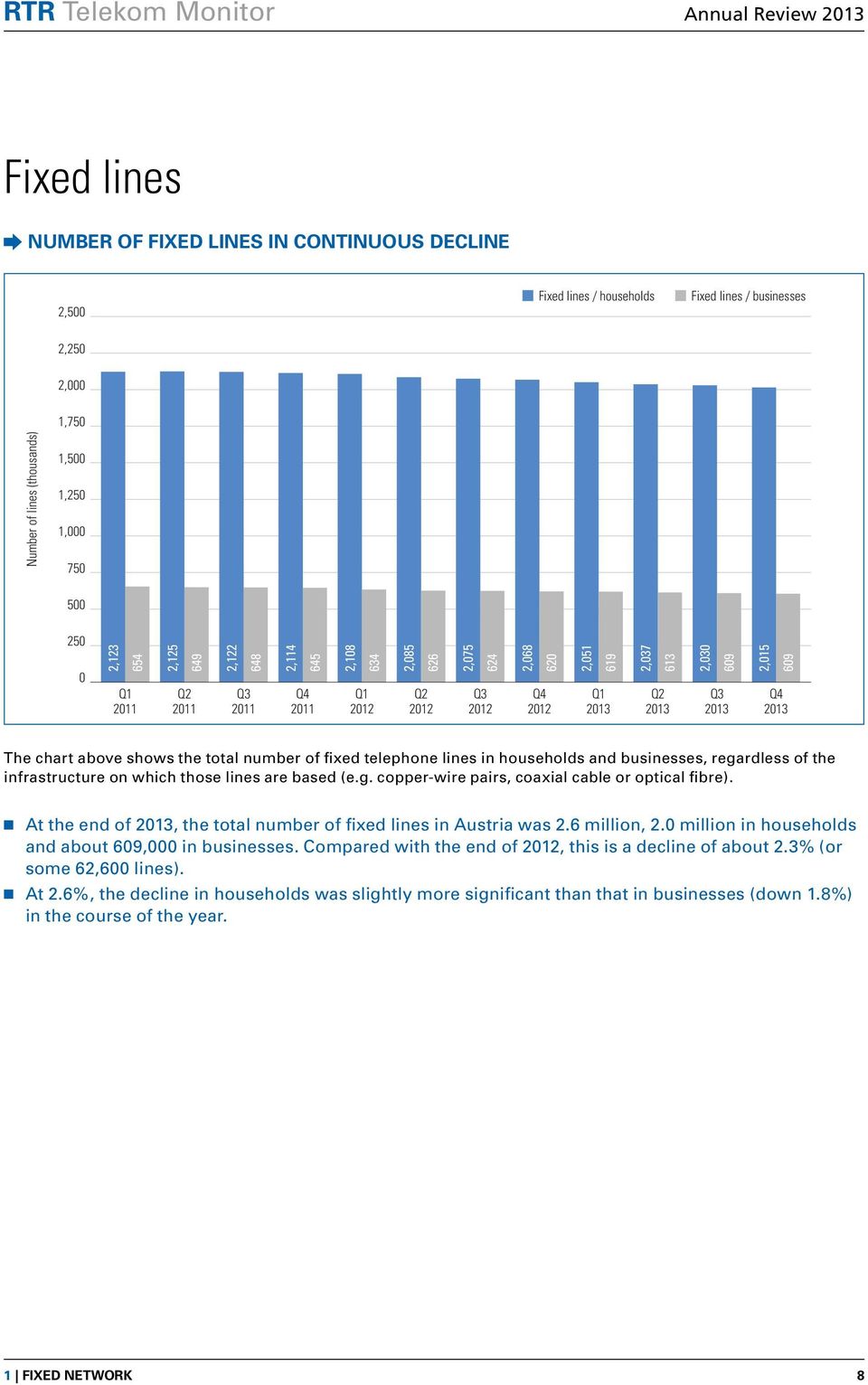
8 RTR Telekom Monitor Annual Review Fixed lines NUMBER OF FIXED LINES IN continuous DECLINE 2,5 <4> Fixed lines / households Fixed lines / businesses 2,25 2, 1,75 Number of lines (thousands) 1,5 1,25 1, , , , , , , , , , , ,3 69 2,15 69 The chart above shows the total number of fixed telephone lines in households and businesses, regardless of the in frastructure on which those lines are based (e.g. copper-wire pairs, coaxial cable or optical fibre). At the end of, the total number of fixed lines in Austria was 2.6 million, 2. million in households and about 69, in businesses. Compared with the end of, this is a decline of about 2.3% (or some 62,6 lines). At 2.6%, the decline in households was slightly more significant than that in businesses (down 1.8%) in the course of the year. 1 Fixed network 8
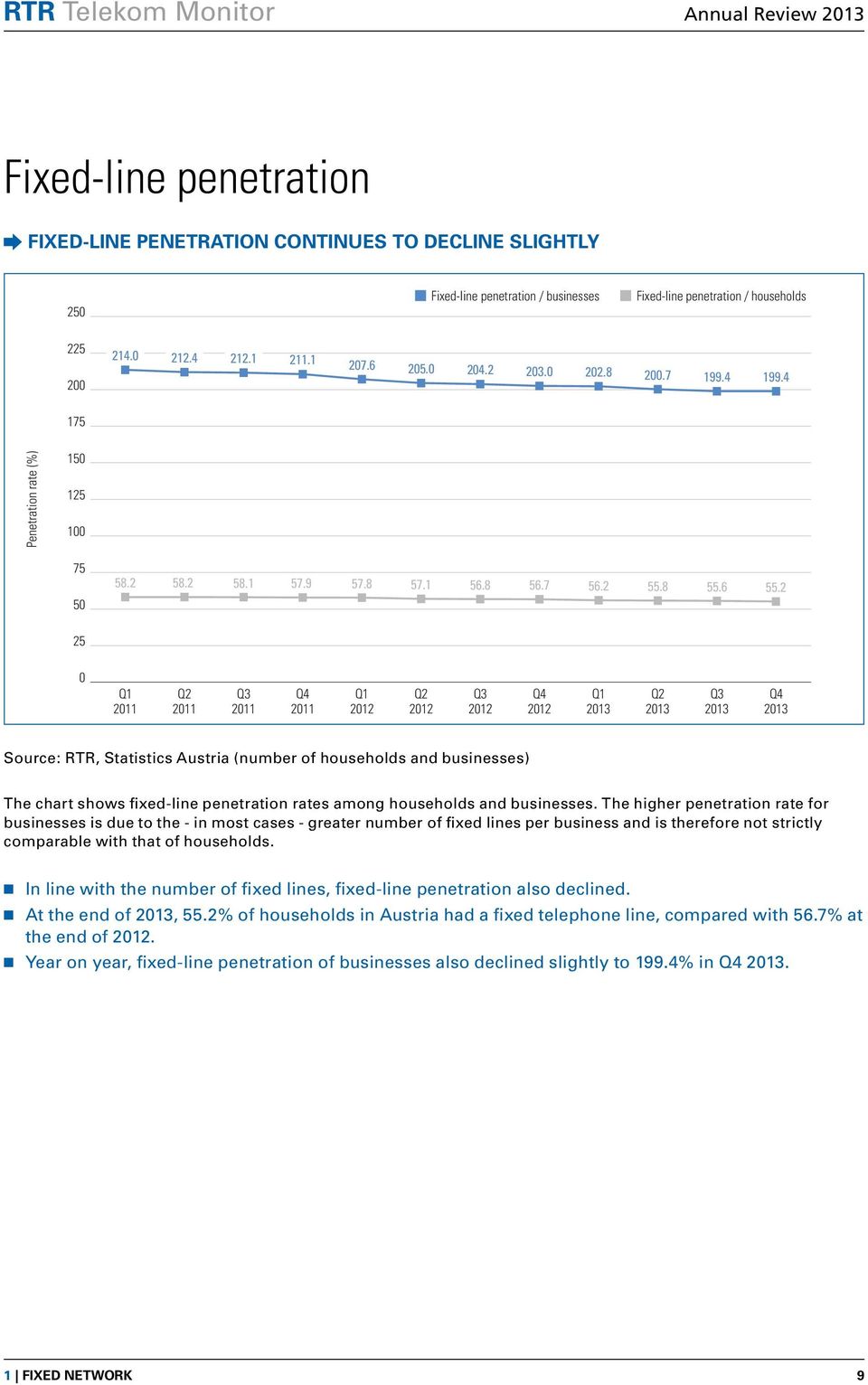
9 RTR Telekom Monitor Annual Review Fixed-line penetration Fixed-line Penetration continues to decline slightly 25 Fixed-line penetration / businesses Fixed-line penetration / households Penetration rate (%) Source: RTR, Statistics Austria (number of households and businesses) The chart shows fixed-line penetration rates among households and businesses. The higher penetration rate for businesses is due to the - in most cases - greater number of fixed lines per business and is therefore not strictly comparable with that of households. In line with the number of fixed lines, fixed-line penetration also declined. At the end of, 55.2% of households in Austria had a fixed telephone line, compared with 56.7% at the end of. Year on year, fixed-line penetration of businesses also declined slightly to 199.4% in. 1 Fixed network 9
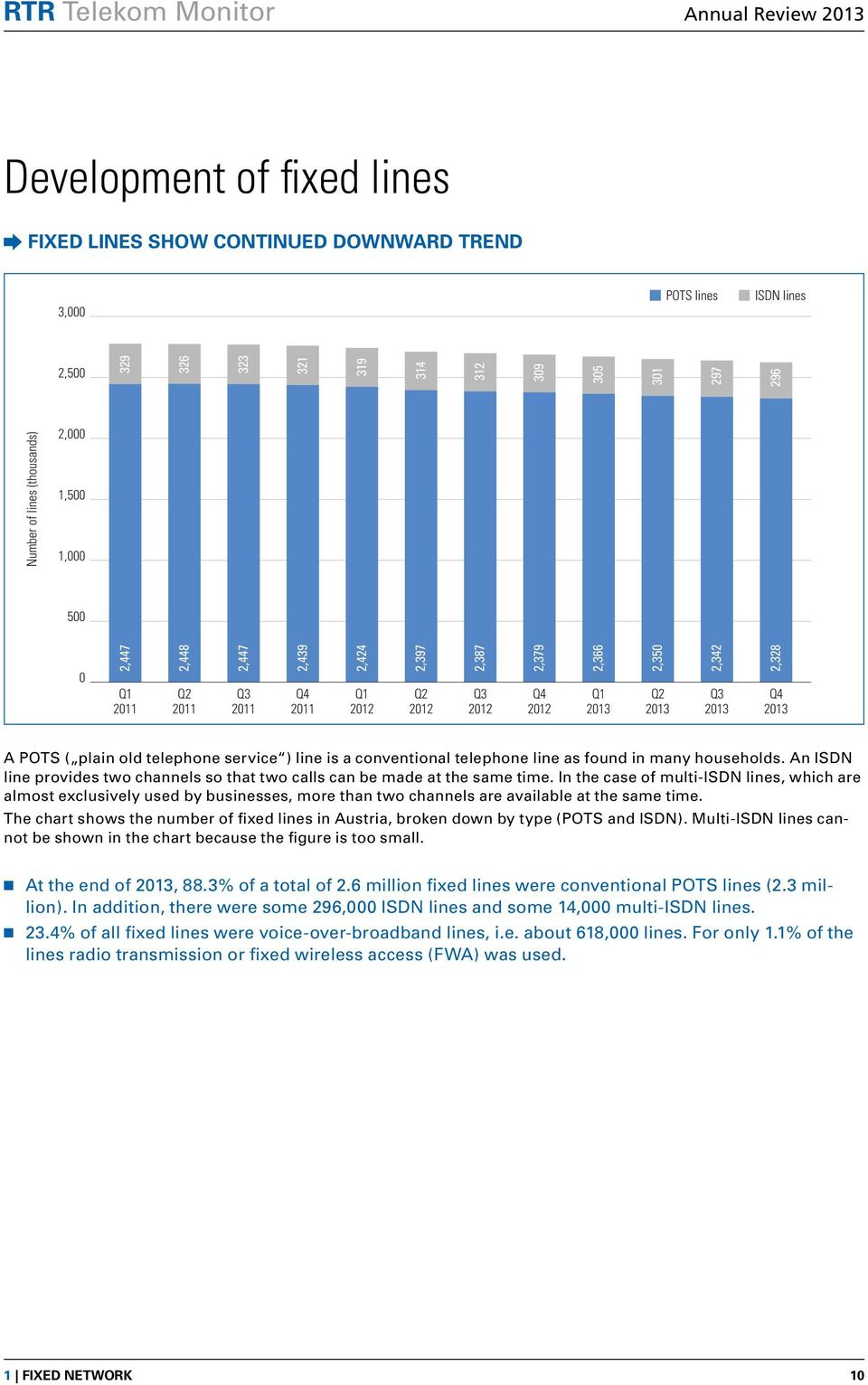
10 RTR Telekom Monitor Annual Review Development of fixed lines fixed lines show continued downward trend 3, POTS lines ISDN lines 2, Number of lines (thousands) 2, 1,5 1, 5 2,447 2,448 2,447 2,439 2,424 2,397 2,387 2,379 2,366 2,35 2,342 2,328 A POTS ( plain old telephone service ) line is a conventional telephone line as found in many households. An ISDN line provides two channels so that two calls can be made at the same time. In the case of multi-isdn lines, which are almost exclusively used by businesses, more than two channels are available at the same time. The chart shows the number of fixed lines in Austria, broken down by type (POTS and ISDN). Multi-ISDN lines cannot be shown in the chart because the figure is too small. At the end of, 88.3% of a total of 2.6 million fixed lines were conventional POTS lines (2.3 million). In addition, there were some 296, ISDN lines and some 14, multi-isdn lines. 23.4% of all fixed lines were voice-over-broadband lines, i.e. about 618, lines. For only 1.1% of the lines radio transmission or fixed wireless access (FWA) was used. 1 Fixed network 1
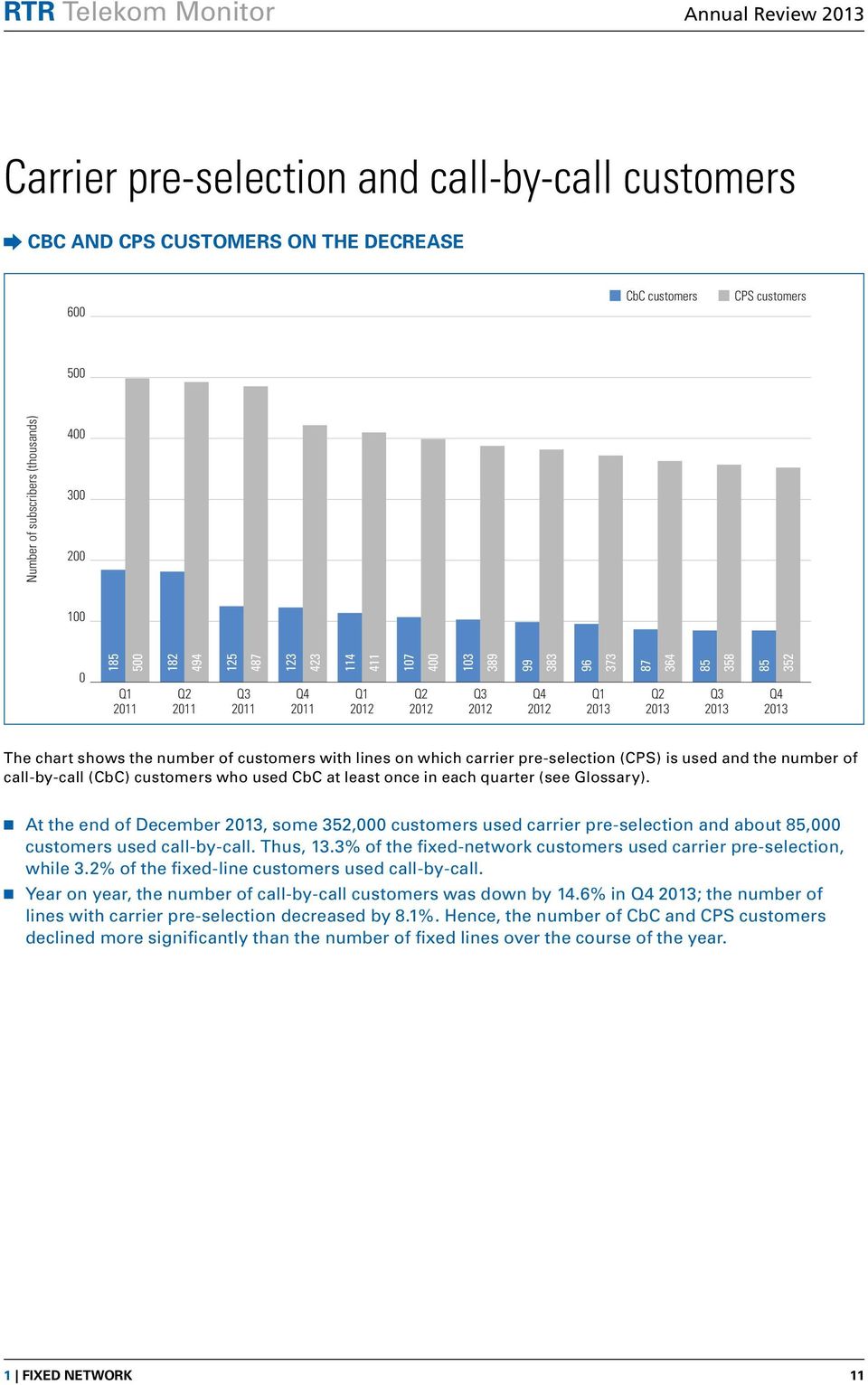
11 RTR Telekom Monitor Annual Review Carrier pre-selection and call-by-call customers CBC and CPS customers on the decrease 6 CbC customers CPS customers 5 Number of subscribers (thousands) The chart shows the number of customers with lines on which carrier pre-selection (CPS) is used and the number of call-by-call (CbC) customers who used CbC at least once in each quarter (see Glossary). At the end of December, some 352, customers used carrier pre-selection and about 85, customers used call-by-call. Thus, 13.3% of the fixed-network customers used carrier pre-selection, while 3.2% of the fixed-line customers used call-by-call. Year on year, the number of call-by-call customers was down by 14.6% in ; the number of lines with carrier pre-selection decreased by 8.1%. Hence, the number of CbC and CPS customers declined more significantly than the number of fixed lines over the course of the year. 1 Fixed network 11
12 RTR Telekom Monitor Annual Review Retail revenues from access services 1% drop in revenues in 8 Residential customers Business customers 7 6 Revenues (EUR millions) Retail revenues from access services include base fees and setup charges. Base fees refer to revenues collected at regular intervals that do not depend on the actual use of the subscriber line. They also include revenues from monthly flat rates (e.g. packages which include a certain number of minutes), but such rates do not play a significant role in fixed-network services. Not included are tariffs referred to as optional tariffs and flat-rate tariffs and revenues from products bundled with broadband. Setup charges comprise revenues generated from the setup, transfer and termination of a fixed telephone line. In, total revenues of EUR million were generated by access services, which is 1.2% less than in. EUR 15.5 million accounted for residential customers, EUR million for business customers. Revenues from access services fell continuously by 2 to 3% per quarter in, the decline for residential customers (down 17.4% of annual revenues) being more significant than that of business customers (down 3.9%) in the course of the year. 1 Fixed network 12

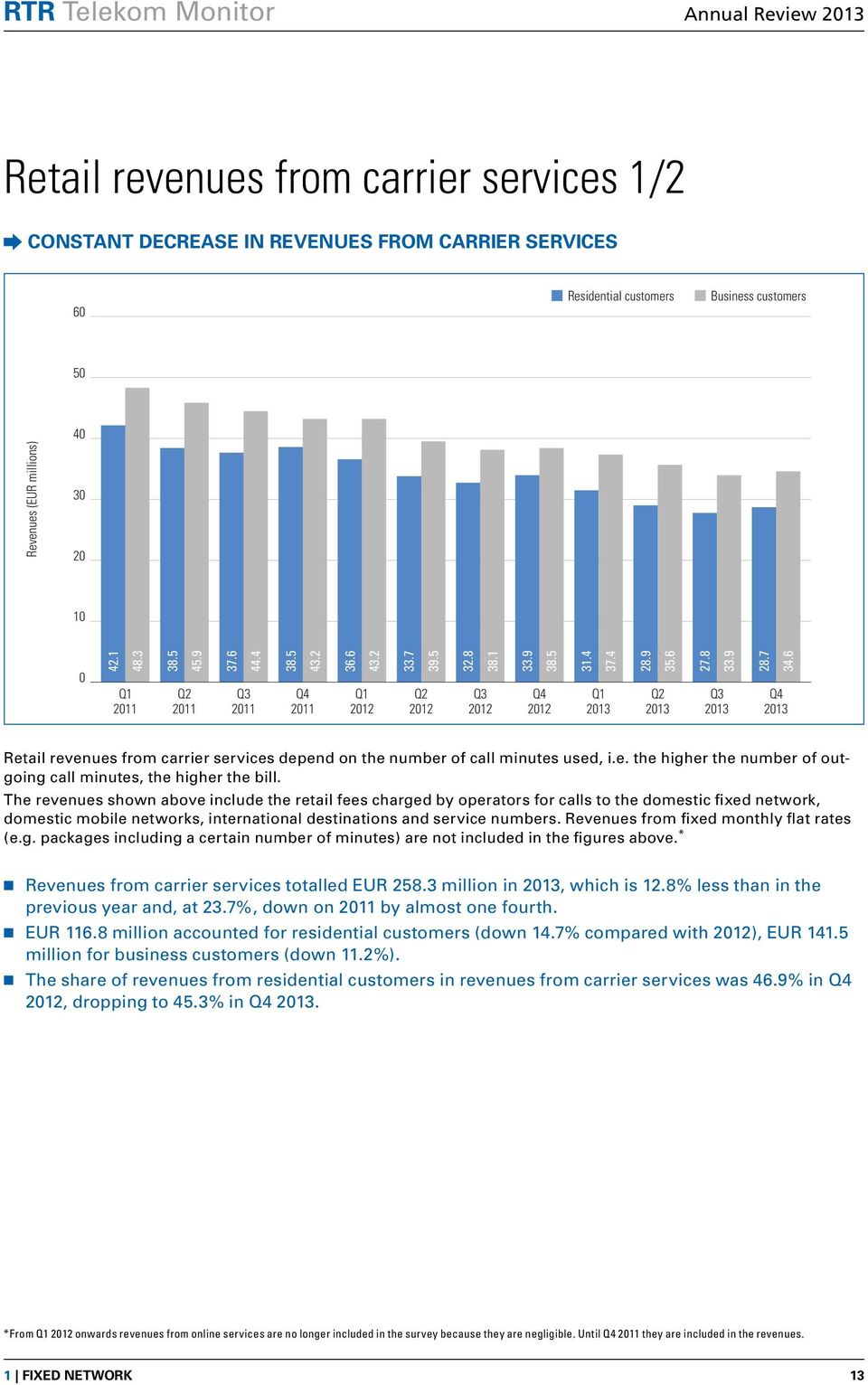
13 RTR Telekom Monitor Annual Review Retail revenues from carrier services 1/2 Constant decrease in revenues from carrier services 6 Residential customers Business customers 5 Revenues (EUR millions) Retail revenues from carrier services depend on the number of call minutes used, i.e. the higher the number of outgoing call minutes, the higher the bill. The revenues shown above include the retail fees charged by operators for calls to the domestic fixed network, domestic mobile networks, international destinations and service numbers. Revenues from fixed monthly flat rates (e.g. packages including a certain number of minutes) are not included in the figures above. * Revenues from carrier services totalled EUR million in, which is 12.8% less than in the previous year and, at 23.7%, down on by almost one fourth. EUR million accounted for residential customers (down 14.7% compared with ), EUR million for business customers (down 11.2%). The share of revenues from residential customers in revenues from carrier services was 46.9% in, dropping to 45.3% in. *From onwards revenues from online services are no longer included in the survey because they are negligible. Until they are included in the revenues. 1 Fixed network 13
14 RTR Telekom Monitor Annual Review Retail revenues from carrier services 2/2 Revenues from calls to all destinations declining 12 Domestic fixed network Domestic mobile network International Service numbers and directory assistance services Revenues (EUR millions) The chart above shows the revenues earned by operators from calls from fixed networks to various destinations (national fixed network, national mobile networks, international destinations and service numbers). Revenues from fixed monthly flat rates (e.g. packages including a certain number of minutes) are not included in the figures above. * In, calls to the domestic mobile network generated revenues from carrier service charges of EUR million, while international calls generated EUR 66.4 million. Revenues from calls to the domestic fixed network ranked third (EUR 64.5 million). Calls to service numbers and directory assistance services generated EUR 15.7 million. Carrier service charges for international calls and calls to the domestic fixed network declined most significantly (down by 14.7% and 14.6%, respectively, compared with ). Year-on-year revenues from calls to the mobile network dropped by 11.3%. Revenues from carrier services to service numbers and directory assistance services were down by 8.%. *Revenues from online services are no longer surveyed because they are negligible and are therefore not shown in the chart. Values up to can be found in the table at the end of the section. 1 Fixed network 14

15 RTR Telekom Monitor Annual Review Call minutes on the retail market Increase in international minutes, drop in total call minutes 1,6 Domestic fixed network Domestic mobile network International Service numbers and directory assistance services 1,4 4.2 Minutes (millions) 1,2 1, The figure above shows the number of real minutes (see Glossary) in the fixed network, broken down by destination. * In, total call minutes in the fixed network numbered billion, i.e. 8.7% down on and 21.7% down on. Calls to the domestic fixed network accounted for the largest proportion: in the course of the year calls from the fixed network to other fixed-network customers totalled billion minutes. Calls from the fixed network to the domestic mobile network totalled million minutes, international calls amounted to million minutes. Calls to service numbers and directory assistances services totalled 89.5 million minutes in. An increase can be seen only in international calls: in, there were 5.% more international minutes than in the previous year. Year on year, the minutes to all other destinations declined. *From onwards revenues from online services are no longer included in the survey and are therefore not shown in the chart. Values up to can be found in the table at the end of the section. 1 Fixed network 15

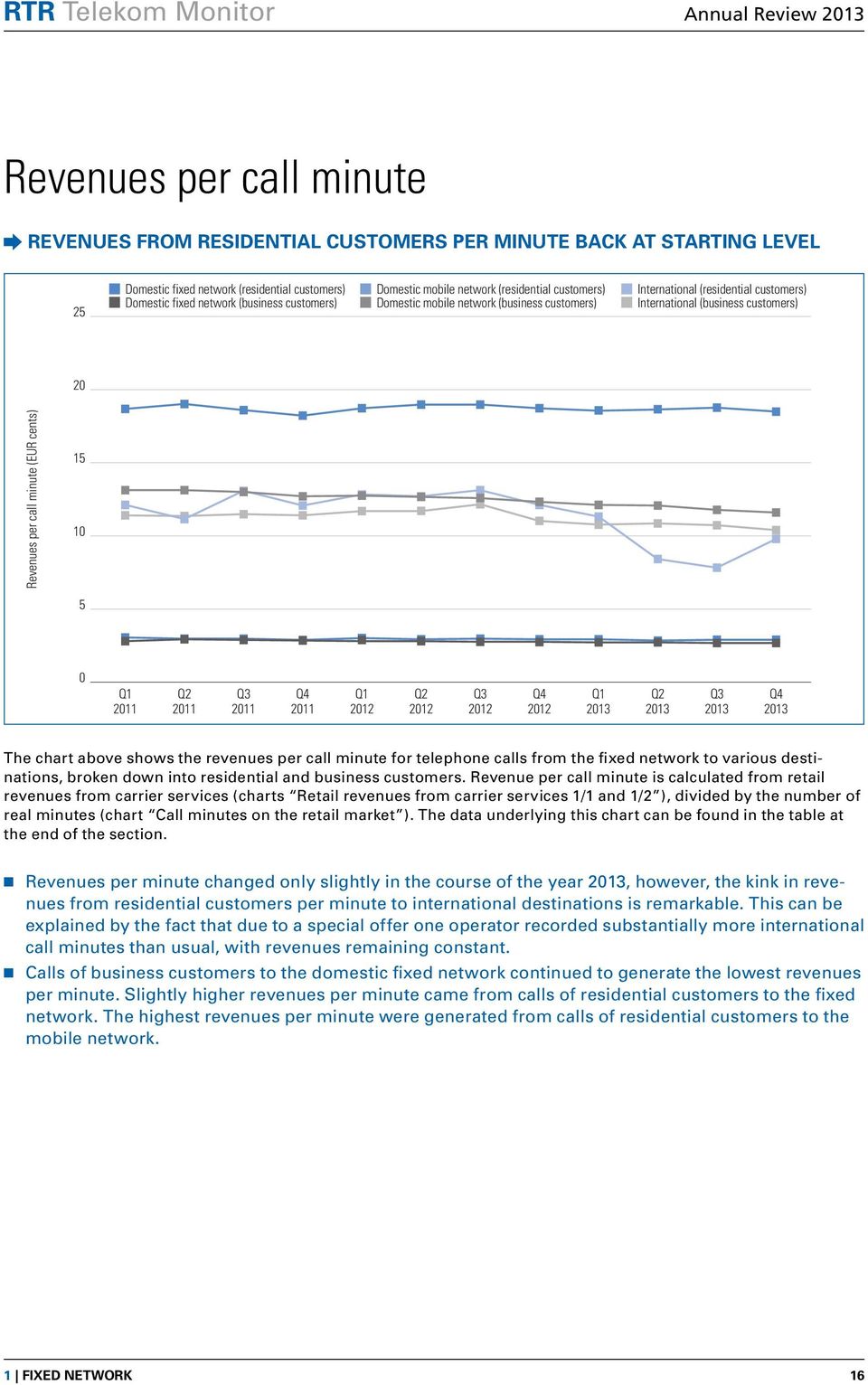
16 RTR Telekom Monitor Annual Review Revenues per call minute Revenues from residential customers per minute back at starting level 25 Domestic fixed network (residential customers) Domestic fixed network (business customers) Domestic mobile network (residential customers) Domestic mobile network (business customers) International (residential customers) International (business customers) 2 Revenues per call minute (EUR cents) The chart above shows the revenues per call minute for telephone calls from the fixed network to various destinations, broken down into residential and business customers. Revenue per call minute is calculated from retail revenues from carrier services (charts Retail revenues from carrier services 1/1 and 1/2 ), divided by the number of real minutes (chart Call minutes on the retail market ). The data underlying this chart can be found in the table at the end of the section. Revenues per minute changed only slightly in the course of the year, however, the kink in revenues from residential customers per minute to international destinations is remarkable. This can be explained by the fact that due to a special offer one operator recorded substantially more international call minutes than usual, with revenues remaining constant. Calls of business customers to the domestic fixed network continued to generate the lowest revenues per minute. Slightly higher revenues per minute came from calls of residential customers to the fixed network. The highest revenues per minute were generated from calls of residential customers to the mobile network. 1 Fixed network 16
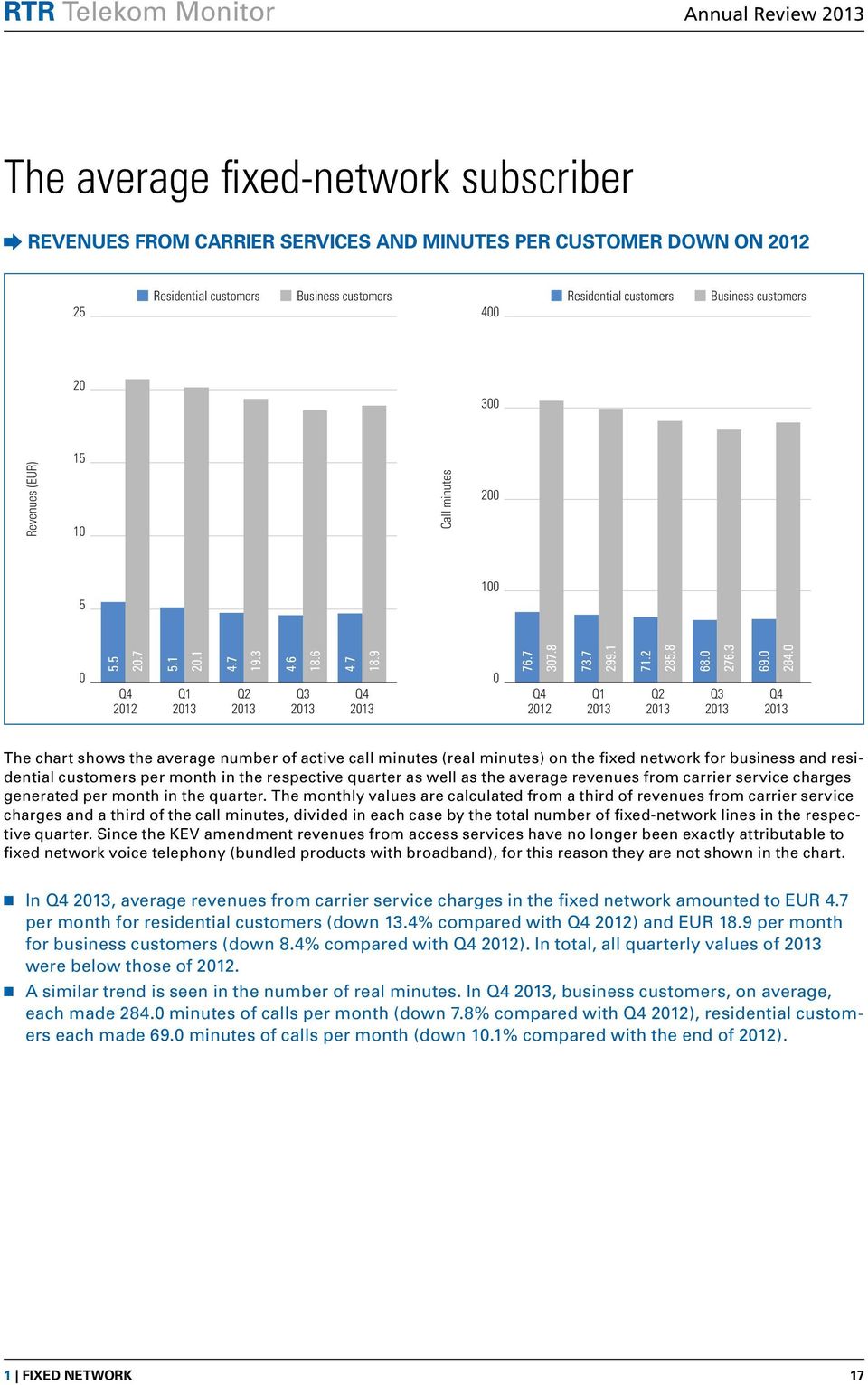
17 RTR Telekom Monitor Annual Review The average fixed-network subscriber Revenues from carrier services and minutes per customer down on 25 Residential customers Business customers 4 Residential customers Business customers 2 3 Revenues (EUR) 15 1 Call minutes The chart shows the average number of active call minutes (real minutes) on the fixed network for business and residential customers per month in the respective quarter as well as the average revenues from carrier service charges generated per month in the quarter. The monthly values are calculated from a third of revenues from carrier service charges and a third of the call minutes, divided in each case by the total number of fixed-network lines in the respective quarter. Since the KEV amendment revenues from access services have no longer been exactly attributable to fixed network voice telephony (bundled products with broadband), for this reason they are not shown in the chart. In, average revenues from carrier service charges in the fixed network amounted to EUR 4.7 per month for residential customers (down 13.4% compared with ) and EUR 18.9 per month for business customers (down 8.4% compared with ). In total, all quarterly values of were below those of. A similar trend is seen in the number of real minutes. In, business customers, on average, each made 284. minutes of calls per month (down 7.8% compared with ), residential customers each made 69. minutes of calls per month (down 1.1% compared with the end of ). 1 Fixed network 17
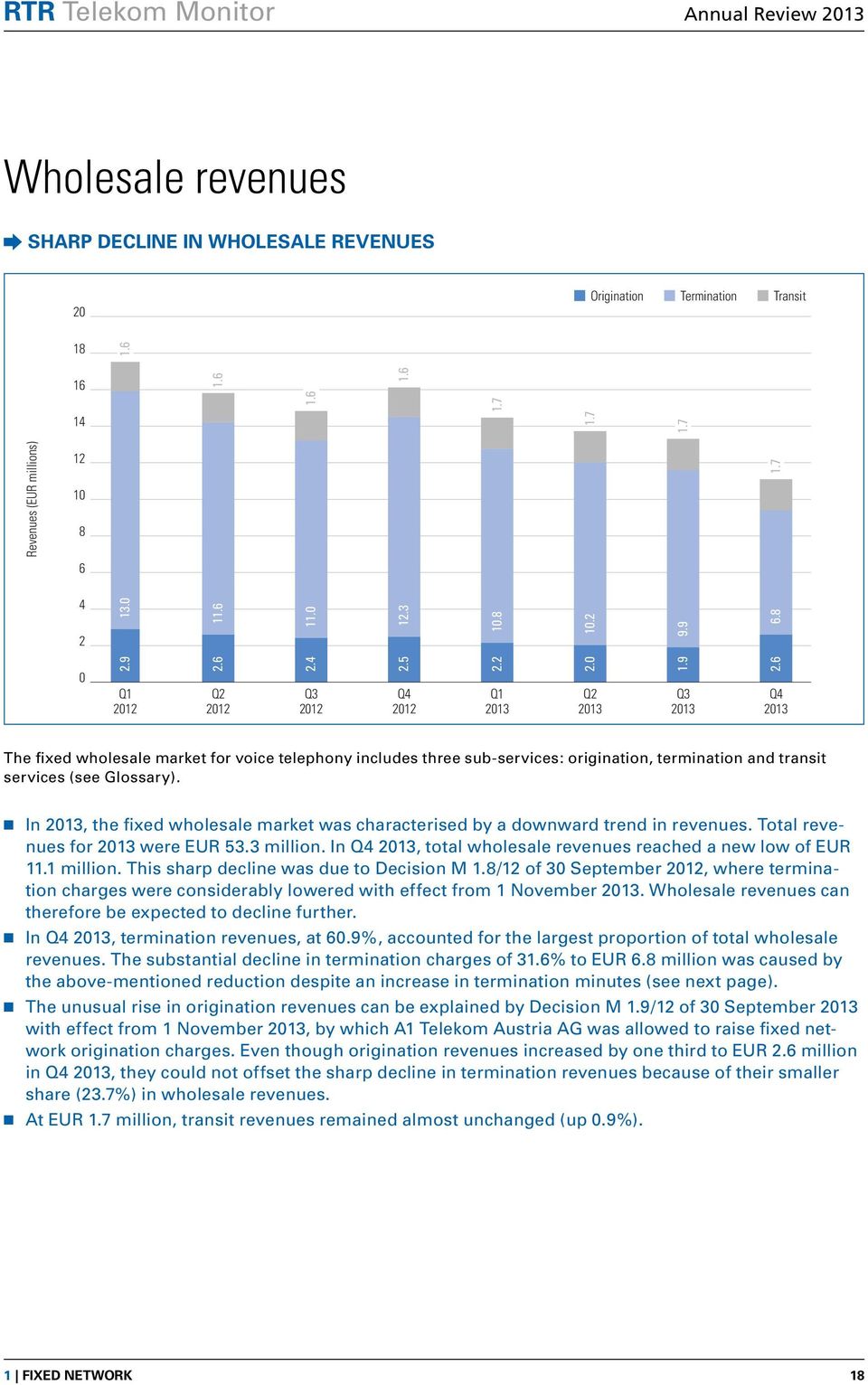
18 RTR Telekom Monitor Annual Review Wholesale revenues Sharp decline in wholesale revenues 2 Origination Termination Transit Revenues (EUR millions) The fixed wholesale market for voice telephony includes three sub-services: origination, termination and transit services (see Glossary). In, the fixed wholesale market was characterised by a downward trend in revenues. Total revenues for were EUR 53.3 million. In, total wholesale revenues reached a new low of EUR 11.1 million. This sharp decline was due to Decision M 1.8/12 of 3 September, where termination charges were considerably lowered with effect from 1 November. Wholesale revenues can therefore be expected to decline further. In, termination revenues, at 6.9%, accounted for the largest proportion of total wholesale revenues. The substantial decline in termination charges of 31.6% to EUR 6.8 million was caused by the above-mentioned reduction despite an increase in termination minutes (see next page). The unusual rise in origination revenues can be explained by Decision M 1.9/12 of 3 September with effect from 1 November, by which A1 Telekom Austria AG was allowed to raise fixed network origination charges. Even though origination revenues increased by one third to EUR 2.6 million in, they could not offset the sharp decline in termination revenues because of their smaller share (23.7%) in wholesale revenues. At EUR 1.7 million, transit revenues remained almost unchanged (up.9%). 1 Fixed network 18
19 RTR Telekom Monitor Annual Review Wholesale market in minutes Decline in total minutes year on year 3, Origination Termination Transit 2,5 Minutes (millions) 2, 1,5 1, 672 1, , , , , , , In line with wholesale revenues, the wholesale market includes origination, termination and transit minutes (see Glossary). Wholesale minutes totalled 1.43 billion in, which is 6.4% less than in the previous year. At 41.1%, termination minutes accounted for the largest proportion of all wholesale minutes. After a drop in and, total wholesale minutes increased again slightly (up 2.7% compared with the previous quarter) to 2.5 billion minutes. If is compared with, a marked decline can bee seen mainly in origination minutes (down 15.4%), which also corresponds to the decrease in CbC and CPS customers. Termination minutes dropped by 9.4%, whereas transit minutes increased by 3.5% against the last quarter of. 1 Fixed network 19

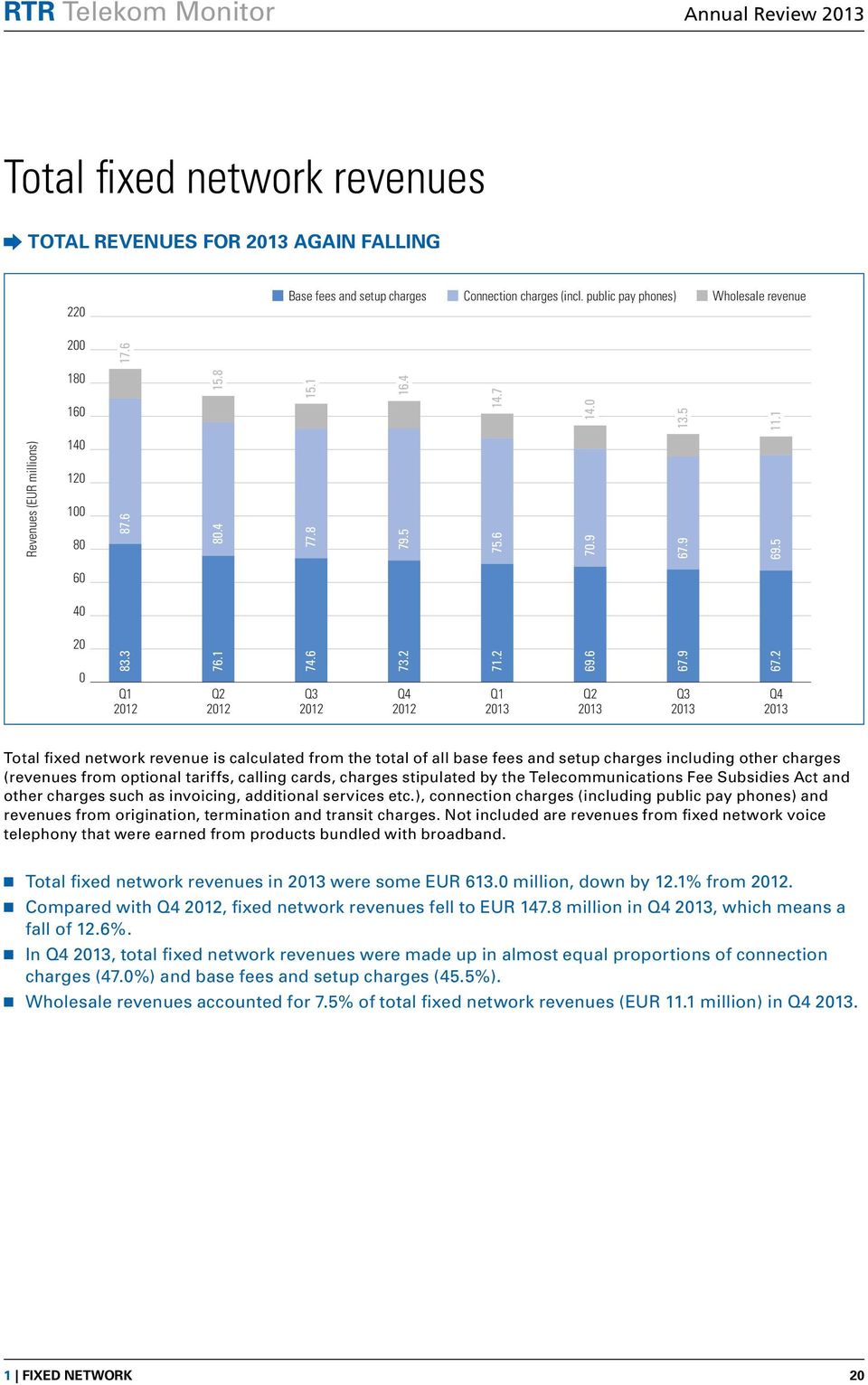
20 RTR Telekom Monitor Annual Review Total fixed network revenues Total revenues for Again falling 22 Base fees and setup charges Connection charges (incl. public pay phones) Wholesale revenue Revenues (EUR millions) Total fixed network revenue is calculated from the total of all base fees and setup charges including other charges (revenues from optional tariffs, calling cards, charges stipulated by the Telecommunications Fee Subsidies Act and other charges such as invoicing, additional services etc.), connection charges (including public pay phones) and revenues from origination, termination and transit charges. Not included are revenues from fixed network voice telephony that were earned from products bundled with broadband. Total fixed network revenues in were some EUR 613. million, down by 12.1% from. Compared with, fixed network revenues fell to EUR million in, which means a fall of 12.6%. In, total fixed network revenues were made up in almost equal proportions of connection charges (47.%) and base fees and setup charges (45.5%). Wholesale revenues accounted for 7.5% of total fixed network revenues (EUR 11.1 million) in. 1 Fixed network 2
21 RTR Telekom Monitor Annual Review Geographical numbers in use Slight year-on-year decline 3,5 Geographical numbers in use 3, 2,5 Numbers in use (thousands) 2, 1,5 1, 5 3,37 3,36 3,17 3,49 3,48 3,22 3,56 3,71 3,38 3,21 3,6 2,983 Geographical numbers are domestic telephone numbers prefixed by a local area code (e.g. 1 for Vienna). As more than one number may be assigned to a single line, the number of geographical numbers is not identical to the number of fixed subscriber lines. At the end of the total of geographical call numbers used was 2.98 million. This is a decline of 2.9% compared with the end of. 1 Fixed network 21
22 RTR Telekom Monitor Annual Review Service numbers in use: ()8, ()81, ()82, ()821, ()828, ()9, ()93 decline in all ranges except for ()8 Numbers 35, Total for ()9, ()93 Total for ()81, ()82, ()821, ()828 ()8 3, 25, 29,4 29,4 29,2 28,7 23,8 24, 27,4 3, 23,3 29,3 28,9 25,6 26, 26,3 25,7 Numbers in use 2, 15, 2,8 19,3 19,6 15,1 15, 15,2 15,3 15,1 2,7 2,7 21,1 21,1 15,9 15,8 16, 16, 16,3 16,1 16,3 12, 12, 1, 5, The figure above shows the number of service numbers in use in the following ranges: - ()8 range: toll-free services - ()81 range: max. EUR.1 per minute or text message - ()82 range: max. EUR.2 per minute or text message - ()821 range: max. EUR.2 per call or text message - ()828 range: text messages only; standard charges apply - ()9 range: max. EUR 3.64 per minute or max. EUR 1. per text message - ()93 range: max. EUR 3.64 per minute or max. EUR 1. per text message (erotic hotlines) Over the past few years, the ()8 numbers have seen a relatively constant development. At the end of, there were 16,3 service numbers in use in this range (up 1.9% compared with ). ()9 and ()93 numbers decreased significantly to 21,1 against the end of, which is a decline of 27.2% Even more significant is the decline in ()81, ()82, ()821 and ()828 numbers. While there were still about 26, numbers in this range at the end of, this figure dropped to some 12, within one year (down 53.9%). 1 Fixed network 22
23 RTR Telekom Monitor Annual Review Ported geographical numbers and service numbers continuous rise in ported geographical numbers 35, Geographical numbers ported Service numbers ported 3, 25, Numbers ported 2, 15, 1, 5, 237,4 16,6 238,8 15, 245,7 14,3 246,3 13,6 25,9 15,3 249,9 14,1 256,8 13,9 294,7 13, 295,7 11,8 34, 12,3 31,6 11,6 311,5 11,6 Number porting allows customers to retain their telephone numbers when they switch service providers. This means that customers can keep their original geographical telephone numbers (within the same local area code) when they switch to a new provider. The figure above shows the total number of geographical telephone numbers and service numbers ported (which is not equal to the total number of porting procedures, as a single number may be ported several times). The number of ported geographical telephone numbers rose by 5.7% since the end of to 311,5 at the end of. This corresponds to 1.4% of all geographical numbers. In contrast, the number of ported service numbers fell to some 11,6 (down 1.7%) over the same period. 1 Fixed network 23
24 RTR Telekom Monitor Annual Review Fixed lines (Page 8) Data tables Number of lines Fixed lines / households Fixed lines / businesses 2,122,93 653,734 2,125, ,962 2,121,86 647,826 2,114,46 644,78 2,18, ,72 2,85,57 626,161 2,74, ,86 2,68,175 62,165 2,51, ,374 2,37, ,169 2,3,149 69,47 2,15,177 68,984 Fixed-line Penetration (Page 9) in % Fixed-line penetration / households Fixed-line penetration / businesses 58.2% 214.% 58.2% 212.4% 58.1% 212.1% 57.9% 211.1% 57.8% 27.6% 57.1% 25.% 56.8% 24.2% 56.7% 23.% 56.2% 22.8% 55.8% 2.7% 55.6% 199.4% 55.2% 199.4% EndkundEnbrEitbandanschlüssE development of nach Fixed infrastuktur lines (Page 1) - GEschäftskundEn Number of lines POTS ISDN Multi-ISDN VoB Wireless 2,447, ,33 1,24 2,448, ,817 1,23 2,446,55 323,136 1,224 2,438,5 32,613 1,261 2,423, ,637 11, ,868 26,191 2,397,15 314,23 11, ,546 26,79 2,386, ,934 12,92 593,224 27,437 2,379,281 39,59 12,237 65,99 27,985 2,365,655 34,912 12,23 612,542 28,452 2,349,915 3,711 12, ,293 28,667 2,341, ,375 12, ,34 28,891 2,328, ,822 13,84 617,575 29,266 1 Fixed network 24
25 RTR Telekom Monitor Annual Review Carrier Pre-seleCtion and Call-by-Call Customers (Page 11) Number of customers CbC customers CPS customers 184,785 5, , , , ,37 123,82 422, , ,346 16,64 399,98 13,44 389,495 99, ,23 95, ,749 86,72 364,43 84, ,56 84, ,921 retail revenues From access services (Page 12) EUR Residential customers Business customers 37,23,53 3,938,31 3,38,89 29,249,487 27,991,237 26,824,815 25,727,224 24,975,139 37,349,43 37,184,153 36,467,97 36,36,14 35,81,827 35,48,2 35,75,77 35,177,753 retail revenues From Carrier services 1/2 (Page 13) EUR Residential customers 42,73,786 38,456,589 Business customers 48,31,94 45,869,329 37,58,959 44,398,313 38,521,721 43,219,87 36,584,136 43,21,386 33,727,694 39,454,362 32,772,377 38,125,583 33,944,355 38,469,54 31,399,59 37,379,784 28,934,293 35,569,67 27,841,4 33,911,93 28,646,74 34,592,695 1 Fixed network 25
26 RTR Telekom Monitor Annual Review EndkundEnbrEitbandanschlüssE retail revenues From Carrier nach infrastuktur services 2/2 (Page - GEschäftskundEn 14) Domestic fixed network * Data collection for online services was discontinued in. Domestic mobile network 24,639,1 37,58,865 23,282,662 4,81, ,73 22,383,25 35,894,814 2,92,942 4,616, ,55 2,839,127 34,463,665 21,563,576 4,611,219 51,685 21,18,182 34,176,725 21,226,518 4,77, ,14 21,149,98 33,298,529 2,835,524 4,51,49 * 18,357,378 31,285,129 19,295,465 4,244,84 * 17,575,584 3,253,19 19,58,148 4,11,38 * 18,463,474 3,99,39 18,728,32 4,312,73 * 17,856,886 29,178,74 17,643,27 4,99,983 * 15,972,375 28,221,965 16,641,745 3,667,815 * 15,43,13 26,95,314 16,22,136 3,737,867 * 15,673,97 27,241,695 16,118,9 4,24,934 * EUR International Service numbers and directory assistance services Online services EndkundEnbrEitbandanschlüssE Call minutes on the nach retail infrastuktur market (Page - GEschäftskundEn 15) Domestic fixed network *Data collection for online services was discontinued in. Domestic mobile network Minutes International Service numbers and directory assistance services Online services 838,639, ,512, ,782,414 4,188,294 18,915,69 755,918, ,25, ,255,968 37,926,52 15,14, ,52,921 23,529, ,768,125 38,557,478 13,2,55 734,658, ,954, ,362,93 36,881,12 11,224, ,744, ,153,86 17,739,356 34,387,931 * 642,76,547 21,516, ,518,833 29,89,673 * 614,99,343 23,786,53 151,2,436 25,26,776 * 649,815, ,656, ,31,224 24,763,122 * 632,223,826 24,322,299 16,164,692 24,479,136 * 575,98, ,71, ,39,118 21,547,434 * 538,88, ,44, ,41,26 21,116,417 * 568,57,96 195,173, ,958,12 22,357,91 * 1 Fixed network 26
27 RTR Telekom Monitor Annual Review revenues Per Call minute (Page 16) EUR cents Domestic fixed network / residential customers Domestic mobile network / residential customers International destinations / residential customers Domestic fixed network / business customers Domestic mobile network / business customers International destinations / business customers Wholesale revenues (Page 18) EUR Origination Termination Transit 2,899,434 13,16,183 1,644,444 2,614,763 11,598,87 1,583,71 2,421,544 11,38,184 1,598,952 2,489,294 12,28,73 1,645,385 2,16,969 1,831,4 1,737,653 2,31,861 1,28,449 1,721,776 1,919,133 9,893,241 1,683,684 2,635,735 6,763,56 1,699,34 Wholesale market in minutes (Page 19) Minutes Origination Termination Transit 885,692,57 1,226,58, ,175,766 86,961,841 1,125,662,28 685,781,22 832,139,219 1,74,118,565 79,712, ,892,59 1,145,86, ,33, ,847,77 1,96,471,412 75,273, ,273,98 1,21,745, ,228,3 72,182,29 97,651, ,87, ,517,192 1,37,494,35 712,272,641 1 Fixed network 27
28 RTR Telekom Monitor Annual Review total Fixed network revenues (Page 2) EUR Base fees and setup charges Connection charges (incl. public pay phones) Wholesale revenue EndkundEnbrEitbandanschlüssE geographical number in use and nach Fixed-line infrastuktur Porting - GEschäftskundEn (Pages 21/23) Number of telephone numbers Geographical numbers Geographical numbers Service numbers in use ported ported 83,26,729 87,627,499 17,56,61 76,78,454 8,374,386 15,797,343 74,574,797 77,847,564 15,58,679 73,211,646 79,51,928 16,414,752 71,243,67 75,552,64 14,729,626 69,58,828 7,886,843 13,962,86 67,93,386 67,858,423 13,496,58 67,177,261 69,483,531 11,98,598 3,37, ,438 16,623 3,35, ,81 14,995 3,17, ,674 14,283 3,49,44 246,336 13,59 3,47,746 25,99 15,283 3,22, ,885 14,72 3,55, ,791 13,868 3,71,41 294,75 12,987 3,37, ,652 11,752 3,2,653 33,964 12,292 3,6,438 31,636 11,624 2,983, ,474 11,63 service numbers in use ()8, ()81, ()82, ()821, ()9, ()93 (Page 22) Numbers in use ()72 ()78 ()8 ()81. ()82. ()821. ()828 ()9. ()93 5,385 2,316 15,94 23,825 29,356 52,312 2,316 15,42 24,26 29,374 52,816 2,33 15,28 2,799 29,237 58,513 1,911 15,311 19,255 28,688 64,687 1,917 15,9 19,561 27,422 66,73 1,96 15,939 23,267 3,25 68,37 1,91 15,846 25,635 29,253 68,79 1,9 15,972 25,959 28,934 66,657 1,92 15,969 2,76 26,292 68,451 1,89 16,288 2,651 25,667 71,126 1,78 16,121 12,23 21,79 71, ,276 11,963 21,64 1 Fixed network 28
29 RTR Telekom Monitor Annual Review 2 Leased lines 2 Leased lines 29
30 RTR Telekom Monitor Annual Review Number of retail leased lines in Austria Number of retail leased lines in steady decline <4> 35, <= 2 Mbit/s > 2 Mbit/s < 2 Mbit/s = 2 Mbit/s > 2 Mbit/s 3, Number of retail leased lines 25, 2, 15, 1, 2,443 2,31 2,252 2,288 2,967 4,234 3,27 4,93 4,466 4,214 4,597 4,184 3,561 3,797 3,575 3,59 3,721 3,336 3,697 2,729 5, 22,12 21,629 2,665 2,316 15,599 15,127 14,92 14,71 14,629 14,226 14,17 13,985 The chart above shows the number of retail leased lines (see Glossary). Until these were broken down into lines with a capacity of 2 Mbit/s or less (<= 2 Mbit/s) and lines with a capacity exceeding 2 Mbit/s (> 2 Mbit/s); from the categories used were lines with a capacity of less than 2 Mbit/s (< 2 Mbit/s), 2 Mbit/s (= 2 Mbit/s) and exceeding 2 Mbit/s (> 2 Mbit/s). In addition, the table at the end of the section provides a differentiation between the following categories: greater than 2 Mbit/s to 155 Mbit/s (>2 Mbit/s to 155 Mbit/s) and greater than 155 Mbit/s (> 155 Mbit/s). At the end of, a total of about 2,4 retail leased lines was reported (13.1% down compared with the end of ). The decline in retail leased lines extends to all bandwidth categories. Bandwidths with a capacity of 2 Mbit/s receded most. They were down by 34.8% as against. 13.4% of all leased lines fall into this category. About two thirds (68.5%) of retail leased lines, i.e. close to 14,, were accounted for by bandwidths with a capacity of less than 2 Mbit/s, which is 4.9% down compared with the end of. High bandwidths (> 2 Mbit/s) also declined (down 19.6%); an increase against the reference period can be seen only in the sub-category of bandwidths with a capacity greater than 155 Mbit/s. However, with 324 lines, this category accounts only for 1.6% of the total retail leased lines market and is therefore almost negligible. 2 Leased lines 3
31 RTR Telekom Monitor Annual Review Revenues from retail leased lines in Austria revenues are steadily decreasing 16, <= 2 Mbit/s > 2 Mbit/s < 2 Mbit/s = 2 Mbit/s > 2 Mbit/s 14, 12, Revenues (EUR thousands) 1, 8, 6, 5,269 5,157 5,59 5,936 6,841 6,749 7,628 7,74 6,785 6,99 7,84 6,847 4, 2, 5,94 4,843 4,856 4,77 4,49 4,172 4,89 3,66 7,846 7,71 7,599 7,49 2,87 2,821 2,525 2,287 2,36 2,235 2,138 2,263 The chart shows the revenues from retail leased lines in Austria (see Glossary). Until these were broken down into lines with a capacity of 2 Mbit/s or less (<= 2 Mbit/s) and lines with a capacity exceeding 2 Mbit/s (> 2 Mbit/s); from the categories used were lines with a capacity of less than 2 Mbit/s (< 2 Mbit/s), 2 Mbit/s (= 2 Mbit/s) and exceeding 2 Mbit/s (> 2 Mbit/s). In addition, the table at the end of the section provides a differentiation between the following categories: greater than 2 Mbit/s to 155 Mbit/s (>2 Mbit/s to 155 Mbit/s) and greater than 155 Mbit/s (> 155 Mbit/s). Changes in revenues are, of course, partly due to the lengths of leased lines, which are not, however, surveyed under the Communications Survey Ordinance (KEV) and therefore are not shown separately in the chart. Retail leased lines generated total revenues of EUR 53.1 million in, which is a decline of 1% against. Of the annual revenues, close to EUR 12.8 million were earned in, which means a drop of 13.3% against the reference period. In, revenues from bandwidths of less than 2 Mbit/s remained practically unchanged, declining only by 1.% on, and were EUR 2.3 million in. This corresponds to 17.7% of total revenues from retail leased lines. More pronounced was the decline in bandwidths equal to 2 Mbit/s, where revenues slipped by 22.3% from to, amounting to some EUR 3.7 million. High bandwidths, too, experienced a drop in revenue. At EUR 6.9 million, revenues were lower by 11.5% from October to December than in the reference period. Even though high bandwidths (> 155 Mbit/s) generated higher revenues by about 2% than at the end of the previous year, the share (7.1%) of these high bandwidths in total revenues is (still) relatively low. 2 Leased lines 31
32 RTR Telekom Monitor Annual Review Revenues from terminating segments and trunk segments wholesale revenues remain constant 35, Terminating segments Trunk segments 3, 2,49 2,4 2,72 2,66 2,35 2,3 2,15 2,54 25, 2,55 2,47 2,3 2,37 Revenues (EUR thousands) 2, 15, 1, 5, 21,27 21,37 2,35 21,24 24,58 24,49 24,85 24,97 24,63 25,14 24,61 25,25 The chart above shows the wholesale revenues from terminating segments and trunk segments. Trunk segments refer to leased lines or Ethernet services that normally do not extend to the user s network termination point and link interconnection points in the 28 Austrian towns and cities where A1 Telekom has set up network interconnection points to other telecommunications operators. On the other hand, terminating segments refer to services at the wholesale level, which are not classified as trunk segments (see Glossary). Wholesale revenues amounted to EUR 27.8 million in, which is up by.6% compared with the reference period. In, total revenues on the wholesale market were EUR 19. million (down.2% against ). Of EUR 27.8 million in, EUR 25.3 million (9.9%) were accounted for by terminating segments, EUR 2.5 million (9.1%) by trunk segments. Revenues from terminating segments rose by 1.1% in compared with, those from trunk segments decreased by 4.4%. 2 Leased lines 32
33 RTR Telekom Monitor Annual Review Number of terminating segments of leased lines in Austria shifts towards higher bandwidths 25, <= 2 Mbit/s > 2 Mbit/s to 155 Mbit/s > 155 Mbit/s 2, Number of terminating segments 15, 1, 6,23 6,46 6,52 6,94 7,27 7,57 7,81 8,27 5, 16,8 15,79 14,89 14,24 12,99 12,56 12,1 11,91 The chart above shows the number of terminating segments of leased lines and Ethernet services broken down into capacities of <= 2 Mbit/s, > 2 Mbit/s to 155 Mbit/s and > 155 Mbit/s. In addition, a breakdown into capacities of < 2 Mbit/s and = 2 Mbit/s as well as > 155 Mbit/s to 1 Gbit/s and > 1 Gbit/s is given in the table at the end of the section. At the end of, the number of terminating segments was some 2,9, i.e. 3.8% less than at the end of. In terms of bandwidths, partly significant shifts occurred. Terminating segments with low bandwidths (<= 2 Mbit/s) dropped by 16.4% to 11,91 in. Nevertheless, these low bandwidths still accounted for 57.1% of all terminating segments. In contrast, bandwidths from > 2 Mbit/s to 155 Mbit/s increased in the course of the year by 19.2% to 8,27, which corresponds to 39.6% of all terminating segments. An even stronger increase (up 32.7%) can be seen in terminating segments with bandwidths greater than 155 Mbit/s; however, they amounted to only 3.3% of all terminating segments of leased lines. 2 Leased lines 33
34 RTR Telekom Monitor Annual Review number of retail leased lines in austria (Page 3) Data tables <= 2 Mbit/s > 2 Mbit/s < 2 Mbit/s = 2 Mbit/s 22,12 2,443 21,629 2,31 2,665 2,252 2,316 2,288 Number of lines > 2 Mbit/s to 155 Mbit/s > 155 Mbit/s 15,599 4,234 2, ,127 4,93 2, ,92 4,214 4, ,71 4,184 4, ,629 3,797 3, ,226 3,59 3, ,17 3,336 3, ,985 2,729 3, revenues From retail leased lines in austria (Page 31) EUR <= 2 Mbit/s > 2 Mbit/s < 2 Mbit/s = 2 Mbit/s > 2 Mbit/s to 155 Mbit/s > 155 Mbit/s 7,845,978 5,268,68 7,71,28 5,156,879 7,599, 5,59,72 7,49,477 5,936,118 2,869,696 5,93,549 6,199, ,187 2,82,639 4,843,32 6,18, ,948 2,525,143 4,855,924 6,874, ,933 2,286,557 4,77,91 6,983, ,888 2,35,75 4,49,39 6,14,59 77,665 2,234,947 4,171,874 6,111, ,294 2,137,578 4,88,995 6,1, ,76 2,262,614 3,659,568 5,939,312 97,472 Wholesale revenues From leased lines and ethernet services (Page 32) EUR Terminating segments / leased lines terminating segments / Ethernet services Trunk segments / leased lines Trunk segments / Ethernet services 21,273,113 2,554,325 21,371,847 2,465,453 2,353,582 2,31,961 21,242,861 2,37,865 16,673,57 7,98,56 2,19,44 377,138 16,348,471 8,139,189 1,988,42 415,44 16,64,722 8,212,867 1,979,38 743,614 16,187,298 8,787,9 1,889, ,15 15,684,985 8,949,336 1,83, ,385 15,84,281 9,336,129 1,728, ,165 15,97,588 9,58,942 1,547,81 598,4 15,526,814 9,727,47 1,61, ,981 2 Leased lines 34
35 RTR Telekom Monitor Annual Review number of terminating segments of leased lines in austria (Page 33) Number of terminating segments < 2 Mbit/s = 2 Mbit/s > 2 Mbit/s to 155 Mbit/s > 155 Mbit/s to 1 Gbit/s > 1 Gbit/s ,924 13,561 13,355 12,934 11,786 11,37 1,851 1,196 2,662 2,718 2,894 2,82 2,939 2,945 3,53 3, number of terminating segments of ethernet services in austria Number of terminating segments > 2 Mbit/s to > 155 Mbit/s to < 2 Mbit/s = 2 Mbit/s 155 Mbit/s 1 Gbit/s > 1 Gbit/s 585 1,9 3, ,12 3, ,38 3, , , , , ,377 5, leased lines - number of 64 kbit/s equivalents Number of 64 kbit/s equivalents > 2 Mbit/s to > 155 Mbit/s to < 2 Mbit/s = 2 Mbit/s 155 Mbit/s 1 Gbit/s > 1 Gbit/s 5, ,546 1,645,971 1,941, ,665 5, ,235 1,698,299 2,54, ,115 5, ,19 1,826,737 2,28, ,115 4,876 49,794 1,863,734 2,24,32 978,115 4, ,932 1,828,539 3,785,346 1,29,66 4,86 372,369 1,786,833 3,869,98 984,464 3,929 36,595 1,834,631 3,953, ,464 3, ,751 1,876,182 2,777,224 1,398,881 2 Leased lines 35
36 RTR Telekom Monitor Annual Review ethernet services - number of 64 kbit/s equivalents Number of 64 kbit/s equivalents < 2 Mbit/s = 2 Mbit/s > 2 Mbit/s to 155 Mbit/s > 155 Mbit/s to 1 Gbit/s > 1 Gbit/s 5,567 35,63 1,453,135 2,596,69 348,348 5,914 36,622 1,489,584 2,559, , ,936 1,47,741 2,756,576 49, ,151 1,535,695 3,35,57 49, ,845 1,638,638 3,98,585 81, ,691 1,778,196 3,155, , ,579 1,777,71 3,28,83 299, ,851 2,23,96 3,598, ,96 2 Leased lines 36
37 RTR Telekom Monitor Annual Review 3 Mobile communications 3 Mobile communications 37
38 RTR Telekom Monitor Annual Review Mobile penetration Penetration rate down due to data cleansing <4> 18 Mobile penetration (based on population) Penetration rate (%) Source: RTR, Statistics Austria (population figure) The mobile penetration rate is calculated as the number of activated SIM cards divided by the country s population. This figure therefore represents the (notional) average number of SIM cards owned by every inhabitant. However, it also includes both SIM cards used by businesses and machine-to-machine (M2M) SIM cards. and were characterised by a continuously growing penetration rate. In contrast, in, the penetration rate declined due to data cleansing carried out by one operator in respect of the number of subscribers. The penetration rate peaked in at 161.7%, falling from then onwards to 156.2% over the next two quarters. This was due to the mergers that took place in and to associated data cleansing carried out by the operators. After data cleansing in and, the penetration rate remained constant. 3 Mobile communications 38
39 RTR Telekom Monitor Annual Review Retail revenues from mobile communications continuing decline in retail revenues in 7 Total retail revenues Data services and value-added data services Voice telephony Bundled products and base fees Text messaging Other revenues Revenues (EUR millions) * The chart above includes all revenues (base fees, activation charges, service charges, connection charges etc.), earned from the company s (own) retail customers in Austria, including revenues earned from roaming. In line with the amendment to the KEV, mobile services revenues were classified in as follows: --Revenues clearly attributable to mobile voice telephony or value-added voice services; --Revenues clearly attributable to text messaging and value-added text messaging services; --Revenues clearly attributable to mobile data and value-added data services (including multimedia messages); --Bundled products and base fees: revenues not clearly attributable to one of the aforementioned categories; --Revenues from bundled products and base fees accounted for by data services (excluding text messages); ** --Other revenues, e.g. reminder charges Total retail revenues in amounted to some EUR 2.24 billion, i.e. 5.1% less than in. The largest proportion of the revenues was earned by bundled products and base fees. These revenues continuously increased in and, amounting in total EUR billion in (up 6.3% against ). Revenues from voice telephony suffered a sharp decline. While they amounted to EUR million in, this figure dropped to EUR million in, which is a decline of 19.3%. The downward trend in revenues from text messaging also continued. In, revenues were at EUR million, compared with EUR 114. million in. This was a loss in revenue of 33.4%. However, revenues from data and value-added data services remained almost constant over the years (EUR 27.8 million in against EUR million in mean a decline of 2.%). Other revenues fell from EUR 41.1 million in to EUR 24. million in (down 41.5 %). *Due to retrospective corrections the figures shown on this page vary by more than 5% from those in the last issue of the RTR Telecom Monitor. **These are not shown separately in the chart; however, their share can be seen in the table at the end of the section. 3 Mobile communications 39
40 RTR Telekom Monitor Annual Review Call minutes on the retail market Steady number of minutes with seasonal effects 7, Real minutes (retail market) 6, 5, Call minutes (millions) 4, 3, 2, 1, 5,558 5,557 5,365 5,76 5,788 5,735 5,538 5,771 5,712 5,733 5,432 5,637 The chart above shows the actual call minutes (technical measurement, see Glossary) on mobile networks. This includes minutes from voice telephone calls including value-added voice services, but not (non-voice) services, video telephony etc. The substantial losses in revenues from voice telephony are not reflected in the call minutes used. In, the total number of mobile call minutes was 22.5 billion minutes, only 1.4% less than in the previous year. The chart clearly depicts the seasonal development of the call minutes, the third quarter being the weakest of the four quarters due to the holiday season. In this respect, the rise in call minutes in (up 3.8% on ) was in line with a periodic trend. 3 Mobile communications 4
41 RTR Telekom Monitor Annual Review Text messages Number of text messages plummeting 2,5 Text messages sent (technical measurement) 2, Text messages (millions) 1,5 1, 5 1,726 1,78 1,758 2,18 1,985 2,4 1,835 1,93 1,677 1,541 1,348 1,349 The chart above shows the number of text messages (technical measurement) sent in the respective quarters. For text messages, similar to call minutes, the term technical measurement means that the figure also includes text messages that are not charged individually to the retail customer (e. g. text messages included in the base fee or flat rate). Multimedia messages are not included in these figures. Since text messages sent reached their peak in with more than 2 billion text messages, the figure has fallen sharply. Comparing with, the number of text messages dropped by 3.1% to some billion text messages sent in. It is somewhat misleading that text messages appear to level off at this figure, as the fourth quarter of a year has always been strong and, in fact, the absence of the usual rise also equals a decline. This is attributable to the increasing distribution of smartphones equipped for messaging services like WhatsApp or imessage that are more frequently used by many customers, replacing text messages. 3 Mobile communications 41
42 RTR Telekom Monitor Annual Review Data volume (retail market) apparently no end in sight to data growth 35, Retail upload/download volume 3, 25, Data volume (terabytes) 2, 15, 1, 5, 8,51 9,19 1,46 13,31 15,2 15,96 17,66 21,57 24,7 25,46 27,8 32,77 The chart above shows the data volume used for uplink and downlink transmissions on the retail mobile communications market in terabytes (1 terabyte = 1,24 gigabytes = 1,48,576 megabytes). These figures do not include text messages or multimedia messages. 32,77 terabytes in the last quarter of meant a new record, as in all previous quarters. For seasonal reasons, growth from to is always higher, in there was an increase of 17.9%. In, some 11,7 terabytes of data were used; this figure was higher by 57.3% than in the previous year and more than 2.5 times higher than in. Thus, since the data transfer volume has grown by an average of 13.1% each quarter. There appears to be no end to this trend. On the contrary, due to LTE technology, which is on the increase, and the wide range of data-based applications available for mobile terminal devices the data transfer volume is expected to even multiply in the future. 3 Mobile communications 42
43 RTR Telekom Monitor Annual Review SIM cards in use Number of sim cards constant in and 14, 2G SIM cards 3G SIM cards 12, 1, SIM cards (thousands) 8, 6, 4, 6,1 6,4 6,6 7, 8,7 8,8 9,1 9,4 9,4 9,5 1,5 1,7 2, 6,3 6,1 6, 6, 4,5 4,4 4,3 4,2 4,2 3,9 2,7 2,5 The chart above shows the number of SIM cards activated and in use, broken down into 2G (GSM) and 3G (UMTS) cards. Comparing the last two quarters of, the total number of SIM cards remained almost constant, after it had fallen from to due to data cleansing carried out by an operator. At the end of, the total number of SIM cards was 13.3 million. In addition, one operator now shows all SIM cards only as 3G cards, which led to the changed ratio of 2G to 3G cards in. 3G cards now make up 8.6% of all SIM cards, 2G cards 19.2%. In, there were only 32,95 4G cards. Even though their number doubled compared with, it is too small to be included in the chart. The share of machine-to-machine (M2M) SIM cards in was 1.% (see table at the end of the section). 3 Mobile communications 43
44 RTR Telekom Monitor Annual Review Prepaid vs. postpaid SIM cards ratio of POSTPAID to PREPAID customers stalling 14, Postpaid customers Prepaid customers 12, Number of customers (thousands) 1, 8, 6, 4, 4, 4, 4, 4,2 4,2 4,1 4,2 4,2 4,3 4,2 4,1 4,1 2, 8,4 8,5 8,6 8,9 9, 9,1 9,2 9,3 9,4 9,2 9,2 9,2 The chart above shows the number of prepaid and postpaid customers in the mobile communications market. Prepaid customers use SIM cards on which a certain amount of credit (in the form of minutes, text messages, data volume etc.) is stored. Thus, the customer pays for the service in advance. In the case of postpaid customers (also referred to as contract customers), a bill for the service is sent after it has been used (usually on a monthly basis). The ratio of prepaid to postpaid customers has remained almost constant since. In, the distribution of the 13.3 million SIM cards was almost unchanged against the previous quarter: 69.4% of all mobile customers were postpaid customers and 3.6% were prepaid customers. 3 Mobile communications 44
45 RTR Telekom Monitor Annual Review The average SIM card fewer text messages, constant minutes, more data 2 Revenues (EUR) per SIM card and month 15 Real minutes per SIM card and month EUR/month Minutes/month Text messages (technical measurement) per SIM card and month 1, Data volume (megabytes) per SIM card and month Text messages/month MB/month The charts show the average revenues generated, the average number of real minutes and text messages sent as well as the data volume used in megabytes per SIM card in an average month for each quarter. The values are therefore based on one-third of retail customer revenues, real minutes, number of text messages sent and data volumes of a quarter, divided by the total number of activated SIM cards (including mobile broadband cards and M2M SIM cards). The revenues per SIM card depicted shall not be interpreted as prices. Information on the price developments can be found in the price index for mobile communications at the end of the section. The average revenue generated per SIM card in was EUR 13.9 per month and thus fell by 2.1% against the corresponding quarter. The comparison with, however, has to take into account that the number of SIM cards also decreased because of the data cleansing mentioned before. The development of call minutes per SIM card and month corresponds to the trend already depicted. Accordingly, the call minutes used are not subject to major changes, apart from seasonal fluctuations. Therefore, it is not surprising that the number of call minutes per subscriber and month at the end of did not change against the end of. Compared with the corresponding quarter of, the number of text messages sent on average per SIM card and month dropped sharply (down 28.3%). Unsurprisingly, the data volume per SIM card and month continued to increase sharply. The average data volume in was about 863 megabytes, this is a rise of 55.6% compared with. 3 Mobile communications 45
46 RTR Telekom Monitor Annual Review Total mobile communications revenues Significant decline in revenues on both markets 9 Retail revenues Wholesale revenues 8 Revenues (EUR millions) The chart above shows the revenues on the retail and wholesale markets. Retail revenues include all revenues (base fees, activation charges, service charges, connection charges etc.), earned from the company s (own) retail customers in Austria, including revenues earned from roaming. Wholesale revenues are revenues from origination and termination charges, from selling airtime to resellers and revenues from national and international roaming (including MVNO access). The chart illustrates the downward trend of total revenues of mobile operators as well as the breakdown into revenues from retail and wholesale customers. Total revenues in amounted to about EUR 2.67 billion, which is a decline of 8.3% against EUR billion in. 85.9% of total annual revenues were accounted for by retail revenues and 14.1% by wholesale revenues. Both retail revenues and wholesale revenues declined against. Retail revenues were down by 5.1%, wholesale revenues by even 23.7%. The decline in wholesale revenues can be seen in nearly all revenue categories; however, it is greatest in the sale of airtime to resellers (down 86.4%) and termination (particularly text messages; down 29.7%). Total revenues from mobile communications were EUR million in. Compared with the corresponding quarter of the previous year, revenues thus dropped by 1.%. 3 Mobile communications 46
47 RTR Telekom Monitor Annual Review Porting of mobile telephone numbers considerably fewer porting procedures in 9, Porting procedures / mobile phone numbers 8, 7, 6, Porting procedures 5, 4, 3, 2, 1, 73,5 55,2 48, 68,9 79,1 61,5 58,6 88,7 74,3 54,9 56,1 51,7 Number porting allows customers to retain their telephone numbers when they switch service providers. The chart above shows the porting procedures/imports of telephone numbers carried out for an operator in one quarter, i.e. SIM cards in the case of mobile operators and subscriber numbers on the fixed network. Reverse portings (e.g. after cancellation by a subscriber) are not considered as porting procedure. If the number of a subscriber is ported several times within a quarter ( subsequent porting ), this is counted separately each time. Against, porting procedures of mobile numbers decreased significantly, from 88,7 in to 51,7 in the same period of, i.e. down 41.7%. Over the year, 237, mobile numbers were ported in, down 17.7% on the previous year. 3 Mobile communications 47
48 RTR Telekom Monitor Annual Review Market shares of mobile service providers in Austria restructuring of the mobile market in 25.8% 43.1% A1 Telekom Austria AG T-Mobile Austria GmbH Hutchison Drei Austria GmbH 31.1% The chart above shows the market shares of mobile operators in Austria based on their subscriber numbers (number of SIM cards used). was characterised by the restructuring of the mobile market. Orange was taken over by Hutchison Drei Austria GmbH, its prepaid and discount product Yesss! went to A1 Telekom Austria AG. The chart shows the new distribution of the mobile market on the basis of the subscriber numbers of the mobile service providers in. Accordingly, A1 Telekom is the market leader with a market share of 43.1% or 5.71 million subscribers. After the takeover of Yesss! its market share increased by 3.5 percentage points compared with. T-Mobile Austria GmbH ranks second with a market share of 31.1%. In the past two years, its market share remained almost constant. At the end of, T-Mobile had 4.11 million subscribers. Due to the merger with Orange, Hutchison increased its market share in by 13.3 percentage points to 25.8% against, which is equivalent to 3.42 million subscribers. 3 Mobile communications 48
49 RTR Telekom Monitor Annual Review Price index in mobile communications again increase in overall index 14 Index Low-User Medium-User High-User Power-User Points March June Sept. Dec. March June Sept. Dec. March June Sept. Dec. March 214 For the calculation of the average monthly prices the tariff data published by the Austrian Chamber of Labour on a monthly basis are used and average prices are derived for four different user types: three of these user types are socalled smartphone users who use both voice and text messaging services as well as data services. A fourth user type (the low user) exclusively uses voice and text messaging services. Up to five of the respective most economical tariffs per brand are used (see Glossary). In contrast to the other charts in the RTR Telecom Monitor, this chart does not show the price development on a quarterly but on a monthly basis. As data up to March 214 are already available, they are also included in the chart. In, the first year after market consolidation, mobile communications experienced significant price increases. In particular at the end of, a clear upward trend was observed. Since, tariffs have risen markedly across all user types. This is due to numerous tariff increases (of both monthly charges as well as one-off charges like the activation charge etc.) and reductions in subsidies for terminal devices. Only the price index for the power user fell again in 214. This downward trend can be explained by the fact that with effect from February 214 the data volume included in the youth tariff of A1 Telekom was increased to 2 gigabytes per month, while the monthly charge remained the same. As this tariff, with 2 gigabytes, now comprises the data volume used monthly by the power user, it has been attributed to the power user since February. The further decline from February to March 214 is due to the introduction of the Max Pur tariffs of tele.ring. 3 Mobile communications 49
50 RTR Telekom Monitor Annual Review Data tables retail revenues From mobile CommuniCations (Page 39) EUR Total retail revenues Voice telephony Text messaging Data services and valueadded data services Bundled products and base fees Share of data services in bundled products Other revenues 61,377, ,624,6 632,515,4 611,141, ,393,113 35,977,945 69,922, ,241, % 1,792, ,753,927 39,396,53 74,656, ,283, % 9,893, ,634,996 37,213,168 66,78, ,115, % 1,132,284 16,461,545 36,137,249 64,888,265 35,153, % 1,288, ,459,491 29,73,824 6,71,228 38,466,4 16.5% 9,644,9 15,63,221 28,444,167 64,444,548 38,55, % 6,851, ,712,56 28,97,715 74,645, ,975, % 3,76, ,526,449 26,827,217 71,4,35 317,931, % 3,837,465 Call minutes on the retail market (Page 4) Real minutes 5,557,671,68 5,556,743,787 5,364,599,431 5,75,787,396 5,788,72,5 5,734,784,353 5,537,818,294 5,771,29,667 5,711,663,968 5,732,826,273 5,431,953,366 5,637,233,118 text messages (Page 41) Text messages sent (technical measurement) 1,725,954,985 1,779,843,615 1,758,186,234 2,18,375,997 1,984,876,55 2,3,85,415 1,835,394,527 1,929,827,33 1,677,485,28 1,541,179,929 1,348,486,974 1,349,464,137 3 Mobile communications 5
51 RTR Telekom Monitor Annual Review data volume (retail market) (Page 42) Retail upload/download volume (megabytes) 8,921,282,869 9,64,975,664 1,968,57,825 13,961,43,983 15,941,67,958 16,74,23,488 18,512,934,796 22,613,66,12 25,9,761,126 26,7,365,78 29,155,66,11 34,364,913,863 sim Cards in use (Page 43) Number of SIM cards 2G SIM cards 3G SIM cards 4G SIM cards thereof M2M SIM cards 6,257,189 6,131,59 6,13,538 6,368,31 6,22,979 6,632,571 5,996,7 7,26,58 4,524,684 8,677, ,351 4,393,88 8,838, ,497 4,346,491 9,59, ,652 4,26,611 9,381, ,621 4,241,772 9,421, ,343 3,99,645 9,488,21 1,22 113,861 2,68,314 1,538,191 17, ,423 2,547,291 1,691,826 32,95 127,797 PrePaid vs. PostPaid sim Cards (Page 44) Number of customers Postpaid customers Prepaid customers 8,433,436 3,955,343 8,513,94 3,984,899 8,621,693 4,33,857 8,854,952 4,167,626 9,43,684 4,159,121 9,94,56 4,138,612 9,185,425 4,221,8 9,345,338 4,243,25 9,391,72 4,272,237 9,172,226 4,235,84 9,173,165 4,62,621 9,21,558 4,61,464 3 Mobile communications 51
52 RTR Telekom Monitor Annual Review total mobile CommuniCations revenues (Page 46) EUR Retail revenues Wholesale revenues 61,377,233 13,587, ,624,6 123,311, ,515,4 116,45, ,141, ,371, ,327, ,953,66 596,984,26 117,581,48 597,876,97 118,34, ,928, ,81, ,1,952 18,528, ,893,396 1,664, ,1,448 87,314, ,162,335 7,247,758 Porting of mobile telephone numbers (Page 47) Number of porting procedures of mobile phone numbers 73,542 55,24 48,38 68,873 79,92 61,525 58,576 88,745 74,292 54,855 56,82 51,719 3 Mobile communications 52
53 RTR Telekom Monitor Annual Review 4 Broadband 4 Broadband 53
54 RTR Telekom Monitor Annual Review Fixed and mobile broadband connections Marked increases in smartphone tariffs and fixed broadband <4> 8, Fixed broadband (retail and wholesale) Mobile broadband (data tariffs and prepaid cards) Smartphone tariffs 7, 6, Connections (thousands) 5, 4, 3, 2, 1,9 1,952 1,229 1,951 1,477 1,983 1,793 2,66 2,35 2,86 2,216 2,99 2,415 2,16 2,686 2,26 2,84 2,222 3,125 2,176 3,143 2,194 3,267 2,199 1, 2,13 2,31 2,55 2,91 2,1 2,77 2,13 2,126 2,16 2,173 2,192 2,228 The chart above shows the total number of fixed and mobile broadband connections. With mobile broadband, mobile data tariffs and smartphone tariffs are distinguished. For the definitions of fixed broadband connections as well as mobile data tariffs and smartphone tariffs see Glossary. At the end of last year, total broadband connections numbered 7.7 million. Thus, the number of broadband connections rose by 9.6% in the year under review. Smartphone tariffs experienced a veritable boom with an increase of 21.6% as compared to the end of million customers used Internet services on their mobile phones at the end of. Fixed broadband grew by 4.7% in the period under review, with about 2.23 million connections at the end of. Contrary to the trend seen in the above-mentioned connections, mobile broadband decreased slightly (down.3%). However, this decline is primarily attributable to data cleansing in respect of unused SIM cards carried out by operators. This category comprised some 2.2 million connections at the end of last year. 4 Broadband 54
55 RTR Telekom Monitor Annual Review Broadband penetration AROUND Nine out of ten households use a smartphone tariff 1 Fixed broadband (retail and wholesale) Mobile broadband (data tariffs and prepaid cards) Smartphone tariffs Penetration rate (%) Source: RTR, Statistics Austria (number of households) Broadband penetration refers to the ratio of fixed and mobile broadband connections to the total number of households in Austria. Calculation of the penetration rate also includes broadband connections used in businesses. Broadband penetration for smartphone tariffs rose from 72% at the end of to 87% at the end of. Until mid- this increase was particularly dynamic. The penetration rates of fixed and mobile broadband remained almost unchanged, between 58 and 6% in. 4 Broadband 55
56 RTR Telekom Monitor Annual Review Retail broadband connections by type of infrastructure Little Change in the course of the year 3,5 Mobile broadband Unbundled lines Copper-wire pairs Smartphone tariffs Coaxial cable Other infrastructure (FWA, FTTH etc.) 3, 2,5 Connections (thousands) 2, 1,5 1, 5 The chart above shows the total number of fixed and mobile broadband connections in Austria by infrastructure used. For the infrastructure of fixed broadband connections see Glossary. The data underlying this chart are contained in the table at the end of the section. Copper-wire pair connections on the basis of own infrastructure increased by 6.1% over the year, whereas unbundled lines fell by 9.3%. Between the end of and the end of, the number of coaxial cable connections rose by 5.9%. The most significant changes were seen in other broadband connections: FWA connections dropped by 13.3% throughout, optical fibre connections (FTTH) increased by 18.4% over the same period. However, altogether both connection types accounted only for.5% of all broadband connections. 4 Broadband 56
57 RTR Telekom Monitor Annual Review Retail broadband connections by bandwidth category fixed network Trend towards higher bandwidths continues 2,5, 192,3 185,6 >= 144kbit/s to <= 2Mbit/s > 2Mibt/s to < 1Mbit/s >= 1Mbit/s to < 3Mbit/s >= 3Mbit/s 23,5 224,8 242,8 262,4 292,5 313,3 2,, Connections 1,5, 1,, 566,7 577, 582,8 589,1 68,9 622,3 654,1 676,7 5, 1,34,6 1,18,5 1,28,3 1,32,2 1,34,4 1,25,9 991,9 1,2,8 36,8 296, 288,3 28,1 271,5 259,6 25,7 233,3 The chart above shows the total number of fixed broadband connections in Austria, broken down by bandwidth categories. Because of the small number of cases, categories with low bandwidths (>= 144 kbit/s to < 2 Mbit/s and 2 Mbit/s) and categories with high bandwidths (3 Mbit/s to < 1 Mbit/s and >= 1 Mbit/s) were combined. The cat egories in between (> 2 Mbit/s to < 1 Mbit/s and 1 Mbit/s to < 3 Mbit/s) are unchanged. All categories are shown separately in the table at the end of the section. The majority of retail broadband connections (45.%) fell into the > 2 Mbit/s to < 1 Mbit/s category and numbered some 1. million connections at the end of. This figure decreased by 2.8% in the course of the year. In contrast, higher bandwidths grew considerably. About 677, connections were reported at the end of in the >= 1 Mbit/s to < 3 Mbit/s bandwidth category, i.e. 3.4% of all fixed broadband connections. Thus, the connections in this bandwidth category rose by 14.9% against the end of. Bandwidths greater than 3 Mbit/s increased even more significantly by 39.3% over the year and amounted to some 14.1% of all broadband connections at the end of. Smaller bandwidths (>= 144kbit/s to <= 2Mbit/s) increasingly lost significance (down 16.7%) and accounted only for 1.5% of all broadband connections at the end of. 4 Broadband 57
58 RTR Telekom Monitor Annual Review Number of retail broadband connections fixed network TV drives Products bundled with broadband 2,5 Broadband (stand-alone) Broadband + TV Broadband + fixed-line telephony Broadband + fixed-line telephony + TV Other bundles with fixed-line telephony, TV or mobile broadband 2, Connections (thousands) 1,5 1, ,16 1,15 1,116 1,124 1,65 1,66 1,71 1, The chart shows the number of broadband products provided to retail customers. Broadband products may be sold without any other product (stand-alone) or can be a combination of broadband with one or more other products (bundled product), for example, broadband and fixed network and/or TV. The number of fixed broadband connections rose by 5.3% in the course of and amounted to some 2.19 million connections at the end of the year. About one fifth of these fixed broadband connections are offered as stand-alone products, i.e. not bundled with other telecommunications products. Specifically, there were about 447,6 connections, which is an increase of 5.7% throughout the year. The most popular combination in was fixed broadband combined with fixed-line voice telephony. Almost every other bundled tariff (48.9%) was composed of these two components at the end of. However, in the course of, a decline of 4.6% was recorded. A marked increase (up 21.1%) was seen for the combination of fixed broadband, fixed-line telephony and TV. This bundle type was used some 517,1 times mainly by customers of cable providers; this corresponds to 23.6% of all fixed broadband connections. TV as add-on product seems to be accountable for this increase because the combination of broadband and TV soared by even 17.9% throughout 213 and stood at about 111,4 connections at the end of (5.1% of the retail broadband connections reported here). Other bundles increasingly lost ground (down 33.8% in the course of ) and altogether accounted for only 2% of all bundled products at the end of the year. 4 Broadband 58
59 RTR Telekom Monitor Annual Review Revenues from retail broadband connections fixed network : Revenues of EUR 764 MILLION from fixed broadband connections 22, Broadband (stand-alone) Broadband + TV Broadband + fixed-line telephony Broadband + fixed-line telephony + TV Other bundles with fixed-line telephony, TV or mobile broadband 2, 18, 4,5 4 5,4 3 5,1 4,1 4,7 5,7 9,3 3, 9,8 3, 9,8 2,8 1,3 2,7 Revenues (EUR thousands) 16, 14, 12, 1, 8, 6, 37,1 79,5 42,4 82,3 42,6 83,5 42,5 84,3 49,2 8,2 5, 79,8 5,6 79,4 5,8 79, 4, 2, 51,4 52, 49,9 49,7 49,2 48,1 47,9 49,3 The chart shows the revenues from broadband connections provided to retail customers using own infrastructure or an unbundled line. This includes broadband stand-alone products and bundled products where broadband is offered in combination with another product (voice telephony and/or TV and/or other products). In, products bundled with fixed broadband generated revenues of EUR million, i.e. up 2.8% on 212. Comparing the annual revenues, the difference is even more pronounced: EUR million in against EUR million in, this is an increase in revenues of 5.%. Stand-alone broadband contributed some EUR 49.3 million (25.7%) to total broadband revenues in, which is.8% less than at the end of. In line with the development of the number of products bundled with broadband, bundles with TV (broadband, fixed-line telephony and/or TV) posted the biggest revenue gains. Revenues from the combination of broadband, fixed-line telephony and TV rose by 19.5% against, those from the combination of broadband and TV more than doubled (up 116.1%). Altogether, these two products accounted for about 31.8% of broadband revenues in the last quarter. The largest portion of the revenue pie was accounted for by the combination of broadband and fixedline telephony (41.1%); however, this figure was down by 6.3% on. 4 Broadband 59
60 RTR Telekom Monitor Annual Review Unbundled lines of A1 Telekom Austria Number of unbundled lines declined in 35, Unbundles lines according to A1 Telekom Austria AG thereof unbundled broadband lines according to KEV data 3, 25, 2, Lines 15, 1, 5, 277,5 27,6 275,1 23,2 272,1 196,4 271,5 192,4 27,9 187,8 27,3 185,8 269,1 183,9 267,6 18,8 259,4 175,5 257,1 172,2 253,5 168,8 25, 164,1 The chart above shows the unbundled lines in the network of A1 Telekom Austria AG. It depicts all lines unbundled by A1 Telekom (supply-side) in comparison to the unbundled broadband lines used by other operators (demandside) according to the KEV. At the end of, A1 Telekom reported about 25, unbundled lines, i.e. down 6.6% on the end of. According to the data collected under the KEV, some 164,1 of these lines were used as unbundled broadband lines in, which was also a decline (9.2%) compared with. The difference between unbundled lines and unbundled broadband lines is accounted for by unbundled lines used exclusively for voice services or for leased lines. 4 Broadband 6
61 RTR Telekom Monitor Annual Review Number of wholesale broadband connections slight fall in wholesale broadband connections 8 Copper-wire pairs Unbundles lines Coaxial cable FWA (fixed wireless access) FTTH (fibre to the home) Connections (thousands) This chart shows the number of broadband connections (bitstream or resale) provided to other communications service providers on the wholesale market on the supplier s own infrastructure or on leased infrastructure (unbundled) for connecting to retail customers (or for resale) classified by the infrastructure used. The data underlying this chart can be found in the table at the end of this section. Compared with the end of, the number of wholesale broadband connections decreased by 4.6% to nearly 66,3. (This number includes other connections not shown in the above chart such as connections by satellite; for details please see the table at the end of the section.) At the end of, 6.5% of these were copper-wire pairs (about 4,1). This figure declined by 3.% on that of the previous year. 1.9% of all wholesale broadband connections (7,2) were wholesale connections based on unbundled lines, which was a decline of 2.% compared with. 15.4% of wholesale broadband connections were realised using cable connections (1,2). This figure fell by 14.1% against the end of. Partly, this was due to the fact that one operator took over its wholesale supplier in the course of, with the effect that this supplier s former wholesale broadband connections now qualify as the operator s own connections and therefore the number of connections at the wholesale level declined. FTTH connections accounted for 9.4% of connections on the wholesale market (6,25), down 4.3% against the end of. The remaining connections (FWA and other broadband connections) accounted only for some 3.7% of connections (2,45), increasing by 3.7% throughout. 4 Broadband 61
62 RTR Telekom Monitor Annual Review Revenues from wholesale broadband connections Lower revenues due to company mergers 5, Bitstream and resale Bitstream Resale 4, Revenues (EUR thousands) 3, 2, 1,36 1,48 1,7 1,73 1,8 1, , 4,2 4,13 4,22 4,29 2,65 2,6 2,65 2,66 2,51 2,51 2,49 2,56 Revenues from broadband connections supplied on the wholesale market include one-off charges (e.g. installation charges, setup and activation charges) and ongoing charges plus any charges for data transfer etc. A distinction is made between bitstream and resale (see Glossary). Wholesale revenues from broadband connections fell by 21.6% since and amounted to roughly EUR 3.5 million in the last quarter of. This is mainly due to losses in wholesale revenues due to company mergers. In, total wholesale revenues were about EUR 14. million. Compared with EUR 16.8 million in, this was a decline of 16.8%. With nearly three fourths of wholesale revenues, the lion s share was accounted for by bitstream revenues. In, bitstream revenues amounted to around EUR 2.6 million, these revenues were down 4.% compared with the last quarter of. Resale revenues amounted to EUR 887, in. Due to the mentioned changes on the wholesale market, this was only about half the amount of that in the reference quarter of. 4 Broadband 62
63 RTR Telekom Monitor Annual Review Price index for broadband (hedonic) Fixed-line index constant, mobile index rising 14 Fixed broadband Mobile broadband Fixed and mobile broadband Points The broadband index is a hedonic price index for fixed and mobile broadband products. Hedonic means that both price changes and changes in the product characteristics (in particular download rate and download volume) are taken into account. For this purpose, a regression of prices on product characteristics and on time variables is performed. For the calculation, tariffs and product characteristics of the broadband products of the major suppliers (currently A1 Telekom, UPC, Tele2, LIWEST, Salzburg AG, Kabelplus, Russmedia IT, T-Mobile, Hutchison Drei Austria) are collected quarterly (up to only three times a year). Both stand-alone broadband products and products bundled with fixed-line telephony or TV are captured. In the case of mobile broadband, prepaid tariffs are not included. In addition to monthly charges, also one-off charges and annual charges as well as special offers are taken into account. The most expensive 1% of the tariffs (currently tariffs exceeding EUR 65) are not included in the calculation, as they can be assumed to be in low demand by customers. The remaining tariffs are weighted in proportion to the operators market shares in the respective quarter. In the calculation all tariffs of an operator are given the same weights. The reference basis is 21. As data up to March 214 are already available, they are included in the chart. In, the index values (base year 21) of the hedonic broadband prices for fixed and mobile broadband were similar in level; however, at the end of, the hedonic prices developed into different directions. This trend also continued in 214, even though less pronounced than in. The rise in hedonic prices for mobile broadband in 214 was caused by A1 Telekom and T-Mobile raising or charging activation charges. Prices and products in the fixed network remained largely unchanged from the previous quarter. 4 Broadband 63
64 RTR Telekom Monitor Annual Review Data tables Fixed and mobile broadband ConneCtions (Page 54) Number of connections Fixed broadband (retail and wholesale) Mobile broadband (data tariffs and prepaid cards) Smartphone tariffs 2,13,33 1,951,76 1,9,251 2,3,921 1,95,97 1,228,897 2,55,113 1,982,638 1,476,573 2,9,596 2,65,641 1,793,289 2,1,354 2,85,851 2,34,629 2,77,89 2,98,97 2,215,933 2,12,865 2,159,574 2,415,128 2,126,193 2,26,34 2,685,591 2,157,625 2,221,628 2,839,581 2,17,133 2,175,993 3,125,17 2,189,265 2,194,68 3,143,122 2,226,56 2,199,81 3,266,973 retail broadband ConneCtions by type of infrastructure (Page 56) Number of connections Copper-wire pairs Unbundled lines Coaxial cable FWA (fixed wireless access) FTTH (fibre to the home) Mobile broadband Smartphone tariffs 1,153,748 27,615 62,228 23,731 8,8 1,951,76 1,9,251 1,169,8 23, ,967 22,559 9,132 1,95,97 1,228,897 1,198, , ,75 21,651 9,447 1,982,638 1,476,573 1,223, ,4 642,537 2,853 1,854 2,65,641 1,793,289 1,224, ,837 65,923 2,573 16,53 2,85,851 2,34,629 1,221, , ,817 19,565 17,252 2,98,97 2,215,933 1,238, , ,61 18,75 2,95 2,159,574 2,415,128 1,251,657 18, ,791 18,19 2,72 2,26,34 2,685,591 1,271,89 175,51 67,673 17,829 21,812 2,221,628 2,839,581 1,283,56 172, ,876 17,151 23,323 2,175,993 3,125,17 1,3,33 168, ,216 16,849 24,38 2,194,68 3,143,122 1,328,8 164,68 693,68 15,764 24,535 2,199,81 3,266,973 retail broadband ConneCtions by type of infrastructure residential Customers Number of connections (retail customers) Copper-wire pairs Unbundled lines Coaxial cable FWA (fixed wireless access) FTTH (fibre to the home) Mobile broadband Smartphone tariffs 4 Broadband 1,7, , ,26 18,784 9,1 1,95,693 1,83,611 1,69, , ,758 17,777 9,441 1,869,635 1,981,541 1,85,15 139, ,421 16,97 1,79 1,924,943 2,156,42 1,99, ,77 644,57 16,397 1,149 1,964,911 2,41,938 1,12, ,969 66,41 16,33 11,47 1,974,66 2,554,935 1,132,368 13, ,216 15,353 11,644 1,914,988 2,816,48 1,149,73 127,4 666,476 15,42 11,714 1,939,149 2,831,37 1,177, ,59 673,184 13,943 11,736 1,939,576 2,943,431 64
65 RTR Telekom Monitor Annual Review retail broadband ConneCtions by type of infrastructure business Customers Number of connections (business customers) Copper-wire pairs Unbundled lines Coaxial cable FWA (fixed wireless access) FTTH (fibre to the home) Mobile broadband Smartphone tariffs 154,44 44,971 9,897 1,79 7,43 18, ,18 152,513 44,39 1,59 1,787 7, , , ,375 44,177 1,189 1,798 1,16 234, ,78 151,913 43,76 1,284 1,793 1, , , ,422 42,532 1,632 1,796 1, ,22 284, ,192 41,81 11,66 1,797 11, ,5 38,69 15,33 41,747 12,74 1,87 12, , ,752 15,679 4,56 2,496 1,821 12, ,55 323,542 retail broadband ConneCtions by bandwidth Category Fixed network (Page 57) Number of connections >= 144 kbit/s > 2 Mibt/s >= 1 Mbit/s >= 3 Mbit/s = 2 Mbit/s to < 2 Mbit/s to < 1 Mbit/s to < 3 Mbit/s to < 1 Mbit/s >= 1 Mbit/s 25, ,158 1,34, , ,58 33,7 23, ,69 1,18, , ,369 32,228 21, ,5 1,28, , ,684 33,768 19,738 26,377 1,32, ,68 189,932 34,91 18,14 253,339 1,34,44 68,865 26,698 36,142 15, ,715 1,25, , ,38 37,335 14,17 236, , ,81 252,772 39,769 13,81 22,232 1,2,86 676, ,22 4,8 number of retail broadband ConneCtions Fixed network (Page 58) Number of connections Other bundles with Broadband + fixed-line Broadband + fixed-line Broadband (stand-alone) Broadband + TV fixed-line telephony, telephony telephony + TV TV or mobile broadband 455,8 1,15,55 41,722 45,221 3, ,341 1,15,2 412,58 45,75 3,767 41,877 1,115, ,512 44,389 68, ,599 1,123, ,958 41,139 64,864 43,711 1,65, ,242 96,385 49,773 45,382 1,65,812 53,41 1,762 47, ,531 1,71,69 59,564 13,39 45, ,589 1,71, ,14 111,444 42,964 4 Broadband 65
66 RTR Telekom Monitor Annual Review revenues From retail broadband ConneCtions Fixed network (Page 59) Broadband (stand-alone) Broadband + fixed-line telephony Broadband + fixed-line telephony + TV Broadband + TV Other bundles with fixed-line telephony, TV or mobile broadband 51,395,971 52,6,198 49,897,886 49,716,726 49,184,69 48,126,225 47,851,77 49,338,686 79,534,26 82,274,891 83,47,879 84,316,836 8,165,874 79,782,919 79,43,452 79,2,554 37,86,849 42,433,558 42,58,682 42,484,725 49,224,97 49,993,725 5,561,245 5,777,375 4,542,493 5,447,344 5,111,59 4,747,697 9,267,349 9,816,964 9,786,82 1,262, , ,463 4,16,514 5,687,553 3,23,85 3,5,555 2,825,119 2,724,955 number of Wholesale broadband ConneCtions (Page 61) Number of connections FWA (fixed FTTH (fibre to Others Copper-wire pairs Unbundled lines Coaxial cable wireless access) the home) (satellite etc.) 44,629 4,59 12,381 1,182 2,848 51,183 43,965 4,15 12,347 1,182 3,23 5,867 42,85 3,924 12,326 1,182 3, ,755 42,416 3,661 12,565 1,182 3,5 13,839 41,911 7,625 11, ,59 1,487 41,946 7,46 11, ,187 1,487 41,865 7,45 11, ,483 1,484 41,326 7,359 11, ,527 1,482 41,294 7,491 12, ,372 1,545 4,711 7,194 12, ,42 1,544 4,8 7,522 9, ,441 1,535 4,15 7,29 1, ,248 1,55 EUR number of Wholesale broadband ConneCtions bitstream Number of connections Copper-wire pairs Unbundles lines Coaxial cable FWA (fixed wireless access) FTTH (fibre to the home) 41,882 5,64 8, ,49 41,917 5,513 8, ,176 41,836 5,431 8, ,45 41,297 5,311 8, ,494 41,265 4,93 8, ,36 4,682 4,762 11, ,39 39,979 4,665 8, ,428 4,76 4,266 8, ,239 4 Broadband 66
67 RTR Telekom Monitor Annual Review number of Wholesale broadband ConneCtions resale Number of connections Copper-wire pairs Unbundles lines Coaxial cable FWA (fixed wireless access) FTTH (fibre to the home) ,985 1,947 1,974 2,47 2,561 2,432 2,857 2,943 3,484 3,437 3,429 3,432 3,488 1,2 1,214 1, revenues From Wholesale broadband ConneCtions (Page 62) Bitstream und resale 4,195,355 4,13,218 EUR Bitstream Resale 4,223,692 4,291,888 2,652,488 1,36,357 2,64,514 1,477,81 2,647,682 1,699,153 2,662,623 1,73,2 2,58,79 1,79,161 2,51,536 1,129,467 2,492,15 839,226 2,555,61 886,678 number of retail Fixed broadband ConneCtions by Customer type Number of connections Residential customers Business customers Total 1,821, ,365 2,2,339 1,834, ,787 2,31,34 1,858, ,248 2,56,572 1,883, ,631 2,8,59 1,916, ,946 2,111,459 1,929, ,699 2,123,148 1,953, ,473 2,147,817 1,996,81 194,114 2,19,924 4 Broadband 67
68 RTR Telekom Monitor Annual Review revenues From retail Fixed broadband ConneCtions by Customer type EUR Residential customers Business customers Total 138,6,483 34,993,16 172,999, ,83,712 35,649, ,48, ,58,912 36,586,19 185,167,2 15,228,748 36,724, ,953, ,498,877 36,367,127 19,866,4 154,464,911 36,26,478 19,725, ,281,84 36,145,872 19,427, ,22,427 35,921, ,123,73 4 Broadband 68
69 RTR Telekom Monitor Annual Review 5 Comparisons across sectors 5 Comparisons across sectors 69
70 RTR Telekom Monitor Annual Review Revenues from fixed, mobile, broadband and leased line services Annual revenues of Telekom down on by some 7% <4> 1,4 Fixed network (voice telephony) Mobile communications Broadband Leased lines Revenues (EUR millions) 1,2 1, The chart includes revenues from the following categories: Fixed network (voice telephony): Retail revenues from residential and business customers (except for bundles with broadband) as well as public pay phones (phone booths), wholesale revenues, revenues from additional services, other fees and remuneration pursuant to the Telecommunications Fee Subsidies Act; Mobile communications: Retail revenues from periodic base fees, activation charges, connection charges and data services, remuneration pursuant to the Telecommunications Fee Subsidies Act, wholesale revenues from termination, origination, international roaming, national roaming, sale of airtime to resellers (see Glossary); Broadband (fixed network): Retail revenues (including revenues from products bundled with broadband) and wholesale revenues from setup charges, ongoing charges and volume-based charges; Leased lines: Retail revenues from periodic base fees and setup charges for domestic retail leased lines, wholesale revenues from terminating segments and trunk segments (see Glossary). In, total revenues in the telecommunications sector amounted to EUR 4.16 billion, which is a decline of 6.5% compared with. As in previous years, the largest share (62.7%) was again generated from mobile services, with revenues of some EUR 2.67 billion. The second largest proportion of revenues (18.7%) was accounted for by broadband revenues including, however, periodic base fees for bundled products that comprise, for example, also fixed-network or TV services. Altogether, broadband revenues amounted to EUR million in. Fixed-line voice telephony generated revenues of EUR 613. million, i.e. 14.7% of total revenues. Revenues from leased lines amounted to some EUR 162. million, about 3.9% of annual revenues in the telecommunications sector. 5 Comparisons across sectors 7
71 RTR Telekom Monitor Annual Review Real minutes in fixed and mobile networks Mobile minutes account for 85% of all CALL minutes in 8, Call minutes / fixed network (excl. online minutes) Call minutes / mobile communications 7, 6, Minutes (millions) 5, 4, 3, 2, 1, 5,558 5,557 5,365 5,76 5,788 5,735 5,538 5,771 5,712 5,733 5,432 5,637 1,323 1,215 1,158 1,185 1,153 1, ,49 1, The chart above shows the number of real minutes (in million) in the following segments: Mobile communications: Call minutes to the domestic fixed network, domestic mobile networks, international numbers, service numbers and directory assistance services; Fixed network: Call minutes to the domestic fixed network, domestic mobile networks, international numbers, service numbers and directory assistance services. In, the total number of call minutes in fixed and mobile networks amounted to billion minutes, down 2.5% on. As in previous years, customers clearly preferred mobile communications: in, mobile calls accounted for 85.3% of all minutes ( billion). Compared to 84.4% in, this tendency is still slightly on the rise. Total call minutes in the fixed network declined by 8.7% on the previous year. In, calls amounting to billion minutes were made from fixed networks, i.e. 14.7% of total call minutes. 5 Comparisons across sectors 71
72 RTR Telekom Monitor Annual Review 5 Comparisons across sectors 72
73 RTR Telekom Monitor Annual Review 6 Business indicators 6 Business indicators 73
74 RTR Telekom Monitor Annual Review Investments Two-billion Investment in frequencies for the next 2 years 3, Frequencies Technical infrastructure Sales and customer service 2, Investments (EUR millions) 2, 1,5 1, ,16.8 The chart above shows the development of investments in frequencies, technical infrastructure as well as sales and customer service on an annual basis. In this context, it is important to note that the values reported here are partly based on estimates and extrapolations from individual quarters for entire years. As a result, the exact figure for total investments cannot be calculated reliably. The investment volumes shown above only include those investments made directly by telecommunications enterprises. They do not include investments by upstream or downstream industry sectors. The year was characterised by the multiband auction in which frequencies from the 8 MHz (digital dividend), 9 MHZ and 18 MHz frequency ranges were allocated. The objective of this auction was above all to pave the way for new technologies such as LTE. Frequency allocation took the form of a combinatorial clock auction, a procedure already used in the allocation of 2.6 GHz frequencies. The procedure was completed with final effect in November when the decisions were executed and generated auction proceeds of about EUR 2.14 billion for the Republic of Austria. Two enterprises filed complaints to the Austrian Constitutional Court (VfGH) and the Austrian Administrative Court (VwGH) against the TKK frequency decision. The VfGH assigned the complaint to the VwGH, the decision by the VwGH was still pending when the RTR Telecom Monitor was prepared. This auction is expected to prompt further investments in sales and technical infrastructure in the next few years. In the field of sales and customer service, investments already increased in by 91.5% to EUR 14.6 million. Even though investments in technical infrastructure experienced a decline of 8.5% to EUR 497. million compared with, a major investment boost is expected to occur in the years to come. 6 Business indicators 74
75 RTR Telekom Monitor Annual Review Employees in the telecommunications sector Continuing decline in the number of employees 18, Internal employees Leased employees and freelancers 16, 1,57 1,55 1,61 1,6 1,66 1,37 1,28 1,3 1,32 1,3 1,38 1,32 14, 12, Number of employees 1, 8, 6, 4, 2, 14,46 14,14 14,6 13,98 14,17 14,11 14,8 13,87 13,94 13,87 13,65 13,33 The chart above shows the number of employees in the telecommunications sector, broken down into internal employees, leased employees and freelancers, and expressed in terms of full-time equivalents. When interpreting these figures, please note that they only include staff employed directly by telecommunications enterprises. The figures do not include employees in supplier industries, external call-centre employees or outsourced positions. The number of employees in the telecommunications sector is continuously declining over time. At the end of, the total number of employees was about 14,65, down 3.4% on the previous year. Of all persons employed in this sector, permanent employees accounted for 91.%; the share of leased employees was 9.%. 6 Business indicators 75
76 RTR Telekom Monitor Annual Review Data tables investments (Page 74) EUR Frequencies Technical infrastructure Sales and customer service TOTAL ,346,912 3,182, ,53,419 1,142, ,781,658 12,431, ,355,781 2,383,899 76,832,23 8,233,18 771,449,147 2,581, ,762,925 15,689,12 762,33,682 13,27, ,669,726 19,544, ,241,468 5,86, ,385,738 13,681,417 75,873,636 6,266,141 51,88,491 8,722, ,77,24 48,471,9 64,352,4 7,91, ,725,763 6,391, ,222,664 11,412, ,27,75 6,417, ,94,282 7,612,73 556,97,328 2,16,843, ,28,279 14,58,758 2,528,452,889 6 Business indicators 76
77 RTR Telekom Monitor Annual Review 7 International comparisons This section contains several comparisons of European mobile and broadband services data. The statistics given here are an extended and more in-depth analysis of the data on the Austrian market discussed in Sections 1 to 6. The data presented in this section are taken mainly from the Digital Agenda Scoreboard of the European Commission. It contains a series of indicators charting the progress made in achieving the goals of the Digital Agenda of the European Commission. All other graphics in this section show the latest available figures. Regularly updated data and the option to create interactive charts can be found on the website of the Digital Agenda ( 7 International comparisons 77
78 RTR Telekom Monitor Annual Review Mobile penetration rate ( to ) More sim cards than inhabitants in all EU countries 2 Mobile penetration (based on population) Mobile penetration (based on population) Penetration rate (%) Latvia Finland Lithuania Italy Bulgaria Portugal Austria Denmark Estonia Luxembourg Sweden United Kingdom Malta Cyprus Poland EU Czech Republic Germany Spain Netherlands Ireland Belgium Greece Slovakia Hungary Slovenia Romania France Source: RTR, European Commission Digital Agenda Scoreboard The chart above provides an international comparison of mobile penetration rates (as of January and January ). The penetration rate shown here is based on the number of SIM cards per 1 inhabitants. The data underlying this chart can be found at the end of the section. At 156%, the mobile penetration rate in Austria in January was well above the EU average. In, for the first time there were more SIM cards than inhabitants in all European countries, which is an average penetration rate of 13%. In, Latvia was top of the league with a penetration rate of 19%, thus outperforming the longtime leader Finland. The lowest penetration rate (16%) in was found in France. 7 International comparisons 78
79 RTR Telekom Monitor Annual Review Interconnection charges for termination in mobile networks Austria below eu average <4> 9 July July EU average in July (= 2.22 EUR cents) 8 7 Interconnection charges (EUR cents) Luxembourg Slovenia Slovakia Romania Finland Netherlands Hungary Malta Austria Germany Cyprus Latvia Estonia Portugal Greece Belgium Bulgaria Spain Denmark Sweden Czech Republic Lithuania Ireland Poland United Kingdom Italy France Source: European Commission Digital Agenda Scoreboard; BEREC Integrated Report on Mobile Termination Rates & SMS Termination Rates The chart above provides an international comparison of mobile termination charges. Telecommunications service providers charge each other (at the wholesale level) for termination services, that is, the routing of incoming calls to their mobile networks. The data underlying this chart can be found at the end of the section. In mid-, interconnection charges for termination in mobile networks in Austria were 2.1 euro cents, as in the previous year. The unweighted EU average was 2.22 euro cents (as compared to 3.57 euro cents in the previous year), the weighted value was 1.46 euro cents per minute. Thus, termination charges were slightly below the EU average. In, as in previous years, Luxemburg was the country with the highest termination charges, this time followed by Slovenia and Slovakia. In general, between July and July, in many EU countries termination charges were again reduced, in some cases sharply, due to the implementation of the Recommendation on Termination Rates. 7 International comparisons 79
80 RTR Telekom Monitor Annual Review Average retail roaming rates for calls within EU/EEA calls in the EU/EEA area getting steadily cheaper.45 Outgoing calls Incoming calls Price cap for outgoing calls Price cap for incoming calls Roaming charges (EUR) , Source: RTR The chart above shows the average retail roaming rates (excluding VAT) charged to Austrian subscribers for incoming and outgoing calls while roaming within the EU/EEA and the price caps prescribed by the Roaming Regulation. Roaming charges continue to decline in Austria. At the end of, the average cost was EUR.2 for outgoing calls and EUR.9 for incoming calls. This means average retail roaming rates for outgoing calls within the EU/EEA were well below the maximum permitted under the Roaming Regulation (EUR.24 since ); for incoming calls they were EUR.2 above the prescribed cap of EUR.7. The price cap for incoming calls is exceeded because subscribers may choose a roaming tariff that, in contrast to the Eurotariff to be provided by each mobile network operator, is not subject to any price regulation. However, the prescribed limits are complied with, according to the statutory regulations. 7 International comparisons 8
81 RTR Telekom Monitor Annual Review Average retail SMS roaming charges within the EU/EEA Eurotariff SMS well below price cap.2 Non-Eurotariff Eurotariff Price cap Roaming charges (EUR) Source: RTR, ERG/BEREC International Roaming Benchmark Data Reports The chart above shows the average amount (excluding VAT) charged to Austrian and EU/EEA subscribers for sending a text message (SMS) within the EU/EEA, as well as the price cap applicable to roaming text messages since the Roaming Regulation was expanded in the summer of 29. In the summer of 29, price caps were imposed also on roaming text messages by regulation; in the summer of, they were last reduced to EUR.8. In, Austrian subscribers paid EUR.7 on average for one roaming text message according to the Eurotariff (scope of application of the Roaming Regulation). If a subscriber chose a tariff other than the Eurotariff, the average costs for a roaming text message were almost double (EUR.13). 7 International comparisons 81
82 RTR Telekom Monitor Annual Review Average retail data roaming rates within the EU/EEA (per megabyte) Data roaming: falling charges, increasing volume.3 Price per megabyte (EUR) Data volume (gigabytes) 16,.25 14, 12, Angaben in Euro , 8, 6, 4, 2, Source: RTR The chart above shows the average charges per megabyte (excluding VAT) for data roaming within the EU/EEA. A statutory price cap for data roaming came into force on 1 July (EUR.7 maximum excluding VAT per megabyte transmitted). On 1 July the price cap was lowered to EUR.45 (excluding VAT). The charges for data roaming have fallen continuously in recent years. In, Austrian subscribers paid EUR.6 per megabyte for data roaming. The calculation of the average roaming charge per megabyte also captures tariffs not subject to price regulation; therefore, the stipulated price cap is exceeded for the average price. However, the prescribed limits are complied with, according to the statutory regulations. In recent years, the data volume used abroad has increased considerably. Since the beginning of the time period depicted above, the data volume has increased almost ninefold. 7 International comparisons 82
83 RTR Telekom Monitor Annual Review Fixed broadband penetration Every fourth austrian has fixed broadband access <4> 45 Fixed broadband penetration (based on population) Penetration rate (%) Netherlands 16.6 Denmark France Germany United Kingdom Belgium Sweden Malta Luxembourg Finland EU Estonia Slovenia Lithuania Cyprus Czech Republic Spain Austria Ireland Greece Latvia Hungary Portugal Italy Slovakia Bulgaria Poland Romania Source: European Commission Digital Agenda Scoreboard, Broadband The chart above provides an international comparison of broadband penetration rates based on fixed infrastructure such as DSL, coaxial cable, unbundled line (see Glossary), wireless etc. (as of January ). The penetration rate is calculated from the number of broadband connections per 1 inhabitants. Mobile broadband connections are not included in these figures. In January, Austria showed a fixed broadband penetration (in percent of the population) of 24.7%, which means that almost every fourth Austrian had fixed broadband access. The EU average at the beginning of was 28.8%; this put Austria just below the average for fixed broadband. In, the highest density of fixed broadband connections was reported in the Netherlands (4.2%), closely followed by Denmark (39.8%). Relatively few fixed broadband connections in relation to the number of inhabitants were found in Romania (16.6%) and Poland (18.8%). 7 International comparisons 83
84 RTR Telekom Monitor Annual Review Mobile broadband penetration Austria still among the frontrunners <4> 8 Mobile broadband penetration (based on population) Penetration rate (%) Finland Sweden Denmark Austria Estonia Italy Ireland Bulgaria Poland Portugal 2.7 EU Lithuania United Kingdom Slovakia Latvia Luxembourg Netherlands Germany Romania Czech Republic Spain Hungary France Malta Belgium Cyprus Greece Slovenia Source: European Commission Digital Agenda Scoreboard, Broadband The chart provides an international comparison of mobile broadband penetration rates (as of January ). The penetration rate is calculated from the number of mobile broadband connections (pure data tariffs) per 1 inhabitants. Broadband connections on fixed infrastructure (such as DSL, coaxial cable etc.) are not included in these figures. While Austria is just below the EU average with regard to the density of fixed broadband connections, the penetration rate for mobile broadband is well above the EU average of 9.%. 17.1% of Austrians had mobile broadband access in. Only Finland, Sweden and Denmark had a higher density of mobile broadband connections. Mobile broadband penetration rates were lowest in Slovenia and Greece with only about three mobile broadband connections per 1 inhabitants. 7 International comparisons 84
85 RTR Telekom Monitor Annual Review Incumbent operator s share of broadband market Austrian incumbent has a market share of 59% <4> 8 Market share January 7 6 Market share (%) Luxembourg 23 Cyprus Denmark Estonia Austria Latvia Italy Portugal Lithuania Malta Spain Germany Belgium Greece Hungary EU Netherlands Ireland France Slovenia Slovakia Sweden Czech Republic United Kingdom Romania Poland Bulgaria Source: European Commission Digital Agenda Scoreboard, Electronic Communications Market Indicators The chart above shows the market shares of the retail broadband market held by national incumbent operators (former monopoly operators) (as of January ). It only includes broadband connections based on fixed infrastructure (e.g. DSL, coaxial cable etc.). Mobile broadband connections are not included. Not including mobile broadband connections, the market leader and incumbent operator A1 Telekom Austria AG had a market share of 59% in Austria in January. In four EU countries, the incumbent s market share was greater: in Estonia, Denmark, Cyprus and Luxemburg. The lowest market shares of the incumbent were reported in Bulgaria, Poland and Romania (below 3%) at the beginning of. 7 International comparisons 85
86 RTR Telekom Monitor Annual Review Broadband connections by bandwidth bandwidth distribution in Eu countries varies widely <4> 1 Above 144 Kbit/s and below 2 Mbit/s 2 Mbit/s and above and below 1 Mbit/s 1 Mbit/s and above Share (%) Bulgaria 38 France 33 Portugal Belgium United Kingdom Denmark Malta Romania Netherlands Sweden Latvia Hungary Finland EU Greece Lithuania Spain Czech Republic Austria Luxembourg Germany Slovakia Slovenia Poland Ireland Estonia Italy Cyprus Source: RTR, European Commission Digital Agenda Scoreboard, Electronic Communications Market Indicators The chart above gives an international comparison of the different bandwidths of broadband connections (as of January ). The data underlying this chart can be found at the end of the section. At the beginning of, only 3.9% of fixed broadband connections still fell into the bandwidth category of less than 2 Mbit/s in the EU on average. At the same time, in Austria fixed broadband connections stood at only 1.4%. Across the EU, 37.1% of connections were attributable to the medium bandwidth category (2 Mbit/s to less than 1 Mbit/s), in Austria this figure was at 54.7%, i.e. more than half of the connections fell into this category. Thus, in January, the number of broadband connections with a capacity of less than 1 Mbit/s was above average in Austria. On average across all EU countries, 59.% of fixed broadband connections fell into the category of 1 Mbit/s and greater. In this category, Austria is still below average, only 43.9% of connections were attributable to the highest bandwidth category. 7 International comparisons 86
87 RTR Telekom Monitor Annual Review Data tables mobile Penetration to (Page 78) in % Country Latvia Finland Lithuania Italy Bulgaria Portugal Austria Denmark Estonia Luxembourg Sweden United Kingdom Malta Cyprus Poland EU Czech Republic Germany Spain Netherlands Ireland Belgium Greece Slovakia Hungary Slovenia Romania France Penetration rate 17% 163% 161% 158% 147% 157% 151% 147% 134% 143% 138% 136% 126% 13% 119% 127% 129% 121% 126% 125% 114% 114% 11% 112% 11% 16% 11% 1% Penetration rate 19% 169% 165% 16% 16% 158% 156% 152% 148% 146% 144% 138% 132% 131% 131% 13% 125% 124% 124% 123% 12% 119% 118% 115% 11% 17% 16% 16% 7 International comparisons 87
88 RTR Telekom Monitor Annual Review interconnection Charges For termination in mobile networks (Page 79) EUR cents Country Luxembourg Slovenia Slovakia Romania Finland Netherlands Hungary Malta Austria Germany Cyprus Latvia Estonia Portugal Greece Belgium Bulgaria Spain Denmark Sweden Czech Republic Lithuania Ireland Poland United Kingdom Italy France July July International comparisons 88
89 RTR Telekom Monitor Annual Review broadband ConneCtions by bandwidth (Page 86) in % Country > 144 Kbit/s to < 2 Mbit/s 2 Mbit/s to < 1 Mbit/s 1 Mbit/s Bulgaria France Portugal Belgium United Kingdom Denmark Malta Romania Netherlands Sweden Latvia Hungary Finland EU Greece Lithuania Spain Czech Republic Austria Luxembourg Germany Slovakia Slovenia Poland Ireland Estonia Italy Cyprus.4% 2.3% 2.1% 1.1%.% 2.7%.2% 2.% 1.9% 2.6% 3.1% 8.8% 7.3% 3.9%.% 8.5% 2.8% 2.9% 1.4%.3% 7.4% 6.4% 16.5% 19.2% 8.% 27.3% 2.1%.3% 7.4% 8.6% 14.8% 2.3% 21.7% 22.6% 25.3% 24.8% 31.8% 31.1% 33.2% 3.2% 33.% 37.1% 42.3% 34.4% 43.% 53.3% 54.7% 57.5% 53.3% 55.7% 47.4% 45.9% 6.6% 5.7% 83.7% 87.7% 92.2% 89.1% 83.1% 78.7% 78.3% 74.7% 74.5% 73.3% 66.3% 66.3% 63.7% 61.% 59.6% 59.% 57.7% 57.1% 54.2% 46.6% 43.9% 42.1% 39.3% 37.9% 36.1% 34.9% 31.4% 22.% 14.2% 12.% 7 International comparisons 89
90 RTR Telekom Monitor Annual Review 7 International comparisons 9
91 RTR Telekom Monitor Annual Review 8 Technology indicators Information and communications systems are the pillars of the knowledge society and form the basis for the interaction of industry, politics and society. Technologies driving and underpinning information and communications are therefore increasingly important. Coupled with this is the need to quantify the developmental levels of societies with respect to the use of information and communications technologies (ICT). The intention is to make comparisons between countries, chart developments over time and create the basis for economic and political decision-makers. One method of responding to all these requirements is to map the relevant technology and communications parameters in the form of indices. There are various technology indices used internationally with differing methodological approaches and emphasis. This section will discuss the main indices and Austria s performance by international standards. 8 Technology indicators 91
92 RTR Telekom Monitor Annual Review Computers, Internet access and broadband in households flattening of growth 1 Computer Internet access Broadband connection Penetration rates (%) Source: Statistics Austria This chart shows the percentages of Austrian households with computers, Internet access and a fixed or mobile broadband connection over the years. While the penetration of households with computers, Internet access and broadband connections showed widely diverging rates a few years ago, they were almost at the same levels at the end of. In statistical terms, by now every computer used in households (8.9%) is also connected to the Internet and virtually all of them (98.6%) are connected via broadband. With 2% of the population, the proportion of those who seem to persistently refuse computers and the Internet appears to be quite high. At least in the medium term, a certain limit of saturation seems to have been reached, which can be pushed up further only slowly. It remains to be seen if and to what extent new technologies (such as smart TV, i.e. Internet via TV set) will find their way into these household segments, thus giving fresh impetus to Internet penetration. 8 Technology indicators 92
93 RTR Telekom Monitor Annual Review Networked Readiness Index Austria austria down by three places Austria's 214 rankings 214 comparisons for Austria B3: Infrastructure and digital content C7: Business usage Subindex B: Readiness A1: Political and regulatory environment C6: Individual usage Subindex C: Usage B5: Skills Overall ranking Subindex A: Environment D9: Economic impacts Subindex D: Impact D1: Social impacts B4: Affordability C8: Government usage A2: Business and innovation environment Source: World Economic Forum, The Global Information Technology Report The Networked Readiness Index (NRI) of the World Economic Forum is one of the most important indices that measures the extent to which a country is equipped with and uses information and communications technologies. The NRI 214 depicts the ICT data of 148 countries based on a total of 54 variables. The coding in the above chart relates the pillars to the superordinate sub-indices. As an example, the code B3 stands for the 3rd pillar (Infrastructure and digital contents) in sub-index B (Readiness). In the current NRI ranking Austria reaches 22nd position worldwide, slipping three places compared with. However, Austria s value, on which the ranking is based, increased minimally to 5.26 (out of a maximum of 7). Therefore, Austria s drop is due to other nations overtaking Austria in the rankings. Another reason why Austria fell in the rankings is that it lost ground in 12 out of 14 indicators. Improvements were recorded only in the Affordability (rank 34) and Skills (rank 22) pillars. Austria s drop is particularly pronounced in the Business and innovation environment pillar. Here, Austria only ranks 39th worldwide. The rankings of the first six nations remain unchanged compared with the previous year. As in the year before, Finland leads the rankings, followed by Singapore and Sweden. In 214, Hong Kong is the shooting star, climbing from 14th to 8th place. Denmark, which used to head the rankings in the past, lost ground against the top nations again and is now in 13th position, down by five places. 8 Technology indicators 93
94 RTR Telekom Monitor Annual Review Global Competitiveness Index Austria unchanged at place 16 Austria's rankings Business sophistication 8 comparisons for Austria 2 Higher education and training 13-5 Innovation 15 5 Infrastructure 16 1 Roamingentgelte in Euro Overall ranking Health and primary education Technological readiness Institutions Goods market efficiency Macroeconomic environment 37 4 Financial market development 37 3 Market size 37 1 Labour market efficiency Source: World Economic Forum, Global Competitiveness Report 214 The World Economic Forum defines competitiveness as the set of institutions, policies and production factors that determine the level of productivity of a country. The level of productivity, in turn, sets the level of prosperity that can be earned by an economy. In other words, the greater a country s competitiveness, the more likely it is that it can produce high incomes. Productivity is by definition an input-output ratio, i.e. it is a measure of the best possible output that can be achieved with the existing production factors. The twelve parameters are measured either by questioning or by observation. The index also takes into account a country s level of development. Accordingly, it distinguishes between factor-driven, efficiency-driven and innovation-driven economies. Developing countries are among the factor-driven economies, while western industrial nations represent innovation-driven economies. In the overall ranking for, Austria retains its place in 16th position. In the Business sophistication category Austria achieves its best ranking (place 8) even if it dropped two positions compared to. Austria improved by five positions to 13th rank in the Higher education and training category. In the Innovation category, Austria is still at 16th place despite falling five places. There is urgent catching-up demand on individual markets in Austria. In the Financial market development, Market size and, in particular, Labour market efficiency categories, Austria lost ground significantly, ranking only at around place 4. In the Labour market efficiency category, Austria moved down by even ten positions within one year and now takes only 42nd place. The ranking is headed as in the previous two years by Switzerland, followed by Singapore, Finland and Sweden. 8 Technology indicators 94
95 RTR Telekom Monitor Annual Review Gross domestic expenditure on R&D in absolute terms and as a proportion of GDP Research-spending ratio unchanged in 1, 9, 8, 7, Gross domestic expenditure on R&D (EUR millions) Gross domestic expenditure on R&D as a percentage of GDP ,% 2,5% 2,% 6, 5, 1,5% 4, 3, 1,% 2, 1, 4,29 4,393 4,684 5,42 5,25 6,3 6, ,868 7,548 7,48 7,98 8,187 8,78 8,962,5%,% Source: Statistics Austria The annual overall estimate of gross domestic expenditure on R&D is derived from the detailed structural data of Statistics Austria obtained from primary-data surveys on R&D and the research-related analyses and evaluations of the budgets of the federal and provincial governments of Austria, also conducted annually. Gross domestic expenditure on R&D (sometimes referred to as research-spending ratio ), expressed as a percentage of gross domestic product, is an indicator of major political relevance. Close to EUR 9 billion (8.962 million) were spent on research and development in Austria in. This corresponds to a share of 2.81% of GDP (EUR billion). This proportion remained unchanged compared with the previous year, after it had been continuously rising in the years before. The largest share, EUR 3.93 billion (43.9%), came from Austrian businesses, followed by EUR 3.9 billion (34.4%) from the Austrian federal government and EUR 1.36 billion (about 15.2%) from other countries. The remaining expenditure came from the Austrian provinces and other funding sources. 8 Technology indicators 95
96 RTR Telekom Monitor Annual Review 8 Technology indicators 96
97 RTR Telekom Monitor Annual Review 9 Glossary 9 Glossary 97
98 RTR Telekom Monitor Annual Review Airtime (mobile communications) Airtime refers to a service which mobile network operators provide for domestic resellers. A reseller is a communications service provider that offers public mobile services to retail customers but does not provide those services using its own network. This includes all mobile service providers (such as resellers or [enhanced] service providers) that do not operate their own communications network neither a radio network nor a core network in providing mobile communications services. Bitstream and resale Bitstream and resale are wholesale products at different levels of the value chain, on the basis of which Internet connections can be provided to the end user. Bitstream access is provided at predefined (regional or national) handover points, the wholesale customer provides Internet connectivity to the end user. In contrast, in the case of resale, Internet connectivity is provided by the wholesale supplier, the wholesale customer acting merely as reseller. Broadband Broadband Internet access or broadband Internet connections are Internet connections (technology neutral) with a download speed of > 144 kbit/s. The Internet connection can also be offered as part of a bundle with other services. The connection can be made in the following ways: as a dedicated line (copper-wire pairs in the A1 Telekom Austria network), on an unbundled line (see unbundling), as virtual unbundling (see virtual unbundling), via coaxial cable (cable modem), as fixed wireless access, e.g. W-LAN, WiFi, WLL ( fixed access, not via hot spots) or on another infrastructure. This includes e.g. powerline carrier broadband (PWL) and broadband access via satellite (SAT). Carrier Pre-Selection and Call-by-Call Carrier pre-selection (CPS) refers to a pre-set carrier network code (1xx) which routes all of a subscriber s traffic (except for calls to value-added services and public service numbers) via the pre-selected carrier network. In contrast, call-by-call carrier selection makes it possible to route individual telephone calls via a service provider other than the network which provides the subscriber line. In this case, the subscriber is required to enter the carrier network code (1xx) before each call. Ethernet services Ethernet services with guaranteed bandwidth are lines that provide guaranteed bandwidth between two network termination points, excluding leased lines with Ethernet user interfaces at the user s end (because, for example, on-demand switching functionality is provided). Fixed wholesale market for voice telephony The fixed wholesale market includes three sub-services: origination, termination and transit services. Origination refers to calls that originate from a fixed network termination point in a carrier s own network. Termination refers to the routing of calls to a fixed network termination point in a carrier s own network. Transit refers to calls between two networks or between two interconnectable exchanges in a network. These services can be provided internally (e.g. as self-provided services, e.g. in an intra-network call) or externally between network operators (e.g. origination to services and carrier network operators or termination from an external network. Origination, termination and transit services are not charged to the customer directly but are settled between network operators (at the wholesale level). The RTR Telecom Monitor reports both revenues and corresponding origination, termination and transit minutes. 9 Glossary 98
99 RTR Telekom Monitor Annual Review International roaming In connection with mobile communications, the term roaming refers to the use of a mobile telephone outside the coverage area of one s own network operator (the home network), in which case the mobile phone uses the service of another network (the visited network). In international roaming, the home and visited networks are located in different countries and their coverage areas generally do not overlap. Leased lines Leased lines provide symmetrical transmission capacity with a guaranteed bandwidth between two points without switching functions. Leased lines may also be referred to as dedicated lines or pointto-point connections. A distinction is made between retail and wholesale leased lines. Retail leased lines refer to leased lines which are not provided for operators or providers of communications networks or services (i.e. holders of general approvals) but for companies outside the telecommunications sector (e.g. banks, insurance companies, retail stores etc.). Wholesale leased lines are leased lines provided for other operators or providers of communications networks or services. A distinction is made between trunk segments and terminating segments (see trunk segments and terminating segments). Where leased lines are concerned, it must be borne in mind that there are often time lags in leased lines markets between revenues and demand, frequently resulting in strong fluctuations between months and, indeed, quarters, caused by the billing of project business, billbacks and credits. Mobile broadband Mobile broadband comprises pure data tariffs, data products not based on a fixed monthly charge and smartphone tariffs. Pure data tariffs (no voice services or text messaging) are mobile services including at least 25 megabytes in the monthly charges. Products not based on a fixed monthly charge (e.g. prepaid data products or data/voice products) are products that are used by customers to access the Internet at least one time each quarter. Smartphone tariffs are all contracts for voice and text messaging services that include at least 25 megabytes of data services in the monthly charges and that are used by customers to access the Internet at least one time each quarter. Number porting Number porting allows customers to retain their telephone numbers when they switch service providers. The RTR Telecom Monitor only includes the porting procedures/imports of telephone numbers carried out for an operator in one quarter, i.e. SIM cards in the case of mobile operators and subscriber numbers on the fixed network. Reverse portings (e.g. after cancellation by a subscriber) are not considered porting procedures. If the number of a subscriber is ported several times within a quarter (subsequent porting), this is counted separately each time. Price index in mobile communications For the calculation of the monthly prices for different user types RTR uses the tariff data published by the Austrian Chamber of Labour on a monthly basis. Only new tariffs available in the respective month are considered because this allows immediate detection of changes in tariffs (price increases and reductions). The details about minutes, text messages (SMS) and data services used monthly by the respective user types and about handset subsidies per tariff are supplied by the mobile operators; with regard to information not provided, RTR makes every effort to estimate such information on the basis of available data. Average prices per month are calculated for four different user types. The medium user, high user and power user types also use data services; therefore, for these user types only so-called smartphone tariffs (with included data volume) are applied. A fourth user type, the so-called low user, exclusively relies on voice and text messaging services. 9 Glossary 99
100 RTR Telekom Monitor Annual Review The user types were classified as follows: for each service (voice, SMS, data) the users were ranked according to the frequency of use and divided into four groups of equal size (quartiles). One quartile each represents one user type and the median of the respective quartile is used for the underlying number of used minutes, SMS and megabytes. The user type data are fed into the tariff data by means of the following procedure: the usage values of the previous year are used for the respective tariffs of the current year (e.g. usage for calculation of the prices per tariff for ). It is determined which new tariffs available are the most inexpensive ones for the respective user type per brand. Apart from the monthly base fees and the minutes, SMS and data volume included, the following tariff components are reflected in the calculation: activation charge, SIM/service charge, minimum revenue, where appropriate, as well as the price per minute, SMS and megabyte beyond the included quantities and the handset subsidies (written off over 24 months). An average price from the respective up to five most inexpensive tariffs per brand is calculated. The following brands are reflected: A1, T-Mobile, Drei, Orange, tele.ring, Yesss!, Bob, Ge.org, Red Bull Mobile, S- Budget. Subsequently, the price per brand is weighted with the brand s market share. The calculated price index is a linked index, where usage is adjusted regularly, in this case annually, similarly to the Consumer Price Index. Residential customers business customers Business customers are all legal persons and corporations under public or private law, partnerships, registered companies and partnerships under the Civil Code [eingetragene Erwerbsgesellschaften, Gesellschaften bürgerlichen Rechts], as well as natural and legal persons who are entrepreneurs within the meaning of Art. 1 of the Austrian Consumer Protection Act (Federal Law Gazette 14/1979 as amended), including start-up activities within the meaning of Art. 1 Par. 3 leg. cit). In this context, business shall mean any organisation that is intended to be permanent for the purposes of independent commercial activity, even though it may be a non-profit enterprise. Residential customers are all customers not captured by the above definition. For the distinction between residential customers and business customers all relevant information available shall be used. Technical measurement (real minutes) Real minutes refer to the actual duration of calls made by customers. In contrast, billed call minutes indicate the number of minutes actually charged to those customers. The main factors accounting for the difference between these two figures are the number of free minutes included in the base fee, which carry considerably more weight in mobile networks than in the fixed network, and the billing increment. Trunk segments and terminating segments (leased lines and Ethernet services) At the wholesale level a distinction is made between trunk segments and terminating segments. Trunk segments refer to leased lines or Ethernet services that normally do not extend to the user s network termination point and link interconnection points in the 28 Austrian towns and cities where A1 Telekom has set up network interconnection points to other telecommunications operators. In contrast, terminating segments refer to leased lines or Ethernet services at the wholesale level, which are not to be classified as trunk segments. Unbundling In telecommunications, unbundling refers to the separate provision of specific services which were previously available only in conjunction with other services. For example, the unbundling of sub- scriber lines from fixed network access offered by the incumbent operator gives alternative service providers direct access to the customer without requiring the latter to install the last mile them- selves, as they can lease the (naked) subscriber line from the incumbent at a regulated price. Unbundled network elements are made available if the regulatory authority has identified in a market analysis procedure that one company has significant market power and has imposed on it the obligation of granting access to its telecommunications network and unbundled elements thereof. 9 Glossary 1
101 RTR Telekom Monitor Annual Review Virtual unbundling According to an official TKK decision, A1 Telekom Austria AG is obliged to offer virtual unbundling in areas where it expands the fibre optic cable network (Next Generation Access - NGA). Virtual unbundling is a wholesale service that enables alternative providers (as in the case of physical unbundling) to offer their own (broadband) products to end users. Voice-over-broadband (VoB) VoB are voice telephony services based on a broadband connection (stand-alone or bundled). VoB does not include voice-over-internet, where services are provided on the basis of the (public) Internet, but the Internet connection is provided by an independent third party (e.g. Skype). 9 Glossary 11
102 RTR Telekom Monitor Jahresbericht Publishing information Owner and publisher: Austrian Regulatory Authority for Broadcasting and Telecommunications (Rundfunk und Telekom Regulierungs-GmbH), Mariahilfer Strasse 77-79, A-16 Vienna Tel.: , Fax: , [email protected], Internet: Responsible for content: Johannes Gungl (CEO Telecommunications and Postal Services), Austrian Regulatory Authority for Broadcasting and Telecommunications. Conceptual design and text: Austrian Regulatory Authority for Broadcasting and Telecommunications All parts of this publication are protected by copyright. All rights reserved under copyright, especially rights to distribution, reprinting, translations, presentations, the use of illustrations and tables, broadcasting, microfilms or reproduction of this document in photocopies or any other form, as well as storage in computer systems, even in cases where excerpts are used. Although the contributions to the RTR Telecom Monitor Annual Review were reviewed with the utmost care, it is not possible to rule out errors. Therefore, no guarantee of accuracy can be provided for this information. The text in this report was prepared with due attention to gender neutrality. Any and all deviations from this policy are exclusively for the sake of improving the text s readability. Copyright Rundfunk und Telekom Regulierungs-GmbH Glossary
Irish Communications Market
 Irish Communications Market Quarterly Key Data Report Data as of Q3 2015 Reference: ComReg 15/130 Version: Final Date: 10/12/2015 An Coimisiún um Rialáil Cumarsáide Commission for Communications Regulation
Quarterly Key Data Report
 Irish Communications Market Quarterly Key Data Report Data as of Q4 2013 Document No: 14/19 Date: 14 March 2014 Table of Contents SUMMARY... 6 Notes to data:... 8 1. OVERALL MARKET DATA... 10 1.1 Number
Irish Communications Market
 Irish Communications Market Quarterly Key Data Report Data as of Q4 2014 Document No: 15/27 Date: 12 March 2015 Table of Contents SUMMARY... 6 Notes to data:... 8 1. OVERALL MARKET DATA... 10 1.1 Number
Quarterly Key Data Report
 Irish Communications Market Quarterly Key Data Report Data as of Q1 2014 Document No: 14/61 Date: 20 June 2014 Table of Contents SUMMARY... 6 Notes to data:... 8 1. OVERALL MARKET DATA... 10 1.1 Number
The Norwegian Electronic Communication Service Market
 The Norwegian Electronic Communication Service Market First half 2015 22 October 2015 Contents 1 Introduction... 8 2 Development trends... 10 2.1 Telephony... 10 2.2 Fied and mobile broadband... 13 2.3
Quarterly Key Data Report
 Irish Communications Market Quarterly Key Data Report Data as of Q4 2009 Document No: 10/19 Date: 18 th March 2010 Table of Contents SUMMARY... 6 Notes to data:... 7 1. OVERALL MARKET DATA... 9 1.1 Number
Quarterly Key Data Report
 Irish Communications Market Quarterly Key Data Report Data as of Q4 2008 Document No: 09/17 Date: 19 March 2009 Table of Contents SUMMARY... 6 Notes to data:... 7 1 OVERALL MARKET DATA... 8 1.1 Number
Post, Broadcasting & Telecommunications Annual Market Review 2012/2013
 Post, Broadcasting & Telecommunications Annual Market Review 2012/2013 Legal Disclaimer 2 Contents 5 10 14 18 24 28 32 35 36 3 Overview Godfrey Mutabazi Executive Director This review presents the performance
DEVELOPMENT OF BUSINESS IN THE OPERATING SEGMENTS
 96 DEVELOPMENT OF BUSINESS IN THE OPERATING SEGMENTS GERMANY CUSTOMER DEVELOPMENT G 27 Mobile customers G 29 Fixed-network lines 4, 38,625 39,145 39,337 39,653 38,989 24, 21,417 21,22 21,34 2,841 2,686
The Q1 2010 results conference call 30 April 2010 at 15:00 CET
 The Q1 2010 results conference call 30 April 2010 at 15:00 CET Presenters Ivica Mudrinić T-Hrvatski Telekom President of the Management Board and CEO Jürgen Czapran T-Hrvatski Telekom Member of the Management
POSTAL AND TELECOMMUNICATIONS REGULATORY AUTHORITY OF ZIMBABWE (POTRAZ)
 POSTAL AND TELECOMMUNICATIONS REGULATORY AUTHORITY OF ZIMBABWE (POTRAZ) POSTAL AND TELECOMMUNICATIONS PERFORMANCE REPORT SECTOR THIRD QUARTER Disclaimer: This report has been prepared based on data provided
US WIRELESS & WIRELINE VOICE: THREATS AND OPPORTUNITIES
 US WIRELESS & WIRELINE VOICE: THREATS AND OPPORTUNITIES 2013-2018 FEBRUARY 2014 PO Box 34 Mountain Lakes, New Jersey 07046 USA 973-541-9600 phone [email protected] http://www.insight-corp.com What
POSTAL AND TELECOMMUNICATIONS REGULATORY AUTHORITY OF ZIMBABWE (POTRAZ)
 POSTAL AND TELECOMMUNICATIONS REGULATORY AUTHORITY OF ZIMBABWE (POTRAZ) POSTAL AND TELECOMMUNICATIONS SECTOR PERFORMANCE REPORT (ABRIDGED) FIRST QUARTER 2015 Disclaimer: This report has been prepared based
Orange Polska reports strong commercial performance in mobile post-paid and satisfactory financial results in 2Q 2015 2Q 2015 highlights:
 Current Report (38/) Orange Polska S.A., Warsaw, Poland July 27, Pursuant to art. 56, clause 1, item 1 of the Law of July 29, 2005 on public offering and the conditions for introducing financial instruments
Definitions of the Telecommunication indicators used in the EUROSTAT telecommunications inquiry
 Definitions of the Telecommunication indicators used in the EUROSTAT telecommunications inquiry Table 1 Operators (Unit: number (NBR)) Number of active operators (only active) offering publicly available
1.a Number of broadband Internet retail lines, by type of access technology and by class of service (defined in terms of downstream speed)
 QUARTERLY QUESTIONNAIRE ON ELECTRONIC COMMUNICATION SERVICES AS A FIXED LOCATION AND NOMADIC VOIP SERVICES Fixed Telephone Service (FTS) Nomadic VoIP service Internet Access Services (IAS) Pay-TV Service
The International Communications Market 2014. 6 Telecoms and networks
 The International Communications Market 24 6 Telecoms and networks 227 Contents 6. Key market developments in telecoms and networks 23 6.. Overview 23 6..2 Introduction 23 6..3 Next generation access
net income 110 140-21.4% 407 505-19.4% organic cash flow 2 (guidance definition) 302 369-18.2% 833 851-2.1%
 Current Report (53/) Orange Polska S.A., Warsaw, Poland October 21, Pursuant to art. 56, clause 1, item 1 of the Law of July 29, 2005 on public offering and the conditions for introducing financial instruments
ITU World Telecommunication/ICT Indicators Long Questionnaire 2015
 ITU World Telecommunication/ICT Indicators Long Questionnaire 2015 SAMPLE QUESTIONNAIRE Please complete the Answer and Notes columns in the table below. Black cells must NOT be completed. Please do NOT
INFORmATION SOCIETY OUTLOOK
 INFORmATION SOCIETY OUTLOOK ICT Indicators Newsletter VOLUME 1, ISSUE 2 - AUGUST 2011 Overview ICT Indicators Web Portal: http://indicators.ncb.mu Contents The second issue of this newsletter highlights
OVERVIEW OF THE TELECOMMUNICATIONS INDUSTRY
 Certain facts, statistics and data presented in this section and elsewhere in this document have been derived, in part, from various government or official sources. Whilst the Directors have taken all
Section 314: TELECOMMUNICATION AND RELATED SERVICES SOURCING RULE A. Except for the defined telecommunication services in subsection (C), the sale of
 Section 314: TELECOMMUNICATION AND RELATED SERVICES SOURCING RULE A. Except for the defined telecommunication services in subsection (C), the sale of telecommunication service sold on a call-by-call basis
Q4 2012 Results Conference Call
 Q4 2012 Results Conference Call February 28, 2013 at 16:00 CET Good afternoon, everybody, and welcome to Magyar Telekom s fourth quarter 2012 results conference call. I am Chris Mattheisen, Magyar Telekom
BEREC Opinion on Phase II investigation pursuant to Article 7 (3) of Directive 2002/21/EC as amended by Directive 2009/140/EC:
 BoR (13) 73 BEREC Opinion on Phase II investigation pursuant to Article 7 (3) of Directive 2002/21/EC as amended by Directive 2009/140/EC: Case AT/2013/1442 Wholesale terminating segments of leased lines
Managing mature markets
 Managing mature markets Morten Karlsen Sørby Nordic 1 1 Agenda Nordic overview Manage long term cash effects of fixed migration in Norway Sustain margin and market share in Norwegian mobile Develop Danish
STRATEGIC FOCUS ON THE CUSTOMER EXPERIENCE. ATTILA KESZÉG Chief Commercial Officer Residential
 STRATEGIC FOCUS ON THE CUSTOMER ATTILA KESZÉG Chief Commercial Officer Residential CUSTOMER ENHANCED THROUGH BUNDLING SERVICES BUNDLING SERVICES CORE NEAR CORE BEYOND CORE Retention Multiplay Digital push
І. STATE, DEVELOPMENT AND PROSPECTS OF THE ELECTRONIC COMMUNICATIONS MARKET 1. Global development of the electronic communications market 7 2.
 І. STATE, DEVELOPMENT AND PROSPECTS OF THE ELECTRONIC COMMUNICATIONS MARKET 1. Global development of the electronic communications market 7 2. Development prospects of the global electronic communications
Yunet - Eunet Serbia
 Yunet - Eunet Serbia Investment Opportunity The Deposit Insurance Agency of the Republic of Serbia (DIA) and associated parties are offering for sale at least 82% of equity in Yunet International d.o.o.
2014 TELECOMMUNICATIONS MARKET SURVEY REPORT RESIDENTIAL RESULTS 18 NOVEMBER 2014
 2014 TELECOMMUNICATIONS MARKET SURVEY REPORT RESIDENTIAL RESULTS 18 NOVEMBER 2014 DISCLAIMER TRA does not make any representations or warranties, either express or implied, that: the information is free
139.195 Definitions for KRS 139.105, 139.200, 139.215, and 139.775. As used in KRS 139.105, 139.200, 139.215, and 139.775: (1) "Ancillary services"
 139.195 Definitions for KRS 139.105, 139.200, 139.215, and 139.775. As used in KRS 139.105, 139.200, 139.215, and 139.775: (1) "Ancillary services" means services that are associated with or incidental
GERMANY INTRODUCTION REGULATORY ENVIRONMENT. Main regulatory developments
 GERMANY INTRODUCTION Fixed broadband and mobile broadband penetration rates continued to increase during 2008. The number of cable broadband connections has grown considerably, mainly driven by a high
Business Review. Customer-oriented High Quality Customer Service Better Returns to Shareholders. China Mobile (Hong Kong) Limited
 18 Customer-oriented High Quality Customer Service Better Returns to Shareholders China Mobile (Hong Kong) Limited 19 The table below summarizes selected operating data of the Group for the period from
International Peer Benchmarking Study on South Africa s ICT Sector. Department of Communication June 2009
 International Peer Benchmarking Study on South Africa s ICT Sector Department of Communication June 2009 Introduction The Department of Communication Commissioned the BMIT to analyse telecommunications
T-Mobile USA Reports Third Quarter 2012 Financial Results Net Customer Growth in the Third Quarter; Continued Year-on-Year Churn Improvements
 Reports Third Quarter Financial Results Net Customer Growth in the Third Quarter; Continued Year-on-Year Churn Improvements BELLEVUE, Wash., November 8, --, Inc. ( T-Mobile ) today reported its third quarter
Deutsche Telekom wins droves of customers in the second quarter
 MEDIA INFORMATION Bonn, August 8, 2013 Deutsche Telekom wins droves of customers in the second quarter 1.38 million mobile contract net additions Group-wide Net total of 688,000 new branded postpaid customers
Case No COMP/M.4417 - TELECOM ITALIA / AOL GERMAN ACCESS BUSINESS. REGULATION (EC) No 139/2004 MERGER PROCEDURE
 EN Case No COMP/M.4417 - TELECOM ITALIA / AOL GERMAN ACCESS BUSINESS Only the English text is available and authentic. REGULATION (EC) No 139/2004 MERGER PROCEDURE Article 6(1)(b) NON-OPPOSITION Date:
ČESKÝ TELECOM, a. s. is a member of the Telefónica Group
 ČESKÝ TELECOM, a. s. is a member of the Telefónica Group In the challenging environment of the Czech telecommunications market, which is characterised by a high mobile penetration and continuing pressures
Hong Kong - Telecoms, Mobile, Broadband and Forecasts
 Brochure More information from http://www.researchandmarkets.com/reports/1226790/ Hong Kong - Telecoms, Mobile, Broadband and Forecasts Description: This report covers the sophisticated Hong Kong telecommunications
STATISTICS AND TARIFF INFORMATION IN TELECOM SECTOR AS OF JUNE 2013
 STATISTICS AND TARIFF INFORMATION IN TELECOM SECTOR AS OF JUNE 2013 Prepared by: ICA CONTENTS I. preliminary remarks... 4 II. summary... 4 1. MOBILE AND FIXED TELEPHONE SUBSCRIPTIONS... 5 1.1. SUBSCRIPTIONS,
Mobile Broadband, DSL, & International Bandwidth Prices
 Mobile Broadband, DSL, & International Bandwidth Prices Market and Competition Unit TELECOMMUNICATIONS REGULATORY AUTHORITY (TRA), LEBANON November 2011 Table of Contents I. Mobile Broadband Pricing in
Impact of the recession
 Regional Trends 43 21/11 Impact of the recession By Cecilia Campos, Alistair Dent, Robert Fry and Alice Reid, Office for National Statistics Abstract This report looks at the impact that the most recent
EUROPEAN COMMISSION. Dear Mr Gungl
 EUROPEAN COMMISSION Brussels, 6.6.2014 C(2014) 3966 final Telekom-Control-Kommission (TKK) bei der Rundfunk und Telekom Regulierungs-GmbH (RTR) Mariahilferstraße 77-79 A-1060 Wien Austria For the attention
Economic and Social Indicators. Information and Communication Technologies (ICT) statistics - 2014
 Economic and Social Indicators Information and Communication Technologies (ICT) statistics - 2014 1. Introduction This is the ninth issue of the Economic and Social Indicators on Information and Communication
Telecommunication Services
 South Dakota Department of Revenue 445 East Capitol Avenue Pierre, South Dakota 57501 Telecommunication Services A p r i l 2 0 1 2 This Tax Facts is designed to explain how sales and use tax applies to
Solon Survey of European Cable Communication 2014
 Solon Survey of European Cable Communication 2014 Key Findings Solon European Cable Survey 2014 Cable industry to accelerate growth: The European cable operators participating in this year s survey are
Information Society Statistics
 e-stats service Date: 26 January 2005 No. : 11/2005 Time of release: 11.00 hrs Information Society Statistics Information Society: October-December 2004 Internet Subscriptions This release provides indices
South Africa - Telecoms, Mobile, Broadband and Forecasts
 Brochure More information from http://www.researchandmarkets.com/reports/1463508/ South Africa - Telecoms, Mobile, Broadband and Forecasts Description: This annual report provides a comprehensive overview
Results for the First Nine Months of 2015
 Results for the First Nine Months of 2015 Highlights > Group revenues declined by 1.2% year-on-year to EUR 2,950.4 mn reported (clean: EUR 3,022.6 mn, +0.2%) > Group EBITDA comparable growth of 1.7% year-on-year
Case No COMP/M.5730 - TELEFONICA/ HANSENET TELEKOMMUNIKATION. REGULATION (EC) No 139/2004 MERGER PROCEDURE
 EN Case No COMP/M.5730 - TELEFONICA/ HANSENET TELEKOMMUNIKATION Only the English text is available and authentic. REGULATION (EC) No 139/2004 MERGER PROCEDURE Article 6(1)(b) NON-OPPOSITION Date: 29/01/2010
Analysis of the U.S. Dedicated Internet Access Services Market, 2012 Back On Track with Robust Recovery
 Analysis of the U.S. Dedicated Internet Access Services Market, 2012 Back On Track with Robust Recovery October 2012 Contents Section Slide Number Executive Summary 8 Market Overview 13 Total DIA Services
Appendix A: Country Case Study: Cambodia
 Antelope Consulting FINAL, JULY 2001 DFID Internet Costs Study Appendix A: Country Case Study: Cambodia Executive Summary Cambodia is a very poor country, emerging from a civil war. The lack of fixed
Quarterly Operational Requirements
 Quarterly Operational Requirements Revised for NTO, CTO and PIPs Prepared by PricewaterhouseCoopers For The Uganda Communications Commission (UCC) January 2009 Draft Reporting Framework Quarterly Reporting
Japan s s Best Practice for Telecommunications Market
 Japan s s Best Practice for Telecommunications Market WTO Basic Telecommunications Agreement 10 th Anniversary Symposium Panel C: Regulatory Challenges/Best Practices February 20, 2008 Shun SAKURAI Director-General
DEFINITIONS OF WORLD TELECOMMUNICATION/ICT INDICATORS
 DEFINITIONS OF WORLD TELECOMMUNICATION/ICT INDICATORS MARCH 2010 Fixed telephone network 112 Fixed telephone lines 117 Total capacity of local public switching exchanges 1142 Percent of fixed telephone
ELECTRONIC COMMUNICATIONS MARKET IN TURKEY
 ELECTRONIC COMMUNICATIONS MARKET IN TURKEY MARKET DATA (2012 Q3)* * In the event of any discrepancy, the original report in Turkish shall prevail. AGENDA Executive Summary Market Overview Market Data Fixed
&RPSHWLWLRQDQGGHUHJXODWLRQLQ )LQODQGDQGLQ(8
 &RPSHWLWLRQDQGGHUHJXODWLRQLQ )LQODQGDQGLQ(8 The liberalization of European telecom markets The Finnish market situation New regulatory demands in promoting competition 7KH(87HOHFRPPXQLFDWLRQV PDUNHW 150
TELEGEOGRAPHY REPORT EXECUTIVE SUMMARY. Executive Summary
 Executive Summary Over the past two decades, the international long-distance industry has experienced wrenching changes. Service providers have weathered market liberalization, the enormous telecom market
United Kingdom Telecommunications Report Q2 2011
 Brochure More information from http://www.researchandmarkets.com/reports/1846649/ United Kingdom Telecommunications Report Q2 2011 Description: Business Monitor International's United Kingdom Telecommunications
CHT 2Q 2012 Results August 30, 2012 at 5:00 A.M. (EST)
 CHT 2Q 2012 Results August 30, 2012 at 5:00 A.M. (EST) Fufu: Thank you. This is Fufu Shen, Investor Relations Director of Chunghwa Telecom. Welcome to our second quarter 2012 results conference call. Joining
Reg. IV.18.(i). Special Rules: Telecommunications and ancillary service providers. [Adopted July 31, 2008]
![Reg. IV.18.(i). Special Rules: Telecommunications and ancillary service providers. [Adopted July 31, 2008]](/thumbs/27/12158221.jpg "Reg. IV.18.(i). Special Rules: Telecommunications and ancillary service providers. [Adopted July 31, 2008]") Reg. IV.18.(i). Special Rules: Telecommunications and ancillary service providers. [Adopted July 31, 2008] The following special rules are established with respect to the apportionment of income from the
Reg. IV.18.(i). Special Rules: Telecommunications and ancillary service providers. [Adopted July 31, 2008] The following special rules are established with respect to the apportionment of income from the
2014 CONSOLIDATED RESULTS
 PRESS RELEASE Rabat, February 23, 2015 2014 CONSOLIDATED RESULTS Highlights: - Increase in the Group consolidated revenues (+2.1% at constant exchange rates over 2014) ; - Continued growth in customer
Division 12 Report Record-Keeping and Reporting Rules. Issued under section 151BU of the Trade Practices Act 1974
 Division 12 Report Record-Keeping and Reporting Rules Issued under section 151BU of the Trade Practices Act 1974 December 2004 1. TITLE (1) These Rules, made by the Australian Competition and Consumer
The Status of Telecommunications in Grenada
 The Status of Telecommunications in Grenada 1 Overview The telecommunications sector was estimated to have contributed EC $94.9 million to GDP, Telecommunications Investment and Revenue in Grenada representing
The European Electronic Communications Regulation and Markets 11 th Report Frequently Asked Questions
 MEMO/06/84 Brussels, 20 February 2006 The European Electronic Communications Regulation and Markets 11 th Report Frequently Asked Questions What is the EU regulatory framework for electronic communications?
Appendix A: Basic network architecture
 Appendix A: Basic network architecture TELECOMMUNICATIONS LOCAL ACCESS NETWORKS Traditionally, telecommunications networks are classified as either fixed or mobile, based on the degree of mobility afforded
Telecommunications Statistical Review
 Telecommunications Statistical Review 27 INTRODUCTION...3 OVERALL INTERNET USAGE...3 Internet Penetration...4 Broadband Services...5 Mobile Internet Access...5 Pricing...7 Comparison with Other Jurisdictions...7
EUROPEAN COMMISSION. Comments pursuant to Article 7(3) of Directive 2002/21/EC
 EUROPEAN COMMISSION Brussels, 13.12.2012 C(2012) 9757 Institut Belge des Postes et Télécommunications (IBPT) 35 Boulevard du Roi Albert II B -1030 Bruxelles Belgium For the attention of: Mr. Luc Hindryckx
VIETNAM TELECOM MARKET & PRICE REGULATION
 Vietnam Posts and Telecommunications Group VIETNAM TELECOM MARKET & PRICE REGULATION ITU Regional Seminar on Costs and Tariffs for Member Countries of the Regional Group for Asia and Oceania (SG3RG-AO)
BROADBAND VALUE CHAIN. Request for Information (RFI)
 BROADBAND VALUE CHAIN Request for Information (RFI) The Independent Communications Authority of South Africa (The Authority) hereby requests information in terms of a section 4B inquiry process on the
List of Figures Analysis Executive Summary 1. International Call Volumes and Growth Rates, 1994-2014 2. Compounded Annual Traffic Growth Rate by
 TeleGeography Report Analysis Executive Summary Traffic Analysis Supplementary Figures Traffic by Region Traffic by Country Prices and Revenues Supplementary Figures Retail Rates Wholesale Rates Interconnection
Europe s mobile internet divide is widening Digital Fuel Monitor 3 rd release, 1H-2015
 TeliaSonera / Elisa Elisa Iliad-FreeMobile Hutchison- 3 Europe s mobile internet divide is widening Digital Fuel Monitor 3 rd release, 1H-215 Rewheel / Digital Fuel Monitor 1H-215 release, 21 st May 215
O2 Czech Republic January to September 2014 Financial Results
 Interim report O2 Czech Republic January to September 2014 Financial Results November 12, 2014 O2 Czech Republic a. s. announces its unaudited financial results for January to September 2014. These results
GOODS AND SERVICES TAX. A Guide On Zero-rating Telecommunication And Related Services Under Section 21(3)(q)
 GOODS AND SERVICES TAX A Guide On Zero-rating Telecommunication And Related Services Under Section 21(3)(q) Published by Inland Revenue Authority of Singapore 1st Edition 26 April 2007 Disclaimers: IRAS