
The Norwegian Electronic Communication Service Market
|
|
|
- Hester Baker
- 9 years ago
- Views:
Transcription
1 The Norwegian Electronic Communication Service Market First half October 2015

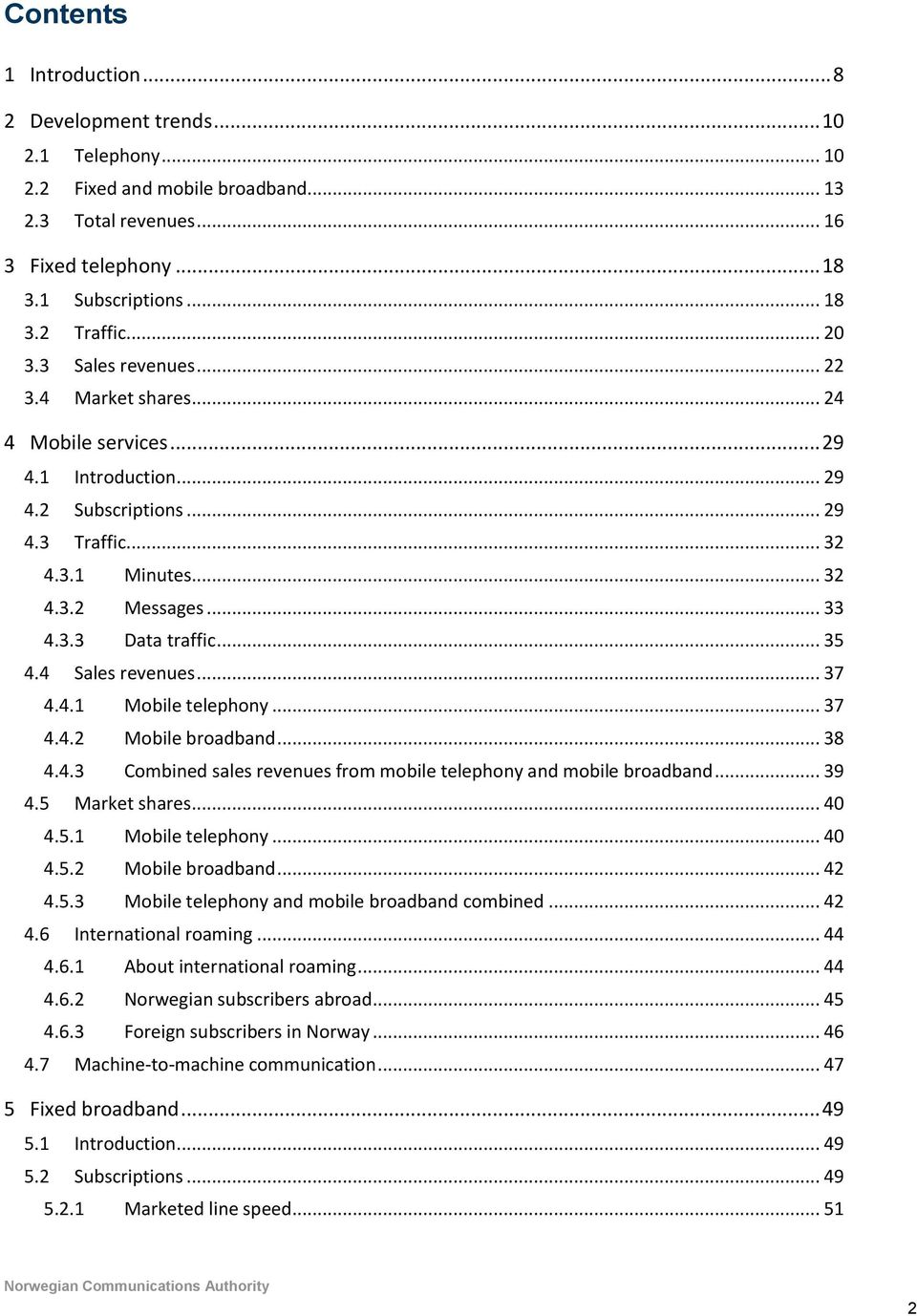
2 Contents 1 Introduction Development trends Telephony Fied and mobile broadband Total revenues Fied telephony Subscriptions Traffic Sales revenues Market shares Mobile services Introduction Subscriptions Traffic Minutes Messages Data traffic Sales revenues Mobile telephony Mobile broadband Combined sales revenues from mobile telephony and mobile broadband Market shares Mobile telephony Mobile broadband Mobile telephony and mobile broadband combined International roaming About international roaming Norwegian subscribers abroad Foreign subscribers in Norway Machine-to-machine communication Fied broadband Introduction Subscriptions Marketed line speed
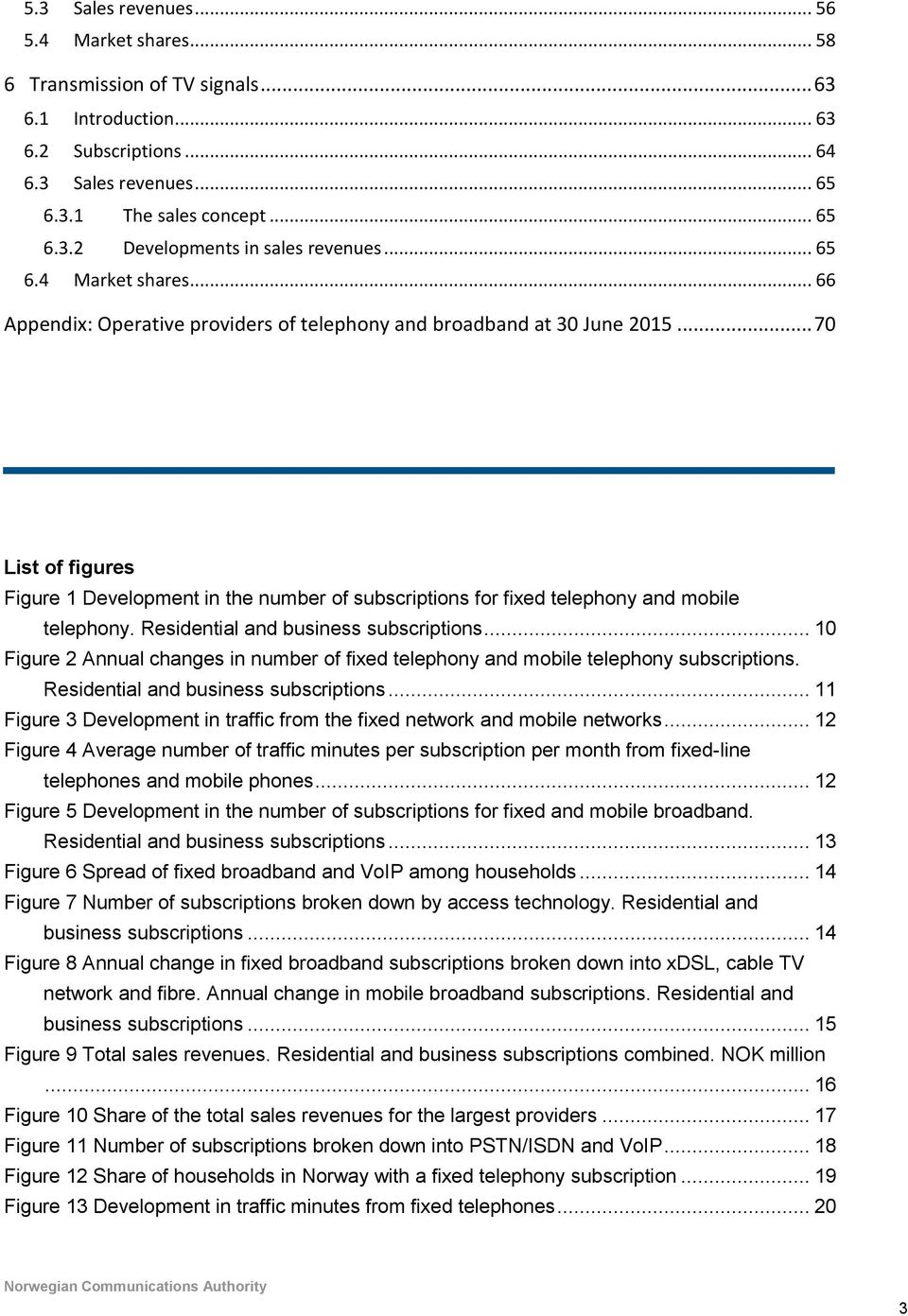
3 5.3 Sales revenues Market shares Transmission of TV signals Introduction Subscriptions Sales revenues The sales concept Developments in sales revenues Market shares Appendi: Operative providers of telephony and broadband at 30 June List of figures Figure 1 Development in the number of subscriptions for fied telephony and mobile telephony. Residential and business subscriptions Figure 2 Annual changes in number of fied telephony and mobile telephony subscriptions. Residential and business subscriptions Figure 3 Development in traffic from the fied network and mobile networks Figure 4 Average number of traffic minutes per subscription per month from fied-line telephones and mobile phones Figure 5 Development in the number of subscriptions for fied and mobile broadband. Residential and business subscriptions Figure 6 Spread of fied broadband and VoIP among households Figure 7 Number of subscriptions broken down by access technology. Residential and business subscriptions Figure 8 Annual change in fied broadband subscriptions broken down into DSL, cable TV network and fibre. Annual change in mobile broadband subscriptions. Residential and business subscriptions Figure 9 Total sales revenues. Residential and business subscriptions combined. NOK million Figure 10 Share of the total sales revenues for the largest providers Figure 11 Number of subscriptions broken down into PSTN/ISDN and VoIP Figure 12 Share of households in Norway with a fied telephony subscription Figure 13 Development in traffic minutes from fied telephones
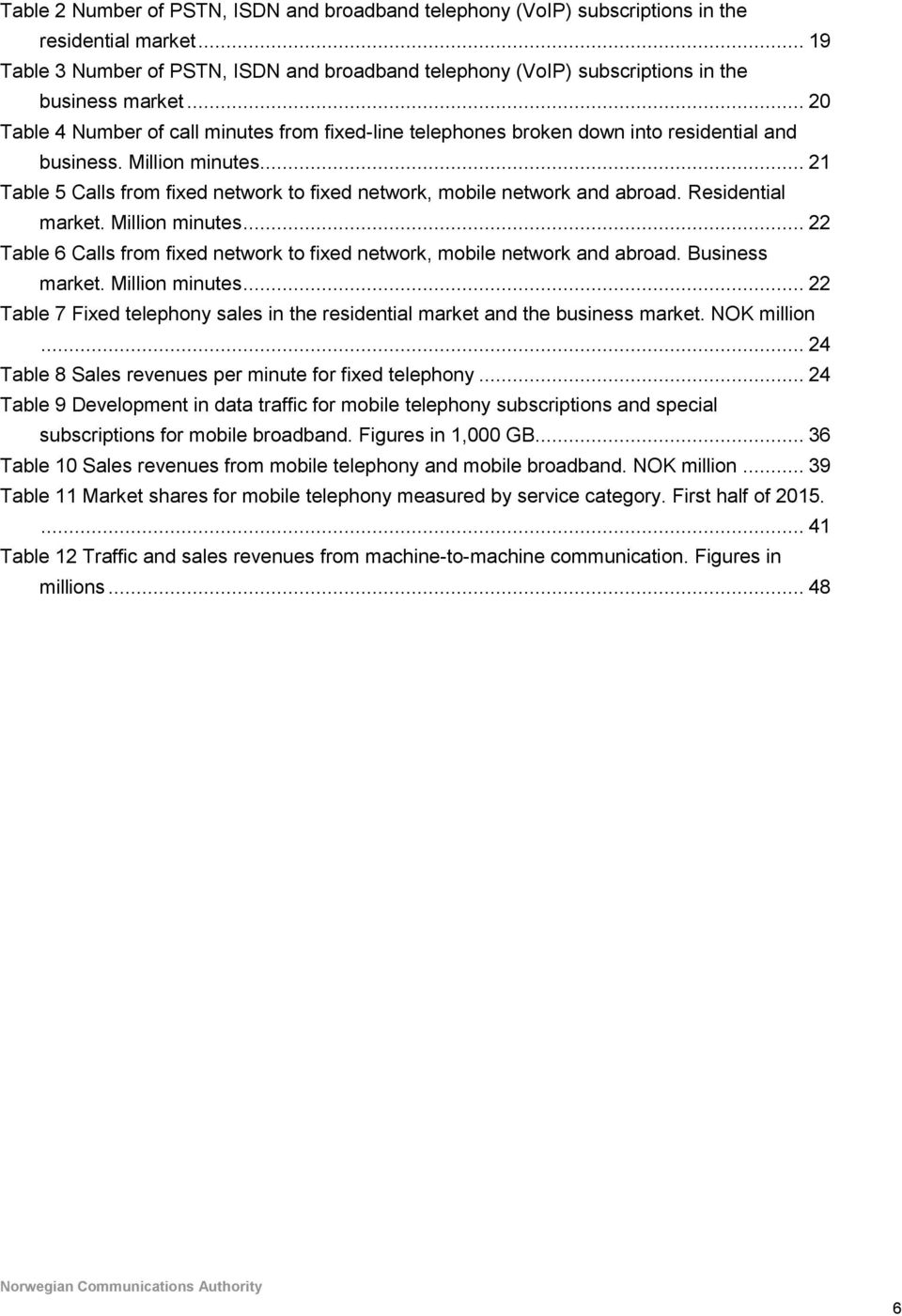
4 Figure 14 Voice traffic from fied-line telephones broken down by direction. Million minutes.. 21 Figure 15 Fied telephony sales in the business market for different traffic directions and subscriptions. NOK million Figure 16 Telenor's share of traffic minutes and total sales revenues. Business and residential markets Figure 17 Fied telephony, market share by revenues, residential and business markets Figure 18 Fied telephony, market share by traffic minutes, residential and business markets Figure 19 Broadband telephony, market share by sales revenues, residential and business markets Figure 20 Broadband telephony, market share by traffic minutes, residential and business markets Figure 21 Number of subscriptions for mobile telephony Figure 22 Number of mobile telephony subscriptions that are active for mobile data. Number of subscriptions that include 1 GB and 5 GB or more per month Figure 23 Number of special subscriptions for mobile broadband Figure 24 Traffic minutes from mobile phones, broken down by direction of traffic Figure 25 Number of SMS messages sent Figure 26 Number of MMS messages sent Figure 27 Number of content messages sent Figure 28 Development in data traffic for mobile telephony subscriptions and special subscriptions for mobile broadband Figure 29 Average monthly data volume per mobile broadband subscription Figure 30 Mobile telephony sales revenues Figure 31 Sales revenues from special subscriptions for mobile broadband broken down into residential subscriptions and business subscriptions Figure 32 Market shares for mobile telephony subscriptions Figure 33 Mobile telephony subscriptions broken down into residential and business customers Figure 34 Market shares for special subscriptions for mobile broadband Figure 35 Market shares for total data traffic for mobile telephony and mobile broadband Figure 36 Market shares for the combined sales revenues from mobile telephony and mobile broadband Figure 37 Development in traffic volumes. Norwegian subscribers abroad Figure 38 Development in earnings and costs. Norwegian subscribers abroad Figure 39 Development in traffic volumes. Foreign subscribers in Norway Figure 40 Development in earnings. Foreign subscribers in Norway Figure 41 Number of SIM cards for machine-to-machine communication (M2M) Figure 42 Number of subscriptions for fied broadband. Business market Figure 43 Number of subscriptions for fied broadband. Business market

5 Figure 44 Subscriptions for fied broadband broken down by line speed. Residential and business markets. All forms of access Figure 45 Subscriptions for fied broadband broken down by line speed. Residential customers. Downstream speed Figure 46 Subscriptions for fied broadband broken down by line speed. Residential customers. Upstream speed Figure 47 Subscriptions for fied broadband broken down by line speed. Business customers. Downstream speed Figure 48 Subscriptions for fied broadband broken down by line speed. Business customers. Upstream speed Figure 49 Fied broadband sales. Business market Figure 50 Fied broadband sales. Business market Figure 51 Fied broadband sales. Residential and business markets Figure 52 Market shares for mobile broadband measured by number of subscriptions. Residential market Figure 53 Market shares for fied broadband measured by sales revenues. Residential market Figure 54 Market shares for broadband measured by sales revenues. Business market Figure 55 Market shares for fied broadband via DSL, measured by sales revenues. Residential and business markets Figure 56 Market shares for fied broadband via cable TV network, measured by sales revenues. Residential and business markets Figure 57 Market shares for fied broadband via fibre, measured by sales revenues. Residential and business markets Figure 58 Number of subscriptions for reception of TV signals at the end of the period Figure 59 Number of TV subscriptions broken down by form of access. Percentage breakdown Figure 60 Sales revenues from distribution of TV signals broken down by form of access Figure 61 Market shares for distribution of TV signals, measured by number of subscriptions. All forms of access Figure 62 Market shares for transmission of TV signals, measured by number of subscriptions. Cable TV Figure 63 Market shares for transmission of TV signals, measured by number of subscriptions. Fibre Tables Table 1 Development in the number of providers in the electronic communications market, broken down by service category

6 Table 2 Number of PSTN, ISDN and broadband telephony (VoIP) subscriptions in the residential market Table 3 Number of PSTN, ISDN and broadband telephony (VoIP) subscriptions in the business market Table 4 Number of call minutes from fied-line telephones broken down into residential and business. Million minutes Table 5 Calls from fied network to fied network, mobile network and abroad. Residential market. Million minutes Table 6 Calls from fied network to fied network, mobile network and abroad. Business market. Million minutes Table 7 Fied telephony sales in the residential market and the business market. NOK million Table 8 Sales revenues per minute for fied telephony Table 9 Development in data traffic for mobile telephony subscriptions and special subscriptions for mobile broadband. Figures in 1,000 GB Table 10 Sales revenues from mobile telephony and mobile broadband. NOK million Table 11 Market shares for mobile telephony measured by service category. First half of Table 12 Traffic and sales revenues from machine-to-machine communication. Figures in millions
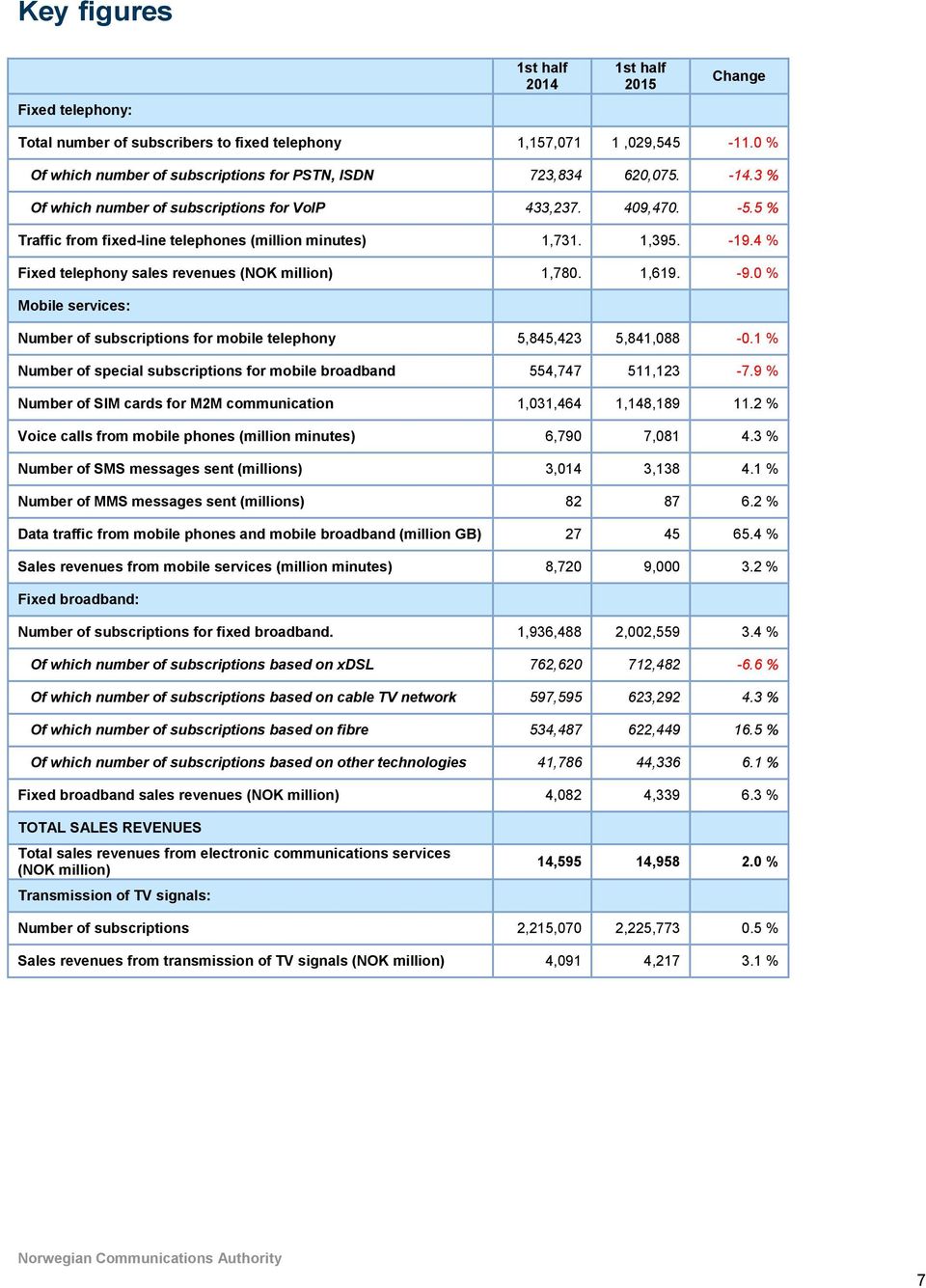
7 Key figures Fied telephony: Change Total number of subscribers to fied telephony 1,157,071 1,029, % Of which number of subscriptions for PSTN, ISDN 723, , % Of which number of subscriptions for VoIP 433, , % Traffic from fied-line telephones (million minutes) 1,731. 1, % Fied telephony sales revenues (NOK million) 1,780. 1, % Mobile services: Number of subscriptions for mobile telephony 5,845,423 5,841, % Number of special subscriptions for mobile broadband 554, , % Number of SIM cards for M2M communication 1,031,464 1,148, % Voice calls from mobile phones (million minutes) 6,790 7, % Number of SMS messages sent (millions) 3,014 3, % Number of MMS messages sent (millions) % Data traffic from mobile phones and mobile broadband (million GB) % Sales revenues from mobile services (million minutes) 8,720 9, % Fied broadband: Number of subscriptions for fied broadband. 1,936,488 2,002, % Of which number of subscriptions based on DSL 762, , % Of which number of subscriptions based on cable TV network 597, , % Of which number of subscriptions based on fibre 534, , % Of which number of subscriptions based on other technologies 41,786 44, % Fied broadband sales revenues (NOK million) 4,082 4, % TOTAL SALES REVENUES Total sales revenues from electronic communications services (NOK million) Transmission of TV signals: 14,595 14, % Number of subscriptions 2,215,070 2,225, % Sales revenues from transmission of TV signals (NOK million) 4,091 4, % 7
8 1 Introduction Twice a year, the (Nkom) presents statistics showing key developments in the markets for electronic communications services. The reports are based on figures obtained from all the providers of electronic communications services. One report covers statistics for entire years and is published in May every year, and the other report covers the first half of the year and is published in October each year. The statistics in both the full-year and half-year reports include fied telephony (including broadband telephony), mobile telephony and other mobile services, broadband and transmission of TV signals. The full-year report also includes data communication services and transmission capacity (leased lines). The statistics mainly cover subscriptions and sales revenues, and traffic where relevant. The market shares of the largest providers are also described. Table 1 shows the total number of operative providers on which the annual statistics are based. The total number of providers has decreased almost every year since Nkom has collected data from 167 providers as of the first half of The annual decrease reflects changes in the market in this period, including mergers, acquisitions and disposals. There are also fewer newly established providers compared with previously. Each of the individual service areas sees bigger or smaller changes every year. The number of providers of fied telephony and mobile services declines, while there are more broadband providers. Most of the providers have operations in more than one service area. The appendi contains a list of the individual providers within telephony and broadband Fied telephony Of which VoIP Mobile telephony Mobile broadband Fied broadband Data communication services Leased lines Transmission of TV signals TOTAL Table 1 Development in the number of providers in the electronic communications market, broken down by service category 8

9 Some of the figures from previous years have been restated. Nkom carries out thorough quality control of the reports submitted by the providers. Sometimes, however, we do not uncover erroneous reports until we can compare data from several years. The numerical data in this report may therefore contain minor errors. 9

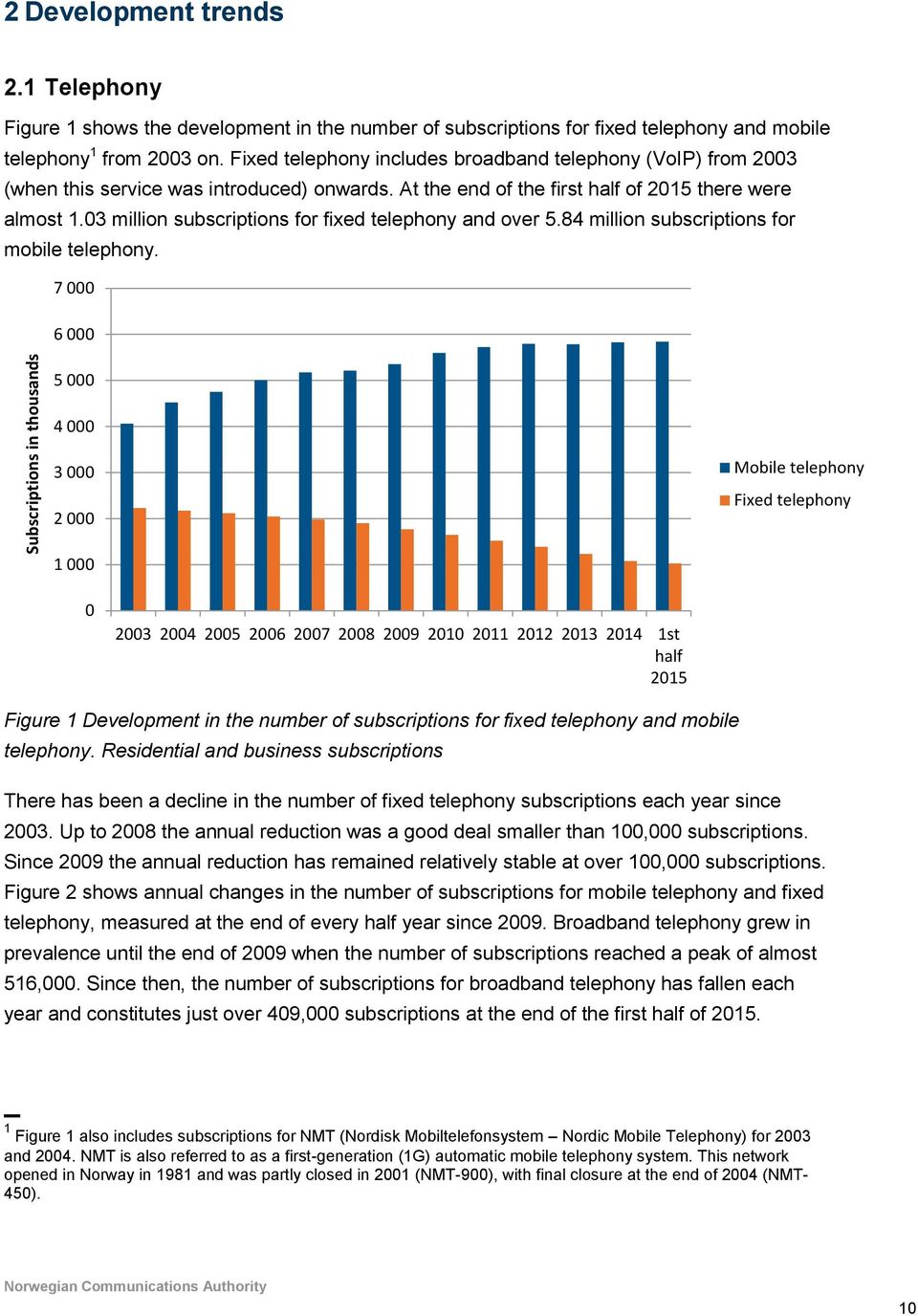
10 Subscriptions in thousands 2 Development trends 2.1 Telephony Figure 1 shows the development in the number of subscriptions for fied telephony and mobile telephony 1 from 2003 on. Fied telephony includes broadband telephony (VoIP) from 2003 (when this service was introduced) onwards. At the end of the first half of 2015 there were almost 1.03 million subscriptions for fied telephony and over 5.84 million subscriptions for mobile telephony Mobile telephony Fied telephony st half 2015 Figure 1 Development in the number of subscriptions for fied telephony and mobile telephony. Residential and business subscriptions There has been a decline in the number of fied telephony subscriptions each year since Up to 2008 the annual reduction was a good deal smaller than 100,000 subscriptions. Since 2009 the annual reduction has remained relatively stable at over 100,000 subscriptions. Figure 2 shows annual changes in the number of subscriptions for mobile telephony and fied telephony, measured at the end of every half year since Broadband telephony grew in prevalence until the end of 2009 when the number of subscriptions reached a peak of almost 516,000. Since then, the number of subscriptions for broadband telephony has fallen each year and constitutes just over 409,000 subscriptions at the end of the first half of Figure 1 also includes subscriptions for NMT (Nordisk Mobiltelefonsystem Nordic Mobile Telephony) for 2003 and NMT is also referred to as a first-generation (1G) automatic mobile telephony system. This network opened in Norway in 1981 and was partly closed in 2001 (NMT-900), with final closure at the end of 2004 (NMT- 450). 10
11 Number of subscriptions in thousands The number of subscriptions for mobile telephony rose sharply each year until The period saw large annual variations in growth. Since 2011 the annual growth has slowed down considerably compared with the previous years. In this contet subscriptions include post-paid subscriptions and pre-paid subscriptions, i.e. active pre-paid cards 2. The proportion of pre-paid cards has decreased significantly in the period from 2002, when prepaid cards constituted some 40 per cent of subscriptions. At the end of the first half of 2015, the share of pre-paid cards was about 22 per cent Mobile telephony Fied telephony Figure 2 Annual changes in number of fied telephony and mobile telephony subscriptions. Residential and business subscriptions Figure 3 shows the change in originated traffic measured in minutes. Traffic minutes originating from the fied network include both voice calls and traffic to dial-up Internet. Traffic to dial-up Internet has been negligible in the last few years. Total traffic from fied telephony and mobile telephony declined substantially until roughly Much of this was due to the decline in traffic to dial-up Internet. From 2008, the annual decline in the total number of traffic minutes has been smaller. Mobile traffic comprises a steadily growing share of the total traffic. In the first half of 2015, traffic from mobile telephones constituted nearly 84 per cent of total traffic, compared with roughly 47 per cent in Nkom regards a pre-paid card as a subscription when it is active, i.e. it has generated traffic on a mobile network in the last three months. 11

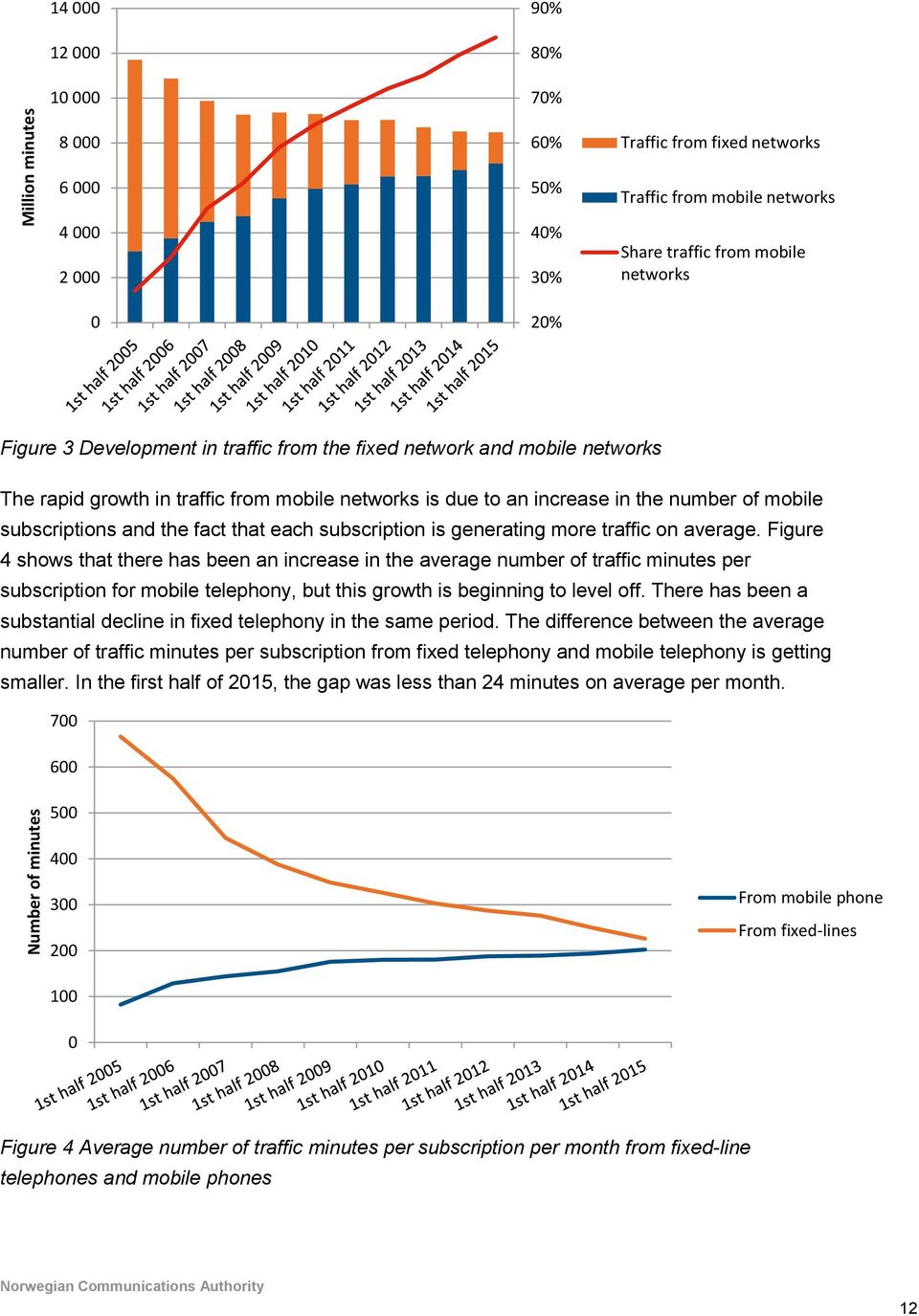
12 Number of minutes Million minutes % 80% 70% % 50% 40% 30% 20% Traffic from fied networks Traffic from mobile networks Share traffic from mobile networks Figure 3 Development in traffic from the fied network and mobile networks The rapid growth in traffic from mobile networks is due to an increase in the number of mobile subscriptions and the fact that each subscription is generating more traffic on average. Figure 4 shows that there has been an increase in the average number of traffic minutes per subscription for mobile telephony, but this growth is beginning to level off. There has been a substantial decline in fied telephony in the same period. The difference between the average number of traffic minutes per subscription from fied telephony and mobile telephony is getting smaller. In the first half of 2015, the gap was less than 24 minutes on average per month From mobile phone From fied-lines Figure 4 Average number of traffic minutes per subscription per month from fied-line telephones and mobile phones 12
13 Number of subscriptions in thousands 2.2 Fied and mobile broadband Figure 5 shows the development in subscriptions for fied and mobile broadband 3 from At the end of 2004, there were just over 670,000 subscriptions for fied broadband. By the end of the first half of 2015, the number of subscriptions had passed 2 million. Mobile broadband was introduced in At the end of the first half of 2015, the number of subscribers was just over 511,000, Fied broadband Mobile broadband st half 2015 Figure 5 Development in the number of subscriptions for fied and mobile broadband. Residential and business subscriptions Figure 6 shows the percentage of households in Norway with a fied broadband subscription and the share of broadband customers who also have VoIP 4. The share of households with fied broadband has been rising, and in 2014 and the first half of 2015 the share is at 78 per cent. The growth in the number of residential broadband subscriptions was thus larger than the increase in the number of households in the entire period to Until 2007, an increasing share of households with fied broadband also had VoIP. In 2007 and 2008 this share was roughly 35 per cent. Since 2008, this share has declined slightly, and 3 Dedicated mobile broadband not linked to a mobile telephony subscription. 4 Nkom uses figures from Statistics Norway (SSB) on the development in the number of private households in Norway. The number of households at the end of the first half of 2015 has been estimated by Nkom. In 2013, SSB changed its definition of "household". This led to an etraordinary increase in the number of households in In turn, this means that the percentage share of the number of households with broadband does not increase from 2012 to
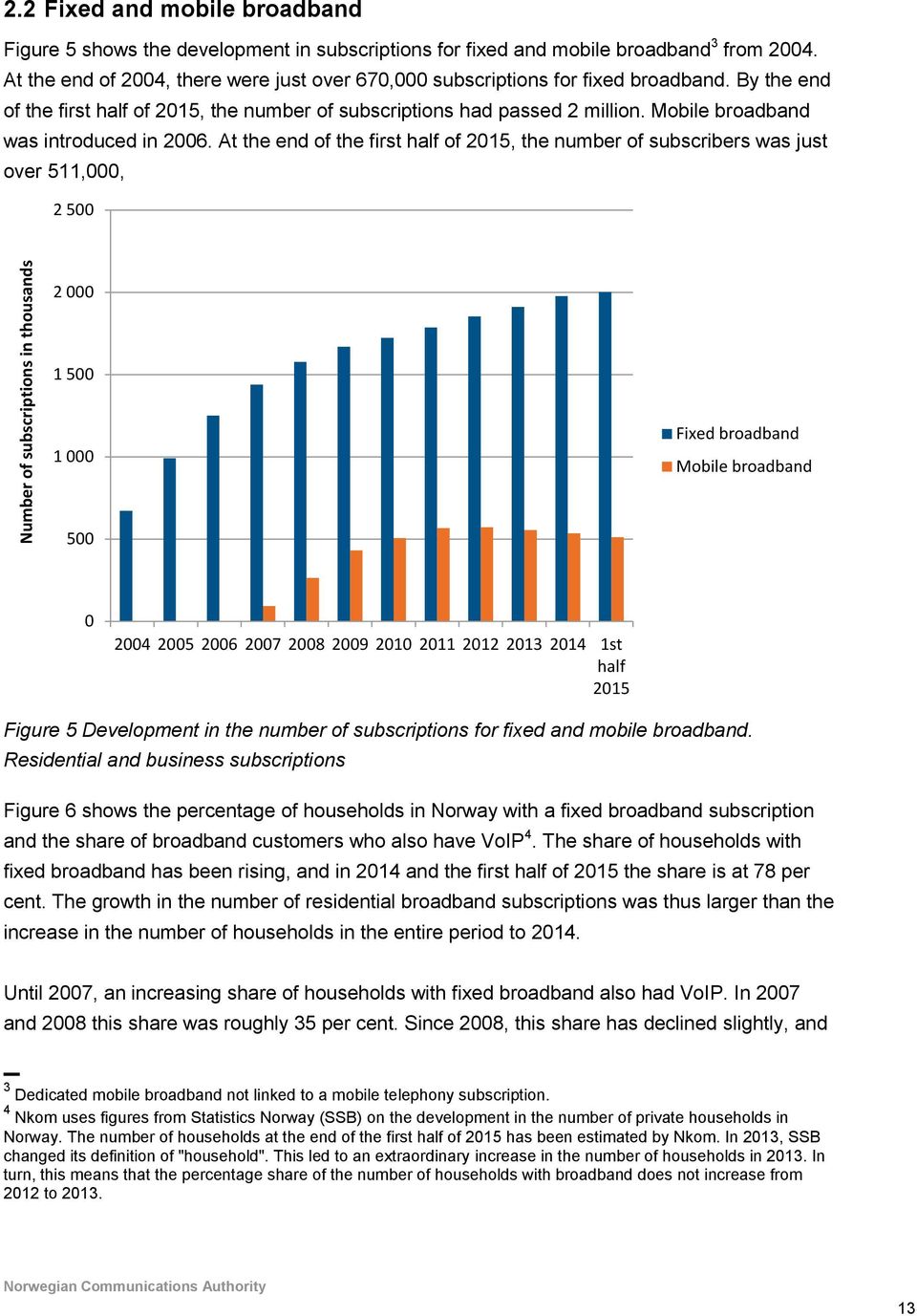
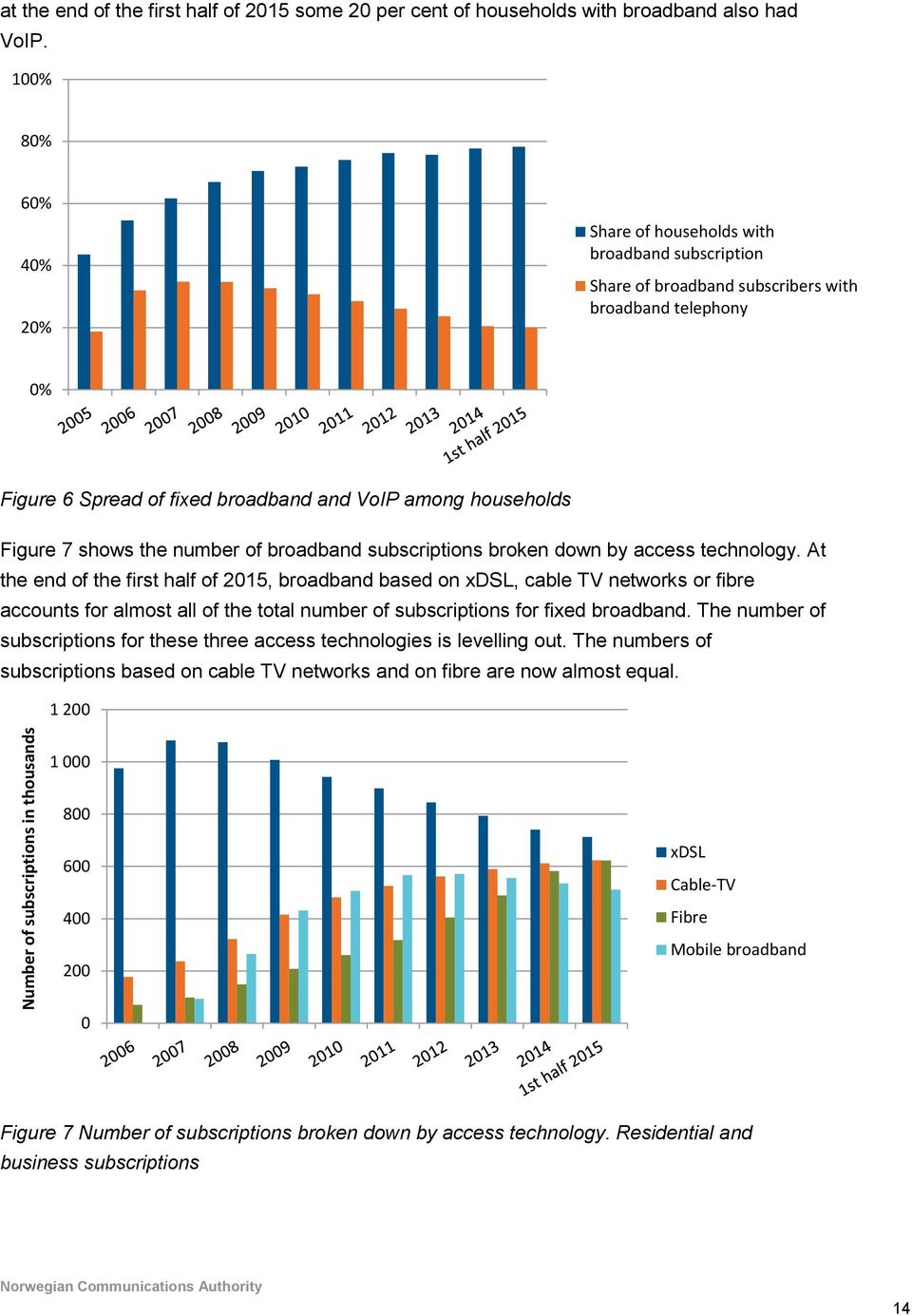
14 Number of subscriptions in thousands at the end of the first half of 2015 some 20 per cent of households with broadband also had VoIP. 100% 80% 60% 40% 20% Share of households with broadband subscription Share of broadband subscribers with broadband telephony 0% Figure 6 Spread of fied broadband and VoIP among households Figure 7 shows the number of broadband subscriptions broken down by access technology. At the end of the first half of 2015, broadband based on DSL, cable TV networks or fibre accounts for almost all of the total number of subscriptions for fied broadband. The number of subscriptions for these three access technologies is levelling out. The numbers of subscriptions based on cable TV networks and on fibre are now almost equal DSL Cable-TV Fibre Mobile broadband 0 Figure 7 Number of subscriptions broken down by access technology. Residential and business subscriptions 14
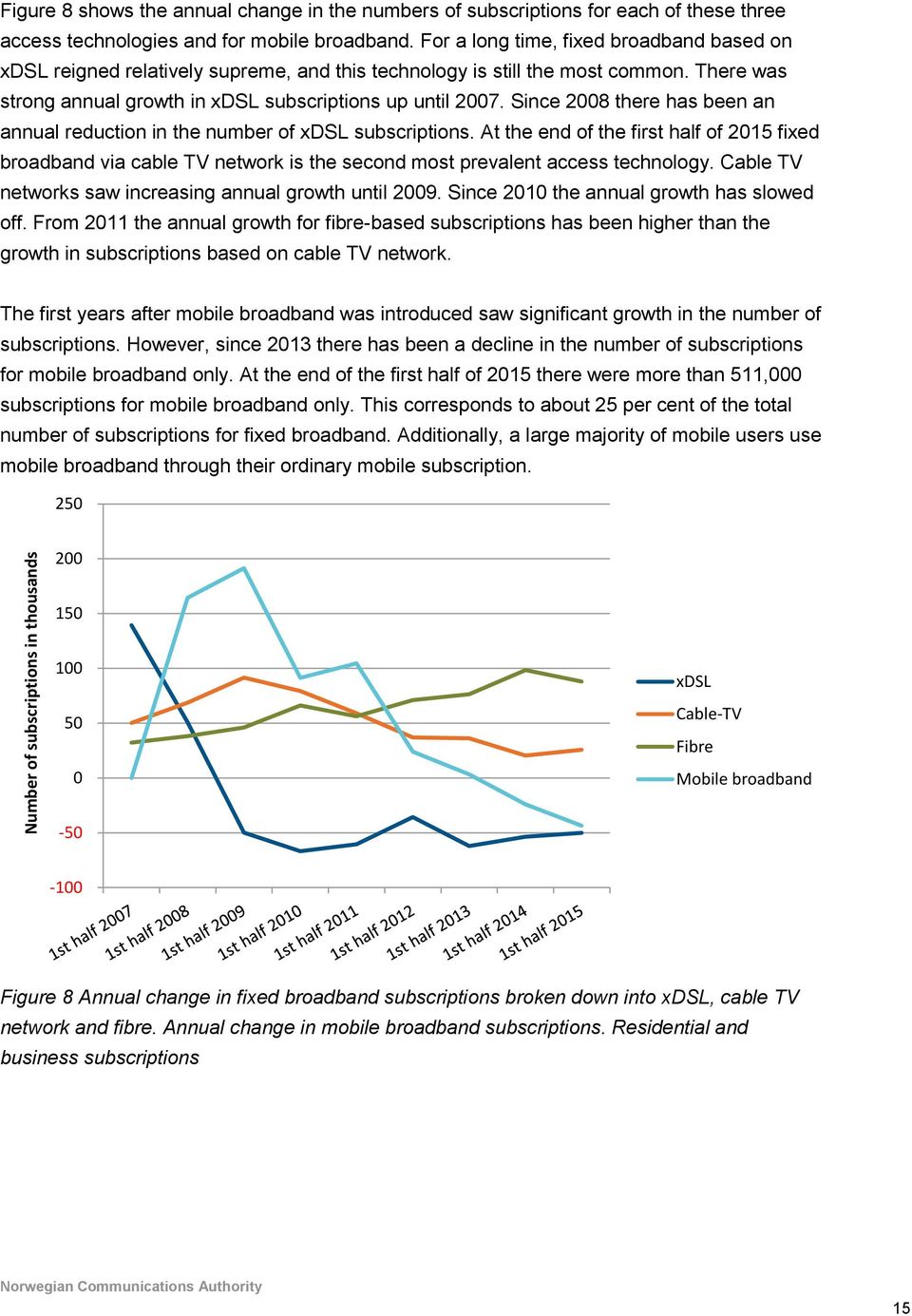
15 Number of subscriptions in thousands Figure 8 shows the annual change in the numbers of subscriptions for each of these three access technologies and for mobile broadband. For a long time, fied broadband based on DSL reigned relatively supreme, and this technology is still the most common. There was strong annual growth in DSL subscriptions up until Since 2008 there has been an annual reduction in the number of DSL subscriptions. At the end of the first half of 2015 fied broadband via cable TV network is the second most prevalent access technology. Cable TV networks saw increasing annual growth until Since 2010 the annual growth has slowed off. From 2011 the annual growth for fibre-based subscriptions has been higher than the growth in subscriptions based on cable TV network. The first years after mobile broadband was introduced saw significant growth in the number of subscriptions. However, since 2013 there has been a decline in the number of subscriptions for mobile broadband only. At the end of the first half of 2015 there were more than 511,000 subscriptions for mobile broadband only. This corresponds to about 25 per cent of the total number of subscriptions for fied broadband. Additionally, a large majority of mobile users use mobile broadband through their ordinary mobile subscription DSL Cable-TV Fibre Mobile broadband Figure 8 Annual change in fied broadband subscriptions broken down into DSL, cable TV network and fibre. Annual change in mobile broadband subscriptions. Residential and business subscriptions 15
16 NOK million 2.3 Total revenues Figure 9 shows the development in end-user sales for fied telephony, mobile services and fied broadband 5. Mobile services include mobile broadband subscriptions, special subscriptions for mobile broadband and mobile-to-mobile communication (M2M). End-user sales revenues are the amount customers are invoiced for. This figure does not, however, cover earnings from distribution of TV signals since a large portion of this revenue is payment for content and does not therefore count as electronic communication services. Sales revenue from distribution of TV signals is described in more detail in section 6.3. The sales figures for mobile telephony do not include wholesale earnings from termination and international roaming (foreign mobile users in Norway). Nor are retail earnings from international roaming (Norwegian mobile users abroad) included. International roaming is described in more detail in section 4.6. Earnings from the sale or lease of mobile phones and other terminals or physical equipment are not generally included as end-user revenues. From the first half of 2014 to the first half of 2015, there was an increase in total sales of about NOK 363 million. By comparison, there was an increase of just over NOK 216 million from the first half of 2013 to the first half of Total sales in the first half of 2015 amounted to almost NOK 15 billion Mobile services Fied broadband Fied telephony Total Figure 9 Total sales revenues. Residential and business subscriptions combined. NOK million 5 Up until the first half of 2014, the figures for fied broadband include sales revenues from dial-up Internet. 16
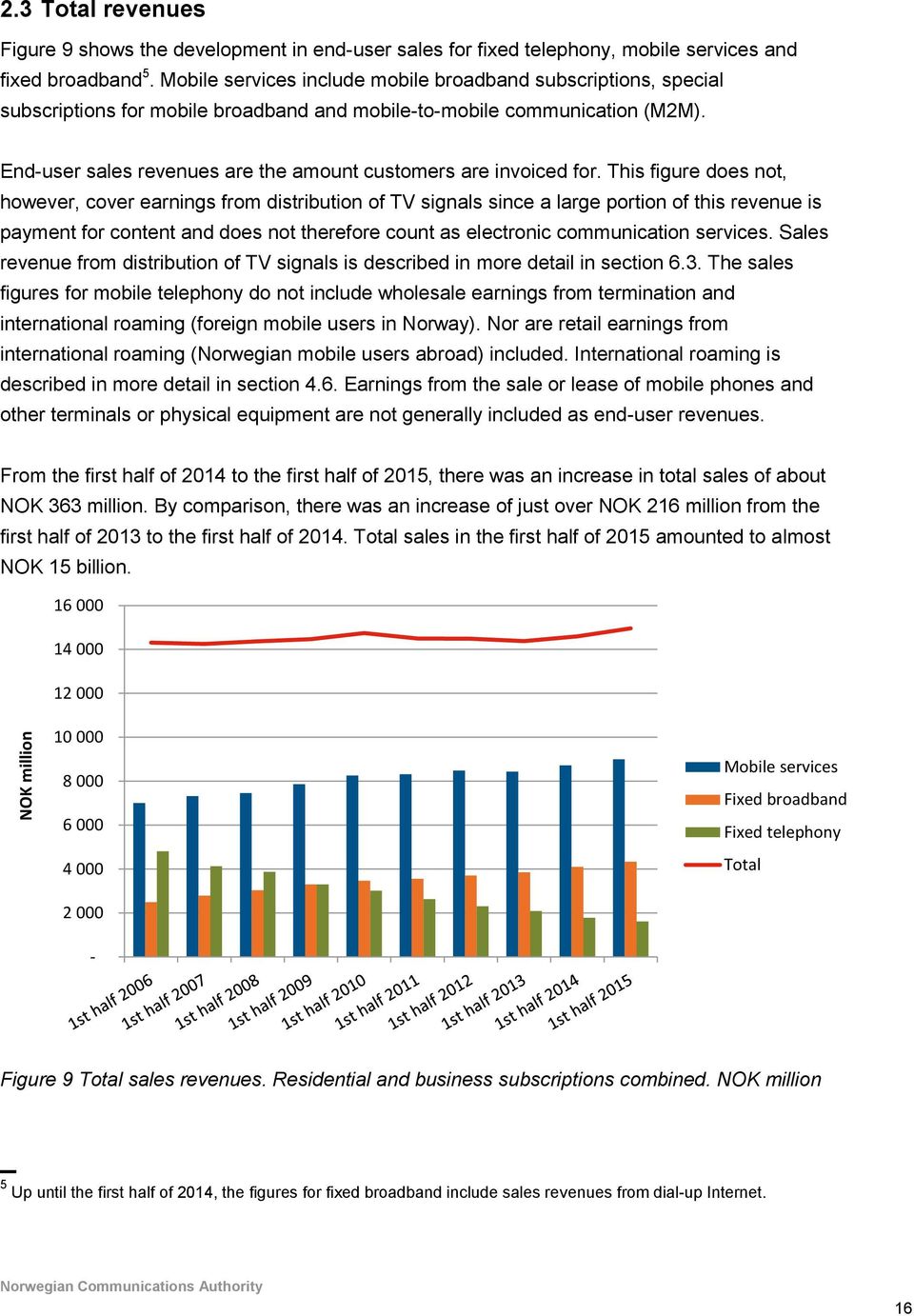
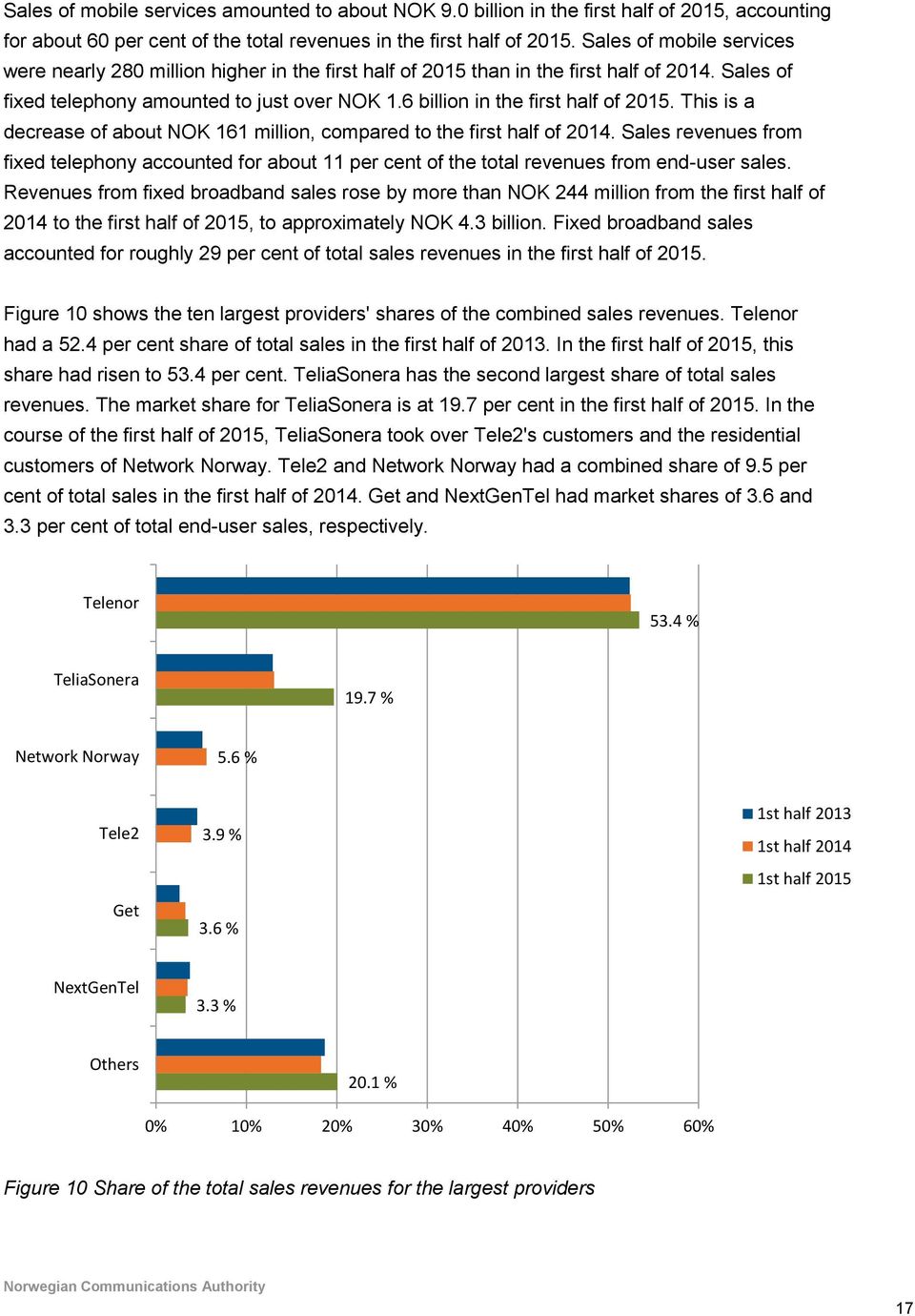
17 Sales of mobile services amounted to about NOK 9.0 billion in the first half of 2015, accounting for about 60 per cent of the total revenues in the first half of Sales of mobile services were nearly 280 million higher in the first half of 2015 than in the first half of Sales of fied telephony amounted to just over NOK 1.6 billion in the first half of This is a decrease of about NOK 161 million, compared to the first half of Sales revenues from fied telephony accounted for about 11 per cent of the total revenues from end-user sales. Revenues from fied broadband sales rose by more than NOK 244 million from the first half of 2014 to the first half of 2015, to approimately NOK 4.3 billion. Fied broadband sales accounted for roughly 29 per cent of total sales revenues in the first half of Figure 10 shows the ten largest providers' shares of the combined sales revenues. Telenor had a 52.4 per cent share of total sales in the first half of In the first half of 2015, this share had risen to 53.4 per cent. TeliaSonera has the second largest share of total sales revenues. The market share for TeliaSonera is at 19.7 per cent in the first half of In the course of the first half of 2015, TeliaSonera took over Tele2's customers and the residential customers of Network Norway. Tele2 and Network Norway had a combined share of 9.5 per cent of total sales in the first half of Get and NetGenTel had market shares of 3.6 and 3.3 per cent of total end-user sales, respectively. Telenor 53.4 % TeliaSonera 19.7 % Network Norway 5.6 % Tele2 Get 3.9 % 3.6 % NetGenTel 3.3 % Others 20.1 % 0% 10% 20% 30% 40% 50% 60% Figure 10 Share of the total sales revenues for the largest providers 17
18 Number of subscriptions in thousands 3 Fied telephony In this report both traditional fied telephony (PSTN and ISDN) and broadband telephony (VoIP) are discussed as fied telephony. 3.1 Subscriptions Figure 11 shows the total number of fied telephony subscriptions from 2006 to the end of the first half of The number of subscriptions has been declining since The number of ISDN subscriptions rose until 2002, then started to decrease again. At the end of the first half of 2015 there were 1,029,268 fied telephony subscriptions in Norway. This is a decline of about 4.8 per cent since the end of Subscriptions for VoIP decreased by approimately 3,000, while the decline in PSTN and ISDN subscriptions totalled nearly 49, VoIP PSTN and ISDN Figure 11 Number of subscriptions broken down into PSTN/ISDN and VoIP Figure 12 shows the development in the number of households with fied telephony. At the end of the first half of 2015, just over a third of Norwegian households had a fied-line telephone. By contrast, at the end of 2012 nearly half of Norwegian households had a fiedline telephone. 18

19 78% 74% 70% 64% 59% 54% 48% 41% 35% 33% Figure 12 Share of households in Norway with a fied telephony subscription Tables 2 and 3 show the development in subscriptions for PSTN, ISDN and broadband telephony (VoIP) for the residential market and the business market, respectively. In the residential market, the greatest decline was in ISDN 2B+D, down nearly 20 per cent from the end of 2014 to the end of the first half of PSTN and VoIP have fallen by 5.9 and 1.1 per cent respectively in the same period. In the business market, the greatest decline was in ISDN 2B+D, down 11.6 per cent from the end of In total, there is a 5.6 per cent decline in the number of fied telephony subscriptions for businesses in the first half of PSTN 747, , , , , , ,964 ISDN 2B+D 141, ,698 97,319 76,144 58,696 45,561 36,487 VoIP 500, , , , , , ,562 Others 5,305 3, Total 1,395,261 1,293,481 1,196,269 1,087, , , ,019 Table 2 Number of PSTN, ISDN and broadband telephony (VoIP) subscriptions in the residential market 19

20 Million minutes PSTN 168, , , , , , ,537 ISDN 2B+D 180, , , , ,338 85,627 75,737 ISDN 30B+D 8,608 8,242 7,099 7,096 6,304 5,700 5,344 VoIP 15,186 24,181 25,684 29,296 33,025 34,032 35,631 Others Total 372, , , , , , ,249 Table 3 Number of PSTN, ISDN and broadband telephony (VoIP) subscriptions in the business market 3.2 Traffic Figure 13 shows the development in traffic minutes from fied telephones. There was a total of about 1.4 billion call minutes from fied telephones in the first half of By comparison, the same figure was 7.1 billion in the first half of In the first half of 2015 there were 19.4 per cent fewer call minutes than in the first half of Historically, PSTN and ISDN have had the greatest percentage decline. From the first half of 2014 to the first half of 2015, the decline in traffic from VoIP is 20.1 per cent and from PSTN and ISDN combined it is 21.6 percent in the residential market. In the business market, the decline in the same period is 8.1 and 20.0 per cent, respectively VoIP PSTN and ISDN Total Figure 13 Development in traffic minutes from fied telephones 20

21 Million minutes Figure 14 shows the development in traffic from fied telephony broken down by direction and market segment. The largest share is to fied networks, which in the first half of 2015 constituted 66 per cent of traffic in the residential market and 47 per cent of traffic in the business market. In the first half of 2015, traffic in the residential market is 21 per cent lower than in the first half of 2014, while in the business market there is an 18 per cent decline in the same period Fied network Mobile network International 0 Residential Business Figure 14 Voice traffic from fied-line telephones broken down by direction. Million minutes Table 4 shows a greater decline in traffic in the residential market than in the business market in recent years. Traffic from VoIP in the business market declines for the first time. From the first half of 2014 to the first half of 2015, traffic declined by 7.8 per cent, despite the number of subscribers growing in the same period. By comparison, traffic from fied broadband in the business market rose by 4.6 per cent from the first half of 2013 to the first half of Business market 1,736 1,503 1, Of which VoIP Business market 1,131 1, Of which VoIP Table 4 Number of call minutes from fied-line telephones broken down into residential and business. Million minutes 21
22 Tables 5 and 6 show traffic broken down by direction for the residential and business markets. In both markets, traffic to the fied network declined, while traffic to the mobile networks increased by a corresponding amount. Traffic to international end-points increases by one percentage point in both the residential and business markets, to 15 and 9 per cent respectively. Fied network Mobile networks Min. Share Min. Share Min. Share Min. Share Min. Share 1, % 1, % % % % % % % % % International % % % % % Total 1, % 1, % 1, % % % Table 5 Calls from fied network to fied network, mobile network and abroad. Residential market. Million minutes Min. Share Min. Share Min. Min. Share Min. Share Min. Fied network % % % % % Mobile networks % % % % % International 94 8 % 88 9 % 74 8 % 68 8 % 62 9 % Total 1, % 1, % % % % Table 6 Calls from fied network to fied network, mobile network and abroad. Business market. Million minutes 3.3 Sales revenues Figure 15 shows a steady decline in sales revenues from fied telephony over the past 10 years. Sales revenues from fied telephony amounted to NOK 1.6 billion in in the first half of 2015, a decline of NOK 9.1 per cent from the first half of Earnings from subscriptions and additional services are the largest category at about NOK 1.1 billion, a decrease of nearly 9 per cent from the first half of Sales revenue from all traffic is 9.5 per cent lower than in the first half of Earnings from subscriptions and additional services accounted for
23 NOK million per cent of the sales revenues in the first half of 2015, traffic to mobile phones accounted for about 14 per cent, traffic to the fied networks accounted for 12 per cent, and international traffic accounted for just under 6 per cent. Revenues from PSTN and ISDN amounted to just under 75 per cent of the sales revenues from fied telephony Subscriptions and other revenues To mobile networks To fied networks International Total Figure 15 Fied telephony sales in the business market for different traffic directions and subscriptions. NOK million Table 7 shows the sales revenues in the residential and business markets for fied telephony as a whole and for broadband telephony. The residential market as a whole saw a decline of 11.9 per cent from the first half of 2014 to the first half of 2015: 7.6 per cent for VoIP and 13.6 per cent for PSTN/ISDN. In the business market the decline was 5.2 per cent. Sales revenues from PSTN and ISDN in the business market were down by about 9.4 per cent compared with Revenue from broadband telephony in the business market rose by 17.3 per cent. 23
24 Residential market 1,466 1,247 1, Of which VoIP Business market 1,161 1, Of which VoIP Table 7 Fied telephony sales in the residential market and the business market. NOK million Table 8 shows total revenue per minute and traffic revenue per minute for fied telephony. Both total revenue per minute and traffic revenue per minute increase from the first half of Traffic revenue increases despite an increase in the share of revenue coming from subscription fees Traffic revenue per min Total revenue per min Table 8 Sales revenues per minute for fied telephony 3.4 Market shares The total sales revenues from fied telephony in the residential and the business markets amounted to NOK 1.54 billion in the first half of The total number of traffic minutes was 1.4 billion minutes in the first half of This is the basis for the calculation of the market shares in figure 16. Here the market shares are defined on the basis of sales of telephony services to end-users in the residential and business markets. Figure 16 shows Telenor's market shares of the total sales revenues and number of traffic minutes for the residential and business markets from 2006 to the first half of Telenor's share of total revenues declines from 68.0 per cent in 2014 to 67.9 per cent in the first half of 2015, while the share of traffic minutes declines from 57.8 per cent in 2014 to 56.2 per cent in the first half of
25 80% 70% 60% 50% 40% 30% 20% Telenor's share of total revenue Telenor's share of traffic minutes 10% 0% Figure 16 Telenor's share of traffic minutes and total sales revenues. Business and residential markets Figure 17 shows the providers' market shares of the sales revenues in the residential and business markets combined. Measured by sales revenues, Phonero is the second largest provider of fied telephony, with 7.3 per cent of the market. Ventelo was merged into Phonero from 1 January Phonero and Ventelo's market shares are combined for the first half of 2013 and the first half of NetGenTel is the third-largest provider of fied telephony, at 5.2 per cent. NetGenTel merged with Telio Telecom on 1 January NetGenTel and Telio's market shares are combined for the first half of 2013 and the first half of TeliaSonera has 4.5 per cent of the fied telephony market after the acquisition of Tele2 6. TeliaSonera and Tele2's market shares are combined for the first half of 2013 and the first half of TeliaSonera has sold the fied telephony customers from the acquisition of Tele2 to Phonect, which acquires the customers as of 31 October
26 Telenor 67.9 % Phonero 7.3 % NeGenTel TeliaSonera 5.2 % 4.5 % TDC 0.4 % Other 14.8 % 0% 10% 20% 30% 40% 50% 60% 70% 80% Figure 17 Fied telephony, market share by revenues, residential and business markets Figure 18 shows the providers' market shares of the traffic minutes in the residential and business markets combined. Telenor's market share increased by 0.1 percentage points from the first half of NetGenTel increased its market share by 1.5 percentage points to 12.4 per cent in the first half of TDC's market share declined from 7.0 per cent in the first half of 2014 to 7.3 per cent in the first half of Phonero's market share decreased by 0.5 percentage points from the first half of 2014 to the first half of Telenor 57.5 % NetGenTel 12.4 % TDC Phonero 7.3 % 5.8 % TeliaSonera 4.2 % Other 12.9 % 0% 10% 20% 30% 40% 50% 60% 70% Figure 18 Fied telephony, market share by traffic minutes, residential and business markets 26
27 Figure 19 shows that Telenor increases its share of the VoIP market measured by sales revenues, with an increase from 26.1 per cent in 2014 to 29.4 per cent in the first half of NetGenTel's share declined from 24.0 per cent in 2014 to 20.4 per cent in the first half of Lyse Fiber increased its market share to 7.1 per cent. Telenor 29.4 % NetGenTel 20.6 % Lyse Fiber Get Viken Fiber 7.1 % 6.5 % 6.4 % Other 30.1 % Figure 19 Broadband telephony, market share by sales revenues, residential and business markets 0% 5% 10% 15% 20% 25% 30% 35% Measured in traffic minutes, NetGenTel is the biggest VoIP provider. Telenor advances 1.2 percentage points to 25.8 per cent from the first half of 2014 to the first half of Get's market share increased to 6.8 per cent, while Phonect increased from 5.2 per cent to 5.5 per cent. NetGenTel 36.8 % Telenor 25.8 % Get Phonect Viken Fiber 3.5 % 6.8 % 5.5 % Other 21.6 % Figure 20 Broadband telephony, market share by traffic minutes, residential and business markets 0% 5% 10% 15% 20% 25% 30% 35% 40% 45% 27
28 28
29 4 Mobile services 4.1 Introduction In this report mobile services consist of three main parts: Mobile telephony subscriptions are subscriptions that enable calls, SMS messaging and Internet access, etc. The statistics for mobile telephony include the number of subscriptions, voice traffic in minutes, the number of messages and data volume. They also include sales revenues from mobile telephony, broken down into subscription revenues and traffic revenues, among other things. In this report, mobile telephony subscriptions are counted as the total number of active pre-paid cards 7 and invoiced subscriptions. These days most post-paid mobile telephony subscriptions include a certain volume of traffic in the form of voice minutes, messages and data traffic. Mobile broadband only subscriptions can only be used for Internet access and data traffic. A separate subscription for mobile broadband is bought independently of a mobile telephony subscription 8. The statistics for mobile broadband cover the number of subscriptions, data volume and sales revenues. Machine-to-machine (M2M) communication using the mobile network. The statistics cover the number of SIM cards for this purpose and related revenues and traffic. Figures for sales revenues were obtained for the first time for 2009, whereas traffic volume figures started being collected in Subscriptions Figure 21 shows the change the number of mobile telephony subscriptions from 2006 and to the end of the first half of At the end of the first half of 2015 there were more than 5.84 million mobile telephony subscriptions. This is an increase of about 11,500 subscriptions since the end of From the end of 2013 to the end of 2014, there was an increase of nearly 45,500 subscriptions. The annual increase has been decreasing in the last three years and was significantly lower than was normal before. Recent years have seen a drop in the number of pre-paid cards. The number of prepaid cards was almost 1.28 million at the end of the first half of This is a decline of almost 39,000 compared with the end of From the end of 2013 to the end of 2014, there was a decline 7 In this report "pre-paid cards" refers to an active pre-paid subscription. Subscriptions are considered active when the account has been used in the last three months. 8 Subscribers often use a USB modem in connection with special subscriptions for mobile broadband. Subscribers may also use a PC card or a WiFi router connected to a mobile network. 9 One provider of mobile telephony has changed its previous reporting of the number of pre-paid cards. This applies to figures for entire years and half years in 2013 and The figures for the number of subscriptions in figure 21 therefore cannot be compared with previous reports. 29
30 Number of subscriptions in thousands of almost 45,000. The number of prepaid cards as a share of the total number of subscriptions has been weakly decreasing in recent years. At the end of the first half of 2015, this share was 21.9 per cent, while at the end of 2014 it was 22.6 per cent. By comparison, at the end of 2006 this share was above 32 per cent per cent of all mobile telephony subscriptions were registered to residential customers 10 at the end of the first half of This is the same as at the end of This share has been stable at this level for the past three years % % 40% 35% 30% 25% 20% 15% 10% 5% Pre-paid cards Post-paid subscriptions Total Share pre-paid cards (right ais) 0 0% Figure 21 Number of subscriptions for mobile telephony Nkom collects statistics on the number of mobile subscriptions that use mobile data. These are mobile subscriptions that have generated data traffic in the period 11. This can be considered an indicator of the prevalence of Internet use on mobile phones. This is shown in figure 22, with figures dating back to The number of subscriptions of this kind has increased significantly over the last three years. At the end of the first half of 2015 there were more than 4.26 million subscriptions that had generated mobile data. This constitutes just under 73 per cent of the total number of mobile telephony subscriptions. By comparison, the corresponding share was more than 68 per cent at the end of Since 2012 Nkom has collected statistics on the number of mobile telephony subscriptions that include 1 GB or more per month. This is shown in figure 22. There were just under 3.19 million 10 Mobile telephony subscriptions that are registered to devices with an organisation number are regarded as business subscriptions. All other subscriptions are counted as residential subscriptions. 11 These are referred to as active subscriptions for mobile data and are defined as all subscriptions that have generated more than 0.5 MB of data in at least one of the last three months of the year. 30
31 Number of subscriptions in thousands subscriptions at the end of the first half of This is close to 55 per cent of the total number of subscriptions. By comparison, at the end of 2014 the number of subscriptions that included 1 GB or more was over 2.87 million, i.e. more than 49 per cent of the total number of subscriptions. From 2014, Nkom has also collected statistics on the number of mobile telephony subscriptions that include 5 GB or more per month. This is shown in figure 22. At the end of the first half of 2015 there were almost 800,000 such subscriptions, which is about 14 per cent of the total number of subscriptions. The share that has 1 GB or more included in the subscription is higher for business subscriptions than for residential subscriptions. This is even more true for subscriptions with 5 GB or more included. More than 64 per cent of business subscriptions had 1 GB or more included at the end of the first half of At the end of 2014 the corresponding figure was nearly 58 per cent. More than 27 per cent of business subscriptions had 5 GB or more included in the subscription at the end of the first half of At the end of 2014 the corresponding figure was 22 per cent Number of active mobile users Number of subscriptions that include 1 GB or more Number of subscriptions that include 5 GB or more Total number of mobile phone subscriptions Figure 22 Number of mobile telephony subscriptions that are active for mobile data. Number of subscriptions that include 1 GB and 5 GB or more per month Figure 23 shows the development in the number of mobile broadband only 12 subscriptions from 2009 to the end of the first half of The number of subscriptions rose each year until 12 Special subscriptions for mobile broadband are subscriptions that are used eclusively for mobile data. They can be bought and used independently of a mobile telephony subscription. From 2014 the definition of mobile broadband has been amended. In the past, it included additional services for data usage linked to a mobile 31
32 Number of subscriptions in thousands Thereafter, it has declined every year. At the end of the first half of 2015, the total number of subscriptions was just over 511,000. This is a decrease of nearly 24,000 since the end of The share of business subscriptions was almost 70 per cent at the end of the first half of Residential Business Total Figure 23 Number of special subscriptions for mobile broadband 4.3 Traffic Minutes The total number of traffic minutes originated in mobile networks was over 7.08 billion in the first half of This is about 291 million higher than in the first half of 2014, representing an increase of almost 4.3 per cent. From the first half of 2013 to the first half of 2014, the equivalent increase was just over 262 million minutes, or 2.0 per cent. Figure 24 shows the development in the number of traffic minutes from mobile phones, broken down into traffic to mobile networks, the fied network and international calls. In the first half of 2015, there was a decline in the number of traffic minutes to fied networks of more than 33 million minutes compared to the first half of By comparison, from the first half of 2013 to the first half of 2014, there was an increase of nearly 30 million minutes. Traffic from mobile telephones increased by nearly 322 million minutes from the first half of 2014 to the first half of 2015, an increase of 5.9 per cent. By comparison, this traffic increased telephony subscription, such as twin SIM cards, for eample. The historical figures have been adjusted to match the new definition. 32
33 Million minutes by approimately 203 million minutes from the first half of 2013 to the first half of International traffic increased by just over 2 million minutes in the first half of International calls Traffic to fied networks Traffic to mobile networks Total Figure 24 Traffic minutes from mobile phones, broken down by direction of traffic Messages Figures 25, 26 and 27 show the development in the total number of messages sent, broken down by SMS messages, MMS messages, and content messages 13. In total, mobile phone subscribers sent nearly 7 billion messages in the first half of This is nearly 231 million more than in the first half of By comparison, there was a decrease of about NOK 298 million from the first half of 2013 to the first half of On average, Norwegian mobile telephone customers sent nearly 104 messages per month in the first half of In the same period in 2014, the average number of messages was less than 98. Of these, sent SMS messages constitute 90 in the first half of 2015 and 86 in the first half of A decline in the number of SMS messages was registered for the first time in the first half of With the eception of the first half of 2012, the decline has continued until the first half of However, in the first half of 2015 there is a significant increase. Mobile phone subscribers sent more than 3.1 billion SMS messages in the first half of This is nearly 123 million more than in the first half of These are mainly messages conveyed to mobile customers based on a CPA agreement between content providers and mobile operators. CPA = Content Provider Access 33
34 Million messages Million messages Figure 25 Number of SMS messages sent The number of MMS messages has tended to vary slightly from year to year. Since the first half of 2012, however, there has been an annual increase. In the first half of 2015, the number of messages rose by roughly 5 million compared to the first half of This corresponds to an increase of around 6 per cent. However, the number of MMS messages represents only a fraction of the total number of messages. In the first half of 2015, just under 87 million MMS messages were sent Figure 26 Number of MMS messages sent 34
35 Million messages The number of content messages has risen each year since the first half of In the first half of 2015 there were about 408 million content messages, an increase of more than 92 million compared with the first half of Figure 27 Number of content messages sent Data traffic Figure 28 shows the change in the total data traffic for mobile telephony subscriptions and special subscriptions for mobile broadband. Total data traffic in the first half of 2015 was nearly 45,200 TB 14 (45.2 million GB). This is an increase of approimately 17,900 TB from the first half of 2014, when the combined data volume was about 27,300 TB. By comparison, the increase from the first half of 2013 to the first half of 2014 was nearly 11,300 TB. Relatively speaking, the increase from the first half of 2014 to the first half of 2015 was 65 per cent, while it was 70 per cent from the first half of 2013 to the first half of TB = 1,000 GB. 1 PB = 1,000 TB = 1 million GB. 35
36 Million GB Mobile broadband Mobile phone Total Figure 28 Development in data traffic for mobile telephony subscriptions and special subscriptions for mobile broadband More than 71 per cent of the increase in data traffic between the first half of 2014 and the first half of 2015 relates to ordinary subscriptions for mobile telephony. The data volume for these subscriptions totalled close to 29,200 TB in the first half of This is a significant increase from the first half of 2014, when the volume was just under 16,400 TB. More than 64 per cent of the total data traffic was related to ordinary subscriptions for mobile telephony in the first half of In the first half of 2014, this share was roughly 60 per cent. Table 9 shows data traffic from subscriptions for mobile broadband only and from regular mobile telephony subscriptions broken down into the residential market and the business market. From the first half of 2014 to the first half of 2015, the business market increased its share of total data traffic from 21.2 to 23.0 per cent. First half of First half of Residential Business Total Residential Business Total Mobile 12,402 3,980 16,382 21,184 7,946 29,129 Mobile broadband 9,129 1,796 10,926 13,611 2,437 16,048 Total 21,531 5,776 27,307 34,795 10,382 45,177 Table 9 Development in data traffic for mobile telephony subscriptions and special subscriptions for mobile broadband. Figures in 1,000 GB Figure 29 shows the development in average data volumes generated from special subscriptions for mobile broadband. On average, each subscription generated more than
37 Number of MB GB of data traffic per month in the first half of The corresponding volume in the first half of 2014 was 3.2 GB. There are significant differences in average data traffic between residential subscriptions and business subscriptions. The average for residential subscriptions was nearly 6.2 GB in the first half of For business subscriptions the average was nearly 2.5 GB per month in the same period Residential Business Total Figure 29 Average monthly data volume per mobile broadband subscription 4.4 Sales revenues Mobile telephony Figure 30 shows the development in sales revenues for mobile telephony. Mobile telephony providers have largely restructured their subscriptions to a form in which the subscriber pays a fied monthly price, which includes specified volumes of voice traffic, SMS messages and data traffic (known as fied-price subscriptions). The result of this is an increase in earnings from subscriptions at the epense of traditional traffic revenues. Subscription revenues comprised 62 per cent of overall revenue for mobile telephony in the first half of In the first half of 2014, this share was just over 59 per cent. Earnings from voice traffic and SMS messages declined to about 17 per cent of the total sales revenues. By comparison, revenue from this traffic accounted for almost 62 per cent of the sales revenues in the first half of Overall, earnings from mobile telephony rose by nearly NOK 238 million from the first half of 2014 to the first half of In the first half of 2015, these earnings amounted to more than NOK 8.2 billion. 37
38 NOK million % 70% 60% 50% 40% 30% 20% 10% 0% Other SMS Revenues from data traffic Time tariff revenues Subscription and initial fees Share subscription and initial fees Figure 30 Mobile telephony sales revenues Mobile broadband Figure 31 shows the sales revenues from special subscriptions for mobile broadband broken down into residential subscriptions and business subscriptions. Sales in the first half of 2015 amounted to about NOK 627 million. From the first half of 2014 to the first half of 2015, there was an increase in revenue of nearly NOK 11 million. Business subscriptions saw a slight decline in sales revenues in this period. Sales revenues from residential subscriptions accounted for more than 68 per cent of the total sales revenue from mobile broadband. 15 Other earnings include earnings from MMS, earnings from content messages, and other earnings not included in the categories specified in figure
39 NOK million Business Residential Figure 31 Sales revenues from special subscriptions for mobile broadband broken down into residential subscriptions and business subscriptions Combined sales revenues from mobile telephony and mobile broadband Table 10 shows total revenues for mobile telephony subscriptions and subscriptions for mobile broadband only in the first half of 2010 to the first half of There was an annual increase in combined sales revenues in every period ecept the first half of The increase from the first half of 2014 to the first half of 2015 was nearly NOK 250 million. Total sales revenues amounted to nearly NOK 8.9 billion in the first half of Mobile telephony 7,811 7,825 7,932 7,733 7,990 8,227 Mobile broadband Total 8,258 8,318 8,484 8,333 8,606 8,855 Table 10 Sales revenues from mobile telephony and mobile broadband. NOK million 39
40 4.5 Market shares Mobile telephony Figure 32 shows the change in market shares, measured by the number of mobile telephony subscriptions. Telenor s market share at the end of the first half of 2015 was 50.9 per cent. This is the same market share as at the end of In the first half of 2015, TeliaSonera took over Tele2's subscribers and the residential subscriptions in Network Norway. At the same time, ICE Norge took over the business subscriptions in Network Norway. As of the first half of 2015, TeliaSonera had a market share of 38.0 per cent. As of the end of 2014, TeliaSonera, Tele2 and Network Norway (residential customers) had a combined market share of 38.9 per cent. Phonero merged with Ventelo at the turn of the year in 2014/2015. As of the end of the first half of 2015, Phonero had a market share of 3.3 per cent. In comparison, at the end of 2014, Phonero had a market share of 3.2 when Ventelo is included. As at the end of the first half of 2015, the three largest providers had a market share of 92.2 per cent of the total number of mobile telephony subscriptions at this time. Telenor 50.9 % TeliaSonera 38.0 % Phonero Lycamobile 3.3 % 2.9 % Other 4.9 % 0% 10% 20% 30% 40% 50% 60% Figure 32 Market shares for mobile telephony subscriptions 16 Figure 33 shows the distribution of residential and business subscriptions for the largest providers of mobile telephony as at the end of the first half of A total of 76.5 per cent of 16 Nkom collects data from each provider. Some providers operate with multiple brand names for their mobile services. These are included under the individual provider. For eample djuice and Talkmore are included under Telenor. Chess, OneCall, MyCall and NetCom are TeliaSonera brand names 40
41 all mobile subscriptions were residential at this time. The distribution between residential and business subscriptions for the individual providers varies considerably. Telenor TeliaSonera 27.2 % 11.1 % Phonero 92.1 % LycaMobile Chili Mobil TDC ICE Norge % 90.8 % Residential Business NetGenTel 18.5 % Other Total 38.0 % 23.5 % 0% 20% 40% 60% 80% 100% Figure 33 Mobile telephony subscriptions broken down into residential and business customers Table 11 shows the market shares for the largest providers measured according to subscriptions, traffic minutes, SMS messages and data traffic for mobile telephony. This table also shows the market shares measured by sales revenues from mobile telephony. For some providers there is relatively large variation in their market shares depending on which service category is used as the basis for measurement. The providers are ranked according to their market share for subscriptions at the end of the first half of 2015 (cf. figure 32). Subscription Traffic minutes Messages Data traffic Sales revenues Telenor 50.9 % 53.7 % 57.5 % 55.2 % 58.3 % TeliaSonera 38.0 % 38.6 % 37.9 % 39.0 % 32.8 % Phonero 3.3 % 3.6 % 2.3 % 2.6 % 3.8 % Lycamobile 2.9 % 0.8 % 0.2 % 0.0 % 1.3 % Chili Mobil 1.1 % 0.1 % 0.1 % 0.2 % 0.1 % Other 3.8 % 3.3 % 2.0 % 3.0 % 3.7 % Table 11 Market shares for mobile telephony measured by service category. First half of
42 4.5.2 Mobile broadband Figure 34 shows market shares for mobile broadband measured in number of subscriptions. Telenor's market share is at 47.3 per cent at the end of the first half of By comparison, at the end of 2014 this market share was 47.5 per cent. TeliaSonera's market share was 24.2 per cent at year-end This is an increase in its market share compared to the equivalent figure at year-end 2013 and 2014, when Tele2 and Network Norway (residential customers) are included. By comparison, ICE Norge had a market share of 21.6 per cent at the end of the first half of This is the same market share as at the end of 2014, when business subscriptions from Network Norway are included. Telenor 47.3 % TeliaSonera ICE Phonero 4.0 % 21.6 % 24.2 % Other 2.9 % 0% 10% 20% 30% 40% 50% Figure 34 Market shares for special subscriptions for mobile broadband Mobile telephony and mobile broadband combined Figure 35 shows the providers' market shares for combined data traffic for both mobile telephony subscriptions and mobile broadband only subscriptions. Telenor had a market share of 45.2 per cent in the first half of In the first half of 2014, the market share was 46.0 per cent. TeliaSonera 17 had a market share of 43.7 per cent in the first half of 2015, ICE 18 decreased its market share from 11.1 per cent in the first half of 2014 to 6.4 per cent in the first half of Combined, Telenor, TeliaSonera and ICE represent almost 95 per cent of the overall data traffic in the first half of TeliaSonera's figures include Tele2 and Network Norway residential subscriptions in the first half of 2013 and the first half of ICE's figures include Network Norway business subscriptions in the first half of 2013 and the first half of
43 Telenor 45.2 % TeliaSonera 43.7 % ICE 6.4 % Phonero 1.9 % Other 2.8 % 0% 10% 20% 30% 40% 50% Figure 35 Market shares for total data traffic for mobile telephony and mobile broadband Figure 36 shows the providers' market shares of the combined sales revenues for mobile telephony subscriptions and special subscriptions for mobile broadband. Telenor increased its market share from 54.0 per cent in the first half of 2014 to 57.4 per cent in the first half of At the same time, TeliaSonera's market share fell from 35.5 per cent in the first half of 2014 to 32.3 per cent in the first half of To be able to compare over time, for the first half of 2013 and the first half of 2014 we have included revenue for Tele2 and Network Norway (residential subscriptions 19 ) in TeliaSonera's revenue. Phonero had a share of the total sales revenues of 3.7 per cent in the first half of In the same period in 2014, the share was 3.4 per cent when Ventelo is included. ICE Norge's share of total sales revenues was 2.8 per cent in the first half of The share of revenue from residential subscriptions for Network Norway that is used is 83.9 per cent, which was the 2014 share. 43
44 Telenor 57.4 % TeliaSonera 32.3 % Phonero ICE 3.7 % 2.8 % Lycamobile 1.2 % Other 2.6 % 0% 10% 20% 30% 40% 50% 60% 70% Figure 36 Market shares for the combined sales revenues from mobile telephony and mobile broadband 4.6 International roaming About international roaming Norwegian subscribers use their mobile phones abroad, and foreign subscribers use their mobile phones in Norway. Subscribers use their mobile phones to make and receive calls, to send and receive messages, and to access the Internet (data services). A Norwegian subscriber abroad connects their telephone to a mobile network that has coverage in the geographical area in question, thereby roaming in the foreign network. The same applies when a foreign subscriber uses their mobile telephone in Norway. The operator that owns the Norwegian mobile network in question and the operator that owns the network abroad have an agreement between them to provide traffic to and from the mobile telephone in question. These agreements lay down, among other things, the financial compensation between the operators when subscribers use each other's network. Within the EEA, international roaming is regulated by the authorities. The first regulation was adopted in the EU in 2007 and came into force in the EEA / EFTA countries in There have since been several epansions of the regulations, the most recent of which came into force in the EU countries on 1 July 2012 and in the EEA / EFTA countries on 7 December The regulation covers price caps for the end-user level and the wholesale level, and covers voice traffic, SMS and data traffic. The current rates apply from 01 July The regulation also specifies requirements for information that must be given to subscribers. 44
45 Million minutes, messages and MB Providers that are MNOs or MVNOs in Norway report traffic volumes and earnings from international roaming. They report traffic and revenues for their own end-users as well as wholesaler sales for providers that are resellers of the individual MNO or MVNO Norwegian subscribers abroad Figure 37 shows the development in traffic volumes for Norwegian mobile subscribers roaming mobile networks abroad. The figures for voice minutes are the sum of originated and received calls. The same applies to SMS messages 20. Voice traffic increases slightly every half year, ecept for the first half of The number of SMS messages increases every half year until the first half of 2013, after which there is a slight decline. However, data traffic increases significantly every half year. Data traffic increased from 167 million MB in the first half of 2014 to almost 303 million MB in the first half of 2015, nearly doubling in one year Voice minutes SMS messages Data traffic Figure 37 Development in traffic volumes. Norwegian subscribers abroad Figure 38 shows the income and costs for Norwegian providers when Norwegian subscribers roam mobile networks in other countries. There is a significant decline in costs 21 every half year until the first half of From the first half of 2014 to the first half of 2015, costs increased by NOK 200 million to NOK 214 million, corresponding to an increase of around 7 per cent. Income declines every half year from the first half of From the first half of 2014 to the first half of 2015, income fell by 4 per cent and constitutes about NOK 808 million. Net income is the difference between earnings and epenses. It declines by NOK 46 million from the first half of 2014 to the first half of One provider informed Nkom that they were unable to report the number of received SMS messages for Norwegian subscribers abroad. This means that the actual traffic volume for SMS messages is somewhat higher than shown in the figure. 21 One provider informed Nkom that they were unable to report the costs of receiving calls and SMS messages abroad. This means that the actual costs are somewhat higher than shown in the figure. 45
46 Million minutes, messages and MB NOK million Income Costs Net income Figure 38 Development in income and costs. Norwegian subscribers abroad Foreign subscribers in Norway 22 Figure 39 shows the development in traffic volumes for foreign subscribers roaming mobile networks in Norway. The number of voice minutes in the first half of 2015 was almost 102 million, while the number of SMS messages was roughly 47 million. Data traffic increased sharply from approimately 97 million MB in the first half of 2014 to over 278 million MB in the first half of Minutes Messages Data traffic Figure 39 Development in traffic volumes. Foreign subscribers in Norway 22 One provider informed Nkom that they were unable to distinguish fully between traffic related to roaming for foreign subscribers in the relevant mobile network in Norway and transit traffic. The same may also apply to the reported earnings (see figure 40). 46
47 NOK million Figure 40 shows the income for Norwegian providers when foreign subscribers roam mobile networks in Norway 23. Income fell each year from the first half of 2011 to the first half of From the first half of 2014 to the first half of 2015, there was a 30 per cent decline. Income amounted to almost NOK 49 million in the first half of Figure 40 Development in income. Foreign subscribers in Norway 4.7 Machine-to-machine communication Machine-to-machine communication (M2M) means that devices are connected by means of different types of communications solutions, i.e. an automated echange of data between machines. The communications solutions can be wireless or cable-based. In this report machine-to-machine communication is limited to the echange of data via the mobile network. Integrated SIM cards in machines or other devices enable the echange of data between the devices. M2M solutions are used in a range of industries and for a significant number of functions. This can include alarm systems and measuring systems, such as electricity meters. Within the transport sector, these solutions are used for alarm systems and to monitor and track vehicles and containers as well as electronic log-books. There are also many uses for these solutions in the health sector, such as the echange of patient information. Automated payment solutions may also use these solutions. 23 In practice, these earnings constitute costs for providers in other countries when their customers roam Norwegian mobile networks. 47
48 Number of SIM cards in thousands Figure 41 shows the change in the number of SIM cards that are used for communication between machines (M2M). There has been a considerable increase in the number of SIM cards used this way. By the end of the first half of 2015, there were nearly 1.15 million SIM cards. This is an increase of more than 60,000 since the end of In the course of 2014, the number of SIM cards grew by 111, Figure 41 Number of SIM cards for machine-to-machine communication (M2M) Nkom has collected traffic statistics on M2M communication since Traffic is measured mainly in MB, but also by the number of minutes or number of messages. The traffic figures and sales figures from the first half of 2013 to the first half of 2015 are shown in table 12. M2M communication had sales revenues of over NOK 145 million in the first half of This is about NOK 31 million more than in the first half of First half of First half of First half of MB (million) Minutes (millions) Messages (millions) Sales revenues (NOK million) Table 12 Traffic and sales revenues from machine-to-machine communication. Figures in millions Telenor dominates this market in Norway. Telenor had more than 90 per cent of the market at the end of 2015, measured by the number of SIM cards. TeliaSonera is the second-largest operator. Additionally, Com4, Phonero and Lyse Fiber each have more than 10,000 SIM cards. 48
49 Number of subscriptions in thousands 5 Fied broadband 5.1 Introduction Nkom collects information about subscriptions and sales revenues for fied broadband at the end of the first half of the year. At the end of the full year we also collect information about data communication services, mainly IP-VPN services, which we collate with data for fied broadband for the business segment. These kinds of services are not included in this report. 5.2 Subscriptions Figure 42 shows the number of subscriptions for fied broadband in the residential market for the categories DSL, broadband via cable TV networks, and broadband via fibre. The other categories are mainly radio access and satellite. The number of residential broadband subscriptions reached one million in 2006, and at the end of the first half of 2015 the number was about 1.87 million. The number of subscriptions rose by some 25,000 in the first half of DSL Cable-TV Fibre Other Figure 42 Number of subscriptions for fied broadband. Residential market There were 625,000 broadband subscriptions based on DSL in the residential market at the end of the first half of 2015, a decrease of 26,000 subscriptions compared with year-end Broadband based on DSL constituted 33 per cent of all broadband subscriptions in the residential market at the end of the first half of At the end of 2014 this share was 35 per cent. Broadband based on VDSL accounted for 21 per cent of the DSL subscriptions at the end of the first half of 2015, up from 16 per cent at the close of
50 Number of subcriptions int housands Broadband via cable TV network is the second-largest form of access in the residential market with 620,000 subscriptions at the end of the first half of 2015, an increase from 609,000 subscriptions at year-end There has been substantial growth in the number of subscriptions for broadband via cable TV network for several years, but this growth has been slowing down since Broadband via cable TV network constitutes 33 per cent of the total number of subscriptions in the residential market, unchanged from the share at the end of Broadband via fibre is access form with the greatest growth. At the end of the first half of 2015, there were more than 587,000 subscriptions in the residential market, an increase of more than 38,000 subscriptions since the end of Broadband via fibre constitutes 31 per cent of residential broadband subscriptions at the end of the first half of 2015, one percentage point higher than at year-end Figure 43 shows the number of fied subscriptions in the business market for the categories broadband via DSL and broadband via fibre. The category "Other" consists of broadband via cable TV network, radio access and other types of fied access. At the end of the first half of 2015, there were about 129,000 subscriptions in the business market, an increase of roughly 750 subscriptions from year-end DSL Fibre Other Figure 43 Number of subscriptions for fied broadband. Business market There were 88,000 broadband subscriptions based on DSL in the business market at the end of the first half of 2015, a decrease of more than 1,800 subscriptions from year-end The number of subscriptions based on fibre in the business market increased from 33,000 at the end of 2014 to 35,000 at the end of the first half of Twenty-seven per cent of business 50
51 market subscriptions were based on fibre at the end of the first half of 2015, one percentage point higher than at year-end The number of subscriptions under the category "other" increased by nearly 500. In the business market, a broad spectrum of technical solutions for data communications and Internet access is used. These range from traditional broadband solutions, as discussed in this chapter, to other solutions for data transmission primarily IP-VPN which are only discussed in Nkom's full-year reports. The change in the number of fied broadband subscriptions must therefore be seen in the contet of the developments for other data transmission services Marketed line speed Nkom collects figures on line speed for fied broadband subscriptions. These are based on marketed line speed. The figures include both downstream and upstream speed. Nkom uses three speed ranges: Below 10 Mbit/s Between 10 Mbit/s and 30 Mbit/s Between 30 Mbit/s and 100 Mbit/s Over 100 Mbit/s Figure 44 shows the distribution of marketed line speed for the residential and business markets combined. From the end of 2014 to the end of the first half of 2015, the share that had a marketed downstream speed of less than 10 Mbit/s declined from 26.6 per cent to 20.1 per cent. At the same time, the share that has between 30 Mbit/s and 100 Mbit/s grew from 31.7 per cent to 34.4 per cent. In terms of marketed downstream speeds, the proportion of subscribers that had capacity of 100 Mbit/s or more went up from 3.4 per cent at year-end 2014 to 6.8 per cent at the end of the first half of For upstream speeds, the proportion of subscriptions with a line speed of Mbit/s went up from 16.3 per cent at year-end 2014 to 20.7 per cent at the end of the first half of The share with upstream speeds of 100 Mbit/s or more increased from 1.4 per cent to 2.3 per cent in the course of the first half of
52 100 % 90 % 80 % 70 % 60 % 50 % 40 % 30 % >= 100 Mbit/s >= 30 Mbit/s, < 100 Mbit/s > = 10 Mbit/s, < 30 Mbit/s < 10 Mbit/s 20 % 10 % 0 % Download Upload Figure 44 Subscriptions for fied broadband broken down by line speed. Residential and business markets. All forms of access Figure 45 shows the distribution of downstream speeds for the technologies broadband via cable TV networks, fibre and DSL in the residential market. At the end of the first half of 2015, 13.5 per cent of subscribers with broadband via cable TV networks had marketed download speeds of 100 Mbit/s or more. By comparison, 5.8 per cent of subscribers had equivalent speeds at the end of For fibre, the increase in the share with speeds of 100 Mbit/s or more is the greatest. Nearly 7.7 per cent of all fibre customers subscribed to 100 Mbit/s or more in downstream speeds at the end of the first half of At the end of 2014, this figure was just under 5 per cent. More than 60 per cent of fibre customers had marketed speeds between 30 Mbit/s and 100 Mbit/s. At the end of 2014, 50 per cent of DSL customers subscribed to downstream speeds below 10 Mbit/s. This share was reduced to just under 40 per cent at the end of the first half of The share with marketed speeds from 30 Mbit/s to 100 Mbit/s increased from 6 to 11.5 per cent in the course of the last si months. 52
53 100 % 90 % 80 % 70 % 60 % 50 % 40 % 30 % 20 % >= 100 Mbit/s >= 30 Mbit/s, < 100 Mbit/s >= 10 Mbit/s, < 30 Mbit/s < 10 Mbit/s 10 % 0 % Cable-TV Fibre DSL Total Figure 45 Subscriptions for fied broadband broken down by line speed. Residential customers. Downstream speed Figure 46 shows the distribution of upstream speeds for the technologies broadband via cable TV networks, fibre and DSL in the residential market. Of subscribers to broadband via cable TV networks, 24.3 per cent had upstream speeds from 10 Mbit/s to 30 Mbit/s at the end of the first half of At the end of 2014, the corresponding figure was 23.0 percent. For fibre, the proportion of subscribers that had capacity of 100 Mbit/s or more rose from 3.9 per cent at year-end 2014 to 6.5 per cent at the end of the first half of Of DSL customers in the residential market, 9.4 per cent subscribe to speeds from 10 Mbit/s to 30 Mbit/s at the end of the first half of This share was almost 3.0 percent at the end of
54 100 % 90 % 80 % 70 % 60 % 50 % 40 % 30 % 20 % >= 100 Mbit/s >= 30 Mbit/s, < 100 Mbit/s >= 10 Mbit/s, < 30 Mbit/s < 10 Mbit/s 10 % 0 % Cable-TV Fibre DSL Total Figure 46 Subscriptions for fied broadband broken down by line speed. Residential customers. Upstream speed Figure 47 shows the distribution of marketed downstream speeds in the business market, broken down by the technologies DSL and fibre. For DSL, the largest shift takes place from below 10 Mbit/s to the category from 10 Mbit/s to 30 Mbit/s. At the end of the first half of 2015, 41.8 per cent of DSL customers in the residential market subscribed to speeds from 10 Mbit/s to 30 Mbit/s. By comparison, the corresponding share was 37.9 per cent at the end of For fibre, the share with 100 Mbit/s or more in downstream speeds increases the most, from 17.4 per cent at the end of 2014 to 21.0 per cent at the end of the first half of It is nearly as large as the share with speeds from 30 Mbit/s to 100 Mbit/s, which is at 21.5 per cent at then of the first half of
55 100 % 90 % 80 % 70 % 60 % 50 % 40 % 30 % >= 100 Mbit/s >= 30 Mbit/s, < 100 Mbit/s >= 10 Mbit/s, < 30 Mbit/s 20 % < 10 Mbit/s 10 % 0 % DSL Fibre Total Figure 47 Subscriptions for fied broadband broken down by line speed. Business customers. Downstream speed Figure 48 shows the distribution of marketed upstream speeds in the business market, broken down by the technologies DSL and fibre. For DSL there are only minor changes in the distribution of speeds from the end of the 2014 to the end of the first half of The proportion of fibre customers that had upstream speeds of 100 Mbit/s or more rose from 17.4 per cent at year-end 2014 to 21.0 per cent at the end of the first half of Of all broadband customers in the business market, 68.8 per cent had marketed upstream speeds below 10 Mbit/s. 100 % 90 % 80 % 70 % 60 % 50 % 40 % 30 % 20 % >= 100 Mbit/s >= 30 Mbit/s, < 100 Mbit/s >= 10 Mbit/s, < 30 Mbit/s < 10 Mbit/s 10 % 0 % Figure 48 Subscriptions for fied broadband broken down by line speed. Business customers. Upstream speed DSL Fibre Total 55
56 NOK million 5.3 Sales revenues Figure 49 shows the development in fied broadband revenues for the residential market. The combined sales revenues rose from NOK 3.23 billion in the first half of 2014 to NOK 3.45 billion in the first half of Revenue from DSL declined by 4.6 per cent from the first half of 2014 to the first half of Revenue from broadband over cable TV networks increased by 9.5 per cent in the same period. Revenue from broadband via fibre increased by nearly NOK 169 million from the first half of 2014 to the first half of 2015, which constitutes an increase of 18 per cent. Revenue from broadband via other access technologies increased by nearly NOK 17 million between the first half of 2014 and the first half of DSL Cable-TV Fibre Other Sum Figure 49 Fied broadband sales. Residential market Figure 50 shows the change in sales revenues in the residential market for fied broadband. In all, revenue went up by 5.4 per cent from the first half of 2014 to about NOK 892 million in the first half of By comparison, growth was nearly 5.3 per cent from the first half of 2013 to the first half of The revenues from fibre grew from NOK 432 million in the first half of 2014 to NOK 503 million in the first half of This is an increase of 16.4 per cent. Revenue from DSL declined by 6.6 per cent in the same period. Average revenue per subscription in the first half of 2015 is about NOK 14,400 for fibre and NOK 4,000 for DSL. 56
57 NOK million NOK million DSL Fibre Other Sum Figure 50 Fied broadband sales. Business market Figure 51 shows the development in revenues for fied broadband divided between the residential and business markets. The share of revenue from the residential market is growing, but the growth has slowed down since the first half of The share from the residential market was 79.4 per cent in the first half of By comparison, this percentage was 79.2 per cent in the first half of % 75% 70% % 60% 55% 50% 45% 40% Residential Business Share residential Figure 51 Fied broadband sales. Residential and business markets. 57
58 5.4 Market shares Figure 52 shows the development in the market shares for fied broadband in the residential market, measured by number of subscriptions. Telenor was the largest provider, with a market share of 42.3 per cent at the end of the first half of This is a decrease of 0.7 percentage points since the end of Get's market share rose from 16.4 per cent at year-end 2014 to 16.9 per cent at the end of the first half of NetGenTel's share declined, while Viken Fiber and Lyse Fiber's shares remained unchanged since the end of The smaller operators in the "other" group increased their combined market share from 23.7 per cent at the end of 2014 to 24.1 per cent at the end of the first half of Telenor 42.3 % Get 16.9 % NetGenTel Viken Fiber 5.7 % 7.5 % Lyse Fiber 3.5 % Other 24.1 % 0% 10% 20% 30% 40% 50% Figure 52 Market shares for fied broadband measured by number of subscriptions. Residential market Figure 53 shows the change in the market shares for fied broadband in the residential market, measured by sales revenues. Telenor's market share declined to 42.1 per cent. Get increased its market share to 14 per cent in the first half of 2015, up from 13.1 per cent in the first half of The smaller providers in the "other" group increased the most, by 1.4 percentage points from the first half of 2014 to the first half of
59 Telenor 42.1 % Get 14.0 % NetGenTel Viken Fiber Lyse Fiber 3.7 % 6.0 % 8.4 % Other 25.8 % 0% 10% 20% 30% 40% 50% Figure 53 Market shares for fied broadband measured by sales revenues. Residential market Figure 54 shows the change in the market shares for fied broadband in the business market, measured by sales revenues. Telenor is the largest operator in the business market, with 27.1 per cent of the market in the first half of 2015, but the percentage declined from 30.0 per cent in the first half of It is mainly the smaller operators in the "other" group that increase their market shares. Amongst these, the operators whose market shares increase the most include Lyse Fiber, Xfiber, Get and Viken Fiber. Telenor 27.1 % Broadnet 13.3 % Powertech IS NetGenTel BKK Marked 5.6 % 5.3 % 4.2 % Other 44.6 % 0% 10% 20% 30% 40% 50% Figure 54 Market shares for broadband measured by sales revenues. Business market Figure 55 shows the development in market shares for fied broadband via DSL in the residential and business markets combined, measured by sales revenues. Telenor is the 59
60 largest operator, with 61.4 per cent of the market, a decrease of 0.1 percentage points from the first half of NetGenTel increased its market share from 19.2 per cent in the first half of 2014 to 19.7 per cent in the first half of Broadnet, which lost market shares from the first half of 2013 to the first half of 2014, increased its market share by 0.3 percentage points compared to the first half of Telenor 61.4 % NetGenTel 19.7 % Broadnet Eidsiva 2.3 % 7.4 % Stayon 1.6 % Other 7.5 % 0% 10% 20% 30% 40% 50% 60% 70% Figure 55 Market shares for fied broadband via DSL, measured by sales revenues. Residential and business markets. Figure 56 shows the development in market shares for broadband via cable TV networks in the residential and business markets combined, measured by sales revenues. The two largest providers, Telenor (Canal Digital) and Get, have a combined 90 per cent of this market. After a large increase from the first half of 2013 to the first half of 2014, Telenor's market share declined from 48.5 per cent in the first half of 2014 to 47.8 per cent in the first half of Get increased its market share by 0.4 percentage points to 42.8 per cent in the first half of There are only minor changes in the market shares of the other providers. 60
61 Telenor Get 42.8 % 47.8 % Eidsiva NEAS Bredbånd Norsk Kabel-TV 1.0 % 0.9 % 0.9 % Other 6.5 % 0% 10% 20% 30% 40% 50% 60% Figure 56 Market shares for fied broadband via cable-tv network, measured by sales revenues. Residential and business markets. Figure 57 shows the development in market shares for fied broadband via fibre in the residential and business markets combined, measured by sales revenues. Telenor's market share is at 14.1 per cent, while Viken Fiber's market share is at 14.0 per cent in the first half of Telenor declines by 1.1 percentage points from the first half of Lyse Fiber's market share declined 0.5 percentage points from the first half of 2014 to 9.6 per cent in the first half of BKK Marked increased its market share to 5.9 per cent in the first half of 2015, from 5.0 per cent in the first half of BKK Marked's increase is driven by the residential market. Telenor Viken Fiber 14.1 % 14.0 % Lyse Fiber NTE Marked BKK Marked 5.0 % 5.9 % 9.6 % Other 51.3 % 0% 10% 20% 30% 40% 50% 60% Figure 57 Market shares for fied broadband via fibre, measured by sales revenues. Residential and business markets. 61
62 62
63 6 Transmission of TV signals 6.1 Introduction Since 2007 Nkom has collected statistics on subscriptions and sales revenues from the distribution of TV signals in the form of TV channels or programme packages to end-users (TV viewers). The statistics are broken down into the various forms of access. These are mainly the digital terrestrial network, cable TV network, fibre network and satellite. Towards the end of 2009 the analogue terrestrial network was fully digitised. The last analogue signals were switched off on 1 December The company Norges televisjon (NTV) has a licence to develop and operate the digital terrestrial network, while its sister company RiksTV offers TV channels or programme packages on the network for a fee. The channels from NRK, as well as other individual channels, can be received free of charge from RiksTV (the "free channels"). TV2's main channel could also be received without charge until the end of The reception of TV channels other than the "free channels" requires a subscription with RiksTV. The statistics in this report measure the number of subscriptions and related sales revenues for end-customers that have entered into an agreement with RiksTV to receive more channels than the "free channels". Consequently the statistics do not include end-users who only receive the "free channels". Many companies own and operate cable TV networks. A large number of networks have few users, and several networks are owned by the users, primarily in housing associations. Large providers such as Canal Digital Kabel-TV and Get supply TV signals in their own networks to their end-users as well as to subscribers in user-owned networks. In many cases this also entails the sale of Internet access and broadband telephony to end-users. For cable TV, Nkom mainly collects figures on end-users of TV signals from providers that also offer Internet access via cable TV network. This means that some cable TV networks, primarily user-owned networks, may fall outside the statistics. However, Nkom believes that this currently constitutes a limited share. Canal Digital Norge and Viasat transmit TV signals via satellite to end-users in Norway. Nkom collects data from these two providers. Each year new fibre optics networks are being rolled out to end-users. The access network is used for Internet access, receiving TV signals, VoIP and any additional services beyond these. Digital distribution of broadcasting over broadband access (IP-TV) must not be confused with 63
64 Number of subscriptions in thousands web-tv (Internet-TV), where sound and images are transmitted to dedicated users via the Internet. Nkom collects statistics on IP TV via fibre. Nkom also collects data on the transmission of TV signals via DSL. Distribution of this kind is of very limited scope compared with other forms of access. 6.2 Subscriptions Figure 58 shows the change in the number of subscriptions for reception of TV signals broken down by access technology. The total number of subscriptions for reception of TV signals is nearly 2,226,000 at the end of the first half of This is just under 1,000 more than at the end of Fibre is the only form of access that increases, by 5.3 percent since the end of The number of subscriptions via cable TV networks declined by one percent from the end of 2014 to the end of the first half of 2015, while the number of subscriptions via satellite declined by two per cent in the same period Cable-TV Satellite Fibre DTT DSL Totalt Figure 58 Number of subscriptions for reception of TV signals at the end of the period Figure 59 shows the development in the share of the total number of subscriptions held by the various forms of access. At the end of the first half of 2015, 20.6 per cent of all TV subscriptions are based on fibre, which is one percentage point more than at the end of Cable TV is the largest access technology, comprising 40.8 per cent of all TV subscriptions, though its share has declined from 41.2 per cent at the end of At the end of the first half of 2015, 25.8 per cent of all TV subscriptions are based on satellite. By comparison, this share was at 26.4 per cent at the end of
65 45% 40% 40.8 % 35% 30% 25% 20% 15% 25.8 % 20.6 % 12.4 % % 5% 0% Cable TV Satellite Fibre DTT DSL 0.3 % Figure 59 Number of TV subscriptions broken down by form of access. Percentage breakdown 6.3 Sales revenues The sales concept The sales that providers report to Nkom primarily consist of earnings from distribution of TV signals in the form of specific channels or programme packages. Sales also include ancillary services such as film rental or other playback of media content. Sales include set-up costs and ongoing subscription payments. Sales revenues do not include earnings from the sale or lease of physical equipment related to televisions, such as digital boes or playback devices. Many forms of access used for television also include other services, particularly access to the Internet. The way in which the providers invoice the access may vary. However, Nkom assumes that most of the costs are covered by the subscription to the basic access service. For cable TV access, this will be the television subscription, while for fibre access this will generally be the subscription for Internet access Developments in sales revenues In the first half of 2015, total revenue in the market for TV transmission constituted about NOK 4.22 billion. This is an increase of 3.1 per cent compared to the first half of The form of access with the greatest growth is fibre, which had sales of NOK 925 million in the first half of per cent more than in the first half of Sales revenues from cable TV increased by 0.3 per cent from the first half of 2014 to the first half of 2015, despite the decline in the number of subscriptions. Sales revenues from TV via satellite declined by 2.2 per cent in 65
66 NOK million the first half of 2014 compared to the same period in the previous year. In the first half of the year, sales revenues from transmission of TV signals over the digital terrestrial network were NOK 581 million, which is 2.8 per cent less than in the first half of Cable-TV Satellite Fibre DTT DSL Total Figure 60 Sales revenues from distribution of TV signals broken down by form of access 6.4 Market shares Figure 61 shows developments in the market shares for transmission of TV signals for all access technologies, measured by number of subscriptions. Telenor, which includes Canal Digital, was the largest provider, with a market share of 44.4 per cent at the end of the first half of This is half a percentage point less than at the end of Get is the second largest provider, increasing its market share from 18.9 per cent at the end of 2014 to 19.3 per cent at the end of the first half of RiksTV, which provides TV via the digital terrestrial network, has a market share of 12.4 per cent at the end of the first half of Viken Fiber increased its market share from 4.1 to 4.3 per cent during the first half of
67 Telenor 44.4 % Get 19.3 % RiksTV ViaSat Viken Fiber 5.1 % 4.3 % 12.4 % Lyse Fiber 2.5 % Other 12.0 % 0% 10% 20% 30% 40% 50% Figure 61 Market shares for distribution of TV signals, measured by number of subscriptions. All forms of access Figure 62 shows the development in the market shares for cable TV, measured by number of subscriptions. Together, Telenor and Get 24 have nearly 93 percent of the market. This combined share has been stable for the past three years. Telenor's market share decreased from 49.6 per cent at year-end 2014 to 49.2 per cent at the end of the first half of Get increased its market share from 42.7 per cent to 43.4 per cent in the same period. There are only minor changes in the market shares of the smaller providers. 24 Get's market share includes Loqal, Romm and Tel-Ag. 67
68 Telenor Get 43.4 % 49.2 % Eidsiva Bredbånd NEAS Bredbånd Nornett Norsk Kabel-TV Other 1.5 % 0.7 % 0.6 % 0.6 % 3.9 % 0% 10% 20% 30% 40% 50% 60% Figure 62 Market shares for transmission of TV signals, measured by number of subscriptions. Cable TV Figure 63 shows the market shares for transmission of TV signals via fibre, measured by number of subscriptions. Viken Fiber is the largest provider, with 20.5 per cent of subscribers. The second largest is Telenor, with 17.4 per cent at the end of the first half of 2015, which is an increase of 0.2 percentage points compared to the end of Get 25 has the largest growth in its market share, at 7.6 per cent of the market at the end of the first half of 2015 one percentage points higher than at the end of In 2013, Get's market share includes Loqal, which merged with Get in
69 Viken Fiber Telenor 17.4 % 20.5 % Lyse Fiber Get 7.6 % 12.2 % NTE Marked 6.0 % 2015 BKK Marked 3.7 % Other 32.6 % Figure 63 Market shares for transmission of TV signals, measured by number of subscriptions. Fibre 0% 5% 10% 15% 20% 25% 30% 35% 40% 69
70 Appendi: Operative providers of telephony and broadband at 30 June 2015 VoIP Fied broadband Mobile Mobile broadband Total net AS ACN Norge AS Alta Kraftlag SA Altifiber AS Andøy Energi AS AS Distriktsnett Atea AS Austevoll Kraftlag BA Avur AS Ballangen Energi AS BANZAI 4G AS Bardufoss Kabel-TV Bayonette AS Berger IKT BKK Marked AS Bofiber AS Bredbåndsfylket Troms AS Breiband.no AS Broadnet AS Braathe Gruppen AS Bykle Breiband AS Chili Mobil AS Compatel Norway DataGuard AS Dataoppdrag AS DKNett AS Drangedal Everk KF Eidsiva Bredbånd AS Eltele AS Enivest AS Etne Elektrisitetslag SA Evenes Kraftforsyning AS EVRY Norge AS PSTN and ISDN 70
71 VoIP Fied Mobile PSTN and Mobile broadband broadband ISDN Finnås Kraftlag SA Fitjar Kraftlag SA Furuno Norge AS Fusa Kraftlag Gauldal IKT AS Get AS GIG Networks AS GigaFib Holding AS Go Link AS Grongnett AS Hadeland og Ringerike Bredbånd AS Hagen TeleConsult AS Halden Dataservice AS Hallingdal Breiband AS Hallingdal Kraftnett AS Hammerfest Energi Bredbånd AS Hardanger Breiband AS HardangerNett AS Haugaland Kraft AS Hello AS HemneNett AS Hesbynett AS H-Nett Bredbånd AS Homebase as Homenet AS Hålogaland Kraft AS Iaksess AS Ibidium Norden AS ICE Norge AS Infonett Røros AS InfraNord AS Instrumenttjenesten AS IPLink AS Istad Nett AS Itum AS Jæren Kabelnett 71
72 VoIP Fied Mobile PSTN and Mobile broadband broadband ISDN Klepp Energi AS Kompetanse Nord AS Kragerø Energi Bredbånd AS Kvamnet AS Kvantel AS Kvinnherad Breiband AS Lier Fibernett AS Lindtel AS Lofotkraft Bredbånd AS Luostejok Kraftlag SA Lycamobile Norway Ltd Lynet Internett AS Lyse Fiber AS Meløy Energi AS Mobitalk AS Modum Kabel-TV AS Monsternett AS MultiNet AS Neanett AS NEAS Bredbånd AS Net2you AS NettStar AS NetGenTel AS NetNet AS NK-Nett AS Norcall AS Norcom Norefjell AS Nornett AS Norsk Kabel-TV AS Notodden Energi AS NTE Marked AS Numedal Fiber AS Nye Totalnett AS Okapi AS OpenNet Norge AS Orange Business Norway AS Orkidenett AS 72
73 VoIP Fied Mobile PSTN and Mobile broadband broadband ISDN Oya24 AS Phonect AS Phonero AS Phonzo Privat AS Powertech Information Systems AS Primafon AS RadioLink Telemark AS Rauma Energi Bredbånd AS RingNett AS Romerike Bredbånd AS Romm AS Rybeltron AS Safety Computing AS Sandefjord Bredbånd KF Scan Net AS Seram IKT AS Signal Bredbånd AS SKL Marked AS Skånevik Ølen Kraftlag SA Sogn Service AS Sognenett AS Sola Bredbånd AS Sortland Elektro AS StayOn AS Stordal Breiband as SuCom AS Suldal Elverk KF Sund Bredbånd AS Svorka Aksess AS Tafjord Marked AS TDC AS Telefiber AS Telenor Norge AS Telepartner AS TeliaSonera Norge AS Telipol AS Tinn Energi AS 73
74 VoIP Fied Mobile PSTN and Mobile broadband broadband ISDN Tranøy Telecom as Trollfjord Bredbånd AS Tussa IKT AS Tveco Elektronikk AS Tysnes Breiband AS Varanger Kraftutvikling AS Venabygd Breibandlag BA Verdal Kabel TV AS Verizon Norway AS Vesterålskraft Bredbånd AS ViaSat AS Viken Fiber AS Vitnett AS Voiplink AS Voss Kommunikasjon AS Wind Communication AS Xfiber AS Xito AS Ytre Rælingen Antennelag SA Z Nett AS Zisson AS Ørskog Breiband AS Årdalsnett AS 74
Telecommunication Markets in the Nordic and Baltic Countries. - Per 31.12.2013 -
 Telecommunication Markets in the Nordic and Baltic Countries - Per 3.2.203 - About the database Established 2007 The Baltic States included spring 203 A descriptive database A selected number of variables
Managing mature markets
 Managing mature markets Morten Karlsen Sørby Nordic 1 1 Agenda Nordic overview Manage long term cash effects of fixed migration in Norway Sustain margin and market share in Norwegian mobile Develop Danish
Telecommunication Markets in the Nordic and Baltic Countries. - Per 31.12.2012 -
 Telecommunication Markets in the Nordic and Baltic Countries - Per 3.2.202 - About the database Established 2007 The Baltic States included spring 203 A descriptive database A selected number of variables
Definitions of the Telecommunication indicators used in the EUROSTAT telecommunications inquiry
 Definitions of the Telecommunication indicators used in the EUROSTAT telecommunications inquiry Table 1 Operators (Unit: number (NBR)) Number of active operators (only active) offering publicly available
RTR Telekom Monitor. Annual Review 2013
 RTR Telekom Monitor Annual Review RTR Telekom Monitor Annual Review Preface 5 1 Fixed network 7 Fixed lines 8 Fixed-line penetration 9 Development of fixed lines 1 Carrier pre-selection and call-by-call
THIRD QUARTER OF 2004
 THIRD QUARTER OF 2004 The third quarter of 2004 showed a growth in revenues excluding gains for the Telenor Group of 15.9% to NOK 15.6 billion compared to the third quarter of 2003. Profit before taxes
Irish Communications Market
 Irish Communications Market Quarterly Key Data Report Data as of Q3 2015 Reference: ComReg 15/130 Version: Final Date: 10/12/2015 An Coimisiún um Rialáil Cumarsáide Commission for Communications Regulation
Quarterly Key Data Report
 Irish Communications Market Quarterly Key Data Report Data as of Q4 2013 Document No: 14/19 Date: 14 March 2014 Table of Contents SUMMARY... 6 Notes to data:... 8 1. OVERALL MARKET DATA... 10 1.1 Number
Quarterly Key Data Report
 Irish Communications Market Quarterly Key Data Report Data as of Q1 2014 Document No: 14/61 Date: 20 June 2014 Table of Contents SUMMARY... 6 Notes to data:... 8 1. OVERALL MARKET DATA... 10 1.1 Number
Information Memorandum. Annex D: Overview of the Danish telecoms market. March 2012
 800 MHz Auction Auction of frequencies in the frequency bands 791-821 MHz and 832-862 MHz Information Memorandum Annex D: Overview of the Danish telecoms market March 2012 Issued by The Danish Business
Irish Communications Market
 Irish Communications Market Quarterly Key Data Report Data as of Q4 2014 Document No: 15/27 Date: 12 March 2015 Table of Contents SUMMARY... 6 Notes to data:... 8 1. OVERALL MARKET DATA... 10 1.1 Number
The International Communications Market 2014. 6 Telecoms and networks
 The International Communications Market 24 6 Telecoms and networks 227 Contents 6. Key market developments in telecoms and networks 23 6.. Overview 23 6..2 Introduction 23 6..3 Next generation access
Telenor Norway - Mobile. Ric Brown, Market Director, Telenor Norway London 2 June 2015
 Telenor Norway - Mobile Ric Brown, Market Director, Telenor Norway London 2 June 2015 Solid market leader position in a postpaid bundle market Mobile revenue market shares 3% 3% 3% 34% 56% Telenor TeliaSonera
Post, Broadcasting & Telecommunications Annual Market Review 2012/2013
 Post, Broadcasting & Telecommunications Annual Market Review 2012/2013 Legal Disclaimer 2 Contents 5 10 14 18 24 28 32 35 36 3 Overview Godfrey Mutabazi Executive Director This review presents the performance
Quarterly Key Data Report
 Irish Communications Market Quarterly Key Data Report Data as of Q4 2009 Document No: 10/19 Date: 18 th March 2010 Table of Contents SUMMARY... 6 Notes to data:... 7 1. OVERALL MARKET DATA... 9 1.1 Number
Quarterly Key Data Report
 Irish Communications Market Quarterly Key Data Report Data as of Q4 2008 Document No: 09/17 Date: 19 March 2009 Table of Contents SUMMARY... 6 Notes to data:... 7 1 OVERALL MARKET DATA... 8 1.1 Number
Telecommunications Statistical Review
 Telecommunications Statistical Review 27 INTRODUCTION...3 OVERALL INTERNET USAGE...3 Internet Penetration...4 Broadband Services...5 Mobile Internet Access...5 Pricing...7 Comparison with Other Jurisdictions...7
Telio & NextGenTel. NextGenTel Holding ASA. Q1 2015 Presentation. Eirik Lunde, CEO. Felix Konferansesenter Oslo 7 May 2015
 Telio & NextGenTel NextGenTel Holding ASA Q1 215 Presentation Eirik Lunde, CEO Felix Konferansesenter Oslo 7 May 215 This is NextGenTel Group Background Telio Pioneer in the Norwegian VoIP market rapid
2014 TELECOMMUNICATIONS MARKET SURVEY REPORT RESIDENTIAL RESULTS 18 NOVEMBER 2014
 2014 TELECOMMUNICATIONS MARKET SURVEY REPORT RESIDENTIAL RESULTS 18 NOVEMBER 2014 DISCLAIMER TRA does not make any representations or warranties, either express or implied, that: the information is free
ABG Sundal Collier. Profitability in the telecom industry. Analyst(s) Presentation, Teleforum 2015, 8 January. Investment Research
 Investment Research ABG Sundal Collier Profitability in the telecom industry Presentation, Teleforum 2015, 8 January Analyst(s) Ole Petter Kjerkreit, +47 22 01 61 40 Kristofer Eriksson, +46 8 566 28 633
Telenor Norway Fixed broadband. Øystein Myrvold, Investment Director, Telenor Norway London 2 June 2015
 Telenor Norway Fixed broadband Øystein Myrvold, Investment Director, Telenor Norway London 2 June 2015 The Norwegian fixed Internet and TV market 2.35 million households 63% living in single-dwelling units
Division 12 Report Record-Keeping and Reporting Rules. Issued under section 151BU of the Trade Practices Act 1974
 Division 12 Report Record-Keeping and Reporting Rules Issued under section 151BU of the Trade Practices Act 1974 December 2004 1. TITLE (1) These Rules, made by the Australian Competition and Consumer
US WIRELESS & WIRELINE VOICE: THREATS AND OPPORTUNITIES
 US WIRELESS & WIRELINE VOICE: THREATS AND OPPORTUNITIES 2013-2018 FEBRUARY 2014 PO Box 34 Mountain Lakes, New Jersey 07046 USA 973-541-9600 phone [email protected] http://www.insight-corp.com What
The Q1 2010 results conference call 30 April 2010 at 15:00 CET
 The Q1 2010 results conference call 30 April 2010 at 15:00 CET Presenters Ivica Mudrinić T-Hrvatski Telekom President of the Management Board and CEO Jürgen Czapran T-Hrvatski Telekom Member of the Management
Information Society Statistics
 e-stats service Date: 26 January 2005 No. : 11/2005 Time of release: 11.00 hrs Information Society Statistics Information Society: October-December 2004 Internet Subscriptions This release provides indices
Orange Polska reports strong commercial performance in mobile post-paid and satisfactory financial results in 2Q 2015 2Q 2015 highlights:
 Current Report (38/) Orange Polska S.A., Warsaw, Poland July 27, Pursuant to art. 56, clause 1, item 1 of the Law of July 29, 2005 on public offering and the conditions for introducing financial instruments
TeliaSonera Interim Report January September 2015
 January September January September Solid core business THIRD QUARTER SUMMARY Net sales increased 6.3 percent to SEK 27,029 million (25,417). Net sales in local currencies, excluding acquisitions and disposals,
net income 110 140-21.4% 407 505-19.4% organic cash flow 2 (guidance definition) 302 369-18.2% 833 851-2.1%
 Current Report (53/) Orange Polska S.A., Warsaw, Poland October 21, Pursuant to art. 56, clause 1, item 1 of the Law of July 29, 2005 on public offering and the conditions for introducing financial instruments
The Need for Speed: NZ s appetite for better broadband
 The Need for Speed: NZ s appetite for better broadband Quarterly Market Update September 2014 July 2014 Social benefits of ultra-fast broadband Summary How NZ is tracking globally Internet of things Connected
Case No COMP/M.4417 - TELECOM ITALIA / AOL GERMAN ACCESS BUSINESS. REGULATION (EC) No 139/2004 MERGER PROCEDURE
 EN Case No COMP/M.4417 - TELECOM ITALIA / AOL GERMAN ACCESS BUSINESS Only the English text is available and authentic. REGULATION (EC) No 139/2004 MERGER PROCEDURE Article 6(1)(b) NON-OPPOSITION Date:
DEFINITIONS OF WORLD TELECOMMUNICATION/ICT INDICATORS
 DEFINITIONS OF WORLD TELECOMMUNICATION/ICT INDICATORS MARCH 2010 Fixed telephone network 112 Fixed telephone lines 117 Total capacity of local public switching exchanges 1142 Percent of fixed telephone
E1-E2 (EB) Chapter 8A. Broadband Services
 E1-E2 (EB) Chapter 8A Broadband Services 8A. Broadband and Broadband Services 8A.1 Introduction In toady s globally networked society through internet, there is always increasing demand for higher capacity
1.a Number of broadband Internet retail lines, by type of access technology and by class of service (defined in terms of downstream speed)
 QUARTERLY QUESTIONNAIRE ON ELECTRONIC COMMUNICATION SERVICES AS A FIXED LOCATION AND NOMADIC VOIP SERVICES Fixed Telephone Service (FTS) Nomadic VoIP service Internet Access Services (IAS) Pay-TV Service
Mobile Broadband, DSL, & International Bandwidth Prices
 Mobile Broadband, DSL, & International Bandwidth Prices Market and Competition Unit TELECOMMUNICATIONS REGULATORY AUTHORITY (TRA), LEBANON November 2011 Table of Contents I. Mobile Broadband Pricing in
E-COMMUNICATIONS HOUSEHOLD SURVEY
 Special Eurobarometer 396 E-COMMUNICATIONS HOUSEHOLD SURVEY REPORT Fieldwork: February - March 2013 Publication: November 2013 This survey has been requested by the European Commission, Directorate-General
Broadband Mapping 2013
 Broadband Mapping 2013 Broadband Mapping 2013 Summary Publisher: The Danish Business Authority A full Danish edition can be downloaded from the website of the Danish Business Authority: www.erst.dk BROADBAND
Telephone Service: A Natural Monopoly?
 Box 6-2 continued By June 2003, this had grown to 88 percent. A recent study indicates that the introduction of satellite TV led to substantial gains for consumers. However, ongoing antitrust oversight
International Peer Benchmarking Study on South Africa s ICT Sector. Department of Communication June 2009
 International Peer Benchmarking Study on South Africa s ICT Sector Department of Communication June 2009 Introduction The Department of Communication Commissioned the BMIT to analyse telecommunications
Hong Kong - Telecoms, Mobile, Broadband and Forecasts
 Brochure More information from http://www.researchandmarkets.com/reports/1226790/ Hong Kong - Telecoms, Mobile, Broadband and Forecasts Description: This report covers the sophisticated Hong Kong telecommunications
ELECTRONIC COMMUNICATIONS MARKET IN TURKEY
 ELECTRONIC COMMUNICATIONS MARKET IN TURKEY MARKET DATA (2012 Q3)* * In the event of any discrepancy, the original report in Turkish shall prevail. AGENDA Executive Summary Market Overview Market Data Fixed
ADSL or Asymmetric Digital Subscriber Line. Backbone. Bandwidth. Bit. Bits Per Second or bps
 ADSL or Asymmetric Digital Subscriber Line Backbone Bandwidth Bit Commonly called DSL. Technology and equipment that allow high-speed communication across standard copper telephone wires. This can include
Orange Polska (TPSA) new layout of revenues and KPIs. Warsaw, April 17 th, 2013
 Orange Polska (TPSA) new layout of revenues and KPIs Warsaw, April 17 th, 2013 cautionary statement all figures in this presentation are based on IFRS as adopted by the European Union figures included
Orange Polska 1Q 15 results. 28 April 2015
 Orange Polska 1Q 15 results 28 April 2015 1 Forward looking statement This presentation contains 'forward-looking statements' including, but not limited to, statements regarding anticipated future events
How To Get High Speed Internet In Australia
 ADSL vs Cable Cable subscribers are connected directly to high speed lines while ADSL subscribers are connected directly to medium speed lines Cable subscribers share the line connecting them to neighbourhood
ITU World Telecommunication/ICT Indicators Long Questionnaire 2015
 ITU World Telecommunication/ICT Indicators Long Questionnaire 2015 SAMPLE QUESTIONNAIRE Please complete the Answer and Notes columns in the table below. Black cells must NOT be completed. Please do NOT
INFORMATION COPY DO NOT USE TO REPORT. Data Collection. Statistics Canada and Canadian Radio-television and Telecommunications Commission (CRTC)
 Statistics Canada and Canadian Radio-television and Telecommunications Commission (CRTC) Data Collection About this document Form integrity Period This document is generated using the data collection system
2014 CONSOLIDATED RESULTS
 PRESS RELEASE Rabat, February 23, 2015 2014 CONSOLIDATED RESULTS Highlights: - Increase in the Group consolidated revenues (+2.1% at constant exchange rates over 2014) ; - Continued growth in customer
Telecommunications systems (Part 2)
 School of Business Eastern Illinois University Telecommunications systems (Part 2) Abdou Illia, Spring 2007 (Week 12, Thursday 3/29/2007) T-1 Digital Subscriber Line (DSL) Cellular Telephone System Integrated
Post and Telecommunications: Q3/2014
 2 January 2015 1100 hrs 001/2015 As at the end of September, internet, TV and fixed telephone subscription indices registered increases over the corresponding period in 2013. Post and Telecommunications:
POSTAL AND TELECOMMUNICATIONS REGULATORY AUTHORITY OF ZIMBABWE (POTRAZ)
 POSTAL AND TELECOMMUNICATIONS REGULATORY AUTHORITY OF ZIMBABWE (POTRAZ) POSTAL AND TELECOMMUNICATIONS PERFORMANCE REPORT SECTOR THIRD QUARTER Disclaimer: This report has been prepared based on data provided
Internet access services Leased line and data transmission services
 Internet access services Leased line and data transmission services - statistical data report - (updated based upon the statistical data corresponding to 1 January 30 June 2011 reporting period) ANCOM/Regulation
LATIN AMERICA AND THE CARIBBEAN ERICSSON MOBILITY REPORT APPENDIX NOVEMBER
 LATIN AMERICA AND THE CARIBBEAN ERICSSON MOBILITY REPORT APPENDIX NOVEMBER MARKET OVERVIEW Key figures: Latin America and the Caribbean M Mobile subscriptions (million) Smartphone subscriptions (million)
ANNEX 2. Active SIM Cards refers to the number of SIM cards with one or more billing events in the past three months.
 ANNEX 2 The following definitions apply: Active SIM Cards refers to the number of SIM cards with one or more billing events in the past three months. Fixed Customers Active refers to the number of customers
Special Conditions and Service Description for amaysim Mobile Broadband
 Special Conditions and Service Description for amaysim Mobile Broadband amaysim Australia Pty Ltd, PO Box R567, Royal Exchange NSW 1225, Australia, ABN 65 143 613 478, ACN 143 613 478 Table of Contents
Case No COMP/M.5730 - TELEFONICA/ HANSENET TELEKOMMUNIKATION. REGULATION (EC) No 139/2004 MERGER PROCEDURE
 EN Case No COMP/M.5730 - TELEFONICA/ HANSENET TELEKOMMUNIKATION Only the English text is available and authentic. REGULATION (EC) No 139/2004 MERGER PROCEDURE Article 6(1)(b) NON-OPPOSITION Date: 29/01/2010
Appendix A: Basic network architecture
 Appendix A: Basic network architecture TELECOMMUNICATIONS LOCAL ACCESS NETWORKS Traditionally, telecommunications networks are classified as either fixed or mobile, based on the degree of mobility afforded
FREE ARTICLE. www.ceeitandtelecom.com. Telecoms market in Western Balkans. Pawel Olszynka. December 2009 PMR P U B L I C A T I O N S
 FREE ARTICLE Telecoms market in Western Balkans Pawel Olszynka December 2009 PMR P U B L I C A T I O N S Paweł Olszynka IT&Telecoms Analyst The rapid growth of the telecommunications market in the Western
INTERNET CONNECTIVITY
 INTERNET CONNECTIVITY http://www.tutorialspoint.com/internet_technologies/internet_connectivity.htm Copyright tutorialspoint.com Here in this tutorial, we will discuss how to connect to internet i.e. internet
Market Review: Wholesale Voice Call Termination Services Provided at a Fixed Location
 Market Review: Wholesale Voice Call Termination Services Provided at a Fixed Location Appendix A: Market Research prepared by The Research Perspective Ltd. on behalf of ComReg, August 2012 Consultation
Morgan Stanley TMT Conference, Barcelona
 Morgan Stanley TMT Conference, Barcelona November 2006 1 Contents Elisa today Finnish telecoms market Q3 2006 and financial highlights, and Elisa s segment review Execution of the strategy Outlook for
Working Party on Communication Infrastructures and Services Policy
 Unclassified DSTI/ICCP/CISP(2009)14/FINAL DSTI/ICCP/CISP(2009)14/FINAL Unclassified Organisation de Coopération et de Développement Économiques Organisation for Economic Co-operation and Development 18-Mar-2010
Source: J son & Partners Consulting
 Decrease in operators revenues is happening due to the increasing competition on the telecom market: tariffs are decreasing; clients loyalty is not that strong to the particular cellular operator. Same
The Telephone Network
 The Telephone Network 1 2 PSTN public switched telephone network (PSTN) is the largest and most widespread communications network in the world For computer communications used to link remote sites of organisation
POSTAL AND TELECOMMUNICATIONS REGULATORY AUTHORITY OF ZIMBABWE (POTRAZ)
 POSTAL AND TELECOMMUNICATIONS REGULATORY AUTHORITY OF ZIMBABWE (POTRAZ) POSTAL AND TELECOMMUNICATIONS SECTOR PERFORMANCE REPORT (ABRIDGED) FIRST QUARTER 2015 Disclaimer: This report has been prepared based
Q4 / 2015 Interim report January December 2015
 Q4/ 2015 Interim report January December 2015 Contents Highlights /01/ Interim report /02/ Telenor s operations /02/ Group overview /08/ Outlook for 2016 /10/ Interim condensed financial information /11/
Benchmarking Methodology. 2013 Telecoms Price Benchmarking Study for Arab Countries
 Benchmarking Methodology April 2014 for the 2013 Telecoms Price Benchmarking Study for Arab Countries Produced for TRA Bahrain and AREGNET Produced by Teligen, Strategy Analytics Ltd Authorised Contact
Chapter 6. By Frankie, K. F. Yip MSN: [email protected] Email: [email protected] Facebook: [email protected]
 Chapter 6 The Internet By Frankie, K. F. Yip MSN: [email protected] Email: [email protected] Facebook: [email protected] 6 Background The ARPANET, created in 1969, connected computers at
ICT Indicators Report 2008-2012. Infrastructure Indicators ICT Sector s Role in Development The Impact of ICT Usage on Different Sectors
 ICT Indicators Report 28-212 Infrastructure Indicators ICT Sector s Role in Development The Impact of ICT Usage on Different Sectors 1- Infrastructure Indicators Mobile and Fixed Telephone Lines - Fixed
Mobile SMS and Data Roaming Explained
 Mobile SMS and Data Roaming Explained Mobile SMS and data roaming explained Roaming is the ability of customers to use their mobile phones or other mobile devices outside the geographical coverage area
Traffic Analysis in the Network of a Local Voice over Internet Protocol Operator
 Paper Traffic Analysis in the Network of a Local Voice over Internet Protocol Operator Jakub Sobczak Faculty of Electronics and Telecommunications, Poznań University of Technology, Poznań, Poland Abstract
Parklands internet. Tim King [email protected] 0779 851 7370 (22 Tulip Tree Close)
 Parklands internet Tim King [email protected] 0779 851 7370 (22 Tulip Tree Close) Please note The content of these slides are an initial proposal, not an offer for service. It is likely that the
BROADBAND VALUE CHAIN. Request for Information (RFI)
 BROADBAND VALUE CHAIN Request for Information (RFI) The Independent Communications Authority of South Africa (The Authority) hereby requests information in terms of a section 4B inquiry process on the