
The International Communications Market Telecoms and networks
|
|
|
- Simon Cain
- 10 years ago
- Views:
Transcription
1 The International Communications Market 24 6 Telecoms and networks 227

2

3 Contents 6. Key market developments in telecoms and networks Overview Introduction Next generation access (NGA) networks expand in both availability and take-up as networks continue to grow Increasing number of consumers use managed VoIP as an alternative to traditional telephony The telecoms industry Market overview Fixed voice services Fixed broadband services Mobile voice and data services The telecoms user Overview Fixed voice services Fixed broadband services Mobile voice and data services

4 6. Key market developments in telecoms and networks 6.. Overview The telecoms section of this report looks at the fixed voice, fixed broadband and mobile voice and data markets in our 8 comparator countries. The section is split into three parts: Key market developments provides an overall context, and highlights key developments in international telecoms markets, including the growth of next generation access (NGA) networks and the increasing use of VoIP services. The telecoms industry provides a top-down approach by looking at the telecoms sector from an industry and operator viewpoint, and compares and contrasts trends in revenues and market structures across our comparator countries, before looking specifically at voice and data markets. The telecoms user provides a bottom-up approach from the point of view of consumers, and looks at the overall take-up of communications services, before focusing specifically on consumers experience of fixed-line voice, fixed broadband and mobile voice and data use Introduction The availability and take-up of internet services continued to increase in 23. Online services have become more important to consumers and businesses, as availability and reliance on the internet for transactions, information and entertainment, among other things, grows. Increasing internet access speeds allow the internet to be used in a variety of new ways, and next generation access (NGA) technologies are becoming increasingly available as the industry moves to meet increasing demand from consumers for higher speeds. Take-up of fixed-line broadband services grew across the majority of the comparator countries in 23, with Japan experiencing the largest annual change in fixed broadband take-up, from 32 connections per population in 22 to 35 connections per population in 23. The availability of fixed-line broadband services also increased across our comparator countries in the five years to 23, except in the, South Korea, and Australia, which remained at a stable high level (%, % and 95% respectively). Mobile data use has increased significantly across our comparator countries in the five years to 23. In 28, the average mobile data use was 7MB a month per mobile data connection, increasing to an average of 426MB a month per mobile data connection over the five years to 23. This growth in mobile data use has been driven by several factors such as the increase in the number of mobile data connections (including handsets and dedicated mobile data connections) and the advancement of mobile data technology (from 2G to 3G and 4G 5 ). In our comparator countries, the number of mobile data connections has increased from 483 million in 28 to.9 billion in 23. Smartphones have had a large effect on the mobile data landscape, and increasing data use is due in part to the increasing take-up of smartphones. As a result of the numerous applications on smartphones that require mobile data, and the fact that smartphones can be 5 The fourth generation of mobile communication standards, providing higher speeds than the preceding standards (G, 2G and 3G) 23

5 used to access the internet, it is likely that when a consumer upgrades from a non-smart phone, their data use will increase. The number of 4G connections has increased year on year since the commercial launch of 4G services. In 23 4% of total mobile subscriptions were 4G across our comparator countries, more than double the proportion a year previously. While this is a relatively small proportion, the figure is much higher in some countries, such as South Korea (5%) and Singapore (24%). In this section we analyse two of the key developments which are currently shaping telecoms markets, looking at both consumer and industry data: The growth of next generation access (NGA) connections, both in terms of take-up and availability. We look at how NGA availability and take-up is shaping consumers use of online services as well as its effects on consumer satisfaction. The revenues, take-up and use of managed VoIP connections. We look at the managed VoIP market, concentrating on the patterns of use and take-up, including an analysis of the devices used to access VoIP services. 23
6 Figure 6. Key telecoms indicators: 23 SWE NGA Telecoms service revenues ( bn) Monthly telecoms revenues per capita ( ) Fixed voice connections per population (inc. managed VoIP) Monthly outbound fixed minutes per capita Mobile connections per population Mobile data connections per population G as % of all mobile connections Monthly outbound mobile minutes per capita Average mobile data volumes per person (Mbyte) Fixed broadband connections per population Average monthly fixed broadband data volumes per person (Gbyte) NGA connections per population Dedicated data-only mobile broadband connections per population Managed VoIP connections per population , , Sources: IHS / industry data / Ofcom 232

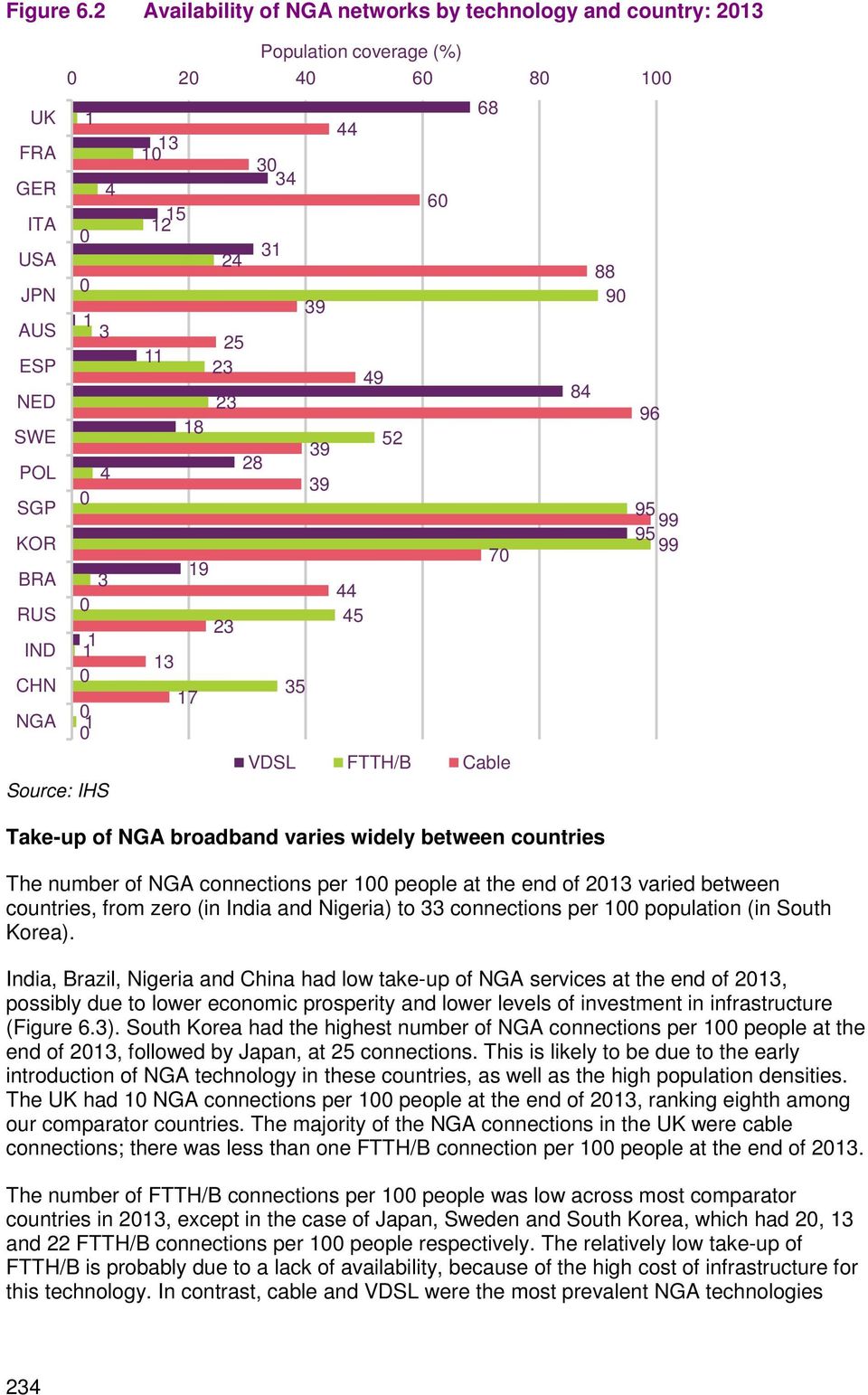
7 6..3 Next generation access (NGA) networks expand in both availability and take-up as networks continue to grow NGA network availability and technology greatly differed by country in 23 There are many factors that lead to the varied availability of NGA connections across countries. Available investment for new infrastructure is a large factor in the coverage differences between comparator countries, with more developed countries often having higher coverage percentages than developing countries. Another large factor is housing density; it is more expensive to provide coverage in countries with lower housing densities, along with the presence of existing cable networks. Next generation access (NGA) technology and superfast broadband Superfast broadband is generally considered to be a broadband service that delivers speeds of 3Mbit/s or higher. Next generation access (NGA) refers to those technologies that are capable of delivering superfast broadband services. The terms superfast broadband and NGA are often used interchangeably. NGA connections do not always deliver superfast speeds. Examples of this are fibre-to-thecabinet, where the speed the consumer receives may be below 3Mbit/s if the copper wires between the cabinet and the house are relatively long, or where a service that it provided over an NGA technology is capped at a speed below 3Mbit/s. As the measurement of broadband services in different countries improves, and superfast take-up increases, this distinction is becoming both measurable and more important. Therefore we have decided to define superfast broadband as a broadband service providing modem sync speeds of more than or equal to 3Mbit/s. The modem sync speed represents the highest possible speed at which data can be transferred across the line. In the, VDSL NGA technology was available to 68% of the population, while cable services were available to 44%, at the end of 23 (Figure 6.2). These figures are comparable to the majority of comparator countries, excluding South Korea, Singapore and Japan, which typically had very high availability of most NGA technologies. FTTH/B technology was only available to around % of the population by the end of 23, a low figure compared to the majority of non-bric comparator countries. This is partly due to BT making the investment decision to deploy VDSL instead of FTTH/B. Building the infrastructure for VDSL is considerably less expensive than rolling out FTTH/B, although it is a generally slower technology. In countries such as Singapore, Japan and South Korea, the providers upgraded directly from non-nga connections such as ADSL to FTTH/B connections, leading to the current high availability of this connection type at the end of 23, at 95%, 9% and 99% respectively. 233

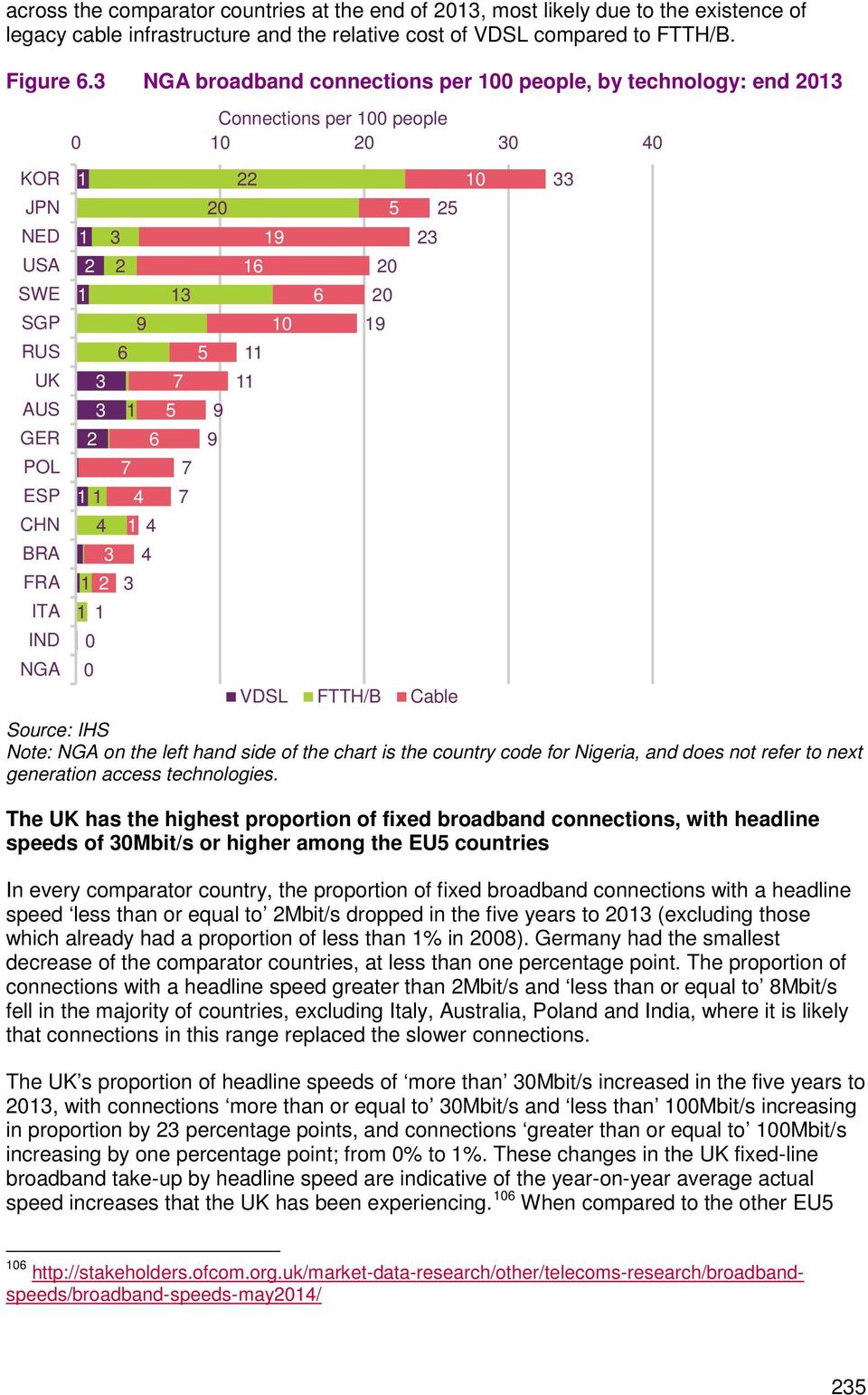
8 Figure 6.2 Availability of NGA networks by technology and country: 23 Population coverage (%) SWE NGA VDSL FTTH/B Cable Source: IHS Take-up of NGA broadband varies widely between countries The number of NGA connections per people at the end of 23 varied between countries, from zero (in India and Nigeria) to 33 connections per population (in South Korea). India, Brazil, Nigeria and China had low take-up of NGA services at the end of 23, possibly due to lower economic prosperity and lower levels of investment in infrastructure (Figure 6.3). South Korea had the highest number of NGA connections per people at the end of 23, followed by Japan, at 25 connections. This is likely to be due to the early introduction of NGA technology in these countries, as well as the high population densities. The had NGA connections per people at the end of 23, ranking eighth among our comparator countries. The majority of the NGA connections in the were cable connections; there was less than one FTTH/B connection per people at the end of 23. The number of FTTH/B connections per people was low across most comparator countries in 23, except in the case of Japan, Sweden and South Korea, which had 2, 3 and 22 FTTH/B connections per people respectively. The relatively low take-up of FTTH/B is probably due to a lack of availability, because of the high cost of infrastructure for this technology. In contrast, cable and VDSL were the most prevalent NGA technologies 234
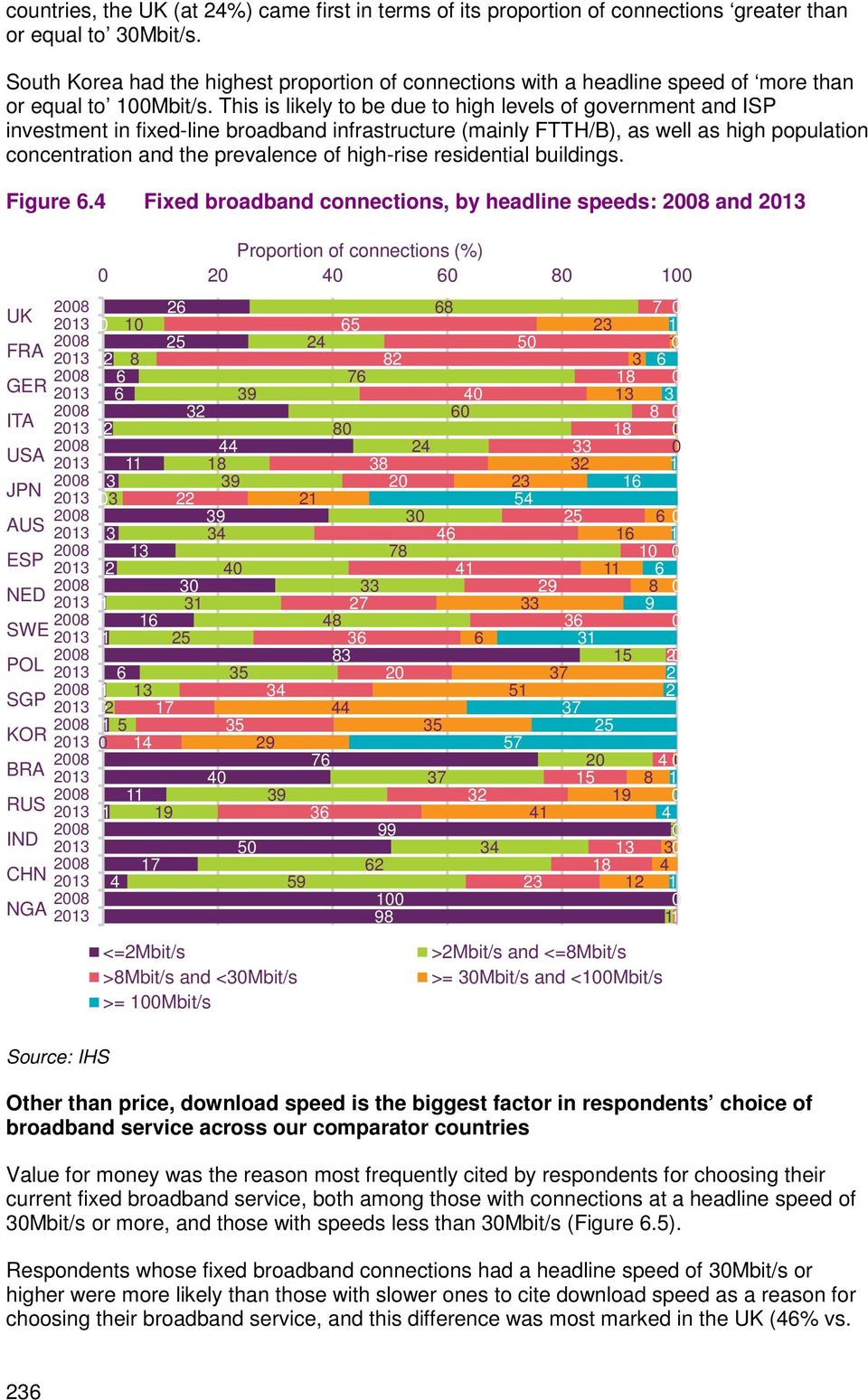
9 across the comparator countries at the end of 23, most likely due to the existence of legacy cable infrastructure and the relative cost of VDSL compared to FTTH/B. Figure 6.3 NGA broadband connections per people, by technology: end 23 SWE NGA Connections per people VDSL FTTH/B Cable Source: IHS Note: NGA on the left hand side of the chart is the country code for Nigeria, and does not refer to next generation access technologies. The has the highest proportion of fixed broadband connections, with headline speeds of 3Mbit/s or higher among the EU5 countries In every comparator country, the proportion of fixed broadband connections with a headline speed less than or equal to 2Mbit/s dropped in the five years to 23 (excluding those which already had a proportion of less than % in 28). Germany had the smallest decrease of the comparator countries, at less than one percentage point. The proportion of connections with a headline speed greater than 2Mbit/s and less than or equal to 8Mbit/s fell in the majority of countries, excluding Italy, Australia, Poland and India, where it is likely that connections in this range replaced the slower connections. The s proportion of headline speeds of more than 3Mbit/s increased in the five years to 23, with connections more than or equal to 3Mbit/s and less than Mbit/s increasing in proportion by 23 percentage points, and connections greater than or equal to Mbit/s increasing by one percentage point; from % to %. These changes in the fixed-line broadband take-up by headline speed are indicative of the year-on-year average actual speed increases that the has been experiencing. 6 When compared to the other EU
10 countries, the (at 24%) came first in terms of its proportion of connections greater than or equal to 3Mbit/s. South Korea had the highest proportion of connections with a headline speed of more than or equal to Mbit/s. This is likely to be due to high levels of government and ISP investment in fixed-line broadband infrastructure (mainly FTTH/B), as well as high population concentration and the prevalence of high-rise residential buildings. Figure 6.4 Fixed broadband connections, by headline speeds: 28 and 23 Proportion of connections (%) SWE NGA <=2Mbit/s >8Mbit/s and <3Mbit/s >= Mbit/s >2Mbit/s and <=8Mbit/s >= 3Mbit/s and <Mbit/s Source: IHS Other than price, download speed is the biggest factor in respondents choice of broadband service across our comparator countries Value for money was the reason most frequently cited by respondents for choosing their current fixed broadband service, both among those with connections at a headline speed of 3Mbit/s or more, and those with speeds less than 3Mbit/s (Figure 6.5). Respondents whose fixed broadband connections had a headline speed of 3Mbit/s or higher were more likely than those with slower ones to cite download speed as a reason for choosing their broadband service, and this difference was most marked in the (46% vs. 236
11 7%). Across both headline speed groupings, and all comparator countries, more people cited download speeds than upload speeds as a reason for choosing their fixed broadband service. The reason: Its data allowance or traffic management policy was cited by less than 2% of respondents in all countries except for Australia and China 7. Figure 6.5 Reason for choosing current fixed broadband service % of respondents with broadband with a headline speed of 3Mbit/s or more Source: Ofcom consumer research October 24 Base: All respondents with superfast broadband, =238, =9, =254, =4, =4, =34, =4, =229, =24 Base: All respondents with non-superfast broadband, =249, =99, =269, =34, =37, =7, =22, =359, =534 Q.29 Why did you choose your home broadband service? The deal I Its download My previous Its upload Its data For my work Someone was offered speed service was speed allowance or or business else made was good slow and I traffic needs the decision value for wanted management money faster policy speeds % of respondents with broadband with a headline speed of less than 3Mbit/s The deal I was offered was good value for money Its download speed My previous service was slow and I wanted faster speeds Its upload speed Its data allowance or traffic management policy For my work or business needs Someone else made the decision 7 [] As internet penetration is low in China (around 46%, and centred in the cities), the people responding to our online survey are likely to be early adopters of new technology, and do not closely represent China s.4 billion inhabitants. Further information on our online market research methodology is presented in Appendix A: Consumer research methodology and a perspective on the results of our market research in China can be found in Appendix C: A perspective on China. 237

12 6..4 Increasing number of consumers use managed VoIP as an alternative to traditional telephony The Netherlands had the highest proportion of fixed voice revenues 8 generated by managed VoIP services in 23 The proportion of fixed voice revenues that were generated by managed voice over internet protocol (VoIP) services was highest in the Netherlands, among our comparator countries, in 23, at 29%, a 7 percentage point increase compared to 28 (Figure 6.6). The second highest proportions were seen in the US and Japan, both at 23%. VoIP definitions Managed VoIP refers to the provision of a packet-switched voice over internet protocol (VoIP) service over a fixed broadband network such as xdsl, FTTP and cable. Managed VoIP includes VoIP as a primary service (such as VoIP over FTTP or naked xdsl) and as a secondary service (such as VoIP over xdsl, where the subscriber also pays a monthly fee for a PSTN line). OTT VoIP services consumed over fixed broadband connections, such as Skype, are not included within the definition of managed VoIP because they do not support emergency calling and are therefore not marketed as landline replacement services. Over-the-top (OTT) services are provided over the internet rather than a managed network and are delivered directly to the end-user by the service provider, independent of the internet service provider (ISP) which owns the network over which the service is provided. In the BRIC countries (Brazil, Russia, India and China), managed VoIP services represent only a small fraction of the fixed voice market, although the proportion of total fixed voice revenues generated by managed VoIP services increased from % to 6% in Brazil in the five years to 23. Nigeria was the only country where managed VoIP was not present in 23, and we have excluded Nigeria from the analysis in this section of the report. In the, the proportion of total fixed voice revenues generated by managed VoIP services was 7% in 23, the same proportion as in Germany, but lower than in Spain (2%), France and Italy (both %). However, in terms of growth, the had the lowest level of increase of the EU comparator countries in the analysis; three percentage points in the five years to Total fixed voice revenue is defined by the total revenue from traditional fixed line voice services plus the total revenue from managed VoIP services. 238
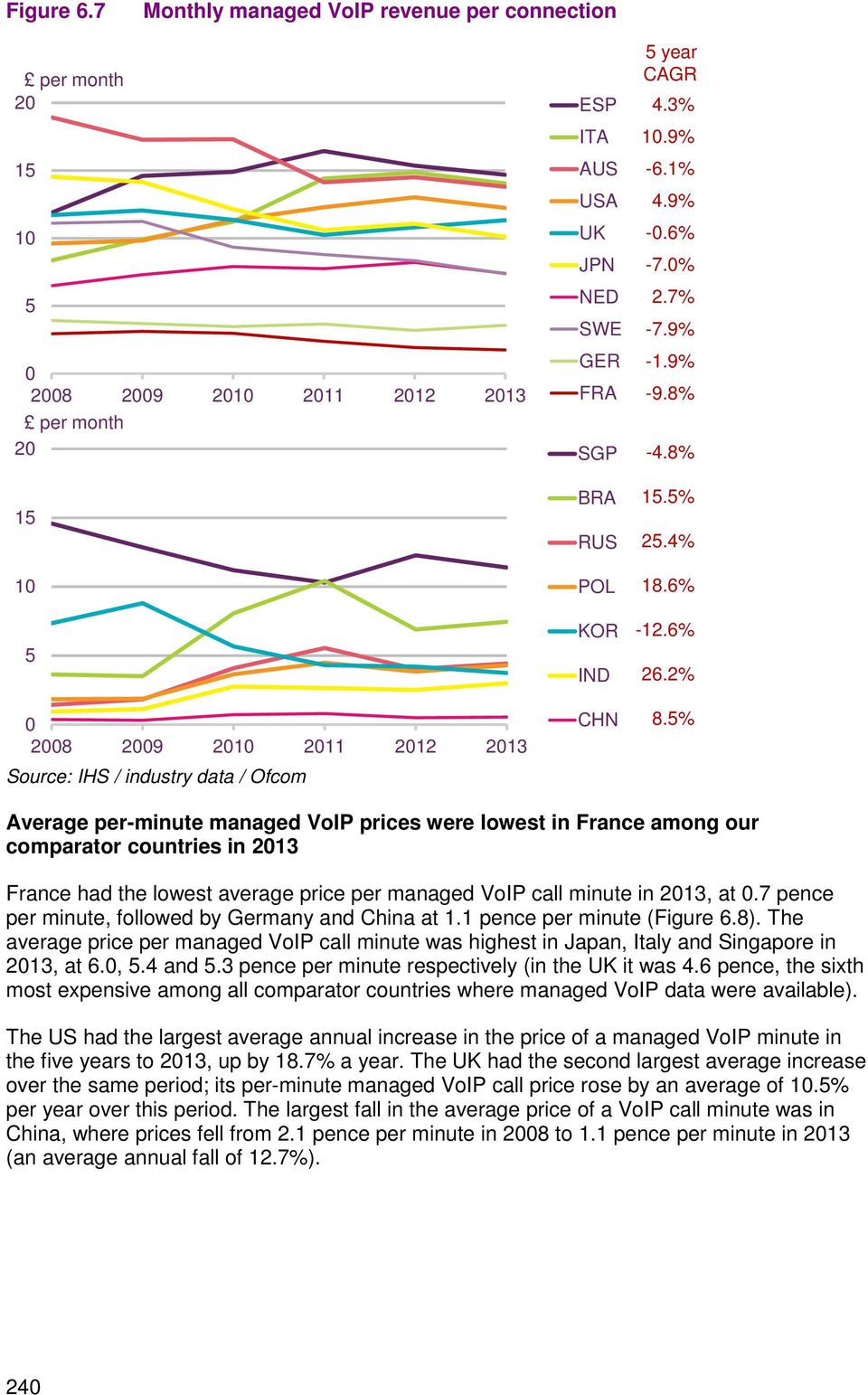
13 Figure 6.6 Managed VoIP revenues as a proportion of fixed voice revenues: 28 and 23 Per cent (%) 5 year PP change SWE Sources: IHS / Industry data / Ofcom India had the largest average annual growth in monthly managed VoIP revenue per connection in the five years to 23 Spain had the highest average revenue per managed VoIP connection among our comparator countries for which managed VoIP data were available in 23, at 4.68 per month, followed closely by Italy at 4.5 (Figure 6.7). In contrast, China had the lowest average managed VoIP revenues per connection in 23, at just.55 a month. Among the EU comparator countries, France had the lowest average managed VoIP revenues per connection in 23, at.75 per month, although it had the highest penetration of managed VoIP connections of all the comparator countries (see Figure 6.). This is probably because France has a highly competitive fixed voice market and the majority of managed VoIP connections are delivered over naked DSL connections (internet connections that do not require a fixed voice line of any description). In the, the average monthly revenue per managed VoIP connection was.33 in 23. In the five years to 23, India had the highest average growth rate of managed VoIP monthly revenue per connection, at 26.2% per year, followed by Russia (up 25.4% on the year) and Poland (up 8.6%), while South Korea saw the largest average decline over the same period, falling by 2.6% per year. In comparison, the average monthly revenue generated by managed VoIP services in the fell by.6% per year between 28 and

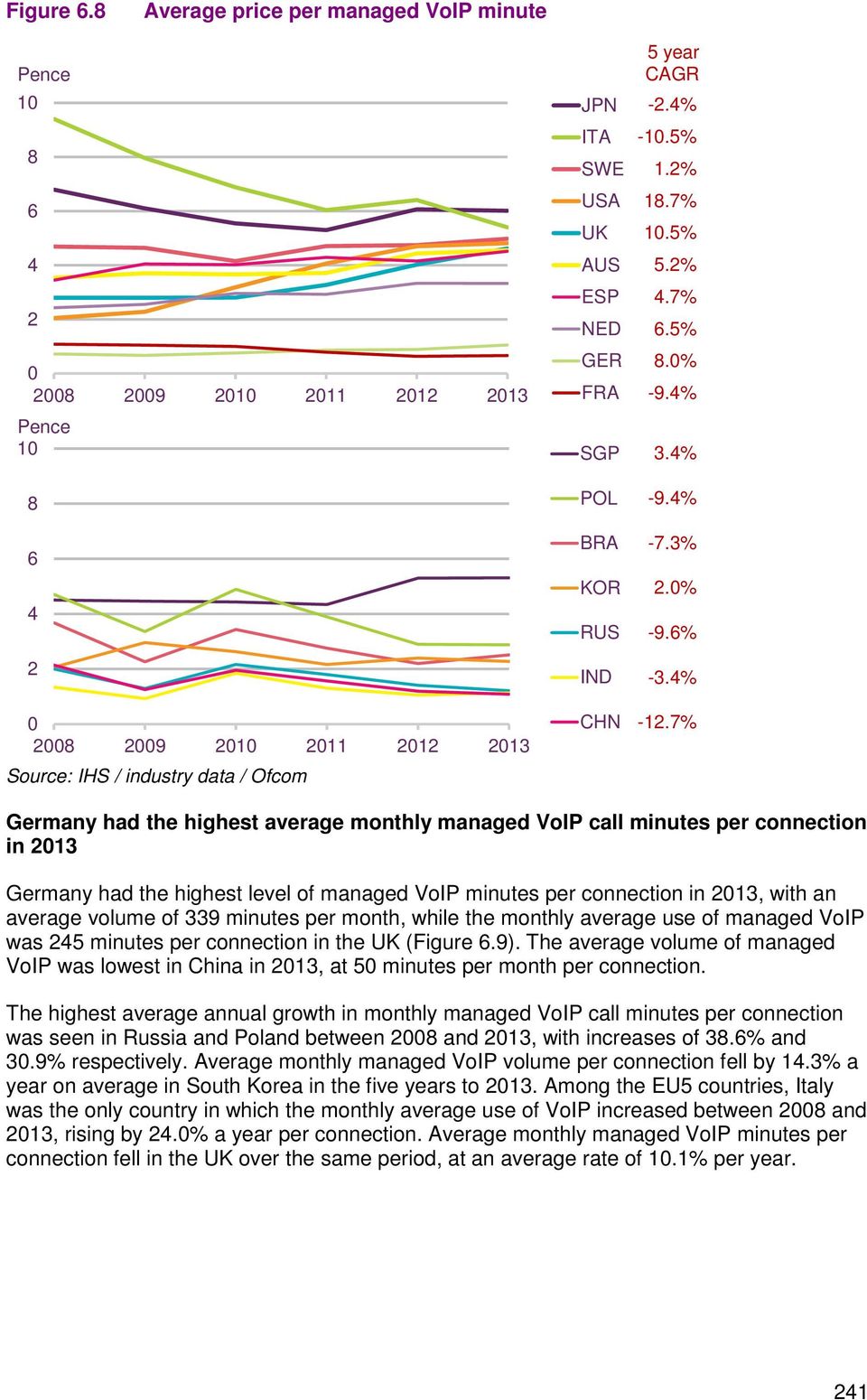
14 Figure 6.7 Monthly managed VoIP revenue per connection per month per month Source: IHS / industry data / Ofcom SWE 5 year CAGR 4.3%.9% -6.% 4.9% -.6% -7.% 2.7% -7.9% -.9% -9.8% -4.8% 5.5% 25.4% 8.6% -2.6% 26.2% 8.5% Average per-minute managed VoIP prices were lowest in France among our comparator countries in 23 France had the lowest average price per managed VoIP call minute in 23, at.7 pence per minute, followed by Germany and China at. pence per minute (Figure 6.8). The average price per managed VoIP call minute was highest in Japan, Italy and Singapore in 23, at 6., 5.4 and 5.3 pence per minute respectively (in the it was 4.6 pence, the sixth most expensive among all comparator countries where managed VoIP data were available). The US had the largest average annual increase in the price of a managed VoIP minute in the five years to 23, up by 8.7% a year. The had the second largest average increase over the same period; its per-minute managed VoIP call price rose by an average of.5% per year over this period. The largest fall in the average price of a VoIP call minute was in China, where prices fell from 2. pence per minute in 28 to. pence per minute in 23 (an average annual fall of 2.7%). 24
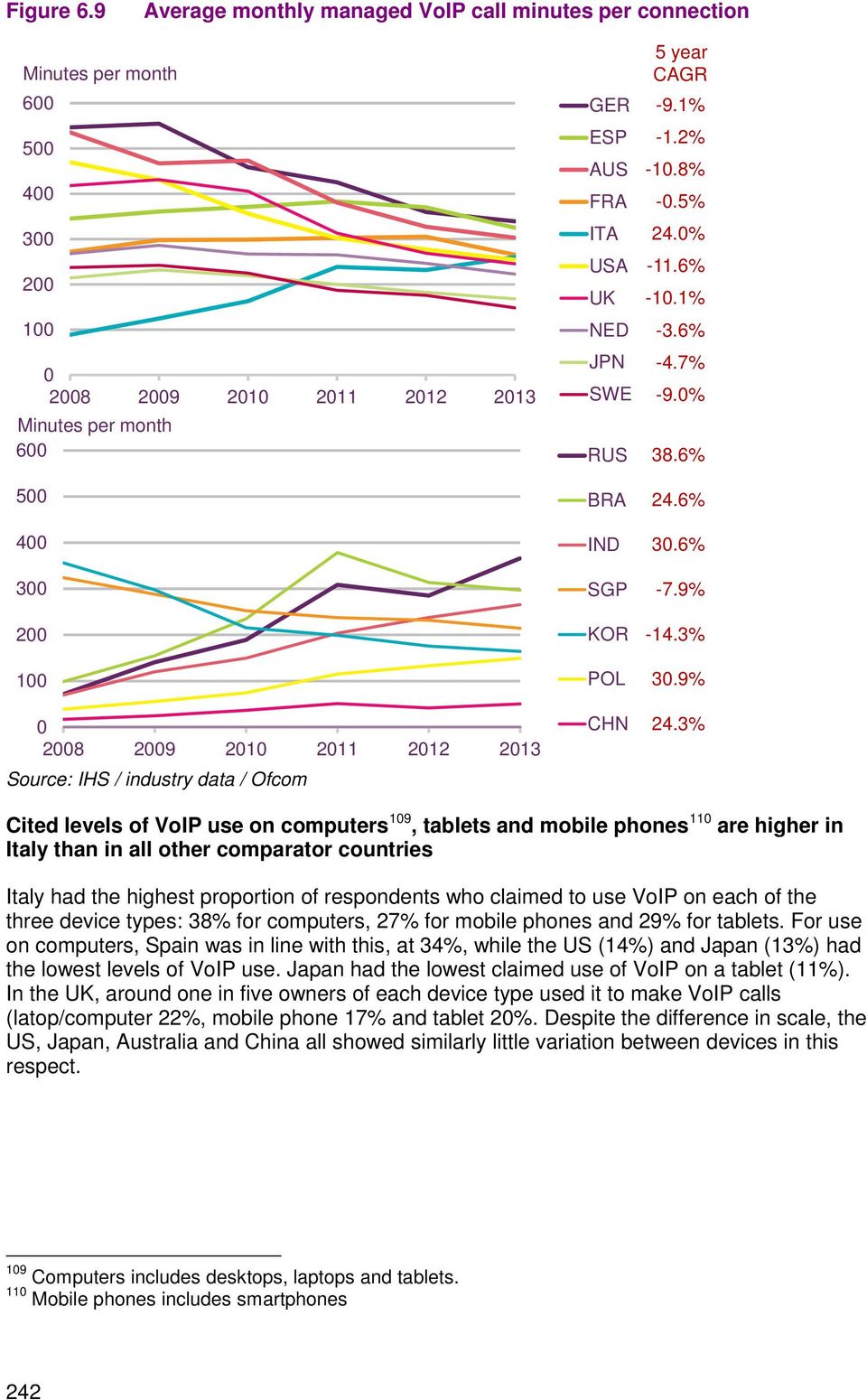
15 Figure 6.8 Average price per managed VoIP minute Pence Pence Source: IHS / industry data / Ofcom SWE 5 year CAGR -2.4% -.5%.2% 8.7%.5% 5.2% 4.7% 6.5% 8.% -9.4% 3.4% -9.4% -7.3% 2.% -9.6% -3.4% -2.7% Germany had the highest average monthly managed VoIP call minutes per connection in 23 Germany had the highest level of managed VoIP minutes per connection in 23, with an average volume of 339 minutes per month, while the monthly average use of managed VoIP was 245 minutes per connection in the (Figure 6.9). The average volume of managed VoIP was lowest in China in 23, at 5 minutes per month per connection. The highest average annual growth in monthly managed VoIP call minutes per connection was seen in Russia and Poland between 28 and 23, with increases of 38.6% and 3.9% respectively. Average monthly managed VoIP volume per connection fell by 4.3% a year on average in South Korea in the five years to 23. Among the EU5 countries, Italy was the only country in which the monthly average use of VoIP increased between 28 and 23, rising by 24.% a year per connection. Average monthly managed VoIP minutes per connection fell in the over the same period, at an average rate of.% per year. 24
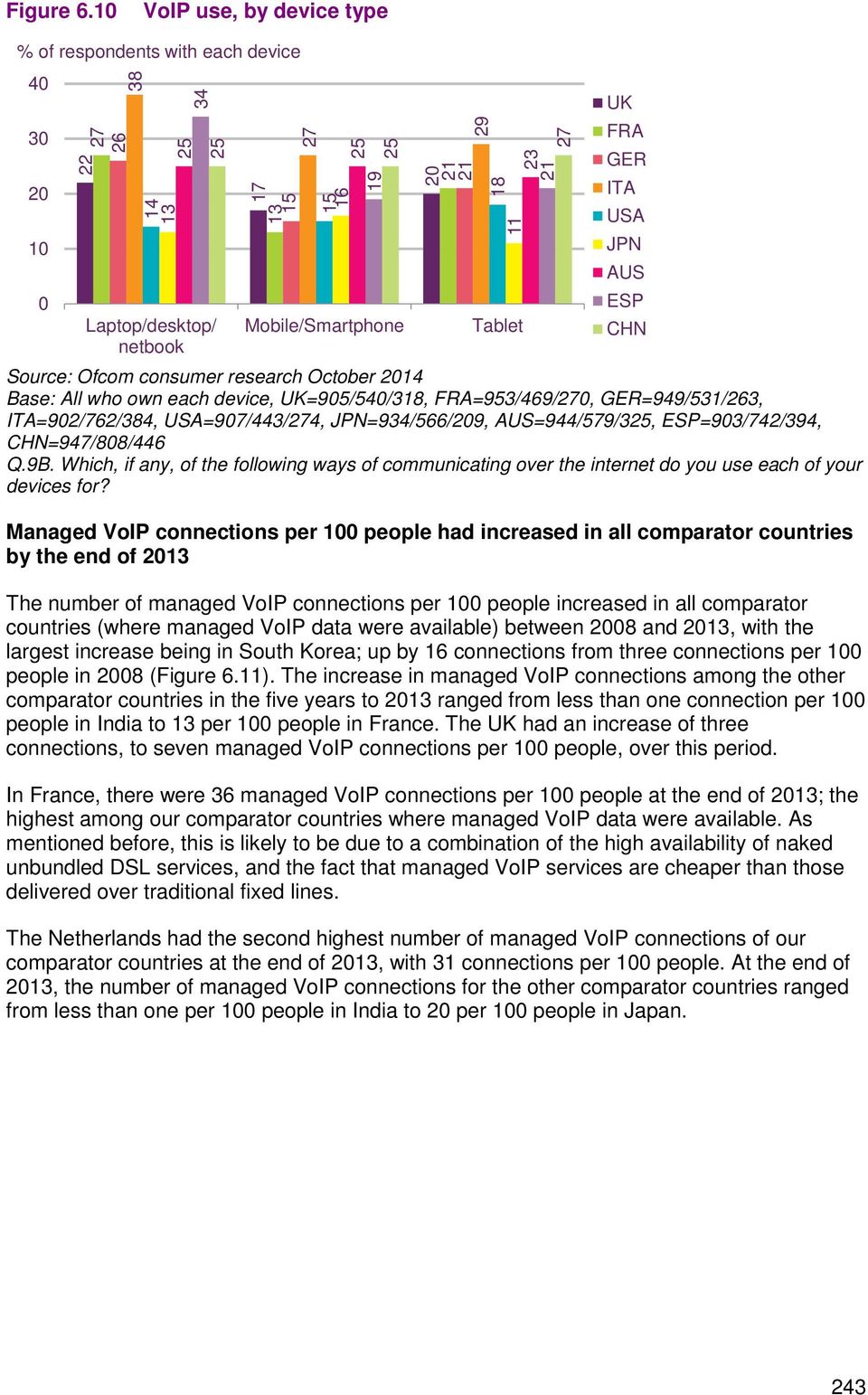
16 Figure 6.9 Average monthly managed VoIP call minutes per connection Minutes per month Minutes per month Source: IHS / industry data / Ofcom SWE 5 year CAGR -9.% -.2% -.8% -.5% 24.% -.6% -.% -3.6% -4.7% -9.% 38.6% 24.6% 3.6% -7.9% -4.3% 3.9% 24.3% Cited levels of VoIP use on computers 9, tablets and mobile phones are higher in Italy than in all other comparator countries Italy had the highest proportion of respondents who claimed to use VoIP on each of the three device types: 38% for computers, 27% for mobile phones and 29% for tablets. For use on computers, Spain was in line with this, at 34%, while the US (4%) and Japan (3%) had the lowest levels of VoIP use. Japan had the lowest claimed use of VoIP on a tablet (%). In the, around one in five owners of each device type used it to make VoIP calls (latop/computer 22%, mobile phone 7% and tablet 2%. Despite the difference in scale, the US, Japan, Australia and China all showed similarly little variation between devices in this respect. 9 Computers includes desktops, laptops and tablets. Mobile phones includes smartphones 242
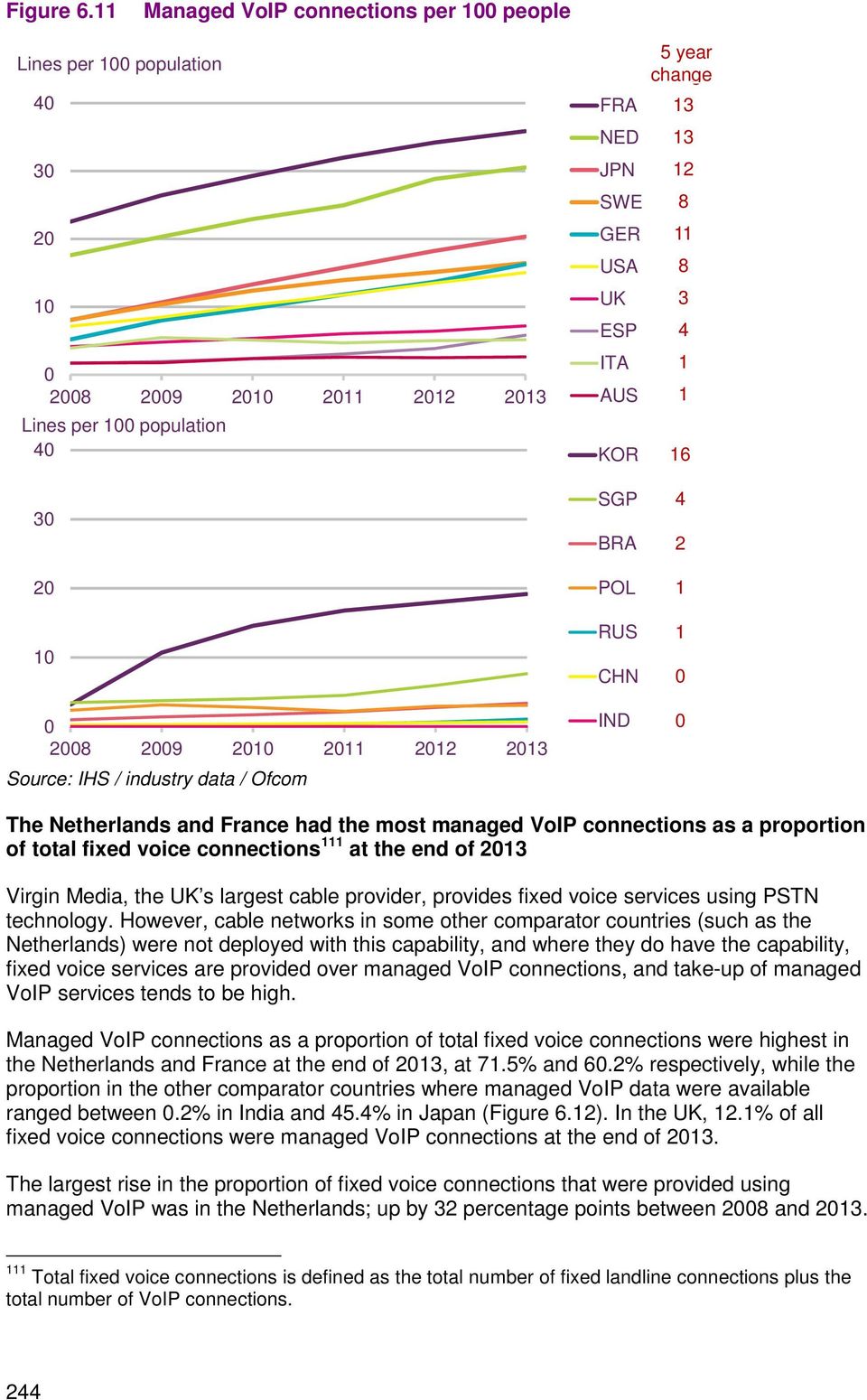
17 Figure 6. VoIP use, by device type % of respondents with each device Laptop/desktop/ netbook Mobile/Smartphone Source: Ofcom consumer research October 24 Base: All who own each device, =95/54/38, =953/469/27, =949/53/263, =92/762/384, =97/443/274, =934/566/29, =944/579/325, =93/742/394, =947/88/446 Q.9B. Which, if any, of the following ways of communicating over the internet do you use each of your devices for? Managed VoIP connections per people had increased in all comparator countries by the end of 23 The number of managed VoIP connections per people increased in all comparator countries (where managed VoIP data were available) between 28 and 23, with the largest increase being in South Korea; up by 6 connections from three connections per people in 28 (Figure 6.). The increase in managed VoIP connections among the other comparator countries in the five years to 23 ranged from less than one connection per people in India to 3 per people in France. The had an increase of three connections, to seven managed VoIP connections per people, over this period. In France, there were 36 managed VoIP connections per people at the end of 23; the highest among our comparator countries where managed VoIP data were available. As mentioned before, this is likely to be due to a combination of the high availability of naked unbundled DSL services, and the fact that managed VoIP services are cheaper than those delivered over traditional fixed lines. The Netherlands had the second highest number of managed VoIP connections of our comparator countries at the end of 23, with 3 connections per people. At the end of 23, the number of managed VoIP connections for the other comparator countries ranged from less than one per people in India to 2 per people in Japan Tablet
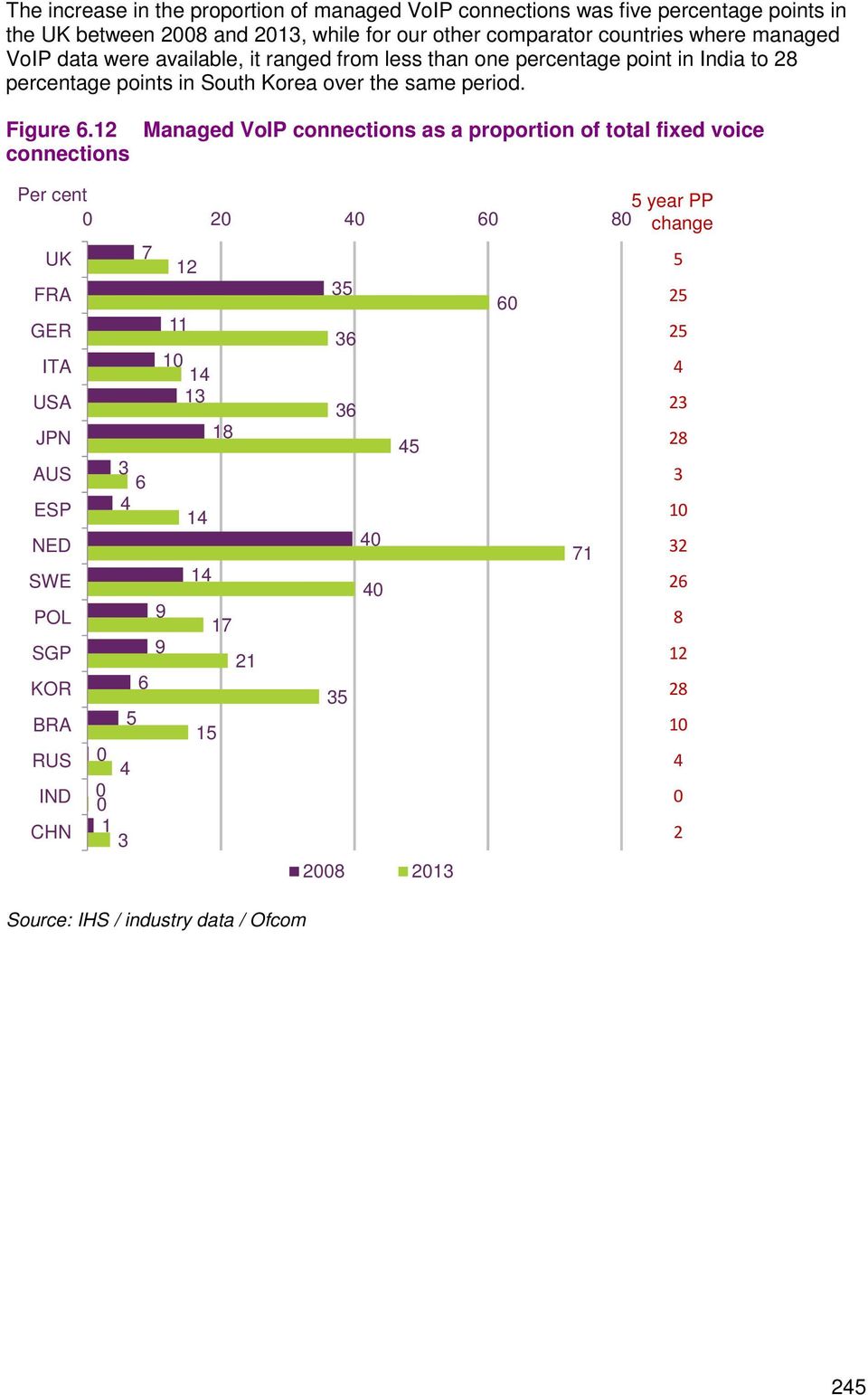
18 Figure 6. Managed VoIP connections per people Lines per population Lines per population 4 SWE 5 year change Source: IHS / industry data / Ofcom 4 2 The Netherlands and France had the most managed VoIP connections as a proportion of total fixed voice connections at the end of 23 Virgin Media, the s largest cable provider, provides fixed voice services using PSTN technology. However, cable networks in some other comparator countries (such as the Netherlands) were not deployed with this capability, and where they do have the capability, fixed voice services are provided over managed VoIP connections, and take-up of managed VoIP services tends to be high. Managed VoIP connections as a proportion of total fixed voice connections were highest in the Netherlands and France at the end of 23, at 7.5% and 6.2% respectively, while the proportion in the other comparator countries where managed VoIP data were available ranged between.2% in India and 45.4% in Japan (Figure 6.2). In the, 2.% of all fixed voice connections were managed VoIP connections at the end of 23. The largest rise in the proportion of fixed voice connections that were provided using managed VoIP was in the Netherlands; up by 32 percentage points between 28 and 23. Total fixed voice connections is defined as the total number of fixed landline connections plus the total number of VoIP connections. 244
19 The increase in the proportion of managed VoIP connections was five percentage points in the between 28 and 23, while for our other comparator countries where managed VoIP data were available, it ranged from less than one percentage point in India to 28 percentage points in South Korea over the same period. Figure 6.2 connections Managed VoIP connections as a proportion of total fixed voice Per cent 5 year PP change SWE Source: IHS / industry data / Ofcom 245
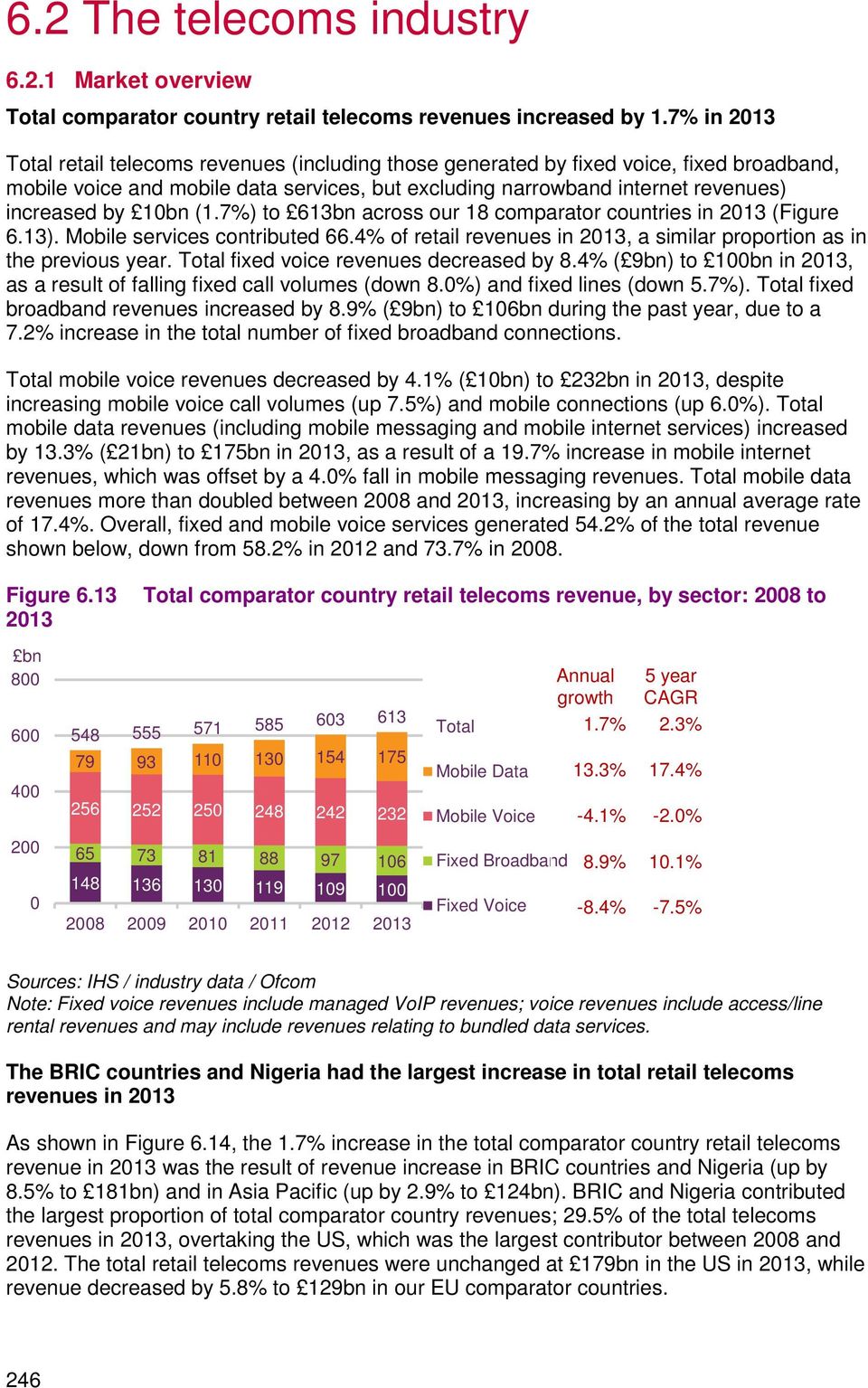
20 6.2 The telecoms industry 6.2. Market overview Total comparator country retail telecoms revenues increased by.7% in 23 Total retail telecoms revenues (including those generated by fixed voice, fixed broadband, mobile voice and mobile data services, but excluding narrowband internet revenues) increased by bn (.7%) to 63bn across our 8 comparator countries in 23 (Figure 6.3). Mobile services contributed 66.4% of retail revenues in 23, a similar proportion as in the previous year. Total fixed voice revenues decreased by 8.4% ( 9bn) to bn in 23, as a result of falling fixed call volumes (down 8.%) and fixed lines (down 5.7%). Total fixed broadband revenues increased by 8.9% ( 9bn) to 6bn during the past year, due to a 7.2% increase in the total number of fixed broadband connections. Total mobile voice revenues decreased by 4.% ( bn) to 232bn in 23, despite increasing mobile voice call volumes (up 7.5%) and mobile connections (up 6.%). Total mobile data revenues (including mobile messaging and mobile internet services) increased by 3.3% ( 2bn) to 75bn in 23, as a result of a 9.7% increase in mobile internet revenues, which was offset by a 4.% fall in mobile messaging revenues. Total mobile data revenues more than doubled between 28 and 23, increasing by an annual average rate of 7.4%. Overall, fixed and mobile voice services generated 54.2% of the total revenue shown below, down from 58.2% in 22 and 73.7% in 28. Figure Total comparator country retail telecoms revenue, by sector: 28 to bn Total Mobile Data Mobile Voice Fixed Broadband Fixed Voice Annual growth 5 year CAGR.7% 2.3% 3.3% 7.4% -4.% -2.% 8.9%.% -8.4% -7.5% Sources: IHS / industry data / Ofcom Note: Fixed voice revenues include managed VoIP revenues; voice revenues include access/line rental revenues and may include revenues relating to bundled data services. The BRIC countries and Nigeria had the largest increase in total retail telecoms revenues in 23 As shown in Figure 6.4, the.7% increase in the total comparator country retail telecoms revenue in 23 was the result of revenue increase in BRIC countries and Nigeria (up by 8.5% to 8bn) and in Asia Pacific (up by 2.9% to 24bn). BRIC and Nigeria contributed the largest proportion of total comparator country revenues; 29.5% of the total telecoms revenues in 23, overtaking the US, which was the largest contributor between 28 and 22. The total retail telecoms revenues were unchanged at 79bn in the US in 23, while revenue decreased by 5.8% to 29bn in our EU comparator countries. 246
21 Figure 6.4 Total comparator country retail telecoms revenue, by country type: 28 to 23 bn Total BRIC & Nigeria Asia Pacific Annual growth 5 year CAGR.7% 2.3% 8.5% 8.% 2.9%.4% % 2.8% EU -5.8% -3.5% Sources: IHS / industry data / Ofcom The US and China contributed almost half the total retail telecoms revenue in 23 The US continued to have the highest comparator country retail telecoms revenue, at 79bn in 23, while China overtook Japan to become the second largest comparator country in terms of telecoms revenue, generating 6bn in 23 (Figure 6.5). The US and China contributed almost half (47%) of the total retail telecoms revenues in 23. The telecoms market in China grew rapidly, with an average annual growth rate of % in total telecoms revenues in the five years to 23. Only in Nigeria did telecoms revenues increase faster (up by % a year) over the same period, although the Nigerian telecoms market was the third smallest in 23, at 7bn (only Singapore and Sweden were smaller). Telecoms retail revenues decreased in five EU comparator countries between 28 and 23; the largest fall was in Spain, at an average rate of 8% a year, partly due to the ongoing effect of the economic downturn. The other four EU comparator countries with falling revenues were Italy (down 6% a year), France (down 5% a year), Germany (down 2% a year) and Poland (down 2% a year) over the same period. The figures were unchanged in the and South Korea (at 29bn and 9bn respectively), although in both countries fixed voice revenues decreased, while both mobile and fixed broadband revenues increased in the five years to
22 Figure 6.5 Telecoms service retail revenues, by country and sector: 28 and 23 bn SWE NGA Sources: IHS / industry data / Ofcom Note: Fixed voice revenues include managed VoIP revenues. Mobile services generated two-thirds of total comparator country telecoms revenues in 23 In most of our comparator countries the proportion of telecoms revenues generated by mobile voice and data services was above 6% in 23, except in Brazil, Australia, the and Japan, where the proportions were lower, at 52%, 53%, 54% and 58% respectively (Figure 6.6). The three countries with the highest proportion of mobile telecoms revenues were Nigeria, India and China (at 99%, 82% and 79% respectively) in 23, due to fast growing mobile markets in these countries, and low fixed-line availability and penetration in Nigeria and India (.2 and 2.3 fixed lines per populations respectively). The proportion of telecoms revenues generated by mobile services increased in almost all comparator countries in the five years to 23, with the largest increase being in Brazil, at 7 percentage points, followed by India (4pp) and Sweden (3pp). The proportion of telecoms revenues generated by mobile services decreased in three comparator countries over the same period, with the biggest fall in Spain (down 7 percentage points), followed by Japan (down 4pp) and Italy (down pp) Fixed voice Mobile Fixed broadband 79 5 year CAGR % -5% -2% -6% 3% 2% % -8% % 2% -2% 4% % 4% 5% 8% % % 248
23 Figure 6.6 Mobile as a proportion of total telecoms revenues: 28 and 23 Percentage Per cent point change SWE NGA Sources: IHS / industry data / Ofcom Mobile data revenues continued to exceed fixed broadband revenues Total mobile data revenues (including mobile messaging and mobile internet services) increased by 3.3% ( 2bn) to 75bn in our 8 comparator countries in 23 (Figure 6.7). Mobile internet service revenues increased by 9.7% ( 22bn) to 35bn in 23 (when they were almost three times higher than in 28), mainly as a result of increasing smartphone take-up and consumers upgrading to 4G services. The proportion of total telecoms data revenues generated by mobile internet services increased from 33.2% in 28 to 48.% in 23. Total mobile messaging revenues (including SMS and MMS) fell for the first time in 23, down by 4.% ( 2bn) to 4bn. The main reasons for this decline are the substitution of OTT (over-the-top) messaging services for network-based services, and increasing smartphone take-up, as more sophisticated handsets enable mobile users to access alternative communication methods, such as s, instant messaging and social networking sites. Fixed broadband services generated 6bn in revenue in 23, a 9bn (8.9%) increase compared to 22 and 4bn more than in 28. The main reason for this growth is the increasing number of fixed broadband connections in almost all our comparator countries. 249
24 Figure 6.7 Total fixed broadband and mobile data revenues: 28 to 23 bn Total Messaging Mobile internet Fixed broadband Sources: IHS / industry data / Ofcom Note: Messaging includes SMS and MMS. Japan continued to have the highest proportion of total telecoms revenues that were generated by data services in 23 Japan had the highest proportion of total telecoms revenues that were generated by data services (including both fixed and mobile data services), at 67% in 23 (Figure 6.8).This was as a result of a 47% increase in the number of fixed broadband connections, and an 84% increase in the number of mobile data connections (including handset and dedicated mobile broadband connections) in the five years to 23. The had the third lowest proportion of total telecoms revenues generated by data services (after India and Nigeria), at 3% in 23, although this figure will be understated as it excludes revenues from bundled data services that are included in post-pay mobile subscription revenues. Although Nigeria had the lowest proportion of data service revenues, its market expanded rapidly, from 4% in 28 to 2% in 23, which was only 4pp lower than the proportion of data revenue in India, which had the second lowest proportion. The proportion of total telecoms revenues generated by data services increased in all our comparator countries in the five years to 23. Japan had the biggest increase compared to 28, at 27 percentage points, while the had the lowest increase, at 7pp (although this increase will be understated for the reasons outlined previously). 25
25 Figure 6.8 Data revenue as a proportion of total telecoms revenue: 28 and 23 Per cent Percentage point change SWE NGA Sources: IHS / industry data / Ofcom Fixed voice services The had the lowest average rate of decline in retail fixed voice revenues in the five years to 23 Retail fixed-line voice revenues fell by an average of 8.4% across our comparator countries in the year to 23, higher than the average annual drop of 7.5% in the five years to 23 (Figure 6.9). The main reason behind this decline is the increasing migration of consumers from traditional fixed voice services to mobile and alternative voice and non-voice communication methods, such as VoIP and instant messaging (as shown in Figure 6.). The number of managed VoIP connections per head increased in all of our comparator countries between 28 and 23, while data provided to Ofcom by IHS show that total instant messaging volumes in our comparator countries increased from 3 billion to. trillion in the five years to 23. The fastest rate of decline in fixed voice revenues over the five-year period was in Nigeria, at an average of 24.4% a year (although Nigeria s fixed voice market is very small), followed by China, at an average annual rate of 6.6%. The next two highest annual rates of decline were found in comparator EU countries: France (down 2.% as a result of increasing takeup of low-cost managed VoIP services) and Poland (down.5%). In the, retail fixed-line 25
26 voice revenues fell by an annual average rate of 3.% to 9bn in the five years to 23, the slowest rate of decline among our countries. This decline was mainly due to falling fixed voice call volumes per line, as the decline in the number of fixed lines was comparatively low in the (see Figure 6.23). Figure 6.9 Retail fixed-line voice revenues: 28 to 23 billion billion SWE NGA 5 Year CAGR -7.8% -6.2% -3.% -8.% -7.3% -2.% -9.4% -5.3% -4.% -9.7% -5.6% -3.3% -6.6% -8.4% -7.4% -.5% -3.7% -24.4% Sources: IHS / industry data / Ofcom Note: Includes managed VoIP revenues. Fixed-line voice call volumes fell across all comparator countries between 28 and 23 Total fixed-line voice call volumes across all our comparator countries fell by an average annual rate of 7.7% to.8 trillion minutes in the five years to 23 (Figure 6.2). This decline was due to falling traditional fixed call volumes (which fell by an average of.5% annually during this period), as managed VoIP call volumes increased in almost all comparator countries over the five-year period (up by an average of 9.% a year). Further information regarding managed VoIP services can be found in Section 6..4 of this report. In the, total fixed-line call volumes decreased by an annual average rate of 7.9% to 5 billion minutes between 28 and 23. The steepest fall in fixed-line voice call volumes was seen in Nigeria (where total fixed call volumes were the lowest among our comparator countries as a result of low fixed-line take-up) at an annual average rate of 25.7%, followed 252
27 by China (down 4.% a year) and India (down 4.% a year). The main reasons behind falling fixed call volumes in most comparator countries are increasing mobile phone use (mobile voice call volumes were up by an annual average of 2.6% across our comparator countries in the five years to 23) and easy access to alternative communication methods, such as , instant messaging and social networking sites,. Figure 6.2 Fixed line voice call volumes: 28 and 23 Call minutes (billions) SWE NGA , year CAGR Sources: IHS / industry data / Ofcom Note: Includes managed VoIP calls. Figures for and include incoming calls. Germany had the highest monthly outbound minutes per fixed line in 23 The number of monthly outgoing call minutes per fixed line (including managed VoIP calls and connections) decreased by an average 5.4% a year to 84 minutes a month across the comparator countries in the five years to 23 (Figure 6.2). China (which had the lowest number of outbound call minutes per fixed line, at 44 minutes a month in 23) had the steepest fall over the five-year period, down by an annual average of.6%, followed by India, Sweden and Italy (down 9.8%, 9.3% and 9.3% a year respectively). The only comparator country where average monthly minutes per fixed line increased between 28 and 23 was Japan, up by an average annual rate of.6%. Germany had the highest monthly outbound minutes per fixed line in 23, at 378 minutes, mainly due to the significant difference between the average fixed and mobile voice cost (at % -.9% -3.2% -9.8% -.3%.% -6.3% -4.8% -3.9% -3.8% -.3% -3.% -3.% -5.2% -4.% -4.% -4.% -25.7% 253
28 4.4 pence/min and 7.4 pence/min respectively in 23). In the, the number of outgoing call minutes per fixed line was at 232 minutes a month in 23, down from 359 minutes five years previously. This represents an average rate of decline 8.3% a year during this period, mainly as a result of growing fixed-to-mobile substitution and the increasing use of non-voice communication methods such as and instant messaging. Figure 6.2 Monthly outbound minutes per fixed line: 28 to 23 Minutes Minutes SWE NGA 5 year CAGR -2.4% -5.4% -7.% -9.3% -9.3% -8.3% -3.7% -3.6% -.3%.6% -6.7% -2.6% -4.2% -5.7% -9.8% -5.% -5.3% -.6% Sources: IHS / industry data / Ofcom Note: Includes managed VoIP calls. Figures for and include incoming calls. The incumbent operator s share of fixed voice call volumes declined in most comparator countries in the five years to 23 The incumbent operator s share of fixed voice call volumes was the highest in Singapore in 23 (at 79%), followed by Japan and South Korea (at 68% and 63% respectively), due to the late liberalisation of the fixed-line markets (Figure 6.22). The decline of the incumbent operator s share of fixed call volumes was highest in France, at 22 percentage points (down to 5%) in the five years to 23, followed closely by Spain at 2pp (also down to 5%). The share of fixed voice call volumes increased in only three countries. In Sweden, Telia s market share increased from 55% in 28 to 59% in 23; in Brazil, Oi s market share increased by 3pp to 33%; and in Nigeria, Nitel s share grew by pp (the highest across the comparator countries) to 6% in the five years to 23. In the, BT s share of fixed voice call volumes decreased by seven percentage points to 39% 254
29 over the five-year period, due to competition from operators providing services using local loop unbundling (LLU). Figure 6.22 Incumbent operators share of fixed voice call volumes: 28 and 23 Market share (per cent) 5 year percentage point change SWE NGA Sources: IHS / industry data / Ofcom Numbers of fixed voice connections fell in most comparator countries in the five years to The total number of comparator country fixed voice connections (which includes PSTN lines and managed VoIP connections) fell by 2 million (2.5%) to 795 million in 23, and by an annual average rate of 2.7% in the five years to 23 (Figure 6.23). The was one of just two comparator countries (along with Brazil) where the number of fixed voice connections increased in 23; in the the number of connections was 38 million at the end of the year, an increase.2 million (.6%) which is likely to be due to an increase in the number of households and the requirement for most homes to have a landline in order to be able to access fixed broadband services. The number of fixed voice connections fell in all but four of our comparator countries (the, Singapore, South Korea and Brazil) between 28 and 23, with the fastest average annual decline being in Nigeria, at 22.7%, over this period. The main driver behind the fall in fixed voice connections in these countries is fixed-to-mobile substitution, although there have also been increases in the use of text-based forms of communication (such as , instant messaging and social networking sites). The average annual increase in the number of fixed
30 voice connections was highest in South Korea in the five years to 23, at 2.7% (in the it averaged.6% a year over this period). Figure 6.23 Fixed voice connections: 28 and 23 Lines (millions) SWE NGA year CAGR.6% -.8% -.9% -.9% -4.% -.7% -.% -.3% -.4% -5.5% -7.4%.% 2.7%.8% -.7% -5.3% -4.3% -22.7% Sources: IHS / industry data / Ofcom Note: Includes managed VoIP connections Fixed broadband services Total fixed broadband revenues more than doubled in the BRIC countries between 28 and 23 Total fixed broadband revenues increased by 4bn to 6bn among our comparator countries in the five years to 23, equivalent to an average annual growth rate of.% (Figure 6.24). The BRIC countries had the fastest increase over the five-year period, with Russia experiencing the highest average annual growth rate, at 9.4%, followed closely by China (up 9.3% a year) and India (up 7.8% a year). The reason behind this high increase is the fast-growing fixed broadband connection base (up by an annual average rate of 9.2% in those three countries between 28 and 23) and comparatively low take-up in 28. Fixed broadband revenues decreased in only two countries in the five years to 23; the largest fall was in Nigeria (where take-up is very low), at 22.2% a year, followed by Italy with a slight average decrease of.2% a year, although in Italy fixed broadband revenues increased by 2.% in 23 compared to the previous year, while Nigeria experienced a 256
31 53.% year-on-year fall. In the, fixed broadband revenues increased by an average annual rate of 5.2% to 4bn in the five years to 23, as a result of a 5.6% annual average growth in the number of broadband connections, and increasing take-up of higher bandwidth connections. Figure 6.24 Fixed broadband revenues: 28 and 23 Revenue ( bn) SWE NGA year CAGR 5.2% 3.4%.5% -.2%.4% 3.2% 3.3% 4.7% 2.5% 6.5% 9.4% 9.5% 4.4% 6.4% 9.4% 7.8% 9.3% -22.2% Sources: IHS / industry data / Ofcom The proportion of total fixed telecoms revenues generated by fixed broadband services increased in all our comparator countries in the five years to 23 The proportion of total fixed revenues generated by fixed broadband services increased by an average of 2 percentage points to 5% across our comparator countries between 28 and 23 (Figure 6.25). This was the result of a % average annual increase in total fixed broadband revenues in the five years to 23 and an 8% a year average fall in total fixed voice revenues over the same period (Figure 6.3). The proportion of fixed telecoms revenues that were generated by broadband services was highest in China, at 82% in 23. China also had the largest increase in this proportion (among our comparator countries) between 28 and 23, at 39pp. This was the result of a large increase in the number of fixed broadband connections (as shown in Figure 6.27, the number of fixed lines increased by an average of 8% a year in China in the five years to 257
32 23) and despite low fixed broadband prices in China (the third lowest behind Russia and India, at 8.7 per connection per month). The proportion of total fixed-line revenues generated by fixed broadband services was the lowest in Nigeria in 23, at %, where take-up of both fixed voice and fixed broadband is very low, followed by India (at 29%) and Germany (at 3%). In the, the proportion of fixed broadband revenues was 3% in 23, eight percentage points higher than in 28. Figure 6.25 Fixed broadband as a proportion of total fixed revenues: 28 to 23 Percentage share 5 year percentage point change SWE NGA Sources: IHS / industry data / Ofcom Australia had the highest monthly retail fixed broadband average revenue per connection in Monthly retail fixed broadband revenues increased by an average of.2% a year to 6.83 per connection across our comparator countries in the five years to 23 (Figure 6.26). While average fixed broadband revenues per connection decreased in ten of our comparator countries between 28 and 23, seven countries have seen an increase over the same period, with the largest increase being in the US (up by an average of 6.2% a year), followed by Japan (up 5.8% a year). In the, average fixed broadband revenues increased slightly, by an annual average rate of.% to 5. in the five years to
33 Average monthly fixed broadband revenue was unchanged in Singapore compared to 28, at 29.6 per connection in 23. Average revenue per fixed broadband connection had the largest decrease in Brazil (down by 6.7% a year), followed by India (down 4.4% a year) between 28 and 23. Monthly retail fixed broadband average revenue was highest in Australia, at 55.9 per connection, and lowest in India, at 4.22 per connection in 23. Figure 6.26 Retail fixed broadband average revenue per connection: 28 to 23 per month year CAGR -.6% 5.8% 6.2% SWE 4.7% -.9% -.%.% -3.8% -2.5% -2.6% per month NGA.% -6.7% 5.6%.% -.2%.9% -2.9% -4.4% Sources: IHS / industry data / Ofcom The total number of fixed broadband connections increased by an average of.6% a year across our comparator countries in the five years to 23 The number of fixed broadband connections increased by 24 million to 542 million in the five years to 23 (Figure 6.27). The average annual rate of growth in fixed broadband connections was highest in BRIC countries, ranging between 4.8% a year in Brazil to 24.3% a year in India, mainly because these countries had comparatively low fixed broadband take-up in 23 and are still catching up with other nations in terms of broadband penetration (as shown in Figure 6.5, the BRIC countries had the four lowest broadband penetration rates in 23, behind Nigeria). Among our non-bric countries, the highest average annual rate of growth between 28 and 23 was in Poland (up.7% a year), followed by Singapore (up.3% a year). In only one country did the number of fixed broadband connections fall during this period: Nigeria, 259
34 where fixed broadband availability is low, and where the number of connections fell by an average of 26.% a year as a result of rapid growth in the use of mobile data services. In the, the total number of fixed broadband connections increased by an average annual growth rate of 5.6% to 23 million in the five years to 23. Figure 6.27 Fixed broadband connections: 28 to 23 Connections (million) SWE NGA Sources: IHS / industry data / Ofcom year CAGR 5.6% 6.7% 4.4% 3.7% 4.4% 8.% 4.5% 6.7% 2.8% 2.2%.7%.3% 3.3% 4.8% 24.% 24.3% 8.3% % Singapore had the most concentrated fixed broadband market in 23 The retail connection share of the three largest fixed broadband providers was highest in Singapore, at % in 23, followed by China at 94% and South Korea at 86% (Figure 6.28). In the five years to 23, seven of the 7 comparator countries for which data were available (we do not have any data for Nigeria) saw a decrease in combined fixed broadband connection share: Japan and Poland (both down 5 percentage points), Spain (down 2pp), France (down 7pp), Sweden (down 5pp), Germany (down 4pp) and Italy (down 3pp). The Netherlands had the greatest increase, of 2 percentage points, in the three largest providers combined share of fixed broadband connections between 28 and 23, followed by the, with an pp increase over the same period. 26
35 Figure to 23 Retail connection share of the three largest fixed broadband providers: 5 year percentage Percentage share point change SWE NGA Sources: IHS / industry data / Ofcom Mobile voice and data services Total mobile internet revenues increased by 9.7% across our comparator countries in 23 Total mobile telecoms revenues (including voice, messaging and mobile internet services) increased by bn (2.7%) to 47bn in our comparator countries in 23, as a result of increasing mobile internet revenues (Figure 6.29). Total mobile internet revenues almost tripled; from 48bn to 35bn in the five years to 23, an annual average of 23.% increase over the five-year period, and by 9.7% ( 22bn) in 23. This was largely the result of growth in take-up of mobile data services (including handset and dedicated mobile data connections) across our comparator countries in the five years to 23 (Figure 6.63). Overall, the proportion of total mobile revenues generated by mobile internet services increased from 4.3% to 33.% between 28 and 23. Total mobile messaging revenues (including SMS and MMS) saw a decline of 2bn (4.%) to 4bn in 23, after a continuous increase since reporting started. The reason behind this fall was an 8.7% decrease in total messaging volumes in 23, which was due to the increasing use of newer communication methods such as instant messaging, and N/A 26
36 social networking. Total voice revenues continued to fall in 23, decreasing by 4.% ( bn) to 232bn, mainly due to falling prices (total mobile voice call volumes increased by 7.5% across our comparator countries in 23). Figure to 23 Total comparator country retail mobile telecoms revenue, by sector: bn Total Mobile internet 9.7% 23.% Messaging -4.% 5.5% Voice Annual 5 year growth CAGR 2.7% 4.% -4.% -2.% Sources: IHS / industry data / Ofcom Note: Messaging includes SMS and MMS. Total retail mobile telecoms revenues increased by.5% in the BRIC countries and Nigeria in 23 Total retail mobile telecoms revenues increased by an annual average rate of 4.% in our comparator countries in the five years to 23 (Figure 6.3). The BRIC countries and Nigeria had the largest increases, up by an annual average of.2% over the five-year period and by.5% compared to 22, as a result of rapid growth in the number of mobile connections. Mobile telecoms revenues also increased in the US (up 2.3% in 23) and in Asia Pacific (up.9% in 23), mainly as a result of increasing mobile internet revenues. Mobile telecoms revenues decreased among our EU comparator countries, down by 7.2% in 23 and by an average of 2.9% a year in the five years to 23, due to falling prices. Figure 6.3 Total comparator country retail mobile telecoms revenue, by country type: 28 to 23 bn Annual growth 5 year CAGR Total 2.7% 4.% BRIC & Nigeria.5%.2% Asia Pacific.9%.% 2.3% 5.% EU -7.2% -2.9% Sources: IHS / industry data / Ofcom 262
37 Retail mobile revenues increased in most of our comparator countries in the five years to 23 The greatest increases in mobile service revenues over the five-year period were found among the BRIC countries and Nigeria, with revenues increasing by an average of 2% a year in Brazil, India, China and Nigeria, and by 7% in Russia (Figure 6.3). This was mainly due to large increases in the number of mobile connections. Total retail mobile revenues decreased in four of our 8 comparator countries, with the steepest fall in Spain (down by % a year as a result of the continued effect of the economic downturn), followed by Italy, France and Poland (down by 6%, 4% and 2% a year respectively). Three comparator countries (US, China and Japan) generated 63% of the total retail mobile revenues across our comparator countries, although revenue growth has slowed significantly both in the US and Japan. The proportion of mobile revenue generated by voice services decreased in all the comparator countries, while mobile data revenues had a sharp increase. In the total mobile revenues increased by an average annual rate of %, as a 2bn increase in mobile internet revenue was partly offset by falling voice and messaging revenue (it should be noted that mobile messaging and data revenues will be understated as they exclude revenues generated by bundled services). Figure 6.3 Retail mobile revenues, by service and country: 28 and 23 SWE bn NGA Voice Messaging Internet 5 year CAGR % -4% % -6% 5% % 3% -% 3% 7% -2% 5% % 2% 7% 2% 2% 2% Sources: IHS / industry data / Ofcom Note: Messaging includes SMS and MMS. 263
38 The US had the highest average monthly revenue per mobile connection in 23 In the US, the average monthly revenue per mobile connection increased by an annual rate of.9% to 3 in the five years to 23, which is the highest average monthly mobile revenue among our comparator countries in 23 (Figure 6.32). The Netherlands had the highest average annual increase in average revenue per mobile connection in the five years to 23 (2.3%). Outside the US and the Netherlands, the only other comparator countries where the average monthly revenue per connection increased in the five years to 23 were Russia, Sweden and Brazil (up by 2.%,.7% and.3% a year respectively). Spain had a significant average annual fall, of.2% a year, between 28 and 23, followed by France, down by 8.8% a year over the same period. In the, the average monthly mobile revenue per connection was 6 in 23, less than in 28. Figure 6.32 Average monthly revenue per mobile connection: 28 to 23 per month per month year CAGR.9% -4.4% -2.4% 2.3% SWE.7% -.2% -.7% -8.8% -.7% -7.5% NGA -.7% -2.3% -6.4% -.8% 2.%.3% -.9% -6.4% Sources: IHS / industry data / Ofcom Japan had the largest proportion of mobile revenue generated by data services in 23 The proportion of total mobile revenue generated by data services (including mobile messaging and mobile internet) increased by 2 percentage points to 43% across our comparator countries in the five years to 23 (Figure 6.33). This is the result of an average annual growth rate of 23% in mobile internet revenues over the same period. All of our 264
39 comparator countries saw an increase in the proportion of mobile data to total mobile revenues over the five-year period to 23, with the largest increase being in Japan, at 3 percentage points, and the lowest in the, at six percentage points. It should be noted that in the mobile data revenues are understated, as revenues from bundled data services will be included in subscription revenues. Japan had the highest proportion of mobile revenues generated by data services across our comparator countries in 23, at 69%, due to a strong post-pay market and high average mobile data consumption. Nigeria had the lowest proportion of mobile data revenues, at 2% in 23, although this proportion increased by 6 percentage points in the five years to 23, mainly due to an increase in mobile messaging revenues. Figure 6.33 Data as a proportion of total mobile service revenues: 28 and 23 SWE Per cent NGA Messaging Mobile internet 5 year pp change Sources: IHS / industry data / Ofcom Note: Messaging includes SMS and MMS. Mobile voice call volumes increased in almost all comparator countries in the five years to 23 Total mobile voice call volumes increased by an average annual rate of 2.6% across our comparator countries in the five years to 23, and by 7.5% in 23 (Figure 6.34). China had the highest number of mobile voice call volumes in 23, at 2.9 trillion, followed by India at.9 trillion, and the US at.3 trillion. 265
40 Mobile voice call volumes increased rapidly among the BRIC countries and Nigeria in the five years to 23, as a result of the increasing number of mobile connections. Nigeria had the highest average annual growth rate between 28 and 23, at 34.%, followed by Brazil (up 23.7% a year) and India (up 22.5% a year). However, the growth rate in BRIC countries is slowing (all had a lower growth rate in 23 than their five-year CAGR), while Nigeria still had the biggest increase in 23, at 66.6%, followed by France (up 4.7%) and the US (up 3.8%). Spain was the only country where mobile voice call volumes were unchanged in the five years to 23, but saw a slight increase of.9% in 23. Figure 6.34 Mobile voice call volumes: 28 and 23 Billions of minutes, 2, 3, SWE NGA Sources: IHS / industry data / Ofcom The mobile messaging market declined steeply in almost all comparator countries in 23 The total number of mobile messages (including SMS and MMS) increased by an average annual rate of.9% to 3. trillion between 28 and 23, despite an 8.7% decline in 23 (Figure 6.35). The fall was the result of the increasing use of communication methods such as , instant messaging and social media. In the five years to 23, mobile messaging volumes decreased in only two countries: Spain (down by an average rate of 6.2% a year) and South Korea (down by an average rate of.6% a year). Almost all our comparator countries saw a fall in messaging volumes in 23; the exceptions were Nigeria (up 4.2% due to lower SMS pricing and increased subscription growth), and Russia, France, Australia and Brazil (up 25%, 6.%, 4.% and 2.% respectively) year CAGR 2.5% 6.2% 6.% 7.9% 3.5%.8% 3.9%.%.2% 7.% 2.2% 4.6%.8% 23.7% 2.% 22.5% 5.% 34.% 266
41 Total mobile messaging volumes were highest in the US, at 983 billion in 23, followed closely by China, at 963 billion, although the average per-capita monthly mobile message volumes were much higher in the US, at 259 a month, compared to 59 a month in China (see Figure 6.59). In the, total mobile messaging volumes increased by an average annual rate of 8.4% to 3 billion in the five years to 23, but fell by 24.3% in 23. Figure 6.35 Mobile messaging volumes: 28 and 23 Billions of messages , SWE NGA Sources: IHS / industry data / Ofcom Note: Includes SMS and MMS messages. The number of mobile connections increased in all of our comparator countries in the five years to 23 The total number of mobile connections increased by an annual average rate of.% to 3.9bn across our comparator countries between 28 and 23 (Figure 6.36). The average annual increase was highest in the the BRIC countries and Nigeria over the five-year period, with India leading at 2.5% a year, followed by Nigeria (up 5.3% a year), China (up 4.8% a year) and Brazil (up 2.5% a year). In the non-bric countries, the increase was much slower in the five years to 23, as these countries tend to have more mature markets. France and Singapore had the highest average growth, both at 5.8% a year, and Spain had the lowest average increase, at.2% a year between 28 and 23. The increase in mobile connection figures slowed down over the five-year period, and two countries saw a decrease in 23: Spain (down.%) and the Netherlands (down.8%). In the, total mobile connections increased by an annual average rate of.5% in the five years to year CAGR 8.4% 4.% 3.5% 5.% 4.5% N/A 2.4% -6.2% 6.3% 7.8% 3.%.7% -.6% 28.4% 37.3% 32.8% 5.4% 27.4% 267
42 China had the highest total number of mobile connections, at.2 billion, followed by India, at 883 million. As shown in Figure 6.62, both countries had relatively low mobile penetration in 23, at 9 and 7 connections per people respectively. In the EU comparator countries, Germany had the highest number of mobile connections in 23, at 5 million, followed by Italy at 97 million, and the at 84 million. Figure 6.36 Mobile connections: 28 and 23 Millions ,, SWE NGA year CAGR.5% 5.8%.4%.2% 4.4% 5.4% 5.6%.2%.8% 5.4% 5.2% 5.8% 4.% 2.5% 5.3% 2.5% 4.8% 5.3% Sources: IHS / industry data / Ofcom The proportion of mobile connections that were post-pay decreased in the US and China in the five years to 23 The total number of post-pay mobile connections increased by an average annual rate of 8.5% across our comparator countries in the five years to 23, while the total number of pre-pay connections increased by an average rate of 2.3% a year over the same period (Figure 6.37). The proportion of mobile connections that were post-pay was 32.% across our comparator countries in 23, a four percentage point decrease since 28. The proportion of mobile connections that were pre-pay was highest in Nigeria, at 99.% in 23, followed by India, at 95.%. Outside the BRIC countries, the pre-pay mobile proportion was highest in Italy, at 74.5% in 23. The proportion of connections that were post-pay was highest in Japan, at 99.3% in 23, followed by South Korea, at 97.9%. In the, the 268
43 proportion of mobile connections that were post-pay increased by 4pp to 56.% in 23 and by 7pp in the five years to 23. Figure 6.37 Mobile connections, by type: 28 and 23 Change in % post-pay Millions ,,2,4 5 year year CAGR CAN SWE IRL , Pre-Pay Post-pay Sources: IHS / industry data / Ofcom Australia had the highest proportion of mobile connections that were dedicated data connections in 23 The total number of dedicated data-only mobile broadband connections (such as dongles and data-only SIMs) increased by an annual average rate of 32.5% to 33 million across our comparator countries in the five years to 23 (Figure 6.38). The proportion of total mobile connections that were dedicated mobile broadband connections increased from.4% in 28 to 3.5% in 23 across the comparator countries. The proportion of data-only connections was highest in Australia, at 9.6% in 23, followed by Sweden at 5.4%. These were also the two countries with the largest increase in this proportion between 28 and 23: Australia, with a 2.2 percentage point increase and Sweden with a 7.3 pp increase. Singapore was the only comparator country in which the proportion of mobile connections that were data-only decreased over the five-year period; down by.5 pp to.7%. In the the proportion of dedicated mobile broadband connections increased by 2.6 percentage points to 5.9% in the five years to
44 Figure 6.38 Dedicated mobile broadband as a proportion of total mobile connections: 28 and 23 Per cent SWE NGA Five year change Sources: IHS / industry data / Ofcom 27
45 6.3 The telecoms user 6.3. Overview Per-capita telecoms revenue fell by.6% a year in the five years to 23 Average monthly telecoms spend per head showed significant variation among our comparator countries in 23, ranging from per person in India to 58 per person in Australia (Figure 6.39). Average spend declined in nine of our 8 comparator countries during the year, including the where it fell by.9% to 37 per person per month, this being the sixth highest average telecoms spend among the countries included in the analysis. The largest percentage fall in per-capita telecoms spend during 23 was a 3.% drop, to 28 per month, in Spain (which is partly related to the continued effect of the economic downturn), while the highest rate of growth was an.5% increase (to 3 per month) in Nigeria, which was largely due to the growing use of mobile services. Spain had the largest average annual fall in average per-capita spend in the five years to 23 (down by 8.5% a year), while the largest average increase over the period was in China, at 9.4% (in the, per-capita spend fell by an average of.6% a year in the five years to 23). Figure 6.39 Per-capita monthly telecoms service revenue: 28 to % -.3% 4.5%.7% -.7% 2.% SWE -.5%.7% -.9% -.6%.5%.% -3.% -8.5% -2.4% -2.2% -.% -5.9% -.9% -6.4% 7.5% 7.% Source: IHS / industry data / Ofcom Note: Includes spend by businesses, and is therefore not representative of average consumer spend. NGA year change 5 year CAGR.%.7% 2.9% -.% -3.% -2.2%.5% 3.2% 3.4% 4.9%.7% 9.4%.5% 8.3% 27
46 Over half of respondents in Japan and the US are not regular users of landline services As shown in Figure 6.4, in three of the countries where our consumer research took place (China, Japan and the US), less than half of respondents claimed to use a landline phone (either fixed-only, or fixed and mobile ) at least once a week. In China 2, the proportion was 27%, compared to 8% in Germany, where landline use was highest (in the, the figure was 6%). The proportion of respondents who regularly used mobile services (either mobile-only, or fixed and mobile ) was lowest in the US, at 7%, and highest in Italy (9%) and Spain (9%), while the percentage of respondents who said that they were regular users of both fixed and mobile telephony ranged from 25% in China to 7% in Germany (in the it was 5%). China (6%), the US (4%) and Japan (3%) had the highest proportion of respondents who indicated that they used neither a landline nor a mobile phone; this figure was % or lower in the remaining countries. Figure 6.4 Regular use of fixed and mobile telephony services Proportion of respondents (%) % % % % % % Neither Mobileonly Fixed and mobile Fixed-only Source: Ofcom consumer research October 24 Base: All respondents, =, =27, =6, =6, =, =3, =, =2, =. Q6. Which of the following do you regularly do (at least once a week)? Over half of internet households in Italy use dedicated mobile data services Italy was the only one of the nine comparator countries where less than half of internet users lived in a household that solely used fixed broadband services (Figure 6.4). In Italy, 55% of internet users said that their household used dedicated mobile broadband services (i.e. through a dongle or data-only SIM); in France and Spain the figures were 7% and 4%, and in the this figure was towards the lower end of the scale, at 2%. The proportion of internet users who lived in a household with a fixed broadband connection ranged from 75% in Italy to 94% in France, while the proportion living in a household which used mobile broadband only was lowest in France (at 6%) and highest in Italy (at 26%). The level was similar to France; 93% of internet users said they had a fixed broadband connection, and 7% said they only used a dedicated mobile broadband connection. 2 As internet penetration is low in China (around 46%, and centred in the cities), the people responding to our online survey are likely to be early adopters of new technology, and do not closely represent China s.4 billion inhabitants. Further information on our online market research methodology is presented in Appendix A: Consumer research methodology and a perspective on the results of our market research in China can be found in Appendix C: A perspective on China. 272
47 Figure 6.4 connections Household take-up of fixed and dedicated mobile broadband data Proportion of respondents (%) % % % % % % 24 Mobile broadband only Fixed and mobile broadband Fixed broadband only Source: Ofcom consumer research October 24 Base: All respondents with broadband, =929, =945, =844, =877, =747, =737, =9, =93, =923. Q3b. Which of the following services do you have in your home? Over four in ten internet users in China make VoIP calls at least once a week Across our comparator countries, people in China were the most likely to say they made VoIP calls at least once a week, with 4% of fixed and mobile data users claiming to do this (Figure 6.42). However, this figure should be treated with caution as the research was conducted online. Among the other eight countries in which the research took place, the proportion who said that they used VoIP services at least once a week ranged from 5% in Germany to 25% in Italy. It should be noted that these figures may be understated in countries such as France, Germany, the US and Japan, where the use of managed VoIP services is comparatively high, as consumers may not be aware that they are using VoIP (further information regarding the use of managed VoIP can be found in Section 6..4 of this report). In the, 8% said that they used VoIP services at least once a week. Figure 6.42 Proportion of respondents using VoIP services at least once a week Proportion of fixed and mobile data users (%) Source: Ofcom consumer research October 24 Base: All respondents with mobile broadband internet access or those who access the internet access via a mobile handset, =339, =36, =383, =662, =284, =25, =464, =62, =568 Q.27 How often, if at all, do you use your main mobile phone to do each of the following? 273
48 6.3.2 Fixed voice services The had the second highest average spend on fixed voice services among our comparator countries in 23 Although Australia experienced a 6.8% fall in average per-capita spend on fixed voice services (including managed VoIP) in 23, it continued to have the highest average fixed voice spend per person among our comparator countries during the year, at.78 per month (Figure 6.43). The had the second highest average spend on fixed voice services, at.77 per person per month, and the gap between Australia and the narrowed significantly between 22 and 23. Average monthly fixed voice spend was lowest in Nigeria in 23, at just.2 per person; this is because fixed voice service availability and take-up are low (there were just.2 fixed lines per people in Nigeria at the end of 23). Per-capita monthly fixed voice spend declined in all of our comparator countries in 23, ranging from a.3% drop in the to a 34.3% fall in Nigeria. Per-capita monthly fixed voice spend fell in all countries over the five-year period; the largest decline, again, was in Nigeria at 26.3% a year (in the it fell by an average of 3.7% a year, the second lowest rate of decline over the period after Russia, at 3.5%). Figure 6.43 Average monthly per-capita fixed voice revenue: 28 to 23 per capita per capita Source: IHS / industry data / Ofcom Note: Includes managed VoIP revenues. -6.8% -.3% -4.8% -2.3% -6.6% -3.7% -6.% -8.4% SWE -4.9% -.3% -.% -7.3% -.% -2.8% -8.% -4.4% -7.6% -9.8% -2.% -2.4% NGA year change 5 year CAGR -6.2% -5.6% -8.9% -8.9% -6.% -6.3% -9.3% -3.5% -4.5% -.5% -.9% -7.% -2.2% -8.5% -34.3% -26.3% 274
49 The average price of a fixed voice call minute was highest in Japan in 23 We can calculate the average price of a fixed voice call minute by dividing total fixed voice revenues (including the line rental fee) by the number of call minutes originated on fixed networks. It should be noted that the average call price figures below will be slightly understated where a bundled allowance of fixed calls is included in the monthly fee of another communications service (for example, fixed broadband) as none of that revenue is allocated to fixed voice services. The had the second highest average price for an outgoing fixed voice call minute among our comparator countries in 23, at 8.6 pence per minute (this was highest in Japan, at 9.8 pence per minute). The average price per minute in 23 increased by.8 pence (9.8%) compared to 22, whereas in Japan it fell by. pence per minute (.%) during the year (Figure 6.44). In eight of our 8 comparator countries (the, Australia, Italy, Sweden, Singapore, Poland, Brazil and India) the average price of a fixed voice call minute increased in 23. This increase was most marked in India (the only country where the average price of a call minute was rose more steeply than in the in 23) at 6.7%. The highest rate of decline in the price of a fixed call minute in 23 was in Germany, which experienced a 7.% decrease in the average cost of a fixed voice call, to 4.4 pence per minute, during the year. The steepest rate of decline in fixed voice prices between 28 and 23 was in France, where the cost of a fixed call minute fell by an average of.2% per year as a result of the availability of low-cost bundled VoIP-based fixed telephony services. The average cost per minute of a fixed voice call increased at an average rate of 5.3% per year between 28 and 23 in the ; this was the second-highest average increase among our comparator countries, after India (7.6%). Further information on communications service pricing can be found in Section 2 of this report. 275
50 Figure 6.44 Average price of a fixed voice call minute: 28 to 23 Pence per minute Pence per minute % -6.2% 9.8% 5.3% 4.6%.% -.5% -.3% 4.9% 2.8% SWE 3.6% 4.7% -.7% -4.8% -3.5% 2.8% -7.% -5.% -3.9% -.2%.% -.7% NGA -2.4%.7% year change 5 year CAGR 8.%.9% 3.9% -.4% -4.8% -5.5% -6.4%.7% 6.7% 7.6% -.6% -2.9% Source: IHS / industry data / Ofcom Note: Includes managed VoIP call; figures for and include incoming calls. Japan had the only increase in average per-capita monthly fixed voice call minutes between 28 and 23 Japan was the only comparator country where the average number of outgoing fixed voice call minutes per person increased between 28 and 23, growing by an average of just.% a year to 87 minutes per person per month (Figure 6.45). This increase was despite average outbound fixed call minutes per person having been in decline since 2, offsetting the increases recorded between 28 and 2. The average volume of outgoing fixed-line calls per person was lowest in Nigeria, where fixed voice service use is low, at.2 minutes per month in 23. Conversely, the highest average for outgoing fixed voice call minutes was in Germany (where fixed voice calls are comparatively cheap compared to mobile calls) at 72 minutes per month (in the, the average was 37 minutes per person per month, the third highest figure after Germany and Australia). Average per-capita fixed call use in the in 23 was.% lower than the 52 minutes per person per month figure for 22, and 36.% lower than the 23 minute average recorded in 28. France had the smallest average annual decline in per-capita fixed call volumes between 28 and 23, at just.4%. Nigeria had the largest average annual decline over the period, 276
51 at 27.5%, mainly due to the growing use of mobile voice services. It is important to note that average monthly fixed call use per person did not exceed one minute per month in Nigeria between 28 and 23, and the large percentage decrease in average use over this period relates to a very small decrease in actual terms (an average decrease of less than.8 minutes per person per month). Figure 6.45 Per capita monthly fixed voice call minutes: 28 to 23 Minutes year change 5 year CAGR -3.% -3.2% -.9% -7.6% -.% -8.5% -8.4% -.4% -9.% -.% SWE-7.8%-4.3% -5.9% -4.% -2.3% -5.2% -4.2%-.% -3.8%.% Minutes % -3.6% -6.3% -5.% -3.% -4.2% -9.5% -5.9% -.6% -.4% -.4% -4.5% -6.3% -5.% NGA-32.7% -27.5% Source: IHS / industry data / Ofcom Note: Includes managed VoIP calls; figures for and include incoming calls. Over a quarter of internet users in Japan have a home phone that is not used regularly A landline is often required in order to be able to buy fixed broadband services, meaning that consumers may purchase a landline service that they do not use, or use infrequently, in order to be able to have fixed broadband. In the, Virgin Media (which offers cable broadband services to just under half of premises) is the only major ISP to offer a fixed broadband without the requirement for a fixed line, whereas in some countries (such as France and the Netherlands) naked DSL and fibre services (which do not require a landline of any description) are available. Our research asked consumers in nine countries whether they were regular users of fixed telephony services at home and whether they had a landline at home, to try to gain an idea 277
52 of the extent to which consumers are purchasing landline services in order to be able to use fixed broadband (Figure 6.46). The proportion of internet users who had a home landline ranged from 4% in China to 83% in Germany among the nine comparator countries in which the research took place (in the, the proportion was at the higher end of this range, at 78%). Similarly, the proportion of internet users who were regular users of landline services at home (i.e. they used them at least once a week) ranged from 27% in China to 8% in Germany (in the it was 6%). Japan had the largest difference (27pp) between the proportion of people who had a home landline and used it regularly), while the also had a fairly wide difference (8pp). The smallest difference was in Germany, at just two percentage points, implying that a large majority of those who had a landline used it at least once a week. Figure 6.46 Household take-up and personal use of fixed telephony services Proportion of respondents (%) Landline at home Regularly 4 use a 27 home 2 landline Percentage point difference Source: Ofcom consumer research October 24 Base: All respondents, =, =27, =6, =6, =, =3, =, =2, =. Q3b. Which of the following SERVICES do you have in your home? Q9a. Which, if any, of the following internet activities do you use each of your devices for? Almost all comparator countries saw a decrease in the number of fixed voice connections per people between 28 and 23 France and the had the largest number of fixed voice connections per people (including PSTN lines and managed VoIP connections) at the end of 23, at 6 and 59 respectively. In the, this figure was unchanged from five years previously, while in France it represented a fall of four connections per (Figure 6.47). Nigeria and India had the lowest take-up of fixed voice services at the end of 23, at less than one and two connections per people respectively. This is due to the lower availability of fixed telecoms infrastructure in these countries. All of our comparator countries apart from South Korea and Brazil (where take-up increased by one and six connections per people respectively) saw a fall in the number of fixed voice connections per people in the five years to 23. These falls are related to growing mobile voice use in most countries, along with increasing use of other forms of communication, such as , mobile messaging, instant messaging, VoIP and social networking, as well as increased take-up and use of mobile phones (including smartphones). Sweden had the largest decrease in per-capita fixed voice between 28 and 23, with the number of fixed voice connections falling by 5 per people to 4 during this period, as a result of high levels of mobile voice and data use. This decline was much greater than those recorded in our other comparator countries, among most of which the fall was less than five connections per people during this period. 278
53 Figure 6.47 Fixed voice connections per population: 28 and 23 Connections per population year 8 change SWE NGA Source: IHS / industry data / Ofcom Note: Includes managed VoIP connections Fixed broadband services Most comparator countries had over 95% fixed broadband population coverage in 23 In almost all of our comparator countries most of the population were able to access fixed broadband services by the end of 23. The exception was Nigeria, where just 5% of the population could do this (Figure 6.48). In the, ADSL fixed broadband services have been available to almost all of the population for a number of years, and in other comparator countries, including France, Japan, the Netherlands, Singapore, South Korea and Brazil, fixed broadband services were available to over 99% of the population by the end of 23. There were significant increases in the availability of fixed broadband services in Poland, Brazil, Russia and China between 28 to 23, and in all of these countries the proportion of people living in areas where fixed broadband services were available increased by over 2 percentage points during this period. Poland had the largest increase in the five years to 23, at 28 percentage points, with fixed broadband availability standing at 88% of the population by the end of this period. 279
54 Figure 6.48 Fixed broadband availability: 28 and 23 5 year percentage Population coverage (per cent) point change SWE NGA Source: IHS / industry data / Ofcom Russia had the highest average annual increase in per-capita fixed broadband revenue between 28 and 23 Average per-capita monthly fixed broadband spend (which is calculated using the total population as a base, rather than broadband population or households) was highest in Australia at 5 per person in 23, and lowest in Nigeria (where fixed broadband availability and take-up are both low) at less than one pence per person. In the it was 5 per person in 23, the eighth highest average spend among our comparator countries (Figure 6.49). Between 28 and 23, per-capita monthly expenditure on fixed broadband services increased in all of our comparator countries except Italy and Nigeria (where it fell by.5% and 24.% respectively). Russia recorded the largest increase in average fixed broadband spend per person over this period, with an average annual growth rate of 9.%, which was mainly due to rapid growth in the number of fixed broadband connections. The smallest average annual increase between 28 and 23 was in Germany at.6%, mainly because the German fixed broadband market was already comparatively mature in 28, and due to reduced average revenue per connection. In the, the increase averaged by 4.5% a year during this period, as a result of growing fixed broadband take-up, and consumers migrating to faster services
55 Figure 6.49 Average per-capita fixed broadband revenue: 28 to 23 per year year change 5 year CAGR -2.2%.8% 6.4% 3.4% 3.8% 9.7% SWE 3.9% 5.8%.8% 2.2% 7.4% 4.5% 5.9% 4.3% 8.8%.6% 5.% 3.%.9% -.5% per year % 7.3% 2.4% 3.9%.8% 5.5% 7.7% 9.4% 9.4% 9.% 2.7% 8.8% 2.3% 6.4% NGA-54.3% -24.% Source: IHS / industry data / Ofcom Average monthly fixed broadband data volumes per person increased in all comparator countries between 28 and 23 South Korea had the highest average monthly per-capita fixed broadband data use in 23, at 43GB per person, followed by Japan at 27GB per person, both of which were more than double the GB average monthly average in the during the year (Figure 6.5). The lowest levels of average monthly fixed broadband data use per person were found in Nigeria (at less than.gb per person) and India (.GB per person), where lower average use is related to low fixed broadband availability and take-up. There was a large increase in average fixed broadband data use per person in most comparator countries in the five years to 23, in part driven by growing use of video-ondemand (VoD) services along with increasing connection speeds. Among our comparator countries, the average annual change in fixed broadband data use per person between 28 and 23 ranged from a 2% a year fall in Nigeria (where use is very low) to a 98% annual increase in Brazil (where average monthly fixed broadband data use per person was just.gb per month in 28). In the, where most public service broadcasters provide an online catch-up or VoD service, and commercial video streaming services such as Netflix and Amazon Instant Video have proved to be popular, average data use per person increased by an average of 39% a year in the five years to
56 Figure Average monthly fixed broadband data volume per person: 28 and GB per month year 5 change 5 year CAGR 2 36% 39% 2 36% 36% % 33% 2 6 2% 32% 2 5 5% 49% % 7% 8 33% 45% 7 2% 38% % 33% SWE % 44% 4 35% 48% % 3% 8 43 % 8% 2 49% 98% 3 26% 5% 72% 84% 2 55% 78% NGA -5% -2% Source: IHS / industry data / Ofcom Russia had the largest increase in the number of fixed broadband connections per people in the five-year period to 23 The number of fixed broadband connections ranged from less than one per people in Nigeria to 4 per people in the Netherlands among our 8 comparator countries in 23 (Figure 6.5). The comparatively low take-up in Nigeria is a result of the low availability of fixed broadband services, while in the Netherlands fixed broadband take-up has been the highest among our comparator countries for some time, partly as a result of high cable coverage and take-up. The had 36 fixed broadband connections per people at the end of 23, the fourth highest figure after the Netherlands, France and South Korea. Russia had the largest increase in the number of fixed broadband connections per people among our comparator countries between 28 and 23, up by 2 connections per people to 8 connections per people. The increase was lowest in Nigeria, at less than one connection per people (in the take-up increased by seven connections per people over the period). 282
57 Figure 6.5 Fixed broadband connections per population: 28 to 23 Connections per population year 5 year change change SWE Connections per population NGA Source: IHS / industry data / Ofcom Over three-quarters of fixed broadband users are satisfied with their service Figure 6.52 shows the proportion of fixed broadband users in nine of our comparator countries who said that they were either very or fairly satisfied with various aspects of their service. The US scored highest for all five of the aspects shown below; 79% of fixed broadband users were satisfied with their overall service, although this figure was at a similar level to France and Australia (both 77%) and the (76%). Japan scored lowest for all five aspects, with just 55% of users being satisfied with their service overall, and less than half of users being satisfied with the performance of their connection when using more than one device, and upload speeds. 283
58 Figure 6.52 Satisfaction with fixed broadband service Proportion of fixed broadband users (%) Overall service Reliability of connection Download speeds Good connection with more than one device Upload speeds Source: Ofcom consumer research October 24 Base: All respondents with fixed broadband, =86, =885, =738, =64, =638, =664, =727, =785, =843 Q.3 To what extent are you satisfied or dissatisfied with the following aspects of your current home broadband service? Mobile voice and data services South Korea and Singapore had the highest 4G availability at the end of 23 According to data provided by IHS, there were only three comparator countries where no mobile technology had 99% or higher population coverage in 23: India, Russia and Nigeria, with 87%, 93% and 96% 2G mobile coverage at the end of the year (Figure 6.53). Third-generation (3G) mobile population coverage was also high in most countries, and was 95% or higher in all of our countries except Germany (92%), Brazil (9%), China (8%), Russia (76%), Nigeria (55%) and India (26%), by the end of the year. 3G coverage is comparatively low in Germany because each 3G licence holder has an obligation to cover only 5% of the population, and there is no guidance regarding network overlap. In all the other countries studied, except Brazil, 3G population coverage was very low in 28. As 4G long term evolution (LTE) mobile services are still being deployed in many countries, the variation in population coverage was much larger than for 2G and 3G services, ranging from % availability in India and China to % in Singapore and South Korea (in the it was 63%). Further information on 4G services can be found in Section
59 Figure G, 3G and LTE mobile network availability: end 23 Population coverage (per cent) SWE NGA G 3G 4G Source: IHS / industry data / Ofcom Average per-capita mobile spend fell in over a third of our comparator countries in 23 Per-capita spend on mobile services ranged from less than per month in India to 35 per month in Singapore among our comparator countries in 23 (in the it was 2, the eighth highest figure among our countries). The was one of seven comparator countries where average monthly spend per person on mobile services fell in 23 (Figure 6.54). This was mainly due to a decrease in out-ofbundle SMS messaging volumes and revenues (which were partially offset by increasing revenues from mobile internet services as a result of growing smartphone take-up). Among those countries where average mobile spend fell in 23, the decline ranged from a.6% fall (to 6 per person per month in Germany), to a 7.2% fall (to 7 per person per month in Spain). in the, average spend fell by 2.6% during the year. The largest average annual increases in spend in the five years to 23 were found in the BRIC countries (where spend was lowest in 23). 285
60 Figure 6.54 Average per-capita monthly retail mobile revenue: 28 to 23 per month SWE year change 5 year CAGR 2.3%.5%.5% 4.3% -6.6%.7% 3.4% 6.4% 4.9% 3.% -2.6%.2% -3.2% -4.4% -7.2% -.3% -3.2% -6.8% -.6%.6% per month Source: IHS / industry data / Ofcom The had the largest increase in the proportion of mobile data revenue generated by internet services between 28 and 23 Average monthly spend per person on mobile data services (which includes spend on mobile messaging and other mobile data services, referred to here as mobile internet services) increased in all of our comparator countries in the five years to 23 (Figure 6.55). It is important to note that figures for the will be understated as they exclude revenues relating to SMS, and data allowances that are bundled in with monthly line rental fees. The main driver for the increasing mobile data spend in most of our countries was a rise in mobile internet use, as a result of growing smartphone and mobile broadband take-up, although in six comparator countries (including the ) these increases were offset by falling mobile messaging revenues. In 23, the average per-capita spend on mobile internet services (which excludes SMS and MMS) ranged from eight pence per month in Nigeria, where 3G population coverage was just 55% at the end of the year (see Figure 6.53) to 22 per month in Japan (in the it was 3 per month). The proportion of total mobile data spend that was generated by mobile internet services ranged from 3% in Nigeria to 99% in Japan in 23 (in the it was 59%), while the change in this proportion over the previous five years ranged from a 6 percentage point decrease in Nigeria (where mobile messaging has grown at a faster rate than mobile internet due to regulation to reduce SMS costs and increased mobile subscription growth) to a 42 percentage point increase in the. NGA.9% 2.5% 5.7%.% -4.8% -2.% 7.% 6.7% 3.%.5%.6%.% 2.% 9.% 8.9%.% 286
61 Figure 6.55 Per-capita mobile data average monthly revenue: 28 and 23 PP change in % of per year total data from internet 42 SWE NGA Messaging Source: IHS / industry data / Ofcom Use of data services on mobile handsets is widespread as a result of growing smartphone take-up 6 Mobile internet Ofcom research conducted in nine of our comparator countries asked mobile users about the services they accessed on their mobile handsets (Figure 6.56). In all of the countries except Japan (5%) more than seven in ten mobile users said that they used SMS messaging. As well as in Japan, SMS use was comparatively low in the US and Spain (both 72%), while the figure in all other countries was around nine in ten (88% in the, for example). Japan (63%) and Italy (6%) had the highest proportion of respondents claiming to use on a mobile phone, while Germany (37%), France (39%), and the US (42%) were all at lower levels (in the the proportion was 46%). The percentage of mobile users claiming to use instant messaging services on their handsets was highest in China, at 79%, while in the it was less than half this, at 36%. The percentage of mobile users who said they posted messages on Twitter (tweeted) on their mobile phone ranged from 4% in Germany to 37% in Italy (in the it was 9%)
62 Figure 6.56 Use of data services on mobile phones Proportion of mobile users (%) SMS Instant messaging Twitter Source: Ofcom consumer research October 24 Base: All respondents, =, =27, =6, =6, =, =3, =, =2, =. Q9b. Which, if any, of the following ways of communicating over the internet do you use each of your devices for? Q9e. Which, if any, of the following do you use your mobile phone or smartphone for? Fifty-eight per cent of mobile users say they can access the internet whenever they want to. Our consumer research asked mobile users about how easy they found it to connect to voice and data services over their mobile network. This showed that there was little variation in the proportion of mobile users who said that they always had a signal when they wanted to make an outgoing voice call, ranging from 64% in the and Italy to 72% in the US (Figure 6.57). China had the highest proportion of respondents who said that they could always access the internet on their mobile network when they wanted to (79%); however, as the research was undertaken online, it is likely that the results for China (where internet use tends to be concentrated in large cities) are not representative of the country as a whole. Among the other countries in which the research took place, the proportion who said that they did not have difficulty accessing mobile data services ranged from 56% in France to 7% in the US (in the it was 58%). Italy and the US had the highest percentage of mobile users who said that their mobile internet connection was always fast enough (both 7%) while this proportion was lowest in Japan, at less than half (45%) of mobile users (in the the proportion was 57%). China also had the highest proportion of mobile users who said that the speed of their mobile data connection varied by time of day at 73%, followed by Italy (64%). 288
63 Figure 6.57 Mobile phone connectivity Proportion of mobile users (%) I always have a mobile signal when I want to make a call I can always connect to the internet when I want to My internet connection is always fast enough for what I do online My connection speed varies according to the time of day Source: Ofcom consumer research October 24 Base: All respondents with a mobile phone/ smartphone, =827, =797, =86, =89, =748, =8, =869, =866, =853 Q. Thinking about when you use your mobile phone, please select an answer to each of the following... Average per-capita monthly mobile call minutes increased in most comparator countries in 23 Average per-capita outgoing mobile voice call minutes ranged from 67 per month in Nigeria to 339 per month in the US (where there has been a shift towards unlimited voice and messaging plans) among our comparator countries in 23 (Figure 6.58). In the, residents made an average of 75 minutes of outgoing mobile voice call minutes per month, the ninth lowest figure among our comparator countries. Average per-capita call minutes fell in two of our countries in 23: Japan (down by 7.8% to 32 minutes per month) and Singapore (down by 3.2% to 279 minutes). It is likely that the increasing use of non-voice communication on mobile devices (such as and instant messaging) are contributing to these declines. Average use in the increased by one minute per person per month (.8%) over the year. The largest increases in outgoing monthly mobile calls per person in the five years to 23 were found in Poland, Australia, Nigeria and the BRIC countries, among which average annual growth rates ranged from.9% (in Russia) to 3.8% (in Nigeria). 289
64 Figure 6.58 Average per-capita monthly mobile voice call minutes: 28 to 23 Minutes per month Minutes per month Source: IHS / industry data / Ofcom 3.% 2.8% SWE 3.4% 6.4% 3.8% 7.5% 4.% 5.7%.8%.8% 8.9% 2.3% -7.8%.9%.% -.4% 4.7% 6.% 2.%.9%.3% 22.7% year change 5 year CAGR -3.2% 2.6% 7.5%.9% 2.7%.3% 4.5% 4.6% 9.7% 2.2% 5.6% 2.% NGA 62.% 3.8% People in the US and France had the highest average mobile messaging use in 23 Average monthly mobile messaging use per person (which includes SMS and MMS messages) ranged from no messages per month in Japan (where and instant messaging are used rather than traditional mobile messaging services) to 259 per month in the US (Figure 6.59). Average mobile messaging use per person fell in 2 of our comparator countries in 23, including the. As smartphone take-up increases, more consumers have access to alternatives to SMS and MMS messaging ( , IM, over-the-top messaging services and those included on social networking sites), and consequently the use of traditional messaging services is starting to decline in many countries (see Figure 6.6). Spain had the highest rate of decline in average mobile messaging use per person in 23, down by a third (33.3%) over the year; however, this fall was only equivalent to three messages per person per month, as mobile messaging services are comparatively expensive in Spain, and average use is low. The largest decline in terms of average messages sent in 23 was in the, where the fall was 56 messages per person per month (24.8%), down to 7 messages per month, the third highest usage level among our comparator countries. Conversely, France had the largest increase in average mobile messages sent per person during 23, up by 3 messages per month (5.5%) to 249 per person. 29
65 Figure 6.59 Average number of monthly mobile messages per head: 28 to 23 Messages per month Messages per month year 5 year change change -2.% 3.7% 5.5% 4.4% -24.8% 7.7% SWE -3.9% 7.% -2.2% 4.7% 2.6%.9% -2.2% 3.5% -32.3% 6.% -33.3% -6.6% n/a n/a -23.8% -2.% -.9% 3.% -27.% -.3% -.9% 4.9% 25.3% 37.%.2% 27.4% NGA 98.6% -26.8% 2.9% 3.3% Source: IHS / industry data / Ofcom Note: Messaging includes SMS and MMS The highest average per-capita mobile data use among our comparator countries was in Sweden in 23 Average mobile data use per person ranged from 8MB per month in India to 2,35MB (i.e. 2.3GB) per month in Sweden among our comparator countries in 23 (Figure 6.6). Italy had the highest average use among the EU5 countries in 23, at 469MB per person per month. In the, average use was 25MB per person per month in 23, the eighth lowest figure among our comparator countries, although it was only slightly lower than Germany (27MB per month) and was higher than in France and Spain (92MB and 239MB per month respectively). Average data use increased in all of our comparator countries over both the one-year and five-year timeframes. In the five years to 23 the average annual growth in mobile data volume per person ranged from 39% in India (where use was lowest in 23) to 8% in France and 4% in China (which had the second lowest average monthly use in 23, at 58MB per person). In 23, the change in average mobile data use per person ranged from a 4% increase in Brazil to 8% growth in the US. In the, the increase in average percapita mobile data use in 23 was 68%, while the average annual increase between 28 and 23 was 88%. 29
66 Figure 6.6 Average per-capita monthly mobile data use: 28 to 23 MB per month MB per month Source: IHS / industry data / Ofcom SWE 53% 8% 7% 72% 8% 5% 42% 7% 33% 7% 37% 89% % 89% 68% 88% 4% 65% 62% 8% 74% 7% 29% 64% 4% 97% NGA 2% 57% 87% 4% year change 5 year CAGR 37% 76% 4% 7% 26% 39% Mobile internet users in Japan have the highest use of on their mobile handsets Ofcom research conducted in October 24 asked mobile internet users in nine of our comparator countries about the methods of communication (other than traditional voice calls and SMS/MMS messages) that they used on their mobile handsets (Figure 6.6). The proportion of mobile internet users who said that they used their mobile handset to send and receive ranged from 53% in China to 89% in Japan; in the it was 69%. Claimed use of instant messaging services was highest in China, where 85% of mobile data users said they used their mobile phone for this 3. Among our other eight countries, this measure ranged from 33% in Japan to 77% in Spain (in the it was 54%). China also had the highest claimed use of mobile video calling, at 4% (with the same caveats applying), while the highest claimed Twitter use on mobile handsets was in Italy (44%). In the 7% of mobile data users used VoIP on their handset (the same proportion that said they used it to made video calls), while 29% said that they accessed Twitter on their mobile phone. 3 As internet penetration is low in China (around 46%, and centred in the cities), the people responding to our online survey are likely to be early adopters of new technology, and do not closely represent China s.4 billion inhabitants. Further information on our online market research methodology is presented in Appendix A: Consumer research methodology and a perspective on the results of our market research in China can be found in Appendix C: A perspective on China. 292
67 Figure 6.6 Activities undertaken on a mobile phone Proportion of mobile data users (%) Instant messaging Sending a tweet Video calls VoIP calls Source: Ofcom consumer research October 24 Base: All respondents who access internet with a mobile phone/ smartphone, =54, =469, =53, =762, =443, =566, =579, =742, =88 Q.9b Which, if any, of the following ways of communicating over the internet do you use each of your devices for? Russia, Italy and Singapore had more than.5 mobile connections per person at the end of 23 There were more mobile connections than people in all of our comparator countries except India, Nigeria and China at the end of 23 (Figure 6.62). This is because many people have more than one mobile connection: for example, one handset for personal use and another provided by their employer; or a separate mobile handset and dedicated mobile data connection; or a number of different providers SIM cards in order to take advantage of different call rates. The highest number of per-capita mobile connections per person at the end of 23 was in Russia, at 69 per people, closely followed by Italy at 59 connections per. Italy was one of five comparator countries (along with the, Australia, Spain and the Netherlands) where the number of mobile connections per people fell in 23. In the there were 3 mobile connections per people at the end of the year, a decline of less than one connection per people compared to
68 Figure 6.62 Mobile connections per people: 28 to 23 Connections per people Connections per people 2 SWE year change 5 year CAGR -.%.8%.2% 4.7%.6%.5% -.% 4.% -.4%.8% -.%.5% 4.6% 5.3% 3.4% 5.5% -.5% -.2% 2.% 3.6% 5.6% 5.% 5 2.3% 3.5% 5.% 5.2% 2.5%.5%.2% 3.4% 5.6% 4.3% NGA 9.7% 2.2% Source: IHS / industry data / Ofcom 2.8% 9.% Mobile data connections per people increased in the and all comparator countries in 23 Singapore had the highest take-up of mobile data services (including dedicated mobile broadband data services and access on mobile phone handsets) among our comparator countries at the end of 23, with 53 connections per people. This was twice the figure (77 connections per people); the had the ninth highest number of connections per people among our comparator countries. India, China and Nigeria had the lowest mobile data take-up among the comparative countries, with 8, 38 and 4 mobile data connections per people respectively (Figure 6.63) Australia had the largest increase in the number of mobile data connections per people in the five years to 23 (up by 5 connections per people) followed by the US (up by 7 connections per people) and Brazil (up by 69 connections per people). The smallest increase was in India (up by 8 connections per people). In the the increase over this period was 49 connections per people, the eighth lowest growth among our comparator countries. Australia also had the most dedicated mobile broadband connections per people at the end of 23, at 26 per people, while take-up was also high in Sweden, where there were 294
69 23 connections per people. It was lowest in India, where there was less than one connection per people. The high mobile broadband take-up in Australia is partly related to the widespread availability of 4G LTE services (see Figure 6.53), while low mobile broadband take-up in India is because of the low levels of 3G and 4G availability, with access to mobile data networks being concentrated in metropolitan areas. In the there were eight dedicated mobile broadband connections per people at the end of 23. Growing smartphone take-up resulted in rapid increases in the number of mobile handset data connections in most of our comparator countries in the five years to 23, and at the end of this period the number of handset data connections per people ranged from 8 in India to 5 in Singapore (in the there were 7 per people, the ninth lowest figure among our countries). Figure 6.63 Mobile data connections per people: 28 and 23 Connections per people 5 5 SWE NGA Dedicated mobile data 99 3 Handset Five year change Source: IHS / industry data / Ofcom Note: Messaging includes SMS and MMS 295
70 In the US, 38% of mobile data users connection speeds exceeded their initial expectations Our consumer research asked mobile data users about how far the speed of their mobile data connection met their initial expectations (Figure 6.64). Consumers in the US were most likely to say that their service was either a bit or much faster than expected; 38% of mobile data chose one of these responses. This may be related to comparatively high levels of 4G mobile take-up in the US (more information regarding 4G mobile services can be found in Section.4 of this report). This proportion was lowest in Germany, at 8% (in the it was 23%). The proportion of mobile data users who said that their service was either a bit or much slower than expected was highest in China (35%) across our comparator countries; in the it was around half this level, at 7%. Figure 6.64 expectation Performance of mobile internet connection compared to initial Proportion of mobile data users (%) Don't know Much slower than I expected A bit slower than I expected As I expected A bit faster than expected Much faster than expected Source: Ofcom consumer research October 24 Base: All respondents with mobile broadband internet access or those who access the internet access via a mobile handset, =339, =36, =383, =662, =284, =25, =464, =62, =568 Q.26 How does the download speed of your current mobile internet connection compare with what you expected when you signed up for it? Eighty-three per cent of mobile users in the are satisfied with their service Figure 6.65 below shows the proportion of mobile data users who were satisfied (either very or fairly ) with different aspects of their mobile service. Mobile data users in the US had comparatively high levels of satisfaction with their service (both overall at 86%, and across all service aspects, except for price paid). This is possibly related to the high levels of 4G take-up mentioned previously (see Section.4 for more details). Japan had the lowest satisfaction levels for all five of the measures below (this was also the case for fixed broadband services, as shown in Figure 6.52); satisfaction with price paid was particularly low compared to other countries, at 33%. The had comparatively high satisfaction levels with all of the service aspects asked about, with 83% for overall service and 76% for price. 296
71 Figure 6.65 Satisfaction with mobile service Proportion of mobile users (%) Overall service Price paid Ability to access network Reliability of internet connection Speed of internet connection Source: Ofcom consumer research October 24 Base: All respondents with mobile broadband internet access or those who access the internet access via a mobile handset, =339, =36, =383, =662, =284, =25, =464, =62, =568 Q.25 To what extent are you satisfied or dissatisfied with the following aspects of your mobile phone service? 297
International Communications Market Report
 International Communications Market Report Research Document Publication date: 11 December 214 About this document This report provides comparative international data on the communications sector. The
Broadband markets Digital Agenda Scoreboard 1 2014
 Broadband markets Digital Agenda Scoreboard 2014 1 Broadband coverage: Basic broadband is available to everyone in the EU, while fixed technologies cover 97% leaving 6 million homes unconnected. Next Generation
Point Topic s Broadband Operators and Tariffs
 1 Point Topic s Broadband Operators and Tariffs Broadband tariff benchmarks: Q2 2013 July 2013 Point Topic Ltd 73 Farringdon Road London EC1M 3JQ, UK Tel. +44 (0) 20 3301 3303 Email [email protected]
International Communications Market Report 2015
 International Communications Market Report 215 Research Document Publication date: 1 December 215 About this document This report provides comparative international data on the communications sector. The
The Communications Market 2014. 5 Telecoms and networks
 The Communications Market 214 5 5 Telecoms and networks 31 Contents 5.1 Key market developments in telecoms 33 5.1.1 Industry metrics and summary 33 5.1.2 4G take-up gains momentum 34 5.1.3 Superfast broadband
The European Broadband Scorecard
 The European Broadband Scorecard Research Document Publication date: 12 March 214 Contents Section Page 1 Introduction 1 2 The Scorecard 6 Annex Page Annex A: EU27 data 28 Annex B: Analysis of speed data
UK fixed-line broadband performance, November 2014 The performance of fixed-line broadband delivered to UK residential consumers
 UK fixed-line broadband performance, November 2014 The performance of fixed-line broadband delivered to UK residential consumers Research Report Publication date: 26 th February 2015 About this document
EN 43 EN 2. FAST AND ULTRA-FAST INTERNET ACCESS. 2.1. Introduction
 2. FAST AND ULTRA-FAST INTERNET ACCESS 2.1. Introduction Over 99.9% of European homes can have access to broadband of at least a basic quality, when considering all technologies (including fixed, fixed-wireless,
Quarterly Key Data Report
 Irish Communications Market Quarterly Key Data Report Data as of Q4 2008 Document No: 09/17 Date: 19 March 2009 Table of Contents SUMMARY... 6 Notes to data:... 7 1 OVERALL MARKET DATA... 8 1.1 Number
Point Topic s Broadband Operators and Tariffs
 1 Point Topic s Broadband Operators and Tariffs Broadband tariff benchmarks: Q1 2013 May 2013 Point Topic Ltd 73 Farringdon Road London EC1M 3JQ, UK Tel. +44 (0) 20 3301 3305 Email [email protected]
The Ofcom internet and broadband update
 The Ofcom internet and broadband update Contents Section Page 1 Key statistics 1 2 Key developments 3 3 Take-up 5 4 Availability 8 5 Government targets 10 6 Definitions 11-1 - Section 1 Key statistics
What drives broadband takeup?
 John de Ridder What drives broadband takeup? Abstract This article summarises an econometric study undertaken by the author for the OECD which found several key factors explaining the level of broadband
Quarterly Key Data Report
 Irish Communications Market Quarterly Key Data Report Data as of Q4 2013 Document No: 14/19 Date: 14 March 2014 Table of Contents SUMMARY... 6 Notes to data:... 8 1. OVERALL MARKET DATA... 10 1.1 Number
Irish Communications Market
 Irish Communications Market Quarterly Key Data Report Data as of Q3 2015 Reference: ComReg 15/130 Version: Final Date: 10/12/2015 An Coimisiún um Rialáil Cumarsáide Commission for Communications Regulation
Quarterly Key Data Report
 Irish Communications Market Quarterly Key Data Report Data as of Q1 2014 Document No: 14/61 Date: 20 June 2014 Table of Contents SUMMARY... 6 Notes to data:... 8 1. OVERALL MARKET DATA... 10 1.1 Number
Quarterly Key Data Report
 Irish Communications Market Quarterly Key Data Report Data as of Q4 2009 Document No: 10/19 Date: 18 th March 2010 Table of Contents SUMMARY... 6 Notes to data:... 7 1. OVERALL MARKET DATA... 9 1.1 Number
International Price Comparison for Retail Fixed line and Mobile Telecommunications Services 2011
 ISSN no. 2230 2247 Project no. 13.3/10147 Public International Price Comparison for Retail Fixed line and Mobile Telecommunications Services 2011 Telecommunications monitoring report Date: 15 December
The part of the network that connects customers to the exchange, sometimes called the local loop or the last mile.
 Glossary of broadband terms 3G: Refers to the third generation of mobile phone technology following on from 2G. 3G allows for faster access to the internet and allows services including video calls and
DSL White Paper. A new Nexans DSL Application Centre to help Telecom operators deploy Triple Play. March 2006 PRESS CONTACTS
 DSL White Paper A new Nexans DSL Application Centre to help Telecom operators deploy Triple Play March 2006 PRESS CONTACTS Céline Révillon [email protected] Tel. : + 33 1 56 69 84 12 Pascale Strubel
Ofcom analyst briefing The Communications Market Report 2015
 Ofcom analyst briefing The Communications Market Report 2015 7 August 2015 1 Agenda Introduction James Thickett, Director of Nations and Market Developments Market overview Jane Rumble, Director of Market
UK Broadband Mapping:
 UK Broadband Mapping: Methodology for availability and take-up mapping Prepared by: Oliver Johnson Date: 2013 Point Topic Ltd 73 Farringdon Road London EC1M 3JQ, UK Tel. +44 (0) 20 3301 3303 Email [email protected]
International benchmarking report
 Report for BT International benchmarking report 21 September 2015 Tom Rebbeck and Matt Yardley International benchmarking report i Contents 1 Executive summary 1 2 Introduction 5 3 Availability 7 3.1 Overall
Cost and value of. Cost and value of communications services in the UK
 Cost and value of Cost and value of communications services in the UK Cost and value supplement Publication date: 28 January 214 Section 1 1 Introduction It is now ten years since Ofcom began regulating
The Need for Speed: NZ s appetite for better broadband
 The Need for Speed: NZ s appetite for better broadband Quarterly Market Update September 2014 July 2014 Social benefits of ultra-fast broadband Summary How NZ is tracking globally Internet of things Connected
Broadband Mapping 2013
 Broadband Mapping 2013 Broadband Mapping 2013 Summary Publisher: The Danish Business Authority A full Danish edition can be downloaded from the website of the Danish Business Authority: www.erst.dk BROADBAND
VoIP Statistics Market Analysis
 VoIP Statistics Market Analysis Q1 2013 June 2013 Point Topic Ltd 73 Farringdon Road London EC1M 3JQ, UK Tel. +44 (0) 20 3301 3303 Email [email protected] 2 Contents 1 Introduction 3 2 Global
The future of mobile messaging: Over-the-top competitors threaten SMS
 The future of mobile messaging: Over-the-top competitors threaten SMS As a result of the increased penetration of smartphones and OS application ecosystems in developed markets, "over-the-top" (OTT) mobile
Broadband in Australia
 Broadband in Australia Vicki MacLeod Manager Public Policy and International Regulatory Legal & Regulatory [email protected] 9 March 2001 Page 1 ADSL is rolling out fast.. Broadband in Australia
The report contains data and analysis on broadcast television and radio, fixed and mobile telephony, internet take-up and consumption and post.
 About this document The report contains statistics and analysis of the UK communications sector and is a reference for industry, stakeholders and consumers. It also provides context to the work Ofcom undertakes
Irish Communications Market
 Irish Communications Market Quarterly Key Data Report Data as of Q4 2014 Document No: 15/27 Date: 12 March 2015 Table of Contents SUMMARY... 6 Notes to data:... 8 1. OVERALL MARKET DATA... 10 1.1 Number
Definition of Mobile Instant Messaging (MIM) Systems
 J son & Partners Consulting Company presents the results of the research Mobile instant messaging systems as a direct threat to SMS. Definition of Mobile Instant Messaging (MIM) Systems MIM (Mobile Instant
Broadband Coverage in Europe Final Report 2009 Survey Data as of 31 December 2008. DG INFSO 80106 December 2009 IDATE 1
 Broadband Coverage in Europe Final Report 2009 Survey Data as of 31 December 2008 DG INFSO 80106 December 2009 IDATE 1 Table of contents 1. Methodological notes...5 2. Executive summary...7 3. European
Table 2.10. Quality of service
 Australia Table 2.10. Quality of service Fixed and mobile voice services: does the government publish or require operators to publish data on QoS? All service providers are required to provide services
Martin Cave: fibre in Europe
 Martin Cave: fibre in Europe IEP Barcelona, 17 February 2015 Imperial College Business School 1 Why is Europe slow to get fibre, and why does it matter? IEP Barcelona 17 February 2015 Martin Cave Imperial
Telecommunication Markets in the Nordic and Baltic Countries. - Per 31.12.2013 -
 Telecommunication Markets in the Nordic and Baltic Countries - Per 3.2.203 - About the database Established 2007 The Baltic States included spring 203 A descriptive database A selected number of variables
Voice over Internet Protocol (VoIP) - An Introduction
 PITCOM Voice over Internet Protocol (VoIP) - An Introduction Peter Ingram Chief Technology Officer Ofcom 18th January 2005 Ofcom What is Voice over IP? Carrying Voice Traffic on Networks Designed for Data
Telecommunications Statistical Review
 Telecommunications Statistical Review 27 INTRODUCTION...3 OVERALL INTERNET USAGE...3 Internet Penetration...4 Broadband Services...5 Mobile Internet Access...5 Pricing...7 Comparison with Other Jurisdictions...7
World Broadband Statistics
 World Broadband Statistics Q1 2013 June 2013 Point Topic Ltd 73 Farringdon Road London EC1M 3JQ, UK Tel. +44 (0) 20 3301 3303 Email [email protected] 2 Contents 1 Introduction 3 2 Global and
Broadband Coverage in Europe Final Report 2011 Survey Data as of 31 December 2010. DG INFSO 80106 C December 2011 IDATE 1
 Broadband Coverage in Europe Final Report 2011 Survey Data as of 31 December 2010 DG INFSO 80106 C December 2011 IDATE 1 Table of contents 1. Methodological notes...6 2. Executive summary...8 3. European
Telecommunication Markets in the Nordic and Baltic Countries. - Per 31.12.2012 -
 Telecommunication Markets in the Nordic and Baltic Countries - Per 3.2.202 - About the database Established 2007 The Baltic States included spring 203 A descriptive database A selected number of variables
Managing mature markets
 Managing mature markets Morten Karlsen Sørby Nordic 1 1 Agenda Nordic overview Manage long term cash effects of fixed migration in Norway Sustain margin and market share in Norwegian mobile Develop Danish
Next Generation Access Glossary. 21CN: BT s upgrade of their core network (the backbone of the network).
 Next Generation Access Glossary 21CN: BT s upgrade of their core network (the backbone of the network). Access network: The part of the network that connects directly to customers from the local telephone
Wireless network traffic worldwide: forecasts and analysis 2014 2019
 Research Forecast Report Wireless network traffic worldwide: forecasts and analysis 2014 2019 October 2014 Rupert Wood 2 About this report This report presents 5-year forecasts of wireless data traffic
Unbundling in Europe: Recent Trends
 Unbundling in Europe: Recent Trends Sophie BISMUT IDATE, Montpellier O ver the past few years, a radical change has come about in the role of the copper local loop that connects subscribers to their operator's
Broadband Access in the BT Fixed Network extract of BCS Essex presentation, 20 March 2007. Dr Elspeth MacFadyen, Programme Director BT Group CTO
 Broadband Access in the BT Fixed Network extract of BCS Essex presentation, 20 March 2007 Dr Elspeth MacFadyen, Programme Director BT Group CTO What I ll be talking about General context Access network
Broadband and i2010: The importance of dynamic competition to market growth
 Broadband and i2010: The importance of dynamic competition to market growth Richard Cadman & Chris Dineen 21 February 2005 Strategy and Policy Consultants Network Ltd Chapel House Booton Norwich NR10 4PE
Benchmarking Broadband. New Zealand s path to generating global broadband envy
 Benchmarking Broadband New Zealand s path to generating global broadband envy September 2013 New Zealand s broadband story Fast broadband availability has increased significantly We are a broadband growth
COMMUNICATIONS COMMITTEE
 EUROPEAN COMMISSION Directorate-General for Communications Networks, Content and Technology Coordination Knowledge Base Brussels, 18/02/2013 DG CNECT/F4 COMMUNICATIONS COMMITTEE Working Document Subject:
LATIN AMERICA AND THE CARIBBEAN ERICSSON MOBILITY REPORT APPENDIX NOVEMBER
 LATIN AMERICA AND THE CARIBBEAN ERICSSON MOBILITY REPORT APPENDIX NOVEMBER MARKET OVERVIEW Key figures: Latin America and the Caribbean M Mobile subscriptions (million) Smartphone subscriptions (million)
VoIP Statistics Market Analysis
 VoIP Statistics Market Analysis Q2 2012 October 2012 Point Topic Ltd 73 Farringdon Road London EC1M 3JQ, UK Tel. +44 (0) 20 3301 3305 Email [email protected] 2 Contents 1 Introduction 3 2 Global
VOIP CONSUMER RETAIL OFFERS
 VOIP CONSUMER RETAIL OFFERS VoIP (Voice over Internet Protocol) experienced a first period of hype during the late 1990s but available bandwidth and speech quality were such that faith in VoIP was quickly
US WIRELESS & WIRELINE VOICE: THREATS AND OPPORTUNITIES
 US WIRELESS & WIRELINE VOICE: THREATS AND OPPORTUNITIES 2013-2018 FEBRUARY 2014 PO Box 34 Mountain Lakes, New Jersey 07046 USA 973-541-9600 phone [email protected] http://www.insight-corp.com What
Cable Facts & Figures
 Cable Facts & Figures Cable networks go into the home of 6 million customers in the European Union, providing Digital TV, Broadband Internet, and Telephony services YE 13 Data Including All EU 8 Member
Convergence: challenges from the perspective of regulation
 Convergence: challenges from the perspective of regulation Remko Bos Director department of Markets Independent Post and Telecommunications Authority (OPTA), The Netherlands EETT s 4th International Conference:
The impact of VoIP and instant messaging on traditional communication services in Europe
 The impact of VoIP and instant messaging on traditional communication services in Europe September 2015 Supported by Google " IDATE Project Manager Vincent BONNEAU Soichi NAKAJIMA +33 (0)4 67 14 44 53
REPORT SHOWS INCUMBENT OPERATORS COULD CONTROL 80% of NEXT GENERATION BROADBAND MARKET
 REPORT SHOWS INCUMBENT OPERATORS COULD CONTROL 80% of NEXT GENERATION BROADBAND MARKET ECTA urges European policy-makers to approve powers for functional separation as competitive impetus wanes Brussels,
E-COMMUNICATIONS AND TELECOM SINGLE MARKET HOUSEHOLD SURVEY
 Special Eurobarometer 414 E-COMMUNICATIONS AND TELECOM SINGLE MARKET HOUSEHOLD SURVEY REPORT Fieldwork: January 2014 Publication: March 2014 This survey has been requested by the European Commission, Directorate-General
PwC Global Media Outlook 2013-2017
 PwC Global Media Outlook 2013-2017 www.pwc.com/outlook Consumer/end-user & advertising spending 5 year historical & 5 year forecast data 50 countries 13 segments Business-to-business Consumer and educational
I. World trade developments
 I. World trade developments World merchandise exports grew by 2 per cent in value terms in 2013 while exports of commercial services increased by per cent. Key developments in 2013: a snapshot Trade data
The Norwegian Electronic Communication Service Market
 The Norwegian Electronic Communication Service Market First half 2015 22 October 2015 Contents 1 Introduction... 8 2 Development trends... 10 2.1 Telephony... 10 2.2 Fied and mobile broadband... 13 2.3
FREE ARTICLE. www.ceeitandtelecom.com. Telecoms market in Western Balkans. Pawel Olszynka. December 2009 PMR P U B L I C A T I O N S
 FREE ARTICLE Telecoms market in Western Balkans Pawel Olszynka December 2009 PMR P U B L I C A T I O N S Paweł Olszynka IT&Telecoms Analyst The rapid growth of the telecommunications market in the Western
BROADBAND ON DEMAND Cable s 2020 Vision
 BROADBAND ON DEMAND Cable s 2020 Vision THE DIGITAL AGENDA Realizing the targets The European Cable industry already today covers 50% of EU households with 10 Mbps plus by 2013 will cover 51% of EU households
E-COMMUNICATIONS HOUSEHOLD SURVEY
 Special Eurobarometer 396 E-COMMUNICATIONS HOUSEHOLD SURVEY REPORT Fieldwork: February - March 2013 Publication: November 2013 This survey has been requested by the European Commission, Directorate-General
4G Operator Strategies & the Key Lessons Learned
 4G Operator Strategies & the Key Lessons Learned Omar Janabi Head of Customer Marketing & Communications Cambridge Wireless, Mobile Broadband SIG, 8th of May 2013 1 Nokia Siemens Networks 2013 - Cambridge
AMDOCS BILLING SYSTEM TRANSFORMATION DELIVERS NEW TRIPLE-PLAY SERVICES TO KAZAKHTELCOM CUSTOMERS
 AMDOCS CUSTOMER success story AMDOCS BILLING SYSTEM TRANSFORMATION DELIVERS NEW TRIPLE-PLAY SERVICES TO KAZAKHTELCOM CUSTOMERS With Amdocs we re in far better position to respond to customer demand by
Executive Summary. Traffic Trends
 Executive Summary Few industries have experienced more wrenching changes than the international longdistance telecommunications market. Over the past 20 years, service providers have weathered market liberalization,
TECHNOLOGY. The Future of Consumer VoIP. Leveraging Internet advances for profitable consumer voice services. Report Price Publication date
 For a clearer market perspective The Future of Consumer VoIP Leveraging Internet advances for profitable consumer voice services Report Price Publication date 1495/ 2160/$2875 June 2010 TECHNOLOGY About
Triple-play subscriptions to rocket to 400 mil.
 Triple-play criptions to rocket to 400 mil. Global triple-play criptions will reach 400 million by 2017; up by nearly 300 million on the end-2011 total and up by 380 million on the 2007 total, according
I. World trade developments
 I. World trade developments World merchandise exports stagnated in value terms in 2012 while exports of commercial services increased by 2 per cent. Key developments in 2012: a snapshot Trade data List
Mobile Broadband, DSL, & International Bandwidth Prices
 Mobile Broadband, DSL, & International Bandwidth Prices Market and Competition Unit TELECOMMUNICATIONS REGULATORY AUTHORITY (TRA), LEBANON November 2011 Table of Contents I. Mobile Broadband Pricing in
IAB Adex Benchmark 2012 Daniel Knapp, IHS Electronics & Media
 IAB Adex Benchmark 2012 Daniel Knapp, IHS Electronics & Media ABOUT THE STUDY 2 3 A meta-analysis of online ad spend in Europe GROSS NET RATECARD Revenue Billed Revenue Billed No Agency commissions Campaigns
WORLDWIDE RETAIL ECOMMERCE SALES: EMARKETER S UPDATED ESTIMATES AND FORECAST THROUGH 2019
 WORLDWIDE RETAIL ECOMMERCE SALES: EMARKETER S UPDATED ESTIMATES AND FORECAST THROUGH 2019 Worldwide retail sales including in-store and internet purchases will surpass $22 trillion in 2015, up 5.6% from
OVERVIEW OF THE TELECOMMUNICATIONS INDUSTRY
 Certain facts, statistics and data presented in this section and elsewhere in this document have been derived, in part, from various government or official sources. Whilst the Directors have taken all
Review of the wholesale broadband access markets Statement on market definition, market power determinations and remedies
 Review of the wholesale broadband access markets Statement on market definition, market power determinations and remedies Statement Published: 26 June 2014 About this document This document sets out Ofcom
How To Profit From Fiber In European Business
 Solon Telecoms White Paper PROFITABLE GROWTH IN FIBER: FIVE WINNING STRATEGIES CHRISTIAN TEICHMANN, SVEN MÜLLER, OLIVER THEISS MARCH 2012 Fiber carriers across Europe are ideally positioned to benefit
Consumer research into use of fixed and mobile internet
 Consumer research into use of fixed and mobile internet Research Document Publication date: 23 March 10 Contents Section Page 1 Introduction 1 2 Methodology 2 3 Residential consumers 3 4 Business consumers
Service Strategies for FTTH Operators. Jan Schindler Chair of the Market Intelligence Committee FTTH Council Europe
 Service Strategies for FTTH Operators Jan Schindler Chair of the Market Intelligence Committee FTTH Council Europe 19 September 2012 Methodology Goal: benchmark FTTH/B services in Europe to analyze trends