
Dealing with School Avoidance ROBIN BOGGS CHOQUETTE, PSY.D.
|
|
|
- Suzan Summers
- 10 years ago
- Views:
Transcription
1 Dealing with School Avoidance ROBIN BOGGS CHOQUETTE, PSY.D.
2 The Yellow Flag Student outlook or thoughts change regarding school Change in school behavior School Attendance Somatic Symptoms Variation in school performance
3 Areas of Functioning Cognitive (IQ) Emotional Occupation/School Relationships Self Care
4 Abilities that impact Avoidance Behaviors Ineffective communication patterns (lack of self advocacy skills) Inability to tolerate discomfort, anxiety, sadness, disappointment, embarrassment, etc. Lack of conflict resolution skills Lack of critical thinking skills Emotional Immaturity
5 Functions of School Refusal Behavior (Kearney)-4 Domains Domain 1: Avoidance of Negative Affect (somatic complaints, sadness, general anxiety) Domain 2: Escape from Evaluative or Social Situations (social phobia, OCD perfectionism) Domain 3: Attention Seeking Behavior (separation anxiety, sympathy from family, high enmeshment) Domain 4: Pursuit of Tangible Re-inforcers (video games, internet, sleep, drug use)
6 Avoidance of Negative Affect Interventions: Understand anxiety and utilize effective response techniques/language Recognize patterns of behaviors Management of physical/somatic symptoms Develop hierarchy and utilize Exposure Response Prevention Therapy
7 Escape from Evaluative or Social Situations Interventions: Education on anxiety and avoidance behaviors Develop hierarchy for situation/places/things that trigger anxiety and utilize Exposure Response Prevention (ERP) Therapy Modeling and role-playing anxiety producing scenarios Cognitive restructuring to manage distorted and/or irrational beliefs
8 Attention Seeking Behavior Home Strategies that include: Structure and routine with consistency Language that increases responsibility and accountability for child s behaviors No options regarding school attendance Clearly defined expectations
9 Pursuit of Tangible Reinforcement Interventions: Family therapy to address the family hierarchy Family contract with clearly defined expectations and privileges Recognizing patterns of behaviors and hold child accountable Rule out addictive disorders and seek alternative treatment when necessary Escorting child to class
10 Understanding Anxiety and Avoidance Fear Stimulus Misinterpretation of Threat Anxiety Avoidant Coping Absence of Corrective Experience
11 Exposure and Response Prevention Treatment for School Avoidance Make a list of feared stimuli/situations Arrange stimuli in hierarchical fashion Use the hierarchy to develop and implement plan of systematic exposure to stimuli/situations that trigger anxiety Goal: to experience the fear and correct faulty beliefs to create adaptive patterns of anxiety The exposure is assisted by the therapist and is never forced on the patient Therapeutic anxiety prevention relies on the experience of short term discomfort and interrupting patterns of avoidance The maladaptive anxiety is corrected by the awareness gained during the exposure * Alexian Brothers Behavioral Health School Refusal
12 Emotional Development Age 18: Development of personal identity and move towards independence by setting goals. Planning for future (i.e. move away from home, going to college). Being able to tolerate disappointment and increased demonstration of critical thinking skills. Age 16: More regular use of emotional self-regulation and distress tolerance skills. Ability to think of different possible outcomes and work towards goals when approaching a problem. Identify and understand core-beliefs. Quest to start moving towards independence away from parents (i.e. driving). Experimenting with different behaviors and ideas. Age 14: Increase in use of critical thinking skills and development of abstract thinking. Heavily influenced by peers opinions and judgments. Selfesteem will be influenced by peers opinions. Will advocate for needs and start/practice setting boundaries with peers. Engaging in serious aggression, is rare. Aggressive behaviors are more verbal. Recognizes that outbursts have consequences. Age 12: Starts to develop critical thinking skills and recognition of more than the obvious answer. Increase in empathy skills and understanding that others may have mixed feelings. Concerned with peer opinions and fitting in but should be able to handle limits and calm self when upset. May become frustrated with limits, due to wanting more immediate gratification. Age 10: Reasoning becomes logical but if unable to solve problem may ignore or redefine the situation (may appear to lack responsibility). Empathy increases as emotional understanding improves. Start to see interest/concern about peer approval and social support. Develop internal skills for managing emotion. Jackie Rhew and Robin Choquette 2014
13 Continue Emotional Development Age 8: An increase in development of skills to manage peer interactions and social situations. Sensitivity to criticism and struggles with failure, tendency to be competitive and bossy. Peer influence emerges, concerned about being liked by their friends. Aggression is markedly decreased or nonexistent, may see physical reaction to communicate emotions (i.e. pouting when upset). Awareness of others and consideration for other s feelings and needs, especially if other is disadvantaged (understanding of benevolence). Decrease in black and white thinking pattern, able to understand shades of gray. Fears are less based in imaginary objects. Age 6: Ambition and responsibility are developed, greater understanding of causes and consequences, strategies for self-control expand. Able to utilize language to manage anger and significant decrease in aggressive behaviors. Temper tantrums, yelling, blaming, arguing behaviors should decrease or abate as the emotions become more regulated and language is more utilized to express emotions. Age 4: Empathy and problem-solving emerges. May see decline in physical aggression (hitting, fighting, throwing things, etc) although may still see irritability, blaming. During frustration may exhibit infant behaviors. Can express basic emotions (happy, sad, proud and excited) Ages 2-3: Temper tantrums, self-centered, and immediate satisfaction is hallmark. Often says no and shows lots of emotions (laughs, squeals, throws things, cries,). Use of external behaviors to express emotions (i.e. throwing and destroying property). Can play alone and does not need other involvement. Resists change. Jackie Rhew and Robin Choquette 2014
14 Strategies and Interventions Absence Policy Communication Social Rapport with school staff
15 School Anxiety/Avoidance Behavior Strategies for Parents 1. School attendance is mandatory, only exception is fever or contagious illness. Do not call child out of school unless its absolutely necessary. A child s anxiety will increase the more school is avoided. 2. If child refuses to attend school, contact school personnel and report child s refusal to attend school, even if it results in an unexcused absence. Allow child to have consequence from school for unexcused absence. 3. Establish and maintain open communication with school personnel regarding your child s feelings about school, difficulties with school, etc. 4. Create an environment at home that fosters structure and consistency. Expectations should include rules, chores, privileges and limits. This will allow children to learn to structure themselves, as well as understand rewards and consequences. Likewise, expectations should be clear regarding school attendance and homework, as well as privileges and consequences given for not meeting expectations. Based on research, structure, routine and consistency work to alleviate anxiety in children. 5. Routine is essential for children with school anxiety/avoidance issues. A daily schedule that is followed consistently through the eyes both when the child is in school as well as out of school is beneficial. 6. Encourage children to enroll in school extracurricular activities to feel more connected to school. Have child choose at least one activity per school term. 7. Provide positive feedback for successes made at school. 8. Seek support from school and/or external resources when your child first starts displaying symptoms of school anxiety/avoidance. 9. If patterns of academic failure are present, psychological and/or neuro-cognitive assessment and/or intervention may be needed due to possible learning disabilities or neuro-cognitive deficit issues that may be present. 10. Negative peer relations may result in school avoidance/anxiety issues. Contact the school social worker if your child is struggling with peer relations, i.e. bullying, difficulty getting along with peers, etc. Therapeutic intervention on the school level may be needed. *Alexian Brothers Behavioral Health School Refusal Strategies for Parents
16 Resources How to Talk so Kids will Listen and Listen so Kids will Talk. (2002). Authors: Adele Faber and Elaine Mazlish. Publisher:Collins. Don t Try Harder Try Different. Author: Patrick McGrath, Ph.D. Kids are Worth It: Giving Your Child the Gift of Inner Discipline. (2002). Author: Barbara Coloroso. Publishers: Collins. New York, NY Kids, Parents, and Power Struggles: Winning for a Lifetime. (2001). Author: Mary Sheedy Kurcinka. Publisher: Harper Collins Publishers, New York, NY Parenting with Positive Behavior Support: A Practical Guide to Resolving Your Child s Difficult Behavior (2006). Authors: Meme Hieneman, Karen Childs, and Jane Sergay. Publisher: Brookes Publishing Co. Baltimore, MD Setting Limits with Your Strong-Willed Child: Eliminating Conflict by Establishing Clear, Firm and respectful boundaries. (2001). Author: Robert J. MacKenzie. Publisher: Three Rivers Press The Explosive Child: A New Approach for Understanding and Parenting Easily Frustrated, Chronically Inflexible Children (2001). Author: Ross Greene. Publisher: Quill Books, division of Harper Collins Publishers, Inc. New York, NY When Children Refuse School, A Cognitive-Behavioral Therapy Approach. Authors: Christopher A. Kearney and Anne Marie Albano. Publisher: Oxford University Press. New York, NY Alexian Brothers School Anxiety/School Refusal Program Jackie Rhew (Assistant Director of SASR) 1650 Moonlake Blvd, Hoffman Estates, IL * List provided by Alexian Brothers Behavioral Health Hospital
17 Contact Robin Boggs Choquette, Psy.D. Elite Performance Counseling, Inc. Locations: 43 East Jefferson Street, Suite 205, Naperville, IL 3413A North Kennicott, Arlington Heights, IL
Intervention Strategies to Engage Students and Parents Struggling with School Anxiety School Refusal Patrick McGrath Ph.D Jackie Rhew MA, CADC, LPC
 Intervention Strategies to Engage Students and Parents Struggling with School Anxiety School Refusal Patrick McGrath Ph.D Jackie Rhew MA, CADC, LPC School Anxiety / School Refusal Program Alexian Brothers
ALEXIAN BROTHERS CENTER FOR ANXIETY AND OBSESSIVE COMPULSIVE DISORDERS
 ALEXIAN BROTHERS CENTER FOR ANXIETY AND OBSESSIVE COMPULSIVE DISORDERS Begin Here One call is all it takes to access any of the services provided by Alexian Brothers Behavioral Health Hospital. Trained
Treatment Planning. The Key to Effective Client Documentation. Adapted from OFMQ s 2002 provider training.
 Treatment Planning The Key to Effective Client Documentation Adapted from OFMQ s 2002 provider training. 1 Models Medical Model Diagnosis Psych Eval Problems Symptoms Psycho/Social/Behavioral Model Diagnosis
Classical vs. Operant Conditioning
 Classical vs. Operant Conditioning Operant conditioning (R S RF ) A voluntary response (R) is followed by a reinforcing stimulus (S RF ) The voluntary response is more likely to be emitted by the organism.
School Refusal Behavior: Children Who Can't or Won't Go To School
 Questions from chapter 1 School Refusal Behavior: Children Who Can't or Won't Go To School 1) A child-motivated absence is referred to by all the following EXCEPT a) Truancy b) School withdrawal c) School
How To Treat An Addiction With Cognitive Behavioral Therapy
 Cognitive Behavioral Therapy Part 1 An Overview Cognitive Behavioral Therapy (CBT) is a general classification of psycho therapy, based on social learning theory, which emphasizes how our thinking interacts
Supporting Children s Mental Health Needs in the Aftermath of a Disaster: Pediatric Pearls
 Supporting Children s Mental Health Needs in the Aftermath of a Disaster: Pediatric Pearls Satellite Conference and Live Webcast Thursday, August 25, 2011 5:30 7:00 p.m. Central Time Faculty David J. Schonfeld,
Patient will be promoted to the next grade level by end of school year. Academic Issues
 Treatment Planning for Children and Adolescents Long and Treatment Goals Prepared by Nancy Lever, Ph.D. and Jennifer Pitchford, LCPC SMHP Program, May 2008 Problem Academic Issues Treatment Goals Patient
Psychiatrists should be aware of the signs of Asperger s Syndrome as they appear in adolescents and adults if diagnostic errors are to be avoided.
 INFORMATION SHEET Age Group: Sheet Title: Adults Depression or Mental Health Problems People with Asperger s Syndrome are particularly vulnerable to mental health problems such as anxiety and depression,
CHILD AND ADOLESCENT SERVICES
 CHILD AND ADOLESCENT SERVICES Our Passion is Powerful Medicine TM PHILOSOPHY Alexian Brothers Behavioral Health offers an array of child and adolescent specialties that span the continuum from prevention
School-Age Child Guidance Technical Assistance Paper #2
 School-Age Child Guidance Technical Assistance Paper #2 School-age Child Guidance High quality out-of-school time programs promote school-age children s emotional and social development as well as their
Using Individual Behaviour Support Plans
 Using Individual Behaviour Support Plans An individual behaviour support plan, which documents supports and strategies based on students unique and individual characteristics, will benefit students with
Bullying. Take Action Against. stealing money. switching seats in the classroom. spreading rumors. pushing & tripping
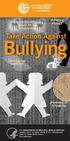 switching seats in the classroom stealing money Take Action Against Bullying spreading rumors pushing & tripping U.S. DEPARTMENT OF HEALTH & HUMAN SERVICES Substance Abuse and Mental Health Services Administration
Age-Appropriate Reactions & Specific Interventions for Children & Adolescents Experiencing A Traumatic Incident
 The Florida Crisis Consortium is supported by the Florida Dep:ntment ofhealth. Age-Appropriate Reactions & Specific Interventions for Children & Adolescents Experiencing A Traumatic Incident The following
Brief Strategic Family Therapy for Adolescent Drug Abuse
 Brief Strategic Family Therapy for Adolescent Drug Abuse Multiple Choice Identify the choice that best completes the statement or answers the question. 1. Chapter One: Brief Strategic Family Therapy-An
Social and Emotional Wellbeing
 Social and Emotional Wellbeing A Guide for Children s Services Educators Social and emotional wellbeing may also be called mental health, which is different from mental illness. Mental health is our capacity
BEHAVIORAL THERAPY. Behavior Therapy (Chapter 9) Exposure Therapies. Blurring the Line. Four Aspects of Behavior Therapy
 BEHAVIORAL THERAPY Psychology 460 Counseling and Interviewing Sheila K. Grant, Ph.D. 1 Behavior (Chapter 9) A set of clinical procedures relying on experimental findings of psychological research Based
Conducting Emotionally Difficult Conversations. John Banja, PhD Center For Ethics Emory University [email protected]
 Conducting Emotionally Difficult Conversations John Banja, PhD Center For Ethics Emory University [email protected] How To Break Bad News Robert Buckman (with contributions by Yvonne Kason). Baltimore:
For Mental Health and Human Services Workers in Major Disasters
 Page 1 of 5 Home Programs Mental Health Topics Newsroom Publications Resources This Site Search For Mental Health and Human Services Workers in Major Disasters POTENTIAL RISK GROUPS Online Publications
CBT Treatment. Obsessive Compulsive Disorder
 CBT Treatment Obsessive Compulsive Disorder 1 OCD DEFINITION AND DIAGNOSIS NORMAL WORRIES & COMPULSIONS DYSFUNCTIONAL/ABNORMAL OBSESSIONS DSM IV DIAGNOSIS 2 OCD DIAGNOSIS DSM IV & ICD 10 A significant
ASSERTIVENESS AND PERSUASION SKILLS
 TROY CONTINUTING EDUCATION AND ARCTURUS TRAINING ACADEMY PERSONAL ENRICHMENT WORKSHOPS ASSERTIVENESS AND PERSUASION SKILLS Do you find yourself saying Yes when you want to say No? Do you end up agreeing
Taming the OCD Monster Tips & Tricks for Living Sanely with OCD
 Taming the OCD Monster Tips & Tricks for Living Sanely with OCD January 13, 2016 FAA Family Resource Meeting Presented by: Gwennyth Palafox, Ph.D. What is Obsessive Compulsive Disorder (OCD)? Is an anxiety
Supporting children in the aftermath of a crisis
 Supporting children in the aftermath of a crisis David J. Schonfeld, MD Thelma and Jack Rubinstein Professor of Pediatrics Director, National Center for School Crisis and Bereavement Division of Developmental
Treatments for OCD: Cognitive- Behavioural Therapy
 Source: CAMH (Centre for Addiction and Mental Health) www.camh.net Treatments for OCD: Cognitive- Behavioural Therapy Obsessive-Compulsuve Disorder: An Information Guide On this page: Cognitive-Behavioural
Emotionally Disturbed. Questions from Parents
 1 Emotionally Disturbed Questions from Parents Characteristics that may be reflective of ED:* an inability to learn which cannot be explained by intellectual, sensory, or health factors. an inability to
Listen, Protect, and Connect
 Page 1 Listen, Protect, and Connect PSYCHOLOGICAL FIRST AID FOR CHILDREN, PARENTS, AND OTHER CAREGIVERS AFTER NATURAL DISASTERS Helping you and your child in times of disaster. Page 2 As a parent or adult
Evidence Based Social Skill Instruction Programs
 Evidence Based Social Skill Instruction Programs The following is not intended to provide a complete list of evidence based programs, but represents a collection of programs that incorporate evidence based
HELPING CHILDREN COPE WITH PAIN
 CENTER FOR EFFECTIVE PARENTING HELPING CHILDREN COPE WITH PAIN Pain is something that will be experienced by every person in his or her lifetime. Some pain will be severe, and some will be minor. Some
Physical Symptoms Mood Symptoms Behavioral Symptoms
 Prescription drugs are the 3 rd most commonly abused drugs amongst teens in Nebraska, and the same statistic holds true on a national level. The rise in prescription drug abuse is becoming increasingly
Licensing Exam Practice Questions
 Licensing Exam Practice Questions Everyone has a different study style but the best way to study for this exam is to test your self on the art of the multiple choice question. The exam will have 170 multiple
Anxiety and Education Impact, Recognition & Management Strategies
 Anxiety and Education Impact, Recognition & Management Strategies Dr Amanda Gamble Centre for Emotional Health (formerly MUARU) Macquarie University, Sydney. WHY SHOULD I BE CONCERNED? 1 Prevalence of
2E & OCD 4/6/2013. What To Do When OCD Occurs In The Twice- Exceptional Child. What is 2E? What is Gifted & Talented?
 What To Do When OCD Occurs In The Twice- Exceptional Child Jenny C. Yip, Psy.D. Sarah A. Haider, Psy.D. Lauren Stutman, Psy.D. Rebecca Fountain, M.A. Renewed Freedom Center for Rapid Anxiety Relief Michelle
Specific Phobias. Anxiety Disorders Association of America
 Specific Phobias Everyone thinks that once I ve driven on the highway, I ve conquered it. They just don t understand... I don t understand. It s a day-in and day-out struggle. What is a phobia? We all
Behavior-Management Techniques for Safe Schools
 Behavior-Management Techniques for Safe Schools Each new school year brings high hopes, great expectations and challenges for both new and seasoned educators. Th e American Federation of Teachers (AFT)
WHICH talking therapy for depression?
 WHICH talking therapy for depression? A guide to understanding the different psychological therapies you may be offered to treat your depression 1 Contents Introduction 3 Cognitive Behavioural Therapy
OVERVIEW OF COGNITIVE BEHAVIORAL THERAPY. 1 Overview of Cognitive Behavioral Therapy
 OVERVIEW OF COGNITIVE BEHAVIORAL THERAPY 1 Overview of Cognitive Behavioral Therapy TABLE OF CONTENTS Introduction 3 What is Cognitive-Behavioral Therapy? 4 CBT is an Effective Therapy 7 Addictions Treated
THE CAUSES OF DRUG ADDICTION
 1 Statistical facts associated with addiction and substance abuse are concerning, but many men and women choose to ignore the dangers. By understanding the main causes of addiction to drugs, it is possible
Cognitive Therapies. Albert Ellis and Rational-Emotive Therapy Aaron Beck and Cognitive Therapy Cognitive-Behavior Therapy
 Psyc 100 Ch 15C therapies 1 Cognitive Therapies Albert Ellis and Rational-Emotive Therapy Aaron Beck and Cognitive Therapy Cognitive-Behavior Therapy Psyc 100 Ch 15C therapies 2 Cognitive Therapies Unlike
Why So Many Students Flounder
 Scheduled for publication in the winter, 2010/2011 edition Why So Many Students Flounder By Stephen Rudin, MD & Marcia Eckerd, PhD It s raining kids in my office, says Dr. Roy Boorady, Assistant Professor
Bert Epstein, Psy.D.
 Bert Epstein, Psy.D. 159 Kentucky Street Suite 3 Petaluma, CA 94952 707 242-1989 [email protected] CA License PSY 21404 Office Policies & Agreement for Psychotherapy Services Welcome. Your first visit
Sample Scale & Definitions
 NCFAS-G+R North Carolina Family Assessment Scale for General Services and Reunification Sample Scale & Definitions National Family Preservation Network Priscilla Martens, Executive Director (888) 498-947
Attachment Theory: Understanding and Applying Attachment Style in Addiction Counseling. Denise Kagan, PhD Pavillon Psychologist
 Attachment Theory: Understanding and Applying Attachment Style in Addiction Counseling Denise Kagan, PhD Pavillon Psychologist Attachment Theory Mentalization and Attachment Studies Neurobiology of Attachment
Three Essential Pieces for Solving the Anxiety Puzzle
 April 13, 2012 Three Essential Pieces for Solving the Anxiety Puzzle Simon A Rego, PsyD, ABPP, ACT Michelle A Blackmore, PhD Montefiore Medical Center Albert Einstein College of Medicine Agenda O Cognitive-behavioral
AMITA Health Alexian Brothers Behavioral Health Hospital Center for Professional Education Program Guide. Fall 2015. abbhh.org
 AMITA Health Alexian Brothers Behavioral Health Hospital Center for Professional Education Program Guide Fall 2015 1 AMITA Health Alexian Brothers Behavioral Health Hospital, Hoffman Estates Center for
The Roles of the Mental Health Professional in the Collaborative Divorce Process: Divorce Coach and Child Specialist
 Directions a Center for Life Strategies, LLC Tamsen Thorpe, Ph.D. Psychologist - NJ License #3826 914 Mt. Kemble Ave., Suite 310 Morristown, NJ 07960 (973) 425-8868 www.directions-cls.com Email: [email protected]
EMOTIONAL DISTURBANCE
 I. DEFINITION "Emotional disturbance" means a condition exhibiting one or more of the following characteristics over a long period of time and to a marked degree that adversely affects a child's educational
Sue/Sue/Sue Understanding Abnormal Behavior, 9 th edition 2010 Cengage Learning CHAPTER EIGHT. Personality Disorders
 Sue/Sue/Sue Understanding Abnormal Behavior, 9 th edition 2010 Cengage Learning CHAPTER EIGHT Personality Disorders PERSONALITY DISORDERS Personality Disorder: Sue/Sue/Sue Understanding Abnormal Behavior,
Medical College of Georgia Augusta, Georgia School of Medicine Competency based Objectives
 Medical College of Georgia Augusta, Georgia School of Medicine Competency based Objectives Medical Knowledge Goal Statement: Medical students are expected to master a foundation of clinical knowledge with
Counseling Antisocial Clients: A Microskills Approach By Norma Gluckstern-Packard and Ralph Packard Produced by Microtraining Associates, Inc.
 Counseling Antisocial Clients: A Microskills Approach By Norma Gluckstern-Packard and Ralph Packard Produced by Microtraining Associates, Inc. Introduction to the Video Purpose: The purpose of this video
How. HOLiSTIC REHAB. Benefits You
 How HOLiSTIC REHAB Benefits You Table of Content Holistic Rehab Centers are More Popular than Ever The Need for Drug & Alcohol Rehabilitation Programs Alcohol Abuse and Addiction These Issues Need Treatment
Positive Coping with Rheumatoid Arthritis a skills workshop
 Positive Coping with Rheumatoid Arthritis a skills workshop About this workshop Created by: Dan Bilsker PhD Centre for Applied Research in Mental Health & Addiction Faculty of Health Sciences, Simon Fraser
ASPERGER S SYNDROME, NONVERBAL LEARNING DISORDER AND OTHER NEUROCOGNITIVE DISORDERS
 ASPERGER S SYNDROME, NONVERBAL LEARNING DISORDER AND OTHER NEUROCOGNITIVE DISORDERS APPROPRIATE PROGRAM DEVELOPMENT Orion Academy Kathryn Stewart, Ph.D. GETA 2007 What is a Neurocognitive Disorder? What
How to Handle Anger. What is Anger? How are Children Affected? How are Parents and Other Caregivers Affected?
 How to Handle Anger Anger is a natural emotion felt by everyone from time to time. Like other emotions we experience, such as happiness and sadness, anger can affect our mood. Since our mood influences
Amicus Trust have been providing support to vulnerable people for over 40 years
 Training Brochure Introduction Amicus Trust have been providing support to vulnerable people for over 40 years We are now sharing our knowledge and skills to others by offering training The training is
Behavioral Health Services for Adults Program Capacity Eligibility Description of Services Funding Dosage Phase I 33 hours
 Outpatient Substance Abuse Recovery (OSARP) Dual Diagnosis Behavioral Health Services for Adults Capacity Eligibility Description of Services Funding Dosage 35 at any Adults with Phase I 33 hours point
Student Medical, Mental Health and Behavioral Crises
 Student Medical, Mental Health and Behavioral Crises 120814 The University of Maine is committed to the health and safety of all students. If a student s behavior is disruptive and/or poses potential harm
Part 5. Dinosaur School Notes to Teachers. 1. Introduction. 2. Iguanodon Unit: How to be Successful in School
 Part 5 Dinosaur School Notes to Teachers 1. Introduction 2. Iguanodon Unit: How to be Successful in School 3 & 4. Triceratops Unit: Detecting, Understanding and Talking About Feelings 5. Stegosaurus Unit:
Youth Residential Treatment- One Step in the Continuum of Care. Dave Sprenger, MD
 Youth Residential Treatment- One Step in the Continuum of Care Dave Sprenger, MD Outline Nature of substance abuse disorders Continuum of care philosophy Need for prevention and aftercare Cost-effectiveness
Fact Sheet #1: Skills to Expect from 0 to 18 months
 Fact Sheet #1: Skills to Expect from 0 to 18 months Mental Skills Remember people and objects that are not present Imitate other people s facial expressions, sounds, and actions Imitate what they see on
Processes and Mechanisms of Change in Addiction Treatment. Carlo C. DiClemente, Ph.D. ABPP University of Maryland, Baltimore County
 Processes and Mechanisms of Change in Addiction Treatment Carlo C. DiClemente, Ph.D. ABPP University of Maryland, Baltimore County MECHANISMS OF CHANGE: A CLIENT PERSPECTIVE What is the client s s work
Brief Treatment for CT SBIRT
 Brief Treatment for CT SBIRT Karen Steinberg Gallucci, Ph.D. March 5, 2012 3/12/2012 1 Model Based on Clinical Trial Integrated treatment CSAT Marijuana Treatment Project (MTP) Significant results demonstrating
HOW PARENTS CAN HELP THEIR CHILD COPE WITH A CHRONIC ILLNESS
 CENTER FOR EFFECTIVE PARENTING HOW PARENTS CAN HELP THEIR CHILD COPE WITH A CHRONIC ILLNESS Parenting a chronically ill child is a challenge. Having a child with a chronic illness is stressful for any
Acceptance and Commitment Therapy with Treatment Resistant PTSD Clients. Michael P. Twohig, Ph.D. Associate Professor of Psychology
 Acceptance and Commitment Therapy with Treatment Resistant PTSD Clients Michael P. Twohig, Ph.D. Associate Professor of Psychology C B T How did ACT develop? 1 2 3 Rule Governed Behavior Verbal humans
APPENDIX B COMMUNITY OUTPATIENT TREATMENT READINESS SCALE
 APPENDIX B COMMUNITY OUTPATIENT TREATMENT READINESS SCALE Appendix B.2 Community Outpatient Treatment Readiness Scale I. The Community Outpatient Treatment Readiness Scale (COTREI) is a revision of a scale
Using the Second Step: Social-Emotional Skills for Early Learning and Devereux Early Childhood Assessment (DECA-P2) Preschool Program Together
 Using the Second Step: Social-Emotional Skills for Early Learning and Devereux Early Childhood Assessment (DECA-P2) Preschool Program Together The Second Step program and DECA Preschool Program are both
PSYCHOTHERAPY. MODULE -V Social and Applied Psychology OBJECTIVES 24.1 MEDICAL MODEL. Psychotherapy. Notes
 MODULE -V Psychotherapy 24 PSYCHOTHERAPY In the previous lesson, you were told about psychological disorders. Psychologists have tried to understand the causes of abnormal behaviour, and the best way to
RESIDENTIAL TREATMENT PROGRAM REVIEW
 RESIDENTIAL TREATMENT PROGRAM REVIEW This past year has been one of considerable restructuring for the Residential Treatment Program. More resources have been directed towards supporting front line staff,
Management Assistance Program
 Management Assistance Program COMMUNICATING WITH EMPLOYEES DURING A CRISIS: How to prepare and help employees cope with a workplace related crisis GOALS: The goal of this module is to provide organizations,
Addiction: The Family Disease Symptoms, Behaviors, Feelings
 Addiction: The Family Disease Symptoms, Behaviors, Feelings Reference: Claudia Black, Ph.D.,MSW Family Strategies Definition of Family Disease Addiction affects the entire family. In an addictive family
Choosing Adoption Therapist
 Choosing Adoption Therapist How do I find a therapist who is qualified with adoption and foster care issues? Selecting a therapist who understands adoption and foster care can be an important component
Case Formulation in Cognitive-Behavioral Therapy. What is Case Formulation? Rationale 12/2/2009
 Case Formulation in Cognitive-Behavioral Therapy What is Case Formulation? A set of hypotheses regarding what variables serve as causes, triggers, or maintaining factors for a person s problems Description
Contact Information. [email protected] Phone 773-3678
 Contact Information [email protected] Phone 773-3678 Learning Behavior/Changing Behavior Students learn any behavior in the same way they learn to read through instruction/modeling, practice, feedback,
Our Vision Optimising sustainable psychological health and emotional wellbeing for young people.
 Our Mission To provide free psychological services to young people and their families. Our Vision Optimising sustainable psychological health and emotional wellbeing for young people. 1 Helping Students,
Comprehensive Addiction Treatment
 Comprehensive Addiction Treatment A cognitive-behavioral approach to treating substance use disorders Brief Treatment Eric G. Devine Deborah J. Brief George E. Horton Joseph S. LoCastro Comprehensive Addiction
Aristotle described 3 types of Friendship. 1. Utility 2. Pleasure 3. True Friendship
 Aristotle described 3 types of Friendship 1. Utility 2. Pleasure 3. True Friendship At what Age do children have the cognitive and emotional abilities required to have a friendship? Children s perceptions
Conceptual Models of Substance Use
 Conceptual Models of Substance Use Different causal factors emphasized Different interventions based on conceptual models 1 Developing a Conceptual Model What is the nature of the disorder? Why causes
A Functional Approach to Functional Analysis. Carla Miller
 A Functional Approach to Functional Analysis Carla Miller Why are we here? What brings us to a session on analyzing behavior? What are we hoping to learn? What do we want to walk away with? Functional
FACT SHEET. What is Trauma? TRAUMA-INFORMED CARE FOR WORKING WITH HOMELESS VETERANS
 FACT SHEET TRAUMA-INFORMED CARE FOR WORKING WITH HOMELESS VETERANS According to SAMHSA 1, trauma-informed care includes having a basic understanding of how trauma affects the life of individuals seeking
Behavior & Sensory Strategies for Individuals with ASD
 Behavior & Sensory Strategies for Individuals with ASD Kathleen Mo Taylor, OTR/L The Autism Programs Center for Development and Disability University of New Mexico This presentation is made possible, in
MANAGING DEPRESSIVE SYMPTOMS IN SUBSTANCE ABUSE CLIENTS DURING EARLY RECOVERY
 MANAGING DEPRESSIVE SYMPTOMS IN SUBSTANCE ABUSE CLIENTS DURING EARLY RECOVERY Presented by: William L. Mock, Ph.D., LISW,LICDC, SAP Professional Training Associates Inc North Ridgeville, Ohio 1 (216) 299-9506
LaGuardia Community College Department of Human Resources CUSTOMER SERVICE COMMUNICATION SKILLS INTERPERSONAL SKILLS E-MAIL & TELEPHONE TECHNIQUES
 LaGuardia Community College Department of Human Resources CUSTOMER SERVICE COMMUNICATION SKILLS INTERPERSONAL SKILLS E-MAIL & TELEPHONE TECHNIQUES 1 This Workshop Provides Strategies to: Deliver quality
Social Service Agencies. Programs for Schools & Music Therapy. Outreach
 Music Therapy Outreach Programs for Schools & Social Service Agencies Innovative and creative programs addressing the therapeutic needs of children, adolescents, and adults. Brooklyn-Queens Conservatory
Helping Children After a Wildfire: Tips for Parents and Teachers
 Helping Children After a Wildfire: Tips for Parents and Teachers Natural disasters can be traumatic for children and youth. Experiencing a dangerous wildfire can be frightening even for adults, and the
ACTION. What if Your Child IS the One Showing Bullying Behavior? PACER CENTER. So who does it? What is bullying? Bully versus child who bullies
 PACER CENTER ACTION INFORMATION SHEETS What if Your Child IS the One Showing Bullying Behavior? The word bullying often conjures up an image of a schoolyard scene, with a big, intimidating student towering
Standards for the School Counselor [23.110]
![Standards for the School Counselor [23.110]](/thumbs/25/6617639.jpg "Standards for the School Counselor [23.110]") II. STANDARDS FOR THE SCHOOL SERVICE PERSONNEL CERTIFICATE Standards for the School Counselor [23.110] STANDARD 1 - Academic Development Domain The competent school counselor understands the learning process
II. STANDARDS FOR THE SCHOOL SERVICE PERSONNEL CERTIFICATE Standards for the School Counselor [23.110] STANDARD 1 - Academic Development Domain The competent school counselor understands the learning process
to Send-Off Your Loved One to Rehab
 G O O Y B D to Send-Off Your How Loved One to Rehab O O D B Y E Table of Contents G O O D B Goodbye is Saying Not Easy If a loved one is abusing drugs or alcohol, helping them enter a rehab program is
Purpose of Presentation
 Understanding Stalking Behavior by Individuals with ASD Linda Haymes, Keith Storey, Michal Post, & Tamara Loughrey Purpose of Presentation To provide an overview of stalking behavior in school and employment
Listen, Protect, Connect Model & Teach
 Page 1 Listen, Protect, Connect Model & Teach PSYCHOLOGICAL FIRST AID (PFA) FOR STUDENTS AND TEACHERS Helping you help your students in times of disaster, school crises, or emergencies. Page 2 As a teacher,
Singapore Kids and Video games: Findings of a 3-year longitudinal study
 Singapore Kids and Video games: Findings of a 3-year longitudinal study Dr Angeline Khoo Associate Professor Psychological Studies, National Institute of Education Definition of Pathological Video Gaming
Lisa C. Tang, Ph.D. Licensed Clinical Psychologist 91 W Neal St. Pleasanton, CA 94566 (925) 963-8835
 Lisa C. Tang, Ph.D. Licensed Clinical Psychologist 91 W Neal St. Pleasanton, CA 94566 (925) 963-8835 Professional Policies and Consent to Treatment Welcome to my practice. I appreciate your giving me the
What is Divorce Abuse? Susan Boyan LMFT and Ann Marie Termini LPC The Cooperative Parenting Institute
 What is Divorce Abuse? Susan Boyan LMFT and Ann Marie Termini LPC The Cooperative Parenting Institute As a parent you surely pride yourself in protecting your children from harm. However in the midst of
PTSD Ehlers and Clark model
 Problem-specific competences describe the knowledge and skills needed when applying CBT principles to specific conditions. They are not a stand-alone description of competences, and should be read as part
Compiled by Julie Ann Romero AS 91 Spring 2010
 Compiled by Julie Ann Romero AS 91 Spring 2010 Antisocial personality disorder is a psychiatric condition in which a person manipulates, exploits, or violates the rights of others. This behavior is often