
CONCEPT OF VOCATIONAL EDUCATION AND TRAINING IN SERBIA - Draft
|
|
|
- Jody Fletcher
- 10 years ago
- Views:
Transcription
1 REPUBLIC OF SERBIA MINISTRY OF EDUCATION AND SPORT CONCEPT OF VOCATIONAL EDUCATION AND TRAINING IN SERBIA - Draft Belgrade, January

2 Developed by: Miomir Despotović, Prof.PhD, University of Belgrade, VET Reform Programme Iskra Maksimović M.A, VET Reform Programme Dragan Djukić M.A, National Employment Agency Refik Šećibović, Prof. PhD, Ministry of Education and Sports Mirjana Bojanić, VET Centre Jadranka Dimov, National Employment Agency Biljana Lajović, Ministry of Education and Sports Radovan Živković, Ministry of Education and Sports Željko Papić M.A, Mechanical and Technical School in Čačak Djordje Lazić M.A, VET Centre Jelena Jakovljević, VET Centre Branislav Aksentijević, Termoelektro, Belgrade Daniela Jadrijević-Mladar, VET Reform Programme Silva Misljenovic, Ministry of Education and Sports 2
3 Introduction The Concept of Secondary Vocational Education and Training is a general framework and basis for the modernisation of secondary vocational education and training (VET) in Serbia. It provides basic principles and attitudes for the future organisation and processing of secondary VET. This draft of the Concept is based on the Analysis of the Current State in Secondary Vocational Education in Serbia 1, Act on Foundation of Education System in Serbia 2 and the following documents of the reforms 3 : o Framework of Vocational Education Development Strategies in Serbia, o Strategic Paths of Adult Education Development, o Decentralisation of Education in Serbia, o Democratisation of Education And Education for Democracy and Civil Society, o System of Monitoring and Quality Assessment in Education, o Reforms of Higher Education in Serbia, o Education and Professional Development of Teachers, o National Curriculum Framework 4. In developing the Concept of Secondary Vocational Education and Training all current solutions and experiences in processing pilot projects of the Ministry of Education and Sports of the Republic of Serbia are respected that are implemented in nine fields of work (sectors). The existing tradition and results of secondary VET in Serbia has been also respected. The Concept of Secondary Vocational Education and Training will be implemented as a whole for the generation of students who will enrol in the 1 st grade of secondary vocational schools in In the period from 2004 to 2007 segments of the Concept will be implemented in processing pilot projects: in 26 profiles in 9 fields of work (sectors). The implementation of these pilots has started in the school years 2002/03 and 2003/04. The public hearing on the Concept of Secondary Vocational Education and Training should enable all stakeholders and social partners (schools, social partners, and parents, economy) to take part in the process of developing the final version of this strategic paper. Proposals and suggestions of all those who take part in the public hearing will be a contribution not only to the better quality of this paper but also to the successful processing of the reforms in secondary VET. After the public hearing this paper will be adjusted and revised and after the Council for Vocational Education and Training endorses it, this Concept will be a compulsory strategy paper for the process of reforms of secondary VET. The Concept of Secondary Vocational Education and Training is also a strategic basis for all projects realised in VET in Serbia. 1 Reforms in Secondary Vocational Education, Ministry of Education and Sports of the Republic of Serbia, Belgrade, Act on Foundation of Education System in Serbia, Official Gazette, 62/03 3 All documents (except General Curriculum Framework) are published in Quality Education for All Path to Developed Society, Ministry of Education and Sports Republic of Serbia, Prosvetni pregled, Belgrade, General Curriculum Framework, draft, Ministry of Education and Sports, Prosvetni pregled, Belgrade,
4 The Concept of Secondary Education and Training demands the delivery of a series of individual documents that would elaborate and operationalise the solutions offered in this paper. The delivery of the following documents is of special importance: o o o o o o o o o o o o Methodology of Developing New Unique Curriculum of Secondary VET at National and School Level; Instructions for Organisation and Realisation of the New Unique Curriculum of Secondary VET (forms, organisation, normative, role of teachers); Methodology of Development of Secondary VET Standards (educational standards, trainings standards); System of Professional Development of Teachers, School heads and school administration staff in secondary VET (system of pre-service and in-service training, promotion in carrier, system of licensing); Quality Assurance System in Secondary VET (function, performance standards, monitoring and evaluation, information management in quality assurance); Methodology of Setting Occupational Standards in Secondary VET; Certification system in Secondary VET; Instructions for Processing Exams in VET and in adult education (final exams, vocational Matura, masters exam and specialists exam); Social Dialogue in Secondary VET (horizontal and vertical approach); School Network of Secondary VET Schools in Serbia; Roles and Functions of Institutions in Secondary VET in Serbia; Impact of Secondary VET Reforms on the System of Financing (based on the example of pilot schools in the nine fields of work). Coordination and summary of the public hearing will be processed by the Centre for VET on behalf of the National Council for Vocational Education and Training. Public hearing ends on 15 th February

5 Reforms of Secondary Vocational Education and Training In Serbia 5

6 Economic, technological, informational, demographic and political forces have transformed the way people work and live. These changes - and the rate of change- will continue to accelerate. Schools, like business, communities and families, must adapt to changing conditions to thrive...today s economy places value on broad knowledge and skills, flexibility, cross- training, multi-tasking, teaming, problem-solving and projectbased work. 5 Contemporary tendencies in the development of market oriented countries showed that education and the creation of human resources are priorities for national strategies and policies of social, economic and technological development. Continuous socio-economic changes, fast scientific and technological development, especially the expansion of modern and post-modern forms of technologies require a highly educated population that is in a position to participate effectively in social processes and uses available technology. In this way, modern societies unavoidably turn into learning societies. This form of social organisation is based on knowledge, where education and learning have the status of basic instruments for the totality of social development, responding to basic social problems and the production of social, economic and technological changes. In learning societies, education is democratised, assigned and available equally to all, independent of gender, age, racial, national or religious orientation. Due to this transformation, the continuous reconstruction of the entire education ( and especially vocational ) becomes an imperative for socio-economic development. The modernization of society and the orientation towards economical and technological development implies innovation of the general, as well as the specific goals of vocational education. Vocational education in Serbia, above all, will be directed toward gaining vocational knowledge and the development of key skills necessary for the successful conduct of work, further learning and accomplishment of wider flexibility in overcoming changing demands of the world of work and society as a whole and higher mobility of the working force. Aside from adequate structuring of formal educational system, it also implies the creation of possibilities for non-formal and informal learning and their closer linking in order to create realistic possibilities for development and refreshment of knowledge and skills during an entire life time. The basic objective of the reform and further development of vocational education and training in Serbia is its positioning among factors of technical, technological, socio-economical and individual development. The first step in this process is the conceptualization of vocational education and training development and the direction of general educational system towards social and individual needs and possibilities. In order to obtain quality improvement, transform the management system and financing system of education, to include all stakeholders and social partners, enable efficient transfer of knowledge and skill for participants in the educational process with full respect to ethnic, cultural and linguistic differences, the Ministry of Education and Sports of the Republic of Serbia has initiated a reorganisation and reform of the VET system. In 2001 the MoES endorsed an interactive approach to creating a plan for processing the reforms. The current system of secondary VET has been analysed 6 and it has been used as a basis for developing the Strategic Framework of Secondary VET 7. After public hearings the pilot project of the modernisation of secondary VET has started. New profiles have been introduced in a certain number of VET schools in the field of work agriculture, food production and processing. The proposed changes, presented in the Framework of Strategies and started in the pilot project, have been endorsed by the Act on Foundation of Education System in Serbia delivered in June Based on legal regulations and on experience of the first year (2002/03) of implementation, the 5 LEARNING FOR THE 21st CENTURY, A Report and Mile Guide for 21st Century Skills, Reforms of Secondary Vocational Education and Training: from Discussions to Realisation, Ministry of Education and Sports of the Republic of Serbia, Belgrade, Framework of VET Development Strategies in Serbia, Belgrade,

7 pilot project has been broadened in the school year 2003/04 and new profiles have been introduced in further eight fields of work. Based on the Act on the Frameworks of Education system a Centre for VET has been established and it has been proposed to establish a Council for VET. Its role is to monitor, develop and improve the system of VET in Serbia.. 7

8 VET Development Basic Approach 8
9 The basic approach in establishing vocational education is its socio-economic and individual relevancy. In accordance with that, curricula within secondary vocational education are directed toward learning outcomes with the incorporation of clearly defined knowledge, skills, attitudes, (work competences) and potentials demanded by the labour market, institutions of higher education and individual progress of students. Objectives of secondary VET The preliminary approach in the reorganization and modernisation process of secondary vocational education and training determined its objectives. The general objectives of secondary VET enable possibilities for youngsters and adults to gain skill, knowledge, attitudes (work competencies) needed for work and employment, further education and learning. More precisely secondary VET should provide: The acquisition of occupation skills and qualifications, or relevant competencies, attitudes; knowledge and skills required for work in a particular field of work; Gaining of initial and continuous VET and improvement; Obtaining the necessary pre-conditions for employment and economic independence. Development of abilities, talents, potentials and self-fulfilment. The modernisation and development of secondary VET is based on the application of the following principles: Partnerships Secondary VET is partnership activity and common responsibility of different actors: a) Various stakeholders/social partners state, employers and trade unions, b) Stakeholders: chambers, occupational associations, institutions for higher education, scientific and research organizations, NGOs, institutions for secondary vocational education and their associations, parents and c) Students and other individuals. The partnership is manifested: d) At all levels of social organization (national, regional, local); e) In different spheres of organization and realisation of education (policy, planning and organization of the system, creation of curriculum); f) In the management of schools or institutions for education; g) In the realisation of different roles and responsibilities of particular partners (investors, organizers, users and promoters of education). Decentralization The application of partnership principles in education implies decentralization: a) in the management of the educational system and schools, or organization in charge for education; b) in the creation of programmes and modules, and c) in the establishing of school networks and the creation and implementation of enrolment policy Accessibilities Secondary VET is accessible to all categories of 9

10 population independent of gender, age, national, religious or race that fulfil the entry requirements for particular programmes and levels of education. Access requires not only legality, but also the realistic possibility to gain education, which means that secondary VET is achieved: a) within conditions and in a manner in accordance with realistic needs, wishes and possibilities of those who learn 8, and b) in accordance with social conditions and the needs of regional and the local community. Openness/ Flexibility Secondary VET is a channel of communication and open distribution system of knowledge, skills, attitudes (work competences) that offer real possibilities for: a) entering, leaving and returning into it in accordance with the needs of individuals and/or of the labour market; b) vertical and horizontal accessibility; c) integration and networking with forms and programmes of education and training in enterprises and labour market 9 ; Diversification of the Programmes Institutions for secondary VET are developing and implementing different kinds of curricula and modules (formal, non-formal and informal education and learning), respectively curricula of initial VET, qualifications and training and programmes of vocational improvement and re-training, adapted and assigned for different target groups (youth, adults, employed, unemployed, persons with special needs). It creates the possibility that in the fulfilment of society requirements as well as individual development - tasks should employ a strategy for learning and not only a strategy for education and schooling process; Organizational Diversification School is basic but not the only institutional form of VET. It is necessary to provide: a) different forms of institutional organization, or various legal status of educational institutions (schools, institutes, centres and similar), b) various subjects that meet the legal requirements to conduct activities of secondary VET; c) the possibilities for the creation of personal routes in the development of competencies in learning and the process of gaining knowledge and skills, that is one of the crucial steps towards the democratization of education and better qualities in education and learning. Institutional diversity is non-discriminatory in relation to the ownership of institutions for secondary VET that leads towards the creation of an adequate network of educational institutions and organizations, a range of programmes and an adequate offer of educational places. This requires the establishing of a system of accreditation of educational and training programmes. 8 Organization and realization of education, or teaching and learning should be in accordance with psycho-social characteristics of those who learn, their social and life conditions (valuing of family and professional roles and responsibilities), for this reason this principle primarily requires equity of conditions for education of young and adults. 9 Possibility of using enterprises resources (organisational, technical, material and human) in education and training process. 10
11 Professional Development of teachers and school associates Permanent training of teachers, instructors and coordinators of professional practice/teaching in the vocational field is a necessary process and a direct demand for the modernisation of VET. This process covers: a) continuous training of teachers and associates (innovation of professional knowledge and skills, trainings, practical improvement, gaining certain skills, teacher training at home and abroad, team work in teaching); b) Obtaining competency for work in several subjects and fields (integrated profiles)... Adequate pedagogical, adult and psychological education is a condition for entry in to the teaching profession and taking the role and functions of a teacher. This is required to establish: a) control of entry in the profession through compulsory initial pedagogical, adult teaching and psychological teacher training at the onset of a teaching career and licensing of their work as teachers; b) permanent evaluation of work and system of promotion in work and in career, and c) Continuing professional development and teacher training. Outcomes Oriented The organization of education, teaching and learning in secondary vocational education is based on the idea of outcomes, on precise and clear definitions of what students know and will be able to do after finalization of the education process or a particular programme, and didactical-methodological expression of means of accomplishment of outcomes. Orientation toward outcomes is a way to support institutional and programme variety. Equity of outcomes is emphasized (no matter on time, place for education and learning, orientation on younger or adult population) and a variety of possibilities, manners and roads in their accomplishment. 11

12 Linking labour market and secondary VET 12
13 According to analysts 10, today our world is in the process of transition from an industrial era to the era of information and communication mostly identified as a learning society. Such a new society demands various kinds of learning that lead to employment. For the individual, learning for employment means the development of abilities to find, keep and change job or to generate self-employment. Such skills enable vertical and horizontal mobility of workers in the labour market and their adaptability for changes in technologies and new forms of work organisation. From the workers point of view, learning for employment means the realisation of the principles of lifelong learning and individual gaining of competencies that improve the mobility and safety of a job. For the enterprises and employers, the skills of employment mean that their workers are capable to respond to the changed demands of the working places and improve competition between companies and their development. For the State this concept means the creation of a work force that has adaptive abilities that correspond to the needs of the labour market. However, learning still does not mean automatic employment, as employment depends more on the abilities of the individuals to transfer key competencies from one job into another. Such principles demand that VET be structured and conceived in a way that enables the population that gains education to respond to such demands. Key knowledge, skills, attitudes and competencies that lead to employment, cover: intellectual abilities, social and interpersonal skills and knowledge (communications, team work, decision making process, taking responsibility); business and entrepreneurship skills and knowledge (entrepreneurship abilities, creativity and innovativeness, self-employment) ; Manifold technical skills and knowledge. In order to be able to respond to such demands secondary VET must obtain: o relevance of programmes, outcomes and profiles, adjusted to labour market needs, o efficiency in education of high quality workers who are demanded in the labour market and this should enable the use of available resource in the best way and fast employment, o Equal possibilities for all individuals and groups. In such a context secondary VET gets the duty to obtain full development of talents and abilities of all students and adults. Better to say, when students and adults leave education or forms of training they must have the appropriate skills needed for employment, they must understand the working environment, they must have professional choices and paths, a solid basis for further education and lifelong learning. According to this, it is necessary to undertake certain measures that stimulate employers to invest in improving the knowledge of the employed workers so that they would join the process of technological changes. On the other hand, labour market bureaus will show needs for development certain qualifications. This will create systemic and institutional conditions for the close cooperation of enterprises and educational institutions. The young generation gaining education today enters a world that is undergoing fast changes in all its spheres in economy, culture, politics, science, technology, social relationships. In these changes education gets one of the key roles it becomes a factor of unity and integration 10 The Changing Role of Governement and Other Stakeholders in VET: Training Policies and Systems Branch Employment and Training Department, ILO 13
14 within the society. It is especially visible within the globalisation process that marks a series of phenomena having universal character with huge effects on all human society. An immediate consequence of this process is economic and technologic change causing direct changes within the educational system. Changes in the sphere of technology and economy are huge, fast, disciplined and, first of all, knowledge guided. In order to respond to these new challenges education must provide: - the necessary cognitive and theoretical knowledge in order to enable professional skills that are becoming sophisticated due to technological changes in the process of work; - broad working competencies needed for work in contemporary production and the sphere of services - not only for current production but also for continuing lifelong training and learning of workers; - Secondary VET that supports self-employment and improves productivity. General education gives the basis and flexibility for gaining skills for new jobs, the system of training contributes to the raise of quality and efficiency in the development of production. It is of special importance to recognise training for the use of new technologies acceptance, selection and use and further development of these technologies. Secondary VET must respond to the needs of the labour market in several typical ways: by developing standards and programmes that should reflect changes in labour market demands; by designing broad occupational profiles and by introducing key skills; By developing and establishing local partnership with employers, social partners and other interested participants. It is realistic to expect that the economic development of Serbia in the future will be mainly related to the development of small and medium sized enterprises. As its consequence, SMEs and enterprises will become powerful generators of innovation processes and the most important creators of new working places. Such a trend implies the necessity to introduce entrepreneurial education as a way of developing the entrepreneurial abilities of students skills, behaviour and values (self-confidence, self-respect, creativity, communication, risk taking, problem solving, team working). In the process of entrepreneurial education, students should undergo the complete cycle starting from creating a business idea, through establishing a new enterprise, managing business, process of growth and development of the enterprise up to its closing down. The role of social partners in secondary VET reforms Demonopolisation and decentralisation as a key approach of the strategy and concept of VET reforms, open the issue of responsibility for the network of VET schools, distribution of profiles, introduction of new educational profiles and closing the outdated ones, programmes and many other important issues such as the financing of education. Regions and local self government and the economic and social infrastructure must take over the responsibility for their own development within the framework of comparative privileges and total resources they have at their disposal. In this sense they have the responsibility also for human resource development in their own territory. Social partnership in the form of tripartism is a relevant basis for the delivery of development plans of regions, but at the local level level of municipalities, it is necessary to include all interested institutions and organisations into the dialogue and decision making on human resources as a part of development plans. The network of VET schools and distribution of educational profiles must be adjusted to these needs so that the 14
15 development would be supported in the right way. In other words, secondary VET schools must become a real local source for the working force. The issue of adjusting of competencies of the unemployed and updating their knowledge and skills is a special challenge for education reform. Equal availability of education to all and the opening of existing VET schools for adult education is a reform that needs system support through the training of teachers to work with adults, establishing standards, modularisation of programmes, etc. 15
16 Structure of Secondary VET System 16
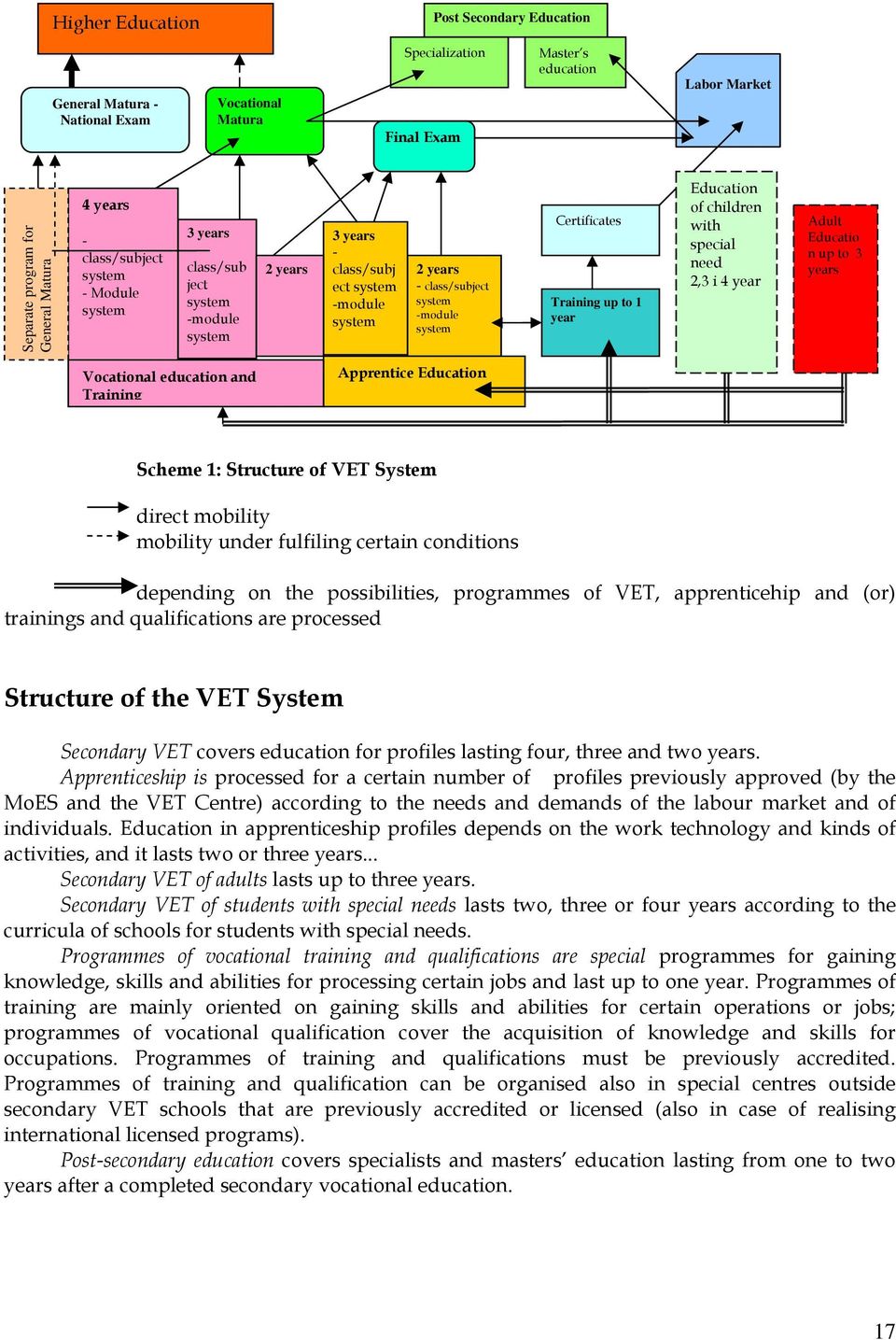
17 Higher Education Post Secondary Education General Matura - National Exam Vocational Matura Specialization Final Exam Master s education Labor Market Separate program for General Matura 4 years - class/subject system - Module system 3 years - class/sub ject system -module system 2 years 3 years - class/subj ect system -module system 2 years - class/subject system -module system Certificates Training up to 1 year Education of children with special need 2,3 i 4 year Adult Educatio n up to 3 years Vocational education and Training Apprentice Education Scheme 1: Structure of VET System direct mobility mobility under fulfiling certain conditions depending on the possibilities, programmes of VET, apprenticehip and (or) trainings and qualifications are processed Structure of the VET System Secondary VET covers education for profiles lasting four, three and two years. Apprenticeship is processed for a certain number of profiles previously approved (by the MoES and the VET Centre) according to the needs and demands of the labour market and of individuals. Education in apprenticeship profiles depends on the work technology and kinds of activities, and it lasts two or three years... Secondary VET of adults lasts up to three years. Secondary VET of students with special needs lasts two, three or four years according to the curricula of schools for students with special needs. Programmes of vocational training and qualifications are special programmes for gaining knowledge, skills and abilities for processing certain jobs and last up to one year. Programmes of training are mainly oriented on gaining skills and abilities for certain operations or jobs; programmes of vocational qualification cover the acquisition of knowledge and skills for occupations. Programmes of training and qualifications must be previously accredited. Programmes of training and qualification can be organised also in special centres outside secondary VET schools that are previously accredited or licensed (also in case of realising international licensed programs). Post-secondary education covers specialists and masters education lasting from one to two years after a completed secondary vocational education. 17
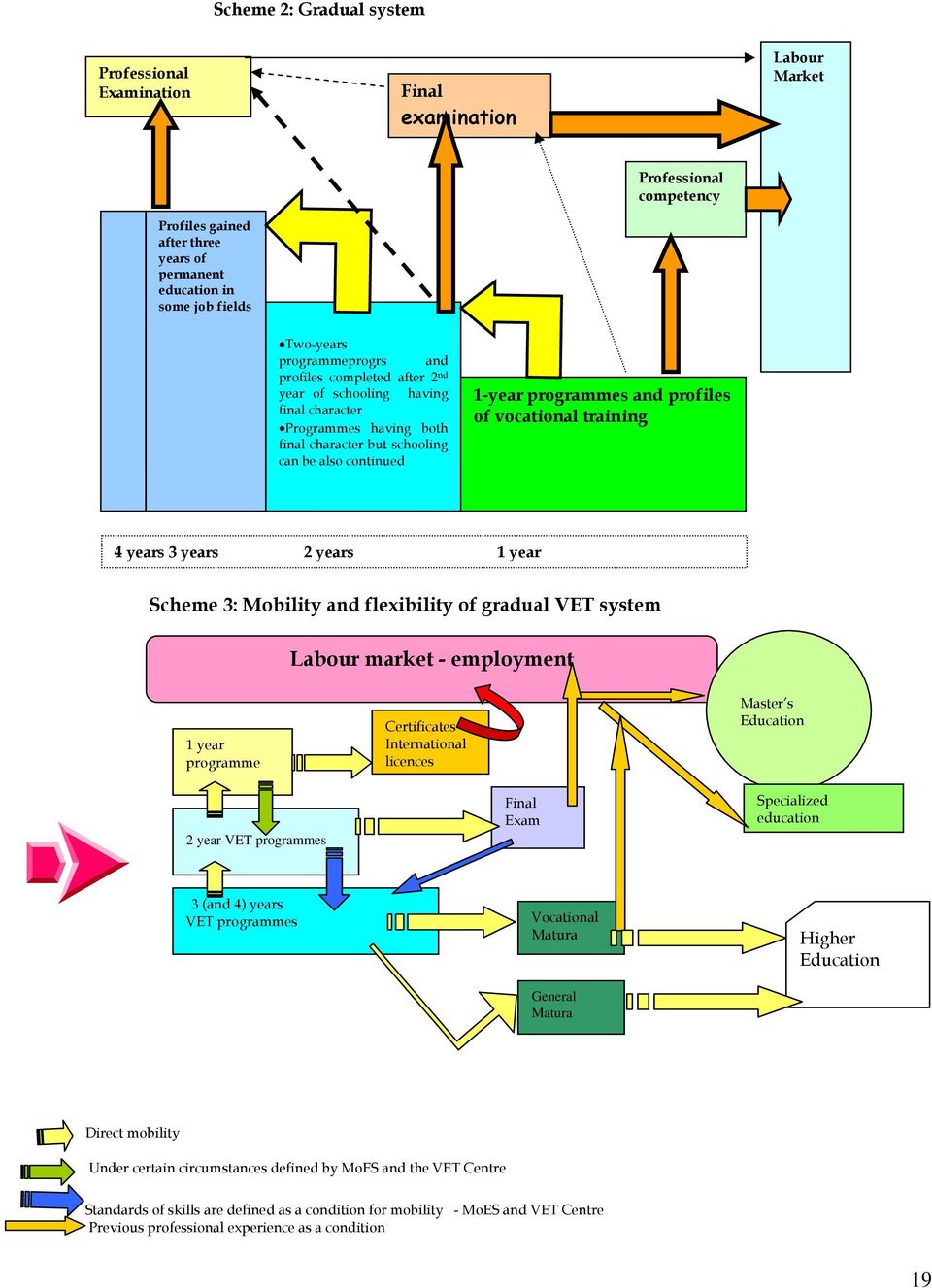
18 Educational Institutes According to the Act on Foundation of Education System in Serbia in the field of secondary VET the following institutions are established: vocational school, mixed school, school for adult education and secondary school for children with special needs. These schools may organise curricula for secondary vocational education, apprenticeship, adjusted curricula for children with special needs, curricula for adult education, programmes of specialisations and masters education as well as the accredited curricula of VET. Secondary VET schools that provide three and four years curricula of secondary VET may organise, according to the interest of students and their parents, a separate curriculum that enables students to take and pass the General Matura. Students have to apply for such programmes at the beginning of their education and the school organises it. Organisation, content and method of processing of this curriculum are set by a separate document on General Matura. Each school defines the direct realisation of this curriculum by its own curriculum. Gradual system of VET Gradual system of VET enables a number of broad profiles in secondary VET as well as in apprenticeship to have several final phases. Each final phase provides a trade certificate to leave the education system to find an employment. At the same time it also enables a return into the education process in order to gain a broader profile. Such a system is defined by the character of the profiles in which the students and adults are educated and is possible with broad profiles. This enables mobility, linking of education and process of work, meeting personal wishes and plans of individuals as well as an easy adaptation to changes in the world of work. Gradual system enables: horizontal and vertical mobility through the whole educational system; compliance with labour market needs and link with stakeholders/social partners; gaining individual attitudes, competencies, skills and knowledge; educational mobility (lifelong learning); professional mobility (as a response to the labour market needs and easy adaption to new professions or needs of the labour requirements); Mobility to higher educational levels. Gradual system??? enables horizontal and vertical mobility, between different curricula as well as within the VET system as whole. Gradual system enables also designing of: programmes for continuous professional learning, development of professional skills, and upgrading of knowledge and skills; programmes and forms of informal education; different organisational forms and learning models; Programmes responding to the need of local community, stakeholders/social partners and other participants in education. 18
19 Scheme 2: Gradual system Professional Examination Final examination Labour Market Professional competency Profiles gained after three years of permanent education in some job fields Two-years programmeprogrs and profiles completed after 2 nd year of schooling having final character Programmes having both final character but schooling can be also continued 1-year programmes and profiles of vocational training 4 years 3 years 2 years 1 year Scheme 3: Mobility and flexibility of gradual VET system Labour market - employment 1 year programme Certificates International licences Master s Education 2 year VET programmes Final Exam Specialized education 3 (and 4) years VET programmes Vocational Matura General Matura Higher Education Direct mobility Under certain circumstances defined by MoES and the VET Centre Standards of skills are defined as a condition for mobility - MoES and VET Centre Previous professional experience as a condition 19
20 Curriculum Development in VET 20

21 Unique curriculum of secondary VET Vocational education offers: Diverse curricula of formal and non-formal education and learning. First of all, these are curricula of secondary vocational education, short forms of training qualifications, curricula of post-secondary education and specialisation; Diverse organisational forms and teaching and learning methods, and Real possibilities for qualification, training and professional practice. The unique curriculum of secondary VET is the structural framework for the organisation and realisation of education as well as for gaining the intended learning outcomes. The curriculum defines: objectives, outcomes and contents of education, processes and activities of their achievements and realisation (organisational forms, models and methods of teaching and learning), and ways, criteria and standards for assessment of achievements. 11 The unique curriculum of secondary VET covers: National and Special Curriculum Frameworks, Learning process and outcomes of learning in secondary VET, Models and Standards of Achievements and Modularisation in VET curricula. Modules Knowledge Skills Input Subjects Learning Outcomes Practice teaching/professi onal practice Attitudes (Work Competencies) Certificate Diploma Educational level Training level Scheme 4. Key elements of the unique VET Curriculum structure All processes and activities in education, learning and teaching are aimed at achieving objectives and outcomes of education and must be adjusted, well balanced but also diversified in order to meet broad social needs, needs of local community and of individuals. Diversification of curricula, contents and teaching methods is one of the most complex issues of VET reforms, but it enables the introduction of various forms of curricula according to the needs of profiles and field of work and of the local community and of the school. This contributes to the motivation of the school staff and of the schools. In this way it is possible to introduce new teaching methods, 11 Detailed description given in Chapter on Curricula in Secondary VET 21
22 especially forms of active teaching and various combinations of theoretical teaching and professional practice. In this process it is important to obtain: a satisfactory balance among general and vocational education, professional theoretical education and professional practice; Vertical and horizontal mobility within a curriculum and within the frames of one or more fields of work; Introduction to the module working principle of either VET as a whole in all fields of work or in the frames of individual VET schools and educational institutions; Links with higher forms of education and providing opportunity for higher education According to these principles the basic tasks of the unique curriculum of secondary VET are oriented to provide knowledge and skills both to students and adults. The unique curriculum of secondary VET must enable: personal development of participants in the educational process, quality improvement of the level of knowledge, skills and attitudes (work competency) of an individual for performing jobs; meeting the needs of work process concerning vocational attitudes and work competencies; Promoting employment and lifelong learning. Processing of the whole curriculum at the school level must enable the development and improvement of working abilities of students and adults that give them the possibility for further professional and educational development. Learning central activity of secondary VET Learning is the central activity both of the individuals and of schools. It must enable the acquisition of knowledge and skills in the context of certain subjects, or contents and knowledge and skills of learning itself. Development of information technology, economy and business have altered traditional work-practice and demand different abilities and skills not only professional/technical knowhow but first of all the ability to create, analyse and transform information and interact effectively with others. The learning becomes a lifelong activity. Under these new circumstances learning skills become especially important for the students and adults. Learning skills should enable students and adults to acquire knowledge, use and processing of information, to transfer this information into new knowledge, skills and values, development of abilities to work with others, learn with and from others. Learning skills Information and Communication Skills Information and media literacy skills: Analysing, accessing, managing, integrating, evaluation and creating information in a variety of forms and media. Communication skills: Understanding, managing and creating effective oral, written and multimedia communication in a variety of forms and context. 22
23 Thinking Skills Information and media literacy skills: Analysing, accessing, managing, integrating, evaluation and creating information in a variety of forms and media. Communication skills: Understanding, managing and creating effective oral, written and multimedia communication in a variety of forms and context. Interpersonal skills Interpersonal and collaborative skills: Demonstrating teamwork and leadership; adapting to varied roles and responsibilities; working productively with others; respecting diverse perspectives Self-direction: Monitoring one s own understanding and learning needs, locating appropriate resources, transferring learning from one domain to another Accountability and adaptability: Exercising personal responsibility and flexibility in personal, workplace and community contexts; setting and meeting high standards and goals for oneself and others. Social responsibility: Acting responsibly with the interests of the larger community in mind; demonstrating ethical behaviour in personal, workplace and community context. The function of learning skills is to enhance and motivate each participant of education in order to improve his/her own work and life, so that by gaining knowledge and skill h/she could respond to the needs not only of the economic development but of the whole life. National and special framework of curriculum Vocational education and training is processed based on the curricula delivered by each school or educational institution according to the Act on Foundation of Education System in Serbia. Schools are operating based on a curriculum consisting of general and specific parts. The general 23
24 part is based on the National Curriculum Framework, the specific one is harmonised with the specific framework and is a result of the type and specific features of the very school depending on the type of education and educational profiles provided in that school. The National Curriculum Framework is common to all secondary VET schools and is the basis for: establishing a curriculum framework according to the types of VET education and occupation profiles; final, general and vocational exam programme; developing assessment criteria for quality assurance in VET. The National curriculum framework consists of: general objectives, principles and outcomes of education, and according to the types of secondary VET ; educational fields with objectives and outcomes ; scope of education field in each type of secondary VET ; core subjects per levels that are compulsory throughout secondary VET; list of obligatory and optional subjects according to the VET levels; General standards of knowledge. The specific part of school curricula is defined according to the types of education and to the educational profiles and it covers: goals and outcomes for the subjects according to the VET types and educational profiles; obligatory and recommended content s of subject, themes and modules; framework of number of classes per subject, themes and modules; specific standards of knowledge and skills; recommended types of activities in educational process; Recommended types of modular teaching. The school curriculum defines each VET school for itself according to: National Curriculum Framework Specific Framework of Curriculum The school curriculum achieves the realisation of the national and specific framework of school curricula and needs of students and parents, schools and local self-government units. The general and specific framework of school curricula are processed in accordance with the established minimum number of educational work, depending on the school grades in the following percentages: In secondary VET - minimum 40% of annual obligatory number of classes; In secondary VET for apprenticeship education - minimum 30% of annual obligatory number of class. The obligatory fund of contact hours is defined by a special paper delivered by the minister of education. The school curriculum consists of: 1. Name, type and duration of curriculum; 2. Obligatory and optional subjects or topics per grades; 3. Ways and procedures of realisation of the defined framework of curricula and achieving outcomes per grades; 24
25 4. total number of hours per each subject or topic; 5. total number of hours for each grade; 6. curriculum content and activities for realisation of the specific part of the curriculum; 7. Name, type and ways of realisation of modules. Curriculum Specific part for schools General part of Curriculum Core compulsory subjects: Serbian Language, Mathematics, Foreign Language; Minority Mother Tongue Obligatory subjects Optional subjects Modules Modules VET Subjects Optional subjects Professional practice, practical work Different forms of learning, Trainings, Specific for each VET school based on choice of school General education 30 % or 40 % Vocational education 60 % or 70 % Scheme 5. School Curriculum in Secondary VET The curriculum, national and specific frameworks are the foundations for the defining of curricula according to types and educational profiles as well as for delivering the programmes of final and matura exams and quality assessment of education. The National and specific framework is defined by the Minister of Education and Sports based on the proposal of the National Council for VET. Outcomes of general education in secondary VET must be defined according to the occupational standards, concept and kind of profile or cluster of occupation. 25
26 Outcomes: Knowledge, Skills, Attitudes, (work competencies) Obligatory 4 subjects in all years Different areas of general education: - Obligatory and optional subjects - Modules - Optional modules Integrated Obligatory Modules Practical / professional Practice Learning General education 30% or 40 % Vocational education 60% or 70 % Scheme 6. Inner structure of VET School Curriculum Forms of realisation of curricula in secondary VET schools: Obligatory subjects Optional subjects General education subjects Modules Professional practice/practical work Organisation of curricula Secondary VET must be focused on gaining adequate professional competencies. The reform of secondary VET develops the possibility for didactic reforms. In comparison to the current school, the focus must shift from teaching to learning; this needs changes not only of curricula but of methods and organisation of teaching. According to the new Act, within the curricula there is an annual, not weekly, amount of hours for all forms of teaching. As the curriculum is realised through subjects, modules and practical teaching/vocational practice, with various durations during the school year, the organisation of teaching/learning must be more flexible. Therefore, within the school and within the real working place, where, up to this moment, only professional practice was processed, the teaching of theory and practice must be adjusted in time. The school schedule in such a curriculum structure cannot exist any more as a rigid schedule that cannot be changed throughout the school year. The school s schedule must be permanently adjusted to the curriculum. This creates an issue concerning problems of space and equipment, training of teachers, norms of 26
27 teacher s contact hours at weekly and annual level, different way of assessment of results of work both of teachers and students, and a permanent need for professional improvement of teachers through training. The structure of the curriculum is not unique for all educational profiles. It differs within apprenticeship profiles, three and four years profiles, so that the organisation of the educational process cannot be the same it must meet the demands of each single educational profile. Outcomes in vocational education The main characteristic of vocational education, i.e. the curriculum implemented therein, is the outcomes orientation. The outcomes are clearly and unequivocally defined - knowledge, skills and attitudes (work competencies) that are achieved after a specific programme, i.e. education and learning process. Defined in that manner, they form the basis for planning, organization and the realisation of vocational education and the evaluation of achievements and of the whole education and training process. The outcomes induce teachers and students to share the responsibility for educational achievements, providing both groups with a clear idea of what they could expect after the completion of a specific programme, i.e. the education and learning process. The education process always results in some kind of outcomes but their nature is often vague and undefined. In vocational education as well, programmes with inadvertent, inadequate and imprecisely defined outcomes are not rare and this results in the production of people with formally recognised qualifications but who lack some elementary work competencies that they are expected to possess. A significant difference exists between the simple production of outcomes and outcomeoriented education. In outcome-oriented education, the outcomes are defined prior to the education process and are known to teachers and students who during the learning process receive the necessary support in the form of an adequate and thoroughly thought through approach to achieving outcomes. This means that the outcomes determine and define the education and learning process and that the school and the institution whose curricula are based on outcomes should: Identify the outcomes of a specific programme, explain them and make them completely public and let them be known to all interested population; Elaborate ways of education and learning organization through which the outcomes are achieved, i.e. through which students can be successful in achieving the outcomes; Define standards of achievements in subjects, subject areas and modules. Specification of outcomes: Knowledge Provides students and adults with knowledge and skills necessary in further education, for personal development and for life long learning Skills Promotes students and adults Development as individuals and active members of the society. Provide development of learning skills. Attitudes Provide students and adults with knowledge, skills and work competency necessary for employment or for selfemployment. 27
28 Specification of outcomes is carried out on the basis of clearly defined procedure and work methodology. Different participants can be involved in the outcomes specification: vocational school teachers and instructors; university teachers and experts from research institutes; practice workers; Representatives of employers, trade unions and students parents and students. Modularisation in secondary VET Modules are specific, separate segments of learning packages that lead to achievements of defined outcomes. Modules may be independent or parts of broader programmes/ organisational units. They are designed on the bases of complementary principles, diverse educational demands and defined thematic tasks. Within their structure, modules obtain gaining knowledge and competences, development of relevant sets of skills and interdisciplinary/ cross-subject linking. Modules can cover several different disciplines. Each discipline has its own clearly defined goals and tasks. According to their flexible structure there are no strict lines between these disciplines so that they enable interference, correlation and creation of unique modular educational packages. The real world of work defines work competences of occupations including their development component. A MODULE is a functionally linked unit of knowledge, skills and attitudes (work competences) that are necessary for a job/task. Each occupation is defined as the cluster of modules having Vocational Matura of external character as its final outcome. o A module must not be an occupation, nor a year, o A module must not be just theoretical teaching or professional practice only, o In two and three years education, modules have to rely on each other, o Training can be one module, o Occupations must be broad ones (training provides narrow skills), our goal is to have integrated, wide profiles, o Modules request team work in performing teaching. Kinds of modules: Compulsory modules make the minimal standard and cover those modules that give the first level of work competencies or abilities for processing jobs in a profile, occupational cluster or occupation. Compulsory modules may be the condition for the progress of a student or for the horizontal transfer between programmes or profiles. Modules by Choice are modules chosen by the student according to his/her own wish, abilities and plans; these modules enable the forming of the personal profile of each individual. Integrated modules are professional-theoretical modules that provide knowledge and are an addition to or basis for compulsory modules or professional practice. There are numerous and diverse reasons for introducing modules in VET. First of all modules enable: Greater flexibility in planning and organisation of the educational process, Greater economic efficiency in education cost, Better adjustment to the needs of the labour market, concrete working environment and job, 28
29 Better vertical and horizontal mobility, A more suitable way to overcome the gap between school academic knowledge/qualification and knowledge and practice gained by experience, Better responses to individual learning needs and capability of students, Enhanced student possibility to choose his/her own path, way of learning and gaining qualifications and work competencies, Continuing education and possibility to discontinue the gaining of qualifications and work competencies. The concept of education or qualification is a reference framework for modularisation and a precise description of the occupation is the basis for modular design. In the educational system, occupations are represented as cluster modules a set of functionally and organizationally linked packages, learning units. The same modules can be part of different occupational clusters; this enables horizontal and vertical mobility within an education system. In the Serbian secondary VET system there will be developed two equal modular concepts and two methodologies for developing modules: general modularisation leading to the integral qualifications, Fragmental modularisation - leading to partial qualification and training for individual jobs and working function. 29
30 Modularisation in VET General leading to the integral qualifications Fragmental leading to the partial qualifications Modules are cereated by dividing occupations into smaller, complex but diferentiated parts, according to the criteria of jobs, roles, functions or work competencies, in certeain job profession which could be acquired, assessed but not recognised individually. Modules are verified only as a part of a wider set that leads towards an overall profesional qualification, i.e. professional abilities.this type of modularisation is being implemented in the school system and is mainly intended for youngsters, although this possibility to pass individual modules is given to adults in regualr school as well as to institutions for adult education Modules are created by dividing occupations into less complex but differentiated parts, or they are the expression of the labour market and enterprises' needs for specific work competencies and training for individual jobs, specific functions and roles, which can be acquired separately and recognized (certificated) individually outside the general qualifications system. This type of modularisation is being implemented in the schools and institutions for adult education and is the expression of efforts to satisfy the needs of the labour market and continuous technical and technological innovation and restructuring of the enterprises. Final exams in VET Vocational Matura The Vocational Matura is taken by students after finished third or fourth grade of secondary VET school and gain the right to enrol respective institutions of higher education according to the defined conditions of enrolment. The Vocational Matura consists of theoretical and practical part and it is a checking of general, vocational-theoretical knowledge, vocational skills, and within the practical part checking of professional abilities for certain jobs. Vocational Matura can be partially or fully external. It is realised according to special rules developed by the 30
31 VET Centre and endorsed by the MoES. Members of the Exam Committees for vocational Matura are teachers who do not teach the student taking the Matura and representatives of the stakeholders/social partners. The selection and functioning of these committees are defined by regulation. The VET Centre develops a catalogue of knowledge and exam catalogues that provide the basis for preparing vocational Matura. Final Exam Final exams are taken by students after finishing two years secondary VET line and after gaining two or three years apprenticeship education. The final exam consists of checking knowledge and practical attitudes. The practical part of the exam can be taken in institutions outside the school if these institutes are accredited and function according to accredited curricula. Organisation, content, conditions and assessment systems are defined by a separate regulation prepared by the VET Centre and endorsed by the MoES of the Republic if Serbia. The exam committees are proposed by the VET Centre and endorsed by the MoES of the Republic of Serbia. Exam for checking professional attitudes Exams for checking professional attitudes are taken by students or adults after completing a training or qualification programme or after the first or second grade of secondary VET school. The practical part of the exam that checks the gained abilities to perform certain tasks (working competencies) can be taken in institutions outside the school, if that institution is accredited for performing these exams and if functions according to accredited programmes. The organisation, content, conditions and assessment systems are defined by a separate regulation prepared by the VET Centre and endorsed by the MoES. The exam committees are proposed by the VET Centre and endorsed by the MoES. The accreditation of programmes for professional trainings and qualifications is done by the Centre for Accreditation in cooperation with the VET Centre. Masters and specialists exams Masters and specialists exams are taken after master/specialist education. The exam covers theoretical and practical aspects and is realised in institutions accredited for performing these exams and work according to accredited programmes. The organisation, content, conditions and assessment systems are defined by a separate regulative developed by the VET Centre and endorsed by the MoES. 31
32 Profiles and standards in vocational education 32
33 Occupational profile The occupational profile is developed based on the profile of the working process and describes skills, knowledge and attitudes (work competencies) that the performer of the job must have in order to perform that job. The occupational profile is the basis for development of occupational standards and it is its constituent part. The occupational profile also provides the basis for development of the educational programme. Educational profile The educational profile, together with the occupational profile creates the basis for developing the programme of education and obtains the links between general and vocational contents and knowledge within a certain occupation. It also enables the organisation of education for groups of occupations and clusters of occupations in this way obtaining broad working and educational profiles. Depending on the development level of the programme, an education profile may be equal to occupation, but it can cover a larger number of a kin occupations. Occupational standards The basic reform intention for VET is its linking to the labour market. To train people to give a successful response to the demands of a job, working place and to work well and efficiently demands the identification of indicators by which their achievement can be assessed and evaluated. That means that each profession or occupation, as a generalised description of and linked groups of jobs, must have clear and public clarification of what qualified experts of that occupation know and can perform. This kind of clarification/description is called the occupational standard. Therefore, occupational standards are description of: working activities (tasks, jobs, duties, functions of roles) that are performed within a certain occupation and Work competencies (knowledge, skills, and attitudes) necessary for efficient working activity and respective achievement in that occupation. Occupational standards enable: selection and development of people for the needs of a certain occupation, identification of knowledge, skills and attitudes necessary for the work in an occupation, identification of needs for education and learning designing of programmes of education, teaching and learning evaluation of programme and education process, counselling and guidance in VET and adult education Development of procedures for accreditation and certification of education. Occupational standards are national as they are: developed for the needs of the national economy, the result of general agreement on their contents, Accepted and adequately assessed at the labour market throughout the country. 33
34 Procedures of developing national occupation standards, based on the national classification of occupations, are developed by social partners, the state, employers and employees and by their represents. The role of the state as the key conveyor of the policy of education and employment is in monitoring and improving links between education and socio-economic development especially within measures that regulate mismatches between qualifications and labour market needs. This needs also the anticipation of the influence of globalisation on the national economy and human resources. State representatives also take the responsibility for evaluation of qualifications from the standpoint of the existing and future needs of national economy including national priorities in developing core competencies, openness of educational system and economic justification of certain solutions. Employers and other representatives of the economy, who need a working force of suitable competences, deliver the basic content for the development of occupational standards. Trade unions have influence on the kind and process of developing standards with the basic aim to increase employment. Their basic demands refer to the relevance of occupations and qualifications and real possibilities for gaining them. A respective national body defines the procedure for developing occupational standards, methodology that is used in that process and respective structure of actors who take part in that process. Educational standards The organisation and realisation of secondary VET are based on clearly defined standards. Basic elements of the structure of vocational educational standards are the following: specification of occupations covering the work competencies that are necessary for performing certain jobs and tasks, specification of learning that refers to the aims, contents and outcomes, methods and techniques of learning, specification of evaluation and assessment concerning estimation and assessment of gained knowledge s, skills and attitudes, Specification of conditions and norms (material, technical, human) in which the process of education and learning is realised. Occupational standards and educational standards are basic elements for the operationalisation of key issues of educational process and definition of roles and responsibilities of key partners in that process. Key issues Standards Key actors Knowledge, skills and Standard (specification) of Social partners and attitudes (work competencies) needed for working in an occupation occupation. stakeholders How can they be gained successfully? Under which circumstances the process of education and learning is performed Standard (specification) of learning. Normative and standards for schools and other educational institutions Teachers and other experts in education. Represent of the government in the field of education 34
35 In which way is it possible to check what and in which extent is learned Standard (specification) of achievement Experts in the field of education, employers Standards of achievement Standards of achievement at represent the development of the student's abilities and at the same time they define the expectations that the student must realise in the educational process. These standards obtain shared reference points for teachers in the process of monitoring, assessment and reporting on the students achievement in a certain period of time. These standards are measures for quality achievement of the programme. Certification A certification system in education is one of the ways to link non-formal education and valid public papers or certificates of vocational qualifications not withstanding the way they were gained. Qualifications gained through a certificate system is based on endorsed occupational standards and educational standards, in this way ensuring their recognition in various working environments and in the national labour market. Accreditation of VET curricula is made by the Centre for Accreditation in cooperation with the VET Centre. 35
36 VET in Adult Education 36
37 Adult education is a manifestation of lifelong learning and an integral part of the education system. The attitude, skills and knowledge of the adult population are the key to socioeconomic transformation and development of Serbia and its efforts to be part of an interactive world. Adult education and learning are a powerful mechanism for: the development of human capital and the establishment of the economy and social organization based on knowledge; individual and social productivity strengthening, economic development of the country and its integration in the global economy; Life quality improvement, creating possibilities for full social participation, employment, employability and professional development and mobility. However, at the same time adult education is a powerful mechanism for individual development and moulding individual capabilities and goals, which can be recognized as personal and attainable. It provides a real possibility for an individual to: Be employed, Obtain a higher salary, Obtain independence, Remain healthy and active, Perform jobs of higher quality, Strengthen the family and Encourage the independence of its members. On account of all this, adult education in Serbia must be based on new foundations. It is not a sign of economic and technological backwardness, instrument of political training and indoctrination but a way of acquiring new knowledge, skills, attitudes, competencies, and models of thinking, working and living. Adult education must be recognized as a crucial instrument and mechanism for economic growth stimulation, employment and increased employability, economic restructuring and technical and technological development. Thus it is necessary to redefine the goals, the organization and the structure of the whole adult education system, and to establish it on the concept of lifelong learning and make it accessible to all population categories. The situation in which education and learning is accessible only to children and younger generations must be overcome and the legislative and institutional preconditions for adult education and learning must be created. In this context the vocational education of the adults has special value. The vocational education of adults is an integral part of the vocational education system and is closely related to the labour market, economy and other social systems. On the secondary education level it encompasses: short-term training programmes, regular vocational education programmes, post-secondary education programmes and Continuous vocational education and knowledge refreshment programmes. Bearing in mind that around 50% of adult population in Serbia belongs to the category that does not possess elementary working (and living) skills and that there is a pressing need for productivity and competitiveness increase, products and services innovation, new technologies implementation and the transformation of value system, cultural norms and orientations, the strategic goals of the adult education are to: strengthen the network and structures for adult education and make quality education and learning accessible to adult population, which will be accomplished through: 37
38 Opening regular schools for adults, i.e. adapting their programmes and organization to the needs of adults. This means: o development of curricula and modules of VET for adults o development of standards of education and training of adults, and o development of models and procedures of development of standards of occupations, o development of a methodology for adjusting programmes to needs and possibilities of adults, o Evaluation in adult education and development of standards for outcome achievements for adults. revitalization of the existing network of institutions and organizations for adult education and training, strengthening the educational function of the enterprises and the development of the possibility of workplace learning, Establishing new institutions and organizations for adult education such as regional centres for adults or other types of institutions for adult education. Regional centres for adults are adjusted institutions that have open curricula for the needs of economy and labour market. Their basic activities are the following: development and realisation: curriculum of vocational education (from individual modules to full curricula of vocational education leading to general qualification), curriculum of vocational training (I and II level of vocational qualification); curriculum of vocational short-term training; curriculum of postsecondary vocational education; curriculum of continuous vocational improvement; Curriculum for non-formal education for specific needs. accreditation of previous learning and knowledge and skills gained in a non-formal way; information, counselling and guidance in the selection of programmes of short-term training, training and career guidance of education according to the individual preferences, needs of the local community and labour market. This is realised in close cooperation with regional and local employment services. Understand and implement the adult education reform as an integral part of the education system reform, and especially of the vocational education reform. In this context, the revitalization of the existing, and especially establishment of new institutions for adult education must be conducted in synergy and cooperation with general reform efforts to correspond to social needs. Establish adult education on social partnership and real social and individual needs. Through communication with enterprises, employers and the local community, the schools and institutions for adult education must recognize the needs for education and training and provide quality support to satisfy them. 38
39 Achieve increasing diversity of curricula for adults and of conditions and forms of their implementation. According to the changeable and diverse needs of the labour market and individuals, the adult education is being developed as a combination of: Formal, Non-formal Informal and Self-directed education and learning. Create legislative and institutional preconditions, which will allow the students to obtain school, i.e. academic qualifications, relevant in the labour market, through adult education process. Hence it is necessary to develop the system of: Accreditation of curricula for adult education and training, Certification of short-term forms of vocational education Accreditation of previous non-formal learning and professional experience and knowledge, and credit system exams Evaluation and standardisation of non-formal education, primarily education in the field of information technology and foreign languages. Conceive and develop key qualifications system as a means of accomplishing working flexibility, adaptability, professional mobility and linking formal with non-formal education and learning. Key qualifications are a supplement to general vocational knowledge and skills, and they comprise two dimensions: a) Social-valuable - understanding of the social and working surroundings, readiness for cooperation, adequate communication including communication in foreign languages and through different information systems and media; b) Cognitive and affective capability to analyse, conceptualise, critically thinking, moral reasoning and continuous learning. The development of the concept of key qualification means: Assessment and standardisation of non-formal education, primarily education in the field of information technology and foreign languages, introducing international standards and certificates in these fields. Develop the system of adult, psychological, and especially didactical and methodical training and education of teachers and instructors in adult education and introduce the system of licensing their work. Develop norms and standards for institutions working on adult education and the system of accreditation of their programmes. 39
40 Teachers and associates 40
41 Teachers and associates in secondary VET are the basic actors of its reforms and continuing transformation and adjustment to social and individual needs, they are the basic factors of its efficiency. Therefore, their socio-economic position are professional and reform imperatives. The socio-economic status of secondary VET teachers, as the basis of their motivation for work and efficiency must be based on the following: real social possibilities and needs, establishing firm links between the institutions of secondary VET to the local community, enterprises and the labour market flexible ways of financing secondary VET (per capita) and adult education based on state grants for special programmes, Economic price of certain educational programmes. The basis of teachers professionalism and professional development is not only the orientation to students but also the definition of their own position and possibilities in the process of development and learning of the student. At the same time it is their will and ability to support students in achieving the highest standards and levels of performance in learning and education. The Act on Foundations of Educational System established key segments for the professional development of teachers and associates in education in Serbia. According to this, teachers and associates in secondary VET and adult education have the possibility for qualitative and continuous professional development. This process of development is realised within the framework of the: system of selection and choice, initial professional training, system of licensing, continuous teacher training, professional (career) promotion, initial preparing and training in the field of subject or discipline field, and pedagogic, andragogic and psychological training and improvement Initial pedagogic, andragogic and psychological training and improvement of secondary VET teachers and adult education are a precondition for entering teachers profession. It must enable teachers to gain basic knowledge and key skills needed for achieving general goals of secondary VET and special goals of subjects and modules. 41
42 Quality assessment in secondary VET 42
43 In secondary VET a special system of quality assurance in education, learning and quality of education outcomes is established. Assessment of the efficiency of the educational process is mainly focused on the analysis of successful achievement of educational tasks, training and teaching process in order to estimate the functioning of educational system. In this process it is important: that the efficiency of the VET system is assessed by the extent of functionality and flexibility of system in a certain period of time; the extent is taken into account of the influence of learning and teaching on the individual development, learning outcomes, needs of the working process and cultural development; to identify the level and type of development of educational resources and learning methods. The system of quality assurance in the whole education system of Serbia covers two levels of activities: at national level activities focused on the assurance of high quality in the whole education; At school level covering estimation and assessment of achievements in all segments of work in secondary VET schools. According to the basic concept of quality assurance at national level this process in secondary VET covers the : defining of educational standards and their operationalisation; Competencies of key actors (employed in educational institutions and relevant services in the Ministry of education and sports of the Republic of Serbia, in the Centre for Evaluation) for the assessment of process and outcomes of education and learning. The process of quality assurance at school level covers following instruments in the field of secondary VET: The development of school self evaluation (support, improvement of the system and its forms), The implementation of external forms of evaluation, The introduction of school development planning. The evaluation system of secondary VET in Serbia covers activities of monitoring, measuring and assessing of the system of secondary VET (network of schools, etc), individual schools as well as curricula. Evaluation has three phases: before, during and after the implementation of documents and foreseen activities. The results of evaluation will influence the modification of evaluated processes and effects of activities in the course of realisation. Two evaluation approaches will be used: Internal evaluation, conducted by the participants and creators of secondary VET reforms and this covers self-evaluation of the 43
44 External evaluation processed by the Centre for evaluation of the quality of education, expert teams, interest groups according to legal procedures. The process and methods of evaluation in secondary VET is defined by the Centre for evaluation of quality in education, MoES and VET Centre. Monitoring of the evaluation process is done by the VET Centre. 44
45 Decentralisation in Secondary VET 45
46 The process of decentralisation is one of the great issues of any secondary VET reform. In Central and Eastern European countries this is a frequent way to break with the tradition of central planning and decision making in education. Transferring authority to regional and local level is a support to all social and economic reforms and is a direct means of achieving efficiency and of better results in education at local level. The current results of the decentralisation process in the region show that in VET it has been accepted that the State must have overall responsibility for the structure and system control, but the common duties of the State and of social partners should be the development of standards, system of qualifications and certifications. Flexibility is meeting special needs when regional and local authorities take over the responsibility for development of single schools, financial arrangements, and cooperation with local employers. Decentralisation in education is one of the key issues of total VET reforms in Serbia. The process of VET decentralisation means a gradual and rather cautious activity that will be processed in several phases. The main fields of decentralisation are the following: o Decentralisation of school government, that means the defining of regional responsibility in managing secondary VET schools; o Decentralisation in creating and realisation of curricula that open the possibility for including special needs of the local community and of the region in the realisation of the VET programme; o Decentralisation of enrolment policy enables the empowering of cooperation with the local community and will have an impact on meeting local regional needs in secondary VET. This means that the realisation of this process will enable new partners to join the process of education. Instead of de facto decision making of a centre individual schools, municipalities and other will take part in this process and will achieve a certain level of independence. At national level, consultative bodies outside the ministries will be formed as independent decision making bodies. At the school level school boards and parents councils will be formed. As decentralisation and regionalisation of VET mean quality and quantity management in VET, the new Act on education opened various possibilities in this field. It has been proposed to form a National Council for Secondary VET and Adult Education. The role of the National Council is to project and propose the development and improvement process of VET. Therefore, its duty is, among others, to propose various forms and ways of standardisation in secondary VET, management trends and forms for network of secondary VET schools, list of educational profiles, programme of vocational Matura and final exams, programme of masters and specialists education and exams, etc. Having in mind the fact that there are complex and deep links between secondary VET and various forms of economic and social development of the society and that a more efficient, qualitative and faster implementation of VET reforms is needed, based on the new education Act the Government of the Republic of Serbia has established a National Centre for VET and Adult Education in August The mission of this Centre is the following: o Support to the socio-economic development of Serbia by improving and developing VET in the country; o Development of social partnership and support to social partners in realisation of their role and responsibility in the field of VET; 46
47 o o Support to development and realisation of the concept of lifelong learning/education, and Support to individual professional development. According to this, key fields of activities of the Centre are the following: development of VET; linking work and education; development of social partnership; contribution to the concept of lifelong learning; introduction of European dimension of vocation education; adopt VET to individual needs and possibilities. VET Centre has the following tasks: o Development, monitoring and assurance of quality in VET o Prepare standards of secondary VET and adult education; o Develop programmes of vocational Matura, final exams and exams of vocational training; o Prepare lists of educational profiles and programmes according to their type and education profiles of secondary VET; o prepare standards of knowledge and skills for occupations: o process international projects in VET and adult education; o accreditation of curricula for special professional training and teacher training of teachers of vocational subjects; o counselling in VET; o collecting and distribution of information on VET and their linking with the labour market; o Development of various forms and models of cooperation with social partners (employers, chambers, trade unions, local communities). 47
48 Level of preparing, programming, piloting, and proposing for endorsement to the Council Sharing of responsibiliti es and independent decisions VET Centre prepares: Standards of secondary VET and adult education; Programs of vocational Matura, final exams and training exams; Lists of educational profiles and programs of education according to the kinds and secondary VET profiles; Standards of knowledge and skills for occupations Development, monitoring and quality assurance in VET International projects Cooperation with schools, pilots, social partners and institutions Level of acceptance of proposals and decision making in following issues: Counselling function Council for VET Specific Curriculum Framework according to its type and education profiles of VET; List of educational profiles Vocational Matura; Final Exam in two years line VET; Specialist and Master s curricula and exams; Standards of knowledge, skills and attitudes needed for the accreditation of VET curricula; Standards of premises, equipment and teaching aids in secondary VET; Standards for the realisation of VET curricula; Laws and other acts; General issues of VET ; Nomenclature of occupations; Standards for accreditation of study programs for teacher training Adjusting system of VET with comparable European systems; Current state and development paths of VET ; Level of endorsement and delegation for implementations Minister of Education and Sports delivers decision on implementation Centre for professional development of teachers Centre for accreditation Centre for development of curriculum Centre for evaluation Government, ministries, institutions Implemen tations Schools, formal and nonformal system 48
49 According to its programme goals and planned activities the VET Centre realises a complex and diverse cooperation with a wide range of institutions and organisations within and outside of the education sphere. Such a heterogenic role is defined by the structure and goals of VET. Ministries: The Centre has a direct cooperation and acts in line with the MoES in all important issues of VET development and improvement in Serbia. A special segment of this coaction is in the field of the VET reforms. The Centre establishes links with the Ministry of Foreign Economic Affairs, Ministry of Privatisation and Ministry of Labour and Employment. Stakeholders/Social partners: The Centre for VET obtains and establishes various kinds of partnerships and cooperation with all categories of stakeholders/social partners: chambers, trade unions, Republic Labour Market Bureau and its regional and local centres, trade unions, employers, entrepreneurs, Agency for SMEs, industrial and other subjects and with all other partners in the economy of the Republic of Serbia. The character, form and way of cooperation are regulated by separate agreements between the Centre and partner/cooperation organisation. Various institutions and associations: the VET Centre has various forms of cooperation with institutions of higher education and with universities, associations, NGOs, associations and interest groups that have or may have an influence on the development and improvement of VET. Secondary schools, Associations of VET schools, teachers: The VET Centre has a direct cooperation and partnership development with secondary VET schools, association of VET schools and teachers in development and improvement of VET in Serbia. International organisations: The VET Centre will have international cooperation in the field of VET (UNESCO, European Training Foundation, National Observatory, GTZ and others). Besides cooperation with various international organisations, the VET Centre will establish partnerships and project cooperation with various international organisations/donors. 49
THE NATIONAL ACTION PLAN FOR THE IMPLEMENTATION OF THE STRATEGY FOR THE DEVELOPMENT OF THE VOCATIONAL EDUCATION AND TRAINING IN THE REPUBLIC OF
 THE NATIONAL ACTION PLAN FOR THE IMPLEMENTATION OF THE STRATEGY FOR THE DEVELOPMENT OF THE VOCATIONAL EDUCATION AND TRAINING IN THE REPUBLIC OF SERBIA 2009-2015 1. INTRODUCTION The National Action Plan
METHODOLOGY OF CURRICULUM DEVELOPMENT IN VOCATIONAL EDUCATION AND TRAINING AND ADULT EDUCATION
 METHODOLOGY OF CURRICULUM DEVELOPMENT IN VOCATIONAL EDUCATION AND TRAINING AND ADULT EDUCATION Peter Van Engelshoven Dr Miomir Despotović Iskra Maksimović, M.A. Aleksandra Pejatović, M.A. Introduction
POLICY AND STRATEGY OF ADULT EDUCATION DEVELOPMENT IN THE REPUBLIC OF SERBIA
 POLICY AND STRATEGY OF ADULT EDUCATION DEVELOPMENT IN THE REPUBLIC OF SERBIA Authors Miomir Despotovic Aleksandra Pejatovic August 2005 Title Policy and Strategy of Adult Education Development in the Republic
PARLIAMENT OF THE REPUBLIC OF LITHUANIA RESOLUTION RE. PROVISIONS OF THE NATIONAL EDUCATION STRATEGY 2003-2012. No. IX-1700, 4 July 2003 Vilnius
 PARLIAMENT OF THE REPUBLIC OF LITHUANIA RESOLUTION RE. PROVISIONS OF THE NATIONAL EDUCATION STRATEGY 2003-2012 No. IX-1700, 4 July 2003 Vilnius Taking into consideration the President s Decree on the Approval
VET DEVELOPMENT STRATEGY FOR 2013-2020 VOCATIONAL EDUCATION AND TRAINING DEVELOPMENT STRATEGY FOR 2013-2020
 VOCATIONAL EDUCATION AND TRAINING DEVELOPMENT STRATEGY FOR 2013-2020 MINISTRY OF EDUCATION AND SCIENCE GEORGIA, 2013 1 Table of Contents Preamble 3 Chapter 1.Strategy Objectives and strategic framework
Teaching Mathematics and Science in Romania - A Review
 Analysis of the Romanian policy context 29 5 1.9 National Report of Romania PART 1: A DESCRIPTIVE, EVIDENCE-BASED ACCOUNT OF THE NATIONAL CONTEXT Introduction: Organization of education in Romania Romania
Country Report on Adult Education in CROATIA
 Country Report on Adult Education in CROATIA Helsinki, 2011 Please check our website for the latest version of this country report via the following url or QR-code, or contact us directly at eaea-info[at]eaea.org.
The VET Systems of Ukraine, Moldova, Georgia, Turkey, Bulgaria and Romania in the context of the Torino Process
 Project 2.3.1.73963.333 MIS ETC 2674 MANAGE.EDU: Efficient Education Management Network for LLL in the Black Sea Basin The VET Systems of Ukraine, Moldova, Georgia, Turkey, Bulgaria and Romania in the
Analysis of Experience of Designing the Professional Master Study Programme Career Counselling in Latvia Ilze MIKELSONE *
 Analysis of Experience of Designing the Professional Master Study Programme Career Counselling in Latvia Ilze MIKELSONE * Abstract A person s creativity is a natural, enduring process having a structure
VET Reform Programme Final Conference - Conclusions Belgrade, 18 th April 2008
 VET Reform Programme Final Conference - Conclusions Belgrade, 18 th April 2008 Curriculum development, implementation, monitoring The group has made the following conclusions: To review pilots and introduce
LAW ON THE ADULT EDUCATION. C o n t e n t s:
 LAW ON THE ADULT EDUCATION C o n t e n t s: I BASIC PROVISIONS... 157 The contents of the Law (Article 1)... 157 Unique system (Article 2)... 157 The freedom of enrollment (Article 3)... 157 Aims (Article
QUALITY MANAGEMENT IN EDUCATION
 QUALITY MANAGEMENT IN EDUCATION Suzana Vlašić 1, Smiljana Vale 2, Danijela Križman Puhar 3 2 [email protected] 3 Financial Manager, Maistra d.d., Croatia, [email protected] Abstract Having
Joint model of vocationally oriented Master in Sport Professions Agreement by the SPEED Consortium members Elbasan, 17 May 2015 (Open access preview)
 Joint model of vocationally oriented Master in Sport Professions Agreement by the SPEED Consortium members Elbasan, 17 May 2015 (Open access preview) The academic partners of the SPEED project intend to
EDUCATION AND TRAINING POLICY
 E.E.P-86 FEDERAL DEMOCRATIC REPUBLIC GOVERNMENT OF ETHIOPIA EDUCATION AND TRAINING POLICY Addis Ababa April, 1994 First Edition 1994 ST. GEORGE PRINTING PRESS TABLE OF CONTENTS Page 1. INTRODUCTION 1 2.
Development of the Lifelong Learning Concept at the University of Montenegro
 Development of the Lifelong Learning Concept at the Background and Aim of the Project Recognition of formal education degrees for the continuation of studies or employment purposes in Montenegro so far,
Joint conclusions of the Spanish Presidency EU Youth Conference youth employment and social inclusion, Jerez, Spain 13-15 April 2010
 Joint conclusions of the Spanish Presidency EU Youth Conference youth employment and social inclusion, Jerez, Spain 13-15 April 2010 Youth Employment is the common theme of the three EU Youth Conferences
VET EDUCATION IN THE REPUBLIC OF MOLDOVA. Albania, Tirana, 24-25 25 Sep.
 VET EDUCATION IN THE REPUBLIC OF MOLDOVA Albania, Tirana, 24-25 25 Sep. At present, within the process of reformation of the education system in the Republic of Moldova, of social importance is to re-launch
Statement by Union Minister for Education at the Conference on Development Policy Options
 Statement by Union Minister for Education at the Conference on Development Policy Options Draft with Special Reference to Education and Health in Myanmar (14-2-2012, MICC, Nay Pyi Taw) Excellencies, Union
Age Starts at the age of 6 or 7 Duration 8 years in general (can be 4 or 6 years depending on the type of
 HUNGARY Introduction The Hungarian educational system is one of the most decentralised educational systems in Europe. The administrative responsibilities are shared horizontally between the Hungarian Ministry
International Standard Classification of Education (ISCED) 2011 - Draft
 International Standard Classification of Education (ISCED) 2011 - Draft For Global Consultation June October 2010 Draft ISCED 2011 for global consultation Page 1 0. TABLE OF CONTENTS 0. TABLE OF CONTENTS...1
Faculty of Organizational Sciences
 Faculty of Organizational Sciences Management EC TS: 60/ L anguage of instruc tion: Serbian/ degree: M A S TER The Master s degree study program of Management is the continuation of undergraduate studies
PROGRAMME AND COURSE OUTLINE MASTER S PROGRAMME IN MULTICULTURAL AND INTERNATIONAL EDUCATION. 12O ECTS credits. The academic year 2013/2014
 PROGRAMME AND COURSE OUTLINE MASTER S PROGRAMME IN MULTICULTURAL AND INTERNATIONAL EDUCATION 12O ECTS credits The academic year 2013/2014 Oslo and Akershus University College of Applied Sciences Faculty
Recommendation 195. Recommendation concerning Human Resources Development: Education, Training and Lifelong Learning
 Recommendation 195 International Labour Office Geneva Recommendation concerning Human Resources Development: Education, Training and Lifelong Learning Recommendation 195 Recommendation concerning Human
Requirements of the Labour market for Education in Economics in the Czech Republic
 DANA KOCKOVA (National Institute of Technical and Vocational Education) Requirements of the Labour market for Education in Economics in the Czech Republic 1 Initial Vocational Qualification Vocational
No 8872, dated 29.3.2002. ON VOCATIONAL EDUCATION AND TRAINING IN THE REPUBLIC OF ALBANIA, AMENDED BY
 LAW No 8872, dated 29.3.2002. ON VOCATIONAL EDUCATION AND TRAINING IN THE REPUBLIC OF ALBANIA, AMENDED BY LAWS No 10/011, dated 30.10.2008. No 10434, dated 23.6.2011. In reliance on Articles 78, 81, point
MODIFIED TRAINING PROGRAMME FOR TRAINERS AND TEACHERS OF OCCUPATIONAL THERAPY IN TAJIKISTAN
 MODIFIED TRAINING PROGRAMME FOR TRAINERS AND TEACHERS OF OCCUPATIONAL THERAPY IN TAJIKISTAN These materials have been prepared within the framework of the project Technical Assistance to the Sector Policy
WELCOME AND TAKING CHARGE
 WELCOME AND TAKING CHARGE In this preliminary phase, you will be fully informed by the information point that will be indicated to you by your Region the contents and services provided by the Programme
2nd Cycle Master Study Programme Arts Therapy
 2nd Cycle Master Study Programme Arts Therapy The post-graduate master study programme of ArtsTherapy is based on the existent specialist programme; the prior undergraduate study programme thereof is non-existent.
UNIVERSITY OF BELGRADE FACULTY OF PHILOSOPHY. Part two: INFORMATION ON DEGREE PROGRAMS
 Part two: INFORMATION ON DEGREE PROGRAMS Part two: Information on Degree Programs Philosophy Bachelor s Degree Philosophy Master s Degree Philosophy Doctoral Degree Sociology Bachelor s Degree Sociology
NATIONAL CURRICULUM FRAMEWORK
 NATIONAL CURRICULUM FRAMEWORK FOR PRE-SCHOOL EDUCATION AND GENERAL COMPULSORY AND SECONDARY EDUCATION Republic of Croatia Ministry of Science, Education and Sports 2 NATIONAL CURRICULUM FRAMEWORK FOR PRE-SCHOOL
NATIONAL QUALIFICATIONS FRAMEWORK OF THE REPUBLIC OF BULGARIA AND THE EUROPEAN QUALIFICATIONS FRAMEWORK FOR LIFELONG LEARNING
 NATIONAL QUALIFICATIONS FRAMEWORK OF THE REPUBLIC OF BULGARIA AND THE EUROPEAN QUALIFICATIONS FRAMEWORK FOR LIFELONG LEARNING The National qualifications framework (NQF) of the Republic of Bulgaria contents
Level of Education, General Education Minimum and Curriculum Act
 Level of Education, General Education Minimum and Curriculum Act Promulgated, SG No. 67/27.07.1999, effective 27.07.1999, amended and supplemented, SG No. 90/24.09.2002, effective 24.09.2002, SG No. 95/8.10.2002,
Guideline for planning Vocational Maintenance Education and Training Manual
 Guideline for planning Vocational Maintenance Education and Training Manual 1 Page 2 (20) Looking for a career in a rapidely growing sector? - Like to broden your horizon by upgrading your current qulification?
Engineering Management
 Documentation for the Accreditation of the Study Programme: Novi Sad, 2012 Table of Contents: Standard 00. Introduction... 7 Standard 01. Structure of the Study Programme... 8 Standard 02. Purpose of the
ANNEX E. Czech Republic
 Czech Republic Population: 10.24 m. Fertility rate: 1.18. GDP per capita: USD 15 100. Children under 6years: 540 000. Female labour force participation: Female labour force participation rate for women
Council conclusions on entrepreneurship in education and training. EDUCATION, YOUTH, Culture and Sport Council meeting Brussels, 12 December 2014
 Council of the European Union PRESS EN COUNCIL CONCLUSIONS Brussels, 12 December 2014 Council conclusions on entrepreneurship in education and training EDUCATION, YOUTH, Culture and Sport Council meeting
LATVIA. The national Youth Guarantee Implementation Plan 2014-2018 (YGIP)
 LATVIA The national Youth Guarantee Implementation Plan 2014-2018 (YGIP) 1. Context/Rationale (see SWD section 1.2 and 1.5) Description of youth unemployment in Latvia. The overall youth unemployment rate
(AGENDA -OVERVIEW OF THE DAY) 1. COOPERATION IN THE FIELD OF POLICIES 2. COMMUNITY PROGRAMMES 3. OTHER COMMUNITY INSTRUMENTS
 (AGENDA -OVERVIEW OF THE DAY) 1. COOPERATION IN THE FIELD OF POLICIES 2. COMMUNITY PROGRAMMES 3. OTHER COMMUNITY INSTRUMENTS 4. OTHER OBLIGATIONS RELATED TO THE ACQUIS 1 COOPERATION IN THE FIELD OF POLICIES
A national Strategy for Entrepreneurship Education and Training.
 UNMIK IPVQ INSTITUCIONET E PËRKOHSHME VETËQEVERISËSE PROVISIONAL INSTITUTIONS OF SELF-GOVERNMENT PRIVREMENE INSTITUCIJE SAMOUPRAVLJANJA QEVERIA E KOSOVËS GOVERNMENT OF KOSOVO VLADA KOSOVA MINISTRIA E TREGTISË
Programme description for PhD Programme in Educational Sciences for Teacher Education (180 ECTS credits) at Oslo and Akershus University College of
 Programme description for PhD Programme in Educational Sciences for Teacher Education (180 ECTS credits) at Oslo and Akershus University College of Applied Sciences Approved by the Oslo and Akershus University
Delegations will find attached the text of the above conclusions as adopted at the Education, Youth and Culture Council on 21 November 2008.
 COU CIL OF THE EUROPEA U IO Brussels, 5 December 2008 16459/08 EDUC 278 SOC 736 MI 499 OUTCOME OF PROCEEDI GS of : Council (Education, Youth and Culture) No. prev. doc. : 13593/08 EDUC 220 SOC 544 MI 334
QUESTIONNAIRE ON NORMS AND STANDARDS FOR QUALITY OF EDUCATION BY THE SPECIAL RAPPORTEUR ON THE RIGHT TO EDUCATION
 Masarykova 16, 1000 Ljubljana T: +386 1 400 52 00 F: +386 1 400 53 21 E: [email protected] www.mss.gov.si QUESTIONNAIRE ON NORMS AND STANDARDS FOR QUALITY OF EDUCATION BY THE SPECIAL RAPPORTEUR ON THE RIGHT
A. Master of Science Programme (120 credits) in Social Studies of Gender (Masterprogram i genusstudier)
 Dnr U 2015/278 Faculty of Social Sciences A. Master of Science Programme (120 credits) in Social Studies of Gender (Masterprogram i genusstudier) Credits: 120 higher education credits Cycle: Second cycle
Bologna process main assumptions, implementation in Poland and Ukraine
 Tomasz Oczoś Bologna process main assumptions, implementation in Poland and Ukraine 1. Introduction In my short presentation I will describe briefly Bologna process, its aims, actions and main documents
Enterpreneurship in Romania school's and training centres curricula (WP5)
 Guidance and Counselling for Selfemployment. SELF-EMPLOYMENT LEONARDO DA VINCI Agreement No 2004-2242 / 001-001 LE2-51OREF Community Vocational Training Action Programme Enterpreneurship in Romania school's
PROJECT CAR CAREERS. WORK PACKAGE 3 MAY 2009 National report: National Qualifications Framework in Slovenia. Andrej Vukovič
 Public Services Trade Unions Confederation of Slovenia PROJECT CAR CAREERS WORK PACKAGE 3 MAY 2009 National report: National Qualifications Framework in Slovenia Andrej Vukovič Center of the Republic of
Improving Vocational Education and Training. overview of reform of the Danish vocational education system
 Improving Vocational Education and Training overview of reform of the Danish vocational education system Improving Vocational Education and Training overview of reform of the Danish vocational education
THE TERTIARY TECHNOLOGICAL EDUCATION IN GREECE AND ITS POSITION IN THE SINGLE EUROPEAN HIGHER EDUCATION AREA
 THE TERTIARY TECHNOLOGICAL EDUCATION IN GREECE AND ITS POSITION IN THE SINGLE EUROPEAN HIGHER EDUCATION AREA Chatzichristos Christos 1, Karasavvoglou Anastasios 2, Vassiliadis Spyros 1 1 Technological
Curriculum for Business Economics and Information Technology
 Curriculum for Business Economics and Information Technology Copenhagen School of Design and Technology August 2012 1 General regulations for all institutions providing the programme Curriculum Applicable
Science teacher education in Japan: Implications for developing countries
 Science teacher education in Japan: Implications for developing Hiroaki Ozawa (Naruto University of Education, Japan) 1. Introduction It is said that the 21 st century is an era of a knowledge-based society
Technical and Vocational Education and Training (VET) in Austria. LSI Dietmar Vollmann, Landesschulrat für Steiermark
 Technical and Vocational Education and Training (VET) in Austria 1 2 VET IN AUSTRIA PROPORTION OF ENROLMENT / GRADE 10 (2010/2011) vocational schools for apprentices 40 % secondary academic schools 18
Professionsbachelor i Innovation og Entrepreneurship Bachelor of Innovation and Entrepreneurship
 Bachelor of Innovation and Entrepreneurship 2012-2014 Professionsbachelor i Innovation og Entrepreneurship Bachelor of Innovation and Entrepreneurship August 2012 Bachelor of Innovation and Entrepreneurship
2011-2013. Academy Profession degree (AP) in Service, Hospitality, and Tourism Management
 Academy Profession degree (AP) in Service, Hospitality, and Tourism Management 2011-2013 Erhvervsakademiuddannelsen, Serviceøkonom AP Degree in Service, Hospitality and Tourism Management AP Degree in
METHODOLOGY FOR ASSESSMENT OF NON-FORMAL AND INFORMAL LEARNING ACHIEVEMENTS IN A STUDY PROCESS
 TIMA-Balt Leonardo da Vinci programme project TRANSFER OF INNOVATIVE METHODOLOGY FOR ASSESSMENT OF VET TEACHERS PRIOR LEARNING LLP-LdV-TOI-2007-LT-0004 Contents: Introduction I. Principles II. Prerequisites
Conditions of Studies Economics - Business Administration (B.A.) for the bachelor study programme of Business Administration (B.A.
 Study Regulations* for the bachelor study programme of Business Administration (B.A.) at SRH Hochschule Berlin according to the decision of the senate 17 of the basic statutes 27. May 2010 1 * Whenever
OPPORTUNITIES FOR VOCATIONAL TRAINING AND TRAINING IN INVESTMENT PROJECT MANAGEMENT IN BULGARIA
 Articles 43 Econ Lit I290 OPPORTUNITIES FOR VOCATIONAL TRAINING AND TRAINING IN INVESTMENT PROJECT MANAGEMENT IN BULGARIA Assistant Prof. Vanya Antonova Introduction Arguably, having the necessary knowledge,
Science teachers pedagogical studies in Finland
 1 Science teachers pedagogical studies in Finland Jari Lavonen Summary An overview of planning, organising and evaluating of science teachers pedagogical studies in Finland is given. Examples are from
Country Profile Finland
 1 Finland Name of full occupational title of the target group e.g. Health Care Assistant (HCA) Regulation for Target Group / Legal Aspects: Regulation Regulations below Registered Nurse! The following
DETAILED WORK PROGRAMME ON THE FOLLOW-UP OF THE OBJECTIVES OF EDUCATION AND TRAINING SYSTEMS IN EUROPE
 DETAILED WORK PROGRAMME ON THE FOLLOW-UP OF THE OBJECTIVES OF EDUCATION AND TRAINING SYSTEMS IN EUROPE 1 TABLE OF CONTTS EXECUTIVE SUMMARY page 4 1 Introduction page 6 2 Education and training, a key priority
EAPAA Accreditation Committee Evaluation Report
 European Association for Public Administration Accreditation 18 September 2012 EAPAA Accreditation Committee Evaluation Report Bachelor of Social Sciences in Public administration (BSSPA) and Master of
Human resources development and training
 International Labour Conference 92nd Session 2004 Report IV (1) Human resources development and training Fourth item on the agenda International Labour Office Geneva ISBN 92-2-113036-3 ISSN 0074-6681 First
REGULATIONS AND CURRICULUM FOR THE MASTER S PROGRAMME IN INFORMATION ARCHITECTURE FACULTY OF HUMANITIES AALBORG UNIVERSITY
 REGULATIONS AND CURRICULUM FOR THE MASTER S PROGRAMME IN INFORMATION ARCHITECTURE FACULTY OF HUMANITIES AALBORG UNIVERSITY SEPTEMBER 2015 Indhold PART 1... 4 PRELIMINARY REGULATIONS... 4 Section 1 Legal
Ref: 4.14. 1 5 Aspazijas blvd., Riga, Latvia
 Ref: 4.14 Employability of University Graduates According to their Qualifications and Competencies: the Case of Latvia Working paper Inta Jaunzeme 1 University of Latvia, Faculty of Economics and Management
Degree Programme in Business Information Systems. Bachelor of Business Administration. The maximum number of admission score
 Curriculum 1 (6) GENERAL INFORMATION DEGREE PROGRAMME PERIOD OF EXECUTION 2014-2017 SCOPE DESCRIPTION Degree Programme in Business Information Systems 210 ECTS credits Business information system skills
FINAL REPORT - Montenegro
 Referencing the Montenegrin Qualifications Framework to the European Qualifications Framework for Lifelong Learning and the Qualifications Framework for the European Higher Education Area FINAL REPORT
LEARNING AND COMPETENCE 2020. Strategy of the Finnish National Board of Education (FNBE)
 LEARNING AND COMPETENCE 2020 Strategy of the Finnish National Board of Education (FNBE) Enhancing studies and provision of education and training Strengthening teaching personnel s competence Leading and
GENERAL INFORMATION STUDIES DEGREE PROGRAMME PERIOD OF EXECUTION 2014-2017 SCOPE DESCRIPTION LANGUAGE OF STUDY CODE DEGREE
 Curriculum 1 (6) GENERAL INFORMATION DEGREE PROGRAMME PERIOD OF EXECUTION 2014-2017 SCOPE DESCRIPTION LANGUAGE OF STUDY CODE DEGREE Degree Programme in Logistics Engineering 240 ECTS The Degree Programme
National Education Law (2014, Parliamentary Law No. 41 ) 1376, New Moon of Thadingyut 7 th day (September 30, 2014)
 National Education Law (2014, Parliamentary Law No. 41 ) 1376, New Moon of Thadingyut 7 th day (September 30, 2014) The Union Parliament creates this law. Chapter 1 Name and Definition of Terms 1. This
BTEC. Edexcel Level 4 BTEC Higher Nationals in Business. Issue 2. September 2004. Edexcel Level 4 BTEC Higher Nationals. Guidance and units.
 BTEC Edexcel Level 4 BTEC Higher Nationals in Business Issue 2 September 2004 Guidance and units Edexcel Level 4 BTEC Higher Nationals Business London Qualifications is one of the leading examining and
All available Global Online MBA routes have a set of core modules required to be completed in order to achieve an MBA.
 All available Global Online MBA routes have a set of core modules required to be completed in order to achieve an MBA. Those modules are: Building High Performance Organisations Management and Organisational
Programme Plan for Primary Teacher Education, Years 1-7
 Programme Plan for Primary Teacher Education, Years 1-7 This programme plan is based on National Curriculum Regulations for Differentiated Primary and Lower Secondary Teacher Education Programmes for Years
DoQuP project. WP.1 - Definition and implementation of an on-line documentation system for quality assurance of study programmes in partner countries
 DoQuP project WP.1 - Definition and implementation of an on-line documentation system for quality assurance of study programmes in partner countries Deliverable 1.3 - Methodologies and procedures of definition,
Teacher Education for the Future
 Teacher Education for the Future A Policy Document from the Union of Education Norway www.utdanningsforbundet.no Teacher education that emphasises knowledge and quality The education of teachers should
EUROPASS DIPLOMA SUPPLEMENT
 EUROPASS DIPLOMA SUPPLEMENT TITLE OF THE DIPLOMA (ES) Técnico Superior en Integración Social TRANSLATED TITLE OF THE DIPLOMA (EN) (1) Higher Technician in Social Integration ------------------------------------------------------------------------------------------------------------------------------------------------------------------------------------------------------------------------------------
COUNCIL OF THE EUROPEAN UNION. Brussels, 20 February 2002 6365/02 EDUC 27
 COUNCIL OF THE EUROPEAN UNION Brussels, 20 February 2002 6365/02 EDUC 27 OUTCOME OF PROCEEDINGS of : The Council No prev. doc. : 5828/02 EDUC 17 No. Cion prop. : 11762/01 EDUC 102 - COM (2001) 501 final
QUALITY MANAGEMENT RECOMMENDATIONS FOR VOCATIONAL EDUCATION AND TRAINING
 QUALITY MANAGEMENT RECOMMENDATIONS FOR VOCATIONAL EDUCATION AND TRAINING Recommendations Working Group PREFACE Vocational education and training (VET) and those responsible for providing it play more and
Vocational education and training system in Italy. Kylene De Angelis
 Vocational education and training system in Italy Kylene De Angelis The italian school system The italian school system articulates in three cycles: Primary (or basic) cycle: 5 compulsory years of schooling
REVISED GRID FOR MICRO LEVEL APPROACH
 Cover sheet Country: Sector: Level: ROMANIA Bank EQF Level: 6 NQF Level: 6 Institution (private/state): AUREL VLAICU- UNIVERSITY OF ARAD Name of the study program: Duration (in years/months): FINANCE AND
CONCLUSIONS BY THE COUNCIL (EDUCATION/YOUTH/CULTURE) ON EDUCATION AND TRAINING IN THE FRAMEWORK OF THE MID-TERM REVIEW OF THE LISBON STRATEGY
 CONCLUSIONS BY THE COUNCIL (EDUCATION/YOUTH/CULTURE) ON EDUCATION AND TRAINING IN THE FRAMEWORK OF THE MID-TERM REVIEW OF THE LISBON STRATEGY THE COUNCIL having regard to 1. The new strategic goal set
Curriculum Multimedia Designer
 Curriculum Multimedia Design and Communication programme Local part Curriculum Multimedia Designer Academy Profession Programme (AP) in Multimedia Design and Communication National Curriculum issued by
EUROPASS DIPLOMA SUPPLEMENT
 EUROPASS DIPLOMA SUPPLEMENT TITLE OF THE DIPLOMA (ES) Técnico Superior en Animación Sociocultural y Turística TRANSLATED TITLE OF THE DIPLOMA (EN) (1) Higher Technician in Socio Cultural and Tourist Animation
Faculty of Economics and Business University of Zagreb POSTGRADUATE (DOCTORAL) PROGRAMMES IN BUSINESS STUDIES AND ECONOMICS
 Faculty of Economics and Business University of Zagreb POSTGRADUATE (DOCTORAL) PROGRAMMES IN BUSINESS STUDIES AND ECONOMICS 1. INTRODUCTION 1.1. Reasons for establishing the studies Doctoral studies represent
REGULATIONS FOR THE DEGREE OF MASTER OF EDUCATION (MEd)
 215 REGULATIONS FOR THE DEGREE OF MASTER OF EDUCATION (MEd) (See also General Regulations) Any publication based on work approved for a higher degree should contain a reference to the effect that the work
EUR-ACE. Framework Standards for the Accreditation of Engineering Programmes. Foreword... 2. 1. Programme Outcomes for Accreditation...
 As approved by the ENAEE Administrative Council on 5 November 2008 EUR-ACE Framework Standards for the Accreditation of Engineering Programmes Table of Contents Foreword... 2 1. Programme Outcomes for
Encouraging Quality in Early Childhood Education and Care (ECEC)
 Encouraging Quality in Early Childhood Education and Care (ECEC) STRATEGIES TO TACKLE CHALLENGES IN IMPROVING WORKFORCE DEVELOPMENT AND WORKING CONDITIONS Challenge 1: Improving staff qualifications Qualifications
Entrepreneurship education in Austria 1
 Entrepreneurship education in Austria 1 1 OVERVIEW Entrepreneurship education in Austria is primarily regulated through the Austrian Strategy on Lifelong Learning and the Curriculum of pre- vocational
1. VOCATIONAL TRAINING SYSTEM
 1. VOCATIONAL TRAINING SYSTEM University Doctoral degree (Ph.D) Master 1º - 2º Degree 1st 4th High vocational training Languages: High Secondary Education: High School 1st 2nd Intermediate vocational training
SCIENCE AND MATHEMATICS SECONDARY EDUCATION IN ETHIOPIA
 SCIENCE AND MATHEMATICS SECONDARY EDUCATION IN ETHIOPIA An Option paper presented at the Technical Workshop on Science and Mathematics Secondary Education in Africa (SEIA) Follow-up Program. Eshetu Asfaw
How To Improve The Quality Of Higher Education In Europe
 The Bologna Process 2020 - The European Higher Education Area in the new decade Communiqué of the Conference of European Ministers Responsible for Higher Education, Leuven and Louvain-la-Neuve, 28-29 April
DEGREE PROGRAMME IN INTERNATIONAL BUSINESS Bachelor of Business Administration CURRICULUM
 CURRICULUM 2010-2014 0/14 DEGREE PROGRAMME IN INTERNATIONAL BUSINESS Bachelor of Business Administration CURRICULUM 210 ECTS Credits Length 2010-2014 Approved by the Academic Board of JAMK 14 January 2010
at Cologne Business School
 www.cbs.de/en MBA and EMBA Programmes at Cologne Business School Academic excellence Cologne Business School Who we are The Hallmarks of a CBS Education CBS offrers students a rigorous and forward-minded
Is Soviet Legacy a Hindrance? Advancement of Bologna Process in Armenia, Georgia and Ukraine. Nino Javakhishvili Tbilisi State University, Georgia
 Is Soviet Legacy a Hindrance? Advancement of Bologna Process in Armenia, Georgia and Ukraine Nino Javakhishvili Tbilisi State University, Georgia Armenia, Georgia and Ukraine Contents Description of the