
FINAL REPORT - Montenegro
|
|
|
- Winfred Randall
- 10 years ago
- Views:
Transcription
1 Referencing the Montenegrin Qualifications Framework to the European Qualifications Framework for Lifelong Learning and the Qualifications Framework for the European Higher Education Area FINAL REPORT - Montenegro November
2 ABBREVIATIONS BES CEM CVET EAM ECM ECTS ECVET EQAVET EQF EQF AG ISCED IVET MCTS ME MEF MLSW MONSTAT MQF NCE QC QF-EHEA VET Centre Bureau for Educational Services Chamber of Economy of Montenegro Continuing Education Employment Agency of Montenegro Examination Centre of Montenegro European Credit Transfer and Accumulation System European Credit System for Education European Quality Assurance in Education and Training European Qualifications Framework for Lifelong Learning European Qualifications Framework Advisory Group International Standard Classification of Education Initial Education Montenegrin Credit Transfer and Accumulation System Ministry of Education Montenegrin Employers Federation Ministry of Labour and Social Welfare Statistical Office of Montenegro Montenegrin Qualifications Framework National Council for Education Qualifications Council Qualifications Framework for the European Higher Education Area Education and Training Centre 2
3 Contents 1. INTRODUCTION DESCRIPTION OF THE MONTENEGRIN EDUCATIONAL SYSTEM Preschool education Primary education General secondary education education Adult education Higher education Recognition of non-formal and informal learning NATIONAL QUALIFICATIONS FRAMEWORK Legal framework MQF Development Basic concept and structure of the MQF Sectors of qualifications Quality assurance Placement of Qualifications to the Framework MQF database/register of qualifications Criterion Criterion Criterion Criterion Criterion Criterion Criterion Criterion Criterion Criterion SELF-CERTIFICATION OF THE MQF WITH REGARD TO THE QF-EHEA QF-EHEA self-certification criteria Criterion Criterion 2: Criterion 3: Criterion Criterion Criterion Criterion FUTURE CHALLENGES WITH REGARD TO REFERENCING THE MQF ADDITIONAL INFORMATION REFERENCES
4 1. INTRODUCTION The Report on Referencing the Montenegrin Qualifications Framework to the European Qualifications Framework for Lifelong Learning and the Qualifications Framework for the European Higher Education Area is a basic document with which Montenegro reports on the process conducted to reference the National Qualifications Framework in Montenegro - the Montenegrin Qualifications Framework (MQF) to the European Qualifications Framework (EQF) for lifelong learning and the Qualifications Framework for the European Higher Education Area, and thus indirectly to national qualifications frameworks of other European countries. It is a formal comparison of levels of qualifications attained in Montenegro with the levels of the EQF, with the aim to ensure recognisability of qualifications and mobility in the wider European area. The referencing processes is conducted according to the criteria and procedures set by the EQF AG (Advisory Group), providing methodological guidelines to carry out the process of comparing and referencing national frameworks to the EQF. The selfcertification processes QF-EHEA is conducted according to the criteria adopted within the Bologna process. In October 2008, after consultations with its partners, the Government of Montenegro adopted "The Strategy for Establishment of the National Qualifications Framework". 1 The Strategy was prepared by the working group, which was comprised of representatives of the Ministry of Education and Science, Ministry of Health, Labour and Social Welfare, Employment Agency of Montenegro, Chamber of Economy of Montenegro, University of Montenegro, Bureau for Educational Services, Education and Training Centre, and Examination Centre of Montenegro. The Strategy defined measures and activities that needed to be implemented for Montenegro to establish the National Qualifications Framework (MQF), which would be aligned with the European Qualifications Framework, as well as with the document "National Qualifications Framework Development in Montenegro" 2, which was produced by an intersectoral working group in The priorities included in the Strategy were, among others: cooperation with target groups and public information; cooperation among institutions; capacity development in institutions; definition of levels, sublevels and descriptors; recognition of nonformal and informal learning; professional orientation and counselling; ECVET - introduction of credit transfer system for vocational education; quality assurance. The web site offers an overview of activities aimed at MQF establishment implemented in the period 2008 to 2014, as well as the Report on activities aimed at the National Qualifications Framework establishment implemented in the period January 2011 to June 2012, which was discussed by the Government of Montenegro. Being aware of the MQF's importance, the Ministry of Education and Science earmarked funds, within the 2007 Instrument for Pre-accession Assistance (IPA), for initial establishment and development of the MQF in Montenegro, including quality assurance at the higher education level. IPA 2007 Project, with its component related to the MQF, included: - Human capacity building in key institutions involved in establishment and administration of the MQF; - Measures for information dissemination and awareness raising about the MQF for human resource development sector and broader public of Montenegro; 1 The Government Conclusion from 16 October Decision of the Ministry of Education and Science , the Commission tasked to draft the "National Qualifications Framework in Montenegro. 4

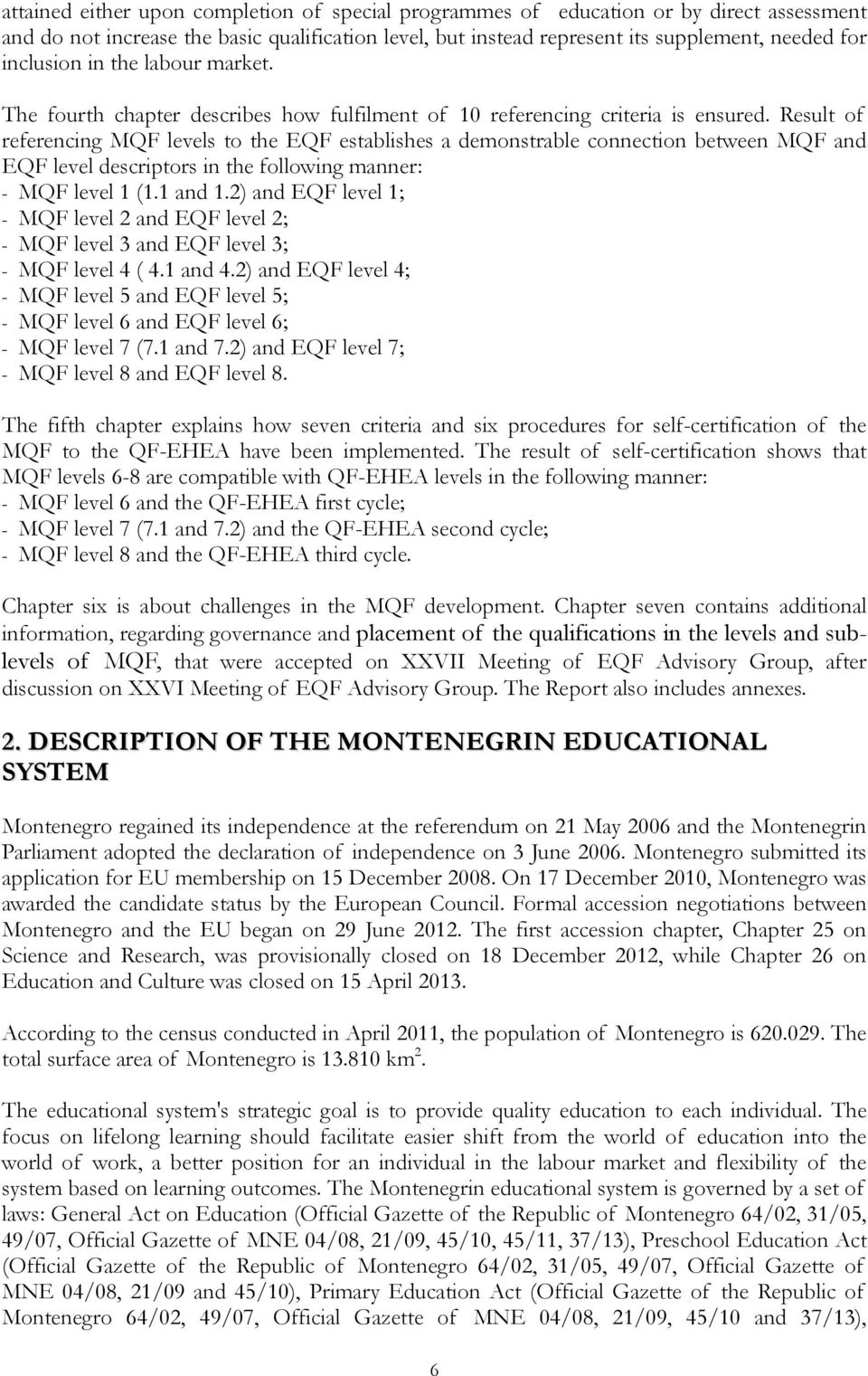
5 - Development of the MQF information administration system; - Support for elaboration of MQF related regulatory requirements; - Measures for promotion of non-formal and informal learning, including certification procedures; - Cooperation and exchange in the area of qualifications development with European partners, including support to introduce credit point transfer system for qualifications in vocational education. IPA 2007 Project supported the drafting of the National Qualifications Framework Act. 3 The Government's work plan sets the obligation for the Ministry of Education to prepare a Report on Referencing the National Qualifications Framework to the European Qualifications Framework. By producing the Referencing Report a preview of activities that were done in Montenegro in establishing Qualification Framework ant referencing its levels with levels of EQF was given, in order with Recommendation of the European Parliament and the Council on the establishment of the European Qualifications Framework for lifelong learning, 4 that invited the member state to reference their national frameworks to the EQF for lifelong learning, as well as to conform to decisions of ministers for higher education from the Leuven Communiqué that the state needed to carry out the self-certification process according to the QF-EHEA. The data and statements in the Report have been evaluated by the National Council for Education, the Higher Education Council and the Qualifications Council and they are relevant, transparent, comparable and consistent. Referencing Report has considerate Government of Montenegro. The Referencing Report was prepared by an inter-sectoral working group, comprised of representatives of the Montenegrin Employers Federation, Chamber of Economy of Montenegro, Employment Agency of Montenegro, Educational Trade Union of Montenegro, Ministry of Labour and Social Welfare, Ministry of Education, Bureau for Educational Services, Examination Centre, Education and Training Centre, state and private universities. Report has six chapters. The first chapter is an introduction. The second chapter offers a description of the Montenegrin educational system. The third chapter presents the MQF structure and concepts, responsibilities of bodies, quality assurance, etc. in accordance with the National Qualifications Framework Act. In accordance with the National Qualifications Framework Act, qualification in MQF are placed in eight qualification levels, with sub-levels at levels I, IV and VII. Levels and sub-levels have their descriptors. Each level descriptors include three categories: knowledge, skills and competence. Each qualification being placed to the framework includes learning outcomes that are described through these three categories of descriptors and each higher level incorporates knowledge, skills and competence from the lower level. MQF includes three types of qualifications: educational qualifications, vocational qualifications and additional qualifications. Educational qualification is attained upon completion of a publicly recognised educational or study programme formal education and attainment of necessary qualification volume. qualification is attained upon assessment of non-formal and informal learning and by an assessment upon completion of a special programme of education. Additional qualifications are 3 The National Qualifications Framework Act, Official Gazette of MNE 80/10. 4 Recommendation of the European Parliament and the Council on the establishment of the European Qualifications Framework for lifelong learning, OJ C 111/1. 5

6 attained either upon completion of special programmes of education or by direct assessment and do not increase the basic qualification level, but instead represent its supplement, needed for inclusion in the labour market. The fourth chapter describes how fulfilment of 10 referencing criteria is ensured. Result of referencing MQF levels to the EQF establishes a demonstrable connection between MQF and EQF level descriptors in the following manner: - MQF level 1 (1.1 and 1.2) and EQF level 1; - MQF level 2 and EQF level 2; - MQF level 3 and EQF level 3; - MQF level 4 ( 4.1 and 4.2) and EQF level 4; - MQF level 5 and EQF level 5; - MQF level 6 and EQF level 6; - MQF level 7 (7.1 and 7.2) and EQF level 7; - MQF level 8 and EQF level 8. The fifth chapter explains how seven criteria and six procedures for self-certification of the MQF to the QF-EHEA have been implemented. The result of self-certification shows that MQF levels 6-8 are compatible with QF-EHEA levels in the following manner: - MQF level 6 and the QF-EHEA first cycle; - MQF level 7 (7.1 and 7.2) and the QF-EHEA second cycle; - MQF level 8 and the QF-EHEA third cycle. Chapter six is about challenges in the MQF development. Chapter seven contains additional information, regarding governance and placement of the qualifications in the levels and sublevels of MQF, that were accepted on XXVII Meeting of EQF Advisory Group, after discussion on XXVI Meeting of EQF Advisory Group. The Report also includes annexes. 2. DESCRIPTION OF THE MONTENEGRIN EDUCATIONAL SYSTEM Montenegro regained its independence at the referendum on 21 May 2006 and the Montenegrin Parliament adopted the declaration of independence on 3 June Montenegro submitted its application for EU membership on 15 December On 17 December 2010, Montenegro was awarded the candidate status by the European Council. Formal accession negotiations between Montenegro and the EU began on 29 June The first accession chapter, Chapter 25 on Science and Research, was provisionally closed on 18 December 2012, while Chapter 26 on Education and Culture was closed on 15 April. According to the census conducted in April 2011, the population of Montenegro is The total surface area of Montenegro is km 2. The educational system's strategic goal is to provide quality education to each individual. The focus on lifelong learning should facilitate easier shift from the world of education into the world of work, a better position for an individual in the labour market and flexibility of the system based on learning outcomes. The Montenegrin educational system is governed by a set of laws: General Act on Education (Official Gazette of the Republic of Montenegro 64/02, 31/05, 49/07, Official Gazette of MNE 04/08, 21/09, 45/10, 45/11, 37/13), Preschool Education Act (Official Gazette of the Republic of Montenegro 64/02, 31/05, 49/07, Official Gazette of MNE 04/08, 21/09 and 45/10), Primary Education Act (Official Gazette of the Republic of Montenegro 64/02, 49/07, Official Gazette of MNE 04/08, 21/09, 45/10 and 37/13), 6
7 Education Act (Official Gazette of the Republic of Montenegro 64/02, 49/07, Official Gazette of MNE 45/10 and 37/13), General Secondary School (Gymnasium) Act (Official Gazette of the Republic of Montenegro 64/02, 49/07, Official Gazette of MNE 45/10 and 37/13), Adult Education Act (Official Gazette of the Republic of Montenegro 64/02 and 49/07, Official Gazette of MNE 04/08, 21/09 and 20/11), National Qualifications Act (Official Gazette of MNE 80/08), Act on Education of Children with Special Needs (Official Gazette of the Republic of Montenegro 80/04, Official Gazette of MNE 45/10), National Qualifications Framework Act (Official Gazette of MNE 80/10), Higher Education Act (Official Gazette of the Republic of Montenegro 60/03, Official Gazette of the Republic of Montenegro 45/10 and 47/11), as well as the Act on Recognition of Foreign Educational Certificates and Harmonisation of Qualifications (Official Gazette of MNE 57/11). The Ministry of Education is responsible for planning, implementing and improving the educational policy. For the purpose of providing decision-making assistance, the National Council for Education, the Higher Education Council, and the Qualifications Council have been established. The Bureau for Educational Services defines and ensures quality education in kindergartens and schools, performs developmental, advisory, and research activities in pre-university education. The Education and Training Centre is responsible for development, advisory support, and research in vocational education of young people and adults. External assessment of knowledge, skills and competence at the end of each primary education cycle, exams at the end of four-year secondary education, as well as assessments for attainment of national vocational qualifications is conducted by the Examination Centre. The Montenegrin educational system (Figure 1) includes preschool, primary, general secondary education (gymnasiums), vocational education, and higher education. The system is comprised of: 21 public and 13 private preschool institutions; 163 public primary schools; 47 public secondary schools (gymnasiums, vocational and combined schools) and one private gymnasium; 3 resource centres (for education of children with special educational needs), 80 licensed adult education providers, three universities and 9 autonomous private faculties. In the school year /2014, there were children enrolled at preschool institution, students at primary education institutions, students at secondary education institutions (vocational and general), and students at higher education institutions. Children with special educational needs attain their education in: ordinary school classes (as the first choice), special classes in ordinary schools (with joint hours for some subjects with peers from ordinary classes), in resource centres (when it is the only and the best interest of a child). 7

8 Figure 1: Montenegrin educational system 8

9 2.1. Preschool education Preschool education in Montenegro is provided in accordance with provisions of the General Act on Education and Preschool Education Act. Preschool education, which involves children up to the start of primary school, is not compulsory and it is not a precondition for admission to primary school. This form of education in Montenegro is carried out in preschool educational institution, which can be established as private and public. Preschool education is organised in: nurseries (children under the age of 3), kindergartens (from the age of 3 until they start primary school), and in other forms of organised preschool education, such as small schools, playrooms, workshops, etc. Preschool education is provided by means of the educational programme, which identifies objectives and tasks of education. This programme is adopted by the National Council for Education Primary education The main objectives of primary education are: making primary education available to every students in accordance with his/her potentials; acquisition of the knowledge required for the continuation of education; development of critical thinking and self-determination; providing the opportunity for personal growth of pupils; a responsible attitude towards oneself, one s health, towards other people; educate students to respect the values of national history and culture, as well as to respect differences and to recognize cultural and other peculiarities of other nations, education in support of sustainable development and developing enterprise and creativity. Organisation Primary education in Montenegro is provided in line with the provisions of the General Act on Education and provisions of the Primary Education Act. Primary education is compulsory and free of charge for all children citizens of Montenegro. Children enrol at primary school at the age of 6. Educational programmes of the nine-year primary school are implemented in three cycles (3+3+3). Educational programme Primary education is provided by means of the state-approved educational programme i.e. national curriculum for primary school, general part of which is defined by the Ministry of Education upon the proposal of the National Council for Education, while its special part for this education level is set by the National Council for Education, in line with article 22 of the General Act on Education. The educational programme sets a compulsory part, compulsory activities, and an extended part. The compulsory part includes basic compulsory subjects and compulsory elective subjects. Compulsory activities include assisted learning, class community hours, days of culture, sports, and workshop classes. The extended part of the programme includes: free activities and optional hours The educational programme used in primary education is published in the Official Gazette of Montenegro and posted on the web site of the BES

10 The contents and operational goals of subjects studied in primary school are categorised by years and cycles. Knowledge standards correspond to learning outcomes, defined with active verbs describing level of knowledge and understanding, have been set for all three cycles, the first, the second and the third. These knowledge standards are the basis for external assessment of achievements at the end of each educational cycle. A part of maths programme, with knowledge standards at the end of the primary school's third cycle, is provided in Annex 2. In addition to continuous assessments of pupils achievements, done by a teacher in his/her everyday work and on the basis of knowledge standards set in the educational programme, external assessments of achievements are also conducted in Montenegro at the end of each cycle - in the third, sixth, and the ninth year. External assessments are conducted by the Examination Centre, in cooperation with schools. This is national testing of knowledge. The method and manner of external assessment of pupils' knowledge at the end of each primary education cycle are governed by the rulebook of the Ministry of Education. 6 Upon successful completion of primary education, pupils receive a final primary school leaving certificate and can continue on to secondary education General secondary education Organisation General secondary education (gymnasium) is provided in line with the provisions of the General Act on Education and provisions of the General Secondary Education (Gymnasium) Act and it takes four years. A precondition to complete secondary education (gymnasium) is to take the external graduation (Matura) exam, which is a general precondition for continuation of education at a higher education institution. Implementation of revised educational programmes for gymnasiums started from the school year 2006/07. Educational programme The teaching in general secondary education is carried out based on state-approved educational programme for general secondary education, i.e. general gymnasium programme, common part of which is defined by the Ministry of Education, following the National Council for Education's proposal, while the special part of the programme for this education level is set by the National Council for Education, in accordance with article 22 of the General Act on Education. State-approved educational programme is published in the Official Gazette of Montenegro and the BES web site. 7 Students study the following within the general secondary educational programme, i.e. national curriculum: compulsory subjects elective subjects or groups of subjects, and compulsory elective topics, which complement graduation (Matura) standard for subjects taken at the graduation (Matura) exam. Programmes of individual subjects include, among other things, general objectives of subject programme, subject contents and operational goals and knowledge standards. Knowledge standards represent outcomes that indicate knowledge and skills a student needs to demonstrate 6 The Rulebook on the method and procedure for pupils' knowledge assessment at the end of an educational cycle, Official Gazette of MNE 62/

11 at the end of each year. An example of knowledge standard for English language subject from the general secondary education programme is given in Annex 3. Completion of education In addition to continuous assessment of student achievements, which is conducted based on standards set in programmes for each subject individually, the graduation exam (Matura) 8 is also taken at the end of general secondary education (gymnasium). The exam was organised for the first time in the school year 2010/2011. Students take the following in the graduation exam: - Montenegrin language or mother tongue and literature, - Mathematics or foreign language, and - Two elective subjects. There is a Matura standard defined for subjects that students take in the graduation exam and it is expressed in the syllabus through number of hours. Knowledge standards, i.e. outcomes and the manner of their assessment in the graduation exam are set by assessment catalogues, adopted by the National Council for Education. The assessment catalogues for subjects taken in the graduation exam can be found on the Examination Centre's web site ( By completing the educational programme for general secondary education a student attains education which is certified with diploma. Detailed explanation of types of qualifications that can be attained in the Montenegrin educational system is presented in Chapter education Organisation Secondary vocational education in Montenegro is provided in accordance with provisions of the General Act on Education and provisions of the Education Act. In line with the legal provisions, vocational education in Montenegro can be provided as: - Lower vocational education (two years), completion of which results in attainment of lower vocational education qualification; - Secondary vocational education (three or four years), completion of which results in attainment of three-year or four-year secondary vocational education qualification; - Post-secondary vocational education (two years, as continued secondary vocational education), completion of which results in attainment of higher vocational education qualification. The master craftsman's exam is also a vocational education. education is provided in the Albanian language as well, in 3 combined school in the municipalities of Plav and Ulcinj and in the city district of Tuzi. Educational programmes Educational programmes for vocational education, based on which state-recognised qualification is attained, are developed by using several occupational standards and qualification standards. Educational programmes are valued with credit points and consist of modules and general education subjects. The general part of an educational programme is defined by the Ministry of 8 The Rulebook on method, procedure, and time for taking graduaation exam in gymnasiums, Official Gazette of MNE 34/09, 19/10, 81/10, 60/11, 65/12 and 50/13. 11

12 Education, following the proposal of the National Council for Education, while the educational programme's special part is defined by the National Council for Education. Framework syllabuses, which define the scope of specific areas (general education subjects or modules, vocational-theoretical subjects or modules, practical training modules) for educational programmes of two-year, three-year, and four-year vocational schools are adopted by the National Council for Education. 9 Secondary vocational education is provided by means of 63 four-year educational programmes, 32 three-year educational programmes and 2 post-secondary vocational education programmes. These programmes were developed from 2003 to 2010, with the exception of two four-year educational programmes (Tourism Technician and Agriculture Technician), which were introduced in the school year /2014, as well as one higher vocational education programme (Cookery Manager). These three programmes are modularised, in line with the Methodology for modularisation and credit valuation of educational programmes, adopted by the National Council for Education. 10 A module is defined as a programmatic or organisational unit of objectives and contents that includes subjects. The methodology is aligned with the Recommendation of the European Parliament and of the Council on establishment of a European Credit System for Education and Training (ECVET). 11 Educational programmes developed by 2010 include operative objectives of subjects from a syllabus. In subject programmes, objectives are structured as informative, formative, and socialising and formulated by means of active verbs. The informative objectives define knowledge of concepts, procedures, methods, tools, devices, and theories. Formative objectives are defined as process related and developmental and indicate student's actions in a certain professional area based on his/her knowledge, skills and competence for solving tasks, application of knowledge in specific and new work related situations. Socialising objectives define development of personal and social attitudes and values, which affect quality of an individual's work and his/her social integration. Objectives in educational programmes of vocational education are directed at achievement of learning outcomes. The informative objective column emphasises information that a teacher has to deliver to students. The column with formative objectives, which are formulated by using active verbs, emphasises what a student will do and how things learned are to be applied. When educational programmes are developed, the column with formative objectives is first defined - what a student needs to do and how he/she could perform tasks and activities set by occupational standard. Annex 4 contains an example of objectives defined in the educational program from the field of automotive mechatronics. Once the National Qualifications Framework Act was adopted and conditions for its implementation were created, development of qualification standards commenced. The qualification standards defined learning outcomes and linked them to key tasks in relevant occupational standards. Educational programmes Tourism Technician and Agriculture Technician were developed based on such qualification standards. These programmes are modularised and modules as programme units are credit valued. 9 Development of educational programmes in vocational education, Council for Education, 2008, National Council for Education,. 10 The methodology for modularisation and credit valuation of educational programmes in vocational education, National Council for Education, March Recommendation of the European Parliament and of the Council of 18 June 2009 on the Establishment of a European Credit System for Education and Training. 12

13 Even though learning outcomes were not used explicitly in educational programmes for primary and secondary education, educational programmes concept clearly shows what the learner should know, understand and be able to demonstrate at the conclusion of a period of learning. In this way, a gradual shift to learning outcomes is made. The Education Act defines that vocational education is provided by a school (schoolbased type) or an employer together with a school (education at employers, dual mode). Within the school-based mode, practical training is organised in school premises (workshops, classrooms, laboratories, school-owned company, students' cooperatives) and in buildings belonging to the school that are located outside the school (company, institution, or a shop). The school is responsible for education and assessment of student achievements in practical training. If vocational education is provided by employers and schools together, in so called dual type, conditions that an employer needs to fulfil with regard to practical education, training of persons who instruct students and equipment are set by the association of employers Level of practical training achievements for a student educated by an employer are assessed by the employer and the school at the end of each school year For the duration of practical training at an employer's, the student exercises labour relations rights, in accordance with labour related regulations. Of the total number of students educated in vocational education programmes in the school year 2014/2015, about 20% of them are in the tourism and hospitality sector. Approximately the same number of students are educated in the programmes from the sector of economics, while some 14% of students are in the electrical engineering sector, about 12% in the healthcare sector, and 10% in the transportation sector. Remaining students are educated in educational programmes from the sectors of mechanical engineering, construction, agriculture, services, and art. Completion of education programme Lower vocational education is completed once a student takes and passes the practical exam. 12 The exam includes practical assignment - product or service with a supporting presentation. Three year secondary vocational education programme is completed once a student takes and passes the final exam. 13 The exam includes: - Exam in the Montenegrin language or mother tongue and literature, - Exam in qualification related theoretical subject, and - Practical assignment - product or service with a supporting presentation. The vocational exam is taken at the end of four-year vocational education programme. In accordance with the amendments to the Education Act from, vocational exam can be external and internal. The external vocational exam, which is a precondition for continuation of education in higher education institutions, is organised by the Examination Centre, in cooperation with schools and in line with the Rulebook on method and procedure for taking vocational exam. 14 The internal vocational exam is organised by the school. The method 12 The Rulebook on the method and procedure for taking practical, final, and graduate exam, Official Gazette of MNE 26/07, Official Gazette of MNE 19/ Ibid. 14 The Rulebook on method and procedure for taking vocational exam, Official Gazette of MNE 82/09, 19/10, 81/10, 60/11, 65/12 and 58/13. 13
14 and procedure for taking internal vocational exam is governed by the relevant of the ministry of Education. 15 The vocational exam includes: - Exam in the Montenegrin language or mother tongue and literature, - Exam in mathematics or the first foreign language, in line with the educational programme, - Exam in qualification related theoretical subject, and - Practical assignment with a supporting presentation. An example of catalogue for assessment for the practical part of vocational exam, profession related assignment, is given in Annex 5. Post-secondary vocational education is completed once a student takes and passes the graduate exam. 16 The graduate exam consists of: - Written or oral or both written and oral exam in qualification related theoretical subject, in line with the educational programme, and - Thesis or practical assignment with a supporting presentation. The Master craftsman's exam is taken by candidates who complete three-year vocational school and have three years of work experience in the profession, as well as candidates who complete four-year vocational school and have two years of work experience in the profession. In line with article 88 of the Education Act, the Master craftsman's exam is taken in front of the commission appointed by the representative employers association. The method and procedure for taking master craftsman's exam are prescribed by the ministry responsible for labour affairs, in cooperation with employers association and VET Centre. A has been produced that will enable implementation of the master craftsman's exam and define in more details procedures for taking this exam..17 Employers associations and ministries responsible for labour and education, among others, are involved in drafting process. Responsibilities of institutions and bodies with regard to preparation, organisation, and valuation of results are set by the law and relevant rulebooks (on practical, final, vocational, and graduate exam). Learning outcomes are set in assessment catalogues, adopted by the National Council for Education. Assessment catalogues are developed based on knowledge standards, included in subject programmes and are available on the Examination Centre's web site ( Advancement /progression Upon successful completion of two-year education, it is possible to continue studies in threeyear schools, by taking additional and differential exams. A student who completes two-year or three-year school may continue his/her studies based on four-year programmes after taking and passing additional and differential exams. Additional exam is taken in the subject that the student studied to a lesser extent than required by the educational programme. Differential exam is taken in a subject that the student did not study at all. Candidates who pass the external vocational exam may enrol directly at an appropriate postsecondary vocational school. Individuals who pass the Master craftsman's exam may also enrol at 15 The Rulebook on method and procedure for taking vocational exam for students who do not continue with their education, Official Gazette of MNE 58/ The Rulebook on the method and procedure for taking practical, final, and graduate exam, Official Gazette of MNE 26/07, Official Gazette of MNE 19/ The Rulebook on the method and procedure for taking master craftsman's exam, Official Gazette of MNE 27/14. 14

15 a post-secondary vocational school, after they take and pass additional exams (general education subjects from the vocational exam). An individual who graduates from a four-year vocational school, and wishes to attain general secondary (gymnasium) Matura, may attend the Matura course. An individual who graduates from the general secondary school (gymnasium), and wishes to attain a diploma of a four-year vocational school, may attend the vocational course. Quality assurance On the subject of quality assurance model in formal education, the legal framework for its implementation is defined in provisions of the General Act on Education and provisions of the Rulebook on the contents, forms and methods of quality assurance of education in institutions (Official Gazette of the Republic of Montenegro 18/04 and Official Gazette of MNE 8/12). This Rulebook specifies that quality assessment of education in an institution is performed externally and internally, where internal quality assessment is performed by institution itself and external quality assessment by authorised advisors and educational supervisors of the BES (in general education institutions), or the BES and the VET Centre (if it is about vocational education). The report on quality assessment of an institution includes a description of factual situation with proposed measures the institution needs to implement to improve the quality. Based on recommendations from the report, the institution drafts a plan for education quality improvement, which is delivered to the BES or to the VET Centre and Ministry of Education. The report is public and is published on the institution's notice board, as well as on the web sites of the BES and the VET Centre. 18 Internal evaluation (self-evaluation) process is a legally defined obligation of schools, for some indicators every year and for some other indicators every second year. 19 The same key areas and the same indicators are also used within self-evaluation, which is carried out by the educational institution's management. By comparing external and internal findings, the aim is to gain realistic insight into the quality of educational process taking place in the institution and design appropriate development programme, which should help the institution overcome identified deficiencies. Up to the level of higher education, the educational system is also monitored and evaluated through external assessment of student achievements at the end of each cycle or level of education, which is the responsibility of the Examination Centre of Montenegro Adult education Adult education has been promoted among different target groups (drop-outs, the unemployed without a qualification or with a qualification not demanded in the labour market, the employed and unemployed persons who need education and training for adaptation to the labour market). It is provided in line with the Adult Education Act and other acts. Adults who wish to attain an education qualification are educated according to adapted publicly recognised educational programmes for formal education. Programmes of education for retraining and additional training, also known as training programmes, after which a national vocational qualification may be attained through assessment, General Act on Education, article General Act on Education, article 41b. 15

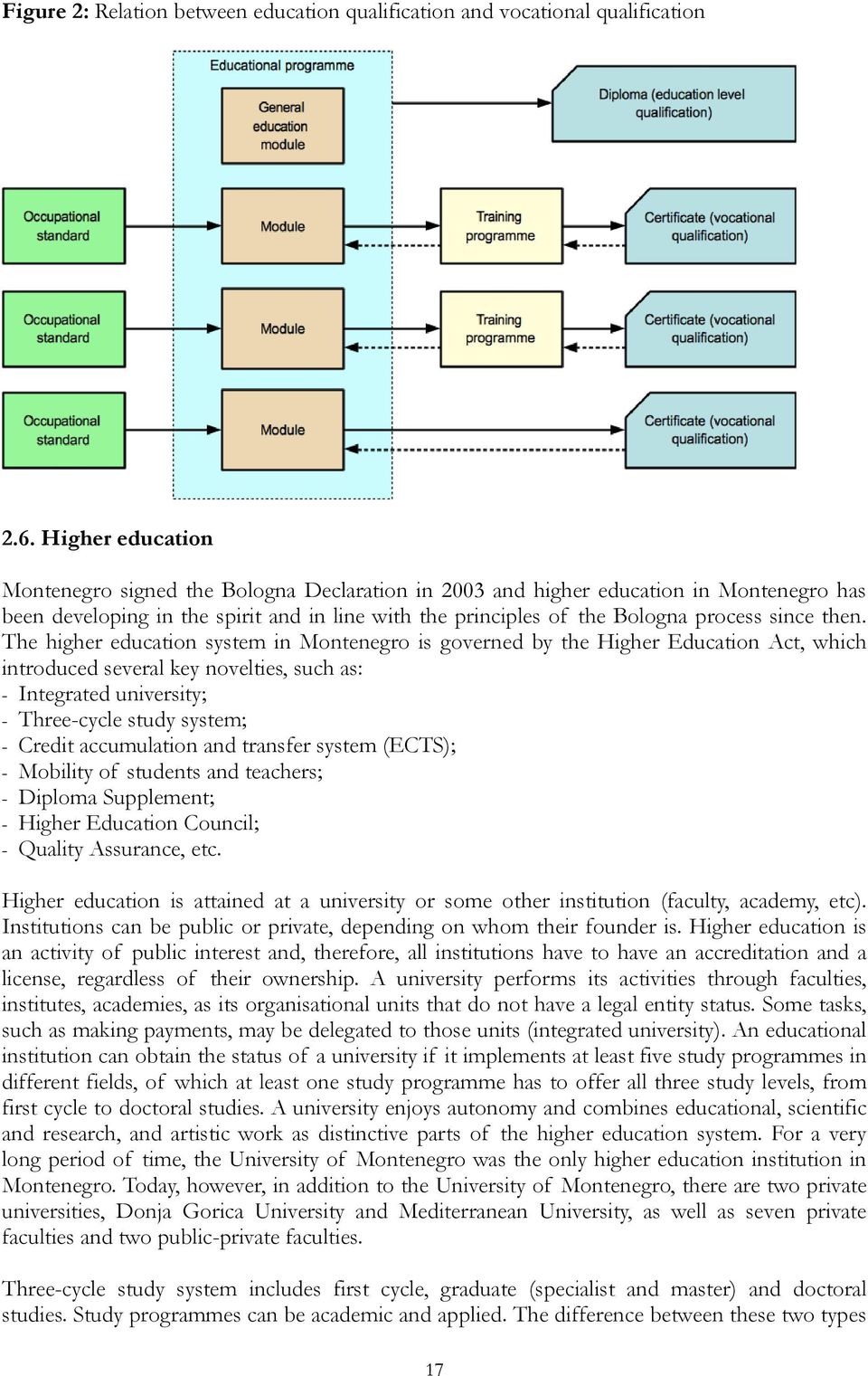
16 are set up by the National Council for Education and adopted by the Ministry of Labour and Social Welfare. 88 different programmes of education have been adopted so far. Adult education can be organised at school, specialised adult education organisations, institution for care and accommodation of persons with special needs, as well as other legal entities that meet prescribed conditions and have a licence to work issued by the Ministry of Education, in accordance with the law and relevant rulebook licenses for implementation of adult study programmes have been issued to education providers by the Ministry of Education. The adults may attain an educational which is certified with a diploma (formal education), in accordance with the General Act on Education, Primary Education Act, General Secondary School (Gymnasium) Act, Education Act, and Higher Education Act. Organisation of education is adapted for adult learners, for the purpose of attaining vocational school or gymnasium diploma (part-time). Adult learners who complete an educational programme and wish to continue their in another studies in to attain an educational can have some of the subjects or modules, which they successfully completed and which are common for both programmes, recognised. Adult learners may also attain a national vocational which is verified with a certificate, in accordance with the National Qualifications Act. Attainment of a national vocational qualification means assessment and verification of knowledge, skills, and competence by the Examination Centre, regardless of the method of their attainment, after which a publicly recognised certificate is issued. The procedure for vocational qualification attainment is explained in Chapter 3. The National Qualifications Act enables establishment of relation between formal education and non-formal and informal learning, through occupational standard as a common element of formal education programmes (in vocational education) and training programmes. A training programme is aligned with a part or a module of an educational programme if the same occupational standard is the basis for their development - in that case, learning outcomes from a training programme (for adults) and a module from formal educational programme are the same. This allows persons who stopped their education to attain a certificate of national vocational qualification for a programme's part (module) they successfully completed. Adult learners, who successfully complete assessment at the Examination Centre and attain nationally valid vocational may have their certificate accepted for continuation of formal education and attainment of formal education qualification. Relation of educational programmes and training programmes is shown on Figure The Rulebook on more detailed conditions for establishment of institutions in the field of education (Official Gazette of the Republic of Montenegro 40/06). 16

17 Figure 2: Relation between education qualification and vocational qualification 2.6. Higher education Montenegro signed the Bologna Declaration in 2003 and higher education in Montenegro has been developing in the spirit and in line with the principles of the Bologna process since then. The higher education system in Montenegro is governed by the Higher Education Act, which introduced several key novelties, such as: - Integrated university; - Three-cycle study system; - Credit accumulation and transfer system (ECTS); - Mobility of students and teachers; - Diploma Supplement; - Higher Education Council; - Quality Assurance, etc. Higher education is attained at a university or some other institution (faculty, academy, etc). Institutions can be public or private, depending on whom their founder is. Higher education is an activity of public interest and, therefore, all institutions have to have an accreditation and a license, regardless of their ownership. A university performs its activities through faculties, institutes, academies, as its organisational units that do not have a legal entity status. Some tasks, such as making payments, may be delegated to those units (integrated university). An educational institution can obtain the status of a university if it implements at least five study programmes in different fields, of which at least one study programme has to offer all three study levels, from first cycle to doctoral studies. A university enjoys autonomy and combines educational, scientific and research, and artistic work as distinctive parts of the higher education system. For a very long period of time, the University of Montenegro was the only higher education institution in Montenegro. Today, however, in addition to the University of Montenegro, there are two private universities, Donja Gorica University and Mediterranean University, as well as seven private faculties and two public-private faculties. Three-cycle study system includes first cycle, graduate (specialist and master) and doctoral studies. Study programmes can be academic and applied. The difference between these two types 17
18 of study programmes is that students who complete academic studies can proceed all the way to doctoral studies, while students who complete applied studies programme can proceed to master studies only. Applied study programmes are primarily focused on acquiring applied knowledge, while academic study programmes are more focused on acquiring theoretical knowledge. First cycle studies last for 3 or 4 years (180 ECTS/ 240 ECTS), with the exception of first cycle studies in medical science that last longer (dentistry 5 years and medicine 6 years). Graduate specialist studies last for one year after the completion of first cycle studies (3+1 years), and graduate master studies last for two years after the completion of basic studies (3+2 years) or one year after the completion of first cycle and specialist studies (3+1+1 years) or one year after the completion of four-year first cycle studies (4+1 years). Doctoral studies last for 3 years. Since 2004, all higher education institutions in Montenegro are required to apply the European credit transfer and accumulation system (ECTS). Credit valuation enables us to articulate the volume of a study programme, year, semester and of each subject separately within a study programme. Student workload per study year is 60 credits. Workload per subject is indicated through a numeric value corresponding to overall workload per study year (60 ECTS). Each subject/course has a specific number of credits that are awarded according to the overall actual student workload, i.e. time and work that an average student needs to master a course, i.e. to study a subject. Credits are awarded to all components of a study programme, not only to subjects, but also to a specific module, project assignment, final thesis, specialist thesis, master thesis, PhD thesis, etc. The Act on National Qualifications Framework has introduced the Montenegrin Credit Transfer System (MCTS). One MCTS is awarded for 25 hours of work, which is fully compatible with the European standard for student workload, i.e. ECTS credit award. Student workload per subject/course is determined based on the number of hours of lectures and exercises (attendance), planned seminar papers and/or assignments, and all other activities needed to master a subject, i.e. achieve set objective, including learning outcomes. Each subject/course is accompanied by an information list (info package) with more detailed information on the subject. Mobility of students, as one of the most important legacies of the Bologna process, has been in place in the Montenegrin higher education system, too. During his/her studies, a student is entitled to spend some time (a semester or an academic year) at another higher education institution, through a student exchange programme. Montenegrin students have exercised this right through Erasmus Mundus and CEEPUS programmes so far. Furthermore, students can also practise mobility through bilateral agreements between universities. In the case of mobility, a student signs a contract with his/her university/faculty that needs to contain provisions on the number of credits and recognition of courses to be attended. All credits the student earns or subjects he/she passes during his/her stay at other institutions are recognised. Teaching and administrative staff are also entitled to spend some time in other institutions through a mobility programme. Diploma supplement has been designed according to the European model and is issued together with diploma to all students who complete certain level of study. The content of diploma supplement is prescribed by a regulation of the Ministry of Education and it is an identical, binding form for all higher education institutions in Montenegro. Diploma supplement includes all the data relevant for a student and represents a transparent overview of the student's attainment and achieved results in reaching objectives set by the study programme. Diploma supplement is issued in two languages, English and official Montenegrin language, as well as in languages that are officially used (Serbian/Bosnian/Croatian). If a study programme is taught in 18

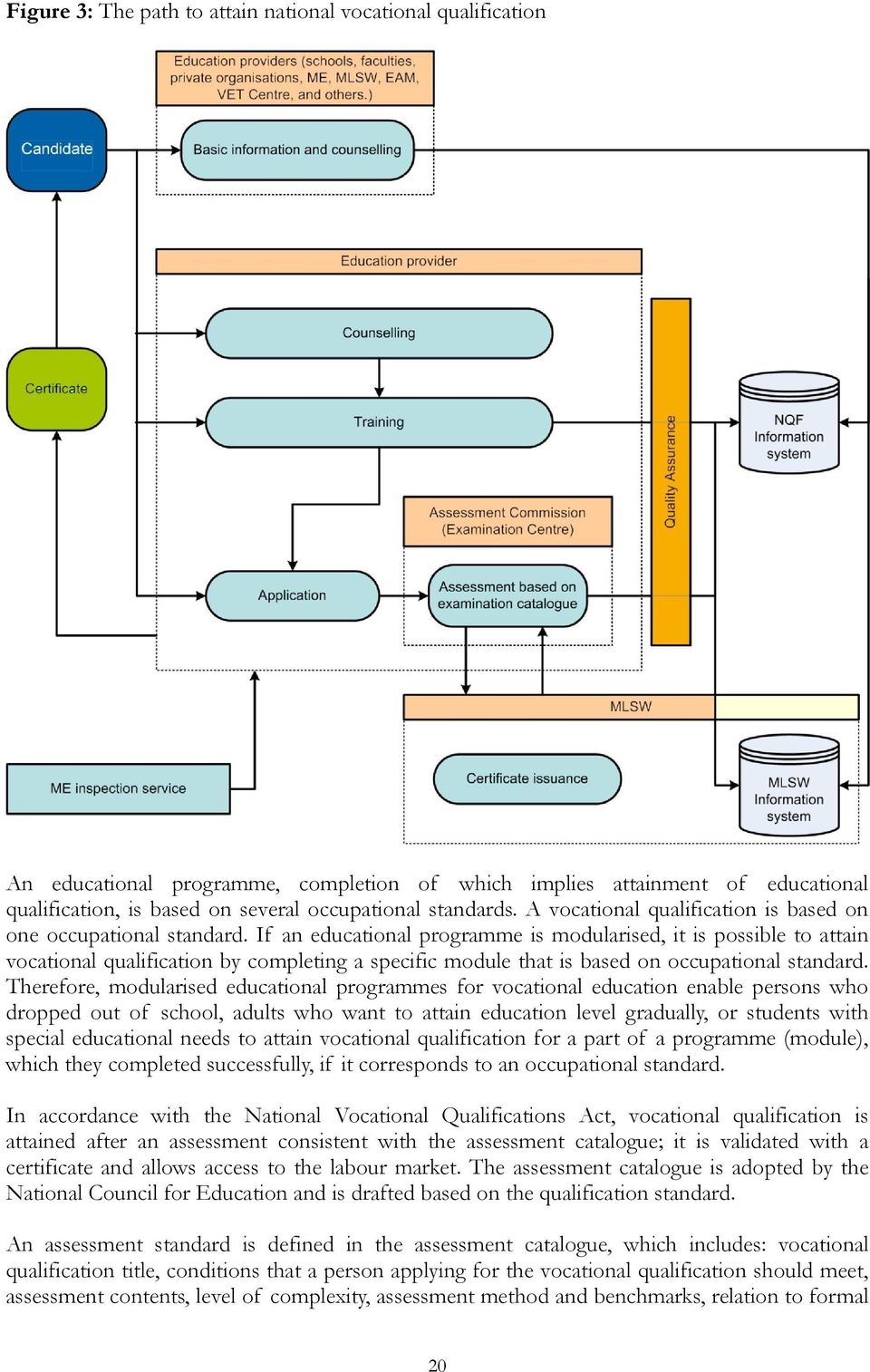
19 the Albanian language, or in some other foreign language, then diploma and diploma supplement are issued in that language. In addition to the Ministry of Education, which is responsible for the overall educational policy in Montenegro, the 2003 Higher Education Act established also the Higher Education Council, with the aim of improving higher education. So far, the Council's key role has included accreditation of study programmes and external quality assurance through reaccreditation procedure. The Council is comprised of 13 members who are appointed from among the ranks of eminent experts in the field of higher education, science, technology and art, and from the fields of economics, social affairs and other relevant fields, as well as from the ranks of students, in accordance with the Council appointment document. The Council has adopted a number of documents that are used in accreditation procedure and external quality assessment of higher education institutions. In accordance with this, 16 assessment criteria are checked in the course of reaccreditation of institutions and study programmes. Recognition of foreign qualifications that are acquired in field of the higher education, as well as in the field of primary, general and VET education, is based on the Act on Recognition of Foreign Educational Certificates and Harmonisation of Qualifications. 22 Recognition is carried out by ENIC Center which exists within the Ministry of Education (field of higher education) and the Ministry of Education Recognition of non-formal and informal learning The aim of developing the National Qualifications Act is to enable individuals to attain nationally recognised vocational qualification by way of an assessment, i.e. evaluation of their previously acquired knowledge, then by an assessment after they complete programme of education, or when they complete a part or a module of a programme, if that part is based on an occupational standard. Occupational standard is an element connecting formal education and non-formal and informal learning, for qualification levels I-V. In accordance with the National Qualifications Act, a national vocational qualification is an officially recognised developed based on an occupational standard and attained by means of: - Assessment after completing special programmes of education and training; - Direct assessment of previously acquired knowledge, skills and competence, regardless of the manner they are acquired; - Completion of a part or a module of a programme. The procedure for attaining national vocational qualification is shown in Figure Act on Recognition of Foreign Educational Certificates and Harmonisation of Qualifications, Official Gazette of MNE 57/11. 19

20 Figure 3: The path to attain national vocational qualification An educational programme, completion of which implies attainment of educational is based on several occupational standards. A vocational qualification is based on one occupational standard. If an educational programme is modularised, it is possible to attain vocational qualification by completing a specific module that is based on occupational standard. Therefore, modularised educational programmes for vocational education enable persons who dropped out of school, adults who want to attain education level gradually, or students with special educational needs to attain vocational qualification for a part of a programme (module), which they completed successfully, if it corresponds to an occupational standard. In accordance with the National Qualifications Act, vocational qualification is attained after an assessment consistent with the assessment catalogue; it is validated with a certificate and allows access to the labour market. The assessment catalogue is adopted by the National Council for Education and is drafted based on the qualification standard. An assessment standard is defined in the assessment catalogue, which includes: vocational qualification title, conditions that a person applying for the vocational qualification should meet, assessment contents, level of complexity, assessment method and benchmarks, relation to formal 20
21 education programme, credit points, educational profile and education level of examination commission members, conditions that assessment organiser should meet, and other information relevant for vocational qualification. The assessment is organised by the Examination Centre. qualifications in the higher education area will be regulated in more detail with a special regulation, in line with the Higher Education Act. Primary objective of qualification validation with publicly recognise certificates is to develop and carry out the assessment procedure, for the purpose of recognition of previously acquired knowledge and learning, in line with state-approved occupational standards. The result of qualification certification is a certificate - state recognised document that verifies a vocational qualification at a certain level of complexity, but not an education level. A certificate is not a substitute for a diploma, i.e. an education level document. Validation of non-formal and informal learning meets the needs of young people, adults and the labour market, but it also supports the use of lifelong learning principles. 3. NATIONAL QUALIFICATIONS FRAMEWORK 3.1. Legal framework The Montenegrin system of qualifications is governed by the National Qualifications Framework Act, the Rulebook on descriptors for qualification levels and sub-levels, 23 the Rulebook on procedures for developing qualifications form level I to level V, 24 the Rulebook on procedures for developing qualifications form level VI to level VIII, 25 as well as by a set of regulations in the field of education, including the National Qualifications Act. In line with the National Qualifications Framework Act, and for the purpose of improving the qualifications system, approving and placing qualification in the Qualifications Framework, the Government of Montenegro constituted the Qualifications Council. 26 For each of 15 qualification sectors, set by the Act, the Qualifications Council has set up sectoral commissions. The Qualifications Council has adopted: the Guidelines for sectoral commissions, the Guidelines for qualifications development (levels 1-5), the Methodology for assigning codes to qualifications, and the Methodology for placing qualifications to the National Qualifications Framework. Also, the National Council for Education has adopted the Methodology for modularisation and credit valuation of educational programmes in vocational education. With adoption of these documents, conditions have been created to develop qualifications in compliance with the National Qualifications Framework Act MQF Development The European Union member states are committed to referencing their own national qualifications framework to the European Qualifications Framework (EQF) in order to facilitate mobility in education and employment. On its European path, Montenegro is oriented towards 23 Rulebook on descriptors for qualification levels and sub-levels, Official Gazette of Montenegro 51/ Rulebook on procedures for developing qualifications form level I to level V, Official Gazette of Montenegro 21/ Rulebook on procedures for developing qualifications form level VI to level VIII, Official Gazette of Montenegro 21/ Decision of the Government of Montenegro on constitution of the Qualifications Council, Official Gazette of Montenegro 29/11. 21
22 compliance with the decisions, conclusions and recommendations of the European Union's authorities and bodies, in the field of education in this specific case. As previously mentioned, in accordance with "The Strategy for National Qualifications Framework establishment" that has set goals and activities with regard to MQF development, deadlines, institutions and bodies responsible for their implementation and with help from IPA 2007 Project; the National Qualifications Framework Act is drafted. In this way a basis for establishing MQF was made. Moreover, the aim of introducing and developing MQF is to make the system of qualifications based on learning outcomes easier to understand at the national and international level, to increase coherency of the qualifications system by correlating different parts of education and training, to facilitate recognition of non-formal and informal learning and link them to formal education, to make the qualification attainment procedure transparent and to support life-long learning. The MQF is based on: - Credit value of qualifications; - Defined learning outcomes (knowledge, skills and competence); - Credit transfer; - Progression from one qualification to another; - Recognition and valuation of knowledge acquired in a non-formal and informal manner; - Cooperation of all stakeholders and transparency of procedures; - Quality assurance in the process of qualification development and attainment Basic concept and structure of the MQF In accordance with the National Qualifications Framework Act, the qualifications framework includes: - Qualification levels and sub-levels; - Descriptors for each qualification level and sub-level; - Types of qualifications, where qualifications can be educational qualifications, vocational qualifications and additional (other) qualifications; - Credit value of qualification Levels and level descriptors Qualification levels are the basic structural element of the qualifications framework. MQF qualifications are placed in eight qualification levels, with sub-levels at levels I, IV and VII. Levels represent a series of successive steps expressed through generic descriptors. Each level descriptors include three categories: knowledge, skills and competence. Each qualification being placed to the framework includes learning outcomes that are described through these three categories of descriptors and each higher level incorporates knowledge, skills and competence from the lower level. Levels of knowledge, skills and competence are increasing, so that descriptors at level I, for example, represent the basic knowledge, skills and competence, while at level VII1, for example, they reflect complex expectations in terms of depth and breadth of knowledge, skills and competence, including possession of the ability to work independently. Sub-levels at levels I, IV and VII reflect the need to facilitate placement of qualifications attained in the educational system prior to adoption of the National Qualifications Framework Act. Descriptors of sub-levels within a specific level are similar the difference between sub-levels, within a specific level, is whether the emphasis is on knowledge (for example, whether they are general and vocational or general), skills (cognitive and practical or practical) or competence (for 22
23 example, independence in narrow or broad area). Sublevels were introduced at some levels due to the need to address characteristic requirements of the labour market. Qualifications are placed based on complexity of accomplished learning outcomes, described through knowledge, skills and competence in eight levels of the Qualifications Framework. Qualification level (and sub-level) descriptors indicate complexity and scope of acquired knowledge, skills and competence. Learning outcomes are defined as statements that indicate what an individual knows, understands and is able to do at the end of a learning process, regardless of the manner in which he/she learned. They are represented through knowledge, skills and competence. Learning outcomes are defined as statements on what a candidate is expected to be able to do after a learning process. Knowledge is defined as a set of acquired and correlated information that are result of learning. Skills represent abilities to apply knowledge when solving tasks and problems and they can be cognitive and manual (practical). Competence includes abilities to apply knowledge and skills that an individual demonstrates in a working or learning environment. They include the domain of autonomy and responsibility. Level and sub-level descriptors of MQF qualifications, defined by the Rulebook on descriptors for qualification levels and sub-levels, 27 are given in Table 6. In accordance with article 10 of the National Qualifications Framework Act, descriptors for qualification levels and sublevels were discussed by the National Council for Education, Higher Education Council, and Qualification Council Types of qualifications The National Qualifications Framework Act defines three types of qualifications (groups of types of qualifications): educational qualifications, vocational qualifications and additional qualifications. Educational qualification (education level qualification) is attained upon completion of a stateapproved educational or study programme and attainment of necessary qualification volume. This qualification obtained within the formal education system and validated with a diploma. The procedures for attainment of educational qualification are set by the National Qualification Framework Act and acts and rulebooks from field of education. qualification is a vocational ability, at given level of complexity required, to perform sets of tasks within an occupation. It is attained after direct assessment of formally and informally attained knowledge or assessment upon completion of a special programme of education. It may also be attained after successful completion of a part (module) of a formal education programme that corresponds to an occupational standard. qualification is validated with a certificate. The procedures for attainment of vocational qualification are set by the National Qualifications Act and the National Qualification Framework Act. Additional qualification is qualification required for getting a specific task or set of tasks, upon attaining basic qualification. They are mostly demanded by employers. These qualifications do not increase the basic qualification level, but instead represent its supplement and indicate additional ability of the individual, needed for inclusion in the labour market, for example 27 The Rulebook on level and sublevel qualification descriptors, Official Gazette of MNE 51/11. 23
24 professional exam for a job in education. They are validated with a certificate, confirmation or a proof, in line with the special regulation. The process of development of these qualifications will be established in next phase of development of the MQF. Correlation between specific types of qualifications is shown in Table 1, which shows a sector related qualification framework. In the field of vocational education, for qualification levels II, III, IV and V, where qualifications are based on an occupational standard, educational qualification comprise several occupations (occupational standards). For example, a person who attains a tourism technician diploma (i.e. educational qualification), also attains vocational qualifications for a receptionist, travel agency clerk, and wellness & spa receptionist. If a student drops out, but has successfully completed modules and subjects, set by qualification standard for a receptionist for example, he/she attains vocational qualification 'receptionist', which has a credit value. After attending the training programme and assessment by the Examination Centre, an adult learner may also attain vocational qualification 'receptionist', validated with a certificate. If this person wants to continue his/her education and attain diploma of tourism technician, the certificate on attained vocational qualification will be accepted for continuation of education. The National Qualifications Act allows attainment of a diploma, i.e. educational qualification after successful completion of all educational programme modules and exam defined for education completion. (In the above example, since it is the qualification level IV1, it is necessary to attain three vocational qualifications and pass the vocational exam). qualification may be attained for a qualification that does not exist in formal education, for example for a chambermaid. In that case, the columns educational qualification and additional qualification remain empty. Occupational standards are not produced for qualifications at levels VI-VIII. Table 1: Sector related qualification framework Level I II Sublevel I1 I2 Occupational standard Educational qualification (diploma) qualification (certificate) Additional qualification (certificate, confirmation) III IV V VI VII IV1 IV2 VII1 Receptionist Travel agency clerk Wellness &SPA receptionist Tourism technician Receptionist Travel agency clerk Wellness &SPA receptionist VII 2 24
25 Additional Educational Level Occupational qualification Sub- qualification qualification standard (certificate, level (diploma) (certificate) confirmation) VIII Credit value of qualification Credit value of qualification (qualification volume) is determined with number of credits. The credit system, i.e. the system for measuring qualification volume in the MQF is an instrument for accumulation of learning outcomes earned in formal, non-formal and/or informal environment, as well as their easier transfer from one environment into the other for validation and recognition purposes. A credit is a measurement unit for validation of work that a learner needs to win in order to accomplish objectives and it is used to measure workload of a learning individual given the time needed to complete, i.e. accomplish learning objectives. Each qualification from the MQF is assigned a proper number of credits at a certain level. The total number of credits is reached by adding the total number of credits of qualification units that make a qualification. One credit of the Montenegrin Credit Transfer System (MCTS) refers to 25 hours of workload for all learning activities: - Formal learning (hours of theory, hours with exercises); - Independent work, consultations, etc; - Non-formal learning (seminars, courses, trainings, etc); - Practical work; - Informal learning; - Assessment. For level V qualifications, VET Centre, in cooperation with social partners, develops occupational standard and qualification standard. These standards are based on a basic description, i.e. profile of qualification that includes learning outcomes, presented in the qualification development initiative. Credit points are awarded to learning outcomes that are grouped into units and are determined depending on their complexity and required workload for an individual, who needs to achieve defined learning outcomes. Credit value of qualification units is transferred into programmes. For qualifications from level VI and on, a higher education institution develops a study programme based on a description - profile of qualification that includes basic learning outcomes, defines objectives and outcomes for specific subjects or modules and assigns credit points to programme parts (subjects/modules). Credit points are assigned to programme elements that include learning outcomes based on their complexity and estimated workload for students who need to achieve defined learning outcomes. Credits are transferable. Once acquired, a credit or credits can be used for acquiring more than one qualification at the same level, containing this (common) unit/module. Educational qualification volume is set with the smallest number of 60 MCTS credits, which corresponds to one academic year (in formal education). The Montenegrin Credit Transfer System (MCTS) corresponds to the European Credit System for Education (ECVET) and to the European Credit Transfer System (ECTS). 25
26 3.4. Sectors of qualifications The National Qualifications Framework includes 15 sectors: 1. Education and training; 2. Humanities and art; 3. Social sciences; 4. Science; 5. Engineering, production technologies (including mechanical engineering and metal processing, electrical engineering and automation, metallurgy, etc.); 6. Construction and spatial planning; 7. Economics and law; 8. Agriculture, food and veterinary; 9. Health and social protection, 10. Tourism, trade and animal health; 11. Transportation and communication; 12. Services; 13. Interdisciplinary fields; 14. Mining, metallurgy, and chemical industry; 15. Information technologies. Sectors of qualifications have their qualification frameworks that include sub-sectors, fields and qualifications of all types and levels. This document shows types of qualifications at separate levels and sub-levels within a sector, sub-sector and field of qualification. The sector qualification framework reflects current publicly of affairs in each sector.- indicating which qualifications exist and their correlation, and they are designed in a manner that enables their further development, open for addition of new qualifications, in line with labour market needs and changes. The MQF consolidates qualification frameworks for individual sectors and puts them in a general systemic context. Classification of qualifications within a sector, which contains sub-sectors, fields and qualifications is shown in Table 2. An example of qualification placement and classification is given in Annex
27 Table 2: Form of classification of qualifications within a sector Sector SECTOR Sub-sector SUB- Field code FIELD QUALIFICATION Type Level code code SECTOR.. Qualificati on code abcdefgh.ijk Sector ordinal number ab Sub-sector title abcd Sub-sector 1 title abcdef Field 1 title... Field 2 title. 27
28 Development of qualifications (levels I-V) Qualification development (levels 1-5) encompasses development of an occupational, educational or additional standard and development of a qualification standard. A qualification standard is developed based on an occupational, educational or other standard. An educational programme, special programme of education or other programmes are developed based on a qualification standard, upon completion of which a learner attains respective qualification (education level, vocational or additional qualification). A qualification is developed based on the methodological document "Guidelines for qualifications development for levels I-V", adopted by the Qualifications Council 28. This methodological document is aligned with the Rulebook on qualifications development for qualification levels I to V. 29 Educational qualification is developed based on several related occupational standards (vocational education), or based on educational standard (general education). qualification is developed based on one occupational standard. Additional qualification is developed based on educational or some additional standard. The initiative for qualification development can be submitted by a relevant sectoral commission, VET Centre or BES. The initiative for a qualification contains the profile of qualification that includes learning outcomes and/or key tasks and groups of tasks, with the title of the level of assessment of labour market and society's needs, international comparability, etc. The initiative for development of an educational or additional qualification includes competence or key tasks and groups of tasks, assessment of labour market and society's needs international comparability, etc. The initiative for qualification development can also be submitted by a university, a higher education institution, a school or any other legal entity, through VET Centre and BES. The VET Centre or the BES decides which sector the qualification belongs to. If it is not possible to determine which sector the qualification belongs to, the decision is made by the Qualifications Council. The VET Centre or the BES may accept the initiative, ask for its amendment or reject it. In case it is rejected, the VET Centre or the BES inform the applicant on reasons for rejection, in writing. The VET Centre or the BES submits the accepted initiative for the development of a new qualification to the sectoral commission, in a form of a written elaborated proposal. The sectoral commission discusses the proposal and may ask for additional information from the entity that submitted the initiative. The sectoral commission considers and prepares a basic qualification profile and sector qualification framework and forwards it to the Qualifications Council for adoption. For the purpose of a qualification development, the VET Centre or the BES set up the Commission for the development of occupational, educational or additional standard. The Commission is comprised of at least five members of relevant profile with at least three years of work experience in the field of expertise in which the qualification is being developed. The decision on setting up the Commission defines in more details its composition, tasks, method of work and other matters important for its work. An occupational standard includes the following: qualification level and sub-level, vocational competence, groups of tasks and key tasks within them. The groups of tasks particularly 28 Decision of the Qualifications Council 01/696 of 29 March Rulebook on procedures for qualifications development from level I to V, Official Gazette of MNE 21/12. 28
29 include: analysis, planning and organisation of work, preparation of work, i.e. workplace, operational activities, commercial activities, administrative activities, management activities, supervision of work, maintenance and repairs, communication, health and safety and environmental protection. An educational or other standard includes a qualification level and sub-level and key knowledge, skills and competence. Standards are developed in line with the defined methodology. In the process of developing occupational, educational and other standard, the Commission conducts interviews, surveys employers and other partners, makes workplace observations, analyses results of surveys in the sector of qualifications, by using the valid classification of occupation, education and international documents (ISCO 08, ESCO, etc), as well as recommendations of relevant international organisations and bodies (ILO, European Commission, CEDEFOP, etc) and other tools. Once the procedure is completed, the VET Centre or the BES send the occupational, educational or other standard to employers and other bodies, organisations and institutions, for their opinion and remarks. After receiving expert opinions, remarks and suggestions, the VET Centre or the BES prepare the proposal of the occupational, educational or other standard and forwards it to the sectoral commission for consideration. The sectoral commission forwards the approved proposal of occupational, educational or other standard to the Qualifications Council. When the Qualifications Council gives a positive opinion, the VET Centre or the BES prepares the qualification standard. In line with the National Qualifications Framework Act, the qualification standard includes: qualification title, type of qualification level and sub-level, qualification code, credit value of the qualification description, as well as any other element needed for specific qualification (Table 3). Qualification units are described in a form given in Table 4. Table 3: Qualification standard form Qualification title Educational programme, study programme, a part of programme, programme of one or several modules, special programme Qualification type Type of document List of occupational standards based on which educational qualification (I-V) was developed Qualification level Qualification code Qualification credit value Qualification description - learning Type of information 29
30 outcomes Document verification Need for qualification Admission requirements Progression Type of information Qualification justification, enrolment requirements and progression Qualification structure Qualification title Total credits List of mandatory qualification units (learning outcome units) Total number of credits List of qualification elective units Code Code Title Title Level Level credits Credits Total number of credits List of units of key competence Total number of credits Additional information on methods of assessment Reference data Sector: Sub-sector: Verified by: Verification date: Qualification validity expiration date: Number of credits: 30
31 Table 4: Qualification unit form Qualification title: Code Level Credit point number Workload Title of qualification unit: Method of acquiring knowledge, skills and competence: Other learning Assessment Teaching and activities Learning (number of practical hours (individual work, outcomes hours foreseen (number of research, etc.) for hours) (number of assessment) hours) Total (number of hours) Total Credit value Total hours / 25 The VET Centre or the BES appoint a working group for development of a qualification standard. The commission is comprised of at least five members of appropriate profile, with at least three years of work experience in the related field of education. The decision on setting up the Commission defines in more details its composition, tasks, method of work and other matters important for its work. Based on the adopted occupational, educational or other standard, the VET Centre or the BES prepare the qualification standard and deliver it to the sectoral commission, for the purpose of proposing it to the Qualifications Council. After the decision of the Qualifications Council, the VET Centre or the BES develops the qualification standard. Along with developing the qualification standard for educational the VET Centre develops the syllabus for vocational education programme, the completion of which will lead to attainment of that qualification. The same applies to the educational qualification under the responsibility of BES. If a qualification standard for vocational or other qualification is being developed, along with developing the qualification standard an exam catalogue is developed (catalogue of knowledge and competence standard), in accordance with the National Qualifications Act. These documents are developed by working groups comprised of at least five members of appropriate profile and with at least three years of work experience in that field. The VET Centre or the BES coordinates the work of these groups. The VET Centre or the BES forwards the draft qualification standard to the relevant sectoral commission for consideration. The sectoral commission forwards the approved proposal of the qualification standard to the Qualifications Council for consideration and adoption. The Qualifications Council adopts the qualification standard, places it to appropriate sector qualification framework, and assigns a code. Each qualification is identified by its qualification code, which has eleven characters that refer to sector (two characters), sub-sector (twocharacters), field (two characters), sub-field or qualification (two characters), type (one character) and qualification level (two characters). Thus, the qualification for which the qualification standard has been developed becomes a part of the National Qualifications Framework. Basic steps in qualification development (levels I-V) are shown in Figure 4. Examples of an occupational standard and qualification standard are provided in Annex 6 and Annex 7. 31
32 Figure 4: Qualification development - levels I to V Thus: - An occupational standard includes a list of tasks within an occupation, which are identified in the labour market, defines skills and competence for performing occupational tasks that employers require from learners; - A qualification standard described learning outcomes that a person holding a qualification needs to accomplish, in order to perform tasks, as set in standards (occupational or other), including assessment criteria, as a base for quality assurance; - A programme (educational, special, etc.) defines contents and method of organising teaching/learning process, necessary to fulfil qualification standard, defines method of qualification attainment, i.e. method of accomplishing learning outcomes set by qualification standard. Development of qualifications (levels VI-VIII) Development of educational qualification and vocational qualification within the sixth, seventh and eight level of qualifications, in accordance with the relevant rulebook, 30 is actually development of a study programme, a part of a programme, programme of one or several modules and qualification standard development. A study programme is used as the basis for educational qualification development. A part of a study programme and programme of one or several modules are the basis for vocational qualification development. The initiative for qualification development can be submitted by a higher education institution or some other legal entity, through a higher education institution, to the sectoral commission. The qualification development initiative accepted by a relevant commission is approved by the Qualifications Council as the qualification development proposal. The initiative includes a justification with the qualification contents, learning outcomes, assessment of labour market and 30 Rulebook on procedures for qualification development from level VI to VIII, Official Gazette of MNE 52/12. 32
33 society's needs, international comparability, etc. An example of the qualification development initiative is provided in Annex 8. The Qualifications Council forwards the approved proposal to the higher education institution relevant for qualification development. Qualification development is conducted by preparing a study programme, a part of a programme, programme of one or several modules and by producing a qualification standard in accordance with regulation of the higher education institution. The higher education institution submits the programme for qualification attainment to the Higher Education Council for accreditation. Based on the accredited programme of a higher education institution, the qualification standard is developed, in line with provisions of the National Qualifications Framework Act. The higher education institution submits the drafted qualifications standard to the Qualifications Council for verification and placement to the National Qualifications Framework. Figure 5 shows basic steps in qualification development for levels VI-VIII. Annex 9 offers an overview of initiatives, occupational standards, and qualification standard that the Qualification Council adopted by its XIV session. Figure 5: Qualification development - levels VI-VIII 3.5. Quality assurance Quality assurance mechanisms up to the level of higher education Quality assurance at the point of entry into the educational system is ensured through a procedure of licensing institutions implementing state-approved educational programmes, i.e. through the obligation to meet requirements for establishment of institutions in the field of education, in accordance with provisions of the Rulebook on more detailed requirements for 33
34 establishment of institutions in the field of education 31 and the Rulebook on the procedure for licensing institutions in the field of education and on the method for keeping the register of licensed institutions. 32 These processes include public and private educational institutions and they are conducted by commissions, set up by the Ministry of Education for licensing purposes. Quality assurance is in this part also ensured through preparation and adoption of educational programmes for different levels of education. The method for adopting educational programmes, based on which teaching process is conducted, is prescribed by the General Act on Education. The National Council for Education, established by the Government, is a body responsible for adoption of educational programmes and it operates independently from the Ministry of Education. The Ministry cannot modify an educational programme adopted by the National Council for Education. Educational programme development procedures are predefined and transparent and facilitate full involvement of stakeholders, including teachers associations. The BES and the VET Centre are responsible for conducting these procedures. Quality assurance is also ensured through professional character of teaching, which implies that teachers and associates involved in education ought to fulfil conditions with regard to their level of education and educational profile when teaching. Teachers' level of education is prescribed by the General Act on Education, while required profile is set by an educational programme. The model for quality assurance during education is provided in the provisions of the General Act on Education and provisions of the Rulebook on the contents, form and method for education quality assessment in institutions. 33 The Rulebook specifies that quality assessment of education in an institution is carried out internally and externally, where internal assessment is carried out by the institution itself, while external assessment is carried out by authorised advisors and educational supervisors from the BES (in general education institutions), or from the BES and the VET Centre (if related to vocational education). External evaluation can be a regular one and an extraordinary one. Quality assessment is carried out in line with relevant secondary legislation (the Rulebook on the contents, form and method for quality assessment of education in institutions) at least once in four years, and external evaluation process is conducted based on the Methodology for quality assessment of education that includes 7 key indicators with 49 sub-indicators. When compared to the EQAVET, there is a similarity with indicators 1 (a), 2 (a), 8 (a) and 10 (b). According to the Rulebook on more detailed criteria for establishment of institutions in the field of education, the Ministry of Education sets standards for licensing IVET and CVET institutions. As already mentioned, quality assessment is performed by teams of supervisors from the BES and advisors from the VET Centre (which also include representatives of employers, specialists from specific fields of expertise, university, etc.). Duration of external quality assessment of an institution depends on the number of students and educational programmes for which education is organised. 31 Rulebook on more detailed requirements for establishment of institutions in the field of education, Official Gazette of the Republic of Montenegro 40/ Rulebook on the procedure for licensing institutions in the field of education and on the method for keeping the register of licensed institutions, Official Gazette of the Republic of Montenegro 45/06). 33 Rulebook on the contents, form and method for education quality assessment in institutions, Official Gazette of the Republic of Montenegro 18/04 and Official Gazette of Montenegro 26/12. 34
35 In vocational education, the report includes key areas (management, human resources, technical and safety conditions, support for students, community spirit (ethos), cooperation with parents and local community, teaching and learning, and student achievements), quality of teaching general and vocation-related theoretical subjects, as well as recommendations how to improve quality. Each key area contains four to ten sub-indicators, which are a basis for assessing key areas. All indicators are qualitative. Schools define quality as a model of good organisation of work with clearly defined goals and as policy-making that will be accepted and supported by teachers, students, parents, partners and local community. Internal quality assurance processes indicate state of affairs at schools, factors influencing their work, development trends in schools and outcomes, i.e. formation of professionals for labour market needs, continuation of schooling, bringing education to a higher level and integrating it into the European educational system. Quality is the result of planning, implementation, evaluation assessment and estimates, as well as of possible modifications, up to the level of achieving set standards. A model for internal quality assurance has been in place since 2006, providing support to schools in their preparation for external evaluation that, based on a catalogue of 25 questionnaires sorted by key areas, facilitates assessment of current situation and based on which institutions are able to introduce improvements. In line with the General Act on Education, internal evaluation has been mandatory since Since 2011, a model of VET development by way of internal evaluation in the IVET has been implemented in vocational schools, and this model comprises key indicators, quantitative and qualitative indicators relevant for the quality of schools' work, teaching, learning and for student achievements. IVET quantitative self-evaluation indicators are aligned with the EQAVET indicator 1 (a and b; IVET providers involved in QA self-assessment, accredited education providers led by the Ministry), indicator 2 (a and b; continuous in-service training of teachers, resource management), indicator 3 (students by programmes and education providers), indicator 4 (student achievement by programmes, drop-out by years of schooling, programmes and new generations), indicator 6 (a and b; destination of students after they complete education, and employer satisfaction with the level of knowledge and skills of students), indicator 7 (Monstat and Employment Agency 34 ), indicator 8 (a and c; support for students with disabilities), indicator 9 (survey of employers, the Employment Agency), indicator 10 (b; resource management). In accordance with the Primary Education Act and the Rulebook on method and procedure for assessing pupil s achievements at the end of education cycle, 35 knowledge of the Montenegrin language or mother tongue and literature, as well as mathematics is assessed at the end of the first primary school cycle. At the end of the second cycle, pupil's knowledge of the Montenegrin language or mother tongue and literature, mathematics and the first foreign language is assessed. At the end of the third cycle, pupil s knowledge of the Montenegrin language or mother tongue and literature, mathematics and one subject from a list of six offered subjects is assessed. Pupil's achievements in external assessment of their attainments at the end of the ninth grade has no effect on their achievements in primary school, but it is one of the criteria for enrolment of students at secondary schools. As mentioned earlier, the graduation exam (Matura) is taken externally, upon completion of the fourth year of general secondary school (gymnasium), in two compulsory subjects (the Rulebook on method and procedure for assessing student s achievements at the end of education cycle, Official Gazette of MNE 62/12. 35
36 Montenegrin language or mother tongue and literature and mathematics or the first foreign language) and two elective subjects, with defined graduation standard. In a vocational exam, students who want to continue their education in higher education institutions take external exam in the Montenegrin language or mother tongue and literature and mathematics or the first foreign language, depending on the vocational school's profile. part of the exam, typical for an qualification profile, is organised by school, but exam material is prepared externally. Monitoring and evaluation mechanisms at the level of higher education System monitoring and evaluation at the higher education level is also carried out by means of external and internal quality assessment mechanisms, i.e. through procedures implemented in various stages, starting from initial accreditation, through monitoring of teaching process to reaccreditation of higher education institutions in Montenegro. These mechanisms are applied through a number of explicit procedures of validation or assessment regarding study programmes, teaching and conditions for work at institutions, defined in cooperation with international agencies for quality of the European Higher Education Area, as quality assessment is defined according to the provisions of Article 8 of the Higher Education Act. Overall improvement of higher education area is the competence of the Higher Education Council, which is appointed by the Government of Montenegro and, in accordance with provisions of Article 13 of the Higher Education Act; it is particularly responsible for achieving quality in higher education. Among other things, the Higher Education Council is authorized to undertake periodical checks of licensed institutions and is responsible for issuing certificates on initial accreditation, accreditation or reaccreditation (Article 12 of the Higher Education Act). Monitoring and evaluation start with initial accreditation of study programmes, which is a process of giving public distinctiveness to a study programme and which offers a guarantee to interested individuals that the study programme provides quality education and fulfils applicable standards, or criteria, to ensure national quality system is applied in higher education. The standards or criteria for initial accreditation of study programmes are adopted by the Higher Education Council. The initial accreditation process starts from the day of submitting the application to the Higher Education Council and lasts for not longer than six months from the day of application is received. Upon receiving the application, the Higher Education Council forms an accreditation commission, which is comprised of 3-5 members from a list of experts set for a specific field by the Ministry of Education and whose task is to pay a visit to the educational institution, check data from the application, prepare a report with a proposal for initial accreditation and submit it to the Higher Education Council for adoption. The commission in its report may offer suggestions for improvement of study programme quality assurance. This is the procedure for determining validity of study programmes, or institutions, and their conformity with relevant quality standards and labour market, as well as for issuing a certificate that ensures the institution's right to award a degree of education and a professional title. Initial accreditation is awarded for the period of maximum three years. Upon being granted the initial accreditation certificate by the Higher Education Council, the licensing process starts, given that every institution established for or already providing teaching in Montenegro must have a license to work, issued by the Ministry of Education. This license 36
37 identifies: type of institution, accredited study programmes, maximum number of students that can be enrolled on certain study programmes, as well as degrees and diplomas that can be awarded. License is issued on the basis of standards and norms pertaining to: - Adequacy of premises and equipment, including classrooms, laboratories, library and computer equipment; - Number and qualifications of academic staff; - Premises for student extracurricular activities; - Financial means. A licensed institution can make changes in the study programmes up to 30 (ECTS) credits, without accreditation. The Ministry determines standards and norms, as well as procedures for issuing, changing and divesting a license, taking into account the opinion of the Council. In addition to these mechanisms, there are also external and internal quality assessment procedures. External quality assessment for each study programme, in line with provisions of Article 31 of the Higher Education Act, is carried out by an expert body formed by the Higher Education Council. External evaluation procedure is carried out in line with provisions of the Rulebook on reaccreditation of study programmes and higher education institutions, adopted by the Higher Education Council. Self-evaluation and quality assessment of its own study programmes and conditions for work, in accordance with the provisions of Article 30 of the Higher Education Act, are performed continuously by each institution in line with its statute, while self-evaluation methods are determined depending on syllabuses, teaching equipment, qualification of academic staff, teaching methods, percentage of students who pass exams, percentage of graduates and other necessary indicators of the successful work of an institution. Self-evaluation and quality assessment are performed continuously, through monitoring, control and reporting on implementation of the educational process, including the monitoring of: - Accomplished results in all courses (subjects); - Work of teaching personnel; - Conditions in which teaching is provided (library, laboratory equipment, means of presentations, information technology). Self-evaluation is carried out by means of questionnaires, checks of regularity of classes, analysis of exam results and in other ways. In addition to management and faculty councils, the process also involves students, who evaluate teaching personnel performance in anonymous questionnaires, after which quality of teaching is modified and teachers work is stimulated based on the feedback received. Given the importance of involving students in the overall self-evaluation process, article 93 of the Higher Education Act defines student right to express their opinion on the quality of teaching and work of academic staff of an institution. An institution or a study programme is subject to reaccreditation within the period of maximum five years. Reaccreditation of an institution and a study programme is based on internal and external quality check. The results of internal and external quality check are presented in the Self-evaluation Report and the Report on external quality check, but the Reaccreditation 37
38 Commission starts from the Self-evaluation Report, which institutions prepare using prescribed form and the following standards: 1. Policy and procedures for assuring quality of work of the institution and study programmes, 2. Business activities and development priorities; 3. Organisation and management; 4. Study degrees and qualifications; 5. Study programme structure; 6. Assessment of students; 7. Inspection and valuation of teaching and exams; 8. Students; 9. Academic, professional and non-academic personnel; 10. Scientific and research, artistic and professional work; 11. Publishing activities; 12. Premises, and material and technical resources; 13. Institution's information system; 14. Informing public about its work; 15. Cooperation and mobility; 16. Financing. Within its powers and duties, prescribed by this regulation, the Reaccreditation Commission also pays a visit to the institution. For the purpose of objective perception of quality of the institution and study programmes, a panel discussion with institution's representatives is held in the institution. The Commission drafts a report that includes recommendations related to quality improvement of the institution or study programme and submits it to the Council, not later than two months from the day of visiting directly the institution. After delivering the report, the Council discusses it with the Commission and decides on issuing the certificate on institution or study programme reaccreditation. Reaccreditation is valid only for the period of time set by the Council's decision. The decision accepts the accreditation request fully or partially, or the request is denied. The consequences of denying reaccreditation are not prescribed by the Rulebook, since relevant provisions of the Higher Education Act are applied in that case. If an institution or a study programme is not reaccredited, its accreditation stays valid for not longer than a year, without a possibility to enrol students that year. If reaccreditation is not granted after this period expires, the license is revoked and the Decision on revoking the license is final Placement of Qualifications to the Framework The Qualifications Council adopted the Methodology for placement of qualifications to the MQF, 36 in accordance with article 19 of the National Qualifications Framework Act. Development and implementation of the MQF, namely, require definition of the methodology for placement of qualifications in the Framework, in accordance with the National Qualifications Framework Act. The Methodology gives steps and refers to parameters that facilitate alignment of each qualification with the Framework at the appropriate level. The initiative for development of a new qualification includes qualification profile learning outcomes. Furthermore, the initiative also includes labour market needs assessment and international comparability. When qualification 36 Qualifications Council's decision /6 of 29 March
39 level is determined for the purpose of its placement in the Framework, learning outcomes defined in the qualification profile are compared to general level descriptors, set by the on qualification level and sublevel descriptors. Table 5 shows classification of study programmes and qualifications awarded. Existing ("old") qualifications, developed before the National Qualifications Framework Act was adopted, are placed in the Framework. These qualifications include parameters that facilitate implementation of procedures of alignment with the Framework: education level, adopted occupational standard that, in addition to listed tasks, includes competence, skills and knowledge, field (primary, secondary, post-secondary, higher education), programme duration, programme contents, etc. The decision to place existing qualifications in the Framework was made jointly by partners, after consultations that preceded adoption of the National Qualifications Framework Act, because these qualifications have been recognised nationally. Procedures for placement of new and existing qualifications are given in Annex 11. Following sectoral commissions' proposals, the Qualifications Council has placed all existing qualifications (that may be attained in the Montenegrin educational system) in the MQF, taking the Methodology into account. Table 5: Classification of study programmes and qualifications awarded Levels Sublevels Formal education/ Education qualification Duration Non-formal and informal learning 37 / qualification Duration VIII VII VI VIII VII2 VII1 Doctoral studies ( ) ECTS Graduate master studies (until Higher 2003 at the University of education Montenegro 38 ) diploma+2 years Graduate master studies ( ; ; ) ECTS Graduate specialist academic and applied studies Higher education diplomas attained by 2003 at the University of Montenegro 39 First cycle academic and applied studies First cycle academic and applied studies ECTS 4-6 years Special programmes, modules Special programmes, modules 240 ECTS Special programmes, modules 180 ECTS Special programmes, Up to 30 ECTS Up to 30 ECTS Up to 30 ECTS Up to 30 ECTS 37 In accordance with the provisions of the National Qualification Act. 38 Until the adoption of the Higher Education Act in Ibid. 39
40 Levels Sublevels Non-formal and informal Formal education/ learning 37 / Duration Education qualification qualification Duration modules V IV III II I IV2 IV1 I2 I1 Post-secondary vocational school General secondary school (gymnasium) Primary school The first cycle of primary education Master craftsman's exam Four-year secondary vocational school Three-year secondary vocational school Two-year lower vocational education 120 MCTS /ECVET 60 CSPK /ECVET 240 MCTS /ECVET 180 MCTS /ECVET 120 MCTS /ECVET Special programmes, modules Special programmes, modules Modules Special programmes, modules Modules Special programmes, modules Special programmes, modules training programmes training programmes MCTS 3.7. MQF database/register of qualifications The Qualifications Framework information system was designed within IPA 2007 project: web site In addition to the data on current activities, meetings of commissions and the Qualifications Council, and materials discussed by those bodies, regulations and other documents adopted by relevant bodies in Montenegro, the database also includes information on completed qualifications, as well as on their contents. Moreover, it is possible to enter data on training providers and assessments, assessment schedules, and issued certificates, etc. The data are updated and the site is maintained by the Ministry of Education and its Qualifications Department. 40
41 4. REFERENCING THE MQF TO THE EQF 4.1. Criterion 1 The responsibilities and/or competence of all relevant national bodies involved in the referencing process, including the National Coordination Point, are clearly determined and published by the competent public authorities. The Government of Montenegro discussed the Report on implementation of activities aimed at establishing the National Qualifications Framework for the period January June The Government's Conclusions no /3 from 27 September 2012 specified that the Ministry of Education, in cooperation with the Qualifications Council, should prepare draft Report on Referencing the MQF Levels to the EQF Levels by the end of. While formulating the Conclusions, the Government took into account the referencing criteria, provided in the European Commission's document "Criteria and procedures for referencing national qualifications levels to the EQF" [Ares (2009) 89092]. The Ministry of Education, in cooperation with the Qualifications Council, and in line with the Government's Conclusions, set up a working group tasked to draft the Report on referencing levels from the Montenegrin Qualifications Framework to the EQF levels. The working group members included representatives of the University of Montenegro, Mediterranean University, Donja Gorica University, Bureau for Education Services, Chamber of Economy of Montenegro, Education and Training Centre Examination Centre, Ministry of Labour and Social Welfare, Employers Association of Montenegro, Education Trade Union of Montenegro, Montenegrin Employment Agency, and Ministry of Education, which coordinates report drafting activities. The basis for referencing MQF levels to EQF levels is the National Qualifications Framework Act, adopted by the Parliament of Montenegro in December As one of the principles qualifications framework is based on, Article 3 of the Act quotes the principle of comparability with the EQF. The National Qualifications Framework Act clearly defines responsibilities of all bodies involved in procedures for proposing, developing and placing qualifications in the framework. More detailed procedures are set in relevant rulebooks and methodological documents, adopted by the Ministry of Education and the Qualifications Council. The Qualifications Council's responsibilities include: - Adoption of decisions on placement of qualifications in the Qualifications Framework; - Proposal to the relevant institution to develop and improve qualifications; - Adoption of decision on alignment of existing qualifications for their placement into the Qualifications Framework; - Monitoring development of the Qualifications Framework as a whole; - Adoption of methodological documents for placement of qualifications; - Definition of criteria for nomination of members of sectoral commissions; - Adoption of instructions and guidelines for the work of sectoral commissions, harmonisation of their work and decision on their proposals; - Adoption of a decision on establishment of sectoral commissions; - Decision on definition sub-sectors and fields within a qualification sector at the proposal of sectoral commissions; - Consideration and adoption of reports on the work of sectoral commissions; 41
42 - Submitting work report to the Government of Montenegro; - Other tasks in line with the founding act. In addition to the Qualifications Council, the National Qualifications Framework Act also prescribes establishment of sectoral commissions for all 15 sectors of qualifications. Sectoral commissions are professional bodies set up on the partnership principle and are comprised of representatives of employers, trade unions, universities, relevant ministries and institutions involved in education development. Sectoral commissions analyse the situation and developments in their sector's labour market, existing qualifications and their correlation, identify needs for qualifications in line with the labour market and the society's needs, propose development of new qualifications at all levels of complexity that are described through learning objectives, i.e. appropriate knowledge, skills and competence, and classify them in line with defined level descriptors. Thirteen commissions have been set up so far and they operate in line with their responsibilities. A sectoral commission's responsibility is to: - Suggest scope of a sector to the Qualifications Council, which includes identification of subsectors, areas and sub-areas; - Define sector related qualification frameworks for all types of qualifications and all levels; - Develop sectoral commission's annual work plan; - Identify labour market demands by taking into account existing sectoral development strategies, other strategic papers, as well as labour market surveys; - Give recommendations with regard to additional research needed for more accurate prediction of labour market, individual, and social demands in specific sectors; - In line with the aforementioned, identify existing occupations, occupational standards and qualifications, as well as of future demand for qualifications, consistent with MQF principles; - Identify skills that are deficient in the labour market; - Set priorities for modification or modernisation (revision) of existing occupational standards, qualifications and/or parts of qualifications, consistent with technological changes or changes in the labour market, as well as requirements of the MQF; - Set priorities for development of new qualifications, as well as relevant occupational standards and assessment catalogues; - Prepare proposals for the Qualifications Council with regard to priorities for development of new qualifications; - Prepare qualification descriptions in line with set priorities; - Prepare recommendations for the Qualifications Council with regard to priorities for modification of existing qualifications and development of new ones (for sector under commission's responsibility); - Develop an overview of revised and new qualifications, taking into account: alignment with MQF standards/forms, labour market relevance and revision requests; - Provide an opinion to the Qualifications Council on initiatives for development of new qualifications; - Promote qualifications and employment opportunities in the sector; - Perform other tasks, as requested by the Qualifications Council and in accordance with the law. In 2011, the Ministry of Education established the Qualifications Department, which has the role of the national coordination point for qualifications. Qualifications Department's scope of work includes: participation in developing and implementing the MQF; participation in ensuring harmonisation of the MQF with the EQF; keeping a data base on qualifications from their field of competence; acting as a focal point for 42
43 the EQF and keeping track of international recommendations in the field of qualifications framework development; cooperation at the international level in the field of qualifications and qualifications framework; ensuring access to information on the MQF; giving proposals and regulation/definition of procedures for development of qualifications; ensuring implementation of measures adopted or approved by the Qualifications Council; performing administrative and technical tasks for the Qualifications Council and sectoral commissions; performing other tasks relevant for the qualifications system improvement and the MQF implementation. Within the process of Report preparation, the Qualifications Department ensures its transparency by organising expert debates and by making all materials available at the web page Criterion 2 There is a clear and demonstrable link between the qualifications levels in the national qualifications framework or system and the level descriptors of the European Qualifications Framework Structural and conceptual comparison of the MQF with the EQF The MQF is defined as an instrument that governs the entire system of qualifications in Montenegro, in line with a set of criteria for specified levels of learning achieved, with the following aims: - To integrate and align national qualifications subsystems; - To improve the transparency, access, progression and quality of qualifications in relation to the labour market and civil society; - To encourage lifelong learning; - To ensure enhanced involvement of all partners and coordination of activities within the qualifications system. The MQF is comprehensive; it includes qualifications of all levels and types, enables improved coherency in the system of qualifications based on learning outcomes, better understanding of qualifications and encourages lifelong learning. The comparison of principles, objectives and context of the EQF to those from the MQF confirms that the EQF as a reference framework for the MQF. The National Qualifications Framework Act prescribes that qualifications in the MQF are placed into eight levels, which are basic structural elements of the qualifications framework. Each of the levels is based on the concept of learning outcomes. In line with the Act, qualifications represent a number of successive steps, expressed through generic descriptors. Level one is the lowest level of complexity, and level eight the highest. The presence of sublevels in the MQF is an expression of the educational system's particularity. Comparison of the EQF to the MQF is possible because of level descriptors. Level descriptors in both frameworks are divided into knowledge - factual and theoretical, skills - manual and cognitive, and competence - domain of autonomy and responsibility (Rulebook on descriptors of levels and sub-levels of qualifications, Official Gazette of MNE 51/11). There is a linguistic parallel in the description of some levels. The terminology used, i.e. explanations of complexity of knowledge, skills and competences for some levels are similar. For example, descriptors of the MQF level III are as follows: 43
44 1) Knowledge: basic general and professional knowledge, along with knowledge of facts, principles and processes in the field of work or discipline; 2) Skills: cognitive and practical skills that allow handling familiar and less familiar situations; Moderately demanding, less standardised and relatively clear tasks and activities, involving different materials, tools, equipment and devices in production and services; 3) Competence: Ability to perform tasks and activities that are not always defined beforehand, with a higher degree of responsibility and independence; Work is conducted in line with general instructions; Plan, prepare, organise and evaluate own performance and performance of individuals and a smaller group, within the authorities given in advance as well as within own scope of work. Learning outcomes for the EQF level III are described through knowledge, skills and competences in the following way: 1) Knowledge of facts, principles, processes and general concepts, in a field of work or study; 2) A range of cognitive and practical skills required to accomplish tasks and solve problems by selecting and applying basic methods, tools, materials and information; 3) Take responsibility for completion of tasks in work or study; Adapt own behaviour to circumstances in solving problems. Comparison between MQF and EQF descriptors for each level is presented in Table 6. 44
45 Table 6: EQF and MQF level descriptors EQF MQF Level Knowledge Skills Competence Level Knowledge Skills Competence Basic general Basic skills required Work or study Basic knowledge of knowledge to carry out simple under direct simple facts and tasks supervision in a notions within the structured field of work or context discipline 1 I 1 I 2 45 Basic general knowledge, knowledge of basic facts and notions within a discipline or field of work or a discipline allowing further systematic learning Basic linguistic and mathematical literacy; development of practical skills when performing a smaller number of familiar repetitive tasks, using basic tools and materials Basic linguistic, mathematical and computer literacy; Basic knowledge of natural and social sciences and basics of civic competence; Performance of basic tasks planned beforehand, in familiar, seldom changing circumstances, using basic methods, tools and materials, under clear guidelines Work in entirely predictable and familiar repetitive situations; Very low independence in performing tasks and activities; Performance of tasks and activities is under direct supervision; No responsibility for the work of others Performance of activities and tasks in predictable and familiar situations; Limited independence in performance of simple, familiar tasks and activities under direct supervision; Performance evaluation is done according to simple criteria; No responsibility for the work of others
46 EQF MQF Level Knowledge Skills Competence Level Knowledge Skills Competence Basic factual knowledge of a field of work or study 2 3 Knowledge of facts, principles, processes and general concepts, in a field of work or study Basic cognitive and practical skills required to use relevant information in order to carry out tasks and to solve routine problems using simple rules and tools A range of cognitive and practical skills required to accomplish tasks and solve problems by selecting and applying basic methods, tools, Work or study under supervision with some autonomy Take responsibility for completion of tasks in work or study; Adapt own behaviour to circumstances in solving problems II III 46 Basic general and functional professional knowledge that can be applied in practice within a field of work or discipline Basic general and professional knowledge, along with knowledge of facts, principles and processes in the field of work or discipline Basic functional linguistic, mathematical, computer literacy, use of basic knowledge of natural and social sciences and basics of civic literacy; Performance of less demanding, previously defined tasks and activities in familiar conditions; Handling machines with simple procedures and with simple tools and devices, according to detailed instructions Cognitive and practical skills that allow handling familiar and less familiar situations; Moderately demanding, less standardised and relatively clear tasks Performance of activities under periodic supervision, ability to cope with simple problems in situations related to a certain field or discipline; Evaluation of one s own performance is done according to the basic criteria in one's own field of work, with limited responsibility for quality Ability to perform tasks and activities that are not always defined beforehand, with a higher degree of responsibility and independence; Work is conducted
47 EQF MQF Level Knowledge Skills Competence Level Knowledge Skills Competence materials and information 4 Factual and theoretical knowledge in broad contexts within a field of work or study A range of cognitive and practical skills required to generate solutions to specific problems in a field of work or study Exercise selfmanagement within the guidelines of work or study contexts that are usually predictable, but are subject to change; Supervise the routine work of others, taking some responsibility for the evaluation and improvement IV 1 Systematic and comprehensive general and professional knowledge in a discipline or a field of work, which include correlating facts and theoretical principles and enable further systematic learning and activities, involving different materials, tools, equipment and devices in production and services Application of different cognitive and practical skills, based on theoretical knowledge and principles, required for problem solving and performance of different tasks in a field of work or discipline in line with general instructions; Plan, prepare, organise and evaluate own performance and performance of individuals and a smaller group, within the authorities given in advance as well as within own scope of work. Independence in solving tasks within a discipline or a field of work, along with predicting consequences concerning the decisions made and actions taken; Responsibility for one s own work and the work of a group, as well as evaluation of performance according to the set criteria 47
48 EQF MQF Level Knowledge Skills Competence Level Knowledge Skills Competence of work or study activities 5 Comprehensive, specialised, factual and theoretical knowledge within a field of work or study A comprehensive range of cognitive and practical skills required to develop creative solutions to abstract problems Exercise management and supervision in contexts of work or study activities where there is IV 2 V 48 Specialised professional knowledge concerning processes, tools, materials and devices within the narrow field of expertise Comprehensive systematic professional knowledge in a specific field of work, which enables critical understanding Understanding of theoretical principles and their practical application in problem solving; Performance of various, more demanding and specific tasks in partly unpredictable situations, including the use of different tools, devices and methods Performance of a large number of diverse and complex tasks in new and unfamiliar situations, using different methods, Independence in handling different and specific problems within the field of expertise; Preparation and organisation of one s own work and the work of others, including responsibility for their work; Ability to transfer knowledge related to one s own scope of work to others; Evaluation of one s own performance and performance of a group according to the general and specific criteria in the field of expertise Independence in decision making in new and unfamiliar situations within the scope of work, introduction of modifications and
49 EQF MQF Level Knowledge Skills Competence Level Knowledge Skills Competence and an awareness of the of concepts, principles, techniques and procedures boundaries of that technologies and knowledge methods of work 6 Advanced knowledge of a field of work or study, involving a critical understanding of theories and principles Advanced skills, demonstrating mastery and innovation, required to solve complex and unpredictable problems in a specialised field of work or study unpredictable change; Review and develop performance of self and others Manage complex technical or professional activities or projects, taking responsibility for decision-making in unpredictable work or study contexts; Take responsibility for managing professional development of individuals and groups VI 49 Demonstrate a wide and integrated range of theoretical and practical knowledge from the related subject or discipline allowing the understanding and application of professional knowledge in the field of studying; Use knowledge based on current developments and critical reflection on a certain subject or discipline; Demonstrate critical Have command of certain methods, skills, techniques/practice and materials related to a subject or a discipline, some of which are specialised or advanced; Apply routine methods of enquiry and/or research; Collect and interpret relevant data in their own field, using an entire range of sources; Provide critical evaluation improvements in planning and organising processes affecting quality improvement of tasks and activities; Responsibility for performance of a group, evaluation of one s own work, work of a group and for processes. Demonstrate management ability, as well as innovative abilities in unfamiliar and unpredictable work contexts using a range of techniques; Resolve problems that involve many factors in conditions in which there are no adequate sources of relevant information; Are independent in taking initiative in some less demanding activities concerning implementation of a
50 EQF MQF Level Knowledge Skills Competence Level Knowledge Skills Competence reflection on one s own creative potential and the ability to choose and apply main theories and principles, concepts and terminology within a given field; Identify arguments for resolving problems within one s own field and are able to defend them 50 of problems and/or synthesis of ideas, concepts, information and matters; Use a range of general skills, monitor and apply the development of new techniques and technologies; Recognise main problems on the basis of research and by integrating knowledge from new or interdisciplinary fields, showing the ability to perform selection and apply relevant approaches and tools in order to resolve problems and complete tasks; Apply knowledge in manners reflecting professional approach to work and practice, as well as show the ability certain subject/discipline; Take certain responsibility for the work and training of others and make continuous evaluation of their own work and responsibility towards work; Demonstrate teamwork abilities under leadership of other competent persons; Demonstrate creativity in development of projects and initiatives; Make judgment on the basis of social and ethical matters that occur during the course of work and studying, requesting guidelines (instructions) where necessary
51 EQF MQF Level Knowledge Skills Competence Level Knowledge Skills Competence to develop ideas and arguments; Possess problem solving ability; Are able to form opinions on the basis of incomplete or limited information; Show awareness of their own potentials and motivation for upgrading their own knowledge, skills and competence. Highly specialised knowledge, some of which is at the forefront of knowledge in a field of work or Specialised problem-solving skills required in research and/or innovation in order to develop new knowledge and Manage and transform work or study contexts that are complex, unpredictable and require new strategic Demonstrate theoretical and practical experience, which represents a basis for originality in professional work and/or application Use a range of main skills, techniques, practices and/or materials related to a field / discipline (or a set of related subject fields such as Demonstrate the ability to work efficiently on a specific and/or multidisciplinary subject as team members, 7 study, as the basis procedures and to approaches; of ideas; those in medicine); contributing to a VII for original integrate Take 1 Integrate a majority Monitor and apply new manner of thinking and/or research; Critical awareness of knowledge issues in a field and at the knowledge from different fields. responsibility for contributing to professional knowledge and practice and/or for reviewing the strategic of main professional fields, terminology and conventions on the level of a discipline (or a set of related subject fields, as is the case in new techniques and technologies; Apply certain skills, practices and/or materials that are more specialised or advanced; Apply a thinking and problem solving; Work professionally under leadership, in cooperation with colleagues and qualified persons 51
52 EQF MQF Level Knowledge Skills Competence Level Knowledge Skills Competence interface between different fields. performance of teams. 52 medicine); Develop highly specialised theoretical and practical knowledge within a certain subject/discipline in a range of related subject fields based on relevant scientific discoveries; Demonstrate knowledge of current matters and trends in one or more subjects/disciplines and related subject fields and demonstrate awareness and understanding of main theories, principles, concepts and ability to apply them; Critically consider, consolidate and expand knowledge, skills and practice in their own range of standards and specialised research tools and inquiry techniques and show the ability of participating in scientific research; Diagnose, define and analyse complex problems in their own field, drawing conclusions and giving recommendation by using and integrating all knowledge from their own, as well as other related fields; Develop original and creative answers to certain problems and questions; Demonstrate the ability to make critical evaluation of their own performance and motivation for continuous upgrade from the field of practice; Take responsibility for their own work and/or responsibility for the work of others; Critically review their own and other people s roles and responsibilities, show the ability to work and handle a situation in various unfamiliar and complex work conditions and exploration fields and resolve problems within those contexts; Are independent and take initiative in tasks or activities related to work and/or research; Participate in professional discussions, formulate and present arguments and solutions for
53 EQF MQF Level Knowledge Skills Competence Level Knowledge Skills Competence subject/discipline; Attained knowledge forms the basis for development and application of original ideas and solutions, as well as good basis for further specialisation and continuation of education, with a view to progression towards higher qualification levels of their own knowledge, skills and competence; Are capable of scientific research teamwork, as well as of distinctive individual contribution to work main problems from the academic field and profession; Deal with complex ethical and professional matters in line with the existing regulations and professional orientation VII 2 53 Demonstrate highlyspecialised theoretical and practical knowledge which integrates most of the major fields of a subject/discipline, knowledge of terminology and conventions; Use theoretical and practical knowledge related to the latest scientific achievements; Demonstrate critical Use a wide range of skills, techniques, practices and/or materials related to a subject / discipline, including a range of specialised ones which represent the latest achievements; Use information from the latest scientific discoveries; Use a range of advanced and specialised general skills; Are able to apply a Have a significant autonomy and initiative in conducting activities; Demonstrate the ability to manage and introduce novelties in complex and unfamiliar working and teaching contexts; Have the ability to solve problems in the absence of relevant information; Take responsibility
54 EQF MQF Level Knowledge Skills Competence Level Knowledge Skills Competence understanding of main theories, principles, concepts and matters related to a subject / discipline in their own field and 54 intersections different fields; Demonstrate originality and creativity in application of one s own knowledge; Have good basis for engaging in scientific research and making further progress in science with the aim of obtaining a PhD degree. of range of standards and specialised research or equivalent tools and techniques in research; Identify problem(s) on the basis of research by applying latest discoveries or practices from own field or from interdisciplinary fields; Address complex issues and make conscious decisions in situations lacking complete or consistent data/ information; Demonstrate originality and creativity in application of knowledge, skills, practices while working on a subject; Communicate with for own work as well as a significant part of responsibility of others; Carry out evaluation of team performance, showing skills required for project management; Possess innovation ability and ability of reasoned problem solving; Demonstrate leadership skills and/or take initiative; Are able to work in complex ethical and social circumstances and make decisions related to matters for which there are currently no regulations or guidelines.
55 EQF MQF Level Knowledge Skills Competence Level Knowledge Skills Competence own colleagues, colleagues of higher rank and specialists; Demonstrate motivation for continuous improvement of personal scientific knowledge; Are capable of explaining results and methods of projects to both professional audience and laypersons, by using appropriate techniques 8 Knowledge at the most advanced frontier of a field of work or study and at the interface between fields VIII The most advanced and specialised skills and techniques, including synthesis and evaluation, required to solve critical problems in research and/or innovation and to extend and redefine existing knowledge Demonstrate substantial authority, innovation, autonomy, scholarly and professional integrity and sustained commitment to the development of new ideas or 55 Demonstrate a wide range of knowledge from a certain field of research; Use professional knowledge for critical analysis, evaluation and relation of complex ideas that are entirely new in a certain field; Enrich or redefine Select and use appropriate methodologies; Demonstrate advanced skills in collecting, managing, obtaining and analysing data in complex environments; Apply highly developed informational, scientific and Identify the field of research; Demonstrate the ability to conduct research independently; Solve problems by integrating complex and at times incomplete sources of knowledge in new and unfamiliar contexts;
56 EQF MQF Level Knowledge Skills Competence Level Knowledge Skills Competence or professional practice processes at the forefront of work or study contexts including research 56 existing knowledge and/or professional practice in one and/or several overlapping fields; Form or manage scientific and research team, independently connect, interpret and present results of scientific research. educational, and technological skills, as well as project management skills and expertise in scientific research; Are able to interpret data and defend arguments; Possess skills for high level communication with scientific community; Demonstrate expertise in dissemination and publishing of scientific results and works; Possess the ability of scientific networking with colleagues within research fields; Have the ability of excellent communication in one of the most common foreign languages in Choose, plan and initiate research work in a manageable way; Respect ethical principles in research; Contribute to originality of research within a given field; Are able to upgrade knowledge or apply knowledge in the new context (previously not explored) or improve methodology; React to social, ethical problems that occur during work and studying; Demonstrate quality in management and abilities for innovation in unfamiliar, complex or unpredictable work or teaching contexts; Demonstrate commitment,
57 EQF MQF Level Knowledge Skills Competence Level Knowledge Skills Competence international research community; Lead, research, develop and manage a project; Diagnose a problem and reach solution on the basis of incomplete and limited information determination and persistence in work 57
58 Based on the analysis carried out by the Qualifications Council about the knowledge, skills and competence for each level in the MQF in respect to the EQF, the links between MQF and EQF levels have been identified. The comparison is presented in Table 7. Table 7: Comparison of MQF and EQF levels MQF EQF VIII 8 VII2 VII1 7 VI 6 V 5 IV2 IV1 4 III 3 II 2 I2 I Criterion 3 The national qualifications framework or system and its qualifications are based on the principle and objective of learning outcomes and linked to arrangements for validation of non-formal and informal learning and, where these exist, to credit systems. Before the adoption of the National Qualifications Framework Act, the educational system in Montenegro was based on principles of objectives and learning input. The National Qualifications Framework Act introduced the orientation towards learning outcomes as a standard for all levels of qualifications. In order to enable implementation of procedures for qualification development in practise, provisions of the Act, prescribing that qualifications are presented through learning outcomes, i.e. through knowledge, skills and competence, have been detailed in rulebooks and methodological documents, adopted by relevant authorities and bodies. A qualification structure includes: - Qualification title; - Title of occupational, educational or additional standard, which are the basis for a qualification; - Qualification units (learning units); - Learning outcomes; - Credit value of qualification units; - Methods and criteria for learning outcomes assessment; - Total number of qualification credits. A qualification unit is a part of qualification that represents a coherent body of knowledge, skills and competence. It is the smallest part of a qualification that can be valued and for which some kind of proof can be received (certificate/credential). A qualification unit is transferable if it is common for several qualifications. The regulations prescribe that a qualification may comprise compulsory and elective qualification units. Compulsory qualification units are those that learners must attain within a whereas elective qualification units are chosen according to individual interests. Qualification standard for each qualification lists units that are compulsory and those that are not. 58
59 Learning outcomes are defined at the level of a qualification and/or qualification unit. Each qualification unit is comprised of one or several learning outcomes presented through knowledge, skills and competence. Learning outcomes provide an objective criterion/benchmark for assessment and thus ensure an easier assessment of candidate's achievements. In accordance with the Education Act, for qualification levels I-V, an occupational standard defines key tasks and groups of tasks for occupation, demanded from learners by employers. Based on this occupational standard, a qualification standard is developed and it defines learning outcomes that an individual needs to meet for each group of tasks in order to respond to demands of occupation related tasks. An educational programme (or training programme) intended for CVET defines contents and method of organising a teaching/learning process, which is necessary to complete a qualification standard i.e. achieve learning outcomes from a qualification standard Therefore, occupational standard describe the tasks needed for a specific occupation and thus relate qualifications to employment requirements. Qualification standard describes apropriate learning outcomes that are connected with tasks in occupational standard. A qualification standard is outcome-based and represents a set of common, objective benchmarks for assessment. The programme lists teaching organisation methods aimed at achieving learning outcomes from the qualifications standard. Since the beginning of its work (2011), and in line with the procedures described in chapter 3, the Qualifications Council has considered 95 proposals for development of new or revision of existing qualifications. The Council has supported proposals for development of 77 qualifications, of which: 56 vocational qualifications (levels II-V), two vocational qualifications for level VI, 12 educational qualifications from area vocational education (levels II-V) and 13 educational qualifications from area higher education (levels VI-VIII). It has been developed and placed into Framework 26 out of which 5 educational qualifications. Proposals for each of these qualifications included their basic description, i.e. learning outcomes, explanation with regard to labour market demands for each specific and international comparability. Based on these proposals for qualifications up to level V, 17 occupational standards and qualification standards have been developed so far. Five educational programmes have been developed for attainment of educational qualification. In the school year /2014, implementation of two modularised and credit valued educational programmes has started: Agriculture Technician, developed based on the following qualification standards: field and vegetable crops, cattle breeding, fruit growing and viticulture; and Tourism Technician, developed based on the following qualification standards: travel agency clerk, receptionist and receptionist for wellness & spa. Implementation of two additional, modularised and credit valued educational programmes will start from the school year 2014/2015: the Environmental Protection Technician (developed based on qualification standards for water protection technician, air protection technician and soil protection technician) and Metallurgy Technician (developed based on qualification standards for aluminium technician and steel industry technician). The programmes include learning outcomes defined by relevant qualification standards. Qualification standard also defines assessment criterion. Based on some qualification standards, assessment catalogues have been produced. Therefore, by assessing previously acquired knowledge, it is possible to attain a vocational which can be recognised in the process of educational qualification attainment. Based on qualification standards, assessment catalogues were produced and an assessment of non-formal and informal knowledge attained for two vocational qualifications from the transportation sector and one vocational qualification from the tourism sector was conducted by the Examination Centre. 34 candidates received certificates on attained vocational qualification. 59
60 The procedure is underway to issue licences to examiners in the assessment procedure for vocational qualifications from the sectors of hospitality, food and graphics technology. When the Ministry of Education grants licences to examiners, the Examination Centre will conduct the procedure of assessment and non-formal and informal learning validation for those sectors as well. By developing educational programmes, completion of which leads to educational qualification attainment, and by producing assessment catalogues, based on which assessment of previously acquired knowledge is performed for the purpose of vocational qualification attainment, the procedure of developing qualifications was fully carried out, as set by the National Qualifications Framework Act and procedures from rulebooks and methodological documents. In the higher education area, initiatives for development of new or for an upgrade of existing study programmes have already been launched. Individual proposals for development of new qualifications in higher education are in the procedure for adoption by relevant bodies. An upgrade of existing study programmes and definition of learning outcomes for each of them is planned through Tempus project. As for procedures for developing additional qualifications (i.e. third type of qualifications in the MQF), there have not been any proposals to develop these qualifications yet Criterion 4 The procedures for inclusion of qualifications in the national qualifications framework or for describing the place of qualifications in the national qualification system are transparent. All qualifications are placed into specific MQF levels and sub-levels (from level I to VIII). Qualification being placed in the MQF has to meet a certain standard, i.e. it has to be defined in such a way that the following is exactly known: qualification title, qualification type, level, or sublevel, reference code, qualification credit value, progression and advancement requirements, qualification learning outcomes, etc. The Qualifications Council decides which qualifications will be placed in the MQF, following sectoral commission's proposal. Transparency of the MQF qualification placement procedure is ensured through procedures that include the definition of: 1. Exact and full qualification title; 2. Qualification type (educational vocational qualification or other qualifications with short explanation of its purpose; for example, employment or continuation of education); 3. Descriptor of qualification contents (includes entering qualification units that are based on a standard: occupational, educational or other standard); 4. Descriptor of knowledge, skills and competence (includes descriptor of knowledge, skills, and competence of learning outcomes taken from qualification units); 5. Comparison with descriptors of MQF levels (comparison of data from points 3 and 4 with descriptors of a specific MQF level); 6. Enrolment requirements (enrolment requirements are stipulated by laws in the field of education or included as required precondition for qualification attainment, for example, completed level III); 7. Progression (horizontal and vertical); 8. Method of qualification attainment (formal education, non-formal learning or informal); 60
61 9. Credit value of qualification and its units (indicate level and credit value for each qualification unit and qualification itself); 10. Institution in which qualification can be attained (for example, vocational school, licensed education provider, etc); 11. Institution awarding a diploma, certificate (for example, vocational school, licensed education provider, etc); 12. Methods of credit transfer or recognition (short description and assertion of a transfer method); 13. Relation with qualifications in other sectors; 14. International comparability (comparison with similar qualifications from European countries or neighbouring countries and with ISCED); 15. Qualification level in the MQF (assigning level to qualification). The Ministry of Education keeps records on conducted procedures for placing qualifications to the MQF. Procedures for placement of qualification in the MQF are listed in Annex Criterion 5 The national quality assurance system(s) for education and training refer(s) to the national qualifications framework and is consistent with the relevant European principles and guidelines. Quality assurance policies and procedures refer to all levels of the MQF and they are governed by regulations and methodological documents adopted by relevant authorities and bodies at the national level. Internal quality assurance (self-evaluation) is an integral part of the quality assurance system. The General Act on Education defines internal quality assurance as mandatory from 2010 for all educational institutions (up to the level of higher education). schools implement the model of " education development through internal evaluation in IVET", which includes key indicators, quantitative and qualitative indicators relevant for quality work of schools, teaching, learning and students achievements. Quantitative self-evaluation indicators in IVET are aligned with EQAVET indicators. Higher education institutions continuously perform self-evaluation and quality assessment of their study programmes, in line with the Higher Education Act and their own statutes. They define self-evaluation methods depending on their study plans and programmes, teaching aids, qualifications of academic staff, teaching method, percentage of exam turnout, percentage of graduated professionals, and other necessary indicators of institutions' performance. Higher education institutions develop their own quality assurance systems, in accordance with their own general documents. As mentioned in chapter 2, the Rulebook on the contents, form and method of education quality assessment in institutions (Official Gazette of the Republic of Montenegro 18/04 and Official Gazette of MNE 8/12) defines that quality of education in an institution is assessed externally, by authorised advisors and educational supervisors from the BES (in general education institutions), or from the BES and the VET Centre (for vocational education). Knowledge standards and standards for assessing student s achievements are part of educational programmes. 61
62 Procedures and responsibilities have been defined for accreditation and licensing (of a programme, institution and body), self-evaluation and external evaluation of an educational institution or adult education provider, external assessment, awarding of diplomas and certificates, etc., and they are presented in chapters 2 and 3. Quality assurance at the point of entry into the educational system is ensured through the procedure for licensing institutions implementing publicly recognised educational programmes, which is conducted by the Ministry of Education, as well as through defined procedures and responsibilities of bodies involved in processes of developing and adopting occupational standards, qualification standards and educational programmes. In line with the Higher Education Act, the Higher Education Council plays a key role in improving the quality of higher education, through accreditation of study programmes and external quality assurance by means of reaccreditation, in accordance with adopted official documents. Teaching staff in educational institutions at all levels, including higher education, have to fulfil prescribed level and profile of education, in line with the law and educational programme. Assessment of student achievements up to the higher education level, at the end of individual cycles, i.e. levels of education (at the end of primary education, general secondary and four-year vocational education), is performed through external exams, which are the responsibility of the Examination Centre, in accordance with the General Act on Education. The reports on external quality assessment of institutions, accreditation and reaccreditation procedures, adoption of programmes, etc. are available to the public on educational institutions' websites. Representatives of partners (associations of employers, employees, students, parents, etc.) are members of professional bodies: the National Council for Education, Qualifications Council and Higher Education Council Criterion 6 The referencing process shall include the stated agreement of the relevant quality assurance bodies. The Report had been verified by the National Council for Education, Higher Education Council and Qualifications Council, which are responsible for implementation and alignment with adopted procedures, before it was delivered to the EQF AG. Councils' statements are included in the Annex 14. These councils supported the preparation of the Report through involvement of their staff. The Government of Montenegro, at the 78 th session held on July 31, gave consent with Referencing Report Criterion 7 The referencing process shall involve international experts. Assistance to the Working group for development of the Report on Referencing the Montenegrin Qualifications Framework to the European Qualifications Framework was provided by international experts Eduard Staudecker from Austria, prof. dr Mile Dzelalija from 62
63 Croatia and Elido Bandelj from Slovenia.. International experts' statements are presented in the Annex 13. Experts were actively involved in preparation of the Report, they have helped with defining the concept of the Report and have suggested changes and additions that will help make the Report more clear. They have presented experiences of their countries in establishing the Qualification Framework and ways of response to dilemmas and challenges. Experts from Croatia, Austria and Slovenia took part in International conference on qualification frameworks as policy instrument for lifelong learning in May 2014 in Podgorica. Expert from Slovenia took part in the meeting with representatives from the Chamber of Economy and trade union. They gave their vision on further activities on building qualification system and Qualification Framework and in this way helped define future activities in Montenegro. The assistance in preparation of the Report was also provided by dr Olav Aarna from Estonia, who gave comments and suggestions in written form and helped the Working group to better see the steps that need to be done in the qualification system Criterion 8 The competent national body or bodies shall certify the referencing of the national qualifications framework or system with the EQF. One comprehensive report, setting out the referencing and the evidence supporting it shall be published by the competent national bodies, including the National Coordination Point, and shall address separately each of the criteria. The Ministry of Education published the Report, which explained referencing of the MQF to the EQF and separately elaborated each of the criteria. All partners were consulted in the process of report finalisation. Public debates were held in the Chamber of Economy, Montenegrin Employers Federation, ministries. The Report on referencing the MQF levels with the EQF is available on the Ministry's web page as well as on Criterion 9 The official EQF platform shall maintain a public listing of member states that have confirmed that they have completed the referencing process, including links to completed referencing reports. The Report on Referencing the MQF to the EQF will be delivered to the European Commission. EQF AG will have a discussion about it in October Criterion 10 Following the referencing process, and in line with the timelines set in the Recommendation, all new qualification certificates, diplomas and Europass documents issued by the competent authority contain a clear reference, by way of national qualifications system, to the appropriate European Qualifications Framework level. The Education Act prescribes that a diploma supplement, harmonised with the EUROPASS, is an integral part of a diploma confirming level of education attainment in a vocational school. Also, the Act on National Qualifications prescribes that a diploma supplement needs to be harmonised with the EUROPASS. 63
64 5. SELF-CERTIFICATION OF THE MQF WITH REGARD TO THE QF-EHEA 5.1. QF-EHEA self-certification criteria The core of the self-certification process is to evaluate whether, in the domain of higher education qualifications (hereinafter: MQF-HE), the MQF fulfils 7 verification criteria that would indicate its compatibility with the Qualifications Framework of the European Higher Education Area (QF-EHEA). Criterion 1: The national framework for higher education qualifications and the body or bodies responsible for its development are designated by the national ministry with responsibility for higher education. The responsibility of MQF development as a whole, including the domain of qualifications attained in higher education, has rested with different working groups under technical supervision and management of the Ministry of Education, and included resolute cooperation with the partners: academic community, Employers Federation, Ministry of Labour and Social Welfare, Employment Agency, Chamber of Economy, with professional assistance of appropriate commissions and councils in the field of education, higher education, and vocational education. All working groups, as well as council members, have been nominated by the Ministry of Education, following the proposal of relevant institutions. ENIC operates as a national information point for the MQF-HE. Criterion 2: There is a clear and demonstrable link between the qualifications in the national framework and the cycle qualification descriptors of the European framework. The aim of self-certification is to ascertain whether the MQF-HE is aligned with the QF-EHEA. That these two frameworks have to match perfectly is not a prerequisite, but there is a need for compatibility of a number of levels, i.e. level descriptors used in both frameworks. In order to examine and show to which extent MQF-HE and QF-EHEA are compatible, a working group made a comparison between the level descriptors belonging to the two qualification frameworks (as follows). Comparability Two frameworks were compared in order to ascertain whether there is a direct correspondence between the qualification levels from the MQF-HE, grouped in three levels related to the higher education, and appropriate levels from the QF-EHEA. The MQF-HE has three qualification levels that correspond to the cycles from the Bologna framework, but include also certain sublevels typical for qualifications attained in Montenegro. The MQF recognises level qualifications, but within the existing level qualifications does not differentiate between academic and applied study programmes, i.e. between qualifications attained by completing these study programmes, for the levels of bachelor, specialist, and master. The level of doctoral studies, as the last level in the MQF, does not refer to a qualification attained in applied studies, as that type of qualification is not identified in the Higher Education Act. 64
65 The working group believes that there is a high degree of comparability and conformity, which reflects the fact that MQF-HE was developed on the basis of QF-EHEA. Moreover, high degree of compatibility between the MQF-HE and the Bologna framework also reflects the fact that Montenegro has gradually implemented the three-cycle higher education structure since While developing the MQF-HE, an approach was used in which existing levels and sublevels of education were described in a manner that allows recognition of different educational programmes in descriptors of levels and sub-levels. The Dublin descriptors were used as a basic starting point for national descriptors, and consequently there is high compatibility in descriptors of qualifications levels with those from QF-EHEA. Sub-levels, which generate biggest differences between the MQF and QF-EHEA, are a reflection of national particularities and needs for characteristic level qualifications and qualifications attained earlier (before the Bologna higher education cycle was introduced in 2004) to fit into the national qualifications framework, so that they reflect the Montenegrin context. In addition, each descriptor from the European framework was compared to an appropriate descriptor from the MQF-HE, with the aim to assess conceptual, semantic, and discursive consistency. There is a consistency between descriptors of level qualifications in the MQF-HE and level descriptors from the QF-EHEA. The terminology used in the MQF-HE is more characteristic than in the QF-EHEA, due to the fact that a distinction needs to be made between level and sub-level descriptors. In addition, the MQF-HE uses more meta-concepts to describe learning outcomes. Comparisons between the MQF-HE level descriptors and those of the QF-EHEA are shown in Table 8. Table 8: QF-EHEA vs. MQF-HE level descriptors Dublin descriptors MQF descriptors level level Knowledge Skills Competence I cycle Qualifications that signify completion of the first cycle are awarded to students who: - Have demonstrated knowledge and understanding in a field of study that builds upon and their general secondary education, and is typically at a level that, whilst supported by advanced textbooks, VI Demonstrate a wide and integrated range of theoretical and practical knowledge from the related subject or discipline allowing the understanding and application of professional knowledge in the field of studying; Use knowledge based on current developments and critical reflection on a certain subject or discipline; Demonstrate critical reflection on one s own creative Have command of certain methods, skills, techniques/prac tice and materials related to a subject or a discipline, some of which are specialised or advanced; Apply routine methods of enquiry and/or research; Collect and interpret relevant data in their own field, using an entire range of Demonstrate management ability, as well as innovative abilities in unfamiliar and unpredictable work contexts using a range of techniques; Resolve problems that involve many factors in conditions in which there are no adequate sources of relevant information; Are independent in taking initiative 65
66 Dublin descriptors MQF descriptors level level Knowledge Skills Competence includes some aspects that will be - Informed by knowledge of the forefront of their field of study; - Can apply their knowledge and understanding in a manner that indicates a professional approach to their work or vocation, and have competences - Typically demonstrated through devising and sustaining arguments and solving problems within their field of study; - Have the ability to gather and interpret relevant data (usually within their field of study) to inform judgments that include reflection on relevant social, scientific or ethical issues; - Can communicate information, ideas, problems and solutions to both specialist and non-specialist audiences; - Have developed those learning skills that are necessary for potential and the ability to choose and apply main theories and principles, concepts and terminology within a given field; Identify arguments for resolving problems within one s own field and are able to defend them sources; Provide critical evaluation of problems and/or synthesis of ideas, concepts, information and matters; Use a range of general skills, monitor and apply the development of new techniques and technologies; Recognise main problems on the basis of research and by integrating knowledge from new or interdisciplinary fields, showing the ability to perform selection and apply relevant approaches and tools in order to resolve problems and complete tasks; Apply knowledge in manners reflecting professional approach to work and practice, as well as show the ability to develop ideas and arguments; Possess in some less demanding activities concerning implementation of a certain subject/discipline; Take certain responsibility for the work and training of others and make continuous evaluation of their own work and responsibility towards work; Demonstrate teamwork abilities under leadership of other competent persons; Demonstrate creativity in development of projects and initiatives; Make judgment on the basis of social and ethical matters that occur during the course of work and studying, requesting guidelines (instructions) where necessary 66
67 level II cycle Dublin descriptors them to continue to undertake further study with a high degree of autonomy. Qualifications that signify completion of the second cycle are awarded to students who: - Have demonstrated knowledge and understanding that is founded upon and extends and/or enhances that typically associated with Bachelor s level, and that provides a basis or opportunity for originality in developing and/or applying - Ideas, often within a research context; - Can apply their knowledge and understanding, and problem solving abilities in new or unfamiliar environments level Sub - level VII 1 MQF descriptors Knowledge Skills Competence problem solving ability; Are able to form opinions on the basis of incomplete or limited information; Show awareness of their own potentials and motivation for upgrading their own knowledge, skills and competence. Demonstrate Use a range of Demonstrate the theoretical and main skills, ability to work practical experience, techniques, efficiently on a which represents a practices specific and/or basis for originality in and/or multidisciplinary professional work materials related subject as team and/or application to a field / members, of ideas; discipline (or a contributing to a Integrate a majority set of related new manner of of main professional subject fields thinking and fields, terminology such as those in problem solving; and conventions on medicine); Work the level of a Monitor and professionally discipline (or a set of apply new under leadership, related subject fields, techniques and in cooperation as is the case in technologies; with colleagues medicine); Apply certain and qualified Develop highly skills, practices persons from the specialised theoretical and/or field of practice; and practical materials that Take knowledge within a are more responsibility for certain specialised or their own work subject/discipline in advanced; and/or a range of related Apply a range responsibility for subject fields based of standards the work of on relevant scientific and specialised others; discoveries; research tools Critically review Demonstrate and inquiry their own and knowledge of current techniques and other people s matters and trends in show the ability roles and one or more of participating responsibilities, subjects/disciplines in scientific show the ability 67
68 level Dublin descriptors within broader (or multidisciplinary) contexts related to their field of study; - Have the ability to integrate knowledge and handle complexity, and formulate judgments with incomplete or limited information, but that include reflecting on - Social and ethical responsibilities linked to the application of their knowledge and judgments; - Can communicate their conclusions, and the knowledge and rationale underpinning these, to specialist and non-specialist audiences clearly and unambiguously; - Have the learning skills to allow them to continue to study in a manner that may be largely selfdirected or autonomous. level Subl evel VII 2 MQF descriptors Knowledge Skills Competence and related subject fields and demonstrate awareness and understanding of main theories, principles, concepts and ability to apply them; Critically consider, consolidate and expand knowledge, skills and practice in their own subject/discipline; Attained knowledge forms the basis for development and application of original ideas and solutions, as well as good basis for further specialisation and continuation of education, with a view to progression towards higher qualification levels Demonstrate highlyspecialised theoretical and practical knowledge which integrates most of research; Diagnose, define and analyse complex problems in their own field, drawing conclusions and giving recommendatio n by using and integrating all knowledge from their own, as well as other related fields; Develop original and creative answers to certain problems and questions; Demonstrate the ability to make critical evaluation of their own performance and motivation for continuous upgrade of their own knowledge, skills and competence; Are capable of scientific research teamwork, as well as of distinctive individual contribution to work Use a wide range of skills, techniques, practices and/or to work and handle a situation in various unfamiliar and complex work conditions and exploration fields and resolve problems within those contexts; Are independent and take initiative in tasks or activities related to work and/or research; Participate in professional discussions, formulate and present arguments and solutions for main problems from the academic field and profession; Deal with complex ethical and professional matters in line with the existing regulations and professional orientation Have a significant autonomy and initiative in conducting activities; 68
69 level Dublin descriptors level MQF descriptors Knowledge Skills Competence the major fields of a subject/discipline, knowledge of terminology and conventions; Use theoretical and practical knowledge related to the latest scientific achievements; Demonstrate critical understanding of main theories, principles, concepts and matters related to a subject / discipline in their own field and intersections of different fields; Demonstrate originality and creativity in application of one s own knowledge; Have good basis for engaging in scientific research and making further progress in science with the aim of obtaining a PhD degree. materials related to a subject / discipline, including a range of specialised ones which represent the latest achievements; Use information from the latest scientific discoveries; Use a range of advanced and specialised general skills; Are able to apply a range of standards and specialised research or equivalent tools and techniques in research; Identify problem(s) on the basis of research by applying latest discoveries or practices from own field or from interdisciplinary fields; Address complex issues and make conscious decisions in situations lacking complete or consistent data/ information; Demonstrate Demonstrate the ability to manage and introduce novelties in complex and unfamiliar working and teaching contexts; Have the ability to solve problems in the absence of relevant information; Take responsibility for own work as well as a significant part of responsibility of others; Carry out evaluation of team performance, showing skills required for project management; Possess innovation ability and ability of reasoned problem solving; Demonstrate leadership skills and/or take initiative; Are able to work in complex ethical and social circumstances and make decisions related to matters for which there are currently no regulations or guidelines. 69
70 level III cycle Dublin descriptors Qualifications that signify completion of the third cycle are awarded to students who: - Have demonstrated a systematic understanding of a field of study and mastery of the skills and methods of research associated with that field; level VIII MQF descriptors Knowledge Skills Competence originality and creativity in application of knowledge, skills, practices while working on a subject; Communicate with own colleagues, colleagues of higher rank and specialists; Demonstrate motivation for continuous improvement of personal scientific knowledge; Are capable of explaining results and methods of projects to both professional audience and laypersons, by using appropriate techniques Demonstrate a wide Select and use Identify the field range of knowledge appropriate of research; from a certain field methodologies; Demonstrate the of research; Demonstrate ability to conduct Use professional advanced skills research knowledge for critical in collecting, independently; analysis, evaluation managing, Solve problems and relation of obtaining and by integrating complex ideas that analysing data in complex and at are entirely new in a complex times incomplete certain field; environments; sources of Enrich or redefine Apply highly knowledge in new existing knowledge developed and unfamiliar and/or professional informational, contexts; practice in one scientific and Choose, plan and and/or several educational, and initiate research overlapping fields; technological work in a 70
71 Dublin descriptors MQF descriptors level level Knowledge Skills Competence - Have demonstrated the ability to conceive, design, implement and adapt a substantial process of research with scholarly integrity; - Have made a contribution through original research that extends the frontier of knowledge by developing a substantial body of work, some of which merits national or international refereed publication; - Are capable of critical analysis, evaluation and synthesis of new and complex ideas; - Can communicate with their peers, the larger scholarly community and with society in general about their areas of expertise; - Can be expected to be able to promote, within academic and professional contexts, technological, Form or manage scientific and research team, independently connect, interpret and present results of scientific research. skills, as well as project management skills and expertise in scientific research; Are able to interpret data and defend arguments; Possess skills for high level communication with scientific community; Demonstrate expertise in dissemination and publishing of scientific results and works; Possess the ability of scientific networking with colleagues within research fields; Have the ability of excellent communication in one of the most common foreign languages in international research community; Lead, research, develop and manage a project; Diagnose a problem and reach solution on the basis of manageable way; Respect ethical principles in research; Contribute to originality of research within a given field; Are able to upgrade knowledge or apply knowledge in the new context (previously not explored) or improve methodology; React to social, ethical problems that occur during work and studying; Demonstrate quality in management and abilities for innovation in unfamiliar, complex or unpredictable work or teaching contexts; Demonstrate commitment, determination and persistence in work. 71
72 Dublin descriptors MQF descriptors level social or cultural advancement in a knowledge based society. level Knowledge Skills Competence incomplete and limited information. Consistency The MQF-HE consistency is reflected in the fact that in the entire framework, including the levels related to higher education, there is the same principle of placing qualifications, comparing qualifications, developing and understanding qualifications, correlating qualifications, offering a clear view of different paths to attain a qualification. First of all, qualifications are correlated within a sector, where conditions for advancement from a lower to a higher level of i.e. vertical progression, are identified. Vertical progression is present even between different levels. Qualifications are also correlated within the same level, which is so called horizontal progression. Qualification entry conditions for a transfer from one into another qualification are clearly defined, while learning units attained within one qualification may be recognised within the process of attaining the other qualification. Criterion 3: The national framework and its qualifications are demonstrable based on learning outcomes and the qualifications are correlated through ECTS. Each attained in the higher education system, is credit valued and has appropriate learning outcomes (Annex 12). The new Higher Education Act will allow recognition of qualifications not previously credit valued, regardless of the characteristic of educational process within which they are attained (formal, non-formal, informal), where a transparent process of assessing learning outcomes is implied. The Act will identify institutions that will do the assessment and award a valid document on accomplished outcome. All qualifications in the MQF-HE are valued through ECTS credits. Each year of study is valued with 60 ECTS. Internal consistency is reflected in the fact that qualifications are credit valued, that with credit transfer it is possible to move from one qualification to another. Credits are awarded to a i.e. to study programmes, to parts, i.e. modules, a subject or a learning unit. A situation in which a learning unit may be a shared one for several programmes or qualifications will also be covered by the law, which makes the transfer from one qualification to another easier. As of, the first level of defining learning outcomes is an institution of higher education, as a study programme provider of study programme and qualification developer. Prior to that, higher education institutions only used to provide information package about study programmes, including general and specific requirements that students had to meet to attain certain skills. The information included: an overview of compulsory and elective courses for academic years and semesters; the number of hours of individual student workload per course; the number of ECTS credits for each subject (course); an overview of mandatory requirements for attendance and taking exams; a list of modules and blocks; final paper or final exam, if planned. All the information about implementation of each course were also included in information package, such as: title of the course and corresponding code for easier identification of courses; brief description of each course programme, which enables students and other potential partners to understand its contents; assessment of course level, including a clear indication of required prior knowledge (with listed courses that must be taken previously and recommendation of literature needed for preparation), objectives and literature; duration of each course and teaching 72
73 methods; ECTS credits for each specific course, in accordance with the general stipulations of the ECTS, indicating the number of credits for major activities envisaged during each course. From and active start of sectoral commissions, regulations in higher education have to be arranged in line with introduction of learning outcomes, because higher education institutions as developers of qualifications in levels VI to VIII are required to define leaning outcomes at the level of a study programme and to forward this information to the next body in the accreditation chain, which is a sectoral commission. After the approval from the sectoral commission, the proposal passes the Qualification Council. The final body responsible for a qualification in higher education is the Higher Education Council. Its documents (accreditation/reaccreditation) need to be in compliance with the obligation to implement learning outcomes. The Higher Education Act, statutes of higher education institutions as well as all institutions' rulebooks also need to be in compliance with the obligation to implement learning outcomes The MQF-HE qualifications are defined through the ECTS credit accumulation system. Use of ECTS in descriptors for determining a study programme (course) is a legal requirement for all study programmes in higher education in Montenegro. Criterion 4: the procedures for inclusion of qualifications in the national framework are transparent. Qualifications from level VI to level VII of the MQF are developed by higher education institutions and submitted for accreditation procedure to the Higher Education Council, accompanied by an opinion of the Qualifications Council. qualifications from education level VI to level VI are also developed by higher education institutions, following the proposal of relevant sectoral commissions, and submitted to the Qualifications Council for verification. Qualifications being placed to the MQF have to meet a certain standard. They have to be defined in such a way that the following is exactly known: qualification title, qualification type, qualification level or sub-level, reference code, credit value, progression and advancement requirements, learning outcomes, etc. The Qualifications Council decides which qualifications will be placed to the MQF, following sectoral commission's proposal. In order to have a transparent placement of qualifications, the methodology for placement of qualifications has been defined and it refers to alignment of existing qualifications and placement of new qualifications. Criterion 5: The national quality assurances systems for higher education refer to the national framework of qualifications and are consistent with the Berlin Communiqué and any subsequent communiqué agreed by ministers in the Bologna process. European standards and guidelines for quality assurance in the European Higher Education Area (ESG), developed by the European Quality Assurance Association, should serve as a cornerstone of the Montenegrin national quality assurance system. A detailed description of monitoring and evaluation of study programmes' quality within the higher education is presented in chapter 3.5. Criterion 6: The national framework, and any alignment with the European framework, is referenced in all Diploma Supplements. All higher education institutions, implementing accredited programmes, are legally required to provide a diploma supplement with each diploma awarded to students who complete a higher 73
74 education study programme. Institutions individually design a diploma supplement and align it with the national template. A diploma supplement is issued in the Montenegrin and in the English language. As set by the plan, diploma supplement will be revised with adoption of the new Higher Education Act. Accordingly, the National Framework and the European Framework qualification levels will be referenced in the future diploma supplement. Criterion 7: The responsibilities of the domestic parties to the national framework are clearly determined and published. The Ministry of Education is the key institution when it comes to responsibility for development and implementation of the MQF-HE. Other stakeholders in the responsibility system include: the Higher Education Council, academic community, the Employment Agency, the Montenegrin Employers Federation, the Chamber of Economy, etc. The responsibility for developing qualifications within the MQF-HE rests upon higher education institutions, which are responsible for defining learning outcomes in line with their descriptions of each study programme. Public funding of study programmes assumes positive accreditation of each programme. Self-certification procedures The part that follows offers a comparison of the MQF levels VI-VIII with six criteria for aligning the national qualifications framework with the Bologna framework. This chapter includes an assessment and conclusion of the working group. Procedure 1: The competent national body/bodies shall certify the national framework to the European framework. The working group is comprised of representatives of the Ministry of Education, all universities in Montenegro, BES, VET Centre, ECM, MEF, CEM, EAM, Montenegrin Education Trade Union, and MLSW, as competent institutions at the national level. The working group was set up by the Ministry of Education and, in the domain of its findings, it is responsible to the Ministry. Procedure 2: The self-certification process shall include the stated agreement of the quality assurance bodies in the country in question recognised through the Bologna Process. As there is no official body responsible for quality assurance at the national level, because the quality assurance is dealt with at several national and institutional levels, it could be said that the process has been completed in agreement with bodies in charge of the quality control system at the national level, Ministry of Education and international experts. Procedure 3: The self-certification process shall involve international experts International experts were involved and have had a key role in discussions during the selfcertification process. They had the role of critical friends and with their experience and comments helped that the reports becomes more understandable and comprehensive. Expert s statements are in Annex
75 Procedure 4: The self-certification and the evidence supporting it shall be published. Each described criterion is treated separately. The working group will forward the final Report on referencing, including self-certification, to the Ministry of Education, which set up the group, and the Ministry will present it to relevant institutions for the purpose of publishing it. The Report will be posted on the Ministry of Education's website, on the same page as the national qualifications framework in higher education. The Report will also be available on the ENIC website. Procedure 5: The ENIC and NARIC networks shall maintain a public listing of States that have confirmed that they have completed the self-certification process. Once the self-certification process is complete, the working group will inform the Ministry of Education and the Montenegrin ENIC for Montenegro to be included in the listing of states that have completed the self-certification process. Procedure 6: The completion of the self-certification process shall be noted on Diploma Supplements issued subsequently by showing the link between the national framework and the European framework. In Montenegro, diploma supplements are issued by institution that also awards titles, based on national level rules. After the publication of this Report, the Ministry of Education will have a task to ensure that consistency of the National Qualifications Framework for higher education with QF-EHEA is included in the draft diploma supplement by a deadline that will be specified at a later date. This form of consistency will be included in diploma supplements that are to be issued by the Montenegrin higher education institutions in future. 6. FUTURE CHALLENGES WITH REGARD TO REFERENCING THE MQF Qualifications Framework in Montenegro is based on learning outcomes and its key role is to reform and modernise the qualifications system by connecting education and labour market and by ensuring quality of attained qualification. Bearing this in mind, it is necessary to: - Enhance capacities of sectoral commissions, so that they are able to properly articulate labour market and society's needs, identify missing qualifications and skills, and propose development of qualifications of different types and levels; - Pay particular attention to the topic of learning outcomes, as they are the Framework's core and the basis to increase process transparency and recognition of learning. Therefore, they should be clear to all partners, which require cooperation between the education sector and employers. Existing partnership is a sensible basis for further cooperation improvement; - Have a good NQF management structure, which is a guarantee of proper implementation. This implies continuous knowledge improvement of NCP staff so that they are able to provide professional support to the Qualifications Council and sectoral commissions. It is also necessary to plan sectoral activities; 75
76 - Improve existing qualifications register to make the information available to different target groups. A well organised register and a web site are important components of communication strategy; - Have open approach, use good practice examples to strengthen capacities of national policy makers, and cooperate with countries from the Balkans and EU, as these are activities of crucial importance in the forthcoming period. EU funds should be used to improve some system components, related to the Framework establishment. - Improve availability of vocational qualification attainment to each individual, improve procedures for assessment of non-formal and informal learning, create conditions for continuous learning, and develop a comprehensive quality assurance system. 7. ADDITIONAL INFORMATION Response to the feedback provided at the XXVI Meeting of the EQF Advisory Group, 2-3 th of October 2014 The following text presents the additional clarification as well as the answers to the open questions related to the governance and placement of the qualifications in the levels and sublevels of MQF, raised up during the panel discussion at 26th meeting of Advisory group from October 2-3 th 2014 in Lueven. This additional information involves the answers to the questions from the panel as well as CEDEFOP's final note. 1. Governance Distribution of responsibilities for the organization and administration of the education and qualification system in Montenegro has been established in the following way: Ministy of Education is in charge of leading educational policies at all leves. In order to provide professional assistance in policy and desision making on vocational issues, Government of Montenegro has formed independent advisory bodies based on principle of social partnership: Qualifications Council, Higher Education Council and National Council for Education- Jurisdictions of these councils are divided and coordinated mutually. Qualifications Council is a body responsible for development and placement of qualifications in the Framework and improvement of the qualifications system. Among other things, it adopts basic qualification description (with learning outcomes, estimates of the labour market needs and international comparability), occupational standards and qualification standards. Furthermore, Council makes decisions on alignment of existing qualifications for their placement into the Qualification Framework, defines criteria for nomination of members of sectoral commissions, adopts instructions and guidelines for the work of sectoral commissions, coordinates their work and makes decisions on their proposals, adopts a decision on establishment of sectoral commissions, decides on definition of sub-sectors and fields within a qualification sector at the proposal of sectoral commissions, promotes Qualification Framework, etc. Members of Qualifications Council are representatives of the university (public, private), Employment Agency of Montenegro, Ministry of Labour and Social Welfare, Chamber of Economy, representative of employers association, representative of trade union, Ministry of 76
77 Education, Centre for Education, Bureau for Educational Services, Examination Centre. For coordinated realization of certain activities that relate to qualification system and harmonized work of different Councils, presidents of National Council for Education and Higher Education Council are both members of Qualification Council. Division for qualifications within Ministry of Education provides support to work of Council and sectoral commissions. National Council for Education, among other things, determines the compatibility of qualification standard and educational programme and gives proposal for the adoption of publicly valid educational programme to the Ministry. The Council is responsible for the qualification attainment process - for the process teaching/learning organization of formal education, programmes for adults, programmes for children with special educational needs, exams at the end of certain educational cycle, election subjects, textbooks, teachers and their profile and professional development, training programmes for schools principals. Bureau for Education Services and Center for Education provide support to work of National Council for Education. Higher education council responsibilities, among other things, are to carry out the accreditation procedure of a study programme and to issue an accreditation certificate of the study programme. This Council also issues a certificate on reaccreditation of a higher education institution on the basis of a reaccreditation report, proposes measures for improving quality of higher education on the basis of recommendations from the report on reaccreditation of the higher education institutions and submits them to the Ministry and Government, cooperates with the higher education institutions in the field of quality assurance and quality improvement, ranks higher education institutions according to the methodology of ranking the institutions in the European higher education area. Ministry of Education provides support to the work of Higher Education Council. Therefore, procedures of qualification development and its placement are determined by regulations on National level. For qualifications levels I- V, occupatinal standard as a document that determines competences, jobs and tasks in occupation is adopted by Qualifications Council. Also, qualification standard, that determines learning outcomes that individuals must acquire for a specific qualification is adopted by Qualifications Council. Curriculum that determines content and way of organization of teaching/learning process so that an individual would be able to acquire defined learning outcomes is adopted by National Council for Education. For qualifications levels VI-VIII, Qualification Council gives the opinion about initiative, i.e. rationale about need for development of certain qualification in which learning outcomes are defined, labour market needs and international comparability. After that, upon positive review by Qualification Council on need for qualification introduction, Higher education council accredits the study programme. Higher education institution, after accreditation of study programme, sends a developed qualification standard to Qualifications Council and in this way a qualification is placed into Framework. Quality assurance in qualification system on entry into the system is ensured through licensing of institutions implementing state-approved educational programmes, in accordance with Rulebook 77
78 on the procedure for licensing institutions in the field of education and on the method for keeping the register of licensed institutions, that is adopted by Ministry of Education. Preparation, adoption or accreditation of educational and study programmes and qualifications for different levels is defined by General Act on Education, Higher Education Act and National Qualification Framework Act. Teaching can only be conducted by teachers that fulfill clearly defined conditions in accordance with General Act on Education, Higher Education Act i National Qualification Act. During the actual process of teaching and qualification acquiring for levels I-V, procedures for assessing quality are defined at the national level. Assessment of the performance quality of institutions where qualifications are attained is external, with self-evaluation implemented in line with Rulebook on the contents, form and method for education quality assessment in institutions and Methodology for quality assessment of education. In area of vocational education, quality assurance mechanisms are synchronised with EQAVET recommendation. External assessment is carried out by authorised advisors and educational supervisors from the Bureau of Education and Centre for Education. Self-evaluation is conducted by institution every year in specific fields, and every two years in all areas of organisation and implementation of programmes. External evaluation results are being analized by school that compares them with self- evaluation results. Plans for improving quality are made after analysing results. External assessment reports and self-evaluation reports are published on web pages of the institution and on web pages of Bureau for Education Services and Center for Education. In general, quality assurance on exit from the system is ensured through external national testing at the end of primary school, general and vocational secondary four-year education. Ministry of Education provides supervision of work of Bureau for Education Services and Center for Education. Quality assurance in higher education is enabled through the precise processes of self-evaluation, accreditation, re-accreditation and licensing. The Council for Higher Education is in charge of all these processes through its competences. The competences of the Council of Higher Education are defined by the newly adopted Higher Education Act (September 2014). Council for Higher Education implements the procedure of the accreditation of study programme and issues the certificate of the accreditation of study programme, issues the certificate of reaccreditation of the HE institution based on the reaccreditation report, suggests the measures for the improvement of the quality of higher education based on the suggestions from the reaccreditation report and delivers them to the Ministry and government. By its institutional rules, Council tends to follow European standards and criteria for the higher Education institutions accreditation. The process of self- evaluation of the institutions is also regulated by the Council s rules in line with the European standards and Criteria (ENQA). According to the newly adopted Higher Education Act, for the process of reaccreditation foreign agencies from EQAR register are appointed. To be in line with the European standards and criteria, Council has to cooperate closely with the higher education institutions. That is why Montenegro focuses on institutional quality assurance at all three universities. At the universities 78
79 the quality assurance process is performed at university level: Board for Quality Assurance System (Board, BOARD QAS) as well as departmental level: Commission for Quality Assurance and Enhancement at the departments (Commission, OFFICE QAS). From the aforementioned explanation, the answer to the question whether the Quality Assurance system in HE of Montenegro is compatible with the European Standards and Guidelinas for Quality Assurance in Higher Education is quite evident. Montenegrin Qualificatin Framework in higher education is not only about descriptions of VI- VIII levels (Dublin descriptors) but also includes expected learning outcomes compatibile with Dublin descriptors as well as descriptions of types of qualifications (comparability with ECTS). Concerning the fact that Montenegro does not have an independent Quality assurance agency, Ministry has taken some steps with the aim to foster the capacity of the Council for higher Education, through precise regulations in line with the European Standards and Guidelines for quality assurance in higher education. A precise analysis of the actual situation with the recommendations for the future performance of the Council as the independent and professional Quality assurance body was made in 40, and the wide spectrum of activities has been taken to foster the capacity and quality assurance performance of the Council. 2. Placement of the qualifications in the Montenegrin Qualification Framework and sub-levels Only qualifications adopted, i.e. accredited by the Qualifications Council may be placed in the Montenegrin Qualification Framework. Out of three mentioned qualification types (educational, vocational and additional qualifications) that can be placed in Framework, the process of qualification placement has been put in place for educational qualifications acquired through formal education and vocational qualifications acquired through validation of non-formal and informal learning. As it is mentioned in the Report, procedures and processes of development of qualifications are defined by the the National Qualifications Framework Act, the Rulebooks and the methodology document passed by the Qualifications Council. Aditional qualifications procedures are still being developed. Condition for including educational qualifications in the Framework is that public institution that conducts a programme is licensed by Ministry of Education for carrying out educational programmes and that a programme is adopted by the National Council. Higher education institution has to be licensed by the Ministry of Education for carrying out study programmes, which have to be accredited by the Higher Education Council. Condition for placing vocational qualifications in the Framework is that the qualification is developed in line with procedures, established by the Qualifications Council and other regulations on the area of qualifications. In accordance with the National Qualifications Framework Act, Ministry of Education has adopted Rulebook on descriptors of levels and sub-levels of qualifications. Descriptors are divided into knowledge - factual and theoretical, skills - manual and cognitive, and competence - domain of autonomy and responsibility. In accordance with the National Qualifications Framework Act The Qualifications Council adopted the Methodology for placement of 40 Report on Review of QA in He in Montenegro, by Fabrice Henard, 79
80 qualifications to the MQF. The Methodology gives steps and refers to parameters that facilitate alignment of each qualification with the Framework at the appropriate level. The initiative for development of a new qualification includes qualification profile learning outcomes. When qualification level is determined for the purpose of its placement in the Framework, learning outcomes defined in the qualification profile are compared to general level descriptors, set by the qualification level and sublevel descriptors. Based on comparison, appropriate Sectoral commission places qualification into level/sublevel, which is then to be confirmed by Qualifications Council. Qualification is assigned a code that shows which level a qualification belongs to, which area within a sector, its type and level. Existing ("old") qualifications, developed before the National Qualifications Framework Act was adopted, are placed in the Framework. That was a political decision that was accepted after wide consultations with all relevant partners. The decision was made having in mind that also in existing qualifications there are important elements based on which a level of qualification can be determined, i.e. these qualifications include parameters that facilitate implementation of procedures of alignment with the Framework: education level, adopted occupational standard that, in addition to listed tasks, includes competence, skills and knowledge, field (primary, secondary, post-secondary, higher education), enrollment, length, employability, progression routes, comparability with qualifications from other countries, programme duration, programme contents, etc. The decision to place existing qualifications in the Framework was made because these qualifications have been recognised nationally, in accordance with procedures determined on national level that are also accepted in other countries. All the existing qualifications (name, levels, sectors) have been placed into appropriate tables, and verified by sectoral commissions and the Council. Decision that levels I, IV and VII should have sub-levels was also made after consultation and harmonisation with partners, having in mind the tradition of education system and the need to make diferences within certain level that will represent specific labour market demands. Domains of learning outcomes of sub-levels in a certain level are very similar, furthermore, these domains of both sub-levels are comparable with domains of learning outcomes of Europoean Qualification Framework. It is important to highlight the existance of national regulatory mechanisms that clearly determine progression and permeability between levels. In this way, an entry condition for level II qualification is acquired qualification at level I2. Entry condition for acquiring level VI qualification is level IV1 qualification. Entry condition for acquiring level VII2 qualification is acqured qualification level VII1, and for level VIII qualification entry condition is acquired level VII2 qualification. Entry conditions for all qualification levels are visible in documents that are awarded upon completion of education (certificate, secondary education diploma supplement, diploma supplement). 8. REFERENCES Official Journal of the European Union (2008): Recommendation of the European Parliament and of the Council of 23 April 2008 on the establishment of the European Qualifications Framework for lifelong learning (text with EEA relevance) (2008/C 111/01) 80
81 The European Qualifications Framework (European Commission website): Criteria and procedures for referencing national qualifications levels to the EQF: /lifelong-learning-policy/doc/ eqf/criteria_en.pdf The European Qualifications Framework (Internet portal) EQF-Note 1: Explaining the European Qualifications Framework for Lifelong Learning: policy /doc/eqf/brochexp_de.pdf EQF-Note 2: Added Value of National Qualifications Frameworks in Implementing the EQF: EQF-Note 3: Referencing National Qualifications to the EQR: /education/lifelong-learning-policy / doc/eqr/note3_en.pdf EQF Newsletter (April 2010): /education/ lifelong-learning-policy /doc/eqf/news1_en.pdf Standards and Guidelines for Quality Assurance in the European Higher Education Area. (2009). Helsinki: European Association for Quality Assurance in Higher Education. Recommendation of the European Parliament and of the Council of 18 June 2009 on the Establishment of a European Credit System for Education and Training. OJ C 155/11. Recommendation of the European Parliament and of the Council of 18 June 2009 on the establishment of a European Quality Assurance Reference Framework for Education and Training, Official Journal C 155 of European Guidelines for the validation of non-formal and informal learning. (2009). Luxembourg: CEDEFOP The Strategy for Establishment of the National Qualifications Framework, the Government of Montenegro - Ministry of Education and Science, (2008) The Report on implementation of activities aimed at establishing the National Qualifications Framework, the Government of Montenegro, Ministry of Education, (2012) Montenegrin Education Development Strategy ( ) and accompanying Action plan, Adult Education Strategy ( ), Acts and rulebooks in the field of education ( Methodological documents of the Qualifications Council and the National Council for Education, 81
82 Annexes 1-14 Annex 1 Key terms Certificate A certificate is a proof of attained vocational qualification and/or a part of and it is not a proof of an education level. Comparability of qualifications The extent to which it is possible to establish equivalence/harmonisation between the levels and contents of qualifications at sectoral, regional, national or international level. Competence A competence implies demonstrated ability to use knowledge, skills and personal, social, and/or methodological abilities in a work or study environment, as well as in professional and personal development. In the MQF, a competence is described in terms of autonomy and responsibility. Credits A credit/credit point is a measuring unit for validation of workload a student/learner should complete in order to achieve objectives. It is numerical scope of learning outcomes (knowledge, skills, competence) an average student/learner achieves in 25 active hours (theoretical and practical classes, exercises, seminar and project tasks, research work, exam preparation, etc). Credit system A tool designed for accumulation of learning outcomes, achieved in formal, non-formal and/or informal environment, and for facilitation of their transfer from one environment to another with the aim of validation and recognition. Educational programme Educational programme is a document determining the method of attaining and/or achieving learning outcomes, set by the qualification standard. Educational qualification Educational qualification is attained through a programme of formal education and implies attainment of education level (degree of education) and allows continuation of education, but also access to labour market. They are validated with diploma. European Qualification Framework for lifelong learning (EQF) EQF is a tool for description and comparison of qualification levels in qualification systems developed at national, international or sectoral level. Formal learning Learning taking place in an organised and structured environment (at school/training centre and/or a higher education institution) and is explicitly designed as learning (in terms of objectives, time, involvement, advancement, and resources).
83 Informal learning Learning resulting from everyday activities related to work, family or leisure. It typically does not lead to immediate certification, even though a learner may seek recognition of this type of learning at a later stage. Knowledge Knowledge means a set of acquired and connected information that are the outcome of learning. It is a body of principles, facts, theories, and practices related to the field of work or study. In the context of the EQF, knowledge is described as theoretical and/or factual. Learning outcomes Learning outcomes means statements of what a learner knows, understands and is able to do on completion of a learning process, which are defined in terms of knowledge, skills and competence. Learning outcomes, together with assessment criteria, set minimum requirements for awarding credits. Levels (and sublevels) of qualifications Levels (and sublevels) of qualifications indicate complexity of achieved learning outcomes. They are described with a set of measurable indicators. MQF qualifications are placed in eight levels of qualifications that indicate the complexity of achieved learning outcomes, described through knowledge, skills, and competence. Module A module, in terms of this document, offers complete knowledge that represents a professional, recognisable ability, i.e. a vocational qualification. A module corresponds to a part of an educational programme. It is developed based on an occupational standard. National Qualifications Framework National Qualifications Framework means an instrument for the classification of qualifications according to a set of criteria for specified levels of learning achieved, which aims to integrate and coordinate national qualifications subsystems and improve the transparency, access, progression, attainment and quality of qualifications in relation to the labour market demands and needs of the society as a whole. National vocational qualification National vocational qualification is formally recognised professional ability at a specific level of complexity and it is based on an occupational standard. Non-formal learning Learning acquired by attending programmes offered by training providers (employers, associations, etc). Occupation Occupation is a set of jobs and tasks that are content, organisation and technology-wise related and interlinked so much that they are performed by an individual with specific related knowledge, skills and competence. 83
84 Occupational standard Occupational standard is a document prescribing contents of a qualification with specific complexity level, defining knowledge, skills and competence necessary for jobs, group of tasks and key tasks within the occupation. Qualification Qualification means a formal outcome of an assessment and validation process which is obtained when a competent body determines that an individual has achieved learning outcomes to given standards. Qualification standard Qualification standard demonstrates contents and structure of a and includes data on qualification title, qualification type, level and/or sub-level of qualification code, credit value of description of etc. Qualification system All activities related to recognition of learning outcomes and other mechanisms that link education and training to the labour market and civil society. Qualification transparency The degree to which a qualification is visible and transparent, regarding its contents and value, at the labour market (in a sector, region, at national or international level), and in the educational and training system. Qualification unit A set of knowledge, skills and competence constituting a component of a qualification. It is the smallest part of qualification for which assessment of achieved learning outcomes can be organised and for which a certificate (confirmation, validation) can be awarded. The unit can be a part of one qualification or common to several qualifications. Sector Sector is a grouping of professional activities based on their main economic function, product, service or technology. Skills Skills encompass ability to apply knowledge, use experience and utilise predefined know-how to complete tasks and solve problems. In the context of the EQF, skills are described as manual and cognitive. 84
85 Annex 2 An example of knowledge standard of the third three-year cycle Pupils/s: 1. Can understand the structure of integers: compare them; can display them on the number right; determine the absolute values, distinguish opposite numbers. 2. Know basic arithmetic operations in the sets Z and Q, and perform them with the use of their properties. 3. Know that for calculating with real numbers all the basic laws of computation with rational numbers apply, also, to any real number (rational and irrational) point numeric right can be added and vice versa. 4. Know the terms square and square roots. They calculate the square root of nonnegative rational numbers (the root of the product, the root of the quotient). 5. Can understand percentage mode of expression and can calculate percentages. 6. Can apply direct and inverse proportionality in different contexts. 7. Know the term degree and the stages of operations (multiplication and division level with same basis and multiplication, and division level of the same exponent). 8. Can do basic arithmetic operations with monome and binome, as well as other identical transformations (squared sum, squared difference, difference of squares) of these terms. 9. Can understand the reasons for the introduction of coordinating system and know that running point in coordinating system and read the coordinates of the given point. 10. Have knowledge of the linear function and its properties, so that they can successfully draw and read a variety of graphs in conjunction with this function. 11. Can solve linear equation (inequality) with one unknown and systems of linear equations with two unknowns, as well as to interpret graphic solutions. 12. Know how to express and solve related textual (problem) tasks using mathematical language (usually using equations). 13. Know the elements of the triangle and the relationships between its sides and corners. They understand the rules of correspondence and use them when performing simple construction of the triangle. 14. Know the definition of quadrangles, its types and properties and perform basic structure. 15. Know the most important properties of polygons and the dependence of the sum of the angles and the number of diagonal ma polygon by the number of its pages. 16. Can apply rules to calculate the area and volume of geometric figures (triangle, square, rectangle, parallelogram, rhombus, trapezoid, proper hexagon). 17. Know Pythagoras' theorem and can apply it in all the investigated geometrical figures in which rectangular triangle can be seen. 18. Have basic knowledge of the circular line and circle, have a notion of the central and peripheral angle and the relationship between them and know how to calculate the circumference and area of a circle. 19. Know geometrical solids (prism, pyramid, cylinder, cone and ball), their elements and properties; know how to draw the network and to calculate surface area and volume of the body. 20. Can construct and use (read and interpret) various tables, display data chart with columns, line chart, pie charts and dotted diagram. 21. Know how to solve elementary combinatorial tasks. Note: The knowledge provided by standards for second three-year cycle is an integral part of the standard knowledge of the third three-year cycle. 85
86 Annex 3 An example of knowledge standard for English language from the general secondary education programme Speaking At the end of Year 10 students will be able to: - pronounce appropriately, stressing words correctly and using appropriate intonation, - communicate in everyday speaking contexts, - ask for and provide simple information, - describe persons, objects, places and events, - express their opinions or attitudes, giving reasons in a simple, but well thought - out way. At the end of Year 11 students will be able to: - communicate by using language tools correctly, with a little hesitation, - exchange and confirm information, asking questions to clarify, - express emotions, attitudes, opinions and beliefs in a coherent manner. At the end of Year 12 students will be able to: - initiate and sustain conversation with appropriate use of language tools, - speak about own experiences and familiar things, describing in details persons, objects, places, situations and events, - express emotions of different intensity levels, (in)possibility, regret, wish, assumption, - speak about a certain topic/subject clearly and in a coherent manner, emphasizing important elements and stating assumptions and cause-effect relationships, - participate actively in a conversation, starting initiative if there is a break in communication, - -in a short speech/talk on a certain topic/subject list, emphasize important elements, define, summarize, conclude, - express own opinion and make judgment on cultural events and pieces of literature. At the end of Year 13 students will be able to: - with clear, natural pronunciation and intonation speak without longer breaks, even when he cannot remember the right word, grammar pattern or form, - emphasize own experience and knowledge of the matter, state and defend his opinion, - plan and prepare a short talk/speech, illustrating it with appropriate examples, - summarize the content of a text or spoken interaction, - express his opinion and defend it during discussion, using explanations, arguments and comments, - participate actively in an informal discussion on various topics, clearly stating his attitudes, evaluating other proposals, summarizing and coming to a conclusion, - present clearly a prepared lecture, listing arguments for and against a particular view and stating advantages and disadvantages of different options. 86
87 Reading At the end of Year 10 students will be able to: - recognize different types of texts, - understand main information from a text on familiar matters, - find specific information in a text written in the standard language, - understand more simple instructions. At the end of Year 11 students will be able to: - understand different types of texts on unfamiliar matters, written in a more complex language, - read a more complex text, picking /singling out the most important parts, - understand more complex instructions. At the end of Year 12 students will be able to: - read independently, adjusting the way and speed of reading to the type and nature of a text, - grasp a general sense of/ to get a sense of the overall meaning and pick out the important information from a longer and more complex authentic text (newspaper articles, letters, excerpts from literature), - recognize implicit statements in a text, - understand articles and reports on contemporary problems of society in which authors give personal attitudes or points of view, - understand the sense of shorter literature and poetry texts. At the end of Year 13 students will be able to: - understand key ideas presented either in an explicit or implicit manner as they own a rich and active vocabulary, - spot the most important information in a longer and more complex text, - understand texts on contemporary problems of a society in which opinions, arguments and criticism are presented, - understand ideas and explanations from professional texts using dictionaries, - understand literary texts and make a summary or a review of a book. Writing At the end of Year 10 students will be able to: - know spelling and punctuation rules, - apply grammar rules and vocabulary in a new context, - write short texts, using simple sentences and connecting ideas clearly, - fill in the form, - describe events, places, feelings and express their own opinion on familiar matters, - exchange pieces of writing (message, informal letter) on familiar topics. At the end of Year 11 students will be able to: - write simply about everyday and a bit more specific topics using their own experience, and express personal views and opinions in doing so, - write a well-structured text, linking ideas in a clear manner, - use an appropriate register when writing different types of texts (formal and informal letter, e- mail, description of people, places, events, situations). 87
88 At the end of Year 12 students will be able to: - write texts on various topics in a clear manner, - use an appropriate register when writing different types of texts (formal and informal letter, CV, report, story, comment, essay), - use appropriate language structures, vocabulary, using correct spelling and punctuation, - make a synthesis of information and arguments gathered from various sources, - write an essay or a report, stating advantages and disadvantages of different attitudes in a confident way, - write an article on a film, book or a theatre play. At the end of Year 13 students will be able to: - use an appropriate vocabulary, idiomatic expressions and more complex language structures, using correct spelling and punctuation, - write a well-structured text, linking ideas in a clear manner using appropriate language tools, - use an appropriate register when writing different types of texts (formal and informal letter, summary, article, report, story, a piece of text in which arguments for and against an opinion are given), - write a review of a book, film or a theatre play, - write an essay or a report, building up argumentation in a methodological manner and stressing the important details. 88
89 Annex 4 An example of a subject programme from a vocational education programme (a part) 1. Subject title: Practical training 2. No. of lessons per years of training and type of instruction Grade Type of instruction T P (E) Total I II III IV Total T - Theoretical instruction E - Exercises, the class is to be divided into groups of up 16 students 3. General teaching objectives: The subject will enable the student to: - Develop a sense of responsibility and precision at work, - Adopt fundamental knowledge of the technological procedure of material processing and part fabrication, - Adopt fundamental knowledge on motor vehicles, - Acquire fundamental knowledge on the types and characteristics of motor vehicles, - Master technical terminology, necessary for professional communication, - Adopt the knowledge and skills on the principle of engine operation, automotive systems and devices, - Master the knowledge and skills related to selection of spare parts, tools and accessories, - Master the knowledge and skills necessary for adjusting engines and devices, - Master the technical process of dismantling and assembling subassemblies, assemblies, automotive systems and their maintenance, - Become familiar with maintenance standards, - Acquire practical knowledge on troubleshooting system malfunctions, - Acquire knowledge on the control of proper functioning, repairs and installation of additional equipment, - Acquire knowledge on record keeping of completed services and works, - Become trained for independent work execution, professional decision making and adoption of new knowledge in his/her professional area, - Acquire technical knowledge on proper utilisation of occupational safety measures and environmental protection. 89
90 Year 2 Informative objectives and subject matter Formative objectives Social objectives Student Student I Information technologies and automotive mechanic jobs - Becomes familiar with the possibilities - Develops work plan according to the - Develops economy in operation of information work order technologies - Develops business application for - Makes specification responsibility planning, of necessary spare conducting and parts, tools and - Acquires the feeling control of work additional material of importance for preservation of processes in the information in workshop electronic form - Explains information technologies application for identification of vehicles and obtaining of the necessary data from the producers and service users - Quotes information technologies application for administrative affairs - Communicates with the users of services and producers - Records vehicle condition and faults on the vehicles - Records performed works and parts built in during service - Manages the state of spare parts and other material - Determines costs of maintenance based on the work orders Teaching recommendations Exercise: - Development of a work order II Investigating the proper functioning of engine and additional mechanisms - Becomes familiar with the procedures for investigation of - Detects faults of the engine and additional - Develops ability of logical reasoning and deduction Exercises: proper functioning mechanisms by of engine and means of modern - Improves technical additional diagnostic culture mechanisms equipment operation - Quotes types of faults and explains the causes of their appearance - Understands the work principle and the manner of - Interprets the measured values and data obtained through control - Reveals causes for faults appearance and connects them with particular - Is aware of importance of product control and quality - Development of specification of the necessary material, tools and kits for performing the work tasks according to the work order - Entering of data on performed jobs, built in spare parts and costs of maintenance into the computer - Diagnosis of vehicles by means of modern auto-testers - Measurement by means of oscilloscope - Investigation of lambda probes - Investigation of ignition modules - Checking of the 90
91 Informative objectives and subject matter handling the equipment and devices for technical diagnostics - Becomes familiar with the regulations for diagnostic equipment maintenance and recognition of faults on it Formative objectives Student components and assemblies - Selects and applies adequate measurement and test-equipment - Becomes qualified for using independent and specific methods of diagnosis, prescribed by the producer Social objectives Student Teaching recommendations measurement - Converters - Analyses selfdiagnosis - Investigates faults in the memory of equipment for test - Develops testing reports III Dismantling and assembly of particular engine mechanisms Drive engine - Becomes familiar - Dismantles, cleans - Acquires work with the procedures and controls the habits of dismantling, cylinder head cleaning, control, fault removal and assembling of engine - Explains the procedure of operation check after completed repair - Depending on the determined condition repairs or replaces the cylinder head - Assembles the cylinder head- Dismantles, cleans and controls engine cylinders - Depending on the determined condition repairs or replaces cylinders - Builds cylinders into - Acquires safety and precision in work - Develops a sense for logical reasoning and deduction - Develops a positive orientation towards the profession Exercises: - Dismantling, control and building in of the cylinder head - Dismantling, control and building in of cylinders into the engine block - Dismantling, control and building in of piston assembly - Dismantling, control and building in of crankshaft - Dismantling, control and building in of engine oil sump 91
92 Informative objectives and subject matter Formative objectives Student the engine block Social objectives Student Teaching recommendations - Dismantling, control - Dismantles, cleans and controls the piston, piston rings and piston pin and building in of the distribution mechanism - Depending on the condition repairs or replaces the piston, piston rings and piston pin - Dismantling, control and assembling of flywheel - Assembles the piston, piston rings and piston pin - Dismantles, cleans and controls the engine connecting rod - Depending on the condition, repairs, replaces and assembles the connecting rod - Dismantles, cleans and controls degree of wear and tear of small and big connecting rod end bearings - Builds in bearings of connecting rod small and big end - Dismantles, cleans and controls the crankshaft - Depending on the determined state repairs or replaces the crankshaft - Dismantles, cleans 92
93 Informative objectives and subject matter Formative objectives Student and controls the flywheel Social objectives Student Teaching recommendations - Depending on the determined condition replaces and assemblies the flywheel - Dismantles, cleans and controls the engine oil sump - Depending on the condition repairs, replaces and assemblies the engine oil sump - Dismantles, cleans and controls the degree of wear and tear of trunnions and cams - Depending on the condition, replaces and assemblies the camshaft - Dismantles, cleans and controls the valve assembly - Replaces and assembles the valve assembly - Adjusts the valve clearance by means of measurement and control devices - Dismantles and controls the distribution mechanism driveassembles (gear, belt or chain) 93
94 Informative objectives and subject matter Formative objectives Social objectives Student Student transmission and adjusts the preignition angle by means of diagnosis devices (stroboscopic lamp, oscilloscope) System for supplying Otto engine with fuel and air... System for supplying diesel engine with fuel and air... Teaching recommendations 94
95 Annex 5 An example of an assessment catalogue for the practical part of a vocational exam Exam objectives Task content Measuring related to integral engine parts, comparison to values defined by the manufacturer, adjustment/repair Testing, adjusting or repair of the fuel supply system and measuring parameters Testing and adjusting the ignition system Testing and adjusting the fuel injection system Establishing the condition of the suspension system and its adjustment/repair Establishing the condition of the steering system and its adjustment/repair Establishing the condition of the mounting assembly and its adjustment/repair Establishing the condition of the power transmission system and its adjustment/repair Troubleshooting and servicing of the braking system Localizing and elimination of errors with elements of the lubrication, cooling, and fuel supply system Repair or replacement of mechanical, electric or electronic parts, assemblies of the suspension system, with the aid of diagnostic troubleshooting devices and proper decision making relates to their choice, according to the type of required gauging Repair or replacement of mechanical, electric or electronic parts, assemblies of the braking system, with the aid of diagnostic troubleshooting devices and proper decision making relates to their choice, according to the type of required gauging Troubleshooting of electric or electronic devices, detection of errors/malfunctions and repair Check-up, adjustment or elimination of malfunction causes with devices for reduction of harmful emission of exhaust gases Checking the condition of indicator lights and their adjustment Measuring, condition establishment and wheel balancing, counselling with the selection of adequate pneumatic tyres per type of vehicle, manufacturer s instructions and legal regulations Repair of the electronic cooling and heating system Repair and testing of: - automotive energy supply system - systems propelled by an electric motor (window mechanism, windscreen wipers, roof...) - heating system Task elements - Vehicle takeover - Troubleshooting and localising errors - Preparation, planning, and organisation of work/work assignment - Execution or coordination and supervision of work execution in a group - Giving the bill for executed work - Vehicle handover - Presenting and critical overview of completed work In the practical part of the vocational exam the candidate should demonstrate the following: - Recognition and analysis of commercial processes and problems from various aspects, - Recognition and adherence to valid laws and other state regulations, - Proper use of technical terminology, - Level of connection between theoretical and practical knowledge, 95
96 - Independence in observing problems, their resolution, suggestion and evaluation of suggested solutions, - Independence in using literature and other sources, systematic approach at work, - Knowledge regulations for providing occupational safety and environmental protection - Rational use of materials, time, energy, - Independence in communication, representation and arguing viewpoints. Instructions for conducting the practical part of the vocational exam The candidate sitting for a practical part of the vocational exam shall prepare a project task. The content of exam tasks is determined by the preliminary list of tasks or their combination, given in the assessment catalogue. Teachers/committee shall define specific, individual tasks, which should be uniform in difficulty for all candidates, harmonized among the teachers of the technical- theoretical subjects and practical training. Elements of task depend on the type of task. Presentation of the completed task is the constituent part of the practical section of vocational exam. Each candidate shall complete the task individually, in the course of the school year in which he/she shall complete the grade. The exam committee shall prescribe the initiation, completion and deadline for handing in of assignments. Competence assessment The examination board shall prepare marking criteria. The following table gives a proposal for the portion of individual elements in the final mark: Marking area Points Planning 5 Execution 60 Documenting 10 Oral presentation 20 Total points 100 Mark Points Excellent Very good Good Sufficient Insufficient
97 Annex 6 An example of an occupational standard 1. Occupational standard: ACCOUNTING TECHNICIAN 2. Level: IV1 Competence: - Plans, prepares, organises and executes work related tasks; - Uses energy, materials, and time in a rational manner; - Participates in collection of different accounting estimates and calculations; - Participates in accounting analyses and report production; - Participates in execution of some accounting tasks in companies and accounting agencies; - Keeps himself/herself informed about and implements relevant laws and regulations, primarily accounting standards and taxation legislation; - Ensures quality and good performance in his/her work environment, in accordance with different codes from the accounting sector; - Knows one foreign language and uses computer technology; - Complies with and implements regulations related to occupational safety and health and environmental protection. 3. Typical tasks within the occupation Groups of tasks Key tasks Skills and knowledge Analysis, Organisation of - Plans and organises tasks from his/her scope of preparation, and workplace related work organisation of tasks - Prepares relevant data and analyses and presents work them to fellow workers - Knows basics of work organisation and planning Preparation of work and workplace Operational tasks Preparation of workplace Participation in compiling different accounting estimates and calculations methods - Prepares workplace and means of labour - Keeps himself/herself informed about laws and other regulations related to accounting - Gathers and independently interprets important accounting information - Consults his/her fellow workers - Prepares information and communication devices for work and electronic business systems - Is familiar with organisation of work in accounting - Is familiar with legislation in the field of accounting - Is familiar with accounting documentation, general and subsidiary ledgers - Knows how information and communication devices and electronic business systems operate - Keeps a general ledger and harmonises general ledger balances with analytical records and inventory status - Keeps analytical records (bookkeeping of assets, salaries, materials, commodities, costs) and performs all other bookkeeping tasks - Produces internal bookkeeping documents 97
98 Groups of tasks Key tasks Skills and knowledge - Calculates salaries, produces annual income state ments for employees, taxation authorities, and pension and disability insurance fund - Produces monthly VAT calculations - Calculates interests - Ensures implementation of internal instructions and circular letters - Organises and ensured proper archiving of all accounting documents and business books - Organises and supervises dissemination of documentation - Is familiar with contents of accounting standards - Is familiar with taxation and other necessary regulations - Is familiar with financial, cost, and management accounting Participates in accounting analyses and report production tasks Execution of accounting tasks in public and private sector and accounting agencies - Participates in preparation of company performance report - Participates in definition of company's profitability - Participates in preparation of annual statements - Participates in accounting analyses - Is familiar with the contents of accounting standards - Is familiar with taxation and other necessary regulations - Is familiar with financial, cost, and management accounting - Calculates salary coefficients for all employees and prepares data for decisions - Prepares and books revenues and expenditures by accrual principle and cash flow principle - Keeps himself/herself informed about business events related to execution of public services and about activities related to sales of commodities and market services - Keeps and monitors proper use of funds - Annually aligns receivables and payables according to financial sources - Performs accounting tasks for a client - Keeps client informed about business operations - Informs a client about amendments to the accounting and taxation regulations - Prepares data for contractual arrangements - Is familiar with legislation from financial, accounting and taxation aspect in public sector (aspect of budget, etc.) and private sector, as well as international regulations - Is familiar with public administration regulations - Is familiar with private sector regulations - Is familiar with client's organisation of business operations 98
99 Groups of tasks Key tasks Skills and knowledge - Is familiar with relevant legal basis on contracts and torts - Is familiar with contract form Commercial tasks Administrative tasks Communication Quality assurance Health and environmental protection Procurement of equipment, accessories, and materials Writing letters, reports, receiving and filling in required documentation Communication with fellow workers, clients, auditors, and taxation authorities Quality control in accordance with standards and norms Health and environmental protection tasks - Procures necessary equipment, accessories, and materials - Estimates cost of materials, energy, and time - Knows how to calculate material costs for provided services - Writes letters to clients, taxation authority, founder and others - Writes minutes, invitation, report, business memo, and official letter from his/her scope of work - Receives and classifies documents related to accounting - Is familiar with the form of invitation, minutes, contract, business and official memos - Is familiar with statutory documentation related to accounting - Informs fellow workers, clients and business partners - Knows the rules of written, verbal, and non-verbal communication - Knows the rules of business correspondence and communication - Knows technical terminology - Knows one foreign language - Ensures proper, professional, and timely implementation of work instructions and procedures - Complies with regulations and maintains business confidentiality - Complies with codes of accounting principles and professional ethics of an accountant - Ensures and maintains quality in his/her performance - Is familiar with quality assurance systems and importance of quality standards - Is familiar with data protection methods - Is familiar with legislation on keeping and protecting personal data - Is familiar with national and international accounting regulations - Executes tasks in a manner which does not by impose danger for himself/herself, his/her fellow workers and the environment - Applies hygienic and technical protection measures - Is familiar with occupational safety and health regulations - Is familiar with environmental protection regulations 99
100 Annex 7 An example of a qualification standard Qualification title Occupational, educational and other standard / standards qualification is based on Qualification type Type of document Qualification level Qualification code Qualification credit value Qualification description Type of information Accounting Technician Accounting Technician qualification Certificate IV Plans, prepares, organises and executes work related tasks - Uses energy, materials, and time in a rational manner - Participates in collection of different accounting estimates and calculations - Participates in accounting analyses and report production - Participates in execution of some accounting tasks in companies and accounting agencies - Keeps himself/herself informed about and implements relevant laws and regulations, primarily accounting standards and taxation legislation - Ensures quality and good performance in his/her work environment, in accordance with different codes from the accounting sector - Knows one foreign language and uses computer technology - Complies with and implements regulations related to occupational safety and health and environmental protection Document verification Qualification justification, enrolment requirements, and progression Need for qualification As in other transition countries, the Montenegrin labour market faces numerous problems with regard to supply of and demand for skilled workers. So far, the educational system has produced qualifications for occupations with insufficient demand in the market, because students have not attained enough practical knowledge and skills during their education to be able to join the labour process once they finish their schooling. The necessity for professional qualifications of persons to maintain business books independently and produce financial reports should match requirements imposed by complexity of tasks in accounting of a legal entity and other business entities. Given the identified need for professional education and training in this field, the occupational standard Accounting Technician has been prepared. An accounting technician should have minimum 100
101 Enrolment requirements Progression knowledge and skills for independent bookkeeping and participation in financial reporting for legal entities and other entities, as well as knowledge about legislation, accountants' professional ethics, accounting information system, International Financial Reporting Standards, taxation system, and implementation of taxation regulations. Educational qualification from the Economics subsector Chartered accountant Qualification structure Qualification title Accounting Technician Total credits 20 List of compulsory Code Title Level Hours Credits qualification units Recordkeeping of IV business changes Montenegrin taxation IV system Preparation and IV finalisation of legal entities' financial reports Financial accounting and financial reporting IV Commercial law IV Total hours and credits List of key competence units Additional information about assessment methods Referent data Sector: Economics and Law Subsector: Economics Verified by: Qualifications Council Verification date: Date of next review: Credits:20 - Communication in mother tongue - Mathematical literacy and basic competence in science and technology - Computer competence - Learn how to learn - Interpersonal and civic competence - Entrepreneurship - Cultural expression 1 Qualification unit title Recordkeeping of business changes Title of qualification within Accounting Technician 2 which the qualification unit was developed 3 Qualification unit code 101
102 4 MQF level IV1 5 Credit value 4 - Educational qualification IV1 from the Economics 6 Admission requirements subsector 7 Hours of learning Training for learners in recordkeeping of business Objective and purpose of changes and produce financial reports for a small legal qualification unit entity 9 Learning outcomes Upon completion of the qualification unit a candidate is trained to: IU1 Explain the purpose of management, financial, and commodity accounting IU2 Explain the purpose of cost accounting and costing systems IU3 Keep records and book commodity procurement by applying FIFO method IU4 Keep records and book commodity procurement by applying average price method IU5 Keep records and book procurement of fixed assets IU6 Calculate and book depreciation IU7 Calculate and book sales of commodity IU8 Calculate and book salaries IU9 Calculate and book fees and other personal income IU10 Complete a report on cash operations IU11 Keep records via accounting entry order IU12 Book in the general ledger, journal, and subsidiary ledgers - LO1, LO2 10% - LO3, LO4, LO5, LO6, LO7 40% 10 Assessment criteria - LO8, LO9, LO10 30% - LO11, LO12-20% 11 Assessment tool - Test 12 Institution authorised to assess PI Examination Centre qualification unit 13 Institution awarding documents Ministry of Labour and Social Welfare 14 Contents Legal entities' accounting - Financial accounting - Management accounting - Material / commodity records Cost accounting - Cost elements - Calculation of individual production costs - Calculation of costs for a group of products - Calculation of mass production costs Recordkeeping of materials / commodities procurement - FIFO method - Average price method Recordkeeping of fixed assets procurement - FIFO method 102
103 - Average price method Recordkeeping of fixed assets procurement - Definition of purchase price - Definition of a basis for depreciation calculation - Depreciation calculation - Disposal of assets Sales records - Keeping records of wholesale, transit, etc. - Keeping records of retail sale Calculation of salaries and fees - Calculation of salaries - Calculation of fees - Calculation of other personal income Cash operations - Recordkeeping of inflow and outflow of funds through cash office - Recordkeeping of funds through cask journal Recordkeeping in ledgers - Production of a accounting entry order - Recordkeeping in a journal, ledger, and subsidiary ledgers Qualification unit title: Recordkeeping of business changes Code Level Number of credit points Hours of workload IV Learning outcomes: LO1 - Explain the purpose of management, financial, and commodity accounting LO2 - Explain the purpose of cost accounting and costing systems LO3 - Keep records and book commodity procurement by applying FIFO method LO4 - Keep records and book commodity procurement by applying average price method LO5 - Keep records and book procurement of fixed assets LO6 - Calculate and book depreciation LO7 - Calculate and book sales of commodity LO8 - Calculate and book salaries LO9 - Calculate and book fees and other personal income LO10 - Complete a report on cash operations LO11 - Keep records via accounting entry order LO12 - Book in the general ledger, journal, and subsidiary ledgers Method of attaining knowledge, skills, and competence: Learning outcomes IU1 - Explain the purpose of management, financial, and commodity accounting Lectures, exercises (number of hours) Other learning activities (company based practical training, research, etc) (number of hours) Assessment (number of hours planned for assessment) Total (number of hours)
104 IU2 - Explain the purpose of cost accounting and 1 1 costing systems IU3 - Keep records and book commodity procurement by applying FIFO method IU4 - Keep records and book commodity procurement by applying average price method IU5 - Keep records and book procurement of fixed assets IU6 - Calculate and book depreciation IU7 - Calculate and book sales of commodity IU8 - Calculate and book salaries IU9 - Calculate and book fees and other personal income IU10 - Complete a report on cash operations IU11 - Keep records via accounting entry order IU12 - Book in the general ledger, journal, and subsidiary ledgers Total Credit value 4 1 Qualification unit title Montenegrin taxation system Title of qualification within Accounting Technician 2 which the qualification unit was developed 3 Qualification unit code 4 MQF level IV1 5 Credit value 4 Educational level IV1, from the economics 6 Admission requirements subsector 7 Hours of learning 74 8 Objective and purpose of Training for learners to implement taxation regulations qualification unit and produce and deliver tax reports for legal entities 9 Learning outcomes Upon completion of the qualification unit a candidate is trained to: LO1 - Explain the structure and purpose of public revenues and expenditures in Montenegro LO2 - Explain the structure of taxation expenditures 104
105 LO3 - List rights and obligations of taxpayers LO4 - Explain the method for calculating personal income tax LO5 - Explain the method for calculating corporate income tax LO6 - Explain the method for calculating VAT LO7 - Explain the method for calculating excise, contributions, custom duties, and other tax expenditures LO8 - Fill in forms for keeping records on personal income tax LO9 - Fill in forms for keeping records on corporate income tax LO10 - Fill in forms for keeping records on VAT LO11 - Prepare financial information on tax expenditures LO12 - Explain the duty of storing and archiving taxation documentation - LO1, LO2, LO3-10% - LO4, LO5, LO6, LO7-50% 10 Assessment criteria - LO8, LO9, LO10-30% - LO11, LO12-10% 11 Assessment tool - Test Institution authorised to assess PI Examination Centre qualification unit Institution awarding the document 14 Contents Ministry of Labour and Social Welfare The concept of public revenues and expenditures - Public revenues structure - Public expenditures structure - Budget Taxation systems - The concept and structure of modern tax systems - Taxation systems Montenegrin taxation system - Act on Personal Income Tax - Act on Corporate Income Tax - Act on Value Added Tax - Excise Act - Act on Social Insurance Contributions - Customs Act - Act on Property Tax Tax forms - Form for keeping records on personal income tax - Form for keeping records on corporate income tax - Form for keeping records on VAT Tax Administration Act 105
106 Qualification unit title: Montenegrin taxation system Code Level Number of credit points Hours of workload IV Learning outcomes: LO1 - Explain the structure and purpose of public revenues and expenditures in Montenegro LO2 - Explain the structure of taxation expenditures LO3 - List rights and obligations of taxpayers LO4 - Explain the method of calculating personal income tax LO5 - Explain the method of calculating corporate income tax LO6 - Explain the method of calculating VAT LO7 - Explain the method for calculating excise, contributions, custom duties, and other tax expenditures LO8 - Fill in forms for keeping records on personal income tax LO9 - Fill in forms for keeping records on corporate income tax LO10 - Fill in forms for keeping records on VAT LO11 -Prepare financial information on tax expenditures LO12 - Explain the duty of storing and archiving taxation documentation Method of attaining knowledge, skills, and competence: Learning outcomes LO1 Explain the structure and purpose of public revenues and expenditures in Montenegro LO2 Explain the structure of taxation expenditures LO3 List rights and obligations of taxpayers LO4 Explain the method of calculating personal income tax LO5 Explain the method of calculating corporate income tax LO6 Explain the method of calculating VAT LO7 Explain the method for calculating excise, contributions, custom duties, and other tax expenditures Lectures, exercises (number of hours) Other learning activities (company based practical training, research, etc) (number of hours) Assessment (number of hours planned for assessment) Total (number of hours)
107 LO8 Fill in forms for keeping records on personal income tax LO9 Fill in forms for keeping records on corporate income tax LO10 Fill in forms for keeping records on VAT LO11 Prepare financial information on tax expenditures LO12 Explain the duty of storing and archiving 1 1 taxation documentation Total Credit value 4 1 Qualification unit title 2 Title of qualification within which the qualification unit was developed 3 Qualification unit code 4 MQF level IV1 5 Credit value 4 6 Admission requirements Preparation and finalisation of legal entities' financial reports Accounting Technician Educational level IV1, from the economics subsector 7 Hours of learning 70 8 Objective and purpose of Training for preparation and finalisation of small qualification unit legal entities' financial reports 9 Learning outcomes Upon completion of the qualification unit a candidate is trained to: LO1 Explain application of international accounting regulations LO2 Explain national regulations in the accounting and auditing sector LO3 Explain accounting concepts and principles LO4 Explain double-entry bookkeeping system LO5 Explain assets valuation system LO6 Explain liabilities and equity valuation system LO7 Produce balance sheet LO8 Produce income statement LO9 Produce cash flow balance LO10 Present information from the balance sheet LO11 Present information from the income statement LO12 Present information from the cash flow balance 10 Assessment criteria - LO1, LO2, LO3-10% - LO4, LO5, LO6-20% - LO7, LO8, LO9-40% 107
108 - LO10, LO11, LO12-30% 11 Assessment tools - Test Institution authorised to assess PI Examination Centre 12 qualification unit Institution awarding the Ministry of Labour and Social Welfare 13 document General framework for financial reporting - International financial reporting regulations, - National financial reporting regulations Accounting concepts and principles - Basic accounting concepts and principles provided in the framework for preparation and presentation of financial reports Double-entry bookkeeping and accounting systems - Form and contents of bookkeeping - Contents of a journal, ledger, and subsidiary ledgers Accounting treatments 14 Contents - Fixed assets treatment - Current assets treatment - Liabilities valuation treatment - Equity valuation treatment Financial reports - Balance sheet - Income statement - Cash flow report Interpretation of financial reports - Balance sheet - Income statement Cash flow report Qualification unit title: Montenegrin taxation system Code Code Code Code IV Learning outcomes: LO1 - Explain application of international accounting regulations LO2 - Explain national regulations in the accounting and auditing sector LO3 - Explain accounting concepts and principles LO4 - Explain double-entry bookkeeping system LO5 - Explain assets valuation system LO6 - Explain liabilities and equity valuation system LO7 - Produce balance sheet LO8 - Produce income statement LO9 - Produce cash flow balance LO10 - Present information from the balance sheet LO11 - Present information from the income statement LO12 - Present information from the cash flow balance Method of attaining knowledge, skills, and competence: Learning outcomes LO1 Explain application of international accounting regulations Learning outcomes Learning outcomes Learning outcomes Learning outcomes 1 1 LO2 Explain national
109 regulations in the accounting and auditing sector LO3 Explain accounting concepts and principles LO4 Explain doubleentry bookkeeping system LO5 Explain assets valuation system LO6 Explain liabilities and equity valuation system LO7 Produce balance sheet LO8 Produce income statement LO9 Produce cash flow balance LO10 Present information from the balance sheet LO11 Present information from the income statement LO12 Present information from the cash flow balance Total Credit value 4 1 Qualification unit title Financial accounting and financial reporting Title of qualification within Accounting Technician 2 which the qualification unit was developed 3 Qualification unit code 4 MQF level IV1 5 Credit value 4 Educational level IV1, from the economics 6 Admission requirements subsector 7 Hours of learning Training for recordkeeping of business changes and Objective and purpose of preparation of financial information for a small legal qualification unit entity 9 Learning outcomes Upon completion of the qualification unit a candidate is trained to: LO1 Explain the purpose of accounting, accounting principles, and double-entry bookkeeping concept LO2 Name and explain the concept and principles of regular accounting LO3 Name valid international accounting 109
110 regulations LO4 Name national and internal accounting regulations LO5 Explain the purpose of the Chart of Accounts LO6 Explain balance principle in Chart of Accounts classes LO7 Explain the elements of financial reports LO8 Explain basic accounting changes in assets and liabilities LO9 Explain the structure of balance sheet and income statement LO10 Explain the structure of cash flows and equity changes LO11 List information obtained for income statement and balance sheet LO12 List information obtained fro cash flows and equity changes 10 Assessment criteria - LO1, LO2, LO3-10% - LO4, LO5, LO6-15% - LO7, LO8-30% - LO9-10% - LO10, LO11, LO12-35 % 11 Assessment tools - Test 12 Institution authorised to assess PI Examination Centre 13 qualification unit Institution awarding the document 14 Contents Ministry of Labour and Social Welfare Accounting principles, concepts and theory - The accounting concept, objectives, and tasks - Basics of double-entry bookkeeping system, - Accounting principles - Regular bookkeeping principles Regulatory framework - International accounting regulations - National legislation - Internal regulations of a business entity The concept, contents, and application of Chart of Accounts - The importance of Chart of Accounts - Contents of classes in Chart of Accounts - Balance principles Elements of financial - Assets structure - Liabilities structure - Acceptance and valuation of revenues and expenditures - Cash flow - Valuation of equity items Basic accounting changes - Changes in assets - Changes in liabilities - Comparative changes in assets and liabilities Contents of some financial statments 110
111 - Income statement structure - Balance sheet structure - Cash flow structure - Structure of changes in equity Analysis and interpretation of financial reports and related information - Information from income statement - Information from balance sheet - Information from cash flows - Information from changes in equity 111
112 Annex 8 An example of a qualification development initiative in higher education QUALIFICATION TITLE MASTER OF INCLUSIVE EDUCATION QUALIFICATION LEVEL VII 2 EDUCATIONAL QUALIFICATION TYPE OF QUALIFICATION MASTER OF INCLUSIVE EDUCATION (MSc) - Provides quality and contributes to the development of the inclusion culture, inclusion practice and policies; - Develops cooperation with colleagues, associates, pedagogical management, parents, local community and wider environment, with the aim of comprehensive team affirmation of inclusive education; - Recognizes children/students with special needs and assists them in learning and development, adequately using different work methods, techniques and strategies; - Individualises and differentiates activities in a group/class, involving all children; adjusts teaching goals and tools to children ; - Assists teachers in adapting programme and planning, explaining specificities of different developmental disabilities (specificities of children with physical, mental, sensory and combined disabilities; children with behavioural QUALIFICATION CONTENTS / disorders; as well as of those having learning LEARNING OUTCOMES / difficulties); KEY TASKS OR GROUPS OF TASKS - Participates and assists teachers in preparation and application of individualised curricula for children/students with developmental difficulties/disabilities (is in line with the child`s needs and curriculum objectives); - Develops and assists teachers in developing objectives in the individualised plans, which are more precisely oriented towards measurable results of educational and developmental progress; - Participates and assists teachers in developing and applying individualised transitional plans for children/students with developmental difficulties/disabilities, for transition from primary to secondary school (ITN); - Links contents interdisciplinary; - Actively and immediately participates in educational process and assists teachers in including all children/students in peer community (developing their socio- 112
113 QUALIFICATION TITLE LABOUR MARKET NEEDS ASSESSMENT MASTER OF INCLUSIVE EDUCATION communication skills...); - Provides additional support to students with developmental difficulties/disabilities, and students from vulnerable groups, including other colleagues from support teams (representatives of mobile teams, pedagogues, social workers); - Together with teachers, specifies monitoring indicators and assists them to assess student achievements using different assessment methods; - Works and cooperates with parents/guardians in the sense of informing, educating, counselling and providing support to them; - Organises different types of active and individual learning that enhance motivation and individual acting skills of children; - Conceives and develops research techniques, implements them and presents research results and conclusions to professional and broader public; - Contributes to the improvement and more efficient implementation of external knowledge assessment of children/students with special needs, in cooperation with schools and representatives of authorised educational bodies; - Successfully solves operational problems in practice; - Perceives the needs for professional development of teachers in the area of inclusive education and assist them in that, jointly conceive and prepare new professional development programmes in this field for accreditation; - Develops in team the indicators for teacher self-evaluation, with the aim of questioning and improving personal professional skills in the inclusion area; - Implements public awareness raising activities. There have been no educated experts of this profile so far in Montenegro. Also, there are no experts who would support teaching and education system in the inclusive education area in the Employment Agency's records. Since current educational context in our country incorporates inclusive concept in all of its segments, and children with special educational needs are included in regular pre/school 113
114 QUALIFICATION TITLE MASTER OF INCLUSIVE EDUCATION programmes, and this is the reality, it is necessary to provide better, more efficient professional support to teachers, parents, professional associates, in the process of functional adjustment of school practice. Starting from individualisation principle, it is necessary to provide comprehensive expert assistance to children with difficulties/disabilities (children with physical, mental, sensory and children with combined disabilities; children with behavioural disorders, severe chronic diseases; children with long lasting illnesses and other children with learning difficulties and other difficulties caused by emotional, social, linguistic and cultural obstacles), as well as to talented students, to achieve education potentials in accordance with their abilities. Next, it is necessary to provide more efficient team support to children/students, by developing cooperation with parents/guardians through information, education, counselling and by creating atmosphere of mutual trust, with the aim of reaching goals of inclusive education. Even though inclusive education is an adopted paradigm and one of ground principles of Montenegrin educational system, incorporated into all regulations (Act on Education of Children with Special Educational Needs, Rules and new Inclusive Education Strategy for the period adopted by the Ministry of Education of Montenegro), at the University of Montenegro there is still no programme of initial preparation of future school staff that would be eqipped with proper skills for functional application of inclusion principles. Thus, the newly-adopted Inclusive Education Strategy of Montenegro ( ) stipulates introduction of this component into initial education of teachers: Task 4: Improve initial education, specialist training and professional development of teaching and professional staff: Master studies that will ensure inclusive practical and methodological competences, and that will include ECTS through practical training are recommended. It should be emphasised that the master study of inclusive education stems from existing specialist 114
115 QUALIFICATION TITLE INTERNATIONAL COMPARABILITY MASTER OF INCLUSIVE EDUCATION studies of ongoing study programmes that direct graduate students towards education practice at all levels (pedagogues, psychologists, lower classes teachers, teachers of all profiles). There is no programme at the University of Montenegro that would address this topic in a comprehensive manner. So, the proposed master study curriculum would, through its tailor-made contents, enable experts to readily contribute to functional inclusion of different participants in educational process: children with difficulties/disabilities, representatives of other cultures, socially deprived groups and the talented. Post-graduate master study programme of inclusive education is proportionally compatible with respective foreign programmes. This is foremost due to its conceptual orientation, and to certain extent to the modules taught at the study. Bearing in mind current needs in this domain in the Montenegrin system, in the context of global changes in the inclusive education area, the European Commission supported the implementation of the project called "Foundation of study programme for inclusive education in Montenegro (FOSFIM) within the TEMPUS programme. The aim of the project is to develop new master studies of inclusive education. The coordinator of the project is the University of Montenegro Faculty of Philosophy in Nikšić. Following EU partners are chosen to participate: University of Jyväskylä, Jyväskylä, Katholieke Hogeschool Leuven, Heverlee (Leuven), Katholieke Universiteit Leuven, Leuven Instituto Politécnico do Porto, Porto. Their role is to support high quality implementation of the project. First generation of students at proposed master studies would be financed by TEMPUS. Later, in line with the higher education legislation, these studies would be self-financed. There are similar study programmes in other EU countries as well, e.g. Belgium (Master programme -Katholieke Universiteit Leuven, Leuven, Finland (International Master s Degree Programme in Education University of Jyväskylä), and Portugal (School of Education Polytechnic Department of Special Education Porto, Instituto Politécnico do Porto). Master studies of similar profile are organised at the University of Sunderland in 115
116 QUALIFICATION TITLE ADMISSION CRITERIA LINKS WITH OTHER QUALIFICATIONS INITIATOR MASTER OF INCLUSIVE EDUCATION Great Britain (Special Needs and Inclusive Education), University of Birmingham (Inclusion and Special Educational Needs), Karl-Franzens- Universitet Graz (Inclusive Education). At the regional level, there is a master studies model at the Slovenian university in Koper, called Inclusive Pedagogy (compatible with this proposal). Students who completed specialist studies of pedagogy, psychology, teacher training, and Special Education and Rehabilitation (4 or 3+1 years) can be admitted. Also, students of any other education and pedagogy related study programme who completed specialist studies can be admitted. Final decision is made by the Higher Education Council. FACULTY OF PHILOSOPHY, NIKŠIĆ DATE 05/03/
117 Annex 9 Overview of initiatives for qualifications development, occupational standards, qualification standards, and assessment catalogues adopted by the Qualifications Council Sector Tourism, trade and hospitality Tourism, trade and hospitality Tourism, trade and hospitality Tourism, trade and hospitality Tourism, trade and hospitality Tourism, trade and hospitality Agriculture, food and animal health Agriculture, food and animal health Agriculture, food and animal health Agriculture, food and animal health Mining, metallurgy and chemical industry Mining, metallurgy and chemical industry Agriculture, food and animal health Agriculture, food and animal health Qualification title Travel agency clerk Receptionist Wellness & spa receptionist Instructor for kayak and canoe at sea, lakes and stagnant waters Caving guide Tourism technician Crop husbandry and floriculture technician Cattle breeding technician Fruit and grapes growing technician Agriculture technician Steel industry technician Metallurgy technician Charcoal burner Forest ranger Type and level IV1 IV1 IV1 IV1 IV1 Educational IV1 IV1 IV1 IV1 Educational IV1 IV1 Educational IV1 II III Phase Qualification standard Qualification standard Qualification standard Qualification standard Qualification standard Qualification standard Qualification standard Qualification standard Qualification standard Qualification standard Initiative Initiative Initiative Initiative Date IV- 11 Dec 2012 IV- 11 Dec 2012 IV- 11 Dec 2012 IV- 11 Dec 2012 IV- 11 Dec 2012 IV- 11 Dec 2012 IV- 11 Dec 2012 IV- 11 Dec 2012 IV- 11 Dec 2012 IV- 11 Dec 2012 V - 26 Feb V - 26 Feb V - 26 Feb V - 26 Feb 117
118 Type and Sector Qualification title Phase Date level Agriculture, food and animal health Transport and communications Tourism, trade and hospitality Tourism, trade and hospitality Tourism, trade and hospitality Tourism, trade and hospitality Information technologies Information technologies Health and social protection Health and social protection Health and social protection Health and social protection Mining, metallurgy and chemical industry Mining, metallurgy and chemical industry Mining, metallurgy and chemical industry Hunting ground keeper reserve keeper Railway transport conductor Simple meals cook Simple confectionery cook Assistant barmen Tourist entertainer/animator and event organizer Specialist for data protection and security of information systems Master' s degree in data protection and security of information systems Senior x-ray technician Preventive physiotherapy Medical technician of transfusion medicine in the area of blood collection and processing Senior transfusion medicine technician Graphic finishing technician Graphic prepress technician Graphic printing technician III III II II II VI Educational VII1 Educational VII2 Educational V VI IV1 V IV1 IV1 IV1 Initiative Initiative Initiative Initiative Initiative Initiative Initiative Initiative Initiative Initiative Occupational standard Occupational standard Initiative Initiative Initiative Mining, metallurgy Bachelor's degree Educational Initiative 118 V - 26 Feb V - 26 Feb V - 26 Feb V - 26 Feb V - 26 Feb V - 26 Feb V - 26 Feb V - 26 Feb V - 26 Feb VI - 03 Apr VI - 03 Apr VI - 03 Apr VI - 03 Apr VI - 03 Apr VI - 03 Apr VI - 03 Apr
119 Type and Sector Qualification title Phase Date level and chemical industry Economics and law Economics and law Economics and law Economics and law Engineering, production technologies Engineering, production technologies Engineering, production technologies Engineering, production technologies Engineering, production technologies Engineering, production technologies Engineering, production technologies Engineering, production technologies Engineering, production technologies Engineering, production technologies Engineering, production technologies graphic-multimedia designer Bachelor's degree - sports management Specialist - sports management Master's degree - sports management Specialist for sports management Bachelor's degree - fashion design Garment-maker assistant Garment-maker assistant for tailoring Garment-maker assistant for sewing Garment-maker finishing assistant Assistant shoemaker Assistant shoemaker for shoe repair Assistant shoemaker for making shoes Shoemaker Shoemaker for shoe repair Shoemaker for making shoes VI Educational VI Educational VII1 Educational VII2 Educational VII1 Educational VI Educational II II II II Educational II II II Educational III III III Initiative Initiative Initiative Initiative Initiative Initiative Initiative Initiative Initiative Initiative Initiative Initiative Initiative Initiative Initiative VI - 03 Apr VI - 03 Apr VI - 03 Apr VI - 03 Apr VI - 03 Apr VI - 03 Apr VI - 03 Apr VI - 03 Apr VI - 03 Apr VI - 03 Apr VI - 03 Apr VI - 03 Apr VI - 03 Apr VI - 03 Apr VI - 03 Apr Engineering, Fitter for solar Initiative VI - 03 Apr 119
120 Sector Qualification title Type and level Phase Date production photovoltaic systems technologies Engineering, production technologies Engineering, production technologies Engineering, production technologies Engineering, production technologies Transport and communications Transport and communications Agriculture, food and animal health Economics and law Transport and communications Transport and communications Construction and interior works Construction and interior works Construction and interior works Construction and interior works Construction and interior works Fitter for signalling and security systems Technician for solar photovoltaic systems Lift repairman Mechatronics technician Railway transport conductor Railway transport sales clerk Ranger in protected areas Accounting technician Railway transport conductor Railway transport sales clerk Tiller - master craftsman Drywall construction fitter - master craftsman Plumber in construction sector - master craftsman Hydro construction process organizer Low-rise construction process organizer III III IV III Educational IV1 III IV1 IV1 IV1 III IV1 IV2 IV2 IV2 IV2, IV2 Initiative Initiative Initiative Initiative Occupational standard Occupational standard Occupational standard Occupational standard Qualification standard and assessment catalogue Qualification standard and assessment catalogue Initiative Initiative Initiative Initiative Initiative VI - 03 Apr VI - 03 Apr VI - 03 Apr VI - 03 Apr VI - 03 Apr VI - 03 Apr VII - 19 Apr VII -19 Apr VII -19 Apr VII -19 Apr VIII - 8 July VIII - 8 July VIII - 8 July VIII - 8 July VIII - 8 July 120
121 Type and Sector Qualification title Phase Date level Construction and interior works Construction and interior works Information technologies Information technologies Agriculture, food and animal health Agriculture, food and animal health Agriculture, food and animal health Mining, metallurgy and chemical industry Mining, metallurgy and chemical industry Mining, metallurgy and chemical industry Mining, metallurgy and chemical industry Mining, metallurgy and chemical industry Mining, metallurgy and chemical industry Transport and communication High-rise construction process organizer Master's degree in energy efficiency of renewable energy sources and environmental impact Computer network installer Computer operator Gatherer of non-wood forest products Landscaping worker Chainsaw cutter Environmental protection technician Pharmaceutical industry technician Protective coatings worker Graphic printing technician Graphic finishing technician Prepress graphic technician Nautical officer at the management level IV2 Educational VII2 III IV1 II III III Educational IV1 Educational IV1 Educational III IV1 IV1 IV1 Educational V Initiative Initiative Initiative Initiative Initiative Initiative Initiative Initiative Initiative Initiative Qualification standard and assessment catalogue Qualification standard and assessment catalogue Qualification standard and assessment catalogue Initiative Transport and Marine engineering Educational Initiative 121 VIII - 8 July VIII - 8 July VIII - 8 July VIII - 8 July VIII - 8 July VIII - 08 July VIII - 8 July VIII - 8 July VIII - 08 July VIII - 8 July VIII - 8 July VIII - 8 July VIII - 8 July IX - 17 July IX - 17 July
122 Type and Sector Qualification title Phase Date level communication Information technologies Economics and law Economics and law Economics and law Transport and communication Transport and communication Transport and communication Health and social protection Health and social protection Health and social protection Mining, metallurgy and chemical industry officer at the management level Master's degree in cyber security Finance PhD Marketing PhD Accounting technician Forklift operator Operator of machines for load lifting and transport crane operator Motor vehicle driving instructor Assistant in social inclusion of Roma and Egyptians Organiser of social inclusion of Roma and Egyptians Health care specialist Air protection technician V Educational VII2 Educational VIII Educational VIII IV1 III III IV2 III IV1 Educational VII1 IV1 Initiative Initiative Initiative Qualification standard and assessment catalogue Initiative Initiative Initiative Occupational standard Occupational standard Initiative Occupational standard X - 17 Oct X - 17 Oct X - 17 Oct X - 17 Oct XI 20 Dec XI 20 Dec XI 20 Dec XI - 20 Dec XI - 20 Dec XI - 20 Dec XII - 4 Apr 2014 Mining, metallurgy and chemical industry Mining, metallurgy and chemical industry Mining, metallurgy and chemical industry Water protection technician Land protection technician Aluminium industry technician IV1 IV1 IV1 Occupational standard Occupational standard Occupational standard XII - 4 Apr 2014 XII - 4 Apr 2014 XII - 4 Apr
123 Type and Sector Qualification title Phase Date level Mining, metallurgy and chemical industry Tourism, trade and hospitality Education and training Education and training Health and social protection Health and social protection Tourism, trade and hospitality Agriculture, food and animal health Agriculture, food and animal health Agriculture, food and animal health Agriculture, food and animal health Agriculture, food and animal health Agriculture, food and animal health Tourism, trade and hospitality Tourism, trade and hospitality Steel industry technician Restorater Master's degree in inclusive education Bachelor of Montenegrin language and literature Medicinal technician of blood transfusion medicine in the field of blood collection and blood processing Senior medicinal technician of blood transfusion medicine Restorater Intestinal operator in meat industry Tanner in meat industry Butcher Beekeeper Fish, mussels and aquatic organisms breeder Operator in forest management Masters in tourism and hotels management Bachelor in culture and tourism IV1 Educational V Educational VII2 Educational VI IV1 V Educational V II II III III III IV Educational VII2 Educational VI Occupational standard Occupational standard Initiative Initiative Qualification standard Qualification standard Qualification standard Initiative Initiative Initiative Initiative Initiative Initiative Initiative Initiative XII - 4 Apr 2014 XII - 4 Apr 2014 XII - 4 Apr 2014 XII - 4 Apr 2014 XII - 4 Apr 2014 XII - 4. Apr 2014 XIII - 8 May 2014 XIII - 8 May 2014 XIII - 8 May 2014 XIII - 8 May 2014 XIII - 8 May 2014 XIII - 8 May 2014 XIII - 8 May 2014 XIII - 8 May 2014 XIII 8 May
124 Type and Sector Qualification title Phase Date level Mining, metallurgy and chemical industry Mining, metallurgy and chemical industry Mining, metallurgy and chemical industry Mining, metallurgy and chemical industry Mining, metallurgy and chemical industry Mining, metallurgy and chemical industry Mining, metallurgy and chemical industry Economics and law Economics and law Economics and law Economics and law Air protection technician Water protection technician Soil protection technician Aluminium technician Steel industry technician Environmental Protection Technician Metallurgy Technician Beefeater Bodyguard Companion values Security guard technician IV1 IV1 IV1 IV1 IV1 Educational IV1 Educational IV1 III IV1 IV1 IV1 Qualification standard Qualification standard Qualification standard Qualification standard Qualification standard Qualification standard Qualification standard XIV 28 May 2014 XIV 28 May 2014 XIV 28 May 2014 XIV 28 May 2014 XIV 28 May 2014 XIV 28 May 2014 XIV 28 May 2014 Initiative XIV 28 May 2014 Initiative XIV 28 May 2014 Initiative XIV 28 May 2014 Initiative XIV 28 May
125 Annex 10 Placement of Qualifications 41 Alignment of existing qualifications Alignment of existing qualifications in Montenegro with general qualification level descriptors 42 in the MQF will ensure: - Identification of existing qualifications; - Comparison with other qualifications, with application of the MQF criteria; - Assessment of existing qualifications, with the aim to identify necessary changes for placement to the MQF. It is possible to align every existing qualification with the Framework at a proper level when level descriptors and relevant parameters are used. The existing qualifications, namely, include parameters that will be of help in the alignment procedure: - Existing qualification level (primary, secondary, post-secondary and higher); - Adopted occupational, educational or other standard; - Field (primary, secondary, post-secondary, higher education); - Programme duration; - Contents of programme or part of a programme and educational programme; - Research activities and practise, etc. These parameters have to be compared to general level descriptors expressed in terms of learning outcome, knowledge, skills and competence. Also, evaluation of each level with which the qualification can be aligned has to be performed. Transparency of the procedure for alignment of existing qualifications in the MQF can be ensured by taking the following steps, i.e. by completing Form 1. Deliberation of qualification title; - Deliberation of qualification type (educational vocational qualification or other qualification); - Deliberation of qualification attainment context (formal, non-formal, informal); - Deliberation of qualification structure (subjects, modules, units); - Deliberation of admission requirements and progression (comparison with Framework levels in order to identify admission requirements and progression); - Identification of institution(s) allowing qualification attainment and issuing the diploma, certificate, etc; - Deliberation of correlation and comparison with other sectors; - Deliberation of correlation and comparison with the neighbouring countries and the EQF (compare with level descriptors); - Deliberation of outcomes and competence, i.e. occupational, educational or additional standard for qualification in line with the MQF level descriptors; - Alignment with the MQF. 41 Methodology for placement of qualifications in the National Qualifications Framework, Decision of the Qualifications Council /6 of 29 March The Rulebook on qualification levels and sub-levels descriptors, Official Gazette of Montenegro 64 /
126 Form 1 1 Qualification title 2 Qualification type 3 Qualification contents description 4 Description of knowledge, skills and competence 5 Comparison with the MQF level descriptors 6 Admission requirements 7 Progression 8 Method of qualification attainment 9 Programme/module title and duration 10 Institution at which the qualification may be attained 11 Institution awarding the diploma, certificate 12 Correlation with qualifications in other sectors 13 International comparability 14 Qualification alignment with the MQF The following should be entered into form 1: 1. Exact and full qualification title; 2. Qualification type (educational vocational qualification or other qualification with short explanation of qualification purpose; for example, employment or continuation of education); 3. Qualification contents description (includes short description of standard the qualification is based on (occupational, educational or other standard), details from educational programme's general part, basic information from the justification that preceded adoption of the educational programme or information from other sources); 4. Description of knowledge, skills and competence (includes short description of knowledge, skills and competence of learning outcomes taken from occupational, educational or other standard, as well as details from the educational programme's general part); 5. Comparison with the MQF level descriptors (comparison of the data from points 3 and 4 of this form with specific level descriptors from the MQF); 6. Admission requirements (admission requirements are specified in the Primary Education Act, the General Secondary Education (Gymnasium) Act, the Education Act, and the Adult Education Act); 7. Progression (horizontal and vertical progression); 8. Method of qualification attainment (formal education in an organised and structured environment, non-formal learning attained by attending programmes offered by education providers or informal learning that is a result of everyday activities related to job, family, and leisure time); 9. Programme/module title and duration (for example, Electronics technician, four-year programme for a vocational school, etc.); 10. Institution at which the qualification may be attained (for example, secondary vocational school, licensed education provider, etc.); 11. Institution awarding the diploma, certificate (for example, secondary vocational school, licensed education provider, etc.); 12. Correlation with qualifications in other sectors (refers to vocational or general correlation); 13. International comparability (comparison with similar qualifications from European countries or neighbouring countries); 14. Qualification alignment with the MQF (level from the MQF, with which the qualification is aligned, is entered). 126
127 The records of completed procedure for alignment of existing qualifications with the MQF are kept by the relevant ministry. Placement of new qualifications The procedure for placing new or revised qualifications in the MQF can be conducted by taking the following steps, i.e. by completing Form 2: - Deliberation of qualification title; - Deliberation of qualification type (educational vocational qualification or other qualification); - Deliberation of learning outcomes in line with occupational, educational or other standard; - Deliberation of qualification attainment context (formal, non-formal, informal); - Deliberation of qualification structure (subjects, key competence units, learning outcomes, modules); - Deliberation of admission requirements and progression (comparison with Framework levels in order to identify admission requirements and progression); - Identification of institution(s) allowing qualification attainment and issuing the diploma, certificate, etc; - Deliberation of correlation and comparison with other sectors; - Comparison with the neighbouring countries and the EQF; - Placement in the MQF. Form 2 1 Qualification title 2 Qualification type 3 Qualification contents description 4 Description of knowledge, skills and competence 5 Comparison with the MQF level descriptors 6 Enrolment requirements 7 Progression 8 Method of qualification attainment 9 Credit value of qualification and its units 10 Institution at which the qualification may be attained 11 Institution awarding the diploma, certificate 12 Credit transfer or recognition methods 13 Correlation with qualifications in other sectors 14 International comparability 15 Qualification level in the MQF The following should be entered into Form 2: 1. Exact and full qualification title; 2. Qualification type (educational vocational qualification or other qualification with short explanation of qualification purpose; for example, employment or continuation of education); 3. Qualification contents description (includes short description of standard the qualification is based on (occupational, educational or other standard); 4. Description of knowledge, skills and competence (includes short description of knowledge, skills and competence of learning outcomes taken from qualification units); 127
128 5. Comparison with the MQF level descriptors (comparison of the data from points 3 and 4 of this form with specific level descriptors from the MQF); 6. Enrolment requirements (enrolment requirements are specified in the Primary Education Act, the General Secondary Education (Gymnasium) Act, the Education Act and the Adult Education Act); 7. Required qualification precondition (for example, completed level I2); 8. Progression (horizontal and vertical progression); 9. Method of qualification attainment (formal education in an organised and structured environment, non-formal learning attained by attending programmes offered by education providers or informal learning that is a result of everyday activities related to job, family, and leisure time); 10. Credit value of qualification and its units (indicate the level and credit value for each qualification unit and qualification itself); 11. Institution at which the qualification may be attained (for example, secondary vocational school, licensed education provider, etc.); 12. Institution awarding the diploma, certificate (for example, secondary vocational school, licensed education provider, etc.); 13. Credit transfer or recognition methods (short description and a list of transfer methods); 14. Correlation with qualifications in other sectors (refers to vocational or general correlation); 15. International comparability (comparison with similar qualifications from European countries or neighbouring countries); 16. Qualification level in the MQF (assigning a level to the qualification). The records of completed procedure for placement of new or revised qualifications in the MQF are kept by the relevant ministry. Form 3 1 Qualification title 2 Qualification type 3 Qualification contents description 4 Description of knowledge, skills and competence 5 Comparison with the MQF level descriptors 6 Enrolment requirements 7 Progression 8 Method of qualification attainment 9 Credit value of qualification and its units 10 Institution at which the qualification may be attained 11 Institution awarding the diploma, certificate 12 Credit transfer or recognition methods 13 Correlation with qualifications in other sectors 14 International comparability 15 Qualification level in the MQF 128
129 Annex 11 An example of qualification classification within the Qualifications sector of agriculture, food, and animal health Sub-sector Area Sub-area SECTOR SUB-SECTOR AREA code code code Sector code 08 AGRICULTURE, FOOD, AND ANIMAL HEALTH 0801 AGRICULTURE PLANT PRODUCTION QUALIFICATION Type Level Qualification code Medicinal herbs grower (programme of education 2 II completed ) Crop and floriculture producer (educational programme 1 III completed) Agricultural producer (PE completed) 2 III Fruit and grapes grower (PE 2 III completed) Wine-maker 2 III Fruit and grapes grower and winemaker (EP completed) 1 III Crop husbandry and floriculture technician 2 IV
130 Sector Sub-sector Area Sub-area SECTOR SUB-SECTOR AREA QUALIFICATION Type Level Qualification code code code code code Fruit and grape growing technician Agriculture technician (new EP, modularised) Agriculture technician (old EP, still valid) Floriculture technician (EP completed) Bachelor (BSc) - Plant production Specialist (Spec. Sci) - Fruit and grape growing Specialist (Spec. Sci) - Crop husbandry and floriculture Specialist (Spec. Sci) - Plant protection Bachelor (BApp) - Mediterranean fruit growing Bachelor (BApp) - Continental fruit growing 2 IV IV IV IV VI VII VII VII VI VI
131 Sector Sub-sector Area Sub-area SECTOR SUB-SECTOR AREA QUALIFICATION Type Level Qualification code code code code code Specialist (Spec. App) - Continental fruit growing and medicinal herbs Master's degree (MSc) -Fruit and grapes growing and wine making Master's degree (MSc) - Crop husbandry and floriculture Master's degree (MSc) - Plant protection 1 VII VII VII VII CATTLE BREEDING Bee-keeper 2 II Cattle breeding technician 2 IV Bachelor (BSc) - Cattle breeding 1 VI Specialist (Spec. Sci) - Cattle breeding 1 VII Master's degree (MSc) - Cattle breeding 1 VII
132 Sector Sub-sector Area Sub-area SECTOR SUB-SECTOR AREA QUALIFICATION Type Level Qualification code code code code code PRODUCTION OF FOOD FROM CROP PRODUCTS Baker (PE completed) change title 2 III Baker (EP completed) 1 III Food technician 1 IV FOOD PRODUCTION OF FOOD FROM ANIMAL PRODUCTS Dairy producer (PE) 1 III Butcher 1 III ANIMAL HEALTH ANIMAL HEALTH Veterinary technician 1 IV FORESTRY FORESTRY Gardener assistant (PE completed) 2 II Nurseryman (PE completed) 2 III Florist (PE completed) 2 III Nurseryman-florist (EP) 1 III Hunting ground - reserve keeper 2 III
133 Sector code SECTOR Sub-sector code SUB-SECTOR Area code AREA Sub-area code QUALIFICATION Type Level Qualification code Forest ranger 2 III Charcoal burner 2 II Gatherer of nonwood forest products 2 II Operator of machines for planting trees and shrubs and landscaping in settlements 2 III Forestry technician (old programme, valid) 1 IV Forestry technician (new programme, modularised) 1 IV Ranger in protected areas 2 IV Specialist (Spec. App) - Nursery operations 1 VII
134 Annex 12 A FORM FOR DESCRIPTION OF HIGHER EDUCATION COURSES 134
135 135
136 136
137 137
138 Annex 13 Experts statements Official Expert statement for the Referencing report - Eduard Staudecker, Austria The evaluation of the final version of the EQF referencing report of Montenegro is a positive one and, from an external view, all criteria for referencing are fulfilled. The high quality of this report must be stated. In the context of Montenegro s situation as a young country on its way into the EU the report shows high professional effort and a deep understanding of European connectivity. The report gives a deep insight in the development processes of building a reformed qualifications area via the NQF. The report is linked to educational politics, scientific and informative. Many references and examples are included and give a good overview of the underlying concepts. A good and functioning structure of stakeholder s cooperation can be seen in the text. The Ministry of Education as responsible body acts within a clear strategy. HE stakeholders are strongly involved and are main players. The approach is driven and supported by the highest levels of public administration. The report and thus the NQF has a clear and comprehensive concept and is filled with proves of and references to a genuine and visible political intention and strategy. All criteria are answered; the comparison of the NQF level descriptors with the EQF levels was passed successfully. The NQF has several sublevels which is an indicator for me that the NQF reflects the national circumstances and situation. The grid presented shows qualification levels in Montenegro in a transparent way. Also a credit system is implemented in the whole qualification area that will bring transparency and will enable better recognition and permeability of learning outcomes. The concept is sophisticated. Models with new conceptual fundaments and structural elements have been developed to bring the NQF to the citizens and also to the administration. A model of three qualification types (educational vocational additional) is presented that is from my point of view comparable with the European model of formal non-formal informal learning. Also in Austria a distinction of that kind was made to structure the development process. In that context the implementation of learning outcomes in the whole system can be seen clearly in the report. An NQF database or register plays an important role. The strongest point of the whole concept is the good fundament of laws and regulations, the efficient ground work related to new models and structures and also the good cooperation with foreign experts and projects. Eduard Staudecker is an employee of the Ministry of Education and Women s Affairs in Austria. He is currently the Chief Executive Officer and project leader for developing of the Austrian Qualifications Framework. He is responsible for the legal supervision of the National Coordination Point of the Austrian NQF. He is leading the Austrian ECVET Initiative and is the head of the working group for the implementation of the Austrian Validation strategy of nonformal and informal learning. He represents the area of vocational education and training in the Austrian Bologna follow-up group and is a member of the EQF Advisory Group. 138
139 Official Expert statement for the Referencing report - Elido Bandelj, Slovenia Review of interim reports as well as my participation in the process of preparing the document and developing the system allows me to facilitate the evaluation of the final document. The referencing of the Montenegrin Qualifications Framework to the EQF and the Report on the process is comprehensive. The Report on Referencing the Montenegrin Qualifications Framework to the European Qualifications Framework for Lifelong Learning and the Qualifications Framework for the European Higher Education Area has been undertaken in a professional way and the Report on the process is extensive. The Referencing Report prepared by the inter-sectoral working group is well structured document, with which Montenegro offers us a clear picture on the process conducted regarding referencing the NQF in Montenegro - MQF to EQF for life long learning and the Qualifications Framework for the European Higher Education. From an external view, all criteria for referencing are fulfilled. The report gives a deep insight in the development processes of building a reformed qualifications area via the NQF. The referencing process was conducted according to the criteria and procedures set by the EQF AG. Also provided were the methodological guidelines to carry out the process of comparing and referencing national frameworks to the EQF. The self- certification process QF-EHEA was conducted in accordance with the criteria adopted within the Bologna process. The report states that the process of formation and development of the MQF has started in 2006 and continued throughout the period of developing and preparing the system for the implementation of the MQF. The report present us a clear picture of bodies/entities involved in the procedure and also indicates to which body/entity were entrusted responsibility, control and decision making in this process. It is evident that all relevant decision-makers and social partners worked and contributed their share in the process. For example, the Ministry of Education as responsible body, has and acts in accordance with it, while the stakeholders are also strongly involved as the main players. The report consists of six chapters and, each of them is a complete unit that helps us to understand the Montenegrin qualifications system. The second chapter offers a concise description of the Montenegrin educational system. The third chapter presents the MQF structure and concepts, responsibilities of bodies/entities, quality assurance etc, all in line with their Law on National Qualification Framework. A model with new conceptual fundaments and structural elements has also been developed. It demonstrates that the MQF is a comprehensive framework and has the capacity to promote lifelong learning as well. It illustrates how the MQF is suited to the requirements of the Montenegrin education system: the goals of the MQF are clear, relevant and based on the national situation. Also a credit system has been implemented in the whole qualification area that will bring transparency and will enable better recognition and permeability of learning outcomes. Many references and examples are included and give a good overview of the concepts. The fourth chapter describes how fulfillment of 10 referencing criteria is ensured. All criteria are answered. The comparison of the NQF level descriptors with the EQF levels was successfully passed. The NQF has several sub-levels which mean that the NQF reflects the national circumstances and situation. The grid presented shows qualification levels in Montenegro in a 139
140 transparent way. The correspondence between the MQF levels and the eight levels of EQF has been done very systematically and transparently using methodological, structural and conceptual comparisons as well as comparisons between the MQF and EQF descriptors. In the fifth chapter it is clearly explained how seven criteria and six procedures for selfcertification of the MQF to the QF-EHEA have been implemented. Chapter six is about challenges in the MQF development. In the sixth chapter, which is contributed to the future challenges, I would like to emphasize the importance of the preparation of well planned future activities (Action Plans) in order to continue with the implementation of the concept, constant work to improve collaboration with partners. It also touches the question of how to make the qualifications available to potential users. In addition, the monitoring and evaluation process are also very important factors. To summarize, lot of work and documents has been done and prepared, strategies and legal acts adopted and all this to support the development of a qualification framework that is clear and understandable. Elido Bandelj Director Institute of the Republic of Slovenia for vocational Education and Training Member of the EQF Advisory Group Member of the ACVT Member of the ETF Governing Board 140
141 Review ofthe Final Report on the Referencing the Montenegrin Qualifications Framework to the European Qualifications Framework for Lifelong Learning and the Qualifications Framework for the European Higher Education Area (August 2014) Prof.Dr.Mile Dželalija, international expert Agency for Science and Higher Education, president of the Management Board University of Split, professor tenure EQF Advisory Group, member The aim of the Montenegrin Qualifications Framework, among others, is to ensure quality of all types of qualifications, to facilitate mobility of citizens in the wider European area in the labour market and education, todevelop newrelevant qualifications based on learning outcomes approach leading to better understandingand relevance in the country and abroad, to increase coherency of the qualifications system, to facilitate validation of non-formal and informal learning, and to support lifelong learning for all citizens in Montenegro. By the Report, Montenegro is willing to verifythe compatibility of the National Qualifications Framework in Montenegro with the EQF. In addition,explicitly demonstrating fulfilment of all QF-EHEA criteria and procedures,with the QF-EHEA.The Montenegrin Referencing Reportpresents the education and training system in Montenegro and description of stakeholders involvement during the development of the NQFin Montenegro. Moreover, the Report gives detailed background of the fulfilment and response to the EQF and QF-EHEA criteria and proceduresdemonstrating that the Montenegrin Qualifications Frameworkis compatible with the EQF and the QF-EHEA. The Report presents development phases of the NQF in Montenegro, fromthe strategic basis for the development and implementation of themontenegrin Qualifications Framework, establishment of the Council for Qualifications, establishment of thedepartment for Qualifications within the Ministry of Education, development of legislation, up to the work of Council for Qualifications and Sector Commissions and further development of the Montenegrin Qualifications Framework.Relevant stakeholders have been involved in the development of the NQF and referencing process, including higher education institutions (both, university and technological profiles), employment agency, federation of employers, chambers, etc. The Montenegrin Referencing Report to the EQF and QF-EHEA is a comprehensive report with a lot of details on the existing educational system, quality assurance arrangements and responsibility of main actors. Tables, figures, examples and annexes give additional value to understanding and real value of the Report. Definitions of main concepts bring more transparency and understanding of the qualifications system. The Report includes seven chapters, describing the Montenegrin education system in many details, from organisation, programmes, ways for completion of education, further progression and quality assurance arrangements. In addition, thereport presents the NQF structure and main concepts, legal framework, responsibilities of bodies, basic information on quality assurance system and related 141
142 components. Level descriptors (written as knowledge, skills and competence) gradually build complexity and the scope of learning outcomes. Montenegrin Qualifications Framework has 8 levels and 3 additional sublevels (at level 1, 4 and 7), which reflects national interests. The Report demonstrates the great effortsthat have been done by national experts in Montenegro. It is clear that this work and further activities during the implementation of the NQF will bring a platform for modernisation and influence to the education system, labour market and to the society life in Montenegro, giving benefits for all citizens. Laws and all regulations make the whole concept fundamental.ministry of Education, in cooperation with the Qualifications Council and other relevant stakeholders, has guided the Referencing process of the Montenegrin Qualifications Framework to the EQF (and QF-EHEA), ensuring that all EQF and QF-EHEA referencing criteria and procedures have been implemented. International experts have been involved from the beginning of the Referencing report development, and comments submitted by the international experts have been well taken into account. 142
143 Annex
144 144
145 145
146 Report on Referencing the MQF to the EQF was prepared by the following working group 43 : 1. Prof. Sreten Savićević, PhD, chair of the Higher Education Council, head of the working group; 2. Prof. Mira Vukčević, PhD, University of Montenegro, member; 3. Zora Bogićević, Ministry of Education, member, working group secretary; 4. Rajko Kosović, Education and Training Centre, member; 5. Prof. Miloš Daković, PhD, University of Montenegro, member; 6. Prof. Milan Vukčević, PhD, University of Montenegro, member; 7. Prof. Milivoje Radović, PhD, University of Montenegro, member; 8. Sandra Tinaj, MA, Donja Gorica University, member; 9. Dragica Anđelić, MA, Mediterranean University, member; 10. Nataša Gazivoda, MA, Bureau for Education Services/Ministry of Education, member; 11. Gojko Jelovac, Examination Centre, member; 12. Mladen Perazić, PhD, Chamber of Economy of Montenegro, member; 13. Miloš Stojanović, Montenegrin Employers Association, member; 14. Mihailo Anđušić, MA, Ministry of Education, member; 15. Senka Vukčević, Ministry of Labour and Social Welfare, member; 16. Jovan Kostić, Employment Agency of Montenegro, member; 17. Stanka Vukčević, MA, Education Trade Union of Montenegro, member. Writing staff: Chapter 1 - prof. dr Sreten Savićević Chapter 2 - Rajko Kosović; Sandra Tinaj MA; Dragica Anđelić, MA Chapter 3 - Zora Bogićević Chapter 4 - Zora Bogićević Chapter 5 - prof. dr Mira Vukčević Chapter 6 - prof. dr Mira Vukčević Proofreading - Svetlana Čabarkapa, MA 43 Decision of the Ministry of Education no / 146
The referencing of the Norwegian Qualifications Framework for Lifelong Learning to the European Qualifications Framework (EQF) and selfcertification
 The referencing of the Norwegian Qualifications Framework for Lifelong Learning to the European Qualifications Framework (EQF) and selfcertification to the Qualifications Framework of the European Higher
------------------------- Higher Education Institution DIPLOMA SUPPLEMENT
 ------------------------- Higher Education Institution Priloga št. 2 DIPLOMA SUPPLEMENT The Diploma supplement is issued pursuant to Article 32a of the Higher Education Act (Uradni list RS (Official Gazette
PROJECT CAR CAREERS. WORK PACKAGE 3 MAY 2009 National report: National Qualifications Framework in Slovenia. Andrej Vukovič
 Public Services Trade Unions Confederation of Slovenia PROJECT CAR CAREERS WORK PACKAGE 3 MAY 2009 National report: National Qualifications Framework in Slovenia Andrej Vukovič Center of the Republic of
Country Report on Adult Education in CROATIA
 Country Report on Adult Education in CROATIA Helsinki, 2011 Please check our website for the latest version of this country report via the following url or QR-code, or contact us directly at eaea-info[at]eaea.org.
AMENDMENTS TO THE REGULATION ON UNDERGRADUATE AND GRADUATE STUDY PROGRAMMES THE CENTRE FOR CROATIAN STUDIES OF THE UNIVERSITY OF ZAGREB
 Pursuant to the Scientific Activity and Higher Education Act (Official Gazette No. 123/03, 198/03, 105/04, 174/04, 02/07, 46/07, 45/09, 63/11 and 94/13), the Regulations on undergraduate and graduate studies
QUESTIONNAIRE ON NORMS AND STANDARDS FOR QUALITY OF EDUCATION BY THE SPECIAL RAPPORTEUR ON THE RIGHT TO EDUCATION
 Masarykova 16, 1000 Ljubljana T: +386 1 400 52 00 F: +386 1 400 53 21 E: [email protected] www.mss.gov.si QUESTIONNAIRE ON NORMS AND STANDARDS FOR QUALITY OF EDUCATION BY THE SPECIAL RAPPORTEUR ON THE RIGHT
Bologna process main assumptions, implementation in Poland and Ukraine
 Tomasz Oczoś Bologna process main assumptions, implementation in Poland and Ukraine 1. Introduction In my short presentation I will describe briefly Bologna process, its aims, actions and main documents
Development of the Lifelong Learning Concept at the University of Montenegro
 Development of the Lifelong Learning Concept at the Background and Aim of the Project Recognition of formal education degrees for the continuation of studies or employment purposes in Montenegro so far,
The European Qualifications Framework for Lifelong Learning (EQF)
 European Qualifications Framework The European Qualifications Framework for Lifelong Learning (EQF) Europe Direct is a service to help you find answers to your questions about the European Union Freephone
Regulations of the Graduate School of Communication Science of the Department 06 of the Westfälische Wilhelms University Muenster
 Regulations of the Graduate School of Communication Science of the Department 06 of the Westfälische Wilhelms University Muenster 1 Tasks and objectives 2 About the regulations 3 Structure of the Graduate
Programme description for PhD Programme in Educational Sciences for Teacher Education (180 ECTS credits) at Oslo and Akershus University College of
 Programme description for PhD Programme in Educational Sciences for Teacher Education (180 ECTS credits) at Oslo and Akershus University College of Applied Sciences Approved by the Oslo and Akershus University
Faculty of Economics and Business University of Zagreb POSTGRADUATE (DOCTORAL) PROGRAMMES IN BUSINESS STUDIES AND ECONOMICS
 Faculty of Economics and Business University of Zagreb POSTGRADUATE (DOCTORAL) PROGRAMMES IN BUSINESS STUDIES AND ECONOMICS 1. INTRODUCTION 1.1. Reasons for establishing the studies Doctoral studies represent
Republic of Albania Parliament. Law. N0. 9741, date 21.05.2007. On the Higher Education in the Republic of Albania
 Republic of Albania Parliament Law N0. 9741, date 21.05.2007 On the Higher Education in the Republic of Albania Pursuant to the Articles 78 and 83 point 1 of the Constitution, upon the proposal of the
Screening report Turkey
 13 February 2006 Screening report Turkey Chapter 26 Education and Culture Date of screening meetings: Explanatory meeting: 26 October 2005 Bilateral meeting: 16 November 2005 1 I. CHAPTER CONTENT The areas
Encouraging Quality in Early Childhood Education and Care (ECEC)
 Encouraging Quality in Early Childhood Education and Care (ECEC) STRATEGIES TO TACKLE CHALLENGES IN IMPROVING WORKFORCE DEVELOPMENT AND WORKING CONDITIONS Challenge 1: Improving staff qualifications Qualifications
STATUTE OF THE POLISH ACCREDITATION COMMITTEE
 Annex to Resolution No. 1/2015 of the Polish Accreditation Committee of 23 February 2015 STATUTE OF THE POLISH ACCREDITATION COMMITTEE 1. 1. The Polish Accreditation Committee, hereafter referred to as
GUIDELINES TO THE CRITERIA FOR ACCREDITATION OF HIGHER EDUCATION INSTITUTIONS IN BOSNIA AND HERZEGOVINA
 GUIDELINES TO THE CRITERIA FOR ACCREDITATION OF HIGHER EDUCATION INSTITUTIONS IN BOSNIA AND HERZEGOVINA Since joining the Bologna Process in Berlin, 2003, Bosnia and Herzegovina has also taken on a commitment
ICELAND ICELAND ICELAND. spotlight on VET. Education and training in figures. spotlight on VET 2012/13
 Education and training in figures Learners in upper secondary education enrolled in vocational and general % of all students in upper secondary education, 11 VOCATIONAL GERAL 1 Further information 23.9
PhD Degree Programme in Business, Economics and Statistics and Doctoral Degree Programme in Business, Economics and Statistics
 PhD Degree Programme in Business, Economics and Statistics and Doctoral Degree Programme in Business, Economics and Statistics Faculty of Business, Economics and Statistics Brünner Straße 72 A-1210 Vienna
DoQuP project. WP.1 - Definition and implementation of an on-line documentation system for quality assurance of study programmes in partner countries
 DoQuP project WP.1 - Definition and implementation of an on-line documentation system for quality assurance of study programmes in partner countries Deliverable 1.3 - Methodologies and procedures of definition,
STATUTES OF CURRICULUM
 ADOPTED by the Senate of the University of Tartu Regulation no. 11 of 27 April 2012 (effective as of 27.04.2012) AMENDED by the Senate of the University of Tartu Regulation no 22 of 21 December 2013 (effective
Requirements of the Labour market for Education in Economics in the Czech Republic
 DANA KOCKOVA (National Institute of Technical and Vocational Education) Requirements of the Labour market for Education in Economics in the Czech Republic 1 Initial Vocational Qualification Vocational
With the support of the Lifelong Learning Programme of the European Union EURO-INF
 With the support of the Lifelong Learning Programme of the European Union EURO-INF FRAMEWORK STANDARDS AND ACCREDITATION CRITERIA FOR INFORMATICS DEGREE PROGRAMMES Version: 2011-06-29 EQANIE European Quality
Common structural guidelines of the Länder for the accreditation of Bachelor s and Master s study courses
 Common structural guidelines of the Länder for the accreditation of Bachelor s and Master s study courses (Resolution of the Standing Conference of the Ministers of Education and Cultural Affairs of the
EUR-ACE. Framework Standards for the Accreditation of Engineering Programmes. Foreword... 2. 1. Programme Outcomes for Accreditation...
 As approved by the ENAEE Administrative Council on 5 November 2008 EUR-ACE Framework Standards for the Accreditation of Engineering Programmes Table of Contents Foreword... 2 1. Programme Outcomes for
Higher Education Qualifications Framework
 Annex #3 Higher Education Qualifications Framework Article 1. Essence and Purpose of Elaboration 1. Higher Education Qualifications Framework is a part of the National Qualifications Framework, providing
HIGHER EDUCATION IN TURKEY. Developments & Challenges. Prof. Dr. Mehmet Durman
 HIGHER EDUCATION IN TURKEY Developments & Challenges Prof. Dr. Mehmet Durman 1. International Conference on Cooperation in HE within EURAS Universities Union Istanbul Aydın University, Istanbul, May 09-10,
Guidelines of the Swiss University Conference for Academic Accreditation in Switzerland
 Guidelines of the Swiss University Conference for Academic Accreditation in Switzerland (Accreditation Guidelines) 414.205.3 of 28 June 2007 (of 1 st September 2007) The Swiss University Conference (SUK/CUS),
Curriculum of the Doctoral Programme and the PhD Programme in Life Sciences
 Curriculum of the Doctoral Programme and the PhD Programme in Life Sciences As of October 2012 University Gazette 2002 Universities Act as of 11 May 2009, 22nd edition, number 170 1st (minor) amendment:
International Standard Classification of Education (ISCED) 2011 - Draft
 International Standard Classification of Education (ISCED) 2011 - Draft For Global Consultation June October 2010 Draft ISCED 2011 for global consultation Page 1 0. TABLE OF CONTENTS 0. TABLE OF CONTENTS...1
The Council of Higher Education
 (YÖK) 06539 Bilkent - Ankara / TURKEY Tel : +90 (312) 298 79 33 Fax: +90 (312) 266 47 44 web : www.yok.gov.tr/en/ e-mail: [email protected] THE HIGHER EDUCATION SYSTEM IN TURKEY THE COUNCIL OF HIGHER EDUCATION
All applications are submitted to the Higher Education Authority, which requests the HAC s expert opinion on the quality of the application.
 HUNGARIAN ACCREDITATION COMMITTEE (HAC) STANDARDS AND CRITERIA FOR MASTER PROGRAMS 1 AND EX POST ACCREDITATION OF INSTITUTIONS AND PROGRAMS The Hungarian accreditation system consists of ex ante and ex
National Report regarding the Bologna Process implementation 2009-2012. Lithuania
 National Report regarding the Bologna Process implementation 2009-2012 Lithuania 1 Part 1.0 BFUG Data Collection: administrative information For which country do you fill in the questionnaire? Lithuania
No 8872, dated 29.3.2002. ON VOCATIONAL EDUCATION AND TRAINING IN THE REPUBLIC OF ALBANIA, AMENDED BY
 LAW No 8872, dated 29.3.2002. ON VOCATIONAL EDUCATION AND TRAINING IN THE REPUBLIC OF ALBANIA, AMENDED BY LAWS No 10/011, dated 30.10.2008. No 10434, dated 23.6.2011. In reliance on Articles 78, 81, point
Joint Degree Programmes, Implementation (Joint-degree-Empfehlung 2012) Last update: 3 rd October 2012
 Joint Degree Programmes, Implementation (Joint-degree-Empfehlung 2012) Last update: 3 rd October 2012 GZ BMWF- BMWF-53.810/0001-III/7/2012 The Federal Ministry of Science and Research recommends for the
Regulation on doctoral studies at the Agricultural University of Iceland
 Regulation on doctoral studies at the Agricultural University of Iceland Art. 1. Terms and scope. This Regulation refers to the doctoral studies at the Agricultural University of Iceland which is carried
(AGENDA -OVERVIEW OF THE DAY) 1. COOPERATION IN THE FIELD OF POLICIES 2. COMMUNITY PROGRAMMES 3. OTHER COMMUNITY INSTRUMENTS
 (AGENDA -OVERVIEW OF THE DAY) 1. COOPERATION IN THE FIELD OF POLICIES 2. COMMUNITY PROGRAMMES 3. OTHER COMMUNITY INSTRUMENTS 4. OTHER OBLIGATIONS RELATED TO THE ACQUIS 1 COOPERATION IN THE FIELD OF POLICIES
UNIVERSITY OF TRIESTE UNIVERSITY OF UDINE ACADEMIC REGULATIONS MASTER DEGREE PROGRAMMEME IN PHYSICS. Master Degree Programme Section LM-17
 UNIVERSITY OF TRIESTE UNIVERSITY OF UDINE ACADEMIC REGULATIONS MASTER DEGREE PROGRAMMEME IN PHYSICS Master Degree Programme Section LM-17 DM 270/2004, art.12 R.D.A. art. 5 1 Art. 1 General rules and objectives
education in finland Finnish education in a nutshell
 Finnish education in a nutshell education in finland A central objective is to provide all citizens with equal opportunities. 6 5 A 4 3 1&2 0 iscedclassification duration in years 0 5 1 9 3 3 2 Education
education in finland Finnish education in a nutshell
 Finnish education in a nutshell education in finland 2 Finnish education in a nutshell A central objective is to provide all citizens with equal opportunities. Education system in Finland 6 Doctoral degrees
SUBJECT-SPECIFIC CRITERIA
 SUBJECT-SPECIFIC CRITERIA Relating to the accreditation of Bachelor s and Master s degree programmes in the field of mathematics (09 December 2011) The following specifications complement the ASIIN General
International Accreditation of Bachelor, Master and PhD Programmes. Guideline
 International Accreditation of Bachelor, Master and PhD Programmes Guideline Vienna, July 2013 Table of Contents 1 Objective and outcome... 3 2 Standards... 3 Standard 1... 4 Standard 2... 5 Standard 3...
Curriculum for the Bachelor s Degree Programme in International Hospitality Management 2014 to 2016
 Curriculum for the Bachelor s Degree Programme in International Hospitality Management 2014 to 2016 Curriculum for the Bachelor s Degree Programme in International Hospitality Management 2014 to 2016 Foreløbig
National Report Sweden - Report on the Swedish follow-up of the Bologna Declaration and the Prague Communiqué
 Memorandum 30 April 2003 Ministry of Education and Science Sweden Division for Higher Education National Report Sweden - Report on the Swedish follow-up of the Bologna Declaration and the Prague Communiqué
Mazowieckie Samorządowe Centrum Doskonalenia Nauczycieli w Warszawie VOCATIONAL TRAINING IN POLAND
 Mazowieckie Samorządowe Centrum Doskonalenia Nauczycieli w Warszawie VOCATIONAL TRAINING IN POLAND Post - secondary education Typical ages Supplementary general upper sec. school Supplementary technical
HOGESCHOOL VAN DAM EUROPASS DIPLOMA SUPPLEMENT
 HOGESCHOOL VAN DAM EUROPASS DIPLOMA SUPPLEMENT This Diploma Supplement model was developed by the European Commission, Council of Europe and Unesco/CEPES. The purpose of the supplement is to provide sufficient
Higher Education Institution Act No. 63/2006
 Higher Education Institution Act No. 63/2006 (Draft translation) Chapter I Scope of the Act Role of Higher Education Institutions. Article 1 This Act applies to educational institutions providing higher
UK Quality Code for Higher Education
 UK Quality Code for Higher Education Part A: Setting and Maintaining Academic Standards The Frameworks for Higher Education Qualifications of UK Degree-Awarding Bodies October 2014 PART A Contents List
National summary sheets on education system in Europe and ongoing reforms. 2009 Edition
 National summary sheets on education system in Europe and ongoing reforms 2009 Edition National summary sheets on education systems in Europe and ongoing reforms FINLAND AUGUST 2009 1. Education population
Luxembourg: Office for Official Publications of the European Communities, 2009
 ECTS Users Guide Europe Direct is a service to help you find answers to your questions about the European Union Freephone number (*): 00 800 6 7 8 9 10 11 (*) Certain mobile telephone operators do not
THE NATIONAL ACTION PLAN FOR THE IMPLEMENTATION OF THE STRATEGY FOR THE DEVELOPMENT OF THE VOCATIONAL EDUCATION AND TRAINING IN THE REPUBLIC OF
 THE NATIONAL ACTION PLAN FOR THE IMPLEMENTATION OF THE STRATEGY FOR THE DEVELOPMENT OF THE VOCATIONAL EDUCATION AND TRAINING IN THE REPUBLIC OF SERBIA 2009-2015 1. INTRODUCTION The National Action Plan
20.4.2015 - European Expert Seminar
 20.4.2015 - European Expert Seminar Professor Sanda-Marina Bădulescu, Counsellor, Higher Education Department, Ministry of Education and Scientific Research Presentation of the Dual Learning Approach in
Kidričeva cesta 55a 4000 Kranj, Slovenia
 Kidričeva cesta 55a 4000 Kranj, Slovenia UNIVERSITY OF MARIBOR FACULTY OF ORGANIZATIONAL SCIENCES Kidričeva cesta 55 a, 4000 Kranj Phone: 04 23 74 200, fax: 04 23 74 299 Contact: Romana Lesjak (master's
Koroška cesta 160 2000 Maribor, Slovenia
 Koroška cesta 160 2000 Maribor, Slovenia UNIVERSITY OF MARIBOR FACULTY OF EDUCATION Koroška cesta 160, 2000 Maribor Phone: 02 22 93 600, fax: 02 22 93 760 http://www.pef.um.si/ Detailed information: Natalija
Joint model of vocationally oriented Master in Sport Professions Agreement by the SPEED Consortium members Elbasan, 17 May 2015 (Open access preview)
 Joint model of vocationally oriented Master in Sport Professions Agreement by the SPEED Consortium members Elbasan, 17 May 2015 (Open access preview) The academic partners of the SPEED project intend to
Guideline for planning Vocational Maintenance Education and Training Manual
 Guideline for planning Vocational Maintenance Education and Training Manual 1 Page 2 (20) Looking for a career in a rapidely growing sector? - Like to broden your horizon by upgrading your current qulification?
REGULATIONS OF UNDERGRADUATE KAZAKH NATIONAL UNIVERSITY NAMED AFTER AL-FARABI
 12 REGULATIONS OF UNDERGRADUATE KAZAKH NATIONAL UNIVERSITY NAMED AFTER AL-FARABI This provision establishes the requirements for the content of education, educational trajectories of students, development
Erasmus Mundus Programme. Russia Higher Education Mapping. Project UNIQUE - University Quality Exchange
 Erasmus Mundus Programme Russia Higher Education Mapping Project UNIQUE - University Quality Exchange European Higher Education Standards Explanation/Description Similar Higher Education Standards In Country
Is Soviet Legacy a Hindrance? Advancement of Bologna Process in Armenia, Georgia and Ukraine. Nino Javakhishvili Tbilisi State University, Georgia
 Is Soviet Legacy a Hindrance? Advancement of Bologna Process in Armenia, Georgia and Ukraine Nino Javakhishvili Tbilisi State University, Georgia Armenia, Georgia and Ukraine Contents Description of the
RESTRICTED. Professional Accreditation Handbook For Computer Science Programmes
 Professional Accreditation Handbook For Computer Science Programmes Revised by authority of the Accreditation Committee for Computer Science Programmes as of August 2014 CONTENTS 1. FRAMEWORK FOR ACCREDITATION
AUSTRIA State of Implementation of the Bologna Objectives. Bundesministerium für Bildung, Wissenschaft und Kultur
 AUSTRIA State of Implementation of the Bologna Objectives Bundesministerium für Bildung, Wissenschaft und Kultur AUSTRIA State of Implementation of the Bologna Objectives Introduction The Austrian Federal
Guidelines of the Swiss University Conference for Academic Accreditation in Switzerland
 Schweizerische Universitätskonferenz Conférence universitaire suisse Conferenza universitaria svizzera Guidelines of the Swiss University Conference for Academic Accreditation in Switzerland (Accreditation
Curriculum for the Master of Arts programme in Art Science at the Faculty of Humanities 1 of the University of Innsbruck
 The English version of the curriculum for the Master of Art Science is not legally binding and is for informational purposes only. The legal basis is regulated in the curriculum published in the University
Vice Rector responsible for education and teaching process. Approved by Board of HAMK University of Applied Sciences on 10 December 2012
 1 (19) DEGREE REGULATIONS Maintained by Vice Rector responsible for education and teaching process Approved by Board of HAMK University of Applied Sciences on 10 December 2012 In witness whereof Veijo
LAW OF GEORGIA ON HIGHER EDUCATION Chapter I General Provisions
 LAW OF GEORGIA ON HIGHER EDUCATION Chapter I General Provisions Article 1. Scope of the Law This Law shall regulate the process of conduct of educational and scientific-research activities of higher educational
Study, Internship, and Examination Regulations. Academy Profession and Bachelor Degrees INTERNATIONAL BUSINESS COLLEGE MITROVICA
 Study, Internship, and Examination Regulations Academy Profession and Bachelor Degrees INTERNATIONAL BUSINESS COLLEGE MITROVICA These study and examination regulations apply for the two year Academy Profession
2nd Cycle Master Study Programme Arts Therapy
 2nd Cycle Master Study Programme Arts Therapy The post-graduate master study programme of ArtsTherapy is based on the existent specialist programme; the prior undergraduate study programme thereof is non-existent.
Vocational Education and Training (VET) Credit Conversion System. Manual for the Conversion of qualifications into the ECVET System
 Vocational Education and Training (VET) Credit Conversion System Manual for the Conversion of qualifications into the ECVET System Disclaimer This Manual for the Conversion of qualifications into the ECVET
Foundation Degree (Arts) International Hospitality Management
 Foundation Degree (Arts) International Programme Specification Programme Code: 2C44 Programme valid from September 2014 Valid for delivery at: University of Derby Derby College (from September 2015) CONTENTS
Curriculum for The Master of Science in Economics and Business Administration (cand.merc.)
 Curriculum for The Master of Science in Economics and Business Administration (cand.merc.) Esbjerg, Kolding, Odense, Sønderborg 2009, 1 of 21 This curriculum has been prepared under powers conferred by
DIPLOMA SUPPLEMENT 2. INFORMATION IDENTIFYING THE QUALIFICATION. Language(s) of instruction/examination 2.4 Same as 2.3
 DIPLOMA SUPPLEMENT This Diploma Supplement model was developed by the European Commission, Council of Europe and UNESCO/CEPES. The purpose of the supplement is to provide sufficient independent data to
General Syllabus for Third Cycle Studies for the Degree of Doctor in Systematic Theology
 GENERAL SYLLABUS 15 January 2014 Reg. no U 2014/44 1 Centre for Theology and Religious Studies Systematic Theology General Syllabus for Third Cycle Studies for the Degree of Doctor in Systematic Theology
introducing The Bologna Qualifications Framework
 introducing The Bologna Qualifications Framework introduction The Bologna Process was initiated in 1999. It now involves 45 countries. In 2003, Ministers with responsibility for higher education gathered
Skills for employability and competitiveness
 EUROPEAN COMMISSION CONTRIBUTION TO MINISTERIAL MEETING IN RIGA ON 22 JUNE 2015 Skills for employability and competitiveness The economic crisis led to a massive destruction of jobs - many of them filled
National Commission for Academic Accreditation & Assessment. National Qualifications Framework for Higher Education in the Kingdom of Saudi Arabia
 National Commission for Academic Accreditation & Assessment National Qualifications Framework for Higher Education in the Kingdom of Saudi Arabia May, 2009 National Qualifications Framework for Higher
1.1 Family name(s): 1.2 Name(s): 1.3 Place and date of birth: 1.4 Students identification number or code:
 DİPLOMA SUPPLEMENT Diploma No İSTANBUL BİLİM ÜNİVERSİTESİ Diploma Date Büyükdere Cad. No:120 34394 Esentepe-Şişli / İstanbul/TÜRKİYE Tel: +90(212)21348-89 Fax: +90(212)272341 http://www.istanbulbilim.edu.tr
Kosovo Accreditation Agency/ KAA Guidelines on drafting the Self Evaluation Report (SER) for programme evaluation (G2)
 Kosovo Accreditation Agency/ KAA Guidelines on drafting the Self Evaluation Report (SER) for programme evaluation (G2) Aiming at evaluating the fulfilment of criteria for accreditation / reaccreditation
HELLENIC REPUBLIC NATIONAL AND KAPODISTRIAN UNIVERSITY OF ATHENS SCHOOL OF EDUCATION FACULTY OF EARLY CHILDHOOD EDUCATION
 HELLENIC REPUBLIC NATIONAL AND KAPODISTRIAN UNIVERSITY OF ATHENS SCHOOL OF EDUCATION FACULTY OF EARLY CHILDHOOD EDUCATION DIPLOMA SUPPLEMENT MASTER OF ARTS This Diploma Supplement model was developed by
Bachelor of Public Administration Curriculum
 2010 Bachelor of Public Administration Curriculum From the beginning of the academic year 2010 1 Contents Preamble 1. Aims and scope of the degree programme 1.1. Aims 1.2. ECTS credits 1.3. Titles 1.4.
PARLIAMENT OF THE REPUBLIC OF LITHUANIA RESOLUTION RE. PROVISIONS OF THE NATIONAL EDUCATION STRATEGY 2003-2012. No. IX-1700, 4 July 2003 Vilnius
 PARLIAMENT OF THE REPUBLIC OF LITHUANIA RESOLUTION RE. PROVISIONS OF THE NATIONAL EDUCATION STRATEGY 2003-2012 No. IX-1700, 4 July 2003 Vilnius Taking into consideration the President s Decree on the Approval
HIGHER EDUCATION IN MONTENEGRO
 HIGHER EDUCATION IN MONTENEGRO I. Overall description II. Current challenges and needs Trends and challenges The Bologna Process III. Participation in EU programmes Tempus Erasmus Mundus IV. Bibliographical
LAW ON THE ADULT EDUCATION. C o n t e n t s:
 LAW ON THE ADULT EDUCATION C o n t e n t s: I BASIC PROVISIONS... 157 The contents of the Law (Article 1)... 157 Unique system (Article 2)... 157 The freedom of enrollment (Article 3)... 157 Aims (Article
Source: Mały rocznik statystyczny Polski 2010, GUS, Warszawa 2010, p. 232.
 Vocational education in Poland after vocational education reform of 1 September 2012 1. Public vocational schools for the youth in Poland before 2012 Each vocational school (basic vocational schools, technical
NIELS BROCK. part of Copenhagen Business Academy of Professional Higher Education
 AP degree in Financial Management NIELS BROCK part of Copenhagen Business Academy of Professional Higher Education Diploma Supplement AP degree in Financial Management Curriculum 0709 This Diploma Supplement
RESEARCH DOCTORAL PROGRAM REGULATIONS
 POLITECNICO DI TORINO LEVEL III TEACHING UNIT RESEARCH DOCTORAL PROGRAM REGULATIONS Issued with Rector s Decree no. 253 of 20 July 2006 in effect since 1 August 2006 Art. 1 (Scope) These regulations govern
Evaluation of degree programs. Self-Evaluation Framework
 Evaluation of degree programs Self-Evaluation Framework COVER, December 2009 FOREWORD UNIL's approach to quality emphasizes procedures based on reflection that encourage the faculties and units concerned