
<Virtual Environment>
|
|
|
- Aubrey Lucas
- 10 years ago
- Views:
Transcription
1 <Virtual Environment> <VE> MODULE TUTORIAL

2 Table of Contents INTRODUCTION SECTION 1 ModelIT SECTION 2 SunCast SECTION 3 ApacheSim SECTION 4 FlucsDL SECTION 5 Radiance SECTION 6 MacroFlo SECTION 7 MicroFlo SECTION 8 ApacheHVAC SECTION 9 Conclusion SECTION 1 ModelIT SECTION 8 ApacheHVAC SECTION 2 SunCast SECTION 7 MicroFlo SECTION 3 ApacheSim SECTION 6 MacroFlo SECTION 4 FlucsDL SECTION 5 Radiance <VE> MODULE TUTORIAL Contents

3 Introduction Thank you for downloading the IES <Virtual Environment> Trial Package! Whether you are starting to use the IES <Virtual Environment> or beginning a trial, this tutorial will provide an overview of various <VE> Modules that are part of the integrated building performance analysis platform, VE-Pro (as well as some that are part of the Architectural Suites packages), and walk you through several common design and analysis scenarios: Geometry Editing Modify the design by adding additional windows to the model and creating shading overhangs. (VE-Pro Module = ModelIT) Solar Analysis Create images and movie files to visualize the sun s path and solar gains inside the building and quantify the impact of solar control features such as overhangs and vertical fins. (VE-Pro Module = SunCast) Thermal Analysis Perform several simulations to assess variations on the design, and review the results in tables, graphs, and 3D visualizations. (VE-Pro Modules = SunCast, ApacheSim) Natural Ventilation Analysis Assess the performance of natural ventilation using operable windows. Results will demonstrate effectiveness of natural ventilation through a full year simulation. Additionally a detailed snapshot will show the complex air movement and temperature distribution using an advanced computational fluid dynamics (CFD) model. (VE-Pro Modules = Macroflo, Microflo, ApacheSim) HVAC Systems Simulation Introduce the component-based HVAC system modelling interface for advanced energy simulations. (VE-Pro Modules = ApacheHVAC, ApacheSim) Daylight Analysis Perform simulations to create a foot-candle map on the floor plan, and create photo-realistic 3D renderings. (VE-Pro Modules = FlucsPro, FlucsDL, LightPro, Radiance) For more information, refer to the <VE> help menu for full User Guides, documentation, and additional tutorials. IES provides detailed training sessions for each module, many of which are qualified for AIA/CES continuing education units please contact [email protected] for additional information. Also for additional information on the VE-Pro modules and levels of the software please go to the interactive IES sofware and design lifecycle diagram <VE> MODULE TUTORIAL Introduction

4 <Virtual Environment> <VE> MODULE TUTORIAL SECTION 1 ModelIT

5 SECTION 1 ModelIT ModelIT is the module to manage your building geometry. Here you can create and edit geometry to represent simple massing models or very detailed room by room full building designs. This section will show you how to navigate the ModelIT interface, add a window, and create solar shades on the south façade. Step 1 Step 2 Step 3 Step 4 Step 5 Step 6 Step 7 Step 8 Open the model Select the zone Move down a level Add a window Draw an overhang shading device Copy the overhang Look at the axonometric view Look at the 3D rendered model <VE> MODULE TUTORIAL SECTION 1 ModelIT

6 SECTION 1 ModelIT Step 1 Open the model > Go to File, open project browse to the saved location of the tutorial model and open the tutorial.mit file Do not save the tutorial model on your desktop or in My Documents. Always keep project names simple avoid non alpha numeric characters. If you need to change units or the background colour, go to Tools - preferences. Step 2 Select the zone > Select grid settings change the grid to 4 or 0.1m > Select lock settings check GRID > Select the zone by either clicking the room in the space list on the left hand side or by selecting it from the main view window by clicking anywhere inside the perimeter of the space. Model geometry can be created from scratch in ModelIT, or imported from SketchUp, Revit, or gbxml. For models imported from other sources, you could go back to SketchUp or Revit to make geometrical changes and then re-import the geometry, or make edits directly in ModelIT. Here, we will make some changes to the geometry in ModelIT. Step 3 Move down a level > Click the down arrow icon to move down one level. There are 3 levels of decomposition in which different tasks can be performed: > Model New room geometry is created at the model level using the shape tools. > Surface Individual surfaces can be selected and edited. > Adjacency Openings (windows, holes and doors) can be created. > Select the back surface, adjacent to the storage room and move down another level. You will now be able to see the surface in elevation. At adjacency level, the surface is viewed from the inside so bear this in mind when drawing windows and doors. <VE> MODULE TUTORIAL SECTION 1 ModelIT

7 SECTION 1 ModelIT Step 4 Add a window > Click the add window tool. > Using the left mouse button, click the bottom left corner approximately half way down the left hand side of the wall and drag until the window is approximately 6 x 4 (1.8m x 1.2m) > Move back up 2 levels to the space. > We have added a window and next we are going to add a shading device. Holes and doors can be added in the same fashion. If you make a mistake, right click to exit the command, select the window by clicking inside it and hit the delete key on the keyboard. Repeat steps above Step 5 Draw an overhang shading device > Click the draw prism icon and under grid settings, choose model endpoint and X and Y axis drawing guides. Use the following details for the space: > Reference shade > Room type local shade > Plane 2.75m (9 ) > Height 0.15m (6 ) > Left click on the bottom left of the south facade. Drag the space until it aligns with the opposite side of the surface and protrudes 1m (3 ) from the facade. Right click to cancel command. This model originated from Revit, so we use endpoint and the drawing guides when adding geometry. If drawing from scratch in the VE, it s recommended that the grid lock is used predominantly to avoid any clashing adjacencies or gaps between walls. Step 6 Copy the shade > Click the copy icon. > Make sure the lock setting is on endpoint. Select the shade. > As you hover over the top left corner of the shade, the endpoint will highlight. Holding the left mouse button, select and drag until it meets the other surface corner. The copy function can be used to copy entire floors to quickly create a multi storey building. The <VE> can handle up to 6000 zones. <VE> MODULE TUTORIAL SECTION 1 ModelIT

8 SECTION 1 ModelIT Step 7 Look at the axonometric view > If you wish to see the wireframe 3D view, select axonometric from the view pull down menu. Step 8 Look at the rendered model The model viewer allows you to visualise the model in solid, rendered 3D. This can be valuable for viewing models that are large or highly complex. Images or fly thru animations can be created from the model viewer. > Click on the Model Viewer Icon > Click on the textures icon to see some textures applied to the different surfaces. The textures in this display are independent of the thermal or daylighting calculation. These textures are purely for aesthetic purposes when viewing the model in the 3D rendered model viewer. Textures can be modified using the assign textures icon so if you wish to change the texture of just the shading overhangs, select those spaces and click the assign textures to modify. Summary Now the model is ready for analysis. Save the file and move on to the next section. After completing the tutorial, experiment with the shape tools in ModelIT to create your own designs. Investigate how you can apply percentage glazing areas to surfaces, or changing the building s orientation if you are interested in analyzing these parameters at early stages. This tutorial model is by design touching on just some of the basics, but ModelIT can handle very complex designs including geometry imported from SketchUp, Revit, or gbxml. <VE> MODULE TUTORIAL SECTION 1 ModelIT

9 <Virtual Environment> <VE> MODULE TUTORIAL SECTION 2 SunCast

10 SECTION 2 SunCast SunCast analyzes how solar gains impact the building. It allows you to visualize the solar radiation on the façade and interior surfaces, and assess the effectiveness of shading strategies. These impacts are also quantified in terms of heat gains and energy consumption to help optimize shading design once integrated with ApacheSim. This section will show you how to setup the model to create the visualizations and how to perform the simulation for the thermal and energy analysis. Step 1 Open SunCast Step 2 Generate a series of images Step 3 Define visibility settings Step 4 Create movie file Step 5 Run Solar calculations <VE> MODULE TUTORIAL SECTION 2 SunCast

11 SECTION 2 SunCast Step 1 Open SunCast > Open the SunCast module from the Application selector Step 2 Generate a series of images > Select the images tab. Model is used for visibility settings. > From the tabs on the left, choose timed images and click the + sign to initiate the simulation. > It s possible to change the time and dates to be analyzed by using the controls. This allows you to visualise where shadows are cast onto surfaces at specific times of the year. This is also based on the site location and orientation of the building, details of which are covered in the ModelIT training sessions. Step 3 Define the visibility settings > Go to the model tab, select office, right click and set the ceiling surfaces to invisible. Set the Altitude to 90, the azimuth to 180 and re-run the analysis. The surfaces are not deleted. The are merely invisible to allow you to see the solar penetration inside the space. By changing the altitude to 90degrees, the model is shown in plan view, with the shadows visible on the floor plate. SunCast is a critical tool in any shading analysis, allowing you to visually and analytically gauge the impact of shading devices. e.g. does it block unwanted solar gain in the summer but maintain solar access in the winter? This information is valuable to help reduce cooling energy in the summer while allowing useful solar energy to reduce heating energy in the winter. <VE> MODULE TUTORIAL SECTION 2 SunCast

12 SECTION 2 SunCast Step 4 Create a movie file > Select all the images in the list by dragging the cursor from the 1st image all the way to the last. > Click the movie icon to turn those images into an avi movie file. The avi file is saved into the project SunCast folder automatically. Step 5 Run the solar calculations We have seen the impact of the overhang visually, mapping the solar penetration onto the floorplate, but what implications does the overhang have on the energy performance of the space? > Click Solar Shading Calculations on the icon bar click start > If you then click on a zone and move down one level to surface, you will be able to see the incident solar radiation on the surfaces in terms of % or area of the surface receiving solar gains. The <VE> is an integrated suite of modules, not a series of standalone analysis tools. The outcome of this calculation can be fed into the thermal calculation to determine the impact on heating and cooling energy. This impact will be assessed in the ApacheSim section of the tutorial. Summary This example looks at overhangs for solar shading. Try a few variations of overhang lengths or shading louvers by drawing alternate shading designs in ModelIT. Visualize their performance by creating images, then quantify their energy saving potential as shown in the next section. <VE> MODULE TUTORIAL SECTION 2 SunCast

13 <Virtual Environment> <VE> MODULE TUTORIAL SECTION 3 ApacheSim

14 SECTION 3 ApacheSim ApacheSim is the thermal simulation engine in the <Virtual Environment>. It models the dynamic interactions between the building, the external climate, the internal loads and processes, and the building mechanical systems. It is capable of integrating data from the other <VE> modules to analyze solar radiation, daylight harvesting, natural airflows, and detailed HVAC system performance. This section will show you the basics of room thermal properties, how to perform simulations and review results to assess the benefit of adding the solar shading. Additionally, a high performance glass option will be simulated as another design scenario. Step 1 Open Apache Step 2 Open the climate wizard Step 3 Look at the room data Step 4 Run the simulation without the shade Step 5 Run the simulation with the shade Step 6 Interrogate the results Step 7 Evaluate the peak solar gain Step 8 Evaluate the monthly totals Step 9 Evaluate cooling demand Step 10 Select the surface Step 11 Assign the glass properties Step 12 Run the simulation Step 13 Select the results files Step 14 Compare solar gain and cooling demand <VE> MODULE TUTORIAL SECTION 3 ApacheSim

15 SECTION 3 ApacheSim Step 1 Open Apache > Open Apache from the application selector This section will go through some of the features of Apache and the level of customisation possible. Step 2 Open the climate wizard > Open Apache weather/location database manager > Click Selection Wizard > Go through the steps and you will see how to adjust the location, the file used for load calculations and the simulation climate file. The design weather data is used to determine peak loads, and the simulation weather data is used for the full year simulation. Climate files with the extension.epw can also be used. They can be downloaded from the internet and placed in C:\Program Files\IES\ Shared Content\Weather Step 3 Look at room data > Select the office space (make sure you are at the room level or you won t see the icon appear) > Select Query from icon bar In each of the tabs, you will see the thermal attributes that have been assigned to the space. > Go to Internal Gains Any of these attributes can be overridden by unchecking the relevant check box to edit specific variables. These thermal attributes were assigned via a template mechanism. This allows for one set of thermal attributes to be configured based on a specific space type, which can then be assigned to hundreds or even thousands of spaces. At that point, the information becomes specific to that space and become editable to provide an even higher level of customisation to the user. <VE> MODULE TUTORIAL SECTION 3 ApacheSim

16 SECTION 3 ApacheSim Step 4 Run the simulation without the shade We are going to run a simple comparison to evaluate the impact of the shading device without changing any of the weather or thermal attributes. We already ran the solar calculation in SunCast, we just need to link it to the thermal sim. > Click ApacheSim (Dynamic Simulation) > Change the results name to sim001_noshade > Make sure SunCast is unchecked > Change the simulation time to the full year > Click SIMULATE (we are not going to look at the results yet, so ignore vista) We are going to run 2 simulations to compare the solar gains with and without the shading device. Step 5 Run the simulation with the shade > Go back to Apache, then click ApacheSim (dynamic simulation) and check the SunCast link. > Change the filename to sim002_shade > Click SIMULATE Checking the SunCast link integrates the results from the SunCast solar calculations to determine the impact on the energy performance. This will also evaluate the impact of any potential shading from the form of the building itself, such as windows recessed into the facade or self-shading of entire sections of the building shape from a U or L shaped building for example. Step 6 Interrogate the results > Select the office space > Highlight both results files using the CTRL key. > Select solar gain from the variables list > Select the graph icon > Select any day and you will see the difference in the solar gain results. Once the simulation finishes, it automatically switches to Vista, the results generator. Vista Pro is a more advanced analysis tool that allows results to be viewed as colour coded in the Modelviewer based on any room variable you choose. <VE> MODULE TUTORIAL SECTION 3 ApacheSim

17 SECTION 3 ApacheSim Step 7 Evaluate the peak solar gain We can also look at a synopsis of the variable (min/max/mean) This will allow us to evaluate the difference in the peak solar gain occurring over the year. > Click SYNOPSIS from the icon bar. Step 8 Evaluate the Monthly totals This time we can look at the annual solar gains and the comparison between the 2 scenarios. > Click MONTHLY TOTALS compare the total solar gains for year. It s also possible to look at the output in tabular form, with data depending on the reporting interval chosen at the time of simulation. If 60minute intervals was chosen, you will have 8760 hours worth of data over the annual period. Step 9 Evaluate the cooling demand If the model is skin dominated and not internal load dominated, we should see a significant impact on the cooling demand of the office space. > From the variable list, choose COOLING PLANT SENSIBLE GAIN As before, we can choose synopsis to get the peak cooling demand or Monthly totals for the annual cooling requirements. > Choose MONTHLY TOTALS. What if the client does not like the aesthetics of the overhang? What if the overhang is going to have too much of a detrimental impact on the daylighting of the space and subsequently harm the effect of any daylight control to reduce the demand on electric lighting. Through careful selection, it s possible to specify a high performance glass that will block unwanted solar gain but maintain a high enough Visible light transmission to enable significant daylighting and therefore employ daylight dimming as an effective strategy. We will now show you how to specify an alternate glazing type and assess its performance. <VE> MODULE TUTORIAL SECTION 3 ApacheSim

18 SECTION 3 ApacheSim Step 10 Select the surface > Go back into Apache and select the room. This time we will change the glazing and run a simulation without the shading device. > Select the room and go down one level. Select one of the glazed surfaces. Step 11 Assign the glass > Click assign constructions > Choose the following > Category External Glazing > Construction type Low e Double Glazing SC = 0.6 > Possible replacement Low e Double Glazing SC = 0.2 > Click REPLACE, then CLOSE > Repeat this for the other glazed surface but not the rear window. > Move back up to room level Step 12 Run the simulation > Go to ApacheSim (Dynamic Simulation) > Change the results name to sim003_hpglass_noshade > Uncheck the SunCast link > Click SIMULATE <VE> MODULE TUTORIAL SECTION 3 ApacheSim

19 SECTION 3 ApacheSim Step 13 Select the results files > Using the ctrl key, select sim001_noshade.aps and sim003_hpglass_noshade.aps files. These filenames are used for demonstration purposes and clarity. It s good practice to use a meaningful naming convention such as sim_001, sim_002 or similar so that it is clear which analysis option is contained in the file. Only use alpha numeric characters and _ and in results filenames. If you don t see the variables list, you may be at surface level. Move up to room level and the variables will appear. Step 14 Compare solar gains and cooling demand > As before, select solar gain from the variables list > Choose graph > Select Analysis, times and dates > Select a Month, then a date. If you want to look at multiple days, left click the first day, right click the last. This can be done over multiple months. You can also look at comparing all three results files and the impact on the cooling requirements on the space by following the same steps as before, using Monthly Totals to assess the annual cooling demand. Summary ApacheSim is a powerful tool for comparing design options to optimize energy performance. Try a few other scenarios such as changing the wall construction materials, reducing internal gains, adding skylights, or testing alternate shading options. ApacheSim explicitly calculates conduction, convective, and radiant heat transfer effects using hourly weather data. Calculations are performed at shorter time intervals to account for dynamic impacts on surface temperatures, and air temperatures which can be used for load analysis, energy analysis, and thermal comfort analysis. For full documentation on ApacheSim s calculation methodologies, refer to the user guide section in the Help menu. <VE> MODULE TUTORIAL SECTION 3 ApacheSim

20 <Virtual Environment> <VE> MODULE TUTORIAL SECTION 4 FlucsDL

21 SECTION 4 FlucsDL Flucs DL allows you to calculate point by point illuminance and daylight factors on any surface in the model or on specified workplanes (e.g. the height of a desk). It can be used to assess performance relative to the LEED daylighting requirements of EQ Credit 8.1. This section will show you how to run simulations to compare the quantity of daylight available with or without the shading overhangs. Step 1 Open FlucsDL and run the simulation with no shading Step 2 View the results Step 3 Copy the image to the clipboard Step 4 Rerun with the overhang Step 5 Copy the image to the clipboard Step 6 Compare the results <VE> MODULE TUTORIAL SECTION 4 FlucsDL
22 SECTION 4 FlucsDL Step 1 Open FlucsDL and run the analysis > Open FlucsDL from the applications selector and select the office > Go to Analysis Calculation The quality settings bar should be at the lowest setting. If not, move it to the left > Change the sky type to CIE Clear sky > Click ok to run a daylight simulation > Close the report when the run finishes Flucs DL uses the radiosity method to calculate point by point illuminance and daylight factors in the space or spaces. It can also be used to assess performance relative to the LEED daylighting credit for NC 2.2 credit 8.1. Step 2 View the results > To view the results click View Daylighting levels to make them visible > There are a few options for the display of the results choose filled false colour contour levels Step 3 Copy the image to the clipboard > Click copy bitmap to clipboard > Paste the image into a word document or ppt Every-time you run an analysis, the image will override the last, so it s best practice to save the results or copy the image to a report if you plan on doing multiple runs. Before running any analysis, it s recommended to have the daylight levels set to off (the black icon to the left of view daylighting levels) This will stop the image refreshing after every calculation step. <VE> MODULE TUTORIAL SECTION 4 FlucsDL
23 SECTION 4 FlucsDL Step 4 Rerun the analysis with the overhang > Go back to Analysis calculation > This time, go into advanced options and under obstruct light, choose shading bodies. This will take the overhang into account. > Rerun the analysis You will see that as you move the quality settings bar, there is some useful information displayed that provides guidance on the level of quality required for specific characteristics of the building. Does it have thick walls? Does it have potential for light spill from adjacent spaces. Choose the quality setting that suits your model. In this case, the lowest quality will suffice. Step 5 Copy the image to the clipboard > Do the same image settings as before > Copy to clipboard and save in the same word doc If you want to keep the light level range consistent for ease of comparison, it s possible to change it to match the previous image as by default, it will automatically set the max and min. > Go to Settings, Contour levels and you will be able to override the auto settings. Step 6 Compare the 2 images side by side > Put both images into a word document for a side by side comparison Summary This allows us to compare and contrast the impact of the overhang on the daylighting performance. As the <VE> is an integrated suite, we can easily evaluate certain tradeoffs and considerations between daylighting and energy performance. Flucs DL also allows for modifications to glazing visible light transmittance and opaque surface reflectance. <VE> MODULE TUTORIAL SECTION 4 FlucsDL
24 <Virtual Environment> <VE> MODULE TUTORIAL SECTION 5 Radiance
25 SECTION 5 Radiance Radiance uses advanced ray tracing as opposed to the radiosity method to generate photorealistic renderings (luminance what the eye sees and illuminance what the surface sees) that account for surface textures, room components and furniture, and the impact of multiple bounces of light. The images produced by Radiance are detailed renderings but also contain data on the quantity of light and can even be used to predict if glare will be problematic. This section will show you how to generate images to calculate the quantity of daylight (in foot-candles) and predict occurrences of glare. Step 1 Setup analysis criteria Step 2 Define sky conditions and viewpoint for images Step 3 Assign surface properties Step 4 Run the simulation Step 5 Analyze glare Step 6 Setup for Illuminance Step 7 Run the simulation Step 8 Map the light levels on the desk surface Step 9 Set up the electric lighting Step 10 Run the simulation <VE> MODULE TUTORIAL SECTION 5 Radiance
26 SECTION 5 Radiance Step 1 Set up the analysis criteria > Open Radiance from the applications selector and select the office space again. > Under the images tab, choose Medium quality and Luminance Radiance employs ray tracing to generate photo realistic mages, incorporating textures and components for furniture. These images can subsequently be used to determine whether there is the potential for glare and therefore visual discomfort under a multitude of conditions (sky, time/date, surface reflectances etc). Radiance can also be employed to assess illuminance, displaying foot candles, lux levels or daylight factors. Step 2 Define the sky conditions and view point > Go to the sky/eye tab, click OPEN and choose the Dec21_1000_ss.sky. > Under the view section to the right, click OPEN and choose view1.rdv We are going to look at the risk of glare in the space when the sun is low. Glare is sensitive to the surface properties of internal surfaces. Lighter surfaces can bounce light to alter the average brightness and reduce the contrast. Step 3 Assign the surface properties > Go to the surface properties tab, click OPEN and choose textures_a.map > Go to the components tab and check use components Component modeller was used to incorporate the likes of desks, tables, lightshelves etc into the analysis. These can give the space some context but can also be important design features. <VE> MODULE TUTORIAL SECTION 5 Radiance
27 SECTION 5 Radiance Step 4 Run the simulation > Go back to the images tab and hit SIMULATE The higher the quality, the better the image, but the longer the computational run time. This level of detail will take around 10minutes to run. Step 5 Analyse for glare > Once the image opens, go to Glare in the menu > Select Analyse glare > Click OK The red circles in the image show areas of visual discomfort felt by an occupant looking in that direction. Glare is calculated by identifying any area exceeding 7 times the average brightness in the space therefore contrast is the main driving force. Glare can be alleviated by design features, considerations to internal surfaces and careful placement of computer screens. If the contrast can be reduced, glare can be improved or eliminated. The next step is to look at ILLUMINANCE. The previous run was looking at LUMINANCE, the amount of light leaving a surface and therefore what the occupant would see as the brightness. Illuminance is the amount of light from a source that lands on a surface. <VE> MODULE TUTORIAL SECTION 5 Radiance
28 SECTION 5 Radiance Step 6 Set up for Illuminance > Go to the Sky/Eye tab and choose the following > Standard CIE overcast sky > 21st September > Time 1200 We choose CIE overcast sky so we can determine the Daylight Factor Step 7 Run the simulation > Go to the images tab and choose the following > High Quality > Illuminance Once the image has generated, its possible to map the lux levels, fc or Daylight Factors by simply clicking on the image at the desired points > Click on the desk surface High Quality was chosen so we can get a good amount of light bounced around the space. Images can appear blotchy at lower quality levels, depending on the available light. Step 8 Map the light levels on the desk surface Once we have the points on the surfaces mapped, it s possible to change the units or the colour displayed > Go to Illuminance on the menu bar in the image > Choose Units from the drop down and choose DF. This option is only available with a CIE overcast sky. <VE> MODULE TUTORIAL SECTION 5 Radiance
29 SECTION 5 Radiance Step 9 Set up for electric lighting > Go to the Luminaire Settings tab and click USE LUMINAIRES > Click daylight off and all lights in model ON The higher the quality, the better the image, but the longer the computational runtime. This level of detail will take around 10minutes to run. If you find the luminaires did not appear in the list, click on the room again. This will reset the view, so reload the view1.rdv from the sky/eye tab. Step 10 Run the simulation > From the images tab, choose medium quality and luminance > Click SIMULATE > Once the image opens, go to Glare in the menu > Select Analyse glare > Click OK We can either use this to determine the potential for visual discomfort from the luminaire layout or simply to visualize the space in a detailed rendering. We can also do the same for illuminance and plot the light levels on the desk surface by following the same steps as we did before for the illuminance image. Summary Radiance is the industry standard for detailed daylight and electric lighting analysis and can help design teams understand lighting impacts both qualitatively and quantitatively. Test a few alternate sky conditions, times of day, and glass tints to see how the daylight in the space will be impacted. Note that additional radiance tutorials are available in the user guide section of the Help menu. Radiance also has the capability to integrate daylight control into the thermal model. Through user defined sensors, an annual calculation determines the illuminance at the sensor location. This data can be fed into ApacheSim and using simple or complex control strategies, the available reduction in lighting load and the associated lighting gain and energy use can be assessed. The VE could be used to assess the complex consideration between installing a shading device to block solar gain and the trade-off of reduced natural light availability. <VE> MODULE TUTORIAL SECTION 5 Radiance
30 <Virtual Environment> <VE> MODULE TUTORIAL SECTION 6 MacroFlo
31 SECTION 6 MacroFlo The MacroFlo module allows for air movement due to wind and buoyant effects to be accounted for in the thermal simulation. This section will show you how to define operable windows in the model and assess how natural ventilation will impact the space. Step 1 Open MacroFlo Step 2 Move down a level Step 3 Select the window Step 4 Assign the opening type Step 5 Assign to the rear window Step 6 Open Apache Step 7 Switch cooling off Step 8 Run simulation Step 9 Initiate detailed results output Step 10 Open VistaPro and define the settings Step 11 Visualise the air movement Step 12 Choose the variable Step 13 Choose the time and export the boundary conditions <VE> MODULE TUTORIAL SECTION 6 MacroFlo
32 SECTION 6 MacroFlo Step 1 Open MacroFlo > Select Macroflo from the Applications list > Select the office space and move down one level. Step 2 Move down a level > Select one of the glazed surfaces and move down one more level. > Similarly to Apache, we are now in the space, looking out. Step 3 Select the window > Select only the top window. We are going to assume only this pane is operable. > Click EDIT SELECTION SET OPENING TYPES <VE> MODULE TUTORIAL SECTION 6 MacroFlo
33 SECTION 6 MacroFlo Step 4 Assign the opening type > Select the following > Category External Glazing > Opening Type external window opening > Possible replacement Operable window > Click REPLACE > Click CLOSE > Repeat for the other top window Step 5 Assign to the rear window > Close the dialogue box and choose the rear glazed surface this time > Select the same opening type as Step 4 > Move back up to room level We have selected this surface so we can see the effect of cross flow ventilation.if you only wish to look at single sided ventilation, skip this step. The operable windows have been set up to open when the air temperature in the space exceeds 24C (75F), between the hours of 8am 6pm. Step 6 Open Apache > Go back to Apache to switch the zone to natural ventilation mode. > Select the office space again > Click QUERY Macroflo can be used to model full natural vent, or mixed mode systems in conjunction with ApacheHVAC. This example has been configured with a simple control scheme. Care must be taken when defining the control to avoid any unnecessary heating in the winter season or intake of hot air in summer. Very detailed window control schemes can be defined using formula profiles to take multiple variables into account such as indoor temperatures, outdoor temperatures, CO 2 levels, and other thermal criteria. The application of formula profiles is described in the Apache user manual and covered in the training sessions. <VE> MODULE TUTORIAL SECTION 6 MacroFlo
34 SECTION 6 MacroFlo Step 7 Switch the cooling OFF > Go to the room conditions tab and uncheck the box beside Cooling profile > Change the profile from 8-6pm to OFF CONTINUOUSLY > Click OK This means the cooling is not operational in this space, so it s in fully naturally ventilated mode. Step 8 Run the simulation > Go to ApacheSim (Dynamic Simulation) > Change the file name to sim004_natvent > Check the Macroflo link and the SunCast link > Click OUTPUT OPTIONS Step 9 Initiate the detailed results output > At the bottom of the dialogue, select Office > Click OK > Click SIMULATE We want to be able to see surface temperatures for this space, with a view to running a CFD later in the tutorial series. This step allows for the boundary conditions to be exported automatically from the simulation results. <VE> MODULE TUTORIAL SECTION 6 MacroFlo
35 SECTION 6 MacroFlo Step 10 Open Vista Pro and define the settings > Click Options > In the default tab, do the following > Uncheck Show Closed Openings > Uncheck Show Decimal Point > Text Position Centre and check Show > Flow in Blue, check Show > Flow out Red, Check Show > Style Flat > Click OK Step 11 Visualise the air movement > Click Show Macroflo Arrows > Select X ray effect and Textured Display > Select a month and a day > Use the slider to move through the dates and the arrows to move the time during the day. Sometimes the display needs to be closed and reopened for it to initiate. If the textures or the calendar do no display the first time, close and reopen. The windows are only available to open between 8am and 6pm, so you will only see arrows appear between these times if the temperature setpoint is exceeded. Being able to visualise the air movement in this manner is much more beneficial than simply having a table of air flow rates. The X ray effect is especially helpful to allow for both flow in and out to be displayed. <VE> MODULE TUTORIAL SECTION 6 MacroFlo
36 SECTION 6 MacroFlo Step 12 Choose the variable > Select the office space > Check ROOMS and expand the list > Check Macroflo External vent Step 13 Choose the time and export the boundary conditions > Look at 14th July > Go to the VistaPro menu and select Export Boundary Data > Choose the date (14th July) and set the time to 10am > Change the file name to Jul14th_1000.bcf Typing the extension.bcf is very important. The boundary conditions file will not export properly if this is omitted In the next section of the tutorial, we are going to run a CFD simulation using the MicroFlo module. CFD is a very detailed thermal simulation for a given snapshot in time. Let s take 10am on July 14th for this example. By exporting the data from Vista, we can populate the model with the necessary detail for a CFD analysis yet another example of the integrated nature of the <VE> software suite. This will take information about surface temperatures, flow rates, air temperatures, moisture content, and CO 2 concentration. Summary Natural ventilation or mixed-mode operation can lead to significant energy savings in buildings since HVAC systems tend to be the dominant energy consumer. MacroFlo is a unique tool in the Virtual Environment to allow you to assess how effective natural ventilation will be and when it is most appropriate. Try adding more windows to the model to see how it impacts the performance. <VE> MODULE TUTORIAL SECTION 6 MacroFlo
37 <Virtual Environment> <VE> MODULE TUTORIAL SECTION 7 MicroFlo
38 SECTION 7 MicroFlo MicroFlo analyzes air movement in greater detail using a computational fluid dynamics (CFD) model. CFD produces highly visual outputs, and is valuable for assessing complex air patterns and temperature distributions in a space. In this section we will analyze the performance of our naturally ventilated room on a typical day when external temperatures are comfortable. Step 1 Open Microflo Step 2 Select the boundary data file Step 3 Define the boundary data import parameters Step 4 Select an operable window Step 5 Look at the imported data Step 6 Define the grid Step 7 Run the CFD Step 8 Stop the CFD Step 9 Visualize the results Step 10 Display the air velocity <VE> MODULE TUTORIAL SECTION 7 MicroFlo
39 SECTION 7 MicroFlo Step 1 Open Microflo > Select Microflo from the Applications selector and select the office space > Move down one level. This activates the space for an internal CFD analysis Microflo also has external analysis capabilities, using the model and user inputs for windspeed and direction to evaluate pedestrian comfort on the site. Step 2 Choose the boundary data file Using the file we exported, we are going to import the boundary conditions. This will allow us to look at a snapshot at that time without the need to manually define surface temperature boundaries or specify airflow rates or supply temperatures. > Click Import Boundary Data Step 3 Define the boundary data import parameters Surface temperatures from the ApacheSim thermal analysis are automatically transferred to the CFD model as boundary conditions. This is important because it accounts for the internal gains in the space and their corresponding radiant fractions. i.e. What portion of the heat gain goes to the fabric and what portion is convective and goes into the air. We also want to import the openings and the corresponding properties relative to that time, we can do so by selecting the appropriate settings. > Check the box IMPORT OPENING FLOWS > Choose BOTTOM from the drop down menu. This will bring in the opening size, the corresponding flowrate and external air temperature (supply temperature in this case) The position relates to the hinge position of the window, so if the window is assumed to be top hung, then bottom would be the position of choice. <VE> MODULE TUTORIAL SECTION 7 MicroFlo
40 SECTION 7 MicroFlo Step 4 Select an operable window > Select the back surface > Move down one level This is the same mechanism as found in all facets of the <VE> software suite. We can move up and down the 3 levels to manipulate or assign specific parameters specific to that level. Step 5 Look at the imported data > Select the rectangle at the base of the window. This is the window opening. At the bottom of the screen, you will see the parameters of the supply - the area, flowrate, calculated velocity, temperature, moisture content and Carbon Dioxide concentration. These are all automatically imported from the boundary conditions file out of Vista no manual input of boundary temperature or supply/extracts required something that would traditional be required when conducting CFD analyses. <VE> MODULE TUTORIAL SECTION 7 MicroFlo
41 SECTION 7 MicroFlo Step 6 Define the grid Now we have to generate the CFD grid. > Go to the drop down headed by SURFACE, choose CFD GRID The mesh definition is critical to a good solution. The Microflo training goes into much more detail on refining the mesh and good practice guides to reduce the number of cells and therefore the computational runtime required to achieve an acceptable result. Care must be taken when using components for desks and chairs etc since every vertex on a component needs to be bound by the mesh, therefore additional detail like wheels etc can add many more cells to the domain with no benefit gained. Step 7 Run the CFD > Go to RUN You will see above the RUN button it shows what boundary conditions file has been attached. If the correct file is not there, then it has not been imported correctly. > Click RUN again > Let the CFD run for at least 500 iterations, then hit PAUSE It s not the same as the dynamic thermal simulation in the regard that you need to wait for the analysis to complete before analysing the results. In Microflo, its possible to pause the results after you are satisfied the residuals have converged to a solution or you wish to simply check the results look acceptable, then resume the remainder of the CFD run. <VE> MODULE TUTORIAL SECTION 7 MicroFlo
42 SECTION 7 MicroFlo Step 8 Stop the CFD > Click close > Open the MicroFlo viewer The MicroFlo viewer has a similar icon but it is different to the Model Viewer. The model viewer will only give a 3D rendered view of the building, applying textures, x ray effect etc. The MicroFlo viewer allows you to visualise the results from the CFD analysis. Step 9 Visualise the results > Using the mouse, hold down your left button and you will be able to orbit the model. * There are other controls in the dialogue to allow zooming and panning of the model. > Use the zoom control to zoom into the model *Red arrows in the image for illustration purposes only The components are visible in the space. At the moment, these components are solid only to obstruct airflow. <VE> MODULE TUTORIAL SECTION 7 MicroFlo
43 SECTION 7 MicroFlo Step 10 Display the air velocity > Choose the following from check boxes on the top left > Velocity Key > Velocity Vector > Filled Velocity Vector As you scroll through the numbers at the bottom, you will see the slice generate in the 3D view. > Choose a slice in the X - grid Using the checkbox on the left hand side, it s possible to lock the slice, so you can view multiple slices across different axes. > Move to the Z grid and choose an additional slice Using the arrows on the keypad, you can scroll down the list very quickly, looking for areas of interest like the window openings, or heat flux from internal sources like computers or occupants. Internal heat gains can be added via the component mechanism. These can be either solid or air sources, representing lights, computers and occupants. Microflo can also analyse the effect of mechanical systems, with a variety of input boundary types ranging from regular diffusers to 4 way and swirl. Summary CFD is useful to demonstrate complex thermodynamic performance with intuitive graphical outputs. The visual output can help demonstrate concepts to the design team such as natural ventilation performance (in this example), or the performance of HVAC systems. CFD simulations are very computationally intensive so it is advised to limit this type of analysis to either a typical space or a space where temperature control is critical. Often times, design teams will analyze both typical performance and the worst case scenario when external temperatures are very hot or cold. Training for the MicroFlo module is highly recommended. <VE> MODULE TUTORIAL SECTION 7 MicroFlo
44 <Virtual Environment> <VE> MODULE TUTORIAL SECTION 8 ApacheHVAC
45 SECTION 8 ApacheHVAC ApacheHVAC offers great flexibility in defining HVAC equipment and controls systems. A user can either start with a predefined system configuration or create customized systems by assembling a series of components and specifying the control strategies. This approach allows users to model a wide range of common system types, or highly customized systems. Performance data, including part-load capacity and efficiency correction curves can then be applied to the equipment. The HVAC equipment and controls simulation is fully integrated with the solar, daylight, dynamic thermal and macroscopic airflow simulation. All of this results in very effective representation of the complex interactions between the building, climate, internal loads, and the HVAC systems. This level of detail is needed for detailed engineering energy analysis, or comparing system options. <VE> MODULE TUTORIAL SECTION 8 ApacheHVAC
46 SECTION 8 ApacheHVAC Tutorial Coming Soon The example above is an annotated ApacheHVAC model of a VAV w/ Reheat system its configuration is described in detail opposite. A few other examples of system types that can be modelled in ApacheHVAC include: desiccant wheels, unitary cooling (split systems), indirect-direct evaporative systems, hybrid hydronic/air systems, radiant chilled/heated floors and ceilings, displacement andunderfloor air distribution, vented stack-effect double-skin facades, mixed-mode with integrated mechanical and natural ventilation. The VAV system above is configured with a mixing section and economizer. The damper can be configured to deliver the minimum outside airflow needed for ventilation, or setup for demand controlled ventilation. The system heating and cooling coils are setup to deliver air at the design conditions. In this case, each room has a thermostat and humidistat and the cooling coil is setup for supply air temperature reset based on the room loads. Everything within the dashed multiplex boundary represents the zone configuration, and is applied to all of the rooms on the system. Supply air is delivered to the conditioned zone (*this can include duct heat gain from the plenum void for additional realism). The user can specify max and min flow rates based on the system design. The reheat coil s output modulates as required to meet any heating loads in the space. Setpoints and night/weekend setback can be defined for each zone or defined globally. If a room receives transfer air, this can be specified. Air is drawn out of the room back to the air handling system (**this can be modelled as a ducted return or a plenum return), or exhausted thru the general exhaust system. After running the simulation, a user can view results at any point in the network how much air is supplied to a room at any time? How much load is on the coil? How long does it take the rooms to warm up in the morning? How much energy is consumed? IES offers introductory and advanced training sessions for ApacheHVAC. Please contact [email protected] for more information. <VE> MODULE TUTORIAL SECTION 8 ApacheHVAC
47 <Virtual Environment> <VE> MODULE TUTORIAL SECTION 9 Conclusion
48 SECTION 9 Conclusion We hope that you have found the VE Tutorials valuable in getting started. Having taken the time to work through the various modules, you now have seen how to setup a project for a wide range of simulations, how to compare the performance of different design scenarios, and how to use this information to make decisions that will lead to more efficient buildings. You now have an understanding of the basics of the how to operate the <VE> and we encourage you to experiment with your own design concepts. The VE Tutorials are designed to get you started and cover the basics of the VE, but there is a wealth of further capabilities within the <VE> that you will become more familiar with as you become a more experienced user. Please remember that we offer detailed training sessions for each of the module, many of which are qualified for AIA/CES continuing education units. Please contact [email protected] for additional information. For sales support please contact [email protected] or [email protected] who can help you run through best module options to suit your business needs. Thank you for choosing IES s <Virtual Environment> as your building analysis software and we wish you continued success in designing buildings for a more sustainable future. <VE> MODULE TUTORIAL SECTION 9 Conclusion
49 < Virtual Environment > UK IES Headquarters, Helix Building, West of Scotland Science Park Glasgow, G20 0SP, UK T +44 (0) BOSTON 43 Kingston Street, Fifth Floor, Boston, MA , USA T SAN FRANCISCO 100 Bush Street, Suite 1500, San Francisco, California, CA USA T IRELAND Fifth Floor, Castleforbes House, Castleforbes Road, Dublin 1, Ireland T +353 (1) AUSTRALIA Level 1, 123 Camberwell Road, Hawthorn East, Melbourne, Vic 3123, Australia T +61 (0) DESIGN SIMULATE INNOVATE
IES <Virtual Environment> Tutorial. Apache Sim (Version 6.0)
 IES Tutorial Apache Sim (Version 6.0) Introduction This tutorial will begin by showing you how to use the Building Template Manager (BTM) to create thermal and construction data for
IES <Virtual Environment> training. Trainee notes. ASHRAE 90.1 Appendix G - PRM Navigator. Version 6.4.0.7
 IES training Trainee notes ASHRAE 90.1 Appendix G - PRM Navigator Version 6.4.0.7 Introduction These training notes are to be used in conjunction with your ASHRAE 90.1 Appendix G
Apache View User Guide
 Apache View User Guide 5.9 Page 1 of 68 Contents 1. Introduction...4 1.1. What is the Apache View?... 4 1.2. Context of the Apache View... 4 1.3. Overview of Apache View Interface
Adaptive strategies for office spaces in the UK climate
 International Conference Passive and Low Energy Cooling 631 Adaptive strategies for office spaces in the UK climate I. Gallou Environment & Energy Studies Programme, Architectural Association Graduate
Introduction to Autodesk Inventor for F1 in Schools
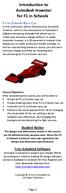 Introduction to Autodesk Inventor for F1 in Schools F1 in Schools Race Car In this course you will be introduced to Autodesk Inventor, which is the centerpiece of Autodesk s digital prototyping strategy
Eco Pelmet Modelling and Assessment. CFD Based Study. Report Number 610.14351-R1D1. 13 January 2015
 EcoPelmet Pty Ltd c/- Geoff Hesford Engineering 45 Market Street FREMANTLE WA 6160 Version: Page 2 PREPARED BY: ABN 29 001 584 612 2 Lincoln Street Lane Cove NSW 2066 Australia (PO Box 176 Lane Cove NSW
IES <Virtual Environment> Tutorial. ModelIT (Version 6.0)
 IES Tutorial ModelIT (Version 6.0) 1 Introduction: ModelIT Tutorial This document shows you how to use ModelIT, IES s 3D building geometry modelling tool. The tutorial is intended
TABLE OF CONTENTS. INTRODUCTION... 5 Advance Concrete... 5 Where to find information?... 6 INSTALLATION... 7 STARTING ADVANCE CONCRETE...
 Starting Guide TABLE OF CONTENTS INTRODUCTION... 5 Advance Concrete... 5 Where to find information?... 6 INSTALLATION... 7 STARTING ADVANCE CONCRETE... 7 ADVANCE CONCRETE USER INTERFACE... 7 Other important
VE-Compliance View User Guide
 VE-Compliance View User Guide IES Virtual Environment 6.5 VE-Compliance Contents VE-Compliance View User Guide... 1 1 Introduction... 6 1.1 What is the Compliance View?... 6 1.2 Compliance View
Introduction to Autodesk Inventor for F1 in Schools
 F1 in Schools race car Introduction to Autodesk Inventor for F1 in Schools In this course you will be introduced to Autodesk Inventor, which is the centerpiece of Autodesk s Digital Prototyping strategy
3-D Modeller Rendered Visualisations
 Recognised energy Dynamic Simulation Modelling (DSM) software DesignBuilder is a user interface to the EnergyPlus DSM. EnergyPlus builds on the most popular features and capabilities of BLAST and DOE-2
Visual Tutorial Basic Edition 1. Visual. Basic Edition Tutorial. www.visuallightingsoftware.com
 Visual Tutorial Basic Edition 1 Visual Basic Edition Tutorial www.visuallightingsoftware.com Visual Tutorial Basic Edition 2 Basic Edition Tutorial Introduction In this tutorial, you will use the Visual
An introduction to 3D draughting & solid modelling using AutoCAD
 An introduction to 3D draughting & solid modelling using AutoCAD Faculty of Technology University of Plymouth Drake Circus Plymouth PL4 8AA These notes are to be used in conjunction with the AutoCAD software
Diego Ibarra Christoph Reinhart Harvard Graduate School of Design
 Building Performance Simulation for Designers - Energy DesignBuilder // EnergyPlus Tutorial #3 Construction Assemblies, Load Reduction & Shading GEOMETRY LOADS RESULTS Diego Ibarra Christoph Reinhart Harvard
What s New V 11. Preferences: Parameters: Layout/ Modifications: Reverse mouse scroll wheel zoom direction
 What s New V 11 Preferences: Reverse mouse scroll wheel zoom direction Assign mouse scroll wheel Middle Button as Fine tune Pricing Method (Manufacturing/Design) Display- Display Long Name Parameters:
Blender Notes. Introduction to Digital Modelling and Animation in Design Blender Tutorial - week 9 The Game Engine
 Blender Notes Introduction to Digital Modelling and Animation in Design Blender Tutorial - week 9 The Game Engine The Blender Game Engine This week we will have an introduction to the Game Engine build
SpaceClaim Introduction Training Session. A SpaceClaim Support Document
 SpaceClaim Introduction Training Session A SpaceClaim Support Document In this class we will walk through the basic tools used to create and modify models in SpaceClaim. Introduction We will focus on:
Vista User Guide <Virtual Environment> 6.0
 Vista User Guide 6.0 Page 1 of 46 Contents 1. Introduction...4 2. Vista View...4 3. Specifying Data for Output...6 3.1. Specifying Results... 6 3.2. Specifying Variables... 7 3.2.1.
SketchUp Instructions
 SketchUp Instructions Every architect needs to know how to use SketchUp! SketchUp is free from Google just Google it and download to your computer. You can do just about anything with it, but it is especially
DesignBuilder Simulation + CFD Training Guide
 DesignBuilder Simulation + CFD Training Guide DesignBuilder 2008-2011 No part of the manual is to be copied or reproduced in any form without the express agreement of DesignBuilder Software Contents DesignBuilder
Sweet Home 3D user's guide
 1 de 14 08/01/2013 13:08 Features Download Online Gallery Blog Documentation FAQ User's guide Video tutorial Developer's guides History Reviews Support 3D models Textures Translations Forum Report a bug
IDA ICE 4: Getting Started EQUA Simulation AB, September 2009
 IDA ICE 4: Getting Started EQUA Simulation AB, September 2009 Manual version: 4.0 Copyright EQUA Simulation AB 2009 Contents Contents... 2 1 Introduction... 3 Caption for symbols in screenshots... 3 2
DataPA OpenAnalytics End User Training
 DataPA OpenAnalytics End User Training DataPA End User Training Lesson 1 Course Overview DataPA Chapter 1 Course Overview Introduction This course covers the skills required to use DataPA OpenAnalytics
CHAPTER 3. The sun and the seasons. Locating the position of the sun
 zenith 90 summer solstice 75 equinox 52 winter solstice 29 altitude angles observer Figure 3.1: Solar noon altitude angles for Melbourne SOUTH winter midday shadow WEST summer midday shadow summer EAST
Ortelia Space Builder User Manual
 Ortelia Space Builder User Manual http://ortelia.com 1 Table of Contents Introducing Ortelia Space Builder... 2 System Requirements... 3 1. Operating system:... 3 2. Hardware:... 3 Minimum Graphics card
CREATING A 3D VISUALISATION OF YOUR PLANS IN PLANSXPRESS AND CORTONA VRML CLIENT
 CREATING A 3D VISUALISATION OF YOUR PLANS IN PLANSXPRESS AND CORTONA VRML CLIENT 20-25 Minutes This topic is for users of PlansXpress Total Toolkit Edition. To upgrade to PlansXpress Total Toolkit, call
Opening the Bonnet. Prof Darren Woolf WYSINWYG 1
 Opening the Bonnet Prof Darren Woolf WYSINWYG 1 WYSINWYG What You See Is NOT What You Get: Looking inside the Pandora s Box Prof Darren Woolf WYSINWYG 2 WYSIWYG implies a user interface that allows the
VE Compliance User Guide
 VE Compliance User Guide UK & Ireland Building Regulations IES Virtual Environment Copyright 2014 Integrated Environmental Solutions Limited. All rights reserved. No part of the manual is to be copied
SPECIAL ISSUE: NATIONAL SCIENCE FOUNDATION WORKSHOP
 research journal 2013 / VOL 05.01 www.perkinswill.com SPECIAL ISSUE: NATIONAL SCIENCE FOUNDATION WORKSHOP ARCHITECTURE AND ENGINEERING OF SUSTAINABLE BUILDINGS Current Trends in Low-Energy HVAC Design
Generative Drafting. Page 1 1997 2001 DASSAULT SYSTEMES. IBM Product Lifecycle Management Solutions / Dassault Systemes
 Generative Drafting Page 1 Tutorial Objectives Description This Tutorial is an introduction to Generative Drafting. Message To show how CATIA V5 allows the user to automatically generate associative drafting
Quick Start Tutorial Metric version
 Quick Start Tutorial Metric version 1996-2009 Cadsoft Corporation. No part of this guide or the accompanying software may be reproduced or transmitted, electronically or mechanically, without written permission
Full credit for this chapter to Prof. Leonard Bachman of the University of Houston
 Chapter 6: SOLAR GEOMETRY Full credit for this chapter to Prof. Leonard Bachman of the University of Houston SOLAR GEOMETRY AS A DETERMINING FACTOR OF HEAT GAIN, SHADING AND THE POTENTIAL OF DAYLIGHT PENETRATION...
The following is an overview of lessons included in the tutorial.
 Chapter 2 Tutorial Tutorial Introduction This tutorial is designed to introduce you to some of Surfer's basic features. After you have completed the tutorial, you should be able to begin creating your
Learning Module 4 - Thermal Fluid Analysis Note: LM4 is still in progress. This version contains only 3 tutorials.
 Learning Module 4 - Thermal Fluid Analysis Note: LM4 is still in progress. This version contains only 3 tutorials. Attachment C1. SolidWorks-Specific FEM Tutorial 1... 2 Attachment C2. SolidWorks-Specific
ABS 731 Lighting Design & Technology. Spring 2006
 ABS 731 Lighting Design & Technology Spring 2006 AGI32 is used to predict the photometric performance of selected luminaires or daylight penetration in a simulated environment. The environments that can
House Design Tutorial
 Chapter 2: House Design Tutorial This House Design Tutorial shows you how to get started on a design project. The tutorials that follow continue with the same plan. When we are finished, we will have created
Diego Ibarra Christoph Reinhart Harvard Graduate School of Design
 Building Performance Simulation for Designers - Energy DesignBuilder // EnergyPlus Tutorial #2 Load Schedules GEOMETRY LOADS RESULTS Diego Ibarra Christoph Reinhart Harvard Graduate School of Design OVERVIEW
VE Compliance FAQ. Top Tips for Achieving Compliance
 Integrated Environmental Solutions Ltd. VE Compliance FAQ The Building Regulations 2010: Conservation of fuel and power Approved Document L2A (2013 edition for use in England) Top Tips for Achieving Compliance
Agrément Certificate 2013/444 IES VIRTUAL ENVIRONMENT SOFTWARE (VERSION VE 2013) Certificate holder: Integrated Environmental Solutions (IES) Ltd
 Agrément Certificate 2013/444 Copyright Agrément South Africa, August 2013 The master copy of this document appears on the website: www.agrement.co.za Validity Users of any Agrément certificate should
Constructions Database User Guide <Virtual Environment> 5.9
 Constructions Database User Guide 5.9 Page 1 of 35 Contents 1. Introduction...3 2. Units...4 3. Main Dialogue Project Constructions...5 3.1. Outline...5 3.2. Construction Classes
Creating Your Own 3D Models
 14 Creating Your Own 3D Models DAZ 3D has an extensive growing library of 3D models, but there are times that you may not find what you want or you may just want to create your own model. In either case
3D-GIS in the Cloud USER MANUAL. August, 2014
 3D-GIS in the Cloud USER MANUAL August, 2014 3D GIS in the Cloud User Manual August, 2014 Table of Contents 1. Quick Reference: Navigating and Exploring in the 3D GIS in the Cloud... 2 1.1 Using the Mouse...
Business Objects Version 5 : Introduction
 Business Objects Version 5 : Introduction Page 1 TABLE OF CONTENTS Introduction About Business Objects Changing Your Password Retrieving Pre-Defined Reports Formatting Your Report Using the Slice and Dice
2013 Getting Started Guide
 2013 Getting Started Guide The contents of this guide and accompanying exercises were originally created by Nemetschek Vectorworks, Inc. Vectorworks Fundamentals Getting Started Guide Created using: Vectorworks
Appointment Scheduler
 EZClaim Appointment Scheduler User Guide Last Update: 11/19/2008 Copyright 2008 EZClaim This page intentionally left blank Contents Contents... iii Getting Started... 5 System Requirements... 5 Installing
Creating Drawings in Pro/ENGINEER
 6 Creating Drawings in Pro/ENGINEER This chapter shows you how to bring the cell phone models and the assembly you ve created into the Pro/ENGINEER Drawing mode to create a drawing. A mechanical drawing
Tutorial: Biped Character in 3D Studio Max 7, Easy Animation
 Tutorial: Biped Character in 3D Studio Max 7, Easy Animation Written by: Ricardo Tangali 1. Introduction:... 3 2. Basic control in 3D Studio Max... 3 2.1. Navigating a scene:... 3 2.2. Hide and Unhide
GoodReader User Guide. Version 1.0 GoodReader version 3.16.0
 GoodReader User Guide Version 1.0 GoodReader version 3.16.0 Contents Operating GoodReader 1 Send PDF files to Your ipad 2 Copy Files with itunes 2 Copy Files to a Cloud Service 5 Download Files from the
Layout Tutorial. Getting Started
 Getting Started Layout Tutorial This tutorial will explain how create a layout template, send views to a layout page, then save the document in PDF format. In this tutorial you will learn about: Creating
Instructions for Creating a Poster for Arts and Humanities Research Day Using PowerPoint
 Instructions for Creating a Poster for Arts and Humanities Research Day Using PowerPoint While it is, of course, possible to create a Research Day poster using a graphics editing programme such as Adobe
Finance Reporting. Millennium FAST. User Guide Version 4.0. Memorial University of Newfoundland. September 2013
 Millennium FAST Finance Reporting Memorial University of Newfoundland September 2013 User Guide Version 4.0 FAST Finance User Guide Page i Contents Introducing FAST Finance Reporting 4.0... 2 What is FAST
Using Microsoft Word. Working With Objects
 Using Microsoft Word Many Word documents will require elements that were created in programs other than Word, such as the picture to the right. Nontext elements in a document are referred to as Objects
User s Guide The SimSphere Biosphere/Atmosphere Modeling Tool
 User s Guide The SimSphere Biosphere/Atmosphere Modeling Tool User s Guide Revision 11/1/00 Contents Introduction 3 1. SimSphere Modeling Tool Overview 4 System Requirements 4 Your User Status 4 Main Menu
DESIGN A WEB SITE USING PUBLISHER Before you begin, plan your Web site
 Page 1 of 22 DESIGN A WEB SITE USING PUBLISHER Before you begin, plan your Web site Before you create your Web site, ask yourself these questions: What do I want the site to do? Whom do I want to visit
Applying a circular load. Immediate and consolidation settlement. Deformed contours. Query points and query lines. Graph query.
 Quick Start Tutorial 1-1 Quick Start Tutorial This quick start tutorial will cover some of the basic features of Settle3D. A circular load is applied to a single soil layer and settlements are examined.
Creating Custom Crystal Reports Tutorial
 Creating Custom Crystal Reports Tutorial 020812 2012 Blackbaud, Inc. This publication, or any part thereof, may not be reproduced or transmitted in any form or by any means, electronic, or mechanical,
AB3080 L. Learning Objectives: About the Speaker:
 AB3080 L While architects have tested their designs in wind tunnels for many years, the process is typically outsourced to engineering firms and not easily accessible to architects during the conceptual
EFA PSBP. Natural Ventilation Strategy. Introduction. 1.1 Relevant legislation. 1.1.1 The Building Regulations 2010
 EFA PSBP Natural Ventilation Strategy Introduction The Baseline Designs Project will provide scheme design details for a number of Primary and Secondary School Exemplars. For the purposes of setting a
Tutorial: 2D Pipe Junction Using Hexa Meshing
 Tutorial: 2D Pipe Junction Using Hexa Meshing Introduction In this tutorial, you will generate a mesh for a two-dimensional pipe junction, composed of two inlets and one outlet. After generating an initial
PowerPoint 2007 Basics Website: http://etc.usf.edu/te/
 Website: http://etc.usf.edu/te/ PowerPoint is the presentation program included in the Microsoft Office suite. With PowerPoint, you can create engaging presentations that can be presented in person, online,
3D Viewer. user's manual 10017352_2
 EN 3D Viewer user's manual 10017352_2 TABLE OF CONTENTS 1 SYSTEM REQUIREMENTS...1 2 STARTING PLANMECA 3D VIEWER...2 3 PLANMECA 3D VIEWER INTRODUCTION...3 3.1 Menu Toolbar... 4 4 EXPLORER...6 4.1 3D Volume
JustClust User Manual
 JustClust User Manual Contents 1. Installing JustClust 2. Running JustClust 3. Basic Usage of JustClust 3.1. Creating a Network 3.2. Clustering a Network 3.3. Applying a Layout 3.4. Saving and Loading
CATIA V5 Tutorials. Mechanism Design & Animation. Release 18. Nader G. Zamani. University of Windsor. Jonathan M. Weaver. University of Detroit Mercy
 CATIA V5 Tutorials Mechanism Design & Animation Release 18 Nader G. Zamani University of Windsor Jonathan M. Weaver University of Detroit Mercy SDC PUBLICATIONS Schroff Development Corporation www.schroff.com
Trace Layer Import for Printed Circuit Boards Under Icepak
 Tutorial 13. Trace Layer Import for Printed Circuit Boards Under Icepak Introduction: A printed circuit board (PCB) is generally a multi-layered board made of dielectric material and several layers of
HOURLY ANALYSIS PROGRAM QUICK REFERENCE GUIDE
 HOURLY ANALYSIS PROGRAM QUICK REFERENCE GUIDE COPYRIGHT 1998-2015 CARRIER CORPORATION [This page has been left blank intentionally] HAP Quick Reference Guide Software Systems Network Carrier Corporation
Microsoft PowerPoint 2010 Templates and Slide Masters (Level 3)
 IT Services Microsoft PowerPoint 2010 Templates and Slide Masters (Level 3) Contents Introduction... 1 Installed Templates and Themes... 2 University of Reading Templates... 3 Further Templates and Presentations...
Solar-Generation Data Visualization Software Festa Operation Manual
 Solar-Generation Data Visualization Software Festa Operation Manual Please be advised that this operation manual is subject to change without notice. FL-003 CONTENTS INTRODUCTION Chapter1: Basic Operations
AutoCAD Architecture 2012 UK Content Tools
 AutoCAD Architecture 2012 UK Content Tools Contents Contents... 1 Installation... 2 Loading the utilities... 2 Utilities Overview... 3 Menu and Toolbar... 3 Content Generation... 3 Content Publishing...
How to use PGS: Basic Services Provision Map App
 How to use PGS: Basic Services Provision Map App The PGS: Basic Services Provision Map App The main features of the PGP Basic Services web application includes: Navigation Tools Map Tools Main Map Links
Metatrader 4 Tutorial
 Metatrader 4 Tutorial Thank you for your interest in Best Metatrader Broker! This tutorial goes in detail about how to install and trade with your new Metatrader Forex trading platform. With Best Metatrader
How To Create A View Frame In 3D
 12/4/2008-10:00 am - 11:30 am Room:Palazzo O-P (5th) The Secrets of Cutting Plan and Profile Sheets in AutoCAD Civil 3D Michelle Rasmussen - Application Engineer, IMAGINiT Technologies CV304-1P In this
STATGRAPHICS Online. Statistical Analysis and Data Visualization System. Revised 6/21/2012. Copyright 2012 by StatPoint Technologies, Inc.
 STATGRAPHICS Online Statistical Analysis and Data Visualization System Revised 6/21/2012 Copyright 2012 by StatPoint Technologies, Inc. All rights reserved. Table of Contents Introduction... 1 Chapter
Tutorials. If you have any questions, comments, or suggestions about these lessons, don't hesitate to contact us at [email protected].
 Tutorials The lesson schedules for these tutorials were installed when you installed Milestones Professional 2010. They can be accessed under File Open a File Lesson Chart. If you have any questions, comments,
Hosted Call Recorder Guide. Rev A (21/11/14)
 Hosted Call Recorder Guide Rev A (21/11/14) Replay Interface The Replay area of the Quantify interface is used to retrieve and replay calls from your Red Box Recorder. Below is an example of the interface
Building Information Modelling (BIM); How it Improves Building Performance. R.P. Kumanayake Lecturer, Department of Civil Engineering
 Building Information Modelling (BIM); How it Improves Building Performance R.P. Kumanayake Lecturer, Department of Civil Engineering R.M.P.S. Bandara Lecturer, Department of Mechanical Engineering Faculty
Autodesk Fusion 360 Badge Guide: Design an F1 in Schools Trophy
 Autodesk Fusion 360 Badge Guide: Design an F1 in Schools Trophy Abstract: Gain basic understanding of creating 3D models in Fusion 360 by designing an F1 in Schools trophy. This badge may be claimed by
Linkage 3.2. User s Guide
 Linkage 3.2 User s Guide David Rector Wednesday, April 06, 2016 Table of Contents Table of Contents... 2 Installation... 3 Running the Linkage Program... 3 Simple Mechanism Tutorial... 5 Mouse Operations...
Operation manual. Daikin Altherma hybrid heat pump EHYHBH05AA EHYHBH08AA EHYHBX08AA. Operation manual Daikin Altherma hybrid heat pump.
 EHYHBH05AA EHYHBH08AA EHYHBX08AA English Table of contents Table of contents 1 About this document 2 2 About the system 2 2.1 Components in a typical system layout... 2 3 Operation 3 3.1 Overview: Operation...
Excel -- Creating Charts
 Excel -- Creating Charts The saying goes, A picture is worth a thousand words, and so true. Professional looking charts give visual enhancement to your statistics, fiscal reports or presentation. Excel
MicroStrategy Analytics Express User Guide
 MicroStrategy Analytics Express User Guide Analyzing Data with MicroStrategy Analytics Express Version: 4.0 Document Number: 09770040 CONTENTS 1. Getting Started with MicroStrategy Analytics Express Introduction...
Windows Movie Maker 2012
 Windows Movie Maker 2012 Open Windows Movie Maker A shortcut for Movie Maker should be on the desktop, but if it is not, you can search for the program by touching the right edge of the screen and swiping
Pro/ENGINEER Wildfire 4.0 Basic Design
 Introduction Datum features are non-solid features used during the construction of other features. The most common datum features include planes, axes, coordinate systems, and curves. Datum features do
Developing Web and Mobile Dashboards with Oracle ADF
 Developing Web and Mobile Dashboards with Oracle ADF In this lab you ll build a web dashboard that displays data from the database in meaningful ways. You are going to leverage Oracle ADF the Oracle Application
Using Excel to find Perimeter, Area & Volume
 Using Excel to find Perimeter, Area & Volume Level: LBS 4 V = lwh Goal: To become familiar with Microsoft Excel by entering formulas into a spreadsheet in order to calculate the perimeter, area and volume
Manual. OIRE Escuela de Profesiones de la Salud. Power Point 2007
 Power Point 2007 Manual OIRE Escuela de Profesiones de la Salud Power Point 2007 2008 The New Power Point Interface PowerPoint is currently the most common software used for making visual aids for presentations.
CIBSE Loads User Guide
 CIBSE Loads User Guide IES Virtual Environment Apache Contents CIBSE Loads User Guide... 1 1 Introduction... 3 1.1 Results file (for both.htg and.clg files)... 3 2 Heating Loads... 4 2.1 Interface for
Creating Hyperlinks & Buttons InDesign CS6
 Creating Hyperlinks & Buttons Adobe DPS, InDesign CS6 1 Creating Hyperlinks & Buttons InDesign CS6 Hyperlinks panel overview You can create hyperlinks so that when you export to Adobe PDF or SWF in InDesign,
MAS 500 Intelligence Tips and Tricks Booklet Vol. 1
 MAS 500 Intelligence Tips and Tricks Booklet Vol. 1 1 Contents Accessing the Sage MAS Intelligence Reports... 3 Copying, Pasting and Renaming Reports... 4 To create a new report from an existing report...
Data Visualization. Brief Overview of ArcMap
 Data Visualization Prepared by Francisco Olivera, Ph.D., P.E., Srikanth Koka and Lauren Walker Department of Civil Engineering September 13, 2006 Contents: Brief Overview of ArcMap Goals of the Exercise
Access 2007 Creating Forms Table of Contents
 Access 2007 Creating Forms Table of Contents CREATING FORMS IN ACCESS 2007... 3 UNDERSTAND LAYOUT VIEW AND DESIGN VIEW... 3 LAYOUT VIEW... 3 DESIGN VIEW... 3 UNDERSTAND CONTROLS... 4 BOUND CONTROL... 4
Finding Drag Coefficient using Solidworks Flow Simulation
 Finding Drag Coefficient using Solidworks Flow Simulation Using solidworks to find the drag coefficient of shapes is a very useful way to cut down on the design time of a project, as it can remove tests.
ICEM CFD Tutorial. Simple Duct Grid
 ICEM CFD Tutorial Simple Duct Grid Scott J. Ormiston Gavin Joyce Department of Mechanical Engineering Winnipeg, Manitoba Canada V1.01 17 January 2013 Department of Mechanical Engineering Page 1 of 22 1.
Using HDR Panoramas. Dr Ryan Southall - School of Architecture & Design, University of Brighton.
 Using HDR Panoramas Dr Ryan Southall - School of Architecture & Design, University of Brighton. Introduction The LightLab project attempts to improve the integration of technology into design education
Simply Accounting Intelligence Tips and Tricks Booklet Vol. 1
 Simply Accounting Intelligence Tips and Tricks Booklet Vol. 1 1 Contents Accessing the SAI reports... 3 Running, Copying and Pasting reports... 4 Creating and linking a report... 5 Auto e-mailing reports...
Where On Earth Will Three Different Satellites Provide Simultaneous Coverage?
 Where On Earth Will Three Different Satellites Provide Simultaneous Coverage? In this exercise you will use STK/Coverage to model and analyze the quality and quantity of coverage provided by the Earth
Title 24 2013 Compliance Software: CBECC-Com
 Title 24 2013 Compliance Software: CBECC-Com California Building Energy Code Compliance for Commercial Buildings Creating Model Geometry using the Detailed Geometry Approach 1 Detailed Geometry Approach:
Solar Heating Basics. 2007 Page 1. a lot on the shape, colour, and texture of the surrounding
 2007 Page 1 Solar Heating Basics Reflected radiation is solar energy received by collectorsfrom adjacent surfaces of the building or ground. It depends a lot on the shape, colour, and texture of the surrounding
Session 25 Revit MEP Tips and Tricks
 Session 25 Revit MEP Tips and Tricks Page 1 of 17 Sometimes it's the little things which make all the difference. I thought I would share some nifty tricks that can help make Revit MEP go down a little
CFD ANALYSIS CHALLENGES IN BUILDING SIMULATION FOR SIMBUILD2004 CONFERENCE. Ferdinand Schmid and Galen Burrell Architectural Energy Corporation
 CFD ANALYSIS CHALLENGES IN BUILDING SIMULATION FOR SIMBUILD2004 CONFERENCE Ferdinand Schmid and Galen Burrell Architectural Energy Corporation ABSTRACT This paper discusses the capabilities and challenges