
IDA ICE 4: Getting Started EQUA Simulation AB, September 2009
|
|
|
- Poppy Dayna Young
- 10 years ago
- Views:
Transcription
1 IDA ICE 4: Getting Started EQUA Simulation AB, September 2009 Manual version: 4.0 Copyright EQUA Simulation AB 2009

2 Contents Contents Introduction... 3 Caption for symbols in screenshots Overview of Standard Level (Does not belong to the learning example)... 4 General tab... 5 Floor plan tab D tab... 7 Simulation tab... 8 Results tab... 9 Help texts Building Geometry and CAD Import (Start of the learning example) Define Default Constructions Zone Templates Inserting Zones Inserting Windows and Internal Openings Site Shading and Orientation Location and Weather Mechanical ventilation Infiltration Thermal Bridges Ground Properties System Distribution Losses Heat Load Calculation and Results Cooling Load Calculation and Results Energy Calculation Simulation Summary Supplied Energy Report System, AHU Energy Report and Zone Energy Reports Systems Energy Report AHU Energy Report Zone Energy Report More... reports Multizone Report Compare Results Report

3 1 Introduction IDA Indoor Climate and Energy (IDA ICE) is a dynamic multi-zone simulation application for the accurate study of the thermal indoor climate of individual zones as well as the energy consumption of an entire building. The user interface has been designed to make it easy to build and simulate simple cases, but also offers the advanced user the full flexibility of IDA. To provide both efficiency and flexibility, IDA ICE works with three user levels: Wizard, Standard and Advanced. This manual shows how to work in the standard level. IDA ICE 4 is delivered in two editions: Standard and Expert. The screen shots shown are from the Expert edition of the program. Please note that unless specifically mentioned, all steps can be undertaken with the standard edition. Chapter 2 gives a brief overview of the user interface. It roughly explains what can be done where, but does not go into details. You should not worry about this and try to make it to the end of the chapter. The actual learning example starts in Chapter 3. From that point, take care in always trying to understand what you are doing. Basically, the screenshots will show you how to act, while the text explains what you are doing and provides useful hints. Make sure you take a look at the online help texts as well. These are easiest reached by pressing F1, when you have the dubious window active. Caption for symbols in screenshots Numbers with reference from screenshot to text Hints about possible actions, not belonging to the learning example. These can safely be omitted without losing the thread. Indication of a screen sector Single left mouse click Single right mouse click Double left mouse click Drag and drop Drag and drop with pressed Ctrl-key - 3 -

4 2 Overview of Standard Level (Does not belong to the learning example) Screenshot 1 Click this button to start with an empty building. Click this button to start with a building with a single zone. Unlike starting with an empty building, a project ready to simulate will be opened up. This building contains the geometry of a single zone with a southerly orientation. The building has default settings for wall constructions, glazing, shadings, location, synthetic weather, mechanical zone ventilation, controller setpoints and everything else needed for a simulation. Click this button to open or close (toggle) the side bar. The side bar contains Palettes (list of objects to insert) and Properties (editable parameters for the selected object). Click this button to open or close the log window. The log window contains error and warning messages. By double clicking on an error message, the program will attempt to take you to the location where the problem can be addressed. General tab: Main information about the project: Global Data, HVAC Systems, Energy Meters and tables with model details. Individual tables can be selected by clicking on the corresponding radio button. Many parameters can be changed directly in this table. The tables can be exported to Excel for reports. Floor plan tab: 2D view of the building geometry. Building body, zones, windows and doors can be inserted and edited here. 3D tab: The model and results can be visualized and animated here. Selecting an object will open up a property page in the side bar. Double clicking on an object will open up the object form. Simulation tab: Simulation options are given here Outline tab: Outline view of the project (Expert edition only) Results tab: Overview of the simulation results - 4 -

5 General tab Screenshot 2 Start new building with a single zone Modify Project data Modify Location data: Geographical position, Design Day data. In this section you have access to different parameters that are valid for the whole building. This will be explained in more detail in Sections 11 through 14. In this section, you have access to the structure and parameters of the air handling unit(s) and building plant, as well as the meters for keeping track of energy and emissions. This will be explained in more detail in Section 10. Change the table view: Data related to zones, surfaces, windows, loads, constructions, etc. can be viewed and edited here. Export the input value tables to Excel Expand the current input value table to a separate (larger) window

6 Floor plan tab Screenshot 3 Go to the Floor plan tab Select an object to edit its properties in the side bar (ensure that the Properties and not the Palette view of the side bar is active) NB The steps below are for orientation only, don t try to build anything serious yet. Rename, cut, copy, delete, replace or edit objects Switch to palette to insert more objects Insert a new zone. How to do this is explained in more detail later. Import CAD files as background drawing. Access the IFC menu (expert edition only) to import or map IFC objects. Protect objects to avoid them to be moved or deleted Set and remove a view filter to exclude object types from being shown Change the level where the floor plan is being shown - 6 -

7 3D tab Screenshot 4 Go to the 3D tab Use the left mouse button to rotate the building, the right mouse button to zoom and the middle mouse button to pan. When clicking on the F-key, a new focus (for rotation and zoom) is set at the cursor's place. Cut the building in positive x-direction Move the cutting plane Animate calculation results Activate shadow animation Start animation NB This is a shadow animation only. How to animate result variables will be explained later. At the moment, we do not have any results to show, since we did not simulate yet

8 Simulation tab Go to the simulation tab Start a cooling load calculation Screenshot 5 NB You can start 4 different types of simulations: Heating load calculation, cooling load calculation, energy calculation or customized calculation. These will be explained in more detail in Section

9 Results tab Screenshot 6 After a simulation, the program switches to the Results tab. Visualize a result column in the 3D model. Look at the time series diagram Sum energy reports of several zones or of specific zone groups or compare the current result set with a set from previous simulations

10 Help texts Press the F1-key or choose Help -> Help topic to find help texts

11 3 Building Geometry and CAD Import (Start of the learning example) Screenshot 7 Start with a new empty building Go to the Floor plan tab Choose CAD import Choose the appropriate file type Browse to the desired CAD file (the DWG example used in this guide can be found among the samples in the IDA installation folder (Normally: C:\Program Files\IDA\samples\ICE\DWG example.dwg) Open the chosen file and then click OK in the Preferences window

12 Screenshot 8 Open the building body menu Select "Edit" Move the building border (wait at line to snap to CAD line of inner surface) Add new points

13 Screenshot 9 Move building border between two points (snap to CAD line of inner surface) Add new points Drag and drop points with pressed Ctrl-key to move them in a non-orthogonal direction. Finalize building shape NB You can carry out several amendments and then activate them by clicking the Done button. All changes can also be cancelled by clicking the Cancel button. Adapt workplane size The coordinates of the building body can also be edited in the side bar Protect the building (and imported objects) from being unintentionally moved Choose elements to be locked Finalize element protection

14 Mark the building body by clicking on its border Set the building floor and ceiling height Screenshot 10 NB Default ground level is always at 0 m. This means that by default, external walls below zero are linked to the ground, while the part of walls above zero are linked to the corresponding building face. Go to the 3D tab to look at your building

15 4 Define Default Constructions Go to the General tab Go to Defaults Choose for external construction Search in database... Choose Concrete wall mm Finalize selection of default construction NB For all external walls with no specifically defined construction, the default construction for external walls will now automatically be applied. Screenshot

16 Screenshot 12 Open the construction definition dialog for External walls Change from External wall to generic so you can use the same construction for elements other than external walls Add a new layer Delete the marked layer Move the marked layer one step up- or downward Change the thickness of the marked layer Load a material from the database Open the material form Change the physical properties of the material U-value and Thickness of the whole construction will be recalculated automatically after each modification Finalize construction definition by saving with same name Finalize construction definition by saving as a new resource NB Objects such as the wall construction we are just making are called Resources in IDA. They can be accessed from all relevant places in the program. Resources which are copies of database objects have names beginning with. They are protected against modification and cannot be saved under their database name. They can however be saved as an editable case resource, using a different name

17 Add a new layer Choose how to define the new material Load from database... Choose Air in 20 mm air gap Finalize Material selection Set layer thickness to 20 mm (= 0.02 m) Save construction as a new resource Set resource name Finalize resource saving Finalize construction definition Screenshot

18 Screenshot 14 Define default construction for internal walls, internal floors, roofs and external floors by loading them from the database Open the glass construction database Set your own glazing properties The shading coefficients can either be given as absolute values or reference to single or double pane Choose how to define glazing properties Choose Load from database... Choose 3 pane glazing, clear, Finalize glazing selection Finalize glass construction definition

19 Screenshot 15 Open IDA Resources Open IDA ICE database, browse around to see what is available. The database is used to distribute useful input data with the program delivery, but items can be added by the user as well (and they will survive a new program version upgrade). Added items are stored on the local machine. Other means are provided for distribution of common input data among, for example, the members of a project team or company. Read the online help by pressing F1 in the database or the resources window. External wall type 1 is an example of a resource and it can be used as the construction of any external wall. A resource can also be written to the IDA ICE database by right-clicking on it and choosing the Write to database option. It will then be protected, indicated with a as its prefix. All resources beginning with are copies of database entries with the same name and are protected against modification, unless they are renamed. NB Whenever an element linked to a resource is modified, the program will ask you to choose OK (save the modified resource, i.e. all elements linking to this resource will then be modified) or Copy (save the modification as new resource, i.e. only this element will be modified) or Cancel (do not save, i.e. the modification will be ignored. Default efficiencies for heating, cooling and domestic hot water generation (for energy calculation) are also given in the defaults form. Defaults for zone model fidelity (resolution) and the room unit cold surface temperature are also given here

20 5 Zone Templates Zone templates greatly speed up the process of creating a simulation model. They allow the user to pre-define information associated with a zone type, instead of separately for every zone. All information in a zone template needs to be area-related. NB Zone templates are not handled as typical IDA resources. The information is only used during the creation of a zone. Subsequent changes to a zone template do not affect zones which have been attributed earlier (using this template). But zone templates contain references to a set of IDA resources (e.g. control setpoints, internal load schedules etc.). If these resources are edited, from within the zone template dialog, the changes will affect all objects that also reference the same resource. Go to the Floor plan tab Open the zone template menu Select Show/Edit zone template Choose how to define the controller setpoints Create a new resource Name new controller setpoints resource Finalize resource creation Screenshot

21 Screenshot 17 Open the new resource for editing Define control setpoints for zone template. All setpoints are given in a single place. All different devices, such as for example room units, use these setpoints. Temperature setpoints can optionally be given with by schedules. Finalize setpoint definition Define whether zones will (initially) have local heating and/or cooling units. Thermal mass from furniture (e.g. store room shelves, furniture, plants, etc.) Define default room height. In cases where several air handling units have been specified, you can specify which unit delivers air to this zone. Define the air volume flow control strategy as CAV Define supply and exhaust air for constant air volume flow (CAV). NB For VAV (Variable Air Volume) systems, minimal and maximal supply and exhaust air volume rate is taken from the controller setpoints as well as the setpoints for the selected control strategy (humidity, CO2 and/or temperature)
22 Screenshot 18 In the zone template form, go to the Loads tab Select Office worker with light dress from database (resource for occupant type) Select weekdays from database (resource for occupancy schedule) Open occupancy schedule Insert lunch break Finalize schedule modification You will be asked to confirm creation of the new resource. Since the schedule is from the database, it will be protected against modification, i.e. make a new copy. Give name for the new resource Finalize creation of new resource
23 Screenshot 19 For equipment and lighting, choose a schedule from the database and an energy meter account. In the Advanced tab, you can define specific default constructions for this zone type as well as maximum heating and cooling power for room units. The latter is only important for deliberate undersizing of room units. Save the zone template as new Name the zone template Finalize zone template saving Finalize zone template modification
24 6 Inserting Zones Select the CAD object Set plan height (from ground level) Confirm the CAD properties Open the floor plan level height form Type new view level Finalize view level setting Go to the zone template menu Choose the zone template for new zones Screenshot
25 Screenshot 21 Start inserting of new zone Draw a rectangular, rough shape of the zone by starting at bottom left, intentionally outside the building, and going top right NB IDA ICE will automatically exclude areas outside the building body from the zone area. Already inserted zones are also automatically excluded. NB Having finished the drawing of the zone, the program will automatically go into the edit mode for further amendments to the zone geometry
26 Choose a point to be removed Choose Remove Remove other unnecessary zone points following the same strategy. Screenshot
27 Set new point Move the wall to the desired location. Screenshot 23 NB The program automatically includes a new wall as the two walls are no longer in one line. Move the second wall to the desired location Set new point Move the third wall to the desired location Name the new zone Define a zone group by giving a name. NB Zone groups are used to determine for example energy balance in a subset of zones, e.g. for a particular apartment, building section, tenant type etc. Finalize zone insertion NB When you click Done from the zone edit mode, values for the new zone will be calculated from area specific values given in the zone template. Later resizing of the zone will not adapt these values. To profit from the zone template, it is thus important to edit the correct zone shape before finalizing zone insertion. NB Note that there is a difference between moving points with or without clicking and holding the Ctrl-key
28 Screenshot 24 In the side bar, go to the Palette tab Insert a second zone (double-clicking on zone in the side bar has the same effect as clicking on the new zone button), naming it Office 1 and assigning it to the same zone group Offices Insert a third zone, naming it Office 2 and assigning it to the same zone group Offices Insert a forth zone, naming it Office 3 and assigning it to the same zone group Offices Insert a fifth zone, naming it Closet and assigning it to a new zone group NonOffices Move the cursor over the zones and the zone names will appear as tooltips NB In case you forgot to name a zone or want to change the zone name, there are several ways to do this: Right-click on zone and choose Rename... Right-click on zone, choose Edit and rename in side bar NB The program will automatically detect how zones are thermally connected: Zones are regarded as adjacent, if the distance between them is 0.5 m or less. The same applies for adjacency to external faces. Wall parts having no adjacent zone or face are by default treated as adiabatic (perfect insulation at center of wall)
29 Screenshot 25 Go to the General tab Select Zones table (if not already selected) In the table, you can change all parameters, except for values highlighted in grey. Values highlighted in blue are linked to defaults. Changing these values will break this link. You can however restore the link by right-clicking on the value and choosing Mapping/Restore link. Open, rename, cut, copy, delete or replace a zone. Click on the box icons in the column titles to visualize the column values in the 3D tab
30 NB There are different ways of opening a zone form: Go to the General tab and double-click on the zone name in the Zones table Go to the Floor plan tab and double-click the zone Go to the 3D tab, mark any wall of the zone and click on Open zone in the side bar Screenshot 26 In the Palette tab of the side bar, you find objects that can be inserted into a zone. Insert new objects by double-clicking on them or by dragging the symbols to the zone form. All objects in the zone of this category will be listed here. The zone template influences the initially inserted objects and their properties. Double-click an object to edit it. These parameters also come from the zone template. Change them anytime here. To simulate many almost identical zones, a multiplier is defined here. All variables coupled with the system (system loads, supply and exhaust air volume rate, also natural ventilation etc.) will be multiplied by this factor. The thermal bridge loss factor of the zone towards ambient is indicated here. It is normally calculated from the Thermal bridge coefficients defined from the general tab. Values for infiltration are indicated here. They are normally calculated from the Infiltration parameters defined in the general tab. Boundary conditions of the different zones surfaces are indicated in this section in two different views: Plan view and table. Construction elements marked with red are external (because of their proximity to the building body). Double-click on the elements (in the plan or in the table) to open their forms. Floor and room height can also be changed here. Go to the Advanced tab to modify further zone properties. The Outline tab is available in the expert edition only. Go to the Results tab to study results for this zone after simulation
31 NB There are different ways of opening a wall form: Open the zone form and double-click the wall on either table or plan view Go to the 3D tab and double-click the wall Go to the Floor plan tab and double-click the corresponding zone borderline Go to the Floor plan tab, mark the zone, right-click its borderline and choose Open... Go to the General tab and double-click on the surface name in the Surfaces table Screenshot 27 Open the wall form Double-click on the symbols in the Palette of the side bar to insert zone objects to be positioned on a zone surface (alternatively drag and drop them in the surface editor or right-click on the surface editor and choose New Object... ). The surface editor shows the zone surface from inside the zone, indicating wall parts due to different adjacent zones by dashed lines. Inserted objects can be positioned either here or through the Properties tab of the side bar
32 7 Inserting Windows and Internal Openings Go to the view menu Choose Zoom in Indicate the plan section to be zoomed in Screenshot
33 Screenshot 29 In the zoomed in plan view, use the scroll bars. It is also possible to use the mouse wheel to move up and down in the drawing, Initiate the insertion of a new window Place the center of the window on a zone borderline Shift the window position after insertion Open the wall form
34 Screenshot 30 Mark the window in the wall surface editor Go to the Properties tab in the side bar Change the window size and position Alternatively change the window size and position in the surface form Open the window form NB You could also have done - and directly in the 2D floor plan or in the 3D view
35 NB There are different ways of opening a window form: Go to the 3D tab and double-click the window Open the zone form and double-click the window on the plan view Open the wall form and double-click the window on the surface editor Go to the Floor plan tab and double-click the window Go to the General tab and double-click on the window name in the Windows table Screenshot 31 Define the window opening control strategy (expert version only) Choose the window opening schedule (expert version only) Modify the frame area fraction and U-value Modify the azimuth and slope shift of the window plane relative to the wall plane Choose the integrated window shading device (blinds, shades etc.) Define the integrated window shading control strategy Choose the integrated window shading schedule Modify external obstacle window shading (default is No external shading ) such as glazing recess, balconies, screens, side fins or marquees. Open the glazing form (see chapter 4) Close form NB Integrated shading devices influence the shading coefficients of the glazing, while external shading devices decrease solar radiation due to cutting a part of the solar beam
36 Open the window menu Screenshot 32 NB This action can also be carried out in alternative ways: (a) in the 2D floor plan, (b) in the 3D view or (c) in the windows table of the General tab Convert window properties to resource Name the new resource Finalize resource creation Close wall form. You will find Narrow and high as a new object to insert
37 Screenshot 33 Start insertion of a new Narrow and high window Place the window Repeat - Use view scrolling to get to the window of BigOffice. Insert the last window and open the wall form to enlarge it. Go to the 3D tab to have a look at your model NB The Narrow and high resource name is perhaps not the most appropriate for the Big Office window. All other properties except the size will still be linked from the resource. The resource acts as defaults for all window properties
38 Go back to Floor plan tab Insert doors as you did with windows before Open the opening form to have a look at it Open the View menu Zoom out the floor plan view Go to the 3D tab to have a look at your model Screenshot 34 NB Although doors will always remain closed in the standard edition. They will have an impact to the air leakage path of the building, as they will act as leakage paths between zones. Depending on the pressure difference between either side, air will flow through
39 8 Site Shading and Orientation Go to the General tab (Building form) Go to the site editor Alter the site orientation by turning the compass needle NB Make sure you select the reference point in the compass needle. Alternatively change the orientation in the side bar Go to the Palette tab in the side bar Screenshot
40 Screenshot 36 Shading buildings are inserted as vertical shading plane: After double-clicking Shading building in the Palette of the side bar, set points of the new shading object Finalize insertion of new shading object Alternatively change the coordinates of the points of the shading object in the side bar. The two values "Bottom" and "Top" define the z-coordinates of the object. NB A horizontal shading element is defined in the same way as the vertical one. It has however only one z-coordinate indicating the height of the shading element NB Site shading objects will be defined relatively to the site and thus stay fixed, while external window shadings are defined relatively to the windows and thus move when moving the building within the site or moving the window within the wall. NB It is also possible to alter the geometry of shading objects in the same way as the geometry of a zone can be amended: Right-click the shading element, select Edit, etc
41 Screenshot 37 Import CAD files to the site. These can be either 3D shading objects or site plans serving as background for drawing the shading buildings. NB CAD files imported into the floor plan will be rotated together with the building, while CAD files imported here will not. Pan and rotate (Alt-key) the finalized building within the site. Position and orientation of the building can alternatively be modified in the side bar NB Changing site orientation (compass) will rotate the building together with the site, whilst changing building orientation will rotate the building within the site keeping the site orientation constant. Go to the 3D tab to have a look at your model
42 9 Location and Weather Screenshot 38 Go to the General tab Choose how to select location Search in database Choose Gothenburg (Sweden) Finalize location selection Open the location form Change position and time zone of the location Change the design day climate parameters. There are two columns for the winter as well as the summer design day. Finalize location definition NB The design day parameters in the location form will only be used for synthetic climate (see diagrams below). The location position parameters will be used to calculate the position of the sun. Design day temperature Design day relative humidity W/m2 Design day solar radiation TAmb Summer design day TAmb, Winter design day Relative Humdity, Winter design day Relative Humidity, Summer design day Diffuse Radiation, 100 % clearness Direct Radiation, 100 % clearness Diffuse Radiation, 50 % clearness Direct Radiation, 50 % clearness
43 Screenshot 39 Search climate in database Choose climate Finalize climate definition Open the climate form Browse in your folders to link another climate file Wind measurement height and wind profile will be used to calculate the wind speed at building roof level, based on the measured wind speed. Change the location and time zone of the climate measurement (if you have linked to your own file). Close the climate form NB The location of the climate measurement can be somewhat different from the building location. The difference will result in a different solar position and in some errors in solar radiation
44 10 Mechanical ventilation Screenshot 40 Open the air handling unit Choose between the different methods for selection of supply air temperature setpoint (constant, schedule or graph) Choose schedule as control for the supply air temperature In case constant supply air temperature is selected, this value is relevant. In case the supply air temperature is based on a schedule, related data is defined here. In case the supply air temperature is based on a graph, related data is defined here. NB The selected supply temperature setpoint is fed to the heat exchanger as well as to both the heating and cooling coils. To turn off any of these elements, set its effectiveness to 0 (by double-clicking on its symbol and modifying the parameter). Open the AHU component model objects to modify parameters. NB The heat exchanger effectiveness represents the percentage of the maximum possible heat which is transmitted from exhaust to supply air. NB The cooling coil will often remove humidity Modify the schedule for the operation of the fans (select "06-18 weekdays" from database). NB The fan operation schedule controls the operation of the central air handling unit (on/off control). The air volume rate in each zone is determined from the zone. NB The default AHU does not include any parameter that needs to be adapted to the building size. It has a very large capacity; other AHUs may need capacity data. Close the air handling unit
45 11 Infiltration Screenshot 41 Go to the Infiltration form In case of Wind driven flow (wind dependent infiltration), open the table for pressure coefficients. Alternatively, you can open the table for pressure coefficients directly in the General tab Choose Auto fill Select Semi exposed NB Whenever you wish to calculate the wind driven infiltration flow, you need to define both the complete internal leakage paths between the zones and the wind pressure coefficients for all external faces. Alternatively, you can fill in wind pressure coefficients, e.g. results from CFD calculation or wind tunnel measurements. Note that Copy and Paste of rectangular sections of a table, from e.g. Excel, may be used here. Here, we will not use pressure coefficient based infiltration but Fixed infiltration. The infiltration will then be constant and not wind dependent. You can change the units for the definition of the infiltration flow Set fixed infiltration flow to 0.3 ACH (air changes per hour) You can choose, whether the air tightness and fixed infiltration flow respectively is distributed proportional to (a) the zone volume, (b) the external surface area of the zone or (c) the zone floor area. See calculated fixed flows in zones, depending on the settings at -. Close the Infiltration form
46 12 Thermal Bridges Screenshot 42 Go to the Thermal bridges form Set all length specific thermal bridge coefficients to Typical Alternatively, you can give the thermal bridge coefficients by entering their values into the text boxes You can also define an area specific thermal bridge coefficient Close the Thermal bridges form
47 Screenshot 43 Open the Zone form of BigOffice Check the total loss factor for thermal bridges for the whole zone, calculated from the thermal bridge coefficients. Open the Loss factor calculation form Check the contributions of the particular origins of the loss factor Change any value for this particular zone (e.g. in case it has leakier window frames than the rest of the building) Choose Break the link Finalize NB Values highlighted in grey indicate parameters calculated by a link to other parameters. Values highlighted in yellow indicate broken links. Values highlighted in blue indicate values taken from defaults
48 Open the menu for the parameter with the broken link Choose Mapping and Restore link Close the loss factor calculation form Close the zone form Screenshot
49 13 Ground Properties Screenshot 45 Open the Ground properties dialog You can change the model for the heat transport to the ground from ISO to a simple model used in ICE 3 Open Construction dialog for the ground layer Confirm dialog choices Define the ground temperature NB The given ground temperature is only used in the case when no whole-year climate file (allowing the program to calculate the average ground temperature) is defined. Confirm dialog choices
50 14 System Distribution Losses Screenshot 46 Go to the Extra energy and losses form Set hot water use You can change the units for hot water use Break the link for number of occupants calculation by defining 5 hot water consuming occupants for the whole building Select Typical for all distribution system loss coefficients Alternatively set the distribution system by writing its coefficients in these text boxes Note that units can be changed for these Define what percentage of the lost energy that will enter into zone heat balances (the share of ducts and piping that pass through modeled zones) Define average plant losses (permanent loss, independent of operation) Define any additional energy, such as external lighting, ice melting equipment etc., that do not enter into the building heat balance Close the Extra energy losses form
51 15 Heat Load Calculation and Results Screenshot 47 Go to the Simulation tab Open heating load calculation setup to define key parameters to be applied in the calculation Turn off mechanical ventilation to consider worst case heating load (neglect airborne heating from the AHU) Define percentage of internal load (percentage of all loads as defined in the zone form) that should be active during the heat load calculation (normally zero) Select synthetic weather and constant ambient temperature -26 C NB With synthetic weather, the date of the simulation as well as the clearness number influences solar radiation: Set clearness number to 0 % to calculate without any solar radiation or to 100 % to calculate with clear sky conditions. (The sky is often clear on cold days.). You can keep the clearness number field empty to take it from the location form instead. NB You can leave fixed ambient temperature empty to calculate ambient temperature from design day minimum and maximum. Once a fixed ambient temperature is defined, minimum and maximum dry bulb temperatures within the location are no longer used. Together with clearness number of 0 %, this means that we will do a steady state calculation with fixed ambient temperature and no solar radiation. NB Selection of "Design period using climate file" requires climate data for the period to be calculated. Select either air temperature or operative temperature as heating setpoint. Run heat load calculation. The program will automatically switch to the Results tab after calculation
52 Select "Heating design" within the Results tab Visualize room unit heat Screenshot 48 NB When moving the cursor over the box icons in the result column titles, a tooltip appears
53 Heating design results: Heat supplied: This is during the heating load calculation period the maximum heat supplied to the zones by all air flows and room units. NB The maximum or minimum values in the result tables are not instantaneous values, but 15 minute sliding averages, for example the maximum Temperature is the average during the hottest 15 minutes. The sliding average length can be changed in the System parameters form, available from the General tab. Room unit heat: This is the maximum heat supplied by all room units to the zone. Often, Room unit heat is greater than Heat supplied, since the ventilation air may cool the room. Window heat loss: This is the heat lost at the time of maximum heat supply by transmission into all window surfaces (glazing and frame). Encl. surf heat loss: This is the heat lost at the time of maximum heat supply by transmission into all enclosed zone surfaces excluding the window surfaces, but including the thermal bridges. Vent. heat loss: This is the heat lost at the time of maximum heat supply by infiltration and ventilation. Temp.: This is the dry bulb air temperature at the time of maximum heat supply. Op temp: This is the operative temperature at the time of maximum heat supply. Sup airflow: This is the mechanical supply air flow rate at the time of maximum heat supply. Sup airtemp: This is the mechanical supply air dry bulb temperature at the time of maximum heat supply. Other sup airflow: This is the natural supply air flow rate at the time of maximum heat supply. Other sup airtemp: This is the natural supply air dry bulb temperature at the time of maximum heat supply. Rel hum: This is the zone air relative humidity at the time of maximum heat supply. PPD: This is the predicted percentage of dissatisfied people at the time of maximum heat supply
54 16 Cooling Load Calculation and Results Screenshot 49 Go to the Simulation tab Open cooling load calculation setup Define percentage of internal loads (percentage of all loads as defined) for cooling load calculation (normally 100% should be used) Select synthetic weather NB With synthetic weather, the time of year as well as the clearness number influences solar radiation. The clearness number for cooling load calculation is always taken from the location form. NB Selection of "Design period using climate file" requires a climate data file for the period to be calculated. Select either air temperature or operative temperature as cooling setpoint. Run cooling load calculation. The program will automatically switch to the Results tab after calculation
55 Select "Cooling design" within the Results tab Visualize Room unit cool Screenshot
56 Cooling design results: Heat removed: This is during the cooling load calculation period the maximum sensible and latent heat removed from the zones by all air flows and room units. Room unit cool: This is the maximum sensible and latent heat removed from the zones by all room units. Dry vent cool: This is the maximum sensible heat removed by the mechanical ventilation. The sum of Room unit cool and Dry vent cool is not equal to Heat removed, since both the heat load due to infiltration and the latent heat removed by the mechanical ventilation are not included in Dry vent cool. Temp.: This is the dry bulb air temperature at the time of maximum heat removal. Op temp: This is the operative temperature at the time of maximum heat removal. Sup airflow: This is the mechanical supply air flow rate at the time of maximum heat removal. Sup airtemp: This is the mechanical supply air dry bulb temperature at the time of maximum heat removal.. Other sup airflow: This is the natural supply air flow rate at the time of maximum heat removal. Other sup airtemp: This is the natural supply air dry bulb temperature at the time of maximum heat removal. The total sensible heat removed or supplied by infiltration and natural ventilation can be calculated from Temp, Other sup airflow and Other sup airtemp. Rel hum: This is the zone air relative humidity at the time of maximum heat removal. PPD: This is the predicted percentage of dissatisfied people at the time of maximum heat removal
57 Go to result animation Choose mean air temperature Screenshot 51 NB You will get a selection of more variables as soon as you select more result output (see Energy calculation below) Activate shadow animation Open animation
58 Start animation / pause animation Move within animation by dragging the scroll bar Alternatively change simulation time by typing time and day Change animation speed Leave result animation Screenshot
59 17 Energy Calculation Go to the Simulation tab Open list for output objects selection Add Log sources to the requested outputs Screenshot 53 NB For large models, logging the sources of reports may occupy significant disk space
60 Screenshot 54 Open energy calculation setup Define percentage of internal loads that should be active for the energy calculation. NB Full loads are normally not relevant for a reasonable energy computation. Select Gothenburg climate data from database NB Use of synthetic weather data for energy calculation is not possible. Energy calculation always requires annual climate data. Run an annual energy calculation. The program will automatically switch to the Results tab after calculation
61 18 Simulation Summary Select "Summary" within the Results tab Screenshot 55 NB The summary result table shows minimum and maximum values from the most recent simulation, also when a cooling or heating load calculation has been done. The measures are defined slightly differently: Summary results: Min temp: The minimum dry bulb air temperature. Max temp: The maximum dry bulb air temperature. Min op temp: The minimum operative temperature. Max op temp: The maximum operative temperature. Max heat supplied: The maximum heat supplied by all air and room units. Note that the unit is relative to floor area. Room unit heat: The maximum heat supplied by all room units. Note that the time of this maximum may not coincide with the maximum heating load (The coincident room unit heat load is reported in the Heating design table). Max heat removed: The maximum sensible and latent heat removed by all air and room units. Room unit cool: The maximum heat removed by all room units. Max Dry vent cool: The maximum sensible heat removed by mechanical ventilation. Max sup airflow: The maximum mechanical supply air flow rate. Max rtn airflow: The maximum mechanical return air flow rate. Min rel hum: The minimum relative humidity of the zone air. Max rel hum: The maximum relative humidity of the zone air. Max CO2: The maximum level of CO2 concentration of the zone air
62 Max PPD: The maximum percentage of people dissatisfied in the zone (during occupancy.) Max age of air: The maximum age of air in the zone (In a steady state situation this equals 1/(fresh air changes per hour). Occupancy: The total number of hours with occupancy, i.e. the hours the zone is used irrespective of the number of people in it. h of T_op>25: The total number of hours with occupancy and operative temperature > 25 C. Occ hours: The total number of occupancy hours (integral of number of occupants, e.g. one hour with 2 occupants is counted as 2 hours). PDH: The total hours of people dissatisfied in the zone (integral of number of occupants times PPD), e.g. one hour with 2 occupants and 0.25 % PPDe is counted as 0.5 hours). NB PDH divided by Occ. hours is a good measure of overall indoor comfort quality for the whole building. It is reported in result reports
63 Time Series Diagrams Scroll down to Office 2 in the list of detailed results Open the main temperatures diagram Screenshot 56 NB The mean air temperature is the room air dry bulb temperature of either the well mixed zone or (in case of displacement ventilation) half way between the floor and the ceiling. The operative temperature is the average of the air temperature and a radiation temperature. This temperature definition is closer to the human temperature sensation. For the Climate zone model, the operative temperature is measured at the location of the occupant. Change time slice Choose Week Step forward from week to week Open the AHU temperatures diagram
64 Screenshot 57 Drag the outside air temperature curve from the AHU temperature diagram into the room temperature diagram
65 Open diagram properties Go to the Variables tab Choose outside air dry-bulb temperature Change color Choose a new color for the curve Finalize color selection Finalize diagram properties Screenshot
66 Go to the table view of the result object Open the table properties Change time resolution Choose HOUR NB The table view of result objects is in html format and therefore can easily be exported as a table e.g. by means of the clipboard. NB The measured values are integrated over the preceding hour, i.e. they are not instantaneous values. Screenshot 59 Finalize table properties
67 Go back to the Diagram view of the result object Change diagram type Choose duration diagram Screenshot
68 19 Supplied Energy Report Open the Supplied energy report (report see next page) Screenshot 61 NB The structure of the supplied energy report matches defined energy meters. Energy meters can be defined and named by the user. Each energy consuming object such as a piece of office equipment is then tied to an energy meter. In the energy meters, factors for cost, CO2 emission and primary energy can be defined. Results for these will then be additionally presented in the supplied energy report (not shown in this example). NB The supplied energy report is in html format and therefore can easily be exported as a table e.g. to Excel by means of the clipboard. Open diagram with logged sources of the supplied energy to see the time evolution of reported quantities: Week: from to Mon Tue Wed Thu Fri Sat Sun Cooling, W Domestic hot water, W Equipment, tenant, W Equipment, facility, W Heating, W HVAC aux, W Lighting, tenant, W Lighting, facility, W
69 Supplied Energy Report Supplied Energy Report Project Building Model floor area 85.5 m 2 Customer Model volume m 3 Created by Sven Moosberger Model ground area 0.0 m 2 Location Goteborg/Save Model external wall area 57.0 m 2 Climate file Gothenburg, Säve-1977 Window/Wall 24.3 % Case GettingStarted06 Average U-value W/(K m 2 ) Simulated :38:46 Envelope area per Volume m 2 /m 3 Building Comfort Reference Percentage of hours when operative temperature is above 27 C in worst zone 0 % Percentage of hours when operative temperature is above 27 C in average zone 0 % Percentage of total occupant hours with thermal dissatisfaction 26 % Supplied Energy Overview Meter energy kwh kwh/m 2 Lighting, facility Equipment, facility Cooling HVAC aux Total, Facility electric Heating Domestic hot water Total, Facility fuel* Total *heating value Monthly Meter Energy Facility electric Facility fuel (heating value) Month Lighting, facility Equipment, facility Cooling HVAC aux Heating Domestic hot water (kwh) (kwh) (kwh) (kwh) (kwh) (kwh) Total
70 20 System, AHU Energy Report and Zone Energy Reports Systems Energy Report Open Systems energy report (report see next page) Screenshot 62 NB The system energy report provides an overview of all HVAC systems. This report also shows distribution losses from the various systems. As we did not define distribution losses, they are all set to zero in this example. Press F1 to read more about the details in the report in the help texts. NB A user defined part of the distribution losses will count as heat loads to the zones and appear in the zone energy balance under net losses
71 Systems energy report Systems energy (sensible and latent) Project Building Model floor area 10.0 m 2 Customer Model volume 26.0 m 3 Created by Moosberger Sven HSLU T&A Model ground area 0.0 m 2 Location Kalmar Model external wall area 5.0 m 2 Climate file Lucerne Window/Wall 30.0 % Case building2 Average U-value W/(K m 2 ) Simulated :40:47 Envelope area per Volume 0.25 m 2 /m 3 Month Zone heating Zone cooling AHU heating AHU cooling Heat recovery Cold recovery Humidification Fans Pumps Dom. hot water Total Distribution losses Domestic hot water Month Heating Cooling* Air ducts* circuit Total *positive loss when conduit is cooler than building IDA Indoor Climate and Energy Version: License: ICE40:09DEC/URI0-71 -
72 AHU Energy Report Open AHU energy report (report see next page) NB These reports show the energy flows of each AHU. Open diagram with logged sources of AHU energy to see more details: Screenshot 63 W Week: from to Mon Tue Wed Thu Fri Sat Sun Cooling Fans Heating Cold recovery Heat recovery
73 AHU energy report Energy report for "Air Handling Unit" Project Building Model floor area 85.5 m 2 Customer Model volume m 3 Created by Sven Moosberger Model ground area 0.0 m 2 Location Goteborg/Save Model external wall area 57.0 m 2 Climate file Gothenburg, Säve-1977 Window/Wall 24.3 % Case GettingStarted06 Average U-value W/(K m 2 ) Simulated :38:46 Envelope area per Volume m 2 /m 3 Month Heating Cooling Cold recovery Heat recovery Humidification Fans Total IDA Indoor Climate and Energy Version: License: ICE40:09DEC/URI0-73 -
74 Zone Energy Report Open zone energy report (report see next page) Screenshot 64 NB These reports show the sensible heat balance of each zone. The solar contribution from windows is combined with window transmission losses ( External Window & Solar ). NB The during heating and during cooling categories (information about when a heat flux occurs) are determined on a zone by zone basis. Press F1 to read more about this in the help texts. Open diagram with logged sources of zone energy to see more details: W Week: from to Mon Tue Wed Thu Fri Sat Sun Local cooling units Equipment Local heating units Lighting Net losses Occupants Internal Walls and Masses Infiltration & Openings Mech. supply air Walls External Window & Solar NB Only sensible heat is reported here. The heat balance diagram reports total (wet and dry) heat
75 Zone energy report Energy for "BigOffice" (sensible only) Project Building Model floor area 85.5 m 2 Customer Model volume m 3 Created by Sven Moosberger Model ground area 0.0 m 2 Location Goteborg/Save Model external wall area 57.0 m 2 Climate file Gothenburg, Säve-1977 Window/Wall 24.3 % Case GettingStarted06 Average U-value W/(K m 2 ) Simulated :38:46 Envelope area per Volume m 2 /m 3 Month Envelope & Cold bridges Internal Walls and Masses External Window & Solar Mech. supply air Infiltration & Openings Occupants Equipment Lighting Local heating units Local cooling units Net losses Total During heating During cooling Rest of time Envelope transmission Month Walls Roof Floor Windo ws Total During heating During cooling Rest of time IDA Indoor Climate and Energy Version: License: ICE40:09DEC/URI0-75 -
76 21 More... reports Multizone Report Go to More... reports Choose Multizone report Select criterion for zone selection Choose Zone name Select zones to be included Generate the multizone report (report see next page) NB The multizone report shows the combined zone energy report for an arbitrary collection of zones (including the whole building if all zones are selected). Screenshot
77 Multizone report Energy for multiple zones (sensible only) Project Building Model floor area 85.5 m 2 Customer Model volume m 3 Created by Sven Moosberger Model ground area 0.0 m 2 Location Goteborg/Save Model external wall area 57.0 m 2 Climate file Gothenburg, Säve-1977 Window/Wall 24.3 % Case GettingStarted06 Average U-value W/(K m 2 ) Simulated :38:46 Envelope area per Volume m 2 /m 3 Zone(s) Office 2, Office 3, Office 1 Month Envelope & Cold bridges Internal Walls and Masses External Window & Solar Mech. supply air Infiltration & Openings Occupants Equipment Lighting Local heating units Local cooling units Net losses Total During heating During cooling Rest of time Envelope transmission Month Walls Roof Floor Windows Total During heating During cooling Rest of time IDA Indoor Climate and Energy Version: License: ICE40:09DEC/URI0-77 -
78 Compare Results Report Screenshot 66 NB For this report, first make changes in your model and save as separate IDA project files. Use short file names which preferably display your model version in the first 9 characters, as only the first 9 characters of the file names are shown in the report. If needed, the program will add some characters to the file names to make them unique. Go to More... reports Choose Compare results Add cases to be compared and delete cases out of your interest Sort your cases in the order you want to have them in the report Release the compare results report (report see next page)
79 Compare results report Comparative Report Project Customer Simulated :25:11 Simulated cases BaseCase FullLoads DobbleIns Comfort Reference BaseCase FullLoads DobbleIns Percentage of hours when operative temperature is above 27 C in worst zone Percentage of hours when operative temperature is above 27 C in average zone Percentage of total occupant hours with thermal dissatisfaction Best comfort per metered energy: FullLoads Supplied Energy: Meter Energy BaseCase FullLoads DobbleIns kwh kwh/m 2 kwh kwh/m 2 kwh kwh/m 2 Lighting, facility Equipment, facility Cooling HVAC aux Total, Facility electric Heating Domestic hot water Total, Facility fuel* Total *heating value Systems energy (sensible and latent) Case Zone heating Zone cooling AHU heating AHU cooling Cold recovery Heat recovery Humidification Fans Pumps Dom. hot water BaseCase FullLoads DobbleIns
80 Energy for all zones (sensible only) During heating kwh Case Envelope & Cold bridg. Int. Walls & Masses Ext Wind & Solar Mech. supply air Infiltr. & Openings Occupants Equipment Lighting Local heating units Local cooling units Net losses BaseCase FullLoads DobbleIns During cooling kwh Case Envelope & Cold bridg. Int. Walls & Masses Ext Wind & Solar Mech. supply air Infiltr. & Openings Occupants Equipment Lighting Local heating units Local cooling units Net losses BaseCase FullLoads DobbleIns IDA Indoor Climate and Energy Version: License: ICE40:09DEC/URI0-80 -
81 The author and the publisher make no representation or warranties of any kind with regard to the completeness or accuracy of the contents herein and accept no liability of any kind including but not limited to performance, merchantability, fitness for any particular purpose, or any losses or damages of any kind caused or alleged to be caused directly or indirectly from this book. All rights reserved 2009 EQUA Simulation AB, Solna, Sweden. World rights reserved. No part of this publication may be stored in a retrieval system, transmitted, or reproduced in any way, including but not limited to photocopy, photograph, magnetic or other record, without the prior agreement and written permission of the publisher. Trademarks EQUA, IDA Indoor Climate and Energy and IDA ICE are trademarks of EQUA Simulation AB. All other trademarks are the property of their respective owners
IDA Early Stage Building Optimization (ESBO) User guide
 IDA Early Stage Building Optimization (ESBO) User guide Version 1.09, Oct 2013 2 Contents What is IDA ESBO?... 4 How do I use IDA ESBO?... 4 IDA ESBO user interface... 7 Rooms tab... 7 Building tab...
IES <Virtual Environment> Tutorial. Apache Sim (Version 6.0)
 IES Tutorial Apache Sim (Version 6.0) Introduction This tutorial will begin by showing you how to use the Building Template Manager (BTM) to create thermal and construction data for
Diego Ibarra Christoph Reinhart Harvard Graduate School of Design
 Building Performance Simulation for Designers - Energy DesignBuilder // EnergyPlus Tutorial #2 Load Schedules GEOMETRY LOADS RESULTS Diego Ibarra Christoph Reinhart Harvard Graduate School of Design OVERVIEW
HOURLY ANALYSIS PROGRAM QUICK REFERENCE GUIDE
 HOURLY ANALYSIS PROGRAM QUICK REFERENCE GUIDE COPYRIGHT 1998-2015 CARRIER CORPORATION [This page has been left blank intentionally] HAP Quick Reference Guide Software Systems Network Carrier Corporation
IES <Virtual Environment> training. Trainee notes. ASHRAE 90.1 Appendix G - PRM Navigator. Version 6.4.0.7
 IES training Trainee notes ASHRAE 90.1 Appendix G - PRM Navigator Version 6.4.0.7 Introduction These training notes are to be used in conjunction with your ASHRAE 90.1 Appendix G
Constructions Database User Guide <Virtual Environment> 5.9
 Constructions Database User Guide 5.9 Page 1 of 35 Contents 1. Introduction...3 2. Units...4 3. Main Dialogue Project Constructions...5 3.1. Outline...5 3.2. Construction Classes
TABLE OF CONTENTS. INTRODUCTION... 5 Advance Concrete... 5 Where to find information?... 6 INSTALLATION... 7 STARTING ADVANCE CONCRETE...
 Starting Guide TABLE OF CONTENTS INTRODUCTION... 5 Advance Concrete... 5 Where to find information?... 6 INSTALLATION... 7 STARTING ADVANCE CONCRETE... 7 ADVANCE CONCRETE USER INTERFACE... 7 Other important
Data Visualization. Brief Overview of ArcMap
 Data Visualization Prepared by Francisco Olivera, Ph.D., P.E., Srikanth Koka and Lauren Walker Department of Civil Engineering September 13, 2006 Contents: Brief Overview of ArcMap Goals of the Exercise
Writer Guide. Chapter 15 Using Forms in Writer
 Writer Guide Chapter 15 Using Forms in Writer Copyright This document is Copyright 2005 2008 by its contributors as listed in the section titled Authors. You may distribute it and/or modify it under the
IES <Virtual Environment> Tutorial. ModelIT (Version 6.0)
 IES Tutorial ModelIT (Version 6.0) 1 Introduction: ModelIT Tutorial This document shows you how to use ModelIT, IES s 3D building geometry modelling tool. The tutorial is intended
Exercise: Building and zone geometry import from SketchUp
 Exercise: Building and zone geometry import from SketchUp Purpose Learn how to create and import building and zone geometry from SketchUp into IDA ICE. Learn how to work with imported building and zone
Diego Ibarra Christoph Reinhart Harvard Graduate School of Design
 Building Performance Simulation for Designers - Energy DesignBuilder // EnergyPlus Tutorial #3 Construction Assemblies, Load Reduction & Shading GEOMETRY LOADS RESULTS Diego Ibarra Christoph Reinhart Harvard
Generative Drafting. Page 1 1997 2001 DASSAULT SYSTEMES. IBM Product Lifecycle Management Solutions / Dassault Systemes
 Generative Drafting Page 1 Tutorial Objectives Description This Tutorial is an introduction to Generative Drafting. Message To show how CATIA V5 allows the user to automatically generate associative drafting
Adaptive strategies for office spaces in the UK climate
 International Conference Passive and Low Energy Cooling 631 Adaptive strategies for office spaces in the UK climate I. Gallou Environment & Energy Studies Programme, Architectural Association Graduate
House Design Tutorial
 Chapter 2: House Design Tutorial This House Design Tutorial shows you how to get started on a design project. The tutorials that follow continue with the same plan. When we are finished, we will have created
Chapter 15 Using Forms in Writer
 Writer Guide Chapter 15 Using Forms in Writer OpenOffice.org Copyright This document is Copyright 2005 2006 by its contributors as listed in the section titled Authors. You can distribute it and/or modify
Introduction to Autodesk Inventor for F1 in Schools
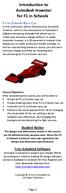 Introduction to Autodesk Inventor for F1 in Schools F1 in Schools Race Car In this course you will be introduced to Autodesk Inventor, which is the centerpiece of Autodesk s digital prototyping strategy
Applying a circular load. Immediate and consolidation settlement. Deformed contours. Query points and query lines. Graph query.
 Quick Start Tutorial 1-1 Quick Start Tutorial This quick start tutorial will cover some of the basic features of Settle3D. A circular load is applied to a single soil layer and settlements are examined.
Residential HVAC Load Sizing Training October 14, 2015. David Kaiser Green Code Plan Reviewer
 Residential HVAC Load Sizing Training October 14, 2015 David Kaiser Green Code Plan Reviewer DCRA - Green Building Division Regulations of green codes including: Green Building Act Green Construction Code
UNIVERSITY OF MISSOURI 23 0000 - Heating Ventilating and Air-Conditioning (HVAC) March 2015.01
 GENERAL: This section provides general standards for overall sizing and design of Heating, Ventilating, and Air Conditioning (HVAC) systems. Other sections contain specific standards for each system per
Life cycle cost comparison of TAB vs. other HVAC (UK) TECHNICAL BROCHURE
 Life cycle cost comparison of TAB vs. other HVAC (UK) TECHNICAL BROCHURE 3 213 2 2 UPONOR LIFE CYCLE COST COMPARISON OF TAB VS. OTHER HVAC Contents Introduction... 4 Base building... 5 System and tested
Vista User Guide <Virtual Environment> 6.0
 Vista User Guide 6.0 Page 1 of 46 Contents 1. Introduction...4 2. Vista View...4 3. Specifying Data for Output...6 3.1. Specifying Results... 6 3.2. Specifying Variables... 7 3.2.1.
Dienstleistung. Certification as "Quality Approved Passive House" Criteria for Residential-Use Passive Houses
 Passiv Haus Institut Passivhaus Dienstleistung GmbH Dr. Wolfgang Feist Rheinstr. 44/46 Rheinstr. 44/46 D-64283 Darmstadt D-64283 Darmstadt www.passiv.de www.passivhaus-info.de Certification as "Quality
Excel 2007 Basic knowledge
 Ribbon menu The Ribbon menu system with tabs for various Excel commands. This Ribbon system replaces the traditional menus used with Excel 2003. Above the Ribbon in the upper-left corner is the Microsoft
BEST 3, Atlanta, April 2012 Grahame E. Maisey, P.E.
 A Methodology to Develop a Sustainable, High Performance Building Envelope BEST 3, Atlanta, April 2012 Grahame E. Maisey, P.E. We re Going To Reveal New Sustainable Truths and Expose Old Bogus Truths We
Guide To Creating Academic Posters Using Microsoft PowerPoint 2010
 Guide To Creating Academic Posters Using Microsoft PowerPoint 2010 INFORMATION SERVICES Version 3.0 July 2011 Table of Contents Section 1 - Introduction... 1 Section 2 - Initial Preparation... 2 2.1 Overall
3-D Modeller Rendered Visualisations
 Recognised energy Dynamic Simulation Modelling (DSM) software DesignBuilder is a user interface to the EnergyPlus DSM. EnergyPlus builds on the most popular features and capabilities of BLAST and DOE-2
EFA PSBP. Natural Ventilation Strategy. Introduction. 1.1 Relevant legislation. 1.1.1 The Building Regulations 2010
 EFA PSBP Natural Ventilation Strategy Introduction The Baseline Designs Project will provide scheme design details for a number of Primary and Secondary School Exemplars. For the purposes of setting a
RELEASE NOTES EG USA 3.0.0
 RELEASE NOTES EG USA 3.0.0 Version 3.0 has a multitude of changes from version 2.8.05. One of the major changes is the ability to break up a home into Blocks with different HVAC systems. This includes
THE EFFECT OF WINDOW POSITION AND WINDOW SIZE ON THE ENERGY DEMAND FOR HEATING, COOLING AND ELECTRIC LIGHTING. R.M.J. Bokel
 THE EFFECT OF WINDOW POSITION AND WINDOW SIZE ON THE ENERGY DEMAND FOR HEATING, COOLING AND ELECTRIC LIGHTING R.M.J. Bokel Department of Architecture, Delft Technical University, Delft, The Netherlands,
Creating Drawings in Pro/ENGINEER
 6 Creating Drawings in Pro/ENGINEER This chapter shows you how to bring the cell phone models and the assembly you ve created into the Pro/ENGINEER Drawing mode to create a drawing. A mechanical drawing
Operation manual. Daikin Altherma hybrid heat pump EHYHBH05AA EHYHBH08AA EHYHBX08AA. Operation manual Daikin Altherma hybrid heat pump.
 EHYHBH05AA EHYHBH08AA EHYHBX08AA English Table of contents Table of contents 1 About this document 2 2 About the system 2 2.1 Components in a typical system layout... 2 3 Operation 3 3.1 Overview: Operation...
Getting Started With DraftSight A Guide For AEC Users
 Getting Started With DraftSight A Guide For AEC Users DraftSight.com Facebook.com/DraftSight Welcome to DraftSight a valuable tool for any AEC professional! DraftSight is more than a free, professional-grade
Energy Efficient HVAC-system and Building Design
 Energy Efficient HVAC-system and Building Design Maija Virta 1, Harri Itkonen 1, Panu Mustakallio 1, Risto Kosonen 1 1 Halton Oy, Finland Corresponding email: [email protected] SUMMARY This paper
THE NATIONAL BUILDING REGULATIONS PART XA: ENERGY EFFICIENCY. Presentation by Peter Henshall-Howard: HEAD: BUILDING DEVELOPMENT MANAGEMENT.
 THE NATIONAL BUILDING REGULATIONS PART XA: ENERGY EFFICIENCY. Presentation by Peter Henshall-Howard: HEAD: BUILDING DEVELOPMENT MANAGEMENT. A Diagrammatic representation of the relationship between the
Data Visualization. Prepared by Francisco Olivera, Ph.D., Srikanth Koka Department of Civil Engineering Texas A&M University February 2004
 Data Visualization Prepared by Francisco Olivera, Ph.D., Srikanth Koka Department of Civil Engineering Texas A&M University February 2004 Contents Brief Overview of ArcMap Goals of the Exercise Computer
Introduction to Autodesk Inventor for F1 in Schools
 F1 in Schools race car Introduction to Autodesk Inventor for F1 in Schools In this course you will be introduced to Autodesk Inventor, which is the centerpiece of Autodesk s Digital Prototyping strategy
Residential HVAC System Sizing
 Residential HVAC System Sizing William P. Goss University of Massachusetts, Amherst, Massachusetts, USA Corresponding email: [email protected] SUMMARY Heating, ventilating and air-conditioning (HVAC)
Appointment Scheduler
 EZClaim Appointment Scheduler User Guide Last Update: 11/19/2008 Copyright 2008 EZClaim This page intentionally left blank Contents Contents... iii Getting Started... 5 System Requirements... 5 Installing
User Manual. IDA Indoor Climate and Energy. EQUA Simulation AB February 2013. Version 4.5. Copyright 2013 EQUA Simulation AB
 User Manual IDA Indoor Climate and Energy Version 4.5 EQUA Simulation AB February 2013 Copyright 2013 EQUA Simulation AB The author and the publisher make no representation or warranties of any kind with
Central Controller G-50A/GB-50A Web Browser Operation Manual (For System Maintenance Engineer)
 Mitsubishi Electric Building Air-conditioner Control System Central Controller G-50A/GB-50A Web Browser Operation Manual (For System Maintenance Engineer) Contents 1 Introduction...1 1-1 Conventions Used
HVAC Calculations and Duct Sizing
 PDH Course M199 HVAC Calculations and Duct Sizing Gary D. Beckfeld, M.S.E., P.E. 2007 PDH Center 2410 Dakota Lakes Drive Herndon, VA 20171-2995 Phone: 703-478-6833 Fax: 703-481-9535 www.pdhcenter.com An
Spatial Adjustment Tools: The Tutorial
 Spatial Adjustment Tools: The Tutorial By Peter Kasianchuk, ESRI Educational Services In this exercise, you will perform some spatial adjustment and data management operations data to be used in analysis
DesignBuilder Simulation + CFD Training Guide
 DesignBuilder Simulation + CFD Training Guide DesignBuilder 2008-2011 No part of the manual is to be copied or reproduced in any form without the express agreement of DesignBuilder Software Contents DesignBuilder
CHAPTER 3. BUILDING THERMAL LOAD ESTIMATION
 CHAPTER 3. BUILDING THERMAL LOAD ESTIMATION 3.1 Purpose of Thermal Load Estimation 3.2 Heating Load versus Cooling Load 3.3 Critical Conditions for Design 3.4 Manual versus Computer Calculations 3.5 Heating
USER GUIDE. Unit 2: Synergy. Chapter 2: Using Schoolwires Synergy
 USER GUIDE Unit 2: Synergy Chapter 2: Using Schoolwires Synergy Schoolwires Synergy & Assist Version 2.0 TABLE OF CONTENTS Introductions... 1 Audience... 1 Objectives... 1 Before You Begin... 1 Getting
Chapter 1. Creating Sketches in. the Sketch Mode-I. Evaluation chapter. Logon to www.cadcim.com for more details. Learning Objectives
 Chapter 1 Creating Sketches in Learning Objectives the Sketch Mode-I After completing this chapter you will be able to: Use various tools to create a geometry. Dimension a sketch. Apply constraints to
PowerWorld Simulator
 PowerWorld Simulator Quick Start Guide 2001 South First Street Champaign, Illinois 61820 +1 (217) 384.6330 [email protected] http://www.powerworld.com Purpose This quick start guide is intended to
Interactive Voting System. www.ivsystem.nl. IVS-Basic IVS-Professional 4.4
 Interactive Voting System www.ivsystem.nl IVS-Basic IVS-Professional 4.4 Manual IVS-Basic 4.4 IVS-Professional 4.4 1213 Interactive Voting System The Interactive Voting System (IVS ) is an interactive
SketchUp Instructions
 SketchUp Instructions Every architect needs to know how to use SketchUp! SketchUp is free from Google just Google it and download to your computer. You can do just about anything with it, but it is especially
Roof Tutorial. Chapter 3:
 Chapter 3: Roof Tutorial The majority of Roof Tutorial describes some common roof styles that can be created using settings in the Wall Specification dialog and can be completed independent of the other
Chapter 4 Creating Charts and Graphs
 Calc Guide Chapter 4 OpenOffice.org Copyright This document is Copyright 2006 by its contributors as listed in the section titled Authors. You can distribute it and/or modify it under the terms of either
NETWORK PRINT MONITOR User Guide
 NETWORK PRINT MONITOR User Guide Legal Notes Unauthorized reproduction of all or part of this guide is prohibited. The information in this guide is subject to change without notice. We cannot be held liable
Basic Excel Handbook
 2 5 2 7 1 1 0 4 3 9 8 1 Basic Excel Handbook Version 3.6 May 6, 2008 Contents Contents... 1 Part I: Background Information...3 About This Handbook... 4 Excel Terminology... 5 Excel Terminology (cont.)...
Chapter 4: Website Basics
 1 Chapter 4: In its most basic form, a website is a group of files stored in folders on a hard drive that is connected directly to the internet. These files include all of the items that you see on your
Creating Hyperlinks & Buttons InDesign CS6
 Creating Hyperlinks & Buttons Adobe DPS, InDesign CS6 1 Creating Hyperlinks & Buttons InDesign CS6 Hyperlinks panel overview You can create hyperlinks so that when you export to Adobe PDF or SWF in InDesign,
Roof Tutorial. Chapter 3:
 Chapter 3: Roof Tutorial The first portion of this tutorial can be completed independent of the previous tutorials. We ll go over some common roof styles that can be created using settings in the Wall
ANSI/ASHRAE Standard 140-2004 Building Thermal Envelope and Fabric Load Tests
 ANSI/ASHRAE Standard 140-2004 Building Thermal Envelope and Fabric Load Tests DesignBuilder Version 1.2.0 (incorporating EnergyPlus version 1.3.0) - June 2006 1.0 Purpose The ANSI/ASHRAE Standard 140-2004
AB-Clock. Manual. Copyright 1996-2004 by GRAHL software design
 Manual Contents Contents Welcome! 4 4... The AB-Clock Menu 4... AB-Clock Settings 5... Start and Exit AB-Clock 5 Start AB-Clock... 5 Exit AB-Clock... 5 Start Parameters... 6 Procedures... 6 How to... run
Create a New Database in Access 2010
 Create a New Database in Access 2010 Table of Contents OVERVIEW... 1 CREATING A DATABASE... 1 ADDING TO A DATABASE... 2 CREATE A DATABASE BY USING A TEMPLATE... 2 CREATE A DATABASE WITHOUT USING A TEMPLATE...
Manual Analysis Software AFD 1201
 AFD 1200 - AcoustiTube Manual Analysis Software AFD 1201 Measurement of Transmission loss acc. to Song and Bolton 1 Table of Contents Introduction - Analysis Software AFD 1201... 3 AFD 1200 - AcoustiTube
Microsoft Office PowerPoint 2013
 Microsoft Office PowerPoint 2013 Navigating the PowerPoint 2013 Environment The Ribbon: The ribbon is where you will access a majority of the commands you will use to create and develop your presentation.
Introduction to MS WINDOWS XP
 Introduction to MS WINDOWS XP Mouse Desktop Windows Applications File handling Introduction to MS Windows XP 2 Table of Contents What is Windows XP?... 3 Windows within Windows... 3 The Desktop... 3 The
Creating Interactive PDF Forms
 Creating Interactive PDF Forms Using Adobe Acrobat X Pro Information Technology Services Outreach and Distance Learning Technologies Copyright 2012 KSU Department of Information Technology Services This
GETTING STARTED WITH THE MIPOWER MANAGEMENT SYSTEM
 GETTING STARTED WITH THE MIPOWER MANAGEMENT SYSTEM This Quick Start guide will help you start using the MiPower Management System provided by Grayson Collin Electric Cooperative. You should create your
WebSphere Business Monitor V6.2 Business space dashboards
 Copyright IBM Corporation 2009 All rights reserved IBM WEBSPHERE BUSINESS MONITOR 6.2 LAB EXERCISE WebSphere Business Monitor V6.2 What this exercise is about... 2 Lab requirements... 2 What you should
Layout Tutorial. Getting Started
 Getting Started Layout Tutorial This tutorial will explain how create a layout template, send views to a layout page, then save the document in PDF format. In this tutorial you will learn about: Creating
Project Setup and Data Management Tutorial
 Project Setup and Heavy Construction Edition Version 1.20 Corporate Office Trimble Navigation Limited Engineering and Construction Division 5475 Kellenburger Road Dayton, Ohio 45424-1099 U.S.A. Phone:
Effective Collaboration
 AUTODESK BUILDING SOLUTIONS Effective Collaboration Exporting Revit Architecture Models as ACIS Solids for Use in AutoCAD MEP The intent of this paper is to explain a process by which architects using
Improving thermal insulation of concrete sandwich panel buildings
 Improving thermal insulation of concrete sandwich panel buildings Jørgen Munch-Andersen Danish Building Research Institute, Aalborg University LCUBE conference, Vienna 17-18 April 2007 Outline A general
GETTING STARTED WITH DIALux (A Very Rough Guide) Rev. 6
 1. Scaling your project drawing for import into DIALux using AutoCAD 2004 OR DraftSight, (procedure is similar in AutoCAD 2014 but you will need to access the commands through the ribbon interface): a)
6. If you want to enter specific formats, click the Format Tab to auto format the information that is entered into the field.
 Adobe Acrobat Professional X Part 3 - Creating Fillable Forms Preparing the Form Create the form in Word, including underlines, images and any other text you would like showing on the form. Convert the
Software Application Tutorial
 Software Application Tutorial Copyright 2005, Software Application Training Unit, West Chester University. No Portion of this document may be reproduced without the written permission of the authors. For
Installing and using the driver
 8/00 Rev. 2.08-00 MANUAL Installation,Using, page 1 Installing and using the driver System Requirements... 2 Installing the printer driver... 3 Extracting the driver files... 3 Install a printer driver
Understand the Sketcher workbench of CATIA V5.
 Chapter 1 Drawing Sketches in Learning Objectives the Sketcher Workbench-I After completing this chapter you will be able to: Understand the Sketcher workbench of CATIA V5. Start a new file in the Part
Climate and Energy Responsive Housing in Continental Climates. The Suitability of Passive Houses for Iran's Dry and Cold Climate. Farshad Nasrollahi
 Climate and Energy Responsive Housing in Continental Climates The Suitability of Passive Houses for Iran's Dry and Cold Climate Farshad Nasrollahi Table of Contents Abstract German Abstract Introduction
Solar Heating Basics. 2007 Page 1. a lot on the shape, colour, and texture of the surrounding
 2007 Page 1 Solar Heating Basics Reflected radiation is solar energy received by collectorsfrom adjacent surfaces of the building or ground. It depends a lot on the shape, colour, and texture of the surrounding
Apache View User Guide
 Apache View User Guide 5.9 Page 1 of 68 Contents 1. Introduction...4 1.1. What is the Apache View?... 4 1.2. Context of the Apache View... 4 1.3. Overview of Apache View Interface
Getting Started with Excel 2008. Table of Contents
 Table of Contents Elements of An Excel Document... 2 Resizing and Hiding Columns and Rows... 3 Using Panes to Create Spreadsheet Headers... 3 Using the AutoFill Command... 4 Using AutoFill for Sequences...
Module 3.7. Thermal bridging
 Module 3.7 Thermal bridging Learning Outcomes On successful completion of this module learners will be able to - Describe construction details which influence thermal bridging. 2 Introduction to thermal
HVAC Systems: Overview
 HVAC Systems: Overview Michael J. Brandemuehl, Ph.D, P.E. University of Colorado Boulder, CO, USA Overview System Description Secondary HVAC Systems Air distribution Room diffusers and air terminals Duct
What s New V 11. Preferences: Parameters: Layout/ Modifications: Reverse mouse scroll wheel zoom direction
 What s New V 11 Preferences: Reverse mouse scroll wheel zoom direction Assign mouse scroll wheel Middle Button as Fine tune Pricing Method (Manufacturing/Design) Display- Display Long Name Parameters:
Software Development for Cooling Load Estimation by CLTD Method
 IOSR Journal of Mechanical and Civil Engineering (IOSR-JMCE) ISSN: 2278-1684Volume 3, Issue 6 (Nov. - Dec. 2012), PP 01-06 Software Development for Cooling Load Estimation by CLTD Method Tousif Ahmed Department
How To Run A Factory I/O On A Microsoft Gpu 2.5 (Sdk) On A Computer Or Microsoft Powerbook 2.3 (Powerpoint) On An Android Computer Or Macbook 2 (Powerstation) On
 User Guide November 19, 2014 Contents 3 Welcome 3 What Is FACTORY I/O 3 How Does It Work 4 I/O Drivers: Connecting To External Technologies 5 System Requirements 6 Run Mode And Edit Mode 7 Controls 8 Cameras
DEVELOPMENT OF AN OPEN SOURCE HOURLY BUILDING ENERGY MODELING SOFTWARE TOOL
 DEVELOPMENT OF AN OPEN SOURCE HOURLY BUILDING ENERGY MODELING SOFTWARE TOOL Brittany Hanam, MASc, EIT RDH Building Engineering Ltd. Vancouver, BC John Straube, PhD, P.Eng. Building Engineering Group, Civil
Eco Pelmet Modelling and Assessment. CFD Based Study. Report Number 610.14351-R1D1. 13 January 2015
 EcoPelmet Pty Ltd c/- Geoff Hesford Engineering 45 Market Street FREMANTLE WA 6160 Version: Page 2 PREPARED BY: ABN 29 001 584 612 2 Lincoln Street Lane Cove NSW 2066 Australia (PO Box 176 Lane Cove NSW
Microsoft Access 2010 handout
 Microsoft Access 2010 handout Access 2010 is a relational database program you can use to create and manage large quantities of data. You can use Access to manage anything from a home inventory to a giant
PowerPoint 2007: Basics Learning Guide
 PowerPoint 2007: Basics Learning Guide What s a PowerPoint Slide? PowerPoint presentations are composed of slides, just like conventional presentations. Like a 35mm film-based slide, each PowerPoint slide
Abstract. For notes detailing the changes in each release, see the MySQL for Excel Release Notes. For legal information, see the Legal Notices.
 MySQL for Excel Abstract This is the MySQL for Excel Reference Manual. It documents MySQL for Excel 1.3 through 1.3.6. Much of the documentation also applies to the previous 1.2 series. For notes detailing
Building Visualization using Autodesk VIZ
 Building Visualization using Autodesk VIZ The biggest mistake is thinking that one must make a complete 3D model. One approach to visualization is to take a cue from Hollywood building only what is required
Writer Guide. Chapter 15 Using Forms in Writer
 Writer Guide Chapter 15 Using Forms in Writer Copyright This document is Copyright 2011 by its contributors as listed below. You may distribute it and/or modify it under the terms of either the GNU General
MICROSOFT ACCESS STEP BY STEP GUIDE
 IGCSE ICT SECTION 11 DATA MANIPULATION MICROSOFT ACCESS STEP BY STEP GUIDE Mark Nicholls ICT Lounge P a g e 1 Contents Task 35 details Page 3 Opening a new Database. Page 4 Importing.csv file into the
STATGRAPHICS Online. Statistical Analysis and Data Visualization System. Revised 6/21/2012. Copyright 2012 by StatPoint Technologies, Inc.
 STATGRAPHICS Online Statistical Analysis and Data Visualization System Revised 6/21/2012 Copyright 2012 by StatPoint Technologies, Inc. All rights reserved. Table of Contents Introduction... 1 Chapter
VE Compliance FAQ. Top Tips for Achieving Compliance
 Integrated Environmental Solutions Ltd. VE Compliance FAQ The Building Regulations 2010: Conservation of fuel and power Approved Document L2A (2013 edition for use in England) Top Tips for Achieving Compliance
Ohio University Computer Services Center August, 2002 Crystal Reports Introduction Quick Reference Guide
 Open Crystal Reports From the Windows Start menu choose Programs and then Crystal Reports. Creating a Blank Report Ohio University Computer Services Center August, 2002 Crystal Reports Introduction Quick
SMART Ink 1.5. Windows operating systems. Scan the following QR code to view the SMART Ink Help on your smart phone or other mobile device.
 SMART Ink 1.5 Windows operating systems User s guide Scan the following QR code to view the SMART Ink Help on your smart phone or other mobile device. Trademark notice SMART Ink, SMART Notebook, SMART
Sweet Home 3D user's guide
 1 de 14 08/01/2013 13:08 Features Download Online Gallery Blog Documentation FAQ User's guide Video tutorial Developer's guides History Reviews Support 3D models Textures Translations Forum Report a bug
Learning Module 4 - Thermal Fluid Analysis Note: LM4 is still in progress. This version contains only 3 tutorials.
 Learning Module 4 - Thermal Fluid Analysis Note: LM4 is still in progress. This version contains only 3 tutorials. Attachment C1. SolidWorks-Specific FEM Tutorial 1... 2 Attachment C2. SolidWorks-Specific