
How To Become A College Professor
|
|
|
- Magdalen Harris
- 5 years ago
- Views:
Transcription
1 Early Childhood Education Program Annual Assessment Report Programs Covered by This Report: Bachelor of Arts in Early Childhood Education (BA) Early Childhood Practice (ECP) Master of Arts in Early Childhood Education (MAT) Subsequent Certification in Early Childhood Education (SubCert) Report Writer: Xiaoli Wen, Ph.D.

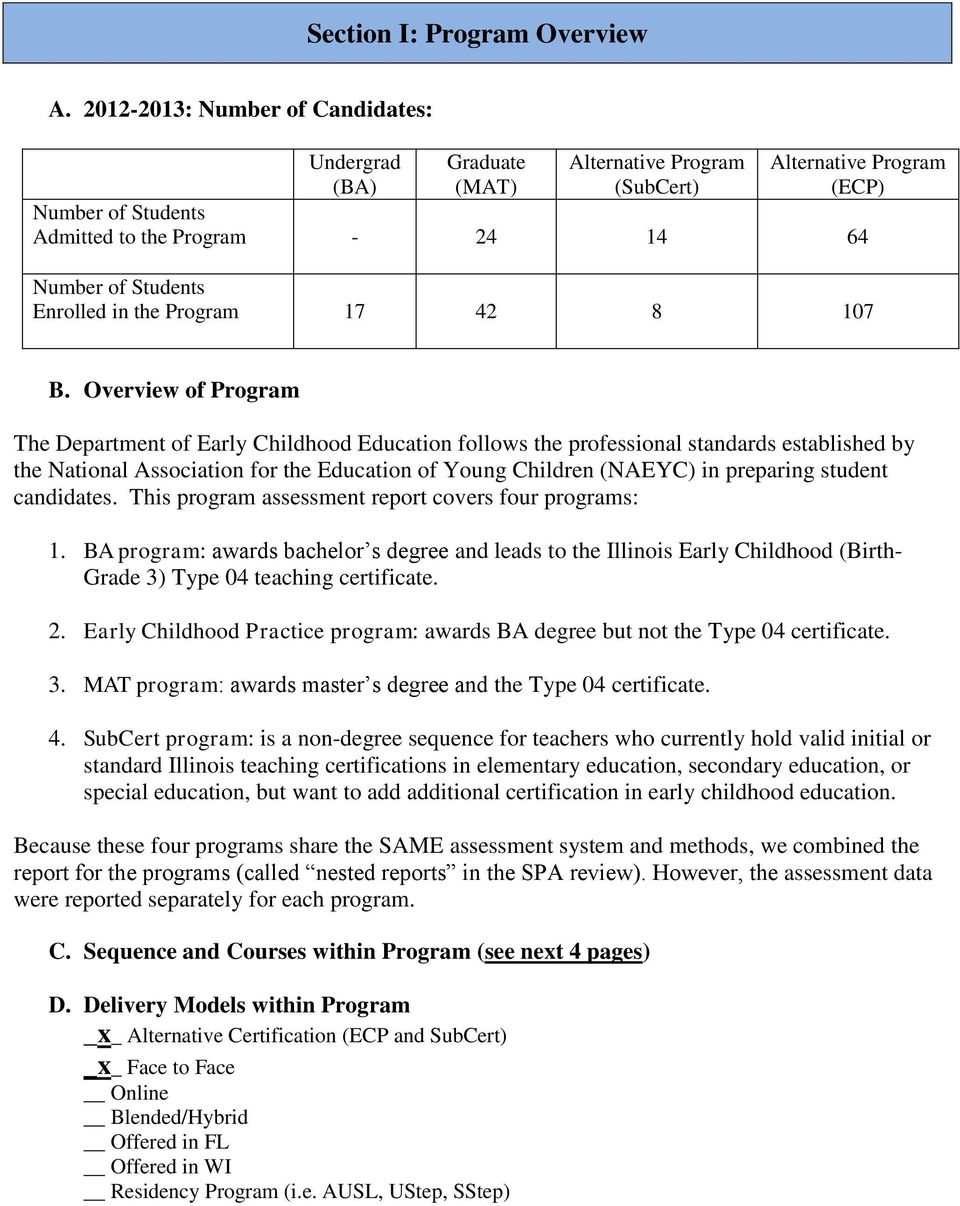
2 Section I: Program Overview A : Number of Candidates: Undergrad (BA) Graduate (MAT) Alternative Program (SubCert) Alternative Program (ECP) Number of Students Admitted to the Program Number of Students Enrolled in the Program B. Overview of Program The Department of Early Childhood Education follows the professional standards established by the National Association for the Education of Young Children (NAEYC) in preparing student candidates. This program assessment report covers four programs: 1. BA program: awards bachelor s degree and leads to the Illinois Early Childhood (Birth- Grade 3) Type 04 teaching certificate. 2. Early Childhood Practice program: awards BA degree but not the Type 04 certificate. 3. MAT program: awards master s degree and the Type 04 certificate. 4. SubCert program: is a non-degree sequence for teachers who currently hold valid initial or standard Illinois teaching certifications in elementary education, secondary education, or special education, but want to add additional certification in early childhood education. Because these four programs share the SAME assessment system and methods, we combined the report for the programs (called nested reports in the SPA review). However, the assessment data were reported separately for each program. C. Sequence and Courses within Program (see next 4 pages) D. Delivery Models within Program _x_ Alternative Certification (ECP and SubCert) _x_ Face to Face Online Blended/Hybrid Offered in FL Offered in WI Residency Program (i.e. AUSL, UStep, SStep)
3 BA program (ECE460 and 470 are the transition points and benchmark courses) General Education Requirement Communication Two written communication courses Humanities One Humanities course Fine Arts One Fine Arts course Quantitative Reasoning Two college level Mathematics courses Physical and Life Sciences One Life Science course One Physical Science course One science course, must have a lab component Social Sciences One U.S. Politics course One Non-Western/Global Social Science course Behavioral Science One Developmental Psychology course Total semester hours 60 We accept IAI approved coursework that is transferred in from other institutions to fulfill these requirements and many of our candidates take these courses at the community colleges Foundational Courses Title Semester hours ECE 202 Developmental theory and Practice 5 ECE 205 Child Study I Infant and Toddler 2 ECE 206 Child Study II Preprimary 2 ECE 310 Child, Family & Community 5 ECE 320 Speech and Language Development 3 ECE 405 Preprimary Methods - Language Arts, Art, Music, and 3 Movement ECE 406 Preprimary Methods Social Studies, Math, & Science 3 ECE 460 Early Childhood Practicum 7 LAE 307 Children s Literature (includes children 0-8 years old) 5 History One American History course 5 SPE 300 Survey of Exceptional Children 5 Behavioral Science One Developmental Psychology course 5 Total semester hours 50 Professional Sequence Title Semester hours ECE 207 Child Study III - Primary 2 ECE 315 ECE315 History & Philosophy of ECE 5 ECE 330 Instructional Technology 3 ECE 340 Classroom Management 5 CIS481 Theory and Method: Primary Social Studies 1 MHE481 Theory and Method: Primary Math 3 RLL481 Theory and Method Primary Reading 3 SCE481 Theory and Method: Primary Science 2 ECE470 Full-Day Student Teaching 14 Total semester hours 38

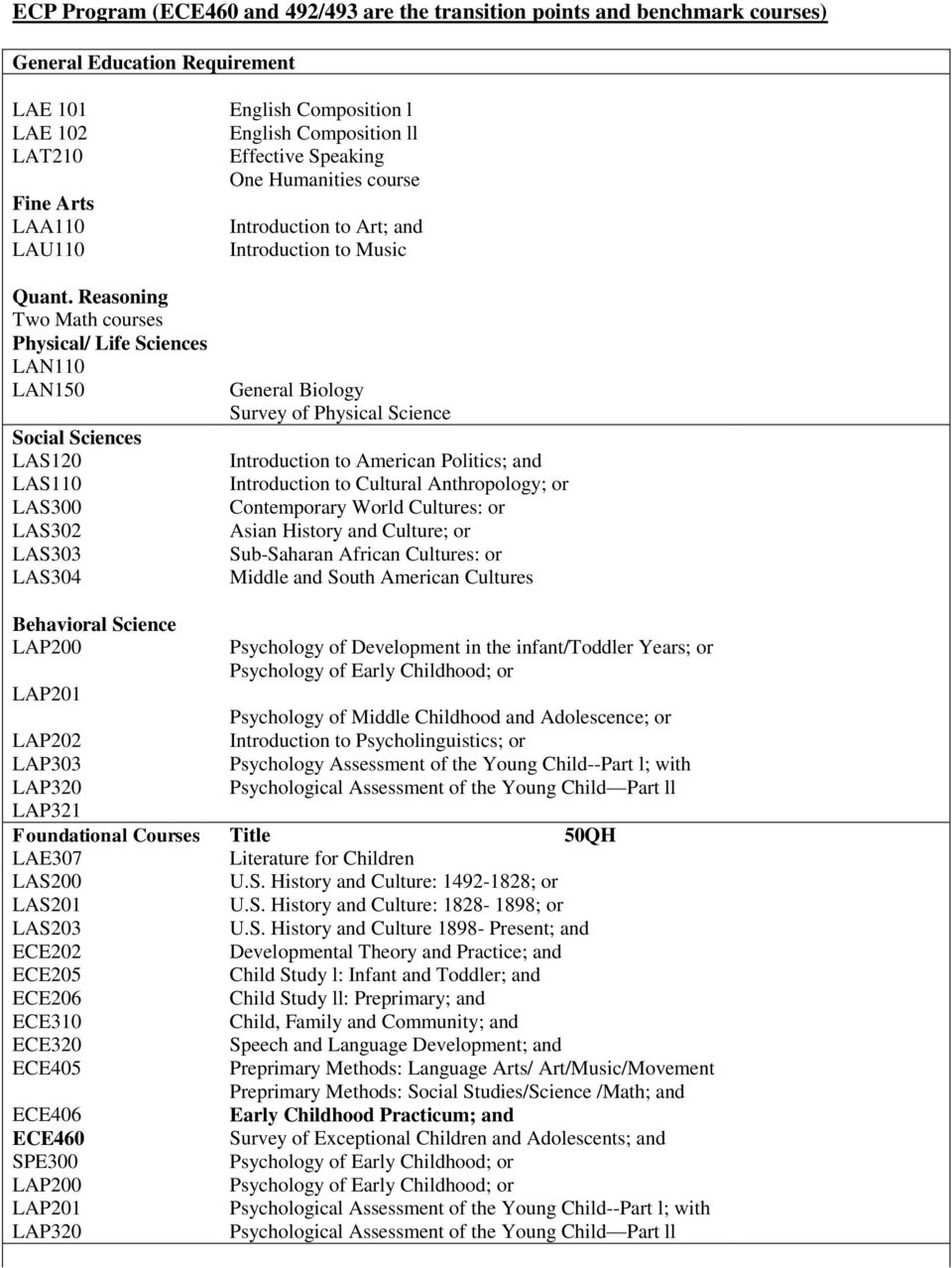
4 ECP Program (ECE460 and 492/493 are the transition points and benchmark courses) General Education Requirement LAE 101 LAE 102 LAT210 Fine Arts LAA110 LAU110 Quant. Reasoning Two Math courses Physical/ Life Sciences LAN110 LAN150 Social Sciences LAS120 LAS110 LAS300 LAS302 LAS303 LAS304 English Composition l English Composition ll Effective Speaking One Humanities course Introduction to Art; and Introduction to Music General Biology Survey of Physical Science Introduction to American Politics; and Introduction to Cultural Anthropology; or Contemporary World Cultures: or Asian History and Culture; or Sub-Saharan African Cultures: or Middle and South American Cultures Behavioral Science LAP200 LAP201 LAP202 LAP303 LAP320 LAP321 Psychology of Development in the infant/toddler Years; or Psychology of Early Childhood; or Psychology of Middle Childhood and Adolescence; or Introduction to Psycholinguistics; or Psychology Assessment of the Young Child--Part l; with Psychological Assessment of the Young Child Part ll Foundational Courses Title 50QH LAE307 LAS200 LAS201 LAS203 ECE202 ECE205 ECE206 ECE310 ECE320 ECE405 ECE406 ECE460 SPE300 LAP200 LAP201 LAP320 Literature for Children U.S. History and Culture: ; or U.S. History and Culture: ; or U.S. History and Culture Present; and Developmental Theory and Practice; and Child Study l: Infant and Toddler; and Child Study ll: Preprimary; and Child, Family and Community; and Speech and Language Development; and Preprimary Methods: Language Arts/ Art/Music/Movement Preprimary Methods: Social Studies/Science /Math; and Early Childhood Practicum; and Survey of Exceptional Children and Adolescents; and Psychology of Early Childhood; or Psychology of Early Childhood; or Psychological Assessment of the Young Child--Part l; with Psychological Assessment of the Young Child Part ll
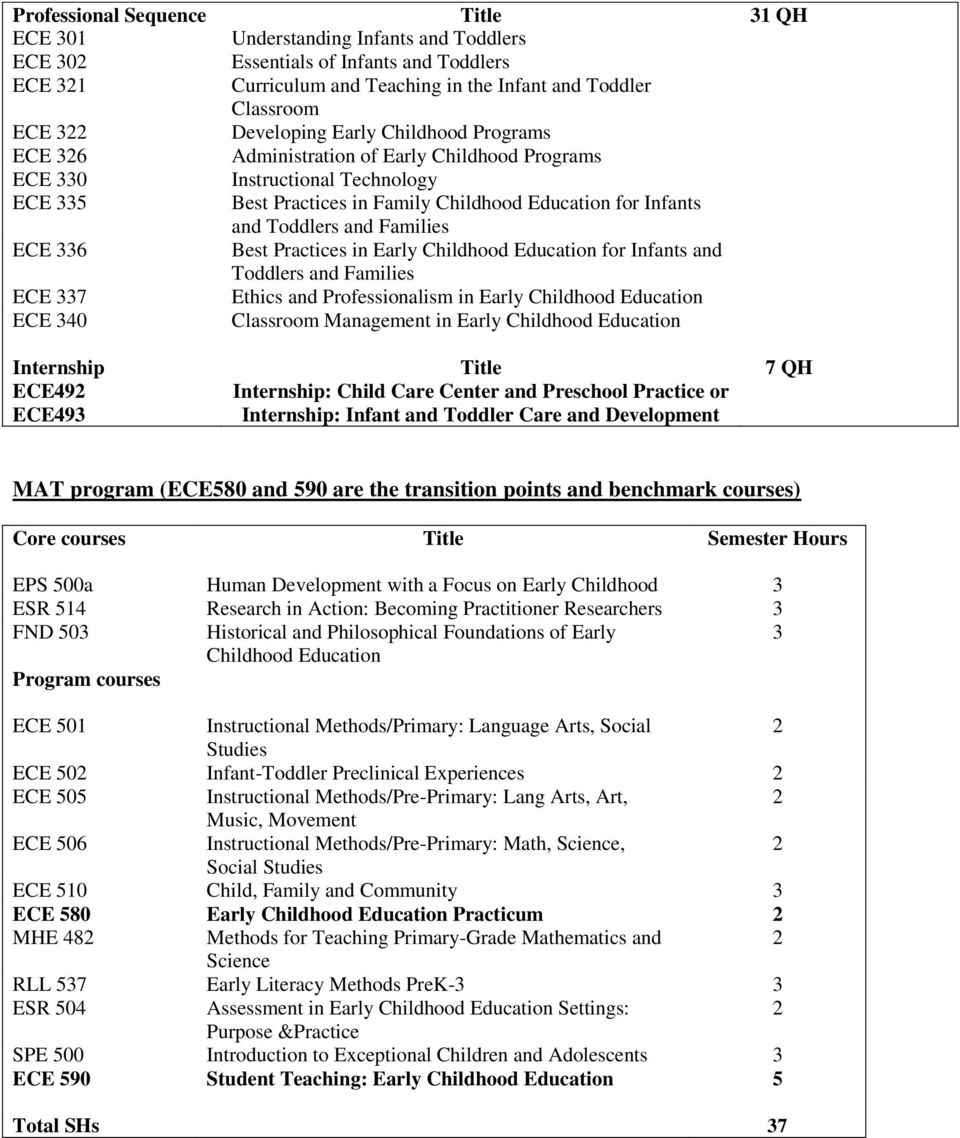
5 Professional Sequence Title 31 QH ECE 301 Understanding Infants and Toddlers ECE 302 Essentials of Infants and Toddlers ECE 321 Curriculum and Teaching in the Infant and Toddler Classroom ECE 322 Developing Early Childhood Programs ECE 326 Administration of Early Childhood Programs ECE 330 Instructional Technology ECE 335 Best Practices in Family Childhood Education for Infants and Toddlers and Families ECE 336 Best Practices in Early Childhood Education for Infants and Toddlers and Families ECE 337 Ethics and Professionalism in Early Childhood Education ECE 340 Classroom Management in Early Childhood Education Internship ECE492 ECE493 Title Internship: Child Care Center and Preschool Practice or Internship: Infant and Toddler Care and Development 7 QH MAT program (ECE580 and 590 are the transition points and benchmark courses) Core courses Title Semester Hours EPS 500a Human Development with a Focus on Early Childhood 3 ESR 514 Research in Action: Becoming Practitioner Researchers 3 FND 503 Historical and Philosophical Foundations of Early 3 Childhood Education Program courses ECE 501 Instructional Methods/Primary: Language Arts, Social 2 Studies ECE 502 Infant-Toddler Preclinical Experiences 2 ECE 505 Instructional Methods/Pre-Primary: Lang Arts, Art, 2 Music, Movement ECE 506 Instructional Methods/Pre-Primary: Math, Science, 2 Social Studies ECE 510 Child, Family and Community 3 ECE 580 Early Childhood Education Practicum 2 MHE 482 Methods for Teaching Primary-Grade Mathematics and 2 Science RLL 537 Early Literacy Methods PreK-3 3 ESR 504 Assessment in Early Childhood Education Settings: 2 Purpose &Practice SPE 500 Introduction to Exceptional Children and Adolescents 3 ECE 590 Student Teaching: Early Childhood Education 5 Total SHs 37
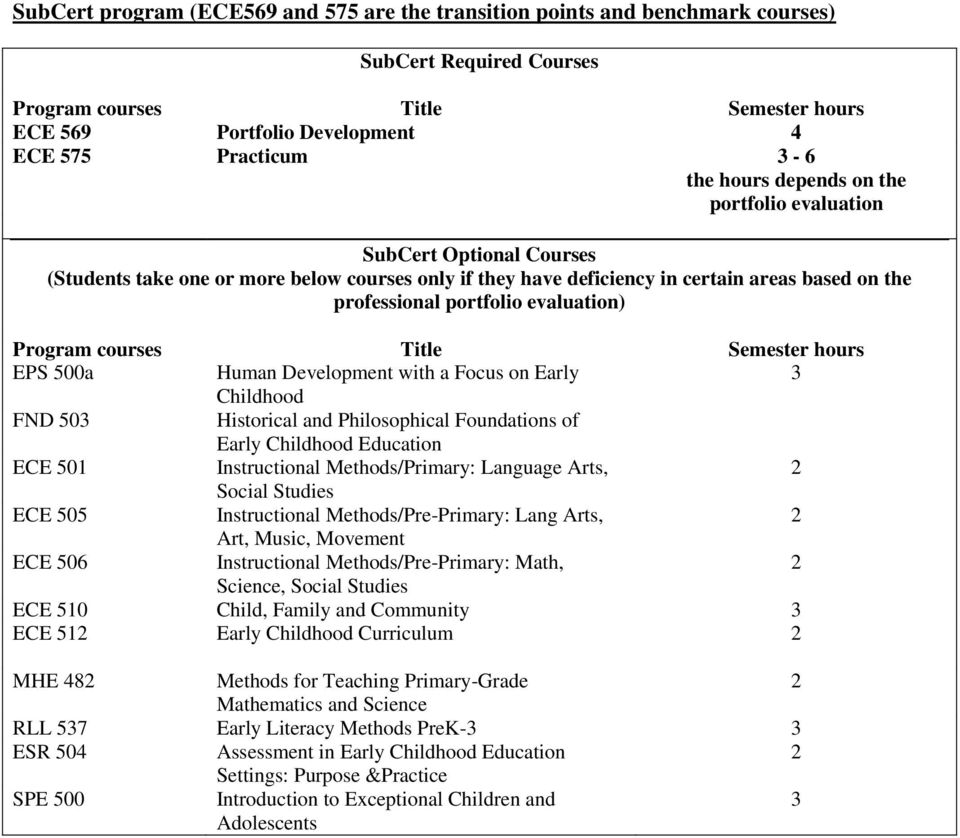
6 SubCert program (ECE569 and 575 are the transition points and benchmark courses) SubCert Required Courses Program courses Title Semester hours ECE 569 Portfolio Development 4 ECE 575 Practicum 3-6 the hours depends on the portfolio evaluation SubCert Optional Courses (Students take one or more below courses only if they have deficiency in certain areas based on the professional portfolio evaluation) Program courses Title Semester hours EPS 500a Human Development with a Focus on Early 3 Childhood FND 503 Historical and Philosophical Foundations of Early Childhood Education ECE 501 Instructional Methods/Primary: Language Arts, 2 Social Studies ECE 505 Instructional Methods/Pre-Primary: Lang Arts, 2 Art, Music, Movement ECE 506 Instructional Methods/Pre-Primary: Math, 2 Science, Social Studies ECE 510 Child, Family and Community 3 ECE 512 Early Childhood Curriculum 2 MHE 482 Methods for Teaching Primary-Grade 2 Mathematics and Science RLL 537 Early Literacy Methods PreK-3 3 ESR 504 Assessment in Early Childhood Education 2 Settings: Purpose &Practice SPE 500 Introduction to Exceptional Children and Adolescents 3
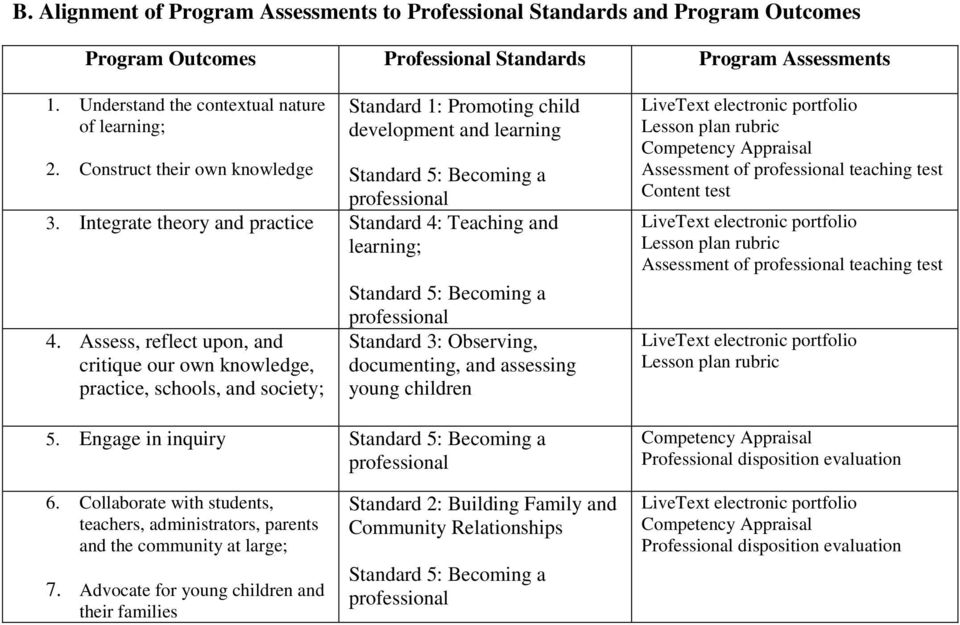
7 Section II: Relationship of Assessments to Program Outcomes and Standards The Early Childhood Education programs aim to promote the following learning outcomes for future teachers who serve young children and their families: Understand the contextual nature of learning Construct their own knowledge Integrate theory and practice Assess, reflect upon, and critique their own knowledge, practice, schools, and society Engage in inquiry Collaborate with students, teachers, administrators, parents and the community at large Advocate for young children and their families As showed in the two tables below, these program learning outcomes are well aligned with the conceptual framework/outcomes of the National College of Education, and are highly consistent with the five NAEYC professional standards. A. Alignment of Program Assessments to NCE Conceptual Framework/Outcomes NCE Conceptual Framework/Outcomes NCE Candidates: Envision, articulate and model democratic and progressive education Design powerful learning environments that integrate appropriate technologies Design powerful learning environments that utilize multiple meaningful assessments Design powerful learning environments that enable self-directed learning Work collaboratively in diverse communities and with diverse learners to achieve learning goals Advocate for democratic values, equity, access and resources to assure educational success for all Cultivate curiosity and excitement for learning in themselves and others Respect and learn from other peoples, cultures, and points of view Demonstrate a caring attitude in recognizing the needs of others and acting to promote their growth Act with confidence and self-knowledge to assume professional leadership roles and responsibilities Use information from self and others to continuously improve Program Assessments LiveText electronic portfolio Lesson plan rubric Competency Appraisal Content test LiveText electronic portfolio Lesson plan rubric Competency Appraisal Assessment of professional teaching test LiveText electronic portfolio Lesson plan rubric Competency Appraisal Assessment of professional teaching test LiveText electronic portfolio Lesson plan rubric Competency Appraisal Assessment of professional teaching test Professional disposition evaluation Competency Appraisal LiveText electronic portfolio Professional disposition evaluation Competency Appraisal Professional disposition evaluation Competency Appraisal Professional disposition evaluation Competency Appraisal LiveText electronic portfolio Professional disposition evaluation Competency Appraisal Professional disposition evaluation Professional disposition evaluation Competency Appraisal

8 B. Alignment of Program Assessments to Professional Standards and Program Outcomes Program Outcomes Professional Standards Program Assessments 1. Understand the contextual nature of learning; Standard 1: Promoting child development and learning 2. Construct their own knowledge Standard 5: Becoming a professional 3. Integrate theory and practice Standard 4: Teaching and learning; 4. Assess, reflect upon, and critique our own knowledge, practice, schools, and society; Standard 5: Becoming a professional Standard 3: Observing, documenting, and assessing young children 5. Engage in inquiry Standard 5: Becoming a professional LiveText electronic portfolio Lesson plan rubric Competency Appraisal Assessment of professional teaching test Content test LiveText electronic portfolio Lesson plan rubric Assessment of professional teaching test LiveText electronic portfolio Lesson plan rubric Competency Appraisal Professional disposition evaluation 6. Collaborate with students, teachers, administrators, parents and the community at large; 7. Advocate for young children and their families Standard 2: Building Family and Community Relationships Standard 5: Becoming a professional LiveText electronic portfolio Competency Appraisal Professional disposition evaluation
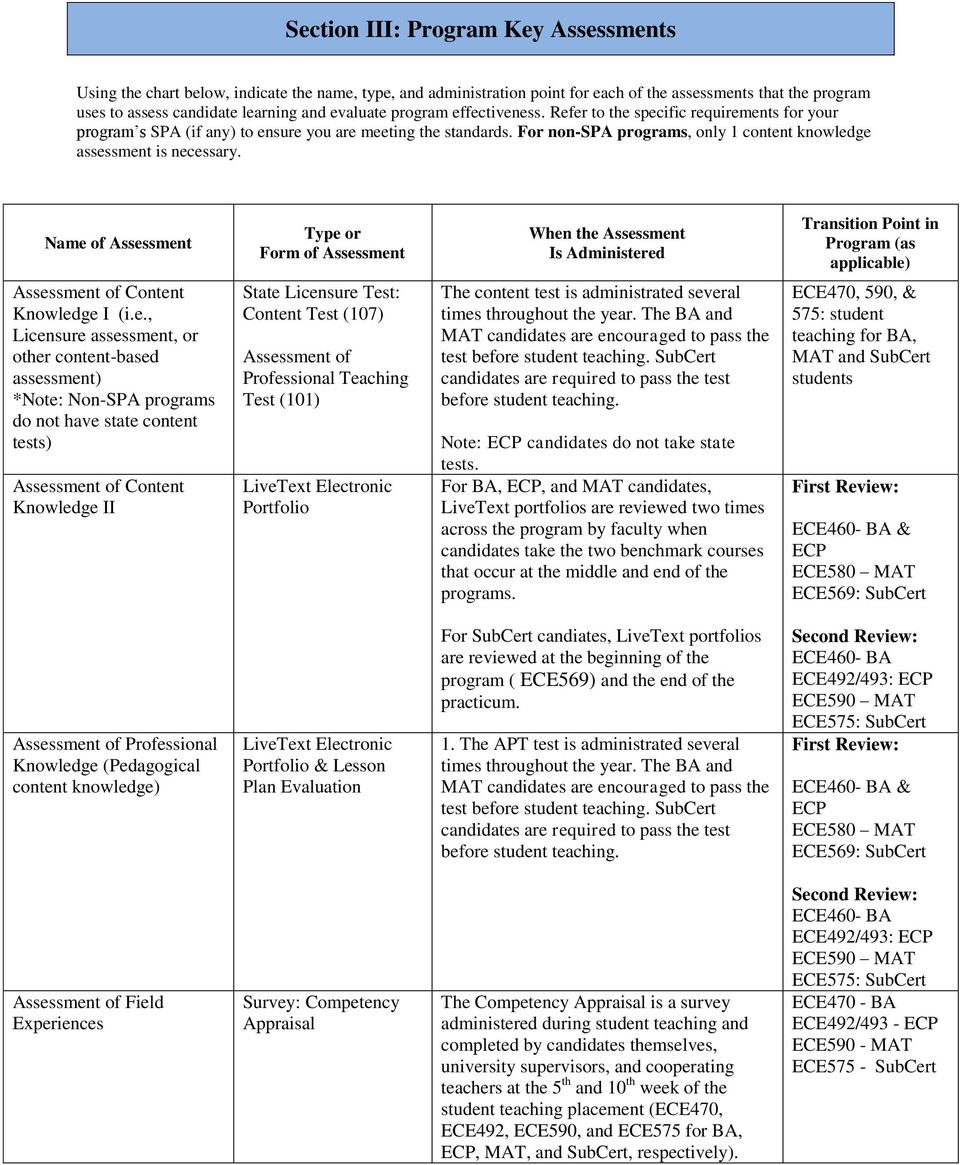
9 Section III: Program Key Assessments Using the chart below, indicate the name, type, and administration point for each of the assessments that the program uses to assess candidate learning and evaluate program effectiveness. Refer to the specific requirements for your program s SPA (if any) to ensure you are meeting the standards. For non-spa programs, only 1 content knowledge assessment is necessary. Name of Assessment Type or Form of Assessment When the Assessment Is Administered Transition Point in Program (as applicable) Assessment of Content Knowledge I (i.e., Licensure assessment, or other content-based assessment) *Note: Non-SPA programs do not have state content tests) Assessment of Content Knowledge II State Licensure Test: Content Test (107) Assessment of Professional Teaching Test (101) LiveText Electronic Portfolio The content test is administrated several times throughout the year. The BA and MAT candidates are encouraged to pass the test before student teaching. SubCert candidates are required to pass the test before student teaching. Note: ECP candidates do not take state tests. For BA, ECP, and MAT candidates, LiveText portfolios are reviewed two times across the program by faculty when candidates take the two benchmark courses that occur at the middle and end of the programs. ECE470, 590, & 575: student teaching for BA, MAT and SubCert students First Review: ECE460- BA & ECP ECE580 MAT ECE569: SubCert Assessment of Professional Knowledge (Pedagogical content knowledge) LiveText Electronic Portfolio & Lesson Plan Evaluation For SubCert candiates, LiveText portfolios are reviewed at the beginning of the program ( ECE569) and the end of the practicum. 1. The APT test is administrated several times throughout the year. The BA and MAT candidates are encouraged to pass the test before student teaching. SubCert candidates are required to pass the test before student teaching. Second Review: ECE460- BA ECE492/493: ECP ECE590 MAT ECE575: SubCert First Review: ECE460- BA & ECP ECE580 MAT ECE569: SubCert Assessment of Field Experiences Survey: Competency Appraisal The Competency Appraisal is a survey administered during student teaching and completed by candidates themselves, university supervisors, and cooperating teachers at the 5 th and 10 th week of the student teaching placement (ECE470, ECE492, ECE590, and ECE575 for BA, ECP, MAT, and SubCert, respectively). Second Review: ECE460- BA ECE492/493: ECP ECE590 MAT ECE575: SubCert ECE470 - BA ECE492/493 - ECP ECE590 - MAT ECE575 - SubCert
10 Assessment of Candidate Impact on Student Learning Assessment of Candidate Dispositions Assessment of Candidate Diversity Proficiencies Lesson Plan Evaluation Survey: Professional Disposition Evaluation LiveText Electronic Portfolio During both practicum and student teaching, one lesson that was implemented by the candidates is evaluated by the candidates themselves, university supervisors, and seminar course leaders. Candidates professional dispositions are evaluated during their practicum experience, by themselves, cooperating teachers, and university supervisors at the end of the experience LiveText portfolios are reviewed two times across the program (middle and end of the programs). BA: ECE460 and 470; ECP: ECE460 & 492/493; MAT: ECE580 and 590; SubCert: ECE575. ECE460, 580, and 575, for BA, ECP, MAT, and SubCert, respectively First Review: ECE460- BA & ECP ECE580 MAT ECE569: SubCert Assessment of Candidate Technology Proficiencies LiveText Electronic Portfolio LiveText portfolios are reviewed two times across the program (middle and end of the programs). Second Review: ECE460- BA ECE492/493: ECP ECE590 MAT ECE575: SubCert First Review: ECE460- BA & ECP ECE580 MAT ECE569: SubCert Second Review: ECE460- BA ECE492/493: ECP ECE590 MAT ECE575: SubCert

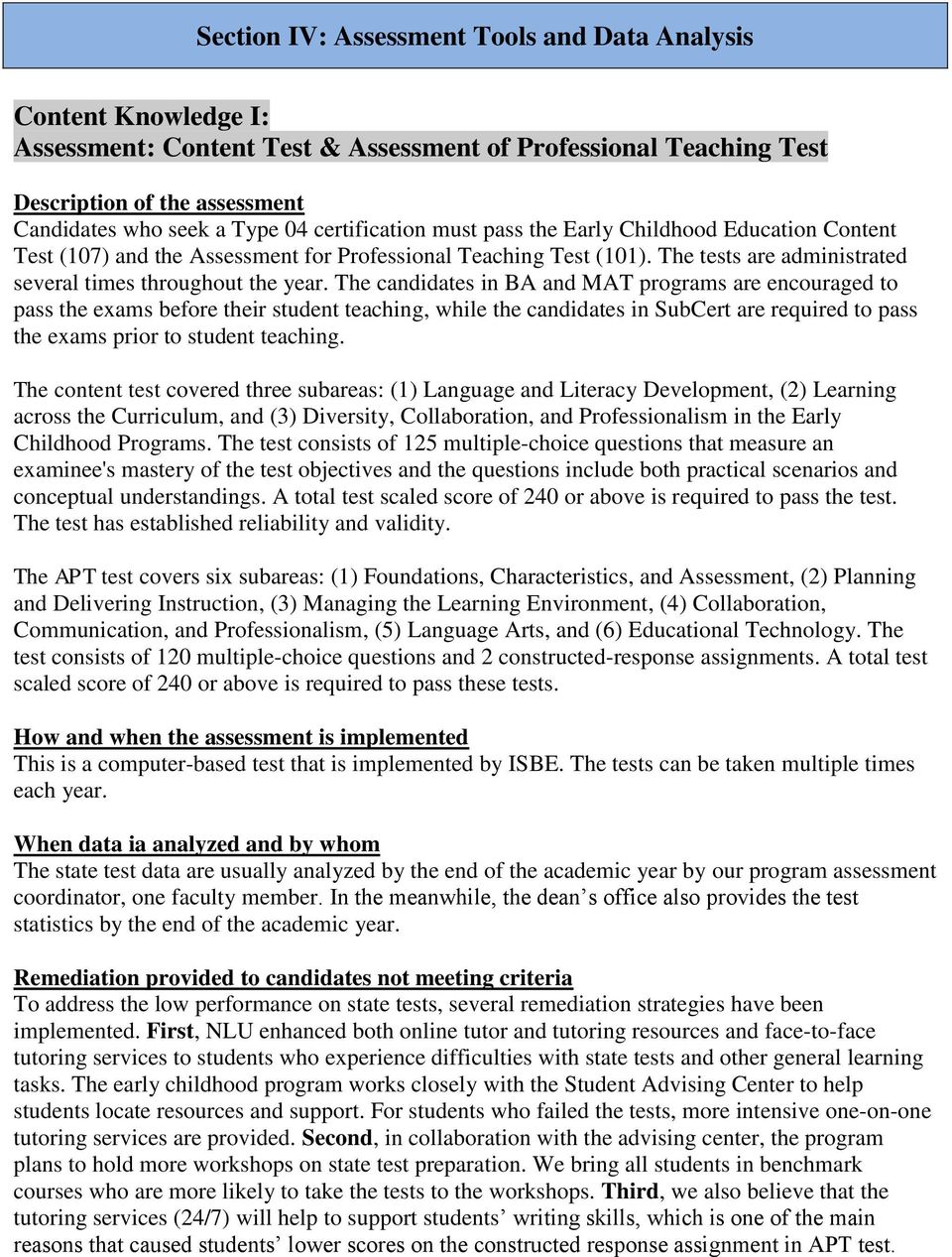
11 Section IV: Assessment Tools and Data Analysis Content Knowledge I: Assessment: Content Test & Assessment of Professional Teaching Test Description of the assessment Candidates who seek a Type 04 certification must pass the Early Childhood Education Content Test (107) and the Assessment for Professional Teaching Test (101). The tests are administrated several times throughout the year. The candidates in BA and MAT programs are encouraged to pass the exams before their student teaching, while the candidates in SubCert are required to pass the exams prior to student teaching. The content test covered three subareas: (1) Language and Literacy Development, (2) Learning across the Curriculum, and (3) Diversity, Collaboration, and Professionalism in the Early Childhood Programs. The test consists of 125 multiple-choice questions that measure an examinee's mastery of the test objectives and the questions include both practical scenarios and conceptual understandings. A total test scaled score of 240 or above is required to pass the test. The test has established reliability and validity. The APT test covers six subareas: (1) Foundations, Characteristics, and Assessment, (2) Planning and Delivering Instruction, (3) Managing the Learning Environment, (4) Collaboration, Communication, and Professionalism, (5) Language Arts, and (6) Educational Technology. The test consists of 120 multiple-choice questions and 2 constructed-response assignments. A total test scaled score of 240 or above is required to pass these tests. How and when the assessment is implemented This is a computer-based test that is implemented by ISBE. The tests can be taken multiple times each year. When data ia analyzed and by whom The state test data are usually analyzed by the end of the academic year by our program assessment coordinator, one faculty member. In the meanwhile, the dean s office also provides the test statistics by the end of the academic year. Remediation provided to candidates not meeting criteria To address the low performance on state tests, several remediation strategies have been implemented. First, NLU enhanced both online tutor and tutoring resources and face-to-face tutoring services to students who experience difficulties with state tests and other general learning tasks. The early childhood program works closely with the Student Advising Center to help students locate resources and support. For students who failed the tests, more intensive one-on-one tutoring services are provided. Second, in collaboration with the advising center, the program plans to hold more workshops on state test preparation. We bring all students in benchmark courses who are more likely to take the tests to the workshops. Third, we also believe that the tutoring services (24/7) will help to support students writing skills, which is one of the main reasons that caused students lower scores on the constructed response assignment in APT test.
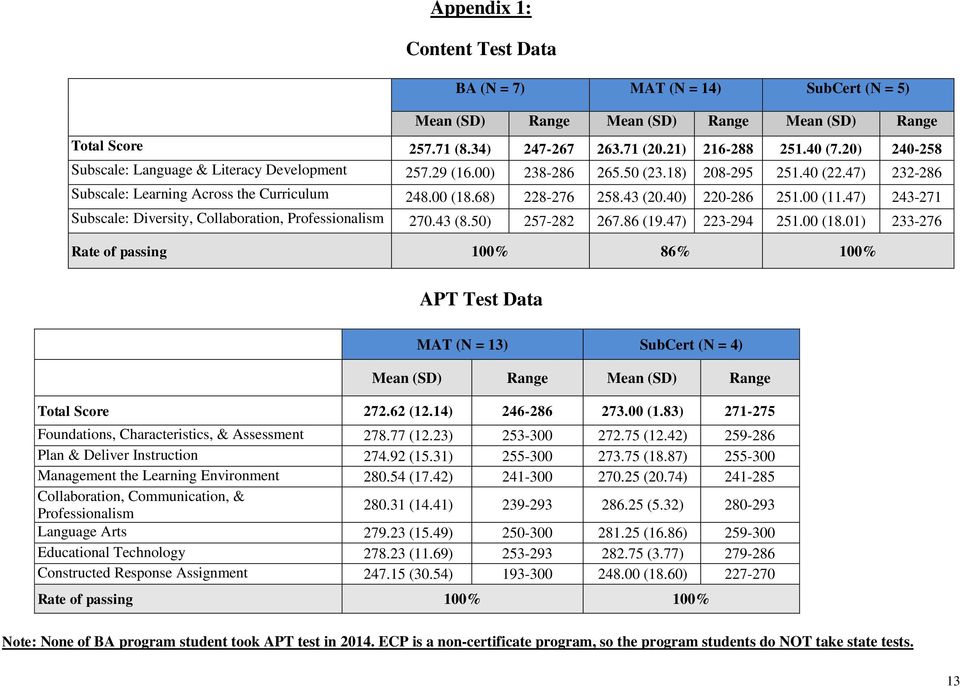
12 How data from assessment is used by program, instructors, and candidates Our faculty review the state test data on an annual basis, and the test results have been used to inform curriculum revisions, program updates, and program supervision in general. Data interpretation [see data table in the Appendix 1] The data suggested that candidates in the three certification programs (ECP students do NOT take state test) achieved an average score that was above the passing cutoff (240 points) in all test areas of the both state exams. The MAT candidates gained better scores than SubCert and BA students, but with relatively larger variation in their scores. Compared to the graduate candidates, the undergraduate candidates had relatively lower average total and subscale scores. Each program maintained a 100% passing rate on both tests, except that the MAT program had an 86% passing rate on the content test. For the BA program, the passing rate on content test was significantly improved in comparison to last two years data (although the number of students who took the tests was small). Overall, the state test data demonstrate that the candidates in all four programs possessed a satisfactory level of content knowledge.
![Data interpretation [see data table in the Appendix 1] The 2013-2014 data suggested that candidates in the three certification programs (ECP students do NOT take state test) achieved an average score](/docs-images/56/8139651/images/page_12.jpg "that was above the passing cutoff (240 points) in all test areas of the both state exams.")
13 Appendix 1: Content Test Data BA (N = 7) MAT (N = 14) SubCert (N = 5) Mean (SD) Range Mean (SD) Range Mean (SD) Range Total Score (8.34) (20.21) (7.20) Subscale: Language & Literacy Development (16.00) (23.18) (22.47) Subscale: Learning Across the Curriculum (18.68) (20.40) (11.47) Subscale: Diversity, Collaboration, Professionalism (8.50) (19.47) (18.01) Rate of passing 100% 86% 100% APT Test Data MAT (N = 13) SubCert (N = 4) Mean (SD) Range Mean (SD) Range Total Score (12.14) (1.83) Foundations, Characteristics, & Assessment (12.23) (12.42) Plan & Deliver Instruction (15.31) (18.87) Management the Learning Environment (17.42) (20.74) Collaboration, Communication, & Professionalism (14.41) (5.32) Language Arts (15.49) (16.86) Educational Technology (11.69) (3.77) Constructed Response Assignment (30.54) (18.60) Rate of passing 100% 100% Note: None of BA program student took APT test in ECP is a non-certificate program, so the program students do NOT take state tests. 13
14 Content Knowledge II Assessment: LiveText Electronic Portfolio Description of the assessment In addition to the state tests, we use a local assessment, professional portfolio, to provide a more holistic and extensive measure of the candidates content knowledge. LiveText is an internet-based platform that allows students to create their professional portfolios, which are organized around all NAEYC standards (ISBE standards for the SubCert students) and two additional institutional standards (i.e., Diversity and Technology). Those state and national standards represent all the expected content, pedagogical, and professional knowledge that ECE teacher candidates should master. We require candidates to submit at least 4 artifacts under each standard to demonstrate their knowledge in meeting each standard. For each submitted artifact, candidates need to provide a brief summary and rationale for why and how this artifact can demonstrate their knowledge in meeting a specific standard. Candidates are also required to write a reflection statement for each standard which includes a self-assessment relative to the components of the standard. Their portfolios were evaluated based on a 4-point rubric. This assessment is a comprehensive and straightforward system in demonstrating evidence that our students have attained the state and national requirements. To demonstrate students content specific knowledge, data from four standards of the portfolio were presented for BA, ECP, and MAT students: - NAEYC Standard 1: Promoting child development and learning (artifact example: child study paper that covers all domains of development, including language, physical, cognitive, social and emotional developments) - NAEYC Standard 2: Building family and community relationships (artifact example: lesson plans that cover parent participation). - NAEYC Standard 4: Teaching and learning (a. connecting with children and families, using developmentally effective approaches, understanding content knowledge in early education, and building meaningful curriculum). Artifact examples include lesson plans that cover various subject areas, such as fine arts, social studies, physical development, literacy, math, and science activities. - Institutional Standard 6: Diversity (artifact example: case studies of children with special needs, from low-income families, or from culturally and linguistically diverse backgrounds). Since the SubCert students followed the ISBE standards (well aligned with the NAEYC standards), data from 11 relevant ISBE standards were presented: - Standard 1: Curriculum content - Standard 2: Curriculum English language arts - Standard 3: Curriculum Mathematics - Standard 4: Curriculum Science - Standard 5: Curriculum Social science - Standard 6: Curriculum Physical development and health - Standard 7: Curriculum final arts - Standard 8: Human development and learning - Standard 9: Diversity 14
15 - Standard 13: Communication - Standard 15: Collaborative relationships How and when the assessment is implemented Candidates portfolios are evaluated twice across the whole program period (middle and end of the program for BA, MAT, and ECP candidates; beginning and end of the program for SubCert candidates), as defined by program benchmark courses. Candidates portfolios are evaluated based on a 4-point rubric that covers the quality of: (1) artifacts; (2) rationale statement; (3) overall writing; and (4) self-reflection. [The rubric was attached in the Appendix 2] When data is analyzed and by whom The portfolio reviews were conducted by all faculty in the Early Childhood Education programs. The data were analyzed by the end of the academic year by the program assessment coordinator. However, the benchmark review data for specific programs (e.g., BA and MAT) were also reported to the field placement coordinator periodically in order to ensure the candidates eligibility for field placement. It is a program policy that prior to applying for student teaching, the candidates portfolio reviews need to be at the minimal expectations level (out a 4-point rubric). Remediation provided to candidates not meeting criteria For candidates who did not pass the review, the faculty reviewers met with students individually, gave them detailed feedback, and allowed them to resubmit their portfolios up to two times. In addition, our faculty hold one free LiveText workshop each term to support students. How data from assessment is used by program, instructors and candidates The livetext review data were used to determine whether the candidates are eligible for student teaching and whether they are qualified for graduation. In each class, candidates were required to submit benchmark assignments into livetext and each instructor review their submission as a part of teaching. Therefore, we facilitate students to build their portfolios on a continuous basis. Data interpretation (see data tables in Appendix 3) The assessment data suggested that: (1) ECP candidates overall ratings on the artifact quality and rationale statement were at the Minimal Expectations level, but the scores tend to be relatively higher in the areas of overall writing quality and self-reflection. The ECP candidates achieved lower ratings in standard 2 (building family and community relationship). (2) BA candidates achieved an average rating at the Meeting Expectations level, with slightly better scores in the area of writing quality and self-reflection. The candidates scoring on four standards was quite balanced. (3) MAT candidates had well balanced performance in different standards and assessment areas and their overall rating was at the Meeting Expectations level. They had relatively higher ratings in self-reflection and writing quality. (4) SubCert Candidates showed relatively smaller variation across all standards and assessment areas. On average, the students were rated at the Meeting Expectations level for all the standards. The ratings on the standard 13 (communications) and standard 15 (collative relationships) were higher than the ratings on the curriculum specific knowledge. 15

16 Appendix 2: LiveText Portfolio Rubric The teacher candidate utilizes high-quality artifacts in order to provide an argument (i.e., rationale statement) to demonstrate the candidate s knowledge, skills, and dispositions related to current competency in each NAEYC performance standard. For example: This artifact reflects my current level of proficiency in and relates to NAEYC standards in many ways. For a teaching episode a high quality artifact might include reflection and analysis of a lesson plan, an evaluation of a lesson plan observed by the cooperating teacher or university supervisor, analysis of student work, etc. Artifact Rationale Below Expectations (1 point) Artifacts show a weak degree of understanding, knowledge, and/or performance of the NAEYC standards; no description of what was read, prepared, completed and/or observed related to the artifacts/ assignments. The connection between the artifacts and the standards to demonstrate the candidate s proficiency in understanding the standards at the given time is not established or is illogically established. Minimal Expectations (2 points) Artifacts show relatively weak understanding, knowledge, and/or performance of the NAEYC standards; include some but limited description of what was read, prepared, completed and/or observed related to the artifacts/ assignments. Describes the connection between the artifacts and the standards to demonstrate the candidate s proficiency in understanding the standards at the given checkpoint, but lacks necessary detail. Meeting Expectations (3 points) Artifacts show a moderate degree of understanding, knowledge, and/or performance of the NAEYC standards; include a detailed description of what was read, prepared, completed and/or observed related to the artifacts/ assignments. Clearly describes the connection between the artifacts and the standards to demonstrate the candidate s proficiency in understanding the standards at the given checkpoint, but lacks adequate detail. Exceeds Expectations (4 points) Artifacts show a high degree of understanding, knowledge, and/or performance of the NAEYC standards; include a detailed description of what was read, prepared, completed and/or observed related to the artifacts/ assignments. Clearly and thoroughly describes the connection between the artifacts and the standards to demonstrate the candidate s proficiency in understanding the standards at the given checkpoint. 16

17 Self-refection Quality of writing Little, if any, description of what was learned, the candidate s strengths and areas for improvement in meeting the standards. Poorly written; obtrusive errors Describes what was learned, the candidate s strengths and areas for improvement in meeting the standards, but lacks necessary specifics. Clear analysis of what was learned, the candidate s strengths and areas for improvement in meeting the standards, and a plan for growth, but lacks adequate specifics. Clear, well developed, and specific analysis of what was learned, the candidate s strengths and areas for improvement in meeting the standards, and a detailed plan for growth. Satisfactorily written Well written Very well written 17

18 Appendix 3 LiveText Portfolio Data: Content Knowledge ECP Program (N =6) Artifacts Rationales Quality of writing Self-reflection M (SD) M (SD) M (SD) M (SD) NAEYC STD1: Promoting Child Development and Learning 2.00 (1.41) 1.83 (1.21) 3.50 (.50) 3.50 (.50) NAEYC STD2: Building Family and Community Relationships 1.83 (1.21) 1.83 (.121) 3.50 (.50) 3.50 (.50) NAEYC STD 4: Teaching and Learning 2.50 (1.12) 2.00 (1.41) 2.60 (.80) 3.50 (.50) Institute STD 6: Diversity 2.00 (1.27) 2.00 (1.27) 3.50 (.50) 3.50 (.50) BA Program (N = 17) Artifacts Rationales Quality of writing Self-reflection M (SD) M (SD) M (SD) M (SD) NAEYC STD1: Promoting Child Development and Learning 2.77 (1.06) 2.88 (.76) 3.07 (.70) 3.07 (.70) NAEYC STD2: Building Family and Community Relationships 2.71 (1.02) 2.71 (1.02) 3.07 (.70) 3.07 (.70) NAEYC STD 4: Teaching and Learning 2.67 (1.00) 2.67 (1.00) 2.93 (.85) 3.07 (.70) Institute STD 6: Diversity 2.71 (1.02) 2.71 (1.02) 3.07 (.70) 3.07 (.70) 18

19 MAT Program (N = 14) Artifacts Rationales Quality of writing Self-reflection M (SD) M (SD) M (SD) M (SD) NAEYC STD1: Promoting Child Development and Learning 2.86 (1.19) 2.79 (1.26) 3.21 (.77) 3.20 (1.08) NAEYC STD2: Building Family and Community Relationships 2.57 (1.29) 2.71 (1.28) 3.00 (.93) 2.75 (1.30) NAEYC STD 4: Teaching and Learning 2.64 (1.23) 2.64 (1.23) 2.86 (1.06) 2.75 (1.23) Institute STD 6: Diversity 2.50 (1.04) 2.64 (1.23) 2.79 (1.08) 2.67 (1.25) SubCert Program (N = 6) Artifacts Rationales Quality of writing Self-reflection M (SD) M (SD) M (SD) M (SD) ISBE Standard 1: Curriculum - Content 2.92 (.49) 3.08 (.64) 3.08 (.64) 2.92 (.49) ISBE Standard 2: Curriculum English Language Arts 3.08 (.64) 3.08 (.64) 3.08 (.64) 2.92 (.49) ISBE Standard 3: Curriculum Mathematics 2.92 (.49) 3.08 (.64) 3.08 (.64) 2.92 (.49) ISBE Standard 4: Curriculum Science 2.92 (.49) 3.08 (.64) 3.08 (.64) 2.92 (.49) ISBE Standard 5: Curriculum Social Science 2.92 (.49) 3.08 (.64) 3.08 (.64) 2.92 (.49) ISBE Standard 6: Curriculum Physical Dev. and Health 2.92 (.49) 3.08 (.64) 3.08 (.64) 2.92 (.49) ISBE Standard 7: Curriculum Fine Arts 2.92 (.49) 3.08 (.64) 3.08 (.64) 2.92 (.49) ISBE Standard 8: Human Development and Learning 3.08 (.64) 3.08 (.64) 3.08 (.64) 2.92 (.49) ISBE Standard 9: Diversity 3.00 (.41) 3.17 (.55) 3.17 (.55) 3.00 (.41) ISBE Standard 13: Communication 3.17 (.55) 3.17 (.55) 3.17 (.55) 3.00 (.41) ISBE Standard 15: Collaborative Relationships 3.17 (.55) 3.17 (.57) 3.17 (.55) 3.00 (.41) 19

20 Professional Knowledge (Pedagogical Content Knowledge) Assessments: LiveText Electronic Portfolio & Lesson Plan Rubric Description of the assessment: (1) LiveText Portfolio As specified in the previous section, the LiveText portfolio assessment covers all domains of expected knowledge, including pedagogical knowledge, for teacher candidates as outlined by the state and national standards. We presented the proportion of assessment data related to content knowledge in the previous section. In this section, another proportion of portfolio data related to candidates pedagogical, professional knowledge were provided. Specifically, to demonstrate students pedagogical knowledge, data from four standards of the portfolio were presented for BA, ECP, and MAT students: - NAEYC Standard 3: Observing, documenting, and assessing to support young children and families (artifact example: child observation study that covers specific domains of development, such as language, fine motor, cognitive, and social behaviors). - NAEYC Standard 4: Teaching and learning (a. connecting with children and families, using developmentally effective approaches, understanding content knowledge in early education, and building meaningful curriculum). This standard certainly covers both content and pedagogical knowledge. Artifact examples include lesson plans that cover various subject areas, such as fine arts, social studies, physical development, literacy, math, and science activities. - NAEYC Standard 5: Becoming a professional (artifact examples include field practice reflections, teaching philosophy statements, advocacy for children and families, and engagement in professional organizations) - Institutional Standard 7: Technology (artifact examples: lesson plans that involve use of technology in instruction and assessment and Open House presentations to parents). Since the SubCert students followed the ISBE standards, which are well aligned with the NAEYC standards, data from the following six relevant ISBE standards were presented: - Standard 10: Planning for instruction - Standard 11: Learning environment - Standard 12: Instructional delivery - Standard 14: Assessment - Standard 16: Reflection and professional growth - Standard 17: Professional conduct and leadership Description of the assessment: (2) Lesson Plan Rubric [attached in the Appendix 4] In addition to the portfolio assessment, we also evaluate candidates specific lesson plans that they implemented in classrooms during practicum and student teaching to assess their pedagogical knowledge. A 5-point rubric was used to examine several aspects of the lesson design: (a) specification of learning outcomes that are aligned with the state learning standards, (b) inclusion of child assessments, (c) the process of implementation (introduction, material design, closing, and extension of lesson), and (d) differentiation strategies. 20

21 In this section, we provided data from a proportion of items of the tool (10 out of 14 items) to demonstrate candidates professional knowledge. As you will see in a later section, this tool is also used to assess impact on learning. The internal consistency reliability of the tool is established at α =.80 for this year s data. How and when the assessment is implemented One lesson was evaluated during both practicum (at the half-way of the program) and student teaching (at the end of the program) by the candidates and supervisors. A 5-point rubric was used to perform the evaluation. When data is analyzed and by whom The data were analyzed by the program assessment coordinator by the end of the academic year. However, when alarming qualitative comments were noticed during data entry, the seminar leaders were quickly informed. Remediation provided to candidates not meeting criteria For candidates who received low ratings on lesson evaluation, they met with supervisors and mentor teachers to discuss the issues, identify the components that need to be revised, and reimplemented the lesson when it is necessary. How data from assessment is used by program, instructors and candidates The lesson evaluation data provided important information in revising our method courses. Faculty reviewed the assessment data from last year, and reinforced the components of lesson design within the method courses. In addition, the data helped us to see the importance of practice alignment across different stages of the program. The evaluation conducted during the practicum (half way through the program) prepared students for their final student teaching. Data interpretation [see data tables in the Appendix 5] The LiveText data indicated that: (1) ECP candidates overall performance was at the Minimal Expectations level, with higher scores in the areas of overall writing quality and self-reflection. (2) BA candidates achieved an average rating at the Meeting Expectations level. The candidates had relatively lower ratings in standard 4 (teaching and learning) and standard 7 (technology). (3) MAT candidates had well balanced performance in different standards and assessment areas and their overall rating was at the Meeting Expectations level, moving towards Exceeds Expectations. (4) SubCert Candidates were rated at the Meeting Expectations level for all the standards. The ratings on the Standard 10: Planning for Instruction were slightly lower. The lesson evaluation data indicated that: the candidates in all programs were doing well. Almost all ratings were above 4 points (out of 5 points), and none of the ratings were below 3 points. One consistent data trend that found within both undergraduate and graduate students was that students received relatively lower ratings in the areas of lesson assessment, closing, and extended experiences. 21
22 Appendix 4 Early Childhood Education Lesson Plan Rubric Student Name: Supervisor Name: Prepared by: (Student or Supervisor) Date: Name of Lesson: Lesson Number: (Please include comments under each section) Items Being Not Evident Assessed 0 Score Introduction Did not include any information in the introduction Below Standard 1 Left out one or two areas of the introduction Satisfactory 3 All areas of the intro are completed Excellent 5 All areas of the introduction are completed and developmentally appropriate Learning Objectives Essential questions/learning objectives are missing Essential question/learning objectives are not clearly stated Essential questions/learning objectives are clearly stated Essential questions/learning objectives are clearly stated and differentiated Score State Standards Score Comments: No evidence of state standards are included in the lesson State standards are inappropriate for the age group and state standards are not aligned with learning objectives State standards are appropriate for the age group, but are not aligned with learning objectives Identifies age appropriate state standards and aligns with learning objectives Items Being Assessed Pre-Assessment Strategies Score Lesson Assessment Score Comments: Not Evident 0 Evidence of preassessment strategies is missing Evidence of an assessment strategy is missing Below Standard 1 Pre-assessment strategies are not clearly stated The assessment strategy is disconnected from the learning objectives Satisfactory 3 *Clearly identifies the knowledge and skills needed to participate in the lesson *Pre-assessment strategy is explained clearly *Modifications are clearly explained for those students lacking prior knowledge and skills *The assessment strategy is explained clearly *The assessment strategy correlates directly to the learning objectives Excellent 5 *Clearly identifies the knowledge and skills needed to participate in the lesson *Pre-assessment strategy is explained clearly *Modifications are clearly explained for those students lacking prior knowledge and skills *An example of the preassessment tool is included with the plan *The assessment strategy is explained clearly *The assessment strategy correlates directly to the learning objectives *An example of the assessment tool is included with the plan Items Being Not Evident Below Standard Satisfactory Excellent 22
23 Assessed Materials and Resources (Including Technology) Score Differentiation Score Comments: Materials for all parts of the lesson are missing Modifications to meet the needs of various learners are not identified Materials for one or two parts of the lesson are missing Modifications to meet the needs of various learners are unclear *Specific materials for all parts of the lesson are listed and directly relate to the learning objectives *Materials and resources are age appropriate Modifications and strategies to meet the needs of various learners are clearly identified *Specific materials for all parts of the lesson are listed and directly relate to the learning objectives *Materials and resources are age appropriate *The components and preparation of the learning environment are clearly described *Modifications and strategies to meet the needs of various learners are clearly identified *Materials and resources needed to support the needs of individual students are included Items Being Assessed Anticipatory Set Score Score Score Main Activity Closing Extended Experiences and/or Home- School Connections Not Evident 0 Anticipatory set is missing Teaching strategies are missing Below Standard 1 Anticipatory set is not focused or connected to prior knowledge Teaching strategies are unclear and disconnected from the learning objectives Satisfactory 3 Anticipatory set: *connects to prior knowledge *focuses attention on the lesson Teaching strategies are explained in detail and relate directly to the learning objectives Closing is not included Closing is unclear Closing summarizes the lesson and connects to future learning Extended experiences or home-school connections are not included Extended experiences or home-school experiences are not clearly stated Extended experience or home school connection is summarized and connects to the lesson Excellent 5 Anticipatory set: *connects to prior knowledge *focuses attention on the lesson *engages learners in the content in a creative and age appropriate way *Teaching strategies are explained in detail and relate directly to the learning objectives *Teaching strategies engage the learners in the content in a creative and age appropriate way *Closing summarizes the lesson and connects to future learning *Closing includes directions for clean up and transition *Extended experience or home school connection is summarized and connects to the lesson *Connects to future learning Score Comments: 23
24 Items Being Assessed Not Evident 0 Below Standard 1 Satisfactory 3 Excellent 5 Analysis of Pre-Assessment Score Comments: Analysis of pre-assessment is missing. Analysis of pre-assessment is not clear. The reflection and analysis includes a discussion of how the pre-assessment connected to the learning objectives. * The reflection and analysis includes a discussion of how the pre-assessment connected to the learning objectives *The reflection and analysis highlights strengths and weaknesses of the preassessment. Items Being Assessed Not Evident 0 Below Standard 1 Satisfactory 3 Excellent 5 Assessment Analysis (Interpretation of Assessment Data) for Impact on Student Learning Score Comments: Analysis of assessment is missing. Analysis of assessment is not clear. *The reflection and analysis includes a discussion of how the assessment connected to the learning objectives *The reflection includes a discussion of the impact on learning for all students based on the analysis of the data. * The reflection and analysis includes a discussion of how the assessment connected to the learning objectives * The reflection includes a discussion of the impact on learning for all students based on the analysis of the data. *The reflection and analysis highlights strengths and weaknesses of the assessment. Items Being Assessed Not Evident 0 Below Standard 1 Satisfactory 3 Excellent 5 Next Steps and Ideas for Future Revisions to Impact Student Learning (This may include changing upcoming lessons) Next steps and ideas for future revisions to impact student learning are missing. Next steps and ideas for future revisions to impact student learning are not clear. *The next steps and ideas for future revisions demonstrate proof of impact on student learning. *The next steps and ideas for future revisions demonstrate proof of impact on student learning. *Discussion includes a reflection on the impact of the differentiation strategies. Score Comments: Total Score: 24
25 Appendix 5 LiveText Portfolio Data: Pedagogical Knowledge ECP Program (N =6) Artifacts Rationales Quality of writing Self-reflection M (SD) M (SD) M (SD) M (SD) NAEYC STD 3: Observing, Documenting, and Assessing to Support Young Children and Families 1.83 (1.21) 2.00 (1.16) 3.50 (.50) 3.50 (.50) NAEYC STD 4: Teaching and Learning 2.50 (1.12) 2.00 (1.41) 2.60 (.80) 3.50 (.50) NAEYC STD 5: Becoming a Professional 2.17 (1.34) 2.17 (1.34) 3.50 (.50) 3.50 (.50) Institution STD 7: Technology 2.80 (.98) 2.80 (.98) 2.60 (.80) 3.50 (.50) BA Program (N = 17) Artifacts Rationales Quality of writing Self-reflection M (SD) M (SD) M (SD) M (SD) NAEYC STD 3: Observing, Documenting, and Assessing to Support Young Children and Families 2.83 (.76) 2.83 (.76) 2.93 (.85) 3.07 (.70) NAEYC STD 4: Teaching and Learning 2.67 (1.00) 2.67 (1.00) 2.93 (.85) 3.07 (.70) NAEYC STD 5: Becoming a Professional 2.71 (1.02) 2.71 (1.02) 3.07 (.70) 3.07 (.70) Institution STD 7: Technology 2.67 (1.00) 2.67 (1.00) 2.93 (.85) 3.07 (.70) 25
26 MAT Program (N = 14) Artifacts Rationales Quality of writing Self-reflection M (SD) M (SD) M (SD) M (SD) NAEYC STD 3: Observing, Documenting, and Assessing to Support Young Children and Families 3.07 (1.03) 2.79 (1.26) 3.21 (.77) 2.83 (1.28) NAEYC STD 4: Teaching and Learning 2.64 (1.23) 2.64 (1.23) 2.86 (1.06) 2.75 (1.03) NAEYC STD 5: Becoming a Professional 2.57 (1.24) 2.64 (1.23) 2.86 (1.06) 2.67 (1.25) Institution STD 7: Technology 2.64 (1.20) 2.64 (1.23) 2.79 (1.08) 2.67 (1.25) SubCert Program (N = 6) Artifacts Rationales Quality of writing Self-reflection M (SD) M (SD) M (SD) M (SD) ISBE Standard 10: Planning for Instruction 2.92 (.49) 3.08 (.64) 3.08 (.64) 2.92 (.49) ISBE Standard 11: Learning Environment 3.17 (.55) 3.17 (.55) 3.17 (.55) 3.00 (.41) ISBE Standard 12: Instructional delivery 3.08 (.64) 3.08 (.64) 3.08 (.64) 2.92 (.49) ISBE Standard 14: Assessment 3.00 (.41) 3.17 (.55) 3.17 (.55) 3.00 (.41) ISBE Standard 16: Reflection and Professional Growth 3.17 (.55) 3.17 (.55) 3.17 (.55) 3.00 (.41) ISBE Standard 17: Professional Conduct and Leadership 3.17 (.55) 3.17 (.55) 3.17 (.55) 3.00 (.41) 26
27 Lesson Plan Evaluation Data: Pedagogical Knowledge BA: Practicum (N = 20) Candidates Mean (SD) Supervisors Mean (SD) BA: Student teaching (N = 7) Candidates Mean (SD) Supervisors Mean (SD) Introduction 4.75 (.71) 4.67 (.78) 5.00 (.00) 5.00 (.00) Learning objectives 4.75 (.71) 4.83 (.58) 4.60 (.55) 5.00 (.00) State standards 5.00 (.00) 5.00 (.00) 5.00 (.00) 5.00 (.00) Lesson assessment 4.50 (.93) 4.83 (.57) 3.80 (1.10) 4.80 (.45) Materials and resources 4.88 (.35) 4.75 (.62) 5.00 (.00) 5.00 (.00) Differentiation 4.25 (1.04) 4.67 (.78) 4.80 (.45) 5.00 (.00) Anticipatory set 4.63 (.74) 4.83 (.58) 5.00 (.00) 5.00 (.00) Main activity 4.63 (.74) 4.83 (.58) 5.00 (.00) 5.00 (.00) Closing 3.88 (1.46) 4.42 (.79) 4.80 (.45) 4.40 (.89) Extended experiences 4.63 (.74) 4.75 (.62) 4.40 (.89) 5.00 (.00) ECP: Practicum (N = 47) Candidates Mean (SD) Supervisors Mean (SD) Introduction 4.87 (.50) 4.72 (.75) Learning objectives 4.87 (.50) 4.52 (.99) State standards 4.75 (.68) 4.59 (.87) Lesson assessment 4.31 (.95) 4.55 (.95) Materials and resources 4.81 (.54) 4.75 (.75) Differentiation 4.56 (.81) 4.38 (.90) Anticipatory set 4.63 (.81) 4.71 (.76) Main activity 4.50 (.89) 4.69 (.89) Closing 4.25 (1.00) 4.61 (.88) Extended experiences 4.25 (1.00) 4.04 (1.06) 27
28 MAT: Practicum (N = 9) MAT: Student Teaching (N = 12) SubCert: Practicum (N =2) Candidates Mean (SD) Supervisor Mean (SD) Candidates Mean (SD) Supervisors Mean (SD) Supervisors Mean (SD) Introduction 5.00 (.00) 5.00 (.00) 5.00 (.00) 5.00 (.00) 5.00 (.00) Learning objectives 3.75 (1.50) 4.60 (.89) 4.67 (.58) 5.00 (.00) 5.00 (.00) State standards 4.50 (1.00) 5.00 (.00) 5.00 (.00) 5.00 (.00) 5.00 (.00) Lesson assessment 3.50 (1.00) 3.80 (1.30) 4.67 (.58) 5.00 (.00) 4.00 (.00) Materials and resources 5.00 (.00) 5.00 (.00) 5.00 (.00) 5.00 (.00) 5.00 (.00) Differentiation 4.00 (.82) 4.00 (1.41) 5.00 (.00) 5.00 (.00) 5.00 (.00) Anticipatory set 4.75 (.50) 5.00 (.00) 4.67 (.58) 5.00 (.00) 5.00 (.00) Main activity 4.00 (2.00) 5.00 (.00) 4.33 (.58) 5.00 (.00) 5.00 (.00) Closing 3.50 (1.91) 5.00 (.00) 4.33 (.58) 4.00 (1.41) 5.00 (.00) Extended experiences 4.00 (1.15) 5.00 (.00) 4.67 (.58) 5.00 (.00) 5.00 (.00) 28
29 Field Experiences Assessment: Competency Appraisal Description of the assessment: During student teaching experience, a summative assessment of candidates performances was implemented by use of the Competency Appraisal. This survey covers all five NAEYC standards and two additional institutional standards: (1) child development and learning; (2) building relationships with community and families; (3) observing and assessing child development; (4) teaching practice; (5) becoming a professional; (6) diversity proficiencies; and (7) technology proficiencies. The survey consists of 60 items, and each item is rated on a 5-point Likert scale (1 = Needs significant improvement; 2 = Approaching competency; 3 = Competent; 4 = Very good; 5 = Excellent). [The rubric is attached in Appendix 6]. Based on the data, the scale shows an overall high internal consistency reliability (average α =.96). The candidates, cooperating teachers, and the university supervisors all completed the same version of the survey half way through the student teaching (the 5 th week of the student teaching), and then again at the end of the student teaching (the 10 th week). How and when the assessment is implemented: The assessment was conducted by student teaching, filled out by candidates, supervisors, and cooperating teachers, at middle and end of the term. When data is analyzed and by whom: The data were analyzed by the program assessment coordinator by the end of the academic year. However, when alarming qualitative comments were noticed during data entry, the seminar leaders were quickly informed. Remediation provided to candidates not meeting criteria: For candidates who received low ratings on the Competency Appraisal, they met with the supervisors and mentor teachers to discuss specific issues and identify the areas that they need to improve. By final evaluation, if the candidate still received consistent low ratings, and had low performance on other evaluation tasks, then the decision of re-taking student teaching will be made by the program director, in consultation with the seminar leader and the supervisor. How data from assessment is used by program, instructors and candidates: The Competency Appraisal was used as a tool to monitor student performance and to facilitate field supervision. The data provided important information for supervisors to identify specific areas that students might need support. The collected data were also used to fulfill program assessment purpose. Data interpretation: [see data tables in the Appendix 7] A few findings emerged from the data: First, candidates in all four programs had fairly high ratings across all 7 standards/areas, by all raters. All the average scores for all standards were above 3 or 4 (most were above 4, out of 5 points), and the only exception was that the average ratings on standard 3 (observing and assessing young children) for ECP program were slightly below 3 points. 29
30 Second, generally speaking, the candidates in the MAT and SubCert programs had relatively higher ratings than candidates in the BA programs. Third, even though the average ratings were positively skewed and had limited variability, the paired-samples T-tests showed statistically significant improvement between the mid-term and final evaluations (6 standards showed significant differences for both MAT and BA candidates). Fourth, three standards, building family and community relations (standard 2), observing, documenting, and assessing to support young children and families (standard 3) and technology (standard 7), had relatively lower ratings in comparison to the rest of the standards. This was true across all programs. In summary, our student candidates performed very well during student teaching on all NAEYC standards and the two additional institutional standards (i.e., diversity and technology) based on the competency appraisal evaluation. 30
31 Appendix 6: STUDENT TEACHING COMPETENCY APPRAISAL STUDENT TEACHER GRADE/CONTENT AREA MIDTERM DATE / / FINAL DATE / / PREPARED BY SIGN AT FINAL CONFERENCE STUDENT TEACHER COOPERATING TEACHER UNIVERSITY SUPERVISOR RATING DESCRIPTION The student teacher has demonstrated a consistently excellent performance The student teacher has demonstrated a very good or better than competent performance The student teacher has demonstrated a competent performance The student teacher has demonstrated a movement toward competency The student teacher has demonstrated that significant improvement is needed USE THE FOLLOWING SCALE TO COMPLETE THE APPRAISAL FORM: 1 = Needs Significant Improvement 4 = Very Good 2 = Approaching Competency 5 = Excellent 3 = Competent IE = Insufficient Evidence at this time The appraisals completed by student self, the cooperating teacher, and the university supervisor become part of the student teacher s permanent record. NAEYC STANDARD 1 PROMOTING CHILD DEVELOPMENT AND LEARNING Strives to build supportive relationships with children Creates learning environments that support children s health, and respect their culture and individuality Creates developmentally appropriate and effective learning environments 31
32 Creates learning environments that promote positive development and challenge children to gain new competencies NAEYC STANDARD 2 BUILDING FAMILY AND COMMUNITY RELATIONS Demonstrates commitment to collaboration with families in order to understand and support the development of the child Demonstrates an understanding of the significant characteristics of the families and community of the school Uses various strategies to communicate effectively with families NAEYC STANDARD 3 OBSERVING, DOCUMENTING, AND ASSESSING TO SUPPORT YOUNG CHILDREN AND FAMILIES Uses assessment data to inform planning and implementation Aligns goals, curriculum, teaching strategies, and assessment Applies responsible assessment practices when working with diverse children Uses a variety of appropriate assessment strategies and tools NAEYC STANDARD 4 TEACHING AND LEARNING Element 4A. Positive Relationships and Supportive Interactions Speaks and writes at a level understandable to children Builds a positive classroom community Supports and encourages peer learning Creates an atmosphere of respect Encourages children to express their creativity Element 4B. Effective Approaches and Teaching Strategies Plans and implements an integrated curriculum 32
33 Plans and implements a curriculum that incorporates play Plans meaningful routines and transitions Uses a variety of appropriate instructional strategies Incorporates an understanding of children s characteristics, needs, and interests into planning and implementation Shows consistency of application of management techniques Fosters language and communication skills with respect to culture Organizes and plans thoroughly Utilizes effective questioning techniques Element 4C. Content Knowledge Applies knowledge of theories and research to planning early childhood curriculum Demonstrates knowledge of subject matter in all disciplines Utilizes appropriate resources to supplement content knowledge Plans high quality meaningful experiences across the curriculum Identifies realistic and appropriate goals and objectives and professional standards Element 4D. Curriculum Design Designs curriculum to foster children s academic and social competence Encourages students to initiate activities and problem solve NAEYC STANDARD 5 BECOMING A PROFESSIONAL Projects a professional demeanor Exhibits enthusiasm and demonstrates initiative Demonstrates dependability, cooperation and understanding of role responsibility 33
34 Demonstrates flexibility and adaptive behavior Works cooperatively with classroom teacher and is collegial with school personnel Participates in student support team meetings and professional development Utilizes research to support professional practice with children Demonstrates effective oral and written communication skills Accepts and utilizes constructive criticism from cooperating teacher, supervisor and administrators Exhibits skills in self evaluation Reflects on performance to enhance development as a professional teacher NAEYC STANDARD 6 DIVERSITY Demonstrates respect for and affirms culturally and linguistically diverse children and their families Creates learning environments and experiences that are free of bias and are culturally responsive Adapts curriculum and strategies for the diverse or exceptional learner NAEYC STANDARD 7 TECHNOLOGY Designs appropriate learning environments and activities using various technologies Adapts curriculum using technology to address the diverse needs of students Creates assessment tools using technology 34
35 Appendix 7: Competency Appraisal Data BA Program (N = 27) The internal consistency reliability was.96. Candidates Cooperating Teachers Faculty Supervisors Mean (SD) Mean (SD) Mean (SD) NAEYC STANDARD 1: Promoting Child Development and Learning 4.78 (.30) 4.81 (.22) 4.94 (.11) NAEYC STANDARD 2: Building Family and Community Relations 4.37 (.51) 4.63 (.42) 4.67 (.71) NAEYC STANDARD 3: Observing, Documenting, and Assessing to Support Young Children and Families 4.38 (.52) 4.38 (.38) 4.25 (.81) NAEYC STANDARD 4: Teaching and Learning Element 4A: Positive Relationships and Supportive Interactions 4.80 (.35) 4.83 (.20) 4.98 (.07) Element 4B: Effective Approaches and Teaching Strategies 4.44 (.59) 4.60 (.24) 4.67 (.40) Element 4C: Content Knowledge 4.54 (.45) 4.65 (.38) 4.53 (.69) Element 4D: Curriculum Design 4.55 (.64) 4.69 (.37) 4.64 (.55) NAEYC STANDARD 5: Becoming a Professional 4.69 (.43) 4.93 (.09) 4.76 (.53) NAEYC STANDARD 6: Diversity 4.77 (.32) 4.75 (.35) 4.81 (.44) NAEYC STANDARD 7: Technology 4.17 (.95) 4.29 (.67) 4.00 (.75) 35
36 The paired-samples T-tests showed: final ratings were statistically significantly higher than midterm evaluations on 6 standards. Assessment Point Mid-term Final Mean (SD) Mean (SD) T-test NAEYC STANDARD 1: Promoting Child Development and Learning 4.69 (.34) 4.84 (.23) 2.00 NAEYC STANDARD 2: Building Family and Community Relations 4.18 (.78) 4.53 (.56) 2.25* NAEYC STANDARD 3: Observing, Documenting, and Assessing to Support 2.60* 4.07 (.68) 4.32 (.59) Young Children and Families NAEYC STANDARD 4: Teaching and Learning Element 4A: Positive Relationships and Supportive Interactions 4.77 (.32) 4.86 (.25) 1.77* Element 4B: Effective Approaches and Teaching Strategies 4.22 (.56) 4.56 (.41).08 Element 4C: Content Knowledge 4.32 (.64) 4.56 (.52) 3.30** Element 4D: Curriculum Design 4.26 (.67) 4.60 (.53) 2.49** NAEYC STANDARD 5: Becoming a Professional 4.66 (.48) 4.78 (.41) 1.90* NAEYC STANDARD 6: Diversity 4.59 (.46) 4.77 (.41) 2.57* NAEYC STANDARD 7: Technology 3.87 (.82) 4.15 (.80) 3.73** *p <.05; **p <.01. ECP Program (N = 4) The internal consistency reliability was.96. Candidates Cooperating Faculty Teachers Supervisors Mean (SD) Mean (SD) Mean (SD) NAEYC STANDARD 1: Promoting Child Development and Learning 4.82 (.34) 4.74 (.40) 4.78 (.57) NAEYC STANDARD 2: Building Family and Community Relations 4.64 (.51) 4.59 (.48) 4.59 (.76) NAEYC STANDARD 3: Observing, Documenting, and Assessing to Support Young Children and Families 3.09 (.37) 2.89 (.48) 2.93 (.73) NAEYC STANDARD 4: Teaching and Learning 4.70 (.36) 4.72 (.36) 4.76 (.62) NAEYC STANDARD 5: Becoming a Professional 4.82 (.30) 4.78 (.41) 4.99 (.06) NAEYC STANDARD 6: Diversity 4.81 (.52) 4.85 (.34) 4.88 (.49) 36
37 NAEYC STANDARD 7: Technology 4.62 (.63) 4.73 (.44) 4.57 (.82) Note: ECP program has a shorter version of the survey and only collects final evaluations due to limited practicum hours. MAT Program: (N = 25) The internal consistency reliability was.96. Candidates Cooperating Faculty Teachers Supervisors Mean (SD) Mean (SD) Mean (SD) NAEYC STANDARD 1: Promoting Child Development and Learning 4.83 (.25) 4.75 (.32) 4.92 (.25) NAEYC STANDARD 2: Building Family and Community Relations 4.48 (.38) 4.52 (.47) 4.52 (.53) NAEYC STANDARD 3: Observing, Documenting, and Assessing to Support Young Children and Families 4.22 (.58) 4.50 (.43) 4.50 (.48) NAEYC STANDARD 4: Teaching and Learning Element 4A: Positive Relationships and Supportive Interactions 4.87 (.17) 4.83 (.31) 4.89 (.23) Element 4B: Effective Approaches and Teaching Strategies 4.61 (.26) 4.65 (.44) 4.74 (.36) Element 4C: Content Knowledge 4.56 (.37) 4.74 (.34) 4.73 (.28) Element 4D: Curriculum Design 4.50 (.56) 4.57 (.45) 4.89 (.33) NAEYC STANDARD 5: Becoming a Professional 4.86 (.12) 4.96 (.07) 4.96 (.04) NAEYC STANDARD 6: Diversity 4.75 (.26) 4.42 (.71) 4.90 (.22) NAEYC STANDARD 7: Technology 4.31 (.56) 4.44 (.56) 4.22 (.71) Paired-samples T-tests showed: final ratings were statistically significantly higher than midterm evaluations on 6 standards. Assessment Point Mid-term Final Mean (SD) Mean (SD) T-test NAEYC STANDARD 1: Promoting Child Development and Learning 4.61 (.50) 4.84 (.27) 2.70* NAEYC STANDARD 2: Building Family and Community Relations 4.16 (.59) 4.51 (.44) 2.81* 37
38 NAEYC STANDARD 3: Observing, Documenting, and Assessing to Support Young Children and Families 4.11 (.66) 4.40 (.51) 2.69* NAEYC STANDARD 4: Teaching and Learning Element 4A: Positive Relationships and Supportive Interactions 4.69 (.49) 4.86 (.23) 2.37* Element 4B: Effective Approaches and Teaching Strategies 4.33 (.57) 4.65 (.38) 2.05 Element 4C: Content Knowledge 4.38 (.51) 4.67 (.33) 3.35** Element 4D: Curriculum Design 4.42 (.64) 4.66 (.47) 2.75* NAEYC STANDARD 5: Becoming a Professional 4.77 (.30) 4.93 (.09) 2.65* NAEYC STANDARD 6: Diversity 4.56 (.53) 4.71 (.45) 2.16* NAEYC STANDARD 7: Technology 4.02 (.59) 4.31 (.60) 2.61* *p <.05; **p <.01. Subcert Program (N = 2) The internal consistency reliability was.96. Average of raters Mean (SD) NAEYC STANDARD 1: Promoting Child Development and Learning 4.79 (.31) NAEYC STANDARD 2: Building Family and Community Relations 4.50 (.31) NAEYC STANDARD 3: Observing, Documenting, and Assessing to Support Young Children and Families 4.34 (.54) NAEYC STANDARD 4: Teaching and Learning Element 4A: Positive Relationships and Supportive Interactions 4.83 (.29) Element 4B: Effective Approaches and Teaching Strategies 4.60 (.39) Element 4C: Content Knowledge 4.60 (.44) Element 4D: Curriculum Design 4.59 (.52) NAEYC STANDARD 5: Becoming a Professional 4.82 (.34) NAEYC STANDARD 6: Diversity 4.71 (.43) NAEYC STANDARD 7: Technology 4.21 (.68) Note: No midterm and final rating comparisons were made due to small sample size. 38
39 Impact on student learning Assessment: Lesson Plan Rubric Description of the assessment: Impact on student learning is assessed through evaluation of candidates lesson plans during both practicum and student teaching (SubCert only has practicum). The lesson plan is the project that the candidate designed and implemented with children in the actual classrooms during their field practice. When candidates design their lesson, they will need to specify the teaching goal, and design a pre-assessment tool to measure children s current knowledge (what they know and what they do not know in a specific topic). Based on the pre-assessment data, candidates refine their teaching goals, and eventually implement the lesson. When they are done with the implementation, candidates need to use the same assessment tool to perform a post-assessment. Children s growth in pre- and post-assessments is used as the evidence of candidates impact on child learning. The lesson evaluation includes several components, such as objectives, implementation, differentiation, child assessment, data collection, and analysis of impact on child learning. We specifically looked at candidates strategies in pre-assessing child performance, planning for instruction, and how they perform post-assessment, process data, and analyze impacts on child outcomes. The evaluation rubric includes 14 items and each item is rated on a 5-point scale (1 = below standard; 3= satisfactory; 5 =excellent). Data were collected from candidates and university supervisors to establish the inter-rater reliability of the measure. The internal consistency reliability of the tool is established at α =.80 for this year s data. The evaluation is used by the supervisors to provide feedback to students. [The rubric is attached in Appendix 8] How and when the assessment is implemented: Lessons were evaluated during both practicum (at the half-way of the program) and student teaching (at the end of the program) by the candidates and supervisors. When data is analyzed and by whom: The data were analyzed by the program assessment coordinator by the end of the academic year. However, when alarming qualitative comments were noticed during data entry, the seminar leaders were quickly informed. Remediation provided to candidates not meeting criteria: For candidates who received low ratings on lesson evaluation, they met with supervisors and mentor teachers to discuss the issues, identify the components that need to be revised, and re-implemented the lesson when it is necessary. How data from assessment is used by program, instructors and candidates: The lesson evaluation data provided important information in revising our method courses. Faculty reviewed the assessment data from last year, and reinforced the components of lesson design within the method courses. In addition, the data helped us to see the importance of practice alignment across different stages of the program. The evaluation conducted during the practicum (half way through the program) prepared students for their final student teaching. 39
40 Data interpretation: [see data tables in the Appendix 9] The data showed that for the BA, ECP, MAT, and SubCert programs, all ratings were above 3 or 4 (out of 5 points), suggesting satisfactory performance of the candidates in impacting children s learning. Candidates did well in articulating the curriculum objectives and how those objectives aligned with the state standards and how to implement the curriculum (e.g., materials, resources, main activities, and closing). Although the ratings were at a satisfactory level, the data indicated that student candidates had relatively greater challenges in designing pre-assessment strategies, specifying lesson assessment, differentiation, analysis of impact on learning, and defining next steps and ideas for future revisions to impact student learning. This finding is very important for our program in guiding our curriculum refinement. More discussions on the program change can be found in the next section of this report. 40
41 Appendix 8 Early Childhood Education Lesson Plan Rubric Student Name: Supervisor Name: Prepared by: (Student or Supervisor) (Please include comments under each section) Items Being Not Evident Assessed 0 Score Introduction Did not include any information in the introduction Below Standard 1 Left out one or two areas of the introduction Date: Name of Lesson: Lesson Number: Satisfactory 3 All areas of the intro are completed Excellent 5 All areas of the introduction are completed and developmentally appropriate Learning Objectives Essential questions/learning objectives are missing Essential question/learning objectives are not clearly stated Essential questions/learning objectives are clearly stated Essential questions/learning objectives are clearly stated and differentiated Score State Standards Score Comments: No evidence of state standards are included in the lesson State standards are inappropriate for the age group and state standards are not aligned with learning objectives State standards are appropriate for the age group, but are not aligned with learning objectives Identifies age appropriate state standards and aligns with learning objectives Items Being Assessed Pre-Assessment Strategies Score Lesson Assessment Score Comments: Not Evident 0 Evidence of preassessment strategies is missing Evidence of an assessment strategy is missing Below Standard 1 Pre-assessment strategies are not clearly stated The assessment strategy is disconnected from the learning objectives Satisfactory 3 *Clearly identifies the knowledge and skills needed to participate in the lesson *Pre-assessment strategy is explained clearly *Modifications are clearly explained for those students lacking prior knowledge and skills *The assessment strategy is explained clearly *The assessment strategy correlates directly to the learning objectives Excellent 5 *Clearly identifies the knowledge and skills needed to participate in the lesson *Pre-assessment strategy is explained clearly *Modifications are clearly explained for those students lacking prior knowledge and skills *An example of the preassessment tool is included with the plan *The assessment strategy is explained clearly *The assessment strategy correlates directly to the learning objectives *An example of the assessment tool is included with the plan 41
42 Items Being Assessed Materials and Resources (Including Technology) Score Differentiation Score Comments: Not Evident 0 Materials for all parts of the lesson are missing Modifications to meet the needs of various learners are not identified Below Standard 1 Materials for one or two parts of the lesson are missing Modifications to meet the needs of various learners are unclear Satisfactory 3 *Specific materials for all parts of the lesson are listed and directly relate to the learning objectives *Materials and resources are age appropriate Modifications and strategies to meet the needs of various learners are clearly identified Excellent 5 *Specific materials for all parts of the lesson are listed and directly relate to the learning objectives *Materials and resources are age appropriate *The components and preparation of the learning environment are clearly described *Modifications and strategies to meet the needs of various learners are clearly identified *Materials and resources needed to support the needs of individual students are included Items Being Assessed Anticipatory Set Score Score Score Main Activity Closing Extended Experiences and/or Home- School Connections Not Evident 0 Anticipatory set is missing Teaching strategies are missing Below Standard 1 Anticipatory set is not focused or connected to prior knowledge Teaching strategies are unclear and disconnected from the learning objectives Satisfactory 3 Anticipatory set: *connects to prior knowledge *focuses attention on the lesson Teaching strategies are explained in detail and relate directly to the learning objectives Closing is not included Closing is unclear Closing summarizes the lesson and connects to future learning Extended experiences or home-school connections are not included Extended experiences or home-school experiences are not clearly stated Extended experience or home school connection is summarized and connects to the lesson Excellent 5 Anticipatory set: *connects to prior knowledge *focuses attention on the lesson *engages learners in the content in a creative and age appropriate way *Teaching strategies are explained in detail and relate directly to the learning objectives *Teaching strategies engage the learners in the content in a creative and age appropriate way *Closing summarizes the lesson and connects to future learning *Closing includes directions for clean up and transition *Extended experience or home school connection is summarized and connects to the lesson *Connects to future learning Score Comments: 42
43 Items Being Assessed Not Evident 0 Below Standard 1 Satisfactory 3 Excellent 5 Analysis of Pre-Assessment Score Comments: Analysis of pre-assessment is missing. Analysis of pre-assessment is not clear. The reflection and analysis includes a discussion of how the pre-assessment connected to the learning objectives. * The reflection and analysis includes a discussion of how the pre-assessment connected to the learning objectives *The reflection and analysis highlights strengths and weaknesses of the preassessment. Items Being Assessed Not Evident 0 Below Standard 1 Satisfactory 3 Excellent 5 Assessment Analysis (Interpretation of Assessment Data) for Impact on Student Learning Score Comments: Analysis of assessment is missing. Analysis of assessment is not clear. *The reflection and analysis includes a discussion of how the assessment connected to the learning objectives *The reflection includes a discussion of the impact on learning for all students based on the analysis of the data. * The reflection and analysis includes a discussion of how the assessment connected to the learning objectives * The reflection includes a discussion of the impact on learning for all students based on the analysis of the data. *The reflection and analysis highlights strengths and weaknesses of the assessment. Items Being Assessed Not Evident 0 Below Standard 1 Satisfactory 3 Excellent 5 Next Steps and Ideas for Future Revisions to Impact Student Learning (This may include changing upcoming lessons) Next steps and ideas for future revisions to impact student learning are missing. Next steps and ideas for future revisions to impact student learning are not clear. *The next steps and ideas for future revisions demonstrate proof of impact on student learning. *The next steps and ideas for future revisions demonstrate proof of impact on student learning. *Discussion includes a reflection on the impact of the differentiation strategies. Score Comments: 43
44 Appendix 9: Lesson Plan Evaluation Data: Impact on Learning BA Program The internal consistency reliability of the scale was.80. Candidates Mean (SD) BA: Practicum (N = 20) Supervisors Mean (SD) BA: Student teaching (N = 7) Candidates Mean (SD) Supervisors Mean (SD) 1. Introduction 4.75 (.71) 4.67 (.78) 5.00 (.00) 5.00 (.00) 2. Learning objectives 4.75 (.71) 4.83 (.58) 4.60 (.55) 5.00 (.00) 3. State standards 5.00 (.00) 5.00 (.00) 5.00 (.00) 5.00 (.00) 4. Pre-assessment strategies 4.38 (.92) 4.92 (.29) 4.13 (.99) 4.22 (1.09) 5. Lesson assessment 4.50 (.93) 4.83 (.58) 3.86 (1.07) 4.88 (.35) 6. Materials and resources 4.88 (.35) 4.75 (.62) 5.00 (.00) 5.00 (.00) 7. Differentiation 4.25 (1.04) 4.67 (.78) 4.80 (.45) 5.00 (.00) 8. Anticipatory set 4.63 (.74) 4.83 (.58) 5.00 (.00) 5.00 (.00) 9. Main activity 4.63 (.74) 4.83 (.58) 5.00 (.00) 5.00 (.00) 10. Closing 3.88 (1.46) 4.42 (.79) 4.80 (.45) 4.40 (.89) 11. Extended experiences 4.63 (.74) 4.75 (.62) 4.40 (.89) 5.00 (.00) 12. Analysis of pre-assessment 4.38 (.92) 4.42 (.90) 4.50 (.76) 4.63 (.74) 13. Analysis for impact on child learning 4.13 (.99) 4.17 (1.27) 4.50 (.76) 4.75 (.71) 14. Ideas for future revisions 3.50 (1.41) 3.83 (1.80) 4.38 (.74) 4.22 (1.39) 44
45 ECP Program The internal consistency reliability of the scale was.80. Candidates Mean (SD) ECP: Practicum (N = 47) Supervisors Mean (SD) 1. Introduction 4.87 (.50) 4.72 (.75) 2. Learning objectives 4.87 (.50) 4.52 (.99) 3. State standards 4.75 (.68) (.87) 4. Pre-assessment strategies 4.06 (1.24) 3.81 (1.47) 5. Lesson assessment 4.31 (.95) 4.55 (.95) 6. Materials and resources 4.81 (.54) 4.75 (.75) 7. Differentiation 4.56 (.81) 4.38 (.90) 8. Anticipatory set 4.63 (.81) 4.71 (.76) 9. Main activity 4.50 (.89) 4.69 (.89) 10. Closing 4.25 (1.00) 4.61 (.88) 11. Extended experiences 4.25 (1.00) 4.04 (1.06) 12. Analysis of pre-assessment 3.94 (1.24) 3.38 (1.63) 13. Analysis for impact on child learning 4.06 (1.00) 3.63 (1.11) 14. Ideas for future revisions 4.13 (.96) 3.75 (1.29) 45
46 MAT & SubCert Programs The internal consistency reliability of the scale was.80. MAT: Practicum (N = 9) MAT: Student Teaching (N = 12) SubCert: Practicum (N = 2) Supervisors Mean (SD) Candidates Mean (SD) Supervisors Mean (SD) Candidates Mean (SD) Supervisors Mean (SD) 1. Introduction 5.00 (.00) 5.00 (.00) 5.00 (.00) 5.00 (.00) 5.00 (.00) 2. Learning objectives 3.75 (1.50) 4.60 (.89) 4.67 (.58) 5.00 (.00) 5.00 (.00) 3. State standards 4.50 (1.00) 5.00 (.00) 5.00 (.00) 5.00 (.00) 5.00 (.00) 4. Pre-assessment strategies 3.67 (1.15) 4.50 (1.00) 4.56 (.73) 5.00 (.00) 3.00 (.00) 5. Lesson assessment 3.50 (1.00) 3.80 (1.30) 4.33 (.86) 5.00 (.00) 4.00 (.00) 6. Materials and resources 5.00 (.00) 5.00 (.00) 5.00 (.00) 5.00 (.00) 5.00 (.00) 7. Differentiation 4.00 (.82) 4.00 (1.41) 5.00 (.00) 5.00 (.00) 5.00 (.00) 8. Anticipatory set 4.75 (.50) 5.00 (.00) 4.67 (.58) 5.00 (.00) 5.00 (.00) 9. Main activity 4.00 (2.00) 5.00 (.00) 4.33 (.58) 5.00 (.00) 5.00 (.00) 10. Closing 3.50 (1.91) 5.00 (.00) 4.33 (.58) 4.00 (1.41) 5.00 (.00) 11. Extended experiences 4.00 (1.15) 5.00 (.00) 4.67 (.58) 5.00 (.00) 5.00 (.00) 12. Analysis of pre-assessment 3.00 (2.00) 3.50 (1.29) 4.44 (.73) 3.00 (.00) 3.00 (.00) 13. Analysis for impact on child learning 3.33 (2.31) 3.50 (1.29) 4.44 (.73) 3.00 (.00) 3.00 (.00) 14. Ideas for future revisions 3.00 (2.31) 4.00 (.82) 4.67 (.71) 3.00 (.00) 4.00 (.00) 46
47 Professional Dispositions Assessment: Professional Disposition Evaluation Description of the assessment: Promoting candidates professional dispositions is an important goal of our program. We utilize a disposition evaluation to measure candidates professional manners, taking initiatives in the classroom, communication skills, interactions with children, sensitivity towards children s family backgrounds and diversity, collaboration with peers, openness to supervisor feedback, display of high motivation for learning, and sense of responsibilities. The tool focuses on candidates professional behaviors displayed in child care settings. The assessment is performed with students who take the practicum courses (ECE460 for BA and ECP, ECE580 for MAT, ECE575 for SubCert). The assessment consists of 19 items and each item is rated on a 3-point Likert scale. The internal consistency reliability of the tool was established at α =.84 for this year s data. [The rubric is attached in Appendix 10] In addition to this program-level disposition assessment, the Assessment Committee of National College of Education also implemented a new disposition tool to be used across the college. This new tool complements our program assessment by examining candidates professional dispositions displayed within the program courses. The tool consists of 6 items and each is rated on a 3-point Likert scale. Data from several program benchmark courses of both undergraduate and graduate programs were provided in this report. [The rubric is attached in Appendix 11] How and when the assessment is implemented: The program disposition assessment was performed during practicum by the candidates, supervisors, and cooperating teachers. In addition, several benchmark courses were identified to perform the in-class disposition evaluation. When data is analyzed and by whom: The data were analyzed by the program assessment coordinator by the end of the academic year. However, when alarming qualitative comments were noticed during data entry, the seminar leaders were quickly informed. Remediation provided to candidates not meeting criteria: For candidates who received consistently low ratings on professional dispositions, they met with instructors, supervisors, and mentor teachers to discuss the issues, identify the areas that need to be addressed, and revisited those dispositional areas in later practices to look for evidence of improvement. When extremely disturbing behaviors happened and when the candidates behaviors interfered with the classroom operation, the supervisors would inform the seminar leader and program director. When it is necessary, the student would be pulled out from the practicum site or the class. How data from assessment is used by program, instructors and candidates: The disposition assessment was used as a tool to monitor student performance and to facilitate field supervision. The data provided important information for supervisors to identify specific areas that students might need support. 47
48 Data interpretation: [see data tables in the Appendix 12] The data showed that for all programs (i.e., BA, ECP, and MAT), all disposition items had an average rating that was above 2 (out of a 3-point scale), suggesting satisfactory performance of the candidates. Candidates did well in arriving on time, following instructions by cooperating teachers, demonstrating sensitivity and respect toward others, acting professionally with children and adults, being open to feedback by supervisors, and showing high motivation and taking responsibility in learning. However, the candidates had relatively lower scoring on the aspects of: (a) implementing appropriate assessment and analyzing data, (b) reflects on the lesson plan, children s engagement, assessment tools, and data to make decisions about how to make changes to teaching, and (c) using appropriate communication skills with children and reflecting on how children respond. This is generally true across all programs and the pattern was more evident in ratings made by the cooperating teachers and supervisors. This finding is consistent with what we found in the lesson plan rubric evaluation. The data collected from the new NCE disposition tool developed by the Assessment Committee suggested that undergraduate and graduate students who were in one of the benchmark program courses achieved high ratings (all scores were 3 or close to 3, out of a 3-point scale) on all six items. However, most of the ratings were made by students themselves, so this assessment was predominantly self- evaluations. 48
49 Appendix 10: Early Childhood Education Assessment of Professional Dispositions The cooperating teacher, student, and supervisor all complete this Assessment of Professional Dispositions at the midterm and end of the experience. There should be comments entered for all items by each participant at both the midterm and final evaluations of dispositions. This appraisal will help the ECE department determine if the student is ready to progress to student teaching or final internship. Supervisor Signature Teacher Signature Student Signature Setting: Prepared By: Date Please rate the student from 0 3: NA Not observed 0 - Needs significant improvement 1 Approaching competency 2 Competent 3 - Excellent Add comments for each section: NA Not Observed, 0 Needs significant improvement, 1 Approaching competency, 2 competent, 3 Excellent 1. Demonstrates professionalism by arriving to placement on time and stays for the entire time as agreed upon by student, cooperating teacher and supervisor. Comments: Rating 2. Comes to placement dressed appropriately and ready to begin work on time. Comments: 3. Completes all classroom duties assigned by the cooperating teacher, including clean-up and assist in daily classroom preparation. Comments: 4. Demonstrates initiative in the classroom by being actively engaged with children, in collaboration with cooperating teacher. Comments: 5. Acts in a mature and professional manner in all interactions with children. Comments: 6. Demonstrates sensitivity and respect towards children. Comments: 49
50 7. Uses appropriate communication skills with children (e.g., giving directions, asking various types of questions, using an appropriate tone of voice), and reflects on how children respond. Comments: 8. Acts in a mature and professional manner in all interactions with all colleagues (e.g., cooperating teacher, supervisor, assistants) and parents. Comments: 9. Demonstrates sensitivity and respect towards all adults (e.g., cooperating teacher, supervisor, and assistants, parents). Comments: 10. Uses appropriate written and verbal communication skills with cooperating teacher and supervisor (e.g., lesson plans, journals, assessments). Comments: 11. Submits all required work (e.g., lesson plans, reflective journals, anecdotal data, assessment forms) in a timely fashion and of professional quality, as agreed upon with the cooperating teacher and/or supervisor. Comments: 12. Plans lessons that are developmentally appropriate for the children s ages and abilities and that fit within the classroom context. Comments: 13. Implements lessons that engage the children and are appropriate for the ages, abilities, and classroom context. Comments: 14. Implements appropriate assessments, (e.g., anecdotal data, observations, checklists, rating scales), including pre-assessments, and analyzes the data from those assessments. Comments: 15. Reflects on the lesson plan, children s engagement, assessment tools, and data to make decisions about how to make changes to teaching so that it will impact student learning. Comments: 16. Demonstrates openness and responsiveness to feedback (e.g., cooperating teacher, supervisor, seminar leader, colleagues). Comments: 50
51 17. Follows through on recommendations suggested by cooperating teacher Comments: 18. Shows high motivation and takes responsibility for learning by identifying resources required to enhance all aspects of teaching and learning (e.g., developmental guidelines, lesson planning, specific program philosophy, and consultation with colleagues and other professionals) Comments: 19. Demonstrates a balance between humility and independence in thinking, planning, and interacting with others in the setting. Comments: Appendix 11: NCE Candidate Dispositions Rubric 1. Candidate cultivates an intellectual curiosity and excitement for learning in oneself. Examples of evidence cultivating an intellectual curiosity and excitement for learning may include: Referencing course materials and readings Asking questions of others Making connections to practice Actively participating in group activities/discussions Sharing ideas as a means for engaging others Attending class prepared and ready to engage Evident Partially Evident Not Evident Explain your rating: 2. Candidate demonstrates respect for people from other cultures and points of view. Examples of evidence of demonstrating respect for people from other cultures and points of view may include: Actively listening/inviting others ideas and perspectives Asking questions about culture, and/or Evident Partially Evident Not Evident Explain your rating: 51
52 points of view that differ from one s own 3. Candidate demonstrates learning from other peoples and cultures. Examples of evidence of demonstrating learning from other peoples and cultures may include: Welcoming different opinions as a way to understand underlying beliefs and assumptions Being open to learning from all peoples/perspectives Welcoming debate with alternative ideas Evident Partially Evident Not Evident Explain your rating: 4. Candidate demonstrates a caring attitude in recognizing the needs of others. Examples of evidence of demonstrating a caring attitude in recognizing the needs of others may include: Giving of him/herself to assist others (in class assignments, discussions, etc.) Being an attentive and active listener Providing helpful feedback and support to others Evident Partially Evident Not Evident Explain your rating: 5. Candidate promotes growth in others. Examples of evidence of promoting growth in others may include: Sharing knowledge and resources to enhance the education of other candidates Promoting growth in other classmates and faculty by asking compelling questions and sharing relevant experiences Sharing ideas as a means for engaging others Asking questions of others Actively listening/inviting others ideas, Evident Partially Evident Not Evident Explain your rating: 52
53 perspectives 6. Candidate acts with confidence and self-knowledge to assume leadership roles and responsibilities. Examples of evidence of acting with confidence and self-knowledge to assume leadership roles and responsibilities may include: Sharing ideas, learnings, lessons and activities with classmates and colleagues to help improve or assist others Assuming leadership roles in one s professional context as evidences in coursework and reflections Seeking out professional development experiences Participating in professional organizations Additional example for candidates in advanced programs: Evident Partially Evident Not Evident Explain your rating: Assuming leadership roles in professional organizations 7. Candidate uses information from others meaningfully for self reflection and continuous improvement. Examples of evidence of using information from others meaningfully for self reflection and continuous improvement may include: Seeking out feedback, critiques and suggestions for improvement Using self assessment as a key learning tool Applying new knowledge to practice, and/or policy and/or theory Evident Partially Evident Not Evident Explain your rating: 53
54 Appendix 12: Part I: ECE Professional Disposition Data BA Program (N = 17) Candidates Mean (SD) Cooperating Teachers/Supervisors Mean (SD) 1. Demonstrates professionalism by arriving on time and stays for the entire time 3.00 (.00) 2.92 (.29) 2. Dressed appropriately and ready to begin work on time 3.00 (.00) 2.92 (.29) 3. Completes all classroom duties assigned by the cooperating teacher 3.00 (.00) 2.83 (.89) 4. Demonstrates initiative in the classroom by being actively engaged with children, in 3.00 (.00) 2.92 (.29) collaboration with cooperating teacher 5. Acts in a mature and professional manner in all interactions with children 3.00 (.00) 2.92 (.29) 6. Demonstrates sensitivity and respect towards children 3.00 (.00) 3.00 (.00) 7. Uses appropriate communication skills with children, and reflects on how children respond 3.00 (.00) 2.75 (.45) 8. Acts in a mature and professional manner in all interactions with all colleagues 3.00 (.00) 2.92 (.29) 9. Demonstrates sensitivity and respect towards all adults 3.00 (.00) 2.92 (.29) 10. Uses appropriate written and verbal communication skills 2.60 (.55) 2.42 (.51) 11. Submits all required work in a timely fashion and of professional quality, as agreed upon with the cooperating teacher and/or supervisor 2.80 (.45) 2.33 (.49) 12. Plans lessons that are developmentally appropriate for the children s ages and abilities and that fit within the classroom context (.00) 2.83 (.39) 13. Implements lessons that engage the children and are appropriate for the ages, abilities, and classroom context 3.00 (.00) 2.83 (.39) 14. Implements appropriate assessments, including pre-assessments, and analyzes the data 2.80 (.45) 1.67 (1.30) 15. Reflects on the lesson plan, children s engagement, assessment tools, and data to make 2.80 (.45) 2.33 (.89) decisions about how to make changes to teaching 16. Demonstrates openness and responsiveness to feedback 3.00 (.00) 2.75 (.45) 17. Follows through on recommendations suggested by cooperating teacher 3.00 (.00) 3.00 (.00) 18. Shows high motivation and takes responsibility for learning 2.80 (.45) 2.67 (.89) 19. Demonstrates a balance between humility and independence in thinking, planning, and interacting with others in the setting 2.80 (.45) 2.83 (.39) 54
55 ECP Program (N = 42) Candidates Mean (SD) Cooperating Teachers/Supervisors Mean (SD) 1. Demonstrates professionalism by arriving on time and stays for the entire time 2.79 (.42) 2.61 (.90) 2. Dressed appropriately and ready to begin work on time 2.89 (.32) 2.91 (.29) 3. Completes all classroom duties assigned by the cooperating teacher 3.00 (.00) 2.88 (.55) 4. Demonstrates initiative in the classroom by being actively engaged with children, in 3.00 (.00) 3.00 (.00) collaboration with cooperating teacher 5. Acts in a mature and professional manner in all interactions with children 3.00 (.00) 2.97 (.17) 6. Demonstrates sensitivity and respect towards children 3.00 (.00) 2.94 (.24) 7. Uses appropriate communication skills with children, and reflects on how children respond 2.95 (.23) 2.97 (.17) 8. Acts in a mature and professional manner in all interactions with all colleagues 3.00 (.00) 2.97 (.17) 9. Demonstrates sensitivity and respect towards all adults 2.94 (.24) 2.97 (.17) 10. Uses appropriate written and verbal communication skills 3.00 (.00) 2.94 (.35) 11. Submits all required work in a timely fashion and of professional quality, as agreed upon with the cooperating teacher and/or supervisor 2.79 (.42) 2.58 (.75) 12. Plans lessons that are developmentally appropriate for the children s ages and abilities and that fit within the classroom context (.23) 2.91 (.29) 13. Implements lessons that engage the children and are appropriate for the ages, abilities, and classroom context 2.89 (.32) 2.91 (.29) 14. Implements appropriate assessments, including pre-assessments, and analyzes the data 2.84 (.37) 2.73 (.57) 15. Reflects on the lesson plan, children s engagement, assessment tools, and data to make 2.84 (.37) 2.79 (.65) decisions about how to make changes to teaching 16. Demonstrates openness and responsiveness to feedback 2.94 (.24) 2.88 (.42) 17. Follows through on recommendations suggested by cooperating teacher 2.89 (.32) 2.82 (.73) 18. Shows high motivation and takes responsibility for learning 2.94 (.24) 2.82 (.64) 19. Demonstrates a balance between humility and independence in thinking, planning, and interacting with others in the setting 2.95 (.23) 2.82 (.64) 55
56 MAT Program (N = 21) Candidates Mean (SD) Cooperating Teachers/Supervisors Mean (SD) 1. Demonstrates professionalism by arriving to placement on time and stays for the entire time as agreed upon by student, cooperating teacher and supervisor 2.90 (.32) 2.91 (.30) 2. Comes to placement dressed appropriately and ready to begin work on time 3.00 (.00) 3.00 (.00) 3. Completes all classroom duties assigned by the cooperating teacher 3.00 (.00) 3.00 (.00) 4. Demonstrates initiative in the classroom by being actively engaged with children, in collaboration with cooperating teacher 2.90 (.32) 3.00 (.00) 5. Acts in a mature and professional manner in all interactions with children 3.00 (.00) 3.00 (.00) 6. Demonstrates sensitivity and respect towards children 3.00 (.00) 3.00 (.00) 7. Uses appropriate communication skills with children, and reflects on how children respond 3.00 (.00) 3.00 (.00) 8. Acts in a mature and professional manner in all interactions with all colleagues 3.00 (.00) 2.73 (.90) 9. Demonstrates sensitivity and respect towards all adults 3.00 (.00) 3.00 (.00) 10. Uses appropriate written and verbal communication skills 2.90 (.32) 3.00 (.00) 11. Submits all required work in a timely fashion and of professional quality, as agreed upon with the cooperating teacher and/or supervisor 3.00 (.00) 2.91 (.30) 12. Plans lessons that are developmentally appropriate for the children s ages and abilities and that fit within the classroom context (.97) 2.91 (.30) 13. Implements lessons that engage the children and are appropriate for the ages, abilities, and classroom context 2.90 (.32) 2.82 (.40) 14. Implements appropriate assessments, including pre-assessments, and analyzes the data from those assessments 2.50 (.53) 2.64 (.92) 15. Reflects on the lesson plan, children s engagement, assessment tools, and data to make decisions about how to make changes to teaching 2.80 (.42) 2.82 (.40) 16. Demonstrates openness and responsiveness to feedback 3.00 (.00) 3.00 (.00) 17. Follows through on recommendations suggested by cooperating teacher 3.00 (.00) 3.00 (.00) 18. Shows high motivation and takes responsibility for learning 3.00 (.00) 3.00 (.00) 19. Demonstrates a balance between humility and independence in thinking, planning, and interacting with others in the setting 3.00 (.00) 2.91 (.30) Note: Data were not available for SubCert program (the program enrollment was extremely low in ). 56
57 Part II: NCE Dispositions Assessment Data [Rating scale: 1= not evident, 2= partially evident, 3= evident] Undergraduate Programs BA Program (ECE460, ECE470) ECP Program (SPE300, ECE460, ECE492/493) Candidates Mean (N = 12) Candidate Mean (N = 13) 1. Cultivates intellectual curiosity and excitement for learning in oneself Demonstrates respect for people from other cultures and points of view Demonstrates a caring attitude in recognizing the needs of others Acts with confidence and self-knowledge to assume leadership roles and responsibilities Uses information from others for self-reflection and continuous improvement Engages in appropriate learner behavior Overall Mean Note: no data were available for SubCert program. Graduate Program MAT Program (FND503, ECE580, ECE590) Candidate Mean (N = 43) 1. Cultivates intellectual curiosity and excitement for learning in oneself Demonstrates respect for people from other cultures and points of view Demonstrates a caring attitude in recognizing the needs of others Acts with confidence and self-knowledge to assume leadership roles and responsibilities Uses information from others for self-reflection and continuous improvement Engages in appropriate learner behavior 2.88 Overall Mean
58 Diversity Proficiencies Assessments: LiveText Portfolio & Competency Appraisal Description of the assessments: Candidates diversity proficiencies were measured through LiveText portfolio and Competency Appraisal during student teaching. Both measures have been described in details in previous sessions, so we will not repeat the information here. But it is worth to point out again that both assessments are organized around the NAEYC standards and the two additional institutional standards, diversity and technology, therefore they are very straightforward in demonstrating evidence of candidates proficiencies in meeting the standards. To measure candidates diversity proficiencies, we specifically evaluate their performances in: (a) demonstrating respect towards culturally and linguistically diverse children and their families;( b) creating learning experiences that are free of bias and are culturally responsive; (c) adapting curriculum and teaching for the diverse or exceptional learners; and (d) advocating for diversity in education. In LiveText portfolio, examples of evidences/artifacts that students provided include case studies of children from diverse backgrounds (e.g., with special needs, from divorced families, from a different culture, or English is the second language); lessons that involved differentiation strategies for diverse learners; and parent interviews that examined how one family factor had shaped the child s development in one specific domain. Data interpretation: [see data tables in the Appendix 13] The LiveText data showed that BA, MAT, and SubCert program candidates were at the level of Meeting Expectations on their diversity proficiency evaluation (the ratings were all above 2.5 out of a 4-point rating scale). The ECP students were at the Minimal Expectations level. The ratings on the Competency Appraisal were all above 4 (out of 5-point rating scales). The competency appraisal data further supported that students were performing well in working with children and families from diverse cultural, linguistic, and developmental backgrounds and adapting their curriculum and teaching strategies with individual children. 58
59 Appendix 13: LiveText Portfolio Data -- Diversity Artifacts Rationales Quality of writing Self-reflection M (SD) M (SD) M (SD) M (SD) ECP Program (N =6) Institute STD 6: Diversity 2.00 (1.27) 2.00 (1.27) 3.50 (.50) 3.50 (.50) BA Program (N = 17) Institute STD 6: Diversity 2.71 (1.02) 2.71 (1.02) 3.07 (.70) 3.07 (.70) MAT Program (N = 14) Institute STD 6: Diversity 2.50 (1.04) 2.64 (1.23) 2.79 (1.08) 2.67 (1.25) SubCert Program (N = 6) ISBE Standard 9: Diversity 3.00 (.41) 3.17 (.55) 3.17 (.55) 3.00 (.41) 59
60 Competency Appraisal Data -- Diversity Candidates Cooperating Teachers University Supervisors Mean (SD) Mean (SD) Mean (SD) BA Program STANDARD 6: Diversity 4.77 (.32) 4.75 (.35) 4.81 (.44) Demonstrates respect for and affirms diversity with children and their families 4.80 (.42) 4.88 (.35) 4.89 (.33) Creates environments and experiences that are free of bias and are culturally responsive 4.80 (.42) 5.00 (.00) 4.89 (.33) Adapts curriculum and strategies for the diverse or exceptional learners 4.70 (.48) 4.38 (.74) 4.67 (.71) ECP Program STANDARD 6: Diversity 4.81 (.52) 4.85 (.34) 4.88 (.49) Demonstrates respect for and affirms diversity with children and their families (.51) 4.82 (.39) 4.89 (.47) Creates environment that is free of bias and is culturally responsive 4.79 (.54) 4.88 (.33) 4.88 (.49) MAT Program STANDARD 6: Diversity 4.75 (.26) 4.42 (.71) 4.90 (.22) Demonstrates respect for and affirms diversity with children and their families 4.93 (.14) 4.53 (.77) 4.97 (.10) Creates environments and experiences that are free of bias and are culturally responsive 4.83 (.33) 4.53 (.77) 4.97 (.09) Adapts curriculum and strategies for the diverse or exceptional learners 4.50 (.50) 4.21 (.70) 4.78 (.67) SubCert Program STANDARD 6: Diversity 4.00 (.00) 4.50 (.84) 4.00 (.00) Demonstrates respect for and affirms diversity with children and their families 4.00 (.00) 4.00 (.00) 4.00 (.00) Creates environments and experiences that are free of bias and are culturally responsive 4.00 (.00) 4.50 (.15) 4.00 (.00) Adapts curriculum and strategies for the diverse or exceptional learners 4.67 (.58) 4.00 (.00) 4.85 (.29) 60
61 Technology Proficiencies Assessments: LiveText Portfolio & Competency Appraisal Description of the assessments: Candidates technology proficiencies were measured through LiveText portfolio and Competency Appraisal during student teaching. Both measures have been described in details in the previous sessions, so we will not repeat the information here. But it is worth to point out again that both assessments were organized around the NAEYC standards and two additional institutional standards, diversity and technology, therefore they are very straightforward in demonstrating evidence of candidates proficiencies in meeting the standards. To measure candidates technology proficiencies, we specifically evaluate their performances in: (a) designing learning environments and activities using various technologies, (b) using technologies to adjust curriculums in order to address the diverse needs of students, (c) using technology to create assessment tools, (d) using technologies for professional development; and (e) understanding the legal, social, and ethical issues of using technologies in teaching. In LiveText portfolio, examples of evidences/artifacts that students provided include lesson plans that incorporated technology (e.g., use of a projector in supporting story dictation and reading); assessment tools that involved technologies, and presentations that used PowerPoints or other techniques. Data Interpretation: [see data tables in the Appendix 14] The LiveText data showed that BA, ECP, MAT, and SubCert program candidates were all at the level of Meeting Expectations on their technology proficiency evaluation. The ratings on the Competency Appraisal were all above 3 and 4 (out of 5-point rating scales). The competency appraisal data further supported that students were performing well in using technology facilitating their teaching and professional development. However, in comparison to candidates performance on other standards, they received relatively lower ratings on their technology proficiencies. 61
62 Appendix 14: Technology -- LiveText Portfolio Data Artifacts Rationales Quality of writing Self-reflection M (SD) M (SD) M (SD) M (SD) ECP Program (N =6) Institution STD 7: Technology 2.80 (.98) 2.80 (.98) 2.60 (.80) 3.50 (.50) BA Program (N = 17) Institution STD 7: Technology 2.67 (1.00) 2.67 (1.00) 2.93 (.85) 3.07 (.70) MAT Program (N = 14) Institution STD 7: Technology 2.64 (1.20) 2.64 (1.23) 2.79 (1.08) 2.67 (1.25) SubCert Program (N = 6) ISBE Standard 10: Planning for Instruction 2.92 (.49) 3.08 (.64) 3.08 (.64) 2.92 (.49) ISBE Standard 11: Learning Environment 3.17 (.55) 3.17 (.55) 3.17 (.55) 3.00 (.41) ISBE Standard 12: Instructional delivery 3.08 (.64) 3.08 (.64) 3.08 (.64) 2.92 (.49) ISBE Standard 14: Assessment 3.00 (.41) 3.17 (.55) 3.17 (.55) 3.00 (.41) 62
63 Technology Competency Appraisal Data Candidates Cooperating Teachers University Supervisors Mean (SD) Mean (SD) Mean (SD) BA Program STANDARD 7: Technology 4.17 (.95) 4.29 (.67) 4.00 (.75) Design appropriate learning environments and activities using various technologies 4.10 (1.10) 4.25 (.88) 4.11 (.78) Adapts curriculum using technology to address the diverse needs of students 4.00 (1.05) 4.26 (.70) 4.11 (.93) Create assessment tools using technology 4.40 (.84) 4.38 (.74) 3.78 (.83) ECP Program STANDARD 7: Technology 4.62 (.63) 4.73 (.44) 4.57 (.82) Appropriate use of technology to enhance learning experiences in classrooms 4.59 (.71) 4.77 (.44) 4.53 (.83) Uses technology for assessment (e.g., creation of tools, data collection) 4.61 (.61) 4.56 (.51) 4.60 (.83) MAT Program STANDARD 7: Technology 4.31 (.56) 4.44 (.56) 4.22 (.71) Design appropriate learning environments and activities using various technologies 4.24 (.66) 4.59 (.51) 4.44 (.73) Adapts curriculum using technology to address the diverse needs of students 4.46 (.51) 4.44 (.53) 4.00 (.87) Create assessment tools using technology 4.22 (.67) 4.29 (.76) 4.22 (.83) SubCert Program STANDARD 7: Technology 3.69 (.00) 4.02 (.84) 4.00 (.00) Design appropriate learning environments and activities using various technologies 3.00 (.00) 4.00 (.00) 4.00 (.00) Adapts curriculum using technology to address the diverse needs of students 4.05 (.00) 4.05 (.15) 4.00 (.00) Create assessment tools using technology 4.01 (.55) 4.01 (.55) 4.00 (.00) 63
64 Section V: Use of Assessment Results to Improve Candidate and Program Performance 1. Reflections on candidate performance and program changes. Content Knowledge: The state licensure tests and LiveText portfolio evaluation demonstrate that our student candidates have a high level of mastery of content knowledge in child development and early childhood education. The candidates in all programs had an above 85% of success rate in passing the state tests. The pasting rate of the BA program was significantly improved in comparison to the rate of last year. The LiveText portfolio review data, along with other assessment data, clearly suggest that our candidates have relatively less sufficient content knowledge in lesson design, instruction differentiation, and use of technology and assessments in teaching. Therefore, the department developed a new course Child Assessment to support students learning. We started to offer this new assessment course about three years ago, and it may take some time to see significant improvements. Also, program faculty are considering updating the assessment course by integrating curriculum, assessment, and differentiation into one coherent class and grant the class more credit hours. Due to the state licensure changes, we are currently in the process of making significant curriculum revisions with both undergraduate and graduate programs. The assessment results will well inform our effort in refining the programs. Professional and Pedagogical Knowledge and Skills and Field Experiences: Student candidates professional knowledge and skills are demonstrated through APT test, LiveText portfolios, lesson plan evaluations, and competency appraisal. Overall, the data suggest that our candidates have a high level of mastery in this aspect of skills. The LiveText portfolio review and the competency appraisal assessment implemented during student teaching indicate that our candidates might find it challenging in designing a meaningful assessment tool to measure what children know, what they do not know, and how much the children have learned from the candidates teaching (i.e., the analysis of impact on learning). Therefore, in the new assessment course and the redesign of existing courses, we need emphasize candidates skills in development of appropriate assessments, data analysis, data interpretation, and use of technologies to facilitate teaching and assessment. One significant change in our program assessment that is taking place in winter 2015 is the implementation of edtpa (Teacher Performance Assessment) with students in licensure programs, during student teaching. The edtpa is transformative for prospective teachers because this performance-based evaluation requires candidates to actually demonstrate the knowledge and skills required to help all students learn in real classrooms. We are working on integrating this assessment into program courses to support students on a continuous basis, so that they will be ready to take this high-stake performance evaluation by the end of the program. 64
65 The program faculty have worked together and designed several assignments that are closely aligned with the components of EdTPA. Those assignments have been implemented in several program benchmark courses to better facilitate students, and the emphasis has been on using assessments to document teacher candidates impact on children s learning (preschool through 3 rd grade). We also expect that the EdTPA will replace some of our existing tools. Impact on Student Learning Impact on student learning is mainly assessed through lesson plan evaluation which specifically addresses the topics of how candidates develop pre- and post-assessments to evaluate child learning outcomes, how they interpret data, and reflect on lesson implementation. It has been found that although the candidates demonstrate some evidence in impacting student learning, they also experience difficulties in collecting reliable and valid data. Solutions such as strengthening field supervision have been discussed. Again, we believe that the adaptation of edtpa will shift students work and our field supervision. Data collected from edtpa will be efficient in demonstrating impact on student learning (and this is the core value of the edtpa). Professional Dispositions, Diversity, and Technology Proficiencies In general, our candidates demonstrate a high level of professional dispositions, as rated by themselves, cooperating teachers, and faculty supervisors. However, the competency appraisal and disposition evaluation suggest that the candidates show weaknesses in self-reflection and self-critique ability. They received a relatively lower rating on the aspect of reflecting on their practice and striving to make further improvement. Videotaping students practice and prompting self-reflection are significant components of edtpa. Again, we hope that the assessment can help to promote students performance in this aspect. Data from the portfolio review and Competency Appraisal showed that our candidates are making good progress in mastering diversity proficiencies. Both undergraduate and graduate candidates perform well in working with children and families from diverse cultural, linguistic, and developmental backgrounds and adapting their curriculum and teaching strategies with individual children. The same sources of data also suggest that our candidates receive relatively lower ratings in their technology proficiencies, especially in the area of applying technology to child assessment. As mentioned, we expect that the new assessment tool, edtpa, will push for program changes and help to enhance candidates performance in this area. 2. Relation to NCE conceptual framework and outcomes. As specified in section II, the Early Childhood Education program outcomes are well aligned with the NCE conceptual framework and outcomes. Our program assessment system has sufficiently demonstrated the ECE program efficiency in preparing high-quality early childhood professionals who meet the NCE conceptual framework/outcomes. Different assessments provide comprehensive, coherent, and convincing evidences that our candidates possess sufficient content knowledge in child development and learning, know how to design stimulating learning environments to support children s growth, know how to integrate appropriate 65
66 technologies and assessments to address children s diverse needs, advocate for diversity, and assume professional, leadership roles and responsibilities in the field. The program assessment is an integrated and significant part of program curriculum. Together, the program curriculum and assessment provide avenues and evidences in meeting the NCE conceptual framework. Our program will continue to promote the quality of program services to maximize our capacity in fully meeting the educational expectations articulated in NCE conceptual framework. 3. Reflection on the previous year s assessments and recommendations. Reflected on the previous year s program assessment data, we have found some promising improvements in candidates performances this year. For example, the state test passing rates increased this year, especially for the undergraduate program. We are nervous and excited about the implementation of edtpa and look forward to using this opportunity to shape and refine our program design and assessment. This year, we also moved all our assessment surveys online to simplify the data entry and management procedures. The Assessment Council provided very helpful feedback with our last year s report. In this current report, we have tried to clarify the raised questions through better writing, organization, and articulations on some of the data details. In summary, as guided by the NCE conceptual framework and outcomes, we will continue to promote program accountability and the quality of service. 66
B.A. in Education Specialization: Early Childhood Education (P-3) Student Handbook
 B.A. in Education Specialization: Early Childhood Education (P-3) Student Handbook Rowan University College of Education Teacher Education Department 1 Table of Contents Program Description 3 ECED Program
School of Education MASTER OF SCIENCE IN EARLY CHILDHOOD EDUCATION. MSED: Early Childhood Education
 School of Education MASTER OF SCIENCE IN EARLY CHILDHOOD EDUCATION : Early Childhood Education 2012-2014 Master of Science in Education () (Early Childhood Education) Purpose The Master of Science in Education
Early Childhood. Education
 Early Childhood Page 1 Education Program Assessment System effective August 26, 2013 Revised January 7, 2014 I. Greetings to Students Welcome to the Early Childhood Education teacher preparation program
SECONDARY EDUCATION. College of Education and Public Policy Bachelor of Science in Education (B.S. Ed.) with Initial Teacher Licensure.
 SECONDARY EDUCATION College of Education and Public Policy Bachelor of Science in Education (B.S. Ed.) with Initial Teacher Licensure and College of Arts and Sciences Bachelor of Arts (B.A.) / Bachelor
Early Childhood Education
 Early Childhood Education Portfolio Guidelines College of Education University of Nevada, Reno Program Coordinator & Advisor: Melissa M. Burnham, Ph.D. (775) 784-7012; [email protected]; WRB 3031 P a g
Southern Arkansas University Gifted & Talented Preparation Program Handbook Dr. Carla Bryant, Director
 Southern Arkansas University Gifted & Talented Preparation Program Handbook Dr. Carla Bryant, Director I. Admission: a. Apply to Graduate School: (www.saumag.edu/graduate/admissions). i. Admission to the
College of Education Patricia Sims, Ed. D. Dean
 College of Education Patricia Sims, Ed. D. Dean The College of Education at Athens State University is accredited by the National Council for Accreditation of Teacher Education (NCATE) 2010 Massachusetts
Program Outcomes and Assessment
 Program Outcomes and Assessment BS Child Development Program Outcomes October 2013 Creative and Critical Thinkers Program Outcomes Courses Courses Standard 1. Understanding and Applying Developmental Knowledge
BOK Course Title Course Description Access to Children
 ECE Online Courses Course Number BOK Course Title Course Description Access to Children 18CI1001 TI Educational Technology This course encompasses effectively analyzing, designing, Must videotape a developing,
How To Get Credit For Prior Learning/Work Experience In Early Childhood Education
 Handbook For Credit for Prior Learning/Work Experience Early Childhood Education Associate Degree Approved April 12, 2012 Table of Contents Page number Explanation of the process 3-4 Am I a Good Candidate
MASTER OF ARTS IN TEACHING INTERDISCIPLINARY EARLY CHILDHOOD EDUCATION CERTIFICATION. Birth - Primary 16 KAR 9:080 16 KAR 5:050
 MASTER OF ARTS IN TEACHING INTERDISCIPLINARY EARLY CHILDHOOD EDUCATION CERTIFICATION Birth - Primary 16 AR 9:080 16 AR 5:050 Graduate Catalog: http://www.gradschool.eku.edu/gradcatalog/gc_07_08.php September
Table 6 Unit Assessment System: Transition Point Assessments
 Admission Entry to clinical practice Exit from clinical practice Program completion After program completion Initial Teacher Preparation Programs Early Childhood, Elementary, Special Education & History
Elementary MEd I. The Relationship of the Program with the Unit s Conceptual Framework
 Elementary MEd I. The Relationship of the Program with the Unit s Conceptual Framework Shaping Tomorrow: Ideas to Action The Early Elementary Education program for prospective elementary education candidates
GEORGIA STANDARDS FOR THE APPROVAL OF PROFESSIONAL EDUCATION UNITS AND EDUCATOR PREPARATION PROGRAMS
 GEORGIA STANDARDS FOR THE APPROVAL OF PROFESSIONAL EDUCATION UNITS AND EDUCATOR PREPARATION PROGRAMS (Effective 9/01/08) Kelly Henson Executive Secretary Table of Contents Standard 1: Candidate Knowledge,
Program Report for the Preparation of Reading Education Professionals International Reading Association (IRA)
 Program Report for the Preparation of Reading Education Professionals International Reading Association (IRA) NATIONAL COUNCIL FOR ACCREDITATION OF TEACHER EDUCATION 1: COVER SHEET 1. Institution Name
Oakton Community College Transfer Guide Bachelor of Arts in Early Childhood Education ECED Available at: NEIU Main Campus (Chicago, IL)
 Page 1 of 5 Oakton Community College Transfer Guide Bachelor of Arts in Early Childhood Education ECED Available at: NEIU Main Campus (Chicago, IL) Program Description The program in Early Childhood Education
Child Development and Family Studies
 Early Childhood Education (Formerly Early Childhood Education and Human Development) Program Description This program offers comprehensive study of child development, strategies for child guidance, techniques
All students are admitted during the summer and begin their coursework in the fall. Students must commit to completing these courses in sequence.
 Department of Special Education Initial Licensure and Added Endorsement the Special Education Generalist Overview and Assessment Plan Purpose for Program Change In the Fall of 2013 the Department of Special
Child Development and Educational Studies
 Degree and GAVILAN Certificate COLLEGE CATALOG Programs 2015-2017 Contact (408) 848-4719 [email protected] Degrees and Certificates Oered: Early Childhood Education: Associate in Science for Transfer (A.S.-T.)
Bachelors of Science in Education (BSED) Middle Childhood Education. School of Education CECH
 Bachelors of Science in Education (BSED) Middle Childhood Education School of Education CECH 2014 Primary Faculty: Emilie M. Camp [email protected] 513-556-0388 I. Program Overview The Middle Childhood
Standards for Certification in Early Childhood Education [26.110-26.270]
![Standards for Certification in Early Childhood Education [26.110-26.270]](/thumbs/24/3436110.jpg "Standards for Certification in Early Childhood Education [26.110-26.270]") I.B. SPECIFIC TEACHING FIELDS Standards for Certification in Early Childhood Education [26.110-26.270] STANDARD 1 Curriculum The competent early childhood teacher understands and demonstrates the central
I.B. SPECIFIC TEACHING FIELDS Standards for Certification in Early Childhood Education [26.110-26.270] STANDARD 1 Curriculum The competent early childhood teacher understands and demonstrates the central
The Ph.D. in Early Childhood Education
 The Ph.D. in Early Childhood Education Student Information Booklet Fall 2008 Updated May 2010 Department of Instruction & Teacher Education College of Education University of South Carolina Columbia, South
M.A. in Special Education / 2013-2014 Candidates for Initial License
 M.A. in Special Education / 2013-2014 Candidates for Initial License Master of Arts in Special Education: Initial License for Teachers of Students with Moderate Disabilities (PreK-8 or 5-12) Candidates
Master of Science in Education Teacher Education
 Master of Science in Education Teacher Education Program Director Marcia Matanin 2407 Beeghly Hall (330) 941-3251 [email protected] Program Description The master teacher education program provides advanced
Major Map: Early Childhood Education
 Hours Minimum Recommended Grade Major Map: Early Childhood Education Four-Year Graduation Plan - Courses and Critical Benchmarks The following is a sample course of study. It is the Student s responsibility
Bachelor of Science (B.S.) Early Childhood Education (PK-3) Informational Handbook
 Bachelor of Science (B.S.) Early Childhood Education (PK-) Informational Handbook 1 Table of Contents Admissions Requirements to Early Childhood Education (PK-) Program............. Outline of Courses
COLLEGE OF EDUCATION
 COLLEGE OF EDUCATION 77 COLLEGE OF EDUCATION The mission of the College of Education is to prepare educators, counselors, administrators, and other professionals to be lifelong, innovative, informed, reflective
Program Report for the Preparation of Elementary School Teachers Association for Childhood Education International (ACEI) 2007 Standards - Option A
 Program Report for the Preparation of Elementary School Teachers Association for Childhood Education International (ACEI) 2007 Standards - Option A NATIONAL COUNCIL FOR ACCREDITATION OF TEACHER EDUCATION
Pacific Oaks College Academic Catalog
 Value the child. Educate the person. Change the world. Pacific Oaks College Academic Catalog 2010-2011 School of Education Bachelor of Arts Programs -- April 2011 Addendum -- One s work may be finished
STUDENT HANDBOOK. Master of Education in Early Childhood Education, PreK-4 and Early Childhood Education Certification Programs
 Master of Education in Early Childhood Education, PreK-4 and Early Childhood Education Certification Programs STUDENT HANDBOOK Lincoln University Graduate Education Program 3020 Market Street Philadelphia,
Framework and Guidelines for Principal Preparation Programs
 THE FRAMEWORK FOR PRINCIPAL PREPARATION PROGRAM GUIDELINES PENNSYLVANIA DEPARTMENT OF EDUCATION 1 Purpose Of all the educational research conducted over the last 30 years in the search to improve student
DIABLO VALLEY COLLEGE CATALOG 2015-2016
 EARLY CHILDHOOD EDUCATION ECE Obed Vazquez, Dean Social Sciences Division Faculty Office Building, Room 136 Possible career opportunities Early childhood educators focus on children from zero to age five.
Master of Science in Education Teacher Education
 Master of Science in Education Teacher Education Program Director Marcia Matamin 2321 Beeghly Hall (330) 941-3652 [email protected] Program Description The master teacher education program provides advanced
COLLEGE OF EDUCATION
 COLLEGE OF EDUCATION 81 COLLEGE OF EDUCATION The mission of the College of Education is to prepare educators, counselors, administrators, and other professionals to be lifelong, informed, reflective, innovative
Child Development and Family Studies
 Early Childhood Education (Formerly Early Childhood Education and Human Development) Program Description This program offers comprehensive study of child development, strategies for child guidance, techniques
Western Carolina University Program Assessment Plan Program: School Psychology College of Education and Allied Professions
 Western Carolina University Program Assessment Plan Program: School Psychology College of Education and Allied Professions Assessment Plan for 2006-2007 Primary Contact: Candace H. Boan, Ph.D. Associate
STUDENT HANDBOOK Graduate Programs in Special Education
 STUDENT HANDBOOK Graduate Programs in Special Education Masters Degree Programs Leading to Initial/Professional Certification & Post-Masters Advanced Certification Programs Graduate Programs in Special
Summary of the Case Greenville College School of Education Teacher Education Programs December 10-12, 2013
 Summary of the Case Greenville College School of Education Teacher Education Programs December 10-12, 2013 The Summary of the Case is written by the auditors and approved by program faculty. The Summary
College. Of Education
 College Of Education Contact Us 00971-2-5993111 (Abu Dhabi) 00971-4-4021111 (Dubai) 00971-2- 5993783 (College of Education) @Zayed_U www.facebook.com/zayeduniversity www.zu.ac.ae Introduction and Mission
WATSON COLLEGE OF EDUCATION UNIVERSITY OF NORTH CAROLINA WILMINGTON MASTER OF ARTS IN TEACHING IN SECONDARY EDUCATION
 WATSON COLLEGE OF EDUCATION UNIVERSITY OF NORTH CAROLINA WILMINGTON MASTER OF ARTS IN TEACHING IN SECONDARY EDUCATION The M.A.T. in Secondary Education addresses the North Professional Teaching Standards,
Child Development. Child Development. Associate Degrees. Contact Information. Full-Time Faculty. Associate in Arts Degrees
 Child Associate Degrees The Child program explores the social/emotional, cognitive/language, and physical/motor growth and development skills of children from conception through adolescence. Students take
NEW YORK STATE TEACHER CERTIFICATION EXAMINATIONS
 NEW YORK STATE TEACHER CERTIFICATION EXAMINATIONS TEST DESIGN AND FRAMEWORK September 2014 Authorized for Distribution by the New York State Education Department This test design and framework document
The University of North Carolina at Pembroke 2015-2016 Academic Catalog
 338 The University of North Carolina at Pembroke 2015-2016 Academic Catalog COURSES BIRTH TO KINDERGARTEN (ECE) ECE 2020. Foundations of Early Childhood (3 credits) This course is designed to introduce
Urban Education: School, Student, Family, Community Influences on Student Learning
 MA Degree: Core Curriculum and Specializations Coursework Overview: Elementary and Special Education DTR Course Work Plan 2012-2013 Degree Plan: Master s Degree in Curriculum and Instruction to begin June,
Discuss DIVERSITY AND PROFESSIONAL DISPOSITIONS 1 SECTION I CONTEXT
 Discuss DIVERSITY AND PROFESSIONAL DISPOSITIONS 1 SECTION I CONTEXT Provide the following contextual information: 1. Description of any state or institutional policies that may influence the application
Faculty of Social and Behavioral Sciences
 Faculty of Social and Behavioral Sciences Chair: Basma Faour, Ed.D. Mission The Faculty of Social and Behavioral Sciences (SBS) provides culturally and contextually relevant educational curricula that
Elementary and Early Childhood Education
 Elementary and Early Childhood Education-1 Elementary and Early Childhood Education Faculty: Beyers, Chair; Ammentorp, Burroughs, Carroll, Conte, Dell Angelo, Eberly, Heddy, Hinitz, Hornberger, Joshi,
Department of Interdisciplinary Learning and Teaching
 The University of Texas at San Antonio 1 Department of Interdisciplinary Learning and Teaching Mission Statement The mission of the Department of Interdisciplinary Learning and Teaching is to: Advance
Graduate Programs in Education and Human Development
 Graduate Programs in Education and Human Development Department of Curriculum and Instruction Two master s degree options and a doctorate degree are offered in Curriculum and Instruction. The Master of
EXAMPLE FIELD EXPERIENCE PLANNING TEMPLATE CCSU MAT Program
 EXAMPLE FIELD EXPERIENCE PLANNING TEMPLATE CCSU MAT Program Secondary Education (Math, History/Social Studies, Science, World Languages) and Special Education (K-12) Goal: The MAT program focuses on preparing
Recommended Course Sequence MAJOR LEADING TO PK-4. First Semester. Second Semester. Third Semester. Fourth Semester. 124 Credits
 ELEMENTARY AND EARLY CHILDHOOD EDUCATION MAJOR LEADING TO PK-4 Recommended Course Sequence 124 Credits Elementary and Early Childhood Education majors will also complete a Reading Education minor within
Chapter 9 EARLY CHILDHOOD SPECIAL EDUCATION AND SCHOOL NURSE
 Chapter 9 EARLY CHILDHOOD SPECIAL EDUCATION AND SCHOOL NURSE Section 1. Basic Programs For Those Who Do Not Hold a Teaching Endorsement. These programs are designed for persons providing professional consultation
ISBE 23 ILLINOIS ADMINISTRATIVE CODE 30
 ISBE 23 ILLINOIS ADMINISTRATIVE CODE 30 TITLE 23: EDUCATION AND CULTURAL RESOURCES : EDUCATION CHAPTER I: STATE BOARD OF EDUCATION : PERSONNEL PART 30 PROGRAMS FOR THE PREPARATION OF PRINCIPALS IN ILLINOIS
EARLY CHILDHOOD EDUCATION
 EARLY CHILDHOOD EDUCATION This program focuses on the theory and practice of learning and teaching children from birth to age eight; the basic principles of education and development psychology; the art
Best way to contact. HIS 108. MT 150 or MT 145
 Murray State University INTERDISCIPLINARY EARLY CHILDHOOD EDUCATION MSU/ Kentucky Community College 2 + 2 Program Bachelor of Science in Interdisciplinary Early Childhood Education, Associate in Applied
LEHMAN COLLEGE Department of Counseling, Leadership, Literacy, and Special Education CURRICULUM CHANGE
 1 LEHMAN COLLEGE Department of Counseling, Leadership, Literacy, and Special Education CURRICULUM CHANGE Type of Change: Revision of Bilingual School Counseling Extension From: M.S.ED. Program in Counselor
MASTER OF EDUCATION 1. MASTER OF EDUCATION DEGREE (M.ED.) (845) 575-3028 [email protected]
 MASTER OF EDUCATION 1 MASTER OF EDUCATION DEGREE (M.ED.) (845) 575-3028 [email protected] MISSION AND OBJECTIVES The Teacher Education programs offered by Marist College are integrally linked
PRIORITY REVIEW GIVEN TO THOSE WHO SUBMIT APPLICATIONS BY JANUARY 5, 2009. (EI AND LD ONLY.)
 SPECIAL EDUCATION Emotionally Impaired/Learning Disabled/Deaf Education Master of Arts Application Deadlines: EMOTIONALLY IMPAIRED FEBRUARY 15. LEARNING DISABLED FEBRUARY 15. DEAF EDUCATION FEBRUARY 15.
Department of Educational Foundations and Exceptionalities Dr. John T. Almarode, Interim Department Head
 78 James Madison University 205-206 Undergraduate Catalog Department of Educational Foundations and Exceptionalities Dr. John T. Almarode, Interim Department Head Phone: (540) 568-69 Location: Memorial
Student Teaching Handbook
 Framingham State University Framingham, Massachusetts Student Teaching Handbook to be used in conjunction with MA DESE Candidate Assessment of Performance (CAP) for the following Initial licensure programs:
Advanced Program Decision Points. Table of Contents
 Advanced Program Decision Points Table of Contents Adaptive Special Education 2 Building Leader Master s Degree 4 Building Leader Nondegree 5 Curriculum & Instruction 6 District Leader 7 Instructional
Best way to contact. MAT 150 or MAT 146
 Effective 2014-2015 Catalogue Murray State University INTERDISCIPLINARY EARLY CHILDHOOD EDUCATION Murray State University/ Kentucky Community and Technical College Degree Pathway Bachelor of Art in Interdisciplinary
Required Field and Clinical Experiences Across Initial and Advanced Programs Class B Early Childhood and Elementary Education
 Field and Experiences Across Initial and Advanced Programs Class B Early and Course ECY 300 EDF 362 EDR 440 Survey of Special Foundations of I Reading I Designed to provide an overview of exceptionality
STUDENT HANDBOOK Graduate Programs in Special Education
 STUDENT HANDBOOK Graduate Programs in Special Education Masters Degree Programs Leading to Initial/Professional Certification & Post-Masters Advanced Certification Programs Graduate Programs in Special
Curriculum, Instruction, and Special Education
 Mississippi State University 1 Curriculum, Instruction, and Special Education Department Head: Dr. Janice Nicholson, Interim Graduate Coordinator: Dr. Dana Franz 310 Allen Hall Box 9705 Mississippi State,
Bachelor of Bachelor of Education (Honours)
 Bachelor of Bachelor of Education (Honours) Detailed Course Requirements The 2016 Monash University Handbook will be available from October 2015. This document contains interim 2016 course requirements
Literacy Education. Master of Science in Education: Program Overview. Program Highlights
 Master of Science in Education: Literacy Education Program Overview The Ralph C. Wilson, Jr., School of Education offers a Master of Science in Literacy Education. The Literacy Education programs lead
Early Childhood; Elementary/Middle Grades; Special K-12; and Teacher Leader Endorsements
 Early Childhood; Elementary/Middle Grades; Special K-12; and Teacher Leader Endorsements 1 FALL 2013 ILLINOIS STATE BOARD OF EDUCATION LICENSURE OFFICER TRAINING WEBINAR 3 Early Childhood Endorsement Completion
Bachelor of Arts in Early Childhood Degree Offerings through the 2010-2012 Catalog*
 Bachelor of Arts in Early Childhood Degree Offerings through the 2010- Catalog* Catalog Number Class Name Course Description Semester Credits Prerequisites Semesters Offered Mode of Delivery EC 210 INTRODUCTION
Department of Teaching & Learning
 Department of Teaching & Learning 757-68-28, 757 68-284 KaaVonia Hinton-Johnson, Chair The Department of Teaching and Learning offers programs leading to the Master of Science in Education Degree with
M.A. Counseling Psychology 2015 2016 Program Guidebook
 M.A. Counseling Psychology 2015 2016 Program Guidebook NOTE: 1) This guidebook is subject to change. If it does, students will be notified via email and will be provided with the revised version. 2) Policies
COLLEGE OF EDUCATION
 COLLEGE OF EDUCATION 81 COLLEGE OF EDUCATION The mission of the College of Education is to prepare educators, counselors, ASL interpreters and other professionals to be informed, reflective, and innovative
College of Education and Allied Professions MAT/MAED Dispositions Assessment, Fall 2014
 College of Education and Allied Professions MAT/MAED Dispositions Assessment, Fall 2014 At the undergraduate and/or initial licensure level, the following dispositions are expected of all developing professionals
Education and Counseling (M.A.Ed.)
 III: Influencing Literacy Instruction and Leadership RDG 5320 Diversity and Multicultural Education RDG 5330 Leadership in Reading RDG 5610 Diagnosis, Assessment, Instruction, and Practicum in Reading
Dr. Candice McQueen, Dean, College of Education 168 LIPSCOMB UNIVERSITY 2009-10
 Dr. Candice McQueen, Dean, College of Education 168 LIPSCOMB UNIVERSITY 2009-10 Department of Education Junior High, Associate Professor and Academic Chair Charles A. Beaman, Visiting Professor Keith Nikolaus,
REGULATIONS GOVERNING THE DEGREE OF MASTER OF EDUCATION
 REGULATIONS GOVERNING THE DEGREE OF MASTER OF EDUCATION May 27, 2013 NOTES: 1) Students who are admitted to the Master of Education Degree programs as of Spring Semester 1994 will be governed by the following
Special Education Master s Portfolio and Program Completion Guidebook
 Special Education Master s Portfolio and Program Completion Guidebook Faculty/Advisor Contacts Dr. Warren White Program Spokesperson [email protected] Dr. Marilyn Kaff [email protected] Dr. Ann Knackendoffel
School of Education MASTER OF ARTS IN TEACHING. Master of Arts in Teaching
 School of Education MASTER OF ARTS IN TEACHING Master of Arts in Teaching 2012-2014 The Master of Arts in Teaching Program The Master of Arts in Teaching program is designed for: 1. A person with an appropriate
EARLY CHILDHOOD EDUCATION (AS) Associate Degree, Certificate of Achievement & Department Certificate Programs (formerly Child Development)
 A Course of Study for EARLY CHILDHOOD EDUCATION (AS) Associate Degree, Certificate of Achievement & Department Certificate Programs (formerly Child Development) Early Childhood Education majors will be
Masters Degree (MED) Individualized Plan of Study, Concentration in Early Childhood Studies
 Masters Degree (MED) Individualized Plan of Study, Concentration in Early Childhood Studies Overview of Plan of Study: MCLA is currently conducting a needs assessment to determine the level of interest
Department of Secondary Education Kutztown University of Pennsylvania. Master s Degree Portfolio Project
 Department of Secondary Education Kutztown University of Pennsylvania Master s Degree Portfolio Project Introduction The portfolio project serves as the capstone activity for the master s degree program
UNDERGRADUATE TEACHER EDUCATION CERTIFICATION CARDINAL STRITCH UNIVERSITY
 UNDERGRADUATE TEACHER EDUCATION CERTIFICATION AT CARDINAL STRITCH UNIVERSITY "Devoted to bridging knowledge, practice, and service." Our mission is to transform lives and communities by preparing leaders
Mission Statement: The purpose of human life is to serve and to show compassion and the will to help others. ~Albert Schweitzer
 Education TEACHER LICENSURE ASSOCIATE PROFESSORS: Anna Baynum, Rebecca Cox (director of education programs), Kristi Fowler LECTURERS: Craig Fowler, Kristina Karnes, Jennifer Shamy, Dave Watts, Heidi Hawkins
GRADUATE PROGRAM CURRICULUM
 GRADUATE PROGRAM CURRICULUM COLLEGE OF EDUCATION & HUMAN SERVICES Dr. Hank Weddington, Dean Dr. Kim Matthews, Chair SCHOOL OF EDUCATION CERTIFICATE IN COMMUNITY COLLEGE ADMINISTRATION OFFERED IN ASHEVILLE
Student Handbook. Early Childhood Education Program. KENDALL COLLEGE School of Education 900 N. North Branch Street Chicago, IL 60622
 Student Handbook Early Childhood Education Program KENDALL COLLEGE School of Education 900 N. North Branch Street Chicago, IL 60622 Table of Contents Student Handbook... 1 Introduction... 5 School of Education
Radford University TEACHER EDUCATION PROGRAM
 Radford University TEACHER EDUCATION PROGRAM POLICIES AND PROCEDURES GOVERNING ADMISSION/READMISSION, FIELD PLACEMENT, RETENTION, and PROGRAM COMPLETION Students have a professional obligation to abide
Child Development and Educational Studies
 Degree and Certificate Programs and Educational Studies A.A. Degree Certificates of Achievement Early Childhood Education Early Intervention Assistant* School Age Child Care Certificate of Proficiency