
UNDERGRADUATE TEACHER EDUCATION CERTIFICATION CARDINAL STRITCH UNIVERSITY
|
|
|
- Marjorie Arnold
- 10 years ago
- Views:
Transcription
1 UNDERGRADUATE TEACHER EDUCATION CERTIFICATION AT CARDINAL STRITCH UNIVERSITY "Devoted to bridging knowledge, practice, and service." Our mission is to transform lives and communities by preparing leaders for learning and service. Revised: August 2015

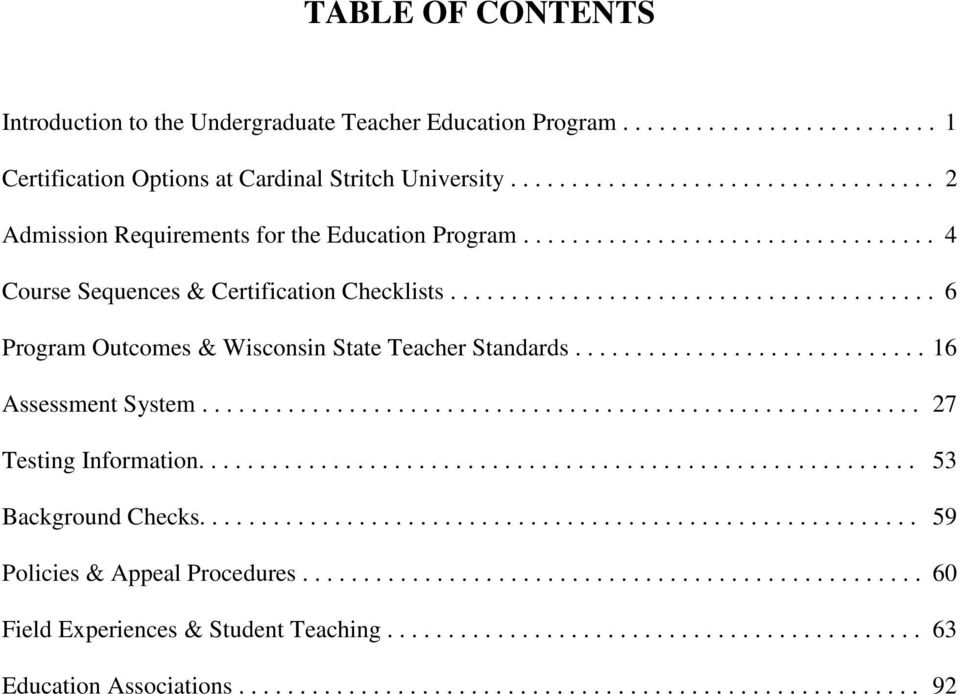
2 TABLE OF CONTENTS Introduction to the Undergraduate Teacher Education Program Certification Options at Cardinal Stritch University Admission Requirements for the Education Program Course Sequences & Certification Checklists Program Outcomes & Wisconsin State Teacher Standards Assessment System Testing Information Background Checks Policies & Appeal Procedures Field Experiences & Student Teaching Education Associations
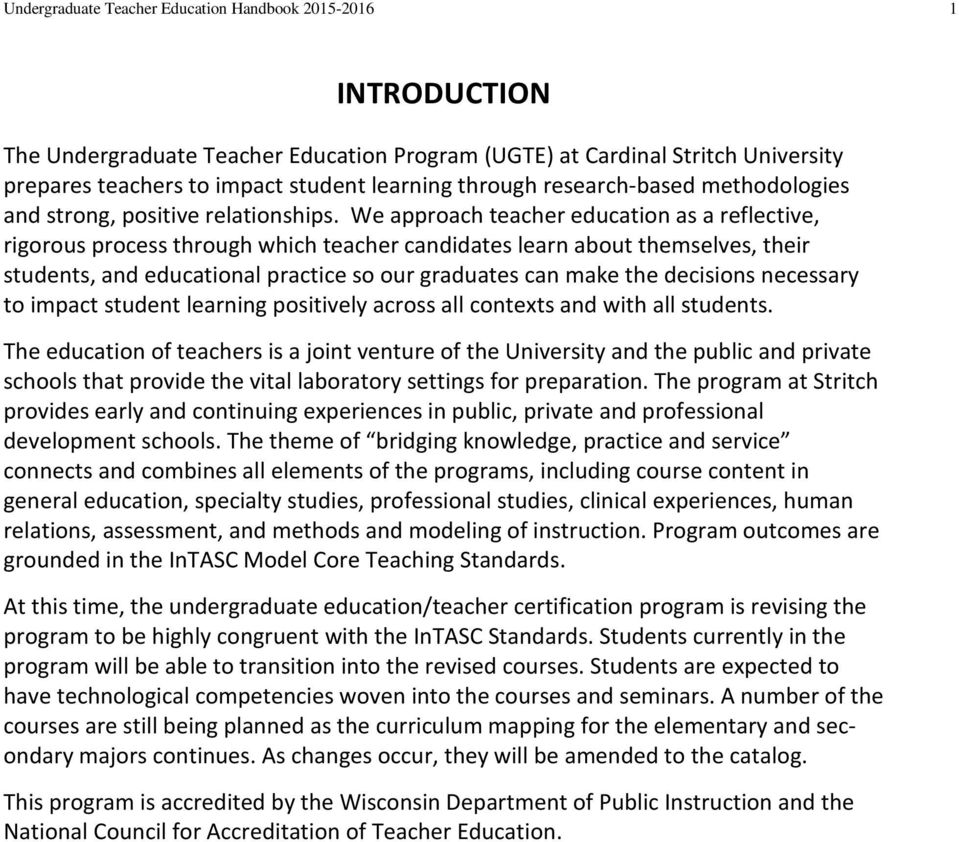
3 Undergraduate Teacher Education Handbook INTRODUCTION The Undergraduate Teacher Education Program (UGTE) at Cardinal Stritch University prepares teachers to impact student learning through research-based methodologies and strong, positive relationships. We approach teacher education as a reflective, rigorous process through which teacher candidates learn about themselves, their students, and educational practice so our graduates can make the decisions necessary to impact student learning positively across all contexts and with all students. The education of teachers is a joint venture of the University and the public and private schools that provide the vital laboratory settings for preparation. The program at Stritch provides early and continuing experiences in public, private and professional development schools. The theme of bridging knowledge, practice and service connects and combines all elements of the programs, including course content in general education, specialty studies, professional studies, clinical experiences, human relations, assessment, and methods and modeling of instruction. Program outcomes are grounded in the InTASC Model Core Teaching Standards. At this time, the undergraduate education/teacher certification program is revising the program to be highly congruent with the InTASC Standards. Students currently in the program will be able to transition into the revised courses. Students are expected to have technological competencies woven into the courses and seminars. A number of the courses are still being planned as the curriculum mapping for the elementary and secondary majors continues. As changes occur, they will be amended to the catalog. This program is accredited by the Wisconsin Department of Public Instruction and the National Council for Accreditation of Teacher Education.
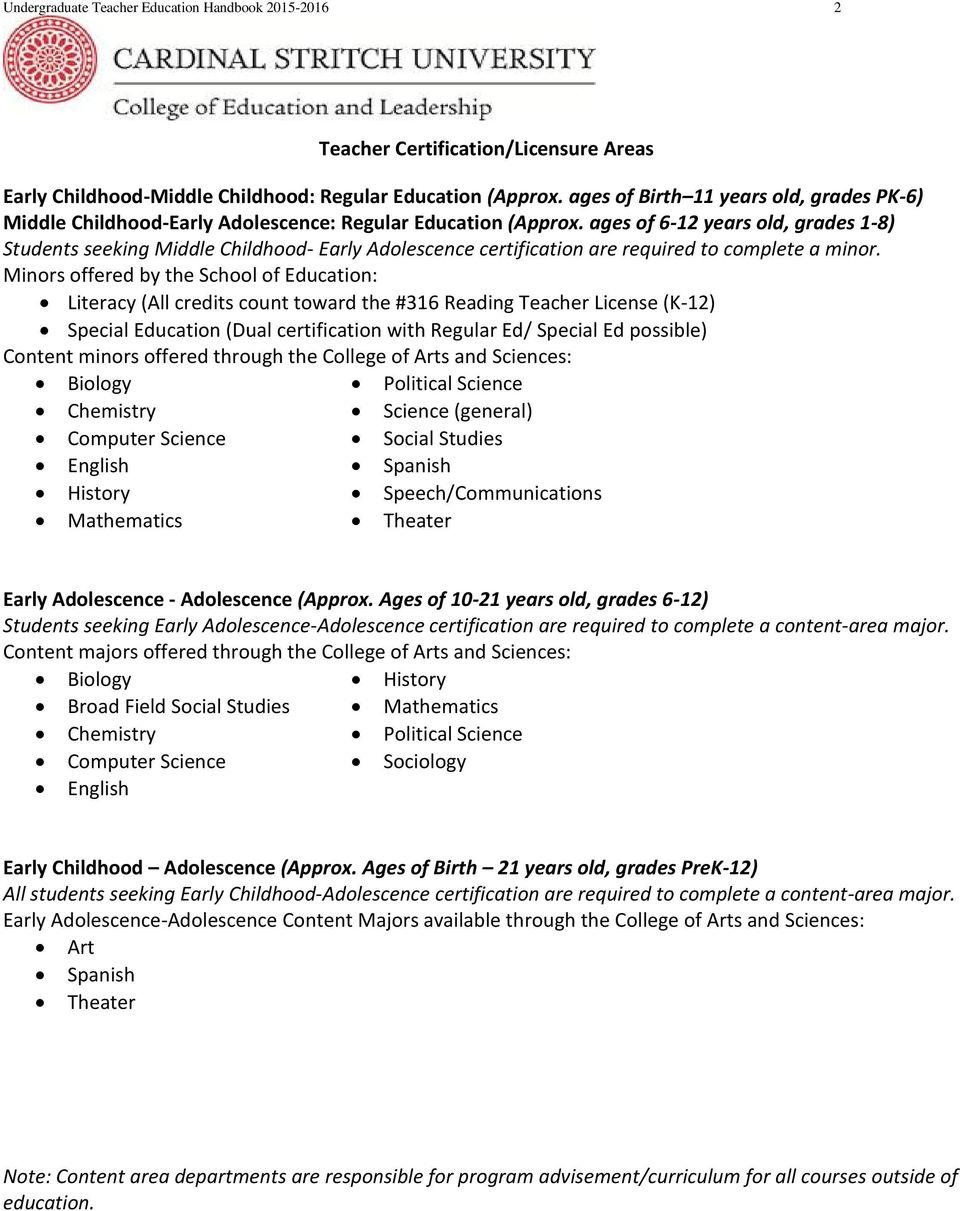
4 Undergraduate Teacher Education Handbook Teacher Certification/Licensure Areas Early Childhood-Middle Childhood: Regular Education (Approx. ages of Birth 11 years old, grades PK-6) Middle Childhood-Early Adolescence: Regular Education (Approx. ages of 6-12 years old, grades 1-8) Students seeking Middle Childhood- Early Adolescence certification are required to complete a minor. Minors offered by the School of Education: Literacy (All credits count toward the #316 Reading Teacher License (K-12) Special Education (Dual certification with Regular Ed/ Special Ed possible) Content minors offered through the College of Arts and Sciences: Biology Chemistry Computer Science English History Mathematics Political Science Science (general) Social Studies Spanish Speech/Communications Theater Early Adolescence - Adolescence (Approx. Ages of years old, grades 6-12) Students seeking Early Adolescence-Adolescence certification are required to complete a content-area major. Content majors offered through the College of Arts and Sciences: Biology Broad Field Social Studies Chemistry Computer Science English History Mathematics Political Science Sociology Early Childhood Adolescence (Approx. Ages of Birth 21 years old, grades PreK-12) All students seeking Early Childhood-Adolescence certification are required to complete a content-area major. Early Adolescence-Adolescence Content Majors available through the College of Arts and Sciences: Art Spanish Theater Note: Content area departments are responsible for program advisement/curriculum for all courses outside of education.
5 Undergraduate Teacher Education Handbook Dual Certification in Regular Education and Special Education Students seeking dual certification in regular education and special education must choose from the special education certifications below. Middle Childhood-Early Adolescence: Cross Categorical Special Education (Approx. ages of 6-12 years old, grades 1-8) Students seeking Middle Childhood-Early Adolescence: Cross Categorical Special Education must o complete licensure requirements for Early Childhood-Middle Childhood: Regular Education or Middle Childhood-Early Adolescence: Regular Education o complete the Special Education minor o pass the Praxis 2: Middle School Content Test o pass the Foundations of Reading Test Early Adolescence - Adolescence: Cross Categorical Special Education (Approx. Ages of years old, grades 6-12) Students seeking Early Adolescence - Adolescence: Cross Categorical Special Education must o complete licensure requirements for Early Adolescence Adolescence, including a content-area major o complete the Special Education minor o pass the Praxis 2: Middle School Content Test o pass the Foundations of Reading Test

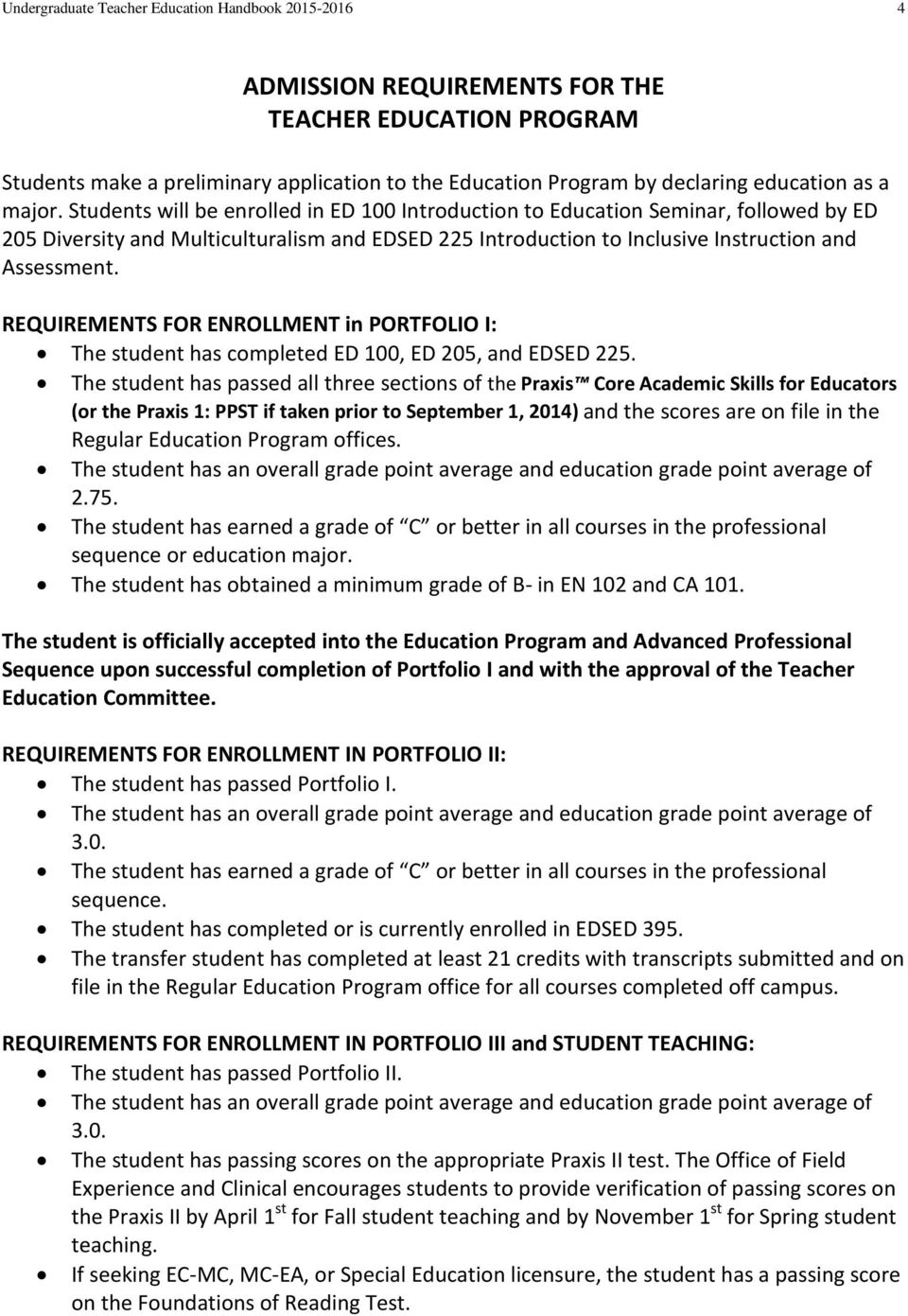
6 Undergraduate Teacher Education Handbook ADMISSION REQUIREMENTS FOR THE TEACHER EDUCATION PROGRAM Students make a preliminary application to the Education Program by declaring education as a major. Students will be enrolled in ED 100 Introduction to Education Seminar, followed by ED 205 Diversity and Multiculturalism and EDSED 225 Introduction to Inclusive Instruction and Assessment. REQUIREMENTS FOR ENROLLMENT in PORTFOLIO I: The student has completed ED 100, ED 205, and EDSED 225. The student has passed all three sections of the Praxis Core Academic Skills for Educators (or the Praxis 1: PPST if taken prior to September 1, 2014) and the scores are on file in the Regular Education Program offices. The student has an overall grade point average and education grade point average of The student has earned a grade of C or better in all courses in the professional sequence or education major. The student has obtained a minimum grade of B- in EN 102 and CA 101. The student is officially accepted into the Education Program and Advanced Professional Sequence upon successful completion of Portfolio I and with the approval of the Teacher Education Committee. REQUIREMENTS FOR ENROLLMENT IN PORTFOLIO II: The student has passed Portfolio I. The student has an overall grade point average and education grade point average of 3.0. The student has earned a grade of C or better in all courses in the professional sequence. The student has completed or is currently enrolled in EDSED 395. The transfer student has completed at least 21 credits with transcripts submitted and on file in the Regular Education Program office for all courses completed off campus. REQUIREMENTS FOR ENROLLMENT IN PORTFOLIO III and STUDENT TEACHING: The student has passed Portfolio II. The student has an overall grade point average and education grade point average of 3.0. The student has passing scores on the appropriate Praxis II test. The Office of Field Experience and Clinical encourages students to provide verification of passing scores on the Praxis II by April 1 st for Fall student teaching and by November 1 st for Spring student teaching. If seeking EC-MC, MC-EA, or Special Education licensure, the student has a passing score on the Foundations of Reading Test.
7 Undergraduate Teacher Education Handbook Additional Requirements: No grade lower than a "C" will be accepted in Education courses (including ED, EDSED, RLA, and SED courses). Students may repeat a course with an unacceptable grade only once. A second unacceptable grade in the program (including ED, EDSED, RLA and SED courses) eliminates the student from the major and/or minor. Any student who is eliminated from the major or a minor may follow the Education department appeal process to be readmitted to the major. Please see the Undergraduate Teacher Education Program Appeal Procedure outlined on Page 61 of this Handbook for more information. Any student who is denied admission to the Advanced Professional Sequence or student teaching may follow the appeal process as stated in the Cardinal Stritch University Undergraduate Catalog at Cardinal Stritch University and the instructors wish to affirm the intent of the Americans with Disability Act. Any person enrolling in courses who may require alternative instructional and/or evaluative procedures due to a disability should feel free to discuss these needs with the instructors so that appropriate arrangements can be made. Appropriate documentation of disability must be on file in the Regular Education Program office.

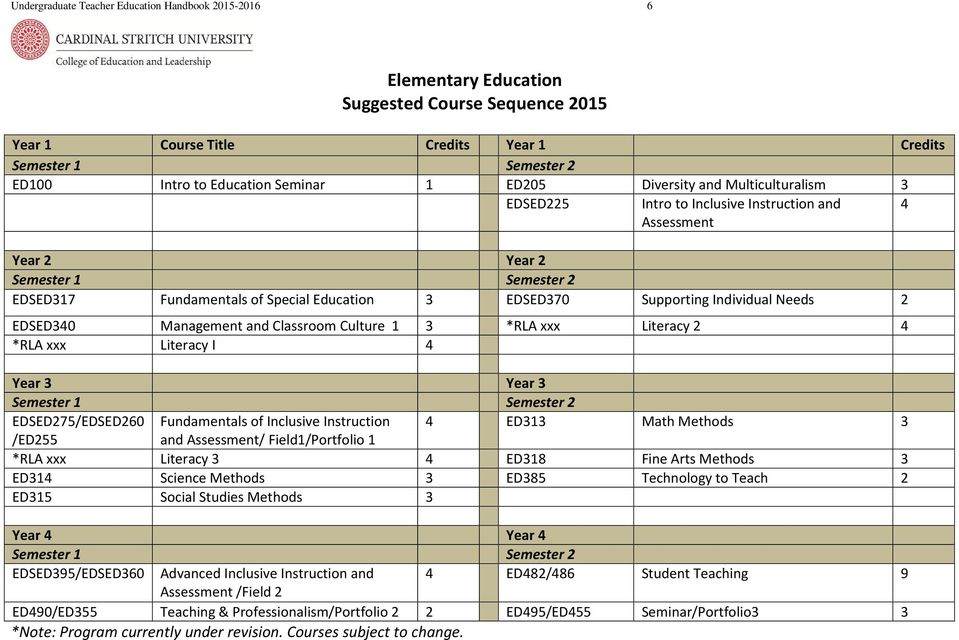
8 Undergraduate Teacher Education Handbook Elementary Education Suggested Course Sequence 2015 Year 1 Course Title Credits Year 1 Credits Semester 1 Semester 2 ED100 Intro to Education Seminar 1 ED205 Diversity and Multiculturalism 3 EDSED225 Intro to Inclusive Instruction and Assessment 4 Year 2 Year 2 Semester 1 Semester 2 EDSED317 Fundamentals of Special Education 3 EDSED370 Supporting Individual Needs 2 EDSED340 Management and Classroom Culture 1 3 *RLA xxx Literacy 2 4 *RLA xxx Literacy I 4 Year 3 Year 3 Semester 1 Semester 2 EDSED275/EDSED260 Fundamentals of Inclusive Instruction 4 ED313 Math Methods 3 /ED255 and Assessment/ Field1/Portfolio 1 *RLA xxx Literacy 3 4 ED318 Fine Arts Methods 3 ED314 Science Methods 3 ED385 Technology to Teach 2 ED315 Social Studies Methods 3 Year 4 Year 4 Semester 1 Semester 2 EDSED395/EDSED360 Advanced Inclusive Instruction and 4 ED482/486 Student Teaching 9 Assessment /Field 2 ED490/ED355 Teaching & Professionalism/Portfolio 2 2 ED495/ED455 Seminar/Portfolio3 3 *Note: Program currently under revision. Courses subject to change.
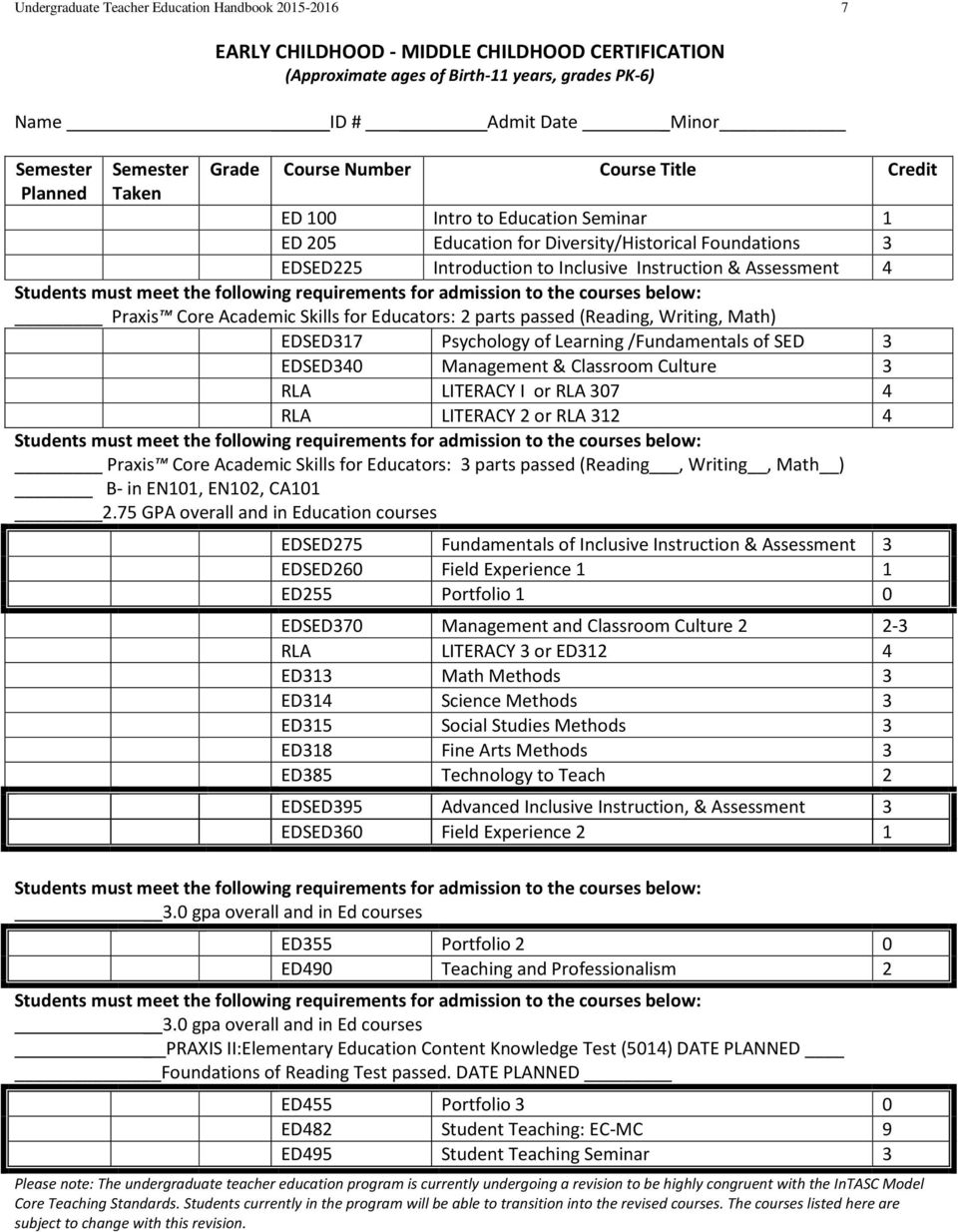
9 Undergraduate Teacher Education Handbook EARLY CHILDHOOD - MIDDLE CHILDHOOD CERTIFICATION (Approximate ages of Birth-11 years, grades PK-6) Name ID # Admit Date _Minor Semester Planned Semester Taken Grade Course Number Course Title Credit ED 100 Intro to Education Seminar 1 ED 205 Education for Diversity/Historical Foundations 3 EDSED225 Introduction to Inclusive Instruction & Assessment 4 Students must meet the following requirements for admission to the courses below: Praxis Core Academic Skills for Educators: 2 parts passed (Reading, Writing, Math) EDSED317 Psychology of Learning /Fundamentals of SED 3 EDSED340 Management & Classroom Culture 3 RLA LITERACY I or RLA RLA LITERACY 2 or RLA Students must meet the following requirements for admission to the courses below: Praxis Core Academic Skills for Educators: 3 parts passed (Reading, Writing, Math ) B- in EN101, EN102, CA GPA overall and in Education courses EDSED275 Fundamentals of Inclusive Instruction & Assessment 3 EDSED260 Field Experience 1 1 ED255 Portfolio 1 0 EDSED370 Management and Classroom Culture RLA LITERACY 3 or ED312 4 ED313 Math Methods 3 ED314 Science Methods 3 ED315 Social Studies Methods 3 ED318 Fine Arts Methods 3 ED385 Technology to Teach 2 EDSED395 Advanced Inclusive Instruction, & Assessment 3 EDSED360 Field Experience 2 1 Students must meet the following requirements for admission to the courses below: 3.0 gpa overall and in Ed courses ED355 Portfolio 2 0 ED490 Teaching and Professionalism 2 Students must meet the following requirements for admission to the courses below: 3.0 gpa overall and in Ed courses _ PRAXIS II:Elementary Education Content Knowledge Test (5014) DATE PLANNED Foundations of Reading Test passed. DATE PLANNED ED455 Portfolio 3 0 ED482 Student Teaching: EC-MC 9 ED495 Student Teaching Seminar 3 Please note: The undergraduate teacher education program is currently undergoing a revision to be highly congruent with the InTASC Model Core Teaching Standards. Students currently in the program will be able to transition into the revised courses. The courses listed here are subject to change with this revision.
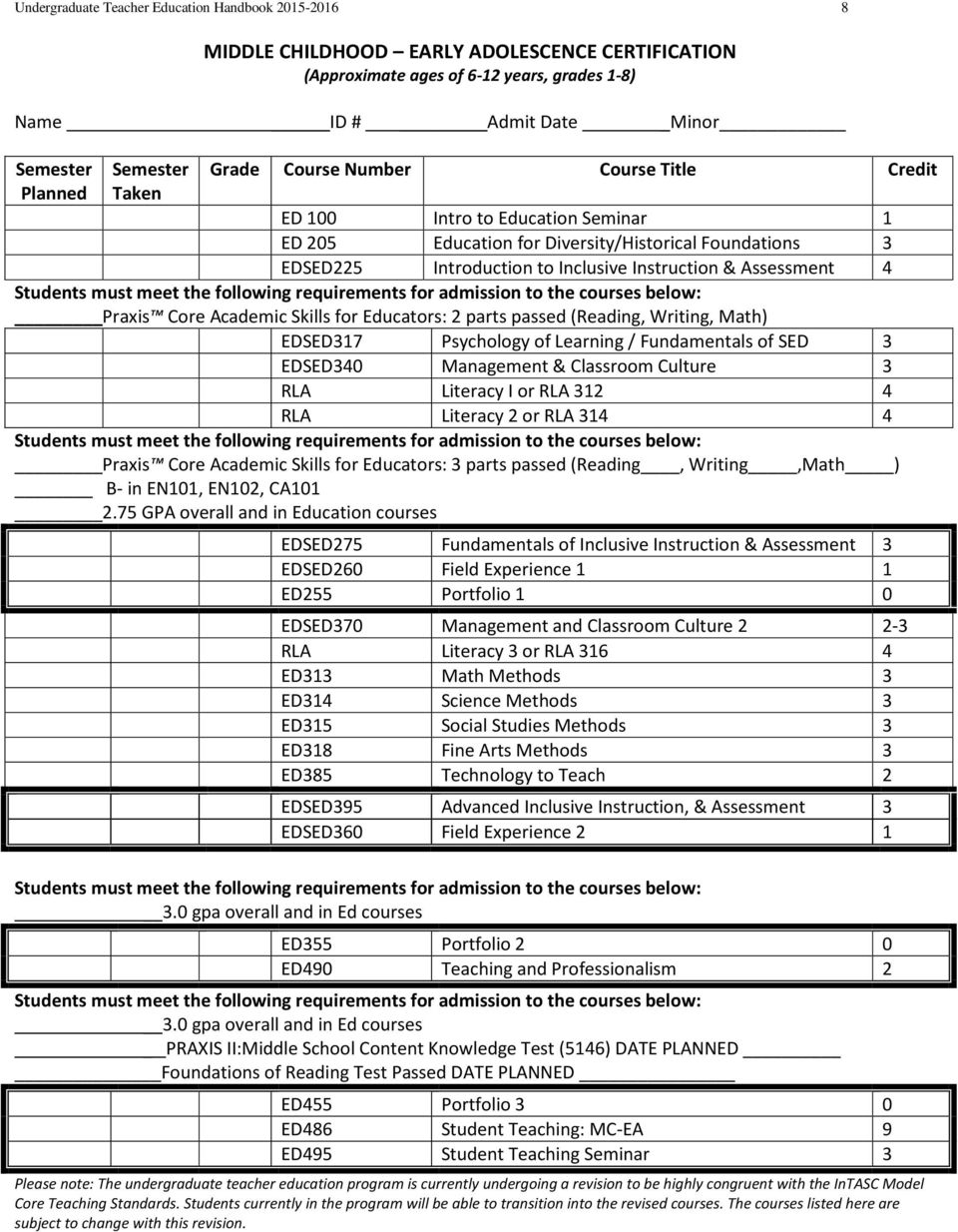
10 Undergraduate Teacher Education Handbook MIDDLE CHILDHOOD EARLY ADOLESCENCE CERTIFICATION (Approximate ages of 6-12 years, grades 1-8) Name ID # Admit Date _Minor Semester Planned Semester Taken Grade Course Number Course Title Credit ED 100 Intro to Education Seminar 1 ED 205 Education for Diversity/Historical Foundations 3 EDSED225 Introduction to Inclusive Instruction & Assessment 4 Students must meet the following requirements for admission to the courses below: Praxis Core Academic Skills for Educators: 2 parts passed (Reading, Writing, Math) EDSED317 Psychology of Learning / Fundamentals of SED 3 EDSED340 Management & Classroom Culture 3 RLA Literacy I or RLA RLA Literacy 2 or RLA Students must meet the following requirements for admission to the courses below: Praxis Core Academic Skills for Educators: 3 parts passed (Reading, Writing,Math ) B- in EN101, EN102, CA GPA overall and in Education courses EDSED275 Fundamentals of Inclusive Instruction & Assessment 3 EDSED260 Field Experience 1 1 ED255 Portfolio 1 0 EDSED370 Management and Classroom Culture RLA Literacy 3 or RLA ED313 Math Methods 3 ED314 Science Methods 3 ED315 Social Studies Methods 3 ED318 Fine Arts Methods 3 ED385 Technology to Teach 2 EDSED395 Advanced Inclusive Instruction, & Assessment 3 EDSED360 Field Experience 2 1 Students must meet the following requirements for admission to the courses below: 3.0 gpa overall and in Ed courses ED355 Portfolio 2 0 ED490 Teaching and Professionalism 2 Students must meet the following requirements for admission to the courses below: 3.0 gpa overall and in Ed courses _ PRAXIS II:Middle School Content Knowledge Test (5146) DATE PLANNED Foundations of Reading Test Passed DATE PLANNED ED455 Portfolio 3 0 ED486 Student Teaching: MC-EA 9 ED495 Student Teaching Seminar 3 Please note: The undergraduate teacher education program is currently undergoing a revision to be highly congruent with the InTASC Model Core Teaching Standards. Students currently in the program will be able to transition into the revised courses. The courses listed here are subject to change with this revision.
11 Undergraduate Teacher Education Handbook Secondary Education Suggested Course Sequence 2015 Year 1 Course Title Credits Year 1 Credits Semester 1 Semester 2 ED100 Intro to Education Seminar 1 ED205 Diversity and Multiculturalism 3 EDSED225 Intro to Inclusive Instruction and Assessment 4 Year 2 Year 2 Semester 1 Semester 2 EDSED317 Educational Psychology 3 PS 221 Adolescent Psychology 3 EDSED340 Management & Class Culture 3 EDSED370 Management & Class Culture 2 2 Year 3 Year 3 Semester 1 Semester 2 RLA318 Content Area Literacy 4 EDSED275/EDSED 260/ED255 RLA345 Adolescent Literature 3 Fundamentals of Inclusive Instruction and Assessment for Secondary/ Field1/Portfolio 1 4 Year 4 Year 4 Semester 1 Semester 2 ED 380 Specific Content Methods for 2 ED482/486 Student Teaching 9 Secondary ED 385 Technologies to Teach 2 ED495/ED455 Seminar/Portfolio 3 3 EDSED395/EDSED360 Advanced Inclusive Instruction 4 and Assessment for Secondary/Field 2 ED490/ED355 Teaching & Professionalism/Portfolio2 2

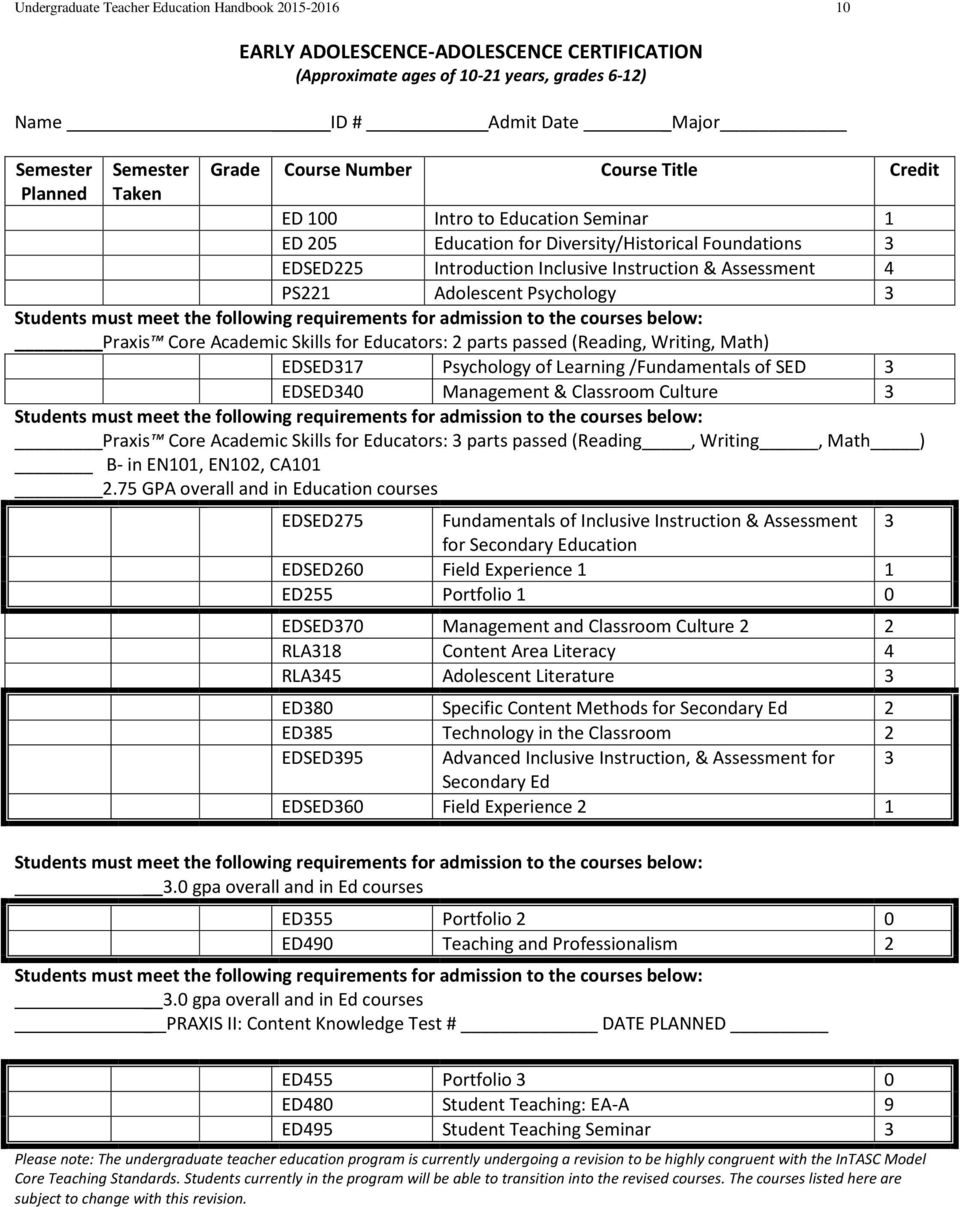
12 Undergraduate Teacher Education Handbook EARLY ADOLESCENCE-ADOLESCENCE CERTIFICATION (Approximate ages of years, grades 6-12) Name ID # Admit Date _Major Semester Planned Semester Taken Grade Course Number Course Title Credit ED 100 Intro to Education Seminar 1 ED 205 Education for Diversity/Historical Foundations 3 EDSED225 Introduction Inclusive Instruction & Assessment 4 PS221 Adolescent Psychology 3 Students must meet the following requirements for admission to the courses below: Praxis Core Academic Skills for Educators: 2 parts passed (Reading, Writing, Math) EDSED317 Psychology of Learning /Fundamentals of SED 3 EDSED340 Management & Classroom Culture 3 Students must meet the following requirements for admission to the courses below: Praxis Core Academic Skills for Educators: 3 parts passed (Reading, Writing, Math ) B- in EN101, EN102, CA GPA overall and in Education courses EDSED275 Fundamentals of Inclusive Instruction & Assessment 3 for Secondary Education EDSED260 Field Experience 1 1 ED255 Portfolio 1 0 EDSED370 Management and Classroom Culture 2 2 RLA318 Content Area Literacy 4 RLA345 Adolescent Literature 3 ED380 Specific Content Methods for Secondary Ed 2 ED385 Technology in the Classroom 2 EDSED395 Advanced Inclusive Instruction, & Assessment for 3 Secondary Ed EDSED360 Field Experience 2 1 Students must meet the following requirements for admission to the courses below: 3.0 gpa overall and in Ed courses ED355 Portfolio 2 0 ED490 Teaching and Professionalism 2 Students must meet the following requirements for admission to the courses below: 3.0 gpa overall and in Ed courses _ PRAXIS II: Content Knowledge Test # DATE PLANNED ED455 Portfolio 3 0 ED480 Student Teaching: EA-A 9 ED495 Student Teaching Seminar 3 Please note: The undergraduate teacher education program is currently undergoing a revision to be highly congruent with the InTASC Model Core Teaching Standards. Students currently in the program will be able to transition into the revised courses. The courses listed here are subject to change with this revision.
13 Undergraduate Teacher Education Handbook ART: EARLY CHILDHOOD-ADOLESCENCE CERTIFICATION (Approximate ages of Birth-21 years, grades PK-12) Name ID # Admit Date _Major Semester Semester Grade Course Number Course Title Credit Planned Taken ED 100 Intro to Education Seminar 1 ED 205 Education for Diversity/Historical Foundations 3 EDSED225 Introduction to Inclusive Instruction & Assessment 4 PS202 / PS221 Life Span of Psychology or Adol Psych 3 Students must meet the following requirements for admission to the courses below: Praxis Core Academic Skills for Educators: 2 parts passed (Reading, Writing, Math) EDSED317 Psychology of Learning / Fundamentals of SED 3 EDSED340 Management & Classroom Culture 3 Students must meet the following requirements for admission to the courses below: Praxis Core Academic Skills for Educators: 3 parts passed (Reading, Writing, Math ) B- in EN101, EN102, CA GPA overall and in Education courses EDSED275 Fundamentals of Inclusive Instruction & Assessment 3 for Secondary Education EDSED260 Field Experience 1 1 ED255 Portfolio 1 0 EDSED370 Management and Classroom Culture 2 2 RLA318 Content Area Literacy 4 RLA345 Adolescent Literature 3 ED318 Fine Arts Methods 3 ED380 Specific Content Methods for Secondary Ed* 2 ED385 Technology in the Classroom* 2 EDSED395 Advanced Inclusive Instruction, & Assessment for 3 Secondary Ed EDSED360 Field Experience 2 1 Students must meet the following requirements for admission to the courses below: 3.0 gpa overall and in Ed courses ED355 Portfolio 2 0 ED490 Teaching and Professionalism 2 Students must meet the following requirements for admission to the courses below: 3.0 gpa overall and in Ed courses _ PRAXIS II: Art Content Test (0133) DATE PLANNED ED455 Portfolio 3 0 ED484 Student Teaching: Art 9 ED495 Student Teaching Seminar 3 Please note: The undergraduate teacher education program is currently undergoing a revision to be highly congruent with the InTASC Model Core Teaching Standards. Students currently in the program will be able to transition into the revised courses. The courses listed here are subject to change with this revision. *Please note: These courses are under consideration as requirements for the EA-A Art Certification

14 Undergraduate Teacher Education Handbook WORLD LANGUAGES: EARLY CHILDHOOD-ADOLESCENCE CERTIFICATION (Approximate ages of Birth-21 years, grades PK-12) Name ID # Admit Date _Major Semester Planned Semester Taken Grade Course Number Course Title Credit ED 100 Intro to Education Seminar 1 ED 205 Education for Diversity/Historical Foundations 3 EDSED225 Introduction to Inclusive Instruction & Assessment 4 PS202 or PS221 Life Span of Psychology or Adol Psych 3 Students must meet the following requirements for admission to the courses below: Praxis Core Academic Skills for Educators: 2 parts passed (Reading, Writing, Math) EDSED317 Psychology of Learning / Fundamentals of SED 3 EDSED340 Management & Classroom Culture 3 Students must meet the following requirements for admission to the courses below: Praxis Core Academic Skills for Educators: 3 parts passed (Reading, Writing, Math ) B- in EN101, EN102, CA GPA overall and in Education courses EDSED275 Fundamentals of Inclusive Instruction & Assessment 3 for Secondary Education EDSED260 Field Experience 1 1 ED255 Portfolio 1 0 EDSED370 Management and Classroom Culture 2 2 RLA318 Content Area Literacy 4 RLA345 Adolescent Literature 3 ED380 Specific Content Methods for Secondary Ed 2 ED385 Technology in the Classroom (in development) 2 EDSED395 Advanced Inclusive Instruction, & Assessment for 3 Secondary Ed EDSED360 Field Experience 2 1 Students must meet the following requirements for admission to the courses below: 3.0 gpa overall and in Ed courses ED355 Portfolio 2 0 ED490 Teaching and Professionalism 2 Students must meet the following requirements for admission to the courses below: 3.0 gpa overall and in Ed courses _ ACTFL Proficiency Tests Passed- See Advisor for Details DATE PLANNED ED455 Portfolio 3 0 ED484 Student Teaching: World Languages 9 ED495 Student Teaching Seminar 3 Please note: The undergraduate teacher education program is currently undergoing a revision to be highly congruent with the InTASC Model Core Teaching Standards. Students currently in the program will be able to transition into the revised courses. The courses listed here are subject to change with this revision.

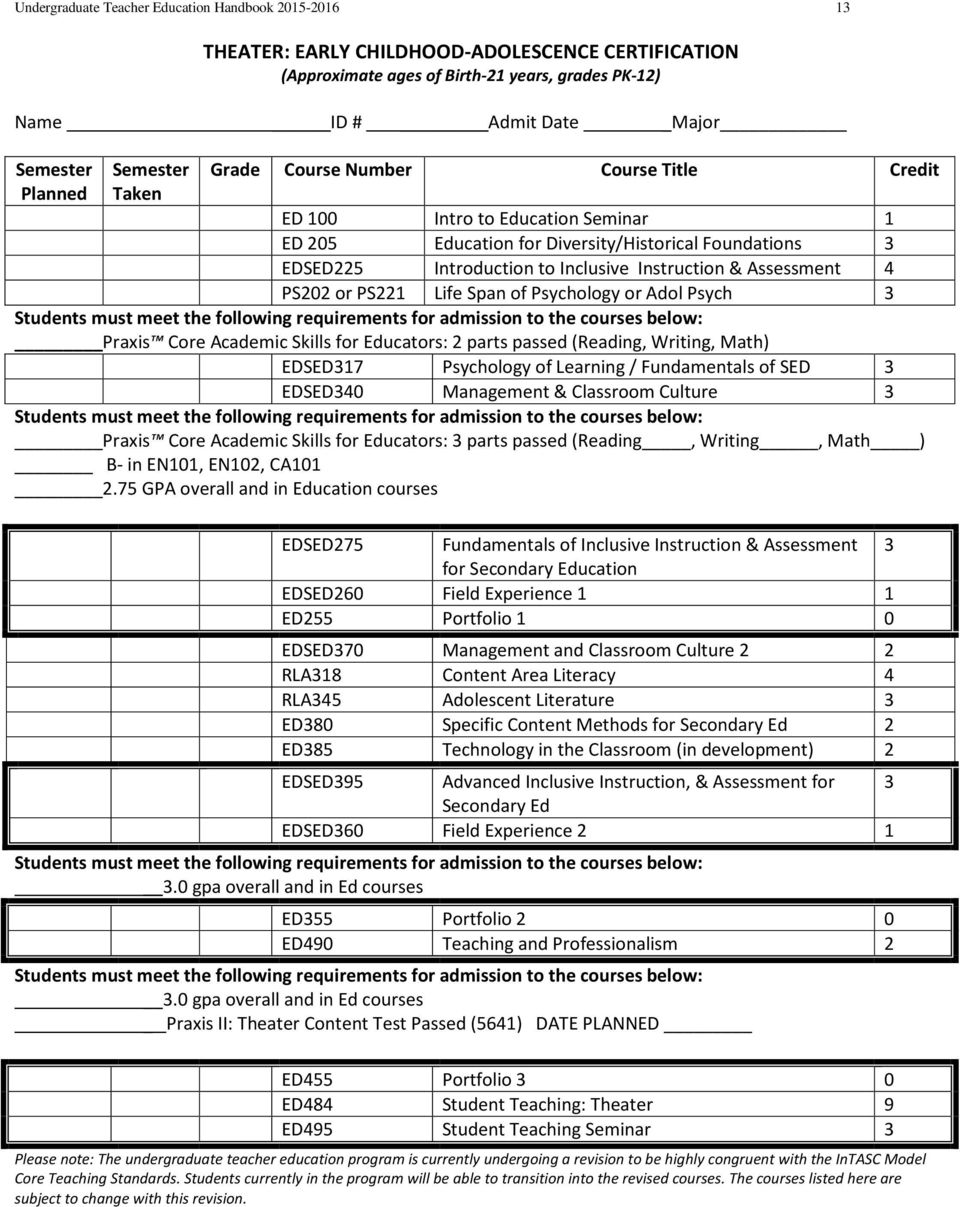
15 Undergraduate Teacher Education Handbook THEATER: EARLY CHILDHOOD-ADOLESCENCE CERTIFICATION (Approximate ages of Birth-21 years, grades PK-12) Name ID # Admit Date _Major Semester Planned Semester Taken Grade Course Number Course Title Credit ED 100 Intro to Education Seminar 1 ED 205 Education for Diversity/Historical Foundations 3 EDSED225 Introduction to Inclusive Instruction & Assessment 4 PS202 or PS221 Life Span of Psychology or Adol Psych 3 Students must meet the following requirements for admission to the courses below: Praxis Core Academic Skills for Educators: 2 parts passed (Reading, Writing, Math) EDSED317 Psychology of Learning / Fundamentals of SED 3 EDSED340 Management & Classroom Culture 3 Students must meet the following requirements for admission to the courses below: Praxis Core Academic Skills for Educators: 3 parts passed (Reading, Writing, Math ) B- in EN101, EN102, CA GPA overall and in Education courses EDSED275 Fundamentals of Inclusive Instruction & Assessment 3 for Secondary Education EDSED260 Field Experience 1 1 ED255 Portfolio 1 0 EDSED370 Management and Classroom Culture 2 2 RLA318 Content Area Literacy 4 RLA345 Adolescent Literature 3 ED380 Specific Content Methods for Secondary Ed 2 ED385 Technology in the Classroom (in development) 2 EDSED395 Advanced Inclusive Instruction, & Assessment for 3 Secondary Ed EDSED360 Field Experience 2 1 Students must meet the following requirements for admission to the courses below: 3.0 gpa overall and in Ed courses ED355 Portfolio 2 0 ED490 Teaching and Professionalism 2 Students must meet the following requirements for admission to the courses below: 3.0 gpa overall and in Ed courses _ Praxis II: Theater Content Test Passed (5641) DATE PLANNED ED455 Portfolio 3 0 ED484 Student Teaching: Theater 9 ED495 Student Teaching Seminar 3 Please note: The undergraduate teacher education program is currently undergoing a revision to be highly congruent with the InTASC Model Core Teaching Standards. Students currently in the program will be able to transition into the revised courses. The courses listed here are subject to change with this revision.
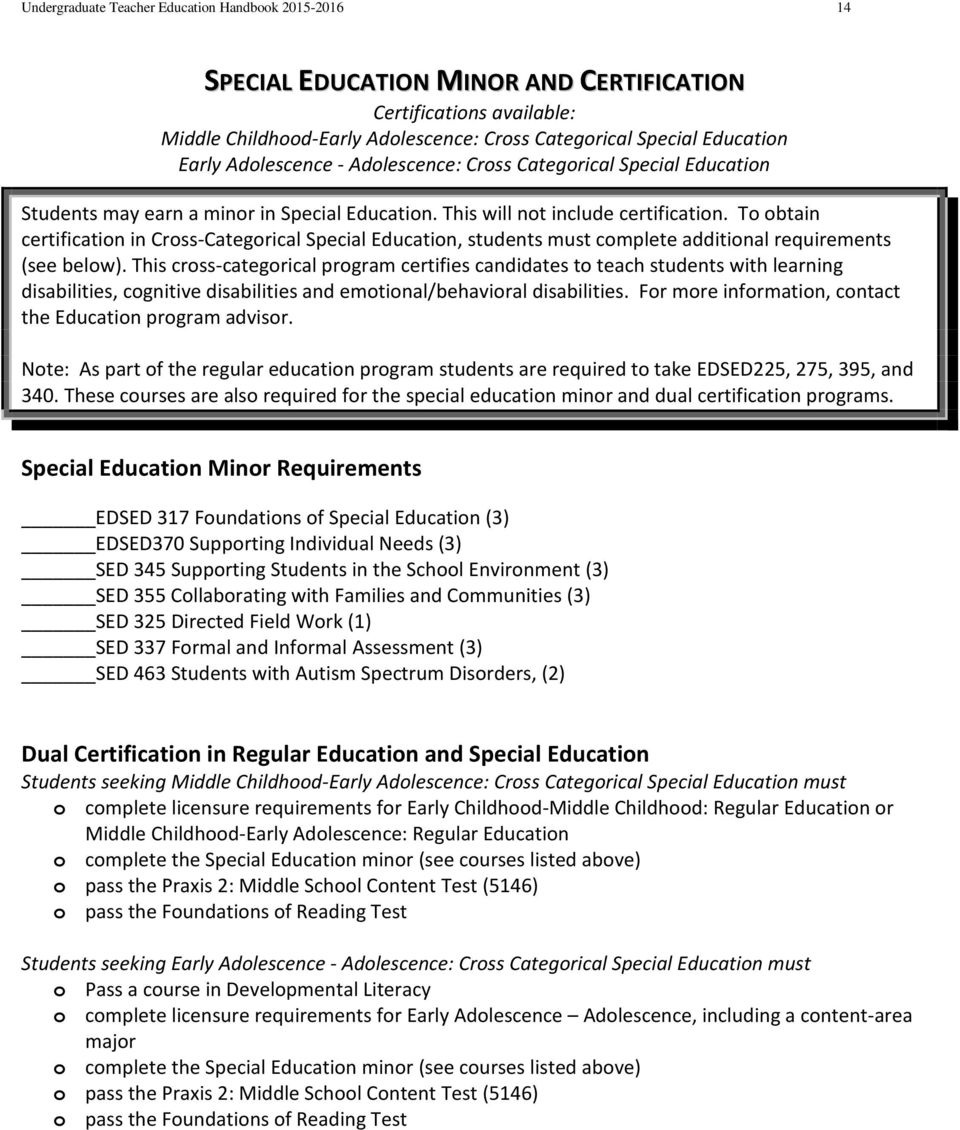
16 Undergraduate Teacher Education Handbook SPECIAL EDUCATION MINOR AND CERTIFICATION Certifications available: Middle Childhood-Early Adolescence: Cross Categorical Special Education Early Adolescence - Adolescence: Cross Categorical Special Education Students may earn a minor in Special Education. This will not include certification. To obtain certification in Cross-Categorical Special Education, students must complete additional requirements (see below). This cross-categorical program certifies candidates to teach students with learning disabilities, cognitive disabilities and emotional/behavioral disabilities. For more information, contact the Education program advisor. Note: As part of the regular education program students are required to take EDSED225, 275, 395, and 340. These courses are also required for the special education minor and dual certification programs. Special Education Minor Requirements EDSED 317 Foundations of Special Education (3) EDSED370 Supporting Individual Needs (3) SED 345 Supporting Students in the School Environment (3) SED 355 Collaborating with Families and Communities (3) SED 325 Directed Field Work (1) SED 337 Formal and Informal Assessment (3) SED 463 Students with Autism Spectrum Disorders, (2) Dual Certification in Regular Education and Special Education Students seeking Middle Childhood-Early Adolescence: Cross Categorical Special Education must o complete licensure requirements for Early Childhood-Middle Childhood: Regular Education or Middle Childhood-Early Adolescence: Regular Education o complete the Special Education minor (see courses listed above) o pass the Praxis 2: Middle School Content Test (5146) o pass the Foundations of Reading Test Students seeking Early Adolescence - Adolescence: Cross Categorical Special Education must o Pass a course in Developmental Literacy o complete licensure requirements for Early Adolescence Adolescence, including a content-area major o complete the Special Education minor (see courses listed above) o pass the Praxis 2: Middle School Content Test (5146) o pass the Foundations of Reading Test
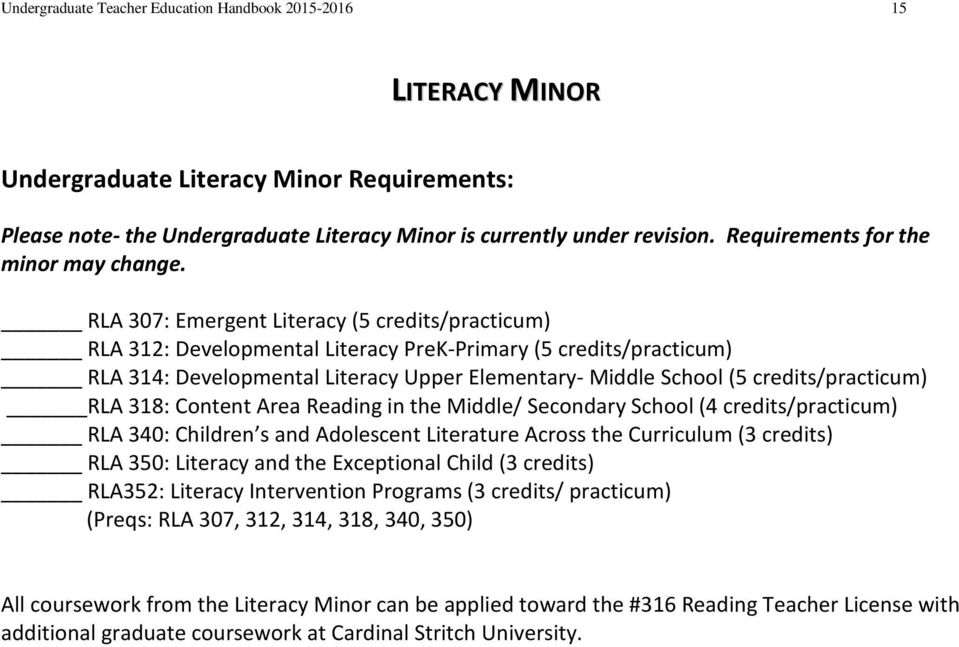
17 Undergraduate Teacher Education Handbook LITERACY MINOR Undergraduate Literacy Minor Requirements: Please note- the Undergraduate Literacy Minor is currently under revision. Requirements for the minor may change. RLA 307: Emergent Literacy (5 credits/practicum) RLA 312: Developmental Literacy PreK-Primary (5 credits/practicum) RLA 314: Developmental Literacy Upper Elementary- Middle School (5 credits/practicum) RLA 318: Content Area Reading in the Middle/ Secondary School (4 credits/practicum) RLA 340: Children s and Adolescent Literature Across the Curriculum (3 credits) RLA 350: Literacy and the Exceptional Child (3 credits) RLA352: Literacy Intervention Programs (3 credits/ practicum) (Preqs: RLA 307, 312, 314, 318, 340, 350) All coursework from the Literacy Minor can be applied toward the #316 Reading Teacher License with additional graduate coursework at Cardinal Stritch University.
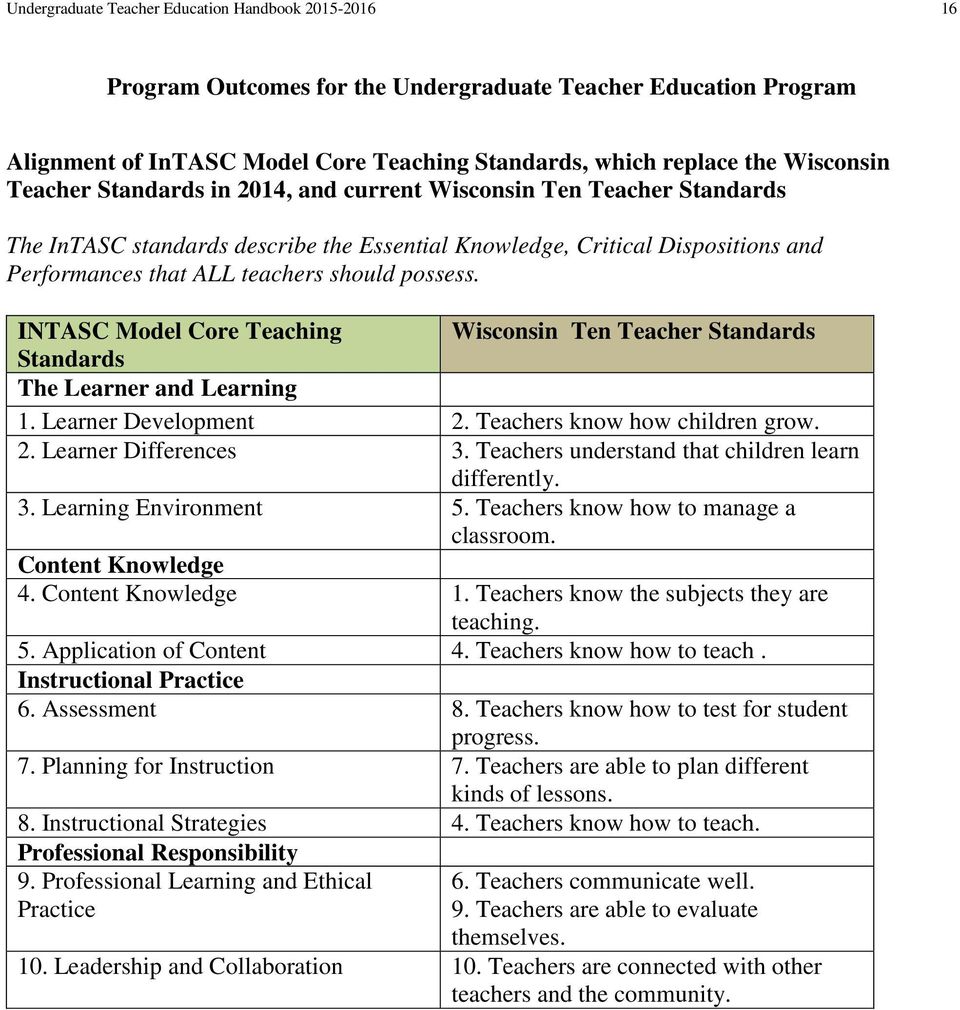
18 Undergraduate Teacher Education Handbook Program Outcomes for the Undergraduate Teacher Education Program Alignment of InTASC Model Core Teaching Standards, which replace the Wisconsin Teacher Standards in 2014, and current Wisconsin Ten Teacher Standards The InTASC standards describe the Essential Knowledge, Critical Dispositions and Performances that ALL teachers should possess. INTASC Model Core Teaching Wisconsin Ten Teacher Standards Standards The Learner and Learning 1. Learner Development 2. Teachers know how children grow. 2. Learner Differences 3. Teachers understand that children learn differently. 3. Learning Environment 5. Teachers know how to manage a classroom. Content Knowledge 4. Content Knowledge 1. Teachers know the subjects they are teaching. 5. Application of Content 4. Teachers know how to teach. Instructional Practice 6. Assessment 8. Teachers know how to test for student progress. 7. Planning for Instruction 7. Teachers are able to plan different kinds of lessons. 8. Instructional Strategies 4. Teachers know how to teach. Professional Responsibility 9. Professional Learning and Ethical Practice 6. Teachers communicate well. 9. Teachers are able to evaluate themselves. 10. Leadership and Collaboration 10. Teachers are connected with other teachers and the community.
19 Undergraduate Teacher Education Handbook InTASC Model Core Teaching Standards *INTASC - Interstate New Teachers Assessment and Support Consortium, a project of the Council of Chief State School Officers. The Learner and Learning (Standards 1, 2, 3) Standard #1 Learner Development Performances 1(a) The teacher regularly assesses individual and group performance in order to design and modify instruction to meet learners needs in each area of development (cognitive, linguistic, social, emotional, and physical) and scaffolds the next level of development. 1(b) The teacher creates developmentally appropriate instruction that takes into account individual learners strengths, interests, and needs and that enables each learner to advance and accelerate his/her learning. 1(c) The teacher collaborates with families, communities, colleagues, and other professionals to promote learner growth and development. Essential Knowledge 1(d) The teacher understands how learning occurs--how learners construct knowledge, acquire skills, and develop disciplined thinking processes--and knows how to use instructional strategies that promote student learning. 1(e) The teacher understands that each learner s cognitive, linguistic, social, emotional, and physical development influences learning and knows how to make instructional decisions that build on learners strengths and needs. 1(f) The teacher identifies readiness for learning, and understands how development in any one area may affect performance in others. 1(g) The teacher understands the role of language and culture in learning and knows how to modify instruction to make language comprehensible and instruction relevant, accessible, and challenging. Critical Dispositions 1(h) The teacher respects learners differing strengths and needs and is committed to using this information to further each learner s development. 1(i) The teacher is committed to using learners strengths as a basis for growth, and their misconceptions as opportunities for learning. 1(j) The teacher takes responsibility for promoting learners growth and development. 1(k) The teacher values the input and contributions of families, colleagues, and other professionals in understanding and supporting each learner s development. Standard #2: Learning Differences Performances 2(a) The teacher designs, adapts, and delivers instruction to address each student s diverse learning strengths and needs and creates opportunities for students to demonstrate their learning in different ways. 2(b) The teacher makes appropriate and timely provisions (e.g., pacing for individual rates of growth, task demands, communication, assessment, and response modes) for individual students with particular learning differences or needs.
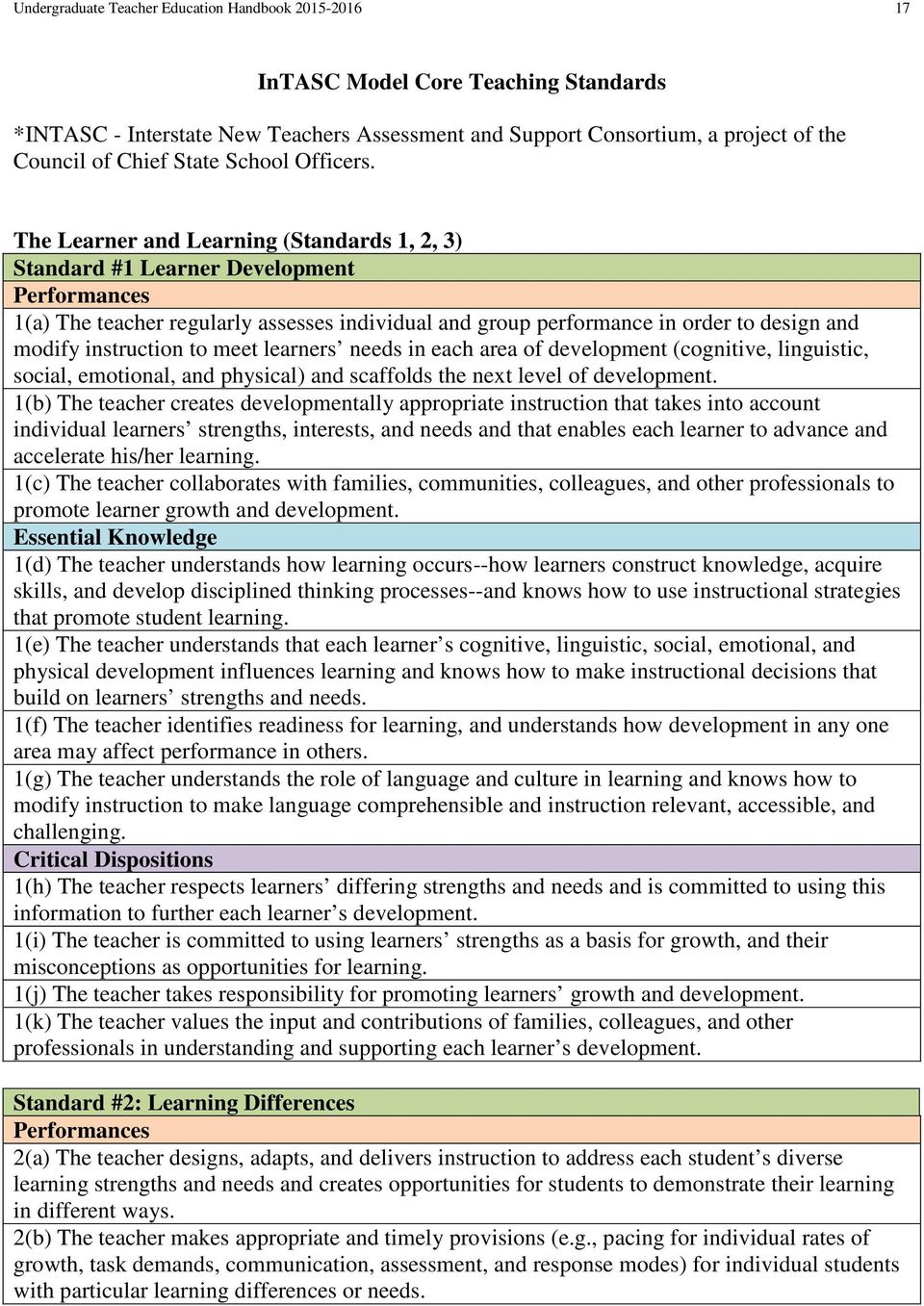
20 Undergraduate Teacher Education Handbook (c) The teacher designs instruction to build on learners prior knowledge and experiences, allowing learners to accelerate as they demonstrate their understandings. 2(d) The teacher brings multiple perspectives to the discussion of content, including attention to learners personal, family, and community experiences and cultural norms. 2(e) The teacher incorporates tools of language development into planning and instruction, including strategies for making content accessible to English language learners and for evaluating and supporting their development of English proficiency. 2(f) The teacher accesses resources, supports, and specialized assistance and services to meet particular learning differences or needs. Essential Knowledge 2(g) The teacher understands and identifies differences in approaches to learning and performance and knows how to design instruction that uses each learner s strengths to promote growth. 2(h) The teacher understands students with exceptional needs, including those associated with disabilities and giftedness, and knows how to use strategies and resources to address these needs. 2(i) The teacher knows about second language acquisition processes and knows how to incorporate instructional strategies and resources to support language acquisition. 2(j) The teacher understands that learners bring assets for learning based on their individual experiences, abilities, talents, prior learning, and peer and social group interactions, as well as language, culture, family, and community values. 2(k) The teacher knows how to access information about the values of diverse cultures and communities and how to incorporate learners experiences, cultures, and community resources into instruction. Critical Dispositions 2(l) The teacher believes that all learners can achieve at high levels and persists in helping each learner reach his/her full potential. 2(m) The teacher respects learners as individuals with differing personal and family backgrounds and various skills, abilities, perspectives, talents, and interests. 2(n) The teacher makes learners feel valued and helps them learn to value each other. 2(o) The teacher values diverse languages and dialects and seeks to integrate them into his/her instructional practice to engage students in learning. Standard #3 Learning Environments Performances 3(a) The teacher collaborates with learners, families, and colleagues to build a safe, positive learning climate of openness, mutual respect, support, and inquiry. 3(b) The teacher develops learning experiences that engage learners bin collaborative and selfdirected learning and that extend learner interaction with ideas and people locally and globally. 3(c) The teacher collaborates with learners and colleagues to develop shared values and expectations for respectful interactions, rigorous academic discussions, and individual and group responsibility for quality work. 3(d) The teacher manages the learning environment to actively and equitably engage learners by organizing, allocating, and coordinating the resources of time, space, and learners attention. 3(e) The teacher uses a variety of methods to engage learners in evaluating the learning environment and collaborates with learners to make appropriate adjustments. 3(f) The teacher communicates verbally and nonverbally in ways that demonstrate respect for
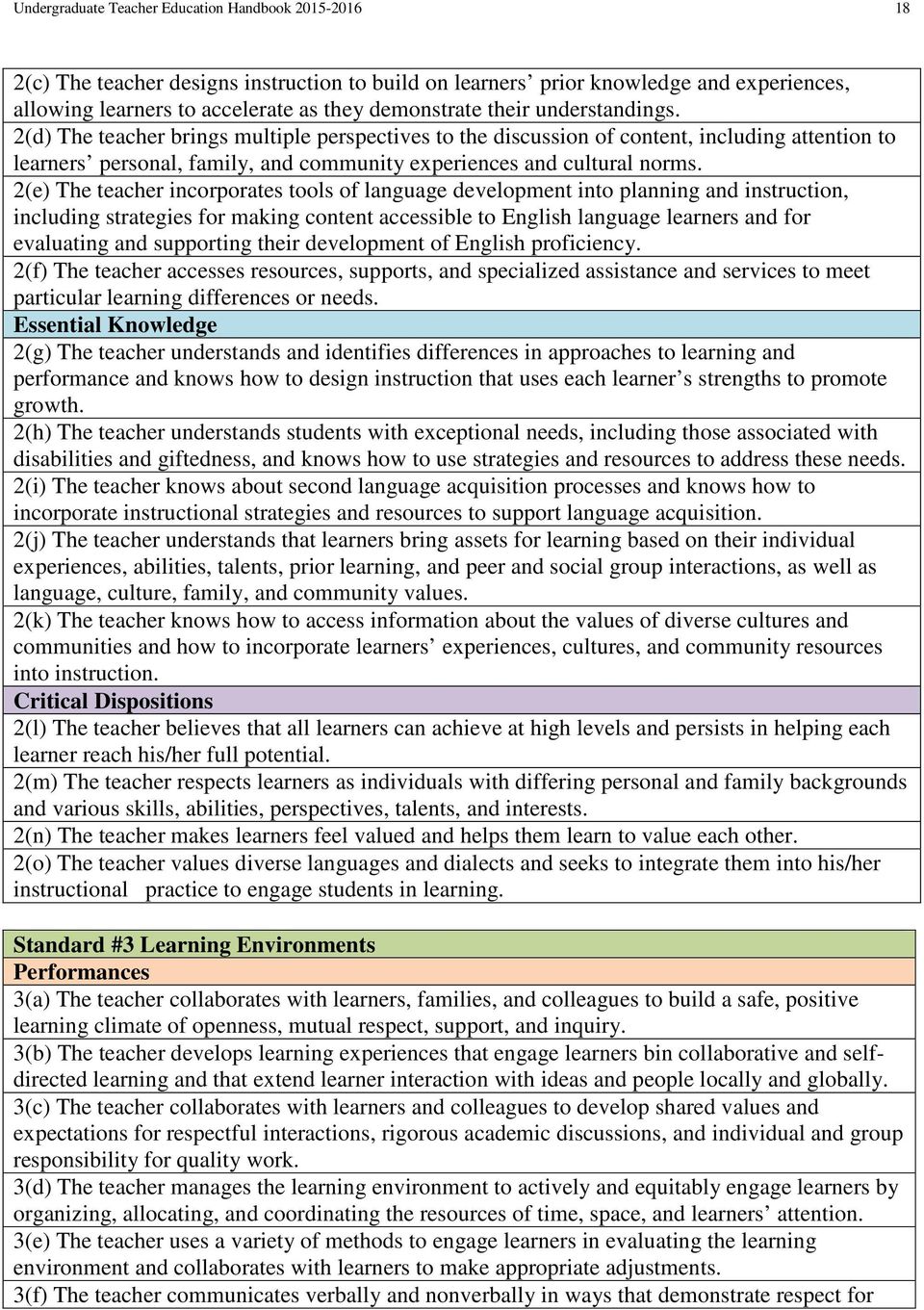
21 Undergraduate Teacher Education Handbook and responsiveness to the cultural backgrounds and differing perspectives learners bring to the learning environment. 3(g) The teacher promotes responsible learner use of interactive technologies to extend the possibilities for learning locally and globally. 3(h) The teacher intentionally builds learner capacity to collaborate in face-to-face and virtual environments through applying effective interpersonal communication skills. Essential Knowledge 3(i) The teacher understands the relationship between motivation and engagement and knows how to design learning experiences using strategies that build learner self-direction and ownership of learning. 3(j) The teacher knows how to help learners work productively and cooperatively with each other to achieve learning goals. 3(k) The teacher knows how to collaborate with learners to establish and monitor elements of a safe and productive learning environment including norms, expectations, routines, and organizational structures 3(l) The teacher understands how learner diversity can affect communication and knows how to communicate effectively in differing environments. 3(m) The teacher knows how to use technologies and how to guide learners to apply them in appropriate, safe, and effective ways. Critical Dispositions 3(n) The teacher is committed to working with learners, colleagues, families, and communities to establish positive and supportive learning environments 3(o) The teacher values the role of learners in promoting each other s learning and recognizes the importance of peer relationships in establishing a climate of learning. 3(p) The teacher is committed to supporting learners as they participate in decision making, engage in exploration and invention, work collaboratively and independently, and engage in purposeful learning. 3(q) The teacher seeks to foster respectful communication among all members of the learning community 3(r) The teacher is a thoughtful and responsive listener and observer. Content Knowledge (Standards 4 and 5) Standard #4 Content Knowledge Performances 4(a) The teacher effectively uses multiple representations and explanations that capture key ideas in the discipline, guide learners through learning progressions, and promote each learner s achievement of content standards. 4(b) The teacher engages students in learning experiences in the discipline(s) that encourage learners to understand, question, and analyze ideas from diverse perspectives so that they master the content. 4(c) The teacher engages learners in applying methods of inquiry and standards of evidence used in the discipline. 4(d) The teacher stimulates learner reflection on prior content knowledge, links new concepts to familiar concepts, and makes connections to learners experiences. 4(e) The teacher recognizes learner misconceptions in a discipline that interfere with learning, and creates experiences to build accurate conceptual understanding.
22 Undergraduate Teacher Education Handbook (f) The teacher evaluates and modifies instructional resources and curriculum materials for their comprehensiveness, accuracy for representing particular concepts in the discipline, and appropriateness for his/her learners. 4(g) The teacher uses supplementary resources and technologies effectively to ensure accessibility and relevance for all learners 4(h) The teacher creates opportunities for students to learn, practice, and master academic language in their content. 4(i) The teacher accesses school and/or district-based resources to evaluate the learner s content knowledge in their primary language. Essential Knowledge 4(j) The teacher understands major concepts, assumptions, debates, processes of inquiry, and ways of knowing that are central to the discipline(s) s/he teaches. 4(k) The teacher understands common misconceptions in learning the discipline and how to guide learners to accurate conceptual understanding. 4(l) The teacher knows and uses the academic language of the discipline and knows how to make it accessible to learners. 4(m) The teacher knows how to integrate culturally relevant content to build on learners background knowledge. 4(n) The teacher has a deep knowledge of student content standards and learning progressions in the discipline(s) s/he teaches. Critical Dispositions 4(o) The teacher realizes that content knowledge is not a fixed body of facts but is complex, culturally situated, and ever evolving. S/he keeps abreast of new ideas and understandings in the field. 4(p) The teacher appreciates multiple perspectives within the discipline and facilitates learners critical analysis of these perspectives. 4(q) The teacher recognizes the potential of bias in his/her representation of the discipline and seeks to appropriately address problems of bias. 4(r) The teacher is committed to work toward each learner s mastery of disciplinary content and skills. Standard #5 Application of Content Performances 5(a) The teacher develops and implements projects that guide learners in analyzing the complexities of an issue or question using perspectives from varied disciplines and crossdisciplinary skills (e.g., a water quality study that draws upon biology and chemistry to look at actual information and social studies to examine policy implications). 5(a) The teacher develops and implements projects that guide learners in analyzing the complexities of an issue or question using perspectives from varied disciplines and crossdisciplinary skills (e.g., a water quality study that draws upon biology and chemistry to look at factual information and social studies to examine policy implications). 5(b) The teacher engages learners in applying content knowledge to real world problems through the lens of interdisciplinary themes (e.g., financial literacy, environmental literacy). 5(c) The teacher facilitates learners use of current tools and resources to maximize content learning in varied contexts. 5(d) The teacher engages learners in questioning and challenging assumptions and approaches in
23 Undergraduate Teacher Education Handbook order to foster innovation and problem solving in local and global contexts. 5(e) The teacher develops learners communication skills in disciplinary and interdisciplinary contexts by creating meaningful opportunities to employ a variety of forms of communication that address varied audiences and purposes. 5(f) The teacher engages learners in generating and evaluating new ideas and novel approaches, seeking inventive solutions to problems, and developing original work. 5(g) The teacher facilitates learners ability to develop diverse social and cultural perspectives that expand their understanding of local and global issues and create novel approaches to solving problems. 5(h) The teacher develops and implements supports for learner literacy development across content areas. Essential Knowledge 5(i) The teacher understands the ways of knowing in his/her discipline, how it relates to other disciplinary approaches to inquiry, and the strengths and limitations of each approach in addressing problems, issues, and concerns. 5(j) The teacher understands how current interdisciplinary themes (e.g., civic literacy, health literacy, global awareness) connect to the core subjects and knows how to weave those themes into meaningful learning experiences. 5(k) The teacher understands the demands of accessing and managing information as well as how to evaluate issues of ethics and quality related to information and its use. 5(l) The teacher understands how to use digital and interactive technologies for efficiently and effectively achieving specific learning goals. 5(m) The teacher understands critical thinking processes and knows how to help learners develop high level questioning skills to promote their independent learning. 5(n) The teacher understands communication modes and skills as vehicles for learning (e.g., information gathering and processing) across disciplines as well as vehicles for expressing learning 5(o) The teacher understands creative thinking processes and how to engage learners in producing original work. 5(p) The teacher knows where and how to access resources to build global awareness and understanding, and how to integrate them into the curriculum. Critical Dispositions 5(q) The teacher is constantly exploring how to use disciplinary knowledge as a lens to address local and global issues. 5(r) The teacher values knowledge outside his/her own content area and how such knowledge enhances student learning. 5(s) The teacher values flexible learning environments that encourage learner exploration, discovery, and expression across content areas. Instructional Practice (Standards 6, 7 and 8) Standard #6 Assessment Performances 6(a) The teacher balances the use of formative and summative assessment as appropriate to support, verify, and document learning. 6(b) The teacher designs assessments that match learning objectives with assessment methods and minimizes sources of bias that can distort assessment results.
24 Undergraduate Teacher Education Handbook (c) The teacher works independently and collaboratively to examine test and other performance data to understand each learner s progress and to guide planning. 6(d) The teacher engages learners in understanding and identifying quality work and provides them with effective descriptive feedback to guide their progress toward that work. 6(e) The teacher engages learners in multiple ways of demonstrating knowledge and skill as part of the assessment process. 6(f) The teacher models and structures processes that guide learners in examining their own thinking and learning as well as the performance of others. 6(g) The teacher effectively uses multiple and appropriate types of assessment data to identify each student s learning needs and to develop differentiated learning experiences. 6(h) The teacher prepares all learners for the demands of particular assessment formats and makes appropriate accommodations in assessments or testing conditions, especially for learners with disabilities and language learning needs. 6(i) The teacher continually seeks appropriate ways to employ technology to support assessment practice both to engage learners more fully and to assess and address learner needs. Essential Knowledge 6(j) The teacher understands the differences between formative and summative applications of assessment and knows how and when to use each. 6(j) The teacher understands the differences between formative and summative applications of assessment and knows how and when to use each 6(l) The teacher knows how to analyze assessment data to understand patterns and gaps in learning, to guide planning and instruction, and to provide meaningful feedback to all learners 6(m) The teacher knows when and how to engage learners in analyzing their own assessment results and in helping to set goals for their own learning. 6(n) The teacher understands the positive impact of effective descriptive feedback for learners and knows a variety of strategies for communicating this feedback. 6(o) The teacher knows when and how to evaluate and report learner progress against standards. 6(p) The teacher understands how to prepare learners for assessments and how to make accommodations in assessments and testing conditions, especially for learners with disabilities and language learning needs Critical Dispositions 6(q) The teacher is committed to engaging learners actively in assessment processes and to developing each learner s capacity to review and communicate about their own progress and learning. 6(r) The teacher takes responsibility for aligning instruction and assessment with learning goals. 6(s) The teacher is committed to providing timely and effective descriptive feedback to learners on their progress. 6(t) The teacher is committed to using multiple types of assessment processes to support, verify, and document learning. 6(u) The teacher is committed to making accommodations in assessments and testing conditions, especially for learners with disabilities and language learning needs. 6(v) The teacher is committed to the ethical use of various assessments and assessment data to identify learner strengths and needs to promote learner growth
25 Undergraduate Teacher Education Handbook Standard #7: Planning for Instruction Performances (a) The teacher individually and collaboratively selects and creates learning experiences that are appropriate for curriculum goals and content standards, and are relevant to learners. 7(b) The teacher plans how to achieve each student s learning goals, choosing appropriate strategies and accommodations, resources, and materials to differentiate instruction for individuals and groups of learners. 7(c) The teacher develops appropriate sequencing of learning experiences and provides multiple ways to demonstrate knowledge and skill. 7(d) The teacher plans for instruction based on formative and summative assessment data, prior learner knowledge, and learner interest. 7(e) The teacher plans collaboratively with professionals who have specialized expertise (e.g., special educators, related service providers, language learning specialists, librarians, media specialists) to design and jointly deliver as appropriate effective learning experiences to meet unique learning needs. 7(f) The teacher evaluates plans in relation to short- and long-range goals and systematically adjusts plans to meet each student s learning needs and enhance learning. Essential Knowledge 7(g) The teacher understands content and content standards and how these are organized in the curriculum 7(h) The teacher understands how integrating cross-disciplinary skills in instruction engages learners purposefully in applying content knowledge. 7(i) The teacher understands learning theory, human development, cultural diversity, and individual differences and how these impact ongoing planning. 7(j) The teacher understands the strengths and needs of individual learners and how to plan instruction that is responsive to these strengths and needs. 7(k) The teacher knows a range of evidence-based instructional strategies, resources, and technological tools and how to use them effectively to plan instruction that meets diverse learning needs. 7(l) The teacher knows when and how to adjust plans based on assessment information and learner responses. 7(m) The teacher knows when and how to access resources and collaborate with others to support student learning (e.g., special educators, related service providers, language learner specialists, librarians, media specialists, community organizations). Critical Dispositions 7(n) The teacher respects learners diverse strengths and needs and is committed to using this information to plan effective instruction. 7(o) The teacher values planning as a collegial activity that takes into consideration the input of learners, colleagues, families, and the larger community. 7(p) The teacher takes professional responsibility to use short- and long-term planning as a means of assuring student learning. 7(q) The teacher believes that plans must always be open to adjustment and revision based on learner needs and changing circumstances.
26 Undergraduate Teacher Education Handbook Standard #8: Instructional Strategies Performances 8(a) The teacher uses appropriate strategies and resources to adapt instruction to the needs of individuals and groups of learners. 8(b) The teacher continuously monitors student learning, engages learners in assessing their progress, and adjusts instruction in response to student learning needs. 8(c) The teacher collaborates with learners to design and implement relevant learning experiences, identify their strengths, and access family and community resources to develop their areas of interest. 8(d) The teacher varies his/her role in the instructional process (e.g., instructor, facilitator, coach, audience) in relation to the content and purposes of instruction and the needs of learners. 8(e) The teacher provides multiple models and representations of concepts and skills with opportunities for learners to demonstrate their knowledge through a variety of products and performances. 8(f) The teacher engages all learners in developing higher order questioning skills and metacognitive processes. 8(g) The teacher engages learners in using a range of learning skills and technology tools to access, interpret, evaluate, and apply information. 8(h) The teacher uses a variety of instructional strategies to support and expand learners communication through speaking, listening, reading, writing, and other modes. 8(i) The teacher asks questions to stimulate discussion that serves different purposes (e.g., probing for learner understanding, helping learners articulate their ideas and thinking processes, stimulating curiosity, and helping learners to question). Essential Knowledge 8(j) The teacher understands the cognitive processes associated with various kinds of learning (e.g., critical and creative thinking, problem framing and problem solving, invention, memorization and recall) and how these processes can be stimulated. 8(k) The teacher knows how to apply a range of developmentally, culturally, and linguistically appropriate instructional strategies to achieve learning goals. 8(l) The teacher knows when and how to use appropriate strategies to differentiate instruction and engage all learners in complex thinking and meaningful tasks. 8(m) The teacher understands how multiple forms of communication (oral, written, nonverbal, digital, visual) convey ideas, foster self expression, and build relationships. 8(n) The teacher knows how to use a wide variety of resources, including human and technological, to engage students in learning. 8(o) The teacher understands how content and skill development can be supported by media and technology and knows how to evaluate these resources for quality, accuracy, and effectiveness. Critical Dispositions 8(p) The teacher is committed to deepening awareness and understanding the strengths and needs of diverse learners when planning and adjusting instruction. 8(q) The teacher values the variety of ways people communicate and encourages learners to develop and use multiple forms of communication. 8(r) The teacher is committed to exploring how the use of new and emerging technologies can support and promote student learning. 8(s) The teacher values flexibility and reciprocity in the teaching process as necessary for adapting instruction to learner responses, ideas, and needs.
27 Undergraduate Teacher Education Handbook Professional Responsibility (Standards 9 and 10) Standard #9: Professional Learning and Ethical Practice Performances 9(a) The teacher engages in ongoing learning opportunities to develop knowledge and skills in order to provide all learners with engaging curriculum and learning experiences based on local and state standards. 9(b) The teacher engages in meaningful and appropriate professional learning experiences aligned with his/her own needs and the needs of the learners, school, and system. 9(c) Independently and in collaboration with colleagues, the teacher uses a variety of data (e.g., systematic observation, information about learners, research) to evaluate the outcomes of teaching and learning and to adapt planning and practice. 9(d) The teacher actively seeks professional, community, and technological resources, within and outside the school, as supports for analysis, reflection, and problem-solving. 9(e) The teacher reflects on his/her personal biases and accesses resources to deepen his/her own understanding of cultural, ethnic, gender, and learning differences to build stronger relationships and create more relevant learning experiences. 9(f) The teacher advocates, models, and teaches safe, legal, and ethical use of information and technology including appropriate documentation of sources and respect for others in the use of social media. Essential Knowledge 9(g) The teacher understands and knows how to use a variety of self-assessment and problemsolving strategies to analyze and reflect on his/her practice and to plan for adaptations/adjustments. 9(h) The teacher knows how to use learner data to analyze practice and differentiate instruction accordingly. 9(i) The teacher understands how personal identity, worldview, and prior experience affect perceptions and expectations, and recognizes how they may bias behaviors and interactions with others. 9(j) The teacher understands laws related to learners rights and teacher responsibilities (e.g., for educational equity, appropriate education for learners with disabilities, confidentiality, privacy, appropriate treatment of learners, reporting in situations related to possible child abuse). 9(k) The teacher knows how to build and implement a plan for professional growth directly aligned with his/her needs as a growing professional using feedback from teacher evaluations and observations, data on learner performance, and school- and system-wide priorities. Critical Dispositions 9(l) The teacher takes responsibility for student learning and uses ongoing analysis and reflection to improve planning and practice. 9(m) The teacher is committed to deepening understanding of his/her own frames of reference (e.g., culture, gender, language, abilities, ways of knowing), the potential biases in these frames, and their impact on expectations for and relationships with learners and their families. 9(n) The teacher sees him/herself as a learner, continuously seeking opportunities to draw upon current education policy and research as sources of analysis and reflection to improve practice. 9(o) The teacher understands the expectations of the profession including codes of ethics, professional standards of practice, and relevant law and policy.
28 Undergraduate Teacher Education Handbook Standard #10: Leadership and Collaboration Performances 10(a) The teacher takes an active role on the instructional team, giving and receiving feedback on practice, examining learner work, analyzing data from multiple sources, and sharing responsibility for decision making and accountability for each student s learning. 10(b) The teacher works with other school professionals to plan and jointly facilitate learning on how to meet diverse needs of learners. 10(c) The teacher engages collaboratively in the school-wide effort to build a shared vision and supportive culture, identify common goals, and monitor and evaluate progress toward those goals. 10(d) The teacher works collaboratively with learners and their families to establish mutual expectations and ongoing communication to support learner development and achievement. 10(e) Working with school colleagues, the teacher builds ongoing connections with community resources to enhance student learning and well being. 10(f) The teacher engages in professional learning, contributes to the knowledge and skill of others, and works collaboratively to advance professional practice. 10(g) The teacher uses technological tools and a variety of communication strategies to build local and global learning communities that engage learners, families, and colleagues. 10(h) The teacher uses and generates meaningful research on education issues and policies. 10(i) The teacher seeks appropriate opportunities to model effective practice for colleagues, to lead professional learning activities, and to serve in other leadership roles. 10(j) The teacher advocates to meet the needs of learners, to strengthen the learning environment, and to enact system change. 10(k) The teacher takes on leadership roles at the school, district, state, and/or national level and advocates for learners, the school, the community, and the profession. Essential Knowledge 10(l) The teacher understands schools as organizations within a historical, cultural, political, and social context and knows how to work with others across the system to support learners. 10(m) The teacher understands that alignment of family, school, and community spheres of influence enhances student learning and that discontinuity in these spheres of influence interferes with learning. 10(n) The teacher knows how to work with other adults and has developed skills in collaborative interaction appropriate for both face-to-face and virtual contexts. 10(o) The teacher knows how to contribute to a common culture that supports high expectations for student learning. Critical Dispositions 10(p) The teacher actively shares responsibility for shaping and supporting the mission of his/her school as one of advocacy for learners and accountability for their success. 10(q) The teacher respects families beliefs, norms, and expectations and seeks to work collaboratively with learners and families in setting and meeting challenging goals. 10(r) The teacher takes initiative to grow and develop with colleagues through interactions that enhance practice and support student learning. 10(s) The teacher takes responsibility for contributing to and advancing the profession. 10(t) The teacher embraces the challenge of continuous improvement and change. This document is available at:
29 Undergraduate Teacher Education Handbook ASSESSMENT SYSTEM UGTE Comprehensive Assessment Plan: The Portfolio Assessment System for the UGTE Program consists of three (3) Portfolios as follows: Portfolio I InTASC Model Core Teaching Standards 2, 5, 9 and 10 are specifically addressed. Part I: Part II: Verification of Planning, Instruction, and Assessment: Submit the Instructional Design Plan (IDP) Tasks 1, 2 and 3 to show beginning competencies in planning, instruction and assessment. Skills and Dispositions: First, professional Disposition Reflective Essay in which the teacher candidates/teachers will use the Pathway completed by the cooperating teacher, and university supervisor to write a 2-4 page reflection. Secondly, oral Presentation in which the teacher candidates/teachers will present themselves to one faculty member and a small group of peers. The purpose of the oral presentation is to provide an opportunity for teacher candidates/teachers to share specific strengths and opportunities for growth related to their lesson planning and implementation and practice oral communication in a professional setting. Lastly, impromptu Instructional Design Plan completed within a 60 minute timeframe. The purpose of the Impromptu Instructional Design is to provide the teacher candidate/teacher an opportunity to demonstrate their skills in developing an effective lesson plan, aligned with either Common Core Academic Standards or Wisconsin State Academic Standards and to provide an opportunity to apply effective and creative instructional strategies that meet diverse learners needs. Portfolio II InTASC Model Core Teaching Standards 1-10 are addressed. Part I: Part II: Part III: Part IV: Part V: Part VI: Verification of Planning, Instruction, and Assessment: Instructional Design Plan (IDP) with the accompanying video, assessment commentary and analysis of student work to show developing competencies in planning, instruction and assessment. Verification of InTASC standards with Program Specific Artifacts: Four artifacts (one for each core InTASC cluster) with scored rubrics from coursework completed after Portfolio I. Skills and Dispositions: Evaluations from the Cooperating Teacher and University Supervisor to demonstrate developing competencies for teaching exhibited in the Field II or III. Student Teaching Goal: Opportunity to create a written professional goal for student teaching. Preparedness Reflection Essay: Opportunity to show that she or he is ready to successfully student teach. Oral Presentation: Socratic Seminar: Opportunity to participate in a professional conversation.
30 Undergraduate Teacher Education Handbook Portfolio III InTASC Model Core Teaching Standards 1-10 are addressed. Part I: Part II: Verification of Planning, Instruction, and Assessment: Submit a complete edtpa entry based on their licensing area requirements. The entry will include 3 tasks, planning, instruction and assessment. For the planning task, teacher candidates will submit 3-5 Instructional Design Plan (IDP), instructional material, assessment, and planning commentary. For the instruction task, submit 1 to 2 video clips and the instruction commentary. For the assessment task, submit student sample work, evidence of feedback, evidence of academic language use, evaluation criteria and assessment commentary. Skills and Dispositions: Mock Interview: an oral presentation structured as a mock interview with a faculty reviewer and other student teachers role-playing an interview team. Cover Letter to a Prospective Employer: provides a student teacher the opportunity to update the cover letter for potential employers. Resume: provides a student teacher the opportunity to update a professional resume. Student teaching Field Experience: Demonstrates proficient competencies for teaching exhibited in the field. Mosaic of Professional Experience Reflective Essay: provides the teacher candidate/teacher an opportunity to show that she or he is developing toward becoming an effective teacher in an inclusive classroom. Professional Development Plan (PDP): each student teacher will write a PDP. Student Teaching Goal Presentation: opportunity to present artifacts/evidence demonstrating progress towards student teaching goal identified in Portfolio II.
31 Undergraduate Teacher Education Handbook Portfolio I: Foundational Competencies of Teaching Purpose: The purpose of Portfolio I is to provide teacher candidates/teachers an opportunity to demonstrate their progress in acquiring foundational competencies of teaching and their readiness to proceed with advanced coursework and field experiences. Overview: Portfolio I is conducted at the conclusion of foundational coursework and field experiences and measures beginning competencies in InTASC Model of Core Teaching Standards 2, 5, 9, and 10. During the Portfolio I Assessment, each teacher candidate/teacher will complete two parts: 1) a verification of common criteria for planning, instruction and assessment, and 2) skills and dispositions that will include an oral presentation, an impromptu lesson plan, a reflective essay, and Field Experience Evaluations (Pathways) completed by the Field Experience I Cooperating Teacher and the University/Faculty Supervisor. Pass/No Pass Policy for Portfolio System: The teacher candidate/teacher must earn a pass on all parts of the Portfolio Assessment. If the teacher candidate does not earn a pass for the Portfolio Assessment, the teacher candidate/teacher will work with a second reviewer and resubmit or redo those parts of the Portfolio Assessment that did not earn a PASS. If the second submission results in a NO PASS, the Program Advisor and the Program Chair will assess the situation to determine the next appropriate steps regarding the teacher candidate/teacher s progress in or dismissal from the program. Part I: Verification of Planning, Instruction, and Assessment Students will submit the Instructional Design Plan (IDP) Tasks 1, 2 and 3 to show beginning competencies in planning, instruction and assessment. Task #1 Planning Task #2 Instruction Task #3 Assessment - Context for Learning Information and scored rubrics - Instructional Design Plan and scored rubric -Video Clips from Learning Segment - Analysis of Teaching Commentary and scored rubric N/A for FE 1. Part II: Skills and Dispositions Part II consist of three elements that provide students with an opportunity for students to demonstrate beginning competency in InTASC standards 2, 5 9 and 10. The 3 elements are: Professional Disposition Reflective Essay Teacher candidates/teachers will use the Pathway completed by the cooperating teacher, and university supervisor to write a 2-4 page reflection using the 2 prompts below. The purpose of this essay is to: practice reflection and integrate multiple perspectives regarding their professional dispositions for teaching demonstrate written communication competencies Essay Prompts: 1. Reflect on your field experience evaluations completed by the cooperating teacher and university supervisor this semester. Discuss how their feedback impacts you as you continue to grow as a teacher/teacher candidate? 2. Review your Mosaic of Professional Experiences. Analyze your experiences thus far related to at least 2 of the 4 parts of the mosaic that have contributed to your growth. Describe how you have grown and what you still need to do to continue your growth as a teacher/teacher candidate?
32 Undergraduate Teacher Education Handbook Rubric for Professional Experiences Reflective Essay Professional Experiences Reflective Essay Prompt 1: Reflect on your field experience evaluations completed by the cooperating teacher and university supervisor this semester. Discuss how their feedback impacts you as you continue to grow as a teacher/teacher candidate? PASS Essay discusses how the cooperating teacher and university supervisor field experience evaluations impact teacher candidate s growth that evidences both rigorous reflection and understanding of self. NO PASS Essay fails to discuss how the cooperating teacher and university supervisor field experience evaluations impact teacher candidate s growth that evidences both rigorous reflection and understanding of self. Prompt 2: Review your Mosaic of Professional Experiences. Analyze your experiences thus far related to at least 2 of the 4 parts of the mosaic that have contributed to your growth. Describe how you have grown and what you still need to do to continue your growth as a teacher/teacher candidate? Mechanics Double-spaced, 12-point font, and 1-inch margins Essay describes the teacher/teacher candidate s experiences and opportunities for growth related to at least two of the four elements of the Mosaic. No significant mechanical errors. Essay fails to describe the teacher/teacher candidate s experiences and opportunities for growth. Or the essay addresses less than 2 the four elements of the Mosaic. Repetition of mechanical errors present and/or significant mechanical errors that may or may not impair readability. Field Evaluation completed by Field Experience I Cooperating Teacher Verified Unsatisfactory Field Evaluation completed by Field Experience I University Supervisor Verified Unsatisfactory Oral Presentation Teacher candidates/teachers will present themselves to one faculty member and a small group of peers. The purpose of the oral presentation is to provide an opportunity for teacher candidates/teachers to: Share specific strengths and opportunities for growth related to their lesson planning and implementation, and practice oral communication in a professional setting. Teacher candidates/teachers will reflect on their lesson plan (IDP), video segment, and feedback using two of the following prompts. Presentations will be approximately 7-10 minutes. Prompts for Oral Presentation (select 2 of the following to discuss): 1. How did I align my lesson to the standards and objectives for this learning segment? 2. How did I use knowledge of my students to differentiate the tasks/materials/assessments in order to help them achieve the learning objectives for this lesson? 3. How did I actively engage students in developing understandings of content-related concepts? 4. How did I use representations in ways that help the students understand the concepts in this lesson? 5. How did I demonstrate an understanding of student performance with respect to standards/objectives?
33 Undergraduate Teacher Education Handbook Rubric for Oral Presentation Did the teacher candidate address the following criteria during the presentation? Answers two of the prompts specifically and clearly? Yes No Discussed areas of strength and opportunities for growth related to lesson planning and implementation? Yes Yes No No PASS Maintains the interest of the audience Meets appropriate time interval Displays relaxed, self-confident nature about self Uses fluid speech and inflection Delivers opening remarks Delivers closing remarks Planning is obvious and deliberate. NO PASS Displays minimal eye contact with audience Does not meet appropriate time interval Has difficulty recovering from mistakes Displays little or no inflection throughout delivery Introductory remarks are missing Closing remarks are missing Little or no planning is evident Impromptu Instructional Design Plan The purpose of the impromptu Instructional Design is to provide the teacher candidate/teacher an opportunity to: Demonstrate their skills in developing an effective lesson plan, aligned with either Common Core Academic Standards or Wisconsin State Academic Standards Provide an opportunity to apply effective and creative instructional strategies that meet diverse learners needs. This impromptu experience will be done in class within a 60 minute time period. A basic Instructional Design Plan Template (IDP) will be provided and teacher candidates/teachers will select the grade level and Common Core Academic Standard or Wisconsin State Model Academic Standard. Guidelines for the Impromptu Instructional Design Plan Construct an instructional design plan that can be delivered completely within a 60-minutes instructional period. The impromptu instructional design plan should include: Teacher Readiness One Wisconsin State Academic Standard or Common Core Standards One learning objective connected to the Wisconsin State Academic Standard or Common Core Standards (professional language) One summative assessment tool
34 Undergraduate Teacher Education Handbook Student Readiness An engagement strategy that hooks student attention through one of the emotions, relevancy, context, or patterns A statement of purpose written in kid-language that includes both what they will learn from the lesson and why it is important to students to learn this Input Activities reflect the three learning styles: auditory, visual, and kinesthetic One formative assessment strategy Guided practice supports the learning objective Output One summative assessment tool that measures the learning objective A closure activity that is student-centered
35 Undergraduate Teacher Education Handbook Rubric for the Impromptu Instructional Design Plan Instructional Design Pass Components Teacher Readiness Learning Objective Learning Objective strongly tied to WI somewhat tied to WI Academic Standard Academic Standard -One Wisconsin State Academic Standard -One learning objective connected to the Wisconsin State Academic Standard (professional language) -One summative assessment tool Student Readiness - A statement of purpose written in kid-language that includes both what they will learn from the lesson and why it is important to students to learn this Readiness -An engagement strategy that hooks student attention through one of the emotions, relevancy, context, or patterns Input -Obvious attention to the three learning styles: auditory, visual and kinesthetic -One formative assessment strategy -A guided practice that supports the learning objective Output -One summative assessment tool that measures the learning objective -A closure activity that is student-centered Learning objective is measurable and observable. Summative Assessment Tool clearly measures the learning objective Statement of purpose stated in kid language Includes both the what and the why of the lesson Engagement strategy hook clearly addresses relevance, emotion, OR context/pattern Learning objective clearing connected to input strategies Instruction strategy clearly defined Modeling strategy clearly defined Guided Practice strategy clearly defined One formative assessment strategy clearly defined Summative Assessment Tool clearly measures the learning objective Closure activity is clearly defined and student centered Learning objective is measurable or observable. Summative Assessment Tool mostly measures the learning objective Statement of purpose stated in mostly kid language Includes the what and the why, but may be underdeveloped Engagement strategy hook clearly addresses relevance, emotion, OR context/pattern Learning objective connected to input strategies Instruction strategy somewhat defined Modeling strategy somewhat defined Guided Practice strategy somewhat defined One formative assessment strategy somewhat defined Summative Assessment Tool measures the learning objective Closure activity is defined and mostly student centered No Pass Learning Objective has little or no connection to the WI Academic Standard Learning objective is neither measurable nor observable. Summative Assessment Tool does not adequately measures the learning objective Statement of purpose stated in adult language May or may not include the what and the why Engagement strategy hook does not addresses relevance, emotion, OR context/pattern or may be missing Learning objective is not connected to input strategies Instruction strategy not defined or missing Modeling strategy not defined or missing Guided Practice strategy not defined or missing One formative assessment strategy not defined or missing Summative Assessment Tool does not measures the learning objective or missing Closure activity is not defined and/or not student centered or missing
36 Undergraduate Teacher Education Handbook Portfolio I Final Report Teacher Candidate/Teacher: Fall 2015 Spring 2016 Program: UGTE MAT Special Education MAIE Reviewer: Part 1: Verification of beginning competencies in Planning, Instruction and Assessment Task #1 Planning Task #2 Instruction Task #3 Assessment - Context for Learning Information and scored rubrics -Video Clips from Learning Segment - Instructional Design Plan and scored -Analysis of Teaching Commenta rubric and scored rubric Verified Verified N/A for Field 1 Part 2: Skills and Dispositions Oral Presentation PASS NO PASS Oral Presentation InTASC Model Core Teaching Standards 9, 10 Professional Experiences Reflective Essay PASS NO PASS Professional Disposition Reflective Essay InTASC Model Core Teaching Standards 9, 10 Field Experience Evaluations PASS NO PASS Pathway completed by teacher candidate s Field Experience I Cooperating Teacher. Completed Not Completed Pathway completed by teach candidate s Field Experience I University Supervisor Completed Not Completed Impromptu Lesson Plan PASS NO PASS Impromptu Lesson Plan InTASC Model Core Teaching Standards 2, 5 NO PASS RECORD OF ACTIONS Section Action Result Date/Reviewer Portfolio I: PASS NO PASS Recommendation to the Teacher Education Committee PASS NO PASS Reviewer s Signature Date
37 Undergraduate Teacher Education Handbook Portfolio II: Developing Competencies of Teaching Purpose: The purpose of Portfolio II is to provide teacher candidates/teachers an opportunity to demonstrate their progress in acquiring foundational competencies of teaching and their readiness to proceed with advanced coursework and field experiences. Overview: Portfolio II is conducted at the conclusion of the advanced coursework and field experiences and measures developing competencies in the InTASC Model of Core Teaching Standards. Students seeking special education certification will also show developing competencies in the CEC Initial Preparation Standards. During the Portfolio II Assessment, each teacher candidate/teacher will complete two parts: 1) upload artifacts for the verification of common criteria for planning, instruction and assessment, and 2) skills and dispositions that will include an oral presentation in the form of a Socratic Seminar, a collection of artifacts that provide evidence of competency in the InTASC standards, a reflective essay, a student teaching goal, and Field II or III Performance Evaluations (Pathways) completed by the Cooperating Teacher and the University Supervisor. Pass/No Pass Policy for Portfolio System: The teacher candidate/teacher must earn a pass on all parts of the Portfolio Assessment. If the teacher candidate does not earn a pass for the Portfolio Assessment, the teacher candidate/teacher will work with a second reviewer and resubmit or redo those parts of the Portfolio Assessment that did not earn a PASS. If the second submission results in a NO PASS, the Program Advisor and the Program Chair will assess the situation to determine the next appropriate steps regarding the teacher candidate/teacher s progress in or dismissal from the program. Portfolio Submission: All portfolio artifacts and required elements will be submitted via LiveText. Portfolios will be reviewed by program faculty in LiveText. (Hardcopy artifacts will require scanning to digital files for submission.)
38 Undergraduate Teacher Education Handbook Part I: Verification of Planning, Instruction, and Assessment Students will submit an Instructional Design Plan (IDP) with the accompanying video, assessment commentary and analysis of student work to show developing competencies in planning, instruction and assessment. (EdSed 395, EMA 570, EMA 571, SED 609, SED 617). Submit all accompanying, previously scored rubrics. (COEL common criteria for program assessment data) Task #1 Planning Task #2 Instruction Task #3 Assessment - Video Clips from Learning Segment - Analysis of Teaching Commentary and scored rubric - Context for Learning Information and scored rubrics - Instructional Design Plan and scored rubric - Analysis of Student Learning/Work commentary and scored rubric - Student Work Samples with evidence of feedback Part II: Verification of InTASC standards with Program Specific Artifacts Students will submit four artifacts (one for each core InTASC cluster) with scored rubrics. Select artifacts from coursework completed after Portfolio I. This list is not inclusive of all course assignments that may be considered. Learner and Learning - Standard #1: Learner Development - Standard #2: Learning Differences - Standard #3: Learning Environments Content Knowledge - Standard #4: Content Knowledge - Standard #5: Application Content Instructional Practice - Standard #6: Assessment - Standard #7: Planning for Instruction - Standard #8: Instructional Strategies Professional Responsibility - Standard #9: Professional Learning and Ethical Practice - Standard #10: Leadership and Collaboration - IEP - FBA/BIP - Classroom Management Plan - Learner Needs Case Study - Reading Intervention Strategies - Unit Plan - State of the Content Paper - Content Specific Lesson Plans - Unit Plan - Performance Assessment - Summative Assessment Plan - QRI Literacy Component - Co-teaching plan - Instructional Planning with Adaptations - State of the Content Paper - Learner Needs Case Study - Philosophy of Inclusion
39 Undergraduate Teacher Education Handbook Part III: Skills and Dispositions Field Experience: The purpose of Field Experience is to provide the teacher candidate an opportunity to demonstrate developing competencies for teaching exhibited in the field. The following documents are required: 1. Field II or III Field Experience Evaluations (Pathway): a. Cooperating Teacher b. University Supervisor Part IV: Student Teaching Goal The purpose of writing a goal for student teaching is to provide the teacher candidate/teacher an opportunity to create a professional goal. The Student Teaching Goal will be addressed in the Professional Development Seminar during student teaching. Teacher candidates/teachers will write one goal that is realistic for student teaching. Requirements Goal written in one sentence: I will (research, study, analyze, learn, apply, etc.) so that (describe the effect on your own learning or your students learning) Rationale for the goal: Why is this goal important to you? How will it help you become a more effective student teacher? Method for assessing the goal: How will you know you met your goal? What tangible evidence will show you and others that you met your goal? 1-page APA format (1-inch margins, 12-point font, double-spaced)
40 Undergraduate Teacher Education Handbook Part V: Preparedness Reflection Essay The purpose of the Preparedness Reflection Essay is to provide the teacher candidate/teacher an opportunity to show that she or he is ready to successfully student teach. The essay is based on the teacher candidate/teacher s review and reflection of advanced coursework and professional experiences. PREPARE for writing the Preparedness Essay: Review your Mosaic of Professional Experiences with instructional technology diverse populations grade levels/content areas instruction Review your Field Experience II/III evaluations from your Cooperating Teacher and University Supervisor. Review artifacts submitted in Part II. COMPOSE a 3-4 page narrative that addresses the two prompts below Prompt 1: Identify and describe specific examples of coursework and field experiences that demonstrate your preparation for student teaching in the following clusters. Reference one per core InTASC cluster: Learner and Learning Content Knowledge Instructional Practice Professional Responsibility Prompt 2: Summarize how these experiences have influenced your personal and professional perspectives about your responsibilities as a teacher. Reference applicable aspects of the Mosaic, your Field II/III evaluations, and feedback you received during field. * Students seeking Special Education certification will also reference CEC Initial Preparation Standards. Requirements 3-4 Pages APA format (1-inch margins, 12-point font, double-spaced) Include an introduction and a conclusion Part VI: Oral Presentation: Socratic Seminar The purpose of Socratic Seminar is to provide the teacher candidate/teacher an opportunity to participate in a professional conversation. Each teacher candidate/teacher will participate in an oral presentation in the format of a Socratic Seminar. A Socratic Seminar is a formal conversation that facilitates a deeper understanding of complex issues and ideas through rigorously thoughtful dialogue. Teacher candidates/teachers will experience a practice Socratic Seminar that will simulate the formal Socratic Seminar. Each Socratic Seminar will consist of four to five teacher candidates/teachers, chosen randomly. During the seminar, teacher candidates/teachers are expected to discuss the question and text, cite reasons and evidence for their statements, listen to each other respectfully, and reflect upon new knowledge or perspectives they gained during the seminar. A faculty reviewer will evaluate each teacher candidate s participation.
41 Undergraduate Teacher Education Handbook Portfolio II: Developing Competencies of Teaching Socratic Seminar Teacher Candidate: Cohort: Reviewer: Date: Dispositions Participation Speaking skills Listening skills Discussion skills/readiness Knowledge Evidence of background knowledge Evidence of new knowledge Oral Presentation/Socratic Seminar PASS Full participation in the conversation was evidenced. Comments were provided that added to the discussion. Spoke loudly, clearly, and paraphrased information accurately. Responded to all participants in the discussion, not just the leader. Listened to others respectfully and questioned others in a civil manner. (Dialogued) Kept to the topic and was well prepared for discussion of the topic. Specific reasons and evidence from the article and supporting texts were cited in support of the statements that the teacher candidate made. Teacher candidate growth, reflection, and new knowledge were evidenced as a result of the Socratic Seminar. NO PASS No input or comments were offered to add to the discussion. Participation was minimal. Was hard to hear and/or to understand. Interrupted others when they were speaking and was defensive in response to statements by other group members. (Debated) Did not keep on topic and/or was not prepared for the discussion. Gut feelings were used to support statements rather than specific text/article. No new knowledge or understanding was evidenced. Oral Presentation/Socratic Seminar PASS NO PASS Reviewer s Comments:
42 Undergraduate Teacher Education Handbook Portfolio II: Developing Competencies of Teaching Participant Self-Scoring of the Socratic Seminar Teacher Candidate: Cohort: Date: Dispositions My Participation My Speaking skills My Listening skills My Discussion skills/readiness Knowledge Evidence of my background knowledge Evidence of my new knowledge Oral Presentation/Socratic Seminar PASS I fully participated in the conversation. My comments added to the discussion. I spoke loudly, clearly, and paraphrased information accurately. I responded to all participants in the discussion, not just the leader. I listened to others respectfully and questioned others in a civil manner. (Dialogued) I kept to the subject and was well prepared for discussion of the topic. I offered specific reasons and evidence from the topic articles and my background knowledge. My growth, reflection, and new knowledge were evidenced as a result of the Socratic Seminar. In other words, I learned something from the experience about the topic. NO PASS I offered limited input or comments to the discussion. My participation was minimal. I was hard to hear and/or to understand. I interrupted others when they were speaking and I was defensive in my response to statements by other group members. (Debated) I did not keep on the subject and/or I was not prepared for the discussion. I used gut feelings to support statements rather than specific text/article. No new knowledge or understanding was evidenced. In other words, I did not learn much from the experience about the topic. Oral Presentation/Socratic Seminar PASS NO PASS The reasons and support I would offer for checking the boxes I checked are: One thing I would like you to know about my performance...
43 Undergraduate Teacher Education Handbook Scoring Guide Portfolio II: Developing Competencies of Teaching Teacher Candidate: Cohort: Date: Part I: Verification of Planning, Instruction, and Assessment PASS NO PASS Instructional Design Plan (IDP) with the Inappropriate, missing, and/or low grade accompanying video, assessment commentary and analysis of student work to show developing competencies in planning, instruction and assessment All accompanying IDP rubrics Verification of Planning, PASS NO PASS Instruction, and Assessment Part II: Verification of InTASC standards with Program Specific Artifacts PASS NO PASS Learner and Learning Content Knowledge Instructional Practice Artifact, Rubric, Scoring Guide, and/or Grading Comments from any course assessment that connects to Learner and Learning. A B or higher on this course assessment is required in order to be considered for the Teacher Candidate Portfolio/Teacher Artifact, Rubric, Scoring Guide, and/or Grading Comments from any course assessment that connects to Content Knowledge. A B or higher on this course assessment is required in order to be considered for the Teacher Candidate Portfolio/Teacher Artifact, Rubric, Scoring Guide, and/or Grading Comments from any course assessment that connects to Instructional Practice. A B or higher on this course assessment is required in order to be considered for Inappropriate, missing, and/or low grade Inappropriate, missing, and/or low grade Inappropriate, missing, and/or low grade
44 Undergraduate Teacher Education Handbook the Teacher Candidate/Teacher Portfolio Professional Responsibility Verification of InTASC standards with Program Specific Artifacts Artifact, Rubric, Scoring Guide, and/or Grading Comments from any course assessment that connects to Professional Responsibility. A B or higher on this course assessment is required in order to be considered for the Teacher Candidate/Teacher Portfolio PASS Inappropriate, missing, and/or low grade NO PASS Part III: Skills and Dispositions Field Experience Evaluations PASS NO PASS Evaluation(s) completed by: Satisfactory Unsatisfactory Cooperating Teacher Evaluation(s) completed by: University Supervisor Satisfactory Unsatisfactory Field Experience Documents PASS/VERIFIED NO PASS/VERIFIED Part IV: Student Teaching Goal PASS NO PASS Goal is realistic within the context of student teaching Rationale supports the goal Methods for observing and measuring the goal are included APA manuscript conventions are strictly followed No significant mechanical errors Goal is not realistic within the context of student teaching Rationale does not support goal Methods for observing and measuring the goal are superficial, incomplete, or missing Generally APA manuscript conventions are ignored Repetition of mechanical errors present and/or significant mechanical errors that may or may not impair readability Student Teaching Goal PASS NO PASS Part V: Preparedness Reflection Essay Prompt 1: Identify and describe specific examples of coursework PASS Essay demonstrates in-depth reflection of the Mosaic and NO PASS Essay shows little to no reflection of Mosaic and Field
45 Undergraduate Teacher Education Handbook and field experiences that demonstrate your preparation for student teaching in the following clusters. Reference one per core InTASC cluster: Learner and Learning Content Knowledge Instructional Practice Professional Responsibility Field Experience evaluations Essay identifies and describes examples of coursework and field experiences that demonstrate students preparedness for student teaching with at least one example per InTASC cluster Learner and Learning Content Knowledge Instructional Practice Professional Responsibility Experience evaluations Essay fails to identify and describe examples from coursework and field experiences that have contributed to his or her preparation for student teaching as it relates to the four InTASC clusters Prompt 2: Summarize how these experiences have influenced your personal and professional perspectives about your responsibilities as a teacher. Summary clearly articulates how experiences have influenced student s personal and professional perspectives about their responsibilities as a teacher Summary demonstrates indepth reflection Writing is professional. Summary does not clearly articulate how experiences have influenced student s personal and professional perspectives about their responsibilities as a teacher Summary lacks reflection Writing is not professional. Mechanics for Essay Includes an introduction and a conclusion APA manuscript conventions are strictly followed No significant mechanical errors Length 3-4 pages Does not include introduction and/or conclusion Generally APA manuscript conventions are ignored Repetition of mechanical errors present and/or significant mechanical errors that may or may not impair readability Does not meet length requirements Preparedness Reflection Essay PASS NO PASS Part VI: Oral Presentation- Socratic Seminar PASS NO PASS Teacher Candidate Portfolio PASS NO PASS Note to Reviewers: Please review all parts of the Teacher Candidate Portfolio and complete your review on LiveText. If any one section does not earn a PASS, the portfolio is a No PASS. Then, the Teacher Candidate Portfolio will be reviewed on LiveText by a Second Reviewer who will take over the process at that point.
46 Undergraduate Teacher Education Handbook Final Report Portfolio II: Developing Competencies of Teaching Certification Programs in the School of Education: UGTE, MAT/MAIE, Special Education Teacher Candidate: Cohort Campus Reviewer: Date: Part I: Verification of Planning, Instruction, and Assessment IDP and accompanying Rubrics PASS Verified NO PASS Part II: Verification of InTASC standards with Program PASS NO PASS Specific Artifacts and Completed Rubrics Learner and Learning Verified Content Knowledge Verified Instructional Practice Verified Professional Responsibility Verified Specific Methods Coursework Verification B- or Higher in Specific Methods Courses Verified Part III: Field Experience Evaluations PASS NO PASS Field Experience Evaluation completed by Satisfactory Unsatisfactory Cooperating Teacher Verified Verified Field Experience Evaluation completed by Satisfactory Unsatisfactory University Supervisor Verified Verified Part IV: Student Teaching Goal PASS NO PASS Student Teaching Goal Part V: Preparedness Reflection Essay PASS NO PASS Preparedness Reflection Essay Part VI: Oral Presentation PASS NO PASS Socratic Seminar Portfolio II: PASS NO PASS
47 Undergraduate Teacher Education Handbook Portfolio III: Proficient Competencies of Teaching Purpose: The purpose of Portfolio III is to provide teacher candidates an opportunity to demonstrate their professional and personal growth during student teaching as well as demonstrate their potential for future growth as a professional educator. Overview: Portfolio III is concurrent with student teaching and EMA604: Professional Development Seminar and SED 539/614. It measures proficient competencies in the InTASC Model of Core Teaching Standards. Students seeking special education certification will also show proficient competencies in the CEC Initial Preparation Standards. During the Portfolio III Assessment, each teacher candidate/teacher will complete two parts: 1) a verification of common criteria for a complete edtpa entry: planning, instruction and assessment, and 2) skills and dispositions that will include a mock Interview with one faculty reviewer and other student teachers, a cover letter to a prospective employer, an updated resume, a reflective essay, a Professional Development Plan, a presentation of student teaching goal, and The Pathway completed by the Student Teaching Experience III Cooperating Teacher and the University Supervisor. Pass/No Pass Policy for Portfolio System: The teacher candidate/teacher must earn a pass on all parts of the Portfolio Assessment. If the teacher candidate does not earn a pass for the Portfolio Assessment, the teacher candidate/teacher will work with a second reviewer and resubmit or redo those parts of the Portfolio Assessment that did not earn a PASS. If the second submission results in a NO PASS, the Program Advisor and the Program Chair will assess the situation to determine the next appropriate steps regarding the teacher candidate/teacher s progress in or dismissal from the program. Part I: Verification of Planning, Instruction, and Assessment Students will submit a complete edtpa entry based on their licensing area requirements. The entry will include Instructional Design Plan (IDP) with the accompanying video, assessment commentary and analysis of student work to show proficient competencies in planning, instruction and assessment. (COEL common criteria for program assessment data) Task #1 Planning Task #2 Instruction Task #3 Assessment - Context for Learning Information - Video Clip from Learning Segment - Assessment commentary o Analysis of student learning - Instructional Design Plan - Instruction Commentary o Evidence of feedback - Planning Commentary Part II: Skills and Dispositions 1. Philosophy of Inclusion Paper With the number of students with special needs served in the regular education classroom, the purpose of this paper is to prepare teacher candidates for the possible interview question, How will you meet the needs of students with diverse learning needs in your classroom? 2. Mock Interview: Participation in an oral presentation structured as a mock interview with a faculty reviewer and other student teachers role-playing an interview team will be evaluated by a faculty reviewer using the Mock Interview Rubric. The purpose of the Mock Interview Rubric is to provide meaningful feedback. The grade for the Mock Interview is pass or no pass. Student Teachers will receive a copy of the Mock Interview Rubric to place in the Student Teacher Portfolio.
48 Undergraduate Teacher Education Handbook Interview questions will be unknown until the evening of the Mock Interview as to simulate an actual interview process. Student Teachers will have opportunities in the Professional Development Seminar to practice for the Mock Interviews. Rubric for MAT/MAIE Portfolio III Mock Interview Student Teacher: Reviewer: Fall 2015 Spring 2016 MOCK INTERVIEW RUBRIC Criteria Pass No Pass Well focused, Focused, Generally focused Not focused, thoughtful, organized, and and demonstrated responses very organized, demonstrated a some short or too demonstrated a solid understanding of lengthy, little sophisticated understanding of the art and science understanding of understanding of the art and science of teaching, but teaching was the art and science of teaching. some weakness demonstrated. of teaching apparent. Overall responses to questions Communication skills Question 1: Tell us about yourself Polished and professional, effective eye contact, positive body language, clearly sold oneself. Well prepared answer to the question in a fashion that made the interviewers want to know more about the interviewee. Overall prepared and professional, appropriate eye contact, somewhat positive body language, mostly sold oneself. Well prepared answer to the question, but nothing unexpected or made the interviewers want to know more about the interviewer. Generally prepared, but seemed very nervous, so more practice with interviewing is suggested. Answer to the question did not grab the interviewers attention. Preparing a more insightful answer is suggested. Seemed unprepared, little direct eye contact, distracting gestures, and/or tone/volume needs improvement or did not take the interview seriously. Unprepared to answer the question and/or answered superficially. Mock Interview: PASS NO PASS Reviewer s Signature Date Comments: Note to Student Teacher: This rubric should be saved and placed in the Student Teacher Portfolio
49 Undergraduate Teacher Education Handbook Cover Letter to a Prospective Employer The purpose of including the cover letter is to provide a student teacher the opportunity to update the cover letter for potential employers. The cover letter should introduce the candidate and communicate a sense of the candidate s philosophy of teaching. The cover letter should be addressed to a specific person in a specific district. The letter should allude to something specific about the district or school: place, mission/vision, position, prior experience, etc. Requirements One page following a business letter format Specific person and school/district Introduction, specific experience(s), and essence or aspect of the candidate s philosophy of teaching Professionally written without any mechanical errors on appropriate stationary (no envelope necessary) 4. Resume An updated resume, one or two pages long, should be included (updated with student teaching information). 5. Student teaching Field Experience: The purpose of Field Experience is to provide the teacher candidate an opportunity to demonstrate proficient competencies for teaching exhibited in the field. The Pathway completed by the Student Teaching Field Experience III Cooperating Teacher and the University Supervisor at weeks 8 and 14. Pre- Observation Reports, Observation Notes, and Post-Observation Reflections for two of the University Supervisor visits and two from CT should be included. 6. Mosaic of Professional Experience Reflective Essay The purpose of the Preparedness Reflection Essay is to provide the teacher candidate/teacher an opportunity to show that she or he is developing toward becoming an effective teacher. The essay is based on the teacher candidate/teacher s review and reflection of student teaching experience. PREPARE for writing the Preparedness Essay: Review your Mosaic of Professional Experiences with instructional technology diverse populations grade levels/content areas instruction Review the Professional Disposition Inventories and Performance Inventory and Evaluations from Field Experience. COMPOSE a 3-4 page narrative Teacher candidate will review their Mosaic of Professional Experiences. Teacher candidate will describe in 2 to 3 pages their professional experiences with instructional technology, diverse populations, grade levels and content areas, and instruction during the clinical student teaching semester and how these experiences contributed to their development toward becoming an effective teacher. Requirements 3-4 Pages APA format (1-inch margins, 12-point font, double-spaced) Include an introduction and a conclusion
50 Undergraduate Teacher Education Handbook Professional Development Plan (PDP) Following the guidelines in the Initial Educator Toolkit for developing a Professional Development Plan, each student teacher will write a PDP. The PDP should be written on the PDP form, available from the Wisconsin Department of Public Instruction. Each student teacher will develop one goal for the PDP, develop a plan to assess those goals, and construct a timeline of activities. The PDP will be evaluated by the Professional Development Seminar instructor using an adapted Wisconsin Department of Public Instruction (DPI) checklist for professional development plans. 8. Student Teaching Goal Presentation Teacher candidate will present artifacts/evidence demonstrating progress towards student teaching goal identified in Portfolio II. Presentations will occur in a small group format. An artifact from the goal should be included in Student Teaching Portfolio.
51 Undergraduate Teacher Education Handbook Scoring Guide Portfolio III: Proficient Competencies of Teaching Teacher Candidate: Cohort: Date: Part I: Verification of Planning, Instruction, and Assessment Completed Incomplete edtpa Complete Entry Completed three tasks (planning, instruction, and assessment) to show proficient competencies. Completed checklist signed by instructor Verification of Planning, Instruction, and Assessment Completed Inappropriate, missing, and/or low grade Incomplete or missing checklist Incomplete Part II: Verification of Skills and Disposition PASS NO PASS Philosophy of Inclusion Paper Philosophy of inclusion paper and rubric is included Mock Interview paper and/or rubric is not included Philosophy of Inclusion Paper PASS NO PASS Mock Interview Mock Interview Rubric is included Mock Interview Rubric is not included Mock Interview PASS NO PASS Cover Letter to Prospective Employer Cover Letter to Prospective Employer Business letter format Unique experience that supports a teaching career Polished and professionally written. Makes the reader want to know more about the candidate PASS Inappropriate format for a business letter Little to no mention of experience that might support a teaching career Superficial, incomplete, or unprofessional NO PASS Resume Included Not included Resume PASS NO PASS The Pathway Forms present from weeks 8 and 14 observations from CT and from US Observation forms from weeks 8 and 14. Clinical Student Teaching Experience PASS/VERIFIED Fewer than two forms present Organization is not evident NO PASS/VERIFIED
52 Undergraduate Teacher Education Handbook Mosaic of Professional Experiences Reflection Essay Mosaic of Professional Experiences Reflection Essay Professional Development Plan (PDP) PASS Essay directly answers the prompt. Essay addresses the four elements of the Mosaic of Professional Experiences and includes examples from student teaching that support that growth. Polished and professionally written. No mechanical errors. PASS PDP plan is present and is approved by the instructor of the Professional Development Seminar NO PASS Essay may or may not answer the prompt. Essay lacks connection to student teaching and offers few or no examples as support for growth. Writing is not professional. Mechanical errors are present. NO PASS PDP plan is missing or is not approved by the instructor of the Professional Development Seminar Professional Development Plan (PDP) PASS NO PASS Student Teaching Goal Presentation Student teaching goal is included Progress toward goal is included Artifact is included Student teaching goal is missing Progress toward goal is missing Artifact is missing Student Teaching Goal Presentation PASS NO PASS Student Teacher Portfolio PASS NO PASS Note to Reviewer: If any one section does not earn a PASS, the Student Teacher Portfolio is forwarded to the Second Reviewer who will take over the process at that point. Please evaluate all parts before forwarding the Student Teacher Portfolio to the Second Reviewer. Comments: REVIEWER S SIGNATURE DATE
53 Undergraduate Teacher Education Handbook MAT/MAIE Portfolio III Final Report Teacher Candidate: Cohort Campus Reviewer: Fall 2015 Spring 2016 Part I: Verification of Planning, Instruction, and Assessment Completed Incomplete edtpa complete entry Verified Part II: Verification of Skills and Disposition PASS NO PASS Mock Interview InTASC Model Core Teaching Standards 9, & 10 Mock Interview PASS NO PASS Cover Letter to a Prospective Employer InTASC Model Core Teaching Standards 9, & 10 Cover Letter to Prospective Employer PASS NO PASS Resume InTASC Model Core Teaching Standards 9 Resume PASS NO PASS Pre Observation Reports, Observation Notes, and Post Observation Reflections. Forms present Fewer than two Two from University Supervisor and Two from CT from weeks 8 and forms present InTASC Model Core Teaching Standards 1, 2, 3, 4, 5, 6, 7, 8, 9, 14 observations 10 The Pathway: Week 14 from US and CT High Pass No Pass High Pass: 3 and above Pass: No Pass: 2.49 and below InTASC Model Core Teaching Standards 1, 2, 3, 4, 5, 6, 7, 8, 9, 10 Pass Clinical Student Teaching Experience PASS NO PASS Mosaic of Professional Experiences Reflection Essay InTASC Model Core Teaching Standards 9, & 10 Mosaic of Professional Experiences Reflection Essay PASS NO PASS Professional Development Plan (PDP) InTASC Model Core Teaching Standards1, 2, 3, 4, 5, 6, 7, 8, 9, and/or 10 Professional Development Plan (PDP) PASS NO PASS Clinical Student Teaching Goal Presentation InTASC Model Core Teaching Standards 1, 2, 3, 4, 5, 6, 7, 8, 9, and/or 10 Clinical Student Teaching Goal Presentation PASS NO PASS Overall Organization and Appearance of the Portfolio PASS NO PASS Section Action Result Date/Reviewer NO PASS RECORD OF ACTIONS
54 Undergraduate Teacher Education Handbook MAT/MAIE PORTFOLIO III: PASS NO PASS Recommendation to the Teacher Education Committee PASS NO PASS Reviewer s Signature Date
55 Undergraduate Teacher Education Handbook WISCONSIN LICENSURE TESTING INFORMATION Students seeking teacher certification in Wisconsin are required to pass the following assessments: 1) ETS Praxis Core Academic Skills for Educators (effective 9/1/14) or ETS Praxis I: PPST (taken prior to 9/1/2014) 2) The appropriate Praxis II Subject Assessment 3) The Foundations of Reading Test (for licenses in Elementary Education and Special Education) 4) Effective August 31, 2015, all teacher candidates will be required to submit the Educator Teacher Performance Assessment (edtpa) for Wisconsin licensure.
56 Undergraduate Teacher Education Handbook Praxis Core Academic Skills for Educators Test Effective September 1, 2014, all students entering initial certification programs in Wisconsin are required to pass the Praxis Core Academic Skills for Educators Test in Reading, Writing, and Mathematics. This test is administered through ETS and replaced the Praxis I: PPST Test requirement which was required since Previous test results on the Praxis 1: PPST will continue to be accepted in Wisconsin. The Praxis Core Academic Skills for Educators Test measures basic skills in Reading, Writing, and Math. It is recommended that students take the Praxis Core Academic Skills for Educators Test during the semester in which they are enrolled in ED 100 Introduction to Education Seminar or EDSED225. Students may retake the tests as many times as necessary to pass. Students must pass at least 2 of the 3 parts of the test before they can register for EDSED340 or EDSED 317. Students must pass all three parts of the test before they can register for ED255: Portfolio I. There are no waivers granted for any of the three sections of the test. Praxis Core Academic Skills Registration Information Test centers, dates, and registration information can be found at Praxis Core Academic Skills Test Preparation Information on how to prepare for the tests can be found on the website Tests at a Glance are provided on the website for practice. Preparation materials, including an on-line test preparation tool called PLATO, are available from the education advisor. The Academic Support Center offers free tutoring for the Praxis for Cardinal Stritch students. Praxis Core and Praxis 1 Passing Scores for the State of Wisconsin: Standardized Basic Skills Tests name - code ETS Praxis I: PPST tests Passing Score PPST Reading or PPST Writing or PPST Mathematics or ETS Praxis Core Academic Skills for Educators (CORE) CORE Reading (5712) 156 CORE Writing (5722) 162 Helpful Information These tests will no longer be administered for Wisconsin after August 31, Previous test results will continue to be accepted in Wisconsin. These tests have been adopted as the basic skills tests for Wisconsin beginning September 1, CORE Mathematics (5732) 150
57 Undergraduate Teacher Education Handbook Alternative testing accepted in place of Praxis I Effective September 1, 2013, teacher candidates may use ACT, SAT, and GRE scores as a substitute for Praxis Core/Praxis I scores. Scores presented for this purpose must be dated within the past ten years. The accepted scores are listed below. ACT--Composite Score of 23 with minimum scores of 20 on English, Math, and Reading SAT--Composite Score of 1070 with minimum scores of 450 on Math and Verbal CGRE (After 8/1/2011)--Composite score of 298 with minimum score of 150 on Verbal and 145 on Math Please note: Teacher candidates must pass all sections of the Praxis (or meet the minimum score requirement of an accepted alternative test, as listed above). No waivers are granted. Under certain circumstances, a student may appeal this policy. Appeals to the Teacher Education Committee will be considered provided the candidate: 1) has passed 2 of 3 parts of the Praxis Core/ Praxis 1 2. has taken and not passed the subtest for which he/she is requesting the waiver (Math, Reading, or Writing) at least 3 times 3a) has met with the Department Chair (English, Mathematics) to discuss specific opportunities and processes for intervention to improve his or her understanding or skill in the domain where he or she has not met established Praxis criteria 3b) has documentation of coursework, tutoring or workshops pertaining to Praxis Core/Praxis 1 preparation for that subtest 3. submits a letter of support from the COEL program chair or program advisor 4. submits a letter of appeal to the Teacher Education Committee that requests the waiver and addresses how the above guidelines have been met. (Amended by Teacher Education Committee December, 2011) Please contact your Program Advisor for Teacher Education Appeal Documents.
58 Undergraduate Teacher Education Handbook PRAXIS II: Subject Assessment Tests As of September 1, 2004, all students enrolled in professional education programs in Wisconsin are required to give evidence of content knowledge in their subject by passing the appropriate Praxis II: Subject Assessment test. Praxis II tests are administered through the Education Testing Service (ETS). These tests can be taken by students who have passed the Praxis Core Academic Skills for Educators Test/ Praxis 1, who have been admitted to schools of education, and who have identified a teaching level or subject. Praxis II Registration Information Registration procedures, fees, forms, test dates, and test locations are found on the ETS website Praxis II Test Preparation ETS has information on its website on how to prepare for the tests. Tests at a Glance are provided on the website for practice. Preparation materials, including an on-line test preparation tool called PLATO, are available from the education advisor. Praxis II Passing Scores The Wisconsin Department of Public Instruction has identified a specific test for each initial license area. Each test has its own test code; these test codes can be found on the ETS website Wisconsin has established passing scores for each Praxis II test. This information is available on the ETS website. Your education advisor also has information on specific test requirements and passing scores. Students will take the Praxis II content test(s) within their certification area(s) following successful completion of Portfolio I and in advance of Portfolio II. Students may retake the test as many times as necessary to pass. Students must pass the appropriate Praxis II test prior to student teaching. Students must present passing scores on the appropriate Praxis II test by April 1 st for Fall student teaching and by November 1 st for Spring student teaching. World Languages Certification Testing Teacher candidates seeking licensure in Spanish or French do not take a Praxis II exam. The Wisconsin DPI has determined that it will use proficiency standards set by The American Council on the Teaching of Foreign Languages (ACTFL) and these proficiency standards are tested through Language Testing International (LTI). These tests are required for certification at both the Early Childhood-Adolescence and Middle Childhood-Early Adolescence levels. Students must successfully complete an oral proficiency interview (OPI) and a written proficiency test (WPT). Students register for these tests through the LTI website and the tests are administered and proctored at Cardinal Stritch University. Wisconsin has set a requirement of Intermediate High as the passing proficiency rating for each test. The most current information about the test can be found at: Contact the program advisor for more information about the LTI proficiency tests. NOTE: All standardized test scores (Praxis I and Praxis II) must be sent to Cardinal Stritch University. Please fill in Institution Code: 1100 when registering for the test.
59 Undergraduate Teacher Education Handbook The Foundations of Reading Test Beginning on January 31, 2014, teacher candidates in Wisconsin applying for an initial teaching license in elementary regular education and special education will be required to take and pass the Foundations of Reading test, a test of reading instruction knowledge and skills administered by the Evaluation Systems group of Pearson. Below are the Wisconsin licenses that will require passing this test: Early Childhood Regular Education (70 777) Early Childhood Special Education (70 809) Early Childhood Middle Childhood (71 777) Middle Childhood Early Adolescence (72 777) Middle Childhood Early Adolescence Cross Categorical (72 801) Middle Childhood Early Adolescence Specific Learning Disabilities (72 811) Middle Childhood Early Adolescence Emotional Behavioral Disabilities (72 830) Middle Childhood Early Adolescence Cognitive Disabilities (72 810) Early Adolescence Adolescence Cross Categorical (73 801) Early Adolescence Adolescence Specific Learning Disabilities (73 811) Early Adolescence Adolescence Emotional Behavioral Disabilities (73 830) Early Adolescence Adolescence Cognitive Disabilities (73 810) Reading Teacher (316) Reading Specialist (17) Wisconsin Website for the Foundations of Reading Test: The website includes all the practice testing materials, registration information, and policies needed to understand the Foundations of Reading Test. Students will take the Foundations of Reading test following successful completion of Portfolio I and in advance of Portfolio II. Students must pass the Foundations of Reading test prior to student teaching. The Students must present passing scores on the Foundations of Reading test by April 1 st for Fall student teaching and by November 1 st for Spring student teaching.
60 Undergraduate Teacher Education Handbook EdTPA Candidates who complete programs after August 31, 2015, must pass an edtpa for licensure. The edtpa assessments will be administered by Pearson Higher Education Specific information regarding the edtpa assessments and handbooks will become available as the Wisconsin Department of Public Instruction releases this information to higher education institutions. Students will submit their edtpa assessment through LiveText. Support for the edtpa will be given throughout certification programs at Stritch. Cardinal Stritch University faculty will prepare students for the edtpa by giving feedback on video lessons and written work before the student enters student teaching. The feedback and scores given on rubrics prior to student teaching is not a guarantee on how students will score on their official edtpa submission. Students will have the opportunity to review edtpa rubrics and handbooks prior to student teaching. Once the student enters student teaching, faculty will not give any feedback on the student's official edtpa submission. Students are responsible for the quality of their work and the final score received for their submitted performance assessment.
61 Undergraduate Teacher Education Handbook Teacher Candidate BACKGROUND CHECKS 1. The College of Education and Leadership requires students in initial certification teacher preparation programs to undergo a criminal background check. The checks are done previous to experiences in the field in P-12 schools to ensure protection to our partner schools and pupils. 2. The criminal background checks need to be completed prior to the start of the candidate s first field experience course and again before the student teaching semester. Students are assessed a course fee to cover processing. 3. A complete background check as prescribed under Wisconsin s law includes: * An electronic criminal history search including a national background check from Certified Background.com prior to the first experience in the field *A second check from Certified Background.com from the State Department of Justice Crime Information Bureau before student teaching 4. If the criminal background check should show a criminal background, the candidate is informed that this may prevent him/her from placement in P-12 school environments and affect his/her completing clinical course requirements and eligibility for licensure. 5. Candidates may provide their own CB.com background check records (electronically via the electronic background check vendor) to districts or schools which require information. Some districts and schools require candidates to participate additionally in the district s own background check.
62 Undergraduate Teacher Education Handbook Additional Policies Transfer Courses Courses that were completed seven or more years ago will not be accepted in transfer to the education major. Courses completed over five years but less than seven years ago will be evaluated by the department chair in regard to acceptance in major. PPST No PPST score older than seven years will be accepted. No waivers will be granted for any PPST subtest. Criminal Background Checks Students admitted to the Teacher Education Program (UG and MAT) must have a criminal background check completed: (1) during the first field experience course and again (2) during Benchmark II. The information collected will be processed by Certified Background.com and reported to the College of Education at Cardinal Stritch University. TB Skin Test All teacher candidates who are not currently employed by a school district must provide proof of a TB Skin test prior to student teaching. Should a student have a positive TB skin test, the student s certification program will inform the cooperating school district of these results. Portfolio Process A student can only take Portfolio process twice. If a student fails a second time, the student will be dropped from the program. Undergraduates Taking Graduate Courses Each department will designate graduate courses that could accommodate undergraduate students. Courses not approved for undergraduate enrollment may be subject to student appeal. This appeal should be made in person with the program chair and/or the course instructor present. Undergraduates may enroll in graduate classes but only undergraduate credit will be awarded. Student Teaching Student teaching must occur within one year of completing Benchmark II. Students not completing student teaching within this one-year window will be required to take Field Experience II, Benchmark II, and other required credits based on deficiencies related to meeting the Wisconsin Standards for Teacher Development and Licensure. Student teachers may, with chair and advisor approval, take three credits of additional coursework beyond ED 495 during the student teaching semester.
63 Undergraduate Teacher Education Handbook Undergraduate Teacher Education Program Appeal Procedure Students who wish to contest a decision made regarding their program are to follow the procedures outlined below: 1. Meet with the instructor or individual closest to the issue at hand and attempt to resolve concerns. 2. If the issue is unresolved, the student may contact the chair of the UGTE Program for an appeal and/or to discuss concerns with the UGTE Program Chair in an attempt to come to resolution. 3. If the issue remains unresolved, appeal to the Associate Dean within the School of Education in writing, outlining the concern, steps taken to resolve the issue, and proposed solutions. An appeal must include written recommendations from the UGTE Program Chair. 4. Should the issue remain unresolved upon review by the Associate Dean of the School of Education, the Associate Dean may refer the issue to the Dean of the College of Education and Leadership. The Dean of the College of Education and Leadership makes the final decision regarding the appeal. A letter indicating the Dean s decision will be mailed to student. Please refer to the current Cardinal Stritch University Undergraduate Catalog at for further information regarding the appeal process. Grade Appeal Procedure Please refer to the current Cardinal Stritch University Undergraduate Catalog at for further policy and procedure information.
64 Undergraduate Teacher Education Handbook Teacher Education Committee Purpose of the Committee The Teacher Education Committee oversees decision-making and communication regarding teacher certification. Responsibilities: Verifies that pre-service teachers have met requirements to advance to the professional sequence; Verifies that teacher candidates have met requirements for student teaching; Hears student appeals regarding requests for an undergraduate degree with a major in education without certification; Hears student appeals regarding request for exceptions to current teacher education policy; Advises certification programs (program evaluation); Advises and makes recommendations when changes in curriculum are needed for additional certification/licenses; Approves requests for student teaching through Credit for Prior Learning; Recommends goals and policies for teacher education; Reviews proposals for addition of new programs.
65 Undergraduate Teacher Education Handbook The Office of Field Experience and Clinical Joan Wirth Nathan Karst Director of Field Experience & Clinical Placement Coordinator Please contact us anytime with questions about field experiences. Field Experiences and Student Teaching Throughout the teacher preparation program, teacher candidates are required to participate in varied field experiences, including student teaching. The Office of Field Experience and Clinical refers to field experiences as any structured time in the classroom prior to student teaching. Cardinal Stritch University requires that all teacher candidates complete and document a minimum of 100 hours of field experience prior to student teaching. Student teaching is the capstone experience of a full semester of student teaching following the daily schedule and semester calendar of a cooperating teacher. Required Documentation for Field Experiences and Student Teaching Prior to any field experience and student teaching, a criminal background check is completed by every teacher candidate. That information is confidential and processed by the Certified Background.com and reported to the Director of Field Experience and Clinical. Information may be shared with the chair of the UG program (Teacher Education Policy, 2006). Prior to student teaching, teacher candidates must provide proof of a tuberculosis (TB) test. Assessment of Field Experiences and Student Teaching The teacher preparation programs in the Teacher Education division of the College of Education and Leadership use the Pathway assessment tool during all clinical/field experiences and student teaching. This assessment tool is based on Danielson s Teacher Effectiveness Framework and provides evaluative information about the candidate s professional growth as a teacher candidate over time. Field Experience Placement Information The number of field experience hours required for various courses is outlined in the next document. Cardinal Stritch University is committed to providing our teacher candidates with opportunities to practice in a variety of different districts with diverse populations of students and teachers. The candidate will be placed in Stritch s partner schools in different content areas, grade levels, and socio-economic and cultural settings, in both public and private schools. In order to meet the standards of the National Council for Accreditation of Teacher Education (NCATE), our teacher candidates are required to complete a portion of the required field experience hours in diverse settings. The Office of Field Experience arranges field experience placements. Field experience placements will be within approximately 25 miles one-way from the Cardinal Stritch University area. All candidates are placed in Stritch partner schools for Field Experiences. Partner school experiences allow Stritch faculty to observe and provide feedback to candidates in their pre-student teaching experiences. Student Teaching placements will be within 25 miles of the teacher candidate s residence. Field Experience Expectations With each field experience, the candidate will gradually take on more of the teacher role, ultimately preparing him/her to become a successful full time teacher during student teaching. A description of field experiences follows, including learning opportunities and key assessments (how candidates are assessed during the field experiences and student teaching).
66 Undergraduate Teacher Education Handbook Teacher candidates are encouraged to participate in a variety of activities that will expose him/her to all aspects of the teaching profession. A teacher candidate is assigned to a classroom teacher, referred to as the Cooperating Teacher. The candidate is required to help the cooperating teacher with specific tasks that will be outlined for each field experience and eventually teach lessons to small groups and later to the whole class. In each course where field experiences are required, the instructor will review the expectations and requirements of the field experience component.
67 Undergraduate Teacher Education Handbook Undergraduate Teacher Education To access detailed information about the UG program, including course sequence, please contact the UG Program Advisor for the specific program handbook at Minimu m hours Introduction to the Classroom Description of Field Experiences Field Experience I Field Experience II Dual Certification only: SED325 Directed Field Work in Spec Ed Focus Teacher Behavior Student Behavior Learning Opportunities Key Assessments -Observation of Cooperating Teacher and exemplars -One-on-one tutorial work with students -Small group work with students -Non-instructional tasks as directed by the Cooperating Teacher -Teach 1 lesson as directed by the instructor and Cooperating Teacher -Pathway -Components 1d, 3e, 4d, 4e, 4f -Completed by the Cooperating Teacher & course instructor -One-on-one tutorial work with students and/or small group work -Non-instructional tasks as prompted by the Cooperating Teacher -Develop and teach 2 lessons -Develop and teach additional literacy lesson(s) -Video-record one lesson segment -Instructor/ University Supervisor observes one lesson -Pathway -All components from Intro to CR and 1a, 3a, 3c, 4a, 4b -Completed by the Cooperating Teacher & University Supervisor Student Behavior -One-on-one tutorial work with students and/or small group work -Non-instructional tasks as prompted by the Cooperating Teacher -Develop and teach 3 lessons -Develop and teach additional literacy lesson(s) -Video-record one lesson segment - Instructor/ University Supervisor observes one lesson -Pathway -All components from FE1 and 1b, 1c, 1e, 1f, 2a, 2c, 2d, 3b, 3d -Completed by the Cooperating Teacher & University Supervisor Teacher and Student Behavior -One-on-one tutorial work with students and/or small group work -Non-instructional tasks as prompted by the Cooperating Teacher -Develop and teach 3 lessons -Develop and teach additional literacy lesson(s) -Video-record one lesson segment - Instructor/ University Supervisor observes one lesson -Pathway -All components from FE1 and 1b, 1c, 1e, 1f, 2a, 2c, 2d, 3b, 3d -Completed by the Cooperating Teacher & University Supervisor Student Teaching Full day participation at assigned school for one full semester. Teacher and Student Behavior -Observation of Cooperating Teacher's classroom management, routines, teaching styles, etc. -Assume responsibility of non-instructional tasks -Assume full teaching responsibilities (planning and delivering instruction, assessment of student learning, lesson analysis and reflection) -Pathway -All components -Completed by the Cooperating Teacher & University Supervisor
68 Undergraduate Teacher Education Handbook Criminal Background Check Procedure Criminal background checks are required for any initial certification candidate in Teacher Education Division programs who is placed in a field experience, practicum or student teaching experience in a school or education organization. The background check process includes both national and state checks. Stritch employs CertifiedBackground.com to complete background checks. It is the candidate s responsibility to complete the background check process. A candidate who has not complied with background check procedure by the given deadline may be denied a field experience placement. Background checks will be run twice in the program prior to the candidate s first experience in the field in Birth-Gr 12 schools/sites, and again before the student teaching semester. *There may be additional background checks required for particular courses. An additional background check may be required if a candidate stops out of program for an extended period. By using the CertifiedBackground.com online platform, the teacher candidate manages his/her profile and has permanent access to the results. Candidates will complete the application for background check at: with a Stritch passcode. Some schools/districts may require participation in their own background check process. If a district requires its own background check, the Office of Field Experience and Clinical advices the candidate to inform the district that the University has required a comprehensive background check with CertifiedBackground.com and inquire whether sharing the CertifiedBackground.com results with the district will suffice. If the district/school will not accept CB.com results, the Office of Field Experience and Clinical will provide information to the candidate about the district specific check. The Milwaukee Public Schools (MPS) form follows: It is strongly advised that candidates self-disclose any past issues. Districts will consider candidates with issues of criminal history (with additional explanation and information) but might not consider candidates who have not self-disclosed an issue that subsequently appears on the report even if the issue is minor. The Certifying Officer and/or Director of Field Experience and Clinical will share any report of criminal history with the teacher candidate in a confidential meeting and discuss implications of the history on placements in Birth-Gr 12 schools/sites and on licensing. Violations that preclude an individual from being licensed and/or hired by an educational organization include Crimes against Life and Bodily Security and Crimes against Children. There are other issues which may impact licensure and employment potential. Please inform Director of any issues that arise between completion of check and field experience or student teaching start date. Information from CertifiedBackground.com will be provided at time of background check. Contact the Office of Field Experience and Clinical with any questions.
69 Undergraduate Teacher Education Handbook APPLICATION FOR PARTICIPATION IN A CLINICAL EDUCATION OR FIELD PLACEMENT PROGRAM DEPARTMENT OF HUMAN RESOURCES OFFICE OF CLASSIFIED STAFFING Central Services, Room West Vliet Street, P. O. Box 2181 Milwaukee, Wisconsin Area (414) Fax: (414) Web Site: The Milwaukee Public Schools is an Equal Opportunity Employer and Complies with the Provisions of the Americans with Disabilities Act (Please use black ink or typewriter and use additional sheets of paper when necessary in answering 1. Print Name: 2. Phone: Last First Middle Home Work 3. Address: (The information requested in items 4 and 6 is used solely for verifying identity when checking information in item 10.) Number and Street 4. Social Security Number - - City and State Zip Code 5. Date of Birth: Month Day Year 6. a. Race: b. Sex: 7. Give any other names by which you have been known: 8. List the states in which you have lived (other than Wisconsin) and approximate dates. State: Dates: (From) (to) State: Dates: (From) (to) State: Dates: (From) (to) 9. College or University presently attending: 10. Have you ever been convicted of or paid a fine for any offense (including felonies, misdemeanors, or ordinance violations) or do you have any charges pending, other than minor traffic violations? Yes No If yes, list details below. Use separate sheet if necessary. (NOTE: Convictions are not an automatic bar to participation in an MPS Clinical Education or Field Placement Program.. Each case is considered on its own merit. A conviction not reported can be cause for rejection of an application or dismissal..) DATE LOCATION CHARGE COURT DISPOSTION OF CASE 11. Have you ever been dismissed or asked to resign from any position? Yes No If yes, please explain fully. AUTHORIZATION, RELEASE AND CERTIFICATION: I authorize the Milwaukee Board of School Directors (MPS), its agents and employees, to make any inquiry and receive any information from any person or organization regarding my suitability for assignment in an MPS Clinical Education or Field Placement Program. I authorize any persons or organizations to provide to MPS, its agents and employees, any information that may be requested. Such inquiries may include, but are not limited by reason of enumeration, inquiries regarding the quality and quantity of my work, my work history and work record, opinions regarding my character and qualifications, any criminal charges that may be pending against me, and my record of convictions. I agree that I will not request MPS, its agents or employees to release to me any information gathered because of this authorization. I hereby waive, release and discharge any person or organization, including MPS, its agents and employees, from any liability for any loss or damage or any claim for loss or damage that may arise from obtaining, releasing to third parties, or acting upon such information. Specifically, I covenant not to sue MPS, its agents and employees, for releasing any information obtained by virtue of this release to third parties which MPS in good faith, determined is a public record within the meaning of the Wisconsin Public Records Law, sec et. seq. I give this waiver, release, and covenant not to sue for myself, my heirs, assigns, and successors in interest fully understanding that the information obtained may disqualify me from participation in an MPS Clinical Education or Field Placement Program. I certify that, to the best of my knowledge, all statements made by me on this application are true, complete, accurate, and not misleading or in any way misrepresented. I understand that any false, incomplete, inaccurate, or misleading statements or any misrepresentations may subject me to disqualification for or dismissal from an MPS Clinical Education or Field Placement Program. A copy of this authorization, release, and certification is as valid as the original. Signed Date
70 Undergraduate Teacher Education Handbook TB SKIN TEST REQUIREMENT FOR STUDENT TEACHERS To comply with DPI requirements, all student teachers who are not currently employed by a school district must provide proof of a TB skin test taken within a three month window of their student teaching start date. Students who do not provide proof of a TB skin test by the deadlines stated below may be denied or removed from their Student Teaching placement for the following semester. Should a student have a positive TB skin test, the student s certification program will inform the cooperating school district of these results. Students Need To: o Schedule TWO appointments: One appointment to take the test and one appointment to have the test read hours after the first appointment. Options for completing the test include: 1. Schedule an individual appointment with Health Services ( ). For full-time undergraduates, the test is covered by Stritch student health insurance. For part-time and graduate students not covered by Stritch s health insurance, the test costs $ Visit the county Health Department. 3. Schedule an appointment with personal health care provider. Return the attached Stritch TB skin test form or a similar form given by the health care provider to the Office of Field Placement & Clinical (BH 2062) by the following deadlines: o Fall Semester Student Teaching: Test during the months of June and July Form to the Office of Field Experience and Clinical by August 1 st o Spring Semester Student Teaching: Test during the month of November and December Form to the Office of Field Experience and Clinical by January 1 st Questions about the TB skin test requirement should be directed to the Office of Field Placement and Clinical at
71 Undergraduate Teacher Education Handbook Placement Guidelines: All initial certification Teacher Candidates must complete 100 or more hours of field experience in schools during their program to qualify for student teaching. Previous experiences do not qualify; substitute teaching does not qualify. Professional educators are qualified to teach all students. Placements are made with the intention of giving the Teacher Candidates multiple experiences that will shape their professional development (Mosaic of Professional Experiences). Experiences in the field in Stritch teacher preparation programs will provide some of those experiences. The placements will be determined by Cardinal Stritch University based on the following factors: 1. Candidate s certification area 2. Experiences with children in a variety of grade levels 3. Experiences with children from different socio-economic levels 4. Experiences with children from a variety of cultures 5. Experiences with children with varying degrees of academic, social, emotional and physical abilities Overall, the Teacher Candidate s placements are in a variety of urban, suburban, and rural environments. Placements may be in public, charter, or private school environments. Field experience and student teaching placements will be within approximately 25 miles one-way from the Cardinal Stritch University area / Stritch site area. To avoid potential conflicts of interest, Teacher Candidates will not be placed in schools where they or their family members or close friends attend/ed or are employed - or with which they or their family members or close friends have/have had an affiliation as part of a related organization (i.e. school board, district partner organization). Exceptions may be requested in cases of large districts with numerous schools (public districts in areas of large population such as Milwaukee and Madison). Candidates are placed in Stritch partner schools for Field Experiences. Partner school experiences allow Stritch faculty to observe and provide feedback to candidates in their pre-student teaching experiences. Teacher Candidates plan to complete Field Experience hours with visits to the placement 1-2 times per week for 3-4 hours each visit. The regular schedule allows for consistency for pupils and facilitates supervisor observation of growth and progress. Candidates will be unable to complete all field experience hours during an extended break (such as a district s spring break). The Wisconsin Department of Public Instruction defines Student Teaching as full days for a full semester. Student teaching candidates may apply for an out-of-area student teaching placement providing other field experience placement requirements have been met. Candidate input on out-of-area student teaching placement will be considered, but suggested areas cannot be guaranteed. Extra charges may be required for out-of-area supervision. Placements are based on availability of Cooperating Teachers who meet DPI criteria and have been recommended by their principal or district administrator as models of best practice. It is important to note that Cooperating Teachers may choose whether they prefer one quarter or one semester placements. It is
72 Undergraduate Teacher Education Handbook important for candidates to keep in mind the numerous reasons a school or district can or cannot accept student placements and that school and district availability varies from semester to semester. It is important for the candidate to understand that a range of experiences (districts and grade levels) is seen as a positive to potential employers they will neither expect the candidate to have student taught in the district nor in the grade level of the potential position. Districts, schools and their personnel change constantly if the candidate demonstrates that s/he can teach in different settings and in 5 th grade one year and 2 nd the next, this is a plus! It is strictly prohibited for students to contact schools regarding placements in any way. Schools and districts depend on the University to complete the details of the placement process with the Teacher Candidate, to contact the appropriate personnel, and to follow district and/or school protocol. **These guidelines have been developed to adhere to state and national accreditation standards and to ensure the candidate s preparedness as a professional educator. Exceptions may apply at the discretion of placement office in concert with program faculty.
73 Undergraduate Teacher Education Handbook First Experiences in the Field Field experiences must occur within the content and grade level(s) of certification desired. Eligibility for Field Experiences The following requirements must be satisfied prior to experiences in the field: Complete all education courses with a grade in each course which meets program requirements. Teacher Candidates must have a minimum cumulative GPA of 3.0. Candidates successfully complete and document the required prerequisite Field Experience (if applicable) and pass appropriate prerequisite Benchmark / Portfolio Teacher Candidate Background Checks o The College of Education and Leadership requires students in initial certification teacher preparation programs to undergo criminal background checks. The checks are done previous to experiences in the field in P-12 schools to ensure protection to our partner schools and pupils. o The background checks must be completed prior to the start of the candidate s first field experience course and again before the student teaching semester. o A complete background check includes: *The initial background check with Certified Background.com (CB.com) will include a national criminal background search * An electronic criminal history search from the Department of Justice Crime Information Bureau o If the criminal background check should show a criminal background, the candidate is informed that this may prevent him/her from placement in P-12 school environments and affect his/her completing clinical course requirements and eligibility for licensure. o Candidates may provide their own CB.com background check records (electronically via the electronic background check vendor) to districts or schools which require information. Some districts and schools require candidates to participate in the district s own background check additionally. Expectations of the Teacher Candidate in the Field: Demonstrate the Attitudes and Dispositions of a Professional Educator o Contact the Cooperating Teacher at the earliest appropriate opportunity telephone and , follow-up if necessary after an appropriate period of time o Maintain a high level of communication with the Cooperating Teacher o Schedule field experience visits with the Cooperating Teacher o Attend field experiences at the agreed upon date and time o Arrive in a timely manner
74 Undergraduate Teacher Education Handbook o Attend to appearance as a pre-professional, pre-service teacher o Be prepared to participate in classroom practices as the teacher candidate and Cooperating Teacher have arranged o Interact with the school community: students, Cooperating Teacher, CT s peer teachers, other school professionals, administrators o Participate in classroom practices outside of the school day when possible o Power off cell phones and other electronic devices in the field unless being used for educational purposes in a lesson the candidate delivers o Approve lesson plans and seek feedback from the Cooperating Teacher on lessons well before teaching o Field experiences include scheduled observations and conferences with the instructor / supervisor and may include submitting video recordings of candidate s teaching o Transportation to and from the field experience placement is the full responsibility of the Teacher Candidate. Field Experience Grading The instructor submits a grade of Pass (P), or Fail (F) at the end of the semester. Candidates are assessed in each field experience with applicable components of the Pathway based on the Danielson Teacher Effectiveness Framework (see Pathway for ST in Student Teaching Forms section (p.73) of the Field Experience and Student Teaching Handbook): *bold print components are from Basic Skills for Employment section of Pathway Introduction to the Classroom (UGTE only): 1d, 3e, 4d, 4e, 4f Field Experience I: 1a, 1b, 1d, 2a, 2c, 2d, 3a, 3c, 3e, 4a, 4b, 4d, 4e, 4f Field Experience II & III: 1a, 1b, 1c, 1d, 1e, 1f, 2a, 2c, 2d, 3a, 3b, 3c, 3e, 4a, 4b, 4d, 4e, 4f Teacher Candidates who earn an F must repeat the Field Experience. The instructor and/or Department Chairperson may develop a plan that addresses deficiencies to be completed before the next attempt. This plan may include additional coursework or other learning experiences. Tuition costs for repeating a Field Experience course are the candidate s responsibility. An Incomplete (I) may be assigned at the course instructor s discretion under certain conditions that prevent a Teacher Candidate from completing the requirements of the experience within the allotted semester. Field Experience Sequence of Events Field experiences vary by program and certification level. Please contact the Field Experience Instructor or Program Advisor for the applicable sequence of events.
75 Undergraduate Teacher Education Handbook Getting Ready for Student Teaching Student teaching is the culminating experience of the teacher preparation program. All Teacher Candidates are required by the Wisconsin Department of Public Instruction [WI Statute (3)] to student teach for a full semester, full-time, following the daily schedule of a Cooperating Teacher. Teacher Candidates are assigned one or two placements, depending on certification, previous field experiences, and availability of Cooperating Teachers. All Teacher Candidates are required to attend the Professional Development Seminar (ED495), which is scheduled during the student teaching semester. Eligibility for Student Teaching During the semester just prior to student teaching, Teacher Candidates will start the student teaching application process and complete the requirements listed below. Meeting these requirements is monitored by the Office of Field Experience and Clinical, Program Advisors, and off-campus Chairs. Once all requirements are satisfied, Teacher Candidates will receive final confirmations of (a) student teaching placement(s). Student teaching placement information is provided to the Teacher Candidate no earlier than the first week in May (fall) and the first week in December (spring) [exceptions may be made if a school district requests an interview with the candidate/s]. The following requirements must be satisfied prior to student teaching: Complete all education courses with a grade in each course which meets program requirements. Teacher Candidates must have a minimum, cumulative GPA of 3.0. Complete all academic coursework required for certifiable major or minor, if applicable. (Completion of the major/minor requirements are signed off by the major/minor chair or Program Advisor on the appropriate form.) Candidates complete and document at least 100 hours of field experiences. Special Education Candidates have included documentation of field experiences in their Portfolio Part II. Pass appropriate Praxis II exam(s) and submit scores before or during student teaching application process. Check with the Program Advisor or off-campus program Chair for due dates. Pass Foundations of Reading examination (for candidates completing programs and applying for licensure after January 31, 2014). Check with the Program Advisor or offcampus program Chair for score requirement and due dates. Pass edtpa performance assessment (for candidates completing programs after August 31, 2015). Fall 2015 Student Teachers will be the first group required to submit the edtpa. Teacher Candidate Background Checks
76 Undergraduate Teacher Education Handbook o The College of Education and Leadership requires students in initial certification teacher preparation programs to undergo criminal background checks. The checks are done previous to experiences in the field in P-12 schools to ensure protection to our partner schools and pupils. o The background checks must be completed prior to the start of the candidate s first field experience course and again before the student teaching semester. o A complete background check includes: *The initial background check with Certified Background.com (CB.com) will include a national criminal background search * An electronic criminal history search from the Department of Justice Crime Information Bureau o If the criminal background check should show a criminal background, the candidate is informed that this may prevent him/her from placement in P-12 school environments and affect his/her completing clinical course requirements and eligibility for licensure. o Candidates may provide their own CB.com background check records (electronically via the electronic background check vendor) to districts or schools which require information. Some districts and schools require candidates to participate additionally in the district s own background check. TB Test To comply with DPI requirements, all Student Teachers who are not currently employed by a school district must provide proof of a TB skin test taken within a three month window of their student teaching start date. Information regarding testing will be provided by the Placement Coordinator after a brief presentation which will take place in a course which meets early the semester prior to student teaching (Fall late January, Spring September). Pass Portfolio II. Student Teaching Applications o Candidates will complete a student teaching application during a one-on-one meeting with the Placement Coordinator which will take place in a course which meets early the semester prior to student teaching (Fall late January, Spring September). Due dates are determined by the Director of Field Experience and Clinical Note: Student teaching must occur within one year of successfully passing Portfolio II. Teacher Candidates who do not complete student teaching within this one-year window are required to enroll in a Directed Study for an additional field experience and any other course(s) related to meeting current Wisconsin Standards for Teacher Development and Licensure (InTASC) at the time of reentry to student teaching.
77 Undergraduate Teacher Education Handbook Student Teaching Options While most education students are familiar with the traditional full semester (20-week) student teaching placement in their designated schools, the Cardinal Stritch University Teacher Education Committee has also approved the following types of student teaching placements: o On-the-Job Student Teaching On-the-job student teaching for initial certification candidates is defined as student teaching in a school/district at the same time the candidate is receiving pay and benefits as a teacher with a provisional license, as a teacher in a private school where no provisional license is required, or as a paraprofessional who will be permitted by the school/district to exchange roles with the teacher s/he is serving. The Teacher Candidate must have been employed at least one full year as a teacher or at least two full years as a paraprofessional prior to student teaching placement. A formal visit must be made by the Office of FE / University Supervisor to the school to set up the student teaching placement for on-the-job Student Teachers. Recommendations from the principal and a colleague are required. In addition, the principal must verify that the teaching assignment is within the certification sought and that the experience complies with DPI expectations of the Cooperating Teacher s mentor/coach collaboration. Teacher Candidates are encouraged to contact the Office of Field Experience and Clinical as early in the program as possible to determine eligibility for on-the-job student teaching. *Candidate must be aware that the district/school has the right to deny an OTJ placement. * Candidate must be aware that the school and classroom situation must comply with DPI expectations of eligible placement for subject area and level of certification sought. o University requirements and state regulations (states other than Wisconsin) do not allow for student teaching outside of Wisconsin. o Student Teaching Abroad Teacher Candidates can apply to complete student teaching in another country (student teaching abroad). Interested teacher candidates should contact the Office of Field Experience to complete an Intent to student-teach abroad form and receive the eligibility rubric. Candidates are assessed for eligibility to participate in the student teaching abroad program based on attendance, progress in courses and fieldwork and applicability to certification. Candidates will then be directed to the International Education Office to explore available programs. Generally the Student Teacher will complete a tenweek placement in SE Wisconsin first and complete his/her second placement overseas. Because of the planning involved and organization required for student teaching abroad, students are encouraged to apply for student teaching abroad one year prior to the expected student teaching semester. Because many schools abroad do not follow the state s school schedule, students may need to complete the student teaching abroad in a time that exceeds the traditional semester. In this case, the student will receive an incomplete and the grade for student teaching will be posted upon completion of the placement abroad. o In-service Student Teaching For those Student Teachers who have had five years of teaching experience in the area in which they seek certification, Cardinal Stritch University acknowledges that experience with in-service student teaching (credit for prior learning). If you believe you may be eligible for in-service student teaching, contact the Director of Field Experience and Clinical for an application and details on this option.
78 Undergraduate Teacher Education Handbook o Internship Cardinal Stritch University participates in the DPI s Wisconsin Improvement Program (WIP) for pre-service teachers. School districts may choose to contract with DPI- WIP to offer internships. Internships are not offered by all Wisconsin school districts. A WIP intern is hired by a participating school district at a minimal salary and assumes a partial teaching assignment. The assignment usually involves 50 percent of the workload of a certified teacher in the district. The intern is assigned a variety of instructional duties; planning, teaching, observing, and conferring with colleagues. The actual workload of an intern will vary, depending on the program worked out by team members, but the intern generally works more independently of the Cooperating Teacher than the traditional Student Teacher. Internships offered by districts through WIP vary from semester to semester. Interested teacher candidates should contact the Office of Field Experience to complete an Internship Application and receive the eligibility rubric. Candidates are assessed for eligibility to participate in the student teaching internship program based on attendance, progress in courses and fieldwork, faculty recommendation, and applicability to certification (i.e. appropriate internship opportunities may not be available for dual certification candidates). Candidates are assessed upon application and again before the student teaching semester. Candidates who are interning with the WIP program must obtain a Wisconsin intern license (at candidate s cost) through the Office of Field Experience and Clinical. *Candidates should be aware that the term intern is sometimes inadvertently used to represent student teacher. WIP internship is the only interning program for student teaching in the state of Wisconsin. Contact the Office of FE for more information. o *All teacher candidates, especially those candidates enrolled in student teaching in or after the Fall 2016 semester and responsible for a passing score on the edtpa for licensure, should be aware of potential implications of a non-traditional student teaching experience on edtpa preparation.
79 Undergraduate Teacher Education Handbook The Student Teaching Experience Student teaching is the culminating experience of the teacher preparation program. All Teacher Candidates are required by the Wisconsin Department of Public Instruction to student teach for a full semester, full-time, following the daily schedule of a Cooperating Teacher. Teacher Candidates are assigned one or two placements, depending on certification, previous field experiences, and availability of Cooperating Teachers. The student teaching experience must occur within the content and grade level(s) of certification desired. Requirements and Expectations of the Student Teacher Undergraduate (UGTE) program candidates should plan to apply for graduation. Contact the Office of the Registrar to obtain an application. The degree conferral date is the last date of student teaching (rather than the graduation date). The student teaching experience requires full-day participation at the assigned school for one P-12 full semester (the student teaching semester does not follow the Stritch semester calendar). P-12 semester calendars vary by district. Teaching experience begins with a minimal period of observation with increasing opportunities for teaching responsibilities until the Teacher Candidate is teaching independently (in the presence of the Cooperating Teacher) for the remainder of the placement. (See Student Teaching Sequence of Events for traditional student) Student teaching includes opportunities to observe other teachers when and where possible, as planned with the Cooperating Teacher, generally at the end of the experience. Student teaching includes participation in related teaching activities (playground duty, bus duty, cafeteria duty, faculty meetings, student advisory, IEP meetings, parent-teacher conferences, open house events, other school and community events, etc.) as required by the teacher contract and/or at the discretion of the Cooperating Teacher. Student teaching includes continual conferencing with the Cooperating Teacher for feedback and support. Student teaching includes scheduled observations and conferences with the University Supervisor. The Student Teacher is required to write lesson plans. o All elements of effective instruction and assessment are evident in the candidate s lesson plans. In the Student Teaching experience, it is recommended that the Teacher Candidate continue to use RIO and/or IDP planning protocols however, the Cooperating Teacher and Student Teacher should determine collaboratively the type of lesson planning model that best fits their situation.
80 Undergraduate Teacher Education Handbook o Lesson plans for all classes taught by the Teacher Candidate require prior approval from the Cooperating Teacher. Teacher Candidate should plan to review tentative plans with the Cooperating Teacher at least a week prior to when they are to be taught. An organized collection of lesson plans for each day with brief reflections (binder, file box ) is required throughout the semester and will be reviewed by the University Supervisor during all visits candidate must arrange for its easy access by the Supervisor. **Additional requirements for lesson plans which may be required/requested for candidates in the Dual Certification program by the University Supervisor: Student Teaching Binder This binder must contain the following additional components, labeled with tabs and well organized Current classroom schedule List of times candidate will be teaching IEP at a Glance for each of the students and FBA/BIPs Copy of the current classroom management plan Attendance at the ED495 Professional Development Seminar is mandatory. This course is generally the only coursework the Student Teacher will carry. The Teacher Candidate will receive the schedule of classes at Student Teaching Orientation and should provide dates to the Cooperating Teacher as soon as possible. **Important note: the candidate retains normal responsibilities (i.e. lesson planning, coverage for duties, etc.) in his or her placement for any time missed due to the course and leaves the placement school no earlier than the time required to drive to campus (generally 30 minutes). Transportation to and from the student teaching placement is the full responsibility of the Teacher Candidate. Teacher Candidates may not receive payment from the school for any duty which would take place during the official school day. Candidates may receive payment for duties taking place outside of the school day only. Such duties may not interfere with any part of the school day. Teacher Candidates should report any departure from this policy to the Office of Field Experience and Clinical or off-campus Chair immediately. All Cardinal Stritch students have limited liability coverage both on and off university premises. Any incident will be reviewed based on university policy. Absences: o Although there are no (0) sick days or personal days in student teaching, absences from the placement may be excused for personal illness and/or death(s) in the immediate family. Documentation may be required. o Absences from the placement must be reported the morning of the absence (or earlier) to the Cooperating Teacher, University Supervisor, and Office of Field Experience and Clinical (3 calls/ s).
81 Undergraduate Teacher Education Handbook o A record of absences is kept by the Cooperating Teacher, University Supervisor and the Office of Field Experience and Clinical if absences from student teaching result in completion of less than the full semester of student teaching required by the Wisconsin DPI, the Director of Field Experience and Clinical will contact the student, Cooperating Teacher, and University Supervisor to arrange an extension of the placement if possible (other plans, including summer school, will be explored during Spring semester student teaching experiences) o Any absences beyond 1 day from Professional Development Seminar will require the candidate to attend the parallel course (EMA604) or course session at another Stritch site as a make-up session. These make-up sessions must be completed by the end of the Student Teaching semester. Failure to do this will result in receiving a grade of incomplete, which makes the candidate ineligible for licensure. o Job interviews should be scheduled late afternoons or early mornings. No more than two interviews should be scheduled within the semester since it is considered an absence. Substitute teaching: The Department of Public Instruction and Cardinal Stritch University do not permit unlicensed teachers to serve as substitute teachers at any time nor are licensed interns permitted to assume responsibilities beyond the limits of an approved internship design. If the Cooperating Teacher is absent, the Teacher Candidate is not permitted to serve as the substitute teacher a substitute teacher must be assigned to the classroom. Demonstrate the Attitudes and Dispositions of a Professional Educator o Contact the Cooperating Teacher at the earliest appropriate opportunity; arrange to meet well before the semester o Request copies of school s faculty and student handbooks from the Cooperating Teacher o Candidate should introduce him/herself to the Administration, other school professionals, administrative assistants, custodians, etc. o Ask the building administrator whether s/he is able to schedule a time to observe him/her teaching. o Begin the semester in attendance at In-service and Orientation events the week/s prior to the students first day o Become familiar with all equipment and technology used in the classroom. o Become acquainted with all teaching materials and district / grade level curricula o Be at school at the expected time (or earlier) and stay as long as the Cooperating Teacher (or longer) o Become well-acquainted with the daily schedule as soon as possible o Attend to professional appearance as a pre-service teacher o Accept and use feedback from the Cooperating Teacher and University Supervisor in the spirit in which it was meant to improve teaching practice o Exhibit an attitude of gratitude toward the Cooperating Teacher. The Student Teacher is a guest in the classroom. The Cooperating Teacher is ultimately responsible for the success of his/her students and has chosen to give back to the profession by spending extra time and effort mentoring and coaching students entering the profession.
82 Undergraduate Teacher Education Handbook In Maximizing the Student Teaching Experience: Cooperating Teachers Share Strategies for Success by Donna R. Sanderson (2003), the author provides advice acquired from her research with Cooperating Teachers, o Meet before the experience begins o Discuss expectations o Observe before their Student Teacher semester begins o Keep an open dialogue o Ask questions o Honest and effective communication o Be respectful and understanding o Be ready to teach Build a relationship with the University Supervisor o It is the Teacher Candidate s responsibility to call/ his/her supervisor(s) to set up visits and observations. The candidate must have at least 2 informal and 4 formal observations from the primary supervisor (state requirement). o The University Supervisor will make scheduled appointments upon hearing from the candidate. o The initial informational visit should be within the first week or two of the semester, so the candidate must arrange this as soon as possible. The initial visit allows the candidate and the supervisor to become acquainted with the Cooperating Teacher. o The Teacher Candidate (in consultation with the Cooperating Teacher) and the supervisor will then schedule the observation visits. There may be an occasion for an unannounced visit. o The supervisor(s) will make six to eight observation visits over the semester. Additional visits will be made if necessary. Each formal observation is at least 45 minutes in length. The Supervisor is permitted to visit unannounced except for formal observation/evaluation visits. o Regular communication with the University Supervisor is expected he/she will inform the Teacher Candidate of communication expectations at the first meeting. o An organized collection of lesson plans with brief reflections (binder, file box ) is required throughout the semester and will be reviewed by the University Supervisor during all visits candidate must arrange for its easy access by the Supervisor. See p. 55 for details. o Part of each observational visit will be devoted to a conference between the University Supervisor, Cooperating Teacher, and Student Teacher. It is important that the candidate arranges supervisor visits at appropriate times so that the Cooperating Teacher is available to take part in the post-observation meeting the triad conference is required (candidate and/or supervisor must contact the Office of Field Experience and Clinical if the triad conference is not taking place). Discussion about the observation of the candidate s role in the classroom, the written evaluation by the Cooperating Teacher (CT Pathway) and the written evaluation by the supervisor (US Pathway) will take place. It is
83 Undergraduate Teacher Education Handbook expected that the candidate maintains a cooperative attitude during these conferences in accepting and using feedback. o The Teacher Candidate and Supervisor (with input from the Cooperating Teacher, if applicable), will devise an action plan based on the observation discussion for the time between visits most often, the action plan will be based on Pathway components scored at the ineffective and minimally effective levels or not observed. The Supervisor and Teacher Candidate will determine an appropriate plan which may include research on a particular area, reflection on an aspect of a lesson, video-taping a short teaching segment, et al., to improve the candidate s practice. The formative assessment/action plan will be notated on the Student Teaching Observation form. The pre-observation Lesson Plan from each observation will be submitted as part of the Benchmark III Portfolio The Student Teaching Observation Form (including Action Plan) from each observation will be submitted as part of the Benchmark III Portfolio (and electronically submitted as an attachment with the Supervisor s Pathway) o Professional Development Seminar (ED495) dates may allow for time to meet with the Supervisor along with his/her other Student Teachers see Professional Development Seminar schedule. o The candidate will provide the University Supervisor with the Pre-Observation Lesson Plan by 6:00 p.m. the day prior to his/her visit so that the supervisor can have some familiarity with the lesson he/she will be observing o Part of each observational visit will be devoted to a conference between the University Supervisor, Cooperating Teacher, and Student Teacher. It is important that the candidate arranges supervisor visits at appropriate times so that the Cooperating Teacher is available to take part in the post-observation meeting the triad conference is required (candidate must contact the Office of Field Experience and Clinical if the triad conference is not taking place). Discussion about the observation of the candidate s role in the classroom, the written evaluation by the Cooperating Teacher (CT Pathway) and the written evaluation by the supervisor (US Pathway) will take place. It is expected that the candidate maintains a cooperative attitude during these conferences in accepting and using feedback. o The Teacher Candidate and Supervisor (with input from the Cooperating Teacher, if applicable), will devise an action plan based on the observation discussion for the time between visits most often, the action plan will be based on Pathway components scored at the ineffective and minimally effective levels or not observed. The Supervisor and Teacher Candidate will determine an appropriate plan which may include research on a particular area, reflection on an aspect of a lesson, video-taping a short teaching segment, et al., to improve the candidate s practice. The action plan will be notated on the Student Teaching Observation form. The pre-observation Lesson Plan from each observation will be submitted as part of the Benchmark III Portfolio The Student Teaching Observation Form (including Action Plan) from each observation will be submitted as part of the Benchmark III Portfolio (and electronically submitted as an attachment with the Supervisor s Pathway)
84 Undergraduate Teacher Education Handbook o The supervisor will provide the Teacher Candidate with a letter of recommendation. Note: the Cooperating Teacher is not required to write a letter of recommendation -- it is the candidate s responsibility to ask for one from him/her.
85 Undergraduate Teacher Education Handbook University Policies Governing Student Teaching Student Teachers are not to be used as substitute teachers in the absence of the Cooperating Teacher under any circumstances. Student Teachers should report suspected child abuse to the Cooperating Teacher. S/He will report to the county following district policy and procedures. It is advisable for the ST to discuss concerns with the University Supervisor or other University personnel at that time, the University personnel become mandatory reporters. Teacher Candidates should always meet with students and/or parents in a visible public location within the school building. Special care must be taken to ensure that the Cooperating Teacher is aware of all the candidate s interactions with students. The candidate may not transport students in his/her own vehicle or visit students or parents in non-school locations. Privacy and free speech rights permit the candidate to maintain and submit information on the internet, including posting on Facebook and other similar sites; however, Student Teachers should take caution and consider how the information they post can be perceived by colleagues, administrators, parents, and, above all, students. When one chooses to post personal and private information on the web, s/he risks that information being used publicly. One cannot control how others judge one, but can control the information from which others make judgments. Many current Student Teachers identify themselves as digital natives, those who have grown up with technology and for whom a distinction between the offline and the online does not exist as clearly as it does for digital immigrants. Laura Pearce, UK Safer Internet Centre, explains, If you have been using these technologies since you were a child, you are less likely to think twice about what you post online. Therefore, somewhat counterintuitively, digital natives are especially vulnerable online because they are not used to having limitations placed on their access to technology. It is exceedingly important, then, that Student Teachers use caution when using digital technology. Digital dos and don ts for social media sites o Do read the school s / school district s acceptable use policy on digital media and follow it. o Do use social media for educational purposes only in ways the school/school district allows it. Use social media in innovative ways, but be smart about how it is used and apply security settings appropriately. o Do choose friends and followers wisely. Differentiate real friends from professional acquaintances by using access settings, and never accept friend/follow requests from pupils or parents. o Don t overshare personal information. If not prepared to say it to the principal, then do not put it on any social media site for the world to view and take screenshots. o Do be aware of the implications of posting opinions on social and political issues. o Don t post school-related or student-teaching-related matters or pictures on social media
86 Undergraduate Teacher Education Handbook o Don t tag photos of self or students at school. The Student Teacher should also be aware of photos s/he may be tagged in and who has access to view them. If s/he would be uncomfortable with the principal seeing it, remove the photo. o Do read more on this issue: School trips outside of the school day/evening which the Teacher Candidate is asked to chaperone must be cleared by the University. Trips are reviewed on a case by case basis to determine the liability risk to the Student Teacher and University. Contact the Office of Field Experience and Clinical and/or direct the school/cooperating Teacher to contact the Office as soon as plans are presented. Work slowdown or stoppage: o In case of a work slowdown, the Student Teacher is required to function only if the Cooperating Teacher is working; otherwise the student is to return to campus. S/he should not assume any responsibilities, which are not being performed by a majority of the teachers in the building. o In case of a work stoppage, Student Teachers are declared non-participants to all parties involved in the dispute. If the stoppage is of such duration that the quality of the student teaching experience might be affected, the possibility of revising the student teaching assignment, either in length or location, remains the prerogative of the College of Education and Leadership. In the first days of the work stoppage students are to participate in various professional activities (i.e. curriculum development, reading, writing, field trips, visits to other school systems or activities recommended by the supervisor). If a strike extends beyond five days, the candidate is to report to the Office of Field Experience and Clinical for possible reassignment. Experiences will be provided in another school system on a standby basis until the stoppage ends in the assigned school. o Under no circumstances are Student Teachers to cross picket lines. o Teacher Candidates are to report immediately to the Office of Field Experience and Clinical the possibility of a strike as well as its actual occurrence. o If teachers withdraw their services, all field experience students and clinical Student Teachers are withdrawn from the school system and alternative experiences are assigned. o Contact with school authorities is made through the University Supervisor or the Director of Field Experience and Clinical. Removal from Placement: o The College of Education and Leadership is committed to providing a standard of excellence in education and in the practice of the teaching profession. Therefore, it is expected that students in class and in clinical/field experiences will be free of alcohol and other drugs, except those prescribed by a physician. Failure to comply with this standard can result in disciplinary actions. These could include dismissal from the classroom and clinical field experience, a referral to the Counseling Department and/or dismissal from the program. Evidence of consumption of alcohol or use of
87 Undergraduate Teacher Education Handbook controlled substances on school property is grounds for removal from a student teaching placement. o Evidence of lack of competence as determined by the Cooperating Teacher and University Supervisor will be considered grounds for removal from placement. Evidence will include observation notes, and evaluations of the student s knowledge, skills and dispositions according to the Pathway evaluation. o Any other gross misconduct or failure to abide by the Student Teaching Guidelines will be considered grounds for removal from placement. Gross misconduct includes any pattern of disruptive or threatening behavior noted by the Cooperating Teacher, building administrator, or University Supervisor as defined by expectations of teacher licensing according to the knowledge, skills and dispositions required in the Pathway evaluation. Legal Status of Student Teacher or Intern Teacher (WIP) in Wisconsin A compilation by the Association of Teacher Educators of state laws related to the legal status of Student Teachers indicated that Wisconsin has no statutes or administrative codes governing Student Teachers. It is further indicated that no plans are pending for enacting such into statutes in the State. The position taken in the State of Wisconsin is that the Student Teacher is an arm of the teacher, for that matter the school district, and they are the responsible parties in legal matters. Not only must the teacher exercise ordinary care in his/her functioning, the trial court in its instructions to the jury established the following standards: 1. The instructor has the duty to instruct and to warn pupils in his/her custody of any dangers which he/she knows, or in the exercise of ordinary care ought to know, are present in the classroom situation. 2. The instructor has the duty to instruct the students in matters which protect them from these dangers whether the danger would arise from equipment, devices, machines or other causes. Failure to warn the students of such danger or to instruct them in means of avoiding such danger is negligence. 3. In determining whether or not the instructor exercised ordinary care, a jury may weigh and consider the age, intelligence and experience, which he/she knew or should have known that, the students in the class possessed. 4. A jury may weigh and consider the responsibilities which have been placed upon the instructor by his/her employment, such as the curriculum he/she is required to carry out, the daily schedules imposed upon him/her, the number of pupils assigned to his/her class, the arrangement of the classroom and the equipment, devices or other objects contained within the classroom.
88 Undergraduate Teacher Education Handbook As a responsible arm of the teacher, the Student Teacher/intern needs to be aware of these standards and is expected to discuss matters with the Cooperating Teacher and conduct his/her classes accordingly. Association of Teacher Educators, Providing legal status for Student Teacher, Washington, D.C.: The Association, 1977
89 Undergraduate Teacher Education Handbook Student Teaching Grading The periodic evaluation of the Student Teacher is required by the state. A. The candidate, Cooperating Teacher and University Supervisor will go over the content of the Pathway assessment at the beginning of the placement. B. The Pathway will be completed two times by the Cooperating Teacher in each placement to give feedback (four times if one placement only) to the candidate the Cooperating Teacher completes the Pathway hours prior to the University Supervisor s formal observation visit. The Cooperating Teacher will share the evaluation results with the candidate and the University Supervisor C. The Pathway will be completed four times by the University Supervisor. The Teacher Candidate, Cooperating Teacher and University Supervisor must sign the Pathway Signature Sheet in order for the candidate to be cleared for licensure. The cooperating teacher will give input to the University Supervisor regarding the candidate s overall growth during the placement. However, final responsibility for assigning a grade rests with the University Supervisor. An approximate score of 2.0 by Week 8 demonstrates adequate progress toward a passing grade for student teaching. The University Supervisor s final (Week 18) Pathway score determines the student teaching grade: High Pass (HP), Pass (P), Incomplete (I) or Fail (F). If the Teacher Candidate has achieved teaching competence at beginning teacher level (between minimally effective and effective; 2.5 or above), a Pass or High Pass is assigned. Teacher Candidates may apply for their teaching licenses upon successful completion of student teaching when student teaching and seminar grades have been posted - no later than one week after the end of the P-12 semester of the student teaching placement (if all program requirements have been satisfied). An incomplete may be assigned under certain conditions that prevent a student teacher from completing the requirements of student teaching within the allotted semester. The Chair of the Program, with input from the university supervisor, Director of Field Experience and Clinical, and off-campus Chair, will determine if an incomplete is warranted. If a teacher candidate is unsuccessful at student teaching (earns an F or removal from a placement), he or she will meet with the Program Chair, Director of Student Placements and/or off-campus Site Coordinator, to develop a plan that addresses deficiencies. This plan may include additional coursework, field experiences, interviews, and other learning experiences designed to address the teacher candidate s deficiencies. This plan may be up to two years in duration before the teacher candidate is allowed to reapply for student teaching. Repeating student teaching and the professional development seminar is at the student s own cost.
90 Undergraduate Teacher Education Handbook Eligibility for Licensure: In order to be eligible for a Wisconsin Teaching License, o The candidate must: 1. Have passed all Praxis I and II /Core exams applicable to his/her certification well before the student teaching semester 2. Passed the Foundations of Reading Test for candidates seeking the following licensure: teacher grades K-5, (EC, EC-MC, MC-EA), special education teacher, reading teacher, or reading specialist 3. Finish all coursework 4. Complete appropriate student teaching / internship requirements 5. For candidates applying for a Wisconsin Teaching License after August 31, 2015: submitted the edtpa portfolio assessment For candidates applying for a Wisconsin Teaching License after August 31, 2016: passed the edtpa portfolio assessment License application information: Candidates will apply to the Department of Public Instruction for the teaching license electronically through its Educator Licensing Online (ELO) system The Certifying Officer will present details on the ELO system during the Student Teaching Professional Development Seminar course. Processing of license applications by the DPI may take 6-8 weeks. o Applicants are issued a DPI entity number upon application. The entity number will serve as verification to potential employers that the candidate is fully eligible for licensure. o Candidates may request a letter of program completion from the Program Advisor if potential employers ask for further verification.
91 Undergraduate Teacher Education Handbook CARDINAL STRITCH UNIVERSITY Field Experience and Student Teaching Evaluations The Pathway form can be found on the Field Experience & Clinical Placements page of the Stritch website Candidates/ Instructors will inform students which forms should be used for specific field experiences.
92 Undergraduate Teacher Education Handbook Student Teaching Sequence of Events The purpose of this document is to serve as an overview of the student teaching experience for the Cooperating Teacher Timeline Student Teacher (ST) Cooperating Teacher (CT) University Supervisor (US) Prior to ST semester Attend mandatory Student Teaching Kickoff Contact CT to set up informational meeting Contact US to set up informational meeting (or do this at the ST Kickoff) Be prepared to discuss student teaching experience with CT (know ST Handbook web location, info on edtpa, etc.) Week 1 ST observes CT learns classroom routines, curriculum, etc. Begins working on lesson plan binder Week 2 Begins small group work, possibly taking on 1-2 content/subjects. Lesson plans are fully developed and presented in advance so they can be discussed with CT Schedule informal observation with US. Week 3 Begin lead teaching 1-2 content/subjects daily. Fully develop lesson plans/unit plans discuss with CT discussion may include alignment with edtpa Planning prompts Schedule first formal observation. Week 4 Begin lead teaching 3-4 content/subjects daily. First formal observation is completed. Provide student teacher with plans for orientation to district/school/students and the first week plans. Fill out Cooperating Teacher Information Form on-line (if not already completed) If not in current (ED599) Supervision course, review information on student teaching experience (incl edtpa) with Supervisor Support ST with orientation to curriculum and opportunities to work with students (including identifying students with learning needs, accommodations and assisting with strategies) Support ST on lesson planning (could include co-planning) and approve ST lessons Continue checking student teacher lesson plans and provide feedback. Meet with the student teacher daily to provide feedback on planning/instruction. Attend CSU ST Kickoff Be ready to work with the ST to provide info / answer questions about student teaching experience (incl edtpa) Review information on edtpa read the applicable edtpa Handbook and Making Good Choices If necessary, assist ST to provide appropriate guidance to CT on edtpa Comes to the school for the informational meeting with ST and CT If necessary, continue to provide assistance to ST in appropriate guidance to CT on edtpa Check in with ST and CT whether support is needed. ST will request scheduling of informal observation Continue lesson support and feedback Informal observation. ST will request scheduling of first formal observation Fill out Pathway or print the pdf to/for the US. First formal observation. Review CT Pathway - complete US Pathway
93 Undergraduate Teacher Education Handbook Week 5 Teach an additional content area/subject daily approaching lead teaching full day CT should observe lessons once/day to provide feedback (conferencing). Continue observing and providing ongoing feedback to the ST on planning/instruction/assessment. Continue to support ST and CT as needed. Week 6 Continue to teach 4-5 content/subjects daily. Continue observing and providing ongoing feedback to the ST on his/her teaching practice. Check in with ST on progress on edtpa Week 7 Lead teaching of all content/subjects daily During weeks 7, 13 and 17 schedule next formal observation with US. Continue observing and providing ongoing feedback to the ST on his/her teaching practice. ST will request scheduling of second formal observation Week 8 Week 10 or end of semester Week 17 If applicable Final week or two Continue lead teaching of all content/subjects daily In weeks 8, 14, 18 formal observations are completed. At the beginning of week 8, 14 and 18 fill out the Pathway and the pdf to the US and to the ST. Second (week 8), third (week 14) and fourth (week 18) formal observations. Review CT Pathway - complete US Pathway CT writes Letter of Recommendation (optional and upon request of the ST only) CT writes Letter of Recommendation (optional and upon request of the ST only) ST can transition classes back to CT if CT wishes ST and CT make sure all evaluations have been completed CSU will a link to fill out a quick evaluation form on-line. Please fill out. THANKS FOR WORKING WITH A CSU Student Teacher!! Check and verify all paperwork is turned back in to CSU. Send Thank You to CT Request that CT complete follow up study show link to eval form on web if necessary
94 Undergraduate Teacher Education Handbook STUDENT WISCONSIN EDUCATION ASSOCIATION (SWEA) The Student Wisconsin Education Association is a campus organization affiliated with the Student WEA (Wisconsin Education Association) and Student NEA (National Education Association) professional teacher organizations whose purpose are: (1) to advance the ideals and interests of the teaching profession, (2) to furnish an opportunity for the study of educational problems and permit an exchange of these ideas among members and (3) to cooperate with local education associations throughout the state and with the WEA and the NEA. Unified membership includes national and state dues and entitles the student to subscriptions to the NEA JOURNAL and the WEA JOURNAL, as well as additional insurance coverage needed by student teachers. Unified membership is highly recommended for all prospective teachers.
Arkansas Teaching Standards
 Arkansas Teaching Standards The Arkansas Department of Education has adopted the 2011 Model Core Teaching Standards developed by Interstate Teacher Assessment and Support Consortium (InTASC) to replace
New Jersey Professional Standards for Teachers Alignment with InTASC NJAC 6A:9C-3.3 (effective May 5, 2014)
 New Jersey Professional Standards for Teachers Alignment with InTASC NJAC 6A:9C-3.3 (effective May 5, 2014) Background On April 1, 2014, the State Board of Education adopted updated Professional Standards
InTASC. Model Core Teaching Standards: A Resource for State Dialogue
 InTASC Model Core Teaching Standards: A Resource for State Dialogue Developed by CCSSO s Interstate Teacher Assessment and Support Consortium (InTASC) April 2011 The Council of Chief State School Officers
TOOL KIT for RESIDENT EDUCATOR and MENT OR MOVES
 Get to Know My RE Observe Collect Evidence Mentor Moments Reflect Review Respond Tailor Support Provide Provide specific feedback specific Feedback What does my RE need? Practice Habits Of Mind Share Data
Department of Educational Foundations and Exceptionalities Dr. John T. Almarode, Interim Department Head
 78 James Madison University 205-206 Undergraduate Catalog Department of Educational Foundations and Exceptionalities Dr. John T. Almarode, Interim Department Head Phone: (540) 568-69 Location: Memorial
MASTER OF EDUCATION 1. MASTER OF EDUCATION DEGREE (M.ED.) (845) 575-3028 [email protected]
 MASTER OF EDUCATION 1 MASTER OF EDUCATION DEGREE (M.ED.) (845) 575-3028 [email protected] MISSION AND OBJECTIVES The Teacher Education programs offered by Marist College are integrally linked
N.J.A.C. 6A:9, PROFESSIONAL STANDARDS
 N.J.A.C. 6A:9, PROFESSIONAL STANDARDS (As of Aug. 4, 2014) SUBCHAPTER 1. SCOPE AND PURPOSE 6A:9-1.1 Scope 6A:9-1.2 Purpose SUBCHAPTER 2. DEFINITIONS 6A:9-2.1 Definitions SUBCHAPTER 3. PROFESSIONAL STANDARDS
Dewar College of Education and Human Services Valdosta State University Department of Early Childhood and Special Education
 Dewar College of Education and Human Services Valdosta State University Department of Early Childhood and Special Education SEGC 6040 Technological Support Planning for Children and Youth with Disabilities
Assessment Coordinator: Bill Freese 214 Reid Hall 994 3072
 MSU Departmental Assessment Plan 2009 2010 Department: Education Department Head: Dr. Joanne Erickson Assessment Coordinator: Bill Freese 214 Reid Hall 994 3072 Degrees/Majors/Options Offered by Department
Section Two: Ohio Standards for the Teaching Profession
 12 Section Two: Ohio Standards for the Teaching Profession 1 Teachers understand student learning and development and respect the diversity of the students they teach. Teachers display knowledge of how
ILLINOIS CERTIFICATION TESTING SYSTEM
 ILLINOIS CERTIFICATION TESTING SYSTEM FIELD 188: ASSESSMENT OF PROFESSIONAL TEACHING (PK 12) June 2011 ILLINOIS CERTIFICATION TESTING SYSTEM FIELD 188: ASSESSMENT OF PROFESSIONAL TEACHING (PK 12) June
GEORGIA STANDARDS FOR THE APPROVAL OF PROFESSIONAL EDUCATION UNITS AND EDUCATOR PREPARATION PROGRAMS
 GEORGIA STANDARDS FOR THE APPROVAL OF PROFESSIONAL EDUCATION UNITS AND EDUCATOR PREPARATION PROGRAMS (Effective 9/01/08) Kelly Henson Executive Secretary Table of Contents Standard 1: Candidate Knowledge,
The performance assessment shall measure the extent to which the teacher s planning:
 Arizona s Professional Teacher Standards Standard 1: The teacher designs and plans instruction that develops students abilities to meet Arizona s academic standards and the district s assessment plan.
Illinois Professional Teaching Standards
 Illinois Professional Teaching Standards Preamble: We believe that all students have the potential to learn rigorous content and achieve high standards. A well-educated citizenry is essential for maintaining
UCC/UGC/ECCC Proposal for Plan Change or Plan Deletion
 UCC/UGC/ECCC Proposal for Plan Change or Plan Deletion FAST TRACK (Select if this will be a fast track item. Refer to Fast Track Policy for eligibility) If this proposal represents changes to the intent
Teaching (initial teacher certification)
 Master of Arts (M.A.) in Teaching (initial teacher certification) PROGRAM DESCRIPTION The Master of Arts (M.A.) in Teaching program is designed for those who have completed a bachelor s degree program
Masters Degree (MED) Individualized Plan of Study, Concentration in Early Childhood Studies
 Masters Degree (MED) Individualized Plan of Study, Concentration in Early Childhood Studies Overview of Plan of Study: MCLA is currently conducting a needs assessment to determine the level of interest
Bachelor s Degrees. You may earn a maximum of 30 college credits by examination. See page 22 for further information.
 Bachelor s Degrees Maintaining Good Standing You must maintain a minimum cumulative grade-point average of 2.0 for the Bachelor of Applied Science, the Bachelor of Science in Nursing, and the Bachelor
Program of Study: Bachelor of Science in Elementary/Special Education (Dual Major)
 Program of Study: Bachelor of Science in Elementary/Special Education (Dual Major) (Eligible for Institutional Recommendation) Program Description The Bachelor of Science in Elementary/Special Education
Literacy Education. Master of Science in Education: Program Overview. Program Highlights
 Master of Science in Education: Literacy Education Program Overview The Ralph C. Wilson, Jr., School of Education offers a Master of Science in Literacy Education. The Literacy Education programs lead
Will apply content knowledge, decision-making skills and sound judgments inherent in the learning and teaching process.
 TEACHER INTERN PROGRAM DESIGN The Teacher Intern Program focuses on a way of thinking about teaching that includes planning and preparation, classroom management, instruction and professional responsibilities.
N.J.A.C. 6A:9, PROFESSIONAL STANDARDS TABLE OF CONTENTS
 N.J.A.C. 6A:9, PROFESSIONAL STANDARDS TABLE OF CONTENTS SUBCHAPTER 1. SCOPE AND PURPOSE 6A:9-1.1 Scope 6A:9-1.2 Purpose SUBCHAPTER 2. DEFINITIONS 6A:9-2.1 Definitions SUBCHAPTER 3. PROFESSIONAL STANDARDS
Masters Degree (MEd) Individualized Plan of Study, Concentration in Early Childhood Studies
 Masters Degree (MEd) Individualized Plan of Study, Concentration in Early Childhood Studies Overview of Plan of Study: MCLA is currently conducting a needs assessment to determine the level of interest
Elementary and Secondary Teacher Preparation. ELEMENTARY and SECONDARY TEACHER PREPARATION
 Elementary and Secondary Teacher Preparation ELEMENTARY and SECONDARY TEACHER PREPARATION 87 88 Elementary and Secondary Teacher Preparation CHAPTER VI ELEMENTARY AND SECONDARY TEACHER PREPARATION Teacher
STUDENT HANDBOOK Graduate Programs in Special Education
 STUDENT HANDBOOK Graduate Programs in Special Education Masters Degree Programs Leading to Initial/Professional Certification & Post-Masters Advanced Certification Programs Graduate Programs in Special
Recommended Course Sequence MAJOR LEADING TO PK-4. First Semester. Second Semester. Third Semester. Fourth Semester. 124 Credits
 ELEMENTARY AND EARLY CHILDHOOD EDUCATION MAJOR LEADING TO PK-4 Recommended Course Sequence 124 Credits Elementary and Early Childhood Education majors will also complete a Reading Education minor within
Additional Admission Requirements
 Program of Study: Master of Education in Special Education: Cross-Categorical: Arizona Teaching Intern Certification Program (Eligible for Institutional Recommendation) Program Description The Master of
MILLIKIN TEACHING STANDARDS
 MILLIKIN TEACHING STANDARDS Millikin Teaching Standards are correlated to and modifications of Illinois Professional Teaching Standards. Modifications reflect Millikin s mission and the education unit
The University of North Carolina at Pembroke 2015-2016 Academic Catalog
 338 The University of North Carolina at Pembroke 2015-2016 Academic Catalog COURSES BIRTH TO KINDERGARTEN (ECE) ECE 2020. Foundations of Early Childhood (3 credits) This course is designed to introduce
STUDENT HANDBOOK. Master of Education in Early Childhood Education, PreK-4 and Early Childhood Education Certification Programs
 Master of Education in Early Childhood Education, PreK-4 and Early Childhood Education Certification Programs STUDENT HANDBOOK Lincoln University Graduate Education Program 3020 Market Street Philadelphia,
Master of Science in Education Teacher Education
 Master of Science in Education Teacher Education Program Director Marcia Matamin 2321 Beeghly Hall (330) 941-3652 [email protected] Program Description The master teacher education program provides advanced
Colorado Professional Teaching Standards
 Colorado Professional Teaching Standards Standard I: Teachers demonstrate knowledge of the content they teach a. Teachers provide instruction that is aligned with the Colorado Academic Standards and their
SECTION 4: MASTER OF EDUCATION DEGREE
 SECTION 4: MASTER OF EDUCATION DEGREE Beginning with the summer session in 1954, a fifthyear program of teacher education leading to the degree Master of Teaching was instituted at Northwestern Oklahoma
Master of Science in Education Teacher Education
 Master of Science in Education Teacher Education Program Director Marcia Matanin 2407 Beeghly Hall (330) 941-3251 [email protected] Program Description The master teacher education program provides advanced
CALIFORNIA S TEACHING PERFORMANCE EXPECTATIONS (TPE)
 CALIFORNIA S TEACHING PERFORMANCE EXPECTATIONS (TPE) The Teaching Performance Expectations describe the set of knowledge, skills, and abilities that California expects of each candidate for a Multiple
WISCONSIN DPI LICENSE BASED ON EQUIVALENCY STANDARDS- BASED PATHWAY
 WISCONSIN DPI LICENSE BASED ON EQUIVALENCY STANDARDS- BASED PATHWAY READ THIS ENTIRE HANDBOOK BEFORE YOU BEGIN THE LBE PROCESS The purpose of the Wisconsin Department of Public Instruction (DPI) License
B.A. in Education Specialization: Early Childhood Education (P-3) Student Handbook
 B.A. in Education Specialization: Early Childhood Education (P-3) Student Handbook Rowan University College of Education Teacher Education Department 1 Table of Contents Program Description 3 ECED Program
How To Write A Thesis
 Woodring College of Education Preparing thoughtful, knowledgeable, and effective educators for a diverse society Master s in Education - Literacy Assessment Plan Consistent with the Mission Statement of
School of Education MASTER OF ARTS IN TEACHING. Master of Arts in Teaching
 School of Education MASTER OF ARTS IN TEACHING Master of Arts in Teaching 2012-2014 The Master of Arts in Teaching Program The Master of Arts in Teaching program is designed for: 1. A person with an appropriate
Curriculum, Instruction, and Special Education
 Mississippi State University 1 Curriculum, Instruction, and Special Education Department Head: Dr. Janice Nicholson, Interim Graduate Coordinator: Dr. Dana Franz 310 Allen Hall Box 9705 Mississippi State,
CHAPTER 77 STANDARDS FOR TEACHER INTERN PREPARATION PROGRAMS
 Ch 77, p.1 CHAPTER 77 STANDARDS FOR TEACHER INTERN PREPARATION PROGRAMS 281 77.1(256) General statement. Programs of teacher intern preparation leading to licensure in Iowa are subject to approval by the
EDUCATION. School of Education 907-474-7341 www.uaf.edu/educ/
 EDUCATION School of Education 907-474-7341 www.uaf.edu/educ/ M.Ed. Degree and Postbaccalaureate Licensures Minimum Requirements for Art K-12 Licensure: 34 credits; Elementary Postbaccalaureate Licensure:
EDUCATION (M.S./M.S.ED.) SCHOOL OF ARTS, SCIENCES AND EDUCATION
 53 EDUCATION (M.S./M.S.ED.) SCHOOL OF ARTS, SCIENCES AND EDUCATION MASTER'S DEGREE IN EDUCATION All programs in the education department are accredited by the Regents Accreditation of Teacher Education.
College. Of Education
 College Of Education Contact Us 00971-2-5993111 (Abu Dhabi) 00971-4-4021111 (Dubai) 00971-2- 5993783 (College of Education) @Zayed_U www.facebook.com/zayeduniversity www.zu.ac.ae Introduction and Mission
STUDENT HANDBOOK Graduate Programs in Special Education
 STUDENT HANDBOOK Graduate Programs in Special Education Masters Degree Programs Leading to Initial/Professional Certification & Post-Masters Advanced Certification Programs Graduate Programs in Special
Radford University TEACHER EDUCATION PROGRAM
 Radford University TEACHER EDUCATION PROGRAM POLICIES AND PROCEDURES GOVERNING ADMISSION/READMISSION, FIELD PLACEMENT, RETENTION, and PROGRAM COMPLETION Students have a professional obligation to abide
How To Become A Teacher In Alaska
 EDUCATION School of Education 907-474-7341 www.uaf.edu/educ/ BA Degree and Postbaccalaureate Licensure Minimum Requirements for Degree: 121 128 credits; Postbaccalaureate secondary licensure (Grades 7
COLLEGE OF EDUCATION
 COLLEGE OF EDUCATION 77 COLLEGE OF EDUCATION The mission of the College of Education is to prepare educators, counselors, administrators, and other professionals to be lifelong, innovative, informed, reflective
Admissions Requirements
 Special Education Dickinson Hall, Rooms 300F, 304 (501) 569-3124, (501) 569-8710, (501) 569-8922 Master of Education in Special Education The Master of Education in Special Education (SPED) prepares candidates
NEW YORK STATE TEACHER CERTIFICATION EXAMINATIONS
 NEW YORK STATE TEACHER CERTIFICATION EXAMINATIONS TEST DESIGN AND FRAMEWORK September 2014 Authorized for Distribution by the New York State Education Department This test design and framework document
Table of Contents. Graduate Programs. 2014-15 Bulletin
 Graduate Programs 2014-15 Bulletin ALVERNO COLLEGE MISSION & Purpose Alverno College is a Catholic institution of higher education sponsored by the School Sisters of Saint Francis and dedicated to the
ALVERNO COLLEGE MISSION STATEMENT
 2011-12 GRADUATE PROGRAMS BULLETIN ALVERNO COLLEGE MISSION STATEMENT Alverno College is an institution of higher education dedicated to the undergraduate education of women. The student her learning and
82 School of Education
 82 School of Education SCHOOL OF EDUCATION Sue Stoddart, Ph.D., Dean Stayer Center for Technology and Executive Learning, room 301 (920) 923-7170 The School of Education primarily emphasizes the preparation
COLLEGE OF EDUCATION AND LEADERSHIP 6801 N. Yates Road, Milwaukee Wisconsin, 53217
 COLLEGE OF EDUCATION AND LEADERSHIP 6801 N. Yates Road, Milwaukee Wisconsin, 53217 Department of Instructional Technology School of Education/College of Education and Leadership #92 Instructional Technology
A Vision for Teaching, Leading, and Learning
 A Vision for Teaching, Leading, and Learning Core Teaching and Leadership Standards for Vermont Educators State of Vermont [phone] 802-828-3135 Agency of Education 120 State Street [fax] 802-828-3140 Montpelier,
GRADUATE PROGRAMS. 2015-16 Bulletin
 GRADUATE PROGRAMS 2015-16 Bulletin ALVERNO COLLEGE MISSION & PURPOSE Alverno College is a Catholic institution of higher education sponsored by the School Sisters of Saint Francis and dedicated to the
Education. Hanson, J. Roberts, Williams.
 Education Hanson, J. Roberts, Williams. The education department of Hanover College is devoted to developing teachers who are competent, committed, culturally responsive and critically reflective. Three
Graduate Programs Handbook
 Graduate Programs Handbook University of Arkansas at Monticello School of Education 106 University Place Monticello, AR 71655 Office: (870) 460-1062 Fax: (870) 460-1563 Donna R. Hunnicutt, Coordinator
College of Education Patricia Sims, Ed. D. Dean
 College of Education Patricia Sims, Ed. D. Dean The College of Education at Athens State University is accredited by the National Council for Accreditation of Teacher Education (NCATE) 2010 Massachusetts
EMPORIA STATE UNIVERSITY THE TEACHERS COLLEGE. CLASSROOM MANAGEMENT: ED334 Spring, 2011 Three Hours
 EMPORIA STATE UNIVERSITY THE TEACHERS COLLEGE CLASSROOM MANAGEMENT: ED334 Spring, 2011 Three Hours Instructor: Steve Neill, Associate Professor Office: Visser Hall 203B Address: Box 4037 Emporia, Kansas
COLLEGE OF EDUCATION
 COLLEGE OF EDUCATION 81 COLLEGE OF EDUCATION The mission of the College of Education is to prepare educators, counselors, administrators, and other professionals to be lifelong, informed, reflective, innovative
DEPARTMENT OF EDUCATION SCHOOL PSYCHOLOGY PROGRAM
 DEPARTMENT OF EDUCATION SCHOOL PSYCHOLOGY PROGRAM PRACTICUM 2015-2016 The Practicum To the Student: This handbook is intended to address some initial questions you may have regarding field placements.
Special Education. General Requirements
 Special Education Department: Graduate Studies Chairperson: Cathryn Busch Faculty: Carl Lawson Flora Luseno Degree(s)/Certification(s): M.S. Ed. in Special Education Content Designations: S ED The Special
LEHMAN COLLEGE Department of Counseling, Leadership, Literacy, and Special Education CURRICULUM CHANGE
 1 LEHMAN COLLEGE Department of Counseling, Leadership, Literacy, and Special Education CURRICULUM CHANGE Type of Change: Revision of Bilingual School Counseling Extension From: M.S.ED. Program in Counselor
WATSON SCHOOL OF EDUCATION UNIVERSITY OF NORTH CAROLINA WILMINGTON. BACHELOR OF ARTS DEGREE IN SPECIAL EDUCATION Adapted Curriculum
 WATSON SCHOOL OF EDUCATION UNIVERSITY OF NORTH CAROLINA WILMINGTON BACHELOR OF ARTS DEGREE IN SPECIAL EDUCATION Adapted Curriculum Program Goals and Objectives The goals and objectives of the Special Education
Endorsement. English as a Second Language P-12. 16 KAR 2:010. Kentucky teaching certificates. September 2008
 Endorsement English as a Second Language P-12 16 KAR 2:010. Kentucky teaching certificates. Graduate Catalog: http://www.gradschool.eku.edu/gradcatalog/ September 2008 EKU Graduate Program Review Documents:
Dewar College of Education and Human Services Valdosta State University Department of Curriculum, Leadership, and Technology
 Dewar College of Education and Human Services Valdosta State University Department of Curriculum, Leadership, and Technology CIED 7060 Curriculum, Instruction, and Technology Integration 3 SEMESTER HOURS
The University of Mississippi School of Education
 The University of Mississippi School of Education Master s Degree in Literacy Education Department of Teacher Education Educators as Reflective Professionals Graduate Handbook Revised Fall 2012 1 Table
TEACHER EDUCATION. Real. Amazing. Institute of Professional Educator Development (IPED) Overview. Licensure Programs in IPED
 TEACHER EDUCATION UW-PARKSIDE 2015-17 CATALOG Molinaro D111 262-595-2180 Email: [email protected] College: Social Sciences and Professional Studies, Institute of Professional Educator Development
GRADUATE PROGRAM CURRICULUM
 GRADUATE PROGRAM CURRICULUM COLLEGE OF EDUCATION & HUMAN SERVICES Dr. Hank Weddington, Dean Dr. Kim Matthews, Chair SCHOOL OF EDUCATION MASTER OF ARTS IN COMMUNITY COLLEGE ADMINISTRATION OFFERED IN ASHEVILLE
Master s in Educational Leadership Ed.S. in Administration and Supervision
 Master s in Educational Leadership Ed.S. in Administration and Supervision Austin Peay State University Professional Educational Standards, TILS Standards, and NCATE Standards Austin Peay State University
Teacher Evaluation. Missouri s Educator Evaluation System
 Teacher Evaluation Missouri s Educator Evaluation System Teacher Evaluation Protocol Introduction Missouri s Educator Evaluation System was created and refined by hundreds of educators across the state.
ASU College of Education Course Syllabus ED 4972, ED 4973, ED 4974, ED 4975 or EDG 5660 Clinical Teaching
 ASU College of Education Course Syllabus ED 4972, ED 4973, ED 4974, ED 4975 or EDG 5660 Clinical Teaching Course: ED 4972, ED 4973, ED 4974, ED 4975 or EDG 5660 Credit: 9 Semester Credit Hours (Undergraduate),
SECTION 4: MASTER OF EDUCATION DEGREE
 SECTION 4: MASTER OF EDUCATION DEGREE Beginning with the summer session in 1954, a fi fth-year program of teacher education leading to the degree Master of Teaching was instituted at Northwestern Oklahoma
GRACE COLLEGE AND SEMINARY CATALOG 2015-2016. Teacher Education and Special Education Departments
 GRACE COLLEGE AND SEMINARY CATALOG 2015-2016 Teacher Education and Special Education Departments Laurinda A. Owen, Ph.D., Dean Cheryl L. Bremer, Ed.D. Rachael L. Hoffert, M.A. Jeffrey W. Peck, Ph.D. School
College. Of Education
 College Of Education Contact Us 00971-2-5993111 (Abu Dhabi) 00971-4-4021111 (Dubai) 00971-2- 5993783 (College of Education) @Zayed_U zayeduniversity ZayedU www.zu.ac.ae Introduction and Mission Educators
Program Options and Degree Requirements: Master of Arts in Teaching
 apply-for-admission Please note that all admissions documents must be submitted to Graduate Admissions before an applicant will be considered for admission. 2. In addition to university admission requirements,
Department of Special Education Proposal. Certificate: Emotional Behavioral Disabilities (EBD) 1-12
 Department of Special Education Proposal Certificate: Emotional Behavioral Disabilities (EBD) 1-12 I. CERTIFICATE JUSTIFICATION A. Benefits from Certificate. EBD trained teachers are a scarcity in the
Special Education for Indiana Schools Today (SPEDFIST) Handbook
 Special Education for Indiana Schools Today (SPEDFIST) Handbook Indiana University Revision August 29, 2013 Do not reproduce without permission. 1 Welcome to our SPEDFIST Programs! The need for highly
Illinois State Board Of Education Adopted June 2000 CONTENT-AREA STANDARDS FOR EDUCATORS
 Illinois State Board Of Education Adopted June 2000 CONTENT-AREA STANDARDS FOR EDUCATORS Division of Professional Preparation January 2001 Revised October 2001 Content-Area Standards Table of Contents
I n t r o d u c t i o n
 and Mission Teachers and education leaders help to build a nation and provide the pathway for the I n t r o d u c t i o n future. They serve their country in important and lasting ways. Having good teachers
Certificates and Transfer Programs
 Certificates and Transfer Programs Accelerated Certification Program Art Education The accelerated certification program in art education is designed to provide individuals who have obtained a bachelor
THE FRAMEWORK FOR INSTRUCTIONAL COACH ENDORSEMENT GUIDELINES PENNSYLVANIA DEPARTMENT OF EDUCATION
 THE FRAMEWORK FOR INSTRUCTIONAL COACH ENDORSEMENT GUIDELINES PENNSYLVANIA DEPARTMENT OF EDUCATION TABLE OF CONTENTS Definition of an Endorsement Certificate... 3 Introduction to Instructional Coach Endorsement
Early Childhood. Education
 Early Childhood Page 1 Education Program Assessment System effective August 26, 2013 Revised January 7, 2014 I. Greetings to Students Welcome to the Early Childhood Education teacher preparation program
Masters of Reading Information Booklet. College of Education
 Masters of Reading Information Booklet College of Education Department of Teaching and Learning Bloomsburg University's Masters in Reading/Reading Certification degree program provides theoretical, analytical
FINAL EVALUATION Professional Phase. Teacher Candidate s Name: ID# Date. Certification area: Special Education. Field Supervisor:
 MOLLOY COLLEGE Division of Education SPECIAL EDUCATION FINAL EVALUATION Professional Phase Teacher Candidate s Name: ID# Date Certification area: Special Education Field Supervisor: Clinical Faculty [Cooperating
2015-16 Rubric for Evaluating Colorado s Specialized Service Professionals: Speech-Language Pathologists
 2015-16 Rubric for Evaluating Colorado s Specialized Service Professionals: Speech-Language Pathologists Definition of an Effective Speech-Language Pathologist Effective speech-language pathologists are
Elementary Education: Teacher Leadership Track
 Elementary Education: Teacher Leadership Track Designed for: Students who have an undergraduate degree in Education and an initial teaching license for elementary grades K-6, plus a minimum of one year
ILLINOIS PROFESSIONAL TEACHING STANDARDS (2013)
 ILLINOIS PROFESSIONAL TEACHING STANDARDS (2013) Standard 1 - Teaching Diverse Students The competent teacher understands the diverse characteristics and abilities of each student and how individuals develop
WATSON COLLEGE OF EDUCATION UNIVERSITY OF NORTH CAROLINA WILMINGTON MASTER OF ARTS IN TEACHING IN SECONDARY EDUCATION
 WATSON COLLEGE OF EDUCATION UNIVERSITY OF NORTH CAROLINA WILMINGTON MASTER OF ARTS IN TEACHING IN SECONDARY EDUCATION The M.A.T. in Secondary Education addresses the North Professional Teaching Standards,