
Pinewood Primary School OSHC Program. Policy & Procedure Document
|
|
|
- Robyn Mills
- 10 years ago
- Views:
Transcription
1 Pinewood Primary School OSHC Program Policy & Procedure Document Contact: Jenny Walker Phone: (03) Mobile:

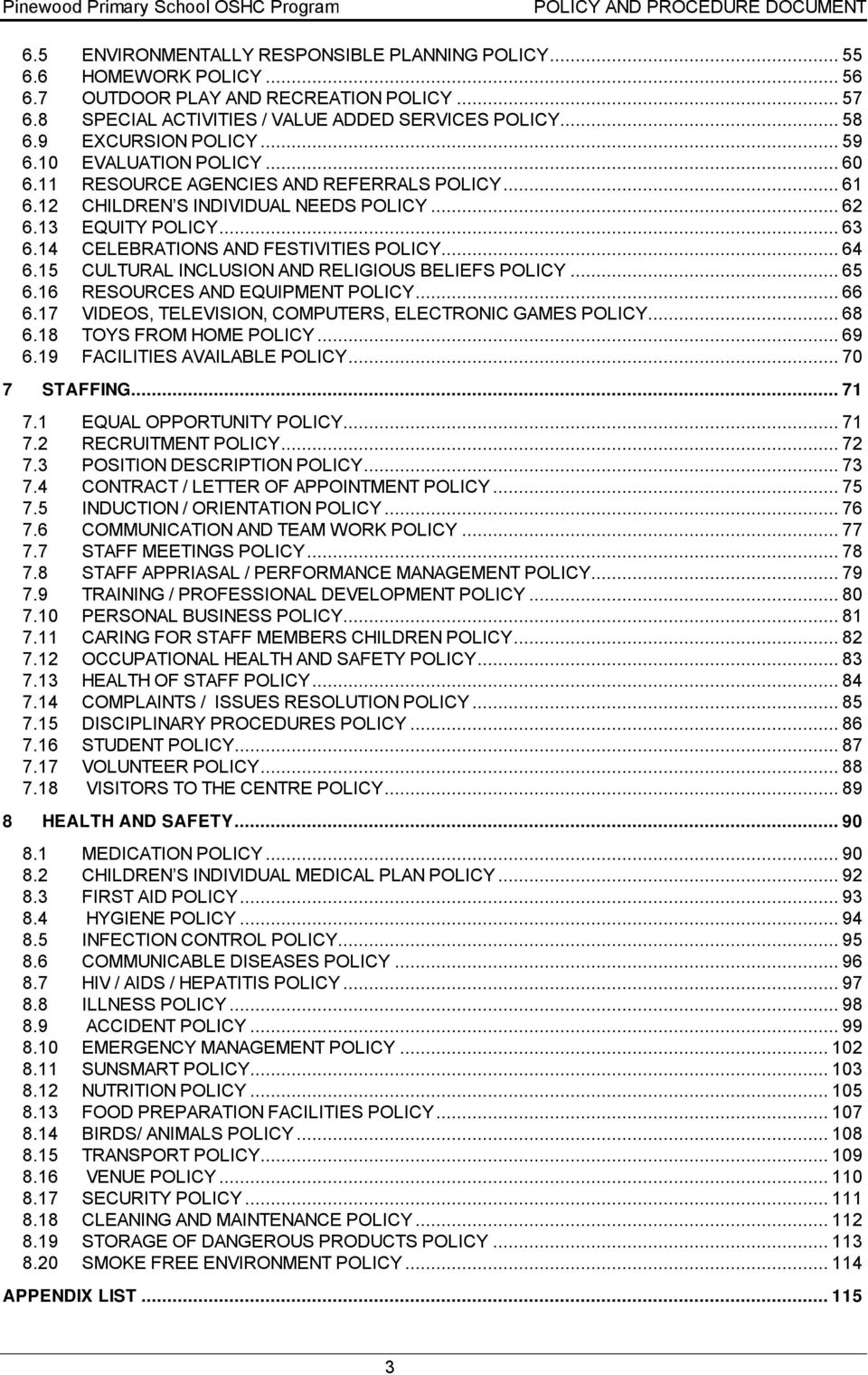
2 TABLE OF CONTENTS TABLE OF CONTENTS PHILOSOPHY AND GOALS INTRODUCTION SERVICES PROVIDED THE ROLE OF THE GOVERNMENT BODIES MANAGEMENT MANAGEMENT OF THE SERVICE INSURANCE FINANCIAL MANAGEMENT BANKING DISHONORED CHEQUES MARKETING AND SERVICE PROMOTION DEVELOPMENT RECORD KEEPING CHILDREN S RECORDS NATIONAL STANDARDS QUALITY ASSURANCE ENROLMENT, ADMINISTRATION & FEES ENROLMENT WAITING LIST PRIORITY OF ACCESS COMMENCEMENT OF CARE BOOKING CHILDREN WHO DO NOT ATTEND ATTENDANCE NON COLLECTION OF CHILDREN ARRIVAL AND DEPARTURE CANCELLATION OF CARE CHILD CARE BENEFIT FEE ACTIVITY AND EXCURSION COST LATE PICK UP FEES HANDLING OF FEE INCOME RECEIPTING LATE PAYMENT/ NON PAYMENT OF FEES WORKING WITH FAMILIES FAMILY INVOLVEMENT PARENTAL REQUESTS ACCESS TO SERVICE ACCESS TO CHILDREN CHILD PROTECTION COMMUNICATION PRIVACY COMPLAINT THE CHILDREN S PROGRAM PROGRAM POSITIVE GUIDANCE OF CHILDREN ANTI-BULLYING PLANNING

3 6.5 ENVIRONMENTALLY RESPONSIBLE PLANNING HOMEWORK OUTDOOR PLAY AND RECREATION SPECIAL ACTIVITIES / VALUE ADDED SERVICES EXCURSION EVALUATION RESOURCE AGENCIES AND REFERRALS CHILDREN S INDIVIDUAL NEEDS EQUITY CELEBRATIONS AND FESTIVITIES CULTURAL INCLUSION AND RELIGIOUS BELIEFS RESOURCES AND EQUIPMENT VIDEOS, TELEVISION, COMPUTERS, ELECTRONIC GAMES TOYS FROM HOME FACILITIES AVAILABLE STAFFING EQUAL OPPORTUNITY RECRUITMENT POSITION DESCRIPTION CONTRACT / LETTER OF APPOINTMENT INDUCTION / ORIENTATION COMMUNICATION AND TEAM WORK STAFF MEETINGS STAFF APPRIASAL / PERFORMANCE MANAGEMENT TRAINING / PROFESSIONAL DEVELOPMENT PERSONAL BUSINESS CARING FOR STAFF MEMBERS CHILDREN OCCUPATIONAL HEALTH AND SAFETY HEALTH OF STAFF COMPLAINTS / ISSUES RESOLUTION DISCIPLINARY PROCEDURES STUDENT VOLUNTEER VISITORS TO THE CENTRE HEALTH AND SAFETY MEDICATION CHILDREN S INDIVIDUAL MEDICAL PLAN FIRST AID HYGIENE INFECTION CONTROL COMMUNICABLE DISEASES HIV / AIDS / HEPATITIS ILLNESS ACCIDENT EMERGENCY MANAGEMENT SUNSMART NUTRITION FOOD PREPARATION FACILITIES BIRDS/ ANIMALS TRANSPORT VENUE SECURITY CLEANING AND MAINTENANCE STORAGE OF DANGEROUS PRODUCTS SMOKE FREE ENVIRONMENT APPENDIX LIST
4 4

5 1 PHILOSOPHY AND GOALS To provide a quality primary school-aged childcare service for Pinewood Primary School OSHC Program which is community-based, flexible and meets each child s need for care in a creative, stimulating, safe and secure environment before and after school and during school holidays. The philosophy is implemented by the following goals: To offer a flexible service that responds to the care and recreational needs of children To provide an environment for children that: o is both safe and challenging o fosters individuality, recognising their needs and interests o promotes the physical health and well being o acknowledges the importance of the middle years of child development o values the benefit of play in both structured and self directed experiences o fosters a spirit of equity and inclusion To ensure that the service accurately reflects the needs of children and parents by: o acknowledging the importance of parents in providing direction for the service o encouraging comments and feedback from all parents o acknowledging and being sensitive to the cultural backgrounds of families To meet the National Standards for Childcare Strive to achieve the highest level of quality as determined by the Outside School Hours Care Quality Assurance System. To ensure that staff are able to: o fulfill the role and responsibilities they are employed to undertake o have their needs met 5

6 2 INTRODUCTION 2.1 SERVICES PROVIDED The Pinewood Primary School OSHC Program operates on a non-profit basis and was established in The Pinewood Primary School Council is the sponsor of the service however the Management of the service lies with the Outside School Hours Care (OSHC) Sub Committee. A Coordinator is employed to operate the three programs on a day to day basis. The OSHC Service provides the following components of care: Before School Care The Before School Care Service operates from 7.30am to 8.45am each weekday during school terms for 41 weeks of the year. This service is funded by the Commonwealth Government to provide Child Care Benefit to families. After School Care The After School Care Service operates from 3.30pm to 6.00pm each weekday during school terms for 41 weeks of the year. A nutritious snack is provided after school as part of the service. The service also provides an extensive program of creative and recreational experiences for the children. This service is funded by the Commonwealth Government to provide Child Care Benefit to families. Prep Early Finish The After School Care Service operates a Prep Early Finish Service for the first 4 weeks of Term 1 from 2.00pm 3.30pm each weekday. A nutritious snack is provided after school as part of the service. Curriculum Days / Pupil Free Days The After School Service operates a Curriculum Day Service from 7.30am 6.00pm. The service is advised of Curriculum Days as approved by School Council. A nutritious snack is provided after school as part of the service. This service is funded by the Commonwealth Government to provide Child Care Benefit to families. Vacation Care The Vacation Care Service operates from 7.30am to 6.00pm during the term break for 8 weeks of the year, closing for 3 over the December /January period. This service is funded by the Commonwealth Government to provide Child Care Benefit to families. The Sub Committee and staff have developed this Policy and Procedures Document to provide families with information regarding the operation of this service. The Document includes policies established in line with State and Commonwealth Guidelines, legislation and quality assurance systems relating to OSHC. The outlined policies will be reviewed by management and staff on an annual basis to ensure relevance to the service and families. A Parent Handbook is also available which provides information on the operation of the Service and outlines parent, staff and child responsibilities. 6
7 2.2 THE ROLE OF THE GOVERNMENT BODIES COMMONWEALTH GOVERNMENT The Commonwealth Department responsible for Outside School Hours Care is the Department of Family and Community Services (FACS). The Department refers to itself as the Child Care Program and believes its role to be:. strengthening Australian Families by assisting families with dependent children to participate in the workforce and the general community. In particular the Commonwealth Child Care Program has the following aims: Affordability to keep child care affordable to low and middle-income families Supply to encourage the development of child care services and places in areas of greatest need and to ensure that the range, type and quality of services available meet the needs of families. Quality to encourage quality outcomes for children in efficiently managed services and to support the development of children with special needs by enabling them to gain access to child care. The role of the Commonwealth: Administer Child Care Benefit to families Administer financial support to approved community managed services in areas of need Assist employers to provide child care for their employees Assist parents with child care options Quality assurance, training and support services to improve the quality of care of children Funding, training and support products and services to promote equity of access Policy advice, research and service management related to providing children s services Details taken from the Community Based Outside School Hours Care Handbook July 2000 and internet site: National Standards The Commonwealth and State Governments have jointly developed National Standards for child care services. These standards express a national view about the level of care all Australians should expect to find in the different kinds of child care services available to them. A copy of the National Standards can be found in the appendices section of your FACS Outside School Hours Care Handbook or on the FACS website. National Childcare Accreditation Council (NCAC) Quality Assurance The NCAC is an incorporated association established in 1993 by the Commonwealth Government. The NCAC administers the Quality Assurance System for Outside School Hours Care. The aim of the system is to assist services to implement strategies to improve the quality of care that they provide for children. Further details regarding NCAC can be obtained on the web site: Child Care Benefit Child Care Benefit is funded by the Commonwealth Government to assist families using an approved child care service with child care fees. Its primary focus is to support families who are working, studying, training and looking for work. The other main client group it supports is children who are at risk. The service is funded by the Commonwealth and as a result abides by regulations and guidelines pertaining to this funding. 7

8 Family Assistance Office (FAO) The FAO is the main service delivery organisation for the Child Care Benefit and Family Tax Benefit payments. The FAO is a joint venture of Centrelink, the Australian Taxation Office and the Health Insurance Commission (Medicare). All service outlets of those organisations include FAO offices. The FAO can be contacted on Further information can be obtained from the Coordinator on this form of funding if required. STATE GOVERNMENT The State Government through the Department of Human Services (DHS) is currently investigating the role it will play in regulating Outside School Hours Care in regard to the National Standards. Further details regarding the Department of Human Services can be obtained on the web site: LOCAL GOVERNMENT Food Safety The State Government through the Department of Human Services is responsible for food regulation in Victoria through the administration of the Food Act (1984). The Department of Human Services works with Local government who register food businesses in Victoria. Food safety is a significant issue for OSHC and it is the responsibility of Local Government to assist services in regard to the level of registration and compliance required to meet the Food Act (1984) and Food Standards Code. Local Government Health Departments will also be able to assist you in regard to which class your service should be registered and if it requires third party auditing. For more details on food safety refer to the State Government website: 8

9 3 MANAGEMENT STATEMENT The service will ensure that the financial, administration and accounting reporting processes and tasks are completed to the satisfaction of the funding body, the sponsor, parents and staff. 3.1 MANAGEMENT OF THE SERVICE The Pinewood Primary School Council is the sponsor of the service. The Pinewood Primary School Council will ensure that the day to day management of the service meets with the requirements set by the Commonwealth s Department of Family and Community Services and legislation set by State and Commonwealth Governments under the direction of a subcommittee made up of school, parents and staff representation. MANAGEMENT STRUCTURE 1. School Council 2. OSHC Sub Committee 3. Principal 4. Coordinator 5. Staff Members PROCEDURE The sponsor has responsibility to ensure that: All aspects of the service, including policy, program and budget development, approval of all expenditure of the budget, staffing decisions and management of staff. The incorporated status is maintained including updating rules of association and having a certificate of incorporation. The sub-committee: Is made up of a School Council Representative, OSHC Coordinator and 1 member of the parent group. The primary role of the Sub-Committee is to operate the OSHC service and to implement the school policy in relation to the service. Other roles and responsibilities are as follows: 1. To encourage participation and suggestions from parents and staff regarding decisions to be made about the service operation, its policies and the fulfillment of its philosophy and goals. 2. To regularly review parent and staff needs in relation to service operation and where appropriate to lobby groups to ensure that these needs are met. 9

10 3. To be actively involved in staff recruitment and the development of a positive work environment. 4. To develop and manage the finances of the service and to be responsible to the Department of Family and Community Services for funding. 5. To meet on a monthly basis. 6. To report directly to the School Council. 7. To ensure that the service meets all legislative requirements as set by the State and Commonwealth Governments in relation to child care services, staff, financial management and health and safety. The Coordinator has responsibility for: The day to day operation of the service and its programs Financial Management Policy Insurance Policy Policy Development Policy FACS - Draft Quality Practices Guide for Outside School Hours Care Edit 16 December 2002 Quality Area 8 - Managing to Support Quality Principal 8.1- Management ensures the service operates within relevant legislation. FACS, 2000, Community Based Outside School Hours Care Handbook July
11 3.2 INSURANCE Management will ensure that professional indemnity, public liability, building and contents, worker s compensation and any other necessary insurance is sufficient to cover the needs of the service, in line with State and Commonwealth Legislation. PROCEDURE The sponsor has the responsibility to ensure that: Commencement and payment of all relevant insurances is undertaken. Allocations will be made in the budget for all relevant insurances. Insurance will be paid on time. Management of the Service Policy Financial Management Policy Venue Policy DHS - Implementation Guidelines for National Standards for Outside School Hours Care Page Insurance FACS - Draft Quality Practices Guide for Outside School Hours Care, Edit 16 December 2002 Quality Area 8. Principal 8.1 Management Ensures the service operates within relevant legislation. FACS, 2000, Community Based Outside School Hours Care Handbook, July 2000 Section 2.6 Insurance 11

12 3.3 FINANCIAL MANAGEMENT RATIONALE Good financial management is the responsibility of all management committee members. FACS (2000) The sponsor is responsible for the financial planning and management of the OSHC service. The OSHC service will operate within the constraints of the financial budget. PROCEDURE The sponsor is responsible to ensure that: A budget is prepared annually outlining the anticipated income and expenditure of the service. Past financial year records are used as a basis for developing the new budget. In the case of a surplus of funds, this money will be accrued to the following year and considered when developing the financial year budget. All financial records will be audited at the completion of the financial year and findings presented to the School Council. A cash flow will be developed to ensure the ongoing financial monitoring of the budget. All expenditure will be approved by the Sub Committee. The Coordinator / Bursar is responsible to ensure that: The day to day financial management is undertaken in line with the service policies and procedures i.e. payment of accounts, collection and banking of fees. All costs associated with staffing i.e. Superannuation, WorkCover etc are paid. Management of the Service Policy Insurance Policy Banking Policy Petty Cash Policy Fundraising Policy FACS, 2000, Community Based Outside School Hours Care Handbook, July 2000 Section 3.2 Management Committee s. 12

13 3.4 BANKING All money received by the service is banked weekly. PROCEDURE The Coordinator is responsible to ensure that: Prior to banking, all money, including petty cash, will be held in a secure place under their direct control. A reconciliation of fees paid, receipts issued and fee records completed will be completed when monies are prepared for banking. Financial Management Policy Handling of Fee Income Policy Receipting Policy 13

14 3.5 DISHONORED CHEQUES The service is unable carry fees and charges for dishonored cheques. PROCEDURE Any cost incurred to the service due to dishonored cheques will be charged to the parent the following week. Financial Management Policy 14

15 3.6 MARKETING AND SERVICE PROMOTION Pinewood Primary School OSHC Program will be promoted to the school on a regular basis to ensure that all relevant parties are aware of the service and its activities. PROCEDURES The Coordinator is responsible to ensure that: A range of marketing methods are used for the service including: school newsletter, service newsletter and brochure. Marketing material is designed to target children and parents separately. Marketing material is promoted in community languages. The service participates in community events and includes community visitors to the service. Management of the Service Policy FACS - Draft Quality Practices Guide for Outside School Hours Care, Edit 16 December 2002 Quality Area 3 - Partnerships with Families and Community Links Principal 3.2 The service actively seeks to build links with the community. 15

16 3.7 DEVELOPMENT Pinewood Primary School OSHC Program maintains a policy and procedures document which is regularly reviewed in line with State and Commonwealth legislation, industry practice and current research on child development. PROCEDURES The Sub Committee is responsible to ensure that: All policies are reviewed on an Annual basis. The policy and procedure document is displayed prominently in the service. A small working party is created to develop or review policy for the service. Draft documents are presented to the Sub Committee for feedback. Any policy changes are in line with the service philosophy. Policies are ratified at Sub Committee meetings. Families are consulted when policies are developed or altered. Families are notified of final changes to policy via newsletter and notice board. Management of the Service Policy DHS - Implementation Guidelines for National Standards for Outside School Hours Care, Pg Policy 16

17 3.8 RECORD KEEPING RATIONALE The service should keep accurate records covering all aspects of its operation. Records must be retained for at least 36 months from the date of the last entry. FACS, 2000 All legally required records will be maintained in a system that complies with requirements of the Department of Family and Community Services and The Privacy Act PROCEDURE The Coordinator is responsible to ensure that: A bound daily record of each child s attendance is maintained by the service. This will include the provision of a sign in and out register. These records will be kept by the service for a period of 3 years. A bound accident, illness and medication book is maintained by the service. These documents will be kept by the service for a period of 21 years. (Please note individual child accidents records must be kept until the child has turned 24 years of age) Records of permission to attend excursions is kept on children s files. A record is kept of each family s fees paid and fees outstanding, in a form approved by the Sub Committee which complies with funding requirements. Statistical data is maintained and kept regarding the utilisation levels of the service. All financial records, including records required for Child Care Benefit financial accountability are maintained by the service for a period of 3 years, from the date of the last entry. Staff attendance records outlining sign in and out times are maintained. Administration records will be stored in lockable filing cabinets at all times. Staff will not take administration records home without the permission of the Coordinator. Arrival and Departure Policy Accident Policy Illness Policy Medication Policy Receipting Policy Child Care Benefit Policy Excursion Policy Privacy Policy DHS - Implementation Guidelines for National Standards for Outside School Hours Care, Pg Maintenance of Records, Pg Excursions FACS - Draft Quality Practices Guide for Outside School Hours Care, Edit 16 December 2002 Quality Area 6 Health, Nutrition and Wellbeing. Principal 6.4 The Service plans to meet the individual 17
18 health requirements of children, Quality Area 7 Protective Care and Safety. Principal 7.1 The service has effective policies and procedures on protective care. DHS & Victoria Legal Aid, Legal Aspects of Child Care, Page 26 - Records FACS, 2000, Community Based Outside School Hours Care Handbook, July 2000 Section Record Keeping Public Record Office Privacy: 18
19 3.9 CHILDREN S RECORDS 1. Each child has an individual file that is maintained in a system compliant with requirements of the Privacy Act Families are advised of the type of information collected in regard to their child and the purpose of this. 3. The service is required to report to various government departments in order to meet funding and service requirements. All information regarding children is provided in a non-identifying way except in the case of Child Care Benefit funding. PROCEDURE The Coordinator is responsible to ensure that: Documentation of children s health and development is kept in individual child files. Families are notified of the contents of children s files and the purpose of collecting this information. This is done through the parent handbook. Records are secured in a locked cupboard or filing cabinet. Records of permission to attend excursions is kept on children s files. Court orders are held in the child s individual file. Individual medical plans are kept in children s files. Only staff working directly with a child have access to their file. All information kept on a child s file is to be treated with the highest level of confidentiality. All documentation is kept up to date on children s files. Excursion Policy Children s Individual Medical Plan Policy Access to Children Policy Privacy Policy Child Care Benefit Policy DHS - Implementation Guidelines for National Standards for Outside School Hours Care, Pg Maintenance of Records FACS - Draft Quality Practices Guide for Outside School Hours Care, Edit 16 December 2002 Quality Area 6 Health, Nutrition and Wellbeing. Principal 6.4 The Service plans to meet the individual health requirements of children, Quality Area 7 Protective Care and Safety. Principal 7.1 The service has effective policies and procedures on protective care. DHS & Victoria Legal Aid, Legal Aspects of Child Care, Page 26 - Records 19
20 3.10 NATIONAL STANDARDS RATIONALE Although not yet mandated in most States and Territories, all outside school hours care services are encouraged to become familiar with the national standards and to work to adhere to them to the fullest extent possible. FACS, 2000 Pinewood Primary School OSHC Program aims to meet the National Standards at all times. PROCEDURE The Coordinator has the responsibility to ensure that: All new staff are provided with a copy of the National Standards as part of their orientation package. National Standards are mentioned when making decisions or discussing relevant aspects of the daily program and service operation. Induction/Orientation Policy DHS Implementation Guidelines for National Standards for Outside School Hours Care, May 1996 FACS, 2000, Community Based Outside School Hours Care Handbook, July

21 3.11 QUALITY ASSURANCE Pinewood Primary School OSHC Program will strive to meet the highest level of Quality Assurance with the National Childcare Accreditation Council (NCAC). PROCEDURE The Coordinator has the responsibility to ensure that: The service is registered with the NCAC for the Quality Assurance System. Any fees required by the NCAC are paid on time. Staff are supported in the implementation of the Quality Assurance System. The staff team has the responsibility to ensure that: The service is prepared for the Quality Assurance Audit within the timelines set by the NCAC. Self assessment processes are undertaken prior to the NCAC visit. Required processes are followed up in line with the recommendations outlined by the NCAC Staff meetings are used as an opportunity to discuss and complete Quality Assurance matters and tasks. Tasks allocated to each member of the team are undertaken. Management of the Service Policy Draft Quality Practices Guide for Outside School Hours Care Edit 16 December Quality Area 8 Managing to Support Quality. Principal 8.3 Management has effective strategies for communicating with families. 21
22 4 ENROLMENT, ADMINISTRATION & FEES 4.1 ENROLMENT All children must be enrolled before receiving care. Children must be re-enrolled on an annual basis. PROCEDURE The staff have the responsibility to ensure that: An enrolment form is completed for each child who attends the service. The details on this form must be kept up current and up-dated as necessary. The following information is required on the enrolment form: o o o o o Child s name, address and date of birth Custody/court orders relating to custody or access Name, address and contact numbers (home and work) of parents/guardians/authorised persons Details of authorised persons able to collect the child Written permission for the child to leave the service unaccompanied, such as to attend sporting or creative sessions during program times. Medical details of the child including any action plans that have been developed and name, address and contact number of child s doctor Special considerations or needs relating to the child Details of authorised persons able to be contacted in an emergency Written authorisation to seek emergency medical, hospital and ambulance services. Enrolment forms are available from the school office or OSHC service. A copy is included as Appendix 1. Parents/Guardians have a responsibility to ensure that: The policy document of the service has been read. The enrolment form section regarding service policy has been signed which states that they have read and agree to abide by the conditions outlined in the policy document. Medication Policy Privacy Policy Children s Records Policy Access to Children Policy o o o o DHS, May 1996, Implementation guidelines for National Standards for Outside School Hours Care Page 38, Maintenance of Records. 22
23 4.2 WAITING LIST PRIORITY OF ACCESS RATIONALE Outside School Hours Care is mainly for school aged children, but can assist children outside this range in special or emergency situations. The attendance of such children must be discussed with the Department of FACS and reviewed on a regular basis. FACS, Pinewood Primary School OSHC Program will maintain a waiting list for care in application date order and in accordance with the Commonwealth Government s Priority of Access Guidelines listed in the Community based Outside School Hours Care Handbook. 2. The Service is provided as a first priority to children attending the Pinewood Primary School. 3. Consideration will be given to accepting children not enrolled at this school if places are available, during Vacation Care only. PRIORITY OF ACCESS - GUIDELINES Priorities as indicated in the OSHC Handbook: Children at risk of abuse or neglect Families in crisis should have support and assistance from child care services to the maximum extent possible. Families with work or work related needs. Where demand exceeds supply, it is important for services to allocate available places to those families with the greatest need for child care support. If there are vacancies, out of care children should be accepted especially if the level of utilisation is low. Transport to the service is the responsibility of the parent. The service must not restrict the attendance of primary school aged children in order to offer care to older or younger children. FACS, 2000 PRIORITY OF ACCESS Evidence of Priority of Access When a family seeks to establish priority, the service should satisfy themselves that a child fits in the priority of access. Where this is not clear, the service should consider requesting documents as evidence of priority, such as: Disability of parent or child - medical certificate or other formal assessment, or Risk of serious abuse - confirmation from social worker, State Welfare Department or doctor, Court or Intervention Orders. Once a vacancy arises, the Coordinator will contact the next family on the list. Enrolment Policy Child Care Benefit Policy FACS, 2000, Community Based Outside School Hours Care Handbook, July
24 4.3 COMMENCEMENT OF CARE Pinewood Primary School OSHC Program will ensure that all children are made welcome and oriented to the service and its routines upon commencement. PROCEDURE Family members have the responsibility to ensure that: When making bookings, parents must inform the Coordinator that their child is new to the service or is in prep and which class they are in. The staff team has the responsibility to ensure that: Prep children are collected from their class until they are settled in and able to find their way to the service. All new children are instructed as to which areas they may play in whist at the service. New children are oriented to the program including where bags are kept, snack times, expectations and are linked with other children in the program if they do not know anyone else. Enrolment Policy 24
25 4.4 BOOKING 1. Permanent bookings are required to be made in advance. 2. Casual users must contact the service 24 hours prior in order to ensure a place is available. PROCEDURE Staff have a responsibility to ensure that: Parents/Guardians are contacted as soon as possible if care is not available. Parents/Guardians have a responsibility to ensure that: Cancellations, changes or additions to bookings are made to the Coordinator between the hours of 7.30am 9.00am and 2pm - 6pm. Notification of cancellations are made by 3.00pm on the day of cancellation. If requiring emergency or casual care due to unexpected circumstances they contact the service by 3.00pm. Enrolment policy Fee policy 25
26 4.5 CHILDREN WHO DO NOT ATTEND The staff will endeavor to ensure that children booked into the service arrive as intended. PROCEDURE Staff have the responsibility to ensure that: A roll call of children is conducted as they arrive at the service. The roll is checked at 3.45pm to determine whether there are children booked into the service that have not yet arrived. The school office is contacted to confirm that any missing children attended school on that day. The school office is requested to put a message over the intercom/speaker requesting that the missing child/ren in question go immediately to the service. If missing children have not arrived by 3.45pm they will attempt to contact the parent to determine whether the child/ren are supposed to be attending the service. If the parent cannot be contacted or the missing child/ren is supposed to be attending the service the staff will contact the Principal or Committee to determine the next course of action. Attendance Policy 26
27 4.6 ATTENDANCE Pinewood Primary School OSHC Program (if there is a vacancy) is available to children whose parents have not arrived after 3.45pm to protect their safety and well being. PROCEDURE The school principal and teachers have the responsibility to ensure that: All families within the school will receive a copy of the school policy regarding this matter. Appropriate information regarding any child remaining at the school after 3.45pm will be passed onto the OSHC service by the School Office to enable care to be provided. Children remaining in the school grounds after 3.45pm will be taken to the service by school staff. Families will be contacted to inform them of the children s attendance at the OSHC service. The staff have the responsibility to ensure that: Families are charged a session fee for the child s attendance. Families are encouraged to complete an OSHC service enrolment form. Self Referred Children: Those who arrive at the service without being enrolled: Every effort should be made to contact the parents and seek their permission for the child to be there. Enrolment Policy Fee Policy FACS, 2000, Community Based Outside School Hours Care Handbook, July
28 4.7 NON COLLECTION OF CHILDREN Pinewood Primary School OSHC Program will ensure the safety of children not collected from the service by the closing time. PROCEDURE Pinewood Primary School OSHC Program closes at 6.00pm. The following procedure will be followed for children remaining at the service after this time. The staff will attempt to contact the parents/ guardians/authorised persons at 6.00pm. If not contactable, staff will immediately contact the emergency contact numbers on the enrolment form. If not contactable, the staff will wait for the parents until 7.00pm. The children will be reassured and made comfortable whilst staff are trying to contact the parent. If by 7.00pm, the parent/guardian/authorised persons have not been contacted, staff will contact the Department of Human Services for direction. Regional Office Telephone No The staff may consider calling the police for a welfare check of the family home. Management is contacted to advise of the action offered by police and the Department of Human Services. Late Pick Up Fees Policy Child Protection Policy 28
29 4.8 ARRIVAL AND DEPARTURE All children attending Pinewood Primary School OSHC Program must be signed in and/or out by the parent/ guardian/ authorised person every session (signing in and out includes the date and time of arrival and departure) PROCEDURE Staff have the responsibility to ensure that: For all programs: Parents/guardians/authorised persons have undertaken their responsibility of signing the attendance register. For the Before School Care Service: The child is signed out of the service when leaving for school by staff. For the After School Care Service: The child is signed into ASC upon arrival to the service by staff. Hand written and signed notes from the parent/guardian/authorised person must accompany a child requesting to leave the service alone. No child is permitted to leave the centre with a person who is not authorised by the parent/guardian. Children may not be collected by persons other than those that appear on the enrolment form or if written permission is provided to service staff to allow another person to collect their child from care. Verbal permission over the telephone may be provided to Service staff to allow another person to collect their child from care, but must be followed up with written permission. For children leaving the service during a session to attend another service/activity: Children attending activities within the school grounds are signed out of the service by staff and on their return children are required to notify the Coordinator of their arrival. If a parent continually fails to complete the attendance register the service can refuse fee relief. The parent is to be notified that this action will be taken. FACS, 2000 Parents/Guardians/Authorised Persons have the responsibility to ensure that: For the Before School Care Service: The child is signed into the service on arrival by authorised persons and the staff will sign the child out of the service. For the After School Care Service: The child is signed into the service by staff and out of the service by authorised persons when collecting their child. For the Vacation Care Service 29
30 The child is signed into the service on arrival and when collecting their child from the service. Written permission is provided to service staff to allow another person to collect their child from care. Verbal permission over the telephone may be provided to Service staff to allow another person to collect their child from care, but must be followed up with written permission. Access to Children Policy Draft Quality Practices Guide for Outside School Hours Care Edit 16 December 2002 Quality Area 7 - Protective Care and Safety Principle 7.1- The service has effective policies and procedures on protective care. FACS, 2000, Community Based Outside School Hours Care Handbook, July
31 4.9 CANCELLATION OF CARE Families are required to notify the service of any changes to booking arrangements. PROCEDURE Seven days notice is required in writing for cancellation of full time or part time booked care or change of booking. Fee Policy Booking Policy 31
32 4.10 CHILD CARE BENEFIT DEFINITION Child Care Benefit (CCB) is a payment made to families to assist with the costs of child care. All families will be notified of the availability of Child Care Benefit (CCB) and their responsibilities in accepting this funding. PROCEDURE The Coordinator has the responsibility to ensure that: At enrolment families are provided with information and appropriate forms to apply for funding or families can call the Family Assistance Office (FAO) on to ascertain eligibility. The service displays up to date information regarding CCB on the parent notice board and in the newsletter. The service s Customer Reference Number CRN number is displayed in a prominent position enabling families to complete necessary forms. The service completes the CRN number on all forms provided to families to ensure correct information is passed onto Family Assistance Office (FAO). Families are informed of their responsibilities in terms of access to CCB. This includes: o Completing and lodging the CCB application form within seven days of commencing care. o Lodging a new CCB application annually or as required o Paying their portion of the service fee by the end of each claim period o Signing attendance records daily stating time in and out o Families are responsible for ensuring they apply for all components of care required. Parents also need to inform the service if the child enrolled attends any other Before, After of Vacation Care service. Advising the service if they have other children in a Commonwealth service such as Family Day Care, Long Day Care or any other OSHC service. (Note: Although Parent statements are no longer required services should have some kind of information that clearly indicates that families have spoken to you about having another child in another Commonwealth Service. Special Child Care Benefit will be made available to families experiencing major difficulties. Access to Special Child Care Benefit will be at the discretion of the Coordinator and Sub Committee. Submit quarterly statements within the allocated timeline. Records are to be kept for 3 years from the end of the financial year. They must be safely stored, easily accessible, in original form and preferably in numerical or date order. The following documents must be kept: o o o o o Details of fees Hours of care charged Attendance records Assessment notices Details of parent payments 32
33 o o Certificates of approval for special CCB Certificates of approval for more than 20 and more than 50 hours per week of care for a child at risk (Vacation care only). For CCB in Vacation Care where a child has enrolled to start in Prep but not yet started they will have the status of non-school aged child. Management of the Service Policy Waiting List Priority of Access Policy Late Payment/Non Payment of Fees Policy Record Keeping Policy Children s Records Policy FACS, 2000, Community Based Outside School Hours Care Handbook, July
34 4.11 FEE RATIONALE Pinewood Primary School OSHC Program operates on a non-profit basis. Any surplus will be expended on equipment and resources for the children s program, minor upgrades and service improvements as specified by the Sub Committee. Pinewood Primary School OSHC Program aims to provide a quality service which is accessible and affordable to families. The service must not charge a fee for a child for whom CCB is being paid that exceeds the fee charged for another child in the same circumstances, who is receiving that same care, and whom CCB is not being paid. The service must charge separate fees for before and after school care. FACS, 2000, Community Based Outside School Hours Care Handbook, July 2000 DEFINITIONS Permanent Booked Care Booked Care Casual Care Regular bookings used each week Any booking for care made in advance Care used on a daily basis (no booking) 1. Fees will be set annually by the Sub Committee prior to the commencement of the school year. Fees are set to cover the cost of the service. They are subject to change. 2. Pinewood Primary School OSHC Program aims to provide a quality service which is accessible and affordable to families. PROCEDURE The Sub Committee has the responsibility to ensure that: Fees will be set on an annual basis by the Sub Committee. Fees are charged on a per session basis per child. Parents have a responsibility to ensure that: All families are required to pay fees for the care of their children. Permanent and Booked Care Families will be charged fees fortnightly in arrears with an invoice issued on a Monday for the previous two weeks with fees to be paid for by the following Friday. Casual and Emergency Care Families will be charged fees fortnightly in arrears with an invoice issued on a Monday for the previous two weeks with fees to be paid by the following Friday. A fee schedule is attached as Appendix 2. Booking Policy FACS, 2000, Community Based Outside School Hours Care Handbook, July
35 4.12 ACTIVITY AND EXCURSION COST In order to meet the developmental needs and interests of school aged children incursions and excursions will form part of the program. Parents are asked to contribute to the cost of these extra activities. PROCEDURE The Coordinator has a responsibility to ensure that: Parents will be notified in advance of any additional charges. These additional charges do not attract CCB. Parents will be invoiced for these additional activities within the normal billing period. Financial Management Policy Child Care Benefit Policy FACS, 2000, Community Based Outside School Hours Care Handbook, July
36 4.13 LATE PICK UP FEES RATIONALE This policy has been put into place to prevent any family from continually attending the service after the advertised closing time. The policy ensures that staff are paid for the additional hours they are required to work due to the late pick up of children. A late fee will be charged for children remaining in care after the advertised closing time. PROCEDURE The Coordinator has the responsibility to ensure that: The service charges the family $5.00 per 5 minutes or part there of. The late fee is added to the child s fortnightly invoice for care. The family is notified that payment of this fee is be paid with the next invoice. Additional time worked is documented and passed on to the Sub Committee. The additional time matches the time documented in the arrival and departure book as signed by the child s carer. The Sub Committee has the responsibility to ensure that: Staff are paid for additional hours worked due to late collection of a child. Non Collection of Children Policy 36
37 4.14 HANDLING OF FEE INCOME The Coordinator and Assistant Coordinator are the only people who will accept payment from families for care. PROCEDURE Payments will be accepted through the following methods: Cheques: Cheques must be made out to Pinewood Primary School. Cash: Cash must be given to the Coordinator or Assistant Coordinator. Credit Card: Credit Card payments can be made at the school office. The person who receipts the fees is not responsible for the physical banking of money. Financial Management Policy Banking Policy Record Keeping Policy Receipting Policy 37
38 4.15 RECEIPTING 1. All families will be provided with a receipt as soon as is practicable after payment is made. 2. All receipts will be provided in a format that meets the requirements of the FACS Outside School Hours Care Handbook Section Receipts. PROCEDURE All Payments will be acknowledged as soon as possible if not immediately with a receipt which is signed and dated. Receipts will be in line with the requirements of the FACS Community Based - Outside School Hours Care Handbook. Handling of Fee Income Policy FACS, 2000, Community Based - Outside School Hours Care Handbook, July
39 4.16 LATE PAYMENT/ NON PAYMENT OF FEES All fees for care must be paid by the due date. PROCEDURE The Coordinator is responsible to ensure that: Payment arrangements are negotiated with families experiencing difficulties. Accounts falling more than 1 month in arrears are be sent notification to pay by the following week. This letter will state date payment is required and process which will be followed if payment is not received. Accounts falling more than 2 months in arrears (who have not contacted the service or arranged alternative payment arrangements) receive a phone call from the Coordinator excluding the child from care until payment is made. Families excluded from the service due to non-payment of fees will be provided with information regarding family support and financial advising services available in the local community. Pinewood Primary School OSHC Program has the ability to access 18% of the previous term s claim of Child Care Benefit (CCB) in Special CCB to support families experiencing difficulties. The Coordinator has the ability to waive fees under special circumstances. Fee Policy Dishonoured Cheques Policy FACS, 2000, Community Based - Outside School Hours Care Handbook, July 2000 Section
40 5 WORKING WITH FAMILIES Pinewood Primary School OSHC Program is committed to working with families in a collaborative manner in order to provide a high quality child care service that meets the needs of children, families and the community. Parent participation and communication is critical to the success of the service and its programs. Services should provide for adequate parent and staff participation in the management and in the development of the services polices and programs. FACS, FAMILY INVOLVEMENT Pinewood Primary School OSHC Program actively encourages family involvement in the development of the program and Management of the service. PROCEDURE The Sub Committee is responsible to ensure that: Families are encouraged to participate in accreditation activities and processes. The Coordinator has the responsibility to ensure that: Annual evaluations are conducted to allow families to have input into the future planning of the service. Informal evaluations of the service occur throughout the year. Parents are encouraged to attend the service to observe and participate with their child. Families are encouraged to participate in ways that acknowledge and value diversity. The staff team has the responsibility to ensure that: All family members names are known Family members are welcomed upon arrival. Access to Service Policy FACS, 2002, Draft Quality Practices Guide for Outside School Hours Care, Edit 16 December 2002 Partnerships with families and Community Links Quality Area 3. Principle 3.1 The service is responsive to the interests of families and encourages participation in the operation of the service. FACS, 2000, Community Based Outside School Hours Care Handbook, July
41 5.2 PARENTAL REQUESTS 1. Staff will consider all requests from families in regard to their children. 2. Where a parental request cannot be fulfilled explanation will be provided. PROCEDURE Discussions will be held with families in regard to the benefits of the experiences provided to the children in the service. Developmental disadvantages are explained to families when a request is made regarding their child to enable them to make an informed decision. Respect is given to families in regard their right to make decisions on behalf of their child. Family Involvement Policy Draft Quality Practices for Outside School Hours Care, Edit 16 December 2002 Quality Area 3 Partnerships with Families and Community Links Principle 3.1 The service is responsive to the interests of families and encourages participation in the operation of the service. AECA Code of Ethics UN Declaration on the Rights of the Child 41
42 5.3 ACCESS TO SERVICE Families are welcome to attend the Pinewood Primary School OSHC Program at any time. PROCEDURE Staff will ensure that the service is accessible to families at all times. Pinewood Primary School OSHC Program uses a security system i.e. locking doors will ensure that appropriate mechanisms are in place to allow for entrance by families. Family Involvement Policy Security Policy FACS Draft Quality Practices Guide for Outside School Hours Care Edit 16 December 2002 Quality Area 7 - Protective Care and Safety, Principle 7.1 The service has effective policies and procedures on protective care. 42
43 5.4 ACCESS TO CHILDREN RATIONALE To ensure that a child is collected from a children s service by people who have the legal responsibility for caring for the child, it is important that child carers are aware of the different responsibilities that adults may have regarding a child.. DHS & Victorian Legal Aid (1999) DEFINITIONS Old Terminology Access Custody Guardianship New Terminology Contact Residence and Specific Issues Order for day-to-day care and control Specific Issues Order gives responsibility for long term care & welfare All parents and authorised persons have access to the Pinewood Primary School OSHC Program and their children at all times, unless relevant Court Orders are held by the service that specify otherwise. PROCEDURE The staff have the responsibility to ensure that: A copy of all court orders in relation to residence and specific issues orders must be provided to the service upon enrolment or as obtained. These documents will be attached to the child s records and treated confidentially. Parents need to notify the service of any changes to these documents as soon as they occur. If the service does not have a copy of the court order it will assume that both parents have equal custody of the child therefore both have access. In the event that a parent breaks a Court order and seeks access to the child, the parent with custody entitlements will be contacted immediately, the staff will attempt to stall the parent from taking the child and then the police will be contacted. Parents have a responsibility to ensure that: The service is provided with a copy of all current court orders in relation to their child. The Coordinator is notified if there are any changes to these orders as soon as they occur. Emergency Management Policy Draft Quality Practices Guide for Outside School Hours Care Edit 16 December 2002 Quality Area - Protective Care and Safety Principle 7.1 The service has effective policies and procedures on protective care. DHS & Victorian Legal Aid, January 1999, Legal Aspects of Child Care. can be obtained on DHS web site 43
44 5.5 CHILD PROTECTION RATIONALE Children have the right to protection from physical, emotional, verbal and sexual abuse and neglect FACS Staff working with children take on a duty of care to ensure that all children are safe from harm. The health and welfare of all children in care is paramount. Pinewood Primary School OSHC Program will act on behalf of children to protect their rights to safety and security in accordance with Section 64 of the Children and Young Persons Act PROCEDURE Pinewood Primary School OSHC Program will comply with State Government regulations in regard to the reporting of suspected Child Abuse. If staff are concerned about a child s health and welfare they are required to document their concerns in regard to indicators of harm or potential harm and discuss them with the Coordinator. A detailed protocol and procedure is outlined in the staff manual. All information regarding these matters is held confidential. Draft Quality Practices for Outside School Hours Care, Edit 16 December 2002 Quality Area 7 - Protective Care and Safety Principle 7.1 The service has effective policies and procedures on protective care. Child and Young Persons Act 1989 Section 64 DHS January 2002, Responding to Child Abuse FACS, 2000, Community Based Outside School Hours Care Handbook, July
45 5.6 COMMUNICATION RATIONALE The role of the family in the Outside School Hours Service is paramount to its success and outcomes for children. Family members have a great deal of knowledge about their child which can be shared with the service. Communication must be two-way in order to ensure maximum benefit to the child and family. Staff will tell families about their child s day in return families will share relevant changes, issues, needs and interests of the child with the staff. This two-way communication should occur on a regular basis. Parents need specific information to enable them to make informed decisions and be reassured that their children are in good hands. FACS 2000 Pinewood Primary School OSHC Program will provide information to families on a regular basis via a range of methods including: newsletter, notice boards and face to face communication with staff. PROCEDURE The Coordinator is responsible to ensure that: All families will be provided with a copy of the Pinewood Primary School OSHC Program Handbook upon enrolment. Newsletters and notices are issued to families, as they become available. The Coordinator is available to discuss centre Programs and activities at any time. The staff team has the responsibility to ensure that: Parents are requested to read the notice boards and programs plan displayed at the service in order to keep informed of activities at the service. Families wishing to discuss matters of a more confidential nature are encouraged to make an appointment with the Coordinator. Pinewood Primary School OSHC Program accesses the translation and interpreter service for families who cannot speak or read English. They initiate and facilitate regular communication with parents/guardians. Parents are provided with feedback regarding their children s progress. All communication occurs in a respectful and courteous manner. Families have a responsibility to ensure that: Staff are notified of any relevant information about their child s health, development and personal/family matters. Family Involvement Policy FACS Draft Quality Practices Guide for Outside School Hours Care Edit 16 December 2002 Quality Area 3 - Partnerships with Families, Principle 3.1 The service is responsive to the interests of families and encourages participation in the operation of the service. FACS, 2000, Community Based Outside School Hours Care Handbook, July
46 5.7 PRIVACY RATIONALE Pinewood Primary School OSHC Program is committed to protecting the rights of children and families. Principles of the Privacy Act 1988 Principle 1 collection of information must be lawful and fair. Principle 2 telling people why information is collected Principle 3 ensuring personal information collected is of good quality and not too intrusive Principle 4 ensuring proper security of personal information. Principle 5 allow people to know what personal information is collected and why Principle 6 allow people access to their own records Principle 7 ensuring that personal information is of good quality and allowing people to have it changed where it is not Principle 8 ensuring that personal information is of good quality before use Principle 9 ensuring that use of personal information is relevant Principle 10 limiting the use of personal information Principle 11 preventing the disclosure of personal information outside the service DEFINITIONS Private information - enrolment form, Child Care Benefit information and children s developmental records. Pinewood Primary School OSHC Program has a responsibility to comply with the Privacy Act 1988, which governs the release of personal information. PROCEDURES Private information regarding children and families will not be disclosed to other families within the service or external persons. Pinewood Primary School OSHC Program will comply with the policy on the disclosure of service information outlined in the FACS Community based - Outside School Hours Care Handbook. Staff will respect parents/guardians rights to confidentiality when these rights do not conflict with the rights and safety of the children e.g. Child Protection matters. The Coordinator has a responsibility to ensure that: Only required information and no more is collected from families. Collection of information from families will occur in a manner that is not too intrusive. All private information regarding children and families will be held in a locked and secure place. Access will be restricted to the Coordinator and staff working directly with a child. Information which is required for the daily operation of the service, the well-being of children and staff may be exchanged between staff members in the normal course of work and will be treated confidentially. Family members are informed about the type of information collected in regard to themselves and their children and the purpose of this. 46
47 All information collected is up to date, collected directly from the child s family, is accurate, and regularly updated. Parents are informed that they have a right to view the records held in regard to themselves and their child. Parents are informed about the person responsible for organising access to files and information. The person responsible for accessing files is the Coordinator. The person making the request will be asked to complete a request for access form outlining the reason for the request. An access to information form is provided as Appendix 3. Access to files will be made within 30 days of application. The Coordinator must inform the committee that a request for access has been made and any outcome of that process. The Coordinator and Sub Committee can refuse access to files based on the terms specified in the Privacy Act. Children s Records Policy Record Keeping Policy Enrolment Policy FACS Community Based - Outside School Hours Care Handbook July 2000 Privacy Act 1988 can be found on FACS Draft Quality Practices Guide for Outside School Hours Care Quality Area 8 - Managing to support quality Principle 8.1 Management ensures the service operates within relevant legislation. 47
48 5.8 COMPLAINT All parents/guardians have the right to have their concerns heard by the Management team. PROCEDURE The Coordinator and Sub Committee will ensure that: Families are encouraged to discuss with the Coordinator any complaints or concerns they have about the service or staff. The Coordinator will address all complaints and concerns promptly and respectfully. All complaints are dealt with in a confidential manner. The staff will endeavor to respond to families verbally within 24 hours. Complaints, which are not resolved to the family s satisfaction, will be referred to the Sub Committee. Complaints which cannot be resolved by the management team will be referred to an outside independent person. All complaints will be registered in a log which tracks complaints made, progress on outcome and final resolution. Family Involvement Policy Parental Requests Policy FACS Draft Quality Practices Guide for Outside School Hours Care Edit 16 December 2002 Quality Area 8 - Managing to Support Quality, Principle 8.6 Management ensures that grievance and complaints procedures are adhered to. 48
49 6 THE CHILDREN S PROGRAM Pinewood Primary School OSHC Program is committed to nurturing and extending each child s social, physical, emotional and intellectual development in a child-friendly, supportive and fun environment. 6.1 PROGRAM 1. Pinewood Primary School OSHC Program will offer a planned, flexible and balanced program which will respond to children s interests, needs and stages of development. 2. The program will be developed in collaboration with children, parents and staff. PROCEDURE The staff team has the responsibility to ensure that: Overall planning for the OSHC service involving the children and parents occurs. The overall program is written and distributed to parents and guardians via the Parent Handbook. The children s program is displayed at the service. Children are encouraged to respect individual differences and respond by providing play experiences which recognise the importance of peer group relationships. Child-centered programs are conducted where children have ample opportunity to do things on their own, to accept appropriate responsibility and to use their free time creatively. Children are offered both active and quiet experiences and areas within the indoor and outdoor program. Children are provided with choices in their play and recreation. Planning is undertaken for both individuals and the whole group. Children are provided with opportunities to work on and complete individual and group projects over a period of time. Experiences provided are developed to suit the age and developmental ranges of all children attending the service. Games and activities are altered where appropriate to ensure all children are able to participate fully. Children are provided with opportunities for independent self directed play. The program is evaluated by parents, children and staff on a regular basis. Planning Policy FACS, 2002, Draft Quality Practices Guide for Outside School Hours Care, Edit 16 December 2002 Quality Area 5 Play and Development 49
50 6.2 POSITIVE GUIDANCE OF CHILDREN RATIONALE Children have the right to be treated with affection and courtesy, positively and as individuals. FACS 2000 Pinewood Primary School OSHC Program is committed to developing a safe, secure, caring and stimulating environment, which enhances children s self esteem and encourages them to interact positively and to co-operate with others. PROCEDURES The staff team has the responsibility to ensure that: They know all children s names and address each child individually upon entering and leaving the service. They communicate with all children in positive and respectful manner, actively listening to what children have to say and acting upon this. Children are provided with a role model that reflects values and attitudes of the local community and is consistent with the service policy. Children are supervised actively at all times. Children are encouraged to be considerate and supportive to each other. Moral development is considered in the planning of the program. Children are encouraged to undertake their own problem solving and negotiation with the support of staff through a range of strategies. I messages and redirection are methods used for misguided behaviour. Children are supported by staff who will assist them to label their feelings and find appropriate ways of expressing them. The safety and security of all children is ensured by supervising them at all times, monitoring, modeling, teaching and reinforcing safety practices. They encourage positive behaviour and give clear, consistent guidelines to children regarding the service s expectations and code of conduct. Children are involved in developing behavioural guidelines and consequences of inappropriate behaviour for the service. All children and parents feel welcome, appreciated and respected whatever their socioeconomic status, culture, colour of skin, race, ability, family type, belief system or lifestyle. A child s parent/guardian is consulted when their behaviour consistently conflicts with the service s behavioural guidelines. 50
51 Children and parents are involved in the development of behavioural plans when behaviour consistently conflicts with the services behavioural guidelines. Sympathy and support is provided to upset children. The Sub Committee is responsible to ensure that: Alternative care has been discussed with parents/guardians and may exclude a child from the service if all attempts to modify their behaviour fail or affects/endangers other children. Anti-Bullying Policy Equity Policy Draft Quality Practices Guide for Outside School Hours Care Edit 16 December Quality Area 1 Respect for Children Principle 1.1 Staff foster self esteem and confidence in children. Quality Area 2 Staff Interactions and Relationships with Children, Principle 2.2 Staff create a responsive and inclusive atmosphere and relate to children in a warm and friendly manner. And Principle 2.3 Staff guide children s behaviour in a positive way. Department of Education and Training 51
52 6.3 ANTI-BULLYING RATIONALE Bullying is one of the top three concerns for both boys and girls aged between 5 and 14 who call Kids Help Line. Calls about bullying have continued to increase steadily over the past five years in 2000 Kids Help Line counsellors spoke to nearly 7000 callers about this issue. It is now recognized that there is an indisputable link between bullying in childhood and adolescent anxiety, low selfesteem, loss of confidence and depression and self-harm. Research has shown that one in six Australian students are bullied every week, and that those children are three times more likely to develop depressive illnesses (Rigby, 1997). Bullies usually do not realise the effect their behaviour has on their victims. They believe that their actions are justifiable ("They deserved it", "They annoyed us", "They're such a #@*") Bullies have reasons for their behaviour such as; they get attention or even popularity, it's fun, it makes life less boring, "everyone does it", to protect themselves from being bullied or to get food or money or special things. Adults can; listen to the child's point of view, provide consequences, focus on the behaviour, use a problem-solving approach, help the young person develop empathy, keep good relationships with the young person, look out for bullying behaviour in adult models - including teachers and parents, keep calm, help find other ways of managing situations and problems, say clearly that it is NOT OK to bully and describe what it might look like if there was no bullying. Pinewood Primary School OSHC Program is committed to developing a safe and secure environment, which encourages children to interact positively with respect for others. PROCEDURES The staff team has the responsibility to ensure that: They are aware of all forms of bullying behaviour - physical bullying, verbal bullying, and relational bullying They make it safe for children to report bullying Teach children the differences between "dobbing" and "asking for help". "Dobbing" is when you tell what someone has done which is against the rules. It usually gets someone into trouble. Asking for help is when you tell what someone has done to a person against their wishes. It usually gets someone out of trouble. Let everyone know the consequences of bullying Children are encouraged to be considerate and supportive to each other. Children are encouraged and supported in developing friendship skills. Children are assisted in developing assertiveness and confidence and self-protection skills - how to walk confidently, stay alert to what's going on around them, and to stand up for themselves verbally. Comments are made on kindness toward others so that young people know that kindness is valued. 52
53 The safety and security of all children is ensured by supervising them at all times, monitoring, modeling, teaching and reinforcing safety practices. Children are taught ways to resolve arguments without violent words or actions. Children encouraged to follow the list of responsibilities to ensure that bullying is minimised or eliminated in the service. A child s parent/guardian is consulted when their behaviour consistently conflicts with the service s expectation that all children should feel safe whilst in attendance. The children have a responsibility to ensure that they: Refuse to watch bullying Report bullying incidents Persuade the person being bullied to talk to an adult Encourage the person being bullied to talk to them about what is happening Offer to speak to an adult on the bullied person's behalf Tell the bullies that they are determined to see that they stop The Sub Committee is responsible to ensure that: Alternative care has been discussed with parents/guardians and may exclude a child from the service if all attempts to modify their behaviour fail and other children s safety is compromised. Positive Guidance of Children Policy Draft Quality Practices Guide for Outside School Hours Care Edit 16 December Quality Area 1 Respect for Children Principle 1.1 Staff foster self esteem and confidence in children. Quality Area 2 Staff Interactions and Relationships with Children, Principle 2.2 Staff create a responsive and inclusive atmosphere and relate to children in a warm and friendly manner. And Principle 2.3 Staff guide children s behavior in a positive way. Department of Education and Training Information regarding bullying for anti bullying tips and general advice about children - Dr Rigby - research on bullying and its effects on children 53
54 6.4 PLANNING Pinewood Primary School OSHC Program believes that planning is an integral part of the service, and encourages all stakeholders (children, parents, and staff) to be involved in its development. PROCEDURE The Coordinator is responsible to ensure that: Staff will provide opportunities for children and parents to participate in program planning. The Sub Committee is responsible to ensure that: The Coordinator is paid 2 hours per week of non- contact time for program planning. All staff are paid 1 hour per fortnight to attend the team program planning meeting. It is expected that staff will spend time planning the program, evaluating past activities and addressing needs and issues. The Vacation Care Coordinator and staff is allocated 3 hours of planning time. Program Policy 54
55 6.5 ENVIRONMENTALLY RESPONSIBLE PLANNING Pinewood Primary School OSHC Program encourages environmental awareness and provides relevant experiences and materials to enhance children s understanding of these issues. PROCEDURES The staff have a responsibility to ensure that: Children s environmental awareness is encouraged through everyday experiences and specific activities or excursions. Recyclable materials are used at all available opportunities. Children are provided with experiences that utilise natural materials where possible. The staff and children keep the OSHC area clean of all rubbish and dispose of all items in an environmentally appropriate manner. They use both formal and informal opportunities to educate children about caring for the environment. When considering purchases for the service staff purchase environmental friendly products where possible. Unused food scraps are composted where appropriate. Outdoor Play and Recreation Policy Planning Policy Storage of Dangerous Products Policy 55
56 6.6 HOMEWORK RATIONALE Children who attend the service full time may find it difficult to undertake homework tasks at home. Pinewood Primary School OSHC Program supports positive relationships between parents and children and therefore understands that the time and place for homework to be undertaken within the OSHC service is critical. It is also important that children are able to make choices about whether they undertake their work and when they plan to get it done. 1. Staff will attempt to provide a quiet, safe area for children to undertake homework tasks. 2. The Service will not take responsibility for completion of homework; this is the responsibility of the parent and child. PROCEDURE The staff have a responsibility to ensure that: Time and opportunity is allocated each session to allow homework to be attempted. An appropriate place is provided for children to participate in homework tasks. Staff are available to support and assist children with homework where necessary. Children are linked together to undertake like tasks. Program Policy 56
57 6.7 OUTDOOR PLAY AND RECREATION RATIONALE Changes in the environment and technology have encouraged many Australians, especially young people, to lead less physically active lives. This trend is contributing to the increasing ill health of our population. Physical activity has been shown to help reduce the risk of heart disease, stroke, diabetes, cancer and bone disease. It has also been shown to improve mental health, self-esteem and body image, particularly in children and adolescents. page 9 Parents, teachers, child care workers and health professionals have a responsibility to assist young children to develop healthy eating and to encourage them to be physically active. Page 10 - Eat Smart*Play Smart National Heart Foundation of Australia (Victorian Division) Pinewood Primary School OSHC Program encourages all children to participate in outdoor play and recreational activities on a daily basis. PROCEDURES The staff have a responsibility to ensure that: Outdoor equipment is appropriate to the developmental levels of the children it is catering for. Children have access to materials and equipment that can be used in a range of ways to provide challenge and problem solving experiences along with physical development. Both passive and active experiences are provided outdoors. Group and solitary experiences are provided for in the outdoor space. The outdoor curriculum focuses on all areas of child development. Energetic play is encouraged whilst outdoors. Ball games, obstacle courses and other large muscle experiences are offered outdoors. Program Policy Environmentally Responsible Programming Policy Sunsmart Policy Draft Quality Practices Guide for Outside School Hours Care Edit 16 December 2002, Quality Area 4 57
58 6.8 SPECIAL ACTIVITIES / VALUE ADDED SERVICES Pinewood Primary School OSHC Program will provide specialist activities as part of the planned program. PROCEDURE The Coordinator is responsible to ensure that: The service participate in Government initiatives such as Active After School Care. 58
59 6.9 EXCURSION Pinewood Primary School OSHC Program considers age appropriate excursions/ incursions to be an integral part of the OSHC service as they provide variety which adds to children s life experiences. PROCEDURE The Coordinator is responsible to ensure that: Parents will be advised in writing about planned excursions. Parents/guardians sign an excursion authority to give permission for their children to participate in local and major excursions. Parent/guardians written consent is filed with the child s information. The staff/child ratios for National Standards for Out of School Hours Services are followed on excursions. o Local excursions 1 staff member : 15 children o Major excursions 1 staff member : 8 children. o Swimming 1 staff member: 5 children. There are two 2 staff on duty at all times Staff supervise children closely on excursions and conduct head counts and similar supervision techniques, they also require children to adhere to safety precautions. Staff take the following on all excursions: o Copies of parents/guardians information and emergency contacts o Copies of children s health information o Medication and First Aid Equipment o A mobile phone o Copies of staff information and emergency contacts In accordance with the National Standards for Out of School Hours Services, staff will hold appropriate First Aid and swimming certificates. Activity and Excursion Cost Policy Sunsmart Policy 59
60 6.10 EVALUATION Pinewood Primary School OSHC Program believes continual assessment and evaluation of the service by the committee, parents, staff and children is integral part of program planning. PROCEDURE The Coordinator has the responsibility to ensure that: Children and parents are surveyed regularly to ensure the program offered reflects their needs and interests. A variety of survey techniques are used with children which may include informal discussion, preenrolment surveys, suggestion box, younger children drawing what they like in the program, written surveys, and children s interest checklist. Staff will regularly evaluate activities, the program, excursions and incursions informally and at staff meetings. The Sub Committee has the responsibility to ensure that: Parents and staff to work collaboratively towards continuous improvement via service evaluation including suggestion boxes, parent surveys, informal discussion, and formal discussion at parent and committee meetings. Family Involvement Policy Draft Quality Practices Guide for Outside School Hours Care Edit 16 December 2002 Quality Area 4 Programming and Evaluation 4.1 Programs reflect clear statement of service philosophy and a related set of service goals. 4.2 Programming caters for the needs, interest and abilities of all children. 4.4 Programs are evaluated regularly. 60
61 6.11 RESOURCE AGENCIES AND REFERRALS 1. Resource agencies and workers are accessed to assist staff in meeting the individual health and developmental needs of children. 2. Families are consulted before a resource agency is contact for assistance with their child s health and development. PROCEDURES The Coordinator has a responsibility to ensure that: Permission is obtained from parents/guardians prior to referral to any agency. A register of community resources is available for staff and families to refer to. The team is represented at local network meetings and training sessions. Links are made with key workers and agencies. Children s Individual Needs of Policy Draft Quality Practices Guide for Outside School Hours Care Edit 16 December 2002 Quality Area 3 Partnerships with families and community links- Principle 3.3 The service is responsive to diverse community needs. 61
62 6.12 CHILDREN S INDIVIDUAL NEEDS The service will ensure that all children are catered for within the weekly program plan. PROCEDURES The staff have a responsibility to ensure that: The children s program offers a balance of activities, ensuring flexibility and providing for childinitiated activities. Experiences are adapted to meet the needs of individual children. Planning for children focuses on strengths and interests and ways to extend and challenge existing skills for all children. Support agencies are used (with parental permission) to maximize the inclusion of all children into the service. Resource Agencies and Referrals Policy Program Policy Draft Quality Practices Guide for Outside School Hours Care Edit 16 December 2002 Quality Area 1 Respect for Children, Principle 1.2 Staff respect the diversity of children s backgrounds an abilities and accommodate the individual needs of each child. Draft Quality Practices Guide for Outside School Hours Care Edit 16 December 2002 Quality Area 2 Staff Interactions and Relationships with Children, Principle 2.2 Staff create a responsive and inclusive atmosphere and relate to children in a warm and friendly manner. Playworks Multicultural Resource Centre Children s Services Resource and Development Officer 62
63 6.13 EQUITY 1. All children have equal access to equipment, resources and play spaces within the service. 2. The service will ensure that all experiences and materials are non-stereotypical in their presentation. PROCEDURES The staff team has the responsibility to ensure that: They model equity in their interactions with children, adults and other staff members. They encourage fairness in children s play and recreation. The service displays posters and other materials which portray equity in all environments. Children are encouraged to participate in all experiences provided in the program. Program Policy Draft Quality Practices Guide for Outside School Hours Care Edit 16 December 2002 Quality Area 1 Respect for Children Principle 1.3 Children are treated equitably. 63
64 6.14 CELEBRATIONS AND FESTIVITIES Pinewood Primary School OSHC Program acknowledges that celebrations and festivals assist children to celebrate their own cultures and practices and learn about others. PROCEDURES The Coordinator has the responsibility to ensure that The program includes a range of experiences representing everyday life for the community we live in on an ongoing basis. Celebrations do not focus on one specific festival or aspect of the culture, and are not the only inclusive practice undertaken. Staff use the opportunities of holidays and festivals to teach children that not all people approach these times in the same way as others. Children are encouraged to celebrate festivities related to their culture or lifestyle with the group i.e. sharing information/resources related to event celebrated at home. Parents are encouraged to provide ideas and help in selecting materials and celebrations for the provision of culturally relevant experiences within the program. Equity Policy Draft Quality Practices for Outside School Hours Care Edit 16 December 2002 Quality Area 1 Respect for Children Principle 1.2 Staff respect the diversity of children s backgrounds and abilities and accommodate the individual needs of each child. Multicultural Resource Centre VICSEG Children s Services Resource and Development Officer 64
65 6.15 CULTURAL INCLUSION AND RELIGIOUS BELIEFS 1. Pinewood Primary School OSHC Program is non-denominational and therefore does not teach religion to the children. 2. Pinewood Primary School OSHC Program offers an anti-biased approach to programming which is sensitive to all cultures, religions and ethnic groups. 3. Pinewood Primary School OSHC Program provides materials which depict the multicultural and diverse society that we live in. 4. Staff encourage children to respect and value each other. 5. Staff are aware of the diverse family structures that are present within the service. 6. Staff and families have access to interpreter and translation services as required. PROCEDURES The staff team has a responsibility to ensure that: Practices are reviewed to meet the individual needs of children where appropriate. Children s religious beliefs are catered for within the service where appropriate i.e. grace before meals or provision of a prayer mat. Materials used in the service are checked to ensure that they are reflective of the society we live in. They model an attitude of value and respect for all cultures and religious practices. Children s needs and interests are responded to in a culturally sensitive way. They research child rearing and family practices of the families attending the service. Acknowledge and promote family diversity within the program. Resource Agencies and Referrals Policy Nutrition Policy Celebrations and Festivities Policy Draft Quality Practices Guide for Outside School Hours Care Edit 16 December 2002 Quality Area 1 Respect for Children Principle 1.2 Staff respect the diversity of children s backgrounds and abilities and accommodate the individual needs of each child. Multicultural Resource Centre Children s Services Resource and Development Officer VICSEG 65
66 6.16 RESOURCES AND EQUIPMENT RATIONALE Pinewood Primary School OSHC Program recognizes that in order to effectively coordinate a service, safe and secure storage facilities need to be provided for the storage of the following items: o Administration requirements including children s records o Children s Games and equipment- large and small items o First aid equipment o Cleaning materials as well as other dangerous items. Pinewood Primary School OSHC Program believes that children should have access to a range of equipment which is developmentally appropriate, safe and well maintained. A range of equipment will be provided to allow for a balanced program meeting the developmental, recreation needs and interests of all children. PROCEDURES The Coordinator is responsible to ensure that: All equipment purchased or donated to the service meets Australian Safety Standards. An inventory of equipment is kept. Refer to Appendix 4 for an equipment list form Staff check equipment regularly to ensure it is clean, complete and safe. Any equipment not meeting this standard will be removed from use. Equipment and resources is stored in a safe and secure place. Where possible children and parents will be consulted on the purchasing of new equipment to ensure that the items are both appropriate and desirable. Staff instruct children in the proper use of equipment and resources. All equipment checked for safety on a regular basis. Unsafe equipment is removed from use and disposed of or repaired. Toys of war are not used in the service. The following storage areas will be made available to the service o Kitchen / Craft storage room o Sports Storage room The Sub Committee is responsible to ensure that: The amount of $3000 is allocated for the purchase of new equipment and resources on an annual basis. Toys from Home Policy Financial Management Policy 66
67 Draft Quality Practices Guide for Outside School Hours Care Edit 16 December 2002 Quality Area 7 Protective Care and Safety Principle 7.2 The service promotes a safe environment for the children and staff. 67
68 6.17 VIDEOS, TELEVISION, COMPUTERS, ELECTRONIC GAMES Pinewood Primary School OSHC Program is an extension of home and children s leisure time. The service endeavors to reflect children s interests, therefore activities such as videos, television, computers, and electronic games will be offered in a balanced program of activities. PROCEDURE The staff team has the responsibility to ensure that: The amount of time children can participate in the following experiences; television, video and films, computers and electronic games will be limited. Staff and children will decide together the amount of time the above experiences will be limited to as a part of the program development. The content of program and games is appropriate for all the children present and does not contain any physical or verbal violence or ridicule. These activities are limited to C and G ratings. PG ratings will be individually assessed by the service and parents for appropriateness. Program Policy Positive Guidance of Children Policy 68
69 6.18 TOYS FROM HOME Pinewood Primary School OSHC Program recognises that children sometimes bring their own toys to school, however children are responsible for these toys whilst at the service. PROCEDURE The staff team has the responsibility to ensure that: Families are made aware of the impact of war toys have on young children and that such toys are not encouraged in the centre. War toys are not permitted at the service, children are asked to keep war toys in their bag whilst in care. Children are encouraged to keep toys from home in their bags to ensure they are safe and secure. They do not take responsibility for toys brought to the centre by children in care. Resources and Equipment Policy 69
70 6.19 FACILITIES AVAILABLE Pinewood Primary School OSHC Program is committed to complying with the space requirements identified in the National Standards Guidelines. This is essential for ensuring that children can use the space in away that maximizes their enjoyment of the activities in a safe manner. The following space requirements will be provided as a minimum: o Indoor space 3.25 square metres of unencumbered (clear) space per child. o Outdoor space 12 square metres of useable play space. PROCEDURE The Sub Committee has a responsibility to ensure that consideration is given to the following: Indoors- provision of quiet areas, space for arts and crafts, a space for children to do homework, play indoor games, and area for sick children to be cared for under staff supervision. Outdoors spaces for playing a variety of physical and passive games under staff supervision that includes the considerations during summer months. Outdoor space and indoor space are located next to each other to maximize staff supervision and communication. The facilities are expanded as the service grows. Venue agreement outlining the areas to be used will be developed. Access to the facility will be guaranteed on all days unless prior notification is received whereby suitable alternative space is made available. Coordinator and staff to have access to rooms for set up the daily program at least half an hour prior to each session. An area will be identified for the storage of children s bags and belongings. The following areas are available to the service: o The OSHC Program rooms. o Oval, Basketball Court, Senior Playground, Hall. The following areas are not available to the service o Classrooms and Specialist rooms. Areas listed as inaccessible may be used if they are part of a supervised, planned activity. Refer to building and grounds plan and agreement Appendix 5. Security Policy Venue Policy DHS Implementation Guidelines for National Standards for Outside School Hours Care, May
71 7 STAFFING Through service agreements sponsors are responsible to maintain National Standards and State and Commonwealth legislation. Job descriptions ensure committees of management and service staff are clear about their duties, accountability and standard of performance allowing for the maintenance of appropriate standards. There is a general acceptance within the children s service s industry of the principle that quality care is dependent on relevant staff training. The need for qualified staff is based on recognition of the fact that the care of children requires specialist knowledge and skills. 7.1 EQUAL OPPORTUNITY The Sub Committee will ensure that the workplace operates on the principles of fairness, equality, and merit in all aspects of employment and team work. PROCEDURES The Sub Committee has a responsibility to ensure that: Staff are employed on the merit of their qualifications and experience in the field of children s services. Where possible flexible arrangements will be made to ensure an equitable workplace for all staff. All reasonable steps are taken to ensure that the workplace is free of discrimination and harassment. False allegations are viewed seriously and disciplinary processes will be undertaken if found to be malicious. Recruitment Policy Victorian Equal Opportunity Act 1995 Commonwealth Anti Discrimination Act
72 7.2 RECRUITMENT The Sub Committee will provide appropriate staff for the service as per the National Standards for Outside School Hours 3.4 PROCEDURES The Sub Committee has a responsibility to ensure that: References to support the applicants work application are checked. Proof of identification is received. Prospective staff undertake a police check. Those applicants on regular medication provide a medical certificate confirming their ability to care for children. For Insurance and Work Cover purposes medical documentation indicating an individual is physically able to perform their duties is required. Equal Opportunity Policy Draft Quality Practices Guide for Outside School Hours Care Edit 16 December 2002 Quality Area 8 Managing to Support Quality Principle 8.4 Management has effective recruitment, orientation and induction processes for staff. 72
73 7.3 POSITION DESCRIPTION 1. All OSHC employees have a position description, which accurately reflects their duties, accountability and standard of performance. 2. The OSHC employees have appropriate qualifications as outlined in the National Standards for Outside School Hours Care. 3. Staff:Child ratios are in accordance with the National Standards for Outside School Hours Care. PROCEDURES The Sub Committee has a responsibility to ensure that: Job descriptions are accurate, outlining in detail: o o o o o o Position Aim and Objective Key responsibilities / duties Qualifications/ experience Professional development Accountability Performance measurements/appraisal. Those applicants requiring regular medication will need a medical certificate confirming the applicants ability to care for children. Qualifications are reflected in the job descriptions. Guidelines for implementation (National Standards 3.2) is followed. The following staff:child ratios are maintained: A maximum of 15 children to one staff member. A maximum of 8 children to 1 carer for excursions. A maximum of 5 children to 1 carer for swimming. That a minimum of 2 staff are employed at all times (except in FACS approved single staff models) Management will also ensure that one staff member on the premises will be trained in first aid. In the case of a single staff model all requirements outlined by FACS are met. 73
74 Health of Staff Policy Contract/Letter of Appointment Policy Draft Quality Practices Guide for Outside School Hours Care Edit 16 December 2002 Quality Area 8 Managing to Support Quality Principle 8.4 Management has effective recruitment, orientation and induction processes for staff. DHS Implementation Guidelines for National Standards for Outside School Hours Care, May
75 7.4 CONTRACT / LETTER OF APPOINTMENT All staff will be provided with a contract or a letter of appointment outlining their conditions of employment. This will be reviewed on a regular basis. PROCEDURE The Sub Committee has a responsibility to ensure that: All new staff are provided with a contract or letter of appointment upon commencement. The contract will include: Staff hours (clarification of contact and non contact hours). Employment classification i.e. Part time, casual, and temporary. Award entitlements and conditions. Contract period. Termination/ redundancy process. Staff appraisal arrangements. Draft Quality Practices Guide for Outside School Hours Care Edit 16 December 2002 Quality Area 8 Managing to Support Quality Principle 8.4 Management has effective recruitment, orientation and induction processes for staff. 75
76 7.5 INDUCTION / ORIENTATION The Sub Committee will provide a work induction for all new staff members. PROCEDURES A documented account of service procedures (orientation package) will be provided to all staff members 2 weeks prior to commencing where possible. The orientation package will include; service handbook, philosophy and goals, policy and procedures, staff manual, position description, OSHC quality assurance, National Standards. Time will be set aside to allow new staff to familiarise themselves with the venue and service. A checklist of key aspects will be utilized to ensure that the new member is informed of critical components of the service i.e. evacuation procedures, safe and unsafe play areas etc. New staff will be introduced to the staff team, management and the children and parents of the service. Where possible new staff will be teamed up with a current staff member during their first week of work. Draft Quality Practices Guide for Outside School Hours Care Edit 16 December 2002 Quality Area 8 Managing to Support Quality Principle 8.4 Management has effective recruitment, orientation and induction processes for staff. 76
77 7.6 COMMUNICATION AND TEAM WORK 1. Staff will inform each other of any matters which impact on their work as soon as is practicable either in writing or verbally. 2. Staff meetings are utilised to ensure that all staff have the opportunity to work together and receive the same information. 3. Staff will develop effective communication techniques for their daily work to ensure that all members are clear about their responsibilities. PROCEDURES Staff members are encouraged to support and assist each other in their daily duties. Team work is encouraged including the sharing of equipment, resources and ideas. All staff are expected to attend and participate in staff meetings. A communication book is maintained to ensure that staff pass on and receive daily information in a timely manner. Staff Meetings Policy Draft Quality Practices Guide for Outside School Hours Care Edit 16 December 2002 Quality Area 2 Staff Interactions and Relationships with Children Principe 2.1 Staff communicate effectively with each other and display professionalism, teamwork and mutual respect. 77
78 7.7 STAFF MEETINGS Staff meetings are attended and supported by all staff on a regular basis. PROCEDURES Staff members have a responsibility to ensure that: Staff meetings are held and attended on a regular basis. Staff participate in a positive manner to discussions and matters raised in staff meetings. Matters of Occupational Health and Safety and programming issues are raised at staff meetings. The Sub Committee has the responsibility to ensure that: Staff attending meetings are paid for their attendance. Occupational Health and Safety Policy Financial Management Draft Quality Practices Guide for Outside School Hours Care Edit 16 December 2002 Quality Area 8 Managing to support quality Principe 8.2 Management and staff support each other and communicate effectively. 78
79 7.8 STAFF APPRIASAL / PERFORMANCE MANAGEMENT 1. The Sub Committee shall conduct an annual staff appraisal to ensure service obligations to the staff are properly met and also allow staff to make comments. 2. Staff appraisals are an opportunity for staff to receive feedback on their performance and plan for professional and career development. PROCEDURES The Sub Committee has a responsibility to ensure that: All staff receive an annual performance appraisal and six monthly review of the performance plan. A date is negotiated between staff and management. All relevant paperwork is available i.e. Award, Job description and Contract. Documentation of the meeting is kept on file with the staff member s and a committee members signature. Any changes are implemented. Position Description Policy Draft Quality Practices Guide for Outside School Hours Care Edit 16 December 2002 Quality Area 8 Managing to Support Quality Principle 8.4 Management has effective recruitment, orientation and induction processes for staff. 79
80 7.9 TRAINING / PROFESSIONAL DEVELOPMENT The Sub Committee will ensure that all OSHC employees are offered training appropriate to their position, to increase work satisfaction and provide an effective service. PROCEDURES The Sub Committee has a responsibility to ensure that: Finance is available for relevant and approved training. Guidelines for acceptable training i.e. first aid, child care, safety equipment training, asthma management training, food safety are provided to staff. Staff receive information regarding all relevant training. The staff have a responsibility to ensure that: Approval is sought from the Coordinator to attend any training. An evaluation of the training is forwarded to the Coordinator. Training attended meets the requirements of the annual appraisal process. Knowledge and skills gained through training is implemented in their daily work. Knowledge, skills and written material gained through training are shared with team members. Staff Appraisal / Performance Management Policy Financial Management Policy Draft Quality Practices Guide for Outside School Hours Care Edit 16 December 2002 Quality Area 8 Managing to Support Quality 8.4 Management has effective recruitment, orientation and induction processes for staff. 8.5 Management provides and facilitates professional development opportunities for staff. 80
81 7.10 PERSONAL BUSINESS Staff members are expected to keep personal business to a minimum whilst at work. PROCEDURES The staff have the responsibility to ensure that: Messages are taken for staff members who are busy with children unless it is an emergency. Personal phone calls are kept to a minimum as the phone is provided for families to make contact with the service. Details of staff members and families attending the service are not given out to anyone without appropriate identification to ensure that there are no breaches of confidentiality. If a person asks for a staff members personal details and the caller is not known a message will be taken and the staff member will call them back at a later time Staff members are not to use family or staff contact details for any other business than that conducted at the service. Privacy Policy 81
82 7.11 CARING FOR STAFF MEMBERS CHILDREN RATIONALE Staff members along with all other parents choose a service which best meets the needs of their child. Having staff members children in care is a demonstration of the high level of care the staff believe they are providing to all children. It can be seen as a positive marketing point for the service. Staff members children are able to enrol and attend the service as with all other children in the community. PROCEDURES Staff members have a responsibility to ensure that: The needs of the child are considered in making the placement. The ability of the staff member to provide appropriate care for their child and all other children in a fair and equitable manner. The placement does not impact on the smooth running of the service. Fees for care are paid in accordance with Fee Policy The Sub Committee has the responsibility to ensure that: Staff are able to perform their duties effectively. There is no impact on the quality of care provided to other children in the service. The same process for enrolment and priority of access are applied to staff members children. The same fee payments are paid by staff as all other user groups. Enrolment Policy Waiting List Priority of Access Policy 82
83 7.12 OCCUPATIONAL HEALTH AND SAFETY The management body ensures that all staff and the management team abide by State and Commonwealth Legislation in regard to health and safety of all staff, children and visitors to the service. PROCEDURES Information on staff, ie next of kin details etc., should be accessible to all other staff in case of accidents including while on excursions. Immediately when an injury is reported, the Service staff must ensure that the injured worker is being attended to. It may be necessary to call an ambulance and accompany the staff member to the hospital. The Sub Committee will have to be notified and relief staff organised. The injured staff member is to be interviewed and all facts surrounding the injury must be documented. Regardless of the intention to deny or admit a claim, all documentation of a WorkCover claim must be completed within 24 hours of the accident occurring or report received from the injured staff member. Rehabilitation will follow documented WorkCover procedures. Staff are encouraged to report all health and safety issues to management as soon as they are identified. Staff are provided with training in food safety and manual handling upon commencement at the service. Safety audits are undertaken of the building and grounds on an annual basis. Action is taken by management following any reported OH&S issues within an appropriate timeline. Venue Policy Management of the Service Policy FACS, 2002, Draft Quality Practices Guide for Outside School Hours Care, Edit 16 December 2002 Quality Area 7 Protective Care and Safety- 7.3 The service promotes occupational health and safety. Workcover Advisory Service Worksafe Victoria 83
84 7.13 HEALTH OF STAFF The management body will ensure that staff employed by the Service are free from the influence of drugs or alcohol and are fit and proper persons able to care for children. PROCEDURES Staff should inform a Sub Committee member immediately if another staff member is under the influence of drugs or alcohol. Sub Committee members should ensure a relief staff is put in place immediately and the offending staff member removed from the presence of children. The Sub Committee should then encourage the staff member to seek counselling as per the appropriate policy i.e. Education department, EEO. Disciplinary action taken if required. If a staff member requires regular medication the Sub Committee will require a medical certificate confirming their ability to care for children. For Insurance and WorkCover purposes medical documentation indicating a staff is physically able to perform their duties is required. Privacy Policy Disciplinary Procedures Policy Draft Quality Practices Guide for Outside School Hours Care Edit 16 December 2002 DHS Implementation Guidelines for National Standards for Outside School Hours Care, May Health of staff and children 84
85 7.14 COMPLAINTS / ISSUES RESOLUTION The Sub Committee will ensure that staff complaints are acknowledged, recorded and addressed. PROCEDURES The Sub Committee has a responsibility to ensure that: Staff are encouraged to voice any concerns, comments, suggestions and grievances promptly. Staff are aware of and practice complaint and issue resolution protocols. Complaints/issues are responded to promptly Complaint/issues are recorded including resolution outcomes. If unable to resolve the issue the sponsoring body is contacted for assistance. Equal Opportunity Policy Draft Quality Practices Guide for Outside School Hours Care Edit 16 December 2002 Quality Area 8 Managing to Support Quality Principle 8.6 Management ensures that grievance and complaints procedures are adhered to. The Sponsor body policy and procedure handbook. National Standards for Out of School Hours Care.(1995) Employment Award. Occupational Health and Safety Act. 85
86 7.15 DISCIPLINARY PROCEDURES RATIONALE There are a number of different awards operating within OSHC services throughout Victoria. The award that our staff are employed under is School Council employees other than School Services Officers. A copy of this award can be found at: Disciplinary procedures are used when a staff member is not following the requirements of the workplace policies and procedures and the duties outlined in the position statement. The Sub Committee is responsible for ensuring that staff are clear of their responsibilities and the outcome if they are not followed. Pinewood Primary School OSHC Program is committed to ensuring that disciplinary procedures are fair and are practiced in accordance with the appropriate award. PROCEDURES The Sub Committee has a responsibility to ensure that: Staff and management have access to an up to date copy of the relevant award. That all disciplinary action is undertaken in accordance with the provisions of the award and Workplace Relations Act All discussions with staff regarding disciplinary action are documented fully and kept on file. The staff member is given documentation outlining what the action is in regard to and the process that will be followed from here. The disciplinary action is in relation to a valid issue which the employee is fully informed of. The process is fair. The staff member is able to invite an advocate or union member to all discussions regarding the disciplinary process and issue particularly if it is in relation to their conduct or work performance. Ceasing employment of an employee will only occur after all necessary steps are taken to rectify the concerns raised (excepting extenuating circumstances where immediate action must be taken to protect the safety of the children in care serious employee misconduct) as outlined in the award provisions and the Workplace Relations Act Complaints / Issues Resolution Policy Workplace Relations Act (1996) unfair dismissal 86
87 7.16 STUDENT Students in appropriate fields of study will be accepted to undertake their placement in the service. PROCEDURES The Sub Committee will complete all necessary paperwork i.e. insurance, work cover, etc. Management will ensure that students at the service are: o Under the direction of Service supervisors and/or qualified staff. o In excess of staff:child ratio o Never left in charge. o Not permitted to give advice to parents. o Not allowed to be left unsupervised. o Not allowed to replace Service staff. o Working with a current police check. The service Coordinator will give students a comprehensive orientation of the service. The service Coordinator will complete any course documentation required. 87
88 7.17 VOLUNTEER Volunteers will be permitted to assist with staff:child ratios on excursions or to enhance the services activities. PROCEDURES The service may use voluntary staff to assist, however volunteers cannot relieve or replace paid staff. The service may maintain correct staff: child ratios by using unpaid carers as per the guidelines outlined in 3.1 of the National Standards for Outside School Hours. Volunteers may only be used to fulfill the 1:8 and 1:5 staffing ratio s not the core ratio of 1:15. The service Coordinator will give volunteers an orientation of the service. The volunteer provides 2 referees that are contacted prior to commencement. Volunteers are required to undertake a police check prior to commencement. Volunteers are supervised by a staff member at all times. The Sub Committee will ensure that: All volunteers are covered by the service s insurance policies. 88
89 7.18 VISITORS TO THE CENTRE All visitors are required to report to a staff member and show identification if appropriate/available. PROCEDURES Staff are responsible to ensure that: All visitors are approached and asked who they are and what the purpose of their visit is. All visitors will be asked to show some form of identification. Visitors are introduced to children if appropriate. Children are advised of the purpose of the visit. Visitors are to sign the Visitors book and wear a badge provided by the Service staff. The Coordinator is responsible to ensure that: Staff are notified of the presence of any maintenance workers on site. 89
90 8 HEALTH AND SAFETY The Health and Safety of the children, staff and families of the service is paramount. Pinewood Primary School OSHC Program will ensure that the Health and Safety needs of all concerned are met. 8.1 MEDICATION DEFINITION Medication Includes but is not limited to; eye drops, cough mixture, panadol, asthma medication. Medication includes all prescription and over the counter drugs. 1. All Medication will be administered in accordance with the National Standards for Outside School Hours Care. 2. In order to ensure that the interests of staff, children and parents/guardians/approved persons are not compromised, medication will only be administered with explicit permission from parent/guardian/approved person or in the case of an emergency, with permission of a medical practitioner. 3. Medication will be kept out of reach of children in keeping with the environmental conditions required of the medication (fridge or locked cabinet). PROCEDURE The staff are responsible to ensure that: Authorisation, in writing, from a parent /guardian/ approved person includes the child s name, the name of the medication, the dosage and times and/or circumstances of administration and details of the last dosage taken. Where children require medication regularly, approval, in writing, from parents/ guardians/ approved persons is updated on a regular basis. Notification, in writing, is obtained from parents/ guardians /approved persons where a child self administers medication. All personal medication including asthma pumps are stored to ensure against access by other children. Medication is administered only if the medication is clearly marked with the child s name, contained in the original container and within its due date. Children will not be given a higher dosage than that prescribed on the label. Written consent is kept on the child s individual file. These files are locked away and kept confidential.(standard 5.3 ) 90
91 In an emergency, if the parent /guardian/approved person is unable to be contacted the service will contact the family doctor first and then a registered medical practitioner. Evidence of this permission from the doctor will be kept on file. Two staff are present and both will check the dosage when medication is administered and both will sign the medication register to acknowledge the medication has been administered correctly. In a single staff model staff themselves are solely responsible for the administration of medication and therefore need to thoroughly double check the details given by the parent and sign the appropriate records. Families have a responsibility to ensure that: Prescribed medication is noted in the medication book and handed to a staff member at the start of the session. A specific time is noted in the medication book for the time the child must be medicated. Staff must be notified of the last dose the child had of medication. The medication is in its original container, with the child s name and within due date. The medication book is signed to verify that the medication was provided by both staff. Children s Individual Medical Plan Policy Record Keeping Policy Draft Quality Practices Guide for Outside School Hours Care Edit 16 December 2002 Quality Area 6 Health, Nutrition and Wellbeing Principle 6.4 The service plans to meet the individual health requirements of children. 91
92 8.2 CHILDREN S INDIVIDUAL MEDICAL PLAN 1. Enrolment forms provide families with the opportunity to share their child s medical information with the service staff. 2. Medical details are kept in accordance with the Privacy Act Individual medical health plans are designed for children with serious health conditions. 4. Individual medical health plans are reviewed on a 6-monthly basis (to ensure relevance and accuracy) unless there is a change of condition. PROCEDURES Privacy issues are considered when placing information on notice boards. Individual medical health plans are designed and reviewed in conjunction with parents, staff and health professional. Individual medical health plans are reviewed every six months. Staff are encouraged to undertake asthma emergency management training. Families are responsible to ensure that: The service is notified that their child has asthma, epilepsy, serious allergies or any other serious or life threatening medical condition. The child brings their medication to the service each day. Medication Policy Privacy Policy Draft Quality Practices Guide for Outside School Hours Care Edit 16 December 2002 Quality Area 6 Health, Nutrition and Wellbeing The service plans to meet the individual health requirements of children. 92
93 8.3 FIRST AID In the event of an accident or a child falling ill, first aid equipment and expertise will be available. PROCEDURE A first aid kit will be accessible to the staff and maintained in good order. One staff member on duty will hold a current Level Two first aid certificate. A first aid kit will be taken on excursions as will all medical information relating to the children and staff. Illness Policy Accident Policy Training/Professional Development Policy Draft Quality Practices Guide for Outside School Hours Care Edit 16 December 2002 Quality Area 7 Protective Care and Safety Principle 7.2 The service promotes a safe environment for the children and staff. 93
94 8.4 HYGIENE 1. Staff will model a high level of personal hygiene. 2. Staff will encourage children to follow personal hygiene practices. 3. Hygiene practices will be followed to ensure cross infection is prevented. PROCEDURES Staff are responsible to ensure that: They model a high level of personal hygiene at all times. The facility and equipment are kept clean at all times. Used tissues are disposed of immediately into a bin with a lid. Staff and children wash and dry their hands before and after meal times, after using the toilet, blowing their nose, handling animals and other unhygienic practices. Children are provided with an air drying facility for the drying of hands. Infection Control Policy Cleaning and Maintenance Policy Food Preparation Facilities Policy 94
95 8.5 INFECTION CONTROL 1. Staff will follow universal precautions in regard to the management of blood/bodily fluids. 2. A blood spills kit is provided within the facility. 3. Used syringes found on the premises are removed and place in a syringe container. PROCEDURES Staff will model effective hand washing techniques to children. Posters outlining effective hand washing will be displayed for children and staff. All spills of bodily fluids will be mopped up with paper towel, placed in a sealed bag along with the gloves the staff member was wearing and disposed of in a bin with a lid. Gloves (provided by the service) will be worn when dealing with spills of bodily fluids and will be cleaned up with bleach solution. Hands are washed in hot soapy water after cleaning up a spill. Equipment exposed to blood or bodily fluids will be cleaned with hot soapy water as soon as possible. Staff will be trained in effective infection control methods and reasons for these behaviours. Open wounds will be covered by a water-proof bandage when working. HIV/AIDS/Hepatitis Policy Hygiene Policy Draft Quality Practices Guide for Outside School Hours Care Edit 16 December 2002 Quality Area 6 Health, Nutrition and Wellbeing Principle 6.3 The service acts to control the spread of infectious diseases. 95
96 8.6 COMMUNICABLE DISEASES Pinewood Primary School OSHC Program policy on infectious diseases is consistent with Commonwealth and State legislation, which outlines the exclusion practices for children who have an infectious disease or who have been exposed to an infectious disease. Pinewood Primary School OSHC Program will ensure that the policy is practiced. PROCEDURE The Staff have a responsibility to ensure that: Pinewood Primary School OSHC Program follows correct hygiene practices and meets the requirements of State and Commonwealth legislation. Parents/ guardians/ approved persons are notified of any infectious diseases present at the venue or school. Information on common infectious diseases is available for families as required. The service will hold information regarding immunisation schedules, providers of immunizations and contact detail of the Departments Health Office. The service has access to current information pertaining to infectious diseases provided by relevant authorities. Children are excluded from the service in accordance with appropriate legislation. Refer to Appendix 6. Details of specific individuals are not disclosed. Parents/guardians are notified of any symptoms their child is showing of illness as soon as is practicable. Children are referred to their local doctor for diagnosis of infectious disease. Families have a responsibility to ensure that: The service is notified as soon as possible that their child has contracted an infectious disease. They attend their local doctor for diagnosis of infectious disease. The service is provided with a medical certificate stating that they are no longer infectious. Staff are notified at enrolment of the child s immunization status. Illness Policy Privacy Policy Draft Quality Practices Guide for Outside School Hours Care Edit 16 December 2002 Quality Area 6 Health, Nutrition and Wellbeing Principle 6.3 The service acts to control the spread of infectious diseases. 96
97 8.7 HIV / AIDS / HEPATITIS 1. All medical details of staff, parents or children attending the centre will be kept confidential. 2. The number of staff aware of a child s medical condition will be restricted to those working directly with the child who will need to detect situations where there is the potential for transmission. 3. Children with moist skin lesions or abrasions are asked to cover them with a waterproof bandage whilst attending the service. PROCEDURE The Staff have a responsibility to ensure that: Sound hygiene and infection control guidelines are followed at all times. Medical details of children are held in a confidential manner. Families do not feel pressured to disclose their medical condition to the service. Children may not be excluded on the grounds of HIV infection. Infection Control Policy Privacy Policy Hygiene Policy Draft Quality Practices Guide for Outside School Hours Care Edit 16 December 2002 Quality Area 6 Health, Nutrition and Wellbeing Principle 6.3 The service acts to control the spread of infectious diseases. 97
98 8.8 ILLNESS When a child becomes ill the child s parent/guardian will be contacted by service staff to make arrangements for the child to be taken home as soon as possible. PROCEDURES The staff have a responsibility to ensure that: When a child becomes ill the parent/guardian or approved person is contacted as soon as practicable. The child as comfortable as possible while they are waiting for the parent. Signs and symptoms are recorded regarding the illness. The illness is documented on the forms held by the service and placed on the child s file. Refer to Appendix 7. Families have a responsibility to ensure that: A child with a fever over 38 degrees Celsius should be kept at home for at least 24 hours. A child with an acute illness requiring medication should be kept at home for at least 24 hours. A child who is vomiting should be kept at home until the vomiting has stopped. A child who is experiencing diarrhea should be kept home until they are diarrhea free for at least 24 hours. Children s Individual Medical Plan Policy Medication Policy Communicable Diseases Policy Draft Quality Practices Guide for Outside School Hours Care Edit 16 December 2002 Quality Area 6 Health, Nutrition and Wellbeing Principle 6.4 The service plans to meet the individual health requirements of children. 98
99 8.9 ACCIDENT RATIONALE It is vital that sound accident prevention strategies are developed, monitored and practiced by staff. These strategies are designed to provide for a safe and healthy environment for staff, children and parents and thereby reduce the incidence of any accidents occurring. 1. The child s well being is of prime concern and first aid will be administered immediately by staff to ensure the best outcome. 2. Every attempt will be made to contain the situation. 3. Parents will be informed immediately if medical aid or hospitalisation is required. 4. If required an investigation of the cause will be completed. 5. The Service will ensure that staff, families and children are provided with counselling services to assist in managing stress or grief associated with a trauma or death. PROCEDURES - GENERAL The staff are responsible to ensure that: Children are in sight of a staff member at all times to ensure prompt attention. First aid is administered as quickly and effectively as possible to prevent any serious harm or secondary issues. Emergency procedures are placed in key areas within the facility for staff, parents and children to refer to. The 000 emergency number and Melway reference is kept near all telephones. Counselling is offered to staff, families and children as required. PROCEDURES - MINOR ACCIDENT The staff are responsible to ensure that: An accident report is completed and signed by the staff member and the parent. The report will be shown to the coordinator and put on the child s file. Refer to Appendix 7. PROCEDURES - MAJOR ACCIDENT The staff are responsible to ensure that: Staff will administer first aid and a co- worker will call for an ambulance. Co- worker will notify the coordinator giving details of the emergency. Coordinator will contact the parents and Sub Committee representative. 99
100 Co-worker will take other children to another part of the building. The initial accident report will be completed and forwarded to the Sub Committee within 24 hours. PROCEDURES - DEATH The staff are responsible to ensure that: Staff will administer first aid and a co- worker will call for an ambulance. Co- worker will notify the coordinator giving details of the emergency. Coordinator will contact the principal (as the most senior person) and Sub Committee representative. Co-worker will take other children to another part of the building. Ambulance arrives continues with resuscitation. If police need to be involved they will arrive and question child care staff. Documentation- staff members need to document clearly and specifically all details of the emergency in the child accident report. In the event of a child s death, a full report must be lodged with the State Government Director General. Staff must have all supporting documentation to concur with the report and prove all precautions had been taken. RESPONSIBILITIES Sub Committee: The committee will sight all accident reports and ensure that preventative strategies are developed and maintained. Coordinator: The coordinator will ensure all preventative strategies are put in place and that reporting of an accident or hazard is properly documented. In most cases the coordinator will record the incident details, carry out an investigation and follow through on any recommendations arising from the investigation. Support staff: Support staff will report all incidents immediately to the coordinator and provide necessary information to carry out a thorough investigation into the cause. TRAUMA A death or serious injury at the service can traumatise staff, children and/or parents. Counselling will be made available to the community through appropriate channels. ACCIDENT INVESTIGATION The purpose of an investigation is not to lay blame, though at times the facts may indicate where fault may be found. The purpose is to: Learn from the event via careful fact finding. 100
101 Make decisions and take actions to ensure a safer environment. Prevent similar accidents from occurring in the future. The investigator should be someone who has knowledge of the work and has the ability to communicate with staff. Illness Policy Occupational Health and Safety Policy Emergency Management Policy Draft Quality Practices Guide for Outside School Hours Care Edit 16 December 2002 Quality Area 7 Protective Care and Safety Principle 7.2 The service promotes a safe environment for the children and staff. DHS Implementation Guidelines for National Standards for Outside School Hours Care, May
102 8.10 EMERGENCY MANAGEMENT RATIONALE The personal safety and security of children and staff while attending the service is of primary importance. 1. Emergency procedures will be known and practiced regularly by staff and children. 2. Staff will be trained to use necessary equipment i.e. fire extinguishers 3. The service has written procedures for dealing with emergencies such as: o Dealing with a medical emergency o Dealing with a fire o Dealing with threats to staff or children o Dealing with a bomb threat o Robbery o Dealing with an intruder both inside and outside PROCEDURES An emergency management and evacuation plan for the service is to be in a place for all to see and follow in times of emergency. The 000 emergency number and Melway reference are placed beside each telephone along with other relevant emergency numbers. Refer to Appendix 8. Pinewood Primary School OSHC Program will practice emergency evacuations and procedures on a regular basis (minimum of once per term and each school holiday) ensuring all staff and children are familiar with the emergency procedures. Procedures are in place to handle harassment and or threats to children by persons known or unknown. (See Emergency Displan) In case of intruder inside the building, children will be directed to the closest safest room that can be locked from the inside. A staff member will proceed to call 000. In case of intruder outside, children will be directed inside the building and the building will be locked. A staff member will proceed to call 000. Staff will receive training in the proper usage of emergency equipment i.e. fire extinguishers. All emergency exits will remain clear and exit signs will be checked regularly to ensure they are in working order. On commencement staff will receive a copy of the emergency procedures in the induction manual. If an emergency occurs an evaluation will follow to ensure all procedures were in place and were adequate for the occasion. Draft Quality Practices Guide for Outside School Hours Care Edit 16 December 2002 Quality Area 7 Protective Care and Safety - Principle 7.2 The service promotes a safe environment for the children and staff. 102
103 8.11 SUNSMART RATIONALE It is the ultraviolet radiation (UV) in the sun s rays that causes sunburn and long term skin damage. UV levels begin to rise early in September and stay high until the end of April, so skin should be protected throughout this period, not just summer. UV is not related to temperature so you can still get sunburnt even on cool or cloudy days in fact most people who get sunburnt do so when the temperature is between 19 and 27oC. Sunsmart Kit Anti-Cancer Council of Victoria Staff will observe strict health, hygiene and sun protection practices in accordance with relevant government guidelines to minimise risks to themselves and the children. PROCEDURE The Coordinator is responsible to ensure that: Relevant information regarding correct health and hygiene practices is made available to the OSHC staff. The staff are responsible to ensure that: Children observe correct practices for Health, Hygiene and Sun Care. All children are required, staff and visitors are encouraged, to wear a suitable hat and apply sunscreen (factor 15 or greater) before they go outdoors between 10.00am and 2.00pm and 11.00am to 3.00pm during daylight savings. Suitable hats means either legionnaire style or broad brimmed style (the brim should be between 8-10cm) that shade the face, ears and neck. Suitable hats will be available for sale from the school. Clothing should provide adequate protection from the sun. Shirts that cover the shoulders and have collars and sleeves that are at least elbow length, and longer style shorts and skirts are recommended. Children are encouraged to play in shaded areas. The availability of shade will be considered at excursion venues. They adhere to these practices and set an example for children such as wearing hats when outdoors in summer. Sunscreen (factor 30+, broad-spectrum, non-allergenic, water resistant) will be provided by the OSHC service, although children are encouraged to provide their own. Children are encouraged to apply sunscreen approximately 20 minutes prior to going outdoors. Even children playing in shaded areas must wear sunscreen. Reapplication of sunscreen will occur after 2 hours in the sun. Articles will be provided in the newsletter that discuss the risks of exposure to the sun and sun protection issues. The School Council is responsible to ensure that: 103
104 There is adequate shade in the playground and to provide additional shade if applicable. This policy has been designed in conjunction with the School Sunsmart Policy. Excursion Policy Occupational Health and Safety Policy Outdoor Play and Recreation Policy Draft Quality Practices Guide for Outside School Hours Care Edit 16 December 2002 Quality Area 7 Protective Care and Safety Principle 7.2 The service promotes a safe environment for the children and staff. Anti-Cancer Council of Victoria, 1 Rathdowne Street, Carlton Phone: Internet: 104
105 8.12 NUTRITION RATIONALE Healthy eating is vital for good health. The major health problems in Australia such as heart disease and stroke, high blood pressure, some cancers and diabetes (all chronic lifestyle diseases) are related to poor eating habits. Young children need adequate nutrition for good health and growth. Research indicates that school-aged children s nutritional practices are not ideal. A disturbing number of children are overweight, and many miss breakfast and snack regularly on high-fat, high sugar foods. Page 9 For children to keep up their energy and survive a hectic day at school, they need to eat a variety of foods. The amount of food a child eats will vary according to their age, sex and activity level. Active children require more food. However, the types of foods needed for good health are the same, regardless of age, sex and activity level. page 15 Eat Smart*Play Smart National Heart Foundation of Australia (Victorian Division) 2002 The role of OSHC services is to: ensure that children are provided with nutritious balanced snacks provide a wide variety of foods limit fat, sugar and salt provide suitable eating environments model good eating behaviors discuss foods being eaten Pinewood Primary School OSHC Program will provide nutritious, balanced snacks for children reflecting children s tastes, religious, culture, and health concerns. PROCEDURE The staff team has the responsibility to ensure that: Nutritious snacks consisting of the five food groups are supplied for all children attending before school care, after school care and vacation care. Consideration in regard to sugar, fat and salt content of foods is taken into consideration. Children have access to water at all times. For Vacation and Pupil Free days a suitable break is arranged to allow snacks and meals to be eaten. All meal breaks are monitored by staff to ensure all children eat and drink. Children are encouraged to be seated while eating and drinking. Staff will model this behavior by sitting with the children and discussing the food the children are eating along with events of the day. The menu is displayed for children and parents to view. The menu considers the cultural and religious beliefs of the children in attendance and presents children with a nutritious and varied menu each week. 105
106 Children are involved in planning the program menu. If any child does not have lunch at the Vacation Care Service, the staff will supply a balanced meal for the child, the cost of which will be added to the parents account. Be aware of the individual dietary needs of the group. They are also aware of the foods, which cause the child s allergic reaction, allergy free food and the medical procedure and plan for dealing with an allergic reaction. Special dietary requirements of individual children are met. Pinewood Primary School OSHC Program maintains a clean and hygienic area for food preparation which meets National Standards for OSHC services. Children are encouraged to cook, serve and clean up as part of the program activities. Children are educated in necessary safety precautions whilst cooking. Children are supervised whilst cooking. All staff and children involved in food preparation wash and dry their hands prior to the activity. All staff and children wash and dry their hands prior to eating. Hygiene Policy Food Preparation Facilities Policy Draft Quality Practices Guide for Outside School Hours Care Edit 16 December 2002 Quality Area 6 Health, Nutrition and Wellbeing Principle 6.1 Balanced and healthy eating is promoted by the service. Heart Foundation, 2002, Eat Smart, Play Smart, A Manual for Out of School Hours Care, Australia 106
107 8.13 FOOD PREPARATION FACILITIES 1. Pinewood Primary School OSHC Program will comply with State and Local Authority legislation in relation to all food handling requirements. 2. Pinewood Primary School OSHC Program is committed to providing safe and hygienic facilities for the preparation, storage cooking and cooling of children s food. PROCEDURES Information on correct food preparation procedures will be available to staff. The temperature of food will be controlled at all times. Food will be fresh and stored to maintain optimum freshness. Staff will maintain a high level of personal hygiene The environment and equipment will be cleaned regularly. Maintenance of all equipment will be undertaken with haste. Safe, hygienic facilities for the preparation, storage, heating and cooking of food for children, including a sink, refrigerator and hot and cold running water supply will be accessible to staff. Storage of food will be provided for in cupboards that are kept clean and vermin free. Staff will ensure that children are supervised when cooking or preparing snacks The above facilities shall be in a room where the Service usually runs or accessible to the Service. Garbage receptacles will contain a lid and will be emptied and cleaned on a daily basis. (National Standards 2.9.3) Nutrition Policy Cleaning and Maintenance Policy Draft Quality Practices Guide for Outside School Hours Care Edit 16 December 2002 Quality Area 7 Protective Care and Safety Principle 7.2 The service promotes a safe environment for the children and staff. Quality Area 6 Health, Nutrition and Wellbeing Staff implement effective and current food handling and hygiene practices. DHS Implementation Guidelines for National Standards for Outside School Hours Care, May Food Eat Smart*Play Smart National Heart Foundation of Australia (Victorian Division) 2002 Local Government for classification and registration. 107
108 8.14 BIRDS/ ANIMALS Animals kept on the premises shall be maintained in a clean and healthy condition and will in no way be detrimental to the well being of the children. PROCEDURES Staff are responsible to ensure that: Animal enclosures are cleaned regularly with particular attention given to the safe and correct disposal of animal waste. Animal health is closely monitored and where necessary, the animal checked by a veterinary surgeon. They check for any child with allergies that relate to animals and ensure that the needs of the child are paramount. They check with Local Council for any registration requirements and number and type of pets they may keep. Children s Individual Medical Plan Policy DHS Implementation Guidelines for National Standards for Outside School Hours Care, May
109 8.15 TRANSPORT Pinewood Primary School OSHC Program will ensure any child, while in transit, will be safe. PROCEDURES The Sub Committee will ensure that: When hiring transport, the service will ensure insurance policies are in place. Where seat belts are provided all children and staff are required to wear them. Drivers will hold appropriate licenses. When children are transported from their school to the venue the children will be supervised at the school while waiting to be collected. Children, when in transit, will be supervised by service staff. Bus drivers are not included in the staff ratio at the service. When the children are delivered to the venue appropriate paperwork will be completed to acknowledge their arrival. A breakdown contingency plan has been developed to ensure the safety of children and staff in the event that the transport arrangements breakdown. This plan involves: o o o o Bus company to contact their office and organize another bus for pick up. Emergency Management notified of situation. Sub Committee member contacted to place sign up at school advising parents of delay. Parents contacted individually if long delay expected. DHS Implementation Guidelines for National Standards for Outside School Hours Care, May
110 8.16 VENUE The personal safety and security of children, staff and parents/guardians/authorised persons while at the service is of primary importance. To ensure this safety, the service will provide a safe and secure environment. PROCEDURES The Sub Committee has a responsibility to ensure that: The venue, grounds, and all equipment and furnishings used by the service are maintained in a safe, clean, hygienic condition and in good repair at all times. Facilities remain vermin free. Appropriate heating, ventilation and lighting both indoors and outdoors is provided. Heating and cooling units will be adequately guarded and positioned so as not to threaten the children s safety. Emergency exits are clearly identified. Hazard reports are available for staff to notify of any dangerous broken or damaged equipment and/or repairs and hazards at the venue. A list of appropriate emergency telephone numbers is available for staff to contact should there be damage to or repairs needed at the venue. Fire safety equipment is accessible to staff at all times. A telephone is accessible to the service at all times for incoming and outgoing calls and on excursions. The staff have a responsibility to ensure that: Safe designated play areas are allocated and enforced. No access to pools or wading pools will be permitted unless children are supervised with correct staff:child ratios. Security Policy Facilities Available Policy Draft Quality Practices Guide for Outside School Hours Care Edit 16 December 2002 Quality Area 7 Protective Care and Safety Principle 7.2 The service promotes a safe environment for the children and staff. DHS Implementation Guidelines for National Standards for Outside School Hours Care, May
111 8.17 SECURITY Pinewood Primary School OSHC Program considers the safety of staff and children using the service to be paramount. PROCEDURE A systematic procedure is in place for checking the safety of building, grounds and equipment on a regular basis. Pinewood Primary School OSHC Program will have access to a phone at all times. For single model services a mobile or cordless phone should be carried by the staff member at all times. Two staff will always be on duty together. Staff will position themselves to ensure maximum supervision at all times. A head count of children is undertaken throughout the session and checked against the sign in and out register. Staff will ensure that children go to the toilets in pairs. The venue is secure and a closing routine is undertaken when leaving the premises. The premises are checked at the end of the day to ensure that all children have been collected. No staff will remain on the premises alone at the end of the day. Adequate lighting will be provided during the winter months to ensure the safe arrival and departures to and from the service for parents, children and staff. Venue Policy Facilities Available Policy Cleaning and Maintenance Policy Draft Quality Practices Guide for Outside School Hours Care Edit 16 December 2002 Quality Area 7 Protective Care and Safety The service promotes a safe environment for the children and staff. 111
112 8.18 CLEANING AND MAINTENANCE The provision of a clean and well-maintained facility is essential in ensuring that parents and children using the service are provided with a high quality service. PROCEDURE A list of cleaning duties is prepared by staff at meetings Expectations of the cleaning contract are documented The indoor and outdoor facilities are to be regularly checked for cleanliness and safety All toilets are cleaned regularly by contract cleaners employed by the school. Staff will ensure food preparation areas are not used for other purposes. Environmentally friendly cleaning products are used where appropriate. Venue Policy Food Preparation Facilities Policy Storage of Dangerous Products Policy Draft Quality Practices Guide for Outside School Hours Care Edit 16 December 2002 DHS Implementation Guidelines for National Standards for Outside School Hours Care, May
113 8.19 STORAGE OF DANGEROUS PRODUCTS 1. The Service will store all dangerous products in a lockable cupboard/ cabinet. 2. Less toxic products will be selected for cleaning and other purposes where appropriate. 3. All staff will be trained in the storage, preparation and first aid of all dangerous products held at the Service. PROCEDURES Management and staff have a responsibility to ensure that: When purchasing cleaning and other dangerous supplies, consideration is made to the purpose of the product, health and regulatory requirements and alternative products. Material data safety sheets are obtained for all chemicals stored on the premises. Material data safety sheets are easily accessible and known to staff, for all chemicals stored on the premises. Staff have a responsibility to ensure that: Lockable cabinets and cupboards are used for cleaning materials, disinfectants, flammable, poisonous and other dangerous substances, tools, toiletries, first aid equipment and medication. Storage cabinets/cupboards are appropriately labeled chemical storage or first aid and contain warning signs. All chemicals and dangerous products are returned to the lockable cabinet immediately after use. All chemicals, medications and dangerous substances are stored in their original containers. Hazardous machinery, chemicals and activities which are likely to cause potential danger to children are not to be used or undertaken while the Service is in operation. If poisoning does occur a staff member will telephone the Poisons Information Centre, Royal Children s Hospital on immediately for first aid advice. The telephone number of the Poisons Information Centre is posted on or beside every telephone in the facility. Accidents Policy Medication Policy Cleaning and Maintenance Policy Occupational Health and Safety Policy Emergency Management Policy Draft Quality Practices Guide for Outside School Hours Care Edit 16 December 2002 Quality Area 7 Protective Care and Safety Principle 7.2 The service promotes a safe environment for the children and staff. DHS Implementation Guidelines for National Standards for Outside School Hours Care, May 1996, 1.4 Storage Facilities. Poisons Information Centre, Royal Children s Hospital, Melbourne phone:
114 8.20 SMOKE FREE ENVIRONMENT Pinewood Primary School OSHC Program operates in a smoke-free environment as per National Standards. PROCEDURES Procedures will be put in place if a staff member does smoke, to maintain the staff:child ratios, and abide by the above policy. Non-compliance will result in disciplinary action in accordance with industrial protocols. Signs are posted to notify that it is a smoke free environment Staff may smoke in the following area: o Anywhere off school grounds. Health of Staff Policy Draft Quality Practices Guide for Outside School Hours Care Edit 16 December 2002 Quality Area 7 Protective Care and Safety Principle 7.2 The service promotes a safe environment for the children and staff. DHS Implementation Guideline for National Standards for Outside School Hours Care, May 1996 pg
115 APPENDIX LIST APPENDIX 1 APPENDIX 2 APPENDIX 3 APPENDIX 4 APPENDIX 5 APPENDIX 6 APPENDIX 7 APPENDIX 8 ENROLMENT FORM FEE SCHEDULE ACCESS TO INFORMATION FORM EQUIPMENT LIST FORM VENUE PLAN AND AGREEMENT EXCLUSION LIST ACCIDENT AND ILLNESS FORM EMERGENCY NUMBERS 115
116 APPENDIX 1 116
117 APPENDIX 2 BEFORE SCHOOL CARE AFTER SCHOOL CARE PREP EARLY FINISH DAYS PUPIL FREE DAYS VACATION CARE EXCURSION / INCURSION FEE SCHEDULE $ 8.00 $ $ 2.00 $ $ $ 8.00 All fees are to be paid fortnightly. Cheques are to be made payable to Pinewood Primary School. 117
118 APPENDIX 3 118
119 APPENDIX 4 119
120 APPENDIX 5 120
121 APPENDIX 6 Conditions Signs and Symptoms Exclusion of Cases Exclusion of Contacts Acquired Immune Deficiency Syndrome (AIDS / HIV) Breakdown of body s defence system Not excluded unless child has a secondary infection Not excluded Amoebiasis (Entamoeba histolytica) Diarrhea Exclude until diarrhea has ceased Not excluded Asthma Laboured breathing persistent cough, blueness around lips and extremities, wheezing Not excluded Recommend that a child who requires treatment more often than four hourly should not be in care. Not excluded Campylobacter An intestinal infection, identified through faecal culture. Diarrhea (sometimes bloody), low-grade fever and abdominal cramping. Exclude until diarrhea has ceased Not excluded Chicken Pox Small dark pink spots on trunk and upper limbs, which appear in crops over a period of time. Spots then form watery blisters that break easily. Fever, runny nose, cough, fatigue and general rash. Exclude until fully recovered or for at least 5 days after the eruption first appears. Some remaining scabs are not a reason for continued exclusion. Any child with an immune deficiency (for example, leukemia) or receiving chemotherapy should be excluded for their own protection. Otherwise not excluded.
122 Conditions Signs and Symptoms Exclusion of Cases Exclusion of Contacts Common Cold Upper Respiratory Infection Blocked nose, fever, coughing, headache, sore throat, irritability and sneezing. Not excluded To prevent spread of infection, and provide effective care to the child parents are advised to keep children at home while symptoms are obvious - green/yellow nasal discharge, elevated temperature. Not excluded Conjunctivitis Infection of the Eyes Weepy red eyes which are sore or itchy. Intolerance of bright lights. A discharge can cause eye lashes to stick together after sleep. Exclude until discharge from eyes has ceased. Not excluded Croup Croup refers to any kind of inflammation of the larynx or voice box in children - is not a single disorder in itself. Harsh, barking cough, noisy breathing. Several viruses can cause croup. Not excluded Parents should be encouraged to exclude the child until fully recovered. Not excluded Cytomegalovirus (CMV) A member of the herpes group. Either mild or no symptoms present. Exclusion not necessary Not excluded Diarrhoea Increased frequency, runniness or volume of faeces. Vomiting and stomach pain. Exclude until diarrhea has ceased or until medical certificate of recovery is produced. Not excluded 122
123 Conditions Signs and Symptoms Exclusion of Cases Exclusion of Contacts Diphtheria An acute infectious bacterial disease with inflammation of mucous membrane especially of the throat, resulting in formation of false membrane causing difficulty in breathing and swallowing. Exclude until medical certificate of recovery is received following at least two negative throat swabs, the first not less than 24 hours after finishing a course of antibiotics and the other 48 hours later. Exclude family/household contacts until cleared to return by the Secretary. Fever Normal temperature degrees. Temperature elevated. Child looks flushed and feels hot to touch Not excluded A child with a temperature in excess of 38.5 degrees may also be required to go home. Not excluded Glandular Fever (mononucleosis) An infectious viral disease characterised by swelling of the lymph glands and lethargy. Exclusion is not necessary Not excluded Hand, Foot and Mouth Disease A viral illness with blisters in the mouth and on the hands and feet. This is not a serious illness and has nothing to do with the animal disease known as Foot and Mouth Disease. The child may have a low fever and lack of appetite Excluded until blisters have dried. Not excluded Head Lice, Ringworm, Scabies, Pediculosis A parasite Itchy scalp, particularly when head is hot. Tiny pearls of white eggs attached to the root of the hair. Re-admit the day after appropriate treatment has commenced Not excluded 123
124 Conditions Signs and Symptoms Exclusion of Cases Exclusion of Contacts Difficult to remove Haemophilus type b (Hib) Can cause meningitis, swelling of the throat, pneumonia, joint infection. Symptoms of meningitis include fever, vomiting, headache, irritability, fitting and neck stiffness. Caused by a bacteria in the throat and nose. Exclude until medical certificate of recovery is received Not excluded Hepatitis A Inflammation of the liver Caused by a virus. Jaundice, dark brown urine, pale stools, loss of appetite, nausea, low grade fever, lethargy, abdominal discomfort Exclude until medical certificate of recovery is produced, but not before 7 days after the onset of jaundice or illness Not excluded Hepatitis B Infection of the liver, passed on by infected blood into a cut or the mouth lining of other person. Symptoms include abdominal discomfort, loss of appetite, nausea, fever, tiredness, joint pain, dark urine and yellow skin or eyes (jaundice) Exclusion is not necessary Not excluded Hepatitis C Infection of the liver. Made through contact with infected blood such as through a blood transfusion. Symptoms include abdominal discomfort, loss of appetite, nausea, Exclusion is not necessary Not excluded 124
125 Conditions Signs and Symptoms Exclusion of Cases Exclusion of Contacts fever, tiredness, joint pain, dark urine, and jaundice. Herpes simplex ( cold sores ) Area of infection usually reddens and then fluid-filled blisters appear. Blisters tend to reappear on the same part of the persons body. Young children unable to comply with good hygiene practices should be excluded while the lesion is weeping. Lesions to be covered by a dressing where possible. Not excluded Impetigo Sores) (School A bacterial skin infection caused by the staph organism, the strep organism or both. Flat, yellow, crusty or moist patches on the skin. Exclude until appropriate treatment has commenced. Sores on exposed surfaces must be covered with a watertight dressing. Not excluded Influenza & influenza like illness A viral disease of the respiratory tract characterised by fever, chills, headache, muscle pain, head cold and mild sore throat. Recovery between 2-7 days. Exclude until well. Not excluded Leprosy A contagious disease which affects the skin, mucous membranes, and nerves, causing disfigurement. Exclude until approval to return has been given by the Secretary Not excluded Measles A viral infection which begins with fever, tiredness, a cough, runny nose and inflamed eyes for several days, followed by bright red itchy rash, starting on the face then over the body. The child usually feels very ill. This is not a simple childhood disease. Exclude for at least 4 days after the onset of the rash Immunised contacts not excluded. Nonimmunised contacts should be excluded until 14 days after the first day of appearance of rash in the last case. If unimmunised contacts are vaccinated within 72 hours of their 125
126 Conditions Signs and Symptoms Exclusion of Cases Exclusion of Contacts first contact with the first case they may be able to return to care. Meningitis (bacteria) Usually more severe than the viral form. Fever, loss of appetite, vomiting, stiff neck and irritability. Older children may experience irritability, confusion, drowsiness, stupor or coma. Exclude until well. Not excluded Meningococcal infection Meningococcal infection may cause meningitis or septicaemia. Symptons of septicaemia include high fever and rash. Exclude until adequate carrier eradication therapy has been completed. Not excluded if receiving carrier eradication therapy Mumps A viral infection Swelling or soreness occurs on one or both sides of the face below or in front of ears. Difficulty in swallowing or eating. Fever, headache Exclude for 9 days or until swelling goes down (whichever is sooner) No excluded Parvovirus B19, Slapped cheek syndrome, fifth disease Mild viral illness, fever, red cheeks, itchy, lacelike rash on the body and limbs. May have a cough, sore throat or runny nose. Exclusion not necessary Not excluded 126
127 Poliomyelitis An infectious viral disease which affects the central nervous system and can cause temporary or permanent paralysis Exclude for at least 14 days from onset. Re-admit after receiving medical certificate of recovery Not excluded Ringworm A fungus infection Itchy skin eruption that spreads out ring like from the site of infection May return after medical treatment has been completed German (Rubella) Measles A mild viral disease. Swollen glands behind ears and at back of skull. Pink or red spots starting behind the ears spreading to forehead then rest of body. Exclude until fully recovered or for at least 4 days after the onset of the rash Not excluded Salmonella, Shigella Diarrhea, fever, abdominal pain, nausea and vomiting. Exclude until diarrhea ceases Not excluded Streptococcal infection including Scarlet Fever Begins with sore throat, high temperature and frequent vomiting. Followed by a rash which first appears on the neck, chest and rapidly spreads across the body to the legs. Exclude until the child has received antibiotic treatment for at least 24 hours and the child feels well. Not excluded Trachoma Contagious disease of the eye with inflamed inner surface of the lids Re-admit the day after appropriate treatment has commenced Not excluded 127
128 Tuberculosis Infection of the lungs. Mild fever. Exclude until receipt of a medical certificate stating child is not infectious Not excluded Typhoid fever (including paratyphoid fever) An infectious bacterial fever with an eruption of red spots on the chest and abdomen and severe intestinal irritation. Exclude until approval to return has been given by the Secretary (DHS). Not excluded unless considered necessary by the Secretary (DHS). Whooping Cough An acute contagious disease of the bronchial tubes and upper respiratory passages. Incubation period 7-10 days. Heavy cold like symptoms, cough and fever. Exclude the child for 5 days after starting antibiotic treatment. Exclude unimminised household contacts aged less than 7 years and close child care contacts for 14 days after the last exposure to infection or until they have taken 5 days of a 10 day course of antibiotics. Worms (intestinal) Exclude if diarrhea present. Not excluded Medical Certificate means certificate of a registered medical practitioner. Details from: Communicable Diseases Section, DHS, May 2001 Staying Healthy in Child Care Third Edition, June
129 APPENDIX 7
130 APPENDIX 8 EMERGENCY CONTACT NUMBERS Emergency Police, Fire, Ambulance 000 Mt Waverley Police Station Emergency Management Department of Human Services Regional Office Telephone No. 130
St Pius X OSHC. Committee Handbook
 St Pius X OSHC Committee Handbook Reviewed Nov 2007 St Pius X OSHC Service Philosophy St Pius X Outside School Hours Care Service is committed to providing a rich learning environment for school age children,
OUT OF SCHOOL HOURS CARE PROGRAM INFORMATION BOOKLET FOR FAMILIES
 562 Sydney Rd. Coburg 3058 Phone: 9354 8970 Fax: 9354 8069 OUT OF SCHOOL HOURS CARE PROGRAM INFORMATION BOOKLET FOR FAMILIES Customer Reference Number: 406 965 557B TELEPHONE Office: 9354 8970 OSHC: 0425
Childs Name: Service:
 Childs Name: Service: Long Day Care Enrolment Form Updated January 2015 CHILD S DETAILS Childs First Name: Surname: Child s Residential Address: Child s CRN number call centrelink if you do not have one,
Induction & Orientation of Educators, Students & Volunteers
 1 Induction & Orientation of Educators, Students & Volunteers Purpose It is a requirement of the Education and Care Services National Regulations that staffing arrangements are documented in policy. To
DEFENCE SCHOOL TRANSITION AIDE (DSTA) PROGRAM 2015-16 GUIDELINES
 DEFENCE SCHOOL TRANSITION AIDE (DSTA) PROGRAM 2015-16 GUIDELINES These guidelines will assist schools to apply for DSTA funding in 2015-16 DSTA 2015-16 application funding round closes on 20 March 2015
OPERATED BY OUTSIDE SCHOOL CARE NT VERSION 7 AT NOVEMBER 2014
 KORMILDA COLLEGE OSHC ENROLMENT PACK (QA6) Kormilda College OSHC Enrolment Pack (QA6) Contains: 1. Enrolment Form 2. Booking and Fee Agreement OPERATED BY OUTSIDE SCHOOL CARE NT VERSION 7 AT NOVEMBER 2014
Bourke Street and Crown Street Public School Outside School Hours Care (OSHC) HANDBOOK. Contacts. The Surry Hills Neighbourhood Centre
 Bourke Street and Crown Street Public School Outside School Hours Care (OSHC) HANDBOOK Contacts The Surry Hills Neighbourhood Centre OSHC Coordinator: 0490 169 179 Email:[email protected] OSHC Bourke St: 0434
Key obligations of a Family Day Care service
 Key obligations of a Family Day Care service 1. Overview As the operator of an approved family day care (FDC) service, it is your responsibility to manage all aspects of the operations of your service,
Guide to Assessment and Rating for Regulatory Authorities
 Guide to Assessment and Rating for Regulatory Authorities January 2013 Copyright The details of the relevant licence conditions are available on the Creative Commons website (accessible using the links
Family Day Care Services
 Key obligations of a Family Day Care service Overview As the operator of an approved family day care (FDC) service, it is your responsibility to manage all aspects of the operations of your service, including
Early Childhood Education & Care Services Enrolment Form 2015
 Early Childhood Education & Care Services Enrolment Form 2015 To enrol for Family Day Care or In Home Care please return the form to: 48 Webb Street, Narre Warren, VIC, 3175 (03) 9705 3449 To enrol for
Certificate III-Children's Services- Early Childhood Educator January 2015
 Certificate III-Children's Services- Early Childhood Educator January 2015 POSITION FOR CERTIFICATE III CHILDREN S SERVICES EARLY CHILDHOOD EDUCATOR January 2015 APPLICANT INSTRUCTIONS & INFORMATION Thank
National Quality Standard Assessment and Rating Instrument
 National Quality Assessment and Rating Instrument April 2012 Copyright The details of the relevant licence conditions are available on the Creative Commons website (accessible using the links provided)
POSITION DESCRIPTION: DIRECTOR
 POSITION DESCRIPTION: DIRECTOR Position Title Director, Anne Sgro Children s Centre Award / Pay Classification: Professional Childcare Standard 2015, Director Level 3 (60 to 79 children) as minimum. Salary
Nursing Agencies. Minimum Standards
 Nursing Agencies Minimum Standards 1 Contents Page Introduction 3 Values underpinning the standards 6 SECTION 1 - MINIMUM STANDARDS Management of the nursing agency 1. Management and control of operations
APPLICATION FOR ENROLMENT EARLY CHILDHOOD EDUCATION CENTRE
 APPLICATION FOR ENROLMENT EARLY CHILDHOOD EDUCATION CENTRE PLEASE AFFIX PHOTOGRAPH HERE CHILD S NAME: DAYS REQUESTED: Monday Tuesday Wednesday Thursday Friday APPROX DROP OFF AND PICK UP TIMES: Drop off
POSITION DESCRIPTIONS FOR CENTRE- BASED EDUCATION AND CARE SERVICES A GUIDE
 Resource Sheet POSITION DESCRIPTIONS FOR CENTRE- BASED EDUCATION AND CARE SERVICES A GUIDE Designed for Outside School Hours Care (OSHC) and Long Day Care (LDC) Acknowledgement This resource was developed
Malunna Child Care Centre. Information Pack
 Malunna Child Care Centre Information Pack 17 Penna Road MIDWAY POINT TAS 7171 Tel: 6269 0070 Fax: 6269 0079 Email: [email protected] Updated: JUNE 2015 MALUNNA CHILD CARE CENTRE PHILOSOPHY Malunna
MAWSON LAKES OUT of SCHOOL HOURS CARE (OSHC) HANDBOOK. Version Final 1.4
 MAWSON LAKES OUT of SCHOOL HOURS CARE (OSHC) HANDBOOK Version Final 1.4 VERSION CONTROL Version Date Author Comments DraftV1.0 17/6/2012 M Arbon Draft went to OSCH Committee for feedback (update of Director
SOLIHULL METROPOLITAN BOROUGH COUNCIL. Sickness Absence Management
 SOLIHULL METROPOLITAN BOROUGH COUNCIL Sickness Absence Management 1 SICKNESS ABSENCE MANAGEMENT What does this procedure cover? Page 1. Introduction 3 2. Scope of Policy 3 3. Policy Statement 3 4. Principles
Enrolment & Orintation
 Paddington Out Of School Care Enrolment & Orintation POLICY STATEMENT: Our service accepts enrolments to the service for primary school age children in accordance with funding priorities and guidelines.
Competencies. The Children s Program Administrator Credential of NewYork State. Topic 1: Administering Children s Programs
 In cooperation with: New York State Child Care Coordinating Council and the New York State Association for the Education of Young Children Competencies The Children s Program Administrator Credential of
Disability Act 2006 A guide for disability service providers
 Disability Act 2006 A guide for disability service providers ii Disabilty Act 2006 A guide for disability service providers Published by the Victorian Government Department of Human Services, Melbourne,
Education and Care Services National Regulations 2011 EXPLANATORY STATEMENT
 Education and Care Services National Regulations 2011 EXPLANATORY STATEMENT Background National Quality Framework 1. The Council of Australian Governments (COAG) released a consultation Regulation Impact
Management of Excess Teaching Service
 Management of Excess Teaching Service Last updated 6 August 2015 MANAGEMENT OF EXCESS TEACHING SERVICE CONTENTS PAGE OVERVIEW... 2 CONSULTATION... 3 IDENTIFICATION... 5 REDEPLOYMENT/CAREER TRANSITION SUPPORT...
Position Title: Team Leader GOALS and Stand By Me Supervisor: Team Leader GOALS Program
 Position Title: Team Leader GOALS and Stand By Me Supervisor: Team Leader GOALS Program Team: Family & Youth Programs Delegations and Authorities: In Line with Delegations Policy ORGANISATIONAL INFORMATION
TUESDAY 28TH JUNE 2016 P DAY. Come dressed as something starting with P. Explore activities and surprises all starting with the letter P.
 PCYC ROCKHAMPTON MONDAY 27TH JUNE 2016 SETTLING IN AND GETTING TO KNOW YOU DAY Activities, crafts and games. As well as inhouse movies and snacks. 5 R A E Y P E IORS- PR JUN M P 0 0. 6 M A 0 3. 7 SIONS
Privacy Policy Draft
 Introduction Privacy Policy Draft Please note this is a draft policy pending final approval Alzheimer s Australia values your privacy and takes reasonable steps to protect your personal information (that
Application to become an Education Queensland International Homestay Provider
 Application to become an Education Queensland International Homestay Provider Part A: HOMESTAY FAMILY PROFILE (to be completed by the Homestay Family) 1. PERSONAL DETAILS Name Occupation Permanent Resident
Debt Management and Hardship Procedures
 Debt Management and Hardship Procedures July 2014 Contents Debt Managment Procedure Overview Rights and responsibilities Billing and payment Payment difficulties Non payment Actions relating to non-payment
The New Regulations. the really simple guide to. For NSW centre-based early education and care services. NOVEMBER 2011
 the really simple guide to NOVEMBER 2011 The New Regulations (The Education and Care Services National Regulations) For NSW centre-based early education and care services. The Education and Care Services
International Student Program - Standard Application Terms, Conditions and Policies
 International Student Program - Standard Application Terms, Conditions and Policies Accommodation and Welfare Policy Accommodation and welfare arrangements All students under 13 years of age Students under
St Joachim s Catholic Primary School CHILD AND YOUTH RISK MANAGEMENT STRATEGY
 St Joachim s Catholic Primary School CHILD AND YOUTH RISK MANAGEMENT STRATEGY PART 1: COMMITMENT Statement of Commitment (mandatory requirement 1) St Joachim s Catholic Primary School is committed to the
AASA Online Privacy Policy CRP.020
 Introduction Alzheimer s Australia SA Inc values your privacy and takes reasonable steps to protect your personal information (that is, information which identifies or may reasonably be used to identify
INCIDENT, INJURY, TRAUMA AND ILLNESS POLICY
 INCIDENT, INJURY, TRAUMA AND ILLNESS POLICY Mandatory Quality Area 2 Policy Statement is committed to: providing a safe and healthy environment for all children, staff, volunteers, students on placement
Understanding Minors Trusts
 Understanding Minors Trusts 1 Understanding Minors Trusts As a parent or guardian of a child who is the beneficiary of a trust administered by State Trustees, it is important to understand how trusts operate,
School Counselling A GUIDE FOR SCHOOL COMMUNITIES
 School Counselling A GUIDE FOR SCHOOL COMMUNITIES Director General s Message ACT Public Schools are committed to ensuring that all children and young people in the ACT learn and thrive, by providing positive
Child Sponsorship Handbook
 Child Sponsorship Handbook All you need to know about sponsoring a child with Save the Children. Australia Welcome to our sponsorship community! This handbook is your detailed guide to the life-changing
Financial Management and Centre Based Services
 Financial Management and Centre Based Services A Children s Services Central Phone LinkUp Presented by Carol Lymbery for Community Child Care in conjunction with Contact Inc. October 2007 Program for Isolated
Guidelines for Employers. Return-to-Work. April 2003. WorkCover. Watching out for you.
 Guidelines for Employers Return-to-Work Programs April 2003 WorkCover. Watching out for you. Published by WorkCover NSW First published November 1987 Revised November 1993, December 1994, May 1997, March
St Pius School, Banyo CHILD AND YOUTH RISK MANAGEMENT STRATEGY
 St Pius School, Banyo CHILD AND YOUTH RISK MANAGEMENT STRATEGY PART 1: COMMITMENT Statement of Commitment (mandatory requirement 1) St Pius School is committed to the safety and wellbeing of all students.
Guide for family day carers Responsibilities under the Children s Services Act 1996 and the Children s Services Regulations 2009
 Guide for family day carers Responsibilities under the Children s Services Act 1996 and the Children s Services Regulations 2009 Please note: The Web version of this guide has been specifically designed
Regulation Impact Statement
 Regulation Impact Statement Child Care Benefit (Eligibility of Child Care Services for Approval and Continued Approval) Amendment Determination 2011 (No. 2) Table of Contents 1. INTRODUCTION 1 2. ASSESSING
Community Services Family Services
 GREATER GEELONG: BUILDING OUR COMMUNITY THROUGH ENTERPRISE, OPPORTUNITY AND INNOVATION IN A QUALITY ENVIRONMENT POSITION TITLE: POSITION NUMBER: 0100 DIVISION: DEPARTMENT: CLASSIFICATION: Band 4 REPORTS
Australian ssociation
 Australian ssociation Practice Standards for Social Workers: Achieving Outcomes of Social Workers Australian Association of Social Workers September 2003 Contents Page Introduction... 3 Format of the Standards...
[EMPLOYERS NAME AND ADDRESS]
![[EMPLOYERS NAME AND ADDRESS]](/thumbs/30/14286809.jpg "[EMPLOYERS NAME AND ADDRESS]") THIS CONTRACT HAS BEEN PROVIDED BY WITHY KING SOLICITORS FOR MEMBERS OF ANA THIS IS FOR GUIDANCE ONLY. IS YOUR RESPONSIBILITY TO ENSURE ITS LEGAL CONTENT. Contracts Drawing up a contract at the beginning
THIS CONTRACT HAS BEEN PROVIDED BY WITHY KING SOLICITORS FOR MEMBERS OF ANA THIS IS FOR GUIDANCE ONLY. IS YOUR RESPONSIBILITY TO ENSURE ITS LEGAL CONTENT. Contracts Drawing up a contract at the beginning
Domiciliary Care Agencies. Minimum Standards
 Domiciliary Care Agencies Minimum Standards Updated August 2011 CONTENTS Page Introduction 3 Values underpinning the standards 6 SECTION 1 - MINIMUM STANDARDS Quality Care 1. Service users involvement
Client Information Package. Hills Outreach Clinic
 Client Information Package Hills Outreach Clinic CONTENTS 1. Nordoff-Robbins Music Therapy Australia 2 a. Nordoff-Robbins Music Therapy b. Music Therapy at the Hills - for children with disability c. Music
PEMBROKE PINES CHARTER ELEMENTARY/MIDDLE SCHOOL CENTRAL & WEST AFTER SCHOOL CARE PROGRAM 2013/2014
 Dedicated to providing a high quality education to a diverse community where all students are expected to succeed as life-long learners. PEMBROKE PINES CHARTER ELEMENTARY/MIDDLE SCHOOL CENTRAL & WEST AFTER
Privacy Policy. Approved by: College Board, 01/12/2005 Principal from 14/02/2014
 Privacy Policy Approved by: College Board, 01/12/2005 Principal from 14/02/2014 Revised Date: 11/01/2008 26/08/2011 19/03/2013 14/02/2014 Review Date: 14/02/2016 PLEASE NOTE: Version control for this document
Camps, Sports and Excursions Fund Policy April 2015
 Camps, Sports and Excursions Fund Policy April 2015 Published by the Communications Division for Financial Services Division Department of Education and Training Melbourne April 2015 State of Victoria
HUMAN RESOURCES SERVICES SERVICE LEVEL AGREEMENT
 HUMAN RESOURCES SERVICES SERVICE LEVEL AGREEMENT (Schools) 1 April 2008-31 March 2011 HUMAN RESOURCES SERVICES TO SCHOOLS 1. INTRODUCTION CONTENTS 1.1 Status of Agreement 3 1.2 Standard Conditions 3 1.3
Education and Care Services Update
 Education and Care Services Update Issue 1 March 2012 Welcome to Issue 1 of the new Education and Care Services Update The introduction of the National Quality Framework on 1 January 2012 resulted in changes
DATA AND DOCUMENT CONTROL
 Family Day Care Family Information Booklet Table of Contents Campbelltown City Council Family Day Care Philosophy... 2 About Family Day Care/What is Family Day Care?... 3 Administration... 3 Introduction...
RULES POLICE WELFARE FUND LIMITED. Approved by Board March 2012
 RULES OF POLICE WELFARE FUND LIMITED March 2012 Approved by Board March 2012 1 POLICE WELFARE FUND LIMITED 1. WELFARE FUND... 2 2. INTERPRETATION... 2 3. COMPANY ROLE AND ADDRESS... 4 4. MEMBER ELIGIBILITY
Position Description Page 1 of 5
 Position Description Page 1 of 5 Position Title: Department: Responsible To: Position Personal Care Assistant / Assistant in Nursing Residential Aged Care Date of original Position Description: August
Locum Handbook. 1. Introduction. 2. Office hours. 3. Working as a locum. 4. Your first assignment
 1. Introduction Welcome to Recruit4vets Thank you for choosing to work with. With over 10 years experience in the healthcare recruitment sector, our team has the experience, knowledge and skills required
I loved reading the terms & conditions! said no one, ever. term deposit terms + conditions
 I loved reading the terms & conditions! said no one, ever term deposit terms + conditions index. Part a - general terms and conditions. 2 1 Purpose of this booklet. 2 2 Meaning of words used. 2 3 Opening
CHESTERTON C. E. (V. A.) PRIMARY SCHOOL ADMISSIONS POLICY FOR SEPTEMBER 2014 AUGUST 2015
 CHESTERTON C. E. (V. A.) PRIMARY SCHOOL ADMISSIONS POLICY FOR SEPTEMBER 2014 AUGUST 2015 Chesterton School has a distinctive Christian ethos which is at the centre of school life. This is exemplified in
Setting up a private practice: Issues to consider. APS Professional Practice
 Setting up a private practice: Issues to consider APS Professional Practice March 2014 Copyright 2014 Setting up a private practice: Issues to consider Table of Contents Purpose of this document... 4 Advantages
A Guide for Managers Managing Planned and Unplanned Absences/Non-Attendance
 A Guide for Managers Managing Planned and Unplanned Absences/Non-Attendance Human Resources June 2012 Introduction This guide focuses on planned and unplanned periods of absence e.g. annual leave, accrued
Our Lady of Fatima School, Acacia Ridge CHILD AND YOUTH RISK MANAGEMENT STRATEGY
 Our Lady of Fatima School, Acacia Ridge CHILD AND YOUTH RISK MANAGEMENT STRATEGY PART 1: COMMITMENT Statement of Commitment (mandatory requirement 1) Our Lady of Fatima School is committed to the safety
Ambulance Victoria Position Description
 Ambulance Victoria Position Description Position Title: Claims Management Coordinator Reports To: Injury & Claims Management Team Leader Division: People & Community Department: Health, Safety & Wellbeing
CHC30712 Certificate III in Children s Services
 CHC30712 Certificate III in Children s Services Qualification information and vocational outcomes This nationally accredited qualification covers workers who use organisation policies, procedures and individual
Please return the completed documentation and your payment to the University in one of the following ways:
 International Office GPO Box 2100 Adelaide SA 5001 Tel: +61 8 201 2727 Fax: +61 8 201 3177 www.flinders.edu.au CRICOS Provider No. 00114A Dear Applicant I would like to congratulate you on your offer to
ST MARTIN S CHILD AND YOUTH RISK MANAGEMENT STRATEGY
 ST MARTIN S CHILD AND YOUTH RISK MANAGEMENT STRATEGY PART 1: COMMITMENT Statement of Commitment (mandatory requirement 1) St Martin s is committed to the safety and wellbeing of all students. St Martin
Scholarship application form
 King & Amy O Malley Trust PO Box 120, Camberwell, Vic 3124 Tel: (03) 9811 9904 Email: [email protected] Web: www.omalleytrust.org.au Scholarship application form 1. Use this form to make an
Care service inspection report
 Care service inspection report Full inspection Community Playgroups (West Calder) Day Care of Children West Calder Community Centre Dickson Street West Calder Inspection completed on 24 May 2016 Service
How To Ensure Safety At A School
 NQF Package NEW Contents Table OSHC Instructions We ve made three improvements to your NQF Package Contents Table: Included a snapshot of National Regulation 168 and where these policies are located (Green
Managing Sickness Absence Procedure. Management Guidance
 Managing Sickness Absence Procedure. Management Guidance Related Documents: Absence Policy 1. Purpose 1.1. The aim of this procedure is to ensure Tees Valley YMCA adopts a fair and effective approach to
Ambulance and Cash Back Cover Only available to residents of NSW & ACT
 Ambulance and Cash Back Cover Only available to residents of NSW & ACT Valid until 2014-15 Reg. No. 5037 Health Insurance Australia 2009-2014 April 2015 Why you need Ambulance and Cash Back Cover The cover
Visitors in Schools Framework
 Visitors in Schools Framework Visitors providing services directly to and in support of students Policy and Procedures Policy: Contact: Visitors in Schools Framework: Visitors providing services directly
ONLINE SAVINGS ACCOUNT.
 ONLINE SAVINGS ACCOUNT. TERMS AND CONDITIONS. THE FINE PRINT. All the details to keep everyone smiling. ABOUT THIS BOOKLET. Congratulations on choosing an Online Savings Account with ME Bank. We know that
Obligations and expectations of Family Day Care educators
 Obligations and expectations of Family Day Care educators 1. Overview A Family Day Care (FDC) service that is approved under the family assistance law to administer Child Care Benefit (CCB) and Child Care
Welcome Information. Registration: All patients must complete a patient information form before seeing their provider.
 Welcome Information Thank you for choosing our practice to take care of your health care needs! We know that you have a choice in selecting your medical care and we strive to provide you with the best
PARTICIPANT HANDBOOK
 PARTICIPANT HANDBOOK THE IMPROVE GROUP PO Box 188, Cleveland. Qld 4163 Phone 07 3488 2143 1800 886 269 www.improvegroup.com.au CLIENT PARTICIPANT HANDBOOK Table of Contents Welcome 3 Improve Group RTO
SAFEGUARDING CHILDREN AND CHILD PROTECTION POLICY
 SAFEGUARDING CHILDREN AND CHILD PROTECTION POLICY Our setting will work with children, parents and the community to ensure the rights and safety of children and to give them the very best start in life.
SUMMARY PAPER A COMPARISON OF PATIENT CHARTERS IN AUSTRALIA
 SUMMARY PAPER A COMPARISON OF PATIENT CHARTERS IN AUSTRALIA This Summary Paper has been prepared by the Commission office. The range of patient rights and responsibilities that it contains were sourced
Service Provision and Service Descriptions (standards) for Approved Workplace Rehabilitation Providers
 Service Provision and (standards) for Approved Providers Service Provision and (standards) for Approved Workplace Rehabilitation Providers Service delivery requirements for Providers relating to the principles
Premier s Community Initiatives Fund Round 9
 Premier s Community Initiatives Fund Round 9 Application Guidelines & Frequently Asked Questions The Grant Programs Unit Telephone: (08) 8226 2815 Email: [email protected] Website: http://www.premcab.sa.gov.au/dpc/community_initiatives.htm
Sharing Our Journey The transition from kindergarten to school
 Sharing Our Journey The transition from kindergarten to school Sharing our journey Finding out about school Some questions you might like to ask your school How are parents involved in the school? Daily
Powers of Attorney in New South Wales. This fact sheet also contains the forms to make a general power of attorney or an enduring power of attorney.
 FACT SHEET www.lpi.nsw.gov.au March 2014 Powers of Attorney in New South Wales This fact sheet also contains the forms to make a general power of attorney or an enduring power of attorney. What is a power
Workcover Guidelines on Injury Management Consultants
 4210 SPECIAL SUPPLEMENT 28 September 2012 Workcover Guidelines on Injury Management Consultants Workplace Injury Management and Workers Compensation Act 1998 I, Julie Newman, the Acting Chief Executive