
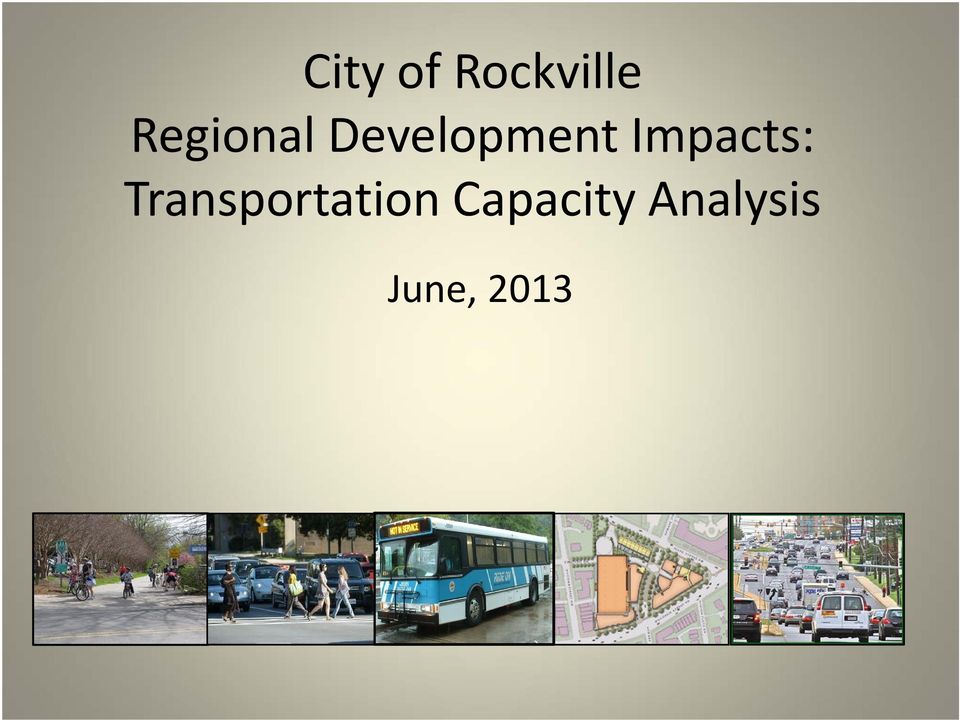
City of Rockville Regional Development Impacts: Transportation Capacity Analysis. June, 2013
|
|
|
- Julian Shelton
- 10 years ago
- Views:
Transcription
1 City of Rockville Regional Development Impacts: Transportation Capacity Analysis June, 2013
2 Purpose and Need Response to Council and Public Evaluate use of more advanced traffic analysis methodology and software Examine incorporation of alternative metrics such as travel time and person trips Incorporate influence of land use changes across political boundaries

3 Presentation Outline State of the Practice Alternative Traffic Analysis Key Findings Policy Revision Recommendations

4 State of the Practice Peer Jurisdictions Surveyed included: MD - Baltimore, Rockville, Gaithersburg, Montgomery County WA - Seattle, Vancouver, King County FL - Miami-Dade County, Miami Beach, Orlando Boston, MA; Alexandria, VA; and San Jose, CA Survey focused on: Process and Scoping Data Collection and Analysis Forecasting Mitigation

5 o Process and Scoping Survey Results o Increasing use of a third-party consultant to scope, review or perform the traffic impact study, funded by the developer o Several jurisdictions have an alternative review process that allows developers to pay a fee per trip and bypass performing a traffic study o No jurisdiction had a formal policy for inter-jurisdictional coordination, good professional cooperation was the norm. o Data Collection and Analysis o Most jurisdictions collect traffic data on vehicles, pedestrian and bicycles. A few collect transit usage (headway and occupancy) and one jurisdiction surveyed collected travel time o Several jurisdictions use Synchro models to 1) validate traffic count data, and 2) to account for oversaturated conditions (actual demand vs. throughput). o All but three jurisdictions (Montgomery County, Rockville and Gaithersburg) exclusively use the HCM methodology to determine level of service. However, Montgomery County recently adopted LATR revisions requiring HCM analysis for intersections with a CLV at or above 1600

6 Survey Results o Most jurisdictions only require vehicle level of service. The City of Seattle has performed pedestrian level of service analysis, and the City of Boston is considering a complete street multi-modal analysis requirement. Vancouver Washington also uses arterial travel speeds to assess existing operational performance. o Forecasting o The City of Baltimore and Boston use mode share data from the regional travel demand model in accounting for discounts in raw vehicle trip generation rates for pedestrian, bicycle and transit site access. o Mitigation o The requirement of a Transportation Demand Management Plan is increasingly comment (Alexandria, DC DOT). No jurisdiction has a formal monitoring program specifically focused on development impact, however, some require annual reports on a TDM plan which includes monitoring elements. o The City of Baltimore and Boston include transportation system management (such as communications and ITS) and operating contributions (e.g. transit) as part of mitigation options. Requesting reduced parking (parking maximums) was a notable tool used by Boston to reduce auto trips when recommended roadway improvements are not feasible.

7 Interagency Coordination Stakeholders included: SHA (Travel Forecasting) County DOT Transit Providers (Ride On, WMATA) Council of Governments (Transportation Planning Board) Met four times over the study period

8 Proposed 2020 Land Use

9 Proposed Year 2020 Land Use 12 development sites (half within City) 6.5 Million SF 3.5 Million SF office 2.1 Million SF retail 6,700 dwelling units 500 hotel rooms 10,000 new parking spaces 9,000 new AM peak hour vehicle trips, and 16,700 new PM vehicle trips 3,500 new walking, biking and transit trips

10 Beta Tests Alternative Traffic Analysis Considerations Documentation of pedestrian, bicycle and transit site trips Use of Highway Capacity Manual Methodology Use of traffic analysis software (Synchro/ SimTraffic) for travel time, speed and queuing assessment Use of person-throughput metrics vs. traditional vehicle throughput

11 Beta Tests Findings 10 of 18 study intersections projected to exceed City s intersection capacity standards by year 2020 These standards are arleady relaxed (e.g CLV) The land use forecasts do not represent full build out (will occur beyond 2020) Peak hour vehicle speeds along MD 355 projected to be reduced by 50%, and travel times projected to triple from existing conditions Despite roadway congestion, corridor can handle significantly more person-trips on alternative modes (e.g. rail, bus) Limited physical intersection improvements feasible primarily along Chapman New grid streets recommended Fishers to Parklawn East-West between Congressional and Montrose Parkway to connect Jefferson, Rockville Pike and Chapman

12 Beta Tests Conclusions More robust analysis did not change results same intersections and impacts were identified The current site traffic forecasting methodology may overestimate future vehicle traffic volumes The CLV analysis is potentially biased toward developing geometric improvement mitigation options The CLV analysis does not sufficiently consider the influence of many operational strategies such as signal timing, phasing, lane grouping, peak hour factors, and queuing The evaluation of corridor level performance metrics such as travel times and person-throughput provides a unique perspective on the impacts of congestion on vehicle speeds, and the capacity of transit to more effectively move people through a corridor

13 Policy Recommendations Policies to use of alternative performance metrics/ analysis methodology Incorporating HCM 2010 methodologies and related traffic analysis software Update LATR trip rates and adjustment factors Policies to increase overall transportation network efficiency or balance vehicle and non automobile travel Establish a Parking Management District Establish a Transportation Management Association Establish and monitor an area wide Transportation Demand Management Program Establish and Trip and Parking bank
14 Policy Recommendations 1) Enhanced Interagency Development Review Coordination: with the County and Gaithersburg that would formalize a practice to share development-related transportation study scopes, reports, and mitigation agreements. An MOU with the County has recently been signed to initiate this protocol

15 Policy Recommendations 2) Incorporate HCM 2010 methodology at intersections where the CLV is greater than or equal to Inorderto accurately evaluate a broader range of system management and operations strategies, incorporating HCM 2010 will allow for better documentation of level of service for all travel modes, for intersections approaching capacity. The traffic analysis software utilized to implement the HCM methodology can also provide additional performance measures such as queuing, travel time, speeds, and total network delay.

16 Policy Recommendations 3) Improve site traffic forecasting by updating the LATR trip rate database. The collection of new tripratesfortodandmixedlandusesisnecessarytomore accurately understand current travel patterns, as well as the influence of development type, transit proximity and service, parking availability and price, etc. on mode choice. A trip rate survey program can be funded through a small additional developer fee extracted to monitor TDM programs, and should be a regional effort.

17 Policy Recommendations 4) Establish Parking Management Districts: The availability of parking has a strong influence on mode choice. Taking a larger look at area-wide parking supply and management through policies such as market pricing, shared parking requirements and parking maximum codes can result in the reduction in costly construction of accessory parking facilities as well as help meet mode share goals. 5) Establish a formal Transportation Management Association: A Transportation Management Association (TMA) is a non-profit agency founded by local jurisdictions and key stakeholders such as institutions, chambers of commerce, etc. as a public-private partnership. The TMA s mission is to support programs that improve transportation to, in and around a designated area including providing enhanced traveler and parking information.
18 Policy Recommendations 6) Develop an Area-wide Transportation Demand Management (TDM) Program for TOAs: As new office, retail, and institutional uses develop in the Transit Oriented Areas, the City has the opportunity to implement demand management programs at a larger scale than a site level that will help shift employee and resident travel from driving alone to carpooling, transit, walking, and cycling. TDM programs are multi-faceted, and typically incorporate policy elements, infrastructure elements and service elements, and are implemented from both the public sector and private sector sides. Example strategies include commuter benefits, priority carpool parking, bike shares, parking cash outs, neighborhood shuttles.

19 Policy Recommendations 7) Establish a Formal TDM Plan Monitoring Program: For developments in a TOA, applicants shall pay a monitoring fee to determine the effectiveness of their TDM measures to ensure that the policy area s mode split goal is reached and/ or approved vehicle site trip rate is not exceeded. The Applicant is subject to a monetary penalty (to be set by the Council) if a mode split goal and/ or approved site trip rate is exceeded for each survey (maximum of one survey per year for five years) based on a randomly and third-party performed site trip survey. The survey can occur after 70% site occupancy and should include as applicable vehicle, pedestrian, bicycle, transit and parking trip rates.

20 Policy Recommendations 8) Create a cap and trade trip bank for trip credits and debts Developers that produce vehicle trips in excess of their vehicle mode split goal and/ or approved vehicle site trip rate can buy down trips from a bank of trip credits supplied by developers whose projects produce vehicle trips that are below the threshold for their site. If a development is under the threshold, they can apply for a trip credit and then sell the vehicle trip credits to another developer within the same policy area. This could also be extended to parking spaces.

21 Questions?
ORANGE COUNTY TRANSPORTATION AUTHORITY. Final Long-Range Transportation Plan - Destination 2035. Attachment A
 ORANGE COUNTY TRANSPORTATION AUTHORITY Final Long-Range Transportation Plan - Destination 2035 Attachment A DESTINATION 2035 DESTINATION 2035 EXECUTIVE SUMMARY ATTACHMENT A Moving Toward a Greener Tomorrow
TRAFFIC IMPACT ANALYSIS
 TRAFFIC IMPACT ANALYSIS Presenter Gerry Harter, PE, Area Traffic Engineer Acting Transportation and Land Use Director Why a TIA? Roads are a critical public resource and a major investment of public funds
Commuter Choice Certificate Program
 Commuter Choice Certificate Program Current course offerings (subject to change) Core 1 Commuter Choice Toolbox Required Courses Rideshare Options Audience: This 2 credit required course is targeted to
Appendix J Santa Monica Travel Demand Forecasting Model Trip Generation Rates
 Appendix J Santa Monica Travel Demand Forecasting Model Trip Generation Rates SANTA MONICA TRAVEL DEMAND FORECASTING MODEL TRIP GENERATION RATES SUBMITTED BY: 201 Santa Monica Blvd., Suite 500 Santa Monica,
TRAFFIC IMPACT ANALYSIS HANDBOOK VOLUME I METHODOLOGIES & REQUIREMENTS
 TRAFFIC IMPACT ANALYSIS HANDBOOK VOLUME I METHODOLOGIES & REQUIREMENTS Downtown panoramic photo provided by 1stACT Silicon Valley (blank below this line) Volume I Methodologies and Requirements TABLE OF
30 Years of Smart Growth
 30 Years of Smart Growth Arlington County s Experience with Transit Oriented Development in the Rosslyn-Ballston Metro Corridor A Presentation by the Arlington County Department of Community Planning,
College of Southern Maryland. Hughesville Transportation Study
 College of Southern Maryland Project Overview Existing Conditions Transit Service Land Use CSM Student Demographics Recommendations Methodology Transit Recommendations Transportation Demand Management
Examples of Transportation Plan Goals, Objectives and Performance Measures
 Examples of Transportation Plan Goals, Objectives and Performance Measures The next step in the Long Range Transportation Plan (LRTP) process is to develop goals, objectives, and performance measures.
APPENDIX A Dallas-Fort Worth Region Transportation System Management Strategies and Projects
 APPENDIX A Transportation System Management Strategies and Projects Transportation System Transportation System Management Projects Management Strategies Traffic Signalization and Control New Signal Installation
APPENDIX E TASK 5 TECHNICAL MEMORANDUM: TRAVEL DEMAND FORECASTING PROCESS
 APPENDIX E TASK 5 TECHNICAL MEMORANDUM: TRAVEL DEMAND FORECASTING PROCESS INTRODUCTION The purpose of this Technical Memorandum is to describe the methodologies and assumptions used in estimating travel
TCRP Report 153: Guidelines for Providing Access to Public Transportation Stations. Part 2: Station Typology and Mode of Access Planning Tool
 TCRP Report 153: Guidelines for Providing Access to Public Transportation Stations Part 2: Station Typology and Mode of Access Planning Tool Jamie Parks, AICP Kittelson & Associates, Inc. Acknowledgements
Integrating Transportation Demand Management Into the Planning and Development Process
 Commute Integrating Transportation Demand Management Into the Planning and Development Process a reference for cities prepared in partnership with HNTB final May 2012 1394 Acknowledgements SANDAG COMMITTEES
Transportation Alternatives
 1 Transportation Alternatives Transportation alternatives involve a variety of components: Location Alternatives - when and where service is provided - general location as well as level of service on the
MOUNTAIN HOUSE MASTER PLAN CHAPTER TEN AIR QUALITY AND TRANSPORTATION MANAGEMENT
 CHAPTER TEN AIR QUALITY AND TRANSPORTATION MANAGEMENT CHAPTER TEN: AIR QUALITY AND TRANSPORTATION MANAGEMENT 10.1 INTRODUCTION 10.1 10.2 OVERALL ISSUES AND CROSS-REFERENCES 10.1 10.3 TRANSPORTATION DEMAND
Chapter 9: Transportation
 Chapter 9: Transportation What is this chapter about? The goals and policies in this chapter convey the City s intent to: Create a coordinated, efficient, and more affordable multimodal transportation
Tier 1 Strategies. WV Route 14 Corridor Management Plan
 1.1 1.2 1.3 1.4 Signal timing optimization system improvements. Improve geometry traffic control at high crash intersections. Construct intersection capacity improvement projects. Widen longer sections
Improving Access in Florida International University Biscayne Bay Campus Executive Summary
 EXECUTIVE SUMMARY Improving Access in Florida International University Biscayne Bay Campus Executive Summary Prepared for: Miami-Dade County Metropolitan Planning Organization (Miami-Dade MPO) Prepared
Downtown Tampa Transportation Vision
 Downtown Tampa Transportation Vision Executive Summary August 1, 2006 Hillsborough County Metropolitan Planning Organization County Center, 18 th Floor Tampa, Florida 33602 813-272-5940 www.hillsboroughmpo.org
Who is implementing managed lanes with pricing strategies? Operational Under Construction/ Development
 Who is implementing managed lanes with pricing strategies? Operational Under Construction/ Development Managed Lane Facilities in the U.S. Operational Under Construction Under Development I-10 (Katy Freeway),
GUIDELINES FOR SACRAMENTO AREA COUNCIL OF GOVERNMENTS TRANSPORTATION DEMAND MANAGEMENT FUNDING PROGRAM Revised December 2009
 GUIDELINES FOR SACRAMENTO AREA COUNCIL OF GOVERNMENTS TRANSPORTATION DEMAND MANAGEMENT FUNDING PROGRAM Revised December 2009 INTRODUCTION In July 2002, the Sacramento Area Council of Governments (SACOG)
 Snohomish County Department Of Public Works (DPW) Rules Adopted Pursuant to the Rulemaking Requirements of Chapter 30.82 SCC Providing Detail and Specificity for the Traffic Mitigation and Concurrency
MEMORANDUM. Robert Nichols, Acting Corridor Design Manager Northgate Link Extension
 MEMORANDUM DATE: September 23, 2014 TO: Robert Nichols, Acting Corridor Design Manager Northgate Link Extension FROM: SUBJECT: COPIES: Katherine Casseday, PE, PTOE, Casseday Consulting Tony Lo, PE, Parsons
Performance Measures for Public Transit Mobility Managers Presented by: Lalita Sen, Ph.D. Texas Southern University
 Performance Measures for Public Transit Mobility Managers Presented by: Lalita Sen, Ph.D. Texas Southern University Barbara Jordan Mickey Leland School Of Public Affairs April 12, 2012 Project Number 0-6633
7.0 Transportation Management
 7.0 Transportation Management I. Introduction The Kansas City region has invested considerable effort and resources in the design and implementation of its regional multimodal transportation system. As
Appendix E Transportation System and Demand Management Programs, and Emerging Technologies
 Appendix E Transportation System and Demand Management Programs, and Emerging Technologies Appendix Contents Transportation System Management Program Transportation Demand Management Program Regional Parking
5 Performance Measures
 5 Performance Measures This page left blank intentionally. 5 2 Moving Forward Monterey Bay 2035 Introduction The investments identified in the 2035 MTP/SCS are expected to result in significant benefits
Near Westside Neighborhood and University Avenue Corridor Transportation Study. Public Workshop #2. September 12 and 23, 2013
 Near Westside Neighborhood and University Avenue Corridor Transportation Study Public Workshop #2 September 12 and 23, 2013 Presentation Outline: Brief Review of Study Scope, Background, and Current Conditions
Massachusetts Department of Transportation, Highway Division Ten Park Plaza, Boston, MA 02116-3973. A Guide on Traffic Analysis Tools
 Massachusetts Department of Transportation, Highway Division Ten Park Plaza, Boston, MA 02116-3973 A Guide on Traffic Tools Revised October 5, 2012 1. PURPOSE The Massachusetts Department of Transportation,
9988 REDWOOD AVENUE PROJECT TRAFFIC IMPACT ANALYSIS. April 24, 2015
 9988 REDWOOD AVENUE PROJECT TRAFFIC IMPACT ANALYSIS April 24, 2015 Kunzman Associates, Inc. 9988 REDWOOD AVENUE PROJECT TRAFFIC IMPACT ANALYSIS April 24, 2015 Prepared by: Bryan Crawford Carl Ballard,
Orange County Transportation Impact Fee Update FINAL REPORT
 Transportation Impact Fee Update FINAL REPORT Prepared for: Transportation Planning Department 4200 S. John Young Parkway, Second Floor Orlando, FL 32839 ph (407) 836-8070 September 5, 2012 (amended November
Traffic Information in NYC
 Traffic Information in NYC What We Know, What We Need to Know Prepared for Transportation Alternatives January 23, 2007 Schaller Consulting 94 Windsor Place, Brooklyn, NY (718) 768-3487 [email protected]
Transportation Element
 Transportation Element Goal: To maintain and enhance mobility for residents and businesses through the creation and maintenance of a balanced system of transportation alternatives that: Provides a wide
2009-3. The Preservation of Local Truck Routes: A Primary Connection between Commerce and the Regional Freight Network
 2009-3 The Preservation of Local Truck Routes: A Primary Connection between Commerce and the Regional Freight Network July 2009 This Goods Movement Challenges and Opportunities Report was prepared jointly
The Fresno COG Travel Demand Forecasting Model How the Pieces Fit Together
 The Fresno COG Travel Demand Forecasting Model How the Pieces Fit Together Mike Bitner PE, Senior Transportation Planner Council of Fresno County Governments 1 COG Modeling Staff Mike Bitner Kathy Chung
Light Rail Transit in Phoenix
 4. Presentation and Discussion: Phoenix Light Rail Implementation Wulf Grote Planning and Development Director, Phoenix Valley Metro Light Rail Transit in Phoenix Broadway Citizen s Task Force February
1. REPORT CONTEXT Description of the development (include all of the following that are known at the time of the application):
 Transportation Assessment and Management Study Guidelines for Consultants INTRODUCTION This document is intended to provide guidelines for transportation consultants who produce Transportation reports
Transportation Education Series: Travel Demand Modeling. David Reinke November 2012
 Transportation Education Series: Travel Demand Modeling David Reinke November 2012 Presentation overview What are travel demand models? Why use them? How do they work? What goes into building them? What
Smart Cities & Integrated Corridors: from Automation to Optimization
 Smart Cities & Integrated Corridors: from Automation to Optimization Presentation to the National Rural ITS Conference August 28, 2013 Cary Vick, Director of Business Development; Smart Mobility for Smart
Financial Plan Status Report
 Financial Plan Status Report Broward MPO Board March 13, 2014 Financial Sub-Committee Membership SFRTA (lead agency) Broward MPO FDOT Miami-Dade MPO Palm Beach MPO South Florida Regional Planning Council
Technical Memorandum PERFORMANCE MEASURES. Prepared by:
 Technical Memorandum PERFORMANCE MEASURES Prepared by: March 2014 TABLE OF CONTENTS Executive Summary... 1 1. Introduction... 2 1.1 Performance Measures and the Public Sector... 2 1.2 National Focus: MAP
Linking Planning and Operations Initiative A Data Driven Approach. Chris Francis Transportation Statistics
 Linking Planning and Operations Initiative A Data Driven Approach Chris Francis Transportation Statistics Data Symposium - Traffic Data, Orlando, FL, Oct 23-24, 2014 Outline 2 Emerging Transportation Scene
The financial plan was prepared in conjunction with the Technical Working Group. Refer to Table 3-1: Funding and Implementation Plan.
 3 Financial Plan The purpose of the financial plan is to identify funding options that would be likely sources of money to advance recommendations made by this study. The Capitol Region Transportation
San Francisco Complete Streets Strategy
 San Francisco Complete Streets Strategy Timothy Papandreou Deputy Director Sustainable Streets 2013 Sacramento 2 million San Francisco Bay Area 8 million Central Valley 4 million Los Angeles 19 million
Multi Modal Roadway Transportation Impact Fees and Asset Value
 January 2010 SB 360 Article Series: Factors to be Considered in Transitioning from a Road Impact Fee to a Mobility Fee Contributing Authors: Steven A. Tindale, P.E., AICP Robert P. Wallace, P.E., AICP
7.0 TRANSPORTATION MANAGEMENT
 7.0 TRANSPORTATION MANAGEMENT The Kansas City region has invested considerable effort and resources in the design and implementation of its regional multimodal transportation system. As a result of this
Arlington County Fiscal Year 2014 Summary Report on Capital Bikeshare
 Arlington County Fiscal Year 2014 Summary Report on Capital Bikeshare Arlington County Commuter Services Department of Environmental Services Arlington County, Virginia October 6, 2014 Introduction Capital
Performance Measures for a Sustainable Transportation Network Pasadena s Approach Frederick C. Dock, Ellen Greenberg, Mark Yamarone
 Performance Measures for a Sustainable Transportation Network Pasadena s Approach Frederick C. Dock, Ellen Greenberg, Mark Yamarone Abstract. As California cities move into the second decade of the 21st
Best Practices in Bicycle and Pedestrian Wayfinding in the Washington Region Survey Results
 Bike/Ped Subcommittee 03/20/07, Item 5 Best Practices in Bicycle and Pedestrian Wayfinding in the Washington Region Survey Results Michael J. Farrell COG/TPB 1 Background At the request of Jay Fisette,
Florida Avenue Multimodal Transportation Study. June 19, 2013
 Florida Avenue Multimodal Transportation Study June 19, 2013 Today s Agenda Team & project introduction Project Timeline What you said Tools we use Mapped data and what clues it can provide Highlights
2030 DISTRICT PERFORMANCE METRIC BASELINES
 2030 DISTRICT PERFORMANCE METRIC BASELINES The Seattle 2030 District is a groundbreaking high-performance building district in downtown Seattle that aims to dramatically reduce the environmental impacts
Needs Analysis. Long Beach Bicycle Master Plan. Bicycle Commuter Needs. LONG BEACH BICYCLE MASTER PLAN Needs Analysis
 Long Beach Bicycle Master Plan Needs Analysis The purpose of reviewing the needs of commuter and recreational bicyclists is twofold: (1) it is instrumental when planning a system which must serve both
A Connected Region for Our Future. Tampa Bay Area Regional Transportation Authority Regional Transportation Master Plan
 A Connected Region for Our Future Tampa Bay Area Regional Transportation Authority Regional Transportation Master Plan Our Community Need In the past 3 decades Population has doubled Employment has tripled
Protected Bicycle Lanes in NYC
 Protected Bicycle Lanes in NYC New York City Department of Transportation Polly Trottenberg, Commissioner September 2014 NEW YORK CITY DEPARTMENT OF TRANSPORTATION 1 Overview Since 2007, the New York City
Executive Summary. Transportation Needs CHAPTER. Existing Conditions
 CHAPTER 1 Executive Summary The City of Forest Grove Transportation System Plan (TSP) was updated to keep it consistent with recent growth trends in the city and other transportation planning efforts in
Where Do We Want to Go? How Can We Get There?
 Where Do We Want to Go? How Can We Get There? The BRTB has adopted nine goals, with supporting strategies, performance measures, and performance targets. Together, these goals, strategies, measures, and
Attachment B Policy Audit Template
 Attachment B Policy Audit Template 5 6 7 8 9 0 Provide A Variety of Transportation Choices Provide A Variety of Transportation Choices Provide A Variety of Transportation Choices Encourage transit-oriented
Goals & Objectives. Chapter 9. Transportation
 Goals & Objectives Chapter 9 Transportation Transportation MISSION STATEMENT: TO PROVIDE A TRANSPORTATION NETWORK CAPABLE OF MOVING PEOPLE AND GOODS EFFICIENTLY AND SAFELY. T he transportation system
A Framework for Monitoring the Performance of Travel Demand Management and Vehicle Miles Traveled (VMT) Reduction Activities
 A Framework for Monitoring the Performance of Travel Demand Management and Vehicle Miles Traveled (VMT) Reduction Activities WA-RD 806.1 Mark E. Hallenbeck June 2013 Orion Stewart Anne Vernez Moudon Office
Boston Traffic Management Center Activity Report for FY 2013 Real-time Traffic Signal Adjustments
 Boston Traffic Management Center Activity Report for FY 2013 Real-time Traffic Signal Adjustments The mission of the Traffic Management Center (TMC) within the Boston Transportation Department is to monitor,
A Presentation by the Project Managers: Rick Canizales Prince William County. Jana Lynott, AICP Northern Virginia Transportation Commission
 A Presentation by the Project Managers: Rick Canizales Prince William County & Jana Lynott, AICP Northern Virginia Transportation Commission for the: Public Open House and Hearing December 6, 2005 George
Overview of the Travel Demand Forecasting Methodology
 Overview of the Travel Demand Forecasting Methodology Prepared by the Central Transportation Planning Staff (CTPS) Authors: Scott A. Peterson, Manager Ian Harrington, Chief Planner March 29, 2008 1 OVERVIEW
An Overview of Managed Lanes in the U.S.A. Darren Henderson, AICP
 An Overview of Managed Lanes in the U.S.A. Darren Henderson, AICP Today s s Discussion The Basics HOV Lanes Pricing Darren Henderson, AICP PB, Houston, TX Active Traffic Management The Latest Projects
2013 QUALITY/ LEVEL OF SERVICE HANDBOOK
 2013 QUALITY/ LEVEL OF SERVICE HANDBOOK STATE OF FLORIDA DEPARTMENT OF TRANSPORTATION 2013 TABLE OF CONTENTS 1 Executive Summary... 1 2 Q/LOS Handbook Purpose and Scope... 3 2.1. Levels of Analysis...4
 Walkable Communities Florida Department of Transportation State Safety Office Pedestrian and Bicycle Program April 1995 www.dot.state.fl.us/safety Twelve Steps for an Effective Program Page 1 Twelve Steps
Task 1 Project Management and Project Organization Work Plan
 City of Palmdale Active Transportation Program Plan Scope of Work At their January 22, 2015 meeting, the California Transportation Commission (CTC) allocated funding for the above-referenced project as
FTP/SIS/FMTP Regional Workshop - Miami
 FTP/SIS/FMTP Regional Workshop - Miami September 24, 2015 FDOT District 6 Auditorium 1000 N.W. 111 Avenue Miami, Florida 33172 Meeting Highlights Welcome and Introductions Gus Pego, FDOT District 6 Secretary,
CAPACITY AND LEVEL-OF-SERVICE CONCEPTS
 CHAPTER 2 CAPACITY AND LEVEL-OF-SERVICE CONCEPTS CONTENTS I. INTRODUCTION...2-1 II. CAPACITY...2-2 III. DEMAND...2-2 IV. QUALITY AND LEVELS OF SERVICE...2-2 Service Flow Rates...2-3 Performance Measures...2-3
U.S. Department of Homeland Security Nebraska Avenue Complex Master Plan DRAFT ENVIRONMENTAL IMPACT STATEMENT APPENDIX C
 U.S. Department of Homeland Security Nebraska Avenue Complex Master Plan DRAFT ENVIRONMENTAL IMPACT STATEMENT APPENDIX C January 14, 2011 This page intentionally left blank Transportation Management Plan
Addendum to the Arterial Transitway Corridors Study
 January 2013 1 Addendum to the Arterial Transitway Corridors Study The Arterial Transitway Corridors Study (ATCS) evaluated and prioritized arterial bus rapid transit (BRT) improvements to nine corridors
PERFORMANCE MEASURES FOR MOBILITY MANAGEMENT PROGRAMS
 PERFORMANCE MEASURES FOR MOBILITY MANAGEMENT PROGRAMS Jon E. Burkhardt and Joohee Yum December 30, 2010 In order to be able to assess progress in the implementation of mobility management programs, a system
HOW WILL PROGRESS BE MONITORED? POLICY AREA. 1. Implement the 2040 Growth Concept and local adopted land use and transportation plans
 PERFORMANCE MONITORING APPROACH OAR 660-044-0040(3)(e) directs Metro to identify performance measures and targets to monitor and guide implementation of the Climate Smart Strategy. The purpose of performance
Measuring the Street:
 Measuring the Street: New Metrics for 21st Century Streets 1 Measuring the Street: New Metrics for 21st Century Streets New York City s streets are constantly called on to the meet new and varied needs
N Street Protected Bikeway
 N Street Protected Bikeway The N Street Protected Bikeway project was identified in the 2005 City of Lincoln Downtown Master Plan and the 2012 Downtown Master Plan Update as the completion of the last
Subject: Presentation - TTC/Transportation Services Joint Surface Transit Initiatives
 INFORMATION Subject: Presentation - TTC/Transportation Services Joint Surface Transit Initiatives Date: May 27, 2015 Stephen Buckley, General Manager, Transportation Services has been invited by the Chair
The Northwest Arkansas Travel Demand Model
 The Northwest Arkansas Travel Demand Model Creation and Results John McLarty Northwest Arkansas Regional Planning Commission Cristina Scarlat Center for Advanced Spatial Technologies What is a Travel Demand
Courtney J. Menjivar PRINCIPAL
 Courtney J. Menjivar PRINCIPAL Ms. Menjivar (formerly Kulyk) is a Transportation Demand Management (TDM) Marketing Specialist and has over nine years of transportation marketing experience in research,
SMALL BUSINESS COMMISSION AND OFFICE OF SMALL BUSINESS
 CITY AND COUNTY OF SAN FRANCISCO SMALL BUSINESS COMMISSION AND OFFICE OF SMALL BUSINESS 1 Dr. C a r lto n B. G o o d let t P lace, S u ite 1 10 Te l: 415-554-6134 Fa x : 41 5-558-7844 w w w. s fgov.o r
Eagle Commuter Rail Denver, Colorado Final Design (Based upon information received by FTA in November 2010)
 Eagle Commuter Rail Denver, Colorado Final Design (Based upon information received by FTA in November 2010) Summary Description Proposed Project: Electrified Commuter Rail 30.2 Miles, 13 Stations Total
INSTITUTIONAL MASTER PLAN NOTIFICATION FORM / PROJECT NOTIFICATION FORM BOSTON UNIVERSITY MEDICAL CENTER
 INSTITUTIONAL MASTER PLAN NOTIFICATION FORM / PROJECT NOTIFICATION FORM BOSTON UNIVERSITY MEDICAL CENTER JUNE 7, 2013 SUBMITTED TO: BOSTON REDEVELOPMENT AUTHORITY ONE CITY HALL SQUARE BOSTON, MA 02201