
MOUNTAIN HOUSE MASTER PLAN CHAPTER TEN AIR QUALITY AND TRANSPORTATION MANAGEMENT
|
|
|
- Kevin Sharp
- 9 years ago
- Views:
Transcription
1 CHAPTER TEN AIR QUALITY AND TRANSPORTATION MANAGEMENT

2 CHAPTER TEN: AIR QUALITY AND TRANSPORTATION MANAGEMENT 10.1 INTRODUCTION OVERALL ISSUES AND CROSS-REFERENCES TRANSPORTATION DEMAND MANAGEMENT TDM Measures CLEANER FUELS CONSTRUCTION PROGRAM FOR AIR QUALITY HOUSES AND BUILDINGS 10.5 LIST OF TABLES Table 10.1: Cross-References for Air Quality Issues 10.2 Chapter Ten Table of Contents

3 CHAPTER TEN: AIR QUALITY AND TRANSPORTATION MANAGEMENT 10.1 INTRODUCTION This chapter on air quality compliance and transportation demand management identifies policies and implementation measures to be incorporated into the community s building systems, construction practices and transportation management programs. The San Joaquin Valley Air Basin is classified as a non-attainment area for ozone. The 1993 California Clean Air Act required the San Joaquin Valley Air Pollution Control District (SJVAPCD) to develop an Air Quality Attainment Plan. In addition to being subject to the control and approval of the County, issues of air quality and transportation management at Mountain House are subject to the regulatory control of SJVAPCD and San Joaquin Council of Governments (SJCOG) s County Congestion Management Plan, as well as State and Federal requirements. The County Congestion Management Plan was adopted in November 1991, and the Air Quality Attainment Plan (AQAP) was adopted in January The policies and implementation measures contained in this chapter have been derived from these plans. To avoid repetition, this chapter provides cross-references to other sections of the Master Plan that address issues affecting air quality. In particular, additional information is found in Chapter Three: Land Use Chapter Eight: Energy and Telecommunications, and Chapter Nine: Transportation and Circulation OVERALL ISSUES AND CROSS-REFERENCES The primary issue affecting air quality is the impacts of transportation, especially single occupant vehicles utilized for commuting, school trips, shopping, and other daily requirements. This section presents overall issues which are addressed in more detail throughout this chapter. Table 10.1: Cross-References for Air Quality Issues, presents cross-references to provisions contained in other chapters. Objective: To reduce air quality impacts associated with development of residential, employment, and other land uses at Mountain House. Objective: To reduce the normally expected number of automobile trips. Policies: a) Telecommuting shall be promoted in order to reduce automobile trips. b) Alternative transportation modes including walking, bicycling, transit, or cleaner fuels vehicles shall be supported. c) Vehicle miles traveled shall be reduced through community design to reduce internal trips lengths and create a jobs/housing balance to reduce external trips. d) Air pollution from non-automobile sources shall be reduced. Chapter Ten Page 10.1

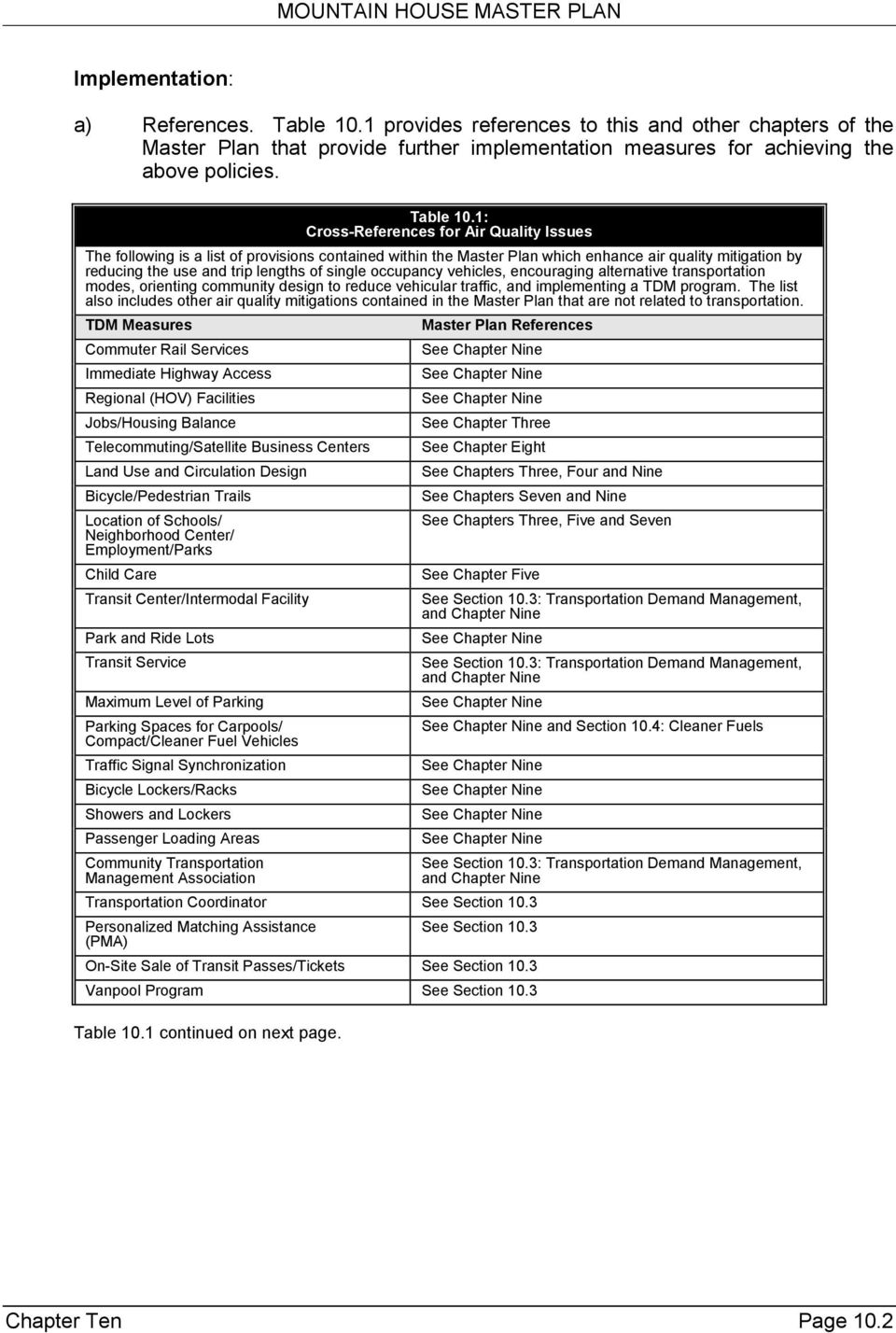
4 a) References. Table 10.1 provides references to this and other chapters of the Master Plan that provide further implementation measures for achieving the above policies. Table 10.1: Cross-References for Air Quality Issues The following is a list of provisions contained within the Master Plan which enhance air quality mitigation by reducing the use and trip lengths of single occupancy vehicles, encouraging alternative transportation modes, orienting community design to reduce vehicular traffic, and implementing a TDM program. The list also includes other air quality mitigations contained in the Master Plan that are not related to transportation. TDM Measures Commuter Rail Services Immediate Highway Access Regional (HOV) Facilities Jobs/Housing Balance Telecommuting/Satellite Business Centers Land Use and Circulation Design Bicycle/Pedestrian Trails Location of Schools/ Neighborhood Center/ Employment/Parks Child Care Transit Center/Intermodal Facility Park and Ride Lots Transit Service Maximum Level of Parking Parking Spaces for Carpools/ Compact/Cleaner Fuel Vehicles Traffic Signal Synchronization Bicycle Lockers/Racks Showers and Lockers Passenger Loading Areas Community Transportation Management Association Master Plan References See Chapter Three See Chapter Eight See Chapters Three, Four and Nine See Chapters Seven and Nine See Chapters Three, Five and Seven See Chapter Five See Section 10.3: Transportation Demand Management, and Chapter Nine See Section 10.3: Transportation Demand Management, and Chapter Nine and Section 10.4: Cleaner Fuels Transportation Coordinator See Section 10.3 Personalized Matching Assistance (PMA) See Section 10.3: Transportation Demand Management, and Chapter Nine See Section 10.3 On-Site Sale of Transit Passes/Tickets See Section 10.3 Vanpool Program See Section 10.3 Table 10.1 continued on next page. Chapter Ten Page 10.2
5 Table 10.1, (Continued): Cross-References for Air Quality Issues The following is a list of provisions contained within the Master Plan which enhance air quality mitigation by reducing the use and trip lengths of single occupancy vehicles, encouraging alternative transportation modes, orienting community design to reduce vehicular traffic, and implementing a TDM program. The list also includes other air quality mitigations contained in the Master Plan that are not related to transportation. TDM Measures Master Plan References Five Year Update See Section 10.3 Transit/Rideshare Information See Section 10.3 Special Promotions See Section 10.3 Tree Planting See Chapters Four and Nine Cleaner Fuels Shuttle See Section 10.4: Cleaner Fuels Cleaner Fuel Vehicles See Section 10.4 CNG Fueling Station See Section 10.4 Pre-Construction See Section 10.5: Construction Program for Air Quality During Construction See Section 10.5 General Fugitive Dust See Section 10.5 Ozone Precursors See Section 10.5 Natural Gas Lines/Electrical Outlets See Section 10.5 Water Heaters See Section 10.6: Houses and Buildings Fireplaces See Section TRANSPORTATION DEMAND MANAGEMENT Transportation Demand Management (TDM) refers to transportation planning strategies aimed at reducing vehicular travel demand and reducing congestion. The TDM program for the Mountain House community is intended to promote the use of alternatives to the single-occupant vehicle (SOV) for peak hour trips taken within the project and elsewhere in the County, and thereby lessen congestion and improve air quality TDM Measures Objective: To reduce the use of the single-occupant vehicle (SOV) for travel within and to and from the Mountain House community through implementation of specific trip reduction measures. Policies: a) The following TDM measures shall be used to reduce automobile trips: bus and rail transit, bicycling and walking, ridesharing, and public information and education. b) Strategies for TDM implementation and monitoring shall comply with the San Joaquin County Congestion Management Plan. Implementation measures shall comply with the SJVAPCD Air Quality Attainment Plan. Chapter Ten Page 10.3

6 10.4 CLEANER FUELS a) TDM Program and Transit Plan. A TDM Program and Transit Plan shall be prepared that will reduce the use of single-occupant vehicles. b) TDM Plan Requirements. The TDM plan shall lay out provisions for implementation and administration of the TDM program, including the appropriate timing for a TDM coordinator, requirements for a monitoring program, and incentives for the use of cleaner fuels. The TDM plan shall establish permanent funding mechanisms for trip-reducing programs at both the employer end and the home end and shall include provisions for trip reduction monitoring. c) Monitoring. The TDM Program and Transit Plan shall include a monitoring program that will function in coordination with the overall Mountain House Monitoring Program. d) Free Transit Service. Free transit service shall be provided to new residents of the Mountain House community for the first three months of occupancy. Objective: To reduce emissions from public, fleet or private vehicles through the use of cleaner fuel vehicles. Policies: a) The community shall develop and promote the use of natural gas, the cleanest of the fossil fuels. b) Programs to encourage the use of cleaner fuel vehicles shall be developed. a) Preferential Parking. Parking facilities throughout the community shall provide preferential parking for cleaner fuel vehicles and all school and transit vehicles as established in the TDM Program. b) Cleaner Fuel Vehicles. Individuals and business shall be encouraged to consider alternative fuel vehicles for personal and fleet use. Specific measures are as follows: All Mountain House MHCSD owned service and maintenance vehicles and all school and transit vehicles should be cleaner fuel vehicles (i.e., CNG, methanol, or electric). Long term infrastructure requirements for supporting increased numbers of alternative fuel vehicles shall be determined. Golf courses will be required to utilize electric rather than gasoline powered golf carts. Chapter Ten Page 10.4

7 10.5 CONSTRUCTION PROGRAM FOR AIR QUALITY Construction activities are a significant contributor to air quality impacts. These impacts are directly related to dust generation, construction traffic, and equipment discharges of fumes. Objective: To mitigate air quality impacts due to construction activities. Policies: a) Generation of dust and emissions shall be controlled during the pre-construction and construction phases. b) Emissions from operating equipment shall be controlled. c) Construction equipment and traffic shall be considered in air quality control. a) Regulations for Construction. Construction practices shall comply with the provisions of the SJVAPCD HOUSES AND BUILDINGS Objective: To reduce air emissions from Mountain House. Policy: a) The following emissions shall be targeted for reduction: Emissions resulting from routine usage of gasoline appliances such as lawn maintenance equipment and barbecues. NOx emissions resulting from water heaters. Emissions resulting from fireplace usage. a) Conditions of Approval. The following shall be required as conditions of Tentative Map approval: Natural gas lines outlets shall be provided to backyards to encourage usage of natural gas barbecues. 220 volt electrical outlets for recharging electric automobiles shall be provided in each garage. Electrical outlets shall be located on the outside of single family homes to accommodate electric lawn maintenance equipment and electric barbecues. Low nitrogen oxide (NOx) emitting and/or high efficiency water heaters shall be required for all dwelling units. Each single family residence shall have no more than one fireplace. If fireplaces are designed to be natural gas heating appliances of a zero clearance design, there is no limitation on the number of fireplaces per unit. Chapter Ten Page 10.5

8

Appendix E Transportation System and Demand Management Programs, and Emerging Technologies
 Appendix E Transportation System and Demand Management Programs, and Emerging Technologies Appendix Contents Transportation System Management Program Transportation Demand Management Program Regional Parking
GUIDELINES FOR SACRAMENTO AREA COUNCIL OF GOVERNMENTS TRANSPORTATION DEMAND MANAGEMENT FUNDING PROGRAM Revised December 2009
 GUIDELINES FOR SACRAMENTO AREA COUNCIL OF GOVERNMENTS TRANSPORTATION DEMAND MANAGEMENT FUNDING PROGRAM Revised December 2009 INTRODUCTION In July 2002, the Sacramento Area Council of Governments (SACOG)
 Snohomish County Department Of Public Works (DPW) Rules Adopted Pursuant to the Rulemaking Requirements of Chapter 30.82 SCC Providing Detail and Specificity for the Traffic Mitigation and Concurrency
ORANGE COUNTY TRANSPORTATION AUTHORITY. Final Long-Range Transportation Plan - Destination 2035. Attachment A
 ORANGE COUNTY TRANSPORTATION AUTHORITY Final Long-Range Transportation Plan - Destination 2035 Attachment A DESTINATION 2035 DESTINATION 2035 EXECUTIVE SUMMARY ATTACHMENT A Moving Toward a Greener Tomorrow
Threshold Determination: California Case Law
 Threshold Determination: California Case Law Center for Biological Diversity v. County of San Bernardino (Super. Ct. San Bernardino County, filed Apr. 11, 2007, No. CIV SS 0700293). The California AG filed
APPENDIX A Dallas-Fort Worth Region Transportation System Management Strategies and Projects
 APPENDIX A Transportation System Management Strategies and Projects Transportation System Transportation System Management Projects Management Strategies Traffic Signalization and Control New Signal Installation
ELECTRIC VEHICLES: THE PORTLAND WAY
 ELECTRIC VEHICLES: THE PORTLAND WAY THE PORTLAND STRATEGY AT A GLANCE 1. Adopt and update policies to facilitate the transition to the use of electric vehicles (EVs) in Portland: a. Streamline electrical
City of Rockville Regional Development Impacts: Transportation Capacity Analysis. June, 2013
 City of Rockville Regional Development Impacts: Transportation Capacity Analysis June, 2013 Purpose and Need Response to Council and Public Evaluate use of more advanced traffic analysis methodology and
Transportation Element
 Transportation Element Goal: To maintain and enhance mobility for residents and businesses through the creation and maintenance of a balanced system of transportation alternatives that: Provides a wide
7.0 TRANSPORTATION MANAGEMENT
 7.0 TRANSPORTATION MANAGEMENT The Kansas City region has invested considerable effort and resources in the design and implementation of its regional multimodal transportation system. As a result of this
City of Santa Barbara City Vehicle Use Policy
 City of Santa Barbara City Vehicle Use Policy Approved by: James L. Armstrong City Administrator Policy effective: July 1, 2007 Purpose Provide written guidelines on the use of and safe operation of City
ExpressLanes CAG Summit. March 2, 2010
 ExpressLanes CAG Summit March 2, 2010 1 Project Goals Move More People, Not More Vehicles > Increase Throughput of HOT lanes > Effectiveness (Mode Shift) > Efficiency (Cost of Project Relative to Benefits)
Proposed Mobil Source Offset Provisions in California May Negatively Impact Air Quality
 Proposed Mobil Source Offset Provisions in California May Negatively Impact Air Quality by Randall Guensler BACKGROUND Sources of air pollutant emissions can be generally separated into four categories:
7.0 Transportation Management
 7.0 Transportation Management I. Introduction The Kansas City region has invested considerable effort and resources in the design and implementation of its regional multimodal transportation system. As
Applying GIS and Survey Data to Transportation Demand Management. Richard Hsu, M.S. Carina Anttila-Suarez, Ph.D.
 Applying GIS and Survey Data to Transportation Demand Management Richard Hsu, M.S. Carina Anttila-Suarez, Ph.D. Skyline College at a Glance: Campus population: 16,000+ students 500+ employees Campus environment:
Renewable Choice Energy
 Catawba College Table of Contents About Renewable Choice The Problem: Electricity Production Today The Solutions: Renewable Energy Sources Renewable Energy Credits (RECs) Who can participate in Renewable
Policy GRN-1.1.2. The City will adopt a Go Green Initiative to implement strategies to reduce greenhouse gas emissions within the City s borders.
 Vision Statement: Provide goals, objectives, and policies that preserve, improve, and promote responsible use and protect the City s natural and built environment. Goals, Objectives and Policies: Goal
1. REPORT CONTEXT Description of the development (include all of the following that are known at the time of the application):
 Transportation Assessment and Management Study Guidelines for Consultants INTRODUCTION This document is intended to provide guidelines for transportation consultants who produce Transportation reports
Integrating Transportation Demand Management Into the Planning and Development Process
 Commute Integrating Transportation Demand Management Into the Planning and Development Process a reference for cities prepared in partnership with HNTB final May 2012 1394 Acknowledgements SANDAG COMMITTEES
Green Fleet Policy PURPOSE
 PURPOSE The purpose of this policy is to document the process for purchasing and managing the City s diverse vehicle fleet, which include both vehicles and heavy equipment, in a manner that minimizes greenhouse
5 Performance Measures
 5 Performance Measures This page left blank intentionally. 5 2 Moving Forward Monterey Bay 2035 Introduction The investments identified in the 2035 MTP/SCS are expected to result in significant benefits
2011 Boulder Valley Employee Survey for Transportation Report of Results
 2011 Boulder Valley Employee Survey for Transportation Report of Results June 2012 Image from emerson12 via Flickr, Creative Commons Attribution. 2955 Valmont, Suite 300 Boulder, CO 80301 303 444 7863
BULLETIN NO. 6. Car-Share Requirements and Guidelines for Car-Share Spaces ZONING ADMINISTRATOR. 1. Car-share Basics PURPOSE: OVERVIEW:
 Car-Share Requirements and Guidelines for Car-Share Spaces Section 307 of the City Planning Code mandates the Zoning Administrator to issue and adopt such rules, regulations and interpretations as are
Air Quality in San Diego 2013 Annual Report
 Air Pollution Control Board Greg Cox District 1 Dianne Jacob District 2 Dave Roberts District 3 Ron Roberts District 4 Bill Horn District 5 Air Quality in San Diego 2013 Annual Report Protecting and improving
Downtown Tampa Transportation Vision
 Downtown Tampa Transportation Vision Executive Summary August 1, 2006 Hillsborough County Metropolitan Planning Organization County Center, 18 th Floor Tampa, Florida 33602 813-272-5940 www.hillsboroughmpo.org
Commuter Choice Certificate Program
 Commuter Choice Certificate Program Current course offerings (subject to change) Core 1 Commuter Choice Toolbox Required Courses Rideshare Options Audience: This 2 credit required course is targeted to
Technical Support Document
 Technical Support Document Department of the Environment Amendments to COMAR 26.11.34.02 Low Emissions Vehicle Program Primary Purpose of these Amendments The purpose of these amendments is to update COMAR
Transportation Alternatives
 1 Transportation Alternatives Transportation alternatives involve a variety of components: Location Alternatives - when and where service is provided - general location as well as level of service on the
Air Quality. DavidPinoPhotography / Shutterstock.com. Air Quality
 DavidPinoPhotography / Shutterstock.com Air Quality Los Angeles has made great strides in improving its air quality since the 1970 s, yet more work is required to protect public health and improve our
(Adopted May 6, 1977)(Amended June 2, 1978) (Amended April 4, 1980)(Amended July 9, 1982) (Amended September 8, 1995)(Amended June 13, 1997)
 (Adopted May 6, 1977)(Amended June 2, 1978) (Amended April 4, 1980)(Amended July 9, 1982) (Amended September 8, 1995)(Amended June 13, 1997) RULE 701. AIR POLLUTION EMERGENCY CONTINGENCY ACTIONS (a) Applicability
BAY AREA COMMUTER BENEFITS PROGRAM
 BAY AREA COMMUTER BENEFITS PROGRAM David Burch, Principal Planner Jackie Winkel, Environmental Planner Bay Area Air Quality Management District Christine Maley-Grubl, Project Manager Metropolitan Transportation
TRANSPORTATION SERVICE STANDARDS ELEMENT GOALS, OBJECTIVES & POLICIES
 TRANSPORTATION SERVICE STANDARDS ELEMENT GOALS, OBJECTIVES & POLICIES Background One of the most critical public services provided by a community is the community s transportation system. An effective
Proposed Local Law No. 3 Of 2015. County Of Ulster
 BE IT ENACTED, by the Legislature of the County of Ulster, as follows: SECTION 1. LEGISLATIVE INTENT AND PURPOSE. The Ulster County Legislature finds that government must be innovative, efficient, and
Chapter 13 Sustainable Transportation
 Chapter 13 Sustainable Transportation Background Petroleum-based fuels have provided the power source behind most modes of transportation for the past century. In the late 19th and early 20th centuries,
J. Craig Venter Institute, La Jolla Transportation Demand Management Plan
 J. Craig Venter Institute, La Jolla Transportation Demand Management Plan Project Overview The J. Craig Venter Institute (JCVI) is a private, not-for-profit research institute dedicated to the advancement
Incentives for Plug-in Electric Vehicle Users or Consumers
 National Programs VEHICLES Qualified Plug-In Electric Drive Motor Vehicle Tax Credit - Internal Revenue Service Tax credits range from $2,500 to $7,500 For qualified electric drive vehicles acquired after
HRTPO PROJECT PRIORITIZATION AND SELECTION PROCESS PROJECT CATEGORIES AND EVALUATION CRITERIA
 HRTPO PROJECT PRIORITIZATION AND SELECTION PROCESS PROJECT CATEGORIES AND EVALUATION CRITERIA September 24, 2009 Intermodal Projects Better Accommodates Intermodal Movements Improves Rail or Vehicular
Multiple sources of energy will be available, giving the consumer choices. A Higher Percentage of Energy will come from renewable energy sources
 Editor s comments: Numbers in parentheses indicate the number of duplicate or extremely similar comments made. The headings are editor s best attempt to draft vision statements reflecting the participants
Chapter 9: Transportation
 Chapter 9: Transportation What is this chapter about? The goals and policies in this chapter convey the City s intent to: Create a coordinated, efficient, and more affordable multimodal transportation
Performance Measures for a Sustainable Transportation Network Pasadena s Approach Frederick C. Dock, Ellen Greenberg, Mark Yamarone
 Performance Measures for a Sustainable Transportation Network Pasadena s Approach Frederick C. Dock, Ellen Greenberg, Mark Yamarone Abstract. As California cities move into the second decade of the 21st
University of Guelph Transportation Demand Management (TDM) Plan Changing Our Travel Habits 2009/10 2019/20
 University of Guelph Transportation Demand Management (TDM) Plan Changing Our Travel Habits 2009/10 2019/20 Introduction: Over the years our society s dependence on the private automobile as the primary
Transport Demand Management
 CITIES ON THE MOVE WORLD BANK URBAN TRANSPORT STRATEGY REVIEW Regional Consultation Workshop ECA and MENA Budapest, February 28 - March 1, 2001 Transport Demand Management Selected Experiences from Germany
Tax-Free Commuter Benefits For Employers & Employees
 Tax-Free Commuter Benefits For Employers & Employees Space Coast Commuter Assistance Commuter Tax Benefits; A Brief Overview Federal Commuter Tax Benefits Qualified Commuter Benefits & Tax-Free Limits
3.0 THE 2002 BASE-YEAR INVENTORY. 3.1 Background and requirements
 3.0 THE 2002 BASE-YEAR INVENTORY 3.1 Background and requirements The 2002 Base-Year Inventory is documented in details in Appendix B (2002 Base Year Emissions Inventory of PM2.5 Precursor Emissions for
HYBRID BUSES COSTS AND BENEFITS
 HYBRID BUSES COSTS AND BENEFITS Key Facts In 2005, more than 60 percent of the 9.7 billion transit passenger trips in the United States were provided by buses, approximately 84 percent of which are powered
OM-13: Transportation Management and Operations
 : Transportation and Operations 1-15 points Goal: Maximize the utility of the existing roadway network through use of technology and management of operations strategies. Sustainability Linkage Transportation
4.5 TRANSPORTATION - YEAR 2025 TRAFFIC CONDITIONS WITH PROPOSED TIMP 4.5-1 ESTIMATION OF TRIP REDUCTIONS WITH TIMP TRANSIT AND TDM PROGRAMS
 Draft Environmental Impact Report State Clearinghouse No. 2002061090 City of LA EIR No. 2003-1922-EIR CPC No. 98-0010 (CPU) 4.5 TRANSPORTATION - YEAR 2025 TRAFFIC CONDITIONS WITH PROPOSED TIMP This chapter
Employee Commutes: www.iclei.org. 1 For more information about the International Council of Local Environmental Initiatives, please visit
 Employee Commutes: Baseline information to enable cities to reduce GHG emissions and save money GHG Inventory Project, Sonoma County, California September 003 John David Erickson, Intern Overview Sonoma
 Walkable Communities Florida Department of Transportation State Safety Office Pedestrian and Bicycle Program April 1995 www.dot.state.fl.us/safety Twelve Steps for an Effective Program Page 1 Twelve Steps
Residential Development Travel Plan
 Residential Development Travel Plan A Template for Developers Name of Development (Address) Name of Developer (Contact Details) Date of Travel Plan For office use: Planning reference.. /.. /.. Residential
6 REGIONAL COMMUTE PATTERNS
 6 REGIONAL COMMUTE PATTERNS INTRODUCTION One of the challenges for this study, which has a primary goal of looking at commute opportunities in MnDOT District 3, is that in some portions of the study area,
Courtney J. Menjivar PRINCIPAL
 Courtney J. Menjivar PRINCIPAL Ms. Menjivar (formerly Kulyk) is a Transportation Demand Management (TDM) Marketing Specialist and has over nine years of transportation marketing experience in research,
AP ENVIRONMENTAL SCIENCE 2007 SCORING GUIDELINES
 AP ENVIRONMENTAL SCIENCE 2007 SCORING GUIDELINES Question 4 Some scientists estimate that by 2025 over 60 percent of the global human population will live in urban areas. Urban residents experience a variety
Ozone Precursor and GHG Emissions from Light Duty Vehicles Comparing Electricity and Natural Gas as Transportation Fuels
 Ozone Precursor and GHG Emissions from Light Duty s Comparing Electricity and Natural Gas as Transportation Fuels Robert E. Yuhnke Director, Transportation Program and Mike Salisbury Energy Analyst and
Sustainable transport in Stockholm. Gustaf Landahl City of Stockholm
 Sustainable transport in Stockholm Gustaf Landahl City of Stockholm The Capital of Scandinavia Outline Is Stockholms transport sustainable? Stockholm grows fast Carrots and sticks Conclusions Urban Mobility
Methods to Find the Cost-Effectiveness of Funding Air Quality Projects
 Methods to Find the Cost-Effectiveness of Funding Air Quality Projects For Evaluating Motor Vehicle Registration Fee Projects and Congestion Mitigation and Air Quality Improvement (CMAQ) Projects Emission
2013-2014 ANNUAL REPORT
 2013-2014 ANNUAL REPORT ALAMEDA COUNTY TRANSPORTATION SERVICES Welcome to Alameda County, Transportation Services second annual sustainability report. This report continues our commitment to environmental
Frequently Asked Questions (FAQs) about DART
 Frequently Asked Questions (FAQs) about DART What is DART? Where can I take the bus? Where can I take the train? How much does it cost to park at a station? Can I take a train to American Airlines Center?
Yuba County Administrative Policy & Procedures Manual
 Yuba County Administrative Policy & Procedures Manual Subject: Policy Number: Page Number: D-3 Page 1 of 5 AUTOMOTIVE TRANSPORTATION Date Approved: Revised Date: 02/19/08 12/16/14 POLICY: It is County
Why Talk About Transport in Africa? SUSTAINABLE URBAN TRANSPORT IN AFRICA: ISSUES AND CHALLENGES. Urbanization and Motorization in Africa
 SUSTAINABLE URBAN TRANSPORT IN AFRICA: ISSUES AND CHALLENGES Presented by Brian Williams UN-Habitat Why Talk About Transport in Africa? Families and individuals spend upwards of 30% of their incomes on
Table of Contents B.2 Traffic/Access - Parking
 Table of Contents B.2 Traffic/Access - Parking 1. INTRODUCTION... 940 2. ENVIRONMENTAL SETTING... 940 a. Existing Parking Regulations and Requirements... 940 b. Parking Supply Baseline Conditions... 941
Goals & Objectives. Chapter 9. Transportation
 Goals & Objectives Chapter 9 Transportation Transportation MISSION STATEMENT: TO PROVIDE A TRANSPORTATION NETWORK CAPABLE OF MOVING PEOPLE AND GOODS EFFICIENTLY AND SAFELY. T he transportation system
Employer Transit Benefits Toolkit. Brought to you by godcgo
 Employer Transit Benefits Toolkit Brought to you by godcgo Effective October 2014 Dear Employer, As part of The Sustainable DC Act of 2014, the District of Columbia is excited to announce a new Commuter
Chapter VIII: Long-Term Outlook and the Financial Plan
 A. Long-Term Outlook Chapter VIII: Long-Term Outlook and the Financial Plan When examining the long-term outlook for transportation planning and programming over the foreseeable future, there are several
City of Palo Alto Housing Questionnaire
 City of Palo Alto Housing Questionnaire Section A: Questionnaire Introduction The City of Palo Alto is updating its Housing Element and wants to hear from you! The City is in the process of updating the
U.S. Department of Homeland Security Nebraska Avenue Complex Master Plan DRAFT ENVIRONMENTAL IMPACT STATEMENT APPENDIX C
 U.S. Department of Homeland Security Nebraska Avenue Complex Master Plan DRAFT ENVIRONMENTAL IMPACT STATEMENT APPENDIX C January 14, 2011 This page intentionally left blank Transportation Management Plan
Modeling Transportation-Related Emissions Using GIS
 Modeling Transportation-Related Emissions Using GIS Peng Wu Graduate Student Researcher Institute of Transportation Studies Advisor: Debbie Niemeier Department of Civil and Environmental Engineering University
2030 DISTRICT PERFORMANCE METRIC BASELINES
 2030 DISTRICT PERFORMANCE METRIC BASELINES The Seattle 2030 District is a groundbreaking high-performance building district in downtown Seattle that aims to dramatically reduce the environmental impacts
Appendix J Santa Monica Travel Demand Forecasting Model Trip Generation Rates
 Appendix J Santa Monica Travel Demand Forecasting Model Trip Generation Rates SANTA MONICA TRAVEL DEMAND FORECASTING MODEL TRIP GENERATION RATES SUBMITTED BY: 201 Santa Monica Blvd., Suite 500 Santa Monica,
About the Model. Unit. Cost Structure. Modal Characteristics
 About the Model What is it: The Cost of Commute Calculator provides a multimodal comparison of the expanded costs of transportation impacts in the Metro Vancouver Region. These include both personal costs,
Task 1 Project Management and Project Organization Work Plan
 City of Palmdale Active Transportation Program Plan Scope of Work At their January 22, 2015 meeting, the California Transportation Commission (CTC) allocated funding for the above-referenced project as
CARLINK ECONOMICS: AN EMPIRICALLY-BASED SCENARIO ANALYSIS SUMMARY INTRODUCTION
 CARLINK ECONOMICS: AN EMPIRICALLY-BASED SCENARIO ANALYSIS Susan Shaheen, PhD Institute of Transportation Studies-Davis, University of California, Davis and Partners for Advanced Transit and Highways (PATH),