
1.4 Interest-Rate calculations and returns
|
|
|
- Margaret Owen
- 10 years ago
- Views:
Transcription
1 .4 Interest-Rate calculations and returns Effective Annual Rate (EAR) The Effective Annual Rate (EAR) is the actual rate paid (or received) after accounting for compounding that occurs during the year Compounding (calculating interest income) may occur more than once during the year For example, if you invest $00 for year at 0% annual rate compounded semi-annually, your investment will grow to: $ % -----> $ % -----> $0.5 0 / 0.0 FV $00 + $00 (.05) $00 (.05) $0.5 This is equivalent to investing $00 for year at 0.5% annual rate compounded annually (interest is calculate once a year): $ % > $0.5 0

2 Effective Annual Rate (EAR) The actual interest you earn during the year (0.5%) includes: simple interest (0%) and interest on interest (5% 5%0.5%) If you want to compare two alternative investments with different compounding periods you need to compute the EAR and use that for comparison. For example: choose the best of the following two investments: A savings account that pays 4% annual rate compounded monthly A certificate that pays 4.% annual rate compounded quarterly Saving account : Certificate : FV FV 0.4 $ Annual Percentage Rate (APR) APR is the annual rate that is quoted by law By definition: APR period rate number of compounding periods per year Consequently, to get the period rate we rearrange the APR equation: Period rate APR / number of comp. periods per year For example: find the APR if the monthly rate is %: find the APR if the semiannual rate is 4%: What is the monthly rate if APR 8% with monthly compounding? Can you divide the above APR by to get the semiannual rate? NO!!! You need an APR based on semiannual compounding to find the semiannual rate.

3 EAR - Formula EAR where: APR + m m m is the number of compounding periods per year APR is the quoted rate per year, compounded m times a year Effective Annual Rate: Example Find the Effective Annual Rate of an 8% APR loan that is compounded monthly What we have is a loan with a monthly interest rate rate of ½ percent This is equivalent to a loan with an annual interest rate of 9.56 percent: r EAR + m m

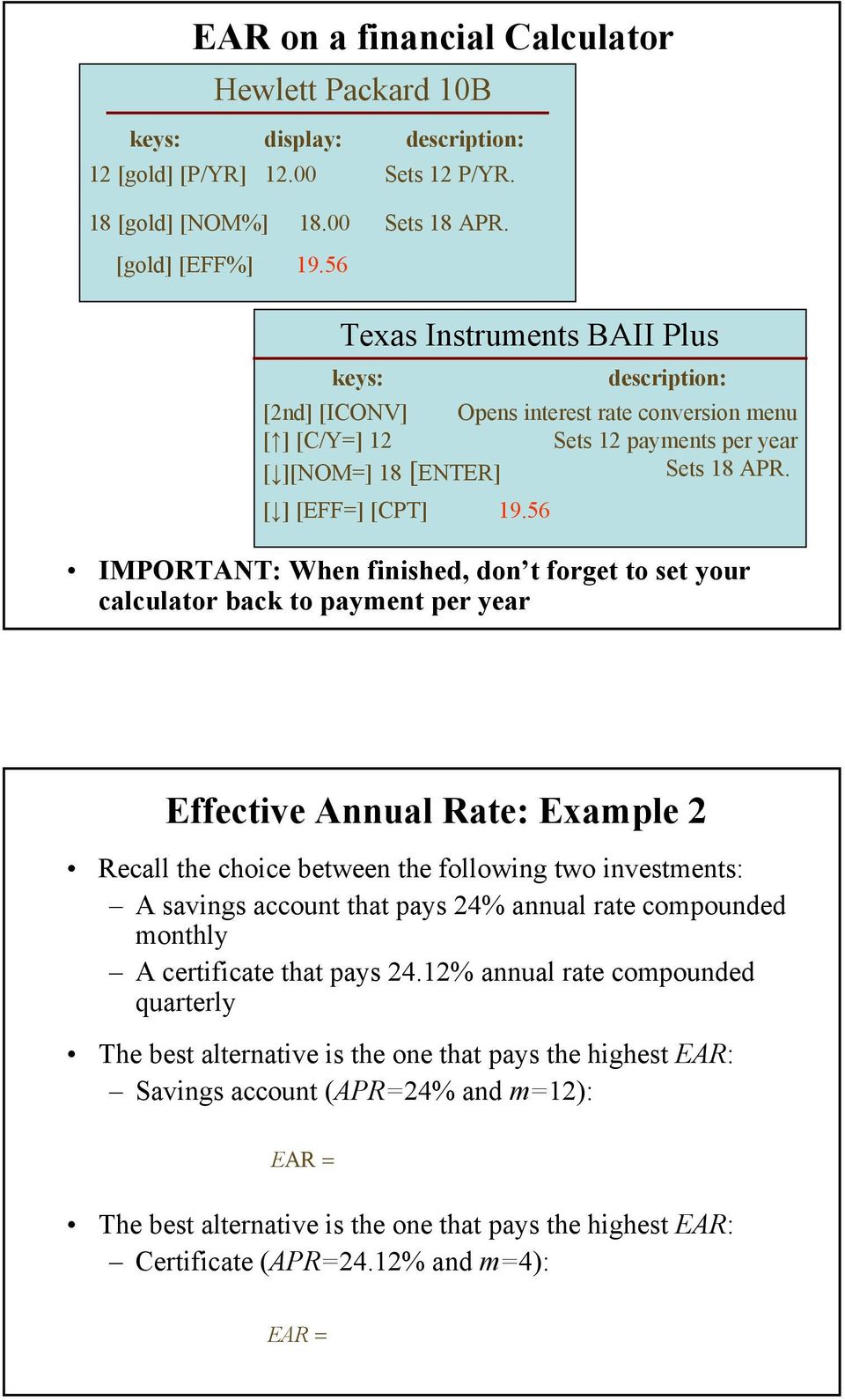
4 EAR on a financial Calculator Hewlett Packard 0B keys: display: description: [gold] [P/YR].00 Sets P/YR. 8 [gold] [NOM%] 8.00 Sets 8 APR. [gold] [EFF%] 9.56 Texas Instruments BAII Plus keys: description: [nd] [ICONV] Opens interest rate conversion menu [ ] [C/Y] Sets payments per year [ ][NOM] 8 [ENTER] Sets 8 APR. [ ] [EFF] [CPT] 9.56 IMPORTANT: When finished, don t forget to set your calculator back to payment per year Effective Annual Rate: Example Recall the choice between the following two investments: A savings account that pays 4% annual rate compounded monthly A certificate that pays 4.% annual rate compounded quarterly The best alternative is the one that pays the highest EAR: Savings account (APR4% and m): EAR The best alternative is the one that pays the highest EAR: Certificate (APR4.% and m4): EAR
5 Things to Remember You always need to make sure that the interest rate and the time period match. If you are looking at annual periods, you need an effective annual rate. If you are looking at monthly periods, you need a monthly rate. If you have an APR based on monthly compounding: you have to use monthly periods for monthly payments, or adjust the interest rate appropriately if you have payments other than monthly Computing APRs from EARs If you have an effective rate, how can you compute the APR? Rearrange the EAR equation and you get: APR [ ] ( + EAR) m m

6 APR - Example Suppose you want to earn an effective rate of % You are looking at an account that compounds on a monthly basis What APR must it pay? APR Computing Loan Payments with APRs You have $30,000 in student loans that call for monthly payments over 0 years. $5,000 is financed at 9 percent APR $8,000 is financed at 8 percent APR and $7,000 at 5 percent APR What is the monthly payment on each loan? For the $5,000 loan: Monthly rate is: 9%/ 0.75% Monthly payment is given by solving: This gives: [ ] 5,000 PMT (.0075)

7 Computing Payments with a Calculator We find the monthly payment on each loan: N I/Y PV 5,000 8,000 7,000 PMT FV Future Values and Payments with Monthly Compounding You have just landed a job and are going to start saving for a down-payment on a house. You want to save 0 percent of the purchase price and then borrow the rest from a bank. You have an investment that pays 0 percent APR. Houses that you like and can afford currently cost $00,000. Real estate has been appreciating in price at 5 percent per year and you expect this trend to continue. How much should you save every month in order to have a down payment saved five years from today?

8 Future Values and Payments with Monthly Compounding First we estimate that in 5 years, a house that costs $00,000 today will cost $7,68.6 Next we estimate the monthly payment required to save up that much in 60 months. N 5 N 60 I/Y 5 I/Y 0 PV 00,000 PV 0 PMT 0 PMT FV 7,68.6 FV $5, $7,68.6 Mortgages You would like to buy a house. You have negotiated a 30- year, $300,000 mortgage at an APR of 3.6% with monthly payments. What is your monthly payment? We have: PV 0 $300,000, monthly rate 3.6%/ 0.3%, and T months. We solve for PMT in the following equation: This gives: PMT [ ] 300,000 PMT (.003)

9 Mortgages How much of the first three mortgage payment, goes toward principal and interest? In general, to calculate the interest portion of each monthly payment, use: (monthly rate) (balance of Principal at the Beginning of Month) The principal portion of each monthly payment is given by: PMT - Interest Payment For the first three mortgage payments: Month 3 A Principal at the beginning of the month 300, , , B Interest charged during the month C Monthly payment,363.94,363.94, D Principal reduction C-B E Principal at the end of the month A-D 99, , , Mortgages After that you have paid two-thirds of your monthly payments, what is the amount still remaining to be paid on the mortgage? Two-thirds of your monthly payments will be paid right after the 40 th payment. The remaining value of the mortgage at that time is given by the present value of the remaining 0 monthly payments. We have: monthly rate 3.6%/ 0.3%, PMT, (rounded), and T 0 months. We use the present value of annuity formula to get: PV 40

10 Continuous Compounding Sometimes investments or loans are figured based on continuous compounding Under continuous compounding interest is calculated (and accumulated) on a constant basis. This means that the compounding period is infinitely small (interest is compounded infinite times): r m r Therefore: lim EAR lim[ ] e m m e is a transcendental number approximately equal to.78. Example: What is the effective annual rate of 7% compounded continuously? EAR The TVM relationship with continuous compounding: m FV t+t PV t e (r T) Factors Influencing Rates Supply of funds by savers Households Demand for funds to invest in real assets Businesses Government s Net Supply and/or Demand Federal Reserve Actions
![This means that the compounding period is infinitely small (interest is compounded infinite times): r m r Therefore: lim EAR lim[ ] e m m e is a transcendental number](/docs-images/43/7769439/images/page_10.jpg "approximately equal to.78. Example: What is the effective annual rate of 7% compounded continuously?")
11 Equilibrium Level of Interest Rates Interest Rates Supply Gov t budgetary deficit will shift the demand curve to the right r r 0 Demand Q 0 Q Q Funds Equilibrium Level of Interest Rates Interest Rates Supply Fed s expansionary monetary policy will shift the supply curve to the right r 0 r Demand Q 0 Q Q Funds

12 Inflation, Real and Nominal Interest Rates You found your dream apartment on Fifth Avenue. The owner gives you the option to buy the apt. now for its market value ($,000,000), or buy it one year from now at the prevailing market value at that time You have exactly $ million and you can invest it at an annual rate of R 5% p.a. (nominal rate) You expect Fifth Avenue real-estate prices to grow at i 0% p.a. (inflation rate) Based on this information, should you buy the apt. now or next year? Inflation, Real and Nominal Interest Rates If you wait one year, and invest your money at R 5%, you will have: The cost of the apt. in one year is expected to be: Conclusion: the real value of your money has depreciated (you should buy now) Considering inflation, what is the real interest rate (r) that you earn during the year?

13 The Fisher Relation The Fisher Relation: (+ R) (+ r)(+i) Your real rate is: r [(+ R)/(+i)] - Conclusion: in real terms the value of your money will depreciate over the year by 4.55% Real vs. Nominal Cash Flows Real CF (C t,real ) vs. Nominal CF (C t,nom ): C t,nom C t,real (+i) t In our example: t, i 0.0, C,n $,00,000 (actual cost), and: C t,real C t,nom / (+i) t [$,00,000 /.0 ] $,000,000 What rate should we use? C t,nom should be discounted with R: PV C t,real should be discounted with r: PV

14 Rates of Return: Single Period HPR P P P D HPR Holding Period Return P 0 Beginning price P Ending price D Dividend during the period The HPR has two components: HPR P P P0 0 + D P 0 capital gain yield dividend yield Single Period Returns - Example Suppose a stock had an initial price of $4 per share, paid a dividend of $0.84 per share during the year, and had an ending price of $46.. Calculate: a. HPR HPR b. Dividend yield DY c. Capital gains yield CGY

15 Single Period Returns - Example Dividends $0.84 Ending Market Value $46.0 Total inflows $47.04 Time: 0 Outflows $4.00 Historic Rates of Return: Multi Period - Example The following are ABC stock single-period returns for the 0X- 0X4 period: Year (t) Return (R t ) 0X -0.8% 0X X X Calculate: a. holding period return (HPR) b. geometric average return (GAR) c. arithmetic average return (R)

16 Historic Rates of Return: Multi Period - Example a. holding period return HPR ( + R 0X )( + R 0X )( + R 0X3 )(+ R 0X4 ) - b. geometric average return GAR [( + R 0X )( + R 0X )( + R 0X3 )(+ R 0X4 )] /4 - [ + HPR] /4 - c. arithmetic average return R ( R0 X + R0 X + R0 X 3 + R0 X 4 ) 4 Historical Return Statistics The history of capital market returns can be summarized by describing the average return R R R ( ) + L+ T T the standard deviation of those returns SD VAR ( R R) + ( R R) T + L( R T R) the frequency distribution (histogram)of the returns.

17 Other Return Statistics - Example Historic Return Variance: ( R0X R) + ( R0X R) + ( R0X3 R) + ( R0X4 R) ˆ σ 4- ( ) + ( ) + ( ) + ( ) Historic Standard Deviation: σˆ Historical Returns, Average Standard Series Annual Return Deviation Distribution Large Company Stocks.% 0.5% Small Company Stocks Long-Term Corporate Bonds Long-Term Government Bonds U.S. Treasury Bills Inflation % 0% + 90% Source: Stocks, Bonds, Bills, and Inflation 003 Yearbook, Ibbotson Associates, Inc., Chicago (annually updates work by Roger G. Ibbotson and Rex A. Sinquefield). All rights reserved.

18 The Risk-Return Tradeoff 8% 6% Small-Company Stocks Annual Return Average 4% % Large-Company Stocks 0% 8% 6% T-Bonds 4% T-Bills % 0% 5% 0% 5% 0% 5% 30% 35% Annual Return Standard Deviation Rates of Return Common Stocks Long T-Bonds T-Bills Source: Stocks, Bonds, Bills, and Inflation 000 Yearbook, Ibbotson Associates, Inc., Chicago (annually updates work by Roger G. Ibbotson and Rex A. Sinquefield). All rights reserved.

19 Risk Premiums Rate of return on T-bills is essentially risk-free. Investing in stocks is risky, but there are compensations. The difference between the return on T-bills and stocks is the risk premium for investing in stocks. An old saying on Wall Street is You can either sleep well or eat well. Risk Statistics The measures of risk that we discuss are variance and standard deviation. The standard deviation is the standard statistical measure of the dispersion of a sample around its mean, and it will be the measure we use most. Its interpretation is facilitated by a discussion of the normal distribution.

20 Normal Distribution A large enough sample drawn from a normal distribution looks like a bell-shaped curve. Probability 3s 49.3% s 8.8% s 8.3% 0.% 68.6% + s 3.7% + s 53.% + 3s 73.7% Return on large company common stocks 95.44% 99.74% Normal Distribution s.d. s.d. mean Symmetric distribution

Discounted Cash Flow Valuation
 Discounted Cash Flow Valuation Chapter 5 Key Concepts and Skills Be able to compute the future value of multiple cash flows Be able to compute the present value of multiple cash flows Be able to compute
FinQuiz Notes 2 0 1 4
 Reading 5 The Time Value of Money Money has a time value because a unit of money received today is worth more than a unit of money to be received tomorrow. Interest rates can be interpreted in three ways.
Key Concepts and Skills. Multiple Cash Flows Future Value Example 6.1. Chapter Outline. Multiple Cash Flows Example 2 Continued
 6 Calculators Discounted Cash Flow Valuation Key Concepts and Skills Be able to compute the future value of multiple cash flows Be able to compute the present value of multiple cash flows Be able to compute
Discounted Cash Flow Valuation
 6 Formulas Discounted Cash Flow Valuation McGraw-Hill/Irwin Copyright 2008 by The McGraw-Hill Companies, Inc. All rights reserved. Chapter Outline Future and Present Values of Multiple Cash Flows Valuing
Chapter 6. Discounted Cash Flow Valuation. Key Concepts and Skills. Multiple Cash Flows Future Value Example 6.1. Answer 6.1
 Chapter 6 Key Concepts and Skills Be able to compute: the future value of multiple cash flows the present value of multiple cash flows the future and present value of annuities Discounted Cash Flow Valuation
Oklahoma State University Spears School of Business. Time Value of Money
 Oklahoma State University Spears School of Business Time Value of Money Slide 2 Time Value of Money Which would you rather receive as a sign-in bonus for your new job? 1. $15,000 cash upon signing the
In this section, the functions of a financial calculator will be reviewed and some sample problems will be demonstrated.
 Section 4: Using a Financial Calculator Tab 1: Introduction and Objectives Introduction In this section, the functions of a financial calculator will be reviewed and some sample problems will be demonstrated.
Main TVM functions of a BAII Plus Financial Calculator
 Main TVM functions of a BAII Plus Financial Calculator The BAII Plus calculator can be used to perform calculations for problems involving compound interest and different types of annuities. (Note: there
FinQuiz Notes 2 0 1 5
 Reading 5 The Time Value of Money Money has a time value because a unit of money received today is worth more than a unit of money to be received tomorrow. Interest rates can be interpreted in three ways.
The Time Value of Money
 The following is a review of the Quantitative Methods: Basic Concepts principles designed to address the learning outcome statements set forth by CFA Institute. This topic is also covered in: The Time
Finding the Payment $20,000 = C[1 1 / 1.0066667 48 ] /.0066667 C = $488.26
![Finding the Payment $20,000 = C[1 1 / 1.0066667 48 ] /.0066667 C = $488.26](/thumbs/17/134163.jpg "Finding the Payment $20,000 = C[1 1 / 1.0066667 48 ] /.0066667 C = $488.26") Quick Quiz: Part 2 You know the payment amount for a loan and you want to know how much was borrowed. Do you compute a present value or a future value? You want to receive $5,000 per month in retirement.
Quick Quiz: Part 2 You know the payment amount for a loan and you want to know how much was borrowed. Do you compute a present value or a future value? You want to receive $5,000 per month in retirement.
Chapter 5 Time Value of Money 2: Analyzing Annuity Cash Flows
 1. Future Value of Multiple Cash Flows 2. Future Value of an Annuity 3. Present Value of an Annuity 4. Perpetuities 5. Other Compounding Periods 6. Effective Annual Rates (EAR) 7. Amortized Loans Chapter
Texas Instruments BAII Plus Tutorial for Use with Fundamentals 11/e and Concise 5/e
 Texas Instruments BAII Plus Tutorial for Use with Fundamentals 11/e and Concise 5/e This tutorial was developed for use with Brigham and Houston s Fundamentals of Financial Management, 11/e and Concise,
FNCE 301, Financial Management H Guy Williams, 2006
 Review In the first class we looked at the value today of future payments (introduction), how to value projects and investments. Present Value = Future Payment * 1 Discount Factor. The discount factor
DISCOUNTED CASH FLOW VALUATION and MULTIPLE CASH FLOWS
 Chapter 5 DISCOUNTED CASH FLOW VALUATION and MULTIPLE CASH FLOWS The basic PV and FV techniques can be extended to handle any number of cash flows. PV with multiple cash flows: Suppose you need $500 one
How To Read The Book \"Financial Planning\"
 Time Value of Money Reading 5 IFT Notes for the 2015 Level 1 CFA exam Contents 1. Introduction... 2 2. Interest Rates: Interpretation... 2 3. The Future Value of a Single Cash Flow... 4 4. The Future Value
Key Concepts and Skills
 McGraw-Hill/Irwin Copyright 2014 by the McGraw-Hill Companies, Inc. All rights reserved. Key Concepts and Skills Be able to compute: The future value of an investment made today The present value of cash
Introduction. Turning the Calculator On and Off
 Texas Instruments BAII PLUS Calculator Tutorial to accompany Cyr, et. al. Contemporary Financial Management, 1 st Canadian Edition, 2004 Version #6, May 5, 2004 By William F. Rentz and Alfred L. Kahl Introduction
5. Time value of money
 1 Simple interest 2 5. Time value of money With simple interest, the amount earned each period is always the same: i = rp o We will review some tools for discounting cash flows. where i = interest earned
Using Financial Calculators
 Chapter 4 Discounted Cash Flow Valuation 4B-1 Appendix 4B Using Financial Calculators This appendix is intended to help you use your Hewlett-Packard or Texas Instruments BA II Plus financial calculator
Time Value of Money. 2014 Level I Quantitative Methods. IFT Notes for the CFA exam
 Time Value of Money 2014 Level I Quantitative Methods IFT Notes for the CFA exam Contents 1. Introduction... 2 2. Interest Rates: Interpretation... 2 3. The Future Value of a Single Cash Flow... 4 4. The
THE TIME VALUE OF MONEY
 QUANTITATIVE METHODS THE TIME VALUE OF MONEY Reading 5 http://proschool.imsindia.com/ 1 Learning Objective Statements (LOS) a. Interest Rates as Required rate of return, Discount Rate and Opportunity Cost
Chapter 6. Learning Objectives Principles Used in This Chapter 1. Annuities 2. Perpetuities 3. Complex Cash Flow Streams
 Chapter 6 Learning Objectives Principles Used in This Chapter 1. Annuities 2. Perpetuities 3. Complex Cash Flow Streams 1. Distinguish between an ordinary annuity and an annuity due, and calculate present
CHAPTER 2. Time Value of Money 2-1
 CHAPTER 2 Time Value of Money 2-1 Time Value of Money (TVM) Time Lines Future value & Present value Rates of return Annuities & Perpetuities Uneven cash Flow Streams Amortization 2-2 Time lines 0 1 2 3
Chapter 8. Present Value Mathematics for Real Estate
 Chapter 8 Present Value Mathematics for Real Estate Real estate deals almost always involve cash amounts at different points in time. Examples: Buy a property now, sell it later. Sign a lease now, pay
Topics. Chapter 5. Future Value. Future Value - Compounding. Time Value of Money. 0 r = 5% 1
 Chapter 5 Time Value of Money Topics 1. Future Value of a Lump Sum 2. Present Value of a Lump Sum 3. Future Value of Cash Flow Streams 4. Present Value of Cash Flow Streams 5. Perpetuities 6. Uneven Series
Chapter 4: Time Value of Money
 FIN 301 Homework Solution Ch4 Chapter 4: Time Value of Money 1. a. 10,000/(1.10) 10 = 3,855.43 b. 10,000/(1.10) 20 = 1,486.44 c. 10,000/(1.05) 10 = 6,139.13 d. 10,000/(1.05) 20 = 3,768.89 2. a. $100 (1.10)
CHAPTER 4. The Time Value of Money. Chapter Synopsis
 CHAPTER 4 The Time Value of Money Chapter Synopsis Many financial problems require the valuation of cash flows occurring at different times. However, money received in the future is worth less than money
Time Value of Money. If you deposit $100 in an account that pays 6% annual interest, what amount will you expect to have in
 Time Value of Money Future value Present value Rates of return 1 If you deposit $100 in an account that pays 6% annual interest, what amount will you expect to have in the account at the end of the year.
Time-Value-of-Money and Amortization Worksheets
 2 Time-Value-of-Money and Amortization Worksheets The Time-Value-of-Money and Amortization worksheets are useful in applications where the cash flows are equal, evenly spaced, and either all inflows or
Texas Instruments BA II Plus. Calculator tutorial
 Chartered Financial Analyst Program Texas Instruments BA II Plus calculator tutorial Nicholas J Blain, CFA Chief Executive Quartic Training 1 outline 0. Calculator setup and introduction 1. Basic algebra
Basic Financial Tools: A Review. 3 n 1 n. PV FV 1 FV 2 FV 3 FV n 1 FV n 1 (1 i)
 Chapter 28 Basic Financial Tools: A Review The building blocks of finance include the time value of money, risk and its relationship with rates of return, and stock and bond valuation models. These topics
Problem Set: Annuities and Perpetuities (Solutions Below)
 Problem Set: Annuities and Perpetuities (Solutions Below) 1. If you plan to save $300 annually for 10 years and the discount rate is 15%, what is the future value? 2. If you want to buy a boat in 6 years
Fixed Income: Practice Problems with Solutions
 Fixed Income: Practice Problems with Solutions Directions: Unless otherwise stated, assume semi-annual payment on bonds.. A 6.0 percent bond matures in exactly 8 years and has a par value of 000 dollars.
3. Time value of money. We will review some tools for discounting cash flows.
 1 3. Time value of money We will review some tools for discounting cash flows. Simple interest 2 With simple interest, the amount earned each period is always the same: i = rp o where i = interest earned
Chapter 4 Time Value of Money ANSWERS TO END-OF-CHAPTER QUESTIONS
 Chapter 4 Time Value of Money ANSWERS TO END-OF-CHAPTER QUESTIONS 4-1 a. PV (present value) is the value today of a future payment, or stream of payments, discounted at the appropriate rate of interest.
1. If you wish to accumulate $140,000 in 13 years, how much must you deposit today in an account that pays an annual interest rate of 14%?
 Chapter 2 - Sample Problems 1. If you wish to accumulate $140,000 in 13 years, how much must you deposit today in an account that pays an annual interest rate of 14%? 2. What will $247,000 grow to be in
Key Concepts and Skills. Chapter Outline. Basic Definitions. Future Values. Future Values: General Formula 1-1. Chapter 4
 Key Concepts and Skills Chapter 4 Introduction to Valuation: The Time Value of Money Be able to compute the future value of an investment made today Be able to compute the present value of cash to be received
Time Value of Money. 2014 Level I Quantitative Methods. IFT Notes for the CFA exam
 Time Value of Money 2014 Level I Quantitative Methods IFT Notes for the CFA exam Contents 1. Introduction...2 2. Interest Rates: Interpretation...2 3. The Future Value of a Single Cash Flow...4 4. The
APPENDIX 3 TIME VALUE OF MONEY. Time Lines and Notation. The Intuitive Basis for Present Value
 1 2 TIME VALUE OF MONEY APPENDIX 3 The simplest tools in finance are often the most powerful. Present value is a concept that is intuitively appealing, simple to compute, and has a wide range of applications.
Calculating interest rates
 Calculating interest rates A reading prepared by Pamela Peterson Drake O U T L I N E 1. Introduction 2. Annual percentage rate 3. Effective annual rate 1. Introduction The basis of the time value of money
EXAM 2 OVERVIEW. Binay Adhikari
 EXAM 2 OVERVIEW Binay Adhikari FEDERAL RESERVE & MARKET ACTIVITY (BS38) Definition 4.1 Discount Rate The discount rate is the periodic percentage return subtracted from the future cash flow for computing
Future Value. Basic TVM Concepts. Chapter 2 Time Value of Money. $500 cash flow. On a time line for 3 years: $100. FV 15%, 10 yr.
 Chapter Time Value of Money Future Value Present Value Annuities Effective Annual Rate Uneven Cash Flows Growing Annuities Loan Amortization Summary and Conclusions Basic TVM Concepts Interest rate: abbreviated
CHAPTER 4 DISCOUNTED CASH FLOW VALUATION
 CHAPTER 4 DISCOUNTED CASH FLOW VALUATION Answers to Concepts Review and Critical Thinking Questions 1. Assuming positive cash flows and interest rates, the future value increases and the present value
Practice Set #1 and Solutions.
 Bo Sjö 14-05-03 Practice Set #1 and Solutions. What to do with this practice set? Practice sets are handed out to help students master the material of the course and prepare for the final exam. These sets
Using Financial And Business Calculators. Daniel J. Borgia
 Using Financial And Business Calculators Daniel J. Borgia August 2000 Table of Contents I. Texas Instruments BA-35 SOLAR II. Texas Instruments BAII PLUS III. Hewlett Packard 12C IV. Hewlett Packard 17BII..
Key Concepts and Skills
 Chapters 5 and 6 Calculators Time Value of Money and Discounted Cash Flow Valuation McGraw-Hill/Irwin Copyright 2013 by The McGraw-Hill Companies, Inc. All rights reserved. Key Concepts and Skills Be able
Chapter 5 & 6 Financial Calculator and Examples
 Chapter 5 & 6 Financial Calculator and Examples Konan Chan Financial Management, Spring 2016 Five Factors in TVM Present value: PV Future value: FV Discount rate: r Payment: PMT Number of periods: N Get
Chapter 6 Contents. Principles Used in Chapter 6 Principle 1: Money Has a Time Value.
 Chapter 6 The Time Value of Money: Annuities and Other Topics Chapter 6 Contents Learning Objectives 1. Distinguish between an ordinary annuity and an annuity due, and calculate present and future values
Course FM / Exam 2. Calculator advice
 Course FM / Exam 2 Introduction It wasn t very long ago that the square root key was the most advanced function of the only calculator approved by the SOA/CAS for use during an actuarial exam. Now students
Compounding Assumptions. Compounding Assumptions. Financial Calculations on the Texas Instruments BAII Plus. Compounding Assumptions.
 Compounding Assumptions Financial Calculations on the Texas Instruments BAII Plus This is a first draft, and may contain errors. Feedback is appreciated The TI BAII Plus has built-in preset assumptions
CHAPTER 5. Interest Rates. Chapter Synopsis
 CHAPTER 5 Interest Rates Chapter Synopsis 5.1 Interest Rate Quotes and Adjustments Interest rates can compound more than once per year, such as monthly or semiannually. An annual percentage rate (APR)
Using Financial and Business Calculators. Daniel J. Borgia
 Using Financial and Business Calculators Daniel J. Borgia Table of Contents Texas Instruments (TI) BA-35 SOLAR......................................1 Texas Instruments (TI) BA II PLUS........................................11
TIME VALUE OF MONEY (TVM)
 TIME VALUE OF MONEY (TVM) INTEREST Rate of Return When we know the Present Value (amount today), Future Value (amount to which the investment will grow), and Number of Periods, we can calculate the rate
Integrated Case. 5-42 First National Bank Time Value of Money Analysis
 Integrated Case 5-42 First National Bank Time Value of Money Analysis You have applied for a job with a local bank. As part of its evaluation process, you must take an examination on time value of money
LOS 56.a: Explain steps in the bond valuation process.
 The following is a review of the Analysis of Fixed Income Investments principles designed to address the learning outcome statements set forth by CFA Institute. This topic is also covered in: Introduction
Interest Rates and Bond Valuation
 and Bond Valuation 1 Bonds Debt Instrument Bondholders are lending the corporation money for some stated period of time. Liquid Asset Corporate Bonds can be traded in the secondary market. Price at which
The explanations below will make it easier for you to use the calculator. The ON/OFF key is used to turn the calculator on and off.
 USER GUIDE Texas Instrument BA II Plus Calculator April 2007 GENERAL INFORMATION The Texas Instrument BA II Plus financial calculator was designed to support the many possible applications in the areas
International Financial Strategies Time Value of Money
 International Financial Strategies 1 Future Value and Compounding Future value = cash value of the investment at some point in the future Investing for single period: FV. Future Value PV. Present Value
Continue this process until you have cleared the stored memory positions that you wish to clear individually and keep those that you do not.
 Texas Instruments (TI) BA II PLUS Professional The TI BA II PLUS Professional functions similarly to the TI BA II PLUS model. Any exceptions are noted here. The TI BA II PLUS Professional can perform two
The Mathematics of Financial Planning (supplementary lesson notes to accompany FMGT 2820)
 The Mathematics of Financial Planning (supplementary lesson notes to accompany FMGT 2820) Using the Sharp EL-738 Calculator Reference is made to the Appendix Tables A-1 to A-4 in the course textbook Investments:
CHAPTER 8 INTEREST RATES AND BOND VALUATION
 CHAPTER 8 INTEREST RATES AND BOND VALUATION Answers to Concept Questions 1. No. As interest rates fluctuate, the value of a Treasury security will fluctuate. Long-term Treasury securities have substantial
USING THE SHARP EL 738 FINANCIAL CALCULATOR
 USING THE SHARP EL 738 FINANCIAL CALCULATOR Basic financial examples with financial calculator steps Prepared by Colin C Smith 2010 Some important things to consider 1. These notes cover basic financial
HANDBOOK: HOW TO USE YOUR TI BA II PLUS CALCULATOR
 HANDBOOK: HOW TO USE YOUR TI BA II PLUS CALCULATOR This document is designed to provide you with (1) the basics of how your TI BA II Plus financial calculator operates, and (2) the typical keystrokes that
Direct Transfer. Investment Banking. Investment Banking. Basic Concepts. Economics of Money and Banking. Basic Concepts
 Basic Concepts Economics of Money and Banking 2014 South Carolina Bankers School Ron Best University of West Georgia [email protected] Risk and return: investors will only take on additional risk if they
How To Value Cash Flow
 Lecture: II 1 Time Value of Money (TVM) A dollar today is more valuable than a dollar sometime in the future...! The intuitive basis for present value what determines the effect of timing on the value
Introduction to the Hewlett-Packard (HP) 10BII Calculator and Review of Mortgage Finance Calculations
 Introduction to the Hewlett-Packard (HP) 10BII Calculator and Review of Mortgage Finance Calculations Real Estate Division Sauder School of Business University of British Columbia Introduction to the Hewlett-Packard
Chapter 4. The Time Value of Money
 Chapter 4 The Time Value of Money 4-2 Topics Covered Future Values and Compound Interest Present Values Multiple Cash Flows Perpetuities and Annuities Inflation and Time Value Effective Annual Interest
CHAPTER 4 DISCOUNTED CASH FLOW VALUATION
 CHAPTER 4 DISCOUNTED CASH FLOW VALUATION Solutions to Questions and Problems NOTE: All-end-of chapter problems were solved using a spreadsheet. Many problems require multiple steps. Due to space and readability
LO.a: Interpret interest rates as required rates of return, discount rates, or opportunity costs.
 LO.a: Interpret interest rates as required rates of return, discount rates, or opportunity costs. 1. The minimum rate of return that an investor must receive in order to invest in a project is most likely
Ch. Ch. 5 Discounted Cash Flows & Valuation In Chapter 5,
 Ch. 5 Discounted Cash Flows & Valuation In Chapter 5, we found the PV & FV of single cash flows--either payments or receipts. In this chapter, we will do the same for multiple cash flows. 2 Multiple Cash
substantially more powerful. The internal rate of return feature is one of the most useful of the additions. Using the TI BA II Plus
 for Actuarial Finance Calculations Introduction. This manual is being written to help actuarial students become more efficient problem solvers for the Part II examination of the Casualty Actuarial Society
FNCE 301, Financial Management H Guy Williams, 2006
 REVIEW We ve used the DCF method to find present value. We also know shortcut methods to solve these problems such as perpetuity present value = C/r. These tools allow us to value any cash flow including
Appendix C- 1. Time Value of Money. Appendix C- 2. Financial Accounting, Fifth Edition
 C- 1 Time Value of Money C- 2 Financial Accounting, Fifth Edition Study Objectives 1. Distinguish between simple and compound interest. 2. Solve for future value of a single amount. 3. Solve for future
1 Interest rates, and risk-free investments
 Interest rates, and risk-free investments Copyright c 2005 by Karl Sigman. Interest and compounded interest Suppose that you place x 0 ($) in an account that offers a fixed (never to change over time)
PowerPoint. to accompany. Chapter 5. Interest Rates
 PowerPoint to accompany Chapter 5 Interest Rates 5.1 Interest Rate Quotes and Adjustments To understand interest rates, it s important to think of interest rates as a price the price of using money. When
Hewlett-Packard 10BII Tutorial
 This tutorial has been developed to be used in conjunction with Brigham and Houston s Fundamentals of Financial Management 11 th edition and Fundamentals of Financial Management: Concise Edition. In particular,
380.760: Corporate Finance. Financial Decision Making
 380.760: Corporate Finance Lecture 2: Time Value of Money and Net Present Value Gordon Bodnar, 2009 Professor Gordon Bodnar 2009 Financial Decision Making Finance decision making is about evaluating costs
Key Concepts and Skills
 Chapter 10 Some Lessons from Capital Market History Key Concepts and Skills Know how to calculate the return on an investment Understand the historical returns on various types of investments Understand
Chapter 5 Discounted Cash Flow Valuation
 Chapter Discounted Cash Flow Valuation Compounding Periods Other Than Annual Let s examine monthly compounding problems. Future Value Suppose you invest $9,000 today and get an interest rate of 9 percent
Answers to Review Questions
 Answers to Review Questions 1. The real rate of interest is the rate that creates an equilibrium between the supply of savings and demand for investment funds. The nominal rate of interest is the actual
Hewlett Packard (HP) 10BII
 Hewlett Packard (HP) 10BII The HP10BII is programmed to perform two basic types of operations: statistical operations and financial operations. Various types of computations are activated by depressing
Chapter 2 Present Value
 Chapter 2 Present Value Road Map Part A Introduction to finance. Financial decisions and financial markets. Present value. Part B Valuation of assets, given discount rates. Part C Determination of risk-adjusted
Present Value. Aswath Damodaran. Aswath Damodaran 1
 Present Value Aswath Damodaran Aswath Damodaran 1 Intuition Behind Present Value There are three reasons why a dollar tomorrow is worth less than a dollar today Individuals prefer present consumption to
PV Tutorial Using Calculator (Sharp EL-738)
 EYK 15-2 PV Tutorial Using Calculator (Sharp EL-738) TABLE OF CONTENTS Calculator Configuration and Abbreviations Exercise 1: Exercise 2: Exercise 3: Exercise 4: Exercise 5: Exercise 6: Exercise 7: Exercise
Solutions to Problems: Chapter 5
 Solutions to Problems: Chapter 5 P5-1. Using a time line LG 1; Basic a, b, and c d. Financial managers rely more on present value than future value because they typically make decisions before the start
Basic financial arithmetic
 2 Basic financial arithmetic Simple interest Compound interest Nominal and effective rates Continuous discounting Conversions and comparisons Exercise Summary File: MFME2_02.xls 13 This chapter deals
Interest Rates and Bond Valuation
 Interest Rates and Bond Valuation Chapter 6 Key Concepts and Skills Know the important bond features and bond types Understand bond values and why they fluctuate Understand bond ratings and what they mean
BUSI 121 Foundations of Real Estate Mathematics
 Real Estate Division BUSI 121 Foundations of Real Estate Mathematics SESSION 2 By Graham McIntosh Sauder School of Business University of British Columbia Outline Introduction Cash Flow Problems Cash Flow
2. Determine the appropriate discount rate based on the risk of the security
 Fixed Income Instruments III Intro to the Valuation of Debt Securities LOS 64.a Explain the steps in the bond valuation process 1. Estimate the cash flows coupons and return of principal 2. Determine the
Prepared by: Dalia A. Marafi Version 2.0
 Kuwait University College of Business Administration Department of Finance and Financial Institutions Using )Casio FC-200V( for Fundamentals of Financial Management (220) Prepared by: Dalia A. Marafi Version
MGT201 Lecture No. 07
 MGT201 Lecture No. 07 Learning Objectives: After going through this lecture, you would be able to have an understanding of the following concepts. Discounted Cash Flows (DCF Analysis) Annuities Perpetuity
- the preference for current consumption increases.
 Intuition behind the Rule There are three reasons why a dollar tomorrow is worth less than a dollar today Individuals prefer present consumption to future consumption. To induce people to consumption you
A) 1.8% B) 1.9% C) 2.0% D) 2.1% E) 2.2%
 1 Exam FM Questions Practice Exam 1 1. Consider the following yield curve: Year Spot Rate 1 5.5% 2 5.0% 3 5.0% 4 4.5% 5 4.0% Find the four year forward rate. A) 1.8% B) 1.9% C) 2.0% D) 2.1% E) 2.2% 2.
The Time Value of Money
 The Time Value of Money Time Value Terminology 0 1 2 3 4 PV FV Future value (FV) is the amount an investment is worth after one or more periods. Present value (PV) is the current value of one or more future
Chapter 7 SOLUTIONS TO END-OF-CHAPTER PROBLEMS
 Chapter 7 SOLUTIONS TO END-OF-CHAPTER PROBLEMS 7-1 0 1 2 3 4 5 10% PV 10,000 FV 5? FV 5 $10,000(1.10) 5 $10,000(FVIF 10%, 5 ) $10,000(1.6105) $16,105. Alternatively, with a financial calculator enter the
15.401. Lecture Notes
 15.401 15.401 Finance Theory I Haoxiang Zhu MIT Sloan School of Management Lecture 2: Present Value Lecture Notes Key concept of Lecture 1 Opportunity cost of capital True or False? A company s 10-year
Introduction to Risk, Return and the Historical Record
 Introduction to Risk, Return and the Historical Record Rates of return Investors pay attention to the rate at which their fund have grown during the period The holding period returns (HDR) measure the
( ) ( )( ) ( ) 2 ( ) 3. n n = 100 000 1+ 0.10 = 100 000 1.331 = 133100
 Mariusz Próchniak Chair of Economics II Warsaw School of Economics CAPITAL BUDGETING Managerial Economics 1 2 1 Future value (FV) r annual interest rate B the amount of money held today Interest is compounded