
1 Interest rates, and risk-free investments
|
|
|
- Rudolph Carson
- 10 years ago
- Views:
Transcription
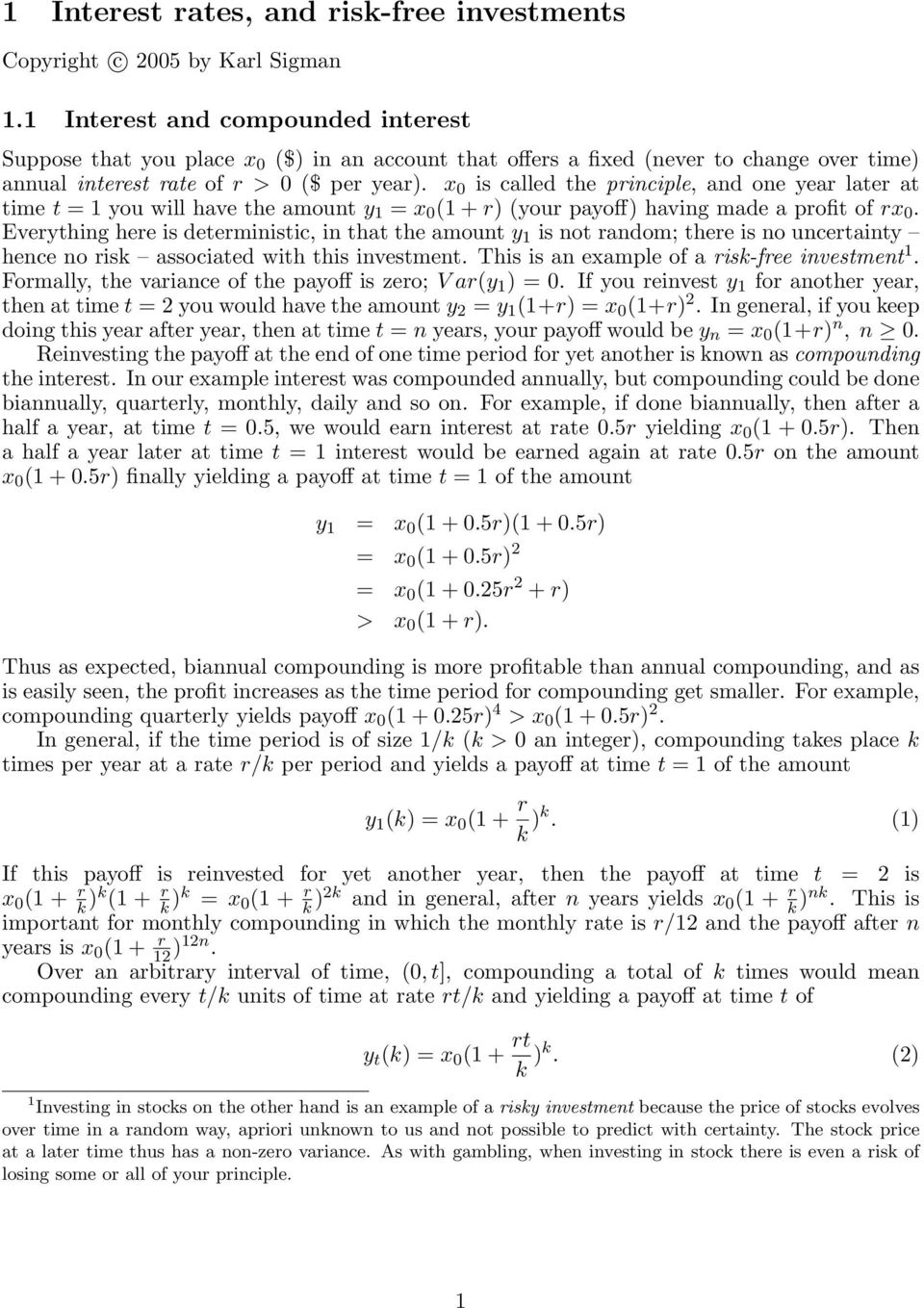
1 Interest rates, and risk-free investments Copyright c 2005 by Karl Sigman. Interest and compounded interest Suppose that you place x 0 ($) in an account that offers a fixed (never to change over time) annual interest rate of r > 0 ($ per year). x 0 is called the principle, and one year later at time t = you will have the amount y = x 0 ( + r) (your payoff) having made a profit of rx 0. Everything here is deterministic, in that the amount y is not random; there is no uncertainty hence no risk associated with this investment. This is an example of a risk-free investment. Formally, the variance of the payoff is zero; V ar(y ) = 0. If you reinvest y for another year, then at time t = 2 you would have the amount y 2 = y (+r) = x 0 (+r) 2. In general, if you keep doing this year after year, then at time t = n years, your payoff would be y n = x 0 (+r) n, n 0. Reinvesting the payoff at the end of one time period for yet another is known as compounding the interest. In our example interest was compounded annually, but compounding could be done biannually, quarterly, monthly, daily and so on. For example, if done biannually, then after a half a year, at time t = 0.5, we would earn interest at rate 0.5r yielding x 0 ( + 0.5r). Then a half a year later at time t = interest would be earned again at rate 0.5r on the amount x 0 ( + 0.5r) finally yielding a payoff at time t = of the amount y = x 0 ( + 0.5r)( + 0.5r) = x 0 ( + 0.5r) 2 = x 0 ( r 2 + r) > x 0 ( + r). Thus as expected, biannual compounding is more profitable than annual compounding, and as is easily seen, the profit increases as the time period for compounding get smaller. For example, compounding quarterly yields payoff x 0 ( r) 4 > x 0 ( + 0.5r) 2. In general, if the time period is of size /k (k > 0 an integer), compounding takes place k times per year at a rate r/k per period and yields a payoff at time t = of the amount y (k) = x 0 ( + r k )k. () If this payoff is reinvested for yet another year, then the payoff at time t = 2 is x 0 ( + r k )k ( + r k )k = x 0 ( + r k )2k and in general, after n years yields x 0 ( + r k )nk. This is important for monthly compounding in which the monthly rate is r/2 and the payoff after n years is x 0 ( + r 2 )2n. Over an arbitrary interval of time, (0, t], compounding a total of k times would mean compounding every t/k units of time at rate rt/k and yielding a payoff at time t of y t (k) = x 0 ( + rt k )k. (2) Investing in stocks on the other hand is an example of a risky investment because the price of stocks evolves over time in a random way, apriori unknown to us and not possible to predict with certainty. The stock price at a later time thus has a non-zero variance. As with gambling, when investing in stock there is even a risk of losing some or all of your principle.
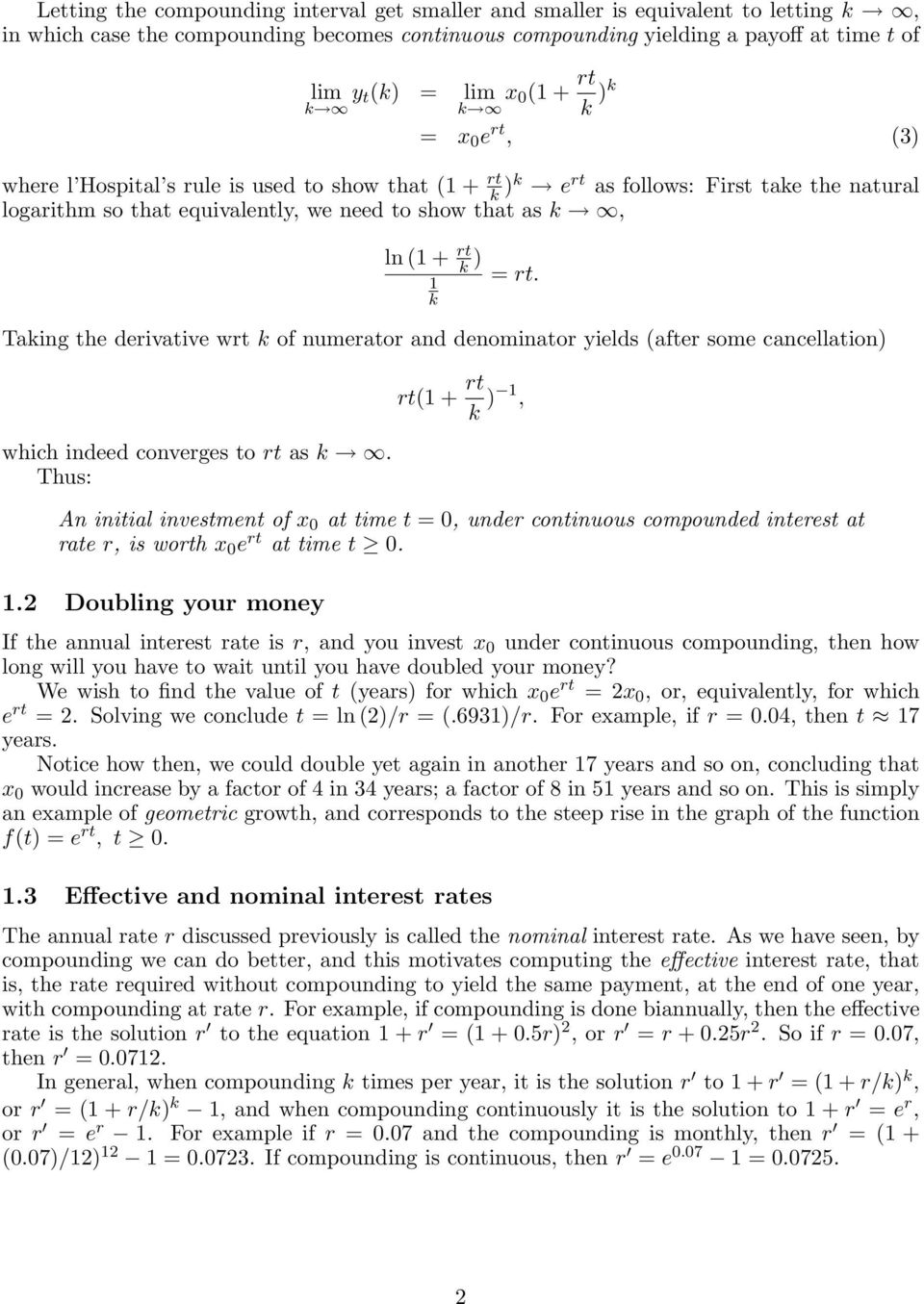
2 Letting the compounding interval get smaller and smaller is equivalent to letting k, in which case the compounding becomes continuous compounding yielding a payoff at time t of lim y t(k) = lim x 0( + rt k k k )k = x 0 e rt, (3) where l Hospital s rule is used to show that ( + rt k )k e rt as follows: First take the natural logarithm so that equivalently, we need to show that as k, ln ( + rt k ) = rt. k Taking the derivative wrt k of numerator and denominator yields (after some cancellation) which indeed converges to rt as k. Thus: rt( + rt k ), An initial investment of x 0 at time t = 0, under continuous compounded interest at rate r, is worth x 0 e rt at time t 0..2 Doubling your money If the annual interest rate is r, and you invest x 0 under continuous compounding, then how long will you have to wait until you have doubled your money? We wish to find the value of t (years) for which x 0 e rt = 2x 0, or, equivalently, for which e rt = 2. Solving we conclude t = ln (2)/r = (.693)/r. For example, if r = 0.04, then t 7 years. Notice how then, we could double yet again in another 7 years and so on, concluding that x 0 would increase by a factor of 4 in 34 years; a factor of 8 in 5 years and so on. This is simply an example of geometric growth, and corresponds to the steep rise in the graph of the function f(t) = e rt, t 0..3 Effective and nominal interest rates The annual rate r discussed previously is called the nominal interest rate. As we have seen, by compounding we can do better, and this motivates computing the effective interest rate, that is, the rate required without compounding to yield the same payment, at the end of one year, with compounding at rate r. For example, if compounding is done biannually, then the effective rate is the solution r to the equation + r = ( + 0.5r) 2, or r = r r 2. So if r = 0.07, then r = In general, when compounding k times per year, it is the solution r to + r = ( + r/k) k, or r = ( + r/k) k, and when compounding continuously it is the solution to + r = e r, or r = e r. For example if r = 0.07 and the compounding is monthly, then r = ( + (0.07)/2) 2 = If compounding is continuous, then r = e 0.07 =
3 .4 Present value and the value of money Any given amount of money, x, is worth more to us at present (time t = 0) than being promised it at some time t in the future since we can always use x now as principle in a risk-free investment at rate r guaranteeing the amount x(+e rt ) > x at time t (we are using continuous compounding here for illustrative purposes). Stated differently, an amount x promised to us later at time t is only worth x 0 = xe rt < x at present, since using this x 0 as principle yields exactly the amount x at time t: x 0 e rt = xe rt e rt = x. We thus call xe rt the present value (PV) of x. It is less than x and represents the value to us now of being promised x at a later time t in the future, if the interest rate is r. Sometimes this is referred to as discounting the amount x by the discount rate r, and the factor (always less than ) by which we multiply x to obtain its present value is called the discount factor. Under the continuous compounding assumed above, the discount factor is e rt. As an immediate application, consider buying a certain kind of Certificate of Deposit (CD) from your bank. You pay now for this which ensures you a payoff of (say) 0, 000 two years later, using fixed interest rate r = This means that you buy the CD now at a price equal to the present value 0, 000e (0.05)2 = 9, 048. Interest rates generally change over time and different interest rates are used for different types of investments, but a CD is an example where the rate is fixed over a period of time agreed upon in the contract (6 months, year, 2 years, 5 years, etc.). Other such examples are treasury bonds purchased from the USA government. Your regular bank account, checking or savings, on the other hand, has an interest rate that changes over long periods of time. Notice how if after you buy your CD, a week later the bank s interest rate goes up from your r = 0.05 to 0.060, then the price of the same CD bought a week later goes down to 0, 000e (0.060)2 = 8, 869, and your CD has lost value. Although a CD is an example of you lending money to the bank, present value has an analogous meaning in the context of borrowing: if you borrow x 0 now, then you must pay back x = x 0 e rt > x 0 at time t. Present value can of course be computed whatever the compounding situation is. For example if there is no compounding then the present value of x at time t = is x/( + r), and so the discount factor is /( + r). In general when compounding k times during (0, t] at annual rate r the present value of x at time t is x/( + rt/k) k, and so the discount factor is /( + rt/k) k. Examples for PV. You are to receive 0, 000 one year from now and another 0, 000 two years from now. If the annual nomimal interest rate is r = 0.05, compounded yearly, what is the present value of the total? What if compounded monthly? Continuously? 0, 000 0, ( + r) ( + r) 2, derived as follows: 0, 000(+r) is the present value of the first payment (to be received at time t = year), and 0, 000( + r) 2 is the present value of the second payment (to be received at time t = 2 years). Plugging in r = 0.05 yields 8, 594. If compounded monthly, then Plugging in r = 0.05 yields 8, , 000 0, ( + r/2) 2 ( + r/2) 24. 3

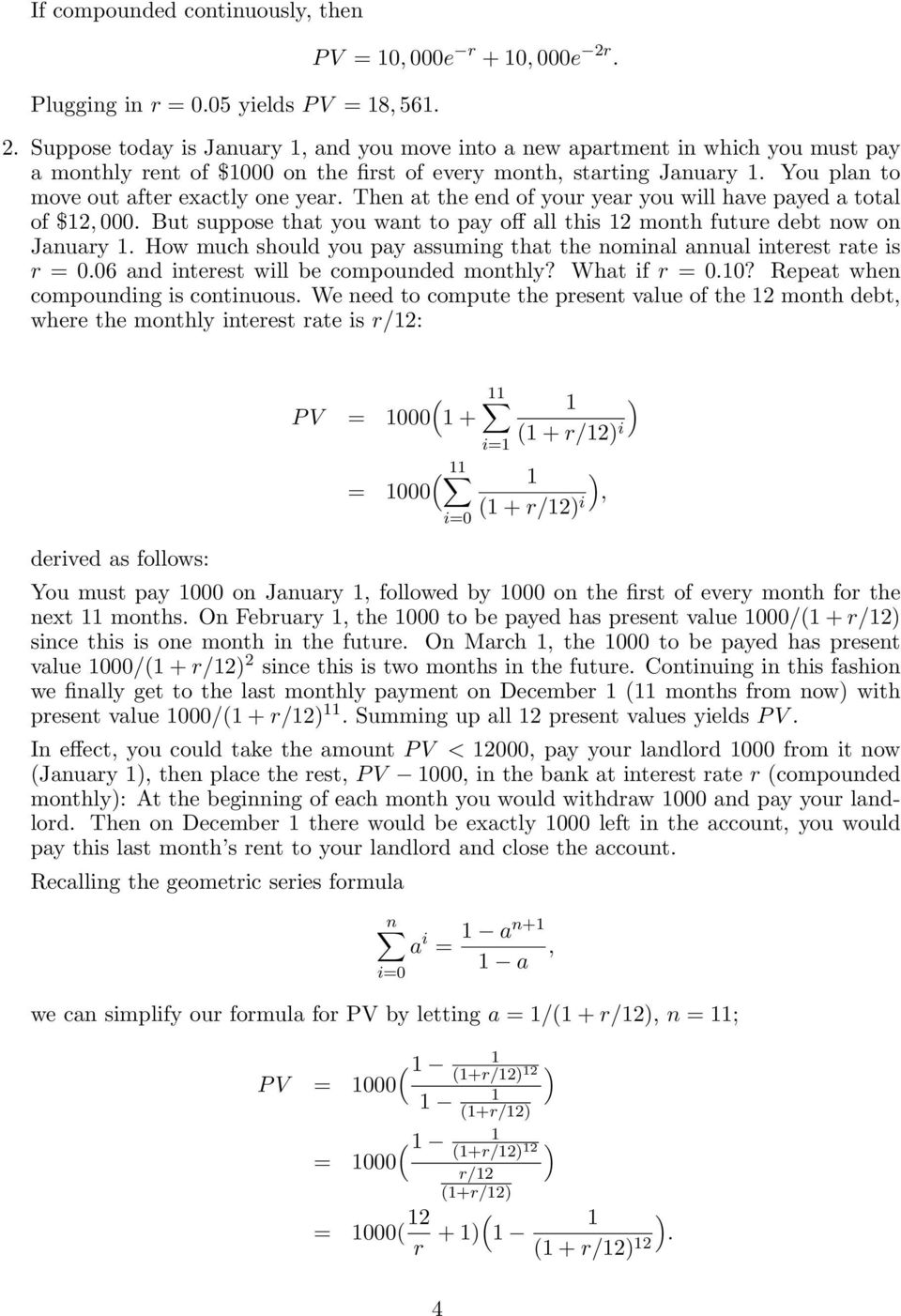
4 If compounded continuously, then Plugging in r = 0.05 yields 8, 56. 0, 000e r + 0, 000e 2r. 2. Suppose today is January, and you move into a new apartment in which you must pay a monthly rent of $000 on the first of every month, starting January. You plan to move out after exactly one year. Then at the end of your year you will have payed a total of $2, 000. But suppose that you want to pay off all this 2 month future debt now on January. How much should you pay assuming that the nominal annual interest rate is r = 0.06 and interest will be compounded monthly? What if r = 0.0? Repeat when compounding is continuous. We need to compute the present value of the 2 month debt, where the monthly interest rate is r/2: derived as follows: ( i= ) ( + r/2) i ( ) = 000 ( + r/2) i, You must pay 000 on January, followed by 000 on the first of every month for the next months. On February, the 000 to be payed has present value 000/( + r/2) since this is one month in the future. On March, the 000 to be payed has present value 000/( + r/2) 2 since this is two months in the future. Continuing in this fashion we finally get to the last monthly payment on December ( months from now) with present value 000/( + r/2). Summing up all 2 present values yields P V. In effect, you could take the amount P V < 2000, pay your landlord 000 from it now (January ), then place the rest, P V 000, in the bank at interest rate r (compounded monthly): At the beginning of each month you would withdraw 000 and pay your landlord. Then on December there would be exactly 000 left in the account, you would pay this last month s rent to your landlord and close the account. Recalling the geometric series formula a i = an+ a, we can simplify our formula for PV by letting a = /( + r/2), n = ; ( ) (+r/2) (+r/2) ( ) = 000 (+r/2) 2 r/2 (+r/2) = 000( 2 r + ) ( 4 ) ( + r/2) 2.
5 Plugging in r = 0.06 yields 000(20)(.05809) =, 677. If r = 0.0 this amount drops to 000(2)(.07664) = 469. When compounding is continuous, 000 at time i months from now has present value 000e rt with t = i/2; 000e ri 2. Thus 000 ( ) e ri 2 ( e r = 000 e r 2 Plugging in r = 0.06 yields, 676. Plugging in r = 0.0 yields, You win a very special lottery which agrees to pay you $00 each year forever starting today. Even after you die, the payments will continue to your relatives/friends. Assuming an interest rate of r = 0.08 compounded annually (and assumed constant forever), what is the present value of this lottery? What if compounded continuously? For any interest rate r compounded annually, the present value of this lottery is given by the infinite sum 00 ( + r) i = 00( + /r). via the sum of a geometric series (see The Appendix.) Thus 00/(0.08) + 00 = 350. The point here is that $00 to be earned i years from now has a present value of only 00/( + r) i. (Note how the present value of the $00 becomes worthless as i tends to infinity.) This means that if you are given the amount x 0 = 350 now all at once, you could arrange to receive the $00 lottery amounts each year by simply placing x 0 in an account earning interest at rate r = 0.08 and withdrawing $00 each year. The account would never go broke. Under continuous compounding 00e ri = 00/( e r ), via the sum of a geometric series. Thus 00/( e 0.08 ) = 300. Contracts like this with a forever into the future payment scheme are called perpetual annuities. For obvious reasons, such contracts are not common. ). 5

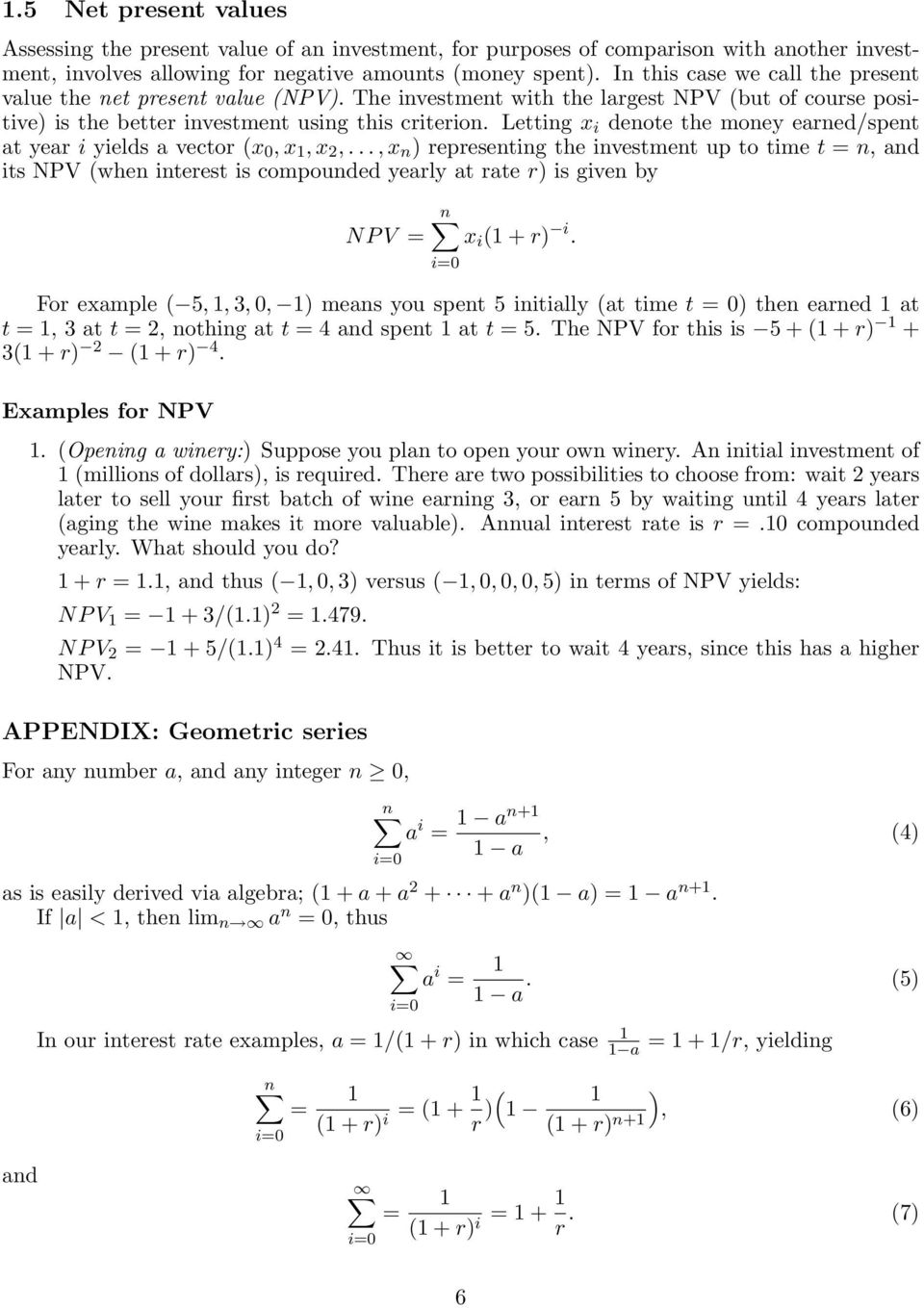
6 .5 Net present values Assessing the present value of an investment, for purposes of comparison with another investment, involves allowing for negative amounts (money spent). In this case we call the present value the net present value (NPV). The investment with the largest NPV (but of course positive) is the better investment using this criterion. Letting x i denote the money earned/spent at year i yields a vector (x 0, x, x 2,..., x n ) representing the investment up to time t = n, and its NPV (when interest is compounded yearly at rate r) is given by N x i ( + r) i. For example ( 5,, 3, 0, ) means you spent 5 initially (at time t = 0) then earned at t =, 3 at t = 2, nothing at t = 4 and spent at t = 5. The NPV for this is 5 + ( + r) + 3( + r) 2 ( + r) 4. Examples for NPV. (Opening a winery:) Suppose you plan to open your own winery. An initial investment of (millions of dollars), is required. There are two possibilities to choose from: wait 2 years later to sell your first batch of wine earning 3, or earn 5 by waiting until 4 years later (aging the wine makes it more valuable). Annual interest rate is r =.0 compounded yearly. What should you do? + r =., and thus (, 0, 3) versus (, 0, 0, 0, 5) in terms of NPV yields: NP V = + 3/(.) 2 =.479. NP V 2 = + 5/(.) 4 = 2.4. Thus it is better to wait 4 years, since this has a higher NPV. APPENDIX: Geometric series For any number a, and any integer n 0, a i = an+ a, (4) as is easily derived via algebra; ( + a + a a n )( a) = a n+. If a <, then lim n a n = 0, thus a i = a. (5) In our interest rate examples, a = /( + r) in which case a = + /r, yielding = ( + r) i = ( + ( r ) ) ( + r) n+, (6) and = ( + r) i = + r. (7) 6
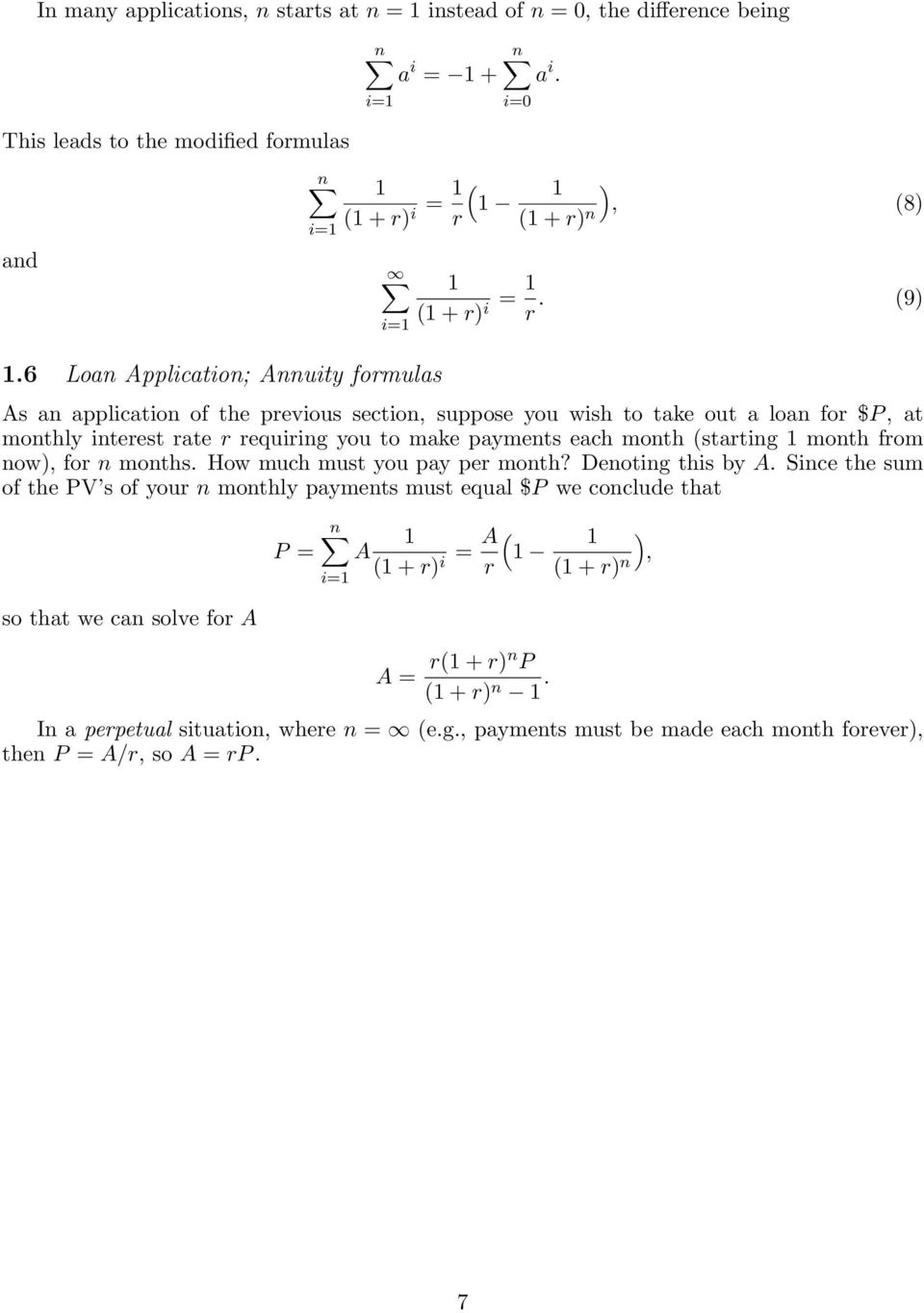
7 In many applications, n starts at n = instead of n = 0, the difference being a i = + a i. i= This leads to the modified formulas and i= ( + r) i = ( ) r ( + r) n, (8) i= ( + r) i = r. (9).6 Loan Application; Annuity formulas As an application of the previous section, suppose you wish to take out a loan for $P, at monthly interest rate r requiring you to make payments each month (starting month from now), for n months. How much must you pay per month? Denoting this by A. Since the sum of the PV s of your n monthly payments must equal $P we conclude that so that we can solve for A P = A ( + r) i= i = A r ( A = r( + r)n P ( + r) n. ) ( + r) n, In a perpetual situation, where n = (e.g., payments must be made each month forever), then P = A/r, so A = rp. 7
5. Time value of money
 1 Simple interest 2 5. Time value of money With simple interest, the amount earned each period is always the same: i = rp o We will review some tools for discounting cash flows. where i = interest earned
International Financial Strategies Time Value of Money
 International Financial Strategies 1 Future Value and Compounding Future value = cash value of the investment at some point in the future Investing for single period: FV. Future Value PV. Present Value
3. Time value of money. We will review some tools for discounting cash flows.
 1 3. Time value of money We will review some tools for discounting cash flows. Simple interest 2 With simple interest, the amount earned each period is always the same: i = rp o where i = interest earned
The Basics of Interest Theory
 Contents Preface 3 The Basics of Interest Theory 9 1 The Meaning of Interest................................... 10 2 Accumulation and Amount Functions............................ 14 3 Effective Interest
Introduction to Real Estate Investment Appraisal
 Introduction to Real Estate Investment Appraisal Maths of Finance Present and Future Values Pat McAllister INVESTMENT APPRAISAL: INTEREST Interest is a reward or rent paid to a lender or investor who has
MATHEMATICS OF FINANCE AND INVESTMENT
 MATHEMATICS OF FINANCE AND INVESTMENT G. I. FALIN Department of Probability Theory Faculty of Mechanics & Mathematics Moscow State Lomonosov University Moscow 119992 [email protected] 2 G.I.Falin. Mathematics
FNCE 301, Financial Management H Guy Williams, 2006
 Review In the first class we looked at the value today of future payments (introduction), how to value projects and investments. Present Value = Future Payment * 1 Discount Factor. The discount factor
( ) ( )( ) ( ) 2 ( ) 3. n n = 100 000 1+ 0.10 = 100 000 1.331 = 133100
 Mariusz Próchniak Chair of Economics II Warsaw School of Economics CAPITAL BUDGETING Managerial Economics 1 2 1 Future value (FV) r annual interest rate B the amount of money held today Interest is compounded
Binomial lattice model for stock prices
 Copyright c 2007 by Karl Sigman Binomial lattice model for stock prices Here we model the price of a stock in discrete time by a Markov chain of the recursive form S n+ S n Y n+, n 0, where the {Y i }
CHAPTER 4 DISCOUNTED CASH FLOW VALUATION
 CHAPTER 4 DISCOUNTED CASH FLOW VALUATION Answers to Concepts Review and Critical Thinking Questions 1. Assuming positive cash flows and interest rates, the future value increases and the present value
Geometric Series and Annuities
 Geometric Series and Annuities Our goal here is to calculate annuities. For example, how much money do you need to have saved for retirement so that you can withdraw a fixed amount of money each year for
CHAPTER 4. The Time Value of Money. Chapter Synopsis
 CHAPTER 4 The Time Value of Money Chapter Synopsis Many financial problems require the valuation of cash flows occurring at different times. However, money received in the future is worth less than money
Numbers 101: Cost and Value Over Time
 The Anderson School at UCLA POL 2000-09 Numbers 101: Cost and Value Over Time Copyright 2000 by Richard P. Rumelt. We use the tool called discounting to compare money amounts received or paid at different
Calculations for Time Value of Money
 KEATMX01_p001-008.qxd 11/4/05 4:47 PM Page 1 Calculations for Time Value of Money In this appendix, a brief explanation of the computation of the time value of money is given for readers not familiar with
How to Calculate Present Values
 How to Calculate Present Values Michael Frantz, 2010-09-22 Present Value What is the Present Value The Present Value is the value today of tomorrow s cash flows. It is based on the fact that a Euro tomorrow
MAT116 Project 2 Chapters 8 & 9
 MAT116 Project 2 Chapters 8 & 9 1 8-1: The Project In Project 1 we made a loan workout decision based only on data from three banks that had merged into one. We did not consider issues like: What was the
9. Time Value of Money 1: Present and Future Value
 9. Time Value of Money 1: Present and Future Value Introduction The language of finance has unique terms and concepts that are based on mathematics. It is critical that you understand this language, because
MBA Finance Part-Time Present Value
 MBA Finance Part-Time Present Value Professor Hugues Pirotte Spéder Solvay Business School Université Libre de Bruxelles Fall 2002 1 1 Present Value Objectives for this session : 1. Introduce present value
How to calculate present values
 How to calculate present values Back to the future Chapter 3 Discounted Cash Flow Analysis (Time Value of Money) Discounted Cash Flow (DCF) analysis is the foundation of valuation in corporate finance
CHAPTER 5. Interest Rates. Chapter Synopsis
 CHAPTER 5 Interest Rates Chapter Synopsis 5.1 Interest Rate Quotes and Adjustments Interest rates can compound more than once per year, such as monthly or semiannually. An annual percentage rate (APR)
You just paid $350,000 for a policy that will pay you and your heirs $12,000 a year forever. What rate of return are you earning on this policy?
 1 You estimate that you will have $24,500 in student loans by the time you graduate. The interest rate is 6.5%. If you want to have this debt paid in full within five years, how much must you pay each
How To Read The Book \"Financial Planning\"
 Time Value of Money Reading 5 IFT Notes for the 2015 Level 1 CFA exam Contents 1. Introduction... 2 2. Interest Rates: Interpretation... 2 3. The Future Value of a Single Cash Flow... 4 4. The Future Value
How To Calculate The Value Of A Project
 Chapter 02 How to Calculate Present Values Multiple Choice Questions 1. The present value of $100 expected in two years from today at a discount rate of 6% is: A. $116.64 B. $108.00 C. $100.00 D. $89.00
CHAPTER 6 DISCOUNTED CASH FLOW VALUATION
 CHAPTER 6 DISCOUNTED CASH FLOW VALUATION Answers to Concepts Review and Critical Thinking Questions 1. The four pieces are the present value (PV), the periodic cash flow (C), the discount rate (r), and
Discounted Cash Flow Valuation
 Discounted Cash Flow Valuation Chapter 5 Key Concepts and Skills Be able to compute the future value of multiple cash flows Be able to compute the present value of multiple cash flows Be able to compute
Present Value (PV) Tutorial
 EYK 15-1 Present Value (PV) Tutorial The concepts of present value are described and applied in Chapter 15. This supplement provides added explanations, illustrations, calculations, present value tables,
Risk-Free Assets. Case 2. 2.1 Time Value of Money
 2 Risk-Free Assets Case 2 Consider a do-it-yourself pension fund based on regular savings invested in a bank account attracting interest at 5% per annum. When you retire after 40 years, you want to receive
CHAPTER 1. Compound Interest
 CHAPTER 1 Compound Interest 1. Compound Interest The simplest example of interest is a loan agreement two children might make: I will lend you a dollar, but every day you keep it, you owe me one more penny.
TIME VALUE OF MONEY. In following we will introduce one of the most important and powerful concepts you will learn in your study of finance;
 In following we will introduce one of the most important and powerful concepts you will learn in your study of finance; the time value of money. It is generally acknowledged that money has a time value.
Discounted Cash Flow Valuation
 6 Formulas Discounted Cash Flow Valuation McGraw-Hill/Irwin Copyright 2008 by The McGraw-Hill Companies, Inc. All rights reserved. Chapter Outline Future and Present Values of Multiple Cash Flows Valuing
10.6 Functions - Compound Interest
 10.6 Functions - Compound Interest Objective: Calculate final account balances using the formulas for compound and continuous interest. An application of exponential functions is compound interest. When
Finding the Payment $20,000 = C[1 1 / 1.0066667 48 ] /.0066667 C = $488.26
![Finding the Payment $20,000 = C[1 1 / 1.0066667 48 ] /.0066667 C = $488.26](/thumbs/17/134163.jpg "Finding the Payment $20,000 = C[1 1 / 1.0066667 48 ] /.0066667 C = $488.26") Quick Quiz: Part 2 You know the payment amount for a loan and you want to know how much was borrowed. Do you compute a present value or a future value? You want to receive $5,000 per month in retirement.
Quick Quiz: Part 2 You know the payment amount for a loan and you want to know how much was borrowed. Do you compute a present value or a future value? You want to receive $5,000 per month in retirement.
PRESENT VALUE ANALYSIS. Time value of money equal dollar amounts have different values at different points in time.
 PRESENT VALUE ANALYSIS Time value of money equal dollar amounts have different values at different points in time. Present value analysis tool to convert CFs at different points in time to comparable values
Chapter 6. Learning Objectives Principles Used in This Chapter 1. Annuities 2. Perpetuities 3. Complex Cash Flow Streams
 Chapter 6 Learning Objectives Principles Used in This Chapter 1. Annuities 2. Perpetuities 3. Complex Cash Flow Streams 1. Distinguish between an ordinary annuity and an annuity due, and calculate present
Exercise 1 for Time Value of Money
 Exercise 1 for Time Value of Money MULTIPLE CHOICE 1. Which of the following statements is CORRECT? a. A time line is not meaningful unless all cash flows occur annually. b. Time lines are useful for visualizing
CHAPTER 5 INTRODUCTION TO VALUATION: THE TIME VALUE OF MONEY
 CHAPTER 5 INTRODUCTION TO VALUATION: THE TIME VALUE OF MONEY Answers to Concepts Review and Critical Thinking Questions 1. The four parts are the present value (PV), the future value (FV), the discount
Chapter 03 - Basic Annuities
 3-1 Chapter 03 - Basic Annuities Section 7.0 - Sum of a Geometric Sequence The form for the sum of a geometric sequence is: Sum(n) a + ar + ar 2 + ar 3 + + ar n 1 Here a = (the first term) n = (the number
Time Value of Money. 2014 Level I Quantitative Methods. IFT Notes for the CFA exam
 Time Value of Money 2014 Level I Quantitative Methods IFT Notes for the CFA exam Contents 1. Introduction... 2 2. Interest Rates: Interpretation... 2 3. The Future Value of a Single Cash Flow... 4 4. The
CHAPTER 4 DISCOUNTED CASH FLOW VALUATION
 CHAPTER 4 DISCOUNTED CASH FLOW VALUATION Solutions to Questions and Problems NOTE: All-end-of chapter problems were solved using a spreadsheet. Many problems require multiple steps. Due to space and readability
Mathematics. Rosella Castellano. Rome, University of Tor Vergata
 and Loans Mathematics Rome, University of Tor Vergata and Loans Future Value for Simple Interest Present Value for Simple Interest You deposit E. 1,000, called the principal or present value, into a savings
CHAPTER 5 INTRODUCTION TO VALUATION: THE TIME VALUE OF MONEY
 CHAPTER 5 INTRODUCTION TO VALUATION: THE TIME VALUE OF MONEY 1. The simple interest per year is: $5,000.08 = $400 So after 10 years you will have: $400 10 = $4,000 in interest. The total balance will be
Options Pricing. This is sometimes referred to as the intrinsic value of the option.
 Options Pricing We will use the example of a call option in discussing the pricing issue. Later, we will turn our attention to the Put-Call Parity Relationship. I. Preliminary Material Recall the payoff
4 Annuities and Loans
 4 Annuities and Loans 4.1 Introduction In previous section, we discussed different methods for crediting interest, and we claimed that compound interest is the correct way to credit interest. This section
1. Annuity a sequence of payments, each made at equally spaced time intervals.
 Ordinary Annuities (Young: 6.2) In this Lecture: 1. More Terminology 2. Future Value of an Ordinary Annuity 3. The Ordinary Annuity Formula (Optional) 4. Present Value of an Ordinary Annuity More Terminology
380.760: Corporate Finance. Financial Decision Making
 380.760: Corporate Finance Lecture 2: Time Value of Money and Net Present Value Gordon Bodnar, 2009 Professor Gordon Bodnar 2009 Financial Decision Making Finance decision making is about evaluating costs
Chapter 6. Discounted Cash Flow Valuation. Key Concepts and Skills. Multiple Cash Flows Future Value Example 6.1. Answer 6.1
 Chapter 6 Key Concepts and Skills Be able to compute: the future value of multiple cash flows the present value of multiple cash flows the future and present value of annuities Discounted Cash Flow Valuation
Key Concepts and Skills. Multiple Cash Flows Future Value Example 6.1. Chapter Outline. Multiple Cash Flows Example 2 Continued
 6 Calculators Discounted Cash Flow Valuation Key Concepts and Skills Be able to compute the future value of multiple cash flows Be able to compute the present value of multiple cash flows Be able to compute
Problem Set: Annuities and Perpetuities (Solutions Below)
 Problem Set: Annuities and Perpetuities (Solutions Below) 1. If you plan to save $300 annually for 10 years and the discount rate is 15%, what is the future value? 2. If you want to buy a boat in 6 years
Time Value of Money. 15.511 Corporate Accounting Summer 2004. Professor S. P. Kothari Sloan School of Management Massachusetts Institute of Technology
 Time Value of Money 15.511 Corporate Accounting Summer 2004 Professor S. P. Kothari Sloan School of Management Massachusetts Institute of Technology July 2, 2004 1 LIABILITIES: Current Liabilities Obligations
Practice Set #1 and Solutions.
 Bo Sjö 14-05-03 Practice Set #1 and Solutions. What to do with this practice set? Practice sets are handed out to help students master the material of the course and prepare for the final exam. These sets
Finance CHAPTER OUTLINE. 5.1 Interest 5.2 Compound Interest 5.3 Annuities; Sinking Funds 5.4 Present Value of an Annuity; Amortization
 CHAPTER 5 Finance OUTLINE Even though you re in college now, at some time, probably not too far in the future, you will be thinking of buying a house. And, unless you ve won the lottery, you will need
Pricing of Financial Instruments
 CHAPTER 2 Pricing of Financial Instruments 1. Introduction In this chapter, we will introduce and explain the use of financial instruments involved in investing, lending, and borrowing money. In particular,
The time value of money: Part II
 The time value of money: Part II A reading prepared by Pamela Peterson Drake O U T L I E 1. Introduction 2. Annuities 3. Determining the unknown interest rate 4. Determining the number of compounding periods
HOW TO CALCULATE PRESENT VALUES
 Chapter 2 HOW TO CALCULATE PRESENT VALUES Brealey, Myers, and Allen Principles of Corporate Finance 11 th Global Edition McGraw-Hill Education Copyright 2014 by The McGraw-Hill Companies, Inc. All rights
Chapter 2. CASH FLOW Objectives: To calculate the values of cash flows using the standard methods.. To evaluate alternatives and make reasonable
 Chapter 2 CASH FLOW Objectives: To calculate the values of cash flows using the standard methods To evaluate alternatives and make reasonable suggestions To simulate mathematical and real content situations
Chapter The Time Value of Money
 Chapter The Time Value of Money PPT 9-2 Chapter 9 - Outline Time Value of Money Future Value and Present Value Annuities Time-Value-of-Money Formulas Adjusting for Non-Annual Compounding Compound Interest
Chapter 5 Discounted Cash Flow Valuation
 Chapter Discounted Cash Flow Valuation Compounding Periods Other Than Annual Let s examine monthly compounding problems. Future Value Suppose you invest $9,000 today and get an interest rate of 9 percent
n(n + 1) 2 1 + 2 + + n = 1 r (iii) infinite geometric series: if r < 1 then 1 + 2r + 3r 2 1 e x = 1 + x + x2 3! + for x < 1 ln(1 + x) = x x2 2 + x3 3
 ACTS 4308 FORMULA SUMMARY Section 1: Calculus review and effective rates of interest and discount 1 Some useful finite and infinite series: (i) sum of the first n positive integers: (ii) finite geometric
Compound Interest Formula
 Mathematics of Finance Interest is the rental fee charged by a lender to a business or individual for the use of money. charged is determined by Principle, rate and time Interest Formula I = Prt $100 At
Chapter 6 Contents. Principles Used in Chapter 6 Principle 1: Money Has a Time Value.
 Chapter 6 The Time Value of Money: Annuities and Other Topics Chapter 6 Contents Learning Objectives 1. Distinguish between an ordinary annuity and an annuity due, and calculate present and future values
Institutional Finance 08: Dynamic Arbitrage to Replicate Non-linear Payoffs. Binomial Option Pricing: Basics (Chapter 10 of McDonald)
 Copyright 2003 Pearson Education, Inc. Slide 08-1 Institutional Finance 08: Dynamic Arbitrage to Replicate Non-linear Payoffs Binomial Option Pricing: Basics (Chapter 10 of McDonald) Originally prepared
Chapter 2 Present Value
 Chapter 2 Present Value Road Map Part A Introduction to finance. Financial decisions and financial markets. Present value. Part B Valuation of assets, given discount rates. Part C Determination of risk-adjusted
Vilnius University. Faculty of Mathematics and Informatics. Gintautas Bareikis
 Vilnius University Faculty of Mathematics and Informatics Gintautas Bareikis CONTENT Chapter 1. SIMPLE AND COMPOUND INTEREST 1.1 Simple interest......................................................................
Chapter 6. Time Value of Money Concepts. Simple Interest 6-1. Interest amount = P i n. Assume you invest $1,000 at 6% simple interest for 3 years.
 6-1 Chapter 6 Time Value of Money Concepts 6-2 Time Value of Money Interest is the rent paid for the use of money over time. That s right! A dollar today is more valuable than a dollar to be received in
FIN-40008 FINANCIAL INSTRUMENTS SPRING 2008
 FIN-40008 FINANCIAL INSTRUMENTS SPRING 2008 Options These notes consider the way put and call options and the underlying can be combined to create hedges, spreads and combinations. We will consider the
Finance 197. Simple One-time Interest
 Finance 197 Finance We have to work with money every day. While balancing your checkbook or calculating your monthly expenditures on espresso requires only arithmetic, when we start saving, planning for
Chapter 2 An Introduction to Forwards and Options
 Chapter 2 An Introduction to Forwards and Options Question 2.1. The payoff diagram of the stock is just a graph of the stock price as a function of the stock price: In order to obtain the profit diagram
Goals. The Time Value of Money. First example. Compounding. Economics 71a Spring 2007 Mayo, Chapter 7 Lecture notes 3.1
 Goals The Time Value of Money Economics 7a Spring 2007 Mayo, Chapter 7 Lecture notes 3. More applications Compounding PV = present or starting value FV = future value R = interest rate n = number of periods
FIN 3000. Chapter 6. Annuities. Liuren Wu
 FIN 3000 Chapter 6 Annuities Liuren Wu Overview 1. Annuities 2. Perpetuities 3. Complex Cash Flow Streams Learning objectives 1. Distinguish between an ordinary annuity and an annuity due, and calculate
PowerPoint. to accompany. Chapter 5. Interest Rates
 PowerPoint to accompany Chapter 5 Interest Rates 5.1 Interest Rate Quotes and Adjustments To understand interest rates, it s important to think of interest rates as a price the price of using money. When
Chapter 3 Present Value
 Chapter 3 Present Value MULTIPLE CHOICE 1. Which of the following cannot be calculated? a. Present value of an annuity. b. Future value of an annuity. c. Present value of a perpetuity. d. Future value
Chapter 3. Understanding The Time Value of Money. Prentice-Hall, Inc. 1
 Chapter 3 Understanding The Time Value of Money Prentice-Hall, Inc. 1 Time Value of Money A dollar received today is worth more than a dollar received in the future. The sooner your money can earn interest,
The Time Value of Money
 The Time Value of Money Time Value Terminology 0 1 2 3 4 PV FV Future value (FV) is the amount an investment is worth after one or more periods. Present value (PV) is the current value of one or more future
9.2 Summation Notation
 9. Summation Notation 66 9. Summation Notation In the previous section, we introduced sequences and now we shall present notation and theorems concerning the sum of terms of a sequence. We begin with a
Chapter 4 Time Value of Money ANSWERS TO END-OF-CHAPTER QUESTIONS
 Chapter 4 Time Value of Money ANSWERS TO END-OF-CHAPTER QUESTIONS 4-1 a. PV (present value) is the value today of a future payment, or stream of payments, discounted at the appropriate rate of interest.
Bond Price Arithmetic
 1 Bond Price Arithmetic The purpose of this chapter is: To review the basics of the time value of money. This involves reviewing discounting guaranteed future cash flows at annual, semiannual and continuously
Section 8.1. I. Percent per hundred
 1 Section 8.1 I. Percent per hundred a. Fractions to Percents: 1. Write the fraction as an improper fraction 2. Divide the numerator by the denominator 3. Multiply by 100 (Move the decimal two times Right)
This lesson plan is from the Council for Economic Education's publication: Mathematics and Economics: Connections for Life 9-12
 This lesson plan is from the Council for Economic Education's publication: Mathematics and Economics: Connections for Life 9-12 To purchase Mathematics and Economics: Connections for Life 9-12, visit:
Annuity is defined as a sequence of n periodical payments, where n can be either finite or infinite.
 1 Annuity Annuity is defined as a sequence of n periodical payments, where n can be either finite or infinite. In order to evaluate an annuity or compare annuities, we need to calculate their present value
Basic financial arithmetic
 2 Basic financial arithmetic Simple interest Compound interest Nominal and effective rates Continuous discounting Conversions and comparisons Exercise Summary File: MFME2_02.xls 13 This chapter deals
EXAM 2 OVERVIEW. Binay Adhikari
 EXAM 2 OVERVIEW Binay Adhikari FEDERAL RESERVE & MARKET ACTIVITY (BS38) Definition 4.1 Discount Rate The discount rate is the periodic percentage return subtracted from the future cash flow for computing
Topic 3: Time Value of Money And Net Present Value
 Topic 3: Time Value of Money And Net Present Value Laurent Calvet [email protected] John Lewis [email protected] From Material by Pierre Mella-Barral MBA - Financial Markets - Topic 3 1 2. Present
1. If you wish to accumulate $140,000 in 13 years, how much must you deposit today in an account that pays an annual interest rate of 14%?
 Chapter 2 - Sample Problems 1. If you wish to accumulate $140,000 in 13 years, how much must you deposit today in an account that pays an annual interest rate of 14%? 2. What will $247,000 grow to be in
Finance 350: Problem Set 6 Alternative Solutions
 Finance 350: Problem Set 6 Alternative Solutions Note: Where appropriate, the final answer for each problem is given in bold italics for those not interested in the discussion of the solution. I. Formulas
FinQuiz Notes 2 0 1 4
 Reading 5 The Time Value of Money Money has a time value because a unit of money received today is worth more than a unit of money to be received tomorrow. Interest rates can be interpreted in three ways.
1 The Black-Scholes Formula
 1 The Black-Scholes Formula In 1973 Fischer Black and Myron Scholes published a formula - the Black-Scholes formula - for computing the theoretical price of a European call option on a stock. Their paper,
Time Value of Money. 2014 Level I Quantitative Methods. IFT Notes for the CFA exam
 Time Value of Money 2014 Level I Quantitative Methods IFT Notes for the CFA exam Contents 1. Introduction...2 2. Interest Rates: Interpretation...2 3. The Future Value of a Single Cash Flow...4 4. The
Compound Interest. Invest 500 that earns 10% interest each year for 3 years, where each interest payment is reinvested at the same rate:
 Compound Interest Invest 500 that earns 10% interest each year for 3 years, where each interest payment is reinvested at the same rate: Table 1 Development of Nominal Payments and the Terminal Value, S.
Financial Mathematics for Actuaries. Chapter 2 Annuities
 Financial Mathematics for Actuaries Chapter 2 Annuities Learning Objectives 1. Annuity-immediate and annuity-due 2. Present and future values of annuities 3. Perpetuities and deferred annuities 4. Other
Ing. Tomáš Rábek, PhD Department of finance
 Ing. Tomáš Rábek, PhD Department of finance For financial managers to have a clear understanding of the time value of money and its impact on stock prices. These concepts are discussed in this lesson,
Oklahoma State University Spears School of Business. Time Value of Money
 Oklahoma State University Spears School of Business Time Value of Money Slide 2 Time Value of Money Which would you rather receive as a sign-in bonus for your new job? 1. $15,000 cash upon signing the
Check off these skills when you feel that you have mastered them.
 Chapter Objectives Check off these skills when you feel that you have mastered them. Know the basic loan terms principal and interest. Be able to solve the simple interest formula to find the amount of
The Time Value of Money
 C H A P T E R6 The Time Value of Money When plumbers or carpenters tackle a job, they begin by opening their toolboxes, which hold a variety of specialized tools to help them perform their jobs. The financial
Time Value Conepts & Applications. Prof. Raad Jassim
 Time Value Conepts & Applications Prof. Raad Jassim Chapter Outline Introduction to Valuation: The Time Value of Money 1 2 3 4 5 6 7 8 Future Value and Compounding Present Value and Discounting More on
2. Annuities. 1. Basic Annuities 1.1 Introduction. Annuity: A series of payments made at equal intervals of time.
 2. Annuities 1. Basic Annuities 1.1 Introduction Annuity: A series of payments made at equal intervals of time. Examples: House rents, mortgage payments, installment payments on automobiles, and interest
How To Value Cash Flow
 Lecture: II 1 Time Value of Money (TVM) A dollar today is more valuable than a dollar sometime in the future...! The intuitive basis for present value what determines the effect of timing on the value
Review for Exam 1. Instructions: Please read carefully
 Review for Exam 1 Instructions: Please read carefully The exam will have 20 multiple choice questions and 4 work problems. Questions in the multiple choice section will be either concept or calculation
Investments. 1.1 Future value and present value. What you must be able to explain:
 Investments What you must be able to explain: Future value Present value Annual effective interest rate Net present value (NPV ) and opportunity cost of capital Internal rate of return (IRR) Payback rule
CHAPTER 21: OPTION VALUATION
 CHAPTER 21: OPTION VALUATION 1. Put values also must increase as the volatility of the underlying stock increases. We see this from the parity relation as follows: P = C + PV(X) S 0 + PV(Dividends). Given
5.5 The Opportunity Cost of Capital
 Problems 161 The correct discount rate for a cash flow is the expected return available in the market on other investments of comparable risk and term. If the interest on an investment is taxed at rate